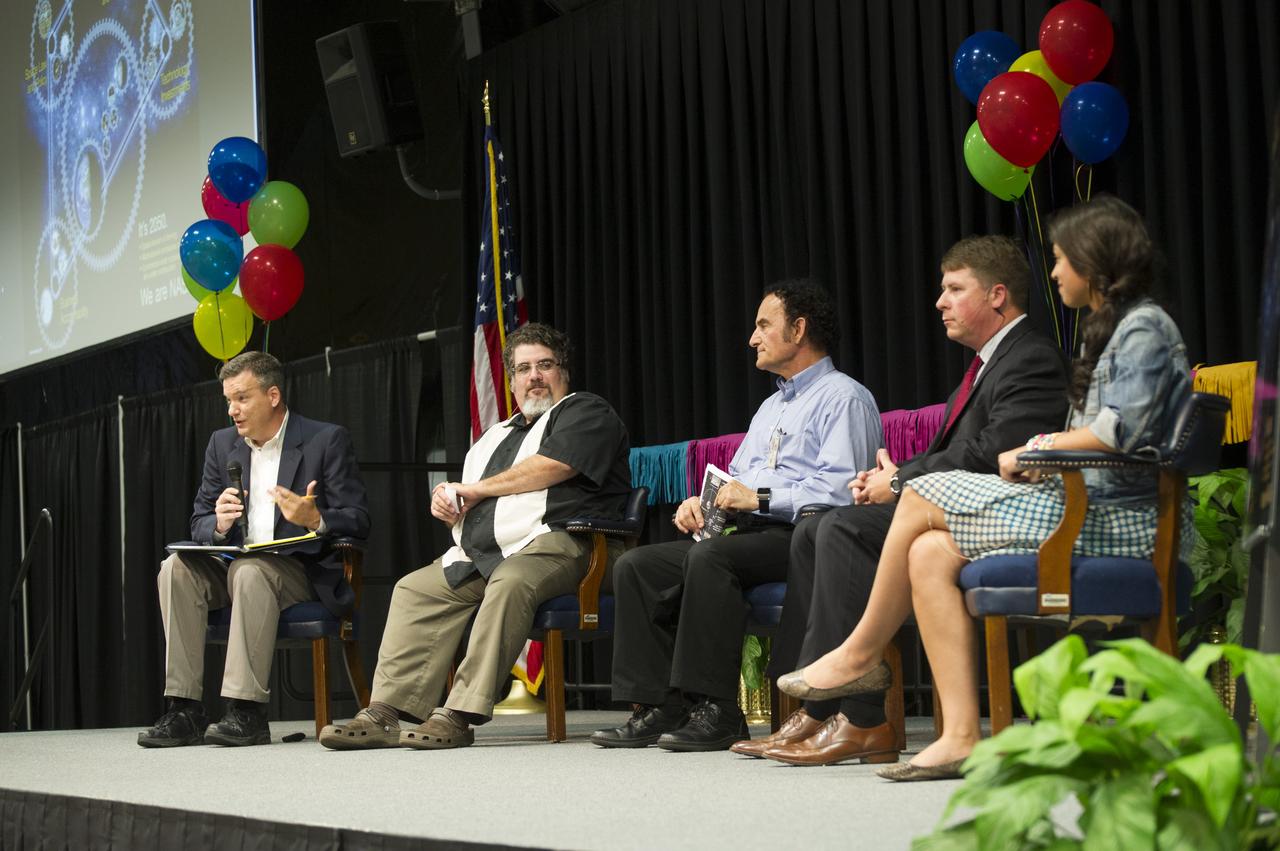
MEMBERS OF SPACE 2100 TEAM PRESENT KEYNOTE ADDRESS AT 2014 CIO AWARDS CEREMONY. (L TO R) DREW SMITH, PABLO GARCIA, DR. PETER CURRERI, CHRIS WHITE, AND ALAYNA DEVINENI
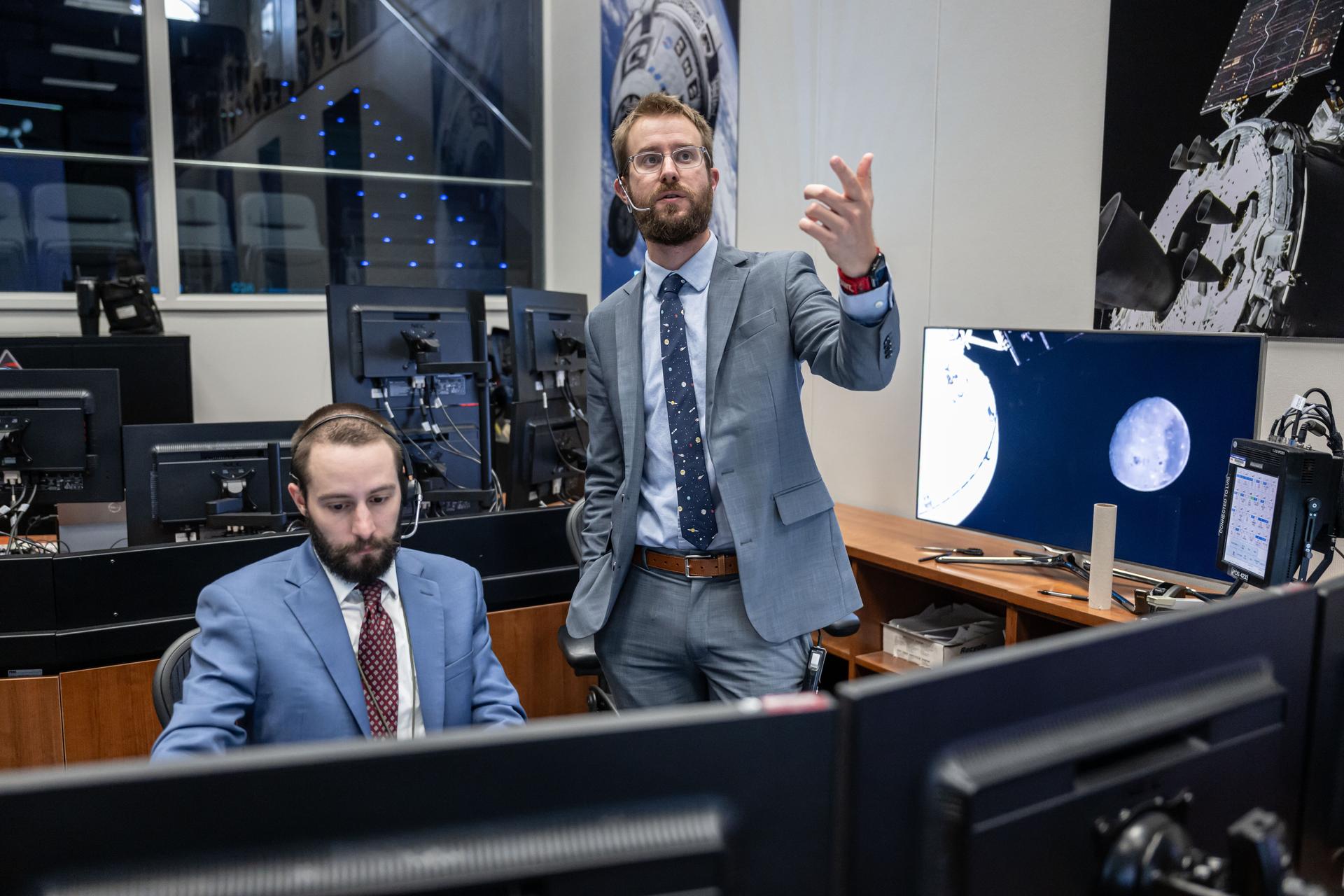
jsc2026e021749 (April 6, 2026) - Chris White, Lead INCO (Integrated Communications Officer) for Artemis II, and Matthew Johns, INCO Flight Controller, are pictured in the White Flight Control Room in the Mission Control Center at NASA’s Johnson Space Center during the Artemis II mission. This image was taken when NASA astronauts Reid Wiseman, Victor Glover, and Christina Koch, and CSA (Canadian Space Agency) astronaut Jeremy Hansen conducted the flyby of the Moon. Credit: NASA/Robert Markowitz
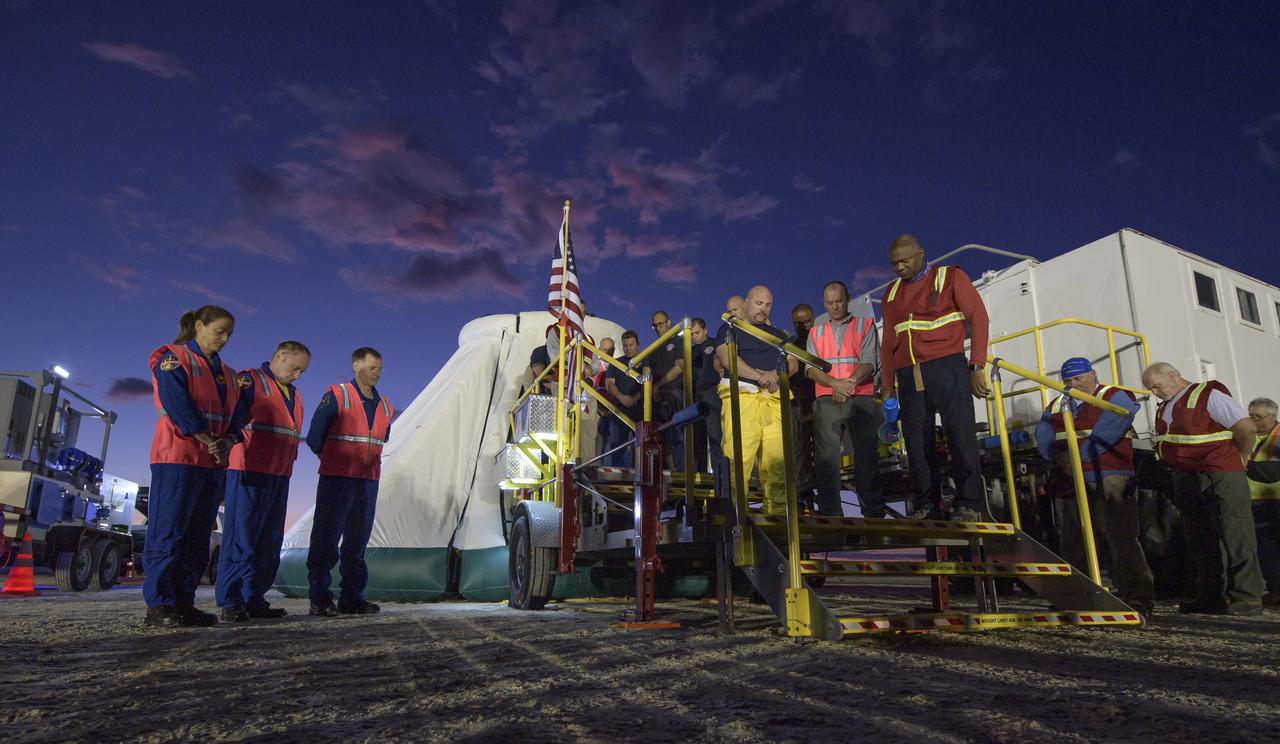
NASA astronauts Nicole Mann and Mike Fincke and Boeing astronaut Chris Ferguson observe a moment of silence with teams from NASA, Boeing and the White Sands Missile Range, honoring the victims of the Sept. 11 terrorist attacks, Wednesday, Sept. 11, 2019 at the White Sands Missile Range outside Las Cruces, New Mexico. The joint teams gathered in the desert to rehearse landing and crew extrication from Boeing’s CST-100 Starliner, which will be used to carry humans to the International Space Station. Mann, Fincke and Ferguson will fly to the space station aboard the Starliner for the Boeing Crew Flight Test mission. Photo Credit: (NASA/Bill Ingalls)
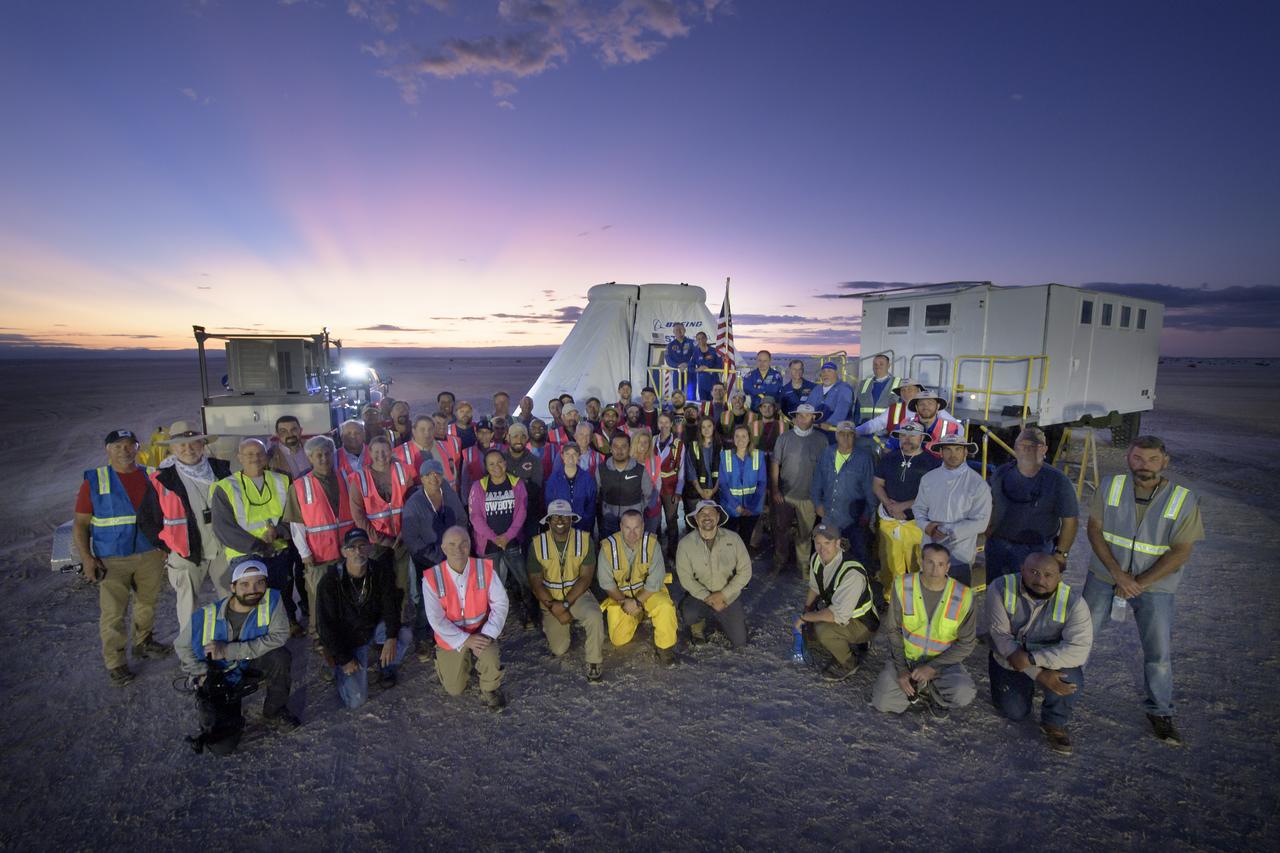
Teams from NASA, Boeing and the White Sands Missile Range, pose for a group photograph during rehearsals for landing and crew extraction from Boeing’s CST-100 Starliner, which will be used to carry humans to the International Space Station, on Wednesday, Sept. 11, 2019 at the White Sands Missile Range outside Las Cruces, New Mexico. Using a convoy of vehicles Boeing uses to recover their spacecraft after landing and a boiler plate test article of the Starliner capsule, the teams worked through the steps necessary to safe the vehicle and get future crew members out of the Starliner to return home. NASA astronauts Mike Fincke and Nicole Mann and Boeing astronaut Chris Ferguson will fly to the space station aboard the Starliner for the Boeing Crew Flight Test mission. Photo Credit: (NASA/Bill Ingalls)
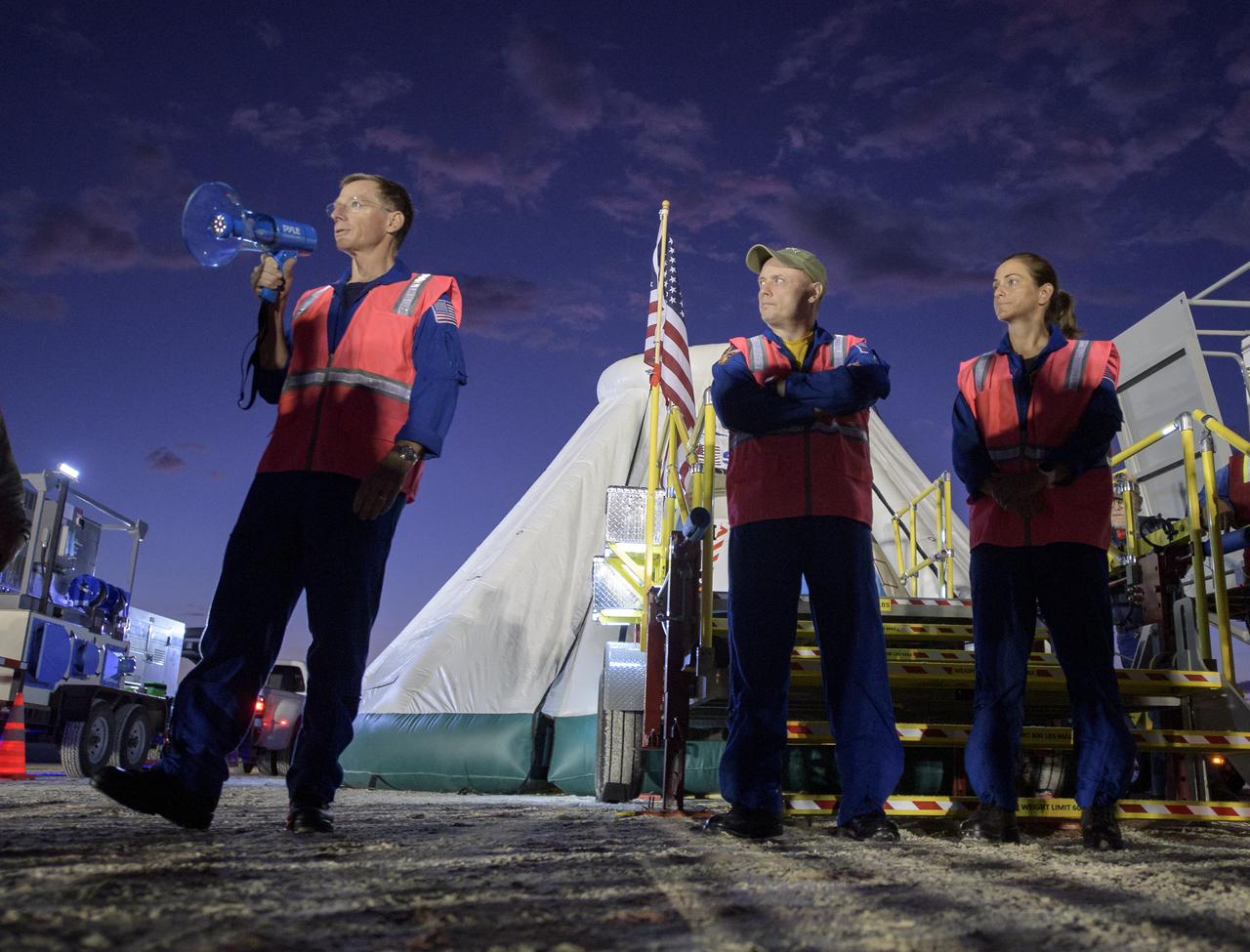
Boeing astronaut Chris Ferguson, left, and NASA astronauts Mike Fincke and Nicole Mann, along with teams from NASA, Boeing and the White Sands Missile Range, rehearse landing and crew extraction from Boeing’s CST-100 Starliner, which will be used to carry humans to the International Space Station, on Wednesday, Sept. 11, 2019 at the White Sands Missile Range outside Las Cruces, New Mexico. Using a convoy of vehicles Boeing uses to recover their spacecraft after landing and a boiler plate test article of the Starliner capsule, the teams worked through the steps necessary to safe the vehicle and get future crew members out of the Starliner to return home. Fincke, Mann and Ferguson will fly to the space station aboard the Starliner for the Boeing Crew Flight Test mission. Photo Credit: (NASA/Bill Ingalls)
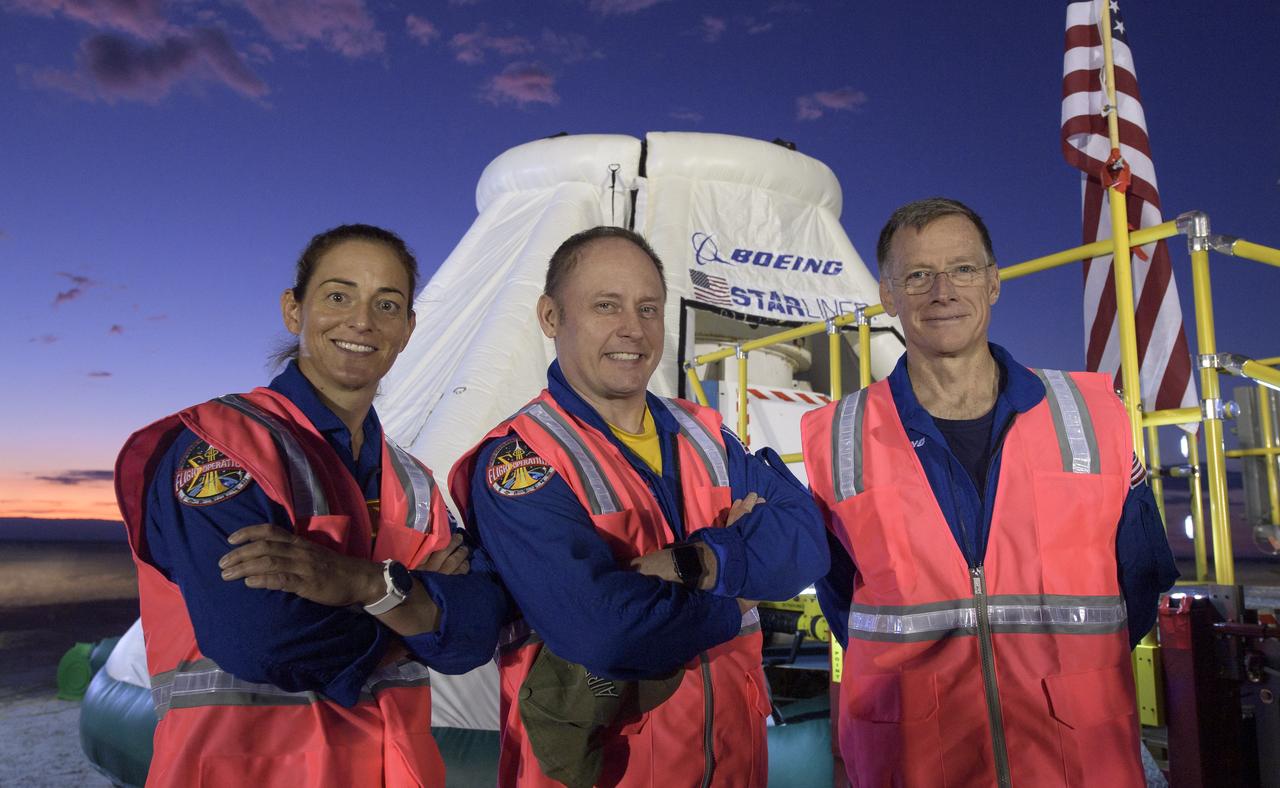
NASA astronauts Nicole Mann, left, Mike Fincke, and Boeing astronaut Chris Ferguson, right, pose for photograph as they and teams from NASA, Boeing and the White Sands Missile Range, rehearse landing and crew extraction from Boeing’s CST-100 Starliner, which will be used to carry humans to the International Space Station, on Wednesday, Sept. 11, 2019 at the White Sands Missile Range outside Las Cruces, New Mexico. Using a convoy of vehicles Boeing uses to recover their spacecraft after landing and a boiler plate test article of the Starliner capsule, the teams worked through the steps necessary to safe the vehicle and get future crew members out of the Starliner to return home. Fincke, Mann and Ferguson will fly to the space station aboard the Starliner for the Boeing Crew Flight Test mission. Photo Credit: (NASA/Bill Ingalls)
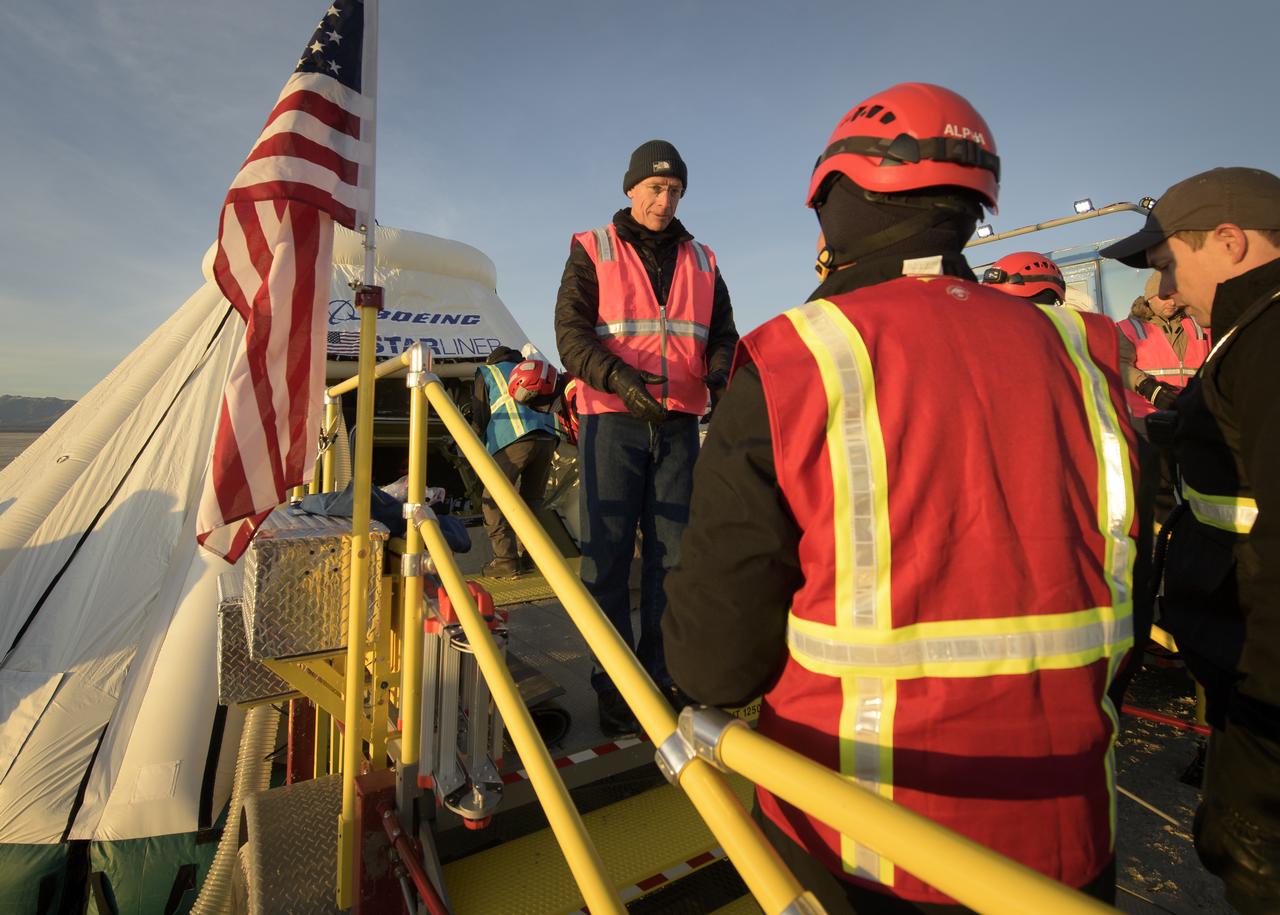
Boeing astronaut Chris Ferguson, talks with support personnel outside of the Boeing CST-100 Starliner spacecraft shortly after it landed in White Sands, New Mexico, Sunday, Dec. 22, 2019. The landing completes an abbreviated Orbital Flight Test for the company that still meets several mission objectives for NASA’s Commercial Crew program. The Starliner spacecraft launched on a United Launch Alliance Atlas V rocket at 6:36 a.m. Friday, Dec. 20 from Space Launch Complex 41 at Cape Canaveral Air Force Station in Florida. Photo Credit: (NASA/Bill Ingalls)
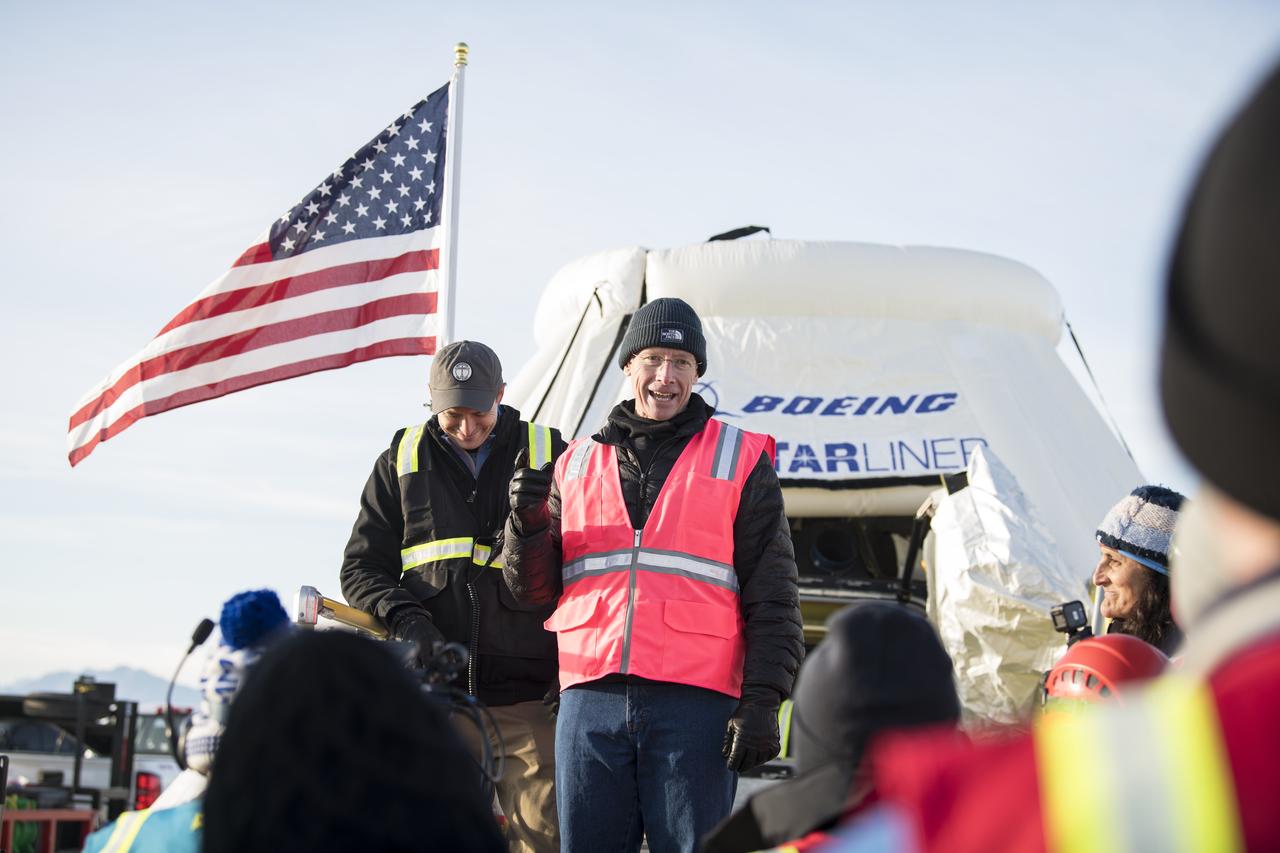
Former NASA astronaut and test flight pilot for the first manned flight of the Boeing CST-100 Starliner spacecraft, Chris Ferguson, speaks after the capsule landed in White Sands, New Mexico, Sunday, Dec. 22, 2019. The landing completes an abbreviated Orbital Flight Test for the company that still meets several mission objectives for NASA’s Commercial Crew program. The Starliner spacecraft launched on a United Launch Alliance Atlas V rocket at 6:36 a.m. Friday, Dec. 20 from Space Launch Complex 41 at Cape Canaveral Air Force Station in Florida. Photo Credit: (NASA/Aubrey Gemignani)
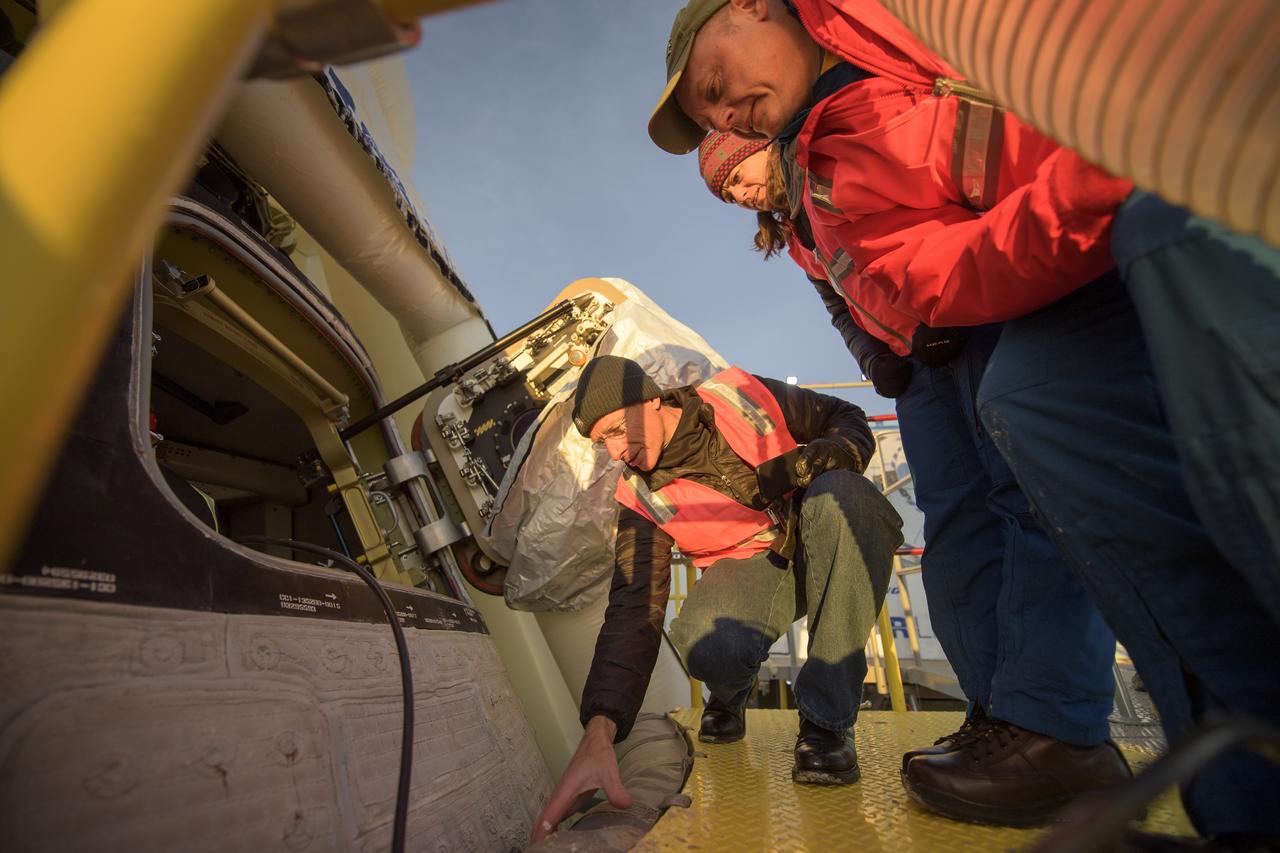
Boeing astronaut Chris Ferguson, left, and NASA astronauts Nicole Mann, and Mike Fincke inspect the Boeing CST-100 Starliner spacecraft shortly after it landed in White Sands, New Mexico, Sunday, Dec. 22, 2019. The landing completes an abbreviated Orbital Flight Test for the company that still meets several mission objectives for NASA’s Commercial Crew program. The Starliner spacecraft launched on a United Launch Alliance Atlas V rocket at 6:36 a.m. Friday, Dec. 20 from Space Launch Complex 41 at Cape Canaveral Air Force Station in Florida. Photo Credit: (NASA/Bill Ingalls)
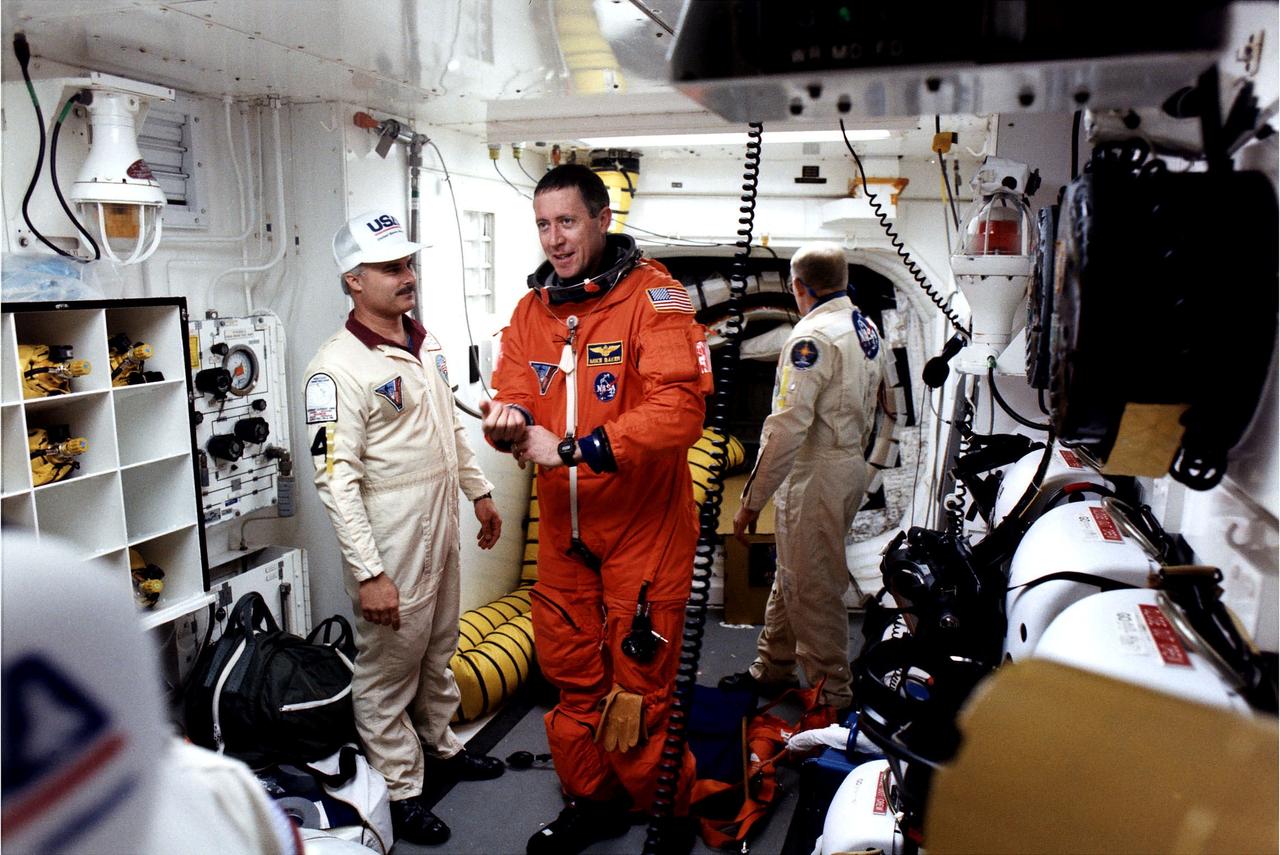
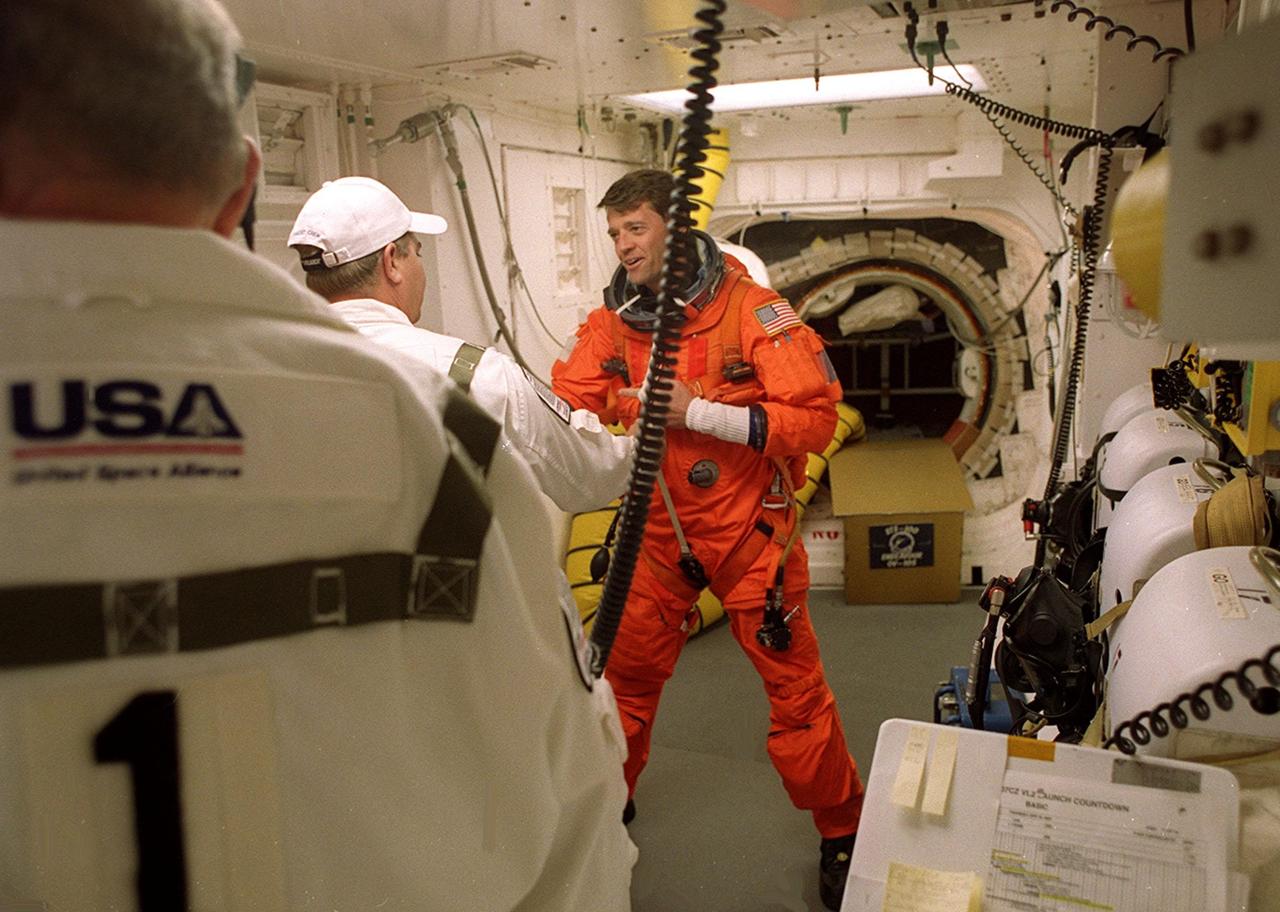
KENNEDY SPACE CENTER, FLA. - STS-81 Mission Commander Michael Baker prepares to enter the Space Shuttle Atlantis at Launch Pad 39B with help from White Room closeout crew members Chris Meinert (left) and Danny Wyatt.
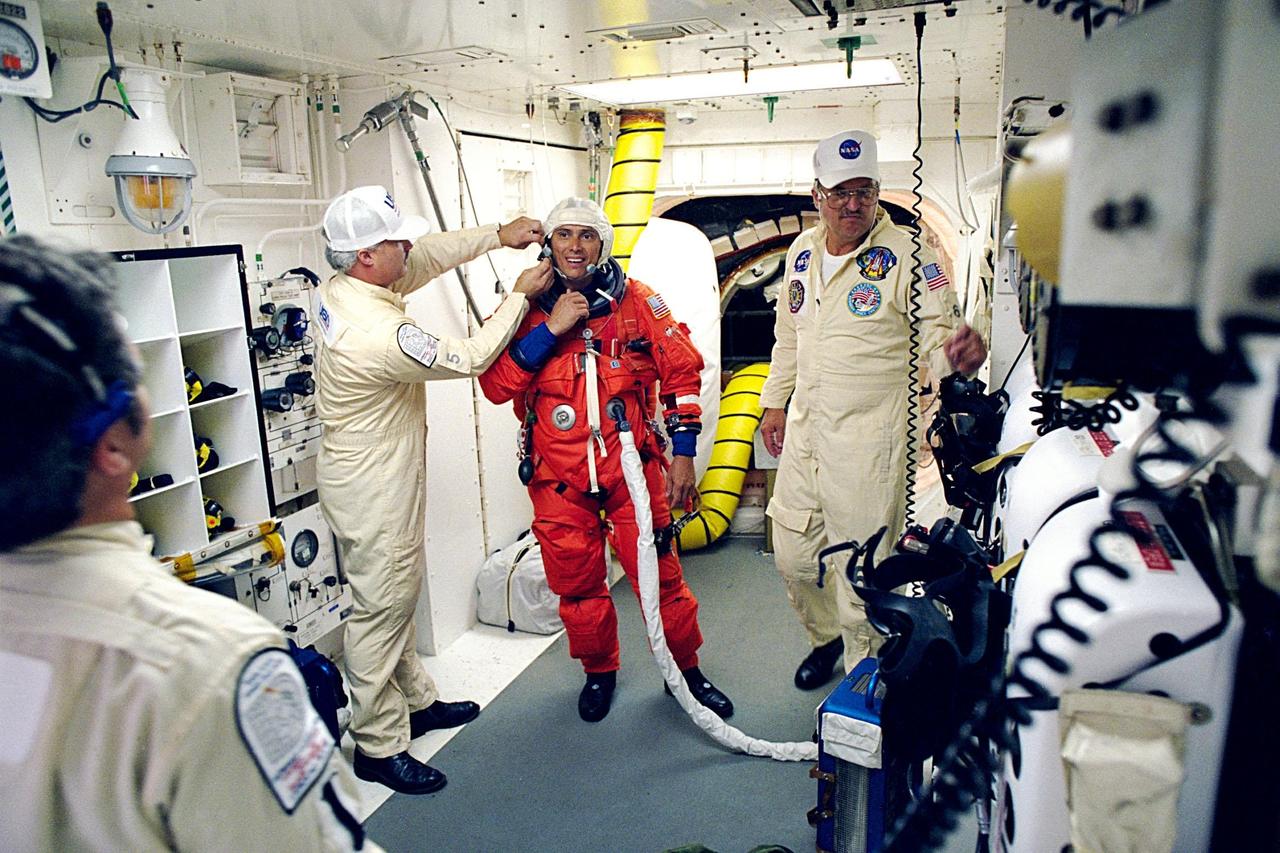
White room crew members Greg Lohning (left) and Chris Meinert help STS-91 Mission Specialist Franklin R. Chang-Diaz prepare to enter the Space Shuttle Discovery at Launch Pad 39A
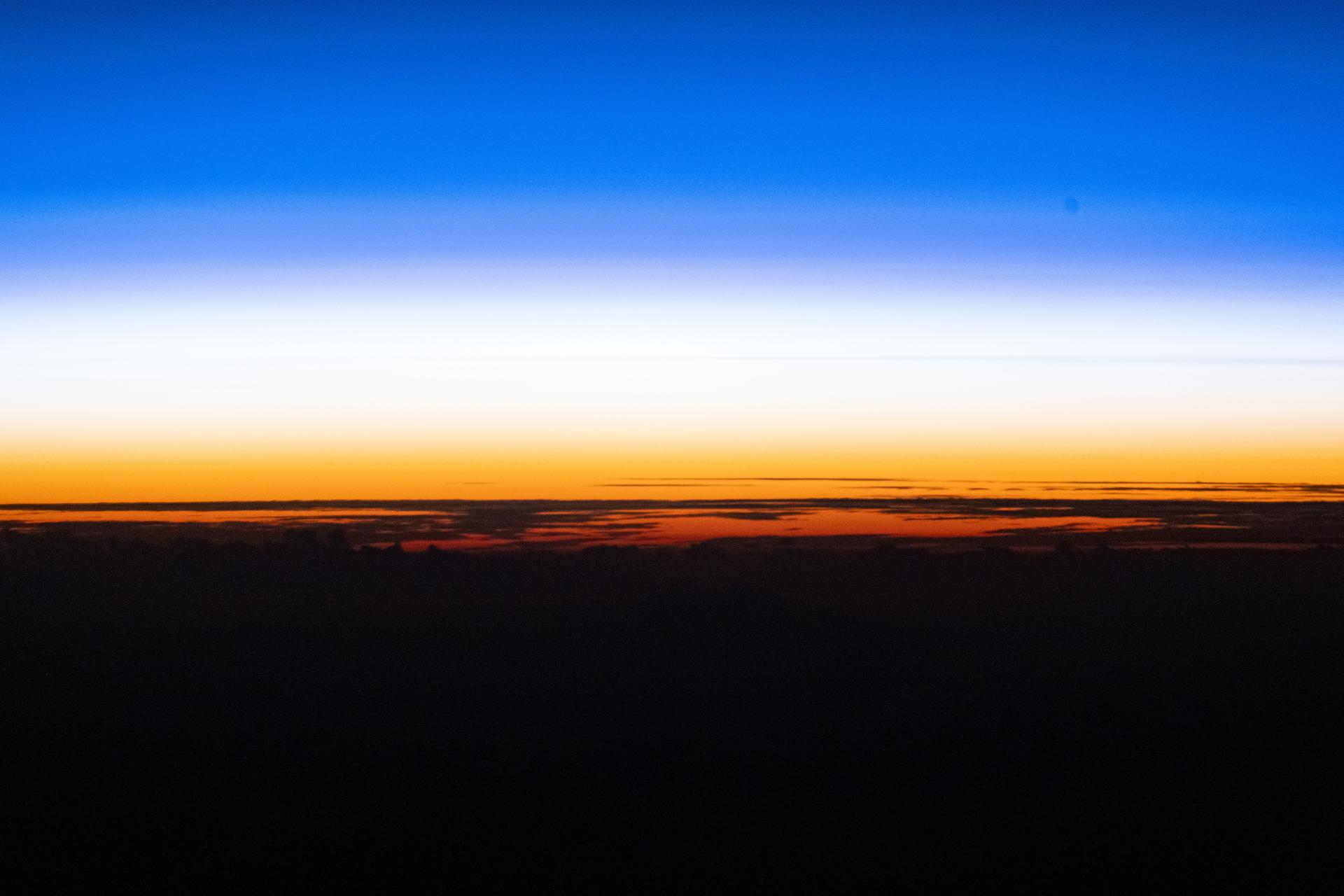
iss074e0046371 (Jan. 3, 2025) --- An orbital sunset silhouettes the cloud tops above the Pacific Ocean as the atmosphere along the horizon fades from orange to white, then to blue, in this photograph taken from the International Space Station while it orbited 262 miles above Earth. Credit: NASA/Chris Williams
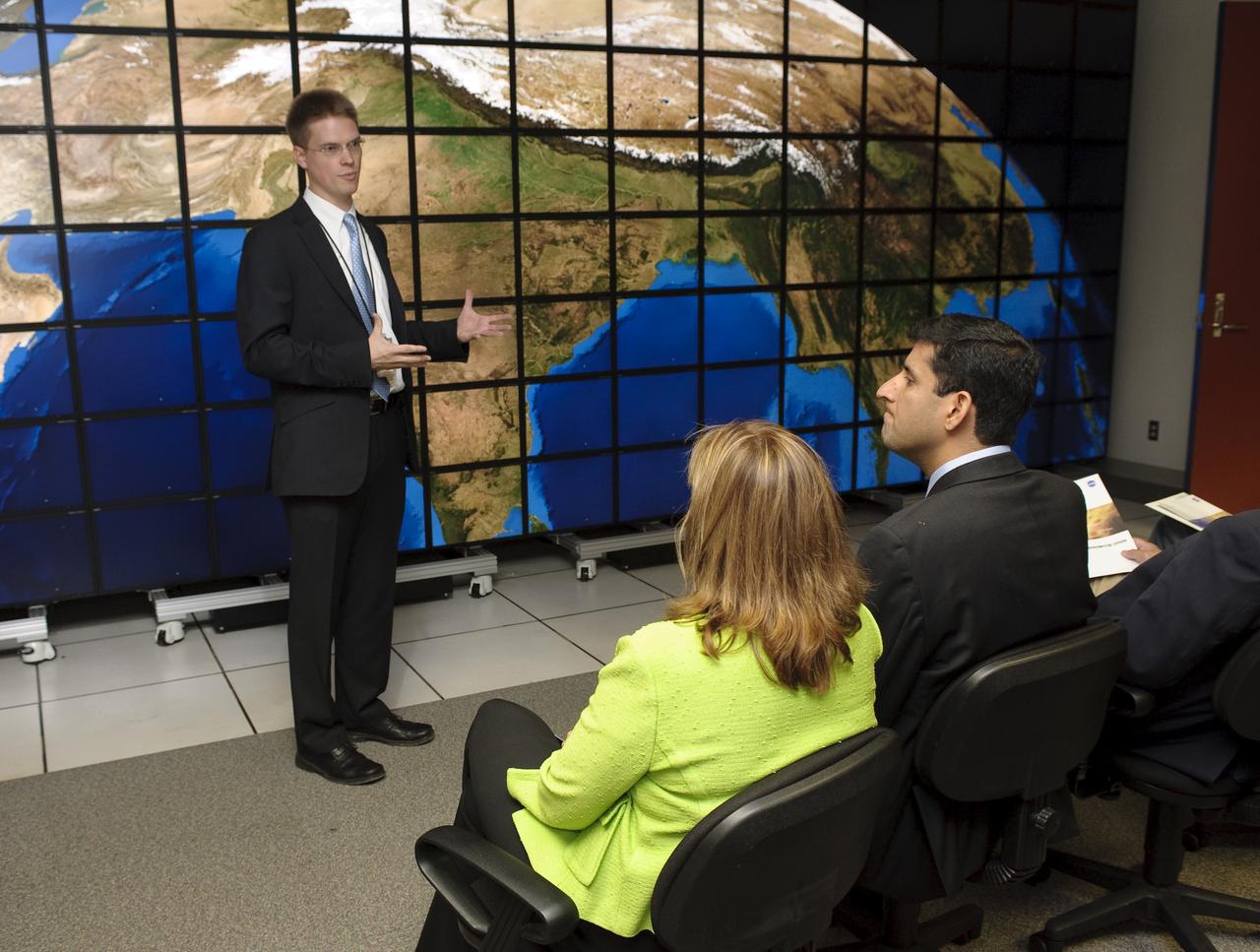
Obama Administration launches Cloud Computing Initiative at Ames Research Center. Vivek Kundra, White House Chief Federal Information Officer (right) and Lori Garver, NASA Deputy Administrator (left) get a tour & demo NASAS Supercomputing Center Hyperwall by Chris Kemp.
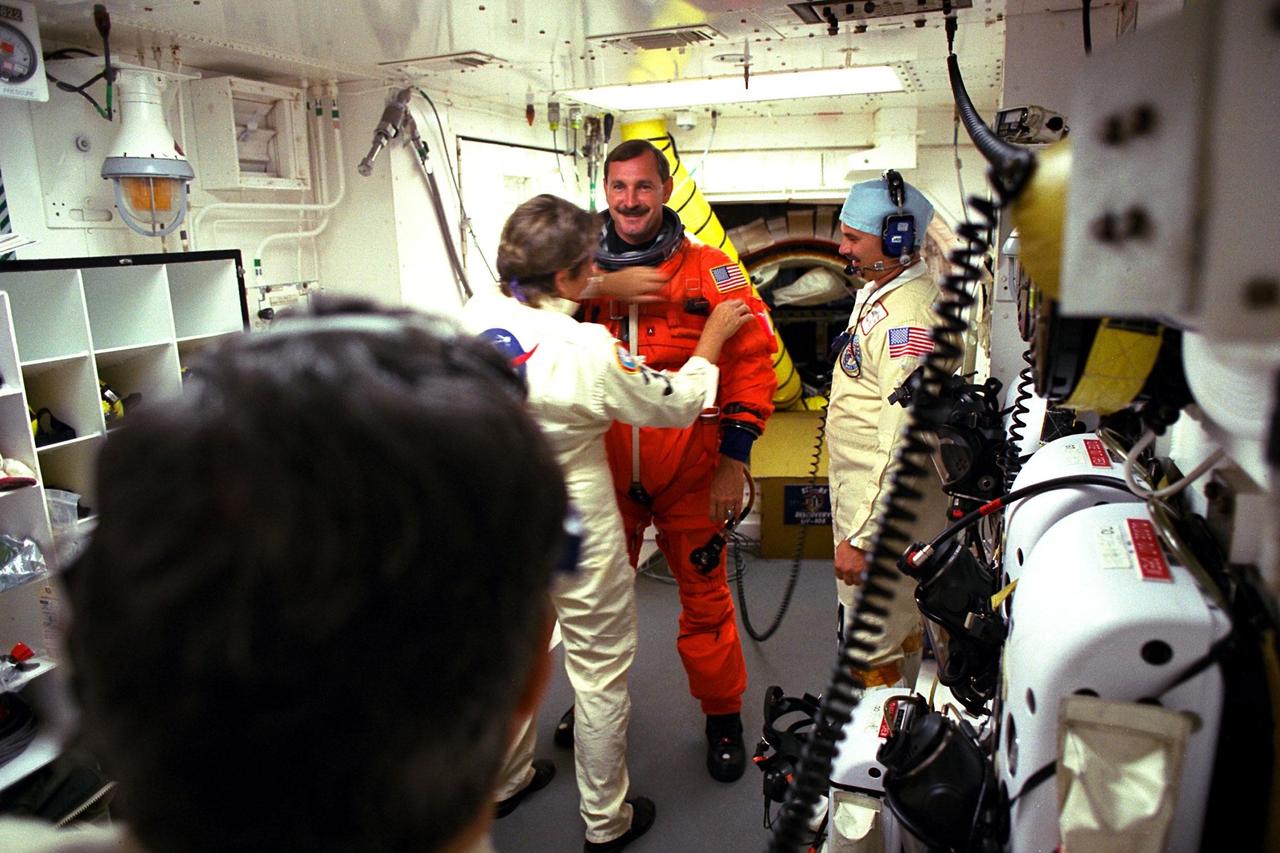
STS-85 Commander Curtis L. Brown, Jr. is assisted with his ascent/reentry flight suit by white room closeout crew members Jean Alexander (left) and Chris Meinert at Launch Pad 39A before he enters the crew cabin of the Space Shuttle orbiter Discovery
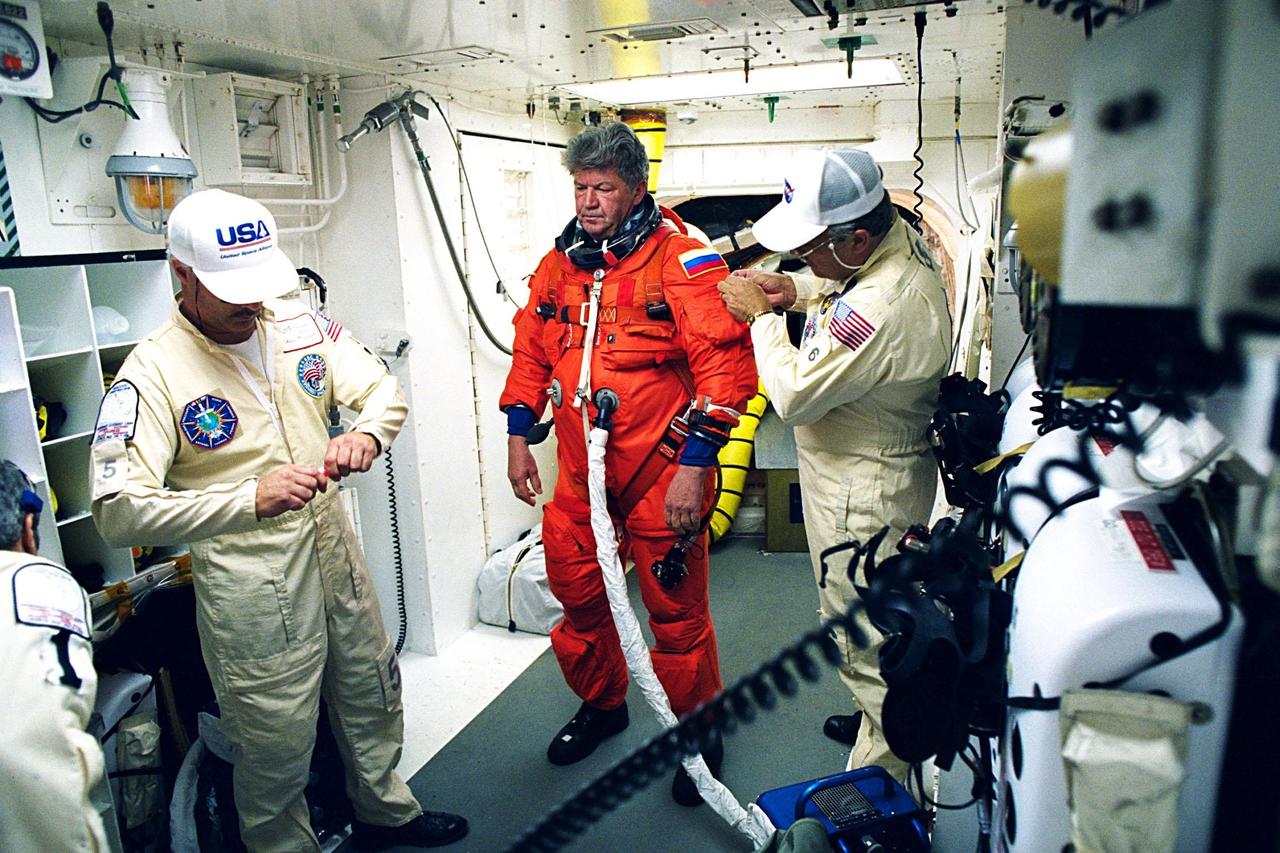
STS-91 Mission Specialist and Russian cosmonaut Valery Victorovitch Ryumin is assisted with his flight suit prior to his entry into the Space Shuttle Discovery by Launch Pad 39A white room crew members Chris Meinert (left) and Greg Lohning
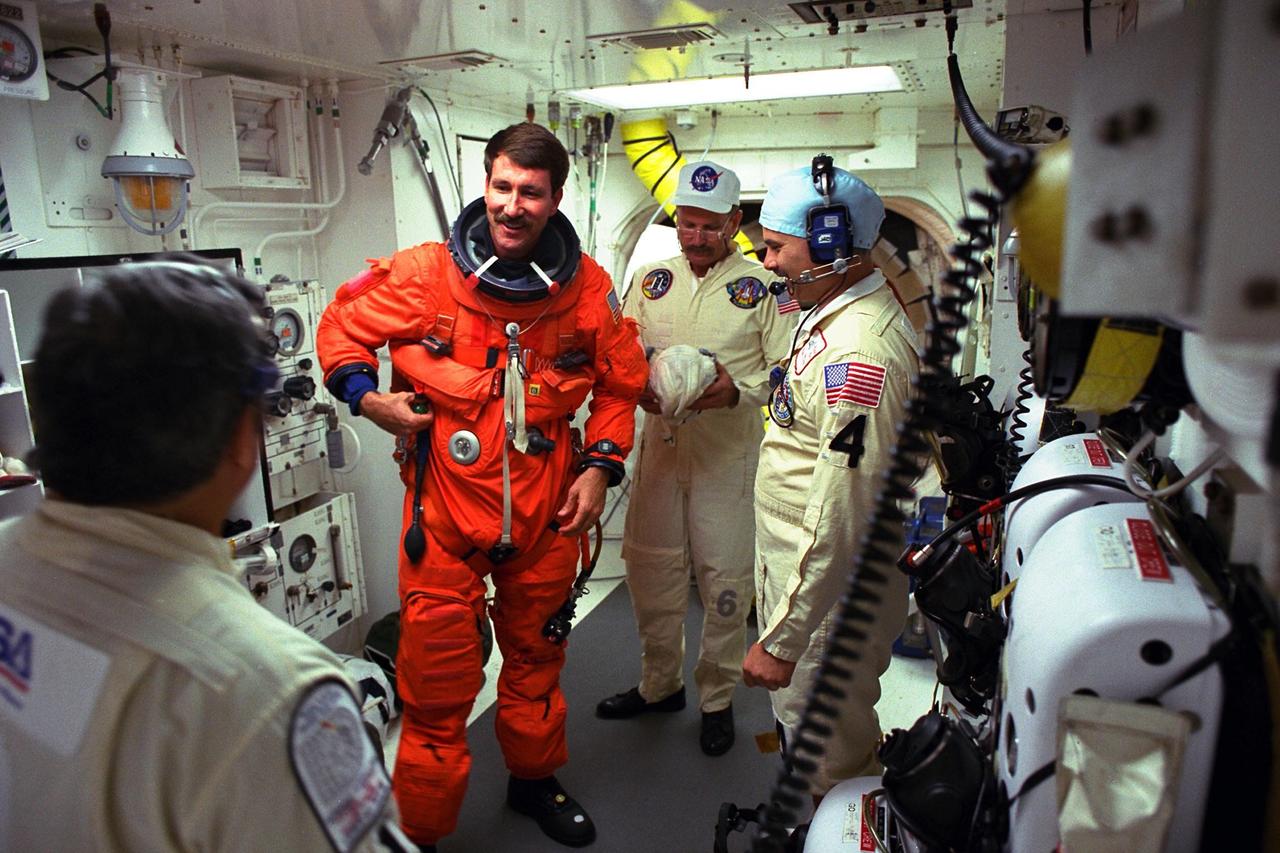
STS-85 Pilot Kent V. Rominger visits with white room closeout crew members Mike Mangione (left foreground), Jack Burritt (center), and Chris Meinert at Launch Pad 39A as they assist him with his ascent/reentry flight suit before he enters the crew cabin of the Space Shuttle orbiter Discovery

iss074e0543247 (May 2, 2026) --- Chennai, on India's southern coast along the Bay of Bengal and with a metropolitan population of about 8.7 million, shines with white LED streetlights in this photograph taken at approximately 9:13 p.m. local time from the International Space Station. Credit: NASA/Chris Williams
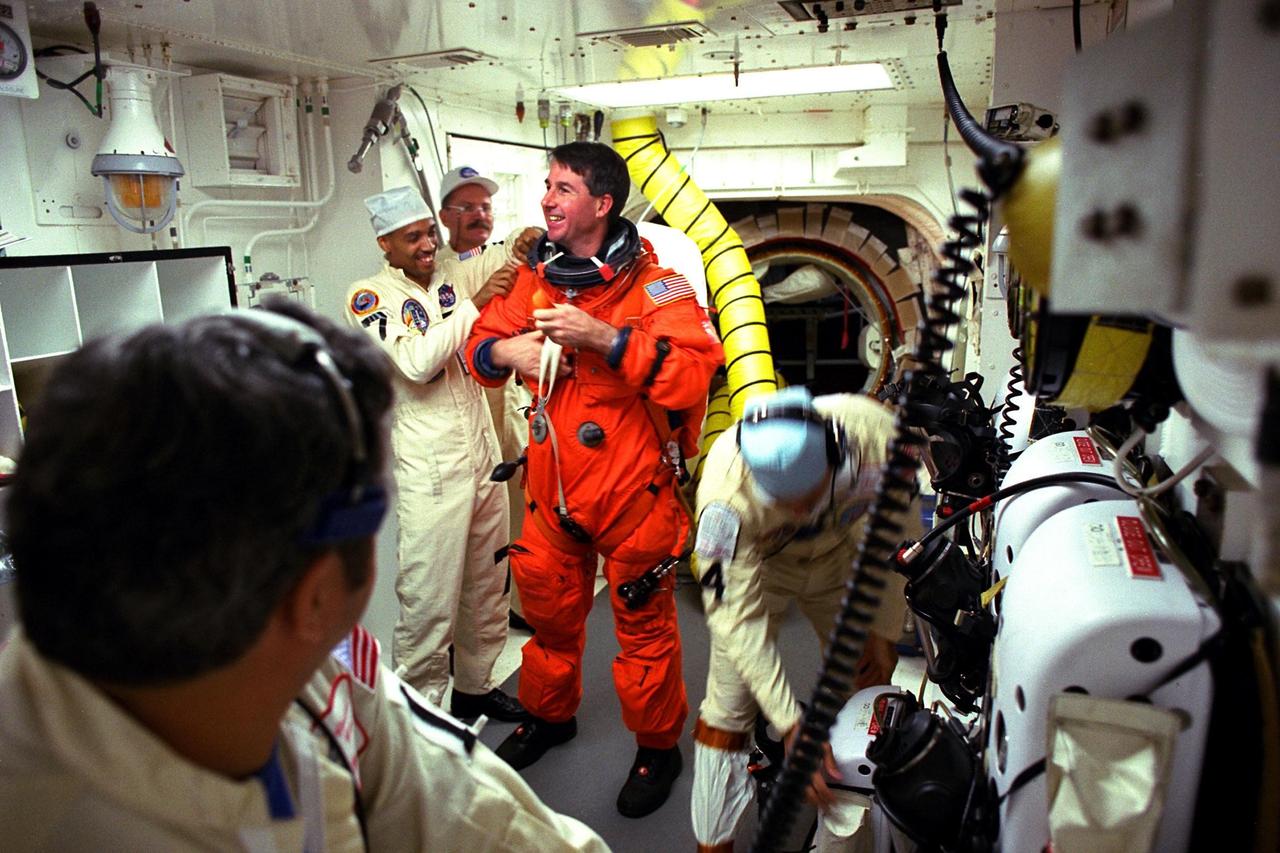
STS-85 Mission Specialist Stephen K. Robinson visits with white room closeout crew members Mike Mangione (left foreground), Carlos Gillis, Jack Burritt (center), and Chris Meinert at Launch Pad 39A as they assist him with his ascent/reentry flight suit before he enters the crew cabin of the Space Shuttle orbiter Discovery
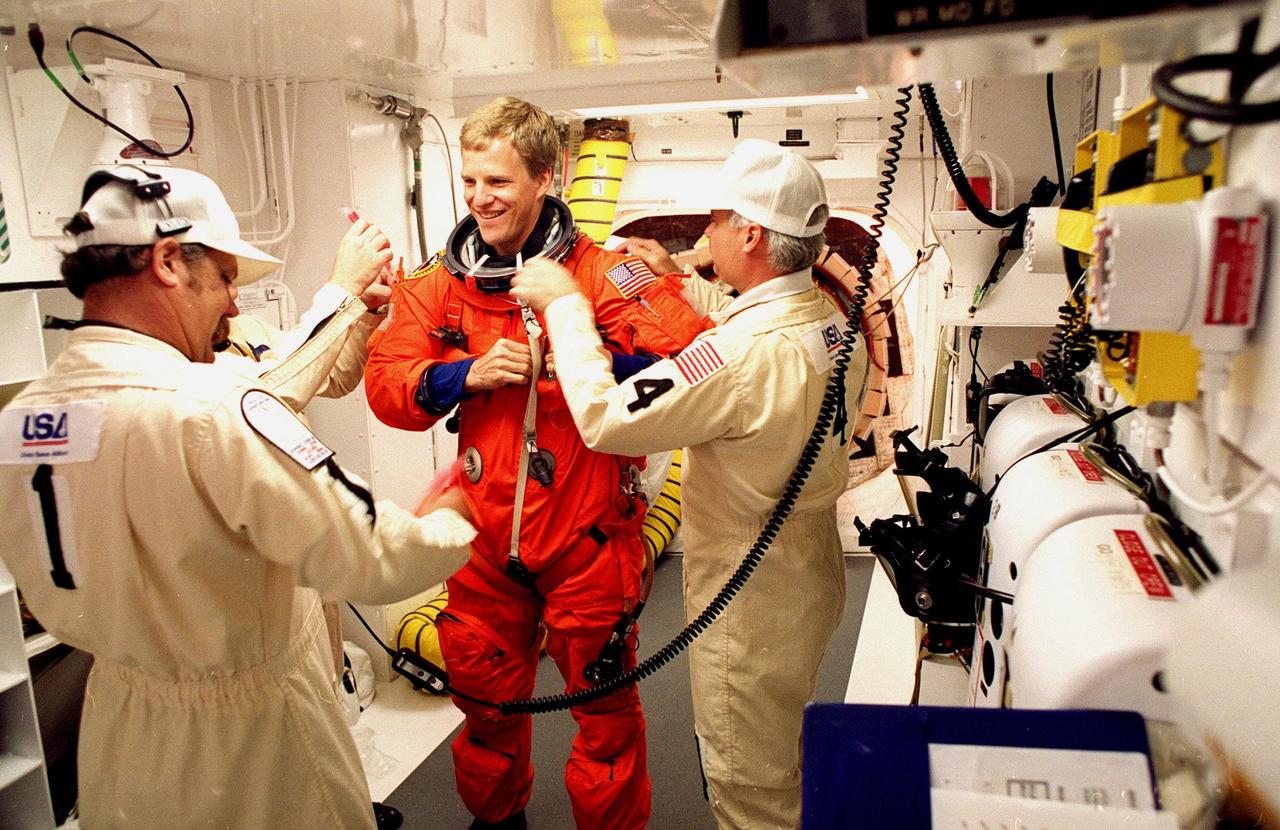
In the environmental chamber known as the white room, STS-95 Mission Specialist Scott E. Parazynski is prepared by closeout room crew members Travis Thompson (left), Danny Wyatt (partially hidden) and Chris Meinert (right) for entry into the Space Shuttle Discovery for his third flight into space. The STS-95 mission, targeted for launch at 2 p.m. EST on Oct. 29, is expected to last 8 days, 21 hours and 49 minutes, and return to KSC at 11:49 a.m. EST on Nov. 7
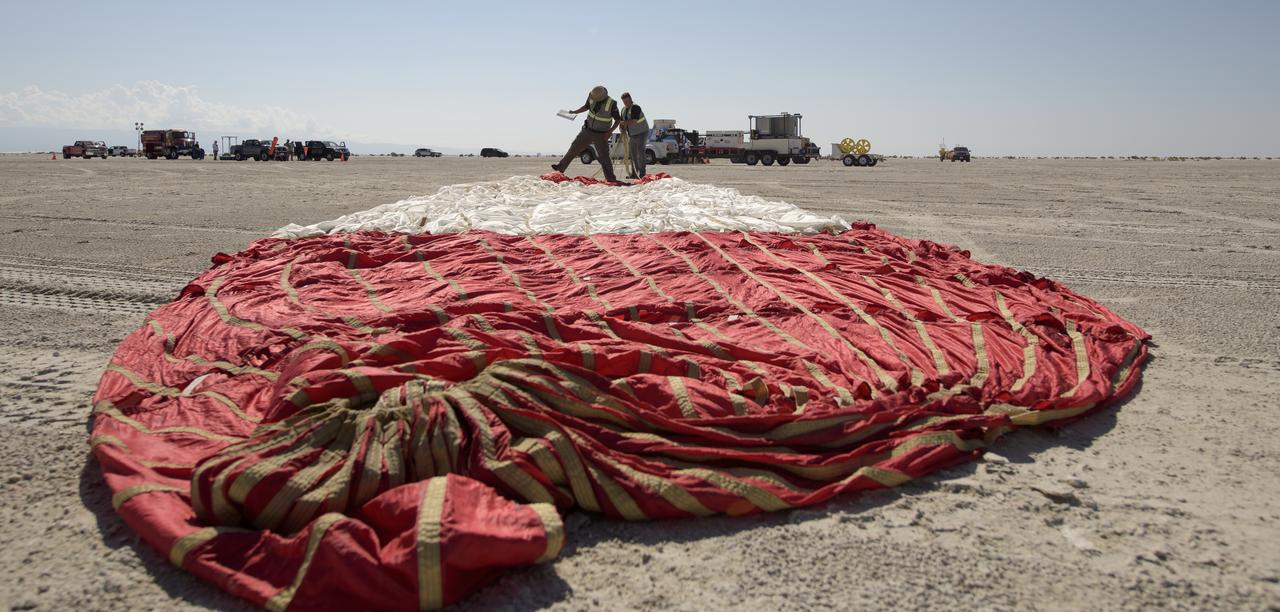
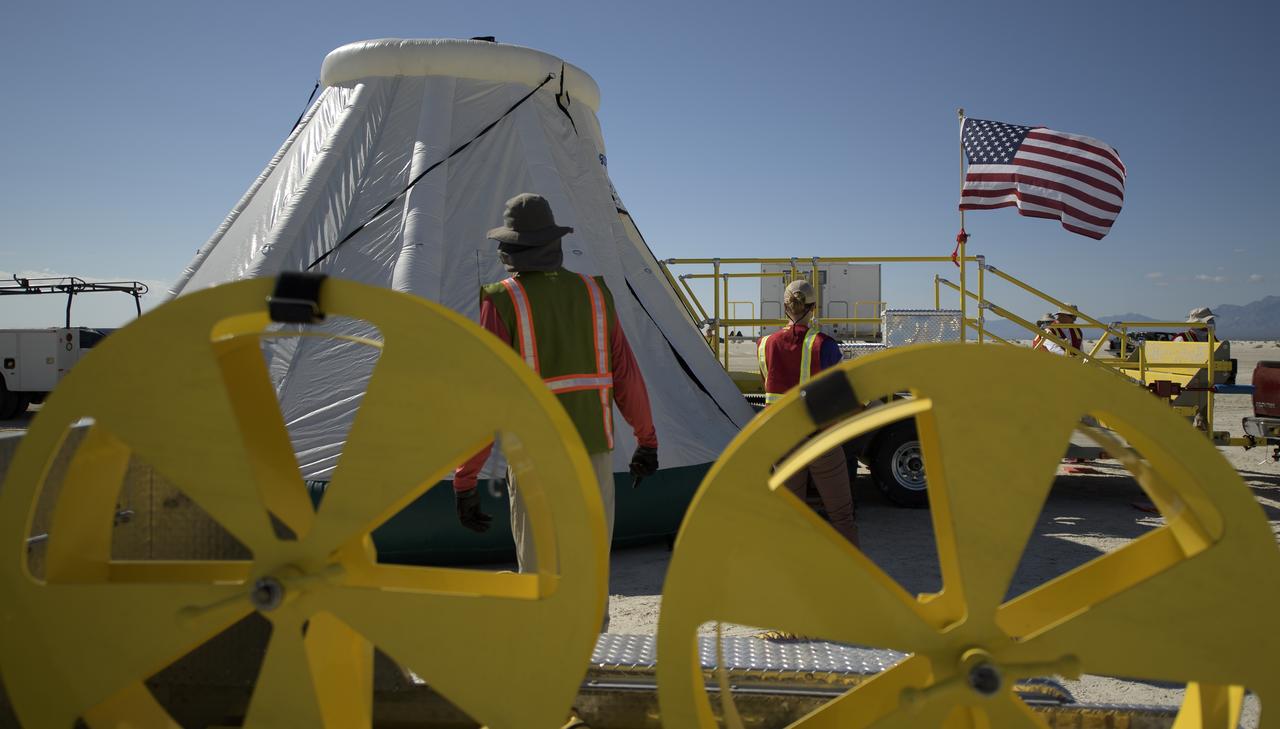
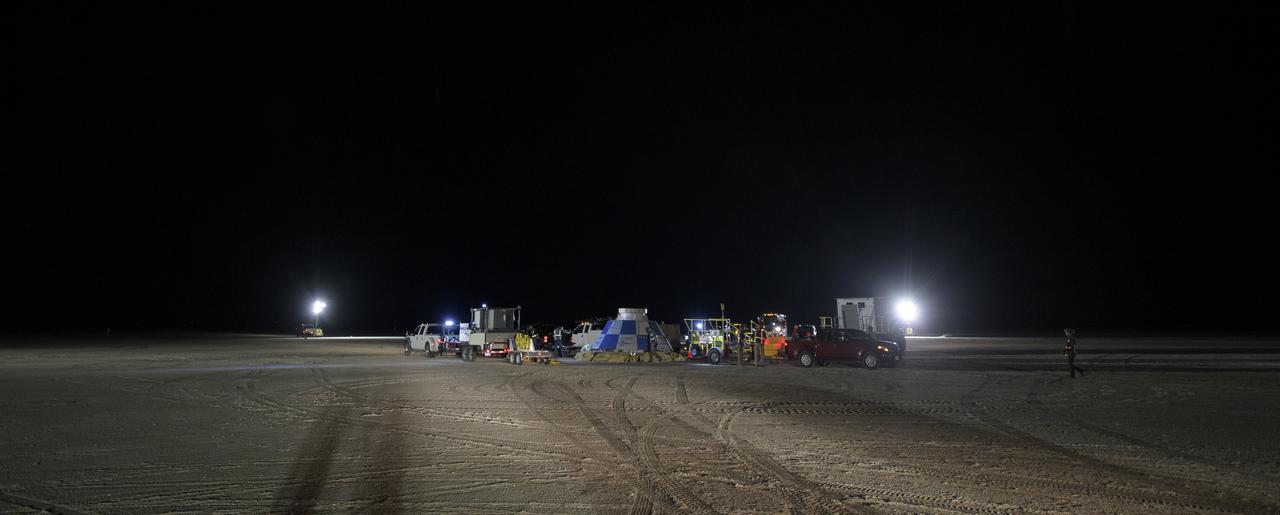
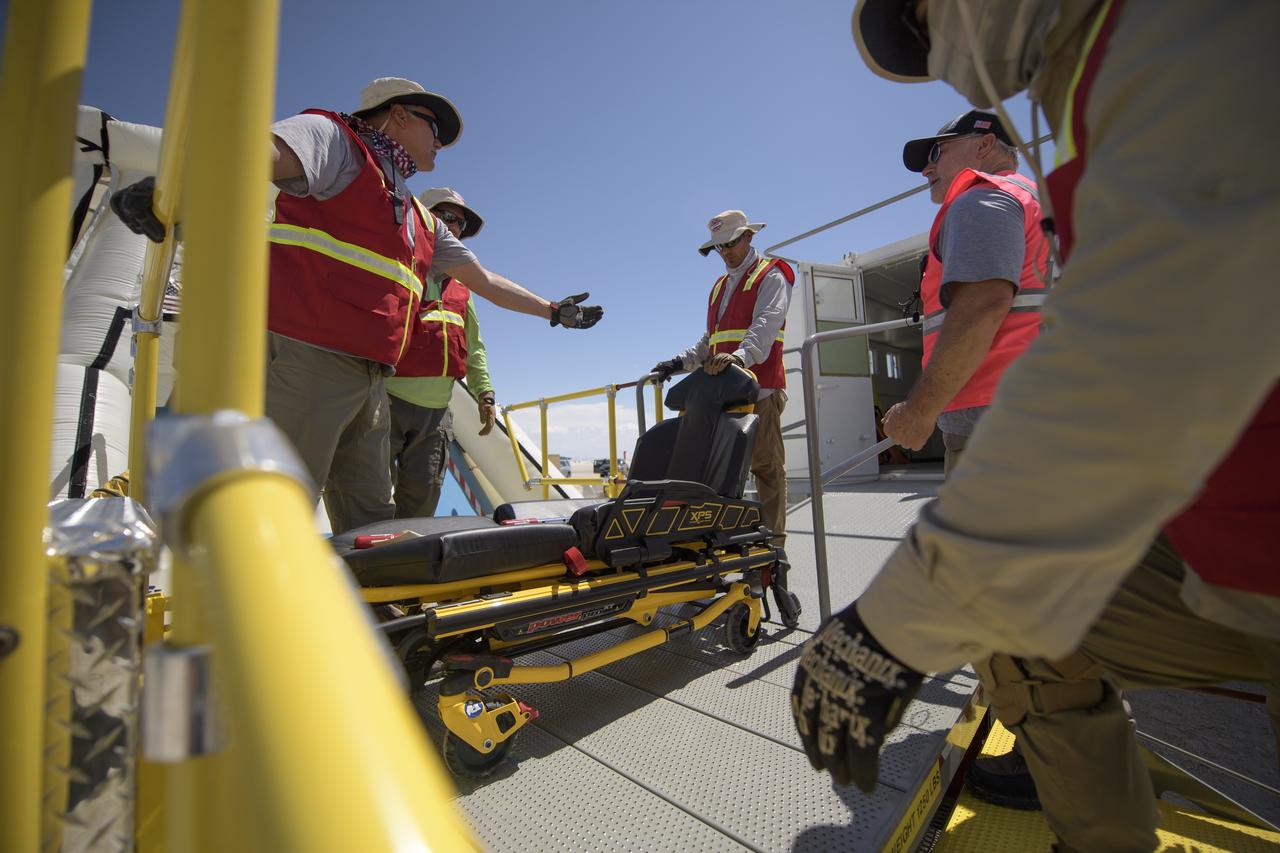
Teams from NASA, Boeing and the White Sands Missile Range, rehearse landing and crew extraction from Boeing’s CST-100 Starliner, which will be used to carry humans to the International Space Station, on Tuesday, Sept. 10, 2019 at the White Sands Missile Range outside Las Cruces, New Mexico. Using a convoy of vehicles Boeing uses to recover their spacecraft after landing and a boiler plate test article of the Starliner capsule, the teams worked through the steps necessary to safe the vehicle and get future crew members out of the Starliner to return home. NASA astronauts Mike Fincke and Nicole Mann and Boeing astronaut Chris Ferguson will fly to the space station aboard the Starliner for the Boeing Crew Flight Test mission. Photo Credit: (NASA/Bill Ingalls)
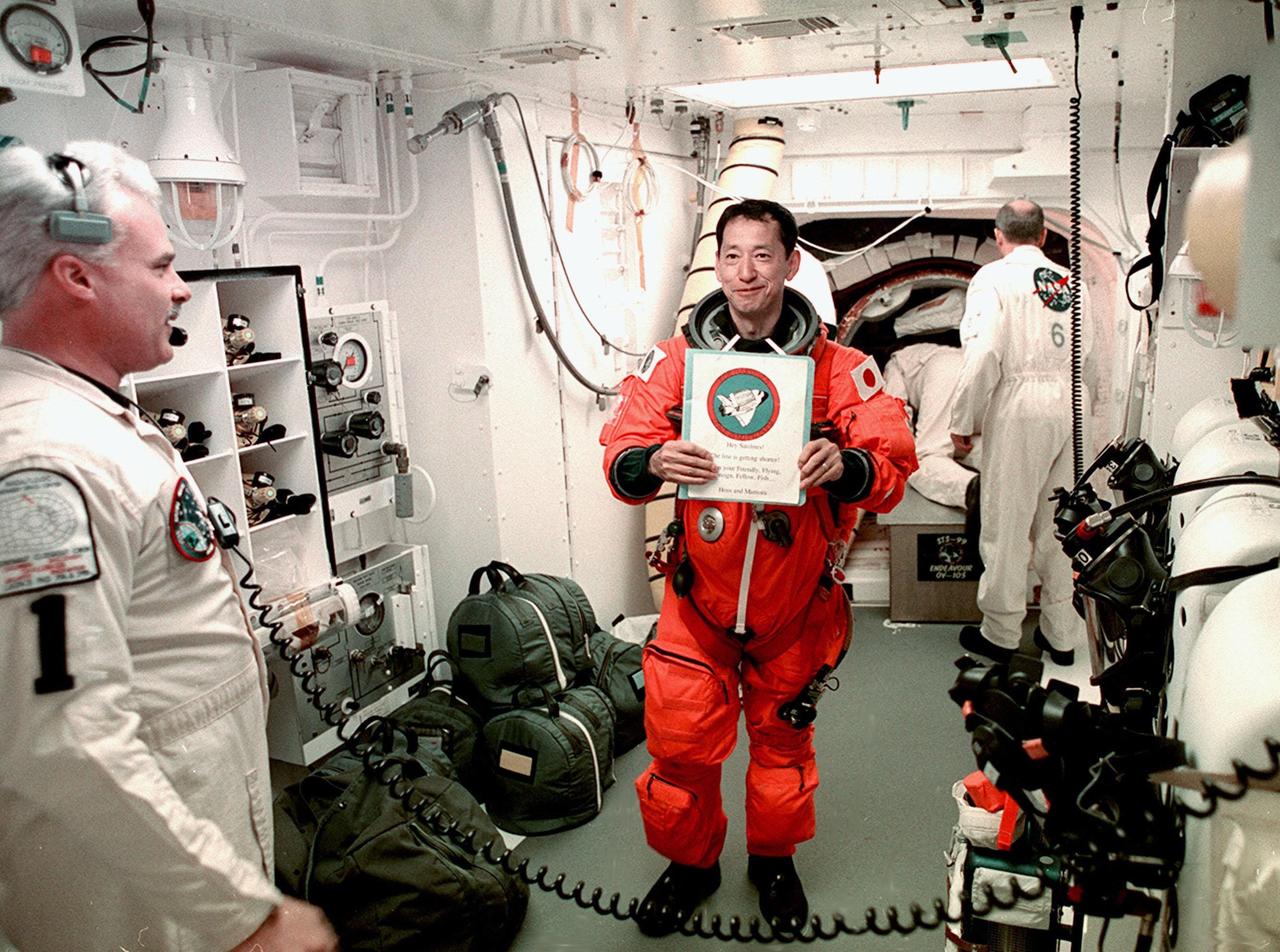
STS-99 Mission Specialist Mamoru Mohri of Japan holds a memento from friends before entering orbiter Endeavour. With him are members of the White Room closeout crew, Chris Meinert (left), closeout chief, and Jack Burritt (background), Quality Assurance specialist. The White Room is an environmental chamber at the end of the orbiter access arm, on the fixed service structure, that provides entry to the orbiter crew compartment. STS-99, known as the Shuttle Radar Topography Mission (SRTM), will chart a new course to produce unrivaled 3-D images of the Earth's surface. The result of the Shuttle Radar Topography Mission could be close to 1 trillion measurements of the Earth's topography. Scheduled for liftoff at 12:30 p.m. EST, the mission is expected to last 11days, with Endeavour landing at KSC Tuesday, Feb. 22, at 4:36 p.m. EST. This is the 97th Shuttle flight and 14th for Shuttle Endeavour
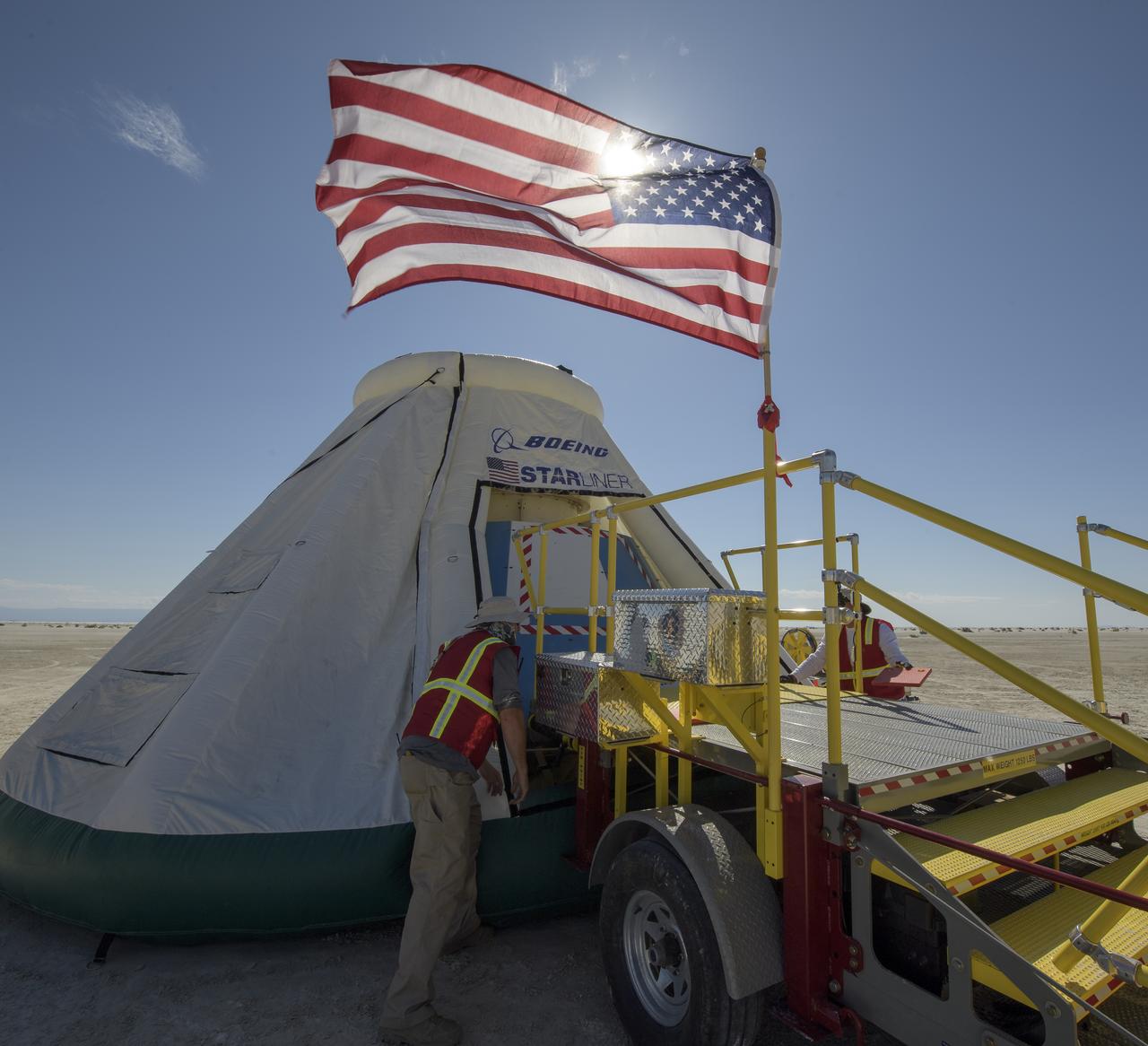
Teams from NASA, Boeing and the White Sands Missile Range, rehearse landing and crew extraction from Boeing’s CST-100 Starliner, which will be used to carry humans to the International Space Station, on Wednesday, Sept. 11, 2019 at the White Sands Missile Range outside Las Cruces, New Mexico. Using a convoy of vehicles Boeing uses to recover their spacecraft after landing and a boiler plate test article of the Starliner capsule, the teams worked through the steps necessary to safe the vehicle and get future crew members out of the Starliner to return home. NASA astronauts Mike Fincke and Nicole Mann and Boeing astronaut Chris Ferguson will fly to the space station aboard the Starliner for the Boeing Crew Flight Test mission. Photo Credit: (NASA/Bill Ingalls)
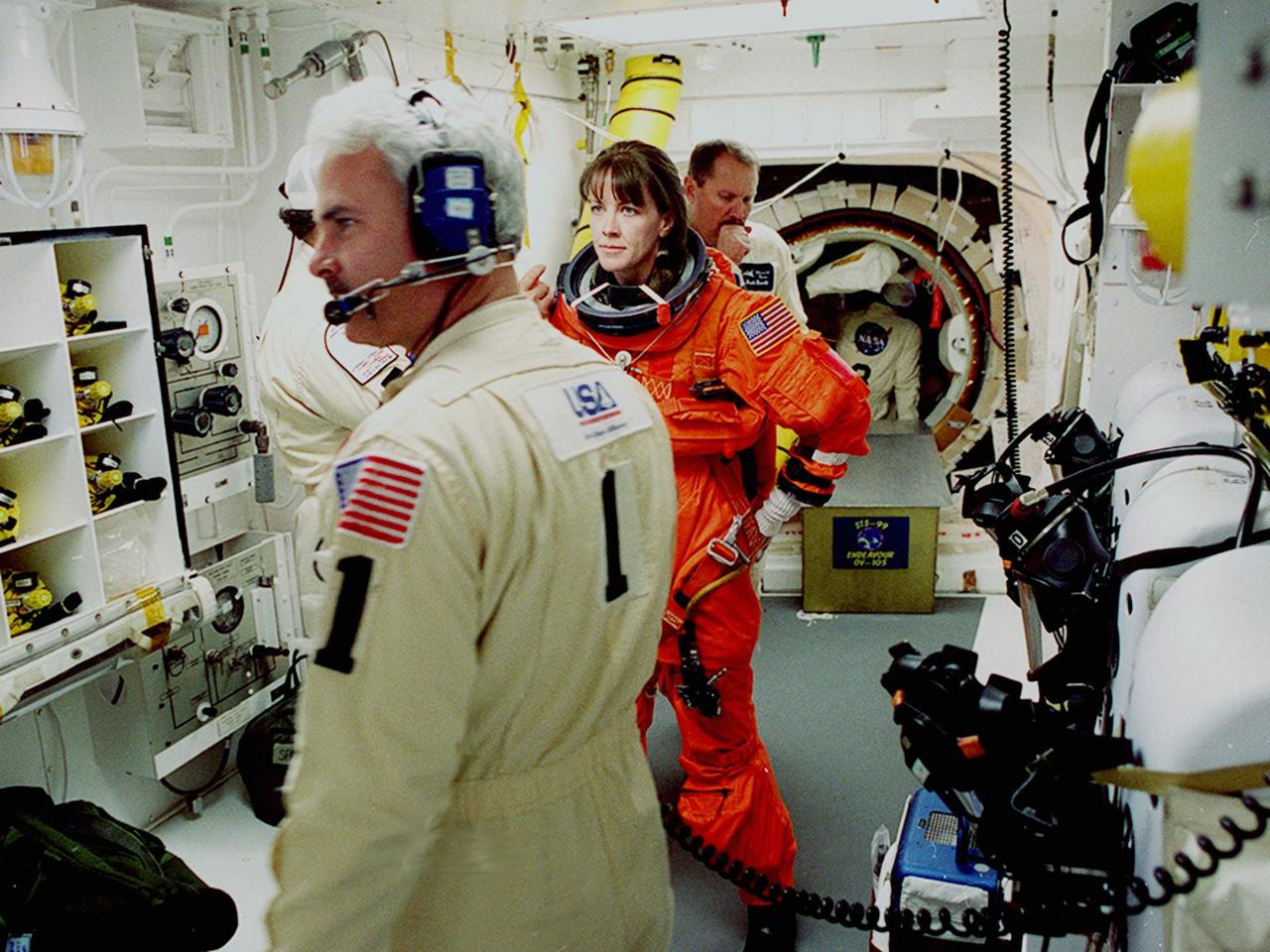
Before entering the orbiter Endeavour, STS-99 Mission Specialist Janet Kavandi is helped with final suit preparations by members of the White Room closeout crew Travis Thompson (hidden), mechanical technician, and Chris Meinert, closeout chief. The White Room is an environmental chamber at the end of the orbiter access arm, on the fixed service structure, that provides entry to the orbiter crew compartment. STS-99, known as the Shuttle Radar Topography Mission (SRTM), will chart a new course to produce unrivaled 3-D images of the Earth's surface. The result of the Shuttle Radar Topography Mission could be close to 1 trillion measurements of the Earth's topography. Scheduled for liftoff at 12:30 p.m. EST, the mission is expected to last 11days, with Endeavour landing at KSC Tuesday, Feb. 22, at 4:36 p.m. EST. This is the 97th Shuttle flight and 14th for Shuttle Endeavour
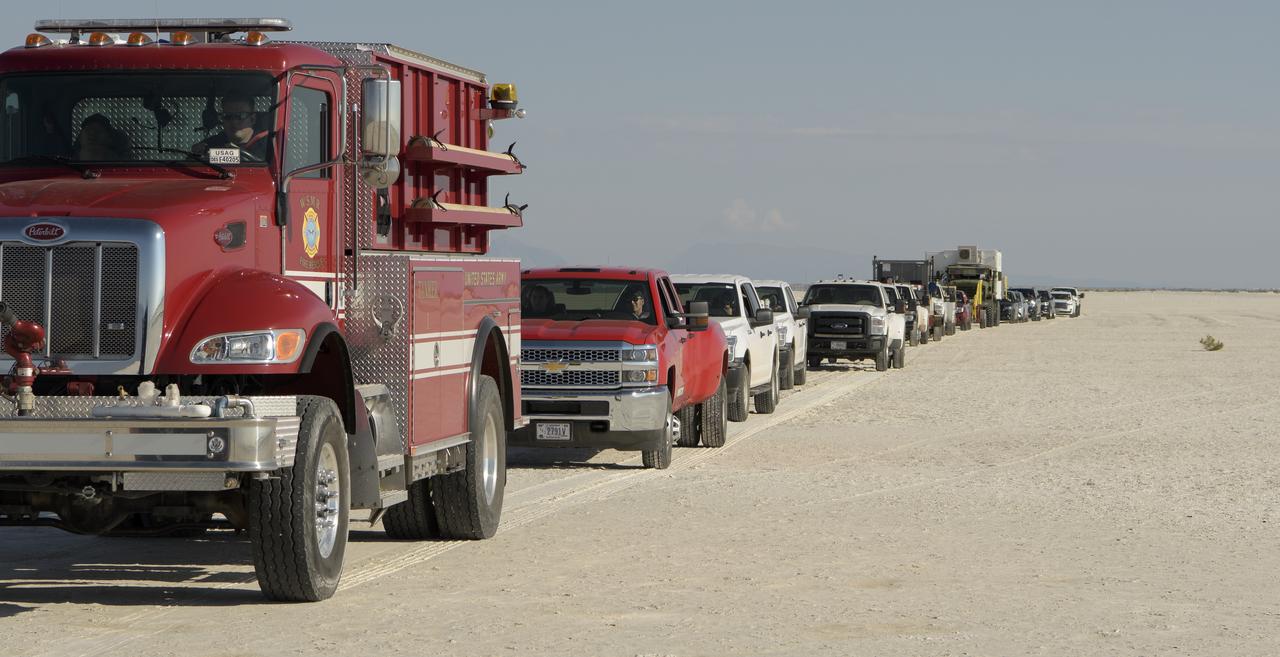
Teams from NASA, Boeing and the White Sands Missile Range, rehearse landing and crew extraction from Boeing’s CST-100 Starliner, which will be used to carry humans to the International Space Station, on Tuesday, Sept. 10, 2019 at the White Sands Missile Range outside Las Cruces, New Mexico. Using a convoy of vehicles Boeing uses to recover their spacecraft after landing and a boiler plate test article of the Starliner capsule, the teams worked through the steps necessary to safe the vehicle and get future crew members out of the Starliner to return home. NASA astronauts Mike Fincke and Nicole Mann and Boeing astronaut Chris Ferguson will fly to the space station aboard the Starliner for the Boeing Crew Flight Test mission. Photo Credit: (NASA/Bill Ingalls)
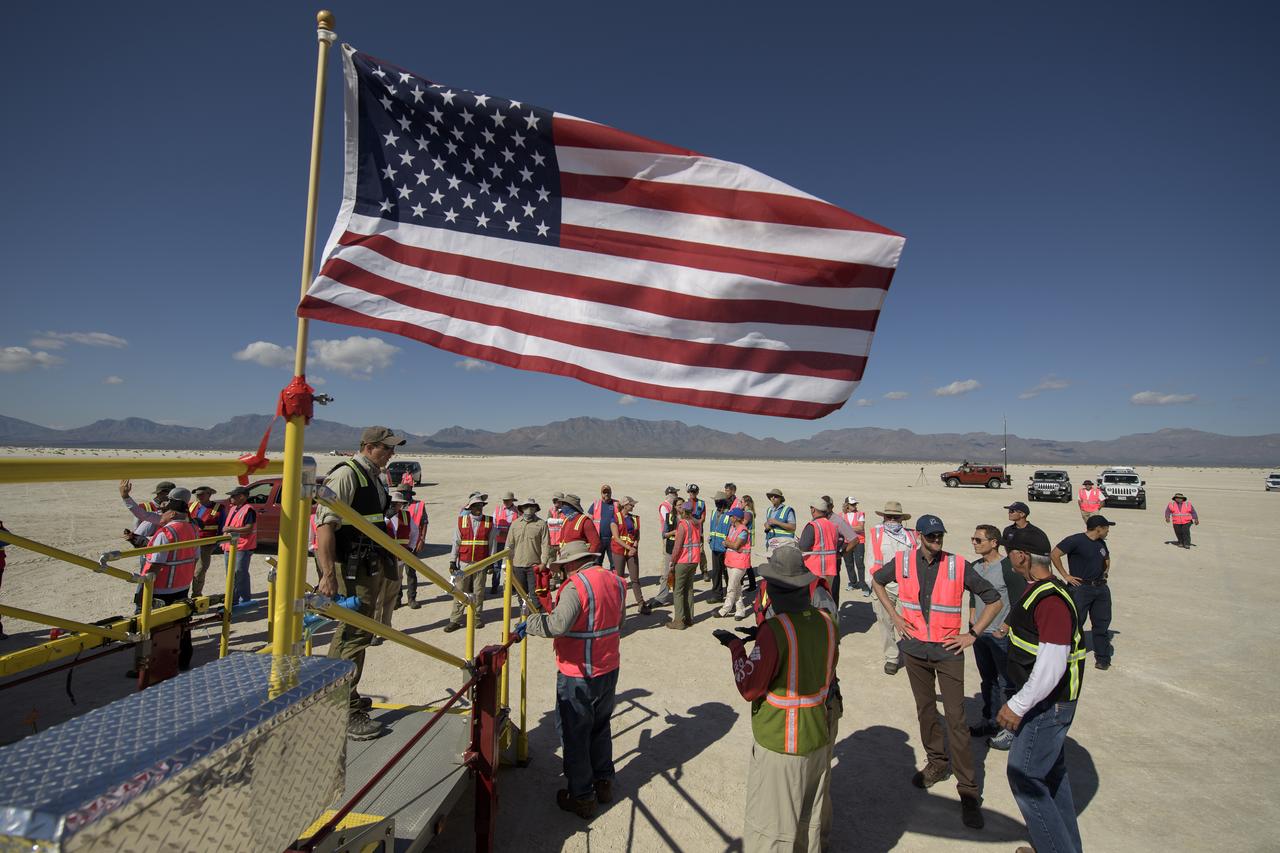
Teams from NASA, Boeing and the White Sands Missile Range, rehearse landing and crew extraction from Boeing’s CST-100 Starliner, which will be used to carry humans to the International Space Station, on Wednesday, Sept. 11, 2019 at the White Sands Missile Range outside Las Cruces, New Mexico. Using a convoy of vehicles Boeing uses to recover their spacecraft after landing and a boiler plate test article of the Starliner capsule, the teams worked through the steps necessary to safe the vehicle and get future crew members out of the Starliner to return home. NASA astronauts Mike Fincke and Nicole Mann and Boeing astronaut Chris Ferguson will fly to the space station aboard the Starliner for the Boeing Crew Flight Test mission. Photo Credit: (NASA/Bill Ingalls)
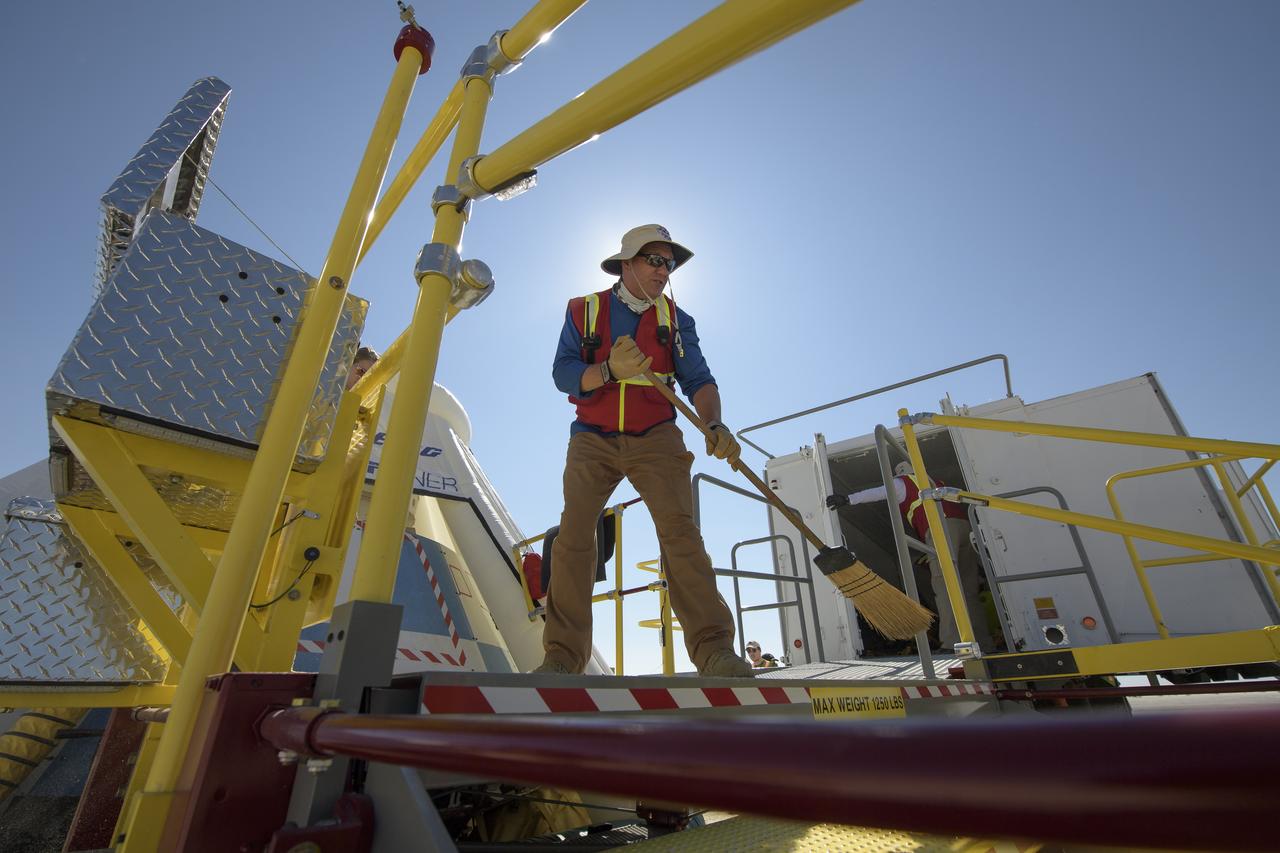
Teams from NASA, Boeing and the White Sands Missile Range, rehearse landing and crew extraction from Boeing’s CST-100 Starliner, which will be used to carry humans to the International Space Station, on Tuesday, Sept. 10, 2019 at the White Sands Missile Range outside Las Cruces, New Mexico. Using a convoy of vehicles Boeing uses to recover their spacecraft after landing and a boiler plate test article of the Starliner capsule, the teams worked through the steps necessary to safe the vehicle and get future crew members out of the Starliner to return home. NASA astronauts Mike Fincke and Nicole Mann and Boeing astronaut Chris Ferguson will fly to the space station aboard the Starliner for the Boeing Crew Flight Test mission. Photo Credit: (NASA/Bill Ingalls)
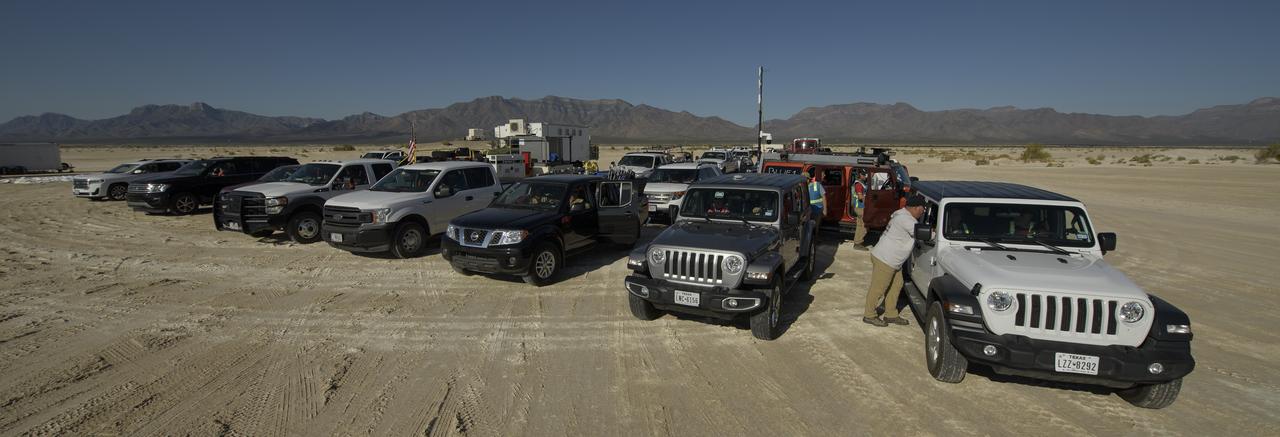
Teams from NASA, Boeing and the White Sands Missile Range, rehearse landing and crew extraction from Boeing’s CST-100 Starliner, which will be used to carry humans to the International Space Station, on Wednesday, Sept. 11, 2019 at the White Sands Missile Range outside Las Cruces, New Mexico. Using a convoy of vehicles Boeing uses to recover their spacecraft after landing and a boiler plate test article of the Starliner capsule, the teams worked through the steps necessary to safe the vehicle and get future crew members out of the Starliner to return home. NASA astronauts Mike Fincke and Nicole Mann and Boeing astronaut Chris Ferguson will fly to the space station aboard the Starliner for the Boeing Crew Flight Test mission. Photo Credit: (NASA/Bill Ingalls)
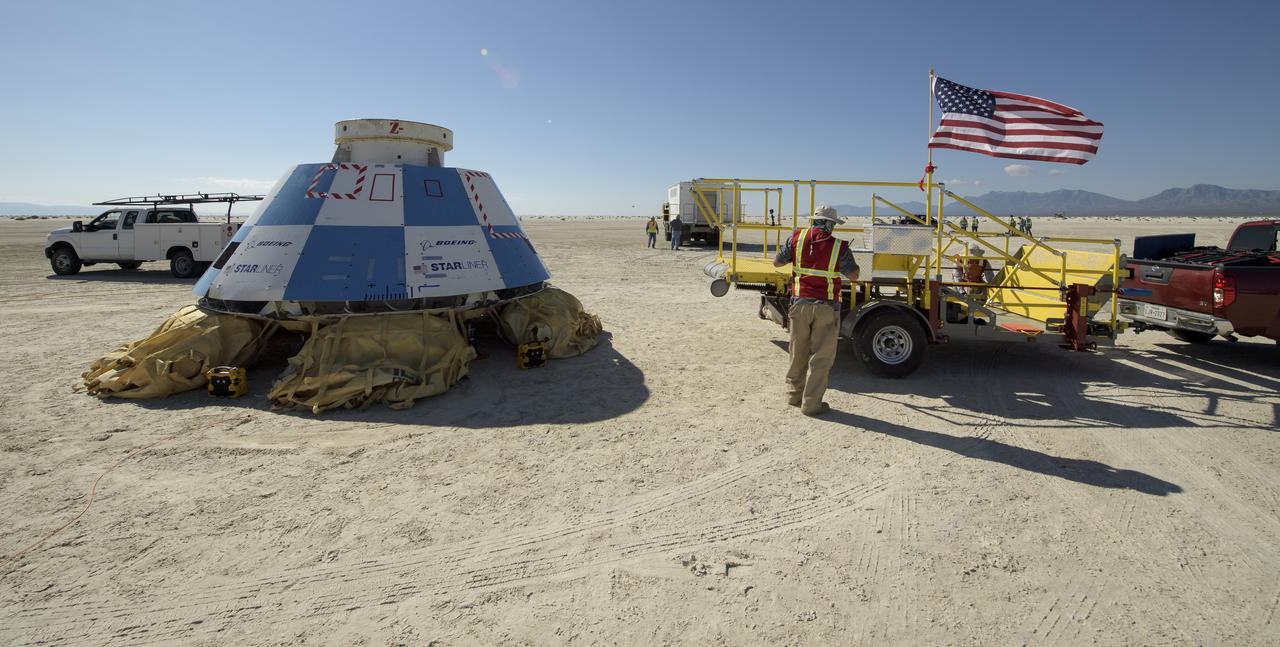
Teams from NASA, Boeing and the White Sands Missile Range, rehearse landing and crew extraction from Boeing’s CST-100 Starliner, which will be used to carry humans to the International Space Station, on Wednesday, Sept. 11, 2019 at the White Sands Missile Range outside Las Cruces, New Mexico. Using a convoy of vehicles Boeing uses to recover their spacecraft after landing and a boiler plate test article of the Starliner capsule, the teams worked through the steps necessary to safe the vehicle and get future crew members out of the Starliner to return home. NASA astronauts Mike Fincke and Nicole Mann and Boeing astronaut Chris Ferguson will fly to the space station aboard the Starliner for the Boeing Crew Flight Test mission. Photo Credit: (NASA/Bill Ingalls)
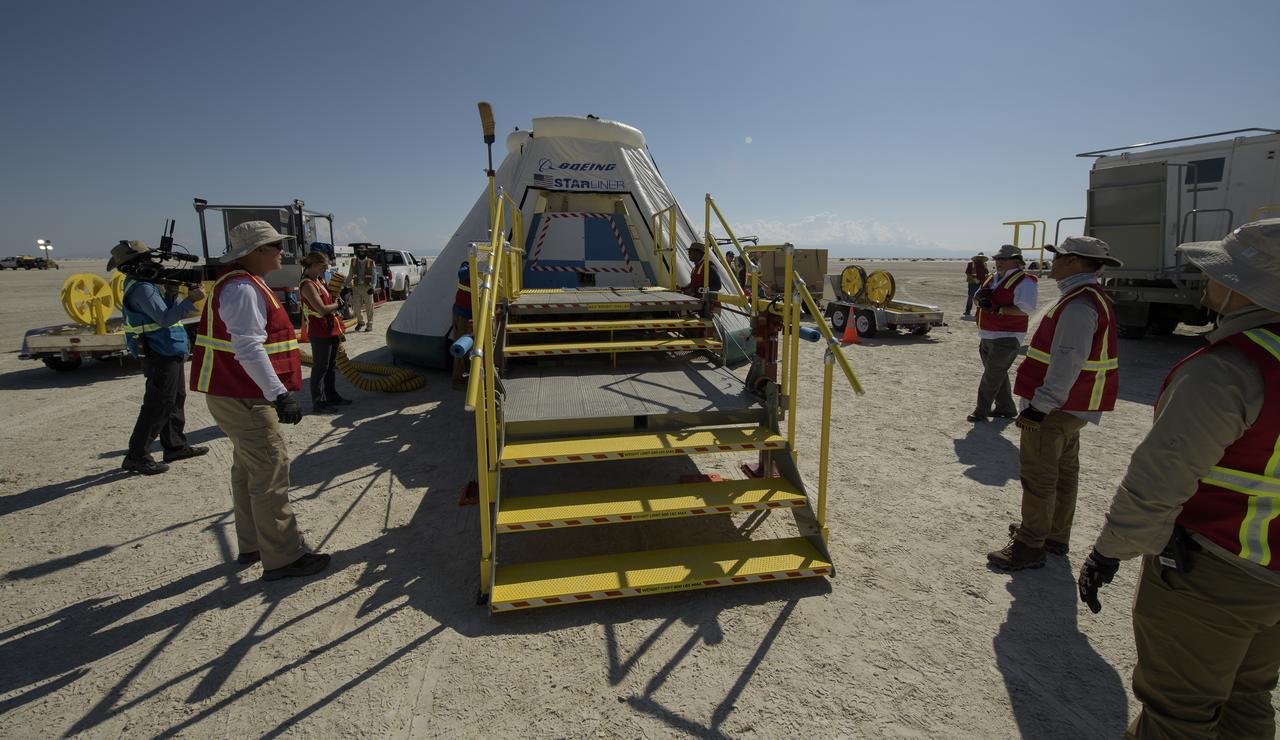
Teams from NASA, Boeing and the White Sands Missile Range, rehearse landing and crew extraction from Boeing’s CST-100 Starliner, which will be used to carry humans to the International Space Station, on Tuesday, Sept. 10, 2019 at the White Sands Missile Range outside Las Cruces, New Mexico. Using a convoy of vehicles Boeing uses to recover their spacecraft after landing and a boiler plate test article of the Starliner capsule, the teams worked through the steps necessary to safe the vehicle and get future crew members out of the Starliner to return home. NASA astronauts Mike Fincke and Nicole Mann and Boeing astronaut Chris Ferguson will fly to the space station aboard the Starliner for the Boeing Crew Flight Test mission. Photo Credit: (NASA/Bill Ingalls)
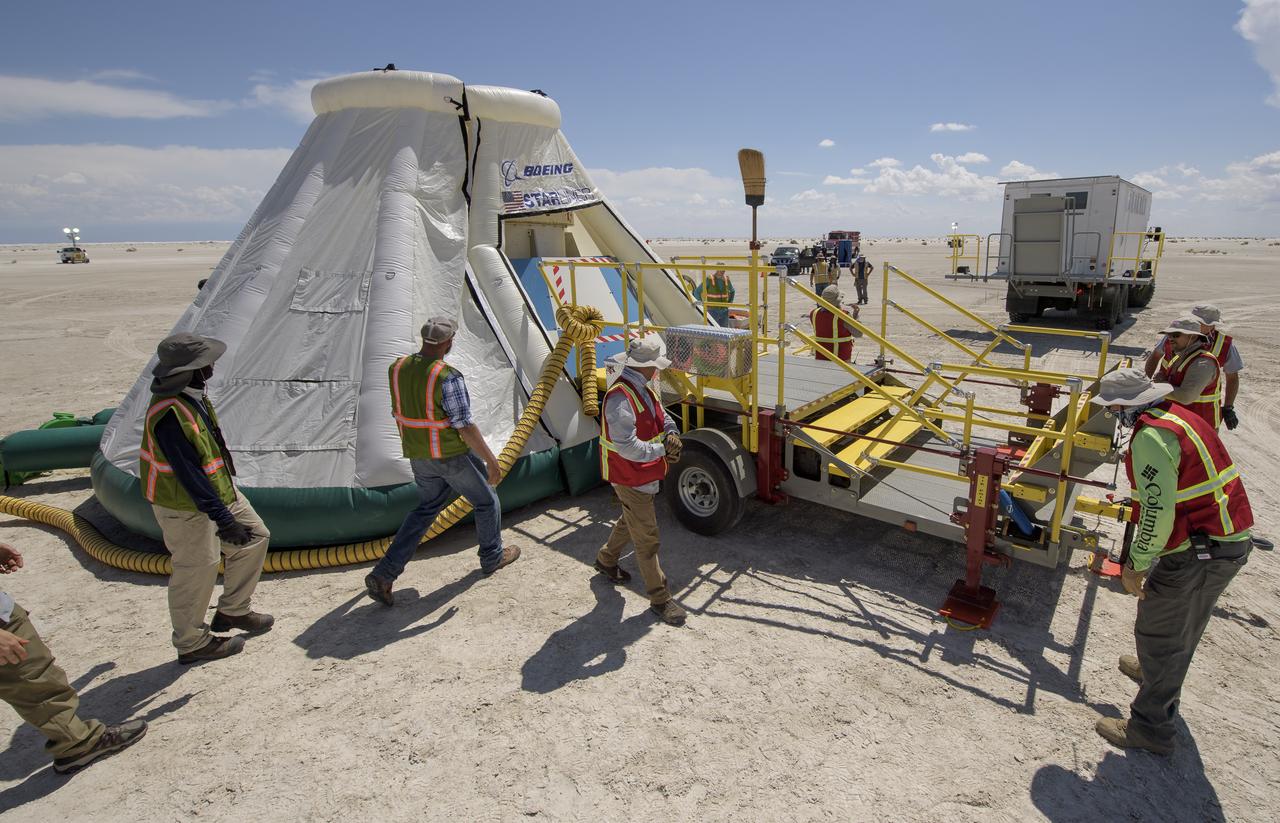
Teams from NASA, Boeing and the White Sands Missile Range, rehearse landing and crew extraction from Boeing’s CST-100 Starliner, which will be used to carry humans to the International Space Station, on Monday, Sept. 9, 2019 at the White Sands Missile Range outside Las Cruces, New Mexico. Using a convoy of vehicles Boeing uses to recover their spacecraft after landing and a boiler plate test article of the Starliner capsule, the teams worked through the steps necessary to safe the vehicle and get future crew members out of the Starliner to return home. NASA astronauts Mike Fincke and Nicole Mann and Boeing astronaut Chris Ferguson will fly to the space station aboard the Starliner for the Boeing Crew Flight Test mission. Photo Credit: (NASA/Bill Ingalls)
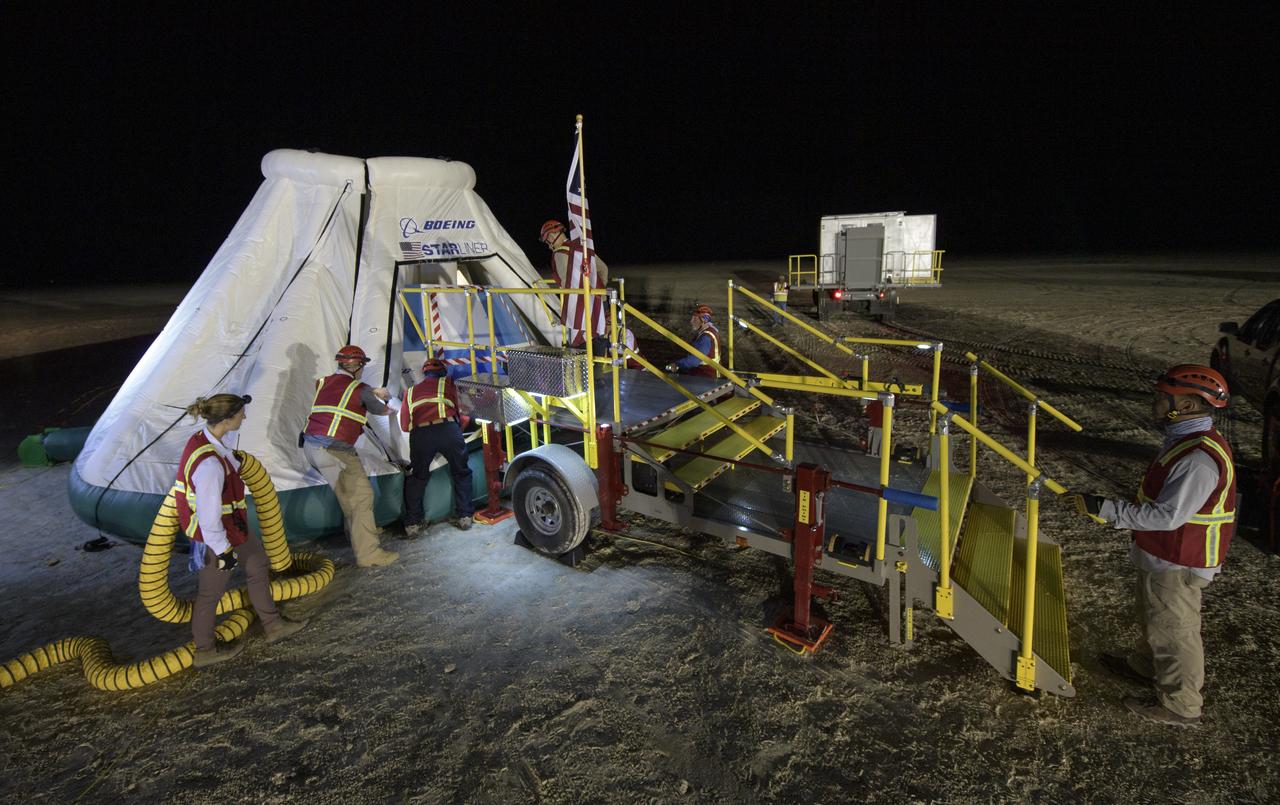
Teams from NASA, Boeing and the White Sands Missile Range, rehearse landing and crew extraction from Boeing’s CST-100 Starliner, which will be used to carry humans to the International Space Station, on Wednesday, Sept. 11, 2019 at the White Sands Missile Range outside Las Cruces, New Mexico. Using a convoy of vehicles Boeing uses to recover their spacecraft after landing and a boiler plate test article of the Starliner capsule, the teams worked through the steps necessary to safe the vehicle and get future crew members out of the Starliner to return home. NASA astronauts Mike Fincke and Nicole Mann and Boeing astronaut Chris Ferguson will fly to the space station aboard the Starliner for the Boeing Crew Flight Test mission. Photo Credit: (NASA/Bill Ingalls)
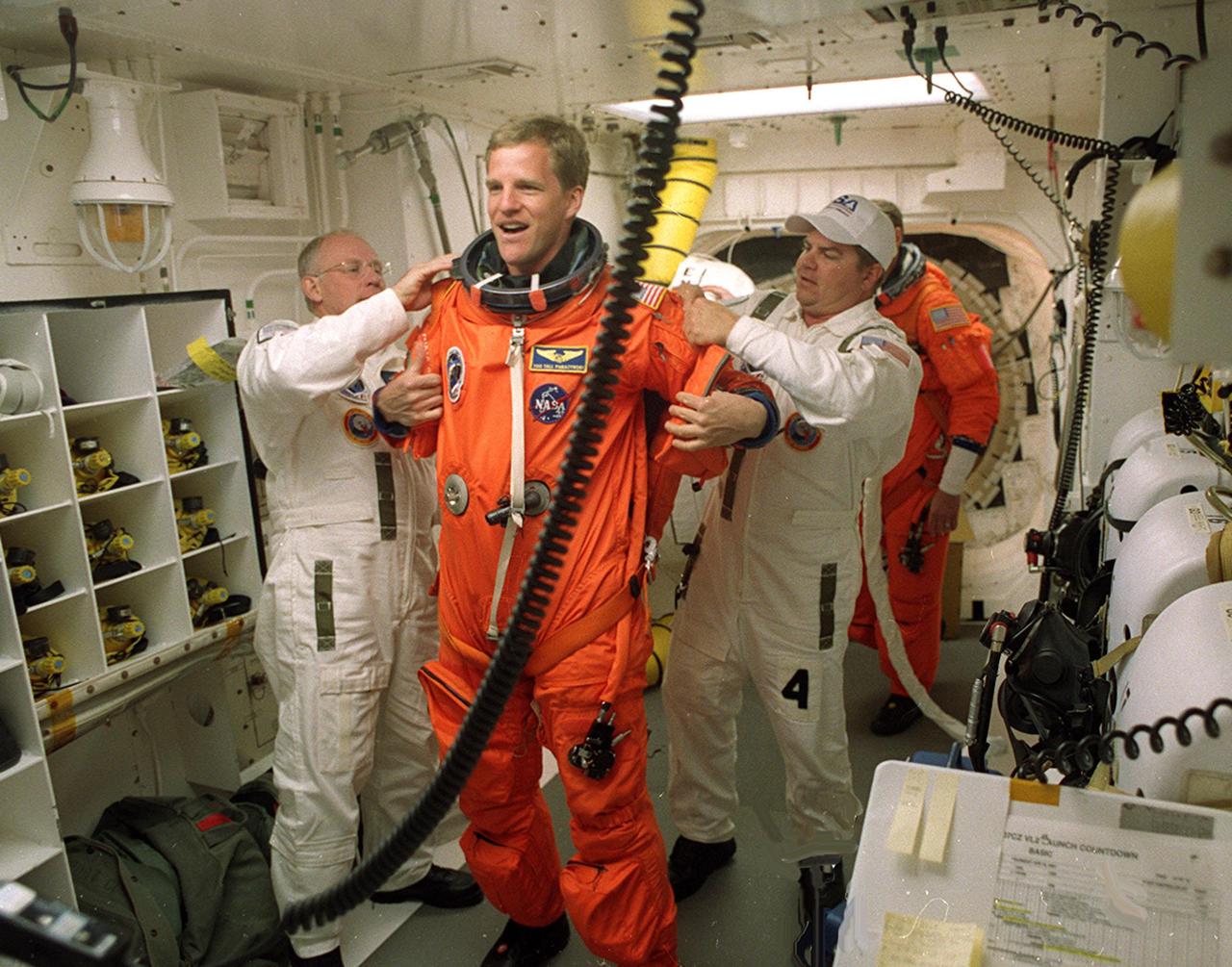
KENNEDY SPACE CENTER, FLA. -- In the White Room, STS-100 Mission Specialist Scott Parazynski is helped with his launch and entry suit by the closeout crew. The White Room is an environmental chamber at the end of the Orbiter Access Arm that provides entry into the orbiter on the launch pad. The mission will deliver and integrate the Spacelab Logistics Pallet_Launch Deployment Assembly, which includes the Canadian-built Space Station Remote Manipulator System and the UHF Antenna. Two spacewalks are planned for installation of the SSRMS, which will be performed by Mission Specialists Parazynski and Chris Hadfield, who is with the Canadian Space Agency. The mission is also the inaugural flight of Multi-Purpose Logistics Module Raffaello, carrying resupply stowage racks and resupply_return stowage platforms. Liftoff of Space Shuttle Endeavour on mission STS-100 is scheduled at 2:41 p.m. EDT April 19.
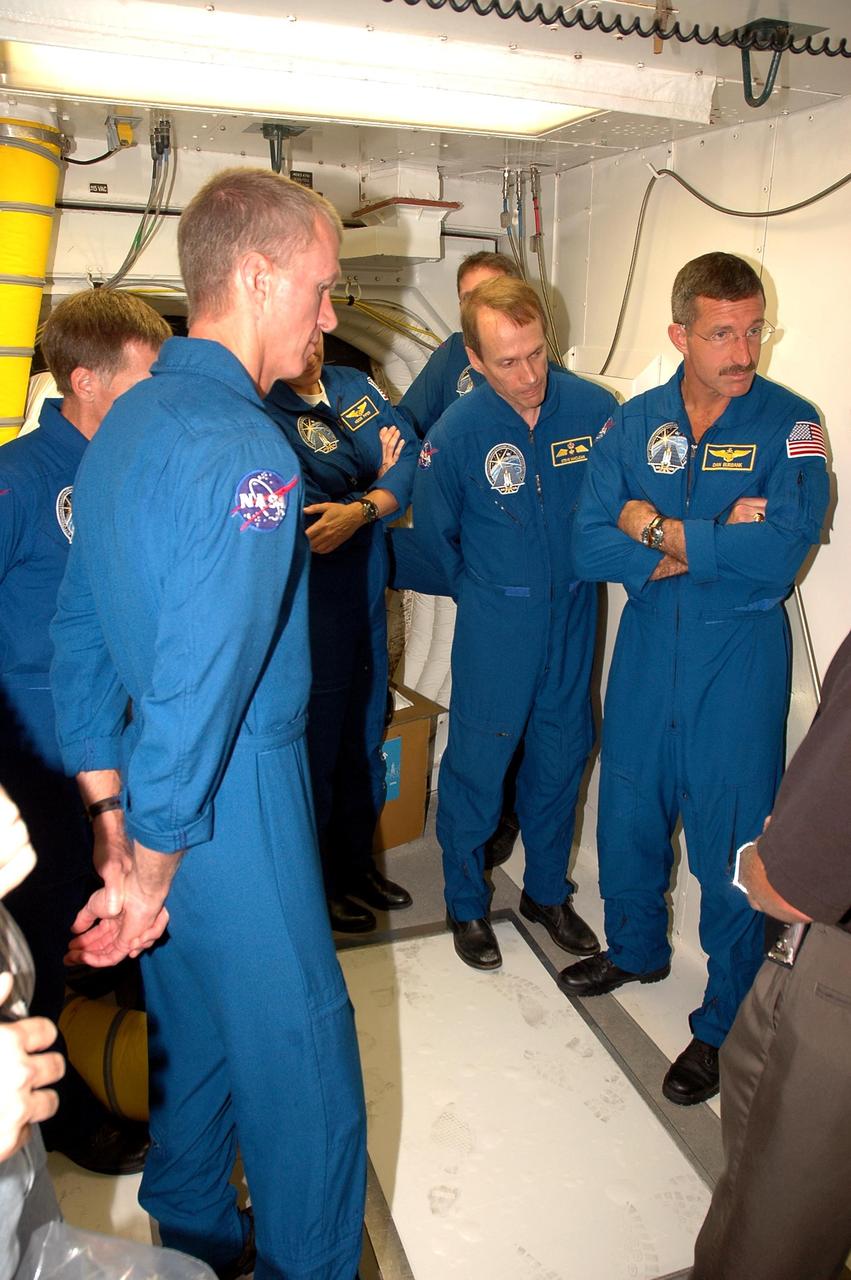
KENNEDY SPACE CENTER, FLA. - The STS-115 crew is in the White Room on the orbiter access arm on Launch Pad 39B to get instruction on using the emergency egress system. From left are Commander Brent Jett, Pilot Chris Ferguson, and Mission Specialists Heidemarie Stefanyshyn-Piper, Joseph Tanner, Steven MacLean and Daniel Burbank. MacLean is with the Canadian Space Agency. he White Room provides access into the orbiter through the crew access hatch. The mission crew is at KSC for Terminal Countdown Demonstration Test (TCDT) activities that are preparation for launch on Space Shuttle Atlantis, scheduled to take place in a window that opens Aug. 27. During their 11-day mission to the International Space Station, the STS-115 crew will continue construction of the station and attach the payload elements, the Port 3/4 truss segment with its two large solar arrays. Photo credit: NASA/Cory Huston
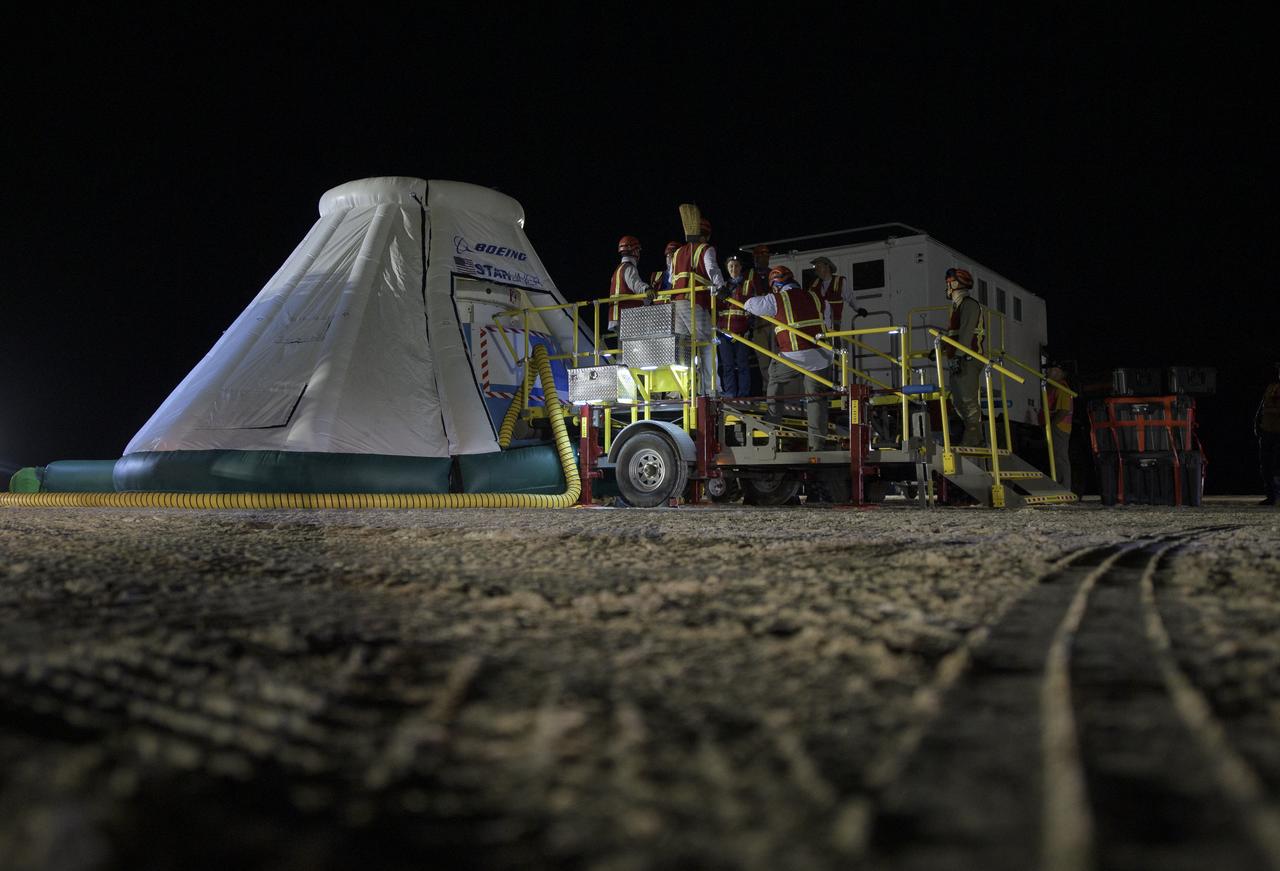
Teams from NASA, Boeing and the White Sands Missile Range, rehearse landing and crew extraction from Boeing’s CST-100 Starliner, which will be used to carry humans to the International Space Station, on Tuesday, Sept. 10, 2019 at the White Sands Missile Range outside Las Cruces, New Mexico. Using a convoy of vehicles Boeing uses to recover their spacecraft after landing and a boiler plate test article of the Starliner capsule, the teams worked through the steps necessary to safe the vehicle and get future crew members out of the Starliner to return home. NASA astronauts Mike Fincke and Nicole Mann and Boeing astronaut Chris Ferguson will fly to the space station aboard the Starliner for the Boeing Crew Flight Test mission. Photo Credit: (NASA/Bill Ingalls)
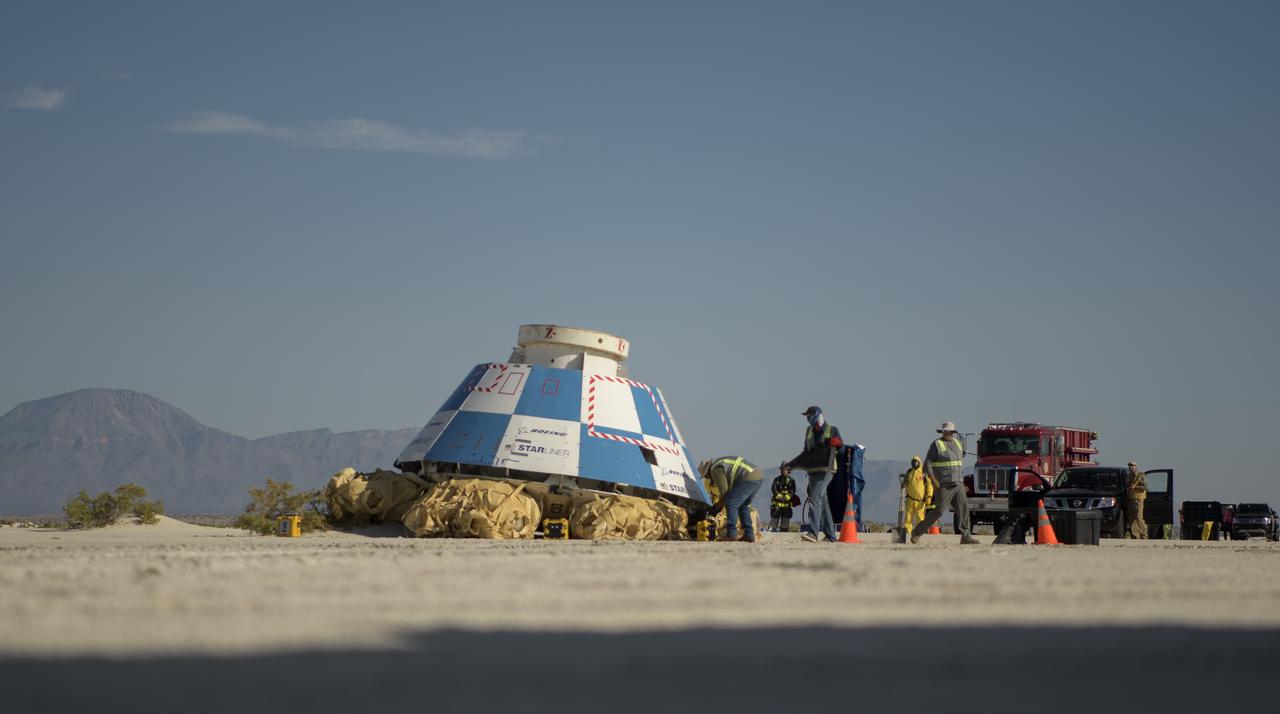
Teams from NASA, Boeing and the White Sands Missile Range, rehearse landing and crew extraction from Boeing’s CST-100 Starliner, which will be used to carry humans to the International Space Station, on Thursday, Sept. 12, 2019 at the White Sands Missile Range outside Las Cruces, New Mexico. Using a convoy of vehicles Boeing uses to recover their spacecraft after landing and a boiler plate test article of the Starliner capsule, the teams worked through the steps necessary to safe the vehicle and get future crew members out of the Starliner to return home. NASA astronauts Mike Fincke and Nicole Mann and Boeing astronaut Chris Ferguson will fly to the space station aboard the Starliner for the Boeing Crew Flight Test mission. Photo Credit: (NASA/Bill Ingalls)
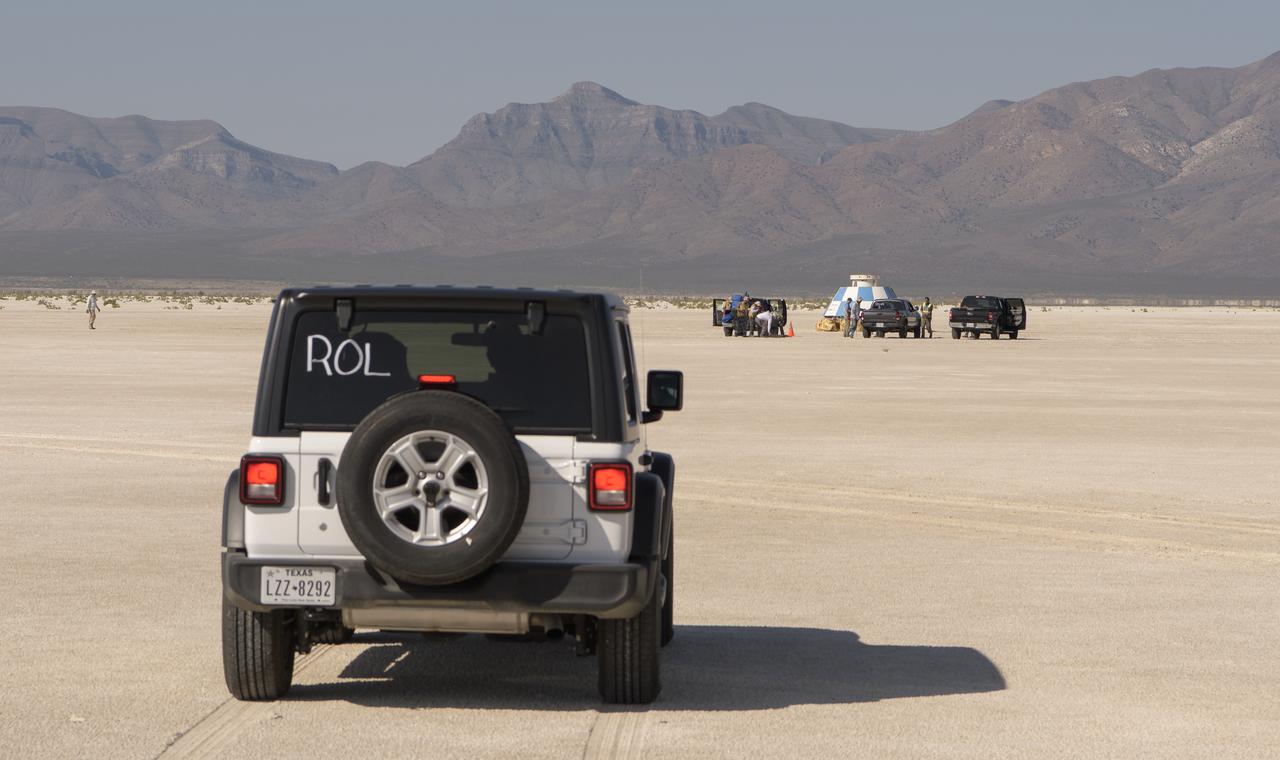
Teams from NASA, Boeing and the White Sands Missile Range, rehearse landing and crew extraction from Boeing’s CST-100 Starliner, which will be used to carry humans to the International Space Station, on Tuesday, Sept. 10, 2019 at the White Sands Missile Range outside Las Cruces, New Mexico. Using a convoy of vehicles Boeing uses to recover their spacecraft after landing and a boiler plate test article of the Starliner capsule, the teams worked through the steps necessary to safe the vehicle and get future crew members out of the Starliner to return home. NASA astronauts Mike Fincke and Nicole Mann and Boeing astronaut Chris Ferguson will fly to the space station aboard the Starliner for the Boeing Crew Flight Test mission. Photo Credit: (NASA/Bill Ingalls)
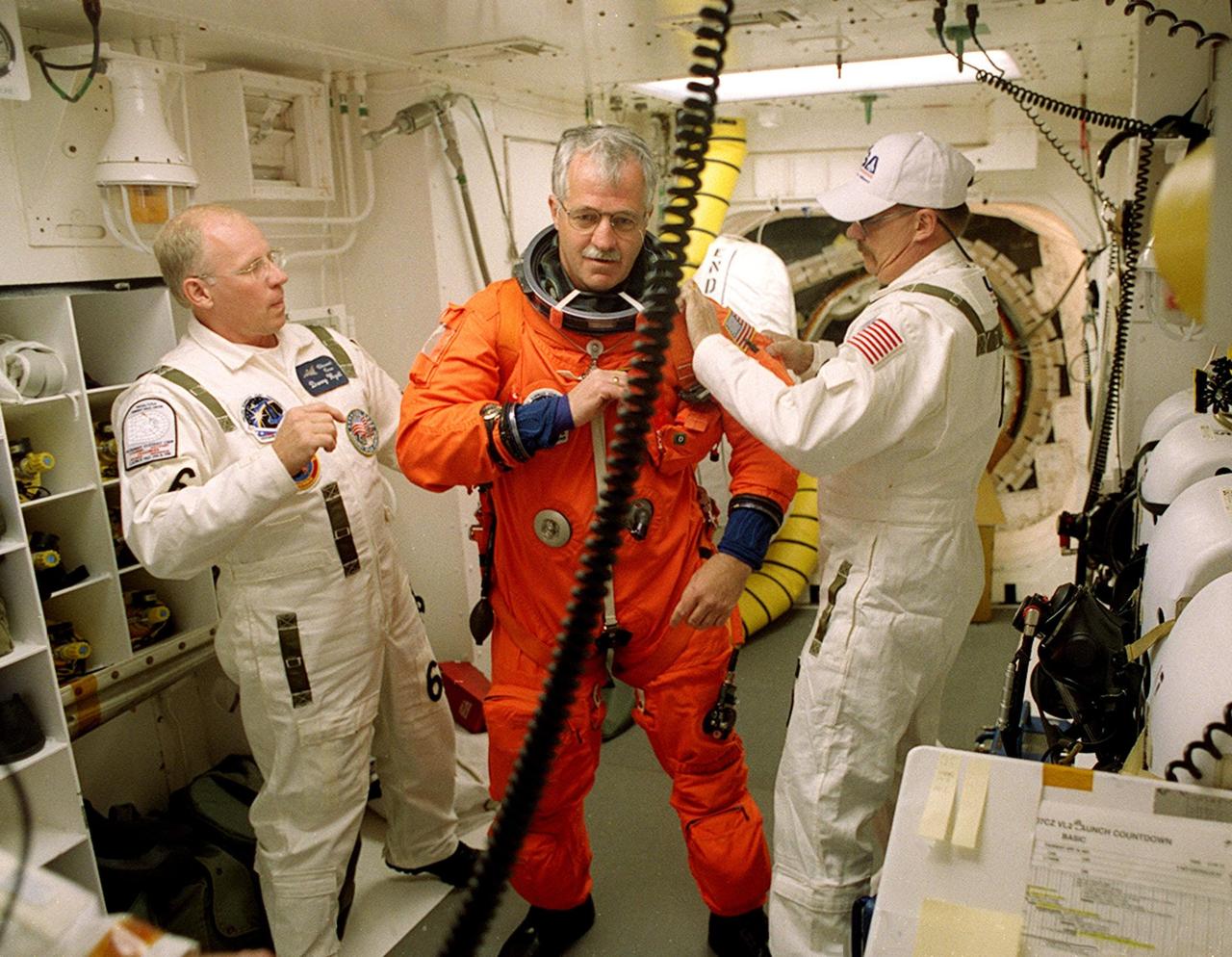
In the White Room, STS-100 Mission Specialist John L. Phillips is helped with his launch and entry suit by closeout crew members Danny Wyatt (left) and George Schramm (right). This is Phillips’ first Shuttle launch. The White Room is an environmental chamber at the end of the Orbiter Access Arm that provides entry into the orbiter on the launch pad. The mission will deliver and integrate the Spacelab Logistics Pallet/Launch Deployment Assembly, which includes the Canadian-built Space Station Remote Manipulator System and the UHF Antenna. Two spacewalks are planned for installation of the SSRMS, which will be performed by Mission Specialists Scott E. Parazynski and Chris A. Hadfield, who is with the Canadian Space Agency. The mission is also the inaugural flight of the Multi-Purpose Logistics Module Raffaello, carrying resupply stowage racks and resupply/return stowage platforms. Liftoff of Space Shuttle Endeavour on mission STS-100 is scheduled at 2:41 p.m. EDT April 19
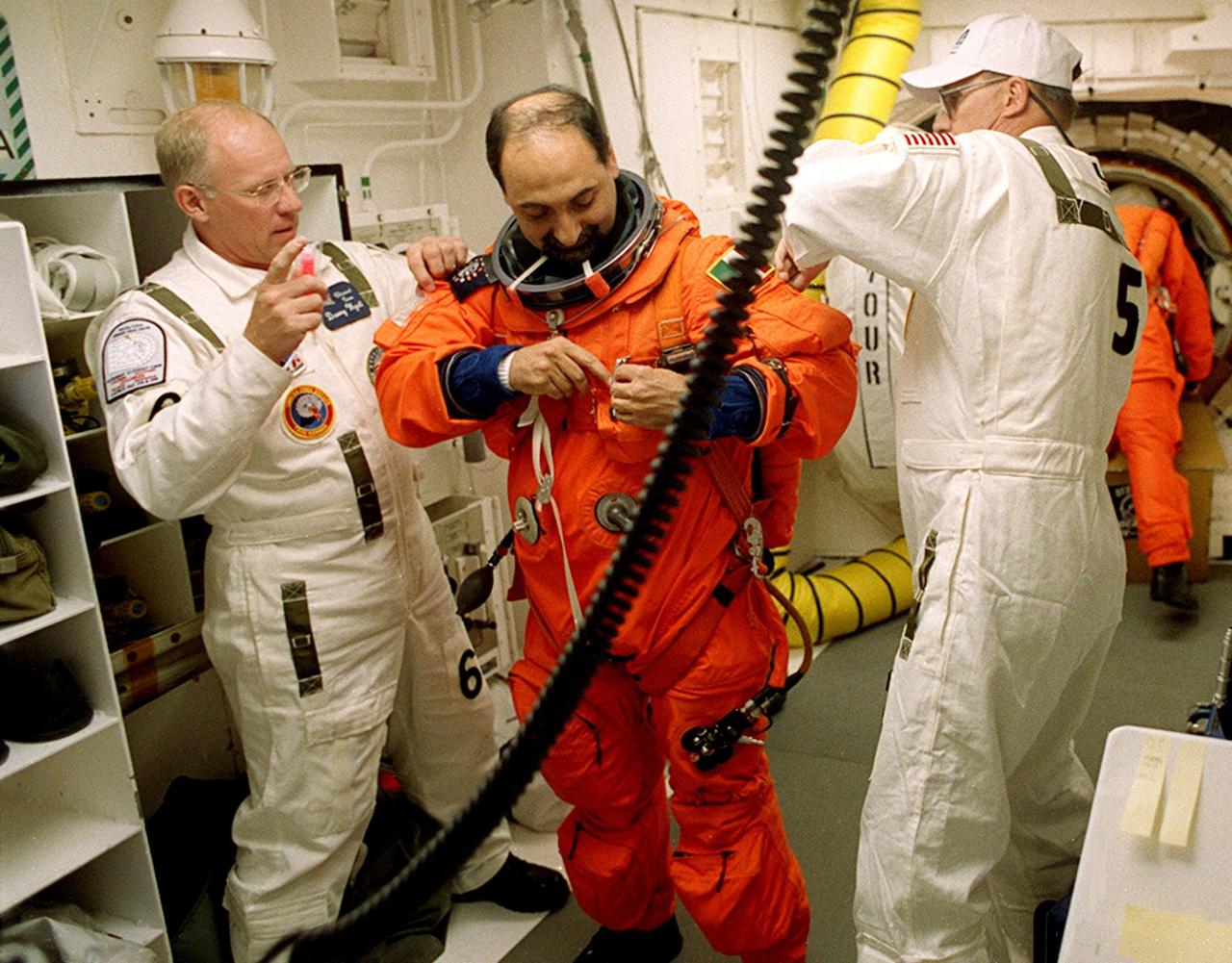
In the White Room, STS-100 Mission Specialist Umberto Guidoni is helped with his launch and entry suit by closeout crew members Danny Wyatt (left) and George Schramm (right). Guidoni is with the European Space Agency. The White Room is an environmental chamber at the end of the Orbiter Access Arm that provides entry into the orbiter on the launch pad. The mission will deliver and integrate the Spacelab Logistics Pallet/Launch Deployment Assembly, which includes the Canadian-built Space Station Remote Manipulator System and the UHF Antenna. Two spacewalks are planned for installation of the SSRMS, which will be performed by Mission Specialists Scott E. Parazynski and Chris A. Hadfield, who is with the Canadian Space Agency. The mission is also the inaugural flight of the Multi-Purpose Logistics Module Raffaello, carrying resupply stowage racks and resupply/return stowage platforms. Liftoff of Space Shuttle Endeavour on mission STS-100 is scheduled at 2:41 p.m. EDT April 19
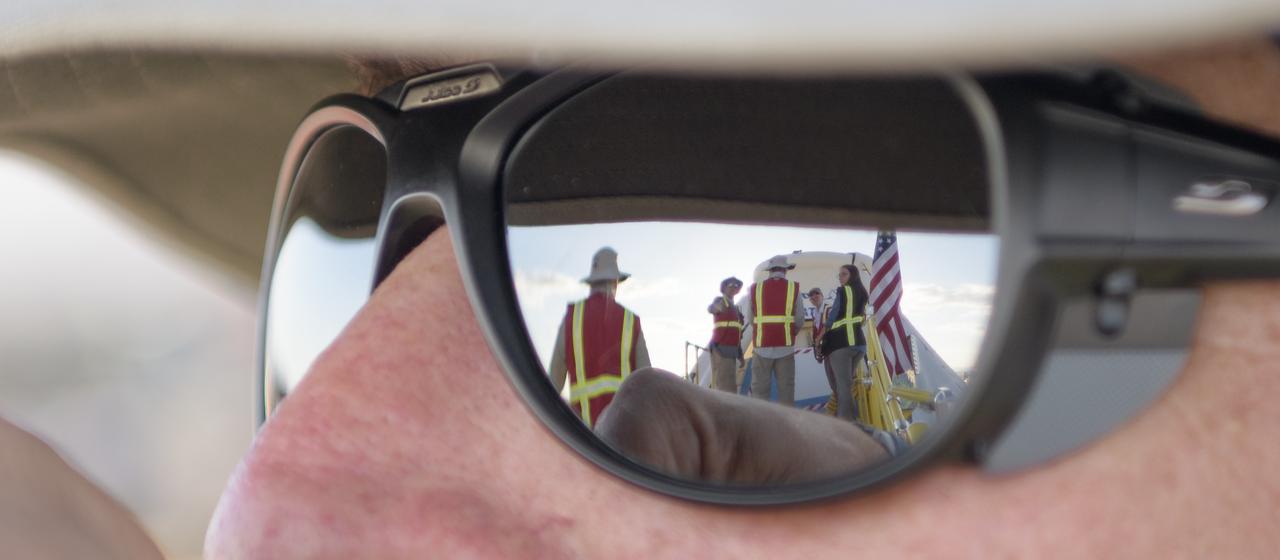
Teams from NASA, Boeing and the White Sands Missile Range, rehearse landing and crew extraction from Boeing’s CST-100 Starliner, which will be used to carry humans to the International Space Station, on Wednesday, Sept. 11, 2019 at the White Sands Missile Range outside Las Cruces, New Mexico. Using a convoy of vehicles Boeing uses to recover their spacecraft after landing and a boiler plate test article of the Starliner capsule, the teams worked through the steps necessary to safe the vehicle and get future crew members out of the Starliner to return home. NASA astronauts Mike Fincke and Nicole Mann and Boeing astronaut Chris Ferguson will fly to the space station aboard the Starliner for the Boeing Crew Flight Test mission. Photo Credit: (NASA/Bill Ingalls)
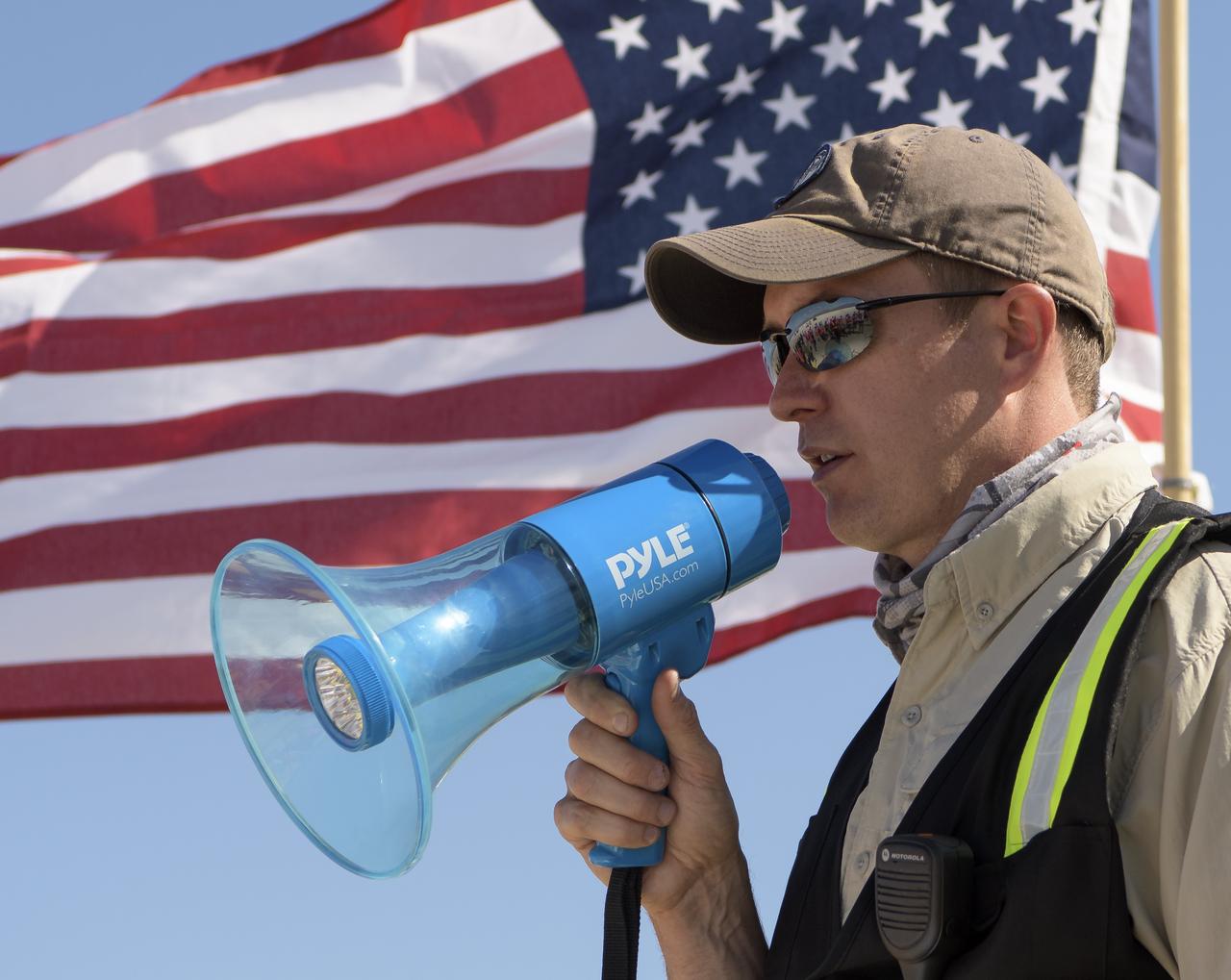
Louis Atchison chief of launch and recovery operations for Boeing Commercial Crew Program addresses teams from NASA, Boeing and the White Sands Missile Range during rehearsals for landing and crew extraction from Boeing’s CST-100 Starliner, which will be used to carry humans to the International Space Station, on Wednesday, Sept. 11, 2019 at the White Sands Missile Range outside Las Cruces, New Mexico. Using a convoy of vehicles Boeing uses to recover their spacecraft after landing and a boiler plate test article of the Starliner capsule, the teams worked through the steps necessary to safe the vehicle and get future crew members out of the Starliner to return home. NASA astronauts Mike Fincke and Nicole Mann and Boeing astronaut Chris Ferguson will fly to the space station aboard the Starliner for the Boeing Crew Flight Test mission. Photo Credit: (NASA/Bill Ingalls)
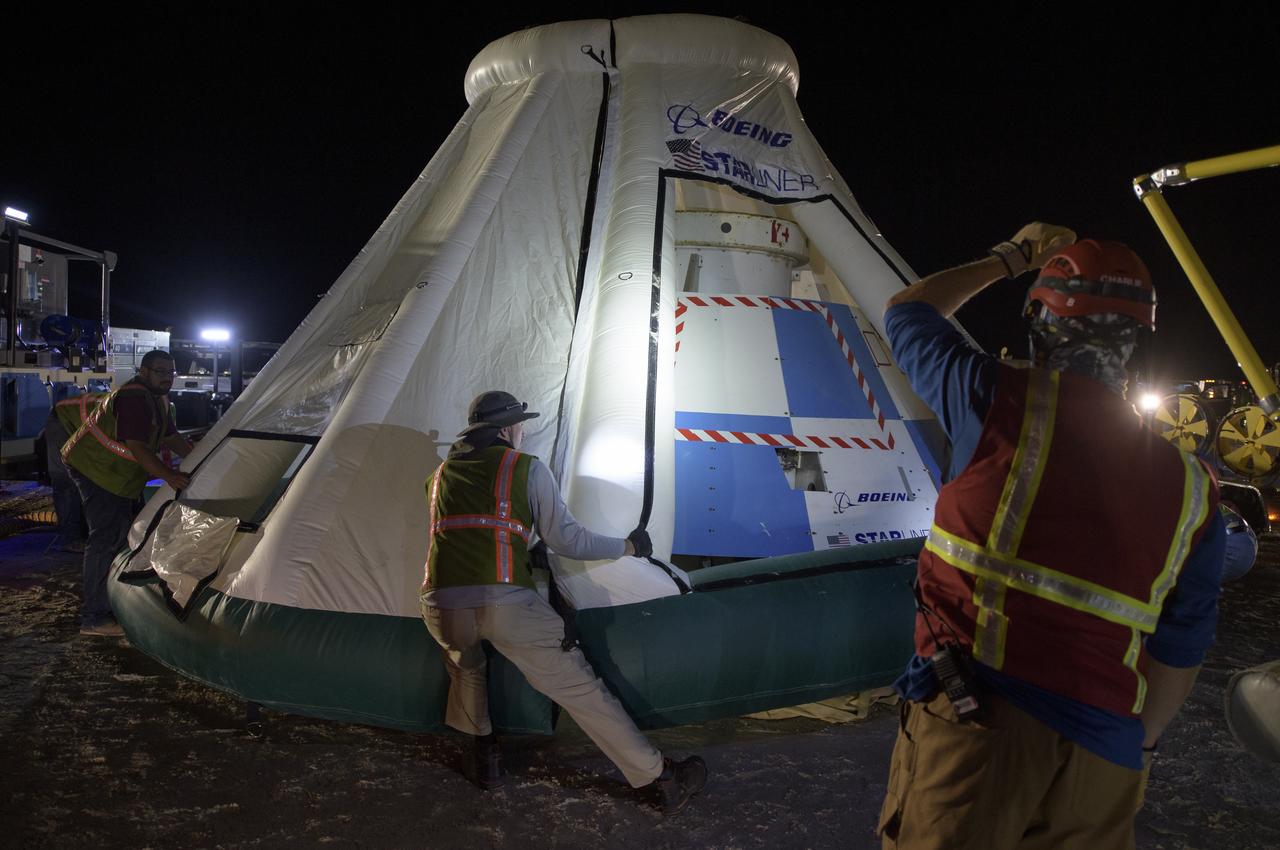
Teams from NASA, Boeing and the White Sands Missile Range, rehearse landing and crew extraction from Boeing’s CST-100 Starliner, which will be used to carry humans to the International Space Station, on Tuesday, Sept. 10, 2019 at the White Sands Missile Range outside Las Cruces, New Mexico. Using a convoy of vehicles Boeing uses to recover their spacecraft after landing and a boiler plate test article of the Starliner capsule, the teams worked through the steps necessary to safe the vehicle and get future crew members out of the Starliner to return home. NASA astronauts Mike Fincke and Nicole Mann and Boeing astronaut Chris Ferguson will fly to the space station aboard the Starliner for the Boeing Crew Flight Test mission. Photo Credit: (NASA/Bill Ingalls)
Teams from NASA, Boeing and the White Sands Missile Range, rehearse landing and crew extraction from Boeing’s CST-100 Starliner, which will be used to carry humans to the International Space Station, on Wednesday, Sept. 11, 2019 at the White Sands Missile Range outside Las Cruces, New Mexico. Using a convoy of vehicles Boeing uses to recover their spacecraft after landing and a boiler plate test article of the Starliner capsule, the teams worked through the steps necessary to safe the vehicle and get future crew members out of the Starliner to return home. NASA astronauts Mike Fincke and Nicole Mann and Boeing astronaut Chris Ferguson will fly to the space station aboard the Starliner for the Boeing Crew Flight Test mission. Photo Credit: (NASA/Bill Ingalls)
Teams from NASA, Boeing and the White Sands Missile Range, rehearse landing and crew extraction from Boeing’s CST-100 Starliner, which will be used to carry humans to the International Space Station, on Tuesday, Sept. 10, 2019 at the White Sands Missile Range outside Las Cruces, New Mexico. Using a convoy of vehicles Boeing uses to recover their spacecraft after landing and a boiler plate test article of the Starliner capsule, the teams worked through the steps necessary to safe the vehicle and get future crew members out of the Starliner to return home. NASA astronauts Mike Fincke and Nicole Mann and Boeing astronaut Chris Ferguson will fly to the space station aboard the Starliner for the Boeing Crew Flight Test mission. Photo Credit: (NASA/Bill Ingalls)
In the White Room, STS-100 Pilot Jeffrey S. Ashby chats with closeout crew members before he enters Space Shuttle Endeavour. With his back to the camera is Rick Welty; second from left is Rene Arriens. The White Room is an environmental chamber at the end of the Orbiter Access Arm that provides entry into the orbiter on the launch pad. The mission will deliver and integrate the Spacelab Logistics Pallet/Launch Deployment Assembly, which includes the Canadian-built Space Station Remote Manipulator System and the UHF Antenna. Two spacewalks are planned for installation of the SSRMS, which will be performed by Mission Specialists Scott E. Parazynski and Chris A. Hadfield, who is with the Canadian Space Agency. The mission is also the inaugural flight of Multi-Purpose Logistics Module Raffaello, carrying resupply stowage racks and resupply/return stowage platforms. Liftoff of Space Shuttle Endeavour on mission STS-100 is scheduled at 2:41 p.m. EDT April 19
Teams from NASA, Boeing and the White Sands Missile Range, rehearse landing and crew extraction from Boeing’s CST-100 Starliner, which will be used to carry humans to the International Space Station, on Monday, Sept. 9, 2019 at the White Sands Missile Range outside Las Cruces, New Mexico. Using a convoy of vehicles Boeing uses to recover their spacecraft after landing and a boiler plate test article of the Starliner capsule, the teams worked through the steps necessary to safe the vehicle and get future crew members out of the Starliner to return home. NASA astronauts Mike Fincke and Nicole Mann and Boeing astronaut Chris Ferguson will fly to the space station aboard the Starliner for the Boeing Crew Flight Test mission. Photo Credit: (NASA/Bill Ingalls)
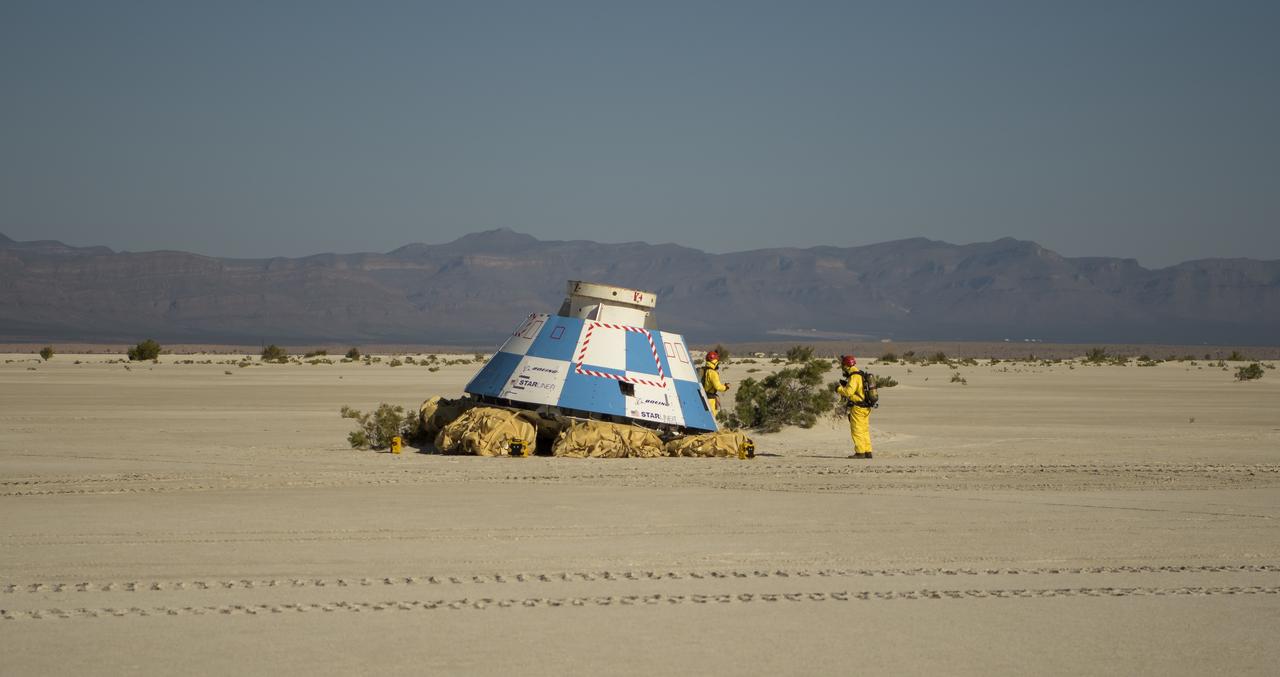
Teams from NASA, Boeing and the White Sands Missile Range, rehearse landing and crew extraction from Boeing’s CST-100 Starliner, which will be used to carry humans to the International Space Station, on Thursday, Sept. 12, 2019 at the White Sands Missile Range outside Las Cruces, New Mexico. Using a convoy of vehicles Boeing uses to recover their spacecraft after landing and a boiler plate test article of the Starliner capsule, the teams worked through the steps necessary to safe the vehicle and get future crew members out of the Starliner to return home. NASA astronauts Mike Fincke and Nicole Mann and Boeing astronaut Chris Ferguson will fly to the space station aboard the Starliner for the Boeing Crew Flight Test mission. Photo Credit: (NASA/Bill Ingalls)
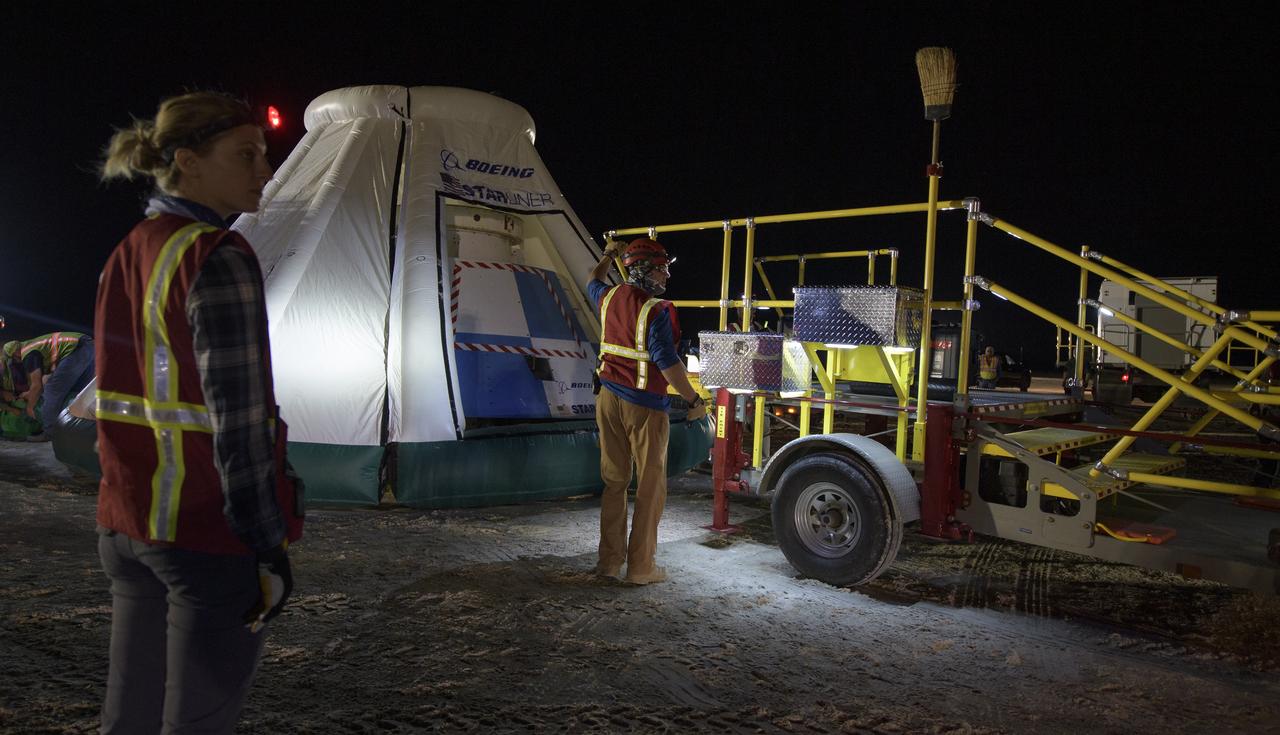
Teams from NASA, Boeing and the White Sands Missile Range, rehearse landing and crew extraction from Boeing’s CST-100 Starliner, which will be used to carry humans to the International Space Station, on Tuesday, Sept. 10, 2019 at the White Sands Missile Range outside Las Cruces, New Mexico. Using a convoy of vehicles Boeing uses to recover their spacecraft after landing and a boiler plate test article of the Starliner capsule, the teams worked through the steps necessary to safe the vehicle and get future crew members out of the Starliner to return home. NASA astronauts Mike Fincke and Nicole Mann and Boeing astronaut Chris Ferguson will fly to the space station aboard the Starliner for the Boeing Crew Flight Test mission. Photo Credit: (NASA/Bill Ingalls)
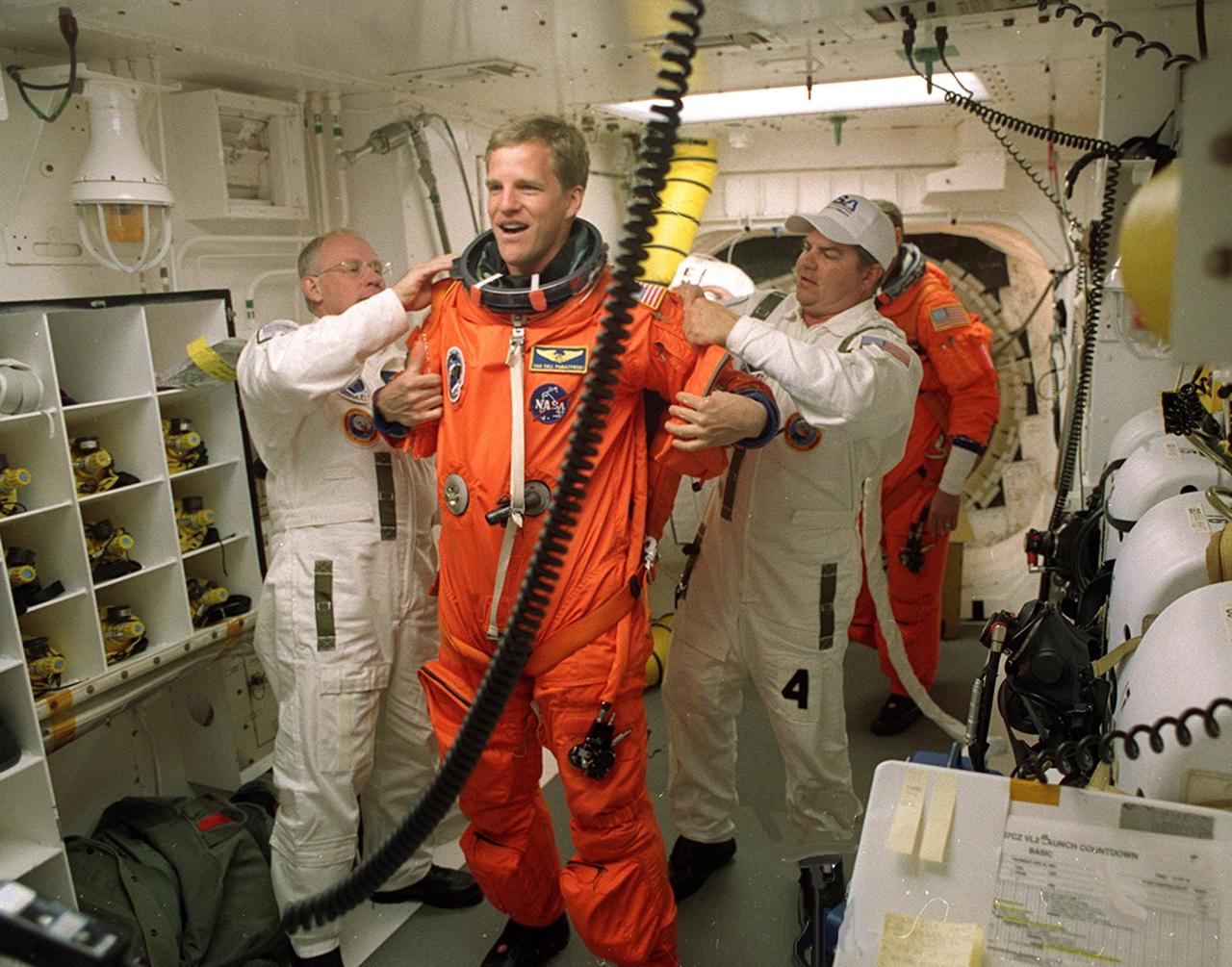
KENNEDY SPACE CENTER, FLA. -- In the White Room, STS-100 Mission Specialist Scott Parazynski is helped with his launch and entry suit by the closeout crew. The White Room is an environmental chamber at the end of the Orbiter Access Arm that provides entry into the orbiter on the launch pad. The mission will deliver and integrate the Spacelab Logistics Pallet/Launch Deployment Assembly, which includes the Canadian-built Space Station Remote Manipulator System and the UHF Antenna. Two spacewalks are planned for installation of the SSRMS, which will be performed by Mission Specialists Parazynski and Chris Hadfield, who is with the Canadian Space Agency. The mission is also the inaugural flight of Multi-Purpose Logistics Module Raffaello, carrying resupply stowage racks and resupply/return stowage platforms. Liftoff of Space Shuttle Endeavour on mission STS-100 is scheduled at 2:41 p.m. EDT April 19.
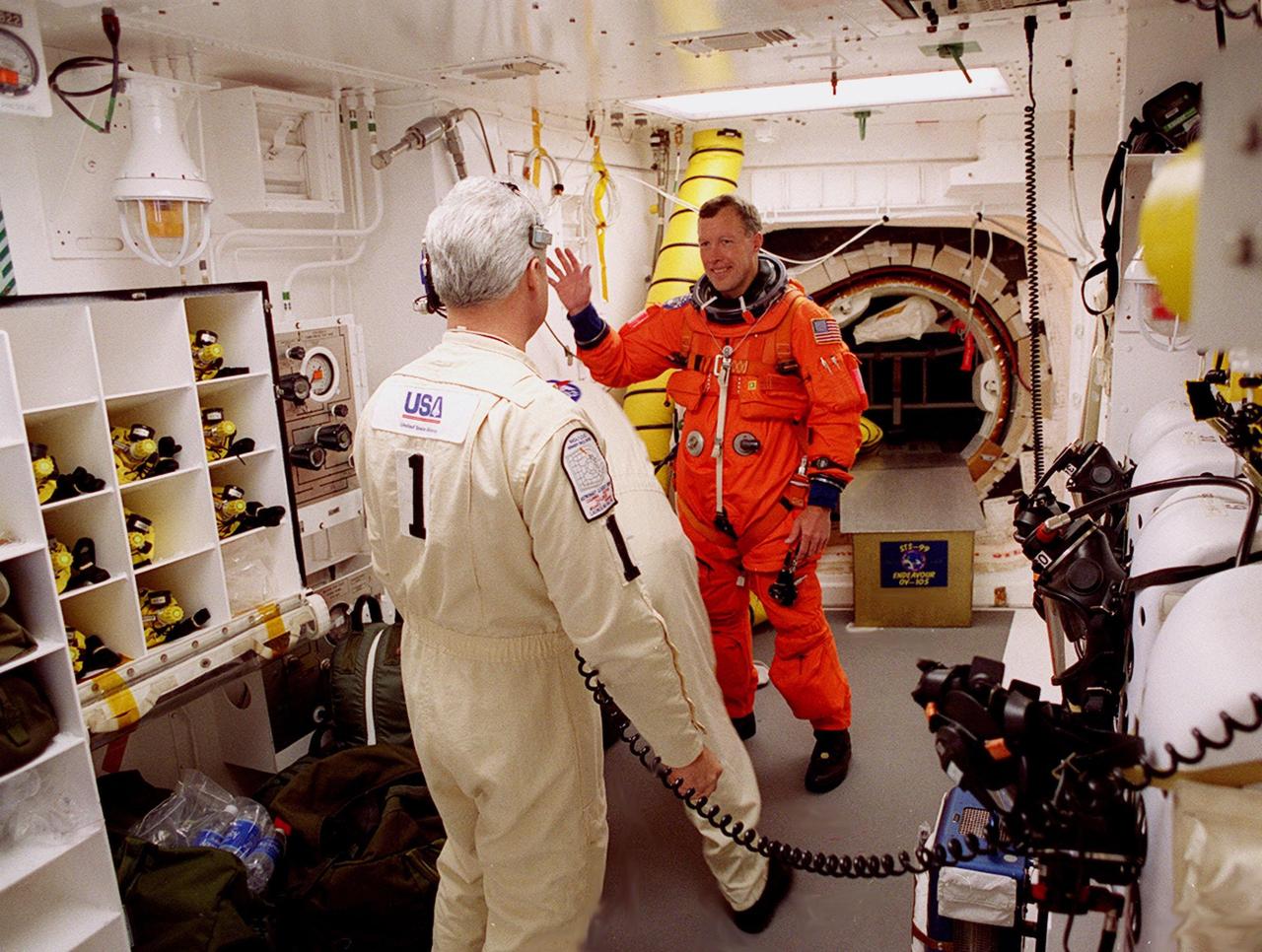
STS-99 Pilot Dominic Gorie appears to wave while the closeout crew in the White Room checks his launch and entry suit before he enters orbiter Endeavour. In the foreground is Chris Meinert, closeout chief. The White Room is an environmental chamber at the end of the orbiter access arm, on the fixed service structure, that provides entry to the orbiter crew compartment. STS-99, known as the Shuttle Radar Topography Mission (SRTM), will chart a new course to produce unrivaled 3-D images of the Earth's surface. The result of the Shuttle Radar Topography Mission could be close to 1 trillion measurements of the Earth's topography. Scheduled for liftoff at 12:30 p.m. EST, the mission is expected to last 11days, with Endeavour landing at KSC Tuesday, Feb. 22, at 4:36 p.m. EST. This is the 97th Shuttle flight and 14th for Shuttle Endeavour
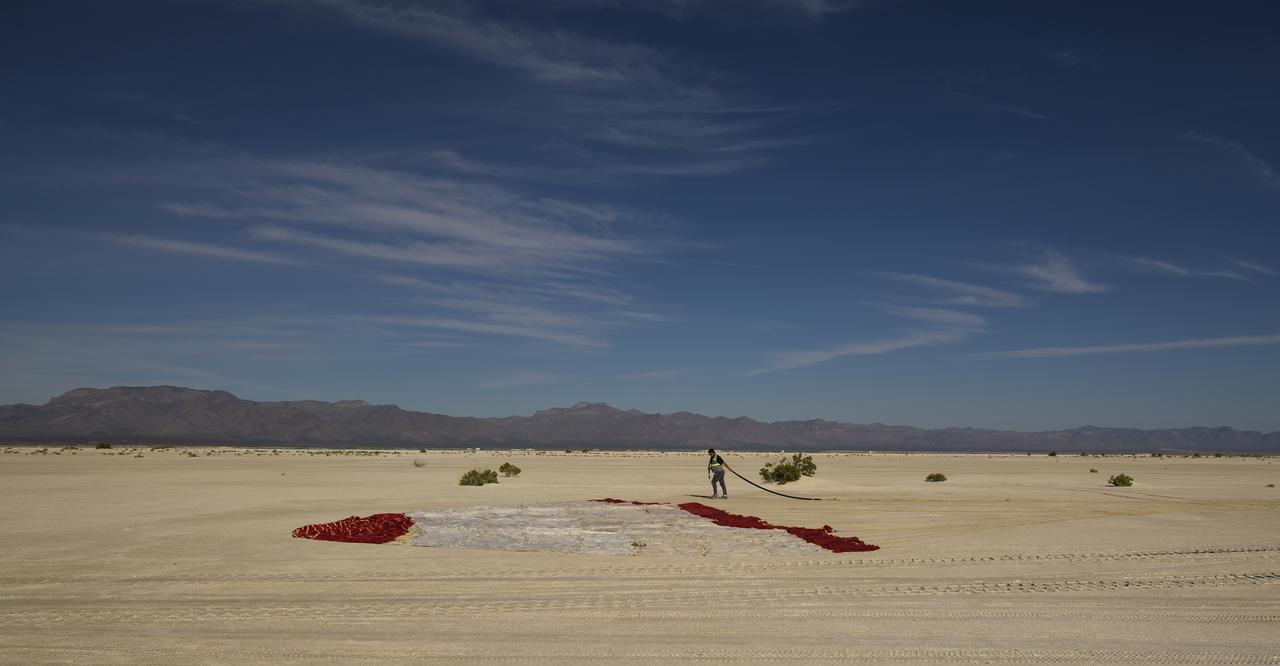
Teams from NASA, Boeing and the White Sands Missile Range, rehearse landing and crew extraction from Boeing’s CST-100 Starliner, which will be used to carry humans to the International Space Station, on Thursday, Sept. 12, 2019 at the White Sands Missile Range outside Las Cruces, New Mexico. Using a convoy of vehicles Boeing uses to recover their spacecraft after landing and a boiler plate test article of the Starliner capsule, the teams worked through the steps necessary to safe the vehicle and get future crew members out of the Starliner to return home. NASA astronauts Mike Fincke and Nicole Mann and Boeing astronaut Chris Ferguson will fly to the space station aboard the Starliner for the Boeing Crew Flight Test mission. Photo Credit: (NASA/Bill Ingalls)
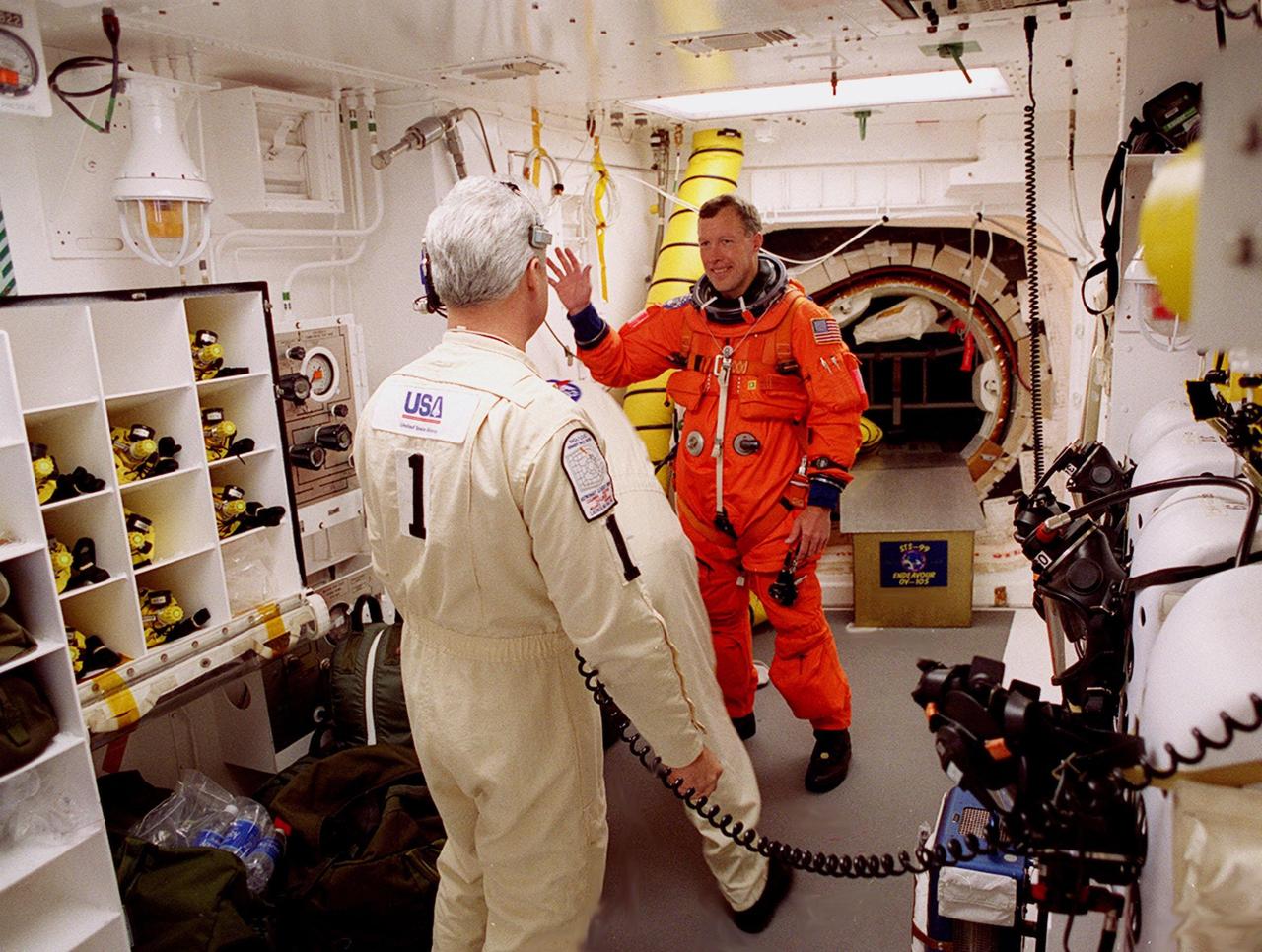
STS-99 Pilot Dominic Gorie appears to wave while the closeout crew in the White Room checks his launch and entry suit before he enters orbiter Endeavour. In the foreground is Chris Meinert, closeout chief. The White Room is an environmental chamber at the end of the orbiter access arm, on the fixed service structure, that provides entry to the orbiter crew compartment. STS-99, known as the Shuttle Radar Topography Mission (SRTM), will chart a new course to produce unrivaled 3-D images of the Earth's surface. The result of the Shuttle Radar Topography Mission could be close to 1 trillion measurements of the Earth's topography. Scheduled for liftoff at 12:30 p.m. EST, the mission is expected to last 11days, with Endeavour landing at KSC Tuesday, Feb. 22, at 4:36 p.m. EST. This is the 97th Shuttle flight and 14th for Shuttle Endeavour

KENNEDY SPACE CENTER, FLA. - The STS-115 crew is in the White Room on the orbiter access arm on Launch Pad 39B to get instruction on using the emergency egress system. From left are Commander Brent Jett, Pilot Chris Ferguson, and Mission Specialists Heidemarie Stefanyshyn-Piper, Joseph Tanner, Steven MacLean and Daniel Burbank. MacLean is with the Canadian Space Agency. The White Room provides access into the orbiter through the crew access hatch. The mission crew is at KSC for Terminal Countdown Demonstration Test (TCDT) activities that are preparation for launch on Space Shuttle Atlantis, scheduled to take place in a window that opens Aug. 27. During their 11-day mission to the International Space Station, the STS-115 crew will continue construction of the station and attach the payload elements, the Port 3/4 truss segment with its two large solar arrays. Photo credit: NASA/Cory Huston
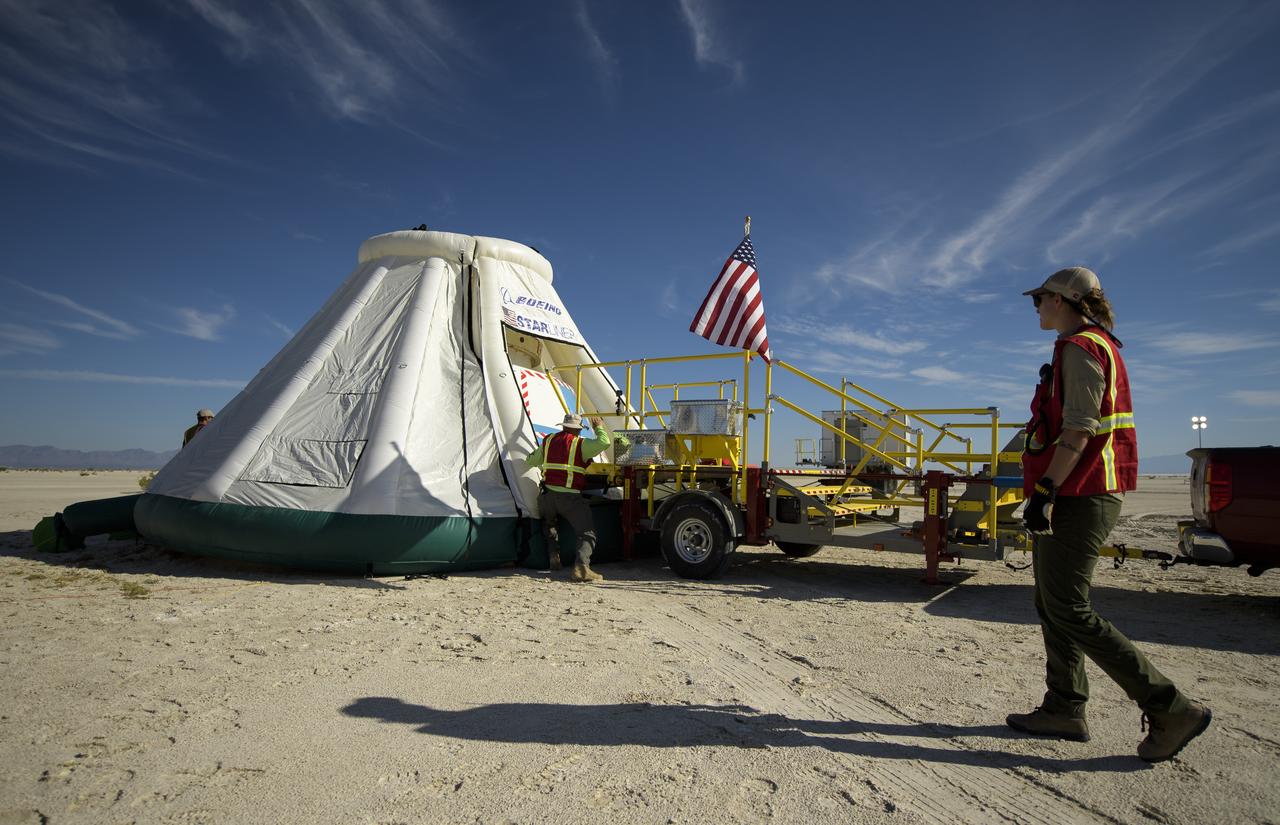
Teams from NASA, Boeing and the White Sands Missile Range, rehearse landing and crew extraction from Boeing’s CST-100 Starliner, which will be used to carry humans to the International Space Station, on Thursday, Sept. 12, 2019 at the White Sands Missile Range outside Las Cruces, New Mexico. Using a convoy of vehicles Boeing uses to recover their spacecraft after landing and a boiler plate test article of the Starliner capsule, the teams worked through the steps necessary to safe the vehicle and get future crew members out of the Starliner to return home. NASA astronauts Mike Fincke and Nicole Mann and Boeing astronaut Chris Ferguson will fly to the space station aboard the Starliner for the Boeing Crew Flight Test mission. Photo Credit: (NASA/Bill Ingalls)
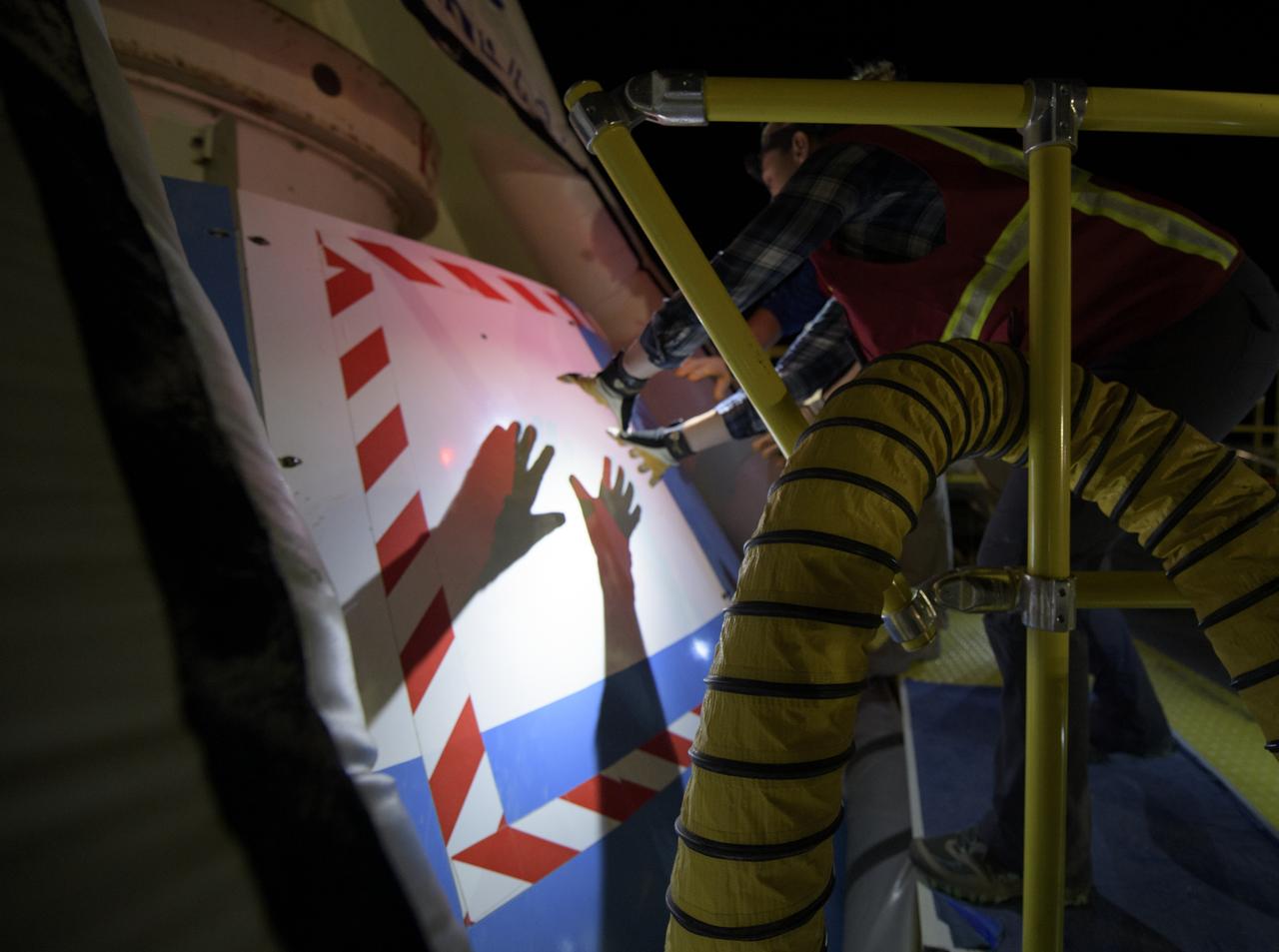
Teams from NASA, Boeing and the White Sands Missile Range, rehearse landing and crew extraction from Boeing’s CST-100 Starliner, which will be used to carry humans to the International Space Station, on Tuesday, Sept. 10, 2019 at the White Sands Missile Range outside Las Cruces, New Mexico. Using a convoy of vehicles Boeing uses to recover their spacecraft after landing and a boiler plate test article of the Starliner capsule, the teams worked through the steps necessary to safe the vehicle and get future crew members out of the Starliner to return home. NASA astronauts Mike Fincke and Nicole Mann and Boeing astronaut Chris Ferguson will fly to the space station aboard the Starliner for the Boeing Crew Flight Test mission. Photo Credit: (NASA/Bill Ingalls)
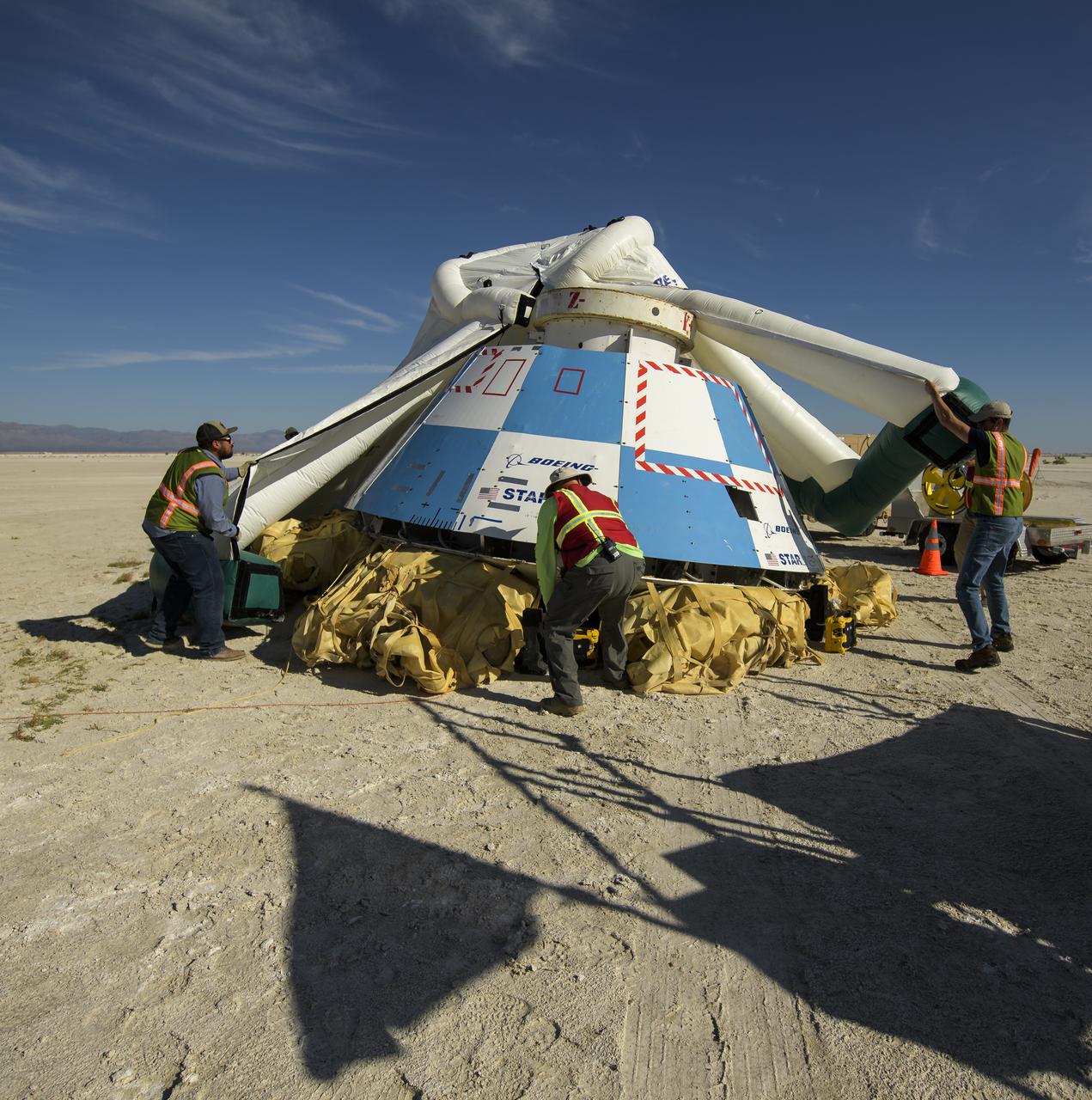
Teams from NASA, Boeing and the White Sands Missile Range, rehearse landing and crew extraction from Boeing’s CST-100 Starliner, which will be used to carry humans to the International Space Station, on Thursday, Sept. 12, 2019 at the White Sands Missile Range outside Las Cruces, New Mexico. Using a convoy of vehicles Boeing uses to recover their spacecraft after landing and a boiler plate test article of the Starliner capsule, the teams worked through the steps necessary to safe the vehicle and get future crew members out of the Starliner to return home. NASA astronauts Mike Fincke and Nicole Mann and Boeing astronaut Chris Ferguson will fly to the space station aboard the Starliner for the Boeing Crew Flight Test mission. Photo Credit: (NASA/Bill Ingalls)
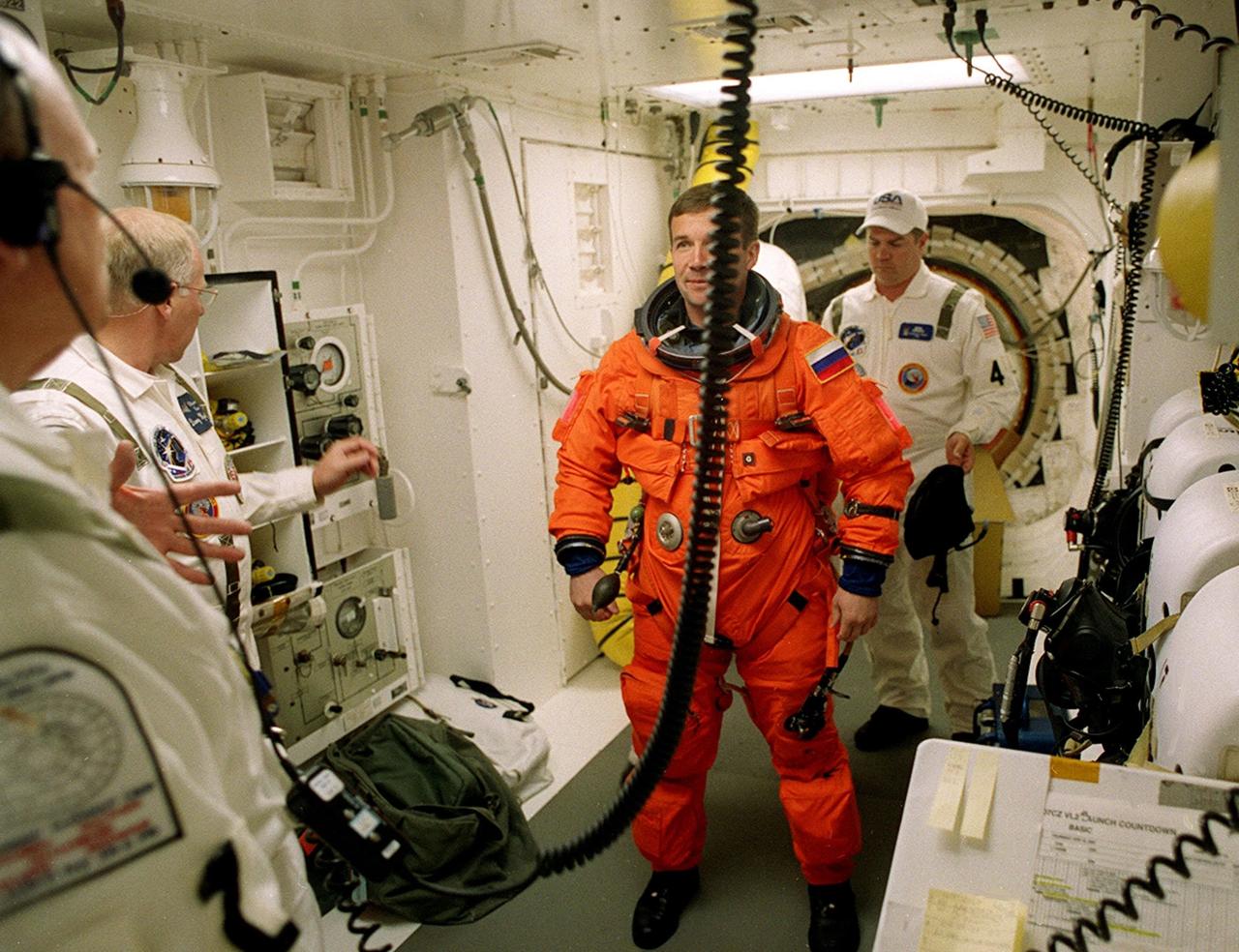
In the White Room, STS-100 Mission Specialist Yuri V. Lonchakov (center) is checked by closeout crew members (from left) Greg Johnson, Danny Wyatt and Rene Arriens before entering Space Shuttle Endeavour. The White Room is an environmental chamber at the end of the Orbiter Access Arm that provides entry into the orbiter on the launch pad. The mission will deliver and integrate the Spacelab Logistics Pallet/Launch Deployment Assembly, which includes the Canadian-built Space Station Remote Manipulator System and the UHF Antenna. Two spacewalks are planned for installation of the SSRMS, which will be performed by Mission Specialists Scott E. Parazynski and Chris A. Hadfield, who is with the Canadian Space Agency. The mission is also the inaugural flight of Multi-Purpose Logistics Module Raffaello, carrying resupply stowage racks and resupply/return stowage platforms. Liftoff of Space Shuttle Endeavour on mission STS-100 is scheduled at 2:41 p.m. EDT April 19
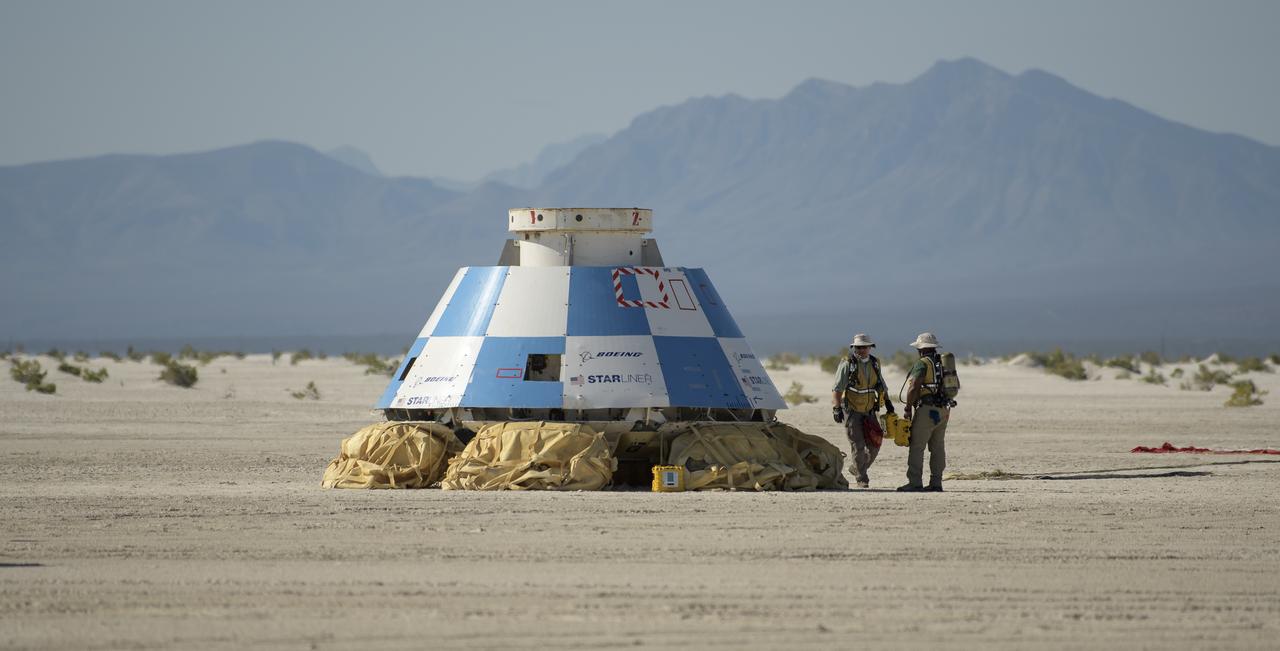
Teams from NASA, Boeing and the White Sands Missile Range, rehearse landing and crew extraction from Boeing’s CST-100 Starliner, which will be used to carry humans to the International Space Station, on Wednesday, Sept. 11, 2019 at the White Sands Missile Range outside Las Cruces, New Mexico. Using a convoy of vehicles Boeing uses to recover their spacecraft after landing and a boiler plate test article of the Starliner capsule, the teams worked through the steps necessary to safe the vehicle and get future crew members out of the Starliner to return home. NASA astronauts Mike Fincke and Nicole Mann and Boeing astronaut Chris Ferguson will fly to the space station aboard the Starliner for the Boeing Crew Flight Test mission. Photo Credit: (NASA/Bill Ingalls)
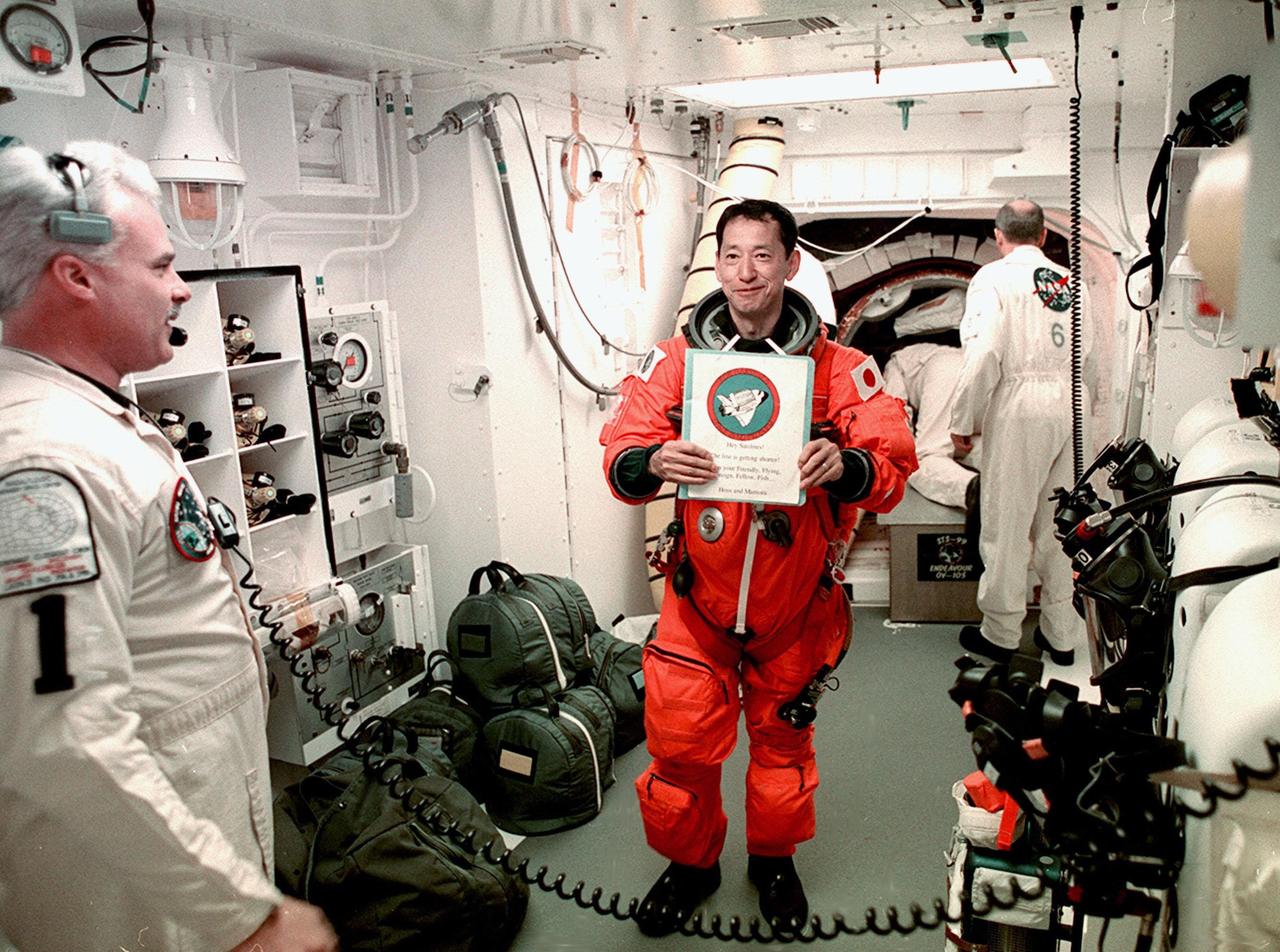
STS-99 Mission Specialist Mamoru Mohri of Japan holds a memento from friends before entering orbiter Endeavour. With him are members of the White Room closeout crew, Chris Meinert (left), closeout chief, and Jack Burritt (background), Quality Assurance specialist. The White Room is an environmental chamber at the end of the orbiter access arm, on the fixed service structure, that provides entry to the orbiter crew compartment. STS-99, known as the Shuttle Radar Topography Mission (SRTM), will chart a new course to produce unrivaled 3-D images of the Earth's surface. The result of the Shuttle Radar Topography Mission could be close to 1 trillion measurements of the Earth's topography. Scheduled for liftoff at 12:30 p.m. EST, the mission is expected to last 11days, with Endeavour landing at KSC Tuesday, Feb. 22, at 4:36 p.m. EST. This is the 97th Shuttle flight and 14th for Shuttle Endeavour
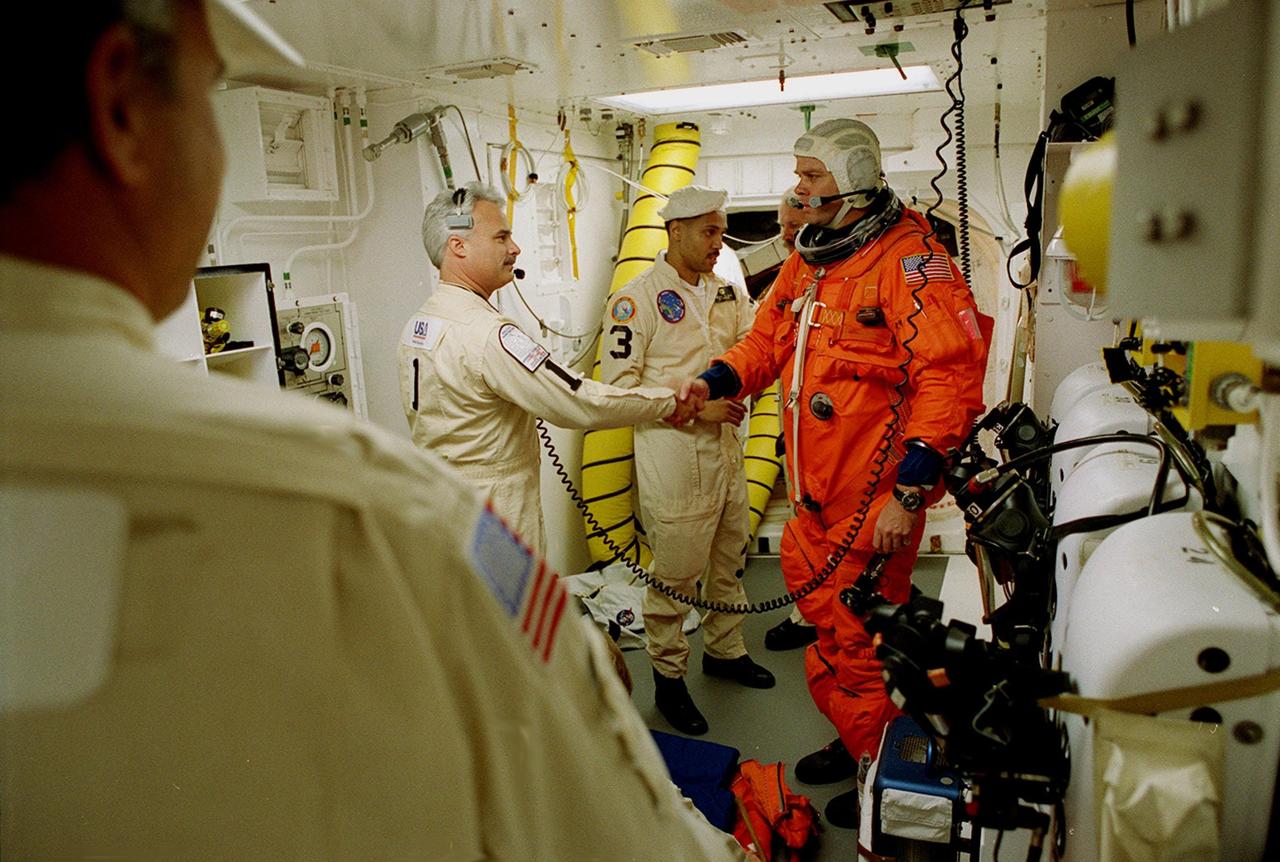
Before entering the orbiter Endeavour, STS-99 Commander Kevin Kregel shakes hands with Chris Meinert, closeout chief of the White Room closeout crew. In the background is Carlos Gillis, suit technician. The White Room is an environmental chamber at the end of the orbiter access arm, on the fixed service structure, that provides entry to the orbiter crew compartment. STS-99, known as the Shuttle Radar Topography Mission (SRTM), will chart a new course to produce unrivaled 3-D images of the Earth's surface. The result of the Shuttle Radar Topography Mission could be close to 1 trillion measurements of the Earth's topography. Scheduled for liftoff at 12:30 p.m. EST, the mission is expected to last 11days, with Endeavour landing at KSC Tuesday, Feb. 22, at 4:36 p.m. EST. This is the 97th Shuttle flight and 14th for Shuttle Endeav
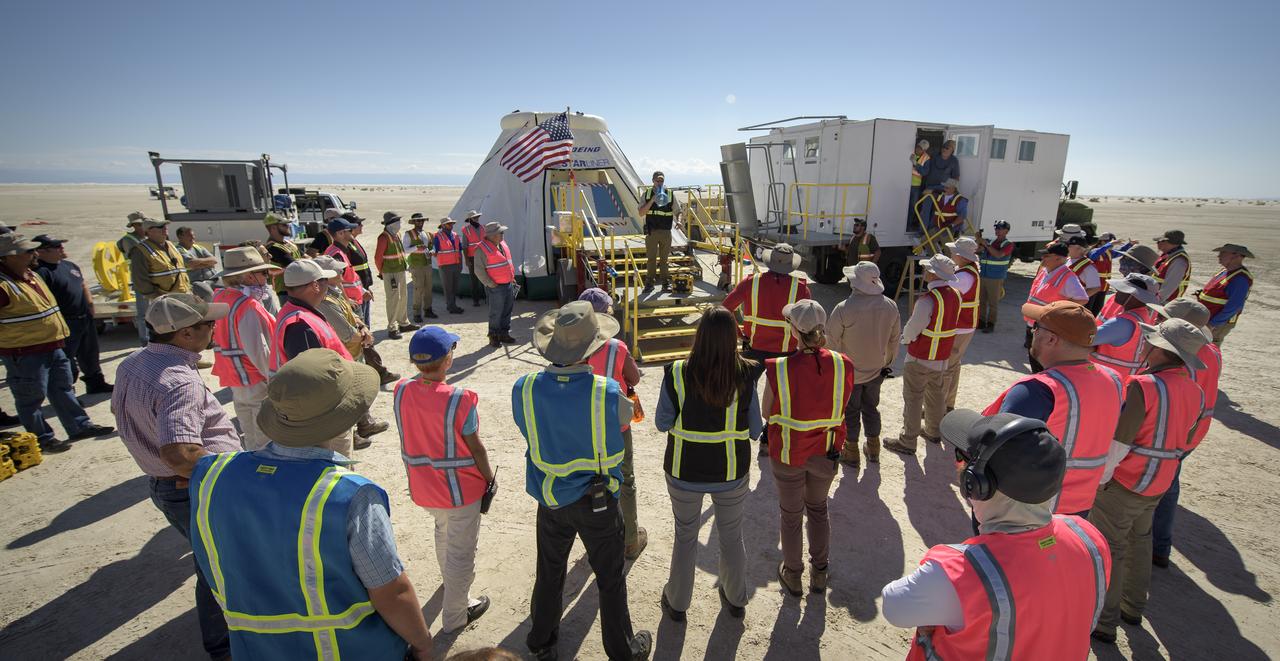
Teams from NASA, Boeing and the White Sands Missile Range, rehearse landing and crew extraction from Boeing’s CST-100 Starliner, which will be used to carry humans to the International Space Station, on Wednesday, Sept. 11, 2019 at the White Sands Missile Range outside Las Cruces, New Mexico. Using a convoy of vehicles Boeing uses to recover their spacecraft after landing and a boiler plate test article of the Starliner capsule, the teams worked through the steps necessary to safe the vehicle and get future crew members out of the Starliner to return home. NASA astronauts Mike Fincke and Nicole Mann and Boeing astronaut Chris Ferguson will fly to the space station aboard the Starliner for the Boeing Crew Flight Test mission. Photo Credit: (NASA/Bill Ingalls)

KENNEDY SPACE CENTER, FLA. - The STS-115 crew is in the White Room on the orbiter access arm on Launch Pad 39B to get instruction on using the emergency egress system. From left are Pilot Chris Ferguson, Commander Brent Jett, and Mission Specialists Heidemarie Stefanyshyn-Piper, Joseph Tanner, Steven MacLean and Daniel Burbank. MacLean is with the Canadian Space Agency. The White Room provides access into the orbiter through the crew access hatch. The mission crew is at KSC for Terminal Countdown Demonstration Test (TCDT) activities that are preparation for launch on Space Shuttle Atlantis, scheduled to take place in a window that opens Aug. 27. During their 11-day mission to the International Space Station, the STS-115 crew will continue construction of the station and attach the payload elements, the Port 3/4 truss segment with its two large solar arrays. Photo credit: NASA/Cory Huston
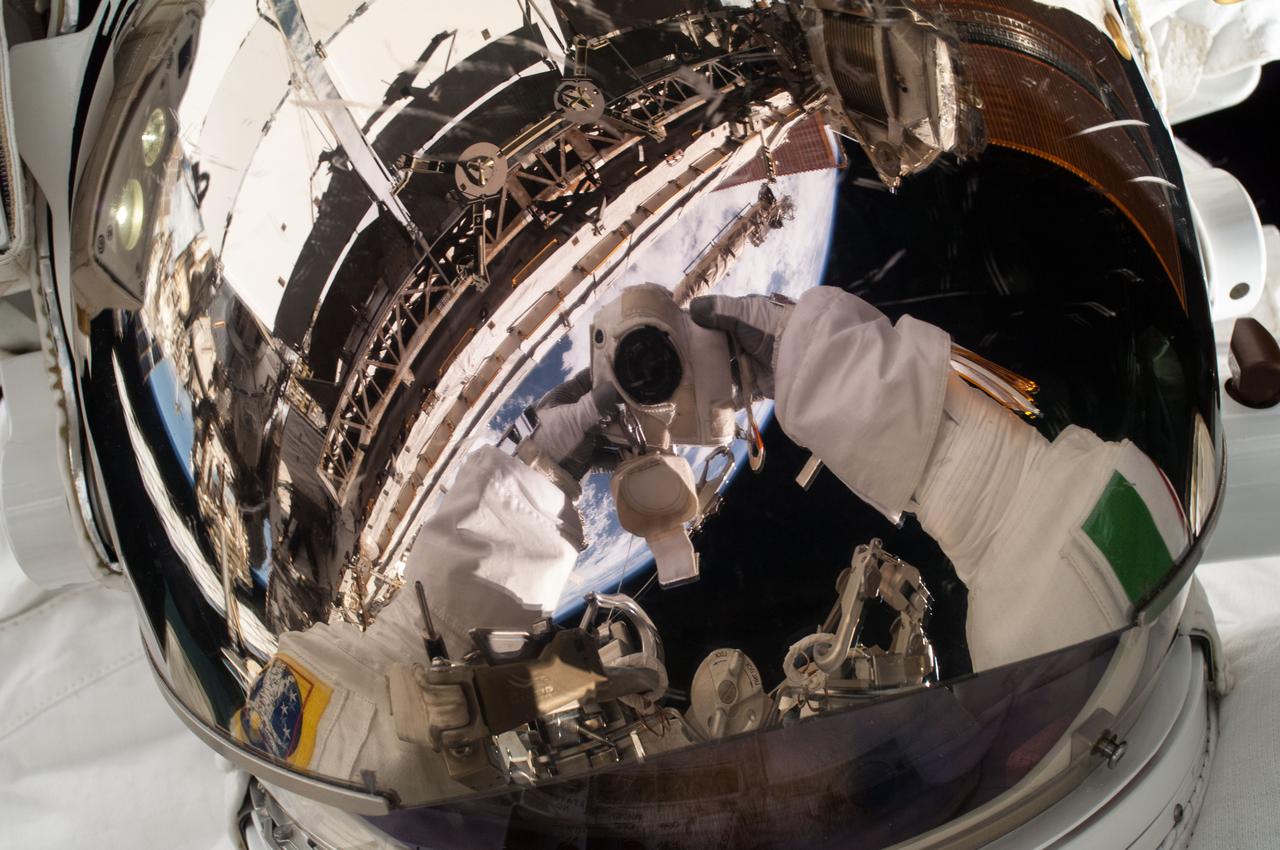
ISS036-E-016820 (9 July 2013) --- European Space Agency astronaut Luca Parmitano, Expedition 36 flight engineer, uses a digital still camera to expose a photo of his helmet visor during a session of extravehicular activity (EVA) as work continues on the International Space Station. Also visible in the reflections in the visor are various components of the space station and a blue and white portion of Earth. During the six-hour, seven-minute spacewalk, Parmitano and NASA astronaut Chris Cassidy (out of frame), flight engineer, prepared the space station for a new Russian module and performed additional installations on the station’s backbone.
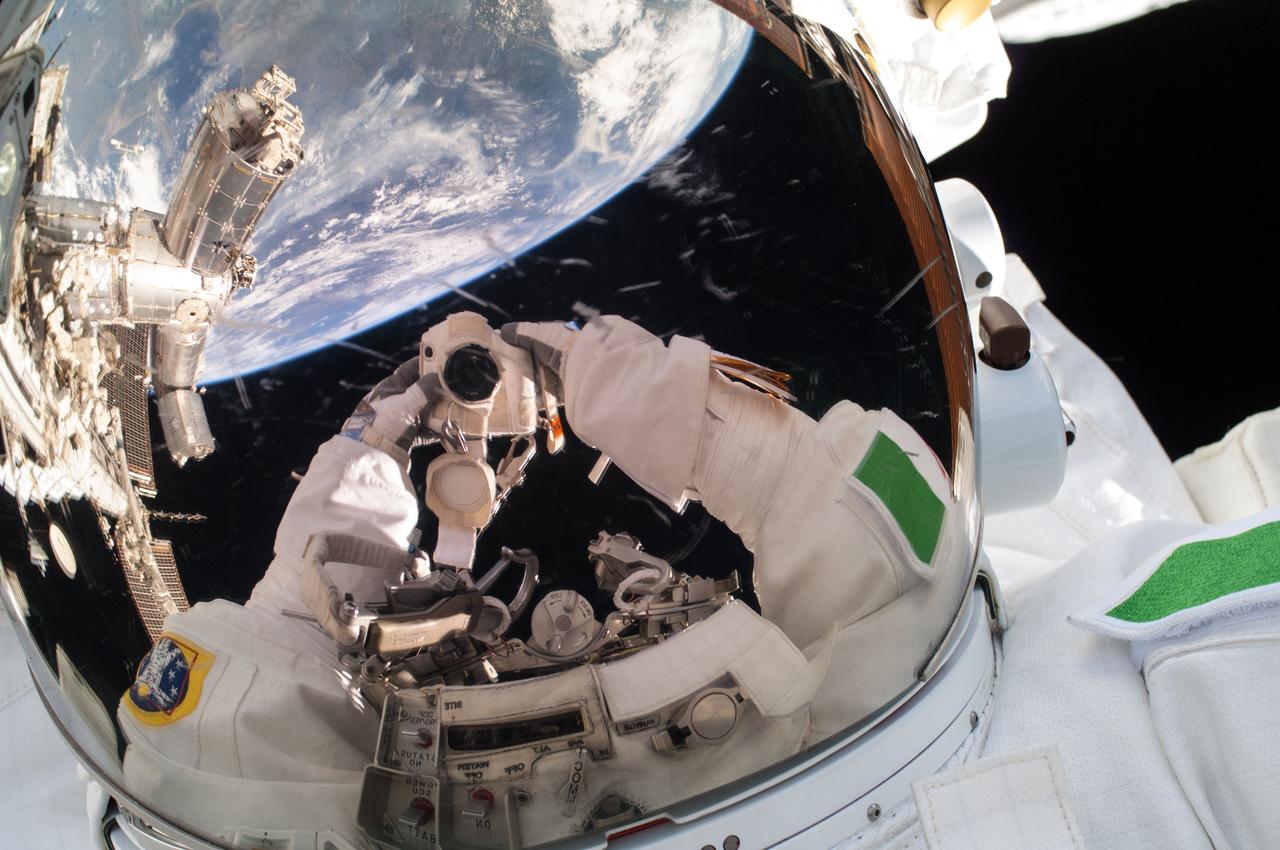
ISS036-E-016853 (9 July 2013) --- European Space Agency astronaut Luca Parmitano, Expedition 36 flight engineer, uses a digital still camera to expose a photo of his helmet visor during a session of extravehicular activity (EVA) as work continues on the International Space Station. Also visible in the reflections in the visor are various components of the space station and a blue and white portion of Earth. During the six-hour, seven-minute spacewalk, Parmitano and NASA astronaut Chris Cassidy (out of frame), flight engineer, prepared the space station for a new Russian module and performed additional installations on the station’s backbone.
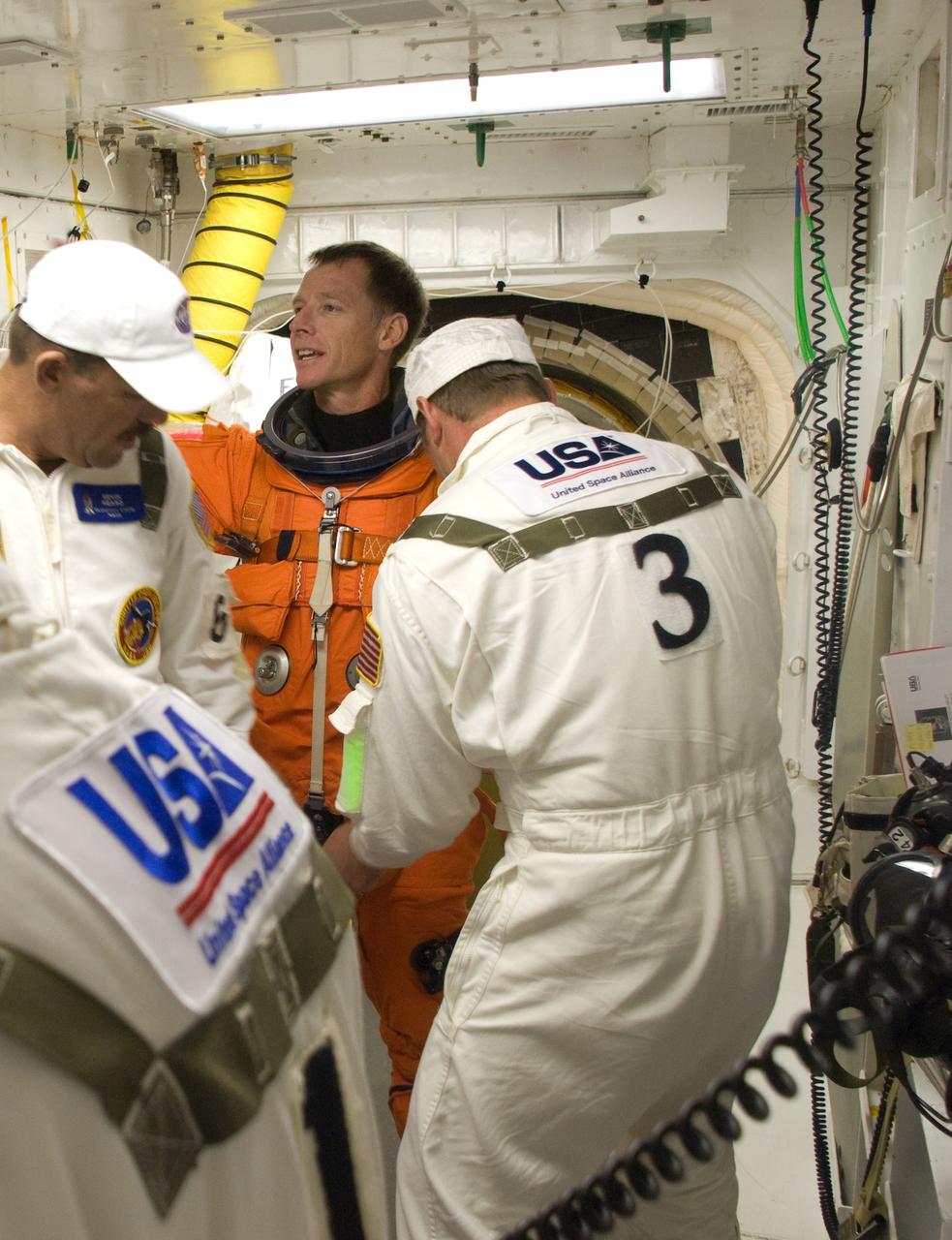
CAPE CANAVERAL, Fla. – In the White Room on Launch Pad 39A at NASA's Kennedy Space Center in Florida, STS-126 Commander Chris Ferguson is helped by suit technicians to put on a harness over his launch and entry suit. In the background is the hatch for entry into space shuttle Endeavour. STS-126 is the 124th space shuttle flight and the 27th flight to the International Space Station. The mission will feature four spacewalks and work that will prepare the space station to house six crew members for long- duration missions. Liftoff is scheduled for 7:55 p.m. EST Nov. 14. Photo credit: NASA/Sandra Joseph-Kevin O'Connell
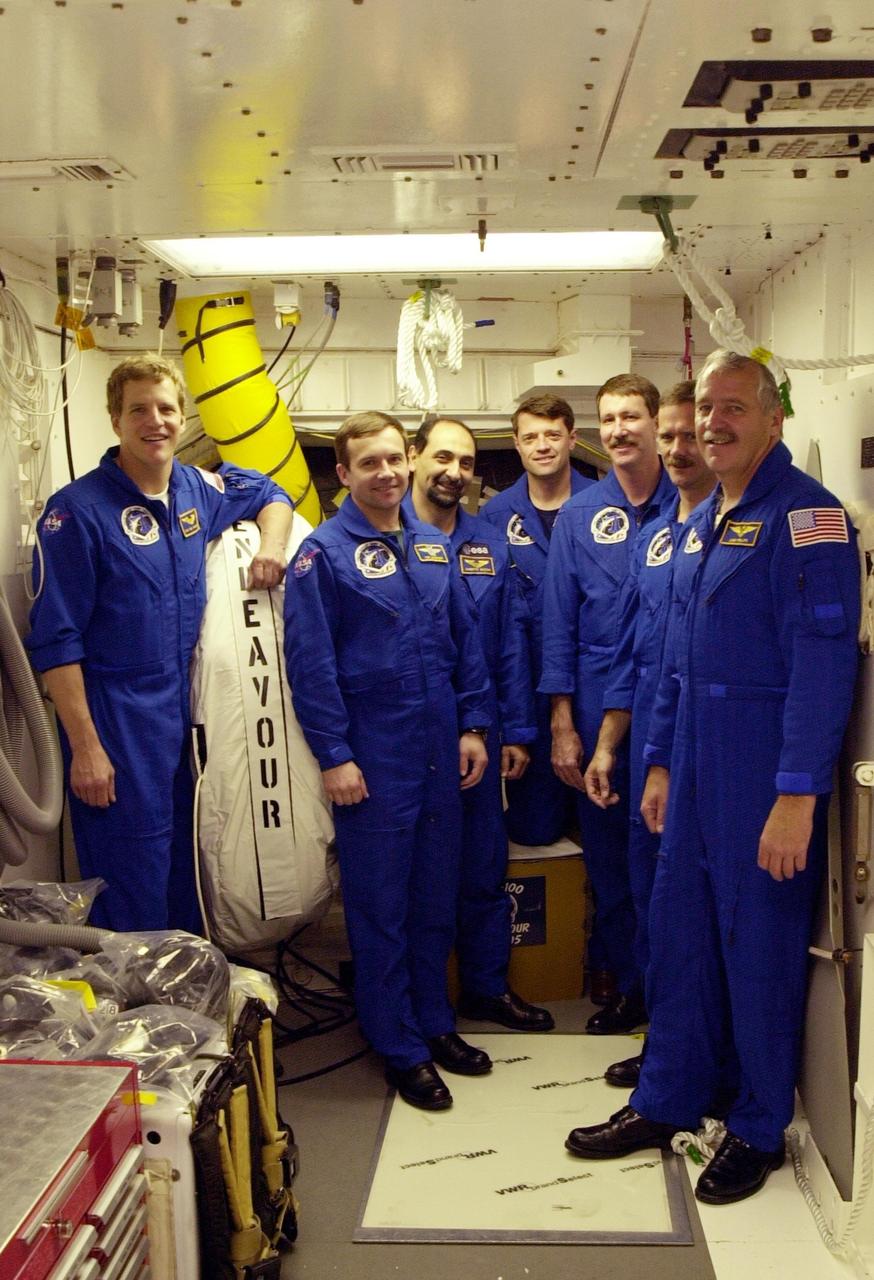
The crew on mission STS-100 poses in the White Room during Terminal Countdown Demonstration Test activities. Standing, from left, are Mission Specialists Scott E. Parazynski, Yuri Lonchakov, and Umberto Guidoni; Pilot Jeffrey S. Ashby; Commander Kent V. Rominger; Mission Specialist Chris A. Hadfield; and Mission Specialist John L. Phillips. The TCDT includes emergency escape training, payload bay walkdown, and a simulated launch countdown. Launch of Space Shuttle Endeavour on mission STS-100 is targeted for April 19 at 2:41 p.m. EDT from Launch Pad 39A
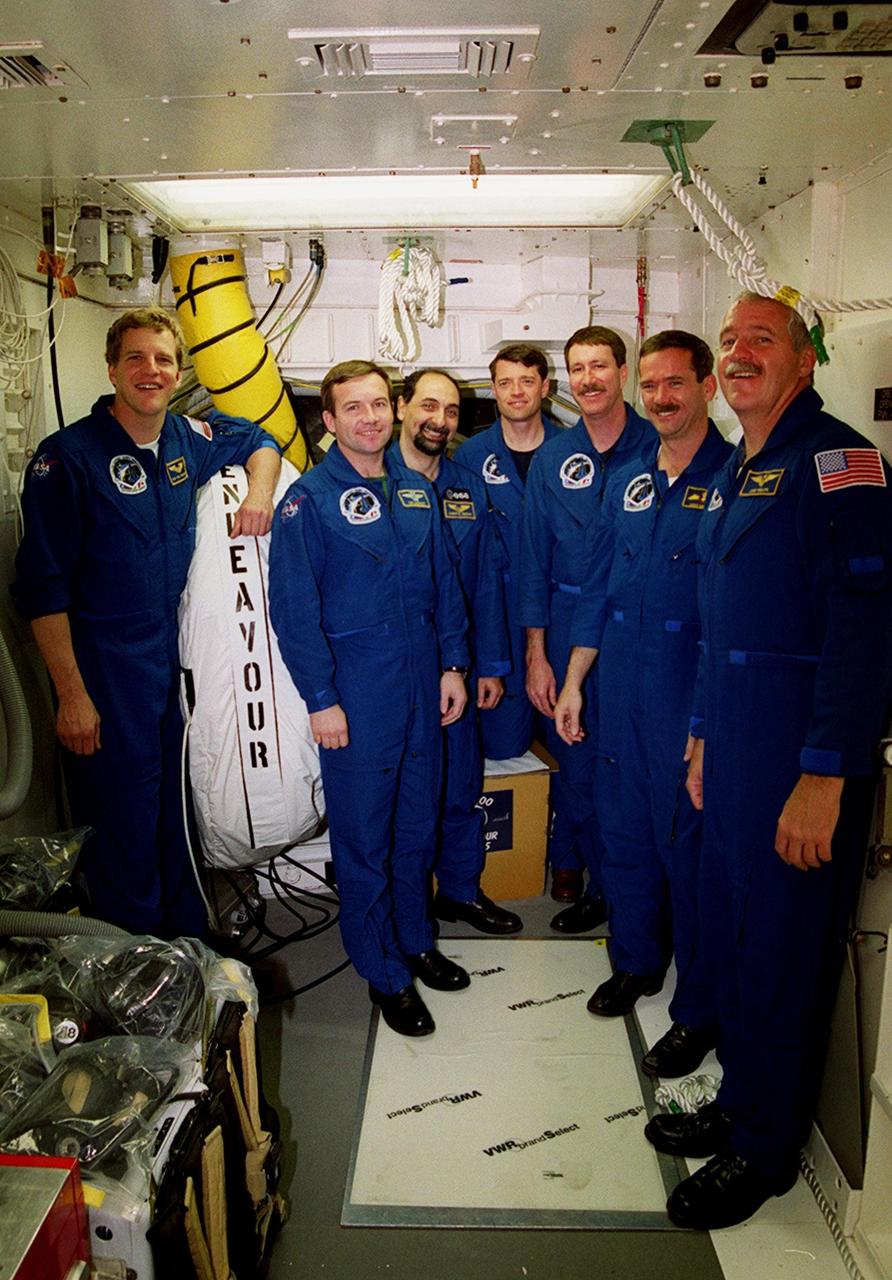
The crew on mission STS-100 poses in the White Room during Terminal Countdown Demonstration Test activities. Standing, from left, are Mission Specialists Scott E. Parazynski, Yuri Lonchakov, and Umberto Guidoni; Pilot Jeffrey S. Ashby; Commander Kent V. Rominger; and Mission Specialists Chris A. Hadfield and John L. Phillips. The TCDT includes emergency escape training, payload bay walkdown, and a simulated launch countdown. The primary payload comprises the Canadian robotic arm, SSRMS, and Multi-Purpose Logistics Module, Raffaello. Launch of Space Shuttle Endeavour on mission STS-100 is targeted for April 19 at 2:41 p.m. EDT from Launch Pad 39A
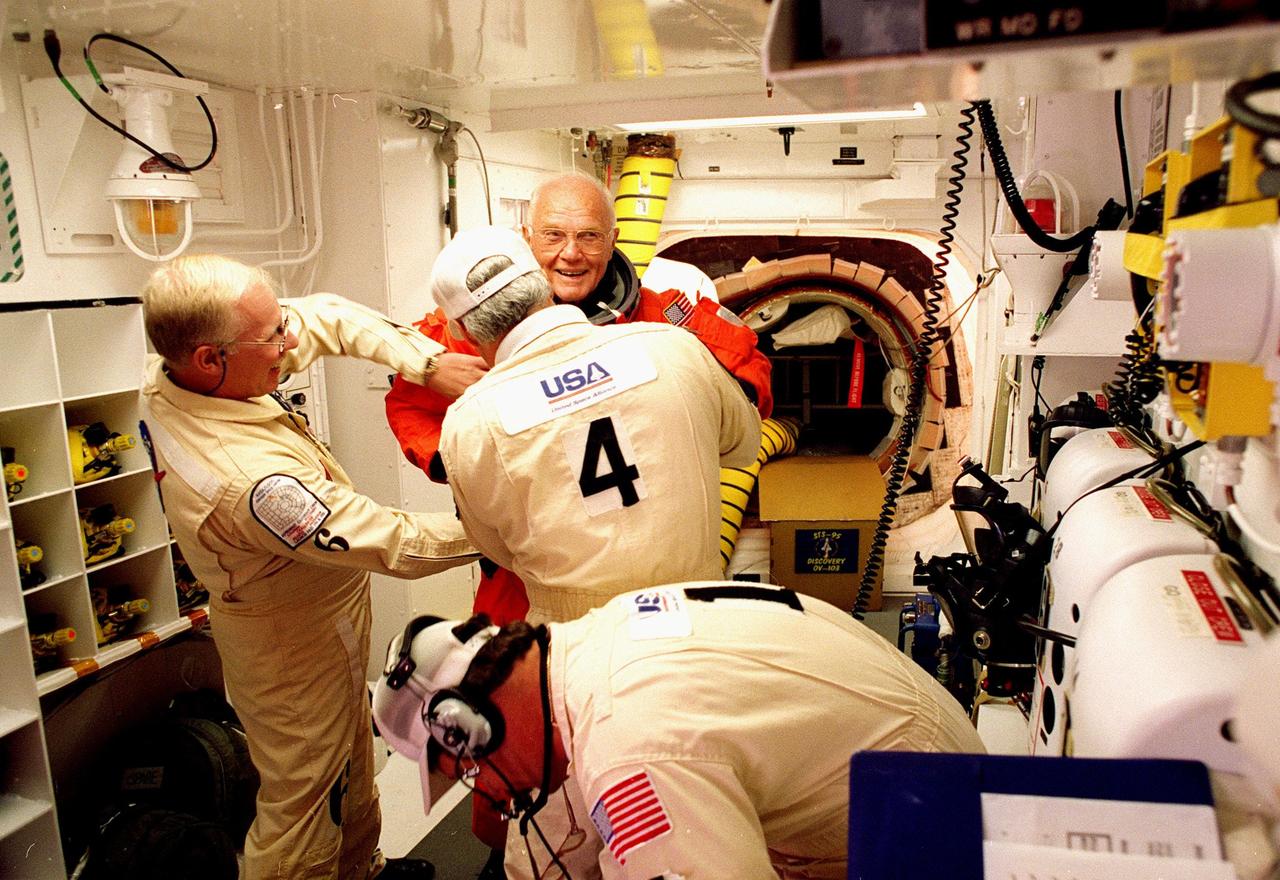
In the environmental chamber known as the white room, an eager STS-95 Payload Specialist John H. Glenn Jr., senator from Ohio, has his flight suit checked by closeout room crew members Danny Wyatt (left to right), Chris Meinert and Travis Thompson (foreground) for entry into the Space Shuttle Discovery for his second flight into space after 36 years. The STS-95 mission, targeted for launch at 2 p.m. EST on Oct. 29, is expected to last 8 days, 21 hours and 49 minutes, and return to KSC at 11:49 a.m. EST on Nov. 7
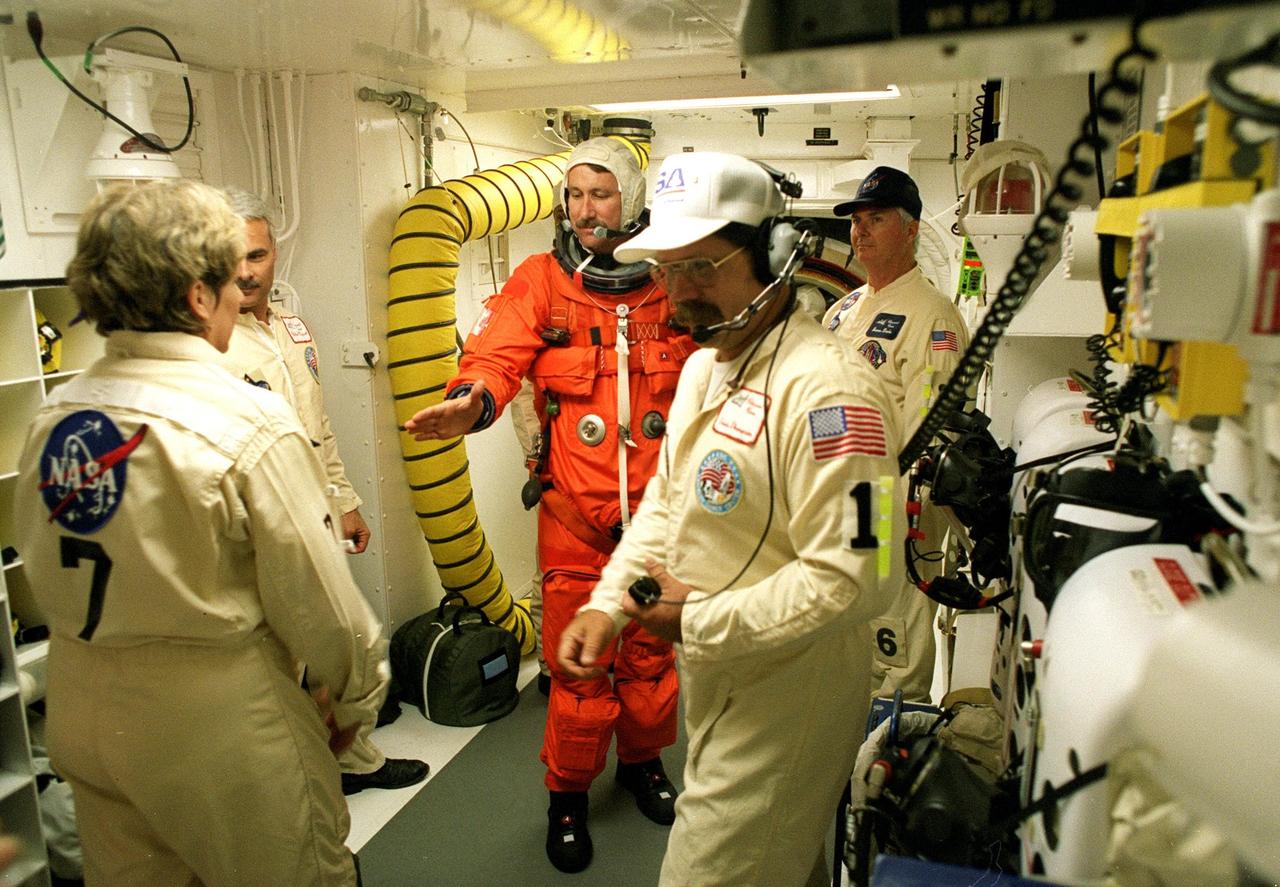
In the white room prior to launch, STS-96 Commander Kent V. Rominger reaches to shake hands with Suit Technician Jean Alexander. The white room is an environmental chamber at the end of the orbiter access arm that provides entry to the orbiter crew compartment. At right are closeout crew members Chief Travis Thompson and Quality Assurance Specialist James Davis; at left is Mechanical Technician Chris Meinert. STS-96 is a 10-day logistics and resupply mission for the International Space Station, carrying about 4,000 pounds of supplies, to be stored aboard the station for use by future crews, including laptop computers, cameras, tools, spare parts, and clothing. The mission also includes such payloads as a Russian crane, the Strela; a U.S.-built crane; the Spacehab Oceaneering Space System Box (SHOSS), a logistics items carrier; and STARSHINE, a student-involved experiment. It will include a space walk to attach the cranes to the outside of the ISS for use in future construction. Space Shuttle Discovery is due to launch today at 6:49 a.m. EDT. Landing is expected at the SLF on June 6 about 1:58 a.m. EDT
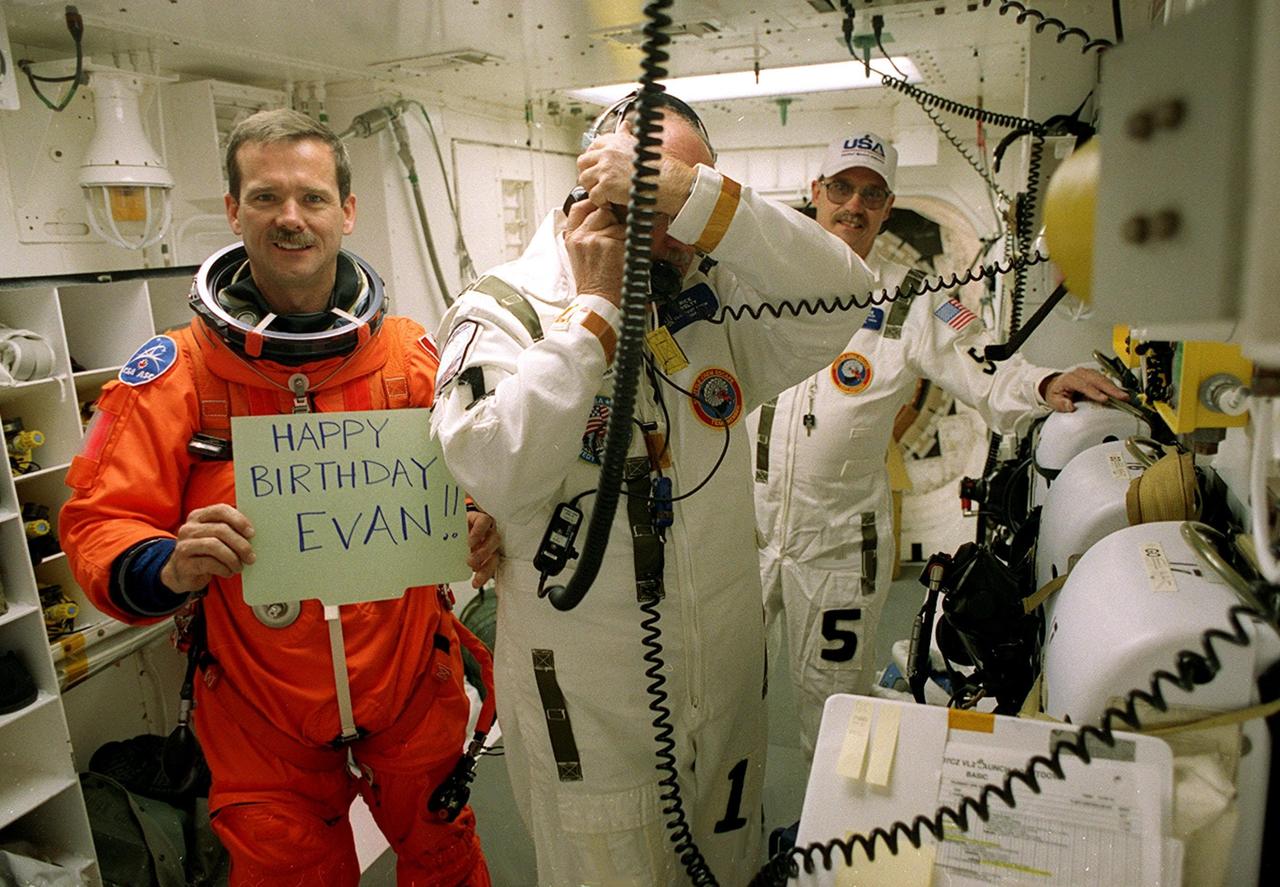
In the White Room, STS-100 Mission Specialist Chris A. Hadfield displays a special sign to a family member before entering Space Shuttle Endeavour. Closeout crew members Rick Welty (front) and George Schramm (behind) are available to help with Hadfield’s launch and entry suit. The White Room is an environmental chamber at the end of the Orbiter Access Arm that provides entry into the orbiter on the launch pad. The mission will deliver and integrate the Spacelab Logistics Pallet/Launch Deployment Assembly, which includes the Canadian-built Space Station Remote Manipulator System and the UHF Antenna. Two spacewalks are planned for installation of the SSRMS, which will be performed by Mission Specialist Scott E. Parazynski and. Hadfield, who is with the Canadian Space Agency. The mission is also the inaugural flight of Multi-Purpose Logistics Module Raffaello, carrying resupply stowage racks and resupply/return stowage platforms. Liftoff of Space Shuttle Endeavour on mission STS-100 is scheduled at 2:41 p.m. EDT April 19
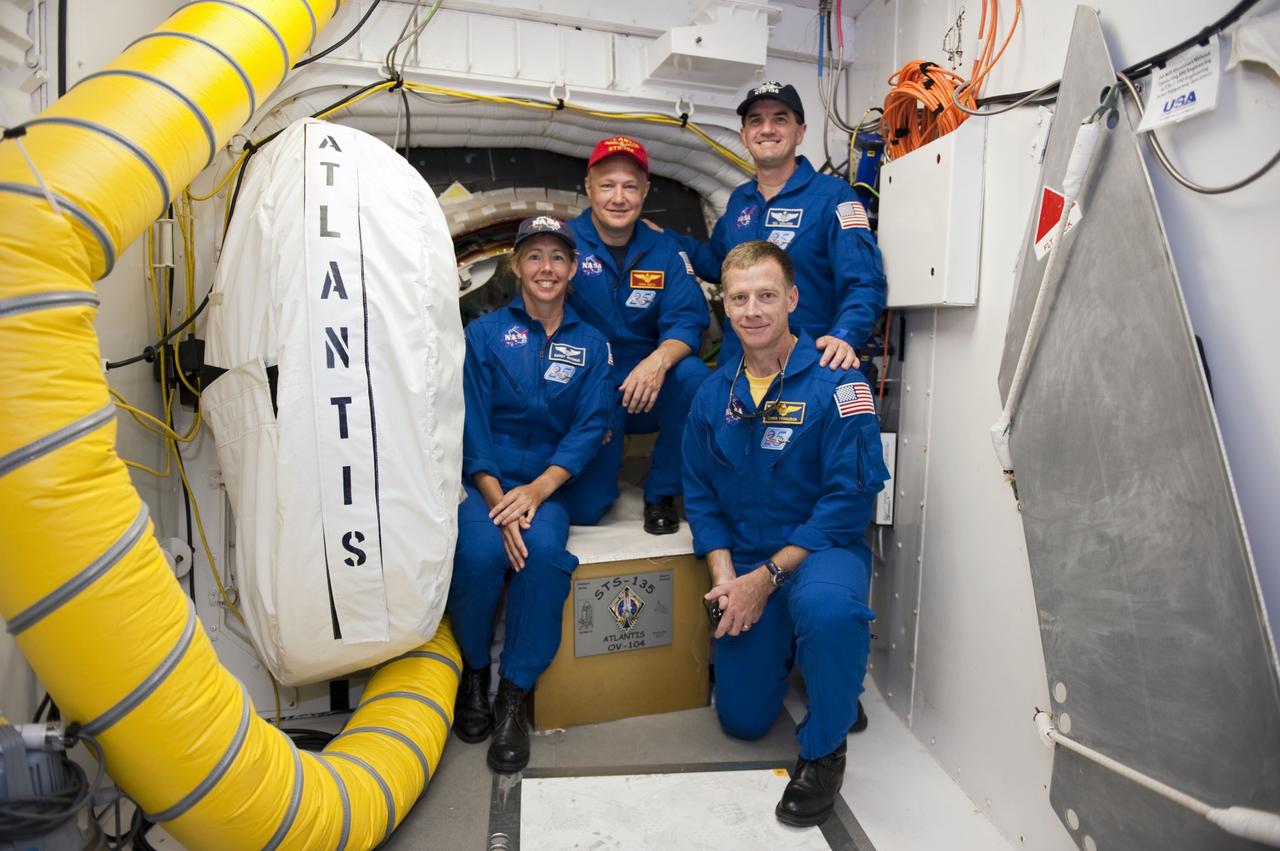
CAPE CANAVERAL, Fla. -- At Launch Pad 39A at NASA's Kennedy Space Center in Florida, the STS-135 crew pose for a group portrait in front of space shuttle Atlantis' hatch in the pad's White Room. From left are Mission Specialist Sandy Magnus, Pilot Doug Hurley, Mission Specialist Rex Walheim and Commander Chris Ferguson. An access arm supports the White Room that is in place against the shuttle which provides entry to the crew compartment. The astronauts are at Kennedy to participate in a launch countdown dress rehearsal called the Terminal Countdown Demonstration Test (TCDT) and related training. Atlantis and its crew are targeted to lift off July 8, taking with them the Raffaello multi-purpose logistics module packed with supplies and spare parts to the International Space Station. The STS-135 mission also will fly a system to investigate the potential for robotically refueling existing satellites and return a failed ammonia pump module to help NASA better understand the failure mechanism and improve pump designs for future systems. STS-135 will be the 33rd flight of Atlantis, the 37th shuttle mission to the space station, and the 135th and final mission of NASA's Space Shuttle Program. For more information visit, www.nasa.gov/mission_pages/shuttle/shuttlemissions/sts135/index.html. Photo credit: NASA/Kim Shiflett
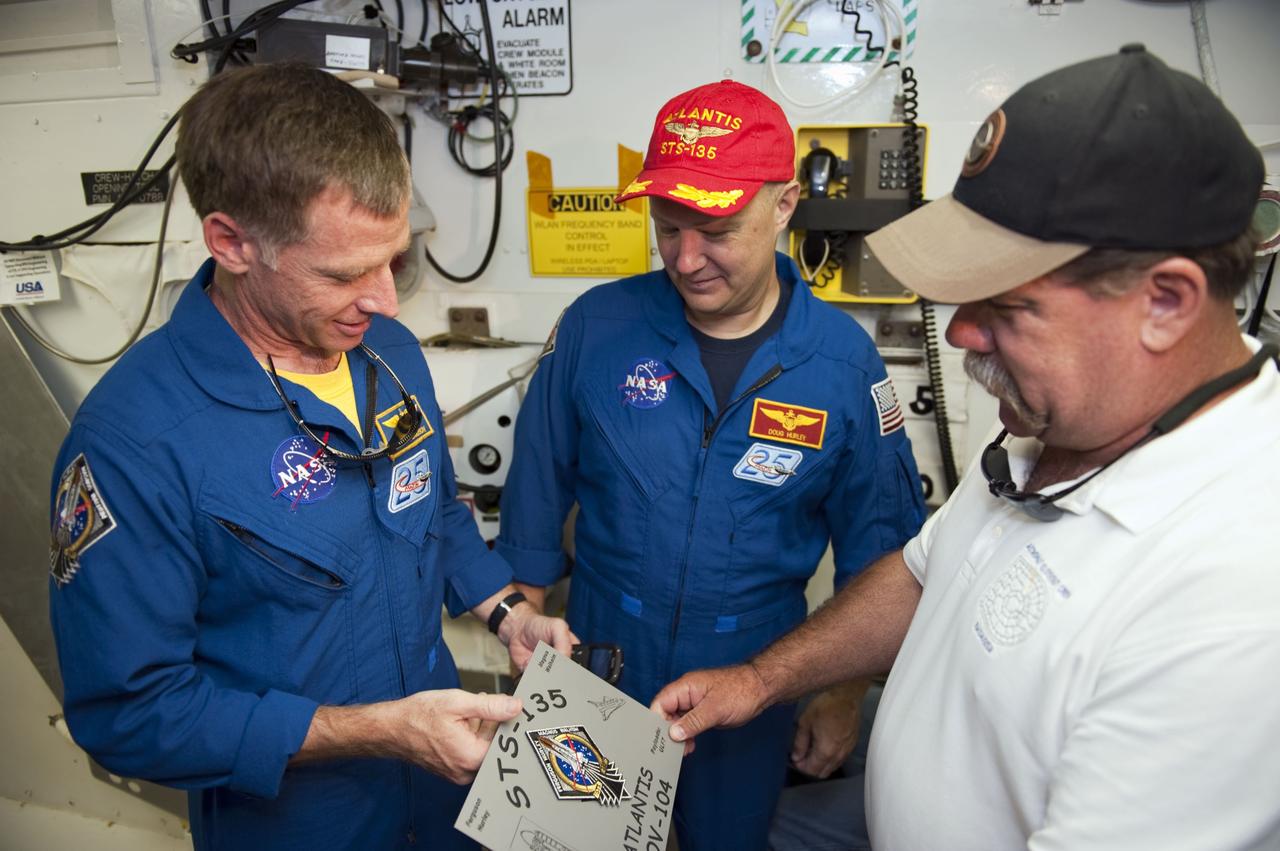
CAPE CANAVERAL, Fla. -- STS-135 Commander Chris Ferguson (left), Pilot Doug Hurley and Closeout Crew Lead Travis Tod Thompson with United Space Alliance, check out the plaque that will be placed in front of space shuttle Atlantis' hatch in the White Room at NASA Kennedy Space Center's Launch Pad 39A. An access arm supports the White Room that is in place against the shuttle which provides entry to the crew compartment. The astronauts are at Kennedy to participate in a launch countdown dress rehearsal called the Terminal Countdown Demonstration Test (TCDT) and related training. Atlantis and its crew are targeted to lift off July 8, taking with them the Raffaello multi-purpose logistics module packed with supplies and spare parts to the International Space Station. The STS-135 mission also will fly a system to investigate the potential for robotically refueling existing satellites and return a failed ammonia pump module to help NASA better understand the failure mechanism and improve pump designs for future systems. STS-135 will be the 33rd flight of Atlantis, the 37th shuttle mission to the space station, and the 135th and final mission of NASA's Space Shuttle Program. For more information visit, www.nasa.gov/mission_pages/shuttle/shuttlemissions/sts135/index.html. Photo credit: NASA/Kim Shiflett
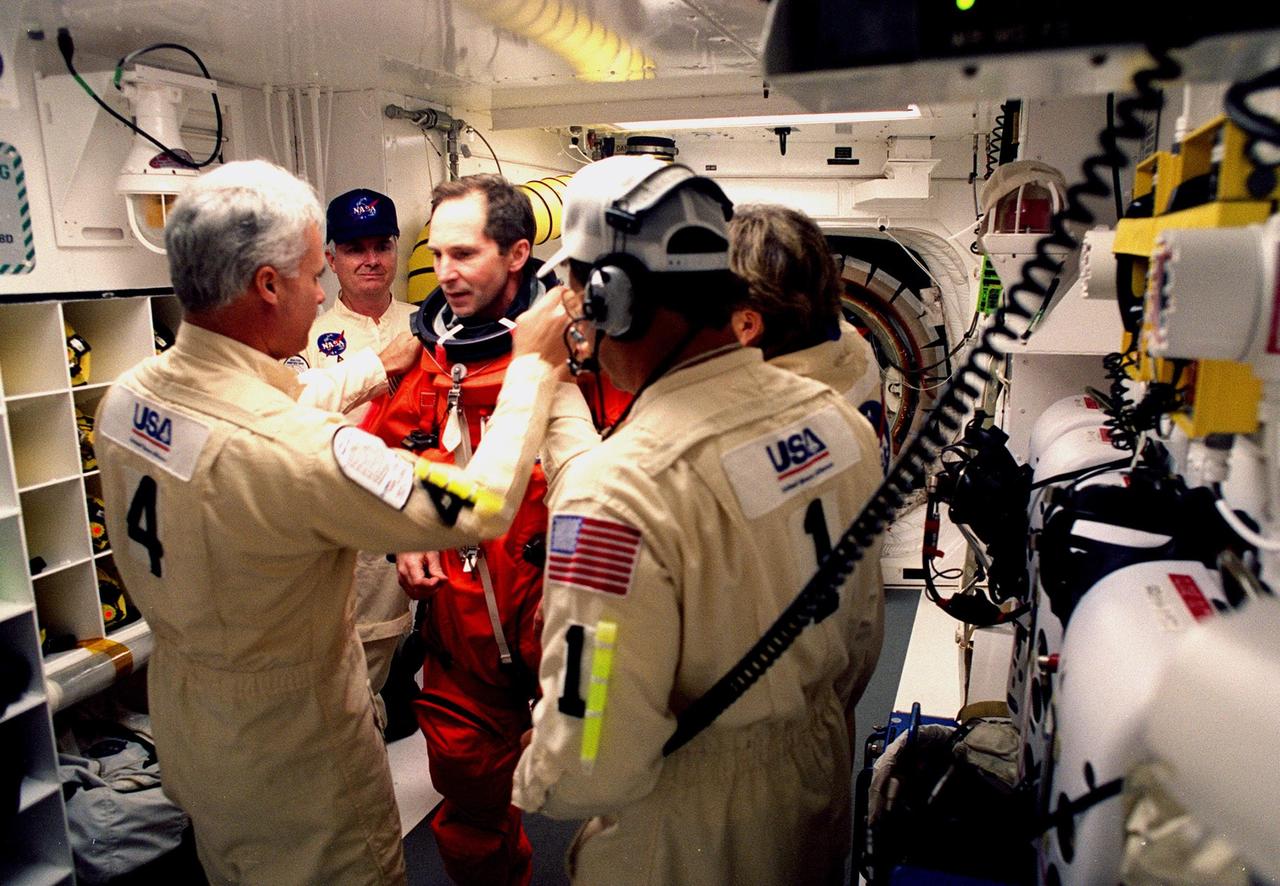
Before entering the orbiter Discovery, STS-96 Mission Specialist Valery Ivanovich Tokarev (center) is checked out by white room closeout crew members Mechanical Technician Chris Meinert and Quality Assurance Specialist Jim Davis on the left, and Closeout Chief Travis Thompson and Suit Technician Jean Alexander on the right. The white room is an environmental chamber at the end of the orbiter access arm that provides entry to the orbiter crew compartment. STS-96 is a 10-day logistics and resupply mission for the International Space Station, carrying about 4,000 pounds of supplies, to be stored aboard the station for use by future crews, including laptop computers, cameras, tools, spare parts, and clothing. The mission also includes such payloads as a Russian crane, the Strela; a U.S.-built crane; the Spacehab Oceaneering Space System Box (SHOSS), a logistics items carrier; and STARSHINE, a student-involved experiment. It will include a space walk to attach the cranes to the outside of the ISS for use in future construction. Space Shuttle Discovery is due to launch today at 6:49 a.m. EDT. Landing is expected at the SLF on June 6 about 1:58 a.m. EDT
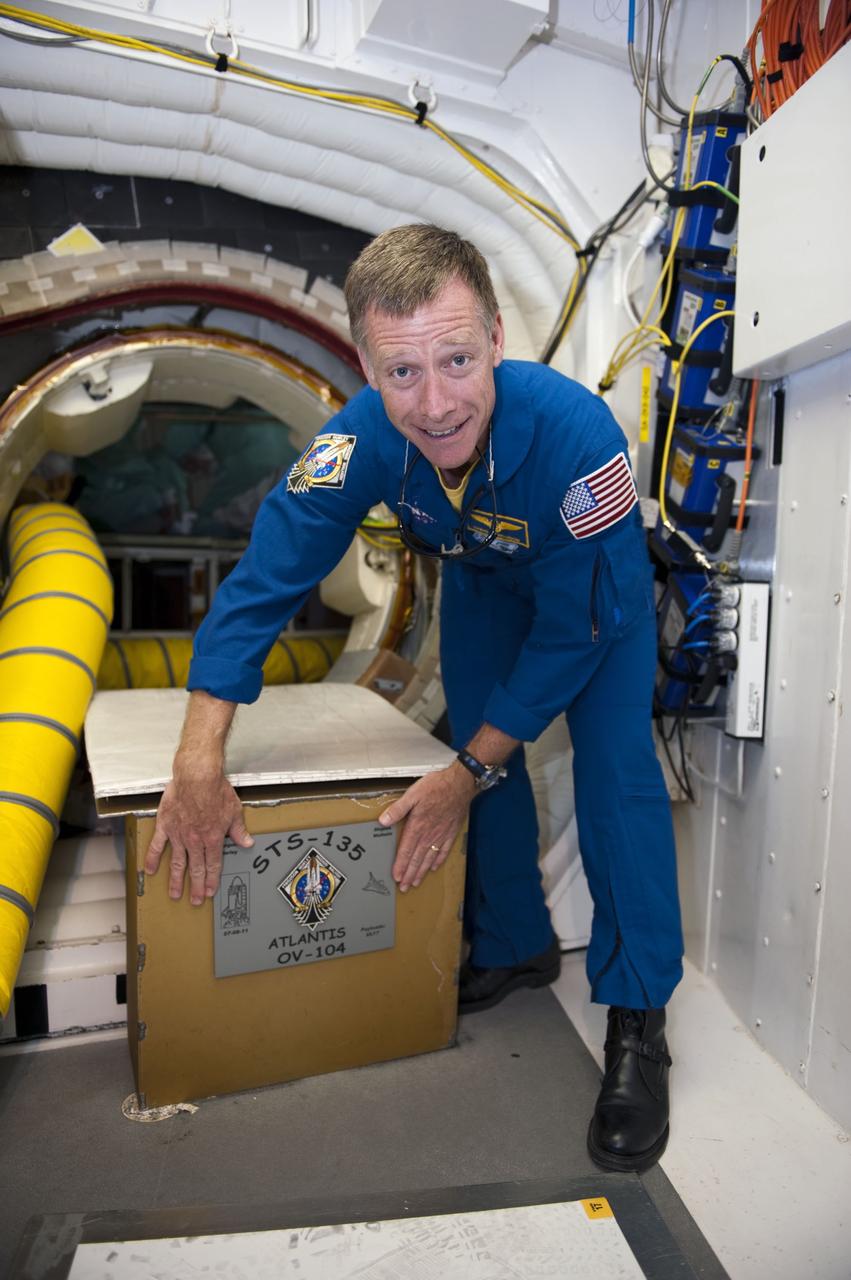
CAPE CANAVERAL, Fla. -- STS-135 Commander Chris Ferguson places a plaque in front of space shuttle Atlantis' hatch in the White Room at NASA Kennedy Space Center's Launch Pad 39A. An access arm supports the White Room that is in place against the shuttle which provides entry to the crew compartment. The astronauts are at Kennedy to participate in a launch countdown dress rehearsal called the Terminal Countdown Demonstration Test (TCDT) and related training. Atlantis and its crew are targeted to lift off July 8, taking with them the Raffaello multi-purpose logistics module packed with supplies and spare parts to the International Space Station. The STS-135 mission also will fly a system to investigate the potential for robotically refueling existing satellites and return a failed ammonia pump module to help NASA better understand the failure mechanism and improve pump designs for future systems. STS-135 will be the 33rd flight of Atlantis, the 37th shuttle mission to the space station, and the 135th and final mission of NASA's Space Shuttle Program. For more information visit, www.nasa.gov/mission_pages/shuttle/shuttlemissions/sts135/index.html. Photo credit: NASA/Kim Shiflett
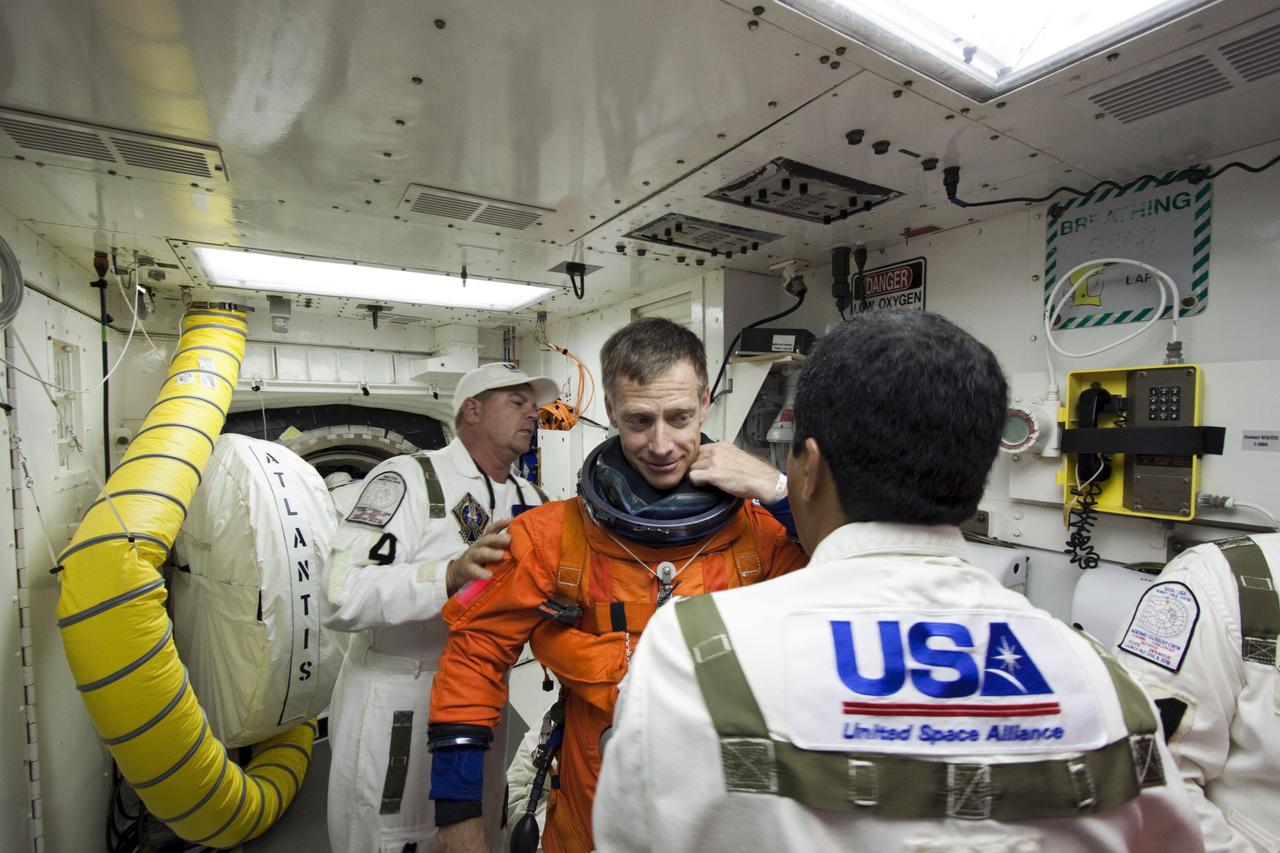
CAPE CANAVERAL, Fla. -- In the White Room at Launch Pad 39A at NASA's Kennedy Space Center in Florida, STS-135 Commander Chris Ferguson prepares to board space shuttle Atlantis through the crew hatch in the background. Members of the Closeout Crew, in white uniforms, are there to assist astronauts with their launch-and-entry suits and the boarding process. The STS-135 crew members are at the pad to participate in a launch countdown simulation exercise. As part of the Terminal Countdown Demonstration Test (TCDT), the crew members are strapped into their seats on Atlantis to practice the steps that will be taken on launch day. Shuttle Atlantis and its crew are targeted to lift off July 8, taking with them the Raffaello multi-purpose logistics module packed with supplies and spare parts to the International Space Station. The STS-135 mission also will fly a system to investigate the potential for robotically refueling existing satellites and return a failed ammonia pump module to help NASA better understand the failure mechanism and improve pump designs for future systems. STS-135 will be the 33rd flight of Atlantis, the 37th shuttle mission to the space station, and the 135th and final mission of NASA's Space Shuttle Program. For more information visit, www.nasa.gov/mission_pages/shuttle/shuttlemissions/sts135/index.html. Photo credit: NASA/Jim Grossmann
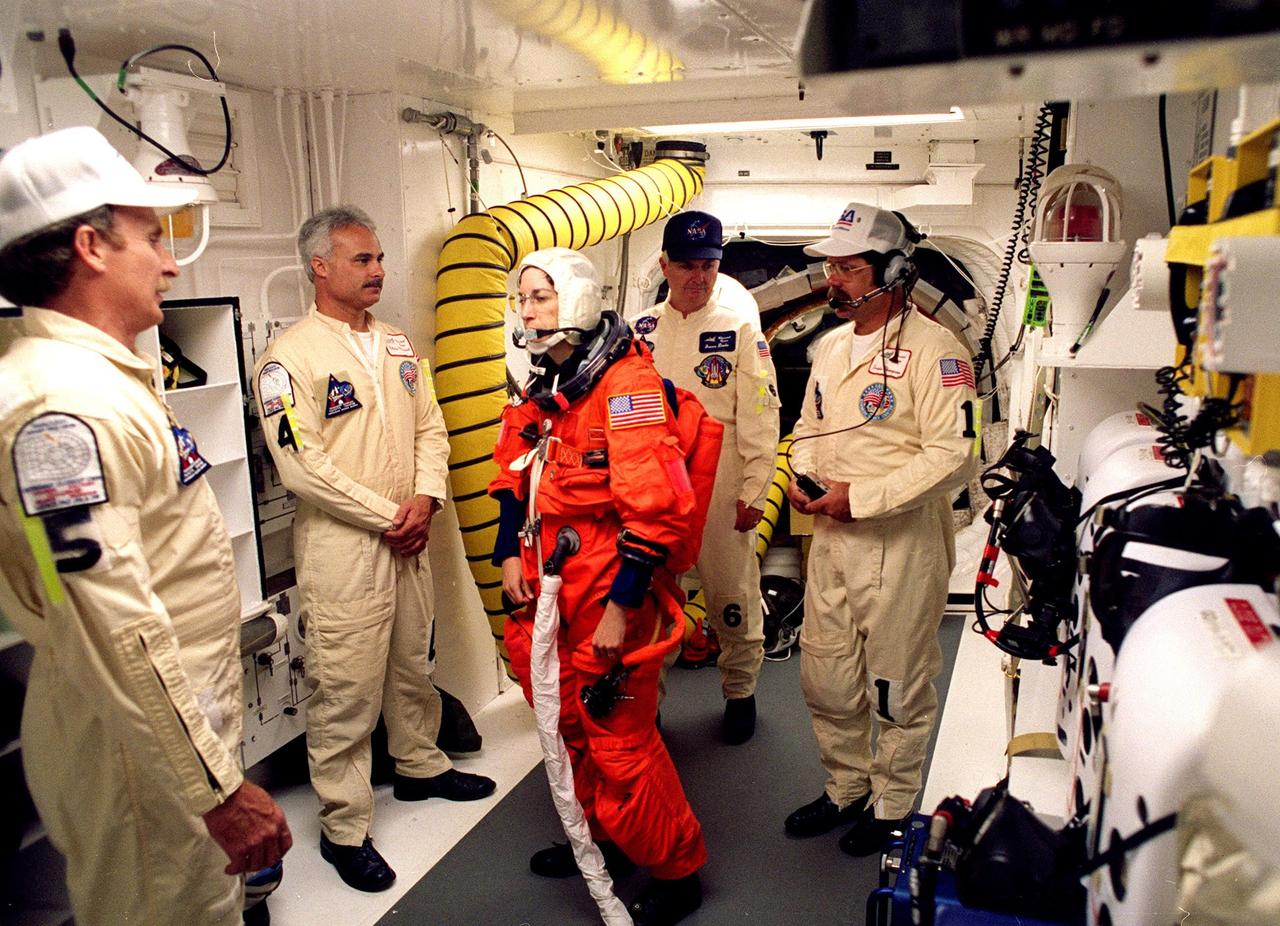
STS-96 Mission Specialist Ellen Ochoa chats with white room closeout crew members while being checked out for entry into the orbiter Discovery. At left are Mechanical Technicians Al Schmidt and Chris meinert; at right is Quality Assurance Specialist James Davis and Closeout Chief Travis Thompson. The white room is an environmental chamber at the end of the orbiter access arm that provides entry to the orbiter crew compartment. STS-96 is a 10-day logistics and resupply mission for the International Space Station, carrying about 4,000 pounds of supplies, to be stored aboard the station for use by future crews, including laptop computers, cameras, tools, spare parts, and clothing. The mission also includes such payloads as a Russian crane, the Strela; a U.S.-built crane; the Spacehab Oceaneering Space System Box (SHOSS), a logistics items carrier; and STARSHINE, a student-involved experiment. It will include a space walk to attach the cranes to the outside of the ISS for use in future construction. Space Shuttle Discovery is due to launch today at 6:49 a.m. EDT. Landing is expected at the SLF on June 6 about 1:58 a.m. EDT
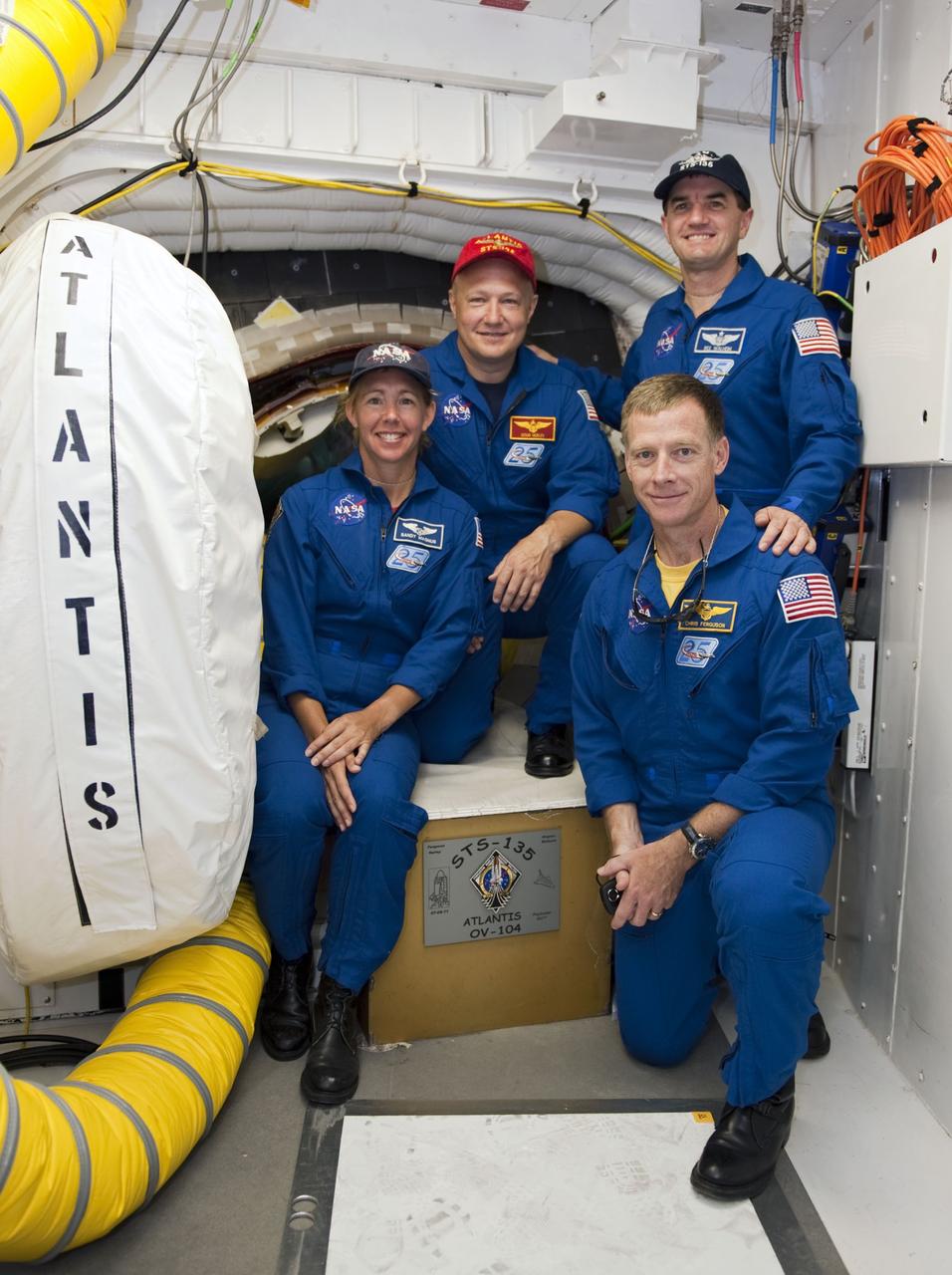
CAPE CANAVERAL, Fla. -- At Launch Pad 39A at NASA's Kennedy Space Center in Florida, the STS-135 crew pose for a group portrait in front of space shuttle Atlantis' hatch in the pad's White Room. From left are Mission Specialist Sandy Magnus, Pilot Doug Hurley, Mission Specialist Rex Walheim and Commander Chris Ferguson. An access arm supports the White Room that is in place against the shuttle which provides entry to the crew compartment. The astronauts are at Kennedy to participate in a launch countdown dress rehearsal called the Terminal Countdown Demonstration Test (TCDT) and related training. Atlantis and its crew are targeted to lift off July 8, taking with them the Raffaello multi-purpose logistics module packed with supplies and spare parts to the International Space Station. The STS-135 mission also will fly a system to investigate the potential for robotically refueling existing satellites and return a failed ammonia pump module to help NASA better understand the failure mechanism and improve pump designs for future systems. STS-135 will be the 33rd flight of Atlantis, the 37th shuttle mission to the space station, and the 135th and final mission of NASA's Space Shuttle Program. For more information visit, www.nasa.gov/mission_pages/shuttle/shuttlemissions/sts135/index.html. Photo credit: NASA/Kim Shiflett
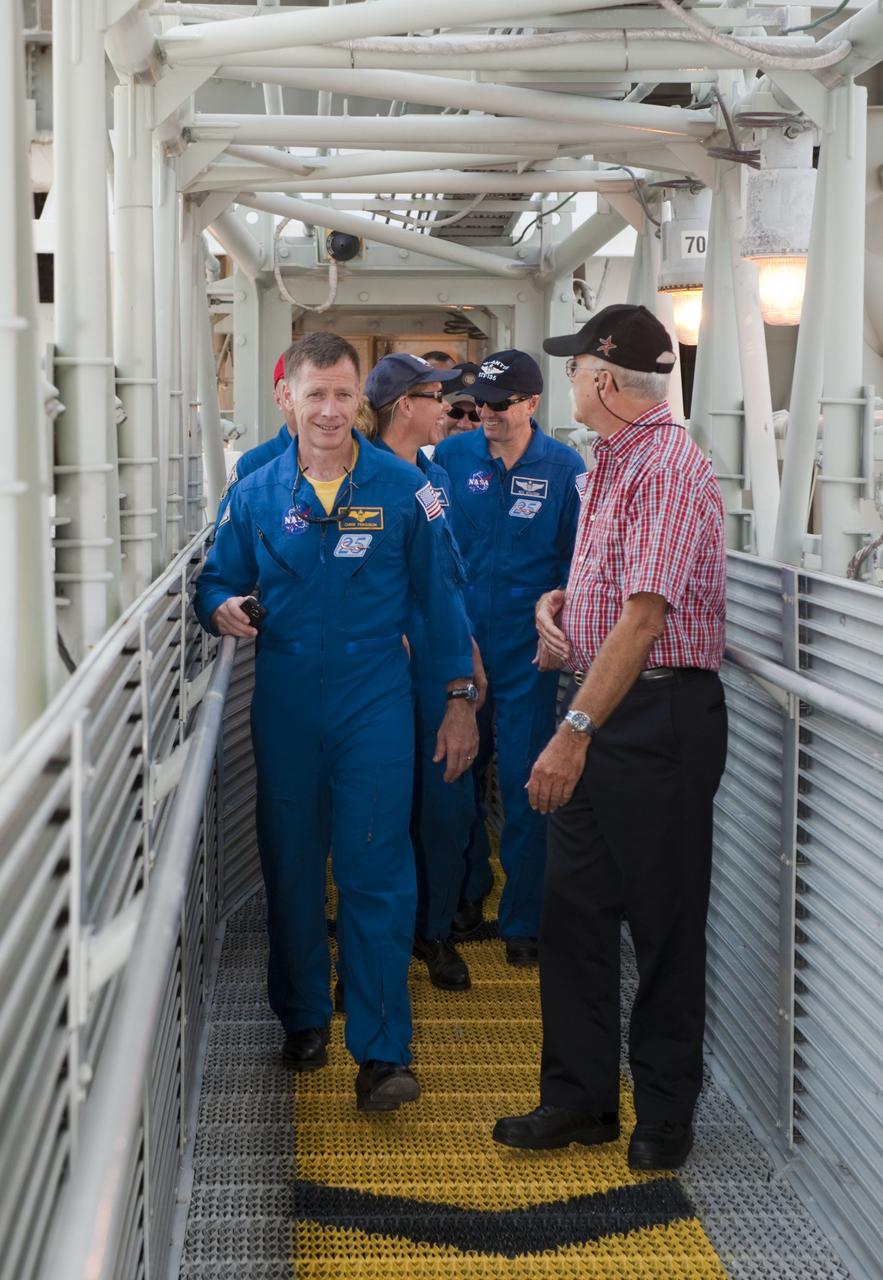
CAPE CANAVERAL, Fla. -- At Launch Pad 39A at NASA's Kennedy Space Center in Florida, the STS-135 crew walk along the White Room's access arm. From left are Commander Chris Ferguson, Pilot Doug Hurley (obstructed), Mission Specialists Sandy Magnus and Rex Walheim. The access arm supports the White Room that is in place against the shuttle which provides entry to the crew compartment. The astronauts are at Kennedy to participate in a launch countdown dress rehearsal called the Terminal Countdown Demonstration Test (TCDT) and related training. Atlantis and its crew are targeted to lift off July 8, taking with them the Raffaello multi-purpose logistics module packed with supplies and spare parts to the International Space Station. The STS-135 mission also will fly a system to investigate the potential for robotically refueling existing satellites and return a failed ammonia pump module to help NASA better understand the failure mechanism and improve pump designs for future systems. STS-135 will be the 33rd flight of Atlantis, the 37th shuttle mission to the space station, and the 135th and final mission of NASA's Space Shuttle Program. For more information visit, www.nasa.gov/mission_pages/shuttle/shuttlemissions/sts135/index.html. Photo credit: NASA/Kim Shiflett
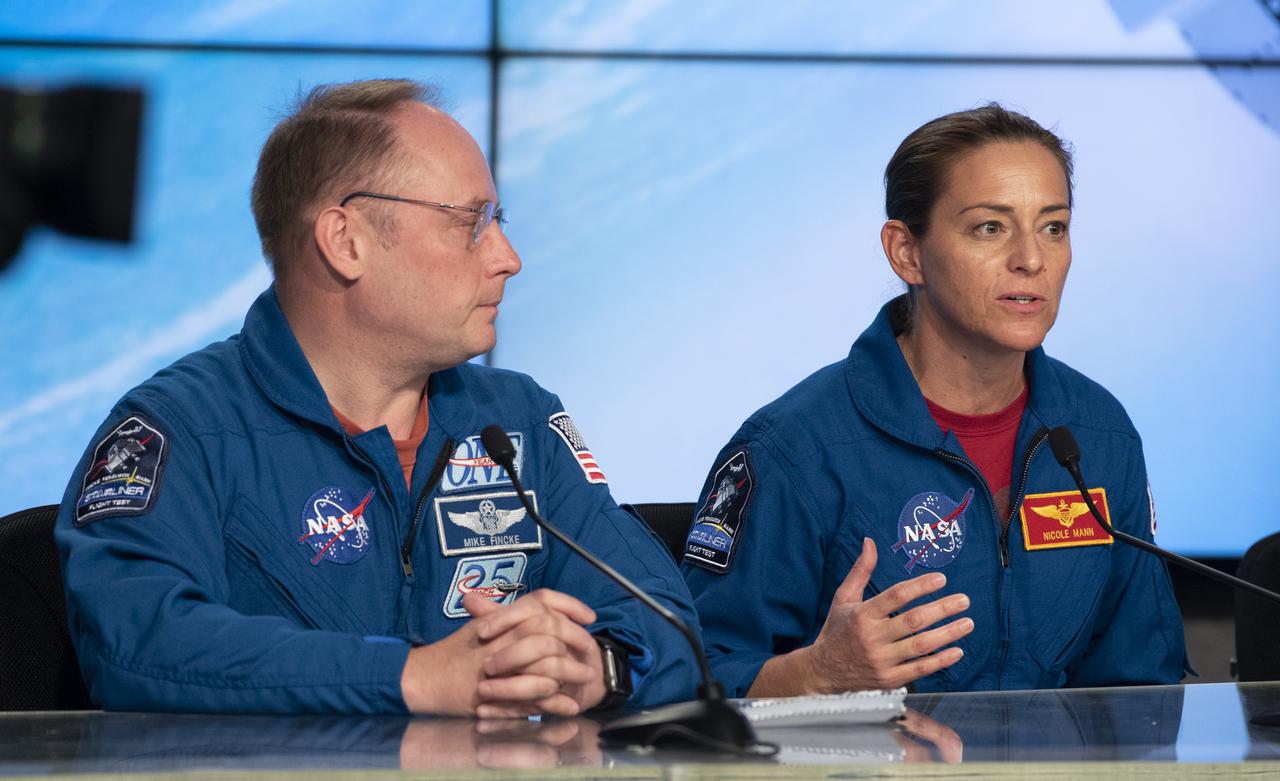
NASA astronauts Michael Fincke, left, and Nicole Mann, right, are seen during a press conference at NASA's Kennedy Space Center following the launch of Boeing’s Starliner spacecraft onboard a United Launch Alliance Atlas V rocket, Friday, Dec. 20, 2019, at Cape Canaveral Air Force Station in Florida. After a successful launch at 6:36 a.m. EST, Boeing’s CST-100 Starliner is in an unplanned, but stable orbit. The team is assessing what test objectives can be achieved before the spacecraft’s return to land in White Sands, New Mexico. Fincke and Mann are assigned to fly on Starliner’s Crew Flight Test along with Boeing astronaut Chris Ferguson. Photo Credit: (NASA/Joel Kowsky)
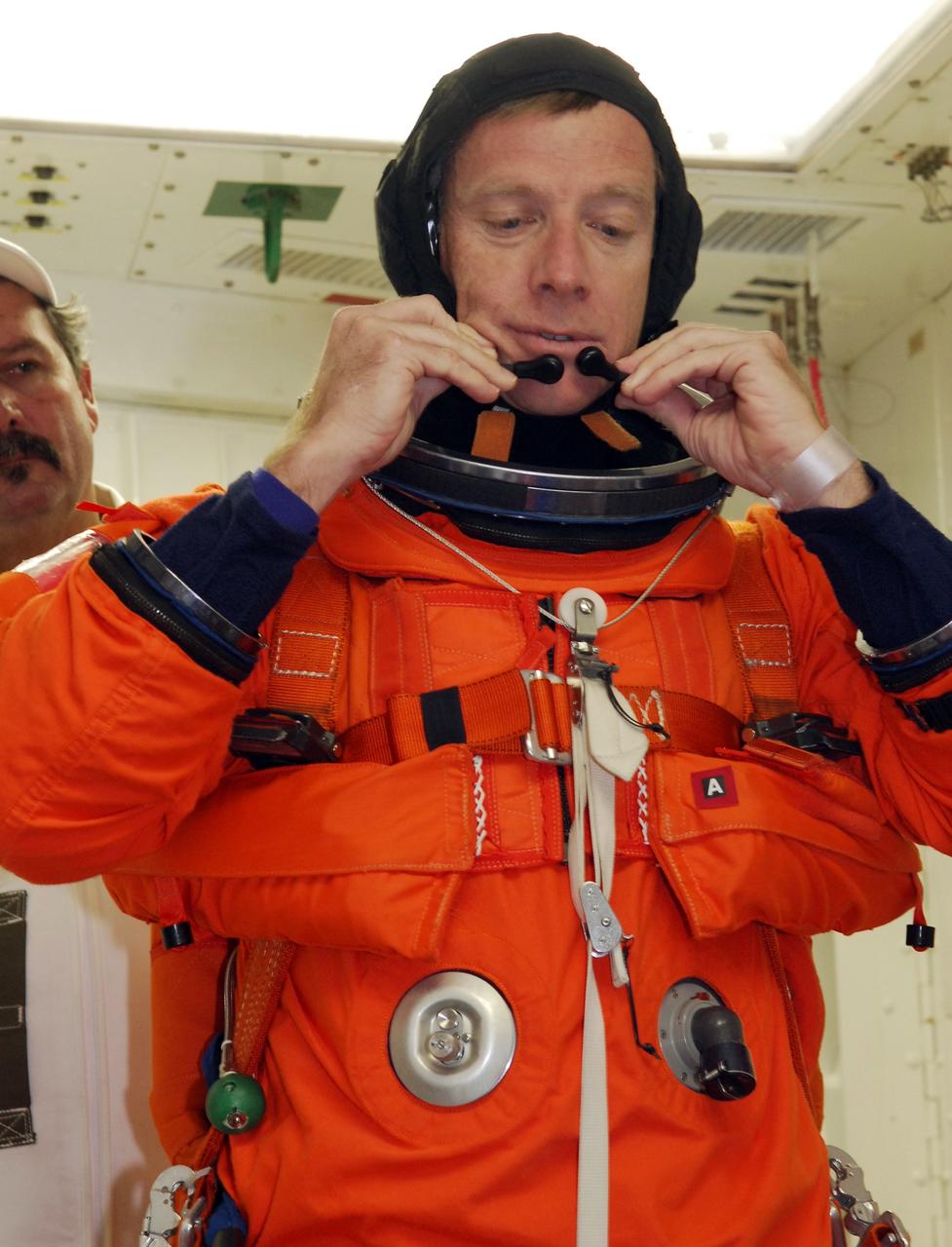
CAPE CANAVERAL, Fla. – In the White Room on Launch Pad 39A at NASA's Kennedy Space Center in Florida, STS-126 Commander Chris Ferguson adjusts his headset before donning his helmet. He will enter space shuttle Endeavour to take part in a simulated launch countdown with the other crew members. The crew is at Kennedy to take part in the Terminal Countdown Demonstration Test, which includes equipment familiarization, emergency exit training and the simulated countdown. On the STS-126 mission, space shuttle Endeavour's crew will deliver equipment and supplies to the International Space Station in preparation for expansion from a three- to six-person resident crew aboard the complex. The mission also will include four spacewalks to service the station’s Solar Alpha Rotary Joints. Endeavour is targeted to launch Nov. 14. Photo credit: NASA/Troy Cryder
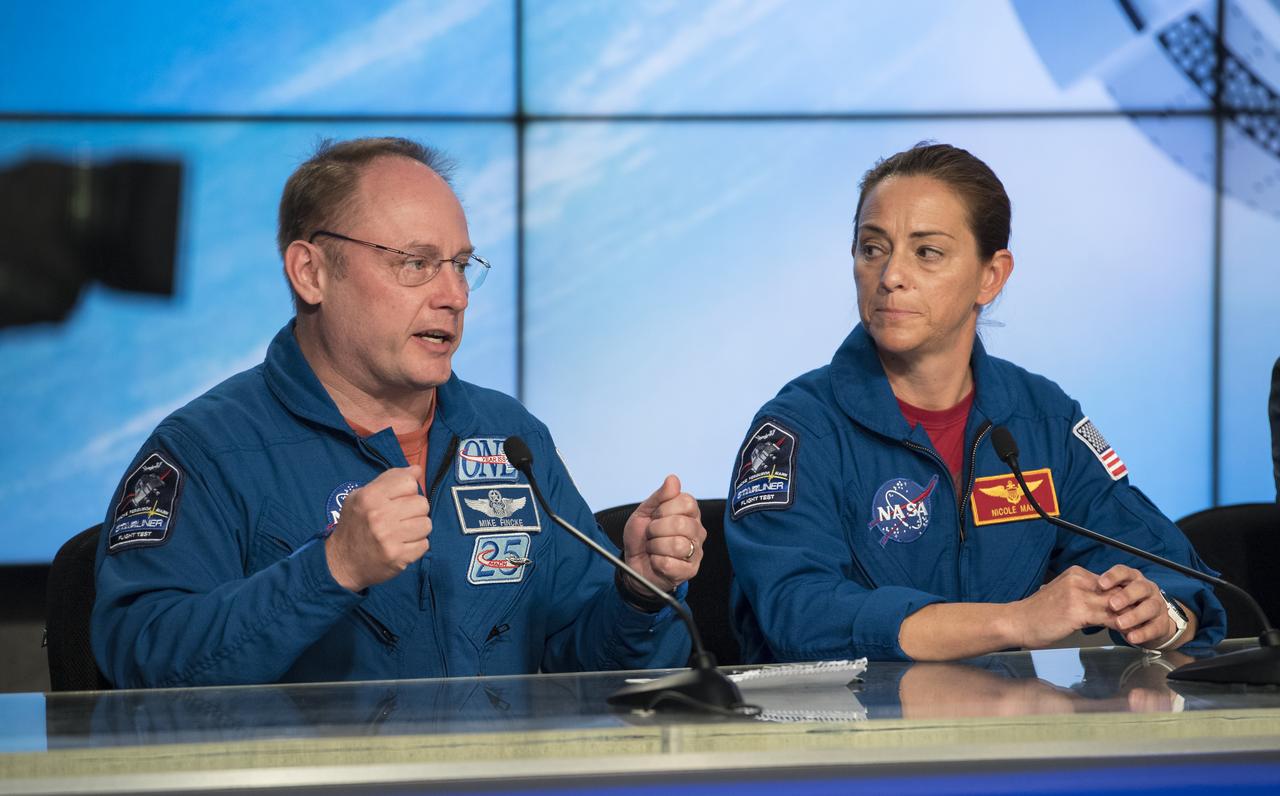
NASA astronauts Michael Fincke, left, and Nicole Mann, right, are seen during a press conference at NASA's Kennedy Space Center following the launch of Boeing’s Starliner spacecraft onboard a United Launch Alliance Atlas V rocket, Friday, Dec. 20, 2019, at Cape Canaveral Air Force Station in Florida. After a successful launch at 6:36 a.m. EST, Boeing’s CST-100 Starliner is in an unplanned, but stable orbit. The team is assessing what test objectives can be achieved before the spacecraft’s return to land in White Sands, New Mexico. Fincke and Mann are assigned to fly on Starliner’s Crew Flight Test along with Boeing astronaut Chris Ferguson. Photo Credit: (NASA/Joel Kowsky)
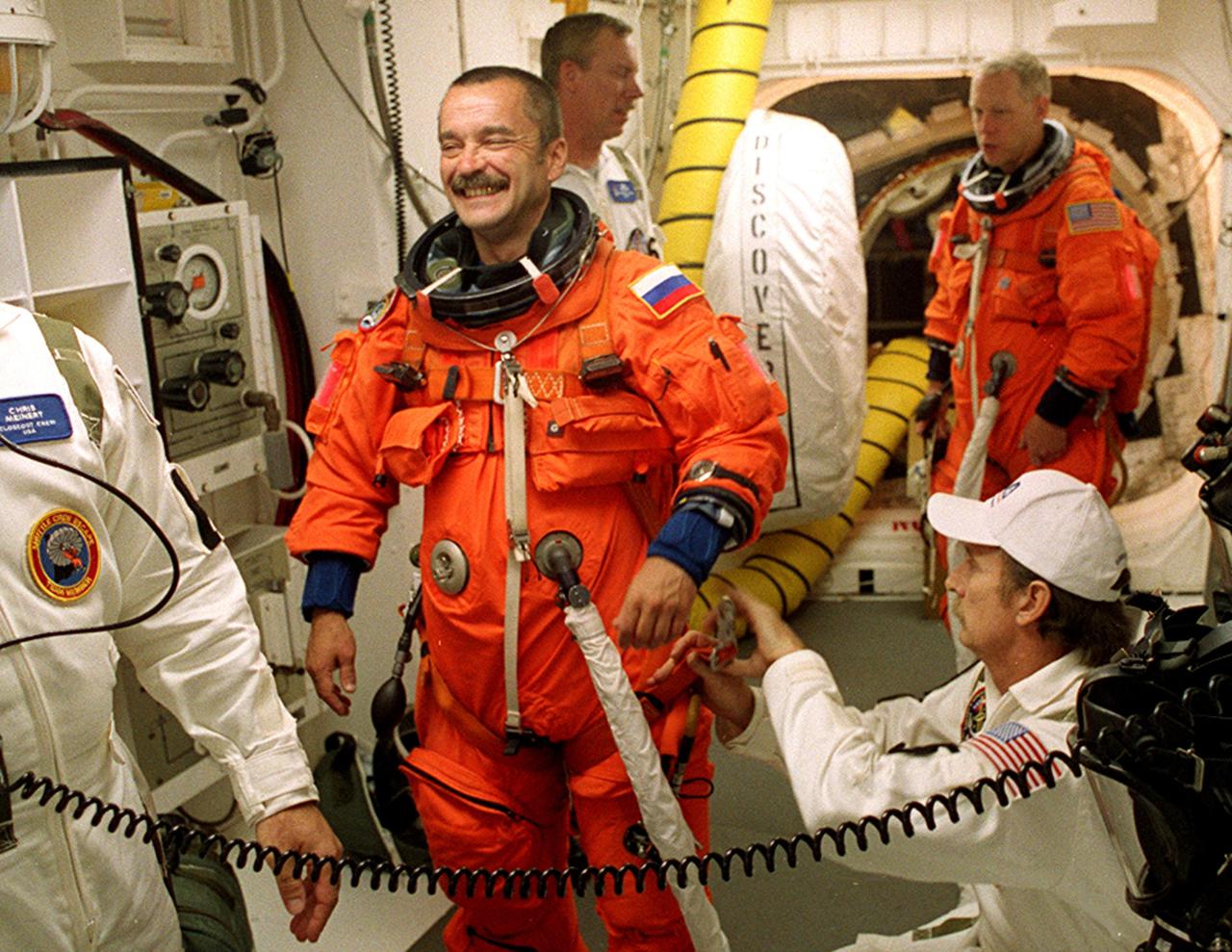
KENNEDY SPACE CENTER, Fla. - In the White Room, Launch Pad 39A, Expedition Three crew member Mikhail Tyurin is assisted with his flight equipment before entering Space Shuttle Discovery for launch. With him are (left) Orbiter Vehicle Closeout Chief Chris Meinert and USA Mechanical Technician Al Schmidt. In the background is STS-105 Mission Specialist Patrick Forrester. The payload on the STS-105 mission to the International Space Station the third flight of the Italian-built Multi-Purpose Logistics Module Leonardo, delivering additional scientific racks, equipment and supplies for the Space Station, and the Early Ammonia Servicer (EAS) tank. The EAS, which will be attached to the Station during two spacewalks, contains spare ammonia for the Station’s cooling system. Also, the Expedition Three crew is aboard to replace the Expedition Two crew on the International Space Station, who will be returning to Earth aboard Discovery after a five-month stay on the Station
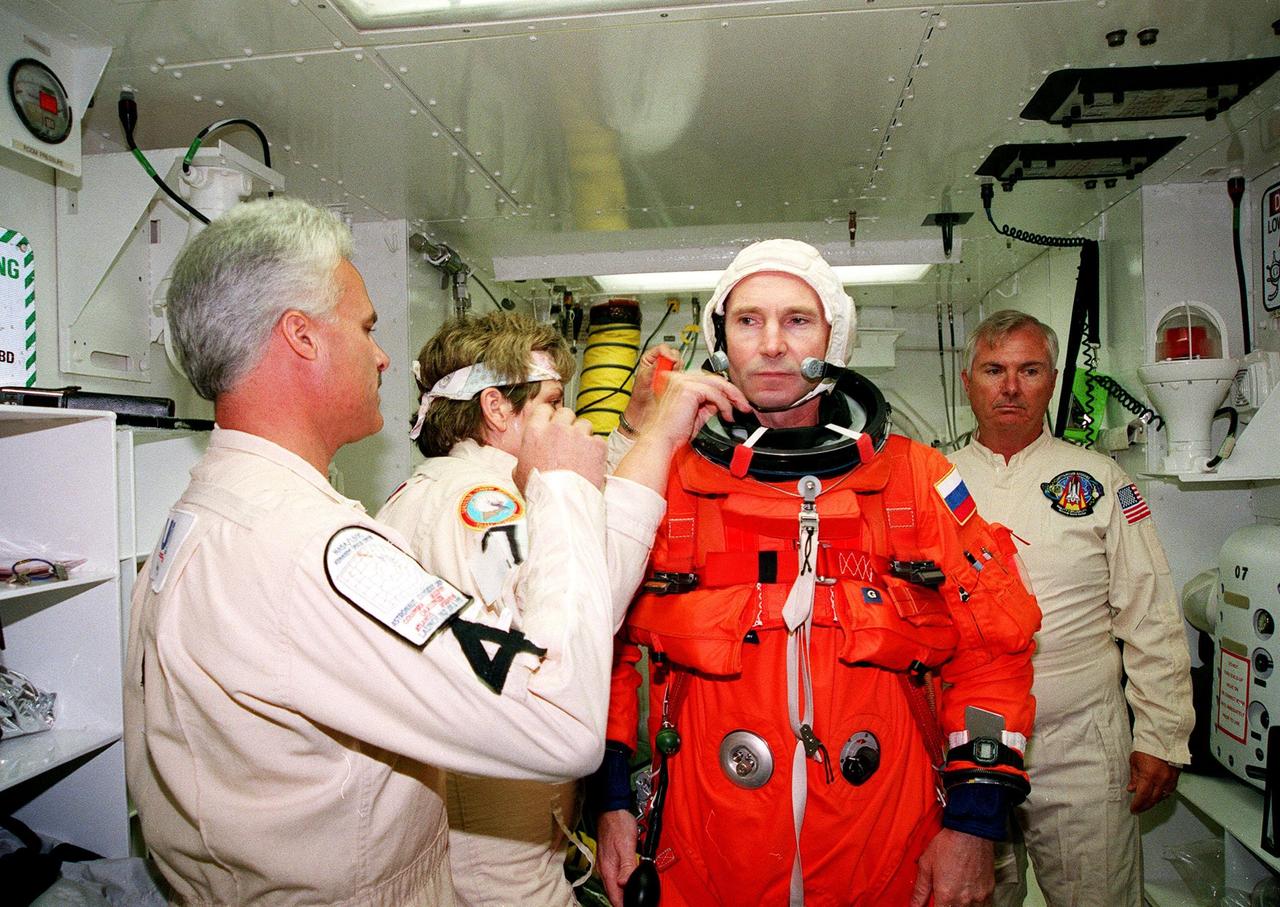
In the white room, an environmental chamber, at Launch Pad 39B, STS-96 Mission Specialist Valery Ivanovich Tokarev, with the Russian Space Agency, gets help with equipment from Chris Menard, Jean Alexander and James Davis before entering the orbiter Discovery at Launch Pad 39B. The crew are taking part in Terminal Countdown Demonstration Test (TCDT) activities, which provide opportunities to inspect the mission payloads in the orbiter's payload bay, as well as simulated countdown exercises and emergency egress training. STS-96, scheduled for liftoff on May 20 at 9:32 a.m., is a logistics and resupply mission for the International Space Station, carrying such payloads as a Russian crane, the Strela; a U.S.-built crane; the Spacehab Oceaneering Space System Box (SHOSS), a logistics items carrier; and STARSHINE, a student-led experiment
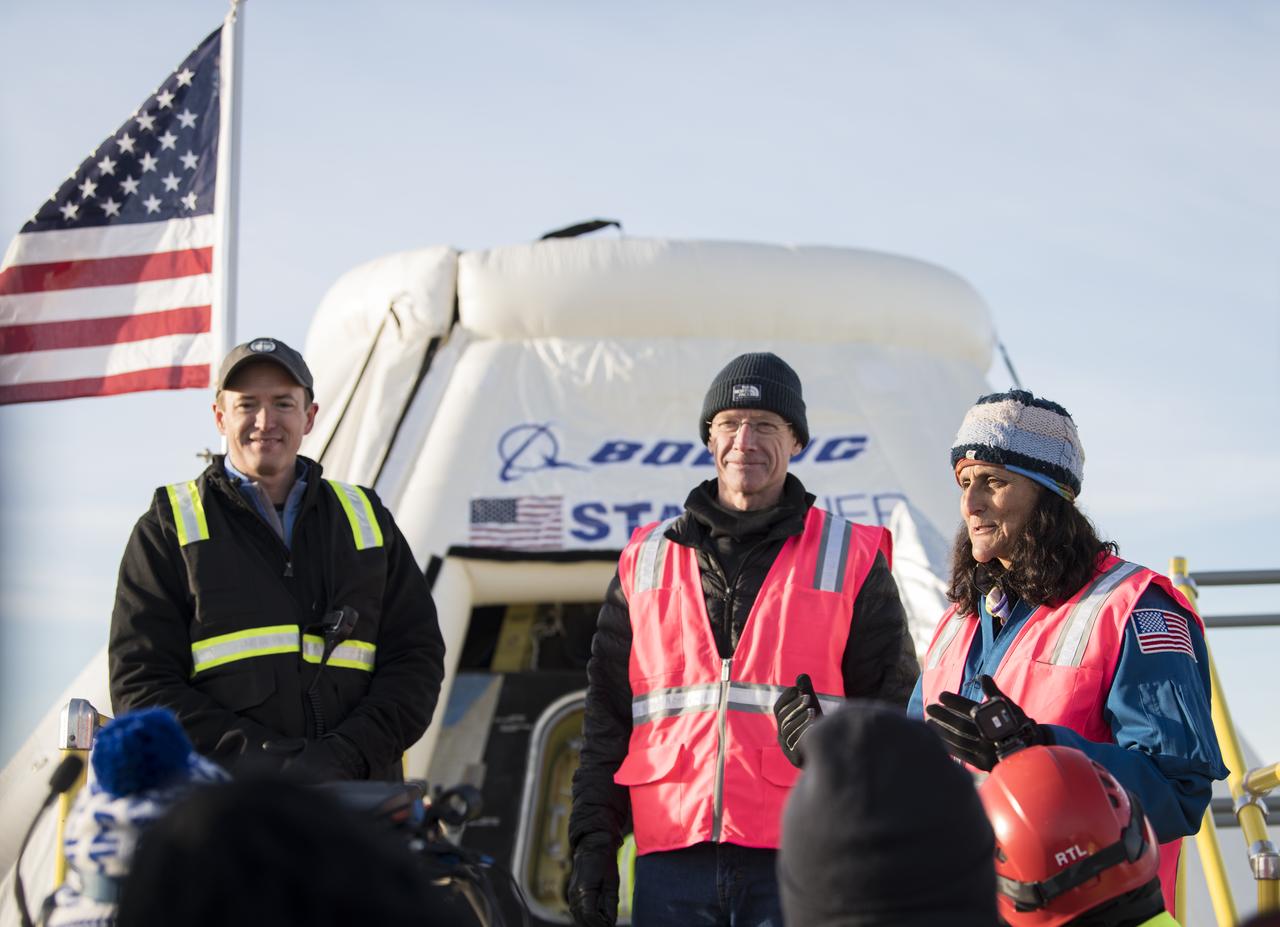
NASA astronaut, Suni Williams, who will command the first manned launch of the capsule, names the Boeing CST-100 Starliner spacecraft, Calypso, after it landed in White Sands, New Mexico, Sunday, Dec. 22, 2019. The landing completes an abbreviated Orbital Flight Test for the company that still meets several mission objectives for NASA’s Commercial Crew program. The Starliner spacecraft launched on a United Launch Alliance Atlas V rocket at 6:36 a.m. Friday, Dec. 20 from Space Launch Complex 41 at Cape Canaveral Air Force Station in Florida. Photo Credit: (NASA/Aubrey Gemignani)
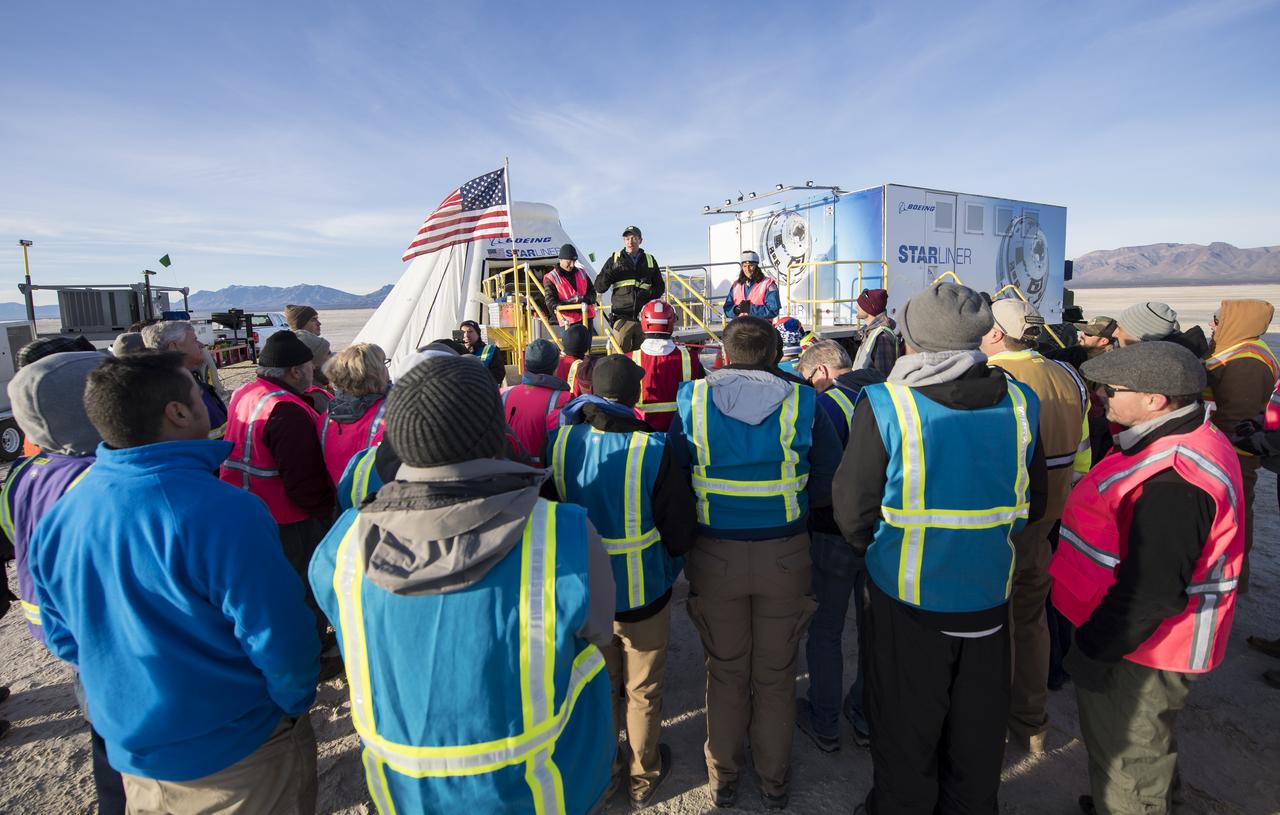
Louis Atchison, chief of launch and recovery operations, Boeing Commercial Crew Program, speaks to the teams from NASA, Boeing, and the White Sands Missile Range, after the Boeing CST-100 Starliner spacecraft landed in White Sands, New Mexico, Sunday, Dec. 22, 2019. The landing completes an abbreviated Orbital Flight Test for the company that still meets several mission objectives for NASA’s Commercial Crew program. The Starliner spacecraft launched on a United Launch Alliance Atlas V rocket at 6:36 a.m. Friday, Dec. 20 from Space Launch Complex 41 at Cape Canaveral Air Force Station in Florida. Photo Credit: (NASA/Aubrey Gemignani)
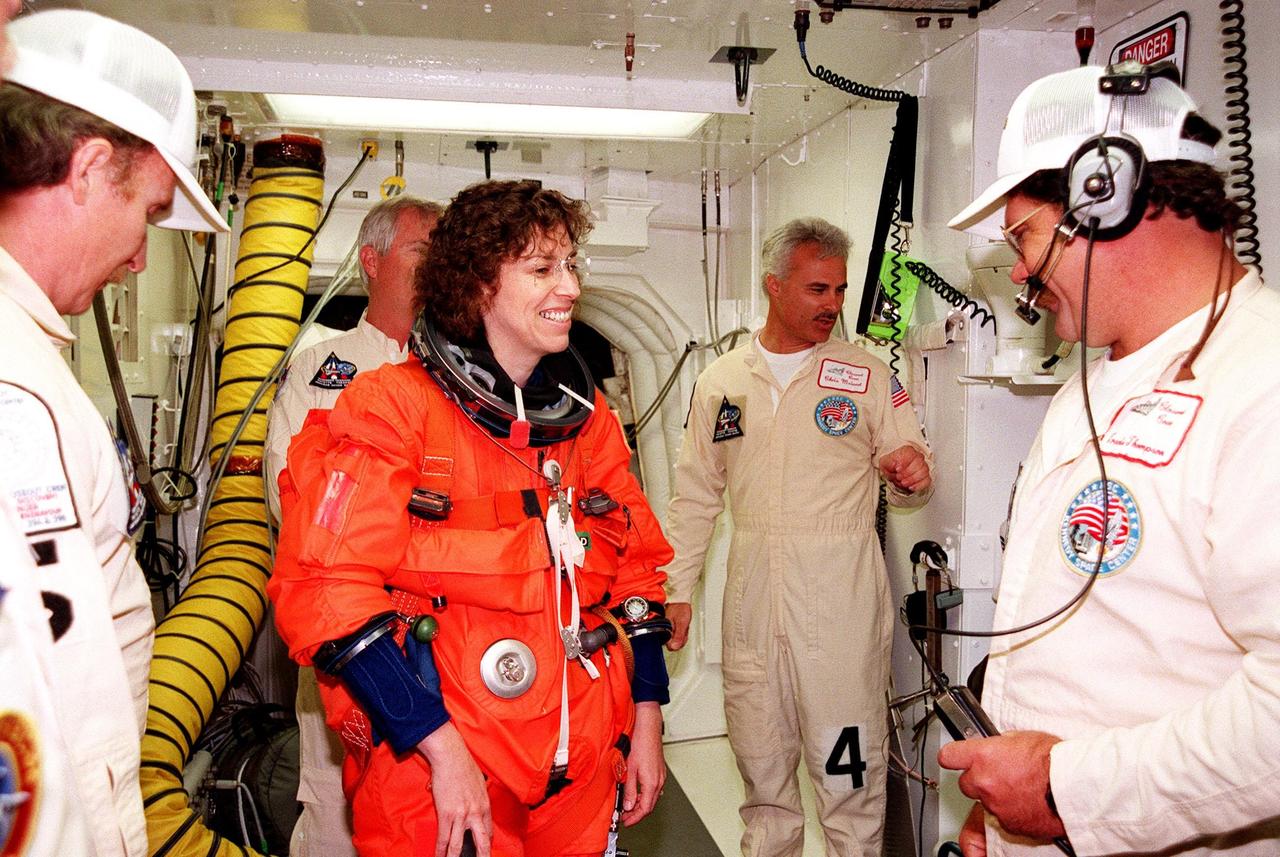
In the white room, an environmental chamber at Launch Pad 39B, Mission Specialist Ellen Ochoa (Ph.D.) gets help with her equipment from Al Schmidt, Chris Menard and Travis Thompson before she enters the orbiter Discovery. The STS-96 crew are taking part in Terminal Countdown Demonstration Test (TCDT) activities, which provide opportunities to inspect the mission payloads in the orbiter's payload bay, as well as simulated countdown exercises and emergency egress training. Other crew members are Commander Kent V. Rominger, Pilot Rick Douglas Husband, and Mission Specialists Tamara E. Jernigan (Ph.D.), Daniel Barry (M.D., Ph.D.), Julie Payette, who is with the Canadian Space Agency, and Valery Ivanovich Tokarev, who is with the Russian Space Agency. STS-96, scheduled for liftoff on May 20 at 9:32 a.m., is a logistics and resupply mission for the International Space Station, carrying such payloads as a Russian crane, the Strela; a U.S.-built crane; the Spacehab Oceaneering Space System Box (SHOSS), a logistics items carrier; and STARSHINE, a student-led experiment

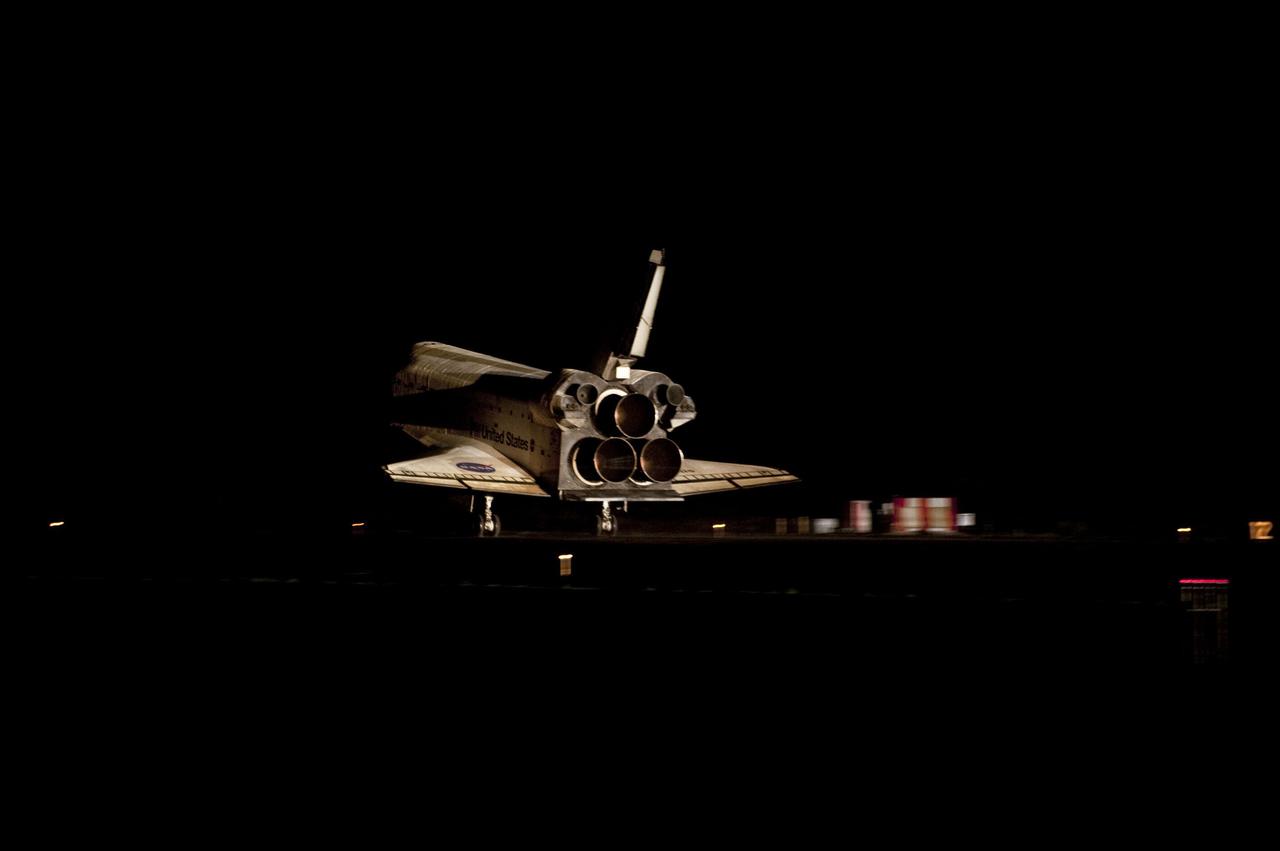
STS135-S-175 (21 July 2011) --- Space shuttle Atlantis' bright-white, iconic frame illuminates the darkness as it touches down on the Shuttle Landing Facility's Runway 15 at NASA's Kennedy Space Center in Florida for the final time. Securing the space shuttle fleet's place in history, Atlantis marked the 26th nighttime landing of NASA's Space Shuttle Program and the 78th landing at Kennedy. Main gear touchdown was at 5:57:00 a.m. (EDT) on July 21, 2011, followed by nose gear touchdown at 5:57:20 a.m., and wheelstop at 5:57:54 a.m. Onboard are NASA astronauts Chris Ferguson, STS-135 commander; Doug Hurley, pilot; Sandy Magnus and Rex Walheim, both mission specialists. On the 37th shuttle mission to the International Space Station, STS-135 delivered more than 9,400 pounds of spare parts, equipment and supplies in the Raffaello multi-purpose logistics module that will sustain station operations for the next year. STS-135 was the 33rd and final flight for Atlantis, which has spent 307 days in space, orbited Earth 4,848 times and traveled 125,935,769 miles. Photo credit: NASA
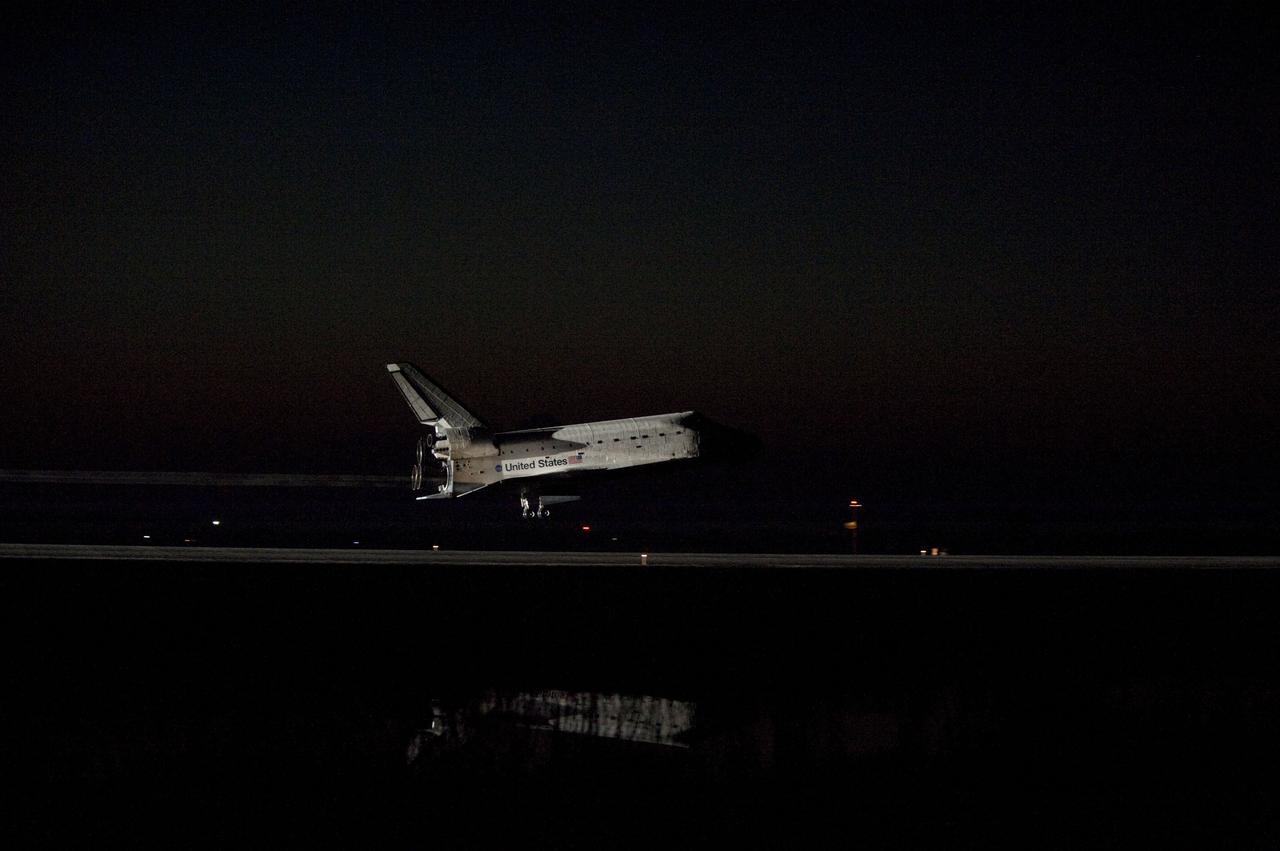
CAPE CANAVERAL, Fla. -- Space shuttle Atlantis' bright-white, iconic frame illuminates the darkness as it touches down on the Shuttle Landing Facility's Runway 15 at NASA's Kennedy Space Center in Florida for the final time. Securing the space shuttle fleet's place in history, Atlantis marked the 26th nighttime landing of NASA's Space Shuttle Program and the 78th landing at Kennedy. Main gear touchdown was at 5:57:00 a.m. EDT, followed by nose gear touchdown at 5:57:20 a.m., and wheelstop at 5:57:54 a.m. On board are STS-135 Commander Chris Ferguson, Pilot Doug Hurley, and Mission Specialists Sandra Magnus and Rex Walheim. On the 37th shuttle mission to the International Space Station, STS-135 delivered more than 9,400 pounds of spare parts, equipment and supplies in the Raffaello multi-purpose logistics module that will sustain station operations for the next year. STS-135 was the 33rd and final flight for Atlantis, which has spent 307 days in space, orbited Earth 4,848 times and traveled 125,935,769 miles. For more information visit, www.nasa.gov/mission_pages/shuttle/shuttlemissions/sts135/index.html. Photo credit: NASA/Sandra Joseph
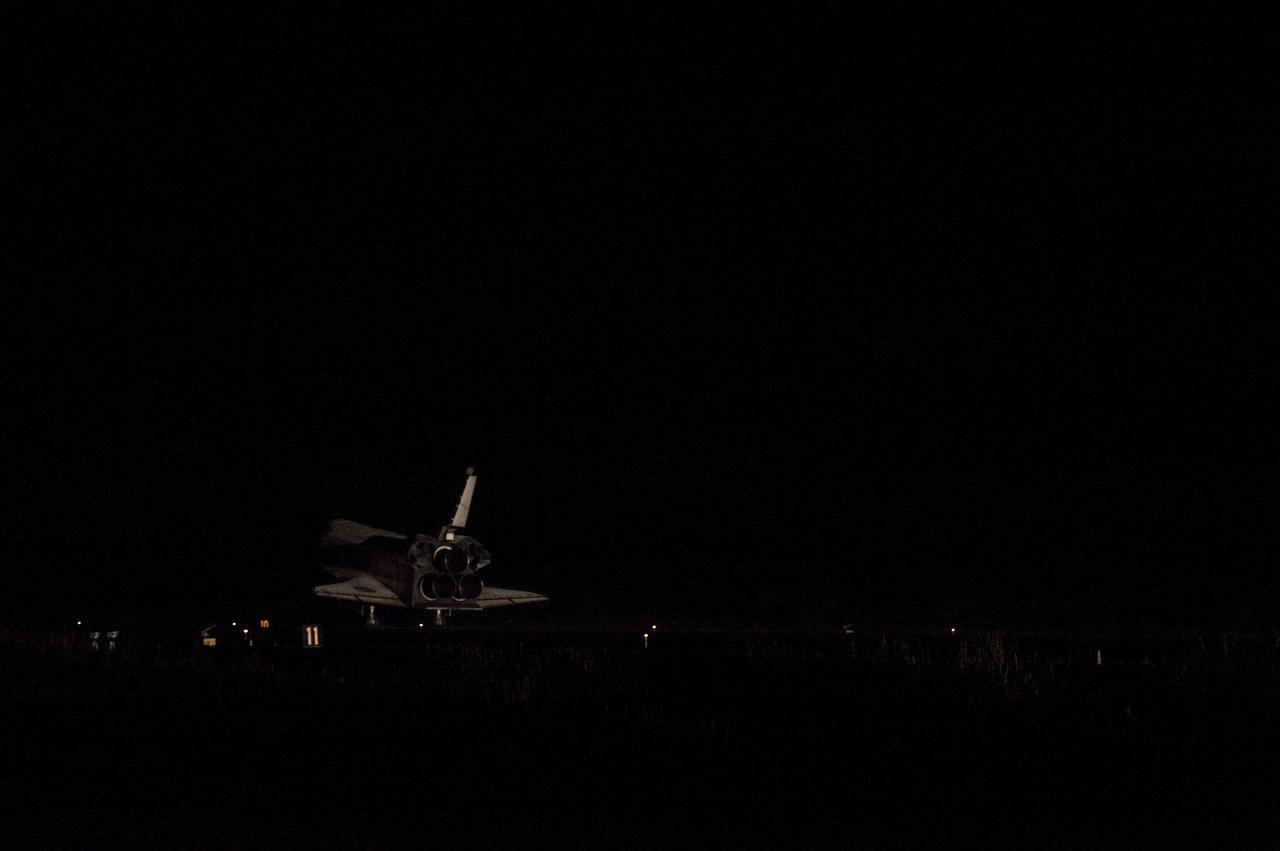
STS135-S-224 (21 July 2011) --- Space shuttle Atlantis' bright-white, iconic frame appears from the darkness at it touches down on the Shuttle Landing Facility's Runway 15 at NASA's Kennedy Space Center in Florida for the final time. Securing the space shuttle fleet's place in history, Atlantis marked the 26th nighttime landing of NASA's Space Shuttle Program and the 78th landing at Kennedy. Main gear touchdown was at 5:57:00 a.m. (EDT) on July 21, 2011, followed by nose gear touchdown at 5:57:20 a.m., and wheelstop at 5:57:54 a.m. Onboard are NASA astronauts Chris Ferguson, STS-135 commander; Doug Hurley, pilot; Sandy Magnus and Rex Walheim, both mission specialists. On the 37th shuttle mission to the International Space Station, STS-135 delivered more than 9,400 pounds of spare parts, equipment and supplies in the Raffaello multi-purpose logistics module that will sustain station operations for the next year. STS-135 was the 33rd and final flight for Atlantis, which has spent 307 days in space, orbited Earth 4,848 times and traveled 125,935,769 miles. Photo credit: NASA
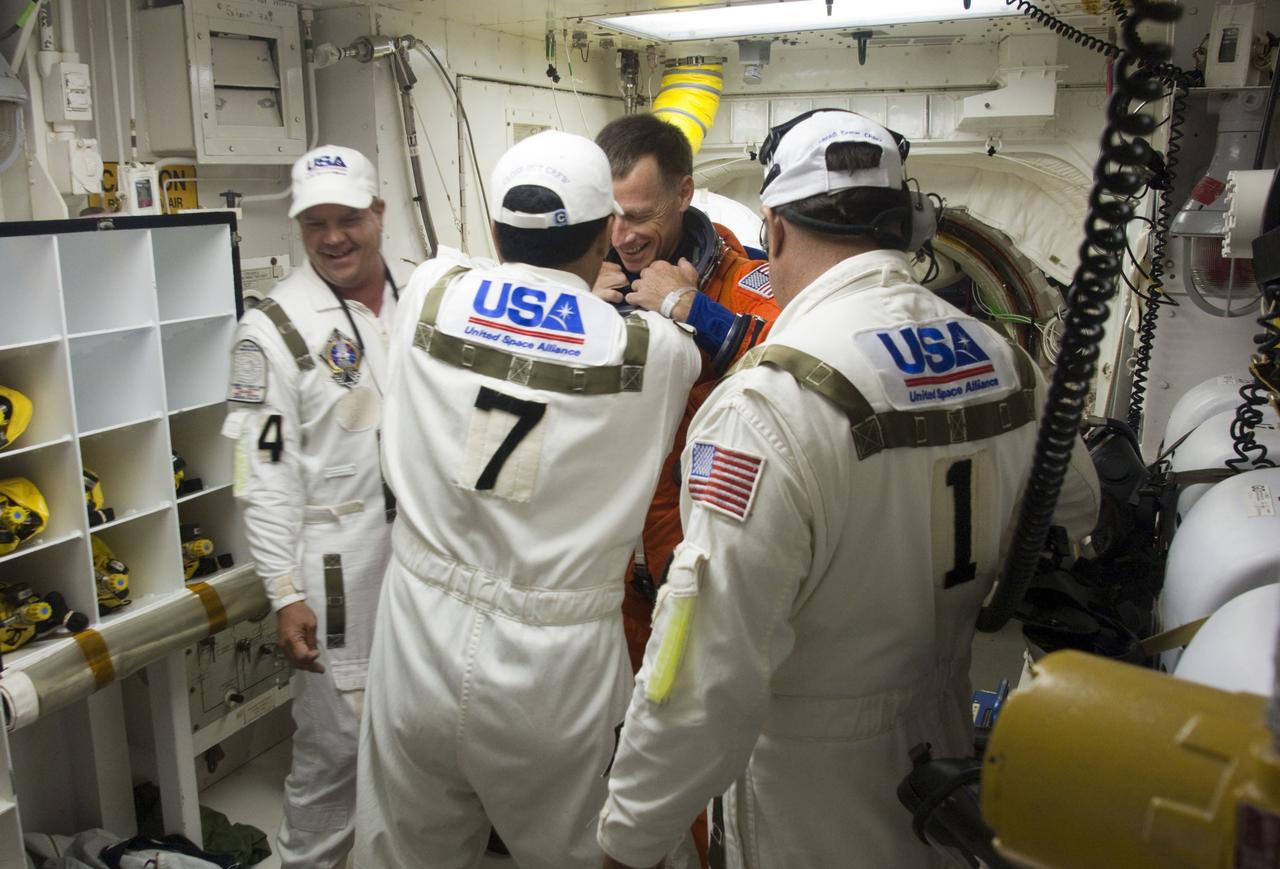
CAPE CANAVERAL, Fla. -- The Closeout Crew helps STS-135 Commander Chris Ferguson prepare to enter space shuttle Atlantis from the White Room of Launch Pad 39A at NASA's Kennedy Space Center in Florida. Ferguson is one of the final four astronauts to launch aboard a space shuttle. He is a retired U.S. Navy captain who already has logged nearly a month in space during two previous shuttle flights. STS-135 is scheduled to lift off at 11:26 a.m. EDT on July 8 for a mission to the International Space Station. STS-135 will deliver the Raffaello multi-purpose logistics module packed with supplies and spare parts for the International Space Station. Atlantis also will fly the Robotic Refueling Mission experiment that will investigate the potential for robotically refueling existing satellites in orbit. In addition, Atlantis will return with a failed ammonia pump module to help NASA better understand the failure mechanism and improve pump designs for future systems. STS-135 will be the 33rd flight of Atlantis, the 37th shuttle mission to the space station, and the 135th and final mission of NASA's Space Shuttle Program. For more information, visit www.nasa.gov/mission_pages/shuttle/shuttlemissions/sts135/index.html. Photo credit: NASA/Sandra Joseph and Kevin O'Connell
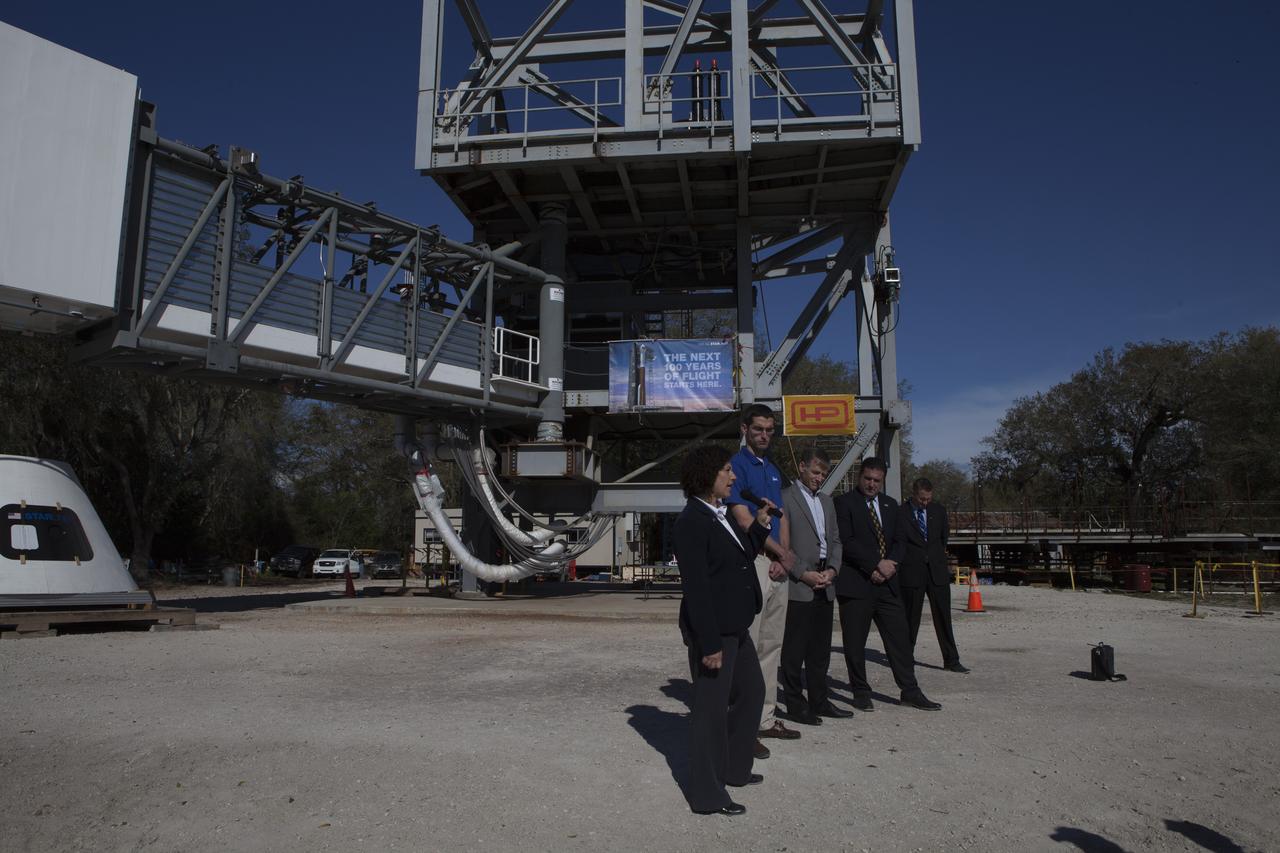
NASA, Boeing and United Launch Alliance officials discuss the Crew Access Arm under construction at a yard near NASA's Kennedy Space Center in Florida. The arm and white room are being built to bridge the space between the Crew Access Tower and the hatch to Boeing's CST-100 Starliner spacecraft as it stands atop a ULA Atlas V rocket at Space Launch Complex 41 before flight. Partnering with NASA's Commercial Crew Program, Boeing is one of two companies building a new, privately owned and operated space system to carry astronauts to the International Space Station. The speakers are, from left, Lisa Loucks, Launch Site Integration lead for Boeing; Steve Hirst, Launch Operations Group for ULA; Chris Ferguson, former astronaut and deputy program manager of Boeing's Crew and Mission Operations, Gary Wentz, vice president of Human Launch Services for ULA, and Mike Ravenscroft, Launch Site Integration manager for NASA's Commercial Crew Program.
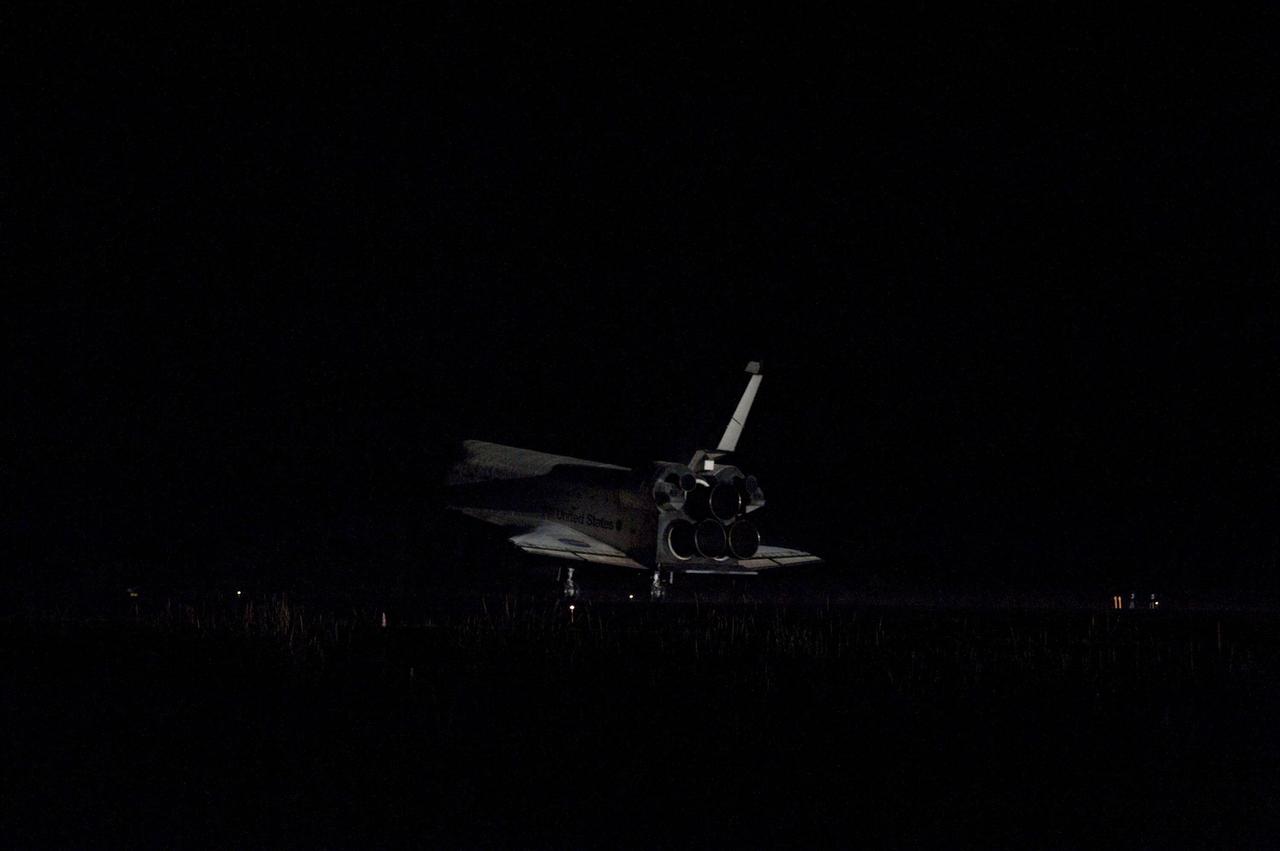
STS135-S-223 (21 July 2011) --- Space shuttle Atlantis' bright-white, iconic frame appears from the darkness at it touches down on the Shuttle Landing Facility's Runway 15 at NASA's Kennedy Space Center in Florida for the final time. Securing the space shuttle fleet's place in history, Atlantis marked the 26th nighttime landing of NASA's Space Shuttle Program and the 78th landing at Kennedy. Main gear touchdown was at 5:57:00 a.m. (EDT) on July 21, 2011, followed by nose gear touchdown at 5:57:20 a.m., and wheelstop at 5:57:54 a.m. Onboard are NASA astronauts Chris Ferguson, STS-135 commander; Doug Hurley, pilot; Sandy Magnus and Rex Walheim, both mission specialists. On the 37th shuttle mission to the International Space Station, STS-135 delivered more than 9,400 pounds of spare parts, equipment and supplies in the Raffaello multi-purpose logistics module that will sustain station operations for the next year. STS-135 was the 33rd and final flight for Atlantis, which has spent 307 days in space, orbited Earth 4,848 times and traveled 125,935,769 miles. Photo credit: NASA

KENNEDY SPACE CENTER, FLA. -- The STS-100 crew poses for a photo on the 195-foot level of Launch Pad 39A’s Fixed Service Structure. Standing, from left, are Mission Specialists Scott Umberto Guidoni, Scott E. Parazynski, Chris A. Hadfield, Yuri V. Lonchakov, and John L. Phillips; Commander Kent V. Rominger; and Pilot Jeffrey S. Ashby. Hadfield is with the Canadian Space Agency, Guidoni with the European Space Agency and Lonchakov with the Russian Aviation and Space Agency. Behind them can be seen the tip of one white solid rocket booster and the orange external tank. The STS-100 mission is carrying the Multi-Purpose Logistics Module Raffaello and the SSRMS, to the International Space Station. Raffaello carries six system racks and two storage racks for the U.S. Lab. The SSRMS is crucial to the continued assembly of the orbiting complex. Launch of mission STS-100 is scheduled for April 19 at 2:41 p.m. EDT from Launch Pad 39A
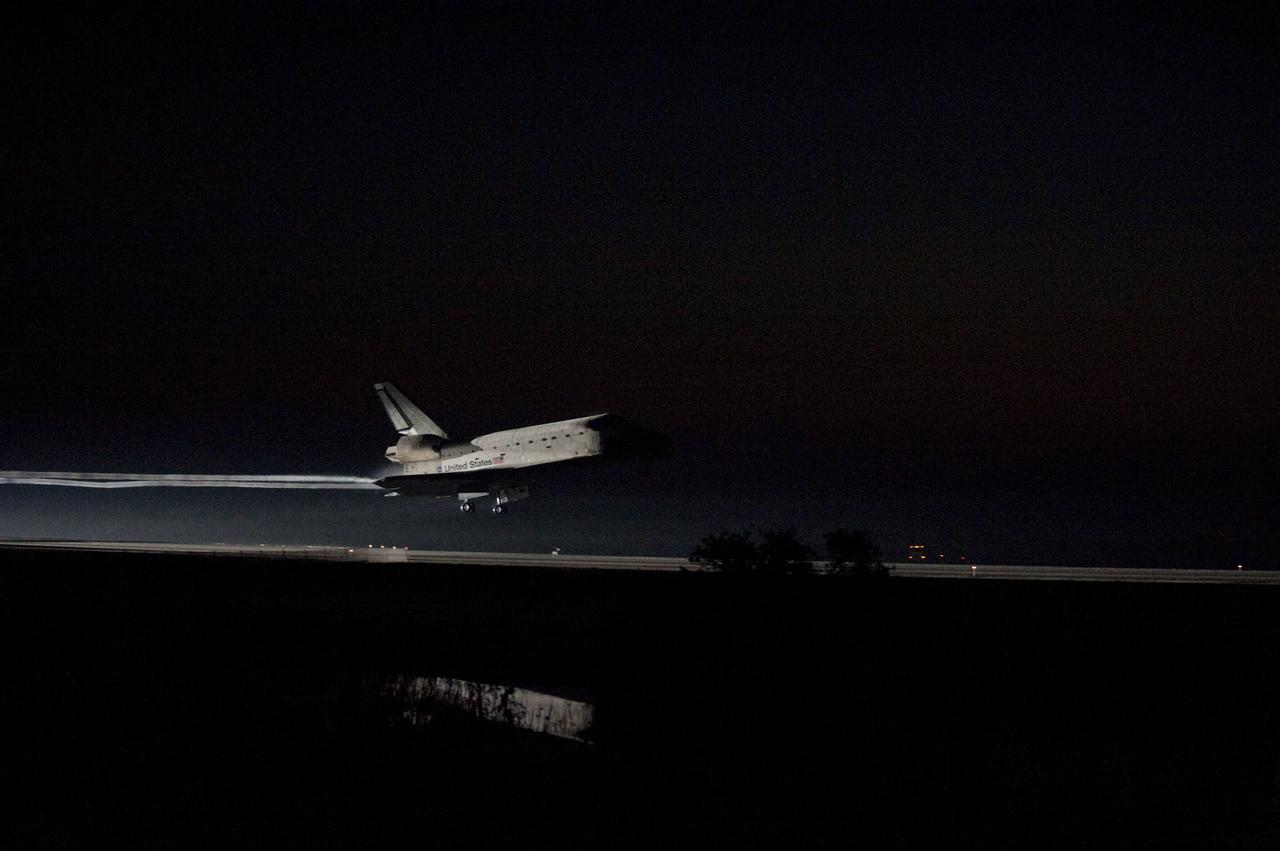
CAPE CANAVERAL, Fla. -- Xenons light the way home as space shuttle Atlantis' iconic white frame appears over the Shuttle Landing Facility's Runway 15 at NASA's Kennedy Space Center in Florida for the last time. Securing the space shuttle fleet's place in history, Atlantis marked the 26th nighttime landing of NASA's Space Shuttle Program and the 78th landing at Kennedy. Main gear touchdown was at 5:57:00 a.m. EDT, followed by nose gear touchdown at 5:57:20 a.m., and wheelstop at 5:57:54 a.m. On board are STS-135 Commander Chris Ferguson, Pilot Doug Hurley, and Mission Specialists Sandra Magnus and Rex Walheim. On the 37th shuttle mission to the International Space Station, STS-135 delivered more than 9,400 pounds of spare parts, equipment and supplies in the Raffaello multi-purpose logistics module that will sustain station operations for the next year. STS-135 was the 33rd and final flight for Atlantis, which has spent 307 days in space, orbited Earth 4,848 times and traveled 125,935,769 miles. For more information visit, www.nasa.gov/mission_pages/shuttle/shuttlemissions/sts135/index.html. Photo credit: NASA/Sandra Joseph
STS135-S-163 (21 July 2011) --- Space shuttle Atlantis' bright-white, iconic frame illuminates the darkness as it touches down on the Shuttle Landing Facility's Runway 15 at NASA's Kennedy Space Center in Florida for the final time. Securing the space shuttle fleet's place in history, Atlantis marked the 26th nighttime landing of NASA's Space Shuttle Program and the 78th landing at Kennedy. Main gear touchdown was at 5:57:00 a.m. (EDT) on July 21, 2011, followed by nose gear touchdown at 5:57:20 a.m., and wheelstop at 5:57:54 a.m. Onboard are NASA astronauts Chris Ferguson, STS-135 commander; Doug Hurley, pilot; Sandy Magnus and Rex Walheim, both mission specialists. On the 37th shuttle mission to the International Space Station, STS-135 delivered more than 9,400 pounds of spare parts, equipment and supplies in the Raffaello multi-purpose logistics module that will sustain station operations for the next year. STS-135 was the 33rd and final flight for Atlantis, which has spent 307 days in space, orbited Earth 4,848 times and traveled 125,935,769 miles. Photo credit: NASA
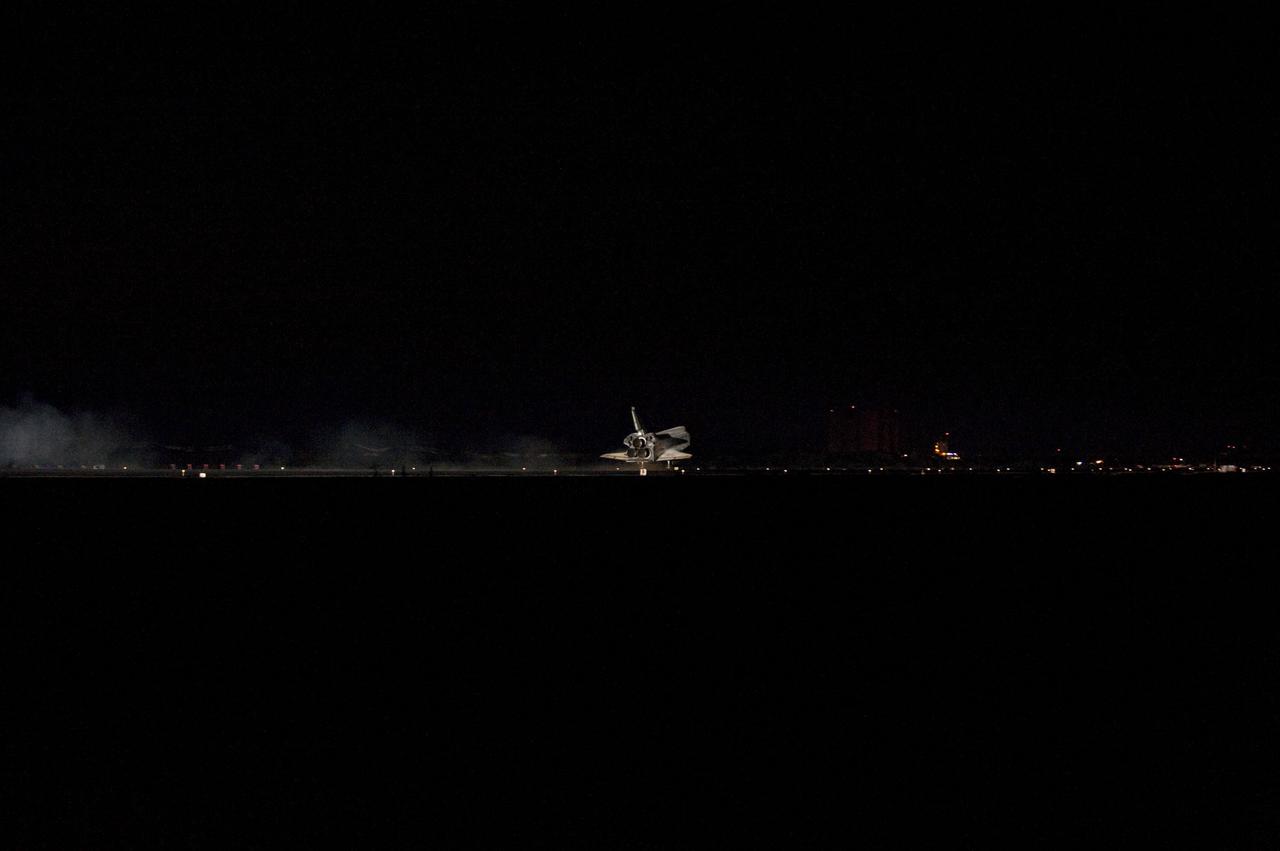
CAPE CANAVERAL, Fla. -- Space shuttle Atlantis' bright-white, iconic frame illuminates the darkness as it touches down on the Shuttle Landing Facility's Runway 15 at NASA's Kennedy Space Center in Florida for the final time. Securing the space shuttle fleet's place in history, Atlantis marked the 26th nighttime landing of NASA's Space Shuttle Program and the 78th landing at Kennedy. Main gear touchdown was at 5:57:00 a.m. EDT, followed by nose gear touchdown at 5:57:20 a.m., and wheelstop at 5:57:54 a.m. On board are STS-135 Commander Chris Ferguson, Pilot Doug Hurley, and Mission Specialists Sandra Magnus and Rex Walheim. On the 37th shuttle mission to the International Space Station, STS-135 delivered more than 9,400 pounds of spare parts, equipment and supplies in the Raffaello multi-purpose logistics module that will sustain station operations for the next year. STS-135 was the 33rd and final flight for Atlantis, which has spent 307 days in space, orbited Earth 4,848 times and traveled 125,935,769 miles. For more information visit, www.nasa.gov/mission_pages/shuttle/shuttlemissions/sts135/index.html. Photo credit: NASA/Sandra Joseph

STS135-S-162 (21 July 2011) --- Space shuttle Atlantis' bright-white, iconic frame illuminates the darkness as it touches down on the Shuttle Landing Facility's Runway 15 at NASA's Kennedy Space Center in Florida for the final time. Securing the space shuttle fleet's place in history, Atlantis marked the 26th nighttime landing of NASA's Space Shuttle Program and the 78th landing at Kennedy. Main gear touchdown was at 5:57:00 a.m. (EDT) on July 21, 2011, followed by nose gear touchdown at 5:57:20 a.m., and wheelstop at 5:57:54 a.m. Onboard are NASA astronauts Chris Ferguson, STS-135 commander; Doug Hurley, pilot; Sandy Magnus and Rex Walheim, both mission specialists. On the 37th shuttle mission to the International Space Station, STS-135 delivered more than 9,400 pounds of spare parts, equipment and supplies in the Raffaello multi-purpose logistics module that will sustain station operations for the next year. STS-135 was the 33rd and final flight for Atlantis, which has spent 307 days in space, orbited Earth 4,848 times and traveled 125,935,769 miles. Photo credit: NASA

KENNEDY SPACE CENTER, Fla. -- In the White Room, Launch Pad 39A, STS-105 Mission Specialist Patrick Forrester sends a silent greeting home while having his flight equipment checked before entering Space Shuttle Discovery for launch. With him are (left) Orbiter Vehicle Closeout Chief Chris Meinert and USA Mechanical Technician Al Schmidt. In the background is STS-105 Mission Specialist Patrick Forrester. The payload on the STS-105 mission to the International Space Station includes the third flight of the Italian-built Multi-Purpose Logistics Module Leonardo, delivering additional scientific racks, equipment and supplies for the Space Station, and the Early Ammonia Servicer (EAS) tank. The EAS, which will be attached to the Station during two spacewalks, contains spare ammonia for the Station's cooling system. Also, the Expedition Three crew is aboard to replace the Expedition Two crew on the International Space Station, who will be returning to Earth aboard Discovery after a five-month stay on the Station

STS135-S-179 (21 July 2011) --- Space shuttle Atlantis' bright-white, iconic frame illuminates the darkness as it touches down on the Shuttle Landing Facility's Runway 15 at NASA's Kennedy Space Center in Florida for the final time. Securing the space shuttle fleet's place in history, Atlantis marked the 26th nighttime landing of NASA's Space Shuttle Program and the 78th landing at Kennedy. Main gear touchdown was at 5:57:00 a.m. (EDT) on July 21, 2011, followed by nose gear touchdown at 5:57:20 a.m., and wheelstop at 5:57:54 a.m. Onboard are NASA astronauts Chris Ferguson, STS-135 commander; Doug Hurley, pilot; Sandy Magnus and Rex Walheim, both mission specialists. On the 37th shuttle mission to the International Space Station, STS-135 delivered more than 9,400 pounds of spare parts, equipment and supplies in the Raffaello multi-purpose logistics module that will sustain station operations for the next year. STS-135 was the 33rd and final flight for Atlantis, which has spent 307 days in space, orbited Earth 4,848 times and traveled 125,935,769 miles. Photo credit: NASA
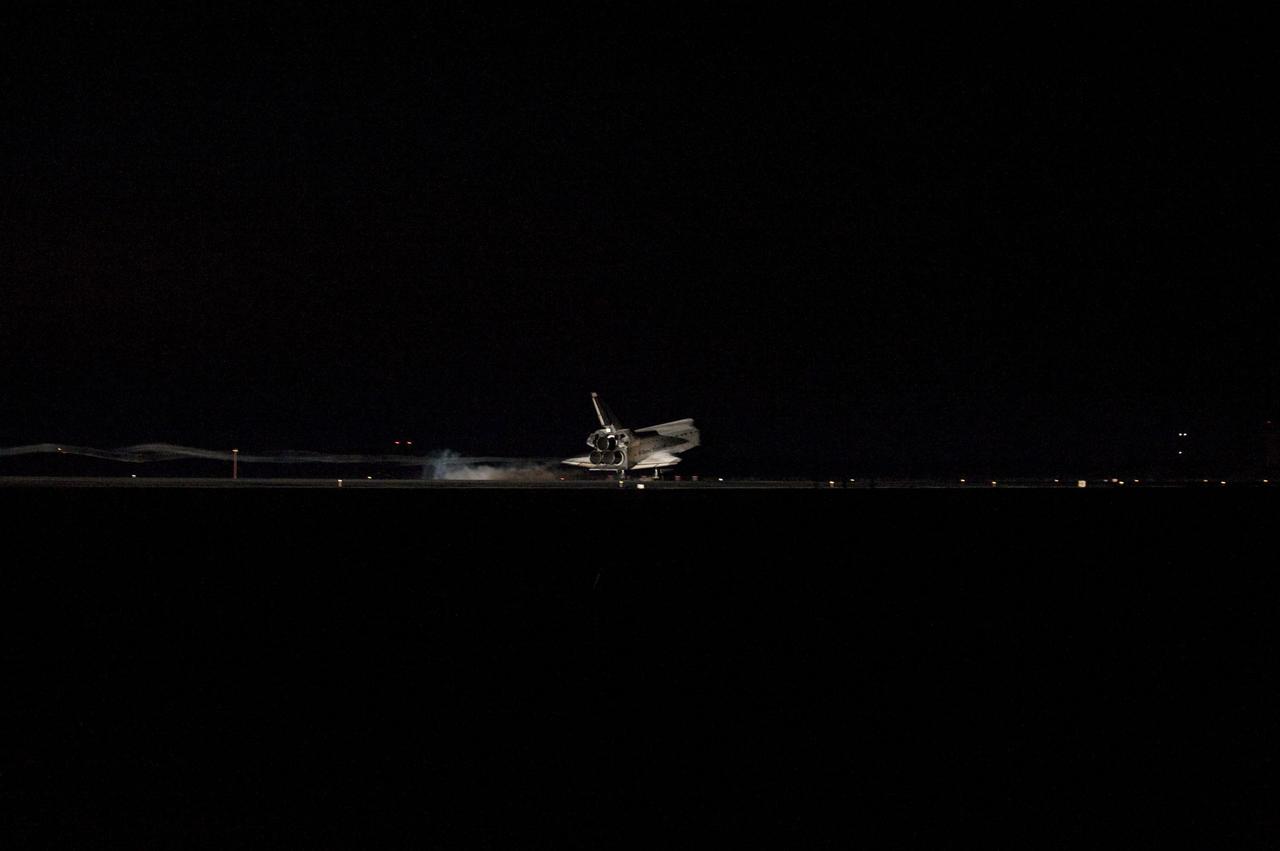
CAPE CANAVERAL, Fla. -- Space shuttle Atlantis' bright-white, iconic frame illuminates the darkness as it touches down on the Shuttle Landing Facility's Runway 15 at NASA's Kennedy Space Center in Florida for the final time. Securing the space shuttle fleet's place in history, Atlantis marked the 26th nighttime landing of NASA's Space Shuttle Program and the 78th landing at Kennedy. Main gear touchdown was at 5:57:00 a.m. EDT, followed by nose gear touchdown at 5:57:20 a.m., and wheelstop at 5:57:54 a.m. On board are STS-135 Commander Chris Ferguson, Pilot Doug Hurley, and Mission Specialists Sandra Magnus and Rex Walheim. On the 37th shuttle mission to the International Space Station, STS-135 delivered more than 9,400 pounds of spare parts, equipment and supplies in the Raffaello multi-purpose logistics module that will sustain station operations for the next year. STS-135 was the 33rd and final flight for Atlantis, which has spent 307 days in space, orbited Earth 4,848 times and traveled 125,935,769 miles. For more information visit, www.nasa.gov/mission_pages/shuttle/shuttlemissions/sts135/index.html. Photo credit: NASA/Sandra Joseph
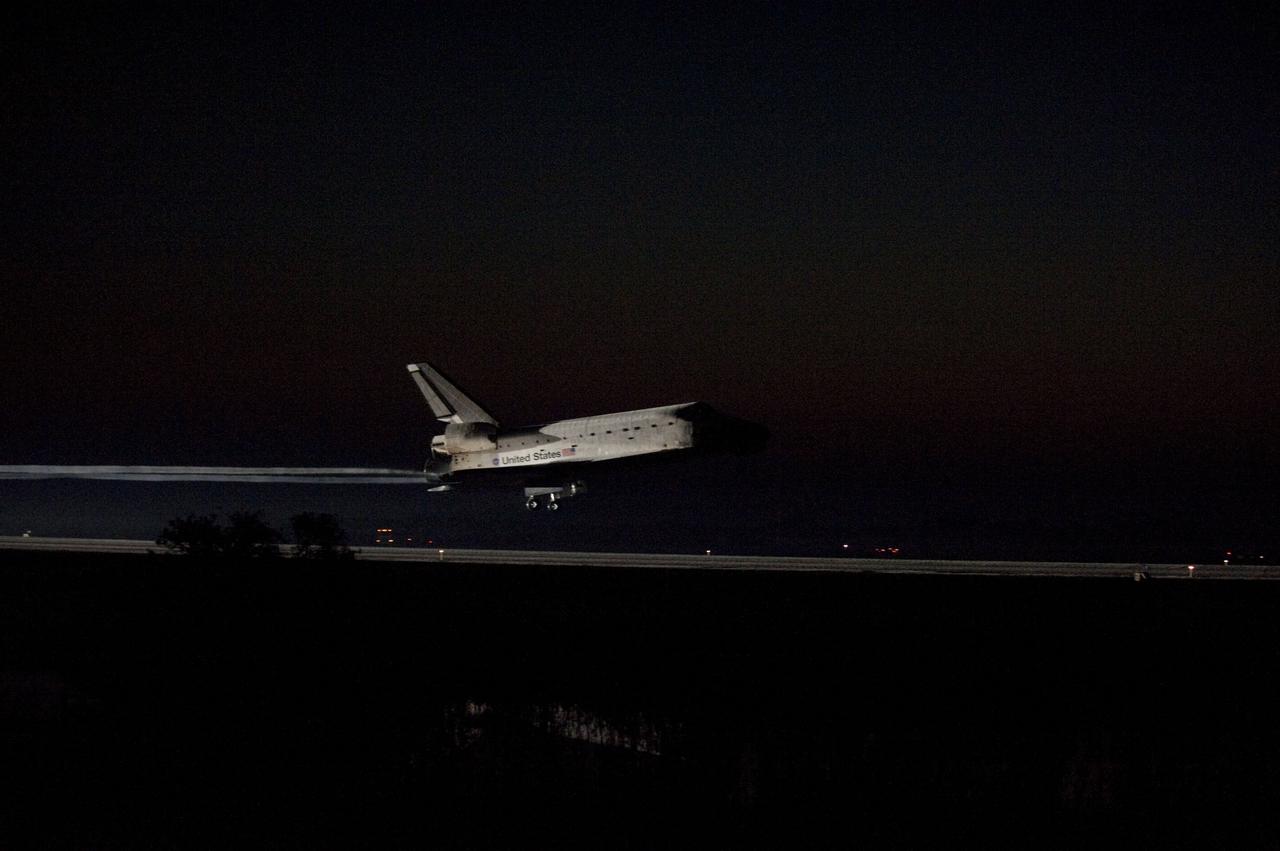
CAPE CANAVERAL, Fla. -- Space shuttle Atlantis' bright-white, iconic frame illuminates the darkness as it touches down on the Shuttle Landing Facility's Runway 15 at NASA's Kennedy Space Center in Florida for the final time. Securing the space shuttle fleet's place in history, Atlantis marked the 26th nighttime landing of NASA's Space Shuttle Program and the 78th landing at Kennedy. Main gear touchdown was at 5:57:00 a.m. EDT, followed by nose gear touchdown at 5:57:20 a.m., and wheelstop at 5:57:54 a.m. On board are STS-135 Commander Chris Ferguson, Pilot Doug Hurley, and Mission Specialists Sandra Magnus and Rex Walheim. On the 37th shuttle mission to the International Space Station, STS-135 delivered more than 9,400 pounds of spare parts, equipment and supplies in the Raffaello multi-purpose logistics module that will sustain station operations for the next year. STS-135 was the 33rd and final flight for Atlantis, which has spent 307 days in space, orbited Earth 4,848 times and traveled 125,935,769 miles. For more information visit, www.nasa.gov/mission_pages/shuttle/shuttlemissions/sts135/index.html. Photo credit: NASA/Sandra Joseph