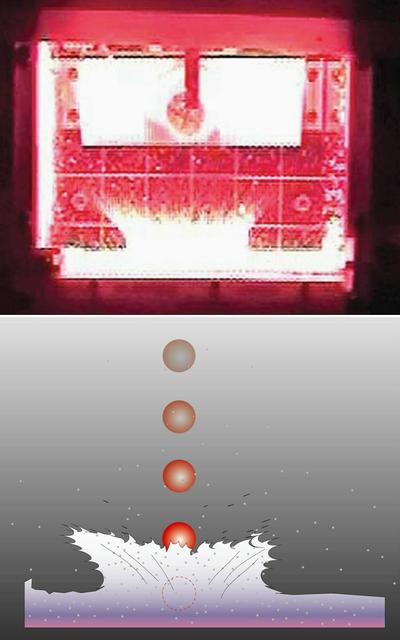
Clues to the formation of planets and planetary rings -- like Saturn's dazzling ring system -- may be found by studying how dust grains interact as they collide at low speeds. To study the question of low-speed dust collisions, NASA sponsored the COLLisions Into Dust Experiment (COLLIDE) at the University of Colorado. It was designed to spring-launch marble-size projectiles into trays of powder similar to space or lunar dust. COLLIDE-1 (1998) discovered that collisions below a certain energy threshold eject no material. COLLIDE-2 was designed to identify where the threshold is. In COLLIDE-2, scientists nudged small projectiles into dust beds and recorded how the dust splashed outward (video frame at top; artist's rendering at bottom). The slowest impactor ejected no material and stuck in the target. The faster impactors produced ejecta; some rebounded while others stuck in the target.
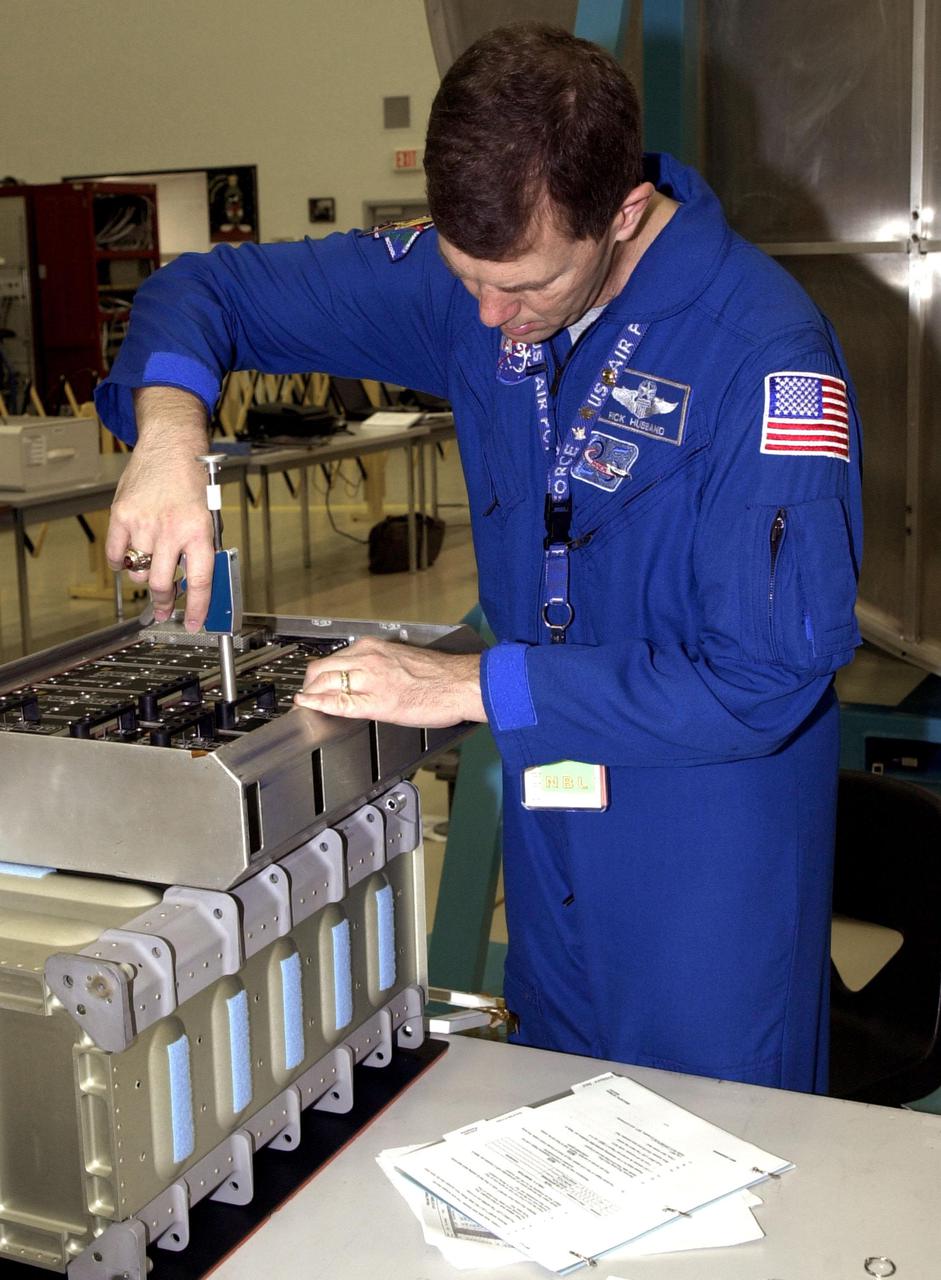
KENNEDY SPACE CENTER, FLA. -- At SPACEHAB, Cape Canaveral, Fla., Commander Rick Husband works with an experiment that will be part of the mission. STS-107 is a research mission. The primary payload is the first flight of the SHI Research Double Module (SHI_RDM). The experiments range from material sciences to life sciences (many rats). Also part of the payload is the Fast Reaction Experiments Enabling Science, Technology, Applications and Research (FREESTAR) that incorporates eight high priority secondary attached shuttle experiments: Mediterranean Israeli Dust Experiment (MEIDEX), Shuttle Ozone Limb Sounding Experiment (SOLSE-2), Student Tracked Atmospheric Research Satellite for Heuristic International Networking Experiment (STARSHINE), Critical Viscosity of Xenon-2 (CVX-2), Solar Constant Experiment-3 (SOLOCON-3), Prototype Synchrotron Radiation Detector (PSRD), Low Power Transceiver (LPT), and Collisions Into Dust Experiment -2 (COLLIDE-2). STS-107 is scheduled to launch in July 2002
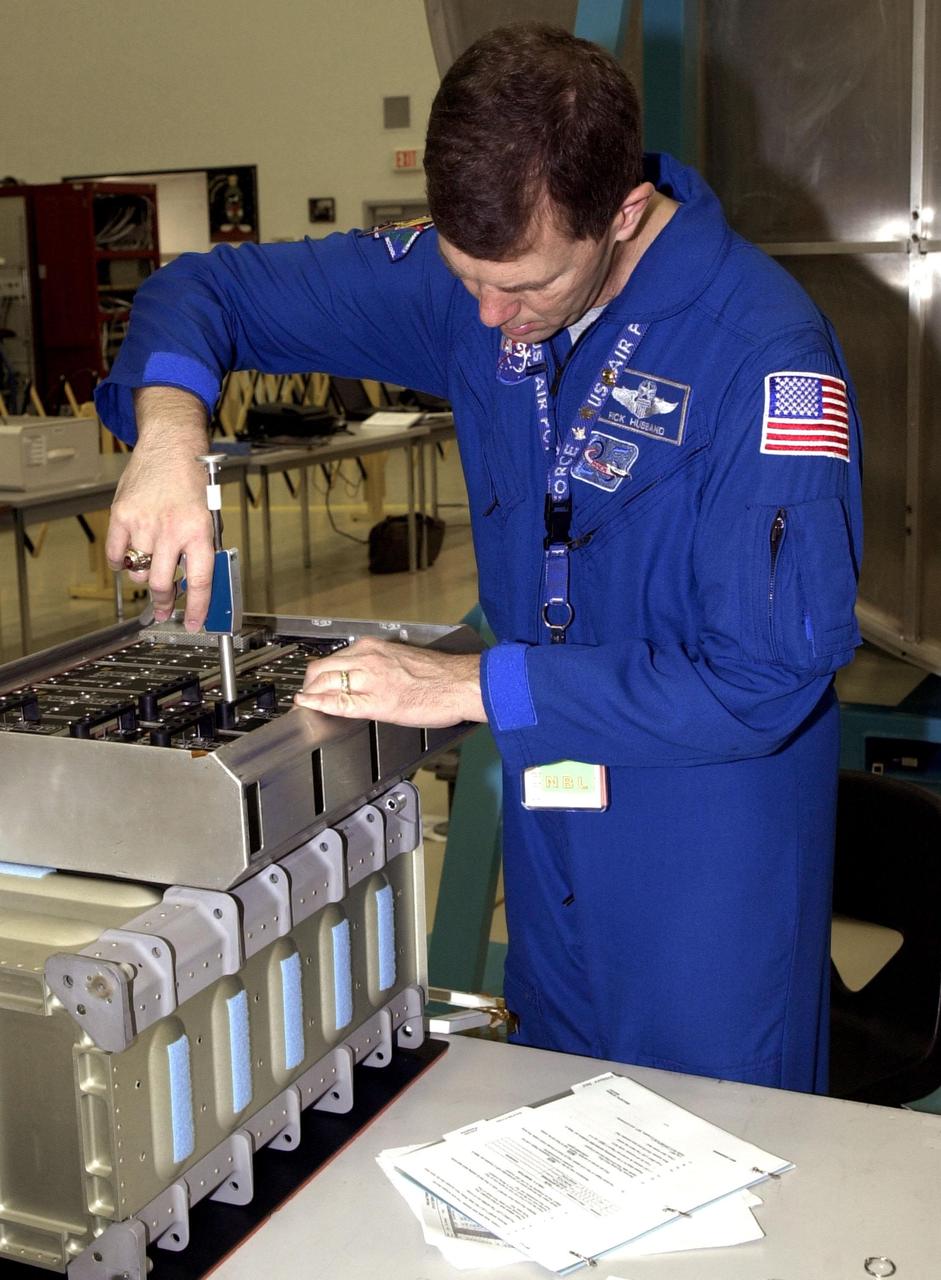
KENNEDY SPACE CENTER, FLA. -- At SPACEHAB, Cape Canaveral, Fla., Commander Rick Husband works with an experiment that will be part of the mission. STS-107 is a research mission. The primary payload is the first flight of the SHI Research Double Module (SHI/RDM). The experiments range from material sciences to life sciences (many rats). Also part of the payload is the Fast Reaction Experiments Enabling Science, Technology, Applications and Research (FREESTAR) that incorporates eight high priority secondary attached shuttle experiments: Mediterranean Israeli Dust Experiment (MEIDEX), Shuttle Ozone Limb Sounding Experiment (SOLSE-2), Student Tracked Atmospheric Research Satellite for Heuristic International Networking Experiment (STARSHINE), Critical Viscosity of Xenon-2 (CVX-2), Solar Constant Experiment-3 (SOLOCON-3), Prototype Synchrotron Radiation Detector (PSRD), Low Power Transceiver (LPT), and Collisions Into Dust Experiment -2 (COLLIDE-2). STS-107 is scheduled to launch in July 2002
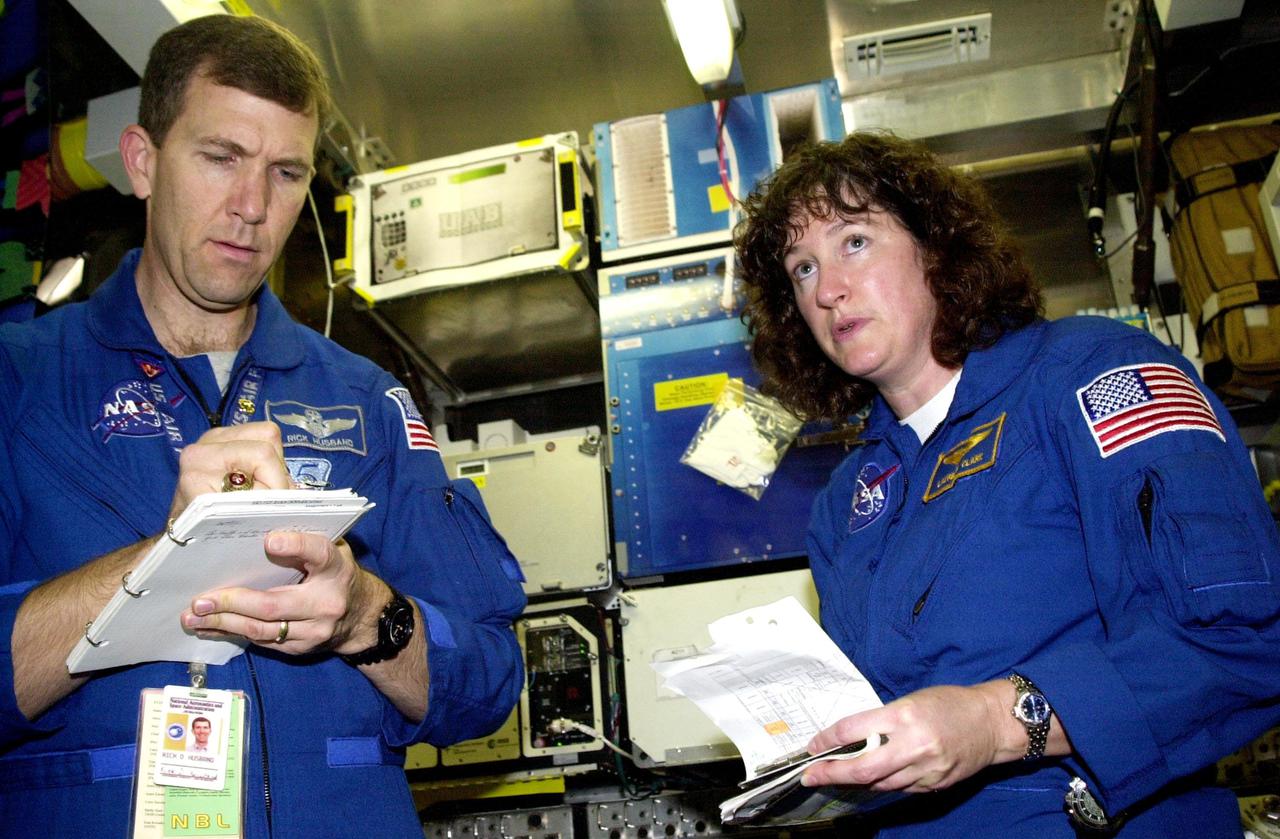
KENNEDY SPACE CENTER, FLA. -- STS-107 Commander Rick Husband and Mission Specialist Laurel Clark learn to work with mission-related equipment at SPACEHAB, Cape Canaveral, Fla. STS-107 is a research mission. The primary payload is the first flight of the SHI Research Double Module (SHI_RDM). The experiments range from material sciences to life sciences (many rats). Also part of the payload is the Fast Reaction Experiments Enabling Science, Technology, Applications and Research (FREESTAR) that incorporates eight high priority secondary attached shuttle experiments: Mediterranean Israeli Dust Experiment (MEIDEX), Shuttle Ozone Limb Sounding Experiment (SOLSE-2), Student Tracked Atmospheric Research Satellite for Heuristic International Networking Experiment (STARSHINE), Critical Viscosity of Xenon-2 (CVX-2), Solar Constant Experiment-3 (SOLOCON-3), Prototype Synchrotron Radiation Detector (PSRD), Low Power Transceiver (LPT), and Collisions Into Dust Experiment -2 (COLLIDE-2). STS-107 is scheduled to launch in July 2002
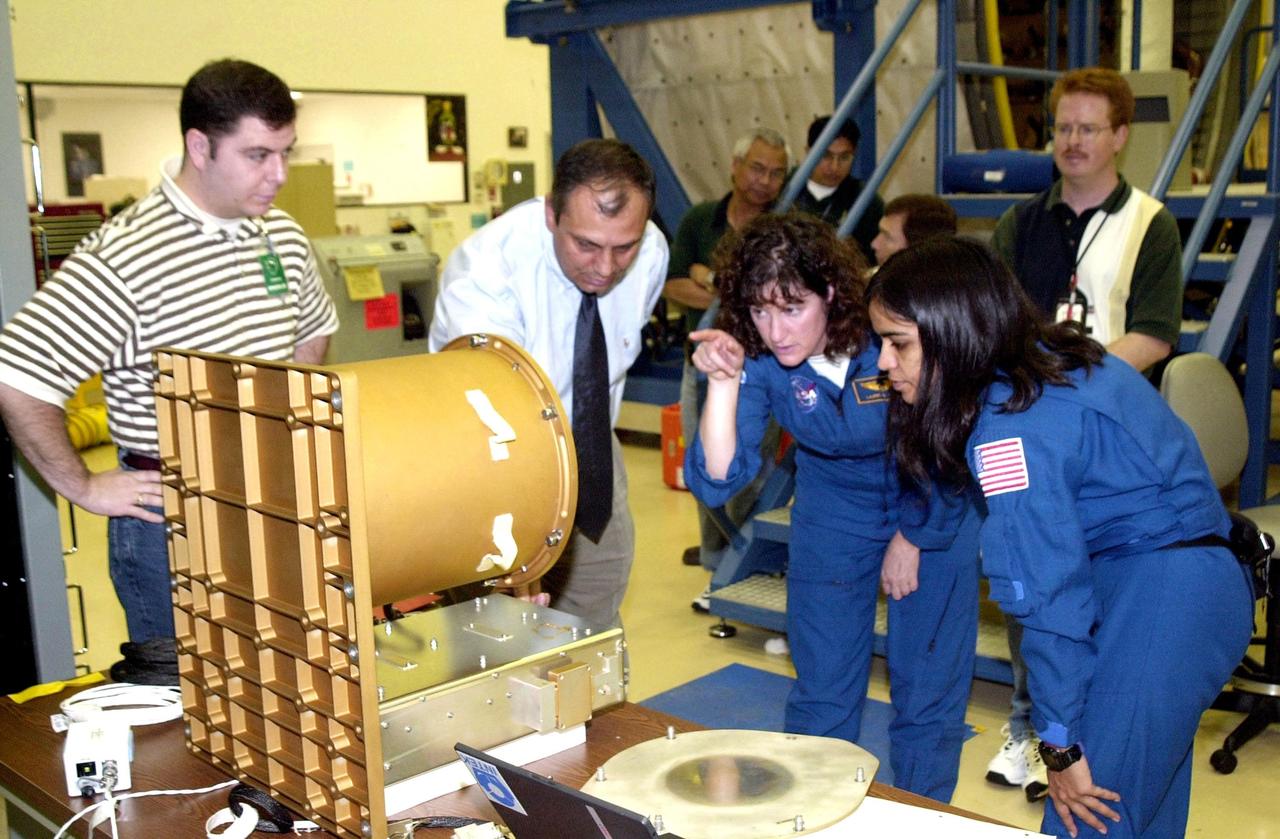
KENNEDY SPACE CENTER, FLA. - At SPACEHAB, Cape Canaveral, Fla., members of the STS-107 crew familiarize themselves with experiments and equipment for the mission. Pointing at a piece of equipment (center) is Mission Specialist Laurel Clark . At right is Mission Specialist Kalpana Chawla. STS-107 is a research mission. The primary payload is the first flight of the SHI Research Double Module (SHI/RDM). The experiments range from material sciences to life sciences (many rats). Also part of the payload is the Fast Reaction Experiments Enabling Science, Technology, Applications and Research (FREESTAR) that incorporates eight high priority secondary attached shuttle experiments: Mediterranean Israeli Dust Experiment (MEIDEX), Shuttle Ozone Limb Sounding Experiment (SOLSE-2), Student Tracked Atmospheric Research Satellite for Heuristic International Networking Experiment (STARSHINE), Critical Viscosity of Xenon-2 (CVX-2), Solar Constant Experiment-3 (SOLOCON-3), Prototype Synchrotron Radiation Detector (PSRD), Low Power Transceiver (LPT), and Collisions Into Dust Experiment -2 (COLLIDE-2). STS-107 is scheduled to launch in July 2002
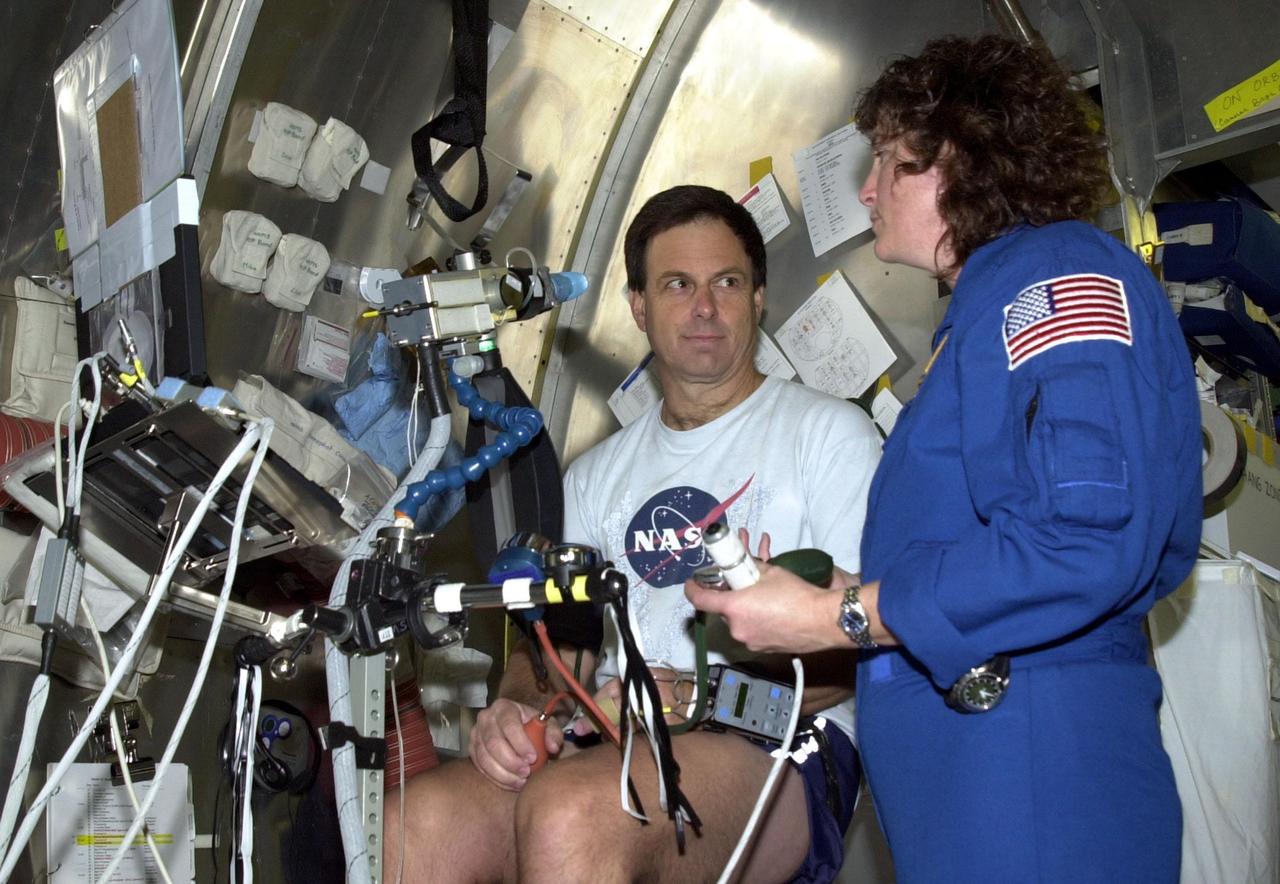
KENNEDY SPACE CENTER, FLA. - STS-107 Payload Specialist Ilan Ramon, from Israel, pauses during an experiment at SPACEHAB, Cape Canaveral, Fla., to talk with Mission Specialist Laurel Clark. STS-107 is a research mission. The primary payload is the first flight of the SHI Research Double Module (SHI/RDM). The experiments range from material sciences to life sciences (many rats). Also part of the payload is the Fast Reaction Experiments Enabling Science, Technology, Applications and Research (FREESTAR) that incorporates eight high priority secondary attached shuttle experiments: Mediterranean Israeli Dust Experiment (MEIDEX), Shuttle Ozone Limb Sounding Experiment (SOLSE-2), Student Tracked Atmospheric Research Satellite for Heuristic International Networking Experiment (STARSHINE), Critical Viscosity of Xenon-2 (CVX-2), Solar Constant Experiment-3 (SOLOCON-3), Prototype Synchrotron Radiation Detector (PSRD), Low Power Transceiver (LPT), and Collisions Into Dust Experiment -2 (COLLIDE-2). STS-107 is scheduled to launch in July 2002.
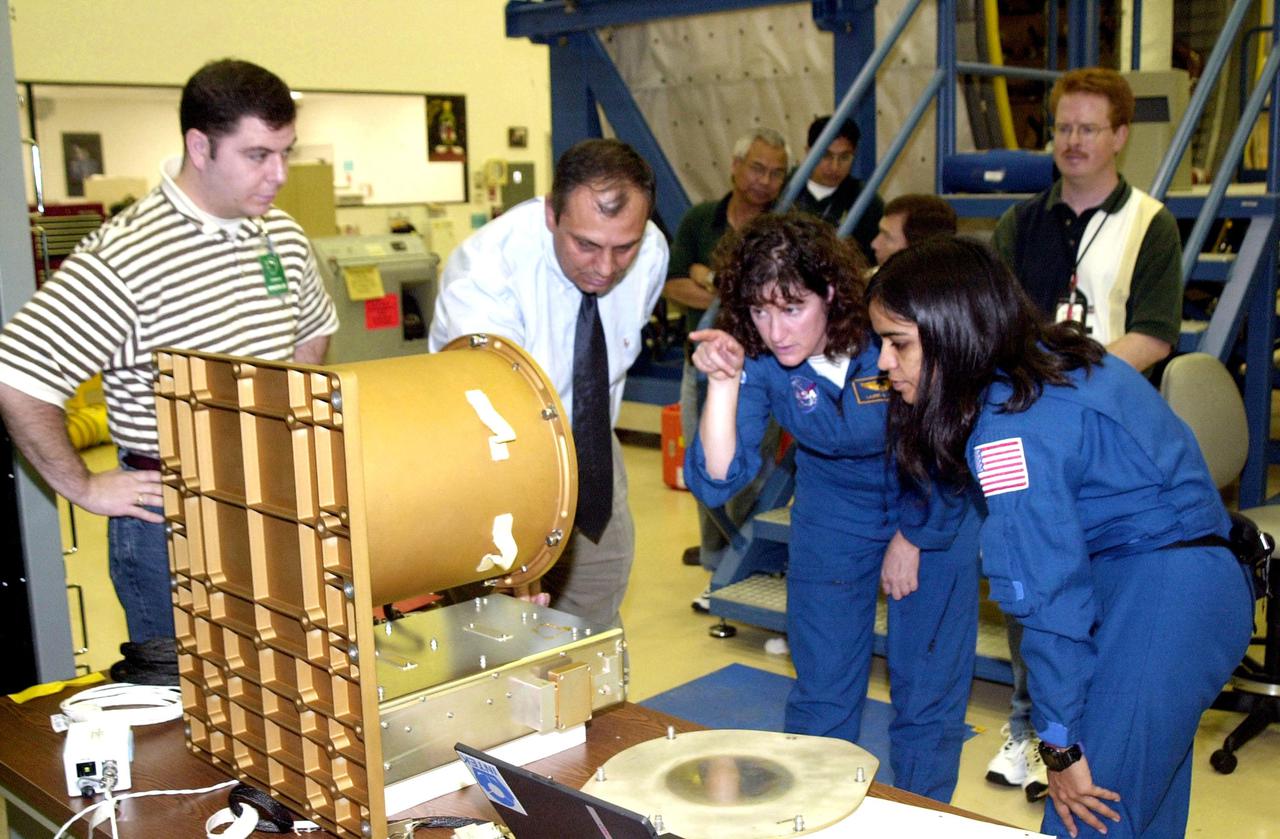
KENNEDY SPACE CENTER, FLA. - At SPACEHAB, Cape Canaveral, Fla., members of the STS-107 crew familiarize themselves with experiments and equipment for the mission. Pointing at a piece of equipment (center) is Mission Specialist Laurel Clark . At right is Mission Specialist Kalpana Chawla. STS-107 is a research mission. The primary payload is the first flight of the SHI Research Double Module (SHI_RDM). The experiments range from material sciences to life sciences (many rats). Also part of the payload is the Fast Reaction Experiments Enabling Science, Technology, Applications and Research (FREESTAR) that incorporates eight high priority secondary attached shuttle experiments: Mediterranean Israeli Dust Experiment (MEIDEX), Shuttle Ozone Limb Sounding Experiment (SOLSE-2), Student Tracked Atmospheric Research Satellite for Heuristic International Networking Experiment (STARSHINE), Critical Viscosity of Xenon-2 (CVX-2), Solar Constant Experiment-3 (SOLOCON-3), Prototype Synchrotron Radiation Detector (PSRD), Low Power Transceiver (LPT), and Collisions Into Dust Experiment -2 (COLLIDE-2). STS-107 is scheduled to launch in July 2002
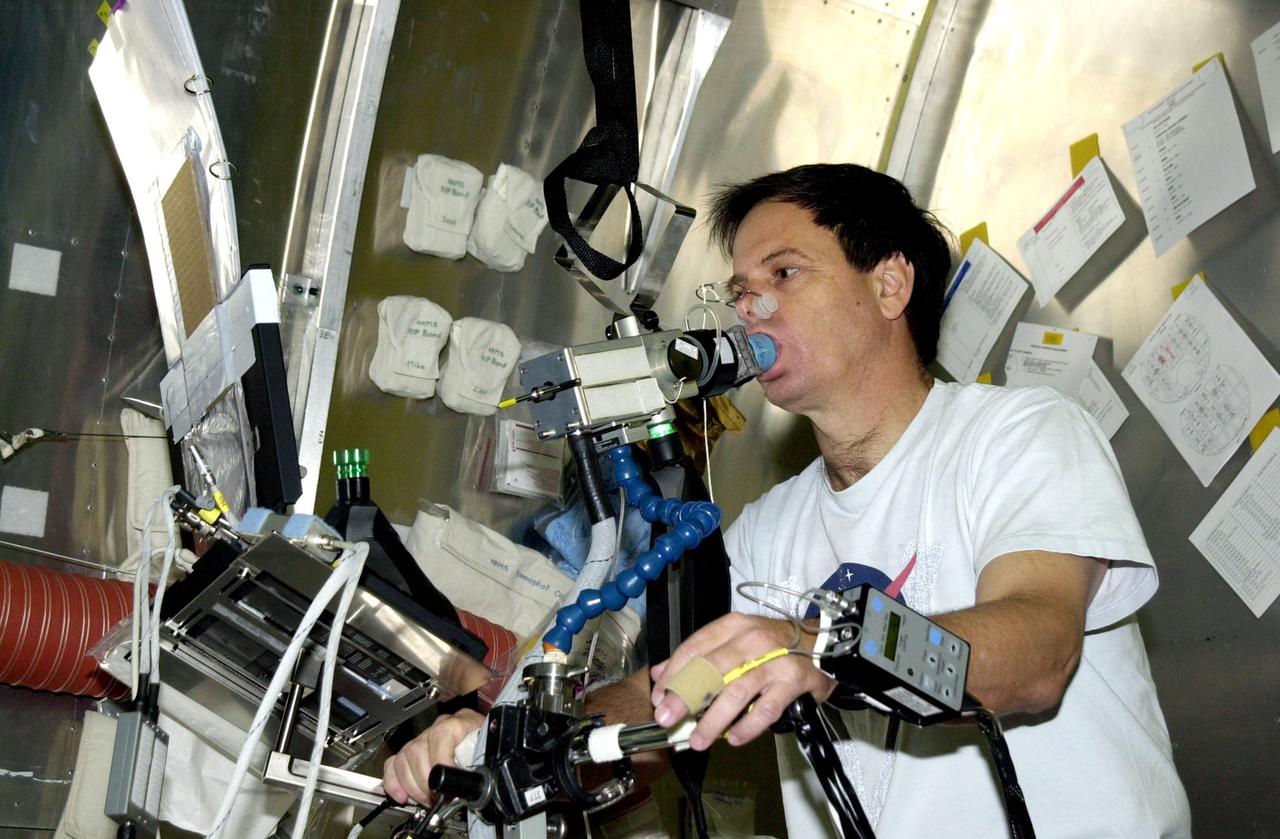
KENNEDY SPACE CENTER, FLA. - - STS-107 Payload Specialist Ilan Ramon, from Israel, works on an experiment at SPACEHAB, Cape Canaveral, Fla. With him is Mission Specialist Laurel Clark. STS-107 is a research mission. The primary payload is the first flight of the SHI Research Double Module (SHI_RDM). The experiments range from material sciences to life sciences (many rats). Also part of the payload is the Fast Reaction Experiments Enabling Science, Technology, Applications and Research (FREESTAR) that incorporates eight high priority secondary attached shuttle experiments: Mediterranean Israeli Dust Experiment (MEIDEX), Shuttle Ozone Limb Sounding Experiment (SOLSE-2), Student Tracked Atmospheric Research Satellite for Heuristic International Networking Experiment (STARSHINE), Critical Viscosity of Xenon-2 (CVX-2), Solar Constant Experiment-3 (SOLOCON-3), Prototype Synchrotron Radiation Detector (PSRD), Low Power Transceiver (LPT), and Collisions Into Dust Experiment -2 (COLLIDE-2). STS-107 is scheduled to launch in July 2002
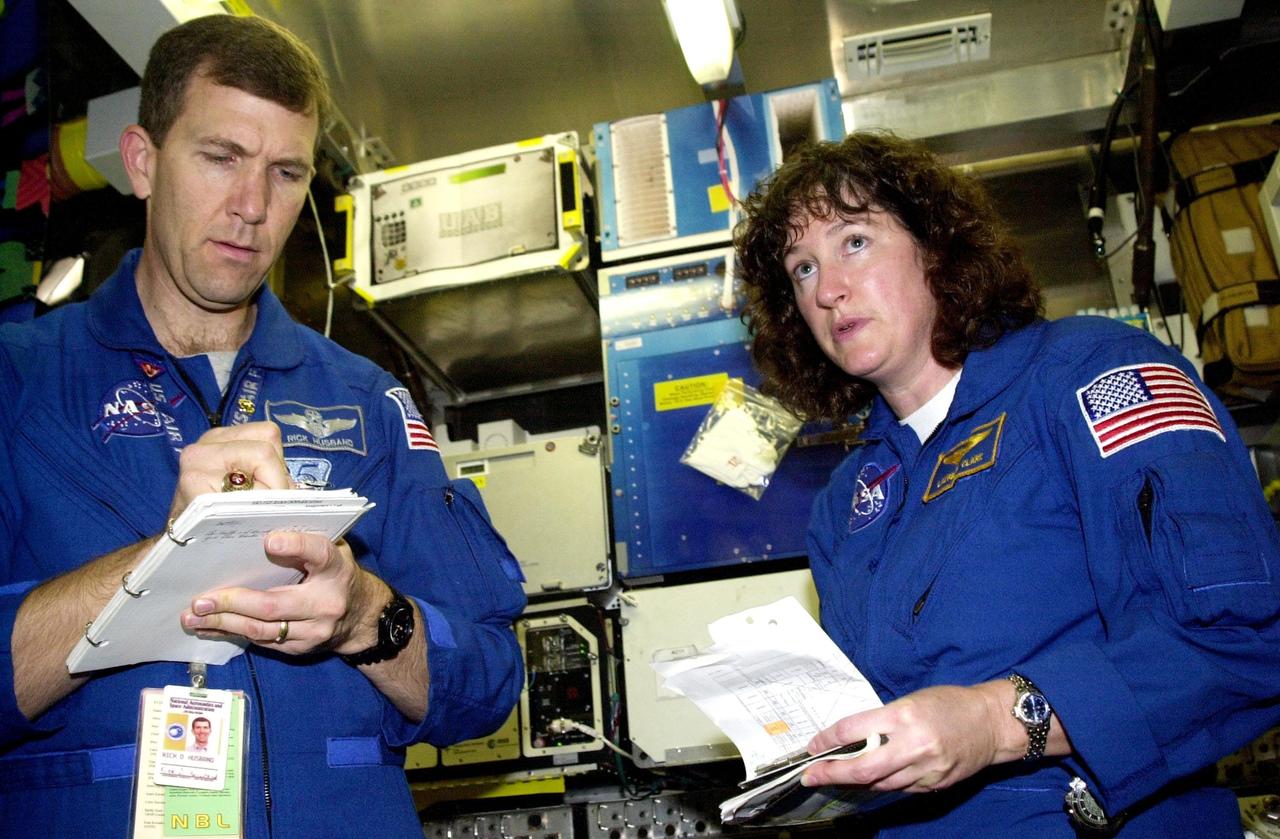
KENNEDY SPACE CENTER, FLA. -- STS-107 Commander Rick Husband and Mission Specialist Laurel Clark learn to work with mission-related equipment at SPACEHAB, Cape Canaveral, Fla. STS-107 is a research mission. The primary payload is the first flight of the SHI Research Double Module (SHI/RDM). The experiments range from material sciences to life sciences (many rats). Also part of the payload is the Fast Reaction Experiments Enabling Science, Technology, Applications and Research (FREESTAR) that incorporates eight high priority secondary attached shuttle experiments: Mediterranean Israeli Dust Experiment (MEIDEX), Shuttle Ozone Limb Sounding Experiment (SOLSE-2), Student Tracked Atmospheric Research Satellite for Heuristic International Networking Experiment (STARSHINE), Critical Viscosity of Xenon-2 (CVX-2), Solar Constant Experiment-3 (SOLOCON-3), Prototype Synchrotron Radiation Detector (PSRD), Low Power Transceiver (LPT), and Collisions Into Dust Experiment -2 (COLLIDE-2). STS-107 is scheduled to launch in July 2002
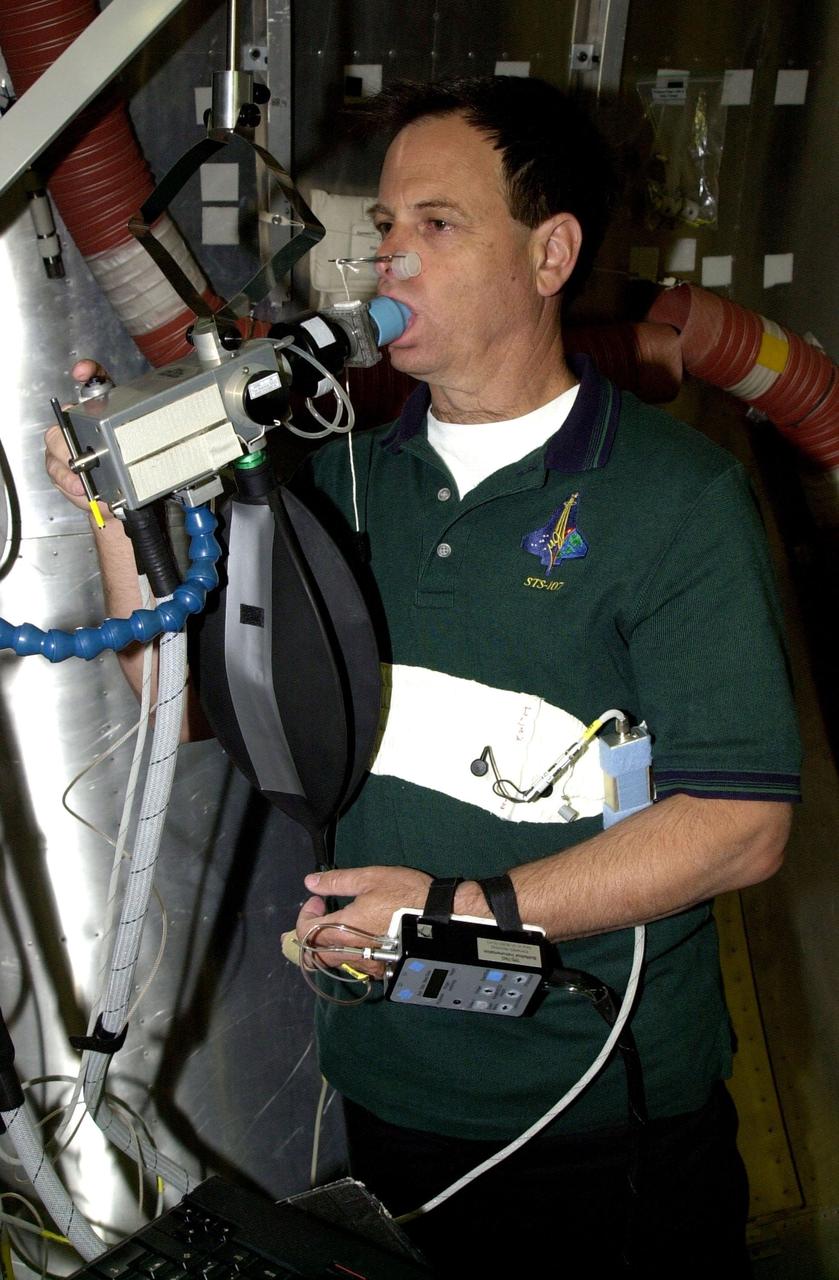
KENNEDY SPACE CENTER, FLA. - STS-107 Payload Specialist Ilan Ramon, from Israel, trains on equipment at SPACEHAB, Cape Canaveral, Fla. STS-107 is a research mission. The primary payload is the first flight of the SHI Research Double Module (SHI/RDM). The experiments range from material sciences to life sciences (many rats). Also part of the payload is the Fast Reaction Experiments Enabling Science, Technology, Applications and Research (FREESTAR) that incorporates eight high priority secondary attached shuttle experiments: Mediterranean Israeli Dust Experiment (MEIDEX), Shuttle Ozone Limb Sounding Experiment (SOLSE-2), Student Tracked Atmospheric Research Satellite for Heuristic International Networking Experiment (STARSHINE), Critical Viscosity of Xenon-2 (CVX-2), Solar Constant Experiment-3 (SOLOCON-3), Prototype Synchrotron Radiation Detector (PSRD), Low Power Transceiver (LPT), and Collisions Into Dust Experiment -2 (COLLIDE-2). STS-107 is scheduled to launch in July 2002
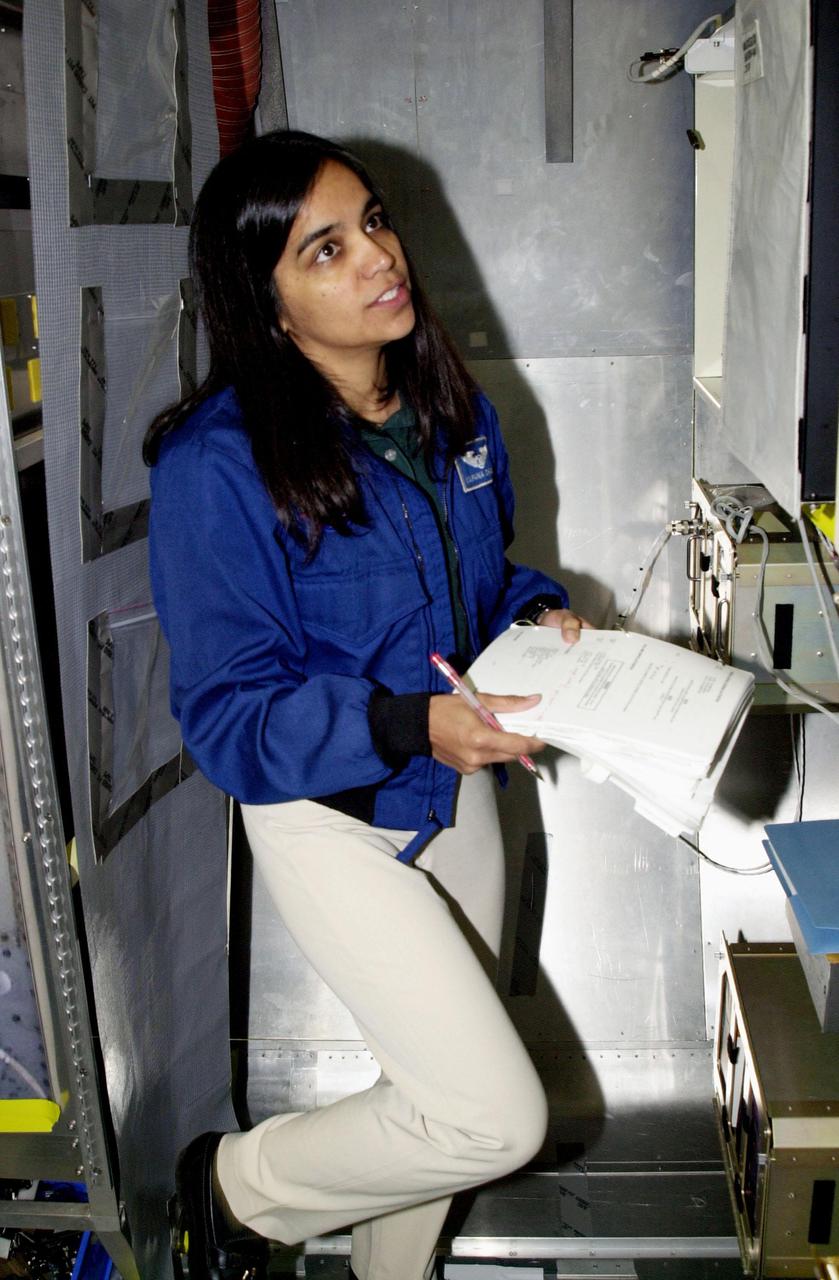
KENNEDY SPACE CENTER, FLA. - STS-107 Mission Specialist Kalpana Chawla looks over equipment at SPACEHAB, Cape Canaveral, Fla., during crew training. STS-107 is a research mission. The primary payload is the first flight of the SHI Research Double Module (SHI_RDM). The experiments range from material sciences to life sciences (many rats). Also part of the payload is the Fast Reaction Experiments Enabling Science, Technology, Applications and Research (FREESTAR) that incorporates eight high priority secondary attached shuttle experiments: Mediterranean Israeli Dust Experiment (MEIDEX), Shuttle Ozone Limb Sounding Experiment (SOLSE-2), Student Tracked Atmospheric Research Satellite for Heuristic International Networking Experiment (STARSHINE), Critical Viscosity of Xenon-2 (CVX-2), Solar Constant Experiment-3 (SOLOCON-3), Prototype Synchrotron Radiation Detector (PSRD), Low Power Transceiver (LPT), and Collisions Into Dust Experiment -2 (COLLIDE-2). STS-107 is scheduled to launch in July 2002
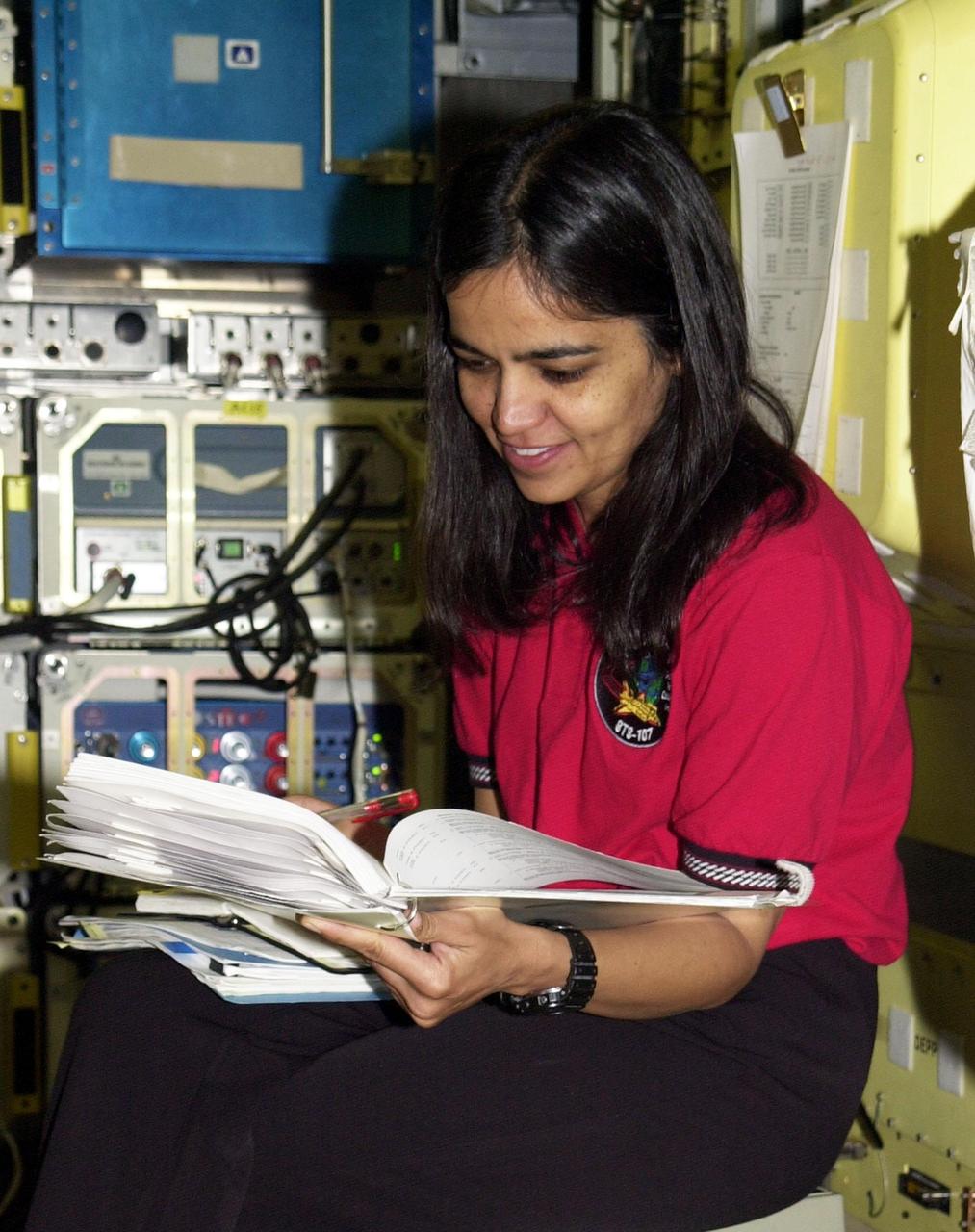
KENNEDY SPACE CENTER, FLA. -- STS-107 Mission Specialist Kalpana Chawla scans paperwork for equipment at SPACEHAB, Cape Canaveral, Fla., during crew training. STS-107 is a research mission. The primary payload is the first flight of the SHI Research Double Module (SHI/RDM). The experiments range from material sciences to life sciences (many rats). Also part of the payload is the Fast Reaction Experiments Enabling Science, Technology, Applications and Research (FREESTAR) that incorporates eight high priority secondary attached shuttle experiments: Mediterranean Israeli Dust Experiment (MEIDEX), Shuttle Ozone Limb Sounding Experiment (SOLSE-2), Student Tracked Atmospheric Research Satellite for Heuristic International Networking Experiment (STARSHINE), Critical Viscosity of Xenon-2 (CVX-2), Solar Constant Experiment-3 (SOLOCON-3), Prototype Synchrotron Radiation Detector (PSRD), Low Power Transceiver (LPT), and Collisions Into Dust Experiment -2 (COLLIDE-2). STS-107 is scheduled to launch in July 2002
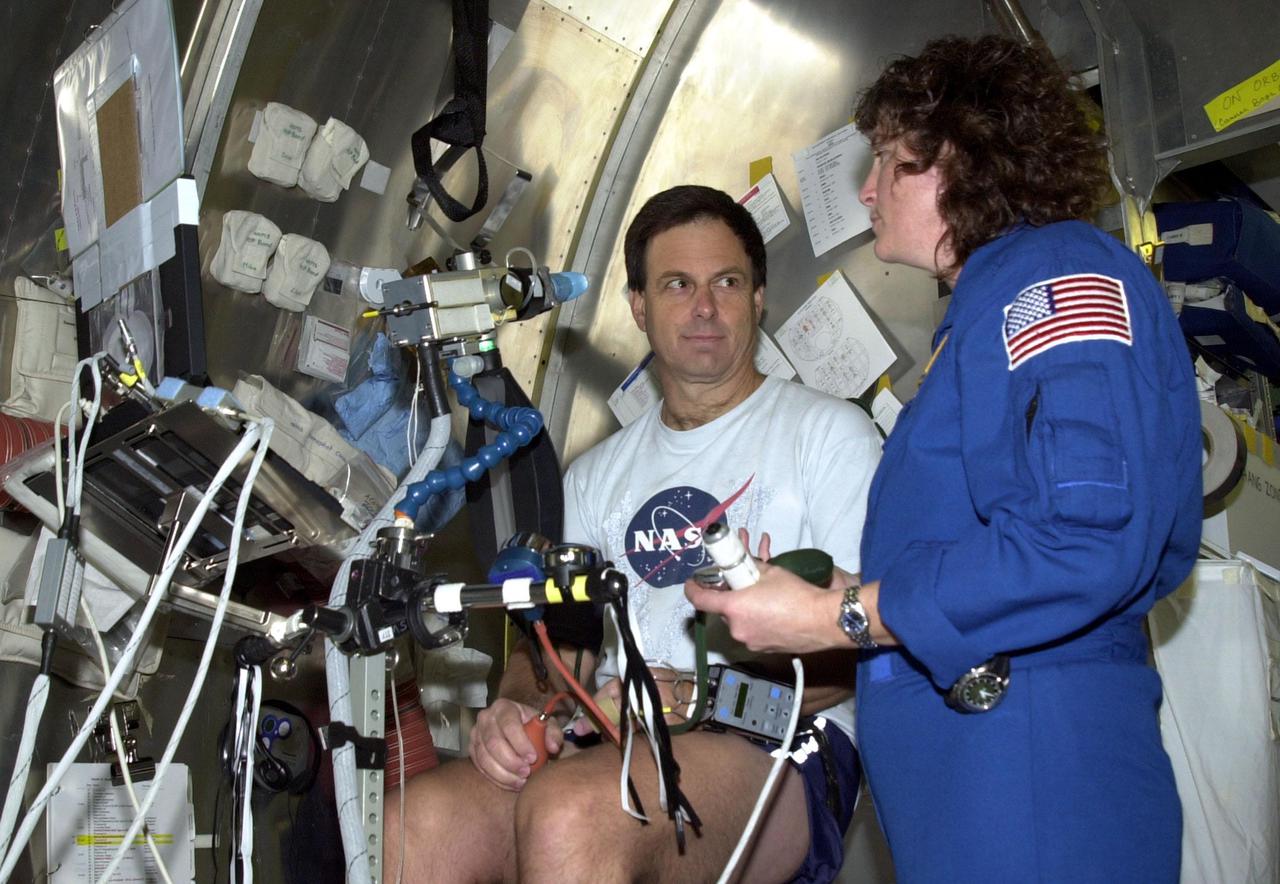
KENNEDY SPACE CENTER, FLA. - STS-107 Payload Specialist Ilan Ramon, from Israel, pauses during an experiment at SPACEHAB, Cape Canaveral, Fla., to talk with Mission Specialist Laurel Clark. STS-107 is a research mission. The primary payload is the first flight of the SHI Research Double Module (SHI_RDM). The experiments range from material sciences to life sciences (many rats). Also part of the payload is the Fast Reaction Experiments Enabling Science, Technology, Applications and Research (FREESTAR) that incorporates eight high priority secondary attached shuttle experiments: Mediterranean Israeli Dust Experiment (MEIDEX), Shuttle Ozone Limb Sounding Experiment (SOLSE-2), Student Tracked Atmospheric Research Satellite for Heuristic International Networking Experiment (STARSHINE), Critical Viscosity of Xenon-2 (CVX-2), Solar Constant Experiment-3 (SOLOCON-3), Prototype Synchrotron Radiation Detector (PSRD), Low Power Transceiver (LPT), and Collisions Into Dust Experiment -2 (COLLIDE-2). STS-107 is scheduled to launch in July 2002.
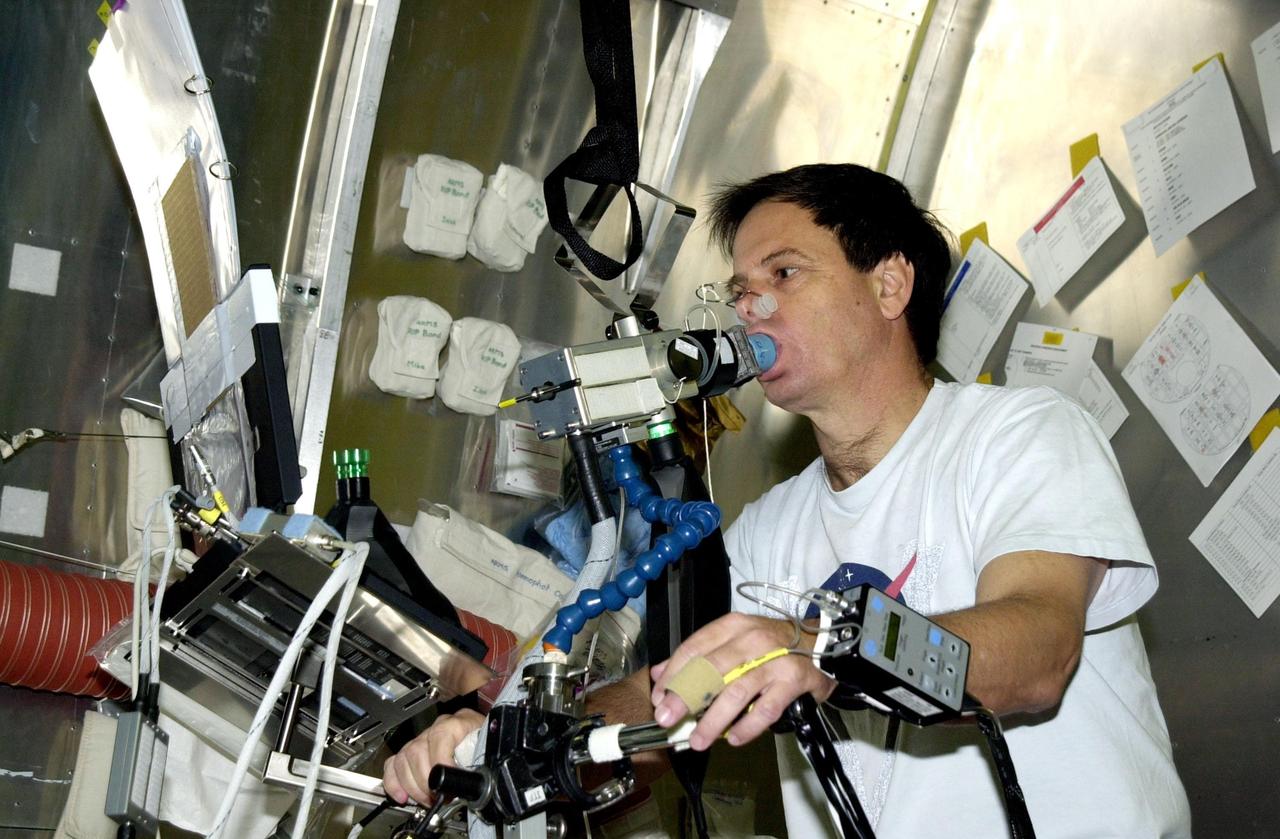
KENNEDY SPACE CENTER, FLA. - - STS-107 Payload Specialist Ilan Ramon, from Israel, works on an experiment at SPACEHAB, Cape Canaveral, Fla. With him is Mission Specialist Laurel Clark. STS-107 is a research mission. The primary payload is the first flight of the SHI Research Double Module (SHI/RDM). The experiments range from material sciences to life sciences (many rats). Also part of the payload is the Fast Reaction Experiments Enabling Science, Technology, Applications and Research (FREESTAR) that incorporates eight high priority secondary attached shuttle experiments: Mediterranean Israeli Dust Experiment (MEIDEX), Shuttle Ozone Limb Sounding Experiment (SOLSE-2), Student Tracked Atmospheric Research Satellite for Heuristic International Networking Experiment (STARSHINE), Critical Viscosity of Xenon-2 (CVX-2), Solar Constant Experiment-3 (SOLOCON-3), Prototype Synchrotron Radiation Detector (PSRD), Low Power Transceiver (LPT), and Collisions Into Dust Experiment -2 (COLLIDE-2). STS-107 is scheduled to launch in July 2002
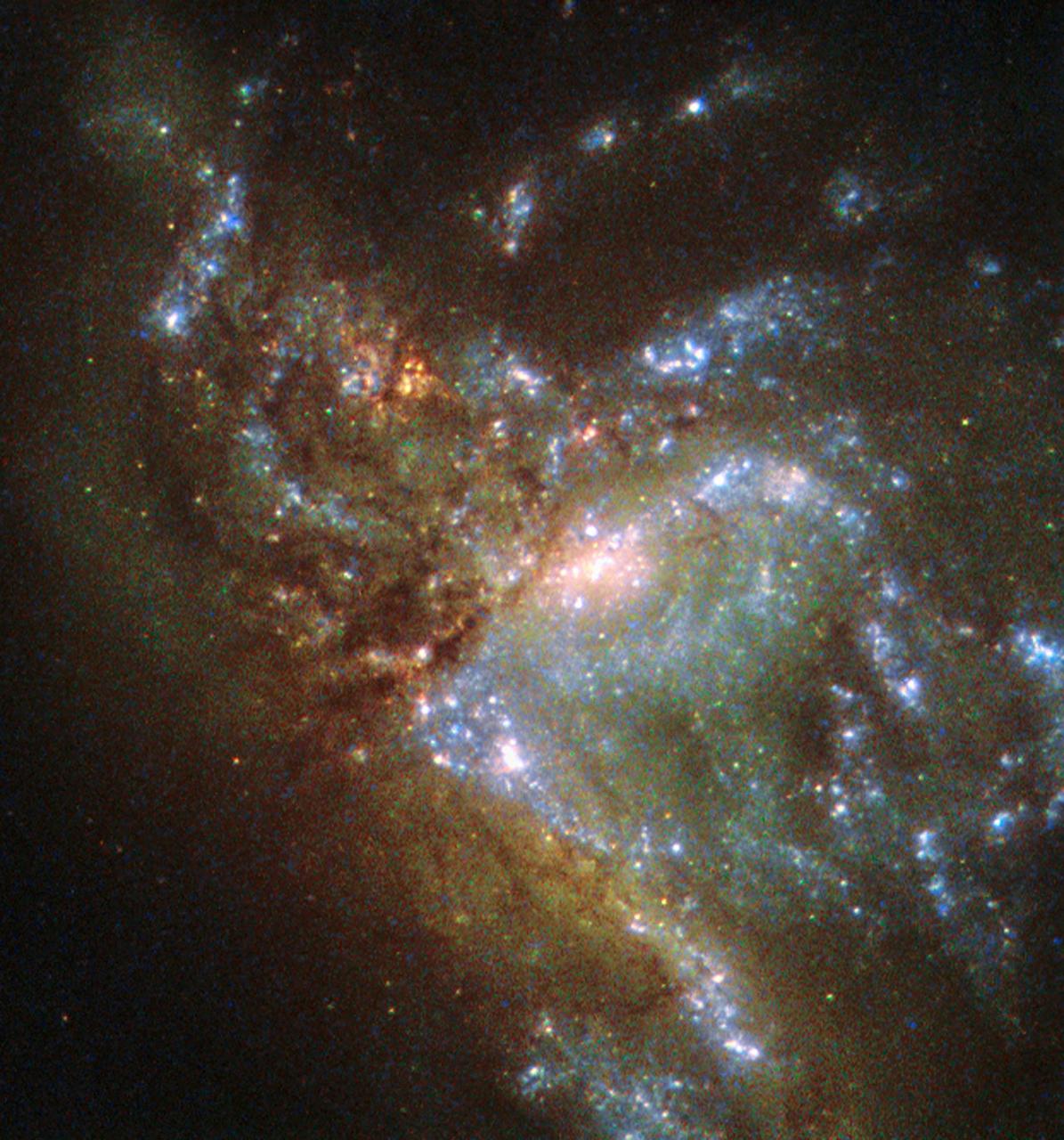
This image, taken with the Wide Field Planetary Camera 2 on board the NASA/ESA Hubble Space Telescope, shows the galaxy NGC 6052, located around 230 million light-years away in the constellation of Hercules. It would be reasonable to think of this as a single abnormal galaxy, and it was originally classified as such. However, it is in fact a “new” galaxy in the process of forming. Two separate galaxies have been gradually drawn together, attracted by gravity, and have collided. We now see them merging into a single structure. As the merging process continues, individual stars are thrown out of their original orbits and placed onto entirely new paths, some very distant from the region of the collision itself. Since the stars produce the light we see, the “galaxy” now appears to have a highly chaotic shape. Eventually, this new galaxy will settle down into a stable shape, which may not resemble either of the two original galaxies.
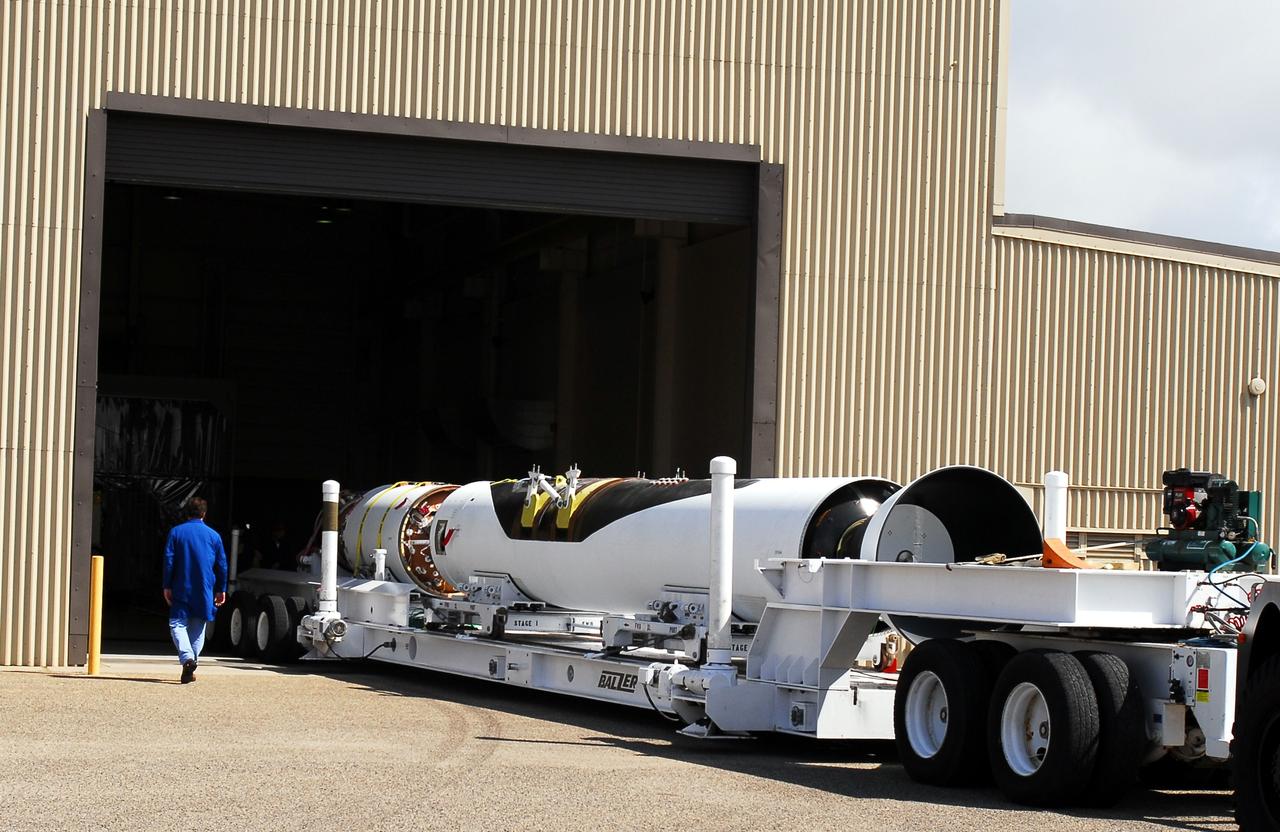
VANDENBERG AIR FORCE BASE, Calif. – In Building 1555, stage 1 and stage 2 of the Pegasus XL launch vehicle are temporarily mated. The Pegasus will launch NASA's Interstellar Boundary Explorer Mission, or IBEX, satellite from Kwajalein Island in the Marshall Islands, South Pacific. IBEX will make the first map of the boundary between the solar system and interstellar space. IBEX is the first mission designed to detect the edge of the solar system. As the solar wind from the sun flows out beyond Pluto, it collides with the material between the stars, forming a shock front. IBEX contains two neutral atom imagers designed to detect particles from the termination shock at the boundary between the solar system and interstellar space. IBEX also will study galactic cosmic rays, energetic particles from beyond the solar system that pose a health and safety hazard for humans exploring beyond Earth orbit. IBEX will make these observations from a highly elliptical orbit that takes it beyond the interference of the Earth's magnetosphere. Photo credit: NASA/Moran
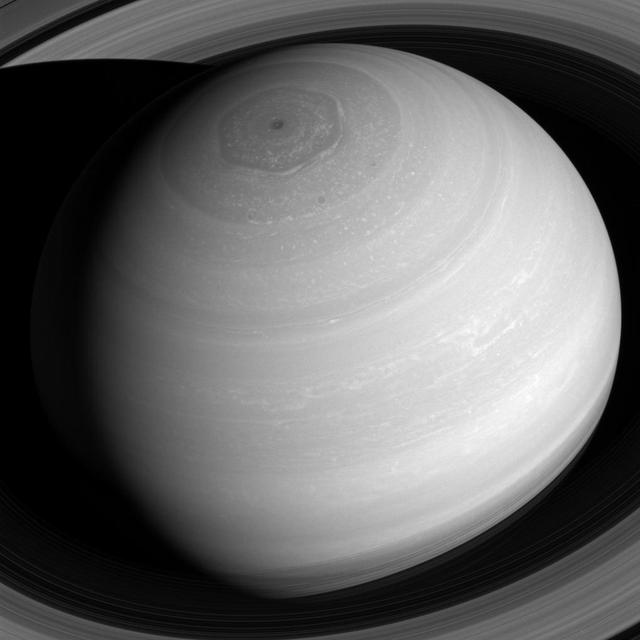
Saturn appears as a serene globe amid tranquil rings in this view from NASA's Cassini spacecraft. In reality, the planet's atmosphere is an ever-changing scene of high-speed winds and evolving weather patterns, punctuated by occasional large storms (see PIA14901). The rings, consist of countless icy particles, which are continually colliding. Such collisions play a key role in the rings' numerous waves and wakes, which are the manifestation of the subtle influence of Saturn's moons and, indeed, the planet itself. The long duration of the Cassini mission has allowed scientists to study how the atmosphere and rings of Saturn change over time, providing much-needed insights into this active planetary system. The view looks toward the sunlit side of the rings from about 41 degrees above the ring plane. The image was taken with the Cassini spacecraft wide-angle camera on July 16, 2016 using a spectral filter which preferentially admits wavelengths of near-infrared light centered at 752 nanometers. The view was acquired at a distance of approximately 1 million miles (2 million kilometers) from Saturn. Image scale is 68 miles (110 kilometers) per pixel. The view was obtained at a distance of approximately 752,000 miles (1.21 million kilometers) from Saturn and at a Sun-Saturn-spacecraft, or phase, angle of 6 degrees. Image scale is 45 miles (72 kilometers) per pixel. http://photojournal.jpl.nasa.gov/catalog/PIA20502
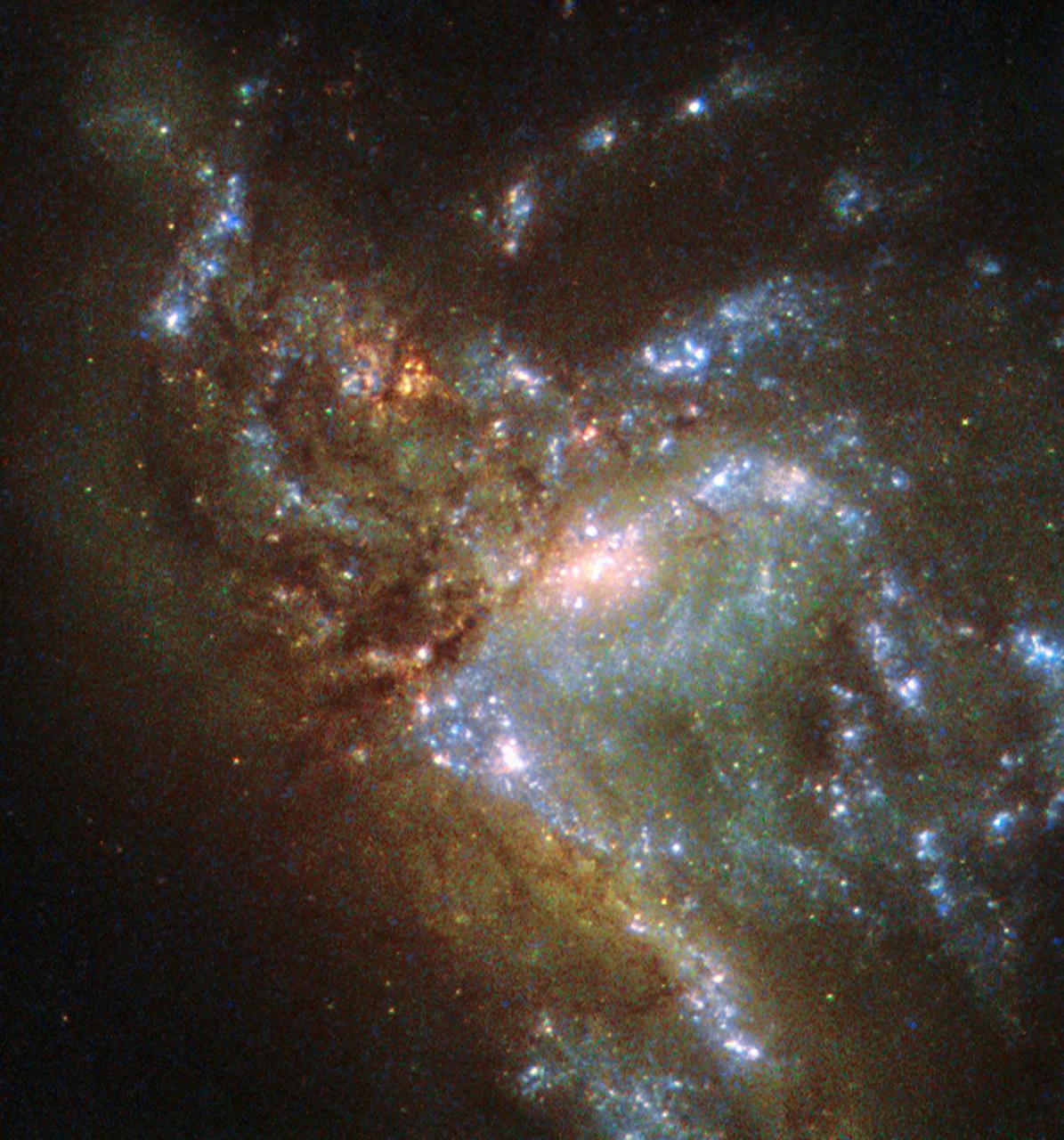
This image, taken with the Wide Field Planetary Camera 2 on board the NASA/ESA Hubble Space Telescope, shows the galaxy NGC 6052, located around 230 million light-years away in the constellation of Hercules. It would be reasonable to think of this as a single abnormal galaxy, and it was originally classified as such. However, it is in fact a “new” galaxy in the process of forming. Two separate galaxies have been gradually drawn together, attracted by gravity, and have collided. We now see them merging into a single structure. As the merging process continues, individual stars are thrown out of their original orbits and placed onto entirely new paths, some very distant from the region of the collision itself. Since the stars produce the light we see, the “galaxy” now appears to have a highly chaotic shape. Eventually, this new galaxy will settle down into a stable shape, which may not resemble either of the two original galaxies. Image credit: ESA/Hubble & NASA, Acknowledgement: Judy Schmidt

This enhanced color Jupiter image, taken by the JunoCam imager on NASA's Juno spacecraft, showcases several interesting features on the apparent edge (limb) of the planet. Prior to Juno's fifth flyby over Jupiter's mysterious cloud tops, members of the public voted on which targets JunoCam should image. This picture captures not only a fascinating variety of textures in Jupiter's atmosphere, it also features three specific points of interest: "String of Pearls," "Between the Pearls," and "An Interesting Band Point." Also visible is what's known as the STB Spectre, a feature in Jupiter's South Temperate Belt where multiple atmospheric conditions appear to collide. JunoCam images of Jupiter sometimes appear to have an odd shape. This is because the Juno spacecraft is so close to Jupiter that it cannot capture the entire illuminated area in one image -- the sides get cut off. Juno acquired this image on March 27, 2017, at 2:12 a.m. PDT (5:12 a.m. EDT), as the spacecraft performed a close flyby of Jupiter. When the image was taken, the spacecraft was about 12,400 miles (20,000 kilometers) from the planet. https://photojournal.jpl.nasa.gov/catalog/PIA21389. - Enhanced image by Björn Jónsson (CC-NC-SA) based on images provided courtesy of NASA/JPL-Caltech/SwRI/MSSS
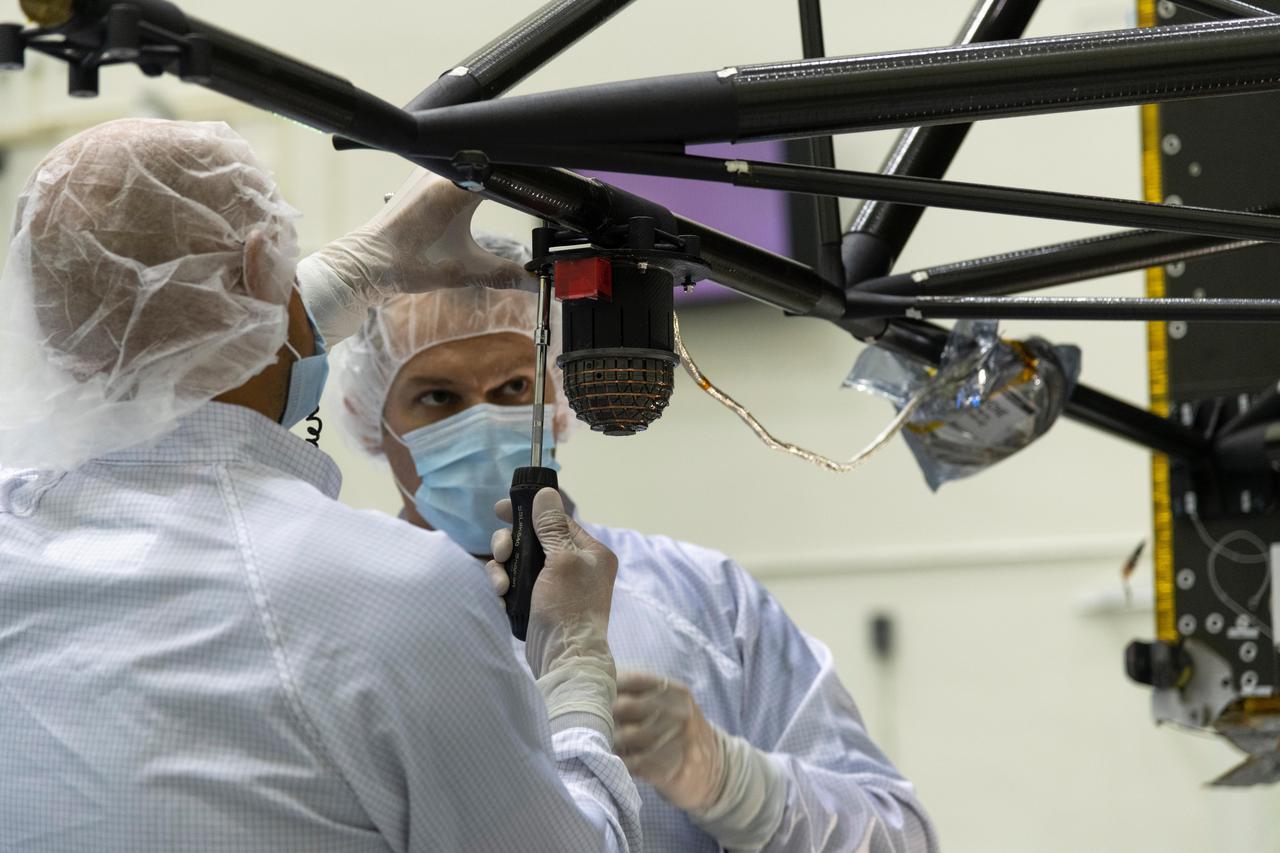
Engineers at NASA's Jet Propulsion Laboratory in Southern California integrate the magnetometer instrument into the agency's Psyche spacecraft on June 28, 2021. Psyche, set to launch in August 2022, will investigate a metal-rich asteroid of the same name, which lies in the main asteroid belt between Mars and Jupiter. Scientists believe the asteroid could be part or all of the iron-rich interior of an early planetary building block that was stripped of its outer rocky shell as it repeatedly collided with other large bodies during the early formation of the solar system. Scientists know that the asteroid doesn't generate a magnetic field the way Earth does; but if Psyche had a magnetic field in the past, that magnetic field could still be recorded in Psyche's material today. With sensors mounted onto a 6-foot (2-meter) boom, the magnetometer can determine if Psyche is still magnetized. If so, that would confirm that the asteroid is part of the core of a planetesimal, the building block of an early planet. This photo shows one of the magnetometer's sensors. https://photojournal.jpl.nasa.gov/catalog/PIA24893
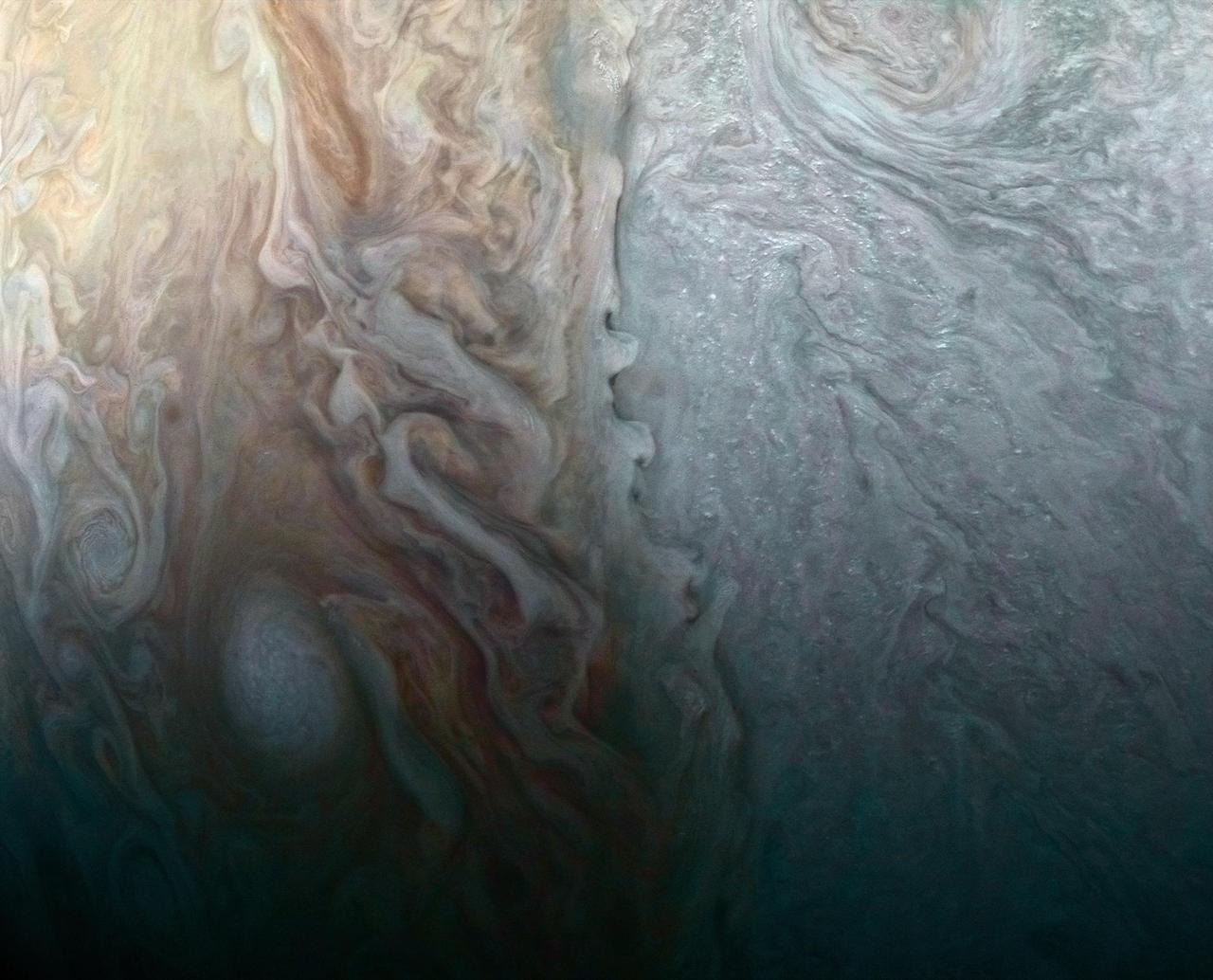
This image, taken by the JunoCam imager on NASA's Juno spacecraft, highlights a feature on Jupiter where multiple atmospheric conditions appear to collide. This publicly selected target is called "STB Spectre." The ghostly bluish streak across the right half of the image is a long-lived storm, one of the few structures perceptible in these whitened latitudes where the south temperate belt of Jupiter would normally be. The egg-shaped spot on the lower left is where incoming small dark spots make a hairpin turn. The image was taken on March 27, 2017, at 2:06 a.m. PDT (5:06 a.m. EDT), as the Juno spacecraft performed a close flyby of Jupiter. When the image was taken, the spacecraft was 7,900 miles (12,700 kilometers) from the planet. The image was processed by Roman Tkachenko, and the description is from John Rogers, the citizen scientist who identified the point of interest. https://photojournal.jpl.nasa.gov/catalog/PIA21388 . - Enhanced image by Roman Tkachenko (CC-BY) based on images provided courtesy of NASA/JPL-Caltech/SwRI/MSSS
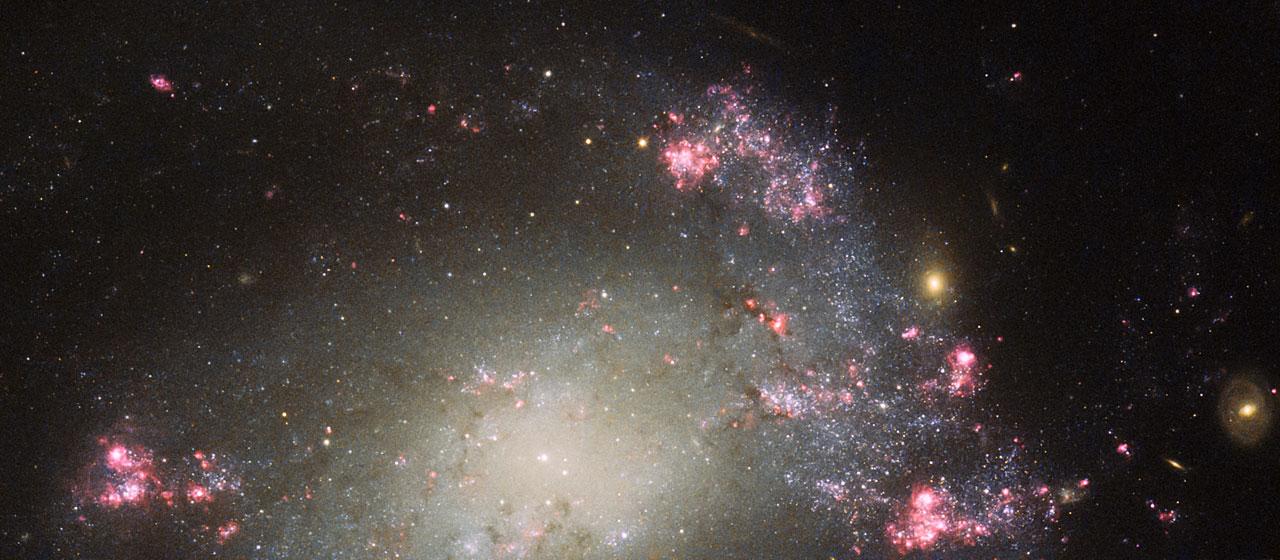
Bursts of pink and red, dark lanes of mottled cosmic dust, and a bright scattering of stars — this NASA/ESA Hubble Space Telescope image shows part of a messy barred spiral galaxy known as NGC 428. It lies approximately 48 million light-years away from Earth in the constellation of Cetus (The Sea Monster). Although a spiral shape is still just about visible in this close-up shot, overall NGC 428’s spiral structure appears to be quite distorted and warped, thought to be a result of a collision between two galaxies. There also appears to be a substantial amount of star formation occurring within NGC 428 — another telltale sign of a merger. When galaxies collide their clouds of gas can merge, creating intense shocks and hot pockets of gas and often triggering new waves of star formation. NGC 428 was discovered by William Herschel in December 1786. More recently a type Ia supernova designated SN2013ct was discovered within the galaxy by Stuart Parker of the BOSS (Backyard Observatory Supernova Search) project in Australia and New Zealand, although it is unfortunately not visible in this image. This image was captured by Hubble’s Advanced Camera for Surveys (ACS) and Wide Field and Planetary Camera 2 (WFPC2). A version of this image was entered into the Hubble’s Hidden Treasures Image Processing competition by contestants Nick Rose and the Flickr user penninecloud. Links: Nick Rose’s image on Flickr Penninecloud’s image on Flickr
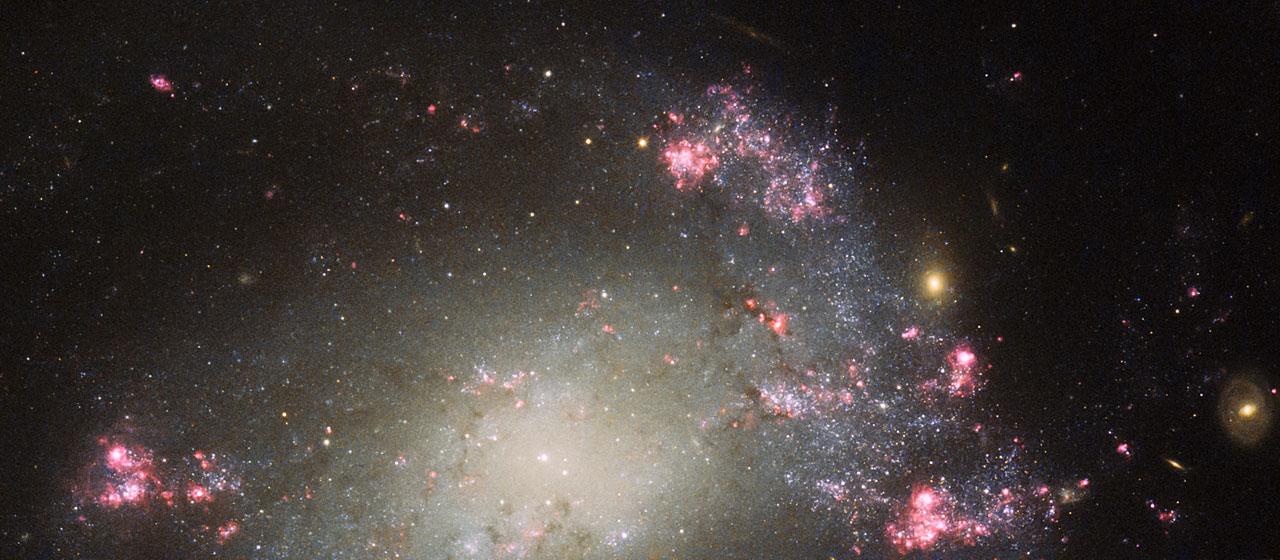
Bursts of pink and red, dark lanes of mottled cosmic dust, and a bright scattering of stars — this NASA/ESA Hubble Space Telescope image shows part of a messy barred spiral galaxy known as NGC 428. It lies approximately 48 million light-years away from Earth in the constellation of Cetus (The Sea Monster). Although a spiral shape is still just about visible in this close-up shot, overall NGC 428’s spiral structure appears to be quite distorted and warped, thought to be a result of a collision between two galaxies. There also appears to be a substantial amount of star formation occurring within NGC 428 — another telltale sign of a merger. When galaxies collide their clouds of gas can merge, creating intense shocks and hot pockets of gas, and often triggering new waves of star formation. NGC 428 was discovered by William Herschel in December 1786. More recently a type of supernova designated SN2013ct was discovered within the galaxy by Stuart Parker of the BOSS (Backyard Observatory Supernova Search) project in Australia and New Zealand, although it is unfortunately not visible in this image. This image was captured by Hubble’s Advanced Camera for Surveys (ACS) and Wide Field and Planetary Camera 2 (WFPC2). Image credit: ESA/Hubble and NASA and S. Smartt (Queen's University Belfast), Acknowledgements: Nick Rose and Flickr user pennine cloud <b><a href="http://www.nasa.gov/audience/formedia/features/MP_Photo_Guidelines.html" rel="nofollow">NASA image use policy.</a></b> <b><a href="http://www.nasa.gov/centers/goddard/home/index.html" rel="nofollow">NASA Goddard Space Flight Center</a></b> enables NASA’s mission through four scientific endeavors: Earth Science, Heliophysics, Solar System Exploration, and Astrophysics. Goddard plays a leading role in NASA’s accomplishments by contributing compelling scientific knowledge to advance the Agency’s mission. <b>Follow us on <a href="http://twitter.com/NASAGoddardPix" rel="nofollow">Twitter</a></b> <b>Like us on <a href="http://www.facebook.com/pages/Greenbelt-MD/NASA-Goddard/395013845897?ref=tsd" rel="nofollow">Facebook</a></b> <b>Find us on <a href="http://instagrid.me/nasagoddard/?vm=grid" rel="nofollow">Instagram</a></b>

Wonders in the Antarctic Sea and Sky NASA aircraft and scientists have returned to the United States after a short ice-surveying mission to #Antarctica. Despite having only a week of flying time, the team returned with crucial scientific data and a trove of spectacular aerial photographs. The flights over Antarctica were part of Operation #IceBridge, a multi-year mission to monitor conditions in Antarctica and the Arctic until a new ice-monitoring satellite, ICESat-2, launches in 2016. ICESat-1 was decommissioned in 2009, and IceBridge aircraft have been flying ever since. Laser altimeter and radar data are the primary products of the mission, but IceBridge project scientist Michael Studinger almost always has his digital camera ready as well. On November 24, 2013, he took this photograph of a multi-layered lenticular cloud hovering near Mount Discovery, a volcano about 70 kilometers (44 miles) southwest of McMurdo. Lenticular #clouds are a type of wave cloud. They usually form when a layer of air near the surface encounters a topographic barrier, gets pushed upward, and flows over it as a series of atmospheric gravity waves. Lenticular clouds form at the crest of the waves, where the air is coolest and water vapor is most likely to condense into cloud droplets. The bulging sea ice in the foreground is a pressure ridge, which formed when separate ice floes collided and piled up on each other. Read more: <a href="http://1.usa.gov/18lXIQS" rel="nofollow">1.usa.gov/18lXIQS</a> Photograph courtesy of Michael Studinger. Caption by Adam Voiland of NASA's Earth Observatory. <b><a href="http://www.nasa.gov/audience/formedia/features/MP_Photo_Guidelines.html" rel="nofollow">NASA image use policy.</a></b> <b><a href="http://www.nasa.gov/centers/goddard/home/index.html" rel="nofollow">NASA Goddard Space Flight Center</a></b> enables NASA’s mission through four scientific endeavors: Earth Science, Heliophysics, Solar System Exploration, and Astrophysics. Goddard plays a leading role in NASA’s accomplishments by contributing compelling scientific knowledge to advance the Agency’s mission. <b>Follow us on <a href="http://twitter.com/NASA_GoddardPix" rel="nofollow">Twitter</a></b> <b>Like us on <a href="http://www.facebook.com/pages/Greenbelt-MD/NASA-Goddard/395013845897?ref=tsd" rel="nofollow">Facebook</a></b> <b>Find us on <a href="http://instagram.com/nasagoddard?vm=grid" rel="nofollow">Instagram</a></b>
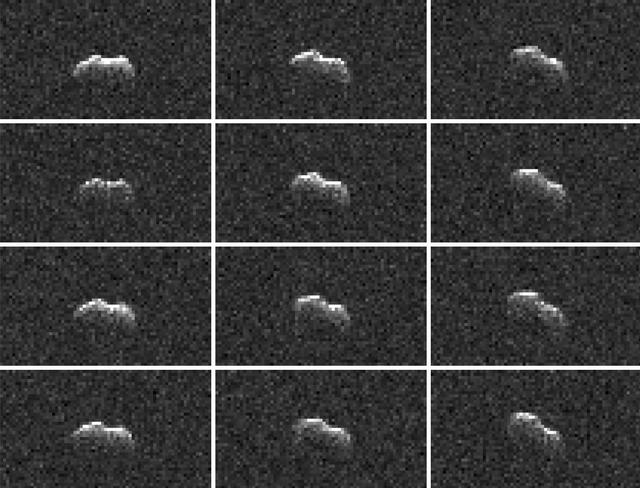
On March 21, 2021, the large asteroid 2001 FO32 made a close approach with our planet, passing at a distance of about 1.25 million miles (2 million kilometers) — or 5 1/4 times the distance from Earth to the Moon. While there was no risk of the near-Earth asteroid colliding with Earth as its orbit is very well known, scientists at NASA's Jet Propulsion Laboratory in Southern California took the opportunity to capture these radar images of the asteroid as it tumbled past. Using NASA's 34-meter (111.5-feet) Deep Space Station 13 (DSS-13) radio antenna at the Deep Space Network's Goldstone Deep Space Communication Complex near Barstow, California, radio signals were transmitted to 2001 FO32. The signals then bounced off the surface of the asteroid and were received by the 100-meter (328-feet) Green Bank Telescope in West Virginia. Such radar observations can offer additional insight into the asteroid's orbit, provide a better estimate of its dimensions and rotation rate, and help glimpse surface features (like large boulders or craters). Other radar observations were carried out by scientists using the 34-meter DSS-43 antenna at the Deep Space Network's Canberra Deep Space Communication Complex in Australia. Along with the Commonwealth Scientific and Industrial Research Organisation's Australia Telescope Compact Array near Narrabri in New South Wales, both antennas worked together to track 2001 FO32. Asteroid 2001 FO32 was discovered in March 2001 by the Lincoln Near-Earth Asteroid Research (LINEAR) program in Socorro, New Mexico, and had been estimated, based on optical measurements, to be roughly 3,000 feet (1 kilometer) wide. In more recent follow-up observations by NEOWISE, 2001 FO32 appears to be faint when observed in infrared wavelengths, which suggests the object is likely less than 1 kilometer in diameter. Analysis by the NEOWISE team shows that it is between 1,300 to 2,230 feet (440 to 680 meters) wide. Further analysis of data from the radar campaign will better refine the size of the asteroid and increase the precision of its orbital calculations. For more information about 2001 FO32 and observing campaign, read: https://www.jpl.nasa.gov/news/asteroid-2001-fo32-will-safely-pass-by-earth-march-21 https://photojournal.jpl.nasa.gov/catalog/PIA24561

This image from NASA's James Webb Space Telescope reveals at least 17 concentric dust rings emanating from a pair of stars orbiting one another. Located just over 5,000 light-years from Earth, the system is known as Wolf-Rayet 140 because one of the stars is a Wolf-Rayet star. The other is an O-type star, one of the most massive star types known. Each ring was created when the two stars came close together and their stellar winds (streams of gas they blow into space) collided, compressing the gas and forming dust. A ring is produced once per orbit, every 7.93 years. A Wolf-Rayet star is an O-type star born with at least 25 times more mass than our Sun that is nearing the end of its life, when it will likely collapse directly to black hole, or explode as a supernova. These delays between periods of dust production create the unique ring pattern. Some Wolf-Rayet binaries in which the stars are close enough together and have circular orbits produce dust continuously, often forming a pinwheel pattern. WR 140's rings are also referred to as shells because they are not perfectly circular and are thicker and wider than they appear in the image. The rings appear brighter in some areas but are almost invisible in others, rather than forming a perfect "bullseye" pattern. That's because production of dust is variable as the stars get close to one another, and because Webb views the system at an angle and is not looking directly at the orbital plane of the stars. One of the densest regions of dust production creates the bright feature appearing at 2 o'clock. The image was taken by the Mid-Infrared Instrument (MIRI), now managed by the agency's Goddard Space Flight Center. MIRI was developed through a 50-50 partnership between NASA and ESA (European Space Agency). The Jet Propulsion Laboratory in Southern California led the effort for NASA, and a multinational consortium of European astronomical institutes contributed for ESA. Webb's science instruments detect infrared light, a range of wavelengths emitted by warm objects and invisible to the human eye. MIRI detects the longest infrared wavelengths, which means it can often see cooler objects – including these dust rings – than the other three Webb instruments can. The filters used to take this image were the F770W (7.7 micrometers, shown as blue), F1500W (15 micrometers, shown as green), and F2100W (21 micrometers, shown as red). The observations were done under Webb's early release observation (ERO) program number 1349. The most common element found in stars, hydrogen, can't form dust on its own. But Wolf-Rayet stars in their later stages have blown away all of their hydrogen, so they eject elements typically found deep in a star's interior, like carbon, which can form dust. Data from MIRI's Medium Resolution Spectrometer (MRS) shows that the dust made by WR 140 is likely made of a class of molecules called polycyclic aromatic hydrocarbons (PAHs), which are a type of organic carbon-rich compounds that are thought to enrich the carbon content throughout the Universe. Initial processing of the Webb WR 140 data included eight bright "spikes" of light emanating from the center of the image. These are not features of the system, but so-called artifacts of the telescope itself. They were removed from the image, in order to give viewers an unobscured view of the source object. https://photojournal.jpl.nasa.gov/catalog/PIA25432