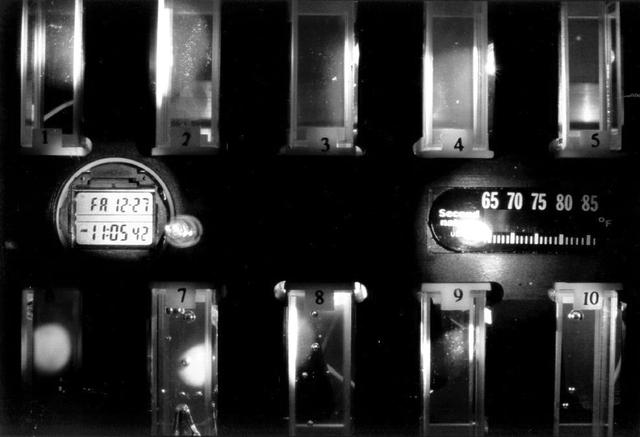
Close-up view of the Binary Colloidal Alloy Test during an experiment run aboard the Russian Mir space station. BCAT is part of an extensive series of experiments plarned to investigate the fundamental properties of colloids so that scientists can make colloids more useful for technological applications. Some of the colloids studied in BCAT are made of two different sized particles (binary colloidal alloys) that are very tiny, uniform plastic spheres. Under the proper conditions, these colloids can arrange themselves in a pattern to form crystals, which may have many unique properties that may form the basis of new classes of light switches, displays, and optical devices that can fuel the evolution of the next generation of computer and communication technologies. This Slow Growth hardware consisted of a 35-mm camera aimed toward a module which contained 10 separate colloid samples. To begin the experiment, one of the astronauts would mix the samples to disperse the colloidal particles. Then the hardware operated autonomously, taking photos of the colloidal samples over a 90-day period. The investigation proved that gravity plays a central role in the formation and stability of these types of colloidal crystal structures. The investigation also helped identify the optimum conditions for the formation of colloidal crystals, which will be used for optimizing future microgravity experiments in the study of colloidal physics. Dr. David Weitz of the University of Pennsylvania and Dr. Peter Pusey of the University of Edinburgh, United Kingdom, are the principal investigators.
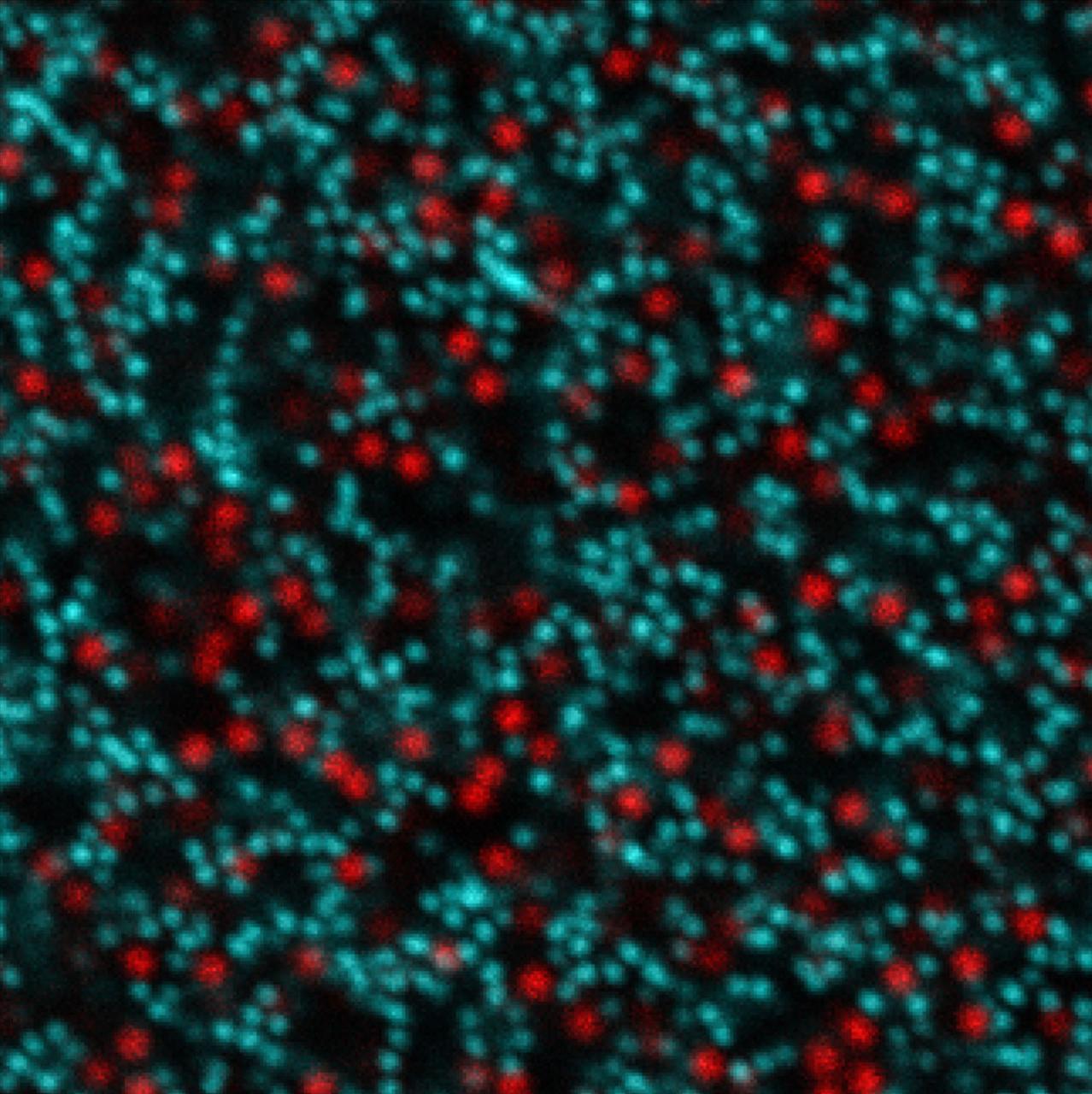
jsc2024e043753 (7/10/2024) --- Confocal microscopy image of a bimodal attractive colloidal suspension with size ratio R = 2 for the ISS Bimodal Colloidal Assembly, Coarsening, and Failure: Decoupling Sedimentation and Particle Size Effects (Bimodal Colloid) investigation. Image courtesy of Calvin Zhuang.
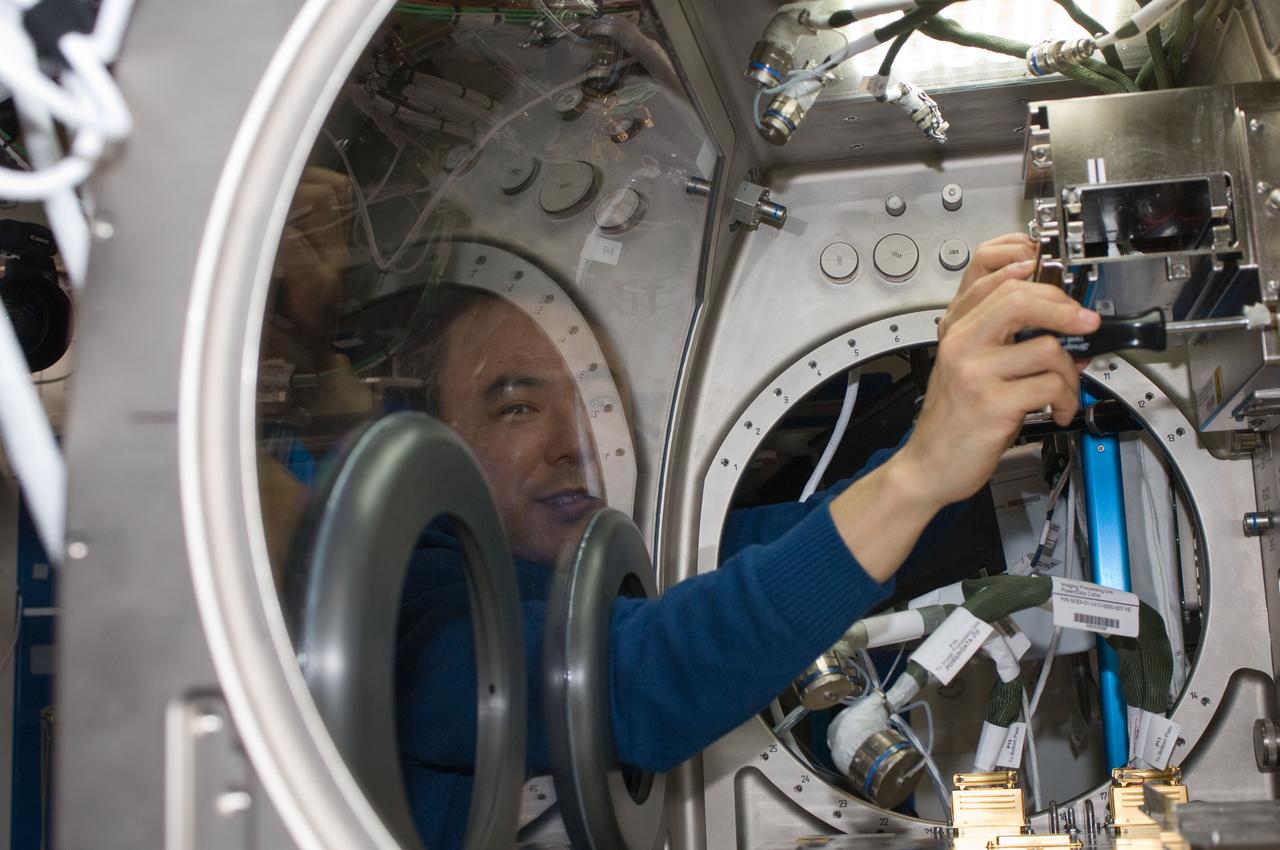
ISS029-E-027435 (17 Oct. 2011) --- In the International Space Station?s Destiny laboratory, Japan Aerospace Exploration Agency astronaut Satoshi Furukawa, Expedition 29 flight engineer, activates the Microgravity Science Glovebox (MSG) in preparation for work with the Selectable Optical Diagnostics Instrument ? Colloid (SODI-COLLOID) hardware.
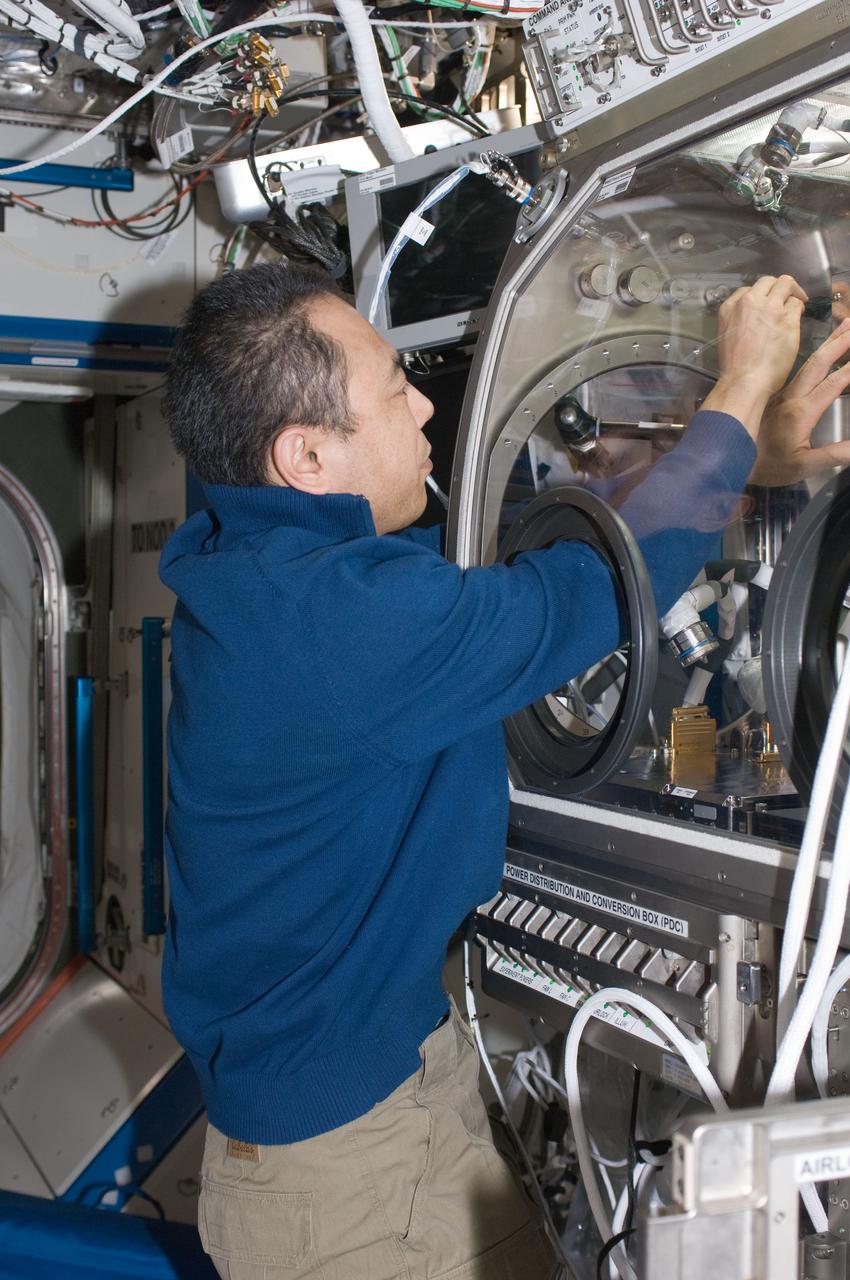
ISS029-E-027431 (17 Oct. 2011) --- In the International Space Station?s Destiny laboratory, Japan Aerospace Exploration Agency astronaut Satoshi Furukawa, Expedition 29 flight engineer, activates the Microgravity Science Glovebox (MSG) in preparation for work with the Selectable Optical Diagnostics Instrument ? Colloid (SODI-COLLOID) hardware.
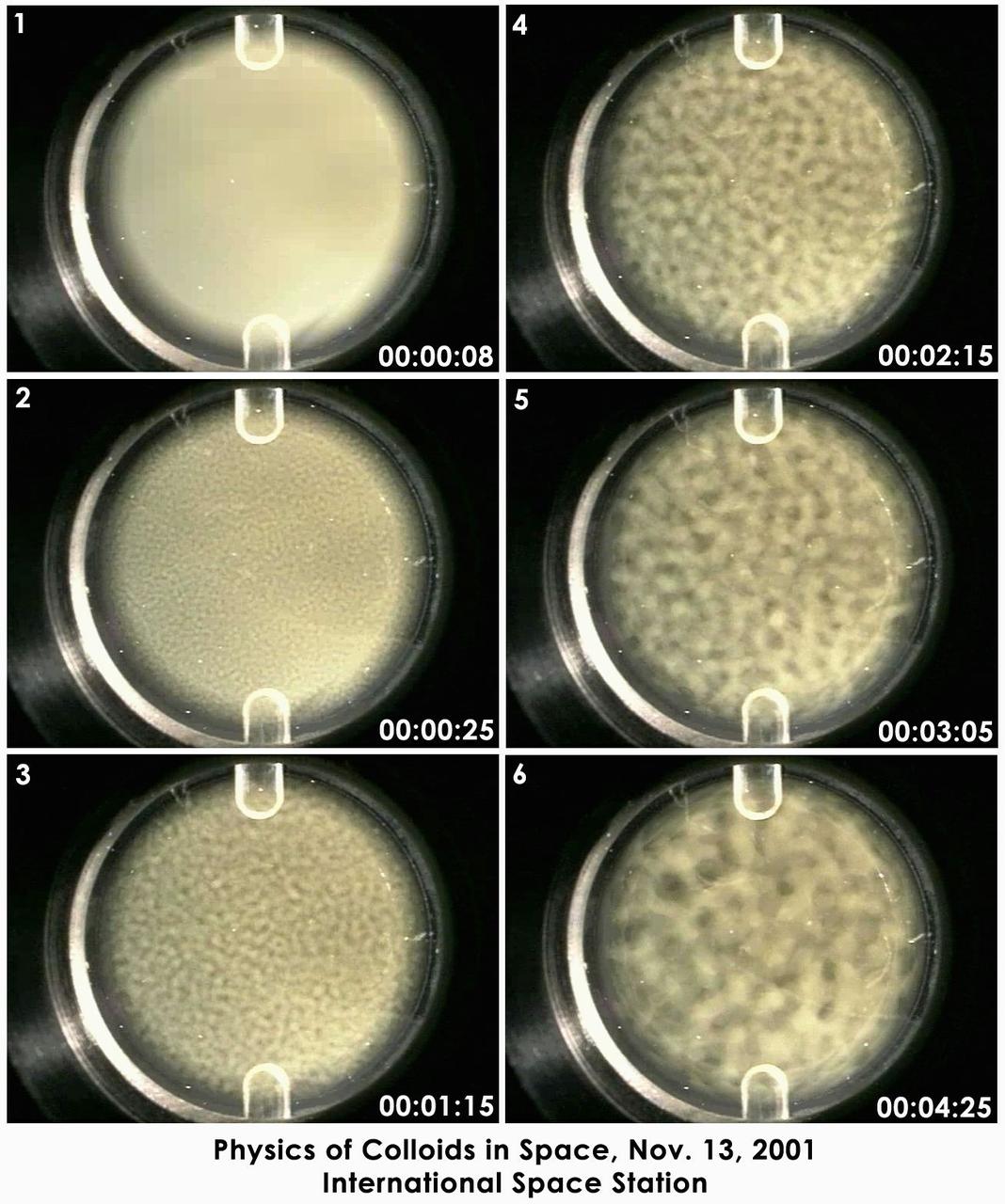
Still photographs taken over 16 hours on Nov. 13, 2001, on the International Space Station have been condensed into a few seconds to show the de-mixing -- or phase separation -- process studied by the Experiment on Physics of Colloids in Space. Commanded from the ground, dozens of similar tests have been conducted since the experiment arrived on ISS in 2000. The sample is a mix of polymethylmethacrylate (PMMA or acrylic) colloids, polystyrene polymers and solvents. The circular area is 2 cm (0.8 in.) in diameter. The phase separation process occurs spontaneously after the sample is mechanically mixed. The evolving lighter regions are rich in colloid and have the structure of a liquid. The dark regions are poor in colloids and have the structure of a gas. This behavior carnot be observed on Earth because gravity causes the particles to fall out of solution faster than the phase separation can occur. While similar to a gas-liquid phase transition, the growth rate observed in this test is different from any atomic gas-liquid or liquid-liquid phase transition ever measured experimentally. Ultimately, the sample separates into colloid-poor and colloid-rich areas, just as oil and vinegar separate. The fundamental science of de-mixing in this colloid-polymer sample is the same found in the annealing of metal alloys and plastic polymer blends. Improving the understanding of this process may lead to improving processing of these materials on Earth.
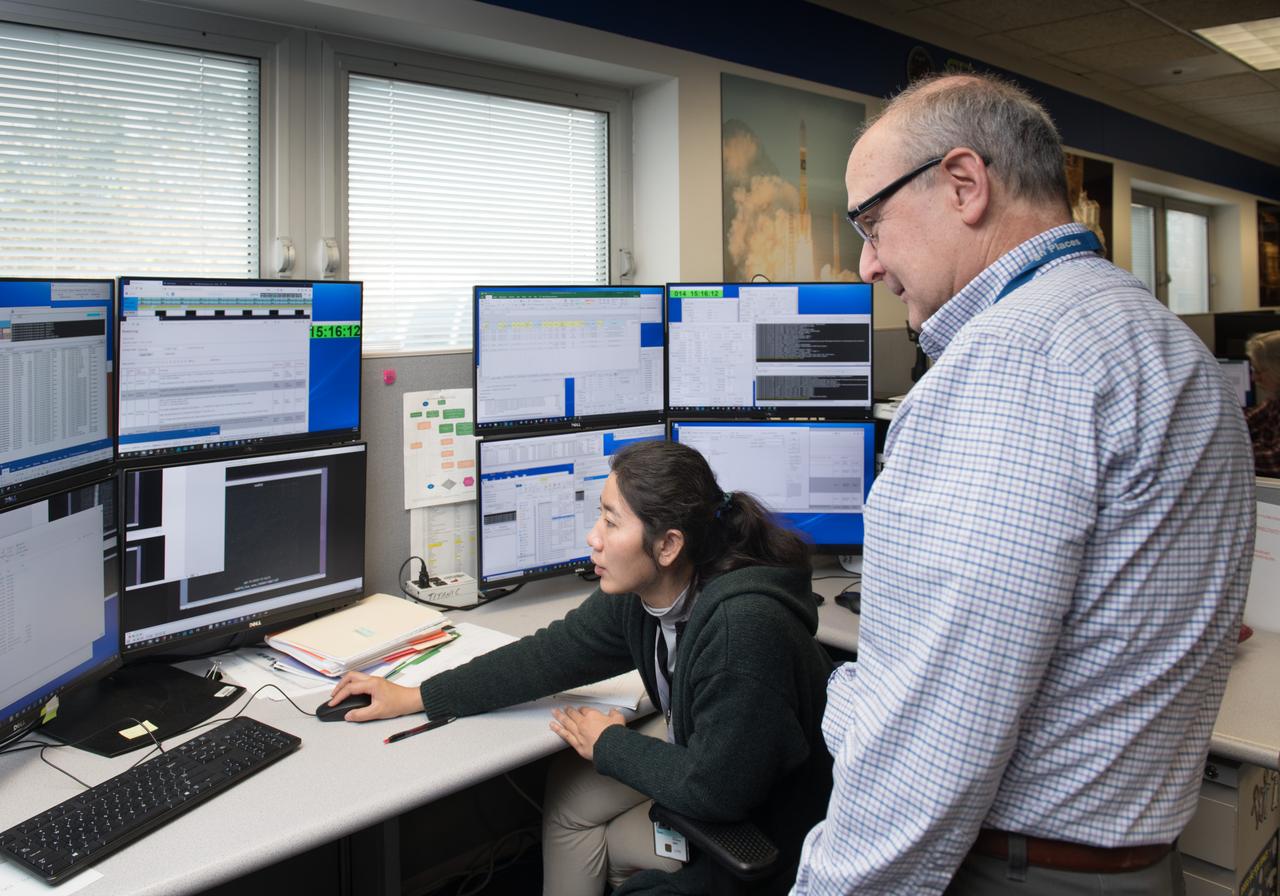
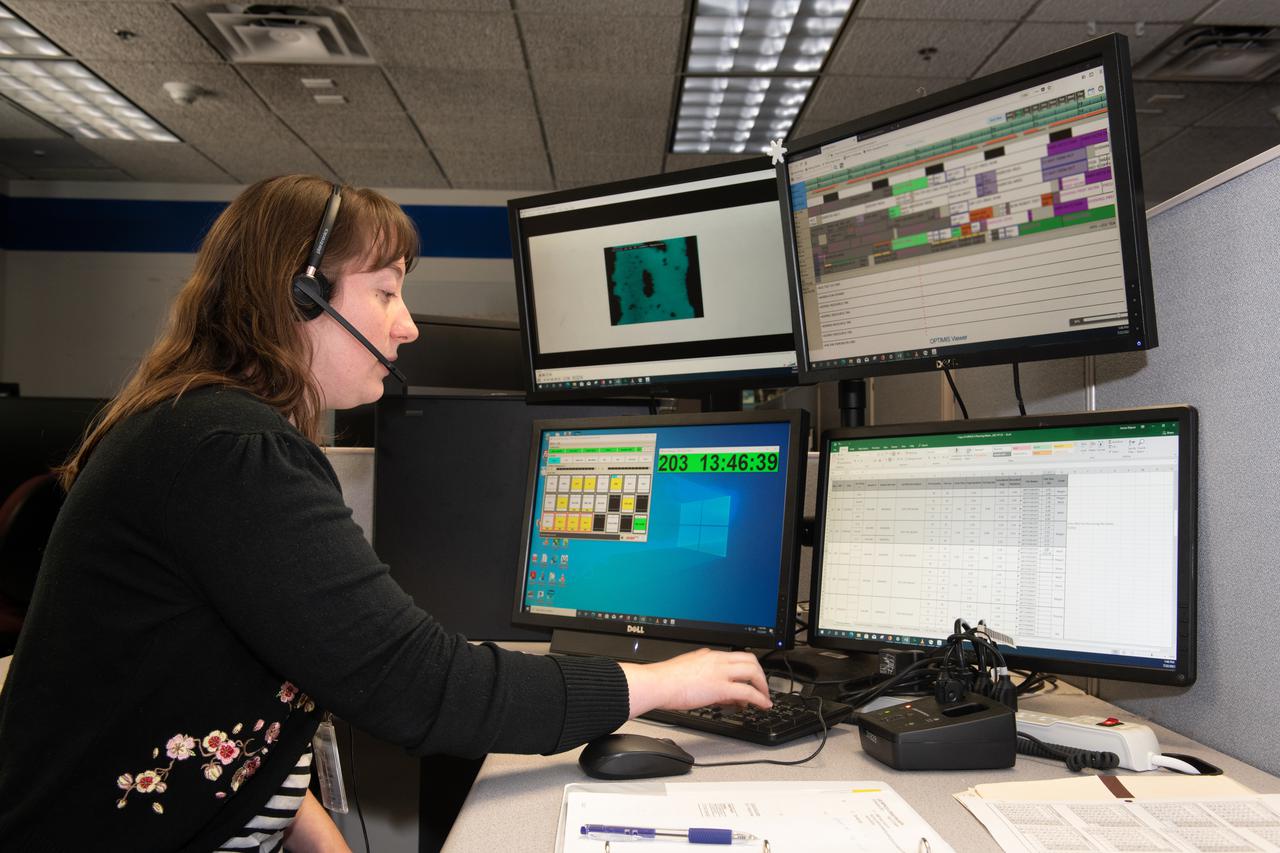
Advanced Colloids Experiment, Thermal 5-2, ACE T5-2 International Space Station, ISS, Fluids Integrated Rack, FIR Operations in the Telescience Support Center, TSC
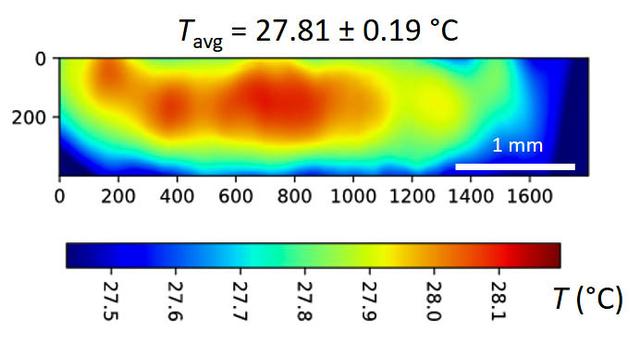
jsc2024e065172 (10/3/2024) --- A temperature map is seen within a microgel suspension illuminated by the Colloidal Solids (COLIS) near infrared laser (NIR). Reference ground tests for the Colloidal Solids (COLIS) investigation show spatial variation of the sample temperature while illuminating an aqueous, dense suspension of thermosensitive microgels with a 0.5 s pulse of NIR laser light. The NIR beam propagates from left to right. The sample temperature with no NIR laser is uniform and set to 27°C. The temperature values are inferred from the change in scattered intensity at a scattering angle of 90°, as recorded by one of the complementary metal-oxide-semiconductor (CMOS) cameras of COLIS. Results from this investigation are expected to provide a deeper understanding of soft solid interactions with gravity and microgravity, paving the way for the design of new materials. Image courtesy of Redwire Space Laboratories, Kruibeke – Belgium.
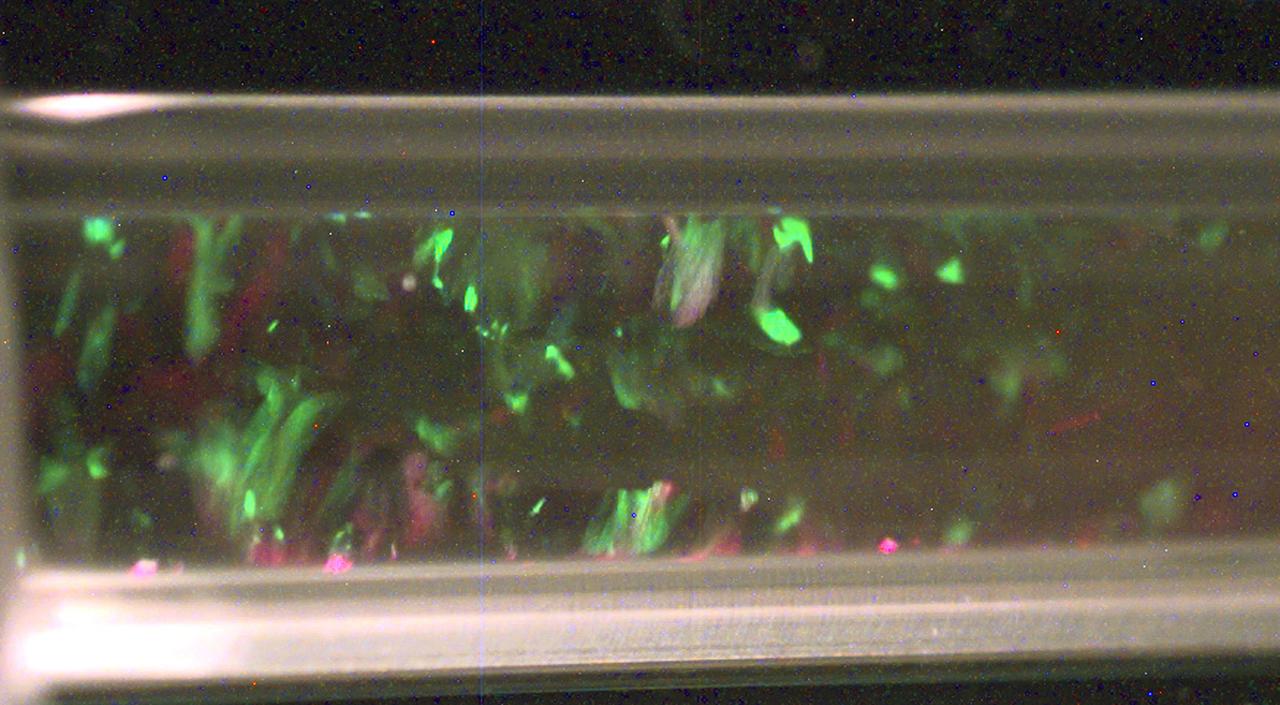
This is an image of a colloidal crystal from the CDOT-2 investigation flown on STS-95. There are so many colloidal particles in this sample that it behaves like a glass. In the laboratory on Earth, the sample remained in an amorphous state, showing no sign of crystal growth. In microgravity the sample crystallized in 3 days, as did the other glassy colloidal samples examined in the CDOT-2 experiment. During the investigation, crystallization occurred in samples that had a volume fraction (number of particles per total volume) larger than the formerly reported glass transition of 0.58. This has great implications for theories of the structural glass transition. These crystals were strong enough to survive space shuttle re-entry and landing.
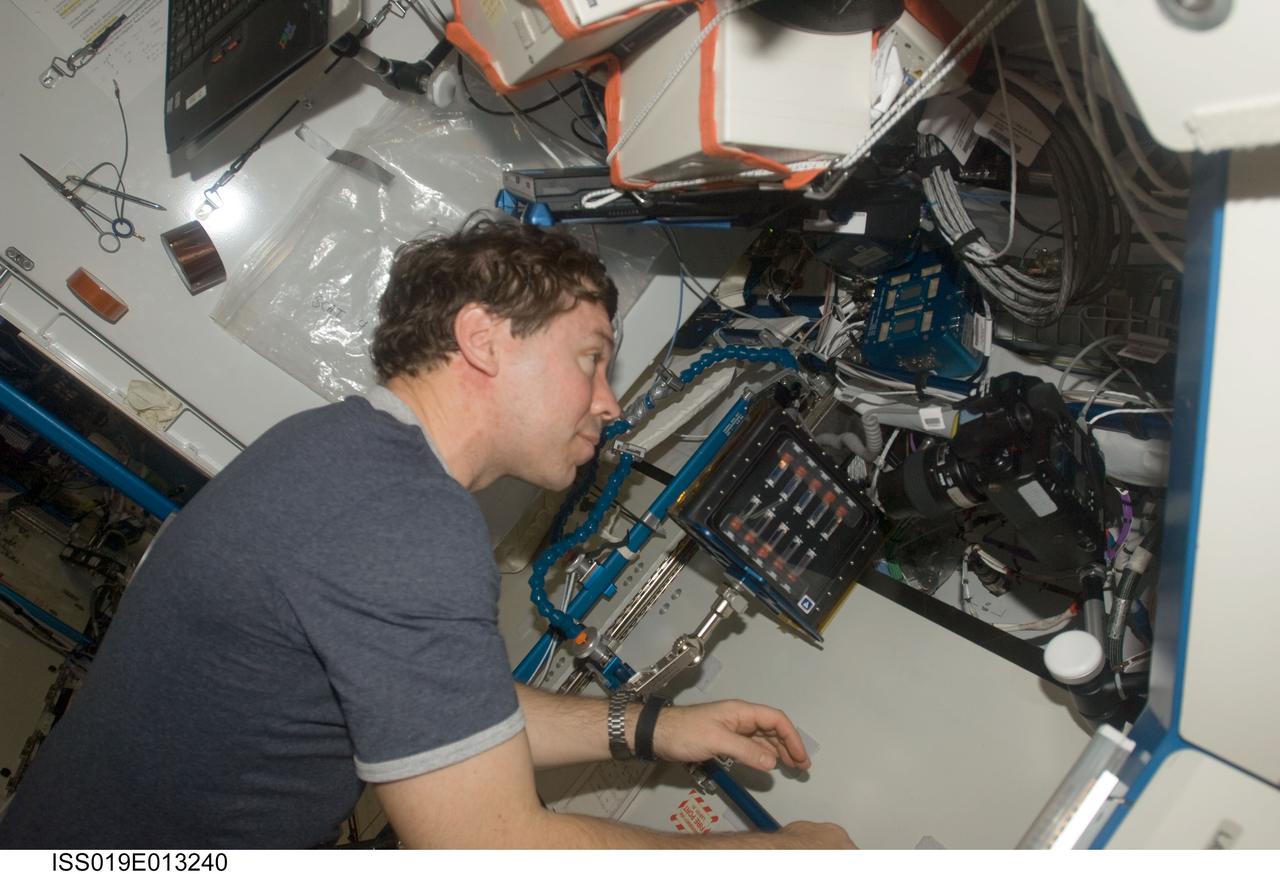
ISS019-E-013240 (2 May 2009) --- Astronaut Michael Barratt, Expedition 19/20 flight engineer, conducts a session with the Binodal Colloidal Aggregation Test?4 (BCAT-4) in the Destiny laboratory of the International Space Station. This experiment studies the long-term behavior of colloids ? fine particles suspended in a fluid in a microgravity environment, where the effects of sedimentation and convention are removed. Results from this study may lead to new colloid materials with applications in the communications and computer industries for switches, displays and optical devices with properties that could rival those of lasers.
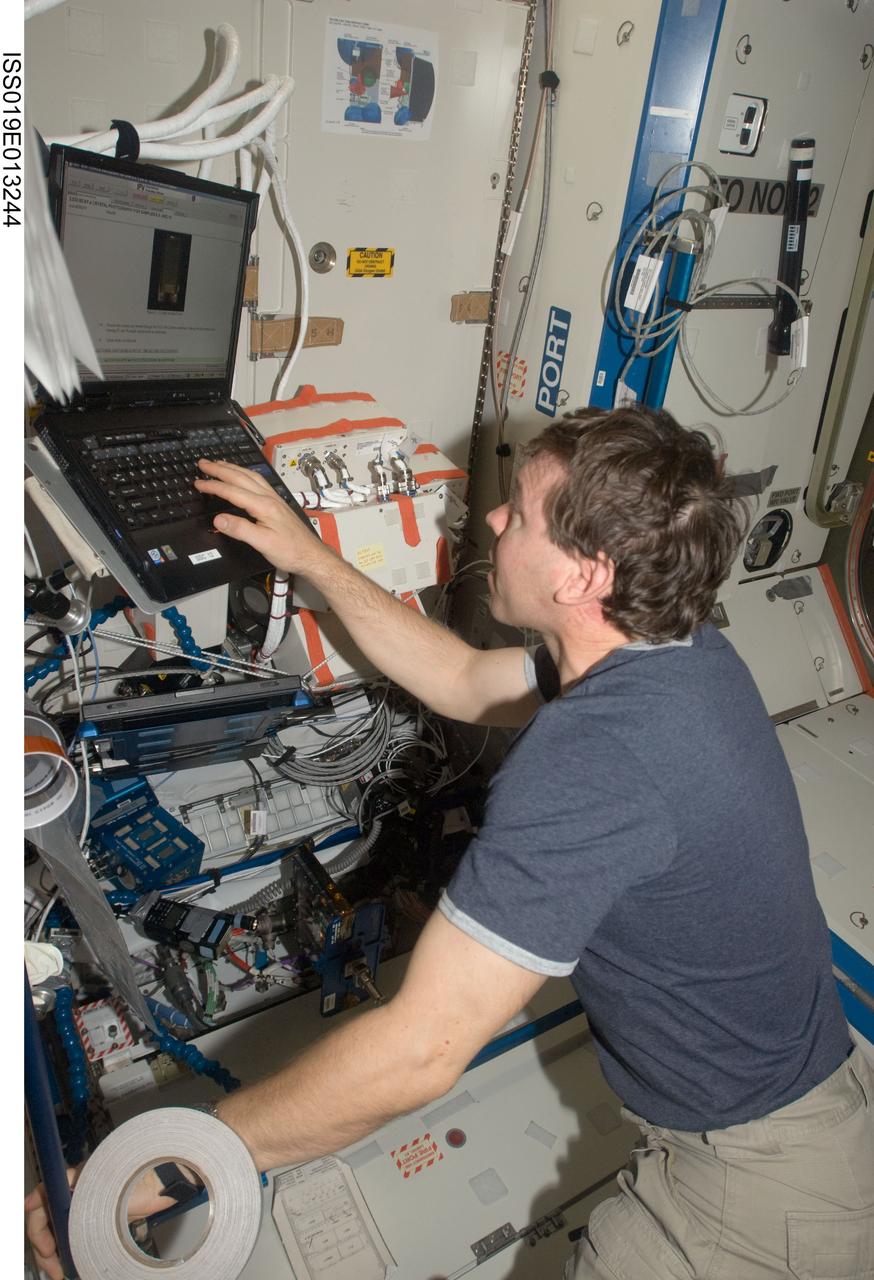
ISS019-E-013244 (2 May 2009) --- Astronaut Michael Barratt, Expedition 19/20 flight engineer, uses a computer during a session with the Binodal Colloidal Aggregation Test?4 (BCAT-4) in the Destiny laboratory of the International Space Station. This experiment studies the long-term behavior of colloids ? fine particles suspended in a fluid in a microgravity environment, where the effects of sedimentation and convention are removed. Results from this study may lead to new colloid materials with applications in the communications and computer industries for switches, displays and optical devices with properties that could rival those of lasers.
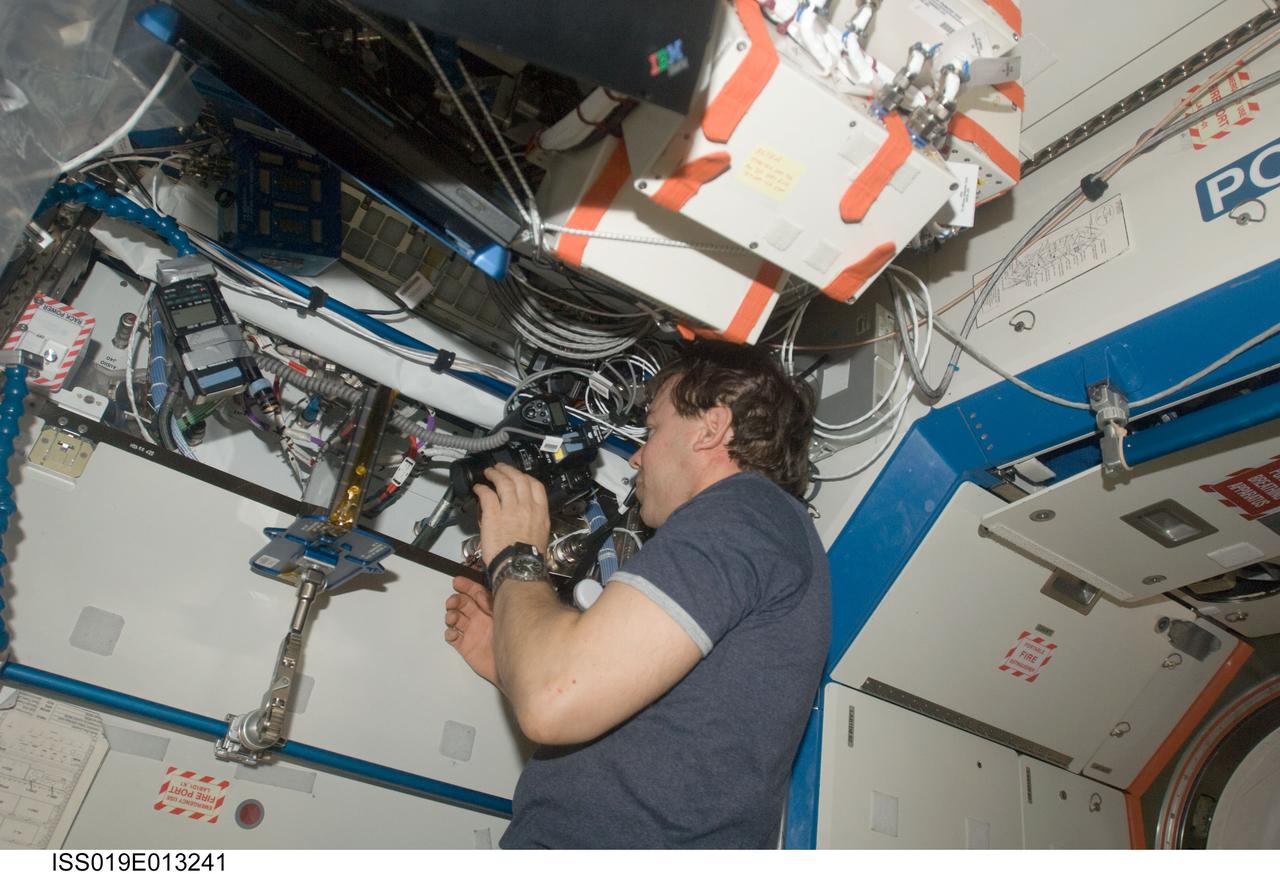
ISS019-E-013241 (2 May 2009) --- Astronaut Michael Barratt, Expedition 19/20 flight engineer, prepares to photograph Binodal Colloidal Aggregation Test?4 (BCAT-4) experiment samples in the Destiny laboratory of the International Space Station. This experiment studies the long-term behavior of colloids ? fine particles suspended in a fluid in a microgravity environment, where the effects of sedimentation and convention are removed. Results from this study may lead to new colloid materials with applications in the communications and computer industries for switches, displays and optical devices with properties that could rival those of lasers.
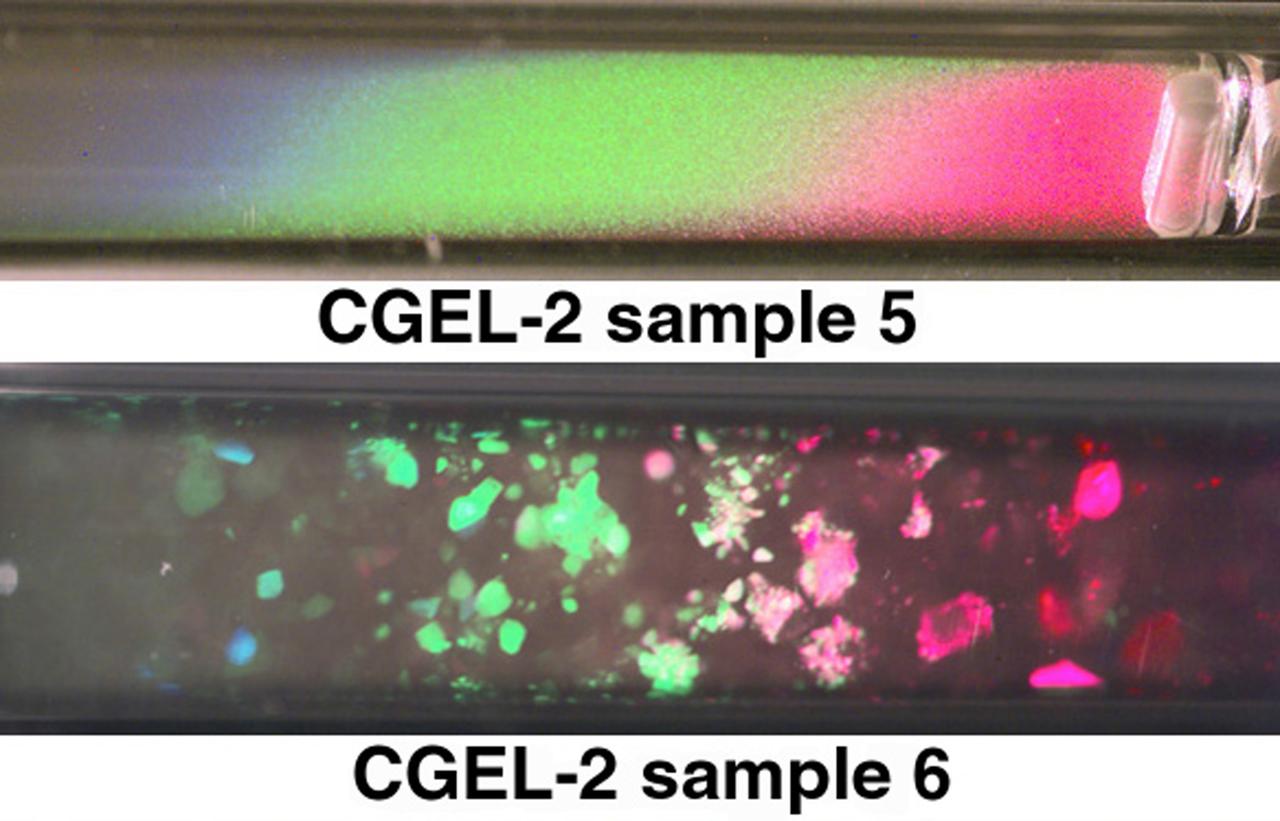
These are images of CGEL-2 samples taken during STS-95. They show binary colloidal suspensions that have formed ordered crystalline structures in microgravity. In sample 5, there are more particles therefore, many, many crystallites (small crystals) form. In sample 6, there are less particles therefore, the particles are far apart and few, much larger crystallites form. The white object in the right corner of sample 5 is the stir bar used to mix the sample at the begirning of the mission.
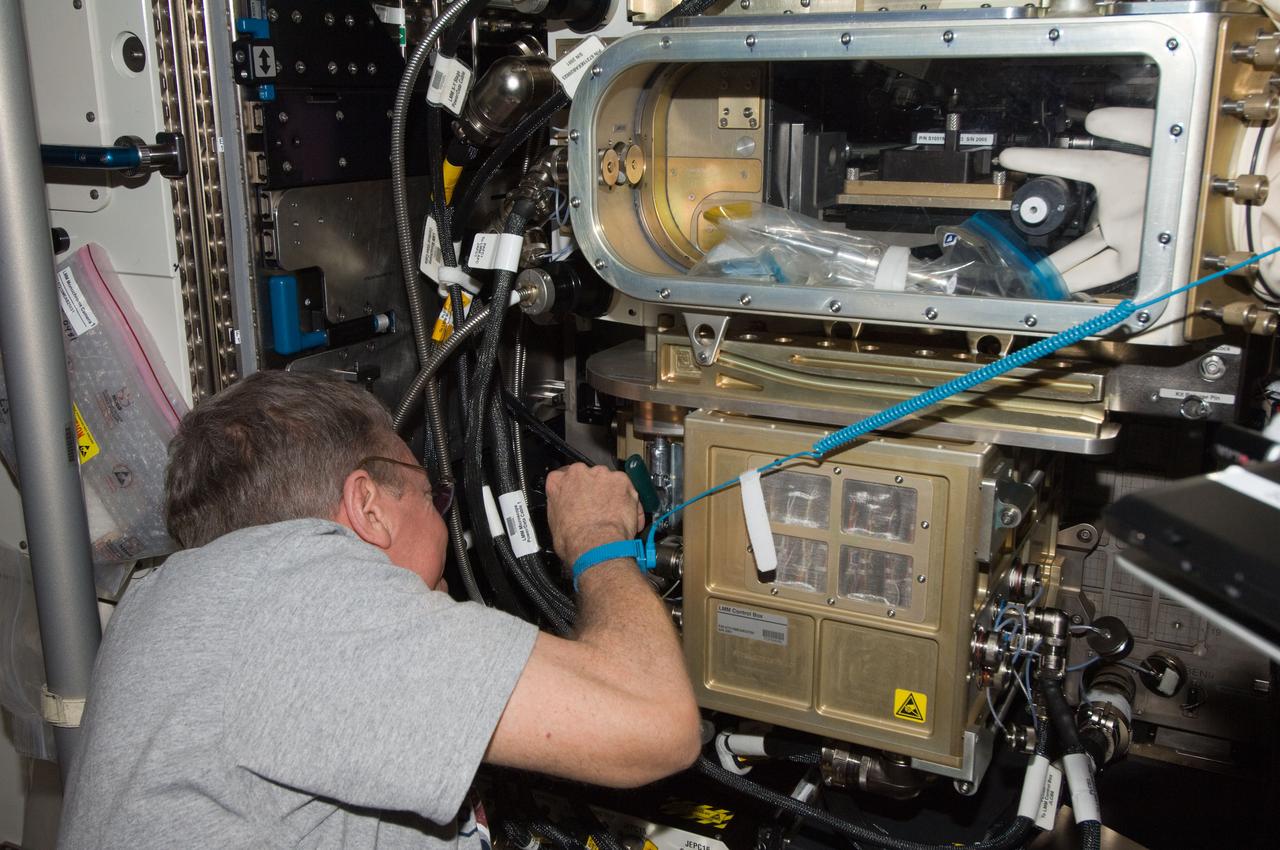
ISS029-E-011867 (29 Sept. 2011) --- NASA astronaut Mike Fossum, Expedition 29 commander, works with the Light Microscopy Module (LMM) control box in the Destiny laboratory of the International Space Station in preparation for another session with the Preliminary Advanced Colloids Experiment (PACE) hardware.
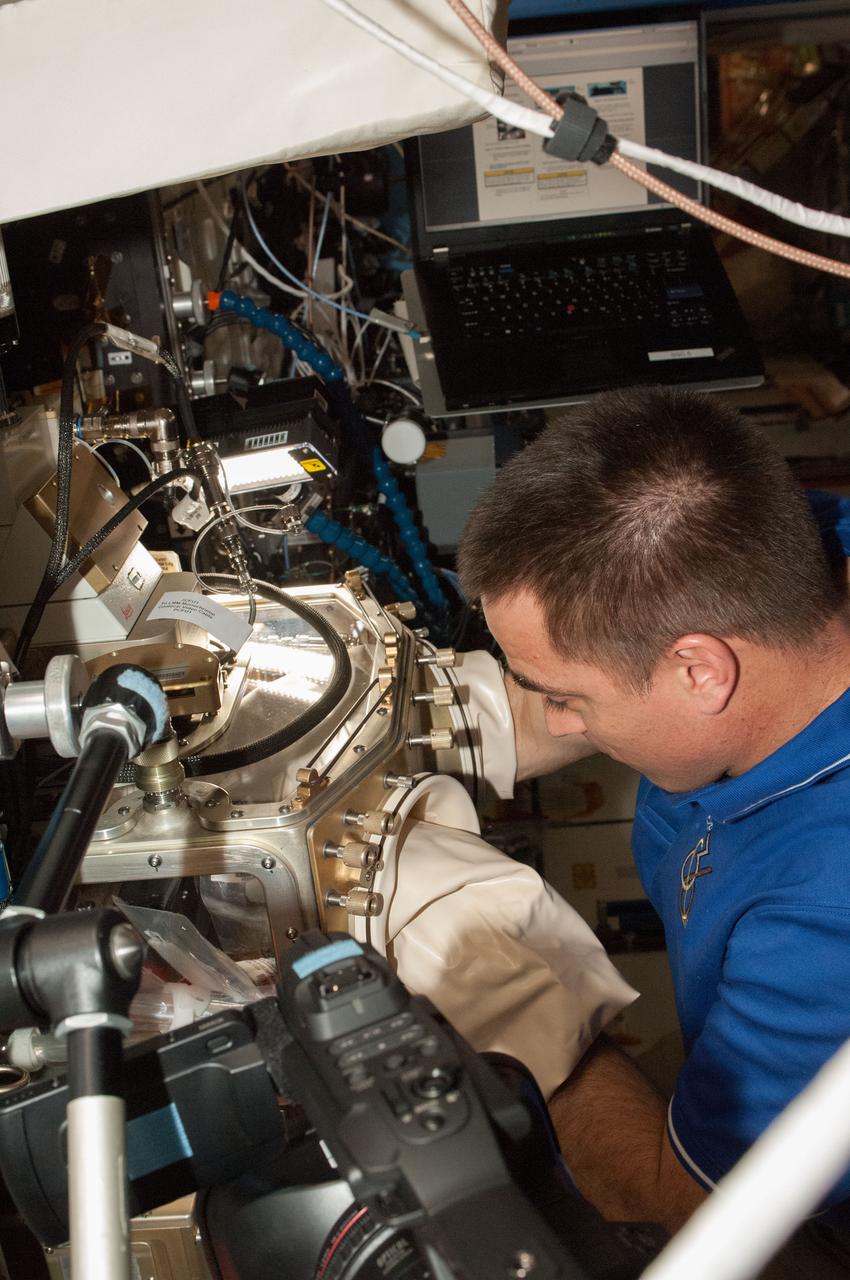
ISS036-E-023770 (22 July 2013) --- NASA astronaut Chris Cassidy, Expedition 36 flight engineer, conducts science work with the ongoing experiment Advanced Colloids Experiment-1 (ACE-1) inside the Fluids Integrated Rack. The experiment observes colloids, microscopic particles evenly dispersed throughout materials, with the potential for manufacturing improved materials and products on Earth. Cassidy is working at the Light Microscopy Module (LMM) in the Destiny laboratory of the International Space Station.
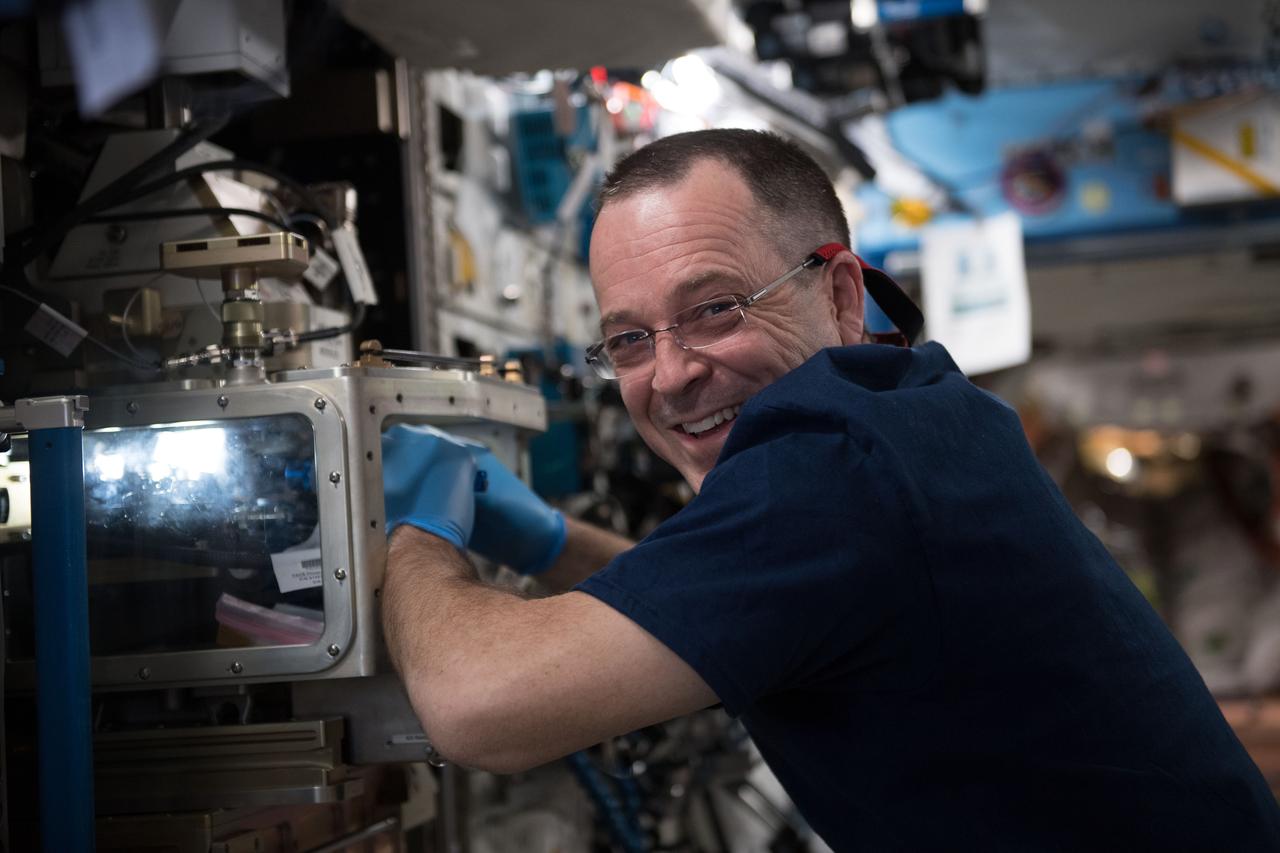
iss055e035366 (April 16, 2018) --- NASA astronaut Ricky Arnold performs maintenance on the Advanced Colloids Experiment Module located inside the Light Microscopy Module which is a modified commercial, highly flexible, state-of-the-art light imaging microscope facility that provides researchers with powerful diagnostic hardware and software in microgravity.

Advanced Colloids Experiment, Thermal 5-2, ACE T5-2 International Space Station, ISS, Fluids Integrated Rack, FIR Operations in the Telescience Support Center, TSC
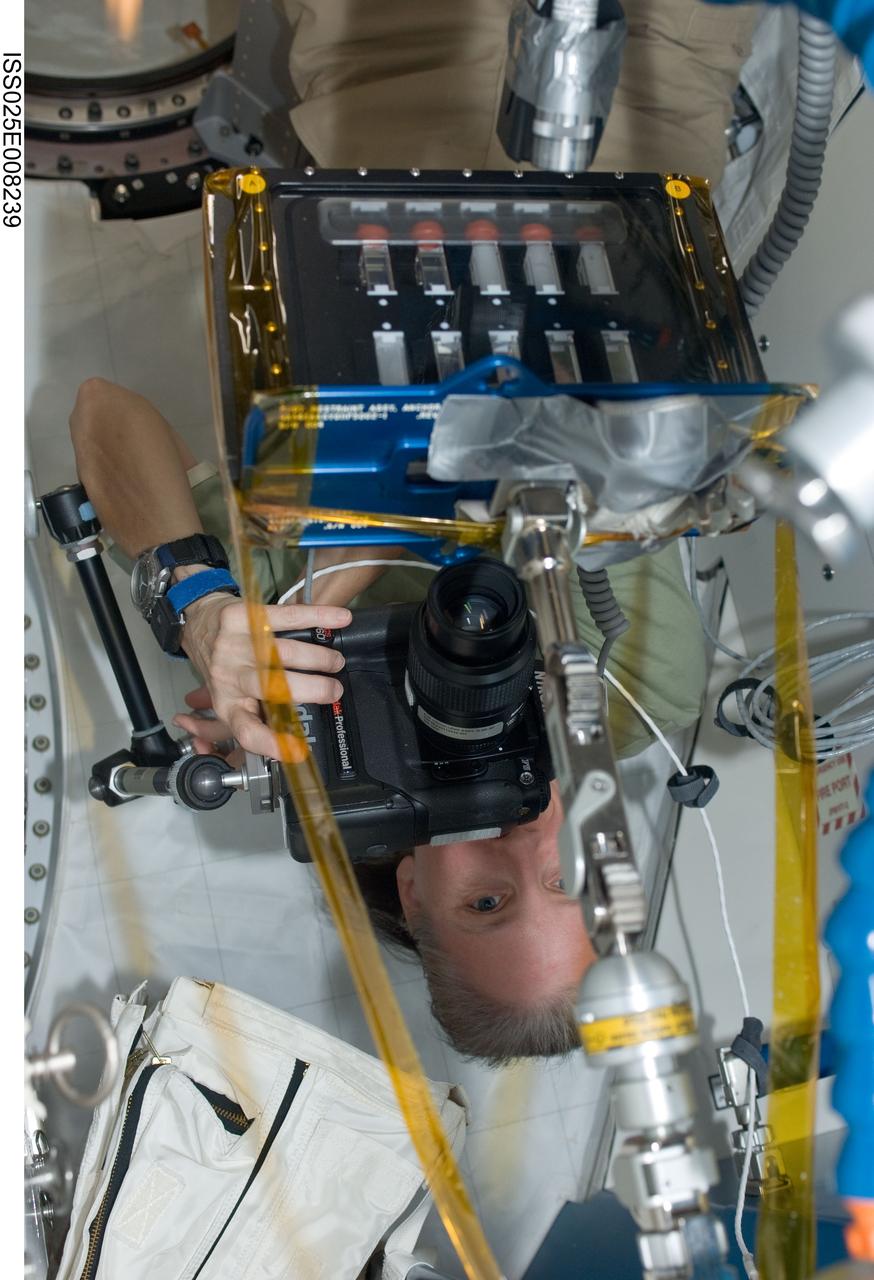
ISS025-E-008239 (19 Oct. 2010) --- NASA astronaut Shannon Walker, Expedition 25 flight engineer, uses a digital still camera to photograph Binary Colloidal Alloy Test-5 (BCAT-5) experiment samples in the Kibo laboratory of the International Space Station.
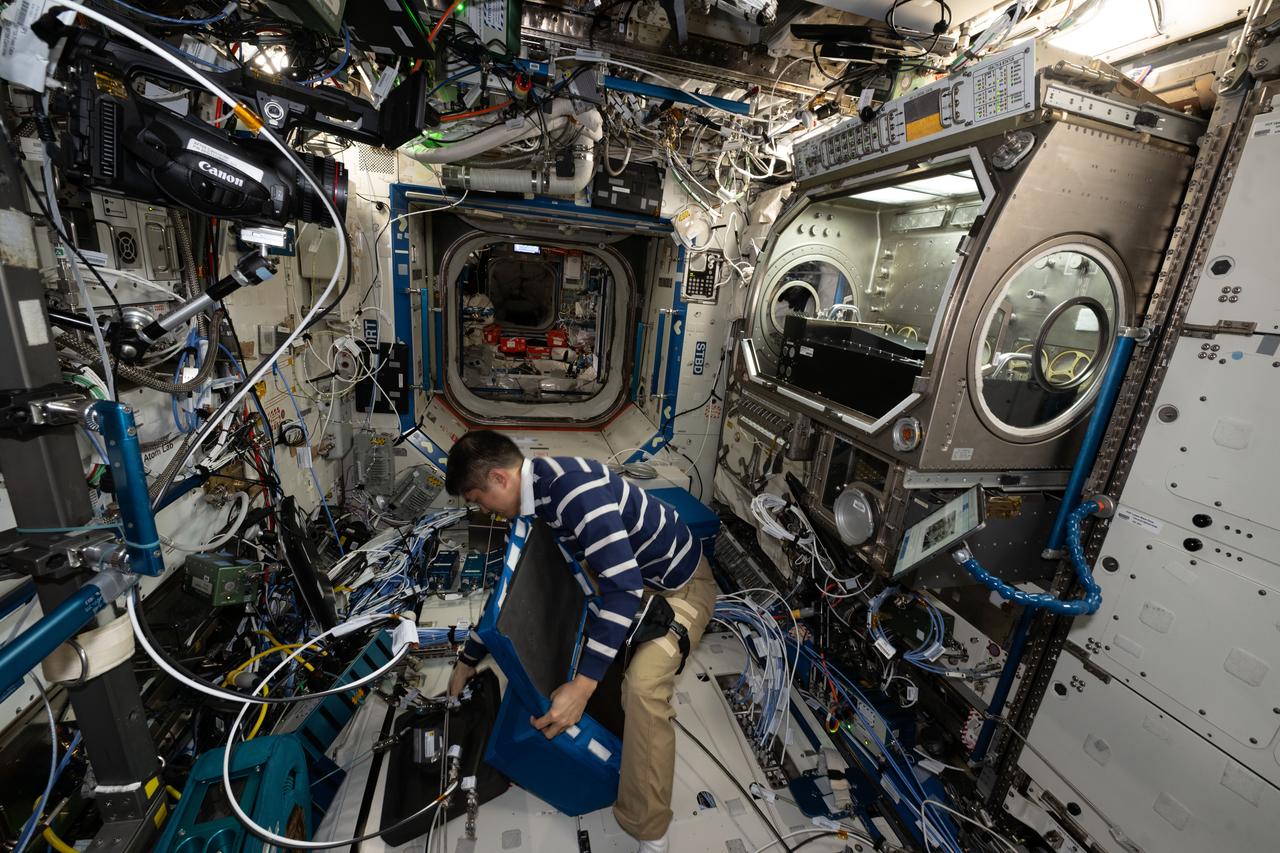
iss073e0134912 (June 6, 2025) --- JAXA (Japan Aerospace Exploration Agency) astronaut and Expedition 73 Commander Takuya Onishi stows physics research hardware used during the Colloidal Solids experiment to understand the behavior of tiny particles (colloids) and proteins in water. Onishi is pictured in front of the Microgravity Science Glovebox, located in the Destiny laboratory module, where the investigation took place that may lead to the space-based production of pharmaceuticals and advances in human health.
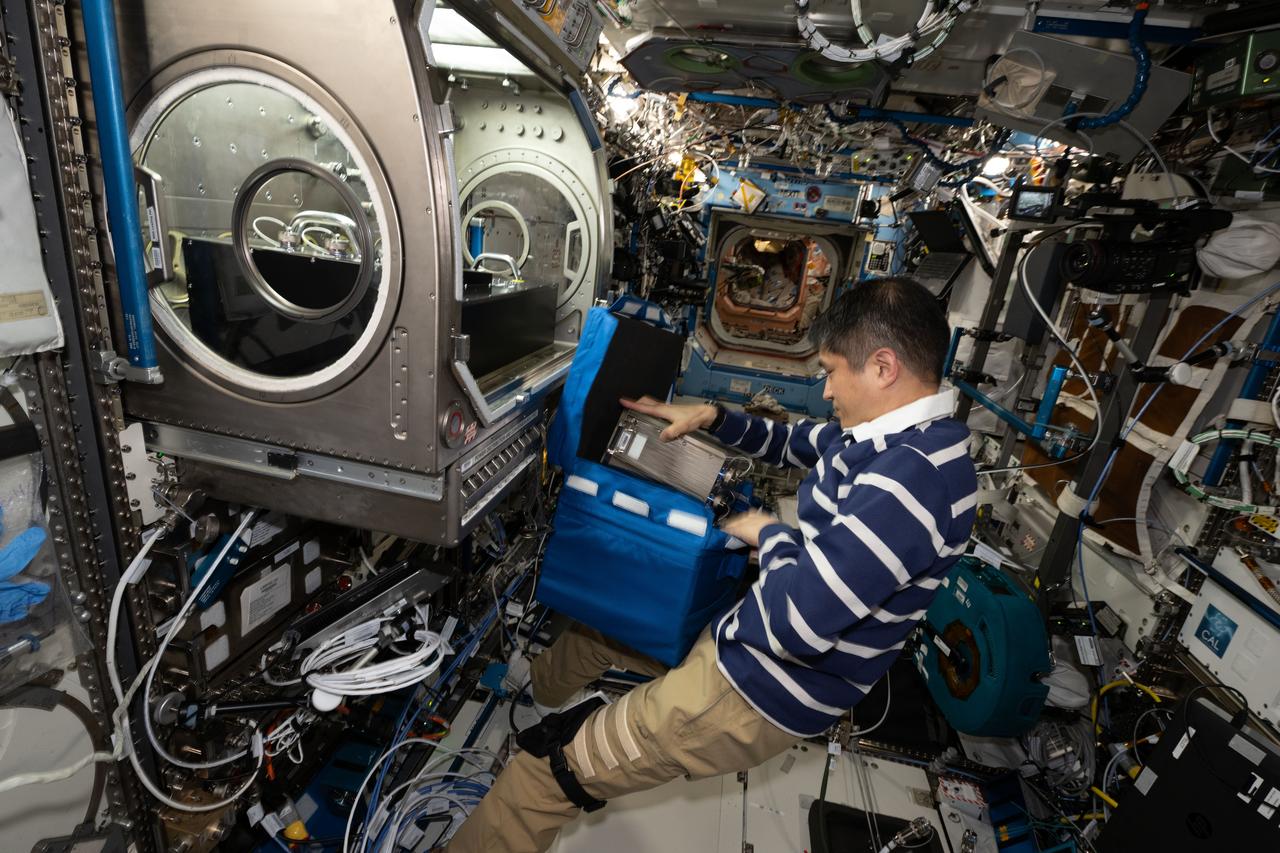
iss073e0134908 (June 6, 2025) --- JAXA (Japan Aerospace Exploration Agency) astronaut and Expedition 73 Commander Takuya Onishi stows physics research hardware used during the Colloidal Solids experiment to understand the behavior of tiny particles (colloids) and proteins in water. Onishi is pictured in front of the Microgravity Science Glovebox, located in the Destiny laboratory module, where the investigation took place that may lead to the space-based production of pharmaceuticals and advances in human health.

ACE-TR Operations at GRC-TSC, Advanced Colloids Experiment with Temperature control for the Research, Engineering, and Mission Integration Services, REMIS (JSC) contract
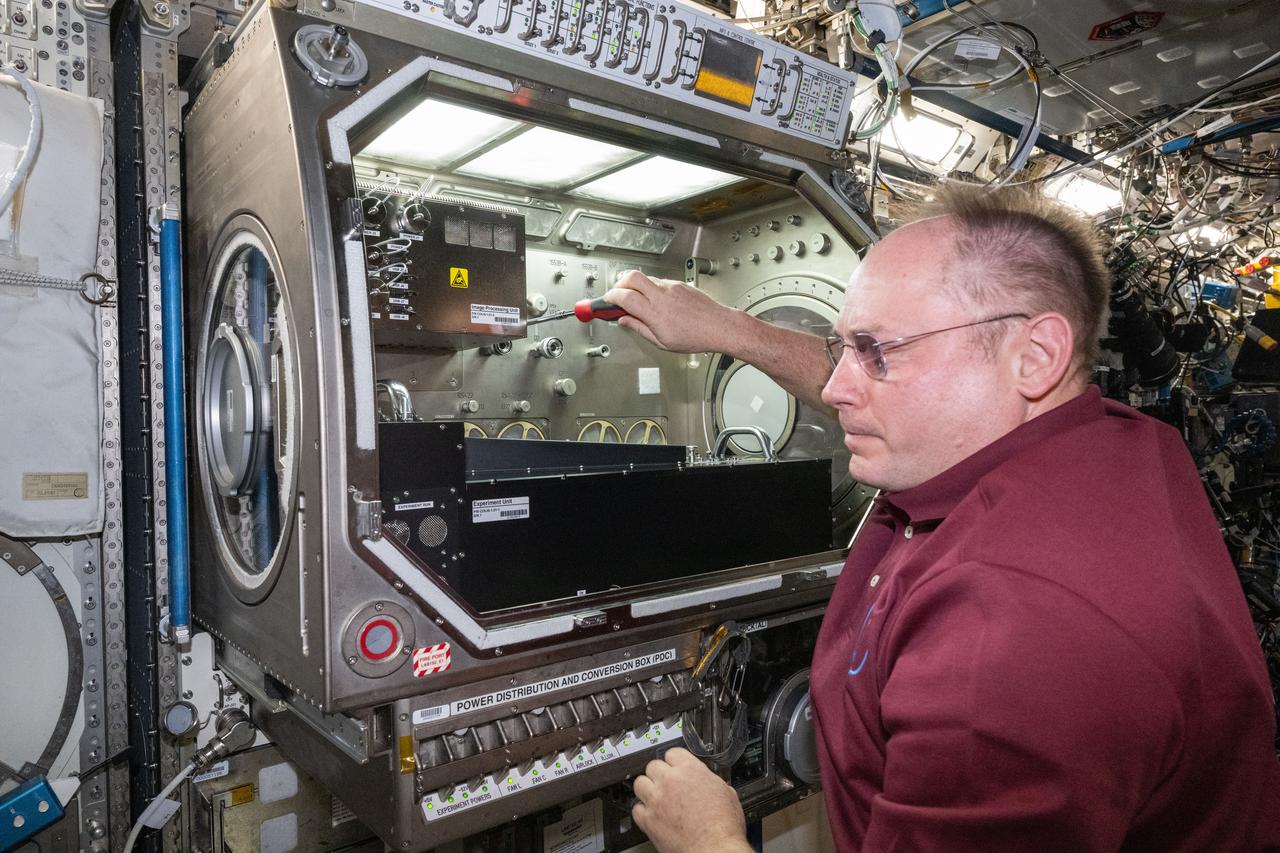
iss073e0606528 (Sept. 4, 2025) --- NASA astronaut and Expedition 73 Flight Engineer Mike Fincke sets up the Colloidal Solids research hardware inside the Destiny laboratory module’s Microgravity Science Glovebox aboard the International Space Station. The physics study is investigating pharmaceutical manufacturing and 3D printing techniques in space potentially advancing human health on and off the Earth.
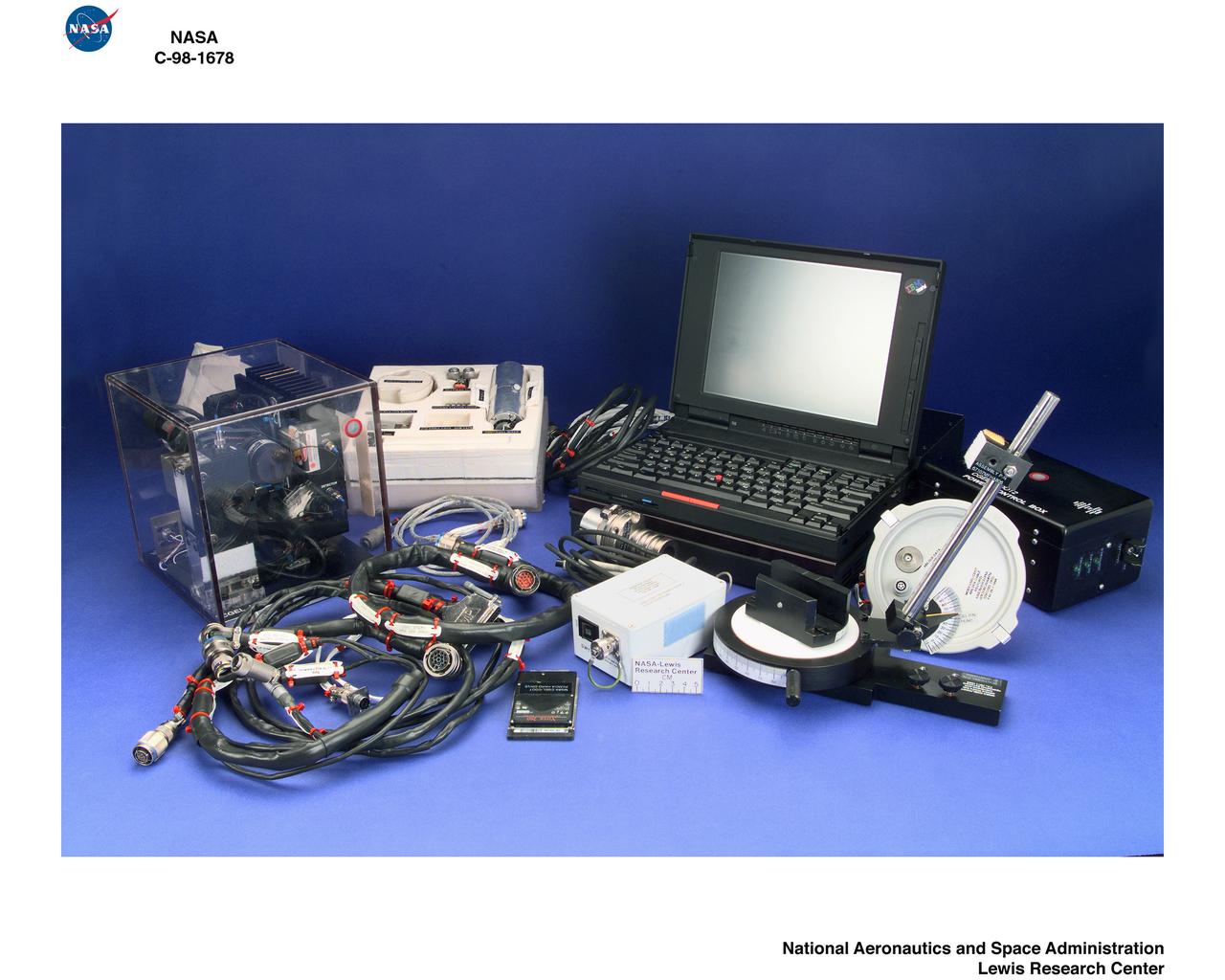
DIGITAL PHOTOGRAPHY OF COLLOIDAL GELATION AND COLLOIDAL DISORDER - ORDER TRANSITION
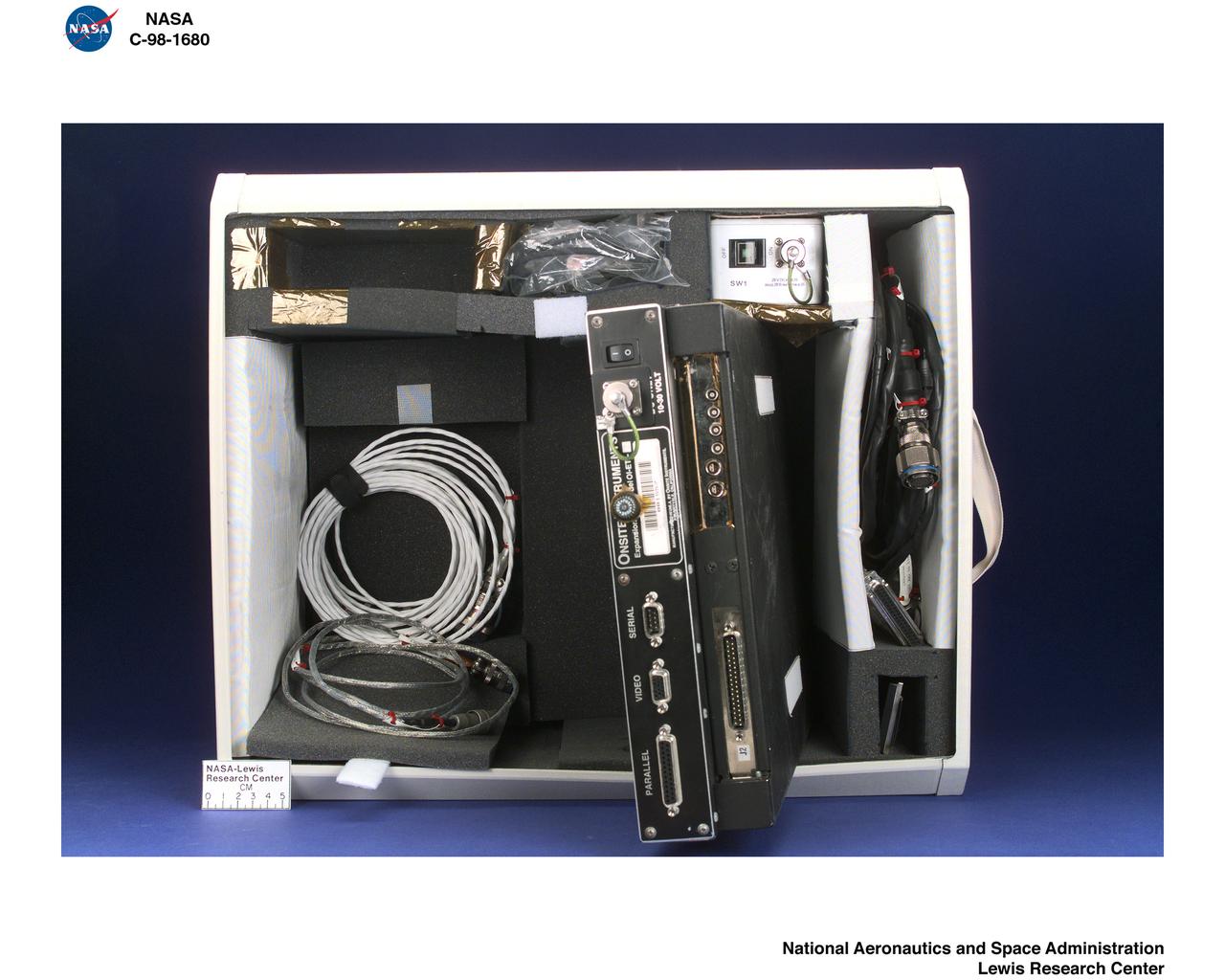
DIGITAL PHOTOGRAPHY OF COLLOIDAL GELATION AND COLLOIDAL DISORDER - ORDER TRANSITION
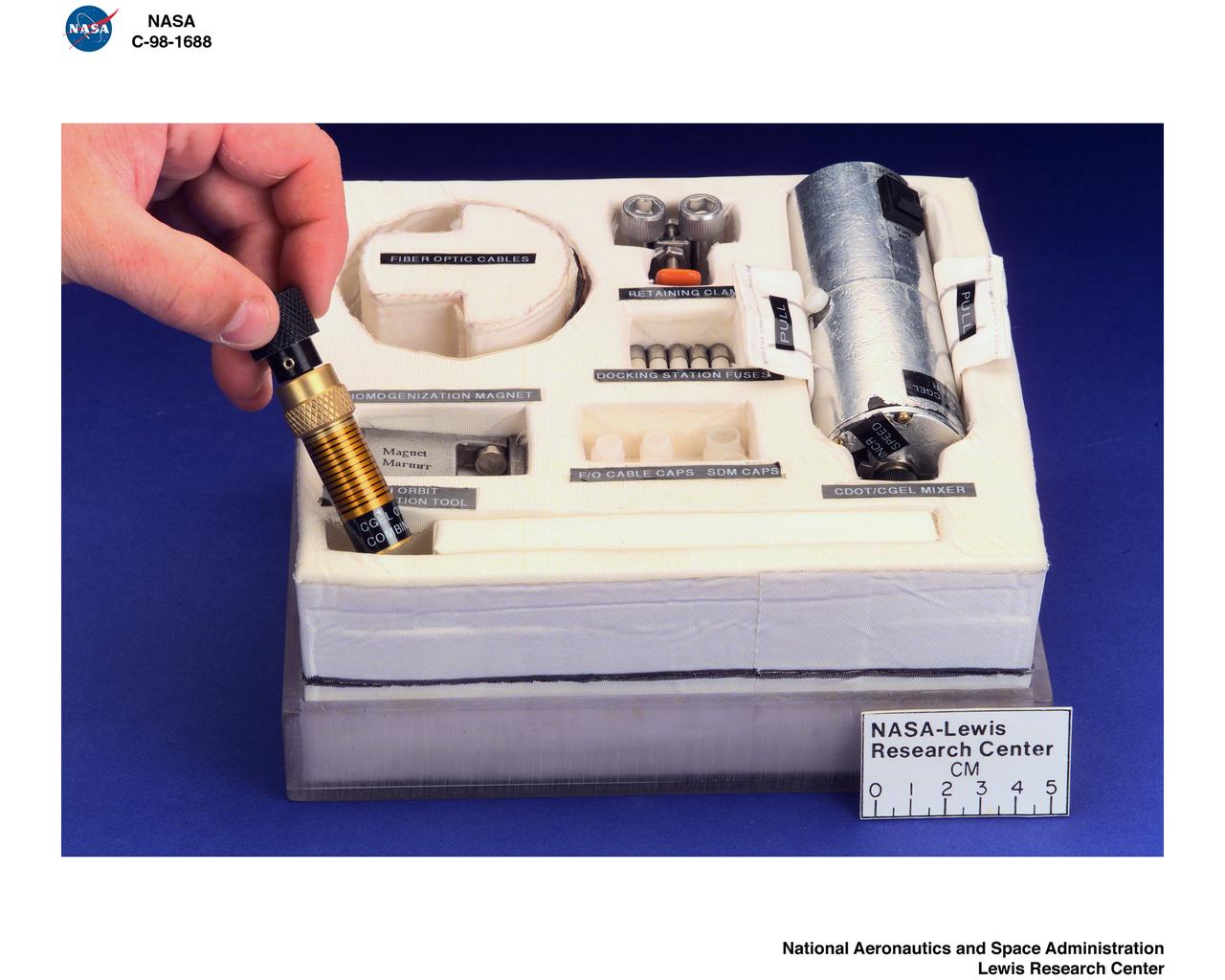
DIGITAL PHOTOGRAPHY OF COLLOIDAL GELATION AND COLLOIDAL DISORDER - ORDER TRANSITION

DIGITAL PHOTOGRAPHY OF COLLOIDAL GELATION AND COLLOIDAL DISORDER - ORDER TRANSITION
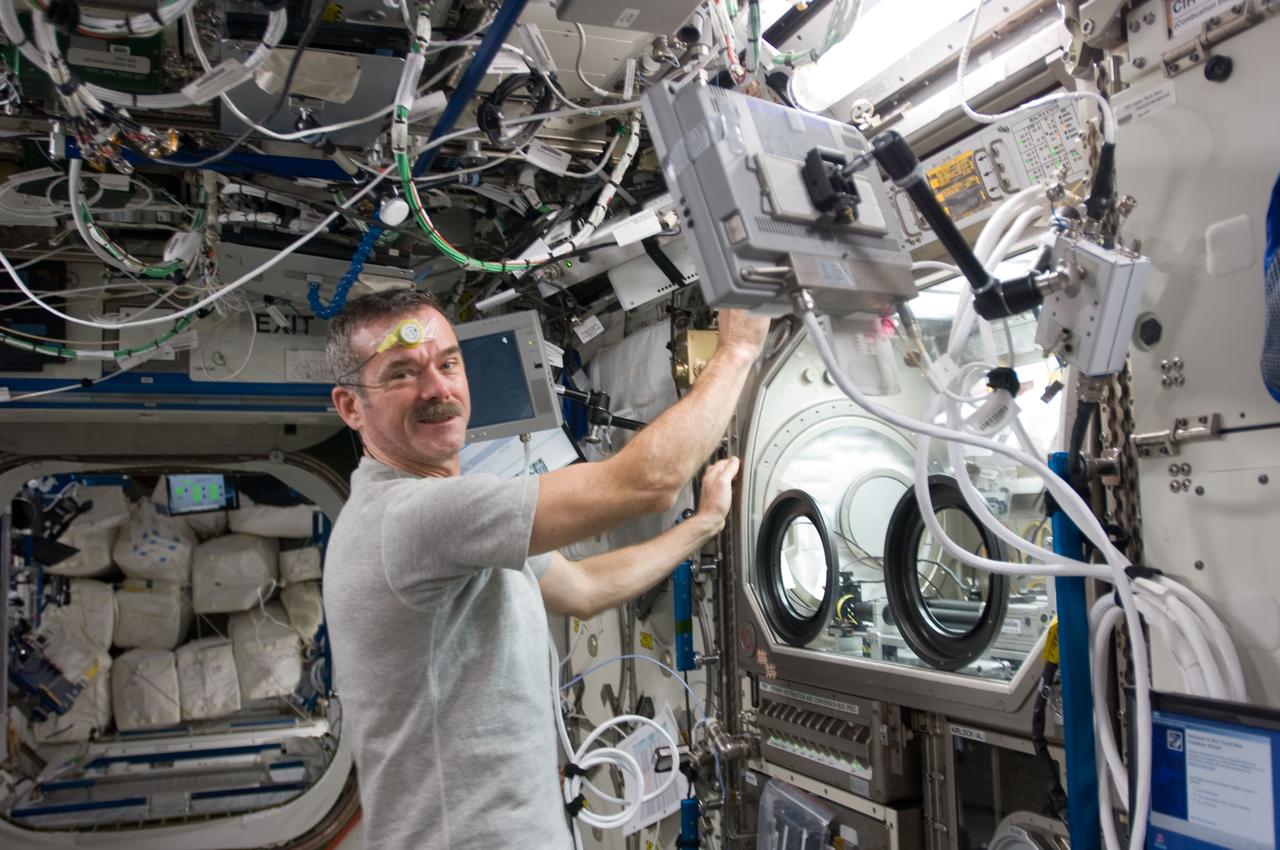
View of Canadian Space Agency (CSA) Chris Hadfield,Expedition 34 Flight Engineer (FE), during the Investigating the Structure of Paramagnetic Aggregates from Colloidal Emulsions 3 (InSPACE-3) experiment. InSPACE-3 collects and records data on fluids containing ellipsoid-shaped particles that change the physical properties of the fluids in response to magnetic fields. Photo was taken during Expedition 34.
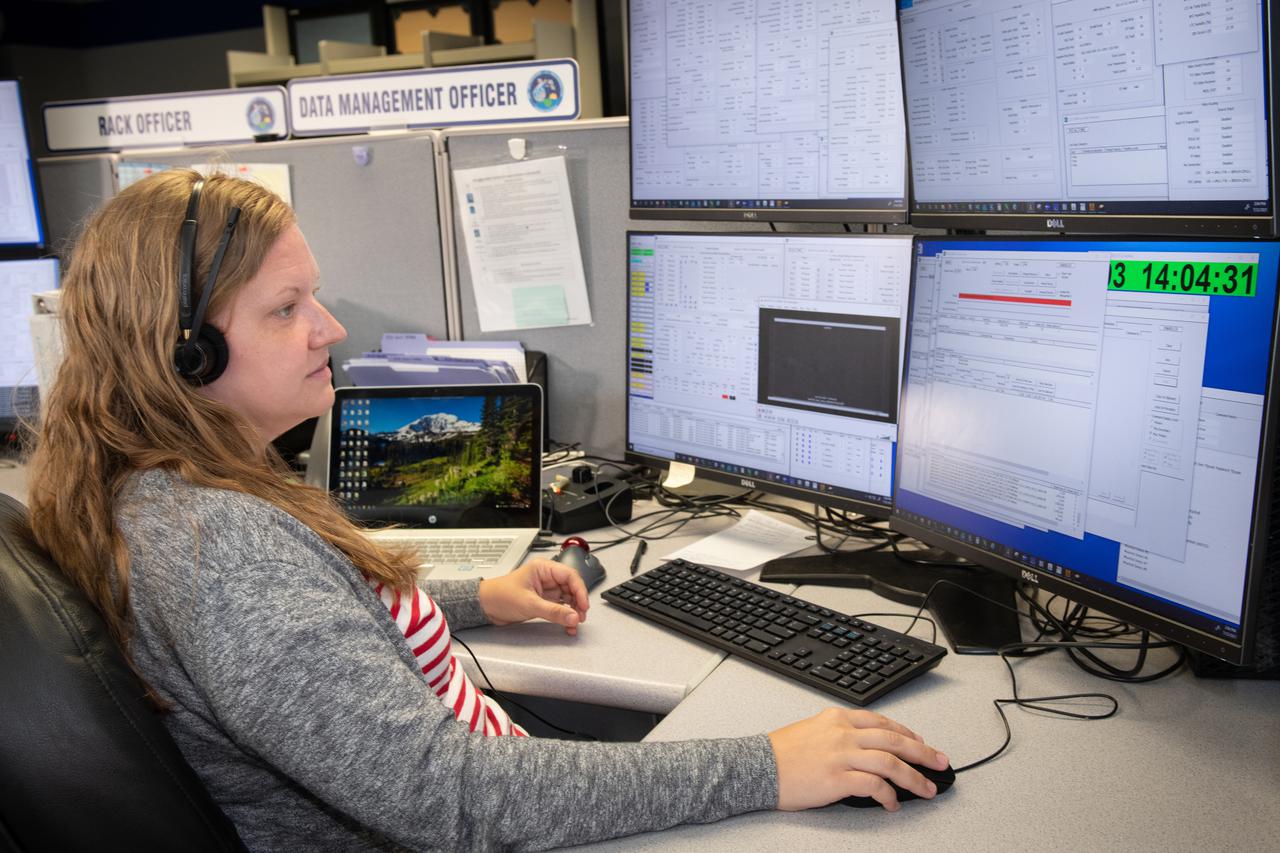
International Space Station, ISS Advanced Colloids Experiment – Thermal 5-3, ACE-T5-3 Operations in the Telescience Support Center, TSC
International Space Station, ISS Advanced Colloids Experiment – Thermal 5-3, ACE-T5-3 Operations in the Telescience Support Center, TSC
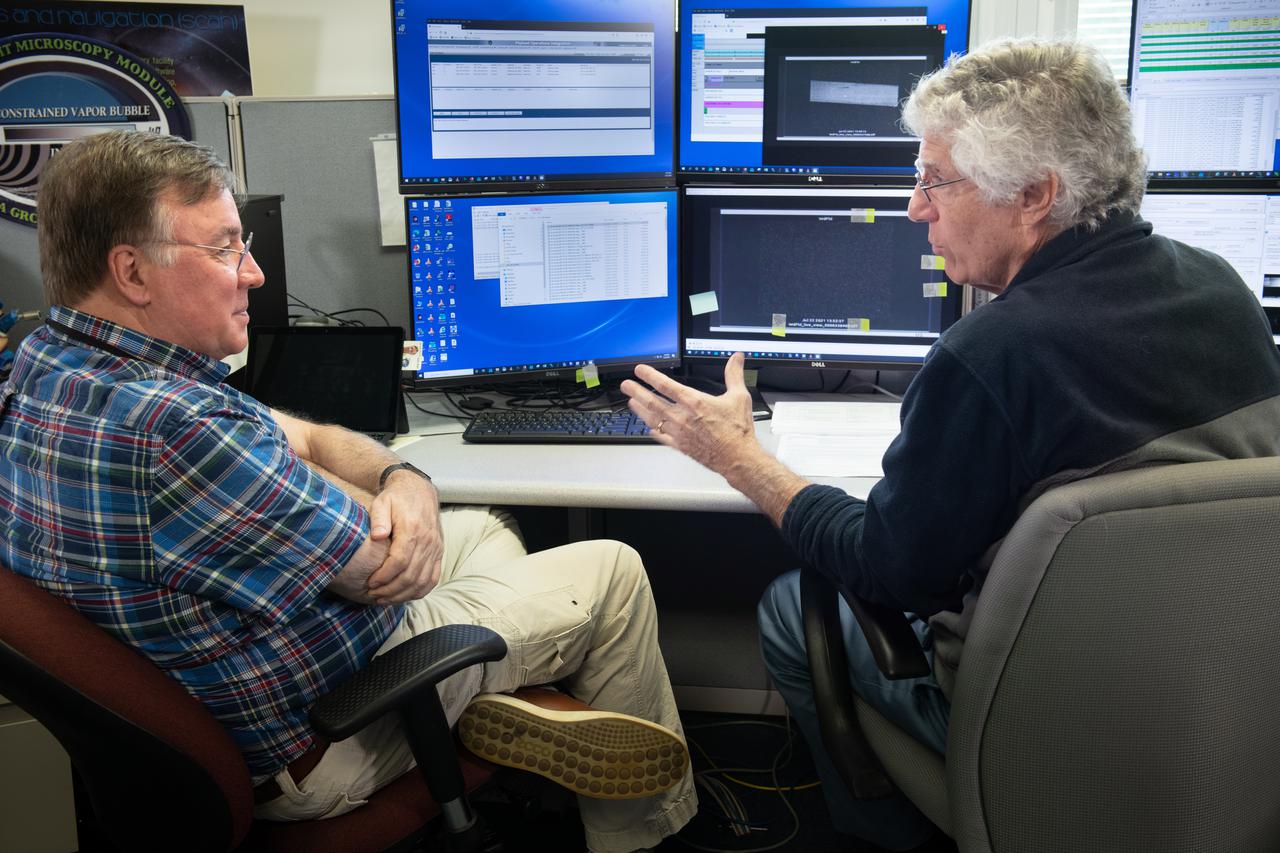
International Space Station, ISS Advanced Colloids Experiment – Thermal 5-3, ACE-T5-3 Operations in the Telescience Support Center, TSC
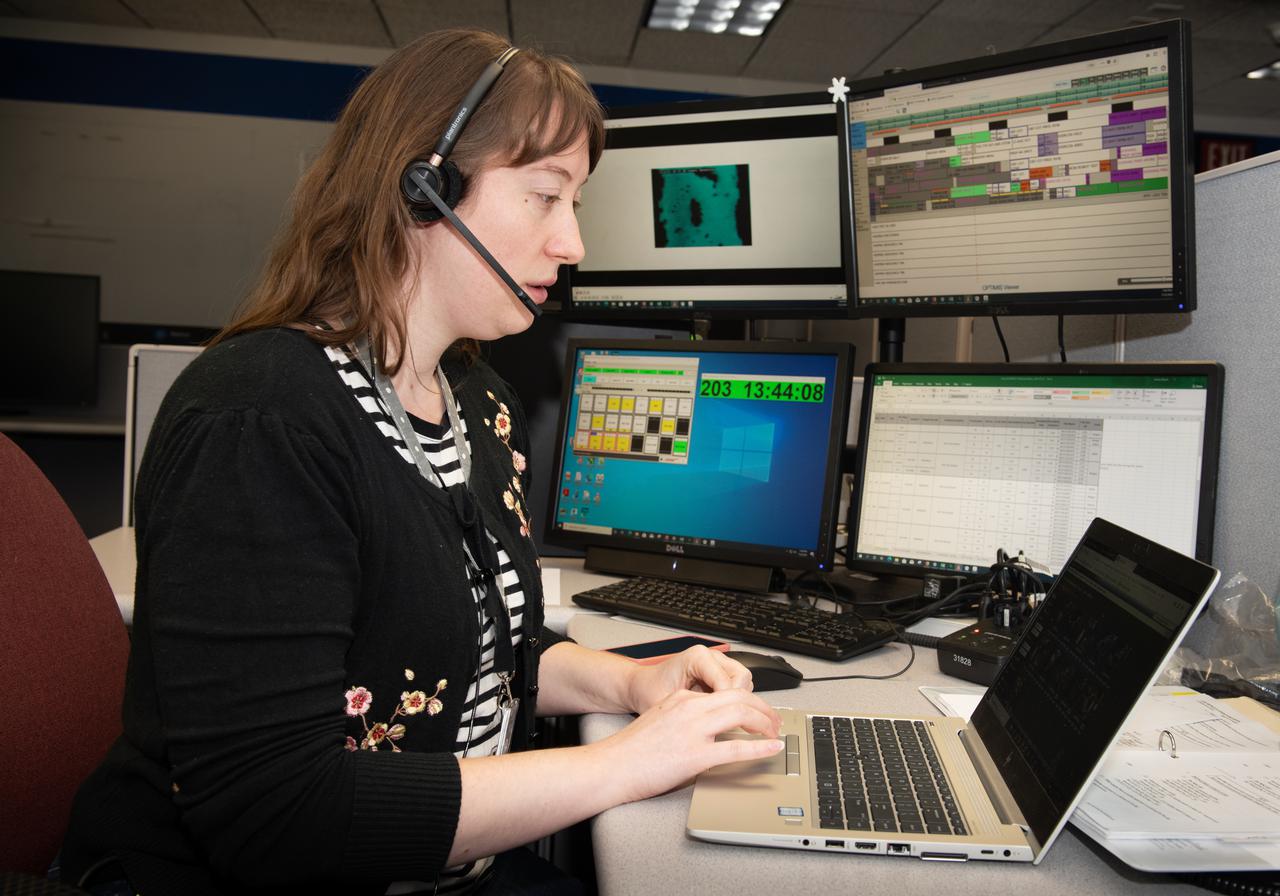
International Space Station, ISS Advanced Colloids Experiment – Thermal 5-3, ACE-T5-3 Operations in the Telescience Support Center, TSC

International Space Station, ISS Advanced Colloids Experiment – Thermal 5-3, ACE-T5-3 Operations in the Telescience Support Center, TSC

iss059e101468 (6/12/2019) — Photo documentation aboard the International Space Station (ISS) of the ACE modules taken in the the Light Microscopy Module (LMM) during the ACE-T10 Module Configuration. The Advanced Colloids Experiment-Temperature-10 (ACE-T-10) investigates the growth kinetics, microscopic dynamics, and restructuring processes in ordered and disordered structures such as colloidal crystals, glasses and gels. The investigation studies crystal nucleation in colloidal fluids, the origin of ageing in glasses and gels, as well as the heterogeneous nature of the microscopic dynamics in these structures. The study must be conducted in microgravity, as gravitational stresses affect the structure and growth of these solids from colloids.
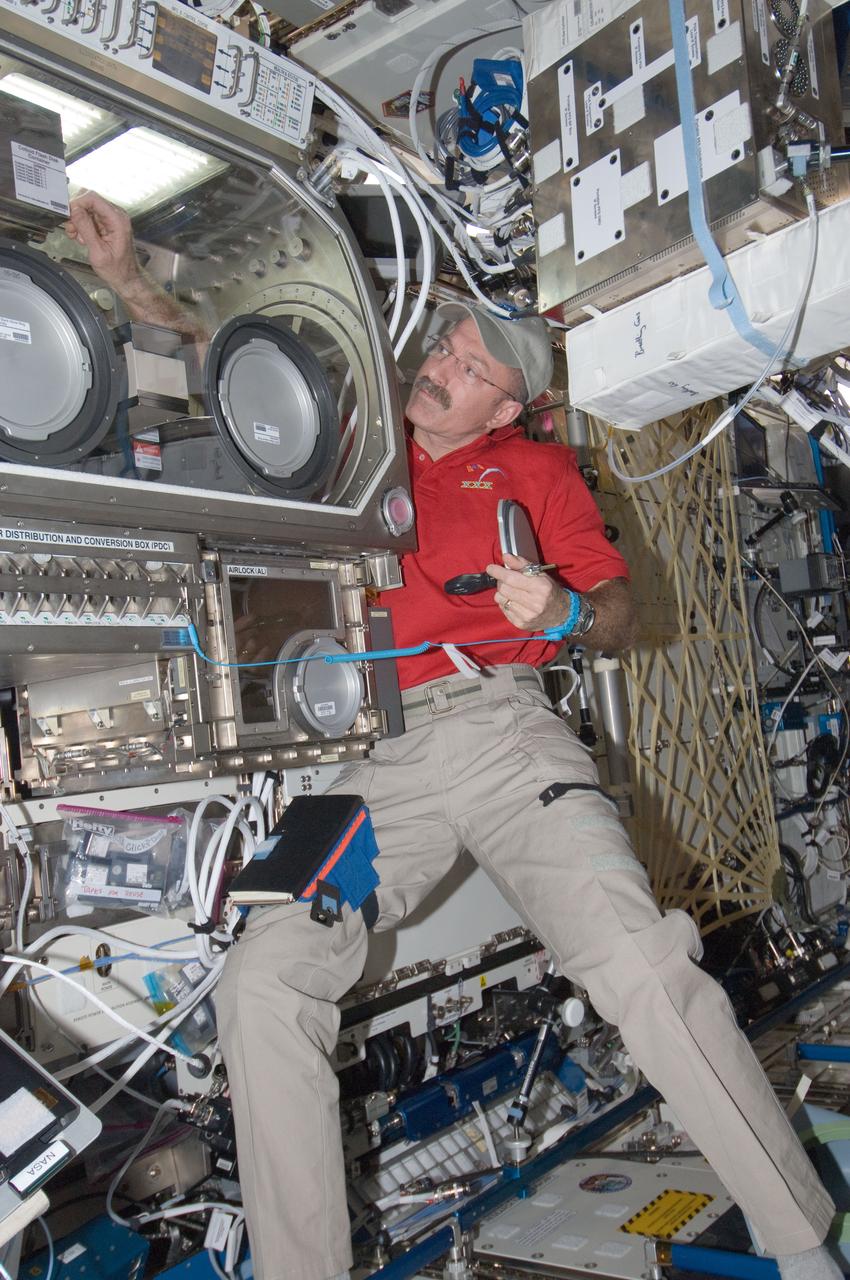
ISS030-E-030125 (10 Jan. 2012) --- NASA astronaut Dan Burbank, Expedition 30 commander, works on the Selectable Optical Diagnostics Instrument C Colloid (SODI-COLLOID) hardware in the Microgravity Science Glovebox in the International Space Station?s Destiny laboratory. Burbank is supporting ground-commanded operations by exchanging out some disks. COLLOID is part of ESA?s triple experiment series for advancement in liquids, diffusion measurements in petroleum reservoirs and the study on growth and properties of advanced photonic materials within colloidal solutions. The commander is currently joined by five other Expedition 30 astronauts and cosmonauts, all flight engineers, aboard the orbital outpost.
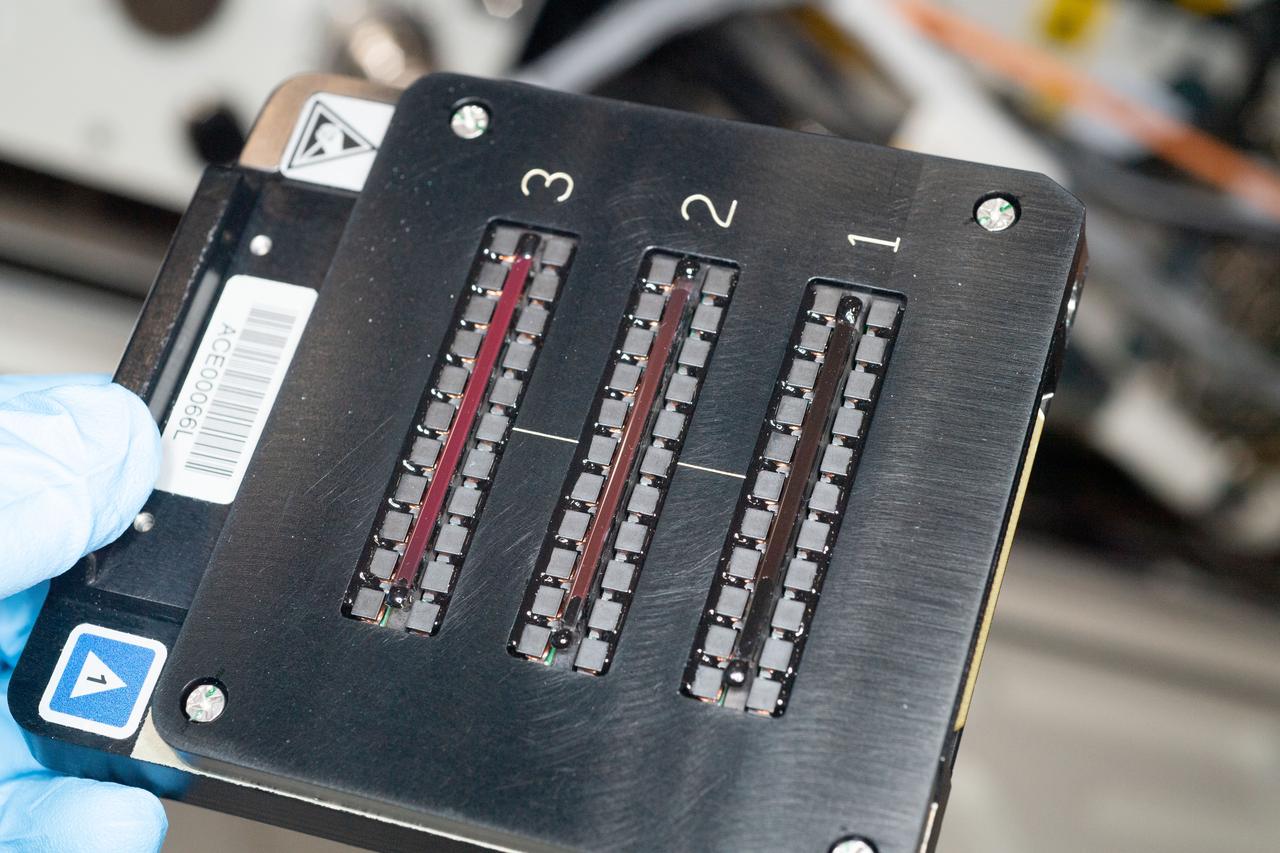
iss059e101463 (6/12/2019) --- Photo documentation aboard the International Space Station (ISS) of the ACE Modules taken during the ACE-T10 Module Configuration. The Advanced Colloids Experiment-Temperature-10 (ACE-T-10) investigates the growth kinetics, microscopic dynamics, and restructuring processes in ordered and disordered structures such as colloidal crystals, glasses and gels. The investigation studies crystal nucleation in colloidal fluids, the origin of ageing in glasses and gels, as well as the heterogeneous nature of the microscopic dynamics in these structures. The study must be conducted in microgravity, as gravitational stresses affect the structure and growth of these solids from colloids.
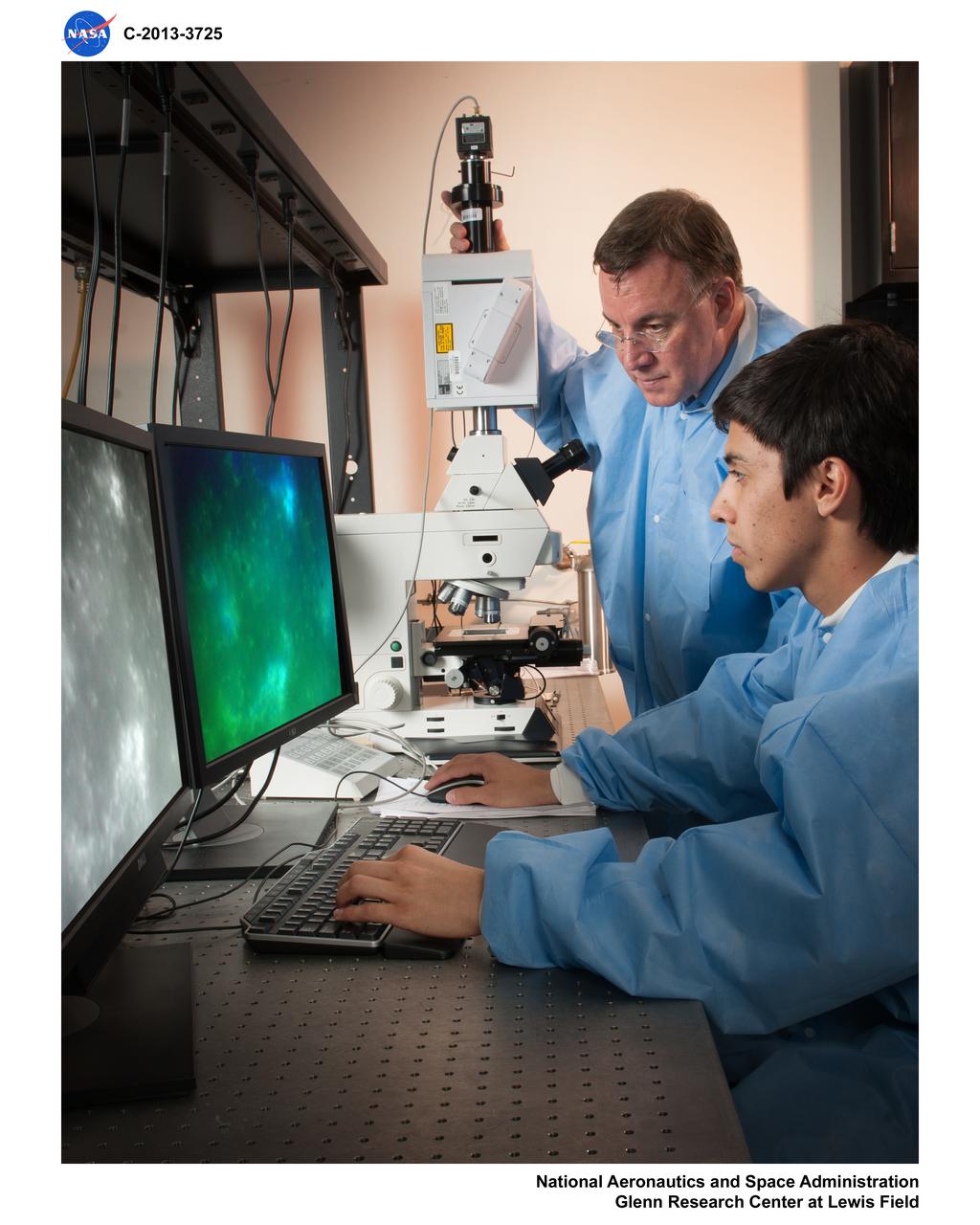
Advanced Colloid Experiment, ACE, Confocal Test Bed
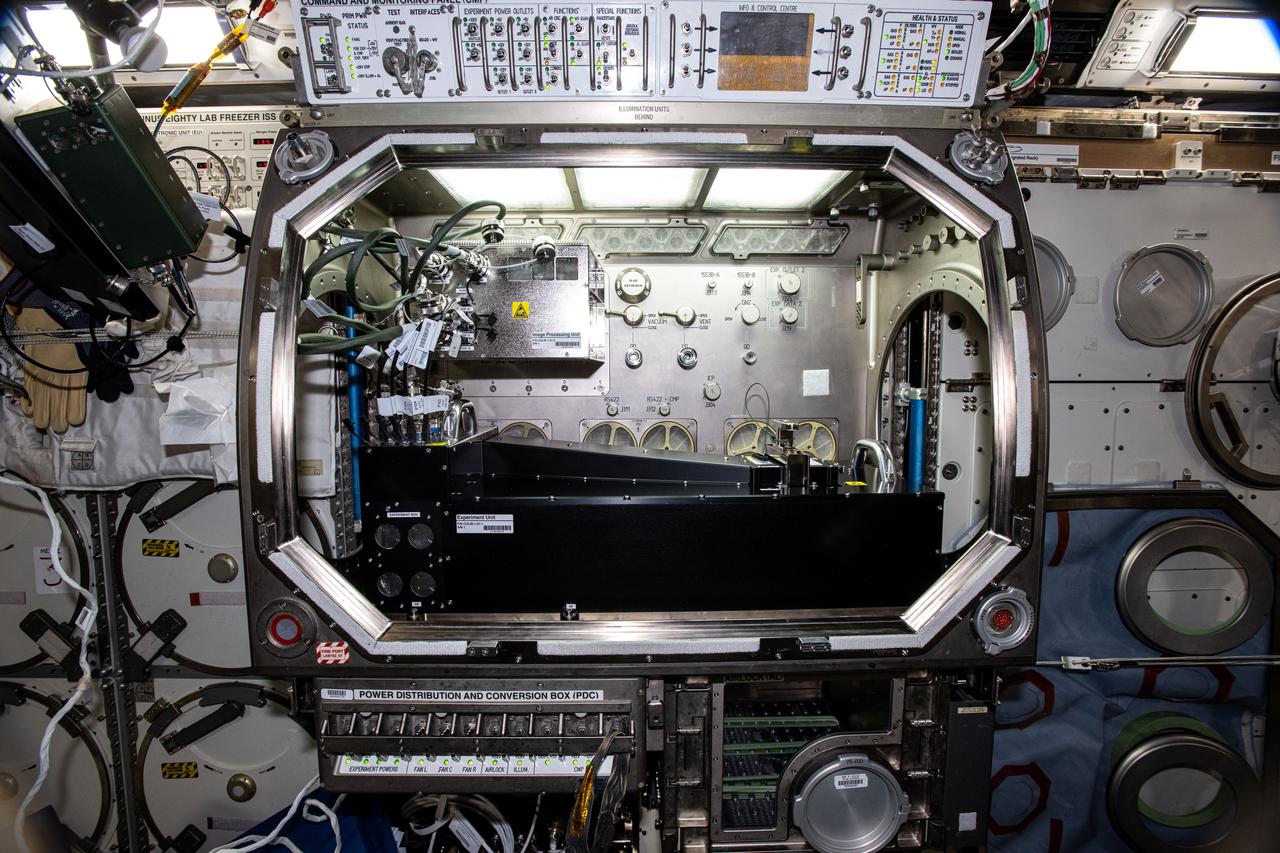
iss073e0002997 (4/28/2025) --- A view of the Colloidal Solids investigation inside the Microgravity Sciences Glovebox (MSG). Colloidal Solids (COLIS) provides researchers with a better understanding of the origin, formation, and dynamics of protein crystals and colloidal glasses and gels. COLIS is a state-of-the-art multi-line light scattering apparatus that enables the research team to monitor the dynamics of physical processes, during and after solidification, of soft matter solids on the International Space Station (ISS) to assess the role played by gravity on the properties of growing structures.
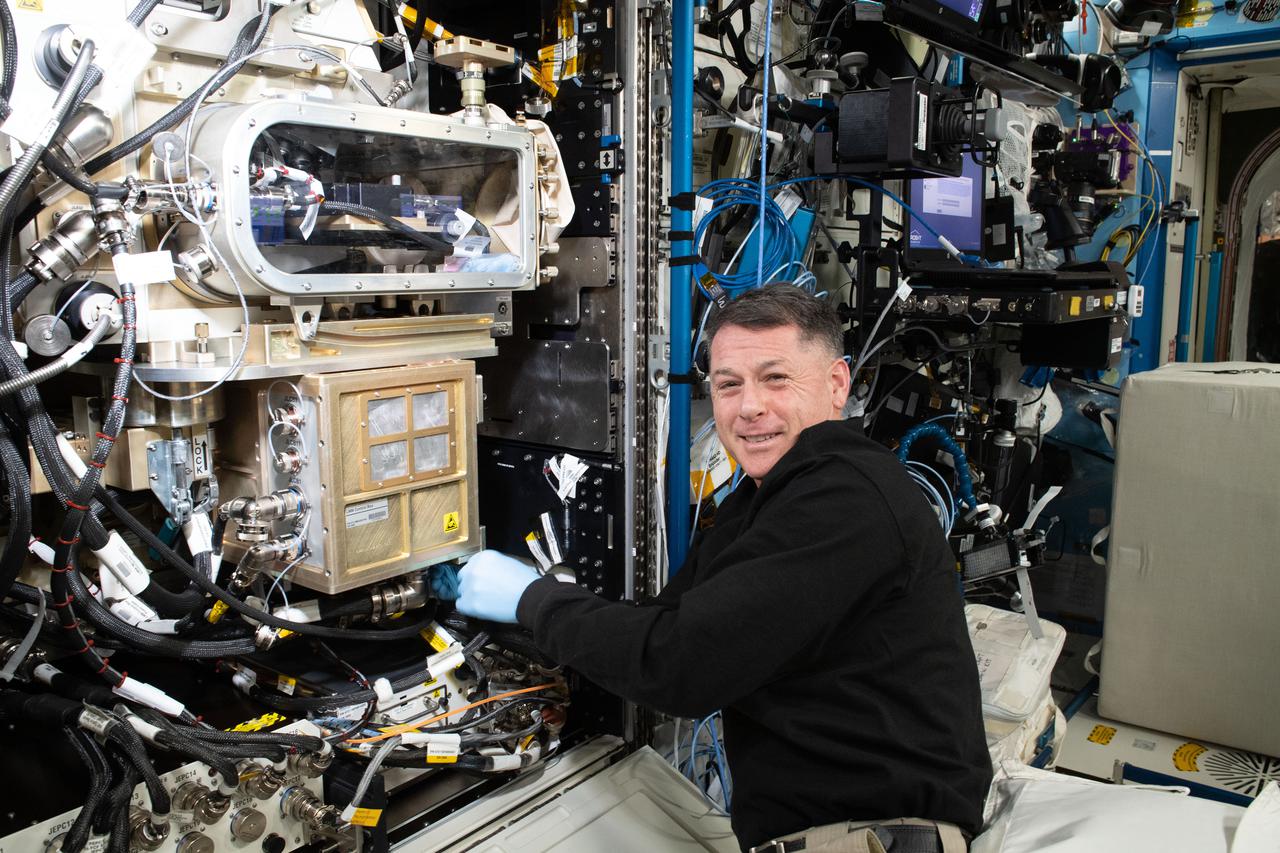
iss065e257486 (Aug. 17, 2021) --- NASA astronaut and Expedition 65 Flight Engineer Shane Kimbrough installs and configures a new Advanced Colloids Experiment module inside the U.S. Destiny laboratory module's Fluids Integrated Rack (FIR). The work supports the ACE-T9 fluid physics study that uses the FIR's Light Microscopy Module to image colloidal molecules for insights into the development of advanced materials not possible to produce in Earth's gravity.
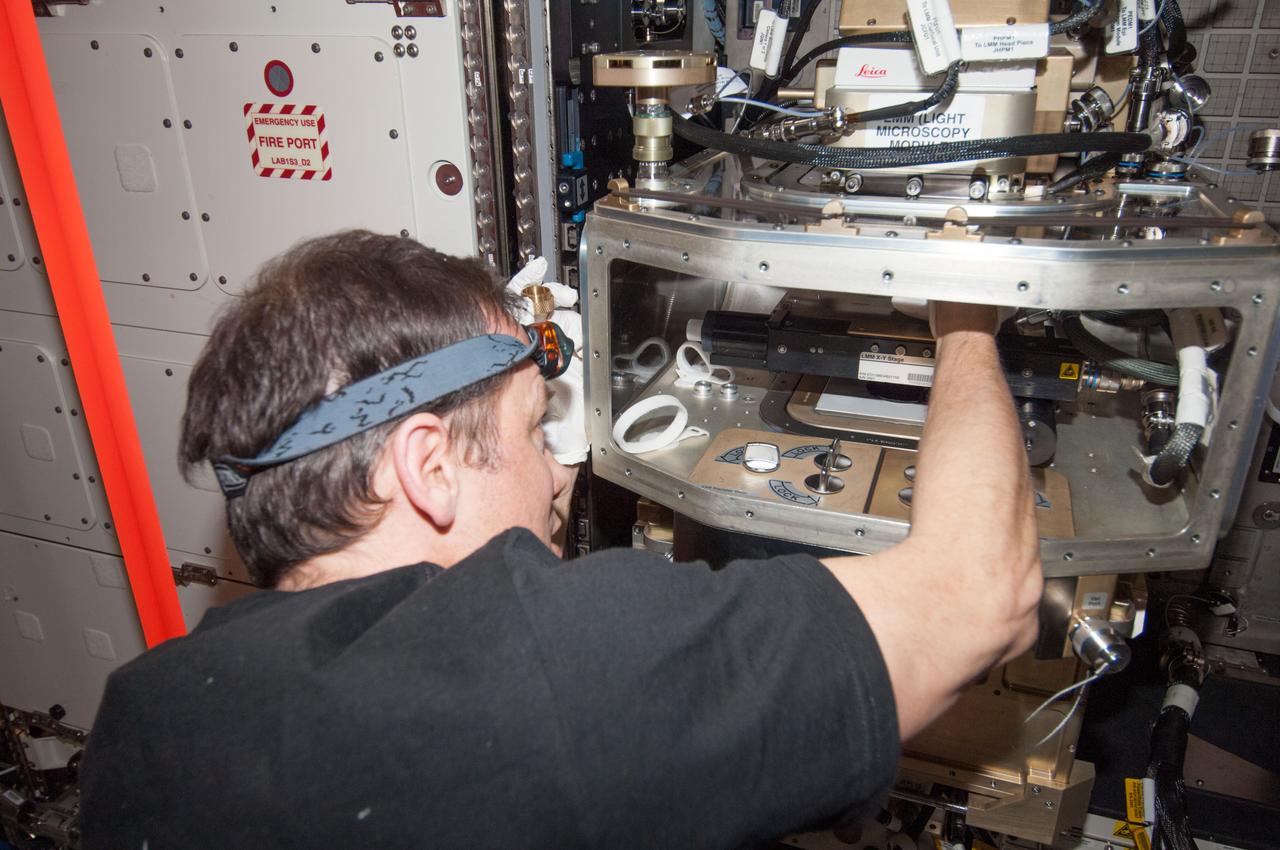
ISS034-E-051798 (21 Feb. 2013) --- NASA astronaut Tom Marshburn, Expedition 34 flight engineer, configures one of the experiment racks in the U.S. lab called Destiny aboard the International Space Station in Earth orbit. ACE produces microscopic images of materials which contain small colloidal particles, and it examines flow characteristics and the evolution and ordering effects within these colloidal materials in 1-G and micro-G environments.
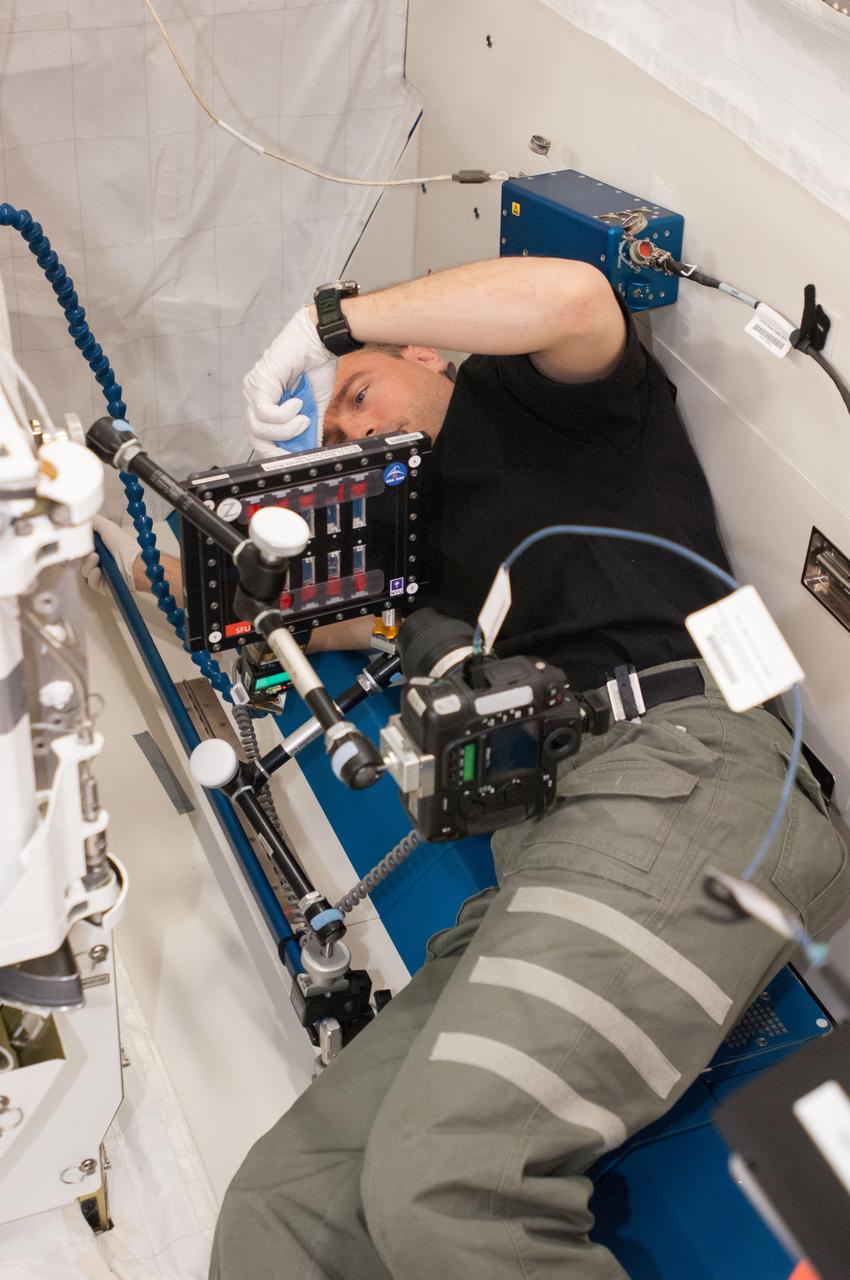
ISS040-E-076505 (25 July 2014) --- NASA astronaut Reid Wiseman, Expedition 40 flight engineer, conducts a session with the Binary Colloidal Alloy Test-C1, or BCAT-C1, experiment in the Kibo laboratory of the International Space Station. Results from this ongoing investigation of colloids ? mixtures of small particles distributed throughout a liquid ? will help materials scientists to develop new consumer products with unique properties and longer shelf lives.
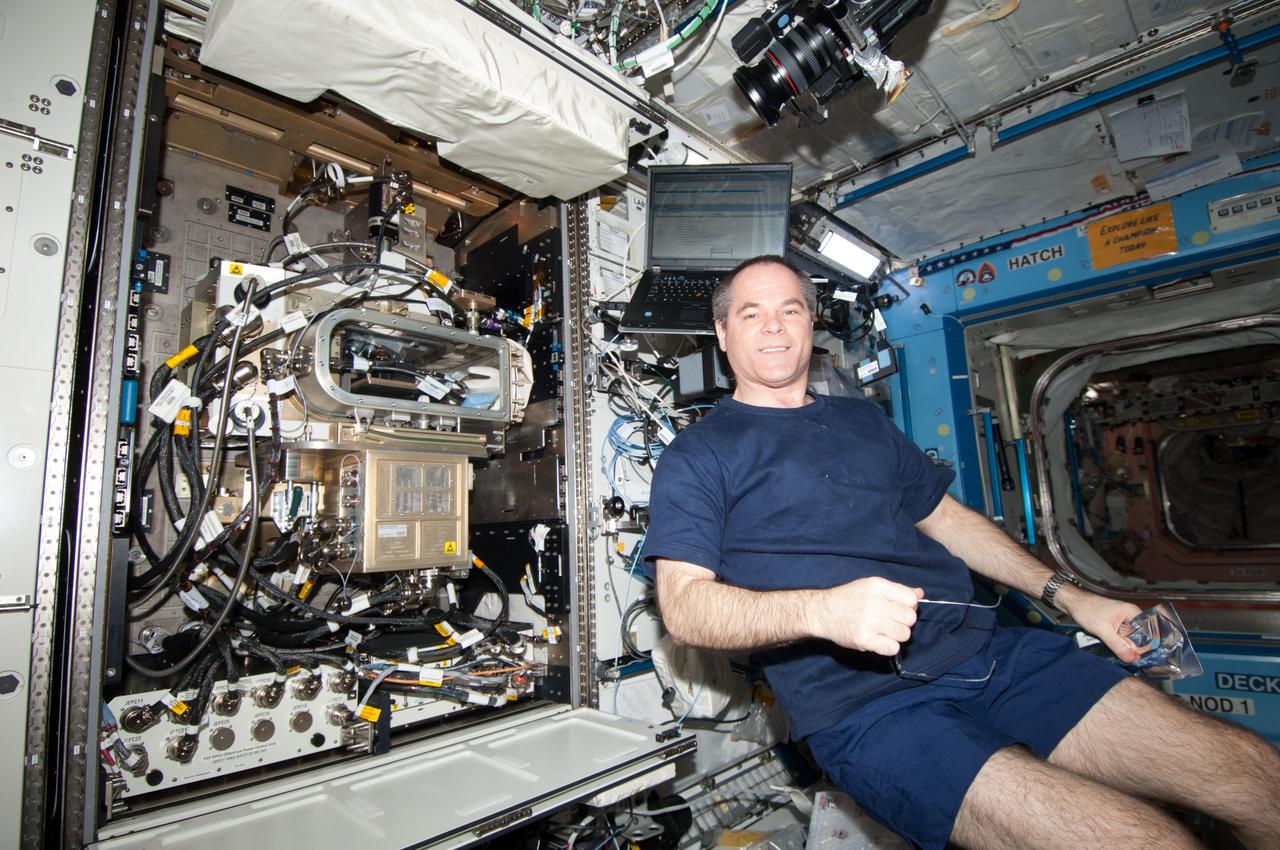
ISS034-E-056144 (21 Feb. 2013) --- Inside the U.S. Laboratory (Destiny) aboard the Earth-orbiting International Space Statio, NASA astronaut Kevin Ford, Expedition 34 commander, is seen with the Fluids Integration Rack (FIR)/Light Microscopy Module (LMM)/Advanced Colloids Experiment (ACE). ACE samples, which produce microscopic images of materials containing small colloidal particles, are scheduled for arrival on SpaceX-2 in the first week of March.
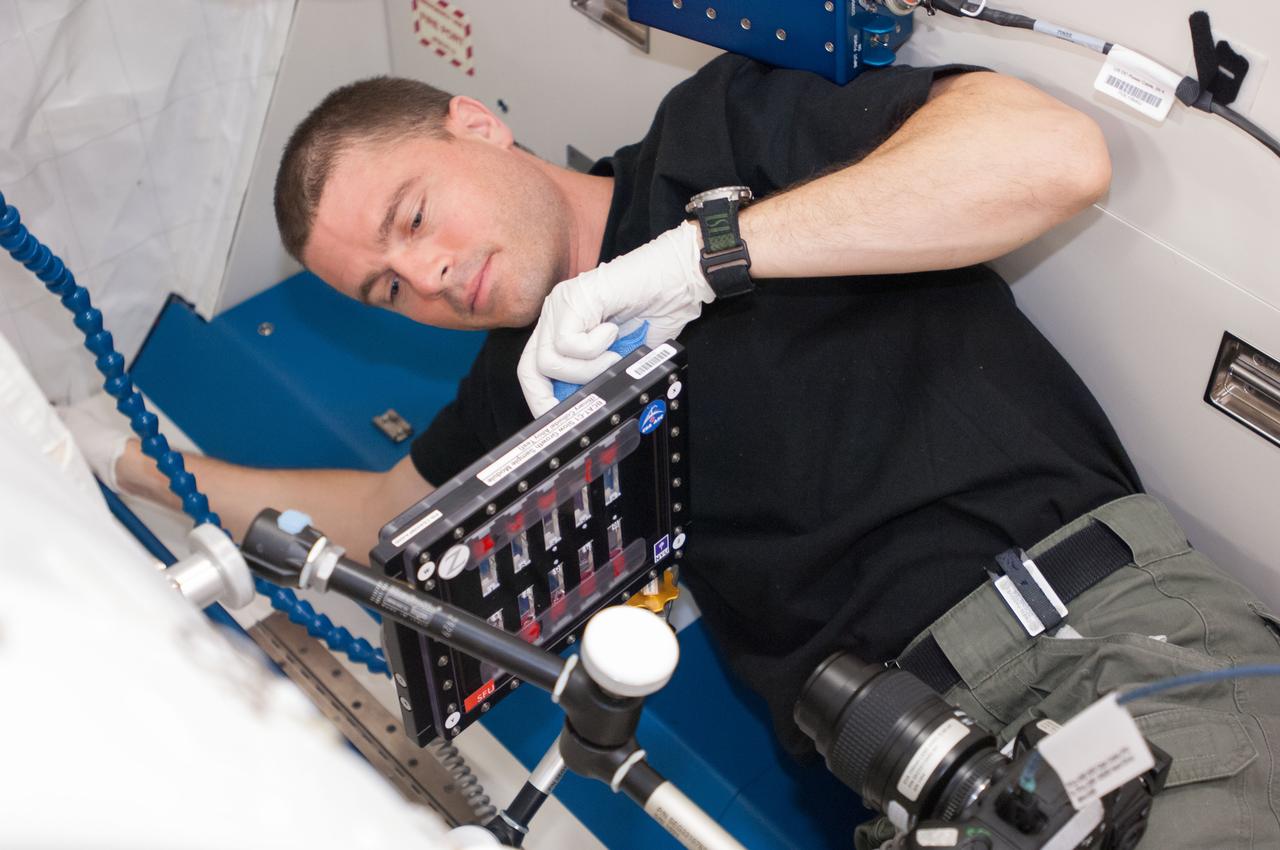
ISS040-E-076510 (25 July 2014) --- NASA astronaut Reid Wiseman, Expedition 40 flight engineer, conducts a session with the Binary Colloidal Alloy Test-C1, or BCAT-C1, experiment in the Kibo laboratory of the International Space Station. Results from this ongoing investigation of colloids ? mixtures of small particles distributed throughout a liquid ? will help materials scientists to develop new consumer products with unique properties and longer shelf lives.
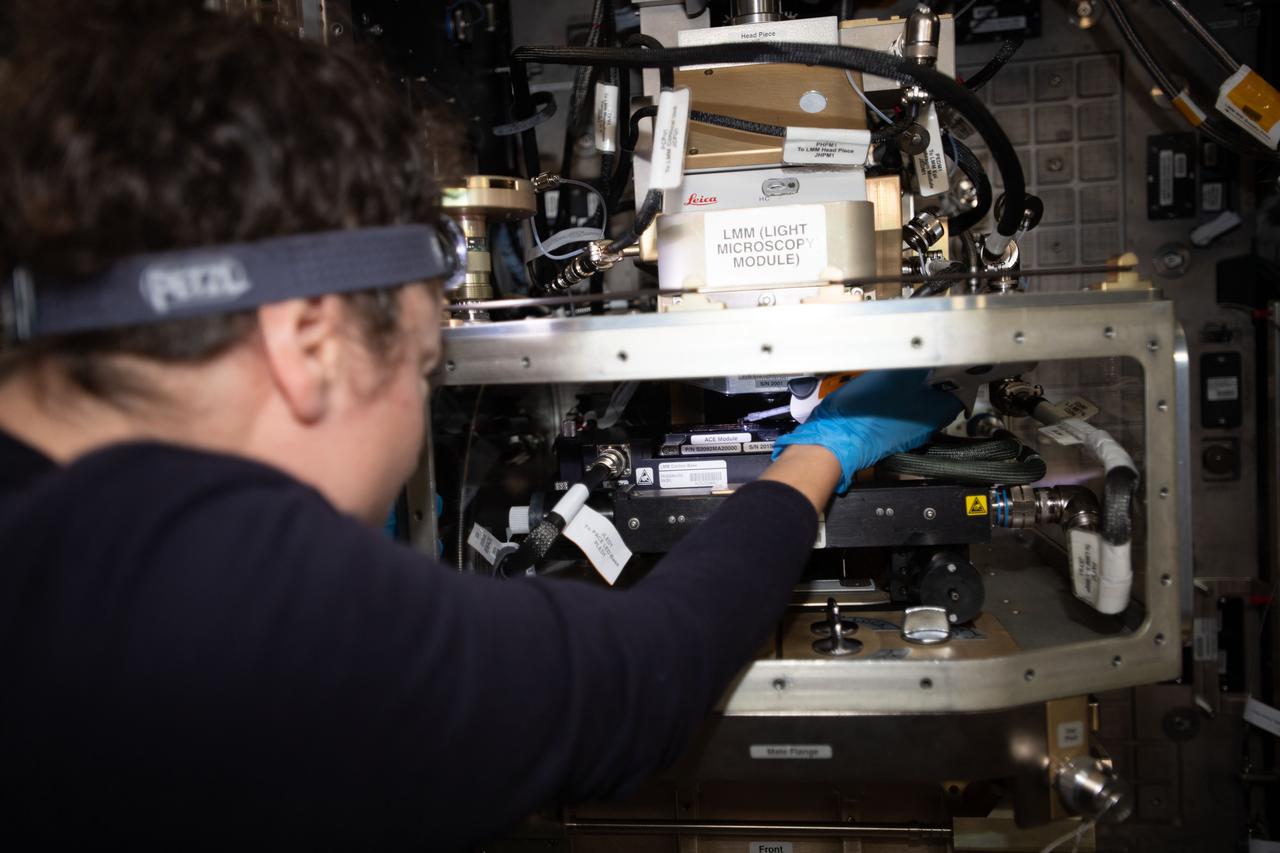
iss062e014345 (2-16-2020) --- A view of NASA astronaut Jessica Meir configuring the Light Microscopy Module (LMM) for the Advanced Colloids Experiment-Temperature-4 (ACE-T-4) science run in the Destiny module aboard the International Space Station (ISS). Introducing disorder to a crystalline system in a controlled way can form glass. Advanced Colloids Experiment-Temperature-4 (ACE-T-4) examines the transition of an ordered crystal to a disordered glass to determine how increasing disorder affects structural and dynamic properties
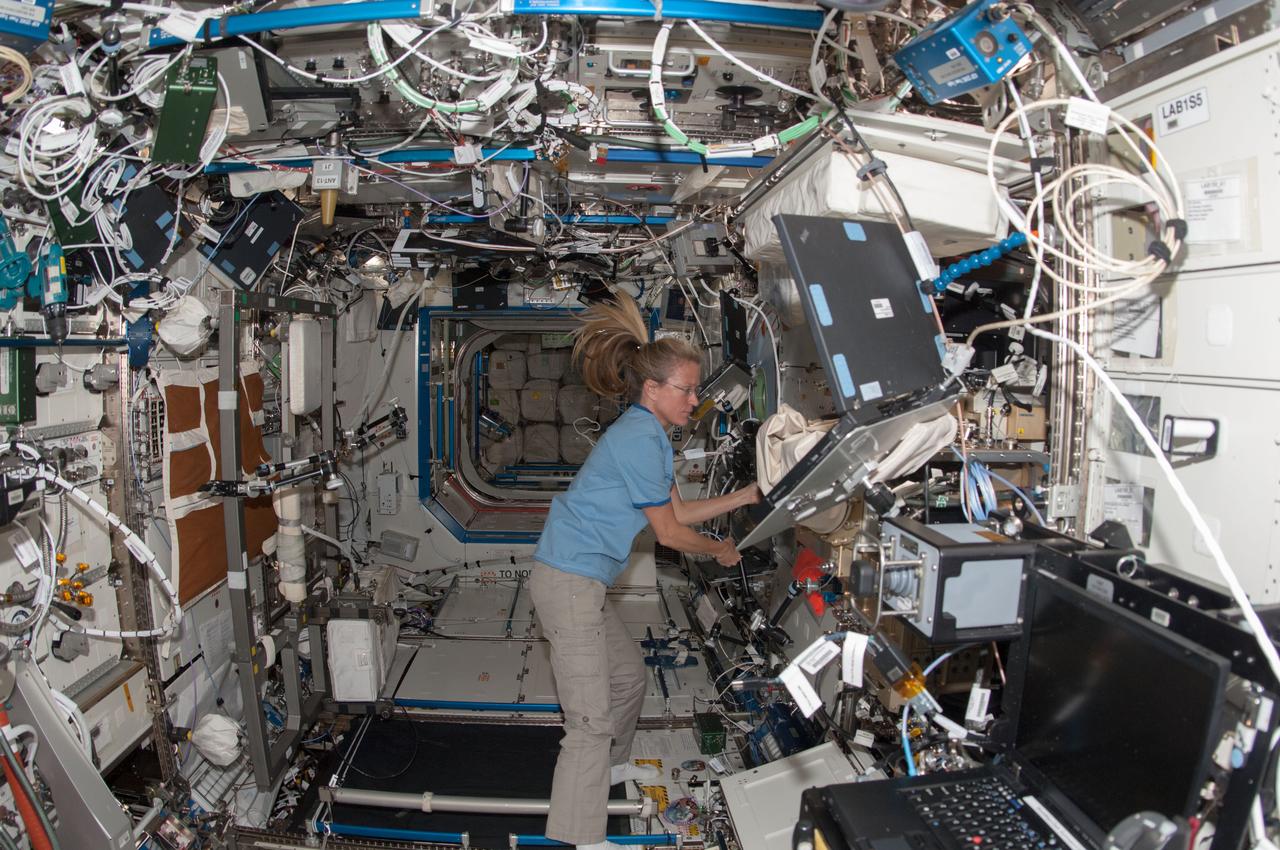
In the International Space Stations Destiny laboratory,NASA astronaut Karen Nyberg,Expedition 36 flight engineer,speaks into a microphone while conducting a session with the Advanced Colloids Experiment (ACE)-1 sample preparation at the Light Microscopy Module (LMM) in the Fluids Integrated Rack / Fluids Combustion Facility (FIR/FCF). ACE-1 is a series of microscopic imaging investigations that uses the microgravity environment to examine flow characteristics and the evolution and ordering effects within a group of colloidal materials.
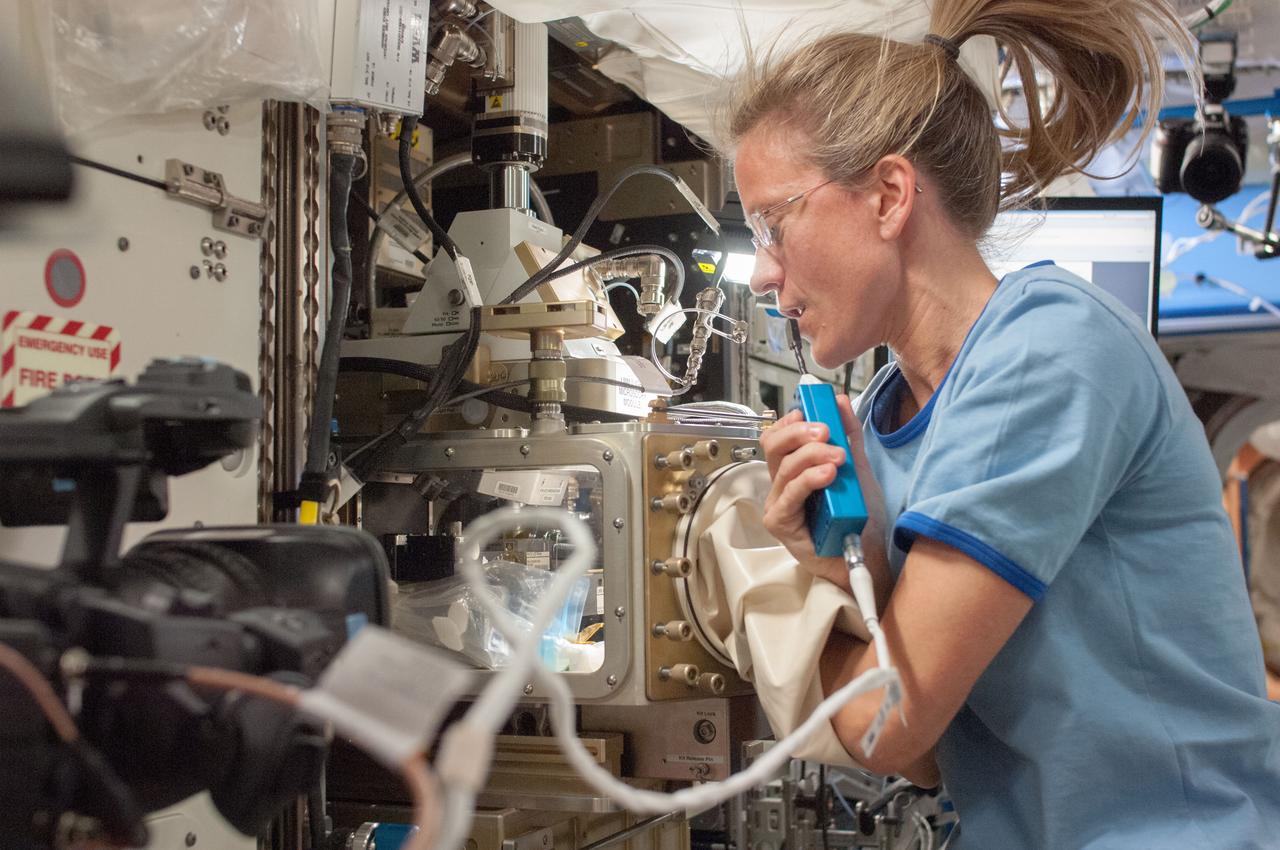
ISS036-E-019830 (24 June 2013) --- In the International Space Station’s Destiny laboratory, NASA astronaut Karen Nyberg, Expedition 36 flight engineer, speaks into a microphone while conducting a session with the Advanced Colloids Experiment (ACE)-1 sample preparation at the Light Microscopy Module (LMM) in the Fluids Integrated Rack / Fluids Combustion Facility (FIR/FCF). ACE-1 is a series of microscopic imaging investigations that uses the microgravity environment to examine flow characteristics and the evolution and ordering effects within a group of colloidal materials.
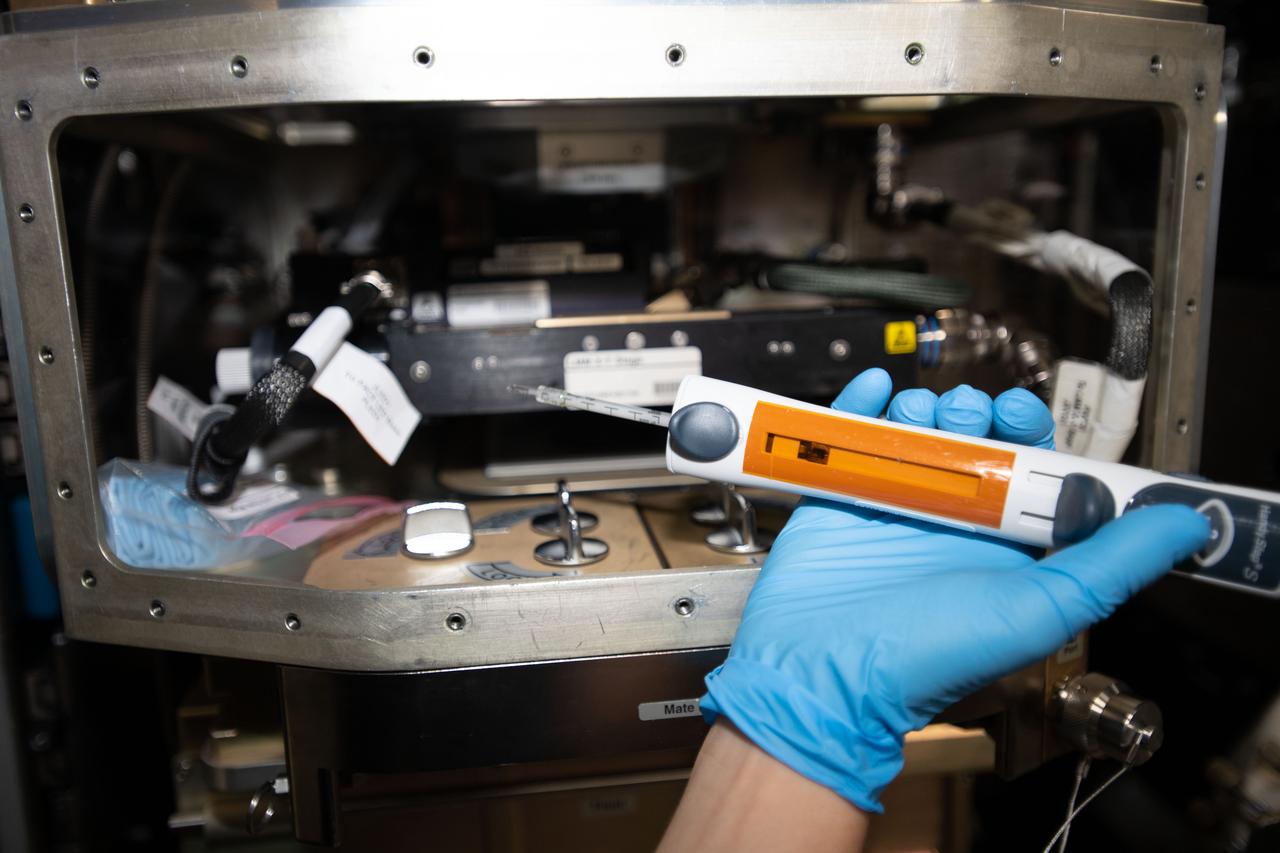
iss062e014342 (2-16-2020) --- A view of NASA astronaut Jessica Meir configuring the Light Microscopy Module (LMM) for the Advanced Colloids Experiment-Temperature-4 (ACE-T-4) science run in the Destiny module aboard the International Space Station (ISS). Introducing disorder to a crystalline system in a controlled way can form glass. Advanced Colloids Experiment-Temperature-4 (ACE-T-4) examines the transition of an ordered crystal to a disordered glass to determine how increasing disorder affects structural and dynamic properties
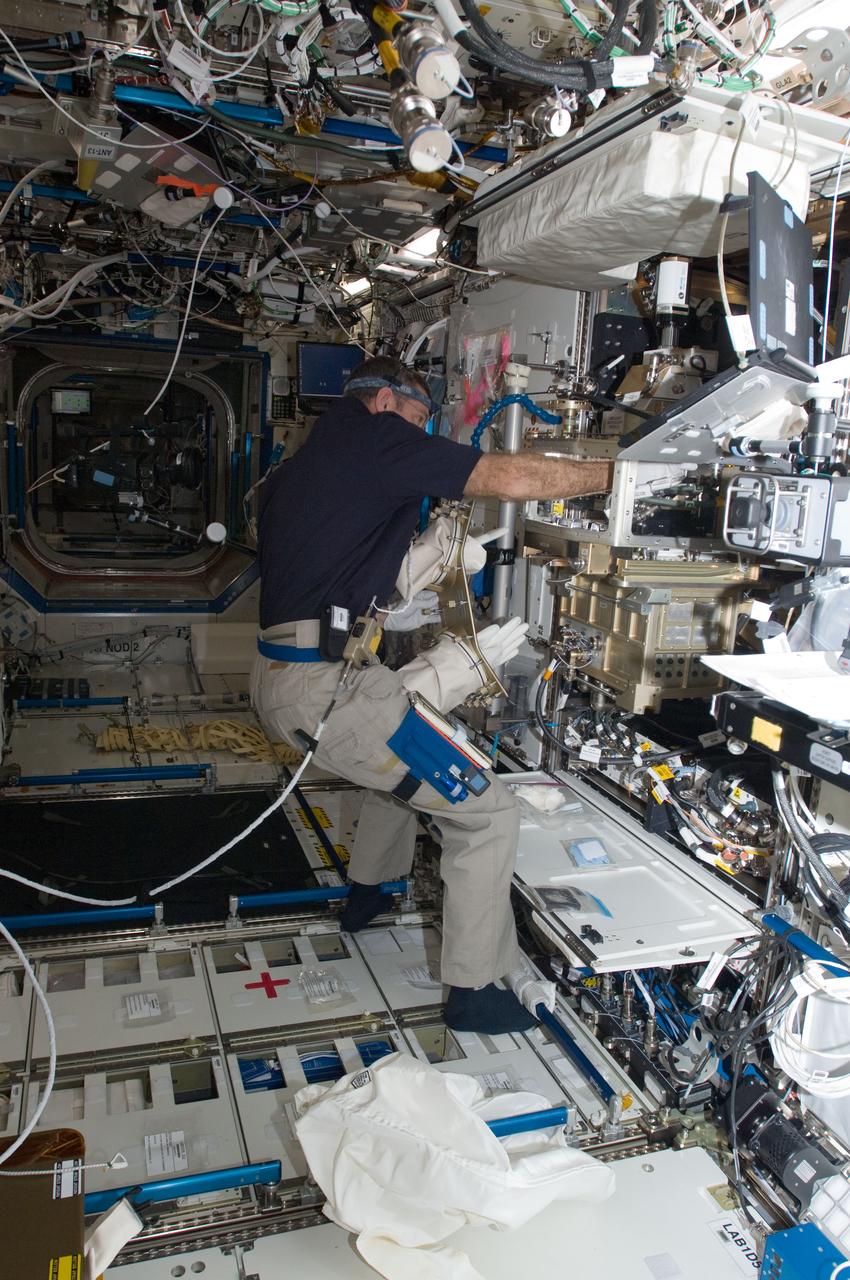
ISS030-E-007418 (1 Dec. 2011) --- In the International Space Station’s Destiny laboratory, NASA astronaut Dan Burbank, Expedition 30 commander, conducts a session with the Preliminary Advanced Colloids Experiment (PACE) at the Light Microscopy Module (LMM) in the Fluids Integrated Rack / Fluids Combustion Facility (FIR/FCF). PACE is designed to investigate the capability of conducting high magnification colloid experiments with the LMM for determining the minimum size particles which can be resolved with it.
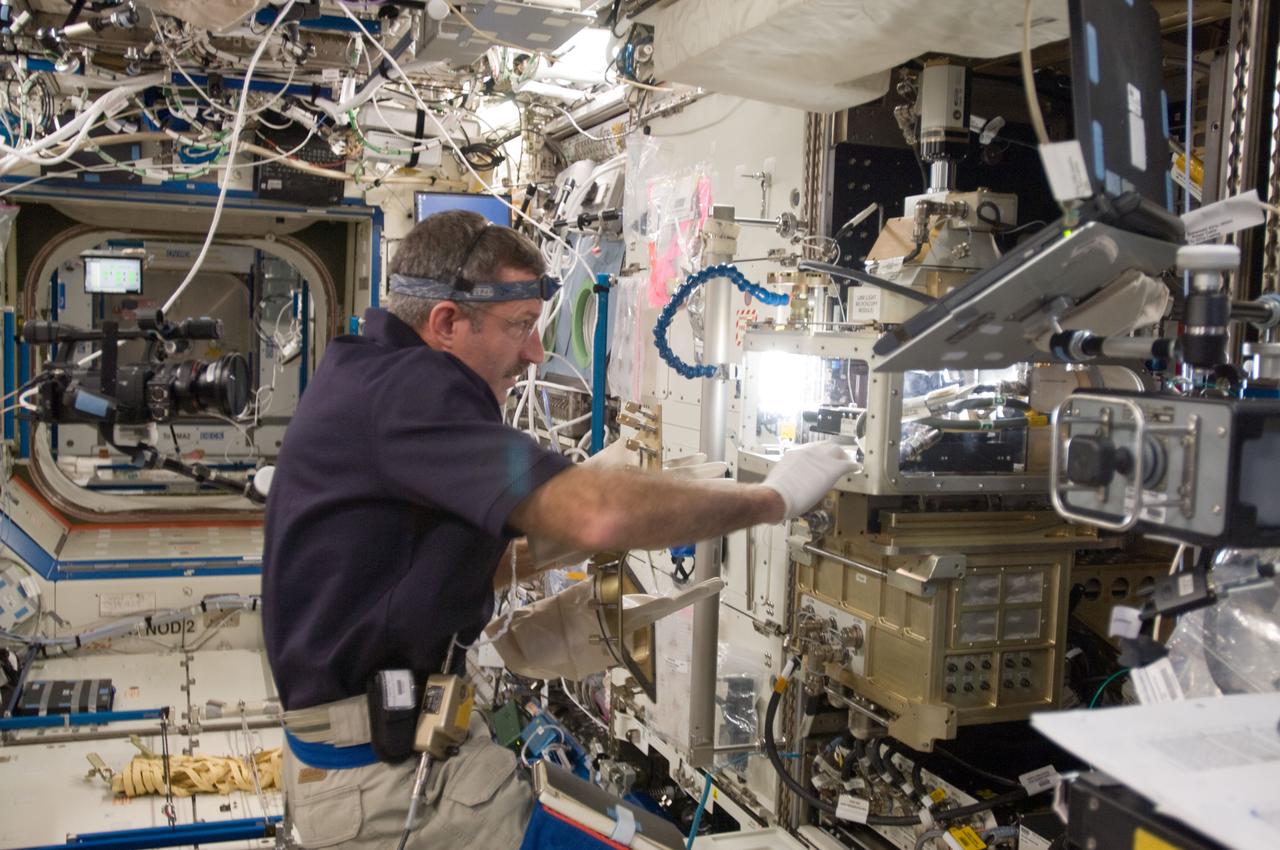
ISS030-E-007417 (1 Dec. 2011) --- In the International Space Station?s Destiny laboratory, NASA astronaut Dan Burbank, Expedition 30 commander, conducts a session with the Preliminary Advanced Colloids Experiment (PACE) at the Light Microscopy Module (LMM) in the Fluids Integrated Rack / Fluids Combustion Facility (FIR/FCF). PACE is designed to investigate the capability of conducting high magnification colloid experiments with the LMM for determining the minimum size particles which can be resolved with it.
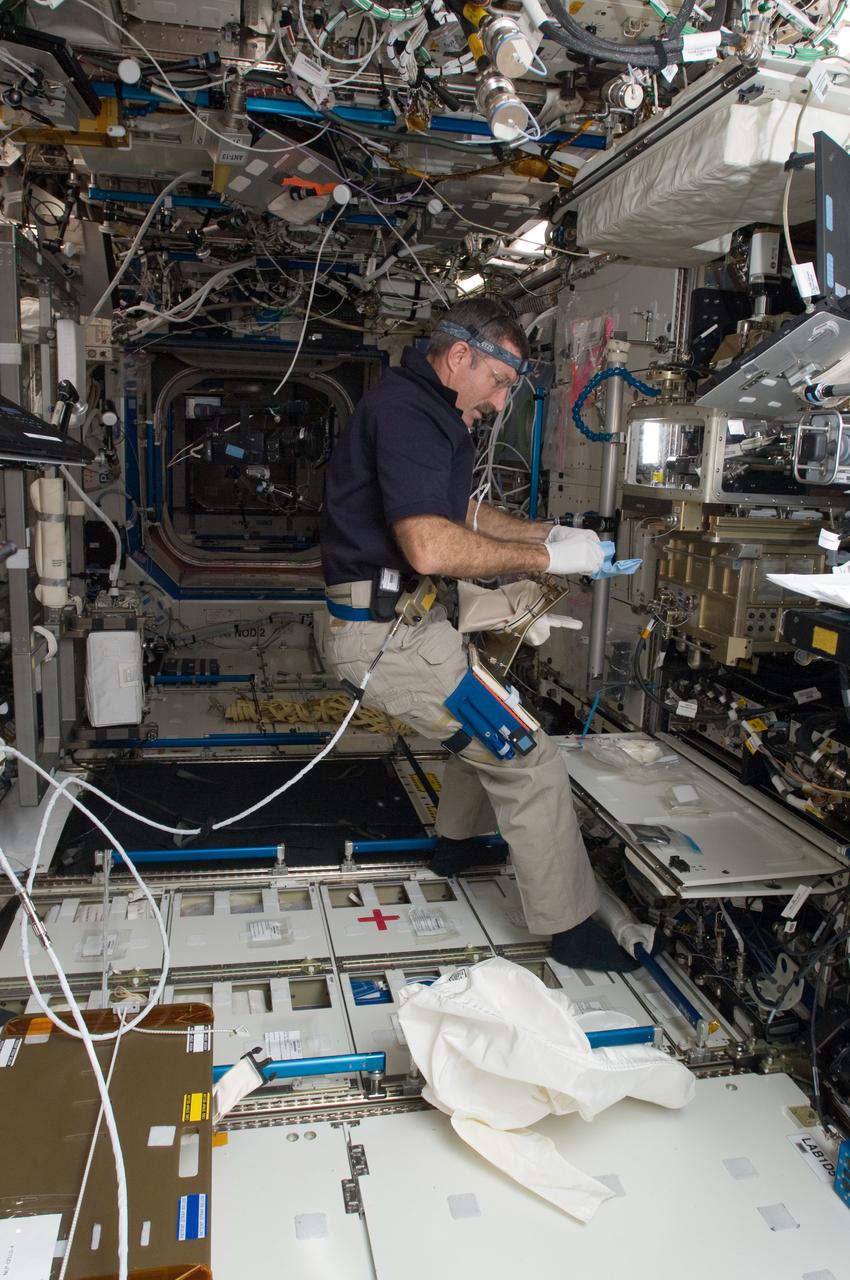
ISS030-E-007419 (1 Dec. 2011) --- In the International Space Station’s Destiny laboratory, NASA astronaut Dan Burbank, Expedition 30 commander, conducts a session with the Preliminary Advanced Colloids Experiment (PACE) at the Light Microscopy Module (LMM) in the Fluids Integrated Rack / Fluids Combustion Facility (FIR/FCF). PACE is designed to investigate the capability of conducting high magnification colloid experiments with the LMM for determining the minimum size particles which can be resolved with it.
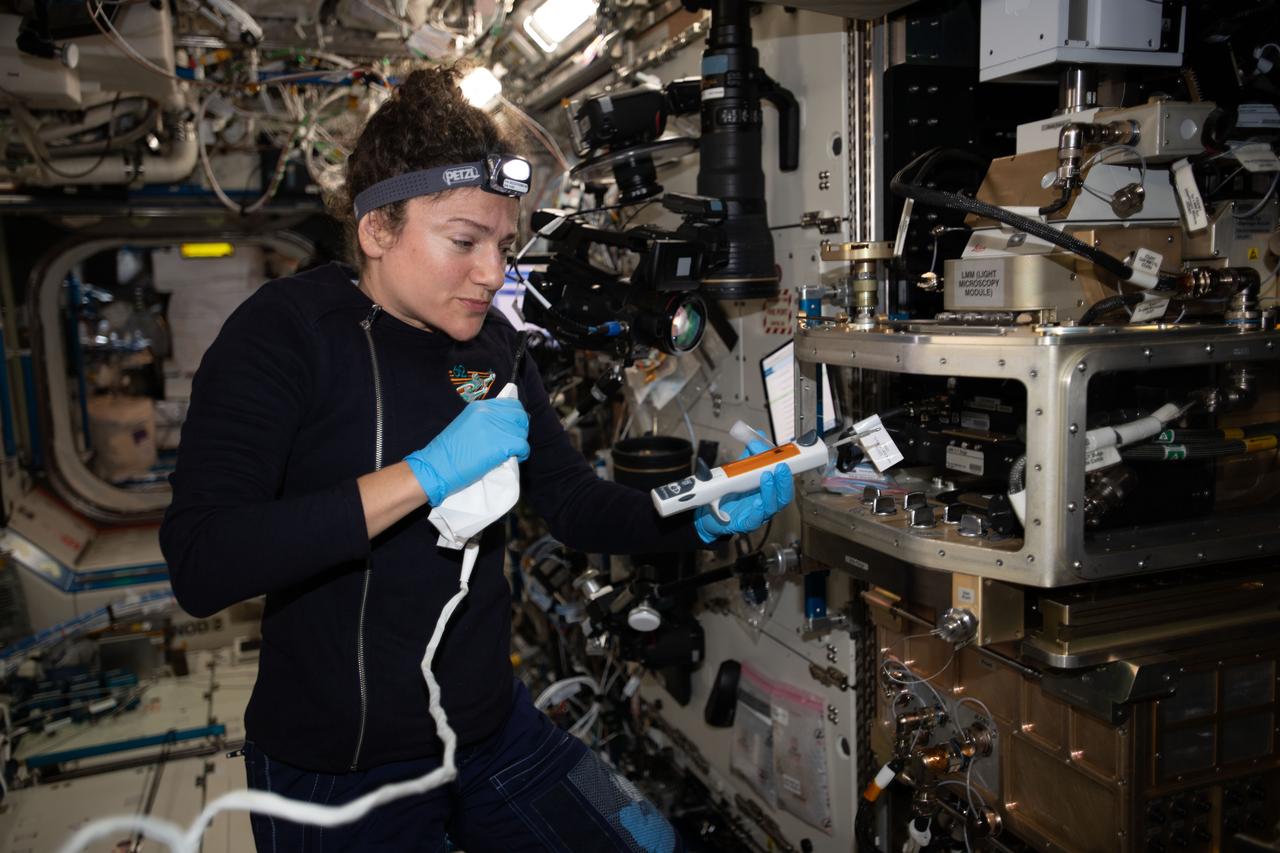
iss062e014349 (Feb. 16, 2020) --- A view of NASA astronaut Jessica Meir configuring the Light Microscopy Module (LMM) for the Advanced Colloids Experiment-Temperature-4 (ACE-T-4) science in the Destiny module aboard the International Space Station (ISS). Introducing disorder to a crystalline system in a controlled way can form glass. Advanced Colloids Experiment-Temperature-4 (ACE-T-4) examines the transition of an ordered crystal to a disordered glass to determine how increasing disorder affects structural and dynamic properties.
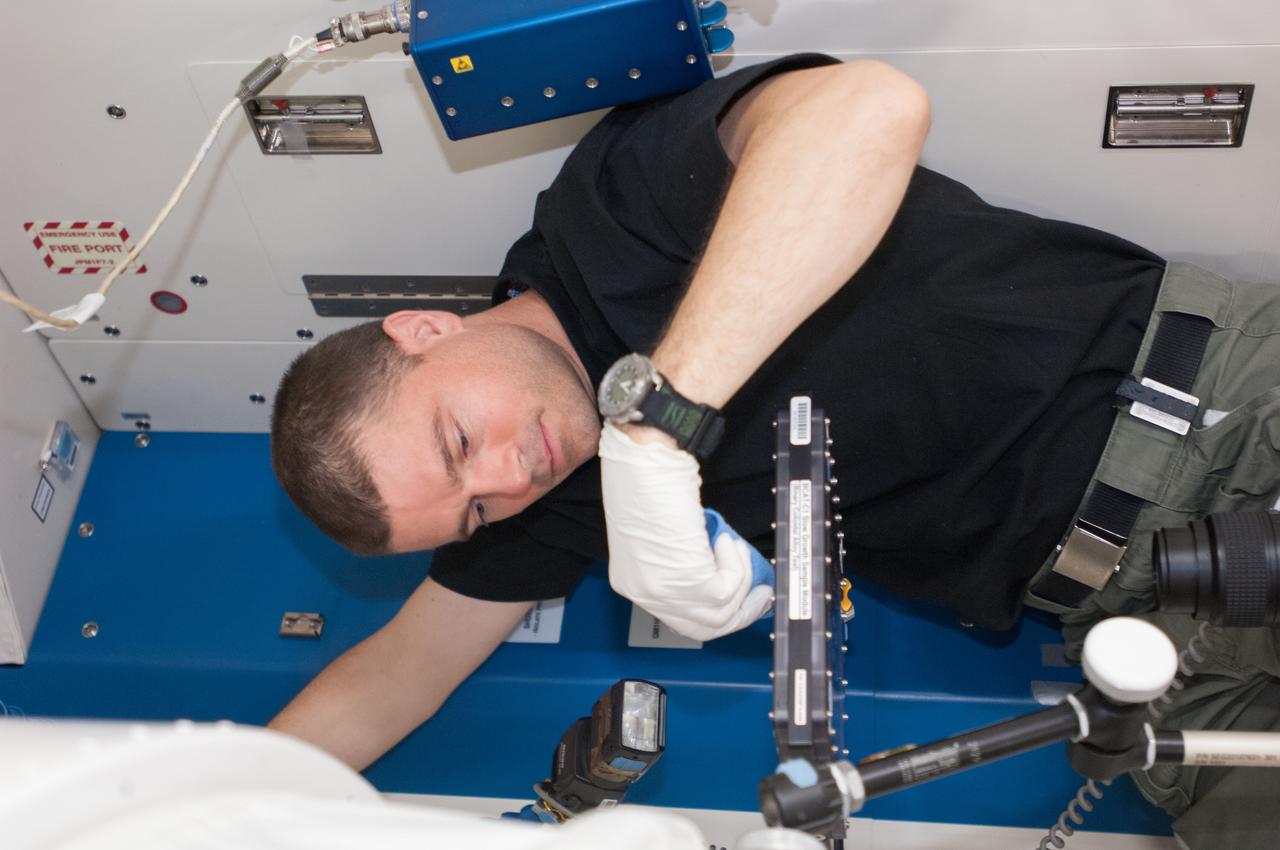
ISS040-E-076507 (25 July 2014) --- NASA astronaut Reid Wiseman, Expedition 40 flight engineer, conducts a session with the Binary Colloidal Alloy Test-C1, or BCAT-C1, experiment in the Kibo laboratory of the International Space Station. Results from this ongoing investigation of colloids ? mixtures of small particles distributed throughout a liquid ? will help materials scientists to develop new consumer products with unique properties and longer shelf lives.
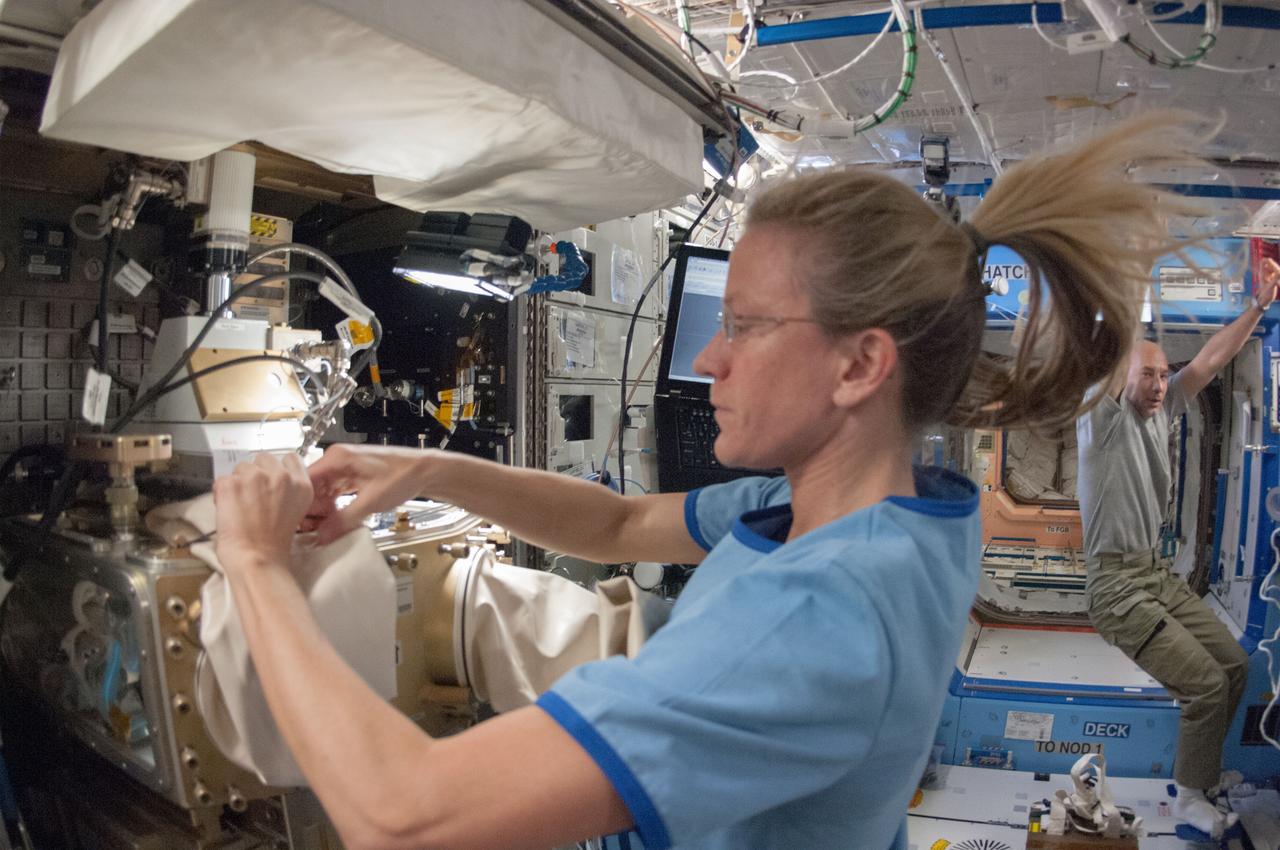
ISS036-E-019760 (24 June 2013) --- In the International Space Station’s Destiny laboratory, NASA astronaut Karen Nyberg, Expedition 36 flight engineer, conducts a session with the Advanced Colloids Experiment (ACE)-1 sample preparation at the Light Microscopy Module (LMM) in the Fluids Integrated Rack / Fluids Combustion Facility (FIR/FCF). ACE-1 is a series of microscopic imaging investigations that uses the microgravity environment to examine flow characteristics and the evolution and ordering effects within a group of colloidal materials.
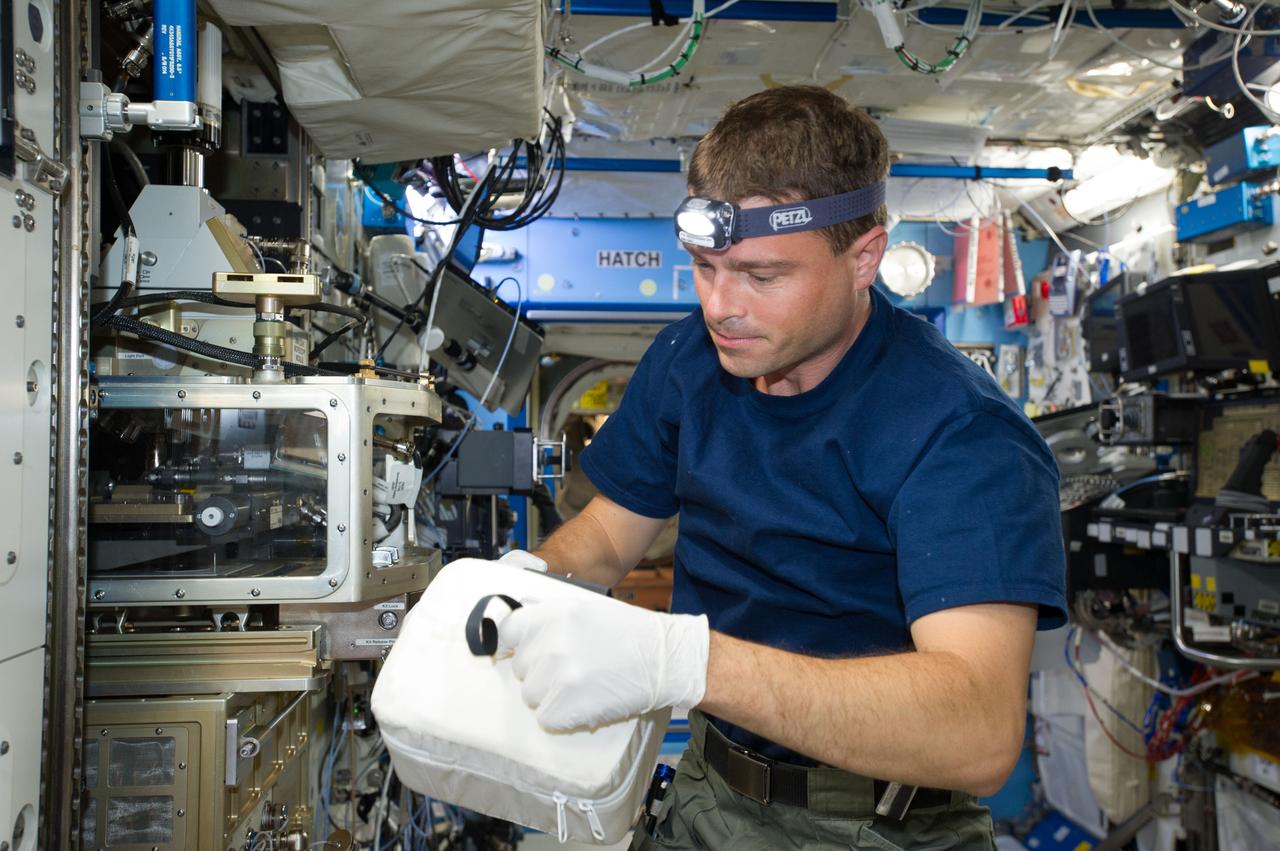
ISS040-E-007368 (5 June 2014) --- NASA astronaut Reid Wiseman, Expedition 40 flight engineer, works with Advanced Colloids Experiment (ACE) samples in the Destiny laboratory of the International Space Station.
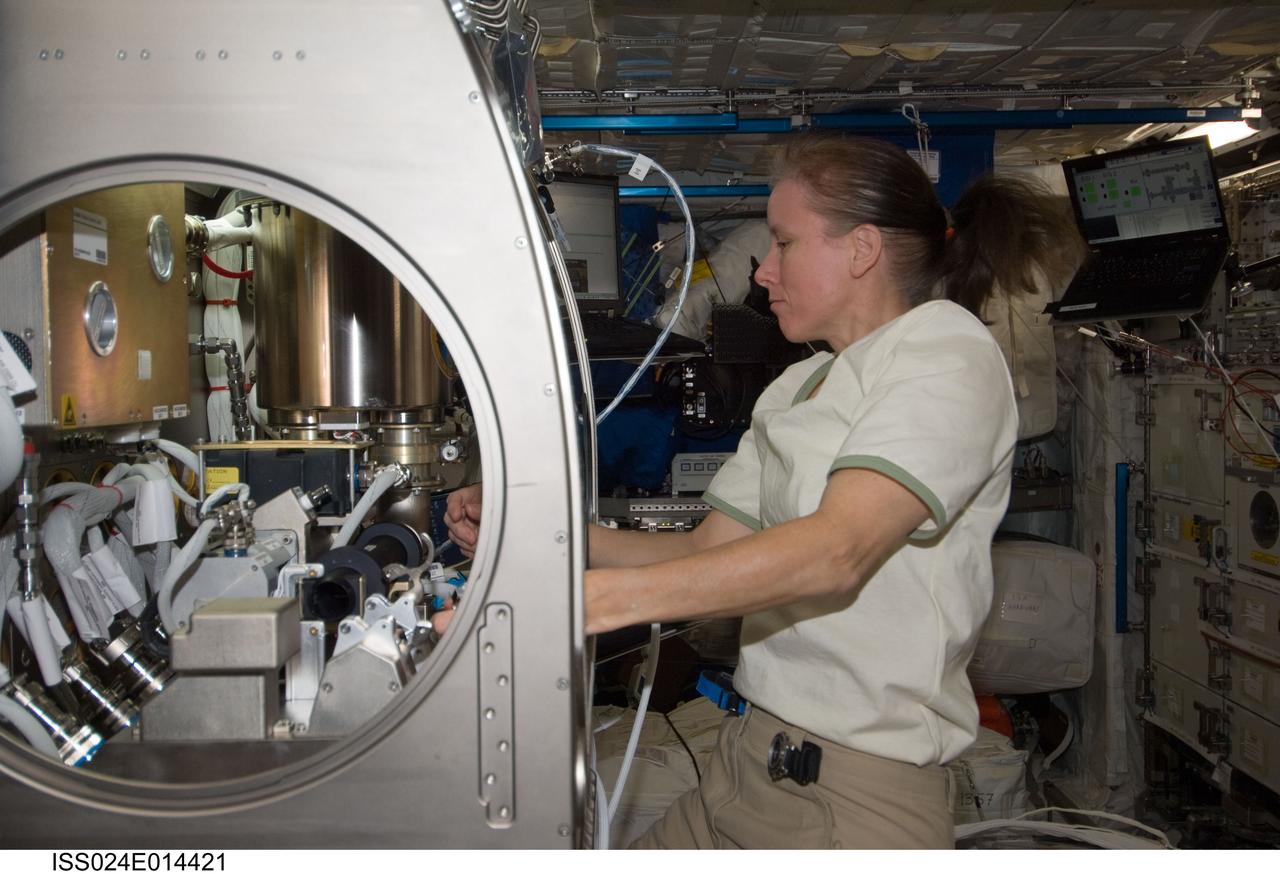
ISS024-E-014421 (13 Sept. 2010) --- NASA astronaut Shannon Walker, Expedition 24 flight engineer, works on the COLLOID experiment inside the Microgravity Science Glovebox (MSG) in the Columbus laboratory of the International Space Station.
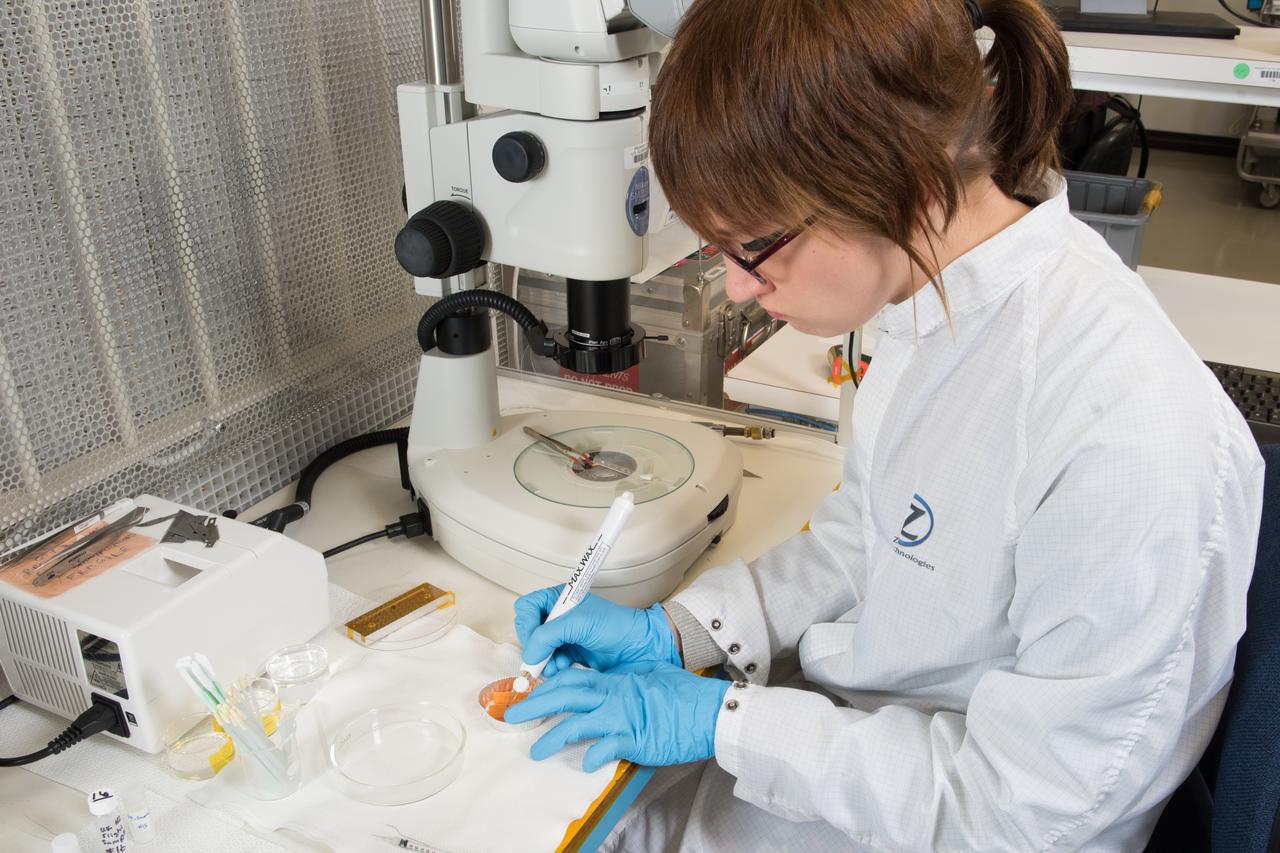
NASA (Zin Technologies) engineer prepares Advanced Colloid Experiment Heated-2 samples that will be analyzed aboard the International Space Station using the zero-gravity Light Microscopy Module, LMM in the Fluids Integrated Rack, FIR
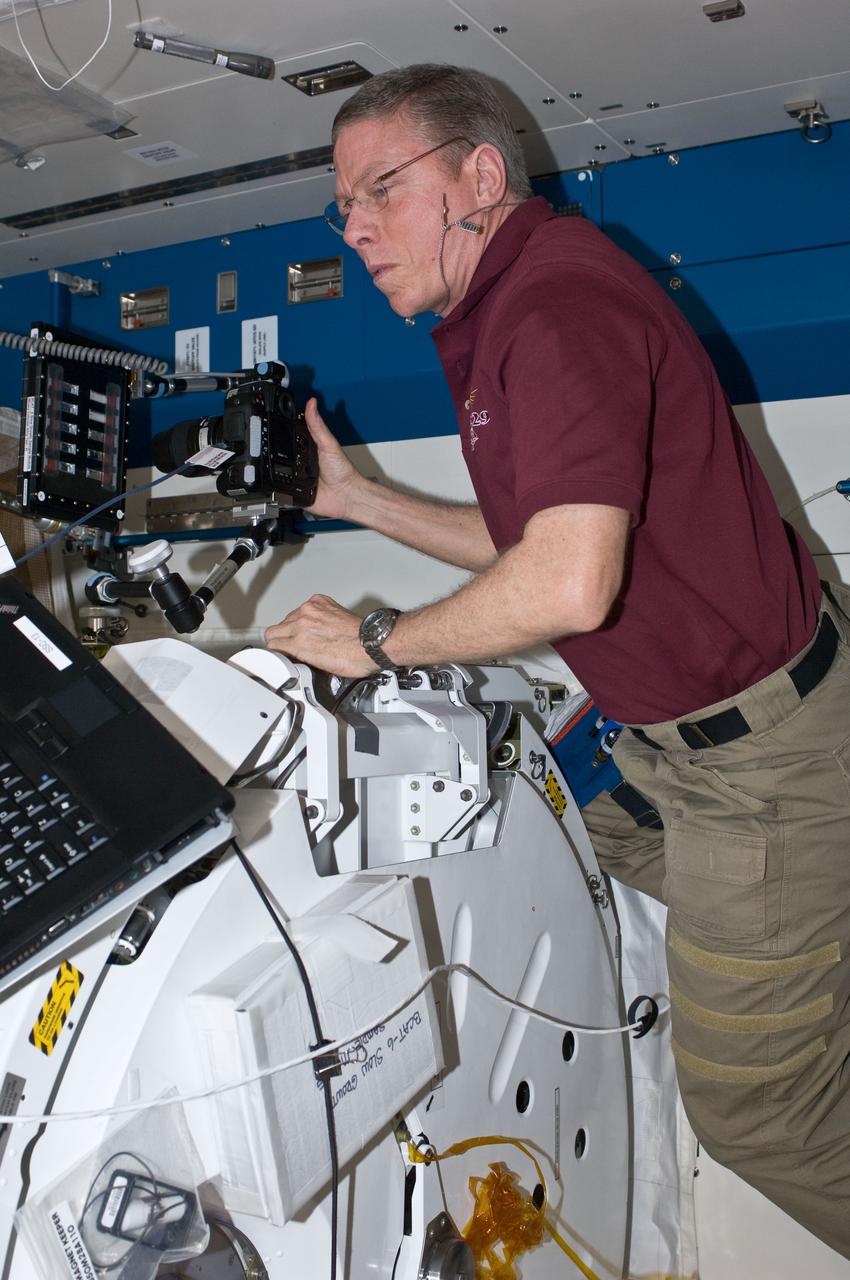
ISS029-E-032410 (24 Oct. 2011) --- NASA Mike Fossum, Expedition 29 commander, conducts a session with the Binary Colloidal Alloy Test-6 (BCAT-6) experiment in the Kibo laboratory of the International Space Station.

ISS028-E-036517 (2 Sept. 2011) --- NASA astronaut Mike Fossum, Expedition 28 flight engineer, conducts a session with the Binary Colloidal Alloy Test-5 (BCAT-5) in the Kibo laboratory of the International Space Station.
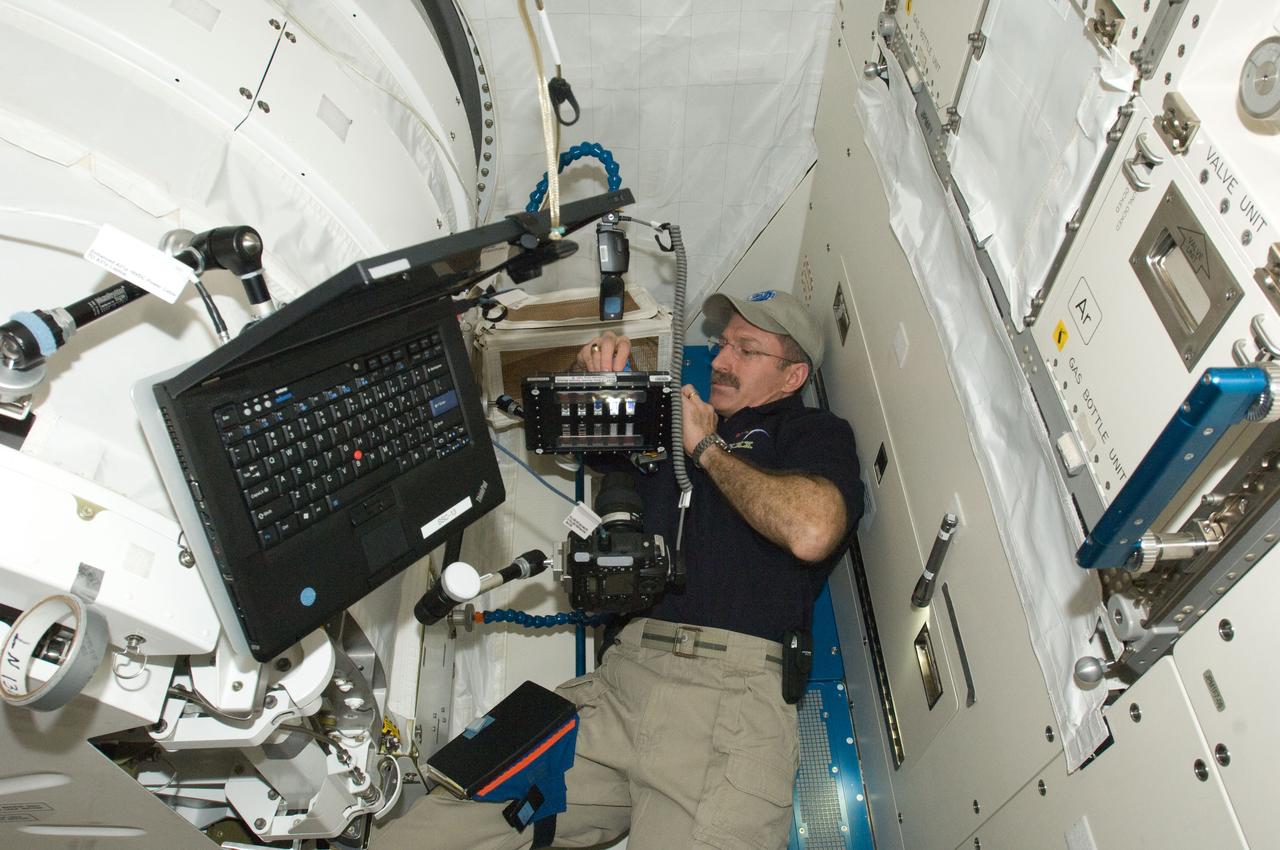
ISS030-E-063957 (8 Feb. 2012) --- NASA astronaut Dan Burbank, Expedition 30 commander, conducts a session with the Binary Colloidal Alloy Test-6 (BCAT-6) experiment in the Kibo laboratory of the International Space Station.
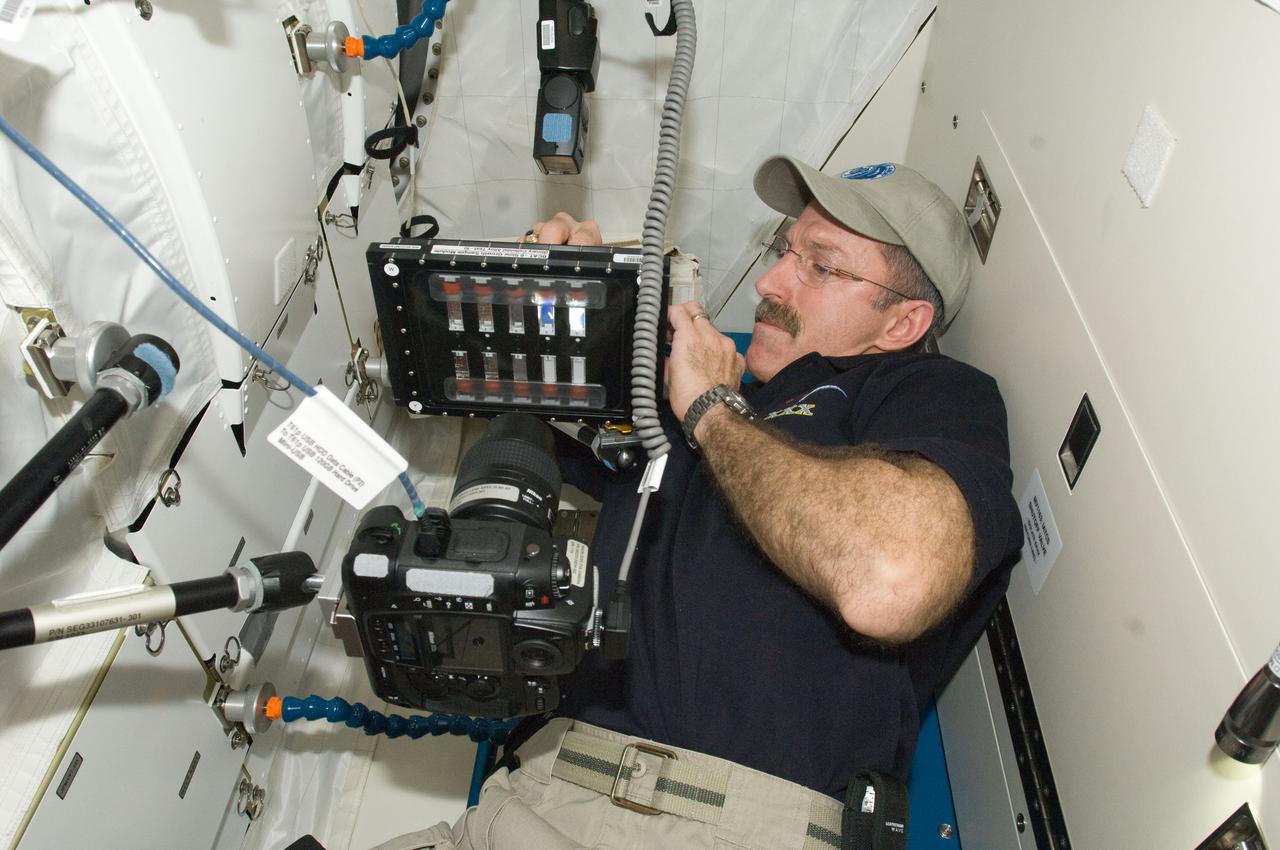
ISS030-E-063961 (8 Feb. 2012) --- NASA astronaut Dan Burbank, Expedition 30 commander, conducts a session with the Binary Colloidal Alloy Test-6 (BCAT-6) experiment in the Kibo laboratory of the International Space Station.
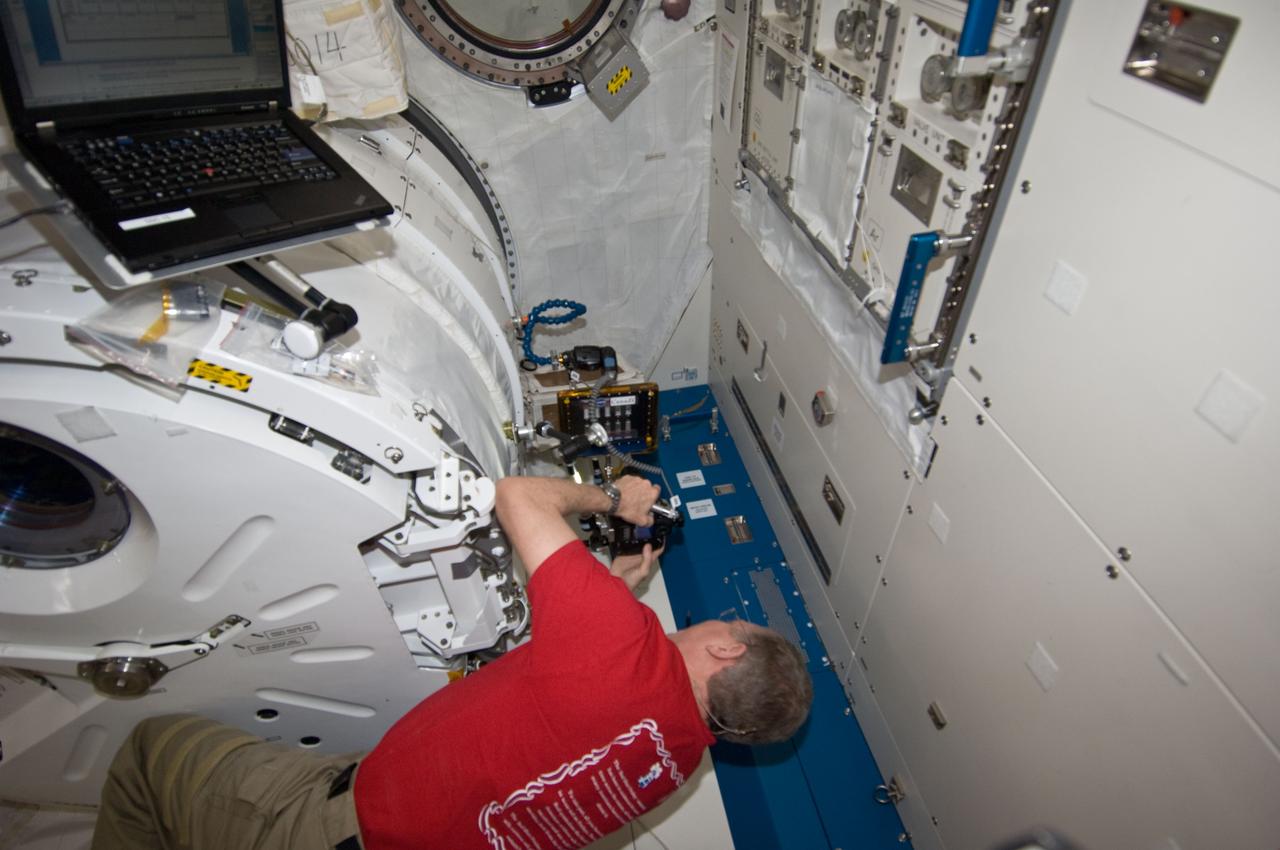
ISS028-E-036580 (2 Sept. 2011) --- NASA astronaut Mike Fossum, Expedition 28 flight engineer, conducts a session with the Binary Colloidal Alloy Test-5 (BCAT-5) in the Kibo laboratory of the International Space Station.
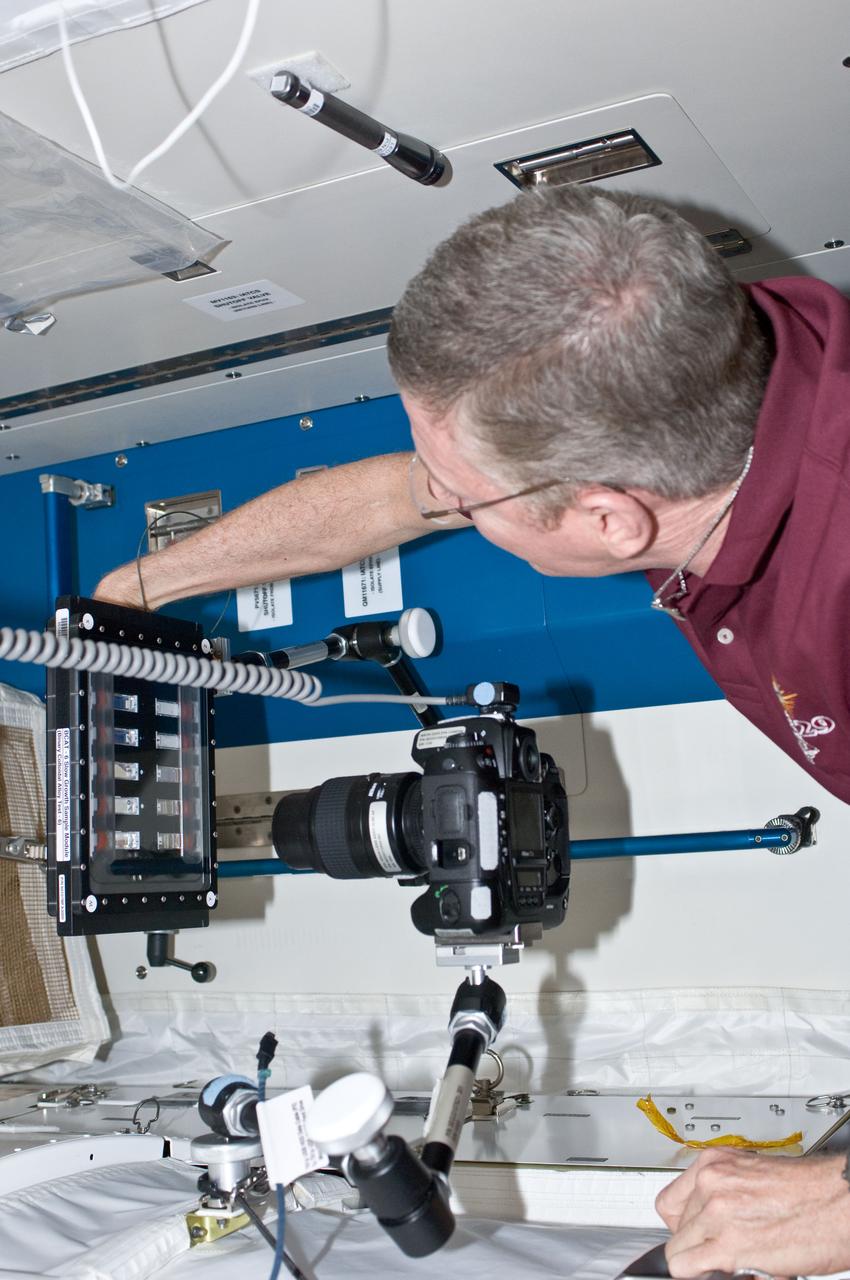
ISS029-E-032414 (24 Oct. 2011) --- NASA Mike Fossum, Expedition 29 commander, conducts a session with the Binary Colloidal Alloy Test-6 (BCAT-6) experiment in the Kibo laboratory of the International Space Station.
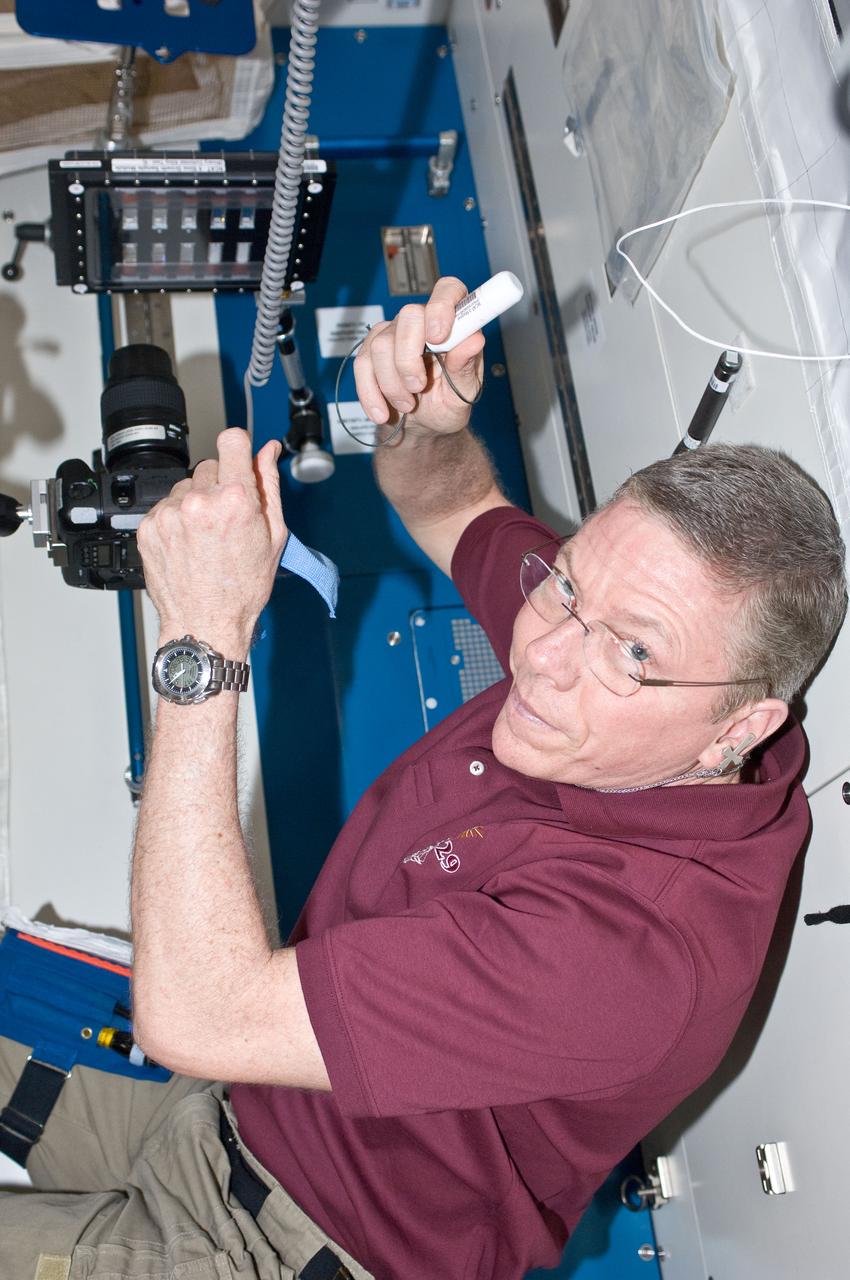
ISS029-E-032412 (24 Oct. 2011) --- NASA Mike Fossum, Expedition 29 commander, conducts a session with the Binary Colloidal Alloy Test-6 (BCAT-6) experiment in the Kibo laboratory of the International Space Station.
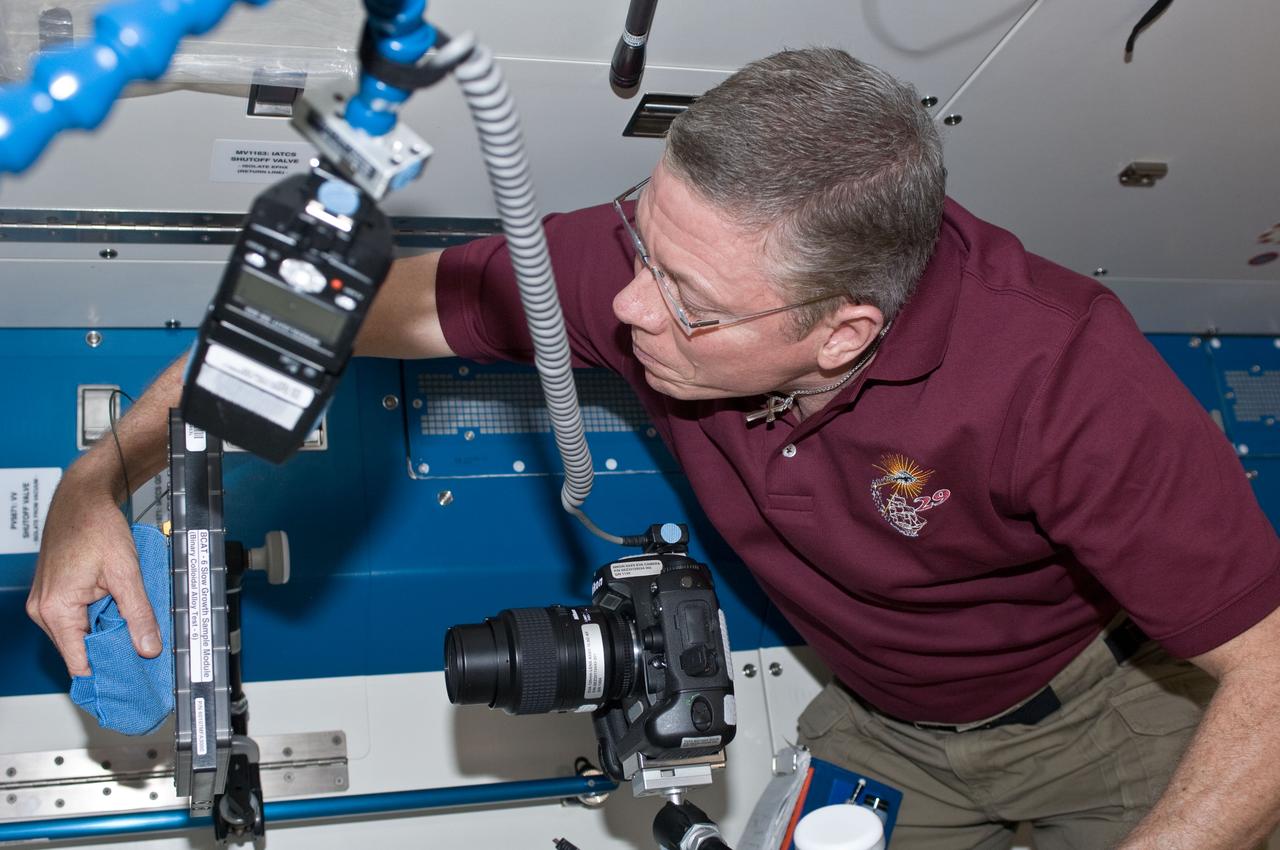
ISS029-E-032422 (24 Oct. 2011) --- NASA Mike Fossum, Expedition 29 commander, conducts a session with the Binary Colloidal Alloy Test-6 (BCAT-6) experiment in the Kibo laboratory of the International Space Station.
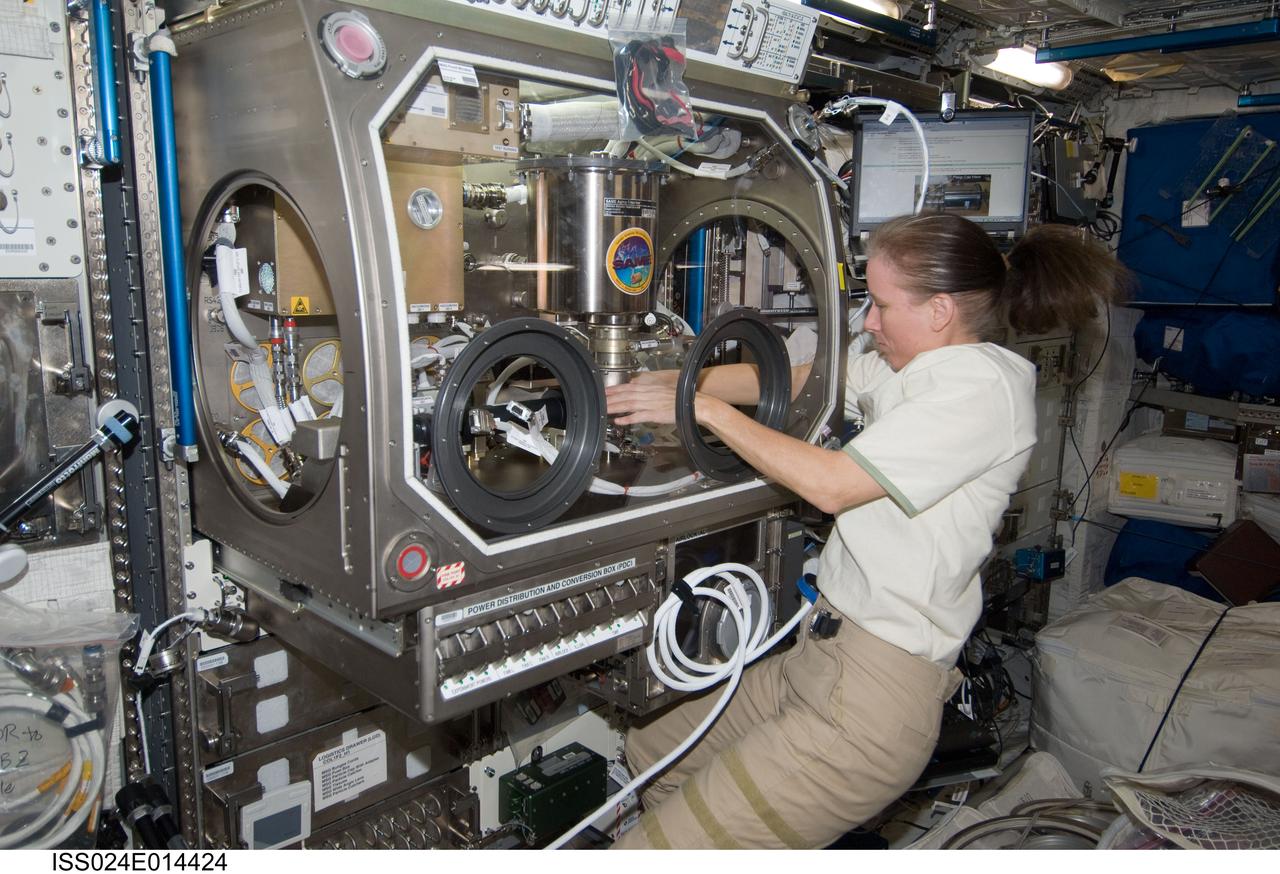
ISS024-E-014424 (13 Sept. 2010) --- NASA astronaut Shannon Walker, Expedition 24 flight engineer, works on the COLLOID experiment inside the Microgravity Science Glovebox (MSG) in the Columbus laboratory of the International Space Station.
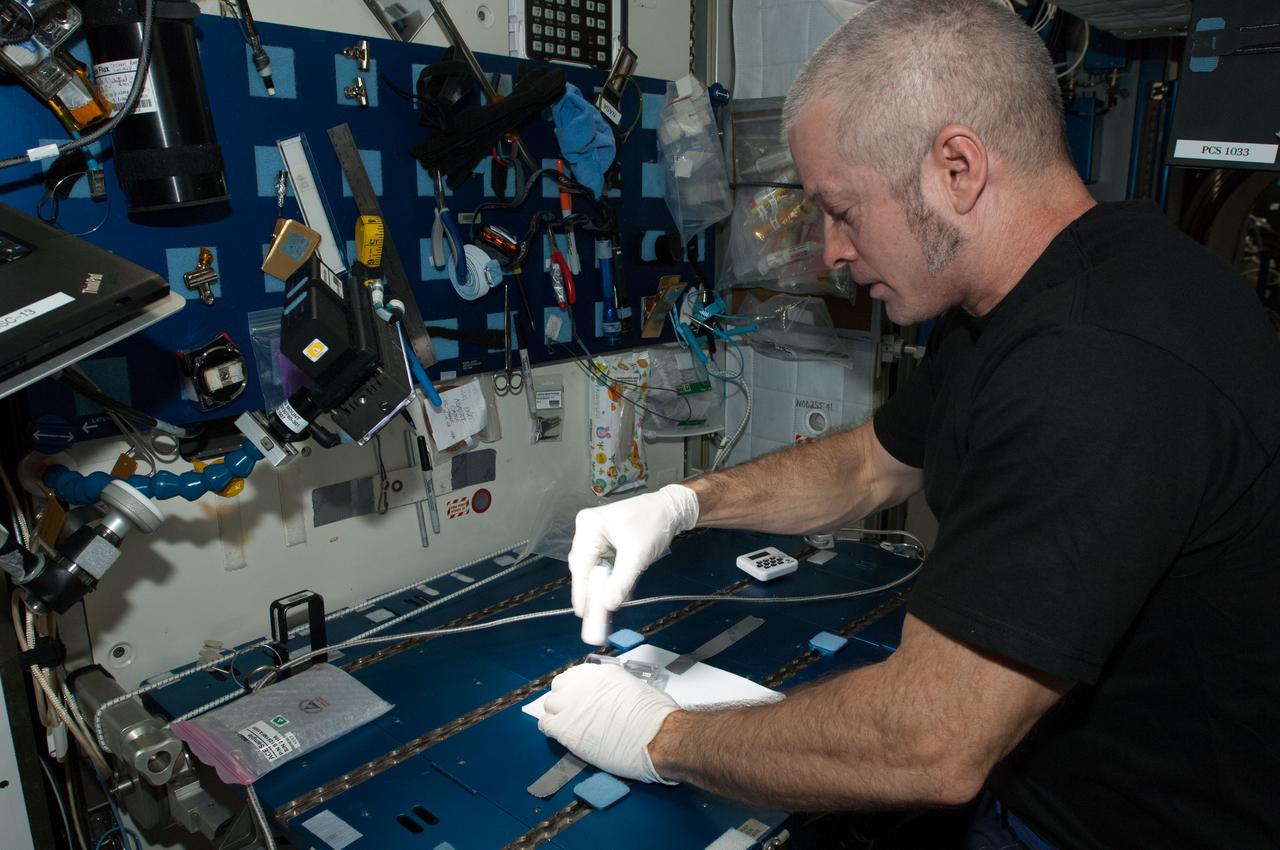
ISS040-E-060673 (14 July 2014) --- NASA astronaut Steve Swanson, Expedition 40 commander, works with test samples for the Advanced Colloids Experiment (ACE) at a work station in the Harmony node of the International Space Station.
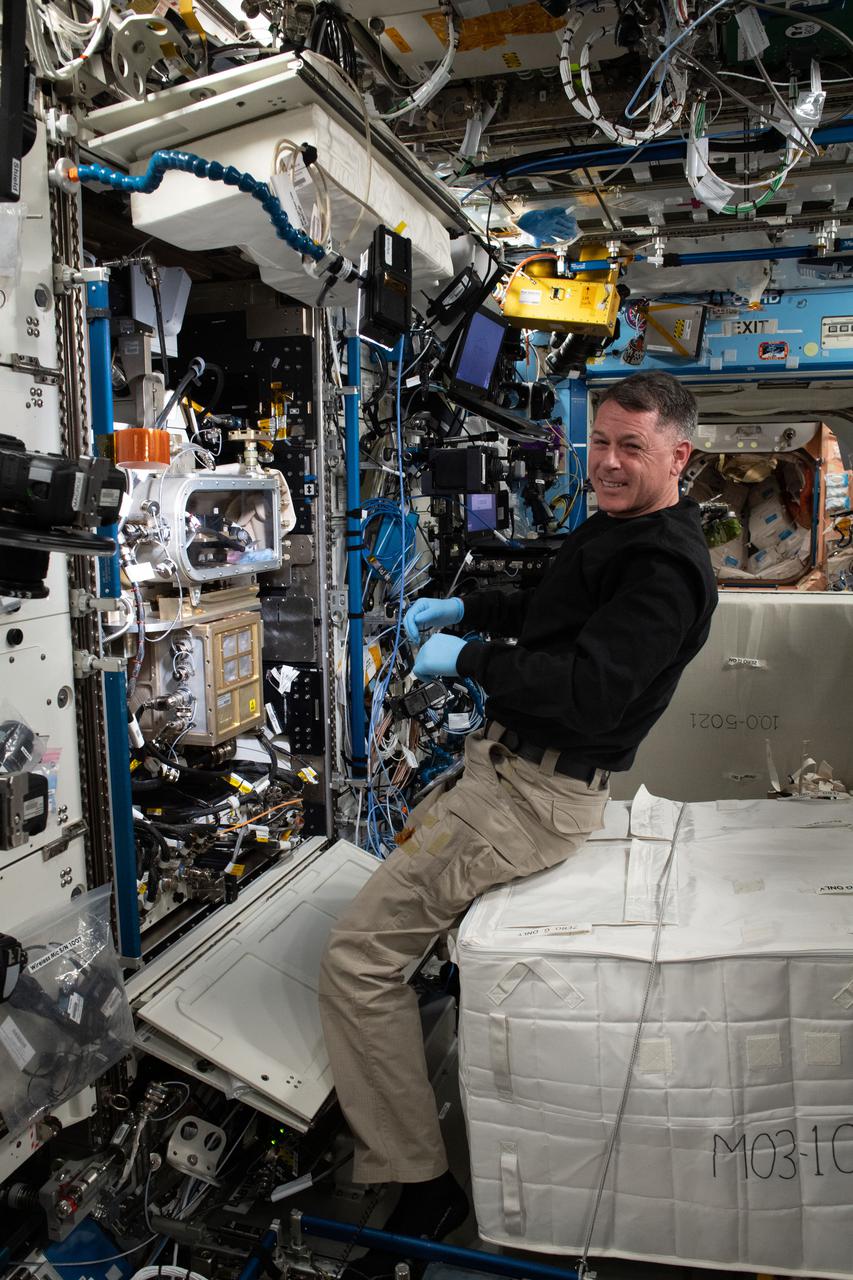
iss065e257487 (Aug. 17, 2021) --- NASA astronaut and Expedition 65 Flight Engineer Shane Kimbrough changes out the ACE (Advanced Colloid Experiment) Module inside the LMM (Light Microscopy Module).
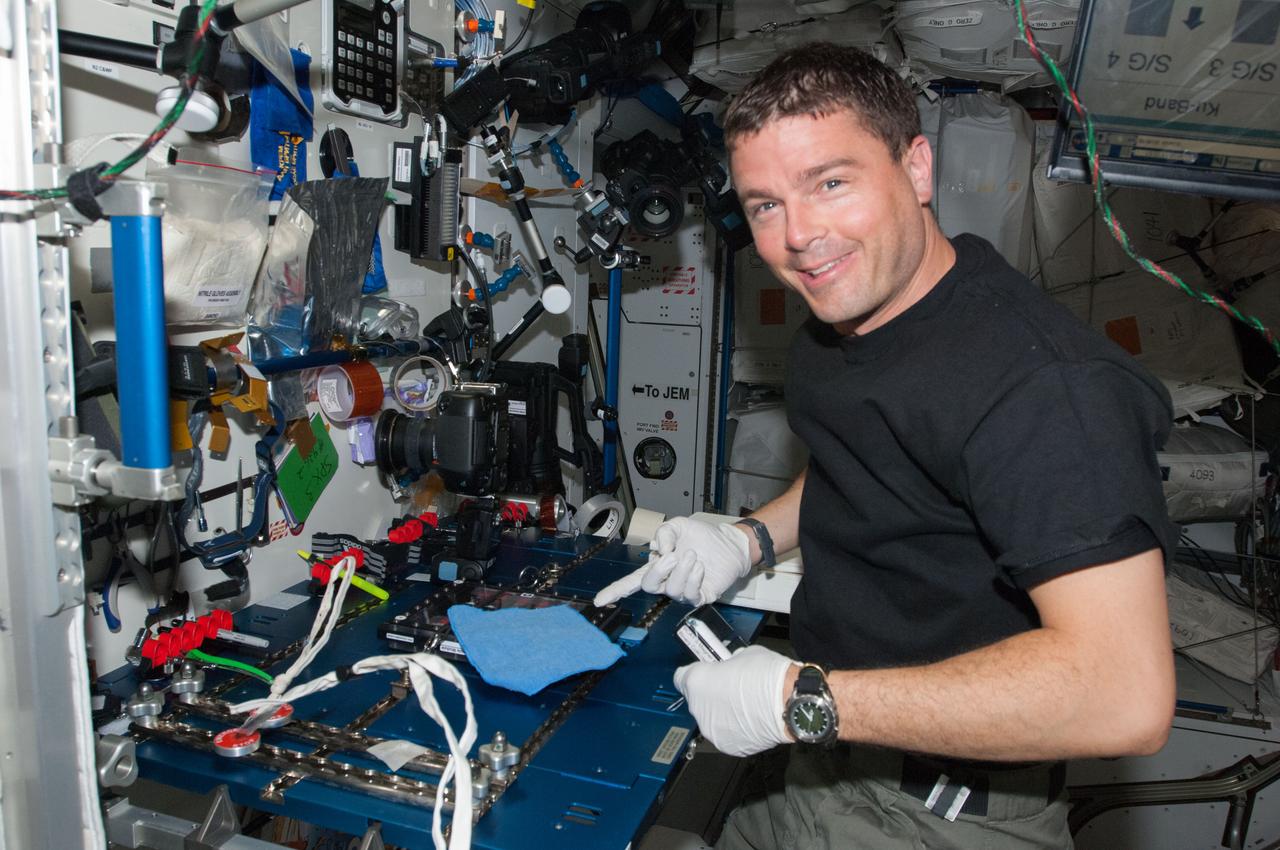
ISS040-E-013856 (17 June 2014) --- NASA astronaut Reid Wiseman, Expedition 40 flight engineer, conducts a session with the Binary Colloidal Alloy Test (BCAT) experiment at a workstation in the Harmony node of the International Space Station.
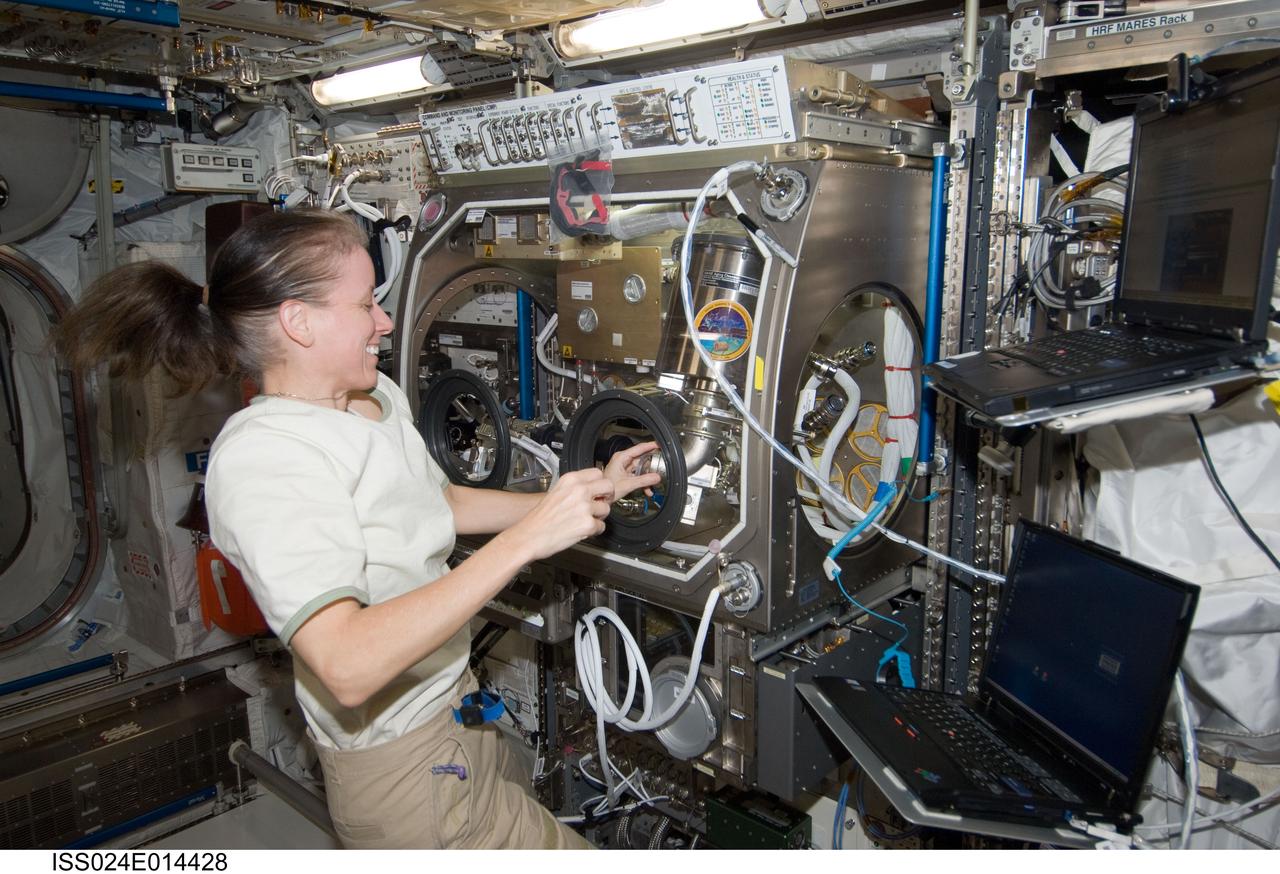
ISS024-E-014428 (13 Sept. 2010) --- NASA astronaut Shannon Walker, Expedition 24 flight engineer, works on the COLLOID experiment inside the Microgravity Science Glovebox (MSG) in the Columbus laboratory of the International Space Station.
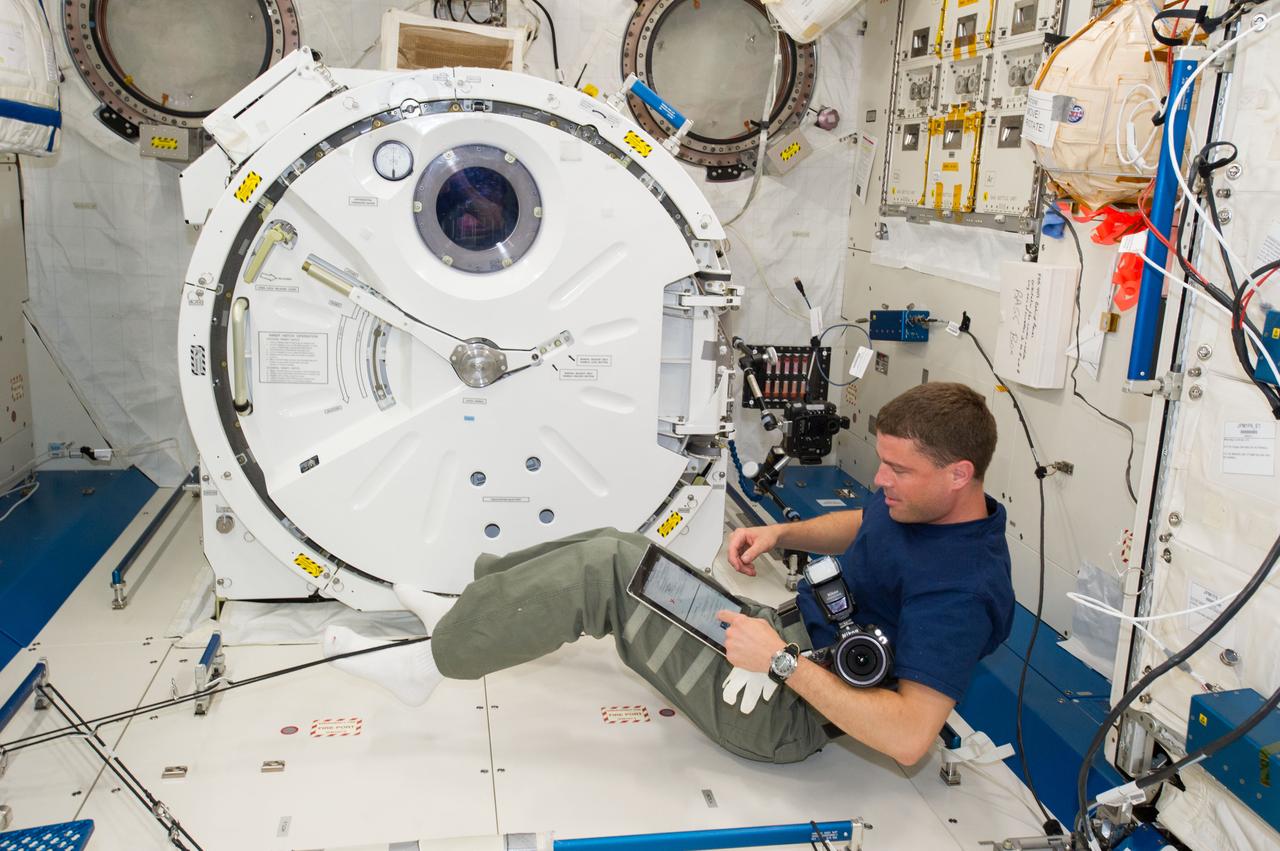
ISS040-E-006891 (3 June 2014) --- NASA astronaut Reid Wiseman, Expedition 40 flight engineer, conducts a session with the Binary Colloidal Alloy Test (BCAT) experiment in the Kibo laboratory of the International Space Station.
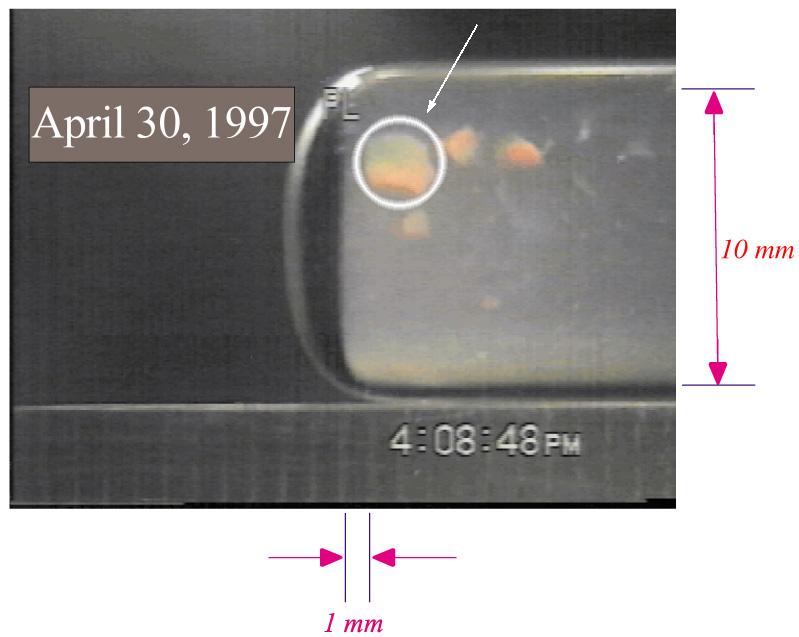
Experiments with colloidal solutions of plastic microspheres suspended in a liquid serve as models of how molecules interact and form crystals. For the Dynamics of Colloidal Disorder-Order Transition (CDOT) experiment, Paul Chaikin of Princeton University has identified effects that are attributable to Earth's gravity and demonstrated that experiments are needed in the microgravity of orbit. Space experiments have produced unexpected dendritic (snowflake-like) structures. To date, the largest hard sphere crystal grown is a 3 mm single crystal grown at the cool end of a ground sample. At least two more additional flight experiments are plarned aboard the International Space Station. This image is from a video downlink.
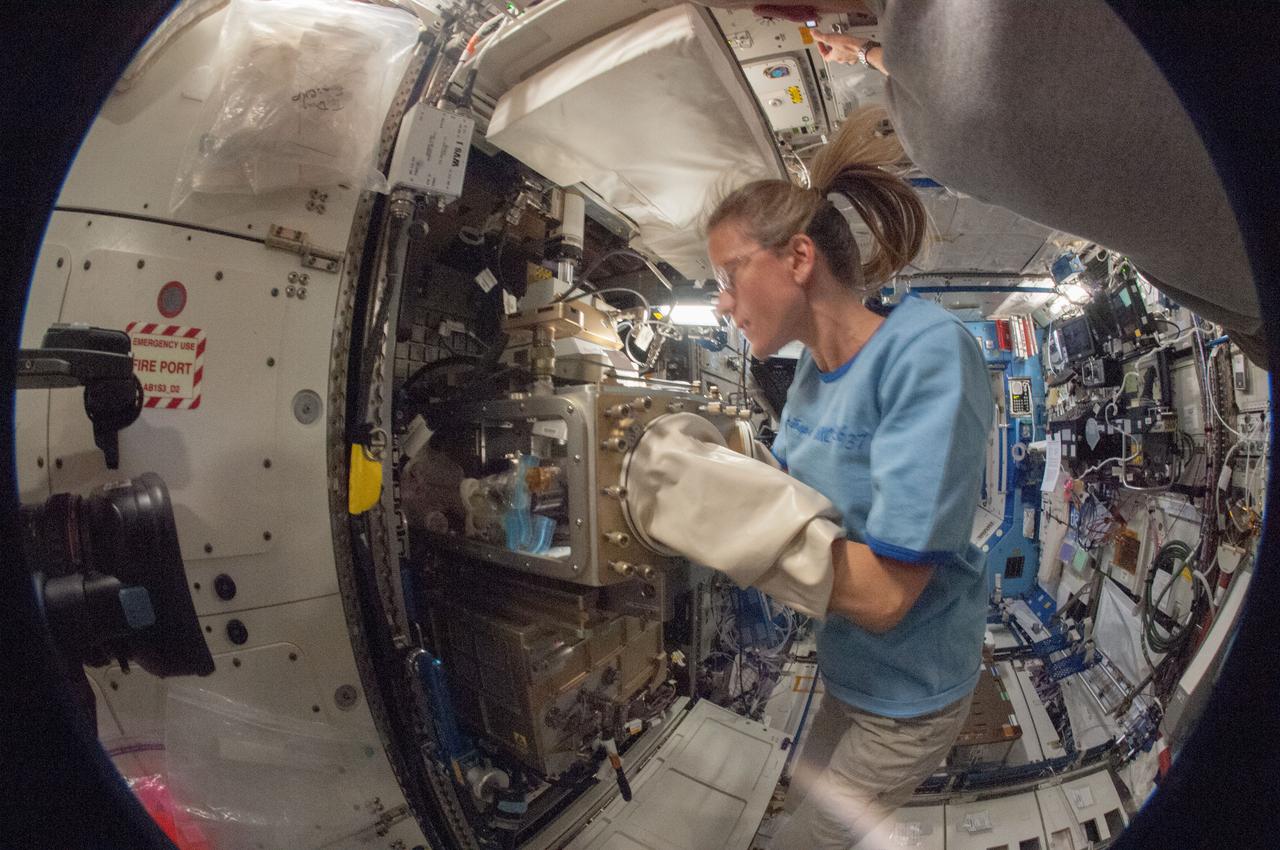
ISS036-E-019783 (24 June 2013) --- In the International Space Station’s Destiny laboratory, a fisheye lens attached to an electronic still camera was used to capture this image of NASA astronaut Karen Nyberg, Expedition 36 flight engineer, as she conducts a session with the Advanced Colloids Experiment (ACE)-1 sample preparation at the Light Microscopy Module (LMM) in the Fluids Integrated Rack / Fluids Combustion Facility (FIR/FCF). ACE-1 is a series of microscopic imaging investigations that uses the microgravity environment to examine flow characteristics and the evolution and ordering effects within a group of colloidal materials.
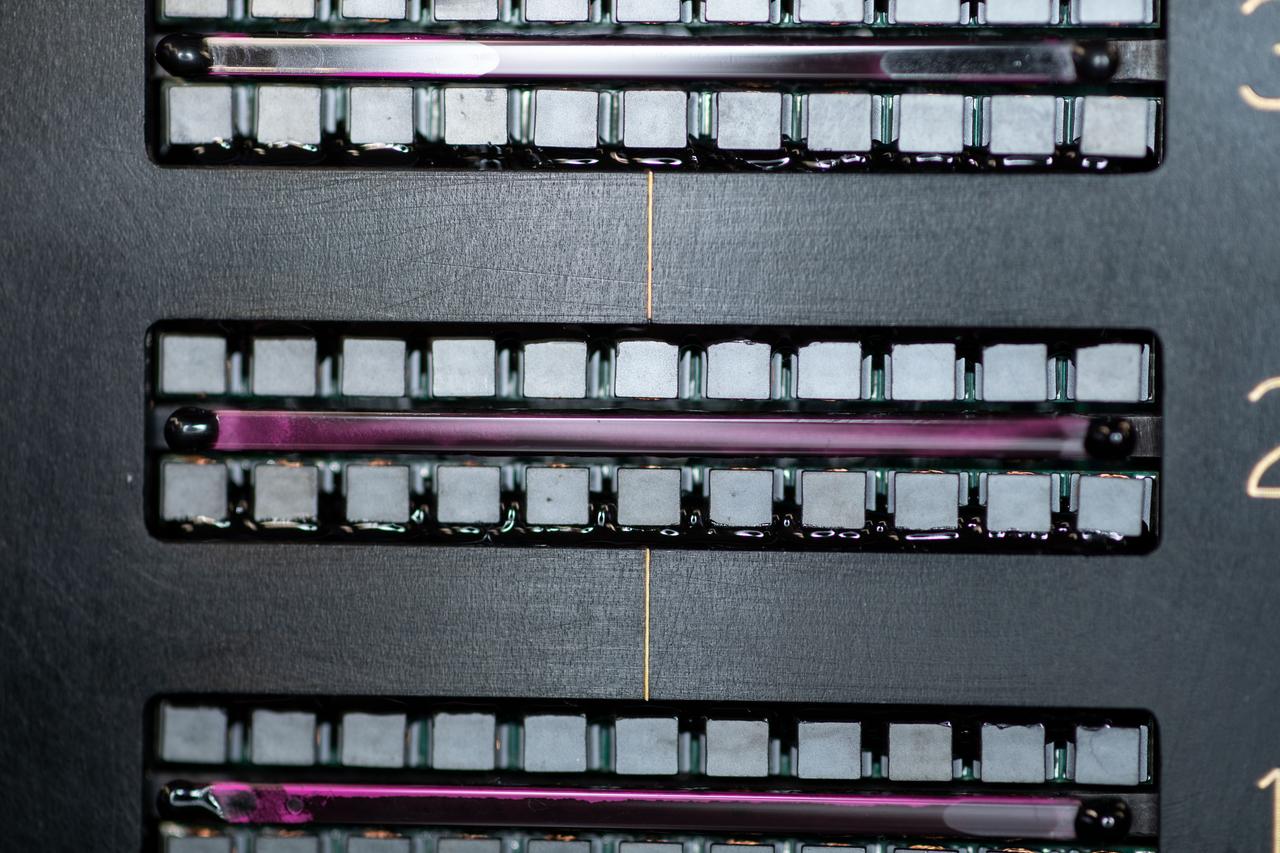
iss059e061932 (5/17/2019) --- Photo documentation onboard the International Space Station (ISS) of the ACE Modules taken during the ACE-T12 Module Configuration. The Advanced Colloids Experiment-Nanoparticle Haloing (ACE-T-12) involves design and assembly of complex three-dimensional (3D) structures from colloids, or particles of different sizes suspended in a fluid. It employs a recently discovered technique, Nanoparticle Haloing (NPH), which uses highly charged nanoparticles to stabilize much larger, non-charged particles. Allowing these structures to form in microgravity provides insight into the relationship between shape, surface charge, and concentration of particles and particle interactions.
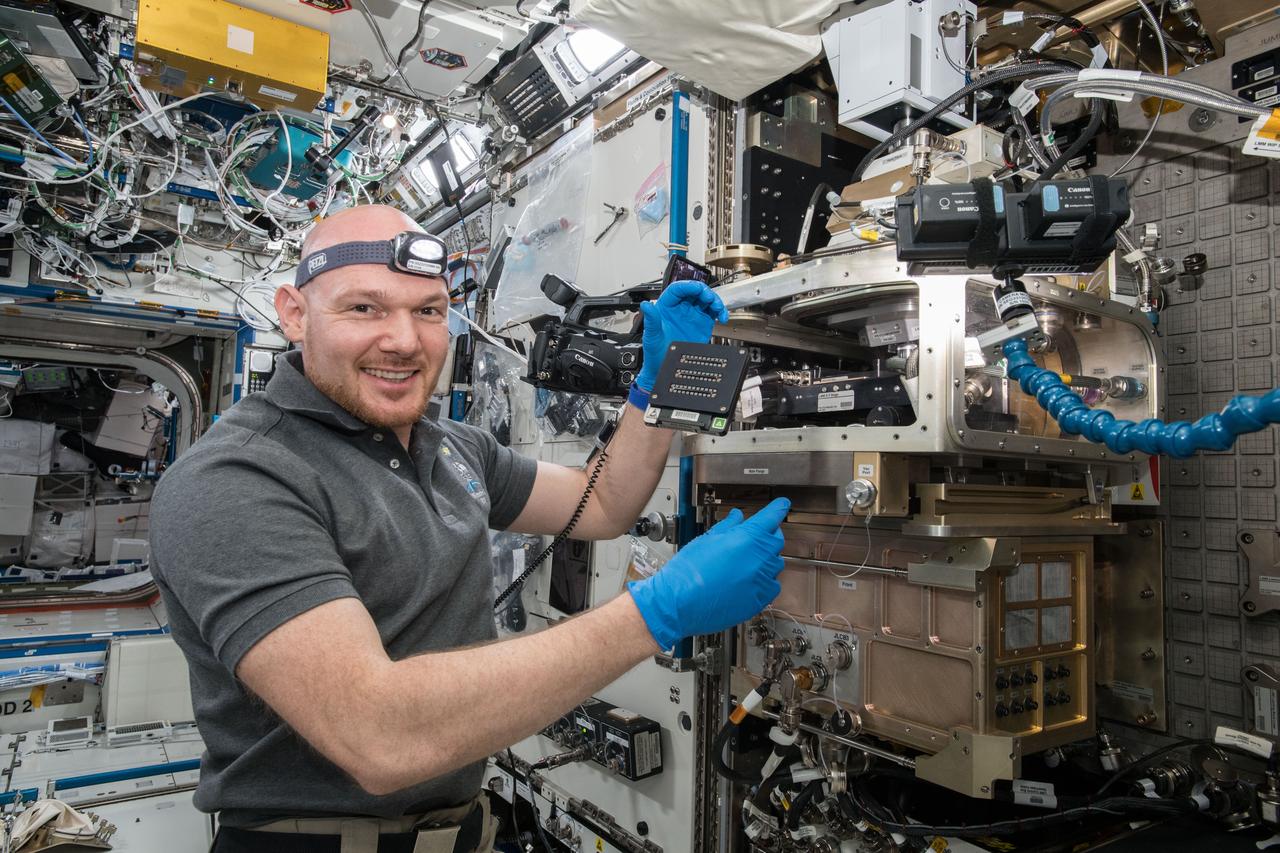
iss057e074544 (Nov. 9, 2018) --- European Space Agency (ESA) astronaut Alexander Gerst configures the Light Microscopy Module (LMM) for the Advanced Colloids Experiment-Temperature-7 (ACE-T-7) experiment. ACE-T-7 involves the design and assembly of complex three-dimensional structures from small particles suspended within a fluid medium. These so-called “self-assembled colloidal structures”, are vital to the design of advanced optical materials and active devices. In the microgravity environment, insight is provided into the relation between particle shape and interparticle interactions on assembly structure and dynamics: fundamental issues in condensed matter science.
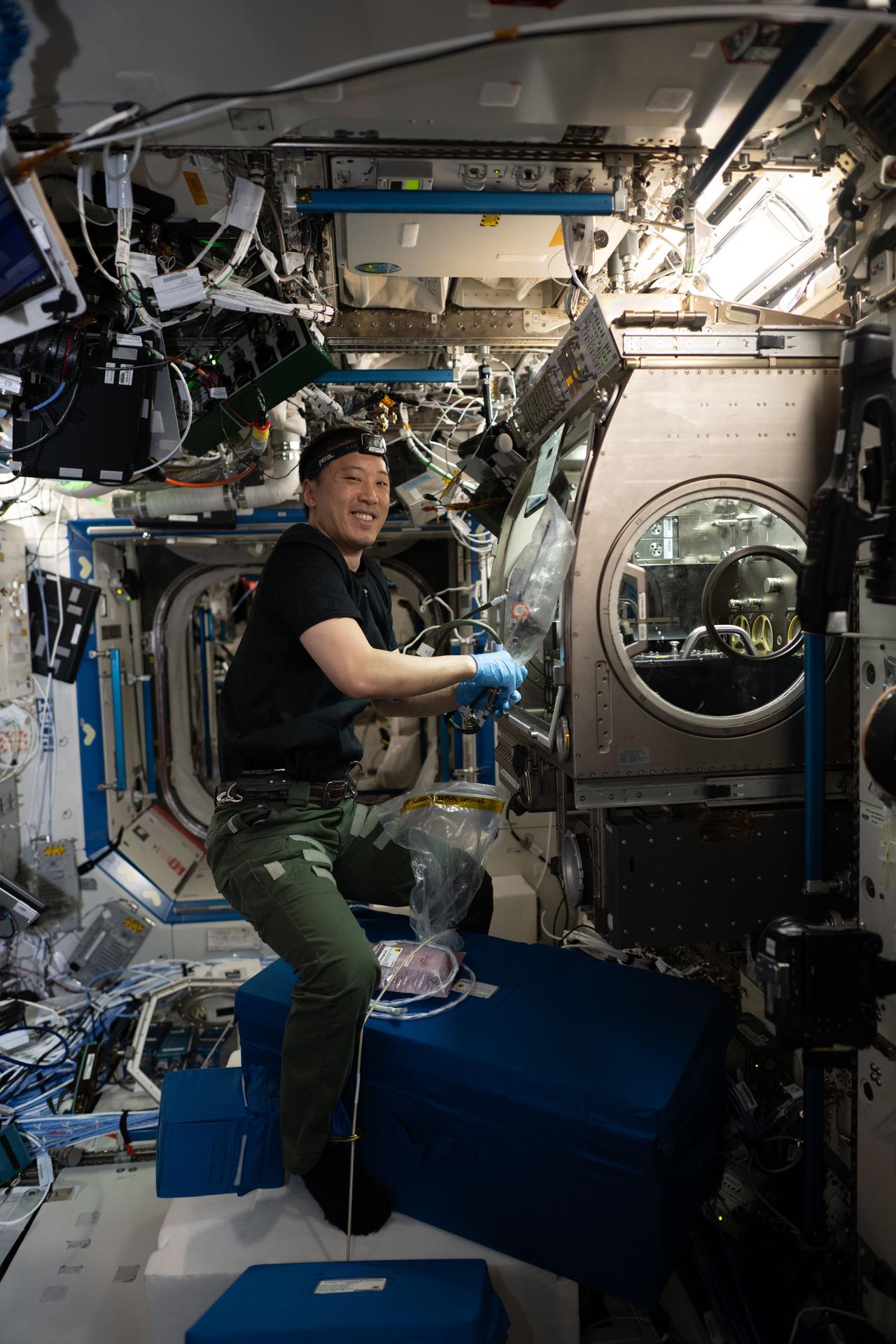
iss073e0886402 (Oct. 17) --- NASA astronaut and Expedition 73 Flight Engineer Jonny Kim works inside the Microgravity Science Glovebox (MSG) aboard the International Space Station’s Destiny laboratory module. Kim is seen stowing research hardware used in the Colloidal Solids physics experiment, which investigates how tiny particles—colloids—and proteins suspended in water behave in microgravity. The results may inform plant growth techniques, 3D printing technologies, and pharmaceutical manufacturing in space. On Earth, the findings could benefit the food, personal care, and healthcare industries.
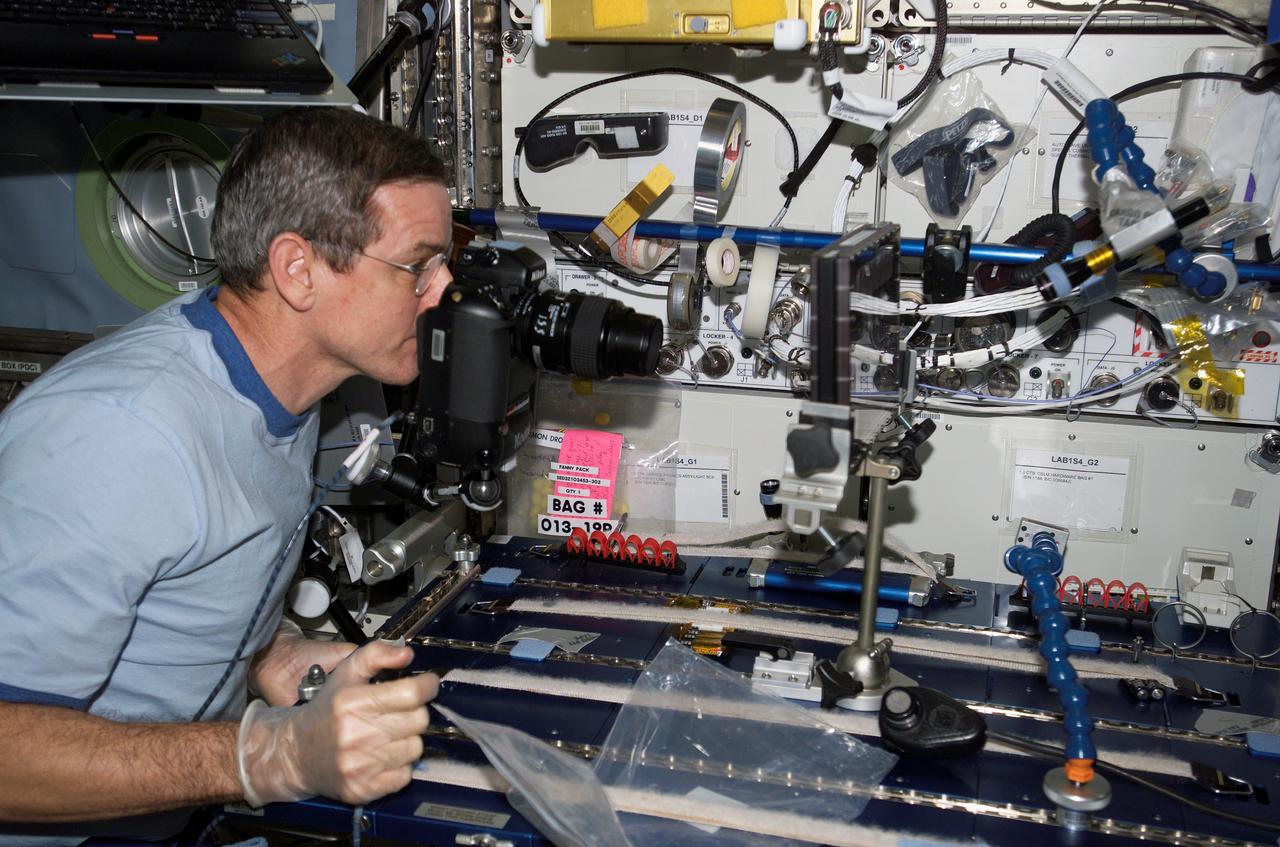
ISS012-E-07685 (11 Nov. 2005) --- Astronaut William S. (Bill) McArthur Jr., Expedition 12 commander and NASA space station science officer, photographs Binary Colloidal Alloy Test-3 (BCAT-3) experiment samples in the Destiny laboratory of the international space station.
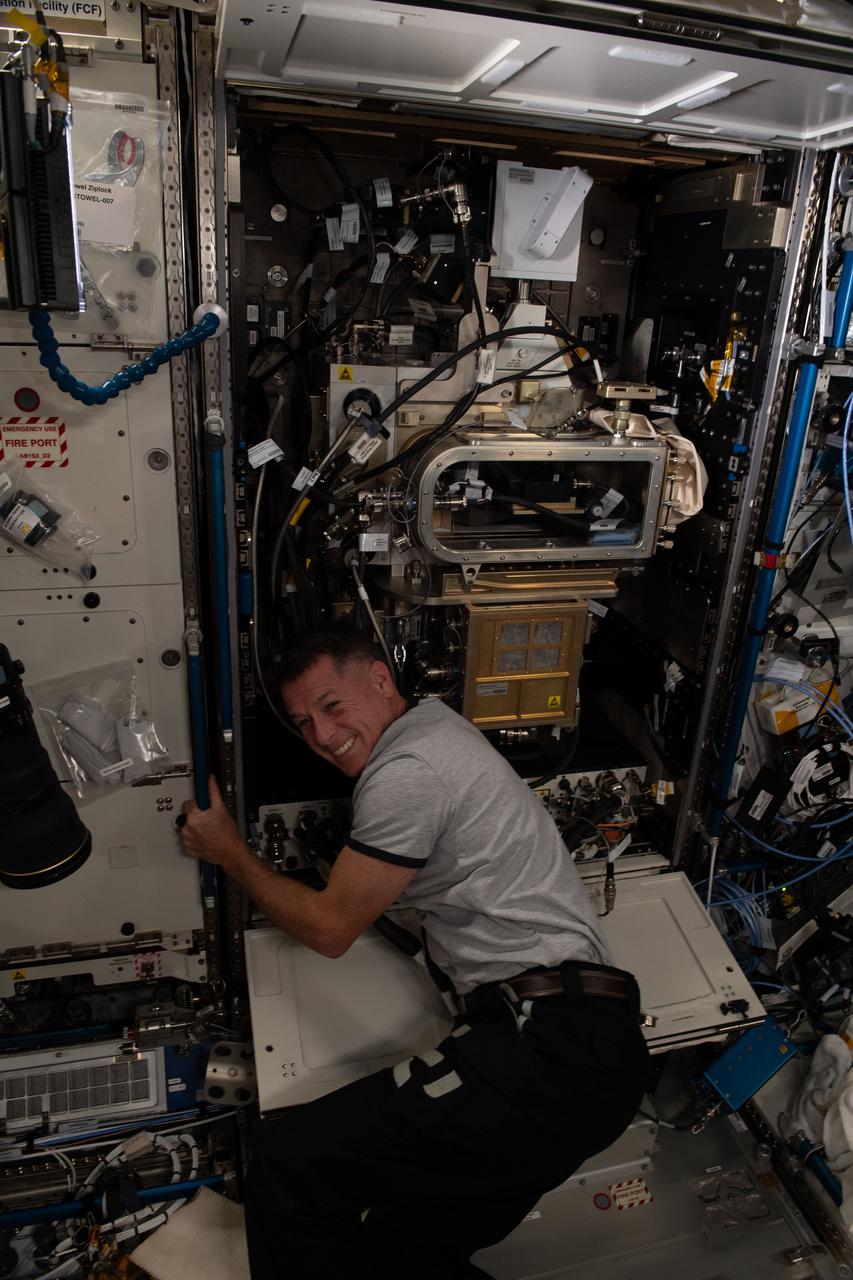
iss065e085487 (June 1, 2021) --- NASA astronaut and Expedition 65 Flight Engineer Shane Kimbrough replaces hardware inside the Fluids Integrated Rack. The research device supports investigations in areas such as colloids, gels, bubbles, wetting and capillary action, and phase changes, including boiling and condensation.
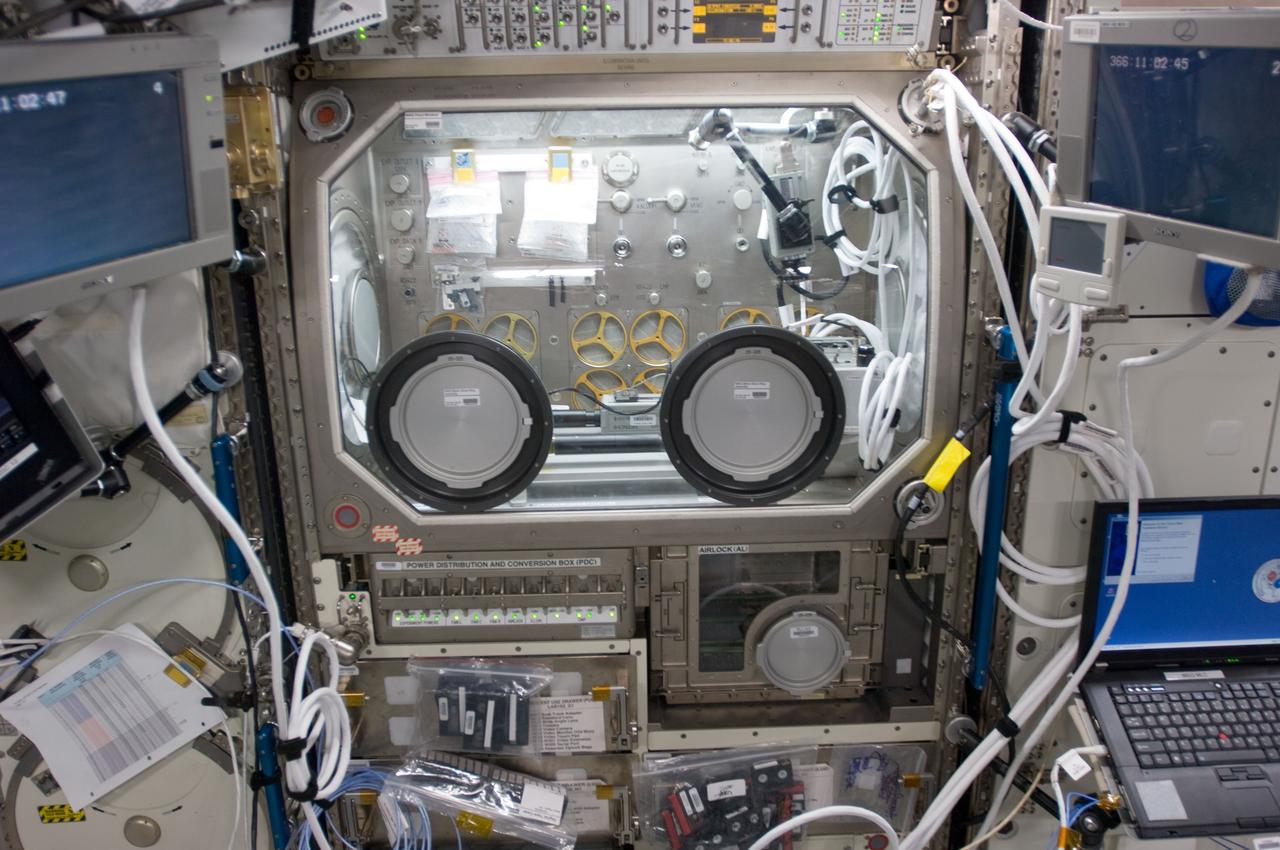
View of Command and Monitoring Panel (CMP),and Power Distribution and Conversion Box (PDC),on the Microgravity Science Glovebox (MSG) rack during Investigating the Structure of Paramagnetic Aggregates from Colloidal Emulsions 3 (InSPACE-3) Experiment,in the U.S. Laboratory. Photo was taken during Expedition 34.
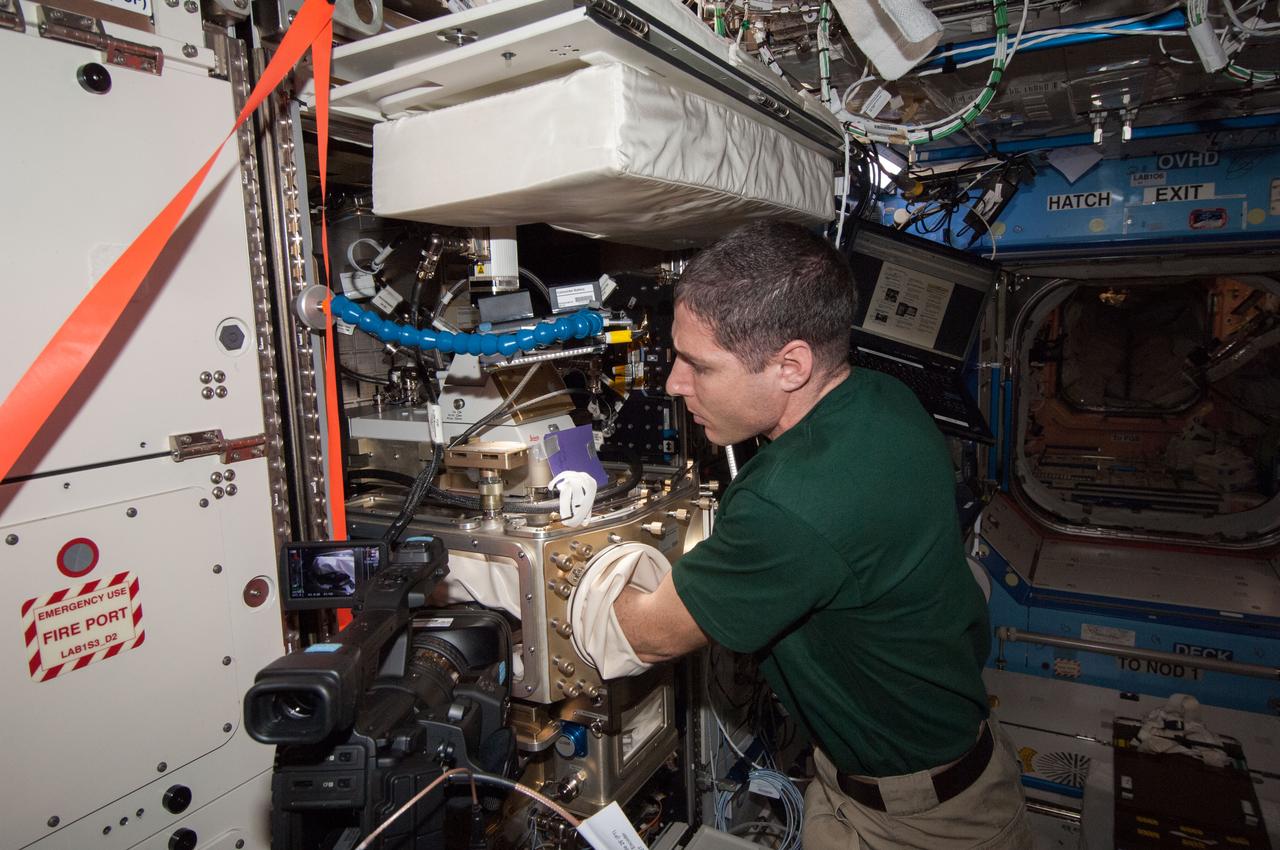
ISS038-E-055240 (24 Feb. 2014) --- In the International Space Station's Destiny laboratory, NASA astronaut Mike Hopkins, Expedition 38 flight engineer, sets up the Advanced Colloids Experiment (ACE) housed in the Light Microscopy Module (LMM) inside the Fluids Integrated Rack. ACE studies microscopic particles suspended in a liquid.
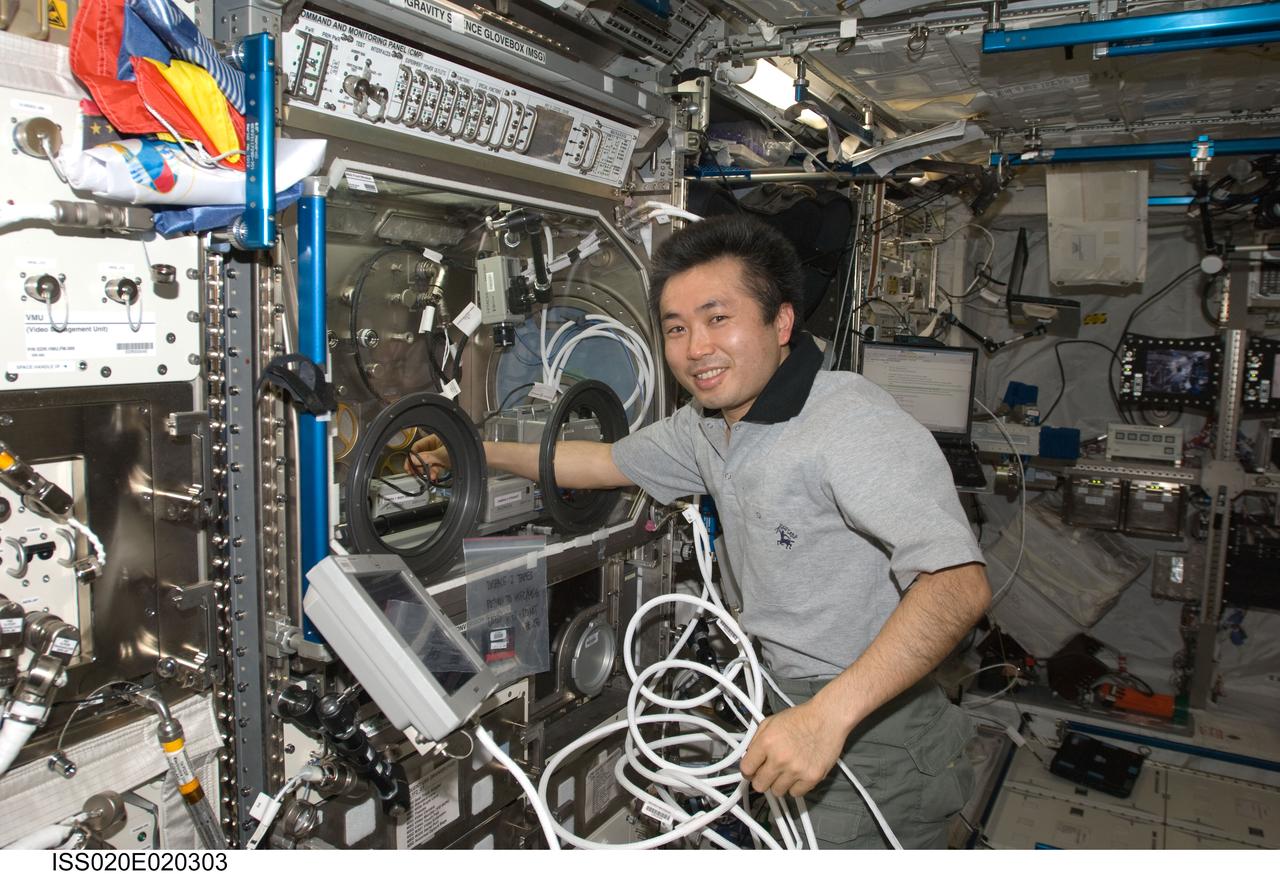
ISS020-E-020303 (14 July 2009) --- Japan Aerospace Exploration Agency (JAXA) astronaut Koichi Wakata, Expedition 20 flight engineer, works with the Investigating the Structure of Paramagnetic Aggregates from Colloidal Emulsions (InSPACE) experiment in the Microgravity Science Glovebox (MSG) in the Columbus laboratory of the International Space Station.
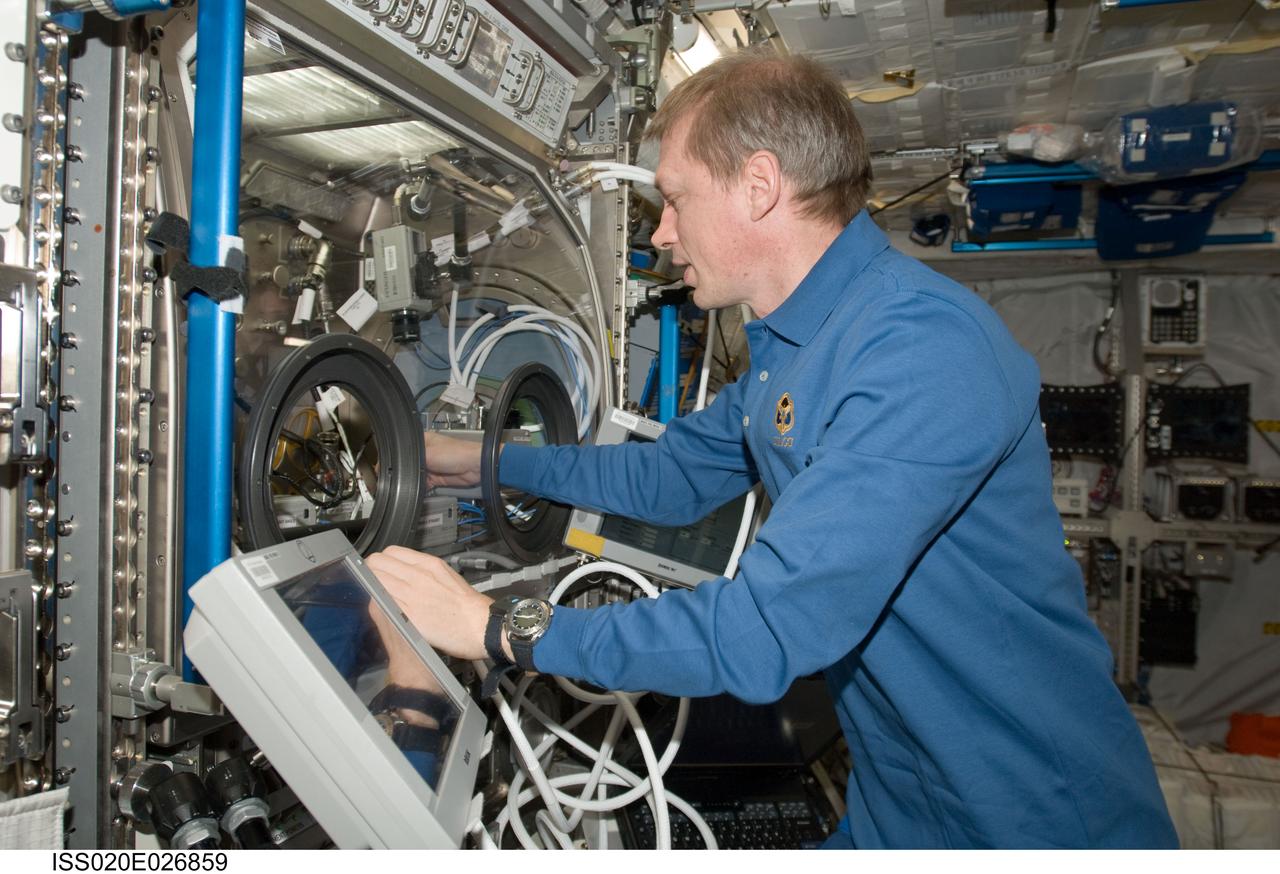
ISS020-E-026859 (1 Aug. 2009) --- European Space Agency astronaut Frank De Winne, Expedition 20 flight engineer, works with the Investigating the Structure of Paramagnetic Aggregates from Colloidal Emulsions (InSPACE) experiment in the Microgravity Science Glovebox (MSG) in the Columbus laboratory of the International Space Station.
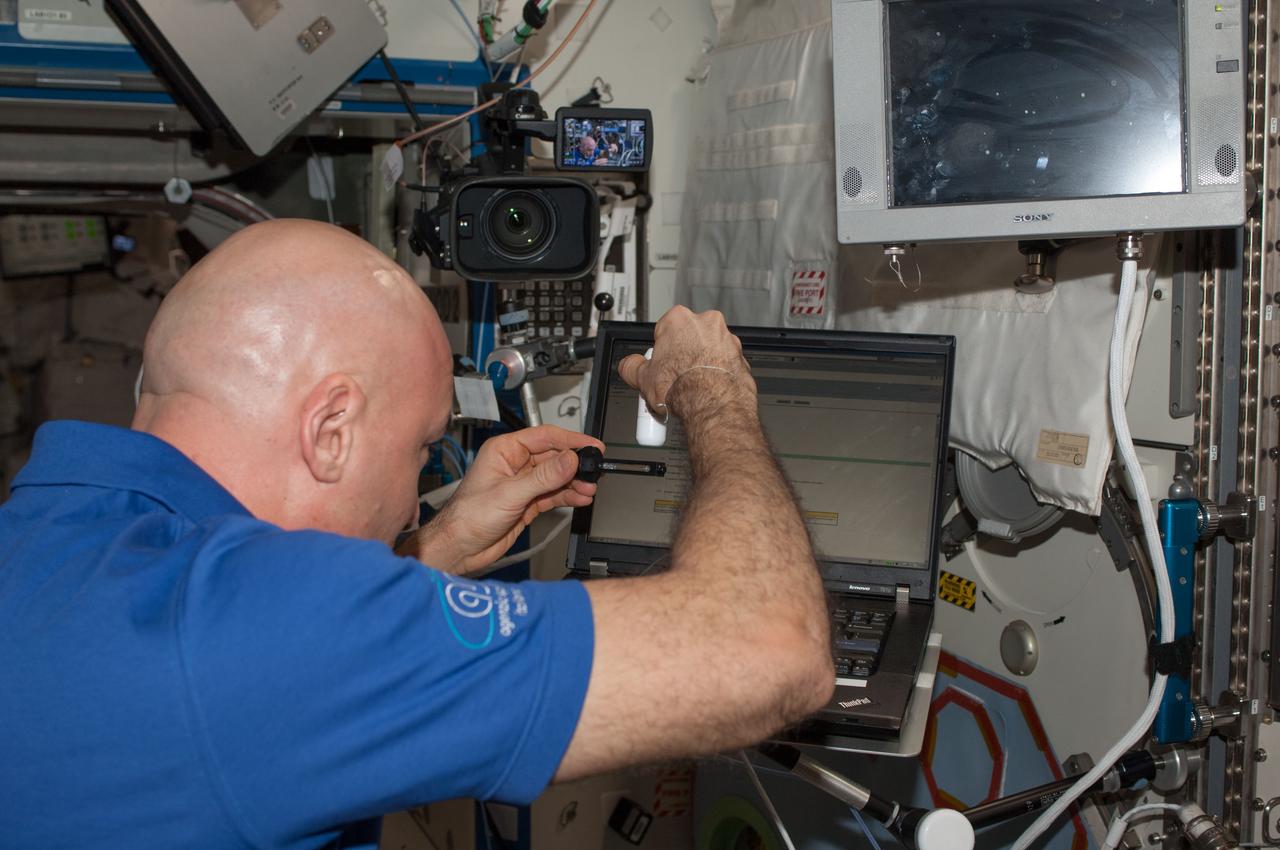
ISS037-E-010695 (14 Oct. 2013) --- European Space Agency astronaut Luca Parmitano, Expedition 37 flight engineer, works with the Investigating the Structure of Paramagnetic Aggregates from Colloidal Emulsions - 3 (InSPACE-3) experiment in the Destiny laboratory of the International Space Station.
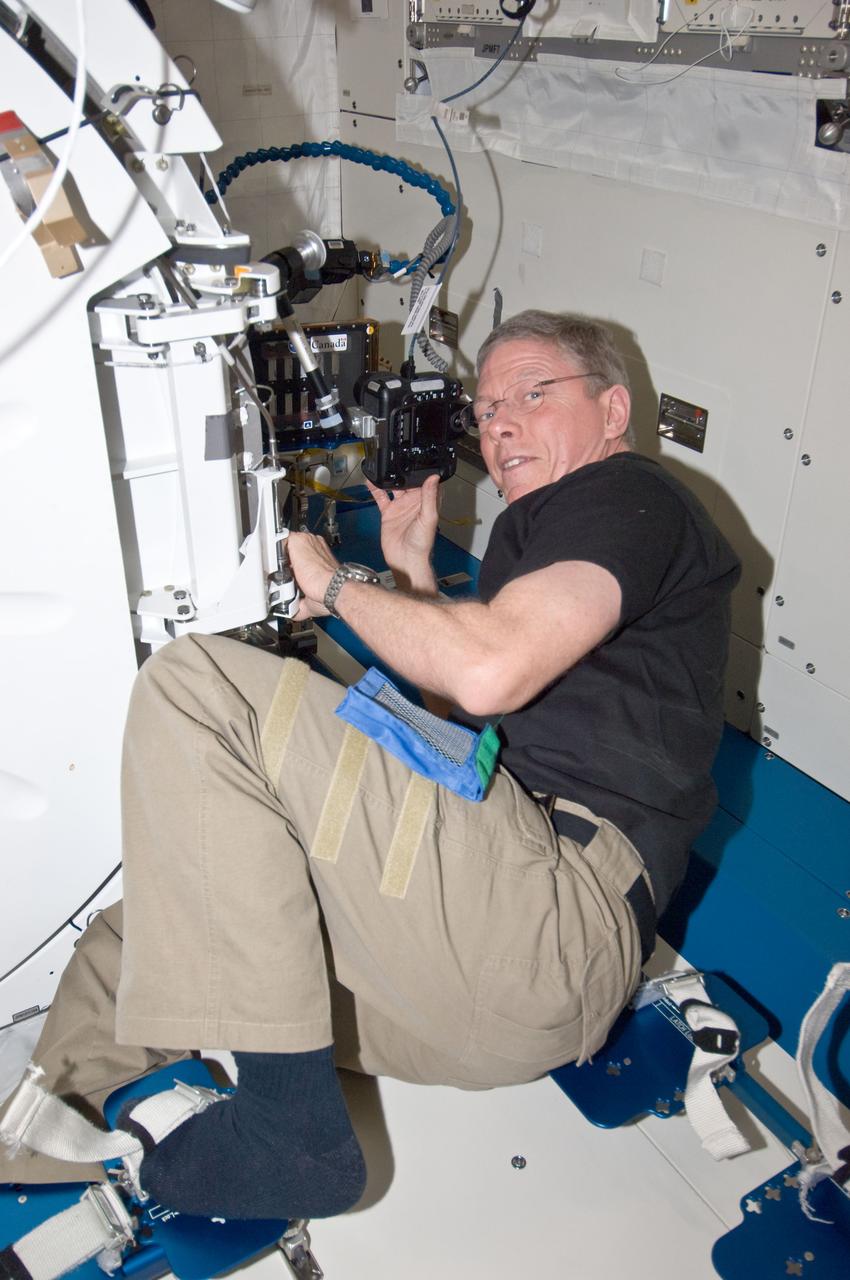
ISS029-E-010999 (21 Sept. 2011) --- NASA astronaut Mike Fossum, Expedition 29 commander, prepares a camcorder for recording documentary video of the Binary Colloidal Alloy Test-5 (BCAT-5) payload operations in the Kibo laboratory of the International Space Station.
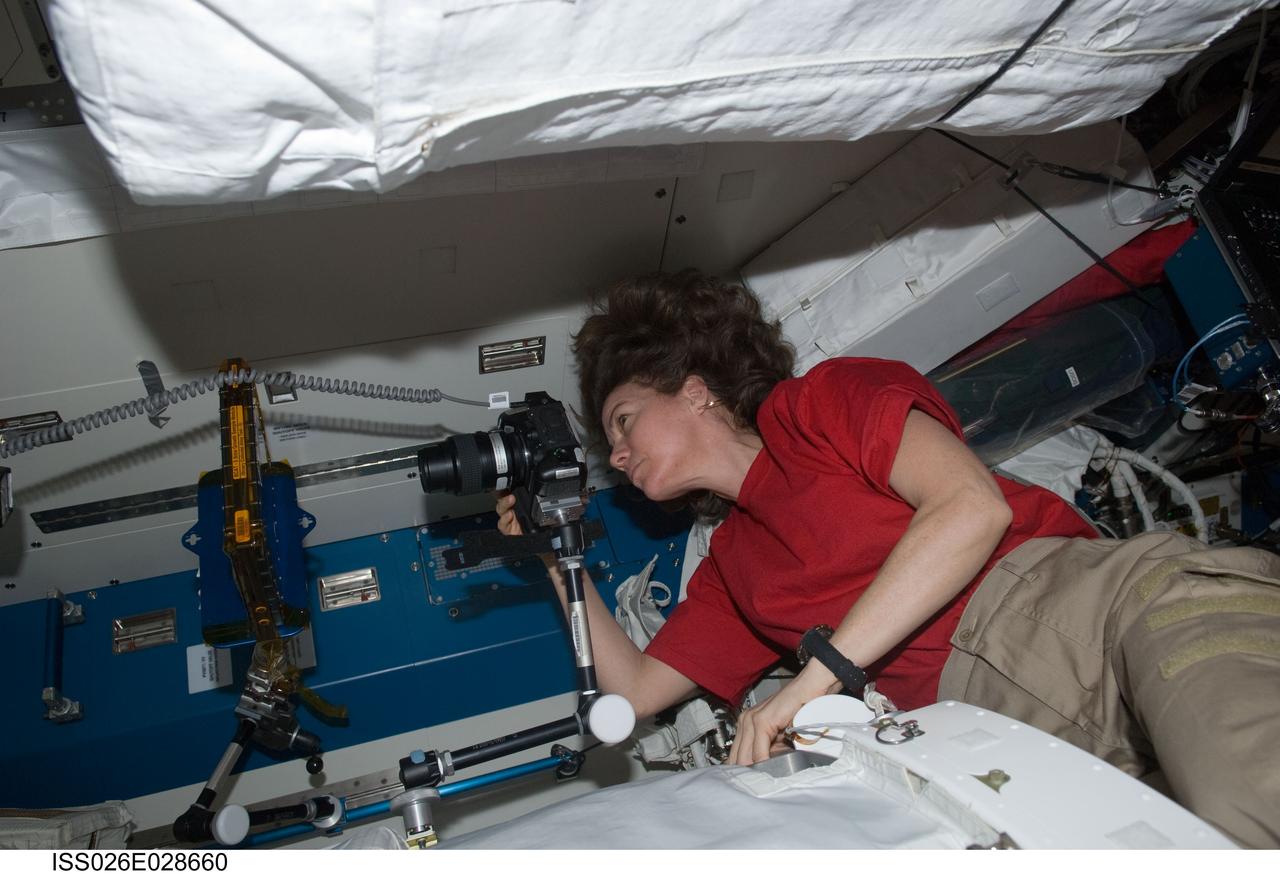
ISS026-E-028660 (23 Feb. 2011) --- NASA astronaut Catherine (Cady) Coleman, Expedition 26 flight engineer, uses a digital still camera to photograph the Binary Colloidal Alloy Test-5 (BCAT-5) payload setup in the Kibo laboratory of the International Space Station.
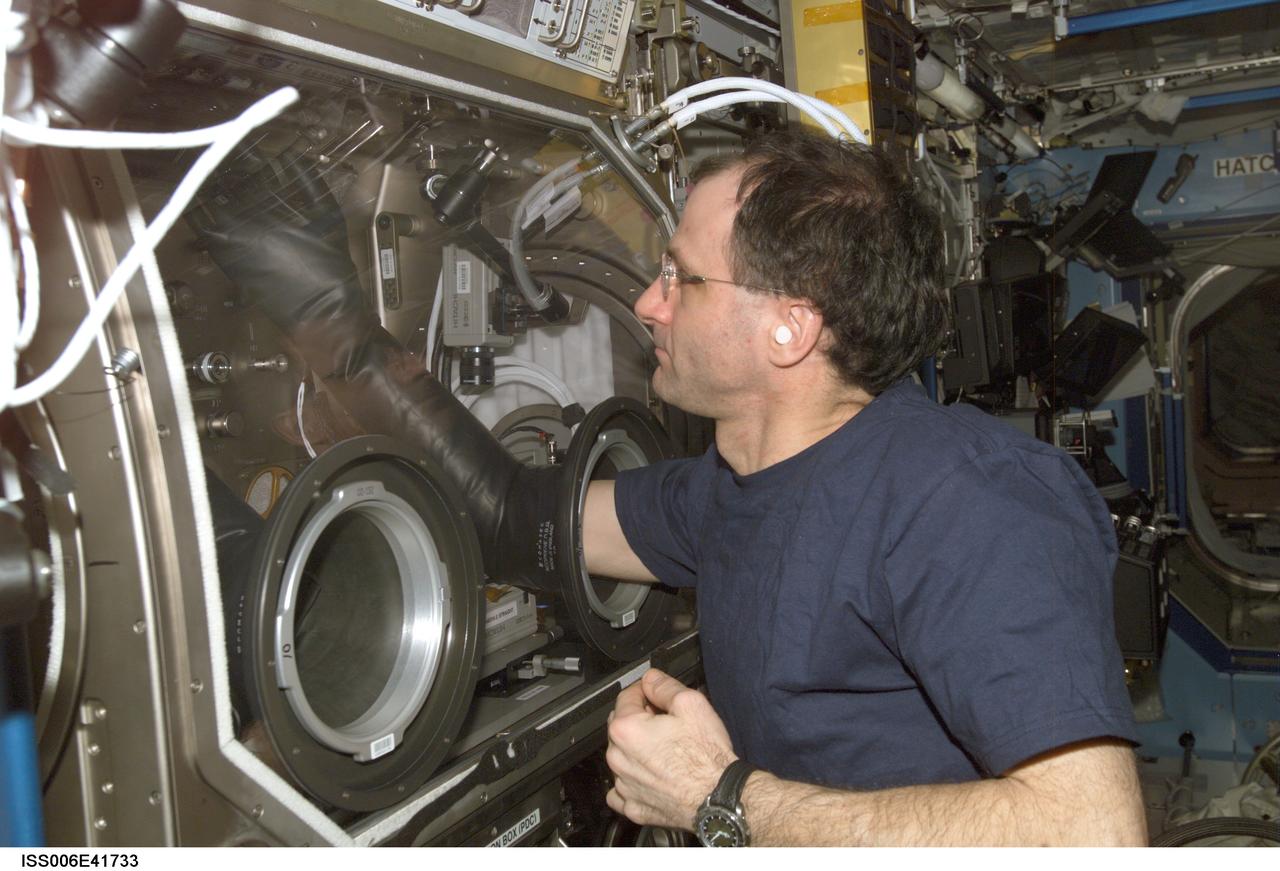
ISS006-E-41733 (1 April 2003) --- Astronaut Donald R. Pettit, Expedition Six NASA ISS science officer, works with the InSpace (Investigating the Structure of Paramagnetic Aggregates from Colloidal Emulsions) experiment in the Microgravity Science Glovebox (MSG) in the Destiny laboratory on the International Space Station (ISS).
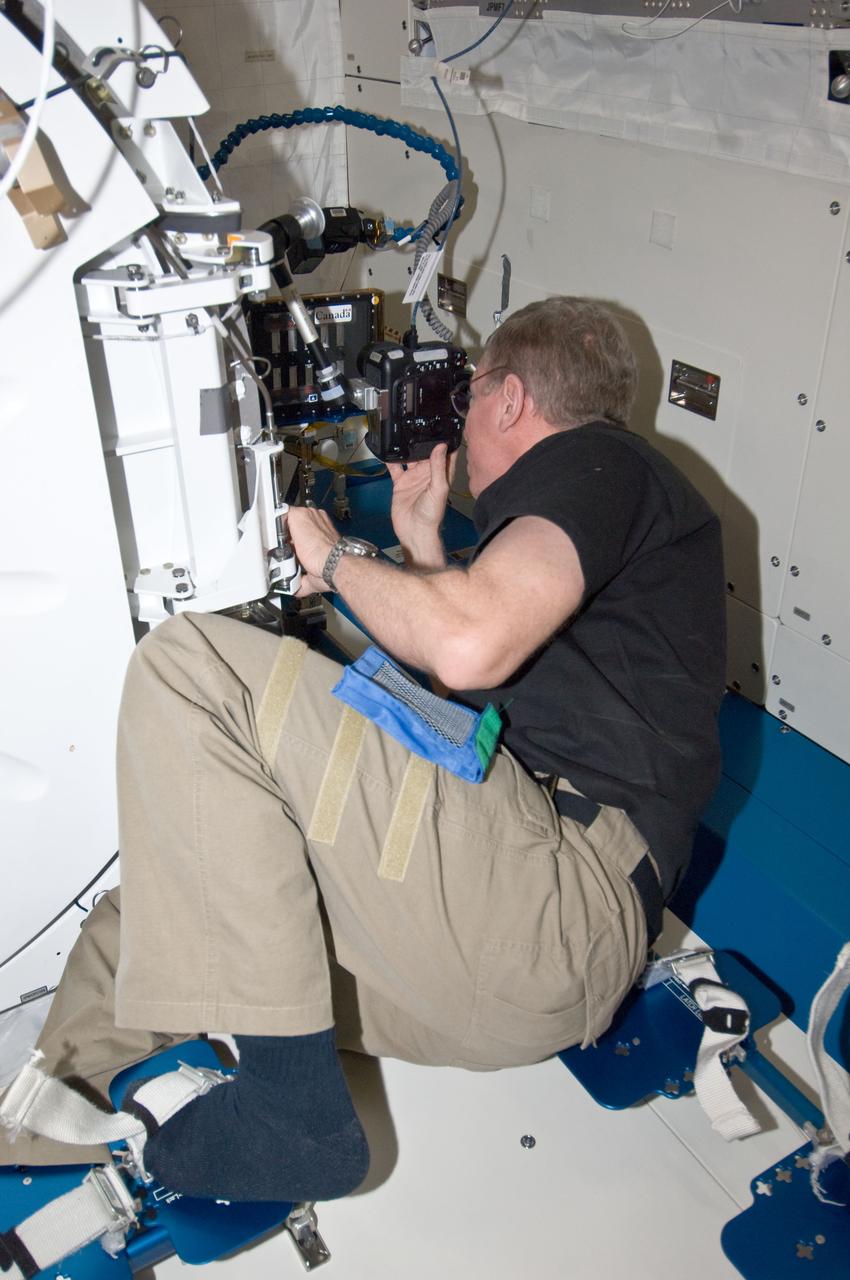
ISS029-E-010998 (21 Sept. 2011) --- NASA astronaut Mike Fossum, Expedition 29 commander, prepares a camcorder for recording documentary video of the Binary Colloidal Alloy Test-5 (BCAT-5) payload operations in the Kibo laboratory of the International Space Station.
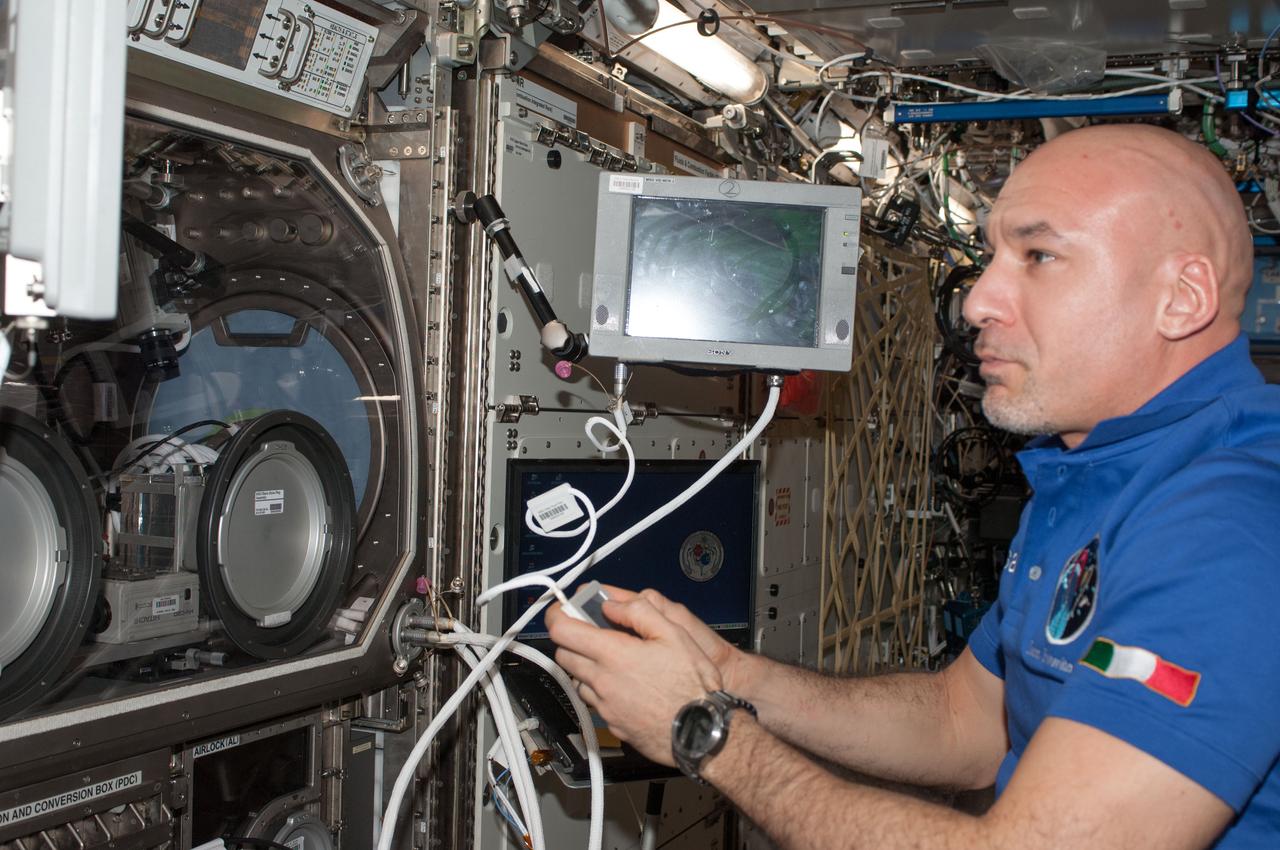
ISS037-E-010698 (14 Oct. 2013) --- European Space Agency astronaut Luca Parmitano, Expedition 37 flight engineer, works with the Investigating the Structure of Paramagnetic Aggregates from Colloidal Emulsions - 3 (InSPACE-3) experiment in the Destiny laboratory of the International Space Station.
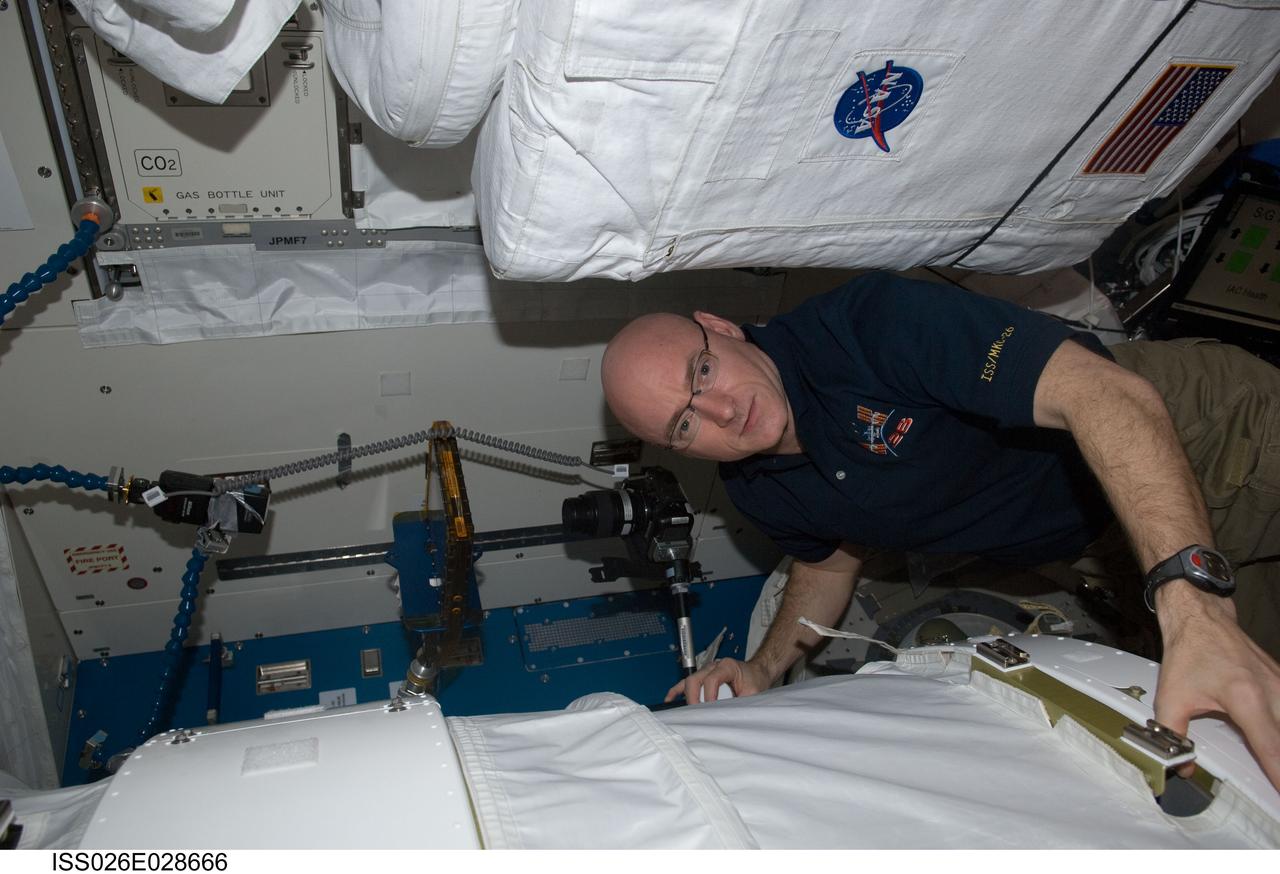
ISS026-E-028666 (23 Feb. 2011) --- NASA astronaut Scott Kelly, Expedition 26 commander, uses a digital still camera to photograph the Binary Colloidal Alloy Test-5 (BCAT-5) payload setup in the Kibo laboratory of the International Space Station.
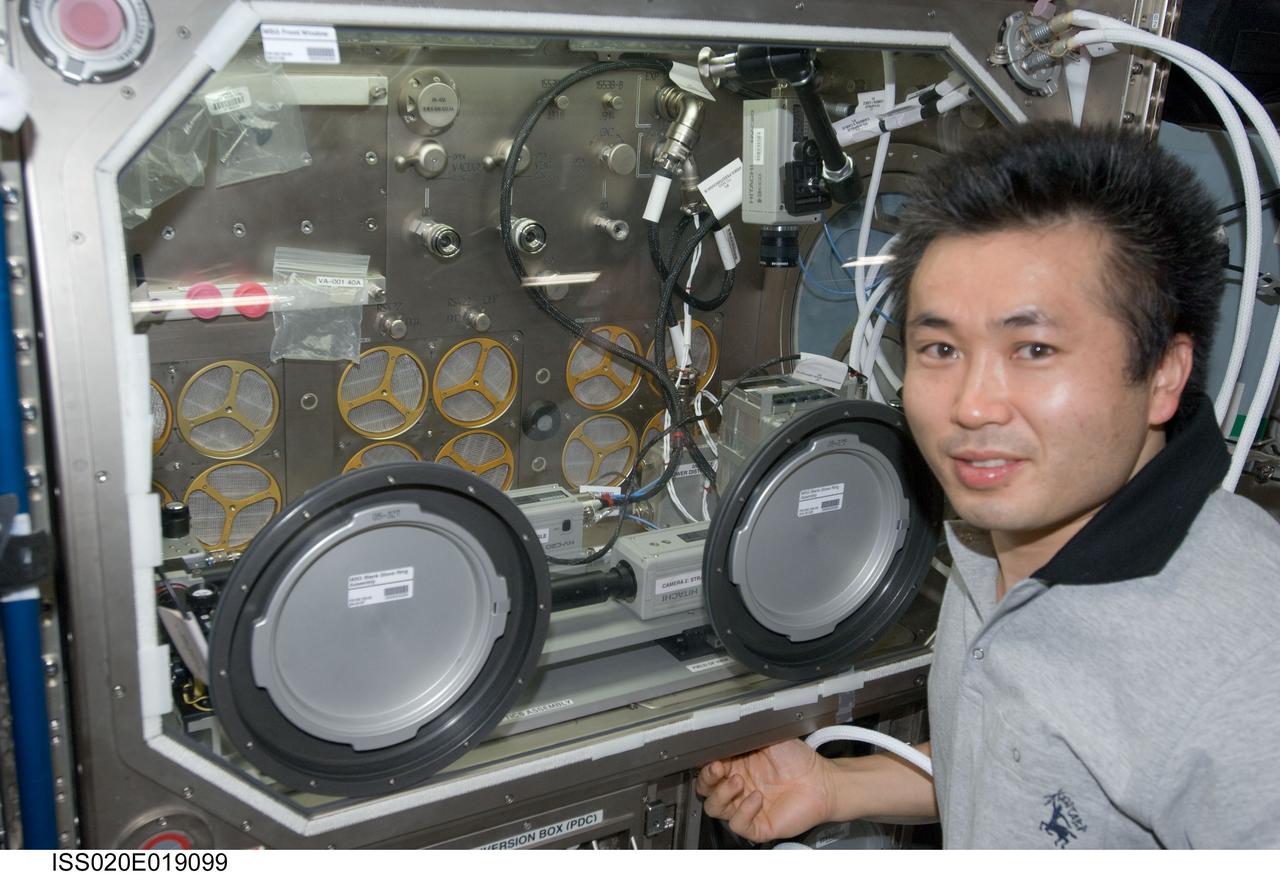
ISS020-E-019099 (13 July 2009) --- Japan Aerospace Exploration Agency (JAXA) astronaut Koichi Wakata, Expedition 20 flight engineer, works with the Investigating the Structure of Paramagnetic Aggregates from Colloidal Emulsions (InSPACE) experiment in the Microgravity Science Glovebox (MSG) in the Columbus laboratory of the International Space Station.
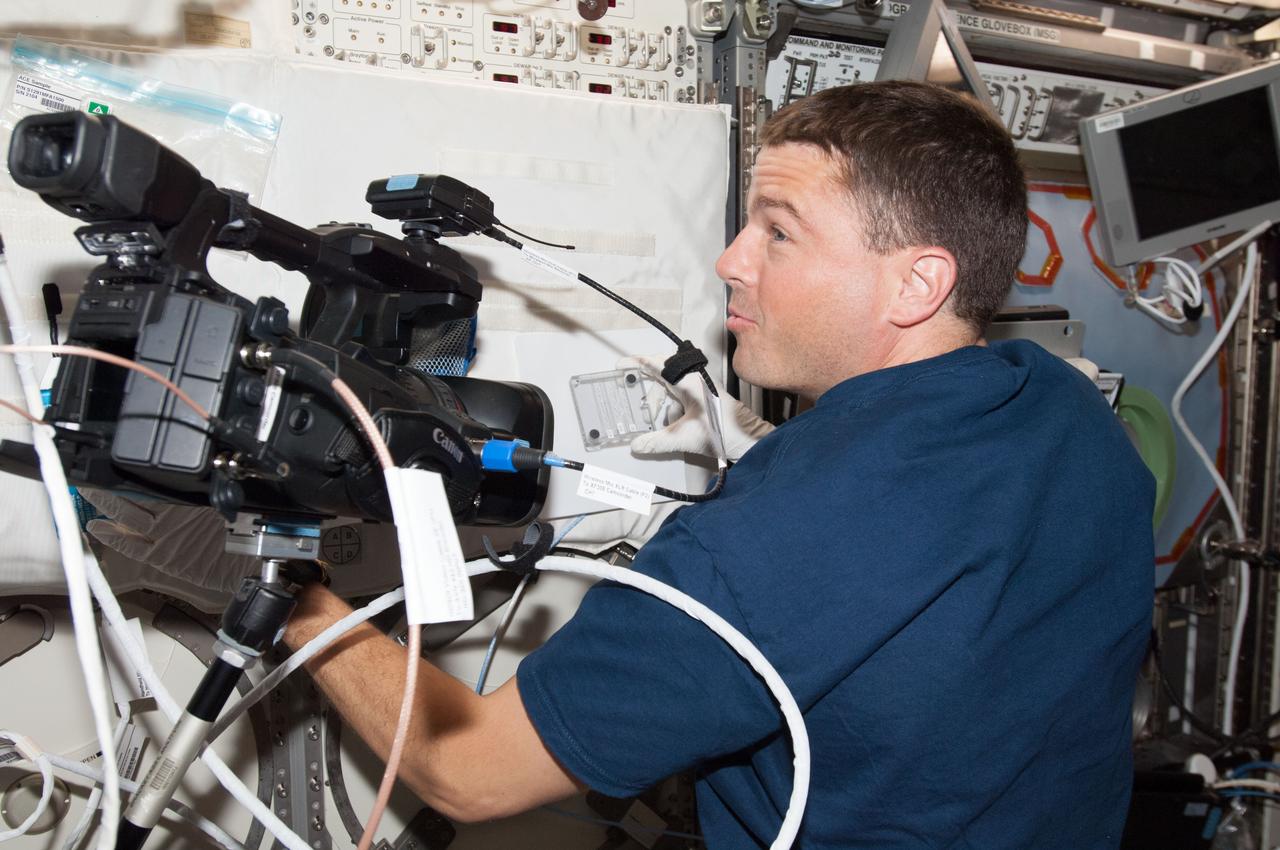
ISS040-E-006569 (2 June 2014) --- NASA astronaut Reid Wiseman, Expedition 40 flight engineer, performs an Advanced Colloids Experiment (ACE) sample 40-minute mixing activity in the Destiny laboratory of the International Space Station.
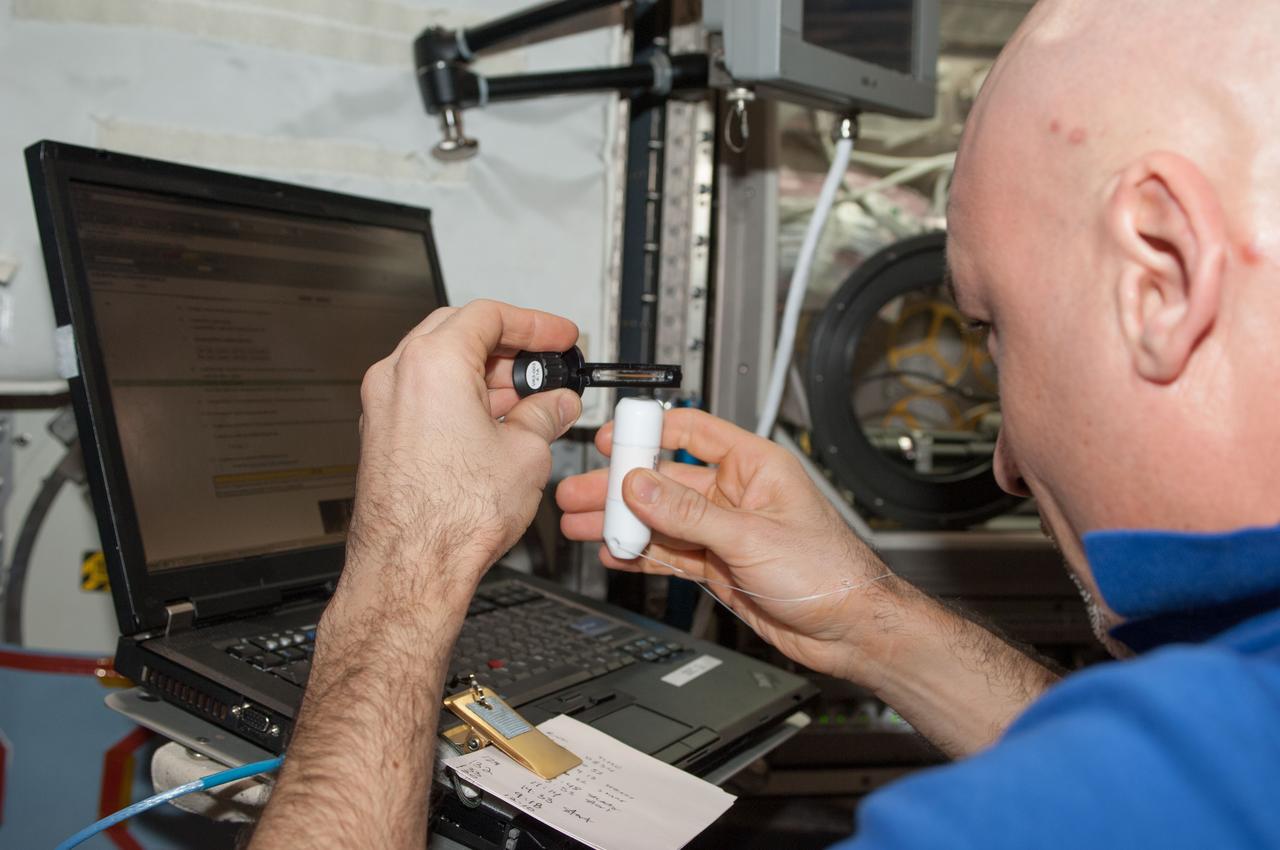
ISS037-E-010697 (14 Oct. 2013) --- European Space Agency astronaut Luca Parmitano, Expedition 37 flight engineer, works with the Investigating the Structure of Paramagnetic Aggregates from Colloidal Emulsions - 3 (InSPACE-3) experiment in the Destiny laboratory of the International Space Station.
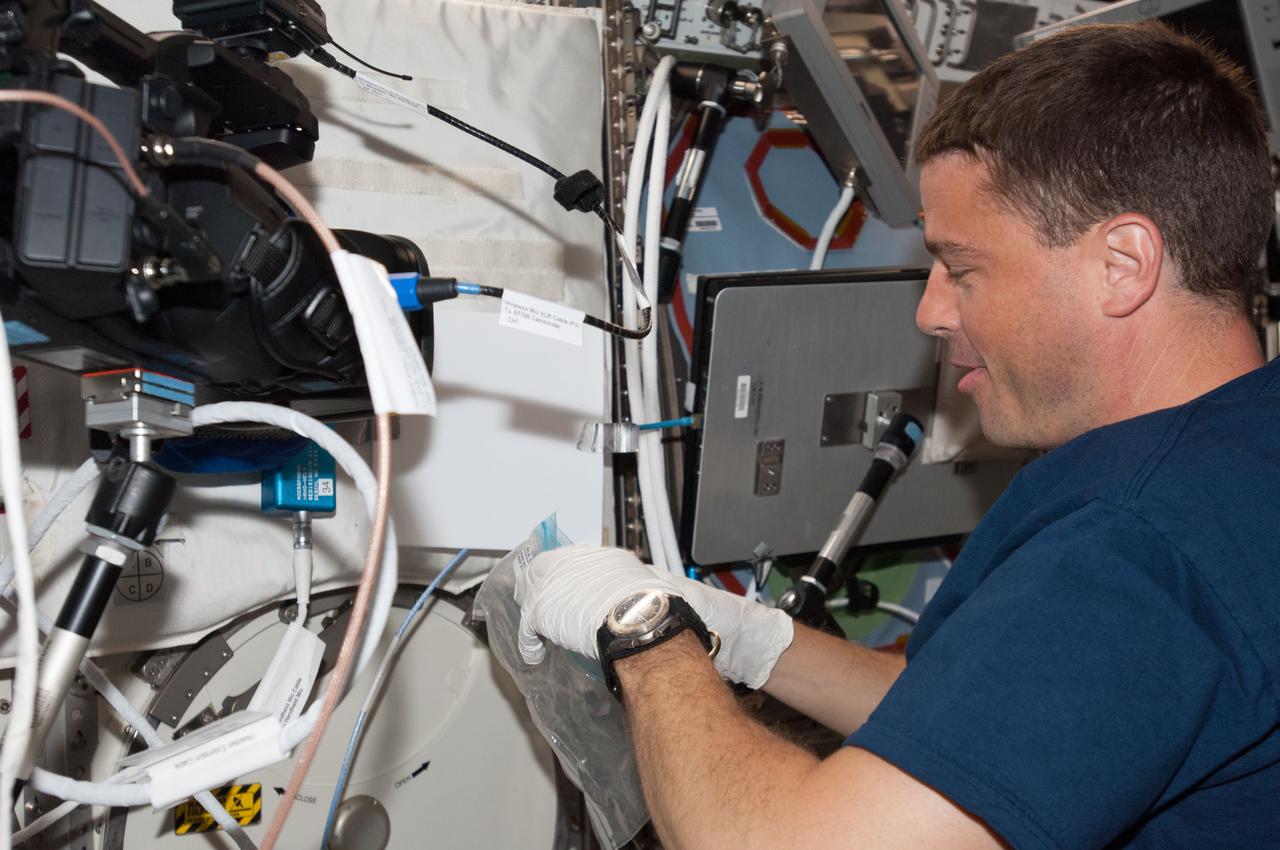
ISS040-E-006567 (2 June 2014) --- NASA astronaut Reid Wiseman, Expedition 40 flight engineer, performs an Advanced Colloids Experiment (ACE) sample 40-minute mixing activity in the Destiny laboratory of the International Space Station.
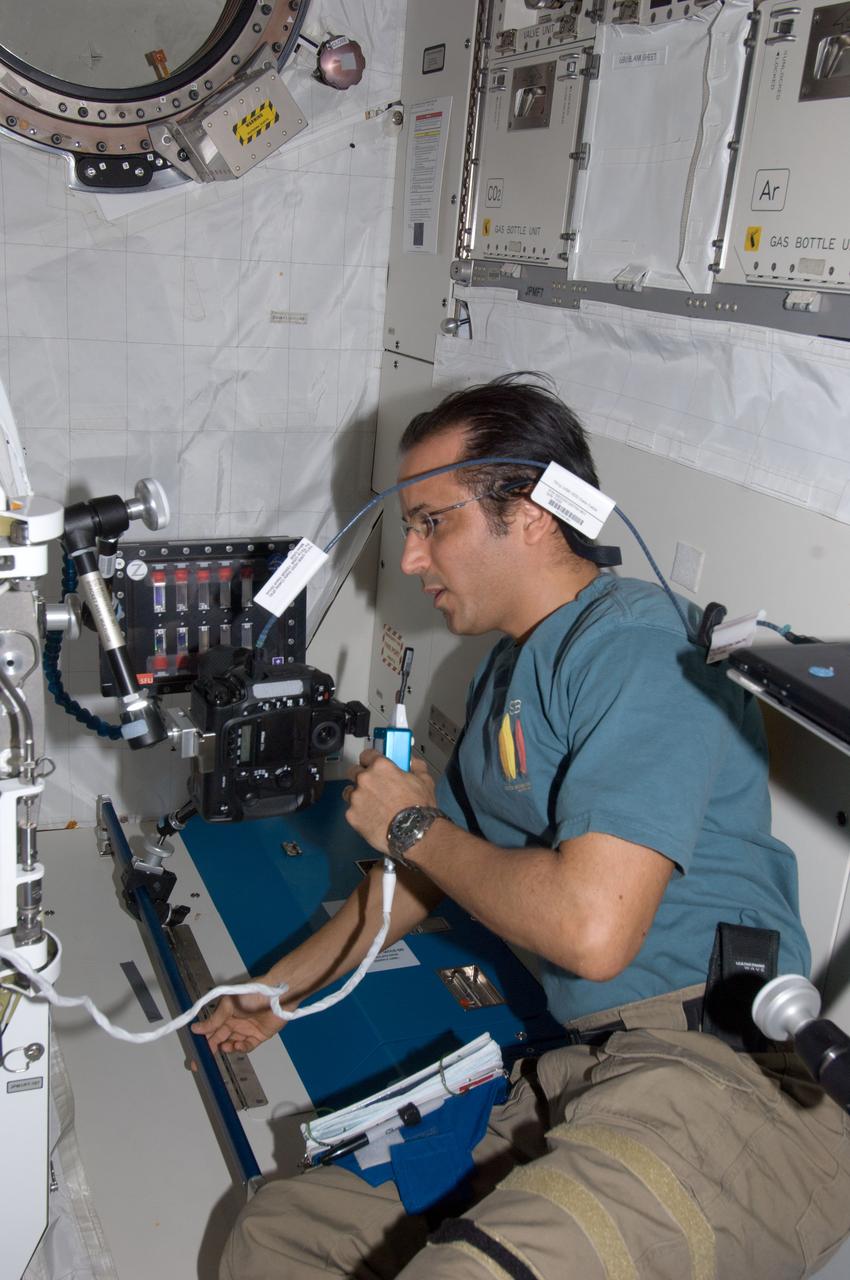
ISS032-E-014593 (6 Aug. 2012) --- NASA astronaut Joe Acaba, Expedition 32 flight engineer, conducts a session with the Binary Colloidal Alloy Test-6 (BCAT-6) experiment in the Kibo laboratory of the International Space Station.
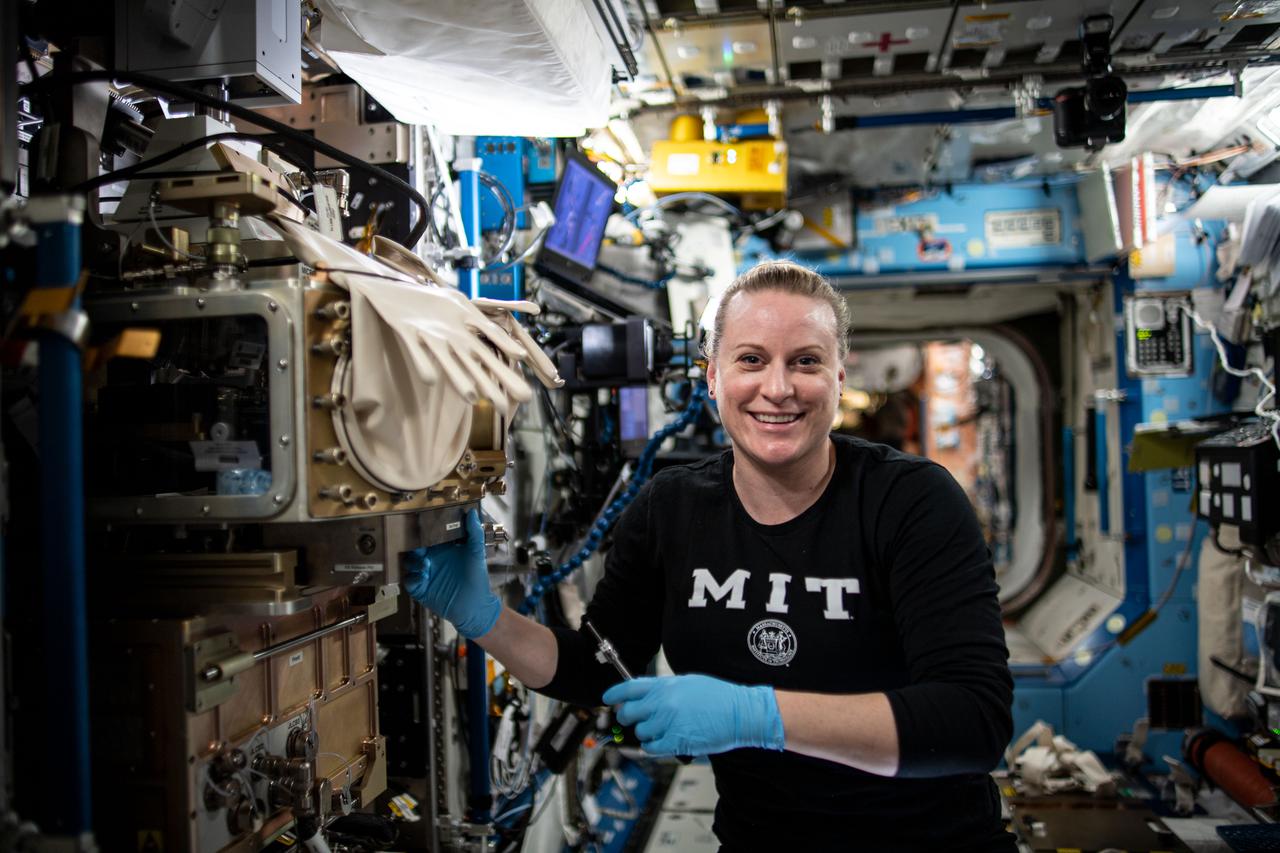
iss064e023935 (Jan. 14, 2021) --- NASA astronaut and Expedition 64 Flight Engineer Kate Rubins sets up the ACE-T-Ellipsoids study inside the Light Microscopy Module. The investigation designs and assembles complex three-dimensional colloids – small particles suspended within a fluid medium – and controls density and behavior of the particles with temperature.

ISS018-E-013863 (20 Dec. 2008) --- Astronaut Sandra Magnus, Expedition 18 flight engineer, works in the Harmony node of the International Space Station.
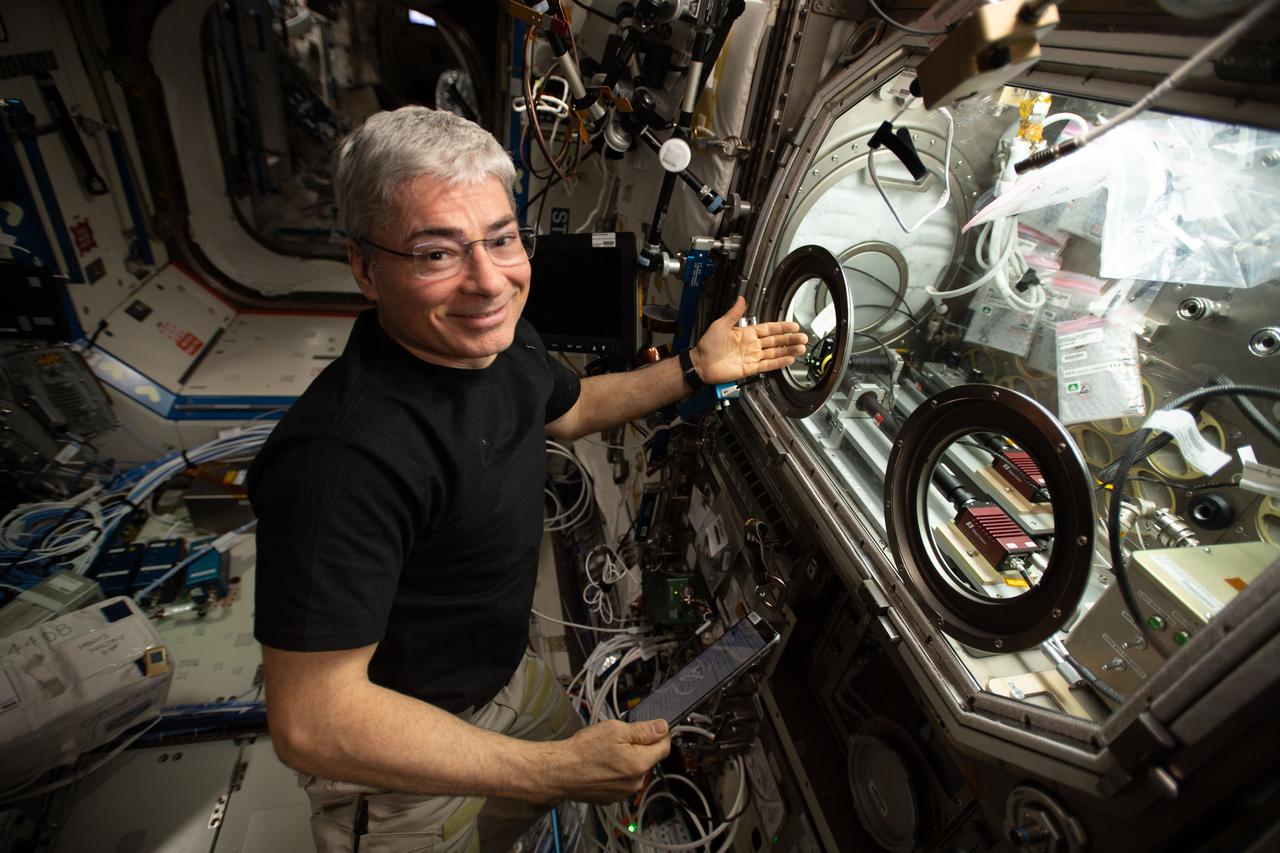
iss066e081677 (Nov. 23, 2021) --- NASA astronaut and Expedition 66 Flight Engineer Mark Vande Hei sets up hardware inside the Microgravity Science Glovebox for the InSPACE-4 space physics experiment. Results from InSPACE-4, or Investigating the Structure of Paramagnetic Aggregates from Colloidal Ellipsoids, could provide insight into how to harness nanoparticles to fabricate and manufacture new materials for Earth and space applications.
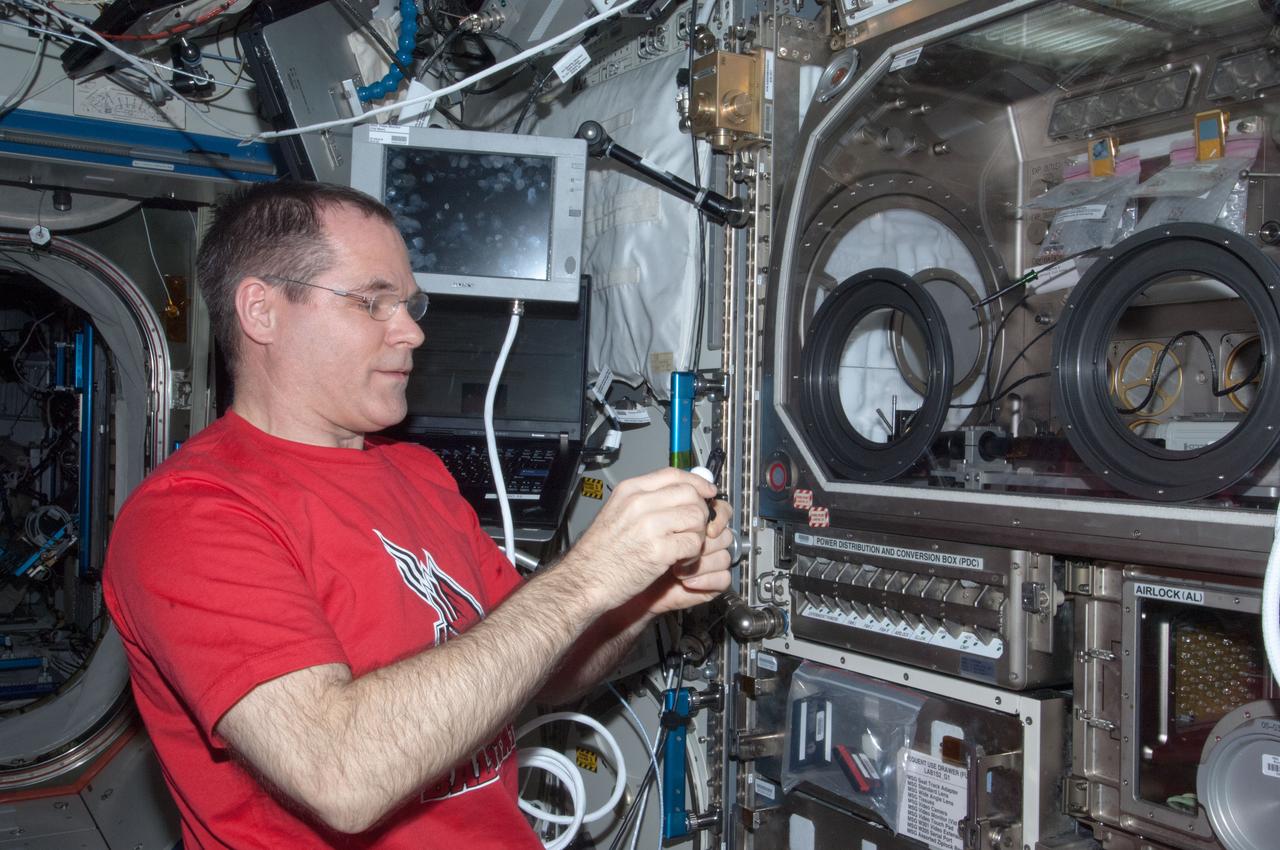
ISS034-E-033733 (24 Jan. 2013) --- NASA astronaut Kevin Ford, Expedition 34 commander, works with the InSPACE-3 hardware inside the Microgravity Science Glovebox (MSG) in the Destiny laboratory of the International Space Station. InSPACE-3 applies different magnetic fields to vials of colloids, or liquids with microscopic particles, and observes how fluids can behave like a solid. Results may improve the strength and design of materials for stronger buildings and bridges.
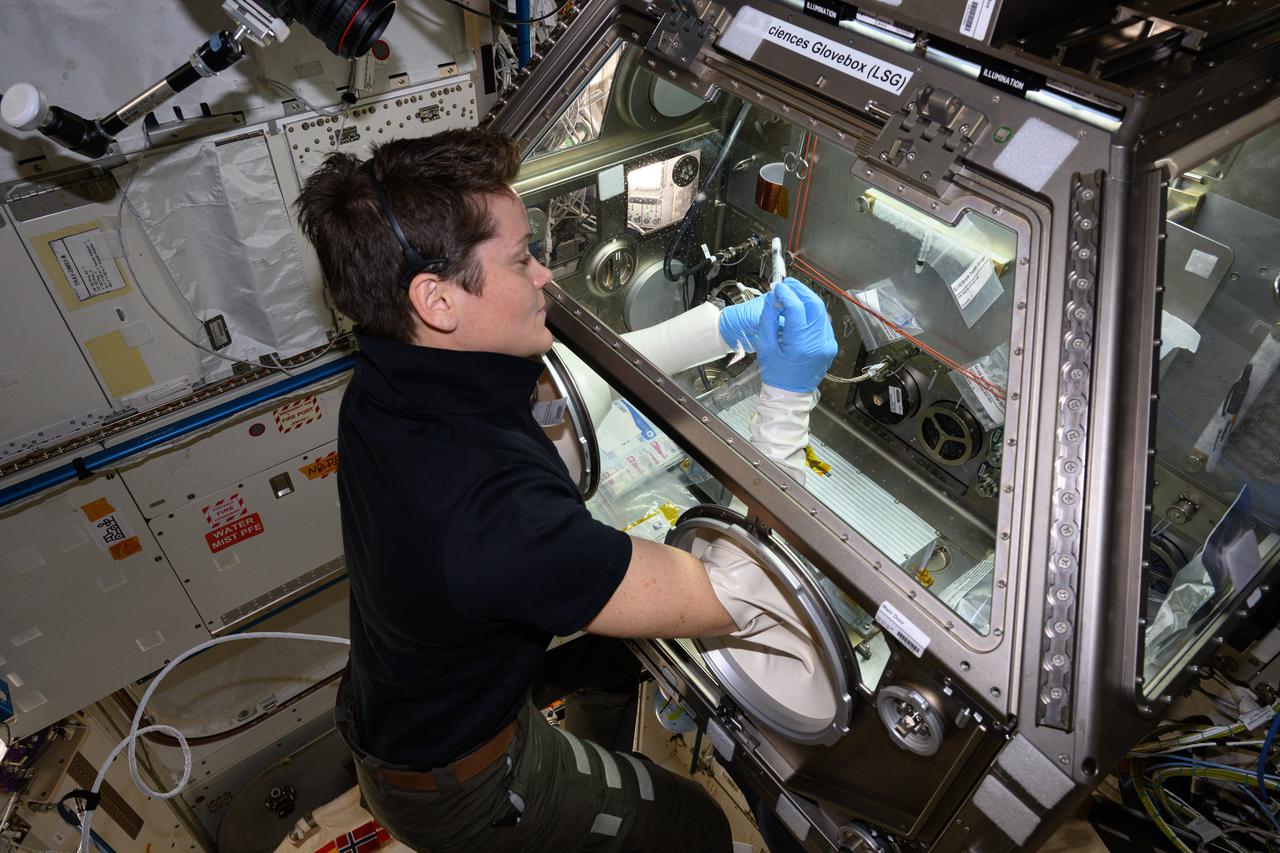
iss073e0027808 (May 10, 2025) --- NASA astronaut and Expedition 73 Flight Engineer Anne McClain works in the Kibo laboratory module's Life Sciences Glovebox processing bacteria samples before viewing them inside a 3D imaging microscope called the Extant Life Volumetric Imaging System, or ELVIS. The technology demonstration may enable applications for monitoring water quality, detecting infectious organisms on spacecraft, and researching colloids (suspensions of particles in a liquid) and microorganisms in microgravity.
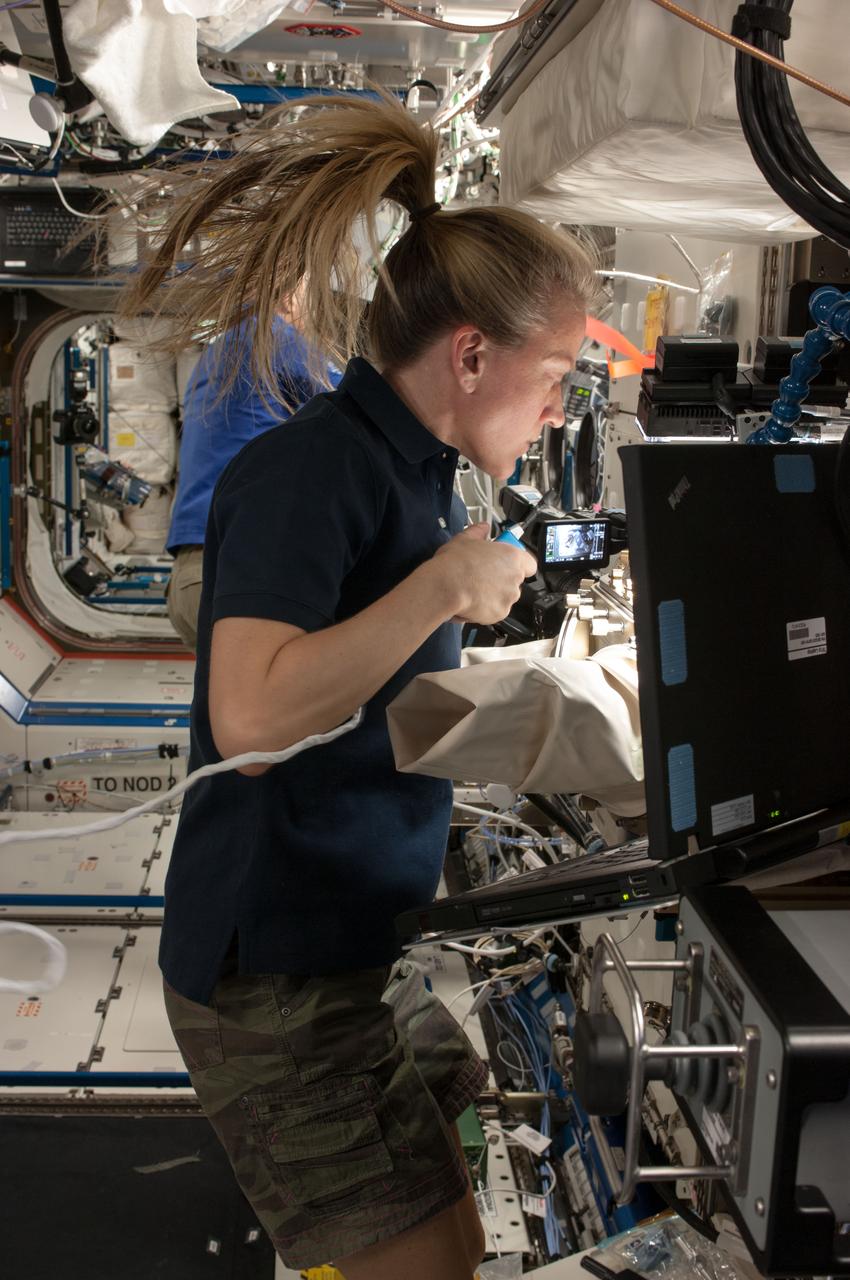
ISS036-E-035780 (18 Aug. 2013) --- NASA astronaut Karen Nyberg, Expedition 36 flight engineer, works with new test samples for the Advanced Colloids Experiment, or ACE, housed in the Light Microscopy Module (LMM) inside the Fluids Integrated Rack of the International Space Station?s Destiny laboratory. Results from ACE will help researchers understand how to optimize stabilizers to extend the shelf life of products like laundry detergent, paint, ketchup and even salad dressing.
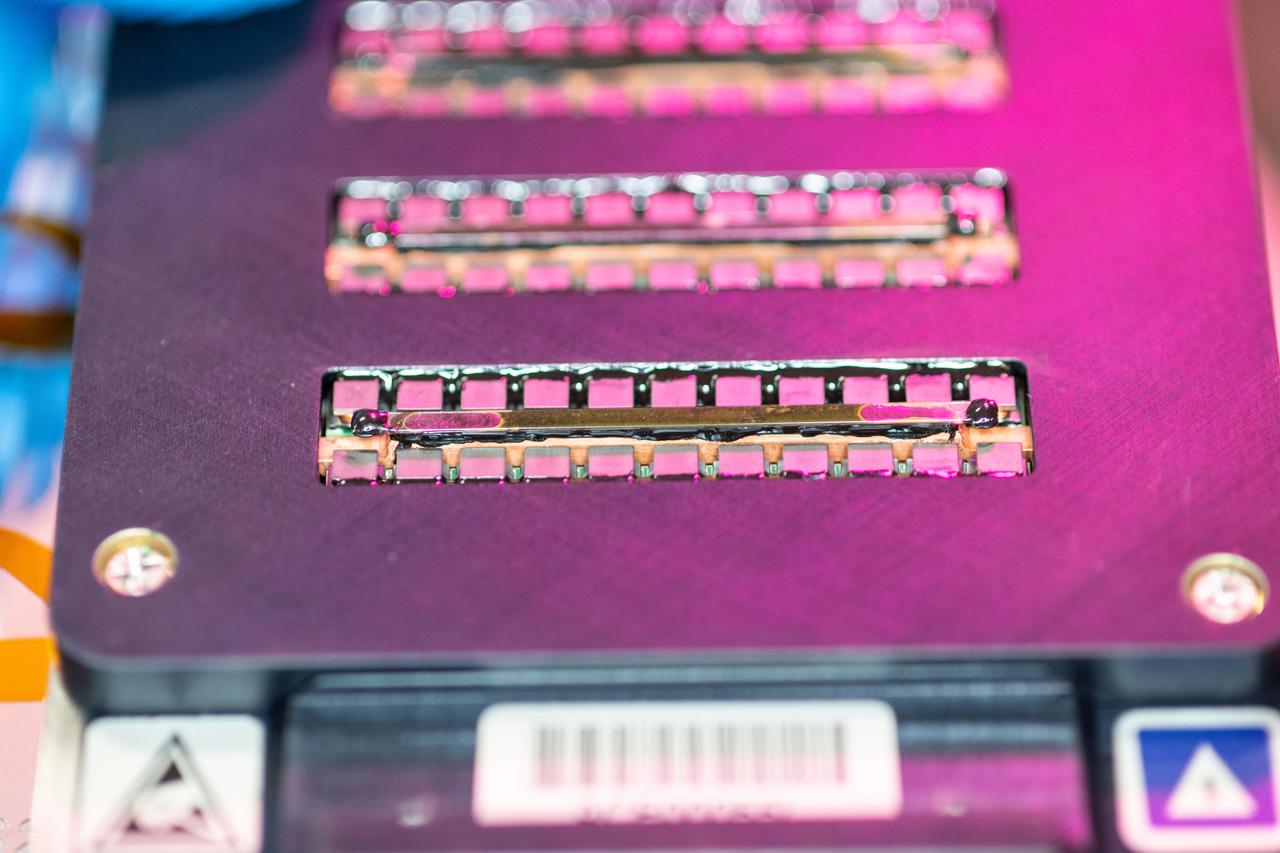
iss059e036890 (4/30/2019) --- Photo documentation onboard the International Space Station (ISS) of the ACE Modules prior to science runs. The Advanced Colloids Experiment-Microscopy-2 (ACE-M-2) observes the microscopic behavior of liquids and gases separating from each other, using a new microscope to record micro-scale events on short time scales, while previous experiments observed large-scale behavior over many weeks.
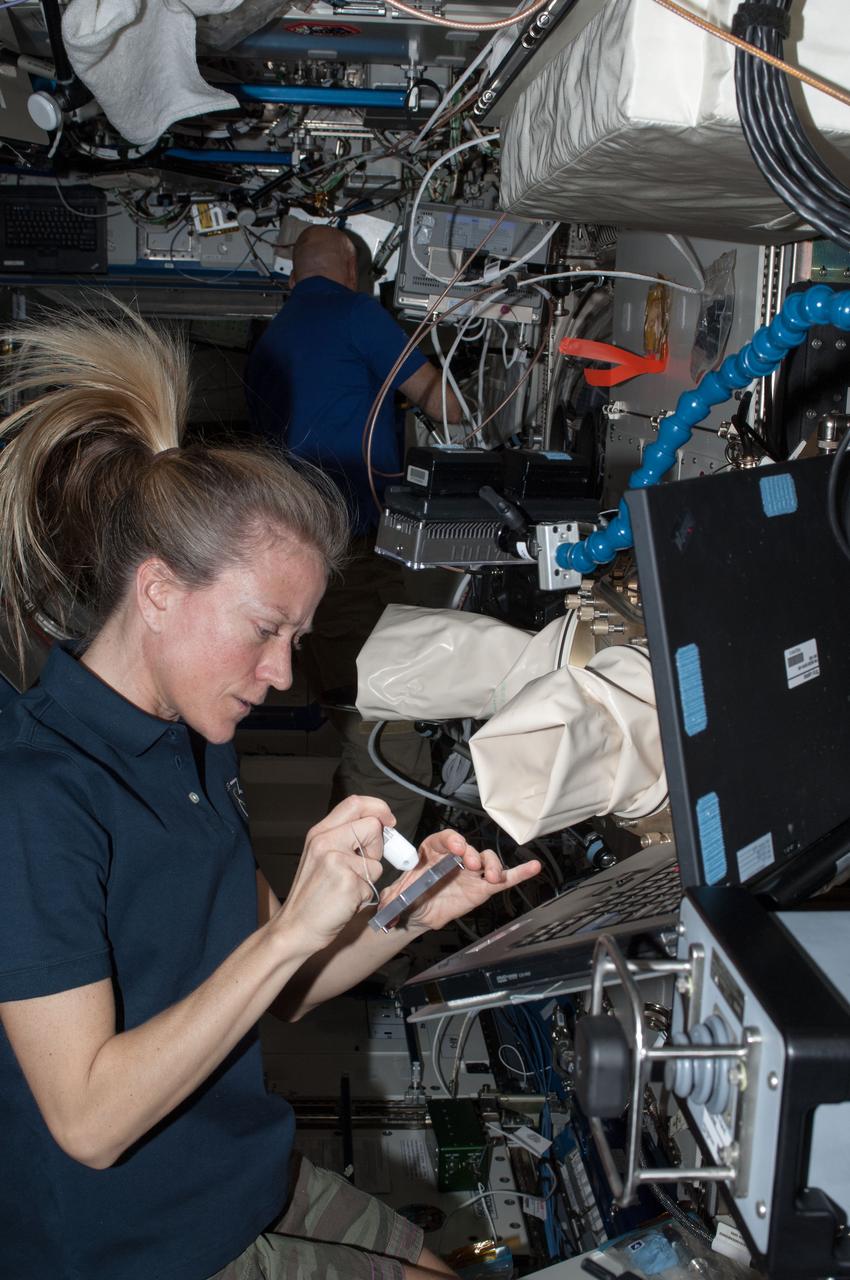
ISS036-E-035770 (18 Aug. 2013) --- NASA astronaut Karen Nyberg, Expedition 36 flight engineer, works with new test samples for the Advanced Colloids Experiment, or ACE, housed in the Light Microscopy Module (LMM) inside the Fluids Integrated Rack of the International Space Station?s Destiny laboratory. Results from ACE will help researchers understand how to optimize stabilizers to extend the shelf life of products like laundry detergent, paint, ketchup and even salad dressing.
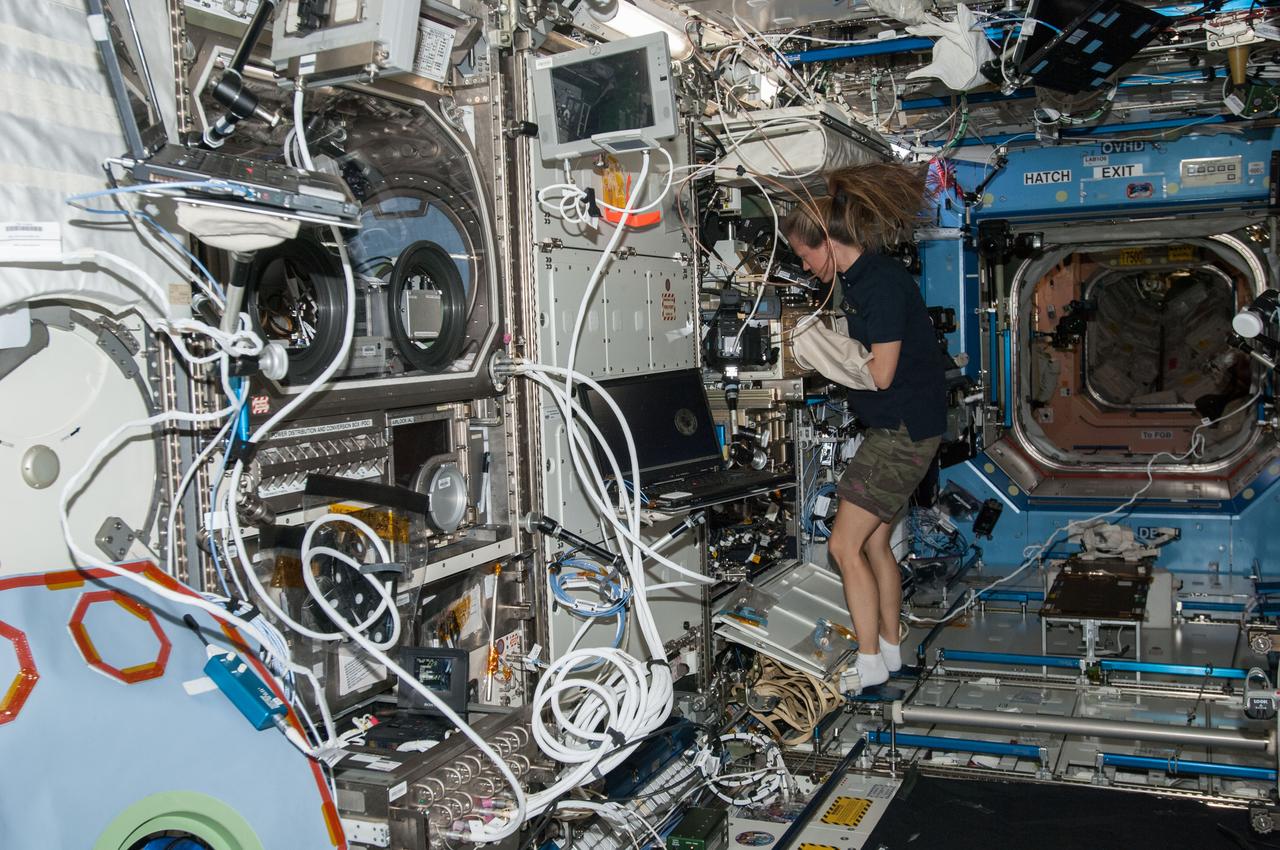
ISS036-E-033948 (18 Aug. 2013) --- NASA astronaut Karen Nyberg, Expedition 36 flight engineer, works with new test samples for the Advanced Colloids Experiment, or ACE, housed in the Light Microscopy Module (LMM) inside the Fluids Integrated Rack of the International Space Station?s Destiny laboratory. Results from ACE will help researchers understand how to optimize stabilizers to extend the shelf life of products like laundry detergent, paint, ketchup and even salad dressing.