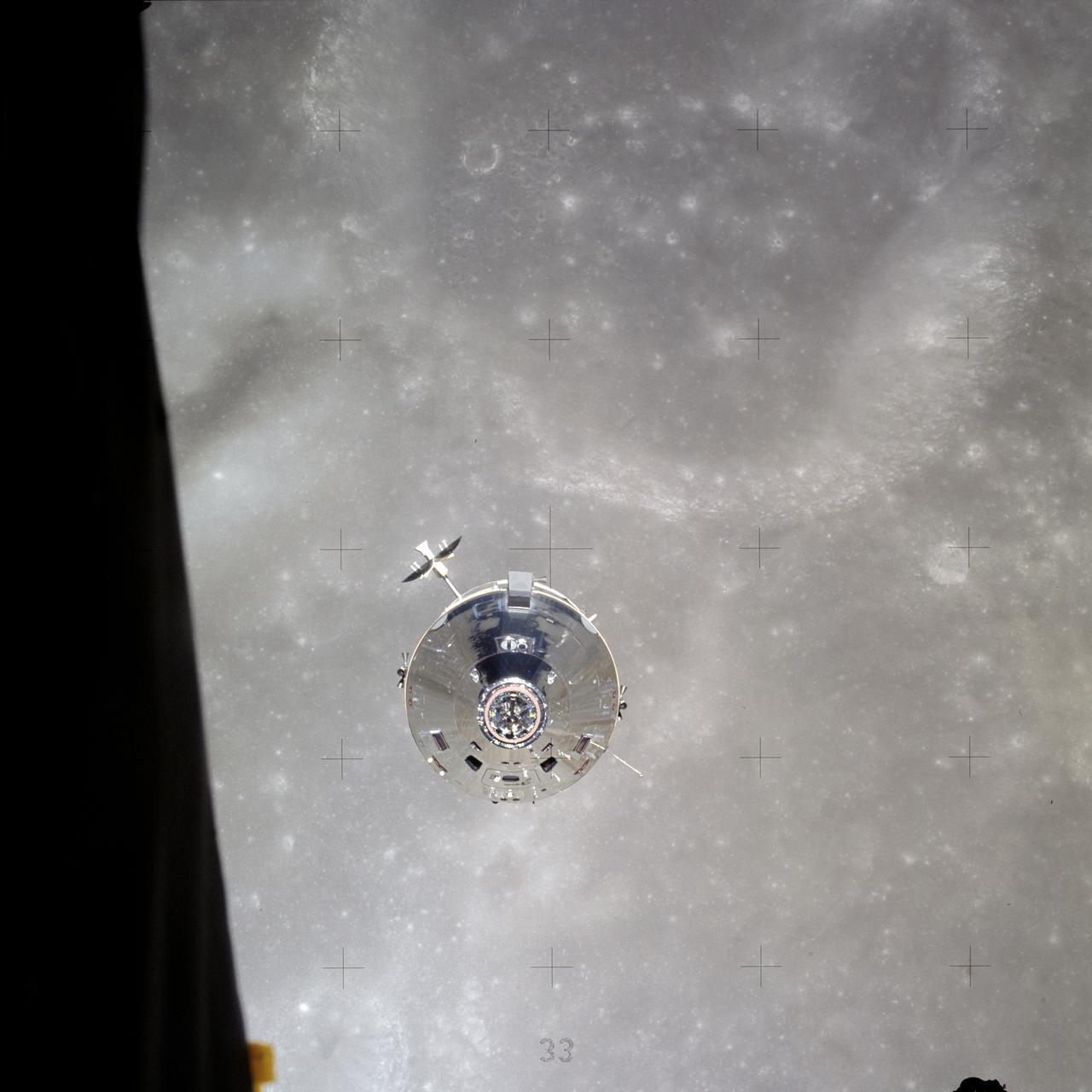
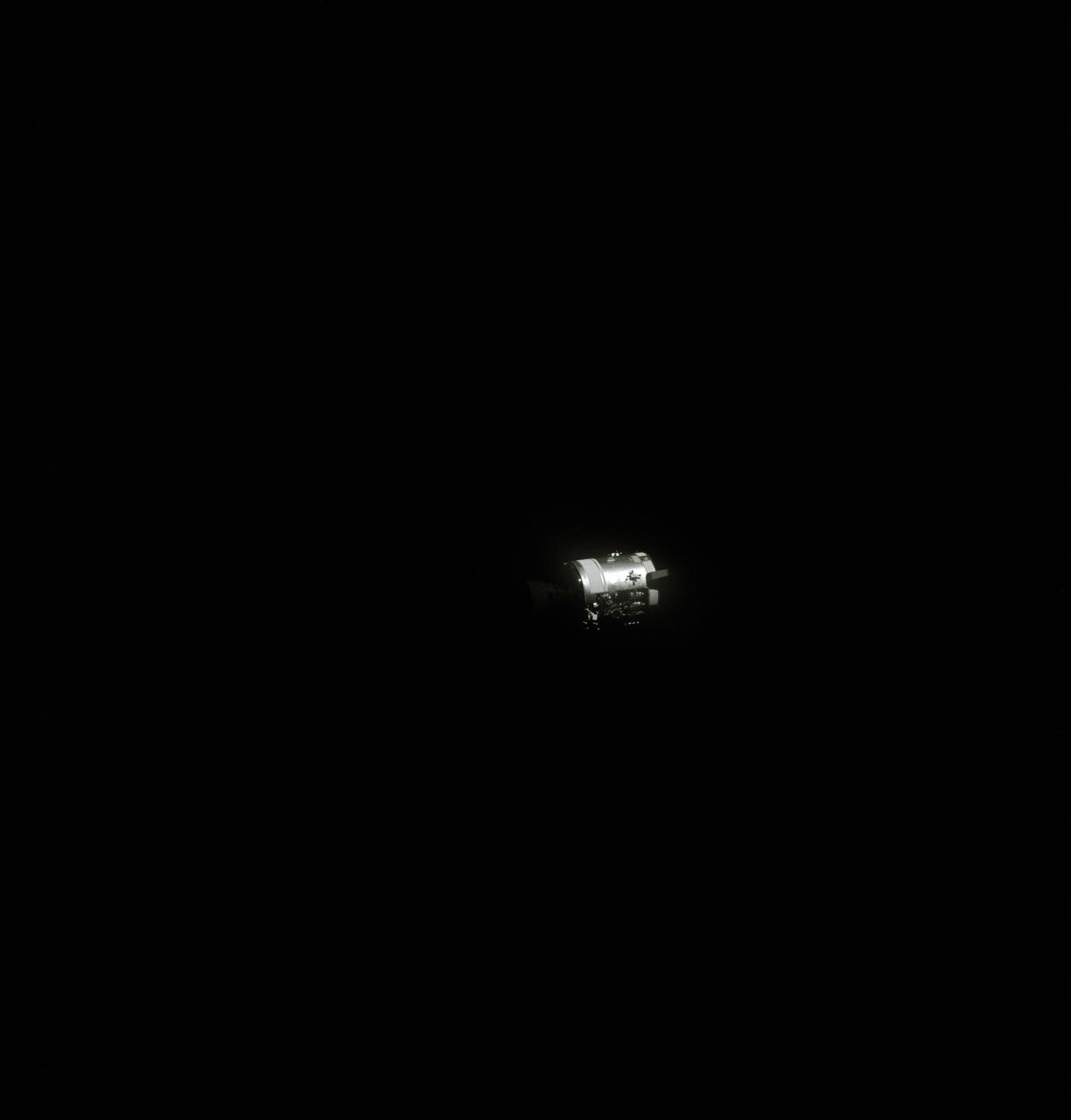
AS16-113-18282 (23 April 1972) --- The Apollo Command and Service Modules (CSM) "Casper" approaches the Lunar Module (LM) "Orion", from which this photograph was made. The two spacecraft are about to make their final rendezvous of the mission, on April 23, 1972. Astronauts John W. Young, commander, and Charles M. Duke Jr., lunar module pilot, aboard the LM, were returning to the CSM, in lunar orbit, after three successful days on the lunar surface. Astronaut Thomas K. (Ken) Mattingly II, command module pilot, remained with the CSM in lunar orbit, while Young and Duke descended in the LM to explore the Descartes region of the moon.
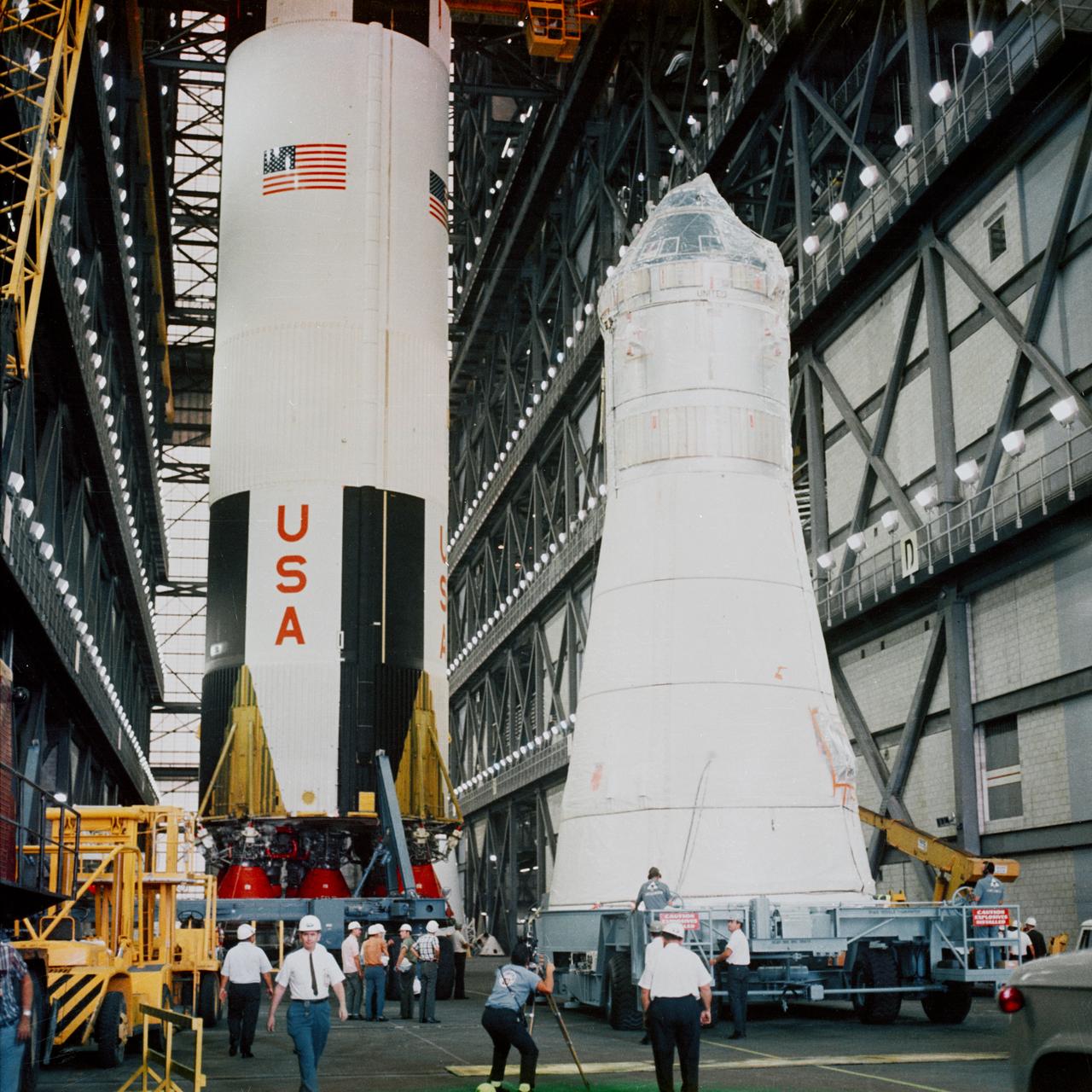
Apollo Spacecraft 104 Command/Service Module and Lunar Module 3 arrive at the Vehicle Assembly Building (VAB) for mating atop the Saturn 504 launch vehicle. The Saturn 504 stack is out of view. The Saturn V first (S-IC) stage in left background is scheduled for a later flight.
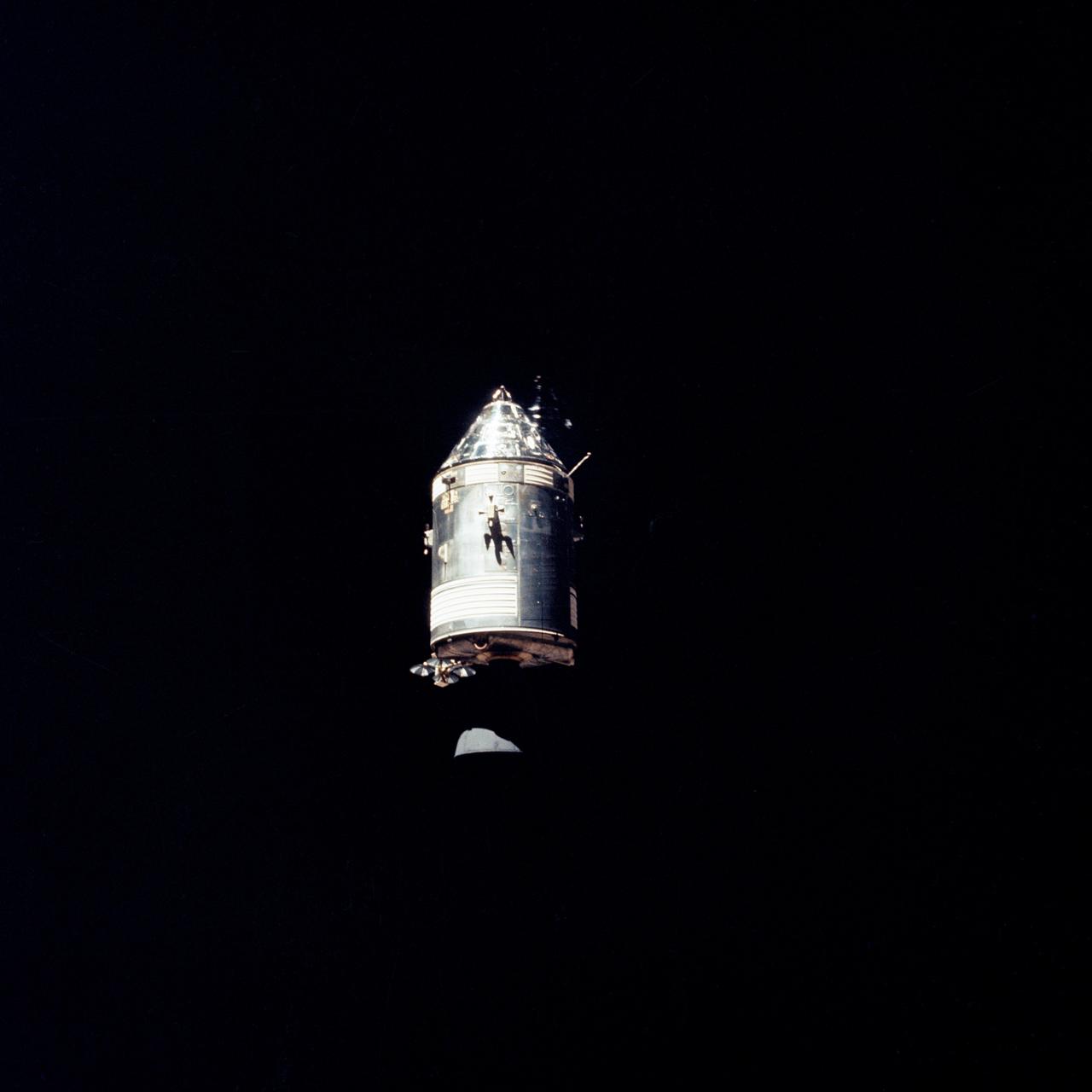
AS14-66-9344 (February 1971) --- The Apollo Command and Service Modules (CSM) are photographed against a black sky background from the Lunar Module (LM) above the moon. While astronauts Alan B. Shepard Jr., commander, and Edgar D. Mitchell, lunar module pilot, descended in the LM "Antares" to explore the Fra Mauro region of the moon, astronaut Stuart A. Roosa , command module pilot, remained with the CSM "Kitty Hawk" in lunar orbit.
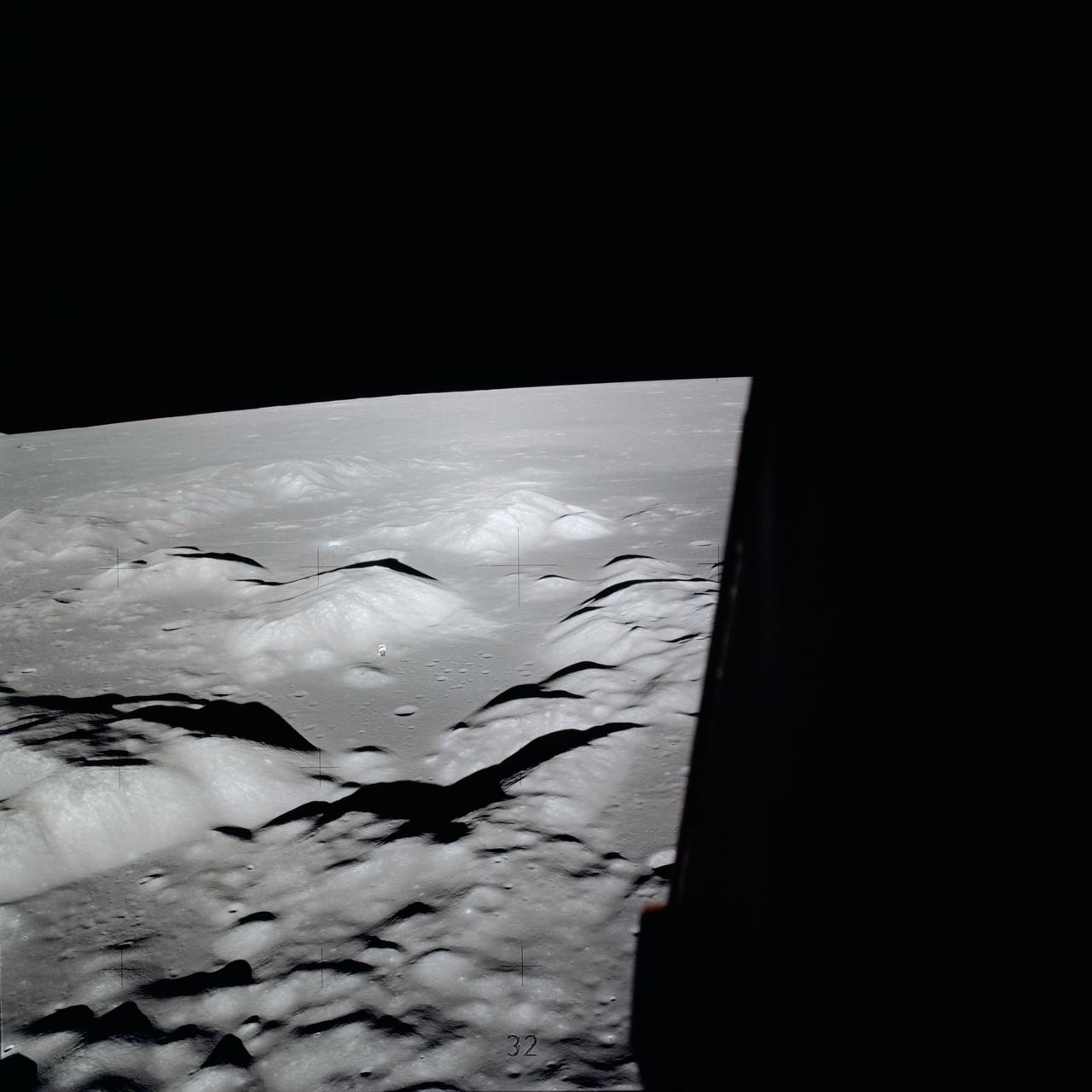
This 70mm frame, showintg the Apollo 17 Command/Service Modules (CSM) backdropped against the Taurus-Littrow landing site, was exposed from the lunar module (LM) prior to the LM's touchdown on the lunar surface.

AS11-37-5445 (20 July 1969) --- The Apollo 11 Command and Service Modules (CSM) are photographed from the Lunar Module (LM) in lunar orbit during the Apollo 11 lunar landing mission. The lunar surface below is in the north central Sea of Fertility. The coordinates of the center of the picture are 51 degrees east longitude and 1 degree north latitude. About half of the crater Taruntius G is visible in the lower left corner of the picture. Part of Taruntius H can be seen at lower right.
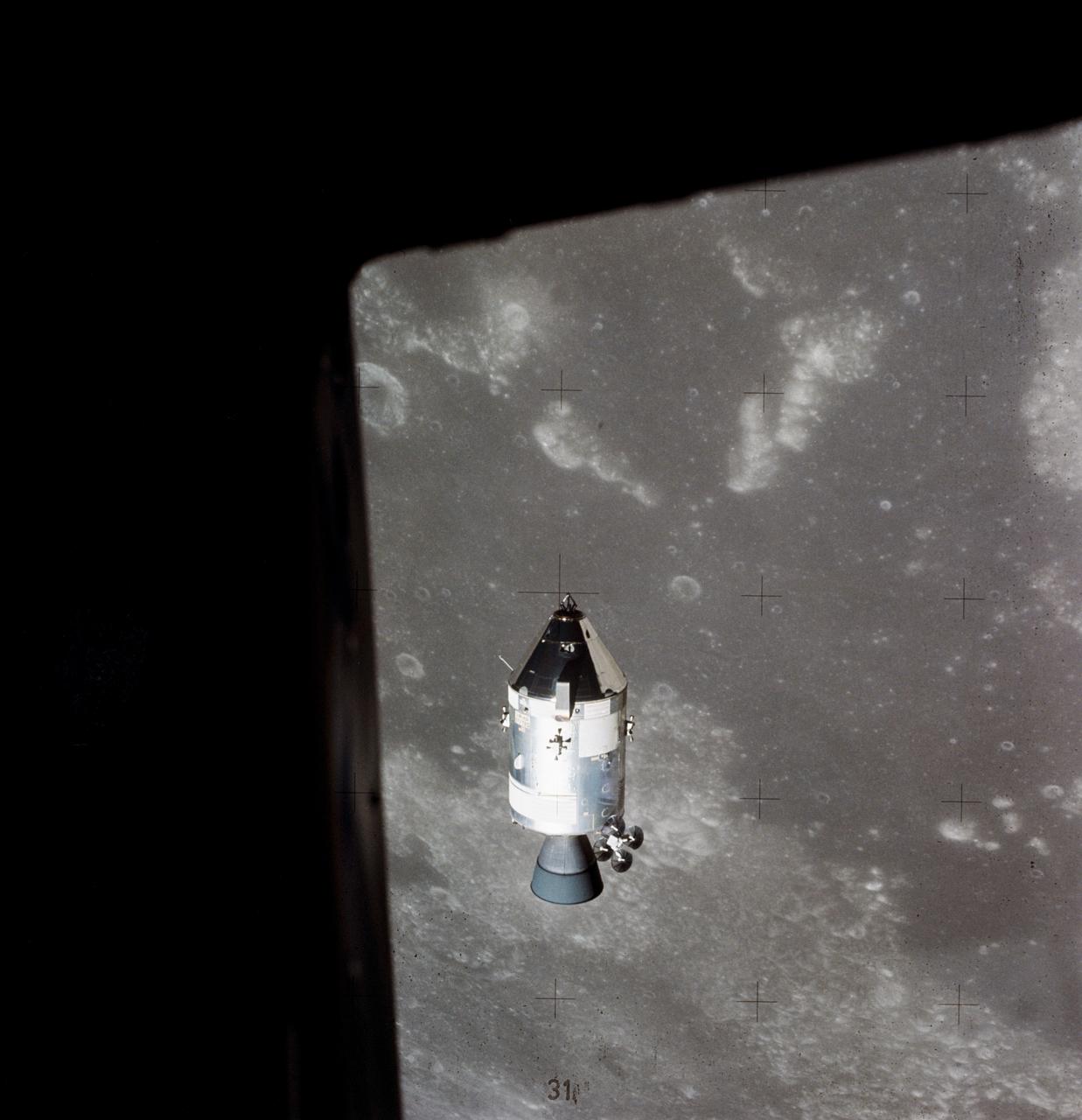
AS15-88-11974 (30 July 1971) --- A view of the Apollo 15 Command and Service Modules (CSM) in lunar orbit as photographed from the Lunar Module (LM) just after rendezvous. The lunar nearside is in the background. This view is looking southeast into the Sea of Fertility. The crater Taruntius is at the right center edge of the picture.
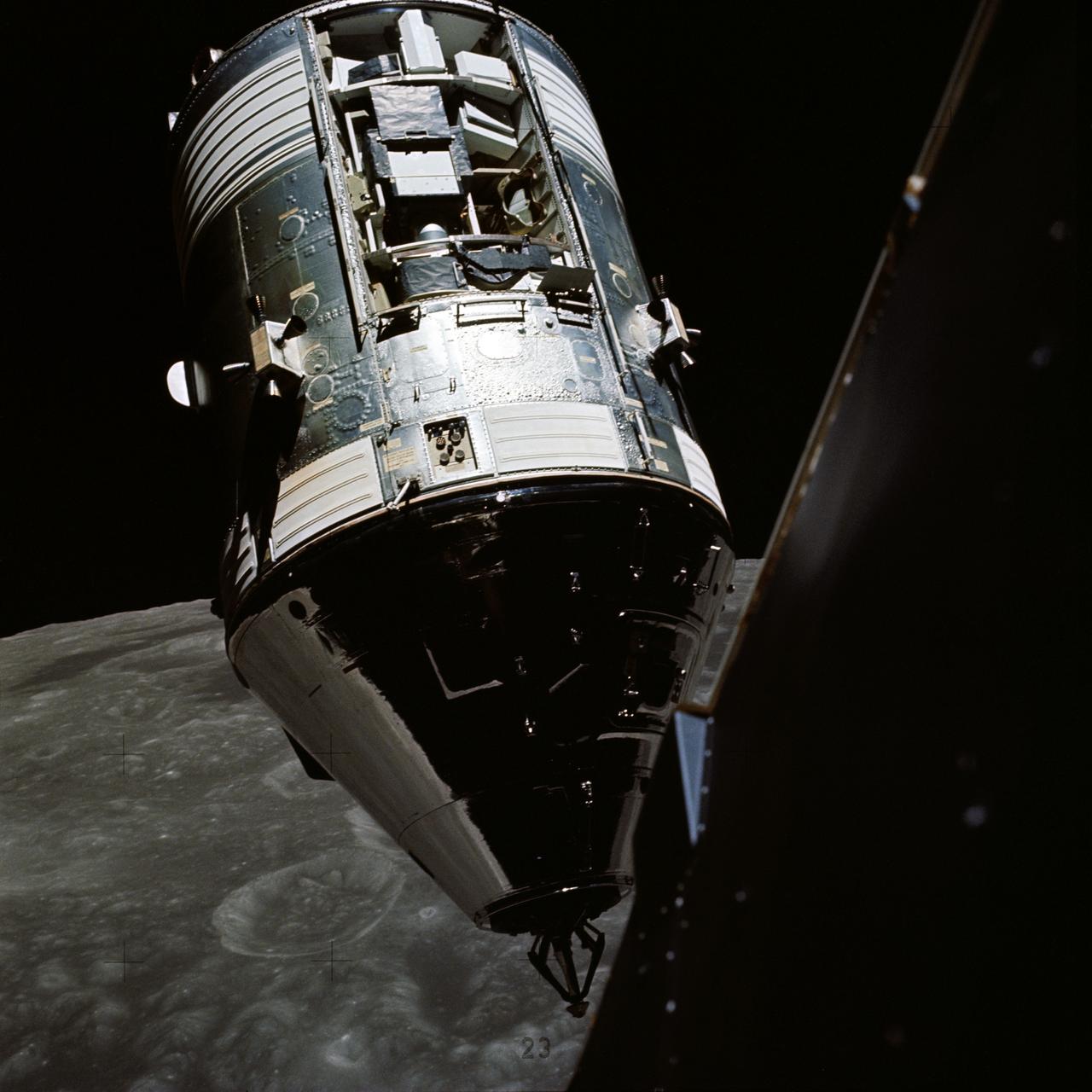
AS17-145-22254 (14 Dec. 1972) --- An excellent view of the Apollo 17 Command and Service Modules (CSM) photographed from the Lunar Module (LM) "Challenger" during rendezvous and docking maneuvers in lunar orbit. The LM ascent stage, with astronauts Eugene A. Cernan and Harrison H. Schmitt aboard, had just returned from the Taurus-Littrow landing site on the lunar surface. Astronaut Ronald E. Evans remained with the CSM in lunar orbit. Note the exposed Scientific Instrument Module (SIM) Bay in Sector 1 of the Service Module (SM). Three experiments are carried in the SIM bay: S-209 lunar sounder, S-171 infrared scanning spectrometer, and the S-169 far-ultraviolet spectrometer. Also mounted in the SIM bay are the panoramic camera, mapping camera and laser altimeter used in service module photographic tasks. A portion of the LM is on the right.
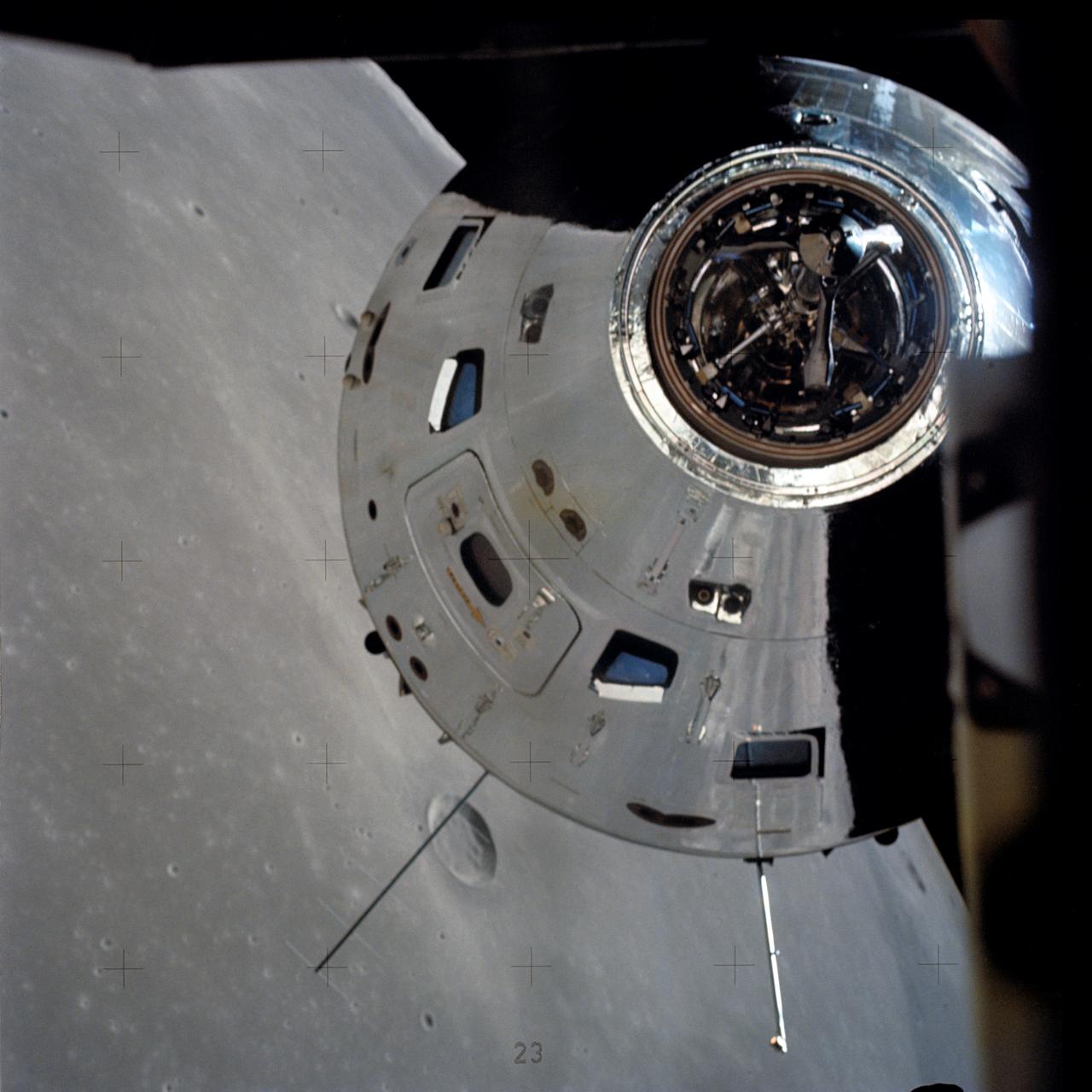
AS17-145-22273 (7-19 Dec. 1972) --- In this view, taken from the Lunar Module (LM), the Command and Service Module (CSM) are seen preparing to rendezvous with the LM. Note the reflection of the lunar surface on the CSM. The CSM, is piloted by Ronald E. Evans; while astronauts Eugene A. Cernan, commander; and Harrison W. Schmitt, lunar module pilot, are onboard the LM, following their extravehicular activities (EVA) on the moon's surface. While astronauts Cernan and Schmitt descended in the LM "Challenger" to explore the Taurus-Littrow region of the moon, astronaut Evans remained with the CSM "America" in lunar orbit.
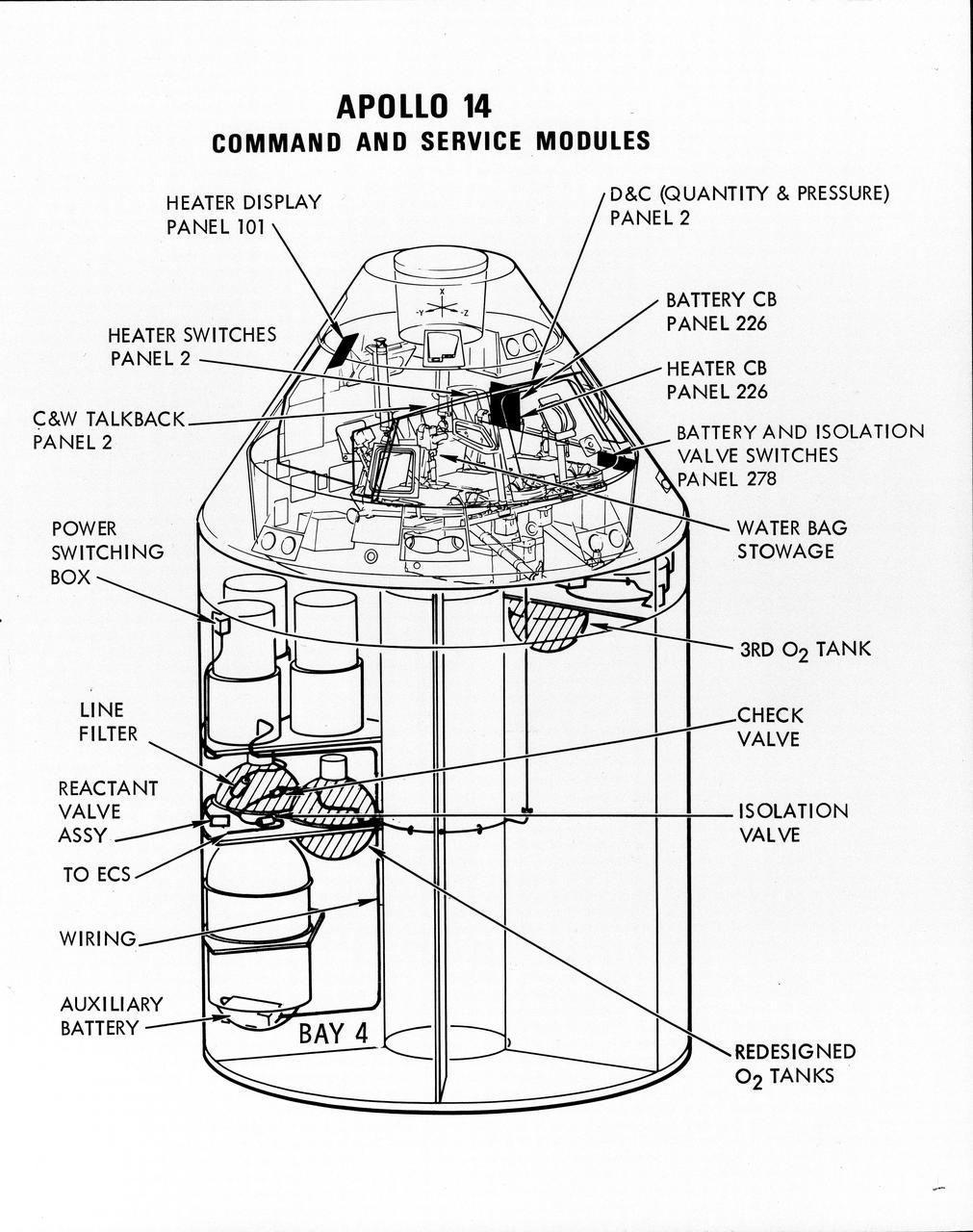
S71-16823 (January 1971) --- A line drawing illustrating a cutaway view of the Apollo 14 Command and Service Modules, showing the engineering changes in the CSM which were recommended by the Apollo 13 Review Board. (The Apollo 13 abort was caused by a short circuit and wiring overheating in one of the SM cryogenic oxygen tanks.) The major changes to the Apollo 14 CSM include adding a third cryogenic oxygen tank installed in a heretofore empty bay (in sector one) of the SM, addition of an auxiliary battery in the SM as a backup in case of fuel cell failure, and removal of destratification fans in the cryogenic oxygen tanks and removal of thermostat switches from the oxygen tank heater circuits. Provision for stowage of an emergency five-gallon supply of drinking water has been added to the CM.
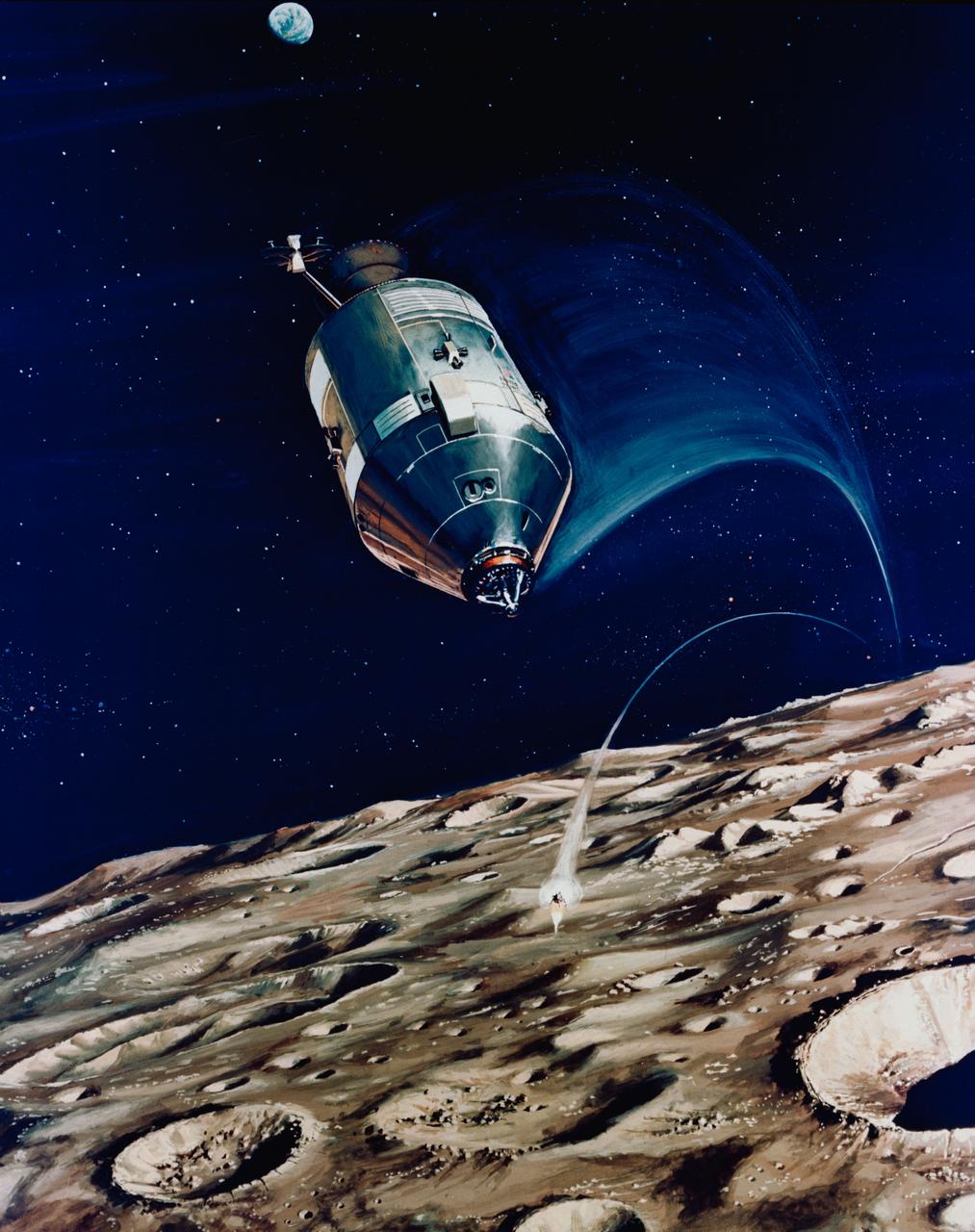
S71-16574 (11 Jan. 1971) --- An artist's concept depicting the Apollo 14 Command and Service Modules (CSM) circling the moon as the Lunar Module (LM) heads toward a lunar landing. While astronaut Stuart A. Roosa, command module pilot, remains with the CSM in lunar orbit, astronauts Alan B. Shepard Jr., commander; and Edgar D. Mitchell, lunar module pilot, will descend in the LM to explore an area in the rugged Fra Mauro highlands.
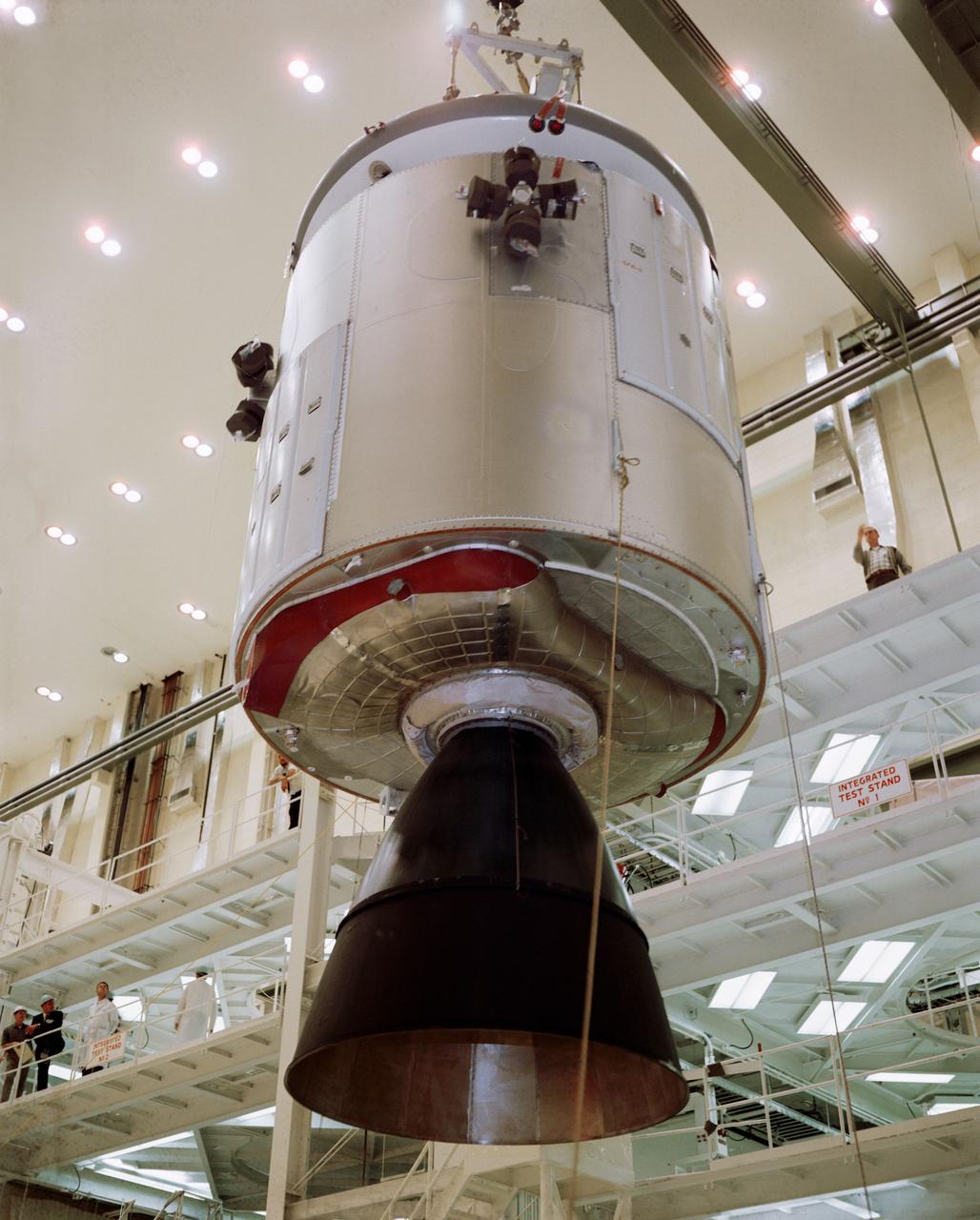
S67-15704 (3 Jan. 1967) --- Transfer of Apollo Spacecraft 012 Command/Service Module (CSM) for mating with the Saturn Lunar Module (LM) Adapter No.05 in the Manned Spacecraft Operations Building. Spacecraft 012 will be flown on the Apollo/Saturn 1 (204) mission. Photo credit: NASA

AS10-27-3873 (22 May 1969) --- The Apollo 10 Command and Service Modules (CSM) are photographed from the Lunar Module (LM) after CSM/LM separation in lunar orbit. The CSM was about 175 statute miles east of Smyth's Sea and was above the rough terrain which is typical of the lunar far side. The eastward oblique view of the lunar surface is centered near 105 degrees east longitude and 1 degree north latitude. The horizon is approximately 600 kilometers (374 statute miles) away. Numerous bright craters and the absence of shadows show that the sun was almost directly overhead when this photograph was taken.
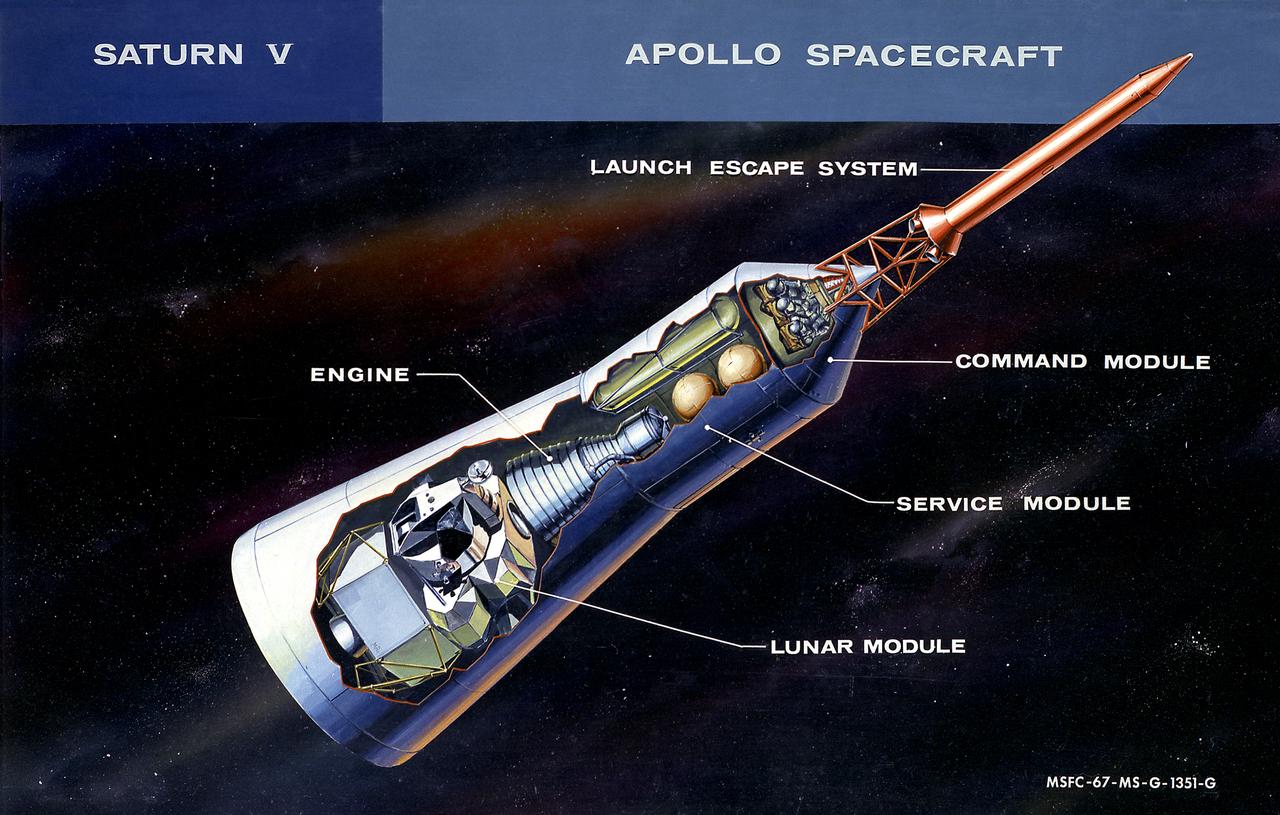
This cutaway illustration shows the Apollo Spacecraft with callouts of the major components. The spacecraft consisted of the lunar module, the service module, the command module, and the launch escape system.
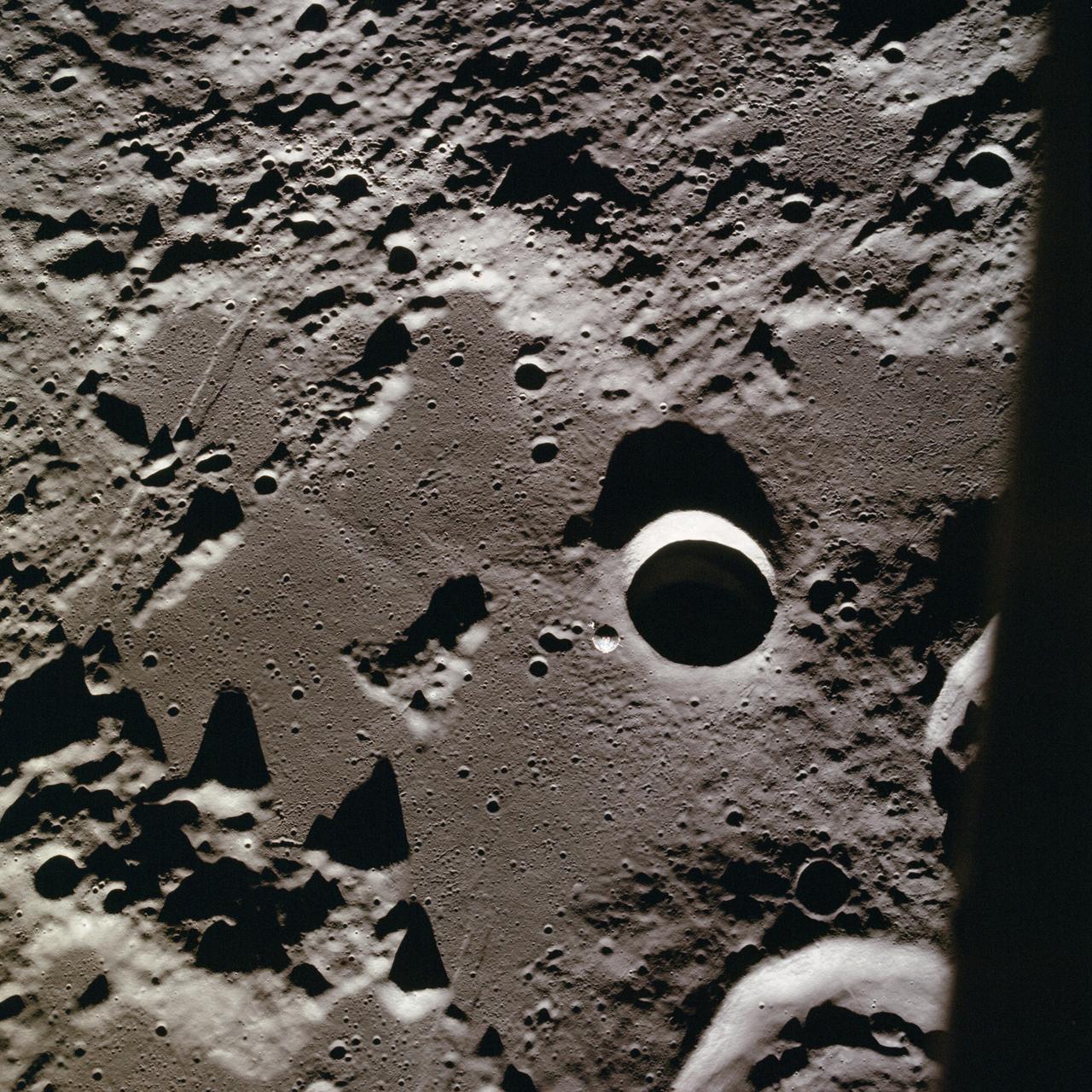
AS11-37-5448 (July 1969) --- The Apollo 11 Command and Service Modules (CSM) (tiny dot near quarter sized crater, center), with astronaut Michael Collins, command module pilot, aboard. The view overlooking the western Sea of Tranquility was photographed from the Lunar Module (LM). Astronauts Neil A. Armstrong, commander, and Edwin E. Aldrin Jr., lunar module pilot, manned the LM and made their historic lunar landing on July 20, 1969. Coordinates of the center of the terrain in the photograph are 18.5 degrees longitude and .5 degrees north latitude.

AS09-20-3064 (6 March 1969) --- Excellent view of the docked Apollo 9 Command and Service Modules (CSM) and Lunar Module (LM), with Earth in the background, during astronaut David R. Scott's stand-up extravehicular activity (EVA), on the fourth day of the Apollo 9 Earth-orbital mission. Scott, command module pilot, is standing in the open hatch of the Command Module (CM). Astronaut Russell L. Schweickart, lunar module pilot, took this photograph of Scott from the porch of the LM. Inside the LM was astronaut James A. McDivitt, Apollo 9 commander.
AS13-58-8464 (17 April 1970) --- This view of the severely damaged Apollo 13 Service Module (SM) was photographed from the Lunar Module/Command Module (LM/CM) following SM jettisoning. Nearest the camera is the Service Propulsion System (SPS) engine and nozzle. An entire SM panel was blown away by the apparent explosion of oxygen tank number two located in Sector 4 of the SM. The apparent rupture of the oxygen tank caused the Apollo 13 crew men to use the Lunar Module (LM) as a "lifeboat".

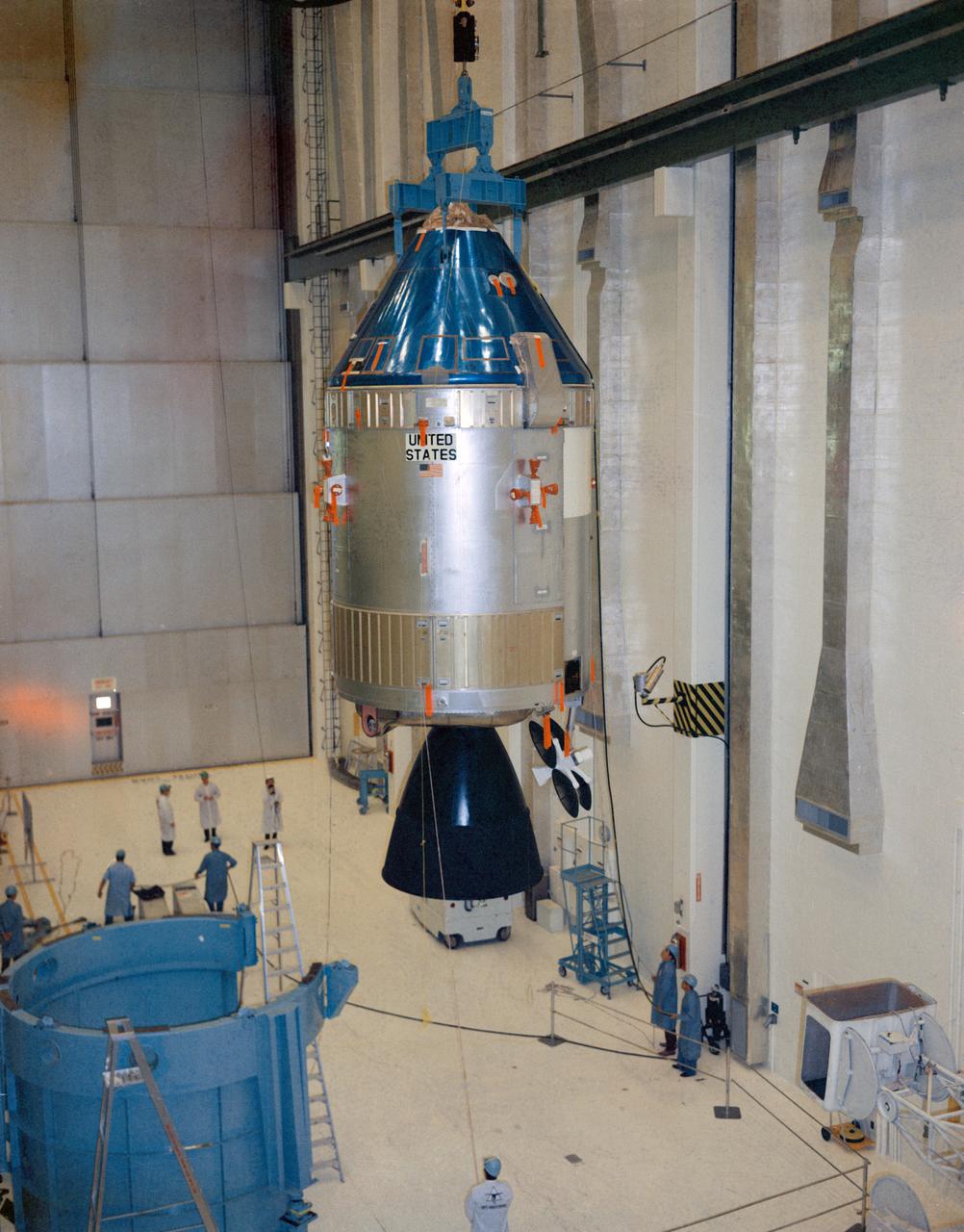
S69-19197 (1969) --- Interior view of the Kennedy Space Center's (KSC) Manned Spacecraft Operations Building (MSOB) showing Apollo Spacecraft 106 Command and Service Modules (CSM) being moved to integrated work stand number one for mating to Spacecraft Lunar Module Adapter (SLA) 13. Spacecraft 106 will be flown on the Apollo 10 (Lunar Module 4/Saturn 505) space mission.
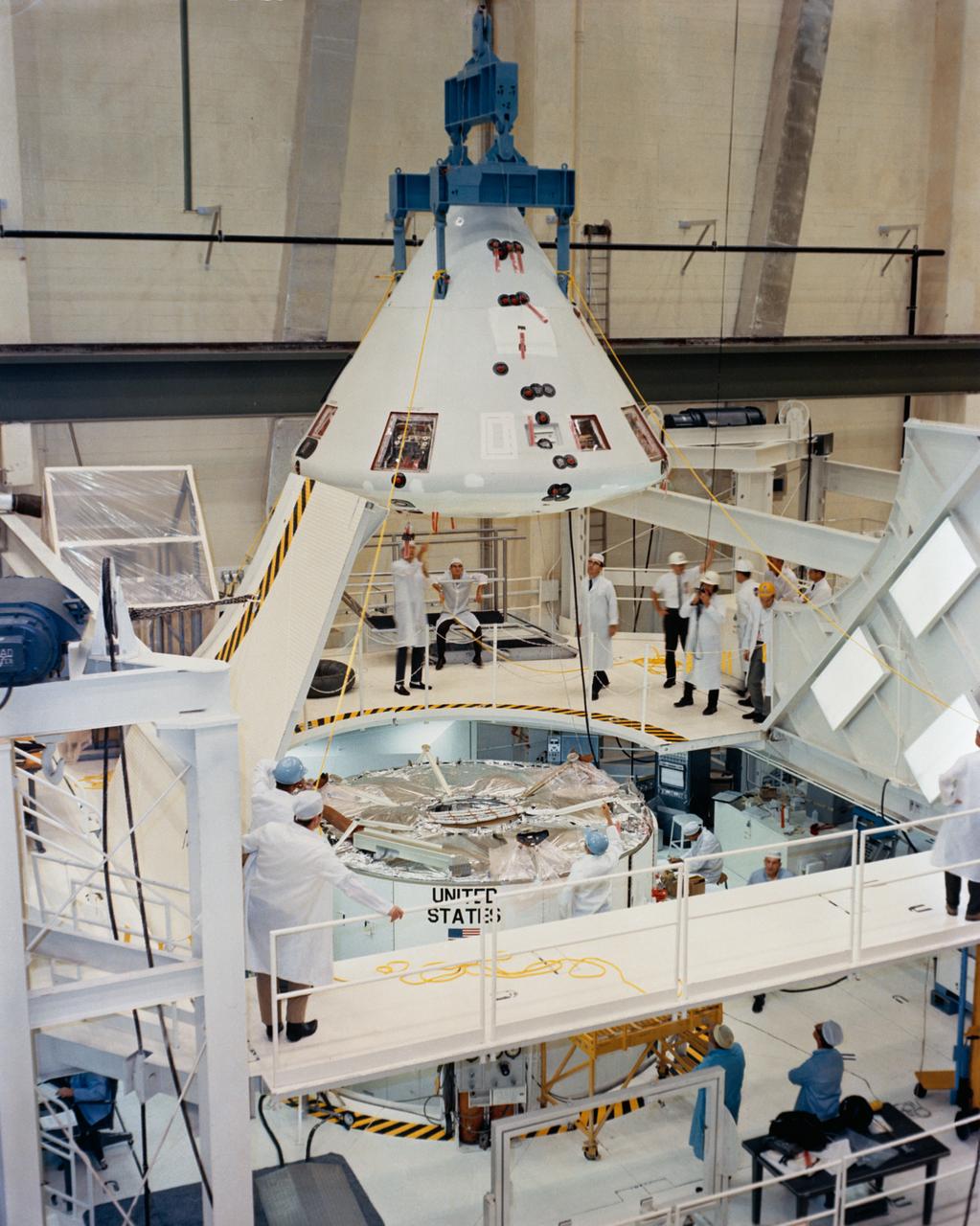
S69-19190 (31 Jan. 1969) --- Interior view of the Kennedy Space Center's Manned Spacecraft Operations Building showing Apollo Spacecraft 106/Command/Service Module being moved to integrated work stand number one for mating to Spacecraft Lunar Module Adapter (SLA) 13. Spacecraft 106 will be flown on the Apollo 10 (Lunar Module 4/Saturn 505) space mission.
S68-17301 (6 Dec. 1967) --- Apollo Spacecraft 020 Command Module is hoisted into position for mating with Service Module in the Kennedy Space Center's Manned Spacecraft Operations Building. Spacecraft 020 will be flown on the Apollo 6 (Spacecraft 020/Saturn 502) unmanned, Earth-orbital space mission.
This view of the damaged Apollo 13 Service Module (SM) was photographed from the Lunar Module/Command Module following SM jettisoning. As seen here, an entire panel on the SM was blown away by the apparent explosion of oxygen tank number two located in Sector 4 of the SM. Two of the three fuel cells are visible just forward (above) the heavily damaged area. Three fuel cells, two oxygen tanks, and two hydrogen tanks are locate in Sector 4. The damaged area is located above the S-band high gain antenna. Nearest the camera is the Service Propulsion System (SPS) engine and nozzle. The damage to the SM caused the Apollo 13 crewmen to use the Lunar Module (LM) as a "lifeboat". The LM was jettisoned just prior to Earth reentry by the Command Module.
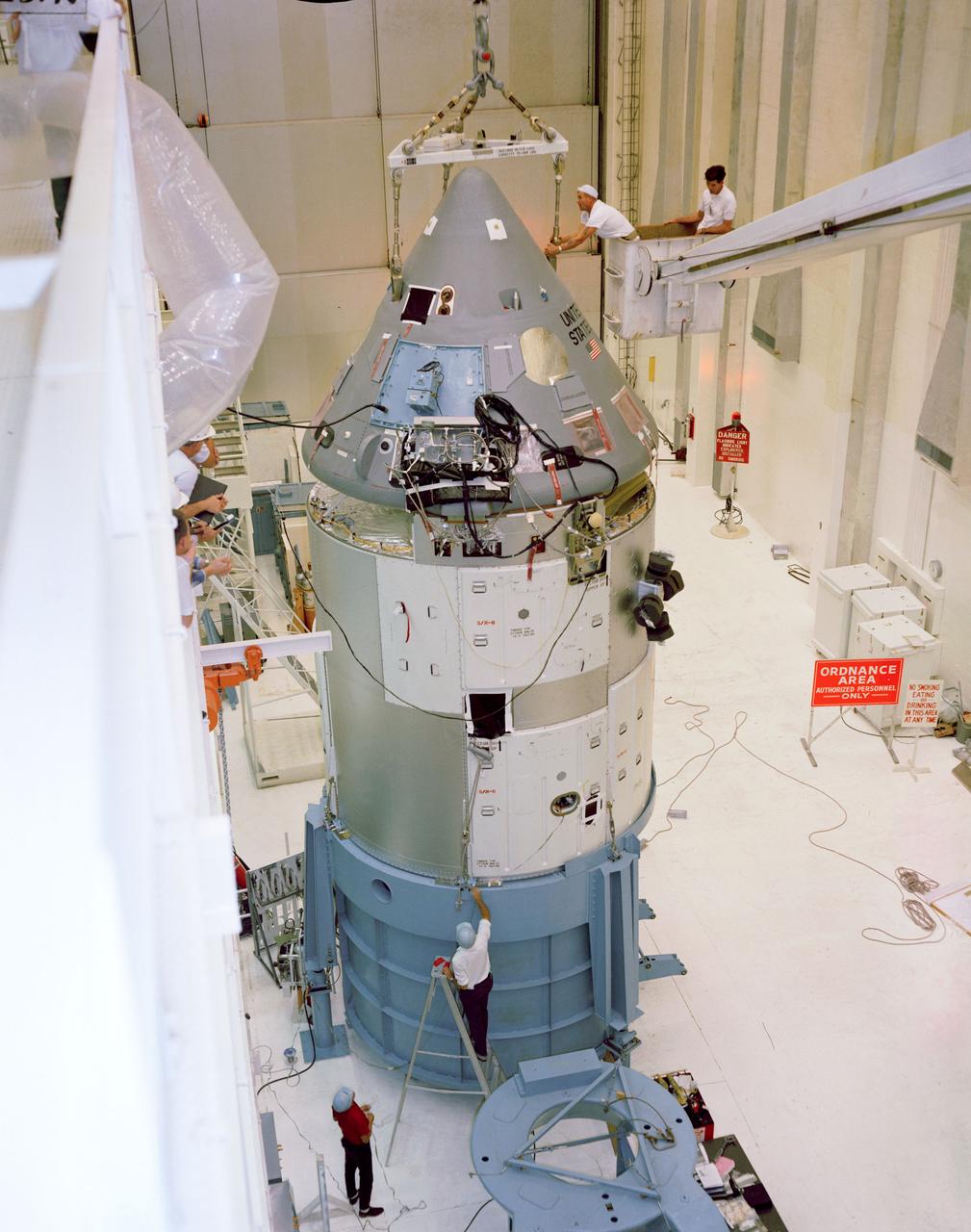
S67-15717 (1967) --- Apollo Spacecraft 012 Command/Service Module is moved from H-134 to east stokes for mating to the Saturn Lunar Module Adapter No. 05 in the Manned Spacecraft Operations Building. S/C 012 will be flown on the Apollo/Saturn 204 mission.
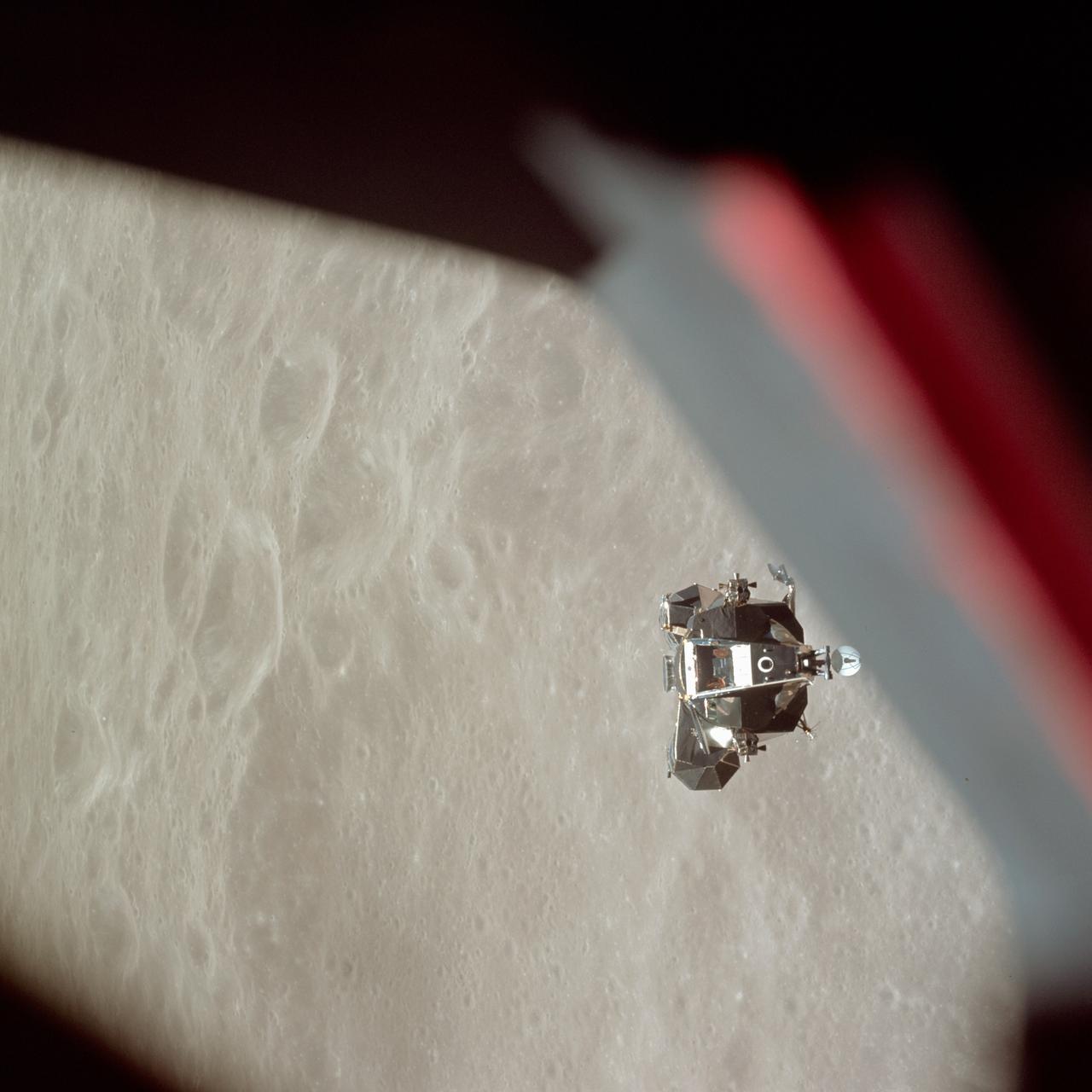
AS10-34-5112 (26 May 1969) --- The ascent stage of the Apollo 10 Lunar Module (LM) is photographed from the Command Module prior to docking in lunar orbit. The LM is approaching the Command and Service Modules from below. The LM descent stage had already been jettisoned. The lunar surface in the background is near, but beyond the eastern limb of the moon as viewed from Earth (about 120 degrees east longitude). The red/blue diagonal line is the spacecraft window.

AS13-59-8562 (17 April 1970) --- This view of the Apollo 13 Lunar Module (LM) was photographed from the Command Module (CM) just after the LM had been jettisoned. The jettisoning occurred a few minutes before 11 a.m. (CST), April 17, 1970, just over an hour prior to splashdown of the CM in the south Pacific Ocean. The apparent explosion of oxygen tank number two in the Apollo 13 Service Module (SM) caused the Apollo 13 crew members to rely on the LM as a "lifeboat".
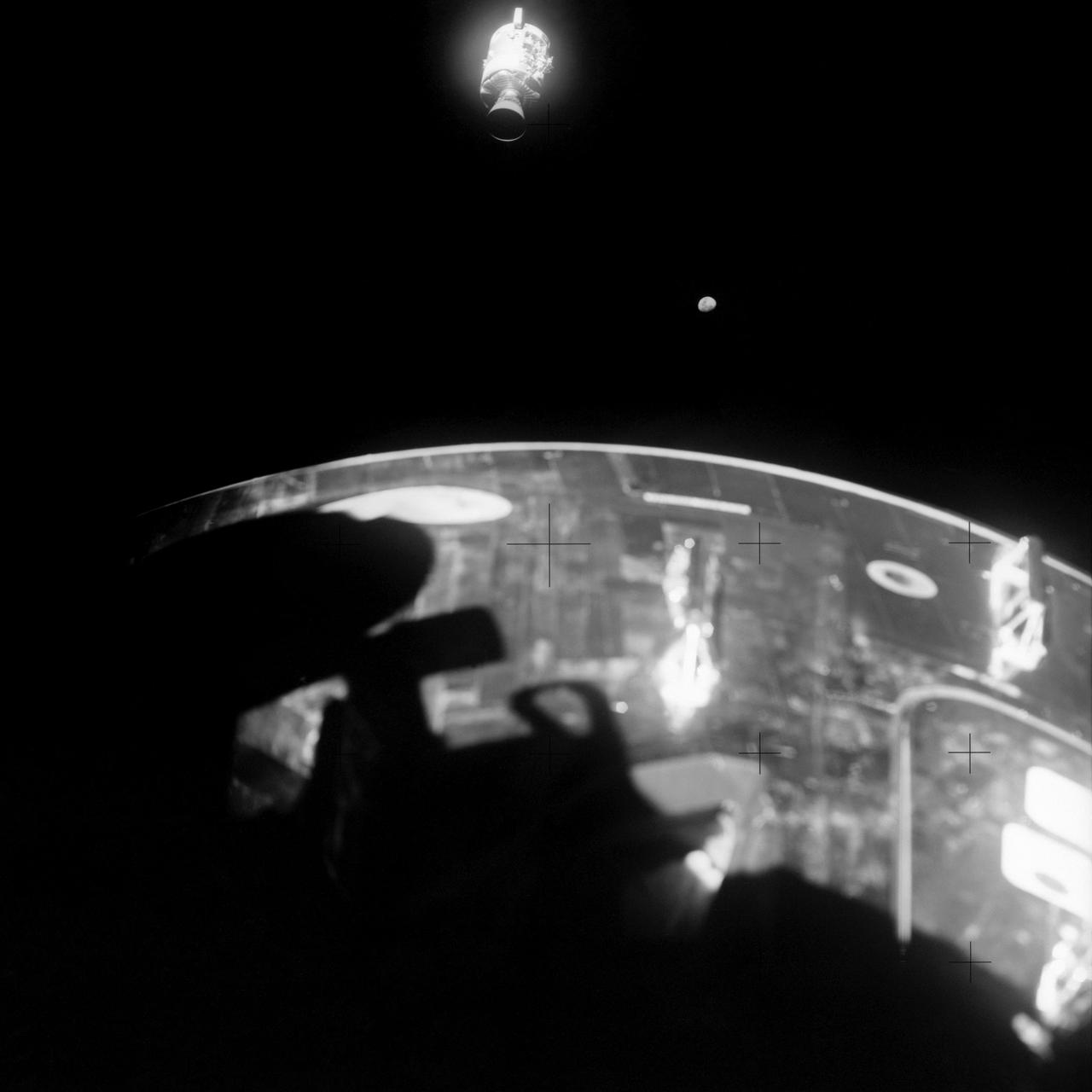
AS13-59-8501 (17 April 1970) --- This view of the severely damaged Apollo 13 Service Module (SM) was photographed from the Lunar Module/Command Module (LM/CM) following SM jettisoning. As seen here, an entire panel on the SM was blown away by the apparent explosion of oxygen tank number two located in Sector 4 of the SM. Two of the three fuel cells are visible just forward (above) the heavily damaged area. Three fuel cells, two oxygen tanks, and two hydrogen tanks are located in Sector 4. The damaged area is located above the S-Band high gain antenna. Nearest the camera is the Service Propulsion System (SPS) engine and nozzle. The damage to the SM caused the Apollo 13 crew men to use the LM as a "lifeboat." The LM was jettisoned just prior to Earth re-entry by the CM.
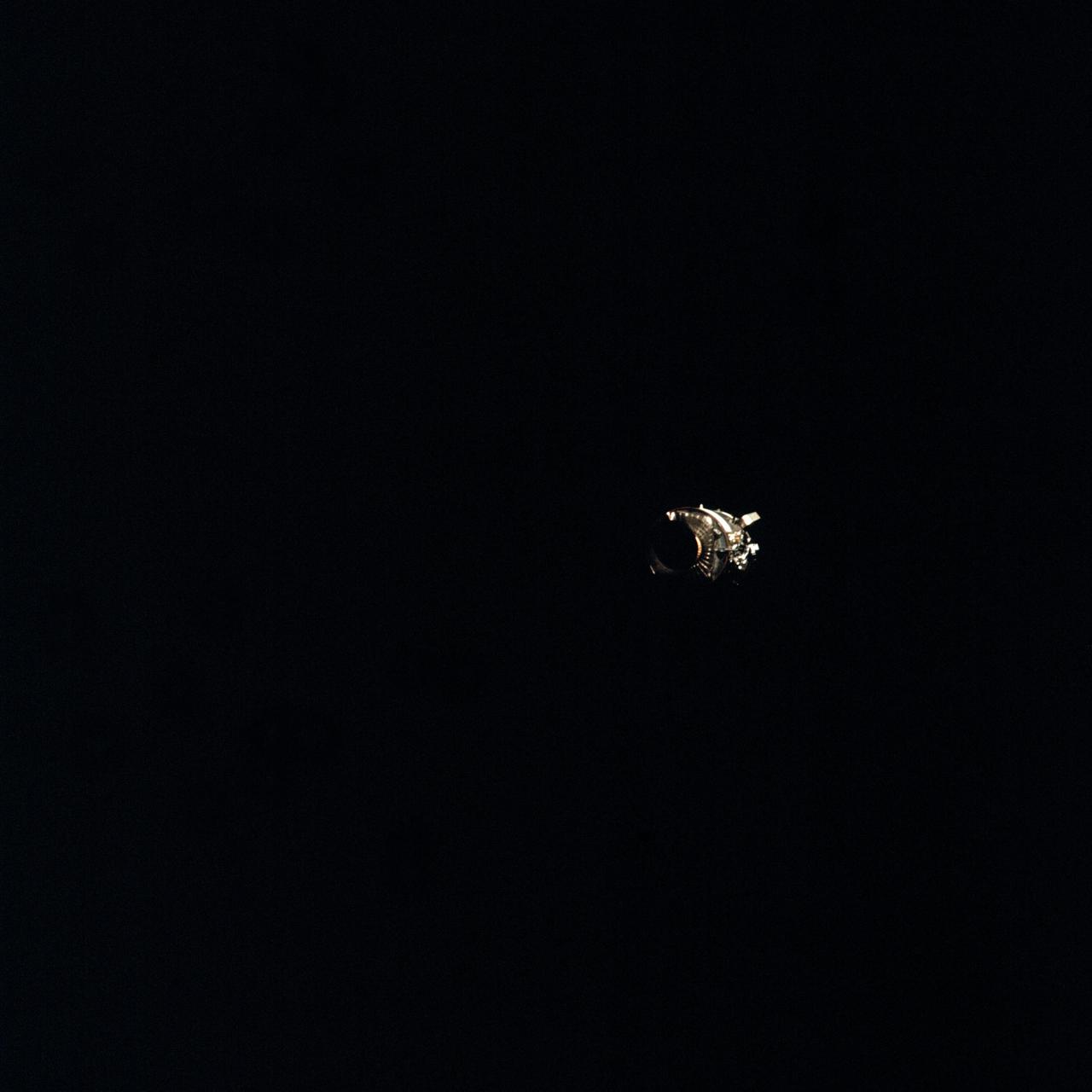
AS13-58-8458 (17 April 1970) --- This view of the severely damaged Apollo 13 Service Module (SM) was photographed from the Lunar Module/Command Module (LM/CM) following SM jettisoning. An entire SM panel was blown away by the apparent explosion of oxygen tank number two. Two of the three fuel cells are visible at the forward portion of the opening. The hydrogen tanks are located in Sector 4 of the Apollo 13 SM. The apparent rupture of the oxygen tank caused the Apollo 13 crew members to use the LM as a "lifeboat." The LM was jettisoned just prior to Earth re-entry by the CM.
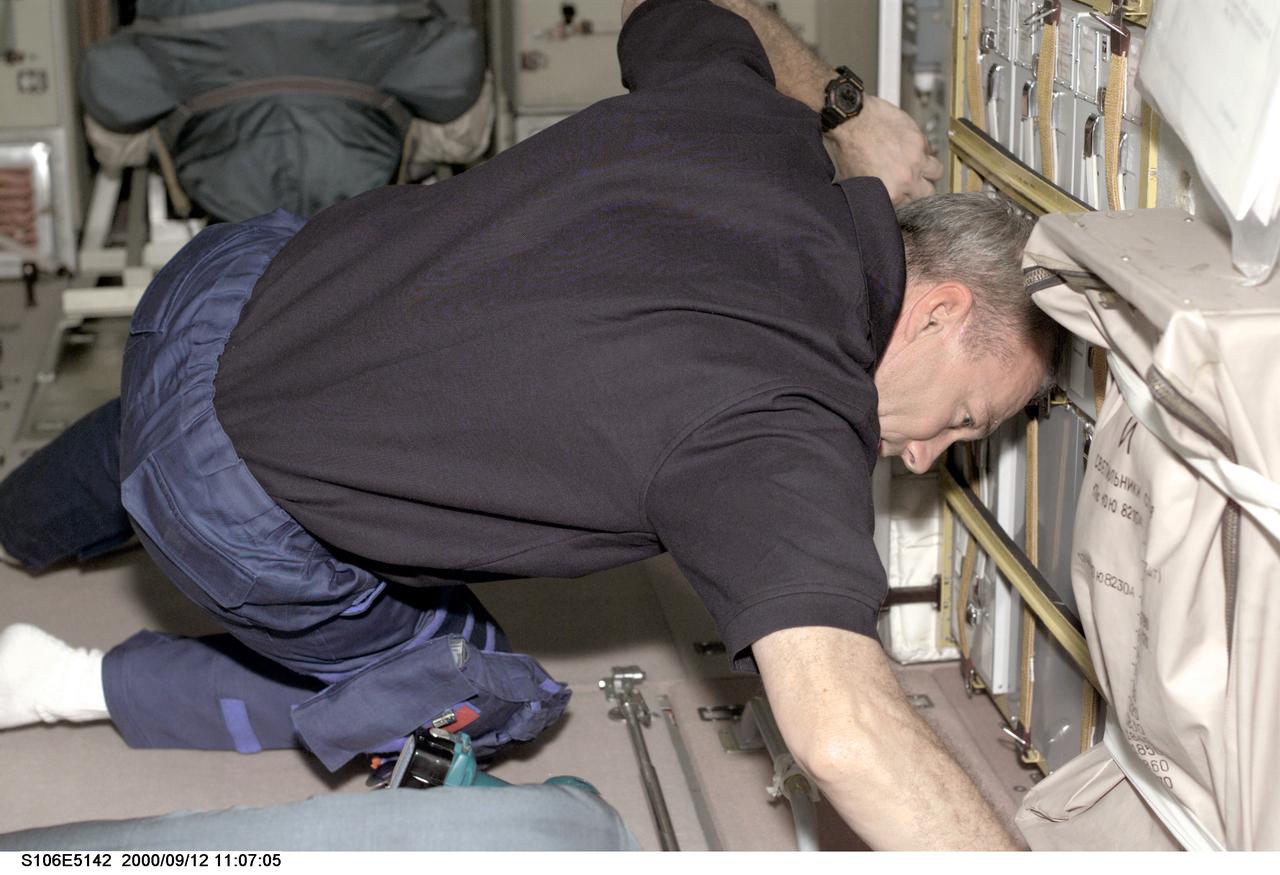
STS106-E-5142 (12 September 2000) --- Astronaut Terrence W. Wilcutt, mission commander, works to prepare the interior of the Zvezda service module on the International Space Station (ISS) for astronauts and cosmonauts who will soon start to live there.
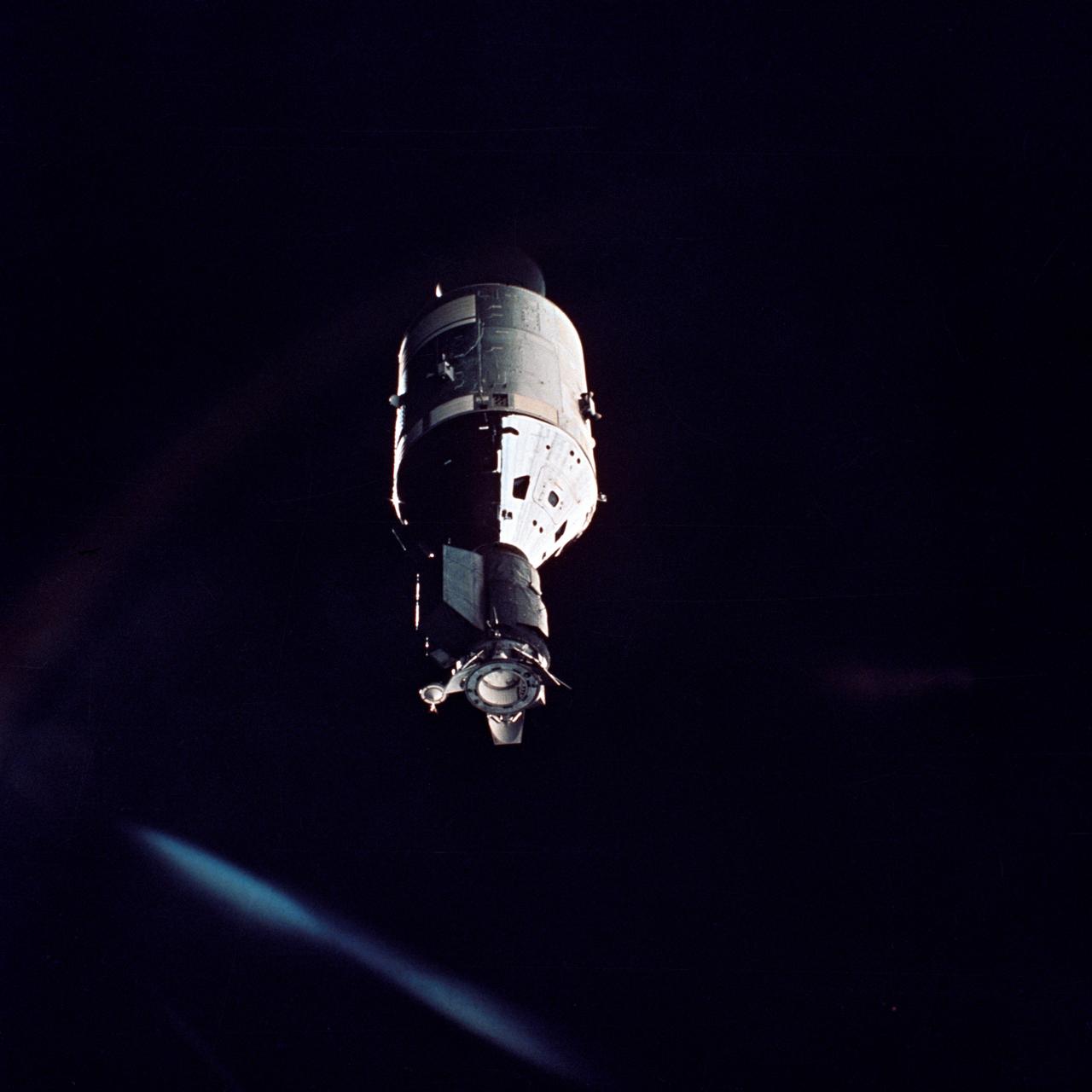
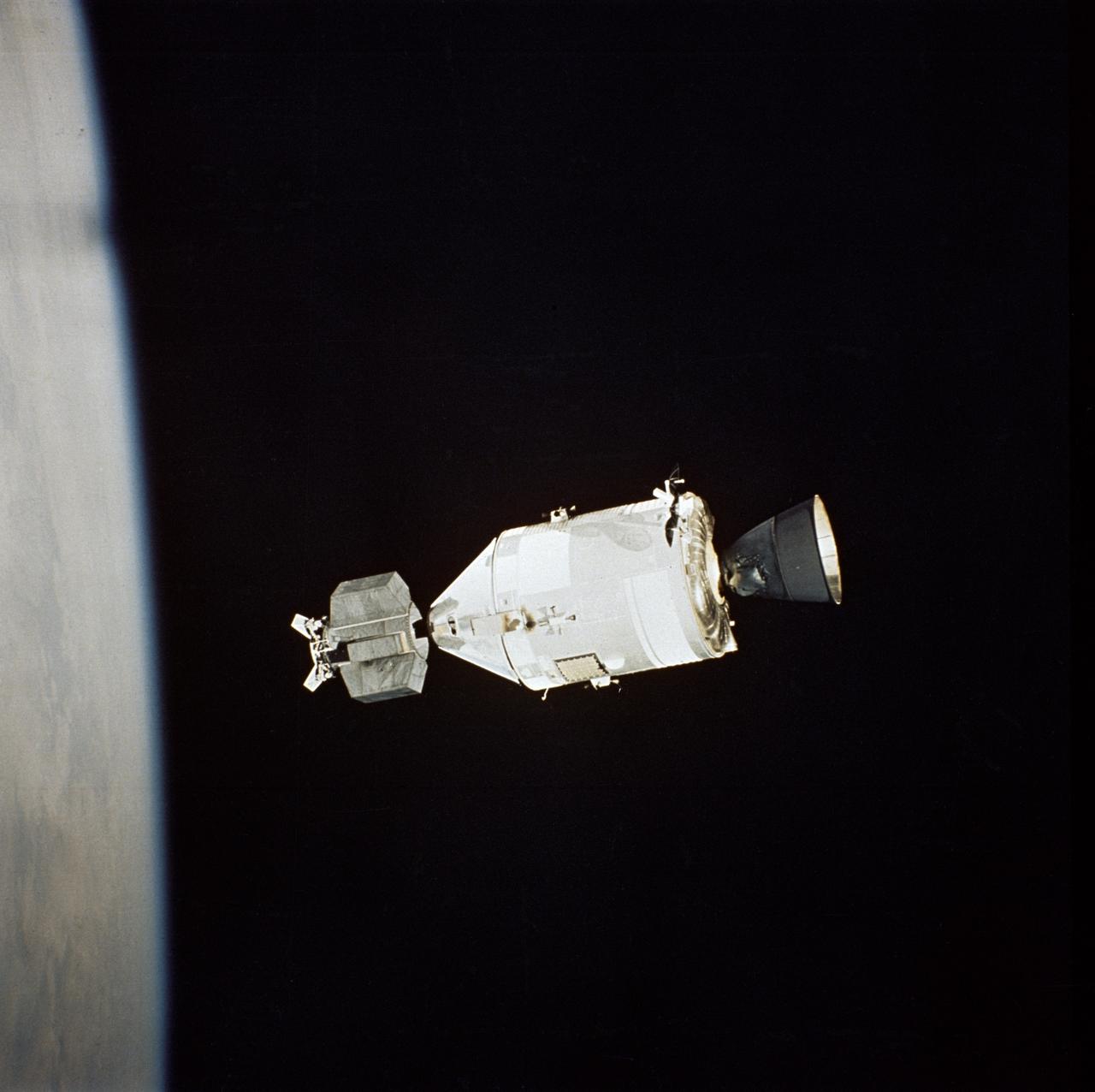
AST-32-2686 (17-19 July 1975) --- The American Apollo spacecraft as seen in Earth orbit from the Soviet Soyuz 19 spacecraft during the joint U.S.-USSR Apollo Soyuz Test Project (ASTP) mission. The Command and Service Module (CSM) and Docking Module (DM) are contrasted against a black-sky background. Light reflected in the camera streaks the image. Note the docking mechanism and docking target on the DM. On the left the bell-shaped engine nozzle of the service propulsion system protrudes from the rear of the Service Module (SM). The American and Soviet spacecraft were joined together in space for approximately 47 hours on July 17, 18, 19, 1975. This picture was furnished by the USSR in an exchange of photography taken during the ASTP flight. The Apollo crew consisted of astronauts Thomas P. Stafford, commander; Donald K. "Deke" Slayton, docking module pilot; and Vance D. Brand, command module pilot. The Soyuz 19 crew consisted of cosmonauts Aleksei A. Leonov, command pilot; and Valeri N. Kubasov, flight engineer.
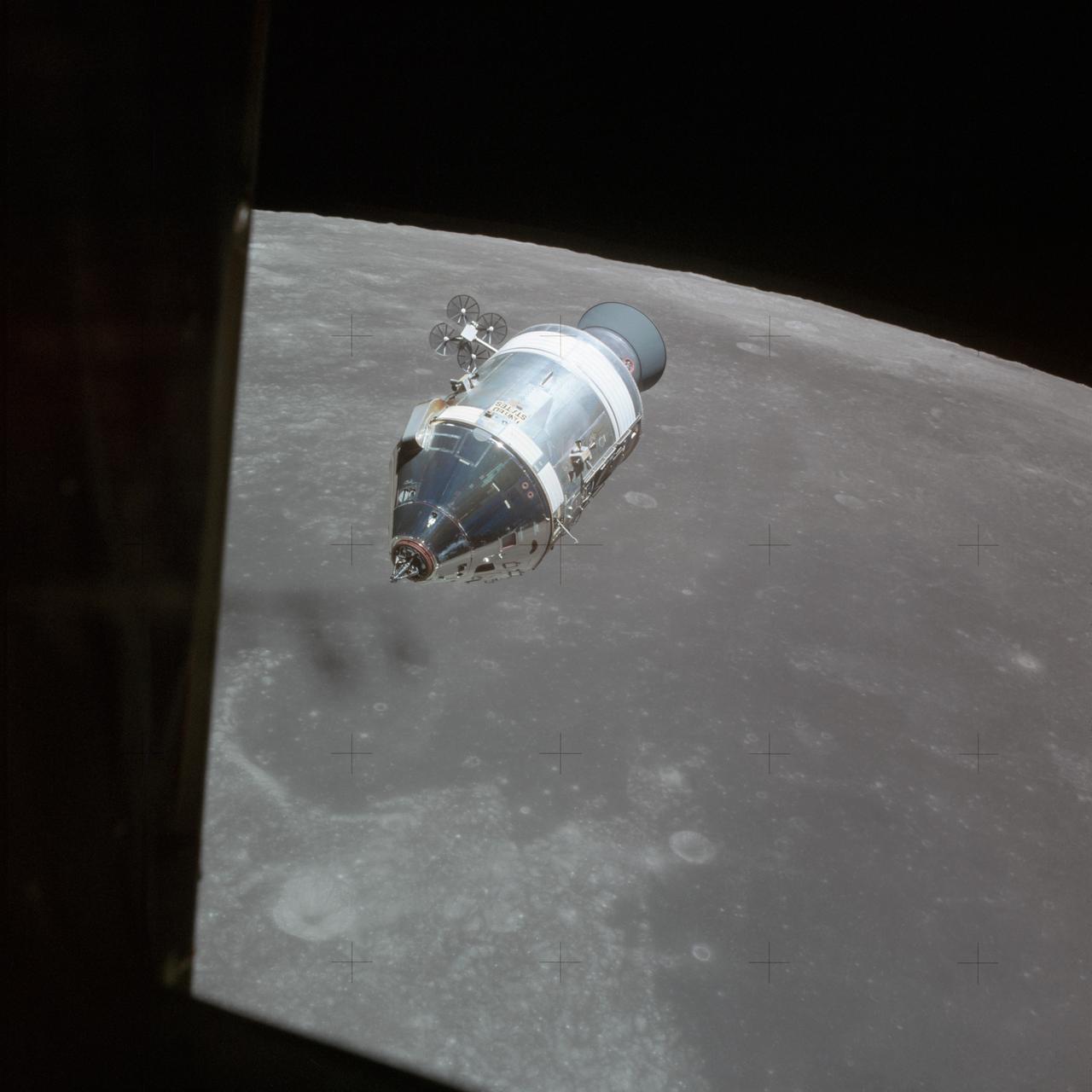
AS15-88-11961 (2 Aug. 1971) --- A view of the Apollo 15 Command and Service Modules (CSM) in lunar orbit as photographed from the Lunar Module (LM) just after rendezvous. The lunar area below is the northeastern side of the Sea of Fertility. While astronauts David R. Scott, commander, and James B. Irwin, lunar module pilot, descended in the LM to explore the Hadley-Apennine area of the moon, astronaut Alfred M. Worden, command module pilot, remained with the CSM in lunar orbit.
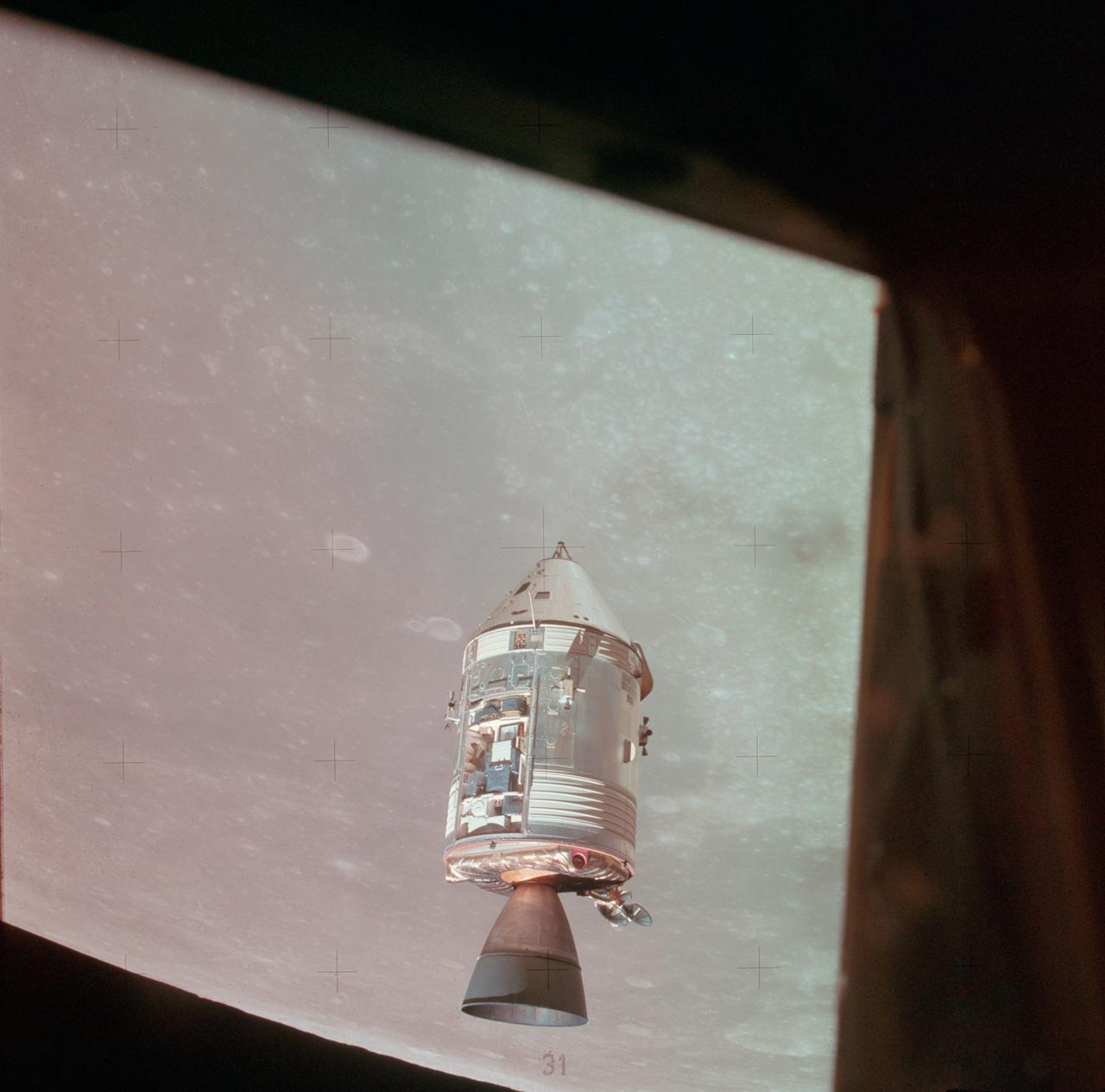
AS15-88-11968 (2 Aug. 1971) --- A view of the Apollo 15 Command and Service Modules (CSM) in lunar orbit as photographed from the Lunar Module (LM) "Falcon" just after rendezvous. The lunar features below are located on the east side of the Sea of Tranquility. While astronauts David R. Scott, commander; and James B. Irwin, lunar module pilot, descended in the LM to explore the moon, astronaut Alfred M. Worden, command module pilot, remained with the CSM in lunar orbit.
AST-32-2695 (17-19 July 1975) --- The American Apollo spacecraft as seen in Earth orbit from the Soviet Soyuz spacecraft during the joint U.S.-USSR Apollo-Soyuz Test Project mission. The Command/Service Module and Docking Module are contrasted against a black-sky background. The horizon of Earth is below. This picture was furnished by the USSR in an exchange of photography taken during the ASTP flight. The bell-shaped engine nozzle of the service propulsion system protrudes from the rear of the Service Module. Note the docking mechanism on the Docking Module. The American and Soviet spacecraft were joined together in space for approximately 47 hours on July 17-18-19, 1975. PHOTO COURTESY: USSR ACADEMY OF SCIENCES
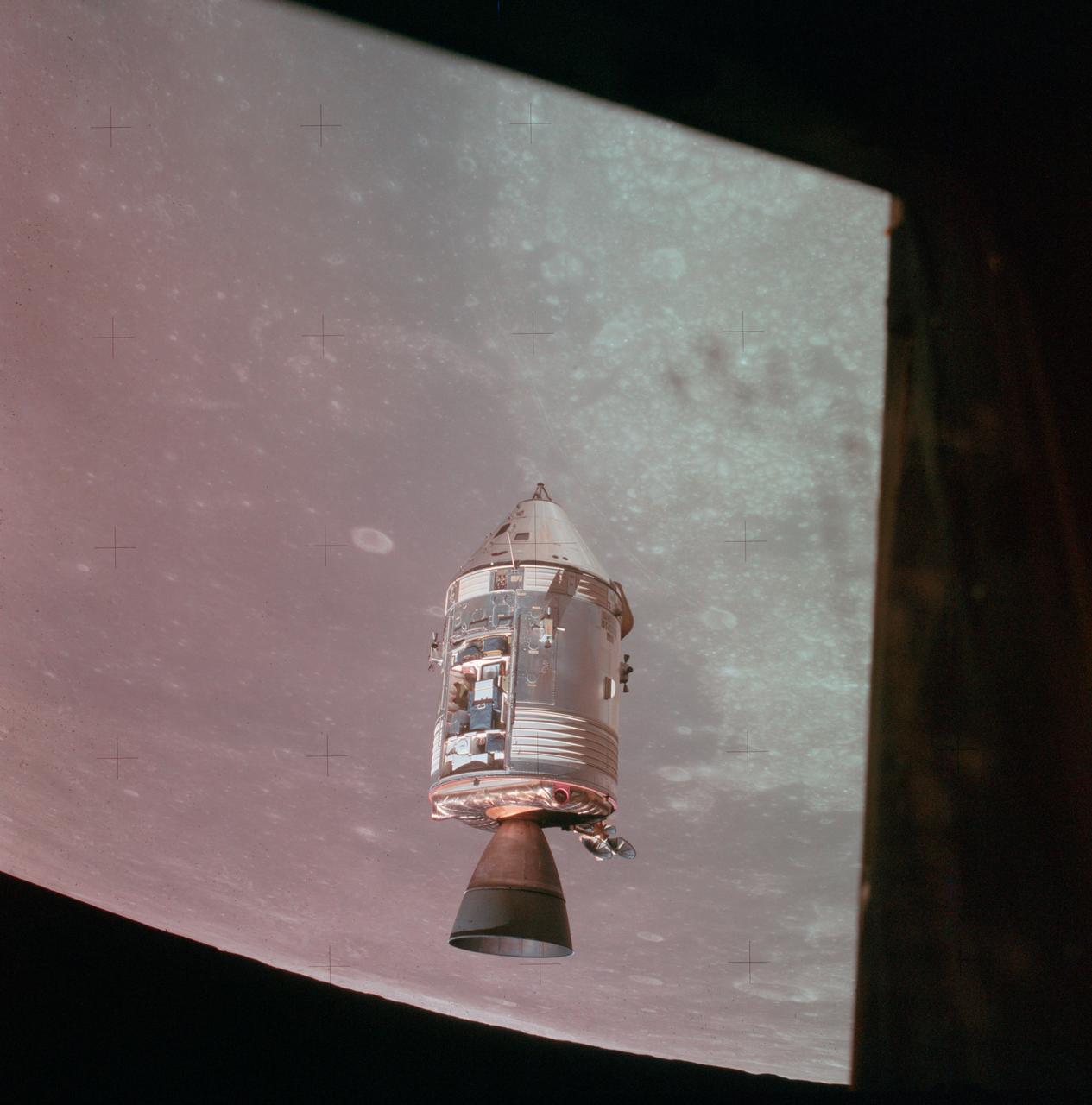
AS15-88-11969 (30 July 1971) --- A view of the Apollo 15 Command and Service Modules (CSM) in lunar orbit as photographed from the Lunar Module (LM) just after rendezvous. The lunar nearside is in the background. This view is looking southeast into the Sea of Fertility. The crater Taruntius is at the right center edge of the picture.
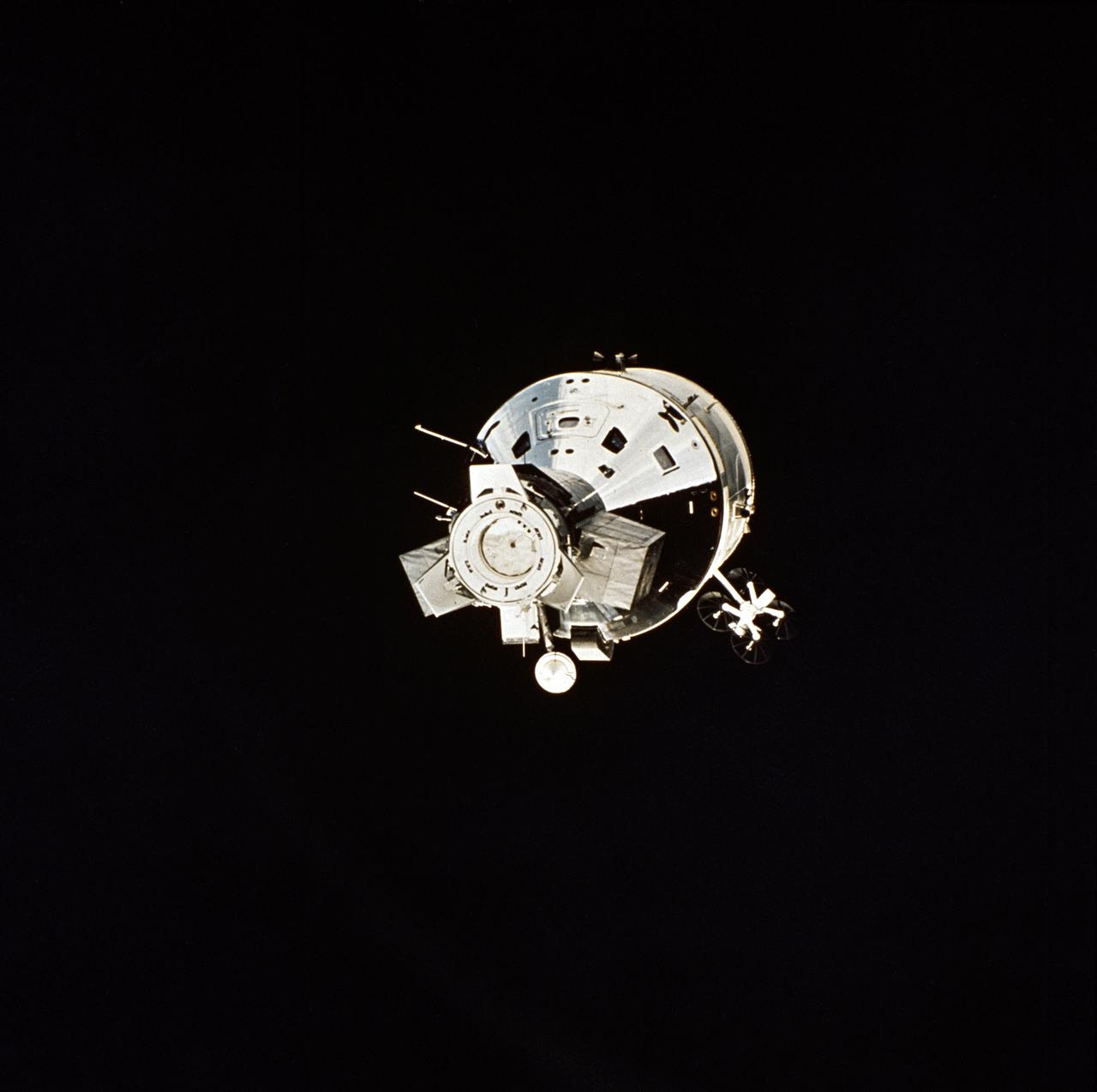
AST-32-2691 (17-19 July 1975) --- The American Apollo spacecraft as seen in Earth orbit from the Soviet Soyuz spacecraft during the joint U.S.-USSR Apollo-Soyuz Test Project mission. The Command/Service Module and Docking Module are contrasted against a black-sky background. This is a near "head on" view of the Apollo. This picture was furnished by the USSR in an exchange of photography taken during the ASTP flight. Note the docking mechanism and docking target on the Docking Module. The four dish-like reflectors of the unified S-band high-gain antenna protrude from the side of the Service Module. The American and Soviet spacecraft were joined together in space for approximately 47 hours on July 17-18-19, 1975. PHOTO COURTESY: USSR ACADEMY OF SCIENCES
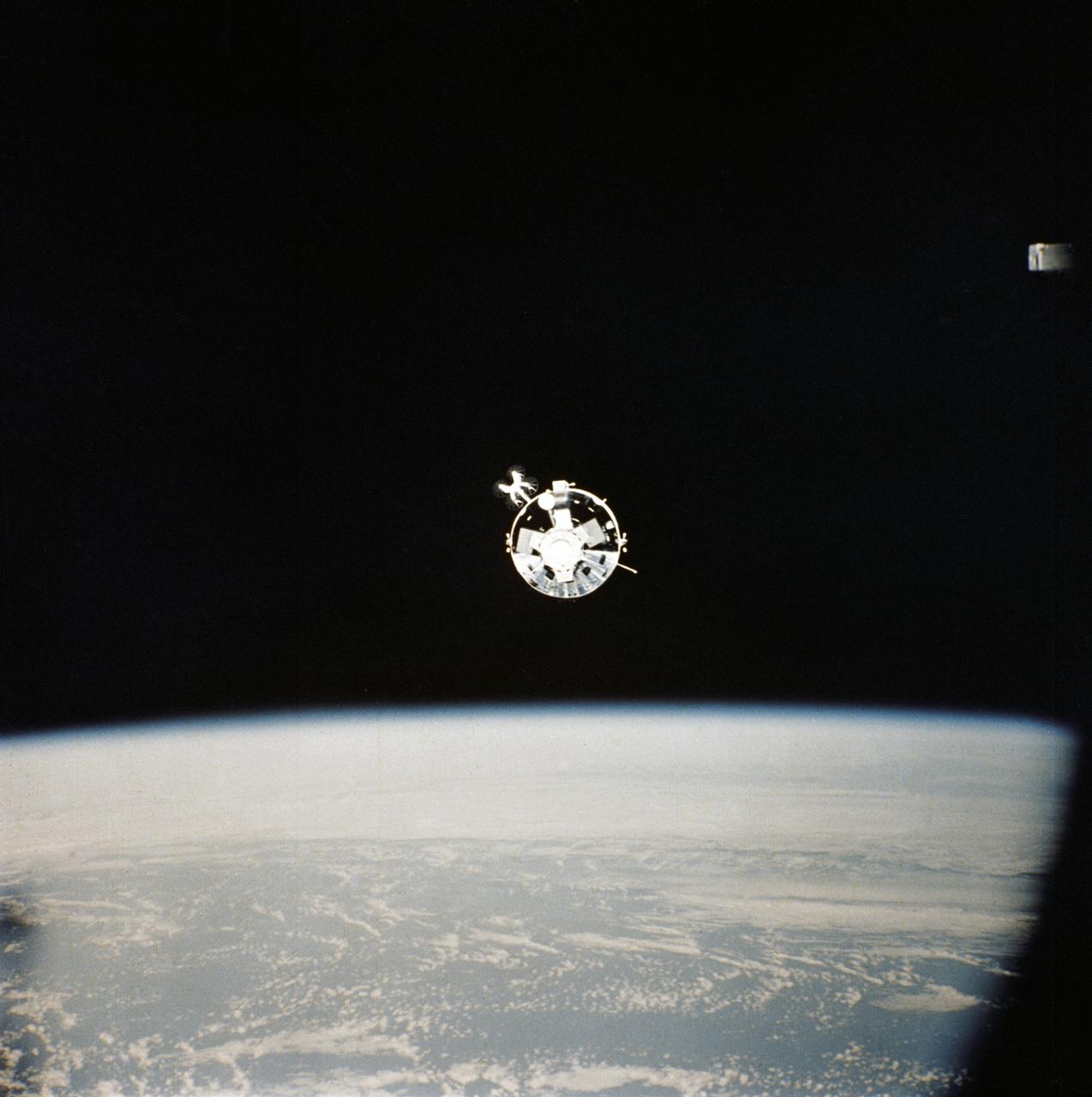
AST-32-2675 (17-19 July 1975) --- The American Apollo spacecraft as seen in Earth orbit from the Soviet Soyuz spacecraft during the joint U.S.-USSR Apollo-Soyuz Test Project mission. The Command/Service Module and Docking Module are contrasted against a black-sky background. This is a "head on" view of the Apollo. The horizon of Earth is below. This picture was furnished by the USSR in an exchange of photography taken during the ASTP flight. The American and Soviet spacecraft were joined together in space for approximately 47 hours on July 17-18-19, 1975. Note the docking mechanism on the Docking Module. PHOTO COURTESY: USSR ACADEMY OF SCIENCES
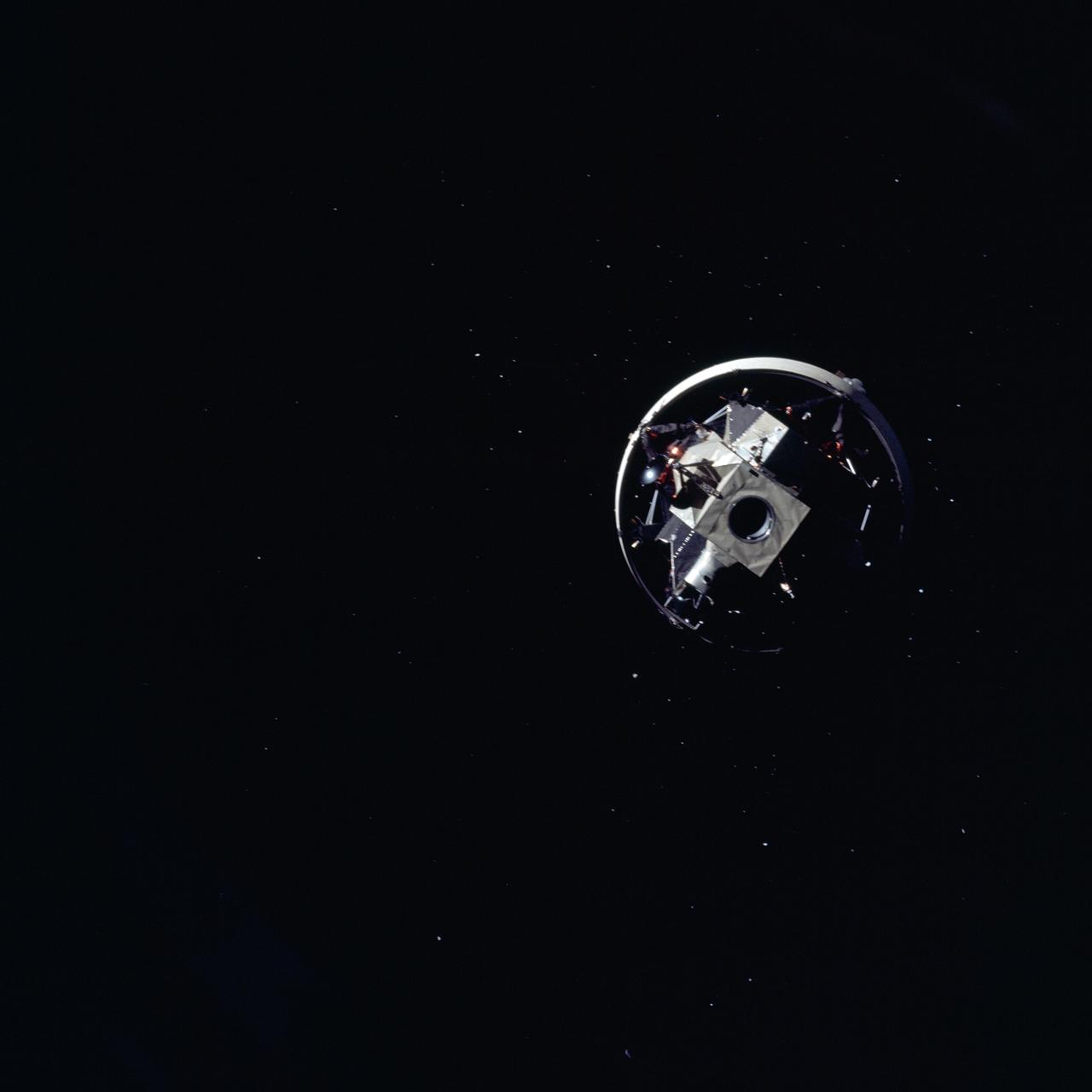
AS12-50-7328 (14 Nov. 1969) --- Apollo 12 Lunar Module (LM), still attached to the Saturn V third (S-IVB) stage, is pictured as seen from Apollo 12 Command and Service Modules (CSM) on the first day of the Apollo 12 lunar landing mission. This photograph was taken following CSM separation from LM/S-IVB and prior to Lunar Module extraction from the S-IVB stage. The Spacecraft Lunar Module Adapter (SLA) panels have already been jettisoned.
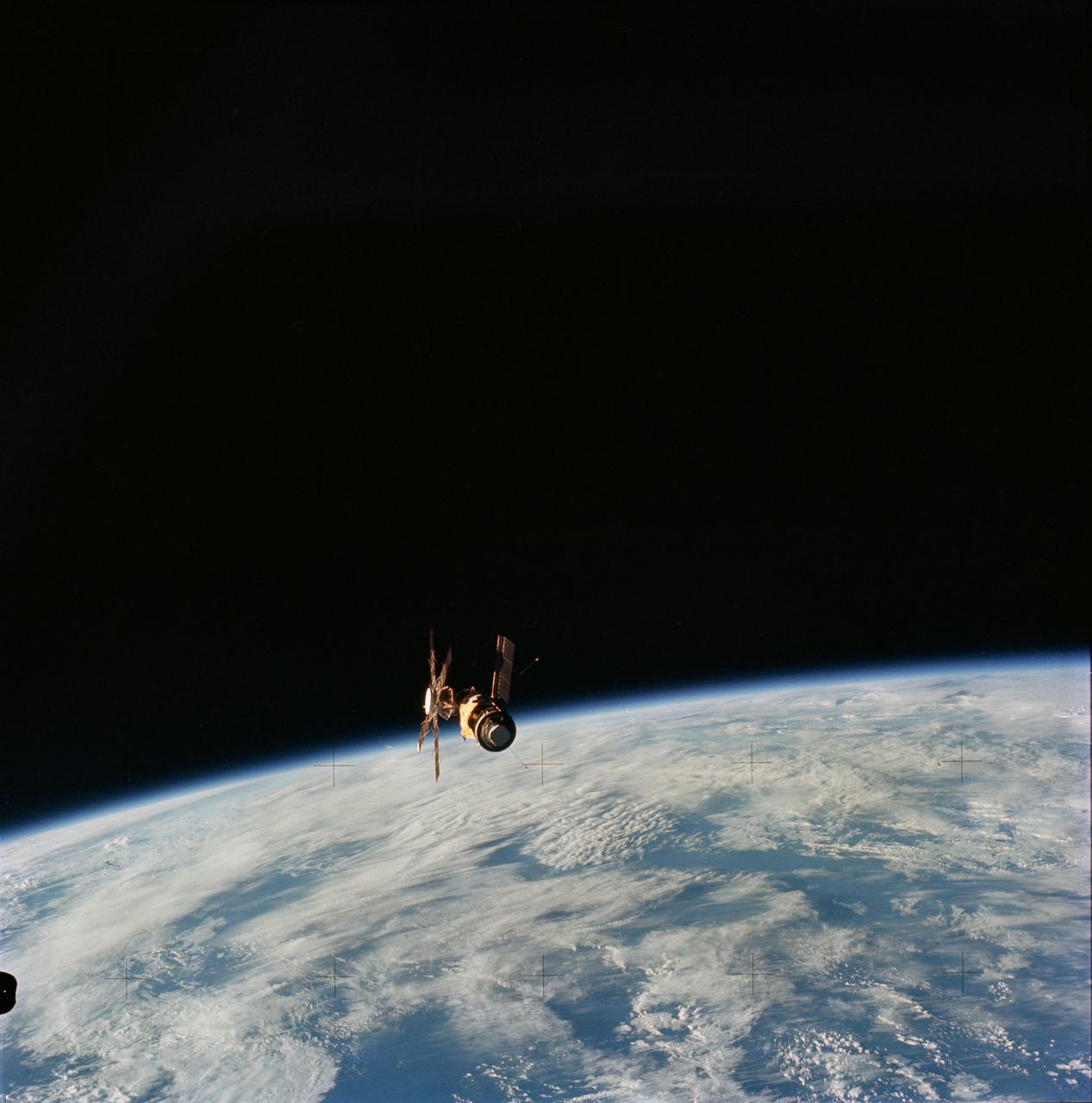
SL2-07-667 (22 June 1973) --- This overhead view of the Skylab Space Station was taken from the Departing Skylab Command/Service Module during the Skylab 2's final fly-around inspection. The single solar panel is quite evident as well as the parasol solar shield, rigged to replace the missing micrometeoroid shield. Both the second solar panel and the micrometeoroid shield were torn away during a mishap in the original Skylab 1 liftoff and orbital insertion. Photo credit: NASA
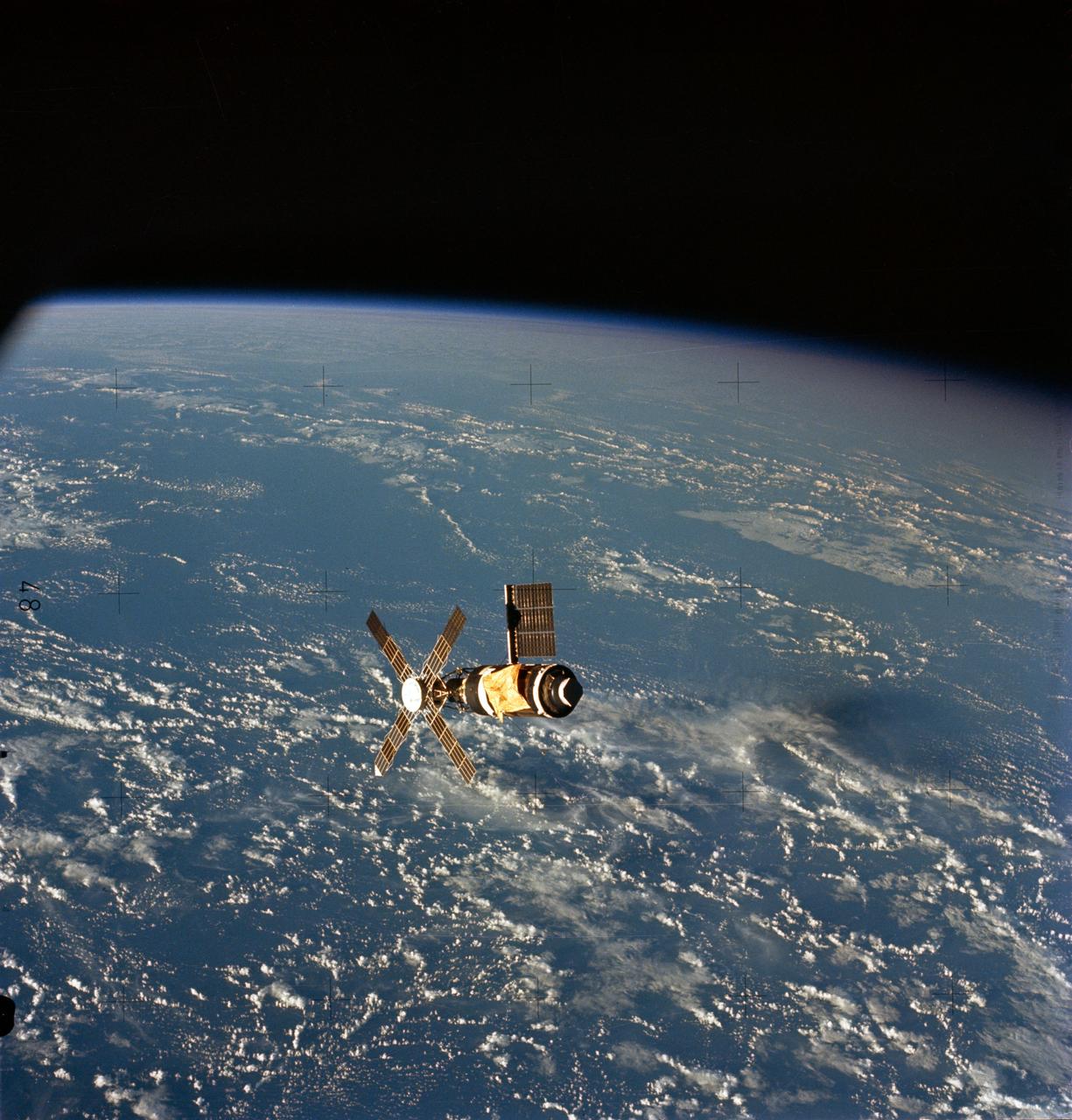
SL2-07-651 (22 June 1973) --- This overhead view of the Skylab Space Station was taken from the Departing Skylab Command/Service Module during the Skylab 2's final fly-around inspection. The single solar panel is quite evident as well as the parasol solar shield, rigged to replace the missing micrometeoroid shield. Both the second solar panel and the micrometeoroid shield were torn away during a mishap in the original Skylab 1 liftoff and orbital insertion. Photo credit: NASA
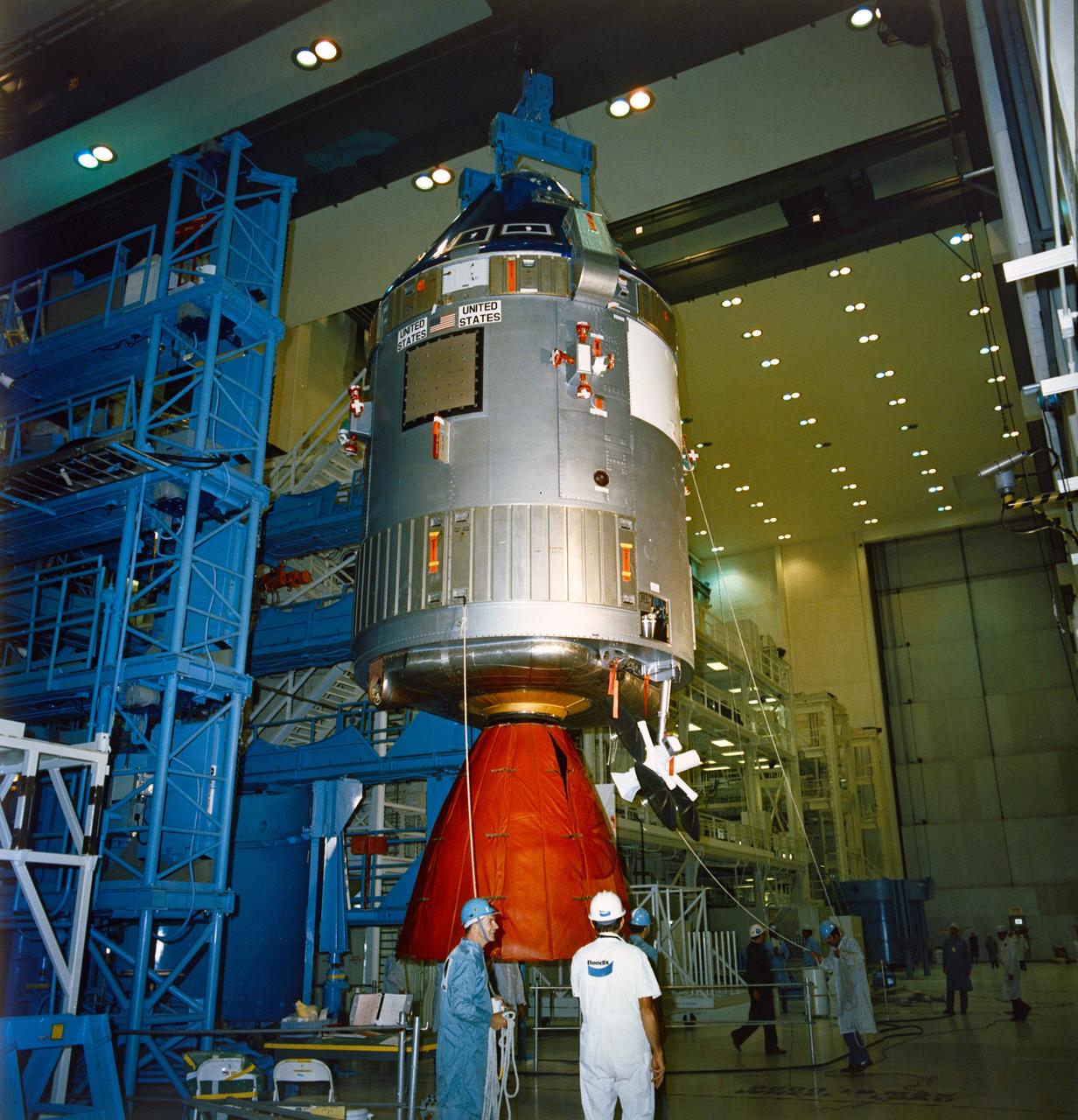
S75-26904 (27 Jan. 1975) --- The flight article Apollo spacecraft (Command Module-111 and Service Module-111) for the Apollo-Soyuz Test Project mission goes through prelaunch checkout procedures in the high bay area of the Manned Spacecraft Operations Building at NASA's Kennedy Space Center. Later, Spacecraft-111 was mated to the spacecraft launch vehicle adapter (SLA-18) in the MSOB before being moved to the Vehicle Assembly Building where it was mated to the Saturn 1B launch vehicle. The joint U.S.-USSR ASTP docking mission in Earth orbit is scheduled for July 1975.
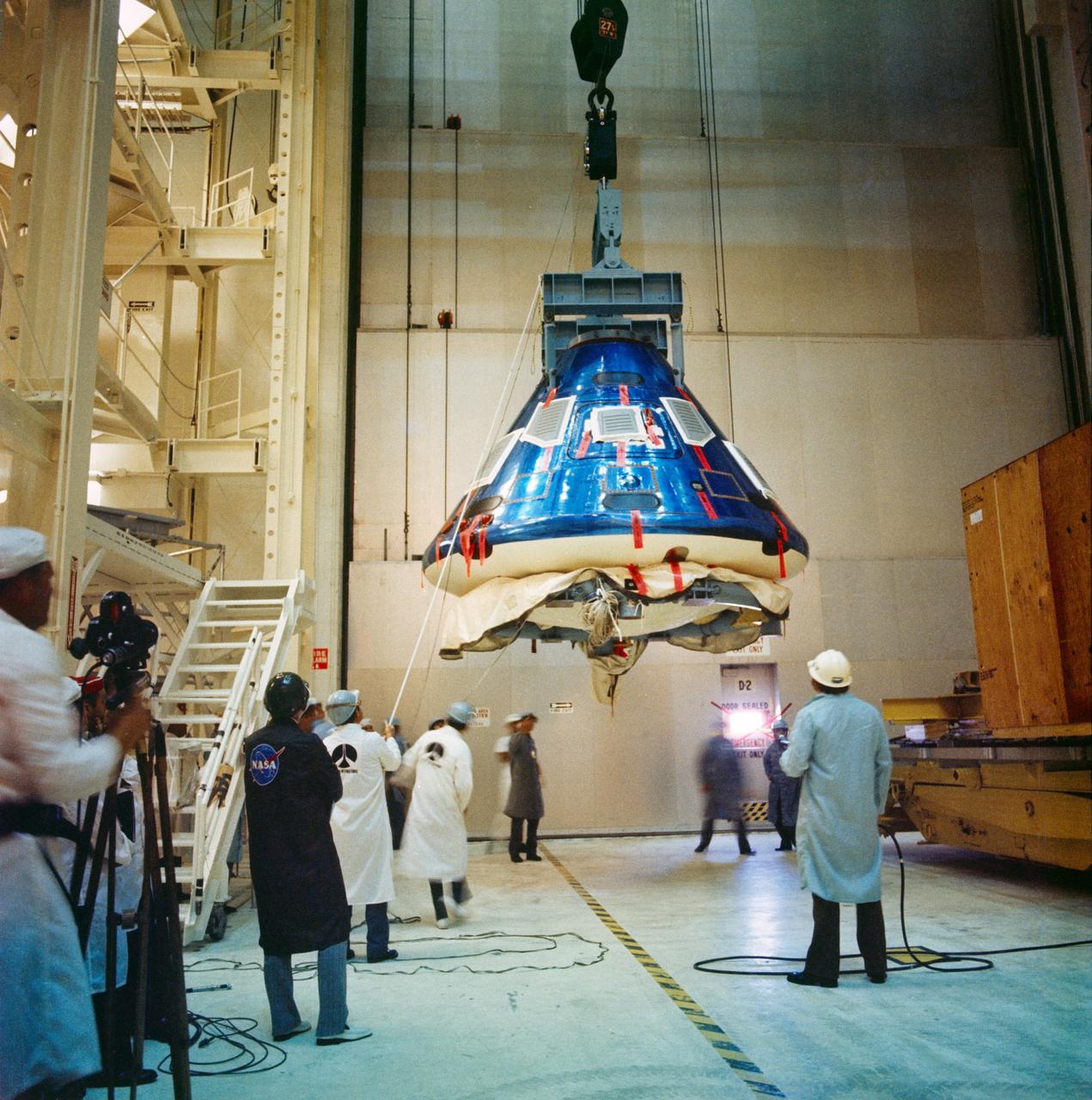
S74-32049 (8 Sept. 1974) --- The Apollo Command Module for the Apollo-Soyuz Test Project mission goes through receiving, inspection and checkout procedures in the Manned Spacecraft Operations Building at the Kennedy Space Center. The spacecraft had just arrived by air from the Rockwell International plant at Downey, California. The Apollo spacecraft (Command Module, Service Module and Docking Module), with astronauts Thomas P. Stafford, Vance D. Brand and Donald K. Slayton aboard, will dock in Earth orbit with a Soviet Soyuz spacecraft during the joint U.S.-USSR ASTP flight scheduled for July 1975. The Soviet and American crews will visit one another?s spacecraft.
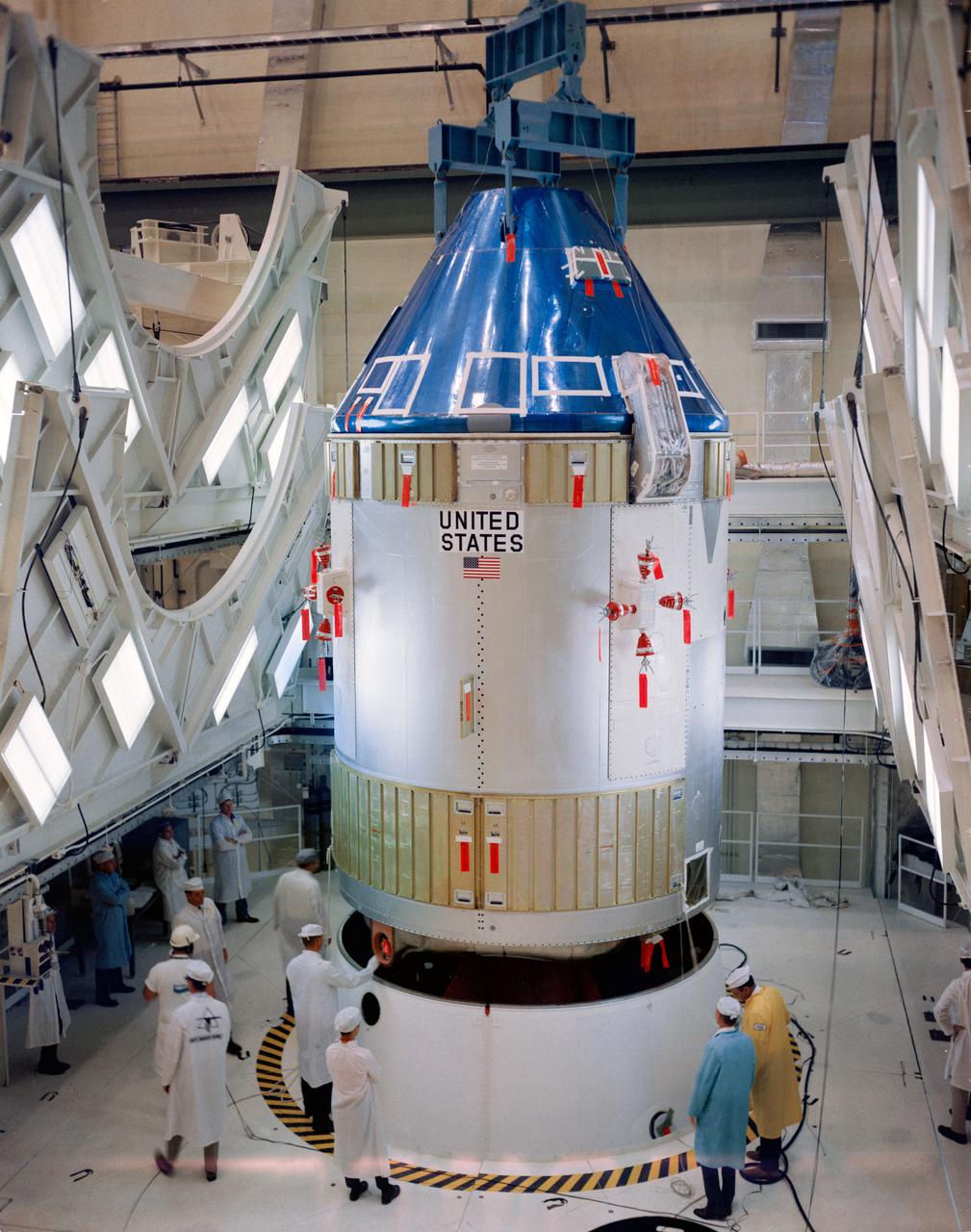
S68-42513 (5 Aug. 1968) --- Apollo Spacecraft 101 Command/Service Modules being moved into position for mating with Spacecraft Lunar Module Adapter (SLA)-5 in the Kennedy Space Center's Manned Spacecraft Operations Building. Apollo Spacecraft 101 will be flown on the first manned Apollo space mission, Apollo 7 (Spacecraft 101/Saturn 205).
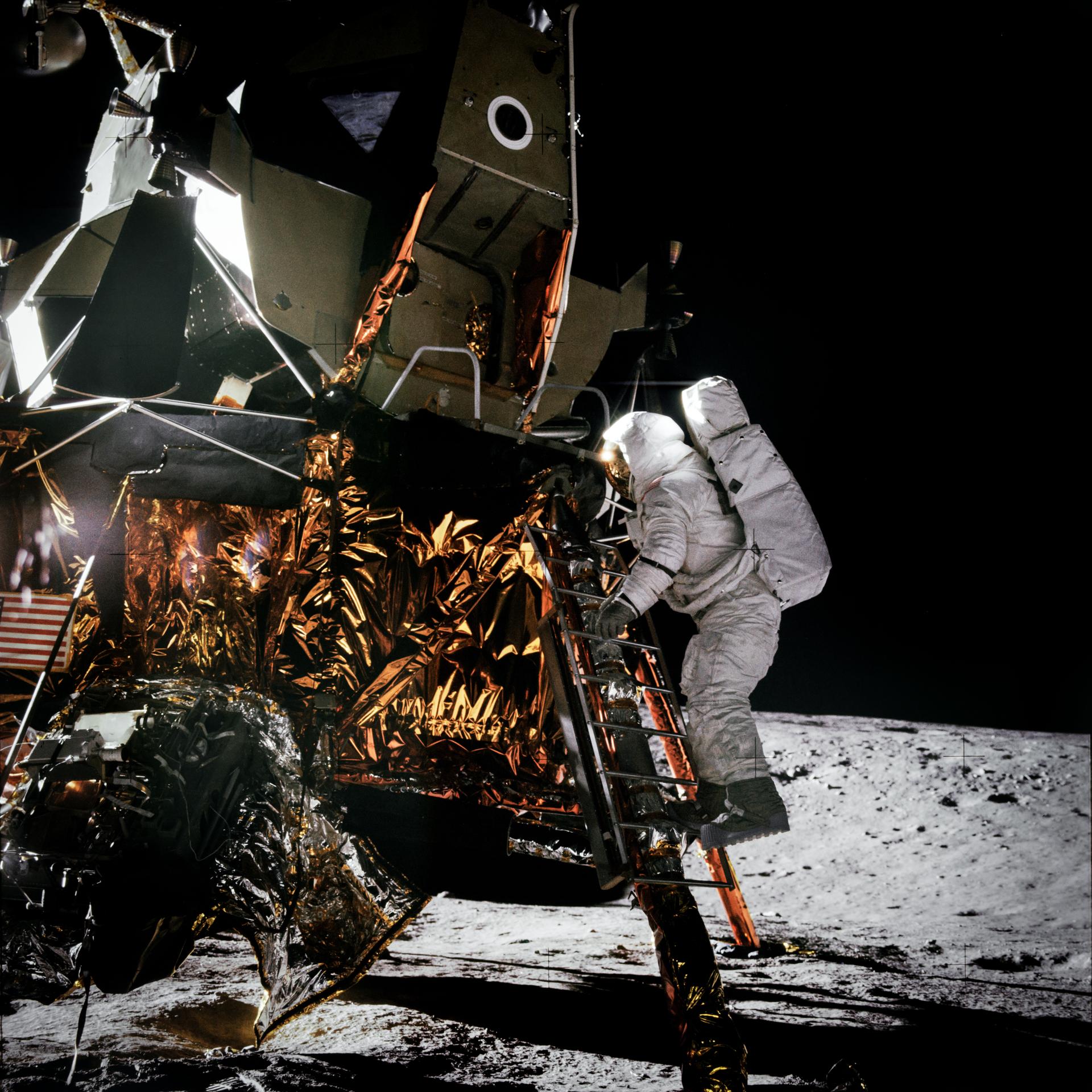
AS12-46-6728 (19 Nov. 1969) --- Astronaut Alan L. Bean, lunar module pilot for the Apollo 12 mission, is about to step off the ladder of the Lunar Module to join astronaut Charles Conrad Jr., mission commander, in extravehicular activity (EVA). Conrad and Bean descended in the Apollo 12 LM to explore the moon while astronaut Richard F. Gordon Jr., command module pilot, remained with the Command and Service Modules in lunar orbit.
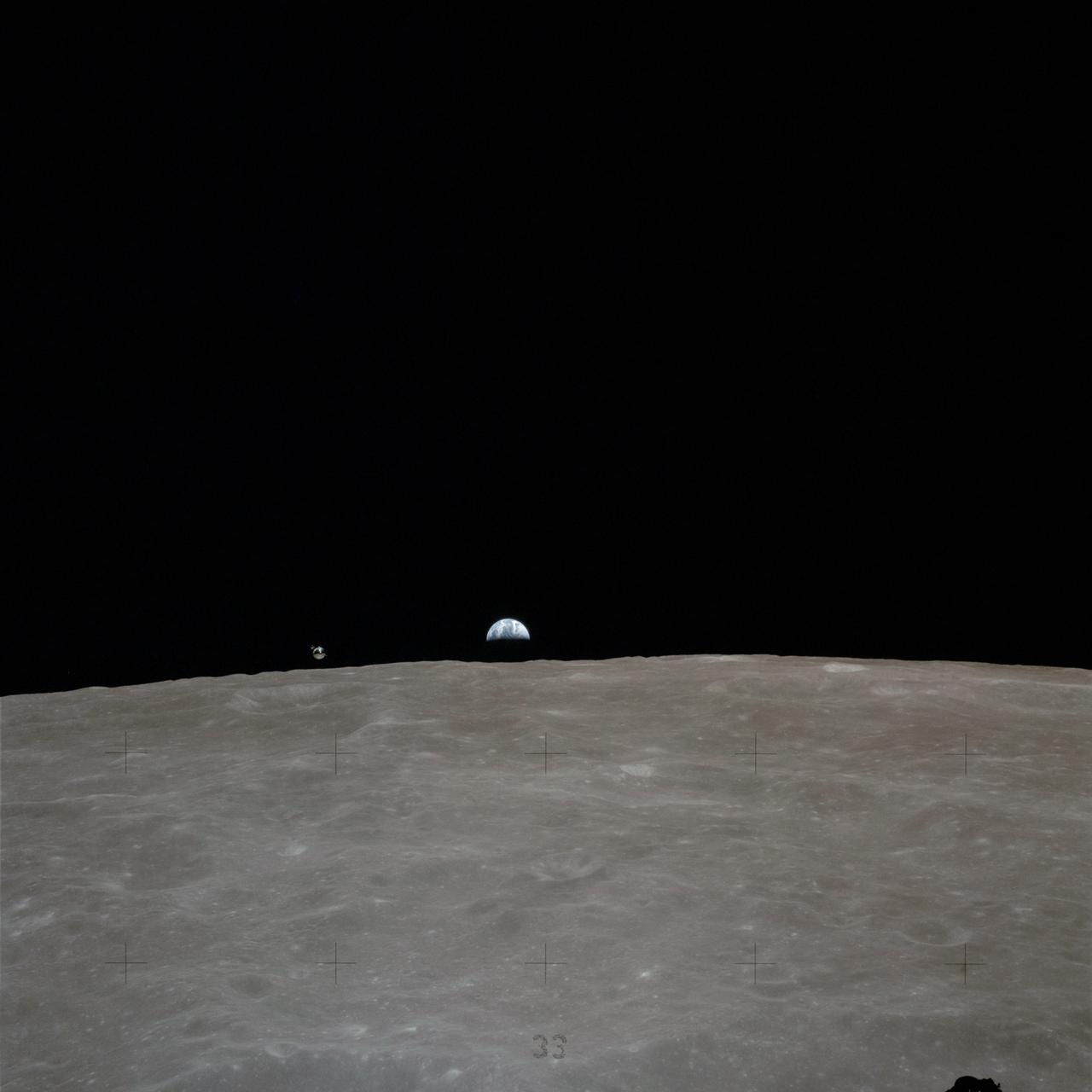
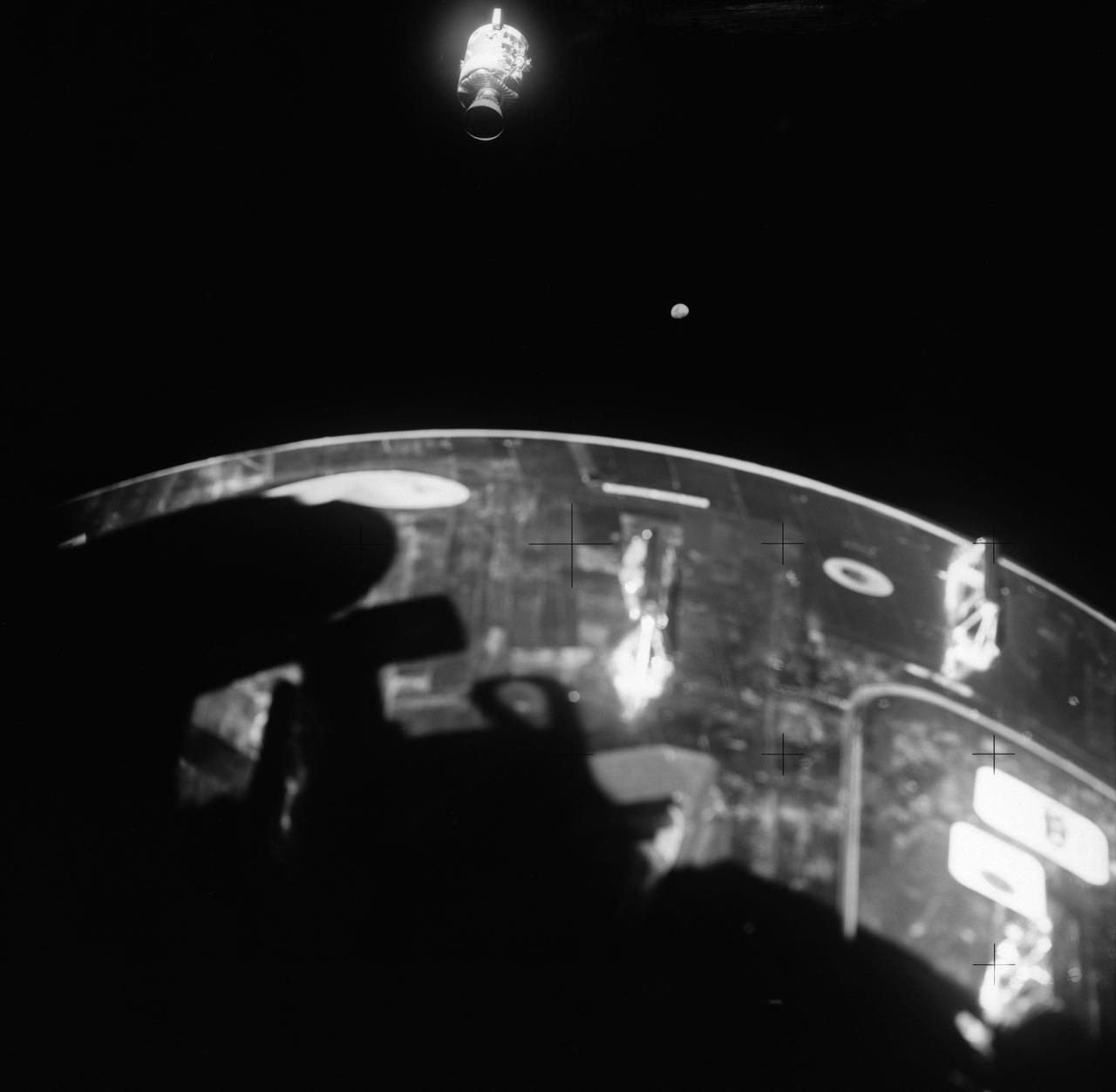
AS16-113-18289 (16-27 April 1972) --- Earth rises over the lunar horizon, with the Apollo 16 Command and Services Modules (CSM) to the left of Earth. This photograph was taken from the Lunar Module (LM) "Orion" before the two Apollo 16 spacecraft re-joined following the CSM's failure to make the circularization burn on April 20, 1972. Astronaut Thomas K. Mattingly II, command module pilot, was inside the CSM "Casper", while astronauts John W. Young, commander, and Charles M. Duke Jr., lunar module pilot, were manning the LM. While astronauts Young and Duke descended in the LM to explore the Descartes region of the moon, astronaut Mattingly remained with the CSM in lunar orbit. Photo credit: NASA
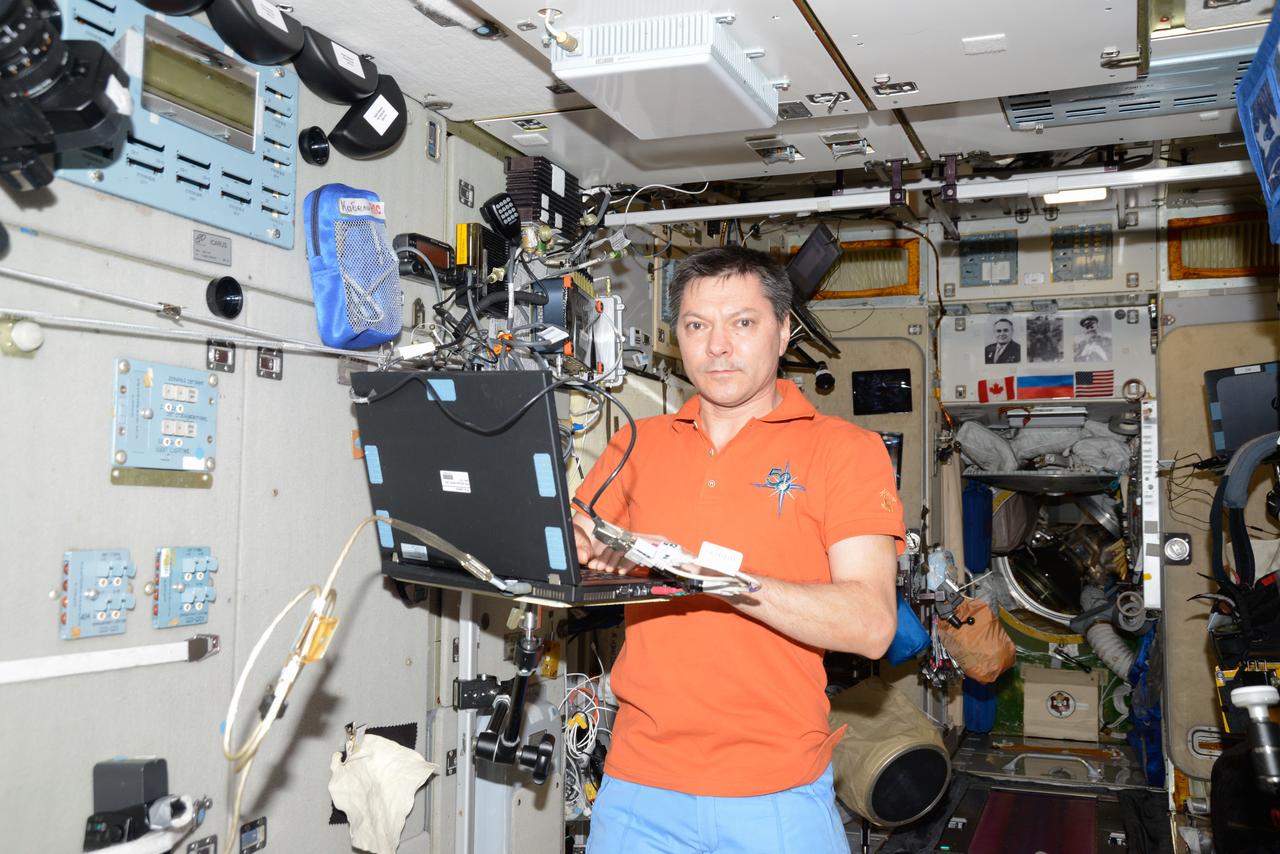
iss058e007788 (Jan. 30, 2019) --- Expedition 58 Commander Oleg Kononenko of Roscosmos is pictured in the Zvezda service module at the end of the work day wrapping up science operations on a laptop computer. Credit: Roscosmos
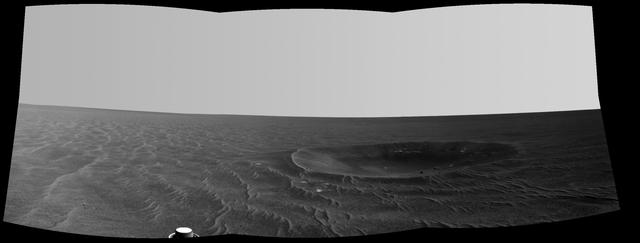
This mosaic is a view from NASA Mars Exploration Rover Opportunity of Yankee Clipper crater which carries the name of the command and service module of NASA 1969 Apollo 12 mission to the moon.
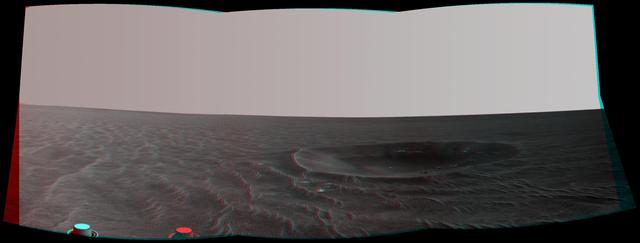
Yankee Clipper crater on Mars carries the name of the command and service module of NASA 1969 Apollo 12 mission to the moon. NASA Mars Exploration Rover Opportunity recorded this stereo view on Nov. 4, 2010. 3D glasses are necessary.
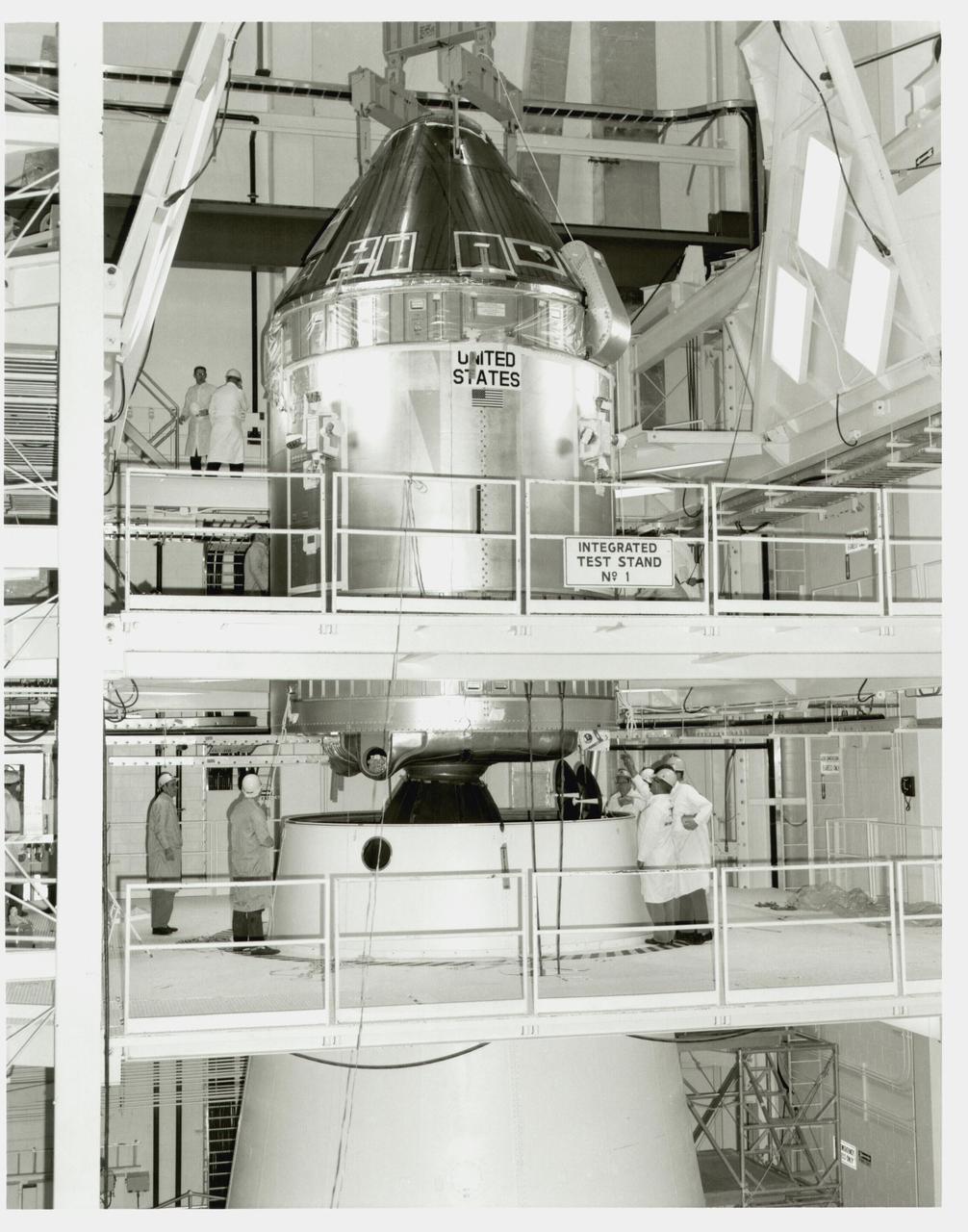
KENNEDY SPACE CENTER, FLA. - The Command and Service Module (CSM) for Apollo 11 move from 134 work stand and final mate to service-module-to-launch-module adapter (SLA).
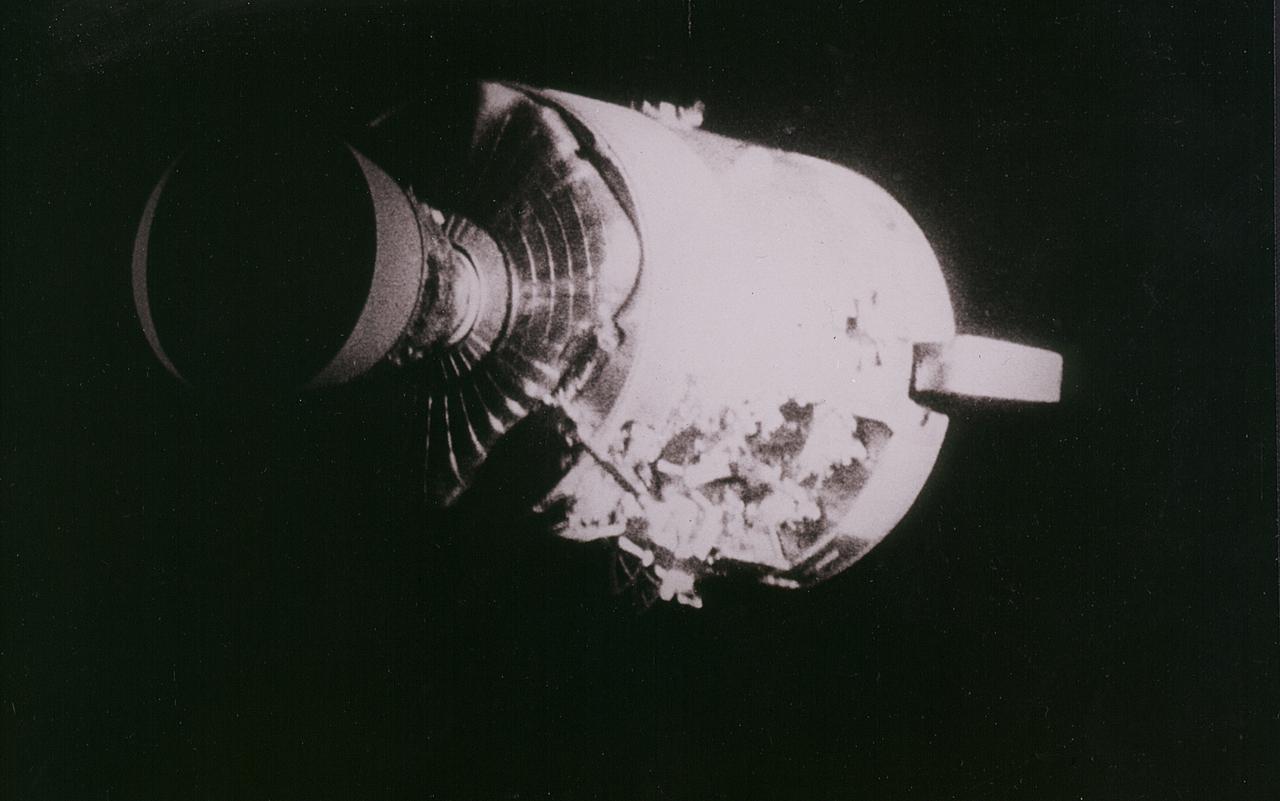
Apollo 13 onboard photo: This view of the severely damaged Apollo 13 Service Module was photographed from the Lunar Module/Command Module following the jettison of the Service Module. As seen here, an entire panel of the Service Module was blown away by the apparent explosion of oxygen tank number two located in Sector 4 of the Service Module. Two of the three fuel cells are visible just forward (above) the heavily damaged area. Three fuel cells, two oxygen tanks, and two hydrogen tanks, are located in Sector 4. The damaged area is located above the S-band high gain anterna. Nearest the camera is the Service Propulsion System (SPS) engine and nozzle. The damage to the Service Module caused the Apollo 13 crewmen to use the Lunar Module as a lifeboat. The Lunar Module was jettisoned by the Command Module just prior to Earth re-entry.
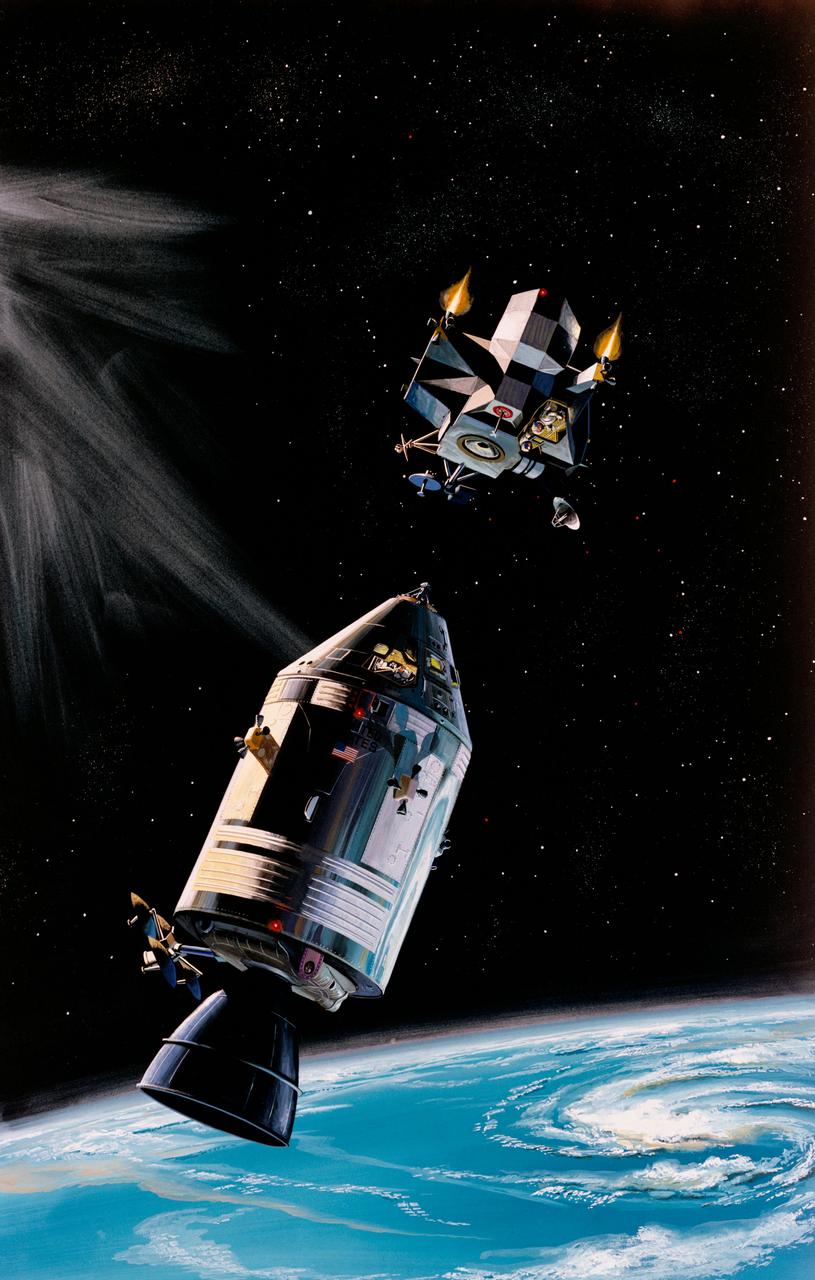
S69-18546 (February 1969) --- North American Rockwell artist's concept illustrating the docking of the Lunar Module ascent stage with the Command and Service Modules during the Apollo 9 mission. The two figures in the Lunar Module represent astronauts James A. McDivitt, Apollo 9 commander; and Russell L. Schweickart, lunar module pilot. The figure in the Command Module represents astronaut David R. Scott, command module pilot. The Apollo 9 mission will evaluate spacecraft lunar module systems performance during manned Earth-orbital flight.
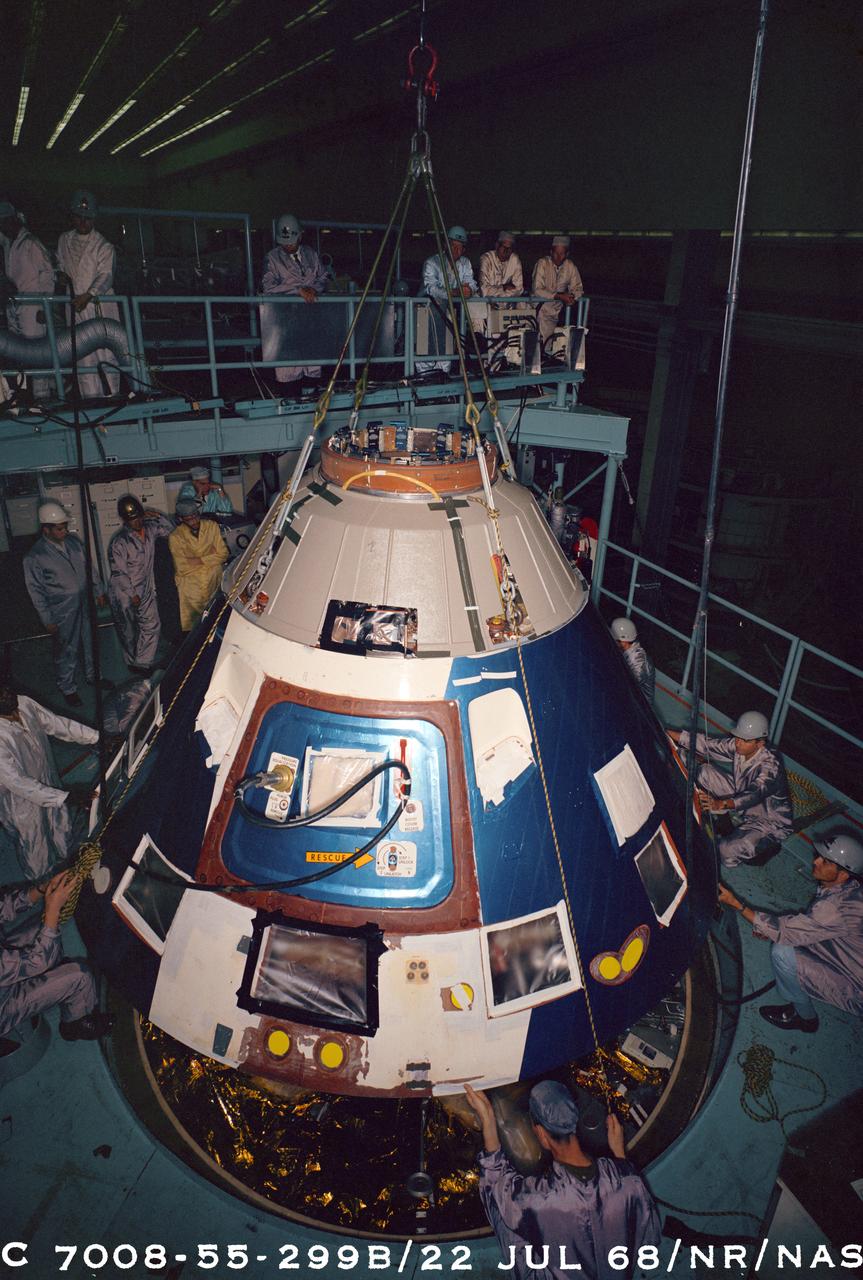
S68-42486 (22 July 1968) --- Wide-angle view of Apollo Command Module 103 during de-stacking from Service Module in Stand 2C.
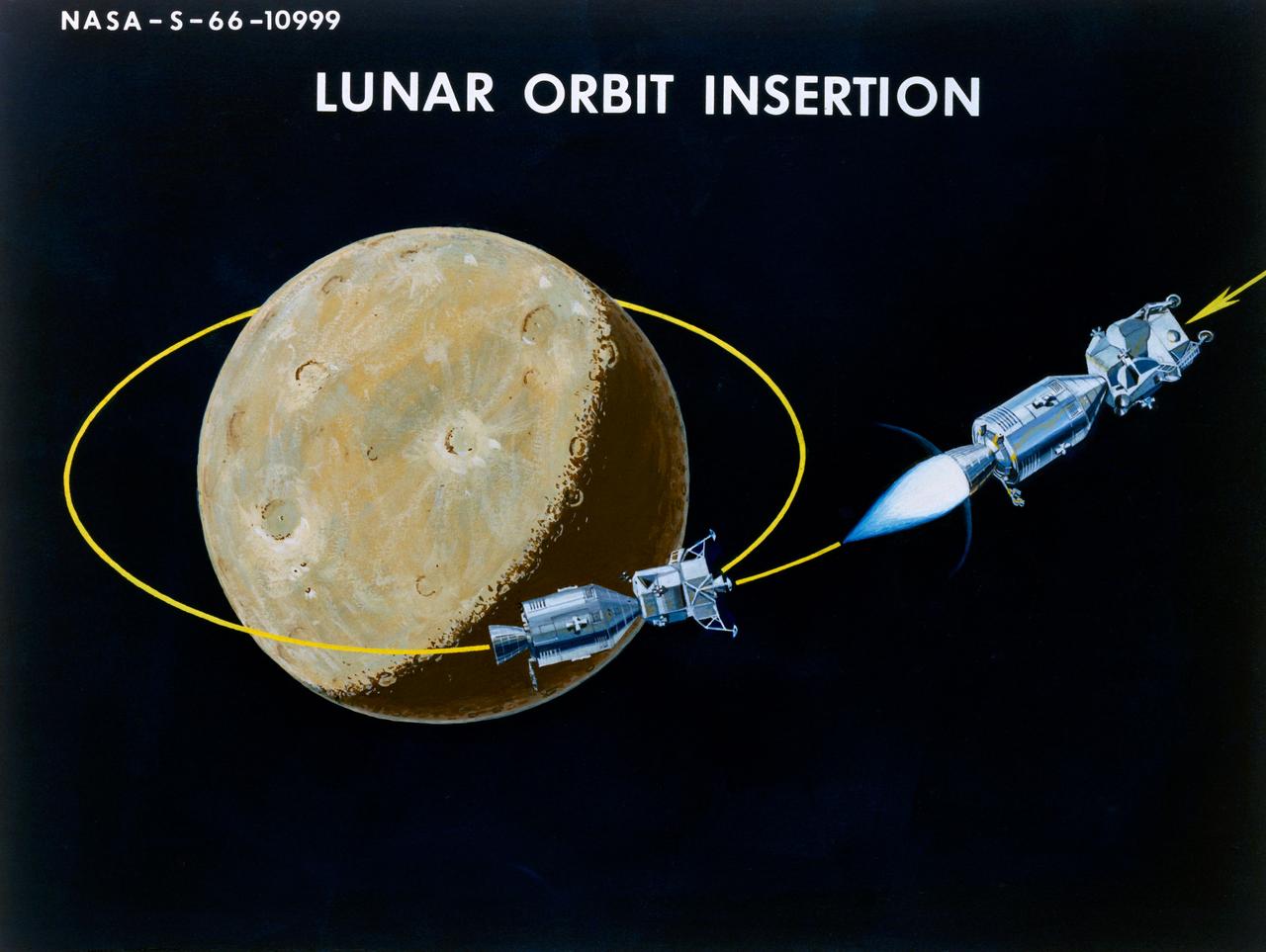
S66-10999 (1966) --- A 1966 artist's concept of an Apollo lunar module linked with the Command and Service Modules during lunar orbit insertion. Photo credit: NASA
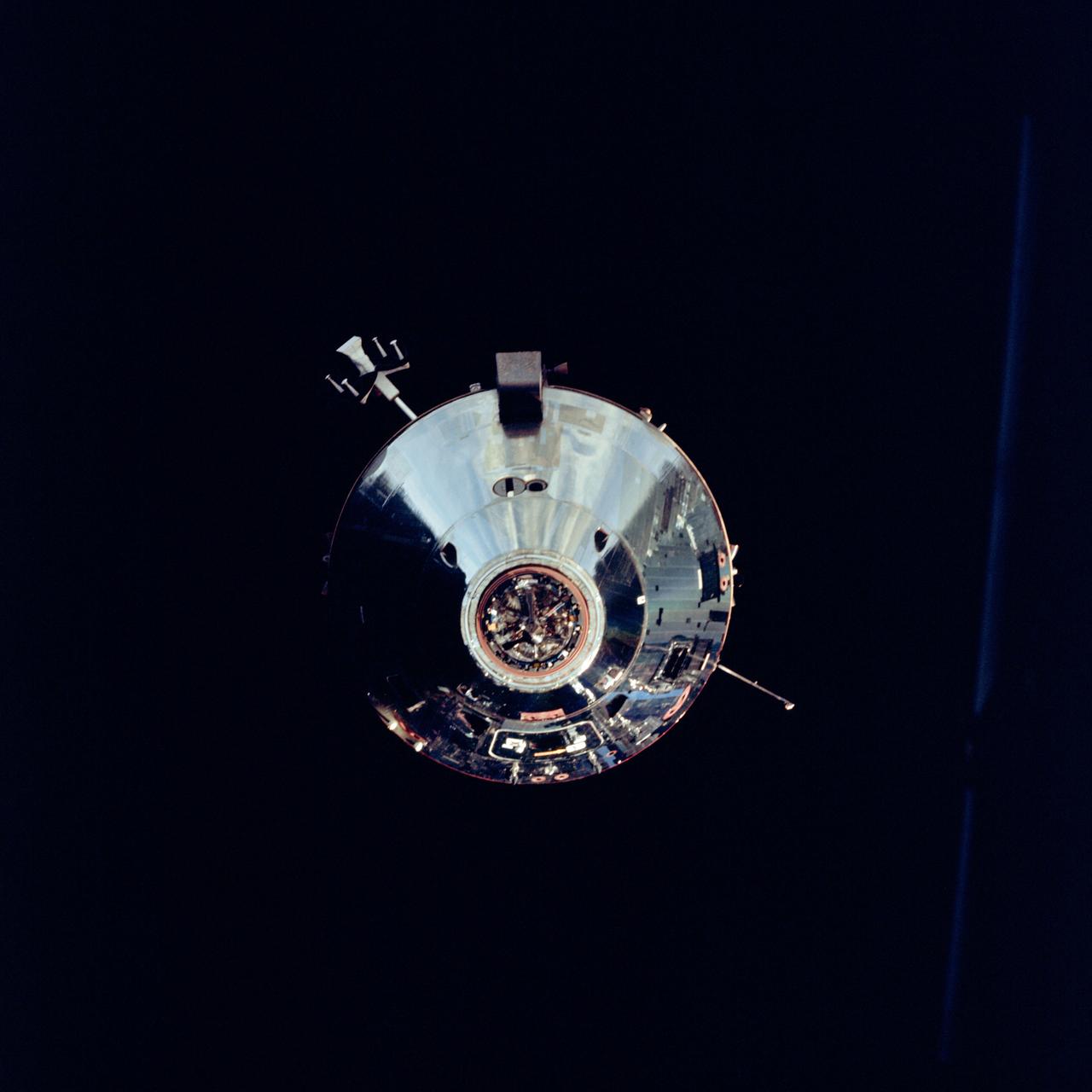
The Apollo 9 Command/Service Modules photographed from the Lunar Module,"Spider",on the fifth day of the Apollo 9 earth-orbital mission. Docking mechanism is visible in nose of the Command Module,"Gumdrop". Object jutting out from the Service Module aft bulkhead is the high-gain S-Band antenna. Film magazine was F, film type was SO-368 Ektachrome with 0.460 - 0.710 micrometers film / filter transmittance response and haze filter,80mm lens.
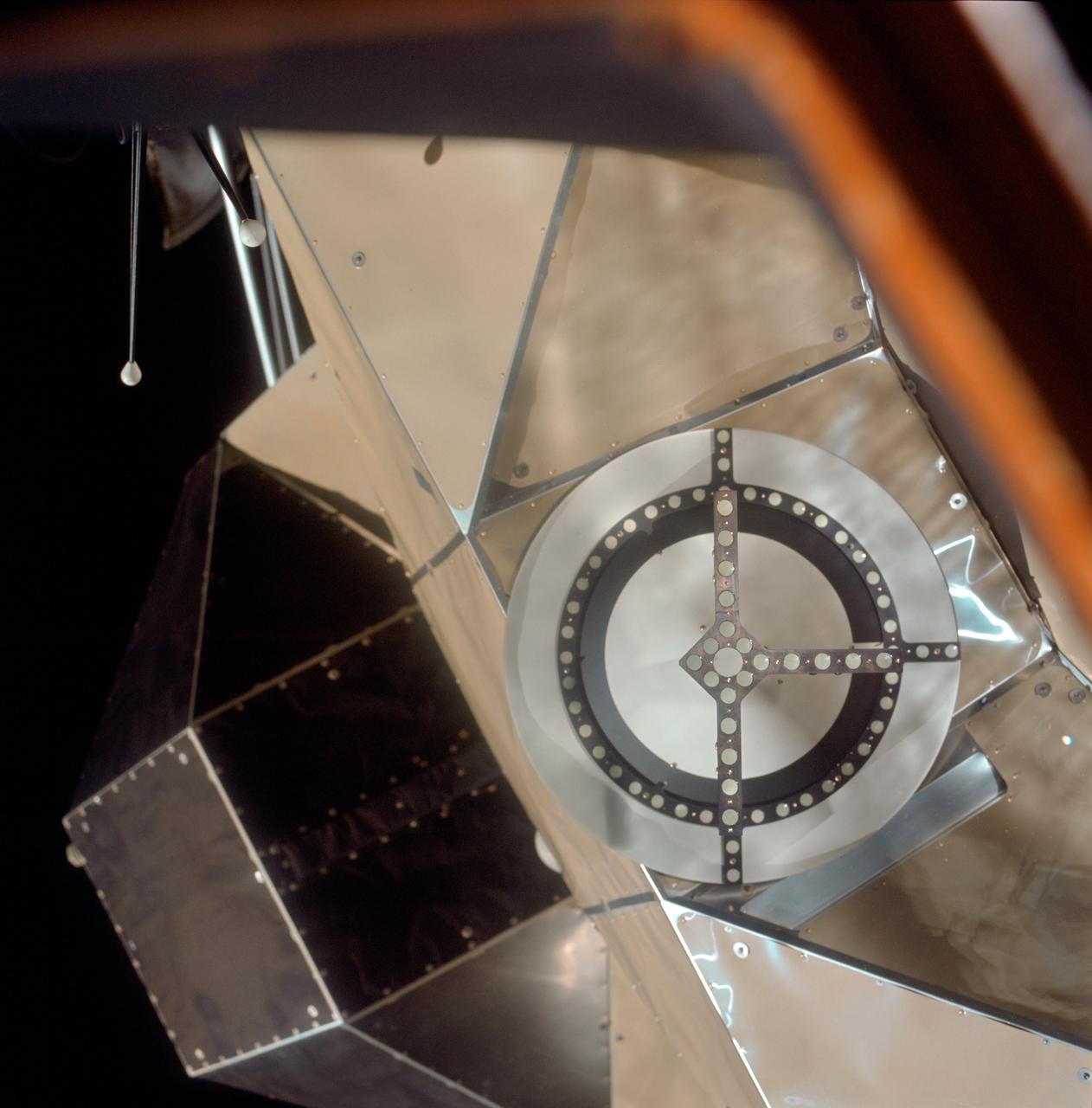
AS11-36-5365 (21 July 1969) --- A close-up view of the docking target on the Apollo 11 Lunar Module (LM) photographed from the Command Module during the LM/CSM docking in lunar orbit. Astronauts Neil A. Armstrong, commander, and Edwin E. Aldrin Jr., lunar module pilot, in the LM, were returning from the lunar surface. Astronaut Michael Collins, command module pilot, remained with the Command and Service Modules (CSM) in lunar orbit while Armstrong and Aldrin explored the moon.
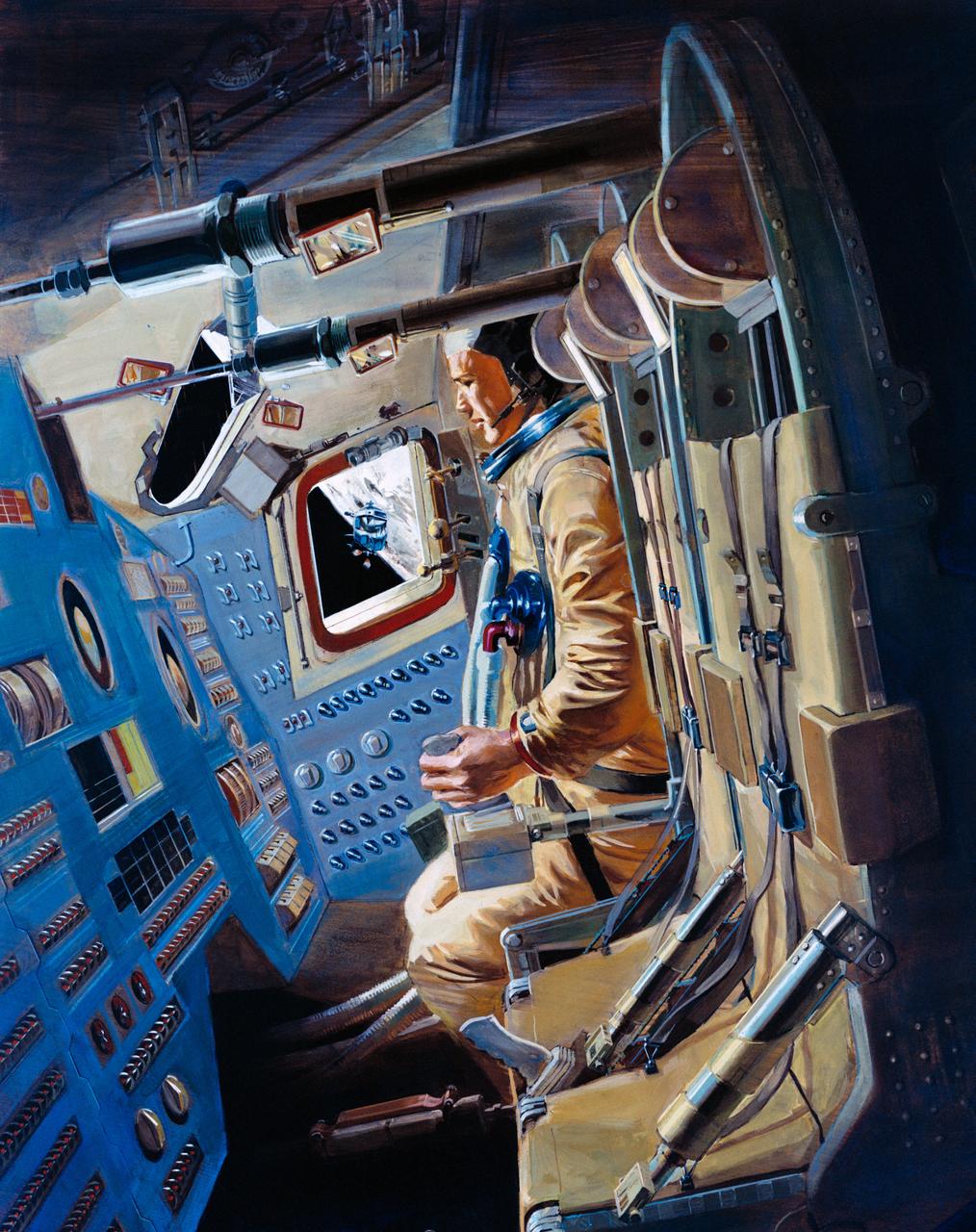
S69-58005 (10 Nov. 1969) --- An artist's concept of the Apollo 12 Command Module's (CM) interior, with the command module pilot at the controls. The Apollo 12 Lunar Module (LM) and a portion of the lunar surface are seen out of the window. Astronaut Richard F. Gordon Jr. will maneuver the Apollo 12 Command and Service Modules (CSM) in lunar orbit while astronauts Charles Conrad Jr., commander, and Alan L. Bean, lunar module pilot, explore the moon.
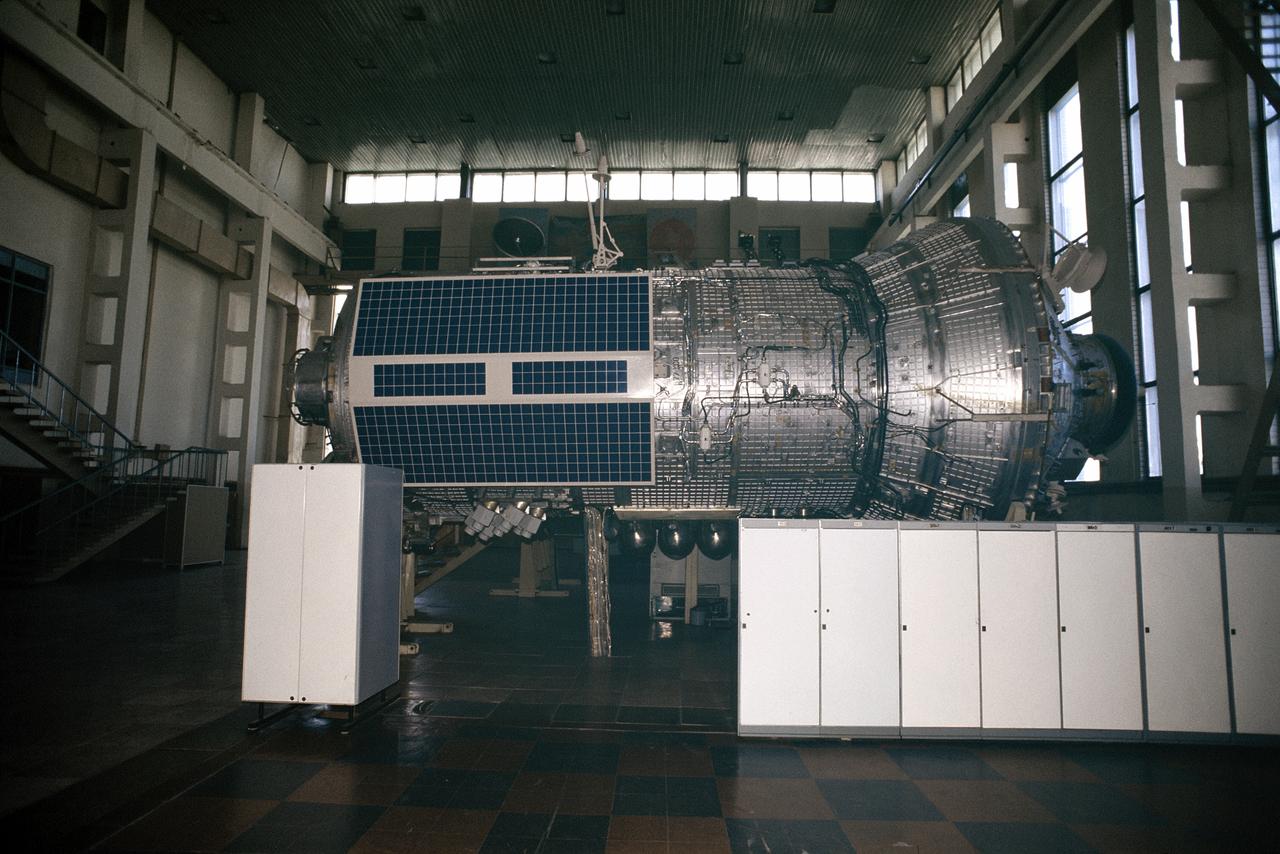
Photographic documentation of Expedition One crew in Russia with Service Module. Views include: The three crew members for ISS Expedition One train with computers on the trainer / mockup for the Zvezda Service Module. From the left are cosmonauts Yuri Gidzenko, Soyuz commander; and Sergei Krikalev, flight engineer; and astronaut William Shepherd, mission commander. The session took place at the Gagarin Cosmonaut Training Center in Russia (18628). View looking toward the hatch inside the Zvezda Service Module trainer / mockup at the Gagarin Cosmonaut Training Center in Russia (18629). A wide shot of the Zvezda Service Module trainer / mockup, with the transfer compartment in the foreground (18630). Side view of the Zvezda Service Module (18631). An interior shot of the Zarya / Functional Cargo Bay (FGB) trainer / mockup (18632). Astronaut Scott Kelly, director of operations - Russia, walks through a full scale trainer / mockup for the Zvezda Service Module at the Gagarin Cosmonaut Training Center in Russia (18633). Astronaut William Shepherd (right) mission commander for ISS Expedition One, and Sergei Krikalev, flight engineer, participate in a training session in a trainer / mockup of the Zvezda Service Module (18634).
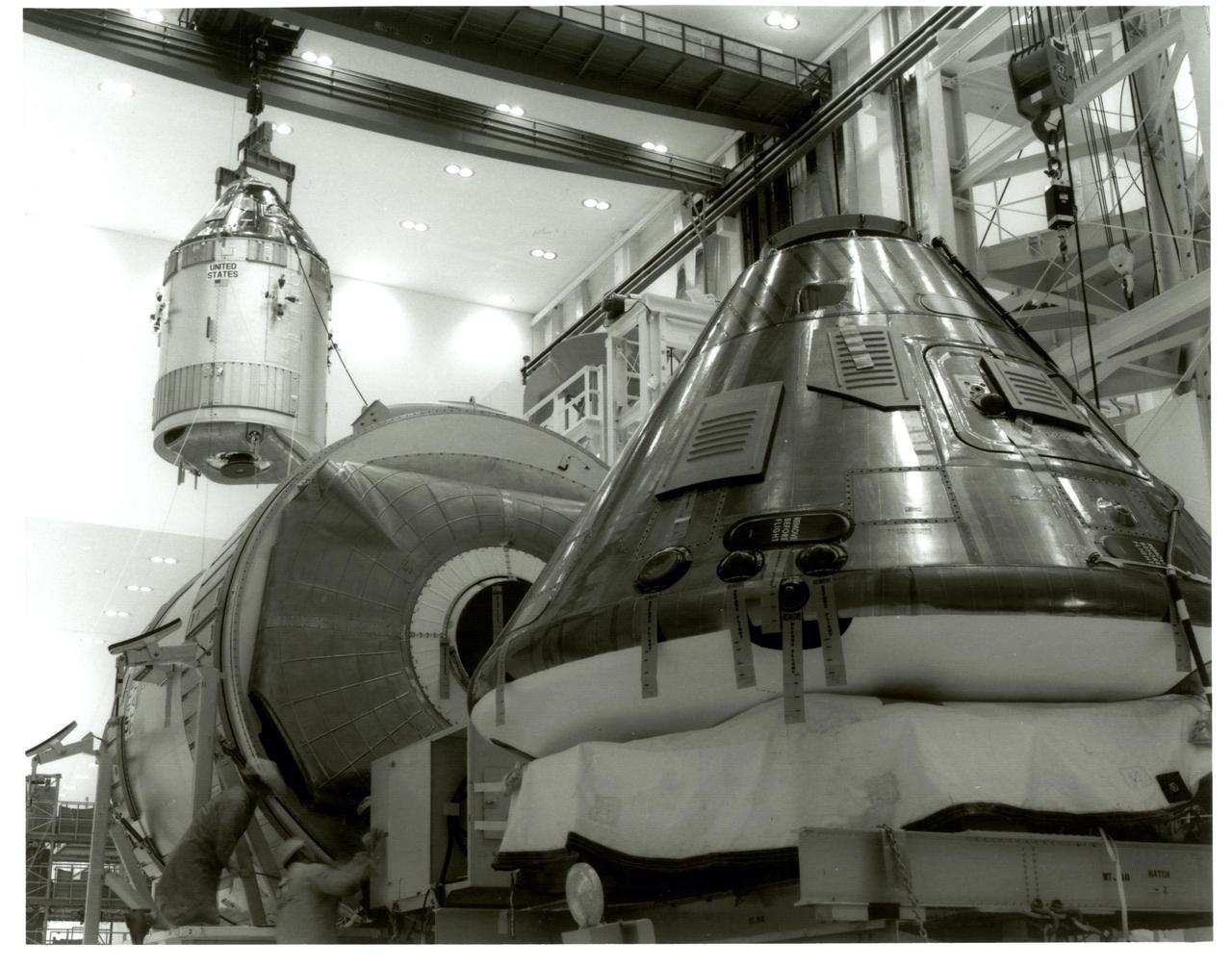
KENNEDY SPACE CENTER, FLA. - The Command Module 107 and Service Module, which are going to be used for the Apollo 11 mission, are moved from Chamber "L" to the work stand in preparation for the first manned lunar landing. Also shown in the background is the Command Module 108, which is going to be used for the Apollo 12 lunar landing mission.
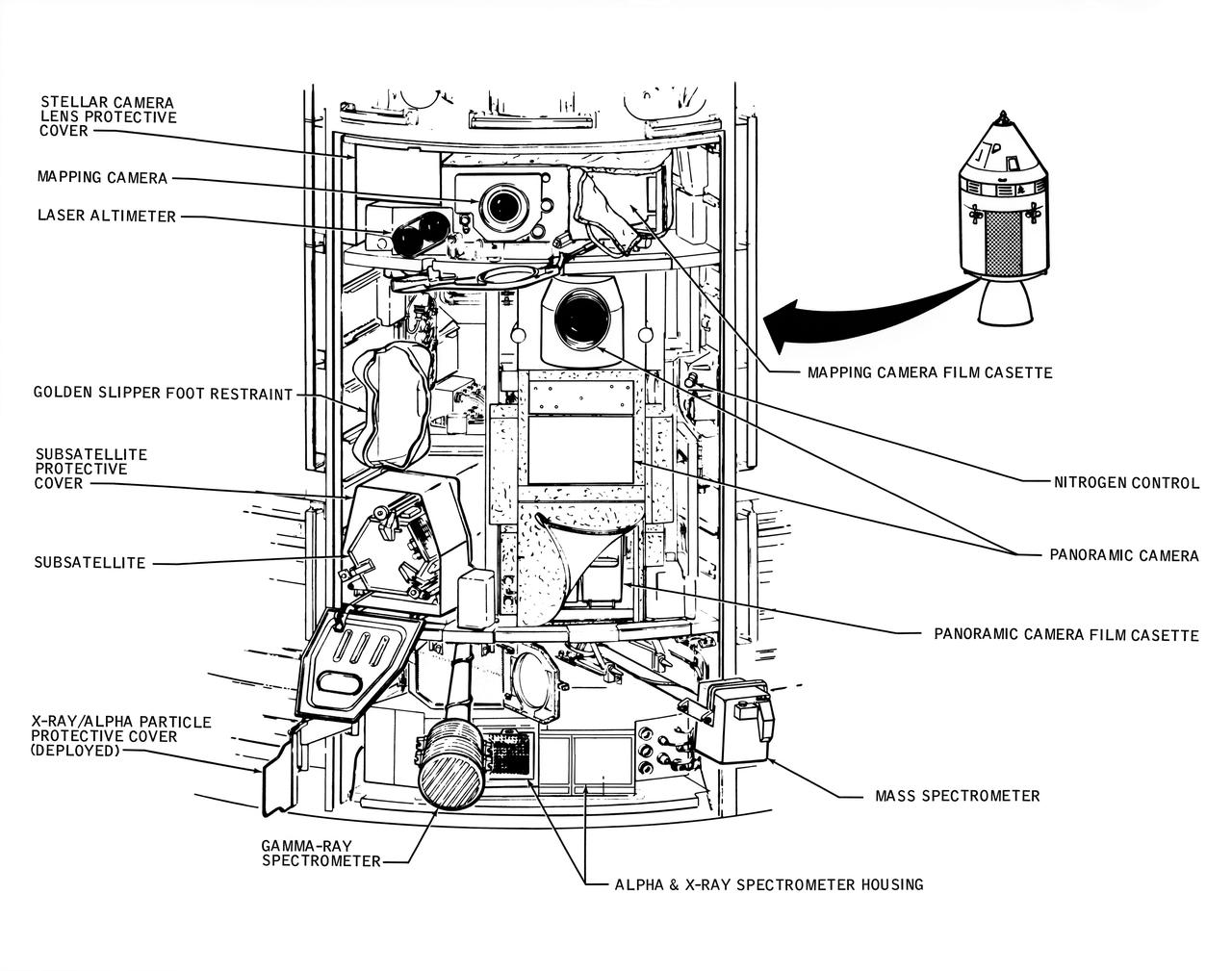
A line drawing illustrating the layout of the Scietific Instrument Module (SIM) of the Apollo 16 Service Module. Shown here is the location in the SIM bay of the equipment for each orbital experiment. Arrows point to various components of the SIM bay. The sensors for the gamma ray spectrometer and the mas spectrometer both extend outward on a boom about 25 feet when the instruments are in use. The subsatellite is launched while the Service Module is in orbit around the moon. The film cassettes must be retrieved prior to Command Module/Service Module separation.
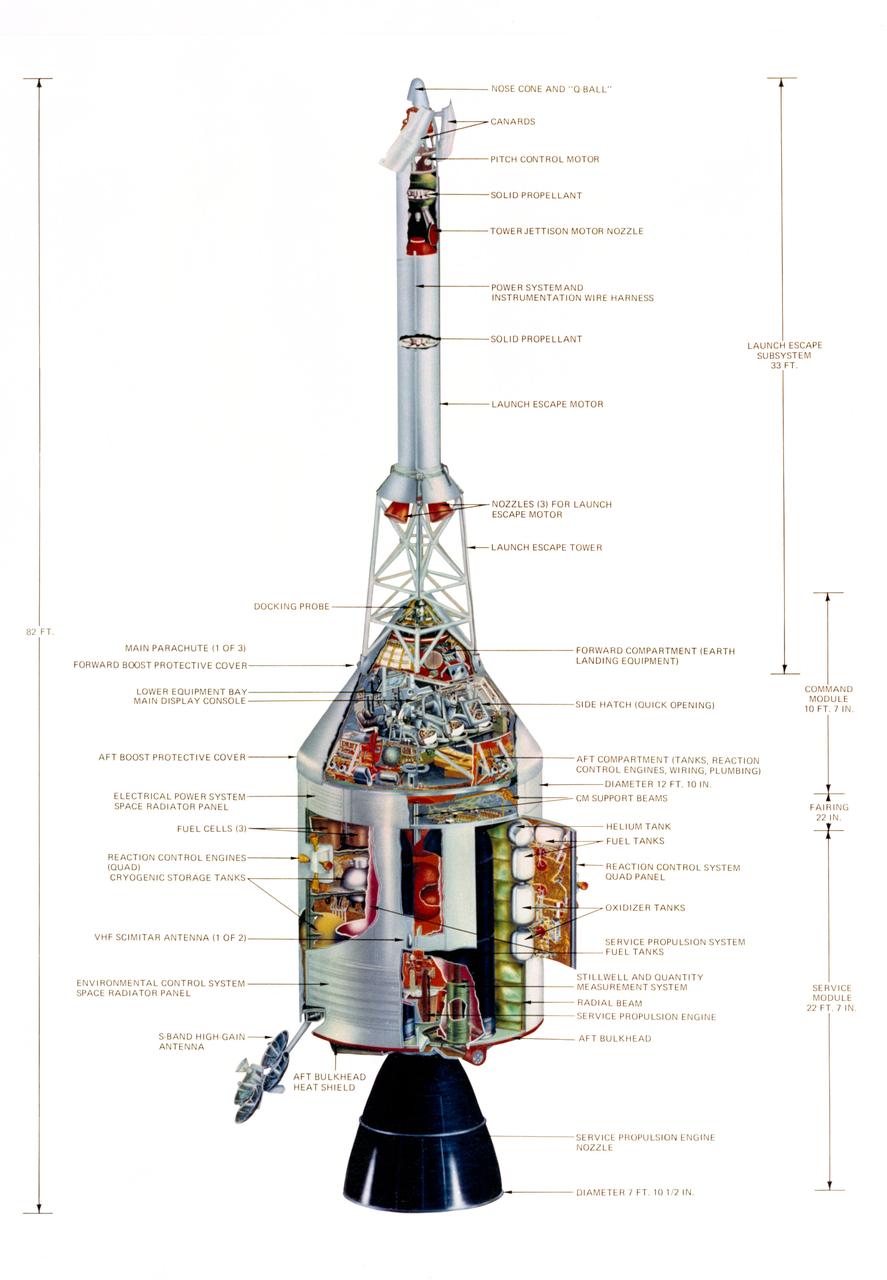
S68-46591 (1968) --- Artist's concept of the Apollo Command and Service Modules with call-outs. Photo credit: NASA
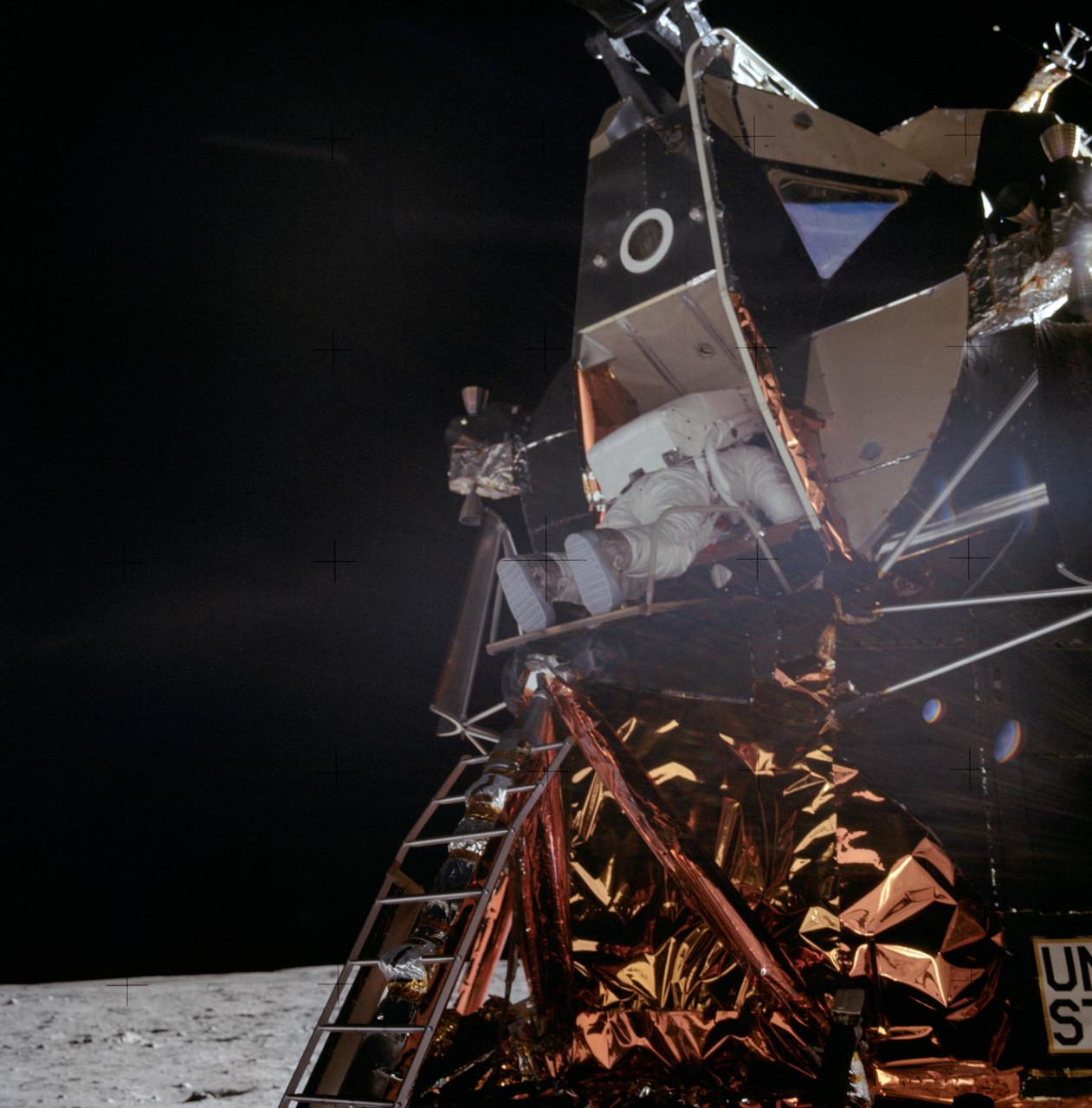
AS11-40-5863 (20 July 1969) --- Astronaut Edwin E. Aldrin Jr., lunar module pilot, is photographed egressing the Lunar Module (LM) during the Apollo 11 extravehicular activity (EVA) on the moon. This photograph was taken by astronaut Neil A. Armstrong, commander, with a 70mm lunar surface camera. While astronauts Armstrong and Aldrin descended in the Lunar Module (LM) "Eagle" to explore the Sea of Tranquility region of the moon, astronaut Michael Collins, command module pilot, remained with the Command and Service Modules (CSM) "Columbia" in lunar orbit.
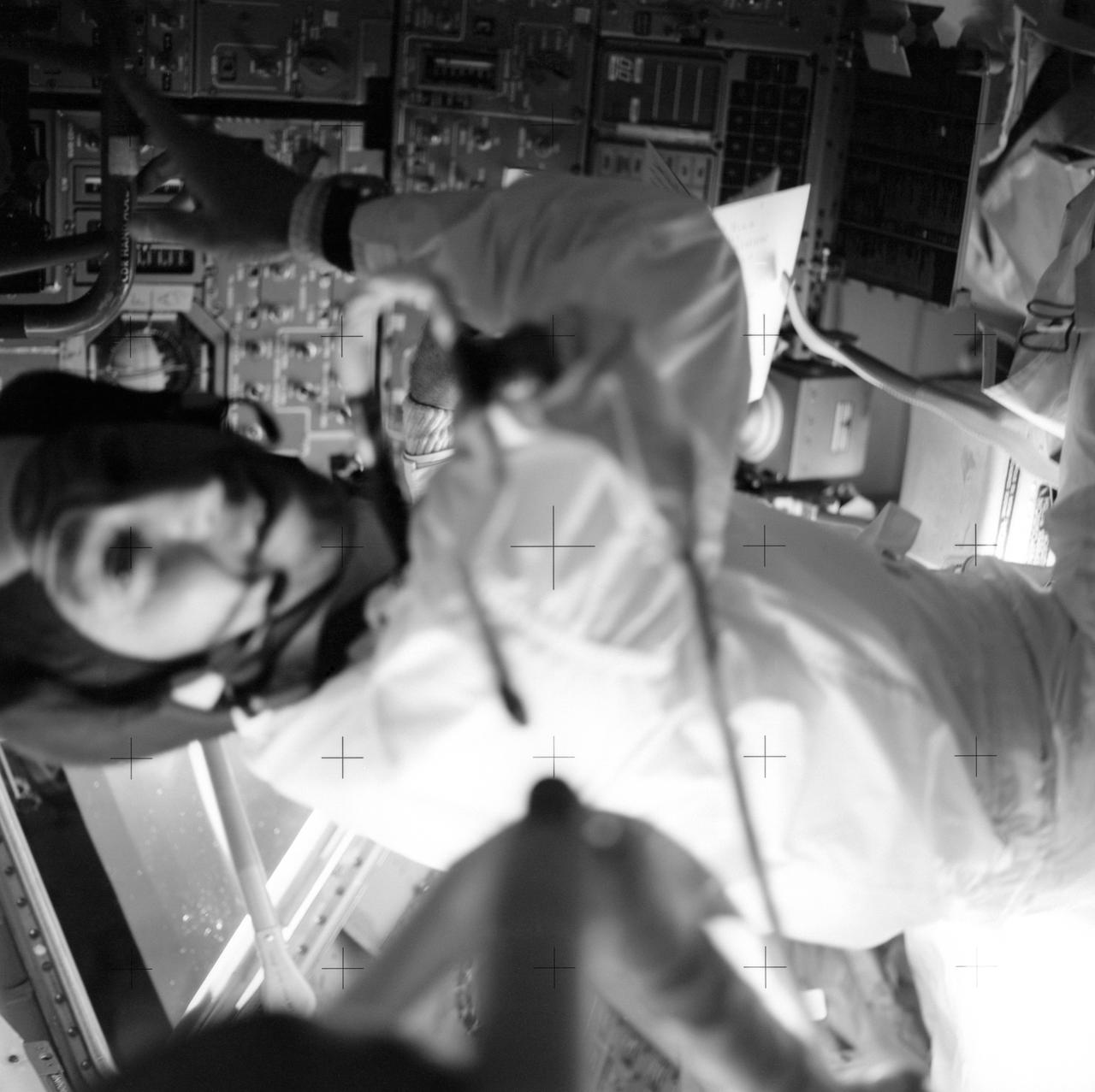
AS13-59-8484 (April 1970) --- Astronaut James A. Lovell Jr., commander, is pictured at his position in the Lunar Module (LM). The Apollo 13 crew of astronauts Lovell; John L. Swigert Jr., command module pilot; and Fred W. Haise Jr., lunar module pilot, relied on the LM as a "lifeboat". The dependence on the LM was caused by an apparent explosion of oxygen tank number two in the Service Module (SM). The LM was jettisoned just prior to Earth re-entry by the Command Module (CM).
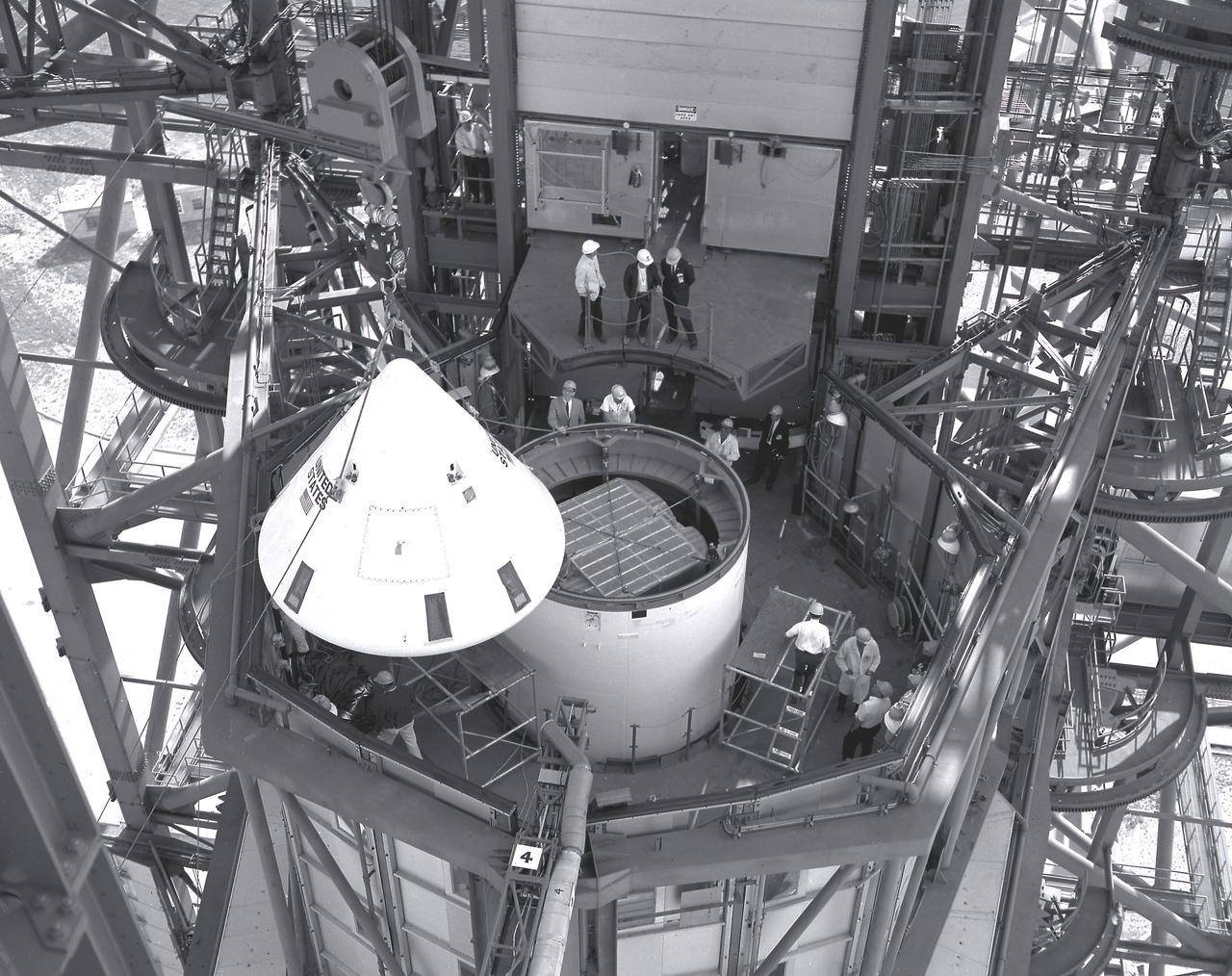
In this photograph, the Pegasus, meteoroid detection satellite is installed in its specially modified Apollo service module atop the S-IV stage (second stage) of a Saturn I vehicle for the SA-9 mission at Cape Kennedy. Personnel in the service structure moved the boilerplate Apollo command module into place to cap the vehicle. The command and service modules, visible here, were jettisoned into orbit to free the Pegasus for wing deployment. The satellite was used to obtain data on frequency and penetration of the potentially hazardous micrometeoroids in low Earth orbits and to relay the information back to Earth. The SA-9 was launched on February 16, 1965.
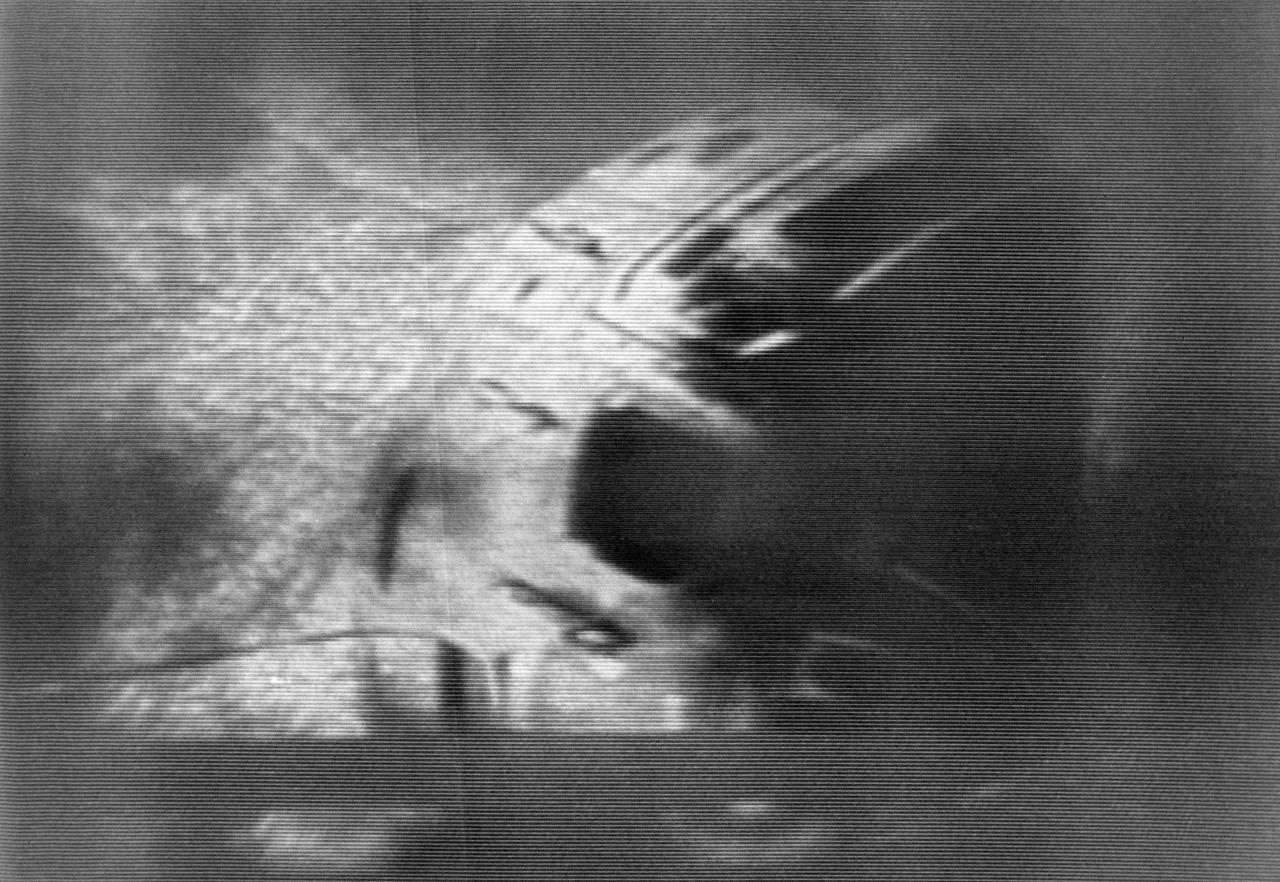
S69-26150 (6 March 1969) --- Television watchers on Earth saw this view of the Apollo 9 Command Module during the second live telecast from Apollo 9 early Thursday afternoon on the fourth day in space. This view is looking through the docking window of the Lunar Module. The cloud-covered Earth can be seen in the background. Inside the Lunar Module "Spider" were Astronauts James A. McDivitt, Apollo 9 commander; and Russell L. Schweickart, lunar module pilot. At this moment Apollo 9 was orbiting Earth with the Command and Service Modules docked nose-to-nose with the Lunar Module. Astronaut David R. Scott, command module pilot, remained at the controls in the Command Module "Gumdrop" while the other two astronauts checked out the Lunar Module. McDivitt and Schweickart moved into the Lunar Module from the Command Module by way of the docking tunnel.
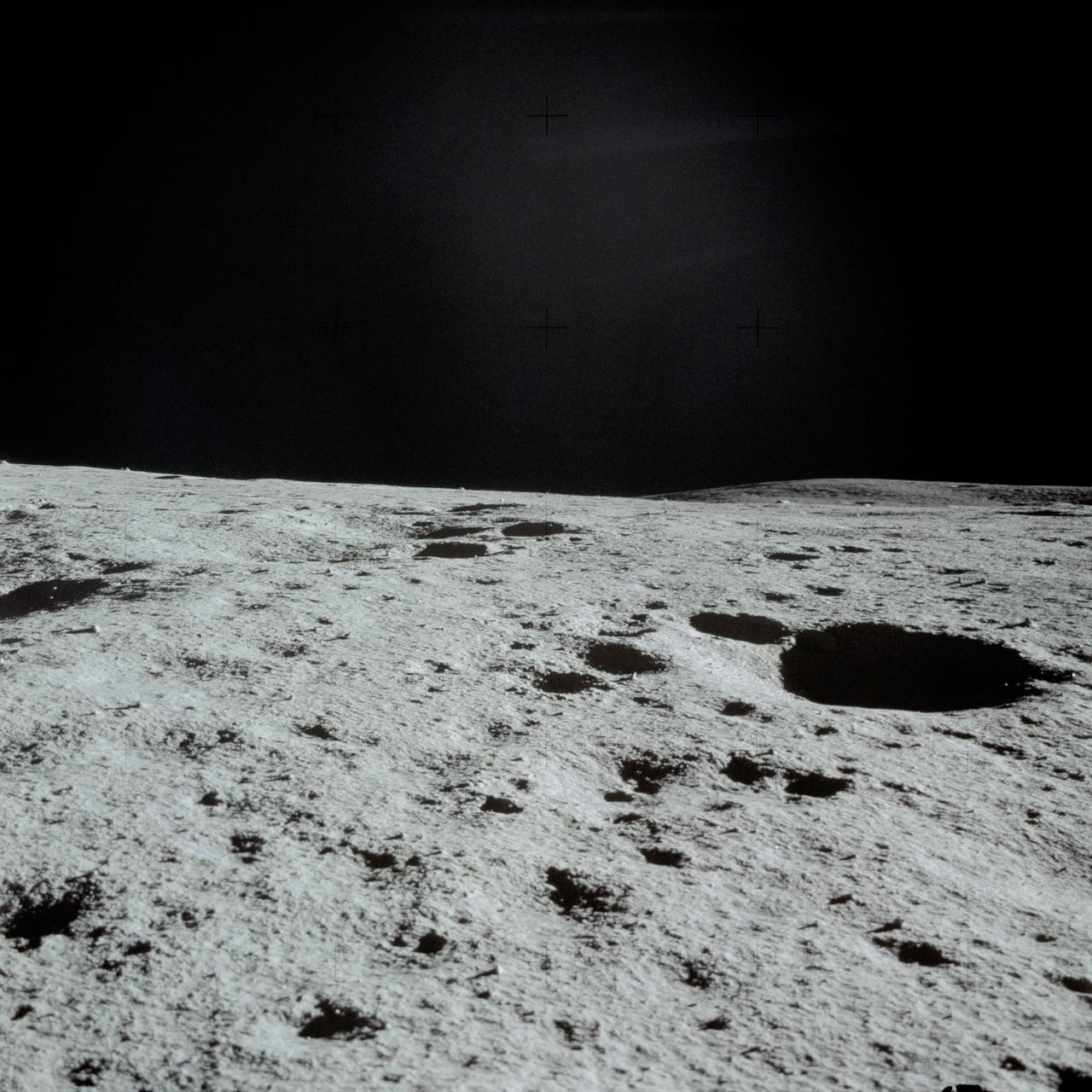
AS14-66-9244 (5-6 Feb. 1971) --- An excellent view of the lunar terrain looking through the right window of the Lunar Module (LM), photographed by one of the Apollo 14 astronauts during their stay on the lunar surface. Pothole-sized craters can be seen in the foreground. While astronauts Alan B. Shepard Jr., commander, and Edgar D. Mitchell, lunar module pilot, descended in the LM to explore the moon, astronaut Stuart A. Roosa, command module pilot, remained with the Command and Service Modules (CSM) in lunar orbit.

AS14-66-9278 (5 Feb. 1971) --- An excellent view of the Apollo 14 Lunar Module (LM) on the moon, as photographed during the first Apollo 14 extravehicular activity (EVA) on the lunar surface. While astronauts Alan B. Shepard Jr., commander, and Edgar D. Mitchell, lunar module pilot, descended in the LM to explore the moon, astronaut Stuart A. Roosa, command module pilot, remained with the Command and Service Modules (CSM) in lunar orbit.
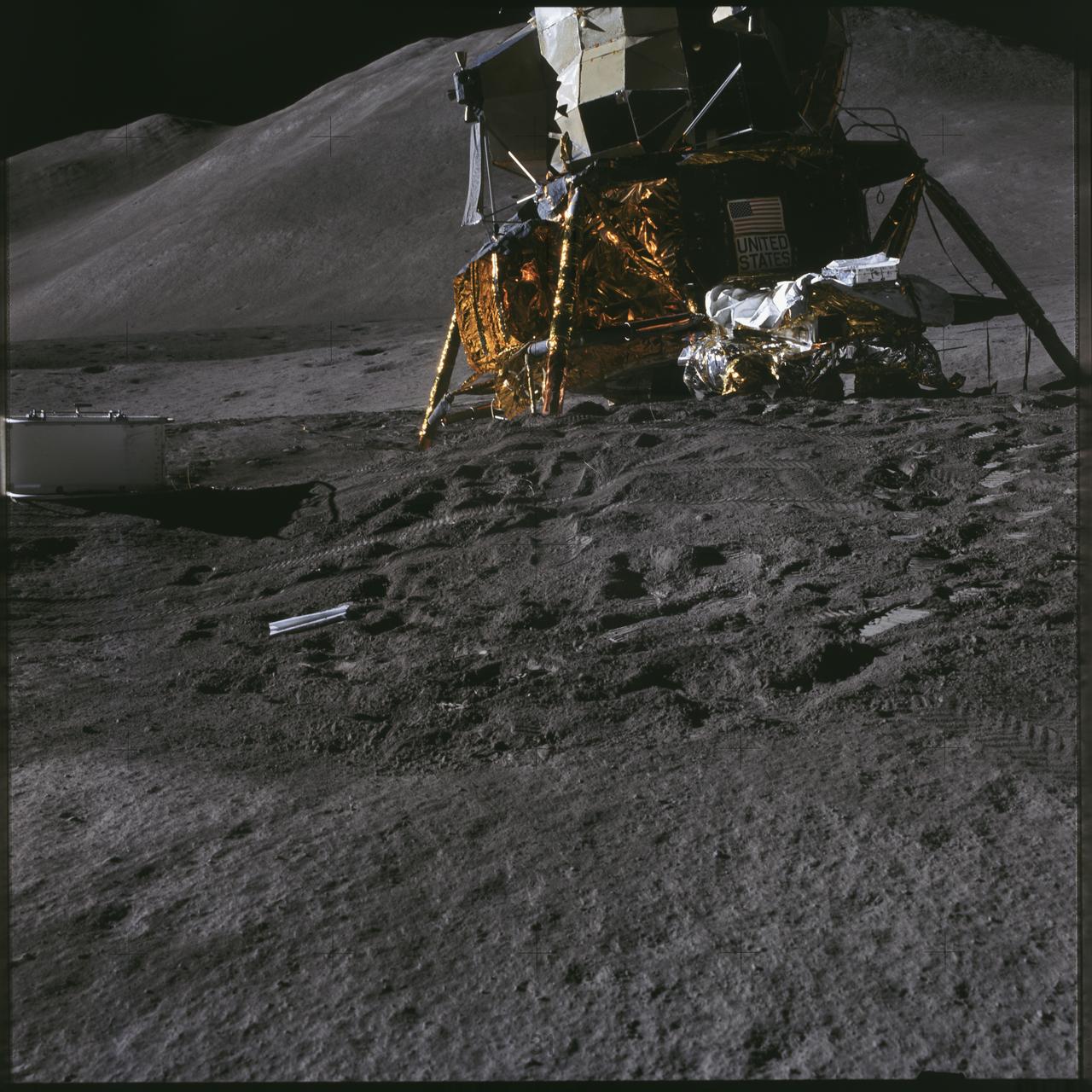
AS15-86-11600 (31 July 1971) --- A view of the Lunar Module (LM) "Falcon" taken early in the first Apollo 15 lunar surface extravehicular activity (EVA) at the Hadley-Apennine landing site prior to deployment of lunar surface equipment. Hadley Delta Mountain is in the background. While astronauts David R. Scott, commander and James B. Irwin, lunar module pilot, descended in the LM to explore the moon, astronaut Alfred M. Worden, command module pilot, remained with the Command and Service Modules (CSM) in lunar orbit.
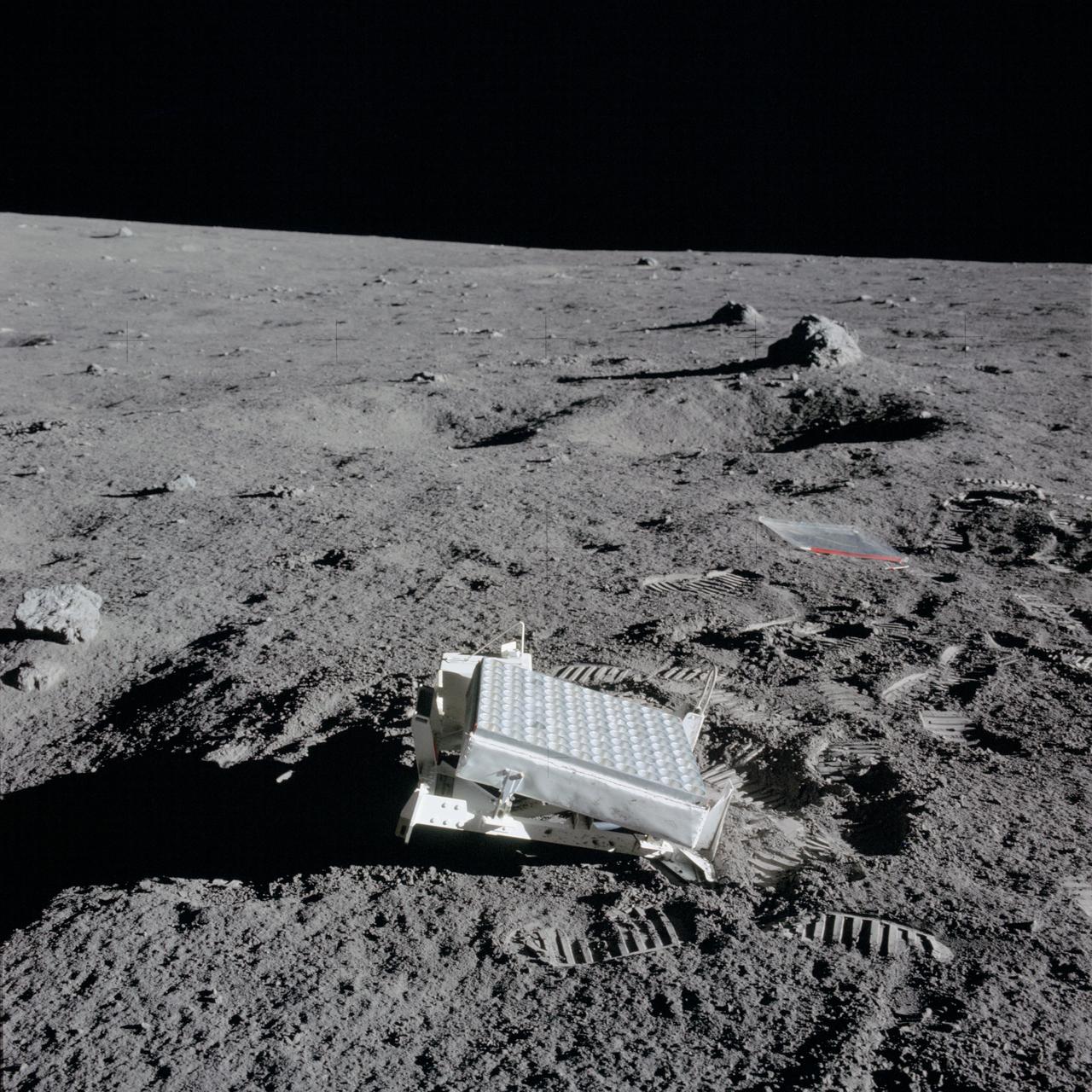
AS14-67-9386 (5 Feb. 1971) --- A close-up view of the laser ranging retro reflector (LR3) which the Apollo 14 astronauts deployed on the moon during their lunar surface extravehicular activity (EVA). While astronauts Alan B. Shepard Jr., commander, and Edgar D. Mitchell, lunar module pilot, descended in the Lunar Module (LM) to explore the moon, astronaut Stuart A. Roosa, command module pilot, remained with the Command and Service Modules (CSM) in lunar orbit.
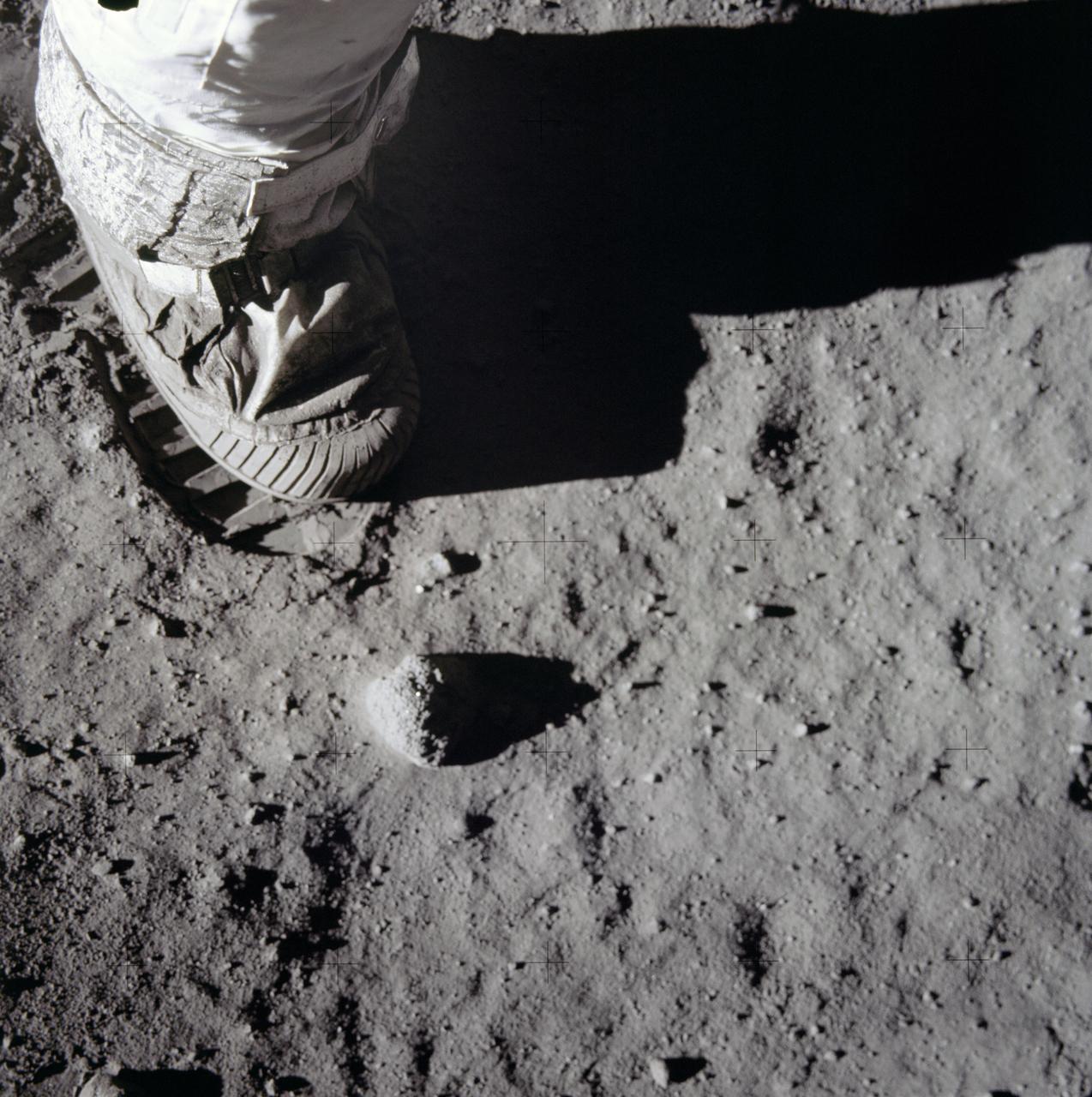
AS11-40-5880 (20 July 1969) --- A close-up view of an astronaut's boot and bootprint in the lunar soil, photographed with a 70mm lunar surface camera during the Apollo 11 lunar surface extravehicular activity (EVA). While astronauts Neil A. Armstrong, commander, and Edwin A. Aldrin Jr., lunar module pilot, descended in the Lunar Module (LM) "Eagle" to explore the Sea of Tranquility region of the moon, astronaut Michael Collins, command module pilot, remained with the Command and Service Modules (CSM)" Columbia" in lunar orbit.
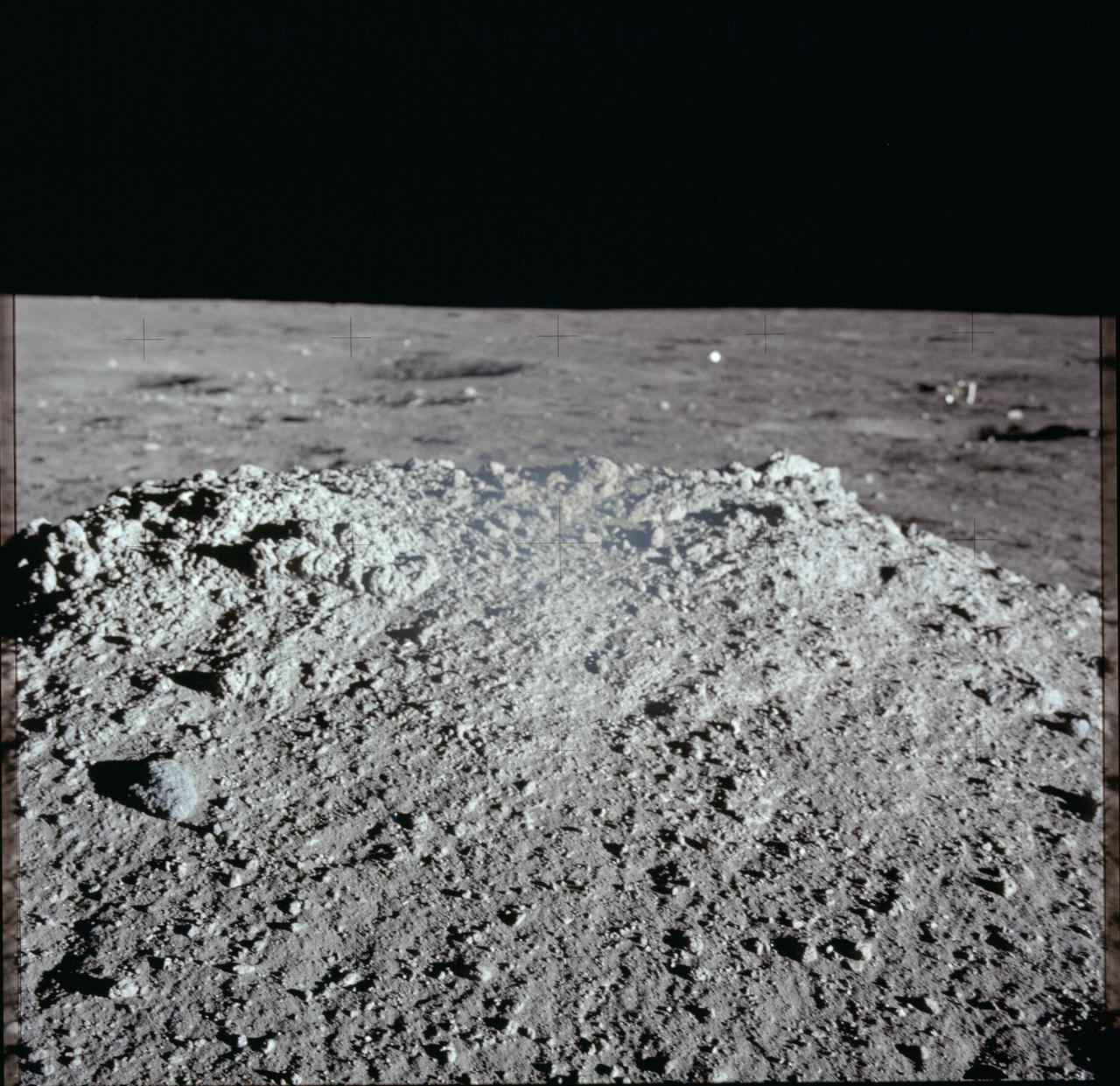
AS12-46-6832 (19 Nov. 1969) --- A close-up view of a lunar mound as photographed during the Apollo 12 extravehicular activity (EVA) on the lunar surface. Astronaut Richard F. Gordon Jr., command module pilot, remained with the Apollo 12 Command and Service Modules (CSM) in lunar orbit while astronauts Charles Conrad Jr., commander, and Alan L. Bean, lunar module pilot, descended in the Lunar Module (LM) to explore the moon.
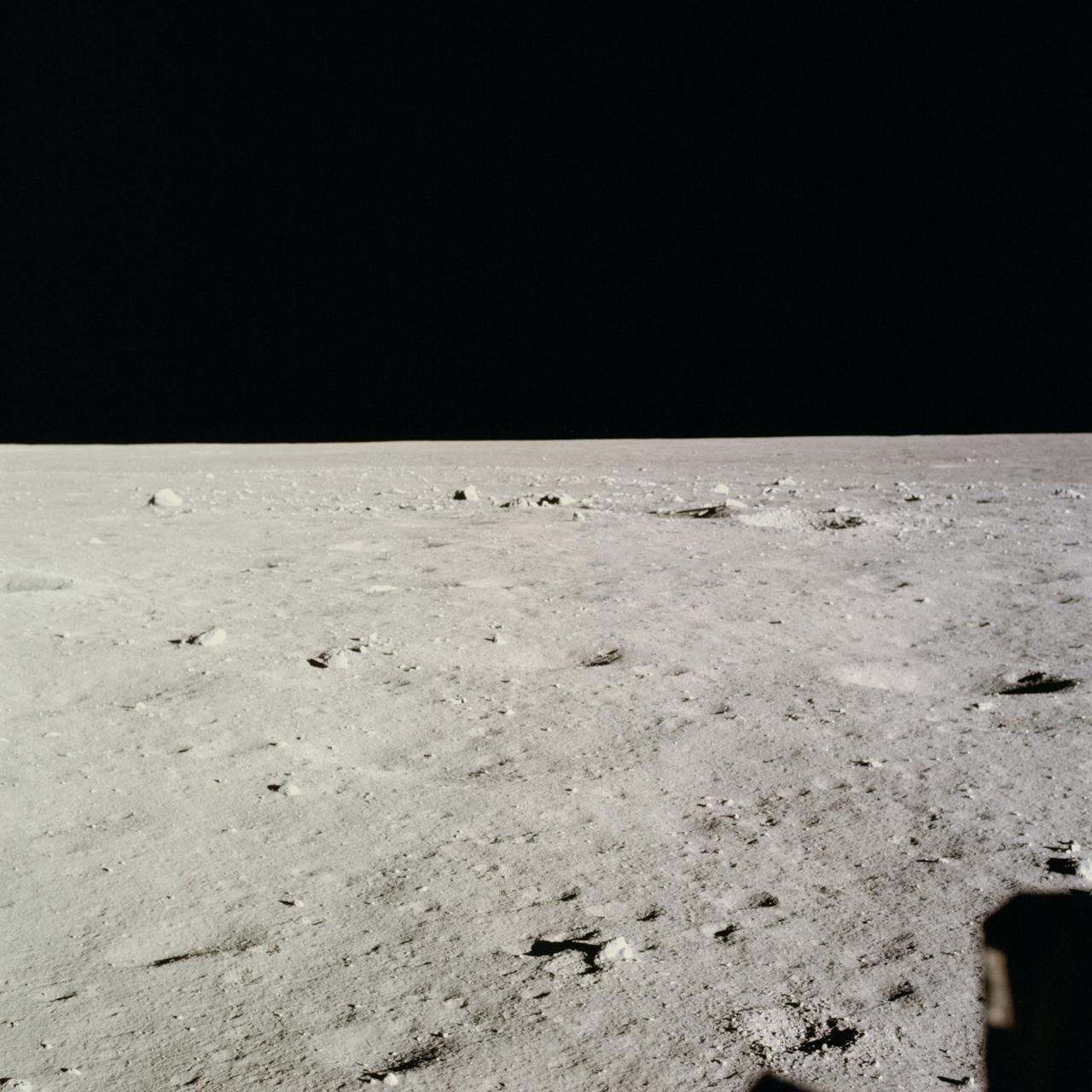
AS11-37-5458 (20 July 1969) --- This excellent view from the right-hand window of the Apollo 11 Lunar Module (LM) shows the surface of the moon in the vicinity of where the LM touched down. Numerous small rocks and craters can be seen between the LM and the lunar horizon. Astronaut Michael Collins, command module pilot, remained with the Command and Service Modules (CSM) in lunar orbit while astronauts Neil A. Armstrong, commander; and Edwin E. Aldrin Jr., lunar module pilot, descended in the LM to the lunar surface.
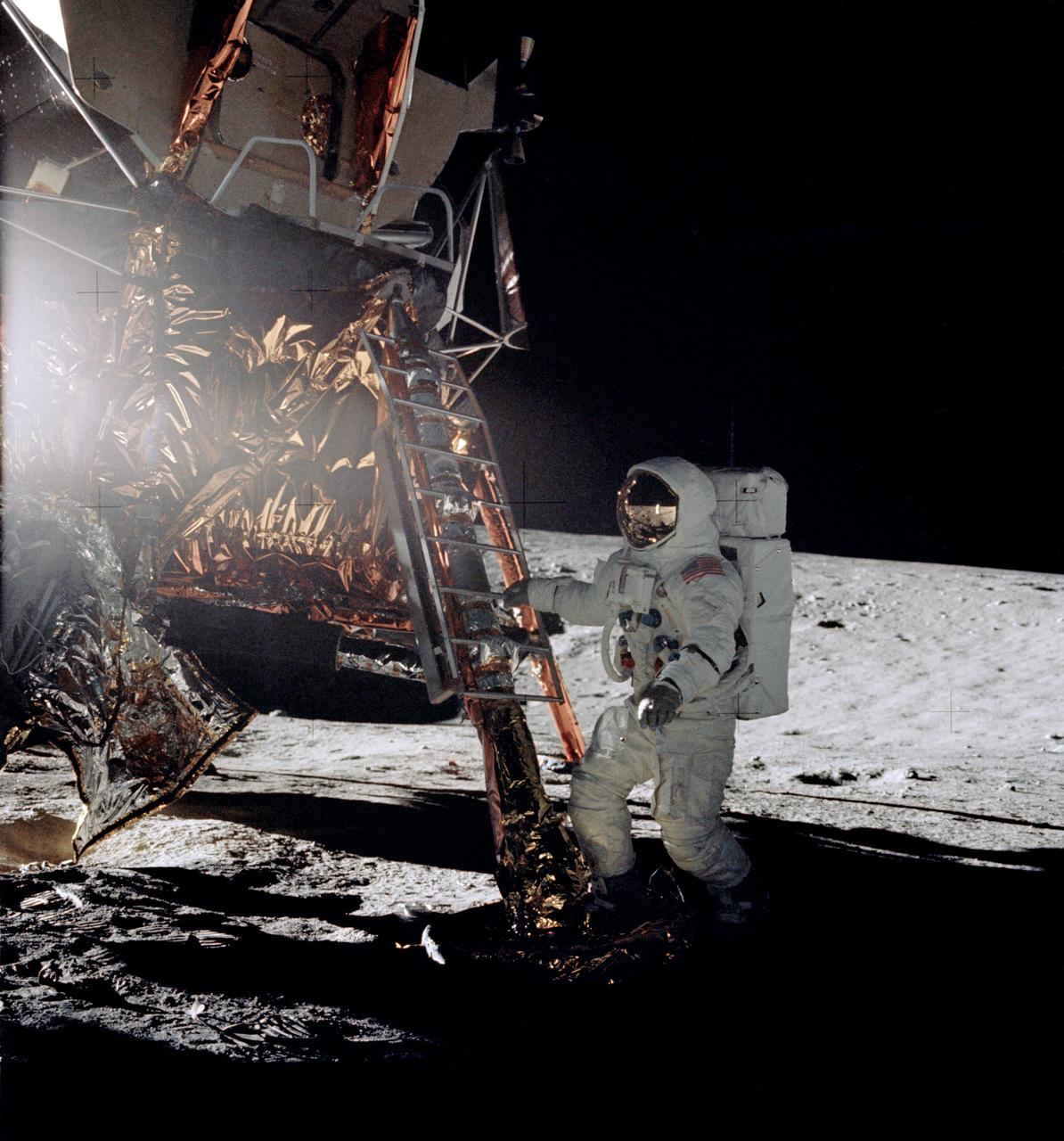
AS12-46-6729 (19 Nov. 1969) --- Astronaut Alan L. Bean, lunar module pilot for the Apollo 12 lunar landing mission, steps from the ladder of the Lunar Module to join astronaut Charles Conrad Jr., commander, in extravehicular activity on Nov. 19, 1969. Astronaut Richard F. Gordon Jr., command module pilot, remained with the Command and Service Modules in lunar orbit.
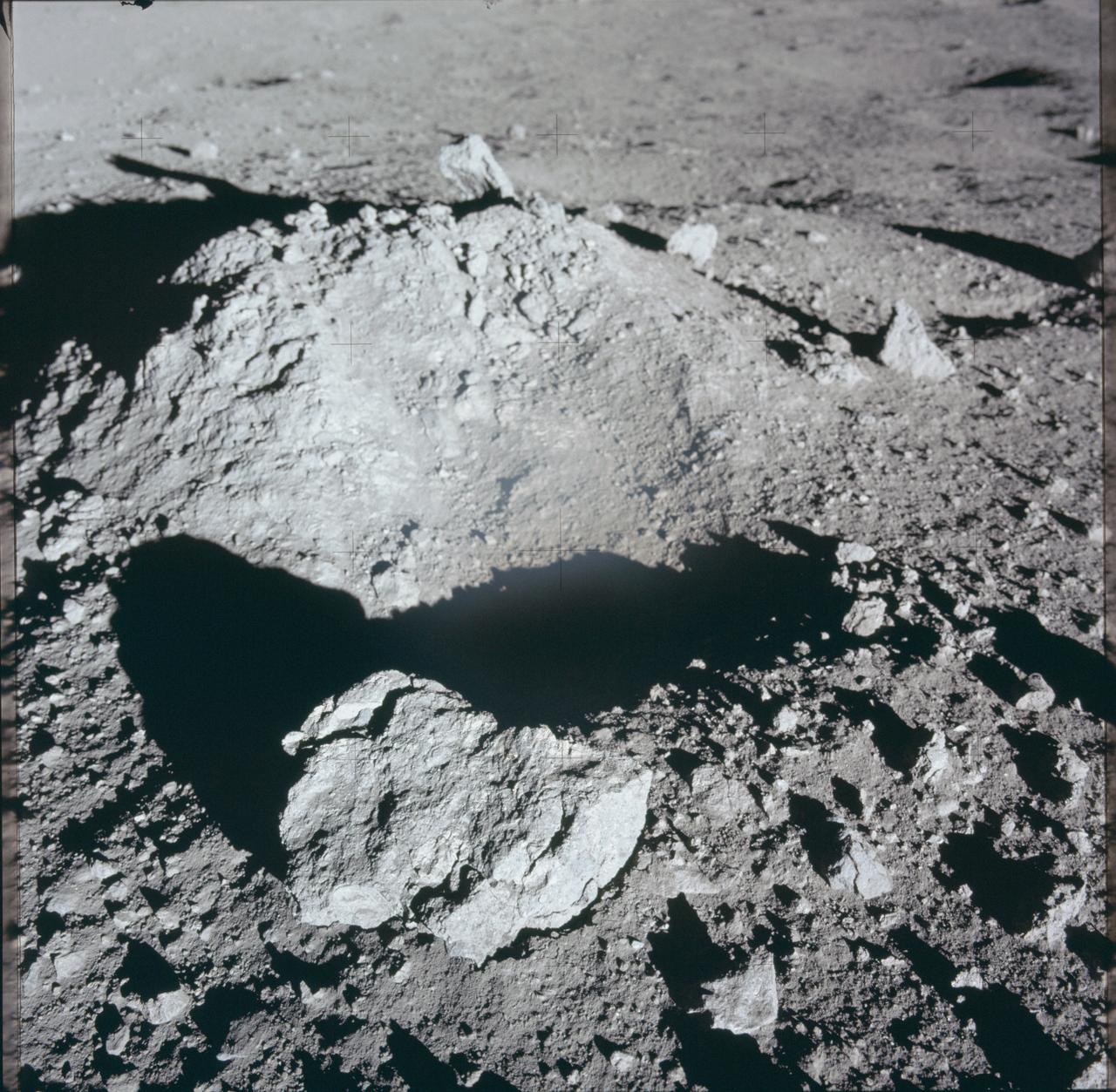
AS12-46-6825 (19 Nov. 1969) --- Close-up view of a lunar rock, small crater, and lunar mound as photographed during the Apollo 12 extravehicular activity (EVA). Astronaut Richard F. Gordon Jr., command module pilot, remained with the Apollo 12 Command and Service Modules (CSM) in lunar orbit while astronauts Charles Conrad Jr., commander, and Alan L. Bean, lunar module pilot, descended in the Lunar Module (LM) to explore the moon.
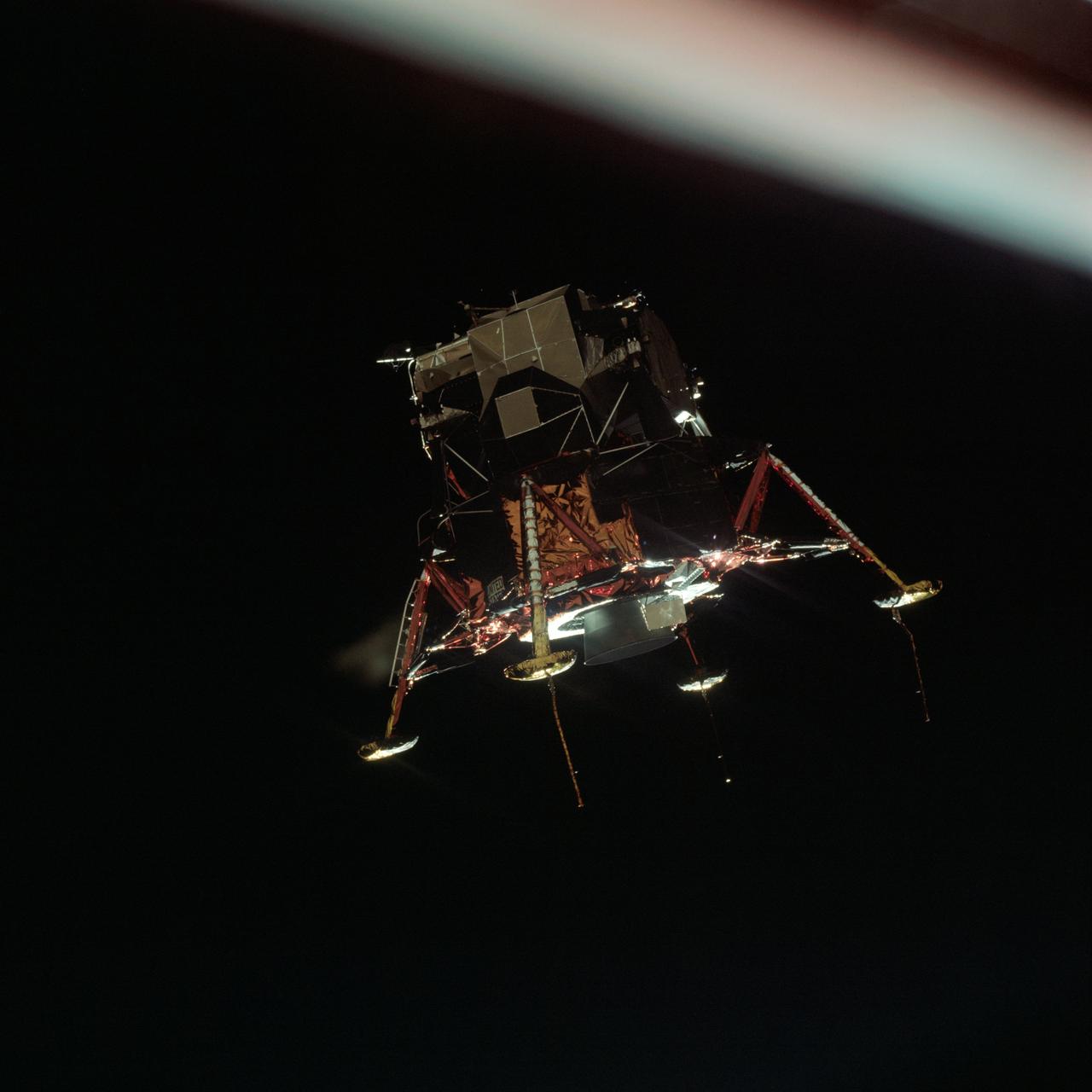
AS11-44-6581 (20 July 1969) --- The Apollo 11 Lunar Module (LM), in a lunar landing configuration, is photographed in lunar orbit from the Command and Service Modules (CSM). Inside the LM were astronauts Neil A. Armstrong, commander, and Edwin E. Aldrin Jr., lunar module pilot. Astronaut Michael Collins, command module pilot, remained with the CSM in lunar orbit while Armstrong and Aldrin descended in the LM to explore the lunar surface. The protrusions connected to the landing pods are sensors to aid in the touchdown or landing process.

AS14-66-9241 (5-6 Feb. 1971) --- Astronaut Edgar D. Mitchell, lunar module pilot, makes a pan with the lunar surface television camera during an extravehicular activity (EVA) on the moon. This photograph was taken by fellow astronaut Alan B. Shepard Jr., commander. While Shepard and Mitchell descended in the Lunar Module (LM) to explore the moon, astronaut Stuart A. Roosa, command module pilot, remained with the Command and Service Modules (CSM) in lunar orbit.
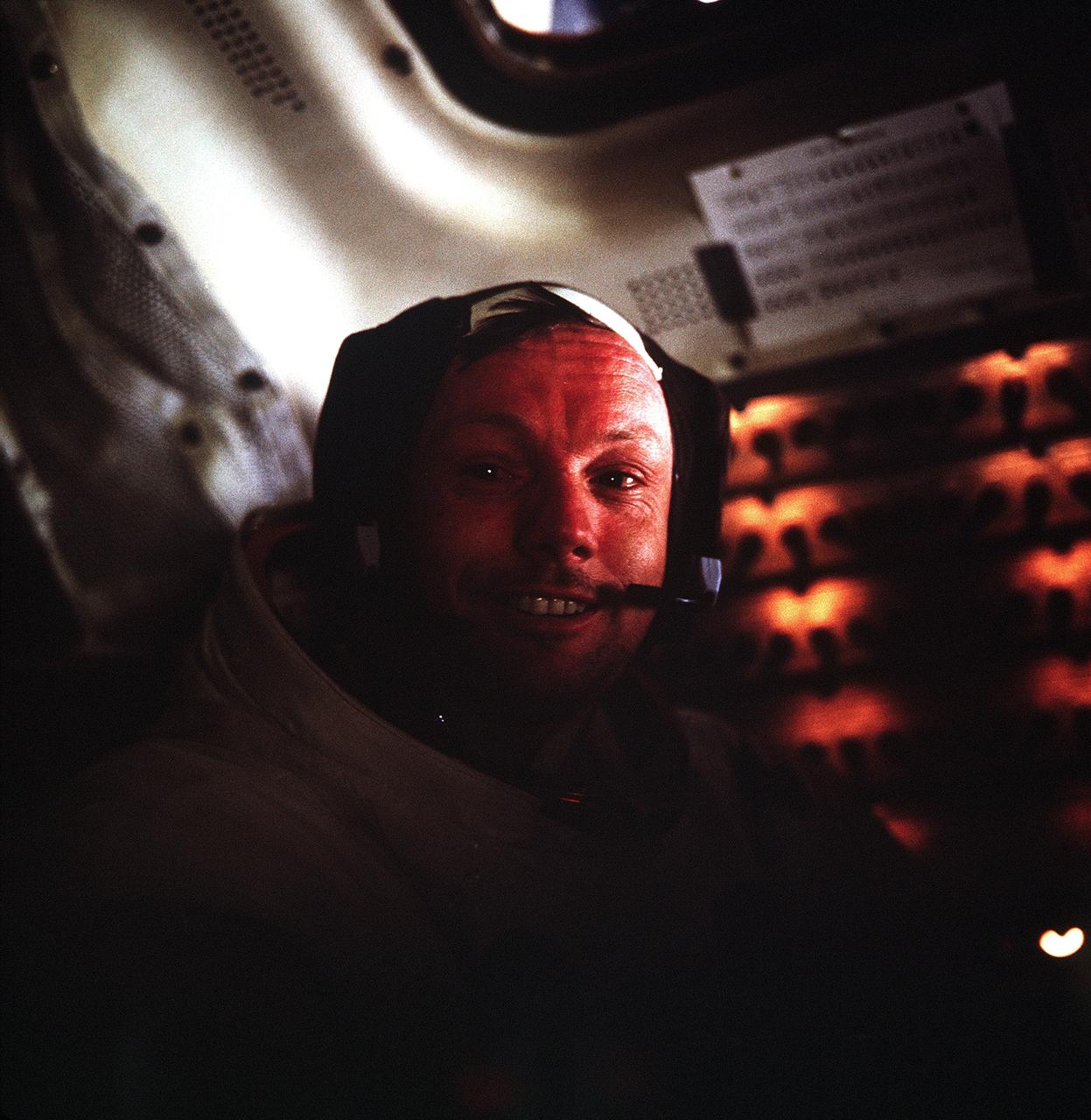
AS11-37-5528 (20 July 1969) --- This photograph of astronaut Neil A. Armstrong, Apollo 11 commander, was taken inside the Lunar Module (LM) while the LM rested on the lunar surface. Astronauts Armstrong and Edwin E. Aldrin Jr., lunar module pilot, had already completed their historic extravehicular activity (EVA) when this picture was made. Astronaut Michael Collins, command module pilot, remained with the Command and Service Modules (CSM) in lunar orbit while Armstrong and Aldrin explored the moon's surface.
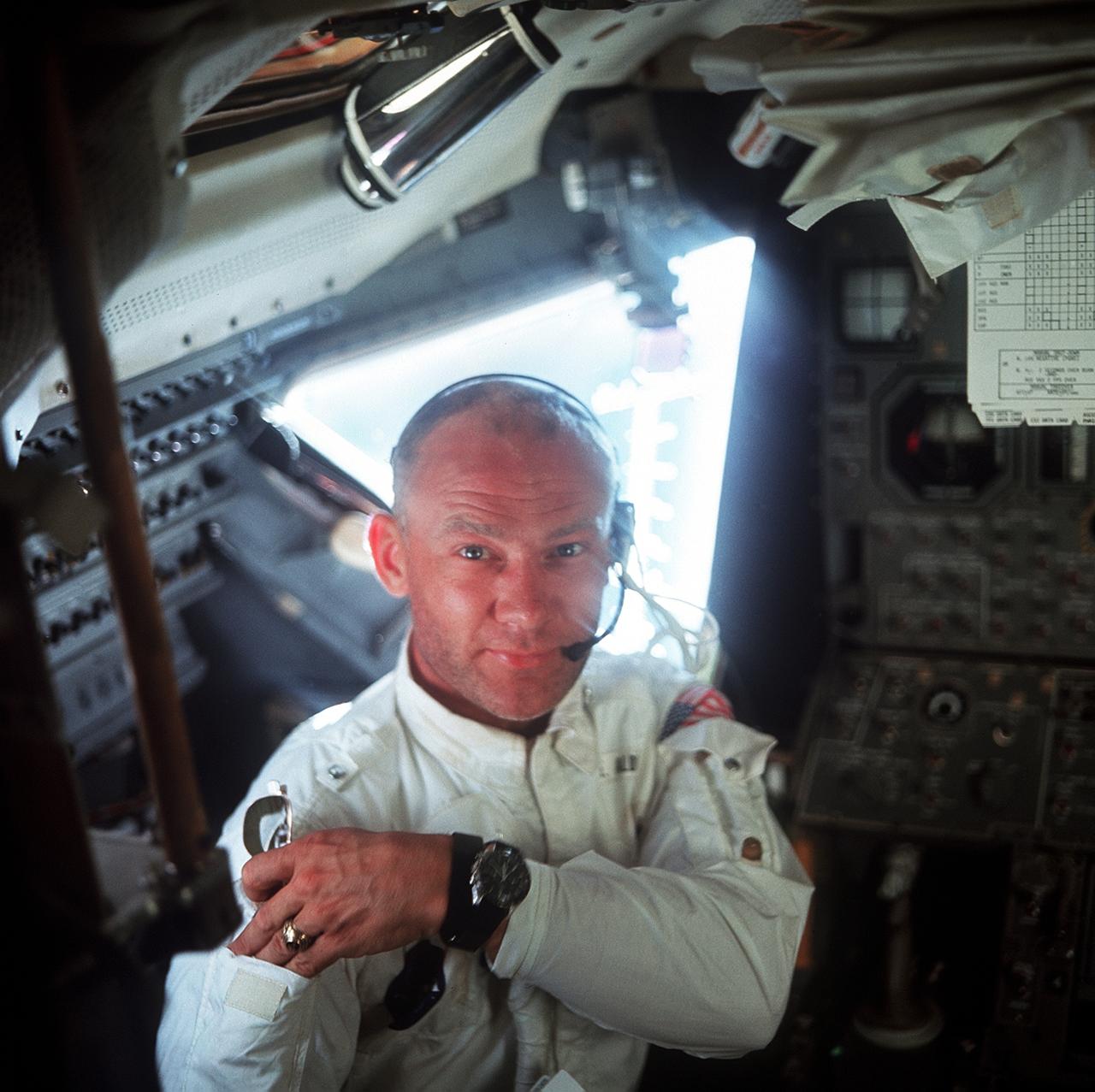
AS11-36-5390 (20 July 1969) --- This interior view of the Apollo 11 Lunar Module (LM) shows astronaut Edwin E. Aldrin Jr., lunar module pilot, during the lunar landing mission. This picture was taken by astronaut Neil A. Armstrong, commander. While astronauts Armstrong and Aldrin descended in the LM "Eagle" to explore the Sea of Tranquility region of the moon, astronaut Michael Collins, command module pilot, remained with the Command and Service Modules (CSM) "Columbia" in lunar orbit.
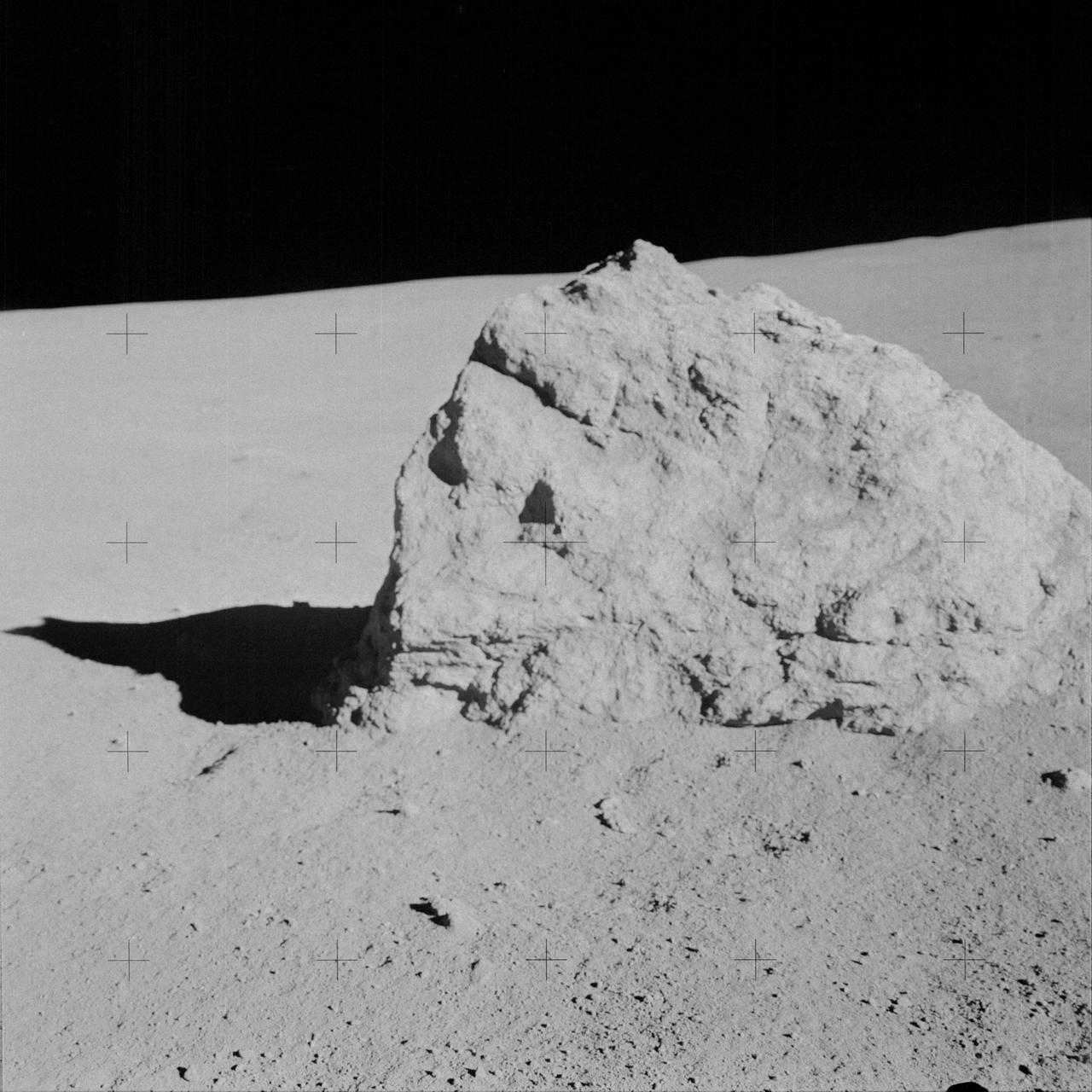
AS14-64-9135 (6 Feb. 1971) --- Astronaut Alan B. Shepard Jr., commander, took this close-up view of a large boulder, approximately five feet long, during the second extravehicular activity (EVA), on Feb. 6, 1971. Astronauts Shepard and Edgar D. Mitchell, lunar module pilot, descended in the Lunar Module (LM) to explore the moon, while astronaut Stuart A. Roosa, command module pilot, remained with the Command and Service Modules (CSM) in lunar orbit.
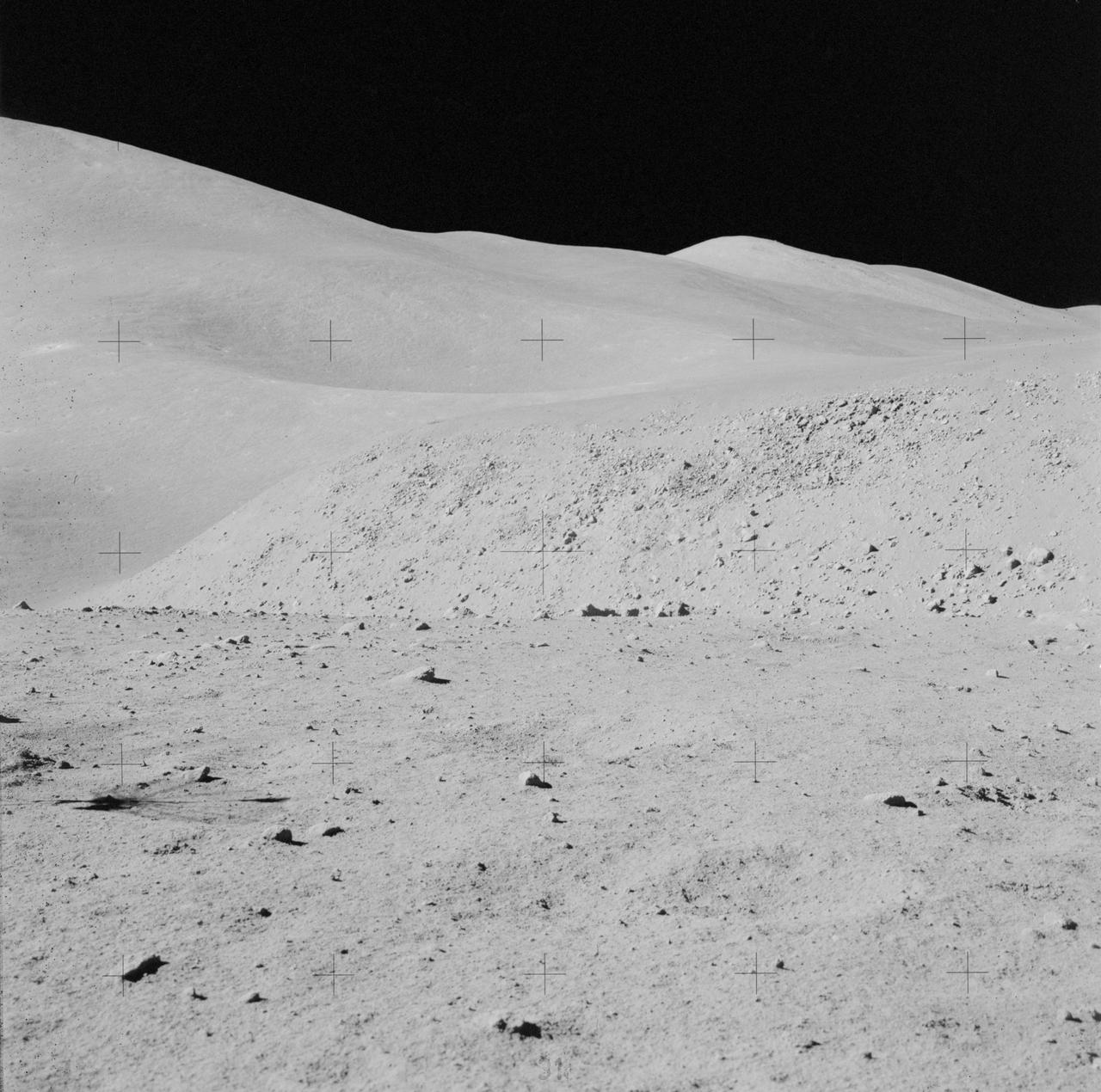
AS15-82-11123 (2 Aug. 1971) --- A view of the "strewn rock" scene encountered by Apollo 15 astronauts David R. Scott, commander, and James B. Irwin, lunar module pilot, during their third extravehicular activity (EVA) of the mission. Irwin took this photograph with a handheld 70mm camera. While astronauts Scott and Irwin descended in the Lunar Module (LM) "Falcon" to explore the moon, astronaut Alfred M. Worden, command module pilot, remained with the Command and Service Modules (CSM) in lunar orbit.
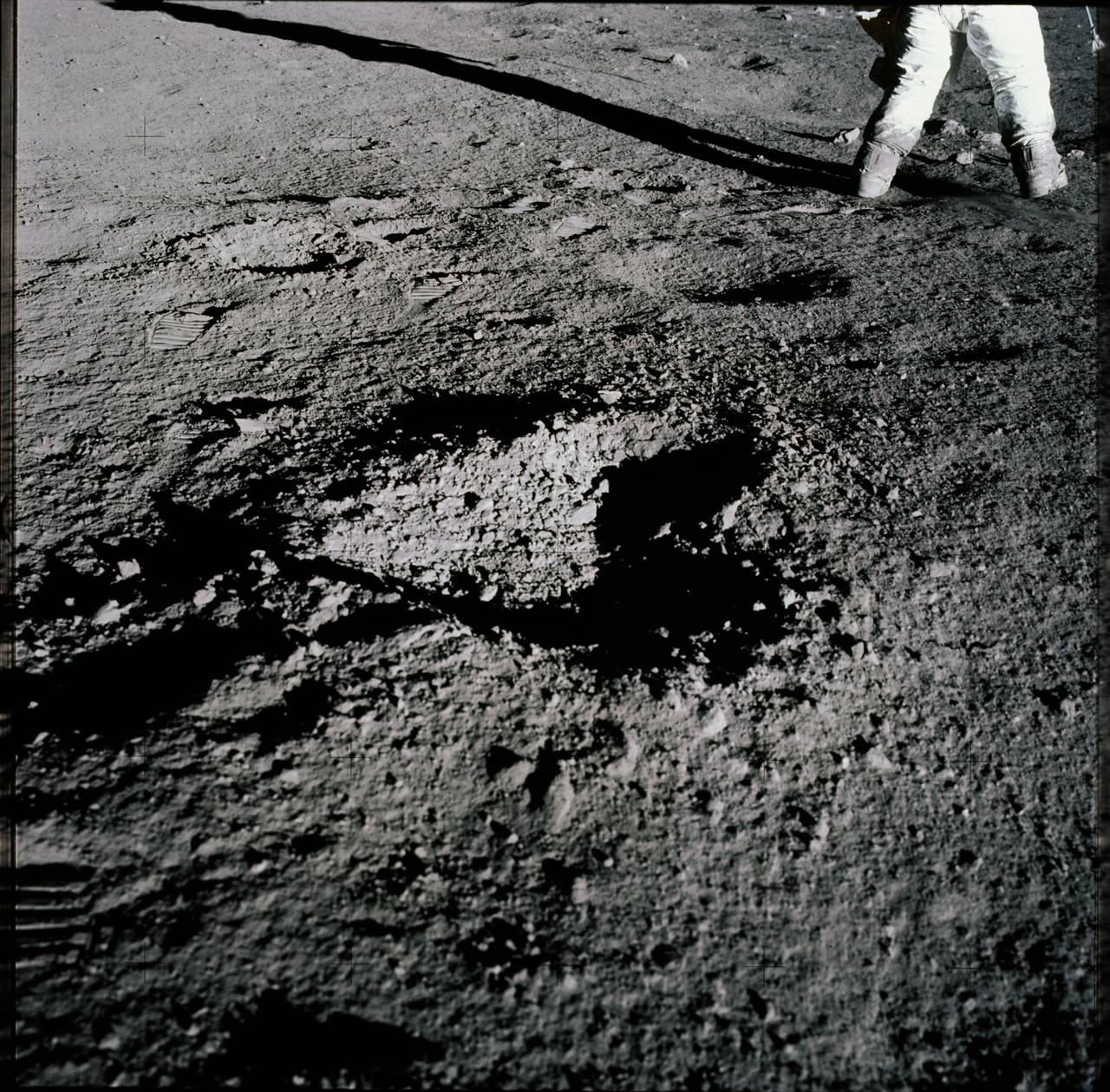
AS12-47-6938 (19 Nov. 1969) --- A close-up view of a heart-shaped depression (crater) in the lunar surface, as photographed during the Apollo 12 extravehicular activity (EVA). The legs of astronaut Charles Conrad Jr., commander, can be seen in the background. Astronaut Richard F. Gordon Jr., command module pilot, remained with the Command and Service Modules (CSM) in lunar orbit while astronauts Conrad and Alan L. Bean, lunar module pilot, descended in the Lunar Module (LM) to explore the moon.
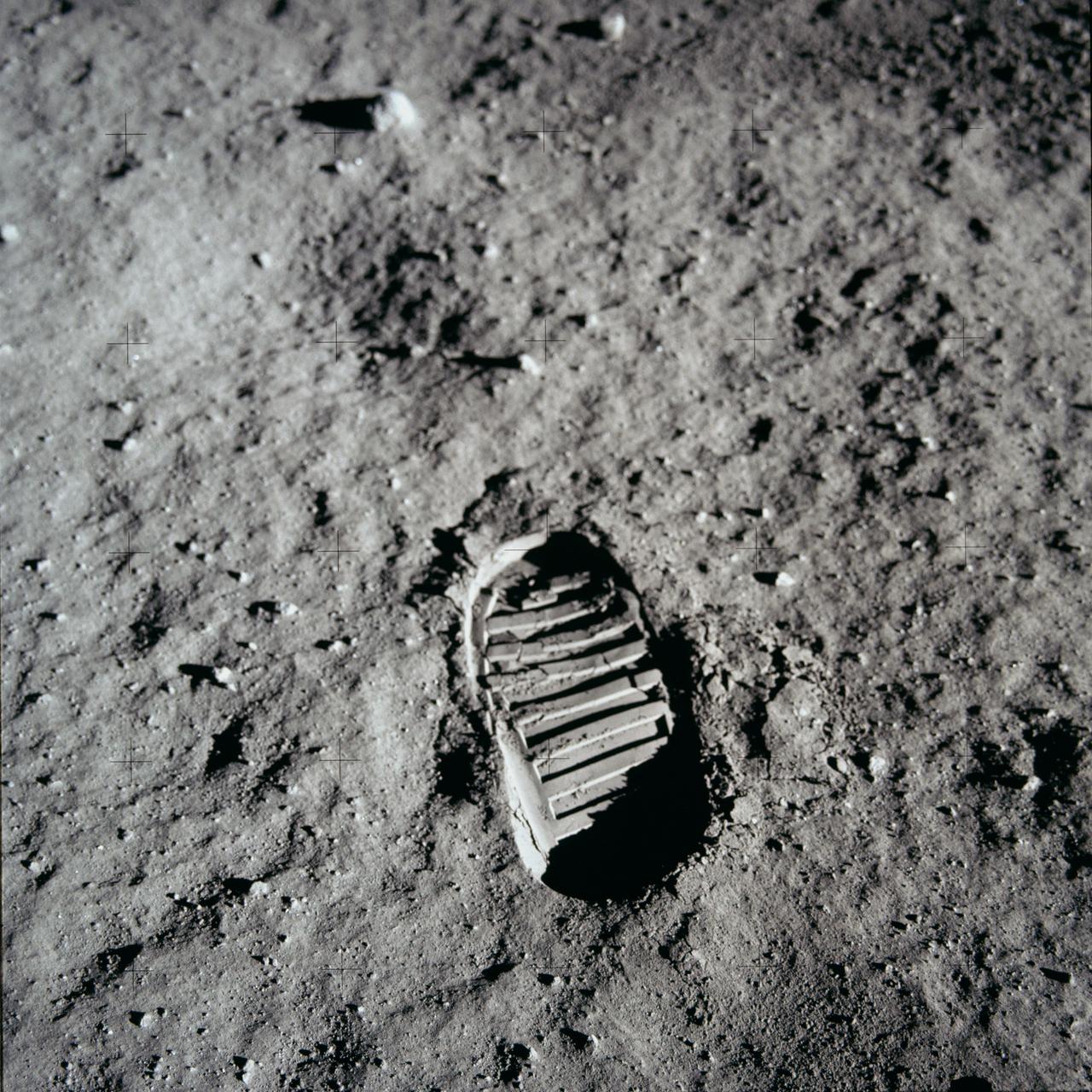
AS11-40-5877 (20 July 1969) --- A close-up view of an astronaut's bootprint in the lunar soil, photographed with a 70mm lunar surface camera during the Apollo 11 extravehicular activity (EVA) on the moon. While astronauts Neil A. Armstrong, commander, and Edwin E. Aldrin Jr., lunar module pilot, descended in the Lunar Module (LM) "Eagle" to explore the Sea of Tranquility region of the moon, astronaut Michael Collins, command module pilot, remained with the Command and Service Modules (CSM) "Columbia" in lunar orbit.

S71-39867 (June 1971) --- Astronauts David R. Scott (right), commander, and James B. Irwin, lunar module pilot, are shown on the Lunar Roving Vehicle (LRV) at the Kennedy Space Center (KSC), Florida, during Apollo 15 lunar surface extravehicular activity (EVA) simulations. While astronauts Scott and Irwin descend in the Lunar Module (LM) "Falcon" to explore the moon, astronaut Alfred M. Worden, command module pilot, will remain with the Command and Service Modules (CSM) in lunar orbit.
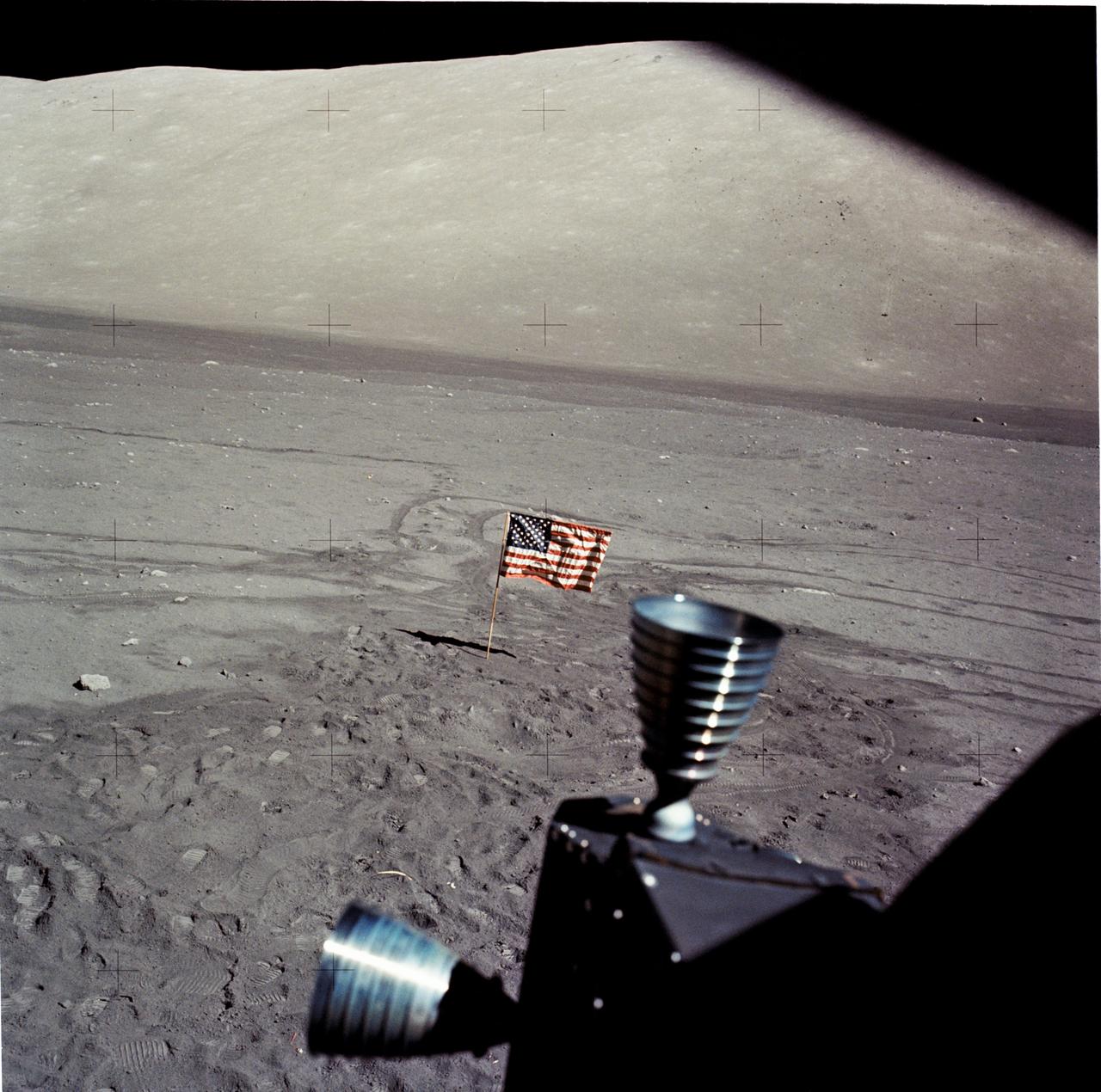
AS17-145-22216 (7-19 Dec. 1972) --- In this view looking out the Lunar Module (LM) windows shows the United States Flag on the moon's surface. This view looks toward the north Massif. The LM thrusters can be seen in foreground. While astronauts Eugene A. Cernan, commander, and Harrison H. Schmitt, lunar module pilot, descended in the LM "Challenger" to explore the Taurus-Littrow region of the moon, astronaut Ronald E. Evans, command module pilot, remained with the Command and Service Modules (CSM) "America" in lunar orbit.
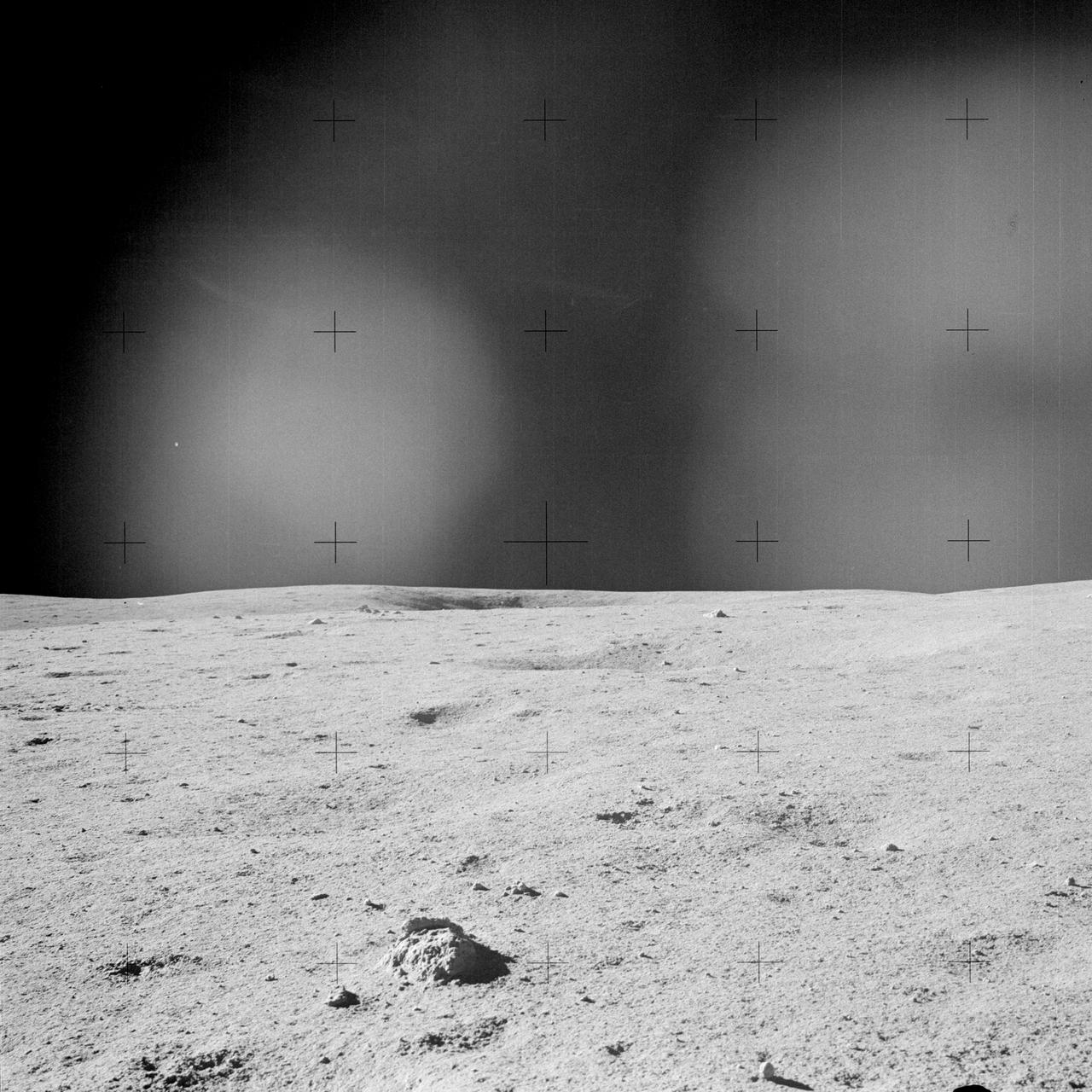
AS14-64-9181 (5-6 Feb. 1971) --- A view of the lunar terrain at the Apollo 14 Fra Mauro landing site as photographed through the left window of the Lunar Module (LM). Note the clump of lunar soil in the foreground, and a crater in the center on the horizon. While astronauts Alan B. Shepard Jr., commander; and Edgar D. Mitchell, lunar module pilot; descended in the LM to explore the moon, astronaut Stuart A. Roosa, command module pilot, remained with the Command and Service Modules (CSM) in lunar orbit.
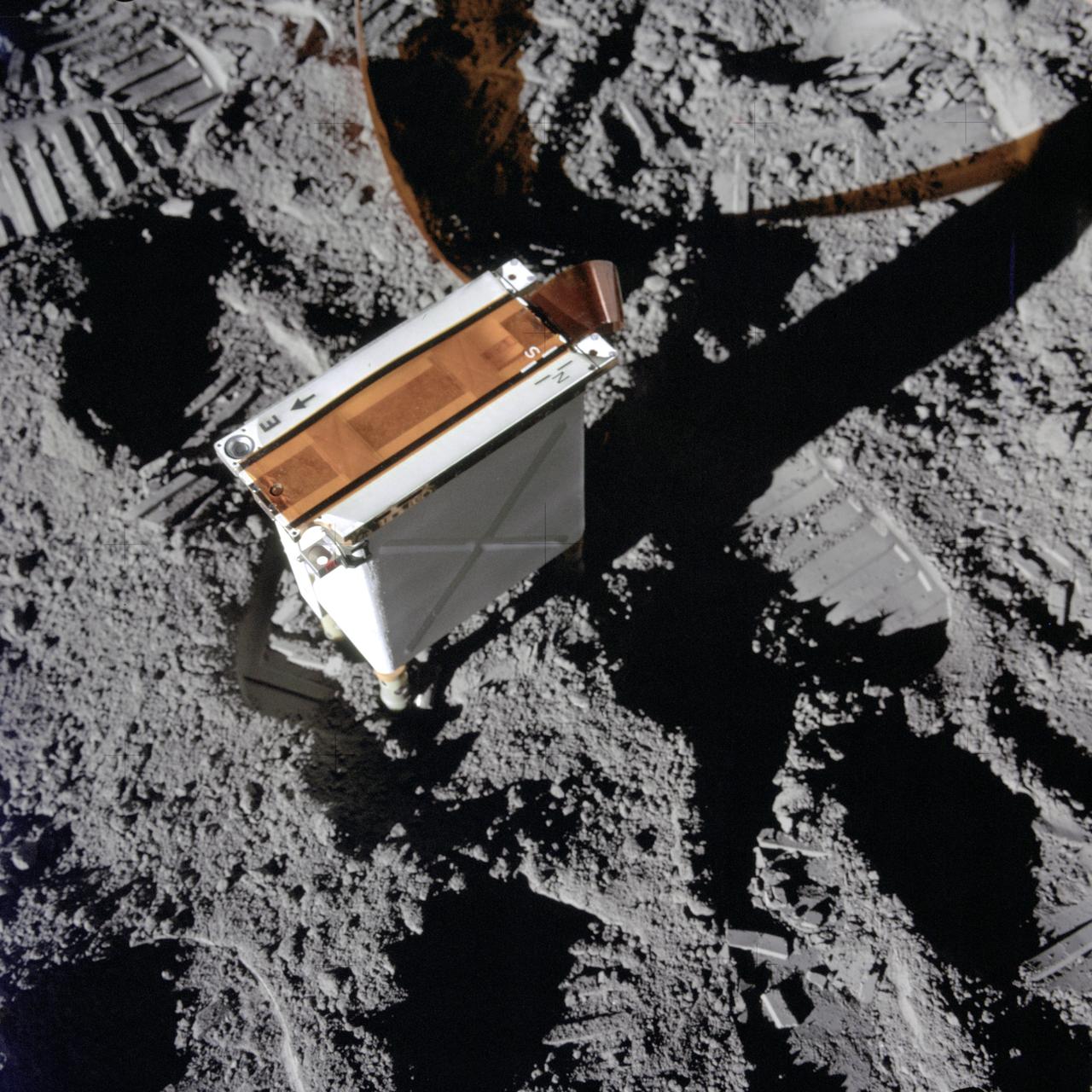
AS14-67-9364 (5 Feb. 1971) --- A close-up view of the charged particle lunar environment experiment (CPLEE), a component of the Apollo lunar surface experiments package (ALSEP) which was deployed on the moon by the Apollo 14 astronauts. While astronauts Alan B. Shepard Jr., commander, and Edgar D. Mitchell, lunar module pilot, descended in the Lunar Module (LM) to explore the moon, astronaut Stuart A. Roosa, command module pilot, remained with the Command and Service Modules (CSM) in lunar orbit.
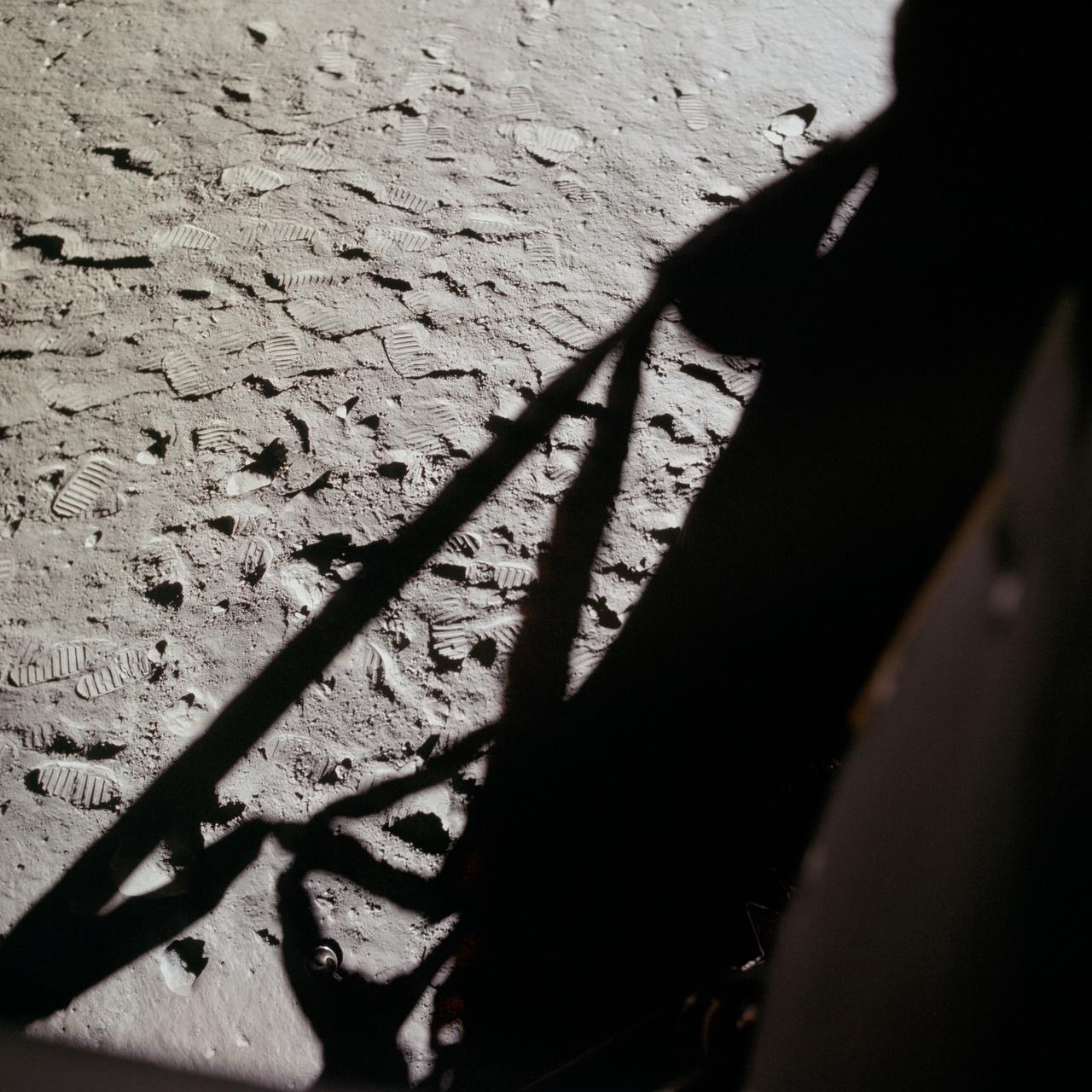
AS11-37-5505 (20 July 1969) --- This photograph shows in fine detail the impressions in the lunar soil made by astronauts Neil A. Armstrong and Edwin E. Aldrin Jr. during their lunar surface extravehicular activity (EVA). While astronauts Armstrong, commander, and Aldrin, lunar module pilot, descended in the Lunar Module (LM) "Eagle" to explore the Sea of Tranquility region of the moon, astronaut Michael Collins, command module pilot, remained with the Command and Service Modules (CSM) "Columbia" in lunar orbit.
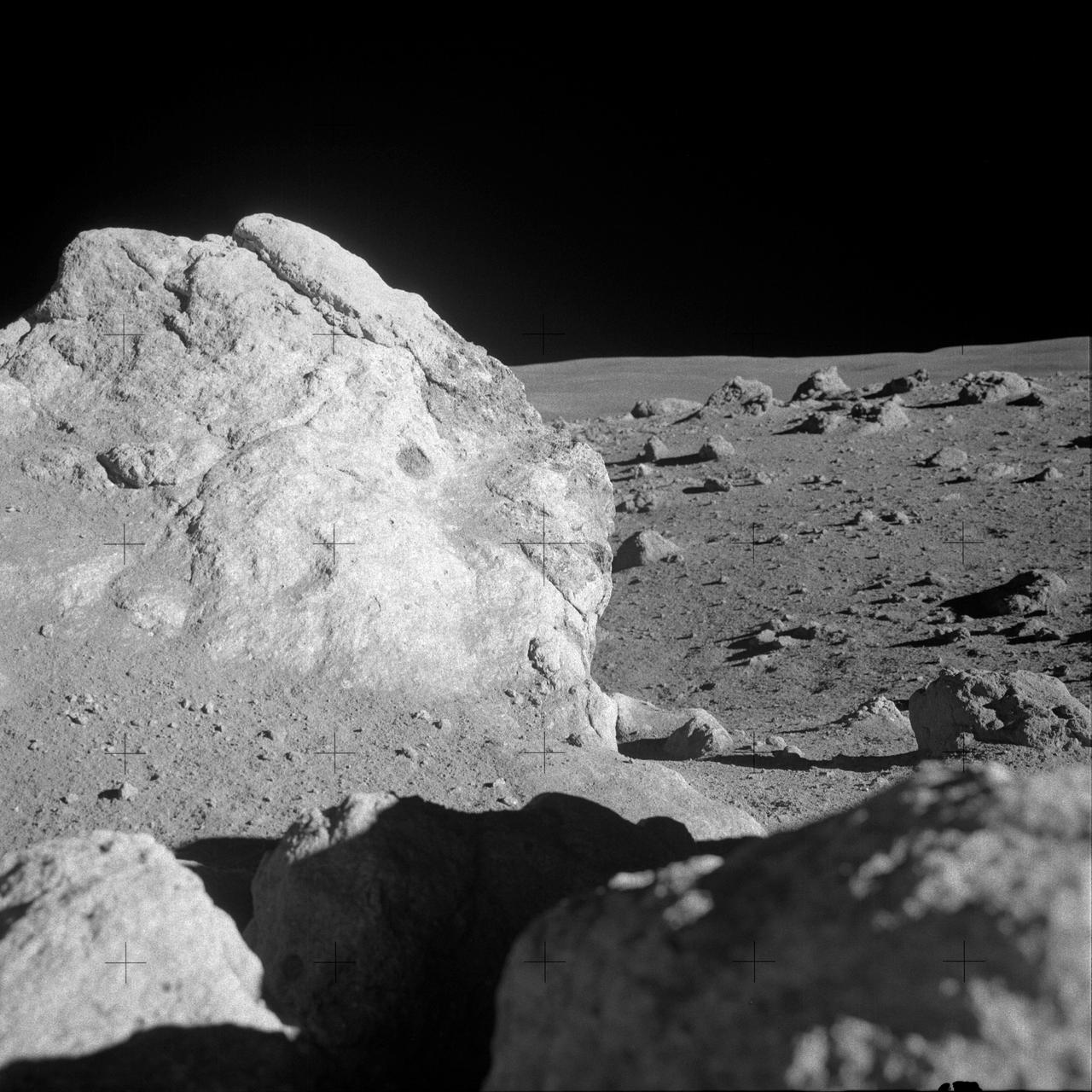
AS14-68-9451 (6 Feb. 1971) --- A close-up view of a large boulder in a field of boulders near the rim of Cone Crater, which was photographed by the Apollo 14 moon-explorers during the mission's second extravehicular activity (EVA). Astronauts Alan B. Shepard Jr., commander, and Edgar D. Mitchell, lunar module pilot, descended in the Apollo 14 Lunar Module (LM) to explore the lunar surface while astronaut Stuart A. Roosa, command module pilot, remained with the Command and Service Modules (CSM) in lunar orbit.

AS11-36-5299 (16 July 1969) --- This view of Earth showing clouds over water was photographed from the Apollo 11 spacecraft following translunar injection. While astronauts Neil A. Armstrong, commander, and Edwin E. Aldrin Jr., lunar module pilot, descended in the Lunar Module (LM) "Eagle" to explore the Sea of Tranquility region of the moon, astronaut Michael Collins, command module pilot, remained with the Command and Service Modules (CSM) "Columbia" in lunar orbit.
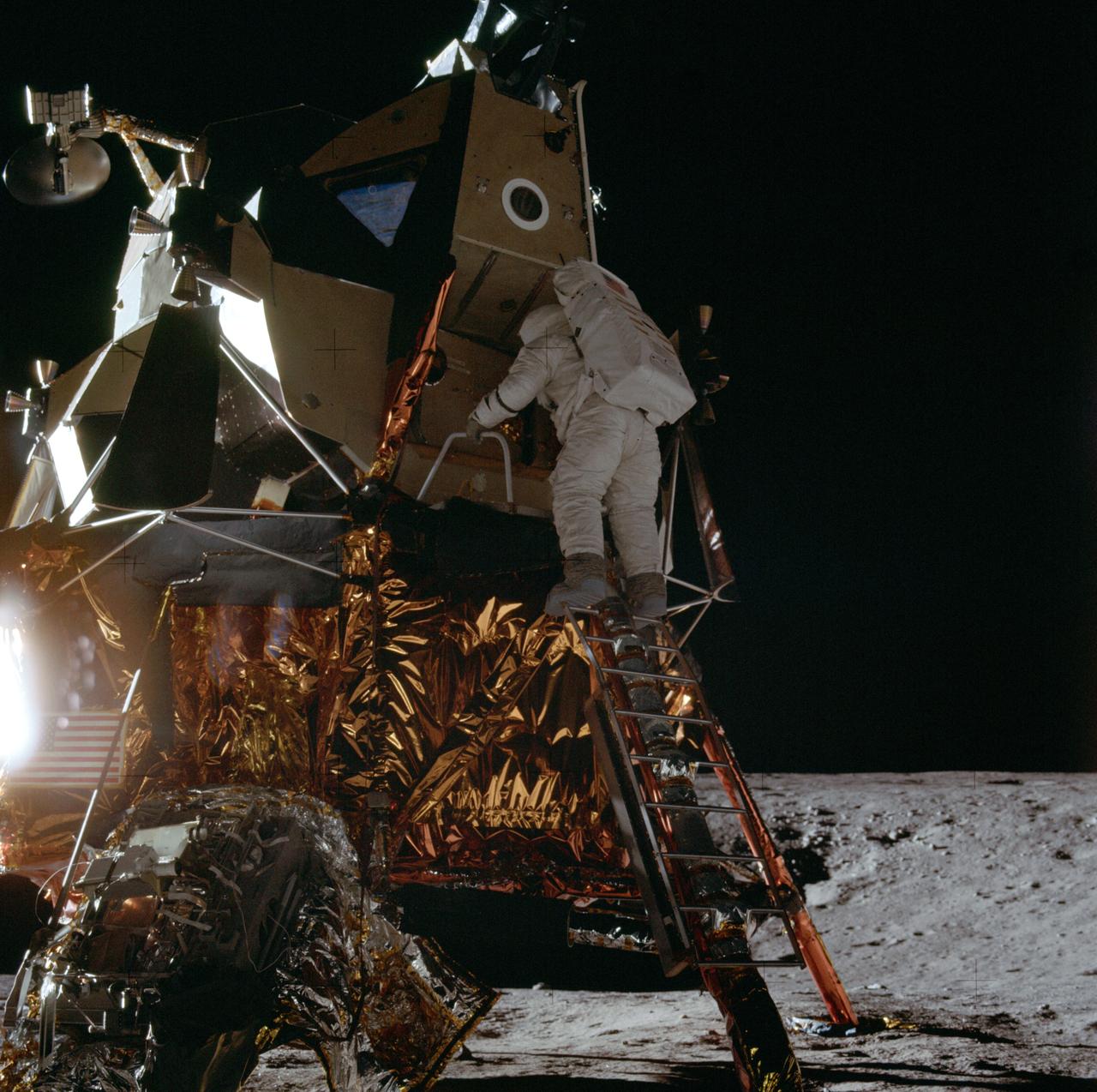
AS12-46-6726 (19 Nov. 1969) --- Astronaut Alan L. Bean, lunar module pilot for the Apollo 12 mission, starts down the ladder of the Lunar Module (LM) to join astronaut Charles Conrad Jr., mission commander, in extravehicular activity (EVA). While astronauts Conrad and Bean descended in the LM "Intrepid" to explore the Ocean of Storms region of the moon, astronaut Richard F. Gordon Jr., command module pilot, remained with the Command and Service Modules (CSM) "Yankee Clipper" in lunar orbit.
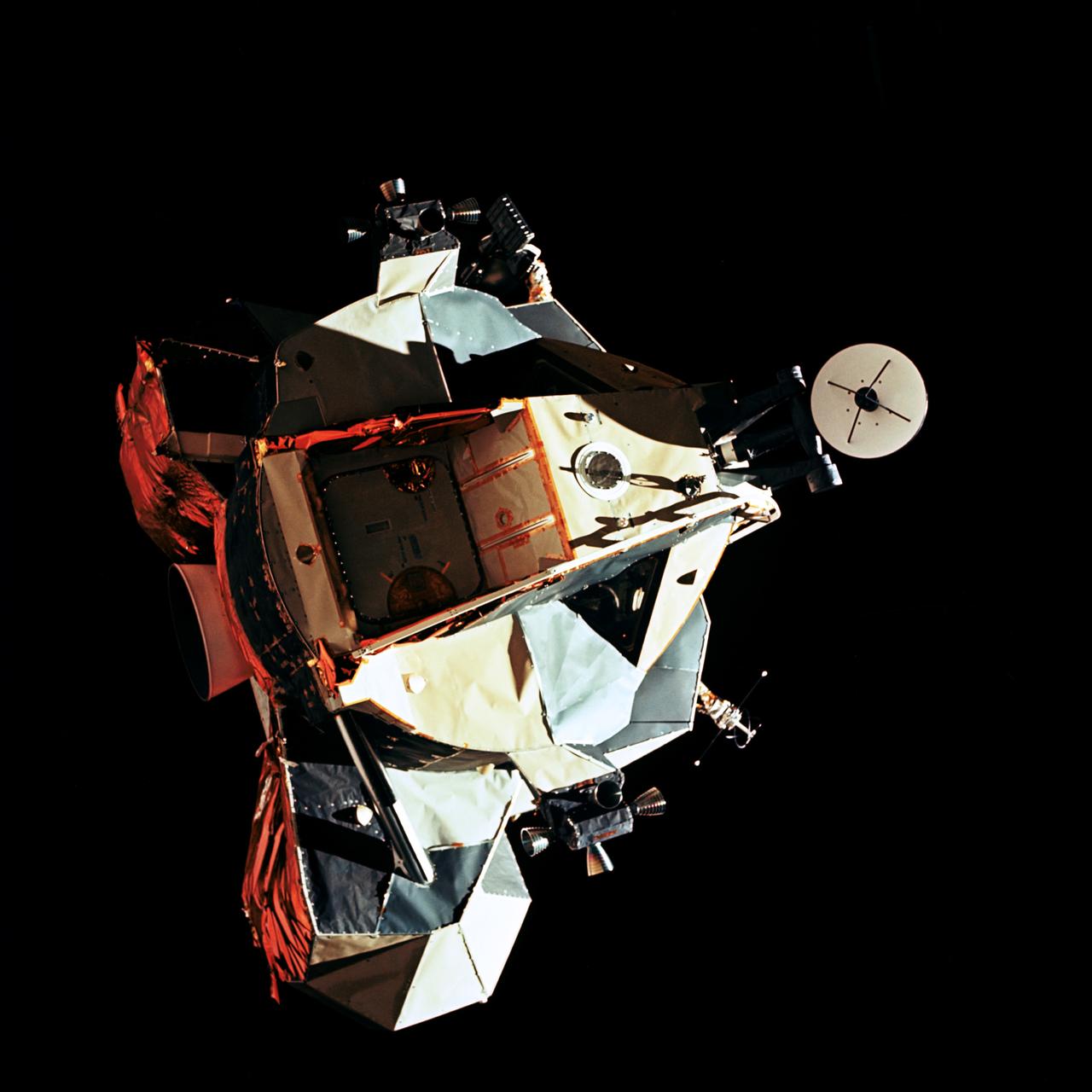
AS17-149-22857 (14 Dec. 1972) --- This 70mm view of the Lunar Module (LM) "Challenger" in lunar orbit before rendezvous with the Apollo 17 Command and Service Modules (CSM). While astronauts Eugene A. Cernan, commander, and Harrison H. Schmitt, lunar module pilot, descended in the Challenger to explore the Taurus-Littrow region of the moon, astronaut Ronald E. Evans, command module pilot, remained with the CSM "America" in lunar orbit.
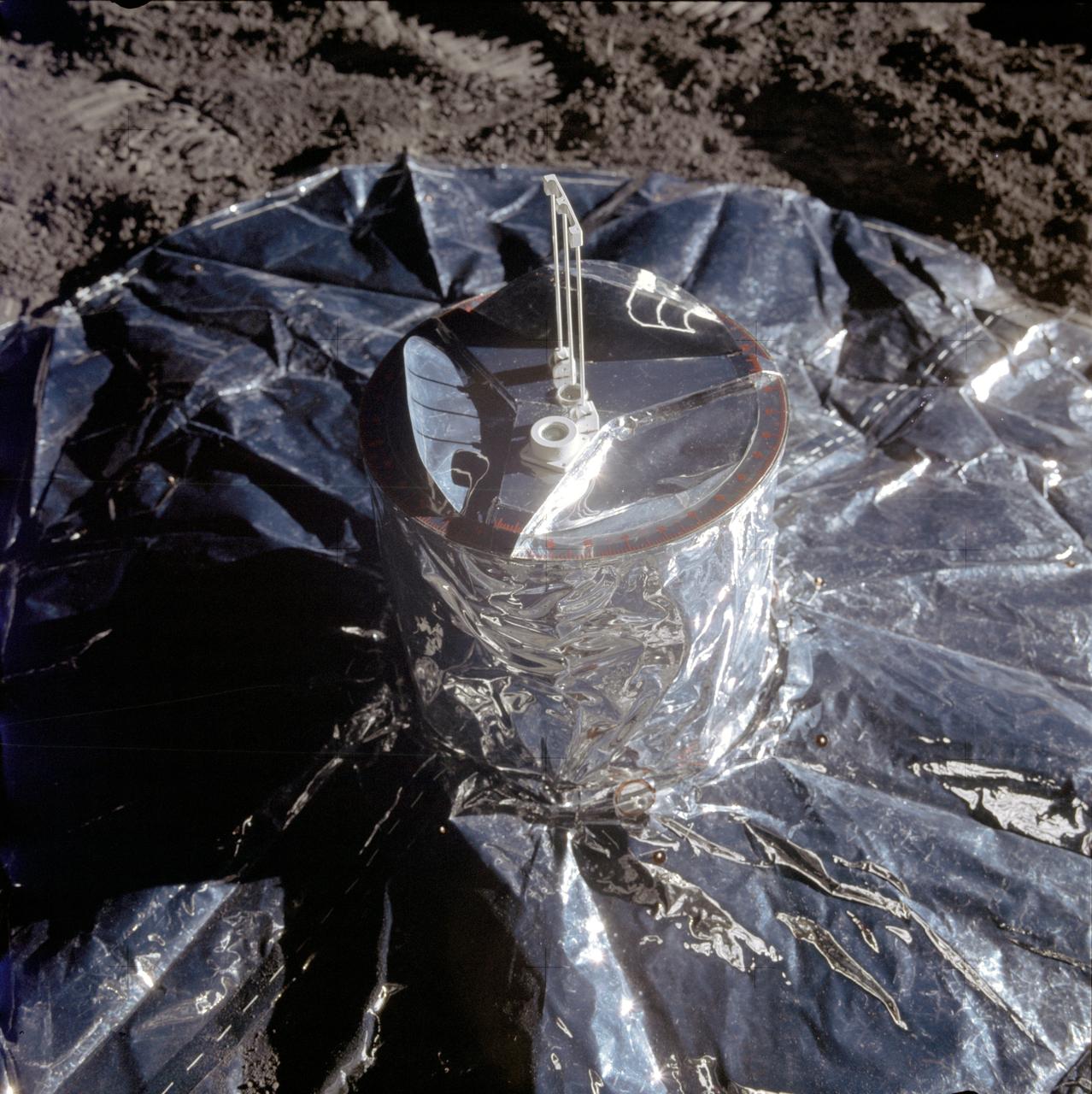
AS14-67-9362 (5 Feb. 1971) --- A close-up view of the passive seismic experiment (PSE), a component of the Apollo lunar surface experiments package (ALSEP), which was deployed on the moon by the Apollo 14 astronauts during their first extravehicular activity (EVA). While astronauts Alan B. Shepard Jr., commander, and Edgar D. Mitchell, lunar module pilot, descended in the Lunar Module (LM) to explore the moon, astronaut Stuart A. Roosa, command module pilot, remained with the Command and Service Modules (CSM) in lunar orbit.
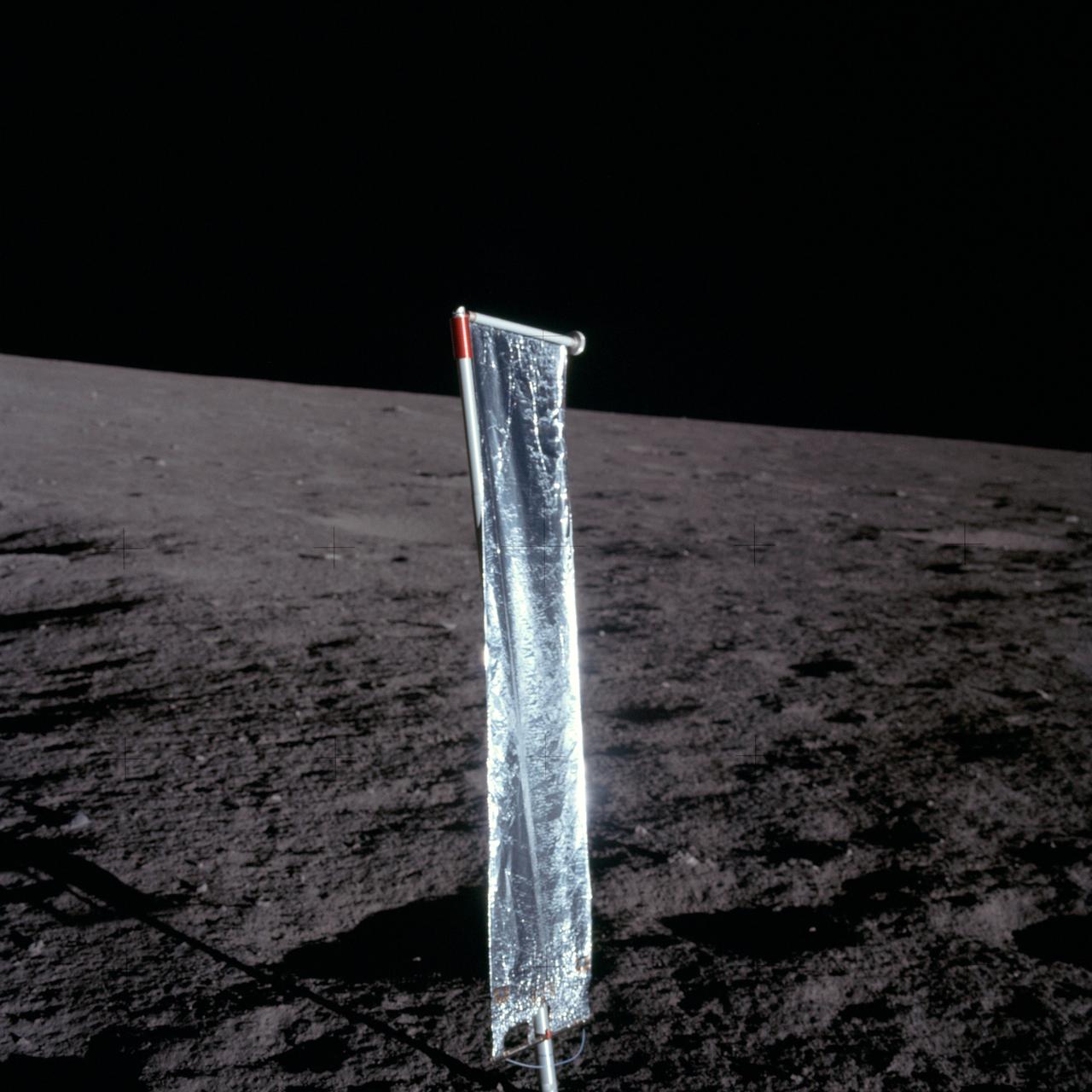
AS12-47-6898 (19 Nov. 1969) --- A close-up view of the Solar Wind Composition device. Astronaut Alan L. Bean, lunar module pilot, took this photograph, after having deployed the device. Astronauts Charles Conrad Jr., commander, and Bean descended in the Apollo 12 Lunar Module (LM) to explore the moon, while astronaut Richard F. Gordon Jr., command module pilot, remained in lunar orbit with the Command and Service Modules (CSM).
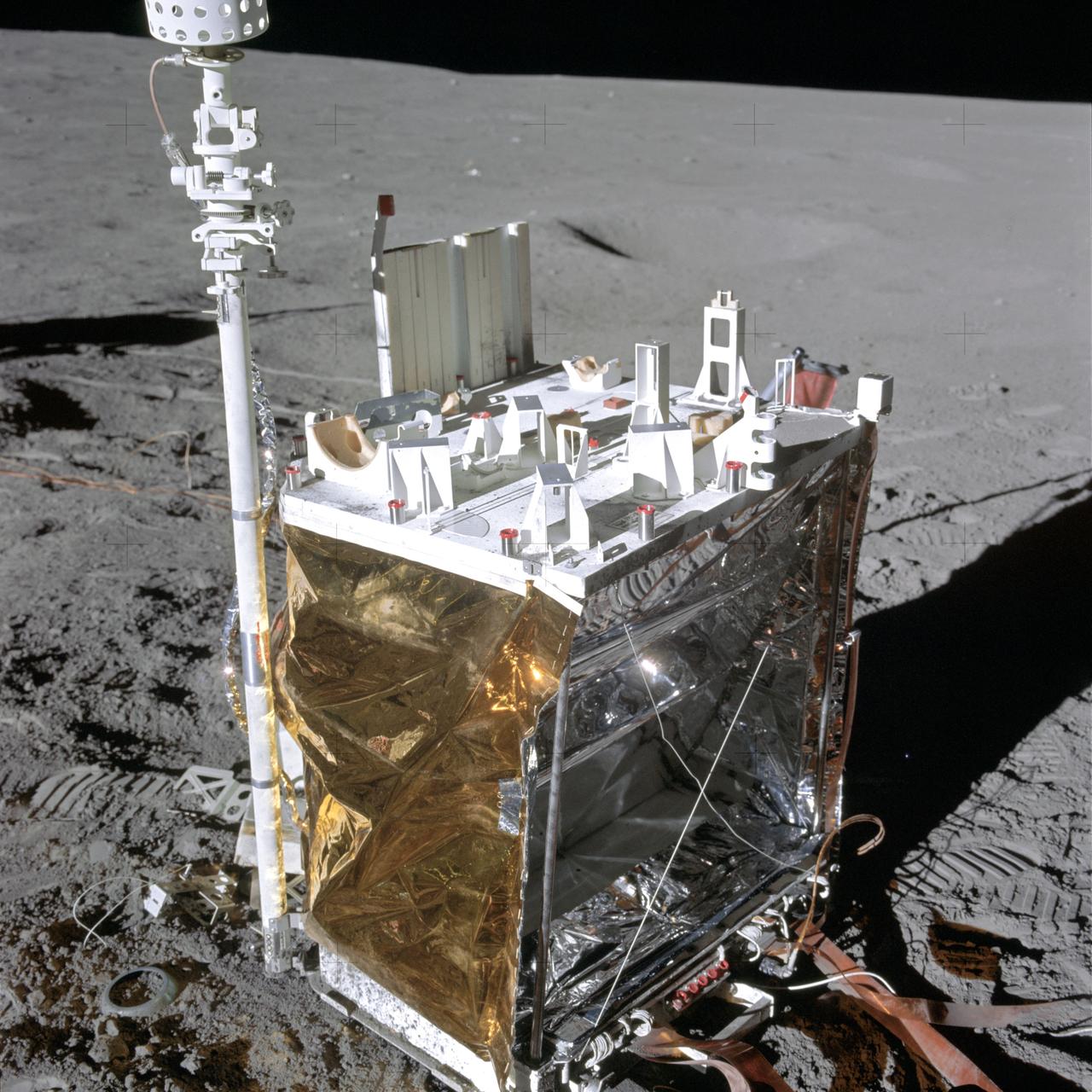
AS14-67-9379 (5 Feb. 1971) --- A close-up view of the central station (CS) of the Apollo lunar surface experiments package (ALSEP), which was deployed on the moon by the Apollo 14 astronauts during their first extravehicular activity (EVA). While astronauts Alan B. Shepard Jr., commander, and Edgar D. Mitchell, lunar module pilot, descended in the Lunar Module (LM) to explore the moon, astronaut Stuart A. Roosa, command module pilot, remained with the Command and Service Modules (CSM) in lunar orbit.

AS11-40-5878 (20 July 1969) --- A close-up view of an astronaut's bootprint in the lunar soil, photographed with a 70mm lunar surface camera during the Apollo 11 extravehicular activity (EVA) on the moon. While astronauts Neil A. Armstrong, commander, and Edwin E. Aldrin Jr., lunar module pilot, descended in the Lunar Module (LM) "Eagle" to explore the Sea of Tranquility region of the moon, astronaut Michael Collins, command module pilot, remained with the Command and Service Modules (CSM) "Columbia" in lunar orbit.

S72-16660 (January 1972) --- These three astronauts have been selected by the National Aeronautics and Space Administration (NASA) as the prime crew men of the Apollo 16 lunar landing mission. They are, left to right, Thomas K. Mattingly II, command module pilot; John W. Young, commander; and Charles M. Duke Jr., lunar module pilot. While astronauts Young and Duke descend in the Lunar Module (LM) to explore the moon, astronaut Mattingly will remain with the Command and Service Modules (CSM) in lunar orbit.
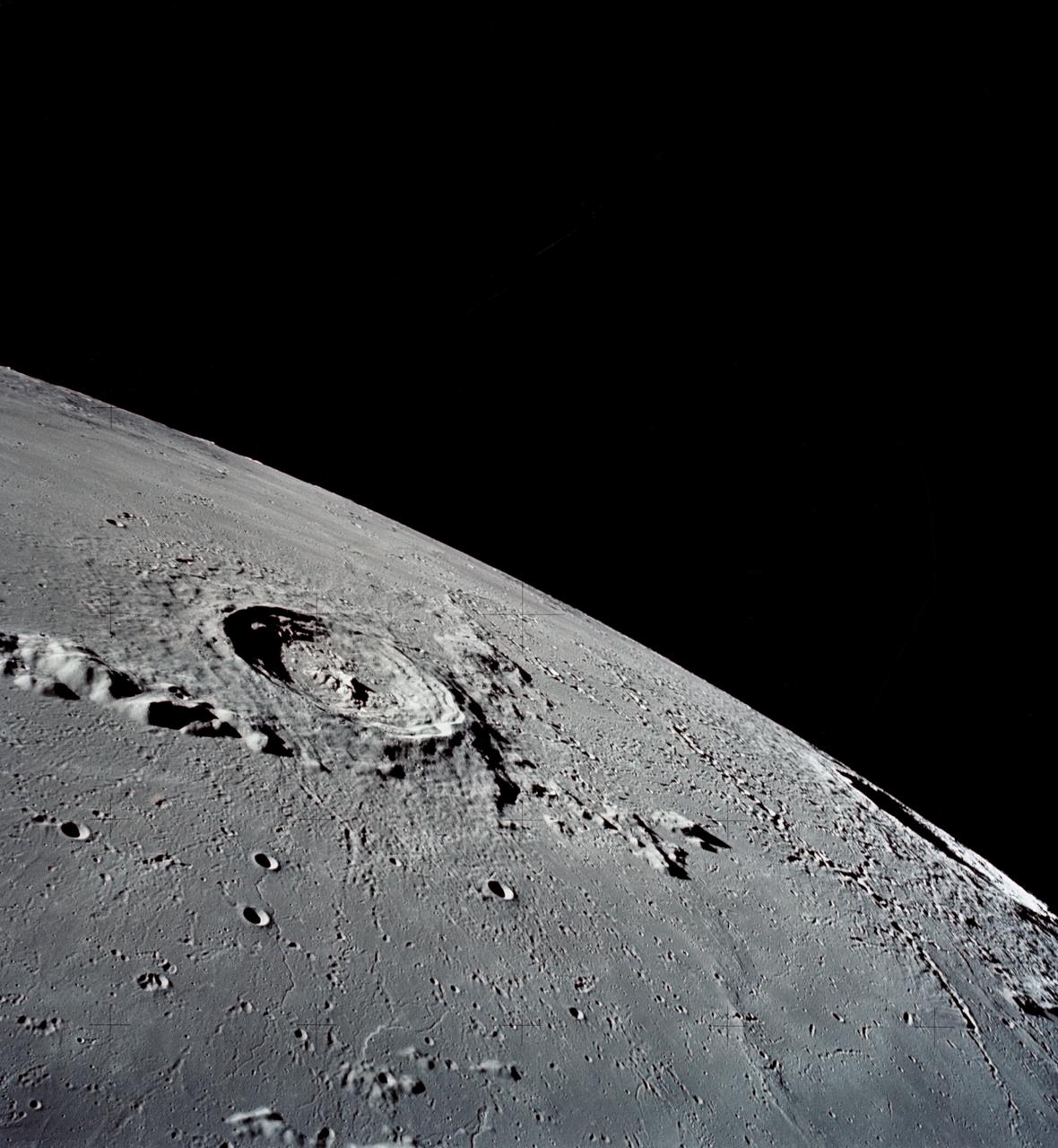
AS17-145-22285 (7-19 Dec. 1972) --- This is a view of the Eratosthenes Crater, taken looking southward from the Command and Service Module (CSM), being piloted by astronaut Ronald E. Evans. Copernicus is on the horizon. The other astronauts are Eugene A. Cernan, commander; and Harrison H. Schmitt, lunar module pilot.
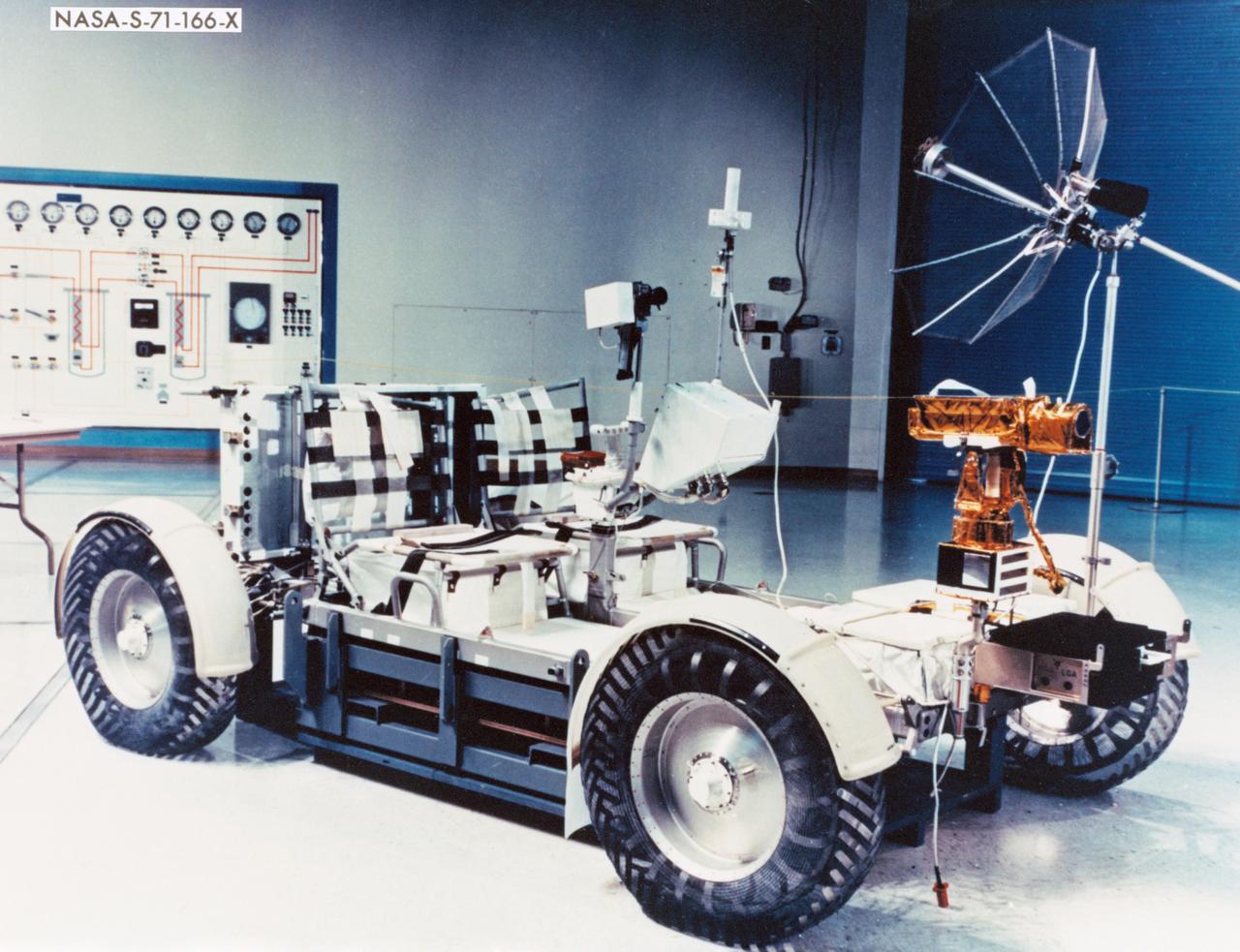
S71-00166 (June 1971) --- A close-up view of the Lunar Roving Vehicle (LRV). Apollo 15 will be the first mission to employ the services of the LRV. Astronauts David R. Scott, commander; and James B. Irwin, lunar module pilot, will move about the lunar surface in the Hadley-Apennine region in their four-wheeled vehicle while astronaut Alfred M. Worden, command module pilot, remains with the Command and Service Modules (CSM) in lunar orbit. A television camera, which can be controlled remotely from the ground (front), and a motion picture camera (rear) are among the gear on the LRV.
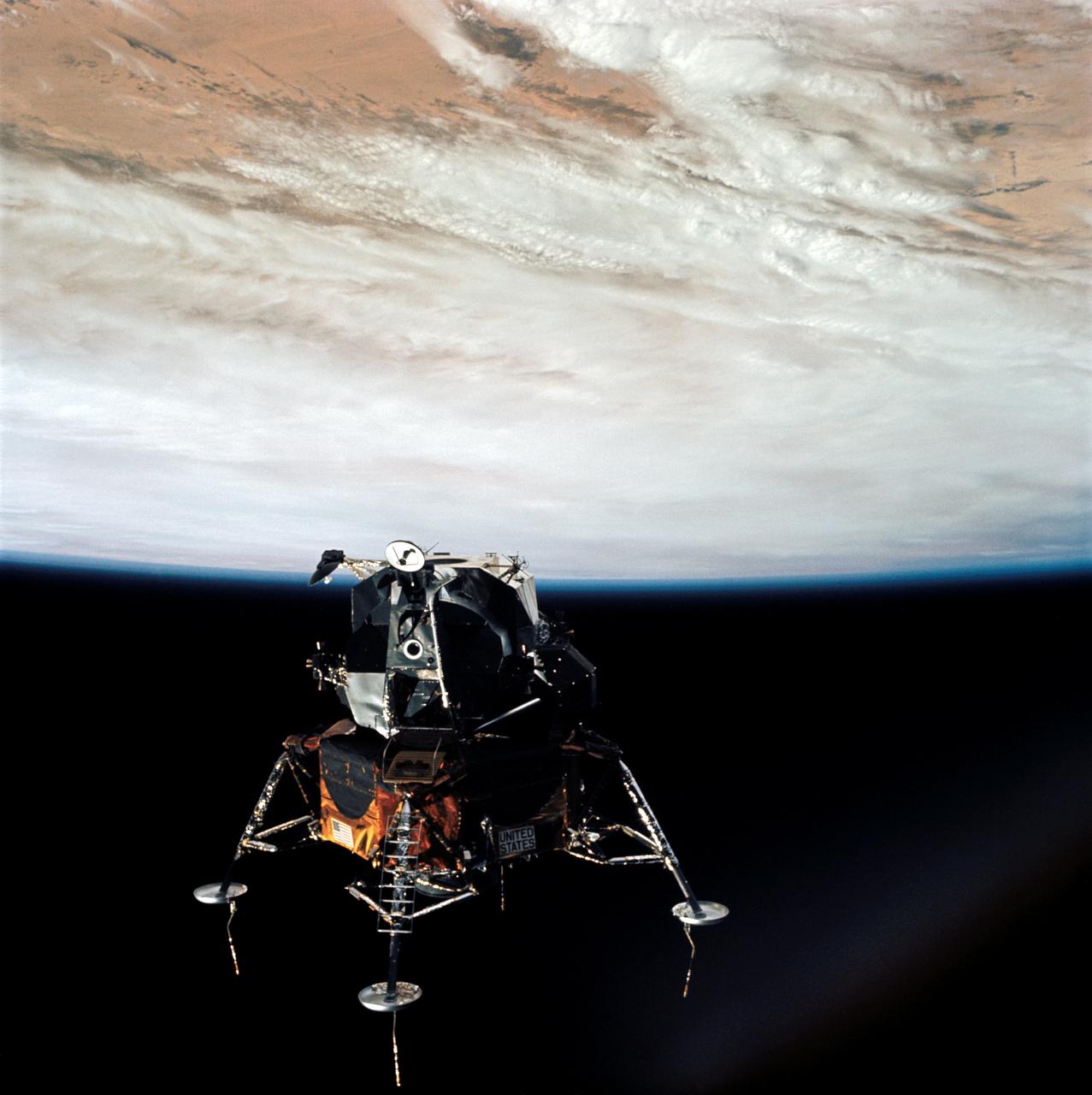
AS09-21-3212 (7 March 1969) --- A view of the Apollo 9 Lunar Module (LM), "Spider", in a lunar landing configuration, as photographed from the Command and Service Modules (CSM) on the fifth day of the Apollo 9 Earth-orbital mission. The landing gear on the "Spider" has been deployed. Lunar surface probes (sensors) extend out from landing gear foot pads. Inside the "Spider" were astronauts James A. McDivitt, Apollo 9 commander, and Russell L. Schweickart, lunar module pilot. Astronaut David R. Scott, command module pilot, remained at the controls in the Command Module (CM), "Gumdrop", while the other two astronauts checked out the Lunar Module.
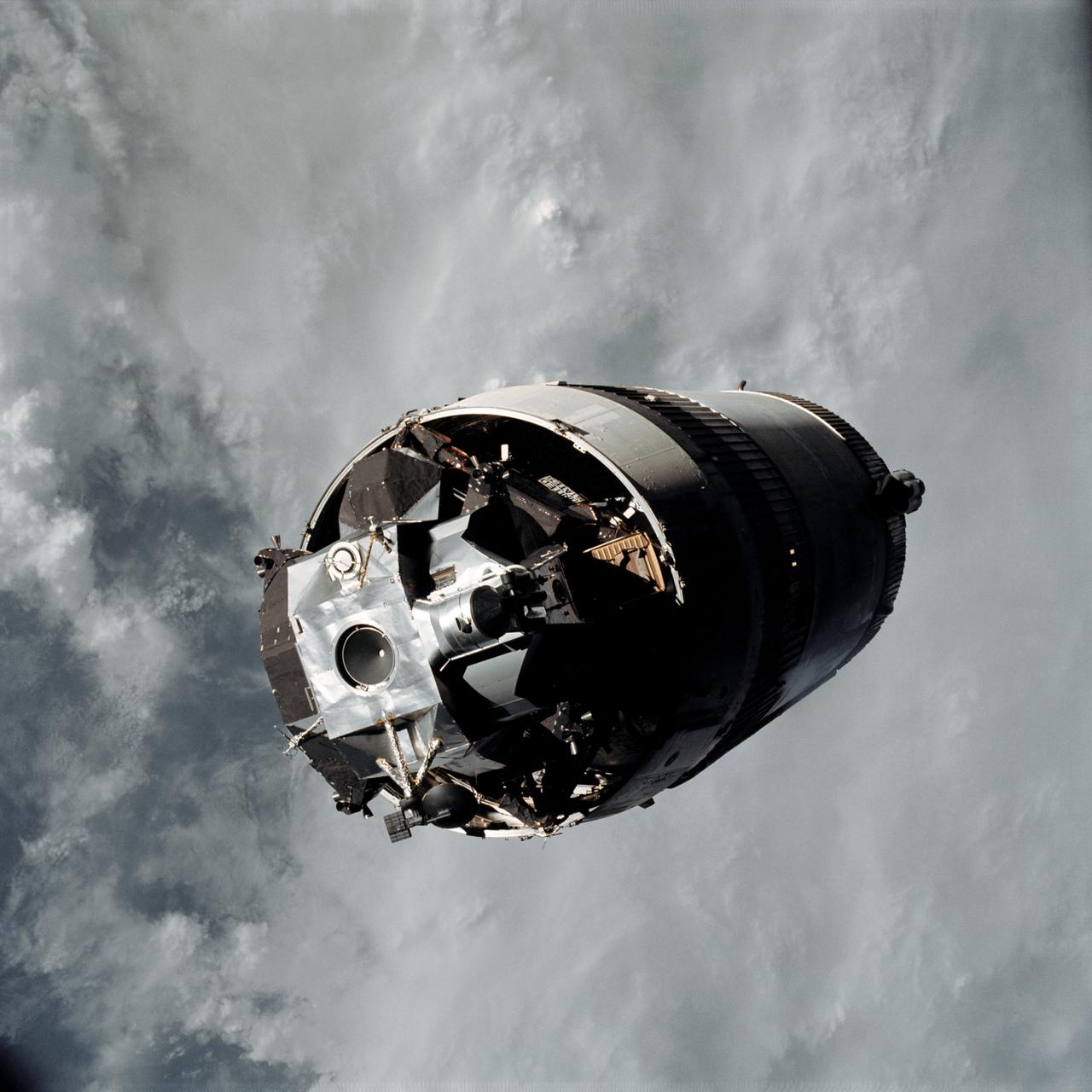
AS09-19-2919 (3 March 1969) --- The Lunar Module (LM) "Spider", still attached to the Saturn V third (S-IVB) stage, is photographed from the Command and Service Modules (CSM) "Gumdrop" on the first day of the Apollo 9 Earth-orbital mission. This picture was taken following CSM/LM-S-IVB separation and prior to LM extraction from the S-IVB. The Spacecraft Lunar Module Adapter (SLA) panels have already been jettisoned. Inside the Command Module were astronauts James A. McDivitt, commander; David R. Scott, command module pilot; and Russell L. Schweickart, lunar module pilot.
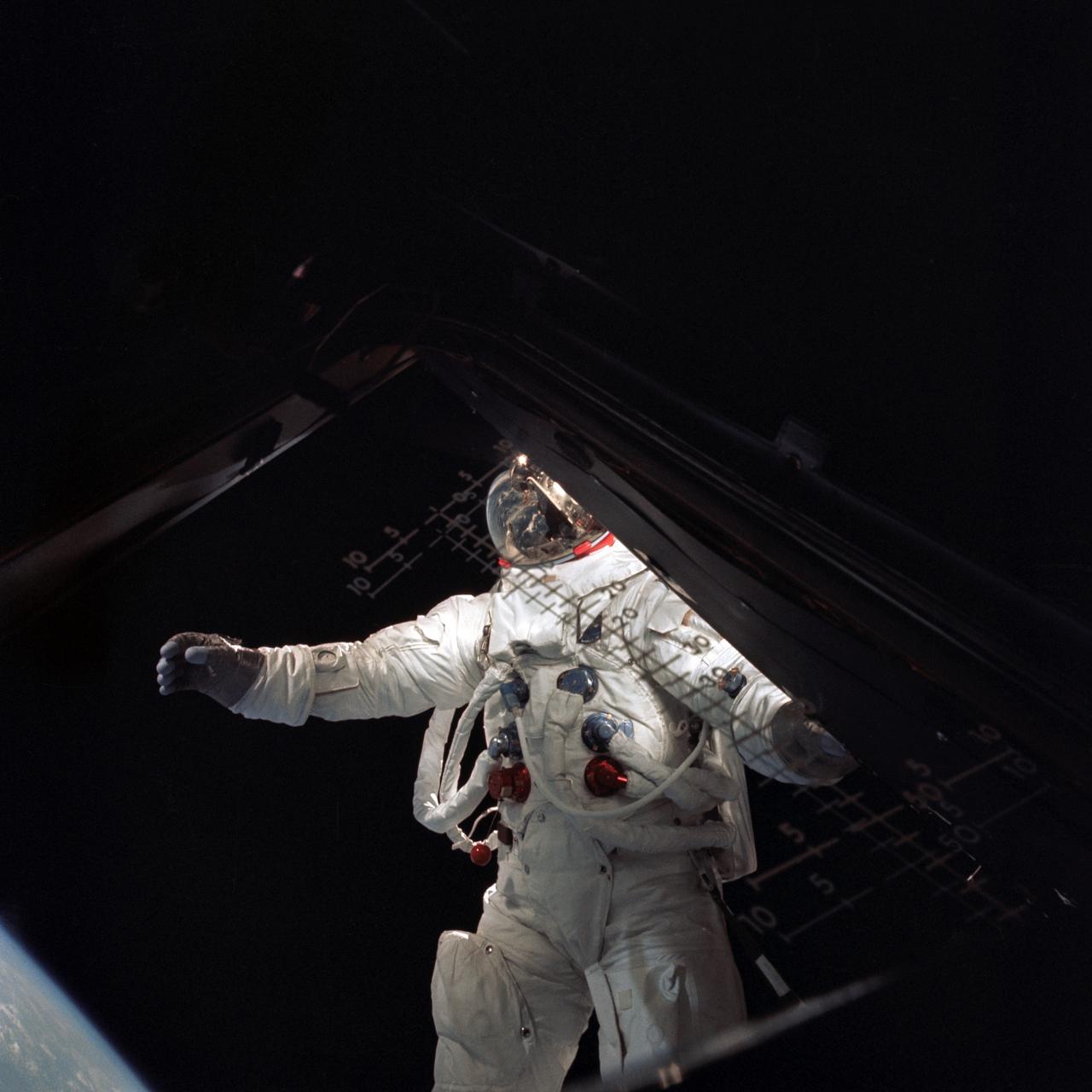
AS09-20-3094 (6 March 1969) --- Astronaut Russell L. Schweickart, lunar module pilot, stands in "golden slippers" on the Lunar Module porch during his extravehicular activity on the fourth day of the Apollo 9 Earth-orbital mission. This photograph was taken from inside the Lunar Module "Spider". The Command and Service Modules were docked to the LM. Schweickart is wearing an Extravehicular Mobility Unit (EMU). Inside the "Spider" was astronaut James A. McDivitt, Apollo 9 crew commander. Astronaut David R. Scott, command module pilot, remained at the controls of the Command Module, "Gumdrop."
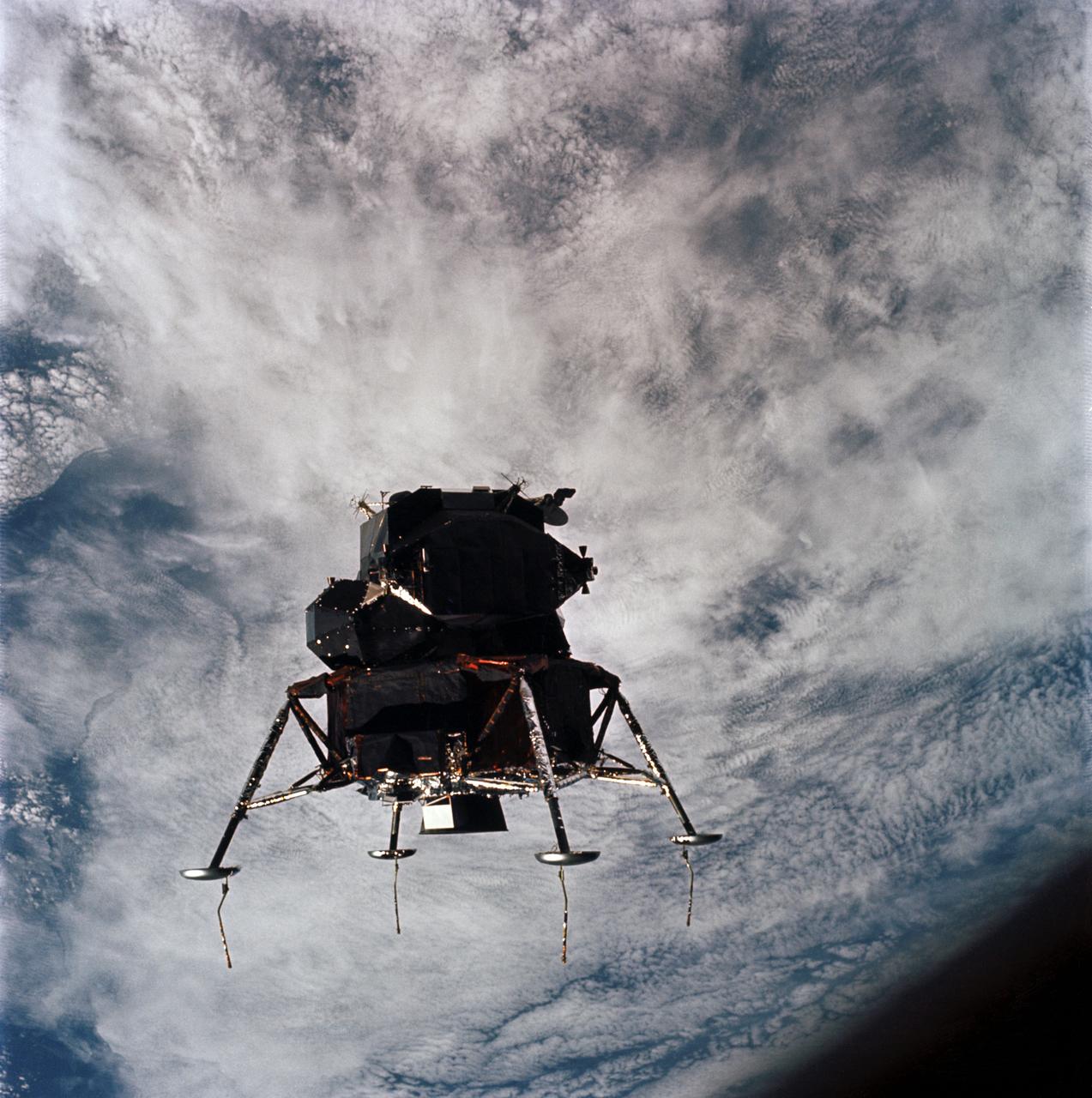
AS09-21-3199 (7 March 1969) --- Excellent view of the Apollo 9 Lunar Module, "Spider," in a lunar landing configuration, as photographed from the Command and Service Modules on the fifth day of the Apollo 9 Earth-orbital mission. The landing gear on the "Spider" has been deployed. Lunar surface probes (sensors) extend out from the landing gear foot pads. Inside the "Spider" were astronauts James A. McDivitt, Apollo 9 commander; and Russell L. Schweickart, lunar module pilot. Astronaut David R. Scott, command module pilot, remained at the controls in the Command Module, "Gumdrop," while the other two astronauts checked out the Lunar Module.
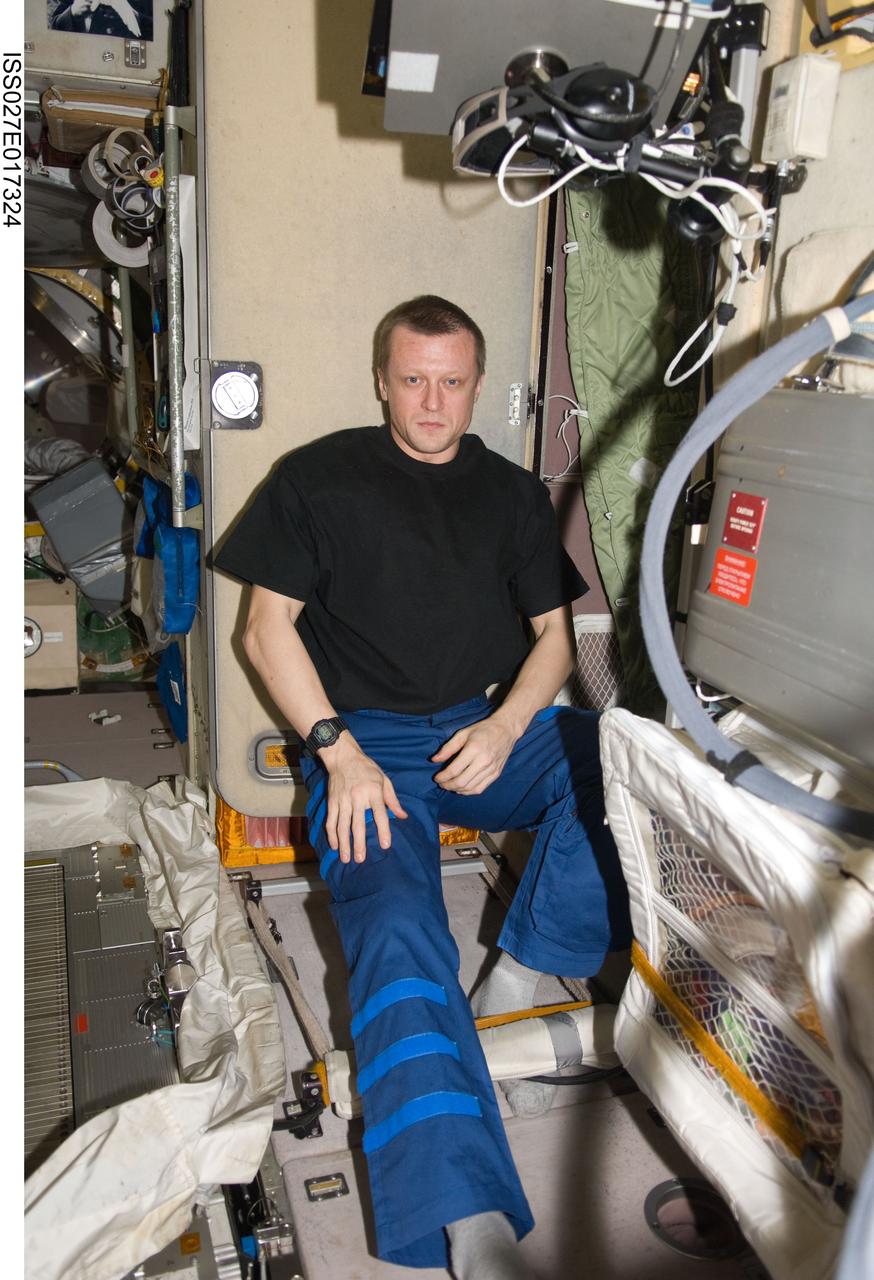
ISS027-E-017324 (27 April 2011) --- Russian cosmonaut Dmitry Kondratyev, Expedition 27 commander, is pictured in the Zvezda Service Module of the International Space Station.
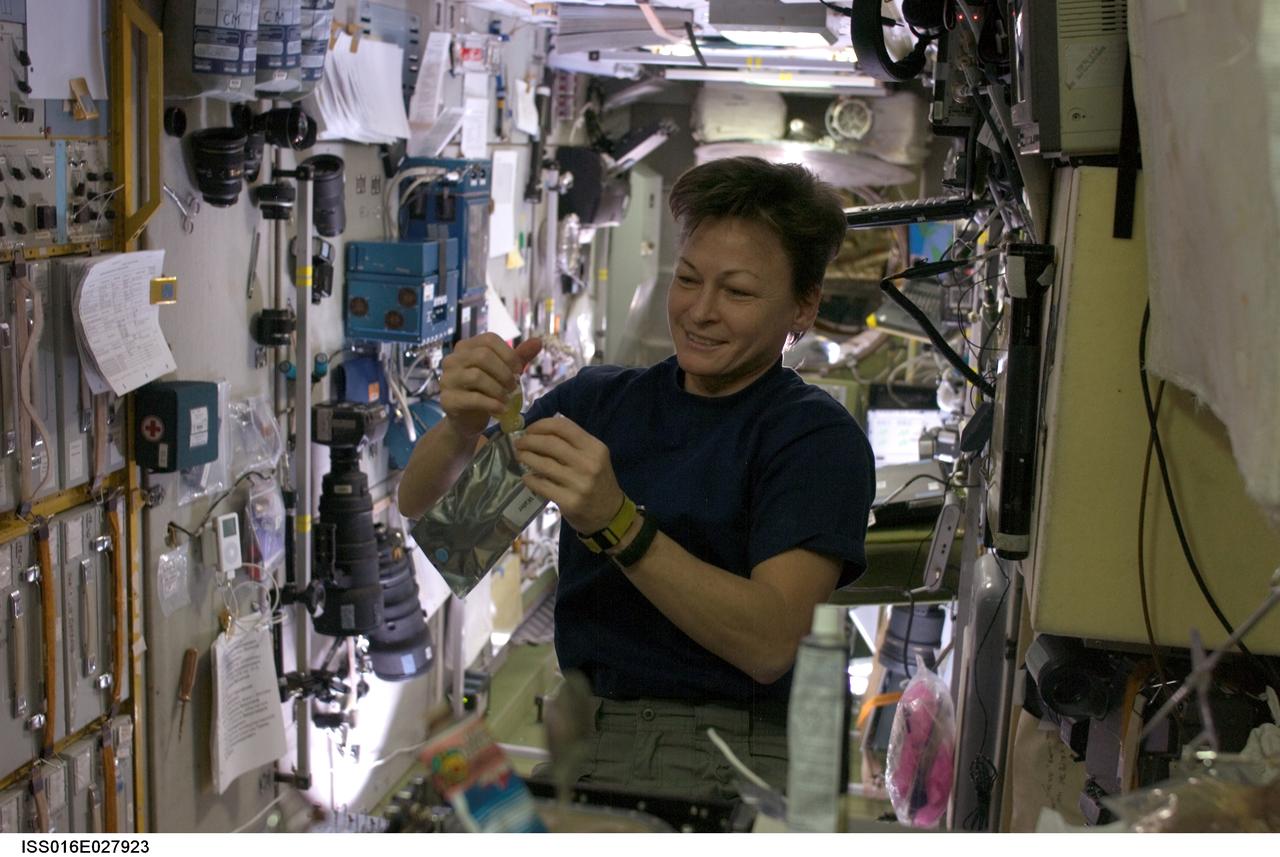
ISS016-E-027923 (1 Feb. 2008) --- Astronaut Peggy Whitson, Expedition 16 commander, prepares a beverage in the Zvezda Service Module of the International Space Station.
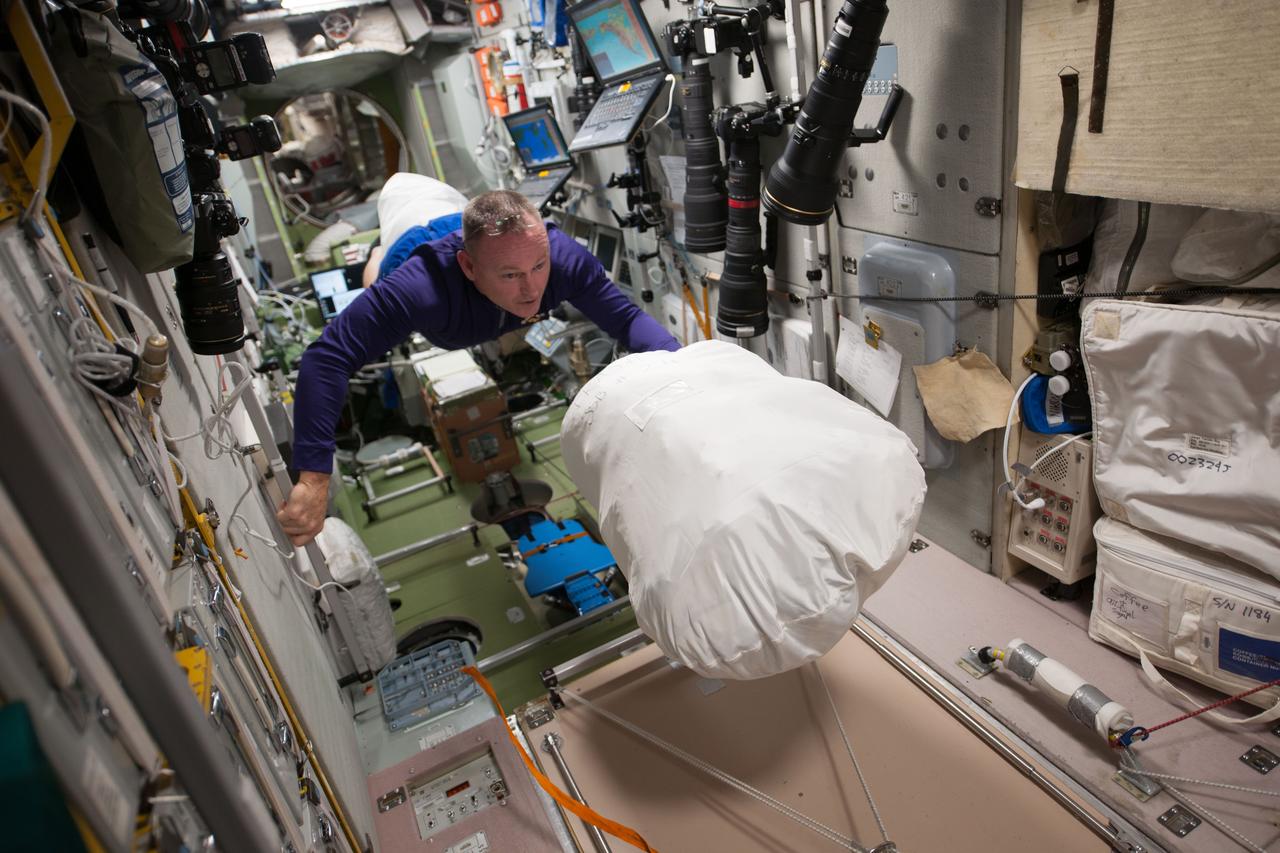
Commander Barry Wilmore floats through the Zvezda Service Module (SM) with a full Jettison Stowage Bag. Image was released by astronaut on Instagram.