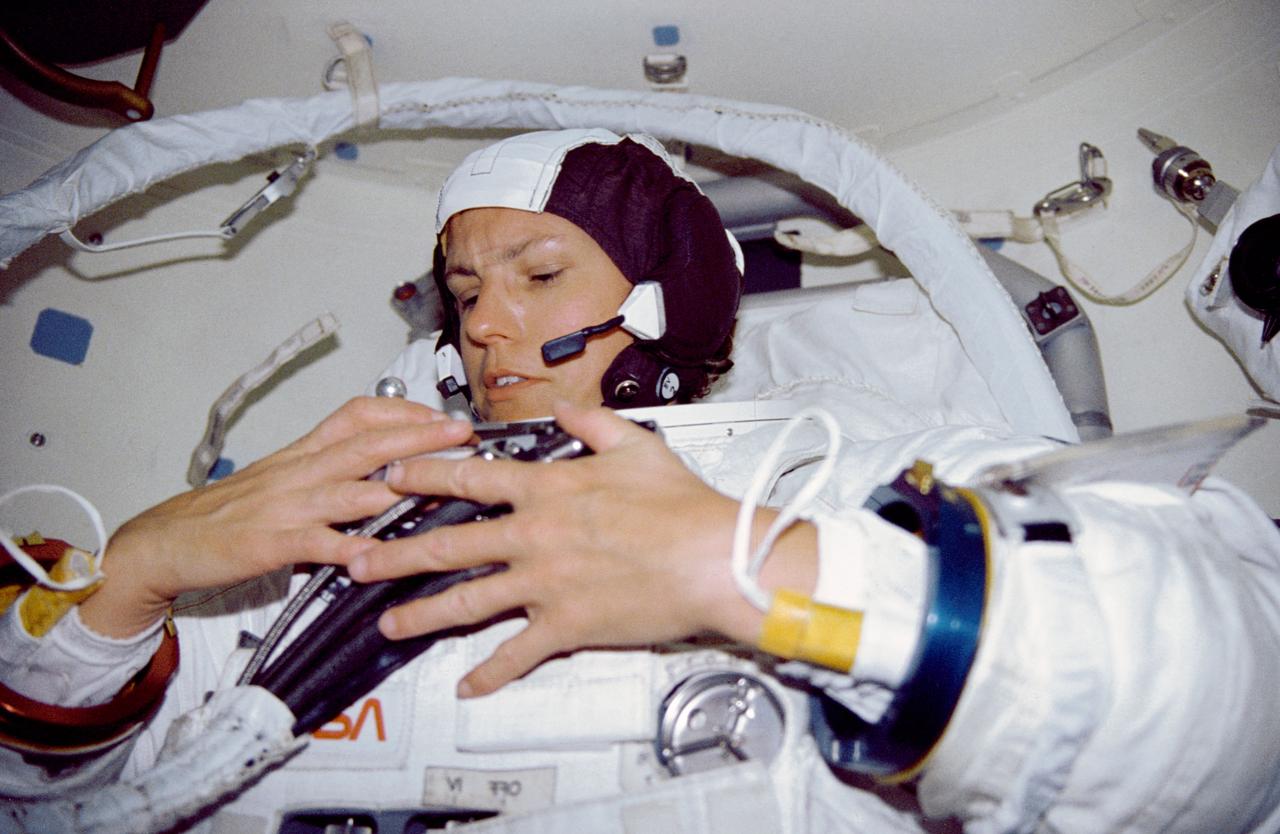
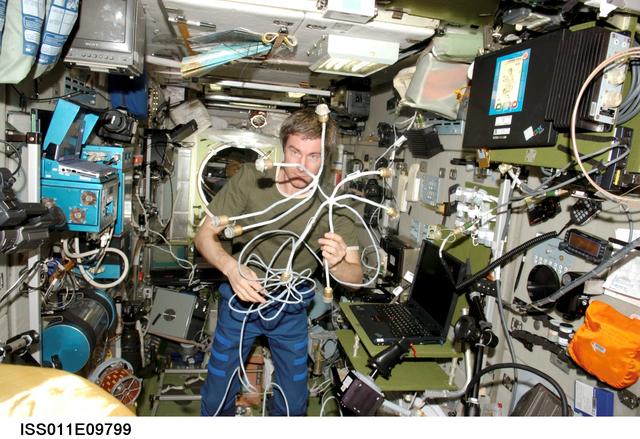
ISS011-E-09799 (27 June 2005) --- Cosmonaut Sergei K. Krikalev, Expedition 11 commander representing Russia's Federal Space Agency, works with the new Proximity Communications Equipment (PCE) hardware of the ASN-M satellite navigation system for the European Automated Transfer Vehicle (ATV) “Jules Verne” in the Zvezda Service Module of the International Space Station. The ATV is scheduled to arrive at the Station next year.
Installing the new PCE (Proximity Communications Equipment) hardware
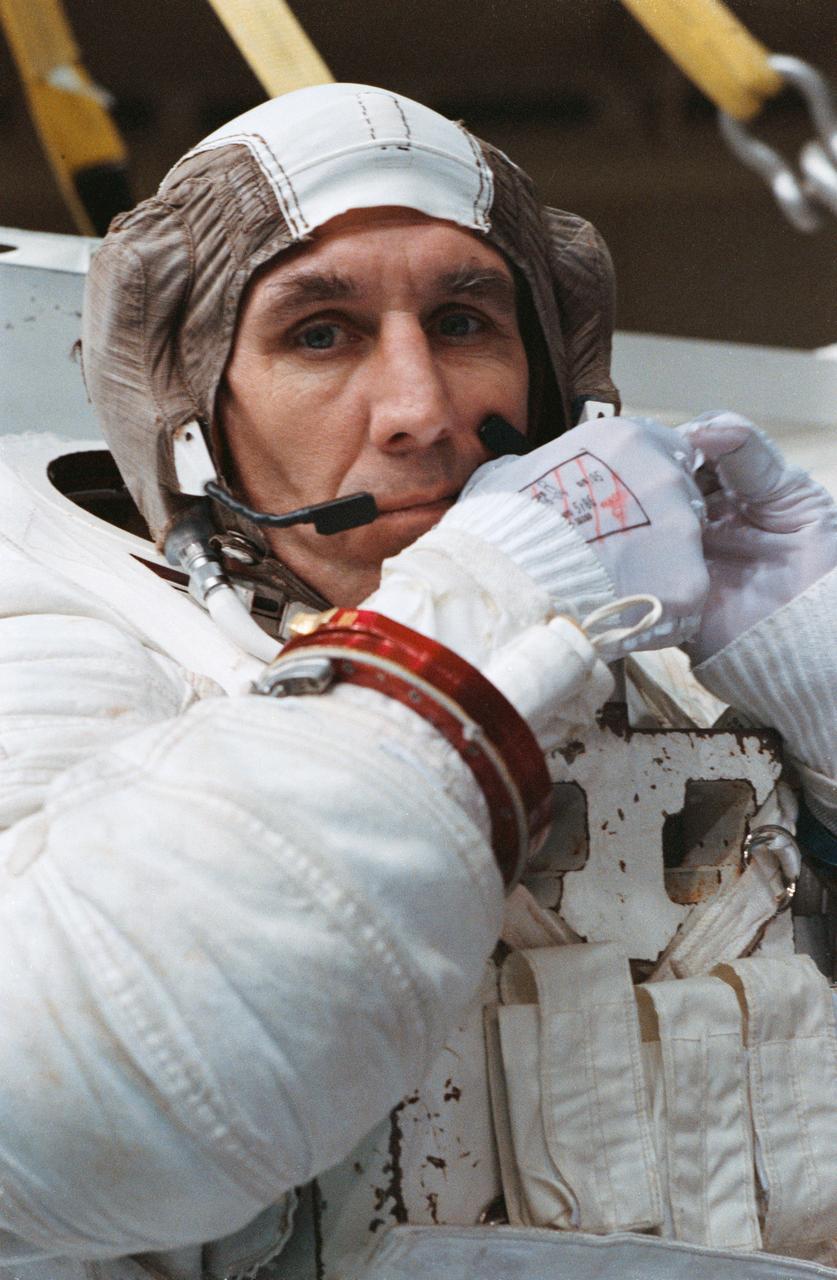
ISS011-E-09812 (28 June 2005) --- Cosmonaut Sergei K. Krikalev, Expedition 11 commander representing Russia's Federal Space Agency, tests the newly installed Proximity Communications Equipment (PCE) hardware of the ASN-M satellite navigation system for the European Automated Transfer Vehicle (ATV) “Jules Verne” in the Zvezda Service Module of the international space station. The ATV is scheduled to arrive at the station next year.
Testing the newly installed PCE (Proximity Communications Equipment) hardware
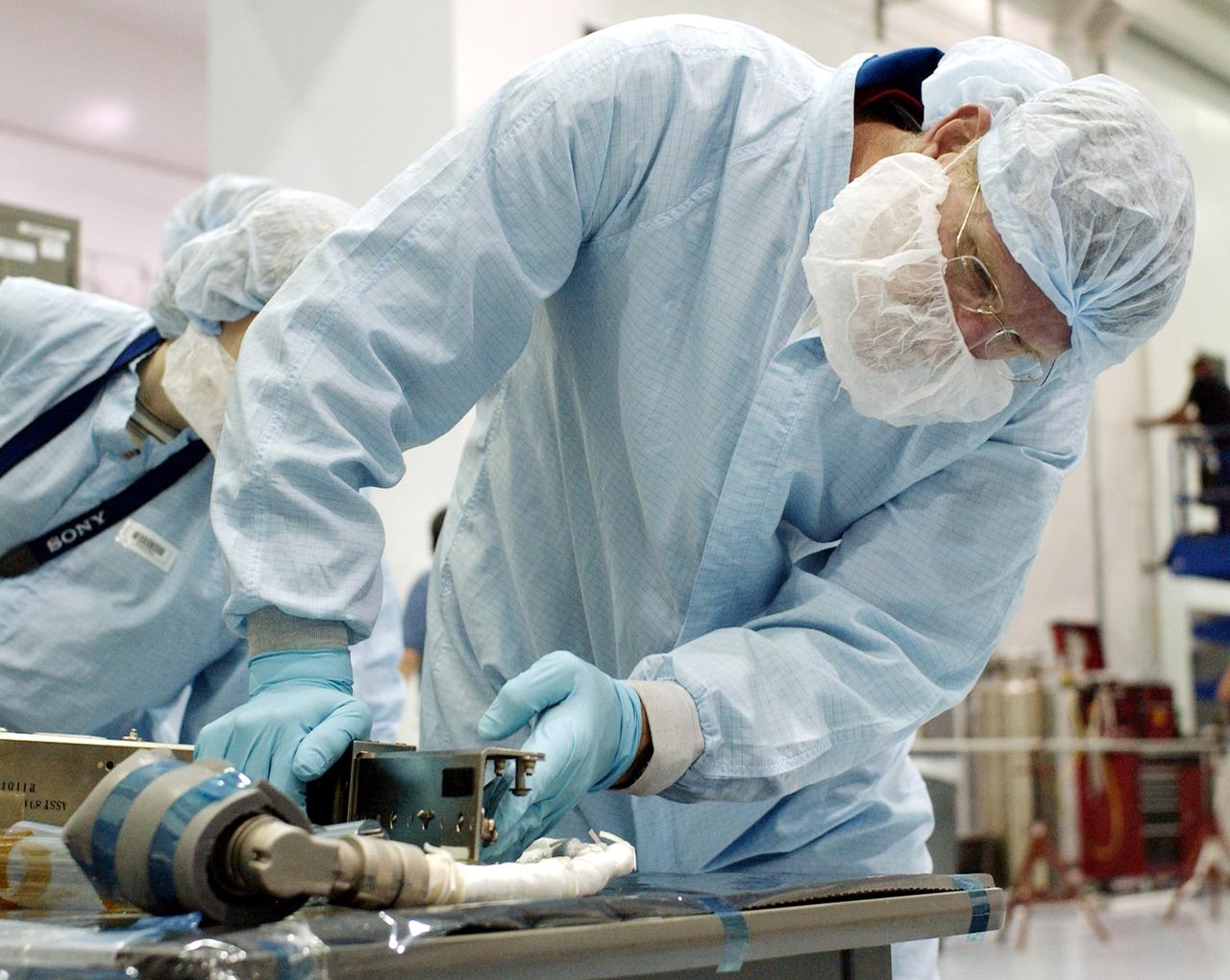
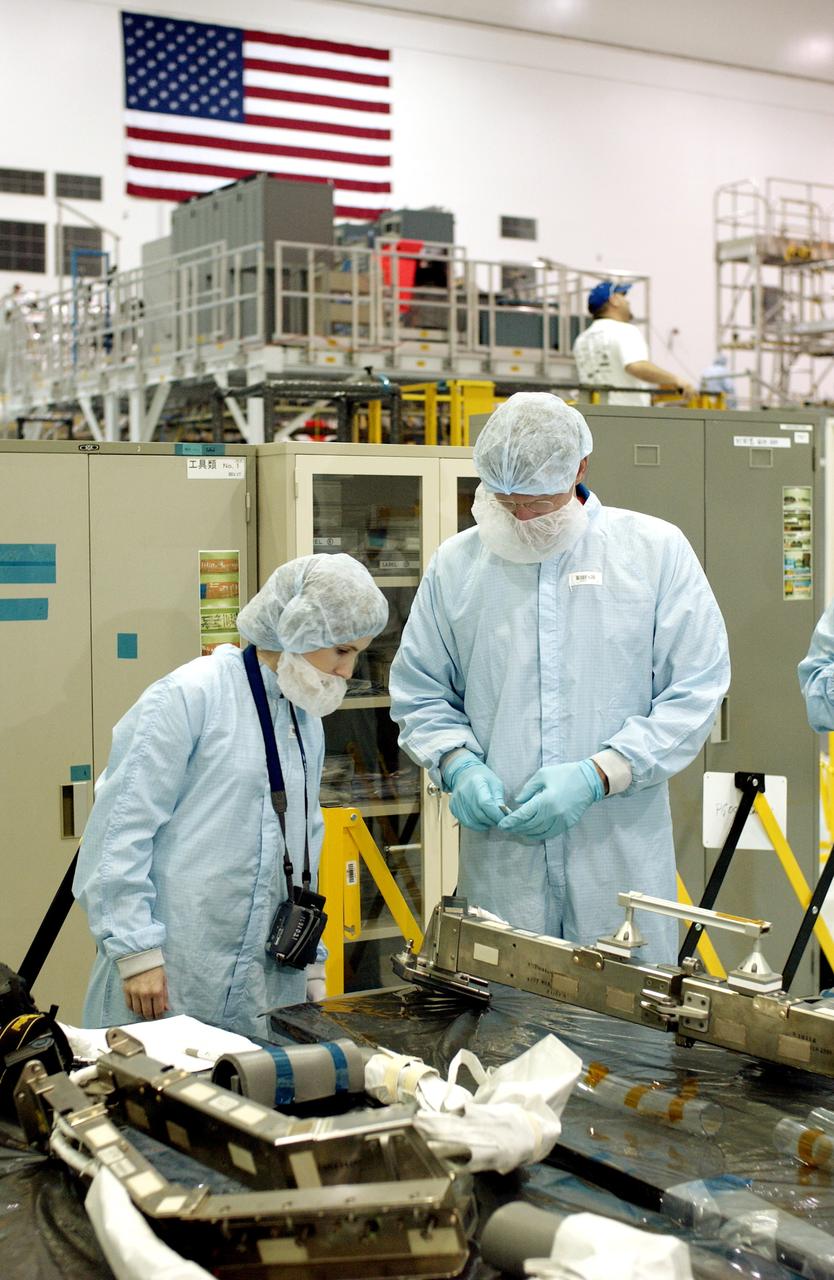
ISS011-E-09816 (28 June 2005) --- Cosmonaut Sergei K. Krikalev, Expedition 11 commander representing Russia's Federal Space Agency, tests the newly installed Proximity Communications Equipment (PCE) hardware of the ASN-M satellite navigation system for the European Automated Transfer Vehicle (ATV) “Jules Verne” in the Zvezda Service Module of the International Space Station. The ATV is scheduled to arrive at the Station next year.
Testing the newly installed PCE (Proximity Communications Equipment) hardware
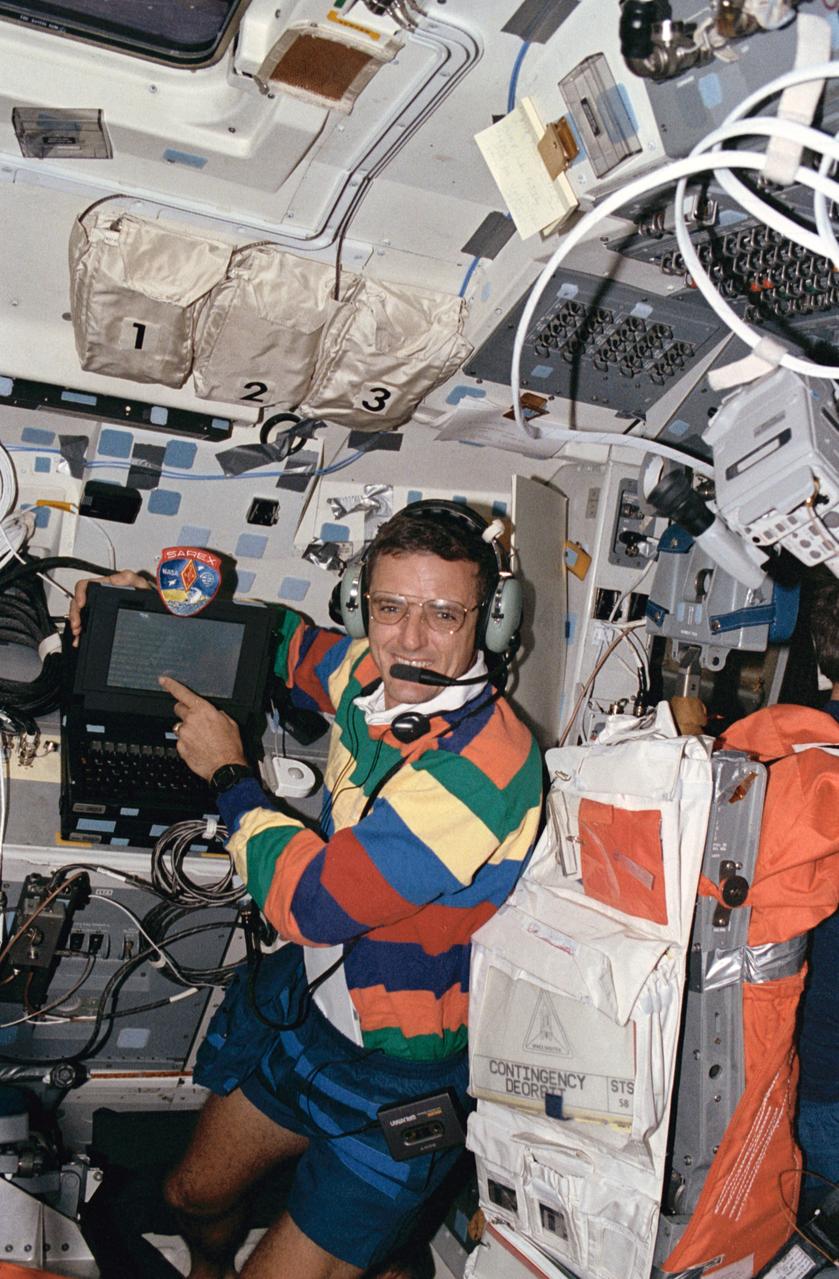
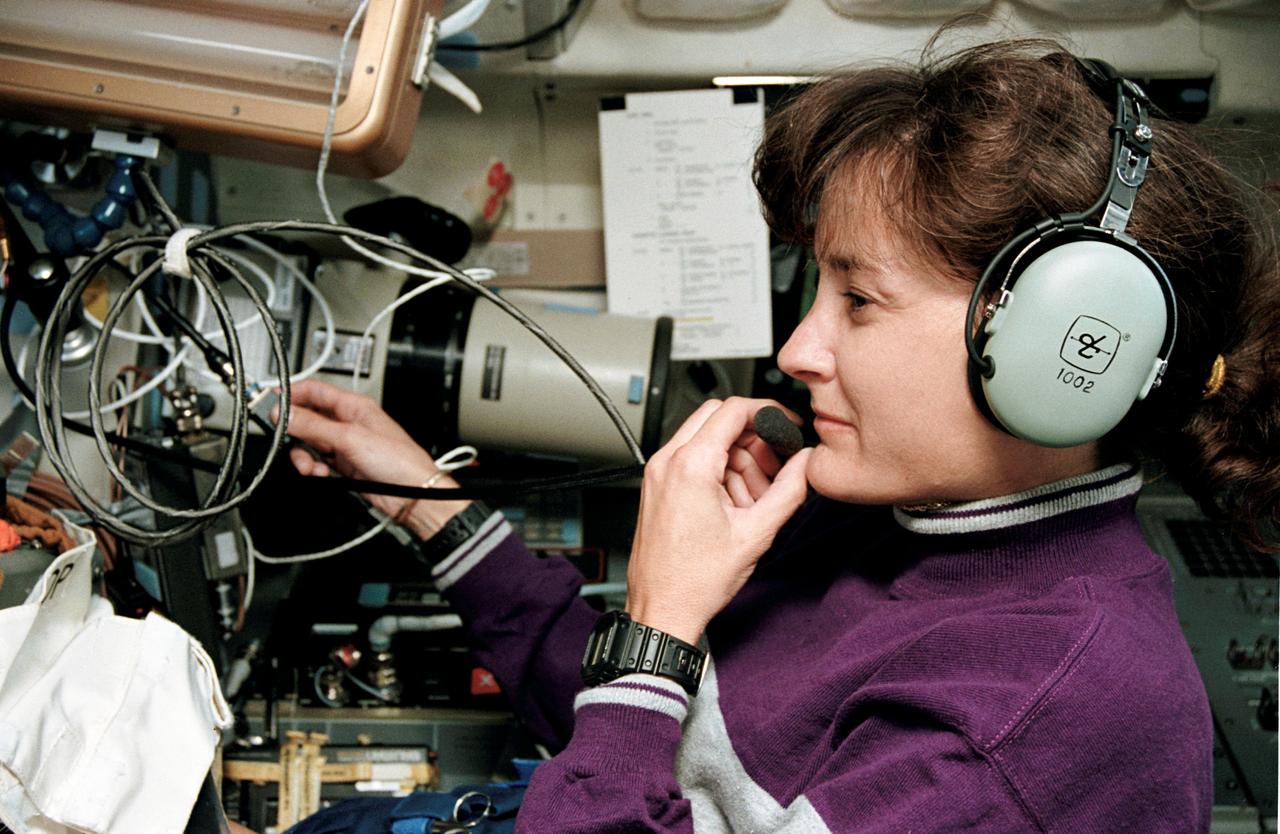
STS059-16-028 (9-20 April 1994) --- Onboard the Space Shuttle Endeavour, astronaut Linda M. Godwin talks to students via the Shuttle Amateur Radio Experiment (SAREX). The payload commander, as well as several other STS-59 crew members spent some off-duty time using the amateur radio equipment to communicate with "Hams" and students on Earth.
Astronaut Linda Godwin uses Shuttle Amateur Radio Experiment
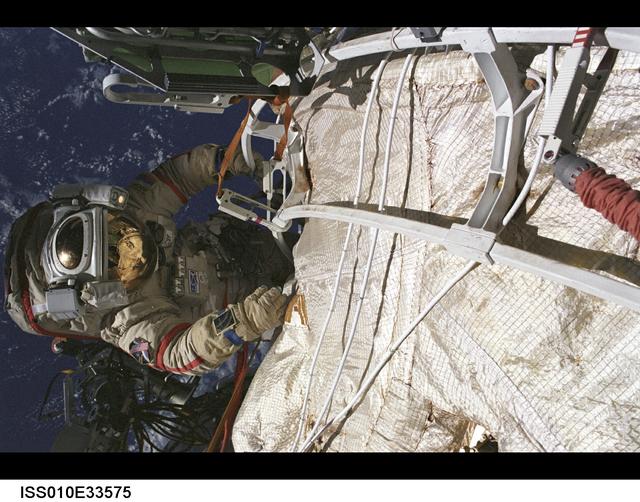
ISS010-33575 (28 March 2005) --- Cosmonaut Salizhan S. Sharipov, Expedition 10 flight engineer representing Russia's Federal Space Agency, wearing a Russian Orlan spacesuit, participates in the second of two sessions of extravehicular activities (EVA) performed by the Expedition 10 crew during their six-month mission. Sharipov and astronaut Leroy Chiao (out of frame), commander and NASA ISS science officer, spent 4 ½ hours outside the International Space Station (ISS) installing navigational and communications equipment for the arrival of the first Automated Transfer Vehicle cargo craft. Sharipov also deployed an 11-pound Russian nanosatellite.
Sharipov works on communication equipment in EVA during Expedition 10
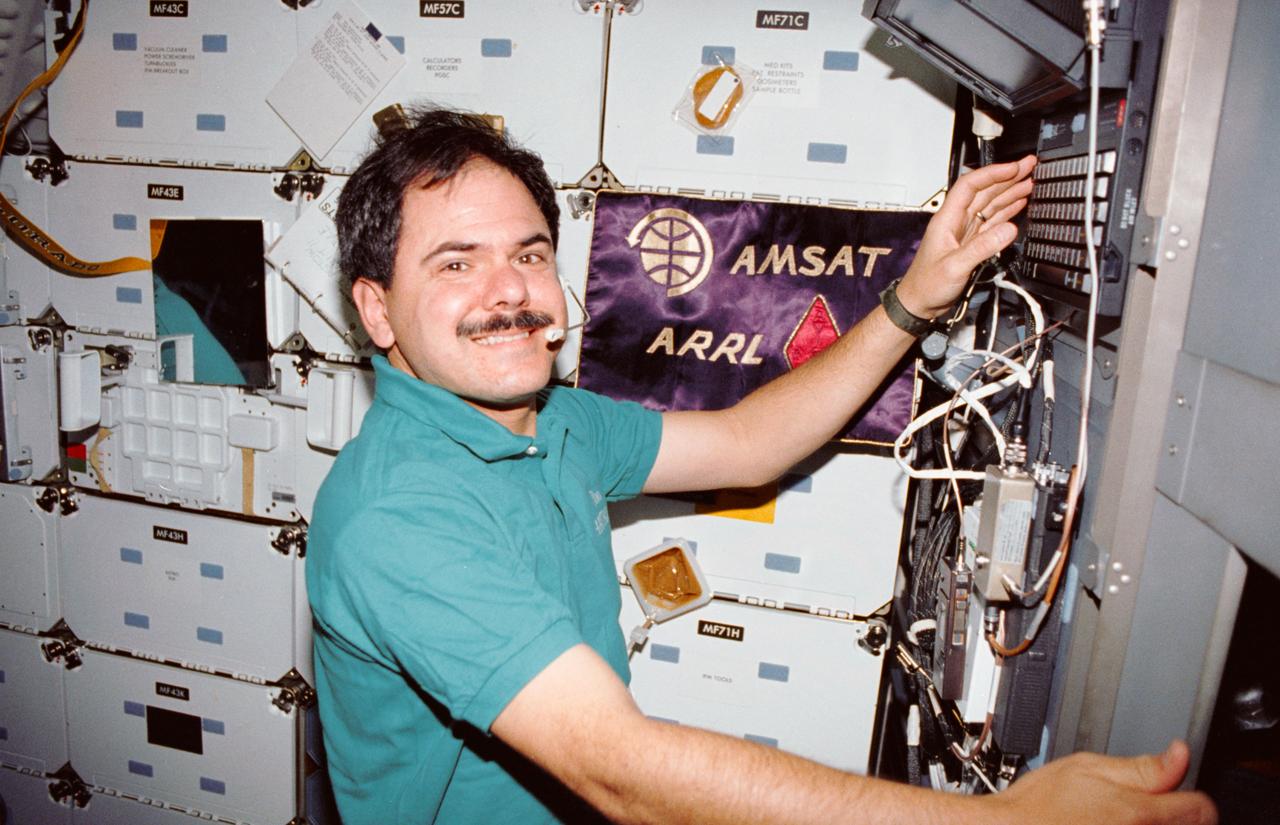
STS-35 Payload Specialist Ronald A. Parise enters data into the payload and general support computer (PGSC) in preparation for Earth communication via the Shuttle Amateur Radio Experiment (SAREX) aboard Columbia, Orbiter Vehicle (OV) 102. The SAREX equipment is secured to the middeck starboard sleep station. SAREX provided radio transmissions between ground based amateur radio operators around the world and Parise, a licensed amateur radio operator. The experiment enabled students to communicate with an astronaut in space, as Parise (call-sign WA4SIR) devoted some of his off-duty time to that purpose. Displayed on the forward lockers beside Parise is a AMSAT (Amateur Radio Satellite Corporation) / ARRL (American Radio Relay League) banner. Food items and checklists are attached to the lockers. In locker position MF43G, the Development Test Objective (DTO) Trash Compaction and Retention System Demonstration extended duration orbiter (EDO) compactor is visible.
STS-35 Payload Specialist Parise sets up SAREX on OV-102's middeck
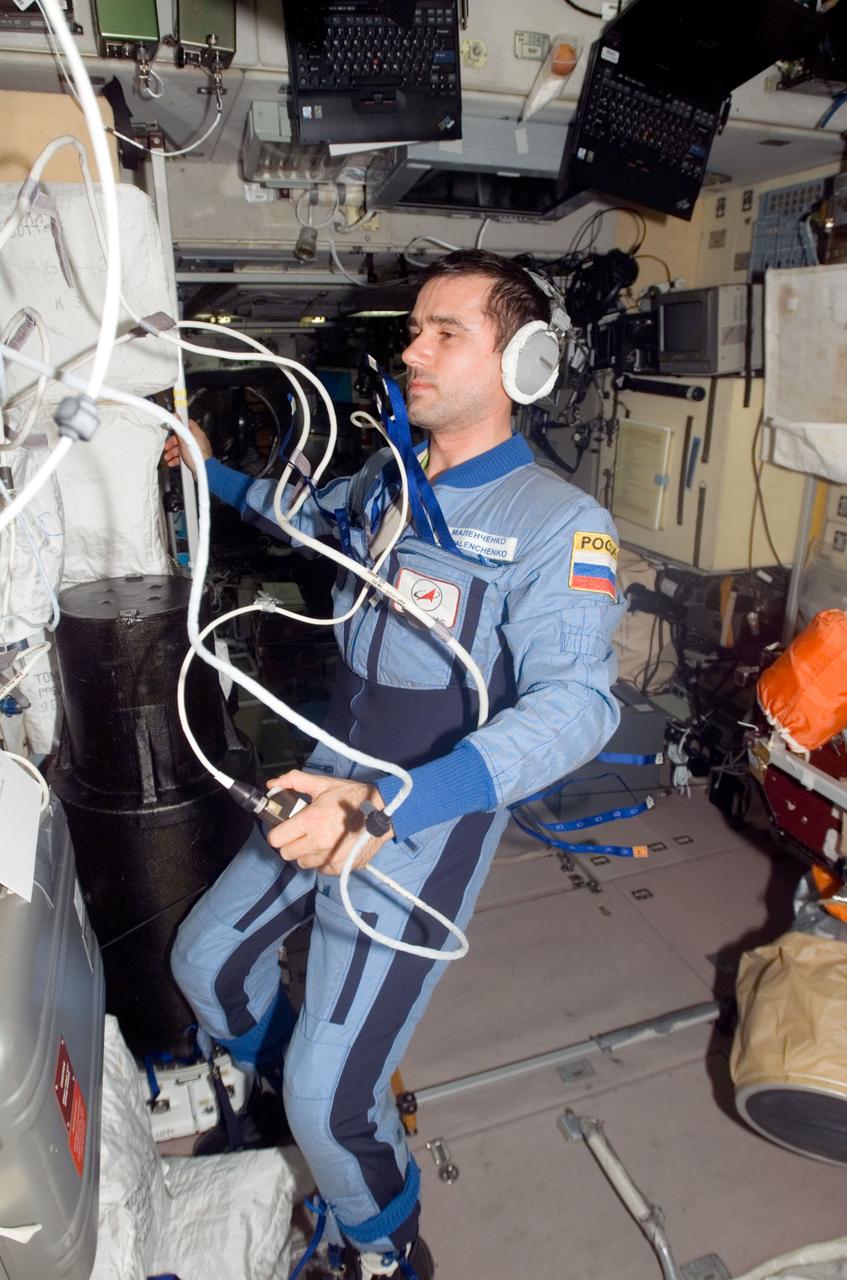
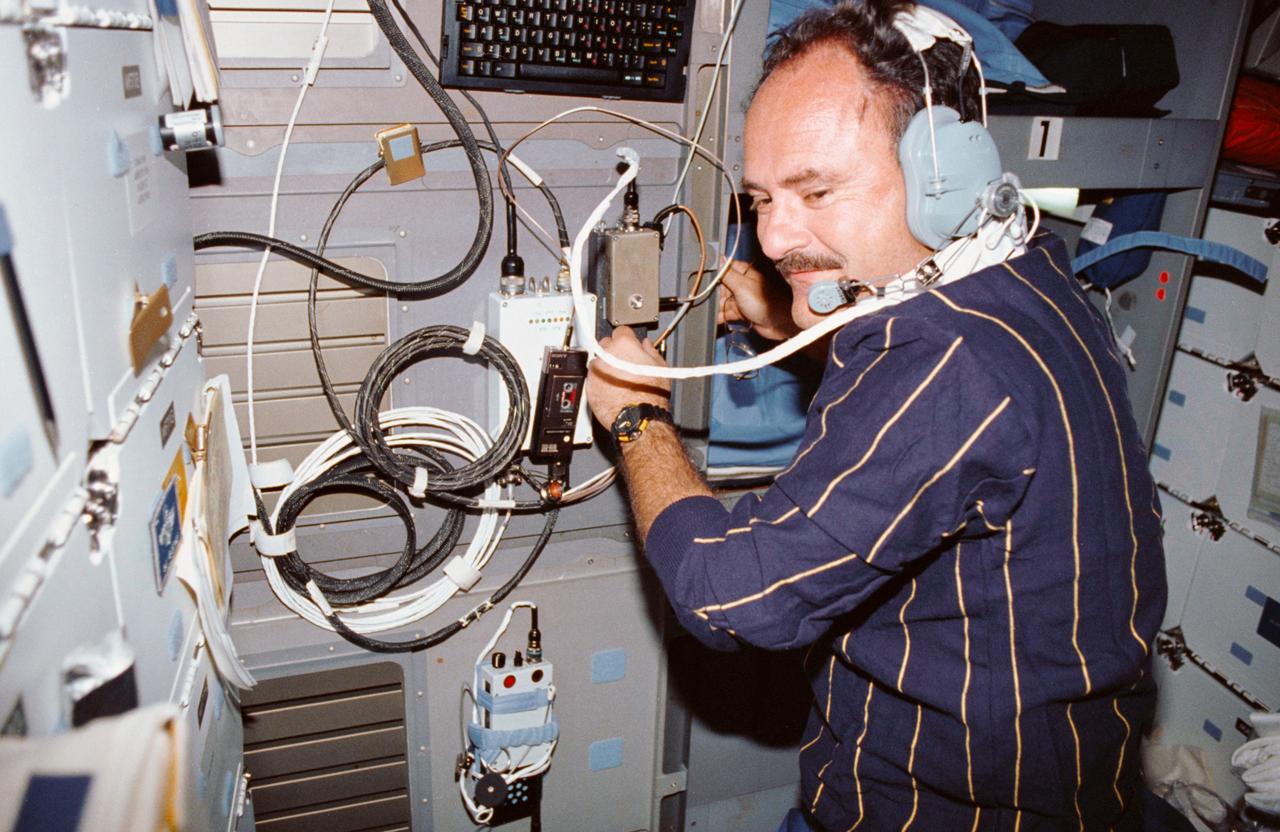
ISS016-E-022134 (9 Jan. 2008) --- Cosmonaut Yuri I. Malenchenko, Expedition 16 flight engineer representing Russia's Federal Space Agency, uses a communication system while working in the Zvezda Service Module of the International Space Station.
Malenchenko uses communication equipment in the SM
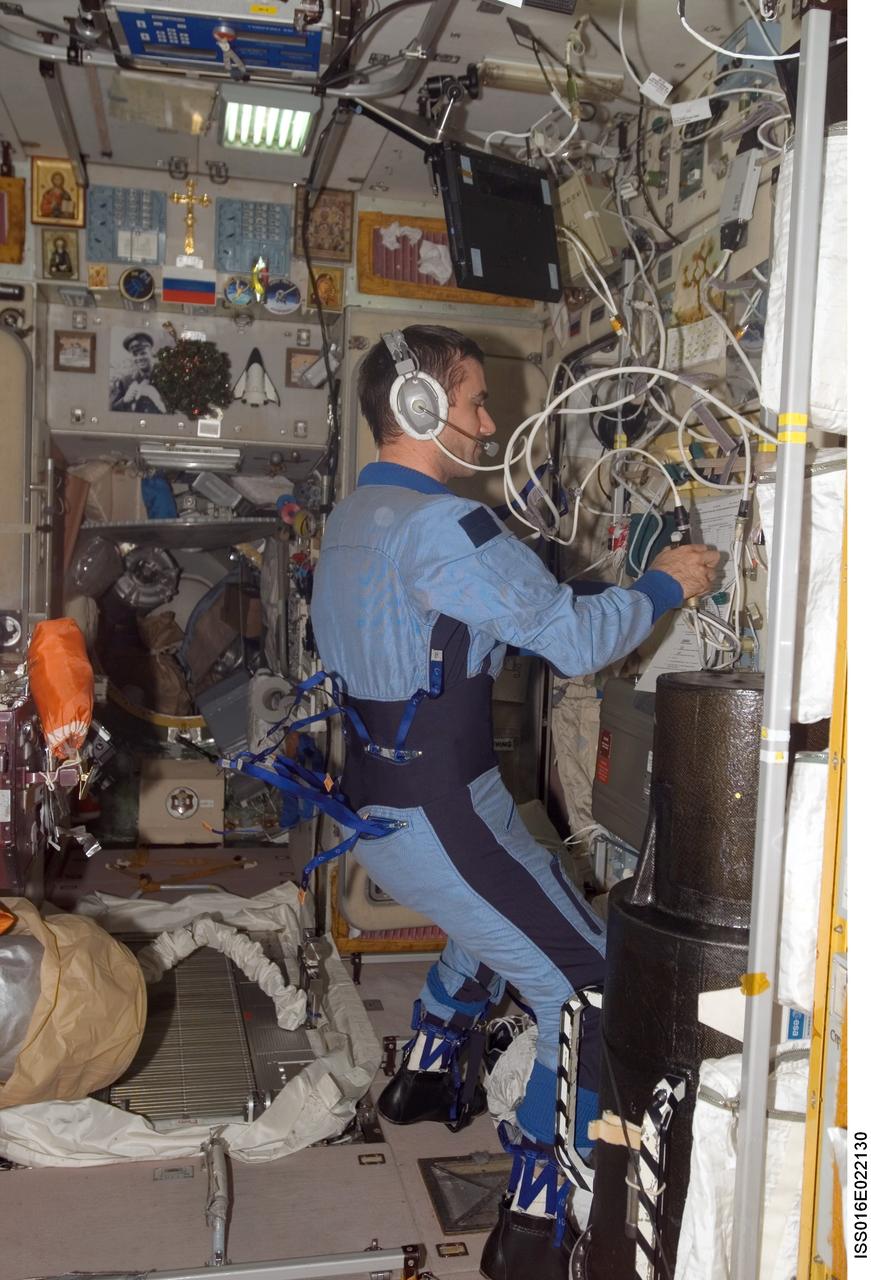
ISS016-E-022130 (9 Jan. 2008) --- Cosmonaut Yuri I. Malenchenko, Expedition 16 flight engineer representing Russia's Federal Space Agency, uses a communication system while working in the Zvezda Service Module of the International Space Station.
Malenchenko uses communication equipment in the SM
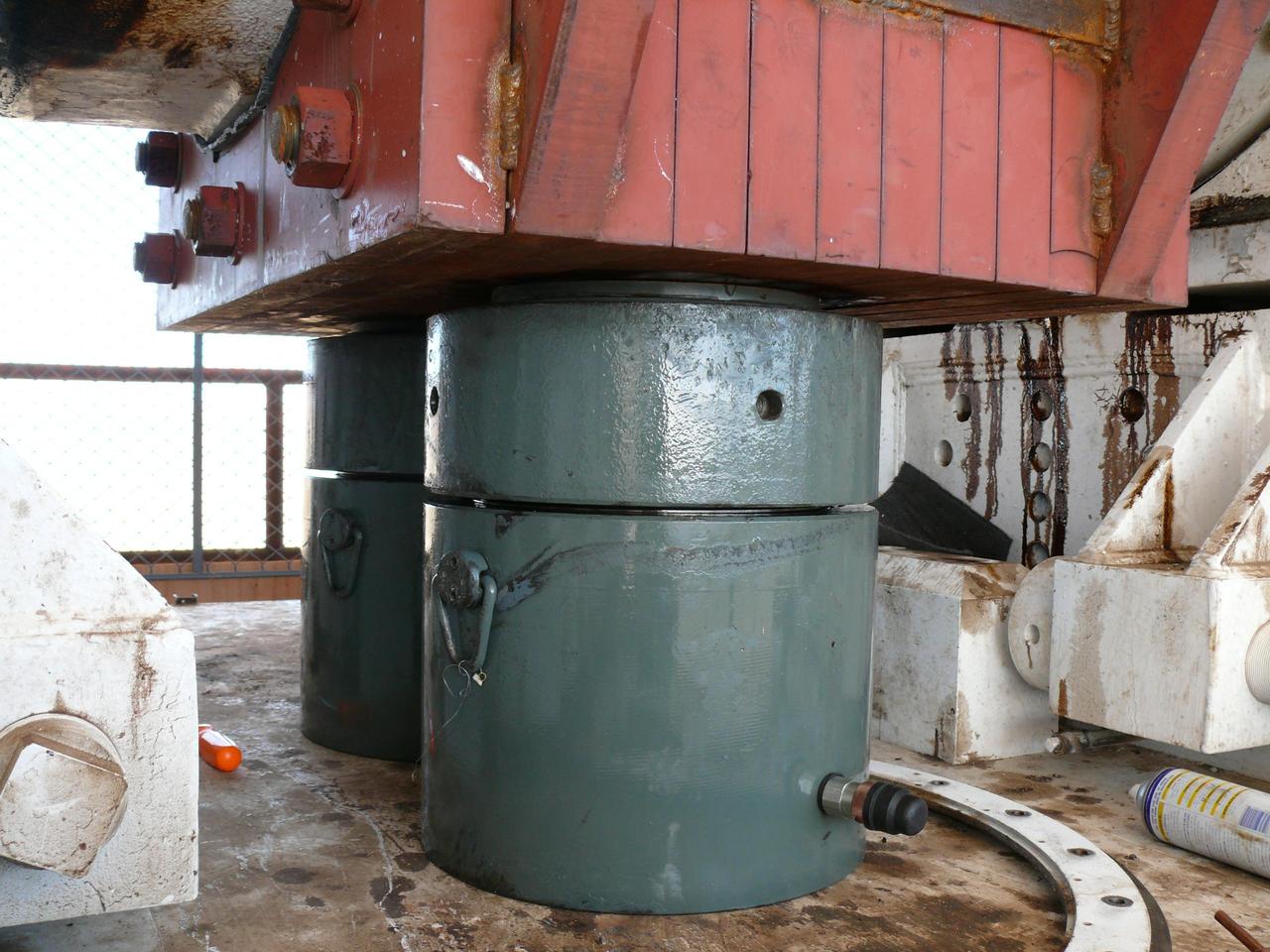
A major refurbishment of the giant Mars antenna at NASA Deep Space Network Goldstone Deep Space Communications Complex in California Mojave Desert required workers to jack up millions of pounds of delicate scientific equipment.
A Heavy-Duty Jack for a Giant Task
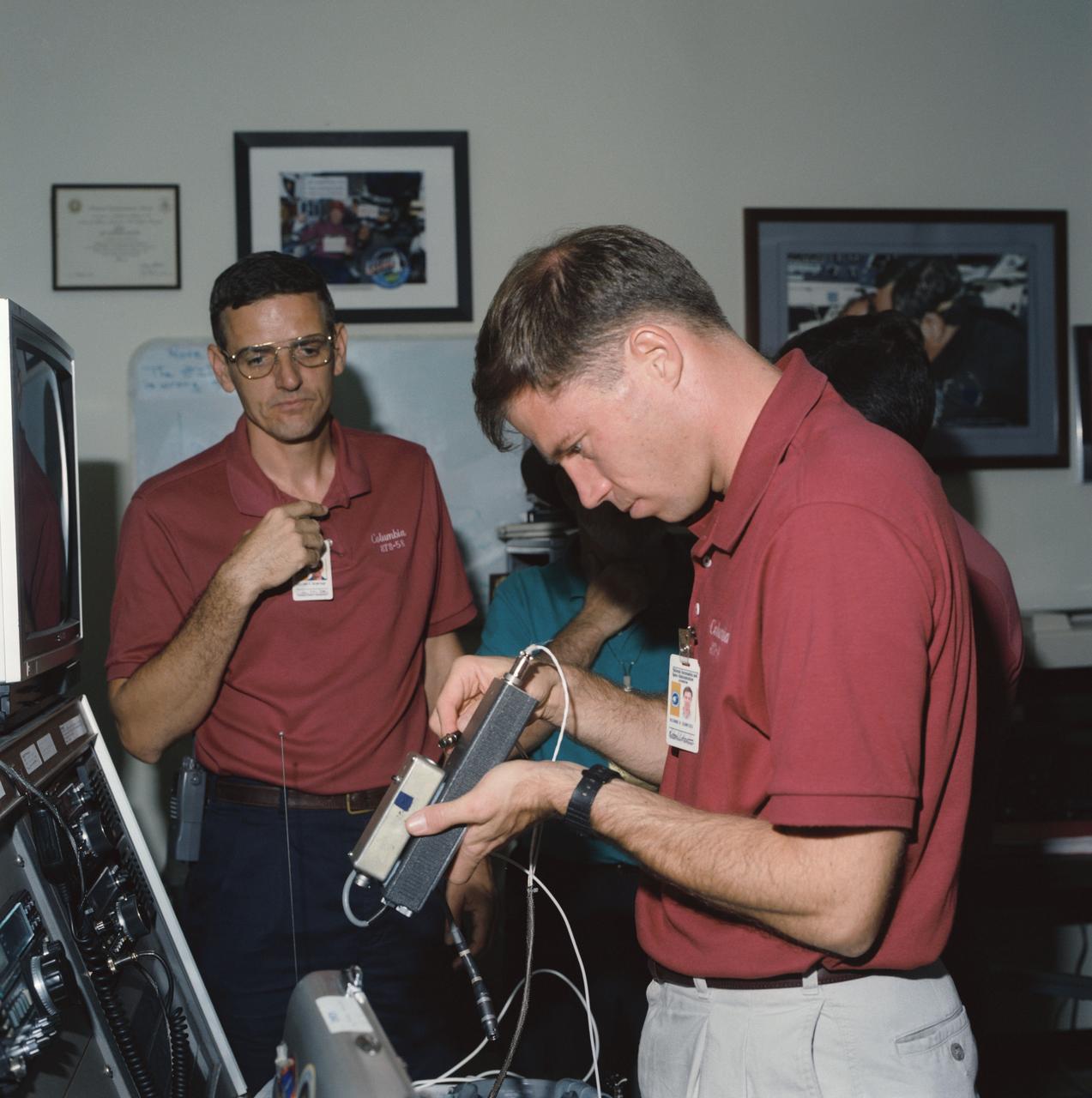
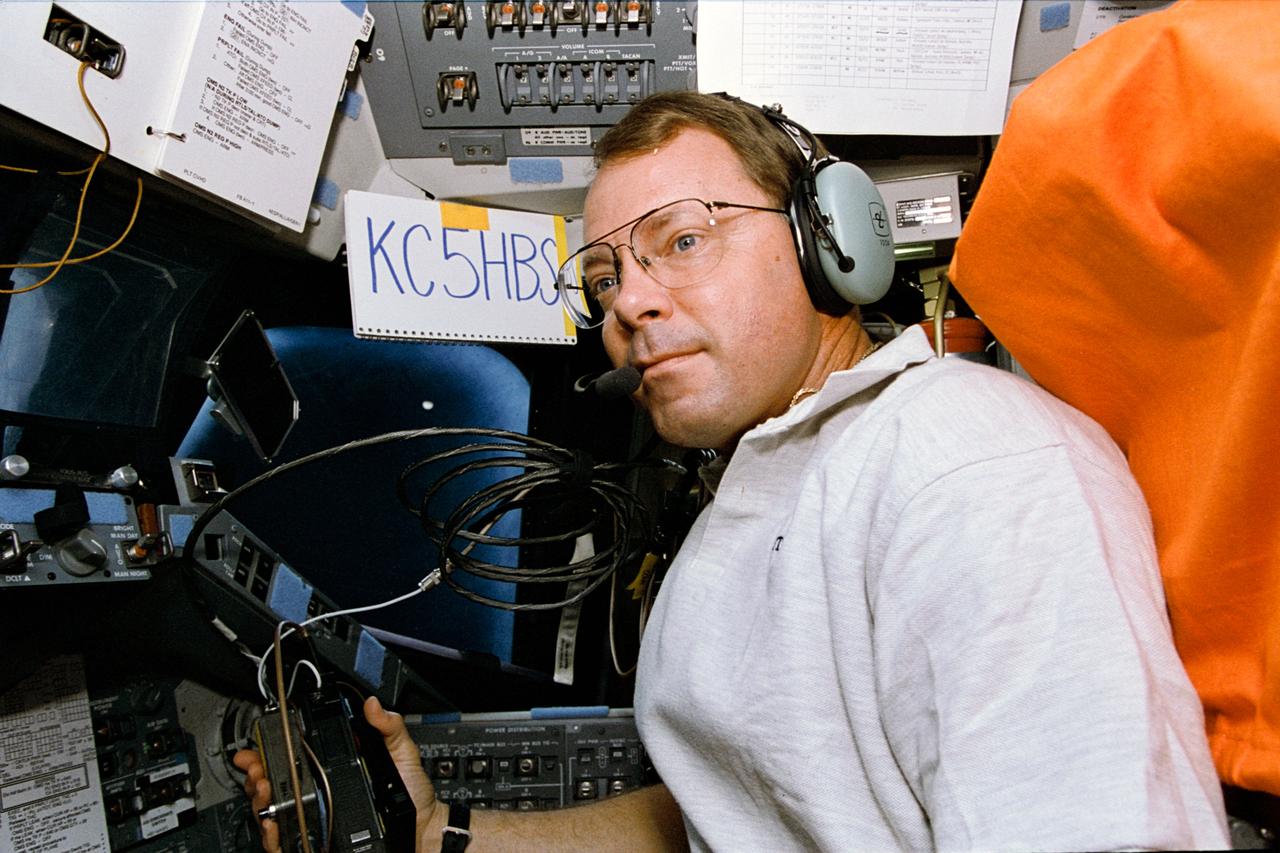
S93-45068 (22 Sept 1993) --- Two members of the STS-58 Spacelab Life Sciences (SLS-2) crew, train with amateur radio equipment at the Johnson Space Center (JSC).  They are William S. McArthur (left), mission specialist, and Richard A. Searfoss, pilot.  The STS-58 flight will carry the Shuttle Amateur Radio Experiment (SAREX) payload, configuration C, which includes FM voice and packet.  Three of the seven crewmembers are licensed amateur radio operators.  Searfoss' call letters are KC5CKM; McArthur, KC5ACR; and payload specialist Martin J. Fettman, KC5AXA.  Licensed students at a number of schools around the country will have the opportunity to talk directly with the astronauts during the 14-day flight.
Members of STS-58 crew training with amateur radio equipment at JSC
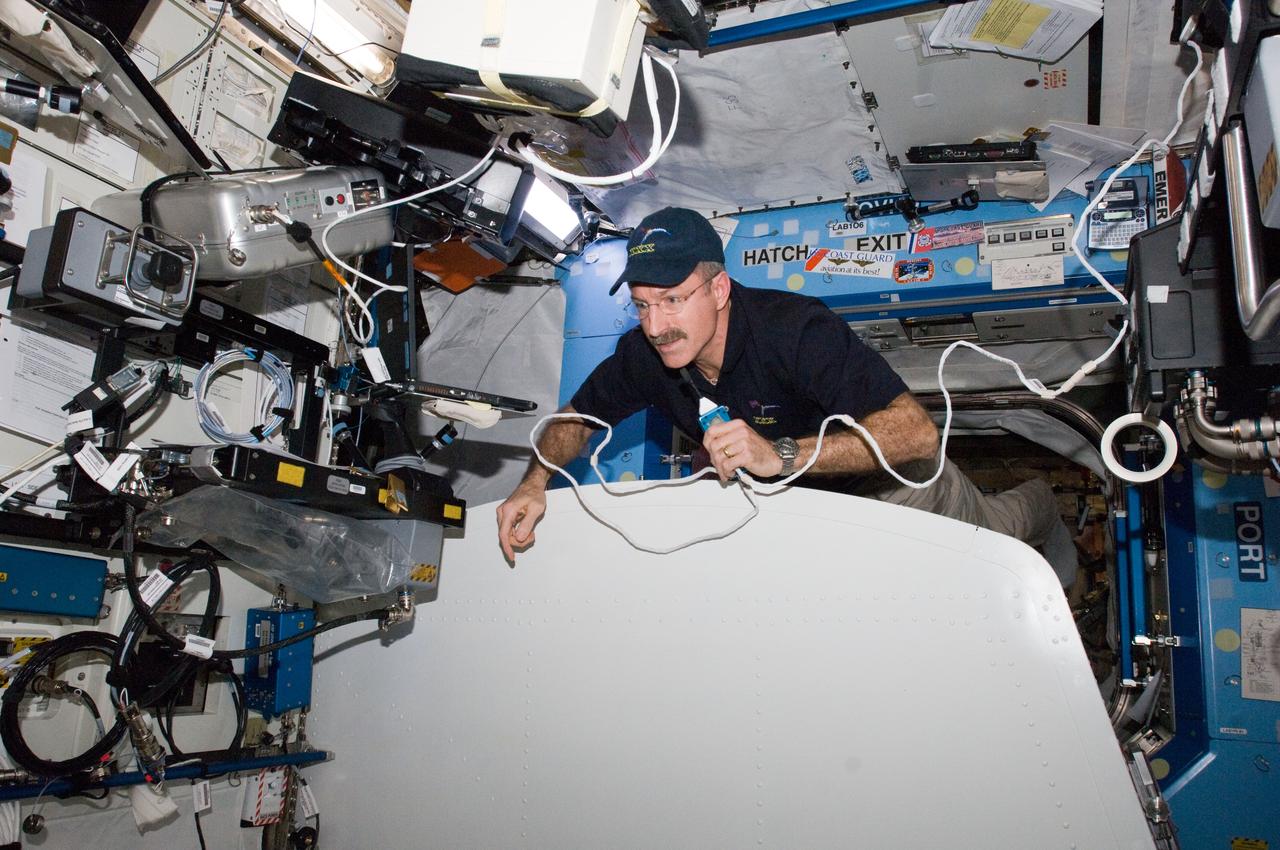
ISS030-E-060464 (2 Feb. 2012) --- NASA astronaut Dan Burbank, Expedition 30 commander, uses a communication system while working in the Destiny laboratory of the International Space Station.
Burbank uses communication equipment in the U.S. Laboratory
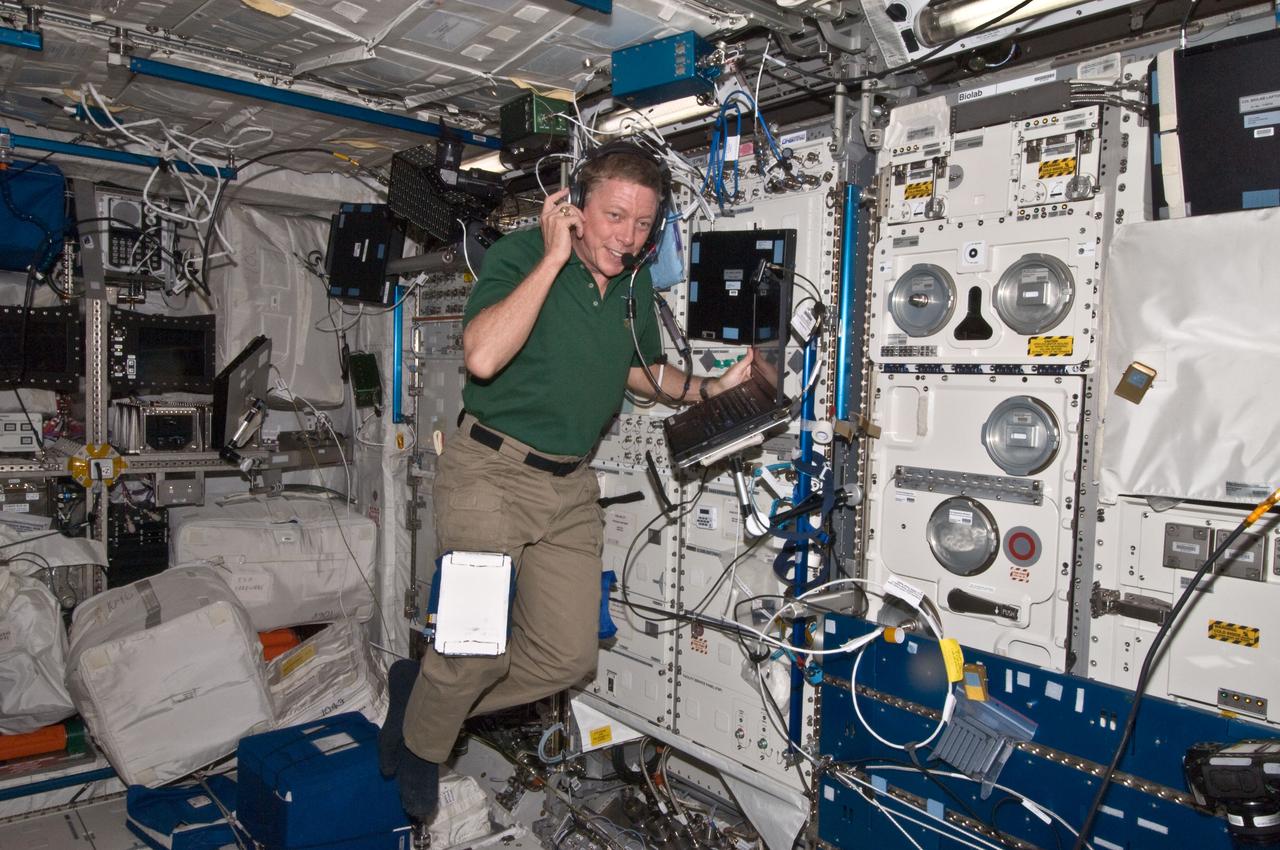
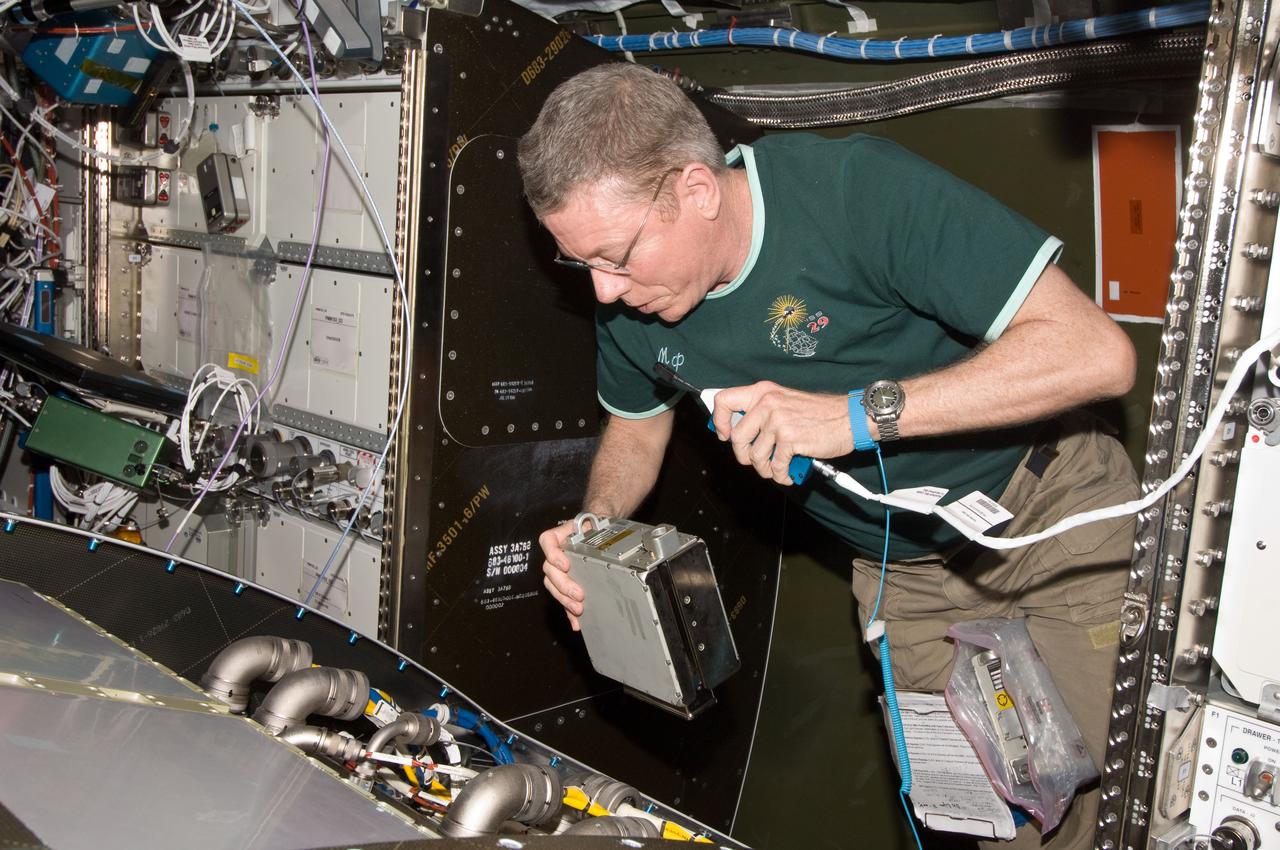
ISS028-E-013729 (30 June 2011) --- NASA astronaut Mike Fossum, Expedition 28 flight engineer, is pictured wearing a communication headset in the Columbus laboratory of the International Space Station.
FE Fossum using Communication Equipment in the Columbus
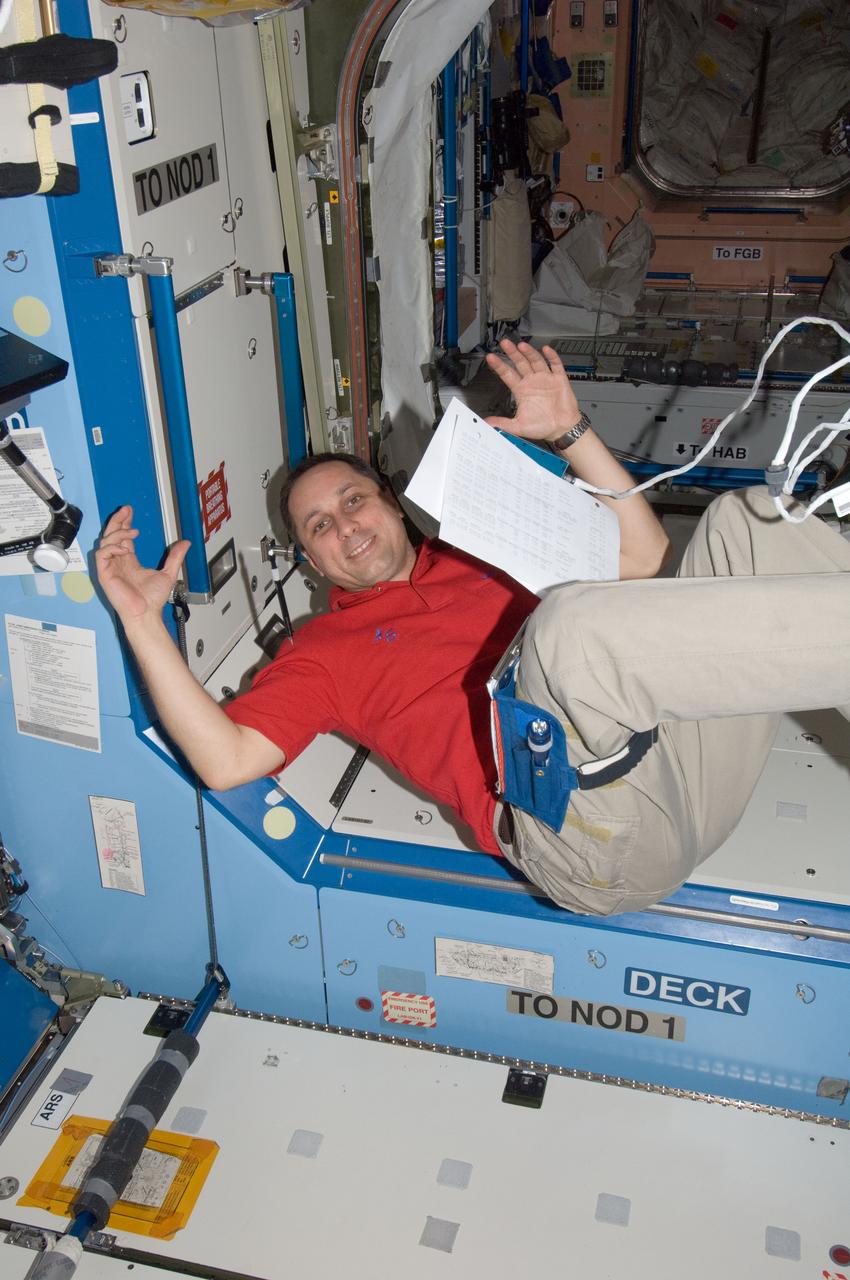
ISS030-E-007570 (3 Dec. 2011) --- Russian cosmonaut Anton Shkaplerov, Expedition 30 flight engineer, is pictured in the hatch between the Destiny laboratory and Unity node of the International Space Station.
Shkaplerov holds communication equipment in the U.S. Laboratory
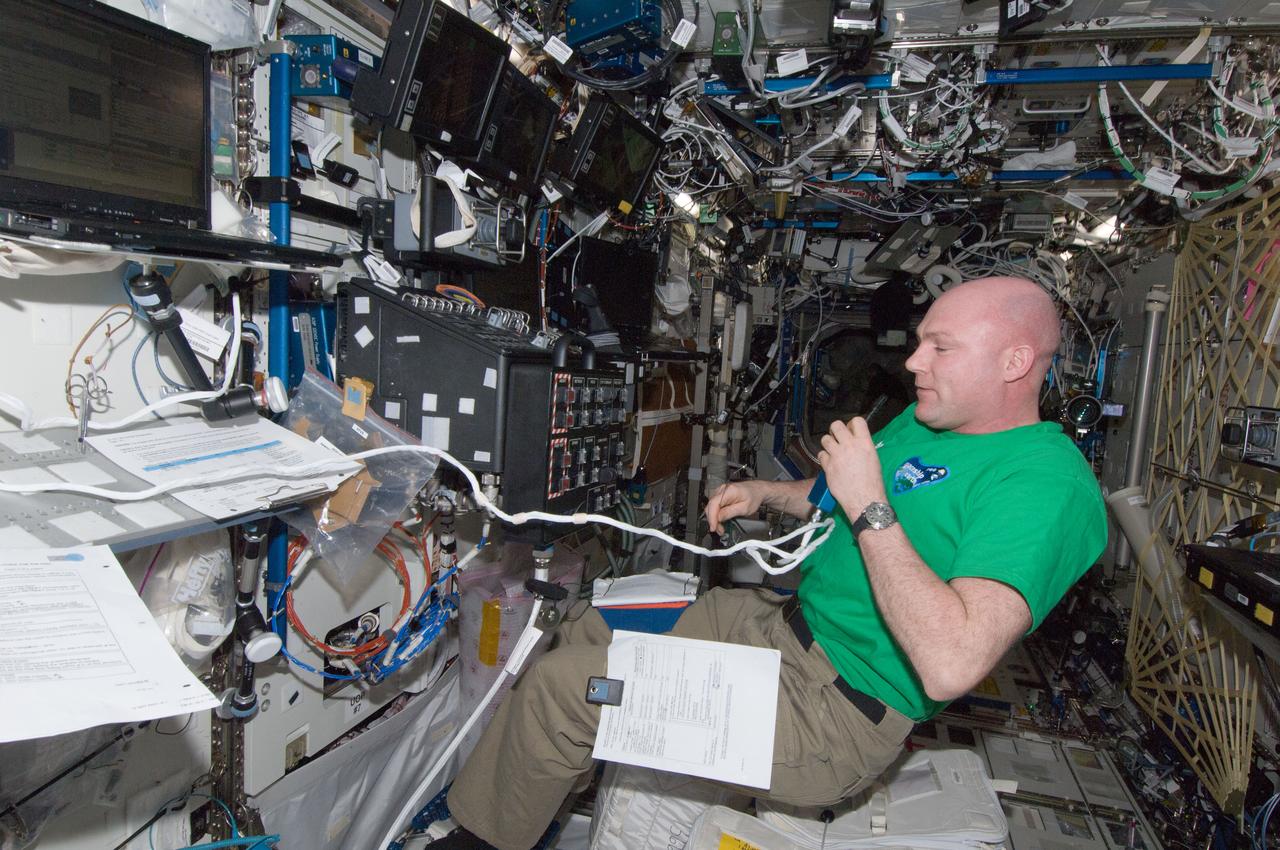
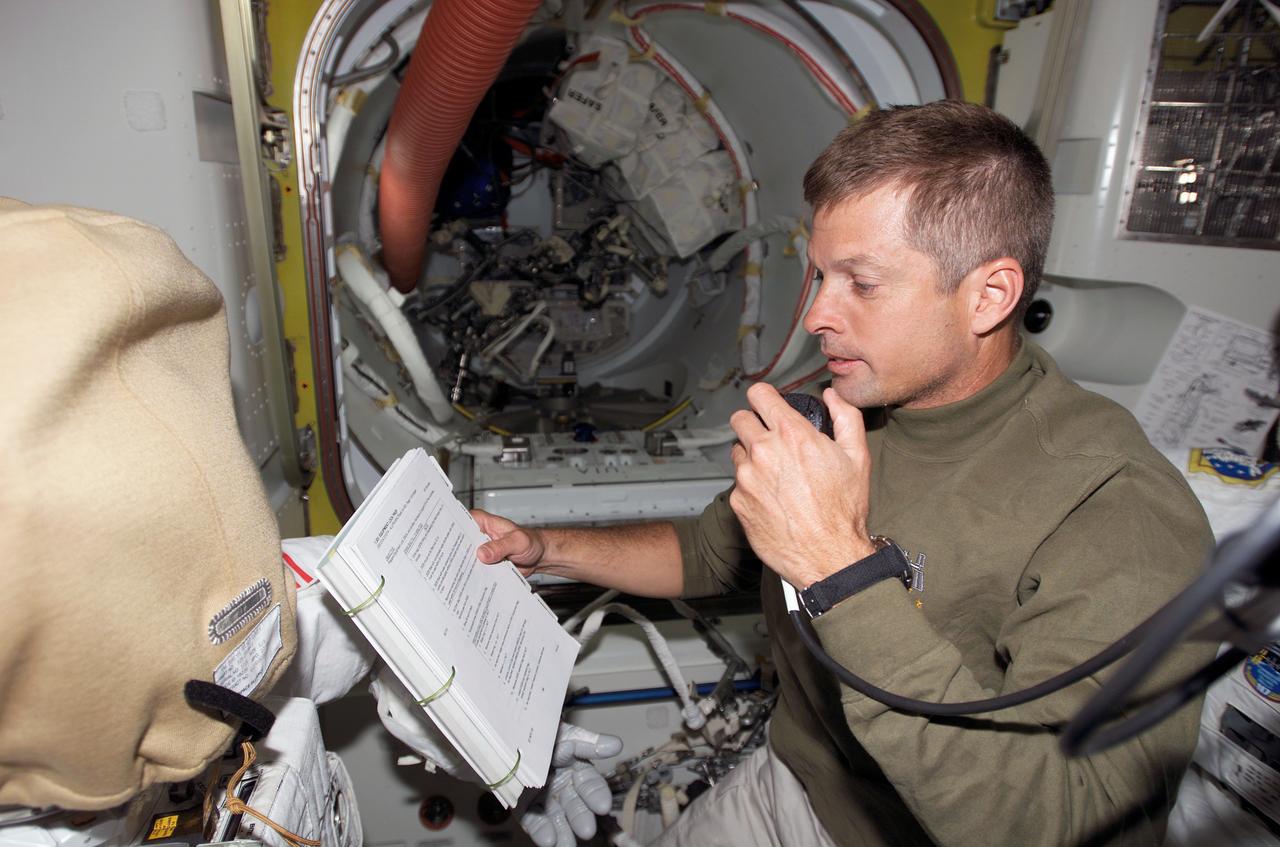
ISS030-E-250651 (24 April 2012) --- European Space Agency astronaut Andre Kuipers, Expedition 30 flight engineer, uses a communication system near a robotic workstation in the Destiny laboratory of the International Space Station.
Kuipers using communication equipment in the U.S. Laboratory
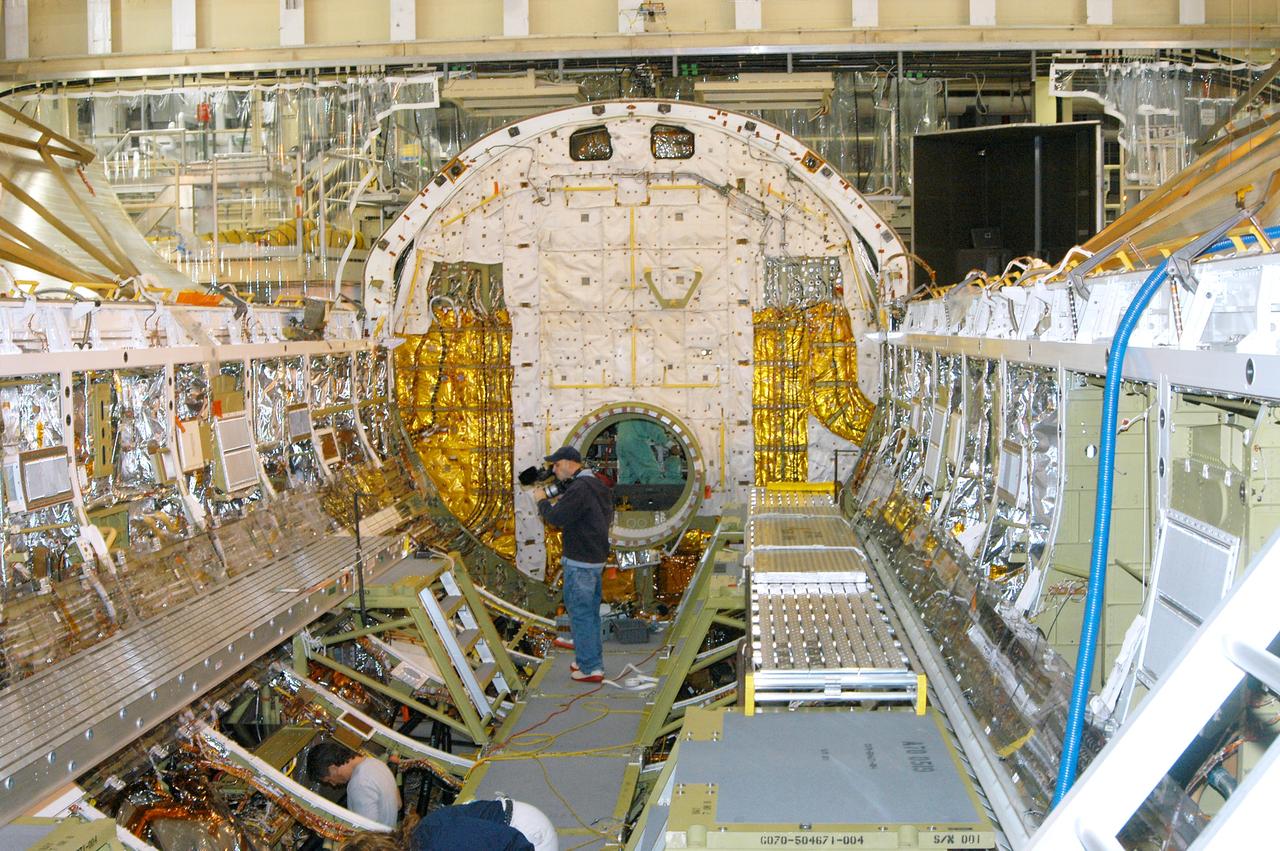
KENNEDY SPACE CENTER, FLA. -  In the Orbiter Processing Facility, a worker checks out part of the equipment in the airlock, at one end of Discovery’s payload bay.  The airlock is sized to accommodate two fully suited flight crew members simultaneously. Support functions include airlock depressurization and repressurization, extravehicular activity equipment recharge, liquid-cooled garment water cooling, EVA equipment checkout, donning and communications. The outer hatch isolates the airlock from the unpressurized payload bay when closed and permits the EVA crew members to exit from the airlock to the payload bay when open.
KENNEDY SPACE CENTER, FLA. - In the Orbiter Processing Facility, a worker checks out part of the equipment in the airlock, at one end of Discovery’s payload bay. The airlock is sized to accommodate two fully suited flight crew members simultaneously. Support functions include airlock depressurization and repressurization, extravehicular activity equipment recharge, liquid-cooled garment water cooling, EVA equipment checkout, donning and communications. The outer hatch isolates the airlock from the unpressurized payload bay when closed and permits the EVA crew members to exit from the airlock to the payload bay when open.
STS035-15-010 (2-11 Dec 1990) --- Astronaut John M. (Mike) Lounge, STS-35 mission specialist, communicates with family members from the middeck of Space Shuttle Columbia in Earth orbit.  The STS-35 Shuttle amateur radio experiment (SAREX), allowed the Astro 1 crewmembers to "visit" and briefly share some of their in space experiences with family members.  The picture was made with a 35mm camera.                           Note: Used by Astronomer Ronald A. Parise on his off-duty hours,  SAREX provided radio transmissions between ground based amateur radio operators around the world and the Shuttle. Parise is a payload specialist who is also a licensed amateur radio operator (call-sign WA4SIR).  The experiment enabled students from all over the United States to have a chance to communicate with an astronaut in space.
STS-35 Mission Specialist (MS) Lounge uses SAREX on OV-102's middeck
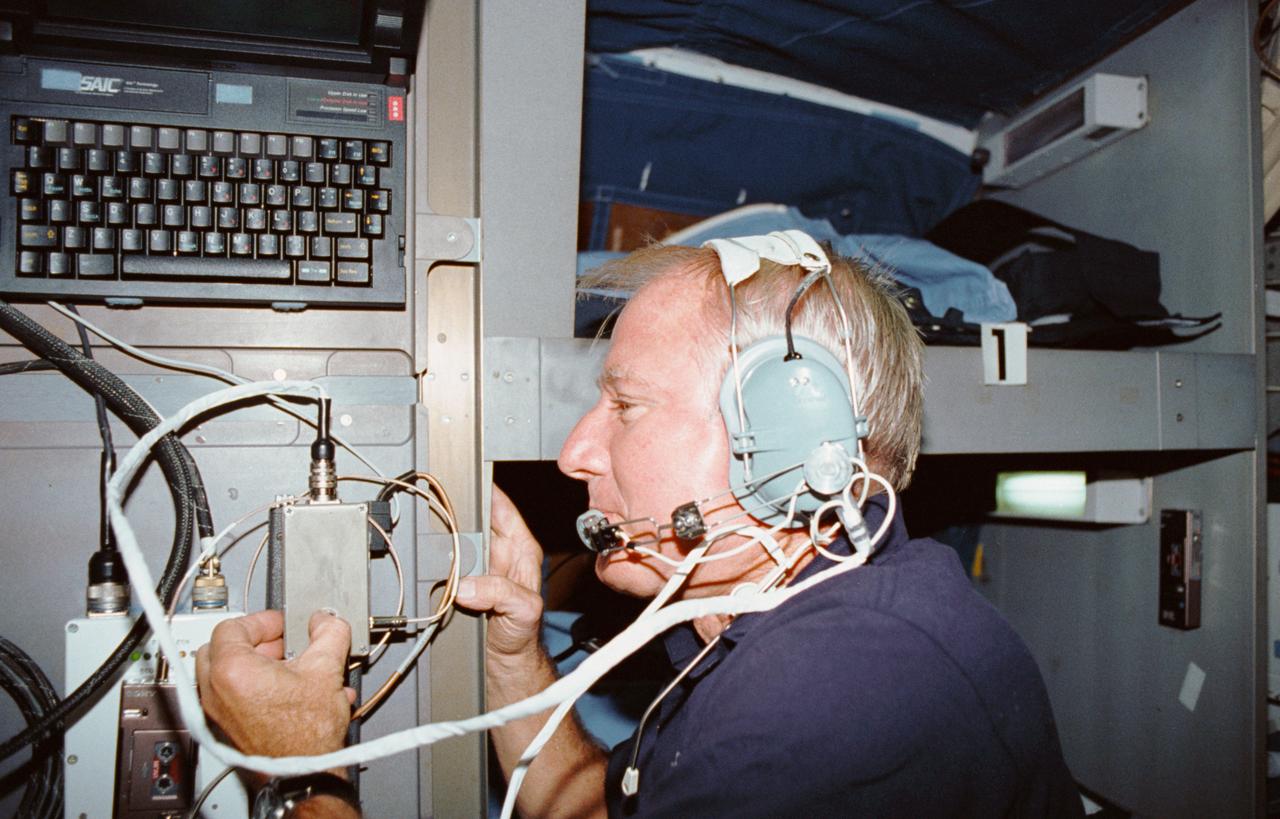
STS035-05-036 (2-10 Dec 1990) --- STS-35 Commander Vance D. Brand, wearing headset, communicates with family members using Shuttle Amateur Radio Experiment (SAREX) on Columbia's, Orbiter Vehicle (OV) 102's, middeck. SAREX and its portable laptop computer mounted on the outside of the middeck sleep station allowed the STS-35 crewmembers to "visit" and briefly share some of their in space experiences with family members. It also provided radio transmissions between ground based amateur radio operators around the world and OV-102. The experiment enabled students from all over the United States to have a chance to communicate with a crewmember in space.
STS-35 Commander Brand talks to family using SAREX on OV-102's middeck
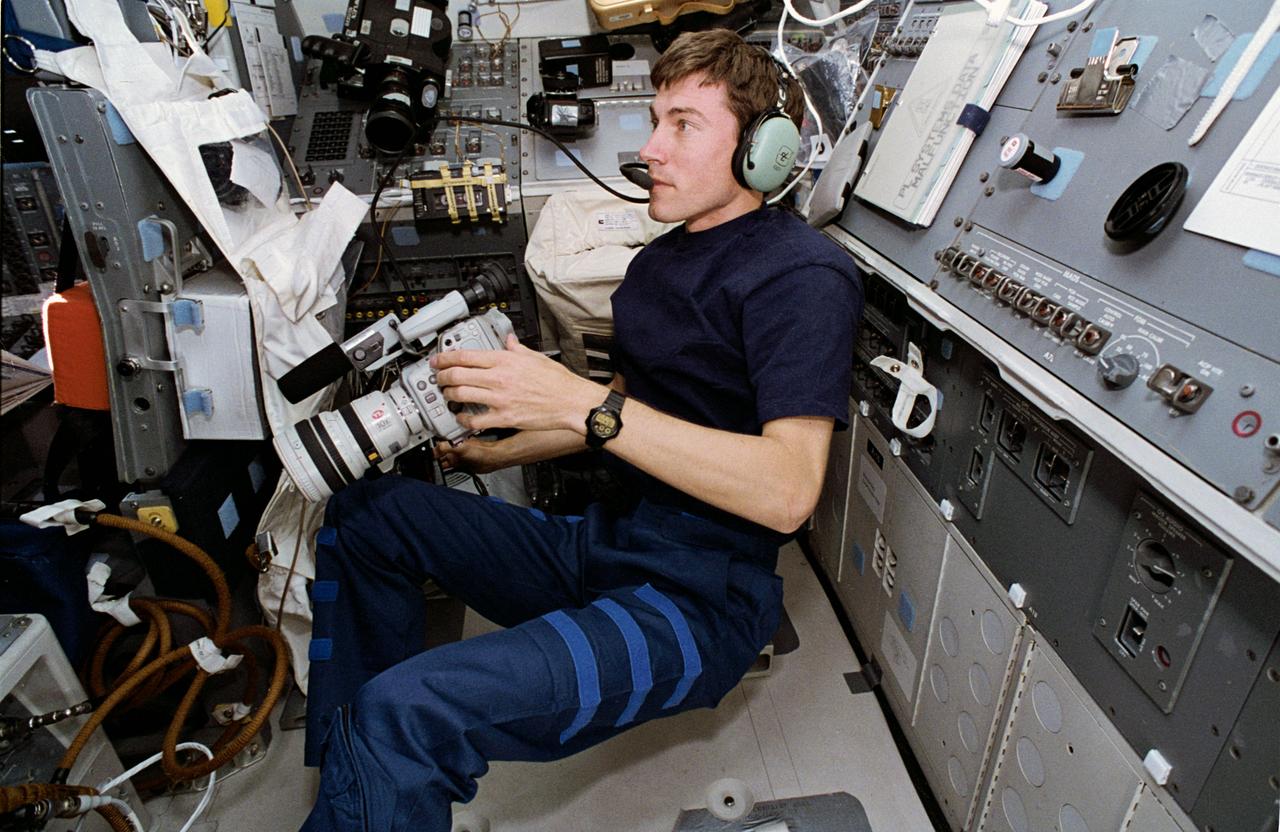
STS60-29-009 (10 Feb 1994) --- On the Space Shuttle Discovery's aft flight deck, Russian cosmonaut Sergei K. Krikalev prepares for one chore while performing another.  Using the Shuttle Amateur Radio Experiment (SAREX) gear, the mission specialist was talking with students in Maine.  He holds a camcorder, which was later called into action to record inflight activities.  Krikalev joined five NASA astronauts for eight days in space aboard Discovery.
SAREX - Chang-Diaz and Krikalev on flight deck
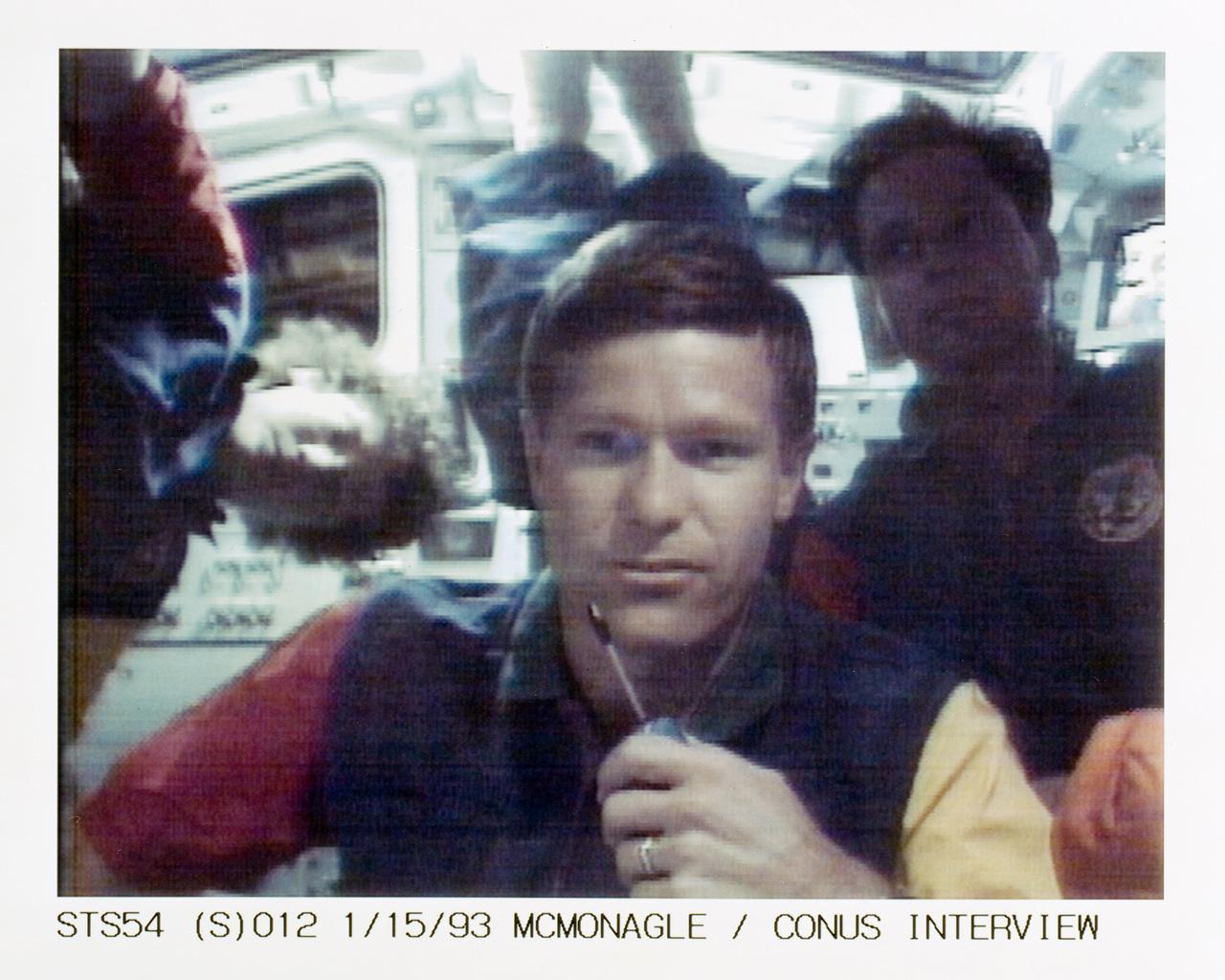
STS054-S-012 (15 Jan 1993) --- McMonagle talks to a radio station from the flight deck of Endeavour while, in the background, several crewmates await their turns to communicate with other stations. The scene was recorded at 13:54:14:13 GMT, Jan. 15, 1993.
STS-54 Pilot McMonagle talks to radio station from OV-105's aft flight deck
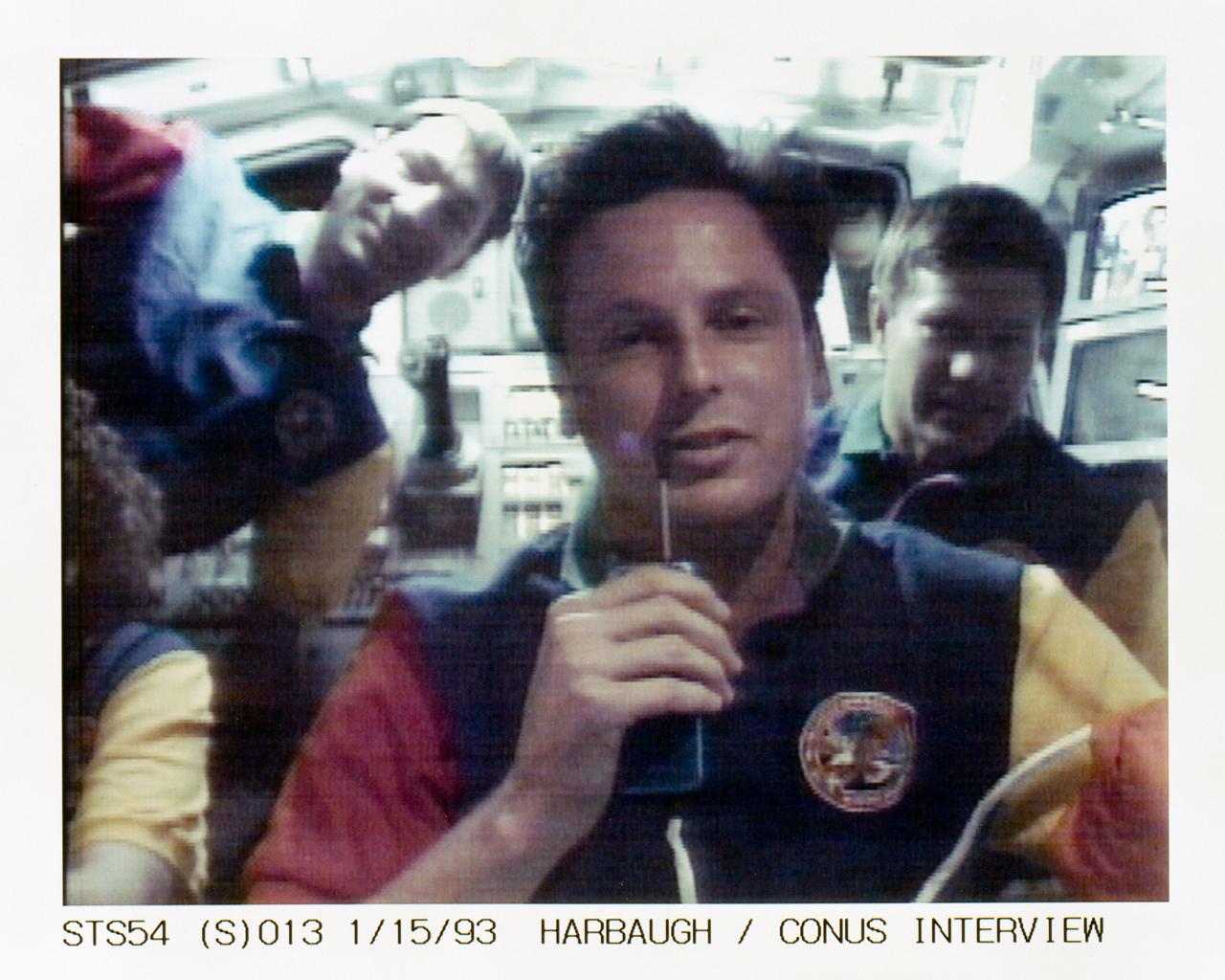
STS054-S-013 (15 Jan 1993) --- Harbaugh talks to a radio station from the flight deck of Endeavour while, in the background, several crewmates await their turns to communicate with other stations. The scene was recorded at 13:57:20:20 GMT, Jan. 15, 1993.
STS-54 MS2 Harbaugh talks to radio station from OV-105's aft flight deck
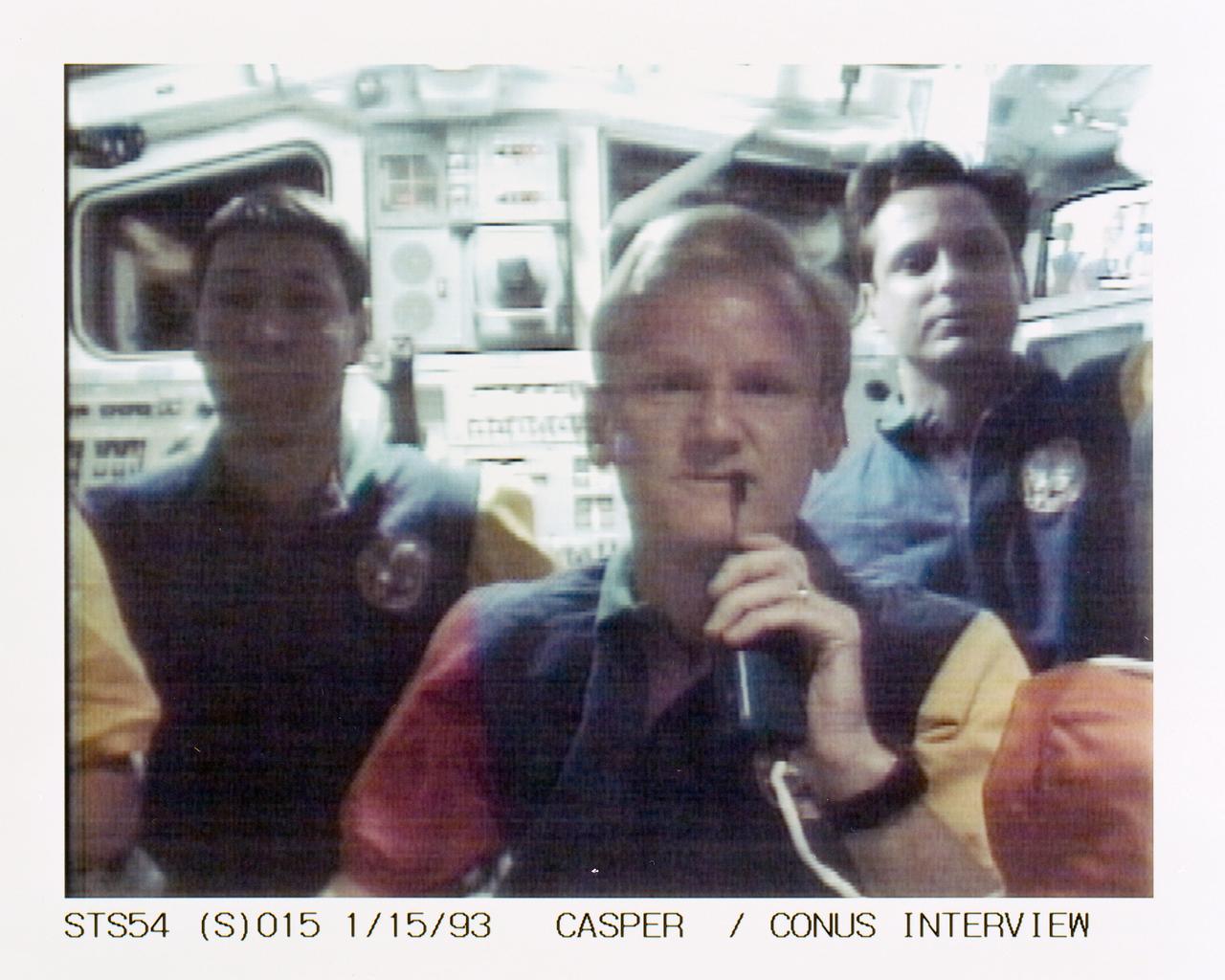
STS054-S-015 (15 Jan 1993) --- Casper talks to a radio station from the flight deck of Endeavour while, in the background, Runco, left, and Harbaugh await their turns to communicate with other stations. The scene was recorded at 13:45:54:05 GMT, Jan. 15, 1993.
STS-54 Commander Casper talks to radio station from OV-105's aft flight deck
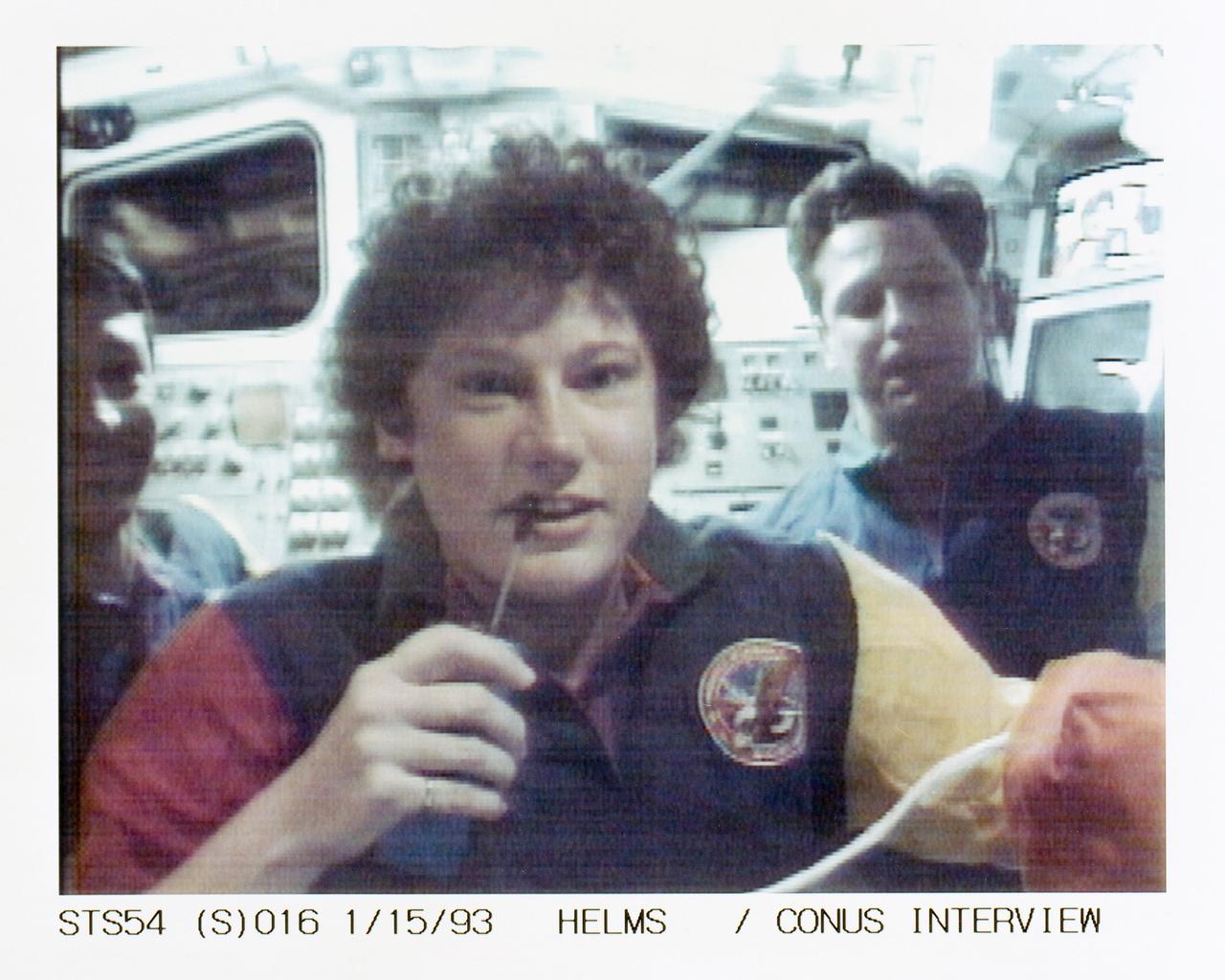
STS054-S-016 (15 Jan 1993) --- Helms talks to a radio station from the flight deck of Endeavour while Runco, left, and Harbaugh look on in the background. The scene was recorded at 13:54:14:13 GMT, Jan. 15, 1993.
STS-54 MS3 Helms talks to radio station from OV-105's aft flight deck
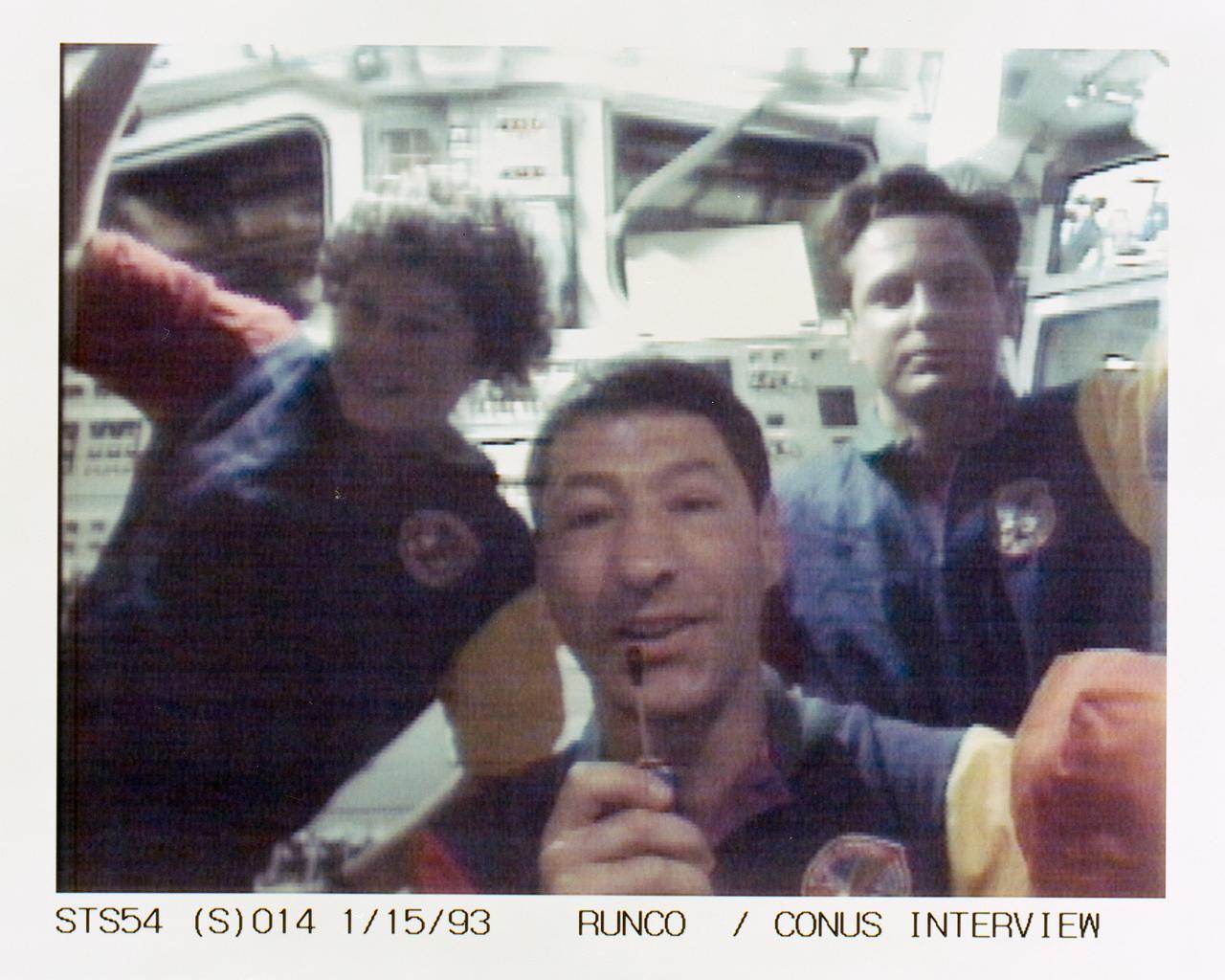
STS054-S-014 (15 Jan 1993) --- Runco talks to a radio station from the flight deck of Endeavour while, in the background, several crewmates await their turns to communicate with other stations. The scene was recorded at 13:48:45:11 GMT, Jan. 15, 1993.
STS-54 MS1 Runco talks to radio station from OV-105's aft flight deck
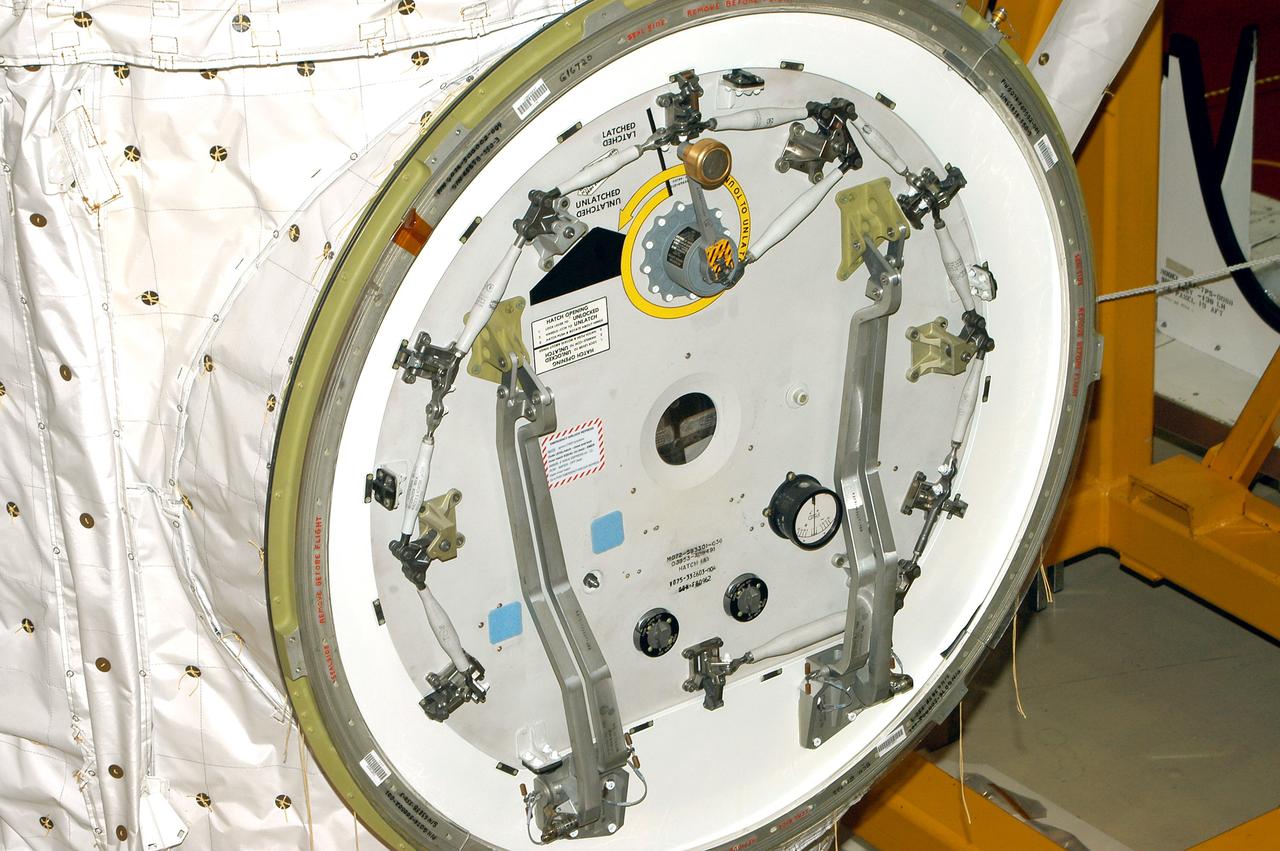
KENNEDY SPACE CENTER, FLA. -  Seen in the photo is one end of the airlock that is installed in the payload bay of orbiter Discovery.  The airlock is normally located inside the middeck of the spacecraft’s pressurized crew cabin. The airlock is sized to accommodate two fully suited flight crew members simultaneously. Support functions include airlock depressurization and repressurization, extravehicular activity equipment recharge, liquid-cooled garment water cooling, EVA equipment checkout, donning and communications. The outer hatch isolates the airlock from the unpressurized payload bay when closed and permits the EVA crew members to exit from the airlock to the payload bay when open.
KENNEDY SPACE CENTER, FLA. - Seen in the photo is one end of the airlock that is installed in the payload bay of orbiter Discovery. The airlock is normally located inside the middeck of the spacecraft’s pressurized crew cabin. The airlock is sized to accommodate two fully suited flight crew members simultaneously. Support functions include airlock depressurization and repressurization, extravehicular activity equipment recharge, liquid-cooled garment water cooling, EVA equipment checkout, donning and communications. The outer hatch isolates the airlock from the unpressurized payload bay when closed and permits the EVA crew members to exit from the airlock to the payload bay when open.
KENNEDY SPACE CENTER, FLA. -  In the Orbiter Processing Facility, a cameraman films part of Discovery’s payload bay for a special feature on the KSC Web.  In the background is the open hatch of the airlock, located inside the middeck of the spacecraft’s pressurized crew cabin. The airlock is sized to accommodate two fully suited flight crew members simultaneously. Support functions include airlock depressurization and repressurization, extravehicular activity equipment recharge, liquid-cooled garment water cooling, EVA equipment checkout, donning and communications. The outer hatch isolates the airlock from the unpressurized payload bay when closed and permits the EVA crew members to exit from the airlock to the payload bay when open.
KENNEDY SPACE CENTER, FLA. - In the Orbiter Processing Facility, a cameraman films part of Discovery’s payload bay for a special feature on the KSC Web. In the background is the open hatch of the airlock, located inside the middeck of the spacecraft’s pressurized crew cabin. The airlock is sized to accommodate two fully suited flight crew members simultaneously. Support functions include airlock depressurization and repressurization, extravehicular activity equipment recharge, liquid-cooled garment water cooling, EVA equipment checkout, donning and communications. The outer hatch isolates the airlock from the unpressurized payload bay when closed and permits the EVA crew members to exit from the airlock to the payload bay when open.
KENNEDY SPACE CENTER, FLA. -  Seen in the photo is one end of the airlock that is installed in the payload bay of orbiter Discovery.  The airlock is normally located inside the middeck of the spacecraft’s pressurized crew cabin. The airlock is sized to accommodate two fully suited flight crew members simultaneously. Support functions include airlock depressurization and repressurization, extravehicular activity equipment recharge, liquid-cooled garment water cooling, EVA equipment checkout, donning and communications. The outer hatch isolates the airlock from the unpressurized payload bay when closed and permits the EVA crew members to exit from the airlock to the payload bay when open.
KENNEDY SPACE CENTER, FLA. - Seen in the photo is one end of the airlock that is installed in the payload bay of orbiter Discovery. The airlock is normally located inside the middeck of the spacecraft’s pressurized crew cabin. The airlock is sized to accommodate two fully suited flight crew members simultaneously. Support functions include airlock depressurization and repressurization, extravehicular activity equipment recharge, liquid-cooled garment water cooling, EVA equipment checkout, donning and communications. The outer hatch isolates the airlock from the unpressurized payload bay when closed and permits the EVA crew members to exit from the airlock to the payload bay when open.
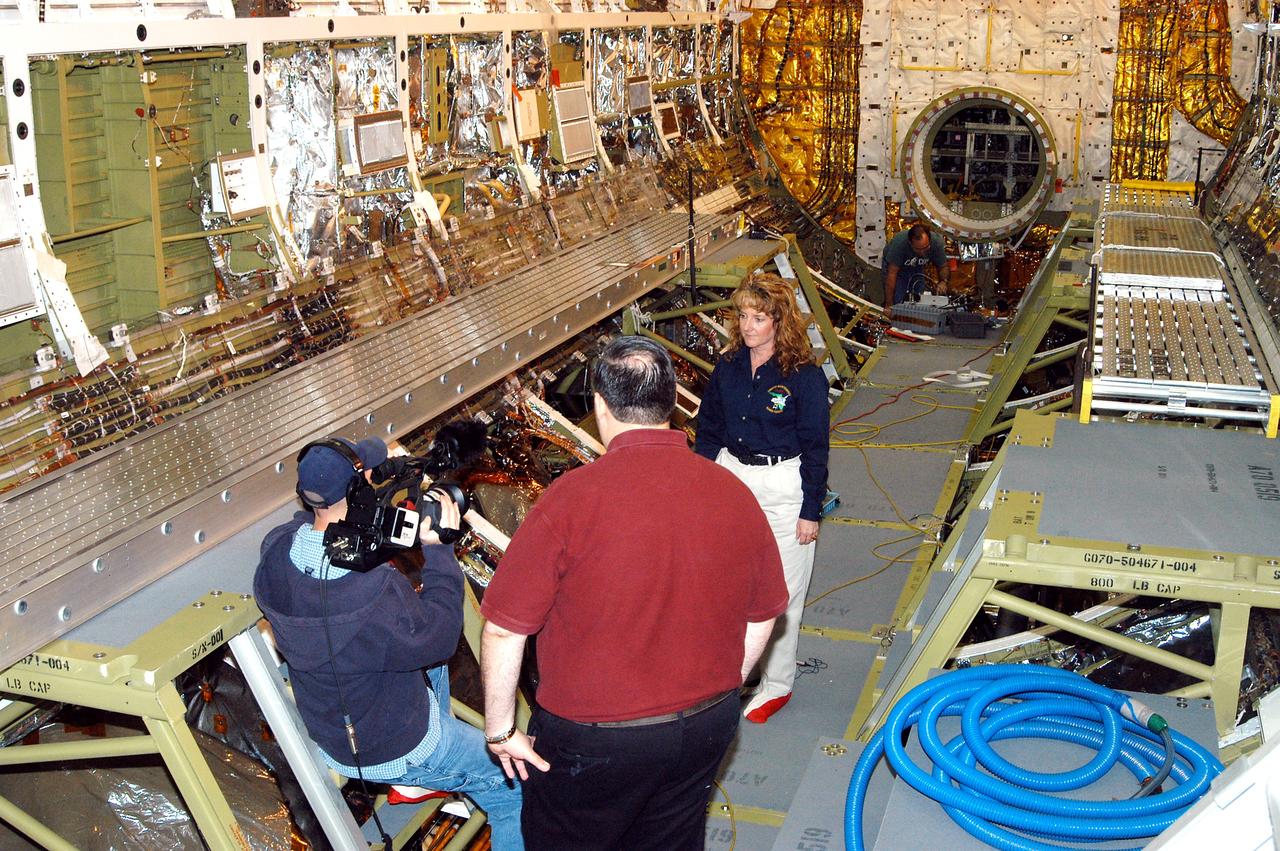
KENNEDY SPACE CENTER, FLA. -  Standing inside Discovery’s payload bay, Carol Scott (right), lead orbiter engineer, talks about her job as part of a special feature for the KSC Web.  With his back to the camera is Bill Kallus, Media manager in the KSC Web Studio.  Behind Scott can be seen the open hatch of the airlock, which provides support functions such as airlock depressurization and repressurization, extravehicular activity equipment recharge, liquid-cooled garment water cooling, EVA equipment checkout, donning and communications. The outer hatch isolates the airlock from the unpressurized payload bay when closed and permits the EVA crew members to exit from the airlock to the payload bay when open.
KENNEDY SPACE CENTER, FLA. - Standing inside Discovery’s payload bay, Carol Scott (right), lead orbiter engineer, talks about her job as part of a special feature for the KSC Web. With his back to the camera is Bill Kallus, Media manager in the KSC Web Studio. Behind Scott can be seen the open hatch of the airlock, which provides support functions such as airlock depressurization and repressurization, extravehicular activity equipment recharge, liquid-cooled garment water cooling, EVA equipment checkout, donning and communications. The outer hatch isolates the airlock from the unpressurized payload bay when closed and permits the EVA crew members to exit from the airlock to the payload bay when open.
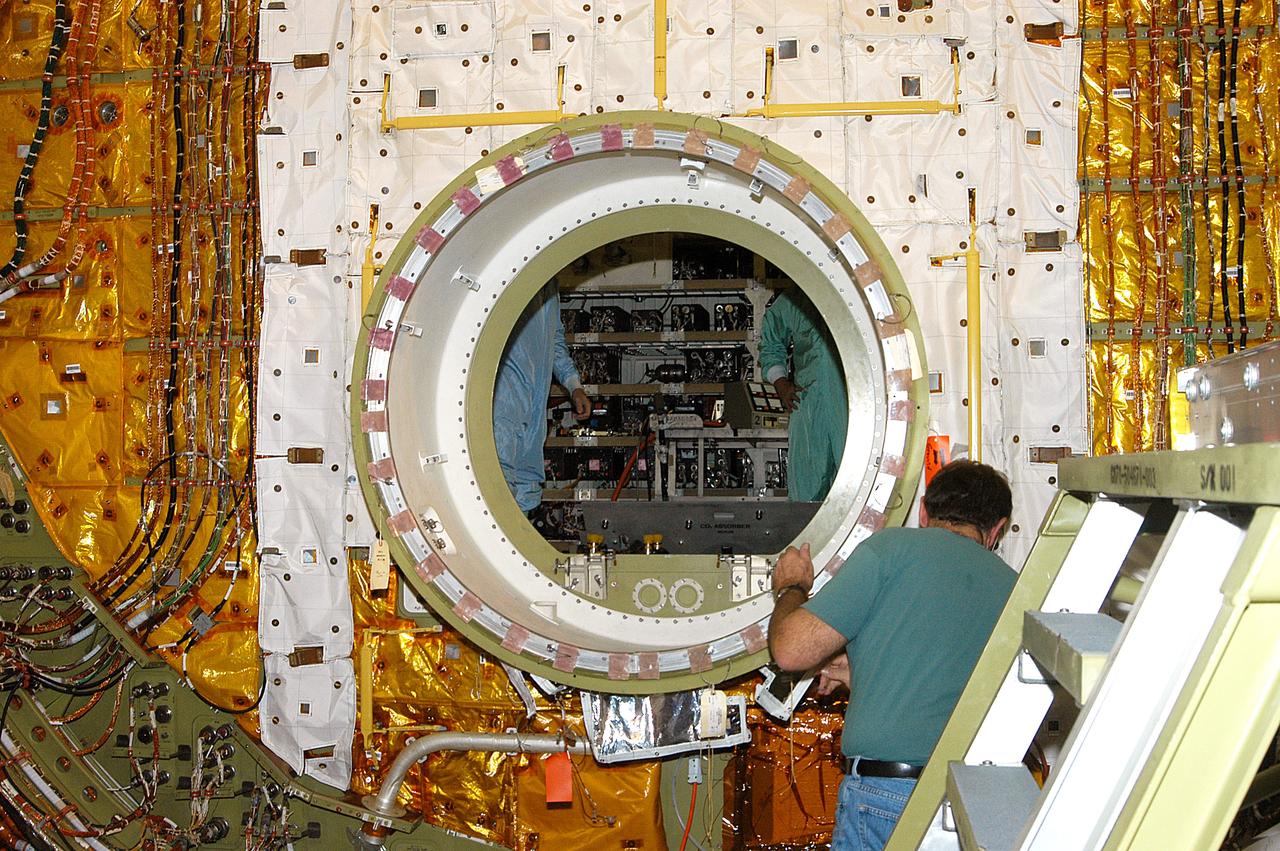
KENNEDY SPACE CENTER, FLA. -  A worker in the Orbiter Processing Facility checks the open hatch of the airlock in Discovery’s payload bay. The airlock is normally located inside the middeck of the spacecraft’s pressurized crew cabin. The airlock is sized to accommodate two fully suited flight crew members simultaneously. Support functions include airlock depressurization and repressurization, extravehicular activity equipment recharge, liquid-cooled garment water cooling, EVA equipment checkout, donning and communications. The outer hatch isolates the airlock from the unpressurized payload bay when closed and permits the EVA crew members to exit from the airlock to the payload bay when open.
KENNEDY SPACE CENTER, FLA. - A worker in the Orbiter Processing Facility checks the open hatch of the airlock in Discovery’s payload bay. The airlock is normally located inside the middeck of the spacecraft’s pressurized crew cabin. The airlock is sized to accommodate two fully suited flight crew members simultaneously. Support functions include airlock depressurization and repressurization, extravehicular activity equipment recharge, liquid-cooled garment water cooling, EVA equipment checkout, donning and communications. The outer hatch isolates the airlock from the unpressurized payload bay when closed and permits the EVA crew members to exit from the airlock to the payload bay when open.
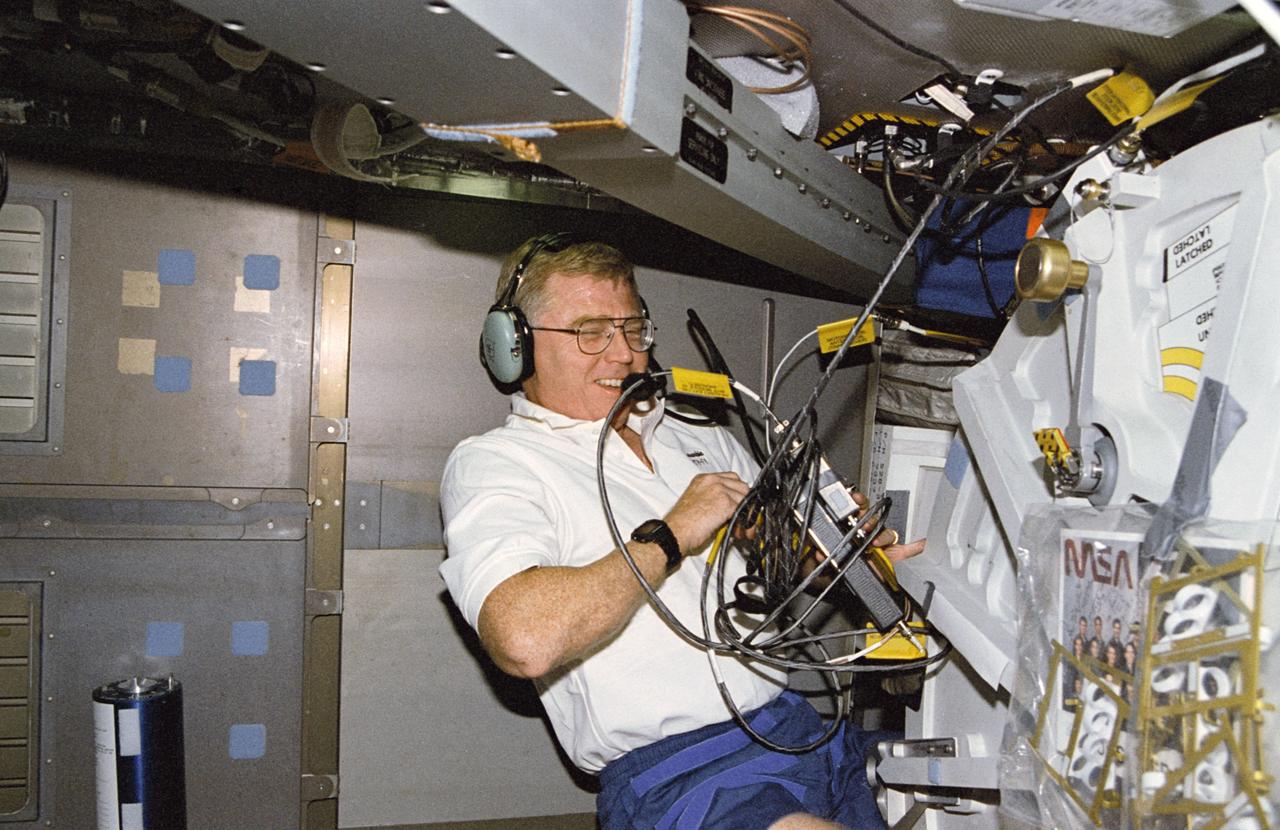
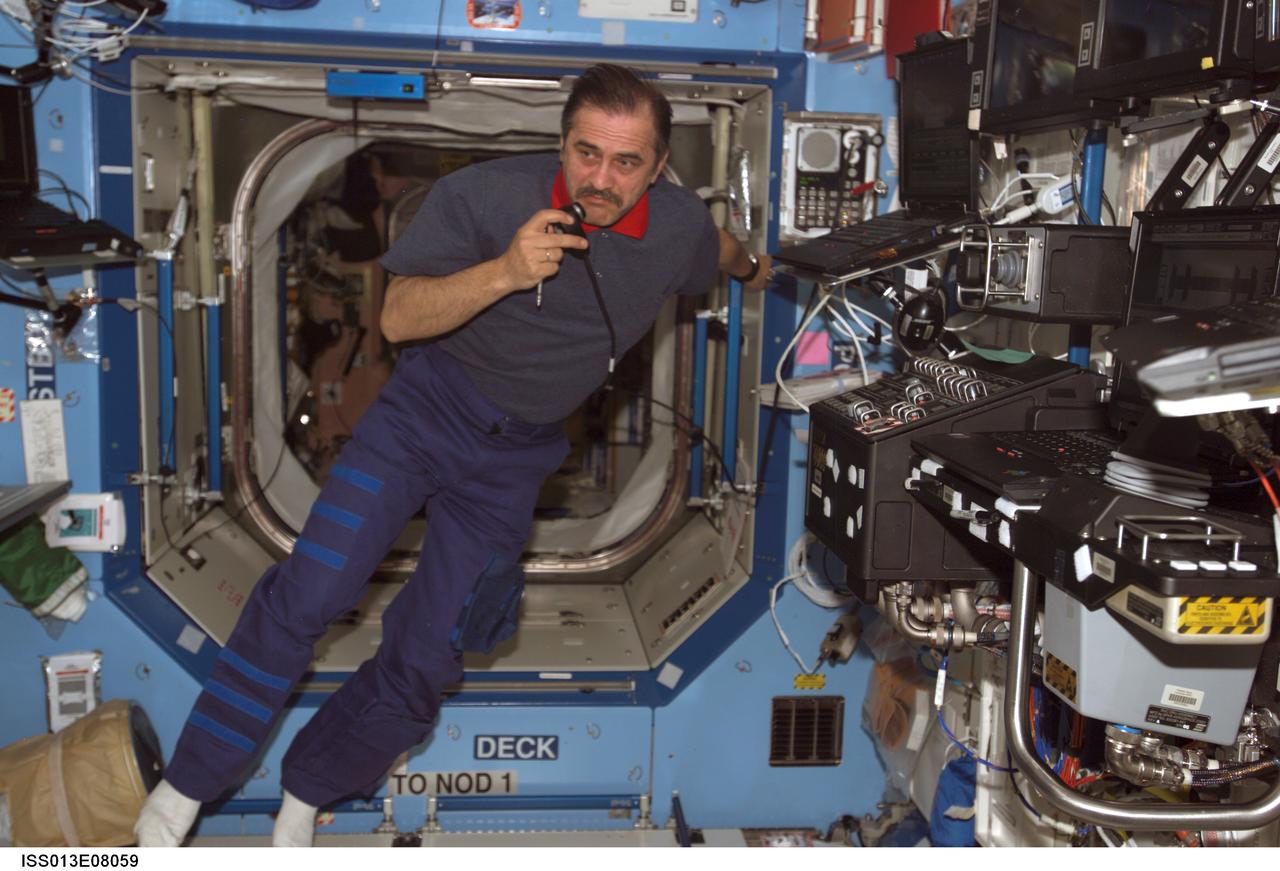
ISS013-E-08059 (18 April 2006) --- Cosmonaut Pavel V. Vinogradov, Expedition 13 commander representing Russia's Federal Space Agency, uses a communication system in the Destiny laboratory of the International Space Station.
Vinogradov uses communication equipment in the U.S. Laboratory during Expedition 13
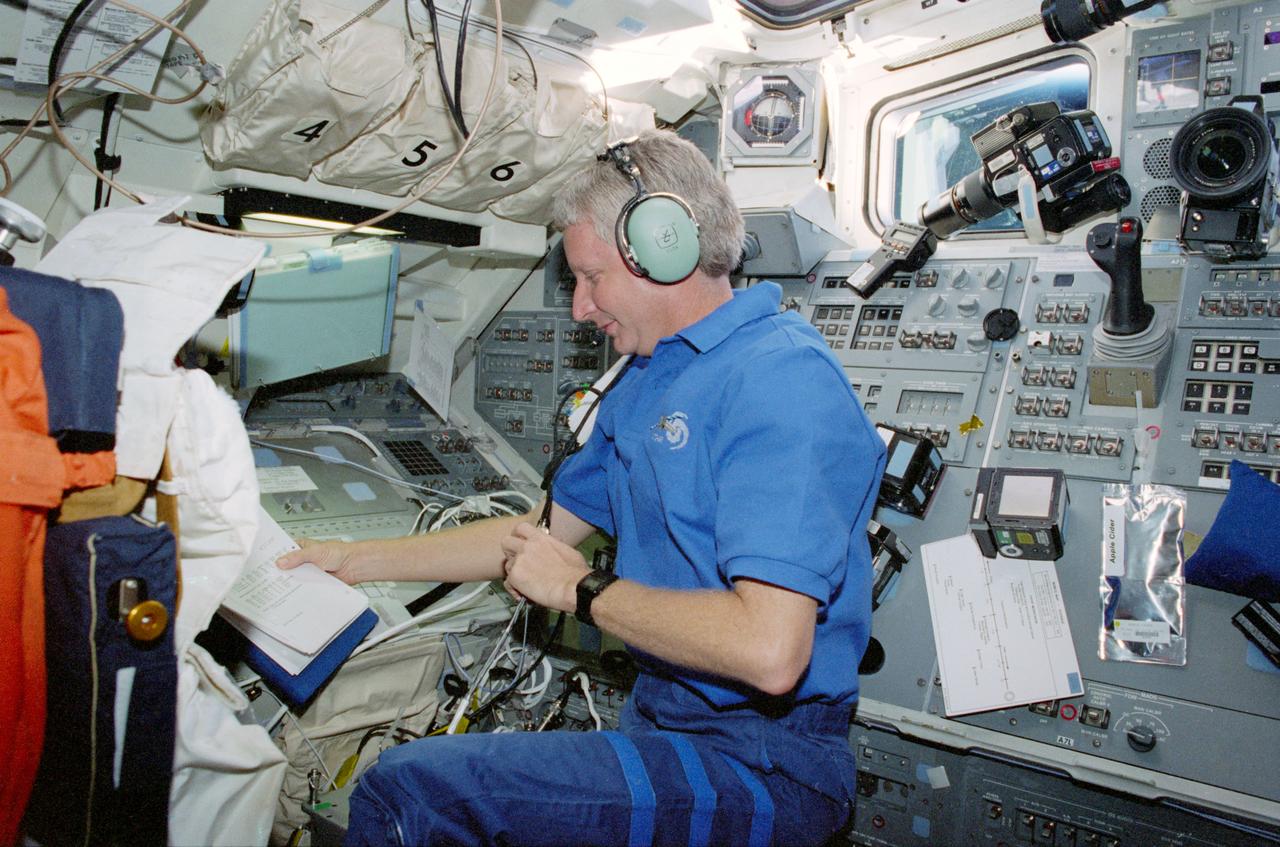
S117-E-07099 (12 June 2007) --- Astronaut Steven Swanson, STS-117 mission specialist, uses a communication system in the Quest Airlock of the International Space Station during flight day five activities while Space Shuttle Atlantis was docked with the station.
Swanson uses communication equipment in the A/L during Joint Operations
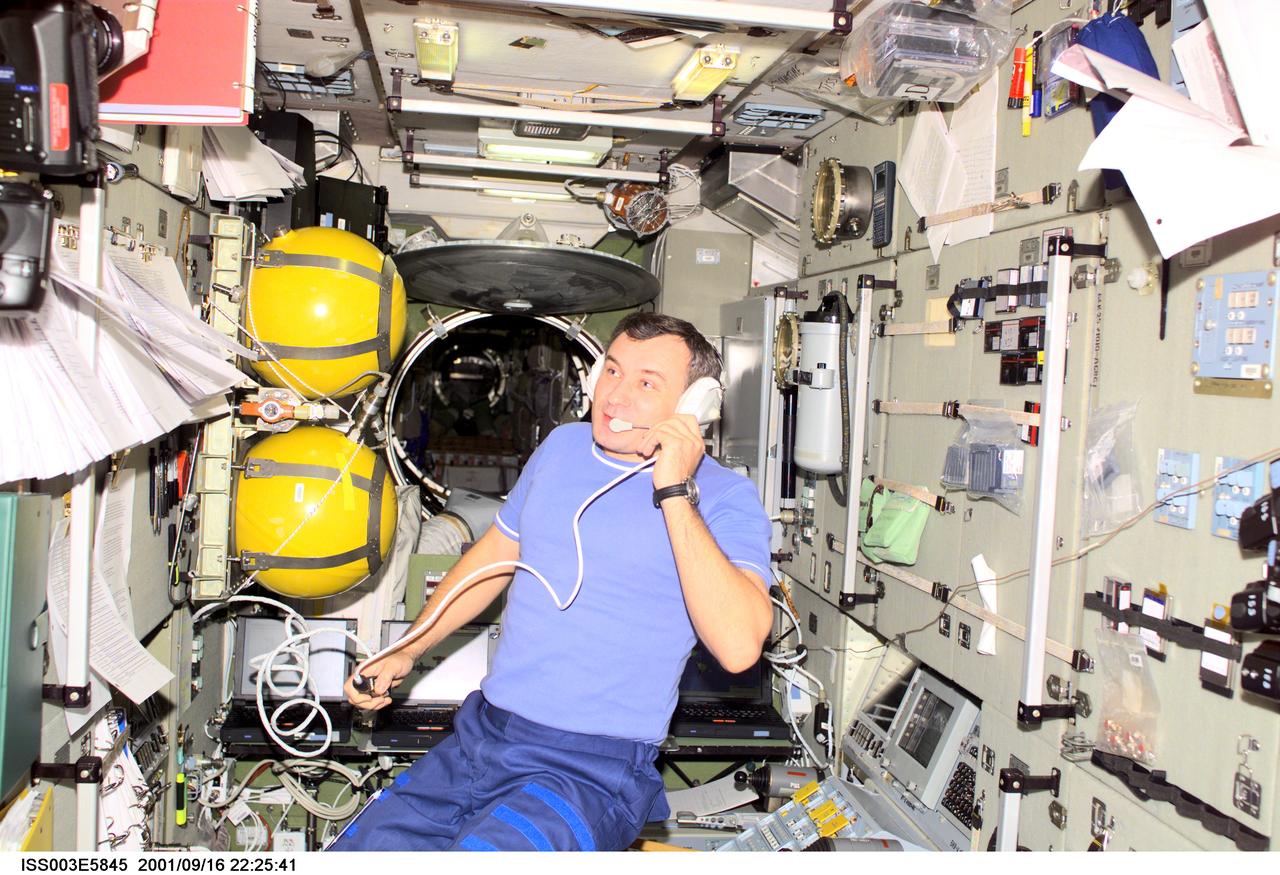
ISS003-E-5845 (16 September 2001) --- Cosmonaut Vladimir N. Dezhurov, Expedition Three flight engineer representing Rosaviakosmos, talks with flight controllers from the Zvezda Service Module on the International Space Station (ISS). This image was taken with a digital still camera.
Dezhurov uses communication equipment in the Service Module during Expedition Three
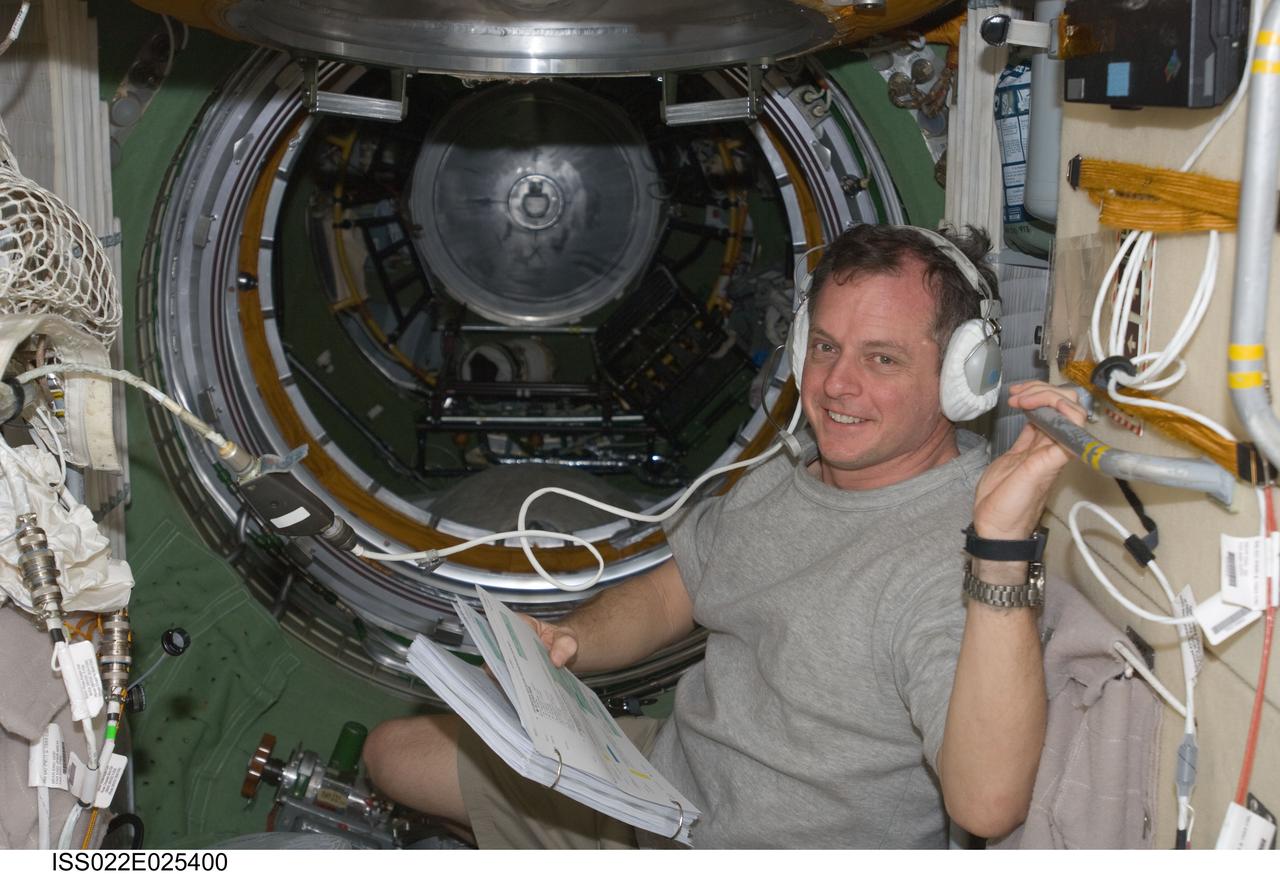
ISS022-E-025400 (14 Jan. 2010) --- NASA astronaut T.J. Creamer, Expedition 22 flight engineer, uses a communication system in the Zarya Functional Cargo Block (FGB) of the International Space Station.
Creamer uses communication equipment in the FGB during Expedition 22
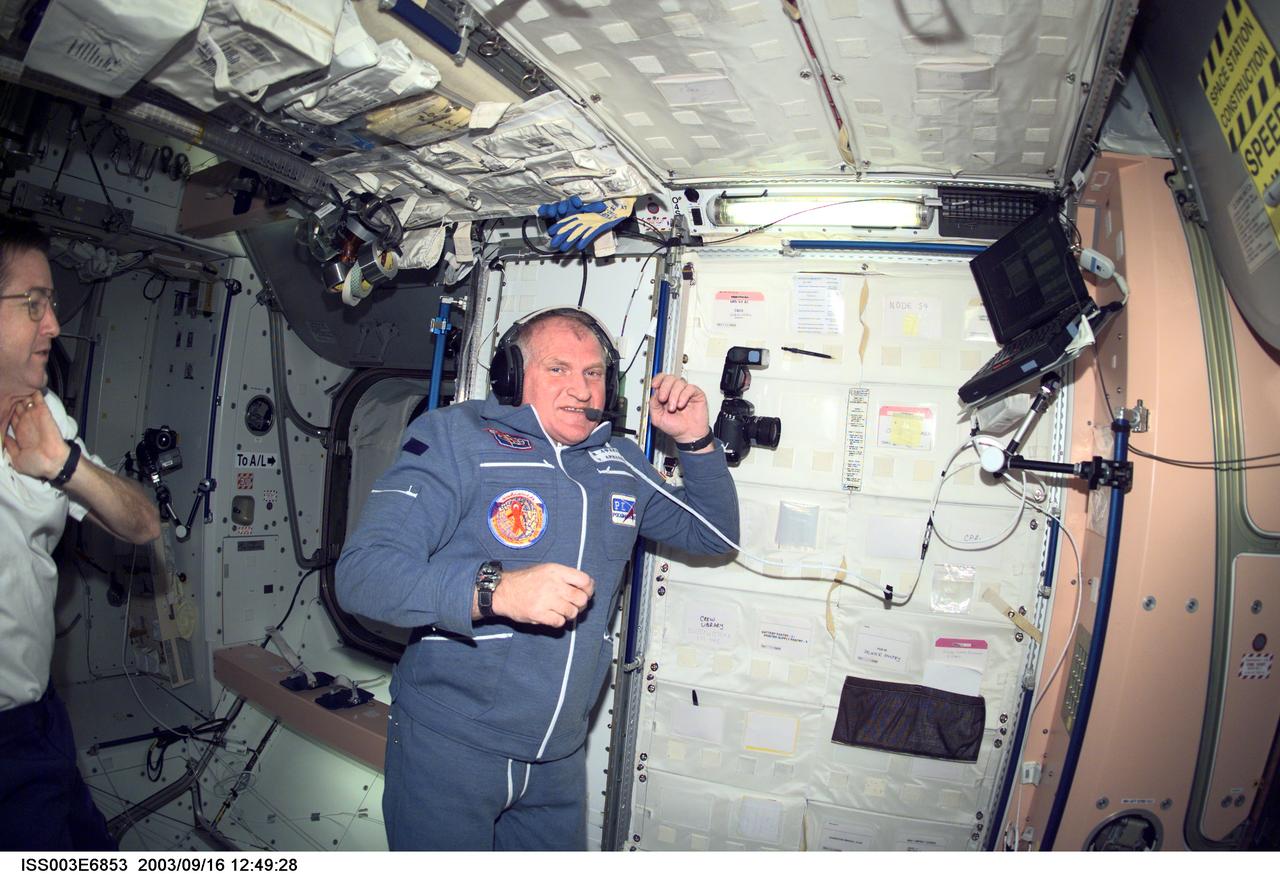
ISS003-E-6853 (23-31 October 2001) --- Soyuz taxi commander Victor Afanasyev and astronaut Frank L. Culbertson (partially out of frame), Expedition Three mission commander, are photographed in the Unity node on the International Space Station (ISS). Afanasyev represents Rosaviakosmos. This image was taken with a digital still camera.
Afanasyev uses communication equipment in Node 1 during Expedition Three
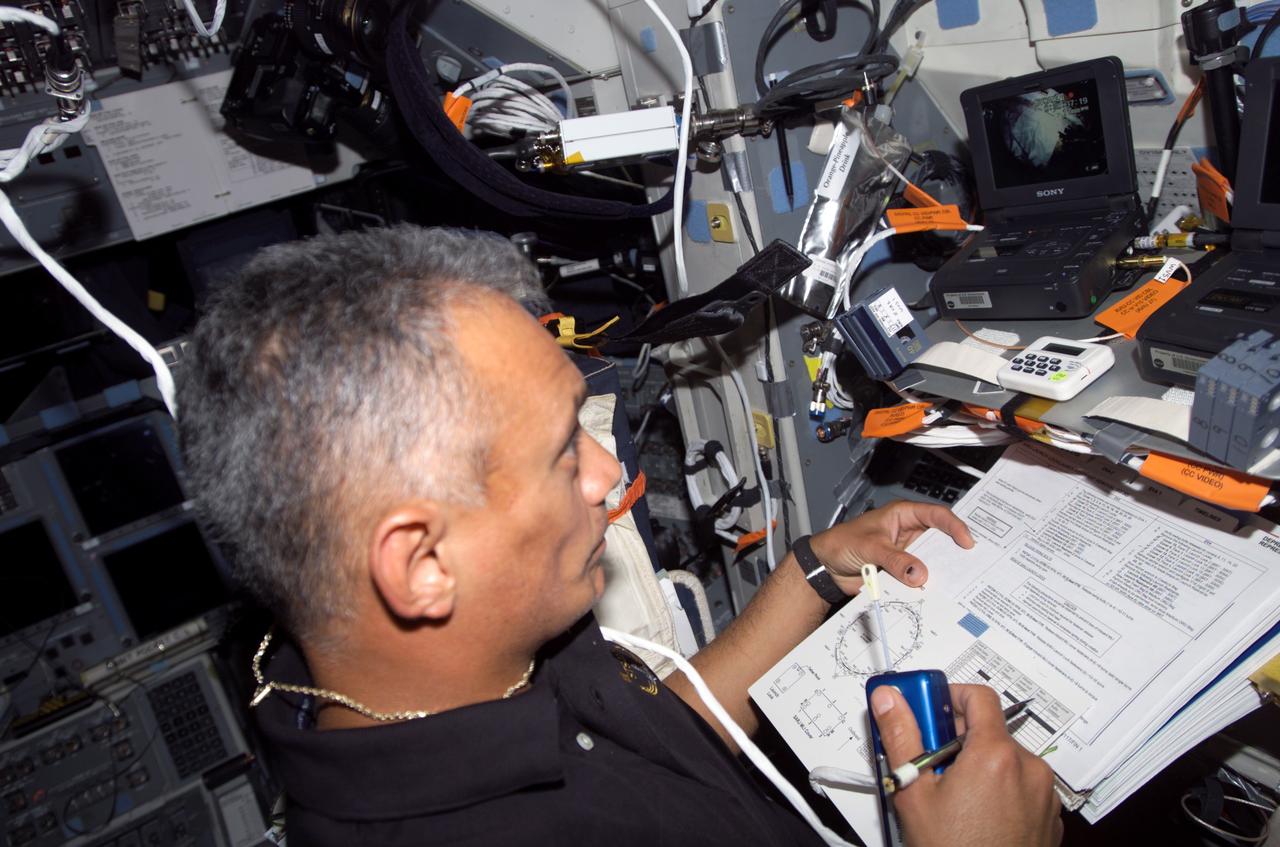
S117-E-07192 (13 June 2007) --- Astronaut John "Danny" Olivas, STS-117 mission specialist, uses a communication system while looking over procedures checklists on the flight deck of Space Shuttle Atlantis during flight day six activities while docked with the International Space Station.
Olivas uses communication equipment on the FD during Joint Operations
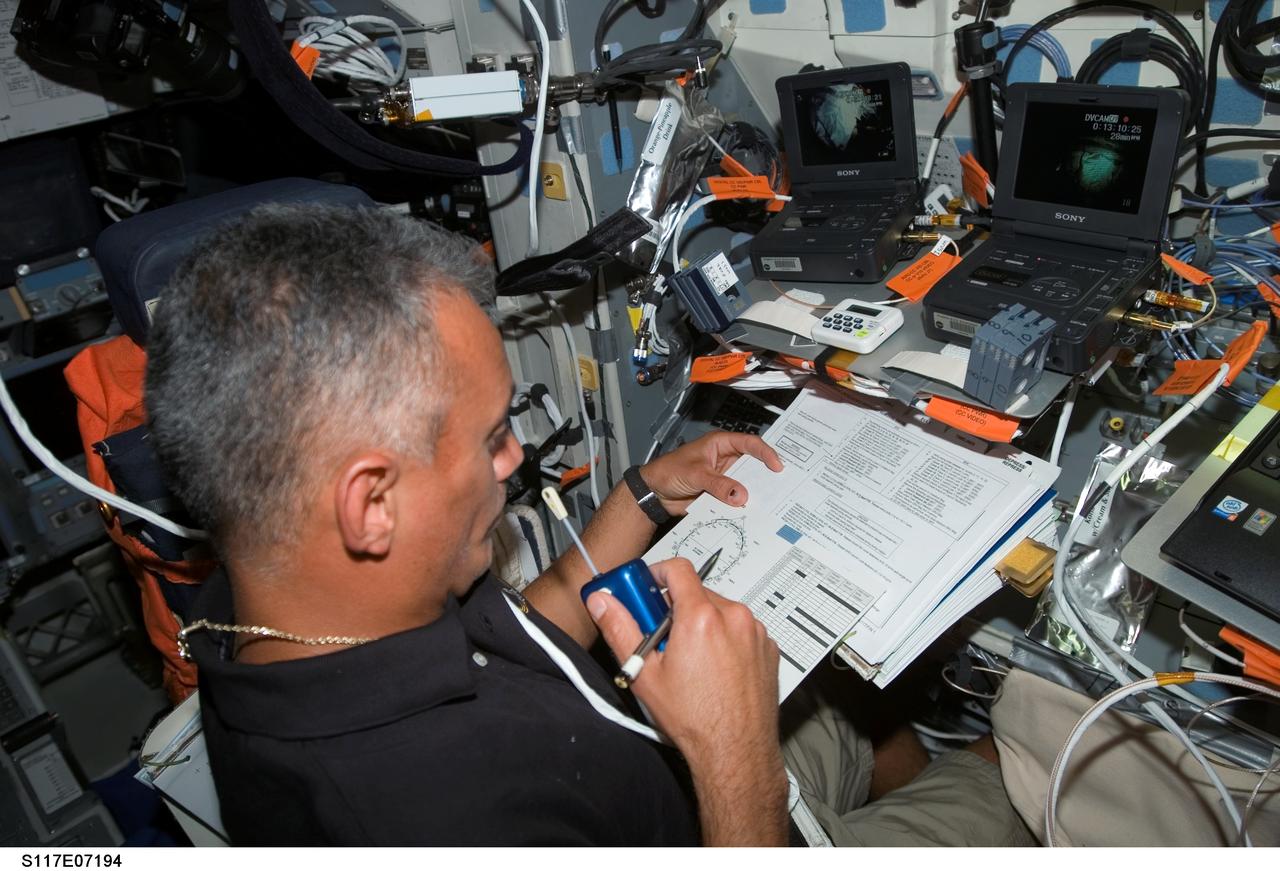
S117-E-07194 (13 June 2007) --- Astronaut John "Danny" Olivas, STS-117 mission specialist, uses a communication system while looking over procedures checklists on the flight deck of Space Shuttle Atlantis during flight day six activities while docked with the International Space Station.
Olivas uses communication equipment on the FD during Joint Operations
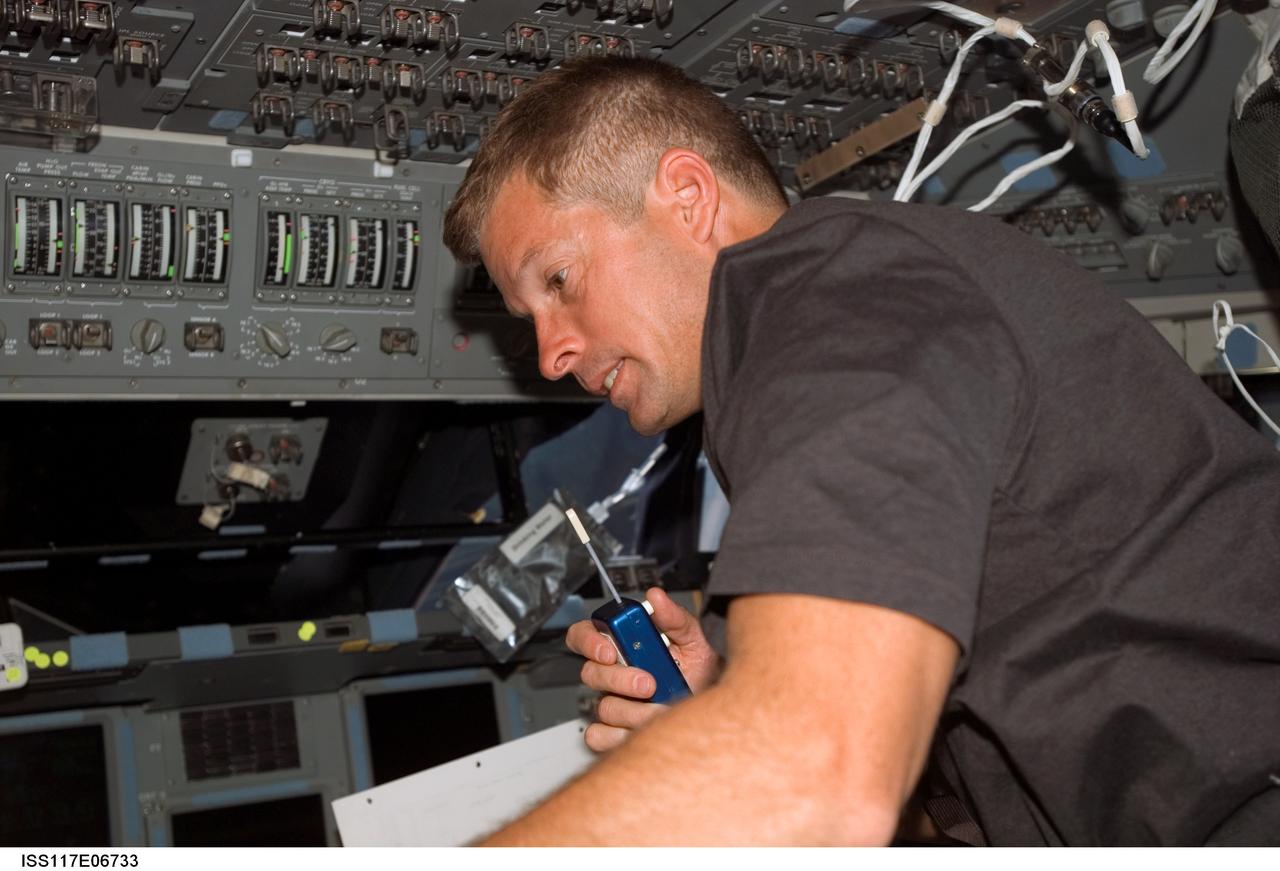
S117-E-06733 (9 June 2007) --- Astronaut Steven Swanson, STS-117 mission specialist, uses a communication system on the flight deck of Space Shuttle Atlantis.
Swanson uses communication equipment in the FD of STS-117 Space Shuttle Atlantis
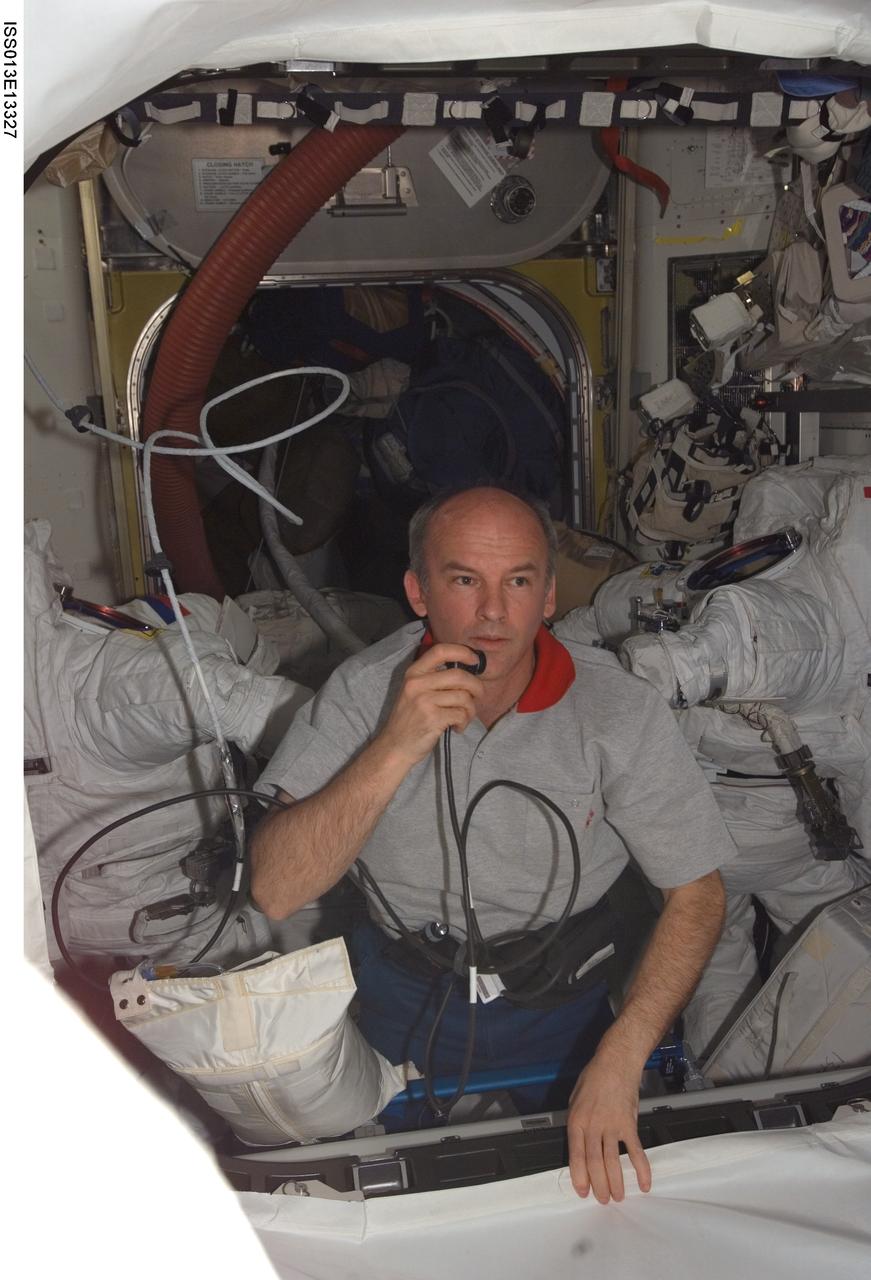
ISS013-E-13327 (1 May 2006) --- Astronaut Jeffrey N. Williams, Expedition 13 NASA space station science officer and flight engineer, uses a communication system in the Quest Airlock of the International Space Station. Two Extravehicular Mobility Unit (EMU) spacesuits are visible in the background.
Williams uses communication equipment in the Airlock during Expedition 13
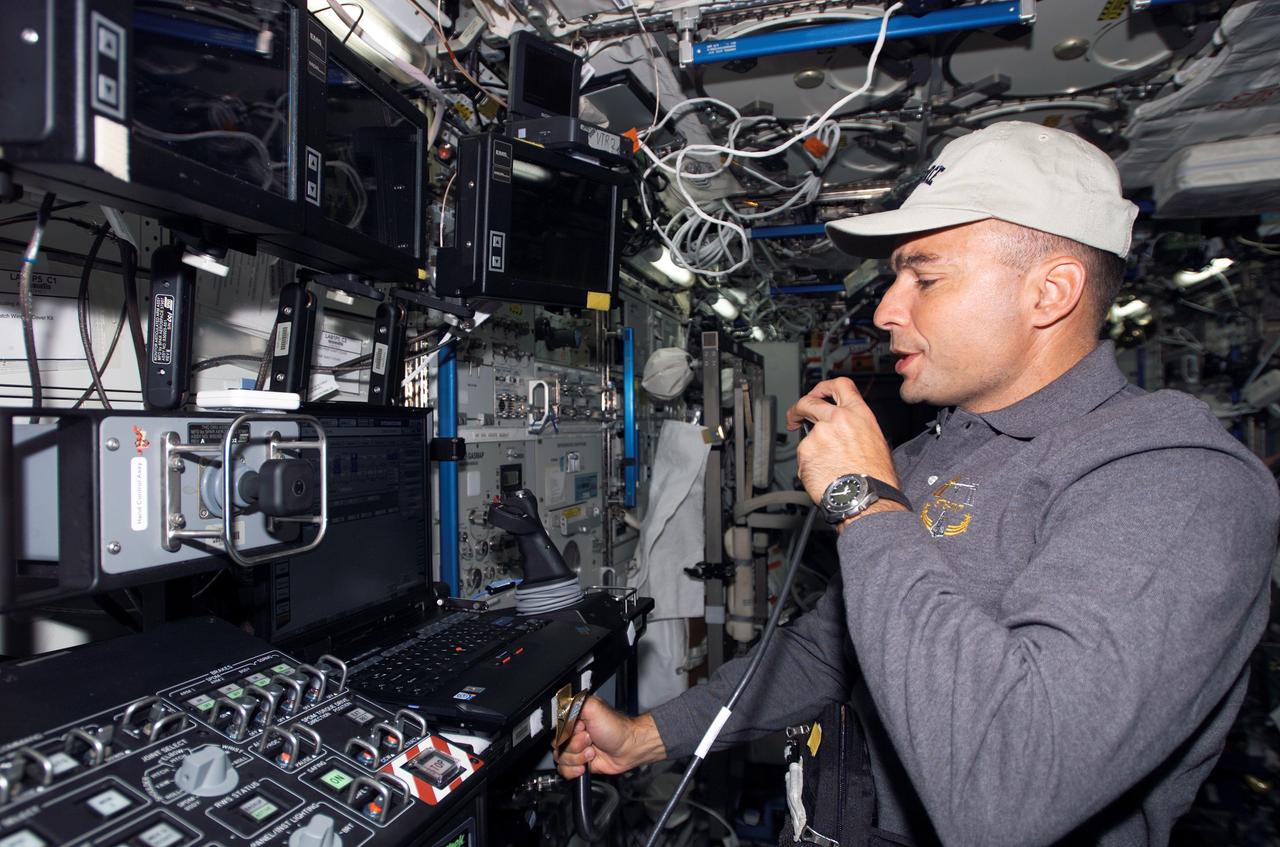
S117-E-07097 (12 June 2007) --- Astronaut Lee Archambault, STS-117 pilot, uses a communication system near the controls of the Space Station Remote Manipulator System (SSRMS) or Canadarm2 in the Destiny laboratory of the International Space Station during flight day five activities while Space Shuttle Atlantis was docked with the station.
Archambault uses communication equipment in the U.S. Laboratory during Joint Operations
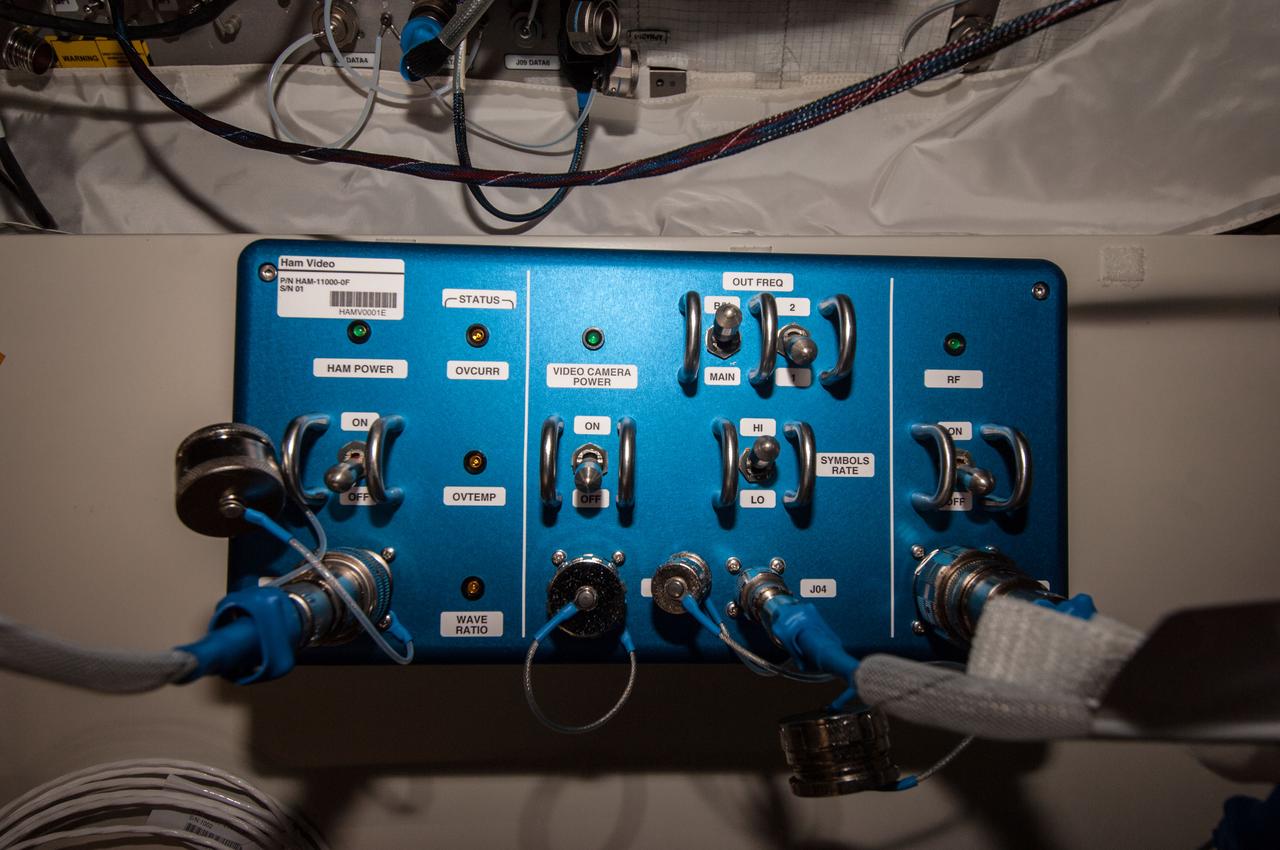
Documentation of the Ham Video unit installed in the Columbus European Laboratory. Part number (P/N) is HAM-11000-0F, serial number (S/N) is 01, barcode is HAMV0001E. Image was taken during Expedition 39 Ham Video commissioning activities and released by astronaut on Twitter.
Ham Video Commissioning in Columbus
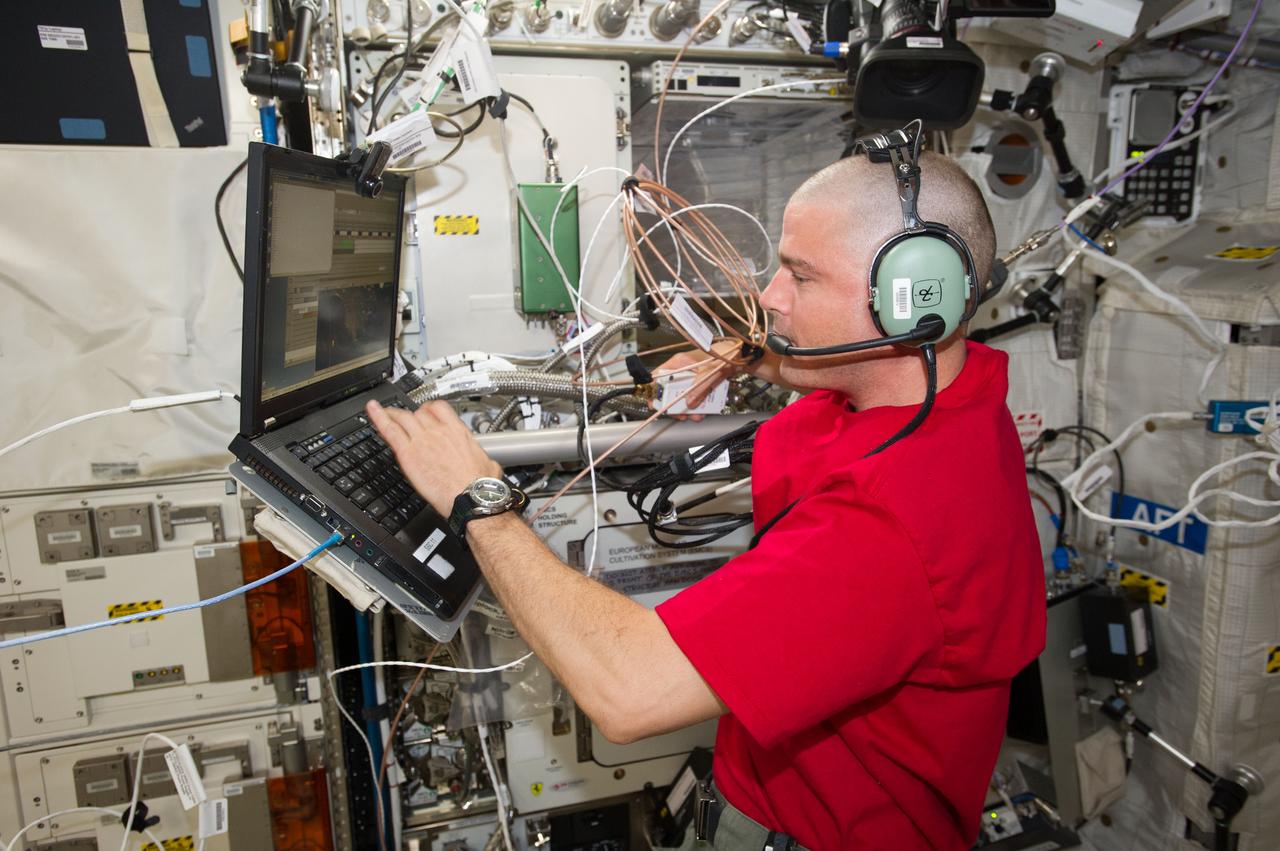
ISS040-E-024110 (28 June 2014) --- NASA astronaut Reid Wiseman, Expedition 40 flight engineer, wearing a communication headset, uses a computer in the Columbus laboratory of the International Space Station.
Wiseman in Columbus module
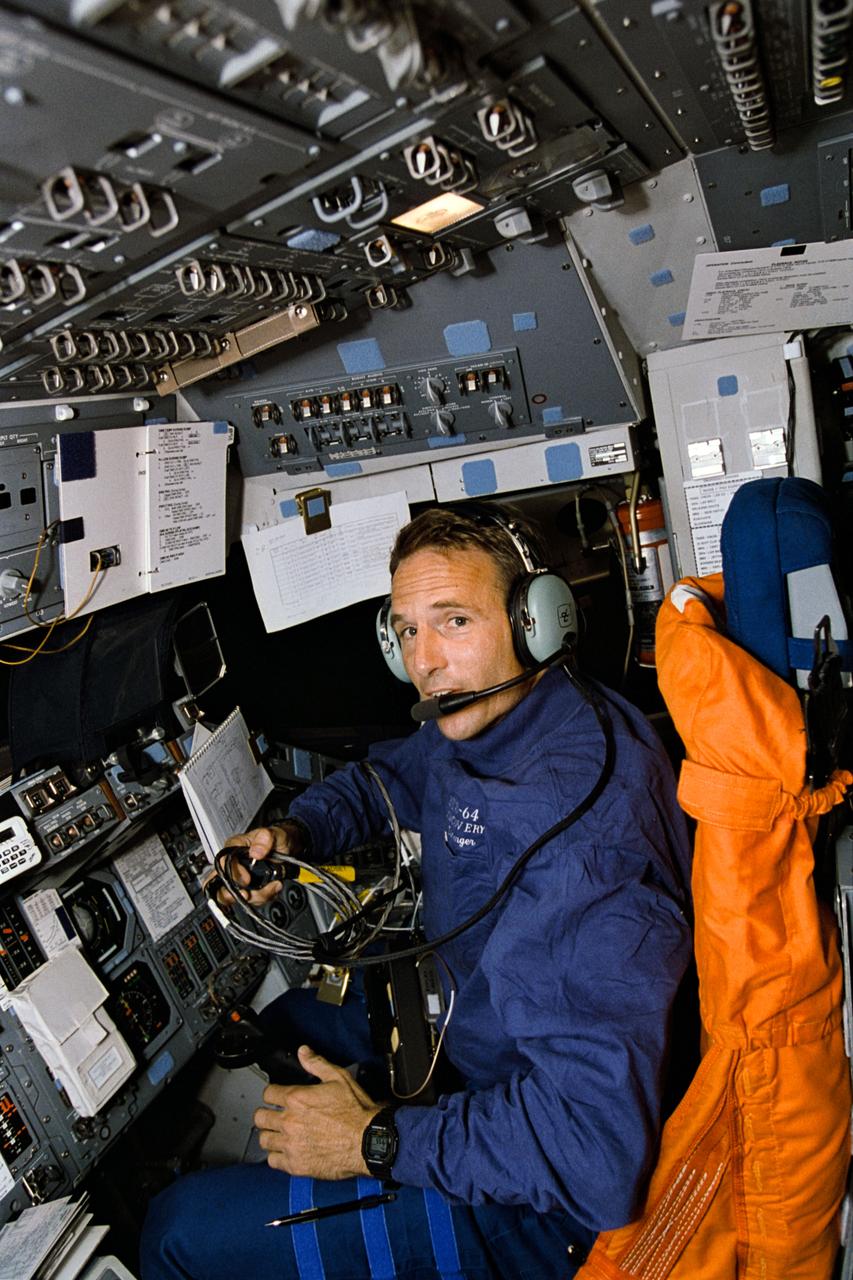
STS064-04-009 (9-20 Sept. 1994) --- Astronaut L. Blaine Hammond, STS-64 pilot, talks to students on Earth via the Shuttle Amateur Radio Experiment (SAREX) on the space shuttle Discovery's flight deck. The recently licensed "Ham" operator and several other crew members throughout the mission were connected with schools around the world with the aid of a number of amateur radio operators. Hammond joined five other NASA astronauts for almost 11 days in Earth orbit aboard Discovery. Photo credit: NASA or National Aeronautics and Space Administration
Astronaut Blaine Hammond talks to students on Earth via SAREX
STS058-21-011 (24 Oct 1993) --- From the flight deck of the Earth-orbiting Space Shuttle Columbia, astronaut William S. McArthur talks to students on Earth.  The mission specialist's activity was part of the Shuttle Amateur Radio Experiment (SAREX), a frequent payload on Shuttle missions which serves to enlighten students around the world on the topic of space travel.  McArthur (call letters KC5ACR) is one of three licensed amateur radio operators on the seven-member flight.
Astronaut William McArthur talks to students on earth using SAREX
STS078-429-017 (20 June-7 July 1996) --- Aboard the middeck of the Earth-orbiting space shuttle Columbia, astronaut Charles J. Brady, mission specialist and a licensed amateur radio operator or "ham", talks to students on Earth.  Some of the crew members devoted some of their off-duty time to continue a long-standing Shuttle tradition of communicating with students and other hams between their shifts of assigned duty.  Brady joined four other NASA astronauts and two international payload specialists for almost 17-days of research in support of  the Life and Microgravity Spacelab (LMS-1) mission.
SAREX & DTO 623, Brady talks to amateur radio operators
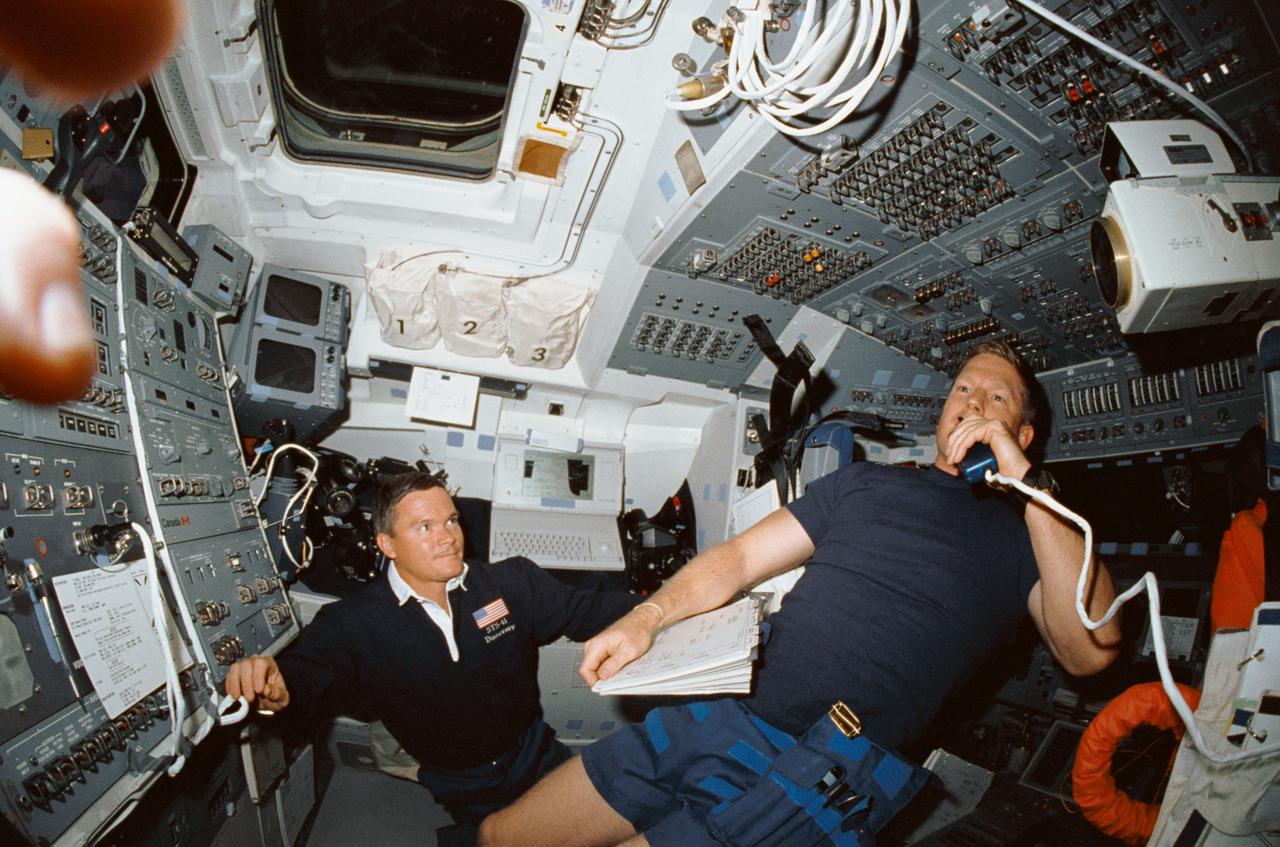
STS041-02-035 (6-10 Oct 1990) --- A fish-eye lens view shows two of STS-41's three mission specialists on the flight deck of Discovery.  Astronaut William M. Shepherd, right, communicates with ground controllers as Astronaut Bruce E. Melnick looks on.
STS-41 crew communicates with ground controllers from OV-103's flight deck
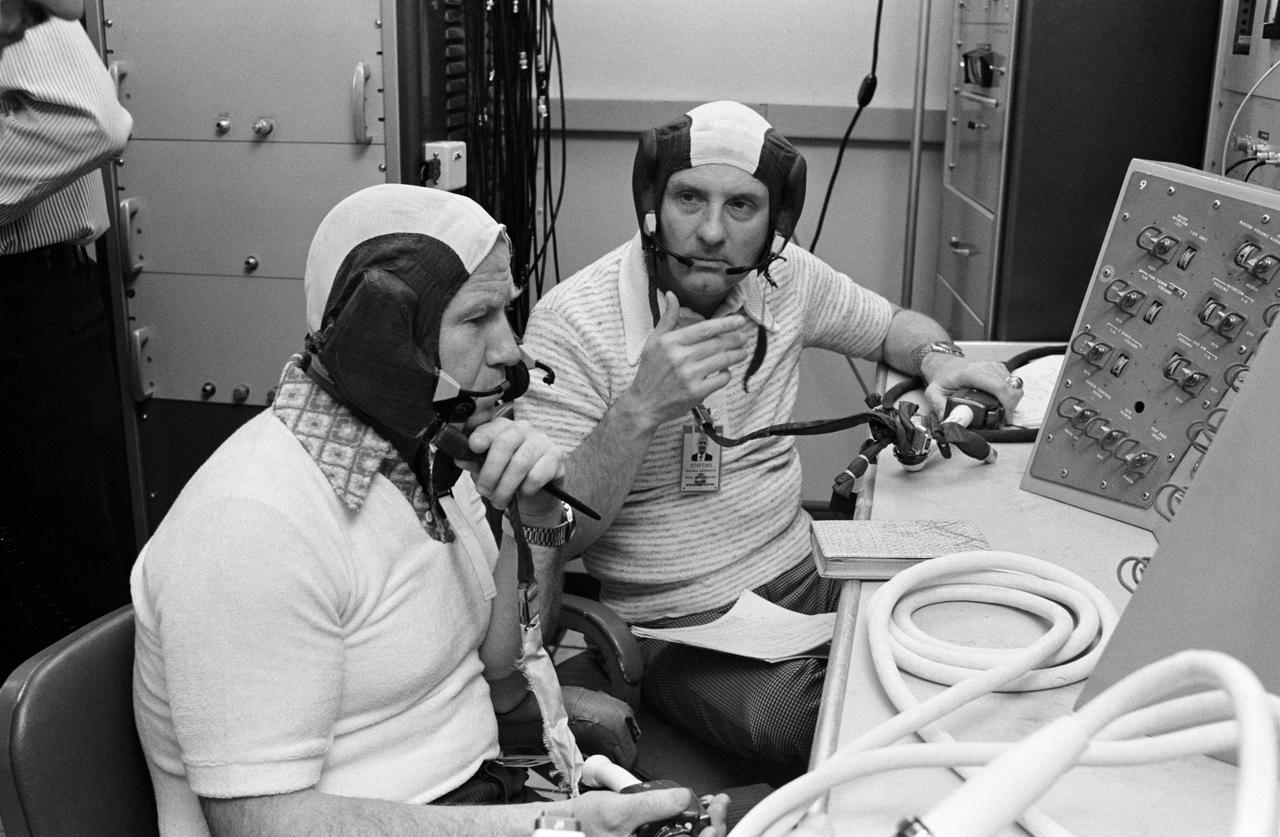
S74-20807 (23 April 1974) --- Cosmonaut Aleksey A. Leonov (foreground) is briefed on the Apollo communications test system console in the Building 440 laboratory during the joint U.S.-USSR Apollo-Soyuz Test Project training activity at the Johnson Space Center. Leonov is the commander of the Soviet ASTP crew. Leonov is being briefed by astronaut Thomas P. Stafford, commander of the American ASTP crew.
Cosmonaut Aleksey Leonov briefed on Apollo Communications test system console
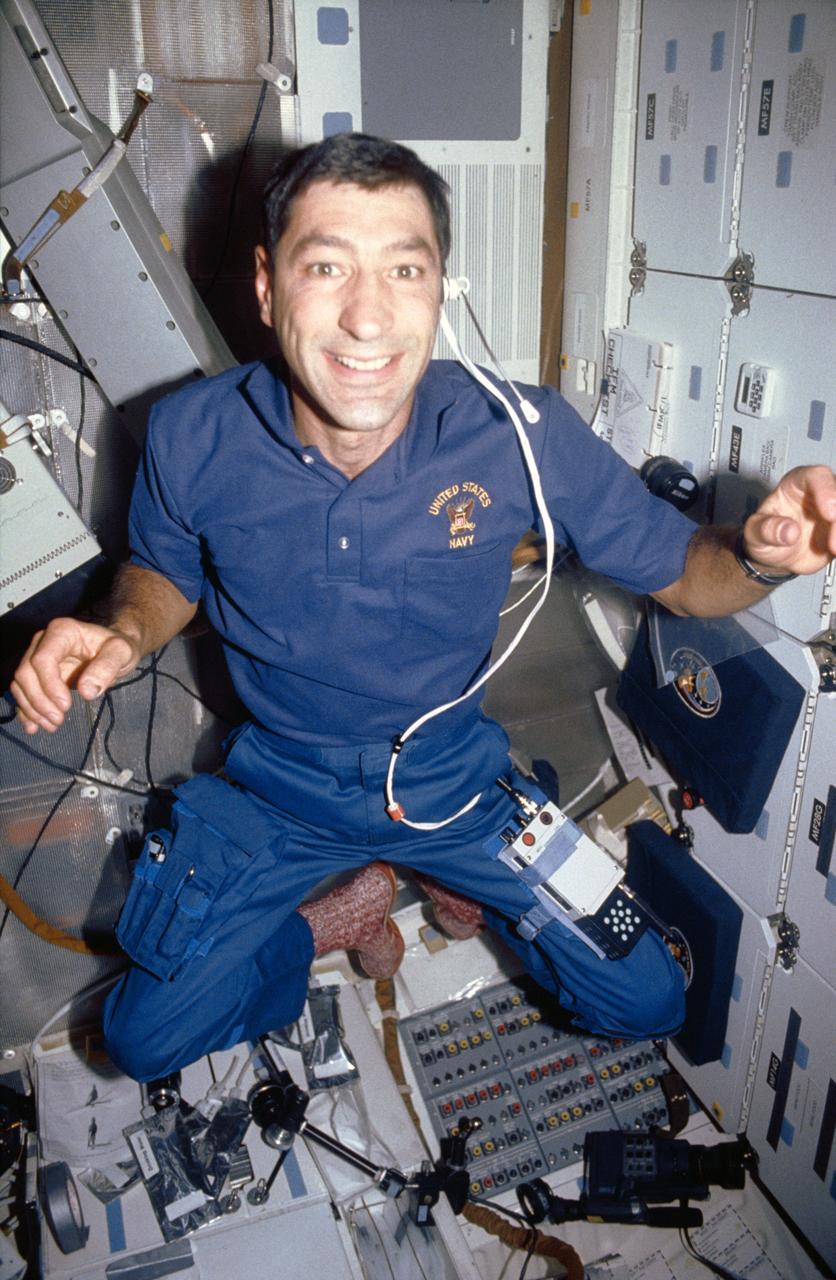
STS044-19-026 (24 Nov-1 Dec 1991) --- Astronaut Mario Runco Jr., STS-44 mission specialist, floats on Atlantis' middeck.
STS-44 Mission Specialist (MS) Runco floats on OV-104's middeck
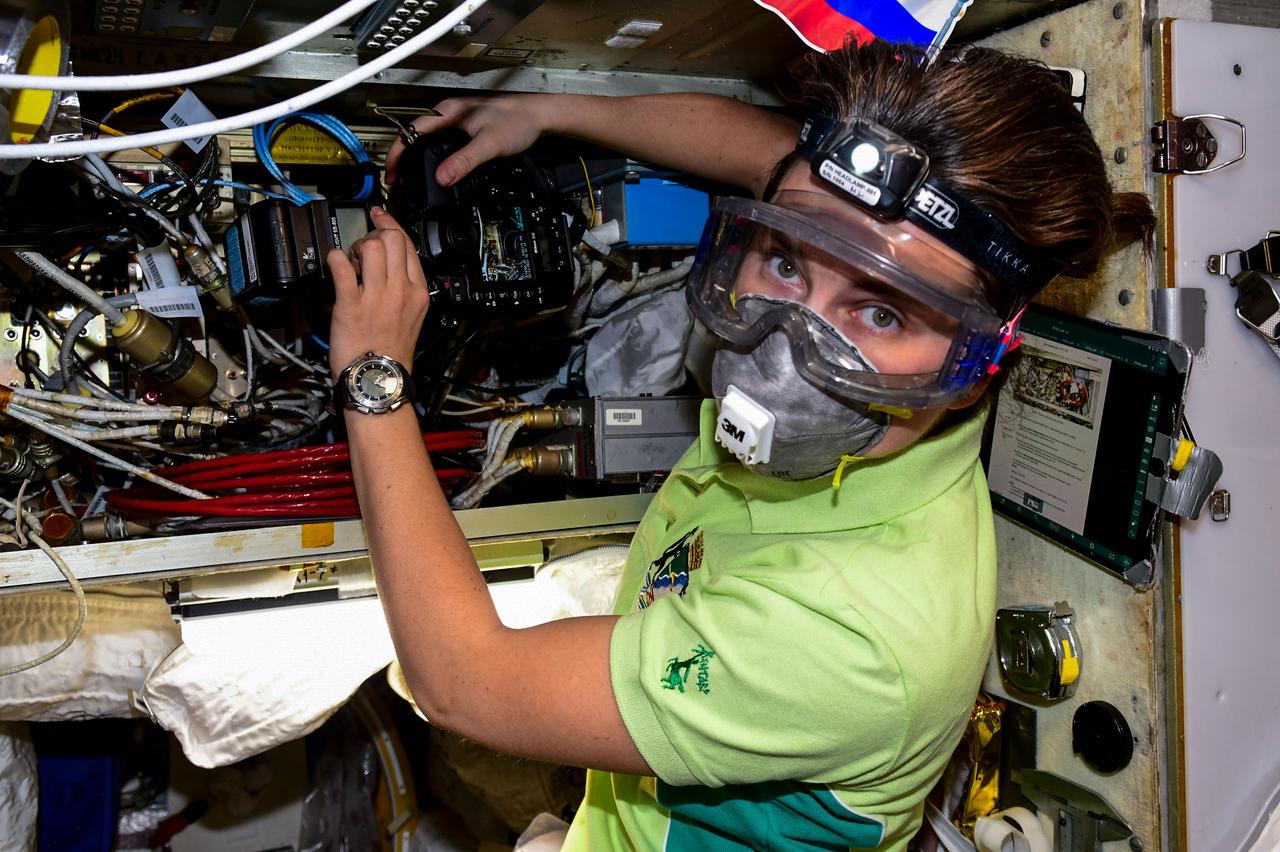
iss068e032401 (Dec. 22, 2023) --- Roscosmos cosmonaut and Expedition 68 Flight Engineer conducts communications and electronics maintenance while wearing personal protective equipment aboard the International Space Station.
Monthly maintenance of ШСС MDM vent screens
jsc2024e052325 (July 22, 2024) --- NASA’s SpaceX Crew-9 Mission Specialist Aleksandr Gorbunov gives a thumbs-up while wearing his flight suit during a successful crew equipment interface test (CEIT), of which the crew practiced donning their flight suits, performed a suited ingress into the spacecraft, conducted suit leak checks, and completed communication checkouts. Credit: SpaceX
SpaceX Crew-9 Mission Specialist Aleksandr Gorbunov
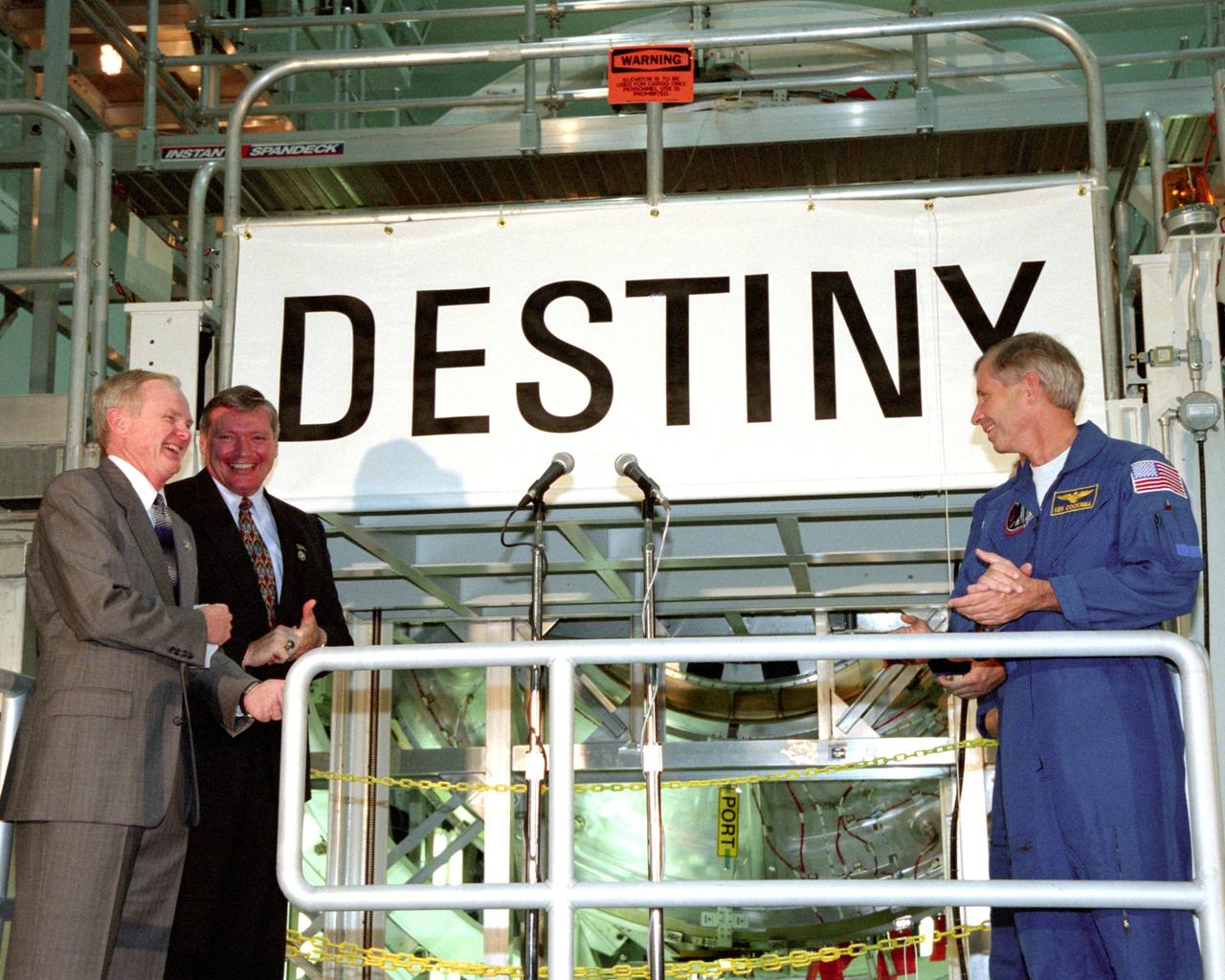
KENNEDY SPACE CENTER, FLA. -  In the Space Station Processing Facility, Center Director Roy Bridges (left), Program Manager of the International Space Station (ISS) Randy Brinkley (second from left) and STS-98 Commander Ken Cockrell (right) applaud the unveiling of the name "Destiny" for the U.S. Laboratory module.  The lab, which is behnd them on a workstand, is scheduled to be launched on STS-98 on Space Shuttle Endeavour in early 2000.  It will become the centerpiece of scientific research on the ISS.  The Shuttle will spend six days docked to the Station while the laboratory is attached and three spacewalks are conducted to compete its assembly.  The laboratory will be launched with five equipment racks aboard, which will provide essential functions for Station systems, including high data-rate communications, and maintain the Station's orientation using control gyroscopes launched earlier.  Additional equipment and research racks will be installed in the laboratory on subsequent Shuttle flights.
KENNEDY SPACE CENTER, FLA. - In the Space Station Processing Facility, Center Director Roy Bridges (left), Program Manager of the International Space Station (ISS) Randy Brinkley (second from left) and STS-98 Commander Ken Cockrell (right) applaud the unveiling of the name "Destiny" for the U.S. Laboratory module. The lab, which is behnd them on a workstand, is scheduled to be launched on STS-98 on Space Shuttle Endeavour in early 2000. It will become the centerpiece of scientific research on the ISS. The Shuttle will spend six days docked to the Station while the laboratory is attached and three spacewalks are conducted to compete its assembly. The laboratory will be launched with five equipment racks aboard, which will provide essential functions for Station systems, including high data-rate communications, and maintain the Station's orientation using control gyroscopes launched earlier. Additional equipment and research racks will be installed in the laboratory on subsequent Shuttle flights.
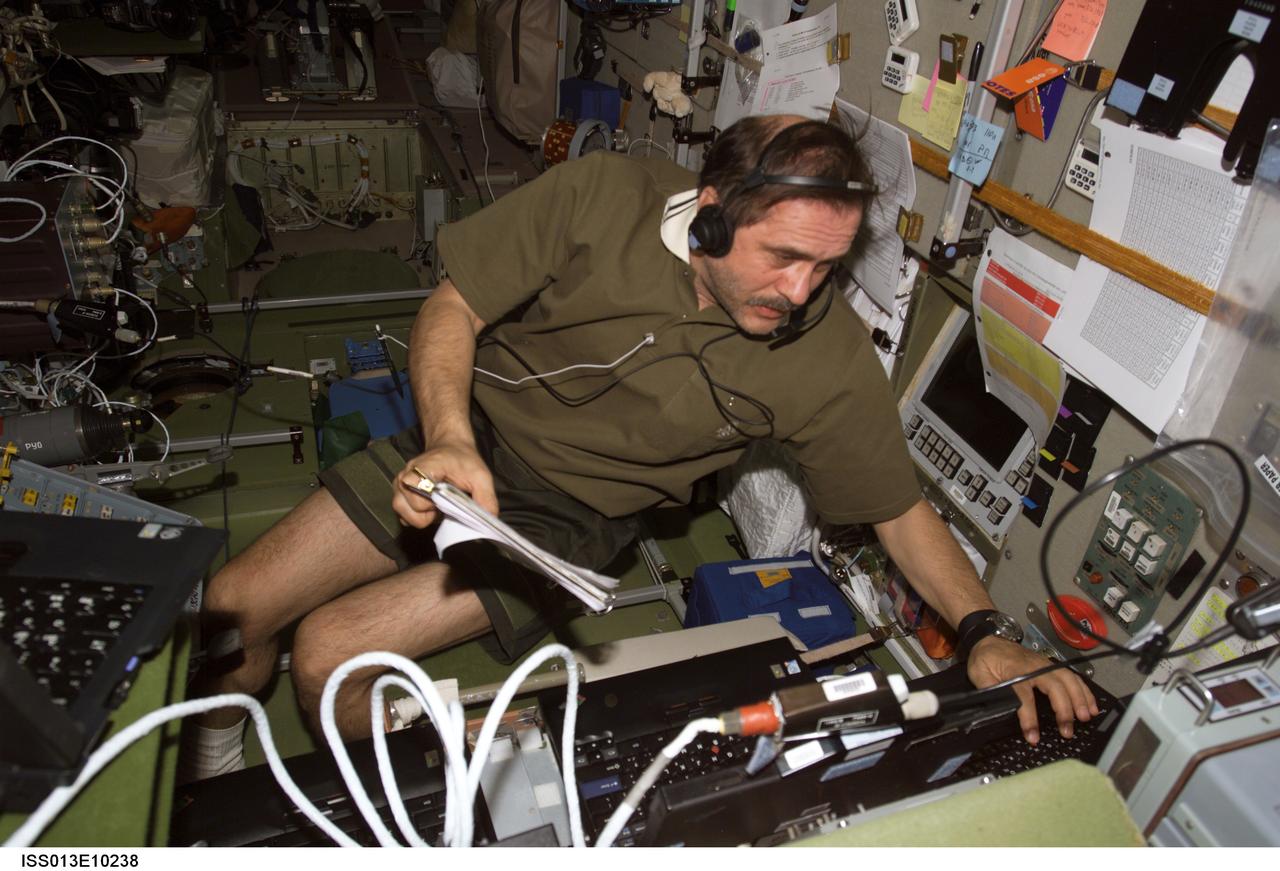
ISS013-E-10238 (26 April 2006) --- Cosmonaut Pavel V. Vinogradov, Expedition 13 commander representing Russia's Federal Space Agency, uses a communication system while working with equipment in the Zvezda Service Module of the International Space Station.
Vinogradov reconfigures communication in the SM during Expedition 13
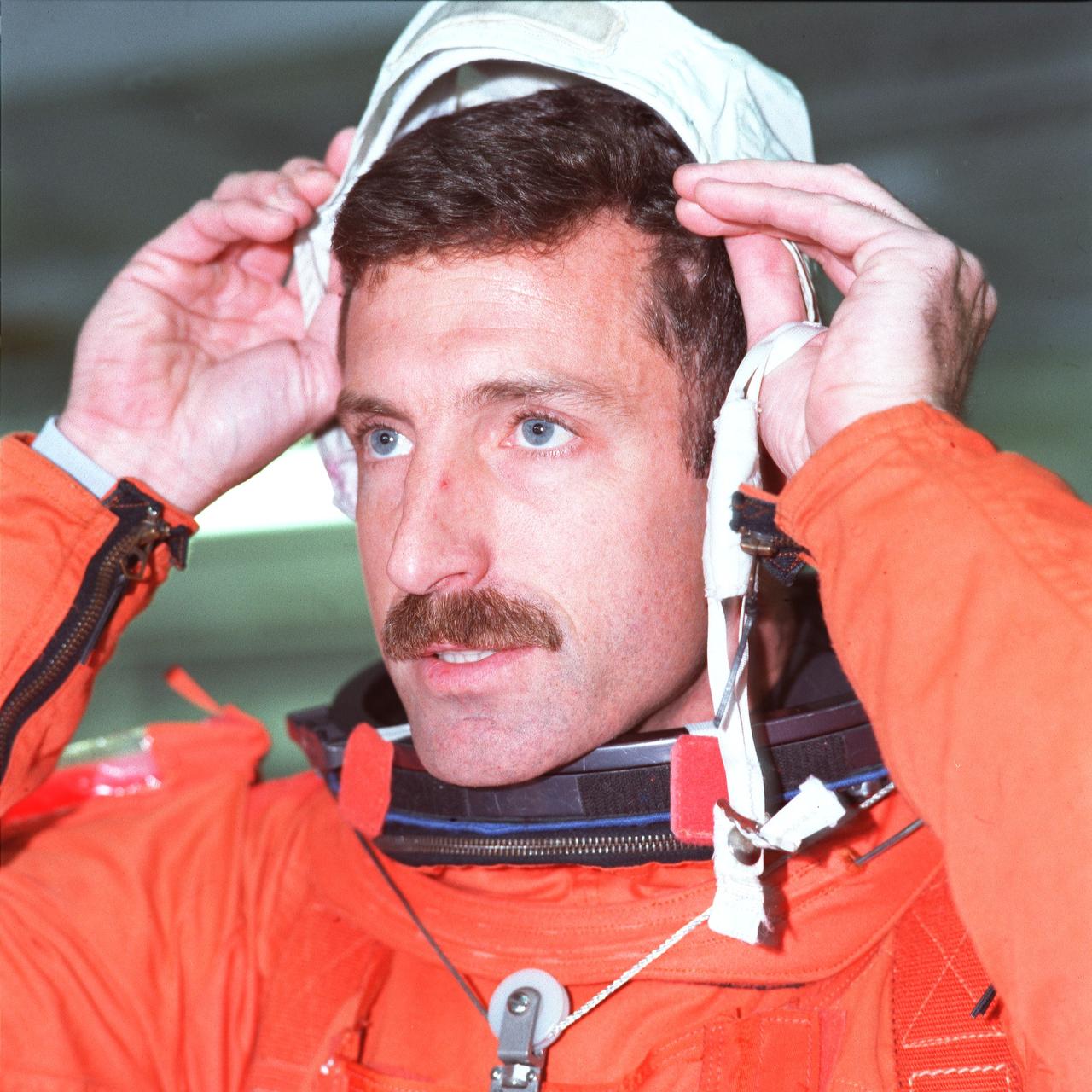
JSC2000-02539 (21 March 2000) --- Astronaut Daniel C. Burbank, STS-106 mission specialist, dons headgear that contains communications equipment, prior to participating in an emergency bailout  training exercise in the Neutral Buoyancy Laboratory (NBL) at the Sonny Carter Training Center near the Johnson Space Center (JSC).
STS-106 crew water survival training
ISS029-E-029720 (17 Oct. 2011) --- NASA astronaut Mike Fossum, Expedition 29 commander, uses a communication system while performing in-flight maintenance (IFM) of removing and replacing the failed Remote Power Controller Module (RPCM) equipment in the Destiny laboratory of the International Space Station.
RPCM R&R
STS093-348-006 (22-27 July 1999) --- Astronaut Steven A. Hawley, mission specialist, communicates with students using the Shuttle Amateur Radio Experiment-2 (SAREX II) equipment on the flight deck of the Earth-orbiting Space Shuttle Columbia.
STS-93 MS Hawley works with the SAREX II equipment on the flight deck
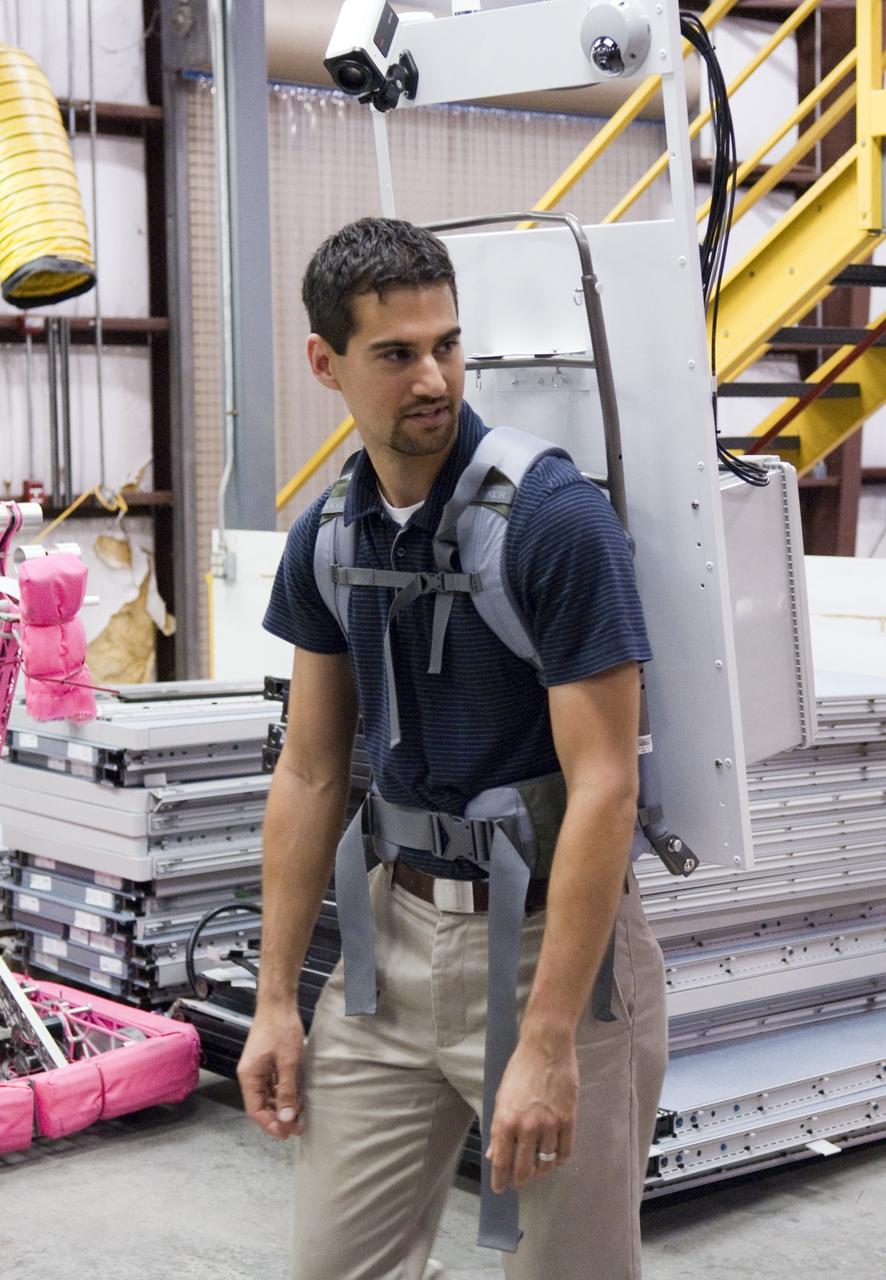
Mike Miller demonstrates one of the backpacks his team designed and built for the Desert Research and Technology Studies project's upcoming field test in Arizona. Miller led the team that developed the backpacks. The backpacks are equipped with GPS antennas, communications components and cameras. They are meant to show researchers what an astronaut might need to explore an alien world and give designers a look at the hardships the equipment could encounter. Photo credit: NASA/Frank Michaux
KSC-2010-3967
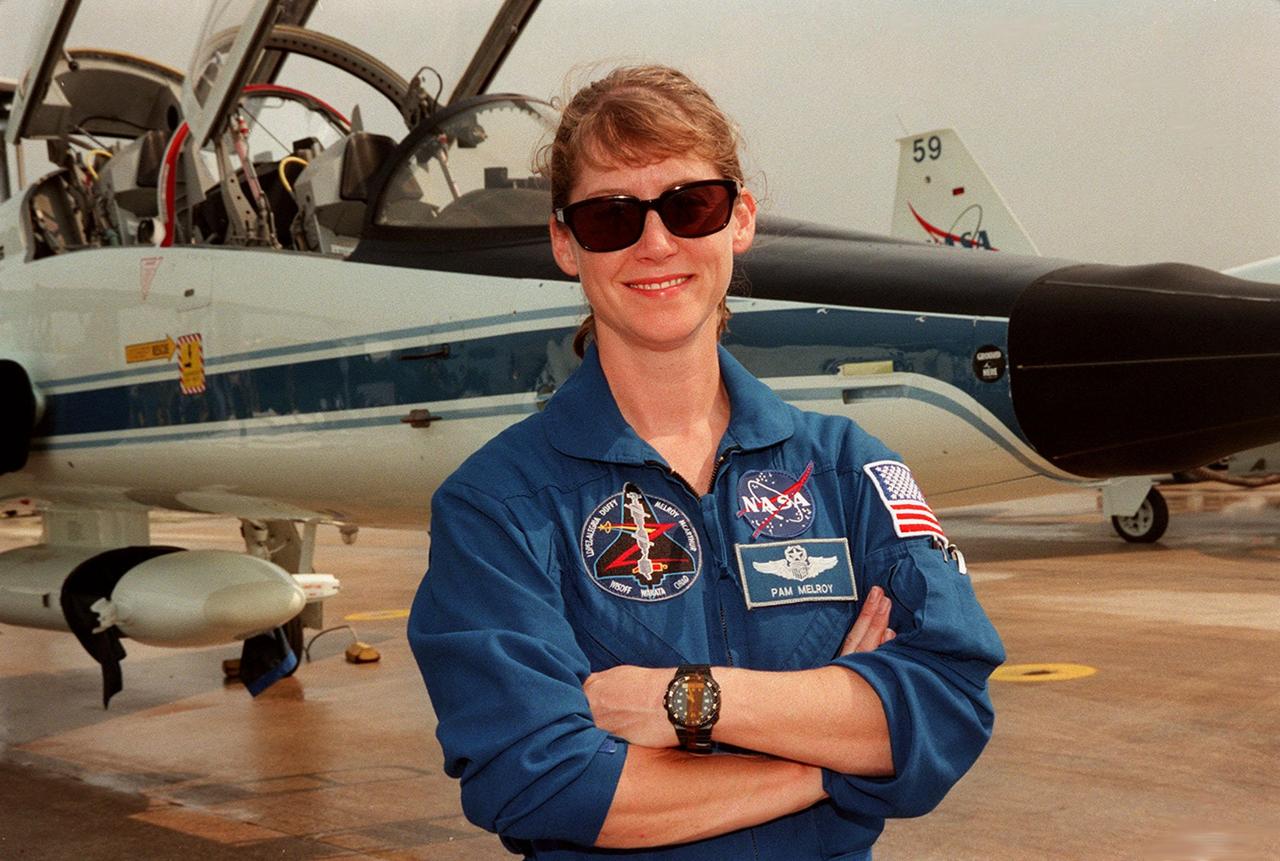
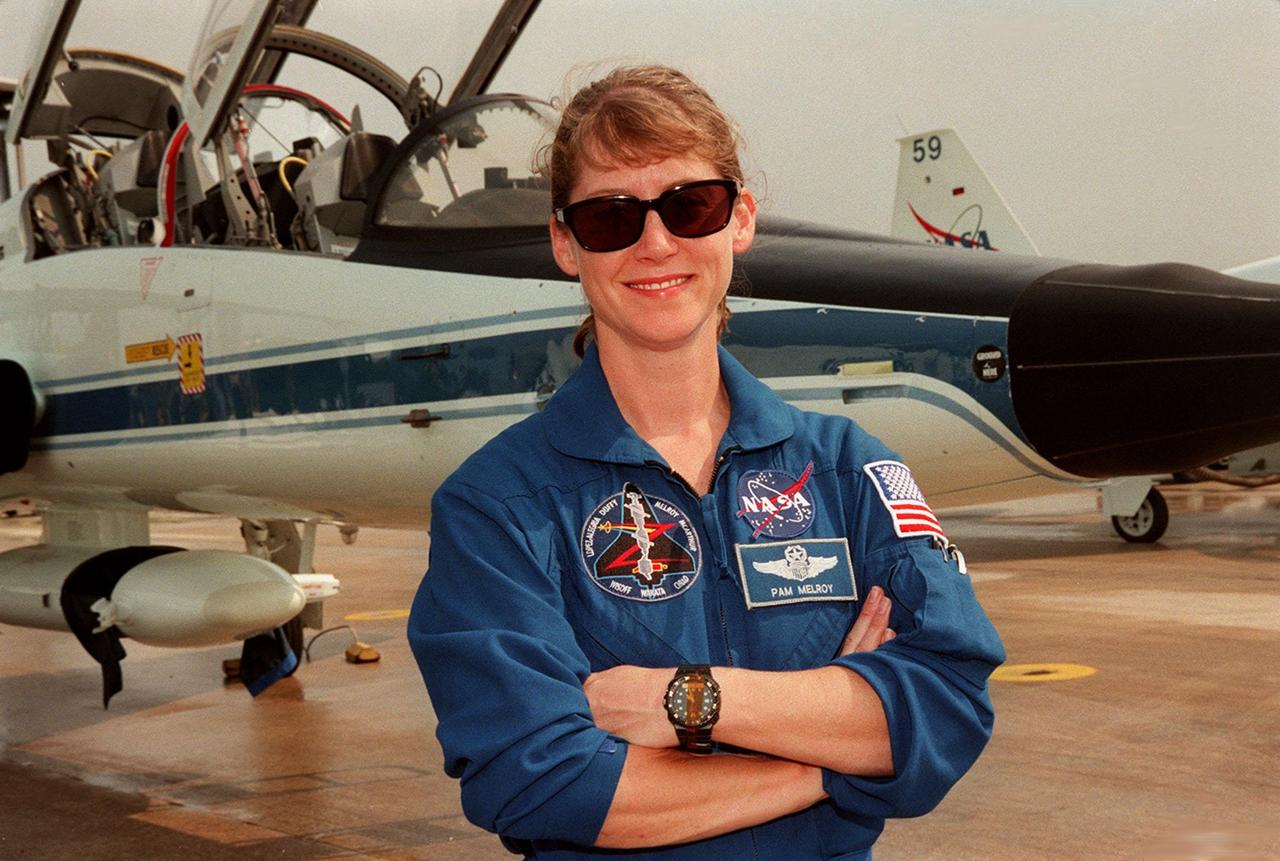
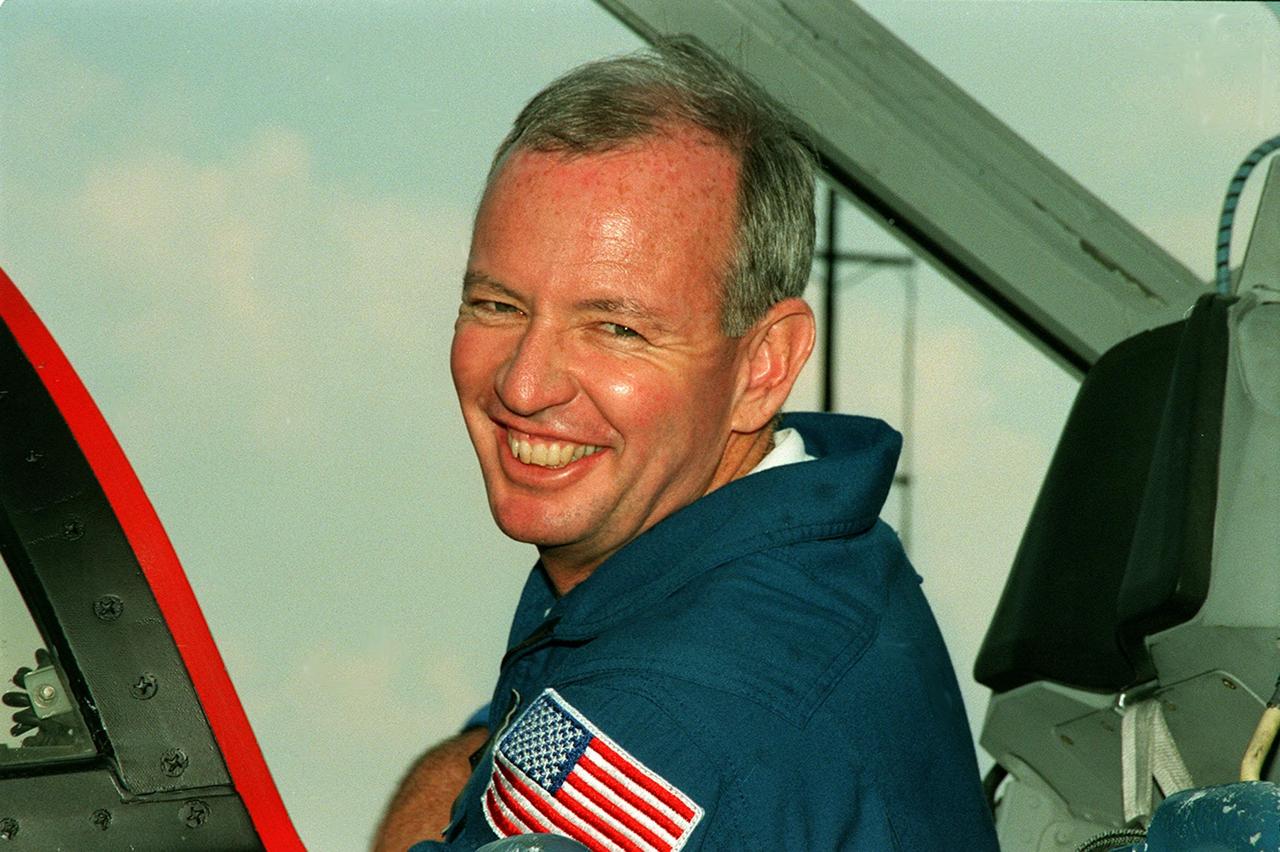
STS-92 Pilot Pam Melroy poses at the Shuttle Landing Facility before flying back to Houston. She and other crew members completed their Crew Equipment Interface Test activities, looking over their mission payload and related equipment. STS-92 is scheduled to launch Oct. 5 on Shuttle Discovery from Launch Pad 39A on the fifth flight to the International Space Station. Discovery will carry the Integrated Truss Structure (ITS) Z1, the PMA-3, Ku-band Communications System, and Control Moment Gyros (CMGs)
KSC00pp0941
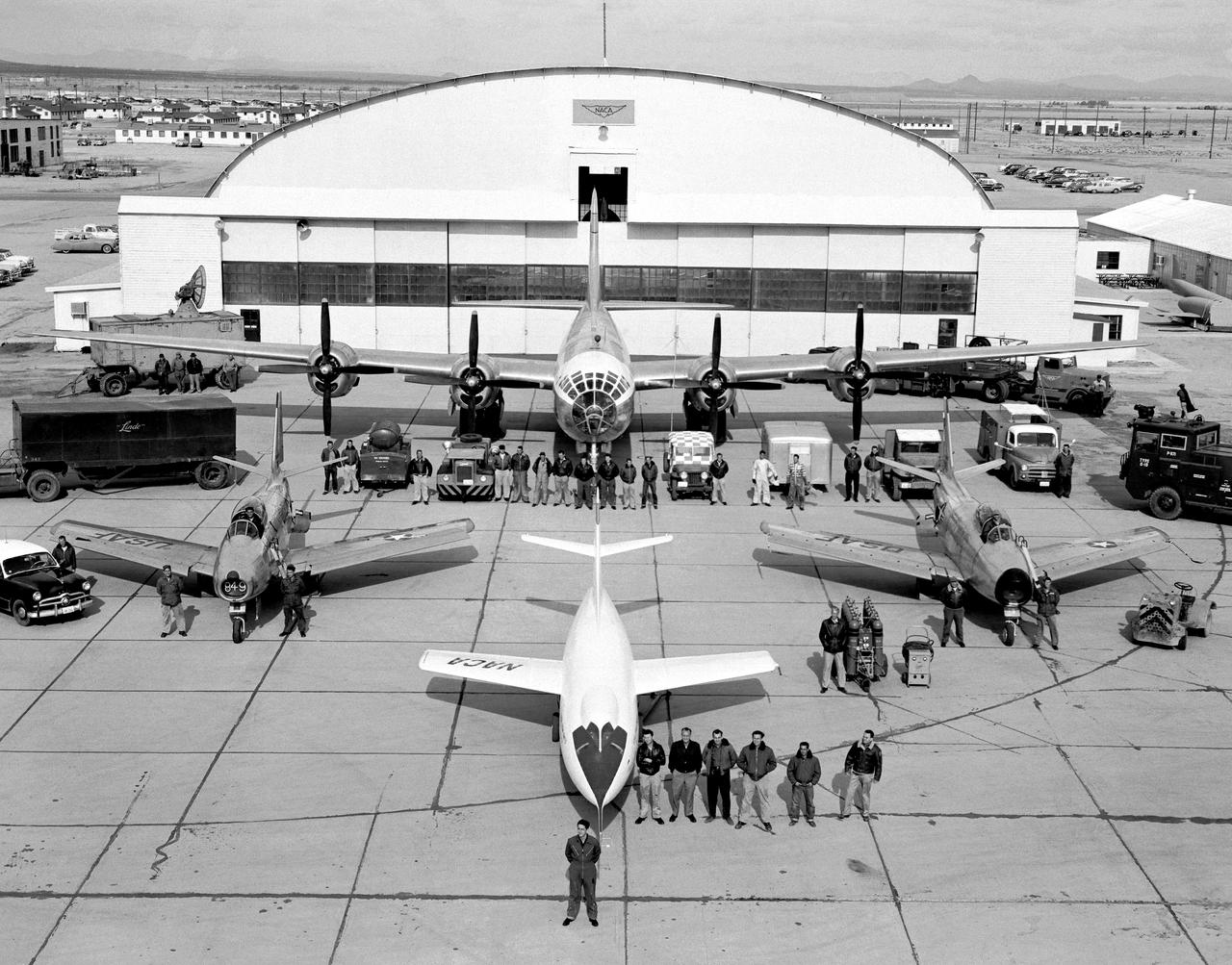
These people and this equipment supported the flight of the NACA D-558-2 Skyrocket at the High-Speed Flight Station at South Base, Edwards AFB. Note the two Sabre chase planes, the P2B-1S launch aircraft, and the profusion of ground support equipment, including communications, tracking, maintenance, and rescue vehicles. Research pilot A. Scott Crossfield stands in front of the Skyrocket.
E-1152
STS-92 Pilot Pam Melroy poses at the Shuttle Landing Facility before flying back to Houston. She and other crew members completed their Crew Equipment Interface Test activities, looking over their mission payload and related equipment. STS-92 is scheduled to launch Oct. 5 on Shuttle Discovery from Launch Pad 39A on the fifth flight to the International Space Station. Discovery will carry the Integrated Truss Structure (ITS) Z1, the PMA-3, Ku-band Communications System, and Control Moment Gyros (CMGs)
KSC-00pp0941
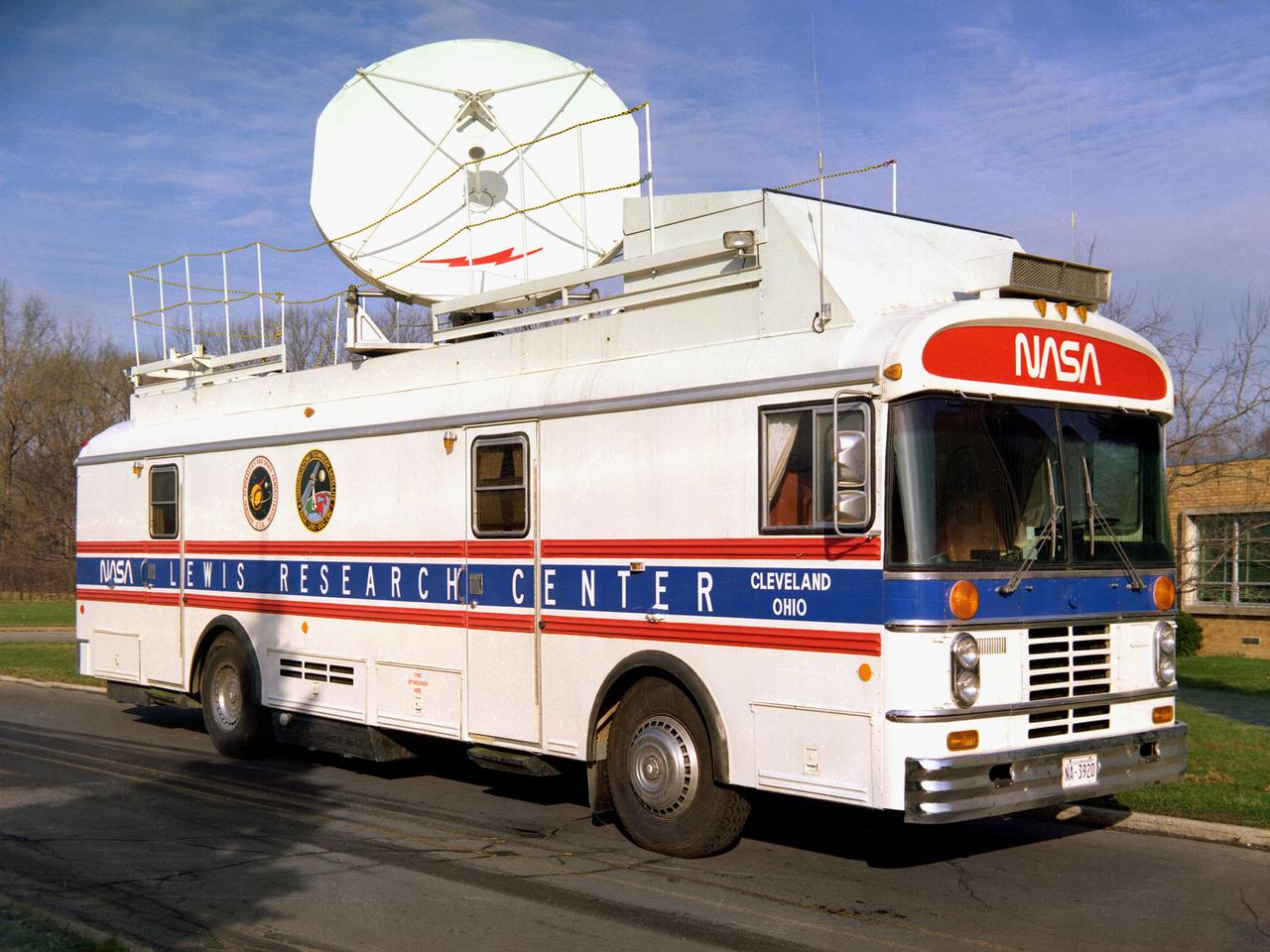
This vehicle served as a mobile terminal for the Communications Technology Satellite. The Communications Technology Satellite was an experimental communications satellite launched in January 1976 by the National Aeronautics and Space Administration (NASA) and the Canadian Department of Communications. The satellite operated in a new frequency band reserved for broadcast satellites with transmitting power levels that were 10 to 20 times higher than those of contemporary satellites. Throughout 1977 and 1978 NASA allowed qualified groups to utilize the satellite from one of the three ground-based transmission centers.    NASA’s Lewis Research Center in Cleveland, Ohio was NASA’s lead center on the project. Lewis was responsible for the control and coordination of all US experiments on the satellite. The center housed the satellite’s main control center which included eight parabolic reflector antennae ranging from 2 to 15 feet in diameter. Many of the satellite’s components had been tested in simulated space conditions at Lewis.     The Lewis-designed vehicle seen here served as a field unit for transmitting and receiving wideband signals and narrowband voice. The vehicle permitted live television interviews, recording equipment, and cameras. An 8-foot diameter parabolic reflector was mounted on the roof. The interior of the vehicle had workstations, monitors, transmitting equipment, and a lounge area.
Communication Technology Satellite Portable Terminal
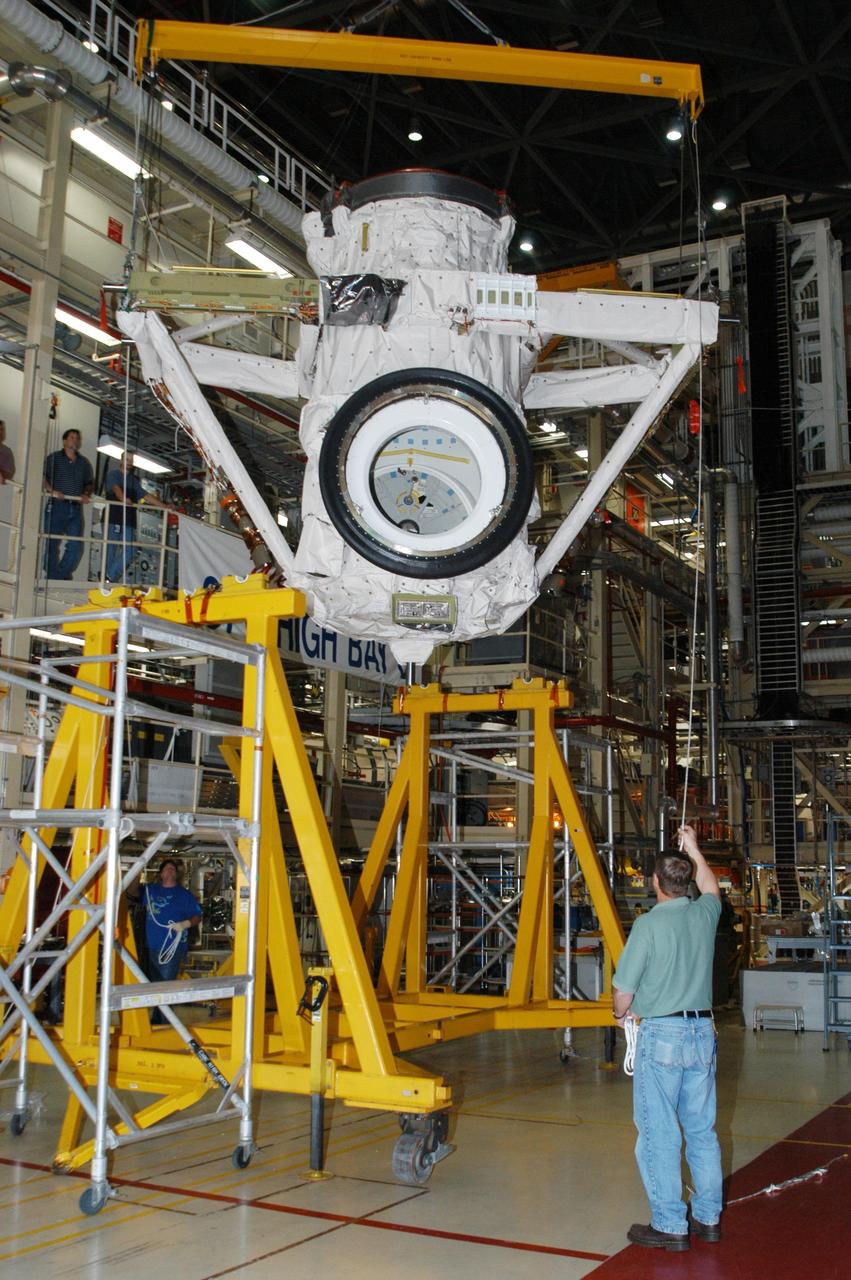
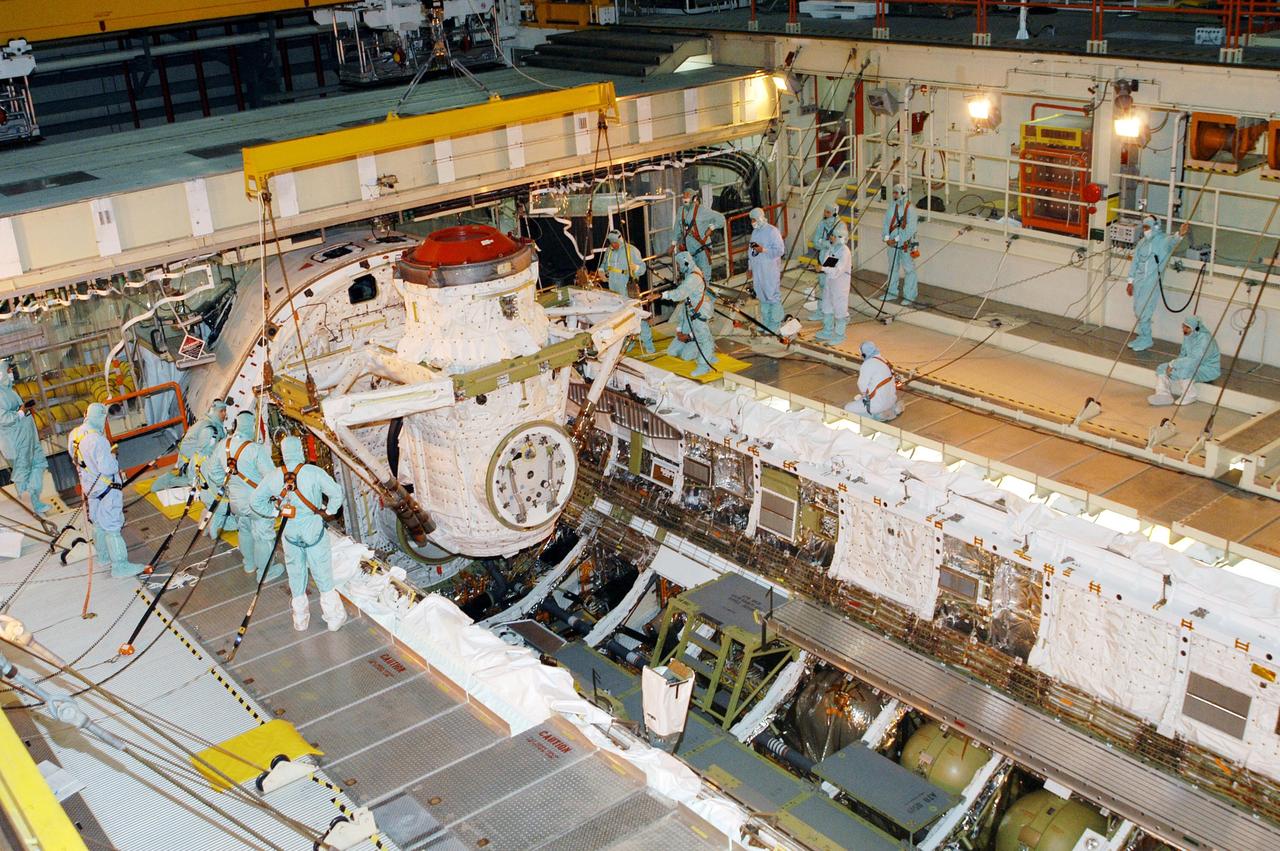
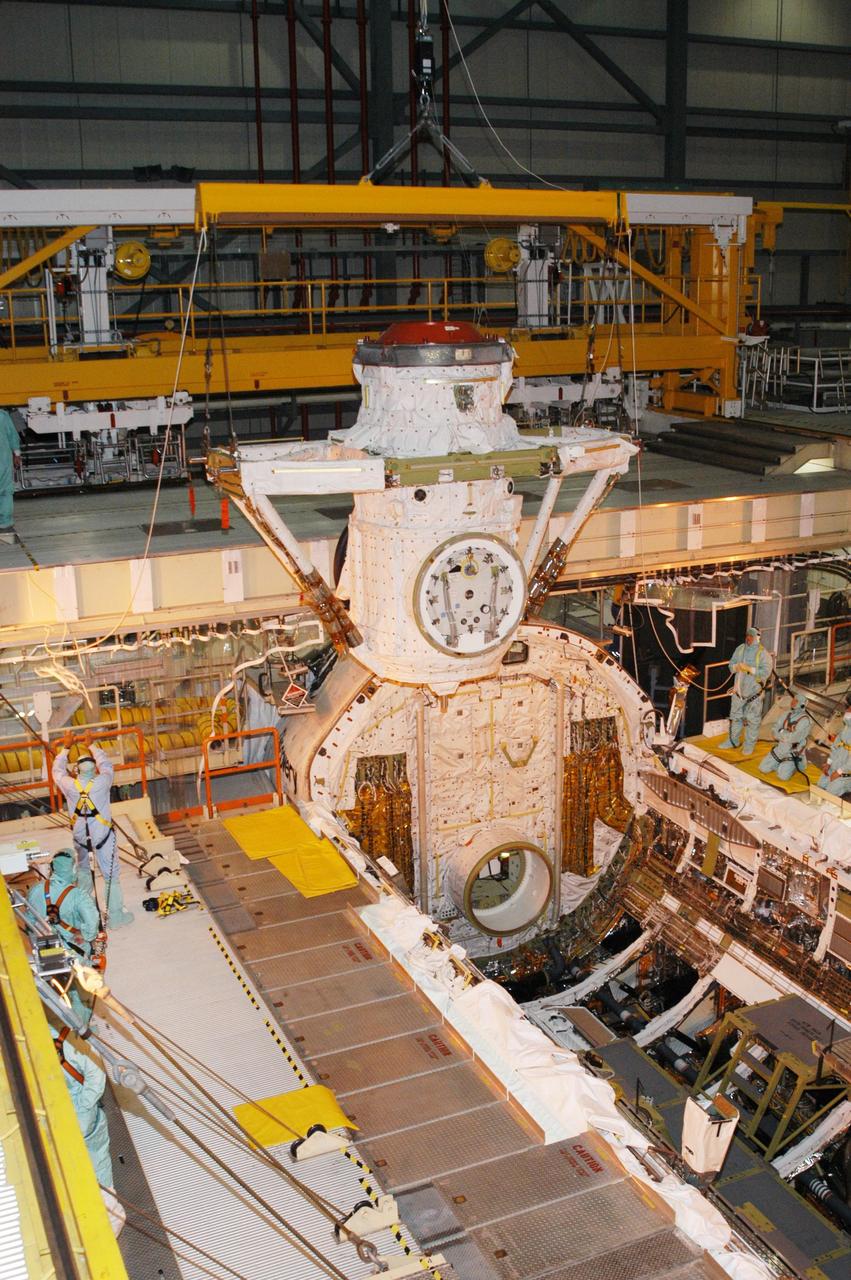
KENNEDY SPACE CENTER, FLA. -- Discovery’s airlock is lowered into the orbiter’s payload bay for installation.  The airlock is sized to accommodate two fully suited flight crew members simultaneously.  Support functions include airlock depressurization and repressurization, extravehicular activity equipment recharge, liquid-cooled garment water cooling, EVA equipment checkout, and communications.  Discovery is designated as the Return to Flight vehicle for mission STS-114, no earlier than March 2005.  STS-114 mission is Logistics Flight 1, which is scheduled to deliver supplies and equipment plus the external stowage platform to the International Space Station.
KSC-04pd1136
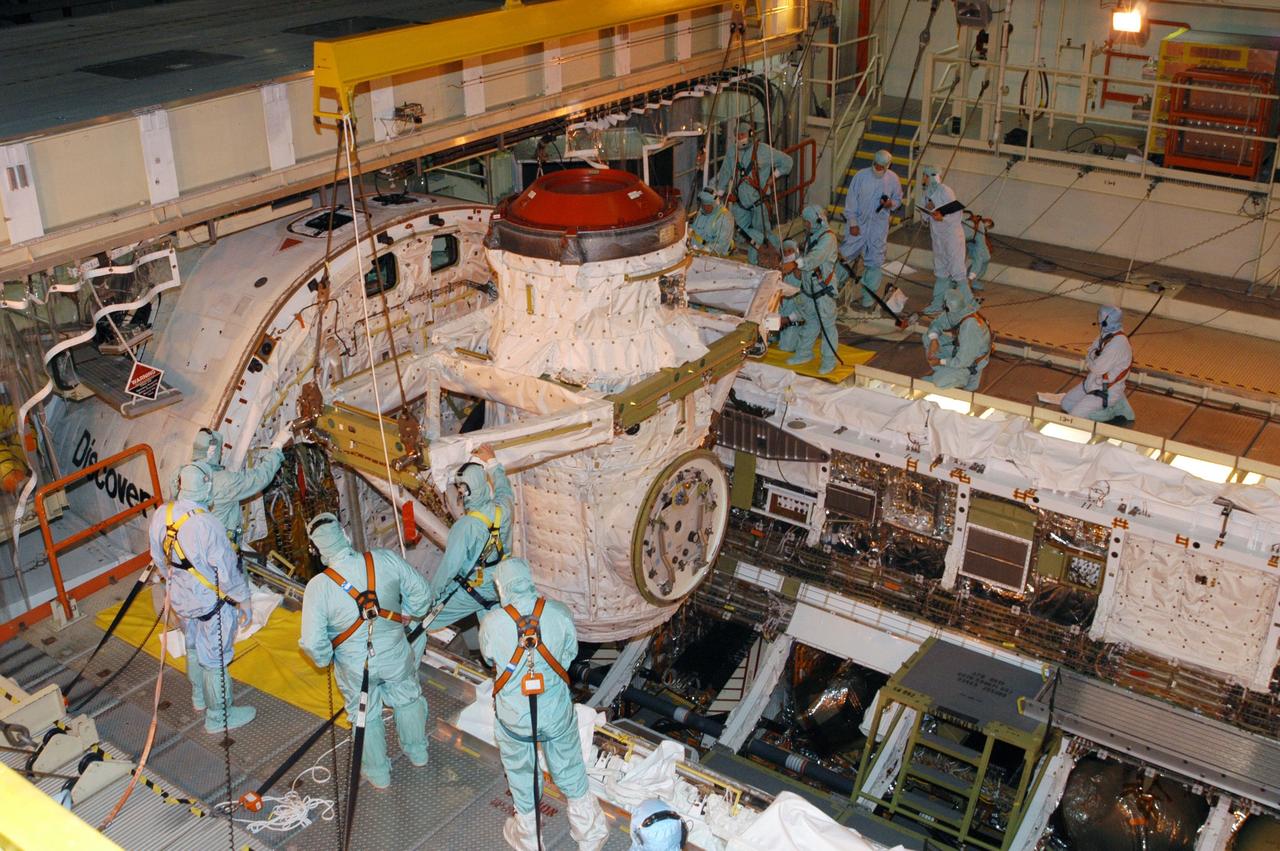
KENNEDY SPACE CENTER, FLA. -- Technicians in the Orbiter Processing Facility help guide Discovery’s airlock into the orbiter’s payload bay for installation.  The airlock is sized to accommodate two fully suited flight crew members simultaneously.  Support functions include airlock depressurization and repressurization, extravehicular activity equipment recharge, liquid-cooled garment water cooling, EVA equipment checkout, and communications.  Discovery is designated as the Return to Flight vehicle for mission STS-114, no earlier than March 2005.  STS-114 mission is Logistics Flight 1, which is scheduled to deliver supplies and equipment plus the external stowage platform to the International Space Station.
KSC-04pd1138
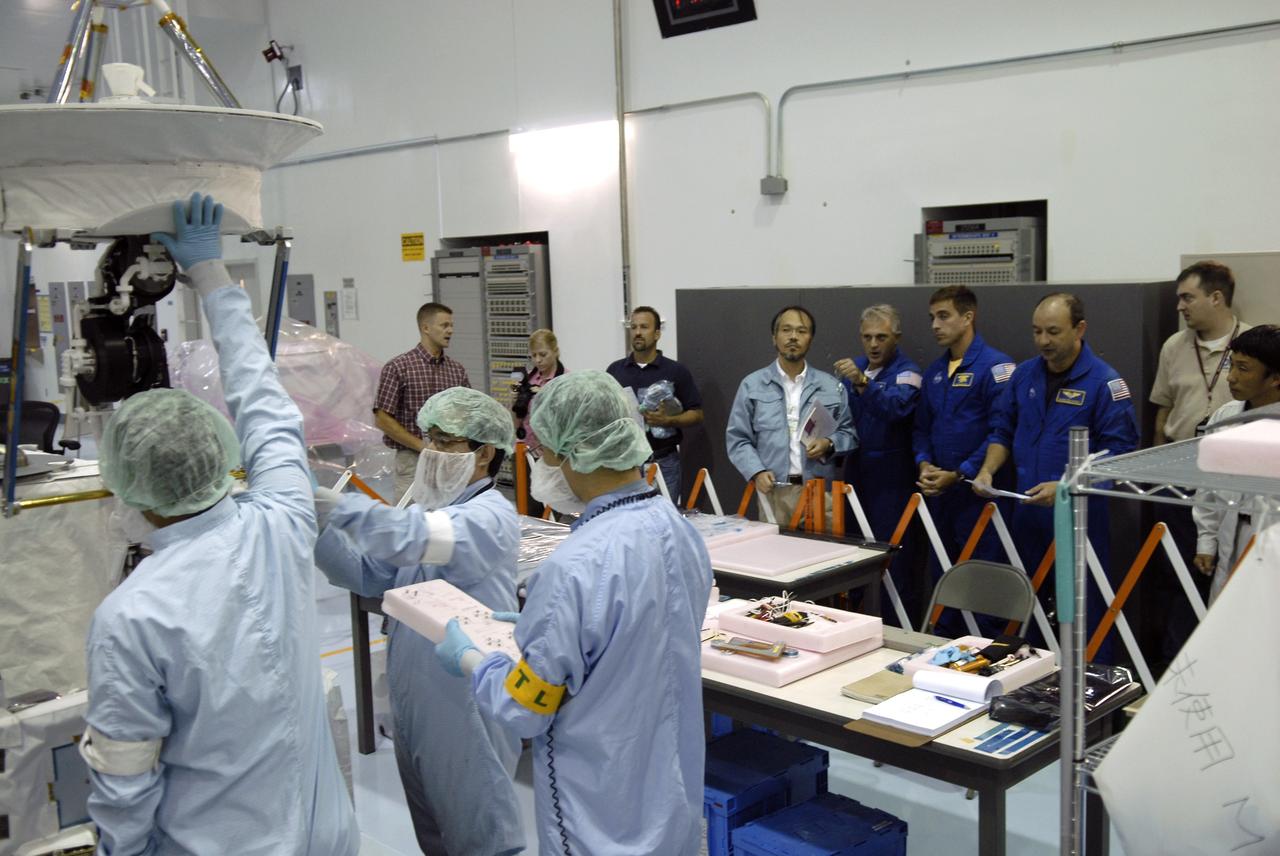
CAPE CANAVERAL, Fla. -  In the Space Station Processing Facility at NASA's Kennedy Space Center in Florida, STS-127 crew members get a close look at equipment for their mission, which will install final components of the Japanese Aerospace Exploration Agency’s Japanese Experiment Module.  Equipment familiarization is part of a Crew Equipment Interface Test. The JEM components include the Inter Orbit Communication System Extended Facility, or ICS-EF, the Extended Facility and Experiment Logistics Module-Exposed Section. The payload will launch aboard  space shuttle Endeavour targeted for May 15, 2009. Photo credit: NASA/Kim Shiflett
KSC-08pd3002
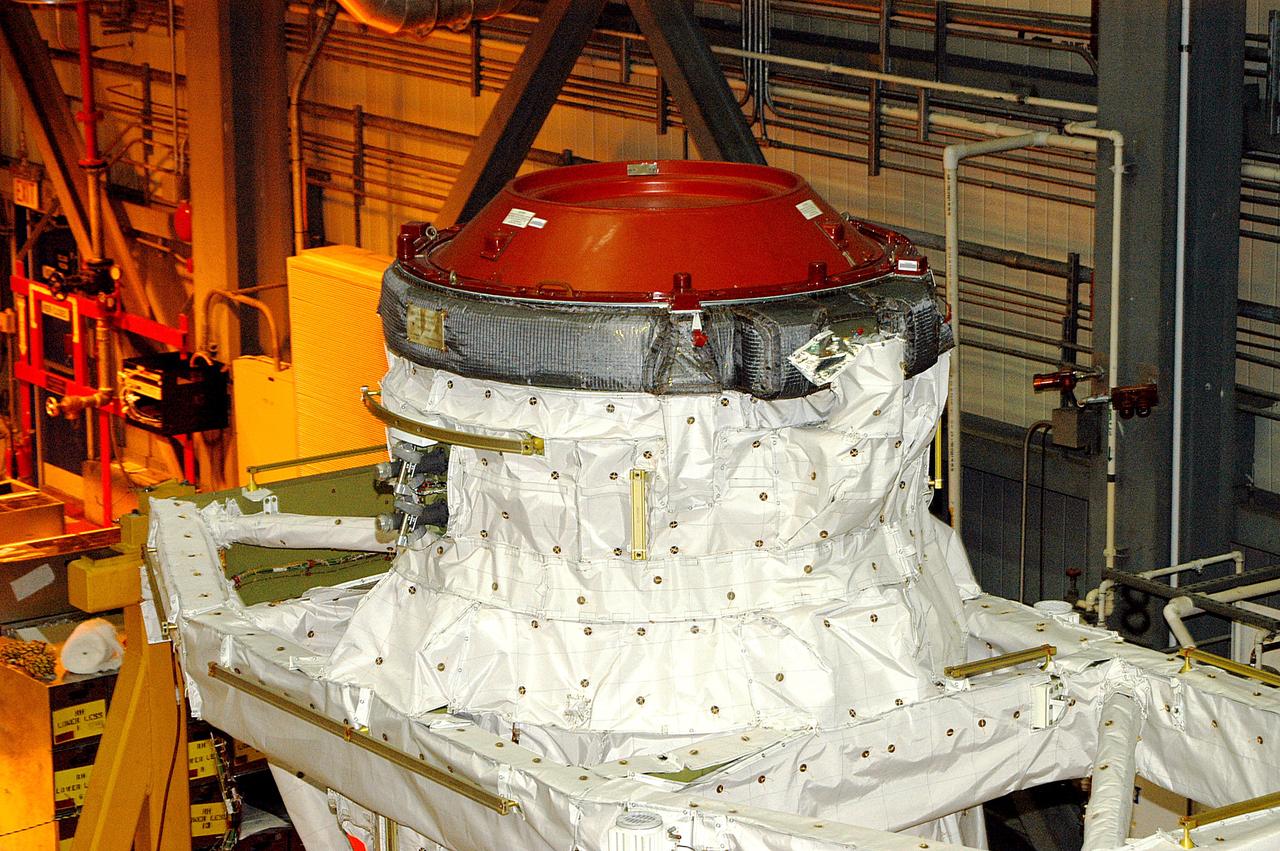
KENNEDY SPACE CENTER, FLA. -- Discovery’s airlock is ready for installation.  Located inside the orbiter’s payload bay, the airlock is sized to accommodate two fully suited flight crew members simultaneously. Support functions include airlock depressurization and repressurization, extravehicular activity equipment recharge, liquid-cooled garment water cooling, EVA equipment checkout, and communications.  Discovery is designated as the Return to Flight vehicle for mission STS-114, no earlier than March 2005.  STS-114 mission is Logistics Flight 1, which is scheduled to deliver supplies and equipment plus the external stowage platform to the International Space Station.
KSC-04pd1132
KENNEDY SPACE CENTER, FLA. -- Discovery’s airlock is lifted toward the orbiter for installation inside the orbiter’s payload bay.  The airlock is sized to accommodate two fully suited flight crew members simultaneously.  Support functions include airlock depressurization and repressurization, extravehicular activity equipment recharge, liquid-cooled garment water cooling, EVA equipment checkout, and communications.  Discovery is designated as the Return to Flight vehicle for mission STS-114, no earlier than March 2005.  STS-114 mission is Logistics Flight 1, which is scheduled to deliver supplies and equipment plus the external stowage platform to the International Space Station.
KSC-04pd1134
KENNEDY SPACE CENTER, FLA. -- Technicians in the Orbiter Processing Facility help guide Discovery’s airlock as a crane lowers it into the orbiter’s payload bay for installation.  The airlock is sized to accommodate two fully suited flight crew members simultaneously.  Support functions include airlock depressurization and repressurization, extravehicular activity equipment recharge, liquid-cooled garment water cooling, EVA equipment checkout, and communications.  Discovery is designated as the Return to Flight vehicle for mission STS-114, no earlier than March 2005.  STS-114 mission is Logistics Flight 1, which is scheduled to deliver supplies and equipment plus the external stowage platform to the International Space Station.
KSC-04pd1137
KENNEDY SPACE CENTER, FLA. -- Discovery’s airlock is lowered toward the orbiter’s payload bay for installation.  The airlock is sized to accommodate two fully suited flight crew members simultaneously.  Support functions include airlock depressurization and repressurization, extravehicular activity equipment recharge, liquid-cooled garment water cooling, EVA equipment checkout, and communications.  Discovery is designated as the Return to Flight vehicle for mission STS-114, no earlier than March 2005.  STS-114 mission is Logistics Flight 1, which is scheduled to deliver supplies and equipment plus the external stowage platform to the International Space Station.
KSC-04pd1135
KENNEDY SPACE CENTER, FLA. -- Technicians in the Orbiter Processing Facility attach a crane to Discovery’s airlock before lifting it for installation.  The airlock is located inside the orbiter’s payload bay and is sized to accommodate two fully suited flight crew members simultaneously.  Support functions include airlock depressurization and repressurization, extravehicular activity equipment recharge, liquid-cooled garment water cooling, EVA equipment checkout, and communications.  Discovery is designated as the Return to Flight vehicle for mission STS-114, no earlier than March 2005.  STS-114 mission is Logistics Flight 1, which is scheduled to deliver supplies and equipment plus the external stowage platform to the International Space Station.
KSC-04pd1133
CAPE CANAVERAL, Fla. -   In the Space Station Processing Facility at NASA's Kennedy Space Center in Florida, STS-127 crew members get a close look at equipment for their mission, which will install final components of the Japanese Aerospace Exploration Agency’s Japanese Experiment Module, or JEM.  Equipment familiarization is part of a Crew Equipment Interface Test. The JEM components include the Inter Orbit Communication System Extended Facility, or ICS-EF, the Extended Facility and Experiment Logistics Module-Exposed Section. The payload will launch aboard  space shuttle Endeavour targeted for May 15, 2009. Photo credit: NASA/Kim Shiflett
KSC-08pd3000
KENNEDY SPACE CENTER, FLA. -- Standing in front of the U.S. Lab, named Destiny, U.S. Rep. Dave Weldon (left) thanks Thomas R. "Randy" Galloway, with the Space Station Hardware Integration Office, for briefing him on the equipment inside the Lab. Weldon is on the House Science Committee and vice chairman of the Space and Aeronautics Subcommittee. Destiny is scheduled to be launched on Space Shuttle Endeavour in early 2000. It will become the centerpiece of scientific research on the ISS, with five equipment racks aboard to provide essential functions for station systems, including high data-rate communications, and to maintain the station's orientation using control gyroscopes launched earlier. Additional equipment and research racks will be installed in the laboratory on subsequent Shuttle flights
KSC-99pp0814
KENNEDY SPACE CENTER, FLA. - STS-115 Mission Specialist Joseph Tanner (second from right) checks out a camera and cables for the Japanese Experiment Module (JEM) in the Space Station Processing Facility. Known as Kibo, the JEM consists of six components: two research facilities - the Pressurized Module and the Exposed Facility; a Logistics Module attached to each of them; a Remote Manipulator System; and an Inter-Orbit Communication System unit. Kibo also has a scientific airlock through which experiments are transferred and exposed to the external environment of space. The various components of JEM will be assembled in space over the course of three Space Shuttle missions. Equipment familiarization is a routine part of astronaut training and launch preparations.
KENNEDY SPACE CENTER, FLA. -  In the Space Station Processing Facility, STS-115 Mission Specialist Joseph Tanner (right)  checks out a camera and cables for the Japanese Experiment Module (JEM). Known as Kibo, the JEM consists of six components: two research facilities - the Pressurized Module and the Exposed Facility; a Logistics Module attached to each of them; a Remote Manipulator System; and an Inter-Orbit Communication System unit. Kibo also has a scientific airlock through which experiments are transferred and exposed to the external environment of space. The various components of JEM will be assembled in space over the course of three Space Shuttle missions. Equipment familiarization is a routine part of astronaut training and launch preparations.
KENNEDY SPACE CENTER, FLA. - In the Space Station Processing Facility, STS-115 Mission Specialist Joseph Tanner (right) checks out a camera and cables for the Japanese Experiment Module (JEM). Known as Kibo, the JEM consists of six components: two research facilities - the Pressurized Module and the Exposed Facility; a Logistics Module attached to each of them; a Remote Manipulator System; and an Inter-Orbit Communication System unit. Kibo also has a scientific airlock through which experiments are transferred and exposed to the external environment of space. The various components of JEM will be assembled in space over the course of three Space Shuttle missions. Equipment familiarization is a routine part of astronaut training and launch preparations.
KENNEDY SPACE CENTER, FLA. - STS-115 Mission Specialist Joseph Tanner checks out a camera for the Japanese Experiment Module (JEM) in the Space Station Processing Facility.  Known as Kibo, the JEM consists of six components: two research facilities -- the Pressurized Module and the Exposed Facility; a Logistics Module attached to each of them; a Remote Manipulator System; and an Inter-Orbit Communication System unit. Kibo also has a scientific airlock through which experiments are transferred and exposed to the external environment of space. The various components of JEM will be assembled in space over the course of three Space Shuttle missions. Equipment familiarization is a routine part of astronaut training and launch preparations.
KENNEDY SPACE CENTER, FLA. - STS-115 Mission Specialist Joseph Tanner checks out a camera for the Japanese Experiment Module (JEM) in the Space Station Processing Facility. Known as Kibo, the JEM consists of six components: two research facilities -- the Pressurized Module and the Exposed Facility; a Logistics Module attached to each of them; a Remote Manipulator System; and an Inter-Orbit Communication System unit. Kibo also has a scientific airlock through which experiments are transferred and exposed to the external environment of space. The various components of JEM will be assembled in space over the course of three Space Shuttle missions. Equipment familiarization is a routine part of astronaut training and launch preparations.
KENNEDY SPACE CENTER, FLA. -  In the Space Station Processing Facility, STS-115 Mission Specialist Joseph Tanner (left)  checks out a camera and cables to be used in the Japanese Experiment Module (JEM). Known as Kibo, the JEM consists of six components: two research facilities - the Pressurized Module and the Exposed Facility; a Logistics Module attached to each of them; a Remote Manipulator System; and an Inter-Orbit Communication System unit. Kibo also has a scientific airlock through which experiments are transferred and exposed to the external environment of space. The various components of JEM will be assembled in space over the course of three Space Shuttle missions. Equipment familiarization is a routine part of astronaut training and launch preparations.
KENNEDY SPACE CENTER, FLA. - In the Space Station Processing Facility, STS-115 Mission Specialist Joseph Tanner (left) checks out a camera and cables to be used in the Japanese Experiment Module (JEM). Known as Kibo, the JEM consists of six components: two research facilities - the Pressurized Module and the Exposed Facility; a Logistics Module attached to each of them; a Remote Manipulator System; and an Inter-Orbit Communication System unit. Kibo also has a scientific airlock through which experiments are transferred and exposed to the external environment of space. The various components of JEM will be assembled in space over the course of three Space Shuttle missions. Equipment familiarization is a routine part of astronaut training and launch preparations.
KENNEDY SPACE CENTER, FLA. -  In the Space Station Processing Facility, STS-115 Mission Specialist Joseph Tanner (center, foreground) works with technicians to learn more about the Japanese Experiment Module (JEM), known as Kibo.  The JEM consists of six components: two research facilities - the Pressurized Module and the Exposed Facility; a Logistics Module attached to each of them; a Remote Manipulator System; and an Inter-Orbit Communication System unit. Kibo also has a scientific airlock through which experiments are transferred and exposed to the external environment of space. The various components of JEM will be assembled in space over the course of three Space Shuttle missions. Equipment familiarization is a routine part of astronaut training and launch preparations.
KENNEDY SPACE CENTER, FLA. - In the Space Station Processing Facility, STS-115 Mission Specialist Joseph Tanner (center, foreground) works with technicians to learn more about the Japanese Experiment Module (JEM), known as Kibo. The JEM consists of six components: two research facilities - the Pressurized Module and the Exposed Facility; a Logistics Module attached to each of them; a Remote Manipulator System; and an Inter-Orbit Communication System unit. Kibo also has a scientific airlock through which experiments are transferred and exposed to the external environment of space. The various components of JEM will be assembled in space over the course of three Space Shuttle missions. Equipment familiarization is a routine part of astronaut training and launch preparations.
KENNEDY SPACE CENTER, FLA. -  In the Space Station Processing Facility, STS-115 Mission Specialist Joseph Tanner takes a closer look at the Japanese Experiment Module (JEM). Known as Kibo, the JEM consists of six components: two research facilities - the Pressurized Module and the Exposed Facility; a Logistics Module attached to each of them; a Remote Manipulator System; and an Inter-Orbit Communication System unit. Kibo also has a scientific airlock through which experiments are transferred and exposed to the external environment of space. The various components of JEM will be assembled in space over the course of three Space Shuttle missions. Equipment familiarization is a routine part of astronaut training and launch preparations.
KENNEDY SPACE CENTER, FLA. - In the Space Station Processing Facility, STS-115 Mission Specialist Joseph Tanner takes a closer look at the Japanese Experiment Module (JEM). Known as Kibo, the JEM consists of six components: two research facilities - the Pressurized Module and the Exposed Facility; a Logistics Module attached to each of them; a Remote Manipulator System; and an Inter-Orbit Communication System unit. Kibo also has a scientific airlock through which experiments are transferred and exposed to the external environment of space. The various components of JEM will be assembled in space over the course of three Space Shuttle missions. Equipment familiarization is a routine part of astronaut training and launch preparations.
CAPE CANAVERAL, Fla. –   In the Space Station Processing Facility at NASA's Kennedy Space Center in Florida, STS-127 crew members get hands-on familiarization with equipment to be used on the mission. They are looking at the hoist of one of two Japanese Aerospace Exploration Agency's Visual Equipments, or VE. These are used to support on-orbit cameras. The visual equipment flies on top of the Japanese Experiment Module External Facility, or JEM-EF, and will be installed on orbit to the outer perimeter of the EF. The view is the hoist from the top of the EF. The mission payload includes the Japanese Experiment Module, or JEM, Extended Facility and the Inter-orbit Communication System Extended Facility, or ICS-EF.  Equipment familiarization is part of a Crew Equipment Interface Test. The payload will be launched to the International Space Station aboard the space shuttle Endeavour on the STS-127 mission, targeted for launch on May 15, 2009. Photo credit: NASA/Kim Shiflett
KSC-08pd3227
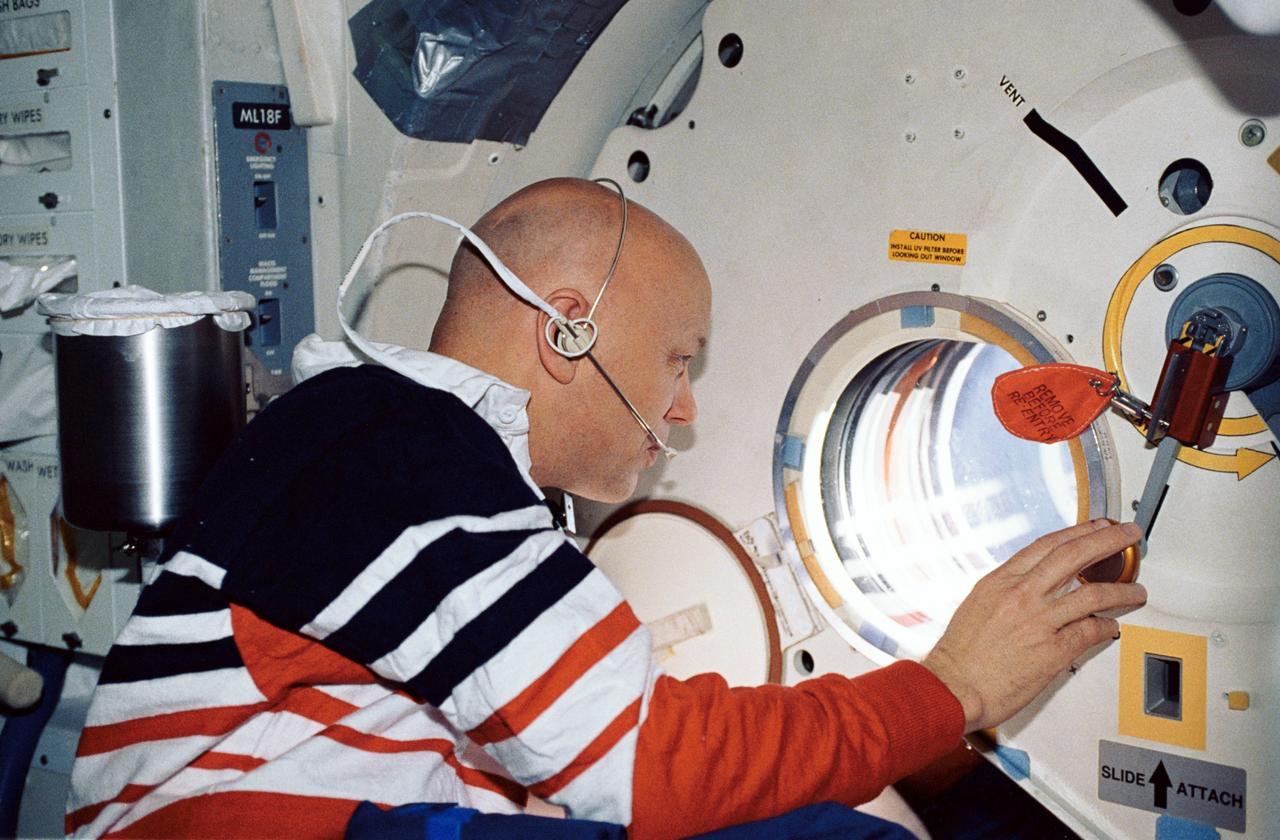
STS044-32-003 (24 Nov.-1 Dec. 1991) --- Astronaut F. Story Musgrave, STS-44 mission specialist, makes visual observations through Atlantis' hatch window. This photograph was among the first released by NASA following the eight day mission, dedicated to the Department of Defense.
STS-44 MS Musgrave looks out OV-104's side hatch viewport on middeck
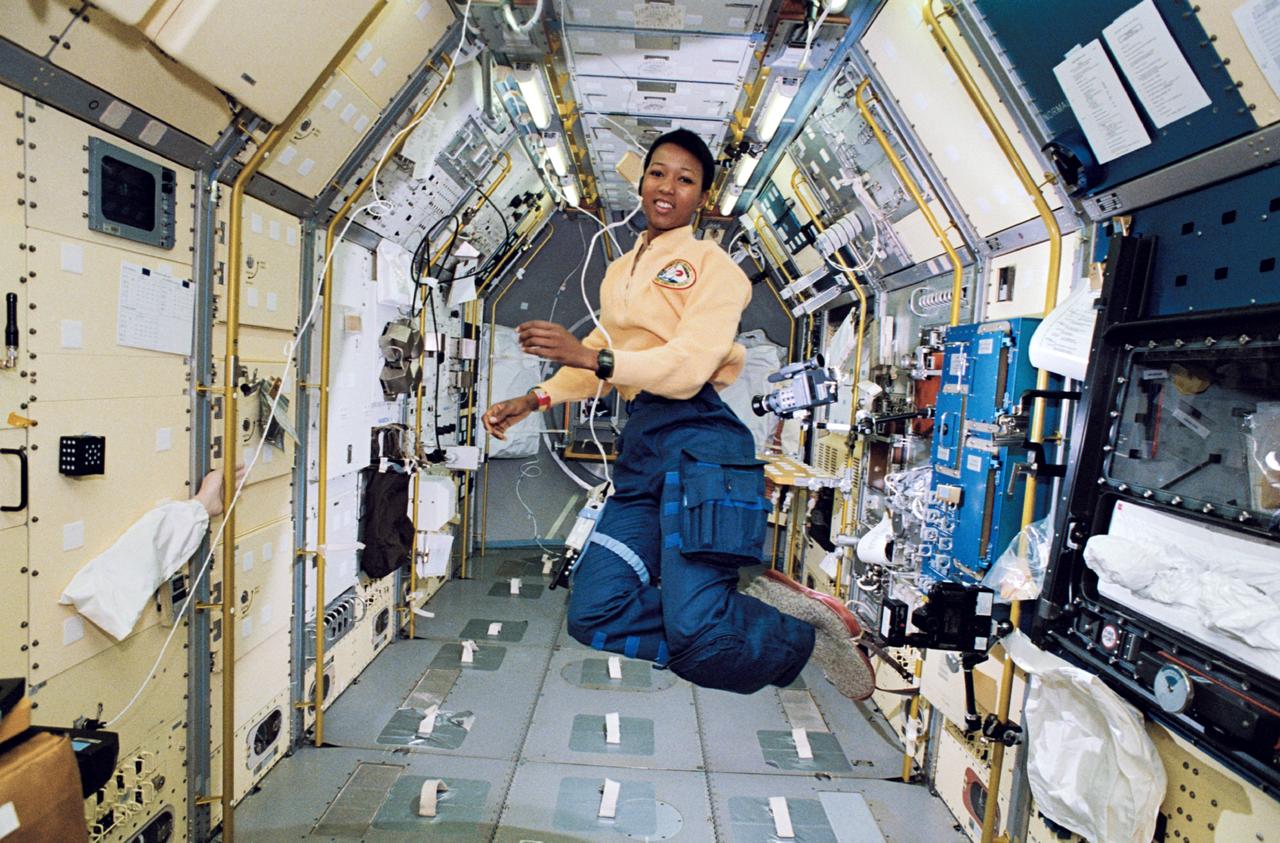
STS047-37-003 (12-20 Sept. 1992) --- Astronaut Mae C. Jemison, STS-47 mission specialist, appears to be clicking her heels in zero-gravity in this 35mm frame photographed in the Science Module aboard the Earth-orbiting Space Shuttle Endeavour. Making her first flight in space, Dr. Jemison was joined by five other NASA astronauts and a Japanese payload specialist for eight days of research in support of the Spacelab-J mission, a joint effort between Japan and the United States.
STS-47 MS Jemison works in the Spacelab Japan (SLJ) module aboard OV-105
STS064-20-026 (9-20 Sept. 1994) --- Astronaut Jerry M. Linenger, STS-64 mission specialist, uses the Shuttle Amateur Radio Experiment (SAREX) to communicate with students on Earth. Various members of the crew made contact with a number of other "hams" around the world during the almost 11-day mission in Earth orbit. Photo credit: NASA or National Aeronautics and Space Administration
Astronaut Linenger uses SAREX to communicate with students on Earth
STS-38 Mission Specialist (MS) Robert C. Springer, wearing extravehicular mobility unit (EMU), fastens the strap on his communications carrier assembly (CCA) cap during suit donning in JSC's Weightless Environment Training Facility (WETF) Bldg 29. Positioned on the WETF platform at pool side, Springer is preparing for an underwater extravehicular activity (EVA) simulation. During the training exercise, Springer will rehearse contingency EVA procedures for the STS-38 mission aboard Atlantis, Orbiter Vehicle (OV) 104.
STS-38 Mission Specialist (MS) Robert C. Springer dons EMU in JSC's WETF
STS-31 Mission Specialist (MS) Kathryn D. Sullivan, wearing extravehicular mobility unit (EMU) & communications carrier assembly (CCA), attaches service and cooling umbilical (SCU) to the EMU connection on the display & control module (DCM) during contingency extravehicular activity (EVA) preparations in the airlock of Discovery, Orbiter Vehicle (OV) 103. The procedure was completed in case an EVA was required to support Hubble Space Telescope (HST) deployment.
STS-31 Mission Specialist (MS) Sullivan dons EMU in OV-103's airlock
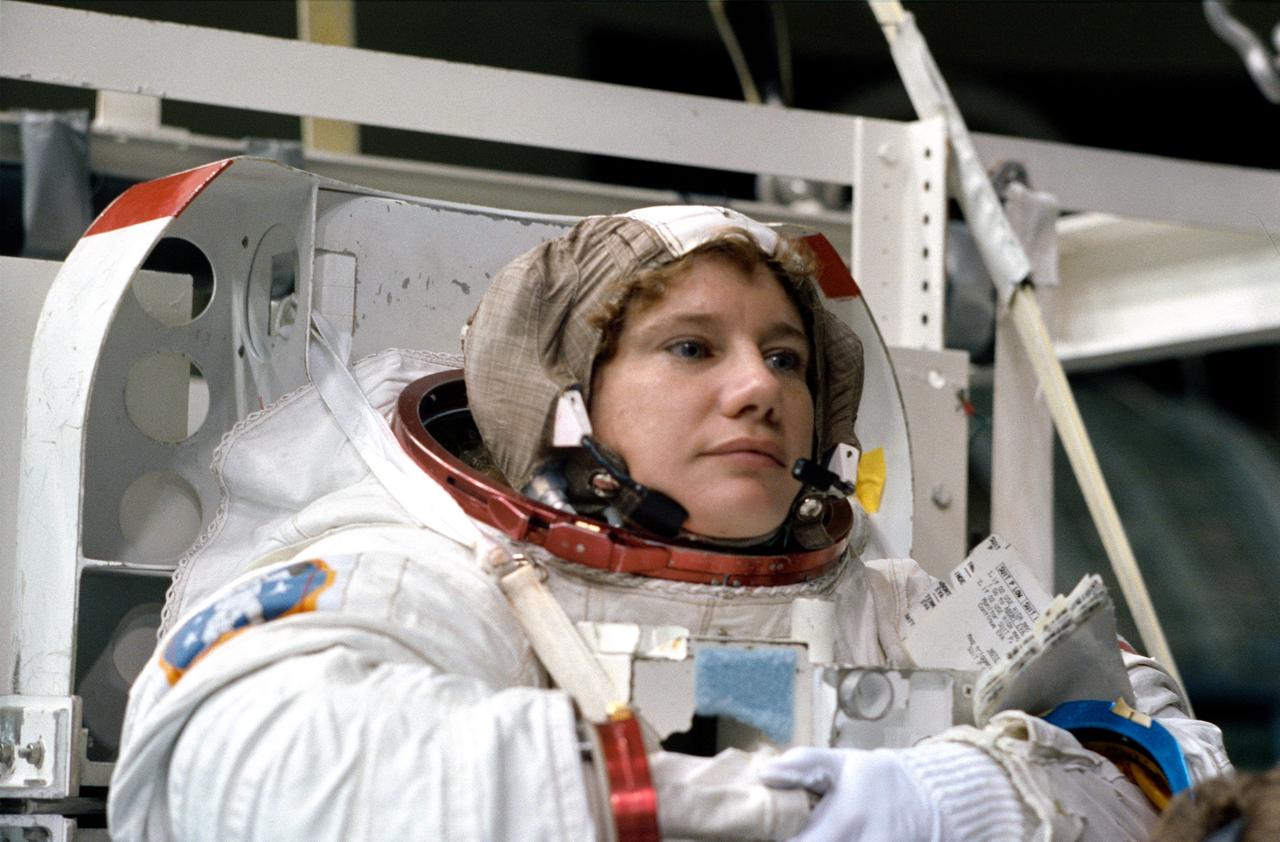
S92-42755 (31 July 1992) --- Astronaut Susan J. Helms, mission specialist assigned to fly aboard the Space Shuttle Endeavour for the STS-54 mission, completes the donning of her spacesuit before a training exercise. Though not assigned to the scheduled extravehicular activity (EVA), Helms is trained in the weightless environment training facility (WET-F).  She will aid astronauts Gregory J. Harbaugh and Mario Runco Jr. in their planned EVA, scheduled for January of next year, and serve a backup role.  Wearing this high fidelity training version of the extravehicular mobility unit (EMU), Helms was later lowered into the 25-ft. deep WET-F pool.  The pressurized suit is weighted so as to allow Helms to achieve neutral buoyancy and simulate the various chores of the spacewalk.
STS-54 MS3 Helms tests CCA equipment prior to an underwater simulation at JSC
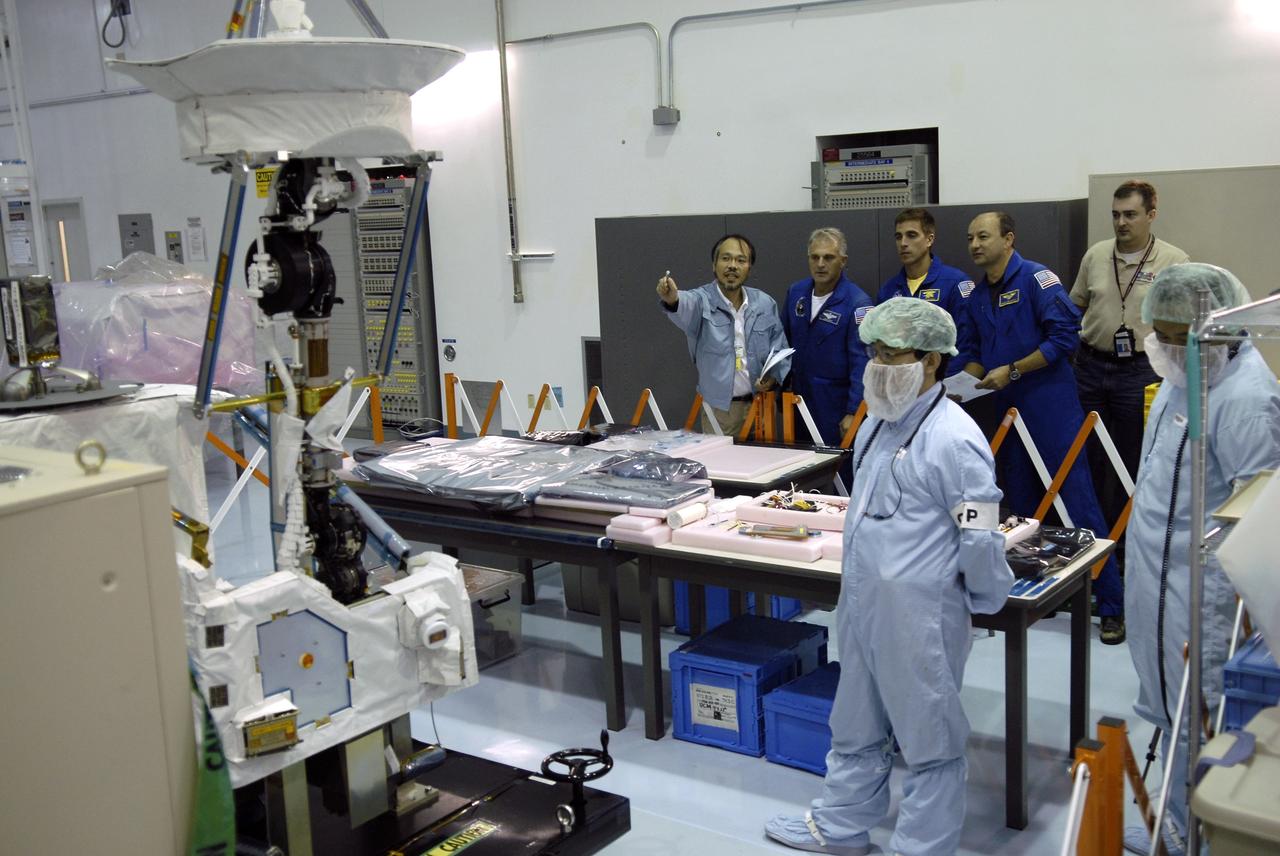
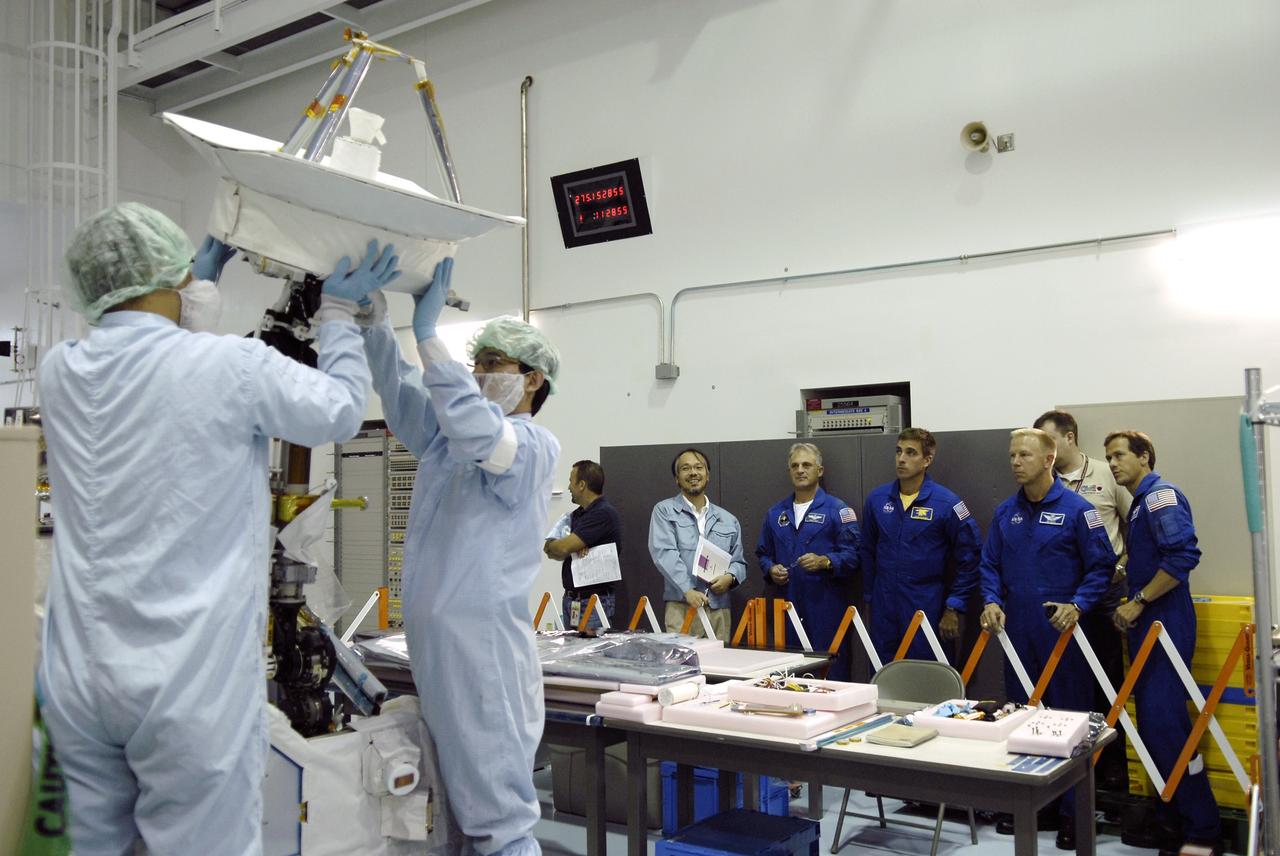
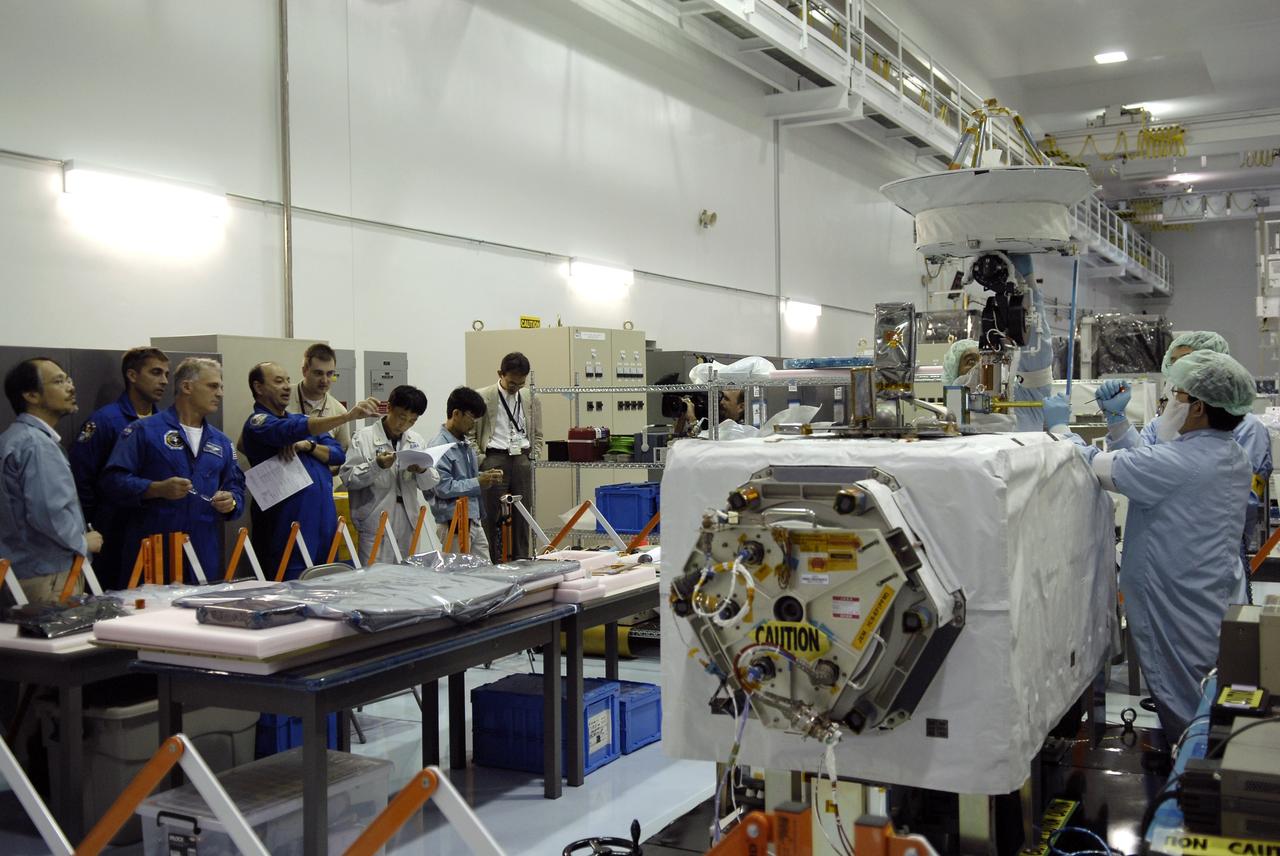
CAPE CANAVERAL, Fla. -  In the Space Station Processing Facility at NASA's Kennedy Space Center in Florida, STS-127 crew members get a look at the extended antenna in the Inter Orbit Communication System Extended Facility, or ICS-EF, across from them. Standing next to a Japanese Aerospace Exploration Agency, or JAXA, technician at left are Mission Specialists Christopher Cassidy and Dave Wolf and Commander Mark Polansky (pointing).  Equipment familiarization is part of a Crew Equipment Interface Test. The antenna and a pointing mechanism  will be used to communicate with  JAXA’s Data Relay Test Satellite, or DRTS.   The ICS-EF will be launched, along with the Extended Facility and Experiment Logistics Module-Exposed Section, to the International Space Station aboard the space shuttle Endeavour on the STS-127 mission targeted for launch on May 15, 2009.  Photo credit: NASA/Kim Shiflett
KSC-08pd2998
CAPE CANAVERAL, Fla. -   In the Space Station Processing Facility at NASA's Kennedy Space Center in Florida, STS-127 crew members watch as Japanese Aerospace Exploration Agency, or JAXA, technicians maneuver the antenna in the Inter Orbit Communication System Extended Facility, or ICS-EF. Standing at right are Mission Specialists Dave Wolf, Christopher Cassidy, Tim Kopra and Tom Marshburn. Equipment familiarization is part of a Crew Equipment Interface Test. The antenna and a pointing mechanism  will be used to communicate with  JAXA’s Data Relay Test Satellite, or DRTS.   The ICS-EF will be launched, along with the Extended Facility and Experiment Logistics Module-Exposed Section, to the International Space Station aboard the space shuttle Endeavour on the STS-127 mission targeted for launch on May 15, 2009.  Photo credit: NASA/Kim Shiflett
KSC-08pd2999
CAPE CANAVERAL, Fla. -  In the Space Station Processing Facility at NASA's Kennedy Space Center in Florida, STS-127 crew members get a look at the extended antenna (upper left) in the Inter Orbit Communication System Extended Facility, or ICS-EF.  Standing next to a Japanese Aerospace Exploration Agency, or JAXA, technician (at center) are (from left) Mission Specialists Dave Wolf and Christopher Cassidy and Commander Mark Polansky.  Equipment familiarization is part of a Crew Equipment Interface Test. The antenna and a pointing mechanism  will be used to communicate with  JAXA’s Data Relay Test Satellite, or DRTS.   The ICS-EF will be launched, along with the Extended Facility and Experiment Logistics Module-Exposed Section, to the International Space Station aboard the space shuttle Endeavour on the STS-127 mission targeted for launch on May 15, 2009.  Photo credit: NASA/Kim Shiflett
KSC-08pd2997
CAPE CANAVERAL, Fla. -  In the Space Station Processing Facility at NASA's Kennedy Space Center in Florida, STS-127 crew members get a look at the antenna in the Inter Orbit Communication System Extended Facility, or ICS-EF.  Standing next to a Japanese Aerospace Exploration Agency, or JAXA, technician at left are Mission Specialists Dave Wolf and Christopher Cassidy and Commander Mark Polansky.  Equipment familiarization is part of a Crew Equipment Interface Test. The antenna and a pointing mechanism  will be used to communicate with  JAXA’s Data Relay Test Satellite, or DRTS.   The ICS-EF will be launched, along with the Extended Facility and Experiment Logistics Module-Exposed Section, to the International Space Station aboard the space shuttle Endeavour on the STS-127 mission targeted for launch on May 15, 2009.  Photo credit: NASA/Kim Shiflett
KSC-08pd2996
CAPE CANAVERAL, Fla. –  In the Space Station Processing Facility at NASA's Kennedy Space Center in Florida, STS-127 crew members get hands-on familiarization with equipment to be used on the mission. They are looking at the hoist of one of two Japanese Aerospace Exploration Agency's Visual Equipments, or VE. The photo shows the hoist of the VE to its final position on the outer perimeter of the Japanese Experiment Module External Facility, or JEM-EF. The VE has to be installed to the final position on orbit because it is outside of the payload bay envelope. The mission payload includes the Japanese Experiment Module, or JEM, Extended Facility and the Inter-orbit Communication System Extended Facility, or ICS-EF.  Equipment familiarization is part of a Crew Equipment Interface Test. The payload will be launched to the International Space Station aboard the space shuttle Endeavour on the STS-127 mission, targeted for launch on May 15, 2009. Photo credit: NASA/Kim Shiflett
KSC-08pd3228
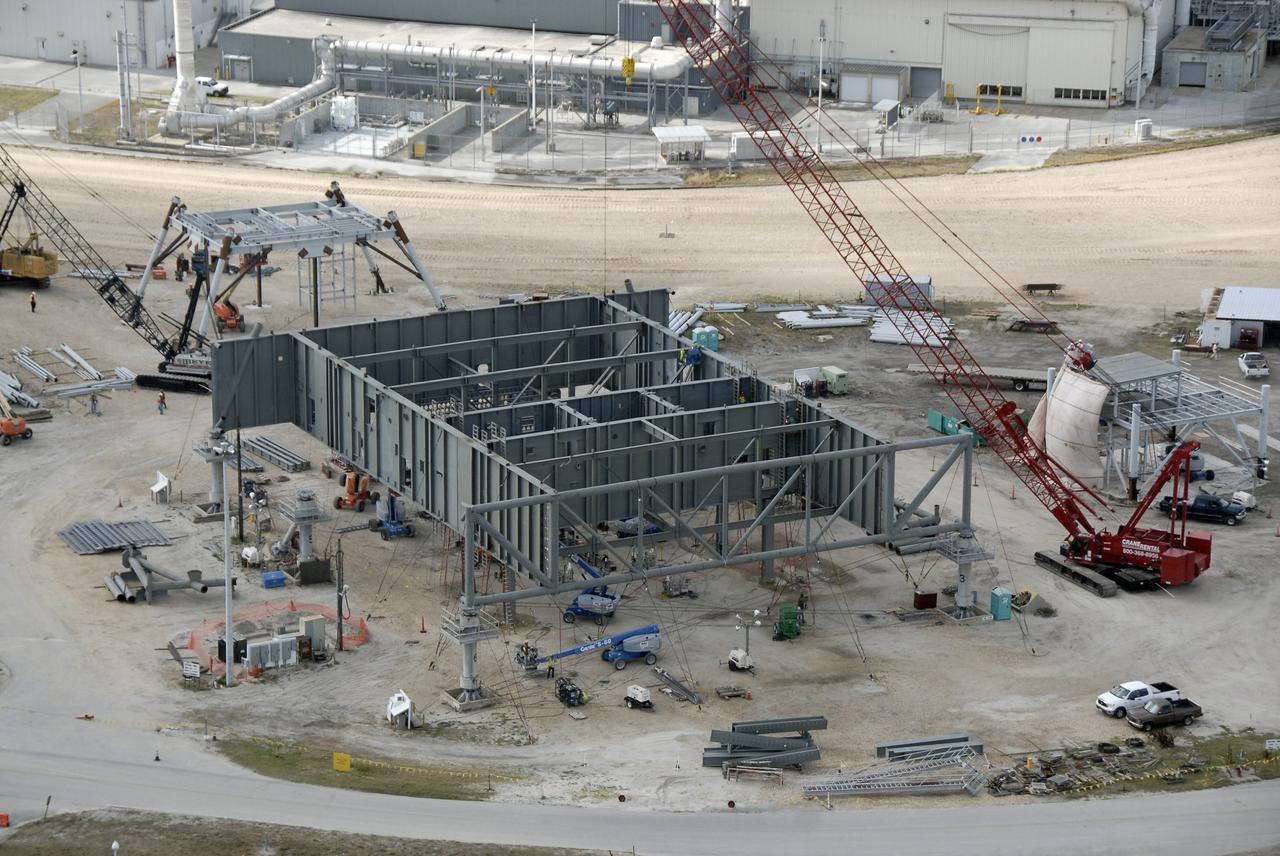
CAPE CANAVERAL, Fla. – At NASA's Kennedy Space Center in Florida, a new mobile launcher is under construction for the Constellation Program.  The new mobile launcher will be the base for the Ares rockets to launch the Orion crew exploration vehicle and the cargo vehicle.  The base is being made lighter than space shuttle mobile launcher platforms so the crawler-transporter can pick up the added load of the 345-foot tower and taller rocket.  When the structural portion of the new launcher is complete, umbilicals, access arms, communications equipment and command/control equipment will be installed.  Photo credit: NASA/Jim Grossmann
KSC-2009-2182
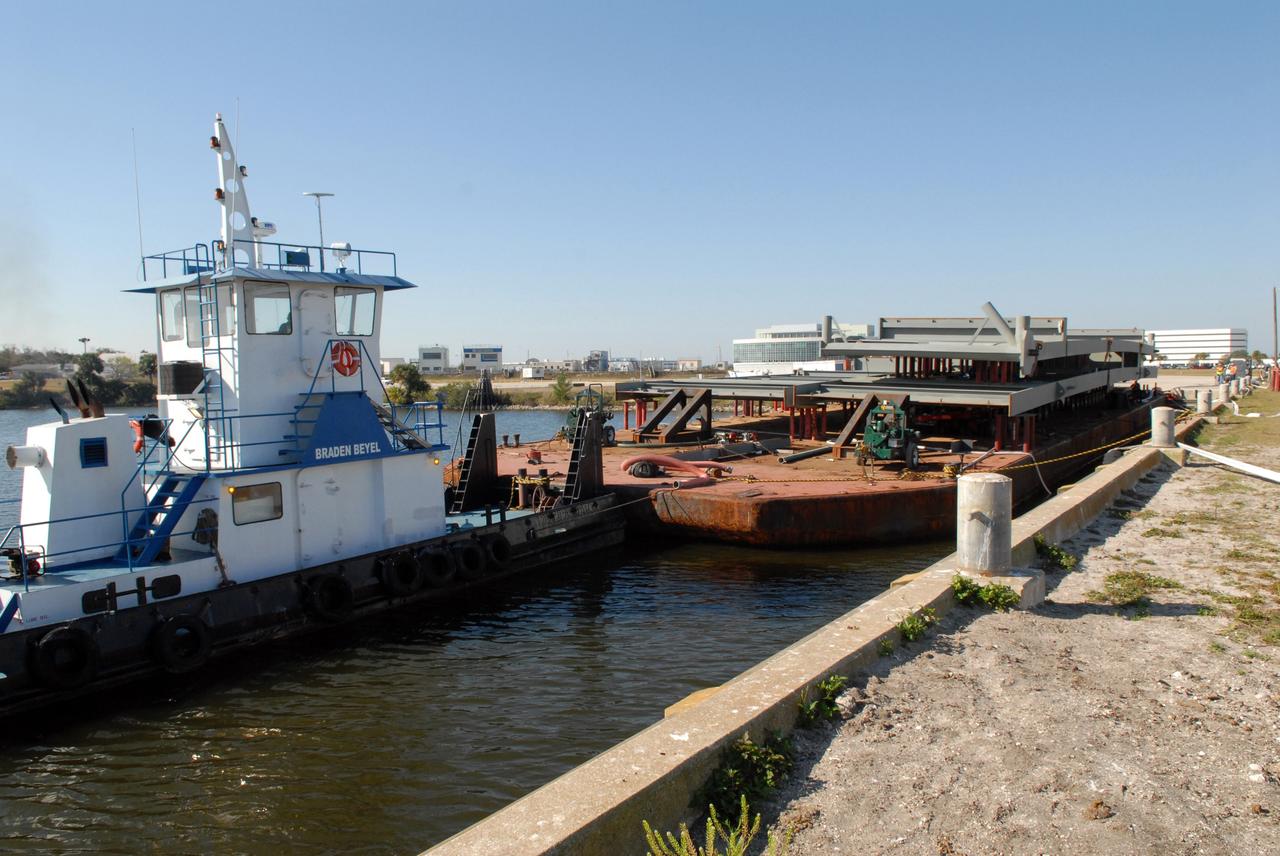
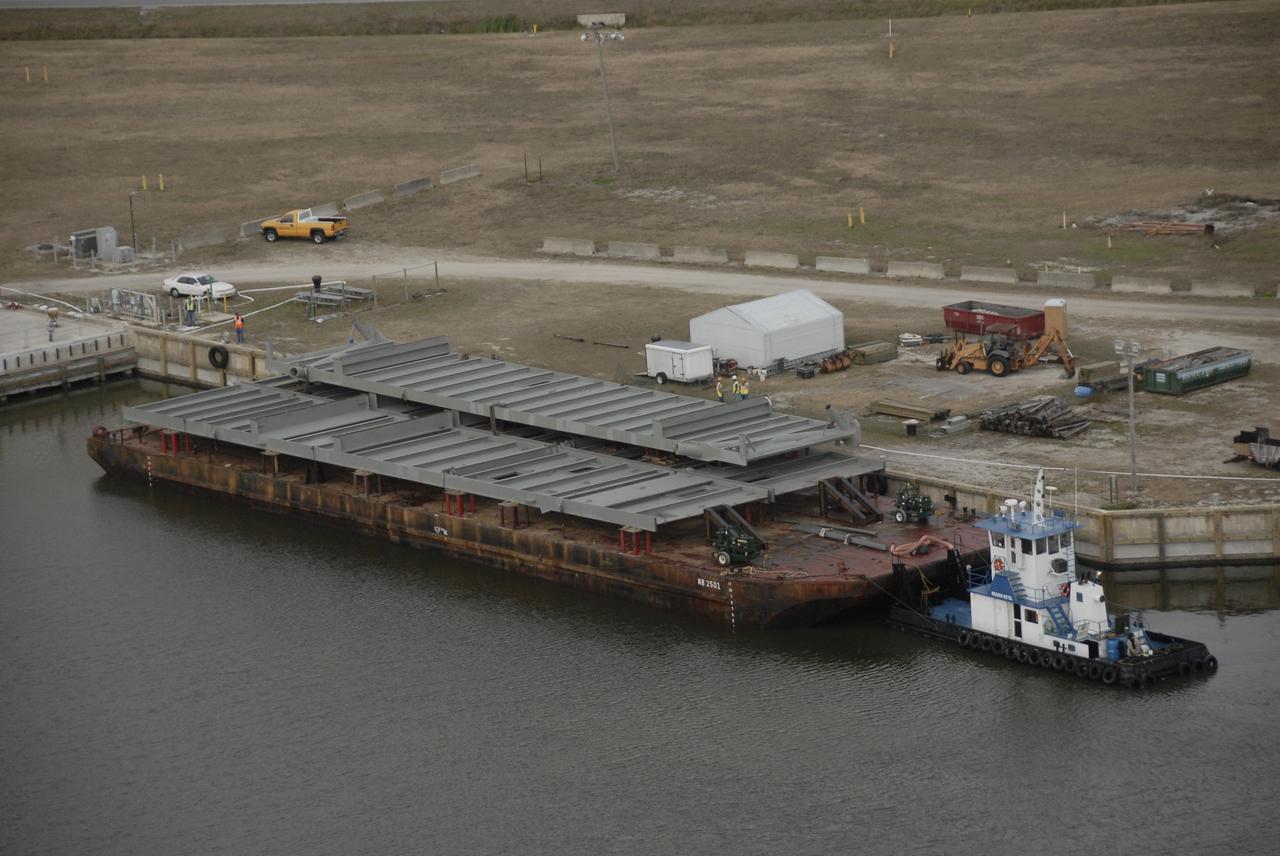
CAPE CANAVERAL, Fla. – Trestles and girders for a new mobile launcher arrive by barge at the turn basin in the Launch Complex 39 Area of NASA's Kennedy Space Center in Florida.  The new launcher will be the base for the Constellation Program's Ares rockets to launch the Orion crew exploration vehicle and the cargo vehicle.  The base is being made lighter than space shuttle mobile launcher platforms so the crawler-transporter can pick up the added load of the 345-foot tower and taller rocket.  When the structural portion of the new mobile launcher is complete, umbilicals, access arms, communications equipment and command/control equipment will be installed.  Photo credit: NASA/Kim Shiflett
KSC-2009-1564
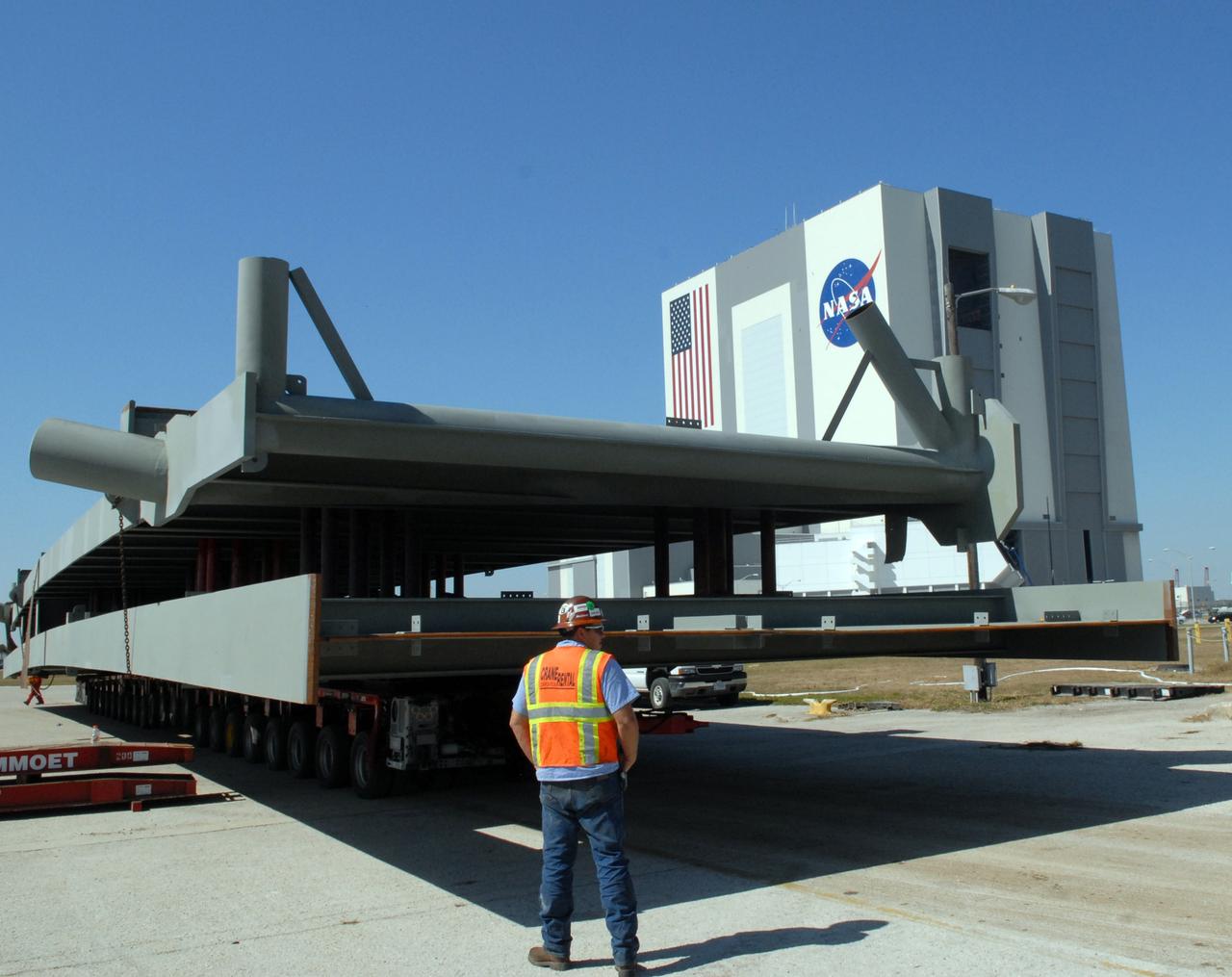
CAPE CANAVERAL, Fla. – At the turn basin at NASA's Kennedy Space Center in Florida, the girder for the new mobile launcher rests on a long transporter that will move it off the barge.   The new mobile launcher will be the base for the Ares rockets to launch the Orion crew exploration vehicle and the cargo vehicle.  The base is being made lighter than space shuttle mobile launcher platforms so the crawler-transporter can pick up the added load of the 345-foot tower and taller rocket.  When the structural portion of the new mobile launcher is complete, umbilicals, access arms, communications equipment and command/control equipment will be installed.  Photo credit: NASA/Jack Pfaller
KSC-2009-1618
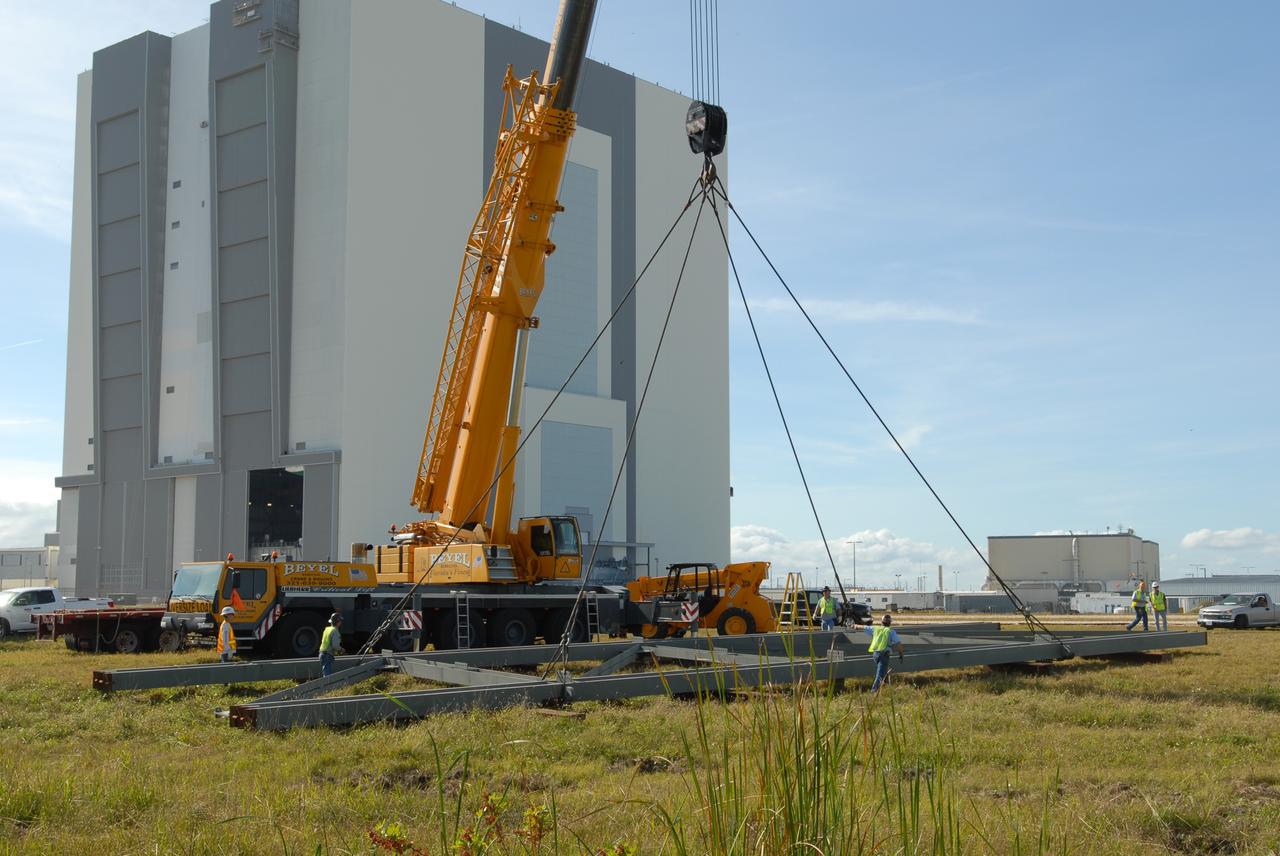
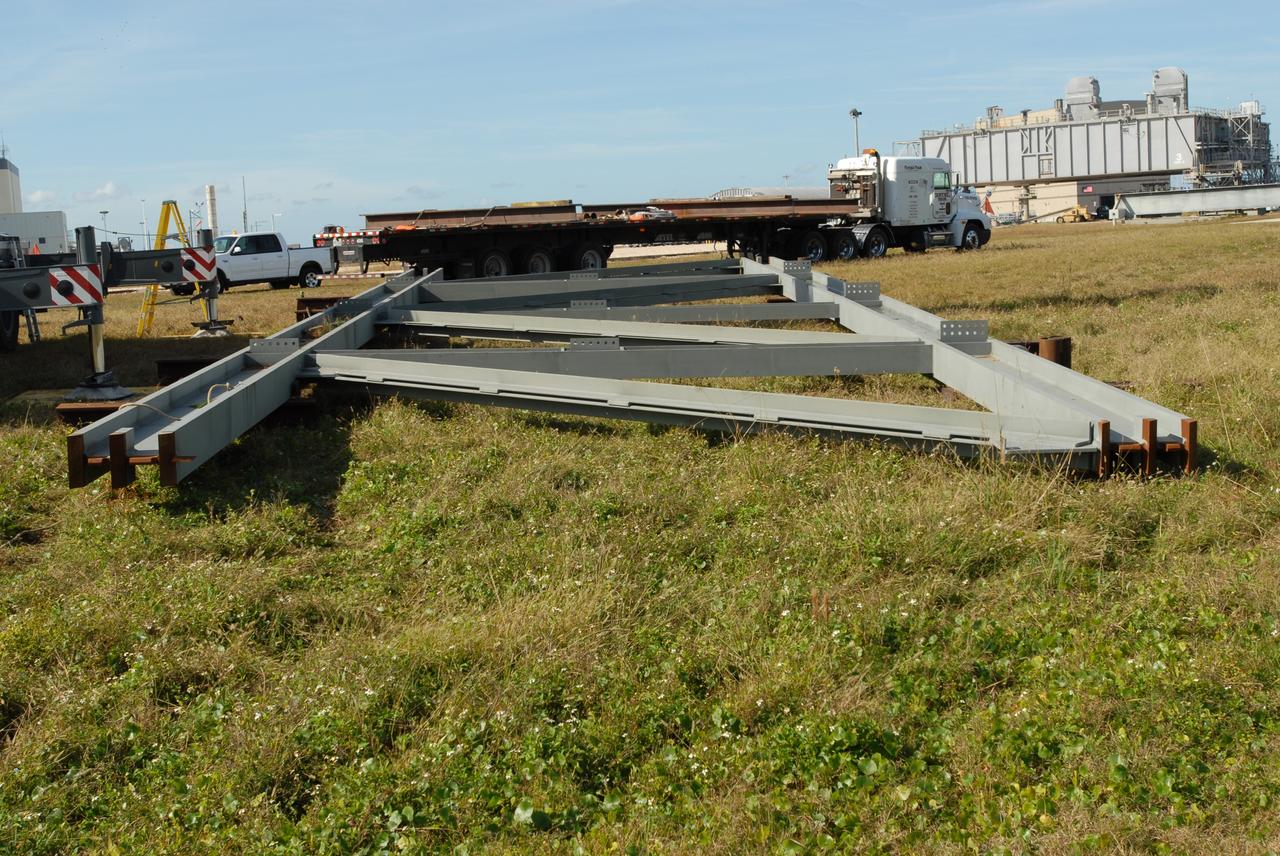
CAPE CANAVERAL, Fla. --    Near the Vehicle Assembly Building at NASA's Kennedy Space Center in Florida, one of the trusses, T4, for the new mobile launcher lies on the ground.  The launcher will be built for the Constellation Program.  The new mobile launcher will be the base for the Ares rockets to launch the Orion crew exploration vehicle and the cargo vehicle.  The base is being made lighter than space shuttle mobile launcher platforms so the crawler-transporter can pick up the added load of the 345-foot tower and taller rocket.  When the structural portion of the new mobile launcher is complete, umbilicals, access arms, communications equipment and command/control equipment will be installed. Photo credit: NASA/Jim Grossmann
KSC-08pd4079
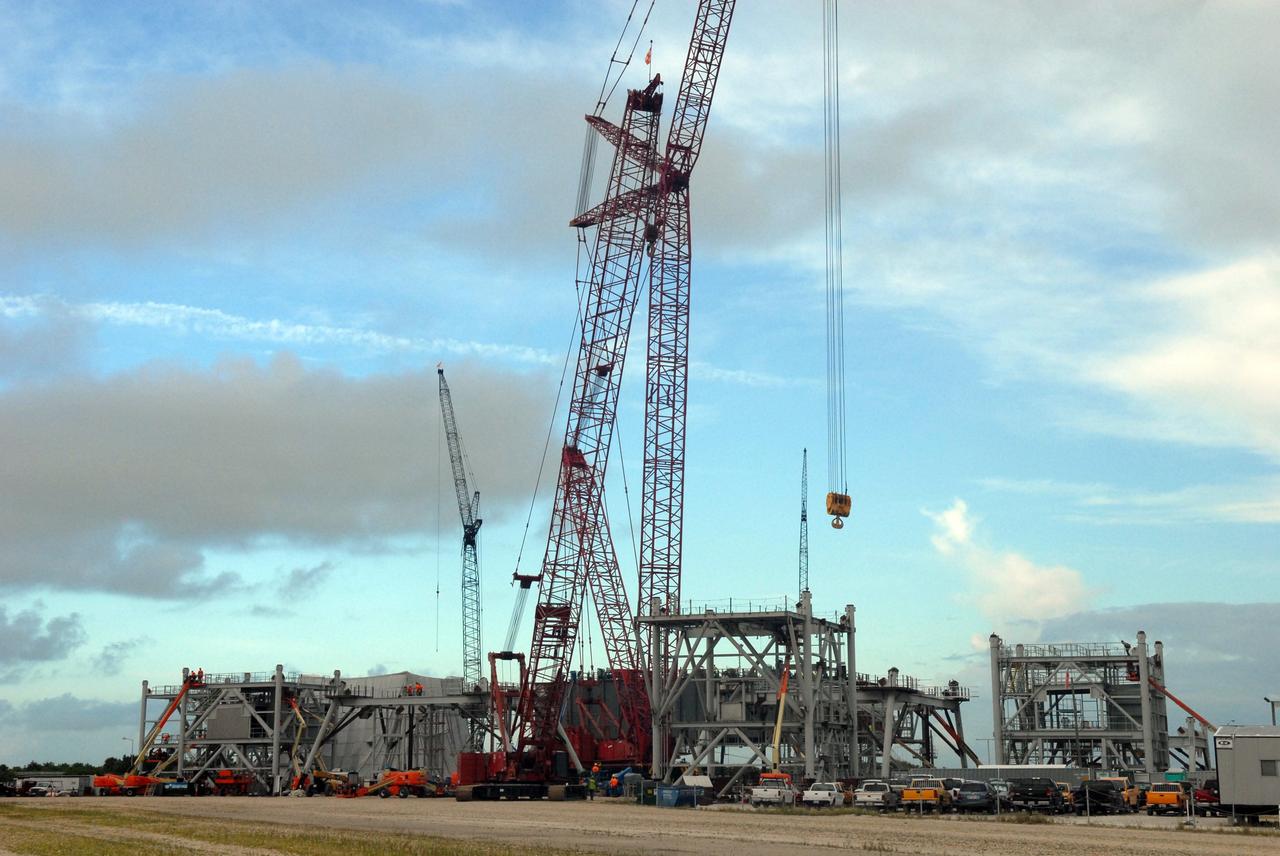
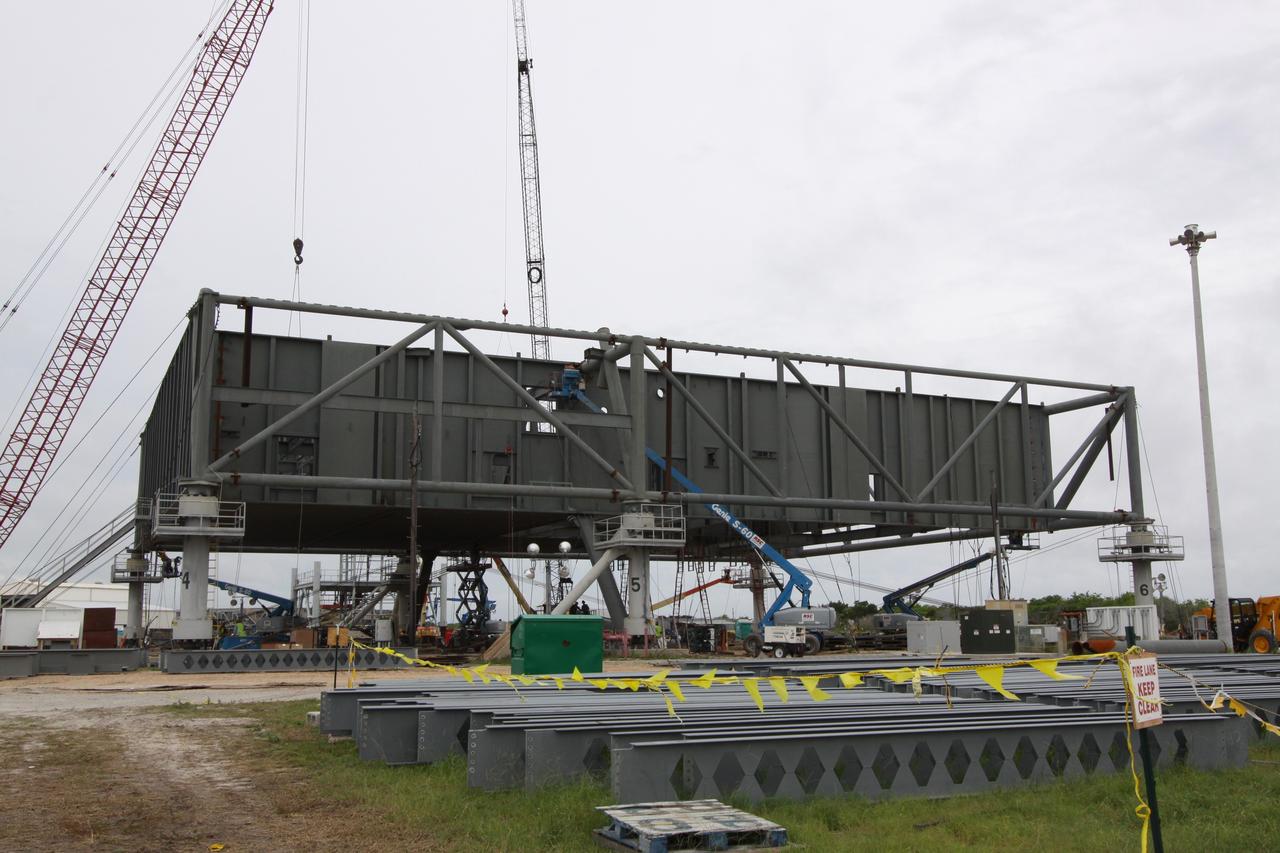
CAPE CANAVERAL, Fla. – In the mobile launcher parking area behind the Vehicle Assembly Building, at NASA's Kennedy Space Center in Florida, the new mobile launcher, or ML, for the Ares rockets is under construction.  The ML will be the base to launch the Orion crew exploration vehicle and the cargo vehicle.  The base is being made lighter than space shuttle mobile launcher platforms so the crawler-transporter can pick up the added load of the 345-foot tower and taller rocket. When the structural portion of the new mobile launcher is complete, umbilicals, access arms, communications equipment and command/control equipment will be installed. Photo credit: NASA/Kim Shiflett
KSC-2009-3142
CAPE CANAVERAL, Fla. – At NASA's Kennedy Space Center in Florida, a new mobile launcher is under construction for the Constellation Program.  The new mobile launcher will be the base for the Ares rockets to launch the Orion crew exploration vehicle and the cargo vehicle.  The base is being made lighter than space shuttle mobile launcher platforms so the crawler-transporter can pick up the added load of the 345-foot tower and taller rocket.  When the structural portion of the new launcher is complete, umbilicals, access arms, communications equipment and command/control equipment will be installed.  Photo credit: NASA/Jim Grossmann
KSC-2009-2183
KENNEDY SPACE CENTER, FLA. - STS-112 Mission Specialist Piers Sellers checks out flight equipment during a Crew Equipment Interface Test at KSC. STS-112 is the 15th assembly flight to the International Space Station and will be ferrying the S1 Integrated Truss Structure. The S1 truss is the first starboard (right-side) truss segment, whose main job is providing structural support for the radiator panels that cool the Space Station's complex power system. The S1 truss segment also will house communications systems, external experiment positions and other subsystems.  The S1 truss will be attached to the S0 truss.  STS-112 is currently scheduled for launch Aug. 22, 2002
KSC-02PD1068
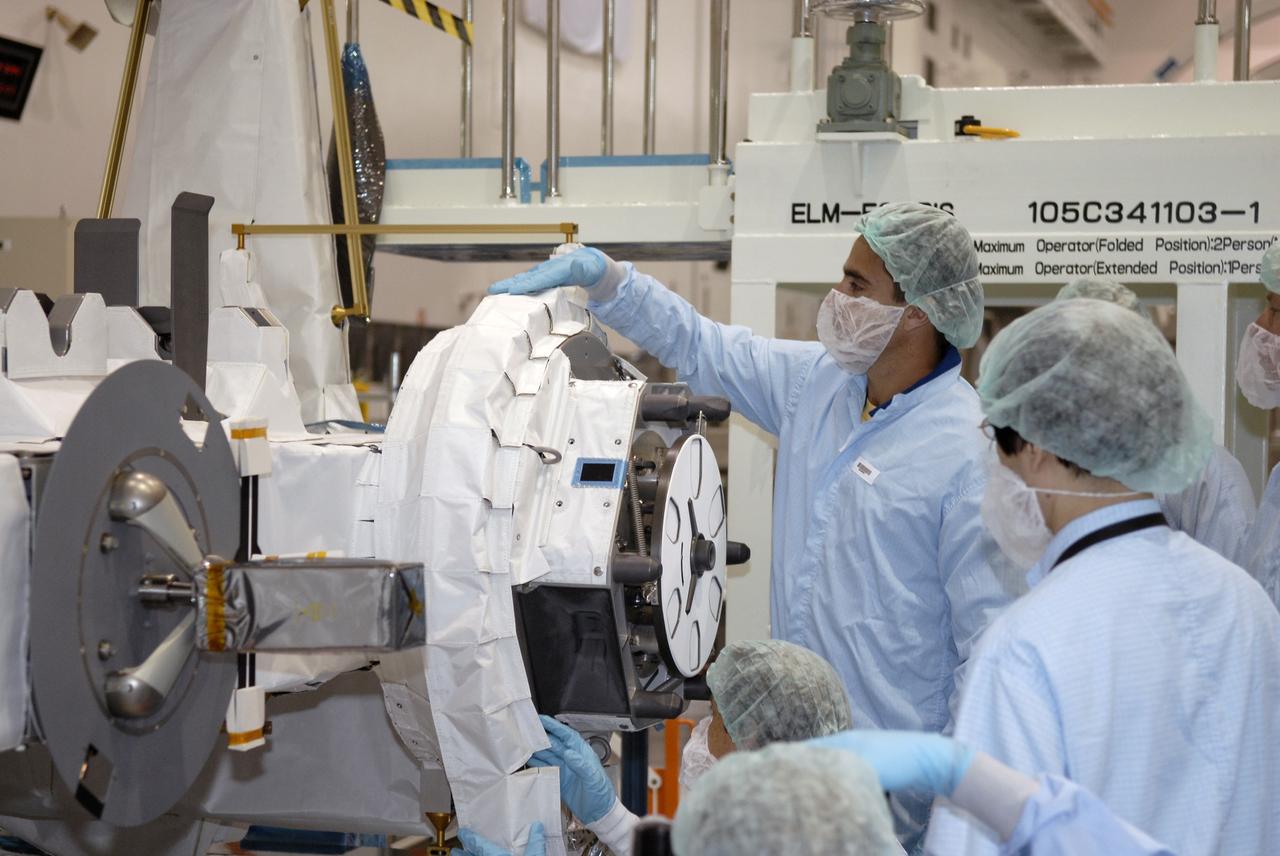
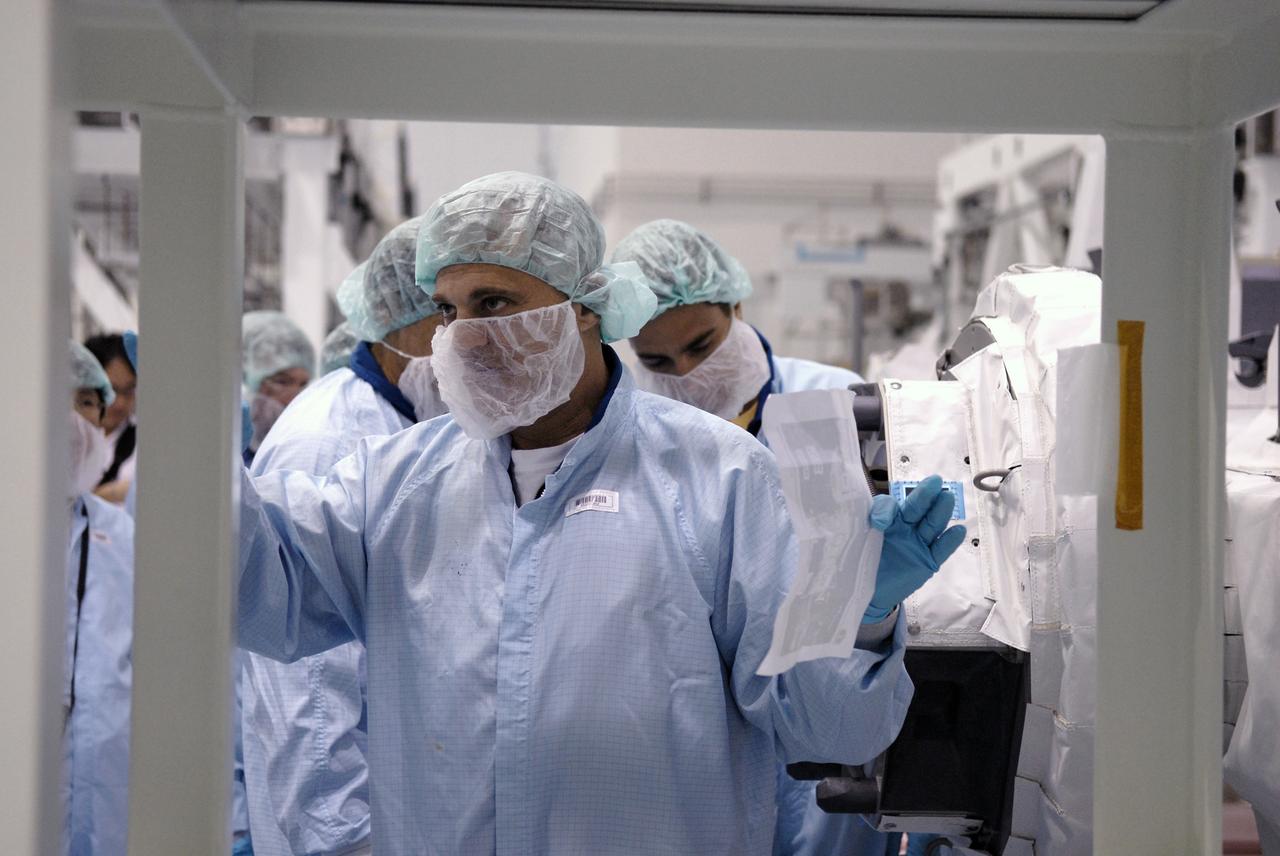
CAPE CANAVERAL, Fla. -   In the Space Station Processing Facility at NASA's Kennedy Space Center in Florida, STS-127 crew members become familiar with the payload and hardware for their mission.  Here they are looking at the Experiment Logistics Module - Exposed Section, or ELM-ES, berthing mechanism. The mission payload also includes the Extended Facility and the Inter Orbit Communication System Extended Facility, or ICS-EF.  Equipment familiarization is part of a Crew Equipment Interface Test. The payload will be launched to the International Space Station aboard the space shuttle Endeavour on the STS-127 mission, targeted for launch on May 15, 2009.  Photo credit: NASA/Kim Shiflett
KSC-08pd3003
CAPE CANAVERAL, Fla. --   Near the Vehicle Assembly Building at NASA's Kennedy Space Center in Florida, a crane places on the ground one of the trusses, T4, to build the new mobile launcher for the Constellation Program.  The new mobile launcher will be the base for the Ares rockets to launch the Orion crew exploration vehicle and the cargo vehicle.  The base is being made lighter than space shuttle mobile launcher platforms so the crawler-transporter can pick up the added load of the 345-foot tower and taller rocket.  When the structural portion of the new mobile launcher is complete, umbilicals, access arms, communications equipment and command/control equipment will be installed. Photo credit: NASA/Jim Grossmann
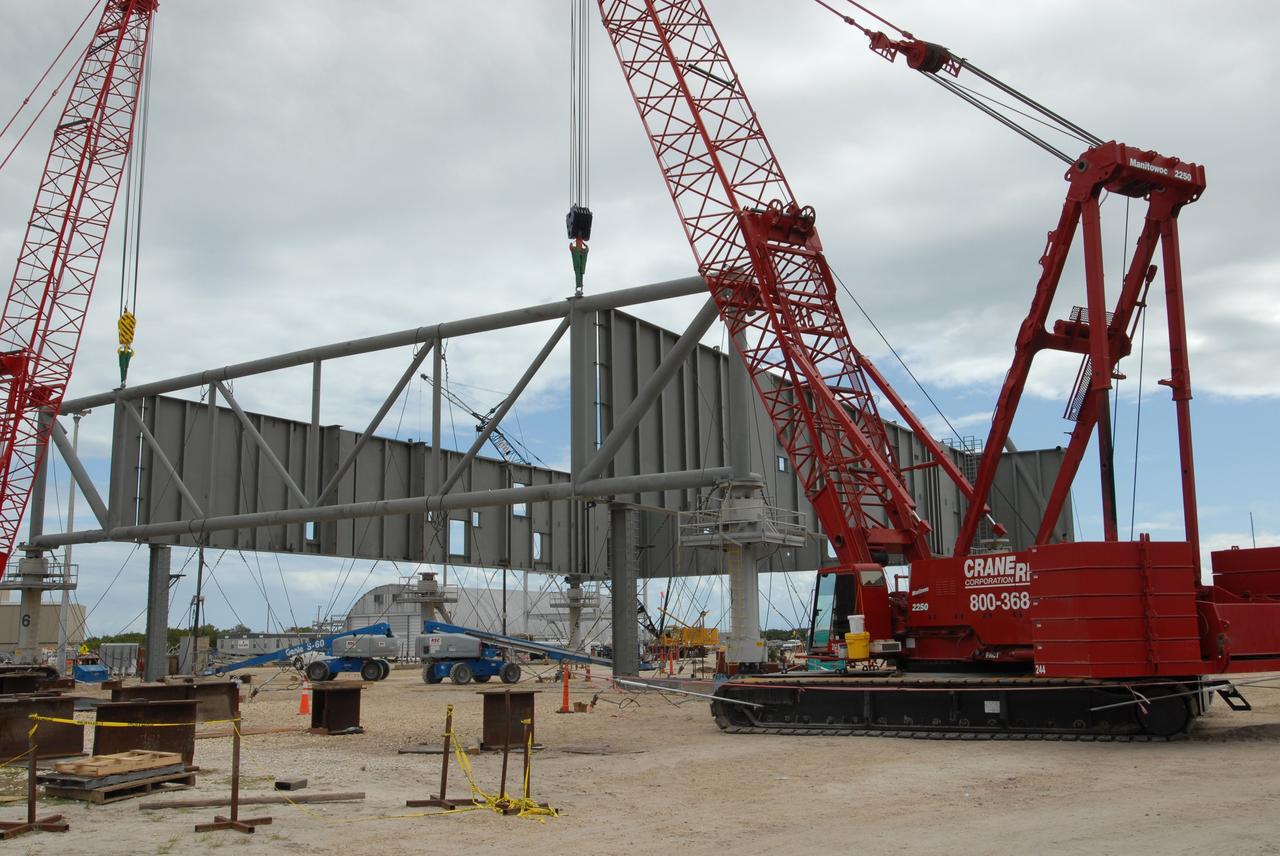
KSC-08pd4078
CAPE CANAVERAL, Fla. – At the turn basin at NASA's Kennedy Space Center in Florida, the girder for the new mobile launcher is moved from the barge onto the loading area.  The new mobile launcher will be the base for the Ares rockets to launch the Orion crew exploration vehicle and the cargo vehicle.  The base is being made lighter than space shuttle mobile launcher platforms so the crawler-transporter can pick up the added load of the 345-foot tower and taller rocket.  When the structural portion of the new mobile launcher is complete, umbilicals, access arms, communications equipment and command/control equipment will be installed.  Photo credit: NASA/Jack Pfaller
KSC-2009-1619
CAPE CANAVERAL, Fla. – At the turn basin at NASA's Kennedy Space Center in Florida, a tug boat keeps the barge in place for the offloading of the girder for the new mobile launcher.  The new mobile launcher will be the base for the Ares rockets to launch the Orion crew exploration vehicle and the cargo vehicle.  The base is being made lighter than space shuttle mobile launcher platforms so the crawler-transporter can pick up the added load of the 345-foot tower and taller rocket.  When the structural portion of the new mobile launcher is complete, umbilicals, access arms, communications equipment and command/control equipment will be installed.  Photo credit: NASA/Jack Pfaller
KSC-2009-1617
CAPE CANAVERAL, Fla. – Huge cranes are employed in building the new mobile launcher behind NASA Kennedy Space Center's Vehicle Assembly Building for the Constellation Program's Ares rockets.  The ML will be the base to launch the Orion crew exploration vehicle and the cargo vehicle. The base is being made lighter than space shuttle mobile launcher platforms so the crawler-transporter can pick up the added load of the 345-foot tower and taller rocket. When the structural portion of the new mobile launcher is complete, umbilicals, access arms, communications equipment and command/control equipment will be installed. Photo credit: NASA/Jim Grossmann
KSC-2009-5176
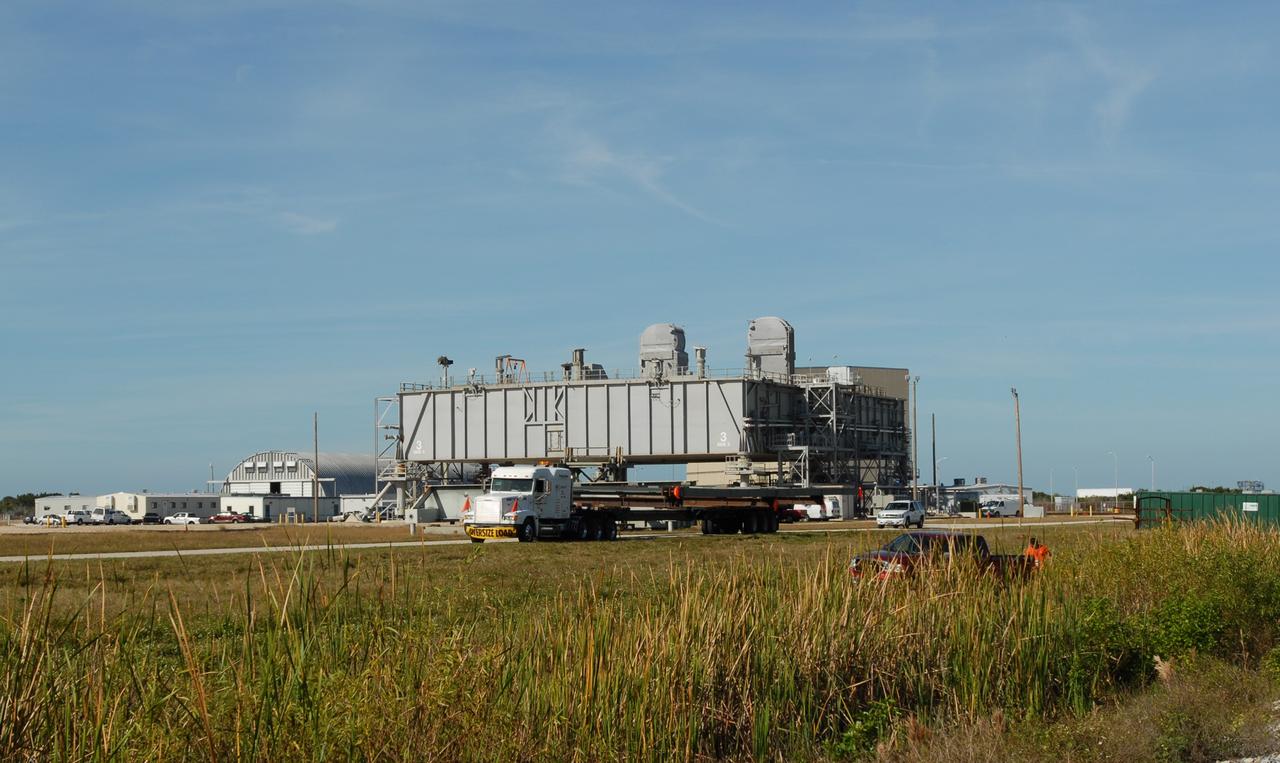
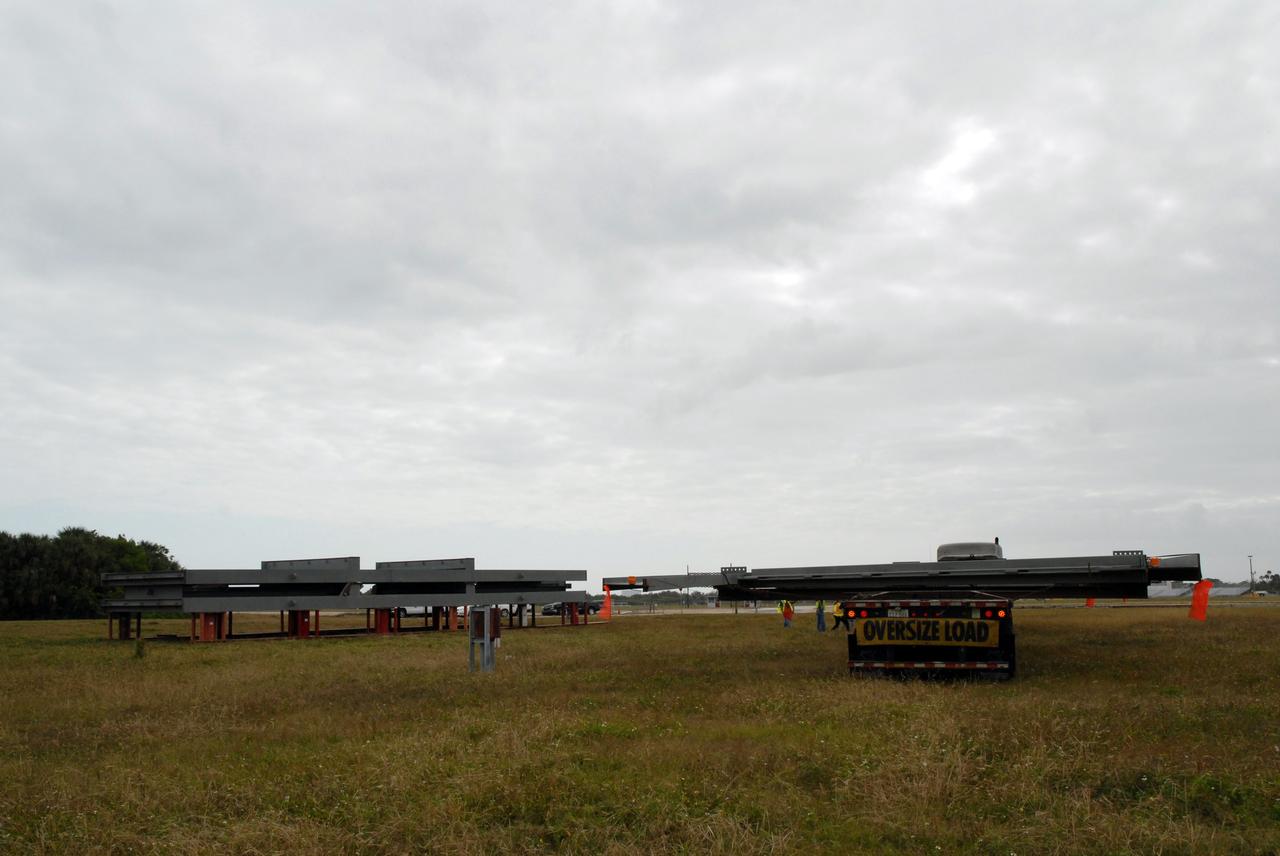
CAPE CANAVERAL, Fla. --   The Mobile Launcher truss, T4, arrives at NASA's Kennedy Space Center in Florida.  It is being delivered for the new mobile launcher to be used in the Constellation Program. The new mobile launcher will be the base for the Ares rockets to launch the Orion crew exploration vehicle and the cargo vehicle.  The base is being made lighter than space shuttle mobile launcher platforms so the crawler-transporter can pick up the added load of the 345-foot tower and taller rocket.  When the structural portion of the new mobile launcher is complete, umbilicals, access arms, communications equipment and command/control equipment will be installed. Photo credit: NASA/Jim Grossmann
KSC-08pd4076
CAPE CANAVERAL, Fla. --   At NASA's Kennedy Space Center in Florida, the Mobile Launcher truss, T4, has been offloaded from its truck on grounds near the mobile launcher parking area.  The new mobile launcher will be the base for the Ares rockets to launch the Orion crew exploration vehicle and the cargo vehicle.  The base is being made lighter than space shuttle mobile launcher platforms so the crawler-transporter can pick up the added load of the 345-foot tower and taller rocket.  When the structural portion of the new mobile launcher is complete, umbilicals, access arms, communications equipment and command/control equipment will be installed. Photo credit: NASA/Jack Pfaller
KSC-08pd4030