
View of EDV water container, in the Node 1. Photo was taken during Expedition 34.
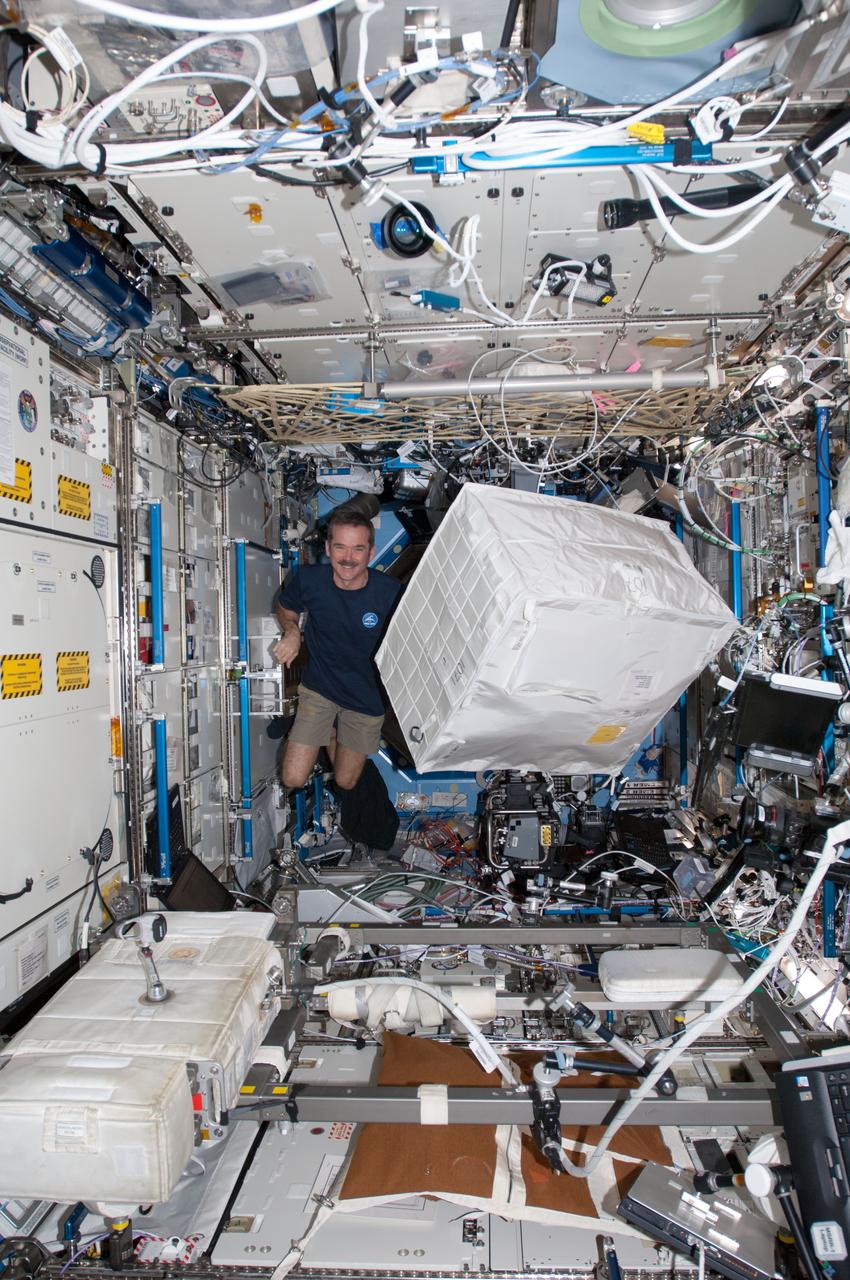
ISS034-E-029995 (15 Jan. 2013) --- Canadian Space Agency astronaut Chris Hadfield, Expedition 34 flight engineer, moves a stowage container in the Destiny laboratory of the International Space Station.
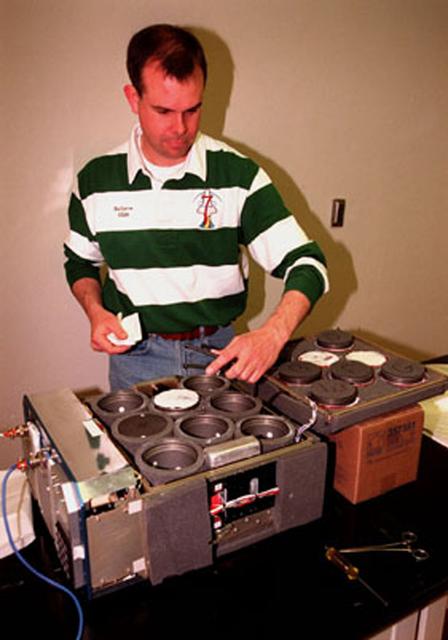
BioServe engineer Mark Rupert with the Version 3 Isothermal Containment Module containing the STS-93 experiment, NIH-B, being flown in cooperation with the National Institutes of Health (NIH).
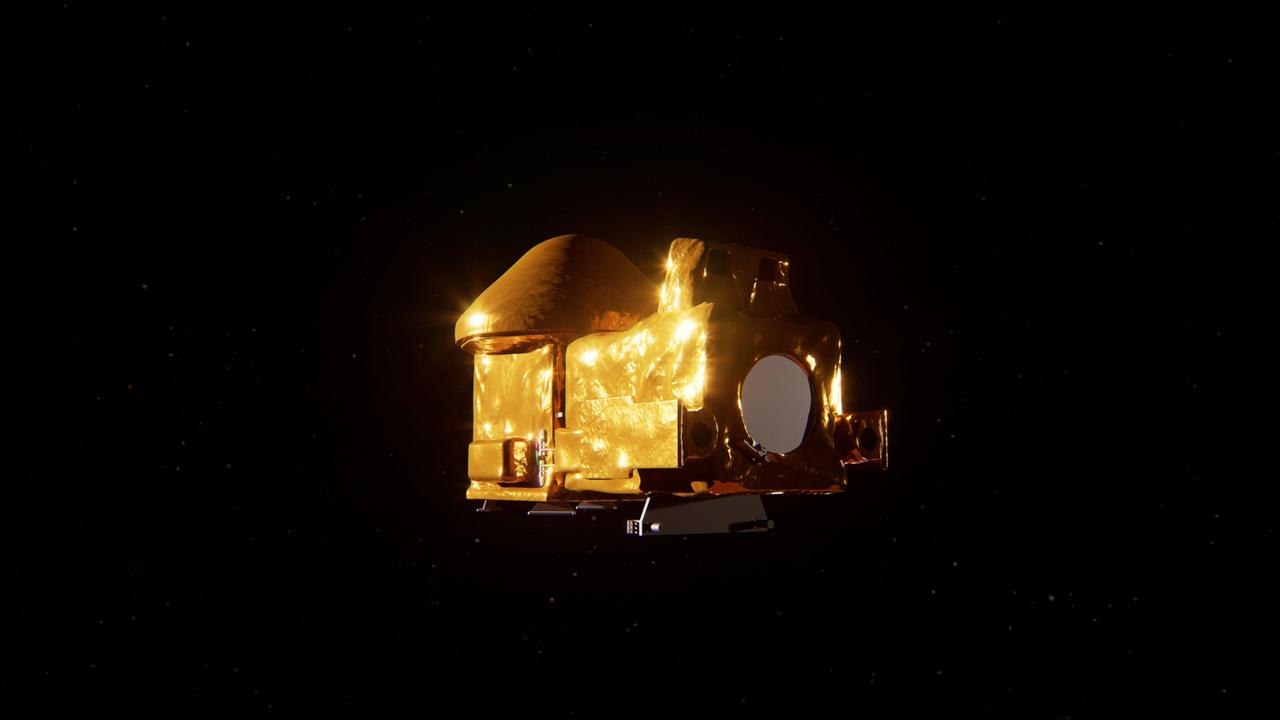
This artist's concept shows the proposed Capture, Containment, and Return System, a NASA payload on the European Space Agency's Earth Return Orbiter. The payload is tasked with capturing the Orbiting Sample container, orienting it, sterilizing its exterior, and transferring it into a clean zone for secondary containment, toward safe return to Earth. The Capture, Containment, and Return System is part of the multi-mission Mars Sample Return program being planned by NASA and European Space Agency (ESA). https://photojournal.jpl.nasa.gov/catalog/PIA25894

This illustration shows the proposed Capture, Containment, and Return System, a NASA payload on the European Space Agency's Earth Return Orbiter. As part of the Mars Sample Return Campaign, samples collected by NASA's Mars Perseverance Rover would be launched into Mars orbit within sealed tubes inside an Orbiting Sample container. The Earth Return Orbiter would then rendezvous with this container, and the Capture, Containment, and Return System would be tasked with capturing the Orbiting Sample container, orienting it, sterilizing its exterior, and transferring it into a clean zone for secondary containment, toward safe return to Earth. The Capture, Containment, and Return System is part of the multi-mission Mars Sample Return program being planned by NASA and European Space Agency (ESA). https://photojournal.jpl.nasa.gov/catalog/PIA25860
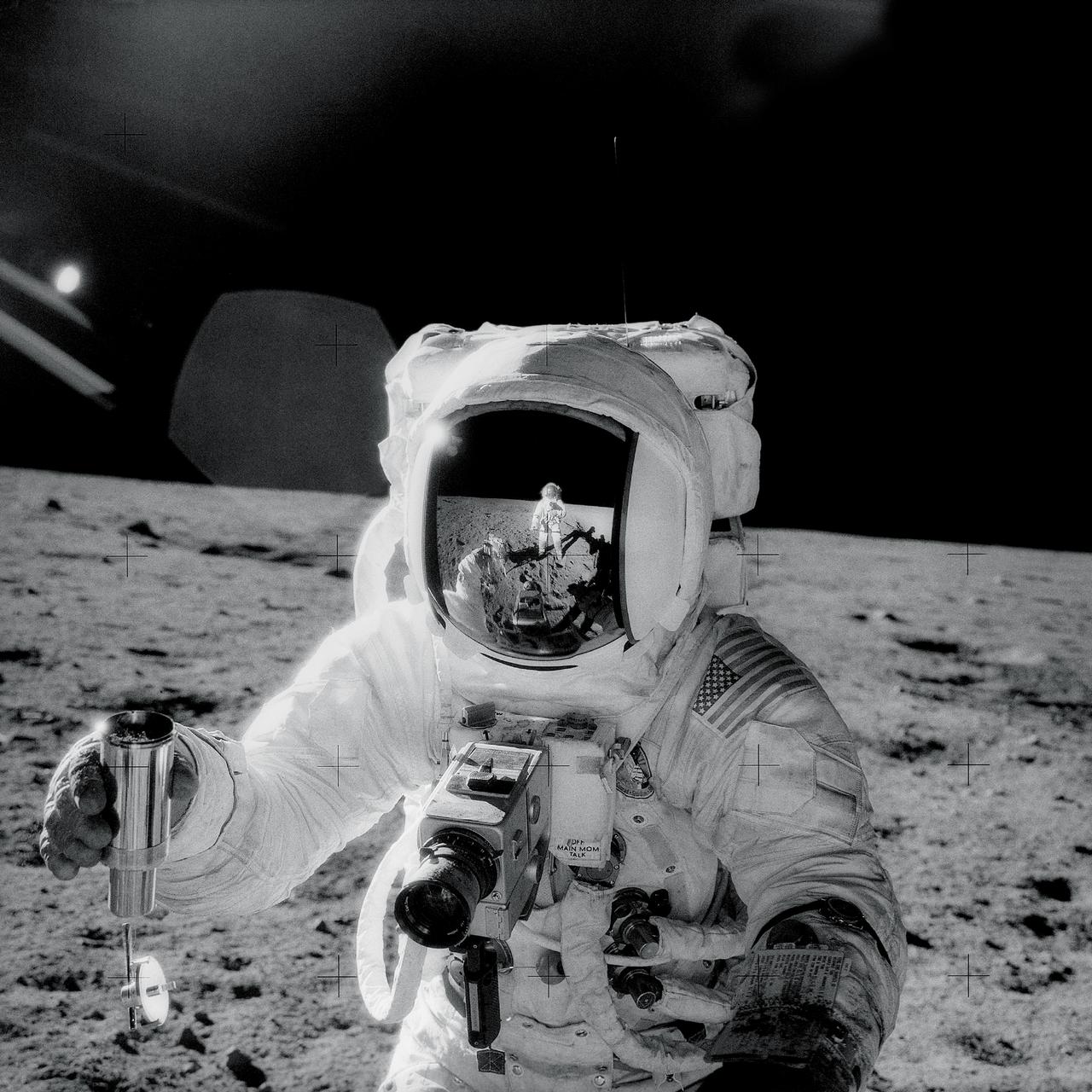
AS12-49-7278 (19-20 Nov. 1969) --- Astronaut Alan L. Bean holds a Special Environmental Sample Container filled with lunar soil collected during the extravehicular activity (EVA) in which astronauts Charles Conrad Jr., commander, and Bean, lunar module pilot, participated. Conrad, who took this picture, is reflected in Bean's helmet visor. Conrad and Bean descended in the Apollo 12 Lunar Module (LM) to explore the lunar surface while astronaut Richard F. Gordon Jr., command module pilot, remained with the Command and Service Modules (CSM) in lunar orbit. Photo credit: NASA
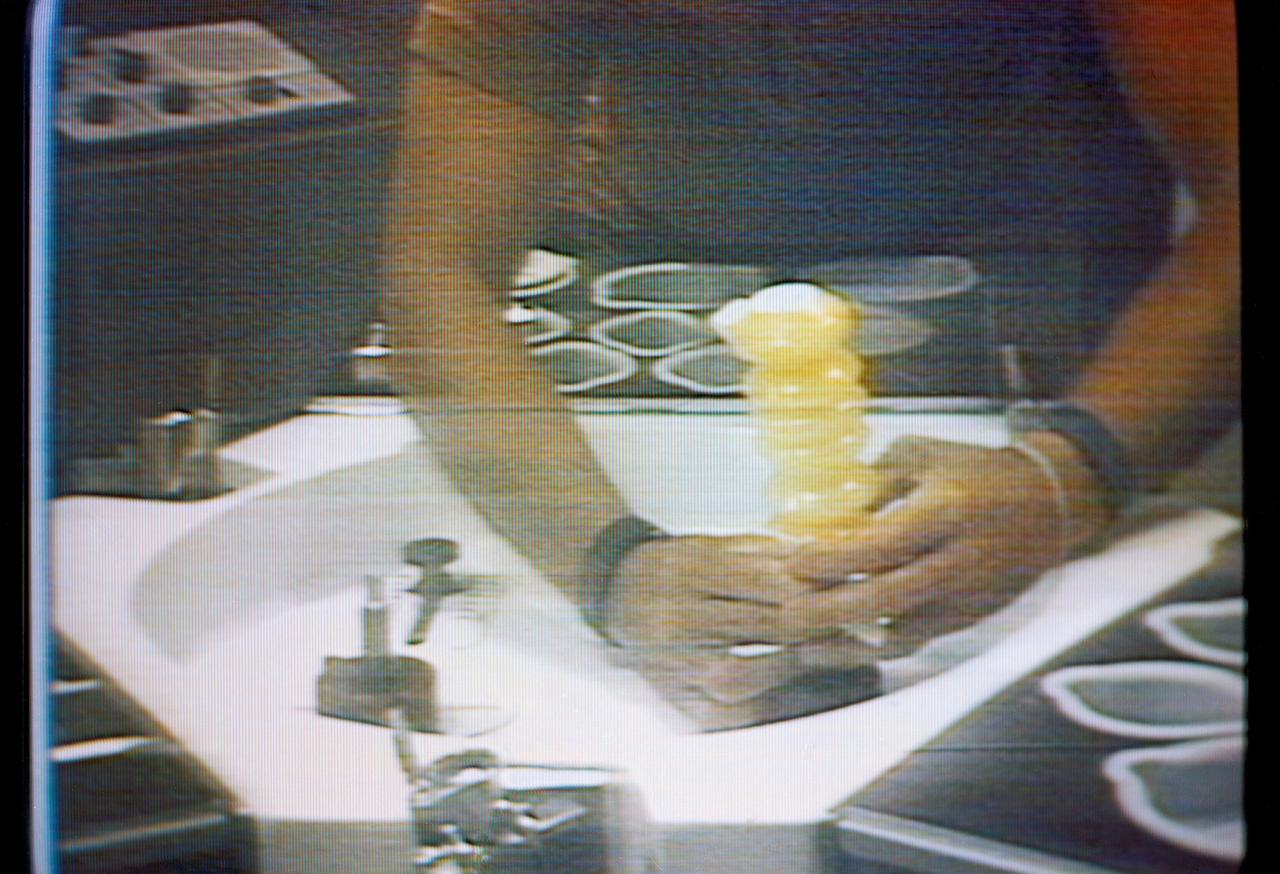
S73-27078 (30 May 1973) --- An accordian-style beverage dispenser filled with orange juice is held by astronaut Charles Conrad Jr., Skylab 2 commander, in this close-up view which is a reproduction taken from a color television transmission made by a TV camera aboard the Skylab 1 & 2 space station cluster in Earth orbit. Conrad (head and face not in view) is seated at the wardroom table in the crew quarters of the Orbital Workshop. The dispenser contained beverage crystals, and Conrad has just added the prescribed amount of water to make the orange drink. Photo credit: NASA
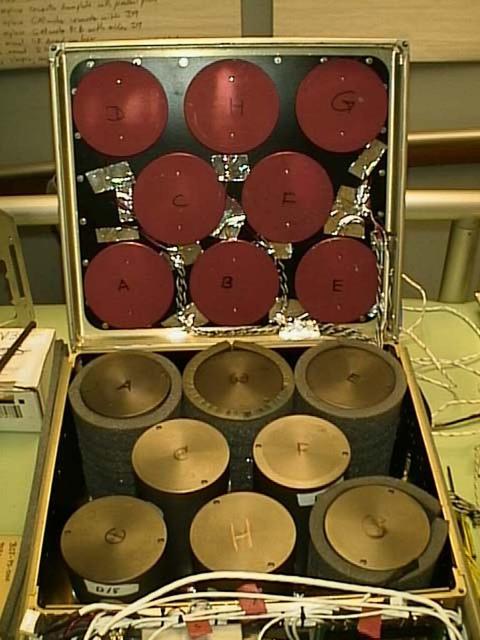
Isothermal Containment Modules are the temperature-controlling carrier that BioServe built to carry Commercial Generic Bioprocessing Apparatus (CGBA) and in the future, Space Automated Bioproduct Lab (SABL) to the International Space Station.
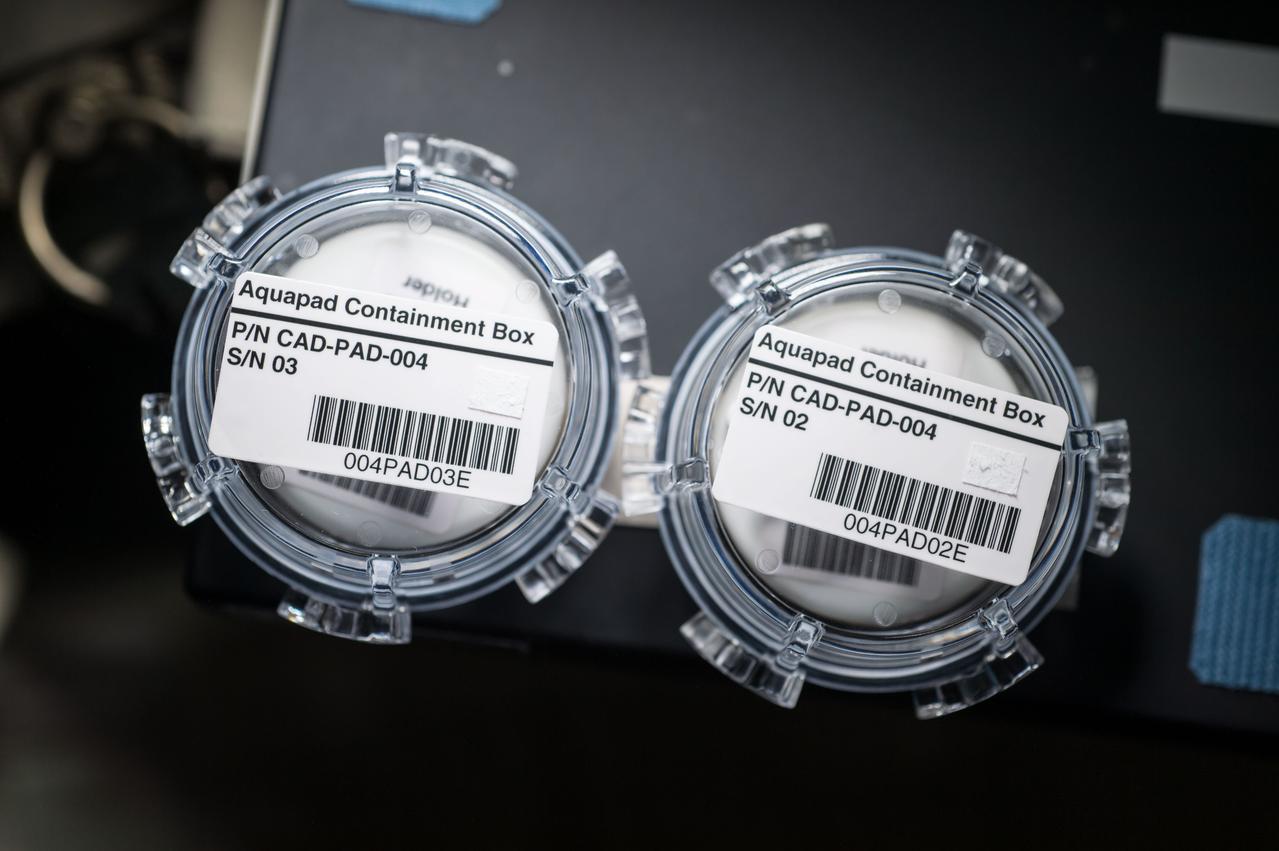
iss050e016760 (12/17/2016) --- View of Aquapad Containment Boxes. Photo was taken during Expedition 50.
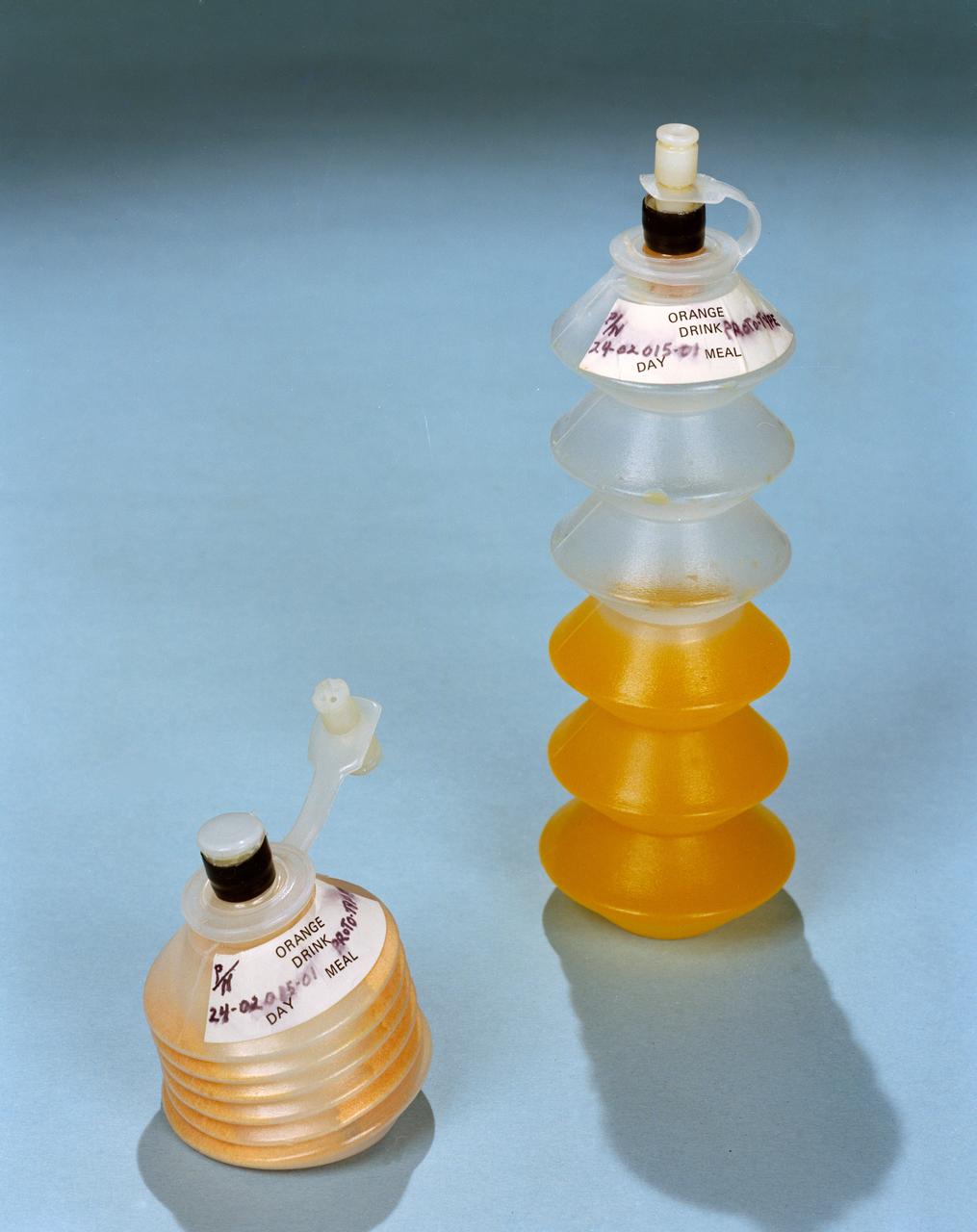
S72-50247 (1972) --- A close-up view of Skylab drink containers. Photo credit: NASA
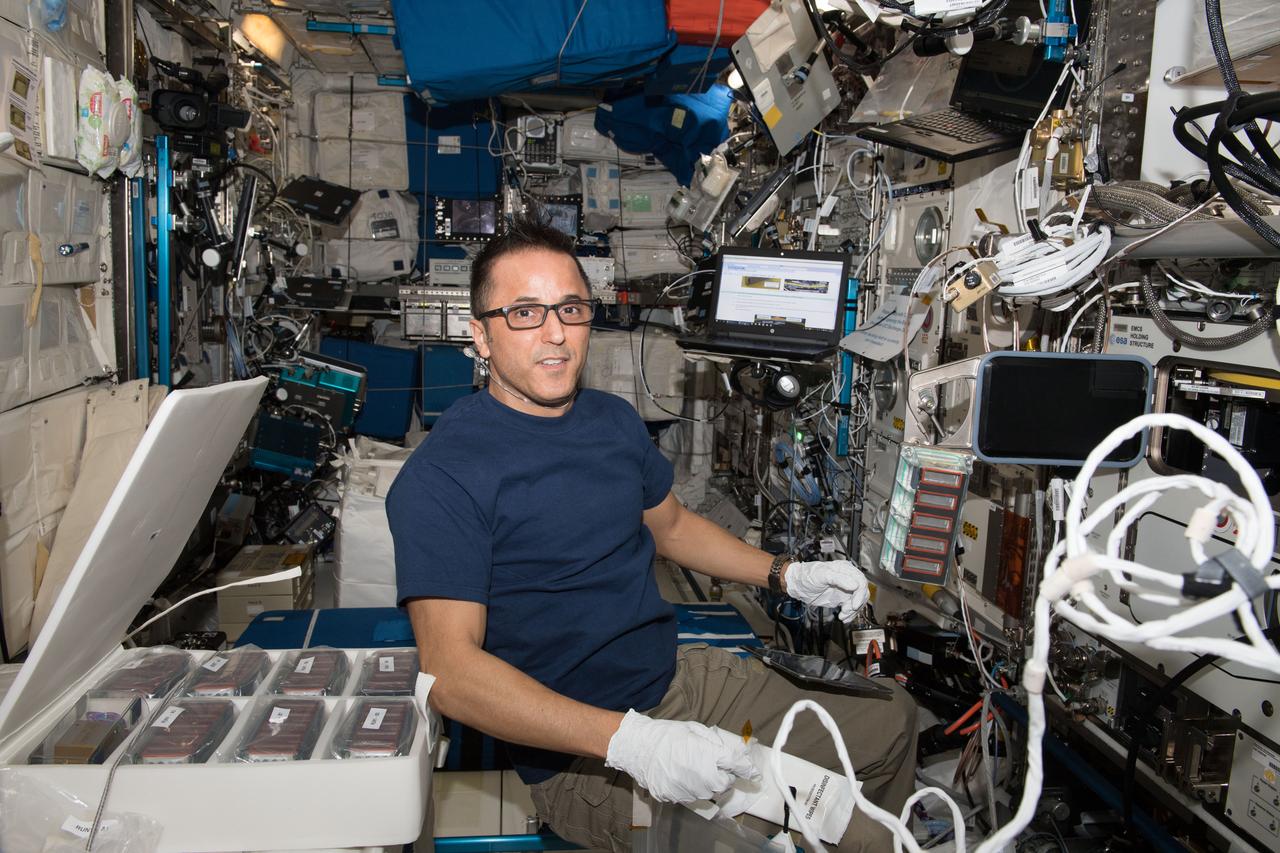
iss054e023797 (Jan. 26, 2018) --- NASA astronaut Joe Acaba with an Experiment Container (EC) to begin the Plant Gravity Perception experiment, testing the gravity-sensing ability of plants in microgravity.

View of Human Research Facility (HRF) Containment Bag,Part Number (P/N): SDD46107234-306,Serial Number (S/N): 1240. Photo was taken during Expedition 34.

Lengthy detective work from data collected by NASA rover Spirit confirmed that an outcrop called Comanche contains a mineral indicating that a past environment was wet and non-acidic, possibly favorable to life.

View of open food container floating in the Node 1. Cargo Transfer Bags (CTBs) are visible in the background. Photo was taken during Expedition 34.
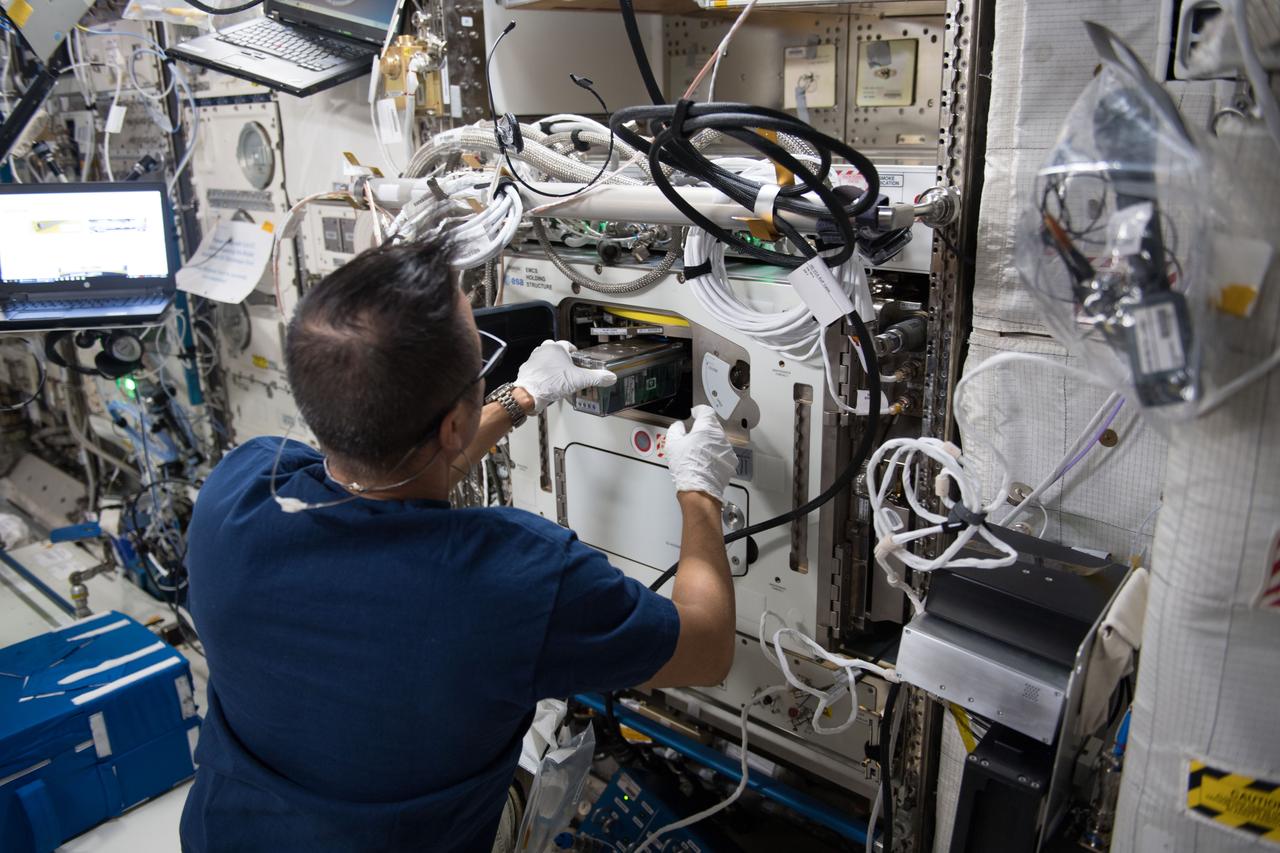
iss054e023800 (Jan. 26, 2018) --- NASA astronaut Joe Acaba placing an Experiment Container (EC) on the European Modular Cultivation System (EMCS) for the the first run of the Plant Gravity Perception experiment to test the gravity-sensing ability of plants in microgravity.
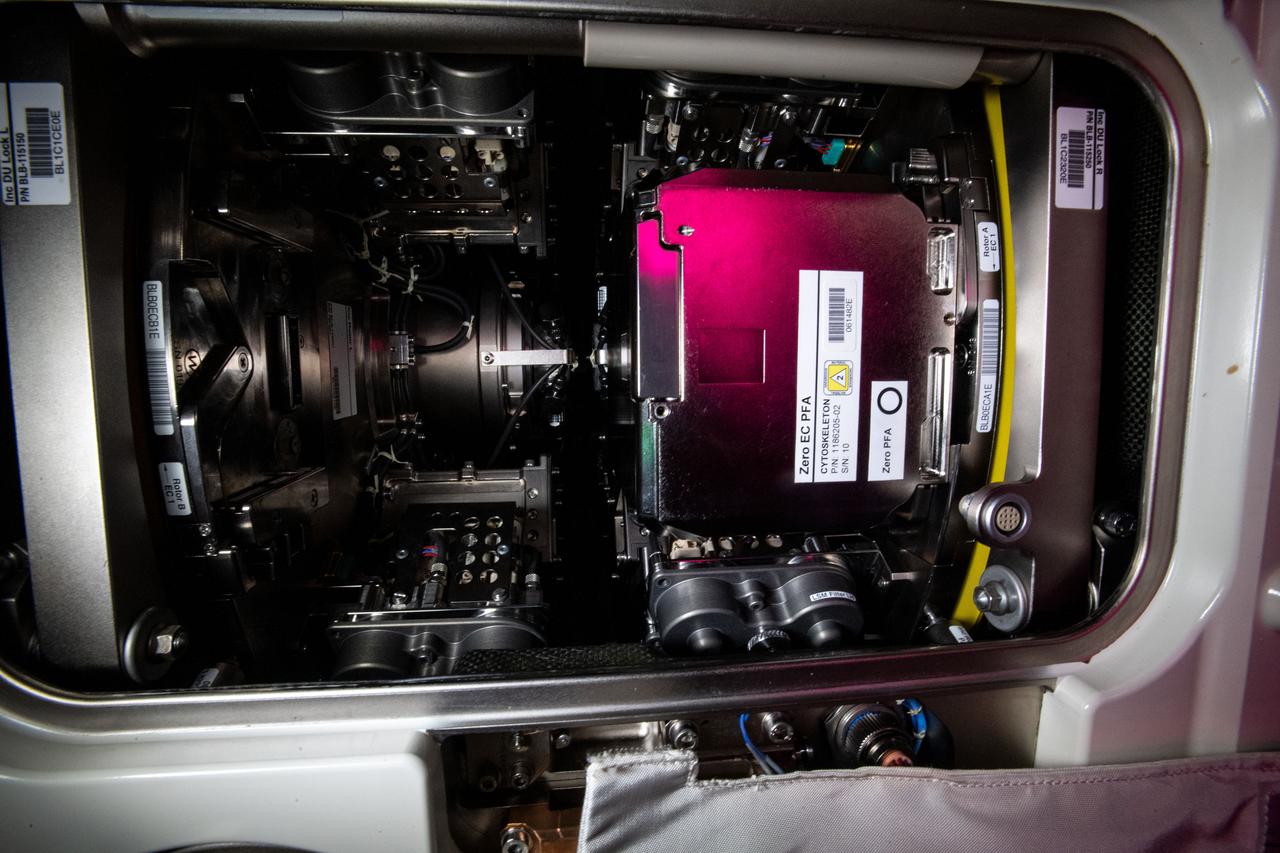
iss066e098812 (12/30/2021) --- A view during installation of the Cytoskeleton experiment containers installed on the BIOLAB Rotor during Expedition 66. This investigation helps to understand the way in which the human body responds to microgravity, which could feed into the development of future countermeasures to help maintain an optimal level of crew member health and performance.
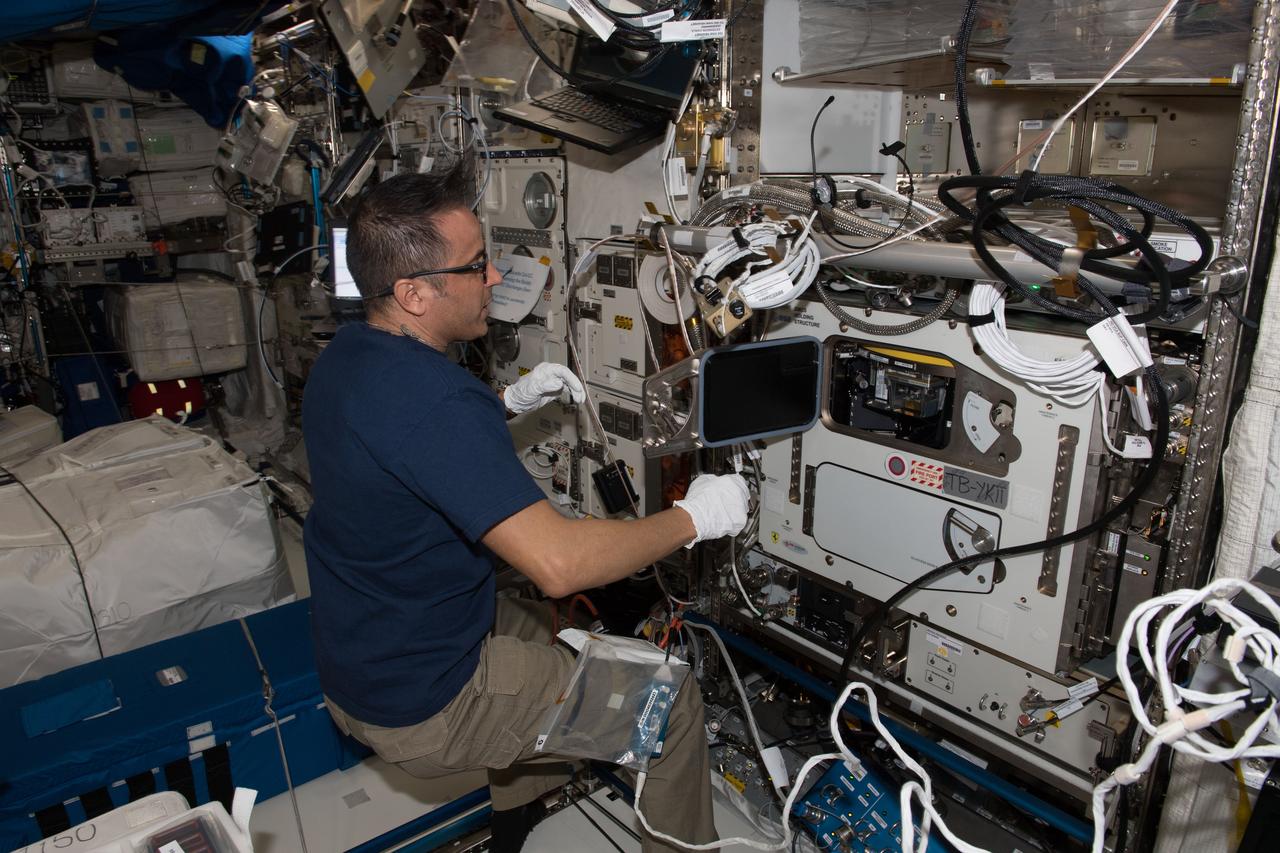
iss054e023776 (Jan. 26, 2018) --- NASA astronaut Joe Acaba removing an Experiment Container (EC) on the European Modular Cultivation System (EMCS) for the the first run of the Plant Gravity Perception experiment to test the gravity-sensing ability of plants in microgravity.

ISS038-E-043150 (8 Feb. 2014) --- Russian cosmonaut Sergey Ryazanskiy, Expedition 38 flight engineer, unpacks storage containers from the ISS Progress 54 cargo spacecraft, which docked to the Pirs docking compartment of the International Space Station on Feb. 5, 2014.
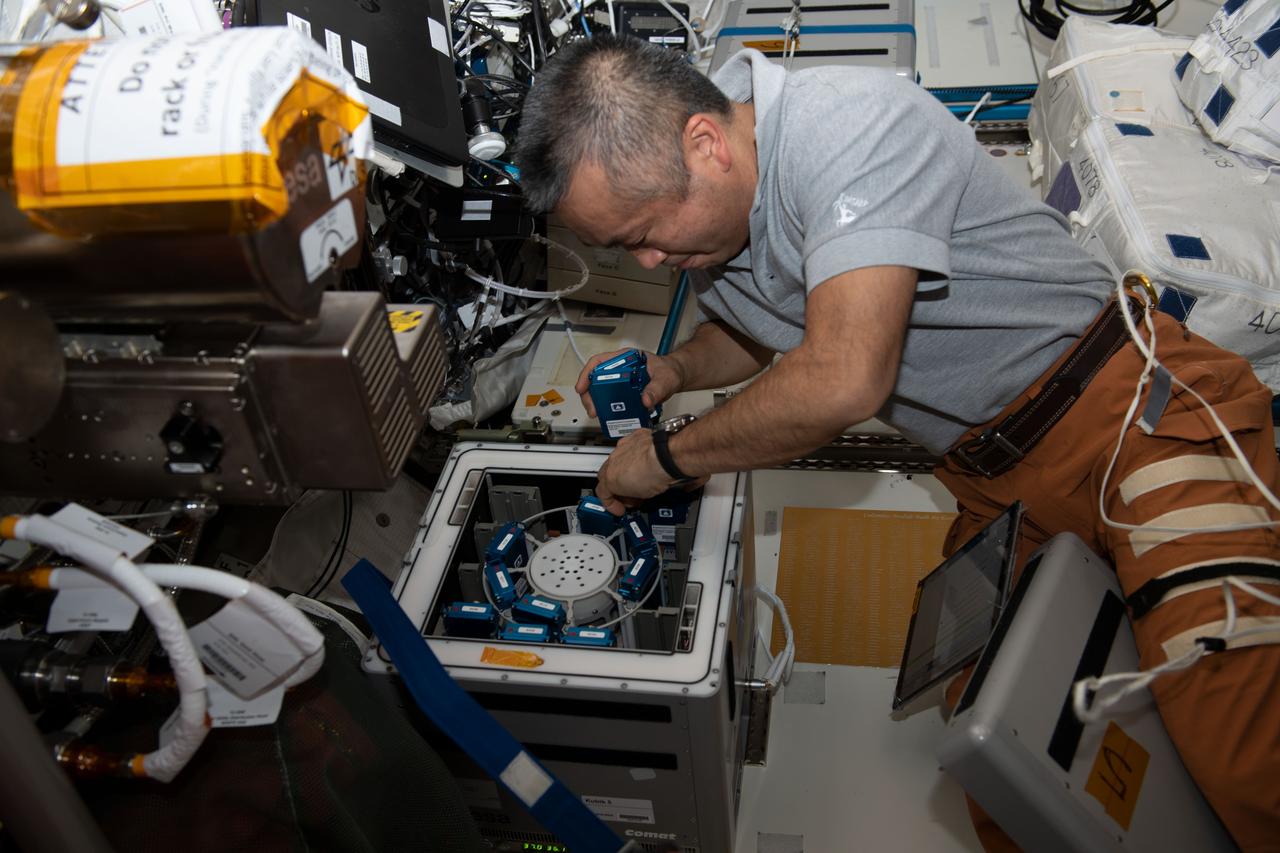
iss068e021831 (Nov. 14, 2022) --- Astronaut and Expedition 68 Flight Engineer Koichi Wakata of the Japan Aerospace Exploration Agency (JAXA) removes experiment containers from inside the Columbus laboratory module's Kubik research facility, a temperature-controlled incubator. The experiment containers are part of the Antioxidation Protection experiment that explores neuronal cells involved in the cognitive and motor functions of humans both in space and on Earth. Credit: Nicole Mann/NASA
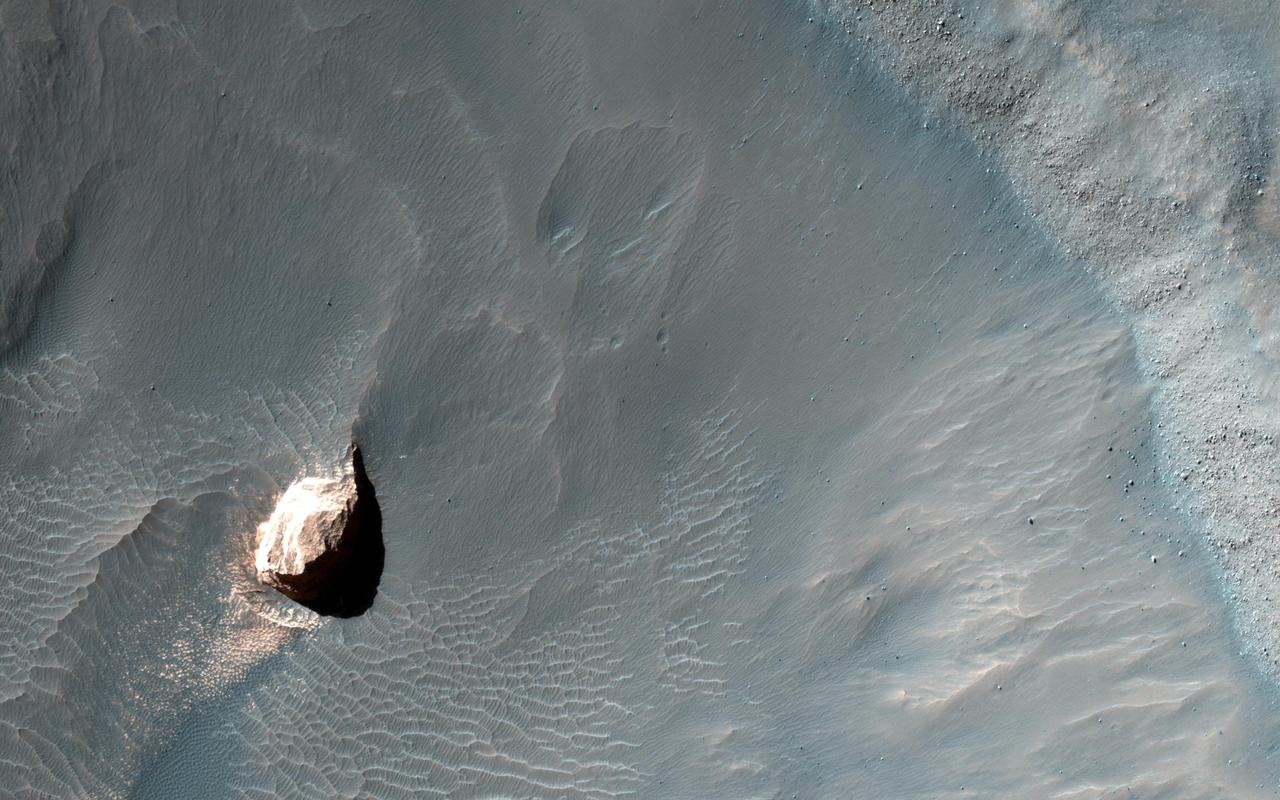
This observation captured by NASA Mars Reconnaissance Orbiter shows a small crater in within the much larger Pollack Crater containing light-toned material.
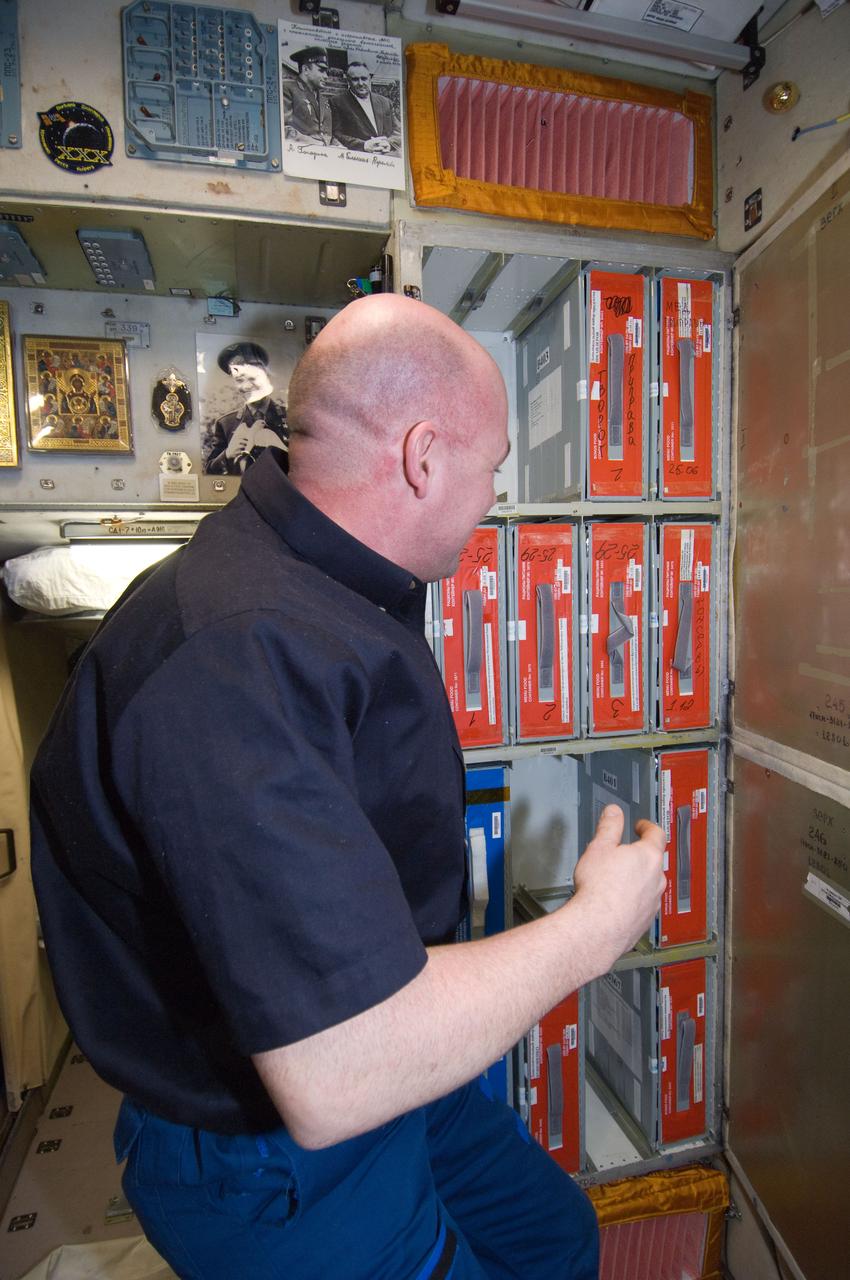
ISS030-E-178069 (28 March 2012) --- European Space Agency astronaut Andre Kuipers, Expedition 30 flight engineer, is pictured near food storage containers in the Zvezda Service Module of the International Space Station.
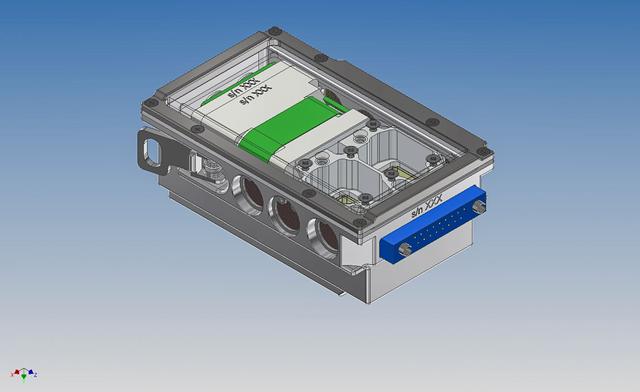
jsc2019e039823 (7/19/2019) --- A CAD image showing the structure of the bioreactor in the BioRock experiment within its experimental container. The two culture chambers are visible along with the body of the unit, which contains media and fixative. (Image Courtesy of: ESA)
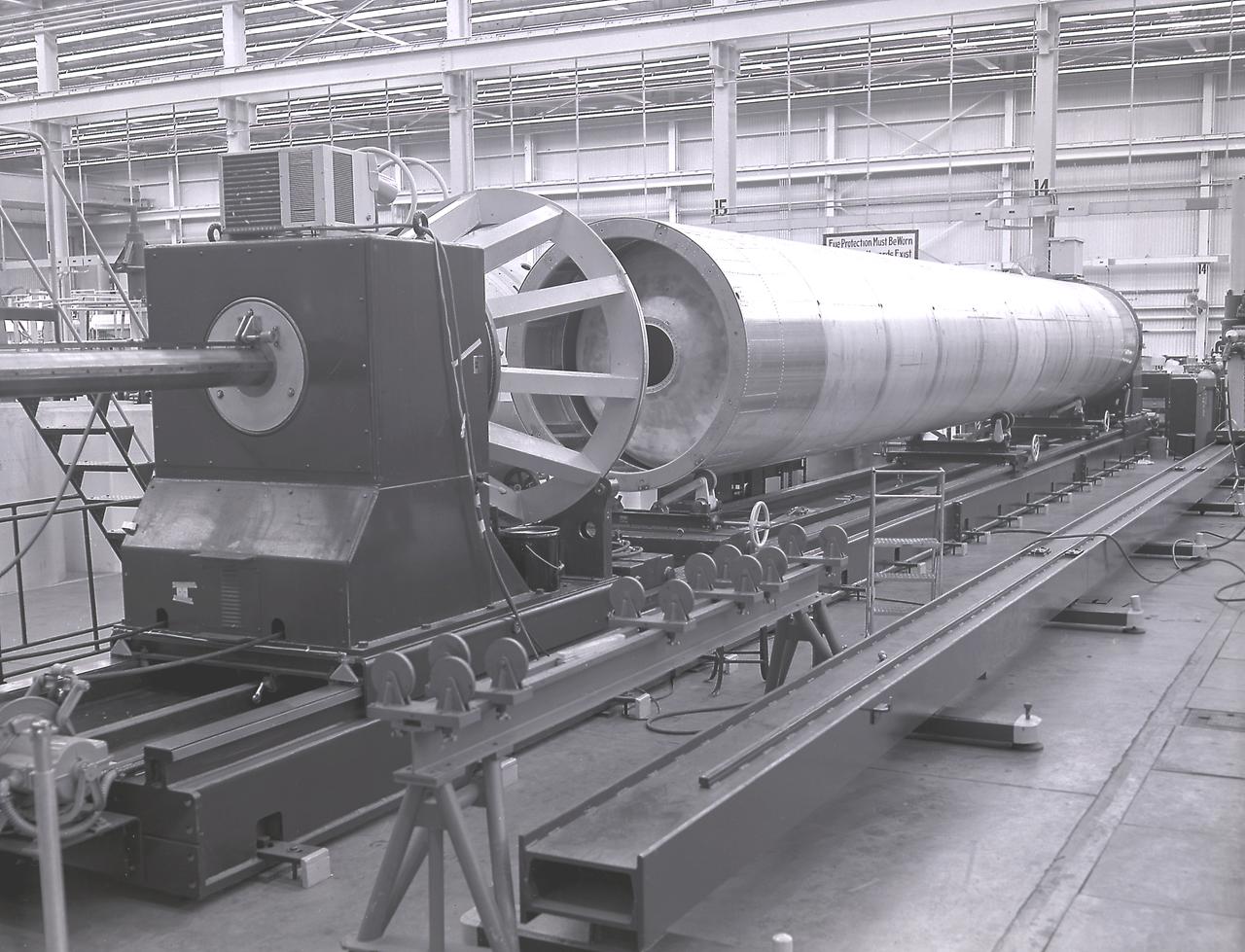
The first circumferential welding being applied on a Saturn fuel container in the Army Ballistic Missile Agency (ABMA) fabrication laboratory, Building 4707, in May 1959.

This is an illustration of a supermassive black hole, weighing as much as 21 million suns, located in the middle of the ultradense galaxy M60-UCD1. The dwarf galaxy is so dense that millions of stars fill the sky as seen by an imaginary visitor. Because no light can escape from the black hole, it appears simply in silhouette against the starry background. The black hole's intense gravitational field warps the light of the background stars to form ring-like images just outside the dark edges of the black hole's event horizon. Combined observations by the Hubble Space Telescope and Gemini North telescope determined the presence of the black hole inside such a small and dense galaxy. More info: Astronomers using data from NASA’s Hubble Space Telescope and ground observation have found an unlikely object in an improbable place -- a monster black hole lurking inside one of the tiniest galaxies ever known. The black hole is five times the mass of the one at the center of our Milky Way galaxy. It is inside one of the densest galaxies known to date -- the M60-UCD1 dwarf galaxy that crams 140 million stars within a diameter of about 300 light-years, which is only 1/500th of our galaxy’s diameter. If you lived inside this dwarf galaxy, the night sky would dazzle with at least 1 million stars visible to the naked eye. Our nighttime sky as seen from Earth’s surface shows 4,000 stars. The finding implies there are many other compact galaxies in the universe that contain supermassive black holes. The observation also suggests dwarf galaxies may actually be the stripped remnants of larger galaxies that were torn apart during collisions with other galaxies rather than small islands of stars born in isolation. “We don’t know of any other way you could make a black hole so big in an object this small,” said University of Utah astronomer Anil Seth, lead author of an international study of the dwarf galaxy published in Thursday’s issue of the journal Nature. Seth’s team of astronomers used the Hubble Space Telescope and the Gemini North 8-meter optical and infrared telescope on Hawaii’s Mauna Kea to observe M60-UCD1 and measure the black hole’s mass. The sharp Hubble images provide information about the galaxy’s diameter and stellar density. Gemini measures the stellar motions as affected by the black hole’s pull. These data are used to calculate the mass of the black hole. Black holes are gravitationally collapsed, ultra-compact objects that have a gravitational pull so strong that even light cannot escape. Supermassive black holes -- those with the mass of at least one million stars like our sun -- are thought to be at the centers of many galaxies. The black hole at the center of our Milky Way galaxy has the mass of four million suns. As heavy as that is, it is less than 0.01 percent of the Milky Way’s total mass. By comparison, the supermassive black hole at the center of M60-UCD1, which has the mass of 21 million suns, is a stunning 15 percent of the small galaxy’s total mass. “That is pretty amazing, given that the Milky Way is 500 times larger and more than 1,000 times heavier than the dwarf galaxy M60-UCD1,” Seth said. One explanation is that M60-UCD1 was once a large galaxy containing 10 billion stars, but then it passed very close to the center of an even larger galaxy, M60, and in that process all the stars and dark matter in the outer part of the galaxy were torn away and became part of M60. The team believes that M60-UCD1 may eventually be pulled to fully merge with M60, which has its own monster black hole that weighs a whopping 4.5 billion solar masses, or more than 1,000 times bigger than the black hole in our galaxy. When that happens, the black holes in both galaxies also likely will merge. Both galaxies are 50 million light-years away. The Hubble Space Telescope is a project of international cooperation between NASA and the European Space Agency. NASA's Goddard Space Flight Center in Greenbelt, Maryland, manages the telescope. The Space Telescope Science Institute (STScI) in Baltimore conducts Hubble science operations. STScI is operated for NASA by the Association of Universities for Research in Astronomy, Inc., in Washington. For images and more information about Hubble, visit: <a href="http://www.nasa.gov/hubble" rel="nofollow">www.nasa.gov/hubble</a> <b><a href="http://www.nasa.gov/audience/formedia/features/MP_Photo_Guidelines.html" rel="nofollow">NASA image use policy.</a></b> <b><a href="http://www.nasa.gov/centers/goddard/home/index.html" rel="nofollow">NASA Goddard Space Flight Center</a></b> enables NASA’s mission through four scientific endeavors: Earth Science, Heliophysics, Solar System Exploration, and Astrophysics. Goddard plays a leading role in NASA’s accomplishments by contributing compelling scientific knowledge to advance the Agency’s mission. <b>Follow us on <a href="http://twitter.com/NASAGoddardPix" rel="nofollow">Twitter</a></b> <b>Like us on <a href="http://www.facebook.com/pages/Greenbelt-MD/NASA-Goddard/395013845897?ref=tsd" rel="nofollow">Facebook</a></b> <b>Find us on <a href="http://instagram.com/nasagoddard?vm=grid" rel="nofollow">Instagram</a></b>
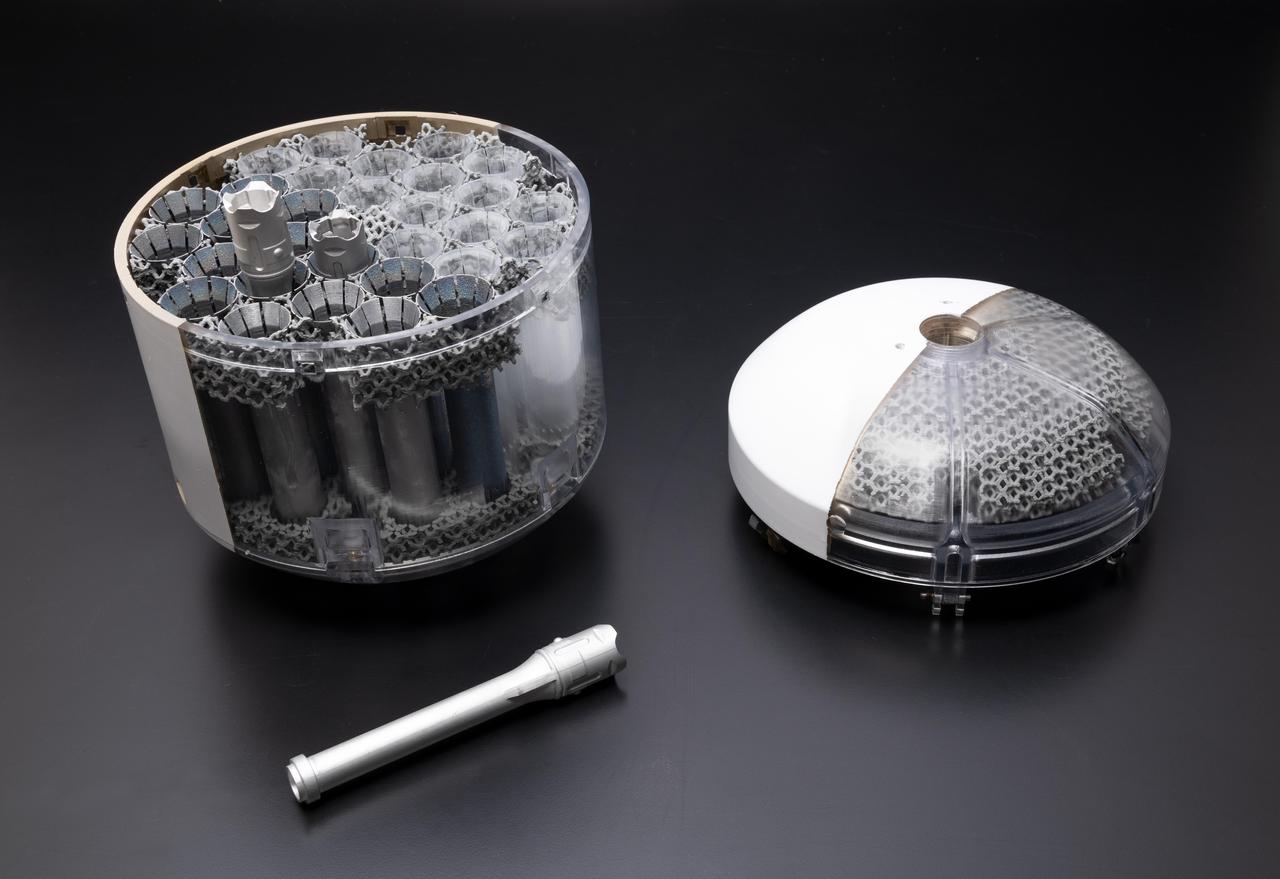
This image shows a concept model of NASA's orbiting sample container, which will hold tubes of Martian rock and soil samples that will be returned to Earth through a Mars sample return campaign. At right is the lid; bottom left sits a model of the sample-holding tube. The sample container will help keep contents at less than about 86 degrees Fahrenheit (30 degrees Celsius) to help preserve the Mars material in its most natural state. NASA and the European Space Agency (ESA) are solidifying concepts for a Mars sample return mission after NASA's Mars 2020 rover collects rock and soil samples and stores them in sealed tubes on the planet's surface for future return to Earth. In the new campaign, NASA will deliver a Mars lander in the vicinity of Jezero Crater, where Mars 2020 will have collected and cached samples. The lander will carry a NASA rocket (the Mars Ascent Vehicle) along with an ESA Sample Fetch Rover that is roughly the size of NASA's Opportunity Mars rover. The fetch rover will gather the cached samples and carry them back to the lander for transfer to an orbiting sample container embedded in the ascent vehicle; additional samples could also be delivered directly by Mars 2020. The ascent vehicle will then launch the container holding the samples into Mars orbit. ESA will put a spacecraft in orbit around Mars before the ascent vehicle launches. This spacecraft will rendezvous with the orbiting sample container and also carry a NASA payload that can capture and contain the sample container before returning the samples to Earth. https://photojournal.jpl.nasa.gov/catalog/PIA23712
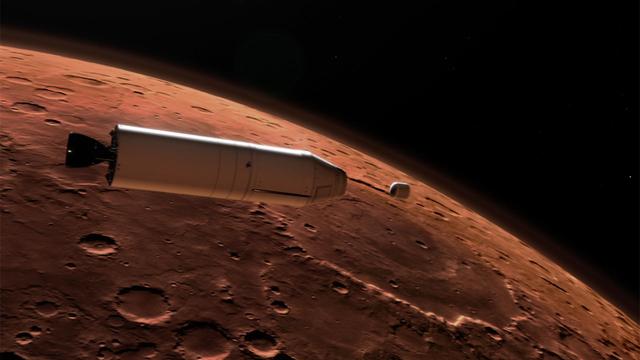
As part of a Mars sample return mission, a rocket will carry a container of sample tubes with Martian rock and soil samples into orbit around Mars and release it for pick up by another spacecraft. This illustration shows a concept for a Mars Ascent Vehicle (left) releasing a sample container (right) high above the Martian surface. NASA and the European Space Agency are solidifying concepts for a Mars sample return mission after NASA's Mars 2020 rover collects rock and soil samples and stores them in sealed tubes on the planet's surface for potential future return to Earth. NASA will deliver a Mars lander in the vicinity of Jezero Crater, where Mars 2020 will have collected and cached samples. The lander will carry a NASA rocket (the Mars Ascent Vehicle) along with an ESA Sample Fetch Rover that is roughly the size of NASA's Opportunity Mars rover. The fetch rover will gather the cached samples and carry them back to the lander for transfer to the ascent vehicle; additional samples could also be delivered directly by Mars 2020. The ascent vehicle will then launch from the surface and deploy a special container holding the samples into Mars orbit. ESA will put a spacecraft in orbit around Mars before the ascent vehicle launches. This spacecraft will rendezvous with and capture the orbiting samples before returning them to Earth. NASA will provide the payload module for the orbiter. https://photojournal.jpl.nasa.gov/catalog/PIA23500
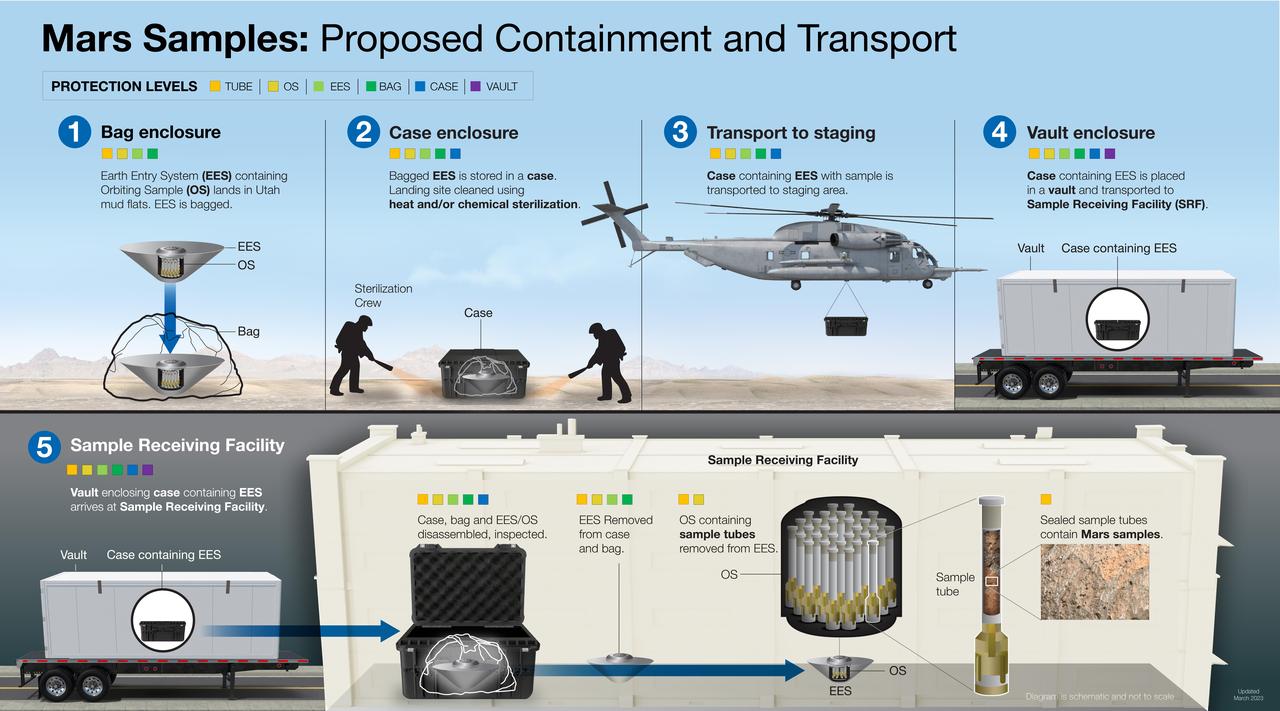
This illustration shows the proposed process for safely recovering, containing, and transporting Mars samples gathered by NASA's Perseverance Mars rover after they are returned to Earth as part of the joint NASA/ESA (European Space Agency) Mars Sample Return Campaign. The process of carefully containing and handling the samples would begin long before they arrive on Earth. Every phase of the Mars Sample Return campaign from collection and sealing to launch, transfer, and landing has been developed with a "safety first" approach. Sample handling and curation experts would be involved in planning for the round trip at each phase of the campaign. After its journey back to Earth from Mars on the ESA-provided Earth Return Orbiter, the capsule containing the samples would land at the Utah Test and Training Range in west-central Utah. NASA would securely transport the capsule and its contents to a Sample Return Facility at a location to be determined. Once at the facility, the samples would undergo a rigorous process to assess whether they are safe for release for detailed analysis by scientists from around the world. https://photojournal.jpl.nasa.gov/catalog/PIA25857

ISS038-E-043144 (8 Feb. 2014) --- Russian cosmonauts Mikhail Tyurin and Sergey Ryazanskiy (background), both Expedition 38 flight engineers, unpack storage containers from the ISS Progress 54 cargo spacecraft, which docked to the Pirs docking compartment of the International Space Station on Feb. 5, 2014.
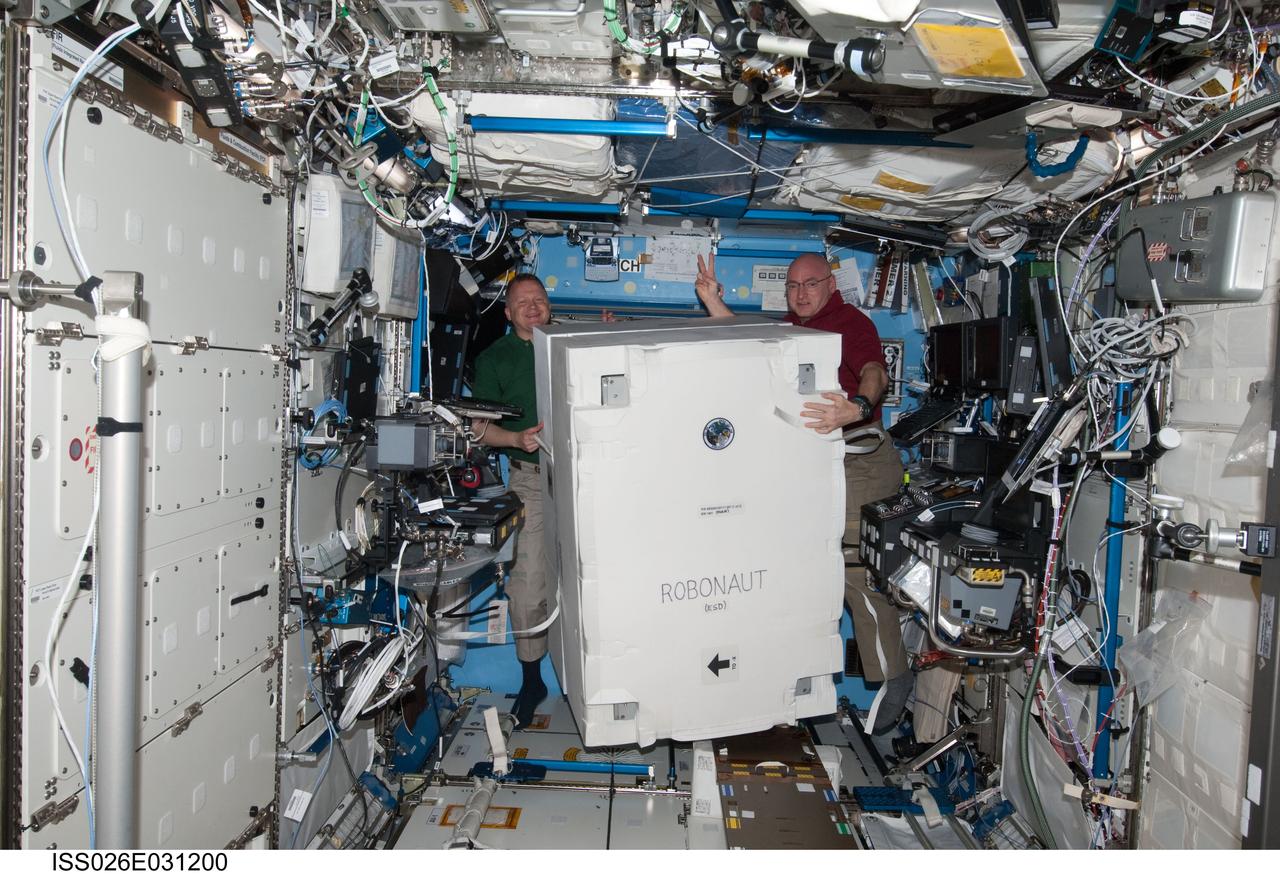
ISS026-E-031200 (2 March 2011) --- NASA astronauts Eric Boe (left), STS-133 pilot; and Scott Kelly, Expedition 26 commander, move the Robonaut2 container in the Destiny laboratory of the International Space Station while space shuttle Discovery remains docked with the station.
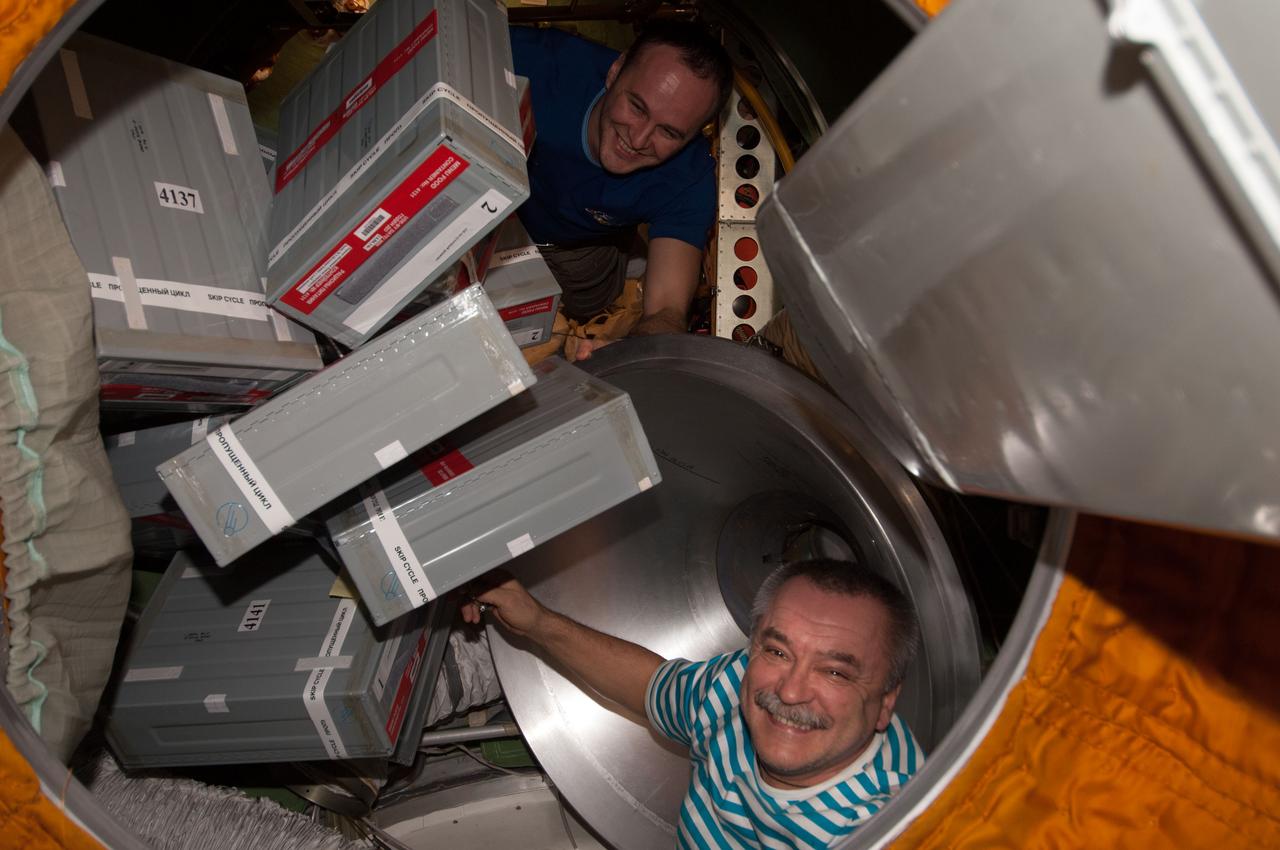
ISS038-E-043146 (8 Feb. 2014) --- Russian cosmonauts Mikhail Tyurin and Sergey Ryazanskiy (background), both Expedition 38 flight engineers, unpack storage containers from the ISS Progress 54 cargo spacecraft, which docked to the Pirs docking compartment of the International Space Station on Feb. 5, 2014.
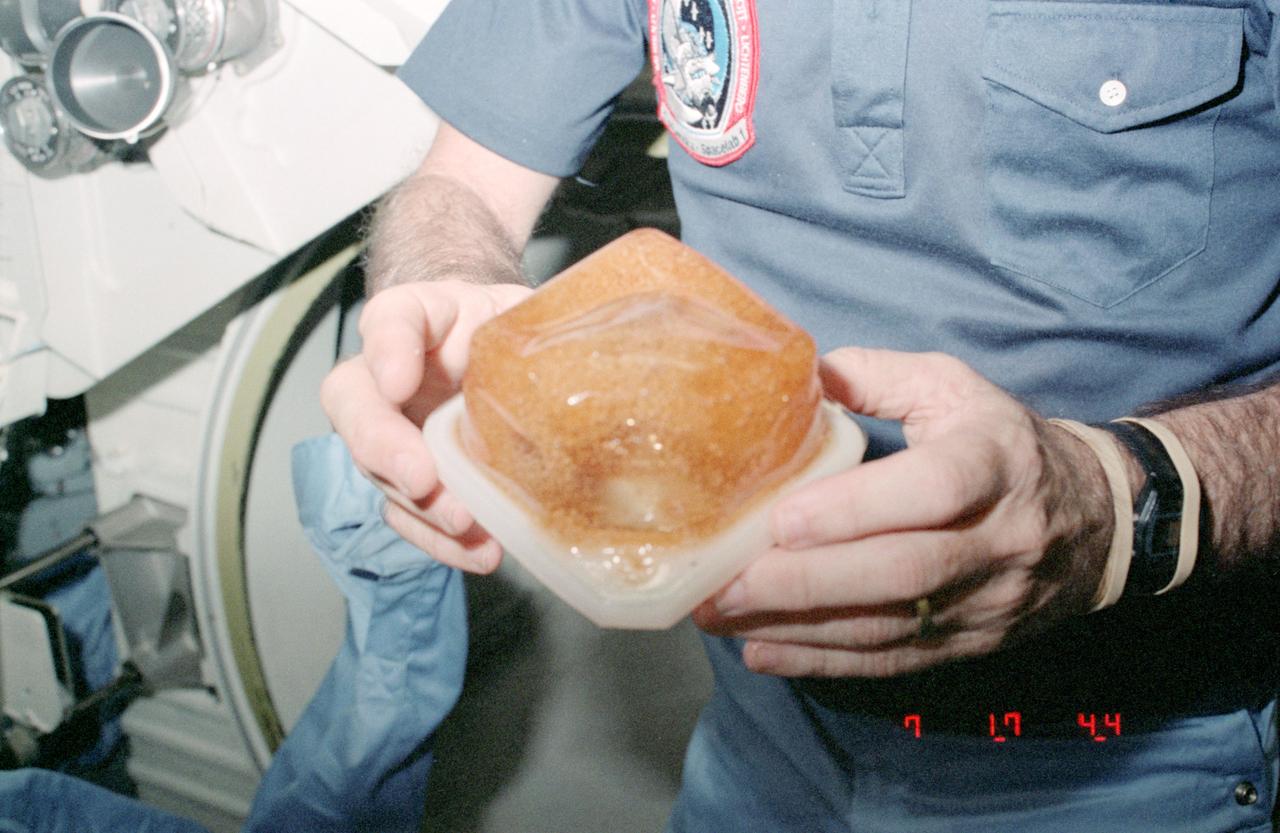
STS009-126-456 (28 Nov 1983) --- Water and coffee in beverage container during STS-9 flight. An extra amount of hydrogen in the H2O is believed to be the reason for the bubbling, distended effect in the container.
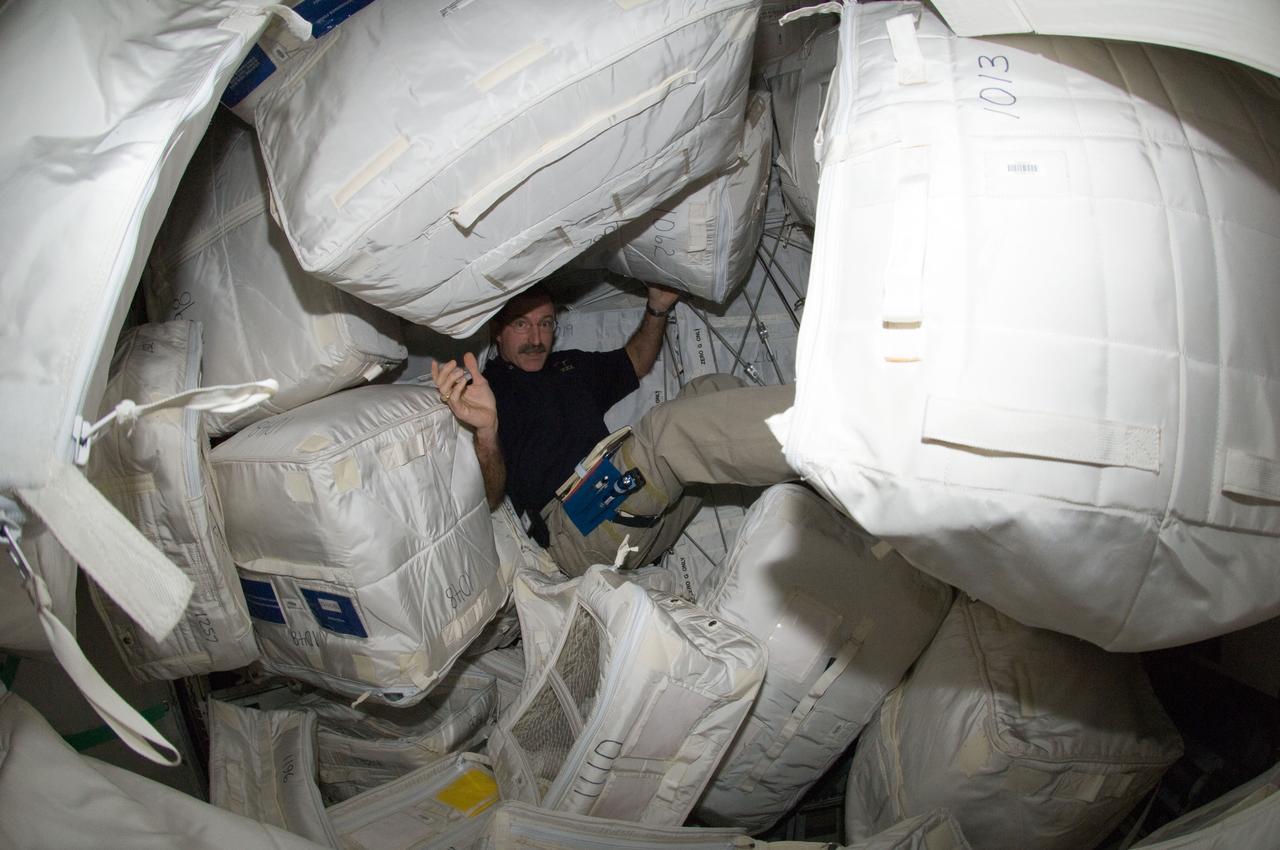
ISS030-E-115935 (2 March 2012) --- NASA astronaut Dan Burbank, Expedition 30 commander, is pictured among stowage containers in the Leonardo Permanent Multipurpose Module (PMM) of the International Space Station.
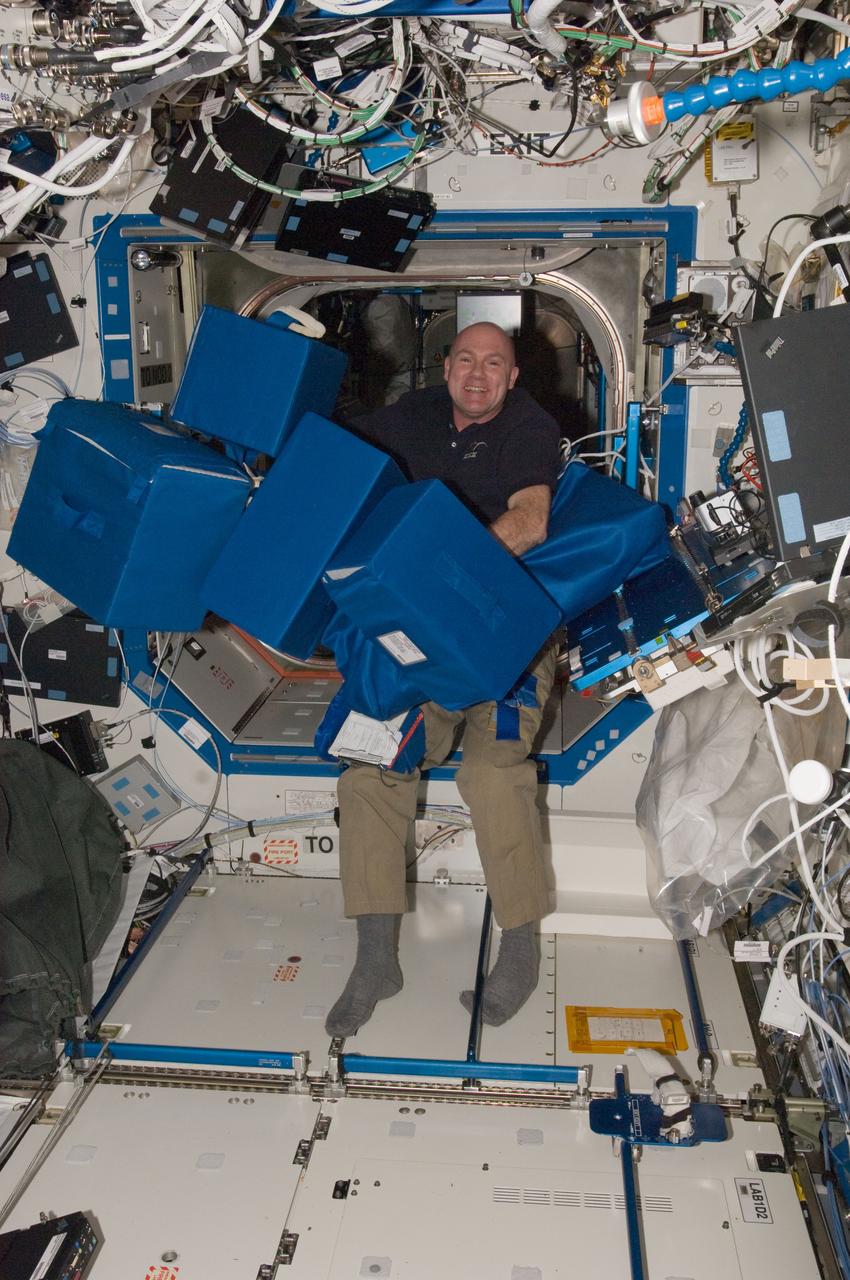
ISS030-E-032797 (16 Jan. 2012) --- European Space Agency astronaut Andre Kuipers, Expedition 30 flight engineer, moves storage containers in the Destiny laboratory of the International Space Station.
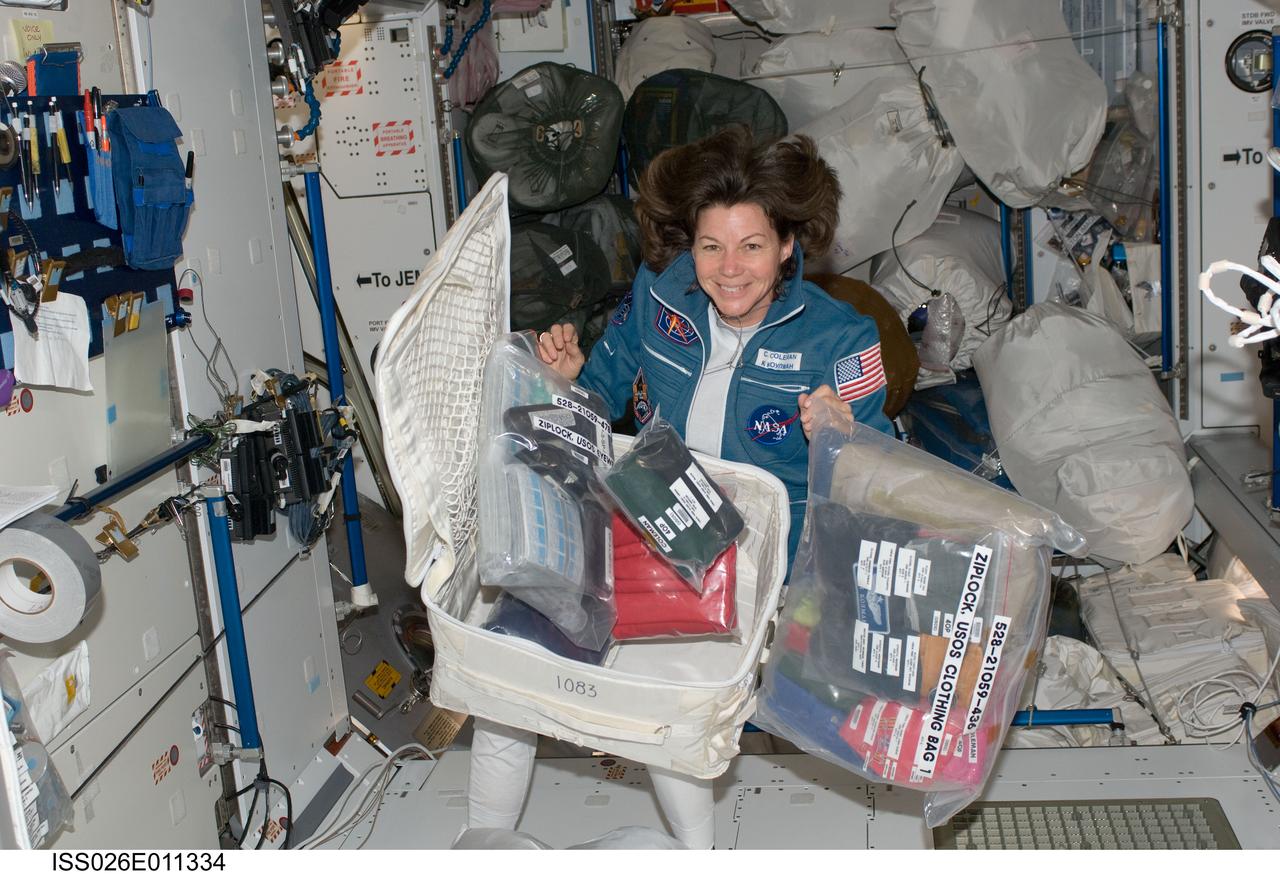
ISS026-E-011334 (18 Dec. 2010) --- NASA astronaut Catherine (Cady) Coleman, Expedition 26 flight engineer, is pictured with a stowage container and its contents in the Harmony node of the International Space Station.
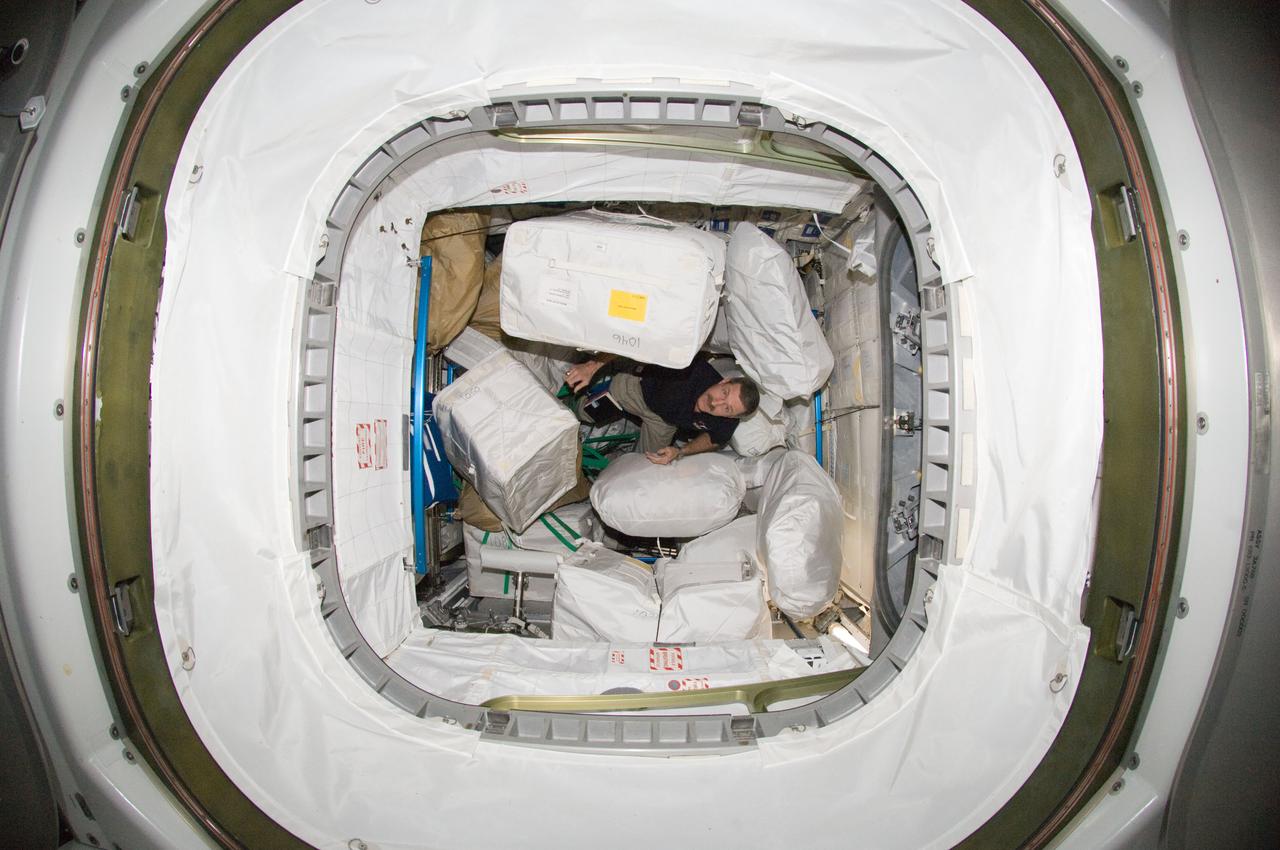
ISS030-E-115930 (2 March 2012) --- NASA astronaut Dan Burbank, Expedition 30 commander, is pictured among stowage containers in the Leonardo Permanent Multipurpose Module (PMM) of the International Space Station.
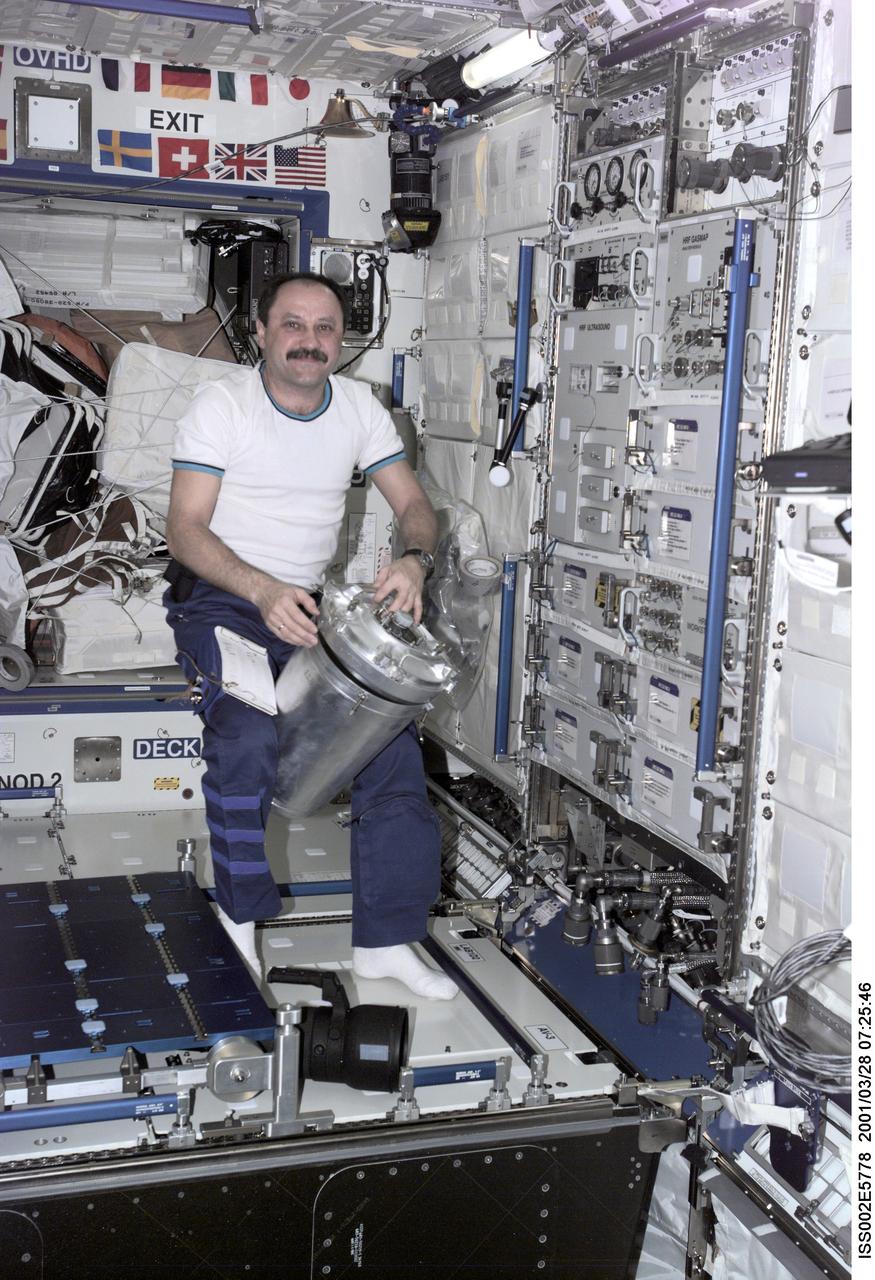
ISS002-E-5778 (28 March 2001) --- Yury V. Usachev of Rosaviakosmos, Expedtion Two mission commander, works with a Russian water container in the Destiny module. The image was taken with a digital still camera.
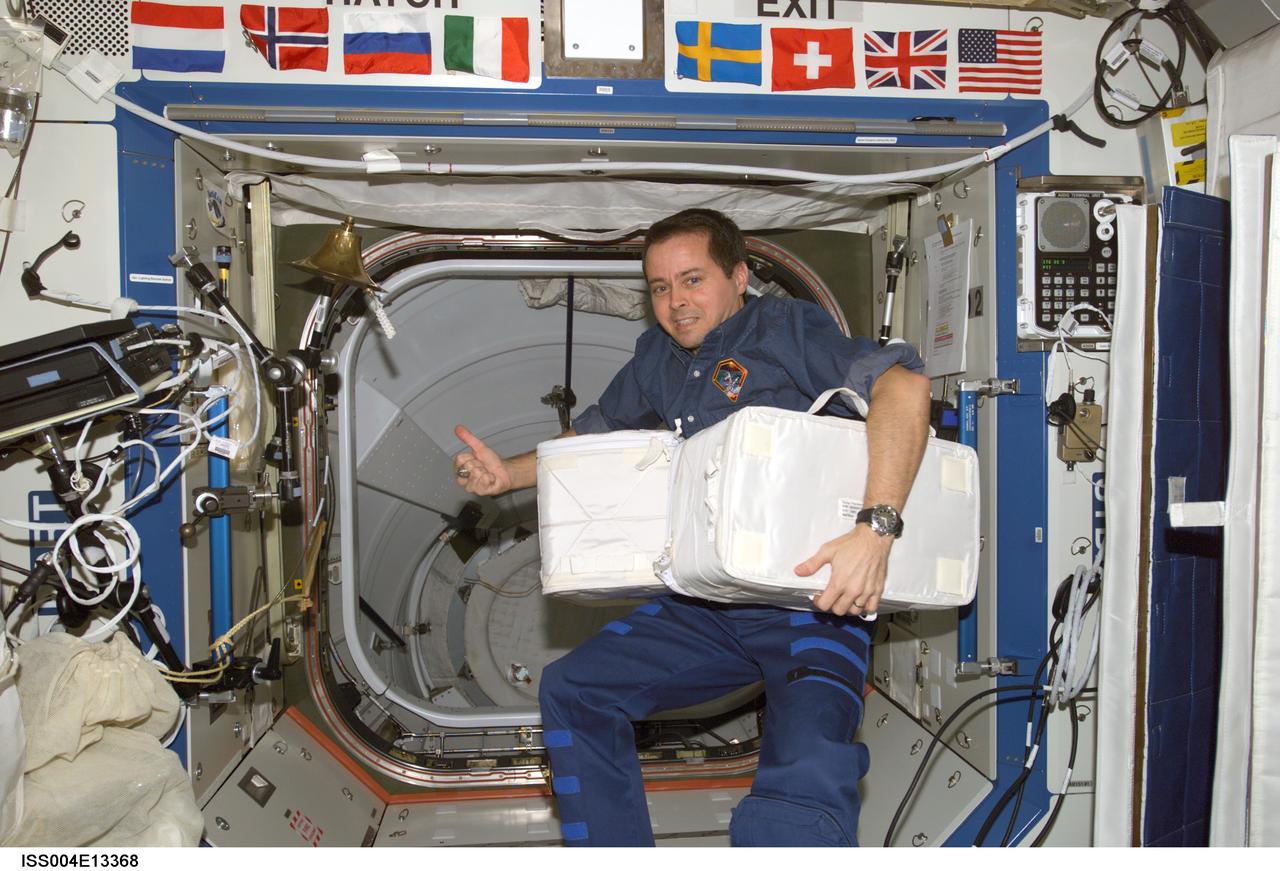
ISS004-E-13368 (June 2002) --- Astronaut Daniel W. Bursch, Expedition Four flight engineer, holds stowage containers in the Destiny laboratory on the International Space Station (ISS).
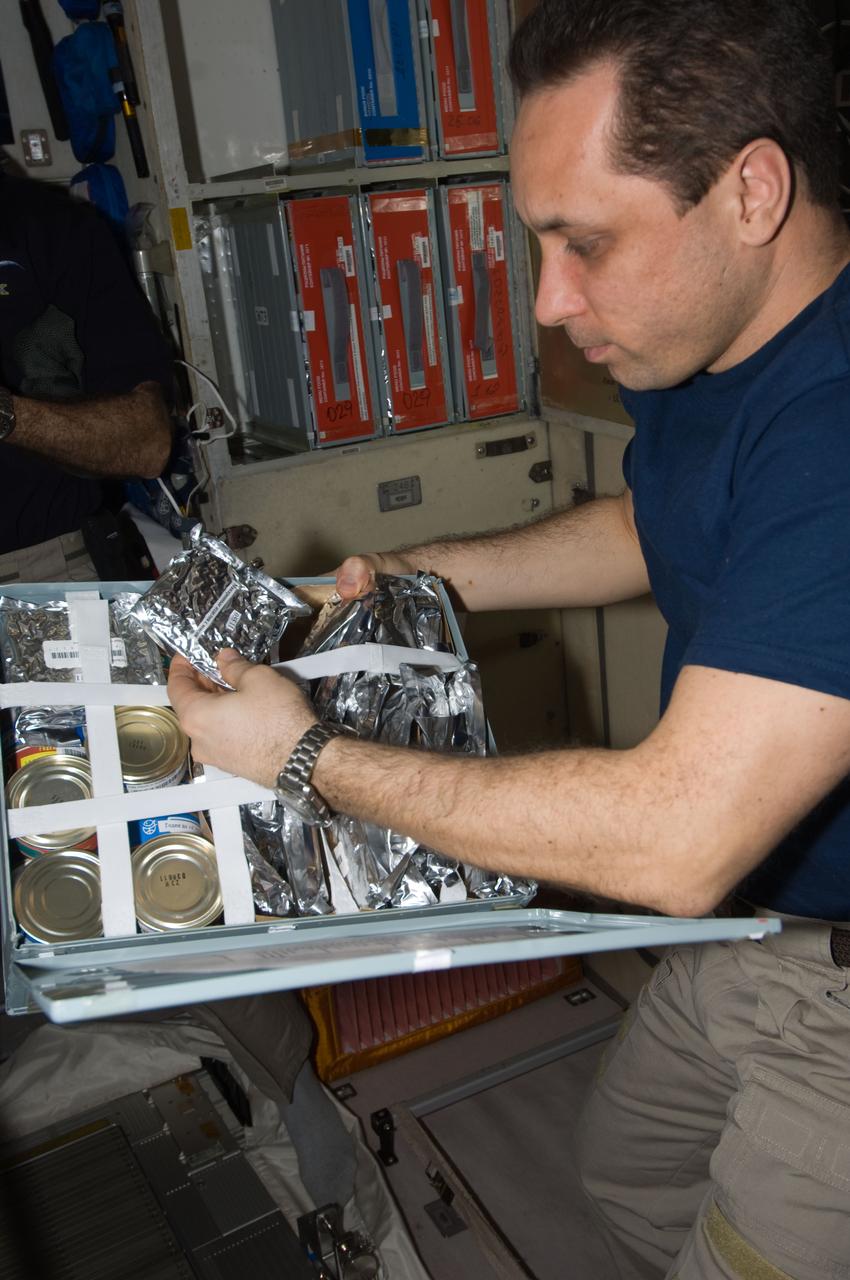
ISS030-E-117514 (3 Feb. 2012) --- Russian cosmonaut Anton Shkaplerov, Expedition 30 flight engineer, makes a selection from a food storage container in the Zvezda Service Module of the International Space Station.
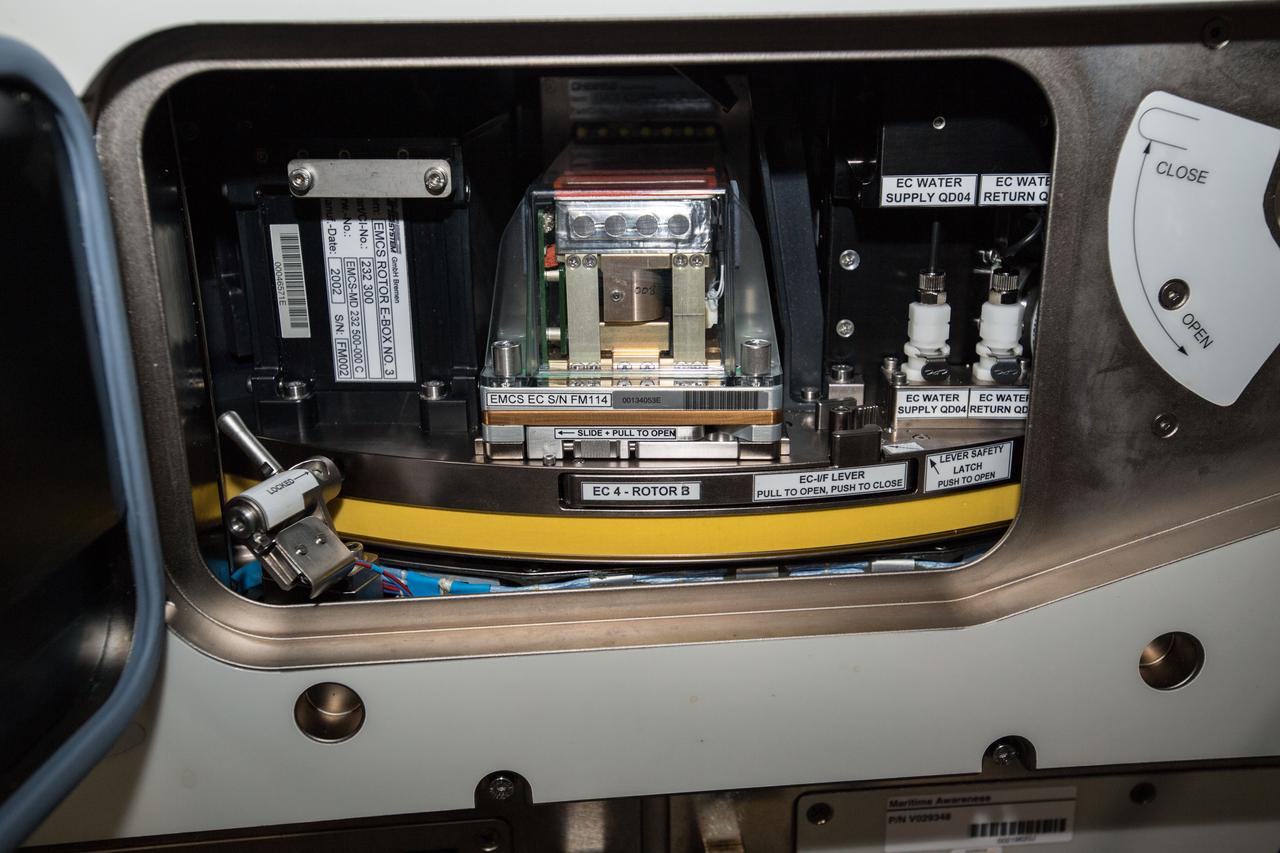
iss054e037079 (Feb. 8, 2018) --- Plant Gravity Perception experiment in a centrifuge on a European Modular Cultivation System (EMCS) Experiment Container (EC) to test the gravity-sensing ability of plants in microgravity.
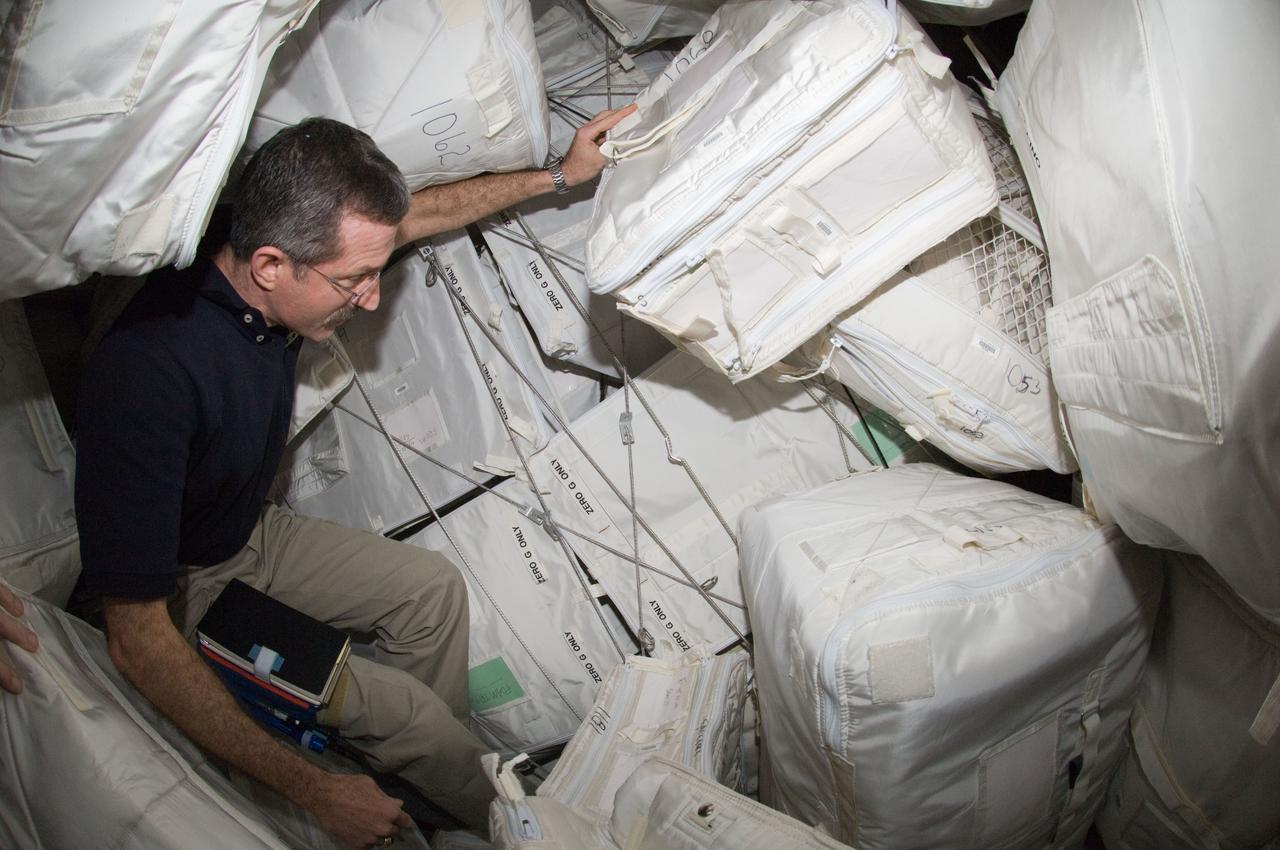
ISS030-E-115939 (2 March 2012) --- NASA astronaut Dan Burbank, Expedition 30 commander, is pictured among stowage containers in the Leonardo Permanent Multipurpose Module (PMM) of the International Space Station.
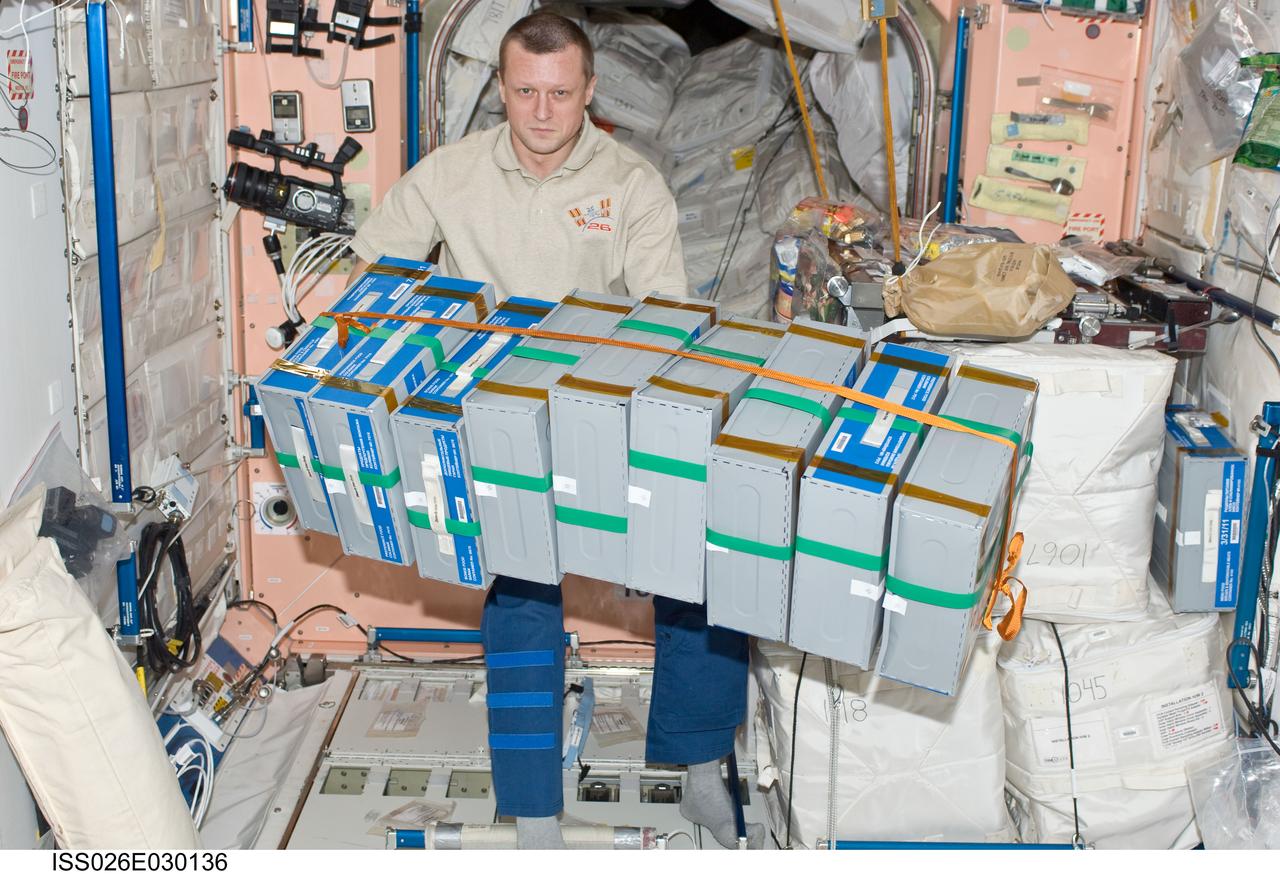
ISS026-E-030136 (25 Feb. 2011) --- Russian cosmonaut Dmitry Kondratyev, Expedition 26 flight engineer, moves stowage containers in the Unity node of the International Space Station.
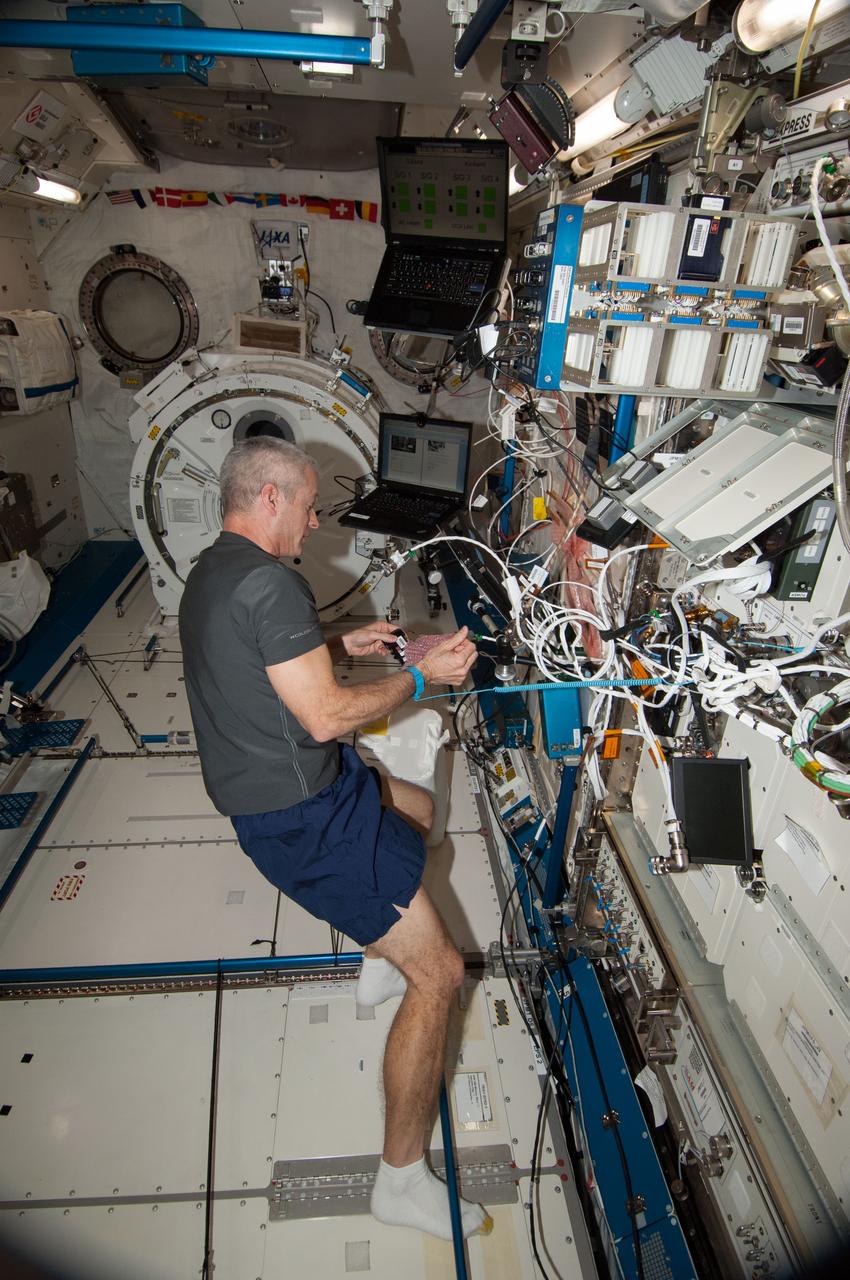
ISS039-E-017568 (30 April 2014) --- NASA astronaut Steve Swanson, Expedition 39 flight engineer, works with NanoRacks hardware in the Kibo laboratory of the Japan Aerospace Exploration Agency (JAXA). He is in the process of inserting BioRack experiment containers and experiment controllers into the BioRack frame. .

ISS026-E-034288 (15 March 2011) --- NASA astronaut Cady Coleman, Expedition 26/27 flight engineer, opens the container that holds Robonaut 2, the dexterous humanoid astronaut helper, in the Destiny laboratory of the International Space Station.
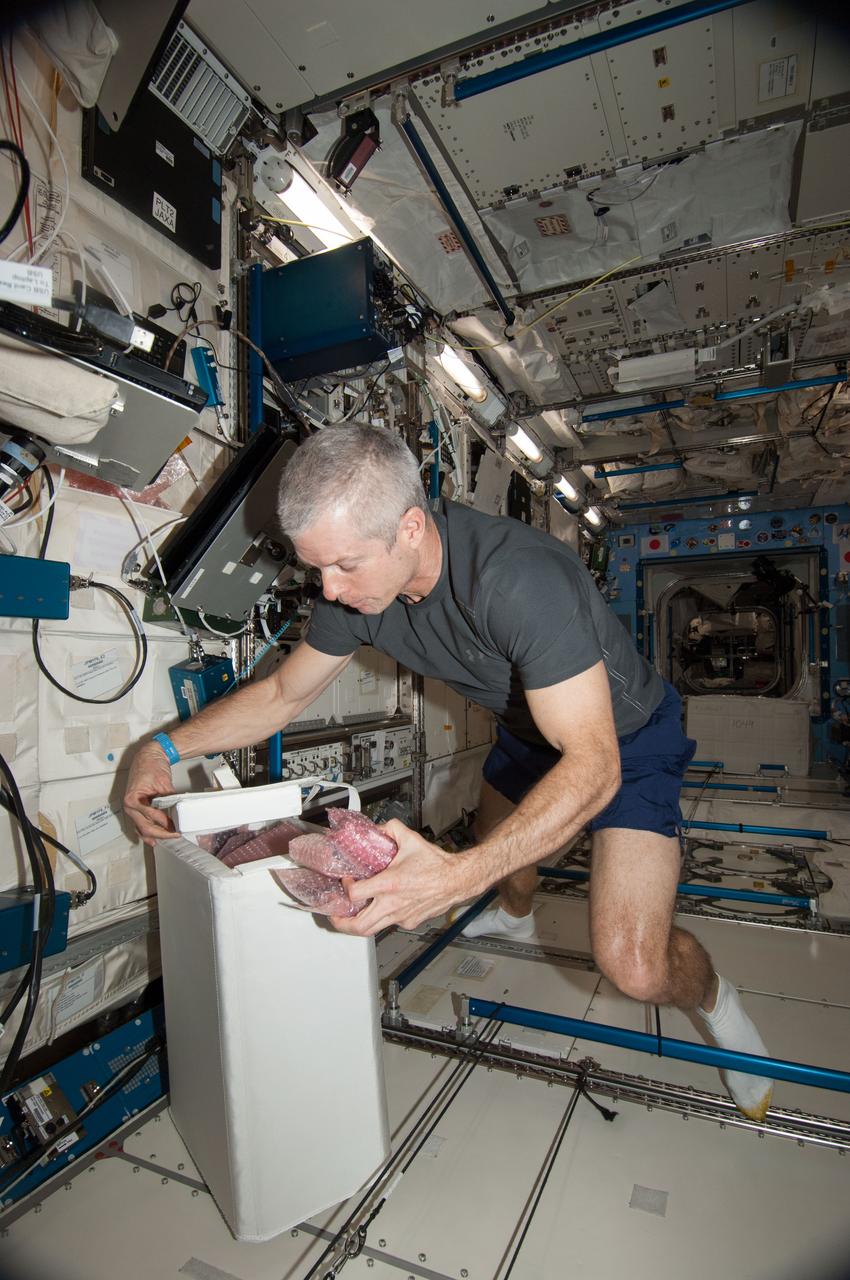
ISS039-E-017566 (30 April 2014) --- NASA astronaut Steve Swanson, Expedition 39 flight engineer, works with NanoRacks hardware in the Kibo laboratory of the Japan Aerospace Exploration Agency (JAXA). He is about to insert BioRack experiment containers and experiment controllers into the BioRack frame.
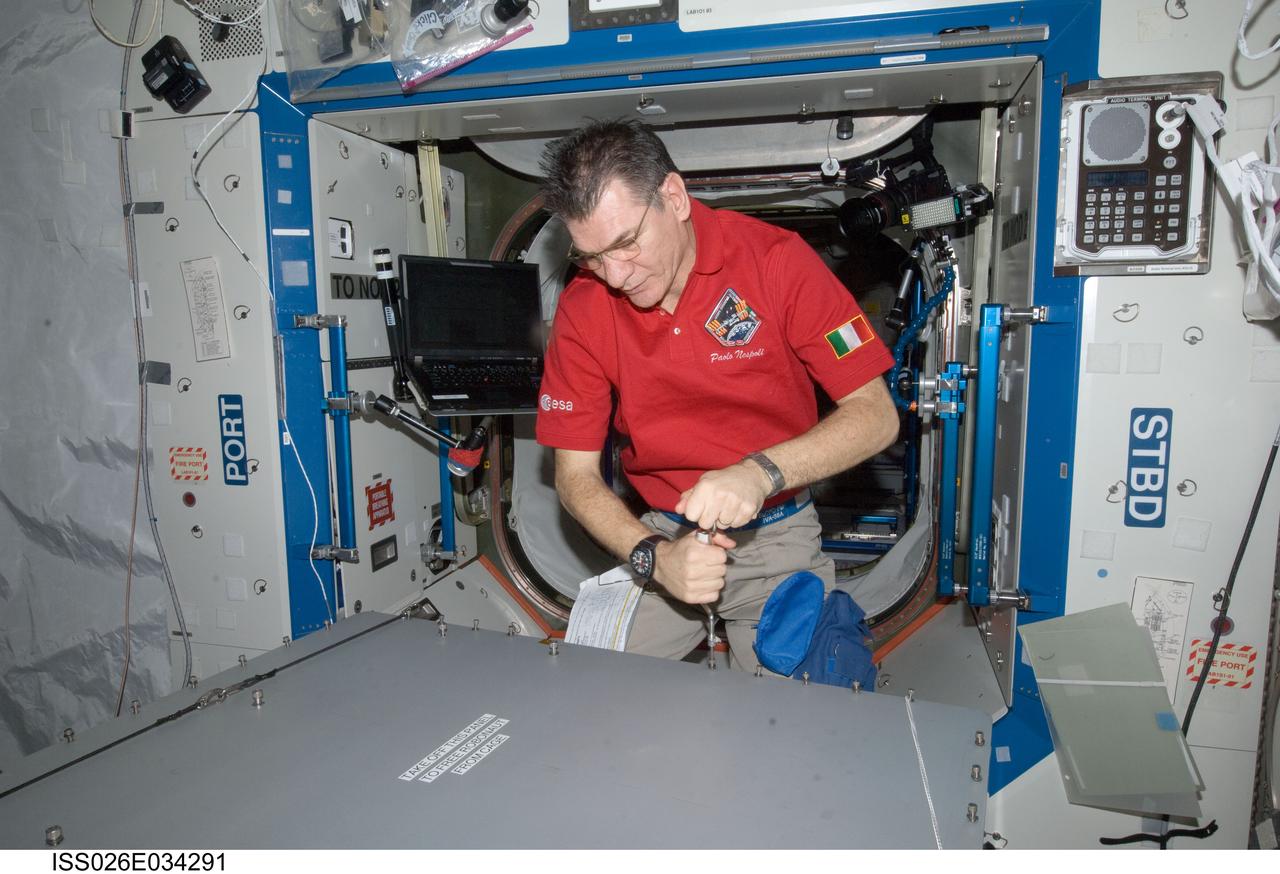
ISS026-E-034291 (15 March 2011) --- European Space Agency astronaut Paolo Nespoli, Expedition 26/27 flight engineer, opens the container that holds Robonaut 2, the dexterous humanoid astronaut helper, in the Destiny laboratory of the International Space Station.
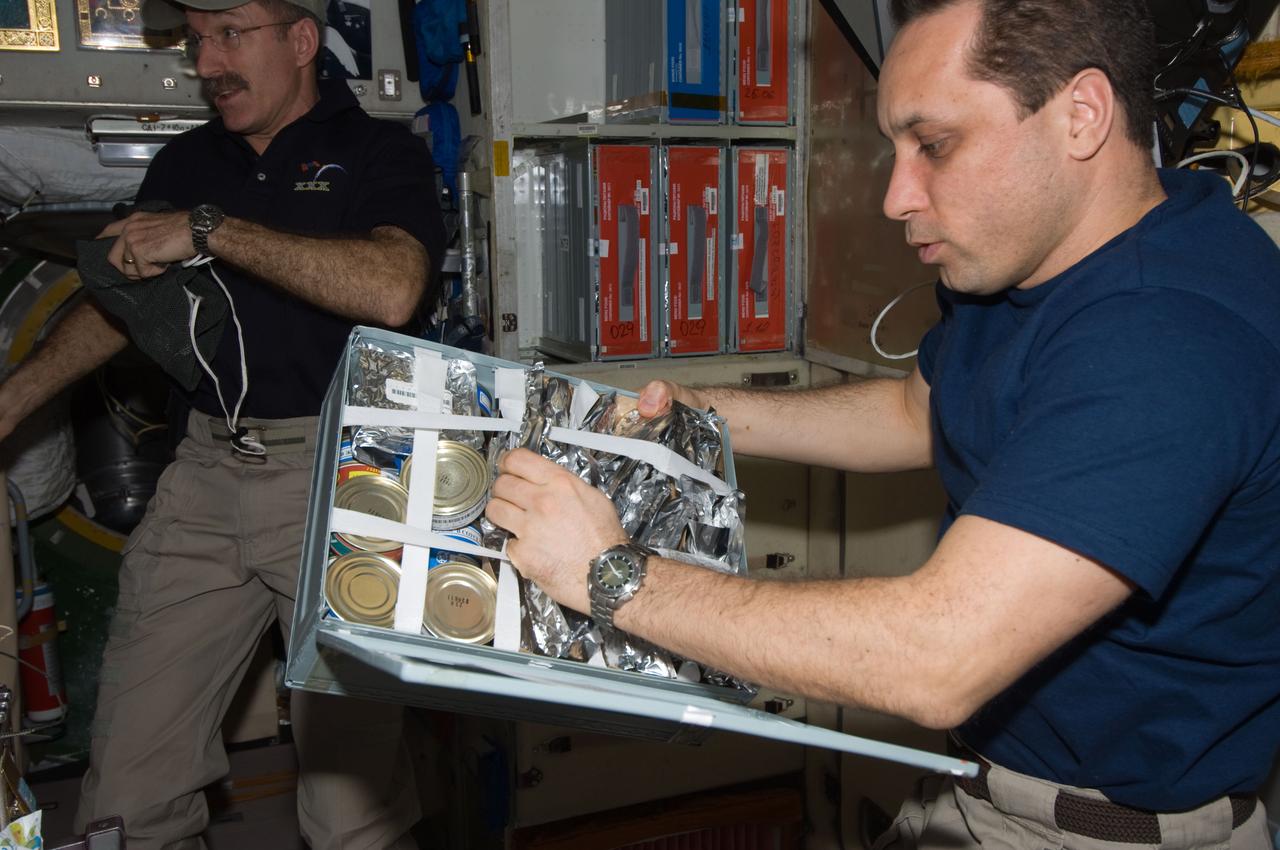
ISS030-E-117515 (3 Feb. 2012) --- Russian cosmonaut Anton Shkaplerov, Expedition 30 flight engineer, makes a selection from a food storage container in the Zvezda Service Module of the International Space Station. NASA astronaut Dan Burbank, commander, is visible in the background.
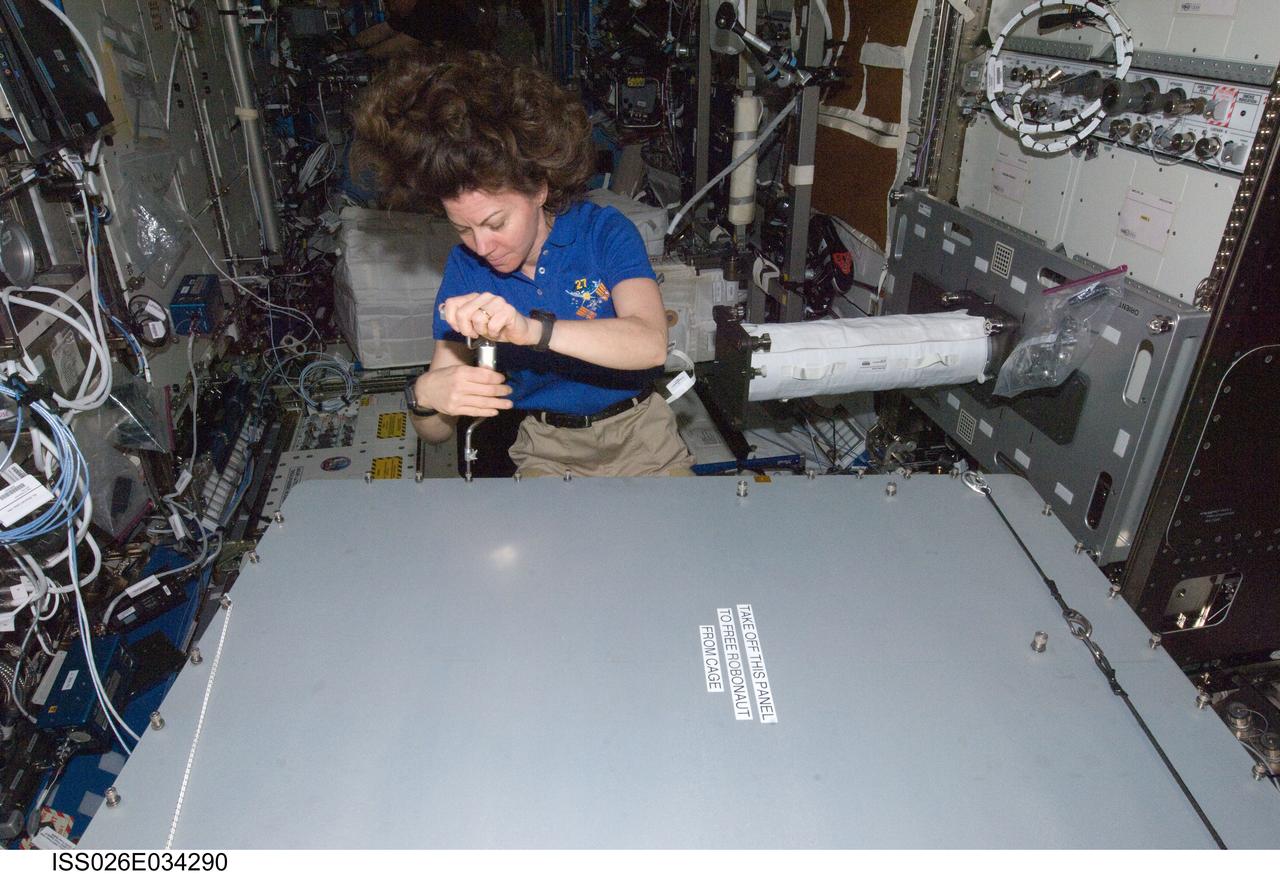
ISS026-E-034290 (15 March 2011) --- NASA astronaut Cady Coleman, Expedition 26/27 flight engineer, opens the container that holds Robonaut 2, the dexterous humanoid astronaut helper, in the Destiny laboratory of the International Space Station.
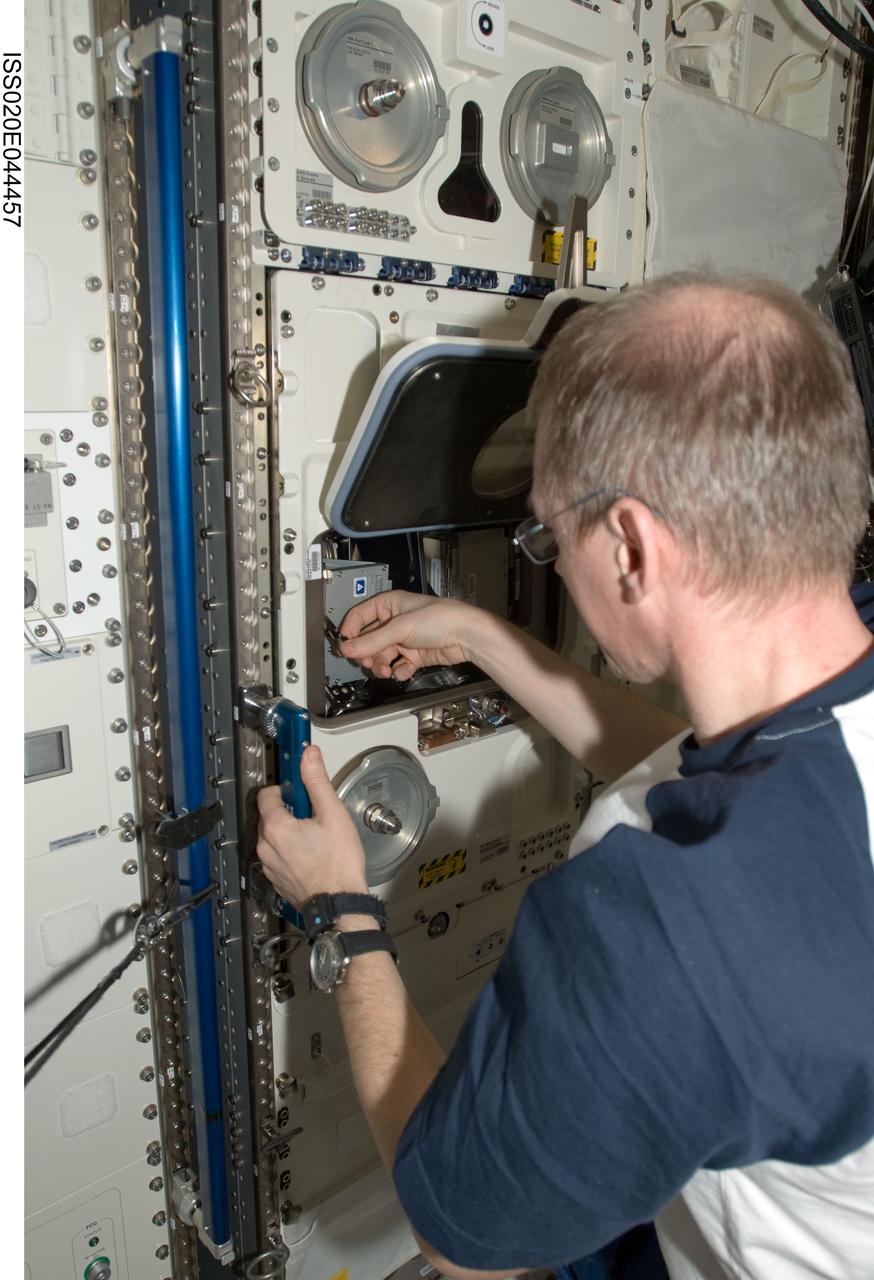
ISS020-E-044457 (2 Oct. 2009) --- European Space Agency astronaut Frank De Winne, Expedition 20 flight engineer and Expedition 21 commander, installs experiment containers in the Biolab incubator in the Columbus laboratory of the International Space Station.
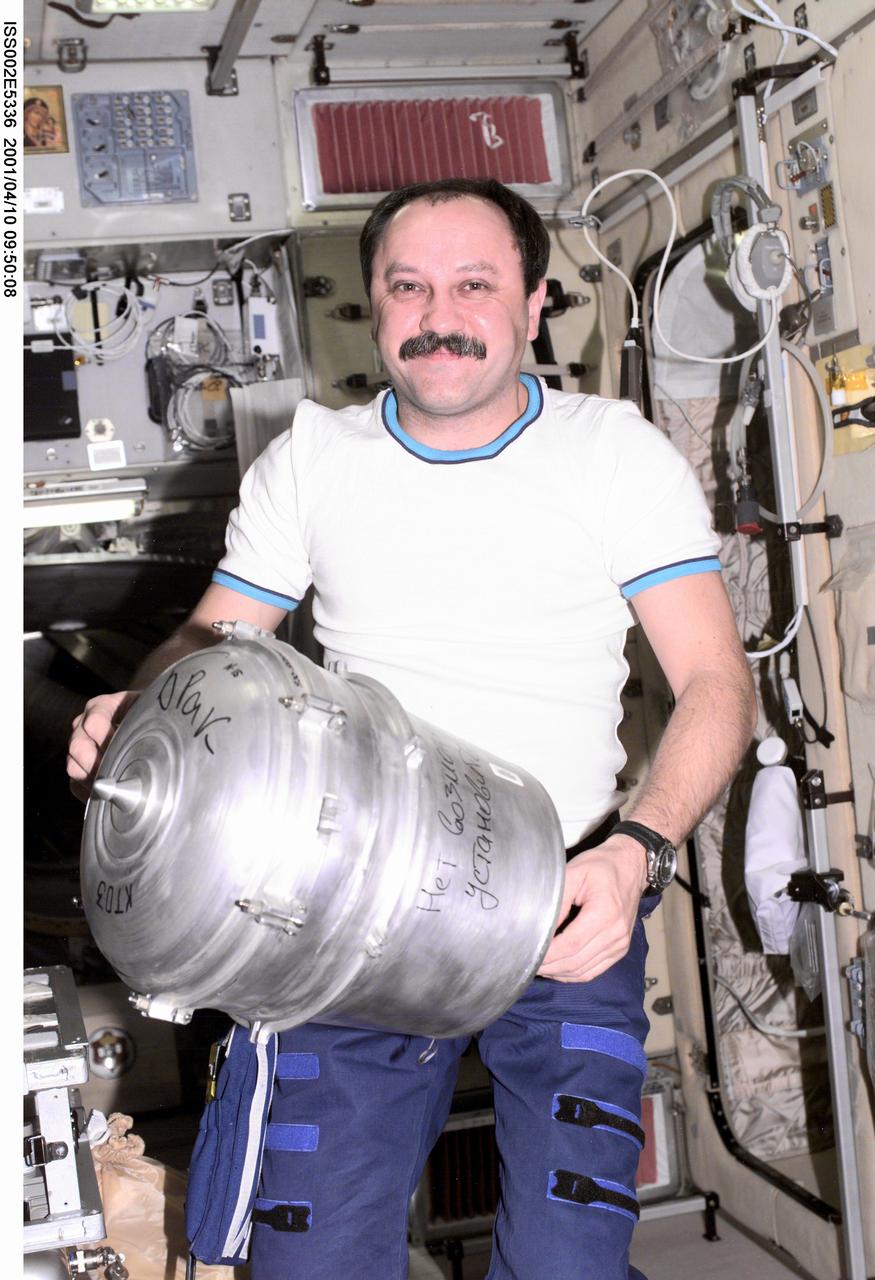
ISS002-E-5336 (10 April 2001) --- As part of routine procedures, cosmonaut Yury V. Usachev, Expedition Two mission commander, changes out a solid waste container in the Zvezda / Service Module. This image was recorded with a digital still camera.
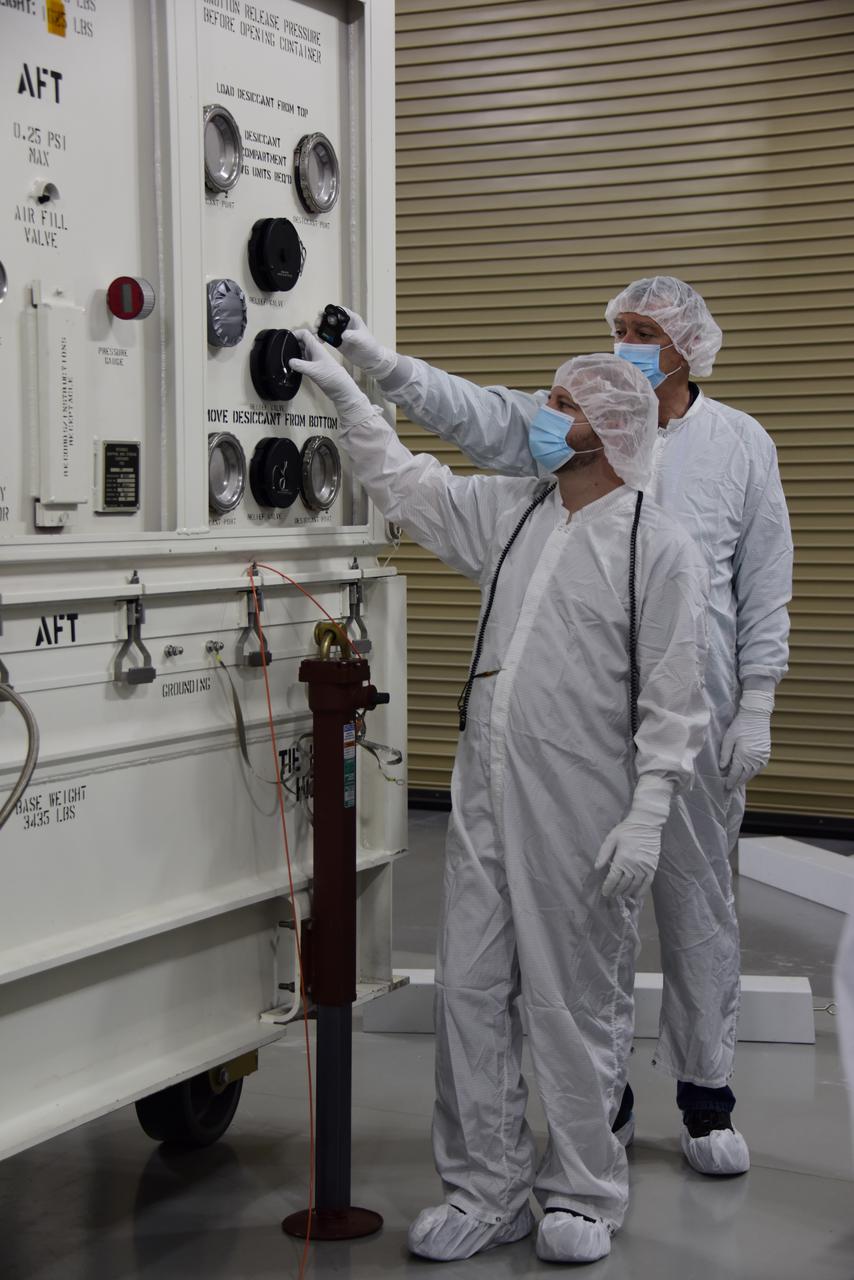
The DART spacecraft is removed from the shipping container and moved to the spacecraft dolly inside Astrotech at Vandenberg Space Force Base in California.
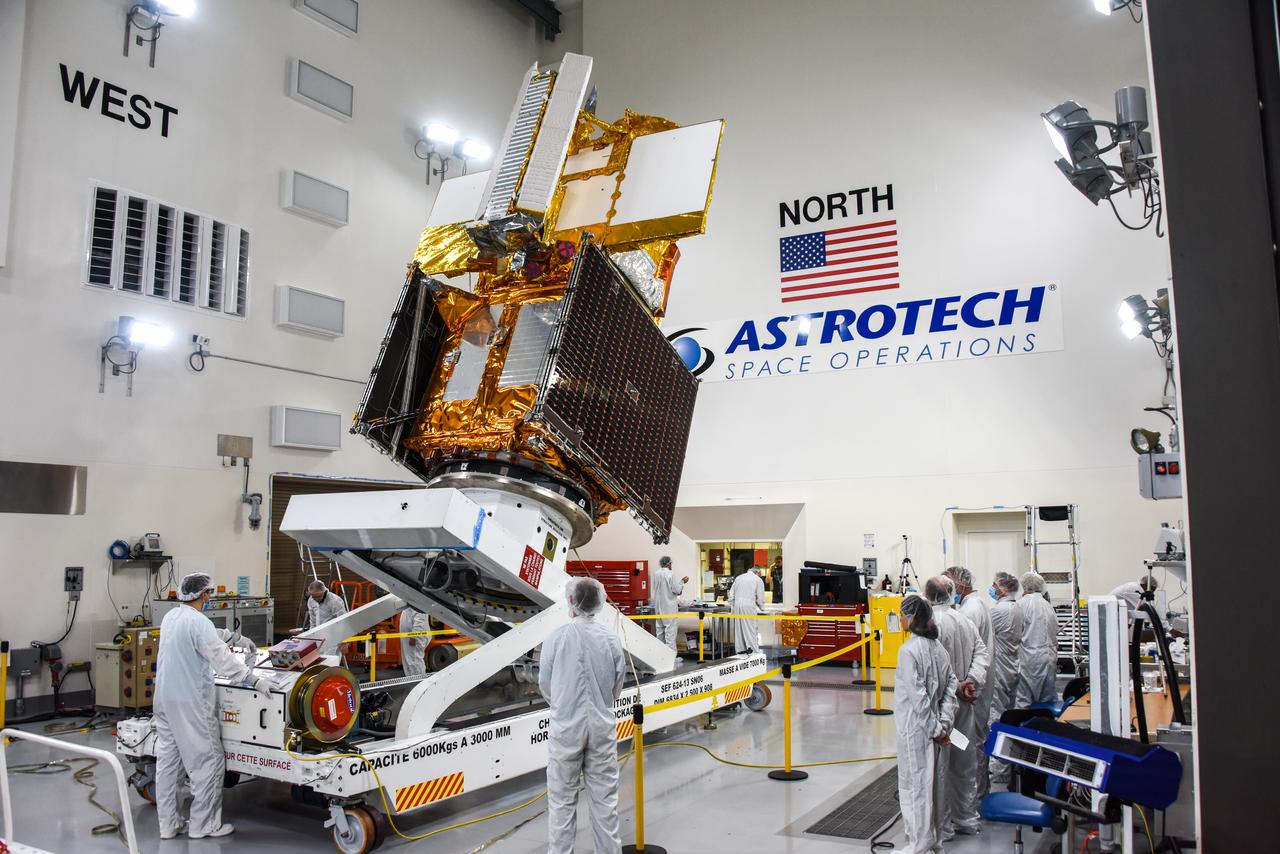
The Surface Water and Ocean Topography (SWOT) spacecraft is moved into a transport container inside the Astrotech facility at Vandenberg Space Force Base in California on Nov. 18, 2022. The satellite will be transported to the SpaceX facility at Vandenberg. SWOT is the first mission that will observe nearly all water on Earth’s surface, measuring the height of water in the planet’s lakes, rivers, reservoirs, and the ocean. It is set to launch aboard a SpaceX Falcon 9 rocket in December from Vandenberg’s Space Launch Center-4 East. NASA’s Launch Services Program, based at the agency’s Kennedy Space Center in Florida, is managing the launch service.
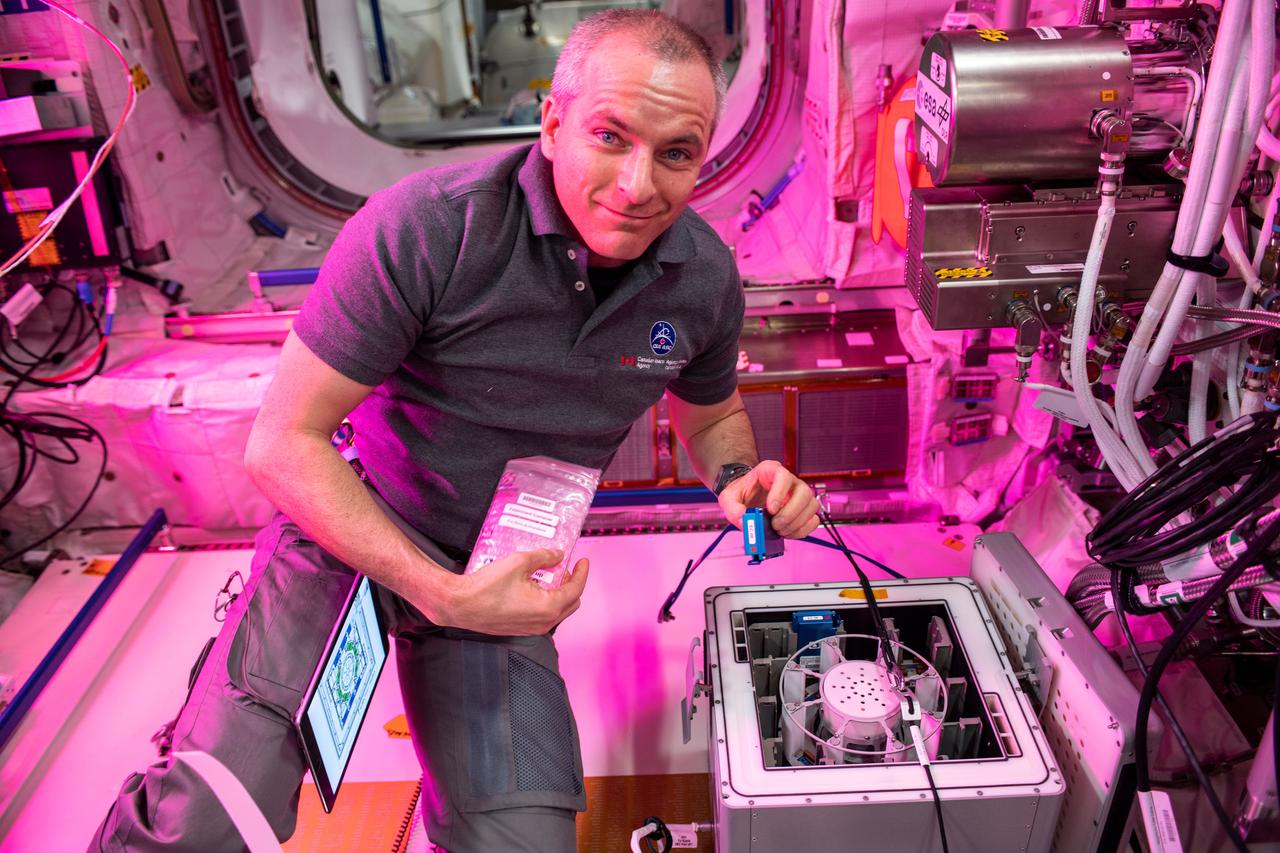
iss059e059049 (5/7/2019) --- Canadian Space Agency (CSA) astronaut David Saint-Jacques is photographed during the installation of the Nano Antioxidants Experiment Containers in Kubik 5 aboard the International Space Station (ISS). The aim of the Nano Antioxidants investigation is to research innovative approaches for cellular stimulation to counteract the negative effects of long-term microgravity on the musculoskeletal system. There are numerous possible applications of this research project in other crucial social domains, such as healthcare of the elderly and of people with muscle atrophy disorders, through the implementation of new therapeutic strategies in the treatment of diseases involving oxidative stress as causing factor.
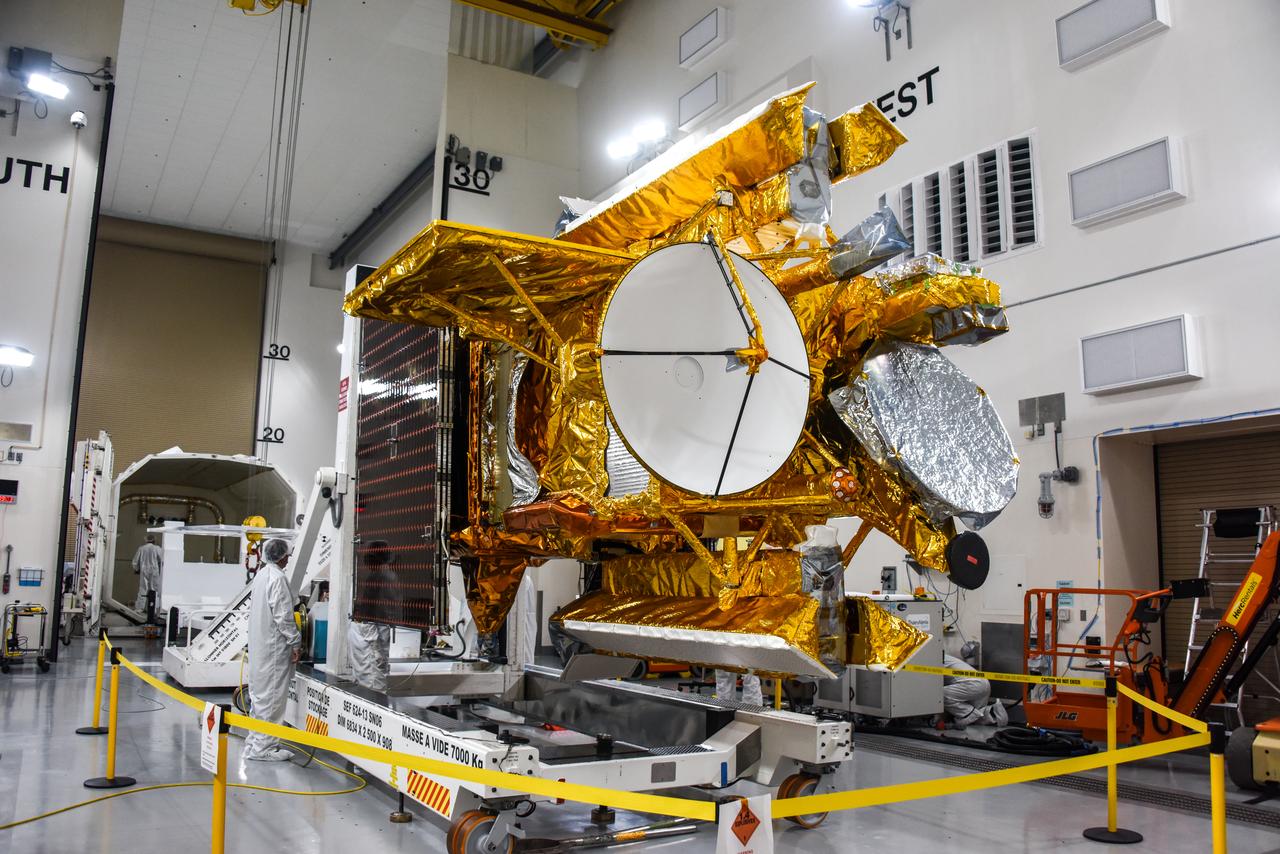
The Surface Water and Ocean Topography (SWOT) spacecraft is moved into a transport container inside the Astrotech facility at Vandenberg Space Force Base in California on Nov. 18, 2022. The satellite will be transported to the SpaceX facility at Vandenberg. SWOT is the first mission that will observe nearly all water on Earth’s surface, measuring the height of water in the planet’s lakes, rivers, reservoirs, and the ocean. It is set to launch aboard a SpaceX Falcon 9 rocket in December from Vandenberg’s Space Launch Center-4 East. NASA’s Launch Services Program, based at the agency’s Kennedy Space Center in Florida, is managing the launch service.
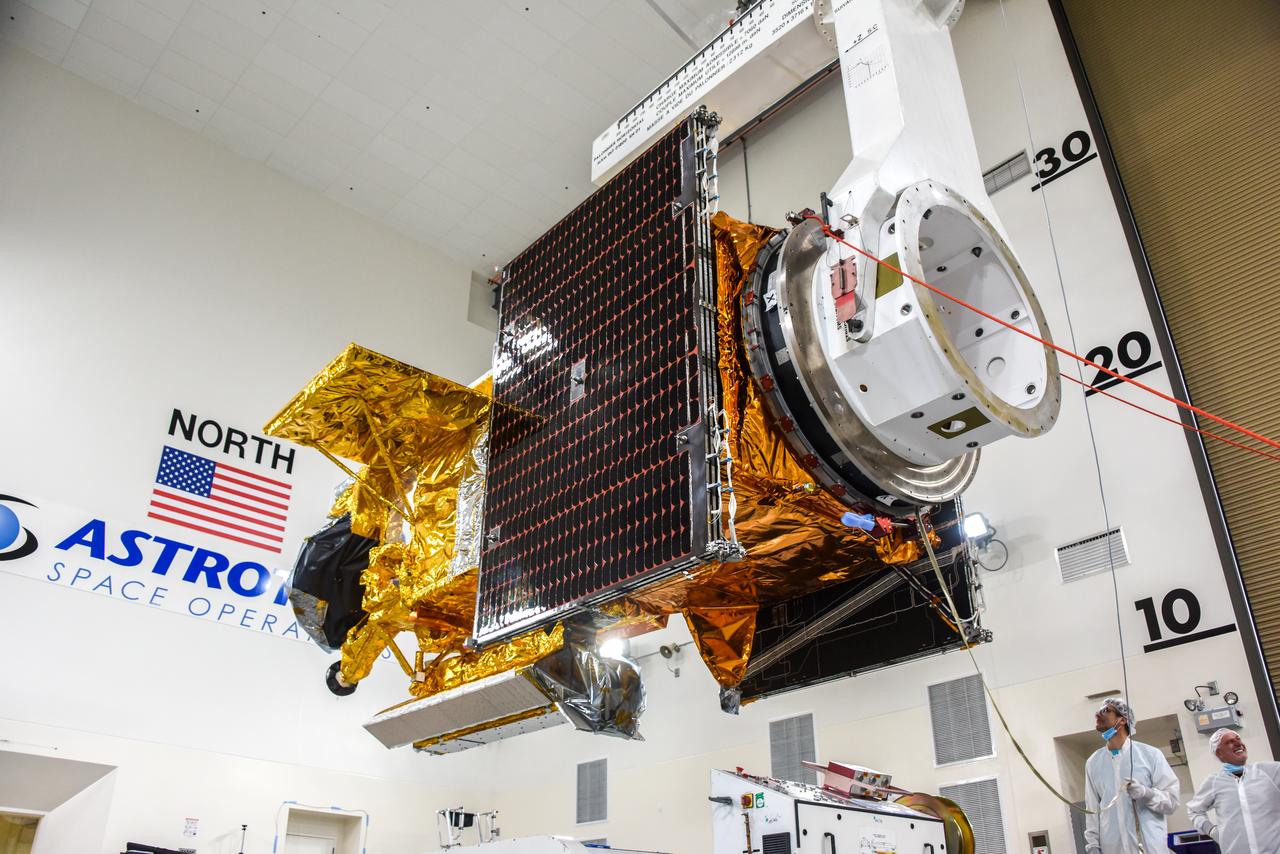
The Surface Water and Ocean Topography (SWOT) spacecraft is moved into a transport container inside the Astrotech facility at Vandenberg Space Force Base in California on Nov. 18, 2022. The satellite will be transported to the SpaceX facility at Vandenberg. SWOT is the first mission that will observe nearly all water on Earth’s surface, measuring the height of water in the planet’s lakes, rivers, reservoirs, and the ocean. It is set to launch aboard a SpaceX Falcon 9 rocket in December from Vandenberg’s Space Launch Center-4 East. NASA’s Launch Services Program, based at the agency’s Kennedy Space Center in Florida, is managing the launch service.
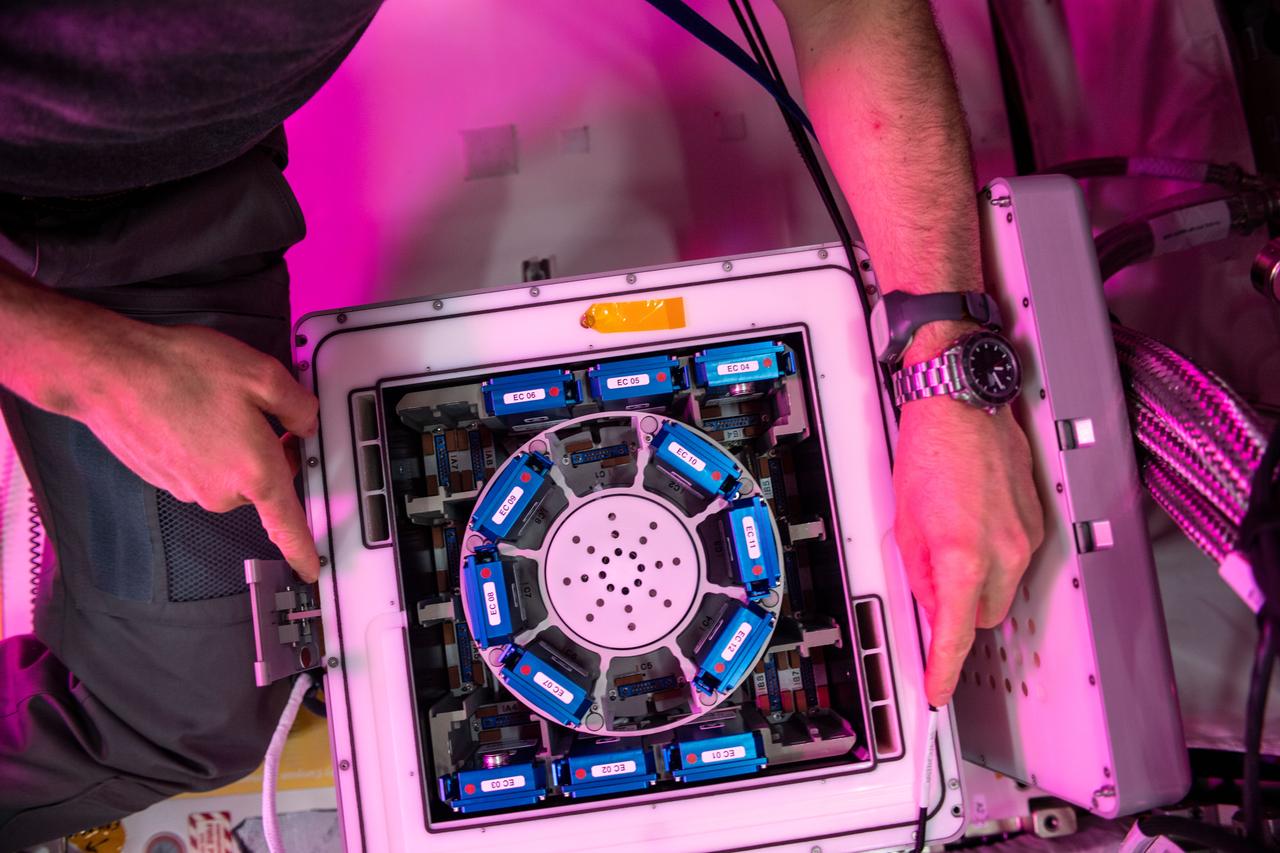
iss059e059071 (5/7/2019) --- Photo documentation of the 12 Nano Antioxidants Experiment Containers in Kubik 5 marking the start of the experiment run in the Columbus module aboard the International Space Station (ISS). The aim of the Nano Antioxidants investigation is to research innovative approaches for cellular stimulation to counteract the negative effects of long-term microgravity on the musculoskeletal system. There are numerous possible applications of this research project in other crucial social domains, such as healthcare of the elderly and of people with muscle atrophy disorders, through the implementation of new therapeutic strategies in the treatment of diseases involving oxidative stress as causing factor.
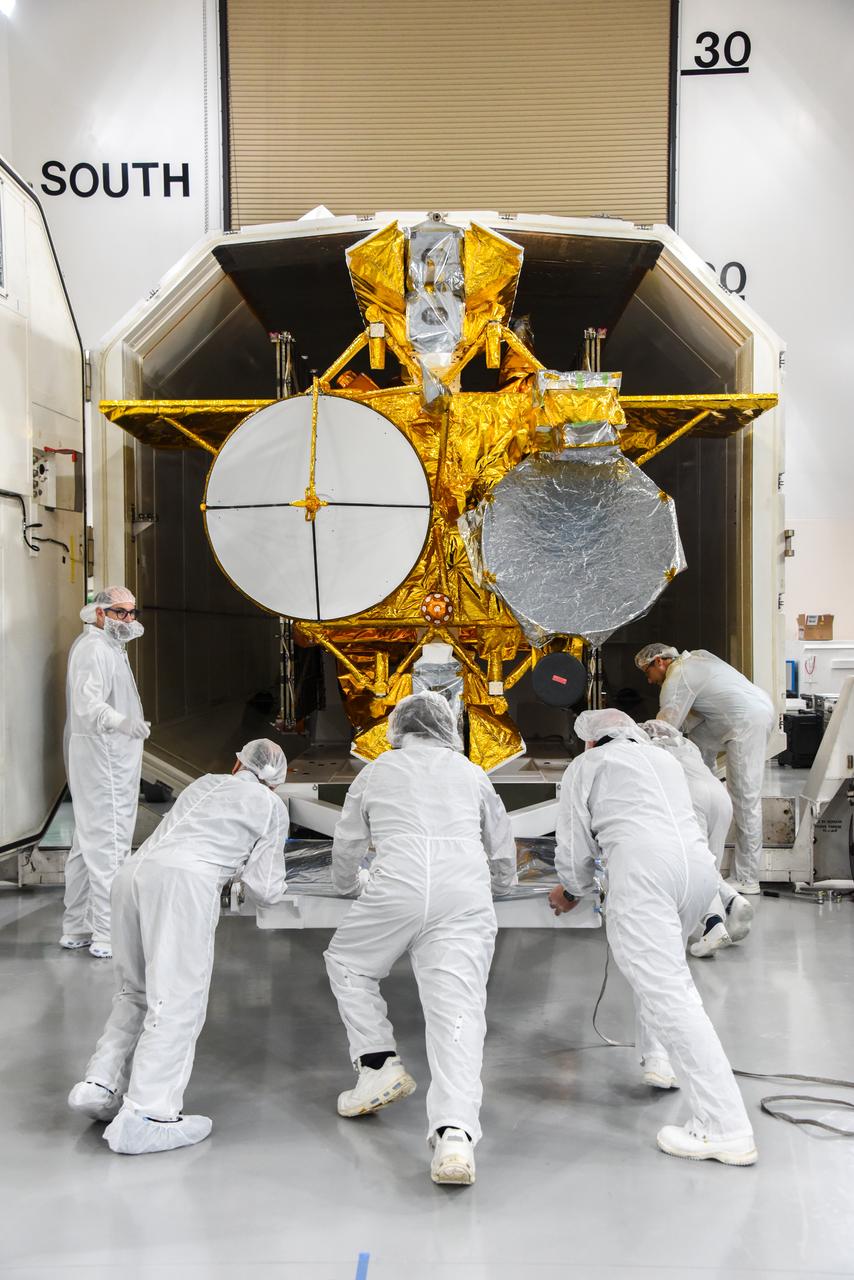
The Surface Water and Ocean Topography (SWOT) spacecraft is moved into a transport container inside the Astrotech facility at Vandenberg Space Force Base in California on Nov. 18, 2022. The satellite will be transported to the SpaceX facility at Vandenberg. SWOT is the first mission that will observe nearly all water on Earth’s surface, measuring the height of water in the planet’s lakes, rivers, reservoirs, and the ocean. It is set to launch aboard a SpaceX Falcon 9 rocket in December from Vandenberg’s Space Launch Center-4 East. NASA’s Launch Services Program, based at the agency’s Kennedy Space Center in Florida, is managing the launch service.
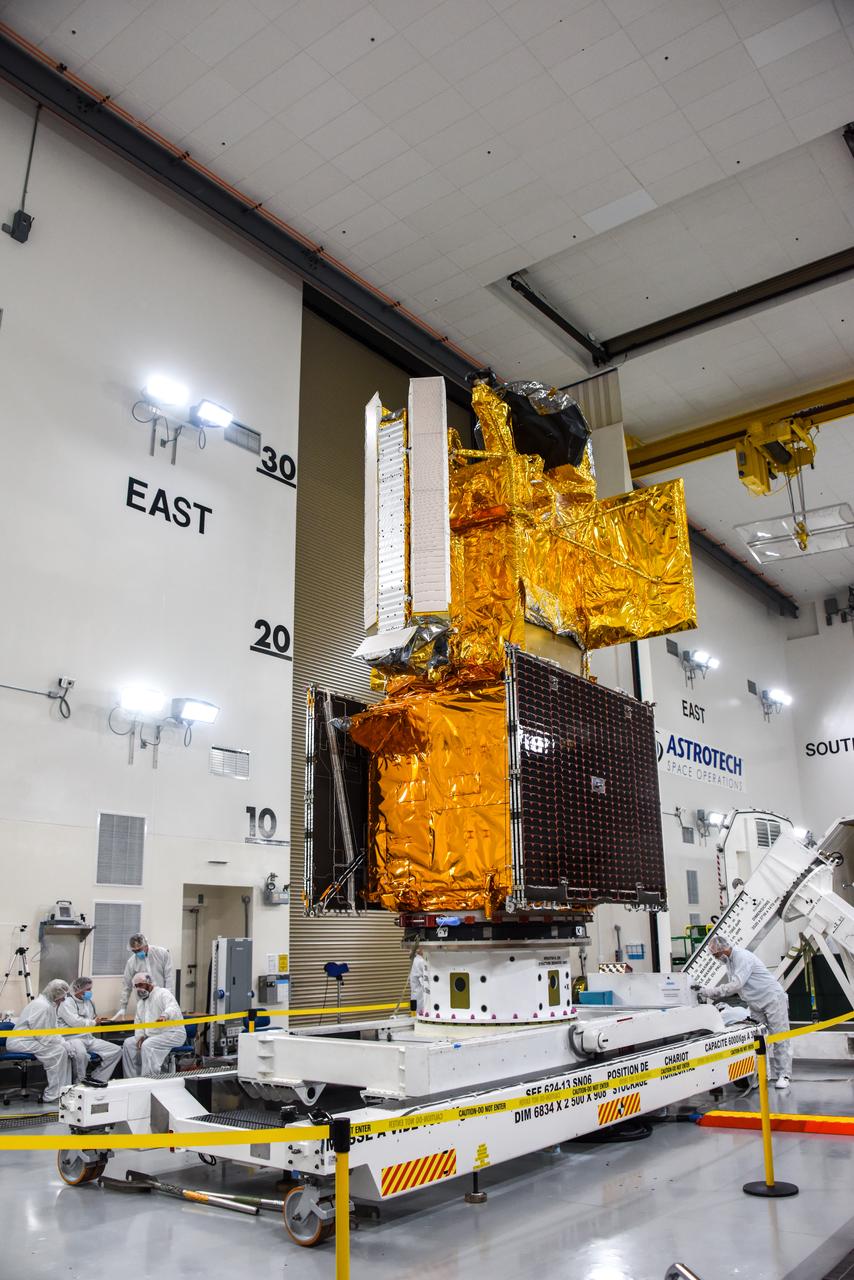
The Surface Water and Ocean Topography (SWOT) spacecraft is moved into a transport container inside the Astrotech facility at Vandenberg Space Force Base in California on Nov. 18, 2022. The satellite will be transported to the SpaceX facility at Vandenberg. SWOT is the first mission that will observe nearly all water on Earth’s surface, measuring the height of water in the planet’s lakes, rivers, reservoirs, and the ocean. It is set to launch aboard a SpaceX Falcon 9 rocket in December from Vandenberg’s Space Launch Center-4 East. NASA’s Launch Services Program, based at the agency’s Kennedy Space Center in Florida, is managing the launch service.
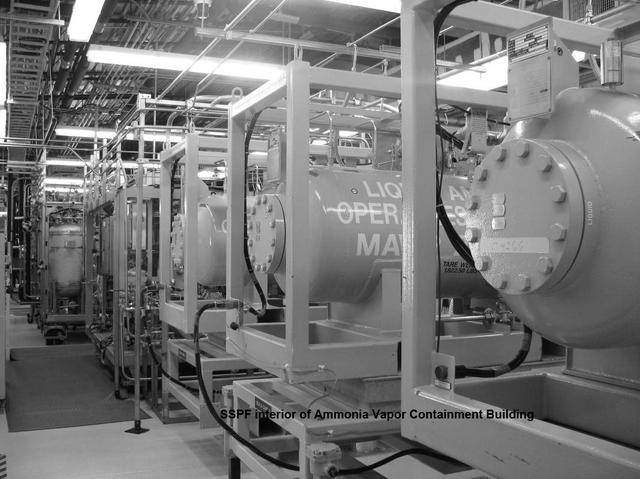
Interior view of the Ammonia Vapor Containment Building
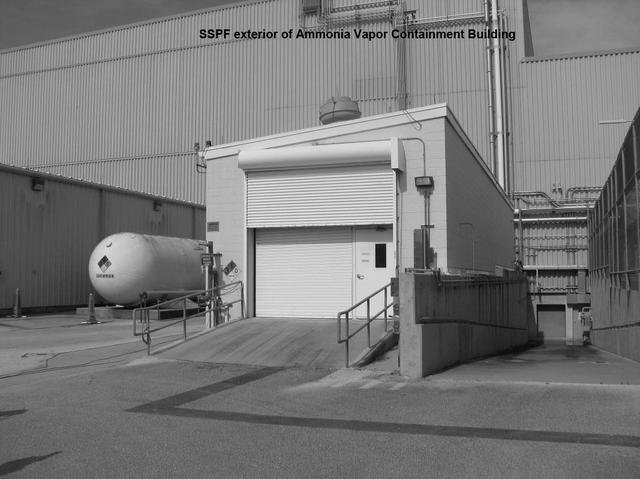
Exterior view of the Ammonia Vapor Containment Building
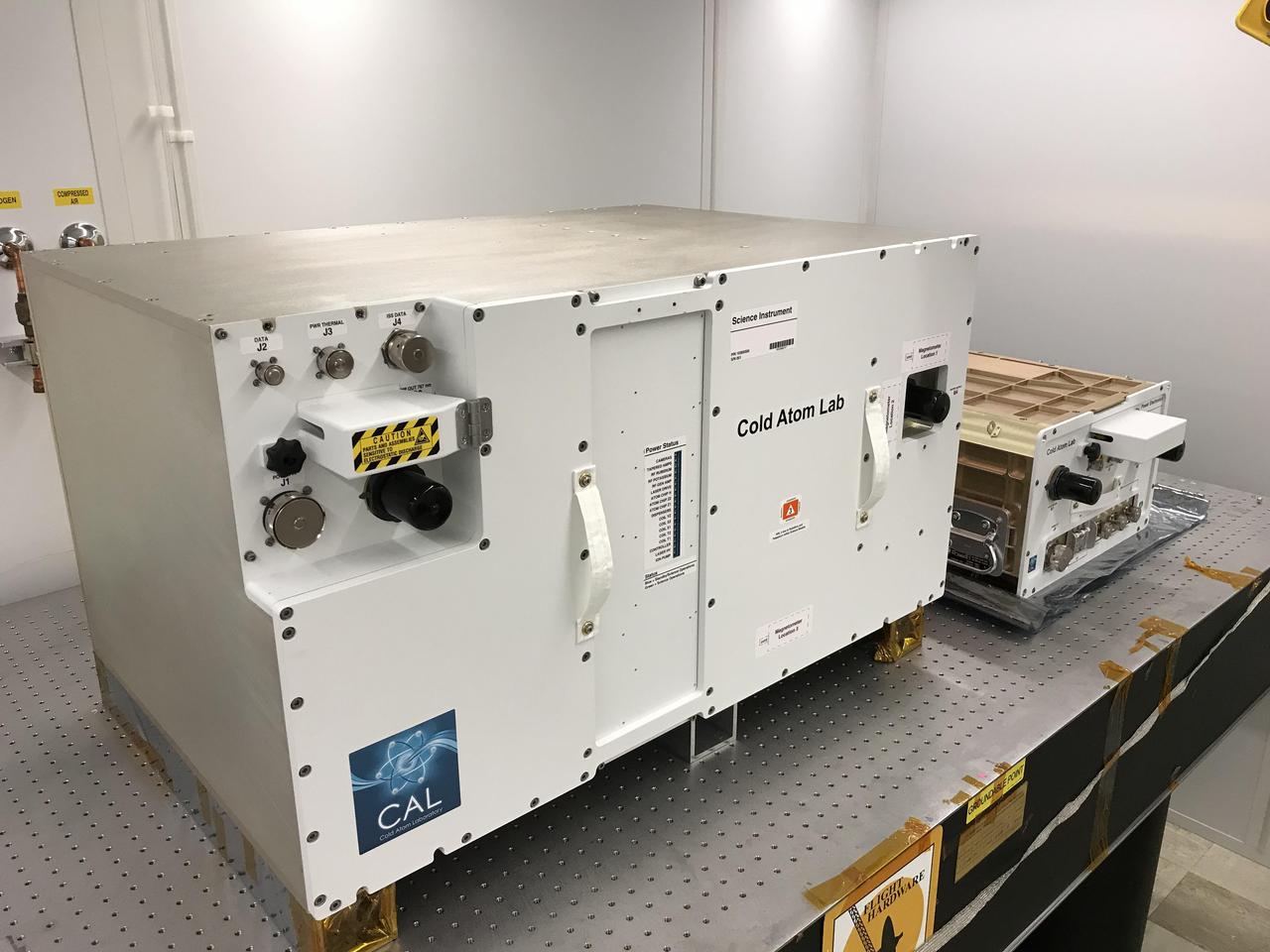
The Cold Atom Laboratory consists of two standardized containers that will be installed on the International Space Station. The larger container is called a "quad locker," and the smaller container is called a "single locker." The quad locker contains CAL's physics package, or the compartment where CAL will produce clouds of ultra-cold atoms. https://photojournal.jpl.nasa.gov/catalog/PIA22562
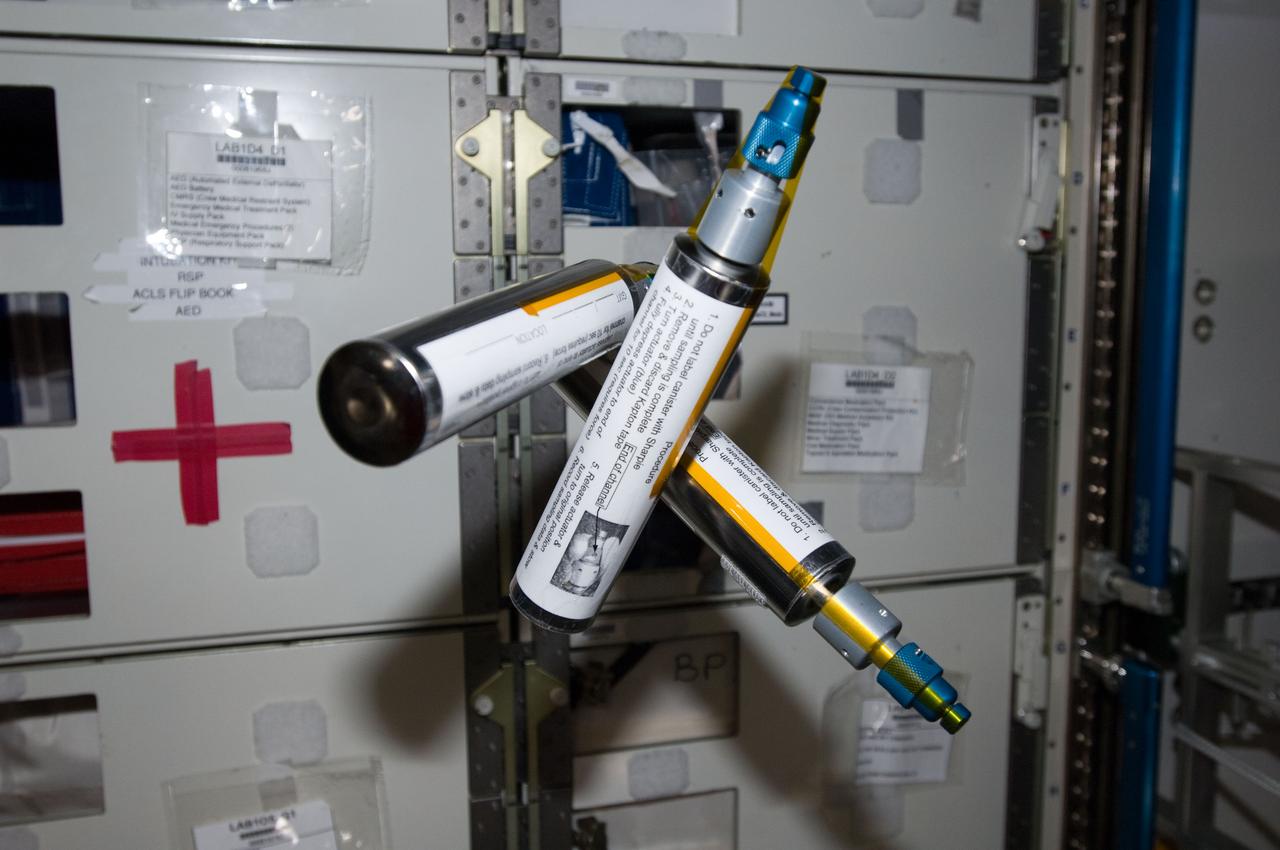
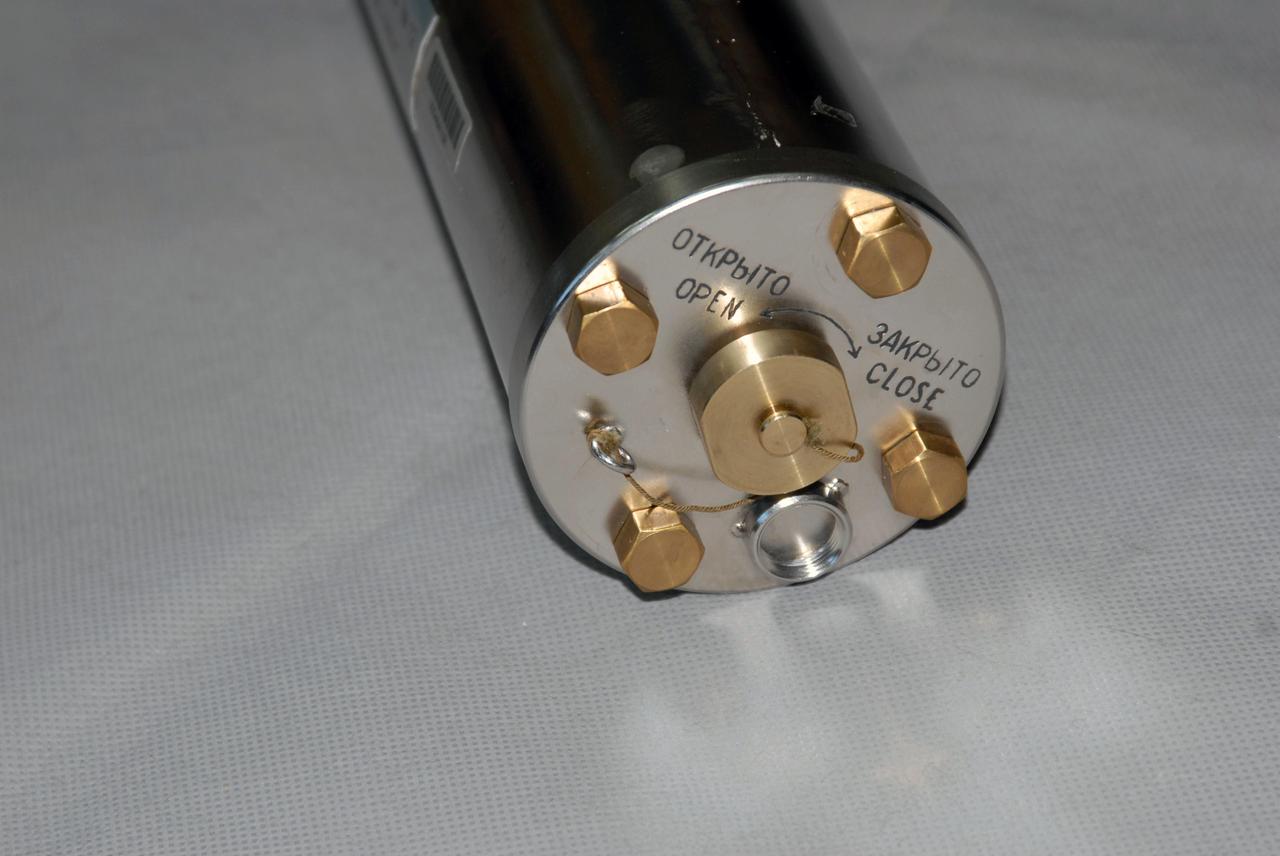
View of Grab Sample Containers (GSC) assembly, Part Number (P/N): SEG46121657-301, Serial Number (S/N): 2106, Barcode: EHS00184J, in the U.S. Laboratory. Photo was taken during Expedition 34.
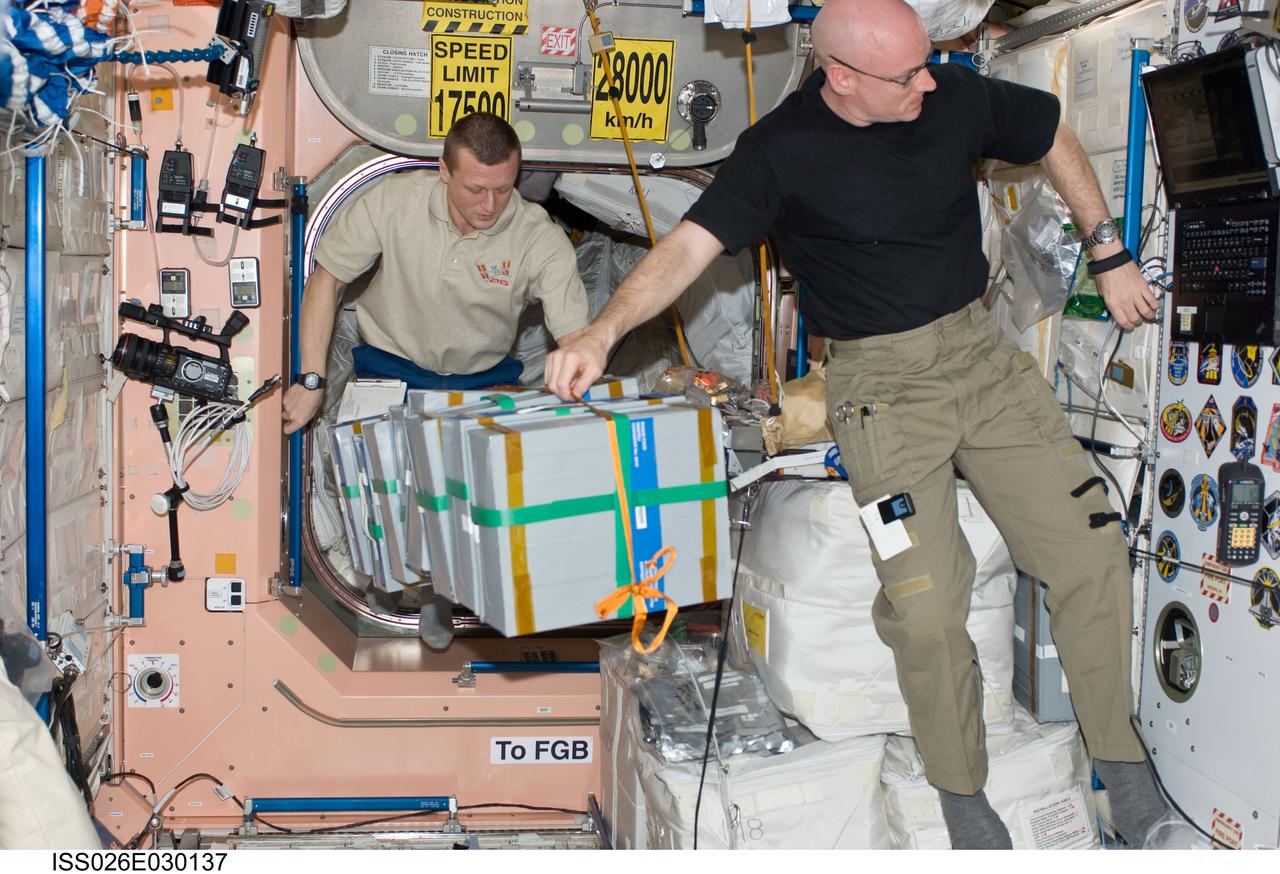
ISS026-E-030137 (25 Feb. 2011) --- NASA astronaut Scott Kelly (foreground), Expedition 26 commander; and Russian cosmonaut Dmitry Kondratyev, flight engineer, move stowage containers in the Unity node of the International Space Station.
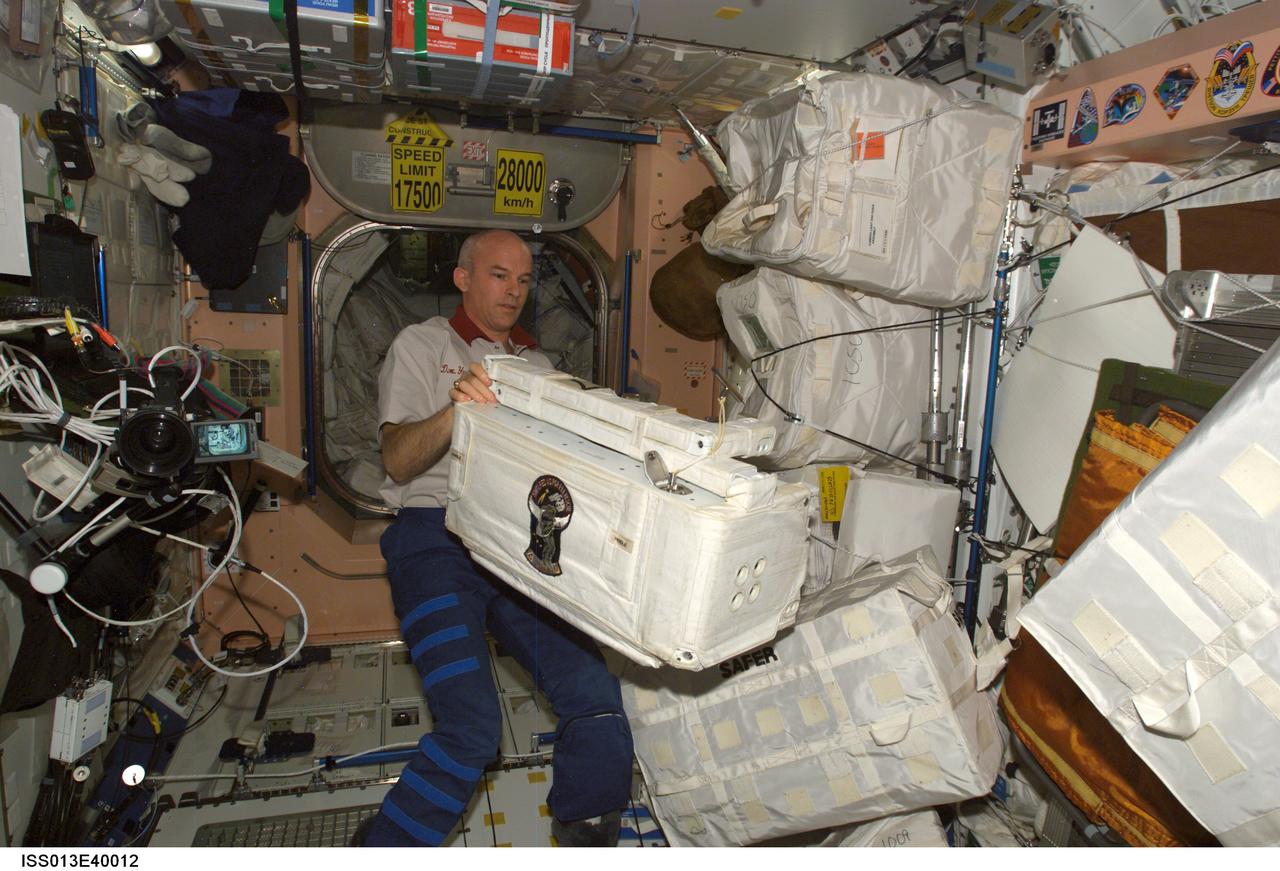
ISS013-E-40012 (22 June 2006) --- Astronaut Jeffrey N. Williams, Expedition 13 NASA space station science officer and flight engineer, works with stowage containers in the Unity node of the International Space Station.
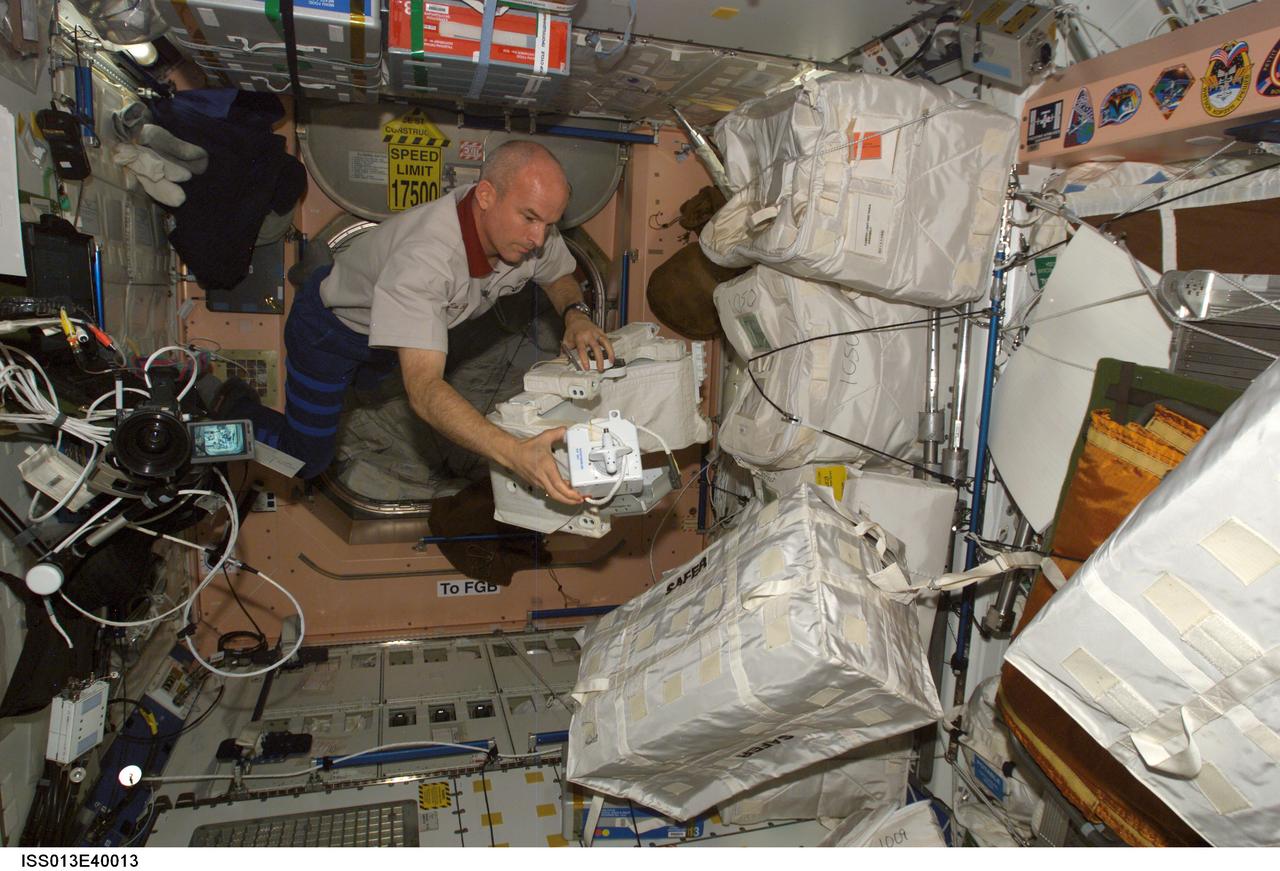
ISS013-E-40013 (22 June 2006) --- Astronaut Jeffrey N. Williams, Expedition 13 NASA space station science officer and flight engineer, works with stowage containers in the Unity node of the International Space Station.
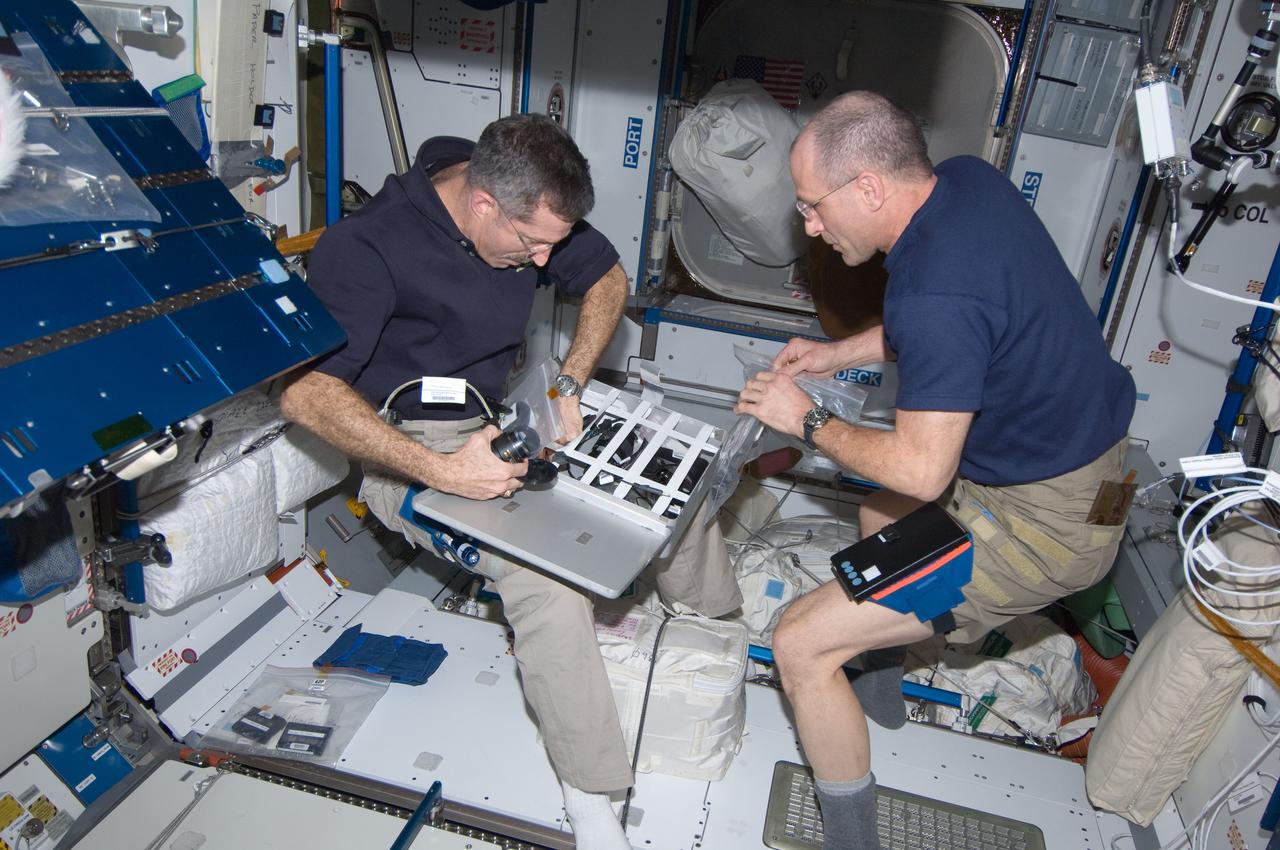
ISS030-E-033351 (25 Dec. 2011) --- NASA astronauts Dan Burbank (left), Expedition 30 commander; and Don Pettit, flight engineer, stow camera equipment in a container in the Harmony node of the International Space Station.
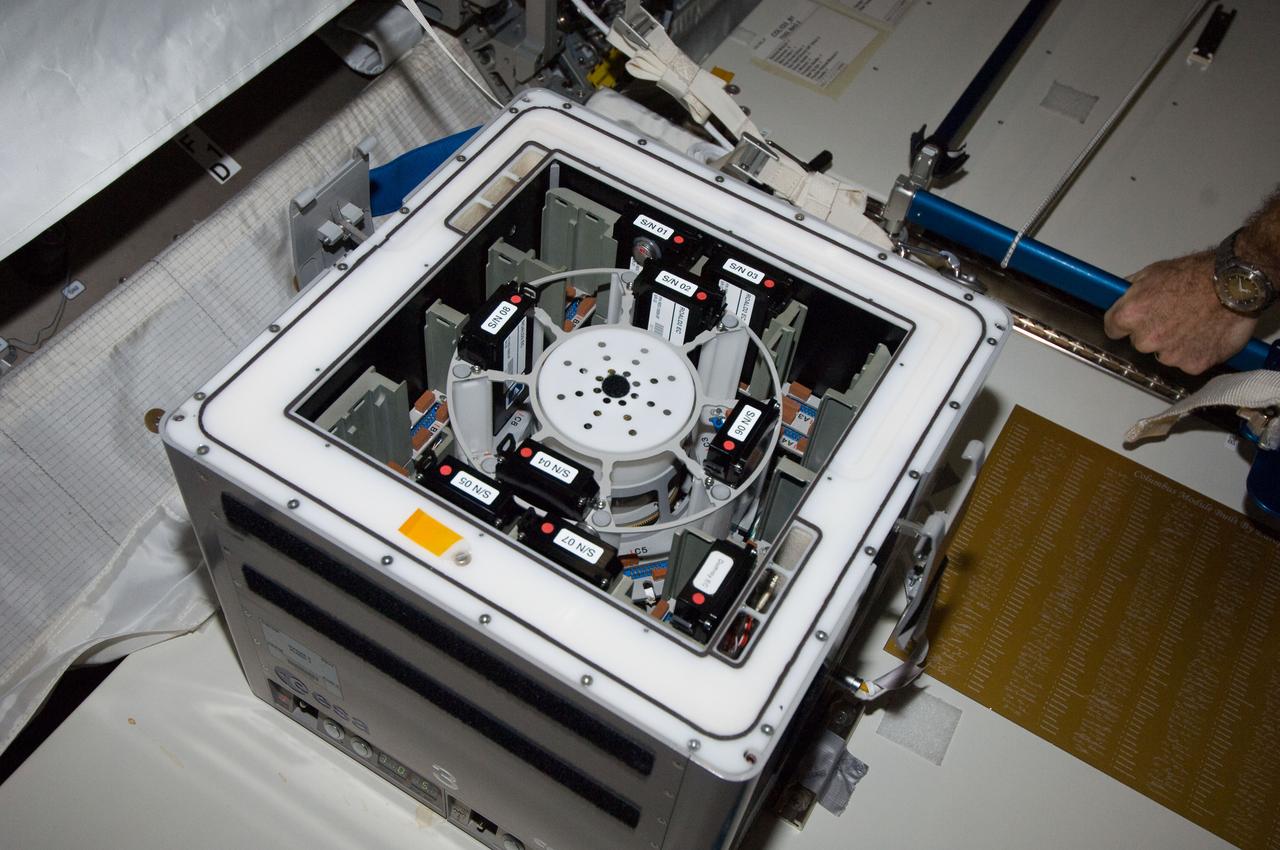
iss030e033236 (12/24/2012) --- Top-open view of European Space Agency (ESA) Role of Apoptosis in Lymphocyte Depression 2 (ROALD-2) experiment in the KUBIK-3 thermostatic container, in the Columbus Module aboard the International Space Station (ISS). Role of the Endocannabinoid System in human Lymphocytes Exposed to Microgravity (ROALD2) investigates the function of endocannabinoids, substances produced within the body to activate cell membrane receptors, in the regulation of the immune processes and cell cycle under microgravity conditions.
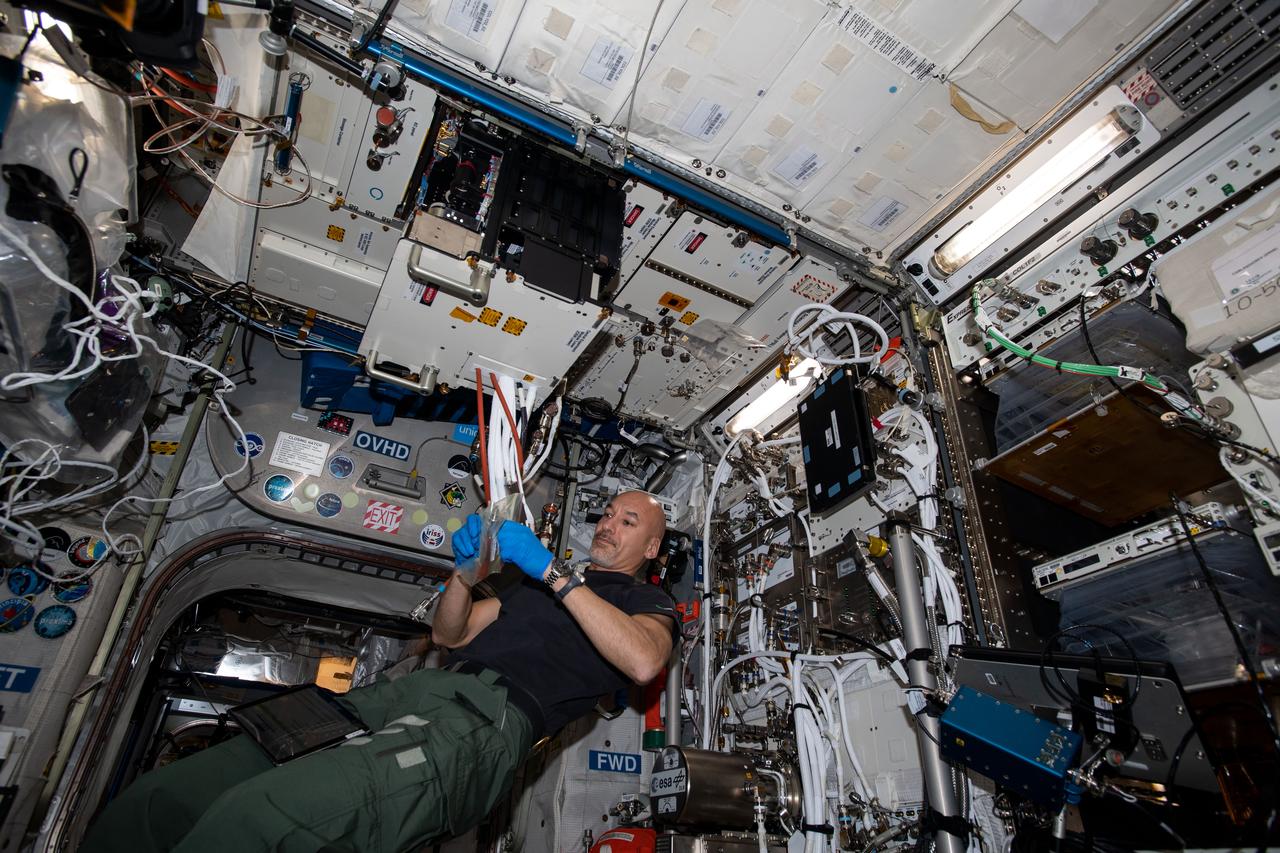
iss060e033086 (8/9/2019) --- A view of European Space Agency (ESA) astronaut Luca Parmitano during the installation of the MultiScale Boiling Experiment Container (EC) in the Fluid Science Laboratory FSL) in the Columbus Module aboard the International Space Station (ISS). Multiscale Boiling investigates the fundamental basics of boiling heat transfer phenomena on a heater surface in a pool boiling configuration. Data from this investigation is used for the validation of theoretical models and numerical codes.
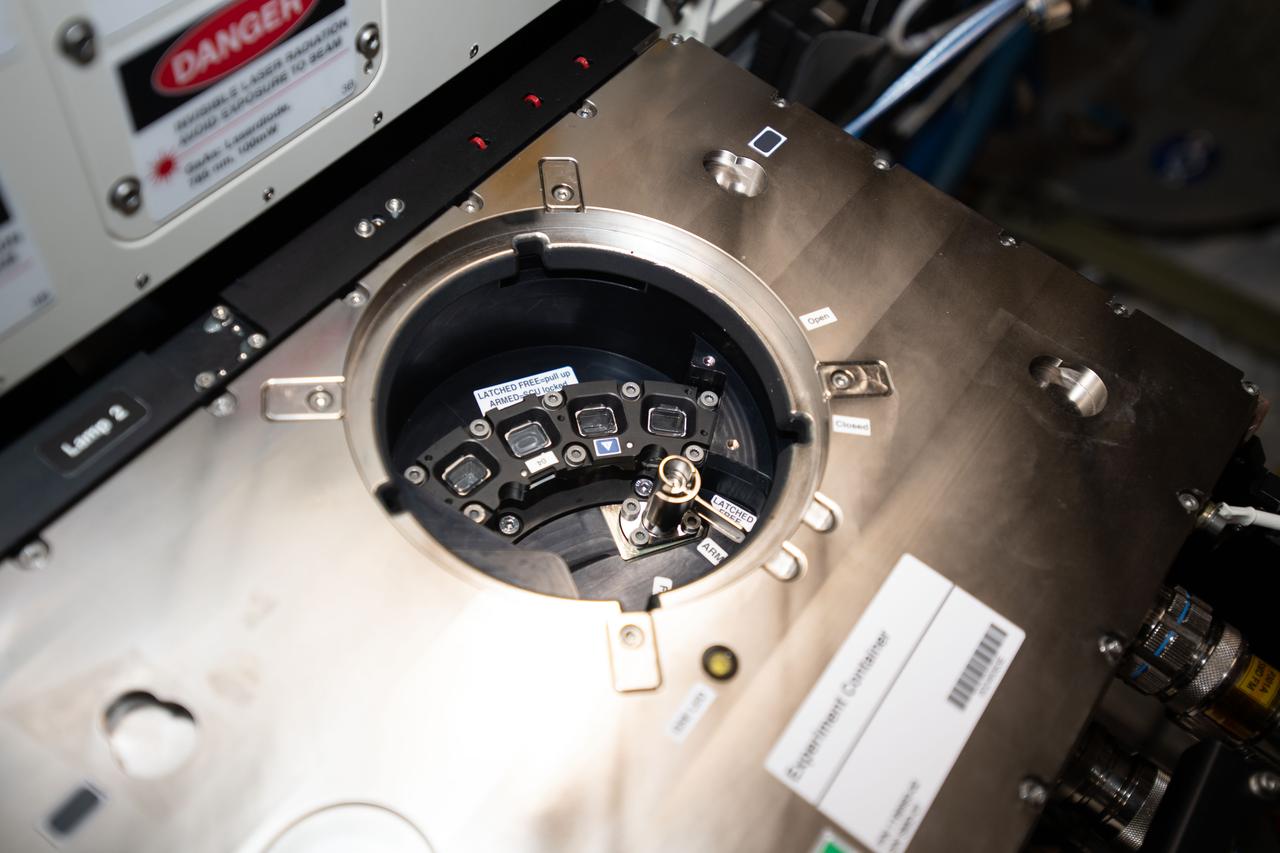
iss062e141221 (4/11/2020) --- A view of the sample cell inside the Soft Matter Dynamics (SMD) Experiment Container of the Fluid Science Laboratory (FSL) in the Columbus module aboard the International Space Station (ISS). FSL Soft Matter Dynamics - Hydrodynamics of Wet Foams (Foam Coarsening) aims to study aqueous and non-aqueous foams in the microgravity environment of the ISS.
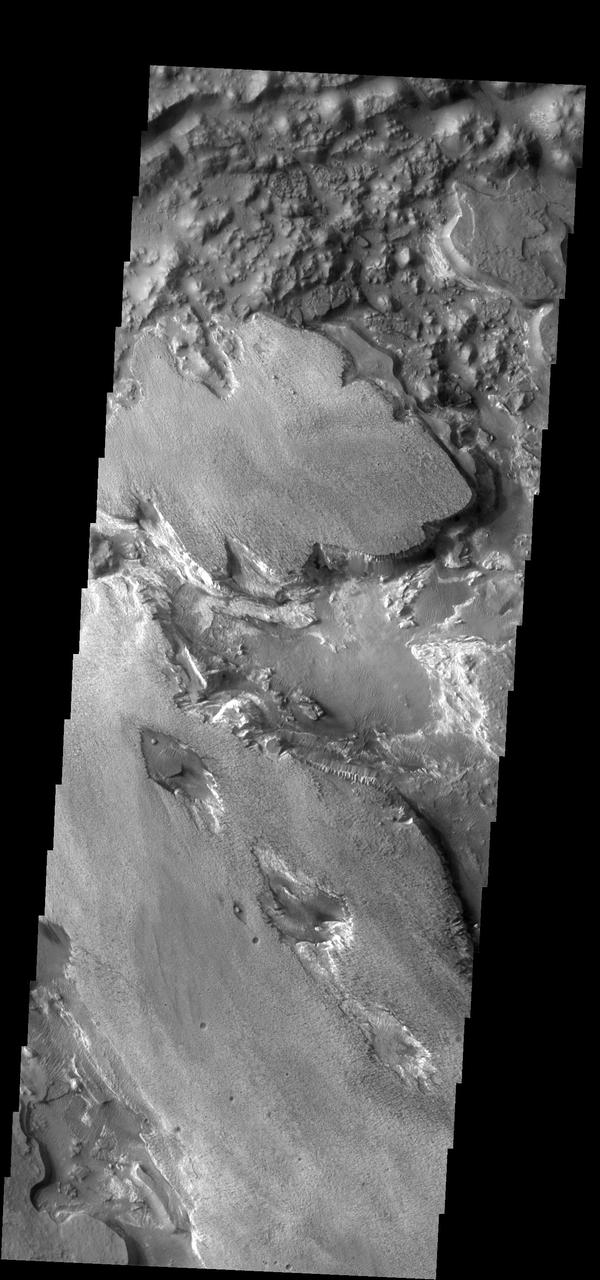
Aram Chaos contains several layers of fill material
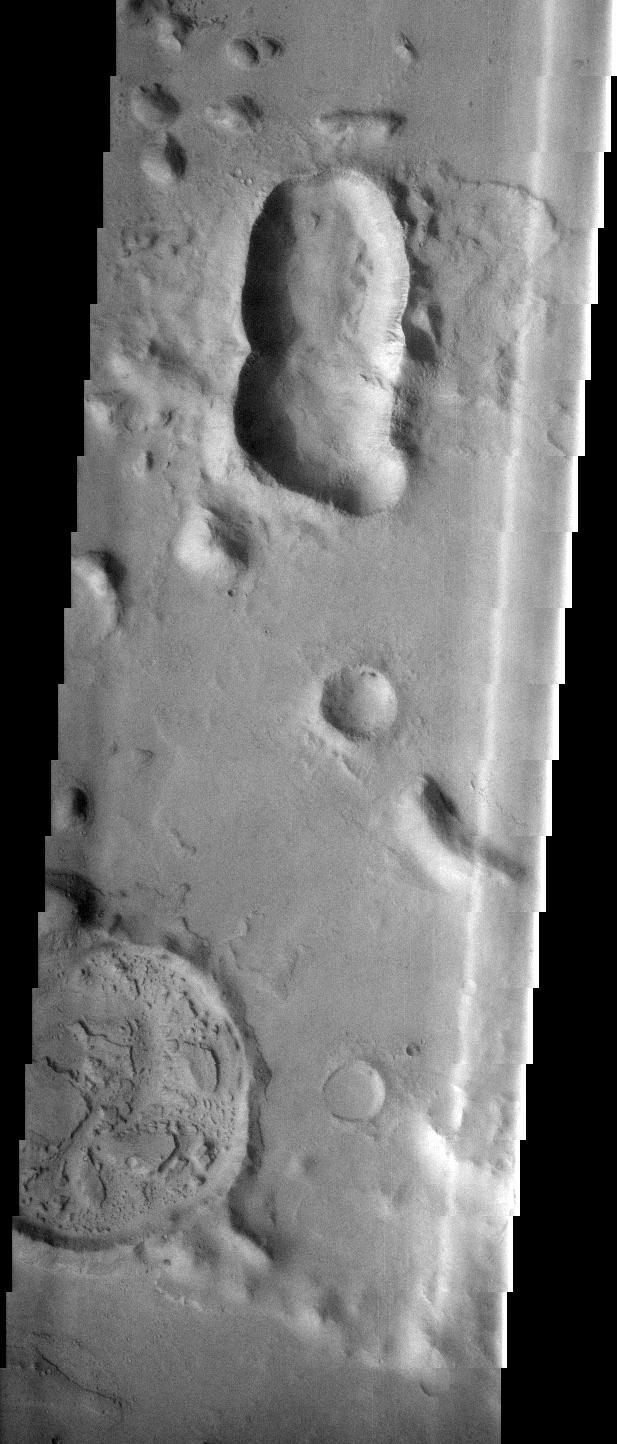
This image contains several different impact craters
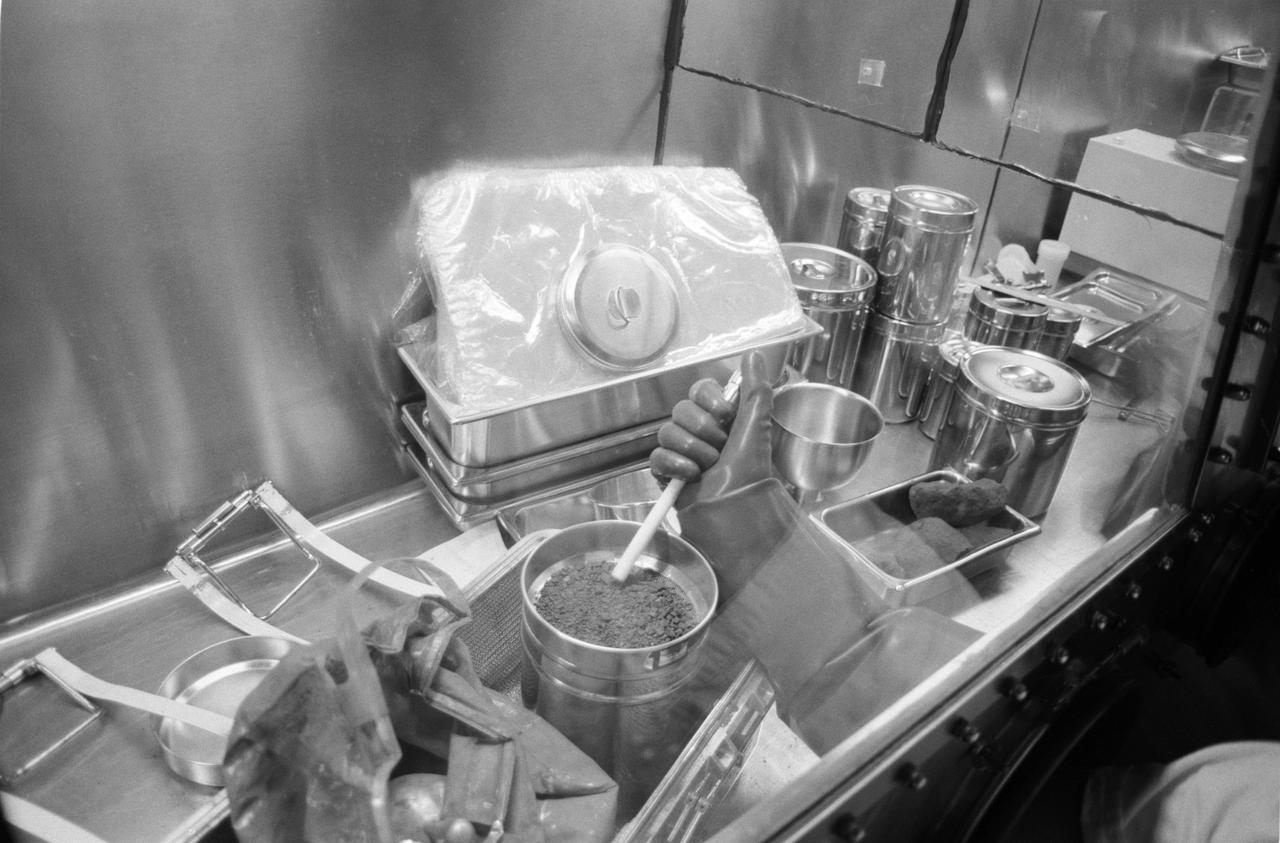
S69-45507 (4 Aug. 1969) --- A close-up of the second Apollo 11 sample return container in the Vacuum Laboratory of the Manned Spacecraft Center’s Lunar Receiving Laboratory, Building 37. This rock box was opened for the first time at 1 p.m. (CDT), Aug. 4, 1969. Some of the material has already been removed from the ALSRC in this view. The stainless steel can contains some course lunar surface material. The lunar samples were collected by astronauts Neil A. Armstrong and Edwin E. Aldrin Jr. during their lunar surface extravehicular activity on July 20, 1969.
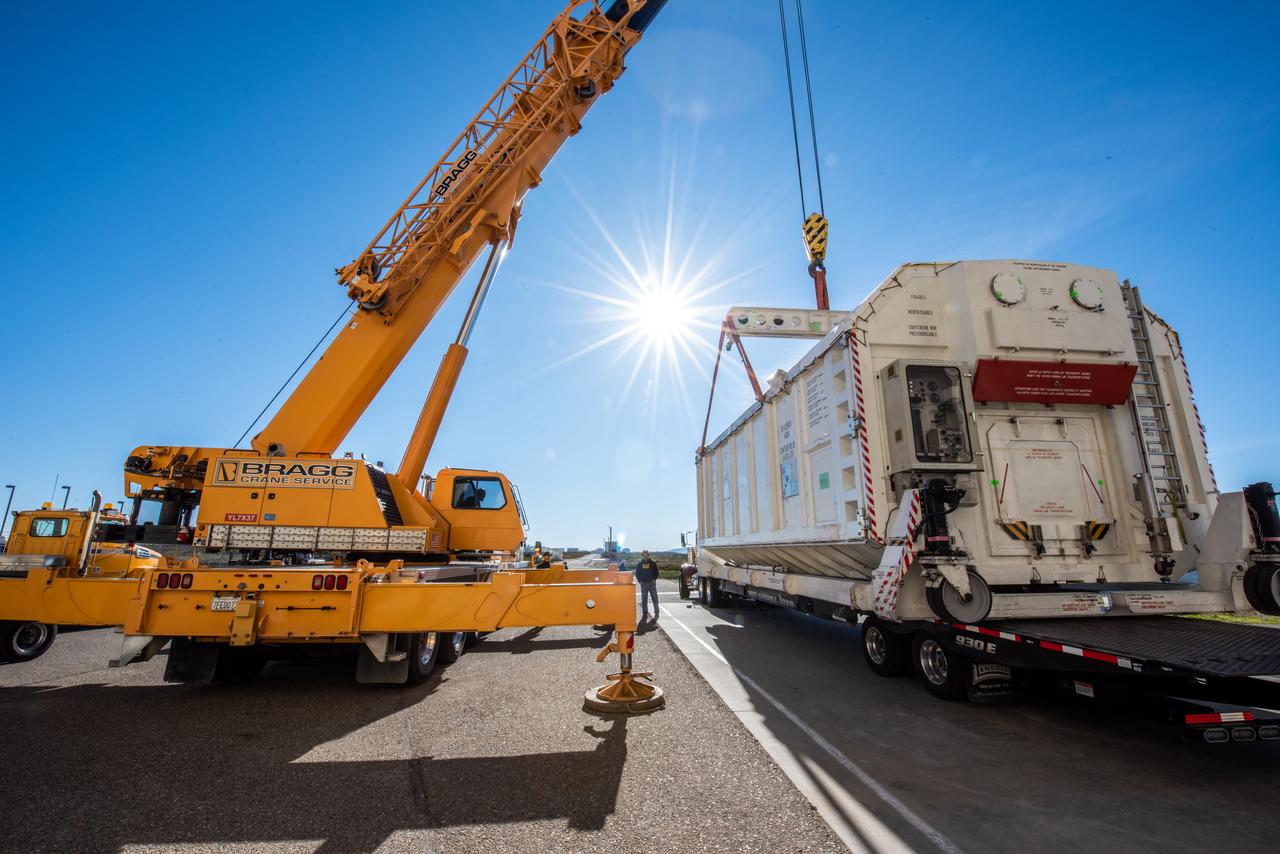
A container, with the Surface Water and Ocean Topography (SWOT) spacecraft inside, is moved to a trailer at the Astrotech facility at Vandenberg Space Force Base in California on Nov. 19, 2022. The satellite will be transported to the SpaceX facility at Vandenberg. SWOT is the first mission that will observe nearly all water on Earth’s surface, measuring the height of water in the planet’s lakes, rivers, reservoirs, and the ocean. It is set to launch aboard a SpaceX Falcon 9 rocket in December from Vandenberg’s Space Launch Center-4 East. NASA’s Launch Services Program, based at the agency’s Kennedy Space Center in Florida, is managing the launch service.
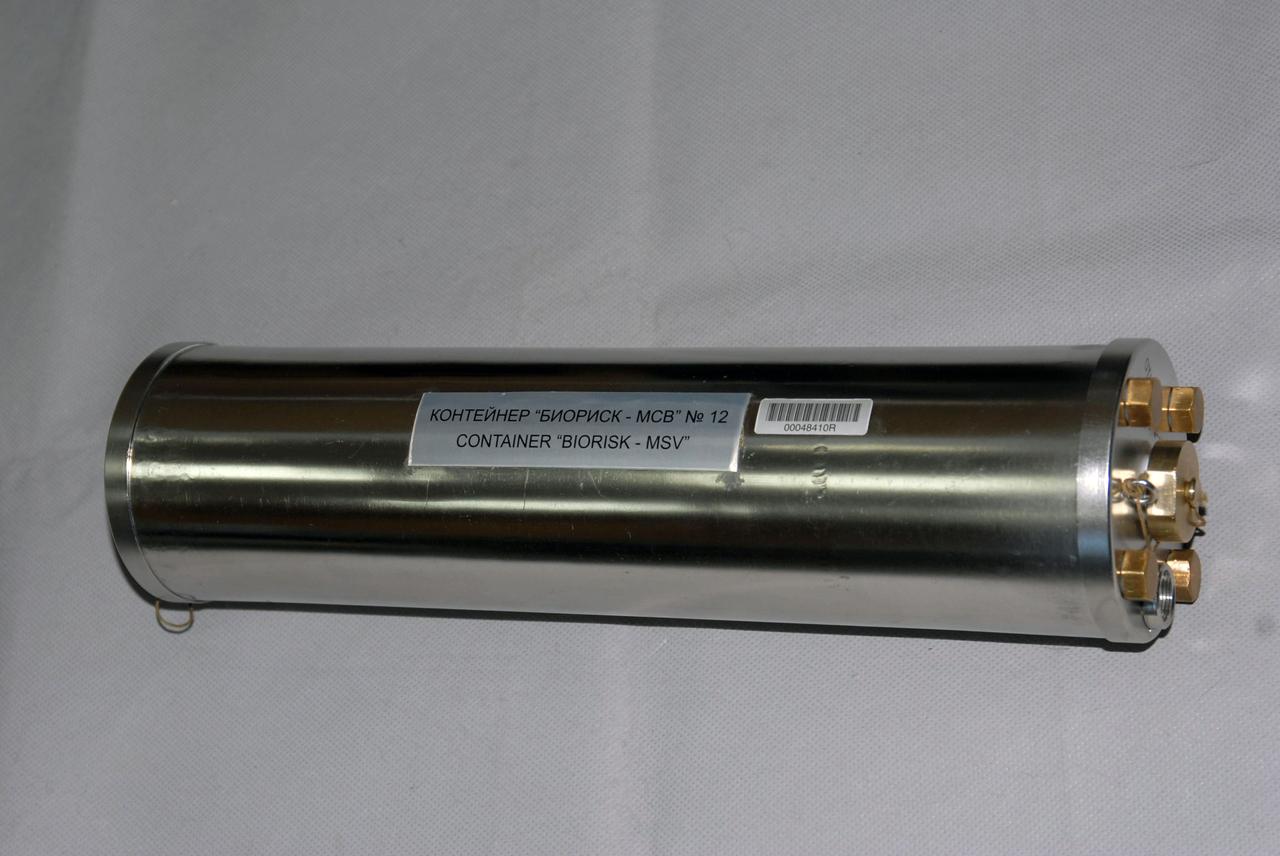
jsc2008e152661 (12/8/2008) --- A preflight view of a Biorisk-MSV container, part of the Biorisk experiment equipment to be delivered to the ISS during the 31P flight. The Influence of Factors of the Space Environment on the Condition of the System of Microorganisms-Hosts Relating to the Problem of Environmental Safety of Flight Techniques and Planetary Quarantine (Biorisk) investigation aims to obtain new data on physical and genetic changes in bacteria and fungi typically found on spacecraft equipment, and also in various biological test objects (higher plant seeds, dormant forms of lower crustaceans) under exposure in the interior ISS compartments and on the exterior ISS surfaces.
jsc2008e152662 (12/10/2008) --- A preflight view of connectors on a Biorisk-MSV container, part of the Biorisk experiment equipment to be delivered to the ISS during the 31P flight. The Influence of Factors of the Space Environment on the Condition of the System of Microorganisms-Hosts Relating to the Problem of Environmental Safety of Flight Techniques and Planetary Quarantine (Biorisk) investigation aims to obtain new data on physical and genetic changes in bacteria and fungi typically found on spacecraft equipment, and also in various biological test objects (higher plant seeds, dormant forms of lower crustaceans) under exposure in the interior ISS compartments and on the exterior ISS surfaces.
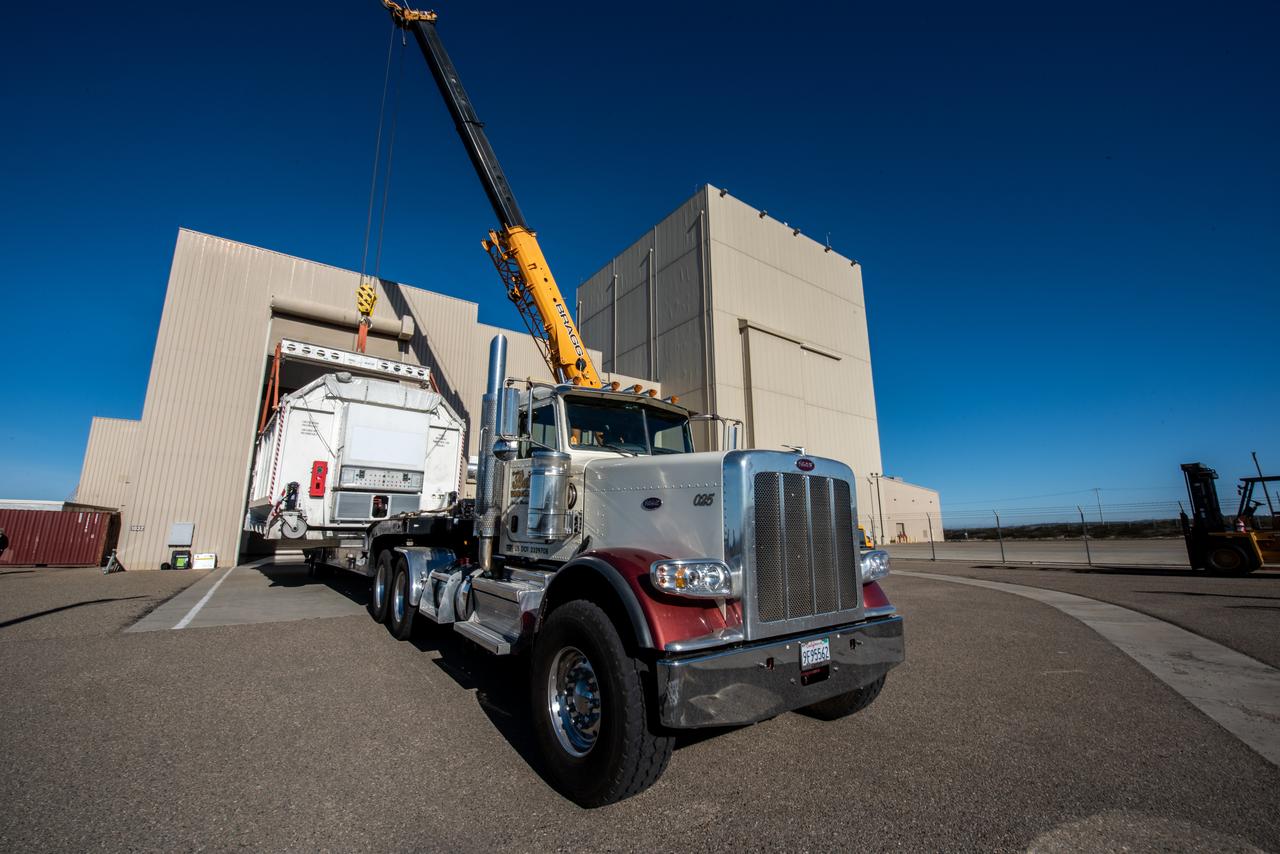
A container, with the Surface Water and Ocean Topography (SWOT) spacecraft inside, is moved to a trailer at the Astrotech facility at Vandenberg Space Force Base in California on Nov. 19, 2022. The satellite will be transported to the SpaceX facility at Vandenberg. SWOT is the first mission that will observe nearly all water on Earth’s surface, measuring the height of water in the planet’s lakes, rivers, reservoirs, and the ocean. It is set to launch aboard a SpaceX Falcon 9 rocket in December from Vandenberg’s Space Launch Center-4 East. NASA’s Launch Services Program, based at the agency’s Kennedy Space Center in Florida, is managing the launch service.
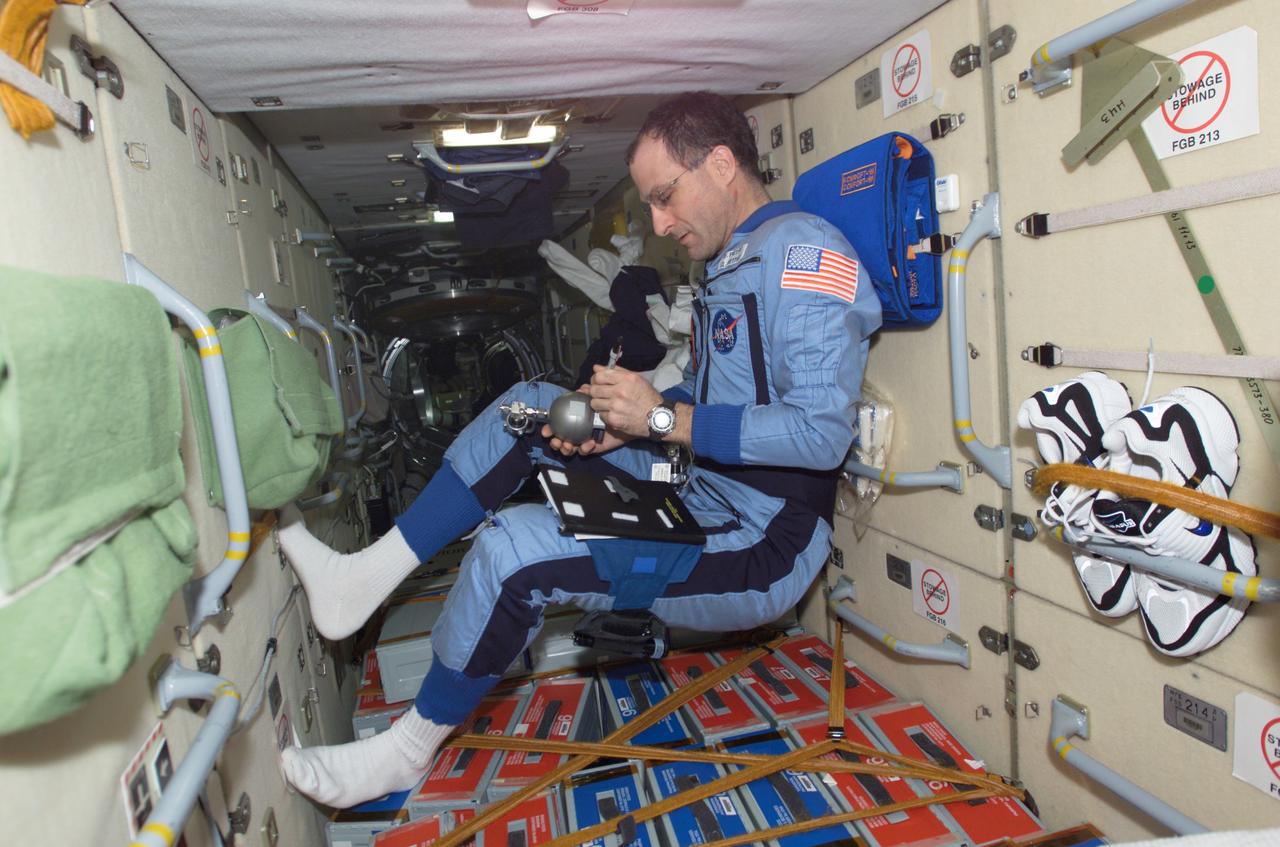
ISS006-E-20835 (22 January 2003) --- Astronaut Donald R. Pettit, Expedition 6 NASA ISS science officer, holds a Grab Sample Container (GSC) in the functional cargo block (FGB), or Zarya, on the International Space Station (ISS). GSC is used for collecting air samples as part of ISS environmental monitoring.
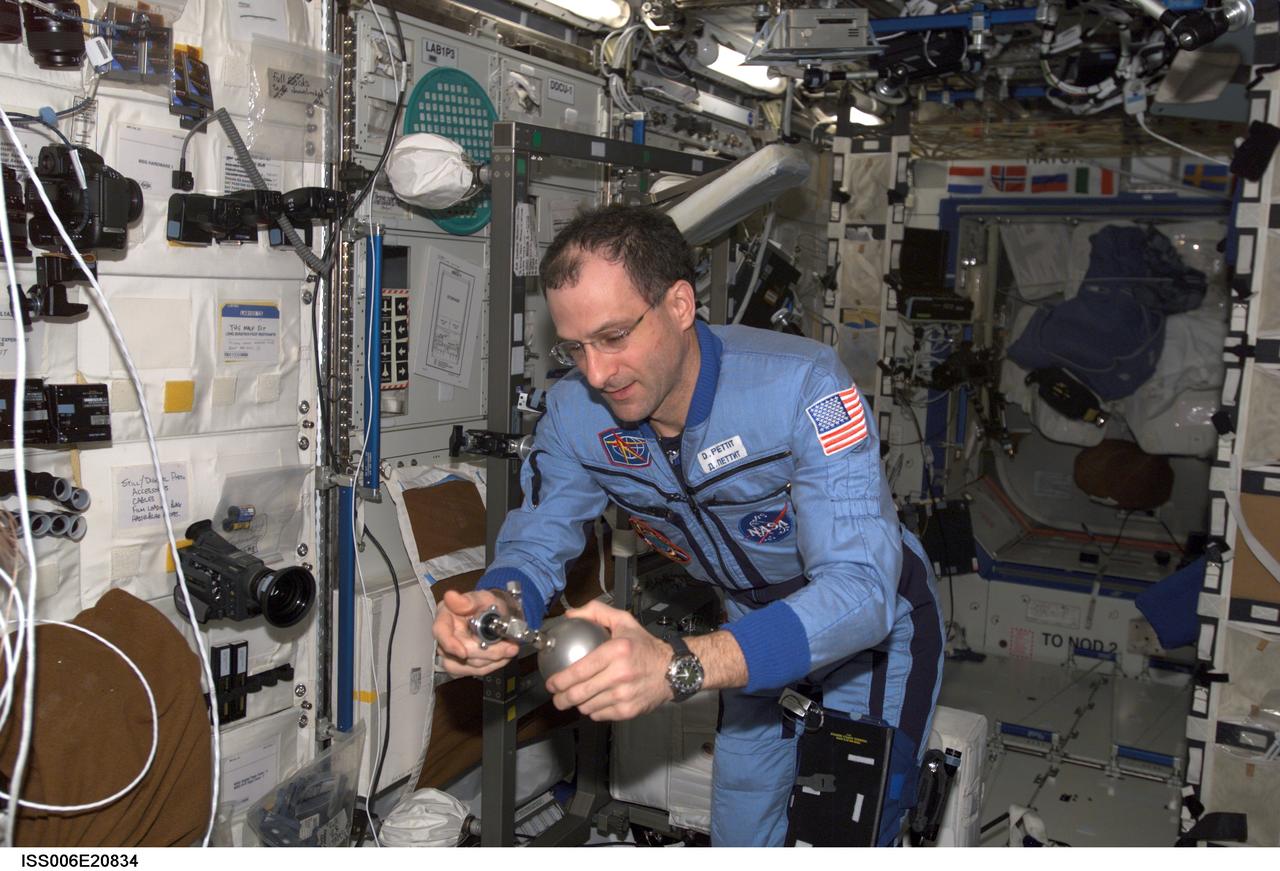
ISS006-E-20834 (22 January 2003) --- Astronaut Donald R. Pettit, Expedition Six NASA ISS science officer, holds a Grab Sample Container (GSC) in the Destiny laboratory on the International Space Station (ISS). GSC is used for collecting air samples as part of ISS environmental monitoring.
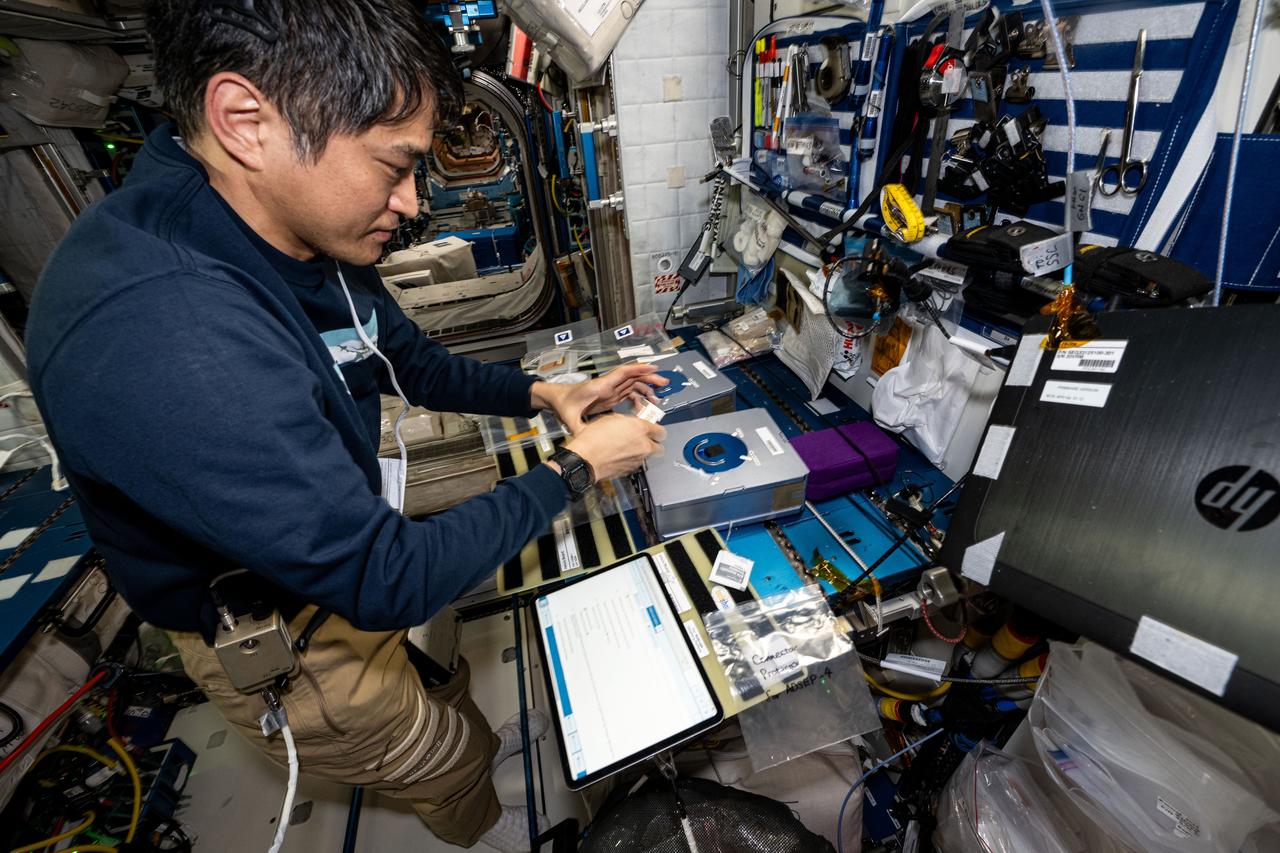
iss073e0002477_alt (April 28, 2025) --- JAXA (Japan Aerospace Exploration Agency) astronaut and Expedition 73 Commander Takuya Onishi processes cassettes containing biological fluid samples for installation inside the Advanced Space Experiment Processor-4, a research facility that can be shipped back and forth from Earth to space, for a biotechnology study.
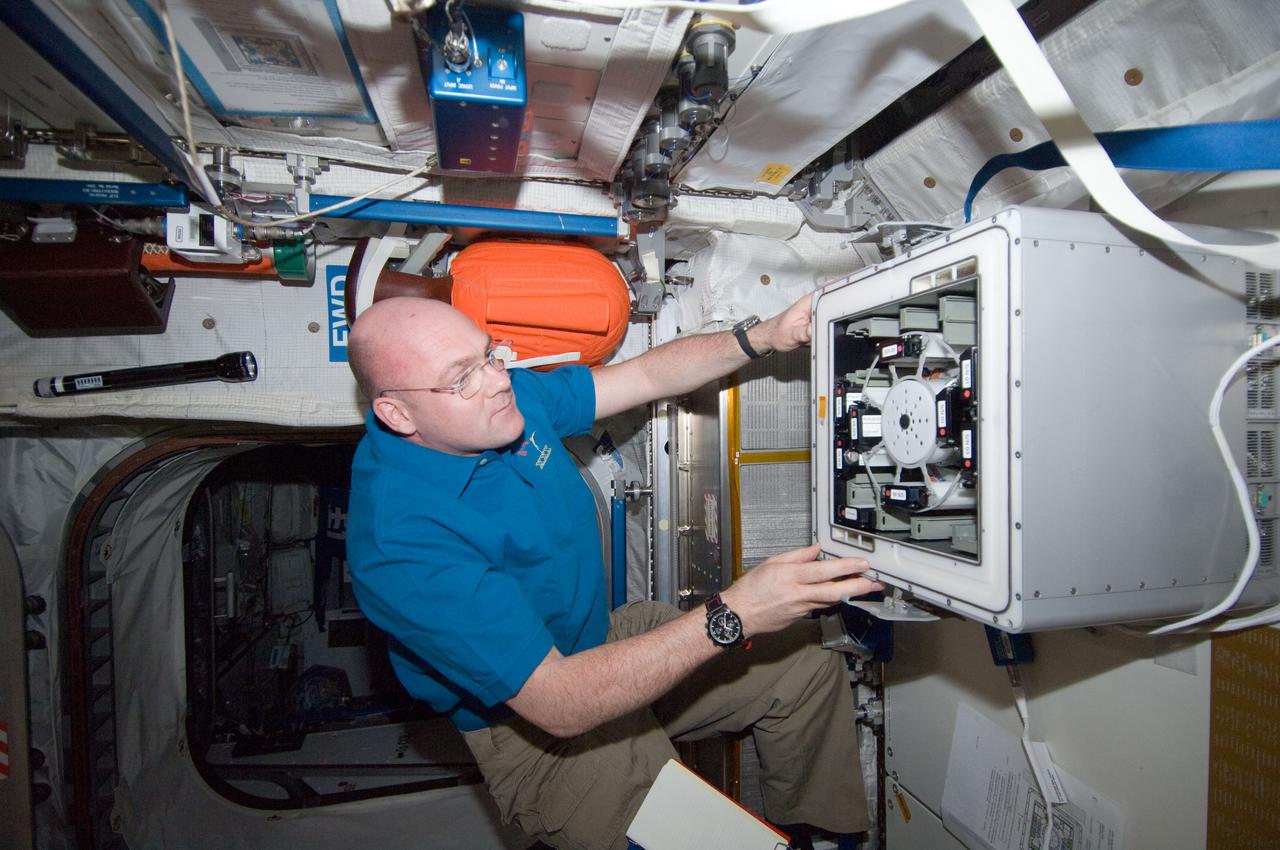
ISS030-E-033238 (24 Dec. 2011) --- European Space Agency astronaut Andre Kuipers, Expedition 30 flight engineer, works with the ESA Role of Apoptosis in Lymphocyte Depression 2 (ROALD-2) experiment in the KUBIK-3 thermostatic container located in the Columbus laboratory of the International Space Station.
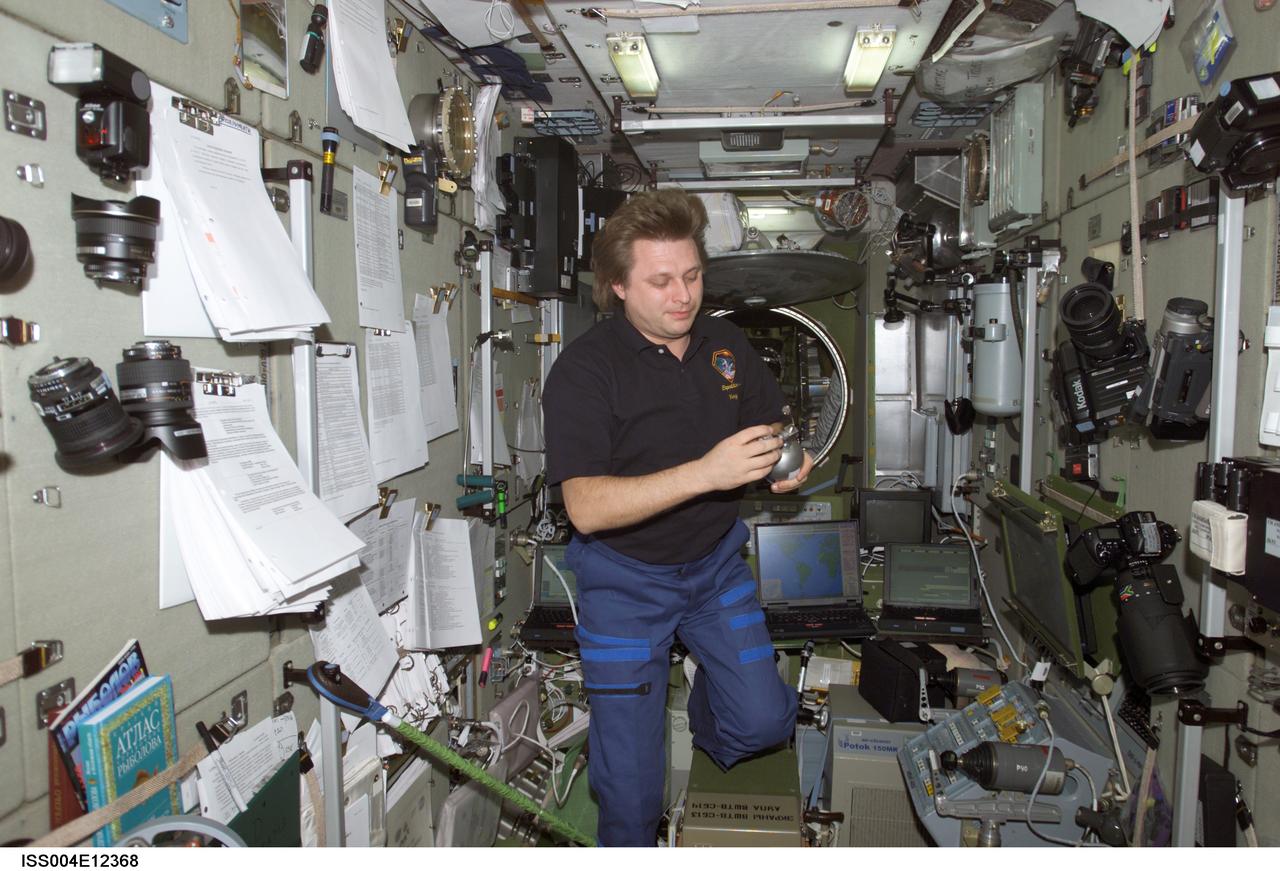
ISS004-E-12368 (23 May 2002) --- Cosmonaut Yury I. Onufrienko, Expedition Four mission commander representing Rosaviakosmos, holds a Grab Sample Container (GSC) in the Zvezda Service Module on the International Space Station (ISS). The GSC is used to take air samples in various modules as part of environmental quality control.
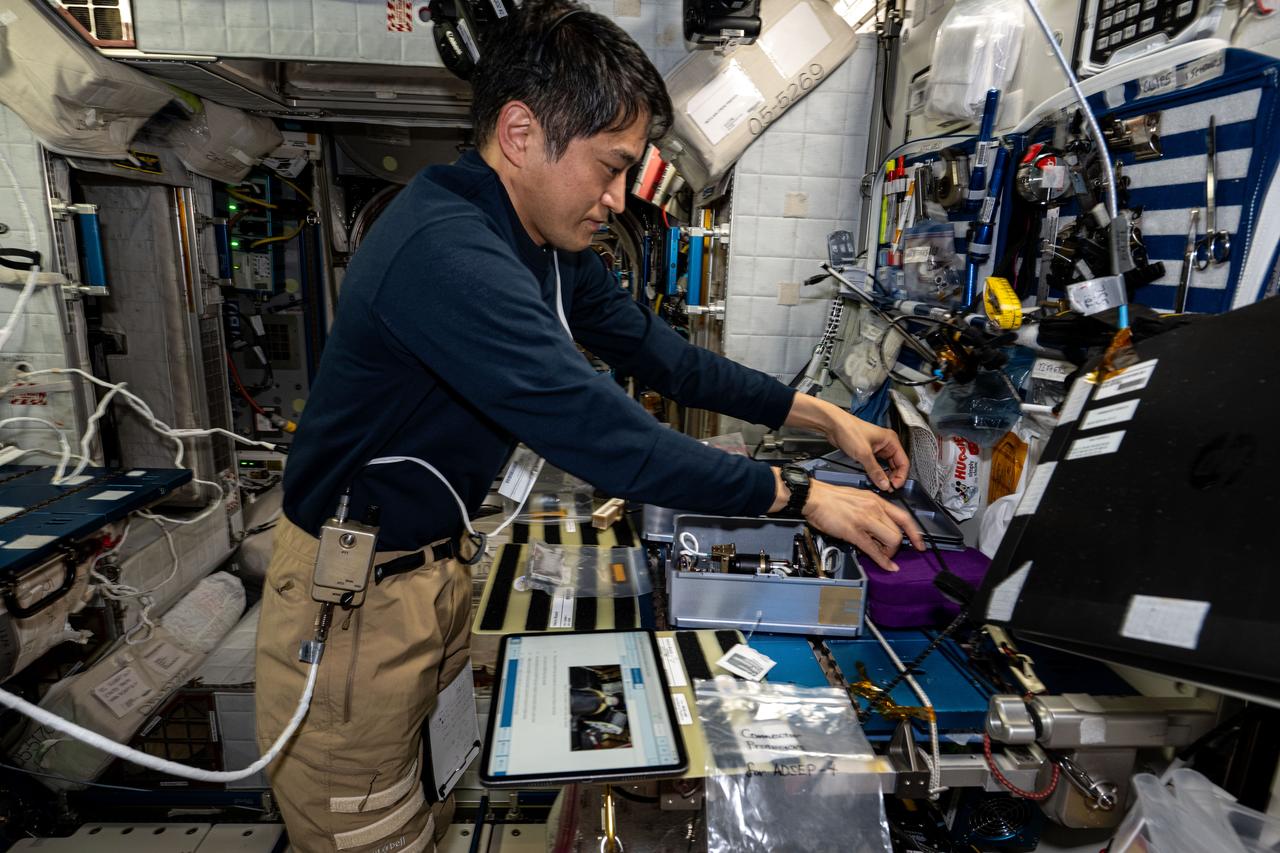
iss073e0002467 (April 28, 2025) --- JAXA (Japan Aerospace Exploration Agency) astronaut and Expedition 73 Commander Takuya Onishi processes cassettes containing biological fluid samples for installation inside the Advanced Space Experiment Processor-4, a research facility that can be shipped back and forth from Earth to space, for a biotechnology study.
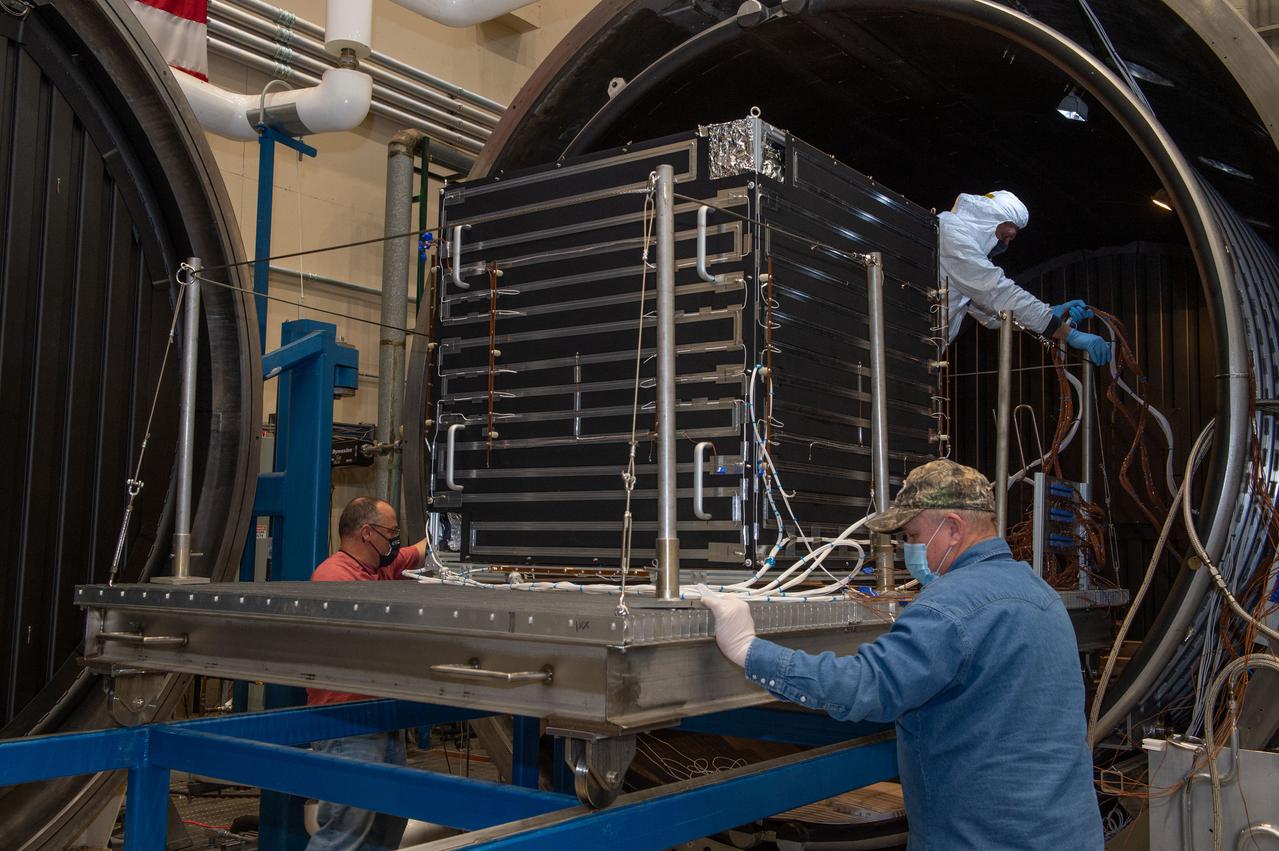
Removal of hot box containing NEA Scout spacecraft from Thermal Vacuum Chamber V15 1 of 2
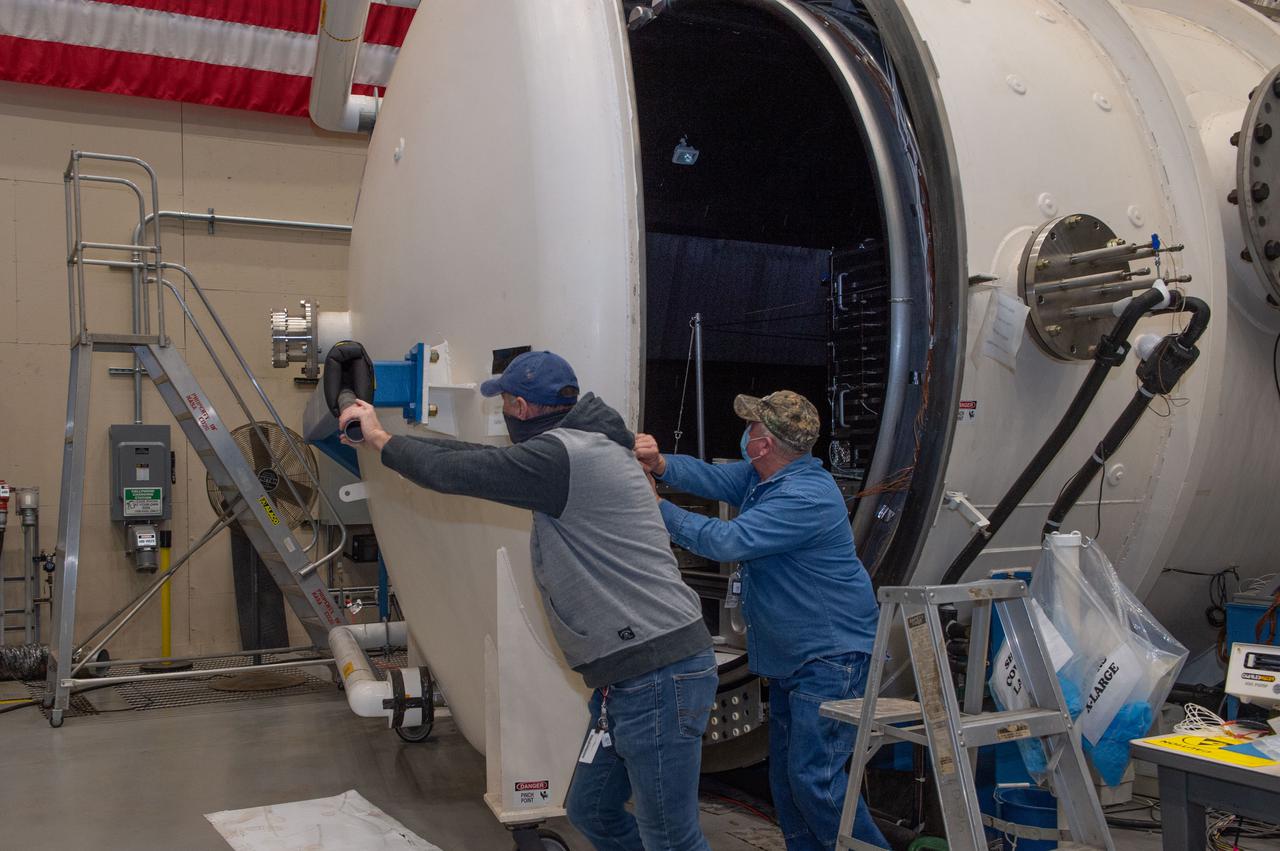
Opening Thermal Vacuum Chamber V15 to extract hot box containing NEA Scout spacecraft.
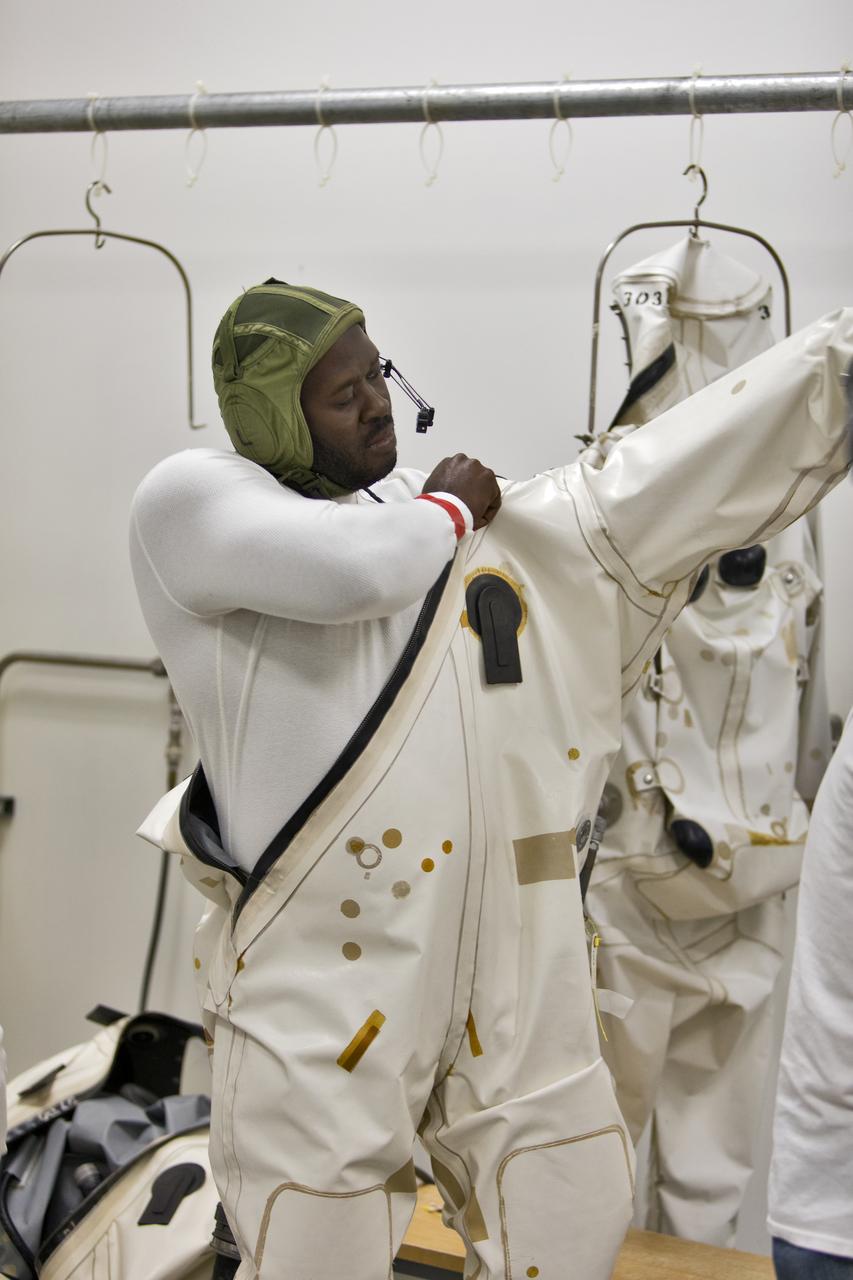
Technicans inside Kennedy's Multi-Payload Processing Facility do testing in SCAPE (Self-Contained Atmospheric Protective Ensemble) suits.
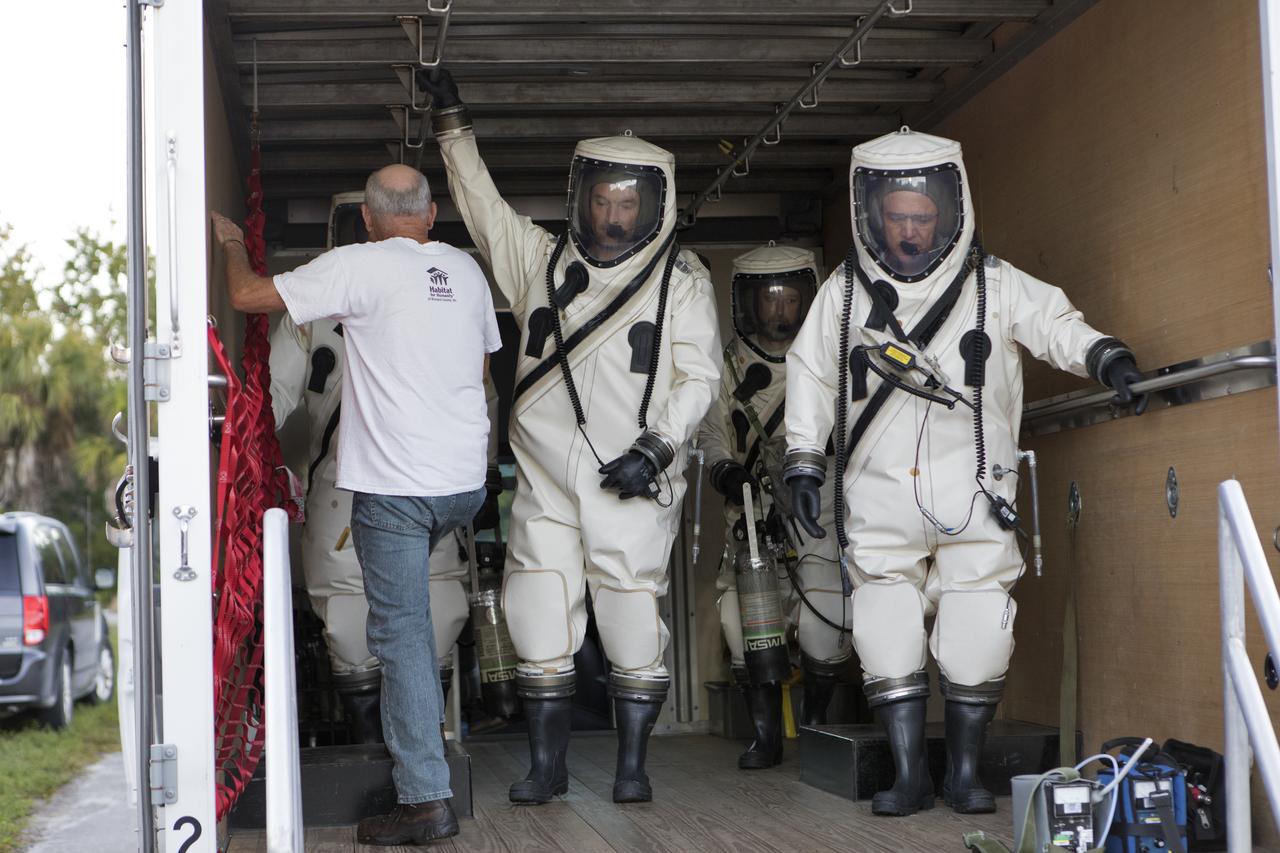
Technicans inside Kennedy's Multi-Payload Processing Facility do testing in SCAPE (Self-Contained Atmospheric Protective Ensemble) suits.
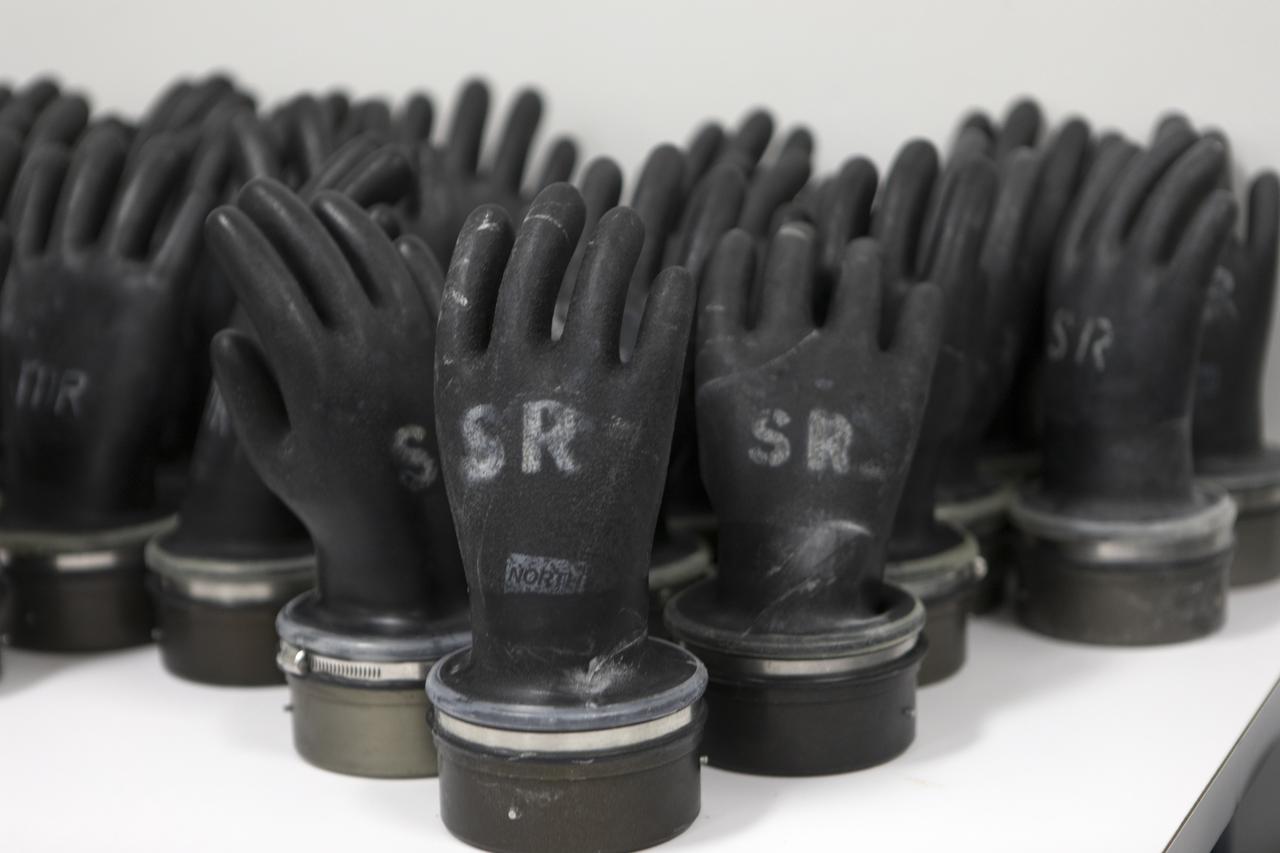
Technicans inside Kennedy's Multi-Payload Processing Facility do testing in SCAPE (Self-Contained Atmospheric Protective Ensemble) suits.
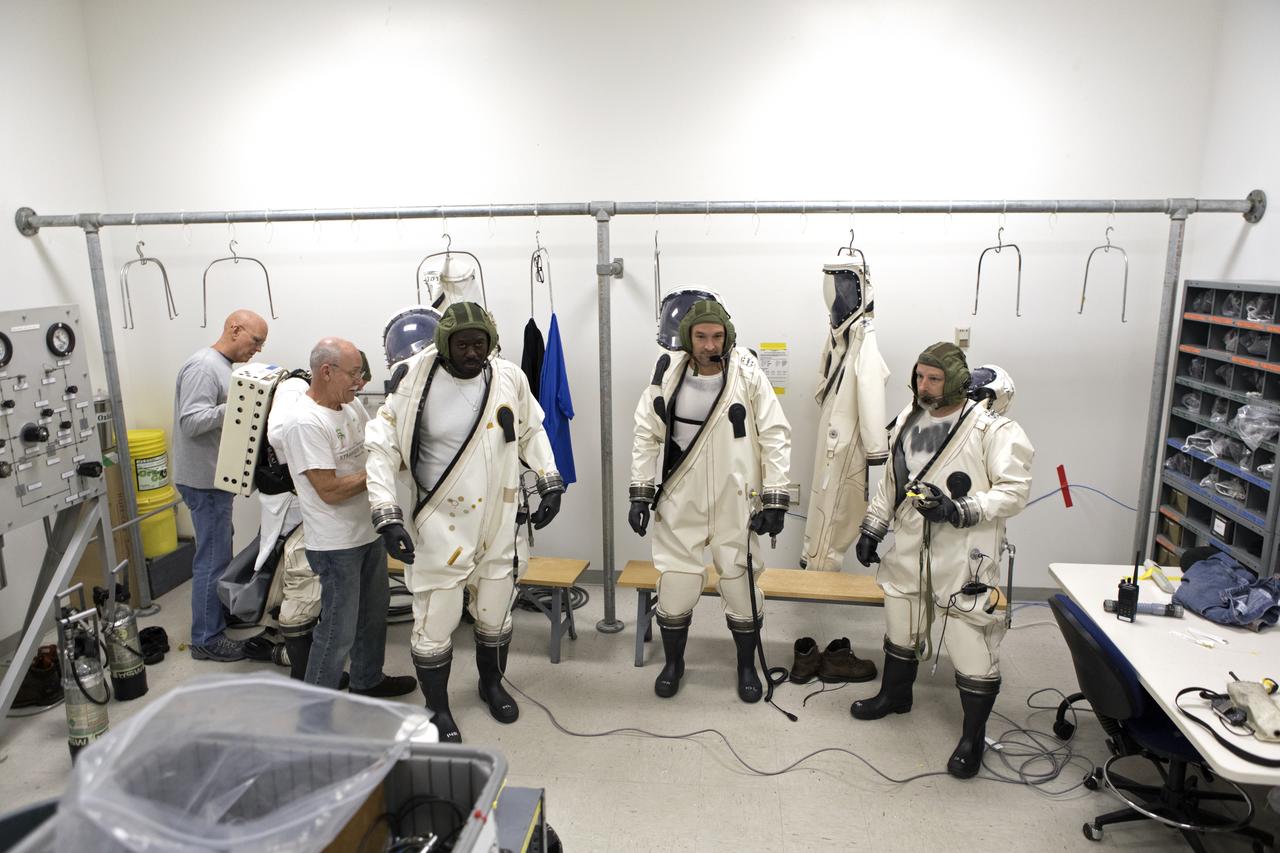
Technicans inside Kennedy's Multi-Payload Processing Facility do testing in SCAPE (Self-Contained Atmospheric Protective Ensemble) suits.
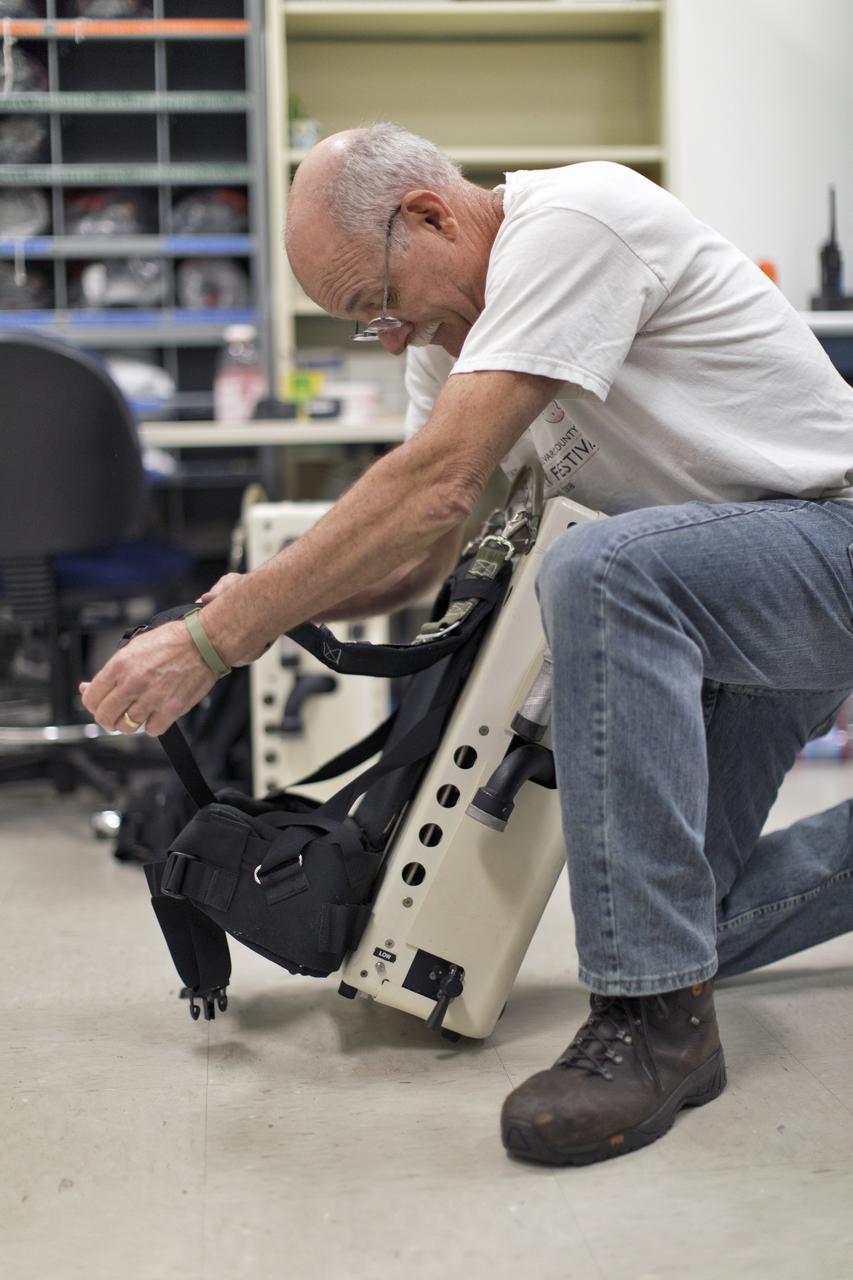
Technicans inside Kennedy's Multi-Payload Processing Facility do testing in SCAPE (Self-Contained Atmospheric Protective Ensemble) suits.
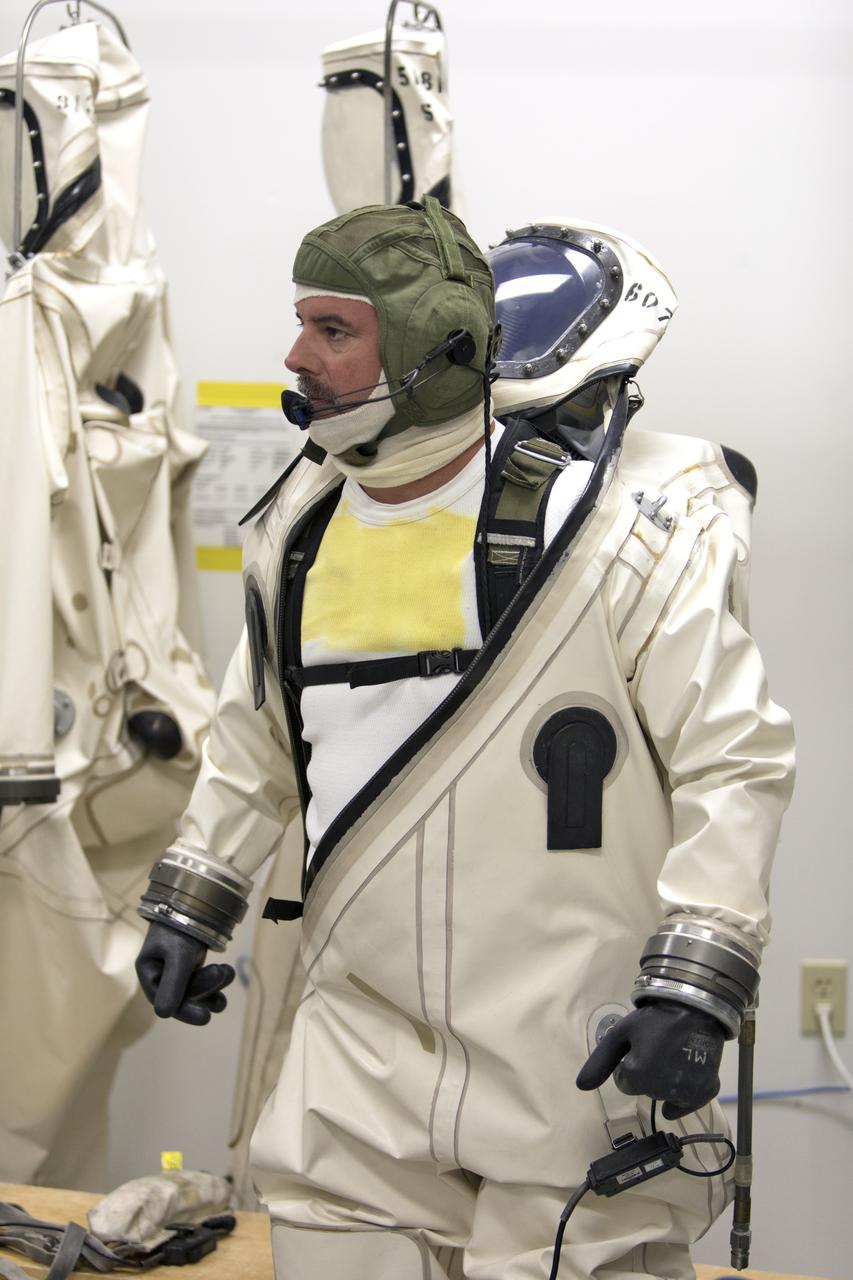
Technicans inside Kennedy's Multi-Payload Processing Facility do testing in SCAPE (Self-Contained Atmospheric Protective Ensemble) suits.
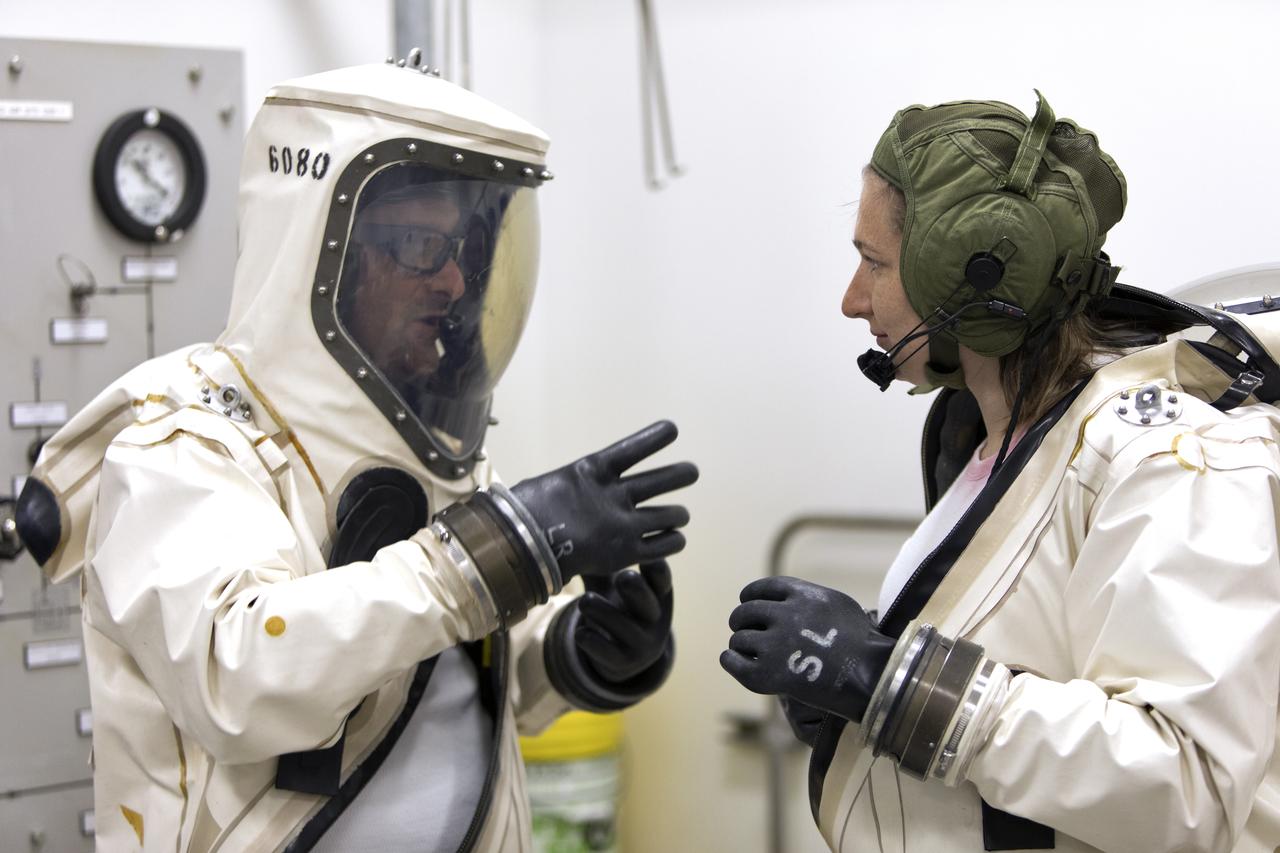
Technicans inside Kennedy's Multi-Payload Processing Facility do testing in SCAPE (Self-Contained Atmospheric Protective Ensemble) suits.
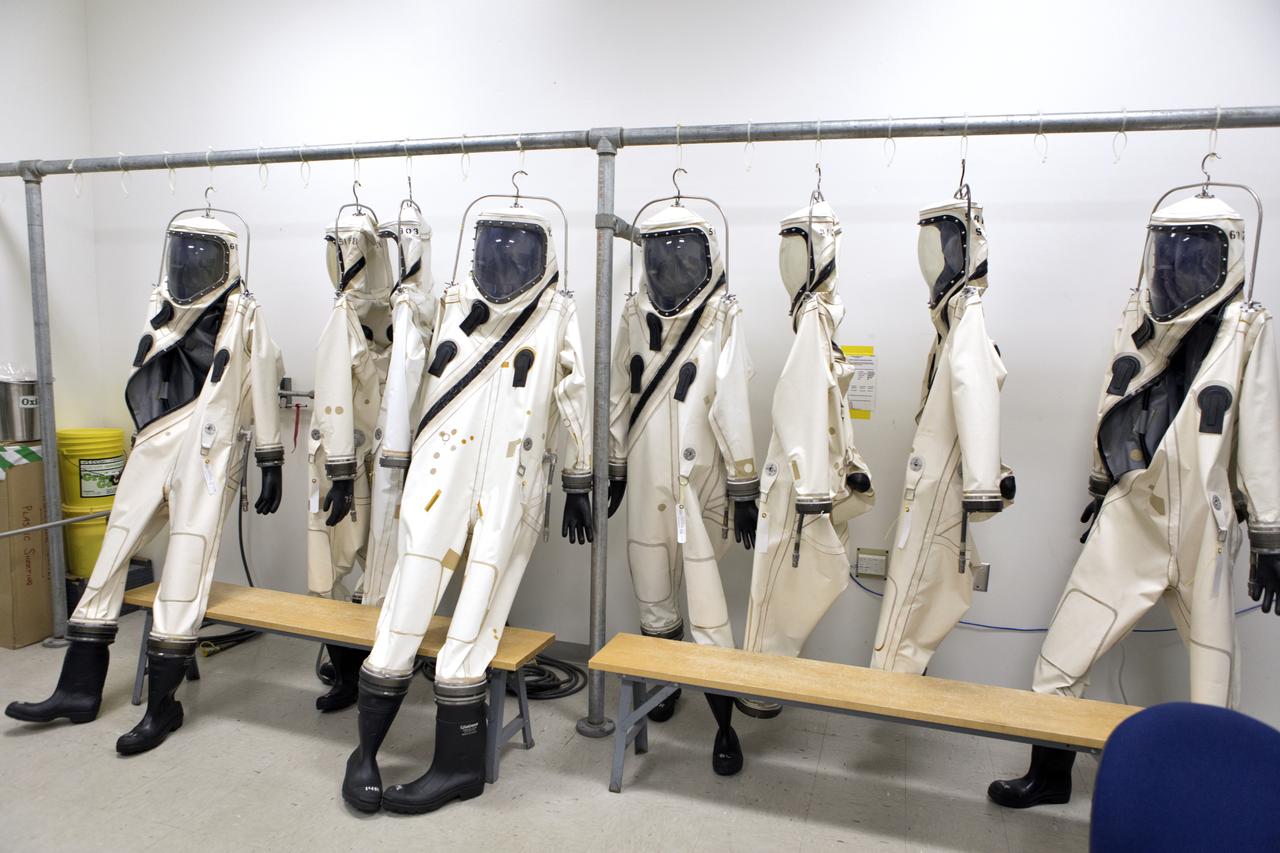
Technicans inside Kennedy's Multi-Payload Processing Facility do testing in SCAPE (Self-Contained Atmospheric Protective Ensemble) suits.
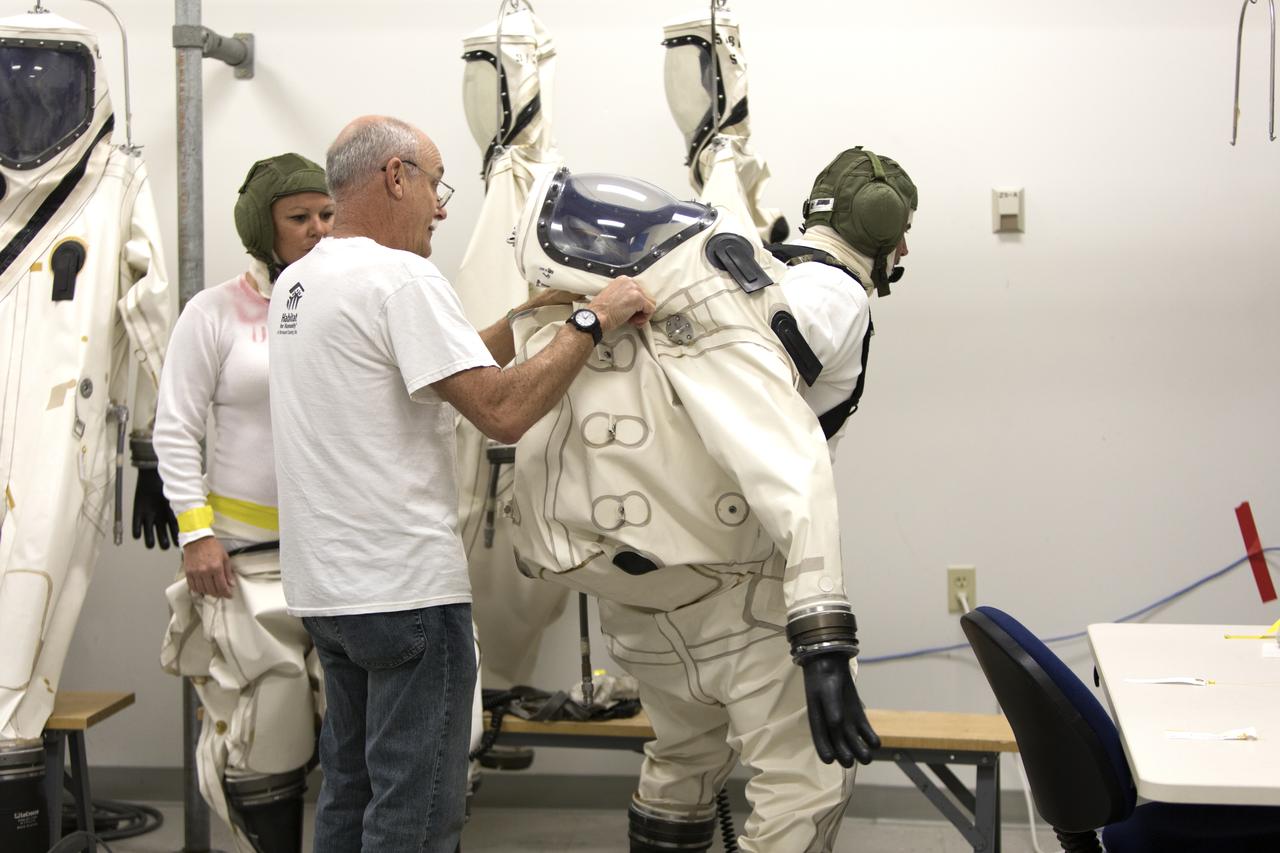
Technicans inside Kennedy's Multi-Payload Processing Facility do testing in SCAPE (Self-Contained Atmospheric Protective Ensemble) suits.
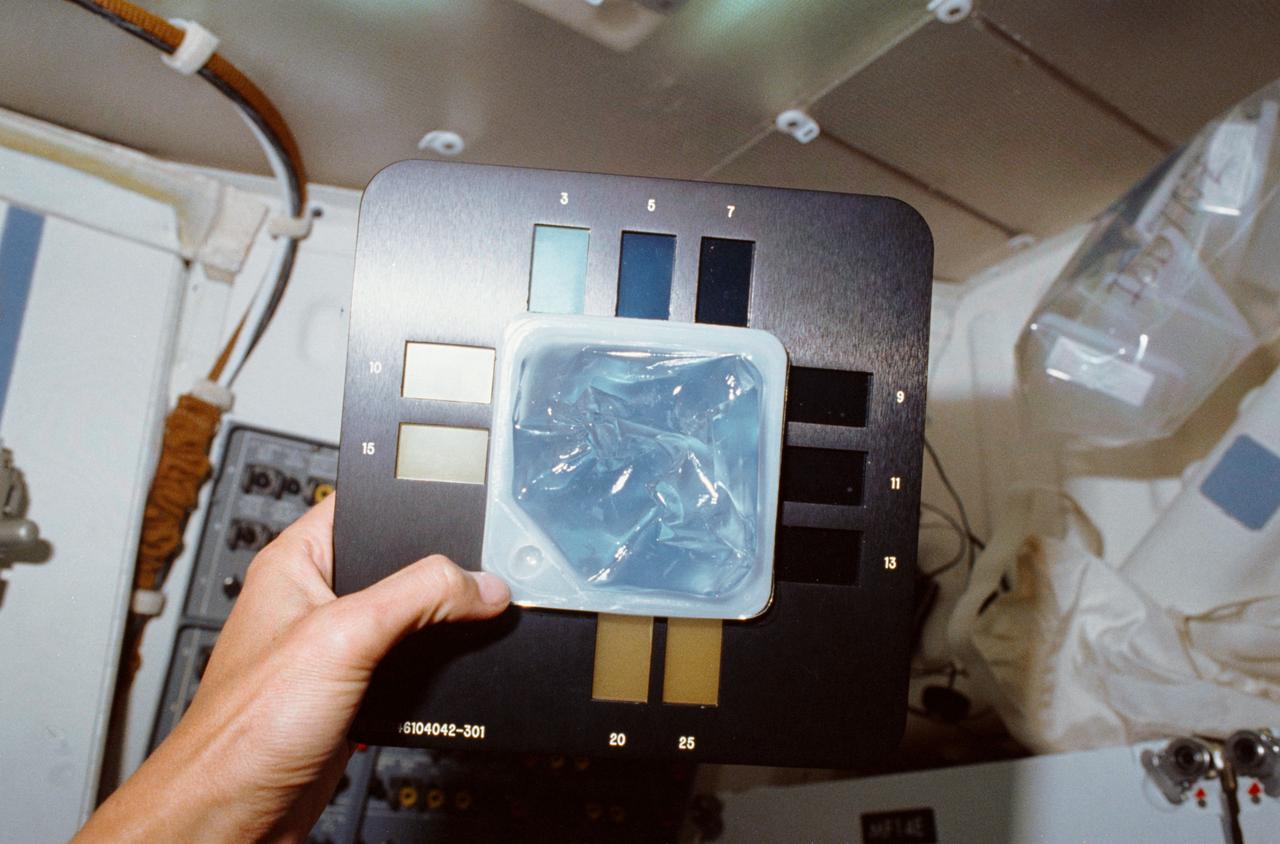
STS034-10-014 (18-23 Oct. 1989) --- An onboard 35mm camera provides a closeup view of an STS-34 beverage container doubling as an experiment module for a test involving iodine concentration in onboard water. The examination called for the adding of starch to a specimen of Atlantis' fuel-cell produced water. The liquid was then compared against the color chart for determining the degree of iodine content. The experiment was designed by Terry H. Slezak of JSC's Photographic Technology and Television Division.
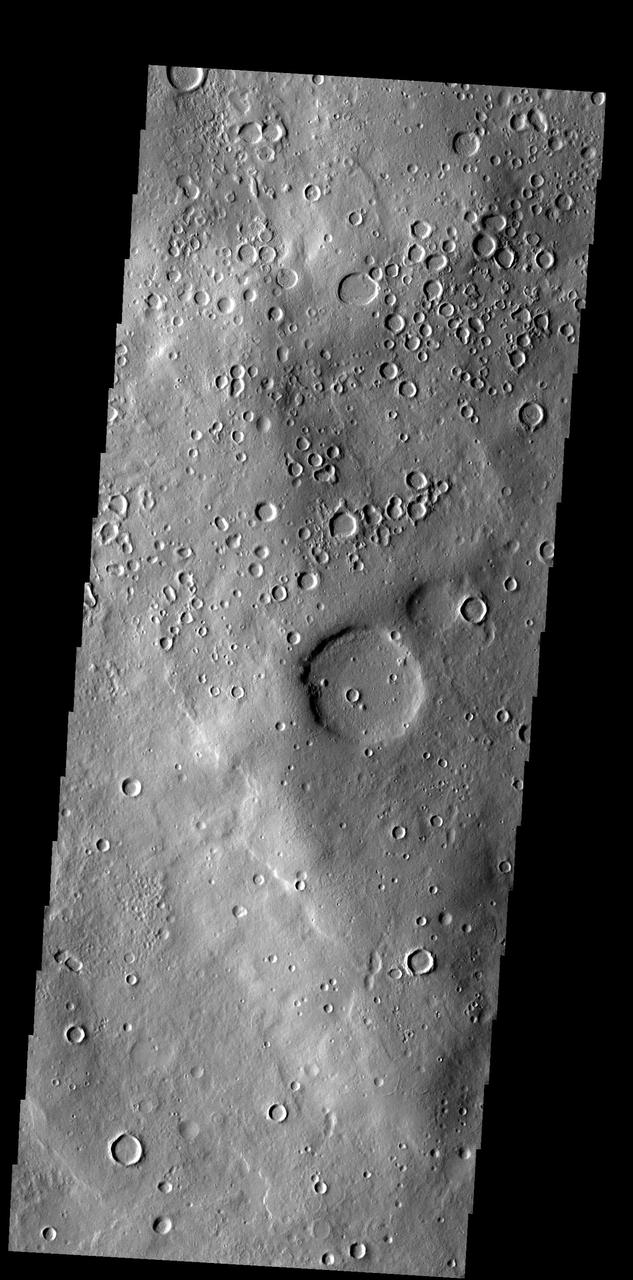
This region of Terra Sabaea contains areas with high densities of small craters
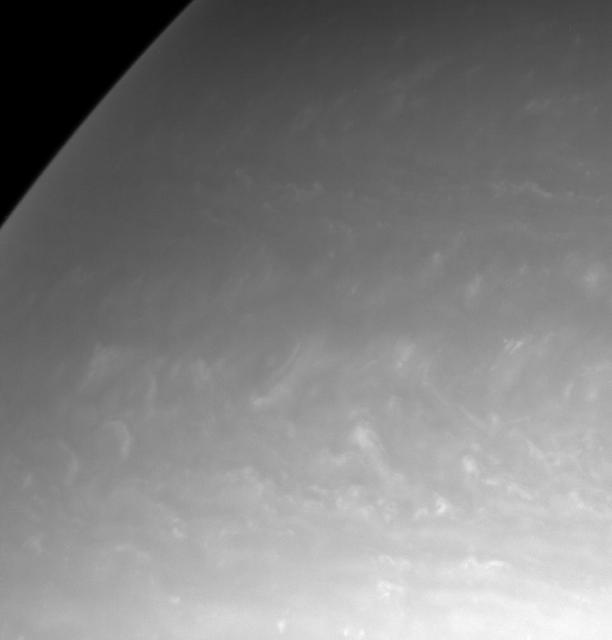
his scene contains a great deal of bright, whorl-shaped cloud activity
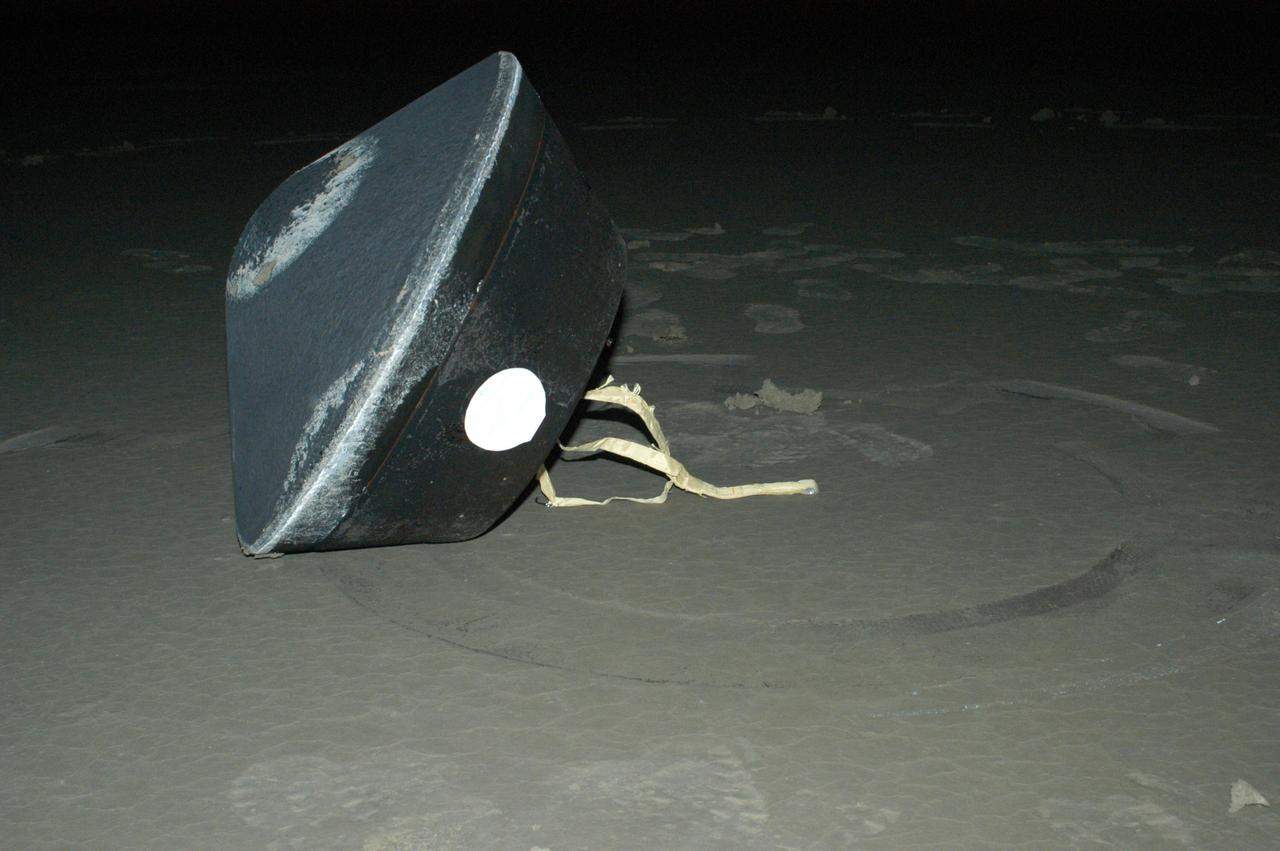
The capsule contains cometary and interstellar samples gathered by NASA Stardust spacecraft.
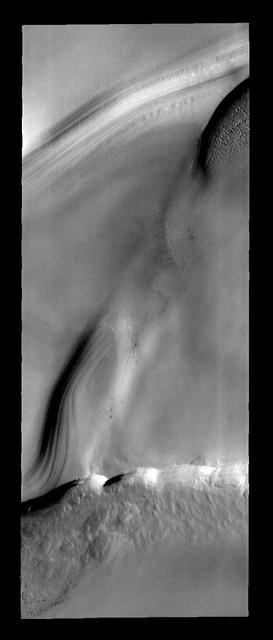
This image of the north polar layered deposits also contains sand dunes
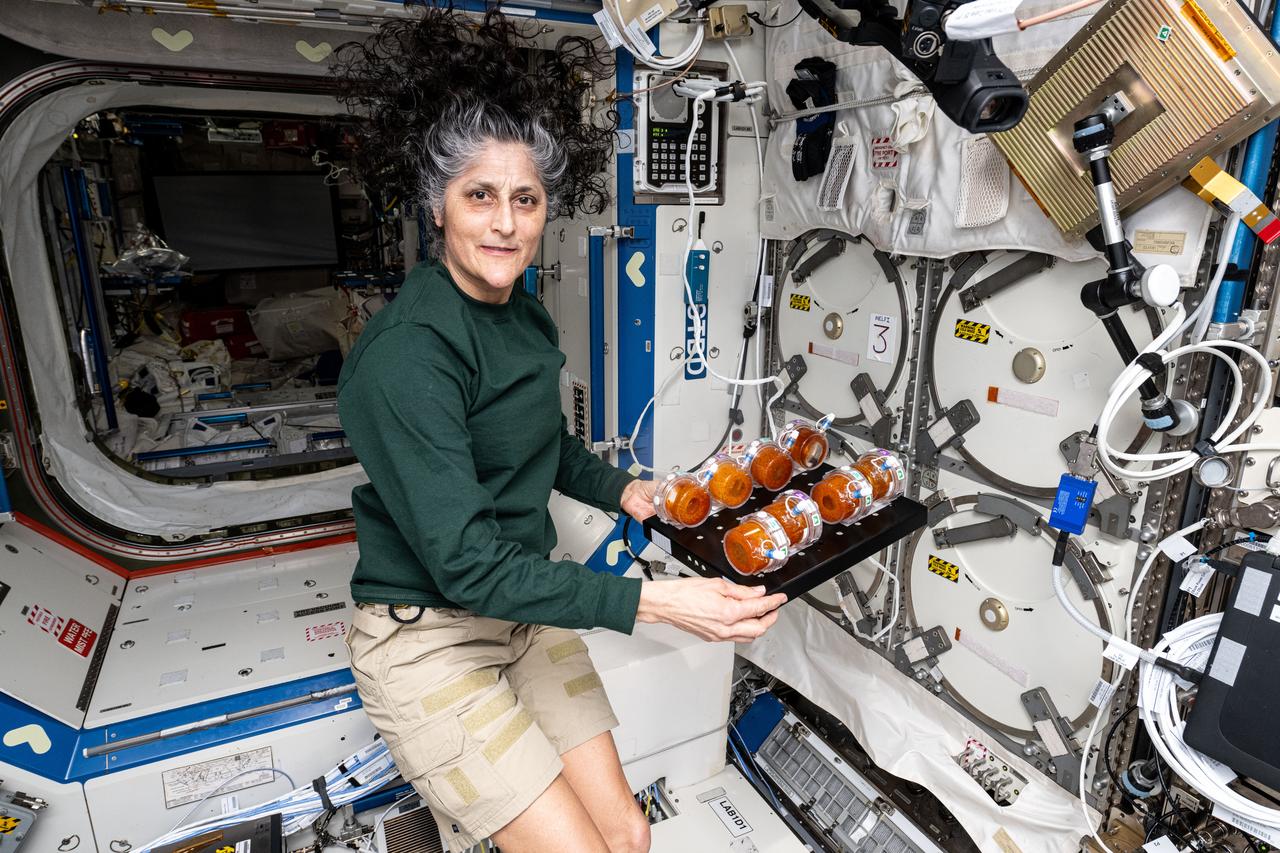
iss072e616432 (Feb. 11, 2025) --- NASA astronaut and Expedition 72 Commander Suni Williams displays production packs containing geneticallly engineered yeast and edible media for incubation to activate yeast growth. The BioNutrients investigation explores using the engineered yeast to produce on-demand nutrients and avoid vitamin deficiencies for crews on long-term missions. The samples are later frozen then returned to Earth to analyze their ability promote crew health and improve the preservation of probiotics.
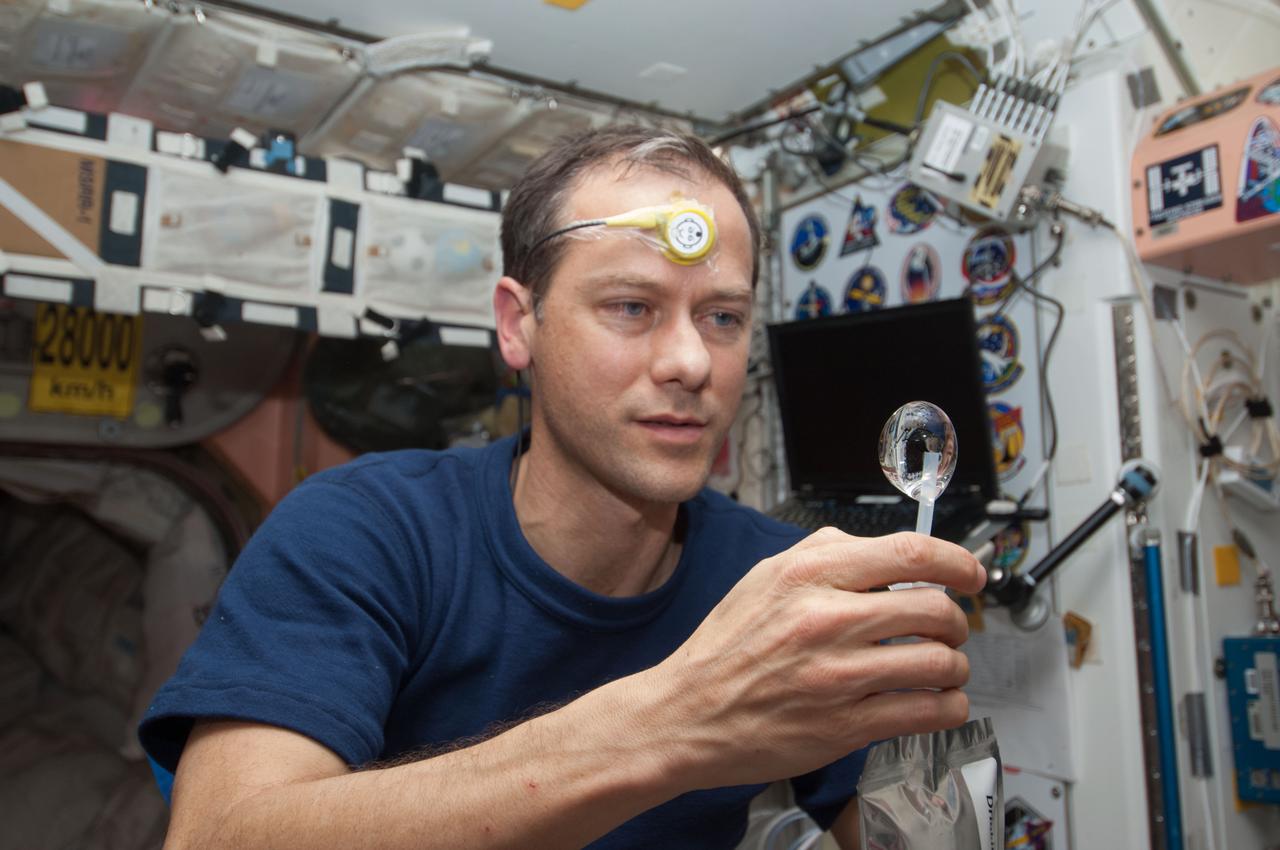
ISS034-E-031709 (21 Jan. 2013) --- NASA astronaut Tom Marshburn, Expedition 34 flight engineer, squeezes a water bubble out of his beverage container in the Unity node of the International Space Station. He is wearing a Drager Double Sensor on his forehead which is used on the Circadian Rhythms Experiment. This experiment examines the hypothesis that long-term spaceflights significantly affect the synchronization of the circadian rhythms in humans due to changes of a non-24 hour light-dark cycle.

This unnamed channel complex in nothern Arabia Terra contains several different surface textures on the channel floor. The parallel ridges are unusally indicative of materials which contain volatiles