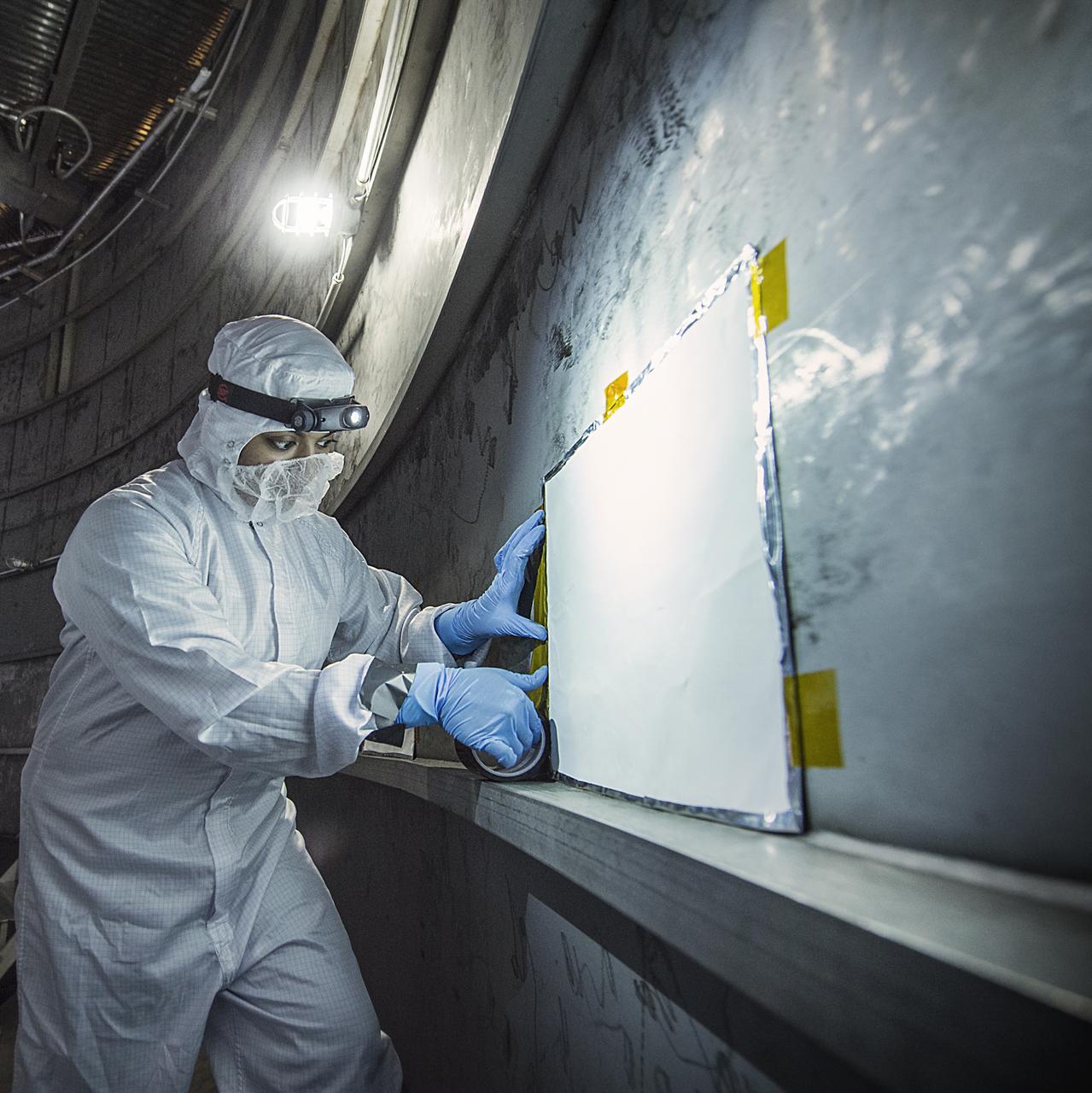
Contamination from organic molecules can harm delicate instruments and engineers are taking special care at NASA to prevent that from affecting the James Webb Space Telescope (and all satellites and instruments). Recently, Nithin Abraham, a Thermal Coatings Engineer placed Molecular Adsorber Coating or "MAC" panels in the giant chamber where the Webb telescope will be tested. This contamination can occur through a process when a vapor or odor is emitted by a substance. This is called "outgassing." The "new car smell" is an example of that, and is unhealthy for people and sensitive satellite instruments. So, NASA engineers have created a new way to protect those instruments from the damaging effects of contamination coming from outgassing. "The Molecular Adsorber Coating (MAC) is a NASA Goddard coatings technology that was developed to adsorb or entrap outgassed molecular contaminants for spaceflight applications," said Nithin Abraham, Thermal Coatings Engineer at NASA's Goddard Space Flight Center in Greenbelt, Maryland. MAC is currently serving as an innovative contamination mitigation tool for Chamber A operations at NASA Johnson Space Center in Houston, Texas. MAC can be used to keep outgassing from coming in from outside areas or to capture outgassing directly from hardware, components, and within instrument cavities. In this case, MAC is helping by capturing outgassed contaminants outside the test chamber from affecting the Webb components. MAC is expected to capture the outgassed contaminants that exist in the space of the vacuum chamber (not from the Webb components). Credit: NASA/GoddardChris Gunn Read more: <a href="http://www.nasa.gov/feature/goddard/nasa-technology-protects-webb-telescope-from-contamination" rel="nofollow">www.nasa.gov/feature/goddard/nasa-technology-protects-web...</a> <b><a href="http://www.nasa.gov/audience/formedia/features/MP_Photo_Guidelines.html" rel="nofollow">NASA image use policy.</a></b> <b><a href="http://www.nasa.gov/centers/goddard/home/index.html" rel="nofollow">NASA Goddard Space Flight Center</a></b> enables NASA’s mission through four scientific endeavors: Earth Science, Heliophysics, Solar System Exploration, and Astrophysics. Goddard plays a leading role in NASA’s accomplishments by contributing compelling scientific knowledge to advance the Agency’s mission. <b>Follow us on <a href="http://twitter.com/NASAGoddardPix" rel="nofollow">Twitter</a></b> <b>Like us on <a href="http://www.facebook.com/pages/Greenbelt-MD/NASA-Goddard/395013845897?ref=tsd" rel="nofollow">Facebook</a></b> <b>Find us on <a href="http://instagrid.me/nasagoddard/?vm=grid" rel="nofollow">Instagram</a></b>
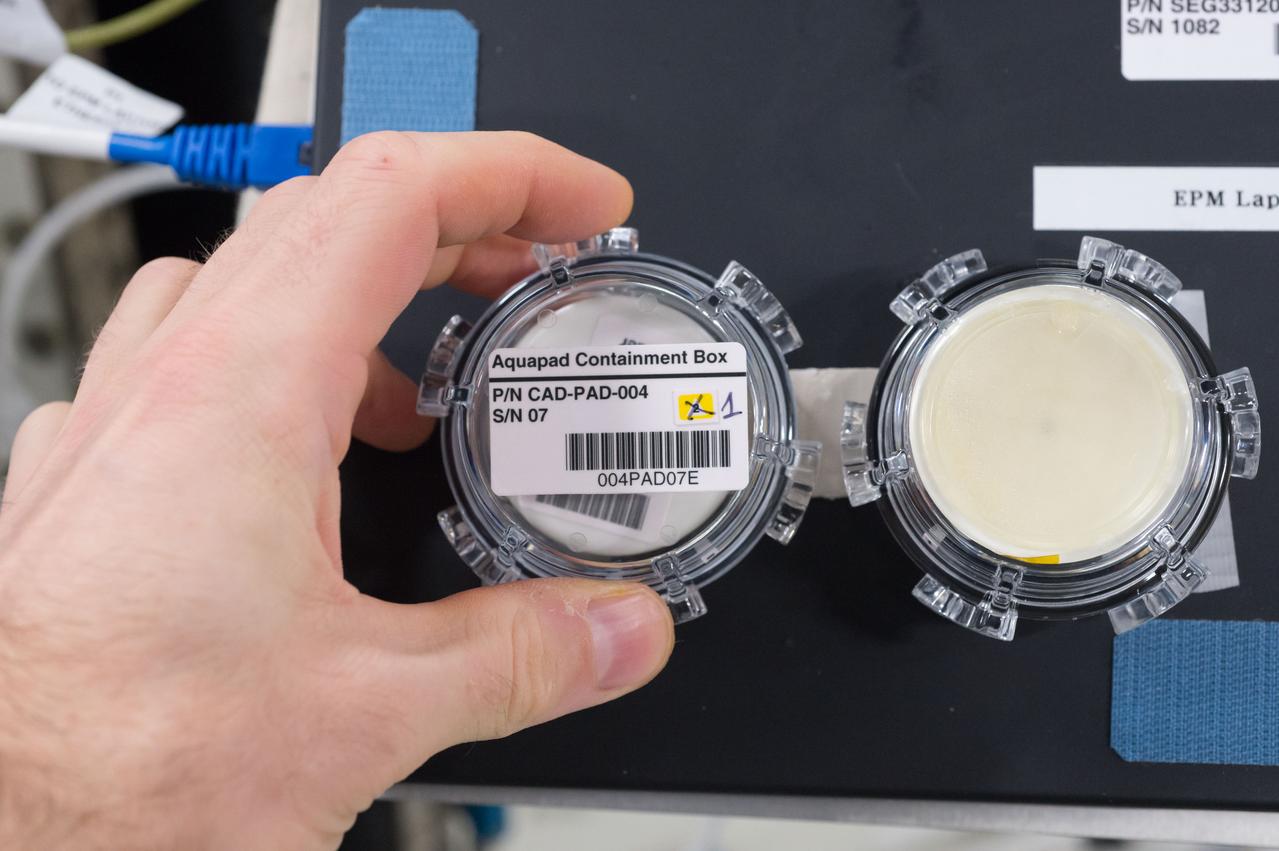
iss050e057692 (3/16/2017) --- View of Aquapad Microbial Contamination within container during analysis of water samples. Photo was taken during Expedition 50.
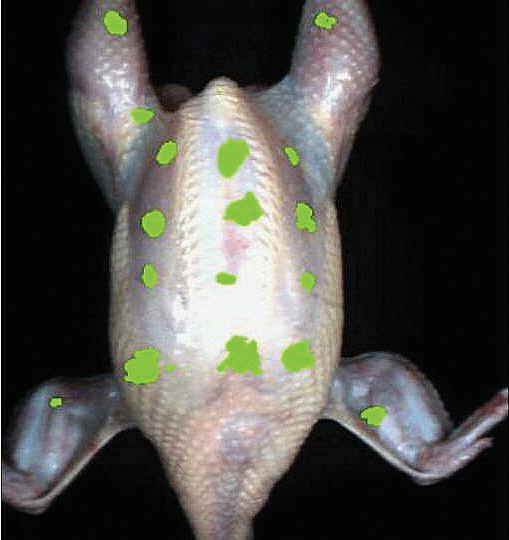
ProVision Technologies, a NASA research partnership center at Sternis Space Center in Mississippi, has developed a new hyperspectral imaging (HSI) system that is much smaller than the original large units used aboard remote sensing aircraft and satellites. The new apparatus is about the size of a breadbox. Health-related applications of HSI include scanning chickens during processing to help prevent contaminated food from getting to the table. ProVision is working with Sanderson Farms of Mississippi and the U.S. Department of Agriculture. ProVision has a record in its spectral library of the unique spectral signature of fecal contamination, so chickens can be scanned and those with a positive reading can be separated. HSI sensors can also determine the quantity of surface contamination. Research in this application is quite advanced, and ProVision is working on a licensing agreement for the technology. The potential for future use of this equipment in food processing and food safety is enormous.
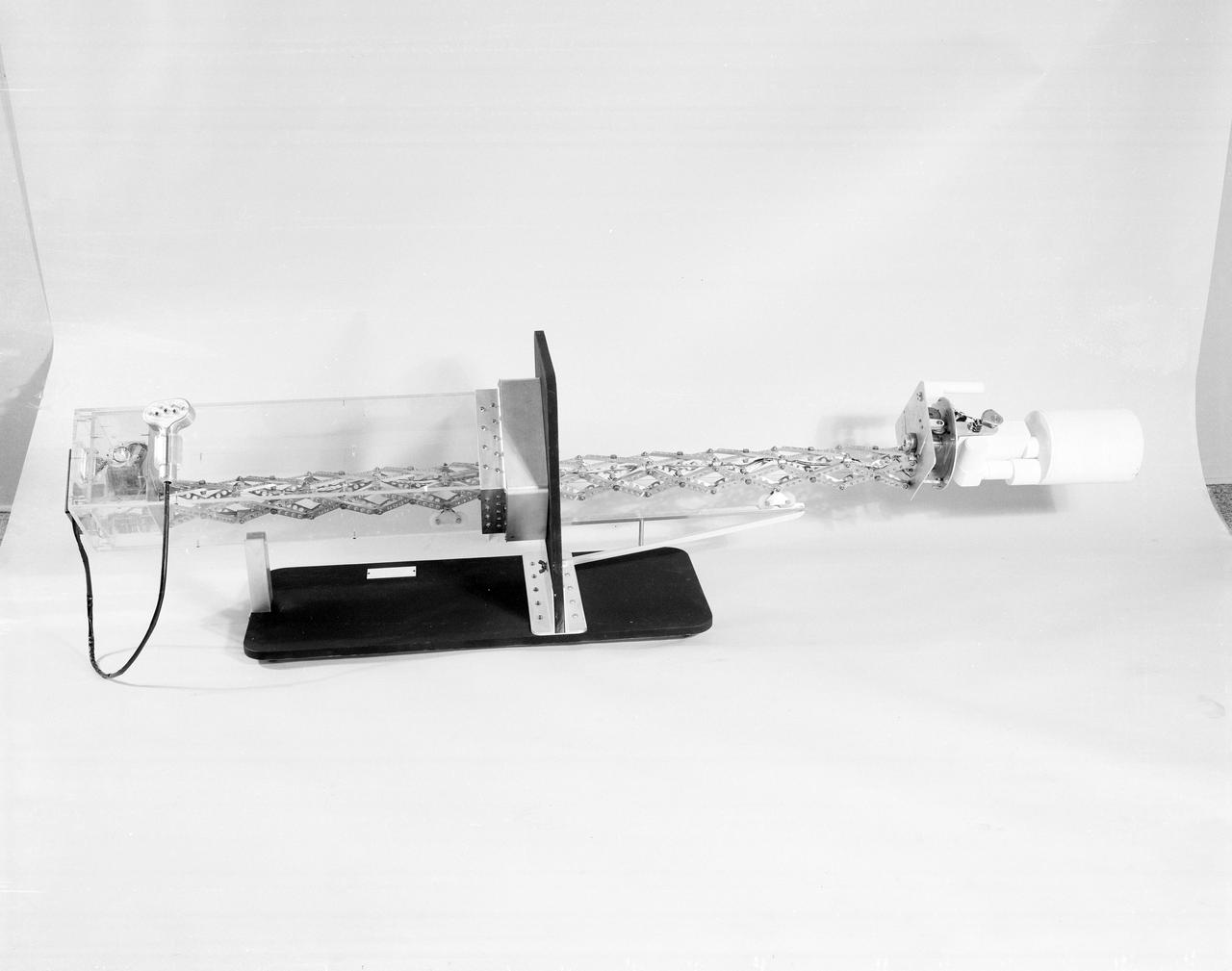
The Apollo Telescope Mount (ATM), designed and developed by the Marshall Space Flight Center, served as the primary scientific instrument unit aboard the Skylab. The ATM contained eight complex astronomical instruments designed to observe the Sun over a wide spectrum from visible light to x-rays. This photo depicts a side view is of a fully extended ATM contamination monitor mockup.
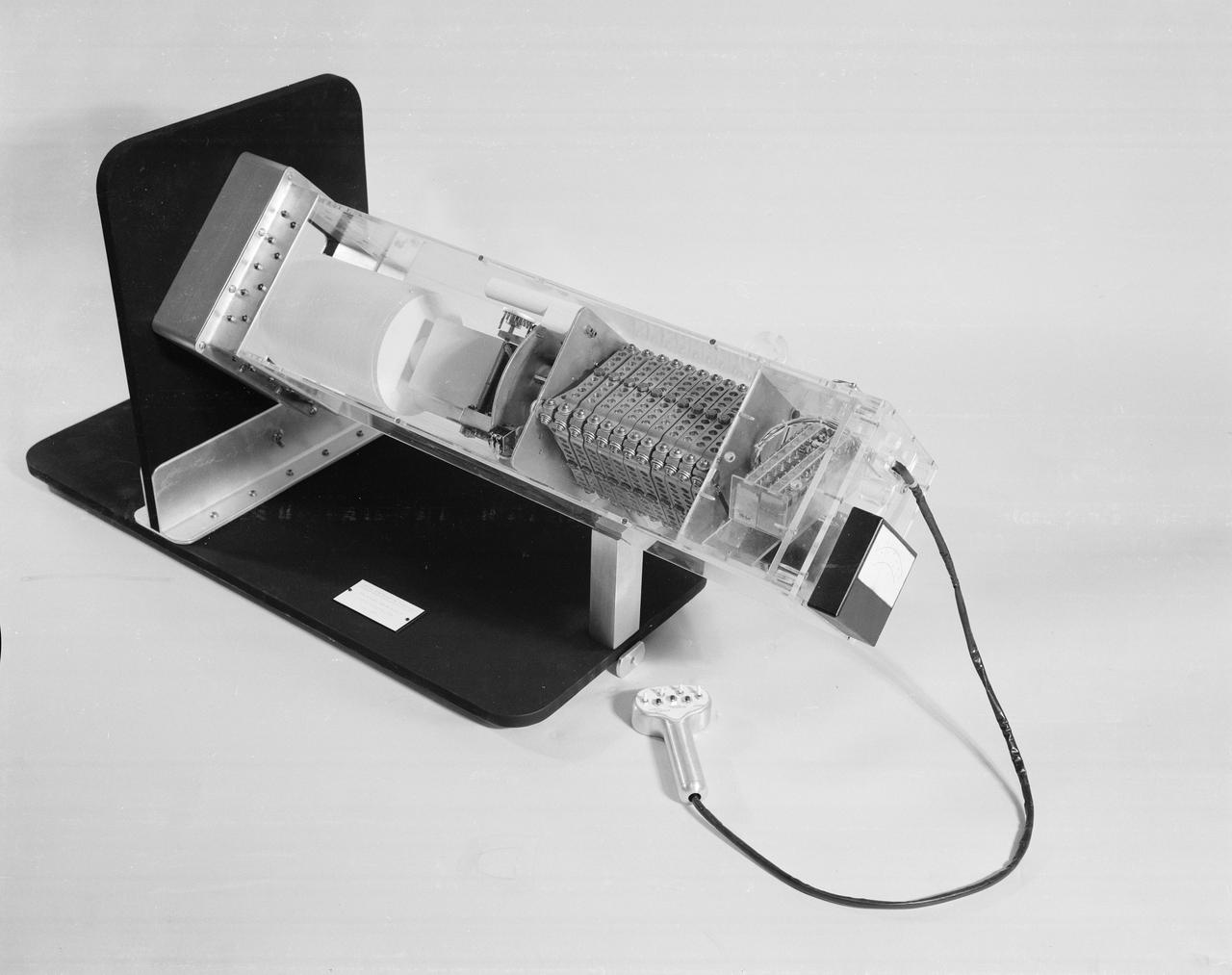
The Apollo Telescope Mount (ATM), designed and developed by the Marshall Space Flight Center, served as the primary scientific instrument unit aboard the Skylab. The ATM contained eight complex astronomical instruments designed to observe the Sun over a wide spectrum from visible light to x-rays. This angle view is of an ATM contamination monitor meter mockup.
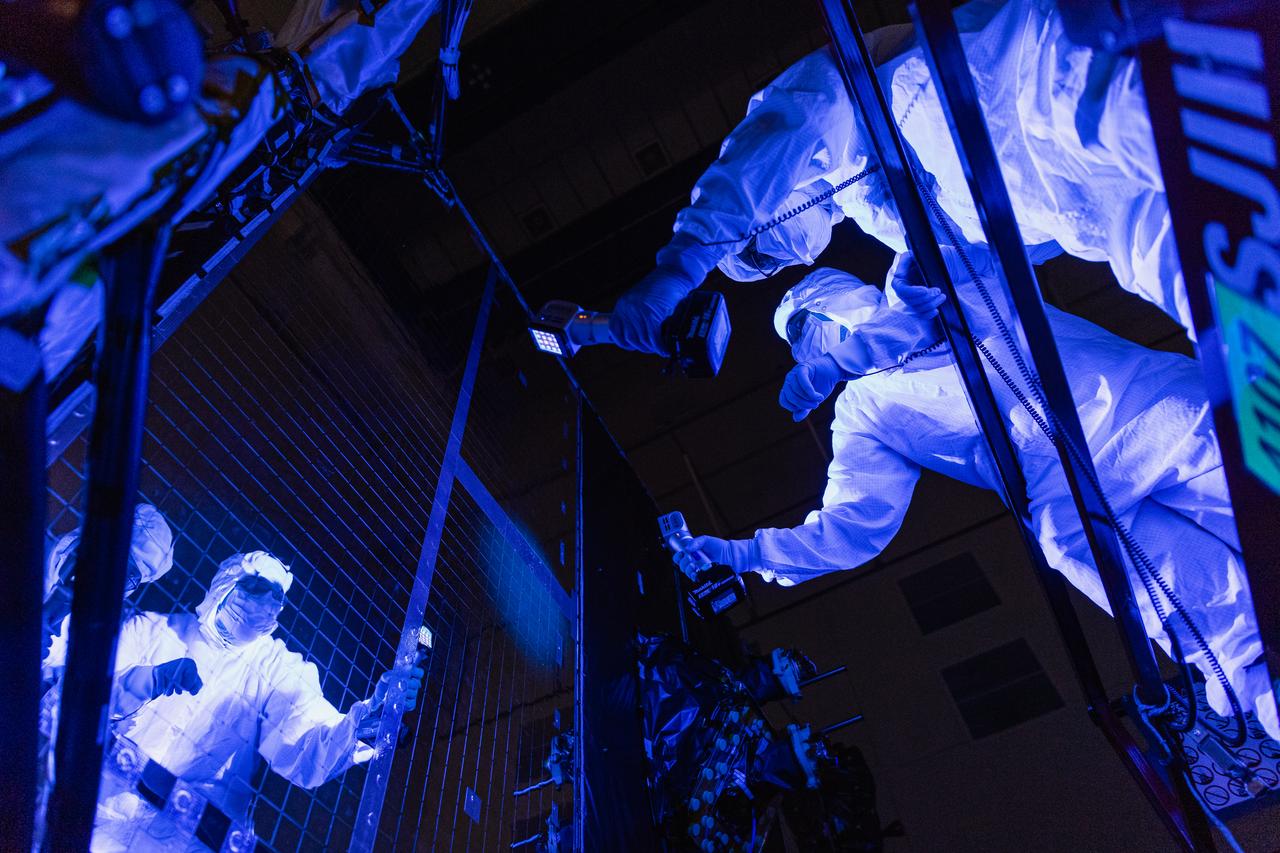
NASA Contamination control engineers perform a blacklight inspection on the OSAM-1 Spacecraft Bus at Goddard Space Flight Center, Greenbelt Md., Sept 30, 2023. This photo has been reviewed by OSAM1 project management, Maxar public release authority, and the Export Control Office and is released for public view. NASA/Mike Guinto
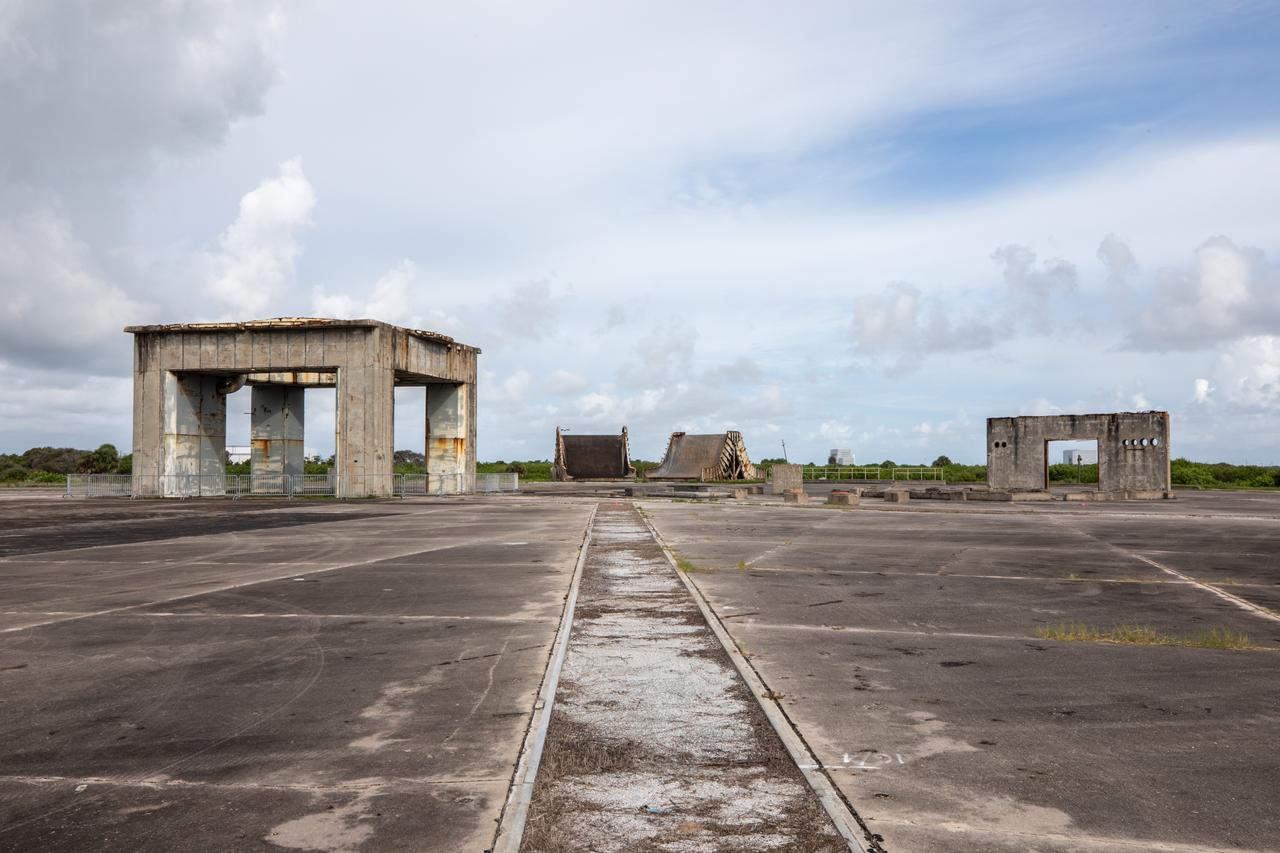
A view of the launch pedestal (at left) still standing at Launch Complex 34 at Cape Canaveral Space Force Station in Florida on July 22, 2020. In the background are two flame deflectors. Work will soon begin to perform environmental contamination removal on the pedestal and the ground area surrounding the launch complex.
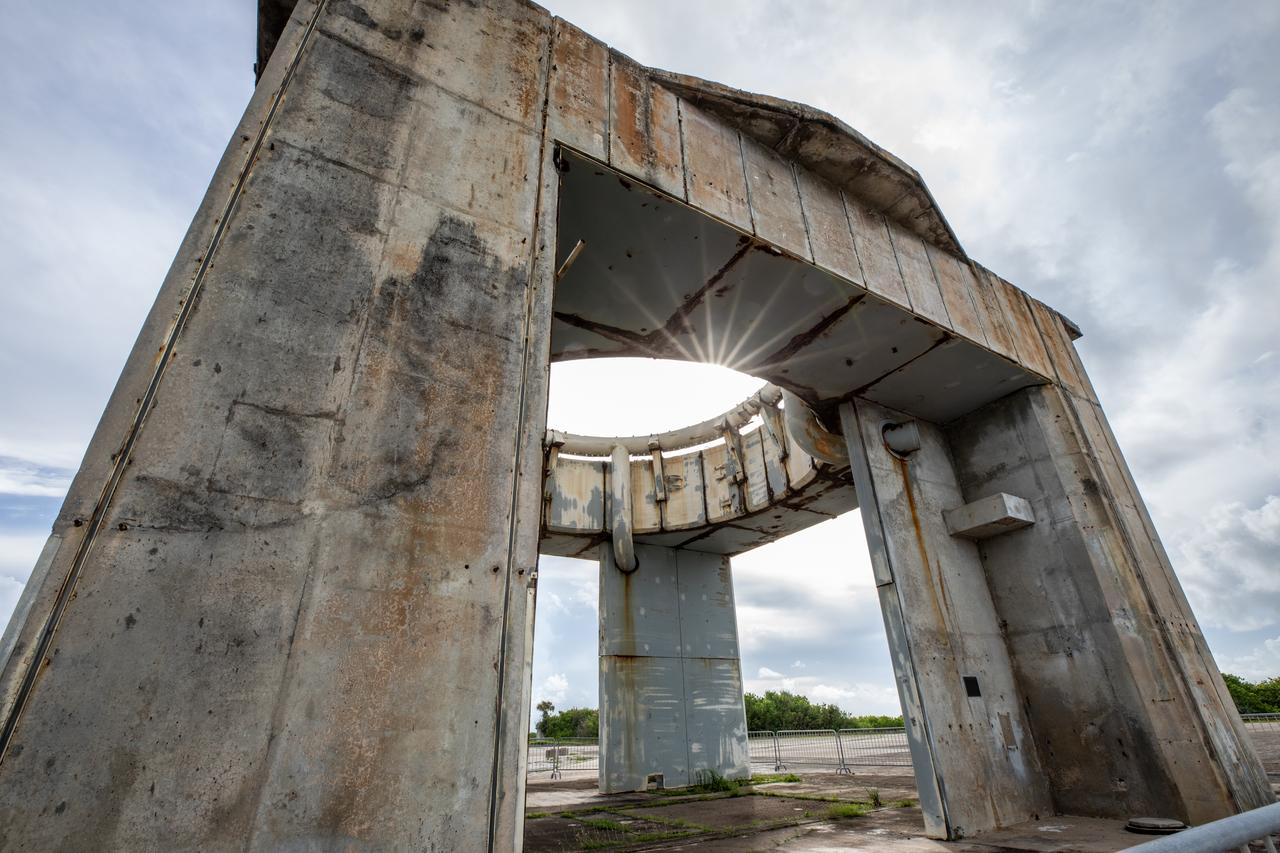
A close-up view of the launch pedestal still standing at Launch Complex 34 at Cape Canaveral Space Force Station in Florida on July 22, 2020. Work will soon begin to perform environmental contamination removal on the pedestal and the ground area surrounding the launch complex.
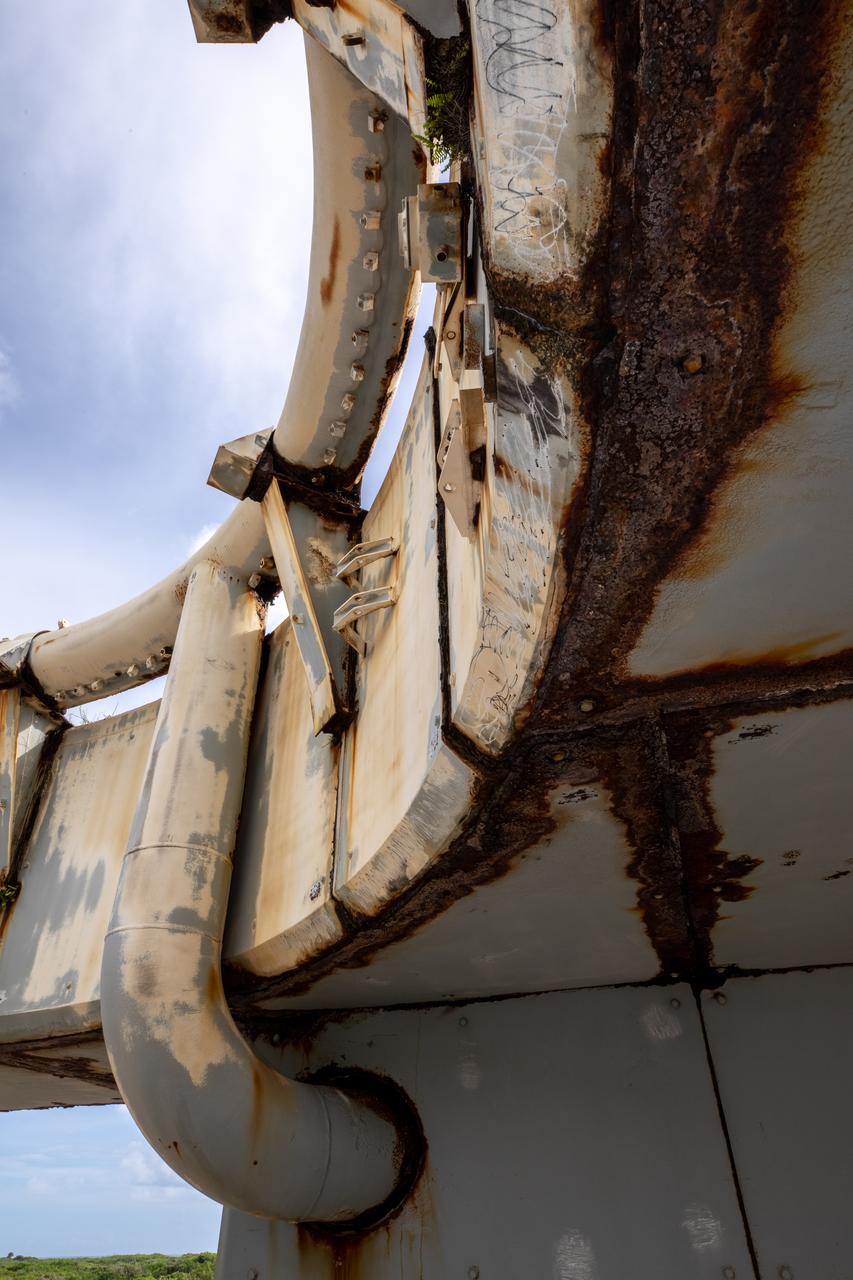
A close-up view of a portion of the launch pedestal still standing at Launch Complex 34 at Cape Canaveral Space Force Station in Florida on July 22, 2020. Work will soon begin to perform environmental contamination removal on the pedestal and the ground area surrounding the launch complex.
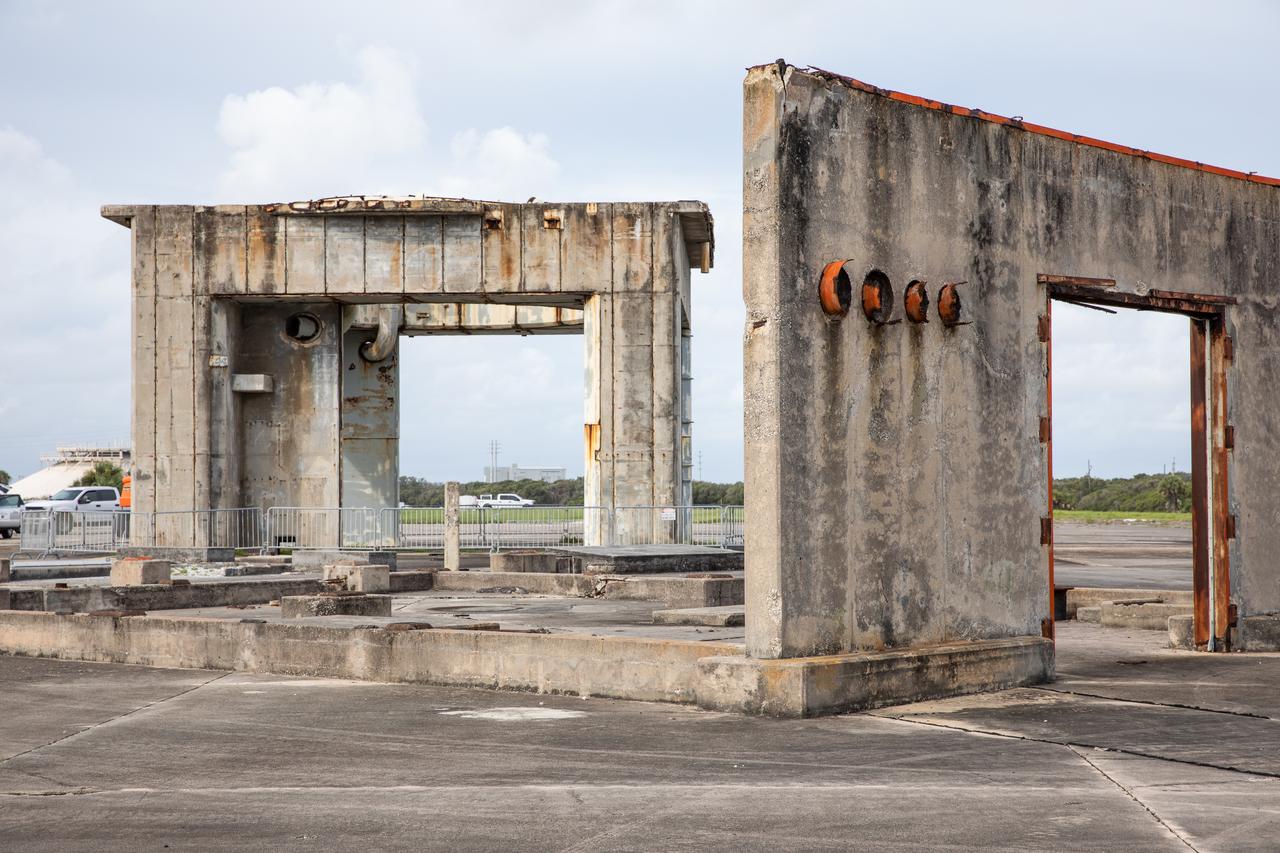
A close-up view of the launch pedestal and a support structure still standing at Launch Complex 34 at Cape Canaveral Space Force Station in Florida on July 22, 2020. Work will soon begin to perform environmental contamination removal on the pedestal and the ground area surrounding the launch complex.
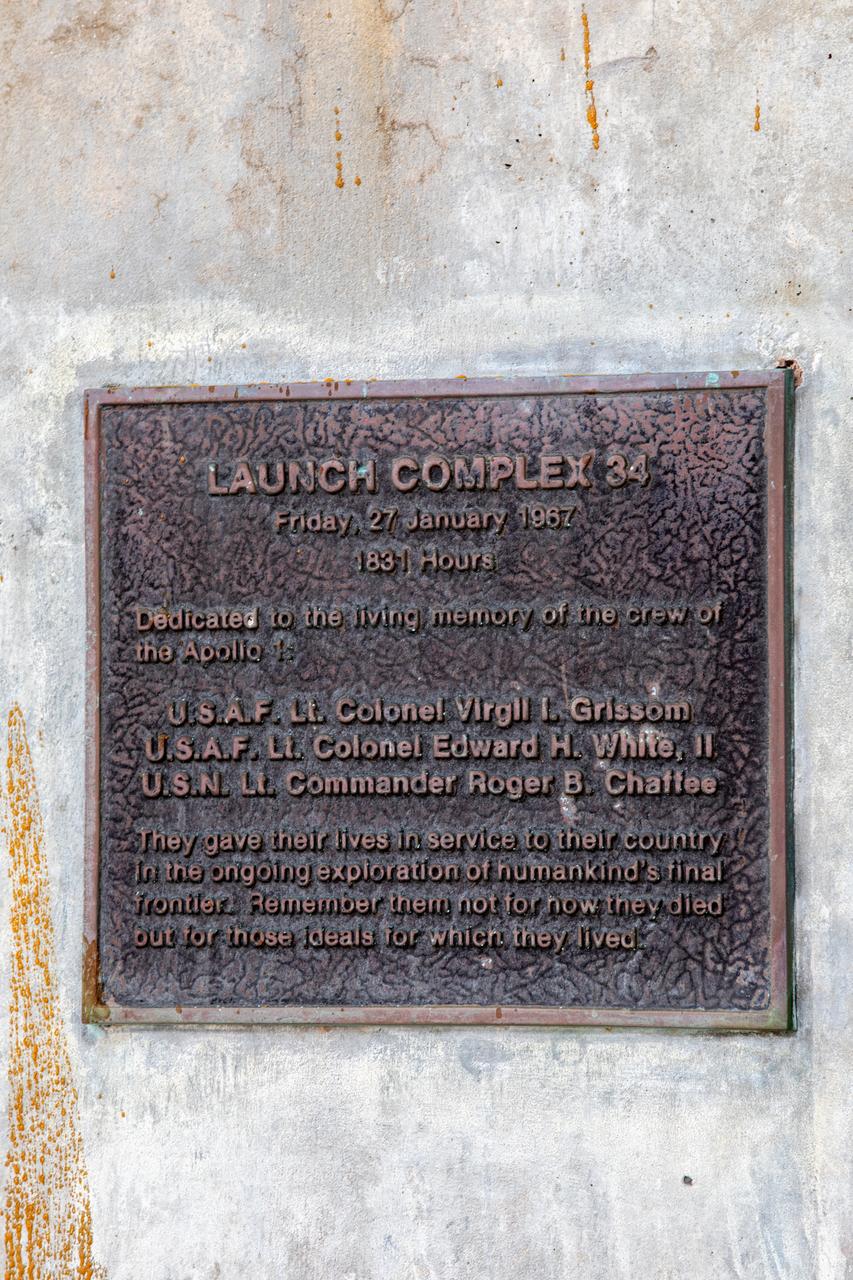
A close-up view of the historic marker on the launch pedestal still standing at Launch Complex 34 at Cape Canaveral Space Force Station in Florida on July 22, 2020. Work will soon begin to perform environmental contamination removal on the pedestal and the ground area surrounding the launch complex.
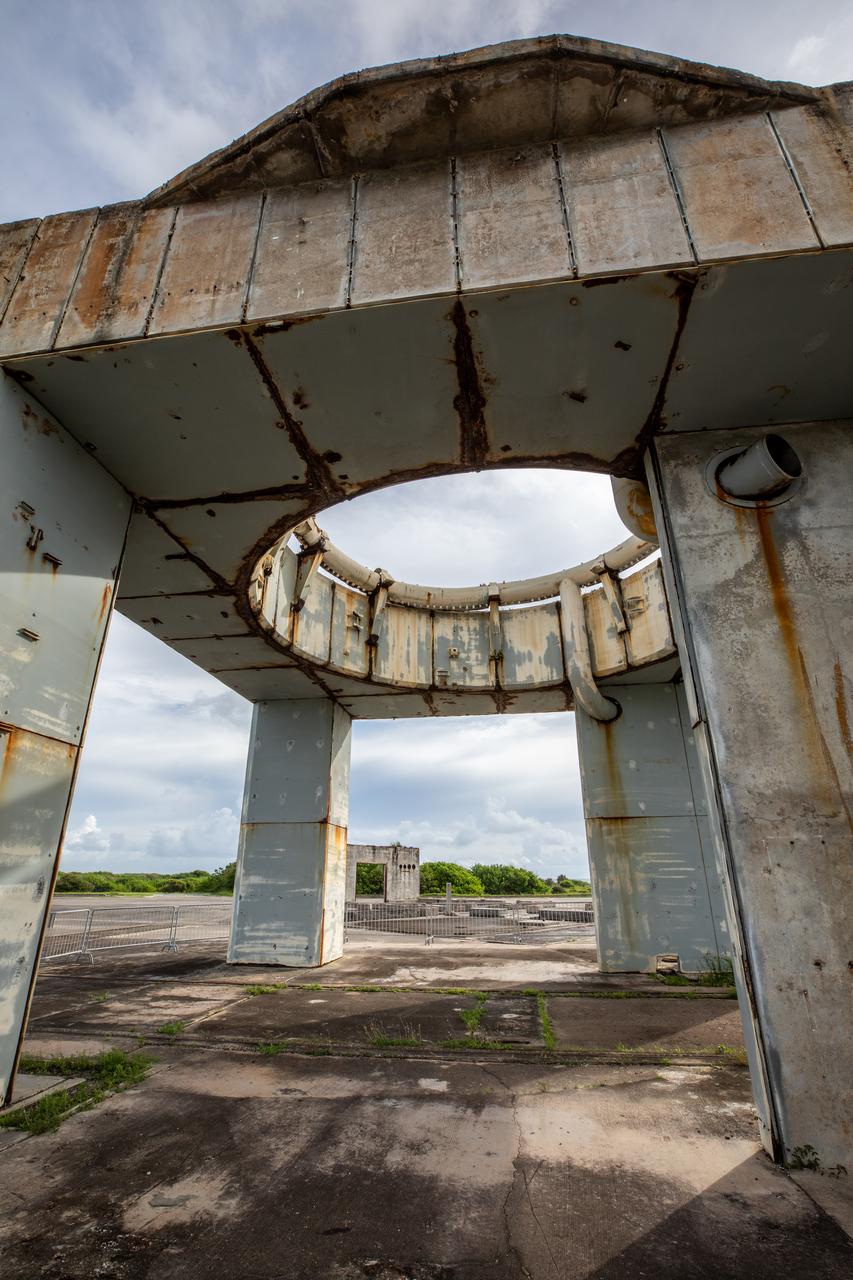
A close-up view of the launch pedestal still standing at Launch Complex 34 at Cape Canaveral Space Force Station in Florida on July 22, 2020. Work will soon begin to perform environmental contamination removal on the pedestal and the ground area surrounding the launch complex.
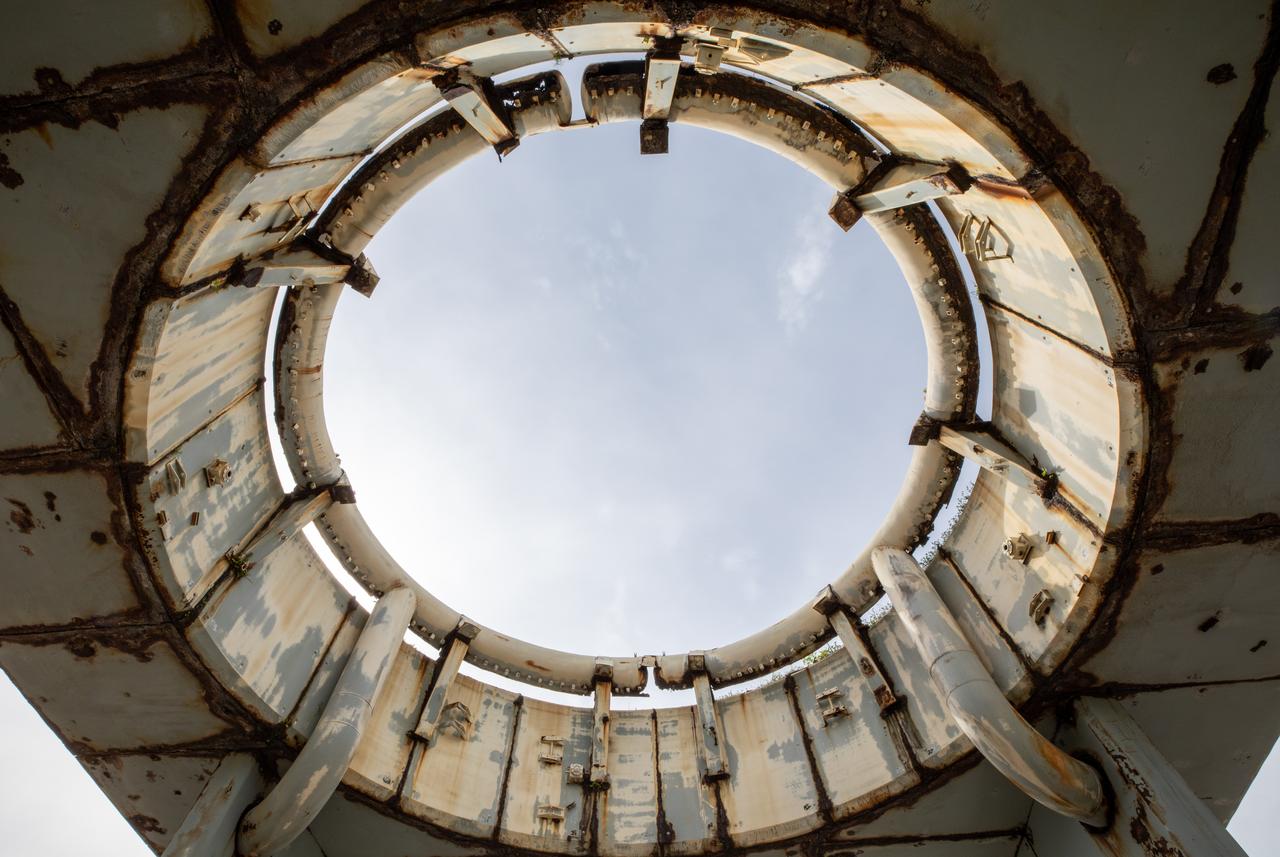
A view looking up from inside the launch pedestal still standing at Launch Complex 34 at Cape Canaveral Space Force Station in Florida on July 22, 2020. Work will soon begin to perform environmental contamination removal on the pedestal and the ground area surrounding the launch complex.
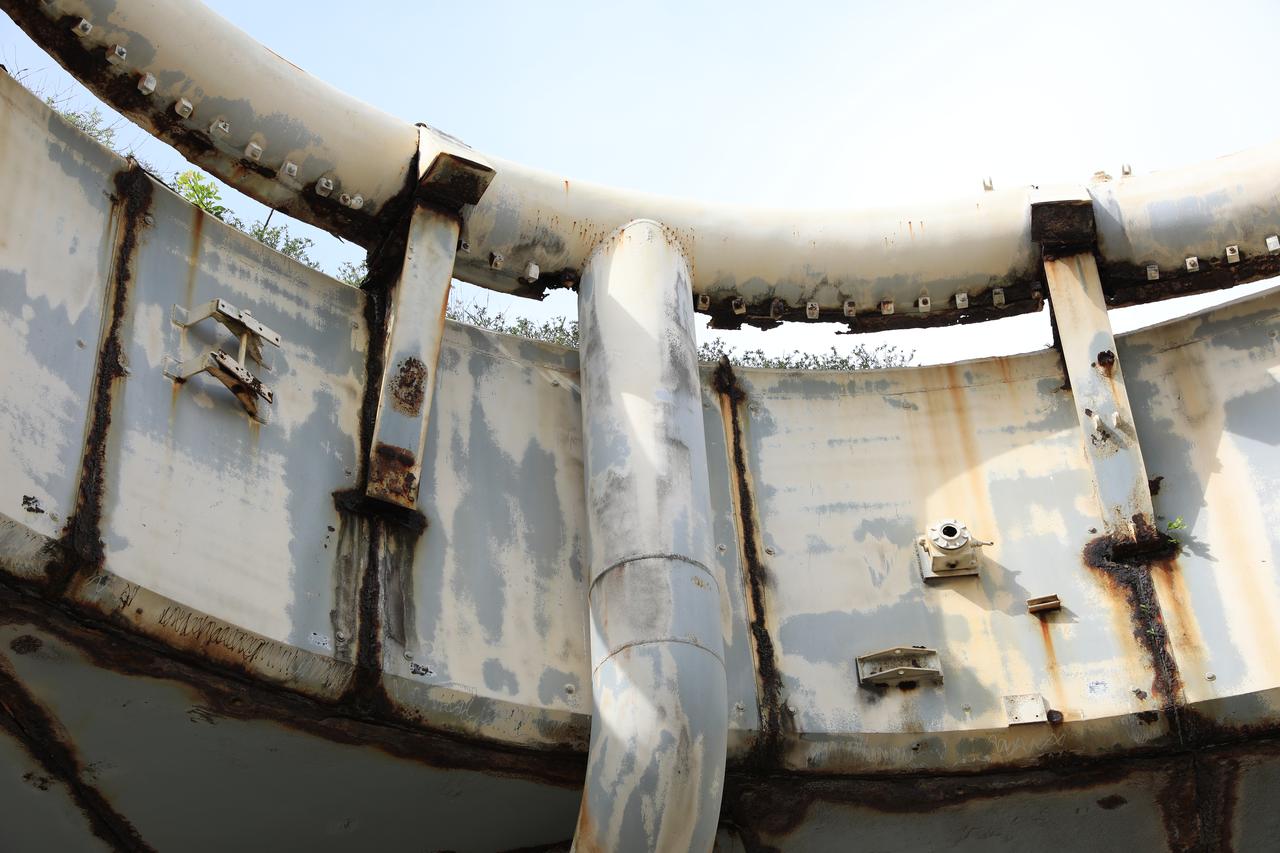
A view looking up from inside the launch pedestal still standing at Launch Complex 34 at Cape Canaveral Space Force Station in Florida on July 22, 2020. Work will soon begin to perform environmental contamination removal on the pedestal and the ground area surrounding the launch complex.
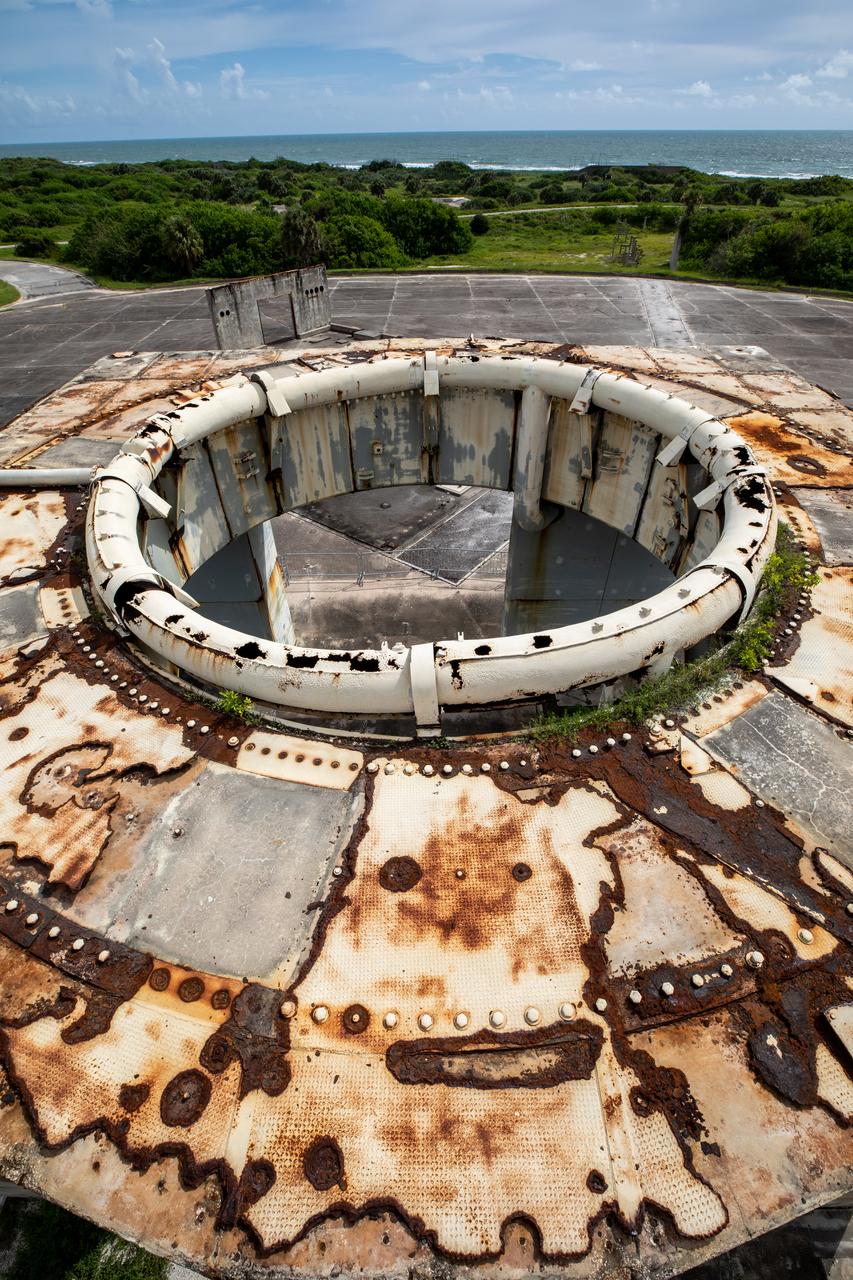
A view of the top of the launch pedestal still standing at Launch Complex 34 at Cape Canaveral Space Force Station in Florida on July 22, 2020. Work will soon begin to perform environmental contamination removal on the pedestal and the ground area surrounding the launch complex.
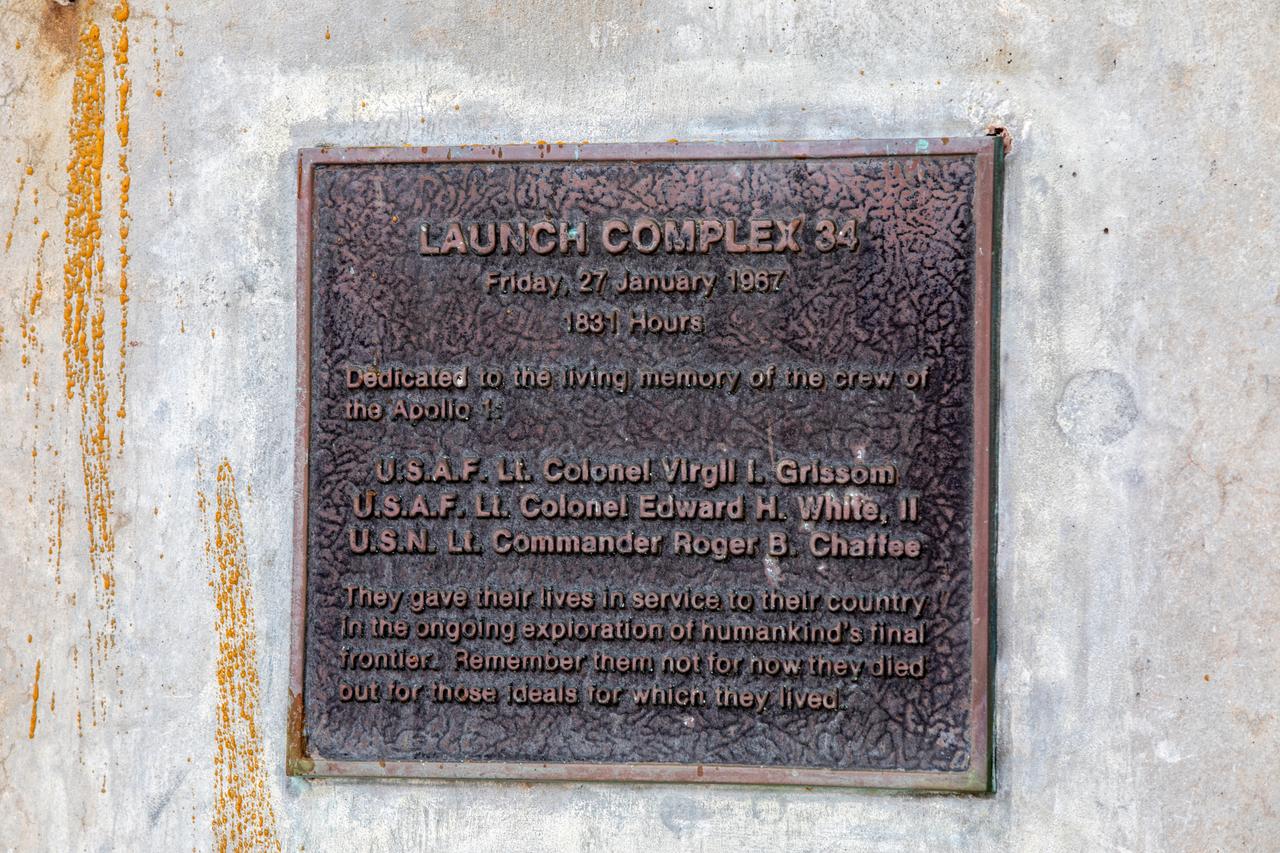
A close-up view of the historic marker on the launch pedestal still standing at Launch Complex 34 at Cape Canaveral Space Force Station in Florida on July 22, 2020. Work will soon begin to perform environmental contamination removal on the pedestal and the ground area surrounding the launch complex.
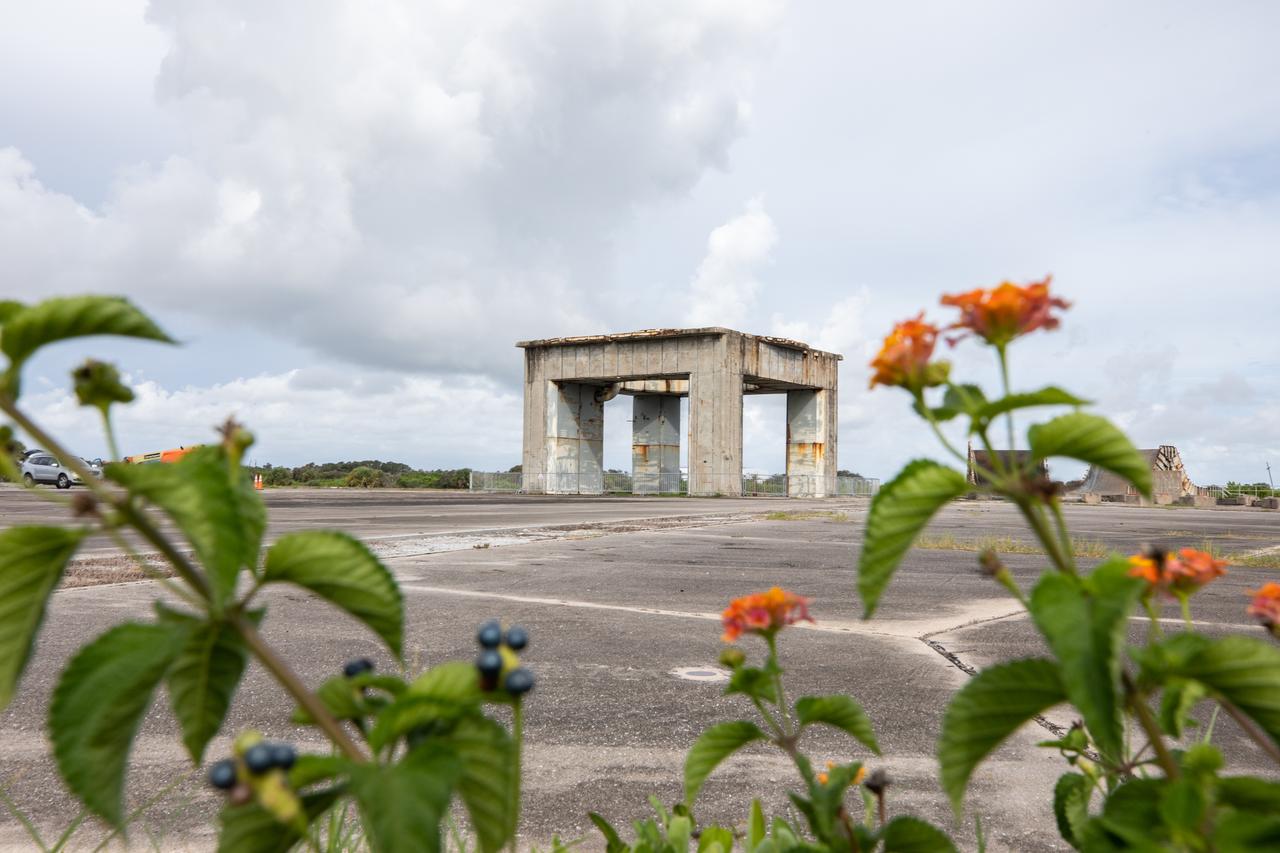
A view of the launch pedestal still standing at Launch Complex 34 with wildflowers in the foreground at Cape Canaveral Space Force Station in Florida on July 22, 2020. Work will soon begin to perform environmental contamination removal on the pedestal and the ground area surrounding the launch complex.
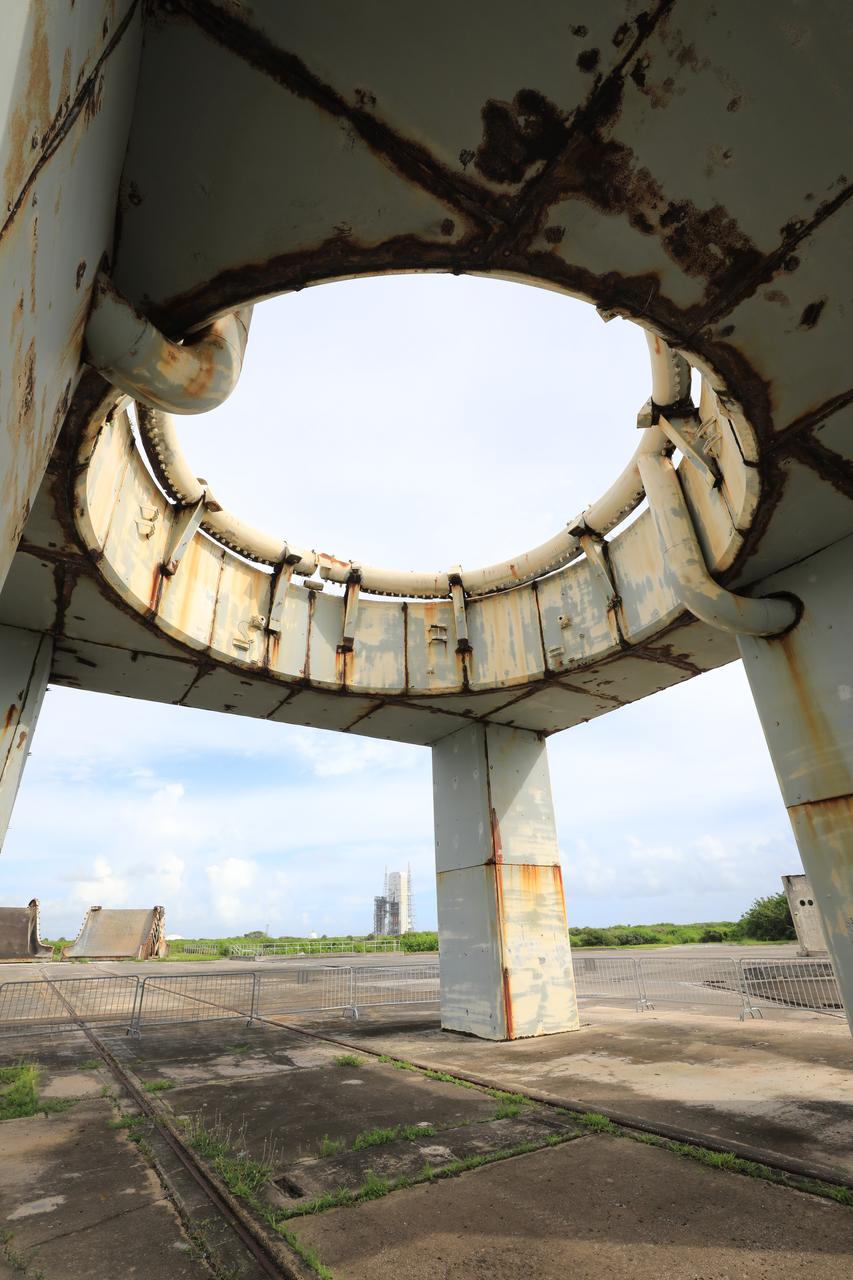
A view looking up from inside the launch pedestal still standing at Launch Complex 34 at Cape Canaveral Space Force Station in Florida on July 22, 2020. Work will soon begin to perform environmental contamination removal on the pedestal and the ground area surrounding the launch complex.
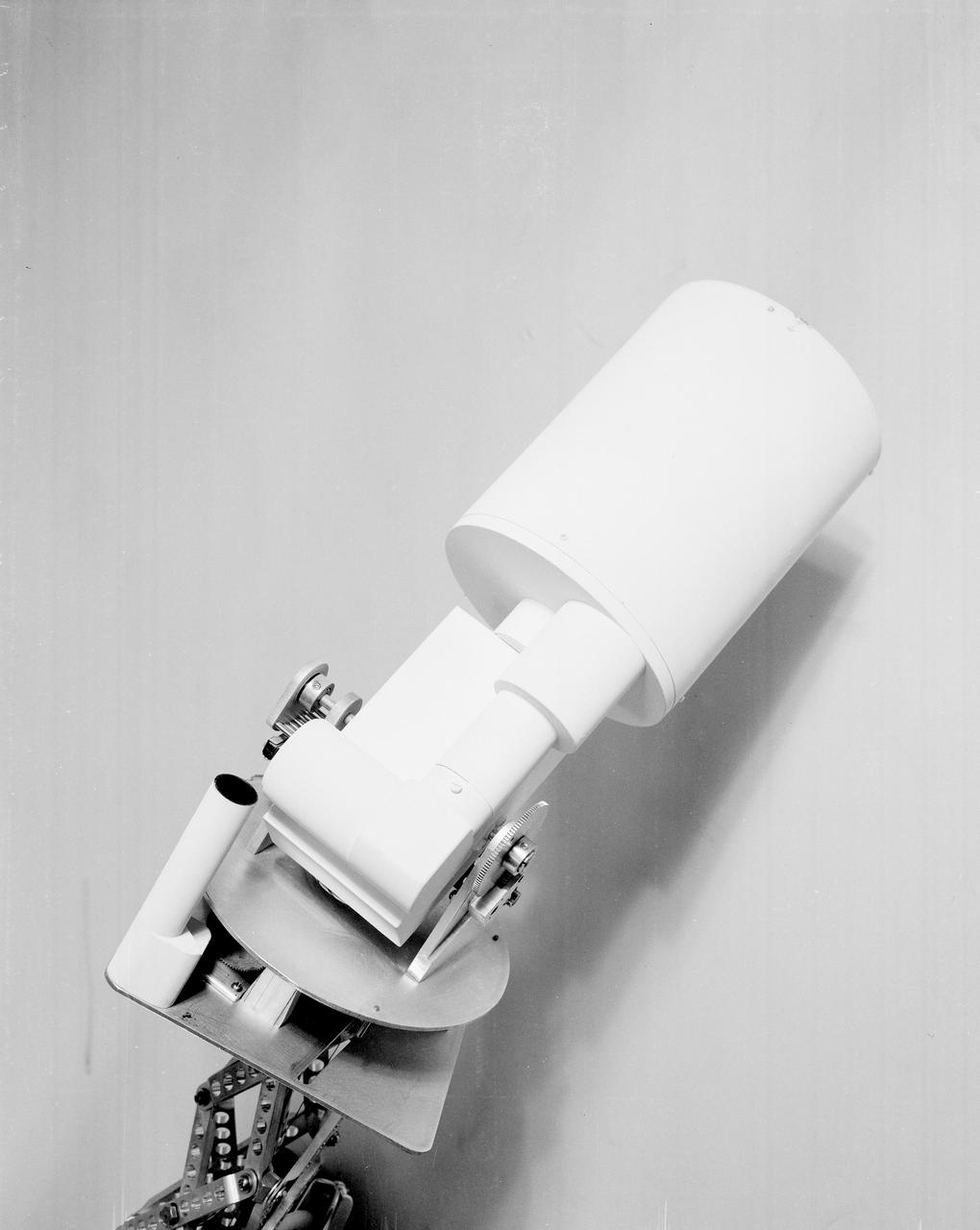
The Apollo Telescope Mount (ATM), designed and developed by the Marshall Space Flight Center, served as the primary scientific instrument unit aboard the Skylab. The ATM contained eight complex astronomical instruments designed to observe the Sun over a wide spectrum from visible light to x-rays. This photo depicts a mockup of the ATM contamination monitor camera and photometer.
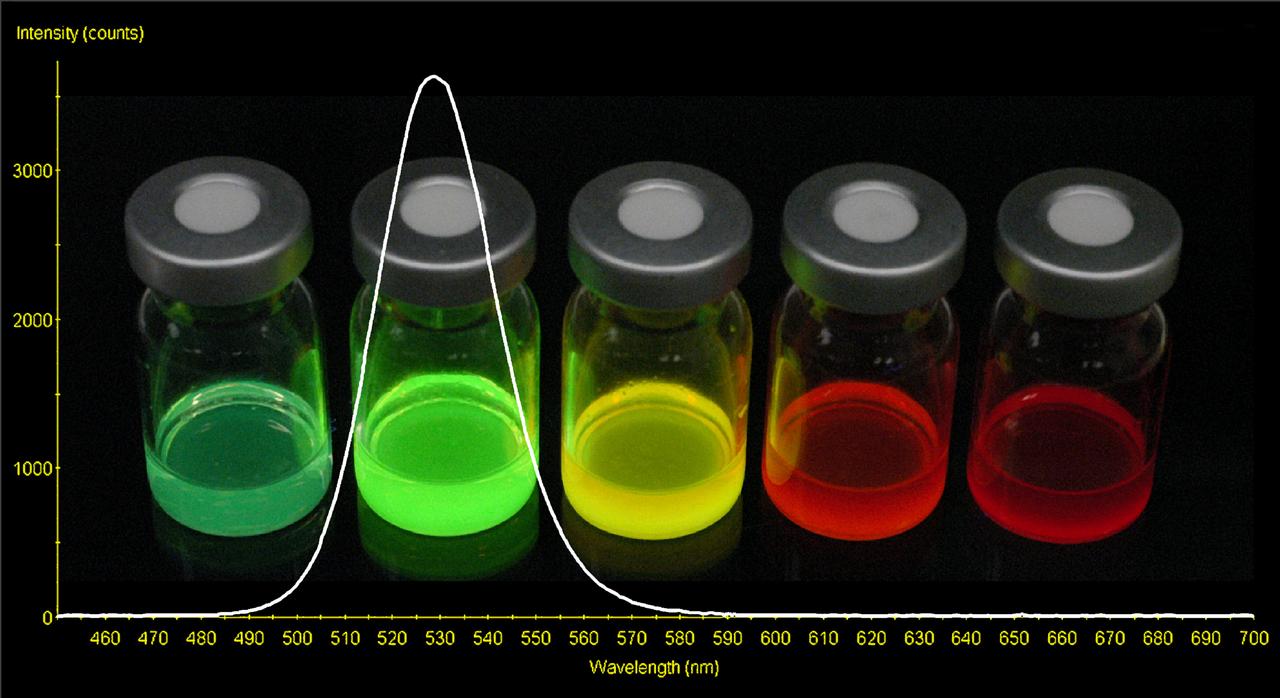
Cadmium selenium Quantum Dots (QDs) are metal nanoparticles that fluoresce in a variety of colors determined by their size. QDs are solid state structures made of semiconductors or metals that confine a countable, small number of electrons into a small space. The confinement of electrons is achieved by the placement of some insulating material(s) around a central, well conducted region. Coupling QDs with antibodies can be used to make spectrally multiplexed immunoassays that test for a number of microbial contaminants using a single test.
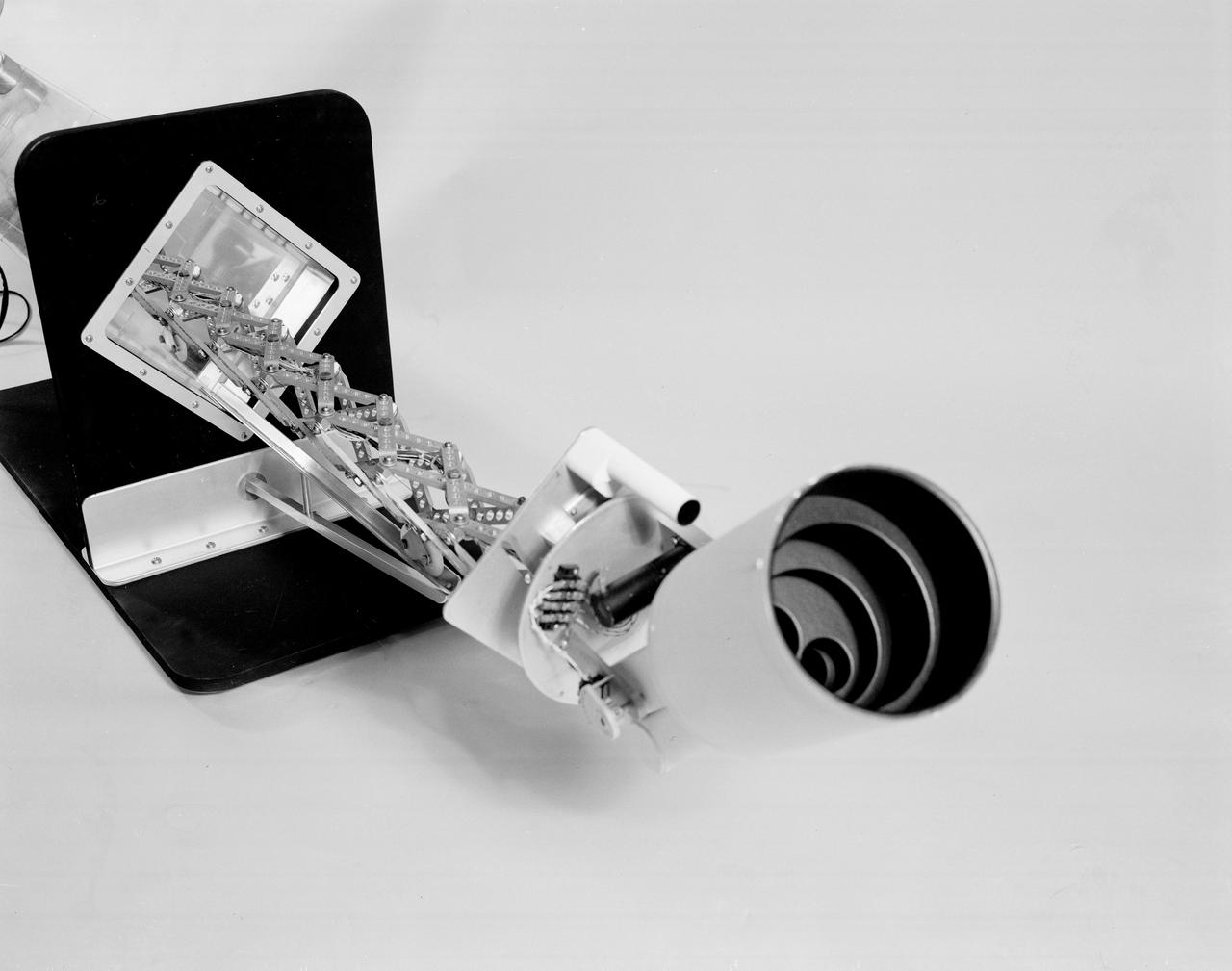
The Apollo Telescope Mount (ATM), designed and developed by the Marshall Space Flight Center, served as the primary scientific instrument unit aboard the Skylab. The ATM contained eight complex astronomical instruments designed to observe the Sun over a wide spectrum from visible light to x-rays. This photo of the ATM contamination monitor mockup offers an extended view of the sunshield interior.
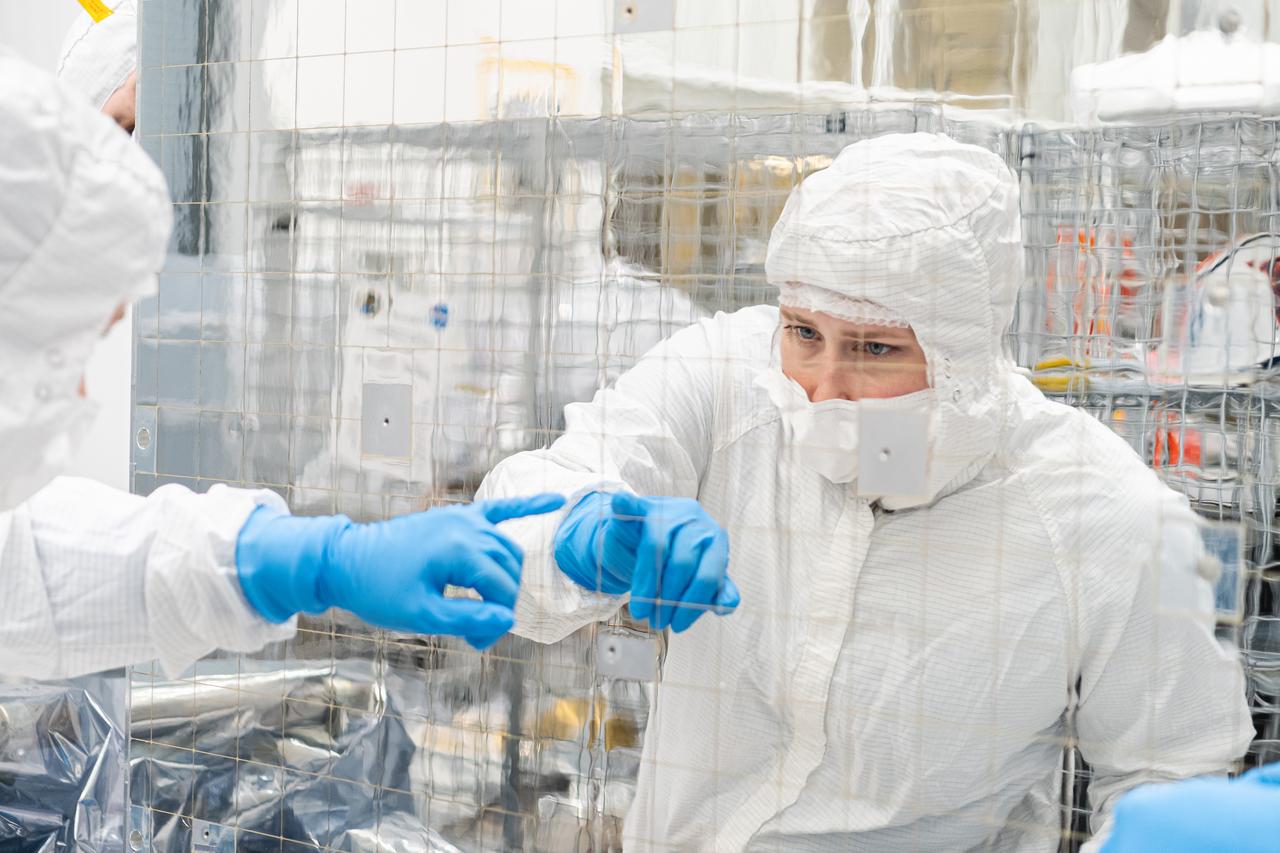
Contamination control technician Sydnie Heiman inspects one of OSAM-1's radiator panels inside the cleanroom at Goddard Space Flight Center, Greenbelt Md., July 10, 2023. This photo has been reviewed by OSAM1 project management and the Export Control Office and is released for public view. NASA/Mike Guinto
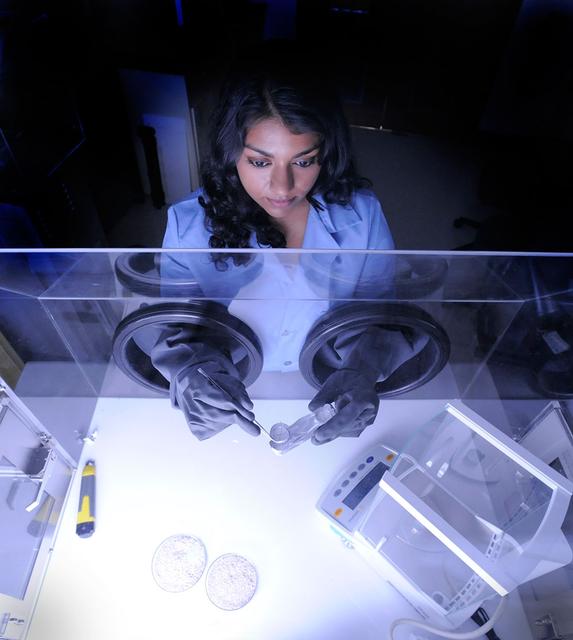
Goddard technologist Nithin Abraham, a member of the team that has developed a low-cost, low-mass technique for protecting sensitive spacecraft components from outgassed contaminants, studies a paint sample in her laboratory. To read this story go to: <a href="http://www.nasa.gov/topics/technology/features/outgas-tech.html" rel="nofollow">www.nasa.gov/topics/technology/features/outgas-tech.html</a> Credit: NASA/Pat Izzo <b><a href="http://www.nasa.gov/audience/formedia/features/MP_Photo_Guidelines.html" rel="nofollow">NASA image use policy.</a></b> <b><a href="http://www.nasa.gov/centers/goddard/home/index.html" rel="nofollow">NASA Goddard Space Flight Center</a></b> enables NASA’s mission through four scientific endeavors: Earth Science, Heliophysics, Solar System Exploration, and Astrophysics. Goddard plays a leading role in NASA’s accomplishments by contributing compelling scientific knowledge to advance the Agency’s mission. <b>Follow us on <a href="http://twitter.com/NASA_GoddardPix" rel="nofollow">Twitter</a></b> <b>Like us on <a href="http://www.facebook.com/pages/Greenbelt-MD/NASA-Goddard/395013845897?ref=tsd" rel="nofollow">Facebook</a></b> <b>Find us on <a href="http://instagram.com/nasagoddard?vm=grid" rel="nofollow">Instagram</a></b>
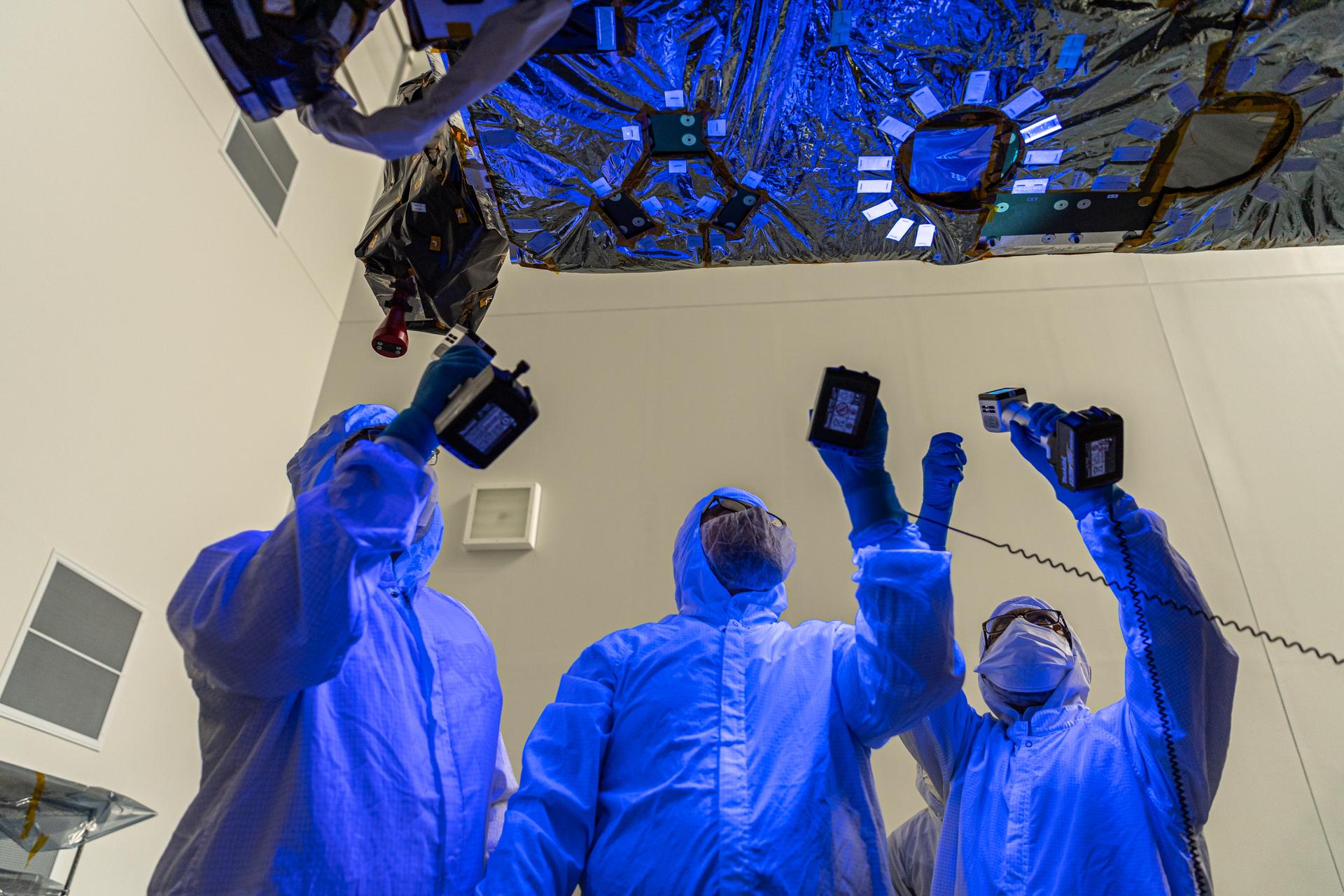
NASA Contamination and control engineers perform a blacklight inspection on the OSAM-1 Spacecraft Bus at Goddard Space Flight Center, Greenbelt Md., Sept 30, 2023. This photo has been reviewed by OSAM1 project management, Maxar public release authority, and the Export Control Office and is released for public view. NASA/Mike Guinto
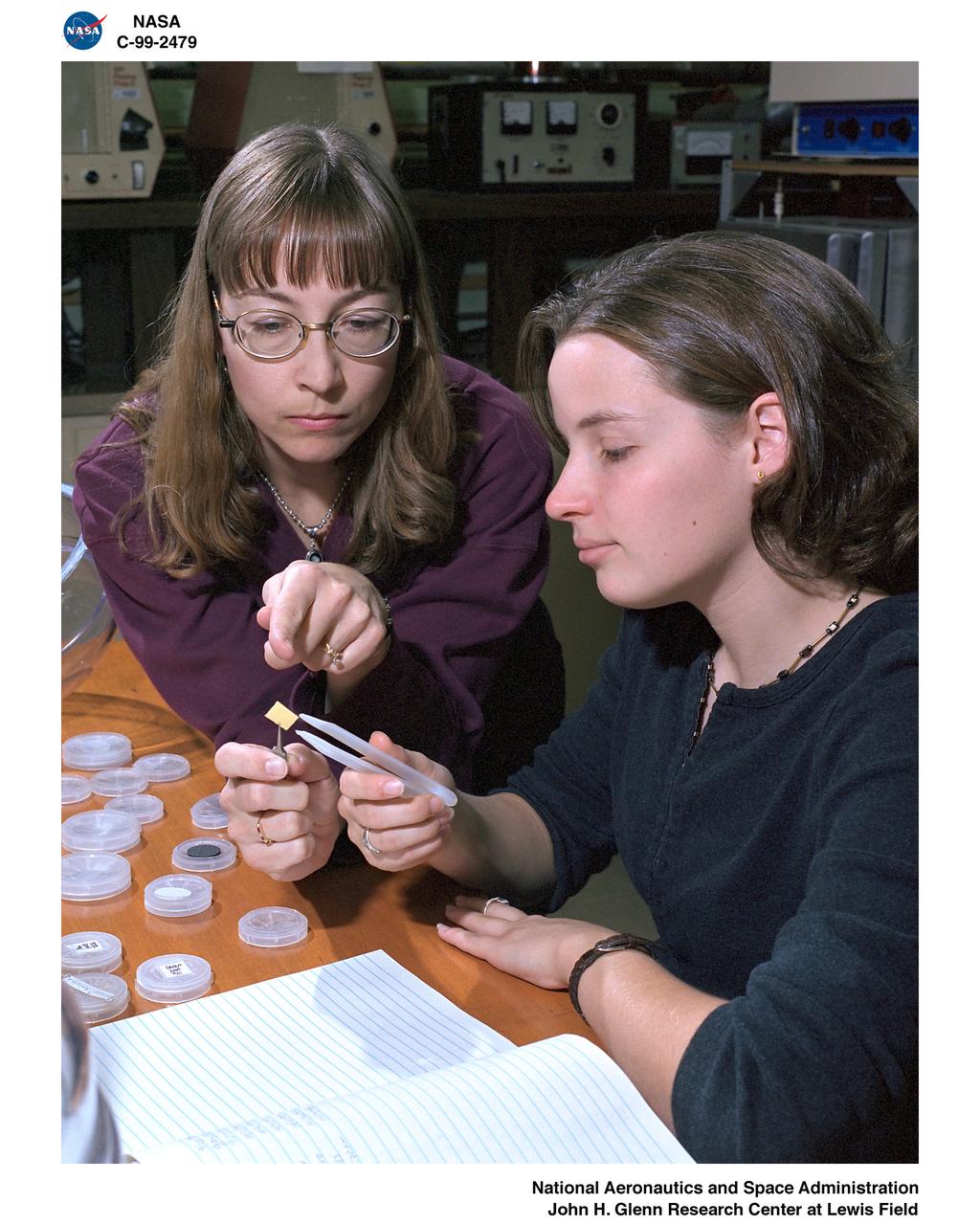
POLYMERS EROSION AND CONTAMINATION EXPERIMENT TEAM
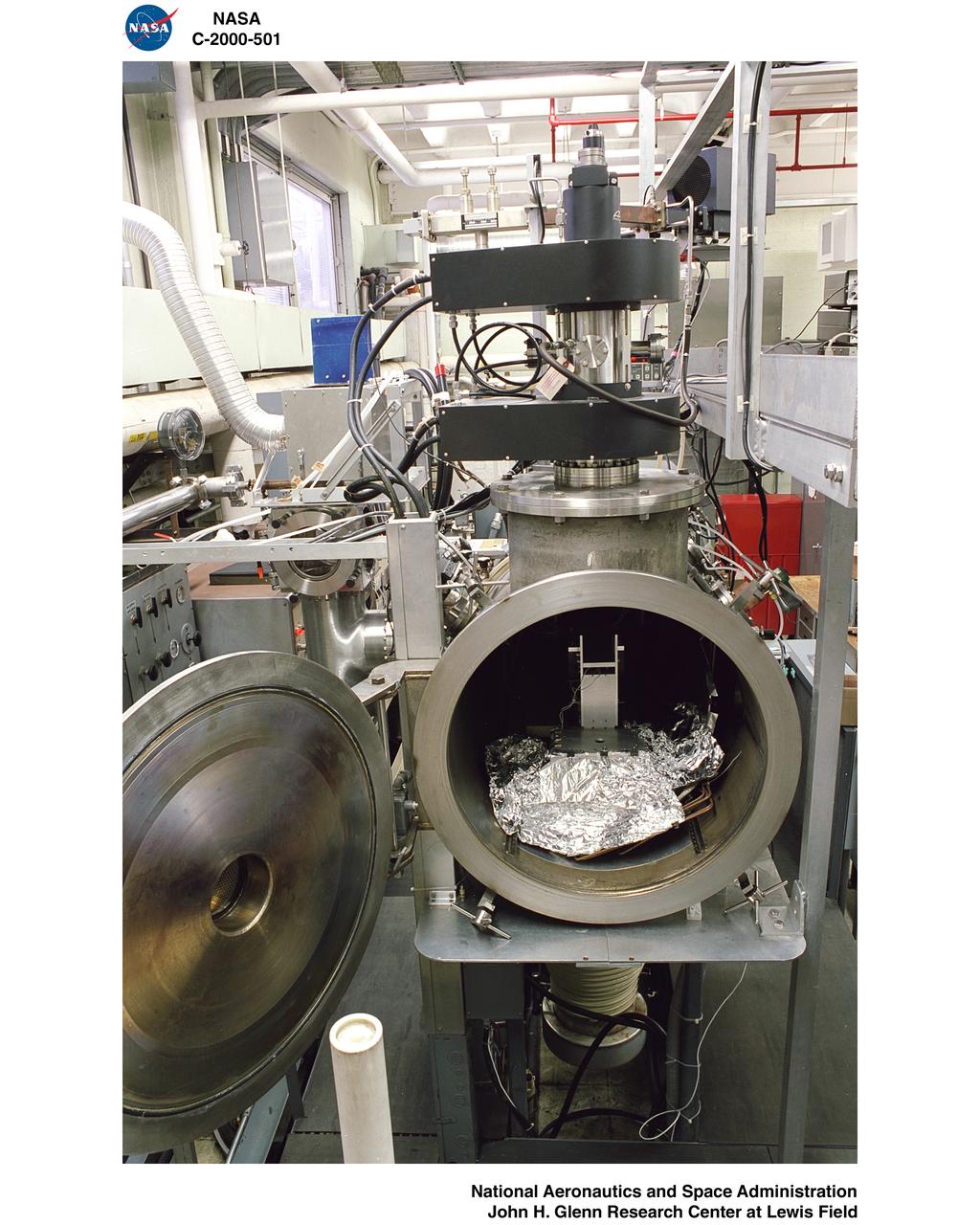
ATOMIC OXYGEN BEAM CONTAMINATION SYSTEM
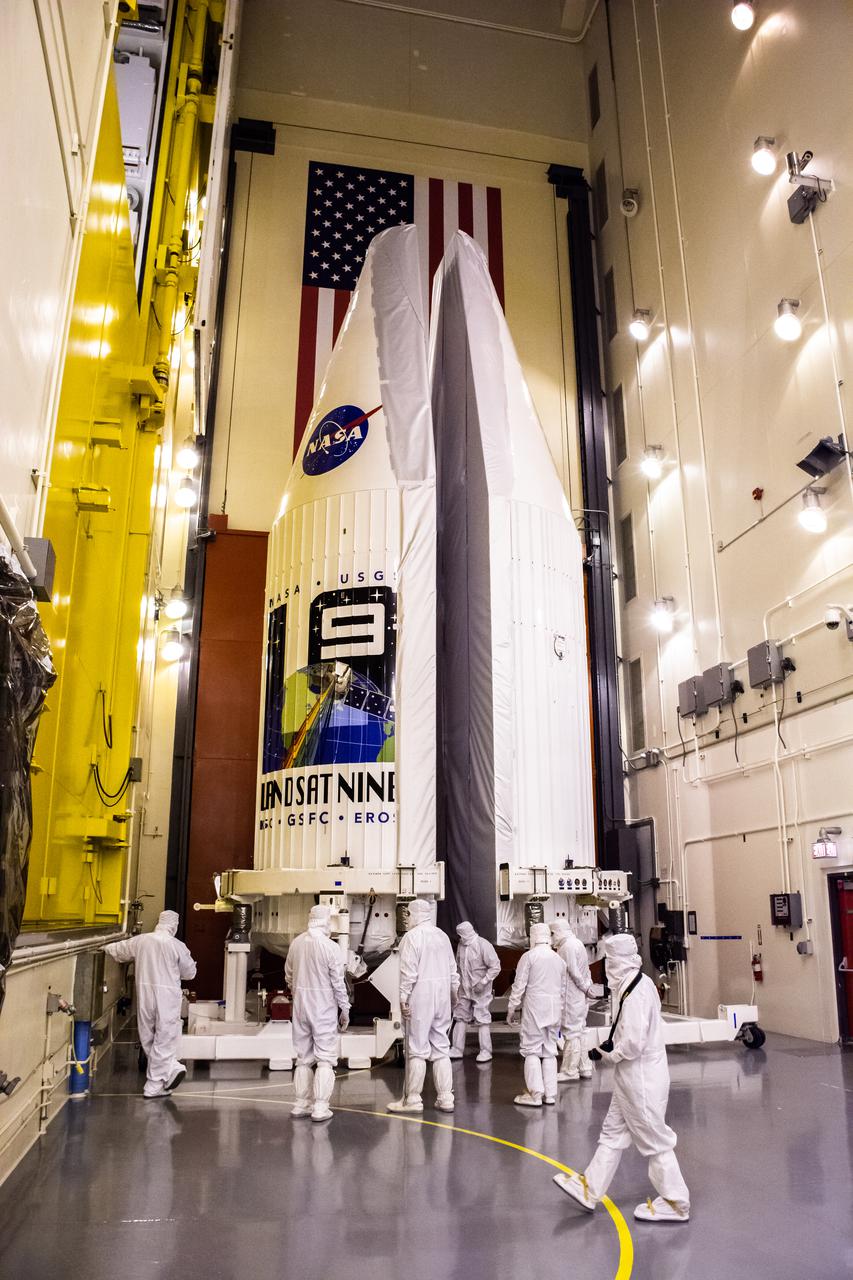
Inside the Integrated Processing Facility at Vandenberg Space Force Base in California, United Launch Alliance (ULA) technicians remove the contamination barrier from the two ULA Atlas V rocket payload fairings for NASA’s Landsat 9 satellite on June 23, 2021. The fairings will encapsulate the satellite for its launch atop the Atlas V from Vandenberg in September 2021. The launch is being managed by NASA’s Launch Services Program based at Kennedy Space Center in Florida. Landsat 9 will continue the nearly 50-year legacy of previous Landsat missions. It will monitor key natural and economic resources from orbit. Landsat 9 is managed by the agency’s Goddard Space Flight Center in Greenbelt, Maryland. It will carry two instruments: the Operational Land Imager 2, which collects images of Earth’s landscapes in visible, near-infrared and shortwave infrared light, and the Thermal Infrared Sensor 2, which measures the temperature of land surfaces. Like its predecessors, Landsat 9 is a joint mission between NASA and the U.S. Geological Survey.
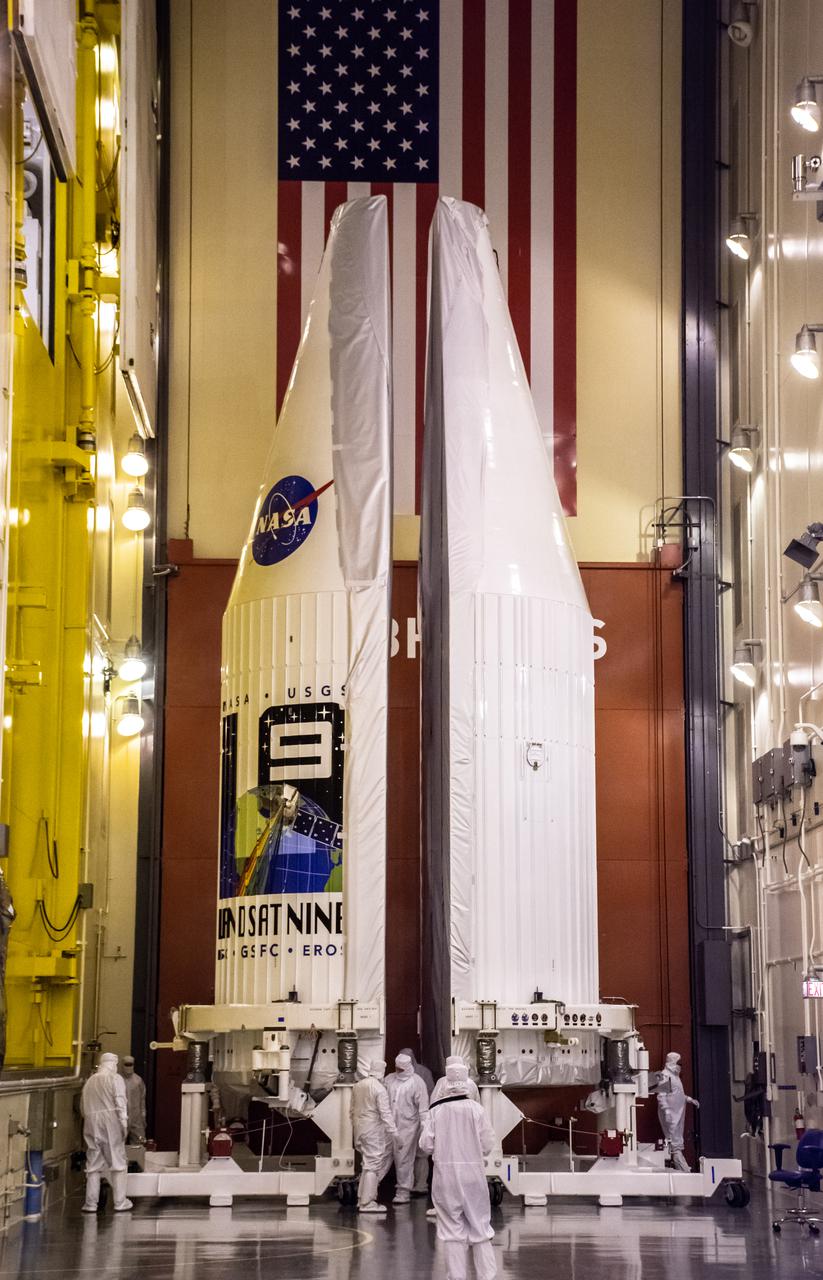
Inside the Integrated Processing Facility at Vandenberg Space Force Base in California, United Launch Alliance (ULA) technicians remove the contamination barrier from the two ULA Atlas V rocket payload fairings for NASA’s Landsat 9 satellite on June 23, 2021. The fairings will encapsulate the satellite for its launch atop the Atlas V from Vandenberg in September 2021. The launch is being managed by NASA’s Launch Services Program based at Kennedy Space Center in Florida. Landsat 9 will continue the nearly 50-year legacy of previous Landsat missions. It will monitor key natural and economic resources from orbit. Landsat 9 is managed by the agency’s Goddard Space Flight Center in Greenbelt, Maryland. It will carry two instruments: the Operational Land Imager 2, which collects images of Earth’s landscapes in visible, near-infrared and shortwave infrared light, and the Thermal Infrared Sensor 2, which measures the temperature of land surfaces. Like its predecessors, Landsat 9 is a joint mission between NASA and the U.S. Geological Survey.
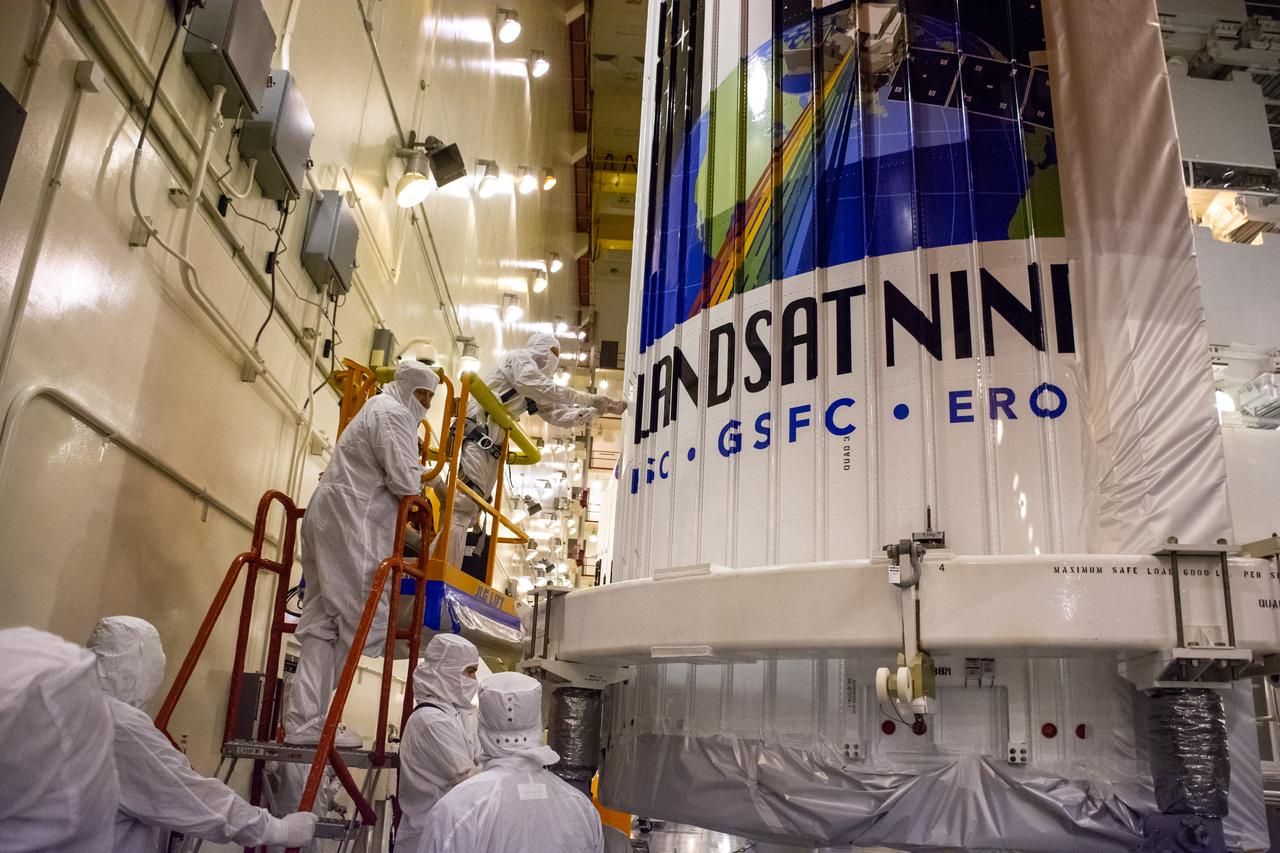
Inside the Integrated Processing Facility at Vandenberg Space Force Base in California, United Launch Alliance (ULA) technicians prepare to remove the contamination barrier and access door from the two ULA Atlas V rocket payload fairings for NASA’s Landsat 9 satellite on June 24, 2021. The fairings will encapsulate the satellite for its launch atop the Atlas V from Vandenberg in September 2021. The launch is being managed by NASA’s Launch Services Program based at Kennedy Space Center in Florida. Landsat 9 will continue the nearly 50-year legacy of previous Landsat missions. It will monitor key natural and economic resources from orbit. Landsat 9 is managed by the agency’s Goddard Space Flight Center in Greenbelt, Maryland. It will carry two instruments: the Operational Land Imager 2, which collects images of Earth’s landscapes in visible, near-infrared and shortwave infrared light, and the Thermal Infrared Sensor 2, which measures the temperature of land surfaces. Like its predecessors, Landsat 9 is a joint mission between NASA and the U.S. Geological Survey.
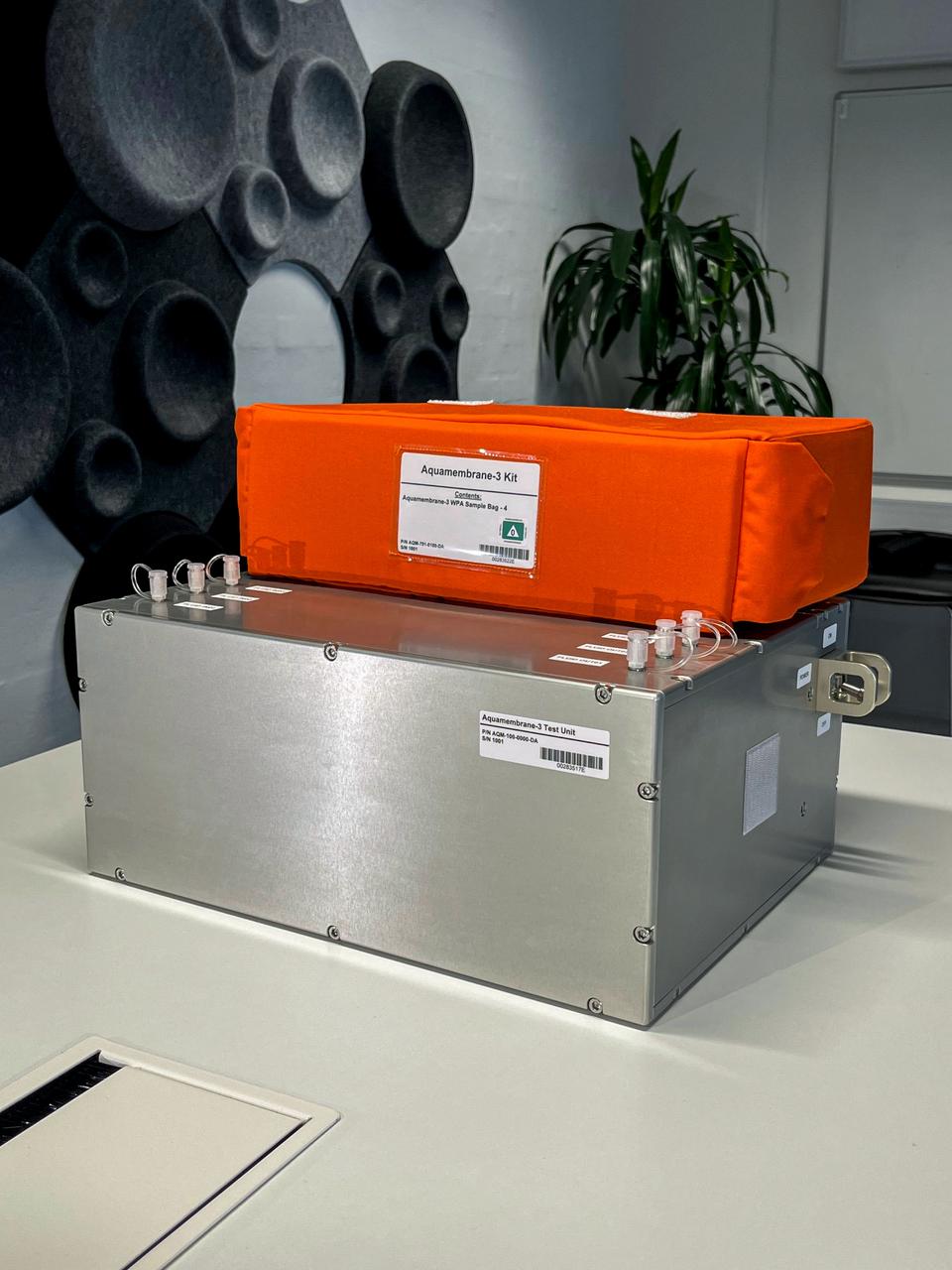
jsc2023e055872 (10/5/2023) --- The Testing Contaminant Rejection of Aquaporin Inside® HFFO Module (Aquamembrane-3) hardware consists of three separate and parallel systems to quantify the membrane's water flux and contamination rejection in microgravity, which are key parameters for a full water recovery system. This image shows the complete experiment hardware.
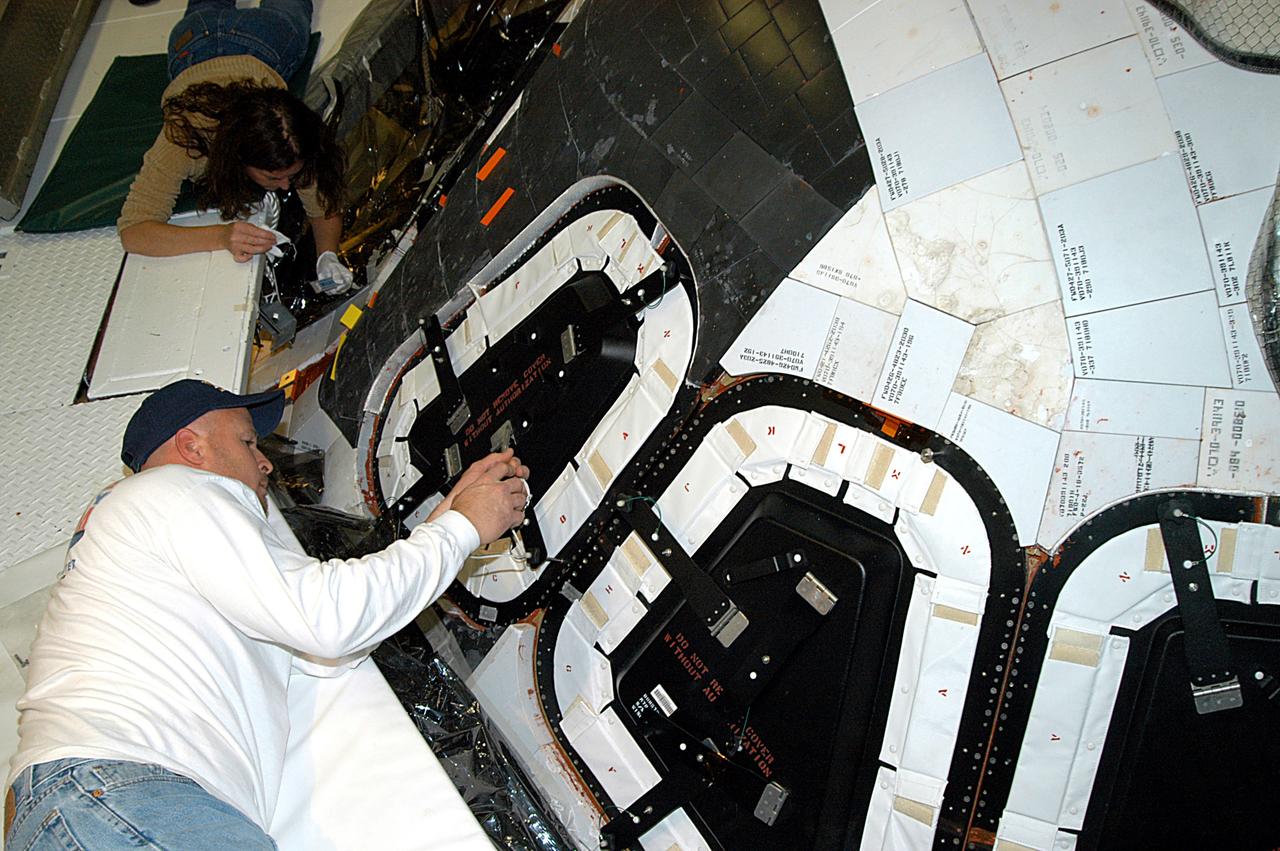
KENNEDY SPACE CENTER, FLA. -- Les Hanks (foreground) and Darlene Beville (background), with United Space Alliance, prepare a window on Atlantis for removal. The windows are being removed to inspect them for contaminants in the thermal seal. Atlantis has been undergoing routine maintenance in the Orbiter Processing Facility for Return to Flight, on mission STS-114.
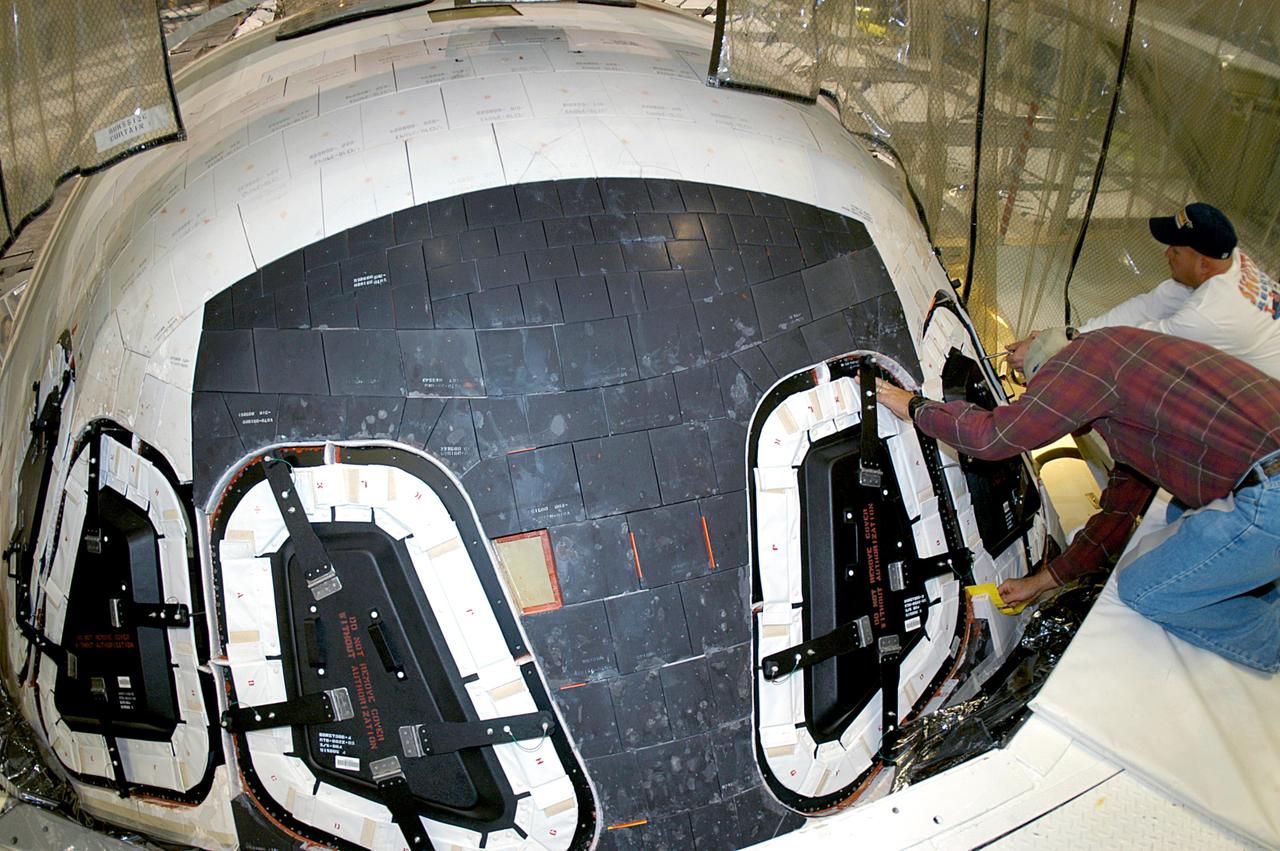
KENNEDY SPACE CENTER, FLA. -- At right, Mike Young and Les Hanks, with United Space Alliance, prepare a window on Atlantis for removal. The windows are being removed to inspect them for contaminants in the thermal seal. Atlantis has been undergoing routine maintenance in the Orbiter Processing Facility for Return to Flight, on mission STS-114.
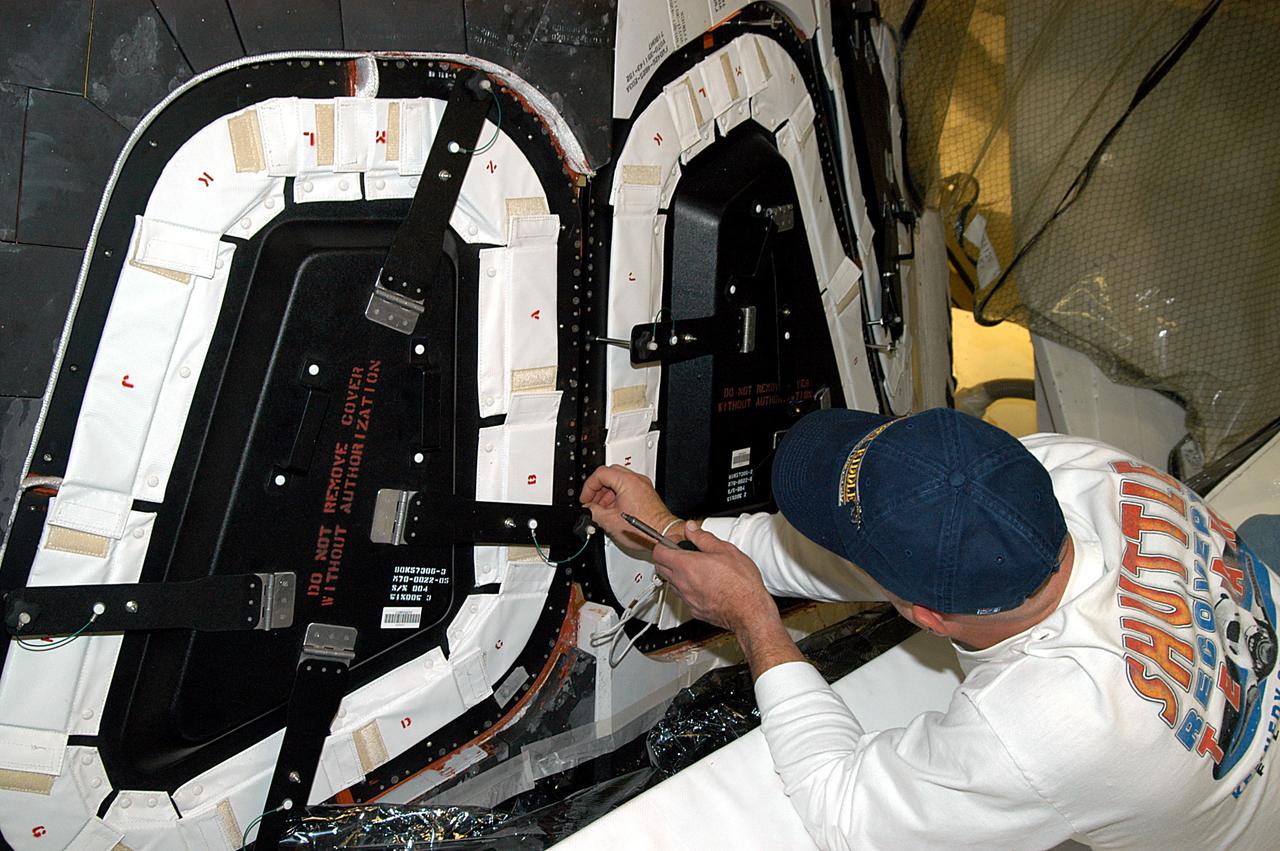
KENNEDY SPACE CENTER, FLA. -- Les Hanks, with United Space Alliance, prepares a window on Atlantis for removal. The windows are being removed to inspect them for contaminants in the thermal seal. Atlantis has been undergoing routine maintenance in the Orbiter Processing Facility for Return to Flight, on mission STS-114.
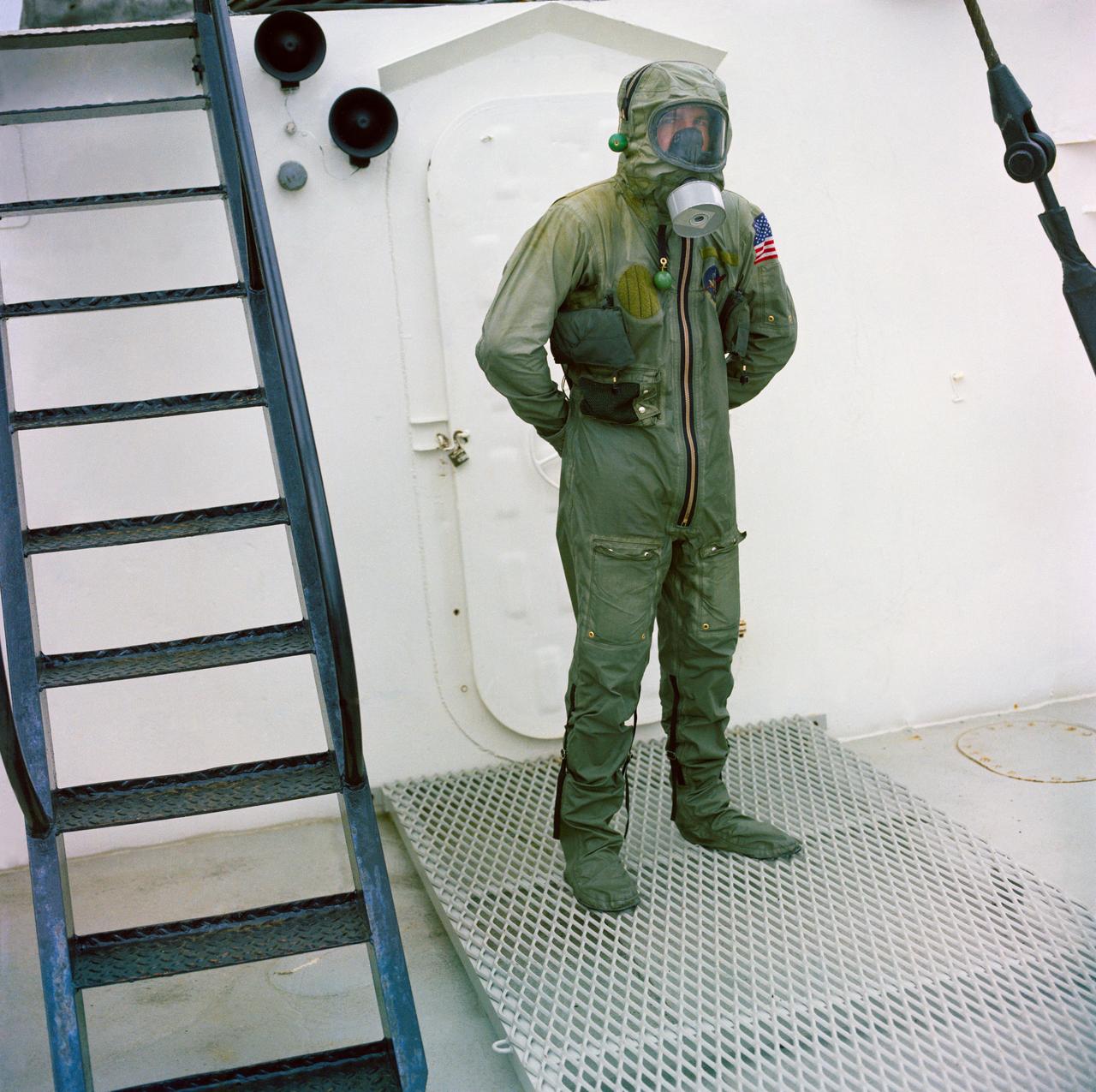
View of subject wearing Biological Isolation Garment (BIG) during a qualification test.
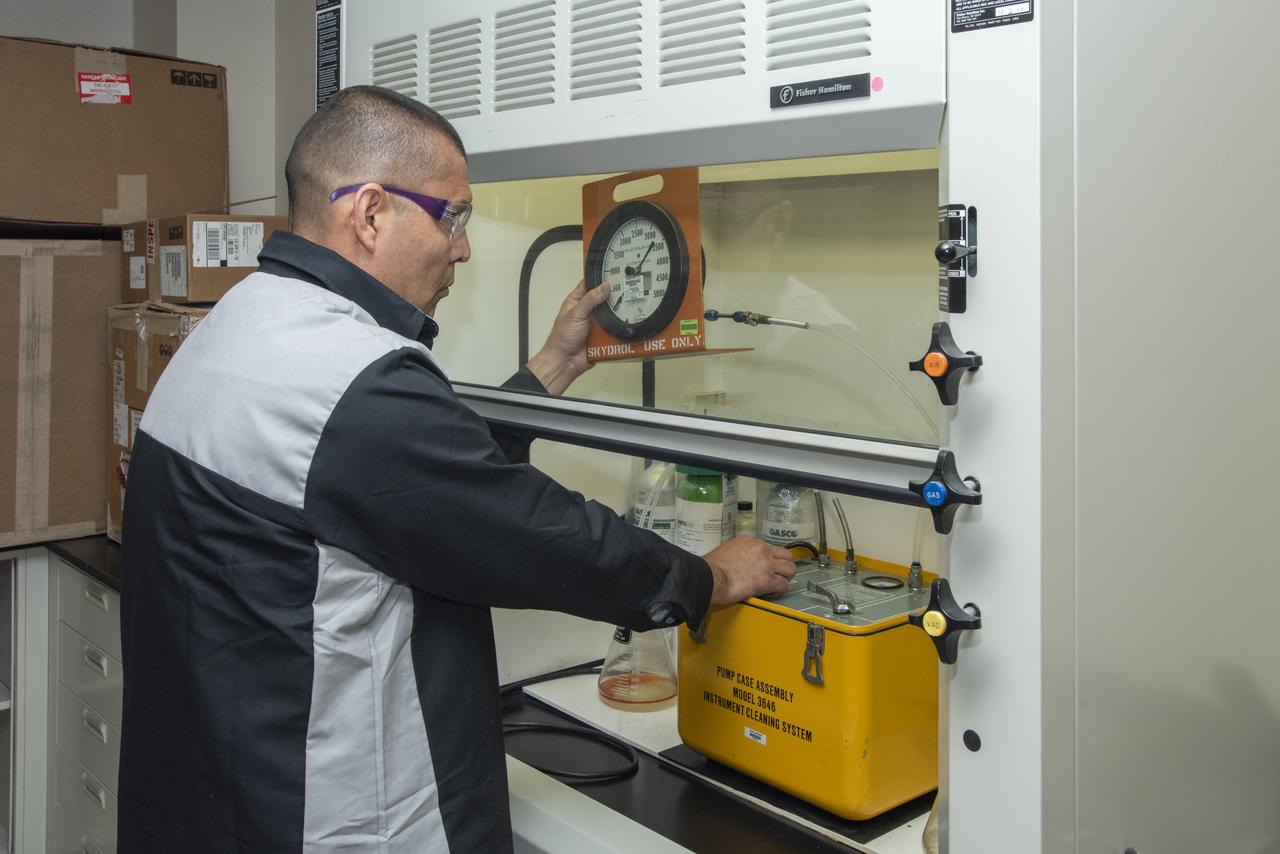
Alex Rivera purges a gauge of contamination prior to a calibration test at NASA's Armstrong Flight Research Center in California.
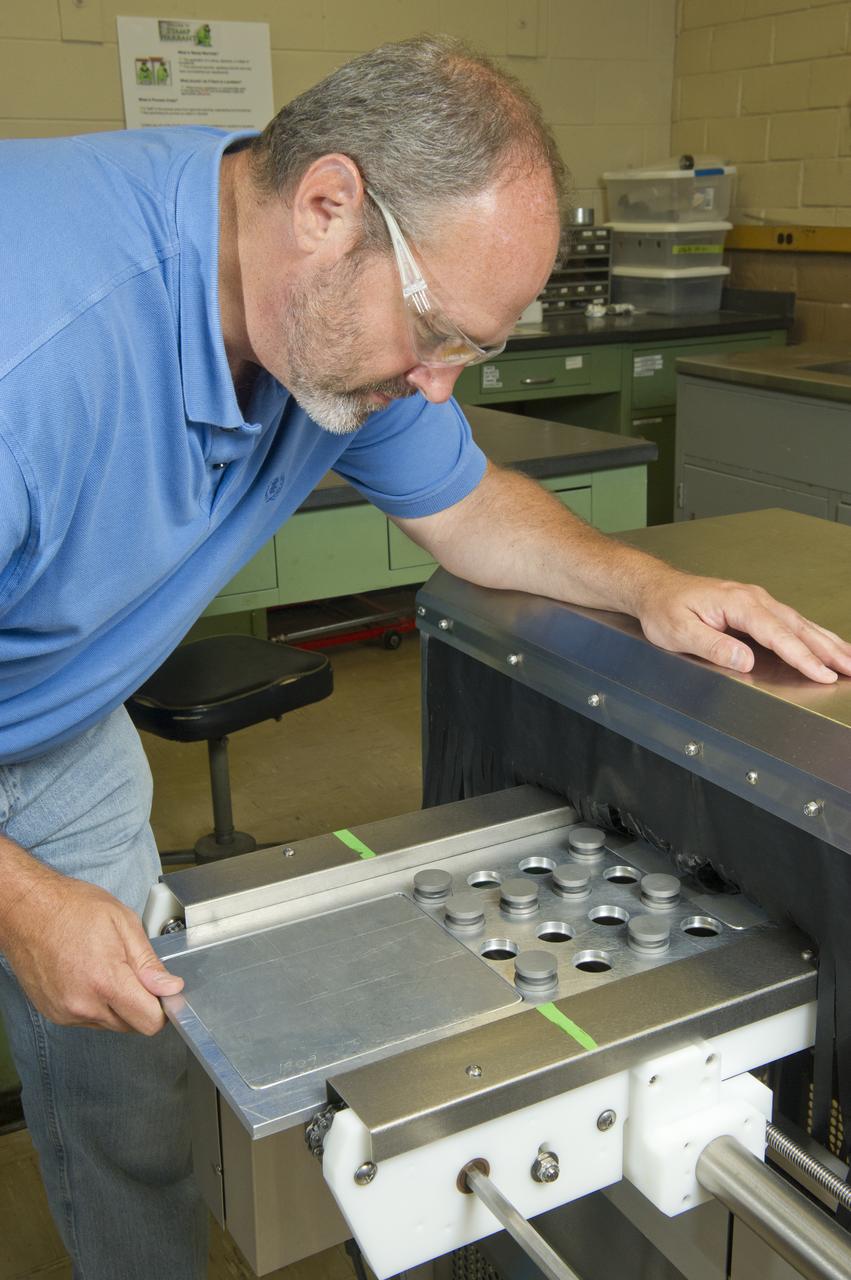
MARK MITCHELL WITH SOROTEK SYSTEM SUPPORTS LOW LEVEL CONTAMINATION APPLICATION FOR BOND SENSITIVITY TESTING.
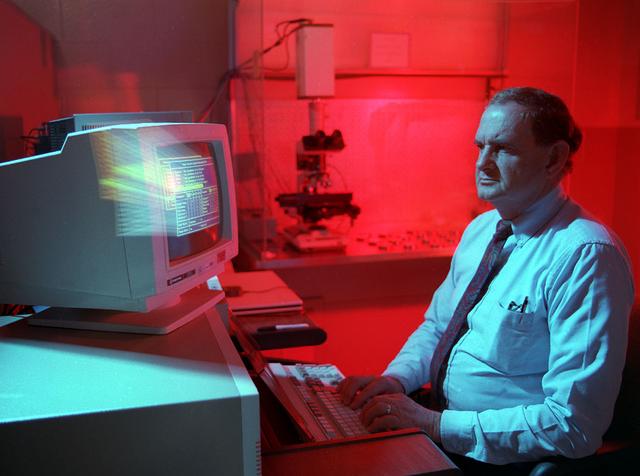
A NASA scientist operates the image analyzer to determine if telescope mirrors have become contaminated in the Materials and Processes lab at Marshall.
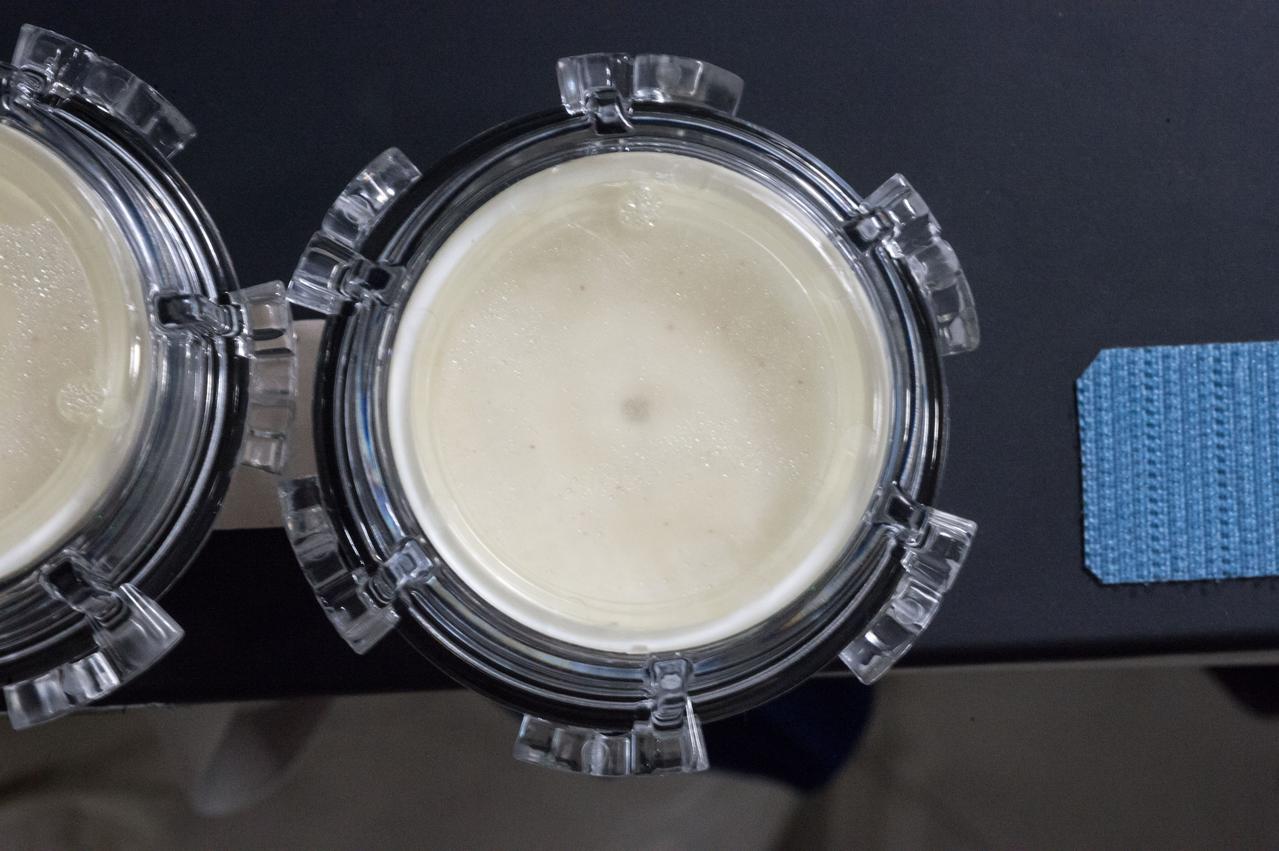
iss050e011727 (11/25/2016) --- View of Aquapad Microbial Contamination after incubation. Photo was taken during Expedition 40.
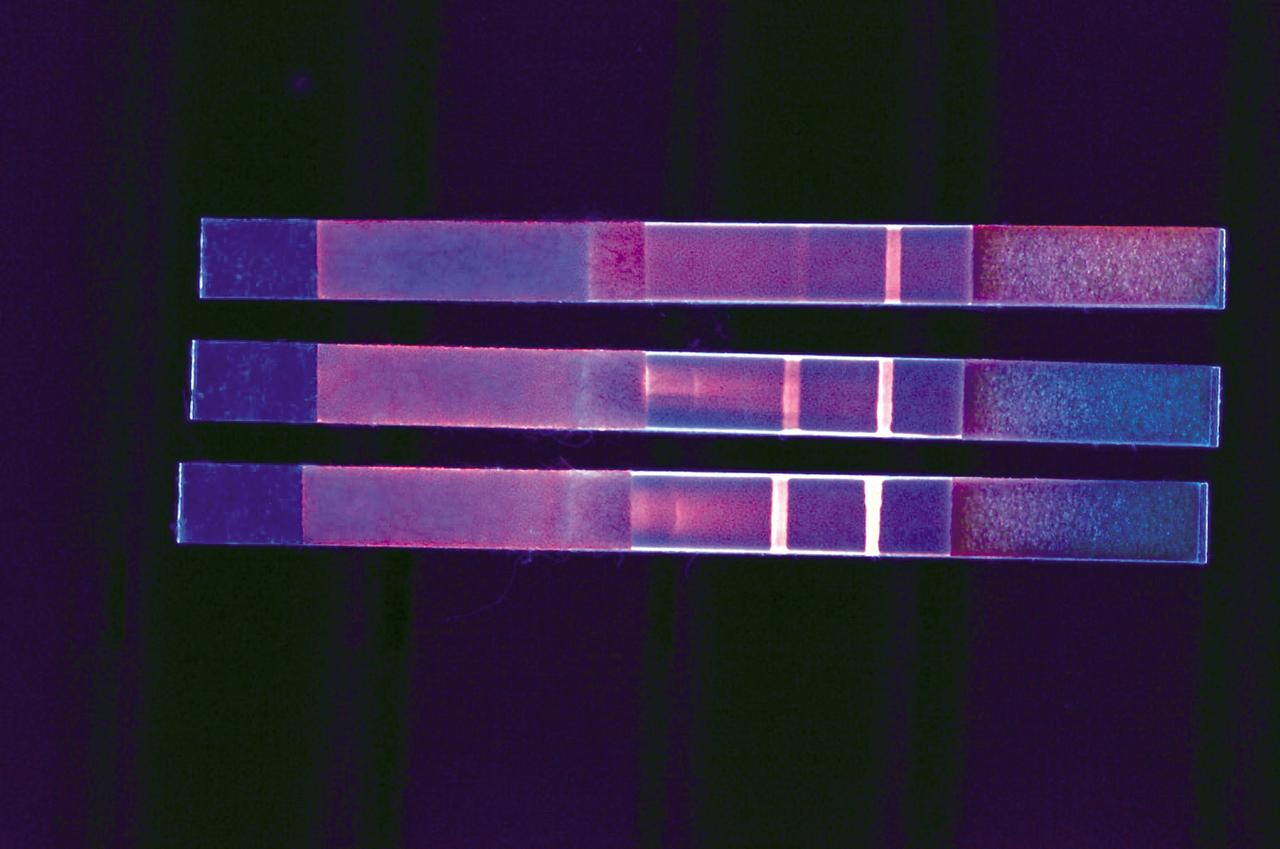
As easy to read as a home pregnancy test, three Quantifiable Lateral Flow Assay (QLFA) strips used to test water for E. coli show different results. The brightly glowing control line on the far right of each strip indicates that all three tests ran successfully. But the glowing test line on the middle left and bottom strips reveal their samples were contaminated with E. coli bacteria at two different concentrations. The color intensity correlates with concentration of contamination.
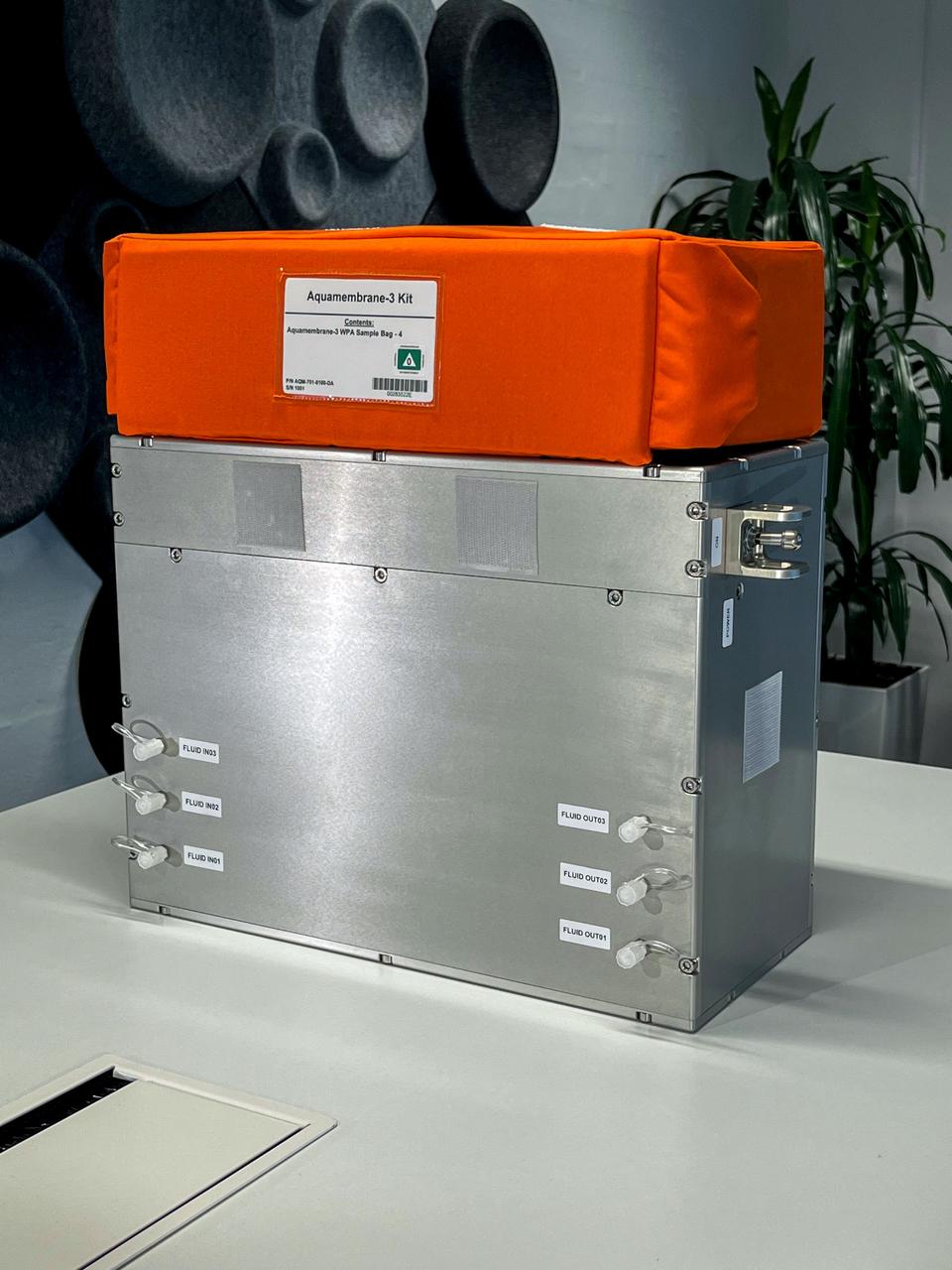
jsc2023e055870 (10/5/2023) --- The Testing Contaminant Rejection of Aquaporin Inside® HFFO Module (Aquamembrane-3) hardware consists of three separate and parallel systems to quantify the membrane's water flux and contamination rejection in microgravity, which are key parameters for a full water recovery system. Aquamembrane-3 tests Aquaporin Inside™ membranes for spacecraft use, a unique water filtration method that mimics fluid transport found in every living cell. Image courtesy of Danish Aerospace Company.
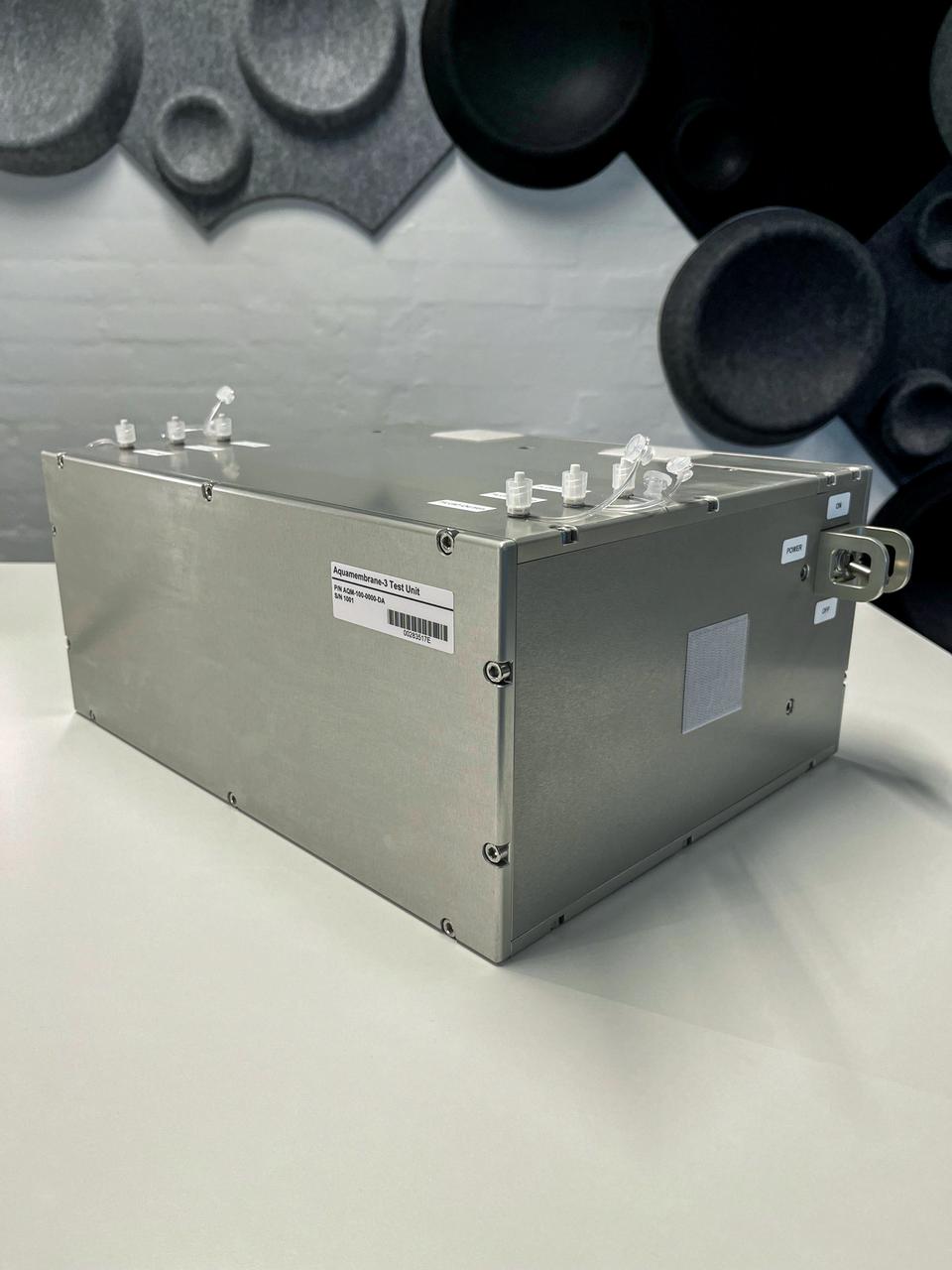
jsc2023e055873 (10/5/2023) --- The Testing Contaminant Rejection of Aquaporin Inside® HFFO Module (Aquamembrane-3) hardware consists of three separate and parallel systems to quantify the membrane's water flux and contamination rejection in microgravity, which are key parameters for a full water recovery system. This image shows the unit containing the forward osmosis membranes and other fluid system components.
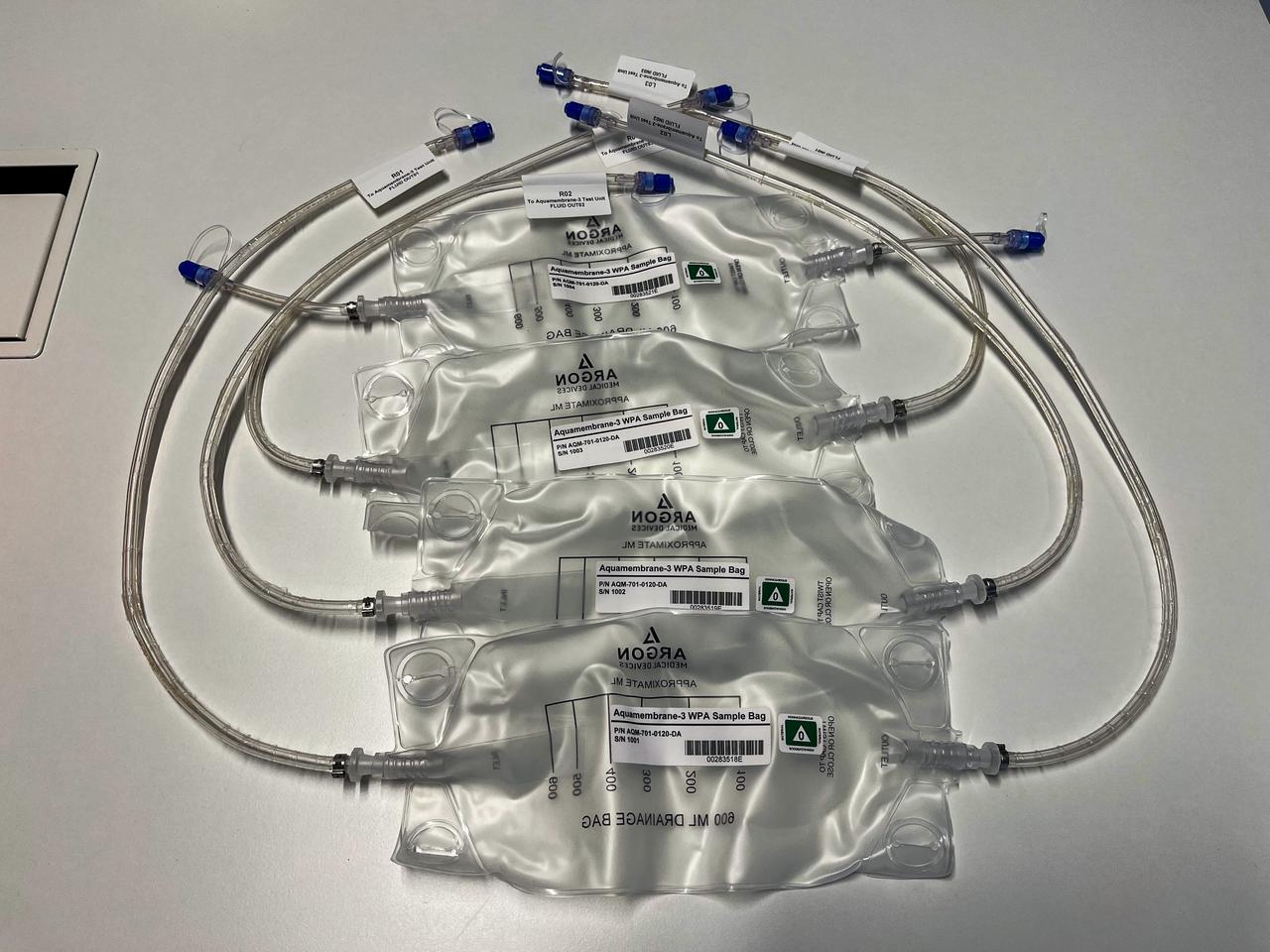
jsc2023e055874 (10/5/2023) --- The Testing Contaminant Rejection of Aquaporin Inside® HFFO Module (Aquamembrane-3) hardware consists of three separate and parallel systems to quantify the membrane's water flux and contamination rejection in microgravity, which are key parameters for a full water recovery system. This image shows the bags in which samples of the ISS WPA are collected for the experiment.

STS004-37-670 (27 June-4 July 1982) --- The North Atlantic Ocean southeast of the Bahamas serves as backdrop for this 70mm scene of the Columbia?s remote manipulator system (RMS) arm and hand-like device (called and end effector) grasping a multi-instrument monitor for detecting contaminants. The experiments is called the induced environment contaminant monitor (IECM). The small box contains 11 instruments for checking the contaminants in and around the orbiter?s cargo bay which might adversely affect delicate experiments carried onboard. Astronauts Thomas K. Mattingly II and Henry W. Hartsfield Jr. manned the Columbia for seven days and one hour. The Columbia?s vertical tail and orbital maneuvering system (OMS) pods are at left foreground. Photo credit: NASA
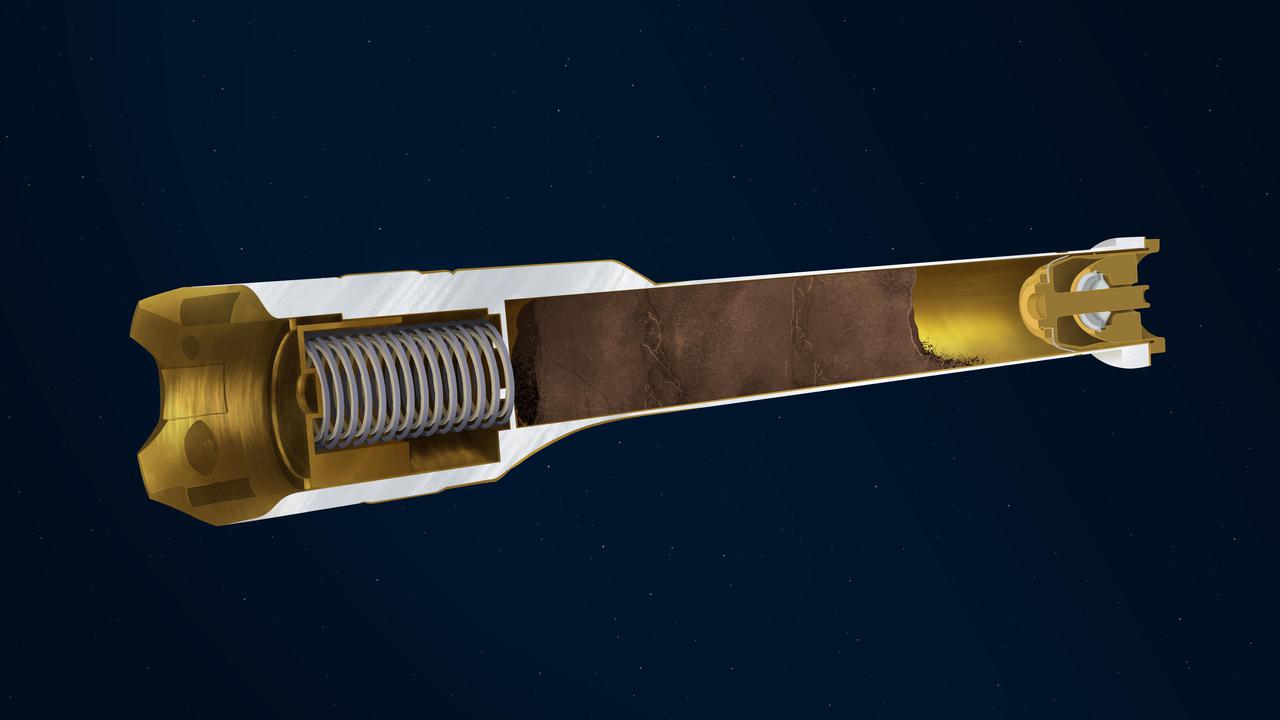
This illustration depicts the interior of a sample tube being carried aboard the Mars 2020 Perseverance rover. About the size and shape of a standard lab test tube, the 43 sample tubes headed to Mars must be lightweight, hardy enough to survive the demands of the round trip, and so clean that future scientists will be confident that what they are analyzing is 100% Mars, without Earthly contaminants. Cutaway Plunger: Works in concert with the spring to release (retract) or activate (extend) the two exterior-mounted ball locks. Springs: Along with the plunger, acts to release or activate the ball locks. Payload Cavity: Also known as the bore, is the area in the tube where cores of Martian rock and samples of regolith will be stored. Titanium Nitride Coating: The specialized surface treatment resists contamination. Hermetic Seal: This mechanically-activated plug is designed to ensure that no contaminants can get into the sample tube and that nothing from inside the tube can get out. https://photojournal.jpl.nasa.gov/catalog/PIA24307
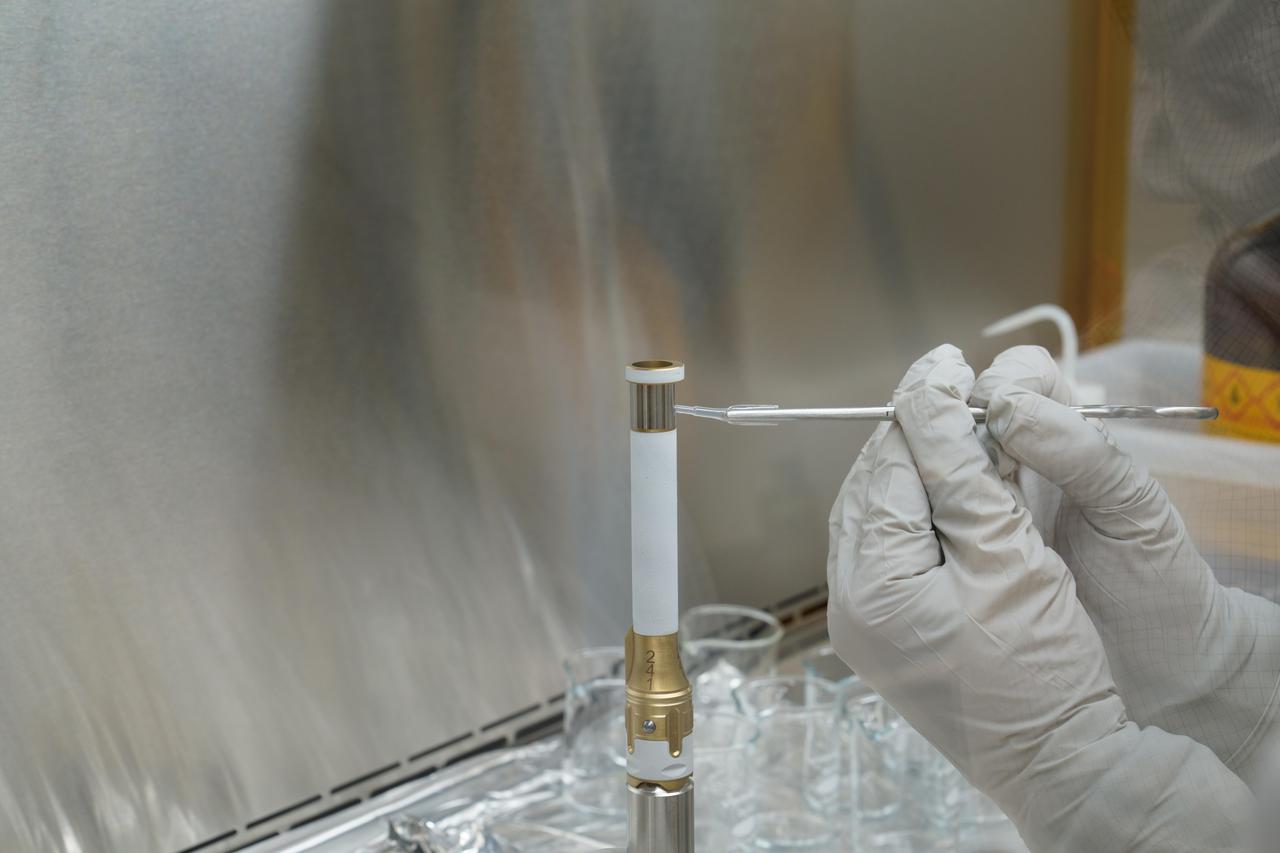
A technician working on the Mars 2020 Perseverance rover mission takes a sample from the surface of sample tube 241 to test for contamination. Each sample tube has its own unique serial number (seen on the gold-colored portion of the tube). The image was taken in a clean room facility at NASA's Jet Propulsion Laboratory in Southern California, where the tubes were developed and assembled. https://photojournal.jpl.nasa.gov/catalog/PIA24294
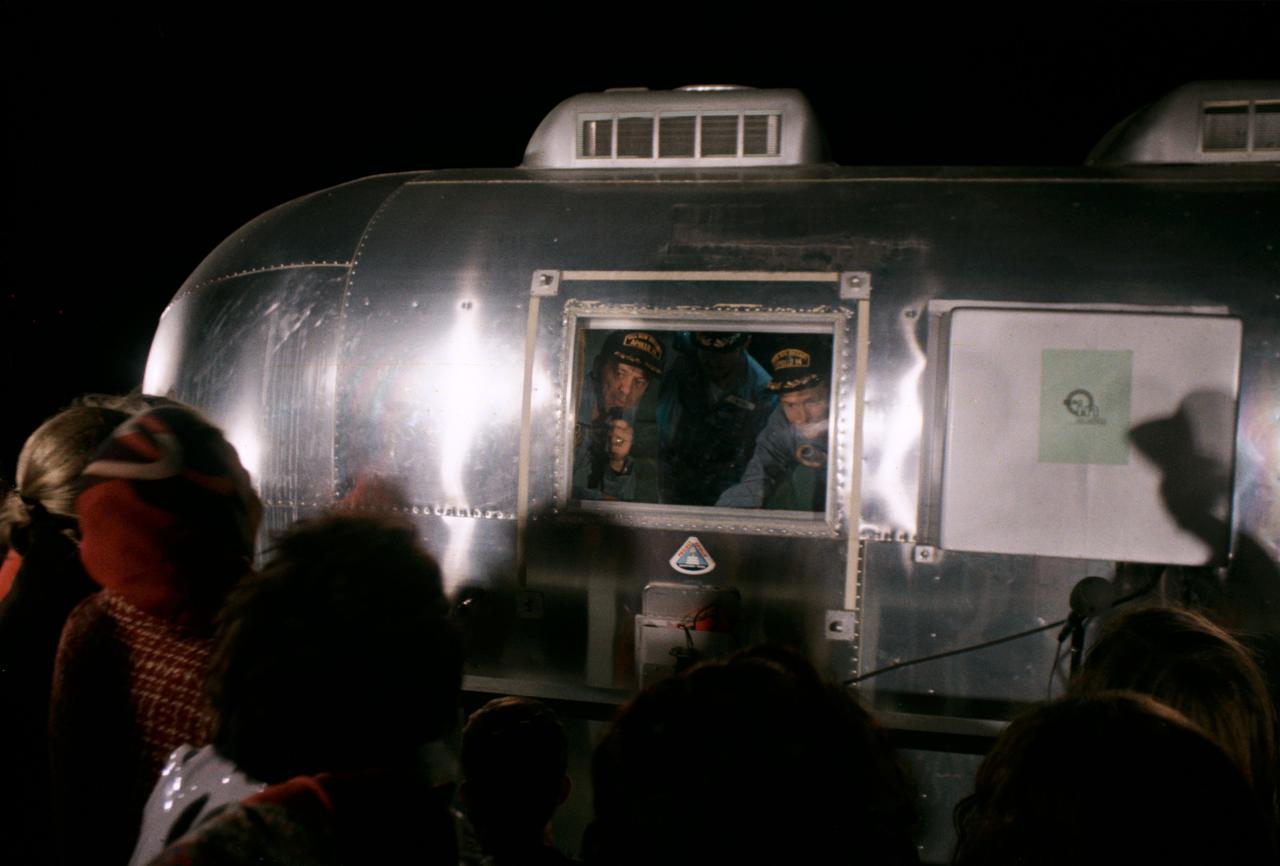
S71-19508 (12 Feb. 1971) --- Separated by aluminum and glass of their Mobile Quarantine Facility (MQF), the Apollo 14 crew members visit with their families and friends upon arriving at Ellington Air Force Base in the early morning hours of Feb. 12, 1971. Looking through the MQF window are astronauts Alan B. Shepard Jr. (left), commander; Stuart A. Roosa (right), command module pilot; and Edgar D. Mitchell, lunar module pilot. The crew men were brought to Houston aboard a C-141 transport plane from Pago Pago, American Samoa. The USS New Orleans had transported the crew to American Samoa from the recovery site in the South Pacific.
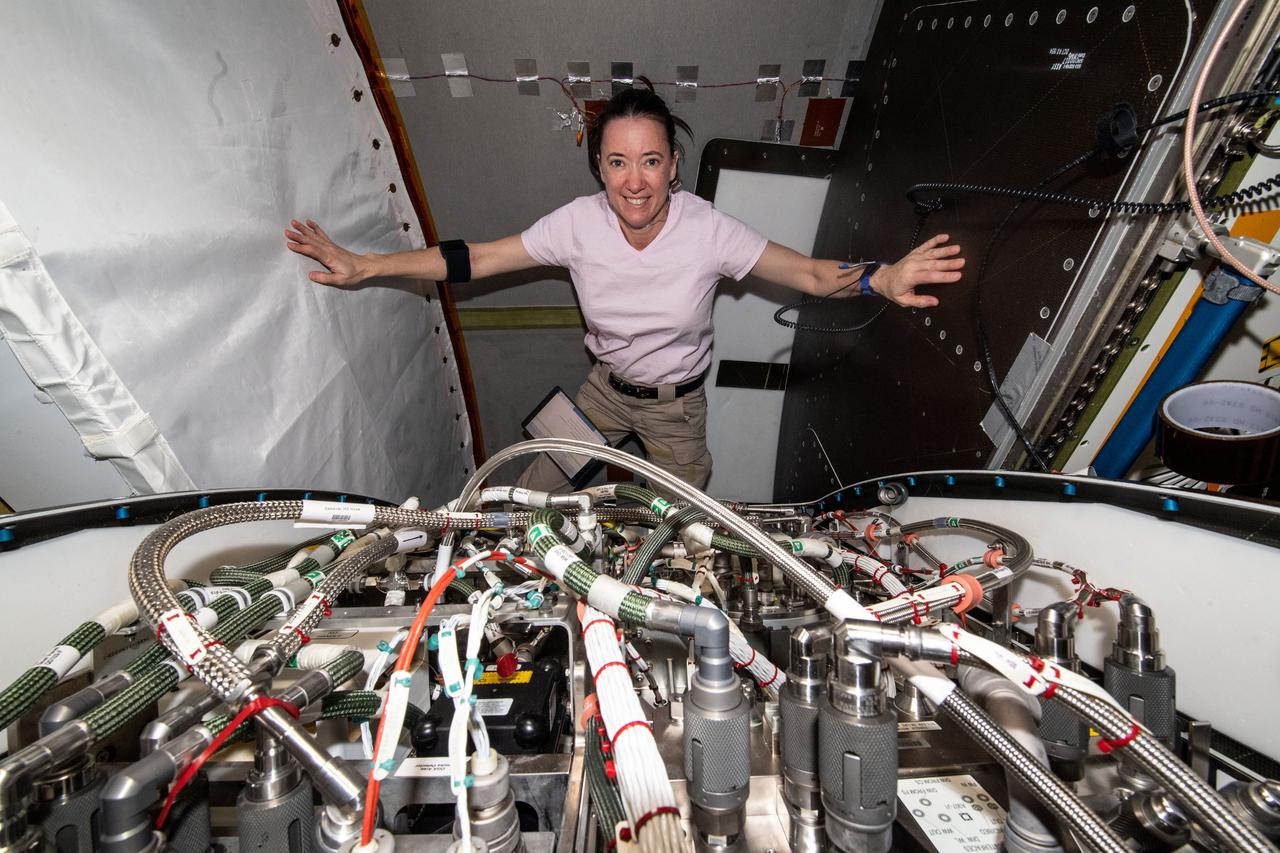
iss066e003338 (Oct. 20, 2021) --- NASA astronaut and Expedition 66 Flight Engineer Megan McArthur replaces components and flushes contaminants inside the Tranquility module's U.S. oxygen generation system.
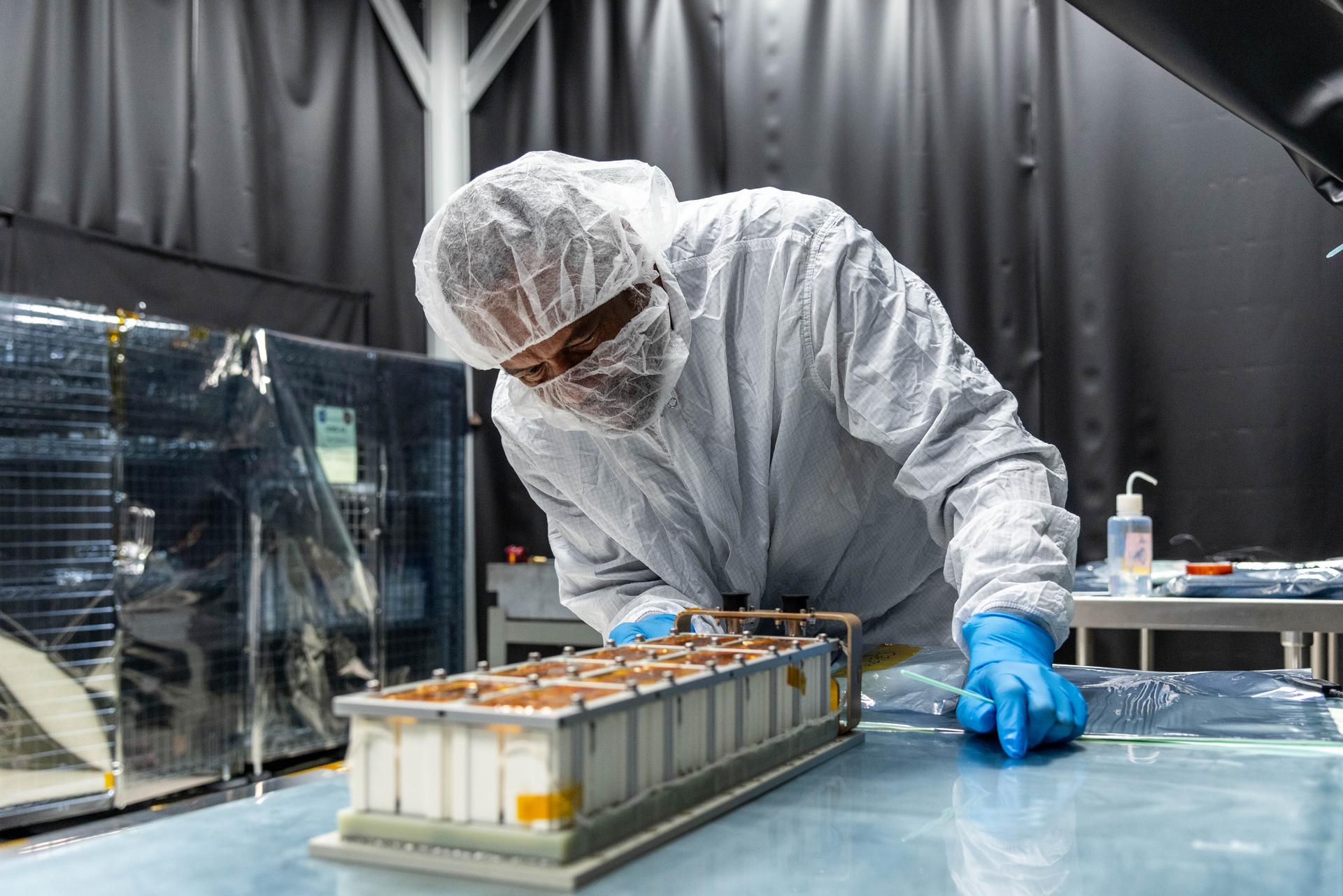
Contamination Control Technician, Rudy Foxwell, inspects the Lunar Environment Monitoring Station (LEMS) Flight Battery in a clean tent at NASA's Goddard Space Flight Center in Greenbelt, Maryland on October 14th, 2026. NASA/Katie Mellos.
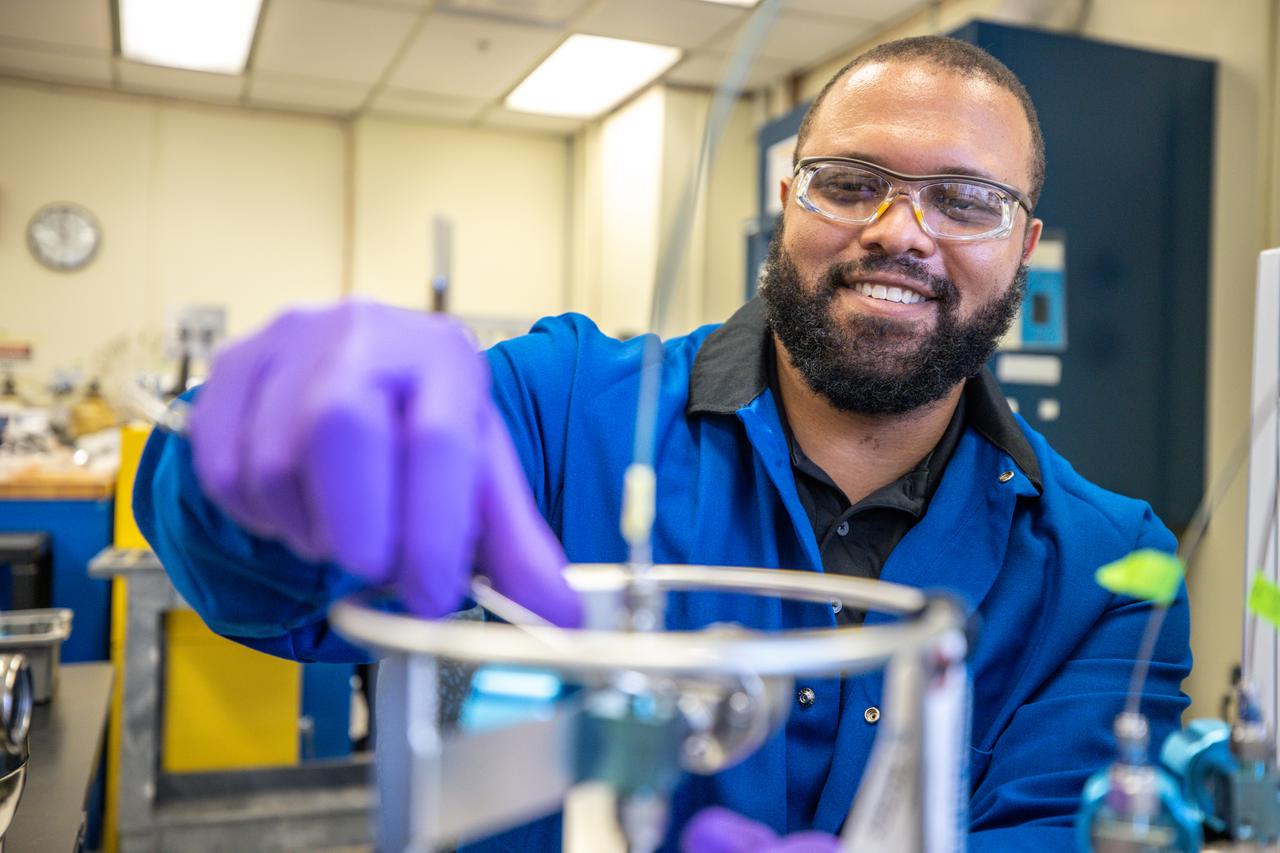
Chemist Trey Barnes prepares a gas sample for injection into a gas chromatography-mass spectrometry system preconcentrator for analyzing trace level gas contaminants inside NASA Engineering’s Analytical Laboratories at Kennedy Space Center in Florida on July 7, 2021. One of seven branches in the NASA Laboratories, Development, and Testing Division, the Analytical Laboratories branch provides microscopic imagery and analysis through the use of a wide variety of microscopic techniques to identify contaminants and other urgent problems associated with aerospace flight hardware, ground support equipment, and related facilities.
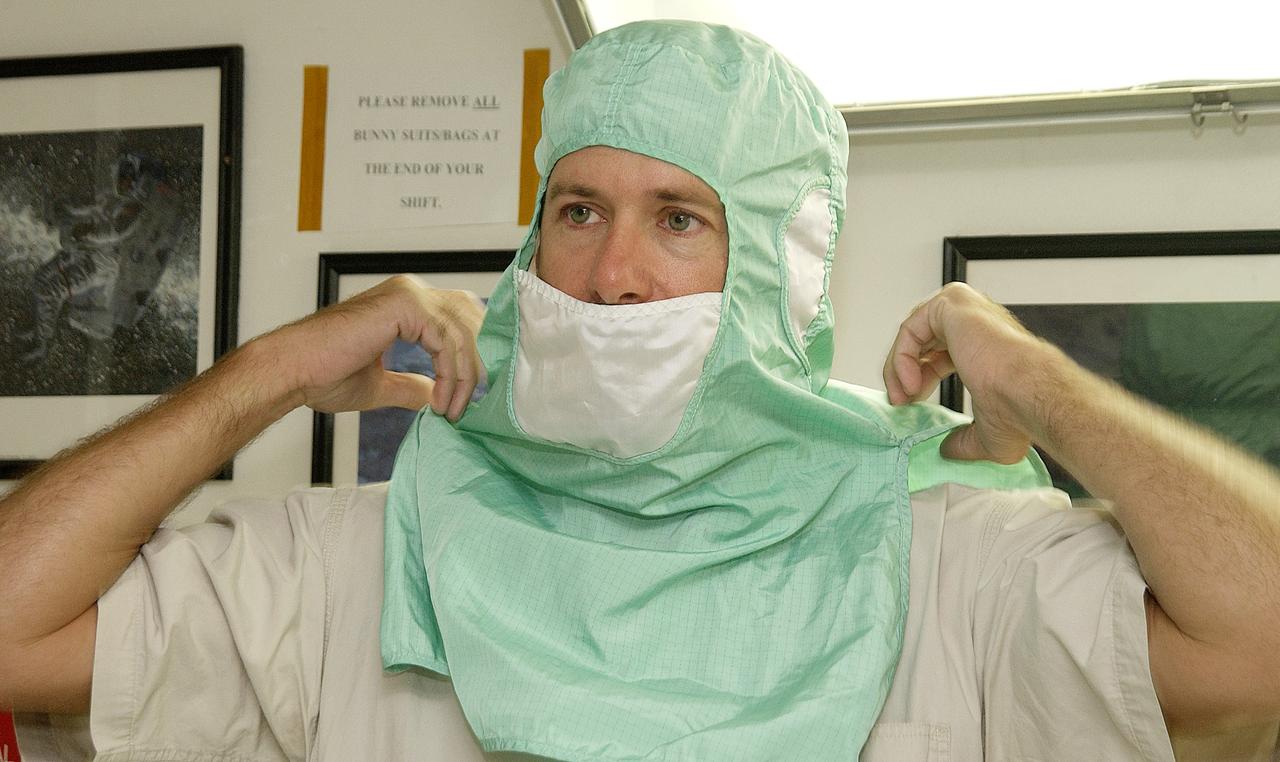
KENNEDY SPACE CENTER, FLA. - A KSC employee dons the head and face cover of a "bunny suit," part of standard clean room apparel, before entering a clean room. This apparel is designed to cover the hair, clothing and shoes of employees to prevent particulate matter from contaminating the space flight hardware being stored or processed in the clean room and is one aspect of KSC's Foreign Object Debris (FOD) control program, an important safety initiative.
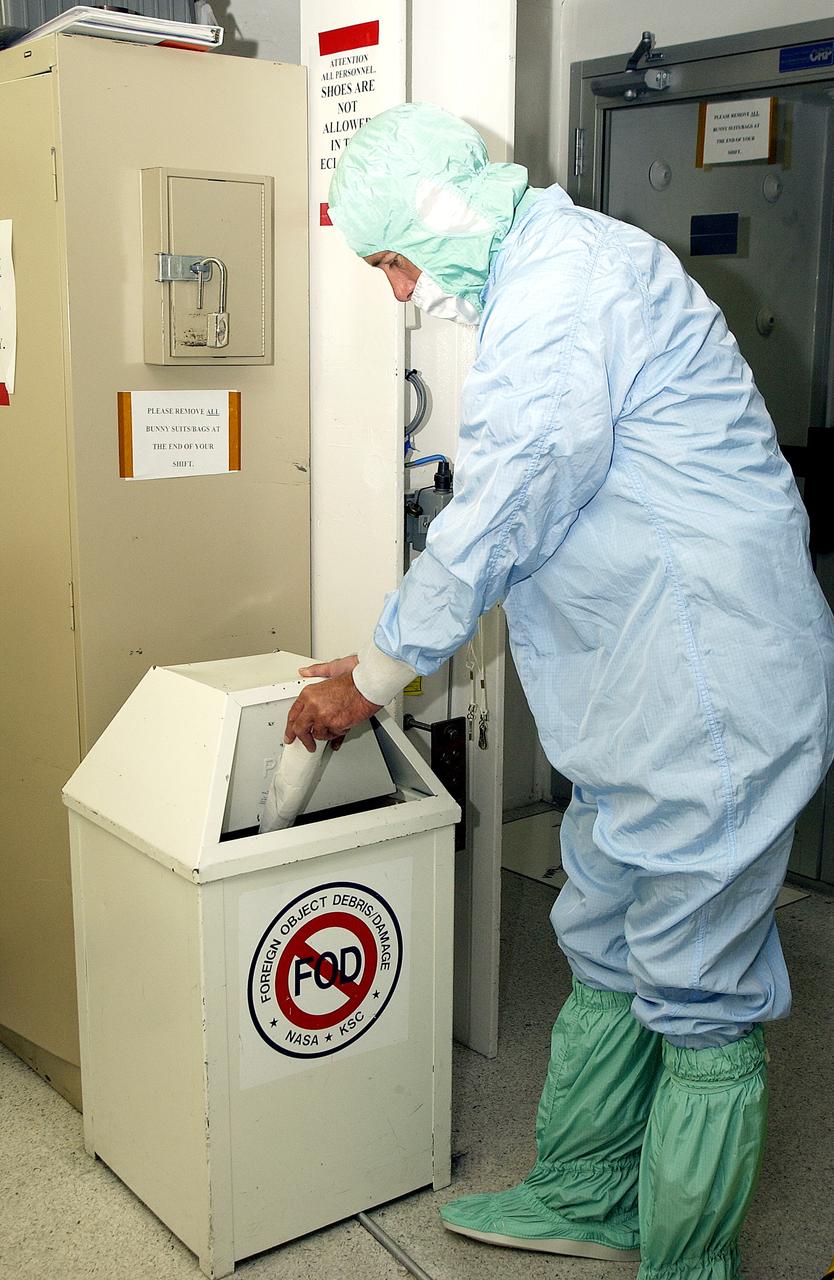
KENNEDY SPACE CENTER, FLA. - A KSC employee dressed in a "bunny suit," standard clean room apparel, disposes of some waste material into a container designated for the purpose. The apparel is designed to cover the hair, clothing and shoes of employees entering a clean room to prevent particulate matter from contaminating the space flight hardware being stored or processed in the room. The suit and container are both part of KSC's Foreign Object Debris (FOD) control program, an important safety initiative.
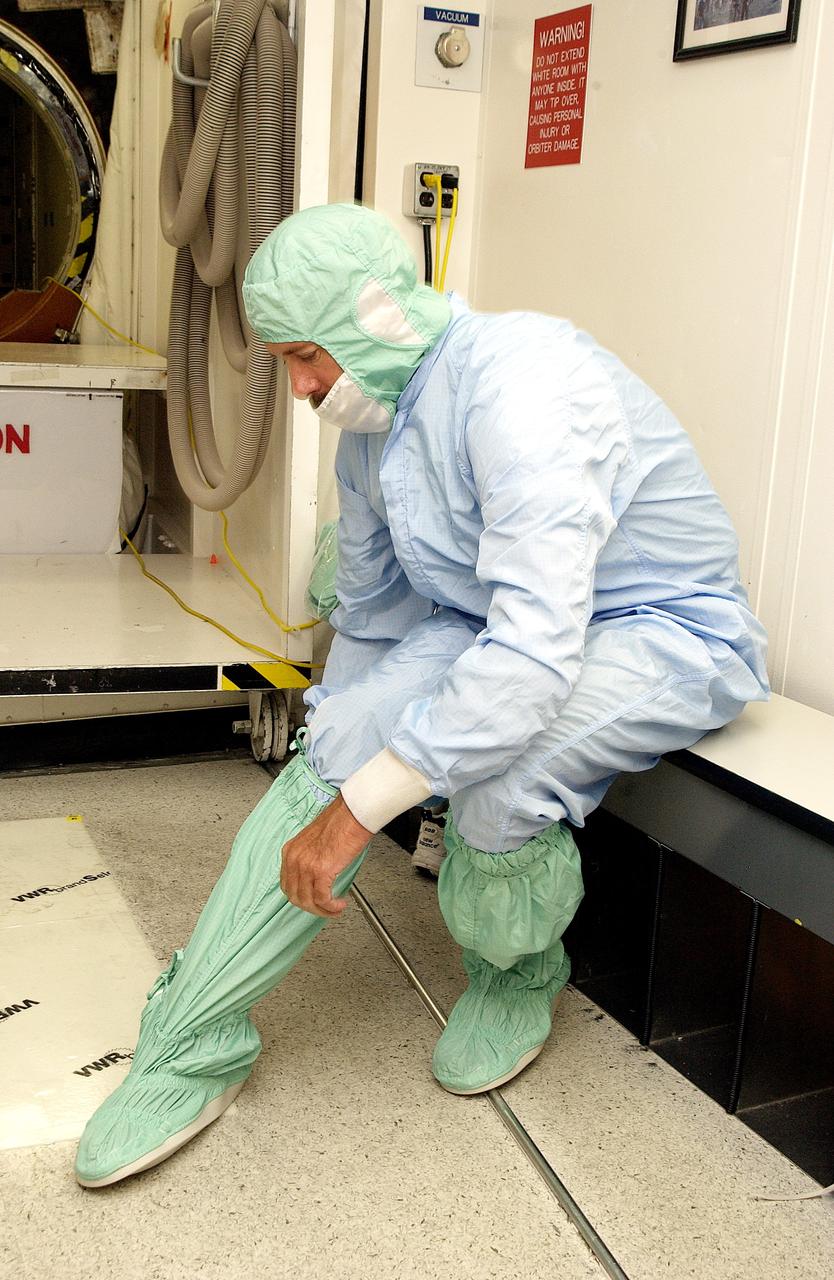
KENNEDY SPACE CENTER, FLA. - A KSC employee secures a foot and leg cover of his "bunny suit," part of standard clean room apparel, before entering a clean room. The apparel is designed to cover the hair, clothing and shoes of employees to prevent particulate matter from contaminating the space flight hardware being stored or processed in the clean room and is one aspect of KSC's Foreign Object Debris (FOD) control program, an important safety initiative.
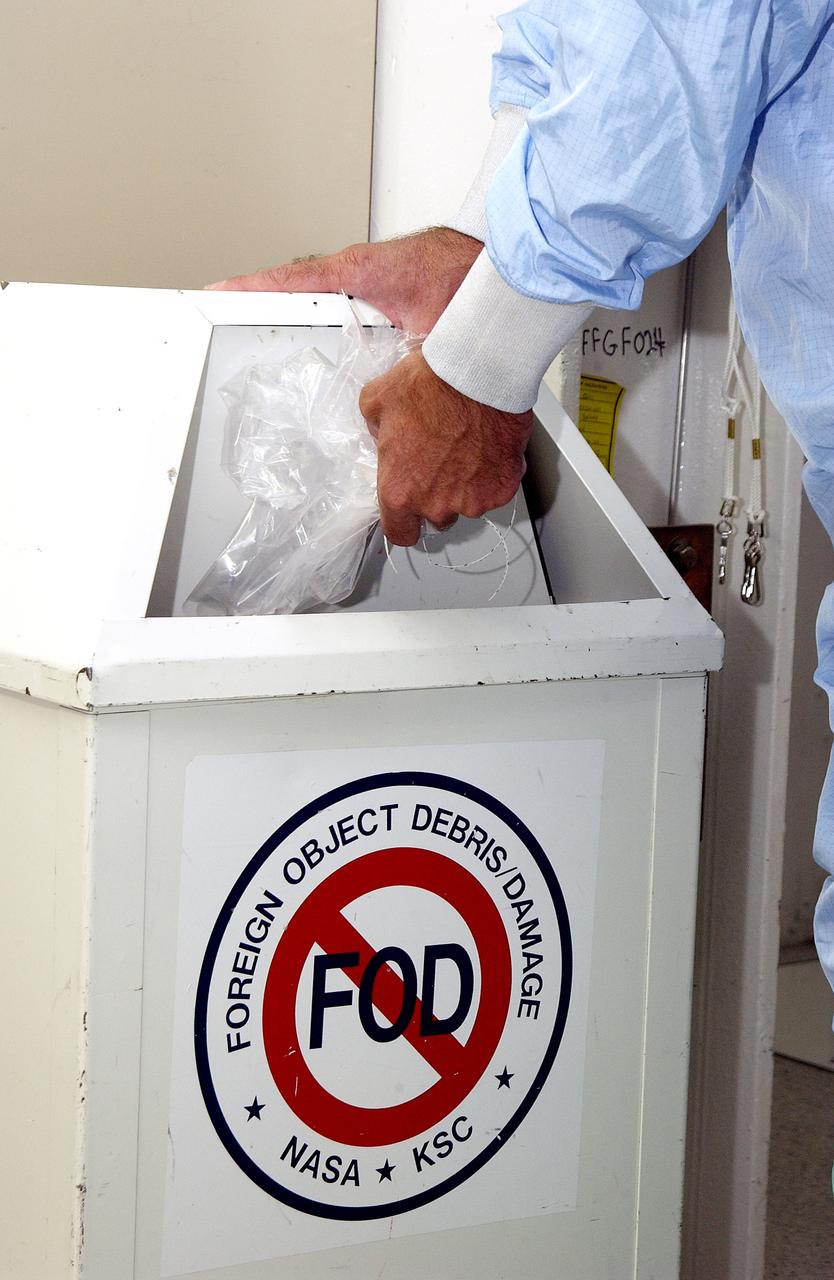
KENNEDY SPACE CENTER, FLA. - A KSC employee dressed in a "bunny suit," standard clean room apparel, disposes of some waste material into a container designated for the purpose. The apparel is designed to cover the hair, clothing and shoes of employees entering a clean room to prevent particulate matter from contaminating the space flight hardware being stored or processed in the room. The suit and container are both part of KSC's Foreign Object Debris (FOD) control program, an important safety initiative.
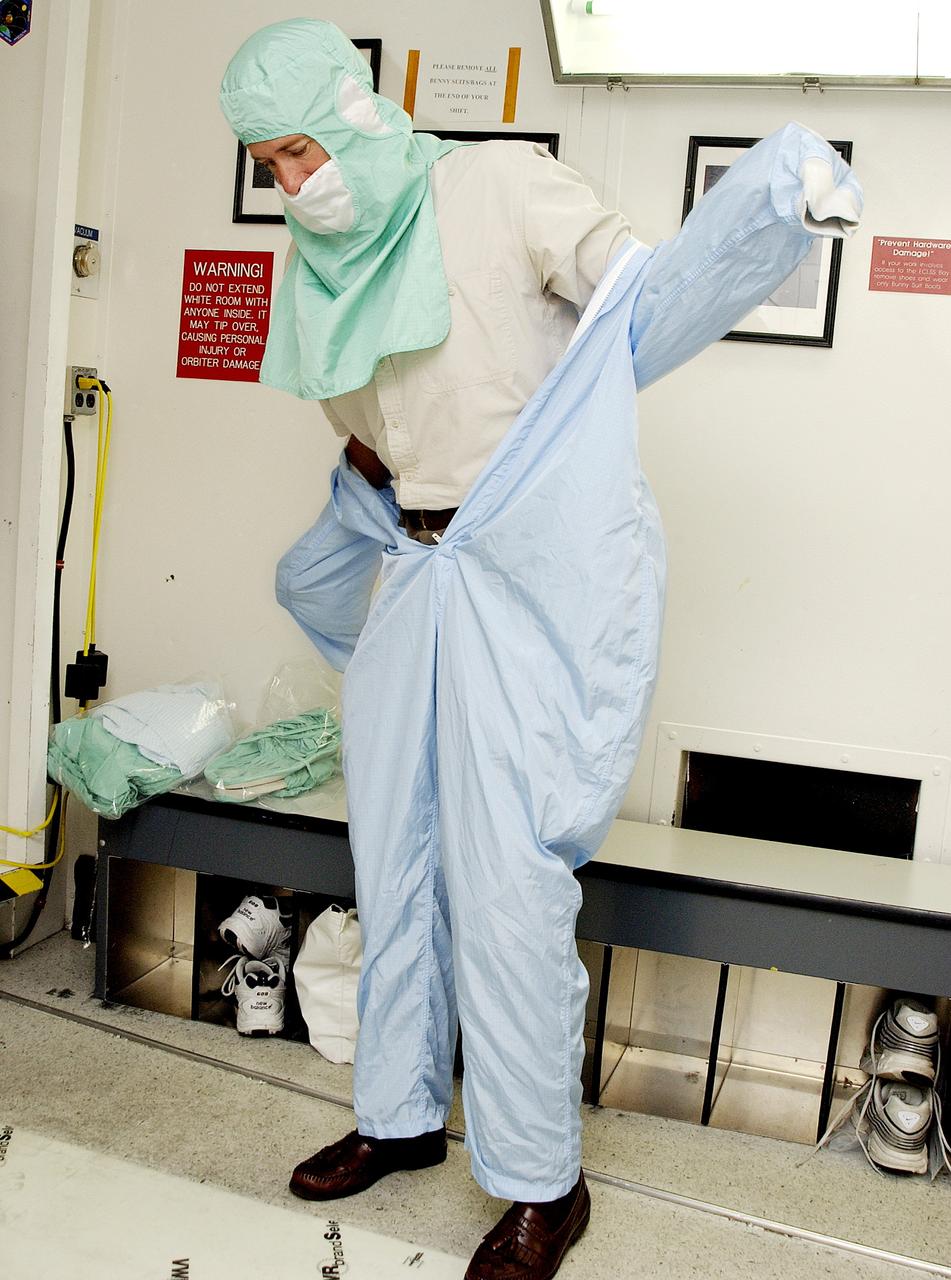
KENNEDY SPACE CENTER, FLA. - A KSC employee dons the coverall of a "bunny suit," part of standard clean room apparel, before entering a clean room. The apparel is designed to cover the hair, clothing and shoes of employees to prevent particulate matter from contaminating the space flight hardware being stored or processed in the clean room and is one aspect of KSC's Foreign Object Debris (FOD) control program, an important safety initiative.
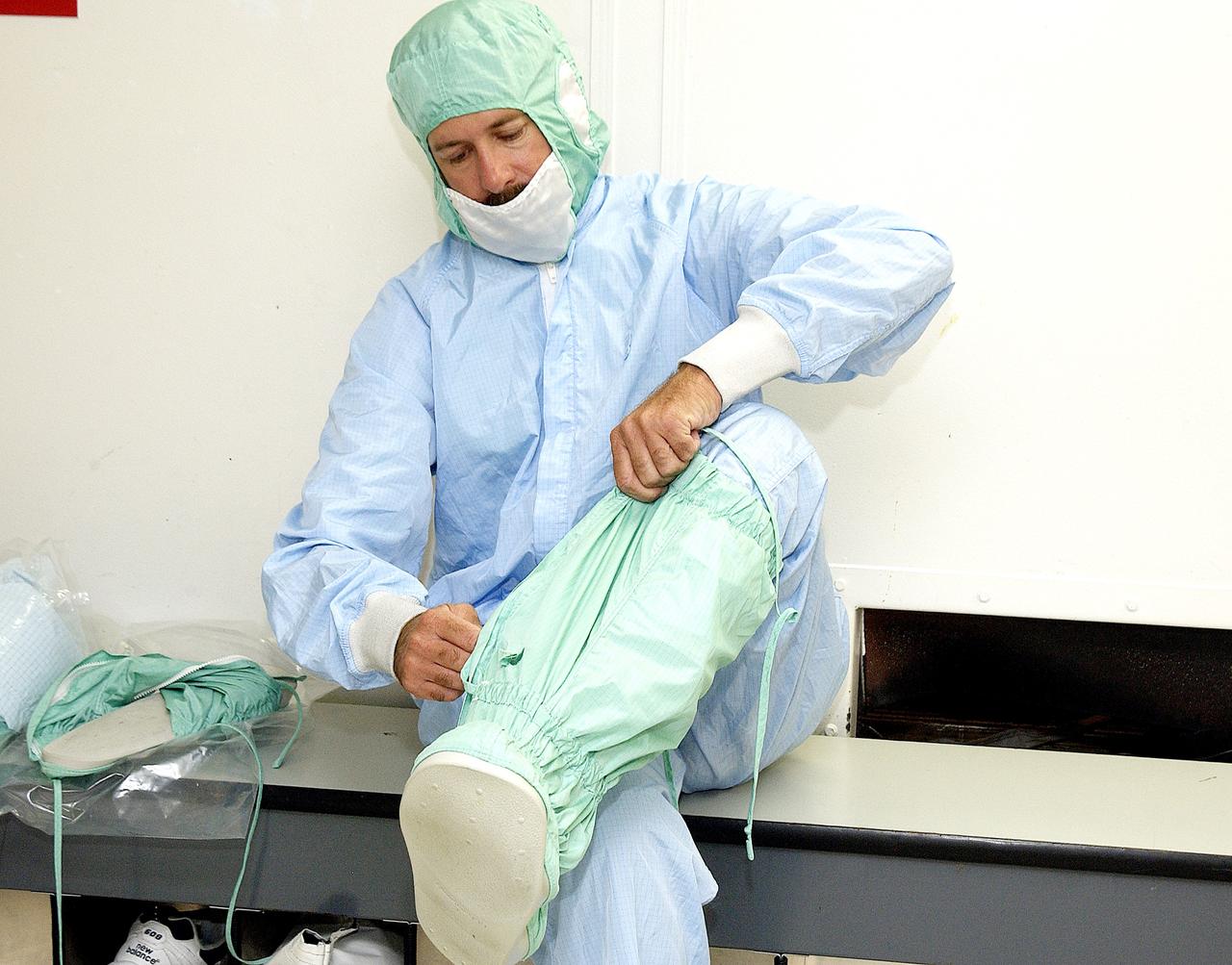
KENNEDY SPACE CENTER, FLA. - A KSC employee dons the foot and leg covers of a "bunny suit," part of standard clean room apparel, before entering a clean room. The apparel is designed to cover the hair, clothing and shoes of employees to prevent particulate matter from contaminating the space flight hardware being stored or processed in the clean room and is one aspect of KSC's Foreign Object Debris (FOD) control program, an important safety initiative.
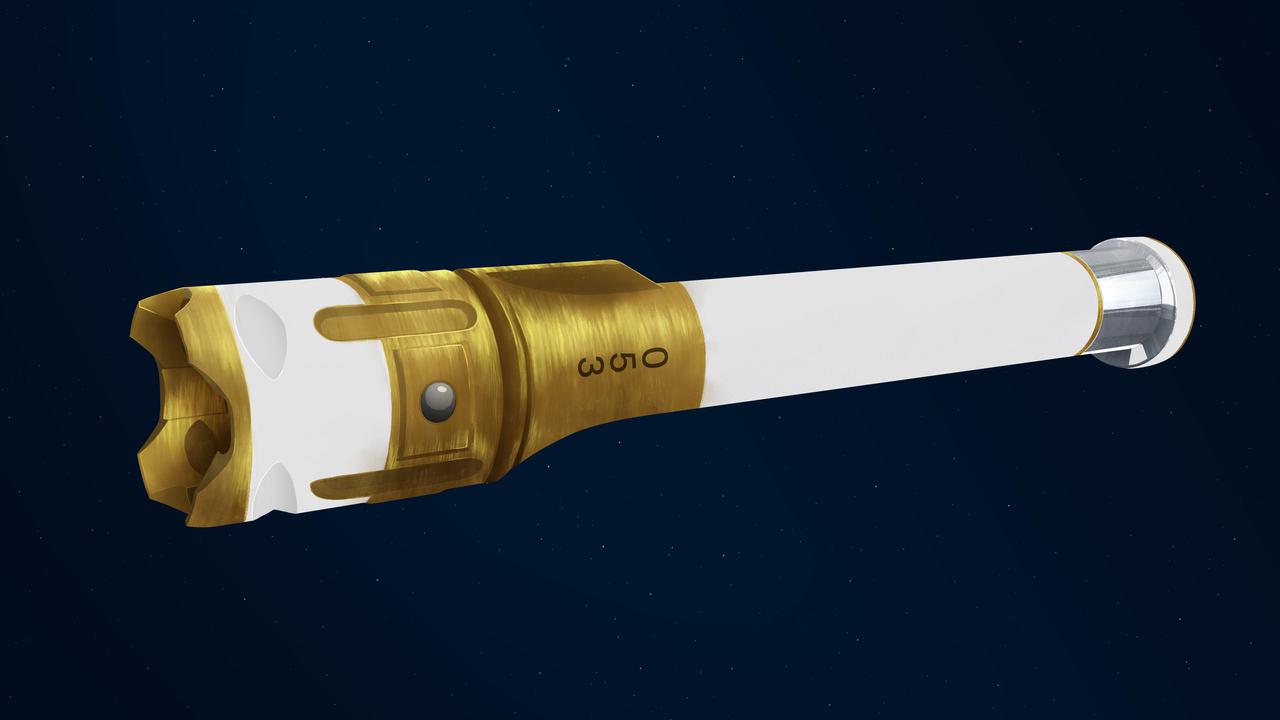
This illustration depicts the exterior of a sample tube being carried aboard the Mars 2020 Perseverance rover. About the size and shape of a standard lab test tube, the 43 sample tubes headed to Mars must be lightweight, hardy enough to survive the demands of the round trip, and so clean that future scientists will be confident that what they are analyzing is 100% Mars, without Earthly contaminants. Exterior Ball Lock: Placed on opposite sides of the tube, the two ball locks help secure the sample tube as it progresses through the many stages of sample collection and storage. Serial Number: Helps with identification of the tubes and their contents. Titanium Nitride Coating: Gold in color, this extremely hard ceramic coating is used as a specialized surface treatment that resists contamination. Alumina Coating: The reflective coating provides thermal protection and acts as a sponge to prevent potential contaminants from getting inside the sample tube. Bare Titanium: The portion of tube near the open end contains no coating to eliminate the possibility that the coating could delaminate from this portion of the tube during the insertion of a hermetic seal. Bearing Race: An asymmetrical flange at the open end of the tube, it assists in the process of shearing (breaking) off samples at the completion of the coring portion of sample collection. https://photojournal.jpl.nasa.gov/catalog/PIA24306

iss073e0547545 (Aug. 27, 2025) --- Roscosmos cosmonaut and Expedition 73 Flight Engineer Alexey Zubritsky is pictured with an air sampling device to detect and analyze trace contaminants such as carbon dioxide and ammonia to ensure a safe breathable environment aboard the International Space Station.
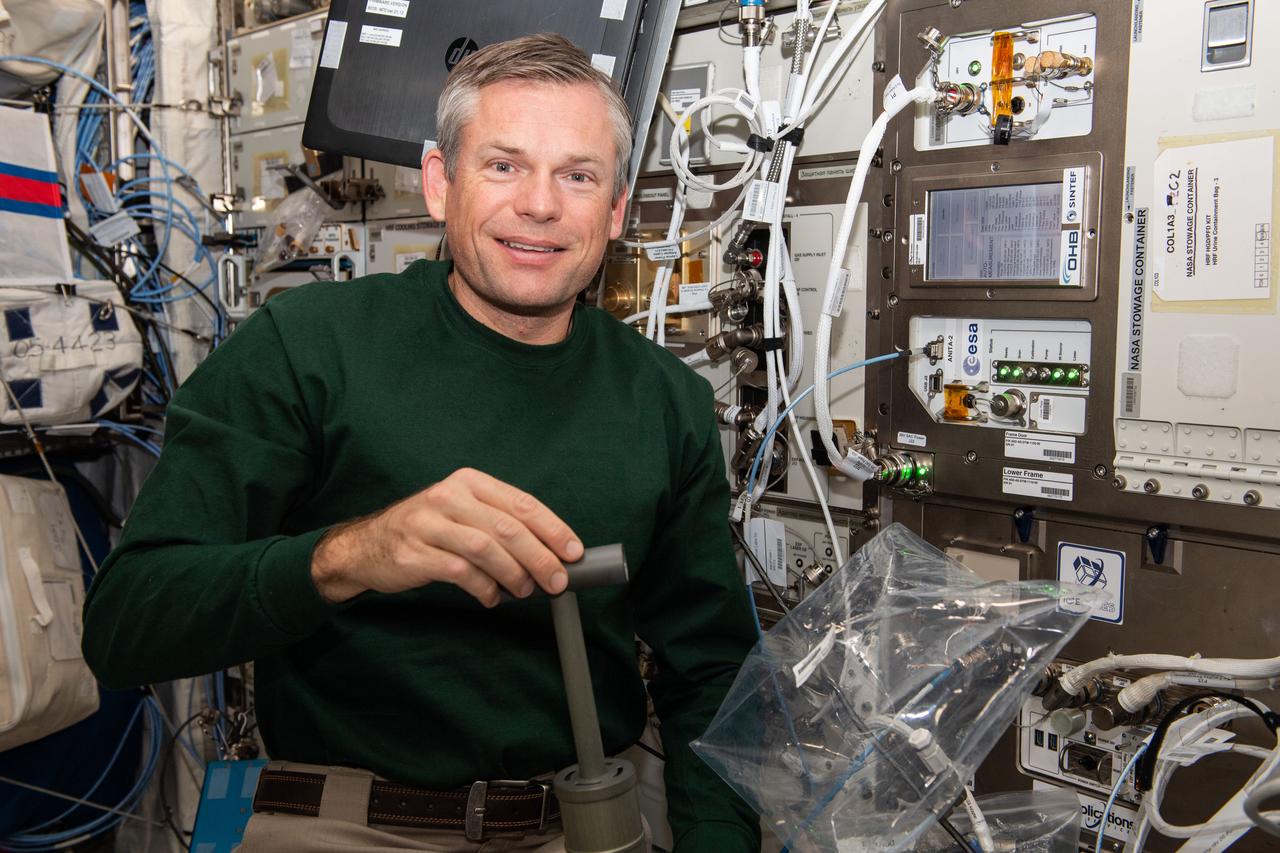
iss070e003140 (10/12/2023) --- European Space Agency (ESA) astronaut Andreas Mogensen is seen filling an ANITA-2 sampling bag a measurement demonstration. The ANITA-2 is a compact gas analyzer which can analyze and quantify 33 trace contaminants in the atmosphere aboard the ISS automatically.
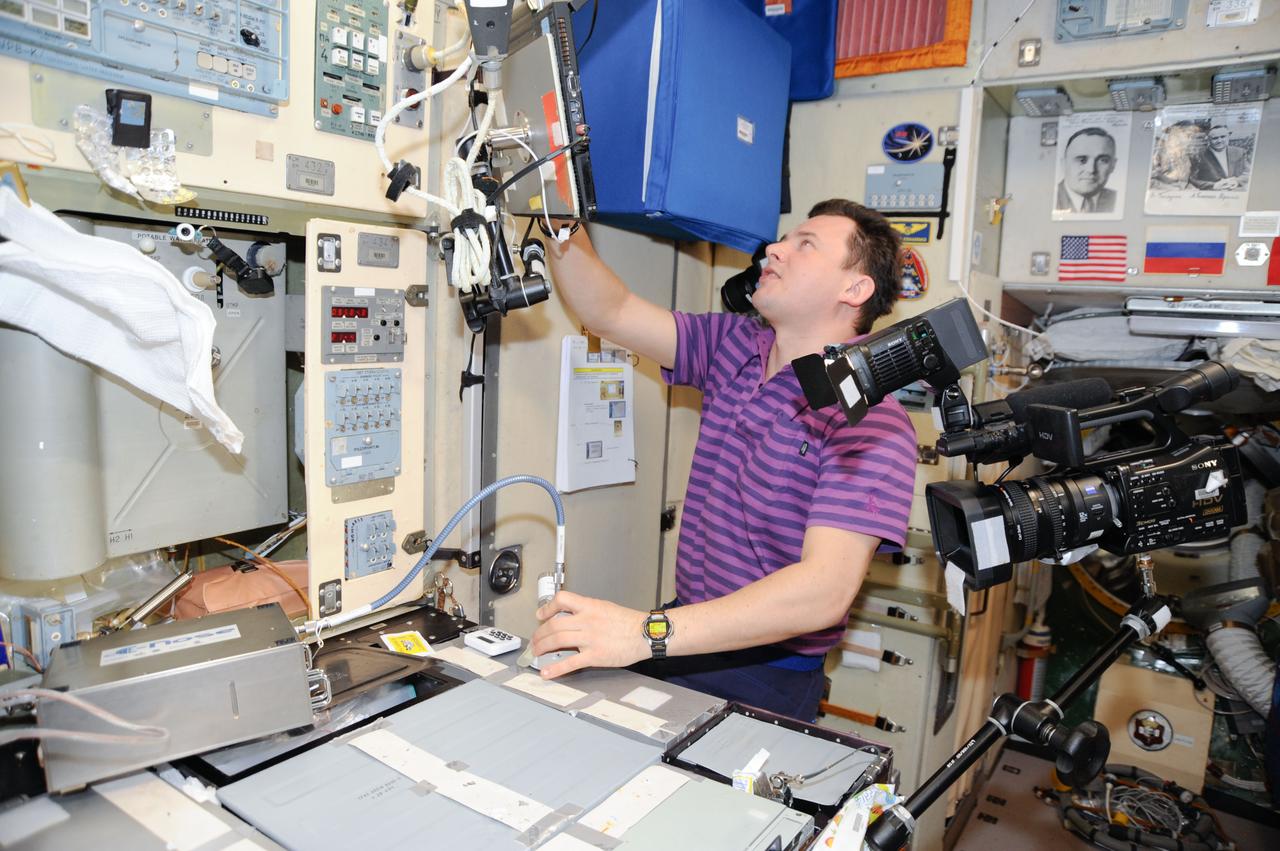
ISS034-E-051551 (21 Feb. 2013) --- Cosmonaut Roman Romanenko, Expedition 34 flight engineer, works with the Electronic Nose hardware in the Zvezda service module aboard the International Space Station in Earth orbit. This hardware is used to measure contamination in the environment should there be hard to detect chemical leaks or spills.
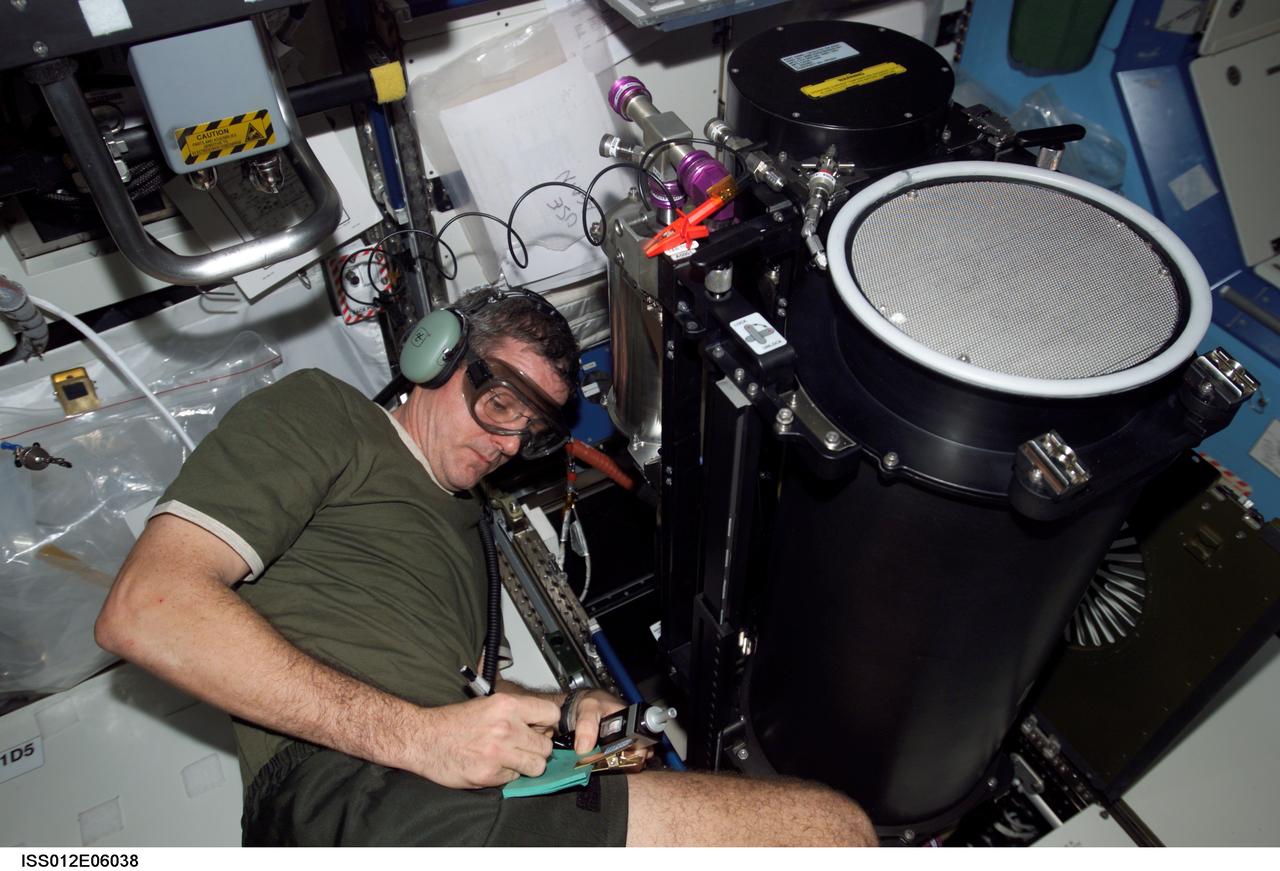
ISS012-E-06038 (31 October 2005) --- Astronaut William S. McArthur Jr., Expedition 12 commander and NASA science officer, conducts troubleshooting operations on the Trace Contaminant Control Subassembly (TCCS) in the Destiny laboratory of the international space station.
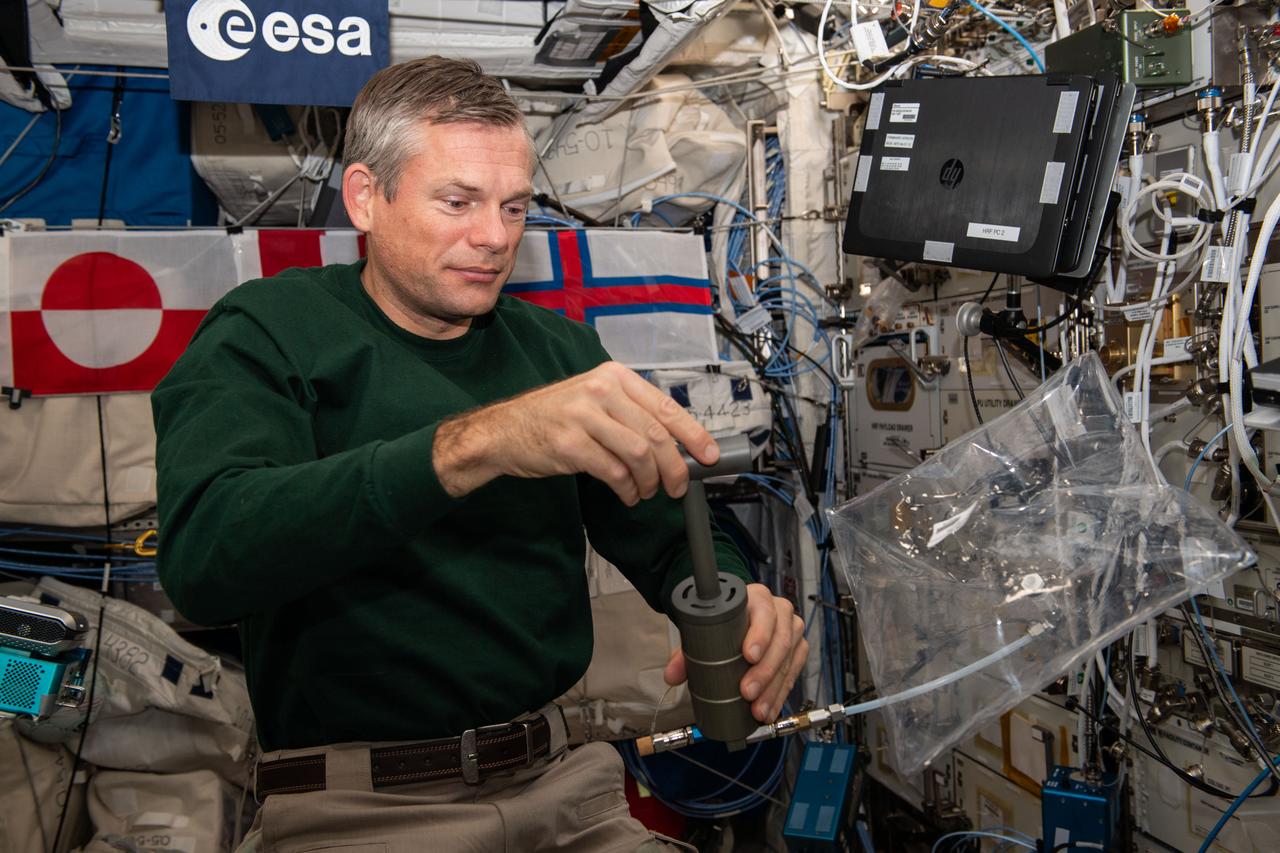
iss070e003131 (10/12/2023) --- European Space Agency (ESA) astronaut Andreas Mogensen is seen filling an ANITA-2 sampling bag a measurement demonstration. The ANITA-2 is a compact gas analyzer which can analyze and quantify 33 trace contaminants in the atmosphere aboard the ISS automatically.
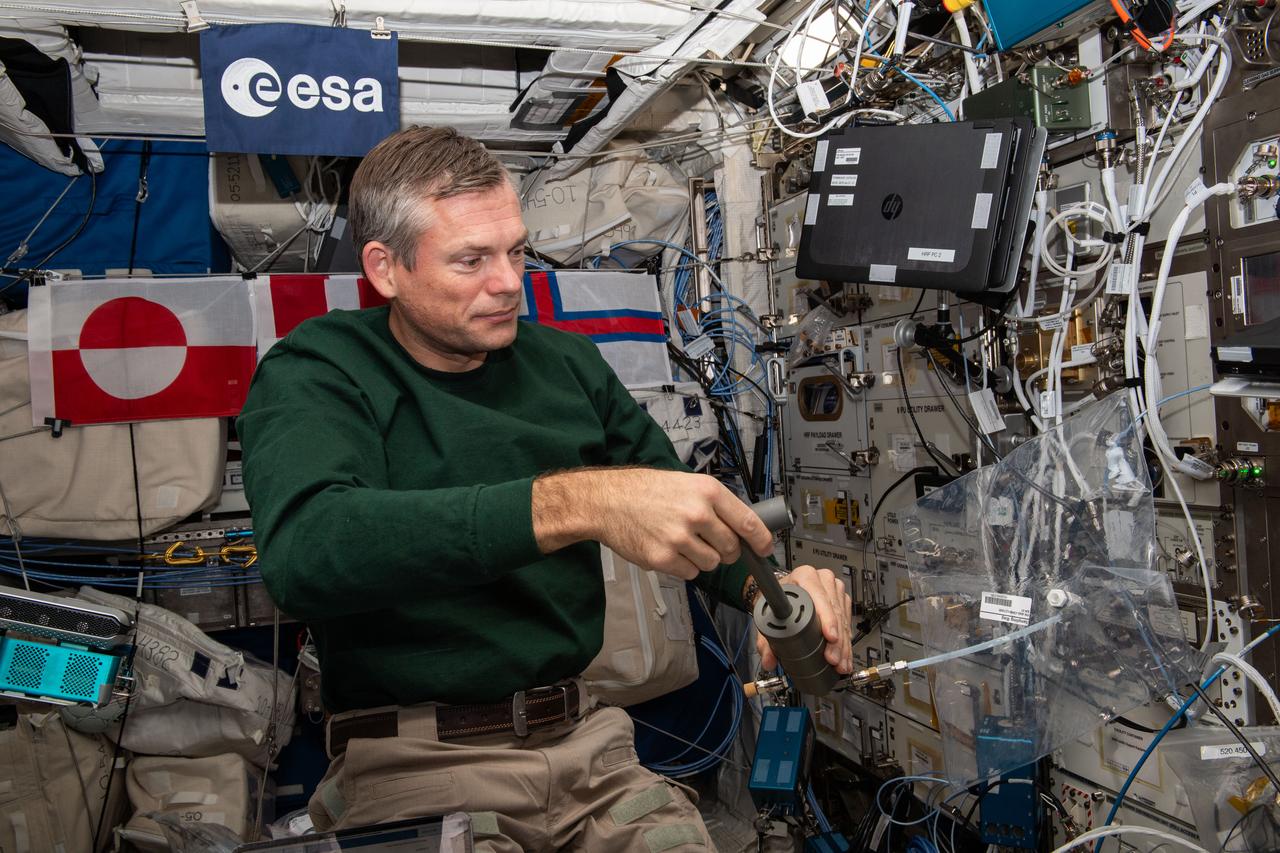
iss070e003120_alt (10/12/2023) --- European Space Agency (ESA) astronaut Andreas Mogensen is seen filling an ANITA-2 sampling bag a measurement demonstration. The ANITA-2 is a compact gas analyzer which can analyze and quantify 33 trace contaminants in the atmosphere aboard the ISS automatically.
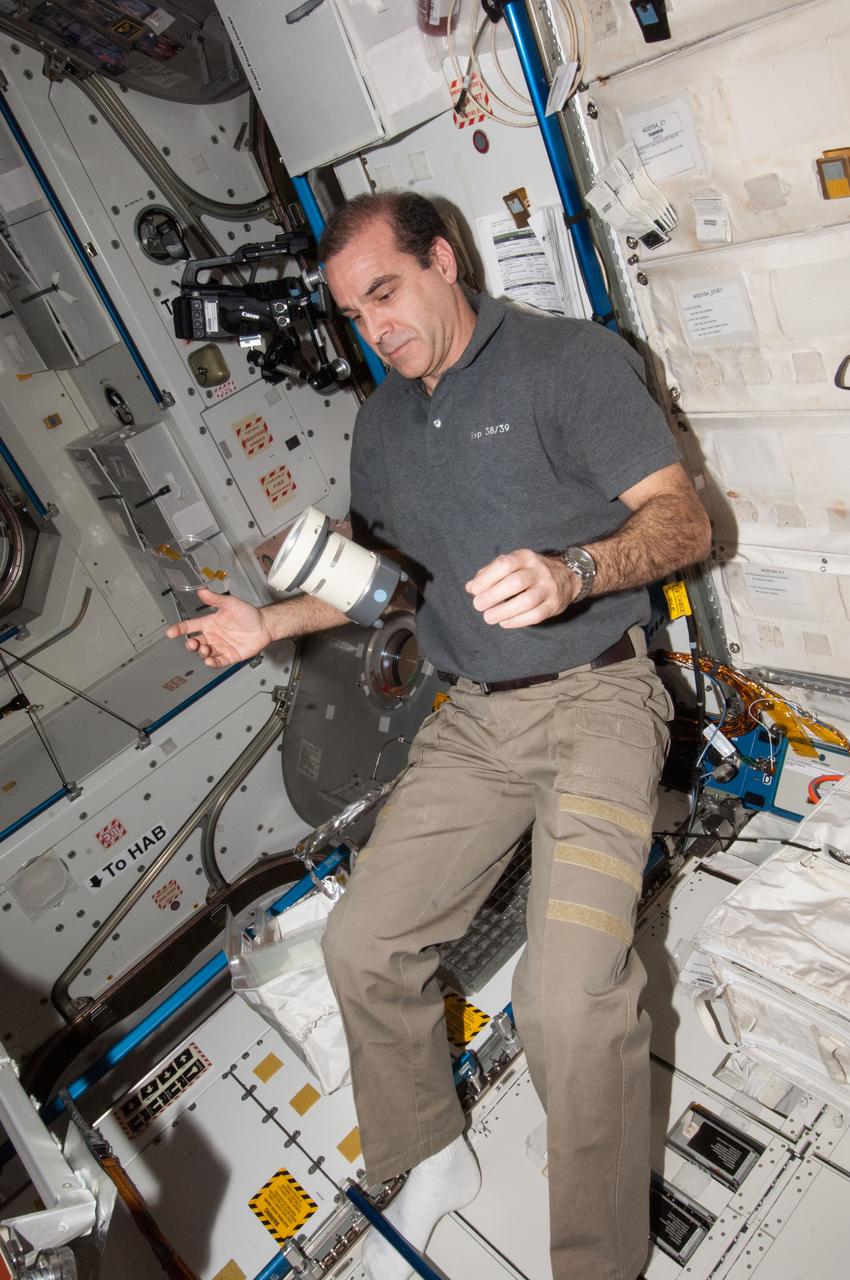
ISS038-E-053780 (18 Feb. 2014) --- NASA astronaut Rick Mastracchio, Expedition 38 flight engineer, uses a Microbial Air Sampler to collect air samples in the Unity node of the International Space Station. These air samples will be incubated for five days and tested for signs of microbial contamination.
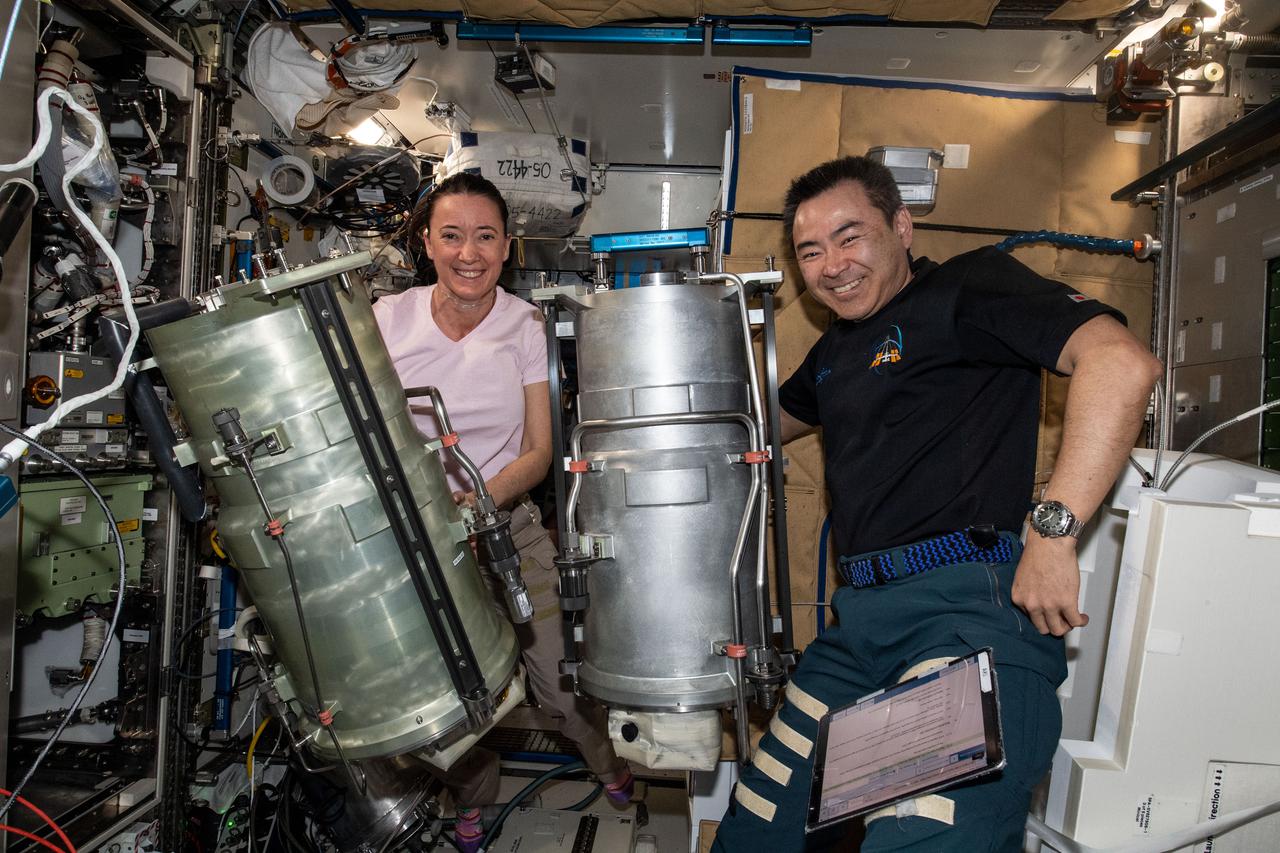
iss066e003308 (Oct. 20, 2021) --- Expedition 66 Flight Engineers Megan McArthur of NASA and Akihiko Hoshide of the Japan Aerospace Exploration Agency (JAXA) replace components and flush contaminants inside the Tranquility module's U.S. oxygen generation system.
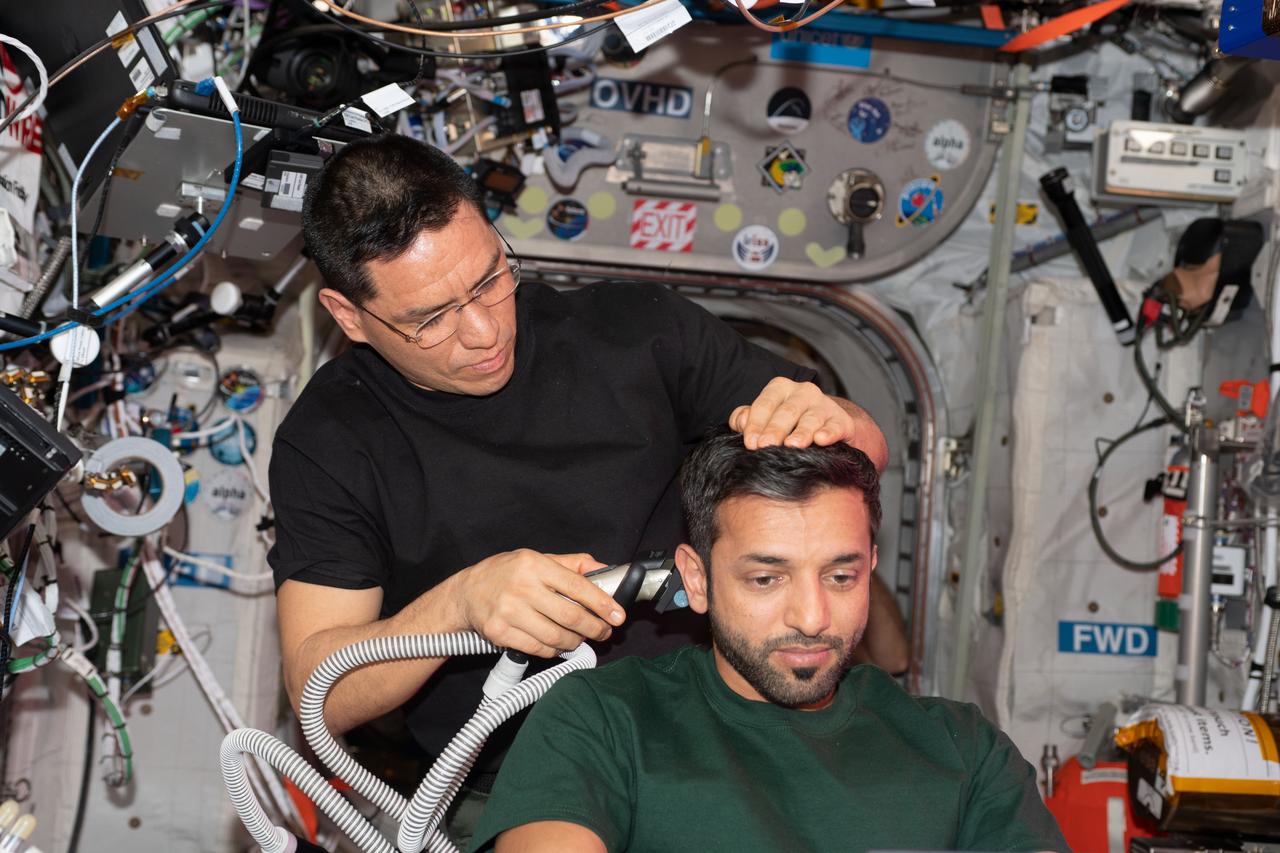
iss068e075695 (March 18, 2021) --- UAE (United Arab Emirates) astronaut Sultan Alneyadi receives a haircut from NASA astronaut Frank Rubio, both Expedition 68 flight engineers, aboard the International Space Station. The hair trimmer contains a suction device ensuring no loose hair contaminates the microgravity environment.
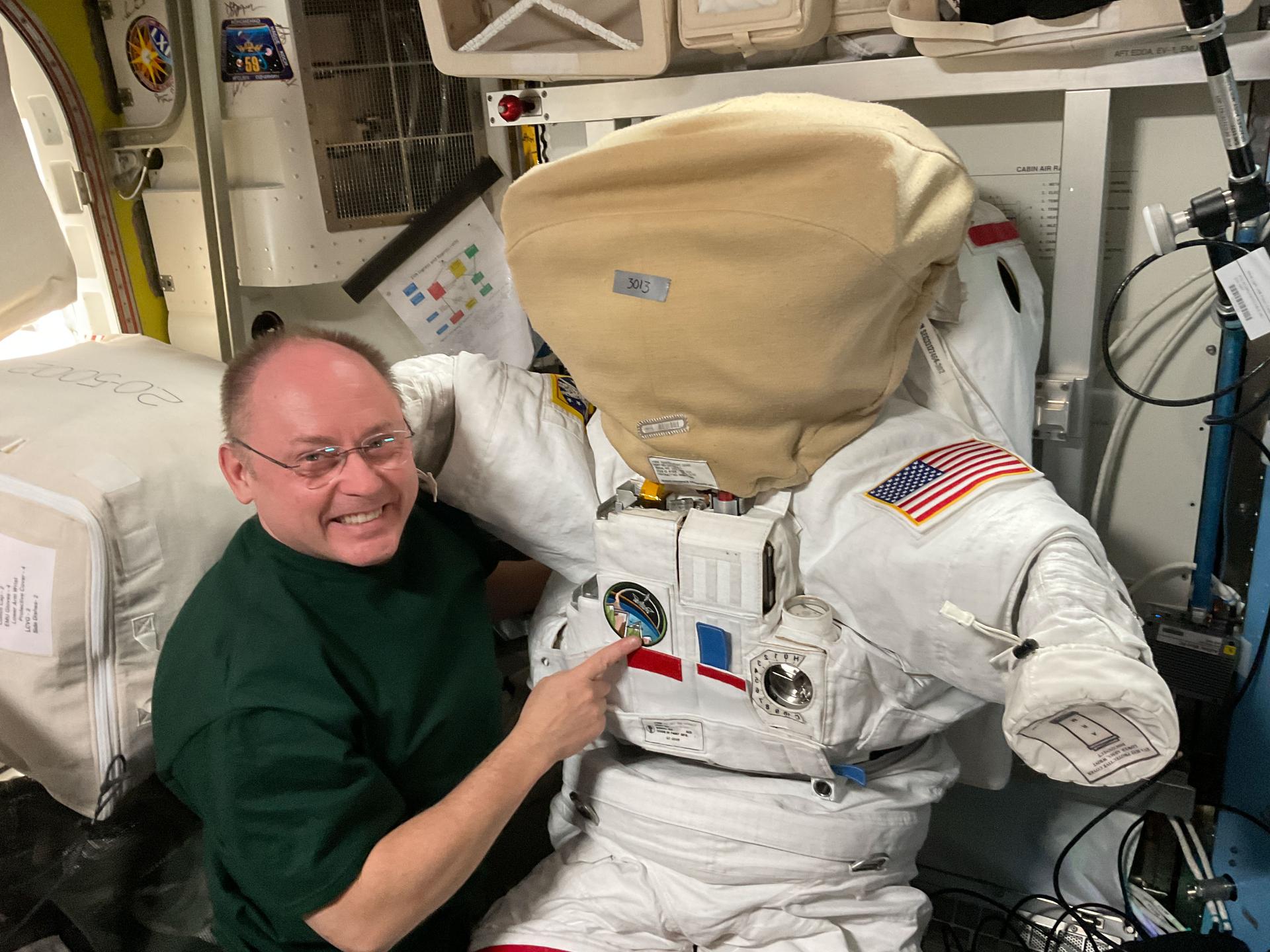
iss074e0006149 (Dec. 18, 2025) --- NASA astronaut and Expedition 74 Commander Mike Fincke poses inside the International Space Station’s Quest airlock next to a spacesuit. The helmet is secured with a protective cover designed to prevent scratches and contamination when the suit is not in use, ensuring the visor remains clear for spacewalks.
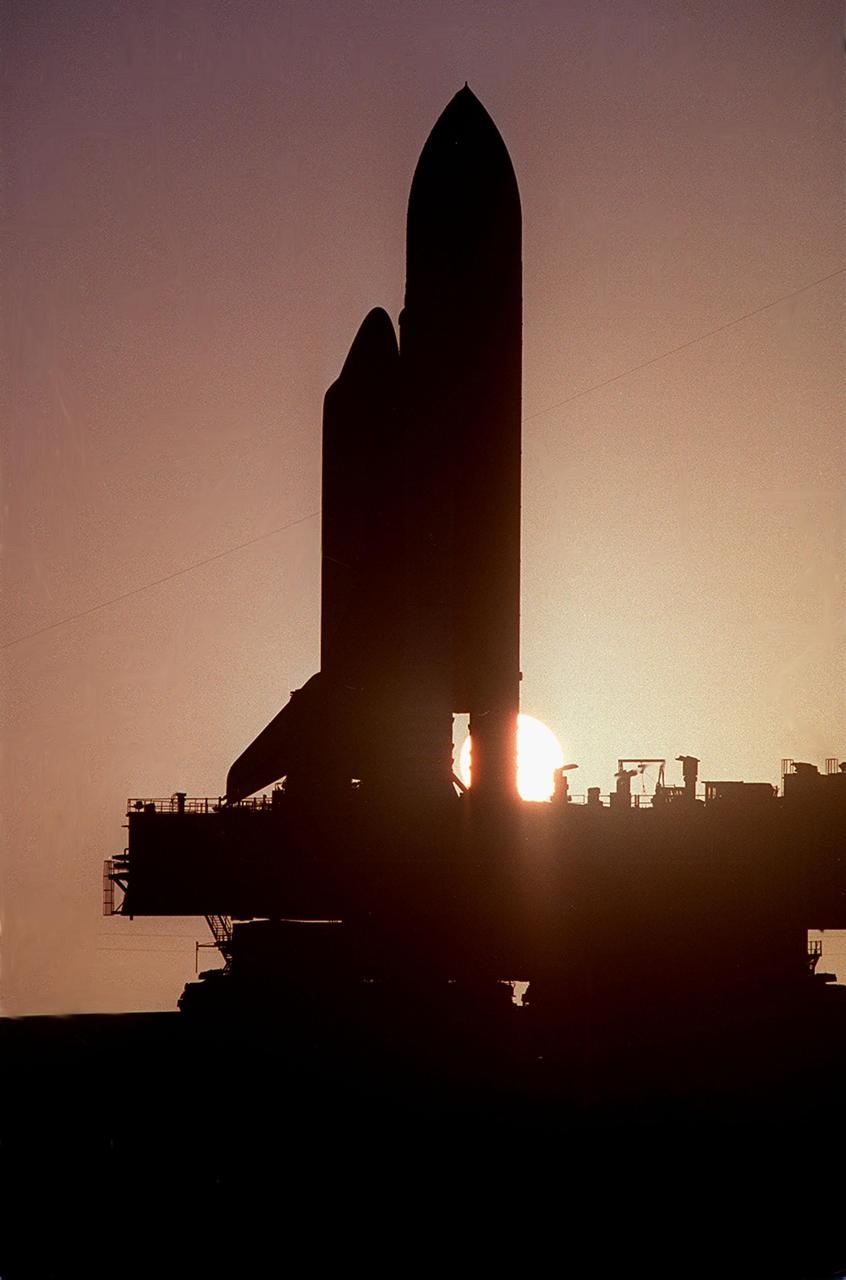
KENNEDY SPACE CENTER, FLA. -- The Space Shuttle Endeavour is being "rolled around" from Launch Pad 39A to Launch Pad 39B. The rare pad switch was deemed necessary after contamination was discovered in the Payload Changeout Room at pad A. Still to come are the payloads for the upcoming STS-61 mission, the first servicing of the Hubble Telescope
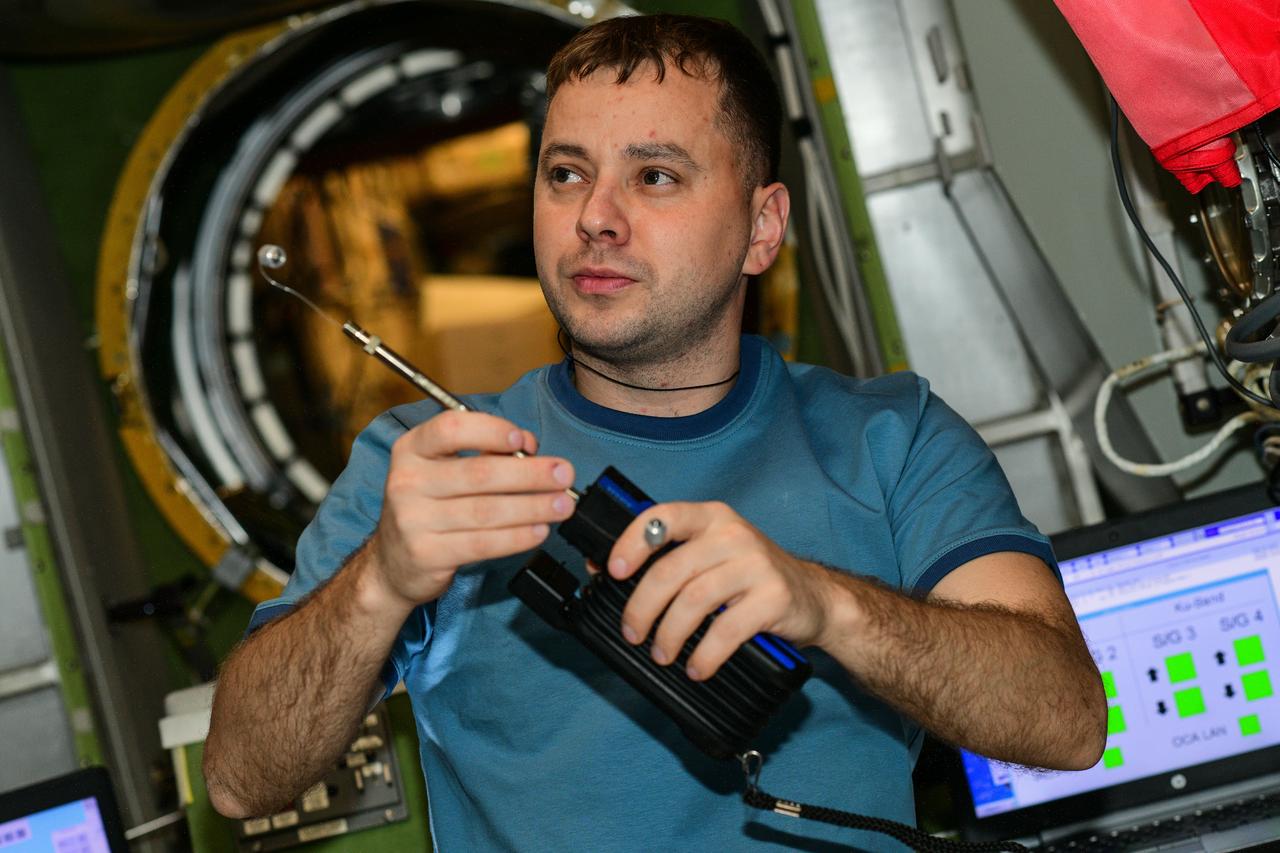
iss073e0547546 (Aug. 27, 2025) --- Roscosmos cosmonaut and Expedition 73 Flight Engineer Oleg Platonov is pictured with an air sampling device to detect and analyze trace contaminants such as carbon dioxide and ammonia to ensure a safe breathable environment aboard the International Space Station.
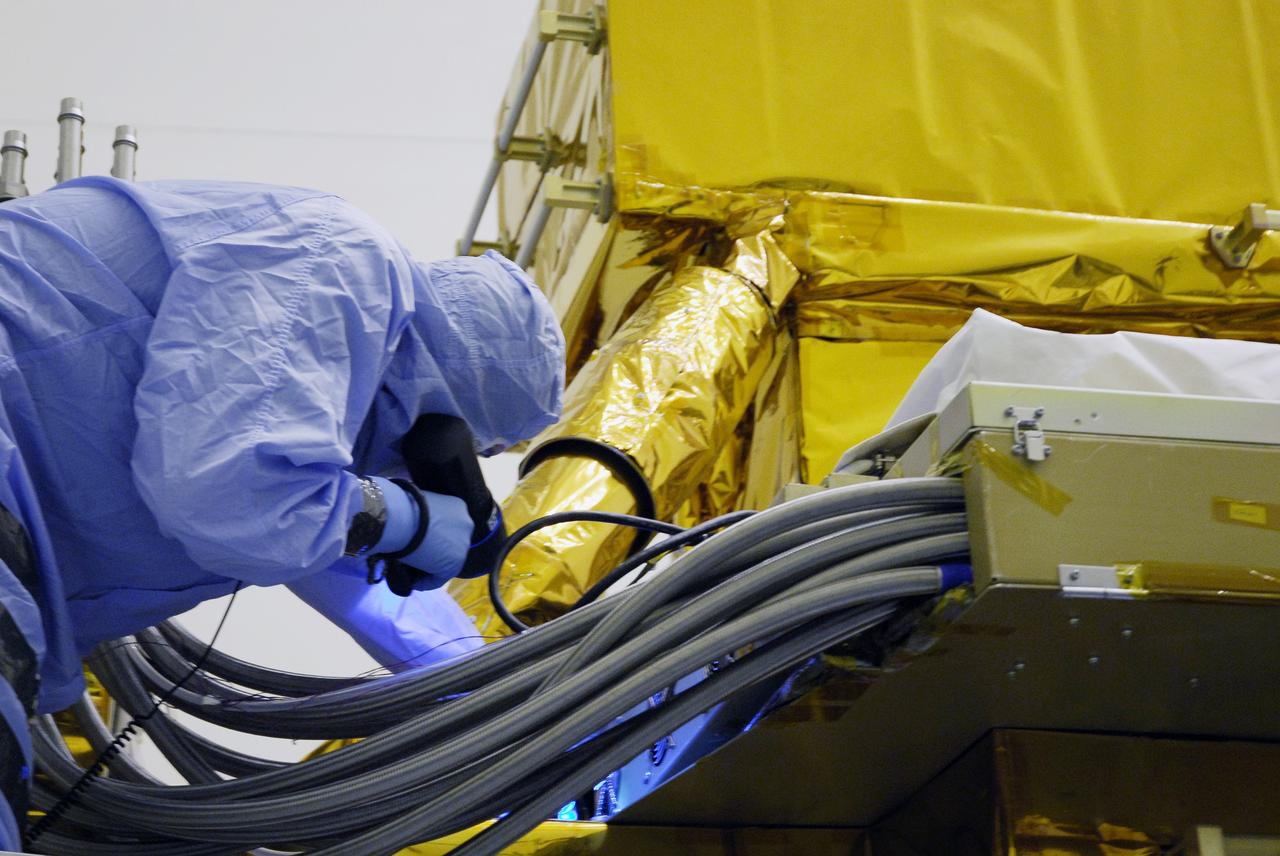
CAPE CANAVERAL, Fla. - In the Payload Hazardous Servicing Facility at NASA's Kennedy Space Center, a technician cleans contamination from the Super Lightweight Interchangeable Carrier, or SLIC. Contamination discovered Sept. 17 during preparations to deliver NASA's Hubble Space Telescope servicing payload to Launch Pad 39A. Cleanliness is extremely important for space shuttle Atlantis’ STS-125 mission to Hubble, and the teams have insured that the SLIC is ready to fly. The SLIC, which holds battery module assemblies, is built with state-of-the-art, lightweight, composite materials - carbon fiber with a cyanate ester resin and a titanium metal matrix composite. These composites have greater strength-to-mass ratios than the metals typically used in spacecraft design. The carrier is one of four being transferred to Launch Pad 39A. At the pad, the carriers will be loaded into Atlantis’ payload bay. Launch of Atlantis is targeted for Oct. 10. Photo credit: NASA/Jack Pfaller
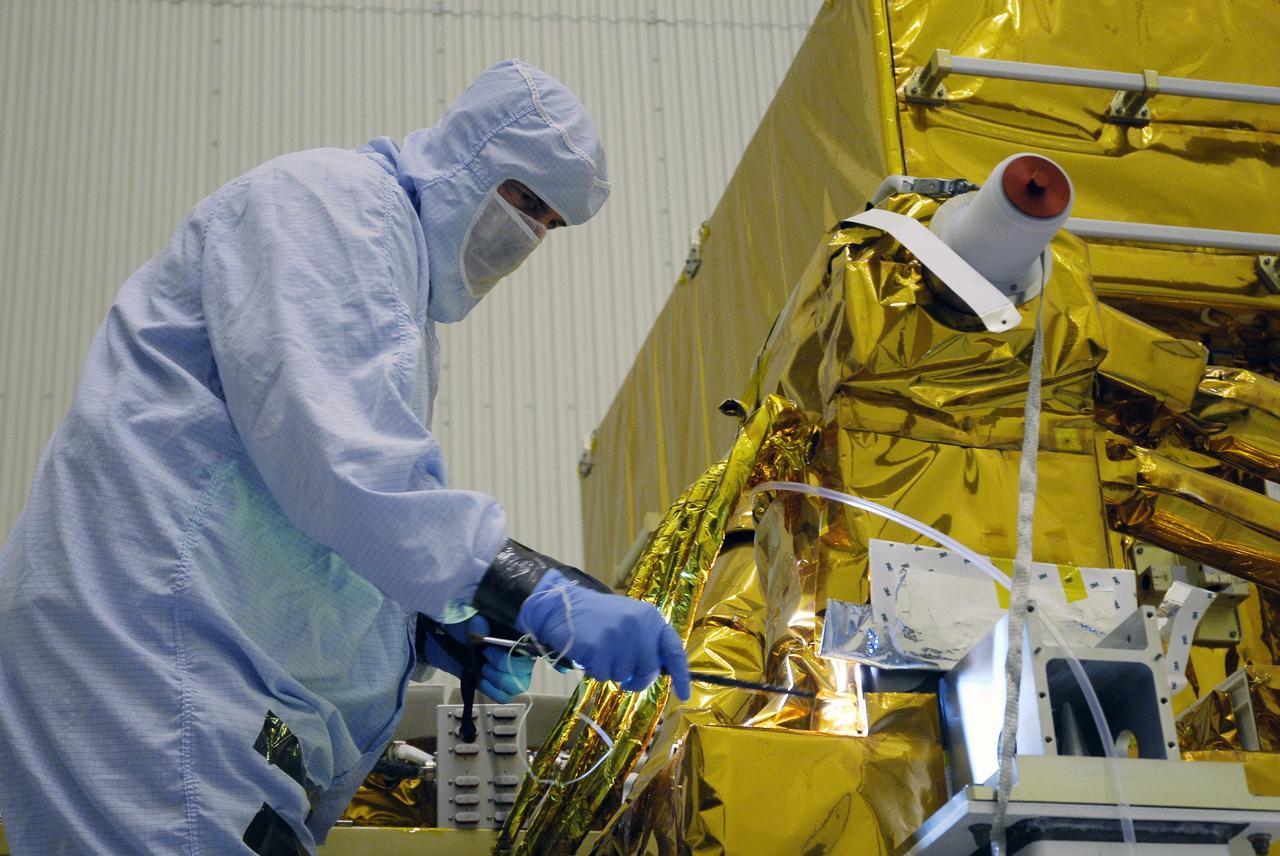
CAPE CANAVERAL, Fla. - In the Payload Hazardous Servicing Facility at NASA's Kennedy Space Center, a technician cleans contamination from the Super Lightweight Interchangeable Carrier, or SLIC. Contamination discovered Sept. 17 during preparations to deliver NASA's Hubble Space Telescope servicing payload to Launch Pad 39A. Cleanliness is extremely important for space shuttle Atlantis’ STS-125 mission to Hubble, and the teams have insured that the SLIC is ready to fly. The SLIC, which holds battery module assemblies, is built with state-of-the-art, lightweight, composite materials - carbon fiber with a cyanate ester resin and a titanium metal matrix composite. These composites have greater strength-to-mass ratios than the metals typically used in spacecraft design. The carrier is one of four being transferred to Launch Pad 39A. At the pad, the carriers will be loaded into Atlantis’ payload bay. Launch of Atlantis is targeted for Oct. 10. Photo credit: NASA/Jack Pfaller
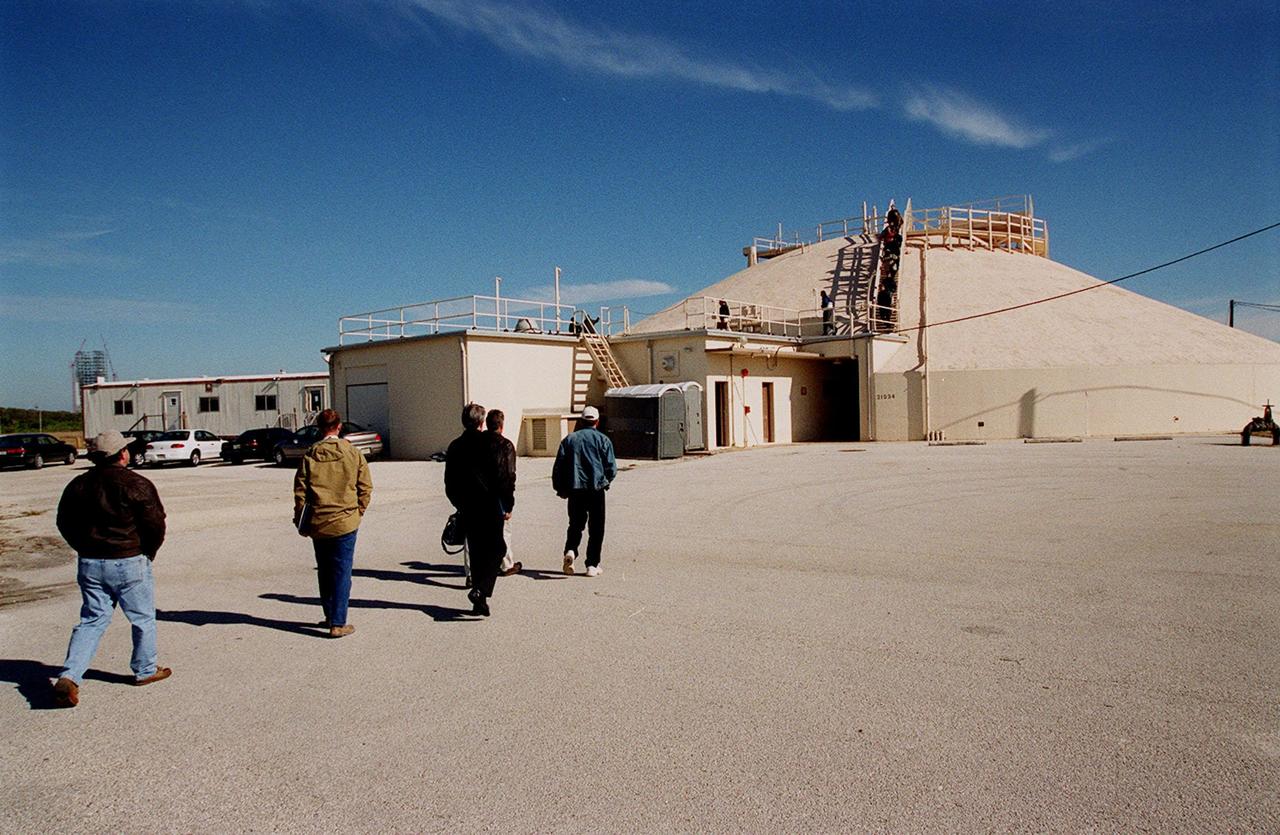
At Launch Complex 34, representatives from environmental and Federal agencies head for the block house during presentations about the environmental research project that involves the Department of Defense, Environmental Protection Agency, Department of Energy and NASA in a groundwater cleanup effort. Concentrations of trichloroethylene solvent have been identified in the soil at the complex as a result of cleaning methods for rocket parts during the Apollo Program, which used the complex, in the 60s. The group formed the Interagency NDAPL Consortium (IDC) to study three contamination cleanup technologies: Six Phase Soil Heating, Steam Injection and In Situ Oxidation with Potassium Permanganate. All three methods may offer a way to remove the contaminants in months instead of decades. KSC hosted a two-day conference that presented information and demonstrations of the three technologies being tested at the site
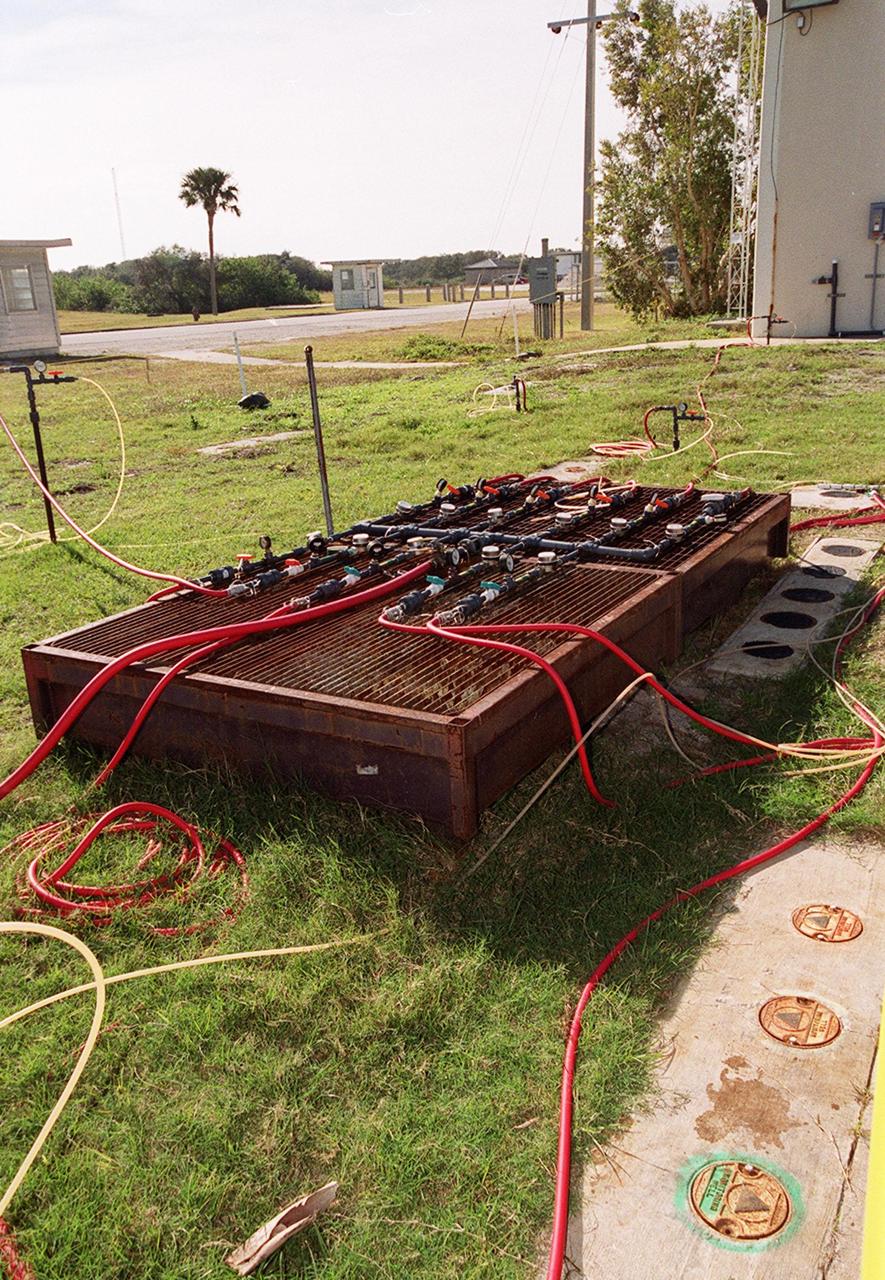
At Launch Complex 34, Cape Canaveral Air Station, several studies are under way for groundwater cleanup of trichloroethylene at the site. Shown here is monitoring equipment for one of the methods, potassium permanganate oxidation. Concentrations of trichloroethylene solvent have been identified in the soil at the complex as a result of cleaning methods for rocket parts during the Apollo Program in the 60s. The environmental research project involves the Department of Defense, Environmental Protection Agency, Department of Energy and NASA, who formed the Interagency NDAPL Consortium (IDC), to study three contamination cleanup technologies: Six Phase Soil Heating, Steam Injection and In Situ Oxidation with Potassium Permanganate. All three methods may offer a way to remove the contaminants in months instead of decades. KSC hosted a two-day conference that presented information and demonstrations of the three technologies for representatives from environmental and federal agencies
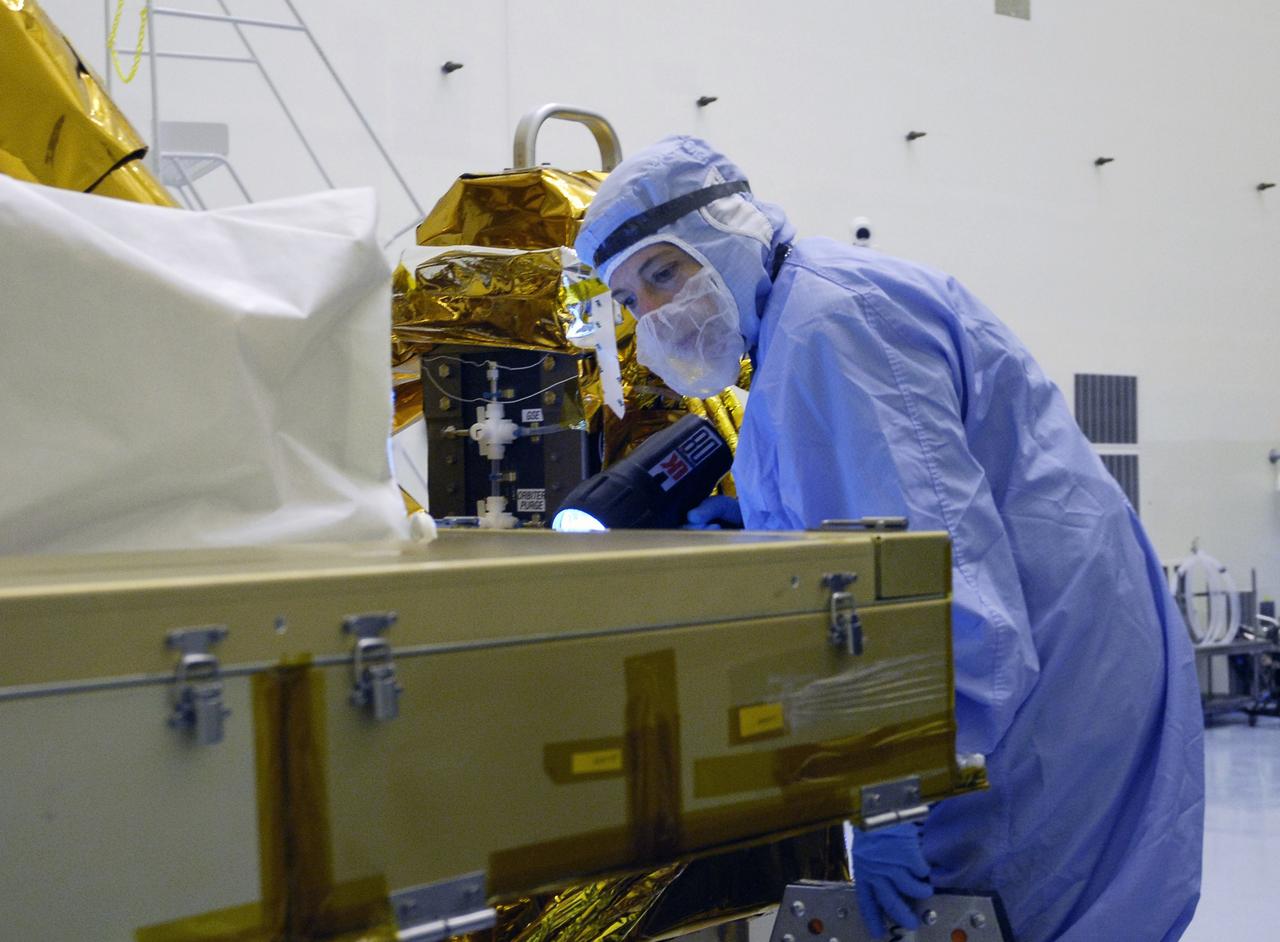
CAPE CANAVERAL, Fla. - In the Payload Hazardous Servicing Facility at NASA's Kennedy Space Center, a technician cleans contamination from the Super Lightweight Interchangeable Carrier, or SLIC. Contamination discovered Sept. 17 during preparations to deliver NASA's Hubble Space Telescope servicing payload to Launch Pad 39A. Cleanliness is extremely important for space shuttle Atlantis’ STS-125 mission to Hubble, and the teams have insured that the SLIC is ready to fly. The SLIC, which holds battery module assemblies, is built with state-of-the-art, lightweight, composite materials - carbon fiber with a cyanate ester resin and a titanium metal matrix composite. These composites have greater strength-to-mass ratios than the metals typically used in spacecraft design. The carrier is one of four being transferred to Launch Pad 39A. At the pad, the carriers will be loaded into Atlantis’ payload bay. Launch of Atlantis is targeted for Oct. 10. Photo credit: NASA/Jack Pfaller
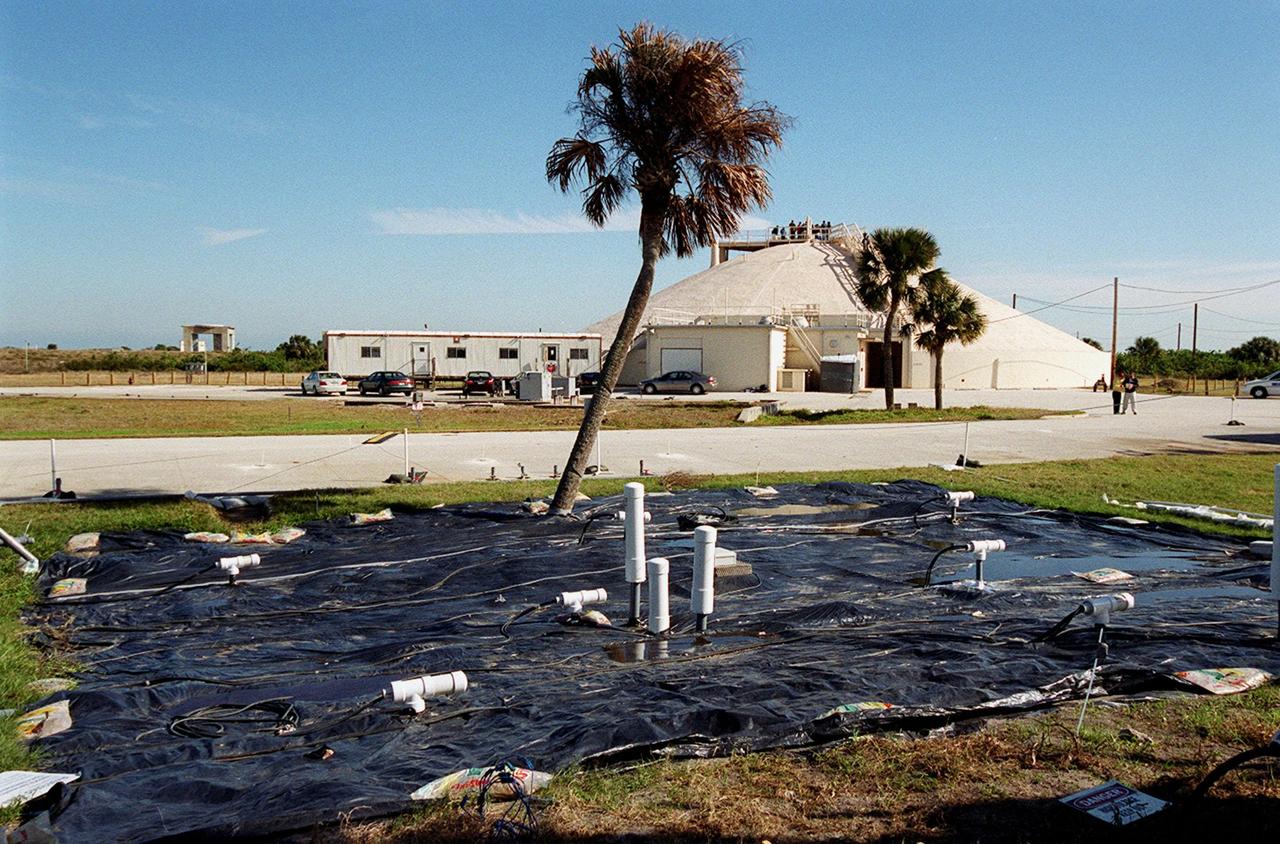
At Launch Complex 34, the Six-Phase Soil Heating site that is involved in a groundwater cleanup project can be seen. The project involves the Department of Defense, Environmental Protection Agency, Department of Energy and NASA. Concentrations of trichloroethylene solvent have been identified in the soil at the complex as a result of cleaning methods for rocket parts during the Apollo Program, which used the complex, in the 60s. The group formed the Interagency NDAPL Consortium (IDC) to study three contamination cleanup technologies: Six-Phase Soil Heating, Steam Injection and In Situ Oxidation with Potassium Permanganate. All three methods may offer a way to remove the contaminants in months instead of decades. In the background is the block house for the complex. KSC hosted a two-day conference that presented information and demonstrations of the three technologies being tested at the site
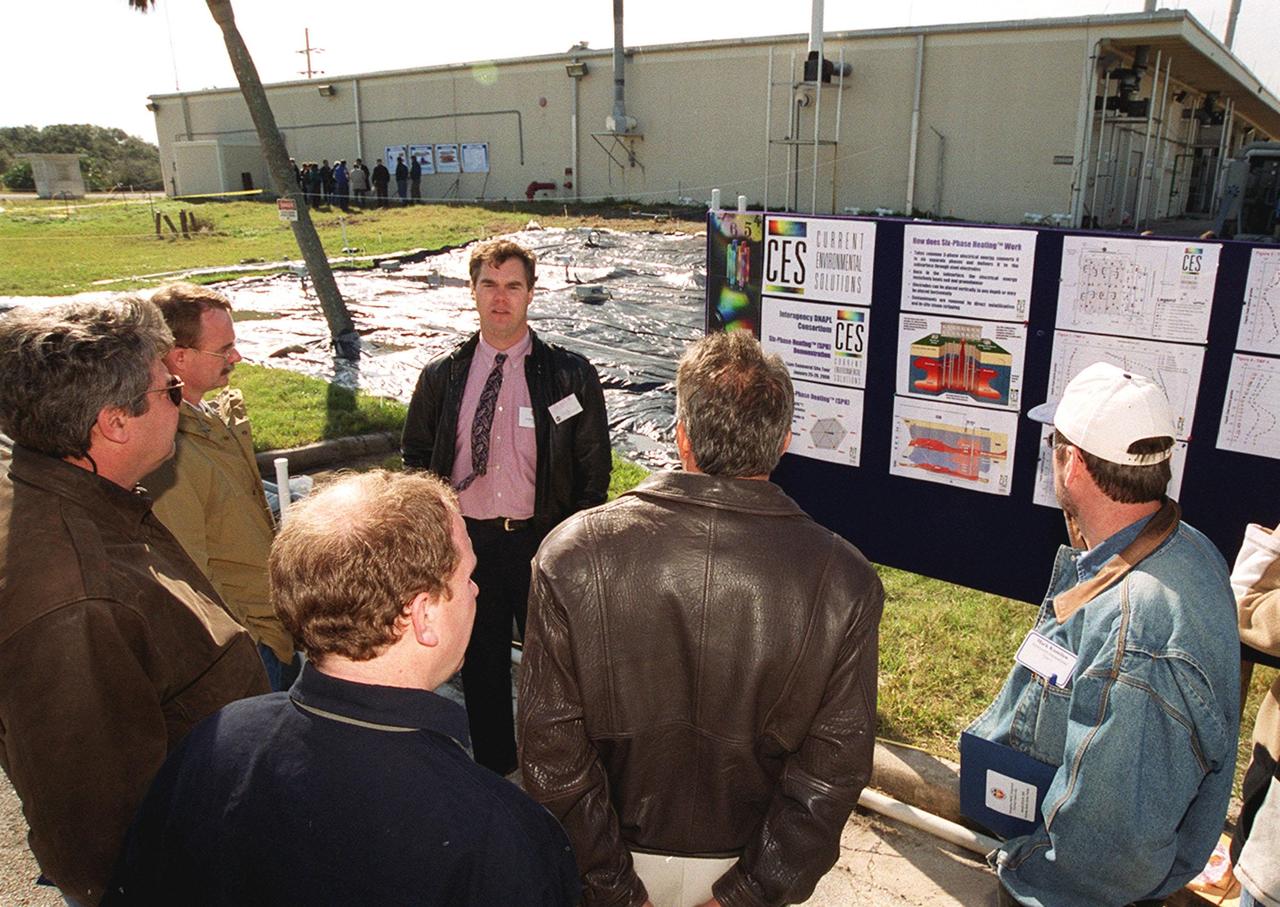
At Launch Complex 34, Greg Beyke, with Current Environmental Solutions, talks to representatives from environmental and federal agencies about the environmental research project that involves the Department of Defense, Environmental Protection Agency, Department of Energy and NASA in a groundwater cleanup effort. Concentrations of trichloroethylene solvent have been identified in the soil at the complex as a result of cleaning methods for rocket parts during the Apollo Program, which used the complex, in the 60s. The group formed the Interagency NDAPL Consortium (IDC) to study three contamination cleanup technologies: Six Phase Soil Heating, Steam Injection and In Situ Oxidation with Potassium Permanganate. All three methods may offer a way to remove the contaminants in months instead of decades. KSC hosted a two-day conference that presented information and demonstrations of the three technologies being tested at the site

At Launch Complex 34, the Six-Phase Soil Heating site that is involved in a groundwater cleanup project can be seen. The project involves the Department of Defense, Environmental Protection Agency, Department of Energy and NASA. Concentrations of trichloroethylene solvent have been identified in the soil at the complex as a result of cleaning methods for rocket parts during the Apollo Program, which used the complex, in the 60s. The group formed the Interagency NDAPL Consortium (IDC) to study three contamination cleanup technologies: Six-Phase Soil Heating, Steam Injection and In Situ Oxidation with Potassium Permanganate. All three methods may offer a way to remove the contaminants in months instead of decades. In the background is the block house for the complex. KSC hosted a two-day conference that presented information and demonstrations of the three technologies being tested at the site
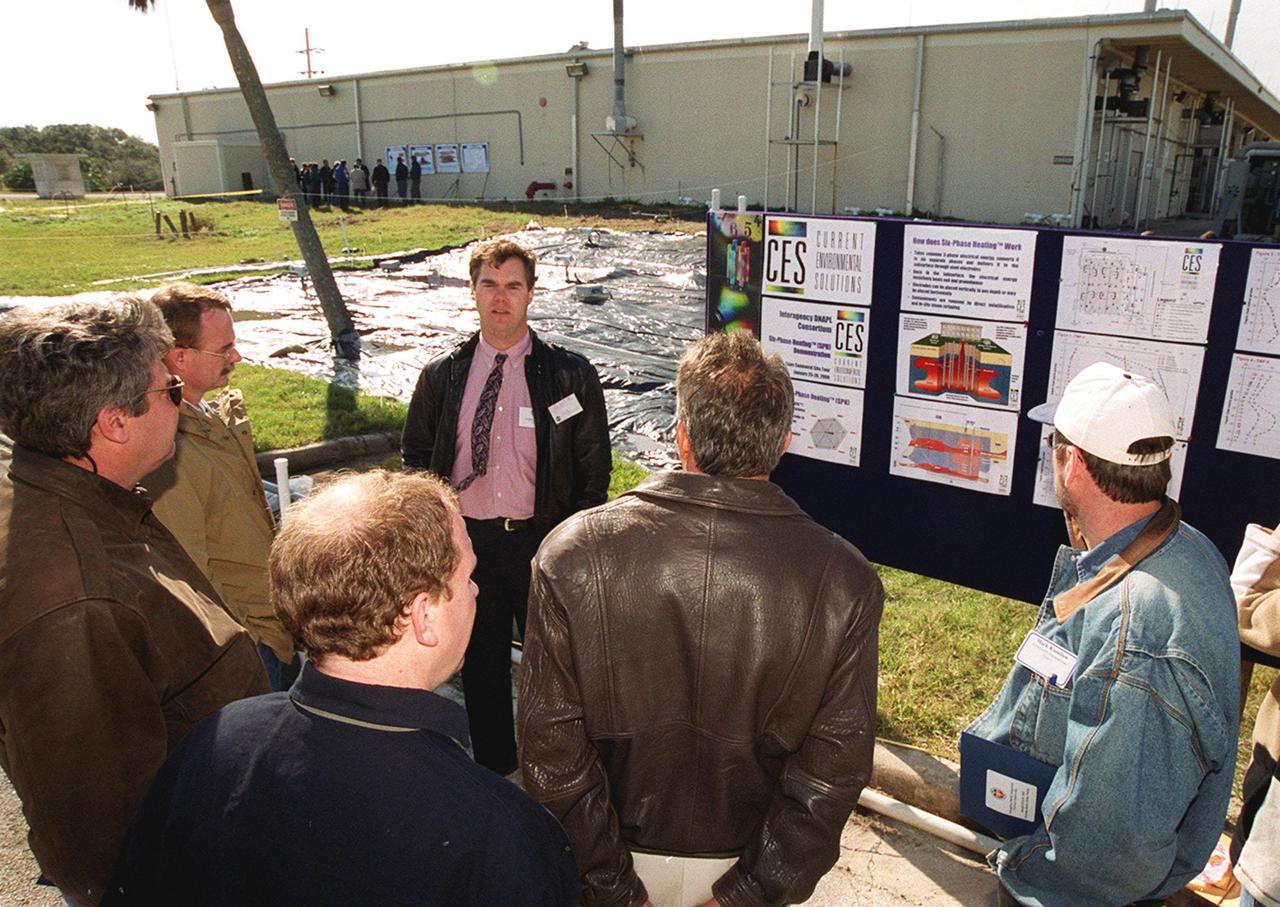
At Launch Complex 34, Greg Beyke, with Current Environmental Solutions, talks to representatives from environmental and federal agencies about the environmental research project that involves the Department of Defense, Environmental Protection Agency, Department of Energy and NASA in a groundwater cleanup effort. Concentrations of trichloroethylene solvent have been identified in the soil at the complex as a result of cleaning methods for rocket parts during the Apollo Program, which used the complex, in the 60s. The group formed the Interagency NDAPL Consortium (IDC) to study three contamination cleanup technologies: Six Phase Soil Heating, Steam Injection and In Situ Oxidation with Potassium Permanganate. All three methods may offer a way to remove the contaminants in months instead of decades. KSC hosted a two-day conference that presented information and demonstrations of the three technologies being tested at the site
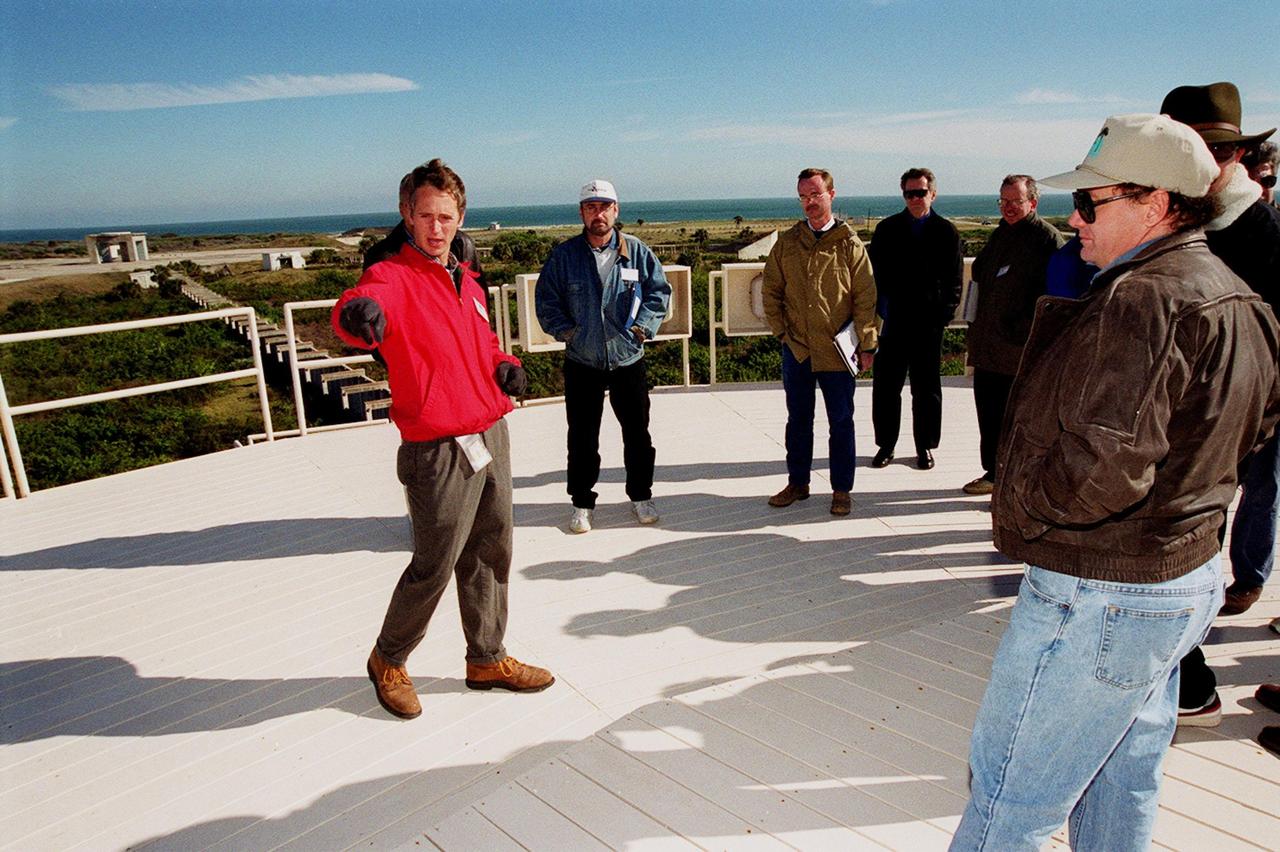
On top of the block house at Launch Complex 34, representatives from environmental and Federal agencies hear from Laymon Gray, with Florida State University, about the environmental research project that involves the Department of Defense, Environmental Protection Agency, Department of Energy and NASA in a groundwater cleanup effort. Concentrations of trichloroethylene solvent have been identified in the soil at the complex as a result of cleaning methods for rocket parts during the Apollo Program, which used the complex, in the 60s. The group formed the Interagency NDAPL Consortium (IDC) to study three contamination cleanup technologies: Six Phase Soil Heating, Steam Injection and In Situ Oxidation with Potassium Permanganate. All three methods may offer a way to remove the contaminants in months instead of decades. In the background (left) can be seen the cement platform and walkway from the block house to the pad. Beyond it is the Atlantic Ocean. KSC hosted a two-day conference that presented information and demonstrations of the three technologies being tested at the site
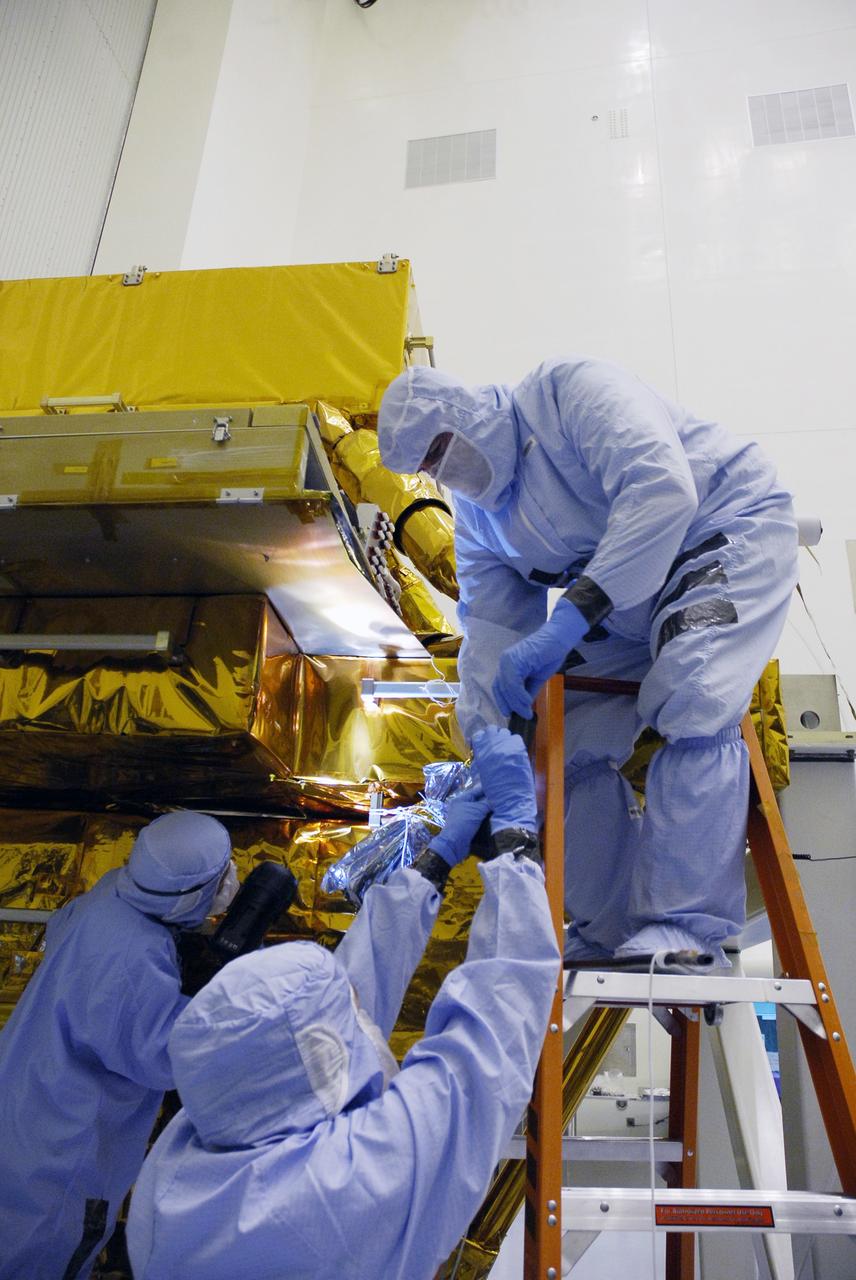
CAPE CANAVERAL, Fla. - In the Payload Hazardous Servicing Facility at NASA's Kennedy Space Center, technicians clean contamination from the Super Lightweight Interchangeable Carrier, or SLIC. Contamination discovered Sept. 17 during preparations to deliver NASA's Hubble Space Telescope servicing payload to Launch Pad 39A. Cleanliness is extremely important for space shuttle Atlantis’ STS-125 mission to Hubble, and the teams have insured that the SLIC is ready to fly. The SLIC, which holds battery module assemblies, is built with state-of-the-art, lightweight, composite materials - carbon fiber with a cyanate ester resin and a titanium metal matrix composite. These composites have greater strength-to-mass ratios than the metals typically used in spacecraft design. The carrier is one of four being transferred to Launch Pad 39A. At the pad, the carriers will be loaded into Atlantis’ payload bay. Launch of Atlantis is targeted for Oct. 10. Photo credit: NASA/Jack Pfaller
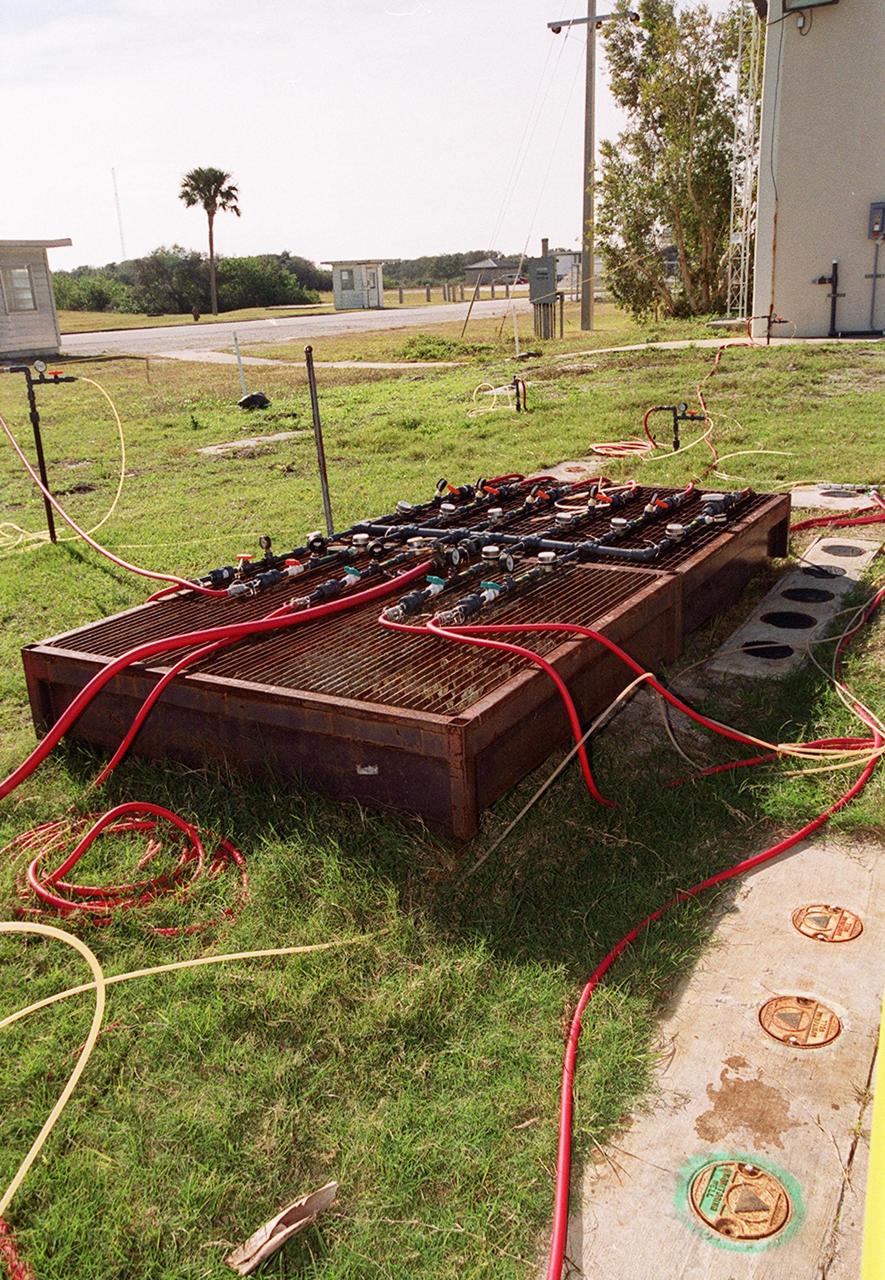
At Launch Complex 34, Cape Canaveral Air Station, several studies are under way for groundwater cleanup of trichloroethylene at the site. Shown here is monitoring equipment for one of the methods, potassium permanganate oxidation. Concentrations of trichloroethylene solvent have been identified in the soil at the complex as a result of cleaning methods for rocket parts during the Apollo Program in the 60s. The environmental research project involves the Department of Defense, Environmental Protection Agency, Department of Energy and NASA, who formed the Interagency NDAPL Consortium (IDC), to study three contamination cleanup technologies: Six Phase Soil Heating, Steam Injection and In Situ Oxidation with Potassium Permanganate. All three methods may offer a way to remove the contaminants in months instead of decades. KSC hosted a two-day conference that presented information and demonstrations of the three technologies for representatives from environmental and federal agencies
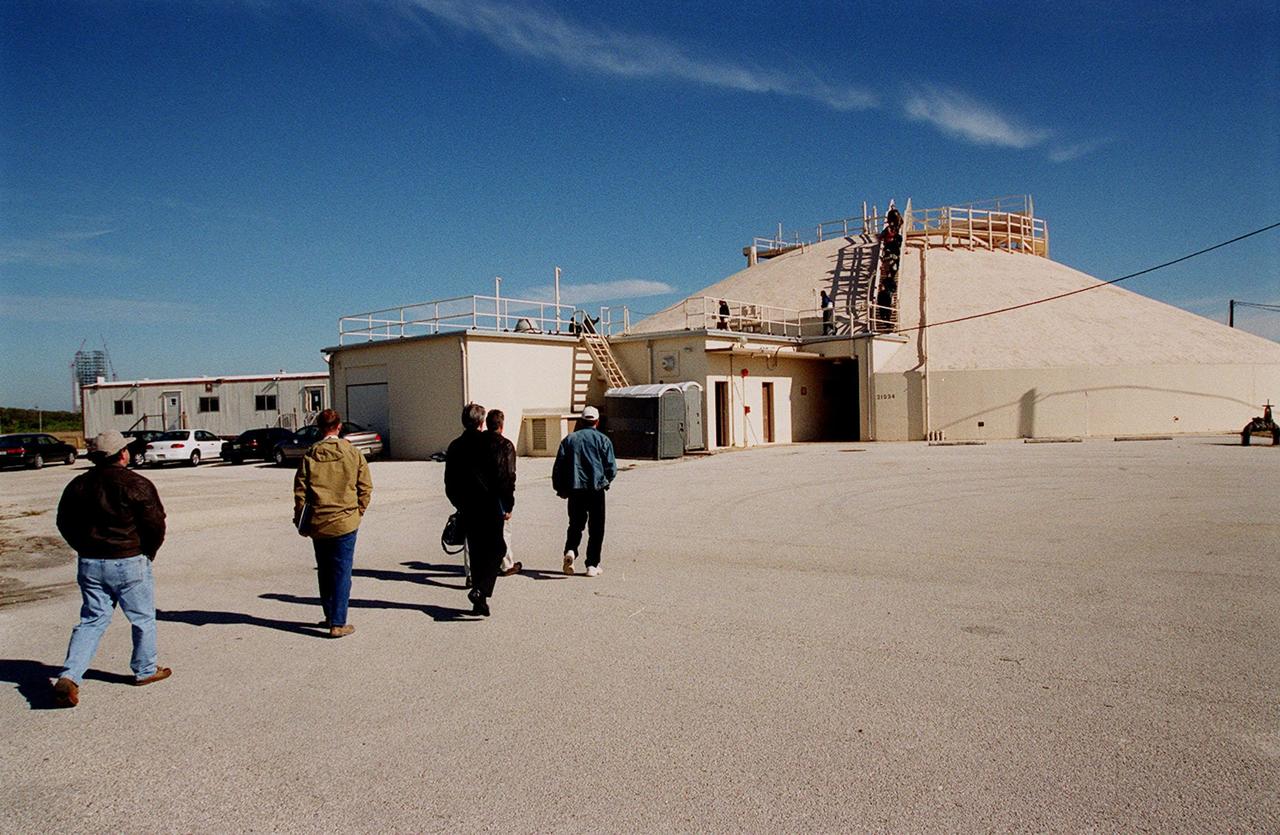
At Launch Complex 34, representatives from environmental and Federal agencies head for the block house during presentations about the environmental research project that involves the Department of Defense, Environmental Protection Agency, Department of Energy and NASA in a groundwater cleanup effort. Concentrations of trichloroethylene solvent have been identified in the soil at the complex as a result of cleaning methods for rocket parts during the Apollo Program, which used the complex, in the 60s. The group formed the Interagency NDAPL Consortium (IDC) to study three contamination cleanup technologies: Six Phase Soil Heating, Steam Injection and In Situ Oxidation with Potassium Permanganate. All three methods may offer a way to remove the contaminants in months instead of decades. KSC hosted a two-day conference that presented information and demonstrations of the three technologies being tested at the site
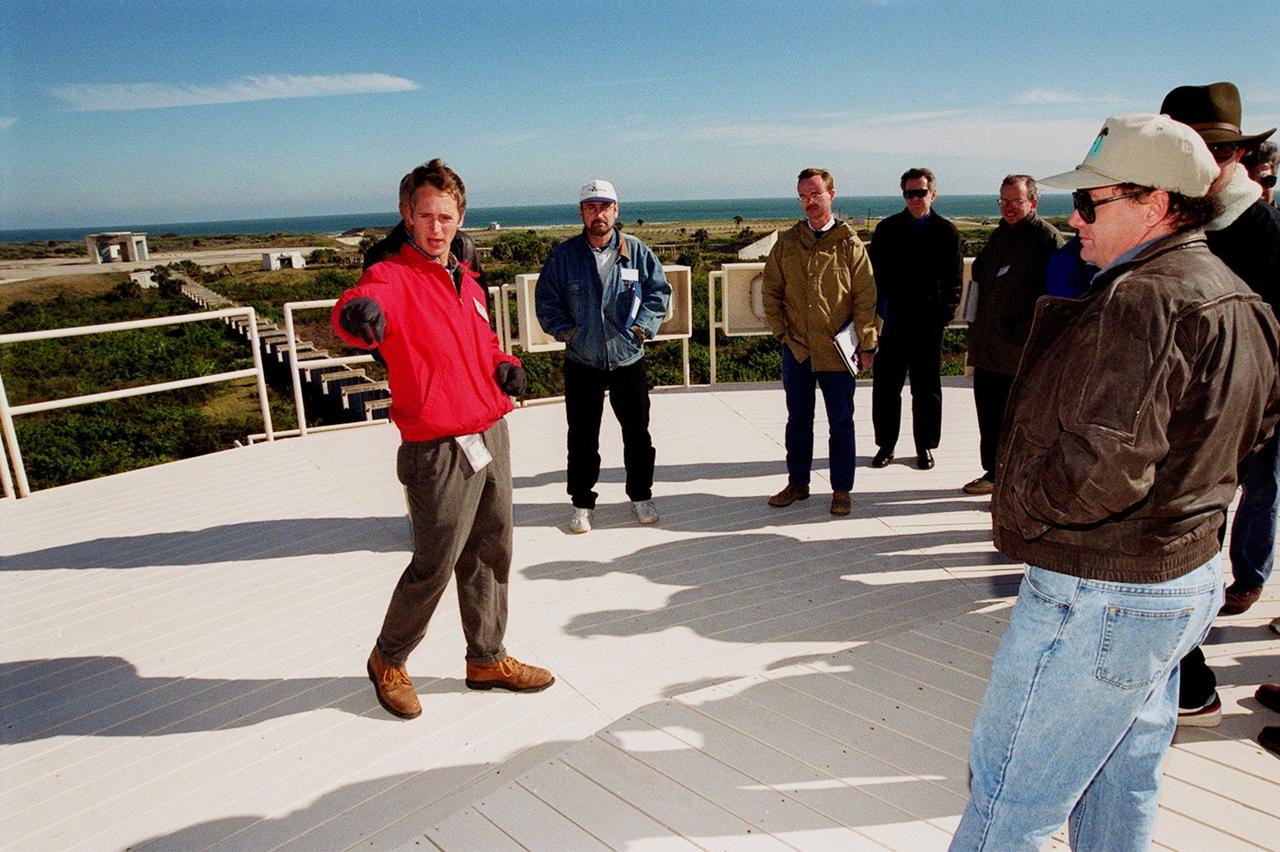
On top of the block house at Launch Complex 34, representatives from environmental and Federal agencies hear from Laymon Gray, with Florida State University, about the environmental research project that involves the Department of Defense, Environmental Protection Agency, Department of Energy and NASA in a groundwater cleanup effort. Concentrations of trichloroethylene solvent have been identified in the soil at the complex as a result of cleaning methods for rocket parts during the Apollo Program, which used the complex, in the 60s. The group formed the Interagency NDAPL Consortium (IDC) to study three contamination cleanup technologies: Six Phase Soil Heating, Steam Injection and In Situ Oxidation with Potassium Permanganate. All three methods may offer a way to remove the contaminants in months instead of decades. In the background (left) can be seen the cement platform and walkway from the block house to the pad. Beyond it is the Atlantic Ocean. KSC hosted a two-day conference that presented information and demonstrations of the three technologies being tested at the site
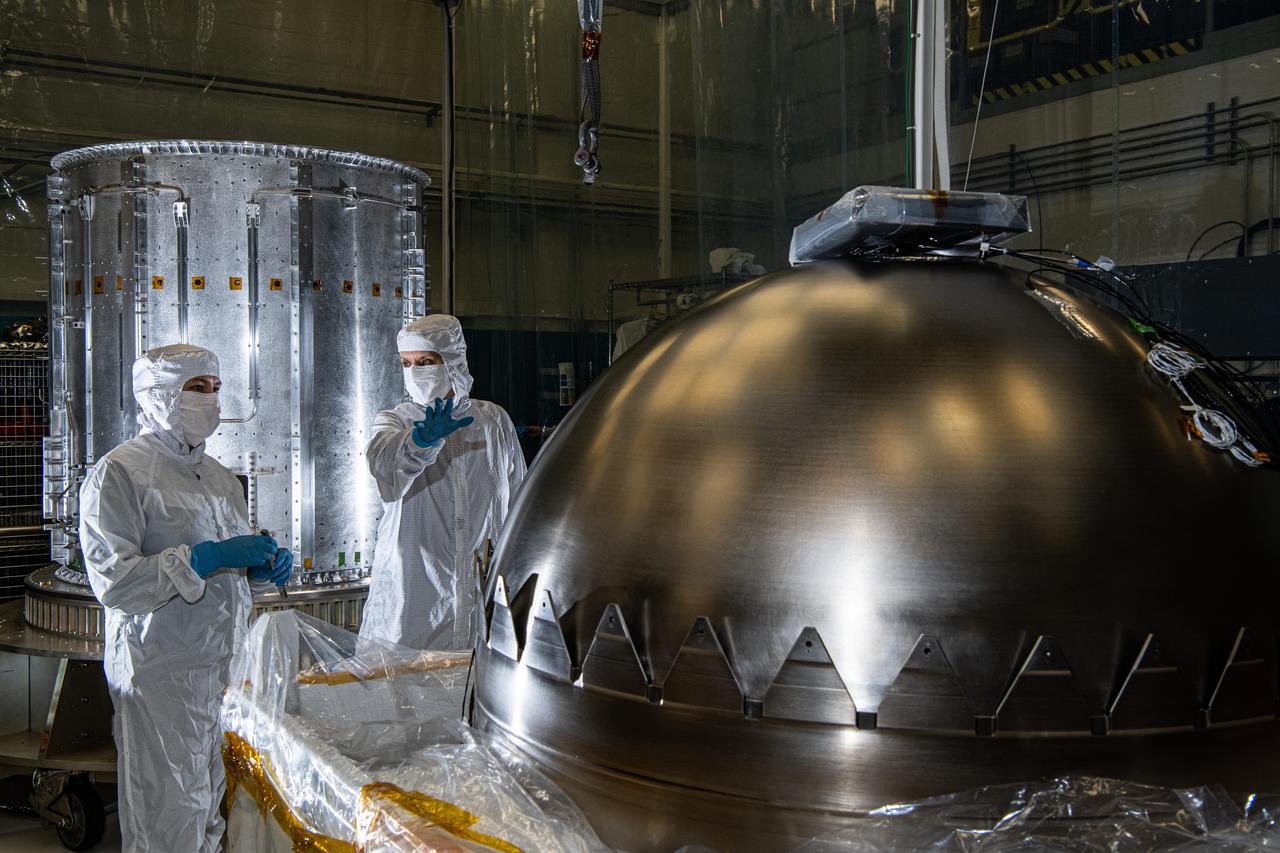
Contamination control engineers in a clean room at NASA's Goddard Space Flight Center in Greenbelt, Maryland, evaluate a propellant tank before it is installed in NASA's Europa Clipper spacecraft. The tank is one of two that will be used to hold the spacecraft's propellant. It will be inserted into the cylinder seen at left in the background, one of two cylinders that make up the propulsion module. With an internal global ocean under a thick layer of ice, Jupiter's moon Europa may have the potential to harbor existing life. Europa Clipper will swoop around Jupiter on an elliptical path, dipping close to the moon on each flyby to collect data. Understanding Europa's habitability will help scientists better understand how life developed on Earth and the potential for finding life beyond our planet. Europa Clipper is set to launch in 2024. https://photojournal.jpl.nasa.gov/catalog/PIA24478
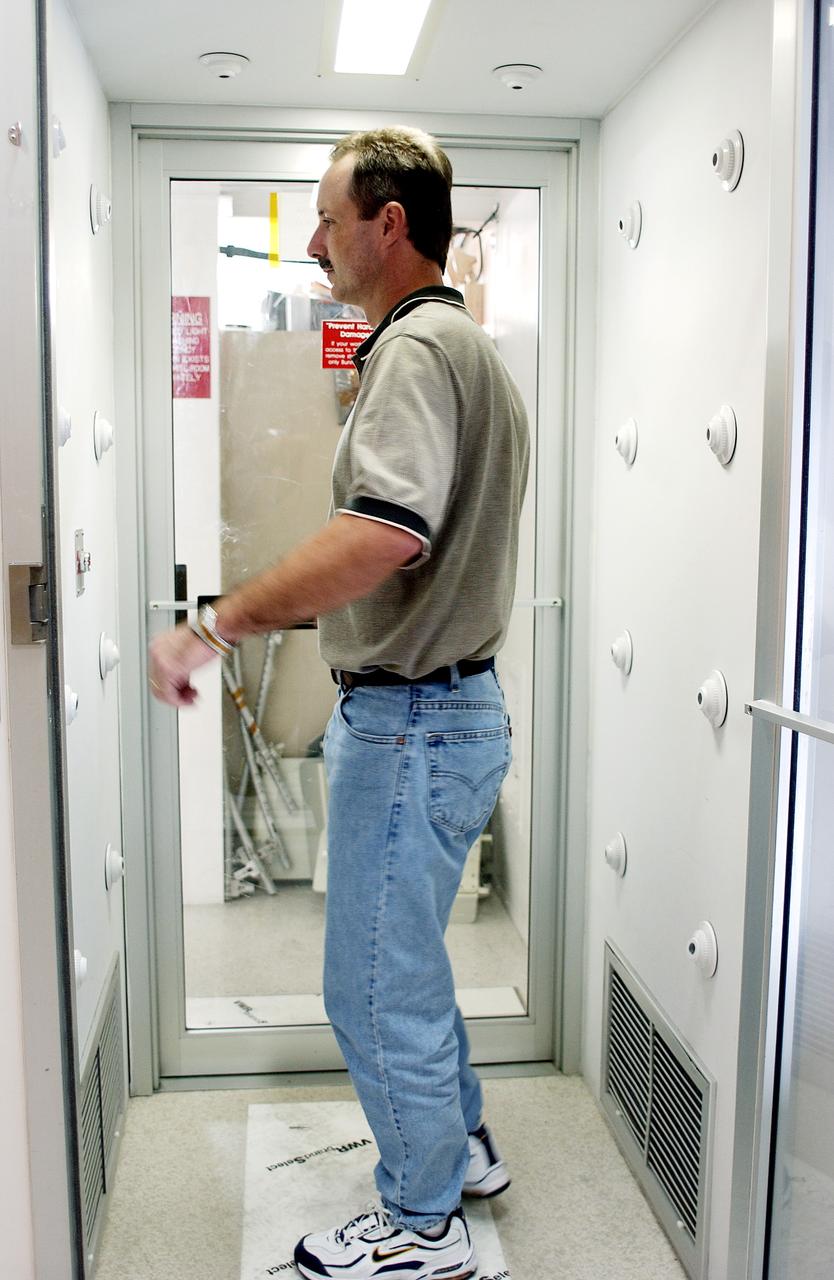
KENNEDY SPACE CENTER, FLA. - A KSC employee uses a clean-air shower before entering a clean room. Streams of pressurized air directed at the occupant from nozzles in the chamber's ceiling and walls are designed to dislodge particulate matter from hair, clothing and shoes. The adhesive mat on the floor captures soil from shoe soles, as well as particles that fall on its surface. Particulate matter has the potential to contaminate the space flight hardware being stored or processed in the clean room. The shower is part of KSC's Foreign Object Debris (FOD) control program, an important safety initiative.
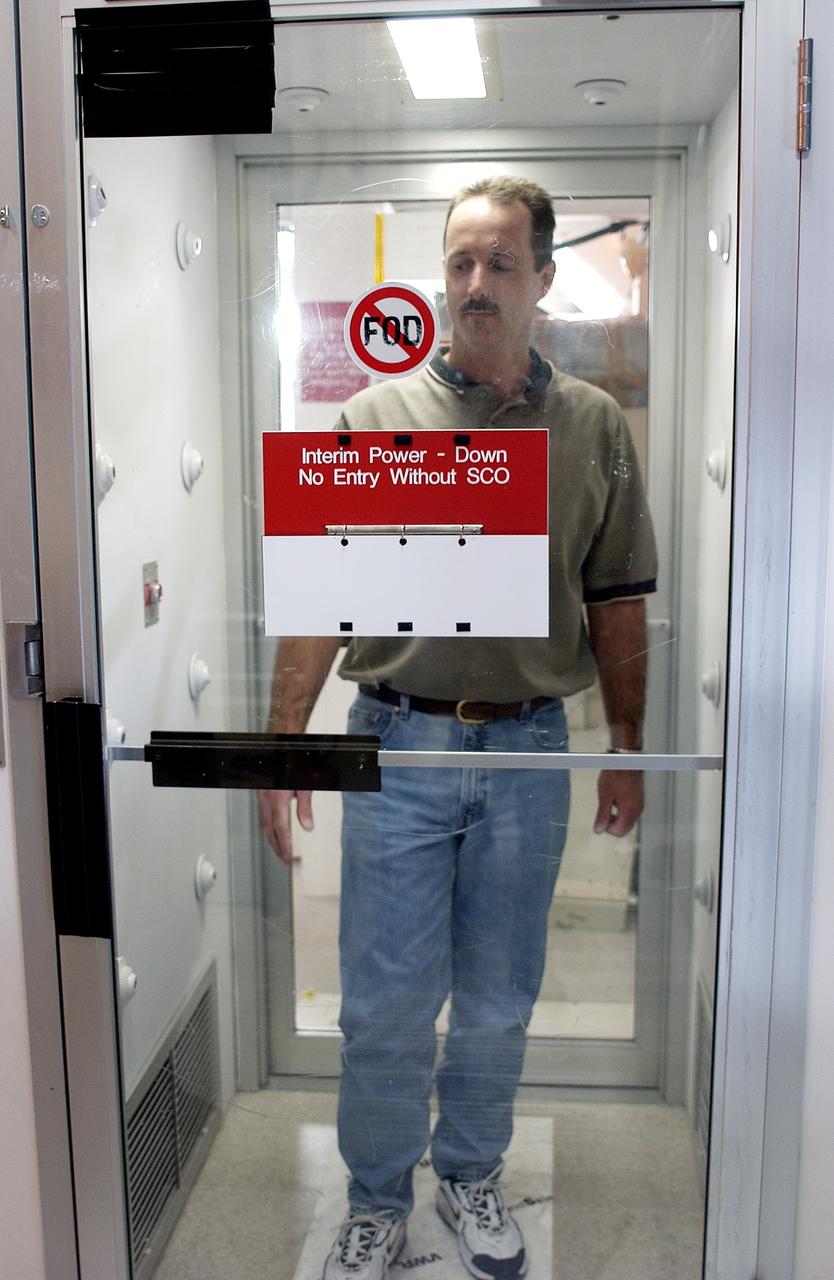
KENNEDY SPACE CENTER, FLA. - A KSC employee uses a clean-air shower before entering a clean room. Streams of pressurized air directed at the occupant from nozzles in the chamber's ceiling and walls are designed to dislodge particulate matter from hair, clothing and shoes. The adhesive mat on the floor captures soil from shoe soles, as well as particles that fall on its surface. Particulate matter has the potential to contaminate the space flight hardware being stored or processed in the clean room. The shower is part of KSC's Foreign Object Debris (FOD) control program, an important safety initiative.
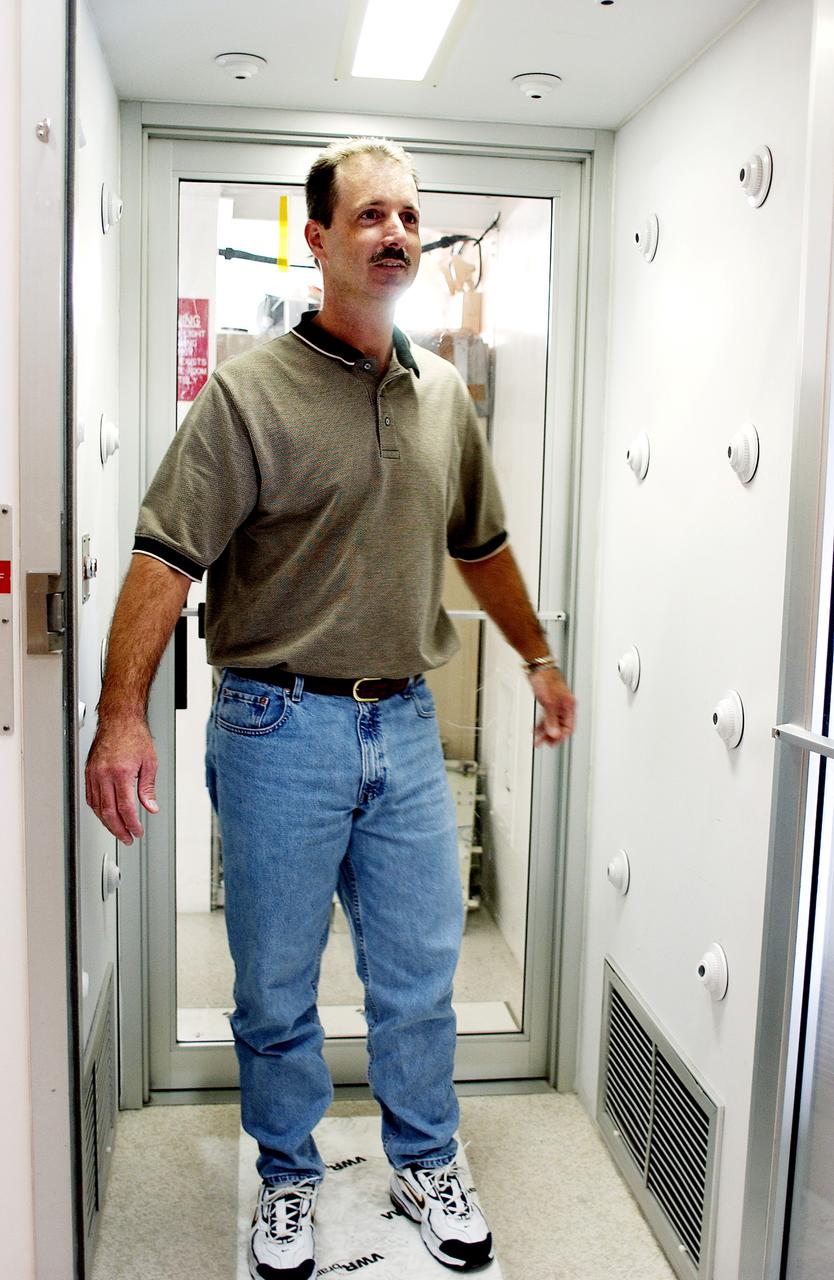
KENNEDY SPACE CENTER, FLA. - A KSC employee uses a clean-air shower before entering a clean room. Streams of pressurized air directed at the occupant from nozzles in the chamber's ceiling and walls are designed to dislodge particulate matter from hair, clothing and shoes. The adhesive mat on the floor captures soil from shoe soles, as well as particles that fall on its surface. Particulate matter has the potential to contaminate the space flight hardware being stored or processed in the clean room. The shower is part of KSC's Foreign Object Debris (FOD) control program, an important safety initiative.
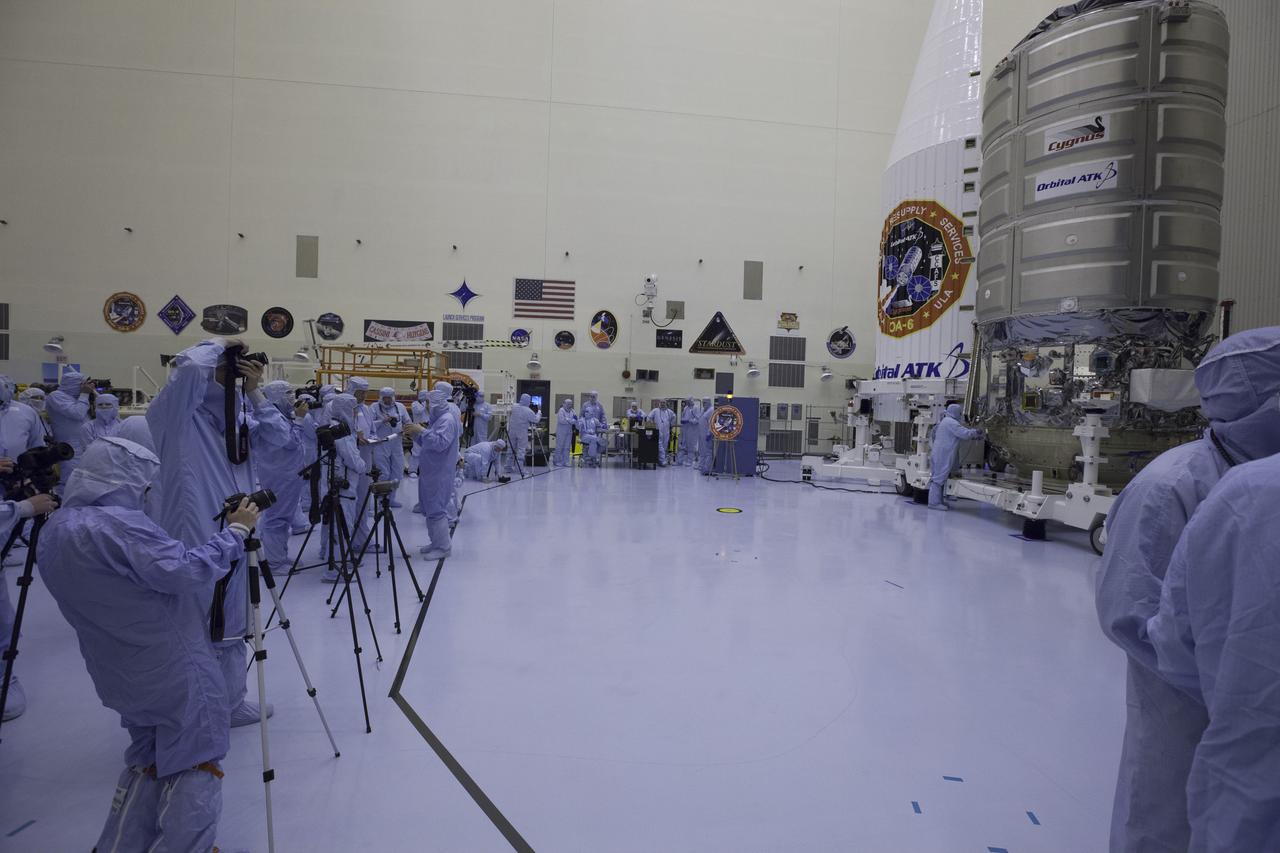
Inside the Payload Hazardous Servicing Facility at NASA's Kennedy Space Center in Florida, members of the news media get a close-up view of a Cygnus cargo vessel. The spacecraft is scheduled for the upcoming Orbital ATK Commercial Resupply Services-6 mission to deliver hardware and supplies to the International Space Station. Reporters, technicians and engineers are clad in "bunny suits." The cleanroom garments are worn to prevent contamination in the controlled environment. The Cygnus is scheduled to lift off atop a United Launch Alliance Atlas V rocket on March 22.
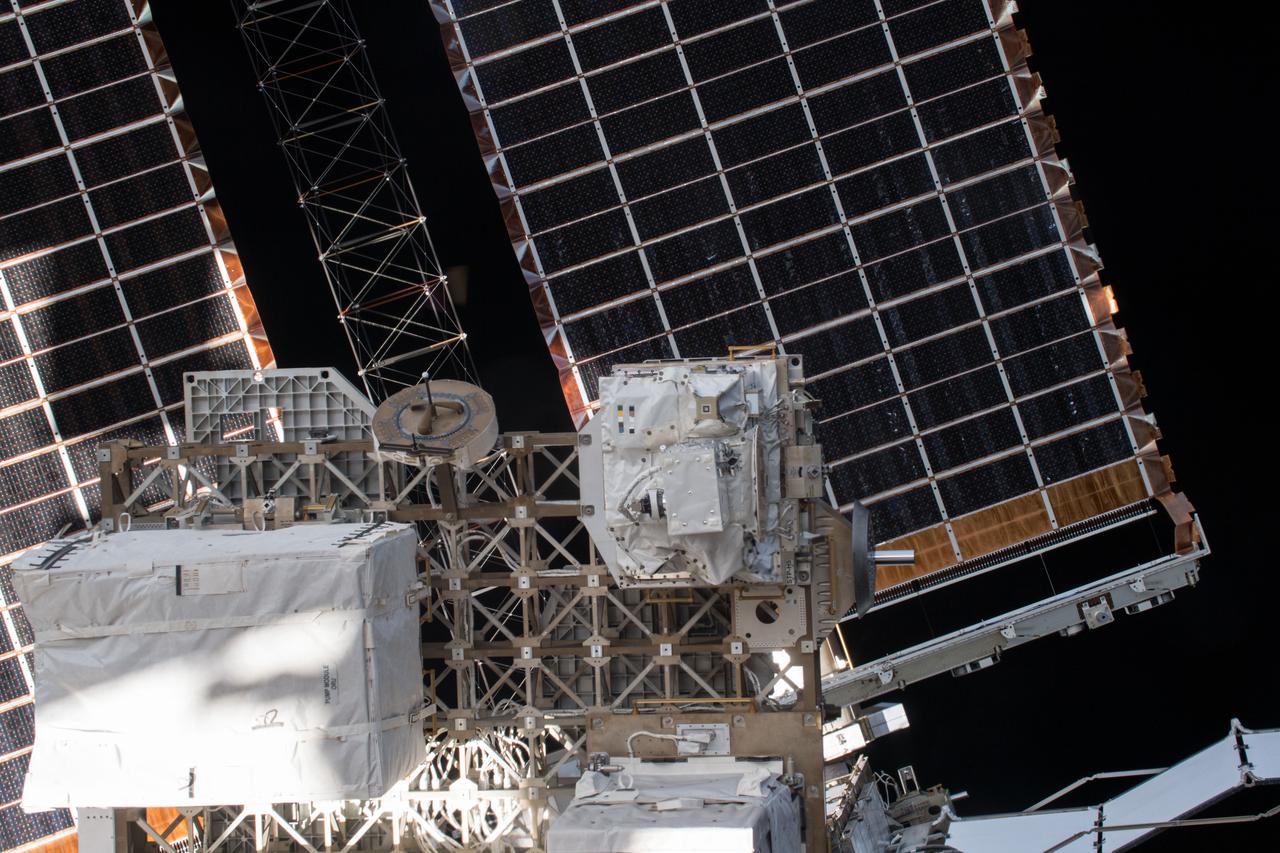
iss054e004101 (Dec. 26, 2017) --- Space Test Program - Houston 5 - Innovative Coatings Experiment (STP-H5-ICE) in front of International Space Station (ISS) solar panels. A spacecraft’s exterior coating protects against extreme temperatures, shields the spacecraft from radiation, prevents contamination, and guides cameras that help robots or humans capture and service the spacecraft. STP-H5-ICE studies different paints and coatings that protect spacecraft exteriors.
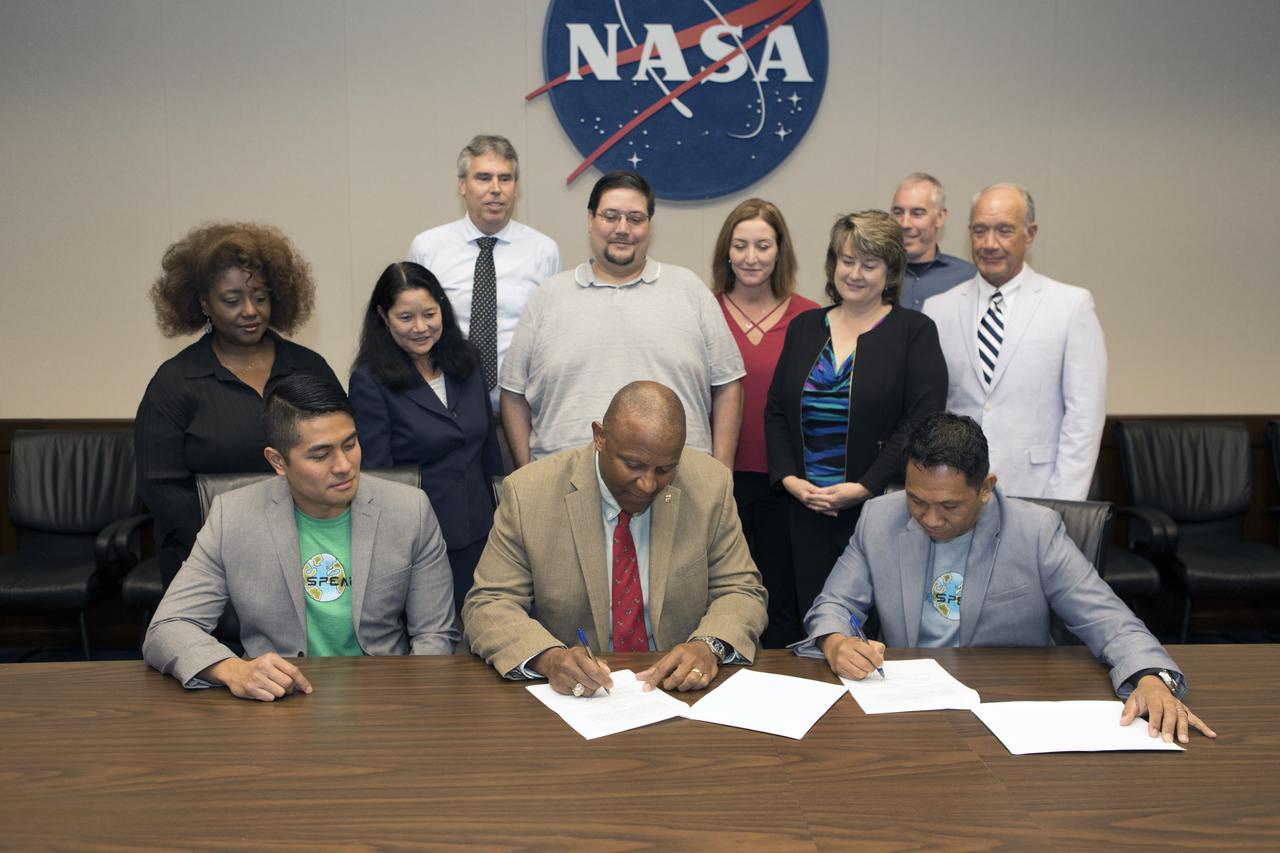
NASA Kennedy Space Center's Associate Director Kelvin Manning, center, signs a license agreement with the President and CEO of ecoSPEARS, which allows the company to commercially sell a soil remediation technology developed by a research team at Kennedy. The technology, known as Sorbent Polymer Extraction And Remediation System, is designed to capture and remove polychlorinated biphenyls (PCBs) from contaminated sediments in waterways and wetlands.
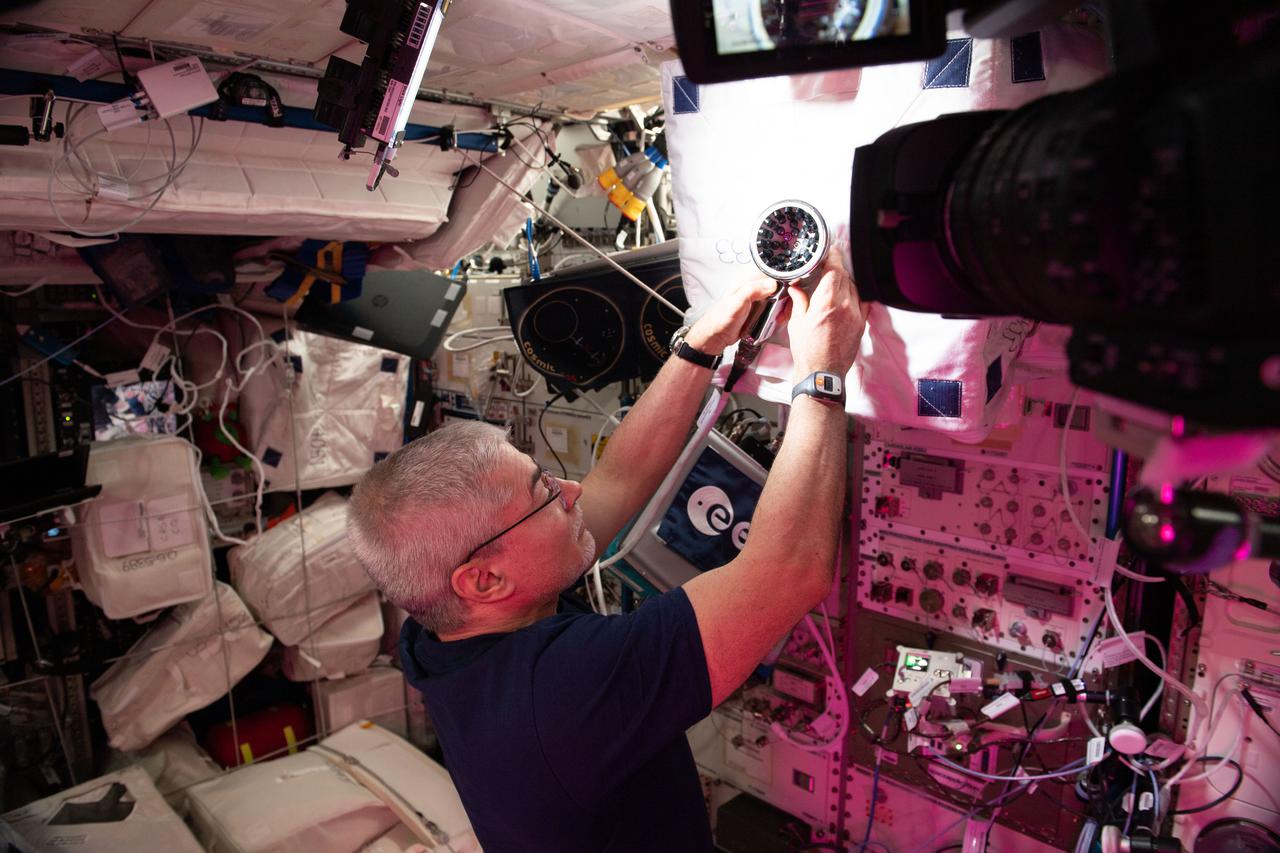
iss066e136658 (Feb. 7, 2022) --- NASA astronaut and Expedition 66 Flight Engineer Mark Vande Hei conducts research operations for the Ultrasonic Tweezers study using acoustics to manipulate objects remotely and without physical contact. Vande Hei was assisting ESA (European Space Agency) Flight Engineer Matthias Maurer (out of frame) during the experiment that explores using ultrasonics to trap and isolate objects to study samples and avoid contamination on planetary surfaces.
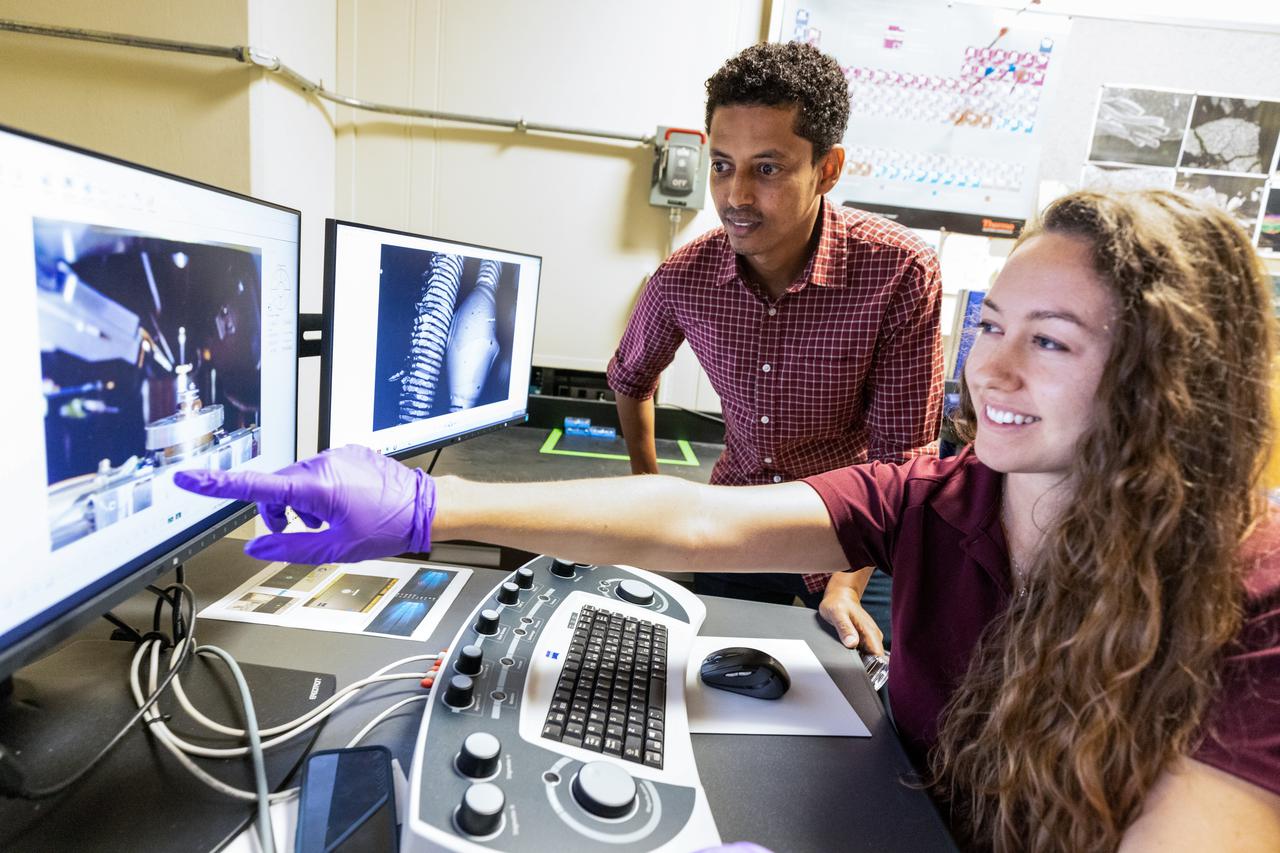
Chemists Misle Tessema (left) and Macy Mullen (right) discuss scanning electron microscope operations inside NASA Engineering’s Analytical Laboratories at Kennedy Space Center in Florida on July 7, 2021. One of seven branches in the NASA Laboratories, Development, and Testing Division, the Analytical Laboratories branch provides microscopic imagery and analysis through the use of a wide variety of microscopic techniques to identify contaminants and other urgent problems associated with aerospace flight hardware, ground support equipment, and related facilities.

To keep Webb’s spacecraft element and its sensitive instruments contaminant free, technicians and engineers enclose it in a protective clamshell that serves as a mobile clean room while in transport. Credits: NASA's Goddard Space Flight Center/Chris Gunn more info: https://www.nasa.gov/feature/goddard/2019/nasa-s-webb-is-sound-after-completing-critical-milestones
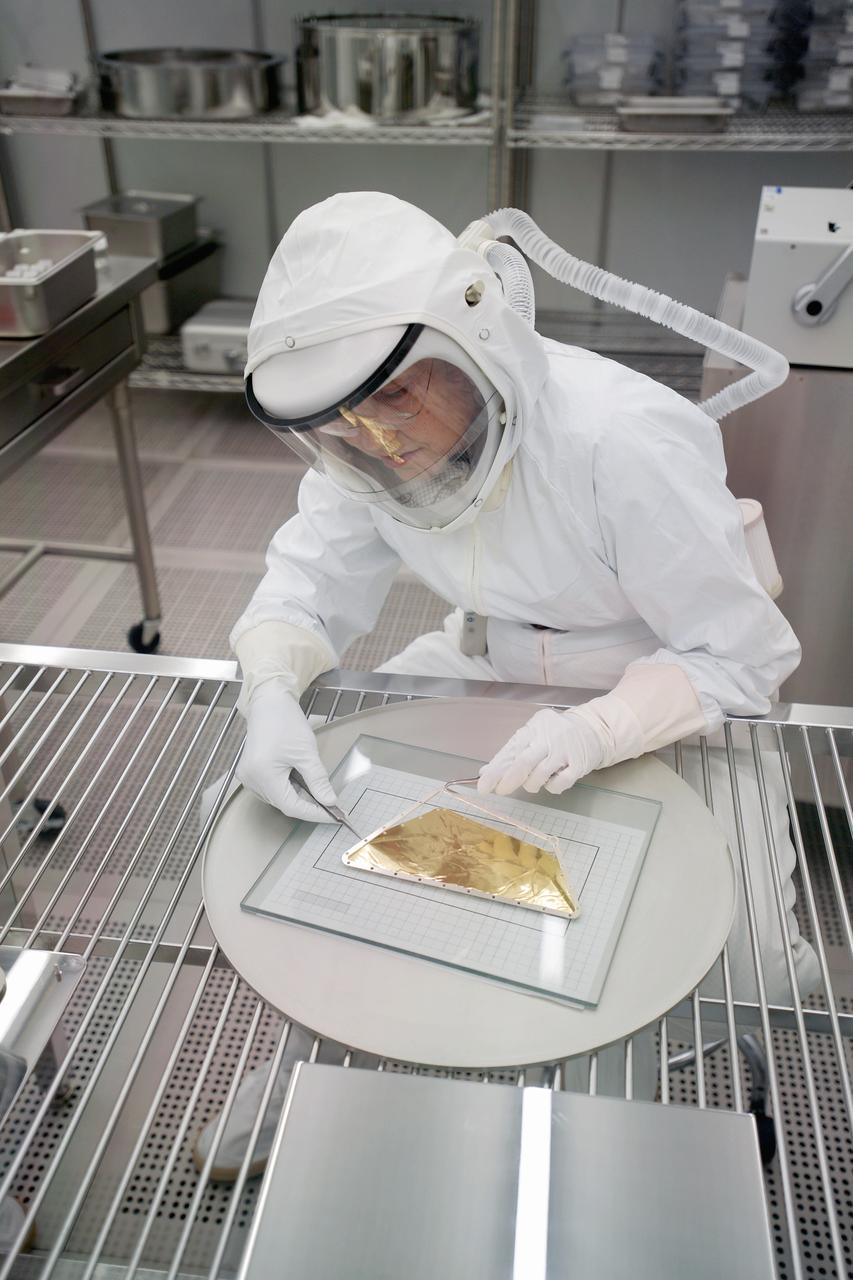
The facility for storing and examining Genesis solar wind samples consists of two adjacent laboratories. In these laboratories, the cutting of gold foil to be used in the gathering of the solar wind dust aboard the Genesis spacecraft. Views include: The process of cutting gold foil to be used aboard the Genesis spacecraft. The technicians use Gore-Tex suits with filters as to not contaminate the items.
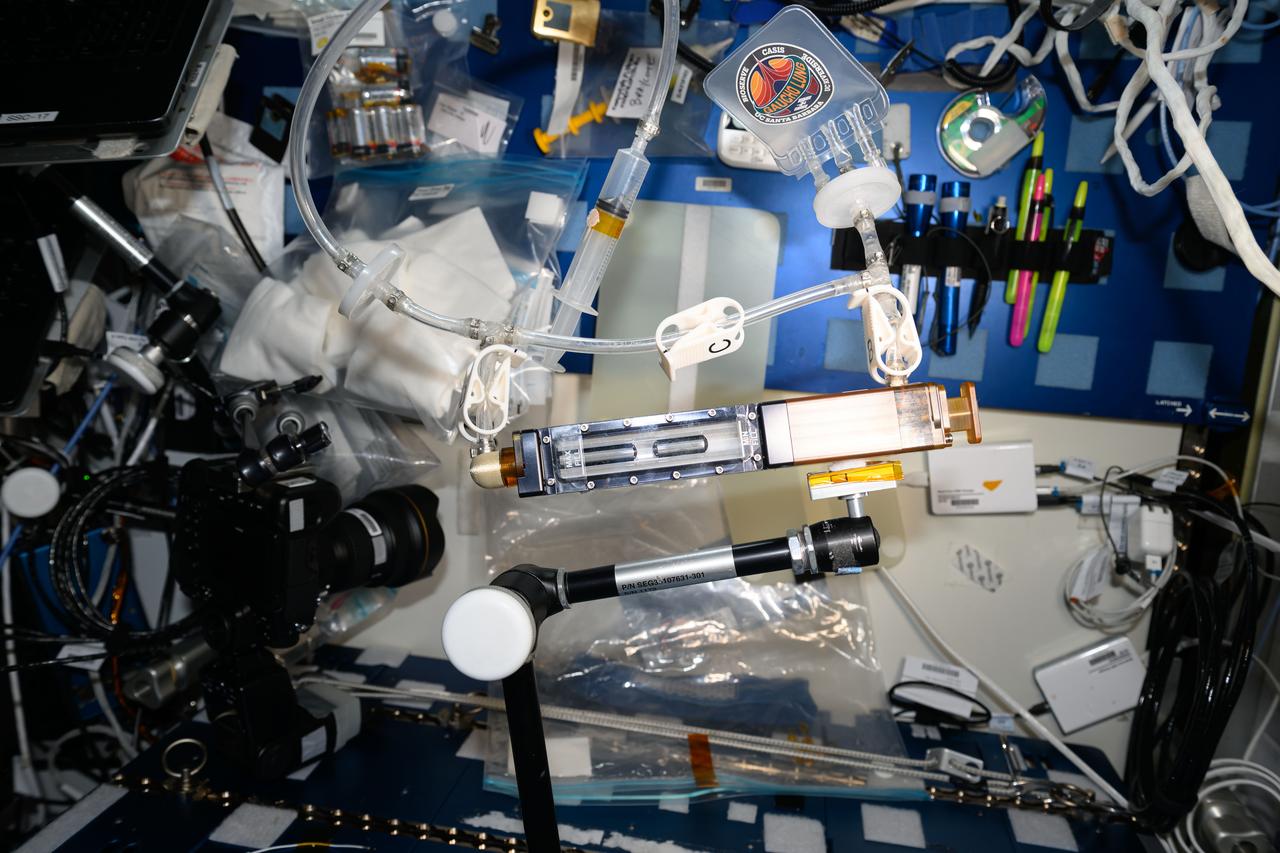
iss071e062617 (5/7/2024) --- A view of the Gaucho Lung investigation hardware aboard the International space station (ISS). The Wicking in Gel-Coated Tubes (Gaucho Lung) investigation studies fluid transport within gel-coated tubes to learn more about treatment programs for respiratory distress syndrome and develop new contamination control strategies.
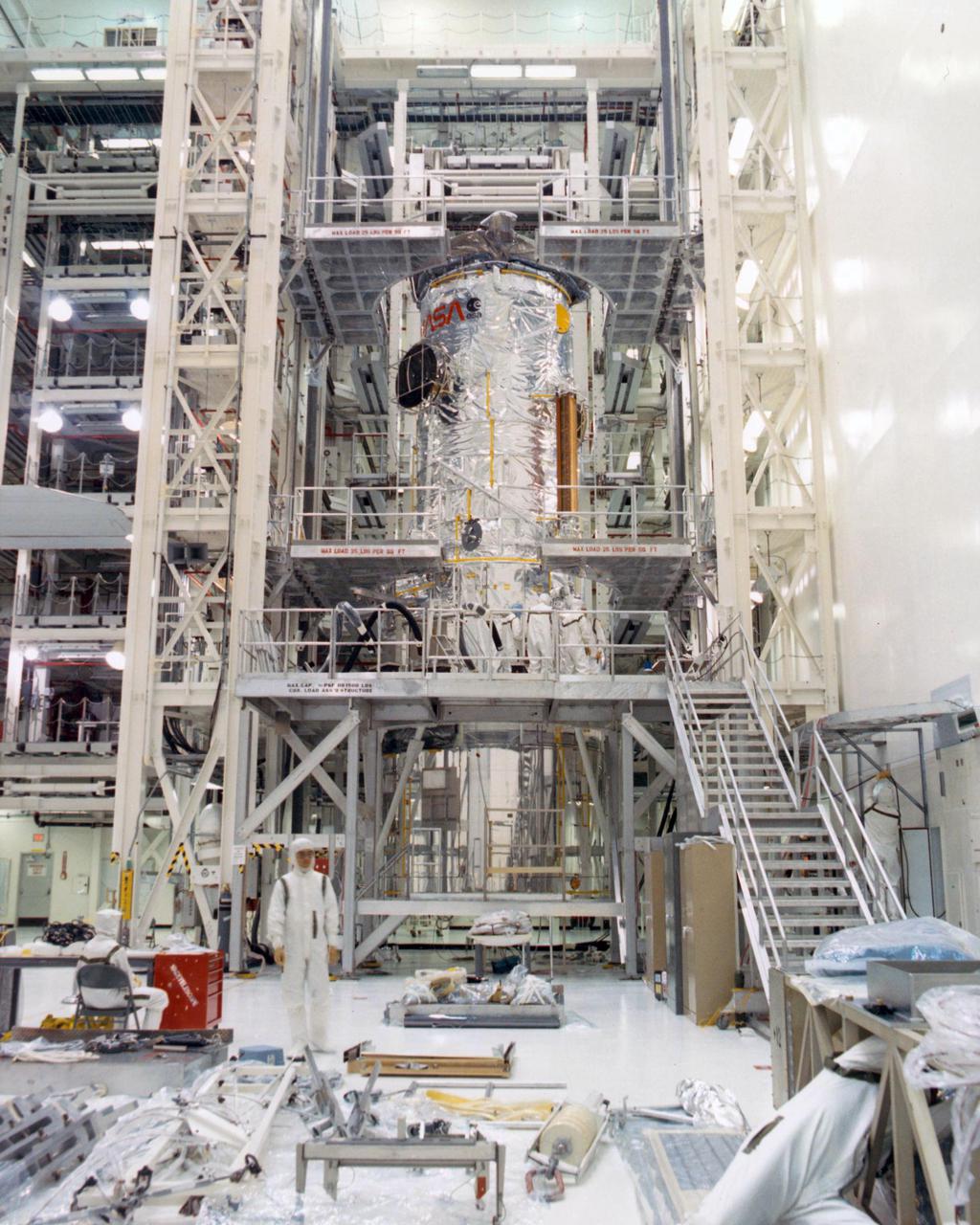
KENNEDY SPACE CENTER, FLA. -- The Hubble Space Telescope (HST) in a test cell at the Vertical Processing Facility has completed functional testing of its science instruments and is being readied for a final contamination inspection and cleaning. With HST, astronomers will be able to view 97 percent of the known universe, and will be able to get pictures unlimited and undistorted by the Earth's atmosphere. Compared with earth-based observatories, the HST will be able to view celestial objects that are 50 times fainter, provide images that are 10 times sharper, and see objects that are seven times farther away. .
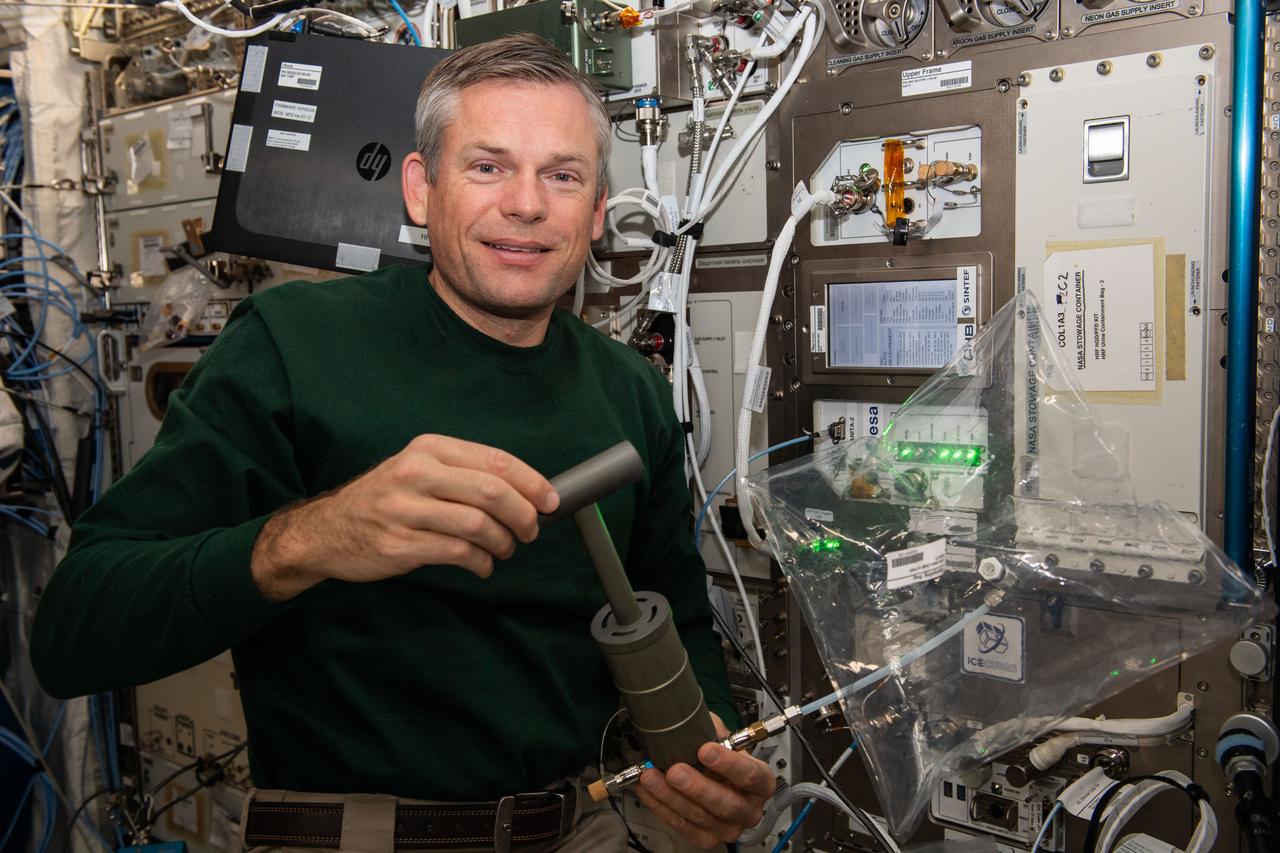
iss070e003139 (Oct. 12, 2023) --- Expedition 70 Commander Andreas Mogensen of ESA (European Space Agency) demonstrates collecting air samples to analyze and quantify trace contaminants in the International Space Station's atmosphere. The Analyzing Interferometer for Ambient Air-2, or ANITA-2, serves as a technology demonstration in support of human exploration missions beyond low-Earth orbit.
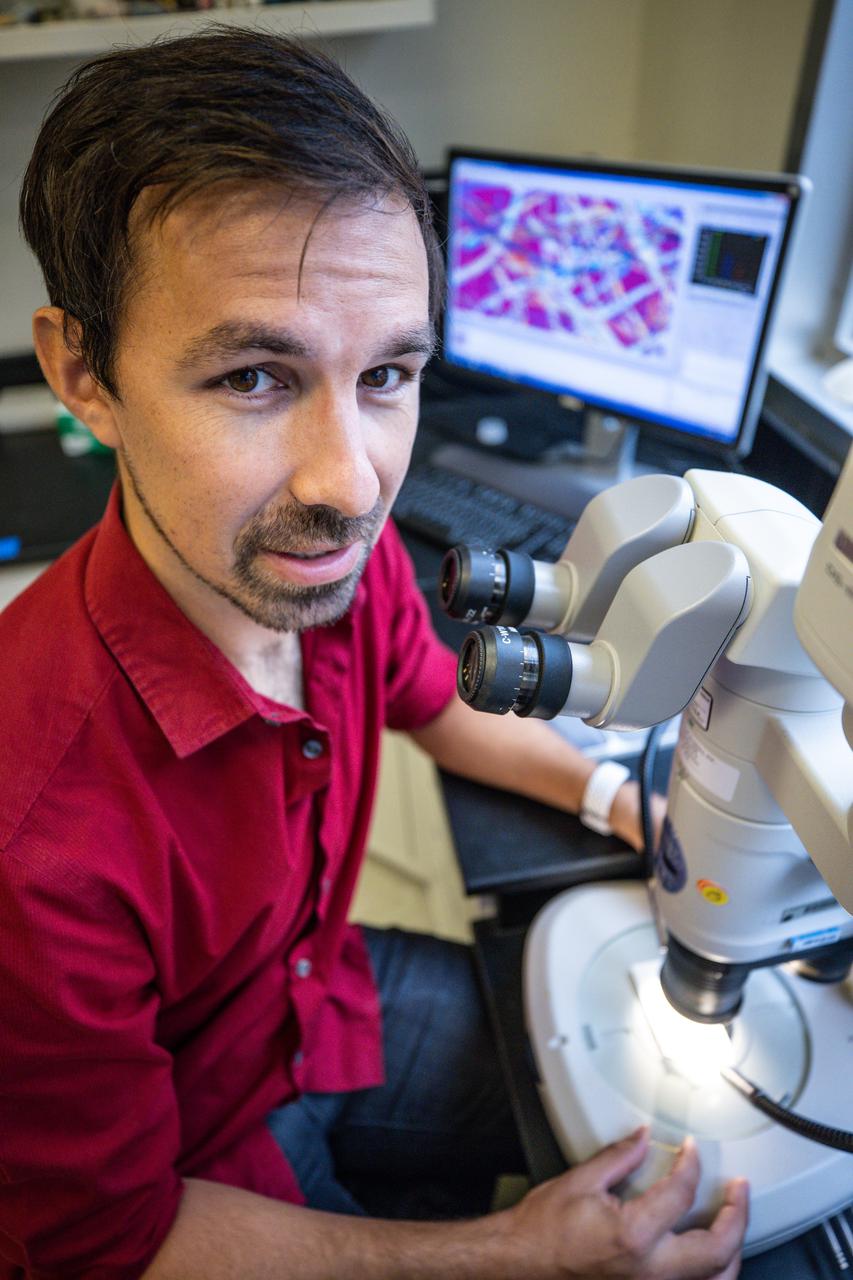
Chemist David Rinderknecht analyzes a sample on the stereomicroscope inside NASA Engineering’s Analytical Laboratories at Kennedy Space Center in Florida on July 7, 2021. One of seven branches in the NASA Laboratories, Development, and Testing Division, the Analytical Laboratories branch provides microscopic imagery and analysis through the use of a wide variety of microscopic techniques to identify contaminants and other urgent problems associated with aerospace flight hardware, ground support equipment, and related facilities.
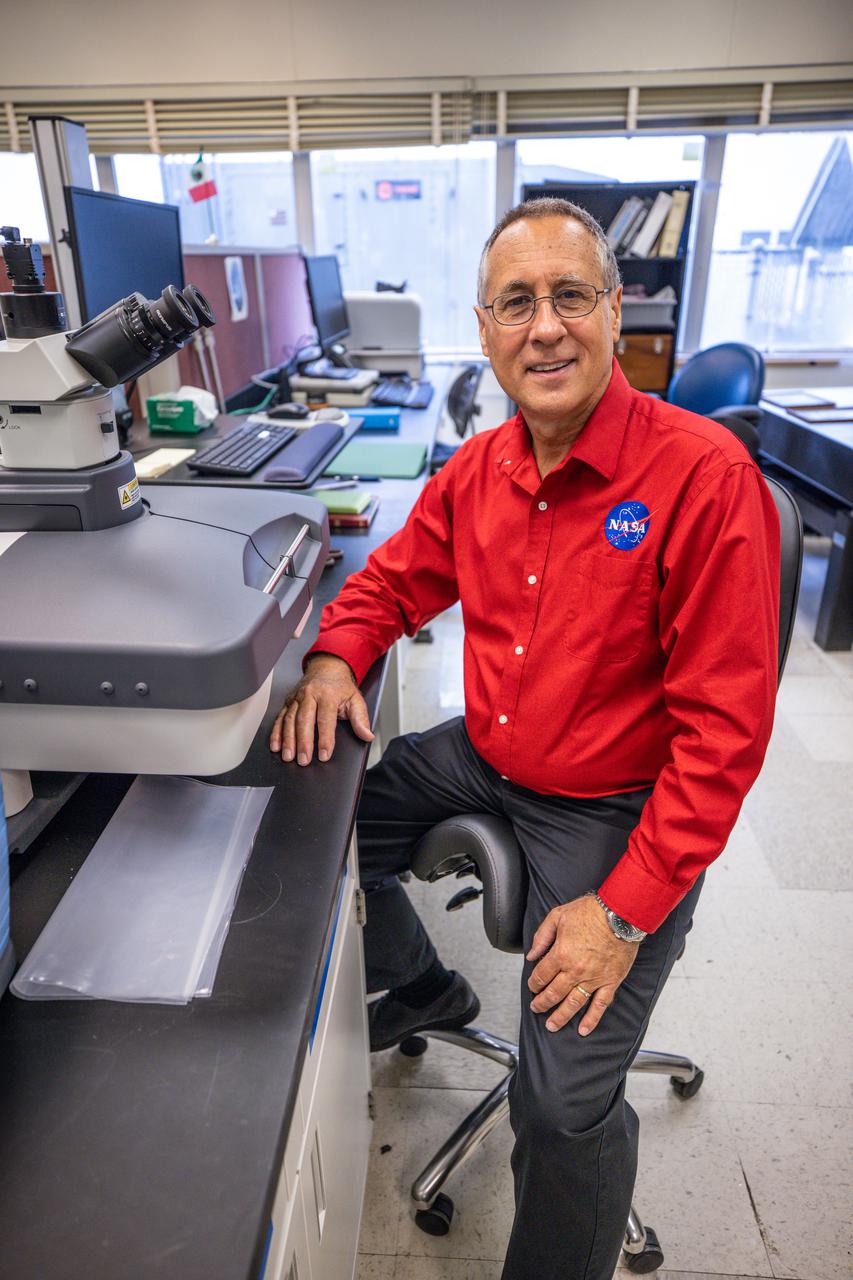
Lead chemist Philip Howard poses for a photo inside NASA Engineering’s Analytical Laboratories at Kennedy Space Center in Florida on July 7, 2021. One of seven branches in the NASA Laboratories, Development, and Testing Division, the Analytical Laboratories branch provides microscopic imagery and analysis through the use of a wide variety of microscopic techniques to identify contaminants and other urgent problems associated with aerospace flight hardware, ground support equipment, and related facilities.
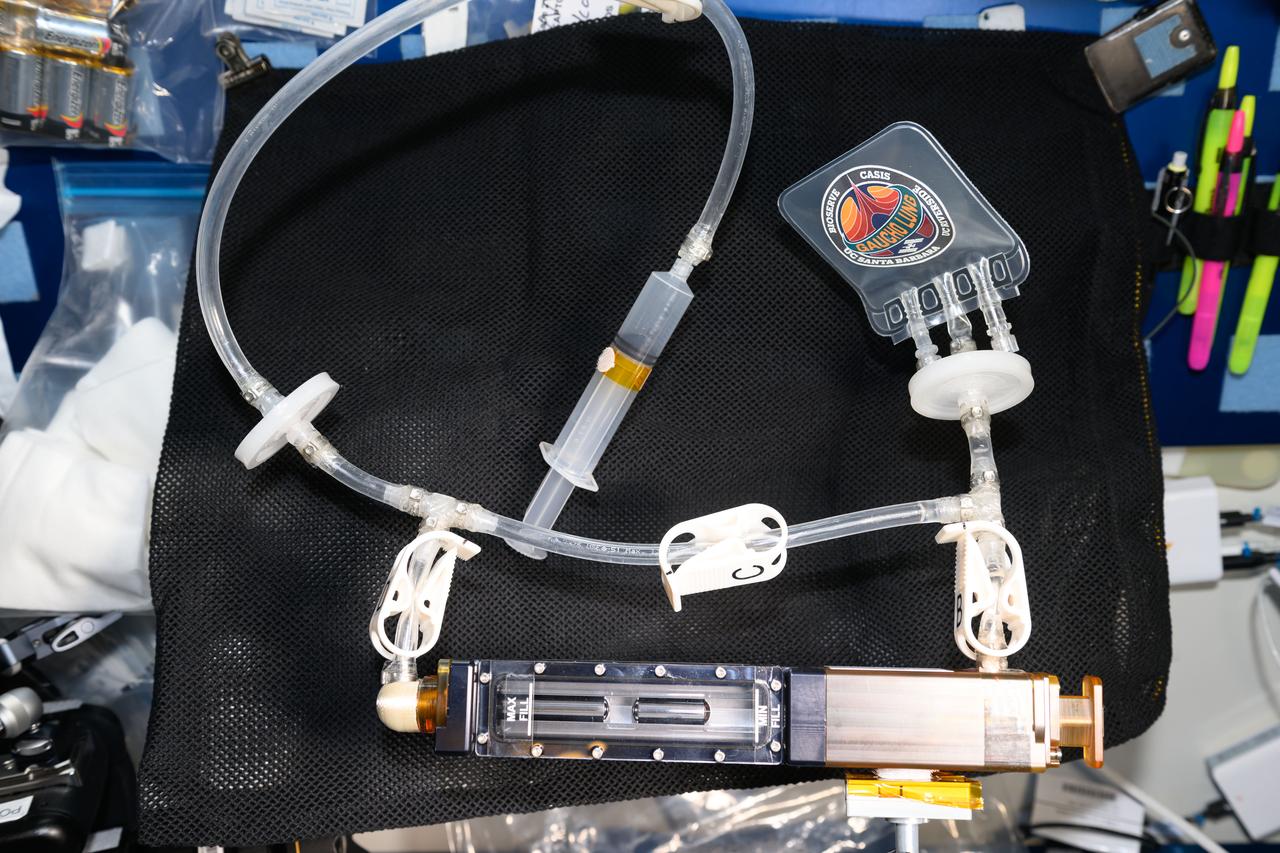
iss071e06219 (5/7/2024) --- A view of the Gaucho Lung investigation hardware aboard the International space station (ISS). The Wicking in Gel-Coated Tubes (Gaucho Lung) investigation studies fluid transport within gel-coated tubes to learn more about treatment programs for respiratory distress syndrome and develop new contamination control strategies.
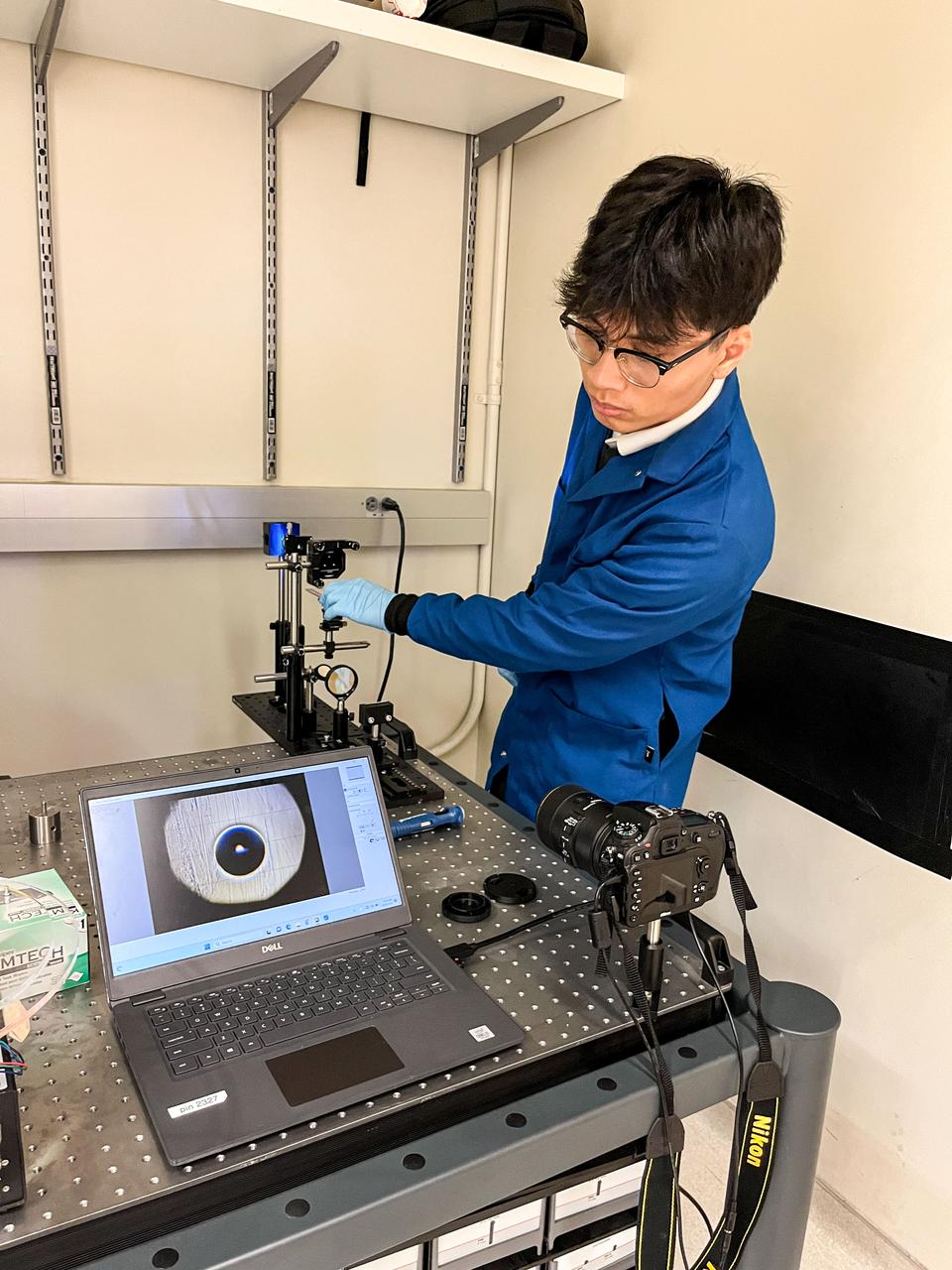
jsc2023e055884 (9/26/2023) --- Trinh Huynh uses a quantitative Schlieren system to measure the deformation of the mucus-like gel around a liquid drop. The Gaucho Lung investigation will study fluid transport within gel-coated tubes to learn more about treatment programs for respiratory distress syndrome and develop new contamination control strategies. Image courtesy of University of California, Santa Barbara.