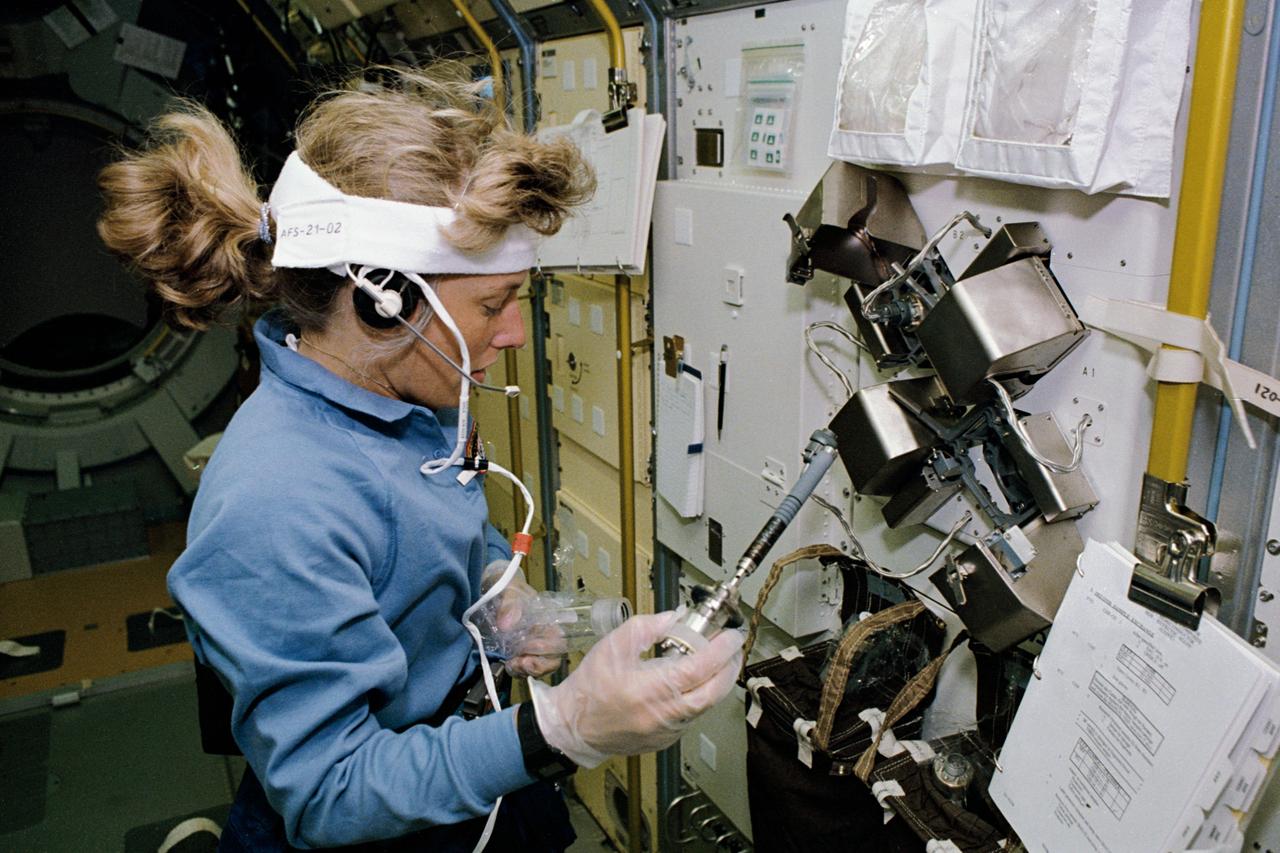
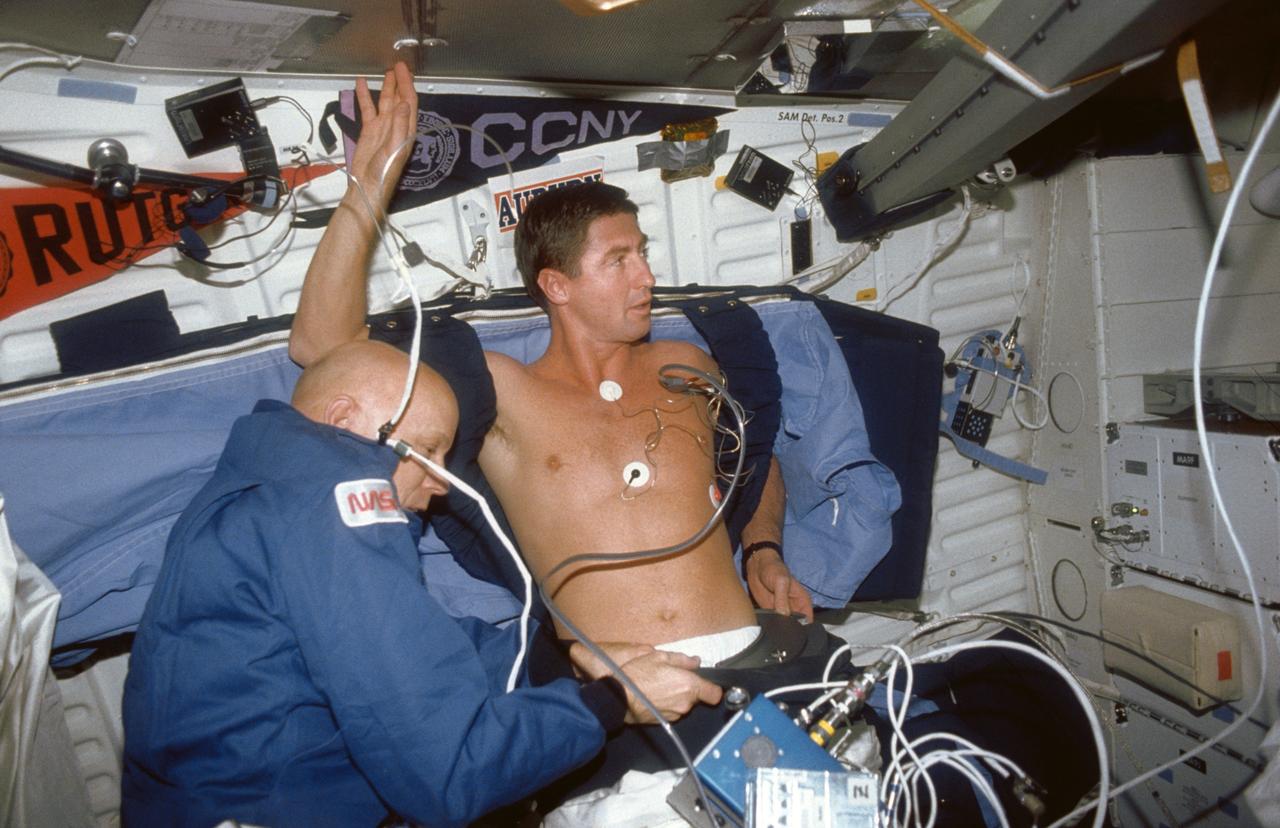
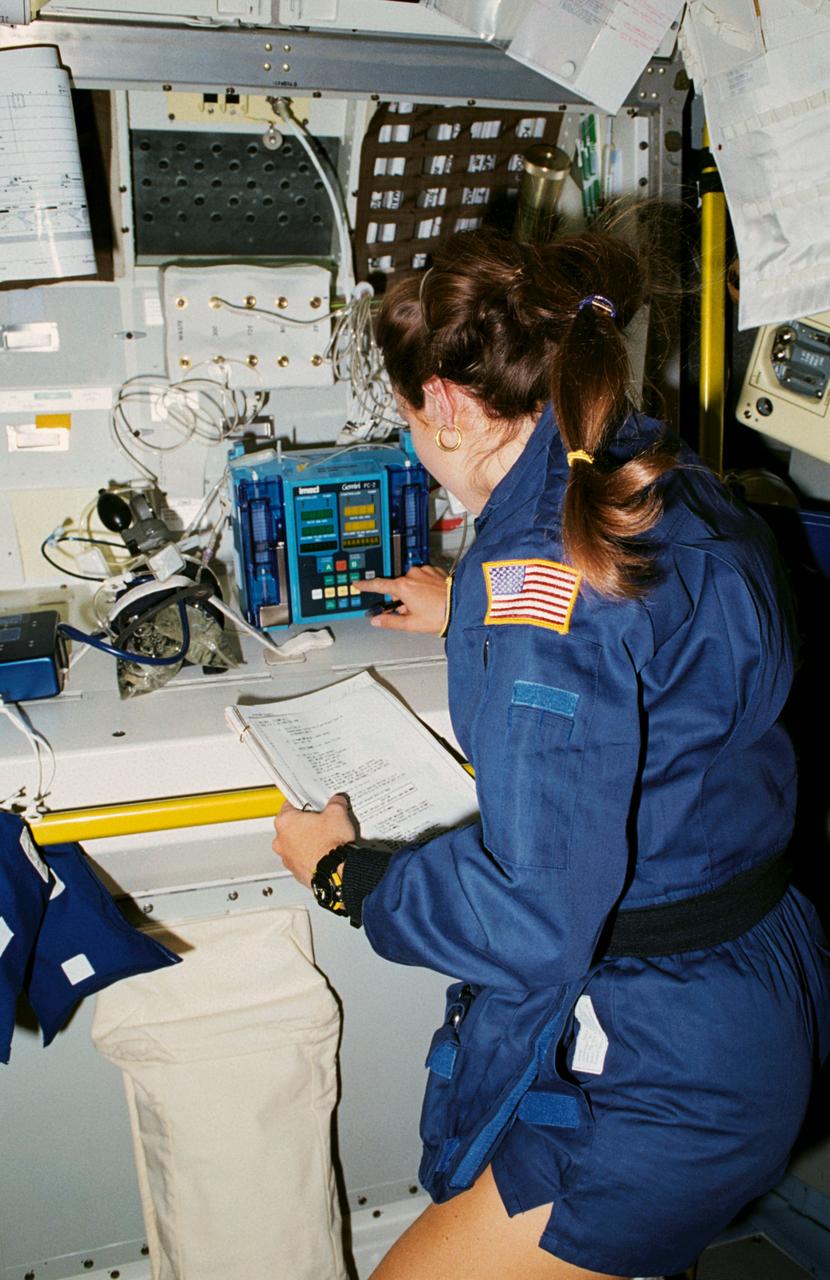
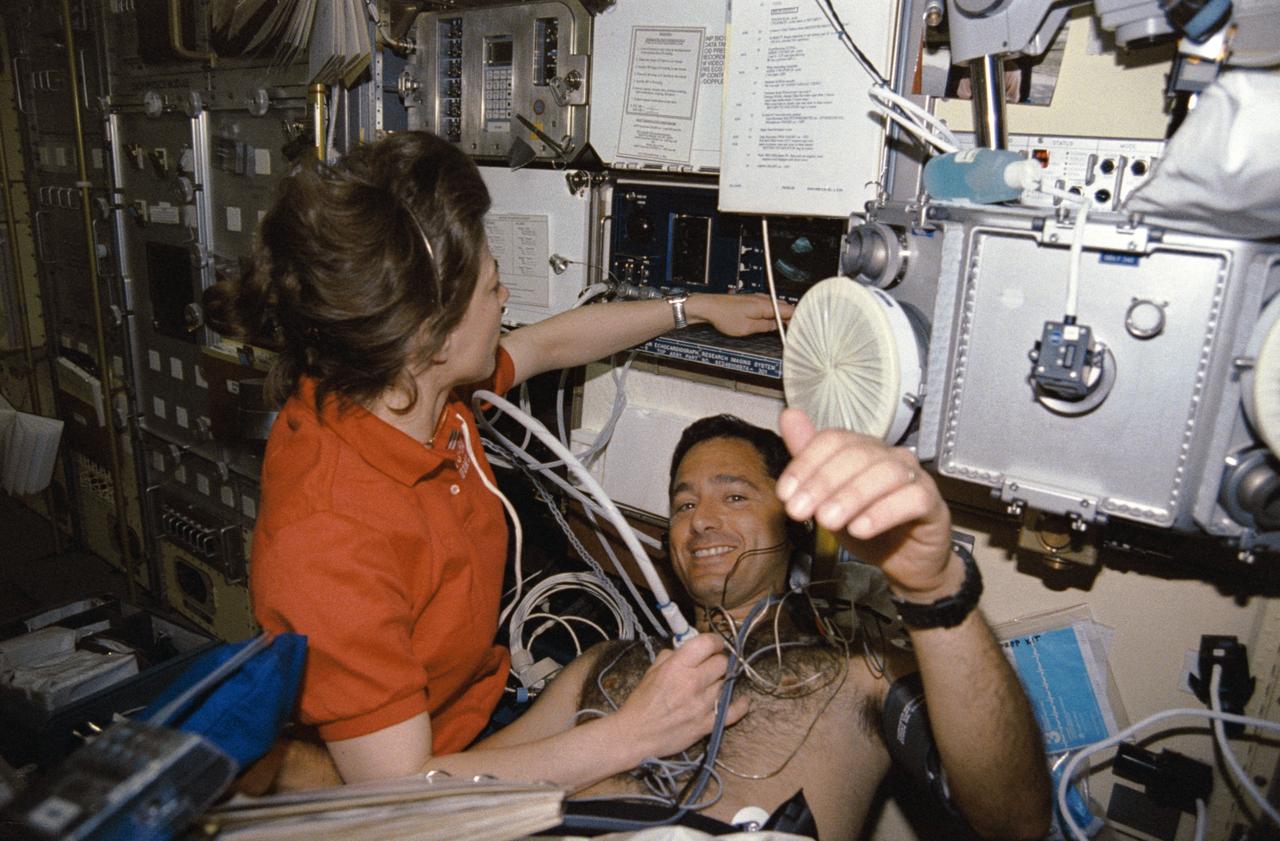
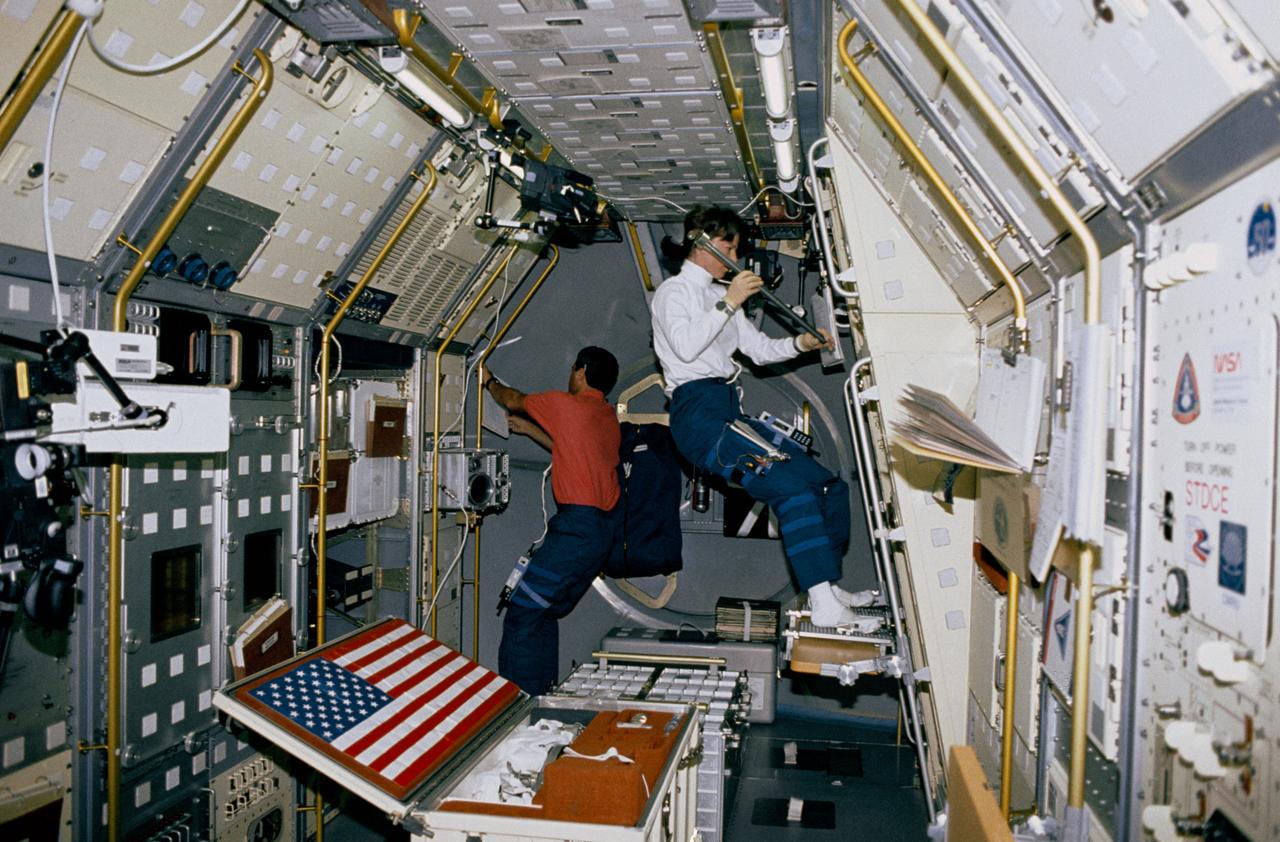
STS040-30-008 (5-14 June 1991) --- Astronaut Tamara E. Jernigan, after applying a blood pressure cuff to an experiment, watches it in operation.  The experiment is the intravenous infusion pump. The device is being considered for use on Space Station Freedom's Health Maintenance Facility.  Dr. Jernigan is one of seven crew members supporting the nine-day Spacelab Life Sciences (SLS-1) mission aboard the Earth-orbiting Space Shuttle Columbia.
STS-40 MS Jernigan works at SLS-1 Rack 1 workstation with intravenous system
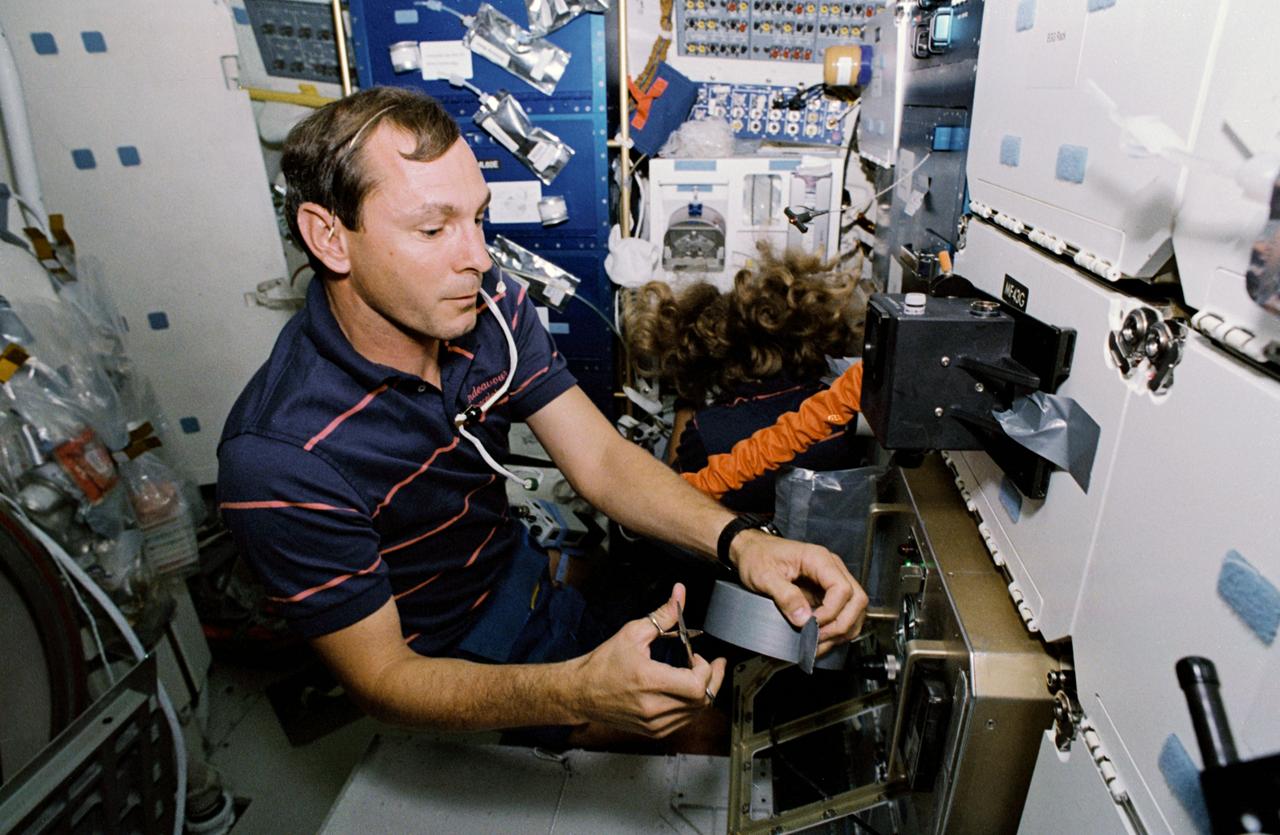
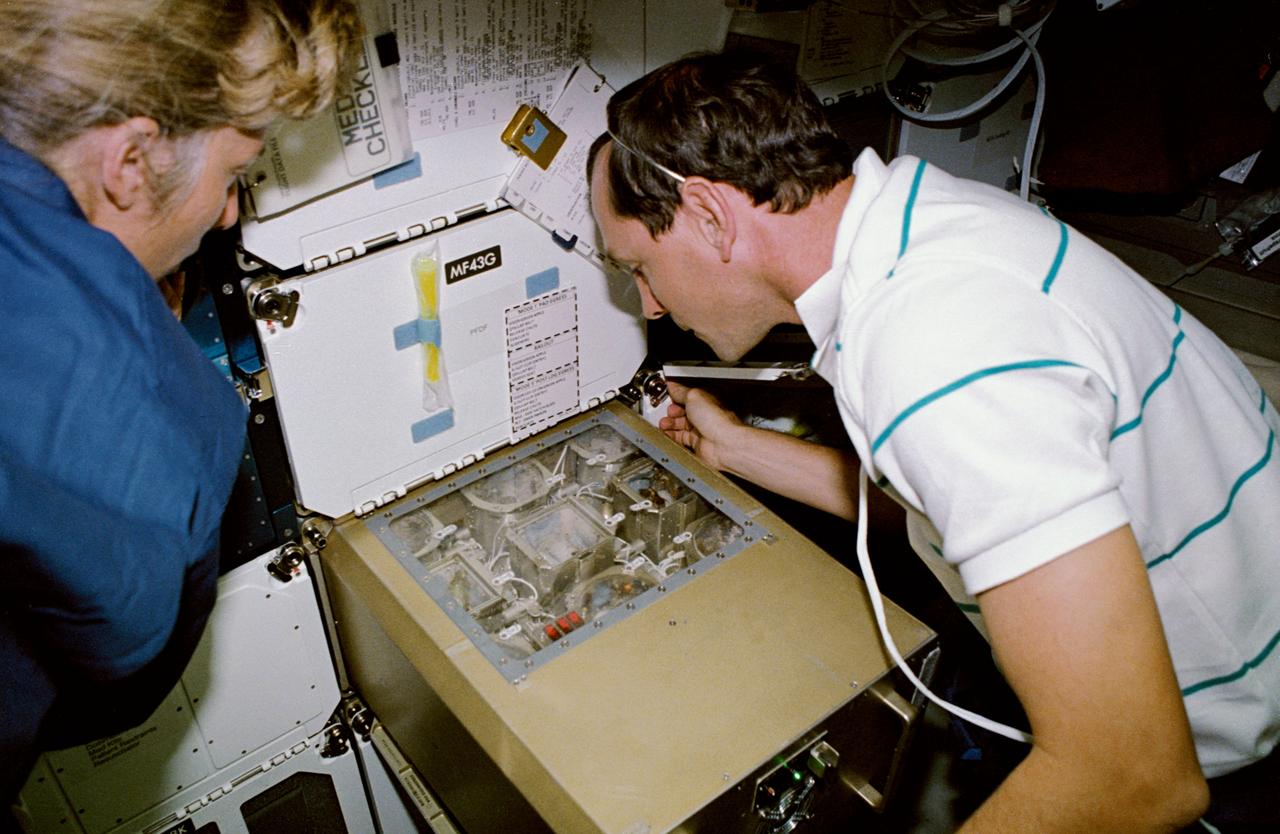
STS047-02-018 (12 - 20 Sept 1992) --- Astronauts N. Jan Davis, mission specialist, and Curtis L. Brown, Jr., pilot, oversee the progress of some of the 180 female Oriental Hornets onboard the Space Shuttle Endeavour.  The insects are part of the Israeli Space Agency Investigation About Hornets (ISAIAH) experiment.  The objective of this experiment is to examine the effects of microgravity on the orientation, reproductive capability and social activity of the hornets.  Also, the direction of comb-building by hornet workers in microgravity, as well as the structural integrity of the combs, will be examined.
STS-47 MS Davis and Pilot Brown monitor ISAIAH on OV-105's middeck
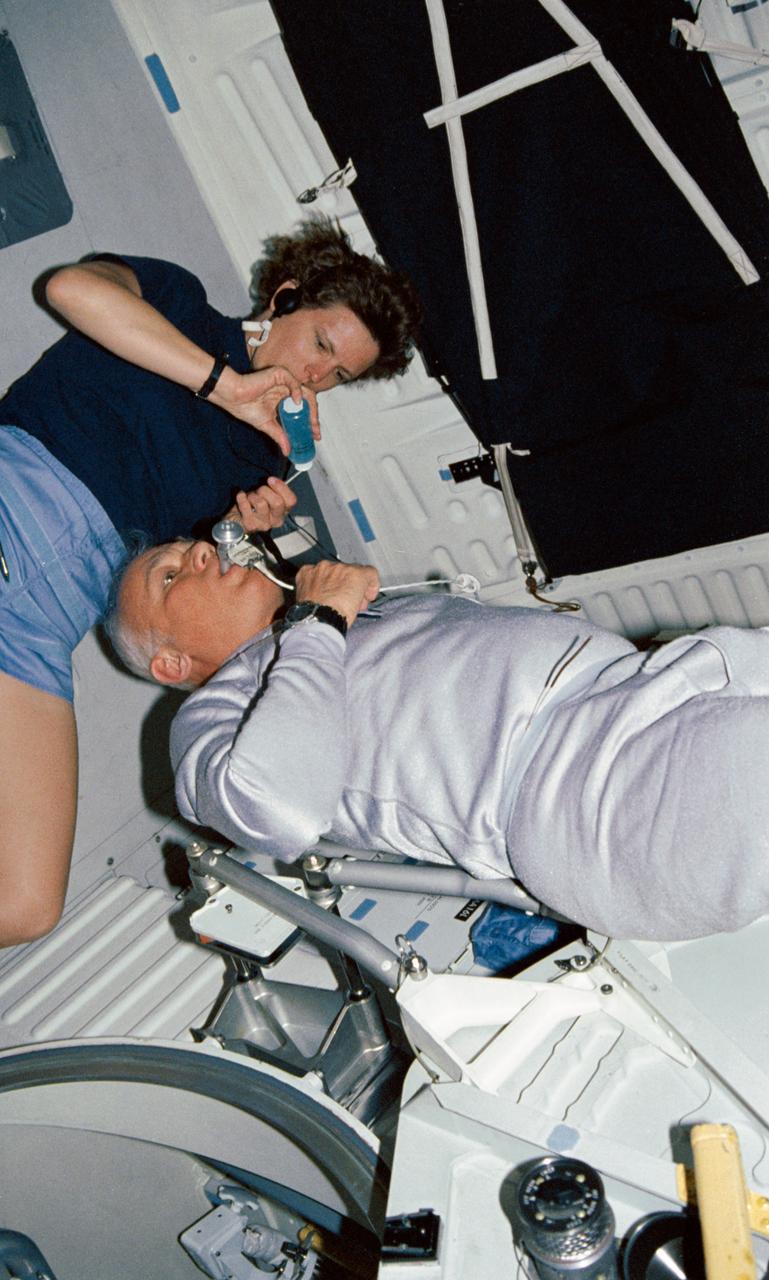
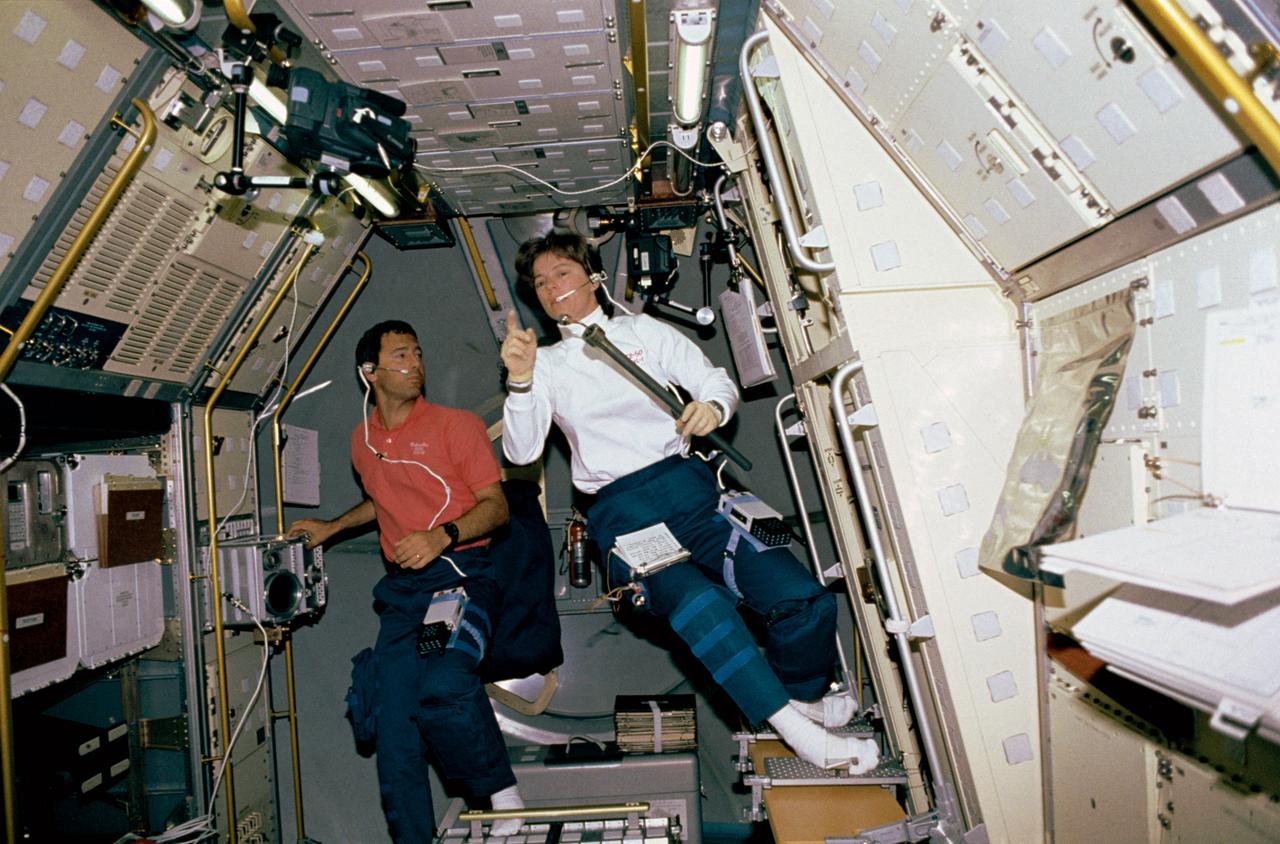
STS050-291-027 (25 June-9 July 1992) --- Astronaut Bonnie J. Dunbar uses a Doppler to collect medical data from Lawrence J. DeLucas, payload specialist, during his diagnostic "run" in the Lower Body Negative Pressure device (LBNP).  The Doppler is used to pick up high-frequency sound waves from the surface of the heart, thus producing pictures on the monitor of the American Flight Echocardiograph (AFE).  The result of the LBNP procedure is expected to be an increased tolerance of orthostatis - or standing upright - upon return to Earth's gravity.  LBNP has been used a number of times in the United States space program, as early as the Skylab missions.  STS-50 is the fourth flight of the current collapsible unit.  Researchers are refining the LBNP protocol which will be used operationally on future 13 through 16 day missions.
Crewmembers in the spacelab with the Lower Body Negative Pressure Study.
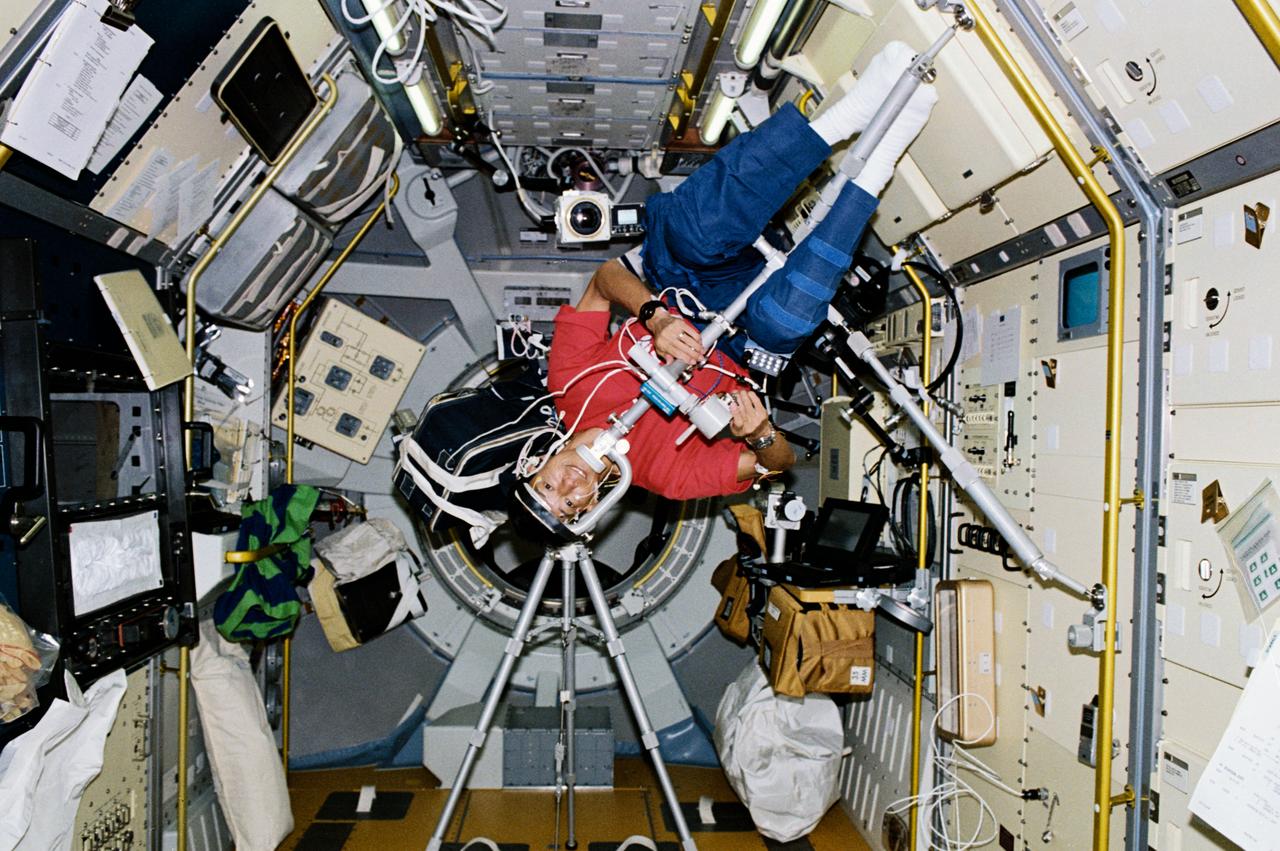
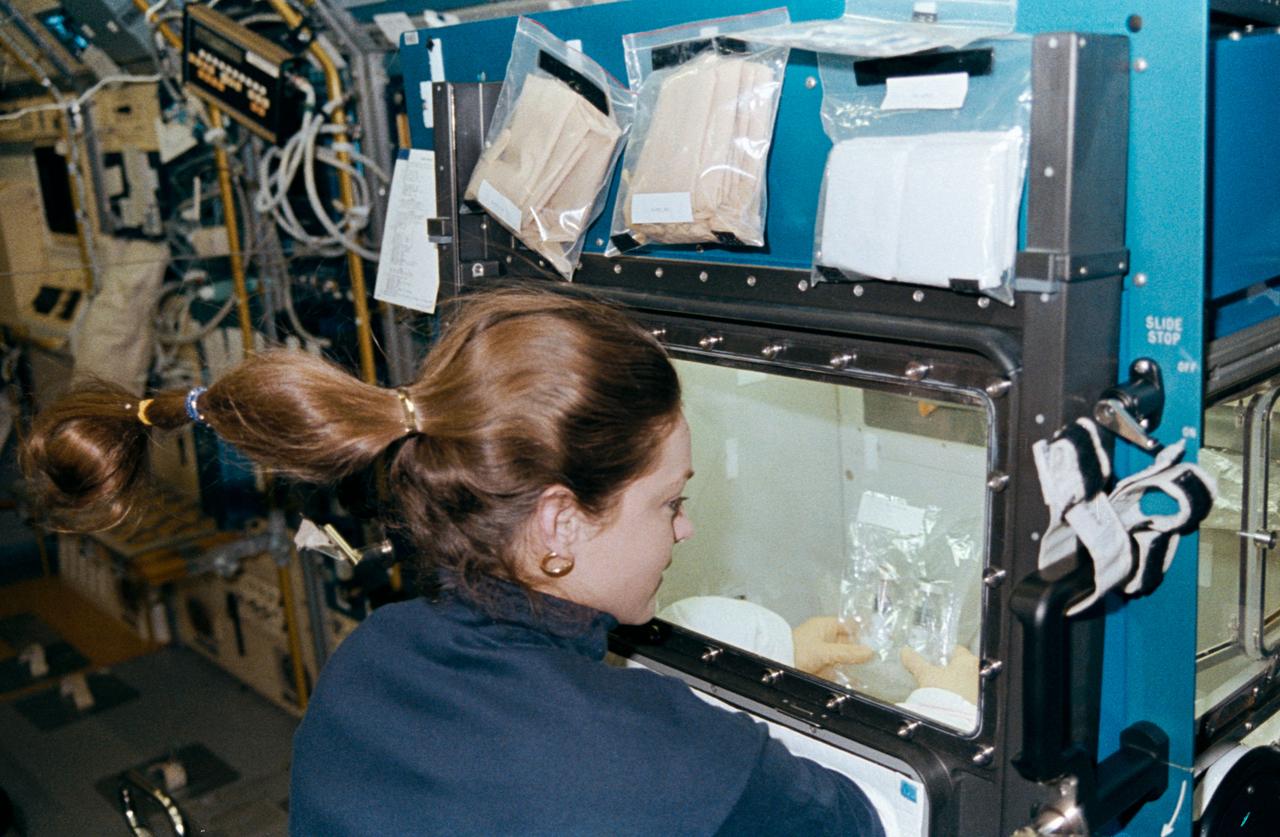
STS040-224-005 (5-14 June 1991) --- Astronaut Tamara E. Jernigan, STS-40 mission specialist, conducts an evaluation of the General Purpose Work Station (GPWS) in the Spacelab Life Sciences (SLS-1) module onboard the Earth-orbiting Space Shuttle Columbia.  The photograph was taken with a 35mm camera.
STS-40 Mission Specialist (MS) Jernigan uses the SLS-1 GPWS glovebox
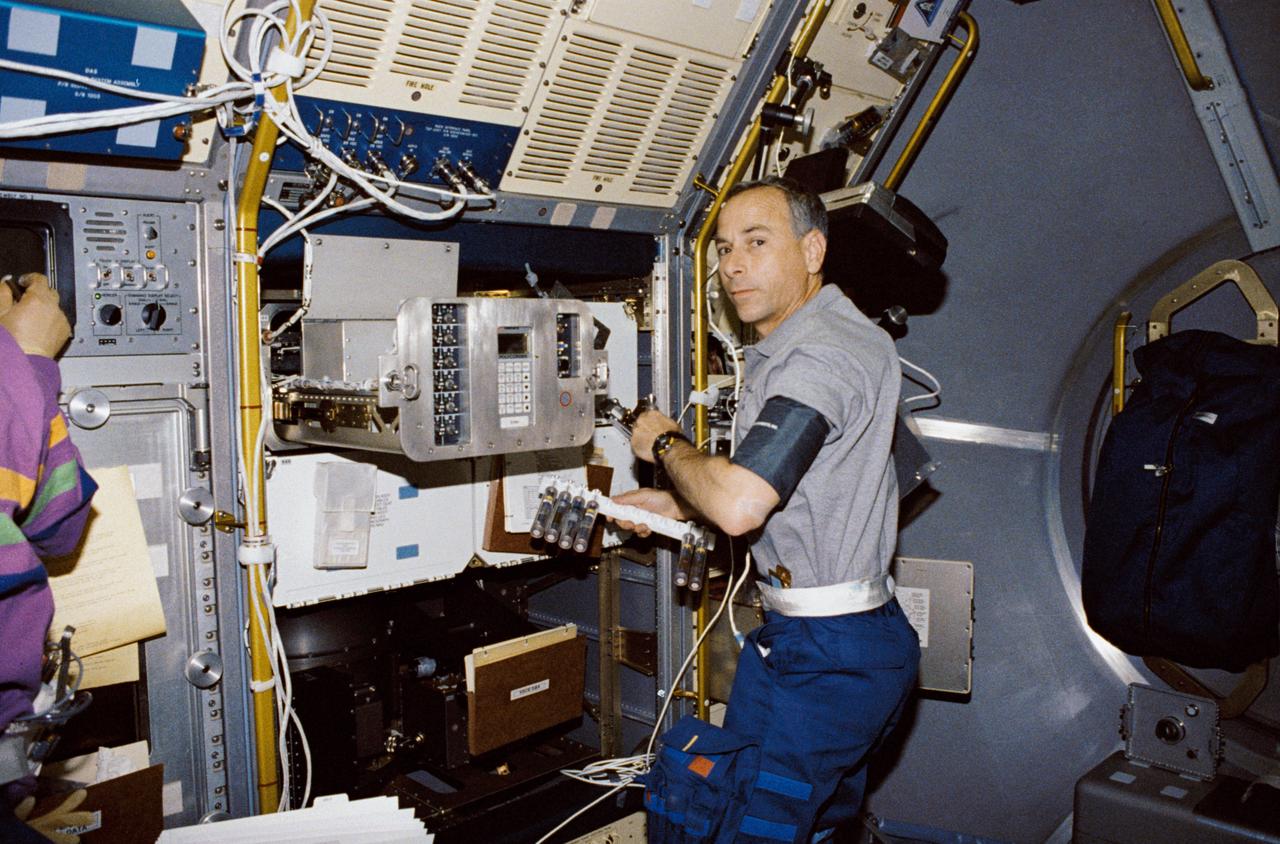
STS050-301-001 (25 June-9July 1992) --- Astronaut Carl J. Meade, mission specialist, works with the Generic Bioprocessing Apparatus in the science module aboard the Earth-orbiting Space Shuttle Columbia.  Payload specialist Eugene H. Trinh is partially visible (left), monitoring an experiment in the Drop Physics Module (DPM). The two joined four other astronauts and a second scientist from the private sector for 14-days of scientific data-gathering.
Crewmember in spacelab with the Generic Bioprocessing Apparatus, rack # 10.
View showing Payload Specialists Bonnie Dunbar and Larry DeLucas in the aft section of the U. S. Microgravity Laboratory-1. Dunbar prepares to load a sample in the Crystal Growth Furnace (CGF) Integrated Furnace Experiment Assembly (IFEA) in rack 9 of the Microgravity Laboratory, while DeLucas checks out the multi-purpose Glovebox Facility.
Crewmember working on the spacelab Drop Physics Module, Rack 9.
STS050-02-001 (9 July 1992) --- View showing Payload Specialists Bonnie Dunbar and Larry DeLucas in the aft section of the U. S. Microgravity Laboratory-1. Dunbar is preparing to load a sample in the Crystal Growth Furnace (CGF) Integrated Furnace Experiment Assembly (IFEA) in rack 9 of the Microgravity Laboratory. DeLucas is checking out the multipurpose Glovebox Facility.
Crewmember working on the spacelab Zeolite Crystal Growth experiment.
STS050-02-023 (25 June-9 July 1992) --- Astronaut Bonnie J. Dunbar, payload commander, unstows United States Microgravity Laboratory 1 (USML-1) experiment paraphernalia in early stages of the mission.  The Multipurpose Glove Box (MPGB) is at upper left.  And, at right center, is the Space Station design foot restraint, making its first flight aboard a Space Shuttle on the record-setting 14-day mission.
Crewmember working on the spacelab Drop Physics Module, Rack 9.
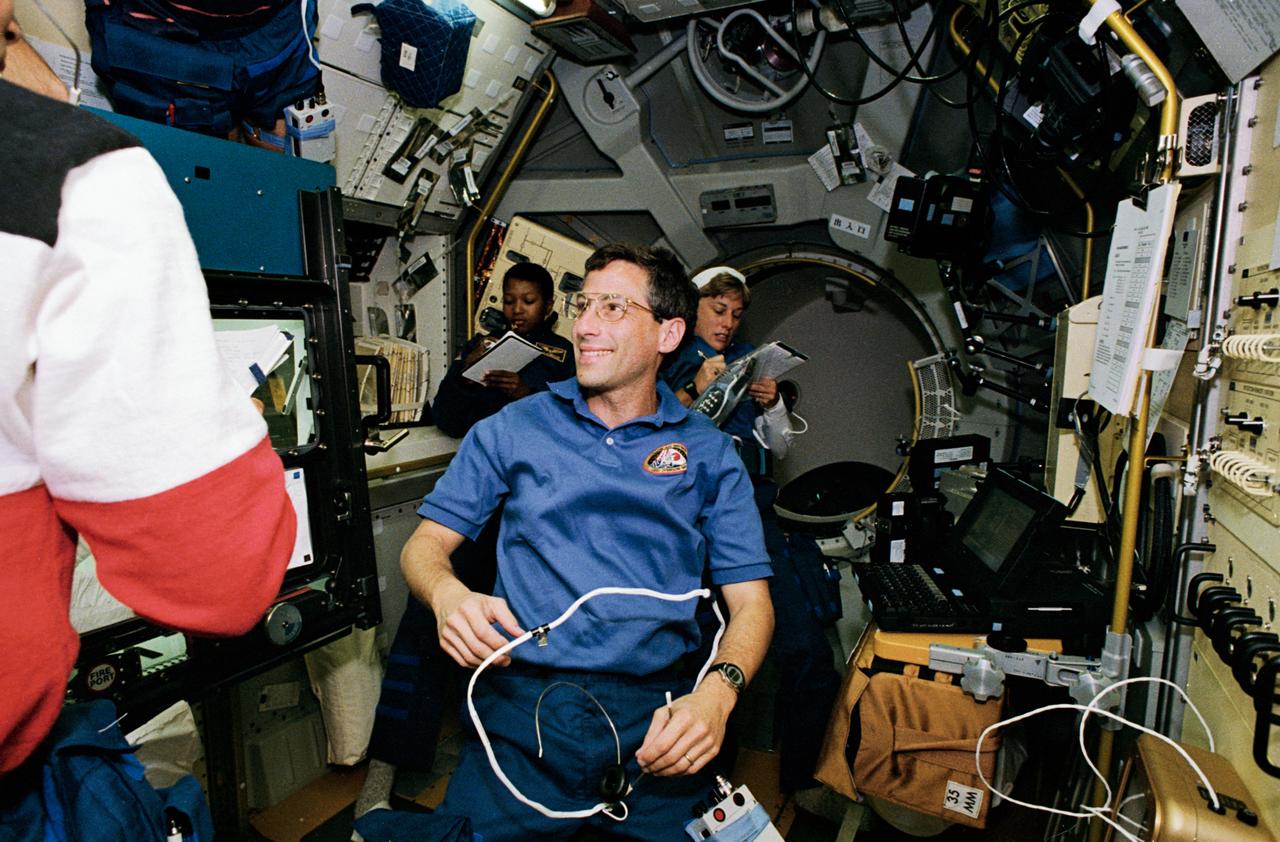
STS047-05-019 (12 - 20 Sept 1992) --- Astronaut Jerome (Jay) Apt, mission specialist, responds to a crew mate's query during a shift change in the Spacelab-J Science Module aboard the Earth-orbiting Space Shuttle Endeavour.  Others pictured, left to right, are astronauts Mark C. Lee (immediate foreground, partially out of frame), payload commander; Mae C. Jemison and N. Jan Davis, mission specialists.  The four joined two other NASA astronauts and a Japanese payload specialist for eight days aboard Endeavour in support of the joint Japanese-American effort.
STS-47 crewmembers work in the Spacelab Japan (SLJ) module aboard OV-105
STS047-35-022 (12 - 20 Sept 1992) --- Astronauts Curtis L. Brown, Jr., pilot, and N. Jan Davis, mission specialist, team up to cure a high humidity problem in the hornet experiment in the Spacelab-J Science Module of the Earth-orbiting Space Shuttle Endeavour.  Via a jury-rigged hose hook-up, the two were able to blow air from a spacesuit fan into the experiment, thus eliminating condensation that obscured the viewing of the Israeli hornet experiment.  The experiment examined the effects of microgravity on the orientation, reproductive capability and social activity of 180 female Oriental Hornets.
STS-47 MS Davis and Pilot Brown repair ISAIAH humidity problem aboard OV-105
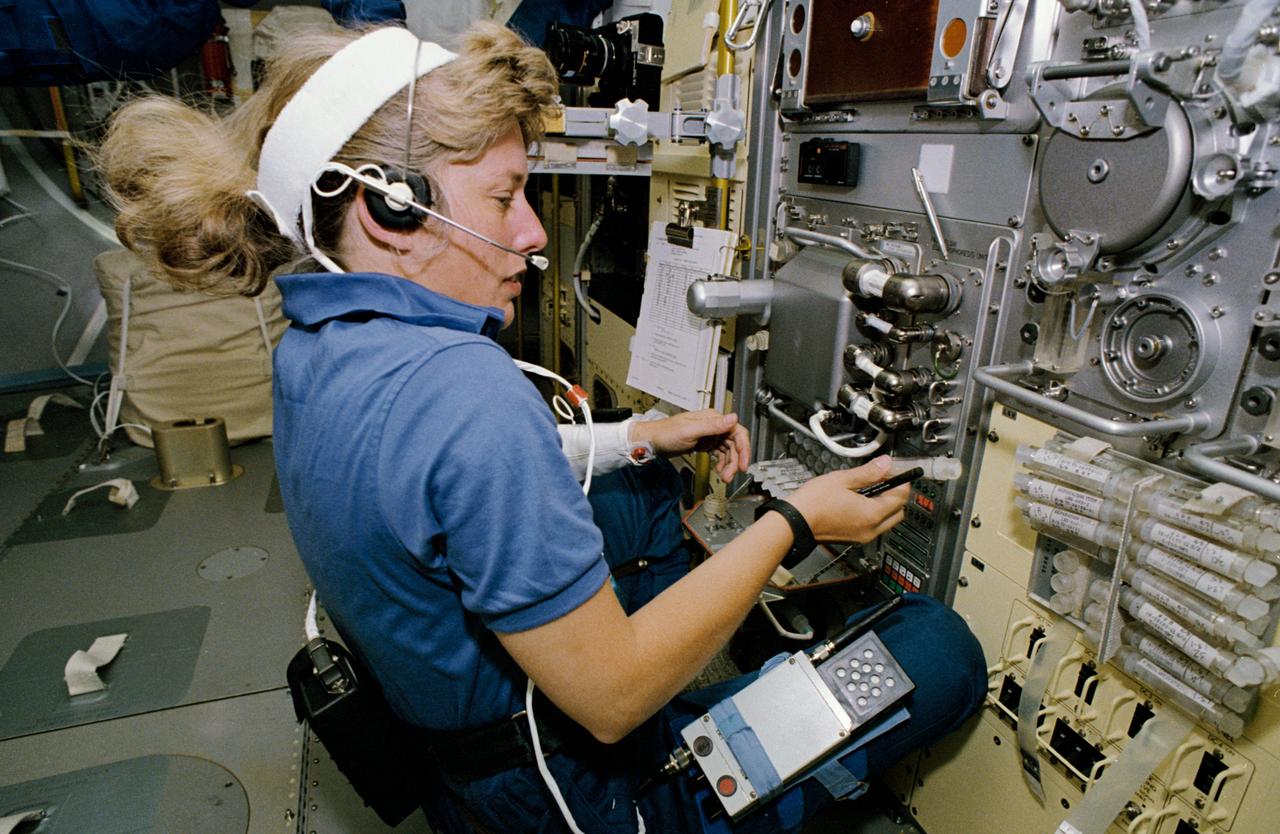
STS047-03-024 (12 - 20 Sept 1992) --- Astronaut N. Jan Davis, mission specialist, talks to ground controllers as she works with the Free Flow Electrophoresis Unit (FFEU) in the Science Module of the Earth-orbiting Space Shuttle Endeavour.  Davis joined five other NASA astronauts and a Japanese payload specialist for eight days of scientific research onboard Endeavour.
STS-47 MS Davis holds mixed protein sample while working at SLJ Rack 7 FFEU
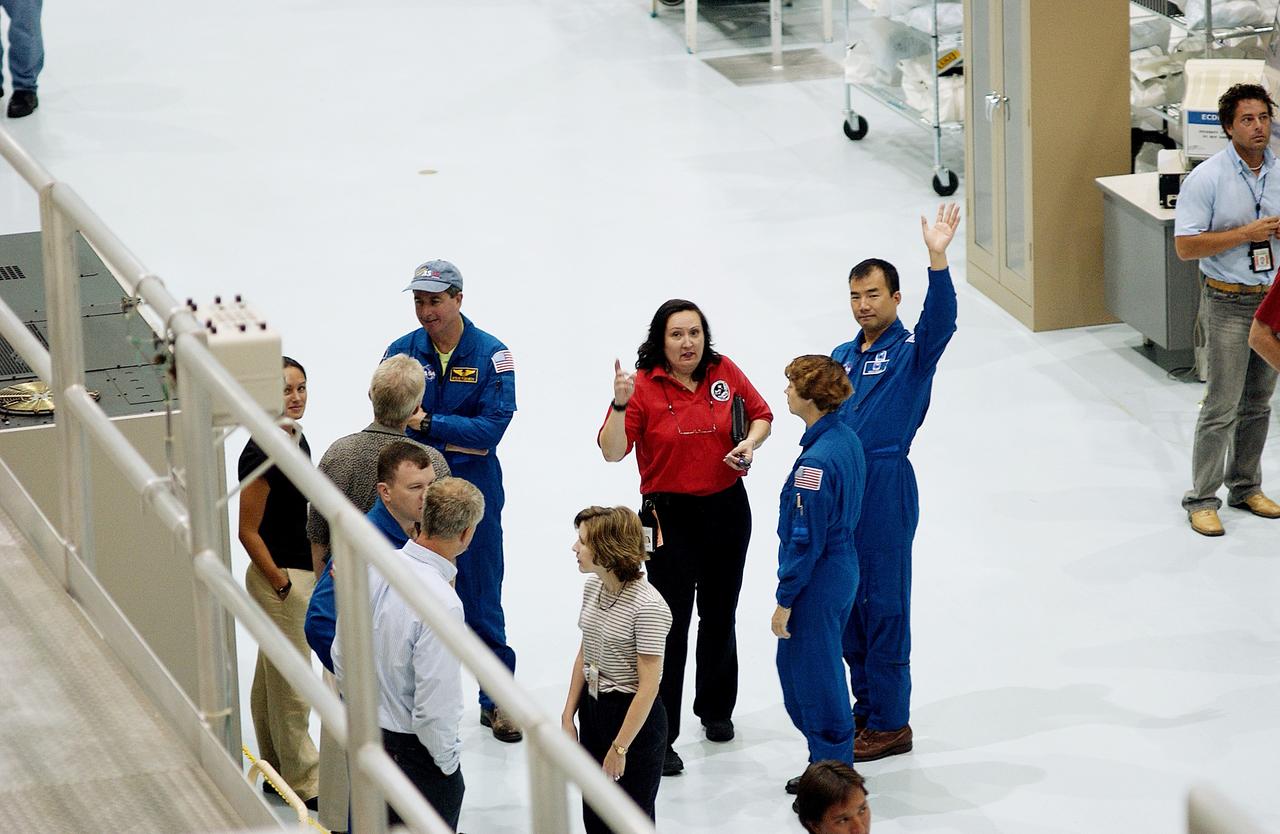
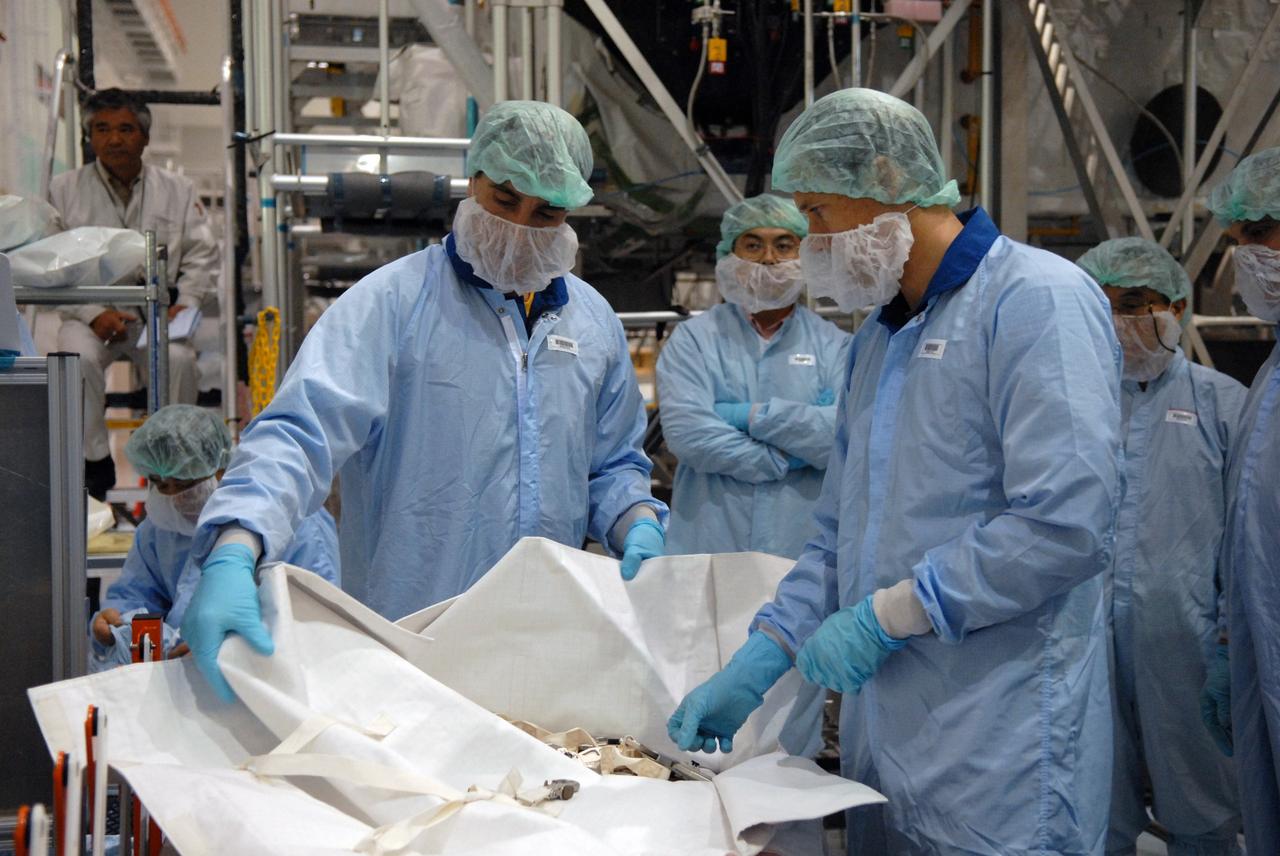
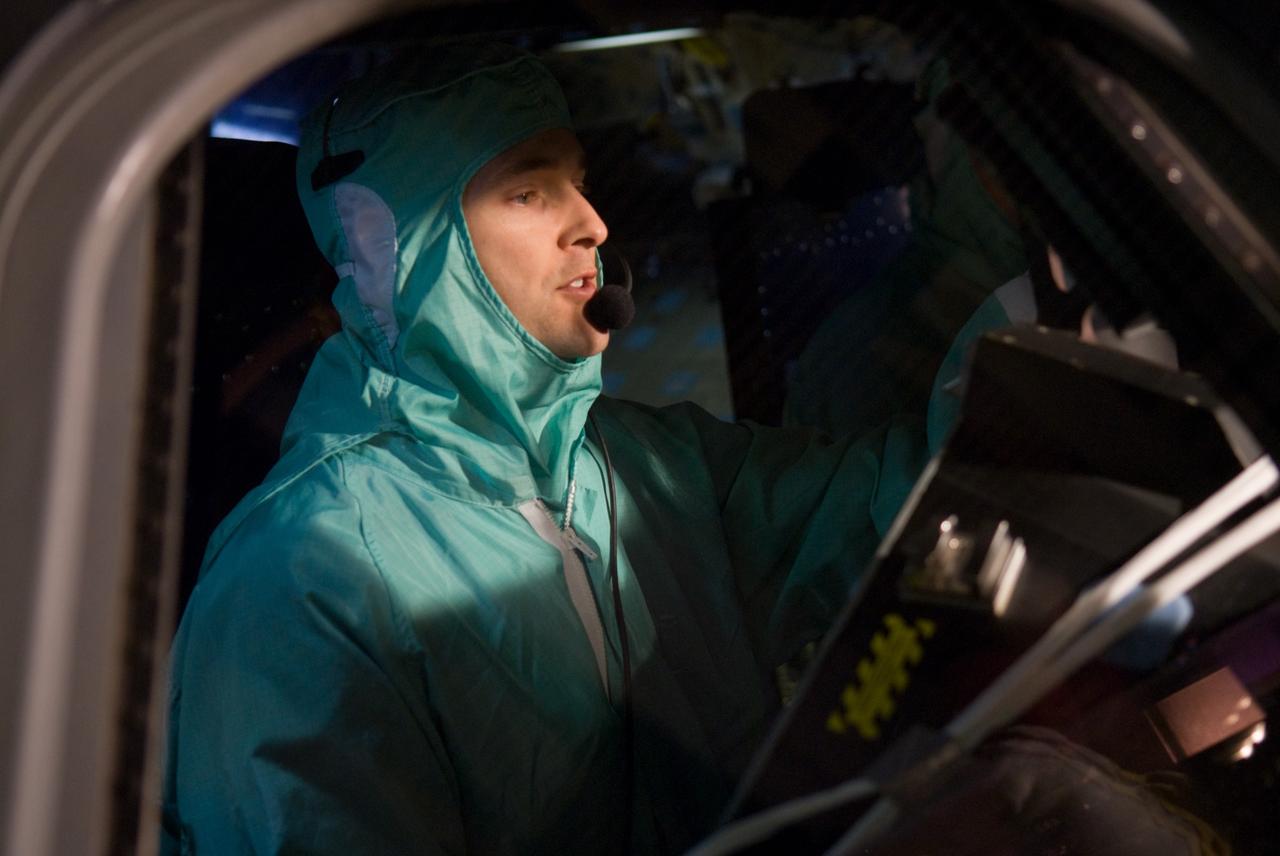
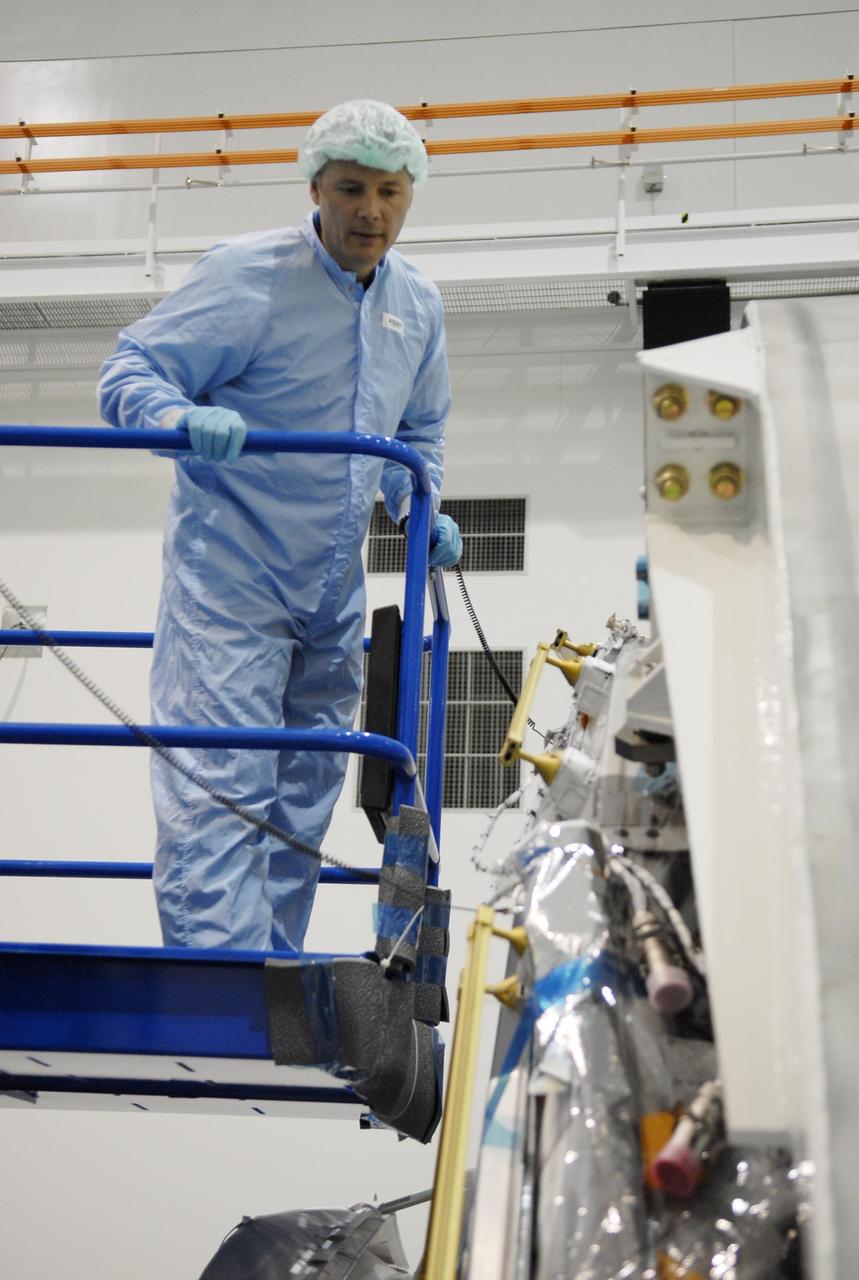
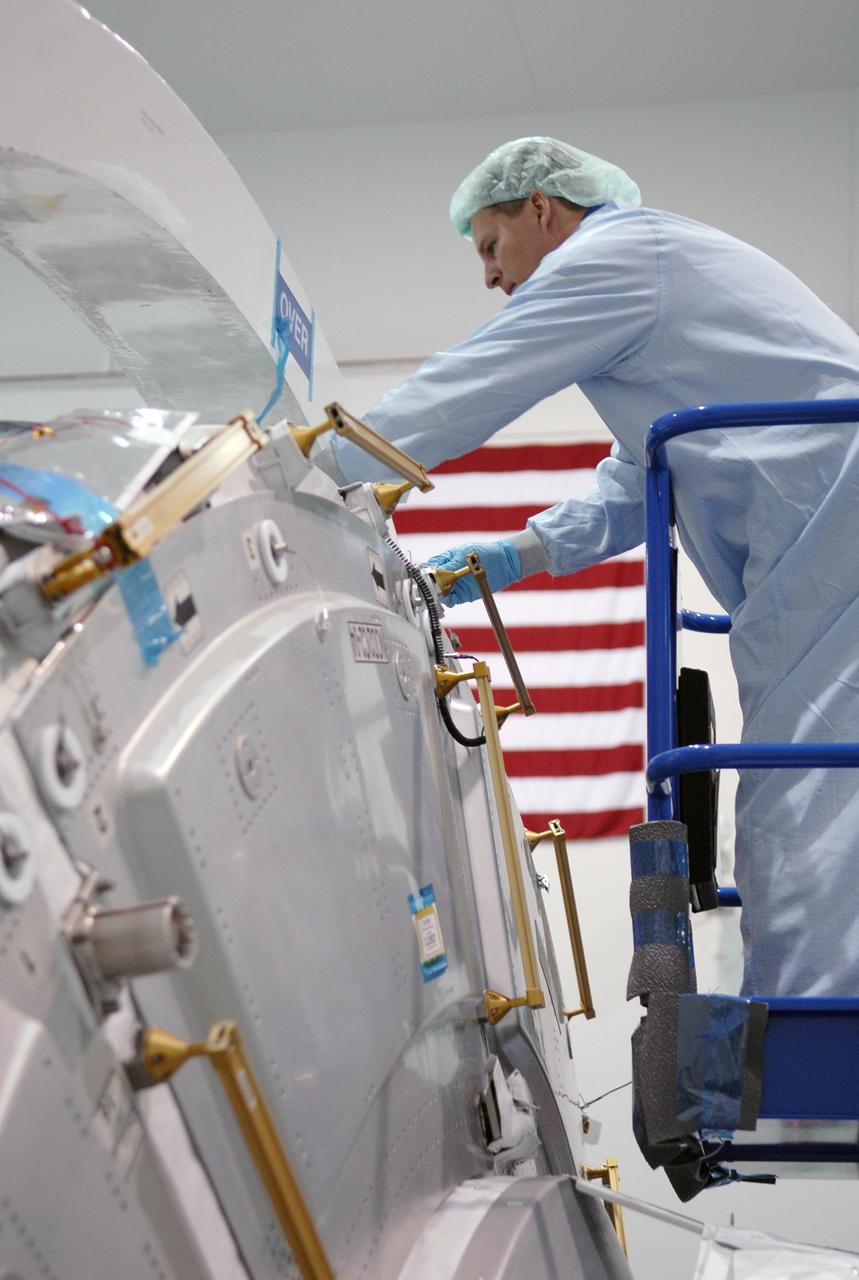
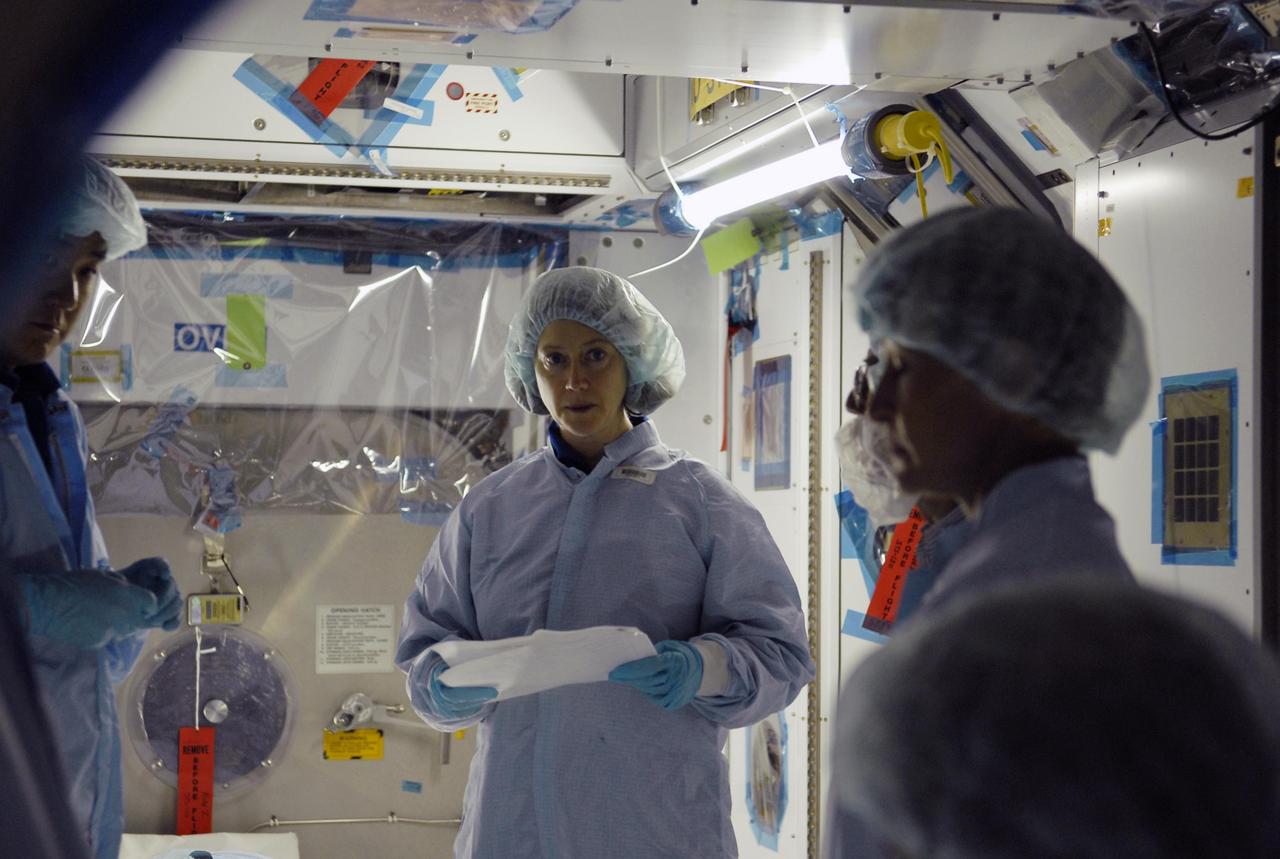
KENNEDY SPACE CENTER, FLA. - In the Space Station Processing Facility, STS-114 crew members get hands-on experience with a Video Stanchion Support Assembly (VSSA).  From left are Mission Specialist Soichi Noguchi, Commander Eileen Collins and Mission Specialists Charles Camarda and Stephen Robinson.  Noguchi is with the Japan Aerospace Exploration Agency, JAXA.  Camarda is a new addition to the mission crew. The STS-114 crew is at KSC to take part in crew equipment and orbiter familiarization.
KENNEDY SPACE CENTER, FLA. - In the Space Station Processing Facility, STS-114 crew members get hands-on experience with a Video Stanchion Support Assembly (VSSA). From left are Mission Specialist Soichi Noguchi, Commander Eileen Collins and Mission Specialists Charles Camarda and Stephen Robinson. Noguchi is with the Japan Aerospace Exploration Agency, JAXA. Camarda is a new addition to the mission crew. The STS-114 crew is at KSC to take part in crew equipment and orbiter familiarization.
KENNEDY SPACE CENTER, FLA. - In the Space Station Processing Facility, STS-114 crew members get hands-on experience with a Video Stanchion Support Assembly (VSSA).  From left are Mission Specialists Andrew Thomas, Stephen Robinson and Soichi Noguchi, who is with the Japan Aerospace Exploration Agency, JAXA.  Thomas is a new addition to the mission crew. The STS-114 crew is at KSC to take part in crew equipment and orbiter familiarization.
KENNEDY SPACE CENTER, FLA. - In the Space Station Processing Facility, STS-114 crew members get hands-on experience with a Video Stanchion Support Assembly (VSSA). From left are Mission Specialists Andrew Thomas, Stephen Robinson and Soichi Noguchi, who is with the Japan Aerospace Exploration Agency, JAXA. Thomas is a new addition to the mission crew. The STS-114 crew is at KSC to take part in crew equipment and orbiter familiarization.
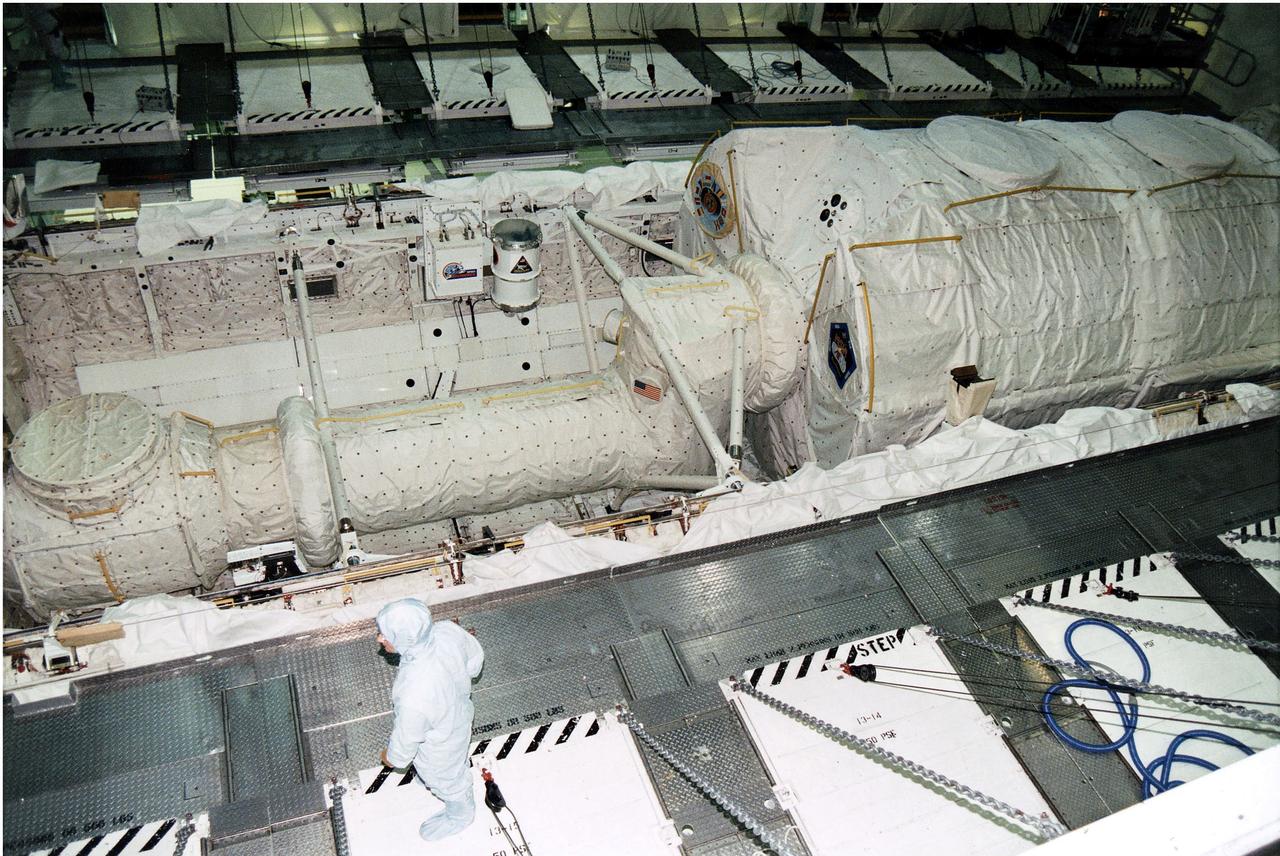
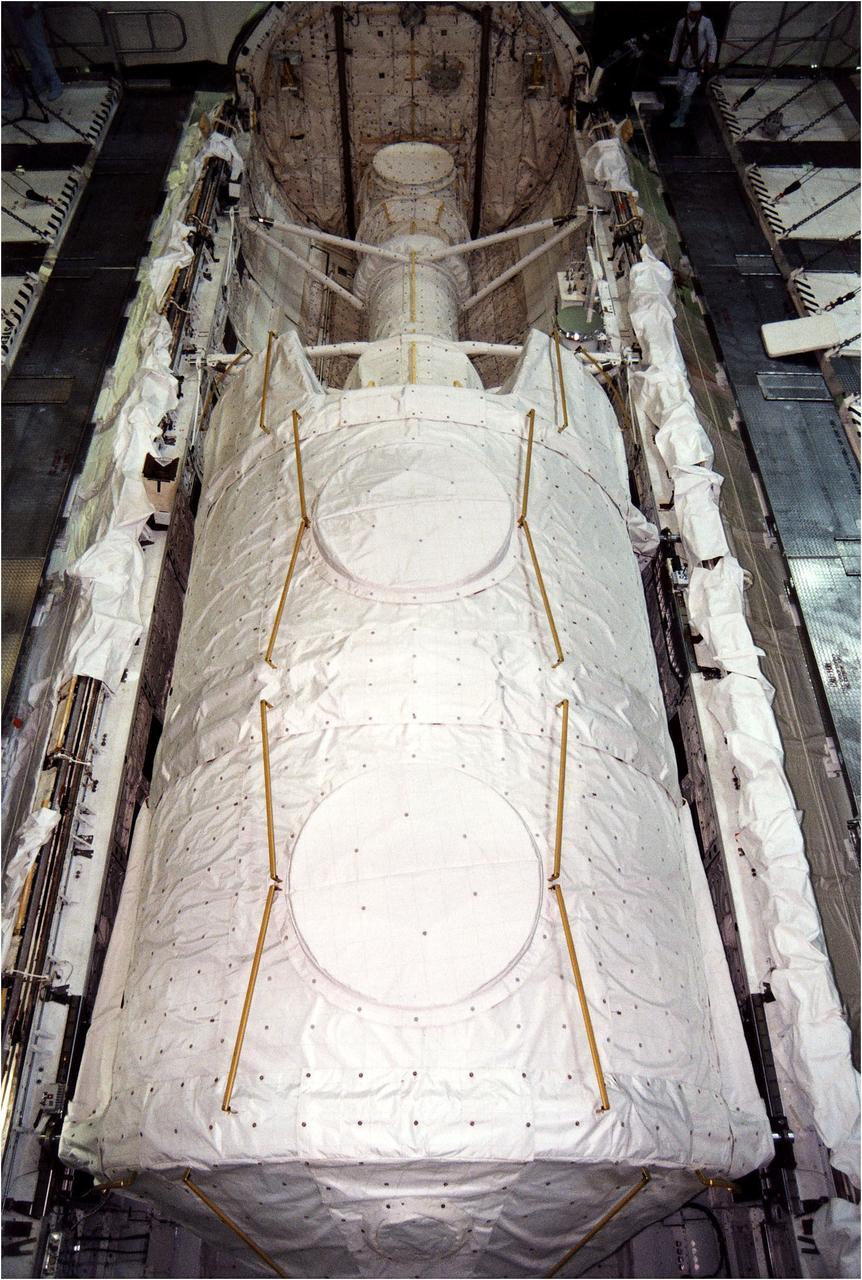
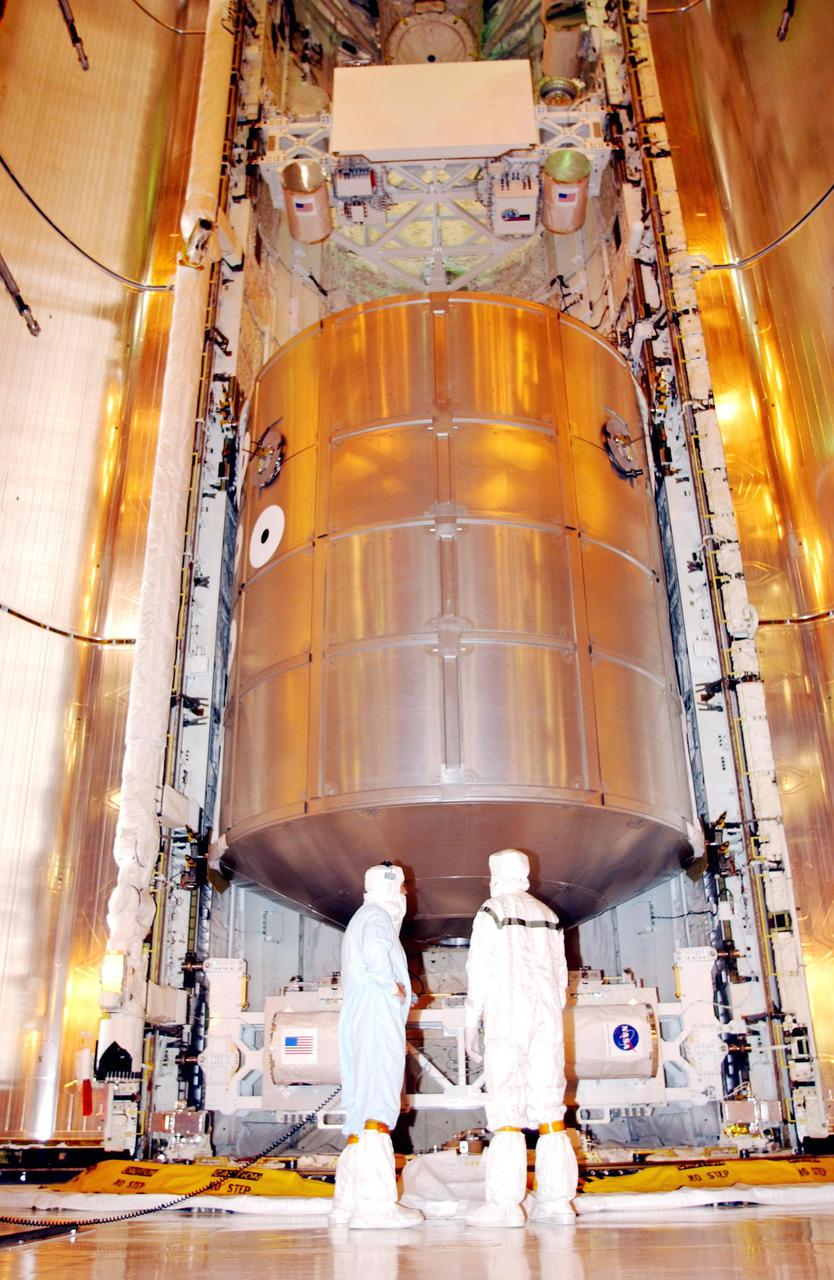
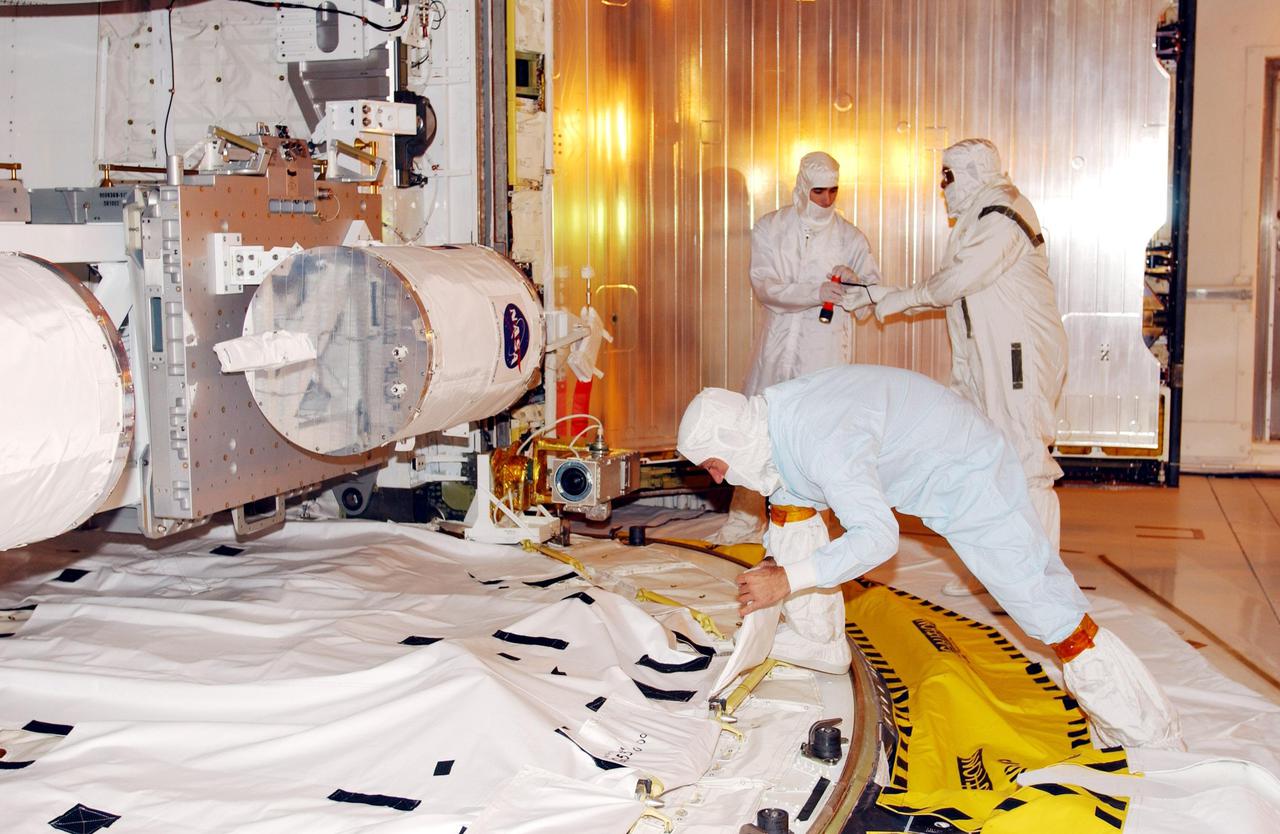
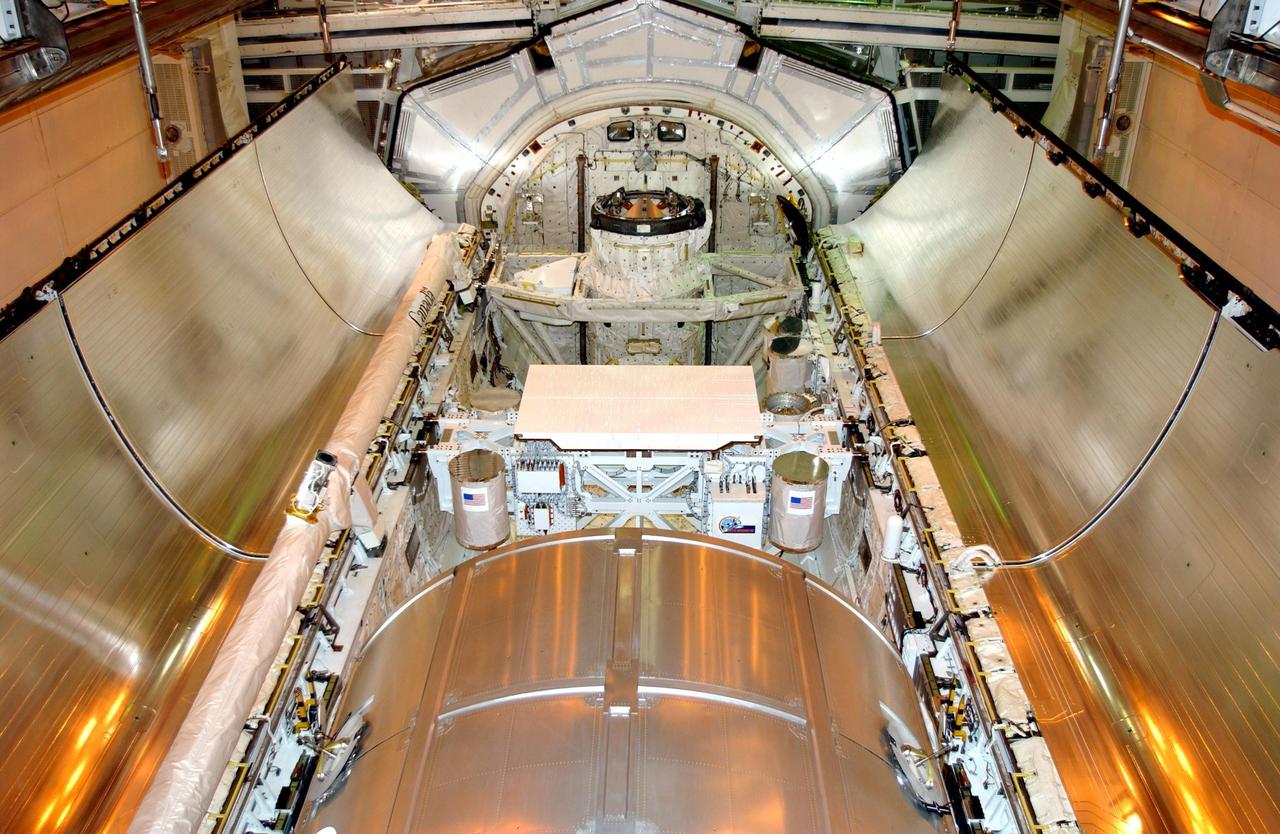
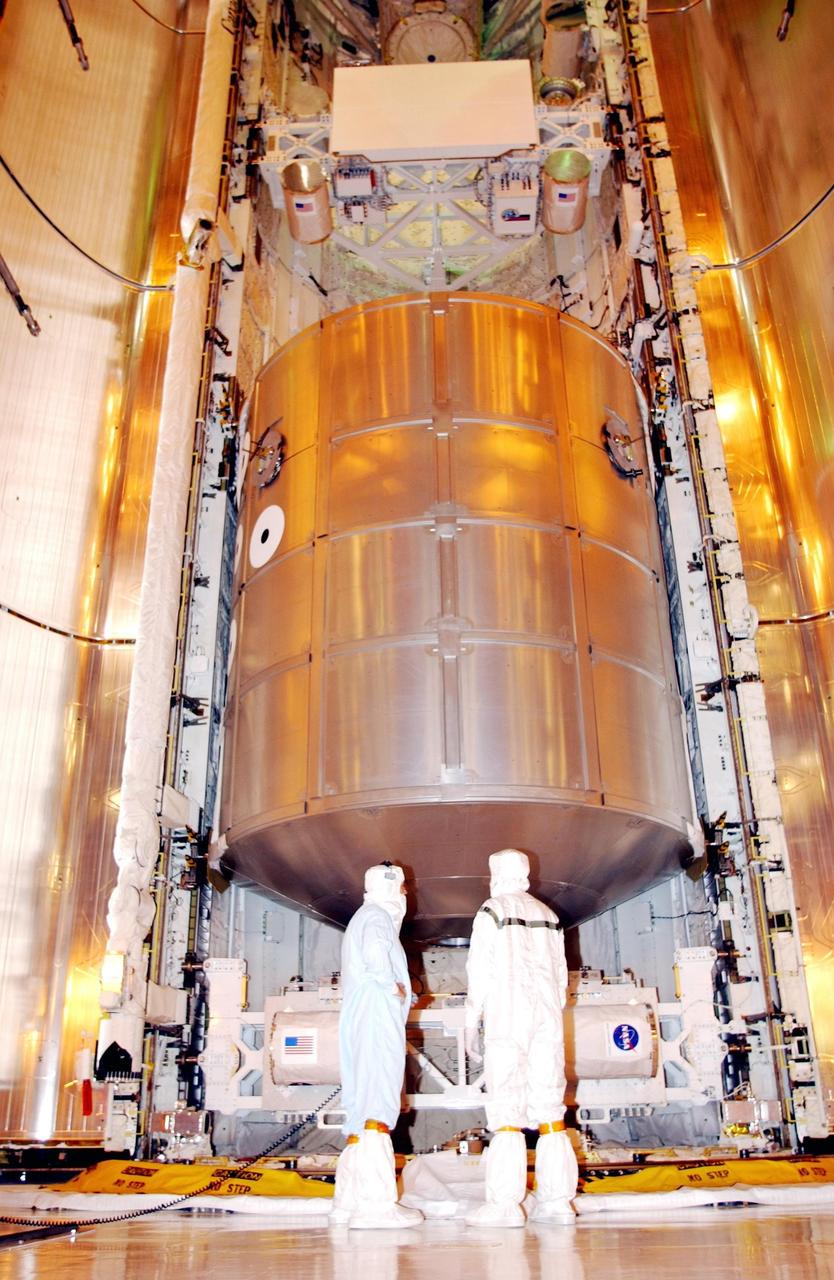
KENNEDY SPACE CENTER, FLA. - The Microgravity Science Laboratory-1 (MSL-1) Spacelab module is installed into the payload bay of the Space Shuttle Orbiter Columbia in Orbiter Processing Facility 1.  The Spacelab long crew transfer tunnel that leads from the orbiter's crew airlock to the module is also aboard, as well as the Hitchhiker Cryogenic Flexible Diode (CRYOFD) experiment payload, which is attached to the right side of Columbia's payload bay.  During the scheduled 16-day STS-83 mission, the MSL-1 will be used to test some of the hardware, facilities and procedures that are planned for use on the International Space Station while the flight crew conducts combustion, protein crystal growth and materials processing experiments.
KENNEDY SPACE CENTER, FLA. - The Microgravity Science Laboratory-1 (MSL-1) Spacelab module is installed into the payload bay of the Space Shuttle Orbiter Columbia in Orbiter Processing Facility 1. The Spacelab long crew transfer tunnel that leads from the orbiter's crew airlock to the module is also aboard, as well as the Hitchhiker Cryogenic Flexible Diode (CRYOFD) experiment payload, which is attached to the right side of Columbia's payload bay. During the scheduled 16-day STS-83 mission, the MSL-1 will be used to test some of the hardware, facilities and procedures that are planned for use on the International Space Station while the flight crew conducts combustion, protein crystal growth and materials processing experiments.
KENNEDY SPACE CENTER, FLA. - The Microgravity Science Laboratory-1 (MSL-1) Spacelab module is installed into the payload bay of the Space Shuttle Orbiter Columbia in Orbiter Processing Facility 1.  The Spacelab long crew transfer tunnel that leads from the orbiter's crew airlock to the module is also aboard, as well as the Hitchhiker Cryogenic Flexible Diode (CRYOFD) experiment payload, which is attached to the right side of Columbia's payload bay.  During the scheduled 16-day STS-83 mission, the MSL-1 will be used to test some of the hardware, facilities and procedures that are planned for use on the International Space Station while the flight crew conducts combustion, protein crystal growth and materials processing experiments.
KENNEDY SPACE CENTER, FLA. - The Microgravity Science Laboratory-1 (MSL-1) Spacelab module is installed into the payload bay of the Space Shuttle Orbiter Columbia in Orbiter Processing Facility 1. The Spacelab long crew transfer tunnel that leads from the orbiter's crew airlock to the module is also aboard, as well as the Hitchhiker Cryogenic Flexible Diode (CRYOFD) experiment payload, which is attached to the right side of Columbia's payload bay. During the scheduled 16-day STS-83 mission, the MSL-1 will be used to test some of the hardware, facilities and procedures that are planned for use on the International Space Station while the flight crew conducts combustion, protein crystal growth and materials processing experiments.
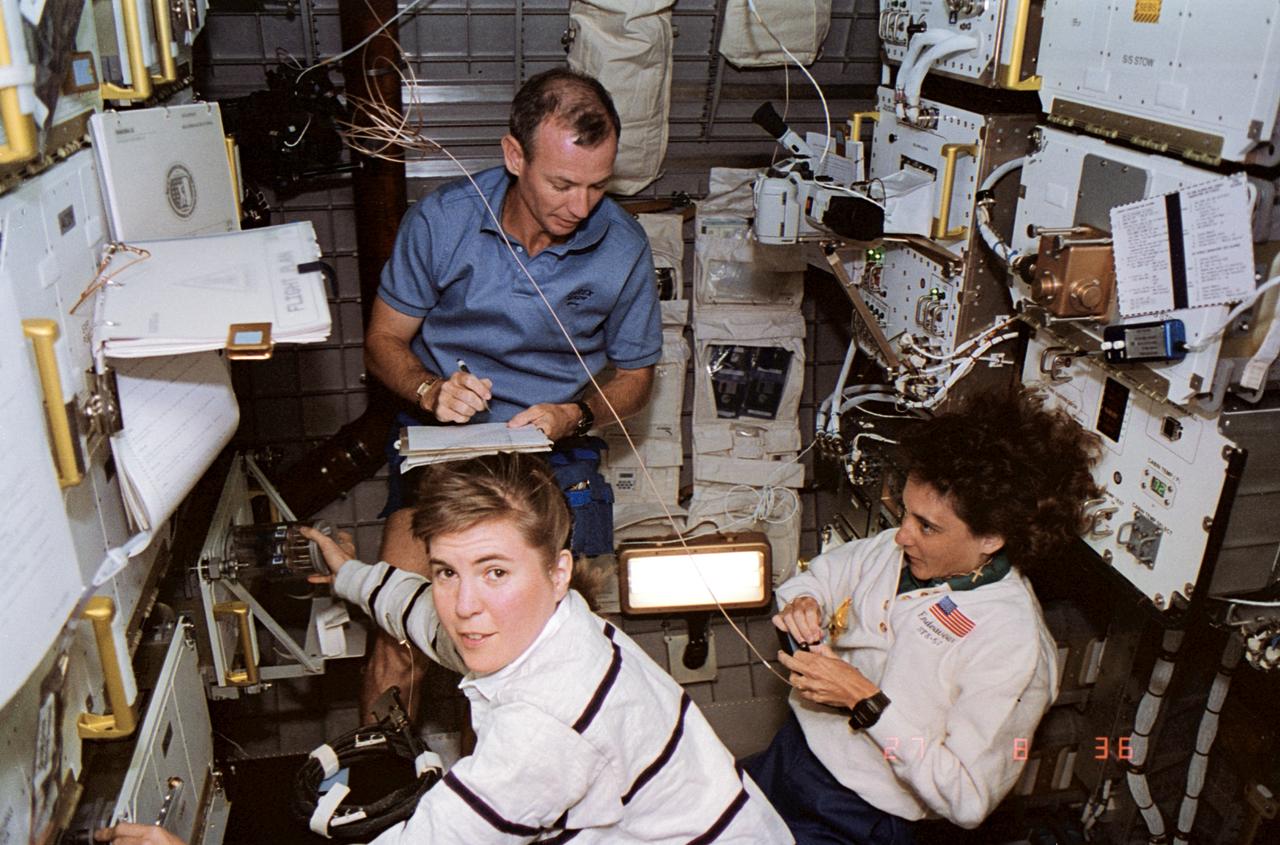
STS057-39-001 (27 June 1993) --- This high angle shot inside the SPACEHAB module, onboard the Space Shuttle Endeavour, typifies the pace of activity conducted there during the ten-day STS-57 mission. Astronaut Janice E. Voss (foreground), mission specialist, works with biomaterials products, while astronauts Brian Duffy, pilot, and Nancy J. Sherlock, mission specialist, participate in other tasks.
STS-57 crewmembers work inside the SPACEHAB-01 module aboard OV-105
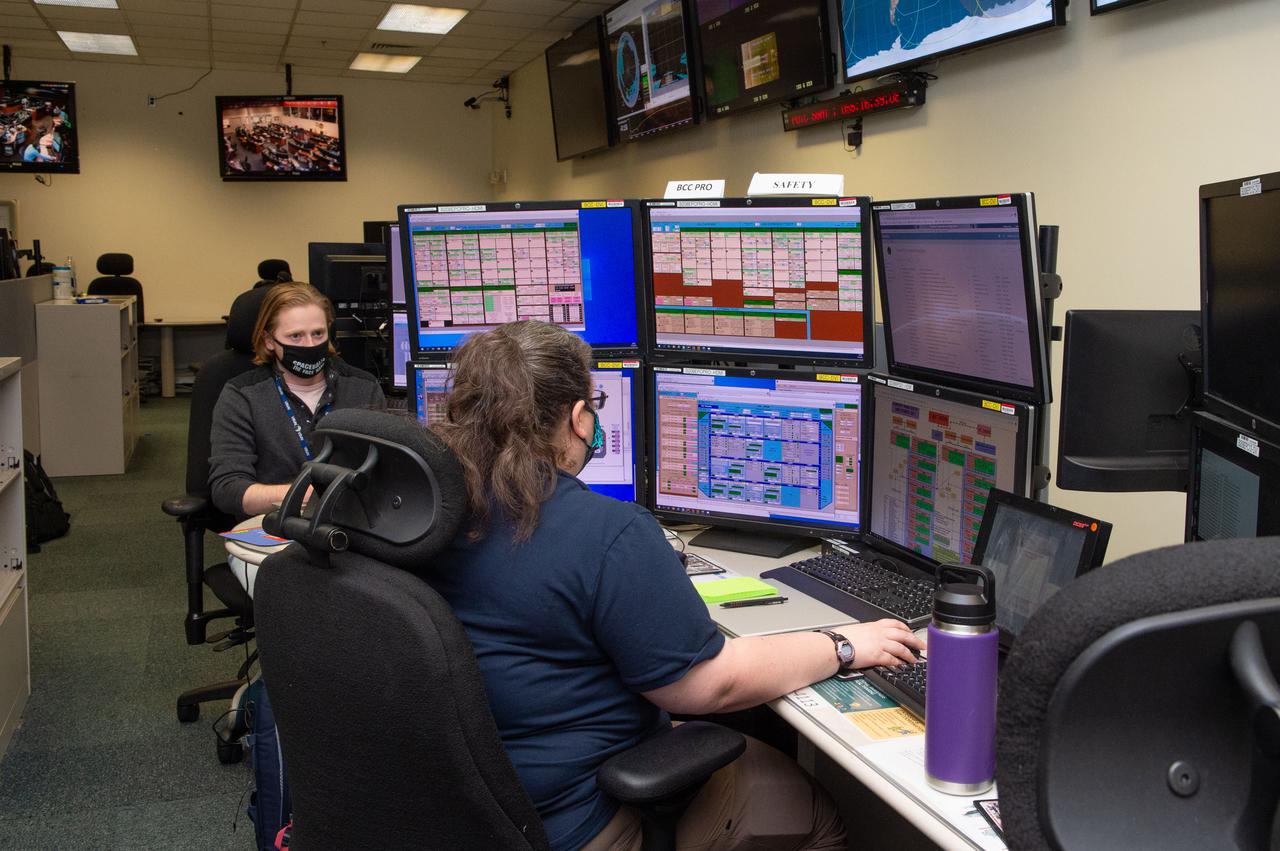
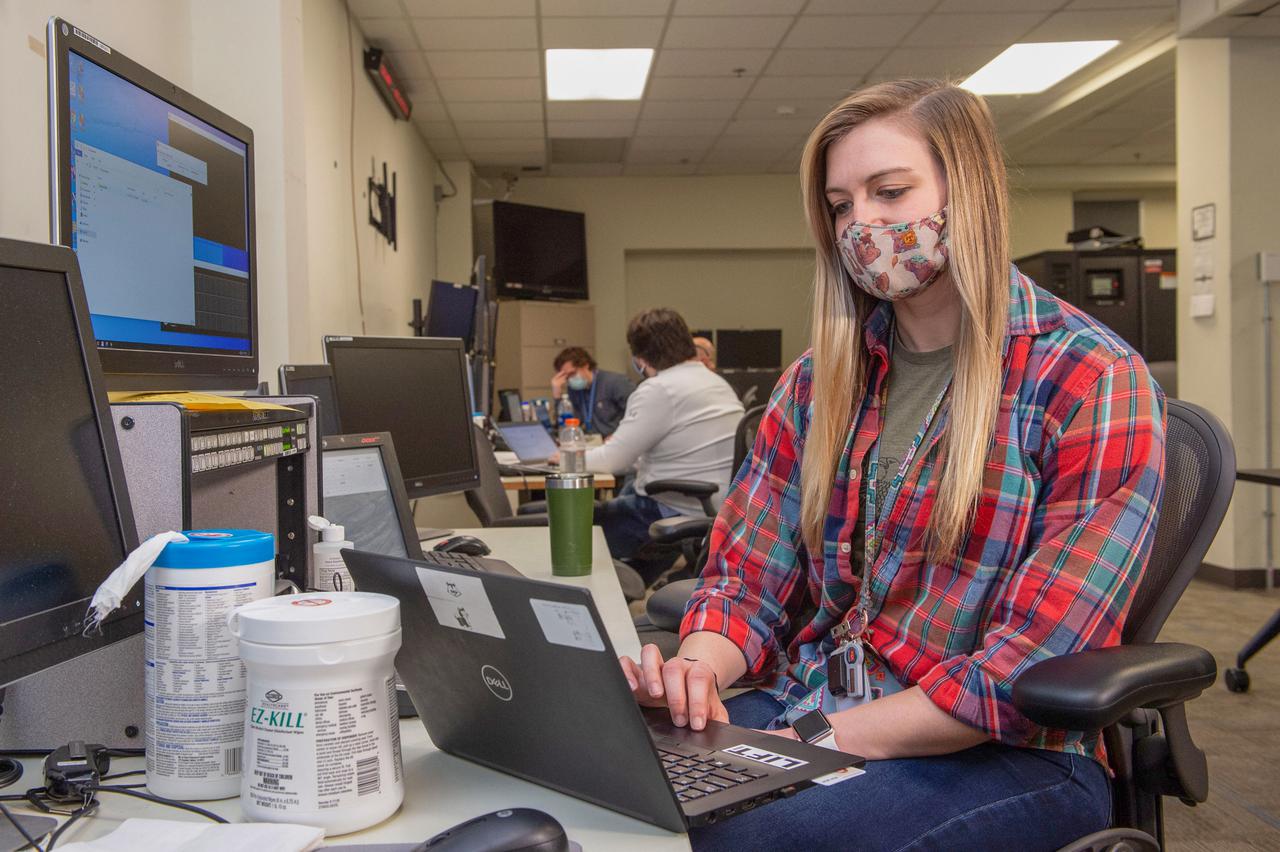
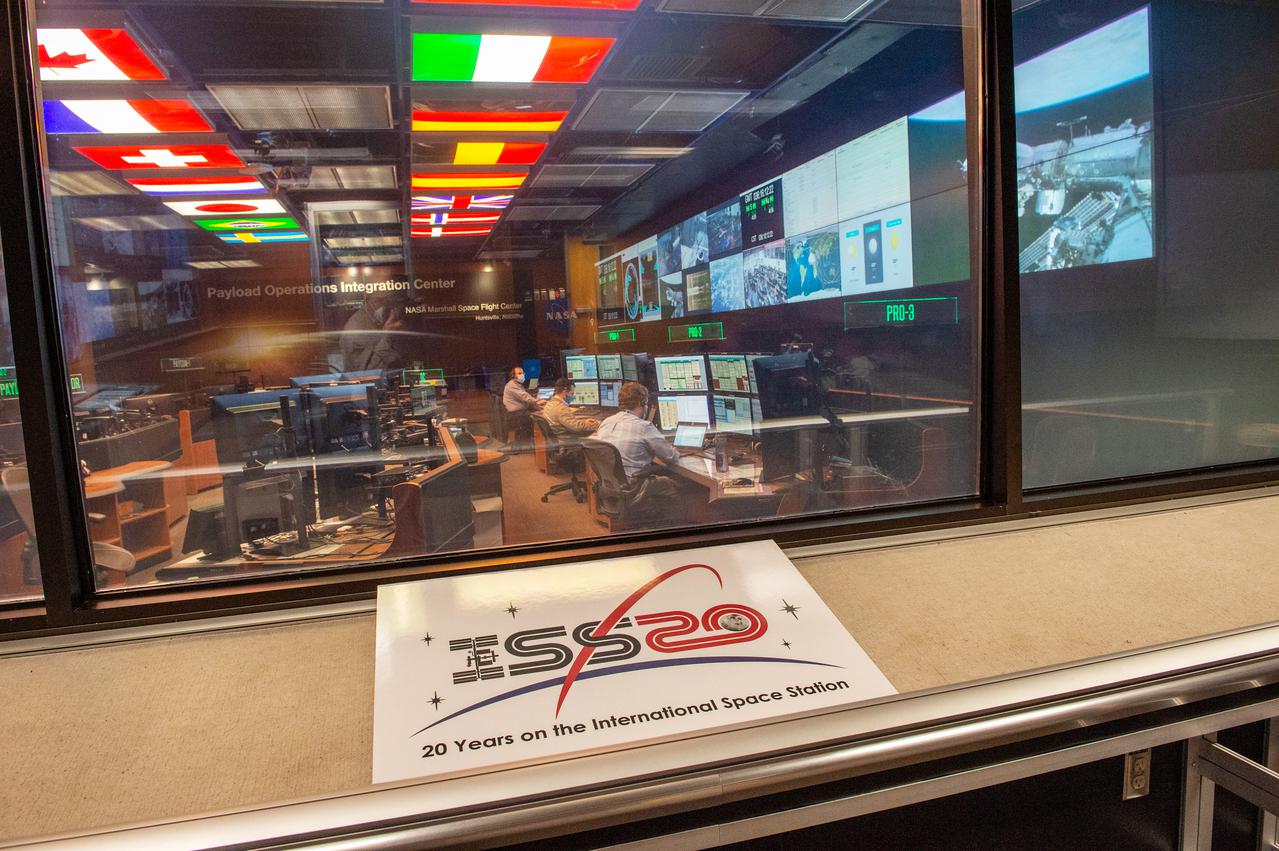
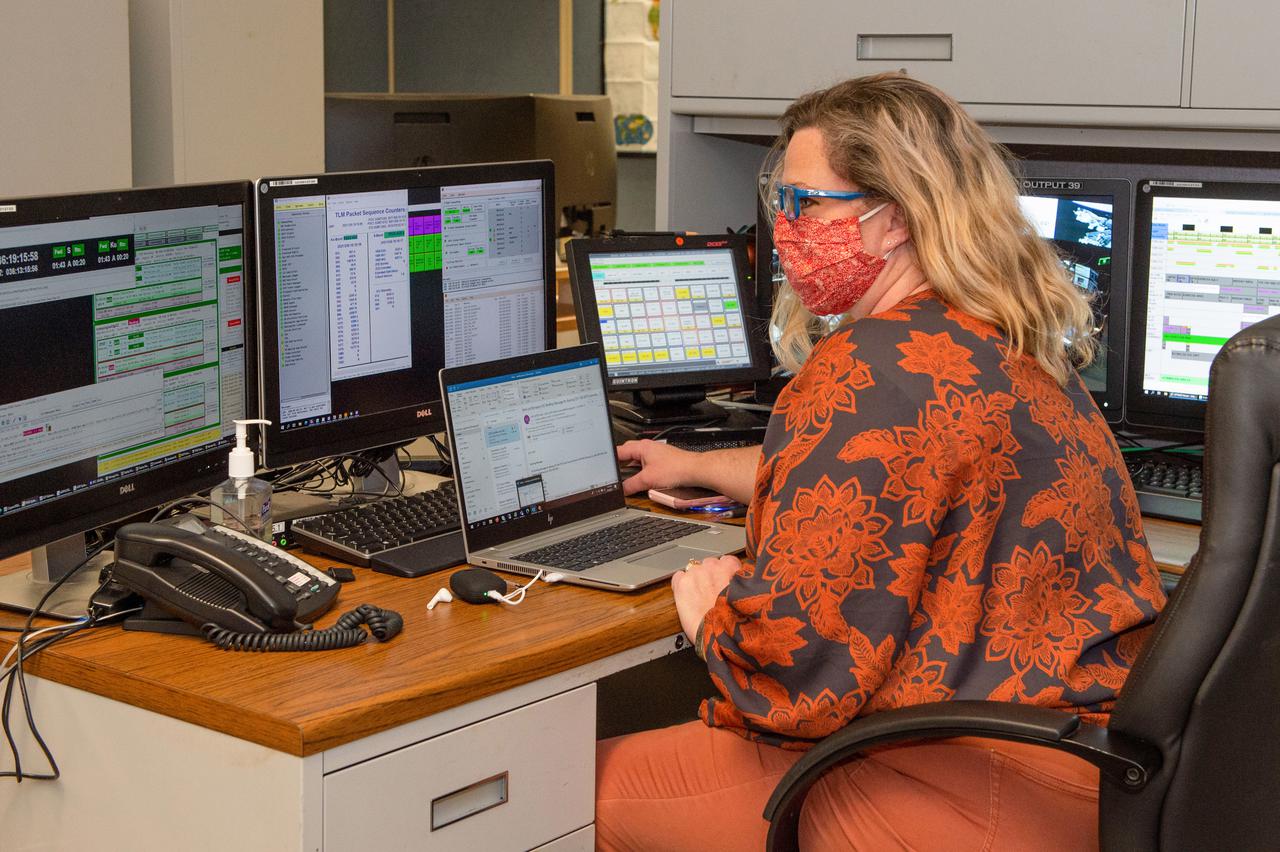
A look inside the International Space Station Payload Operations Integration Center at NASA’s Marshall Space Flight Center in Huntsville, AL.  The POIC team supports science operations on the International Space Station 24 hours a day, 7 days a week. For more than 20 years the POIC team has worked with scientists from around the world to enable the space station crew to conduct experiments that improve life on Earth and enable future exploration.
A look inside the International Space Station Payload Operations Integration Center at NASA’s Marshall Space Flight Center in Huntsville, AL. The POIC team supports science operations on the International Space Station 24 hours a day, 7 days a week. For more than 20 years the POIC team has worked with scientists from around the world to enable the space station crew to conduct experiments that improve life on Earth and enable future exploration.
A look inside the International Space Station Payload Operations Integration Center at NASA’s Marshall Space Flight Center in Huntsville, AL.  The POIC team supports science operations on the International Space Station 24 hours a day, 7 days a week. For more than 20 years the POIC team has worked with scientists from around the world to enable the space station crew to conduct experiments that improve life on Earth and enable future exploration.
A look inside the International Space Station Payload Operations Integration Center at NASA’s Marshall Space Flight Center in Huntsville, AL. The POIC team supports science operations on the International Space Station 24 hours a day, 7 days a week. For more than 20 years the POIC team has worked with scientists from around the world to enable the space station crew to conduct experiments that improve life on Earth and enable future exploration.
A look inside the International Space Station Payload Operations Integration Center at NASA’s Marshall Space Flight Center in Huntsville, AL.  The POIC team supports science operations on the International Space Station 24 hours a day, 7 days a week. For more than 20 years the POIC team has worked with scientists from around the world to enable the space station crew to conduct experiments that improve life on Earth and enable future exploration.
A look inside the International Space Station Payload Operations Integration Center at NASA’s Marshall Space Flight Center in Huntsville, AL. The POIC team supports science operations on the International Space Station 24 hours a day, 7 days a week. For more than 20 years the POIC team has worked with scientists from around the world to enable the space station crew to conduct experiments that improve life on Earth and enable future exploration.
A look inside the International Space Station Payload Operations Integration Center at NASA’s Marshall Space Flight Center in Huntsville, AL.  The POIC team supports science operations on the International Space Station 24 hours a day, 7 days a week. For more than 20 years the POIC team has worked with scientists from around the world to enable the space station crew to conduct experiments that improve life on Earth and enable future exploration.
A look inside the International Space Station Payload Operations Integration Center at NASA’s Marshall Space Flight Center in Huntsville, AL. The POIC team supports science operations on the International Space Station 24 hours a day, 7 days a week. For more than 20 years the POIC team has worked with scientists from around the world to enable the space station crew to conduct experiments that improve life on Earth and enable future exploration.
A look inside the International Space Station Payload Operations Integration Center at NASA’s Marshall Space Flight Center in Huntsville, AL.  The POIC team supports science operations on the International Space Station 24 hours a day, 7 days a week. For more than 20 years the POIC team has worked with scientists from around the world to enable the space station crew to conduct experiments that improve life on Earth and enable future exploration.
A look inside the International Space Station Payload Operations Integration Center at NASA’s Marshall Space Flight Center in Huntsville, AL. The POIC team supports science operations on the International Space Station 24 hours a day, 7 days a week. For more than 20 years the POIC team has worked with scientists from around the world to enable the space station crew to conduct experiments that improve life on Earth and enable future exploration.
A look inside the International Space Station Payload Operations Integration Center at NASA’s Marshall Space Flight Center in Huntsville, AL.  The POIC team supports science operations on the International Space Station 24 hours a day, 7 days a week. For more than 20 years the POIC team has worked with scientists from around the world to enable the space station crew to conduct experiments that improve life on Earth and enable future exploration.
A look inside the International Space Station Payload Operations Integration Center at NASA’s Marshall Space Flight Center in Huntsville, AL. The POIC team supports science operations on the International Space Station 24 hours a day, 7 days a week. For more than 20 years the POIC team has worked with scientists from around the world to enable the space station crew to conduct experiments that improve life on Earth and enable future exploration.
A look inside the International Space Station Payload Operations Integration Center at NASA’s Marshall Space Flight Center in Huntsville, AL.  The POIC team supports science operations on the International Space Station 24 hours a day, 7 days a week. For more than 20 years the POIC team has worked with scientists from around the world to enable the space station crew to conduct experiments that improve life on Earth and enable future exploration.
A look inside the International Space Station Payload Operations Integration Center at NASA’s Marshall Space Flight Center in Huntsville, AL. The POIC team supports science operations on the International Space Station 24 hours a day, 7 days a week. For more than 20 years the POIC team has worked with scientists from around the world to enable the space station crew to conduct experiments that improve life on Earth and enable future exploration.
A look inside the International Space Station Payload Operations Integration Center at NASA’s Marshall Space Flight Center in Huntsville, AL.  The POIC team supports science operations on the International Space Station 24 hours a day, 7 days a week. For more than 20 years the POIC team has worked with scientists from around the world to enable the space station crew to conduct experiments that improve life on Earth and enable future exploration.
A look inside the International Space Station Payload Operations Integration Center at NASA’s Marshall Space Flight Center in Huntsville, AL. The POIC team supports science operations on the International Space Station 24 hours a day, 7 days a week. For more than 20 years the POIC team has worked with scientists from around the world to enable the space station crew to conduct experiments that improve life on Earth and enable future exploration.
A look inside the International Space Station Payload Operations Integration Center at NASA’s Marshall Space Flight Center in Huntsville, AL.  The POIC team supports science operations on the International Space Station 24 hours a day, 7 days a week. For more than 20 years the POIC team has worked with scientists from around the world to enable the space station crew to conduct experiments that improve life on Earth and enable future exploration.
A look inside the International Space Station Payload Operations Integration Center at NASA’s Marshall Space Flight Center in Huntsville, AL. The POIC team supports science operations on the International Space Station 24 hours a day, 7 days a week. For more than 20 years the POIC team has worked with scientists from around the world to enable the space station crew to conduct experiments that improve life on Earth and enable future exploration.
A look inside the International Space Station Payload Operations Integration Center at NASA’s Marshall Space Flight Center in Huntsville, AL.  The POIC team supports science operations on the International Space Station 24 hours a day, 7 days a week. For more than 20 years the POIC team has worked with scientists from around the world to enable the space station crew to conduct experiments that improve life on Earth and enable future exploration.
A look inside the International Space Station Payload Operations Integration Center at NASA’s Marshall Space Flight Center in Huntsville, AL. The POIC team supports science operations on the International Space Station 24 hours a day, 7 days a week. For more than 20 years the POIC team has worked with scientists from around the world to enable the space station crew to conduct experiments that improve life on Earth and enable future exploration.
A look inside the International Space Station Payload Operations Integration Center at NASA’s Marshall Space Flight Center in Huntsville, AL.  The POIC team supports science operations on the International Space Station 24 hours a day, 7 days a week. For more than 20 years the POIC team has worked with scientists from around the world to enable the space station crew to conduct experiments that improve life on Earth and enable future exploration.
A look inside the International Space Station Payload Operations Integration Center at NASA’s Marshall Space Flight Center in Huntsville, AL. The POIC team supports science operations on the International Space Station 24 hours a day, 7 days a week. For more than 20 years the POIC team has worked with scientists from around the world to enable the space station crew to conduct experiments that improve life on Earth and enable future exploration.
A look inside the International Space Station Payload Operations Integration Center at NASA’s Marshall Space Flight Center in Huntsville, AL.  The POIC team supports science operations on the International Space Station 24 hours a day, 7 days a week. For more than 20 years the POIC team has worked with scientists from around the world to enable the space station crew to conduct experiments that improve life on Earth and enable future exploration.
A look inside the International Space Station Payload Operations Integration Center at NASA’s Marshall Space Flight Center in Huntsville, AL. The POIC team supports science operations on the International Space Station 24 hours a day, 7 days a week. For more than 20 years the POIC team has worked with scientists from around the world to enable the space station crew to conduct experiments that improve life on Earth and enable future exploration.
A look inside the International Space Station Payload Operations Integration Center at NASA’s Marshall Space Flight Center in Huntsville, AL.  The POIC team supports science operations on the International Space Station 24 hours a day, 7 days a week. For more than 20 years the POIC team has worked with scientists from around the world to enable the space station crew to conduct experiments that improve life on Earth and enable future exploration.
A look inside the International Space Station Payload Operations Integration Center at NASA’s Marshall Space Flight Center in Huntsville, AL. The POIC team supports science operations on the International Space Station 24 hours a day, 7 days a week. For more than 20 years the POIC team has worked with scientists from around the world to enable the space station crew to conduct experiments that improve life on Earth and enable future exploration.
A look inside the International Space Station Payload Operations Integration Center at NASA’s Marshall Space Flight Center in Huntsville, AL.  The POIC team supports science operations on the International Space Station 24 hours a day, 7 days a week. For more than 20 years the POIC team has worked with scientists from around the world to enable the space station crew to conduct experiments that improve life on Earth and enable future exploration.
A look inside the International Space Station Payload Operations Integration Center at NASA’s Marshall Space Flight Center in Huntsville, AL. The POIC team supports science operations on the International Space Station 24 hours a day, 7 days a week. For more than 20 years the POIC team has worked with scientists from around the world to enable the space station crew to conduct experiments that improve life on Earth and enable future exploration.
A look inside the International Space Station Payload Operations Integration Center at NASA’s Marshall Space Flight Center in Huntsville, AL.  The POIC team supports science operations on the International Space Station 24 hours a day, 7 days a week. For more than 20 years the POIC team has worked with scientists from around the world to enable the space station crew to conduct experiments that improve life on Earth and enable future exploration.
A look inside the International Space Station Payload Operations Integration Center at NASA’s Marshall Space Flight Center in Huntsville, AL. The POIC team supports science operations on the International Space Station 24 hours a day, 7 days a week. For more than 20 years the POIC team has worked with scientists from around the world to enable the space station crew to conduct experiments that improve life on Earth and enable future exploration.
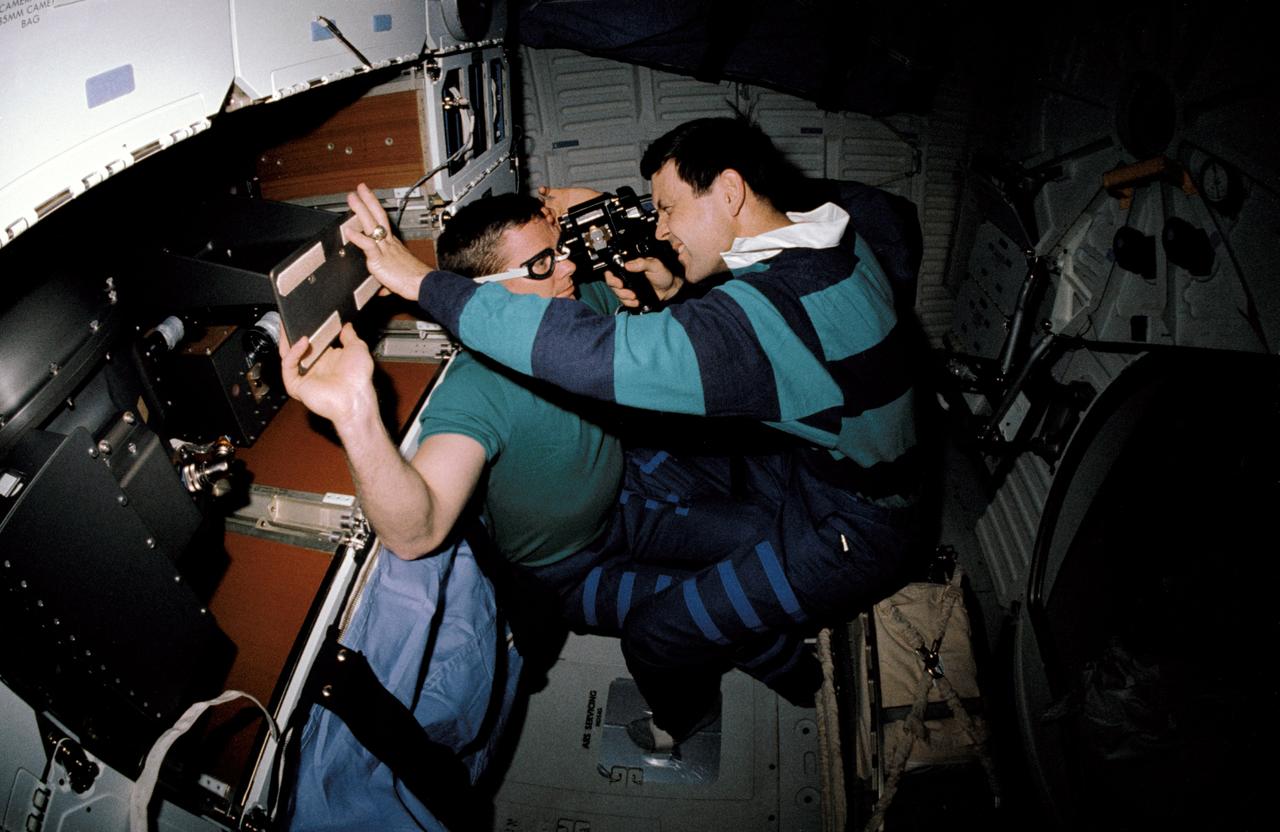
STS041-02-015 (6-10 Oct. 1990) --- A 35mm scene showing astronauts Robert D. Cabana (right), STS-41 pilot, and Bruce E. Melnick, mission specialist, participating in a detailed supplemental objective for STS-41 involving retinal photography. The hypothesis of this experiment is that retinal photographs taken on orbit will show evidence of increased intracranial pressure (ICP) and the evidence of increased ICP and the development of Space Adaptation Syndrome (SAS) will be correlated. SAS has been a subject of on-orbit analysis since the early days of space shuttle.
STS-41 crewmembers conduct DSO 0474 Retinal Photography on OV-103's middeck
STS031-04-002 (24-29 April 1990) --- Astronauts Kathryn D. Sullivan and Bruce McCandless II, mission specialists, work together to perform one of the mission's medical experiments.  The experiment is Detailed Supplementary Objective (DSO) 462, Non invasive Estimation of Central Venous Pressure During Spaceflight.  Sullivan applies a gel substance to a transducer which will be placed on McCandless' jugular vein to collect the sought data.  The cable links to a data recorder.
STS-31 MS Sullivan, MS McCandless, DSO 462 medical device on OV-103 middeck
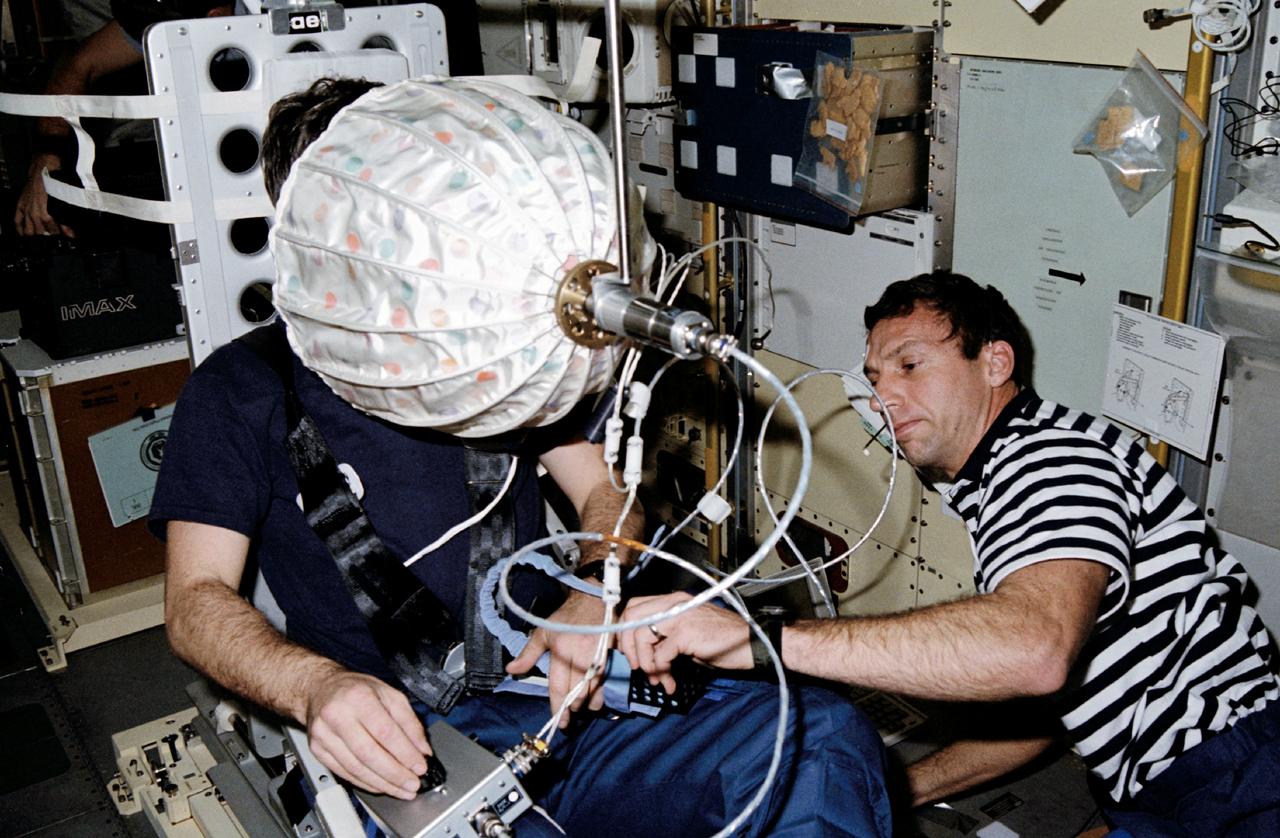
STS042-203-024 (22-30 Jan. 1992) --- Astronaut David C. Hilmers (right), STS-42 mission specialist, assists European Space Agency (ESA) payload specialist Ulf Merbold with the visual stimulator experiment on the Space Shuttle Discovery's middeck. This particular test is part of an ongoing study of the Space Adaptation Syndrome (SAS). Seated in a stationary mini-sled, Merbold (or any other subject for this test) stares at an umbrella-shaped rotating dome with a pattern of colored dots on its interior. While observing the rotating dome, the subject turns a knob to indicate his perception of body rotation. The strength of circular vection is calculated by comparing the signals from the dome and the knob. The greater the false sense of circular vection, the more the subject is relying on visual information instead of otolith information.
STS-42 MS Hilmers and Payload Specialist Merbold use IML-1 visual stimulator
STS047-02-003 (12 - 20 Sept 1992) --- Astronaut N. Jan Davis, mission specialist, works at the Continuous Heating Furnace (CHF) in the Spacelab-J Science Module.  This furnace provided temperatures up to 1,300 degrees Celsius and rapid cooling to two sets of samples concurrently.  The furnace accommodated in-space experiments in the Fabrication of Si-As-Te:Ni Ternary Amorphous Semiconductor and the Crystal Growth of Compound Semiconductors.  These were two of the many experiments designed and monitored by Japan's National Space Development Agency (NASDA).
STS-47 MS Davis uses SLJ Rack 8 continuous heating furnace (CHF) on OV-105
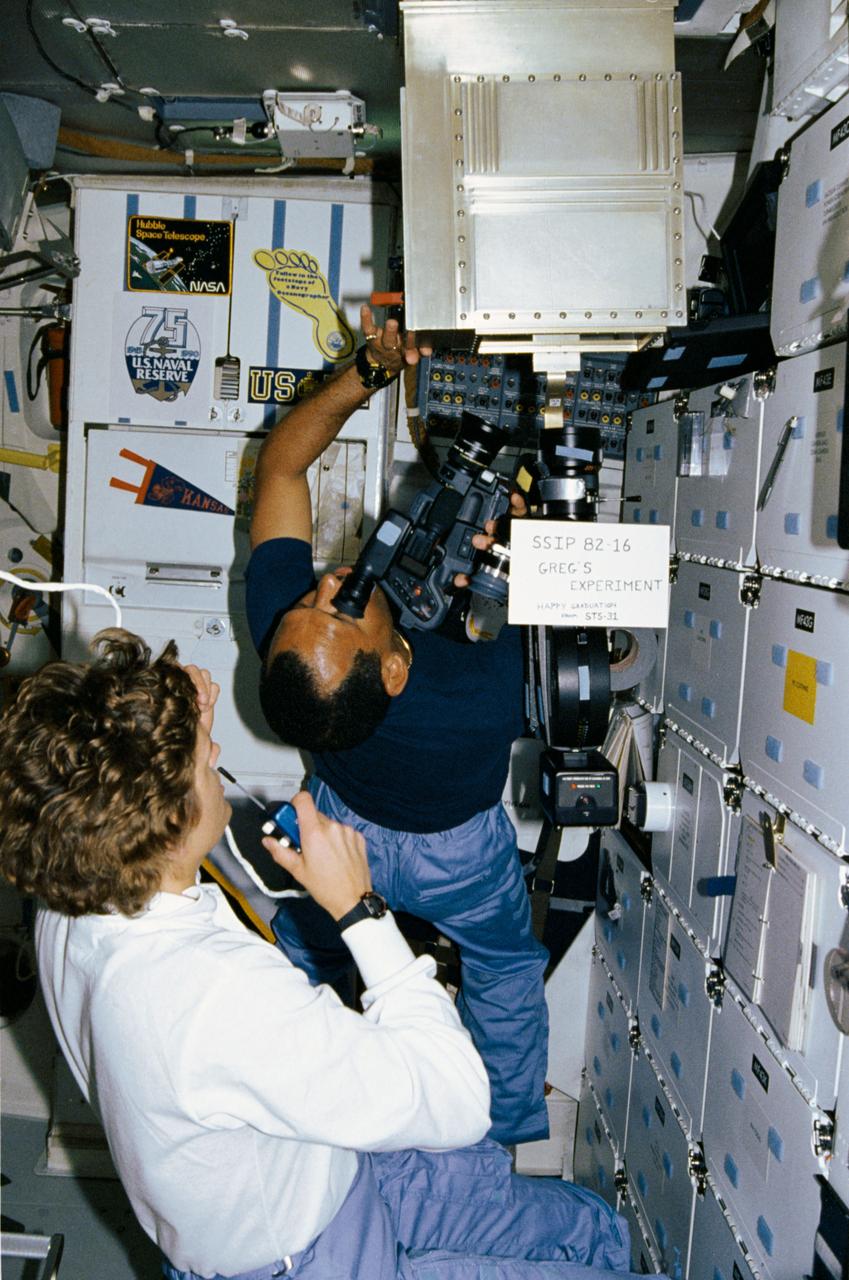
STS-31 Mission Specialist (MS) Kathryn D. Sullivan monitors and advises ground controllers of the activity inside the Student Experiment (SE) 82-16, Ion arc - studies of the effects of microgravity and a magnetic field on an electric arc, mounted in front of the middeck lockers aboard Discovery, Orbiter Vehicle (OV) 103. Pilot Charles F. Bolden uses a video camera and an ARRIFLEX motion picture camera to record the activity inside the special chamber. A sign in front of the experiment reads "SSIP 82-16 Greg's Experiment Happy Graduation from STS-31." SSIP stands for Shuttle Student Involvement Program. Gregory S. Peterson who developed the experiment (Greg's Experiment) is a student at Utah State University and monitored the experiment's operation from JSC's Mission Control Center (MCC) during the flight. Decals displayed in the background on the orbiter galley represent the Hubble Space Telescope (HST), the United States (U.S.) Naval Reserve, Navy Oceanographers, U.S. Navy, and University of Kansas.
STS-31 MS Sullivan & Pilot Bolden monitor SE 82-16 Ion Arc on OV-103 middeck
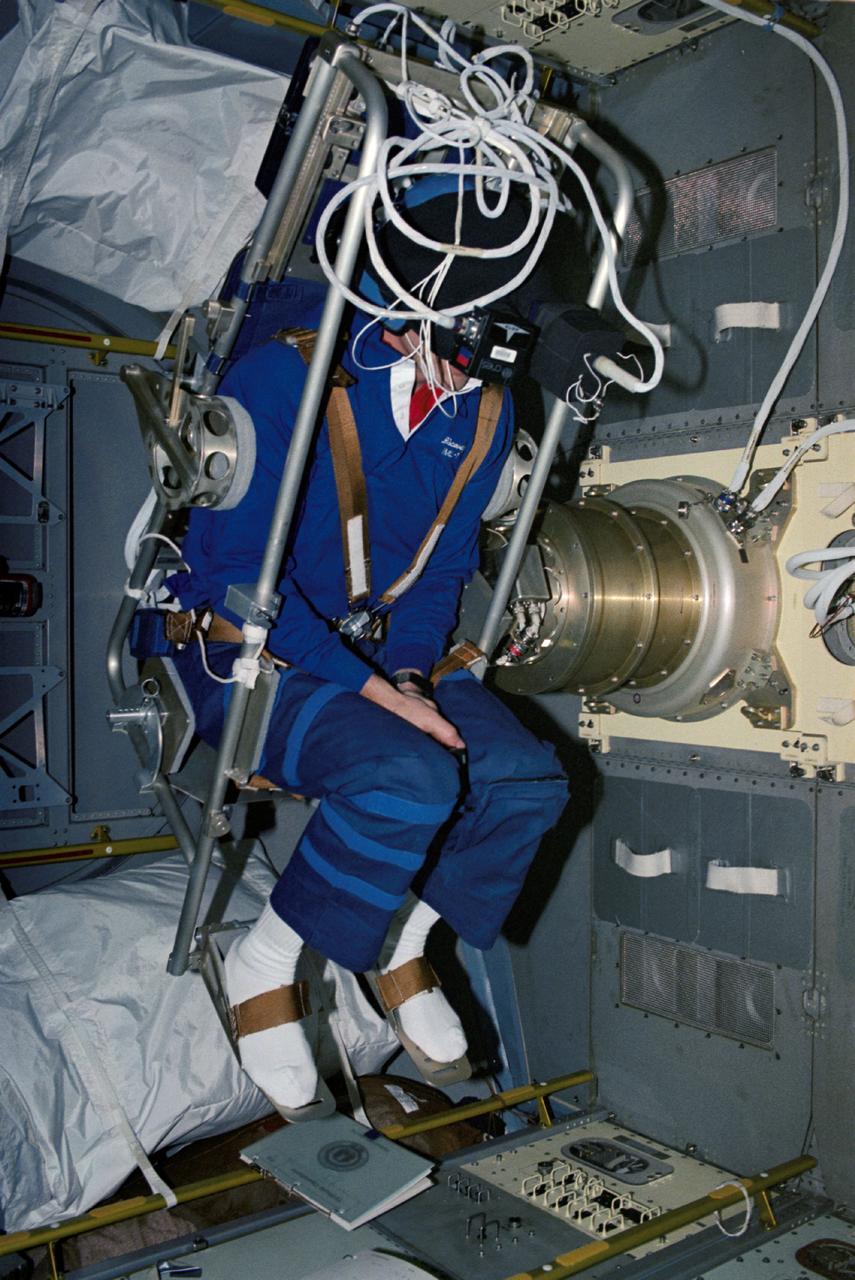
STS042-27-037 (22-30 Jan. 1992) --- Astronaut David C. Hilmers, STS-42 mission specialist, wearing a helmet assembly, sits in the Microgravity Vestibular Investigation (MVI) rotating chair.  The scene is in the International Microgravity Laboratory (IML-1) science module aboard Discovery.  Hilmers, a mission specialist, and six other crewmembers spent more than eight days in Earth-orbit conducting experiments. Hilmer's helmet assembly is outfitted with accelerometers to measure head movements and visors that fit over each eye independently to provide visual stimuli.  The chair system has three movement patterns:  "sinusoidal" or traveling predictably back and forth over the same distance at a constant speed; "pseudorandom" or moving back and forth over the varying distances; and "stepped" or varying speeds beginning and stopping suddenly.
STS-42 Mission Specialist (MS) Hilmers in IML-1's MVI rotator chair
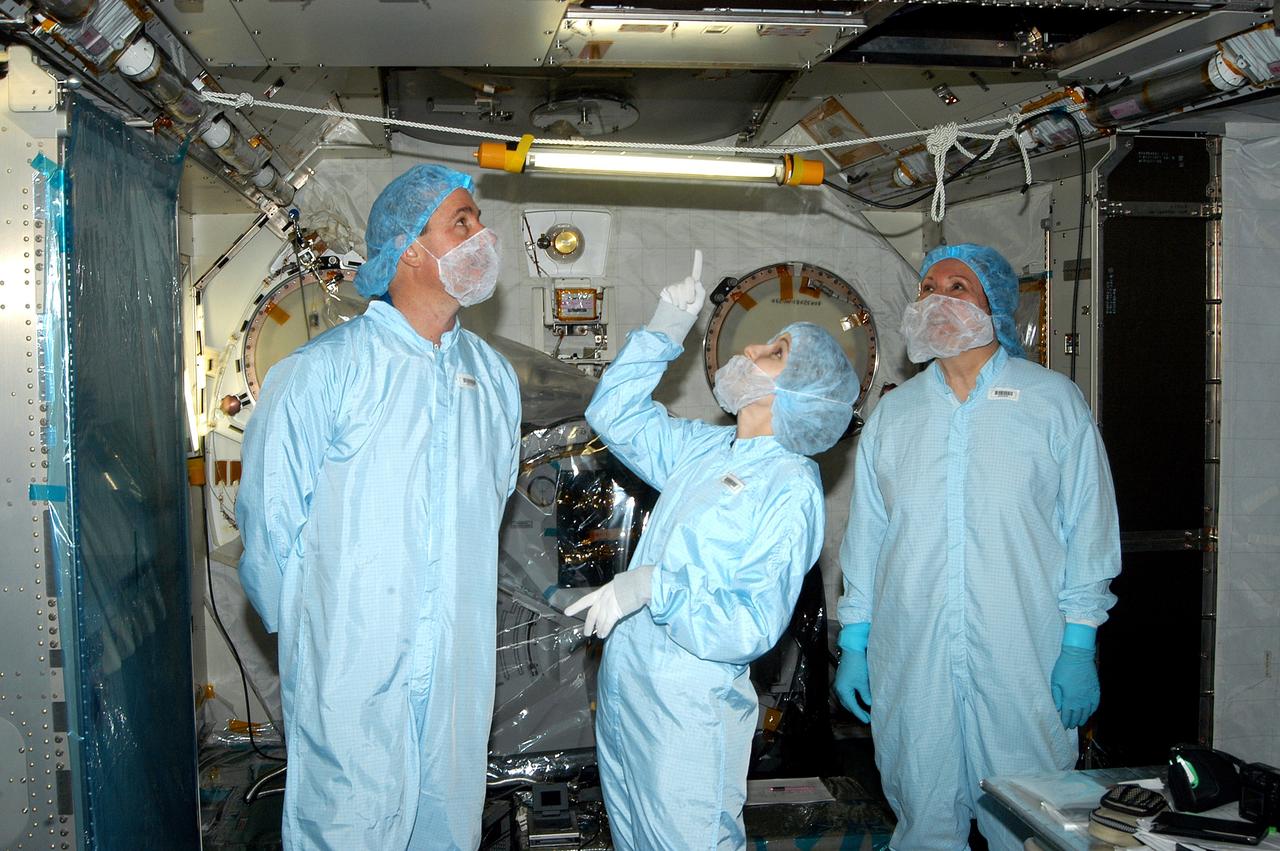
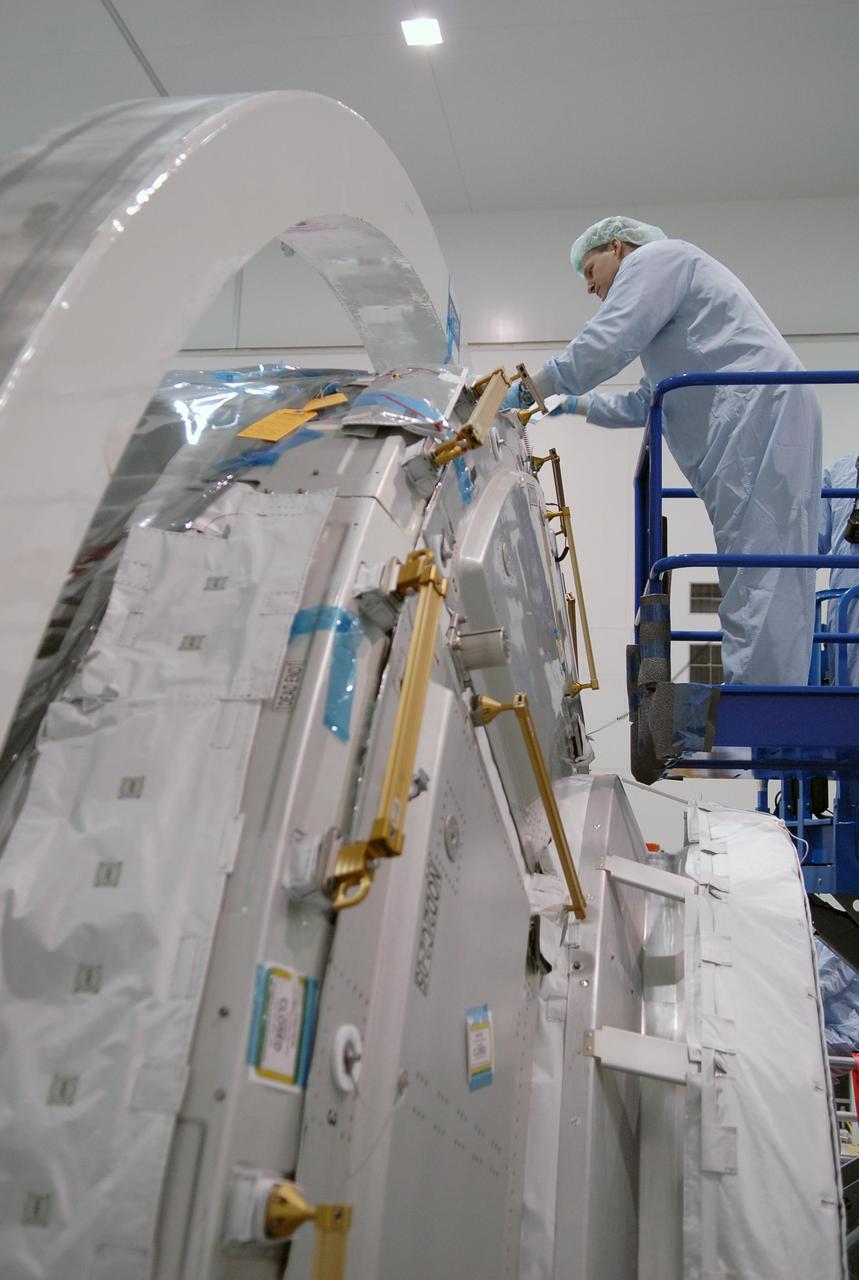
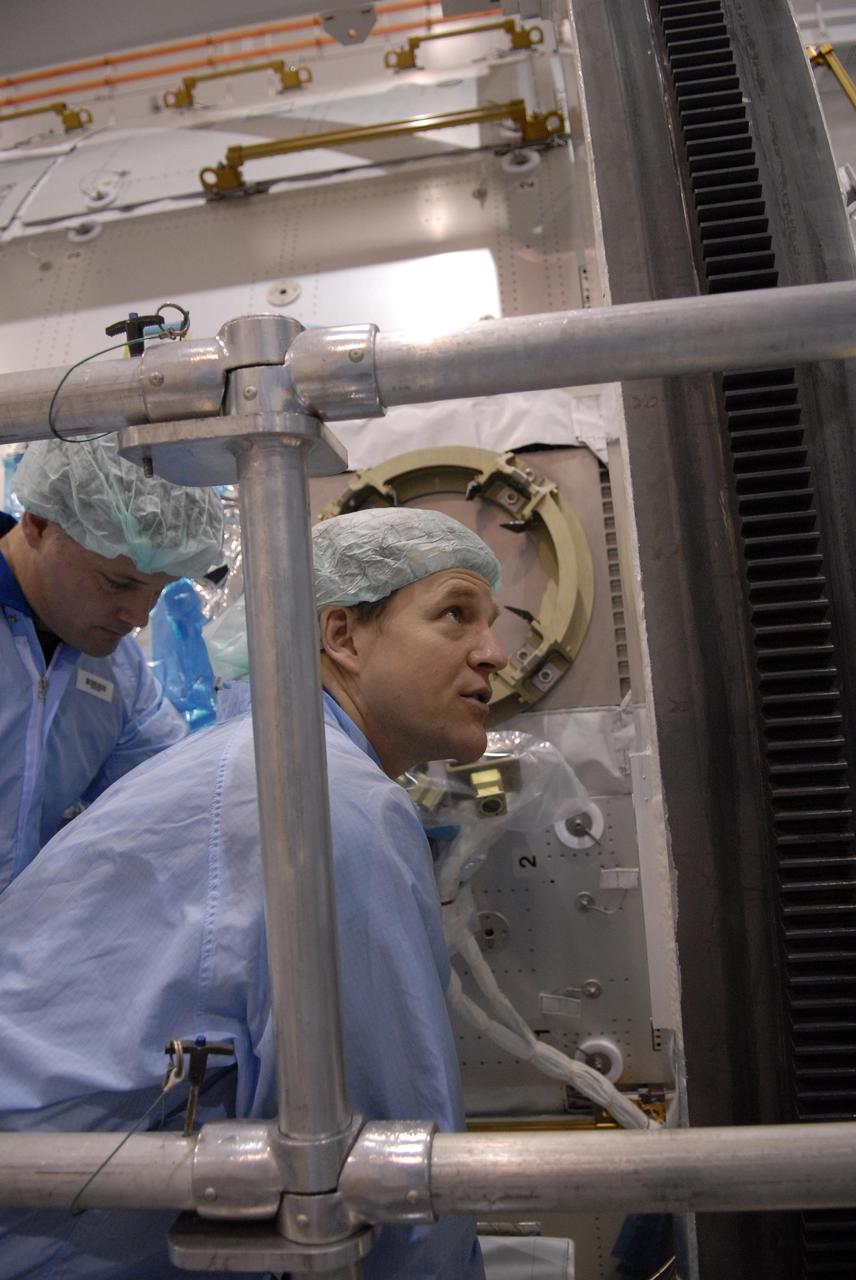
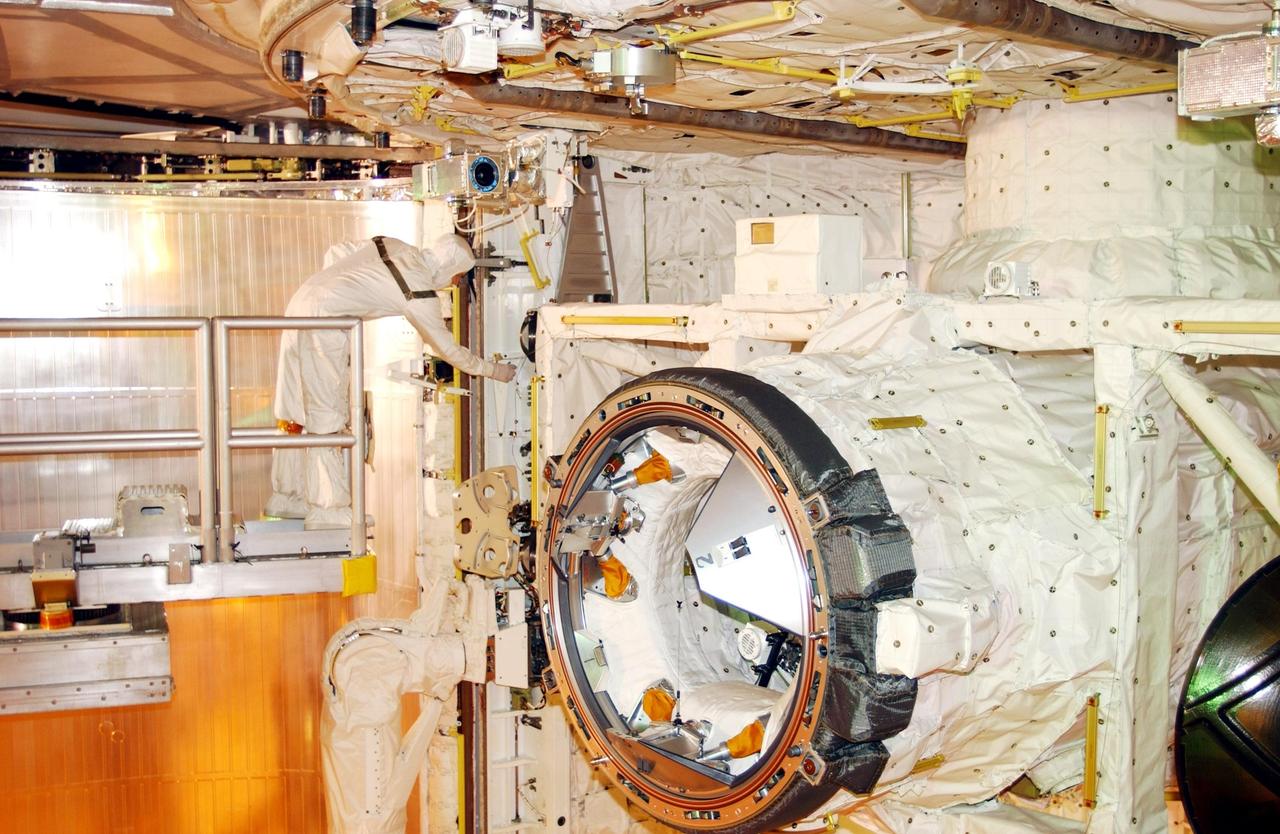
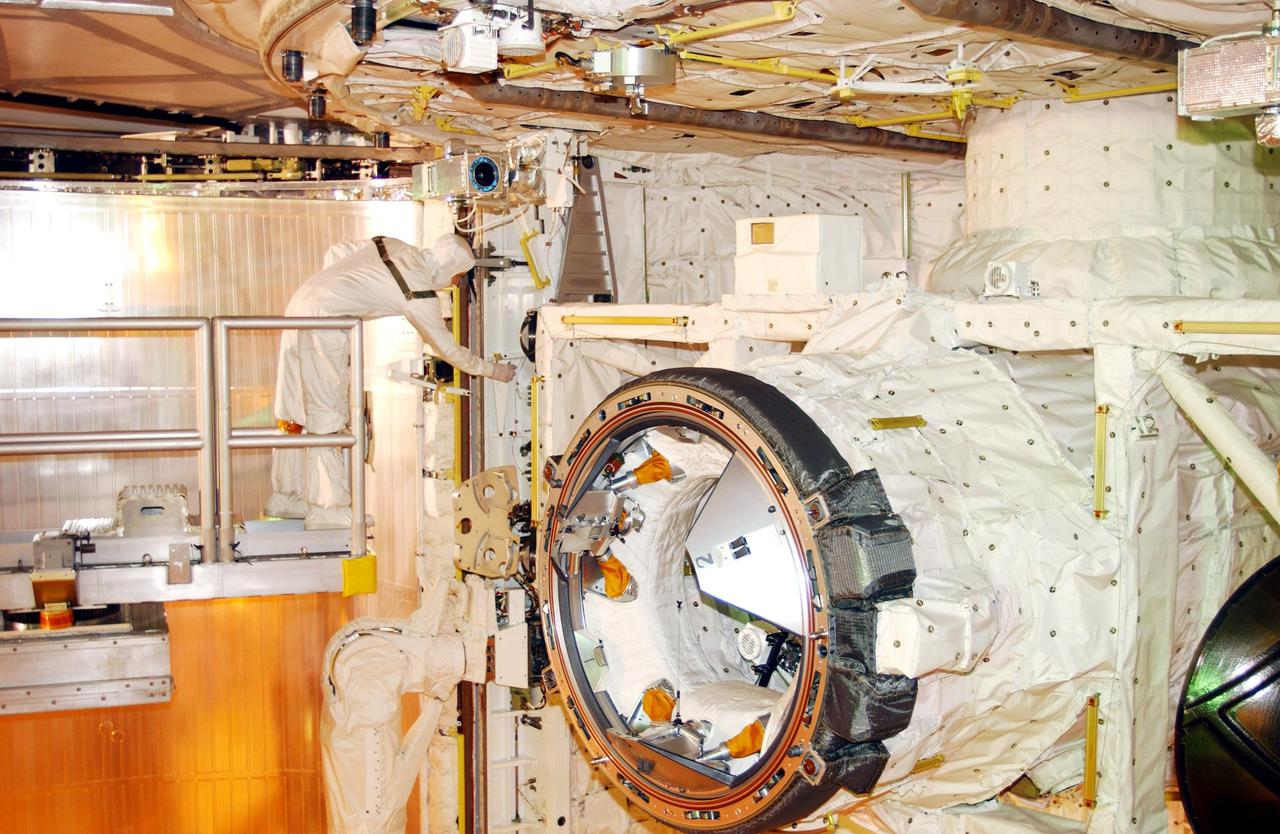
KENNEDY SPACE CENTER, FLA. -    Members of the STS-114 crew take a look at the Japanese Experiment Module (JEM) pressure module in the Space Station Processing Facility.  A research laboratory, the pressurized module is the first element of the JEM, named "Kibo" (Hope), to be delivered to KSC.   The National Space Development Agency of Japan (NASDA) developed the laboratory at the Tsukuba Space Center near Tokyo and is Japan's primary contribution to the Station. The JEM also includes an exposed facility (platform) for space environment experiments, a robotic manipulator system, and two logistics modules. The various JEM components will be  assembled in space over the course of three Shuttle missions.
KENNEDY SPACE CENTER, FLA. - Members of the STS-114 crew take a look at the Japanese Experiment Module (JEM) pressure module in the Space Station Processing Facility. A research laboratory, the pressurized module is the first element of the JEM, named "Kibo" (Hope), to be delivered to KSC. The National Space Development Agency of Japan (NASDA) developed the laboratory at the Tsukuba Space Center near Tokyo and is Japan's primary contribution to the Station. The JEM also includes an exposed facility (platform) for space environment experiments, a robotic manipulator system, and two logistics modules. The various JEM components will be assembled in space over the course of three Shuttle missions.
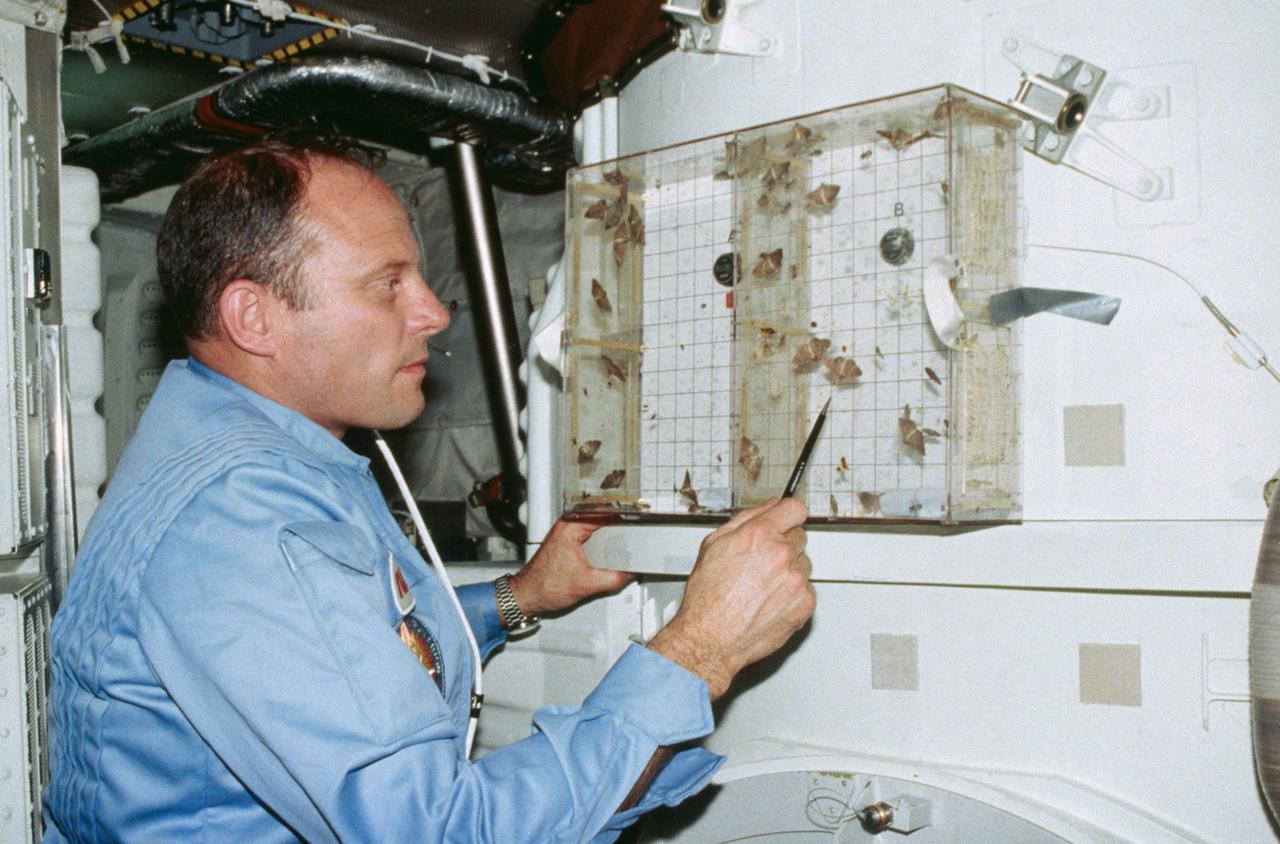
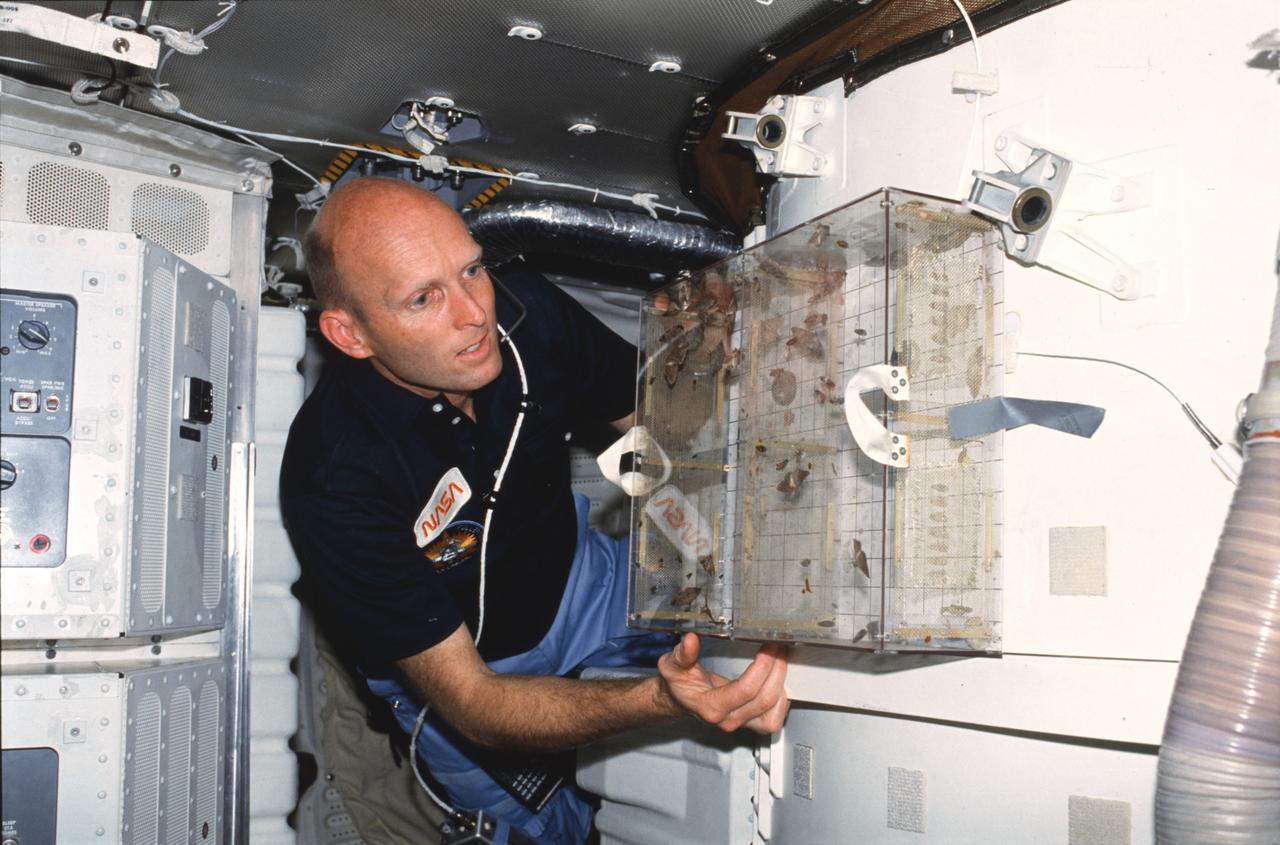
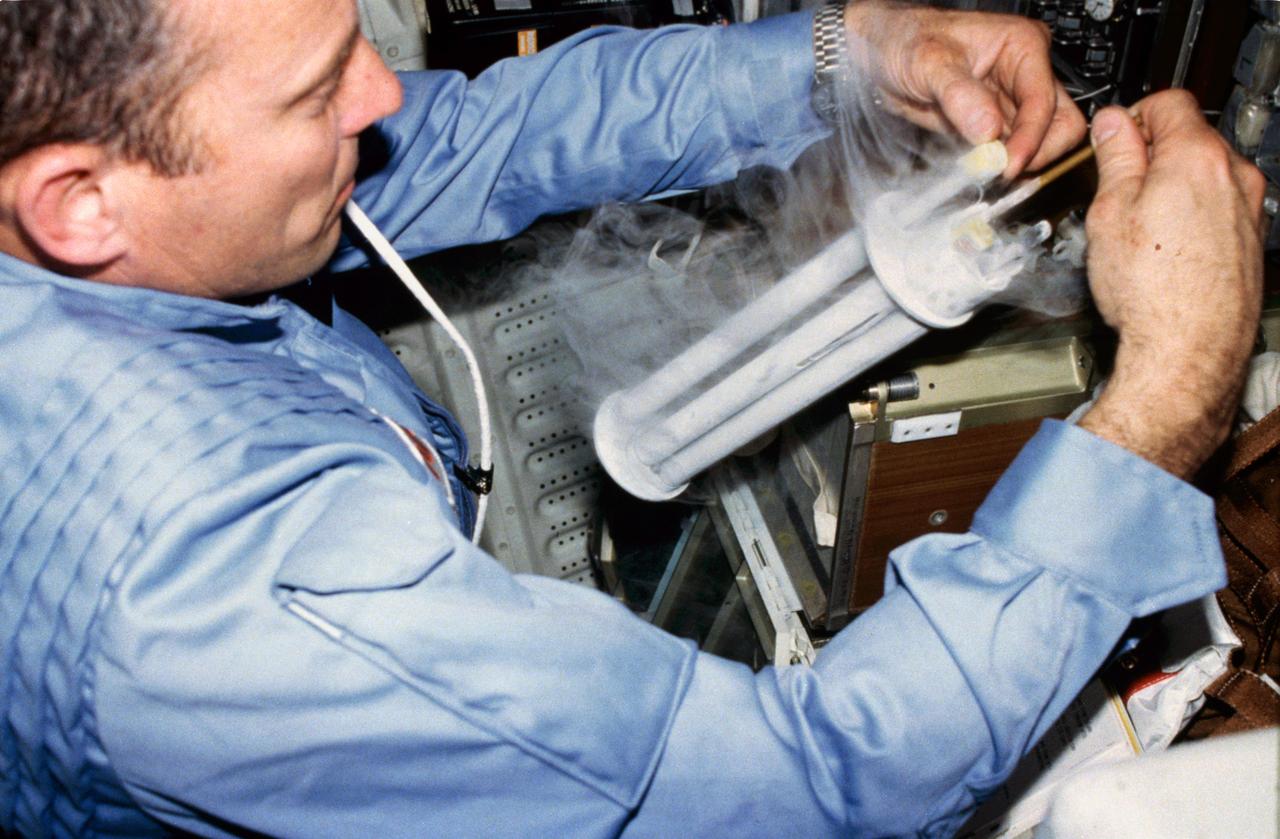
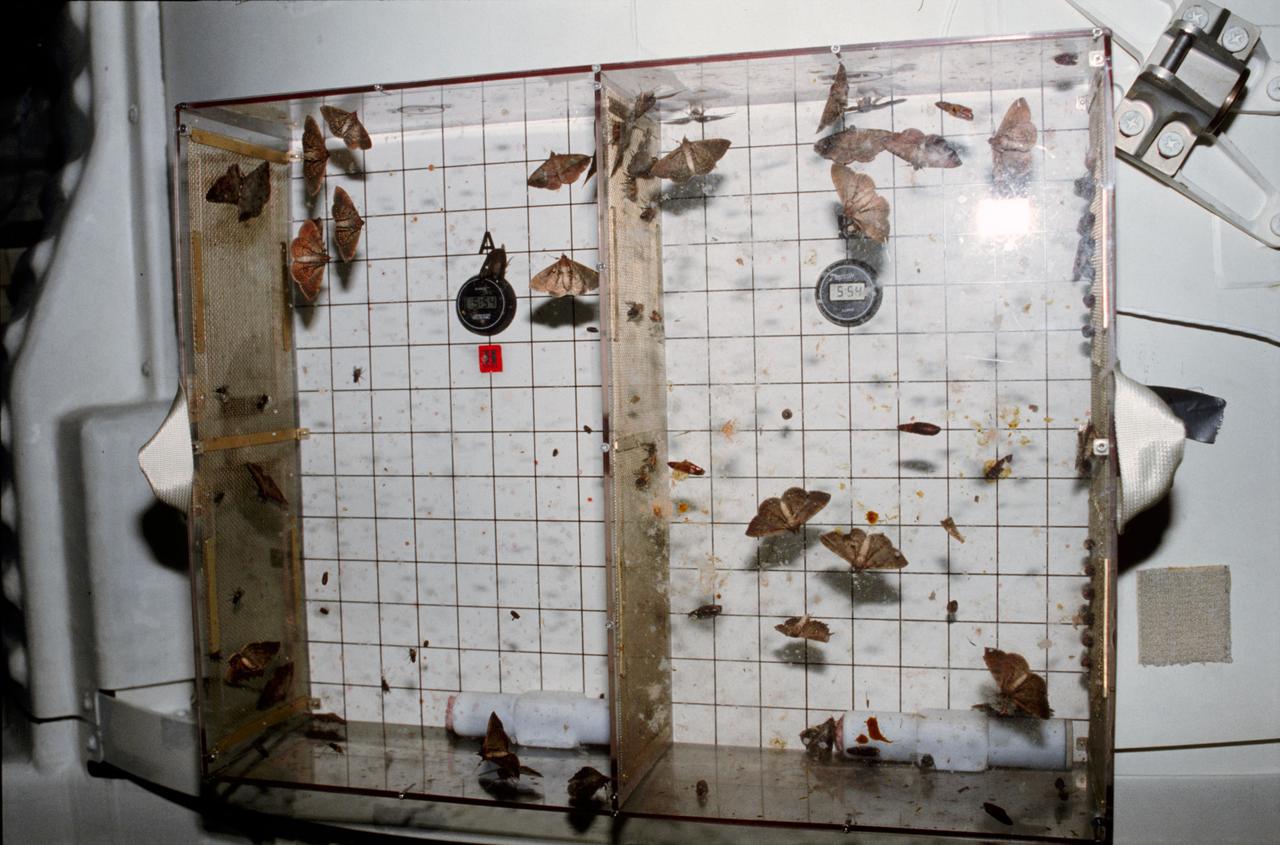
Commander Jack Lousma examines Insect Flight Motion Study (Student Experiment) taped to the airlock on the aft middeck. Lousma points to velvetbean caterpillar moth activity with a pen.
Commander Lousma examines Insect Flight Motion Study
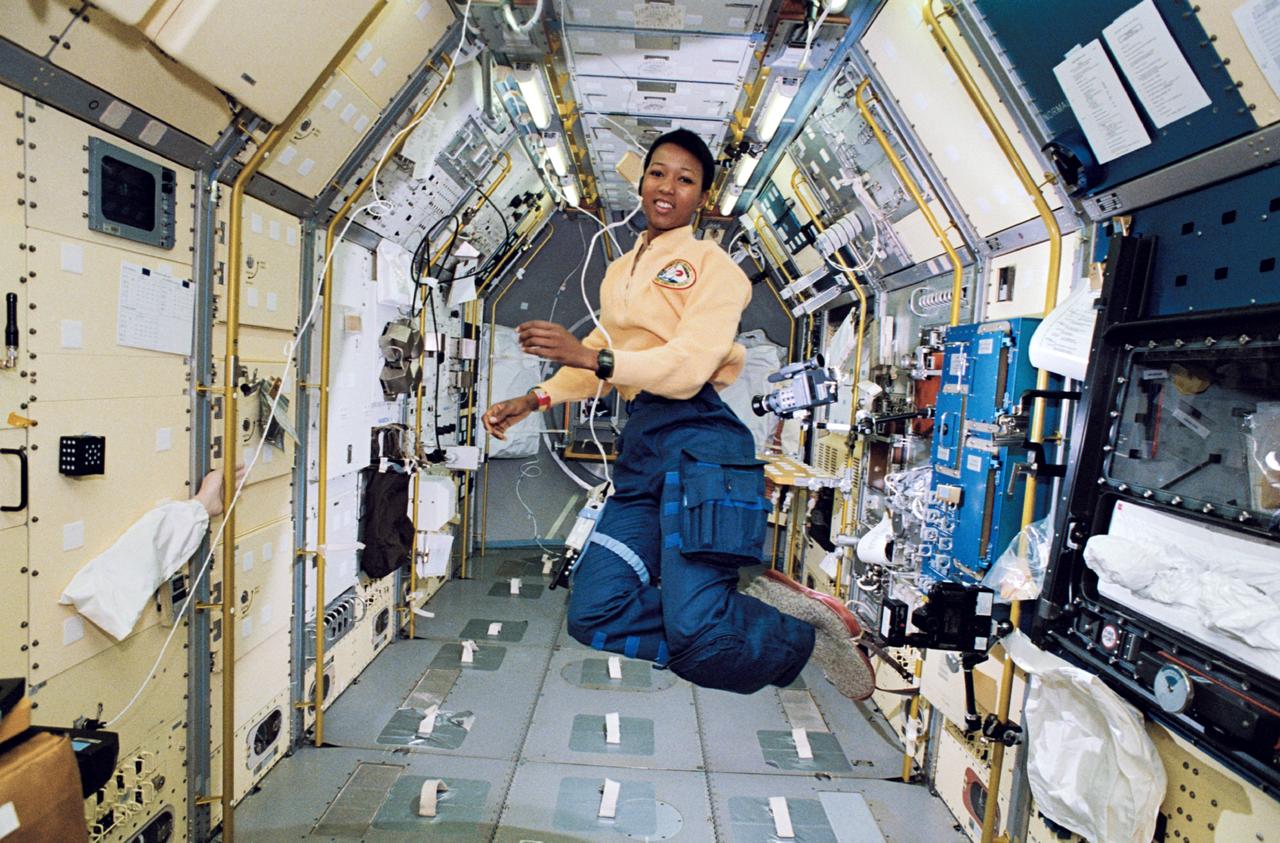
STS047-37-003 (12-20 Sept. 1992) --- Astronaut Mae C. Jemison, STS-47 mission specialist, appears to be clicking her heels in zero-gravity in this 35mm frame photographed in the Science Module aboard the Earth-orbiting Space Shuttle Endeavour. Making her first flight in space, Dr. Jemison was joined by five other NASA astronauts and a Japanese payload specialist for eight days of research in support of the Spacelab-J mission, a joint effort between Japan and the United States.
STS-47 MS Jemison works in the Spacelab Japan (SLJ) module aboard OV-105
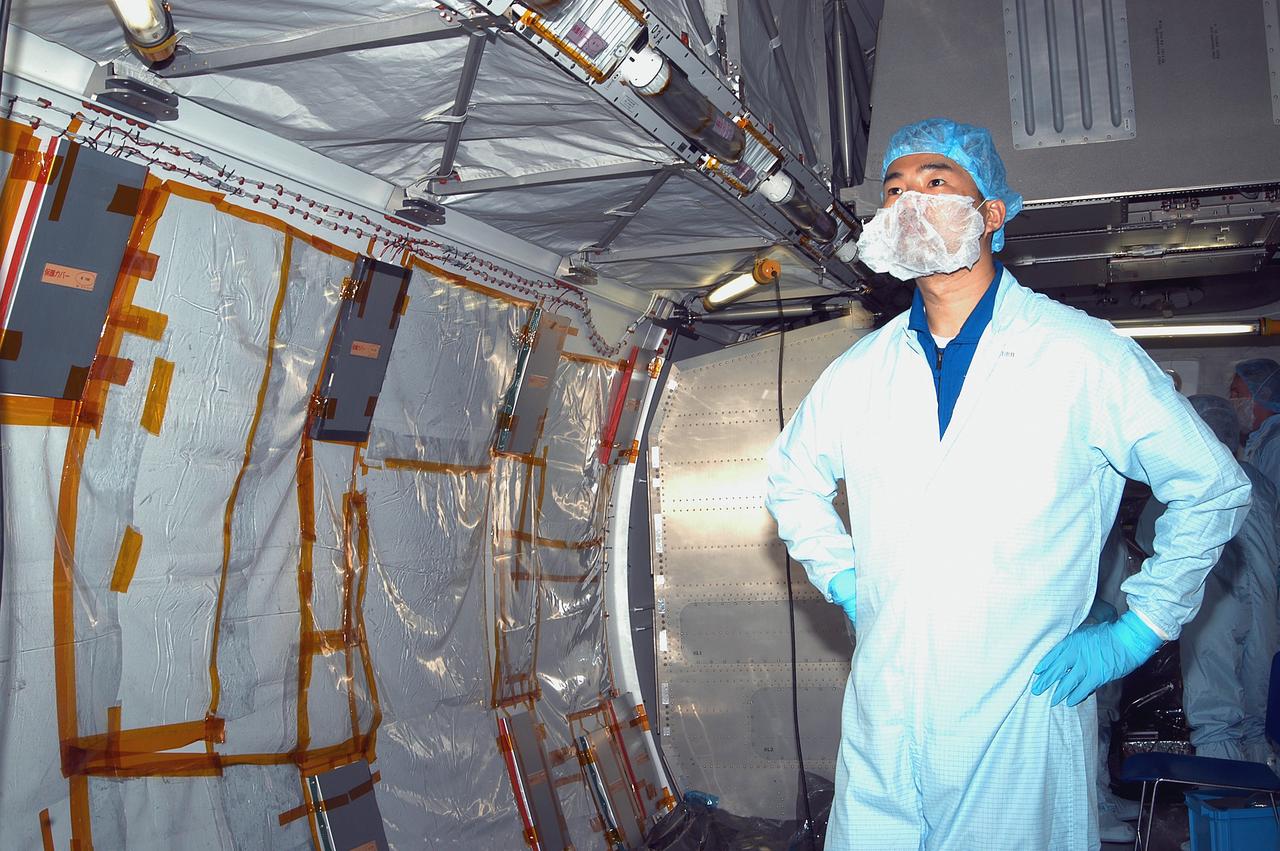
KENNEDY SPACE CENTER, FLA. - STS-114 Mission Specialist Soichi Noguchi, who is with the Japanese Aerospace and Exploration Agency, looks at the inside of the Japanese Experiment Module (JEM) in the Space Station Processing Facility.  He and other crew members are at KSC becoming familiar with Shuttle and mission equipment. The mission is Logistics Flight 1, which is scheduled to deliver supplies and equipment plus the external stowage platform to the International Space Station.
KENNEDY SPACE CENTER, FLA. - STS-114 Mission Specialist Soichi Noguchi, who is with the Japanese Aerospace and Exploration Agency, looks at the inside of the Japanese Experiment Module (JEM) in the Space Station Processing Facility. He and other crew members are at KSC becoming familiar with Shuttle and mission equipment. The mission is Logistics Flight 1, which is scheduled to deliver supplies and equipment plus the external stowage platform to the International Space Station.
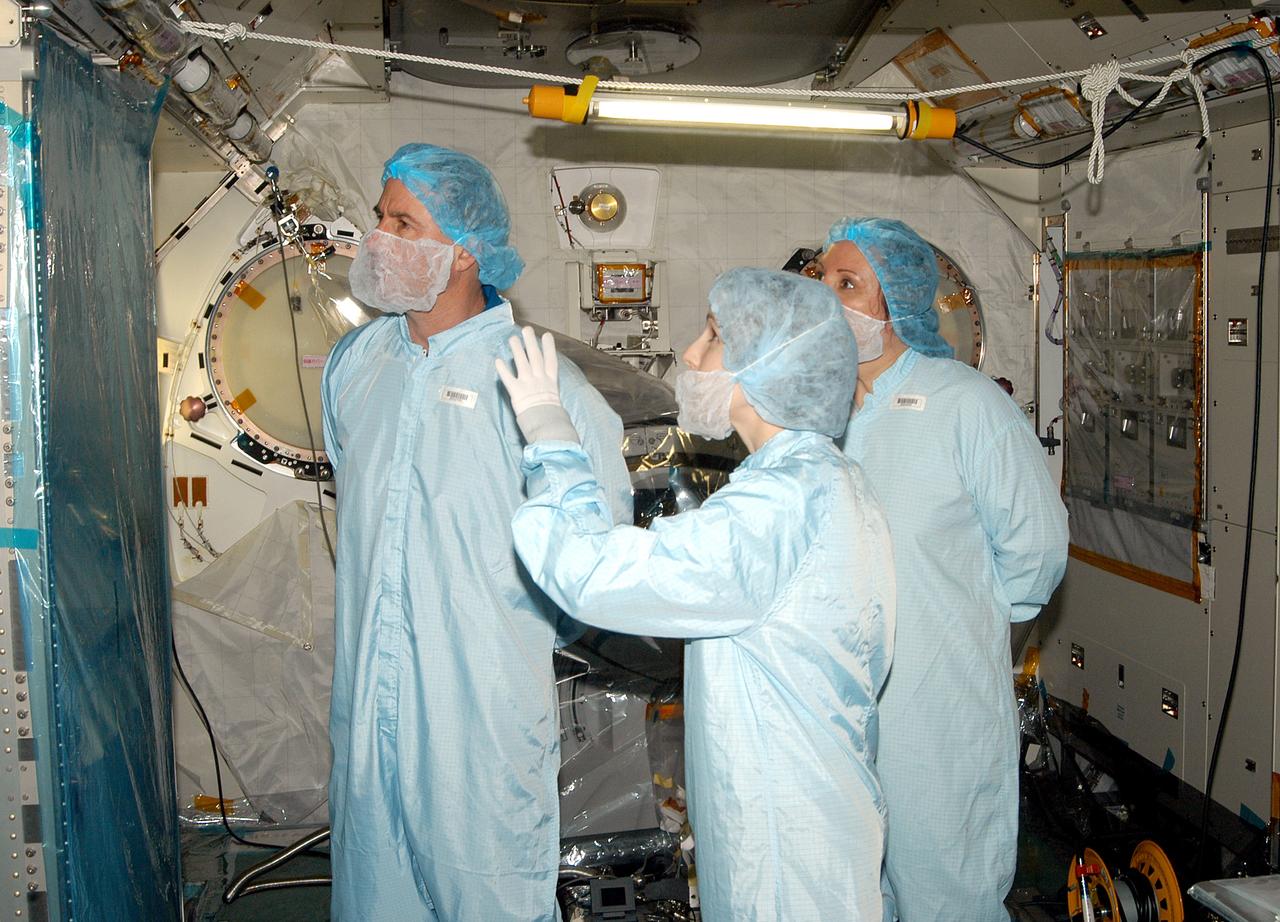
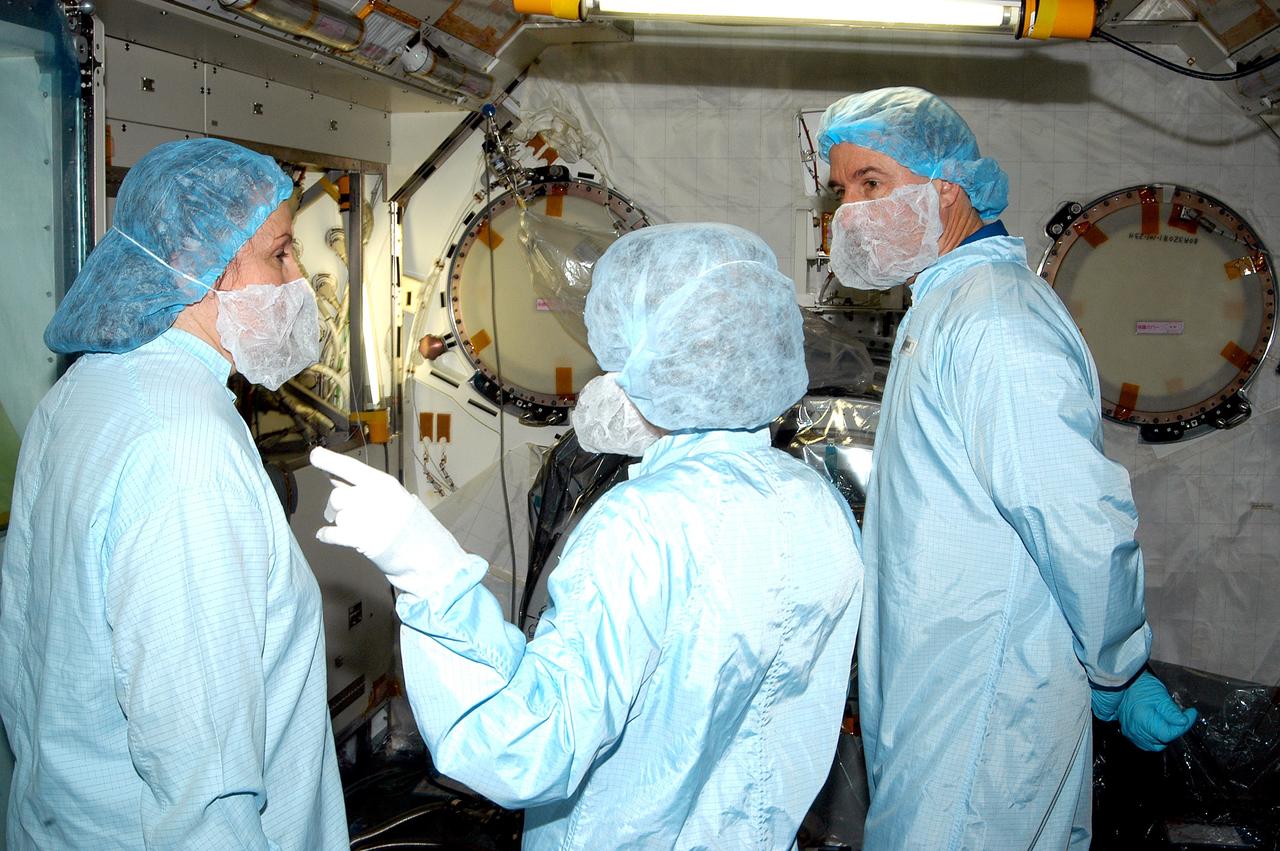
KENNEDY SPACE CENTER, FLA. - - In the Space Station Processing Facility, STS-114 Mission Specialist Stephen Robinson (left) learns about the Japanese Experiment Module (JEM) from Jennifer Goldsmith (center), with United Space Alliance at Johnson Space Center, and Louise Kleba (right), with USA at KSC.  Crew members are at KSC to become familiar with Shuttle and mission equipment. The mission is Logistics Flight 1, which is scheduled to deliver supplies and equipment plus the external stowage platform to the International Space Station.
KENNEDY SPACE CENTER, FLA. - - In the Space Station Processing Facility, STS-114 Mission Specialist Stephen Robinson (left) learns about the Japanese Experiment Module (JEM) from Jennifer Goldsmith (center), with United Space Alliance at Johnson Space Center, and Louise Kleba (right), with USA at KSC. Crew members are at KSC to become familiar with Shuttle and mission equipment. The mission is Logistics Flight 1, which is scheduled to deliver supplies and equipment plus the external stowage platform to the International Space Station.
KENNEDY SPACE CENTER, FLA. - In the Space Station Processing Facility, STS-114 Mission Specialist Stephen Robinson (left) looks at an area overhead in the Japanese Experiment Module (JEM). In the center is Jennifer Goldsmith, with United Space Alliance at Johnson Space Center, and at right is Louise Kleba, with USA at KSC.  Crew members are at KSC becoming familiar with Shuttle and mission equipment. The mission is Logistics Flight 1, which is scheduled to deliver supplies and equipment plus the external stowage platform to the International Space Station.
KENNEDY SPACE CENTER, FLA. - In the Space Station Processing Facility, STS-114 Mission Specialist Stephen Robinson (left) looks at an area overhead in the Japanese Experiment Module (JEM). In the center is Jennifer Goldsmith, with United Space Alliance at Johnson Space Center, and at right is Louise Kleba, with USA at KSC. Crew members are at KSC becoming familiar with Shuttle and mission equipment. The mission is Logistics Flight 1, which is scheduled to deliver supplies and equipment plus the external stowage platform to the International Space Station.
KENNEDY SPACE CENTER, FLA. - In the Space Station Processing Facility, STS-114 Mission Specialist Stephen Robinson (right) learns about the Japanese Experiment Module (JEM) from Louise Kleba (left), with United Space Alliance at KSC, and Jennifer Goldsmith (center), with USA at Johnson Space Center. Crew members are at KSC becoming familiar with Shuttle and mission equipment. The mission is Logistics Flight 1, which is scheduled to deliver supplies and equipment plus the external stowage platform to the International Space Station.
STS003-23-178 (22-30 March 1982) --- Astronaut C. Gordon Fullerton, STS-3 pilot, examines Student Experiment 81-8 (SE-81-8) Insect Flight Motion Study taped to the airlock on aft middeck. Todd Nelson, a high school senior from Minnesota, won a national contest to fly his experiment on this particular flight. Moths, flies, and bees were studied in the near weightless environment. Photo credit: NASA
Pilot Fullerton examines SE-81-8 Insect Flight Motion Study
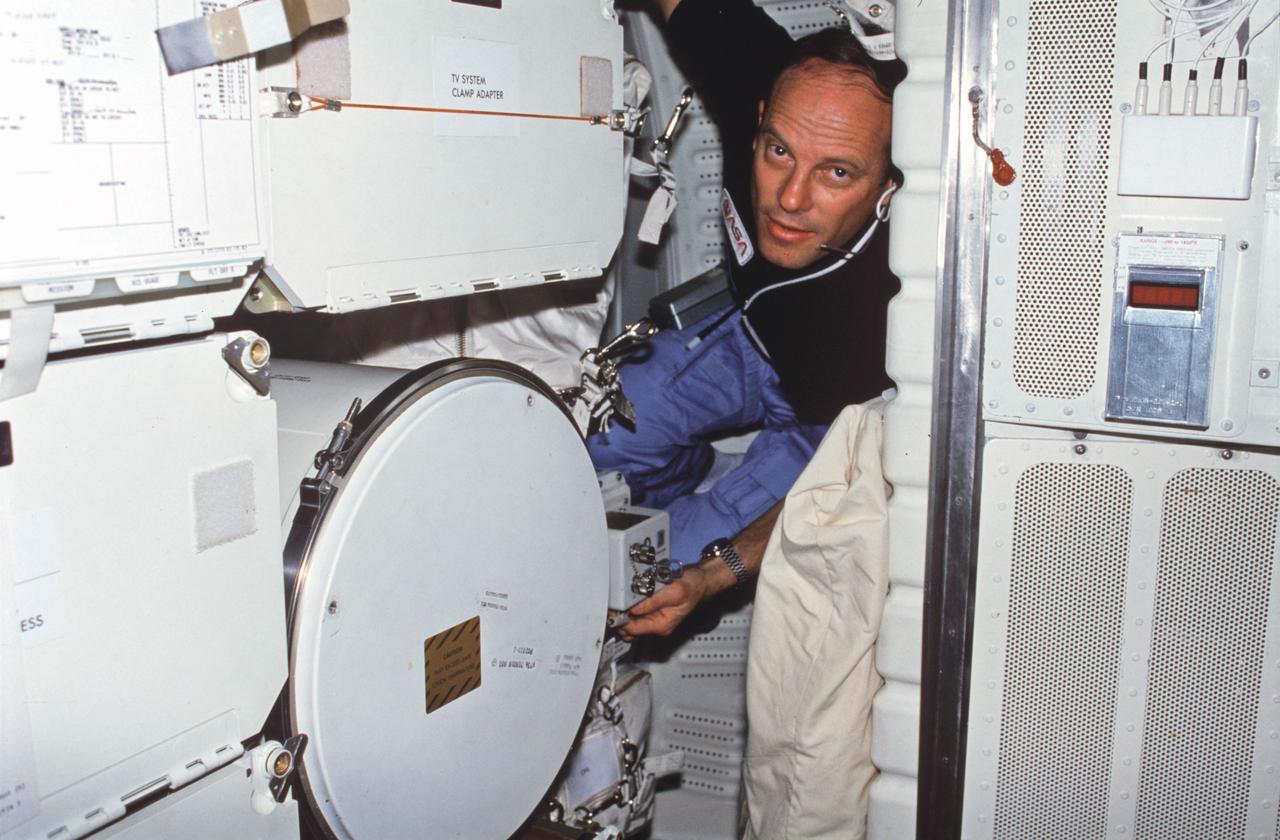
STS003-22-127 (22-30 March 1982) --- Astronaut Jack R. Lousma, STS-3 commander, wearing communications kit assembly (assy) mini-headset, adjusts controls on Monodisperse Latex Reactor (MLR) experiment located in forward middeck lockers MF57H and MF57K. To reach MLR support electronics assy controls, Lousma squeezes in between forward lockers and Development Flight Instrument (DFI) unit on starboard bulkhead. Photo credit: NASA
Commander Lousma adjusts MLR controls on middeck
Commander Jack Lousma works with Electrophoresis Equipment Verification Test (EEVT) electrophoresis unit, cryogenic freezer and tube, and stowage locker equipment located on crew compartment middeck aft bulkhead.
Commander Lousma works with EEVT experiment and cryogenic tube on aft middeck
STS003-23-175 (22-30 March 1982) --- Student Experiment 81-8 (SE-81-8) Insect Flight Motion Study taped to the airlock on aft middeck of space shuttle Columbia. Photo credit: NASA
Student Experiment 81-8 (SE-81-8) Insect Flight Motion Study on middeck
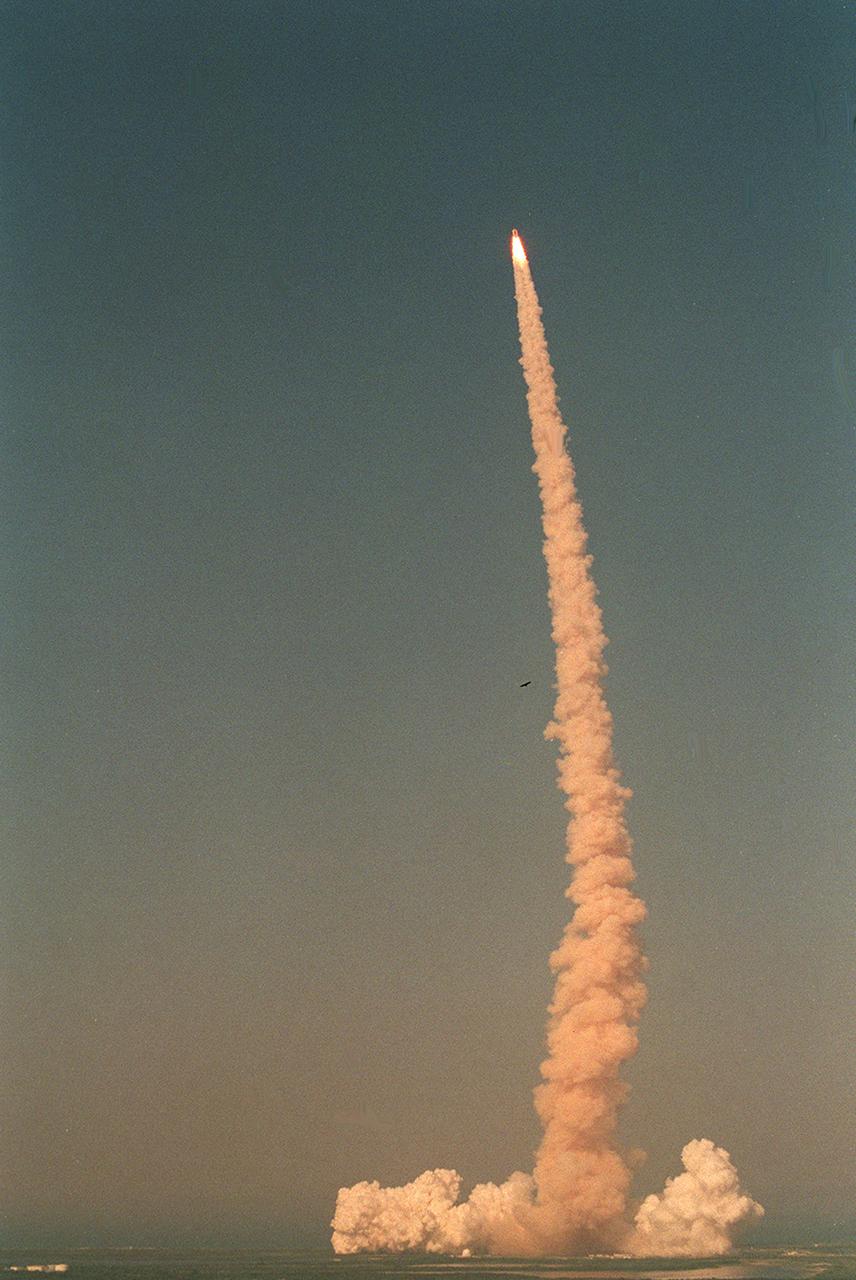
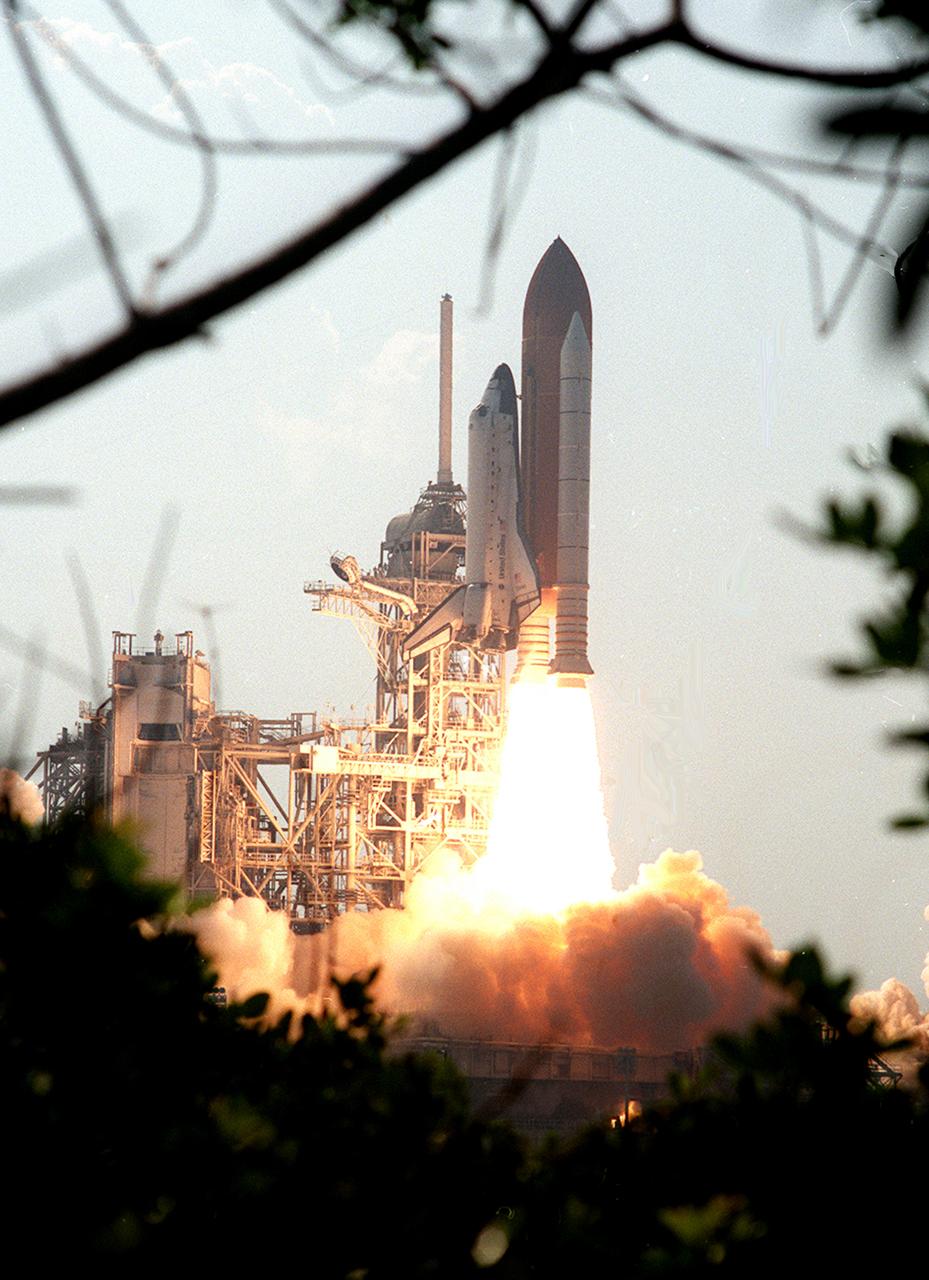
Space Shuttle Orbiter Discovery lifted off for the STS-105 mission on August 10, 2001. The main purpose of the mission was the rotation of the International Space Station (ISS) Expedition Two crew with the Expedition Three crew, and the delivery of supplies utilizing the Italian-built Multipurpose Logistics Module (MPLM) Leonardo. Another payload was the Materials International Space Station Experiment (MISSE). The MISSE experiment was to fly materials and other types of space exposure experiments on the Space Station and was the first externally mounted experiment conducted on the ISS.
Space Shuttle Projects
Space Shuttle Orbiter Discovery lifted off for the STS-105 mission on August 10, 2001. The main purpose of the mission was the rotation of the International Space Station (ISS) Expedition Two crew with the Expedition Three crew and the delivery of supplies utilizing the Italian-built Multipurpose Logistics Module (MPLM) Leonardo. Another payload was the Materials International Space Station Experiment (MISSE). The MISSE experiment was to fly materials and other types of space exposure experiments on the Space Station and was the first externally mounted experiment conducted on the ISS.
Space Shuttle Projects
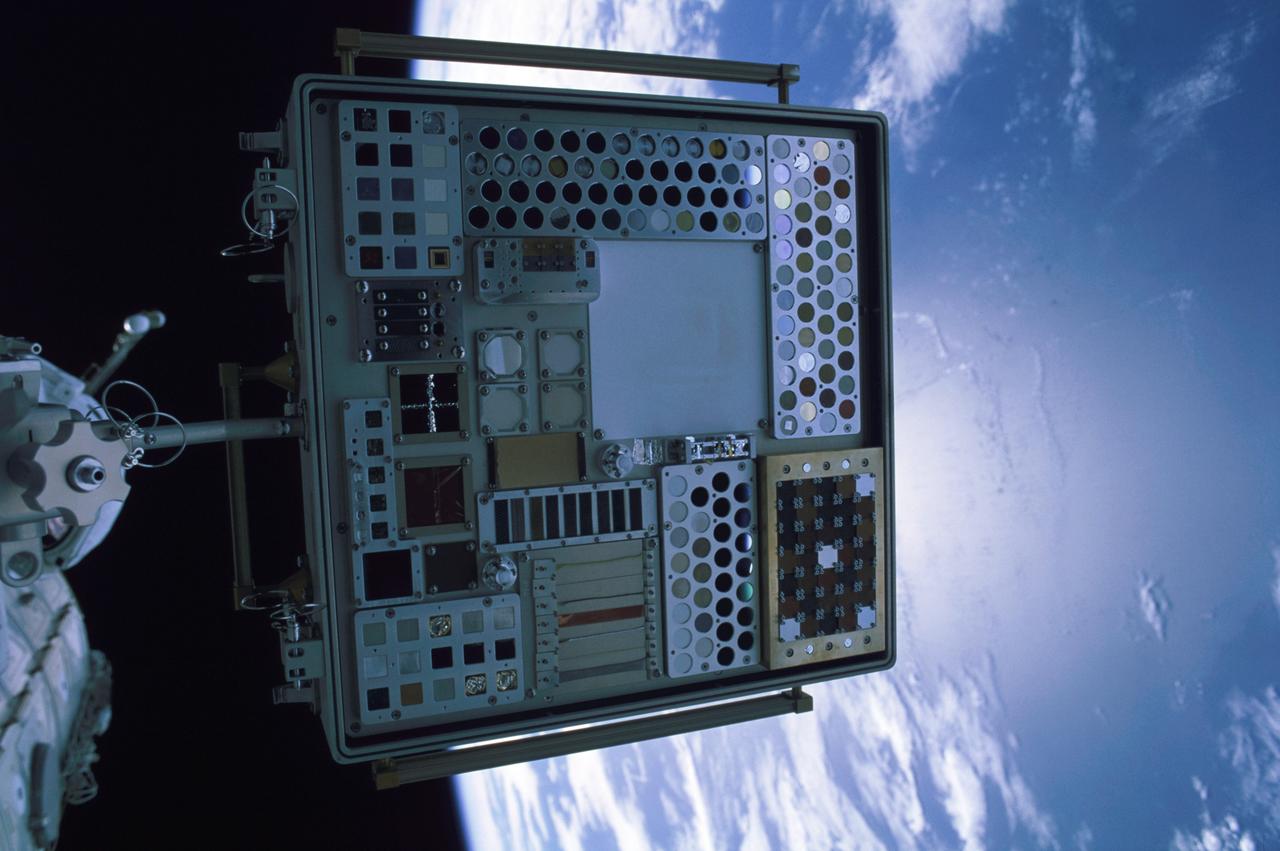
ISS006-348-019 (January 2003)  ---- Materials International Space Station Experiment (MISSE), a suitcase-sized experiment attached to the outside of the space station to expose hundreds of potential space construction materials to the environment, leading to stronger, more durable spacecraft construction. Photographed by one of the Expedition 6 crew members with a 35mm camera.
View of MISSE taken during Expedition Six
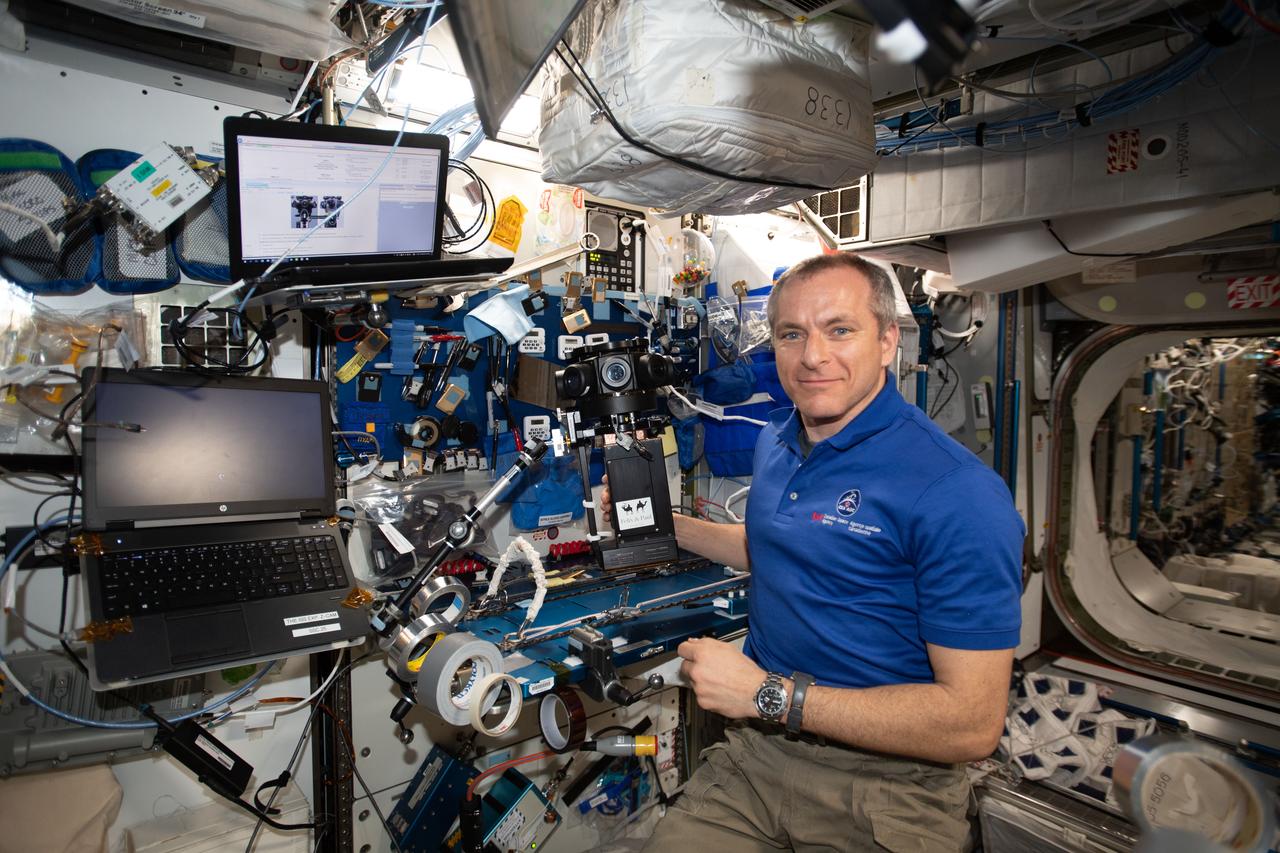
iss058e005160 (1/21/2019) --- A view of Canadian Space Agency (CSA) astronaut David Saint-Jacques setting up the Z-CAM V1 Pro Cinematic camera for the ISS Experience payload. The International Space Station Experience (ISS Experience) creates a virtual reality film documenting daily life aboard the space station. The 8- to 10-minute film created from footage taken during the six-month investigation covers different aspects of crew life, conducting science aboard the station, and the international partnerships involved.
The ISS Experience Z-Cam
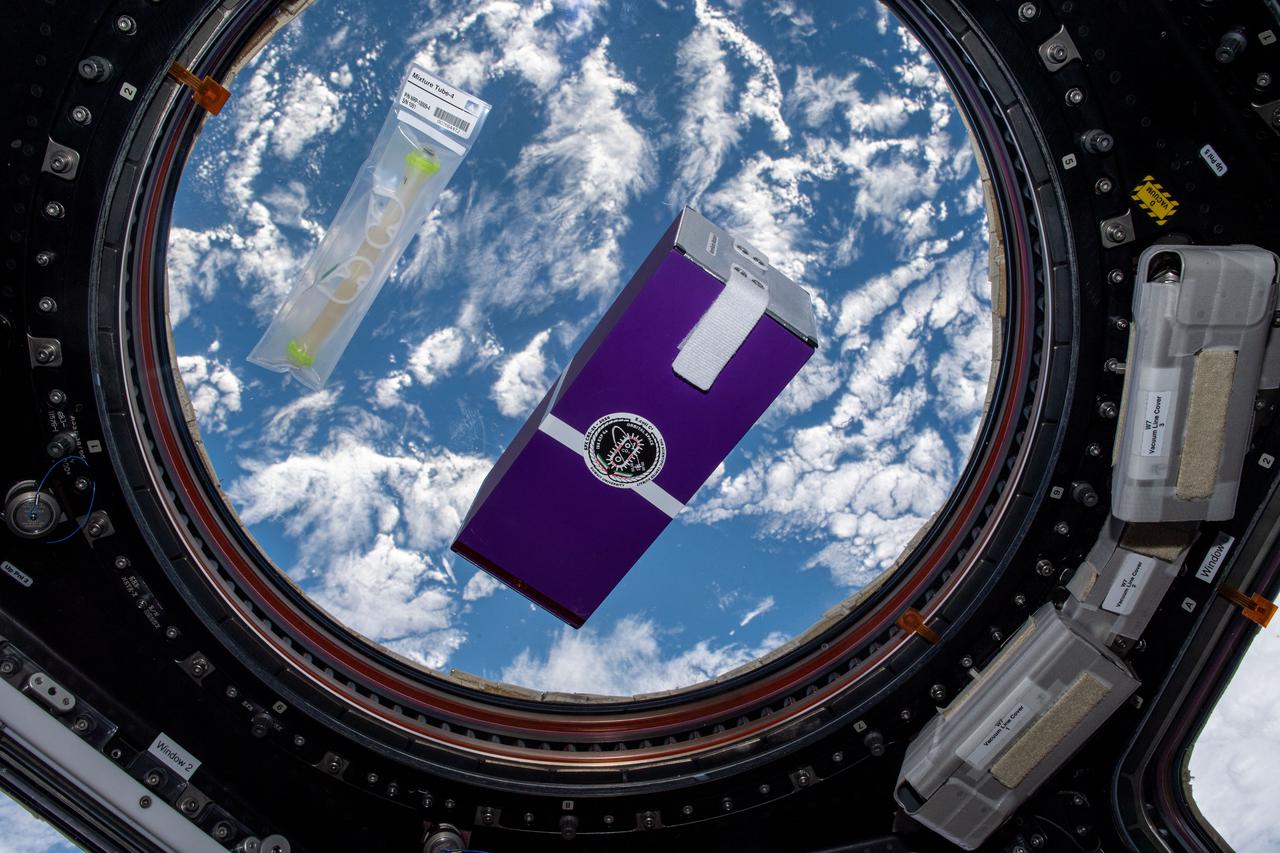
iss064e010985 (12/8/2020) --- A view of the NanoRacks Module-09  investigation in the Cupola module aboard the International Space Station (ISS). NanoRacks Module-09 is a combination of 35 experiments provided by school students from 5 different countries. The experiments are housed within a NanoRacks Module container and is a combination of biological static experiments and some experiments that require crew interaction to mix materials to activate. The experiments within the module are returned to the ground for analysis.
iss064e010985
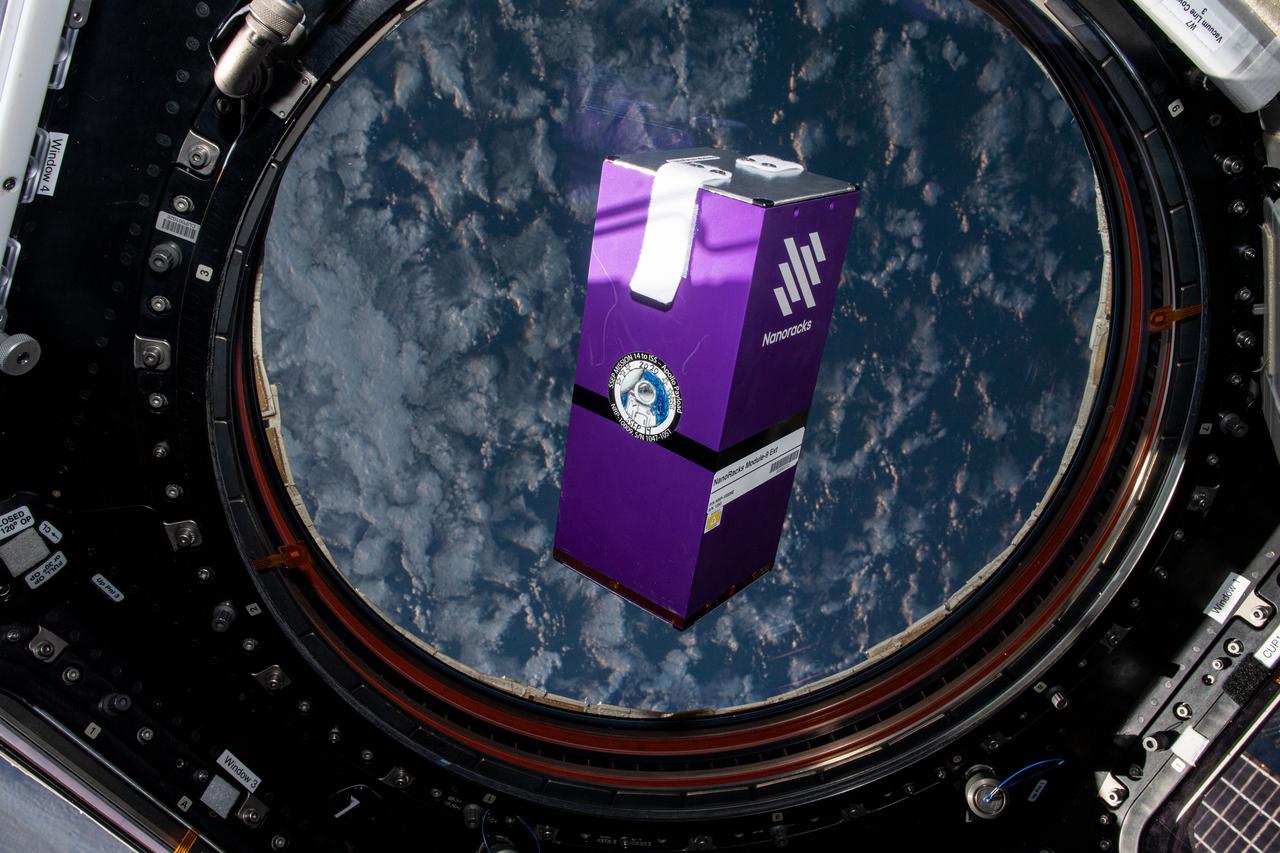
iss064e010949 (12/8/2020) --- A view of the NanoRacks Module-09  investigation in the Cupola module aboard the International Space Station (ISS). NanoRacks Module-09 is a combination of 35 experiments provided by school students from 5 different countries. The experiments are housed within a NanoRacks Module container and is a combination of biological static experiments and some experiments that require crew interaction to mix materials to activate. The experiments within the module are returned to the ground for analysis.
iss064e010949
STS044-05-023 (24 Nov-1 Dec 1991) --- Astronaut F. Story Musgrave (left), Mission Specialist, assists Astronaut Terence T. (Tom) Henricks, Mission Specialist, with a Detailed Supplementary Objective (DSO) involving Lower Body Negative Pressure.
STS-44 MS Musgrave assists Pilot Henricks with DSO 478 LBNP device on middeck
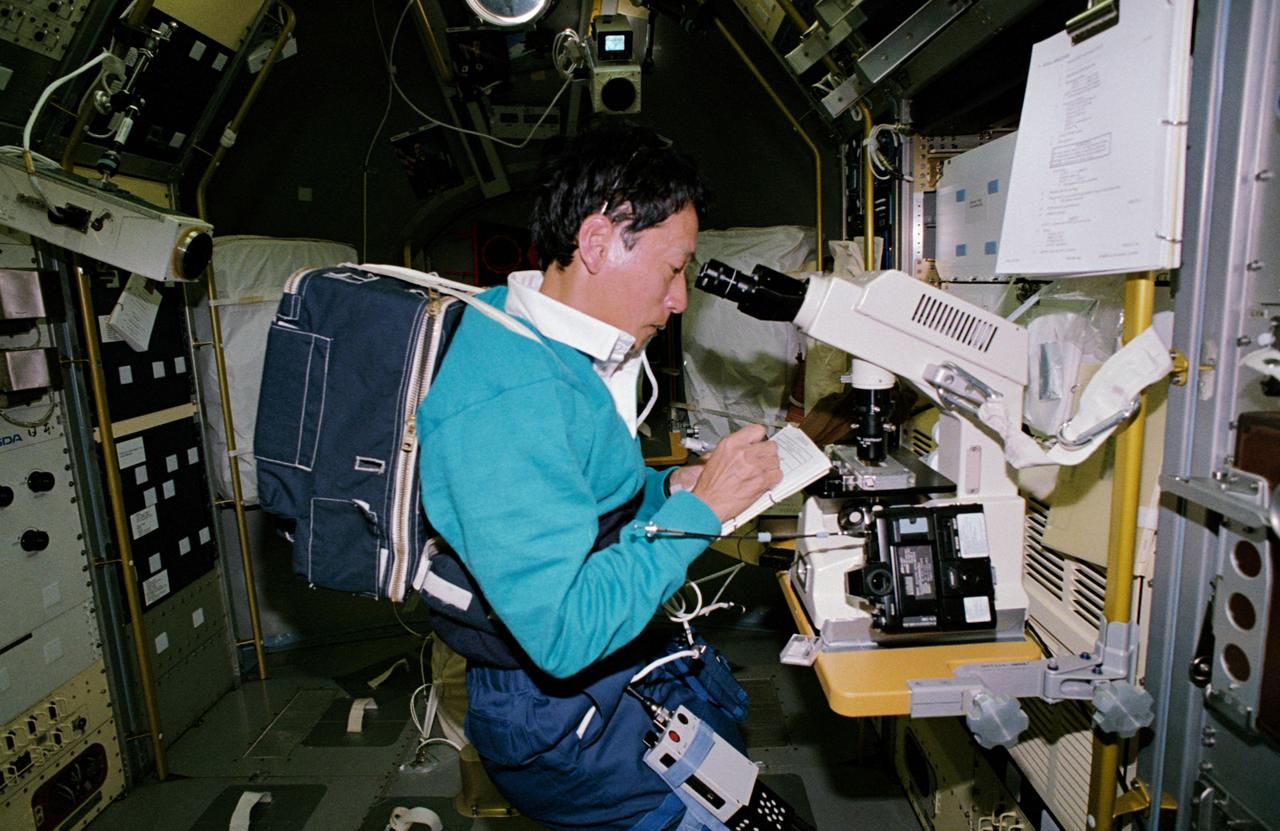
STS047-05-025 (12 - 20 Sept 1992) --- Payload specialist Mamoru Mohri, representing Japan's National Space Development Agency (NASDA), uses a microscope to produce photomicrographs of mammalian cells.  The mammal cell structure experiment is one of a large number of tests that were performed during the eight-day Spacelab-J mission.  On his back, Dr. Mohri totes a health monitoring experiment.  The primary objective of the physiological monitoring system is to observe the health condition of the Japanese payload specialist so that good health can be maintained during and after the spaceflight.
STS-47 PS Mohri uses Spacelab Japan microscope to study cells aboard OV-105
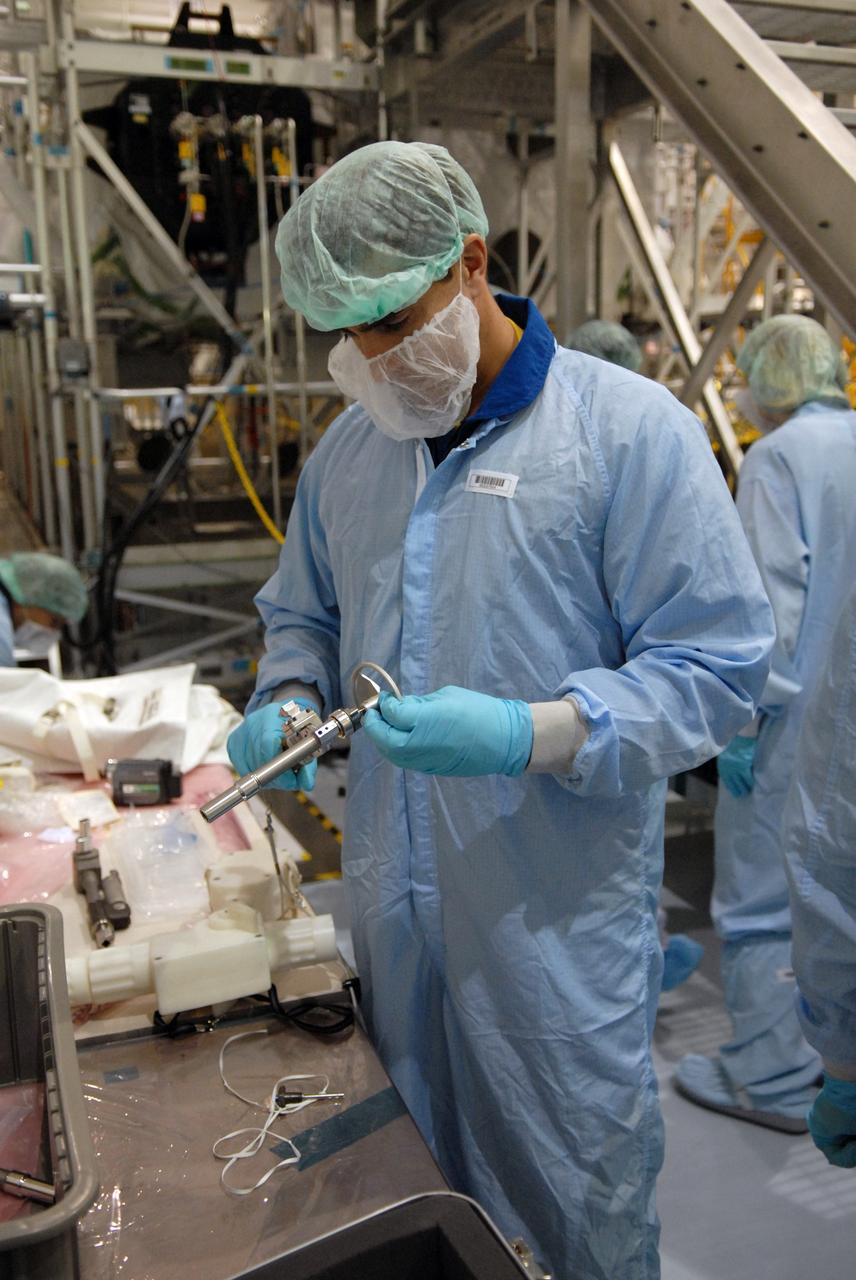
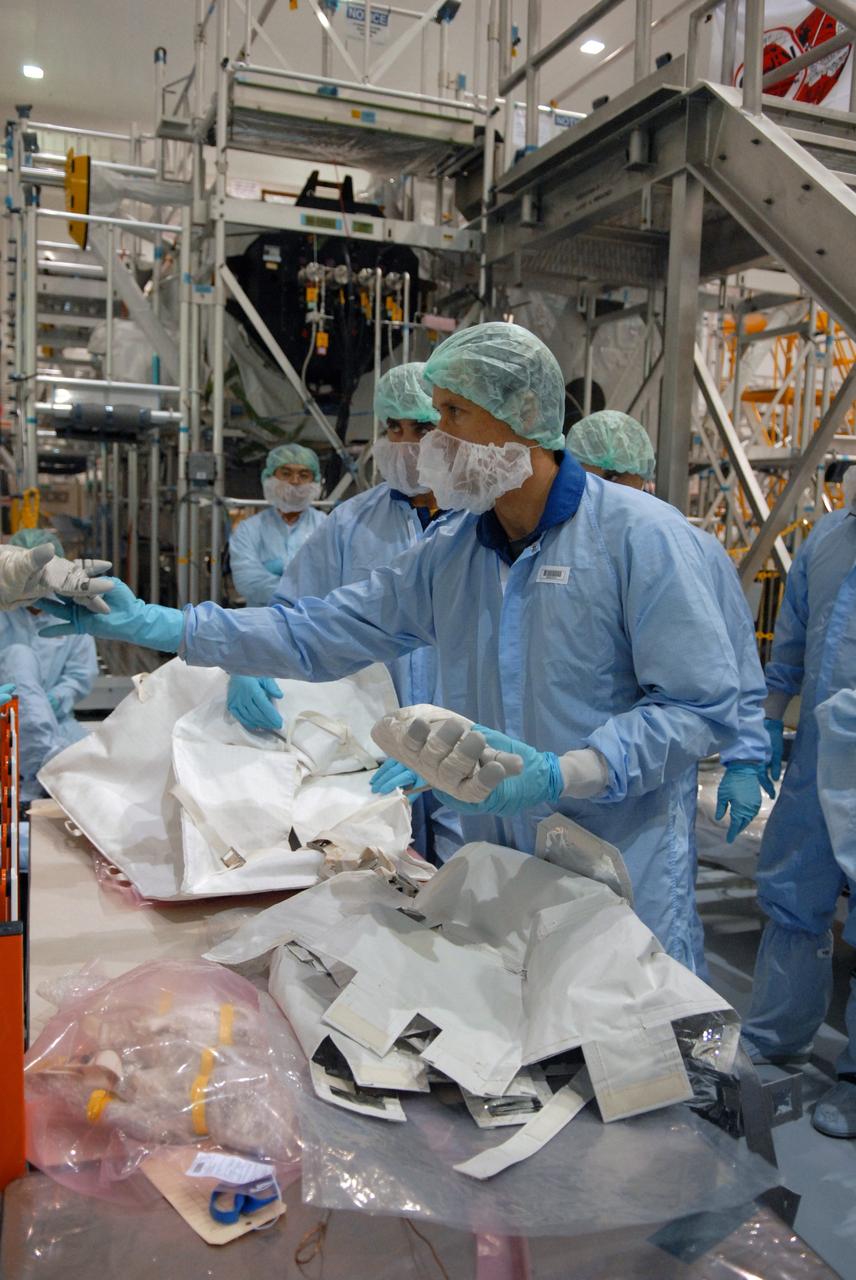
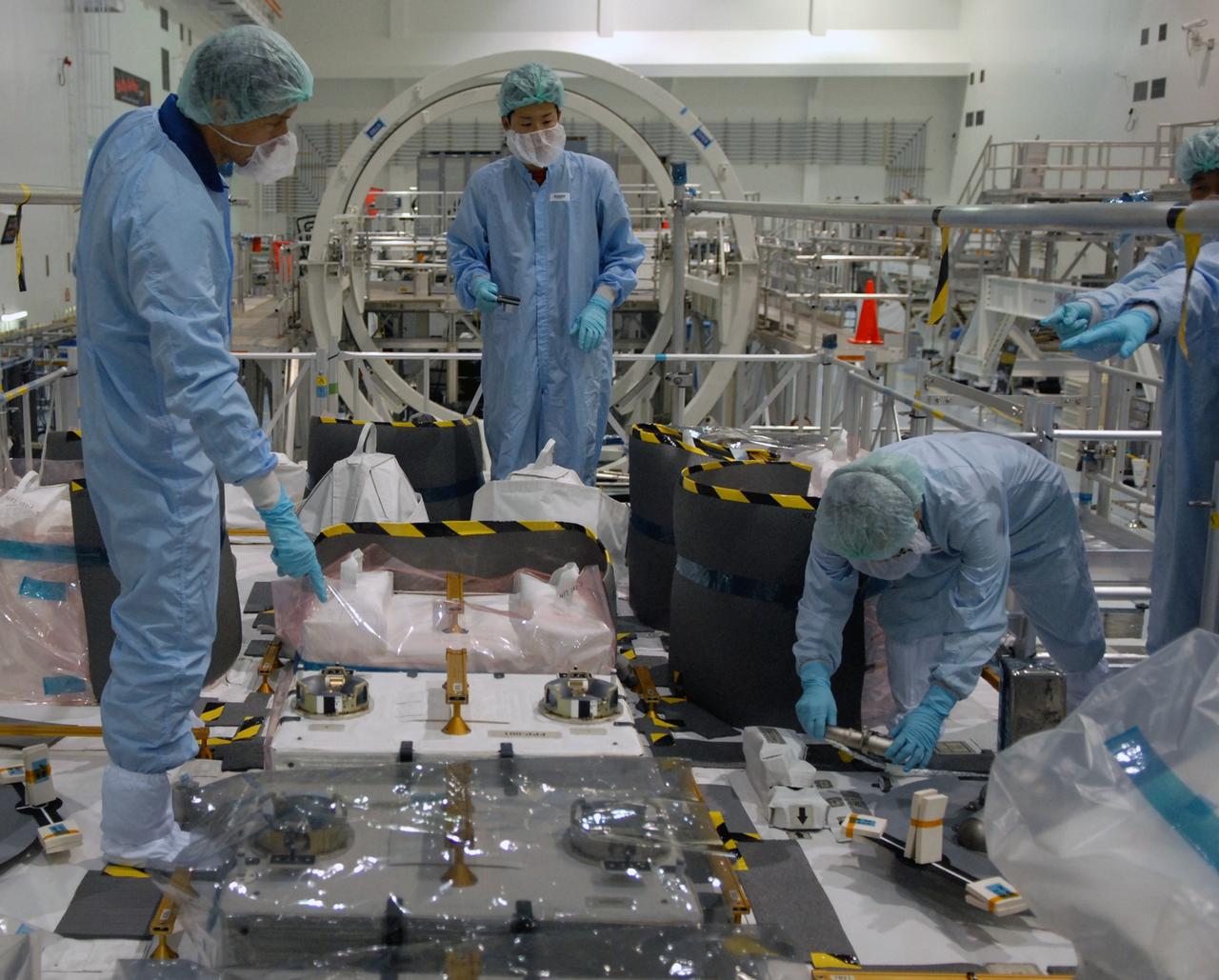
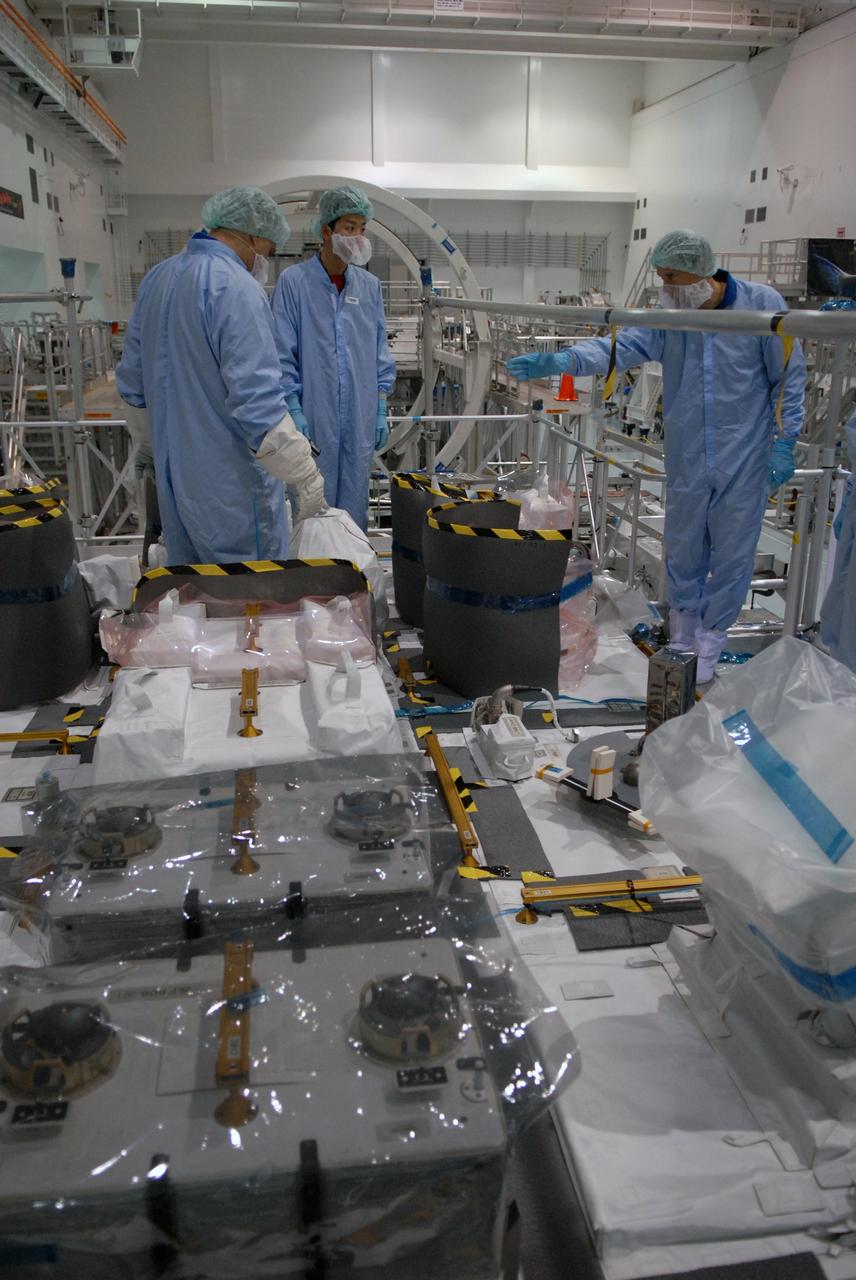
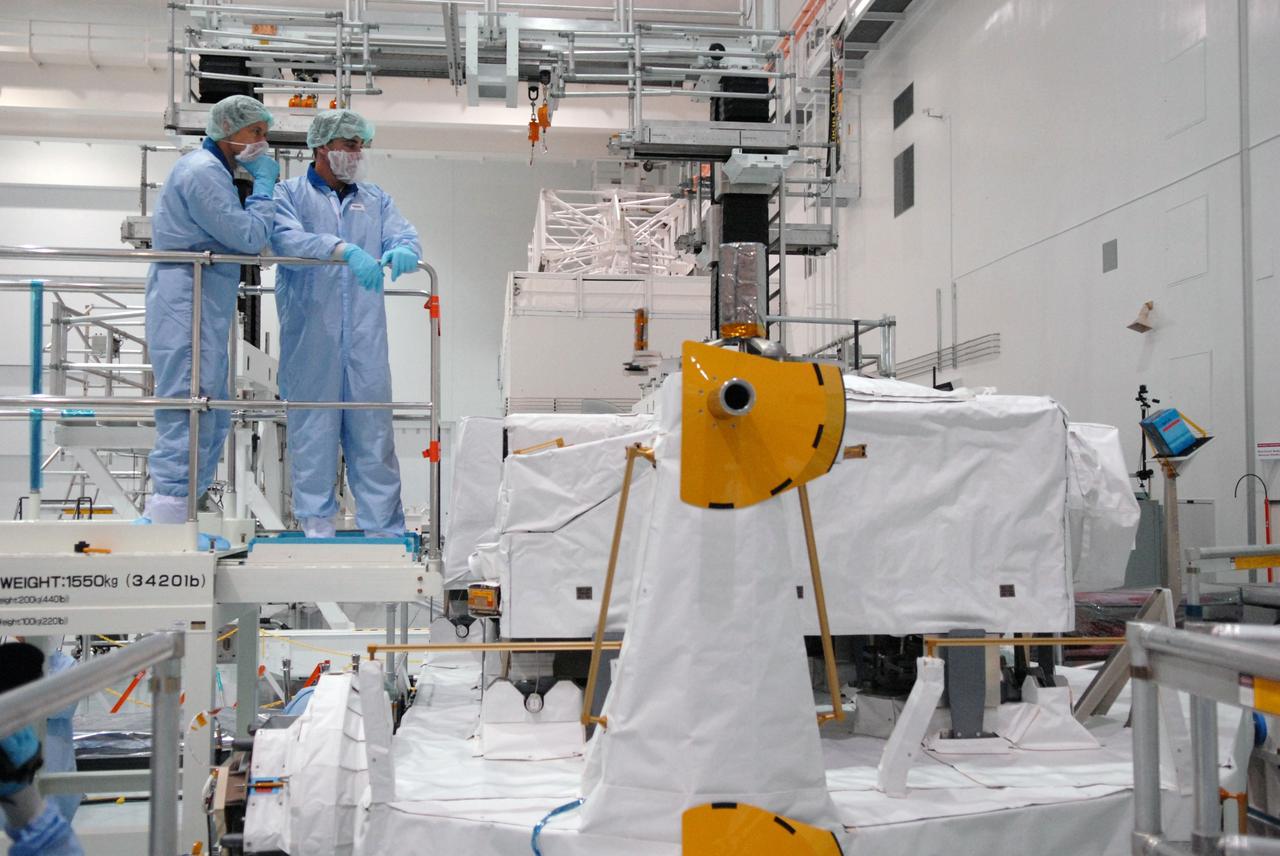
CAPE CANAVERAL, Fla. – In the Space Station Processing Facility at NASA's Kennedy Space Center in Florida, members of the STS-127 Mission Specialist Chris Cassidy prepares the tools he will use on-orbit to set up the Japanese Experiment Module's Experiment Logistics Module-Exposed Section, or ELM-ES, part of the payload on the mission. The crew members are at Kennedy for Crew Equipment Interface Test activities, or CEIT, which provides experience handling tools, equipment and hardware for the mission.  The payload will be launched to the International Space Station aboard space shuttle Endeavour on the STS-127 mission, targeted for launch on May 15. Photo credit: NASA/Dimitrios Gerondidakis
KSC-2009-1134
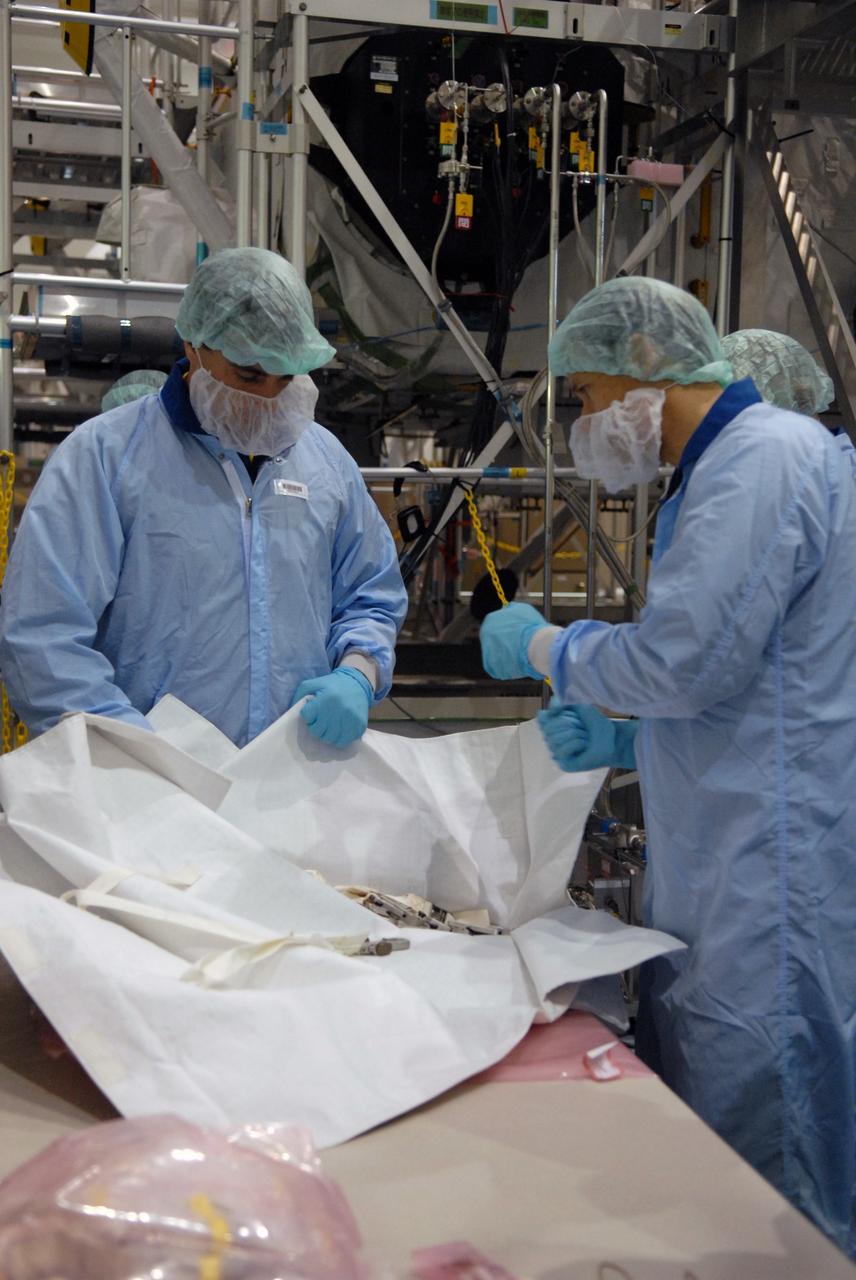
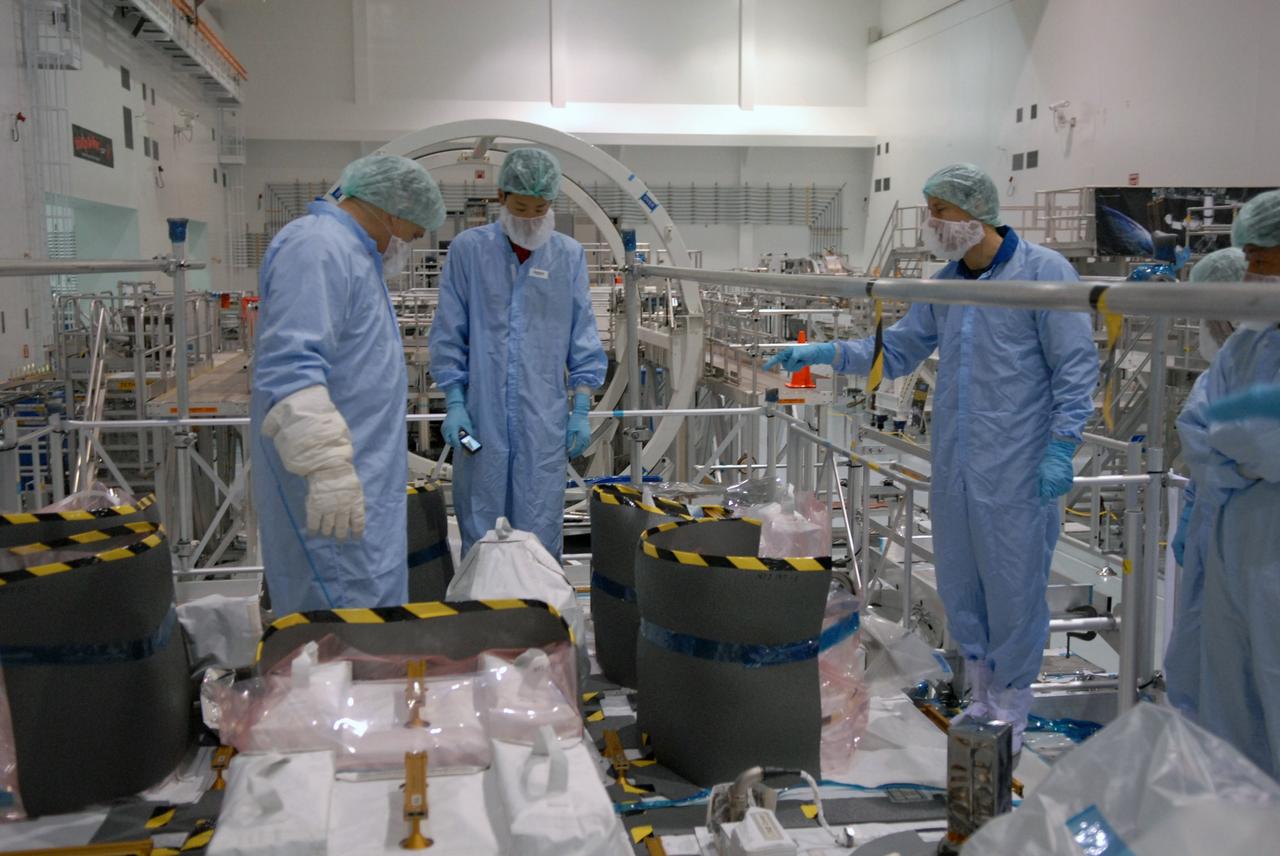
CAPE CANAVERAL, Fla. – In the Space Station Processing Facility at NASA's Kennedy Space Center in Florida, members of the STS-127 Mission Specialists Chris Cassidy and Tom Marshburn review options of how they will stow the excess thermal blankets on the Japanese Experiment Module's Experiment Logistics Module-Exposed Section, or ELM-ES, after they remove them on-orbit. The crew members are at Kennedy for Crew Equipment Interface Test activities, or CEIT, which provides experience handling tools, equipment and hardware for the mission.  The payload will be launched to the International Space Station aboard space shuttle Endeavour on the STS-127 mission, targeted for launch on May 15. Photo credit: NASA/Dimitrios Gerondidakis
KSC-2009-1135
CAPE CANAVERAL, Fla. –  In the Space Station Processing Facility at NASA's Kennedy Space Center in Florida, members of the STS-127 Mission Specialists Chris Cassidy and Tom Marshburn review options of how they will stow the excess thermal blankets on the Japanese Experiment Module's Experiment Logistics Module-Exposed Section, or ELM-ES, after they remove them on-orbit. The crew members are at Kennedy for Crew Equipment Interface Test activities, or CEIT, which provides experience handling tools, equipment and hardware for the mission.  The payload will be launched to the International Space Station aboard space shuttle Endeavour on the STS-127 mission, targeted for launch on May 15. Photo credit: NASA/Dimitrios Gerondidakis
KSC-2009-1136
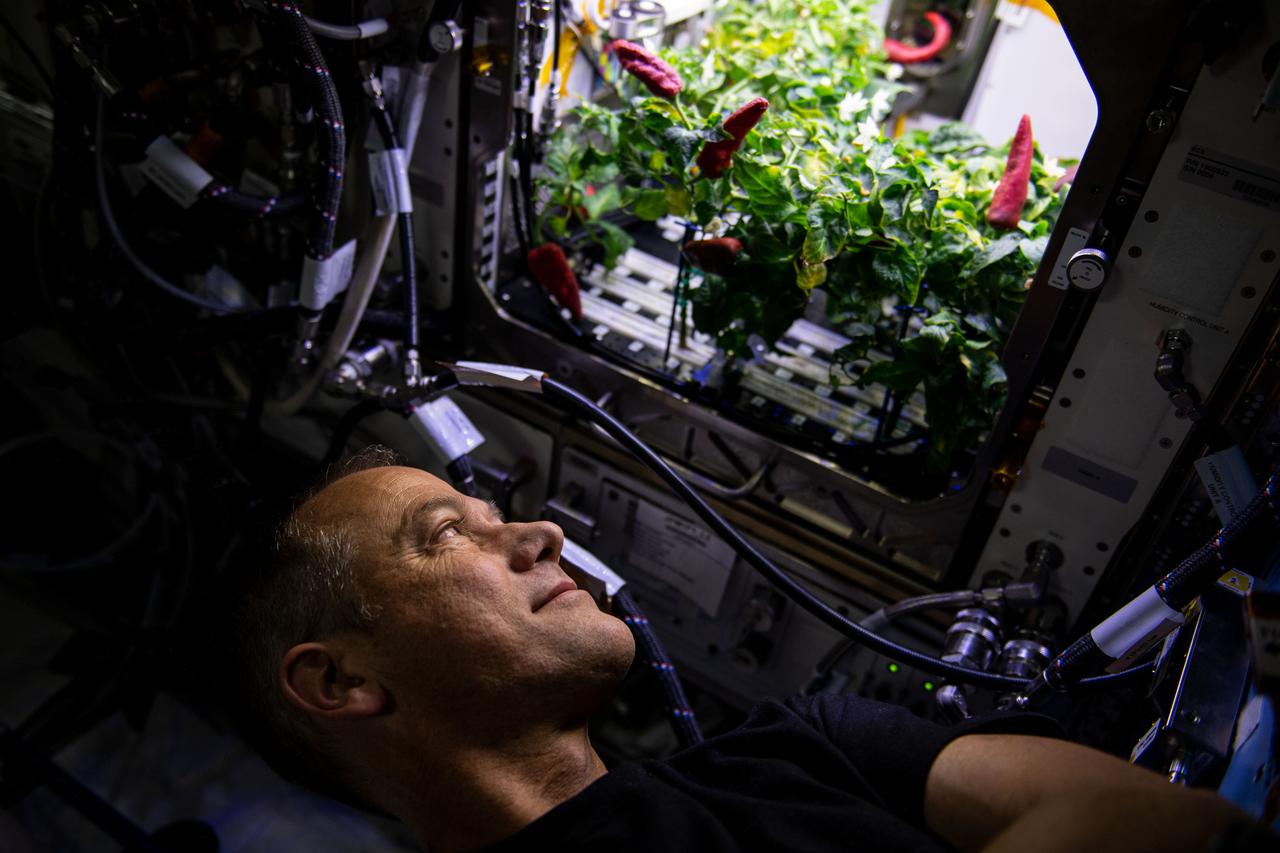
iss066e084304 (November 26, 2021) --- NASA astronaut and Crew-3 member Tom Marshburn looks at chiles growing inside of the Advanced Plant Habitat. Crew-3 performed the second harvest of chiles aboard the International Space Station for the Plant Habitat-04 experiment. This plant experiment, one of the station’s most complex to date because of the long germination and growing times, will add to NASA’s knowledge of growing food crops for long-duration space missions.
Chile Peppers Harvest
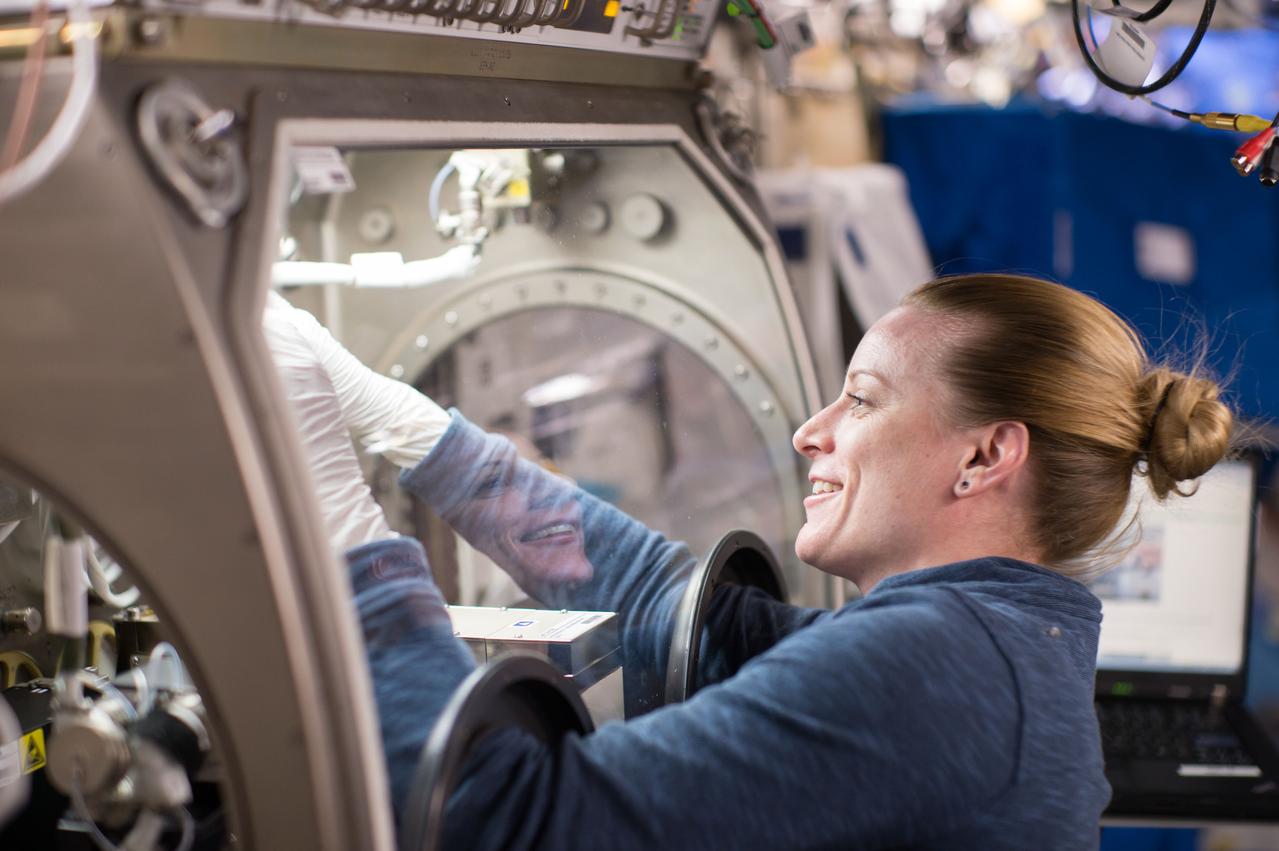
iss049e002655 (09/13/2016) --- NASA astronaut Kate Rubins, a crew member of Expedition 49 aboard the International Space Station, works on an experiment inside the station’s Microgravity Science Glovebox. The glovebox is one of the major dedicated science facilities inside the Destiny laboratory and provides a sealed environment for conducting science and technology experiments. The glovebox is particularly suited for handling hazardous materials when the crew is present.
iss049e002655
STS047-204-006 (12 - 20 Sept 1992) --- Dr. Mamoru Mohri, payload specialist representing Japan's National Space Development Agency (NASDA), participates in an experiment designed to learn more about Space Adaptation Syndrome (SAS).  The experiment is titled, "Comparative Measurement of Visual Stability in Earth and Cosmic Space."  During the experiment, Dr. Mohri tracked a flickering light target while eye movements and neck muscle tension were measured.  This 45-degree angle position was one of four studied during the eight-day Spacelab-J mission.
STS-47 Payload Specialist Mohri conducts visual stability experiment in SLJ
This image of the International Space Station (ISS) was photographed by one of the crewmembers of the STS-105 mission from the Shuttle Orbiter Discovery after separating from the ISS. The STS-105 mission was the 11th ISS assembly flight and its goals were the rotation of the ISS Expedition Two crew with Expedition Three crew, and the delivery of supplies utilizing the Italian-built Multipurpose Logistic Module (MPLM) Leonardo. Aboard Leonardo were six resupply stowage racks, four resupply stowage supply platforms, and two new scientific experiment racks, EXPRESS (Expedite the Processing of Experiments to the Space Station) Racks 4 and 5, which added science capabilities to the ISS. Another payload was the Materials International Space Station Experiment (MISSE), which included materials and other types of space exposure experiments mounted on the exterior of the ISS.
International Space Station (ISS)
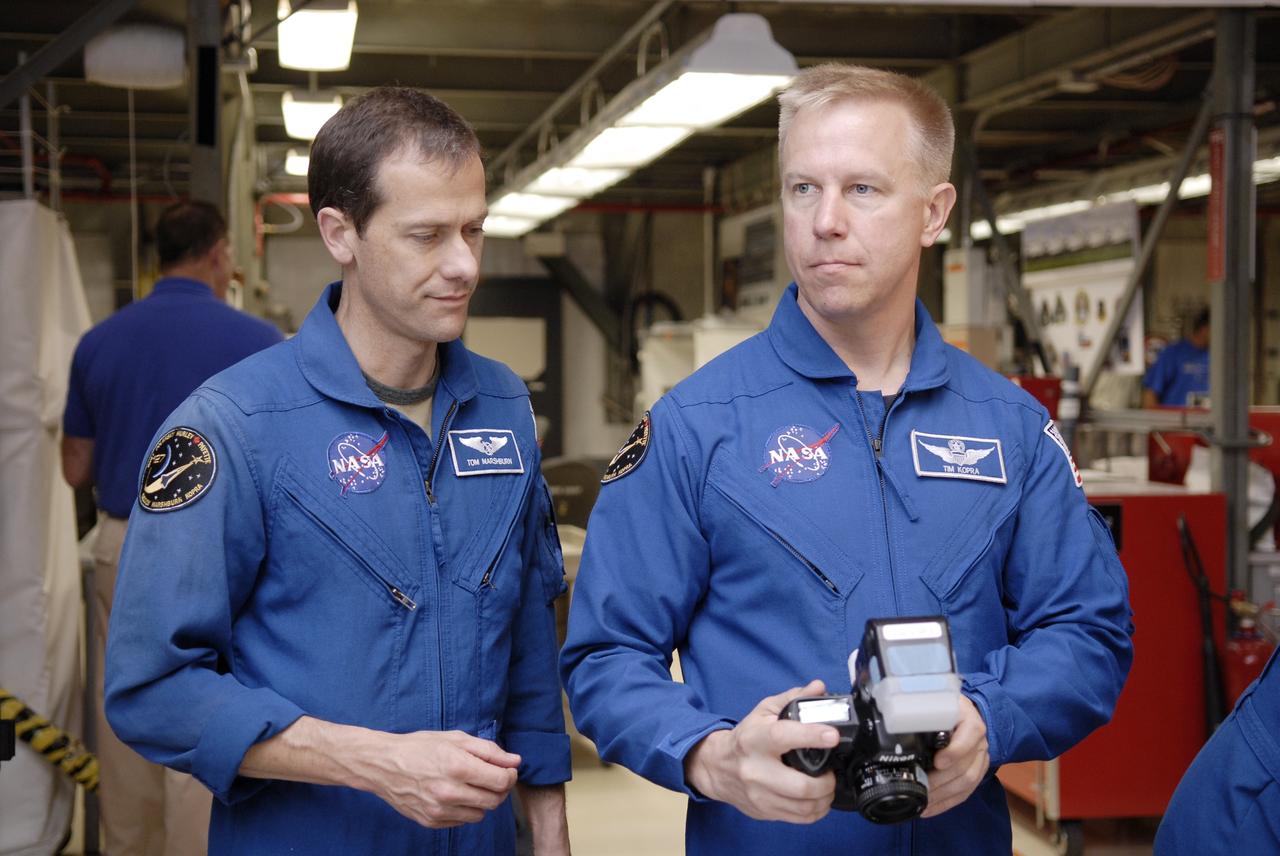
CAPE CANAVERAL, Fla. – In the Orbiter Processing Facility at NASA's Kennedy Space Center in Florida, astronauts with the STS-127 mission handle the camera they will use on the mission to the International Space Station.  At left is Mission Specialist Tom Marshburn; at right is Mission Specialist Tim Kopra, who will remain with the Expedition 19 crew on the station. The crew members are at Kennedy for a crew equipment interface test, which provides hands-on training and observation of shuttle and flight hardware.  Endeavour will deliver the Japanese Experiment Module's Experiment Logistics Module-Exposed Section, or ELM-ES, to the space station on STS-127.  Launch is targeted for mid-June, 2009.  Photo credit: NASA/Kim Shiflett
KSC-2009-2124
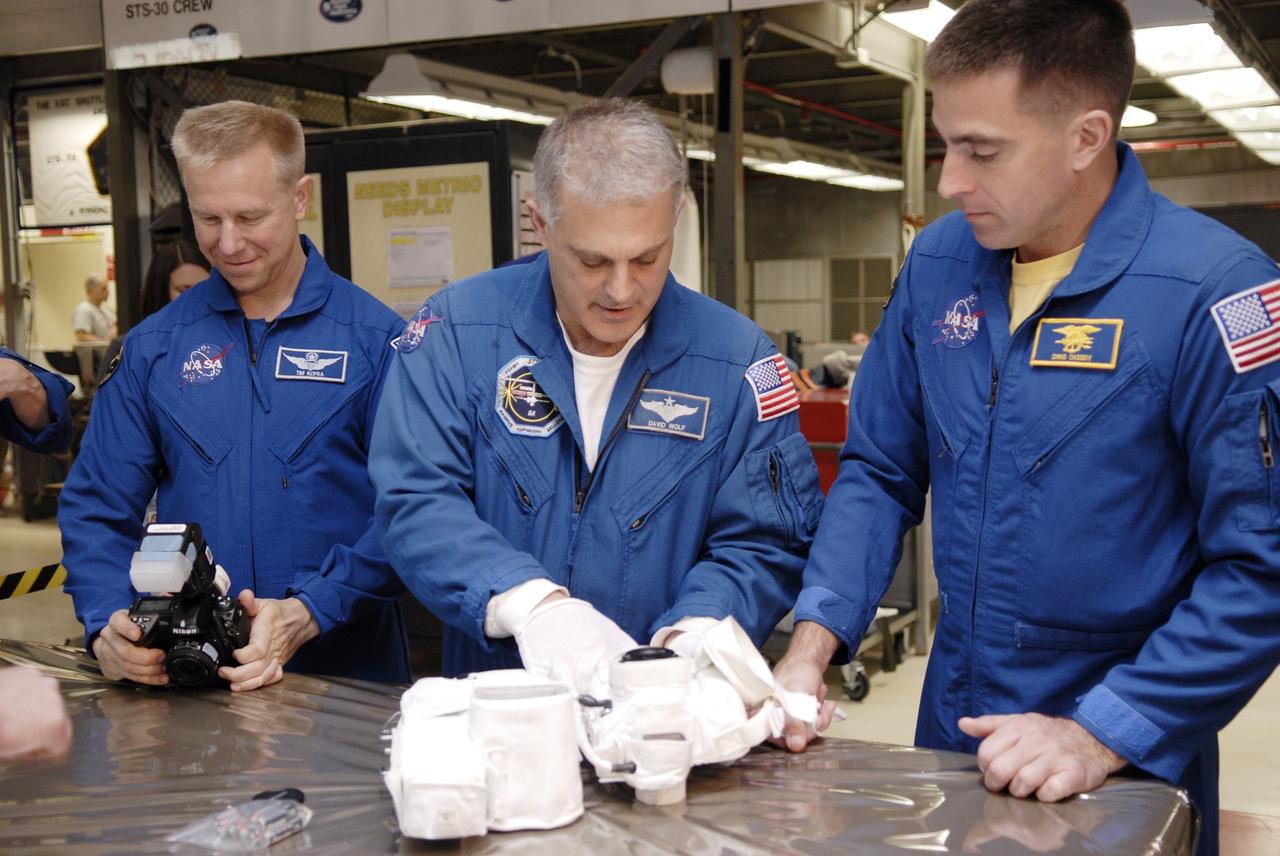
CAPE CANAVERAL, Fla. – In the Orbiter Processing Facility at NASA's Kennedy Space Center in Florida, astronauts with the STS-127 mission look at camera equipment they will use on the mission to the International Space Station.  From left are Mission Specialists Tim Kopra, Dave Wolf and Christopher Cassidy. Kopra  will remain with the Expedition 19 crew on the station. The crew members are at Kennedy for a crew equipment interface test, which provides hands-on training and observation of shuttle and flight hardware.  Endeavour will deliver the Japanese Experiment Module's Experiment Logistics Module-Exposed Section, or ELM-ES, to the space station on STS-127.  Launch is targeted for mid-June, 2009.  Photo credit: NASA/Kim Shiflett
KSC-2009-2123
CAPE CANAVERAL, Fla. – In the Orbiter Processing Facility at NASA's Kennedy Space Center in Florida, astronauts with the STS-127 mission look at camera equipment they will use on the mission to the International Space Station.  From left are Mission Specialists Tom Marshburn, Tim Kopra, Dave Wolf and Christopher Cassidy. Kopra  will remain with the Expedition 19 crew on the station. The crew members are at Kennedy for a crew equipment interface test, which provides hands-on training and observation of shuttle and flight hardware.  Endeavour will deliver the Japanese Experiment Module's Experiment Logistics Module-Exposed Section, or ELM-ES, to the space station on STS-127.  Launch is targeted for mid-June, 2009.  Photo credit: NASA/Kim Shiflett
KSC-2009-2122
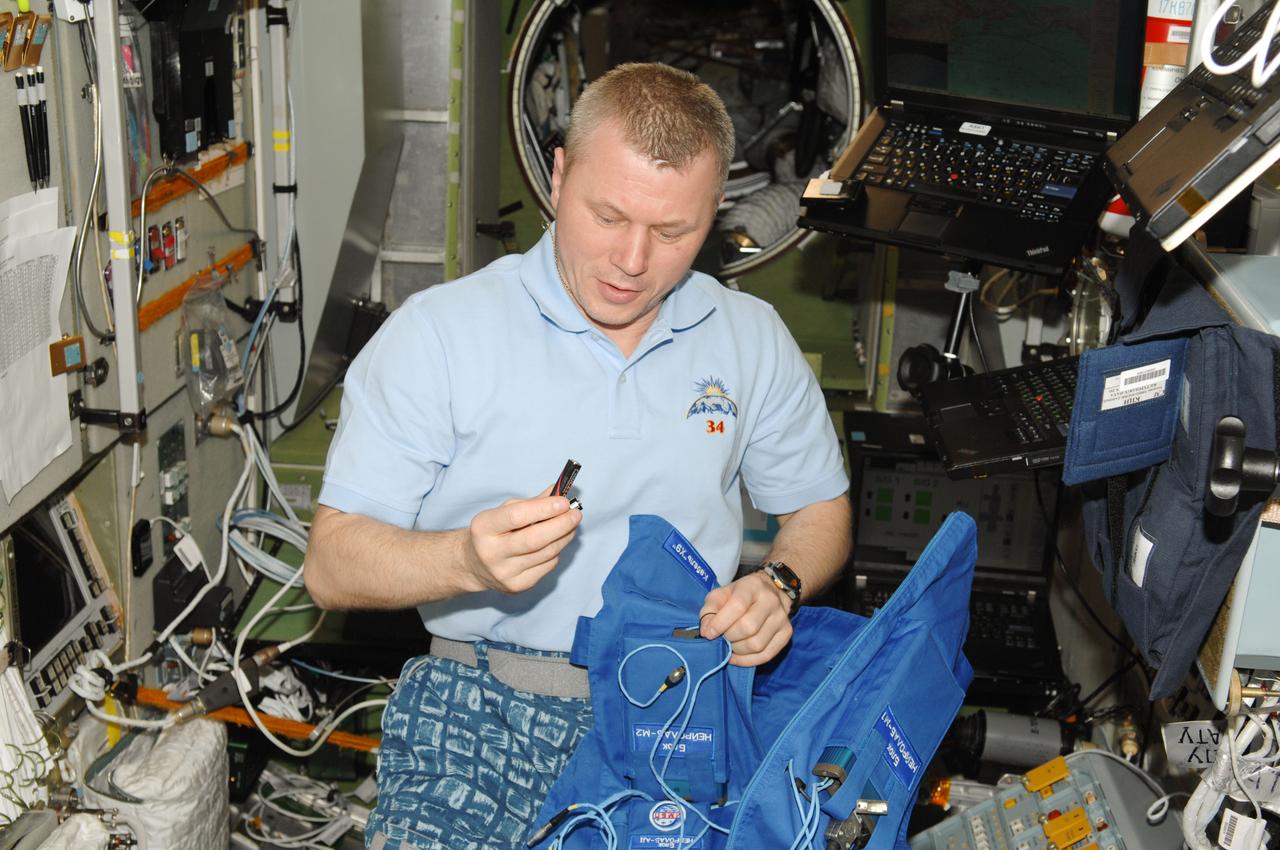
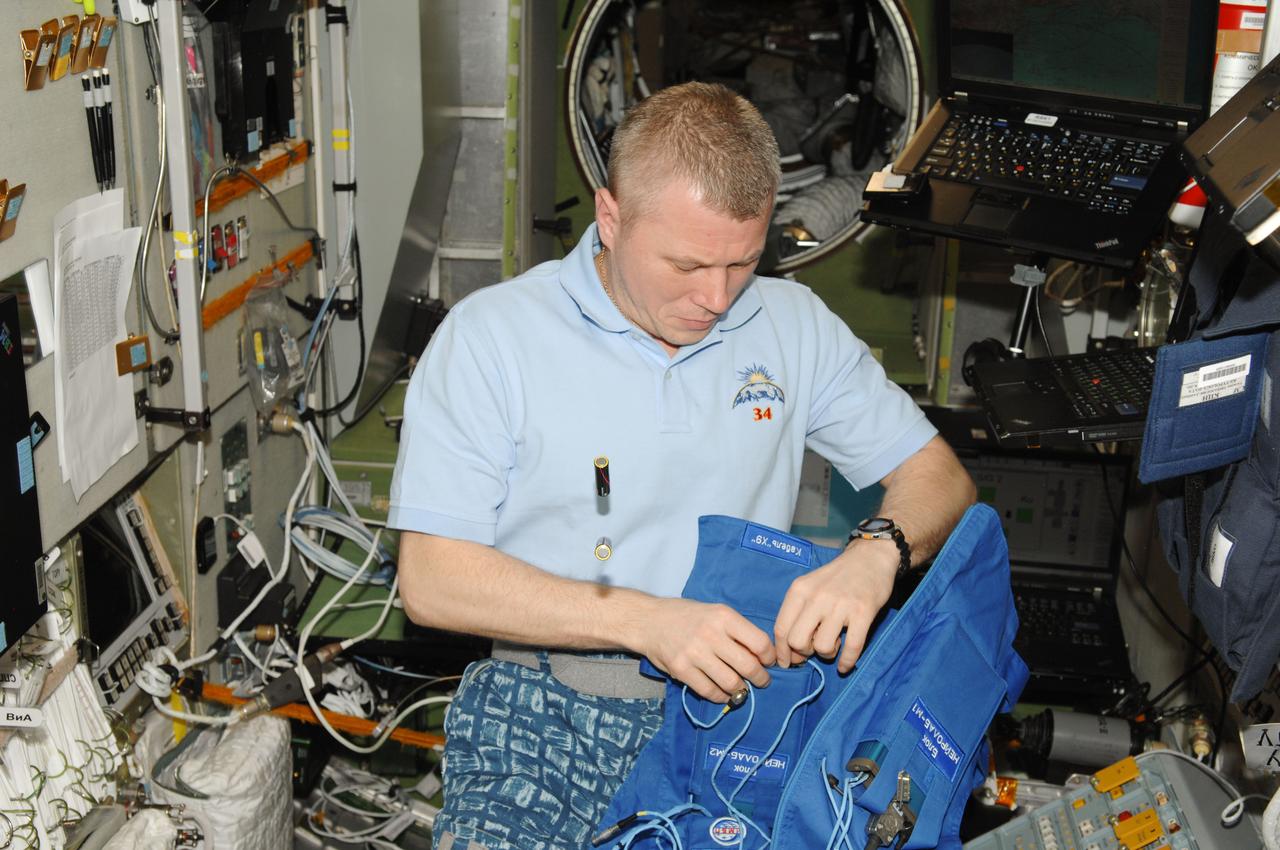
ISS034-E-042297 (12 Feb. 2013) --- Russian cosmonaut Oleg Novitskiy, Expedition 34 flight engineer, prepares for the Typologia experiment in the Zvezda Service Module of the International Space Station. This experiment studies the crew member's psychophysical state and ability to perform and communicate under stress.
Novitskiy prepares for the Typologia Experiment
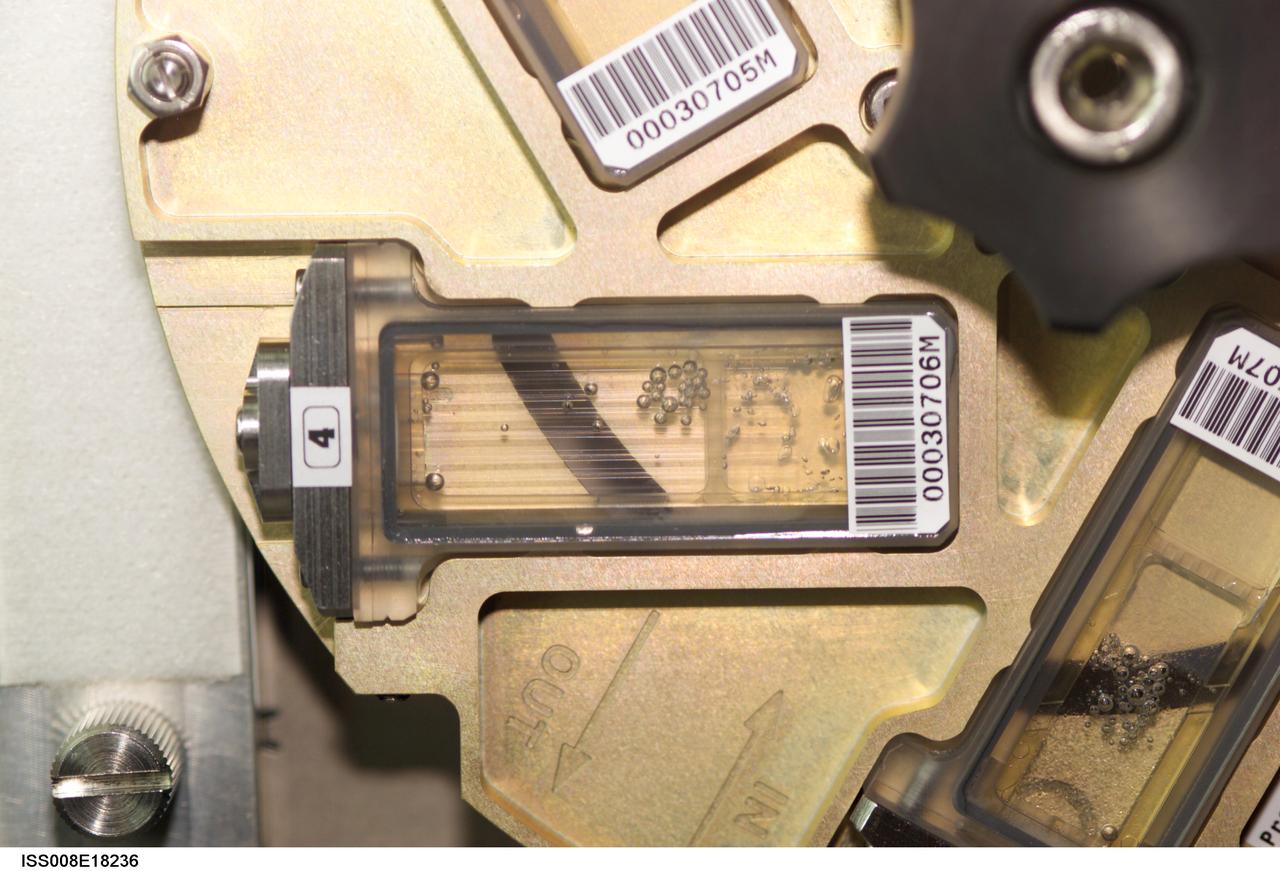
iss008e18236 (3/3/2004) --- Close-up view of a PromISS 3 (Protein Crystal Growth Monitoring by Digital Holographic Microscope) experiment sample. The experiment was conducted by the Expedition 8 crew in the Microgravity Science Glovebox (MSG) located in the Destiny U.S. Laboratory aboard the International Space Station (ISS).
PromISS 3 experiment sample taken during Expedition 8
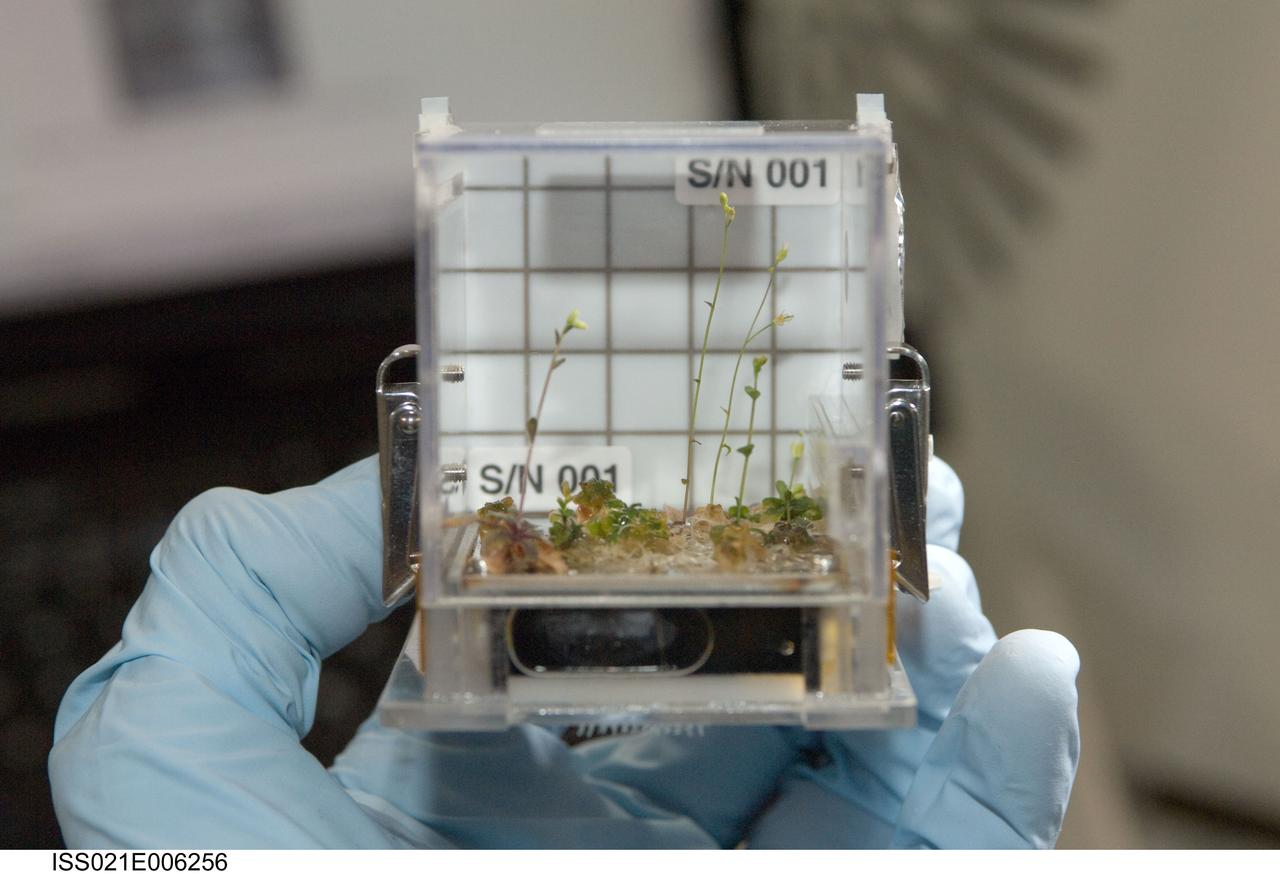
ISS021-E-006256 (13 Oct. 2009) --- A close-up view of the Cell Biology Experiment Facility (CBEF) SPACE SEED experiment is featured in this image photographed by an Expedition 21 crew member in the Kibo laboratory on the International Space Station.
View of CBEF Space Seed Experiment Hardware
ISS034-E-042298 (12 Feb. 2013) --- Russian cosmonaut Oleg Novitskiy, Expedition 34 flight engineer, prepares for the Typologia experiment in the Zvezda Service Module of the International Space Station. This experiment studies the crew member's psychophysical state and ability to perform and communicate under stress.
Novitskiy prepares for the Typologia Experiment
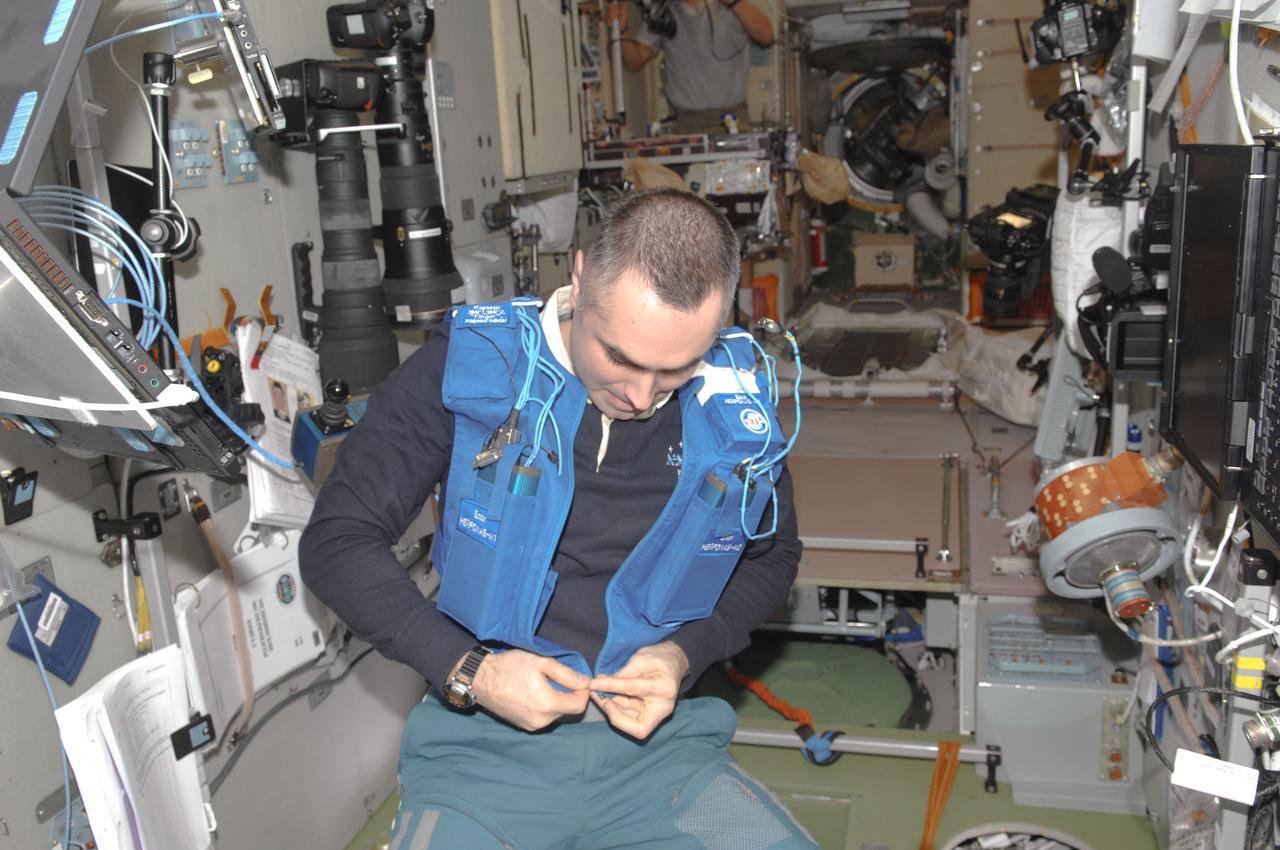
ISS034-E-033718 (24 Jan. 2013) --- Russian cosmonaut Evgeny Tarelkin, Expedition 34 flight engineer, prepares for the Typologia experiment in the Zvezda Service Module of the International Space Station. This experiment studies the crew member's psychophysical state and ability to perform and communicate under stress.
Tarelkin prepares for the Typologia Experiment in the SM
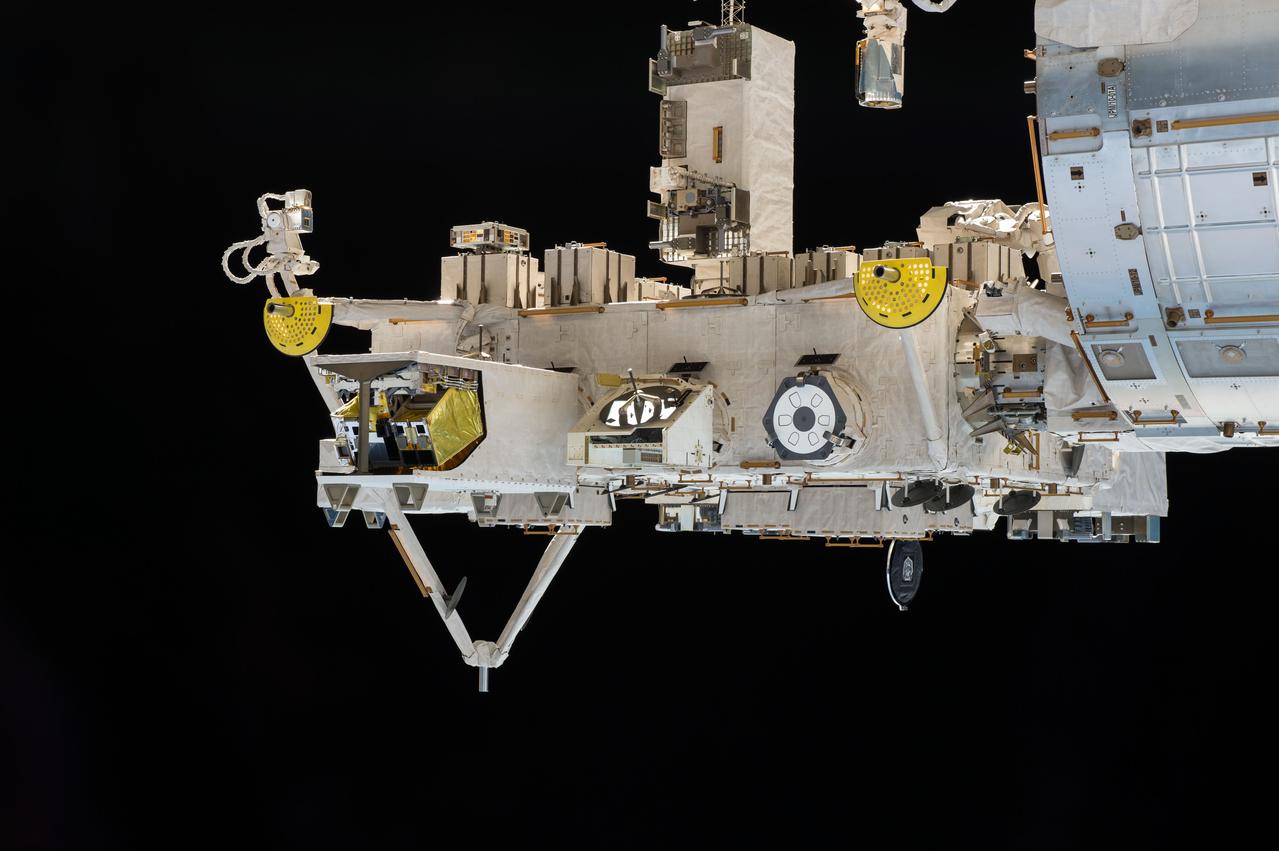
iss050e011669 (Nov. 28, 2016) --- Japanese Experiment Module - Exposed Facility (JEM-EF) and Japanese Experiment Module (JEM) Pressurized Module (JPM) (right) taken by the Expedition 50 crew. JEM-EF is an unpressurized  multipurpose pallet structure attached to the outside of the International Space Station (ISS).
JPM and JEM-EF
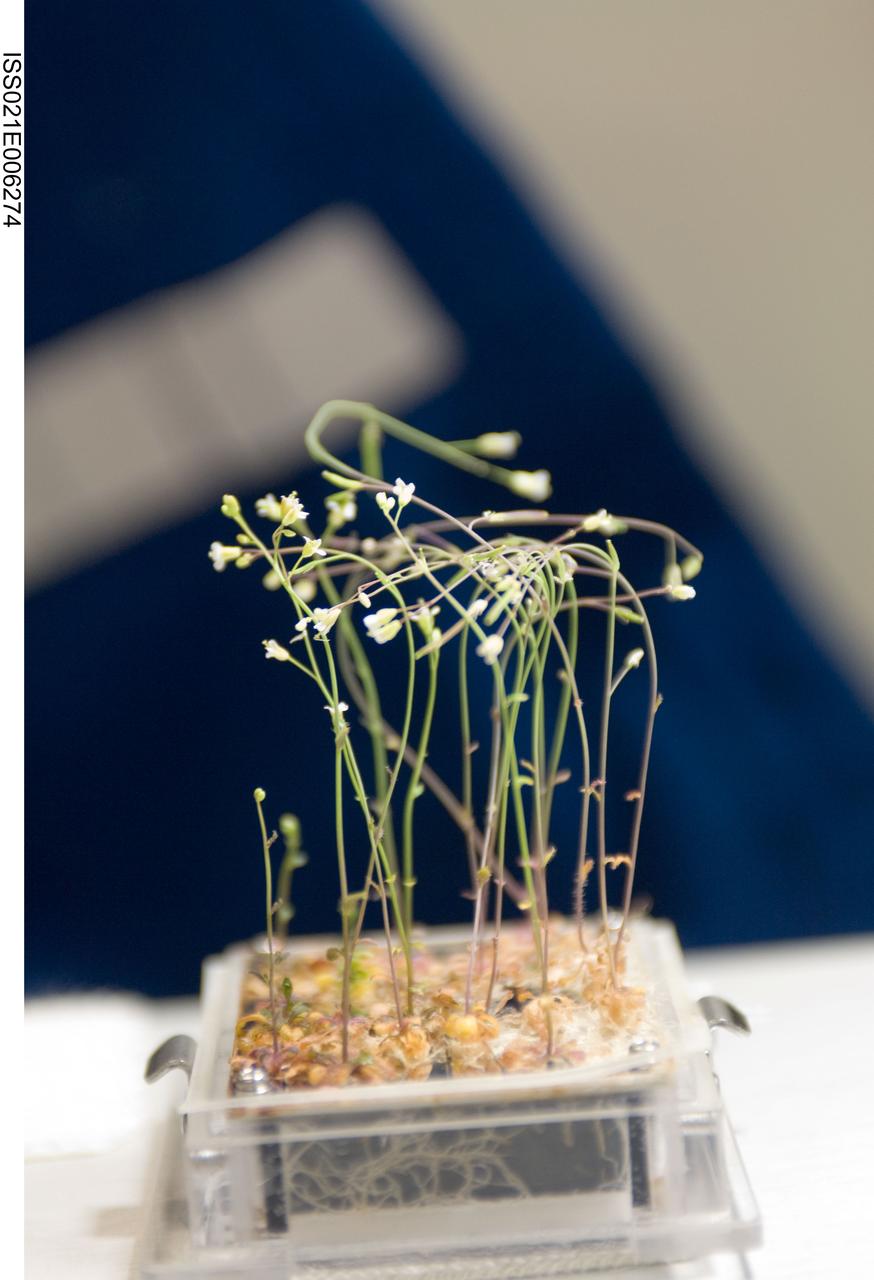
ISS021-E-006274 (13 Oct. 2009) --- A close-up view of the Cell Biology Experiment Facility (CBEF) SPACE SEED experiment is featured in this image photographed by an Expedition 21 crew member in the Kibo laboratory on the International Space Station.
View of CBEF Space Seed Experiment Hardware
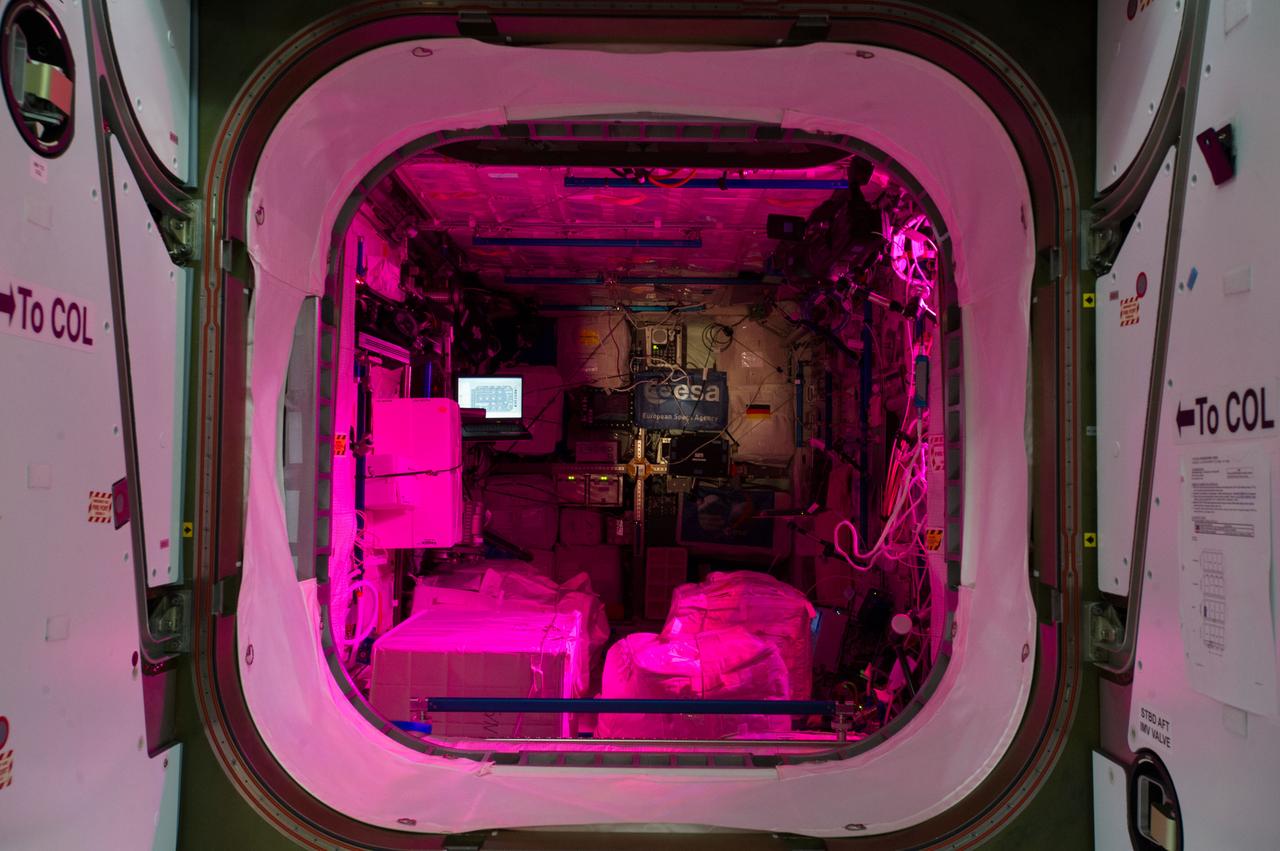
ISS040-E-007560 (5 June 2014) --- A colorful view of the interior of the Columbus laboratory of the International Space Station is featured in this image photographed by an Expedition 40 crew member on the station. The colored lighting is from the Veggie experiment in Columbus.
SPACELAB
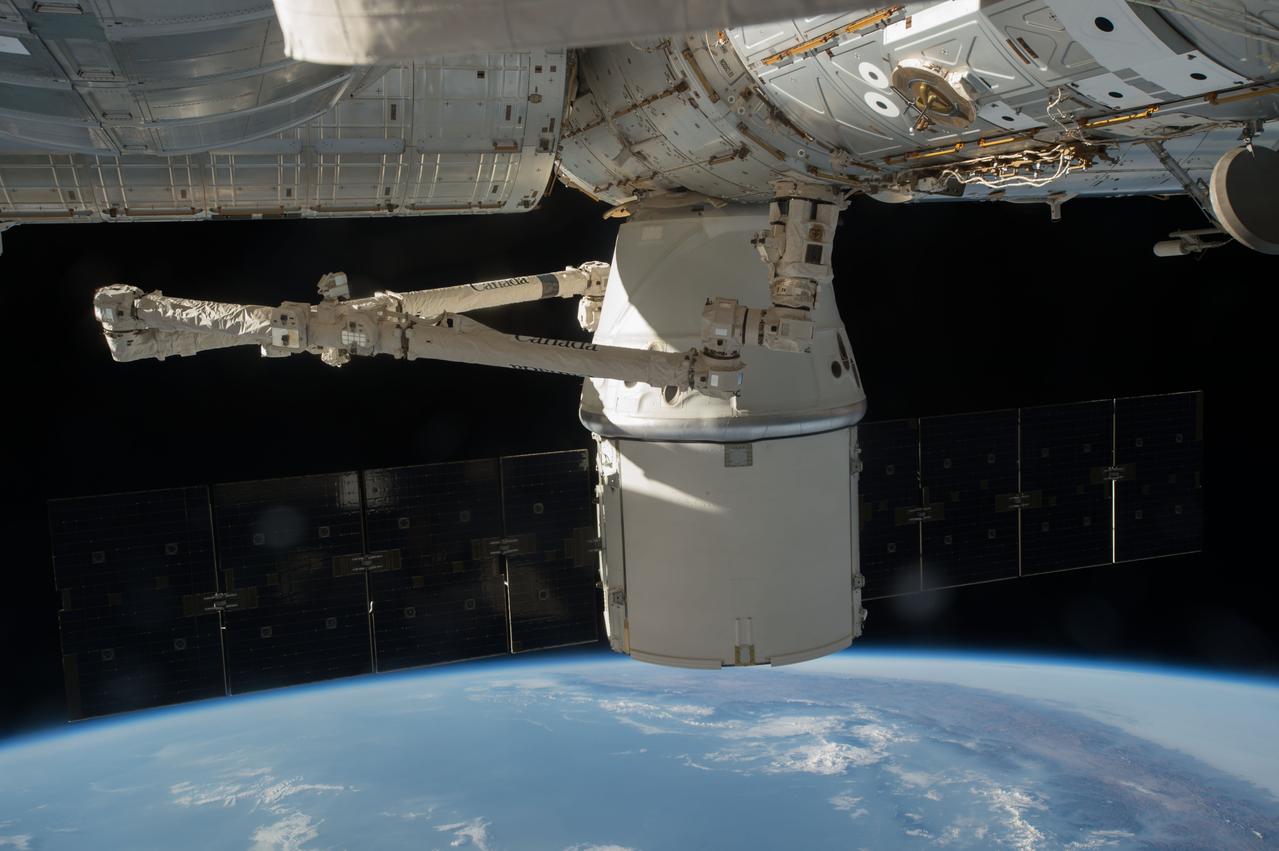
ISS048e042926 (07/24/2016) --- The SpaceX Dragon is attached to the International Space Station, while inside the station the crew of Expedition 48 continue to off load the nearly 5000 pounds of supplies, hardware and experiments.
iss048e042926
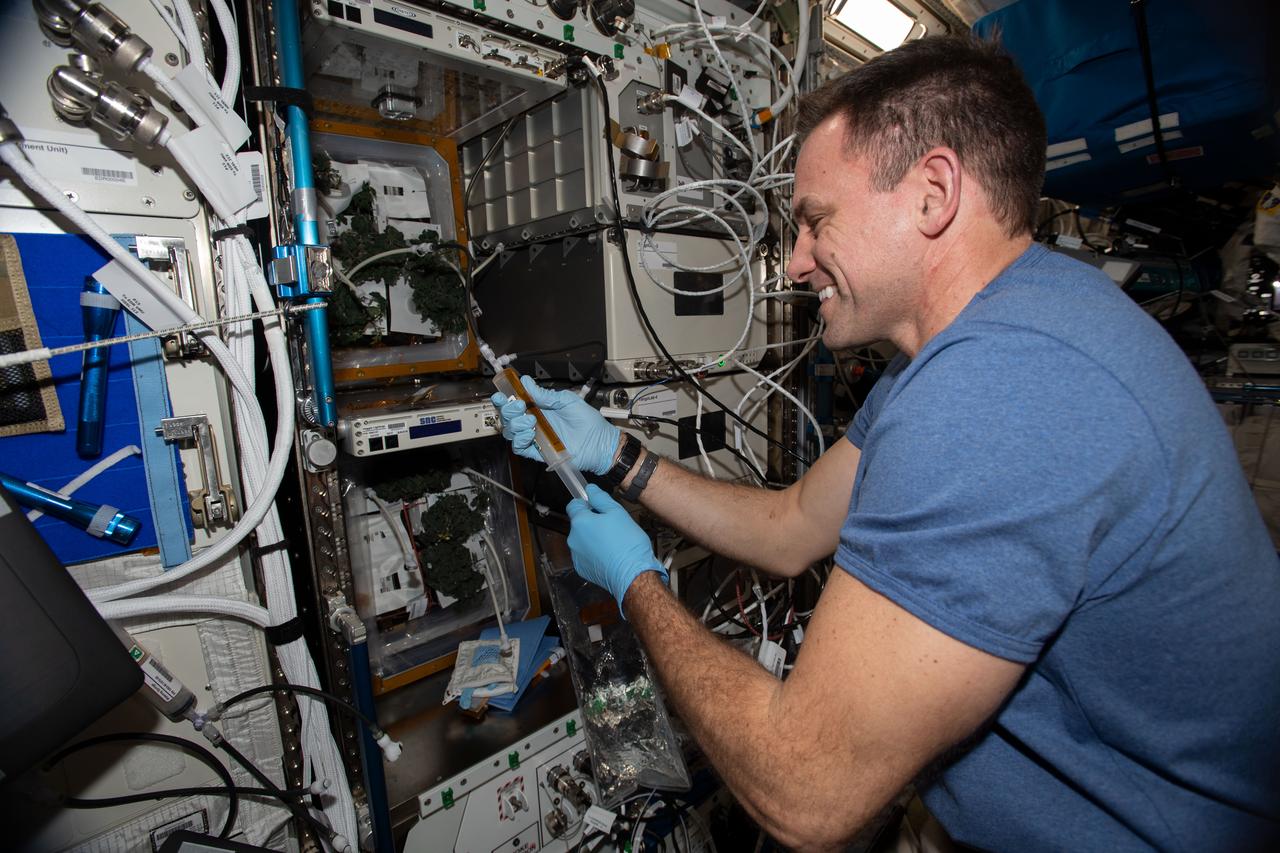
iss068e045013 (Feb. 2, 2023) --- NASA astronaut and Expedition 68 Flight Engineer Josh Cassada uses a watering syringe to water tomato plants for the the Veg-05 experiment, the next step in efforts to address the need for a continuous fresh-food production system in space. The experiment uses the space station’s Veggie facility to grow dwarf tomatoes, seen in its early growing stages on station in the bottom photo. The experiment examines the effect of light quality and fertilizer on fruit production, microbial food safety, nutritional value, and taste acceptability. Growing plants can also enhance the overall living experience for crew members.
iss068e045013
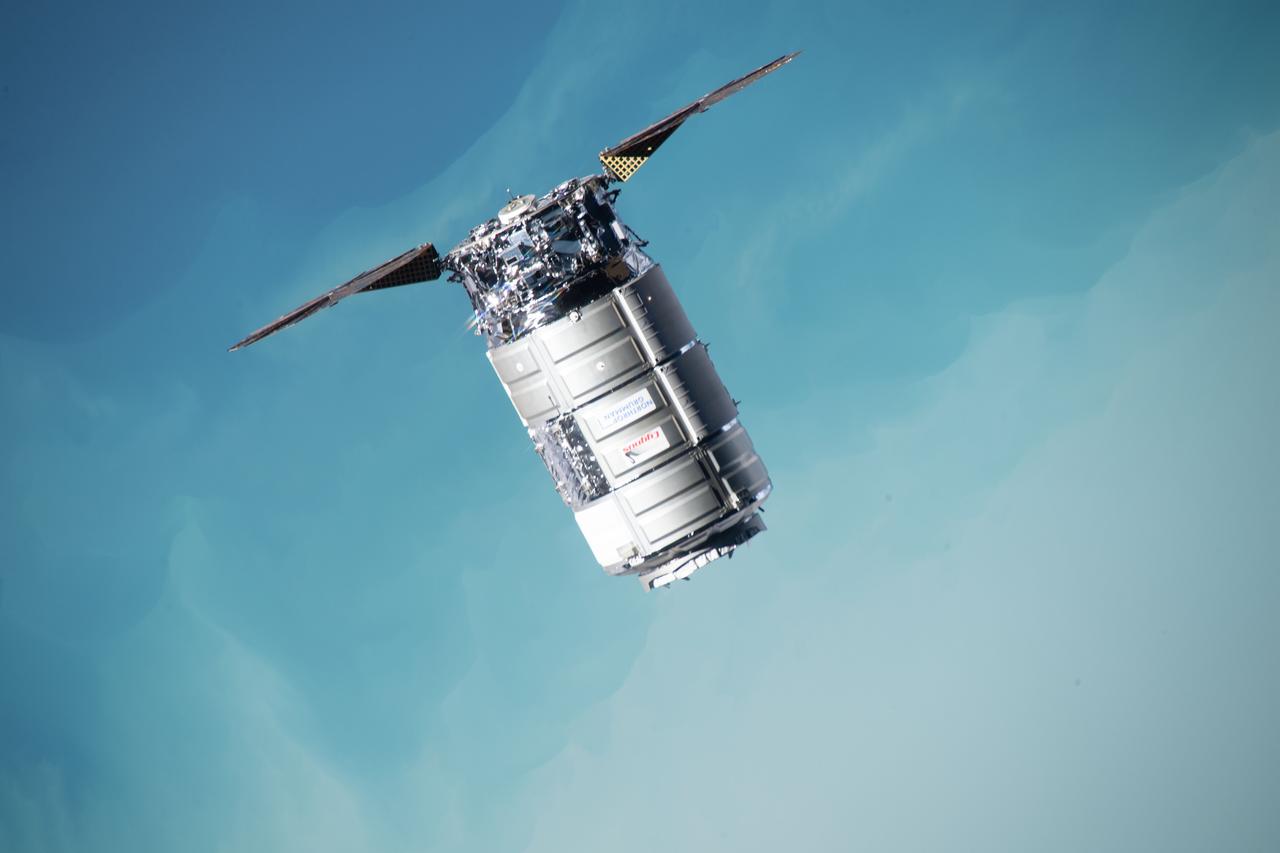
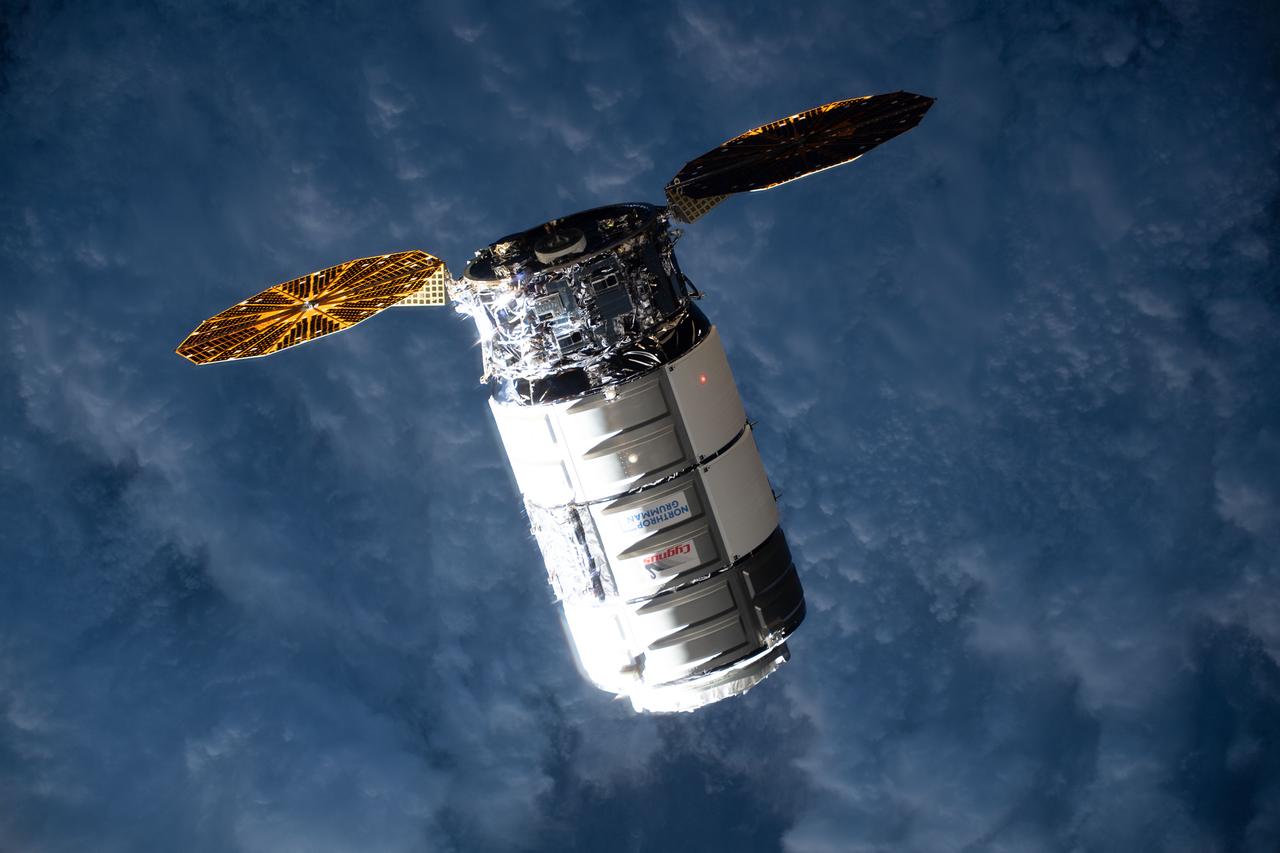
iss070e085663 (Feb. 1, 2024) --- Northrop Grumman's Cygnus space freighter approaches the International Space Station to deliver more than 8,200 pounds of science experiments, crew supplies, and station hardware for the Expedition 70 crew. Both spacecraft were orbiting 259 miles above the south Pacific Ocean at the time of this photograph.
iss070e085663
iss070e085709 (Feb. 1, 2024) --- Northrop Grumman's Cygnus space freighter approaches the International Space Station to deliver more than 8,200 pounds of science experiments, crew supplies, and station hardware for the Expedition 70 crew. Both spacecraft were orbiting 262 miles above the Middle East at the time of this photograph.
iss070e085709
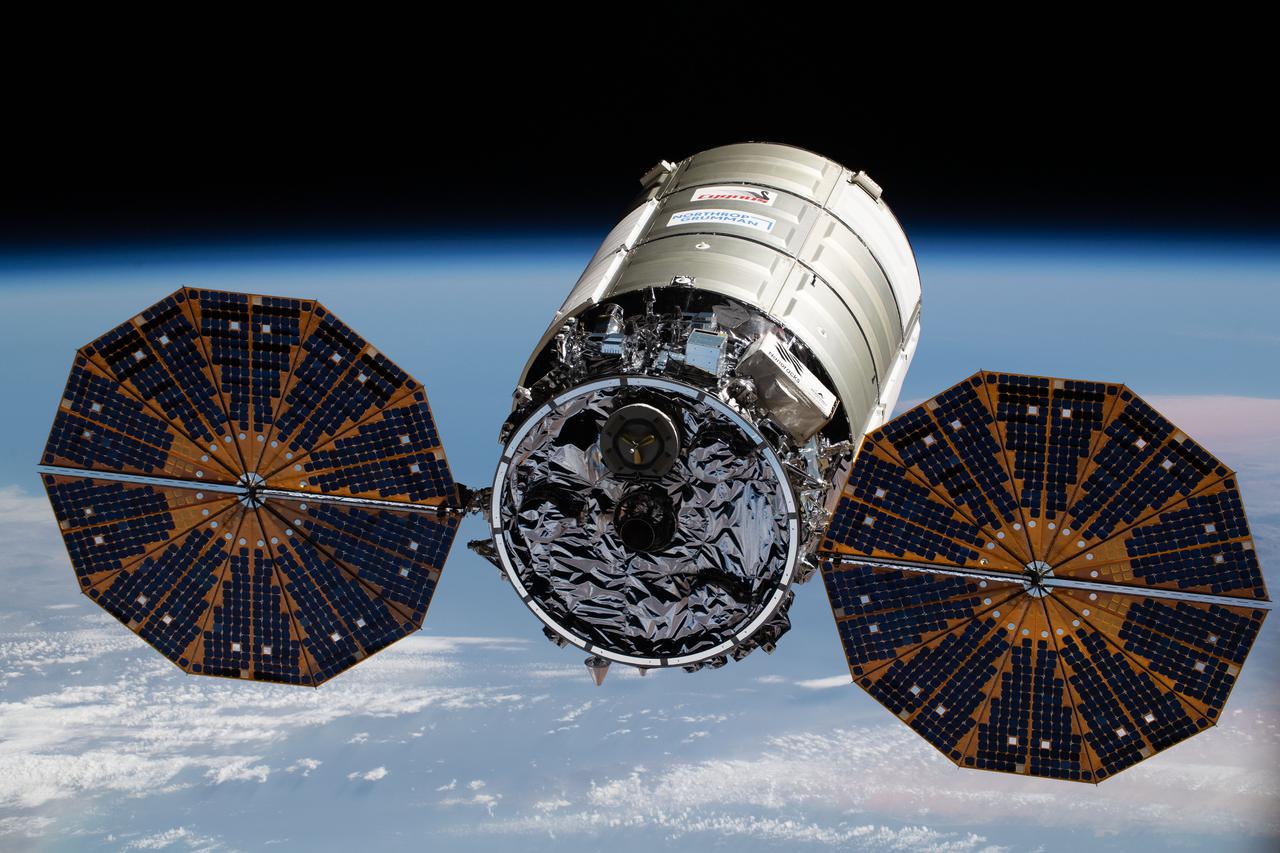
iss066e154853 (Feb. 21, 2022) --- Northrop Grummans's Cygnus space freighter, with its prominent cymbal-shaped UltraFlex solar arrays, is pictured approaching the International Space Station carrying 8,300 pounds of new science experiments, crew supplies, and station hardware to replenish the Expedition 66 crew.
iss066e154853
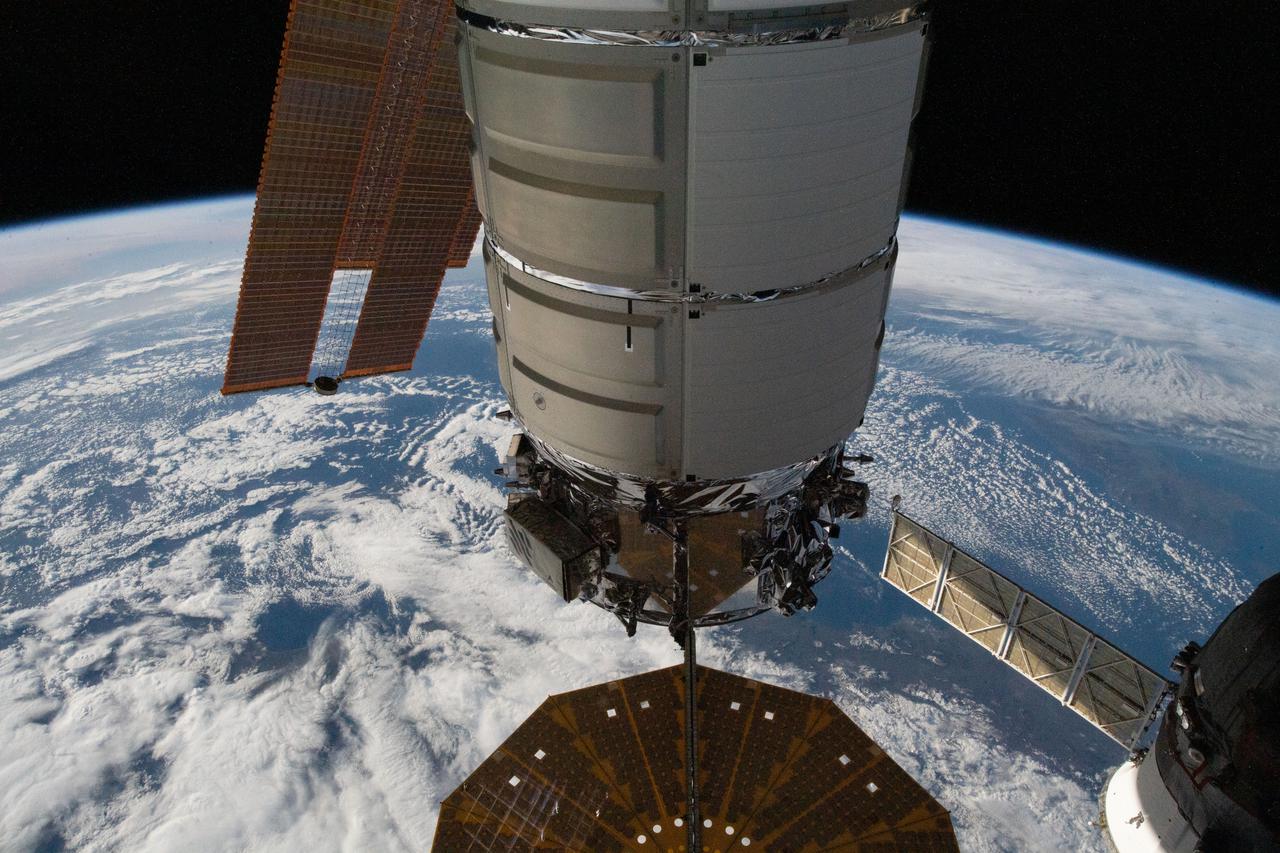
iss066e153515 (Feb. 27, 2022) --- Northrop Grummans's Cygnus space freighter is pictured attached to the International Space Station after delivering 8,300 pounds of new science experiments, crew supplies, and station hardware to replenish the Expedition 66 crew.
iss066e153515
CAPE CANAVERAL, Fla. - In Orbiter Processing Facility 3 at NASA's Kennedy Space Center in Florida, members of space shuttle Discovery's STS-131 crew participate in training activities during the Crew Equipment Interface Test, or CEIT, for their mission.  Here, Pilot James P. Dutton Jr. experiences the feel of the cockpit from inside the crew module.    The CEIT provides the crew with hands-on training and observation of shuttle and flight hardware. The seven-member crew will deliver the multi-purpose logistics module Leonardo, filled with resupply stowage platforms and racks to be transferred to locations around the International Space Station.  Three spacewalks will include work to attach a spare ammonia tank assembly to the station's exterior and return a European experiment from outside the station's Columbus module.  Discovery's launch is targeted for March 18.  For information on the STS-131 mission and crew, visit http://www.nasa.gov/mission_pages/shuttle/shuttlemissions/sts131/index.html.  Photo credit: NASA/Kim Shiflett
KSC-2010-1134
KENNEDY SPACE CENTER, FLA.  --  In the Space Station Processing Facility, the mission STS-120 crew members are getting familiar with the Node 2, another element to be added to the International Space Station.  Seen here is Mission Specialist Douglas H. Wheelock. Node 2 will provide a passageway between three station science experiment facilities: the U.S. Destiny Laboratory, the Kibo Japanese Experiment Module, and the European Columbus Laboratory.  STS-120 is targeted for launch on October 20.   Photo credit: NASA/Kim Shiflett
KSC-07pd0930
KENNEDY SPACE CENTER, FLA.  --  In the Space Station Processing Facility, STS-120 Mission Specialist Scott Parazynski becomes familiar with the Node 2, another element to be added to the International Space Station.  He and other crew members are at KSC for equipment familiarization.  Node 2 will provide a passageway between three station science experiment facilities: the U.S. Destiny Laboratory, the Kibo Japanese Experiment Module, and the European Columbus Laboratory.  STS-120 is targeted for launch on October 20.   Photo credit: NASA/Kim Shiflett
KSC-07pd0938
KENNEDY SPACE CENTER, FLA.  --  In In the Space Station Processing Facility, STS-120 Commander Pamela Melroy (center) learns more about the Node 2, another element to be added to the International Space Station.  She and other crew members are at KSC for equipment familiarization.  Node 2 will provide a passageway between three station science experiment facilities: the U.S. Destiny Laboratory, the Kibo Japanese Experiment Module, and the European Columbus Laboratory.  STS-120 is targeted for launch on October 20.   Photo credit: NASA/Kim Shiflett
KSC-07pd0934
KENNEDY SPACE CENTER, FLA.  --  In the Space Station Processing Facility, STS-120 Mission Specialist Scott Parazynski becomes familiar with the Node 2, another element to be added to the International Space Station.  He and other crew members are at KSC for equipment familiarization.  Node 2 will provide a passageway between three station science experiment facilities: the U.S. Destiny Laboratory, the Kibo Japanese Experiment Module, and the European Columbus Laboratory.  STS-120 is targeted for launch on October 20.   Photo credit: NASA/Kim Shiflett
KSC-07pd0939
KENNEDY SPACE CENTER, FLA. --  In the Space Station Processing Facility at NASA's Kennedy Space Center, STS-120 Mission Specialist Scott Parazynski checks out the primary payload for the mission: the U.S. Node 2, another element to be added to the International Space Station.  Parazynski and other crew members are familiarizing themselves with the payload.  Node 2 will provide a passageway between three station science experiment facilities: the U.S. Destiny Laboratory, the Kibo Japanese Experiment Module, and the European Columbus Laboratory.  STS-120 is targeted for launch on Sept. 7 with a crew of six, including Commander Pam Melroy, Pilot George Zamka, and Mission Specialist Mike Foreman.  Photo credit: NASA/Kim Shiflett
KSC-07pd0160
KENNEDY SPACE CENTER, Fla. -  A technician prepares for payload bay closure on Space Shuttle Endeavour. Inside the bay is the Multi-Purpose Logistics Module Raffaello (foreground), carrying supplies, equipment and experiments for the International Space Station.  Sharing the payload bay are several carriers with varying experiment packages, such as Starshine-2, a Get-Away Special. Endeavour is scheduled to launch Nov. 29 on this first Utilization Flight, STS-108, to the International Space Station.  Endeavour will also carry the replacement Expedition 4 crew to the Station and return to Earth with the Expedition 3 crew
KSC01pd1733
KENNEDY SPACE CENTER, Fla. -  A technician prepares for payload bay closure on Space Shuttle Endeavour. Inside the bay is the Multi-Purpose Logistics Module Raffaello (foreground), carrying supplies, equipment and experiments for the International Space Station.  Sharing the payload bay are several carriers with varying experiment packages, such as Starshine-2, a Get-Away Special. Endeavour is scheduled to launch Nov. 29 on this first Utilization Flight, STS-108, to the International Space Station.  Endeavour will also carry the replacement Expedition 4 crew to the Station and return to Earth with the Expedition 3 crew
KSC-01PD-1733
KENNEDY SPACE CENTER, Fla. - Space Shuttle Endeavour's payload bay doors are ready for closure and launch on mission STS-108.  Inside the bay is the Multi-Purpose Logistics Module Raffaello, carrying supplies, equipment and experiments for the International Space Station.  Surrounding the MPLM are several carriers with varying experiment packages, such as Starshine-2, a Get-Away Special. Endeavour is scheduled to launch Nov. 29 on this first Utilization Flight to the International Space Station.  Endeavour will also carry the replacement Expedition 4 crew to the Station and return to Earth with the Expedition 3 crew
KSC-01PD-1734
KENNEDY SPACE CENTER, Fla. - A worker makes a final adjustment in the payload bay of Space Shuttle Endeavour before door closure.   Inside the bay is the Multi-Purpose Logistics Module Raffaello (foreground), carrying supplies, equipment and experiments for the International Space Station.  Sharing the payload bay are several carriers with varying experiment packages, such as Starshine-2, a Get-Away Special. Endeavour is scheduled to launch Nov. 29 on this first Utilization Flight, STS-108, to the International Space Station.  Endeavour will also carry the replacement Expedition 4 crew to the Station and return to Earth with the Expedition 3 crew
KSC-01PD-1732
KENNEDY SPACE CENTER, Fla. --  Space Shuttle Endeavour's payload bay doors are ready for closure and launch on mission STS-108.  Inside the bay is the Multi-Purpose Logistics Module Raffaello (foreground), carrying supplies, equipment and experiments for the International Space Station.  Sharing the payload bay are several carriers with varying experiment packages, such as Starshine-2, a Get-Away Special. Endeavour is scheduled to launch Nov. 29 on this first Utilization Flight to the International Space Station.  Endeavour will also carry the replacement Expedition 4 crew to the Station and return to Earth with the Expedition 3 crew
KSC01pd1731
KENNEDY SPACE CENTER, Fla. --  Space Shuttle Endeavour's payload bay doors are ready for closure and launch on mission STS-108.  Inside the bay is the Multi-Purpose Logistics Module Raffaello (foreground), carrying supplies, equipment and experiments for the International Space Station.  Sharing the payload bay are several carriers with varying experiment packages, such as Starshine-2, a Get-Away Special. Endeavour is scheduled to launch Nov. 29 on this first Utilization Flight to the International Space Station.  Endeavour will also carry the replacement Expedition 4 crew to the Station and return to Earth with the Expedition 3 crew
KSC-01PD-1731
KENNEDY SPACE CENTER, Fla. - A worker makes a final adjustment in the payload bay of Space Shuttle Endeavour before door closure.   Inside the bay is the Multi-Purpose Logistics Module Raffaello (foreground), carrying supplies, equipment and experiments for the International Space Station.  Sharing the payload bay are several carriers with varying experiment packages, such as Starshine-2, a Get-Away Special. Endeavour is scheduled to launch Nov. 29 on this first Utilization Flight, STS-108, to the International Space Station.  Endeavour will also carry the replacement Expedition 4 crew to the Station and return to Earth with the Expedition 3 crew
KSC01pd1732
KENNEDY SPACE CENTER, Fla. - Space Shuttle Endeavour's payload bay doors are ready for closure and launch on mission STS-108.  Inside the bay is the Multi-Purpose Logistics Module Raffaello, carrying supplies, equipment and experiments for the International Space Station.  Surrounding the MPLM are several carriers with varying experiment packages, such as Starshine-2, a Get-Away Special. Endeavour is scheduled to launch Nov. 29 on this first Utilization Flight to the International Space Station.  Endeavour will also carry the replacement Expedition 4 crew to the Station and return to Earth with the Expedition 3 crew
KSC01pd1734
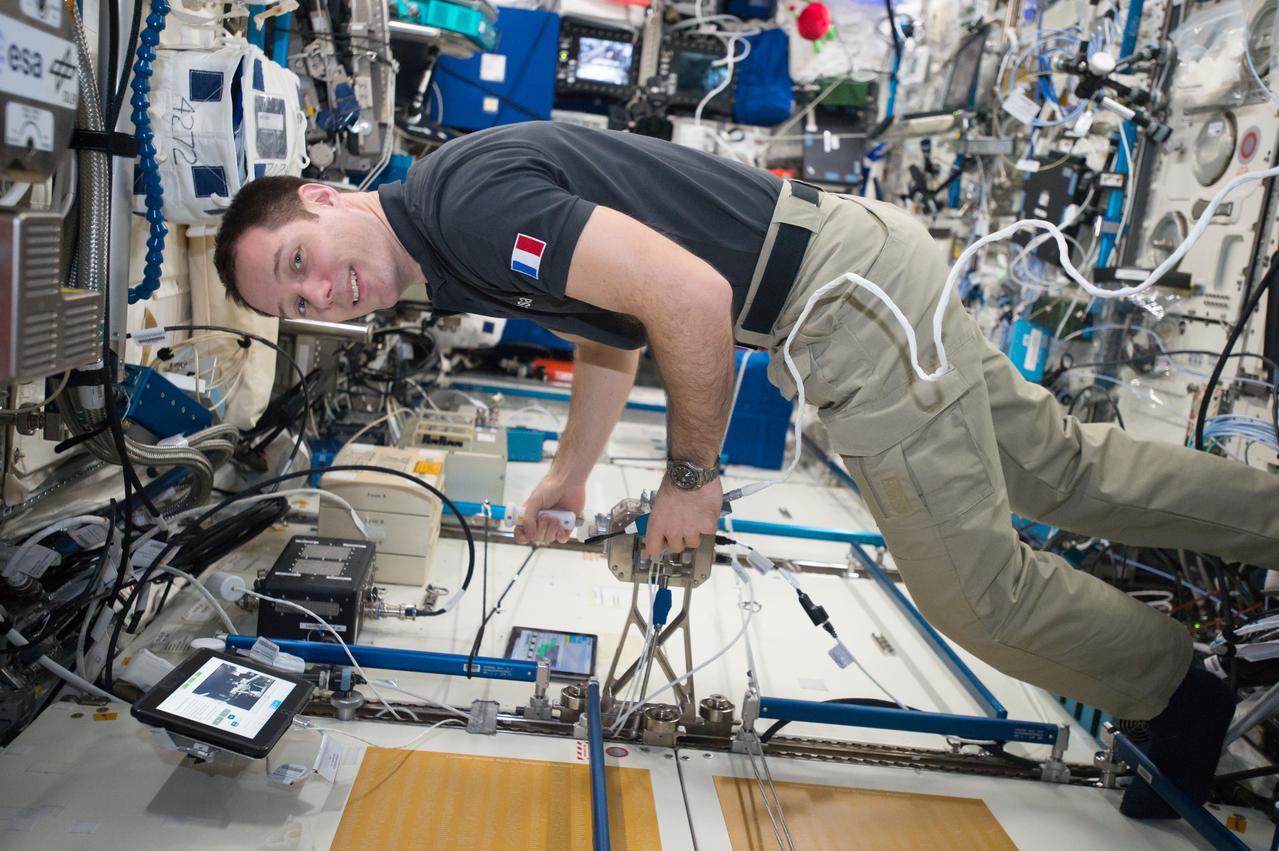
iss050e037304 (01/31/2017) --- ESA (European Space Agency) astronaut Thomas Pesquet works with controls for the European Haptics-2 experiment aboard the International Space Station. Haptics-2 is a technology demonstration experiment aimed at validating control interactions to take place between space and ground. In particular, this experiment allows for an astronaut crew in space to control, in real-time, robotic assets on Earth, using force feedback.
iss050e037304
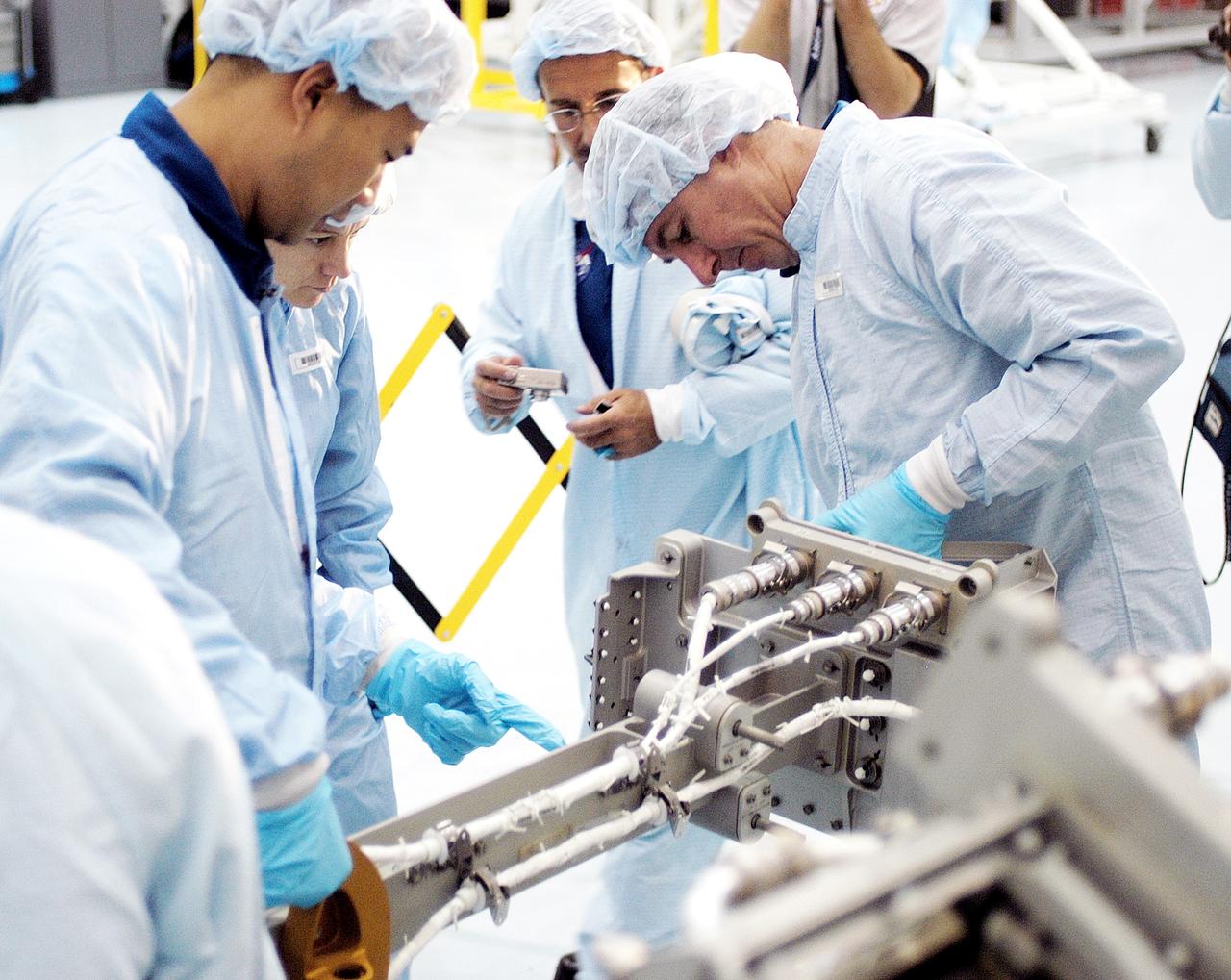
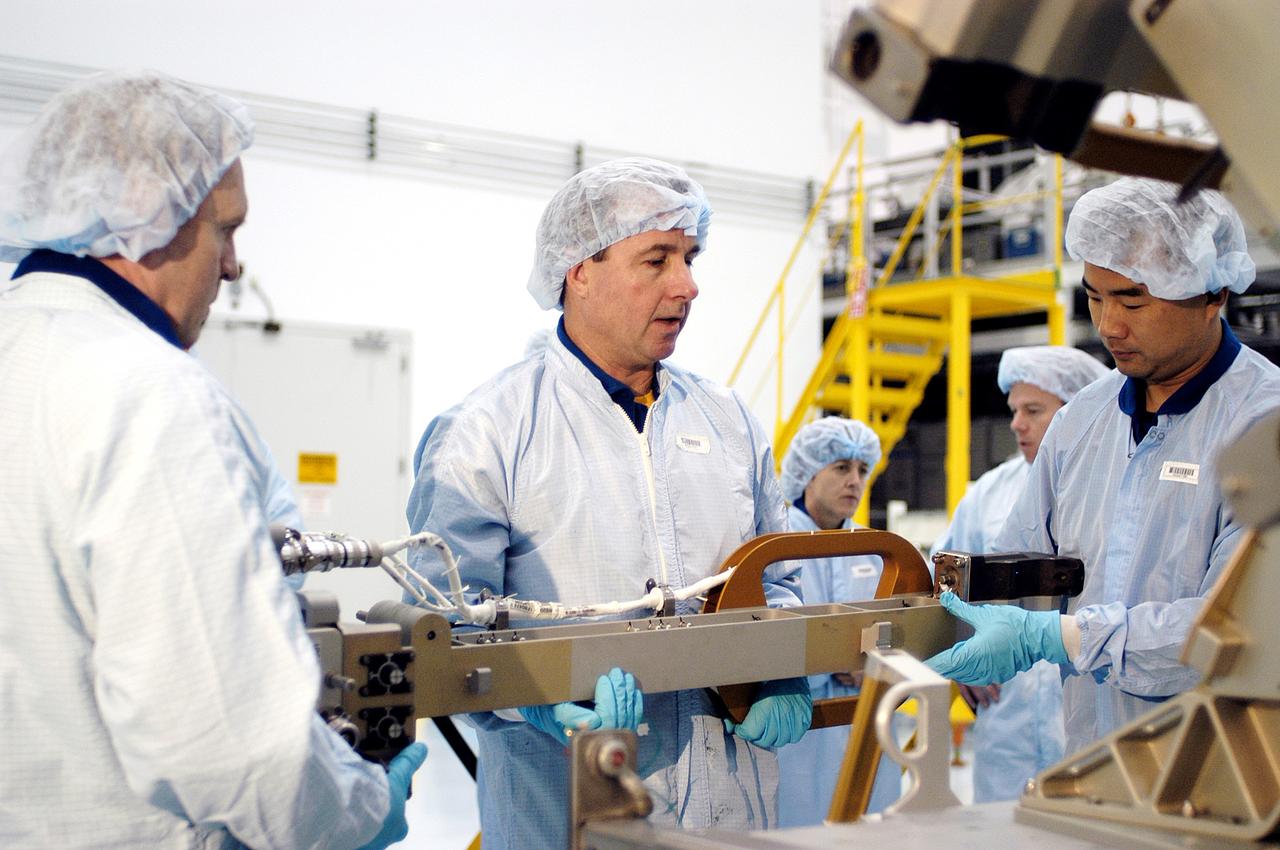
CAPE CANAVERAL, Fla. –  In the Space Station Processing Facility at NASA's Kennedy Space Center in Florida, members of the STS-127 crew check out equipment related to the Japanese Experiment Module's Experiment Logistics Module-Exposed Section, or ELM-ES, part of the payload on the mission.  The crew is  Commander Mark Polansky, Pilot Doug Hurley and Mission Specialists Christopher Cassidy, Tom Marshburn, Dave Wolf, Julie Payette and Tim Kopra. They are at Kennedy for Crew Equipment Interface Test activities, or CEIT, which provides experience handling tools, equipment and hardware for the mission. The payload will be launched to the International Space Station aboard space shuttle Endeavour on the STS-127 mission, targeted for launch on May 15. Photo credit: NASA/Dimitrios Gerondidakis
KSC-2009-1137
CAPE CANAVERAL, Fla. – In the Space Station Processing Facility at NASA's Kennedy Space Center in Florida, members of the STS-127 crew check out equipment on the Japanese Experiment Module's Experiment Logistics Module-Exposed Section, or ELM-ES, part of the payload on the mission.  The crew is  Commander Mark Polansky, Pilot Doug Hurley and Mission Specialists Christopher Cassidy, Tom Marshburn, Dave Wolf, Julie Payette and Tim Kopra. They are at Kennedy for Crew Equipment Interface Test activities, or CEIT, which provides experience handling tools, equipment and hardware for the mission.  The payload will be launched to the International Space Station aboard space shuttle Endeavour on the STS-127 mission, targeted for launch on May 15. Photo credit: NASA/Dimitrios Gerondidakis
KSC-2009-1133
CAPE CANAVERAL, Fla. – In the Space Station Processing Facility at NASA's Kennedy Space Center in Florida, members of the STS-127 crew look over equipment on the Japanese Experiment Module's Experiment Logistics Module-Exposed Section, or ELM-ES, part of the payload on the mission.  The crew is  Commander Mark Polansky, Pilot Doug Hurley and Mission Specialists Christopher Cassidy, Tom Marshburn, Dave Wolf, Julie Payette and Tim Kopra. They are at Kennedy for Crew Equipment Interface Test activities, or CEIT, which provides experience handling tools, equipment and hardware for the mission.  The payload will be launched to the International Space Station aboard space shuttle Endeavour on the STS-127 mission, targeted for launch on May 15. Photo credit: NASA/Dimitrios Gerondidakis
KSC-2009-1132
CAPE CANAVERAL, Fla. –  In the Space Station Processing Facility at NASA's Kennedy Space Center in Florida, members of the STS-127 crew look at some of the elements on the Japanese Experiment Module's Experiment Logistics Module-Exposed Section, or ELM-ES.  The crew is  Commander Mark Polansky, Pilot Doug Hurley and Mission Specialists Christopher Cassidy, Tom Marshburn, Dave Wolf, Julie Payette and Tim Kopra. They are at Kennedy for Crew Equipment Interface Test activities, or CEIT, which provides experience handling tools, equipment and hardware for the mission.  The payload will be launched to the International Space Station aboard space shuttle Endeavour on the STS-127 mission, targeted for launch on May 15. Photo credit: NASA/Dimitrios Gerondidakis
KSC-2009-1138
CAPE CANAVERAL, Fla. – In the Space Station Processing Facility at NASA's Kennedy Space Center in Florida, members of the STS-127 crew look over equipment on the Japanese Experiment Module's Experiment Logistics Module-Exposed Section, or ELM-ES, part of the payload on the mission.  The crew is  Commander Mark Polansky, Pilot Doug Hurley and Mission Specialists Christopher Cassidy, Tom Marshburn, Dave Wolf, Julie Payette and Tim Kopra. They are at Kennedy for Crew Equipment Interface Test activities, or CEIT, which provides experience handling tools, equipment and hardware for the mission. The payload will be launched to the International Space Station aboard space shuttle Endeavour on the STS-127 mission, targeted for launch on May 15. Photo credit: NASA/Dimitrios Gerondidakis
KSC-2009-1131