
STS078-397-010 (20 June - 7 July 1996) --- Payload specialist Jean-Jacques Favier, representing the French Space Agency (CNES), and astronaut Kevin R. Kregel, pilot, perform a successful Inflight Maintenance (IFM) on the Bubble Drop Particle Unit (BDPU). The IFM technique was performed initially on the ground at the Marshall Space Flight Center (MSFC) by alternate payload specialist Pedro Duque of the European Space Agency (ESA), with the procedure being recorded on video and uplinked to the crew of the Space Shuttle Columbia to aid in the repair.
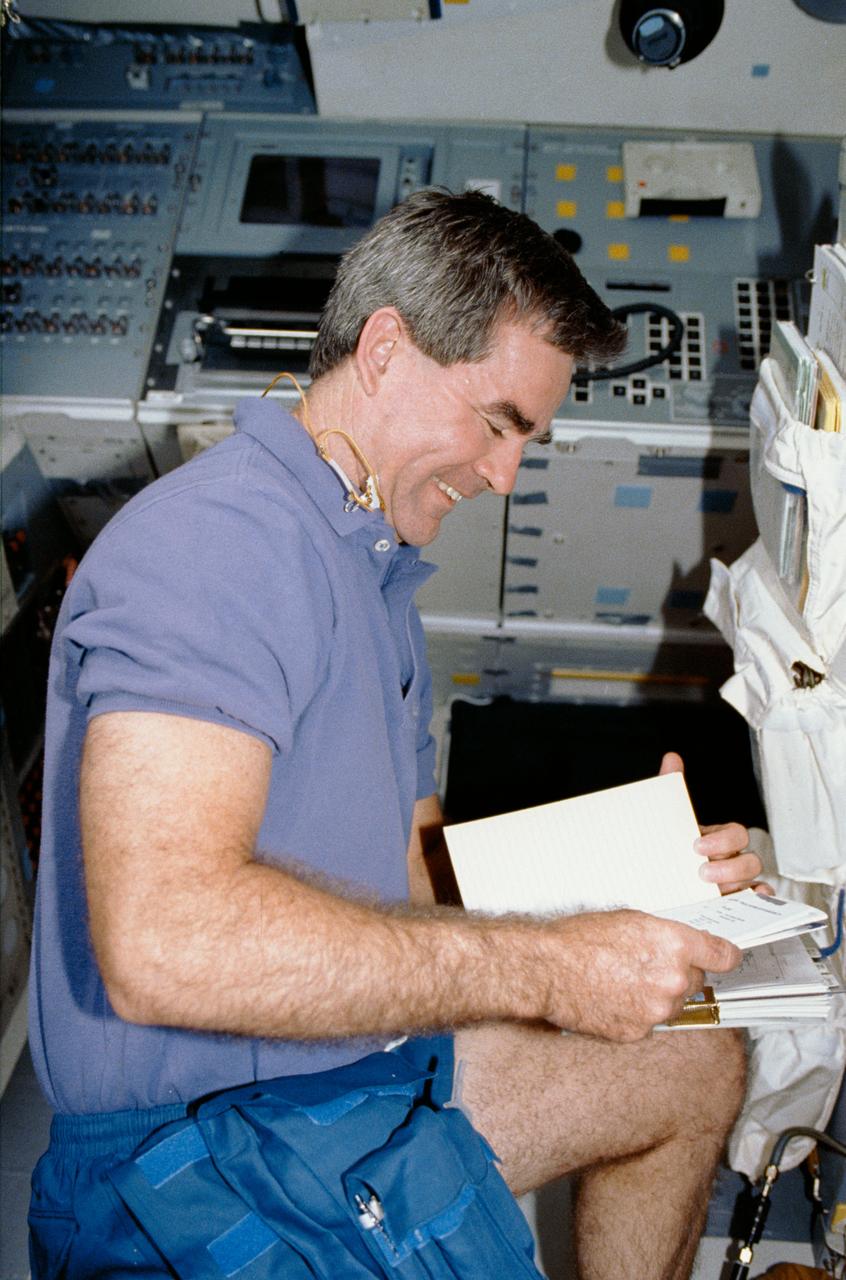
Mission Specialist Lacy Veach in the aft flight deck reviewing a procedures manual.
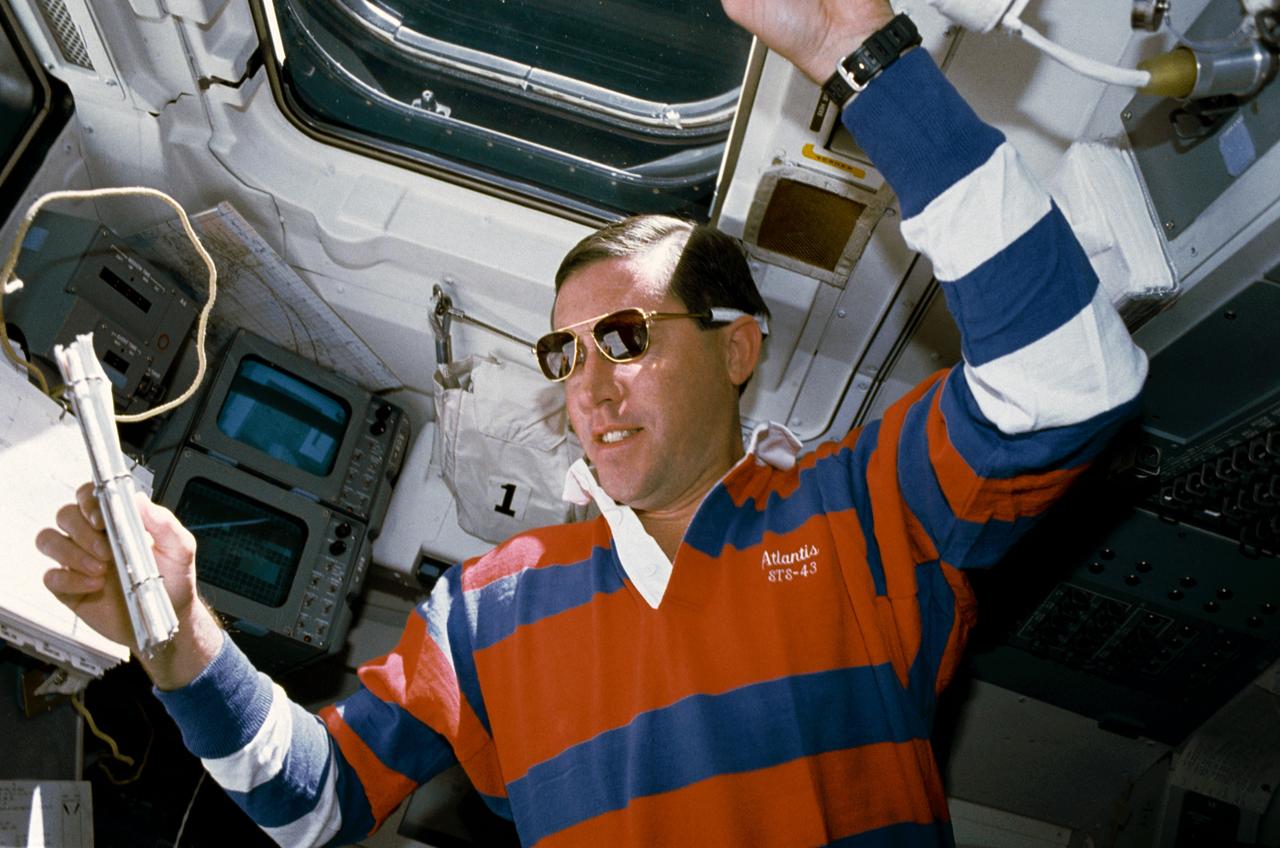
STS043-04-032 (11 Aug 1991) --- STS-43 Pilot Michael A. Baker, wearing sunglasses, reviews a checklist on the aft flight deck of Atlantis, Orbiter Vehicle (OV) 104. He is monitoring data associated with the Space Station Heat Pipe Advanced Radiator Element II (SHARE-II) located in OV-104's payload bay (PLB) from his position in front of the aft flight deck viewing windows. Behind Baker are the closed circuit television (CCTV) monitors and above his head is overhead window W8.
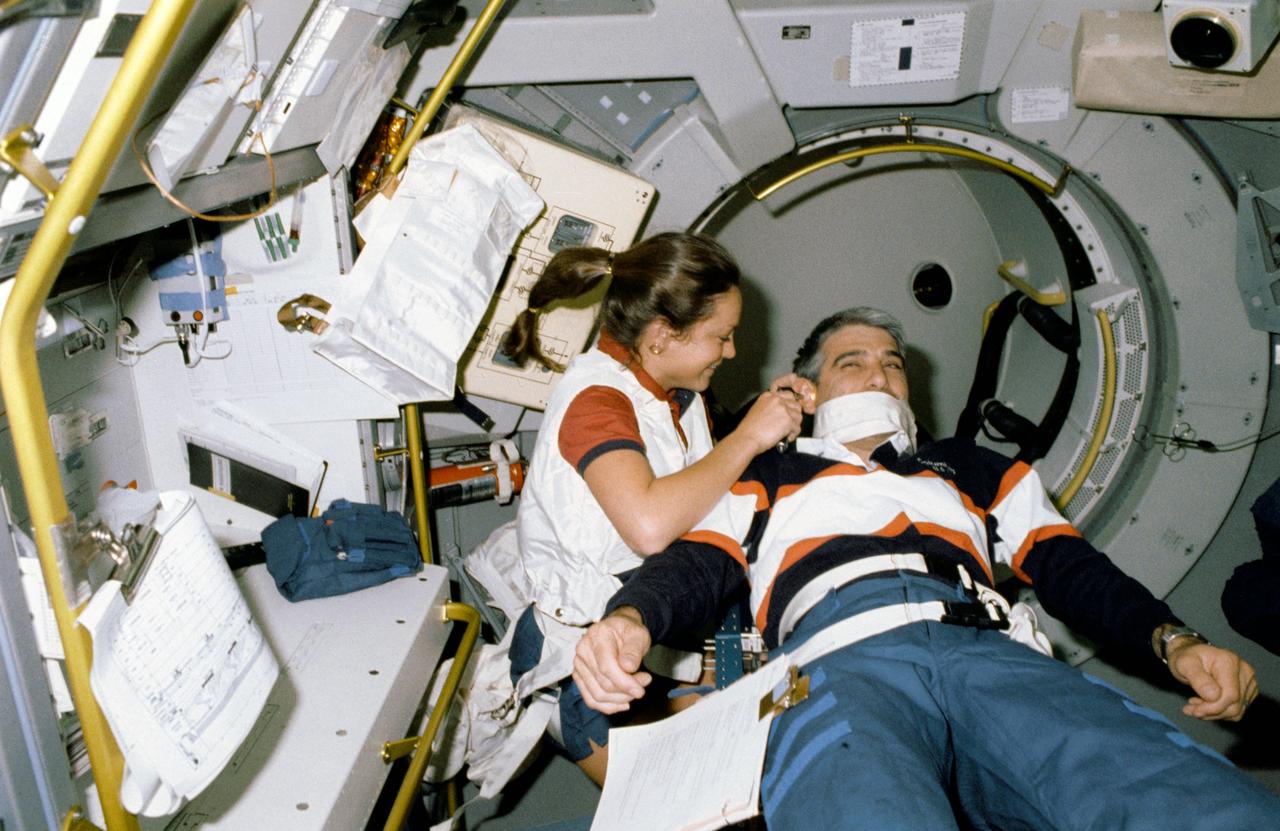
STS040-206-002 (5-14 June 1991) --- Held in place by the Spacelab Life Sciences (SLS-1) Medical Restraint System (MRS), astronaut Sidney M. Gutierrez, pilot, gets his ears checked by astronaut Tamara E. Jernigan, mission specialist. The two are in the SLS-1 module, onboard the Space Shuttle Columbia. The scene was photographed with a 35mm camera.
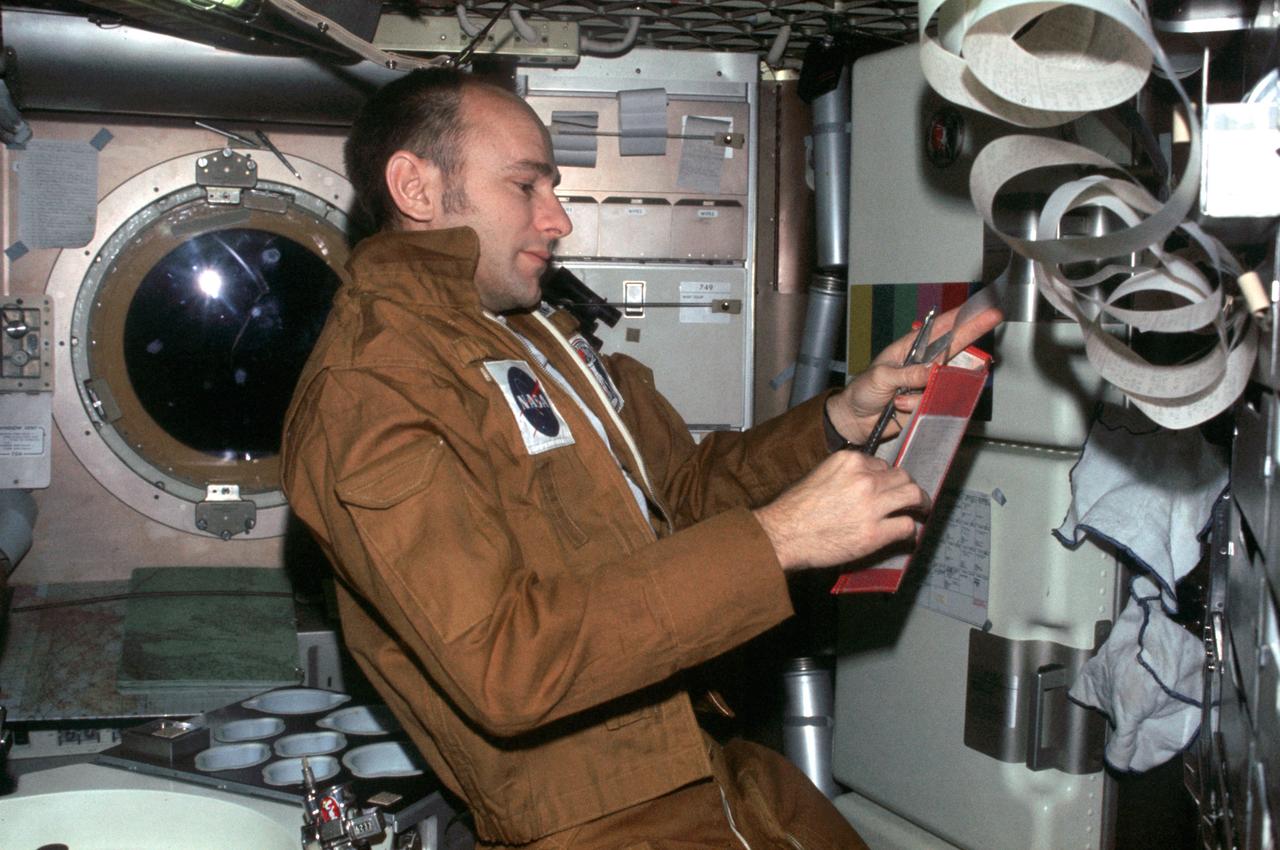
SL3-111-1514 (July-September 1973) --- Astronaut Alan L. Bean, Skylab 3 commander, reads data from book in his right hand while holding teleprinter tape in his left hand, in the ward room of the Skylab space station's Orbital Workshop (OWS) crew quarters. This photograph was taken with a 35mm Nikon camera held by one of Bean's fellow crewmen during the 56.5 day second manned Skylab mission in Earth orbit. Photo credit: NASA
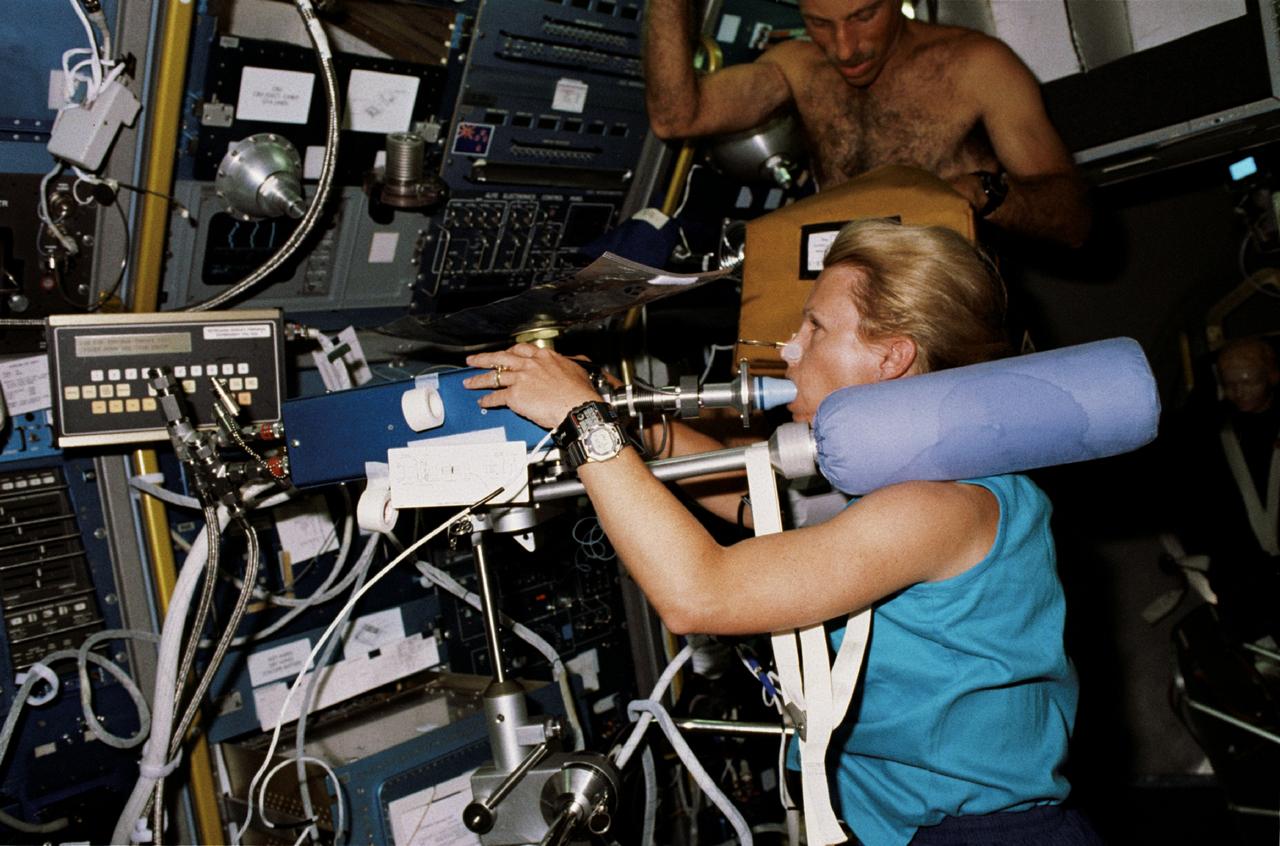
STS040-211-019 (5-14 June 1991) --- Astride the bicycle ergometer, astronaut Rhea Seddon, mission specialist, breathes into the cardiovascular re-breathing unit during the exercise phase of an experiment. The investigation, In-flight Study of Cardiovascular Deconditioning (Experiment 066), was developed by Dr. Leon E. Farhi of the State University of New York in Buffalo. It focuses on the deconditioning of the heart and lungs and changes in cardiopulmonary function that occur upon return to Earth. By using non-invasive techniques of prolonged expiration and re-breathing, investigators can determine the amount of blood pumped out of the heart (cardiac output), the ease with which blood flows through all the vessels (total peripheral resistance), oxygen used and carbon dioxide released by the body, and lung function and volume changes. Measurements are made both while crew members are resting and while they pedal the exercise bicycle, as Dr. Seddon is doing here. This scene was photographed with a 35mm camera.
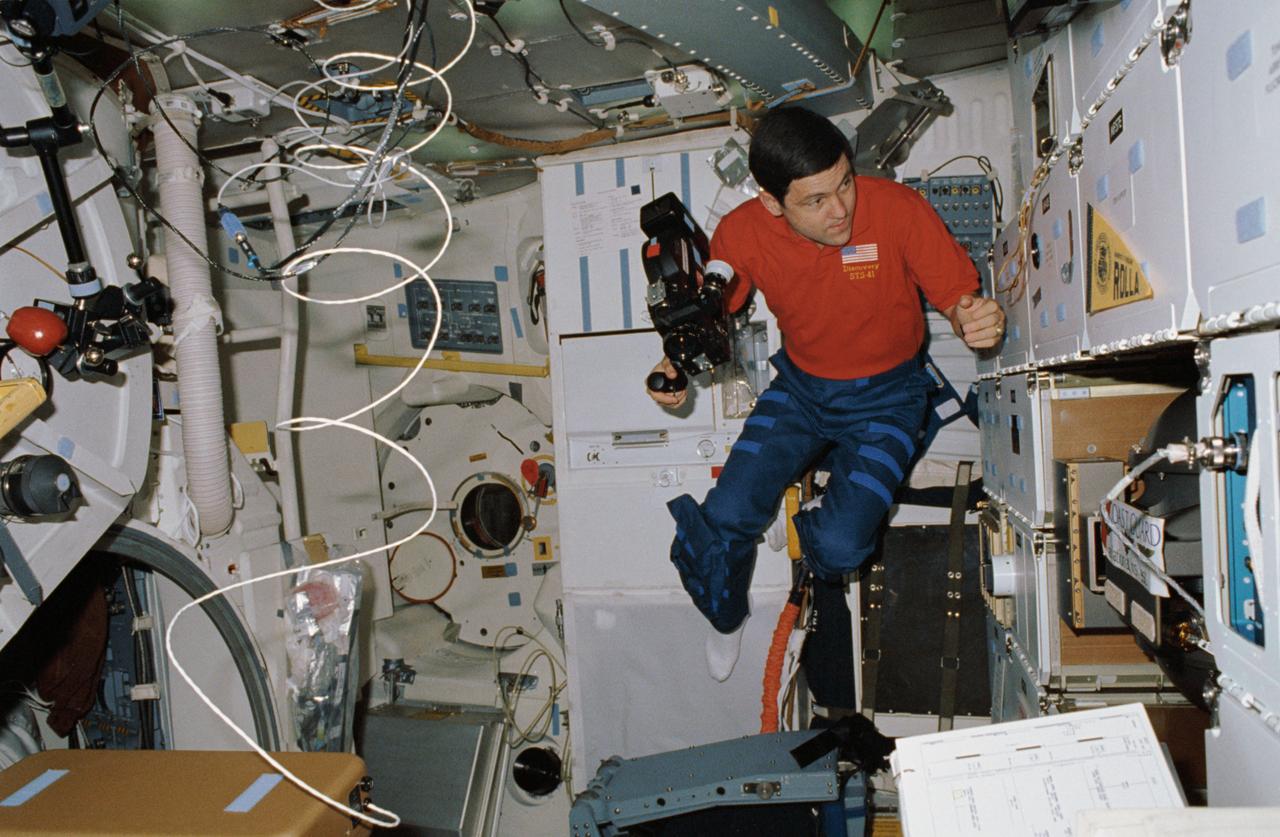
STS041-05-011 (6-10 Oct 1990) --- Astronaut Robert D. Cabana, STS-41 pilot, exhibits the weightlessness of space travel as he appears to "float" about on the middeck of Discovery. Careful inspection of the photo proves that, actually, his floating is limited, as he has anchored his left foot with a special restraint device. He apparently has chosen this vantage point to use the Arriflex motion picture camera in his right hand.
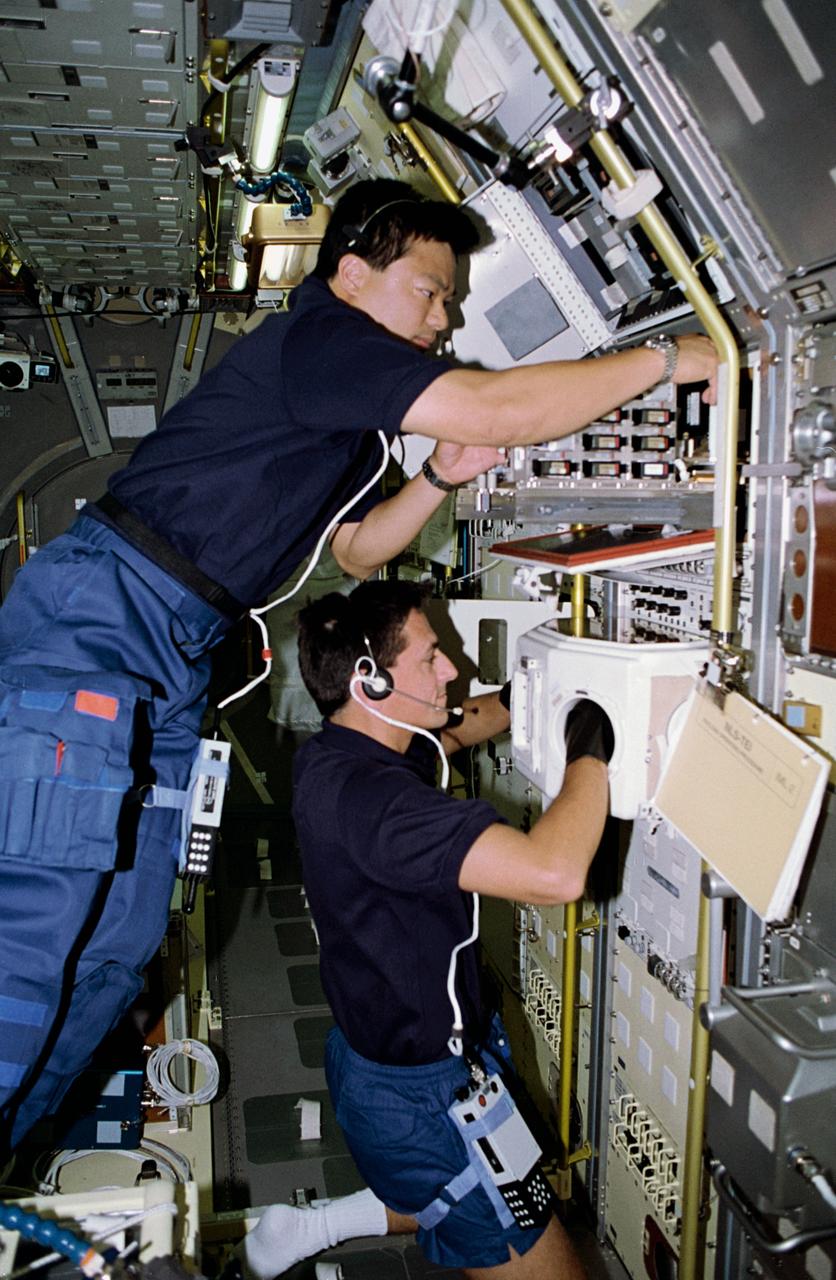
STS-65 Mission Specialist (MS) Leroy Chiao (top) and MS Donald A. Thomas are seen at work in the International Microgravity Laboratory 2 (IML-2) spacelab science module aboard the Space Shuttle Columbia, Orbiter Vehicle (OV) 102. The two crewmembers are conducting experiments at the IML-2 Rack 5 Biorack (BR). Chiao places a sample in the BR incubator as Thomas handles another sample inside the BR glovebox. The glovebox is used to prepare samples for BR and slow rotating centrifuge microscope (NIZEMI) experiments.
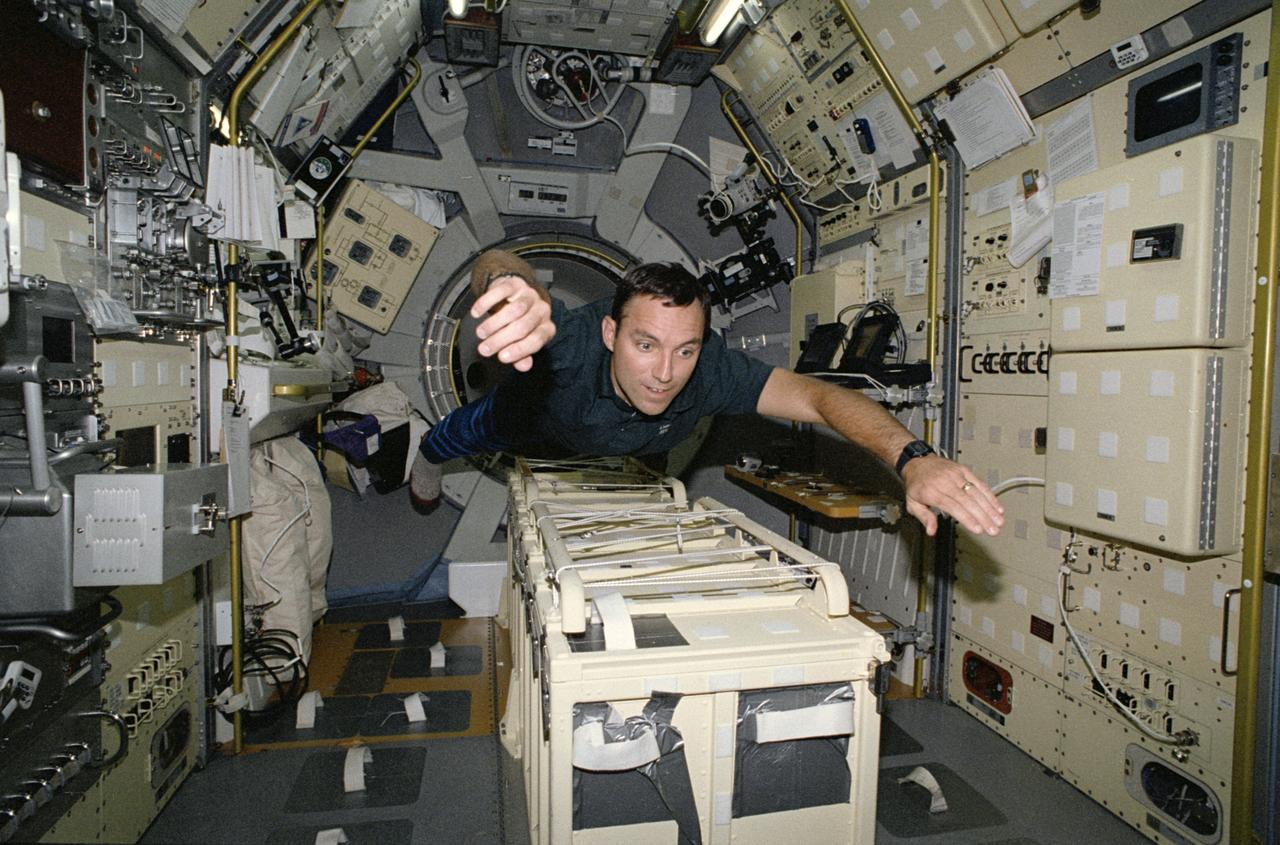
STS-65 Mission Specialist Carl E. Walz floats above center aisle equipment in the International Microgravity Laboratory 2 (IML-2) spacelab science module. Walz has just entered the IML-2 module via the spacelab tunnel (note hatch opening behind him). The tunnel connects the IML-2 module with Columbia's, Orbiter Vehicle (OV) 102's, crew compartment. Walz along with five other NASA astronauts and a Japanese payload specialist spent more than two weeks in Earth orbit conducting IML-2 experiments. This photo was among the first released by NASA following IML-2.

STS064-23-037 (16 Sept. 1994) --- Astronauts Mark C. Lee (left) and Carl J. Meade were photographed in the midst of 15-minute pre-breathe exercise in preparation for their Extravehicular Activity (EVA) of Sept. 16, 1994. On that day the two performed an in-space rehearsal or demonstration of a contingency rescue using the never-before flown Simplified Aid for EVA Rescue (SAFER) system some 130 nautical miles above Earth. During the EVA the two STS-64 mission specialists took turns using the SAFER hardware. The test was the first phase of a larger SAFER program leading finally to the development of a production version for future shuttle and space station applications. Photo credit: NASA or National Aeronautics and Space Administration
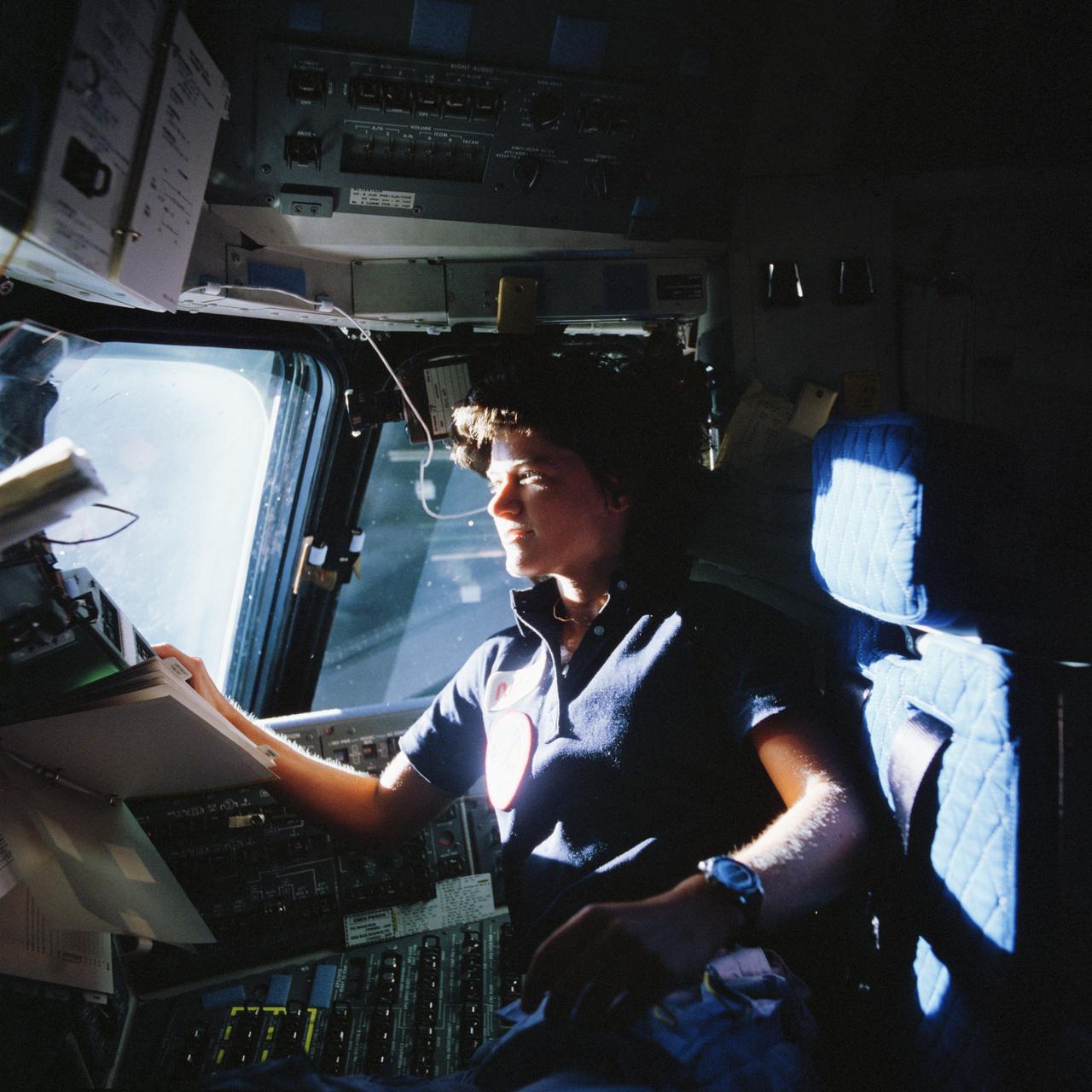
S83-35783 / STS007-05-029 (18-24 June 1983) --- Astronaut Sally K. Ride, mission specialist, is shown here sitting in the front seat and looking out the windows of the Earth-orbiting Space Shuttle Challenger. Ride and four other crew members are onboard the Challenger.
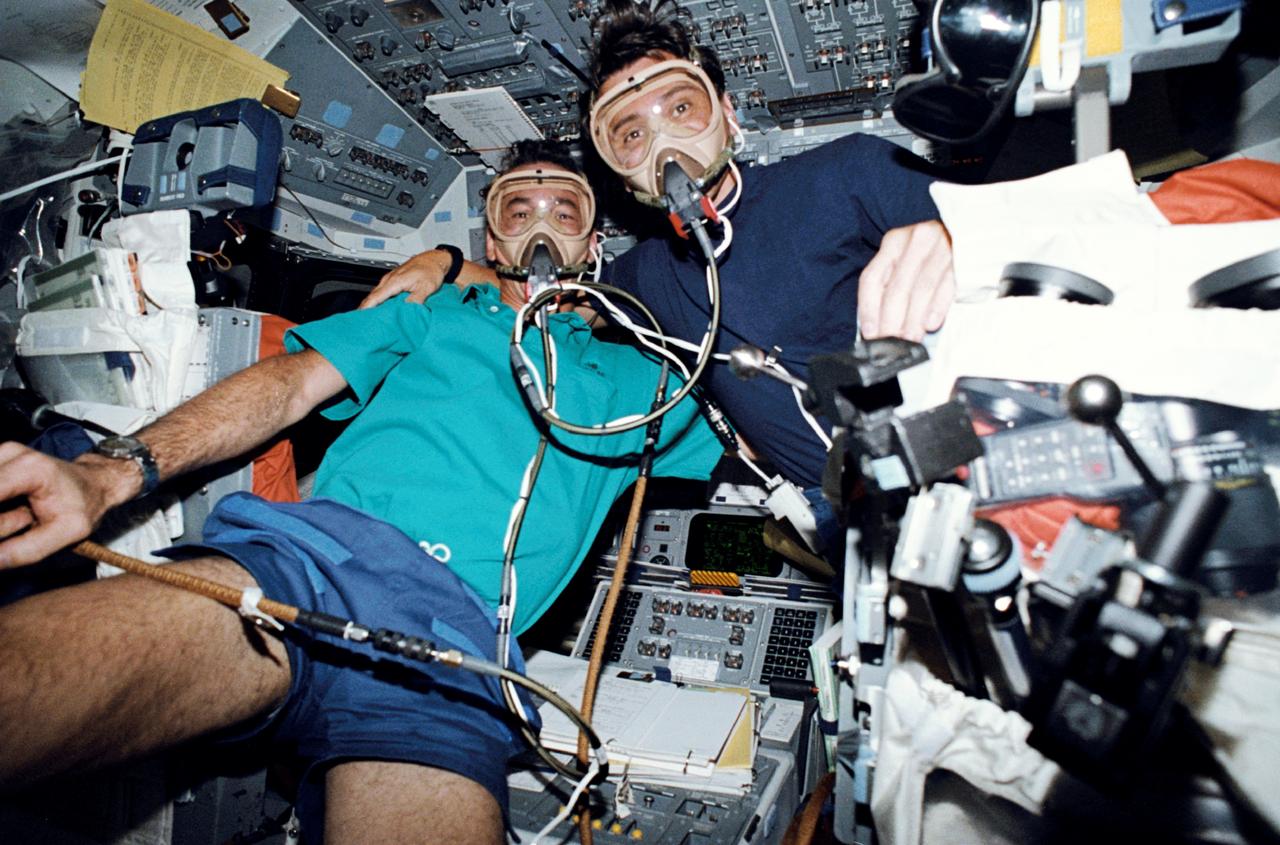
STS046-33-028 (4 Aug. 1992) --- With the possibility of an extravehicular activity (EVA) being added to the agenda, the two EVA-trained crew members begin their "pre-breathe" period on the space shuttle Atlantis' flight deck. Astronauts Jeffrey A. Hoffman (left), payload commander, and Franklin R. Chang-Diaz, mission specialist, reported to this station and began the "pre-breathe" process when problems developed during the extension of the Tethered Satellite System (TSS). When the human body is exposed to a sudden decrease in atmospheric pressure (for instance, from the 10.2 ppsi in the crew cabin to the 4.5 ppsi of the Extravehicular Mobility Unit (EMU) spacesuit), nitrogen traces in the bloodstream will expand. This expansion can create tiny bubbles and potential for the "bends". In order to lessen the effect, an astronaut must "pre-breathe" pure oxygen (the same pure oxygen that he will breathe in the suit) to help "purge" nitrogen from his/her bloodstream before exerting him/herself in the low-pressure environment of the suit. The "pre-breathe" exercise and the EVA turned out to be not needed as the TSS operations were resumed by remote operations.
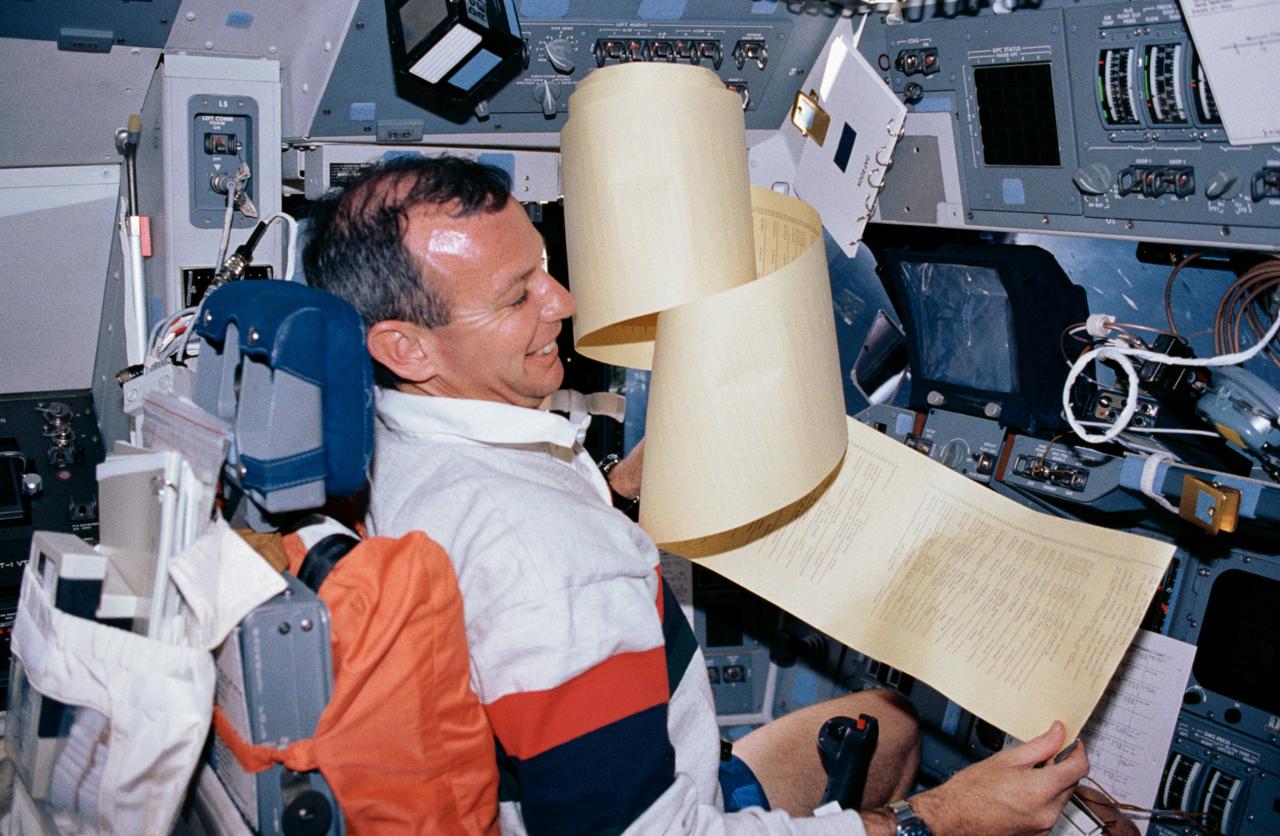
STS045-02-020 (24 March-2 April 1992) --- Brian Duffy, STS-45 pilot, struggles with a large volume of data printouts from the teleprinter system. He is seated at the commander's station on the flight deck of the Earth-orbiting Atlantis during the nine-day mission. This frame was taken with a 35mm camera.
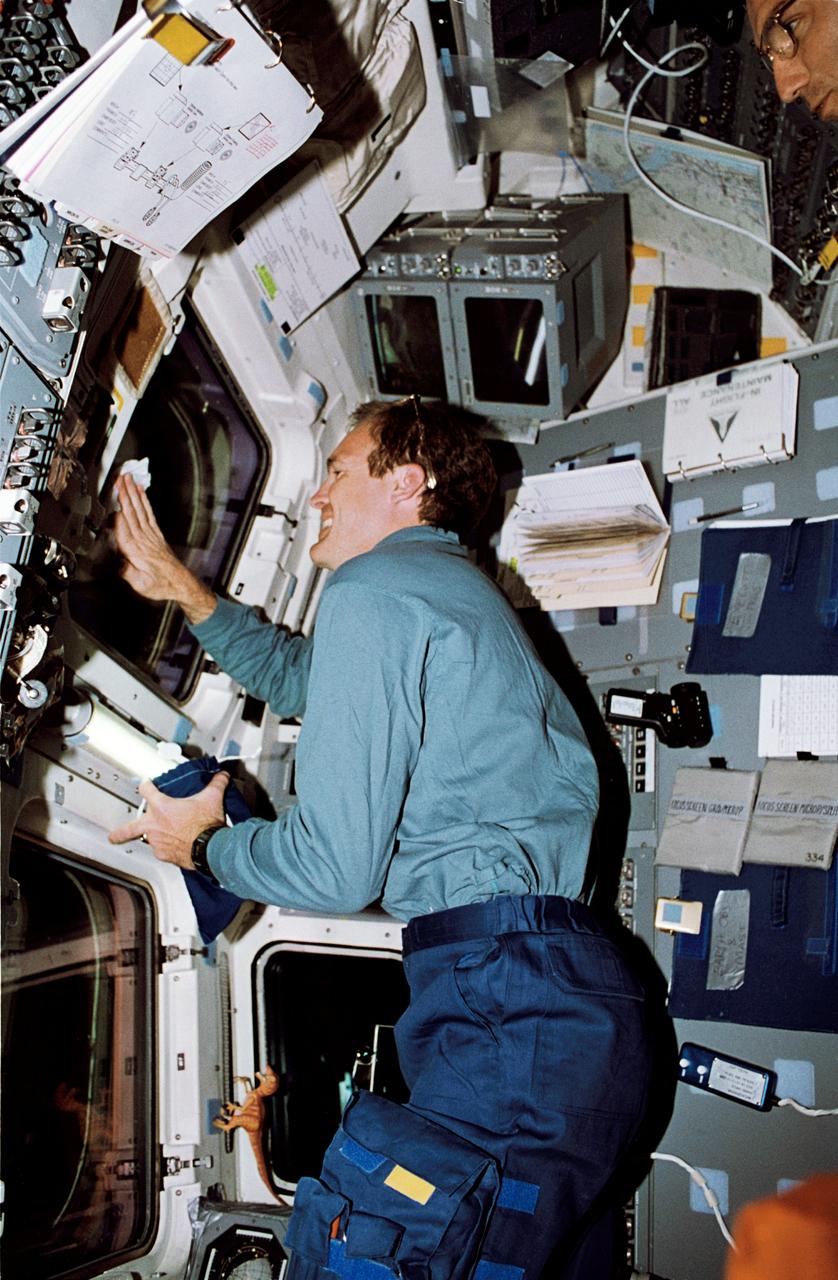
STS065-52-034 (8-23 July 1994) --- On the Space Shuttle Columbia's aft flight deck, astronaut James D. Halsel,l Jr., pilot, cleans off one of the overhead windows. Astronaut Carl E. Walz, mission specialist, looks on (photo's edge). The two shared over fourteen days in Earth-orbit with four other NASA astronauts and a Japanese payload specialist in support of the second International Microgravity Laboratory (IML-2) mission.
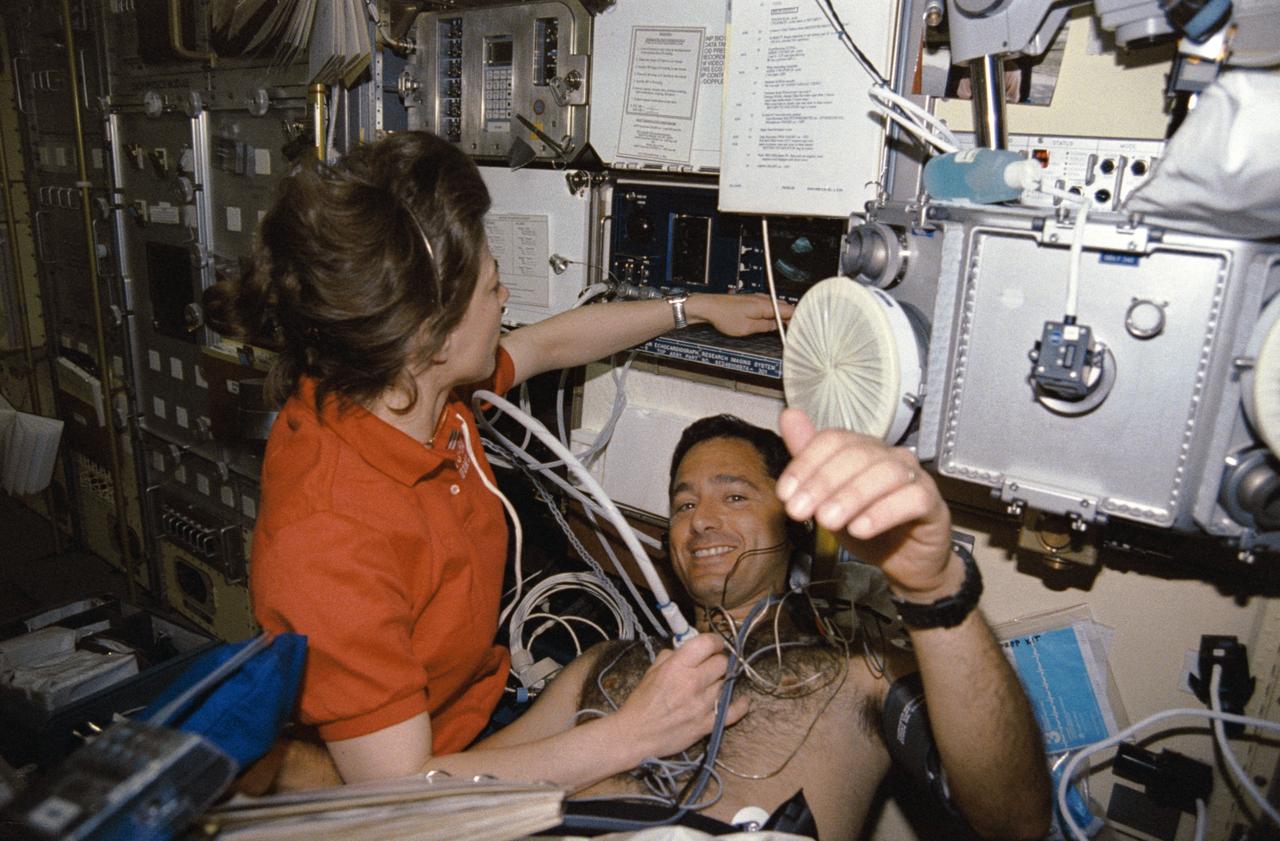
STS050-291-027 (25 June-9 July 1992) --- Astronaut Bonnie J. Dunbar uses a Doppler to collect medical data from Lawrence J. DeLucas, payload specialist, during his diagnostic "run" in the Lower Body Negative Pressure device (LBNP). The Doppler is used to pick up high-frequency sound waves from the surface of the heart, thus producing pictures on the monitor of the American Flight Echocardiograph (AFE). The result of the LBNP procedure is expected to be an increased tolerance of orthostatis - or standing upright - upon return to Earth's gravity. LBNP has been used a number of times in the United States space program, as early as the Skylab missions. STS-50 is the fourth flight of the current collapsible unit. Researchers are refining the LBNP protocol which will be used operationally on future 13 through 16 day missions.
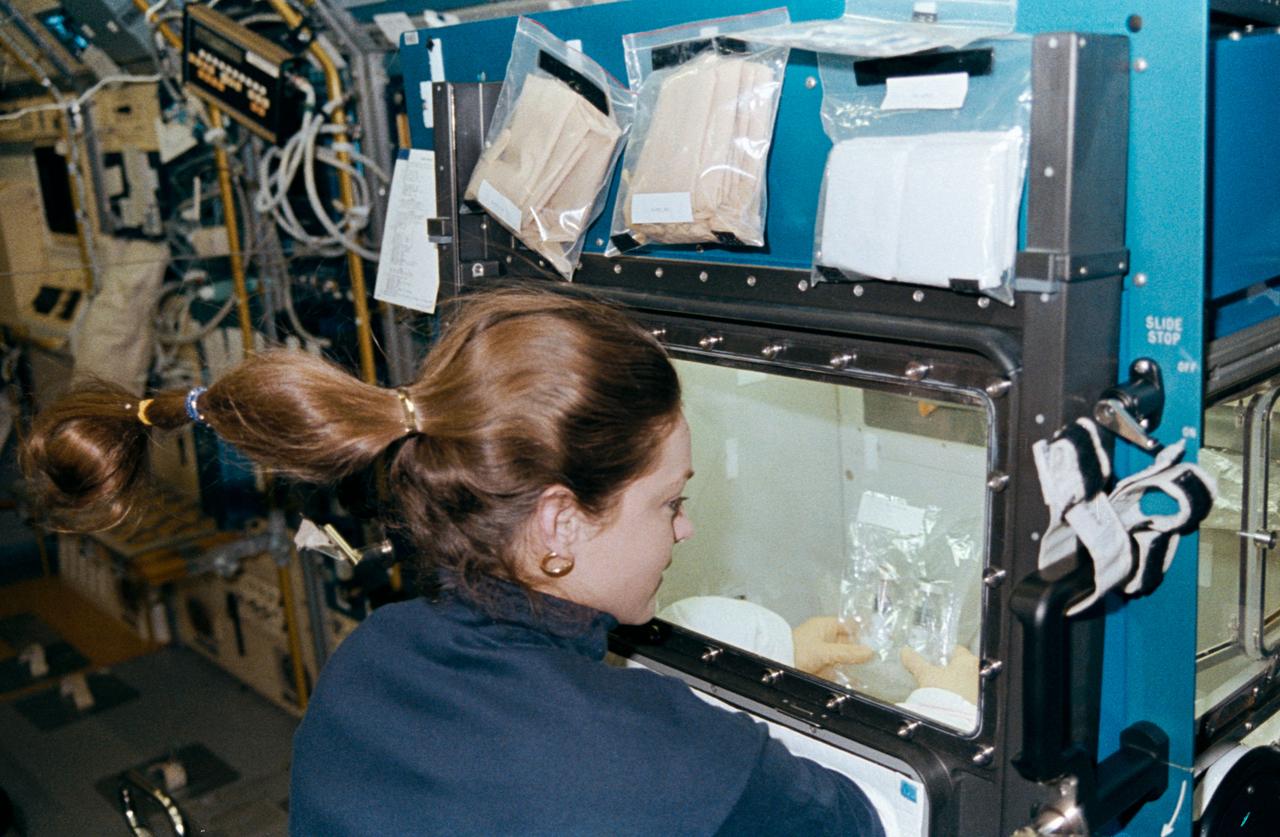
STS040-224-005 (5-14 June 1991) --- Astronaut Tamara E. Jernigan, STS-40 mission specialist, conducts an evaluation of the General Purpose Work Station (GPWS) in the Spacelab Life Sciences (SLS-1) module onboard the Earth-orbiting Space Shuttle Columbia. The photograph was taken with a 35mm camera.
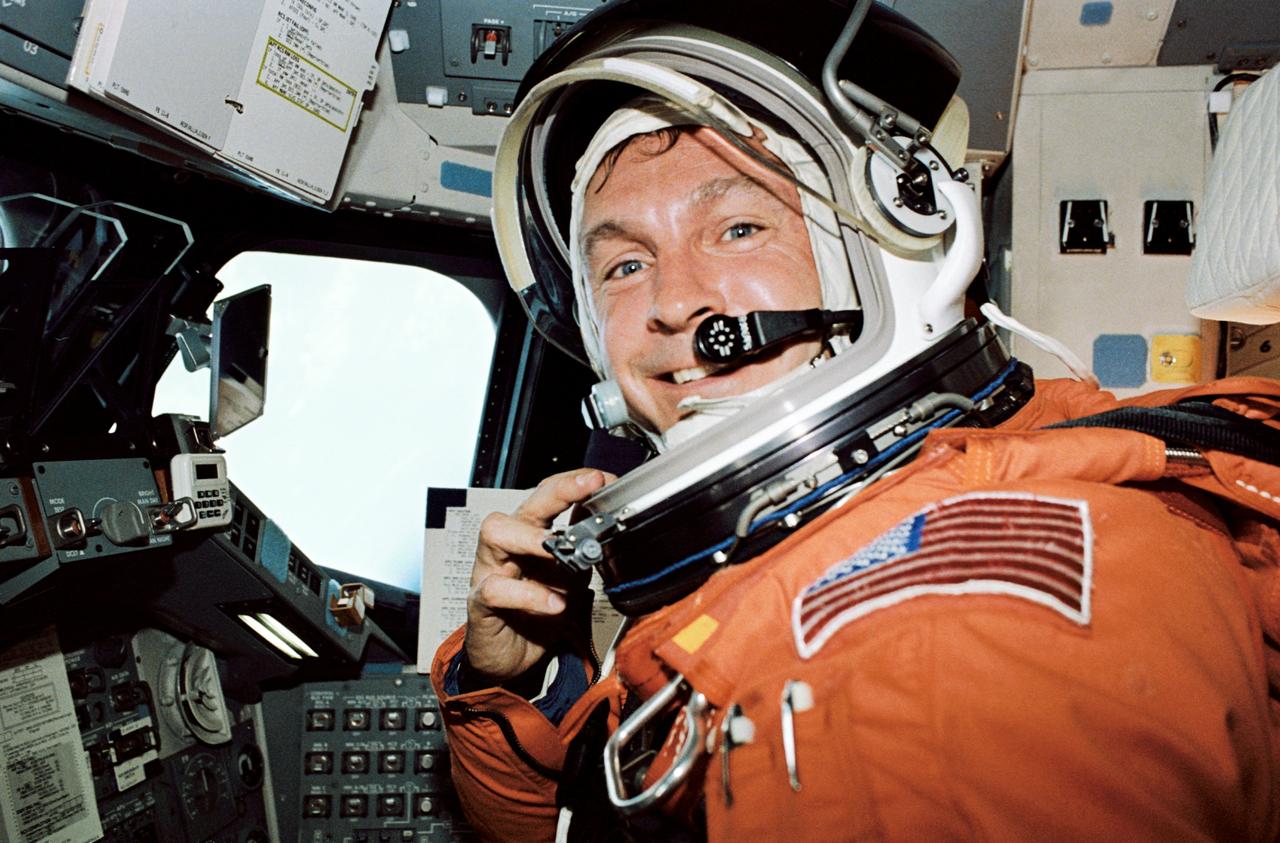
STS047-28-002 (20 Sept. 1992) --- Astronaut Curtis L. Brown, Jr., STS-47 pilot, is photographed at the Space Shuttle Endeavour's pilot station about ten minutes after main engine cutoff on launch day of the eight-day Spacelab-J mission. Wearing the partial-pressure launch and entry suit, Brown shared the forward cabin with astronaut Robert L. Gibson (out of frame at left), mission commander. Endeavour was beginning its second mission in space, this one devoted to research supporting the Spacelab-J mission.
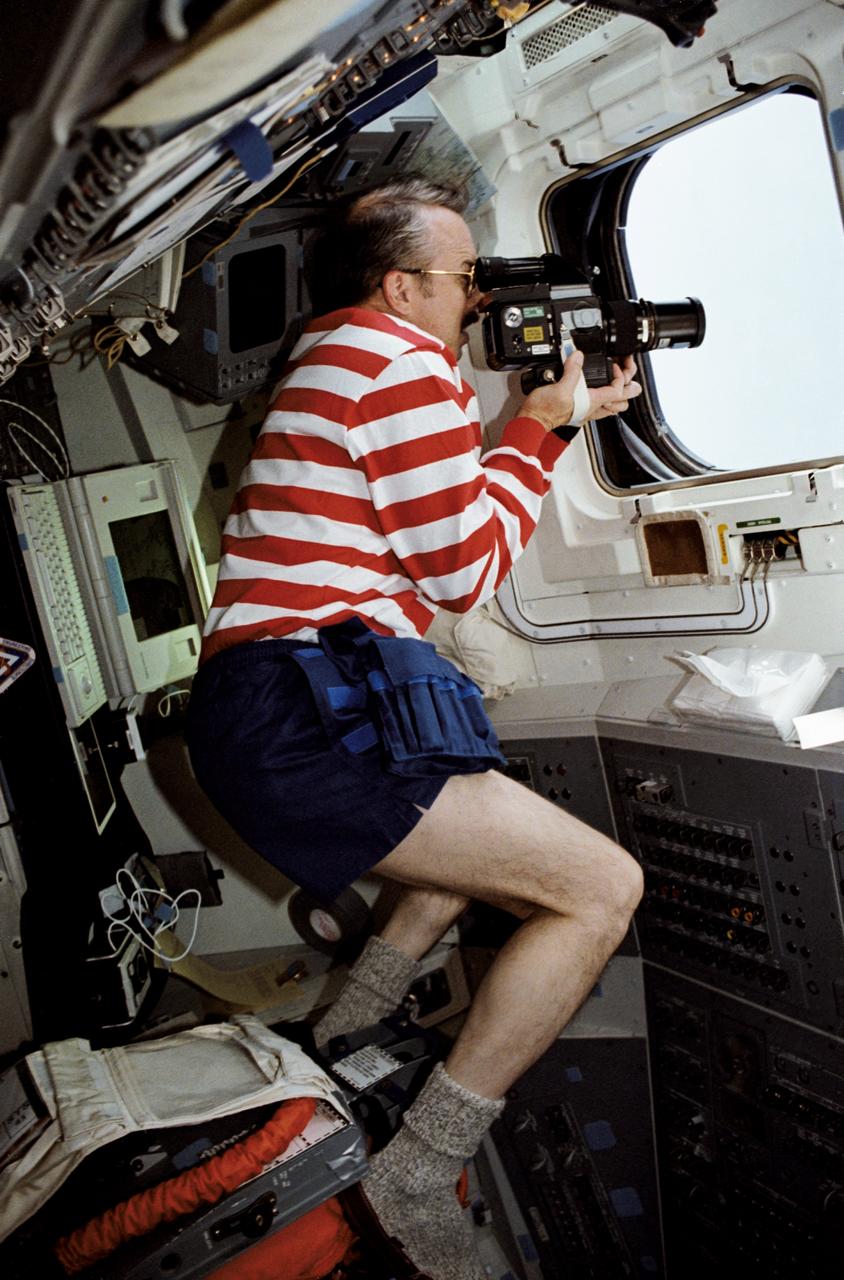
STS043-21-013 (2-11 August 1991) --- As on previous missions, Earth observations/photography played an important role on NASA’s STS-43 mission. That role is depicted in this scene showing astronaut James C. Adamson, mission specialist, aiming a still camera toward Earth through an overhead window on Space Shuttle Atlantis’ aft flight deck. The scene was recorded by a fellow crewmember using a 35mm camera.
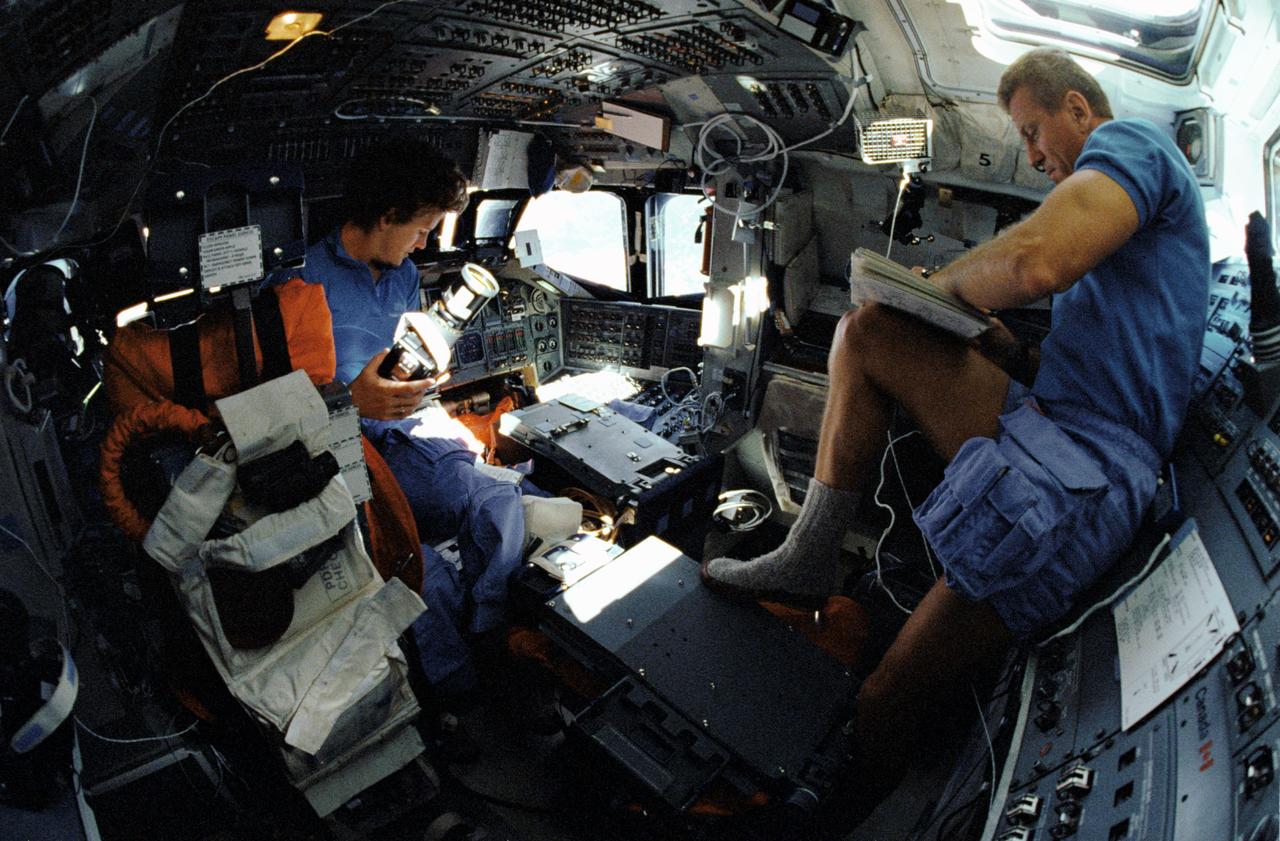
STS031-101-053 (24-29 April 199) --- A 35mm camera equipped with a "fish-eye" lens captured this view on Discovery's flight deck featuring astronaut Kathryn D. Sullivan with a Hasselblad camera on forward flight deck and astronaut Loren J. Shriver, pen in hand, amending flight data on aft flight deck.
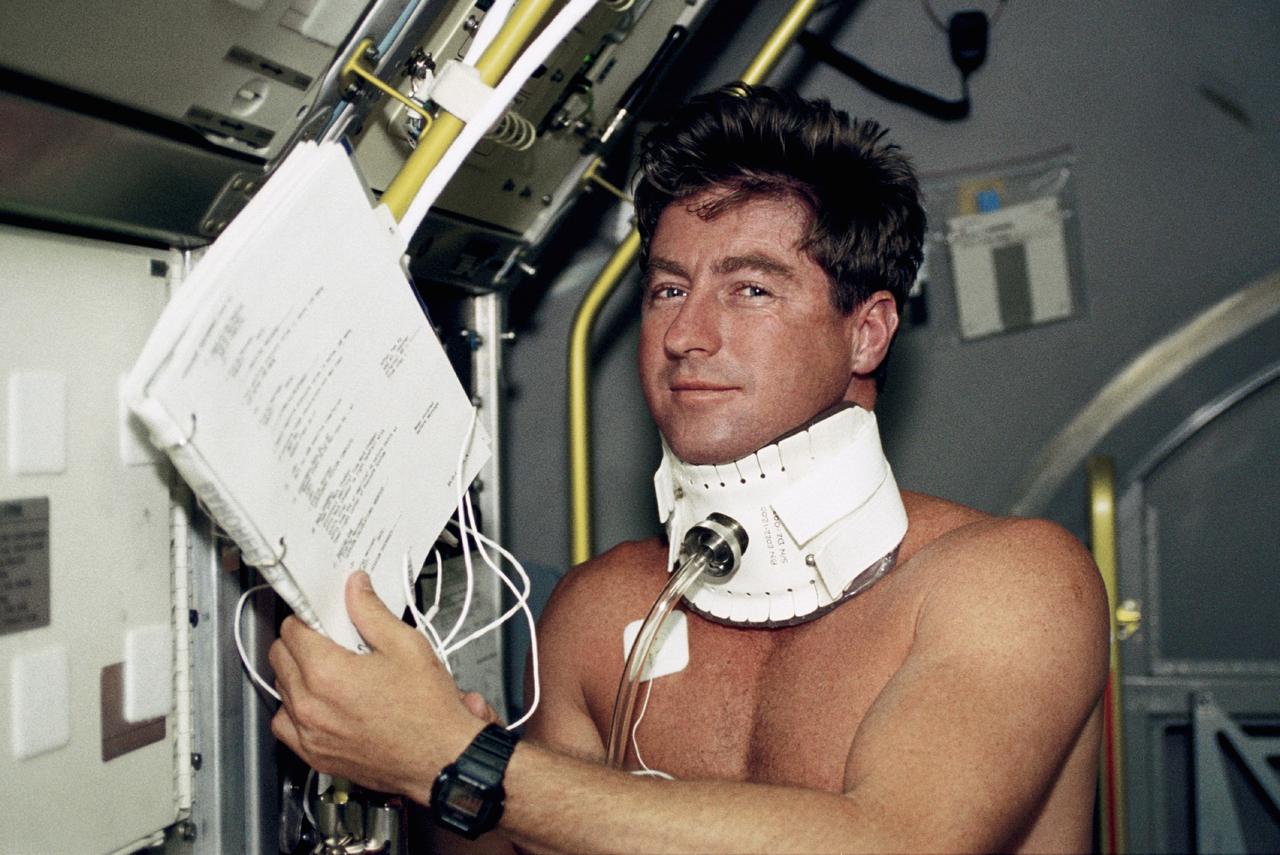
STS055-233-019 (26 April-6 May 1993) --- Terence T. (Tom) Henricks, STS-55 pilot, wears a special collar for a space adaptation experiment in the science module onboard the Earth-orbiting Space Shuttle Columbia. The Baroreflex (BA) experiment is designed to investigate the theory that light-headedness and a reduction in blood pressures upon standing after landing may arise because the normal reflex system regulating blood pressure behaves differently after having adapted to a microgravity environment. These space-based measurements of the baroreflex will be compared to ground measurements to determine if microgravity affects the reflex.
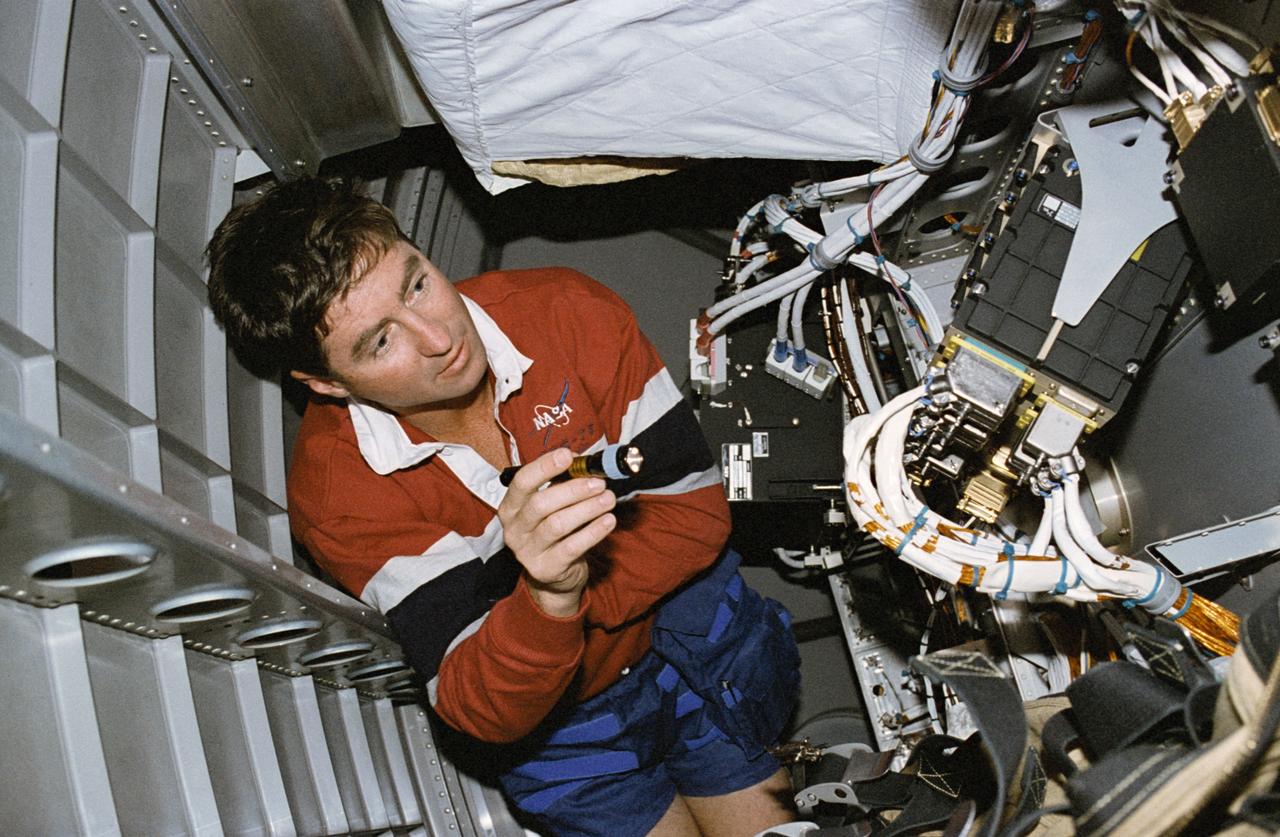
STS078-432-009 (20 June-7 July 1996) --- Among the inflight maintenance (IFM) chores that were handled by the crew members during their almost 17 days in space aboard the space shuttle Columbia was one that involved going into the bay beneath the floor of the Life and Microgravity Spacelab (LMS-1) Science Module. Astronaut Terence T. (Tom) Henricks, mission commander, shines a tiny flashlight onto some cables related to LMS-1 supported computer systems. As in the case of the other IFM chores, Henricks' efforts were successful. He was joined by four other NASA astronauts and two international payload specialists for the space shuttle duration record-setting mission.
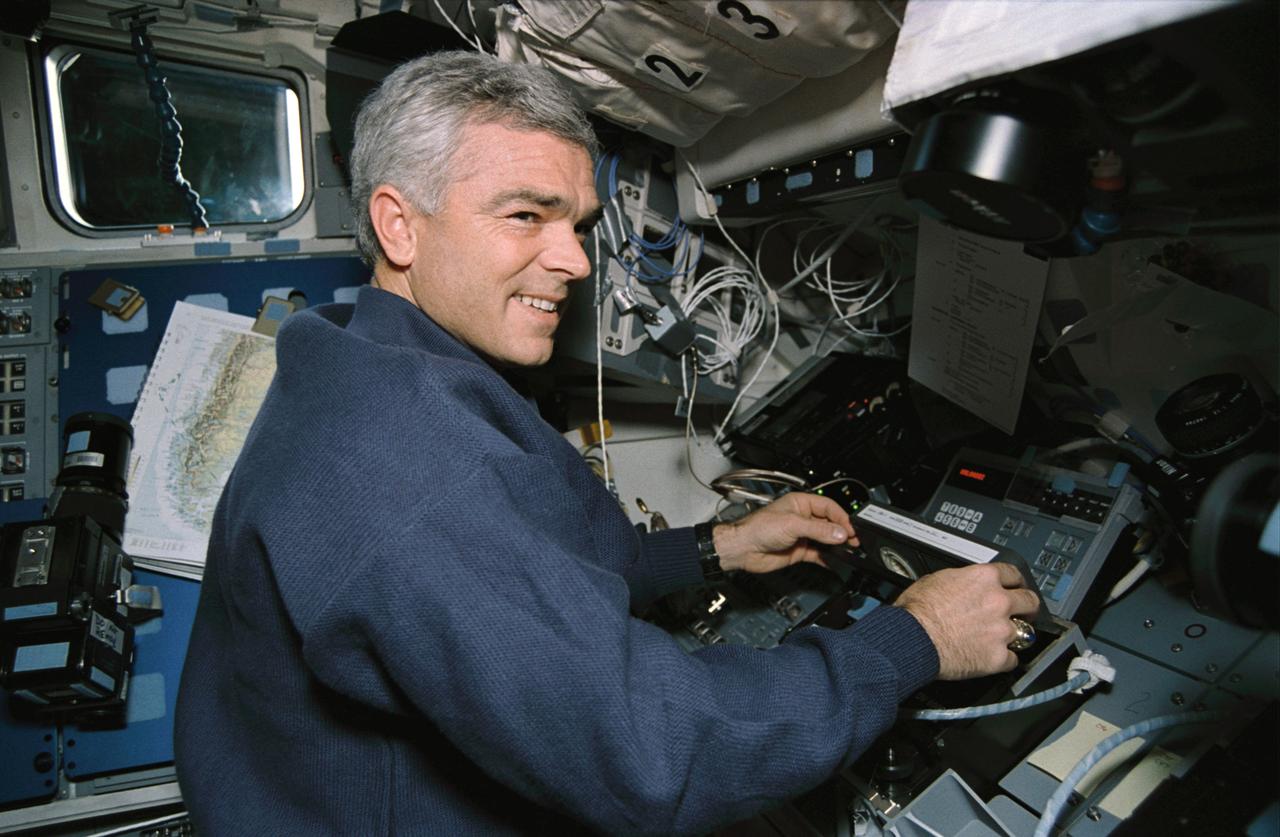
STS059-09-012 (9-20 April 1994) --- On the Space Shuttle Endeavour's aft flight deck, astronaut Michael R. (Rich) Clifford, mission specialist, inserts a tape in the payload high rate recorder. Three of these state-of-the-art recorders captured four times the amount of data that could be radioed to the ground. The 183 tapes, each containing 40 megabytes of data, will be turned into images over the next year, and analyzed over the next decade. Clifford was joined in space by five other NASA astronauts for a week and a half of support to the Space Radar Laboratory (SRL-1)/STS-59 mission.
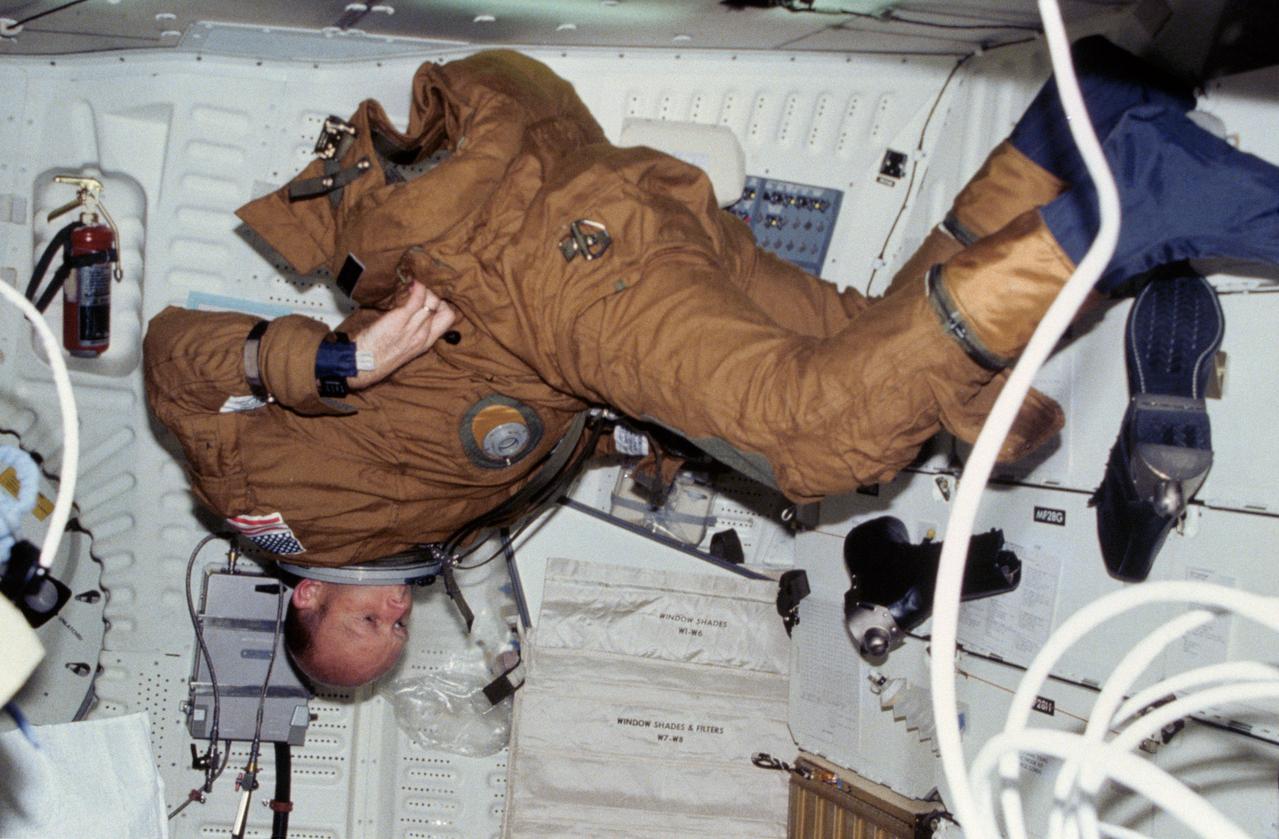
S82-28922 (30 March 1982) --- Astronaut C. Gordon Fullerton, STS-3 pilot, floats upside down in the zero-gravity environment of the middeck area of the Earth-orbiting space shuttle Columbia as he dons a modified USAF high altitude pressure garment. The brownish ejection/escape suit is used by the astronauts at launch and entry. Most of the remainder of their mission time, they are attired in a blue constant-wear garment. Astronaut Jack R. Lousma, crew commander, took this picture with a 35mm camera. The crew spent eight full days in the reusable spacecraft, a shuttle record. Photo credit: NASA
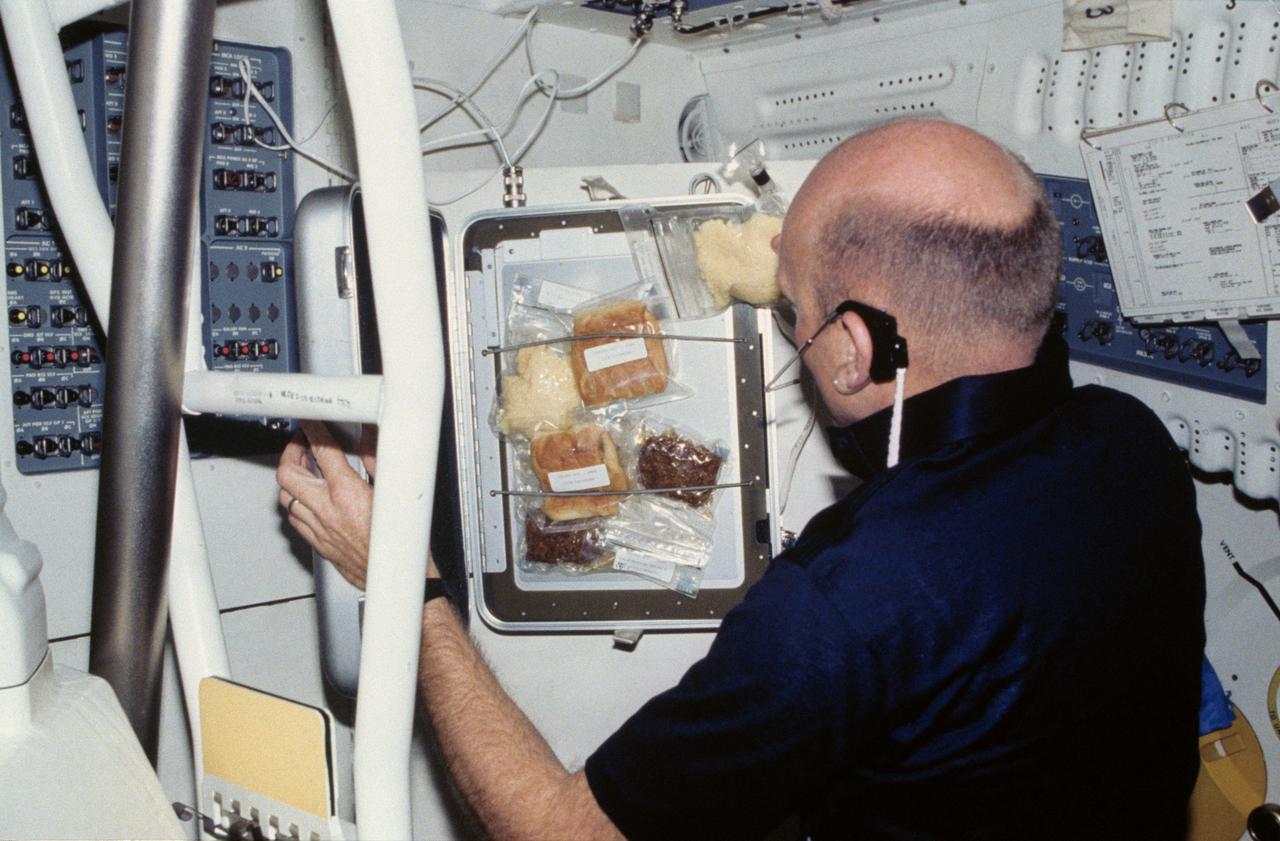
S82-28923 (March 1982) --- Astronaut C. Gordon Fullerton, STS-3 pilot, uses both hands to retrieve part of a meal from an orbital flight test food warmer in the middeck area of the Earth-orbiting space shuttle Columbia. The food warmer is a versatile briefcase-like device developed by life sciences personnel at the Johnson Space Center (JSC). Astronaut Jack R. Lousma, STS-3 commander, took this photograph with a 35mm camera. Photo credit: NASA

51D-05-22 (12-19 April 1985) --- Astronauts Karol J. Bobko (foreground), mission commander, and Donald E. Williams, pilot, are surrounded by teleprinted messages transmitted from ground controllers. The two are on Discovery's middeck.
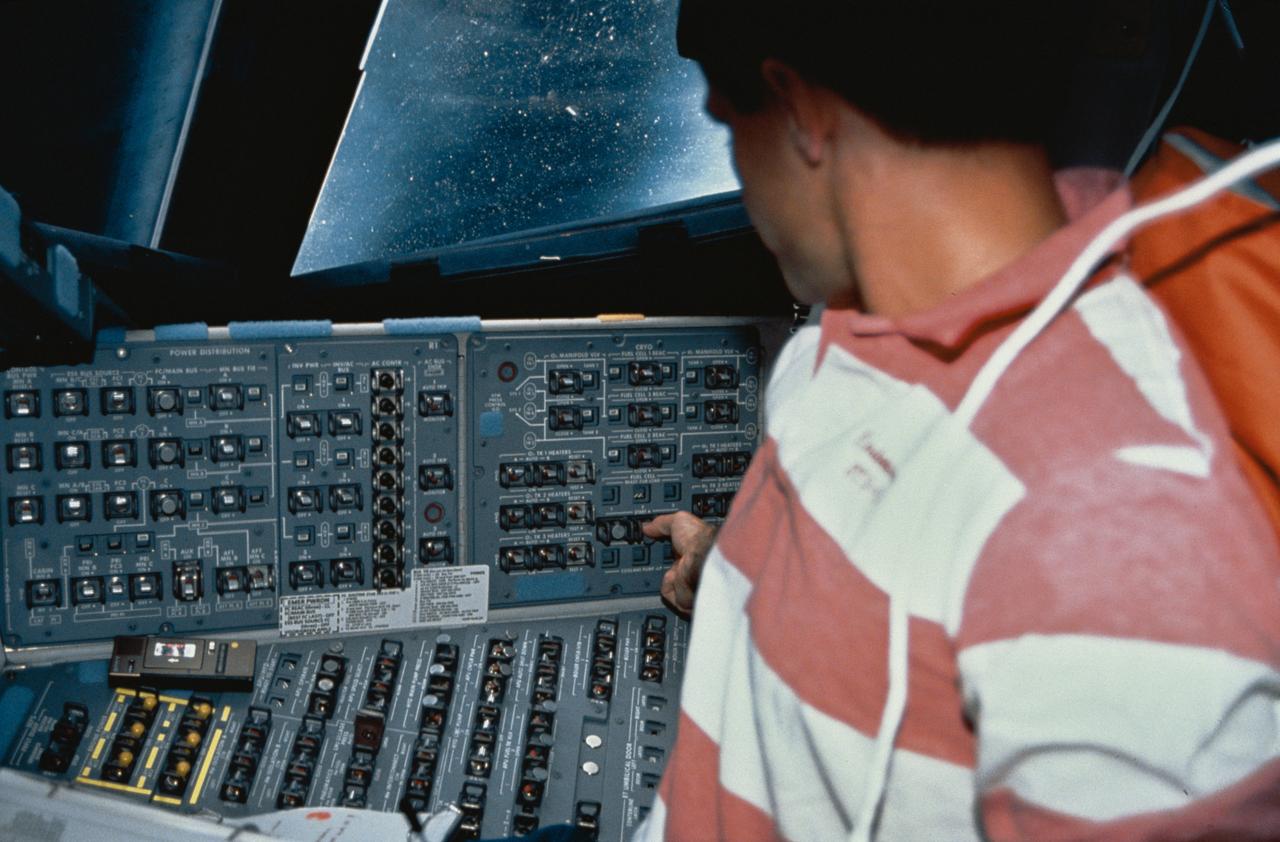
STS054-40-022 (13-19 Jan 1993) --- Astronaut Donald R. McMonagle, pilot, pushes a control switch for one of Endeavour's fuel cells from his station on the forward flight deck.
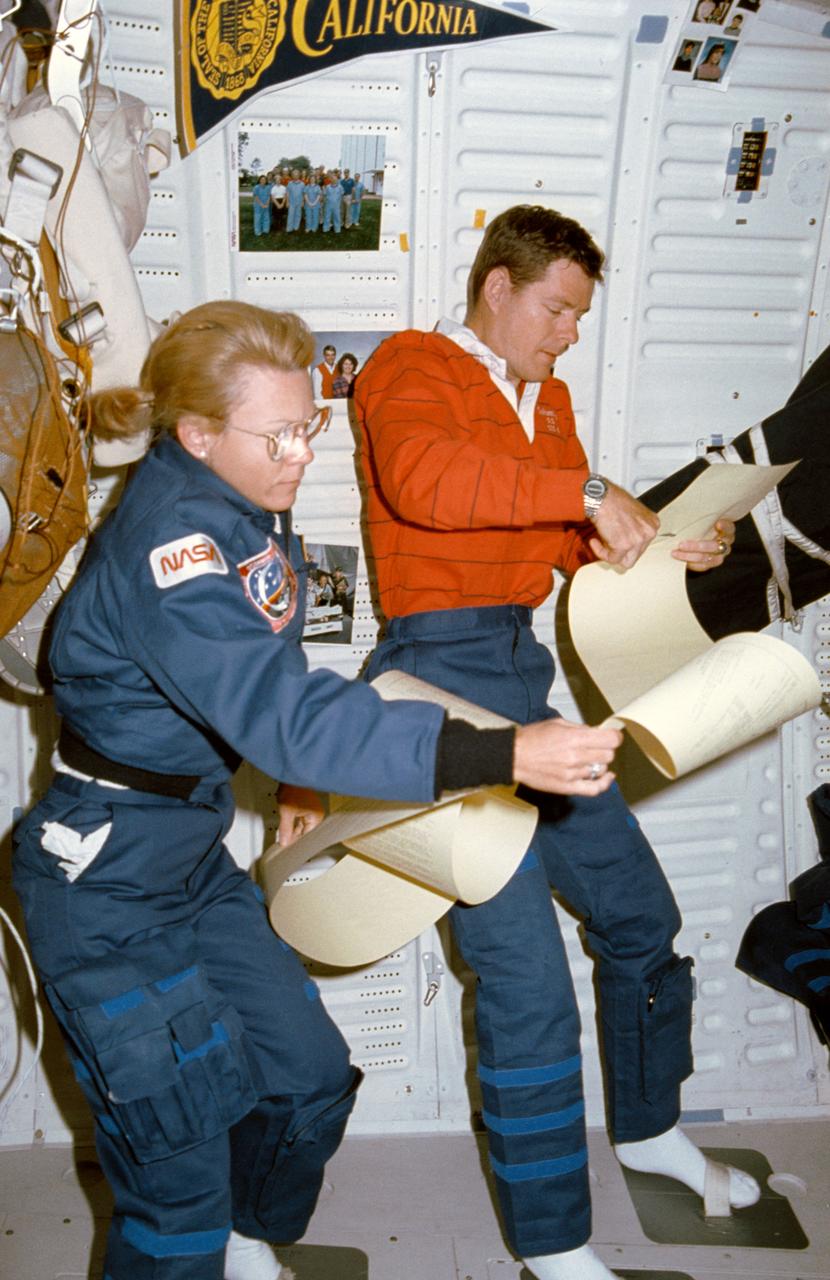
STS040-17-003 (5-14 June 1991) --- Astronauts Rhea Seddon and Bryan D. O'Connor share a 15 ft. length of teleprinter messages aboard Columbia. During the nine-day Spacelab Life Sciences (SLS-1) mission, the STS-40 crewmembers received a large volume of similar print-outs from ground controllers. Using foot restraints, the two obviously expect their perusing to take awhile. This middeck scene was photographed with a 35mm camera.
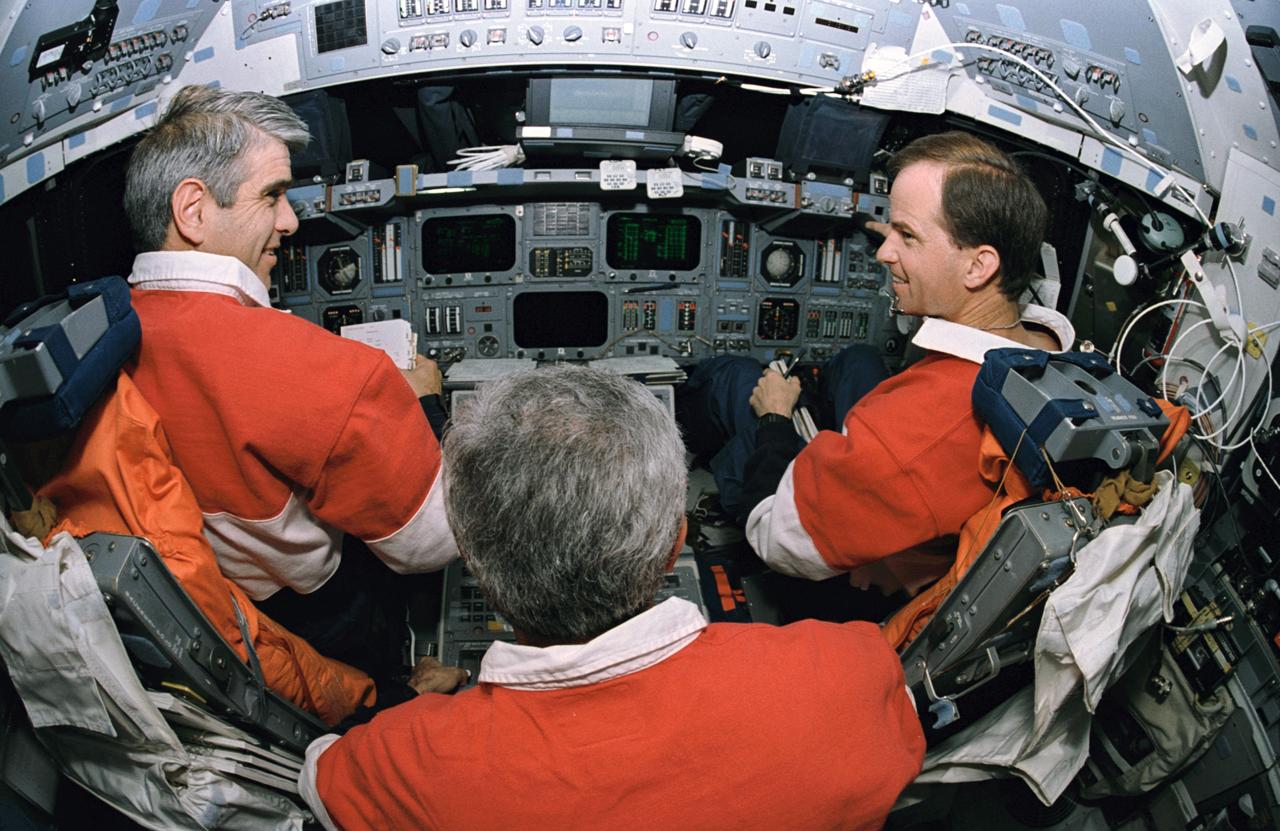
STS059-12-035 (9-20 April 1994) --- A 16mm lens on a 35mm camera provides a "fish-eye" effect for this rare scene on the Space Shuttle Endeavour's flight deck during checkout of the spacecraft's flight control systems. Astronauts Sidney M. Gutierrez (left) and Kevin P. Chilton (right) man the commander and pilot stations, respectively. Astronaut Michael R. (Rich) Clifford, the flight engineer, is seated behind the two. Not pictured are astronauts Linda M. Godwin, payload commander, and Jerome (Jay) Apt and Thomas D. Jones, both mission specialists.
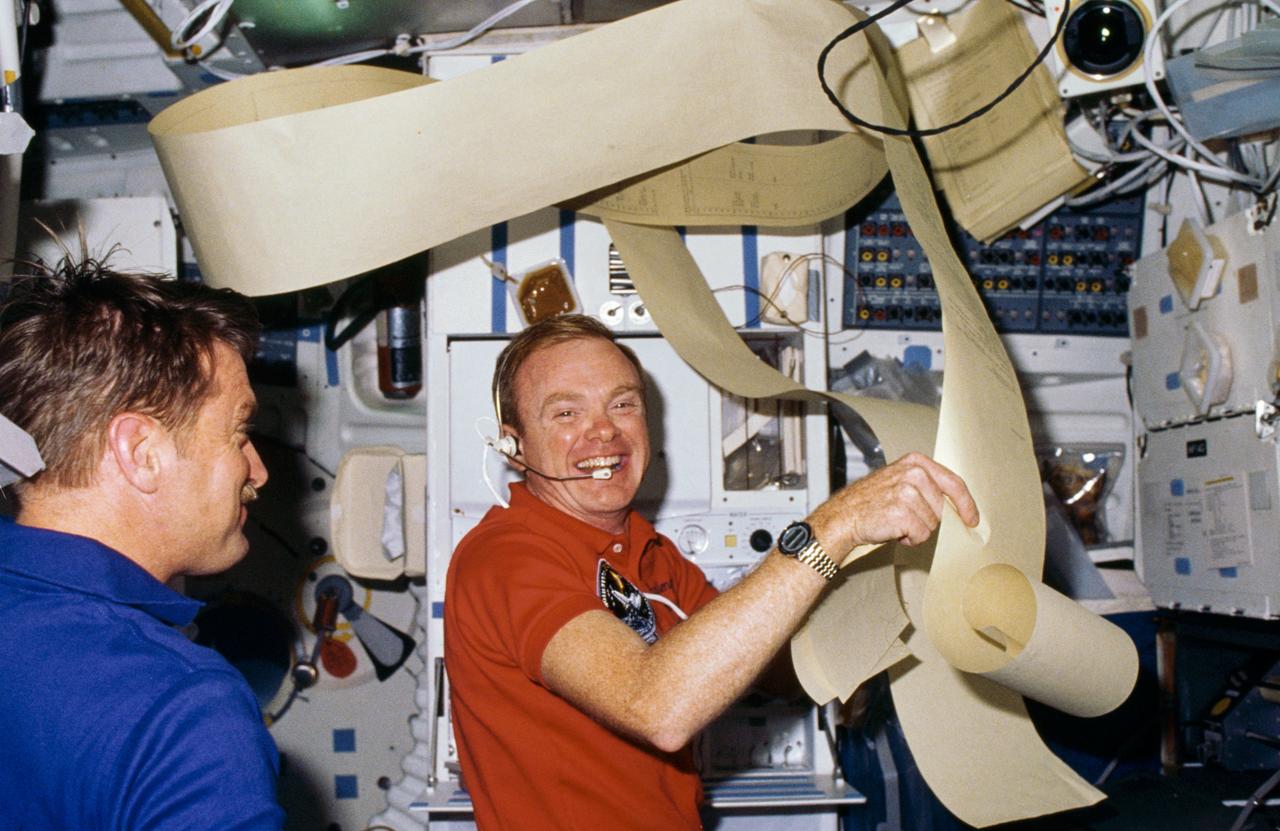
51F-03-024 (29 July-6 Aug 1985) --- Astronauts Anthony W. England, left, and Roy D. Bridges are surrounded by some of the prolific teleprinter copy transmitted from ground controllers to the Earth-orbiting Challenger. Eventually the equivalent of several football fields' length of paper was filled with data from flight controllers.
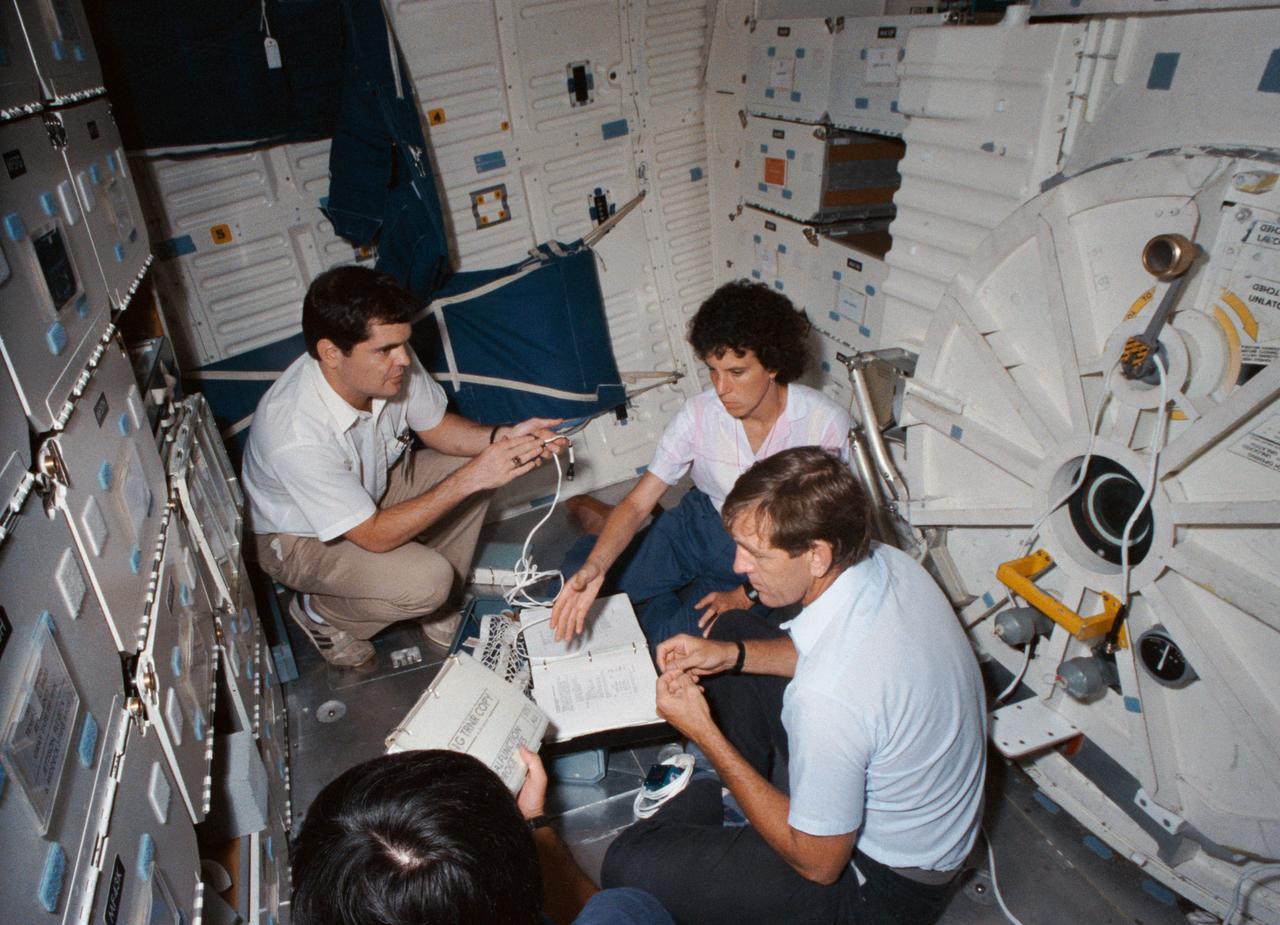
S89-39537 (July 1989) --- Two astronaut-crewmembers for NASA's STS-34 mission are briefed on inflight maintenance procedures on the mid-deck of the Space Shuttle crew compartment trainer in JSC's Shuttle mockup and integration laboratory. They are Ellen S. Baker and Michael J. McCulley, mission specialist and pilot, respectively for the scheduled Oct. 1989 mission aboard the Atlantis.
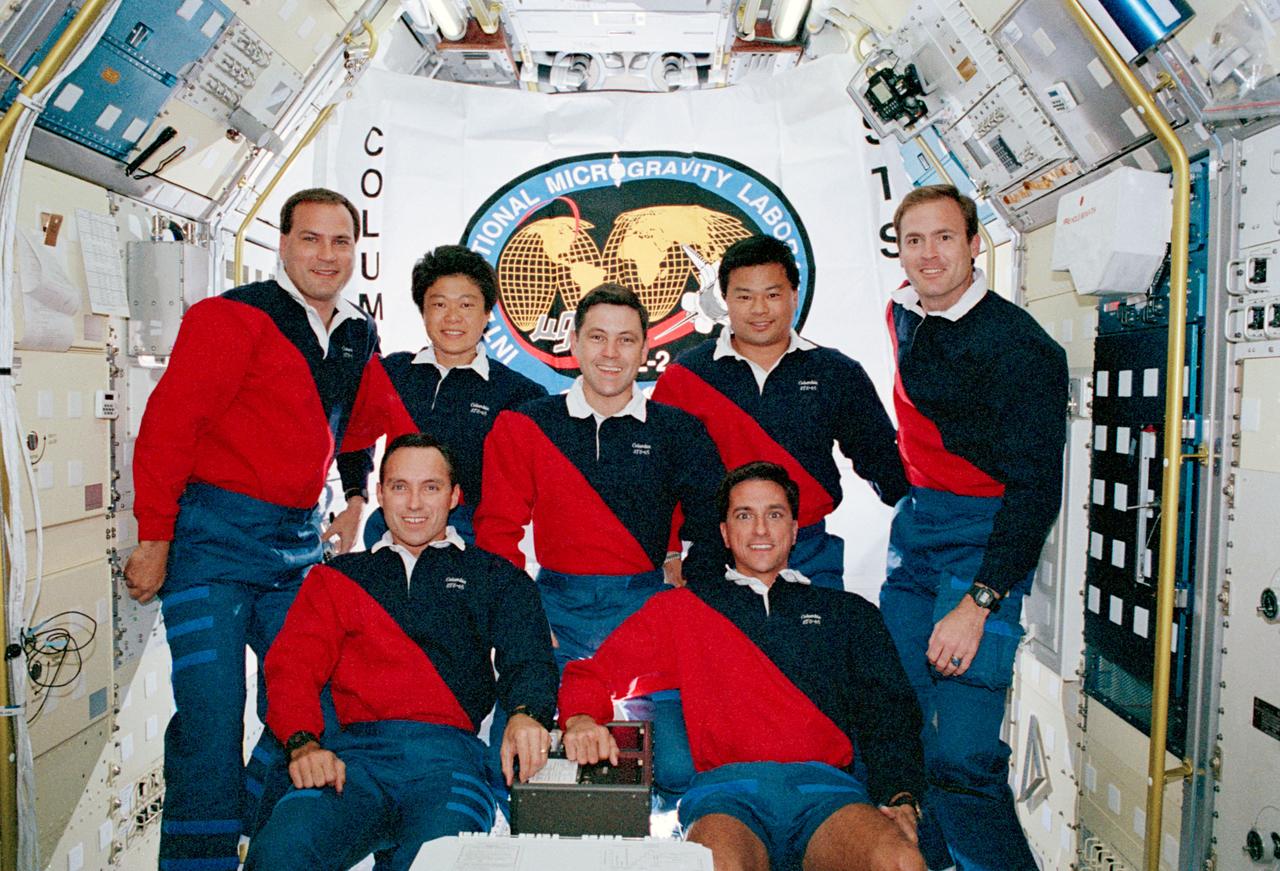
In the spacelab science module aboard the Space Shuttle Columbia, Orbiter Vehicle (OV) 102, the seven crewmembers pose for the traditional onboard (inflight) crew portrait. Displayed in the background is a flag with the International Microgravity Laboratory 2 (IML-2) insignia and Columbia inscribed along the edge. In the front row (left to right) are Mission Specialist (MS) Carl E. Walz and MS Donald A. Thomas. Behind them (left to right) are Payload Commander (PLC) Richard J. Hieb, Payload Specialist Chiaki Mukai, Commander Robert D. Cabana, MS Leroy Chiao, and Pilot James D. Halsell, Jr. Mukai represents the National Space Development Agency (NASDA) of Japan. Crewmembers are wearing their mission polo shirts for the portrait. Inside this module, the crew conducted experiments in support of the IML-2 mission.
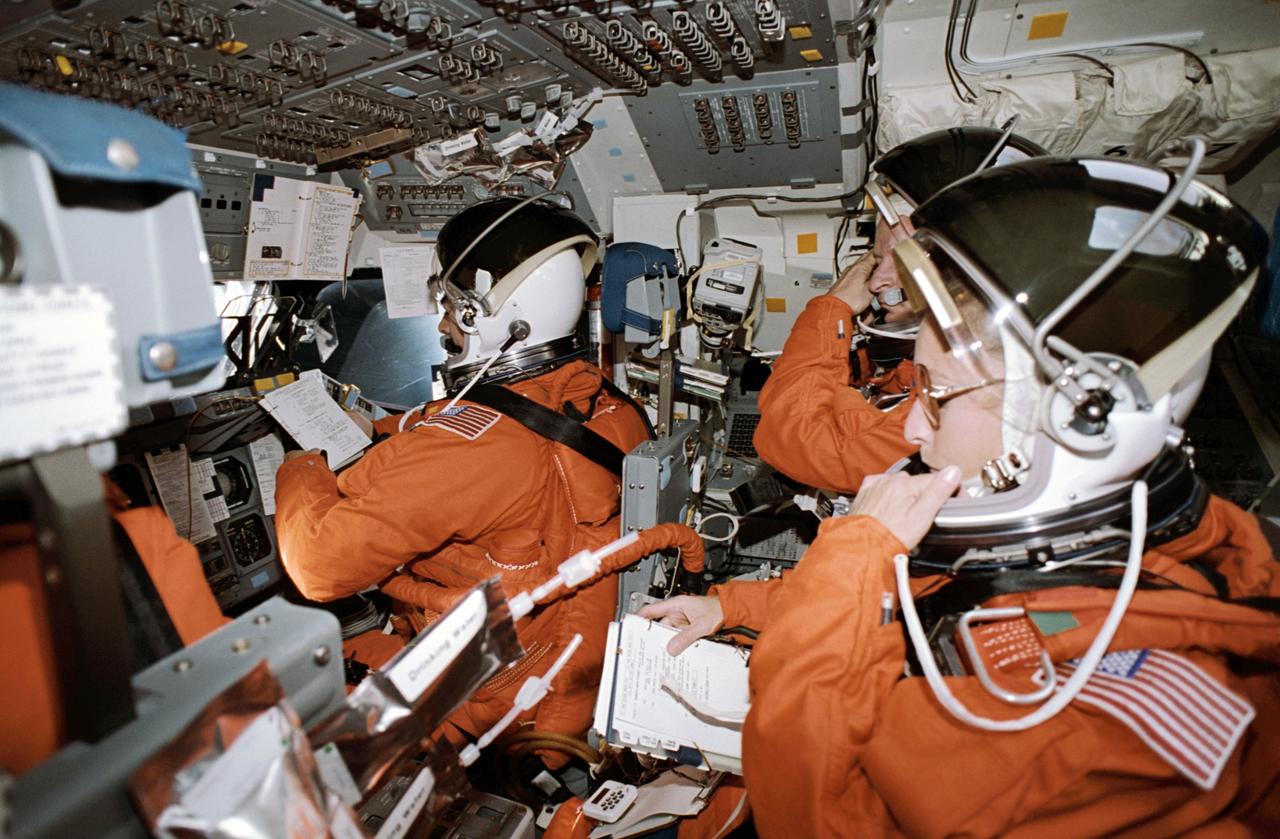
STS046-19-037 (8 Aug 1992) --- Having completed eight days in Earth-orbit, the crew members prepare for their brief journey home. Left to right are Andrew M. Allen, pilot; Claude Nicollier, mission specialist representing the European Space Agency (ESA); and Marsha S. Ivins, mission specialist. Just out of frame, at left, is Loren J. Shriver, mission commander, who guided the Space Shuttle Atlantis in for its Kennedy Space Center (KSC), Florida landing.
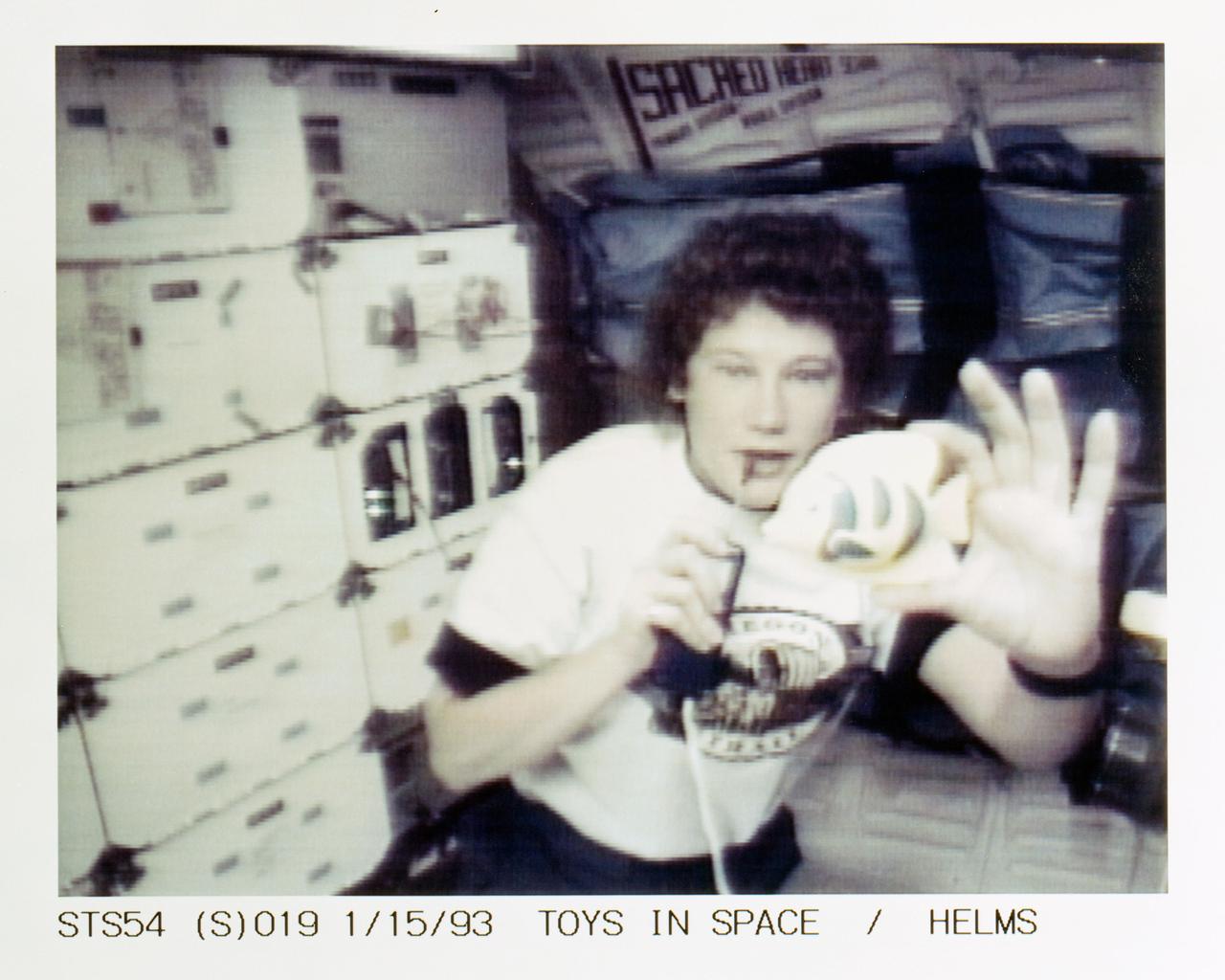
STS054-S-019 (15 Jan 1993) --- Helms with a fish toy on the middeck demonstrates some of the physics of toys to students watching on television. Four schools were chosen to ask questions of the astronauts during the lengthy program. Helms fielded questions from students at Shaver Elementary School in Portland, Oregon. The fish was used to demonstrate Newton's third law of motion and the conservation of angular momentum. The entire collection of toys will be videotaped for an educational program to be distributed to schools in the fall of this year. The scene was recorded at 17:50:08:27 GMT, Jan. 15, 1993.
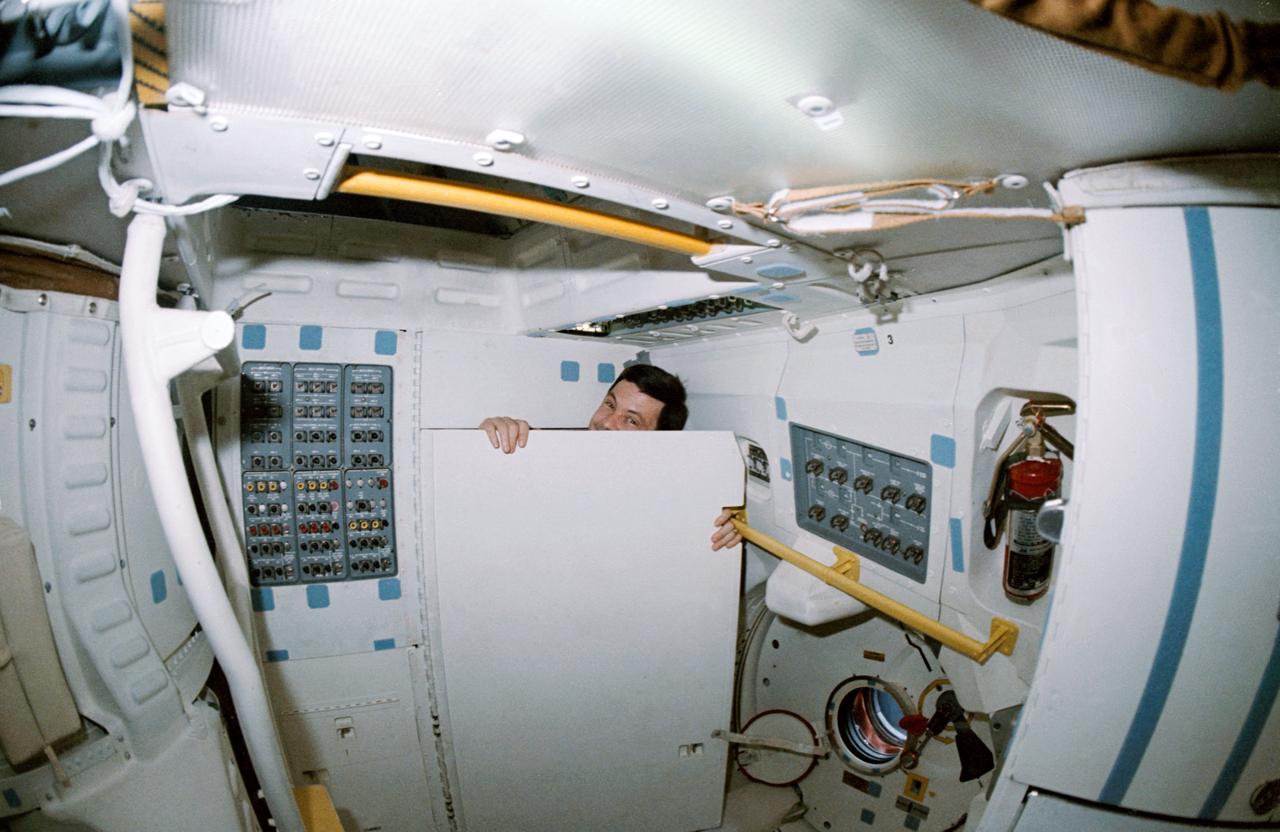
STS-41 crewmembers conduct Detailed Supplementary Objective (DSO) 0472 Intraocular Pressure on the middeck of Discovery, Orbiter Vehicle (OV) 103. Mission Specialist (MS) William M. Shepherd rests his head on the stowed treadmill while Pilot Robert D. Cabana, holding Shepherd's eye open, prepares to measure Shepherd's intraocular pressure using a tono pen (in his right hand). Objectives include: establishing a database of changes in intraocular pressures that can be used to evaluate crew health; validating ten degree head down bedrest as a model for cephalad fluid shifts in microgravity; facilitating the interpretation of data by providing a quantative measure of microgravity induced cephalad fluid shifts; and validating the tono pen as an effective tool for diagnostic and scientific data collection.
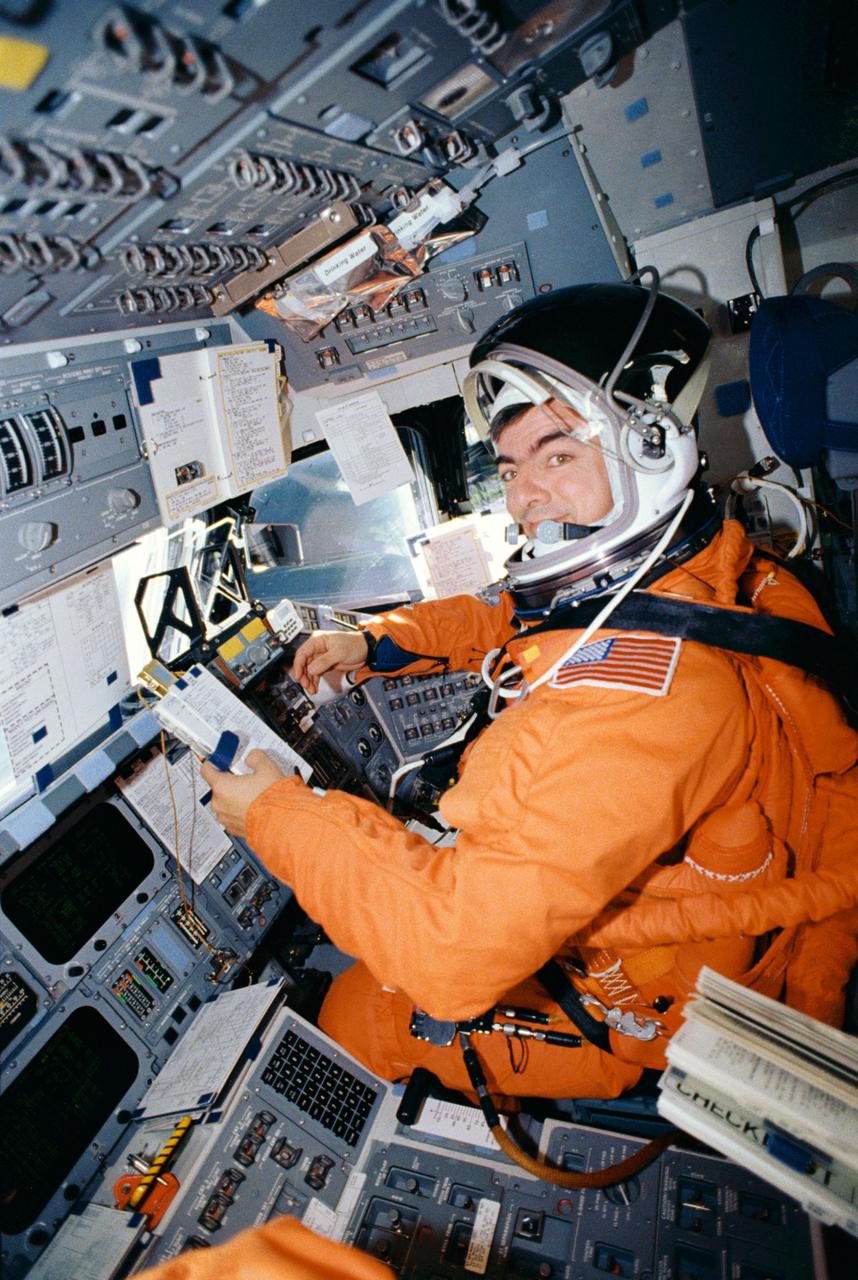
STS046-10-003 (8 Aug. 1992) --- Astronaut Andrew M. Allen, STS-46 pilot, positioned in the pilot's station and wearing a partial pressure launch and entry suit, prepares for the final leg of the mission. Allen and six fellow crew members had just shared a busy eight-day stay in Earth-orbit aboard the Space Shuttle Atlantis.
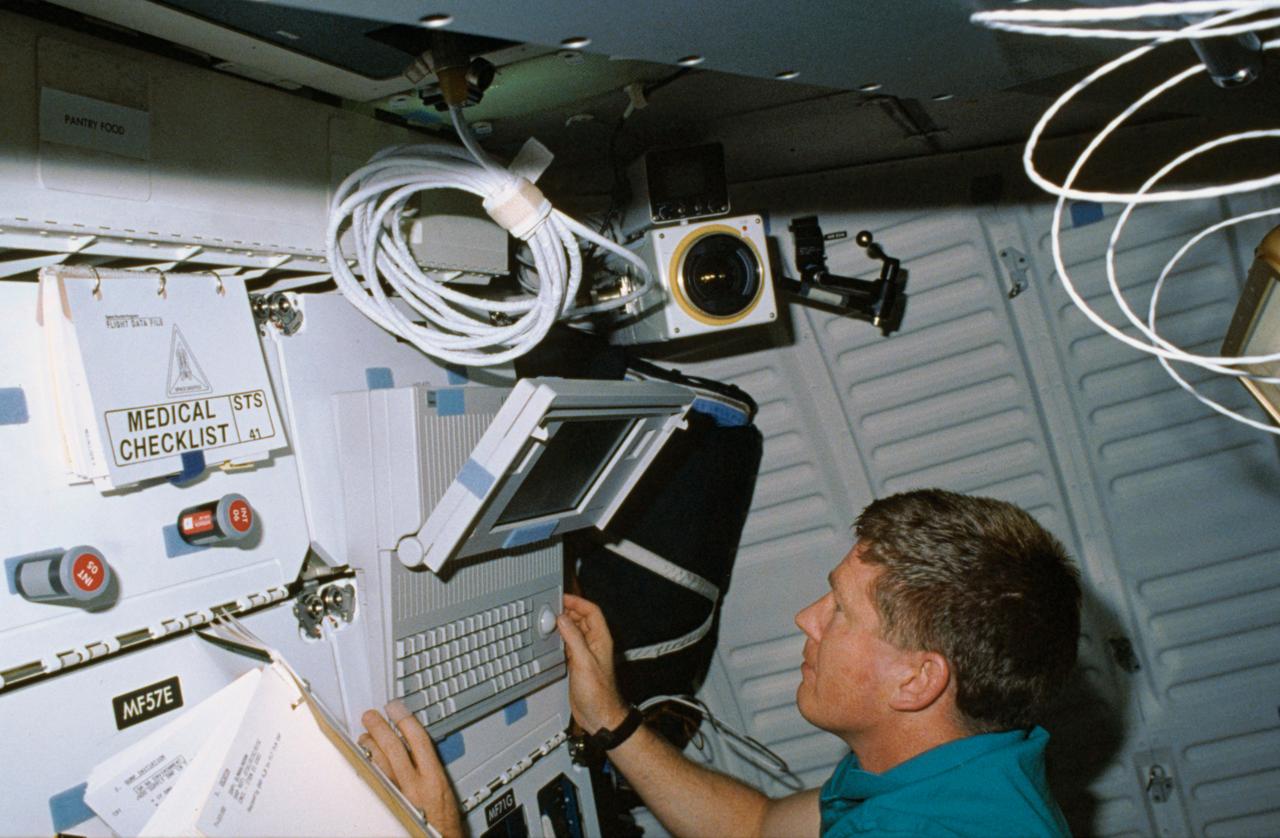
STS-41 Mission Specialist (MS) William M. Shepherd uses Detailed Test Objective (DTO) Space Station Cursor Control Device Evaluation MACINTOSH portable computer on the middeck of Discovery, Orbiter Vehicle (OV) 103. The computer is velcroed to forward lockers MF71C and MF71E. Surrounding Shepherd are checklists, the field sequential (FS) crew cabin camera, and a lighting fixture.
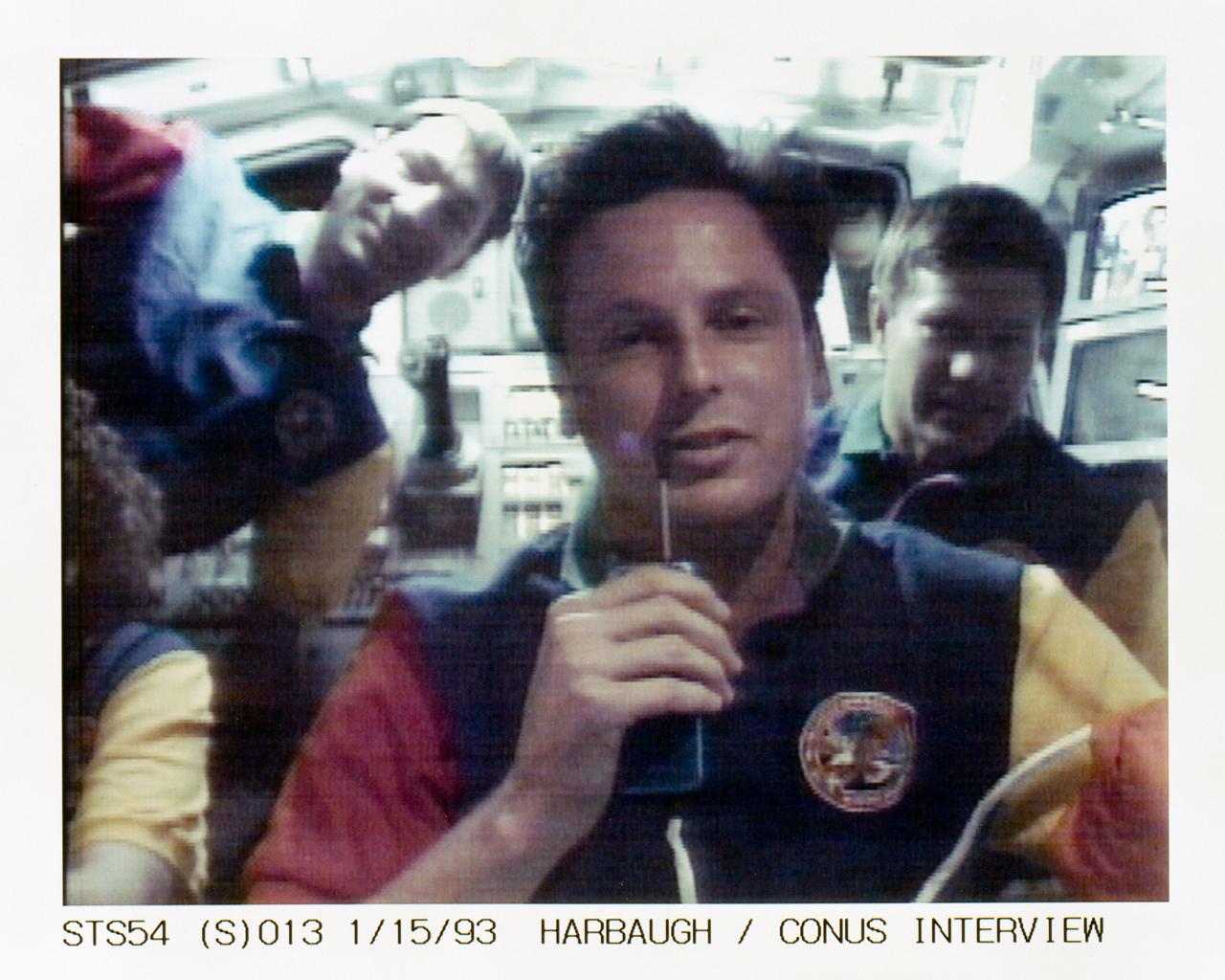
STS054-S-013 (15 Jan 1993) --- Harbaugh talks to a radio station from the flight deck of Endeavour while, in the background, several crewmates await their turns to communicate with other stations. The scene was recorded at 13:57:20:20 GMT, Jan. 15, 1993.
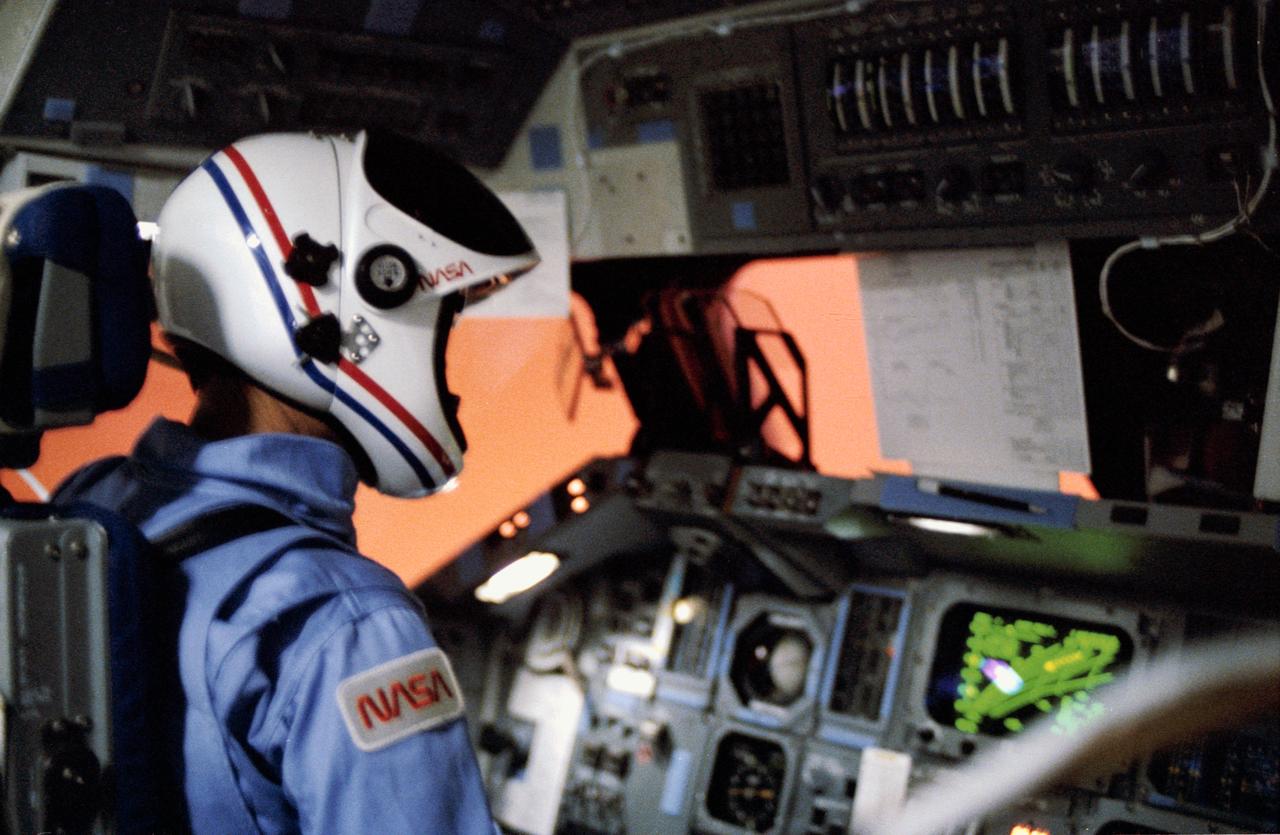
STS007-31-1614 & S83-35775 (24 June 1983) --- Astronaut Robert L. Crippen is seen at the commander’s station of the Space Shuttle Challenger as it passes through the Earth’s atmosphere on re-entry. The friction results in a pinkish glow visible through the forward windows on the flight deck. The scene was exposed with a 35mm camera.
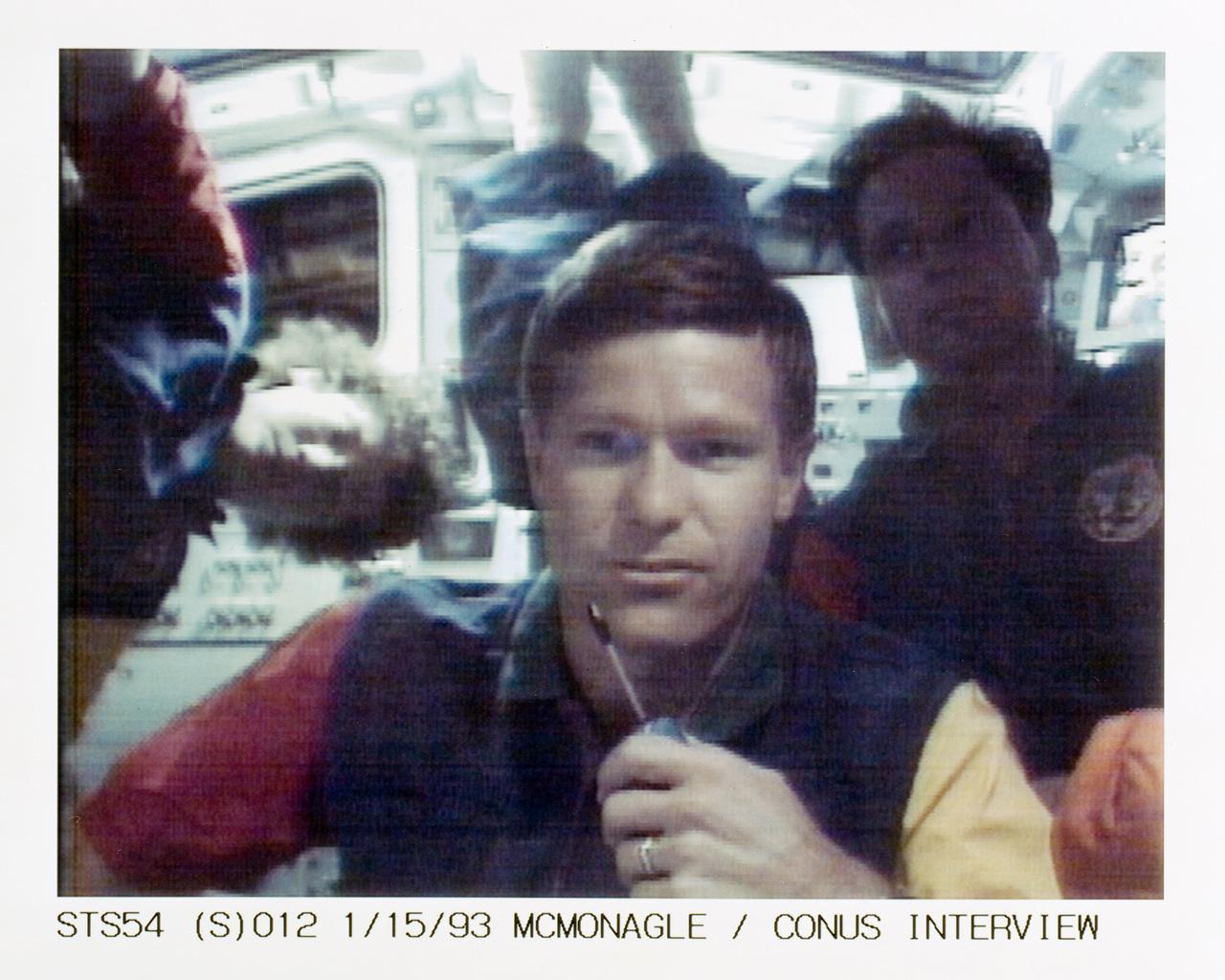
STS054-S-012 (15 Jan 1993) --- McMonagle talks to a radio station from the flight deck of Endeavour while, in the background, several crewmates await their turns to communicate with other stations. The scene was recorded at 13:54:14:13 GMT, Jan. 15, 1993.
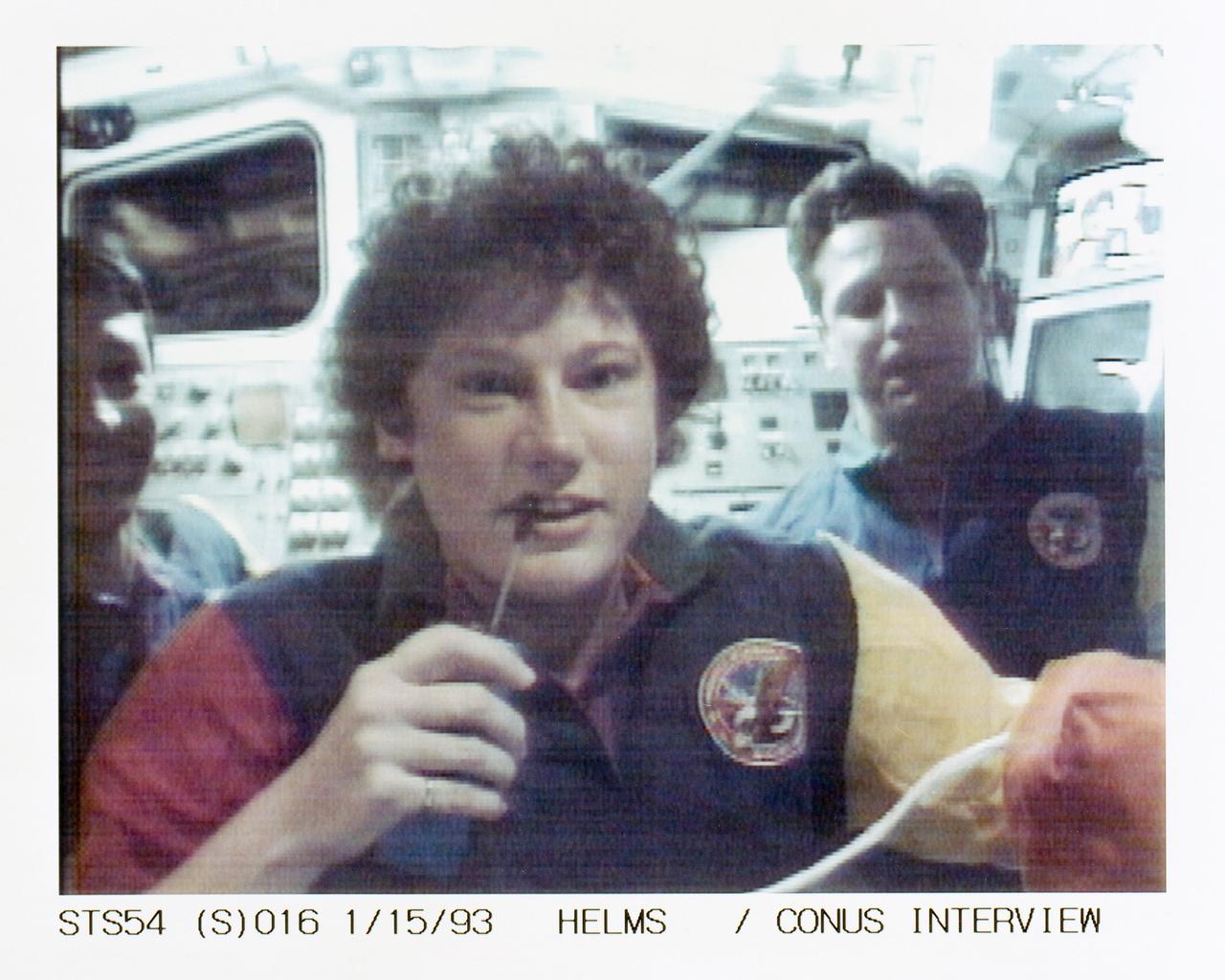
STS054-S-016 (15 Jan 1993) --- Helms talks to a radio station from the flight deck of Endeavour while Runco, left, and Harbaugh look on in the background. The scene was recorded at 13:54:14:13 GMT, Jan. 15, 1993.
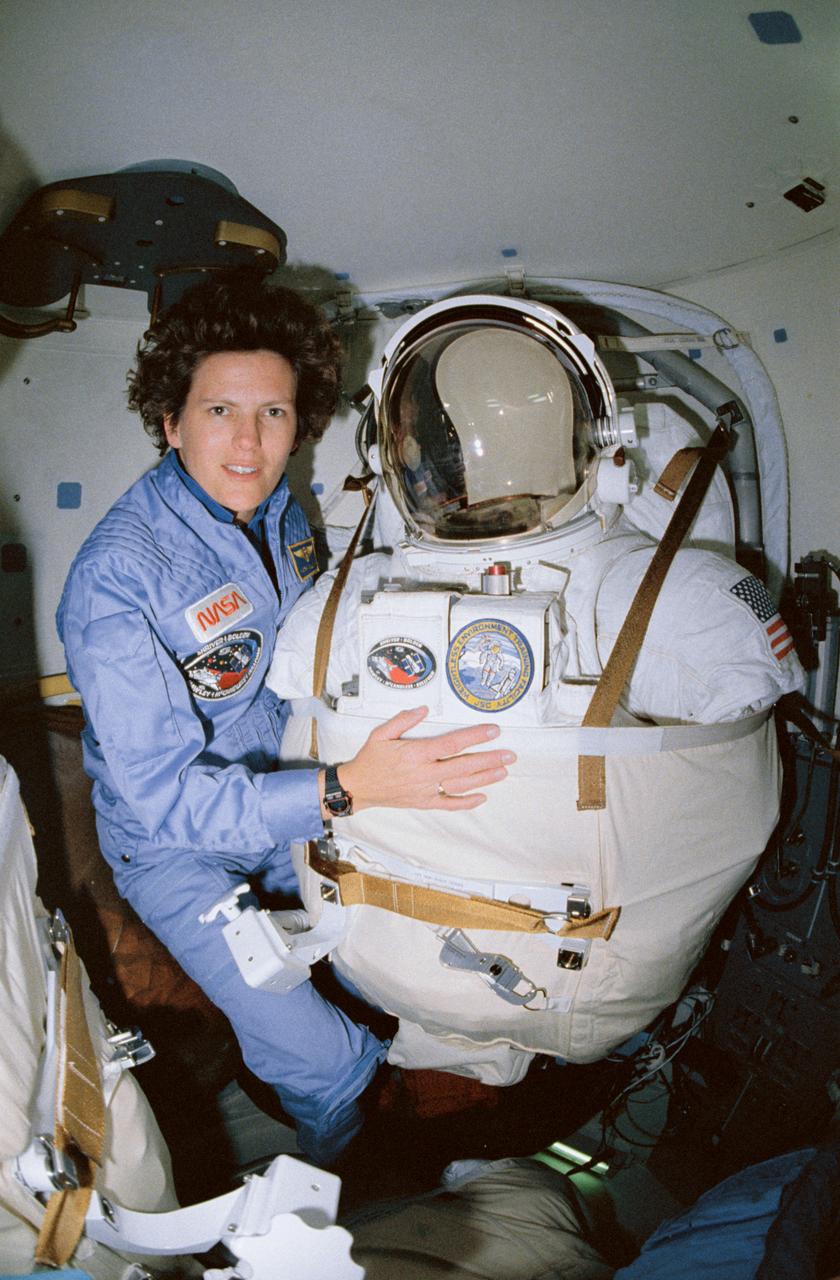
STS-31 Mission Specialist (MS) Kathryn D. Sullivan poses for a picture before beginning extravehicular mobility unit (EMU) donning procedures in the airlock of Discovery, Orbiter Vehicle (OV) 103. Sullivan will remove the lower torso restraint and don EMU which is supported on an airlock adapter plate (AAP). When suited, Sullivan will be ready for contingency extravehicular activity (EVA) in the event that problems arise with the Hubble Space Telescope (HST) deployment. Displayed on the front of the EMU are the STS-31 mission insignia and the JSC Weightless Environment Training Facility (WETF) insignia.
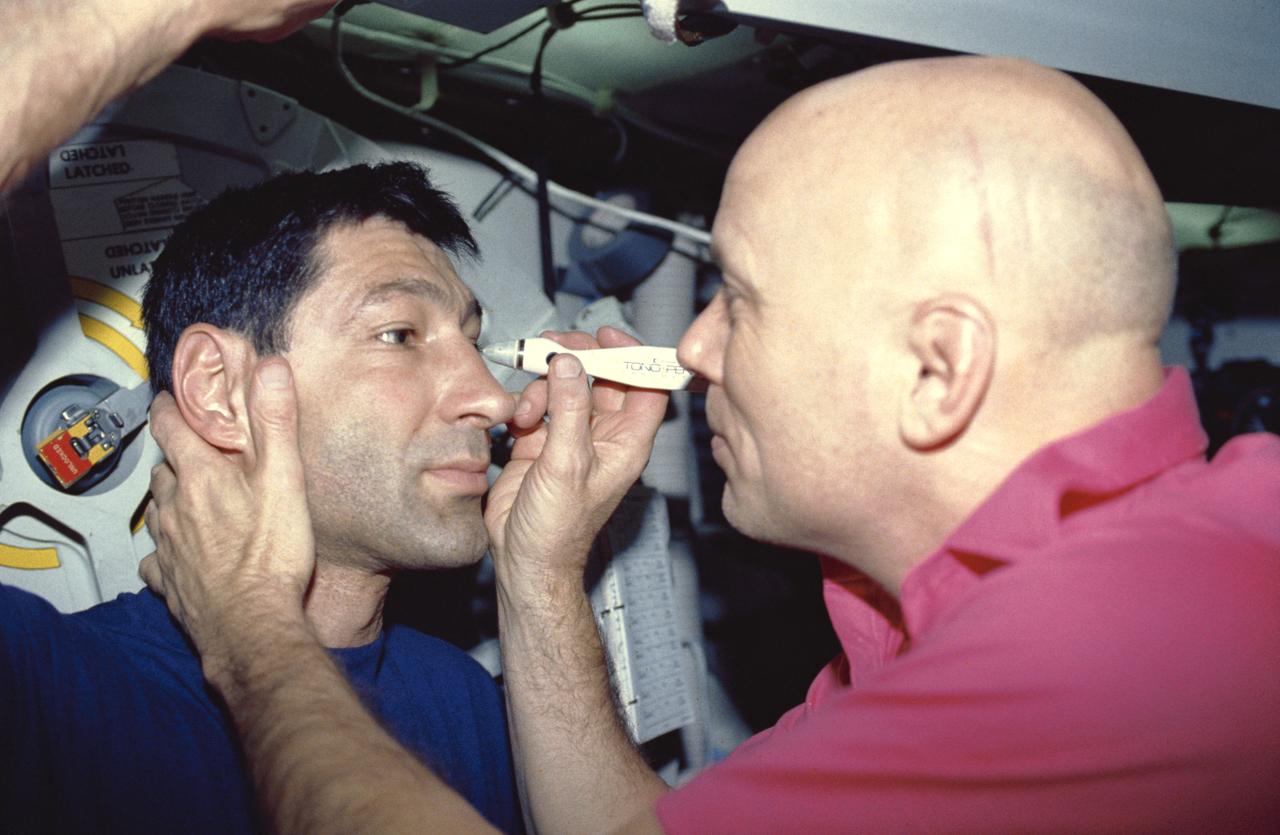
STS044-04-001 (24 Nov-1 Dec 1991) --- Astronauts F. Story Musgrave (right) and Mario Runco, Jr., mission specialists, team up for one of the biomedical Detailed Supplementary Objective (DSO) test on the eight-day flight, this one involving intraocular pressure.
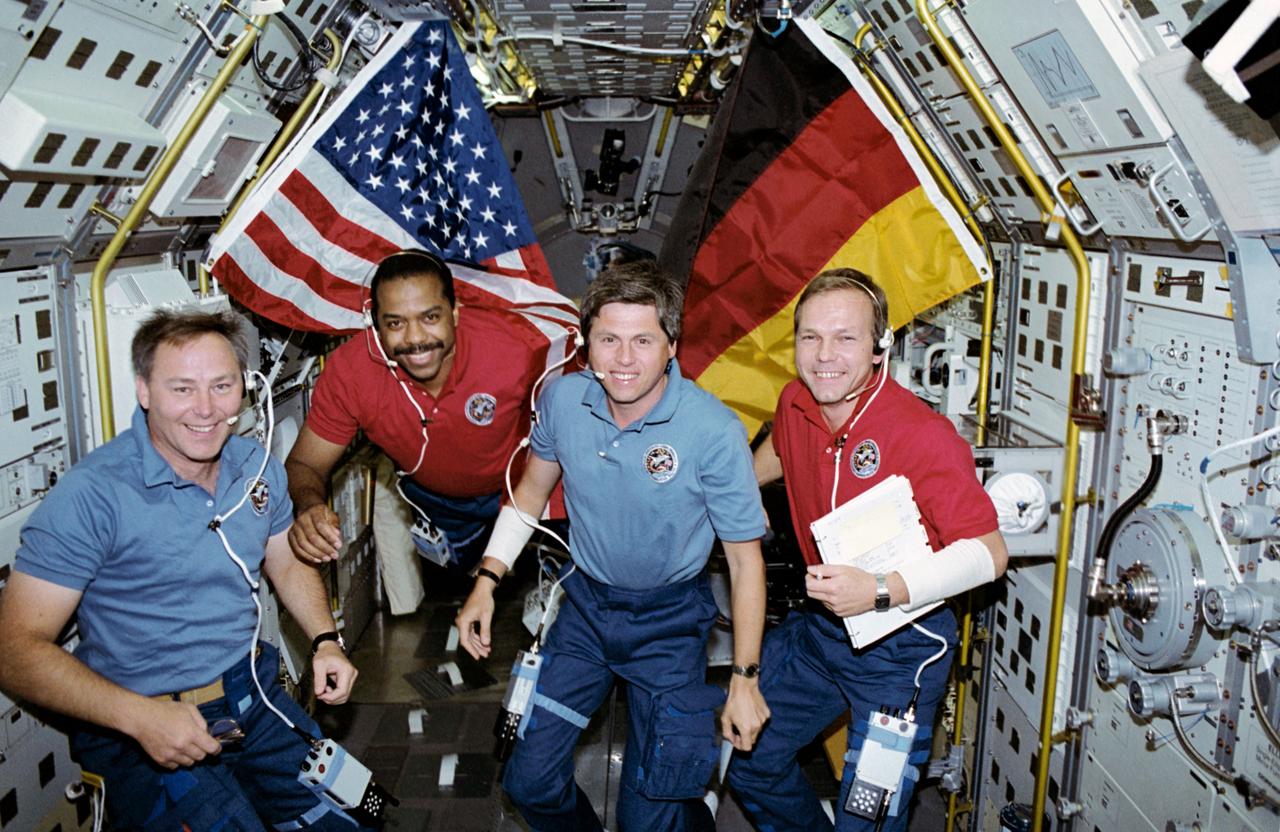
STS-55 crewmembers pose with United States and German flags inside the Spacelab Deutsche 2 (SL-D2) science module located in the payload bay (PLB) of Columbia, Orbiter Vehicle (OV) 102. Wearing communications kit assembly headsets (HDSTs) are (left to right) Mission Specialist 1 (MS1) and Payload Commander (PLC) Jerry L. Ross, MS3 Bernard A. Harris, Jr, German Payload Specialist 1 Ulrich Walter, and Payload Specialist 2 Hans Schlegel.

STS054-S-023 (15 Jan 1993) --- Casper holds up a paper boomerang before sailing it across Endeavour's middeck. The demonstration was part of a lengthy "physics of toys" program conducted by all five crewmembers on their third day aboard the Shuttle. Through telephone and TV downlinks, students in four schools around the country participated in a special lesson to discover how specific toys function differently in the classroom compared to those on the Shuttle. The boomerang was used to demonstrate Bernouli's principle and gyroscopic stability. The entire collection of toys will be videotaped for an educational program to be distributed to schools in the autumn. The scene was downlinked at 18:11:04:26 GMT, Jan. 15, 1993.
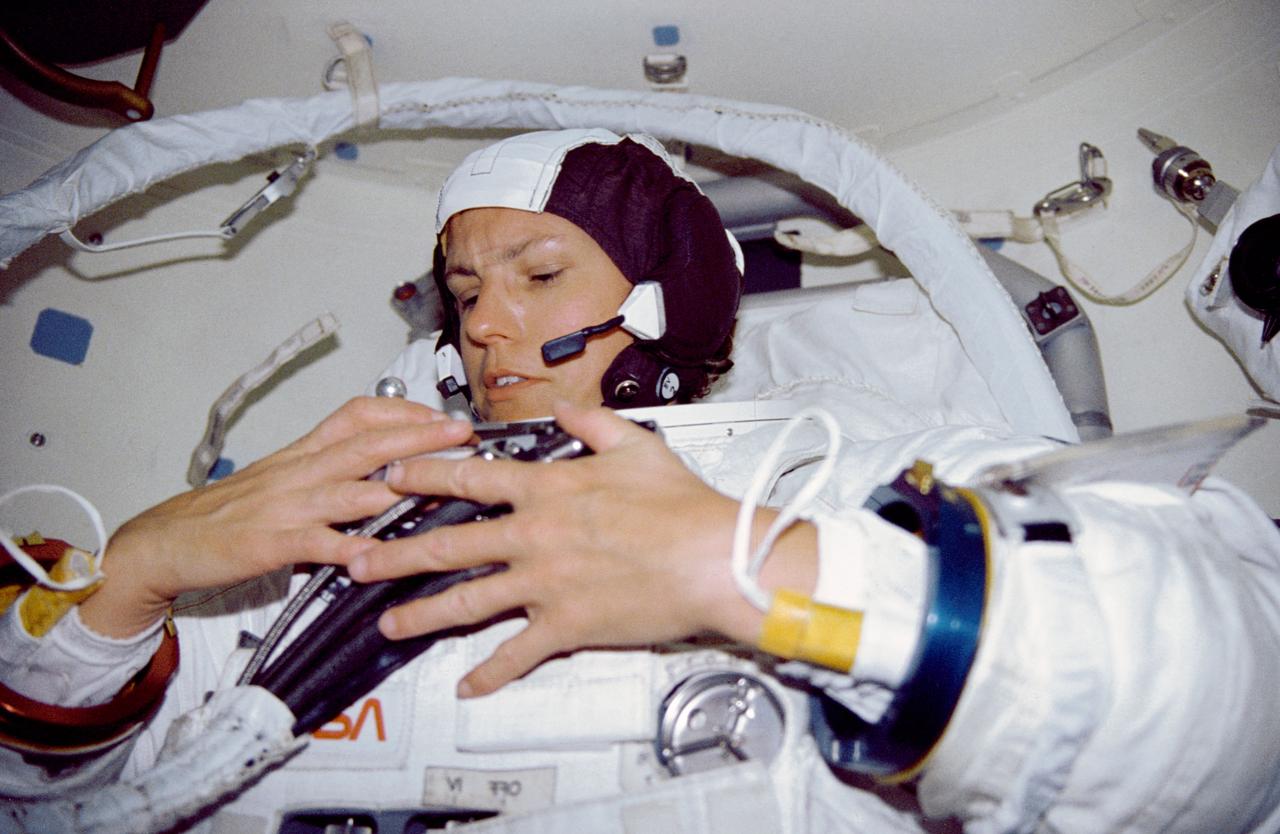
STS-31 Mission Specialist (MS) Kathryn D. Sullivan, wearing extravehicular mobility unit (EMU) & communications carrier assembly (CCA), attaches service and cooling umbilical (SCU) to the EMU connection on the display & control module (DCM) during contingency extravehicular activity (EVA) preparations in the airlock of Discovery, Orbiter Vehicle (OV) 103. The procedure was completed in case an EVA was required to support Hubble Space Telescope (HST) deployment.
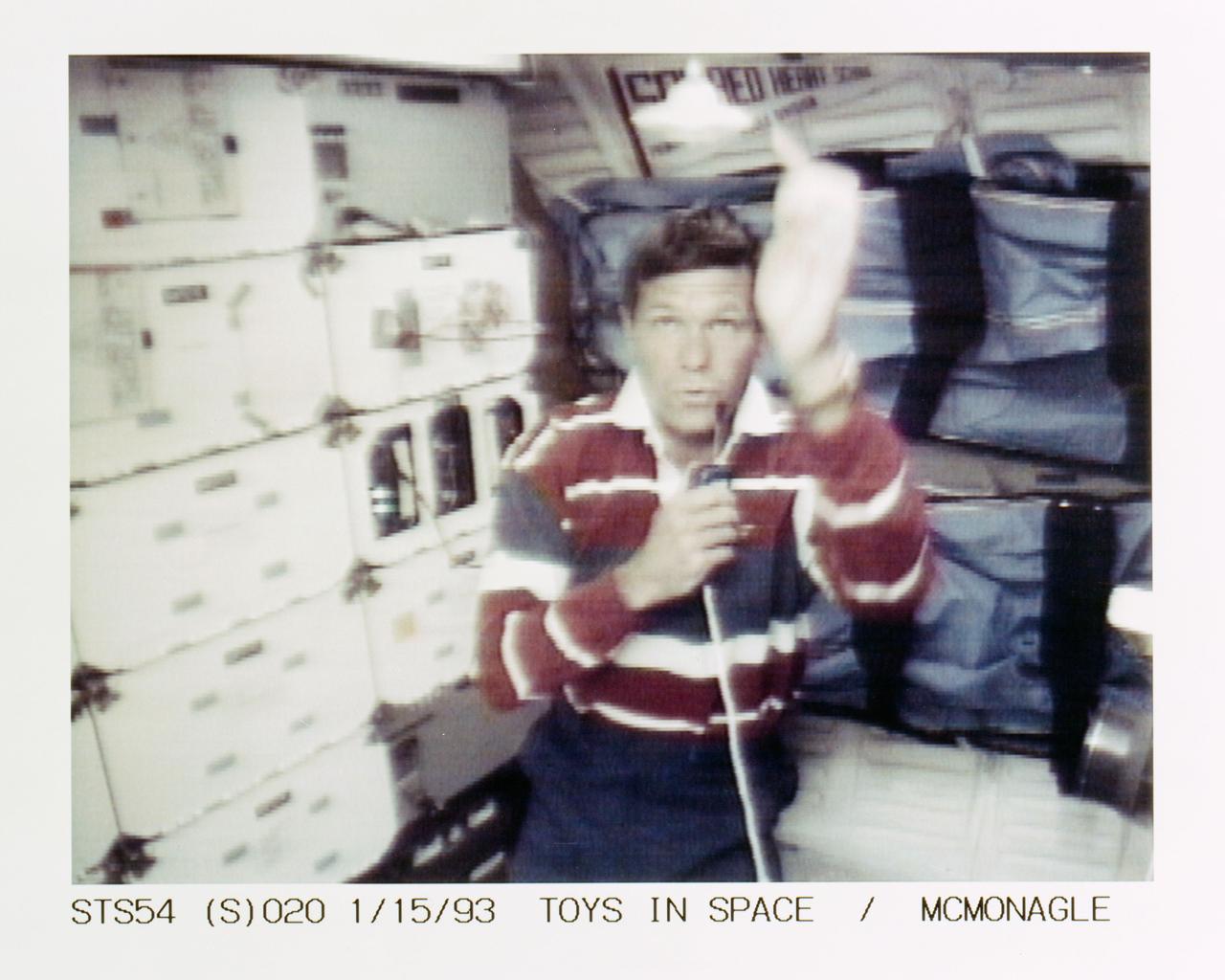
STS054-S-020 (15 Jan 1993) --- McMonagle watches as a top spins above his head on the middeck of the Earth-orbiting Endeavour. The demonstration was part of a lengthy "physics of toys" program conducted by all five crewmembers on their third day aboard the Shuttle. Through telephone and TV downlinks, students in four schools around the country participated in a special lesson to discover how specific toys function differently in the classroom compared to those on the Shuttle. Students at Westwood Elementary School in Flint, Michigan -- McMonagle's hometown -- asked him questions about the several toys he demonstrated. The top demonstrates gyroscopic motion, the center of mass and angular momentum. The entire collection of toys will be videotaped for an educational program to be distributed to schools in the autumn. The scene was downlinked at 18:01:59:11 GMT, Jan. 15, 1993.
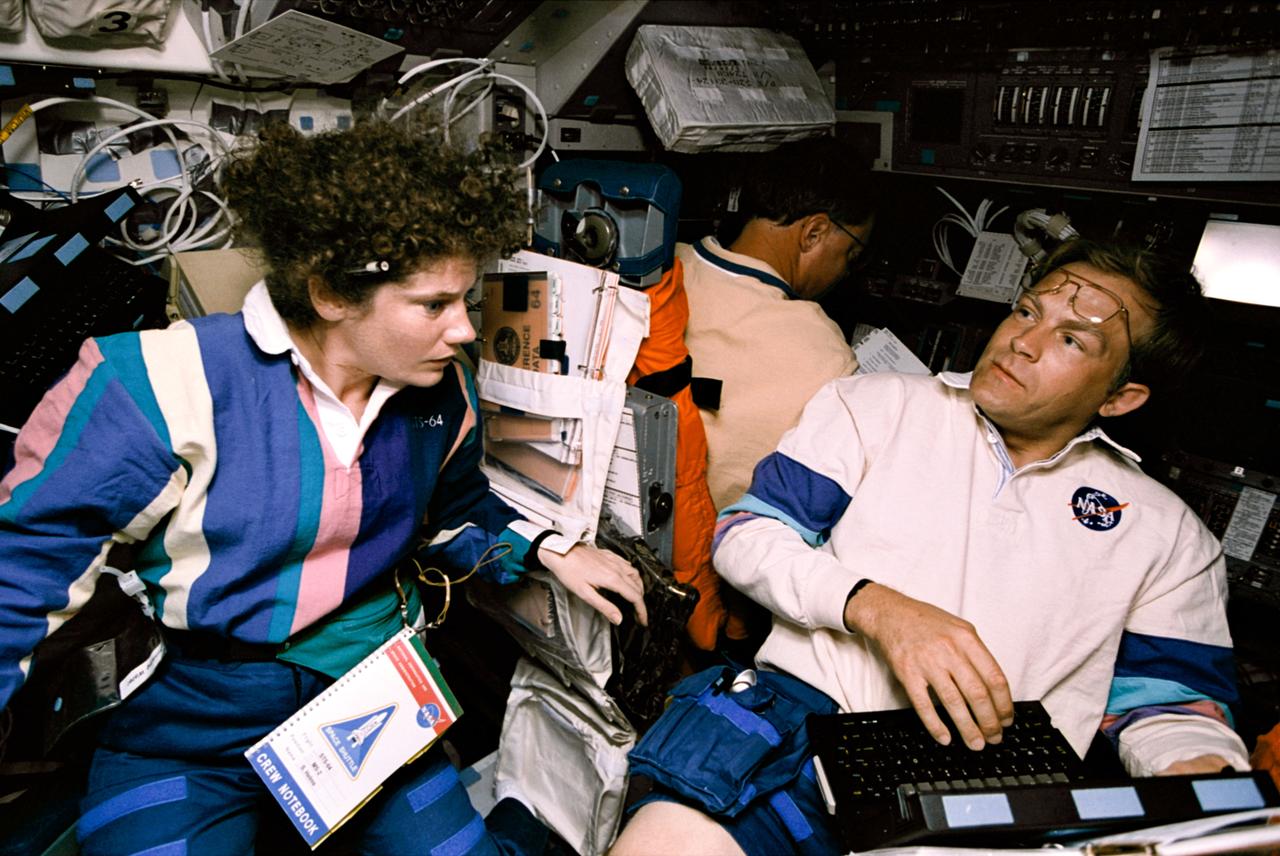
STS064-311-033 (10 Sept. 1994) --- Half of the crew members share support of the Shuttle Plume Impingement Flight Experiment (SPIFEX) in this 35mm frame. Astronauts Susan J. Helms and Mark C. Lee (foreground) share a pertinent bit of data while astronaut L. Blaine Hammond in the background controls Reaction Control System (RCS) thrusters on the space shuttle Discovery. Helms' role was to control the Remote Manipulator System (RMS) arm, to which 30-feet of SPIFEX hardware were appended in order to measure the RCS plume induced loads in the far field region. Lee records data on a lap top Payload General Support Computer (PGSC). SPIFEX was developed to help understand the thruster effects on approaching spacecraft. Photo credit: NASA or National Aeronautics and Space Administration
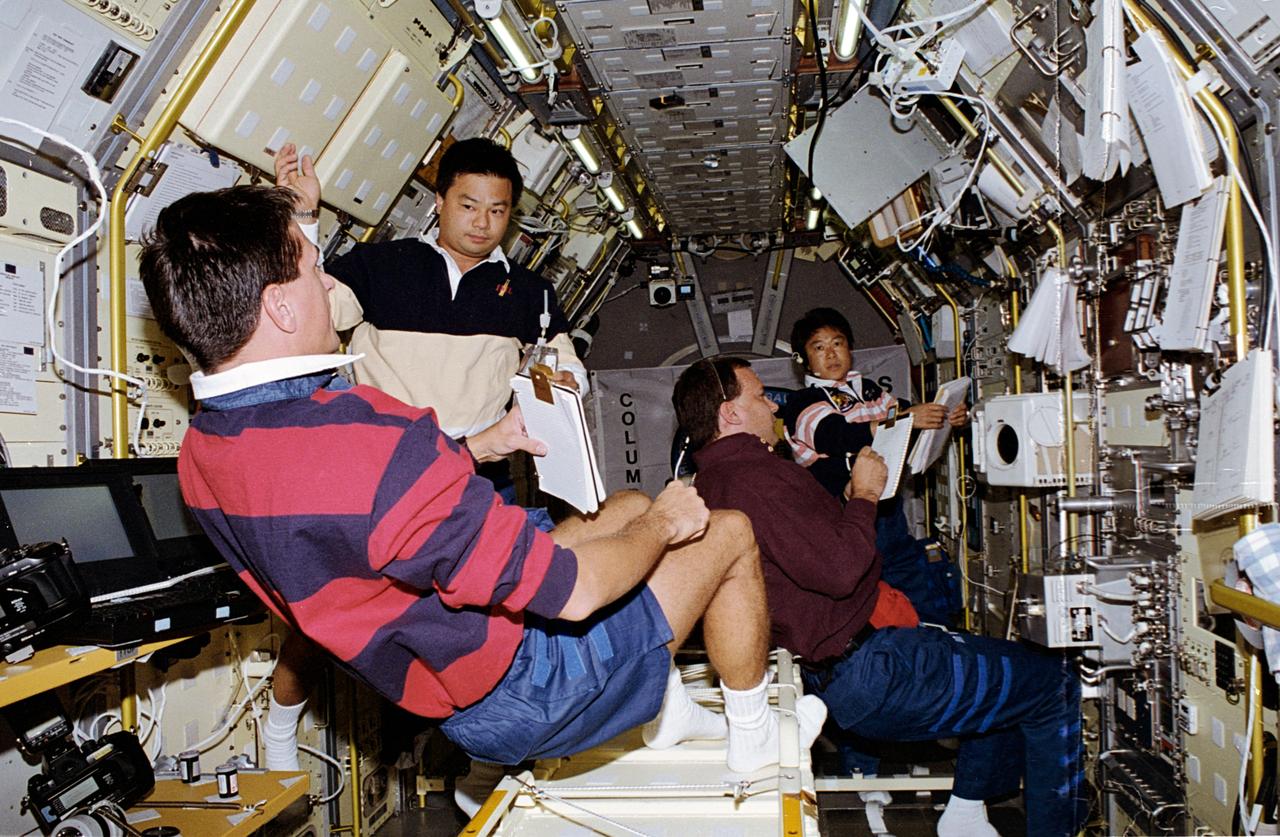
STS065-05-037 (8-23 July 1994) --- In the science module aboard the Space Shuttle Columbia, four members of the crew busy themselves with experiments in support of the second International Microgravity Laboratory (IML-2) mission. Left to right are Donald A. Thomas and Leroy Chiao, both mission specialists; Richard J. Hieb, payload commander, and Dr. Chiaki Mukai of NASDA, payload specialist.
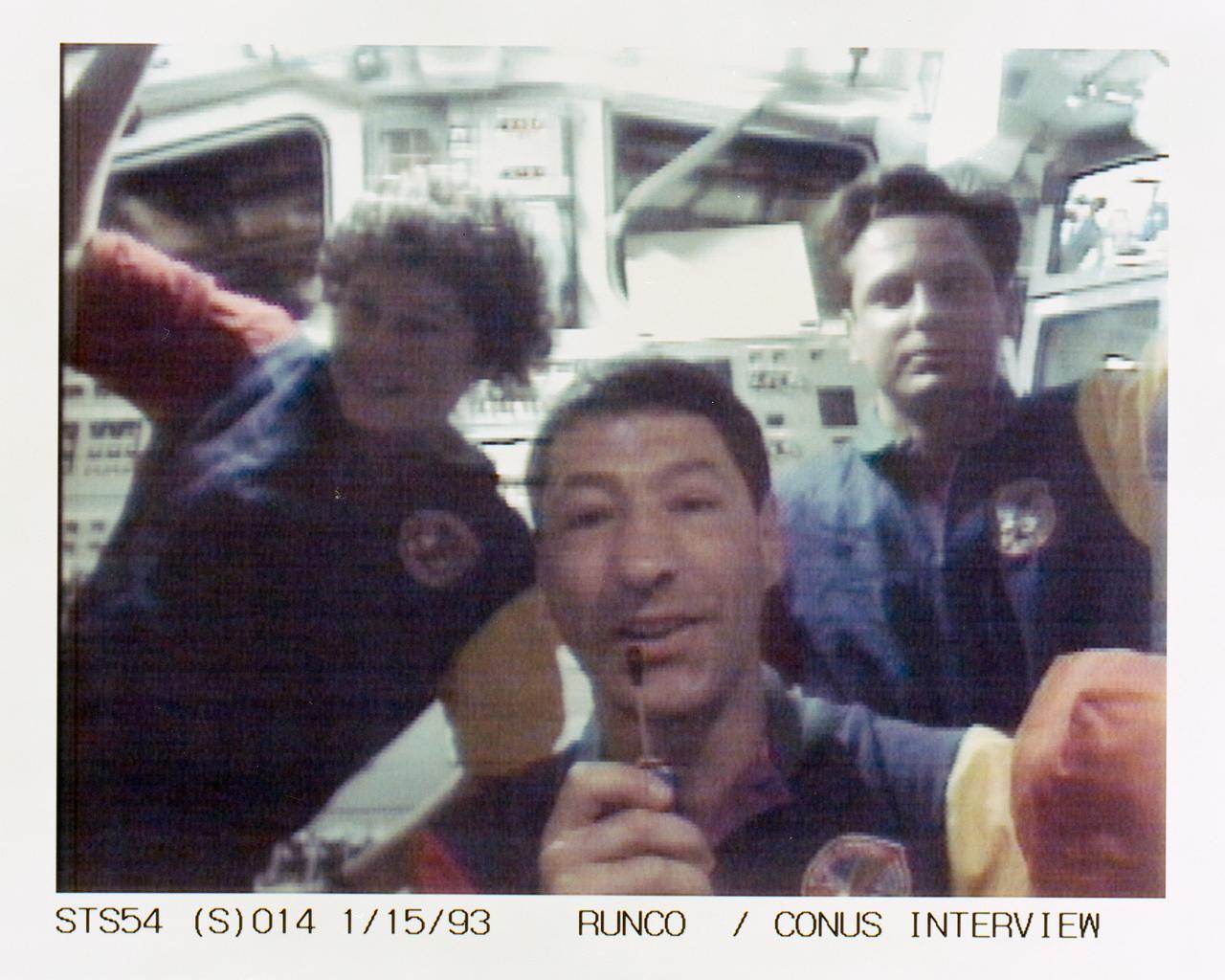
STS054-S-014 (15 Jan 1993) --- Runco talks to a radio station from the flight deck of Endeavour while, in the background, several crewmates await their turns to communicate with other stations. The scene was recorded at 13:48:45:11 GMT, Jan. 15, 1993.
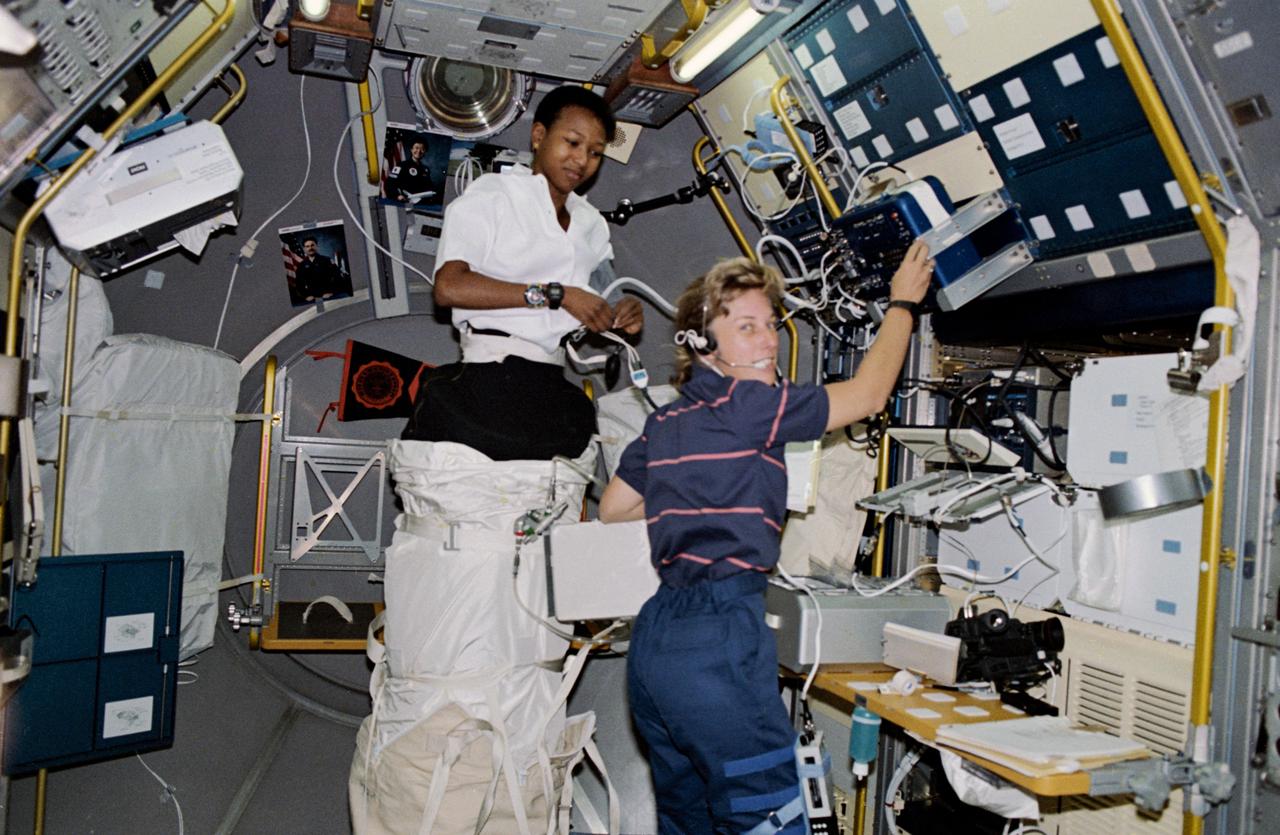
STS047-230-030 (12 - 20 Sept 1992) --- Astronauts Mae C. Jemison (left) and N. Jan Davis, mission specialists, are pictured in the Spacelab-J science module preparing to conduct a session with the Lower Body Negative Pressure (LBNP) experiment. The two joined four other NASA astronauts and a payload specialist representing Japan's National Space Development Agency (NASDA) aboard the Earth-orbiting Space Shuttle Endeavour for eight days of Spacelab-J research.
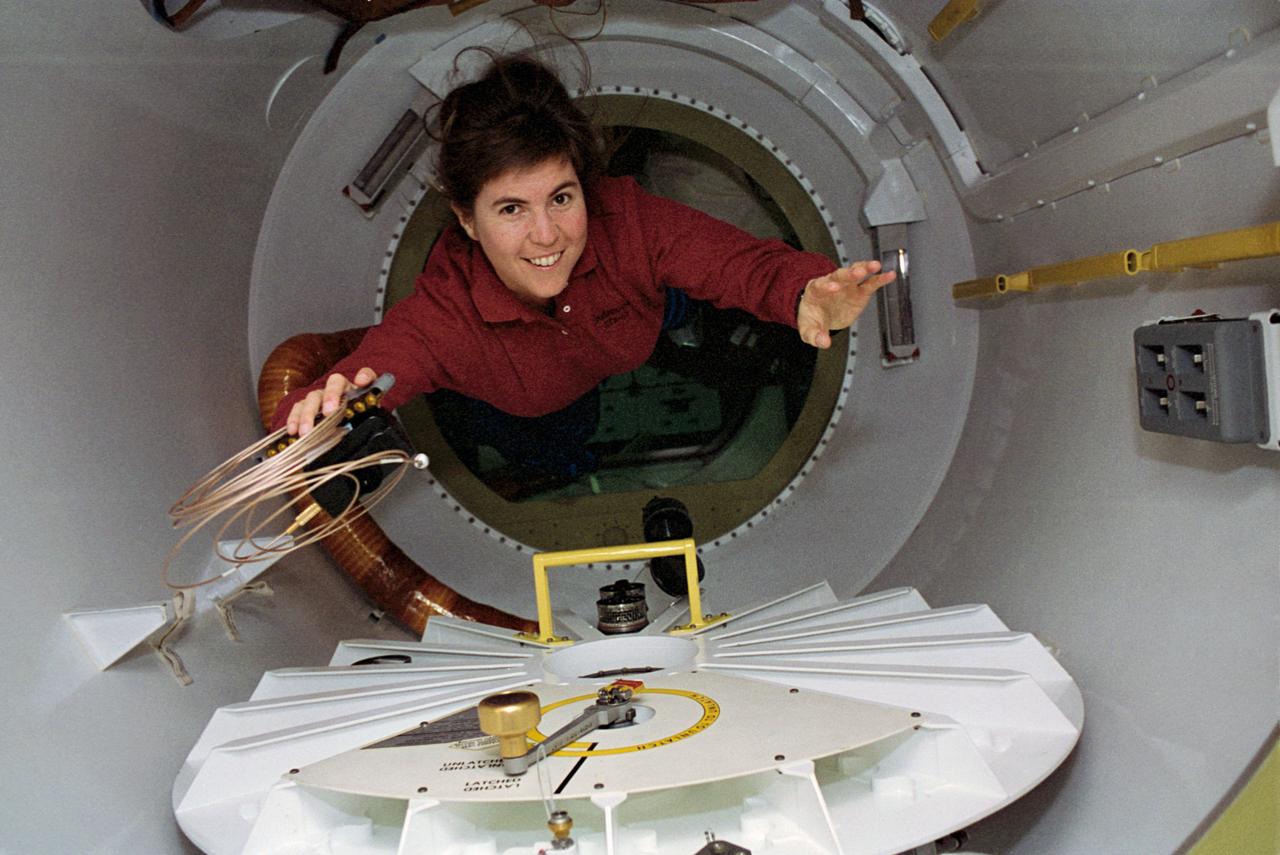
STS057-28-013 (21 June - 1 July 1993) --- With a camera and cable in hand, astronaut Janice E. Voss, mission specialist, floats through a special tunnel into the SpaceHab module. Voss and five other NASA astronauts spent almost ten days aboard the Space Shuttle Endeavour in Earth-orbit supporting the SpaceHab mission, retrieving the European Retrievable Carrier (EURECA) and conducting various experiments.
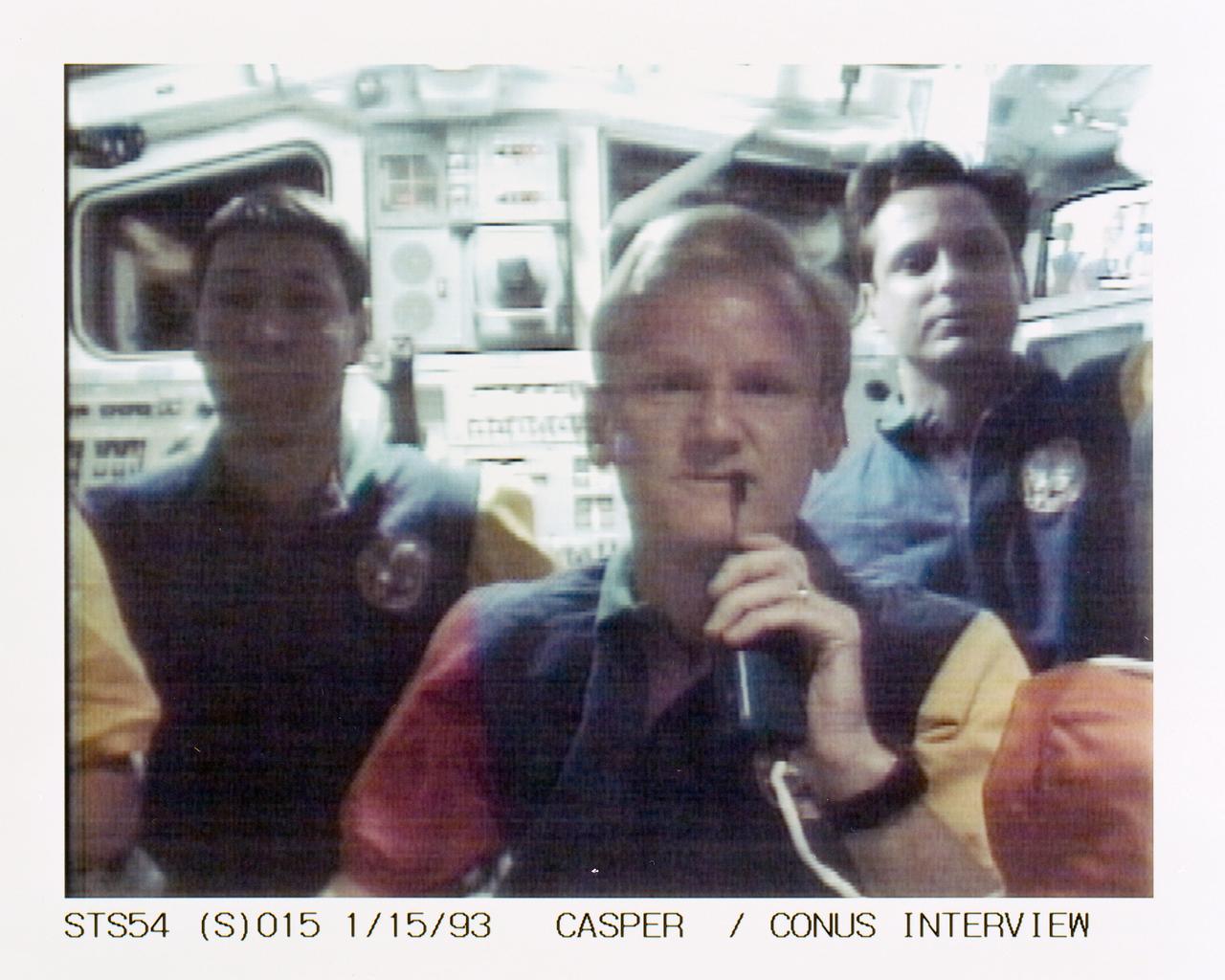
STS054-S-015 (15 Jan 1993) --- Casper talks to a radio station from the flight deck of Endeavour while, in the background, Runco, left, and Harbaugh await their turns to communicate with other stations. The scene was recorded at 13:45:54:05 GMT, Jan. 15, 1993.
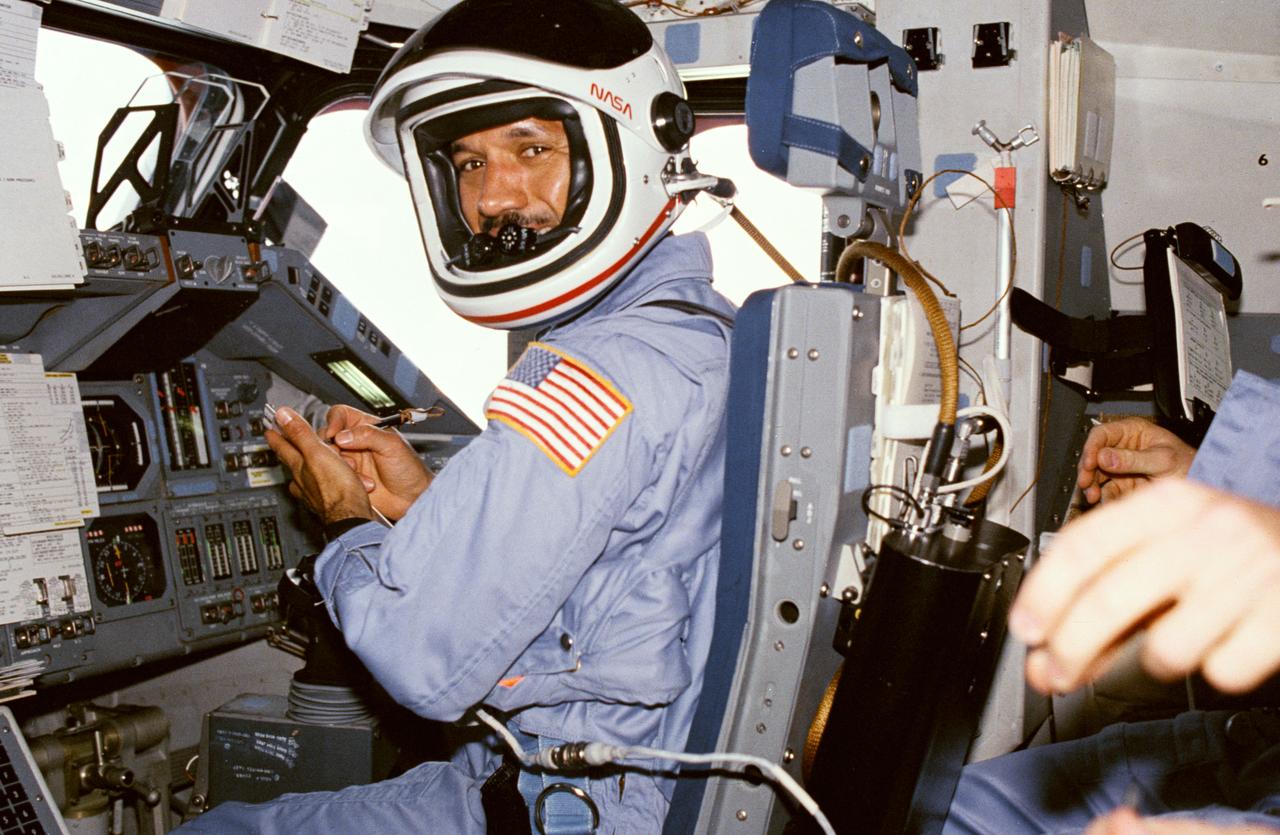
61C-01-007 (12-17 Jan 1986)--- Astronaut Charles F. Bolden STS 61-C pilot, mans the pilot's station on Columbia's flight deck prior to re-entry.
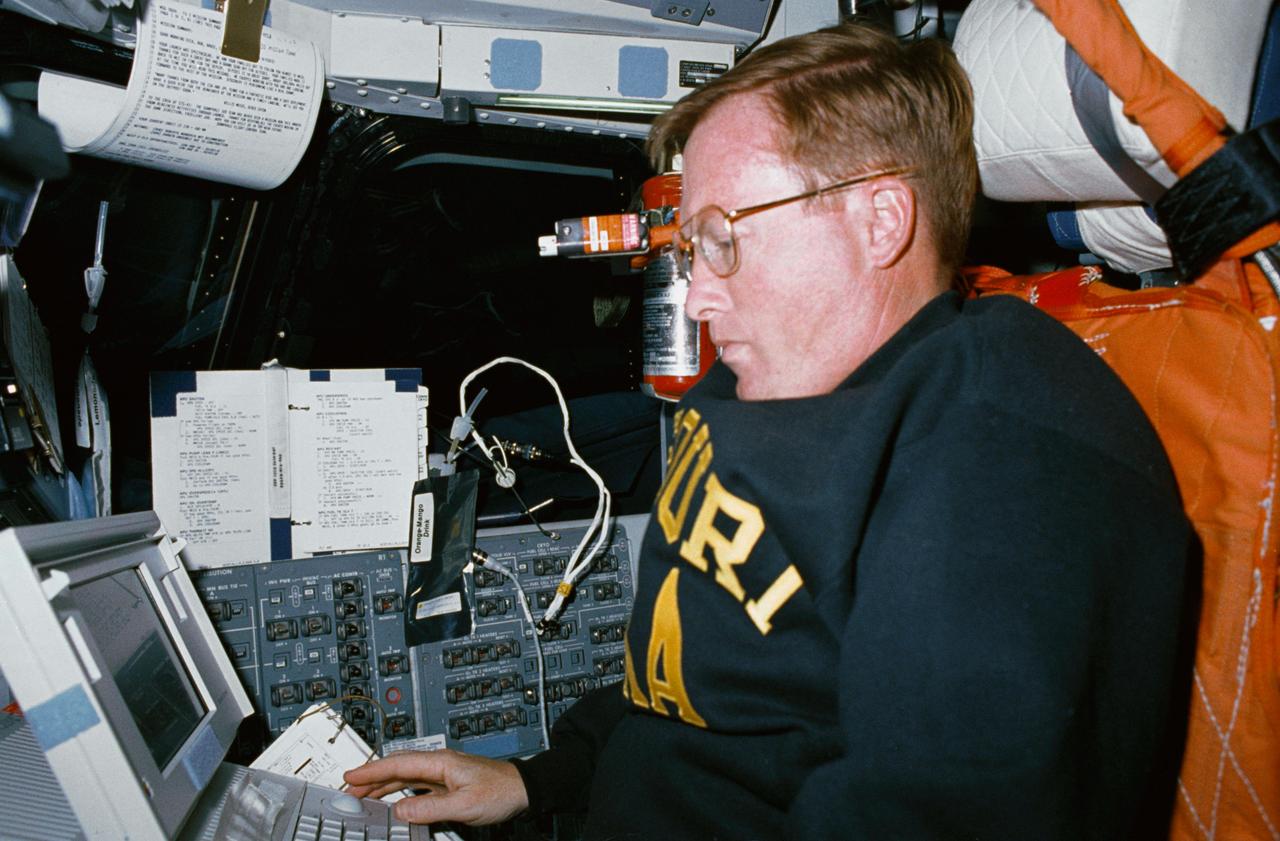
STS041-01-002 (6-10 Oct 1990) --- Astronaut Richard N. Richards, STS 41 mission commander, "borrows" the pilot's station to utilize a Shuttle portable onboard computer during the four-day flight. The photo was made with a 35mm camera.
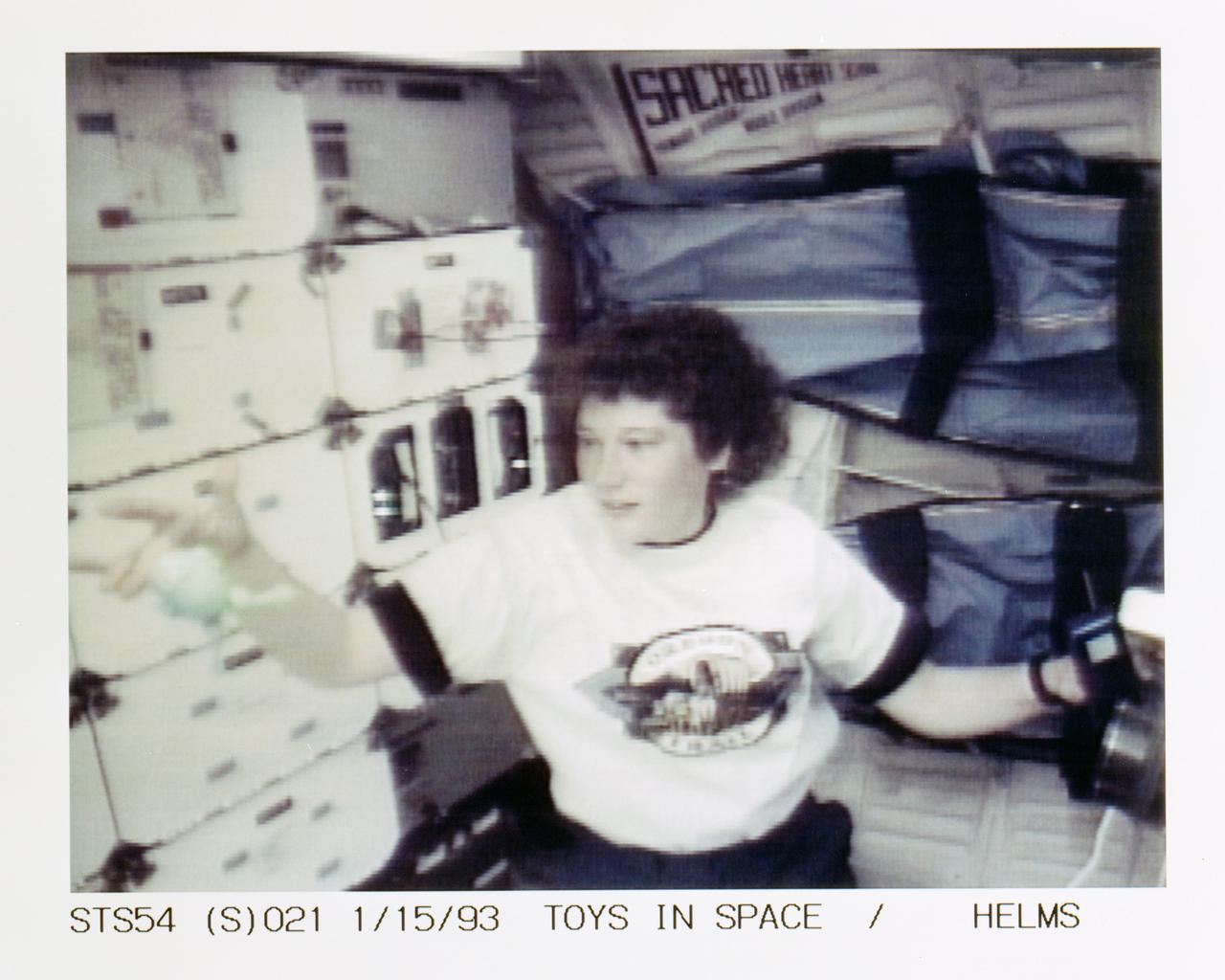
STS054-S-021 (15 Jan 1993) --- Helms with a frog swimmer toy on the middeck demonstrates some of the physics of toys to students watching on television. Four schools were chosen to ask questions of the astronauts during the lengthy program. Helms fielded questions from students at Shaver Elementary School in Portland, Oregon. The swimmer frog was used to demonstrate Newton's third law of motion and the conservation of angular momentum. The entire collection of toys will be videotaped for an educational program to be distributed to schools in the fall of this year. The scene was recorded at 17:51:38:12 GMT, Jan. 15, 1993.
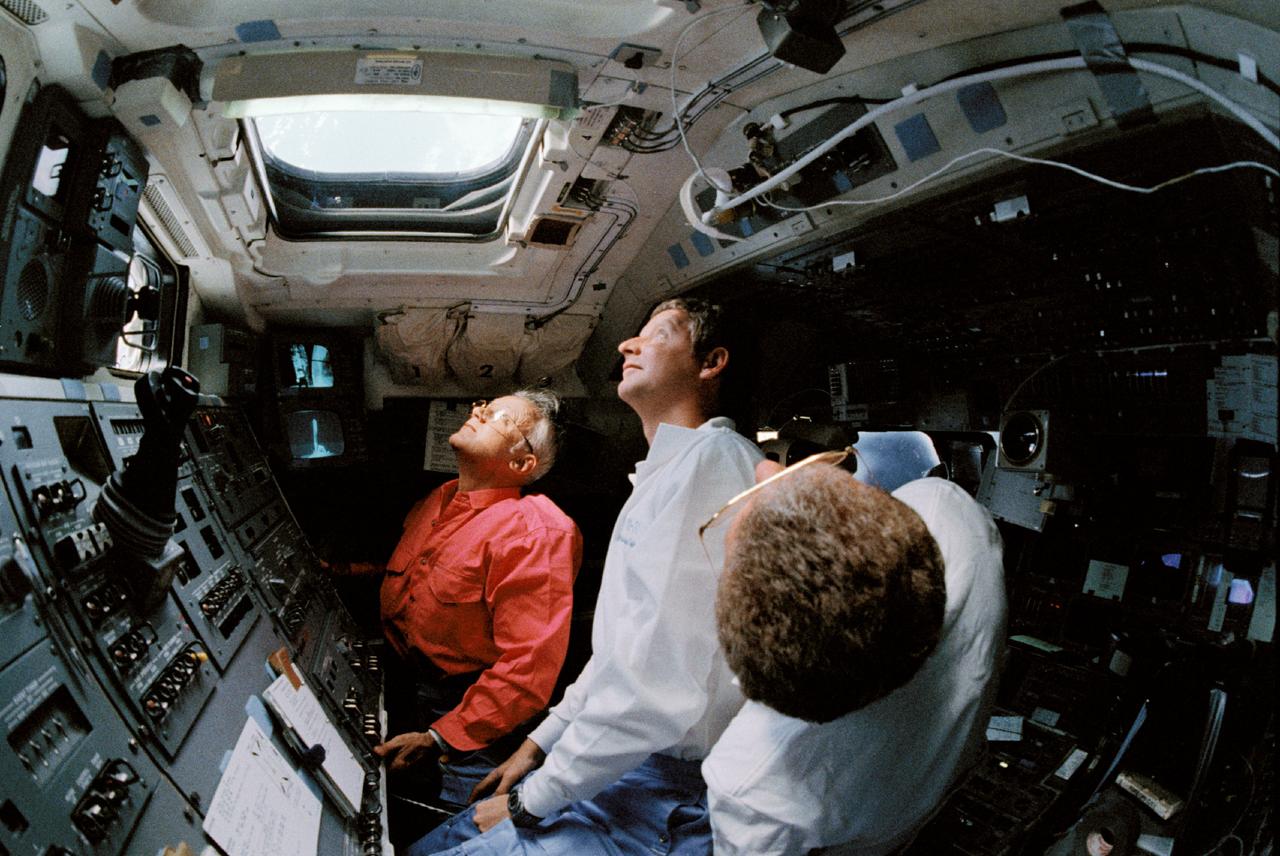
STS031-10-027 (24-29 April 1990) --- A "fish eye" lens captured this overall view of the aft flight deck of Space Shuttle Discovery while the crewmembers were monitoring the Hubble Space Telescope (HST) deployment checkout procedures. From front to back are astronauts Loren J. Shriver, commander, and Steven A. Hawley and MS Bruce McCandless II, both mission specialists, looking up at overhead windows and the HST on the remote manipulator system (RMS) outside them.
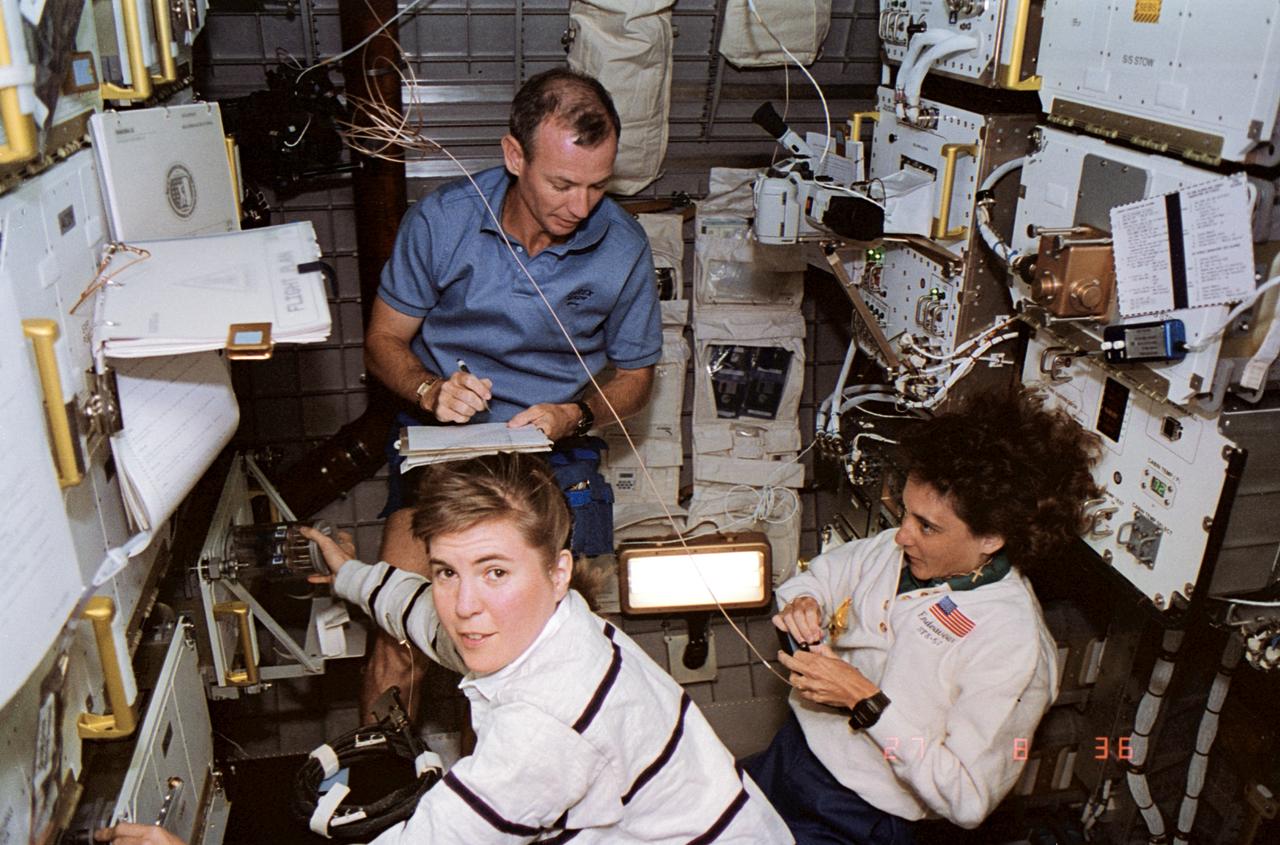
STS057-39-001 (27 June 1993) --- This high angle shot inside the SPACEHAB module, onboard the Space Shuttle Endeavour, typifies the pace of activity conducted there during the ten-day STS-57 mission. Astronaut Janice E. Voss (foreground), mission specialist, works with biomaterials products, while astronauts Brian Duffy, pilot, and Nancy J. Sherlock, mission specialist, participate in other tasks.
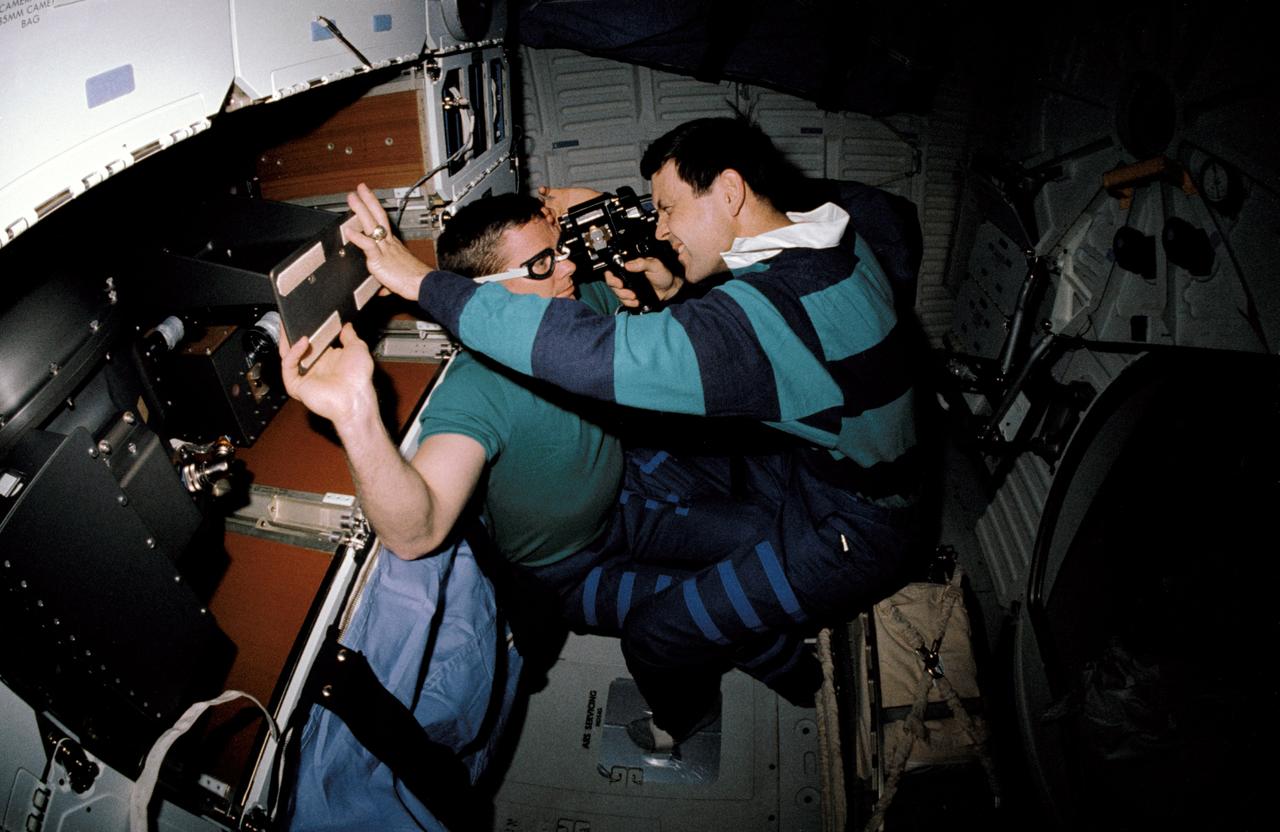
STS041-02-015 (6-10 Oct. 1990) --- A 35mm scene showing astronauts Robert D. Cabana (right), STS-41 pilot, and Bruce E. Melnick, mission specialist, participating in a detailed supplemental objective for STS-41 involving retinal photography. The hypothesis of this experiment is that retinal photographs taken on orbit will show evidence of increased intracranial pressure (ICP) and the evidence of increased ICP and the development of Space Adaptation Syndrome (SAS) will be correlated. SAS has been a subject of on-orbit analysis since the early days of space shuttle.
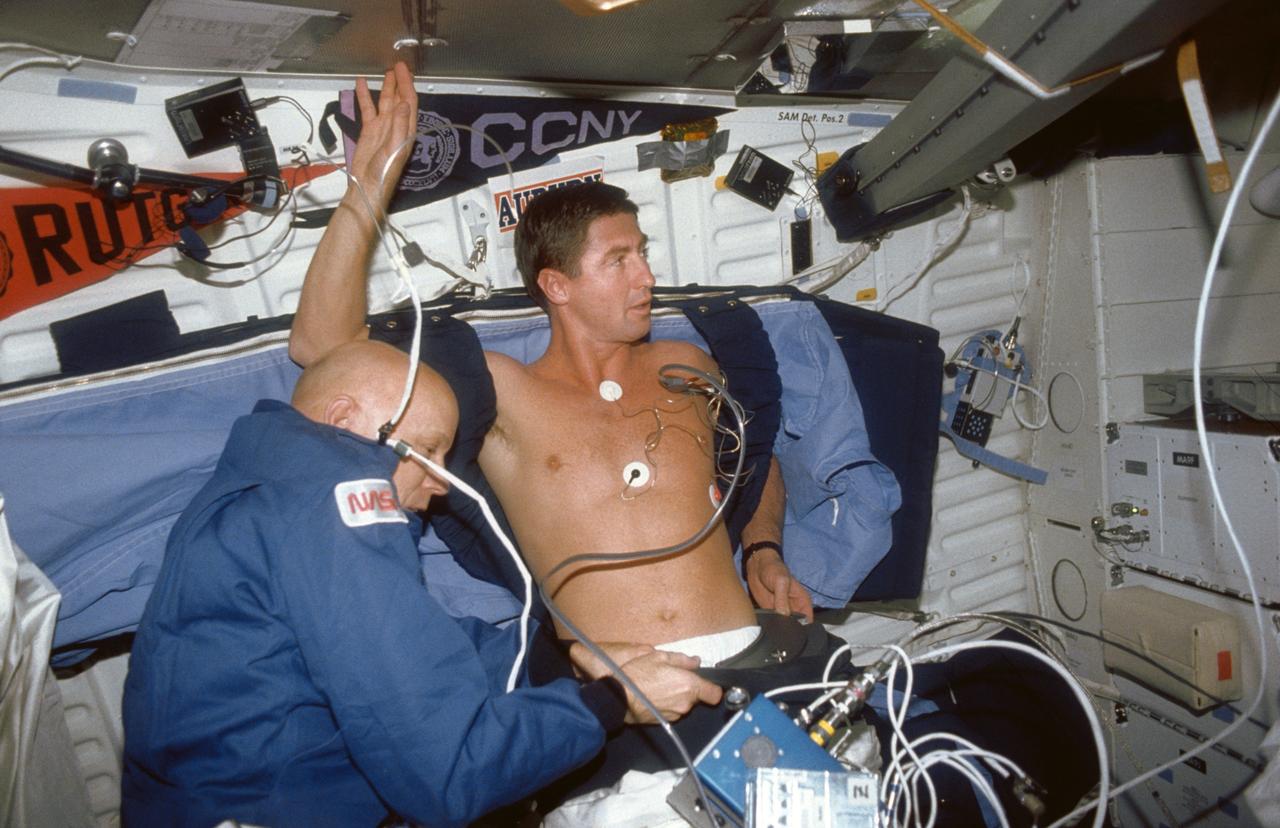
STS044-05-023 (24 Nov-1 Dec 1991) --- Astronaut F. Story Musgrave (left), Mission Specialist, assists Astronaut Terence T. (Tom) Henricks, Mission Specialist, with a Detailed Supplementary Objective (DSO) involving Lower Body Negative Pressure.
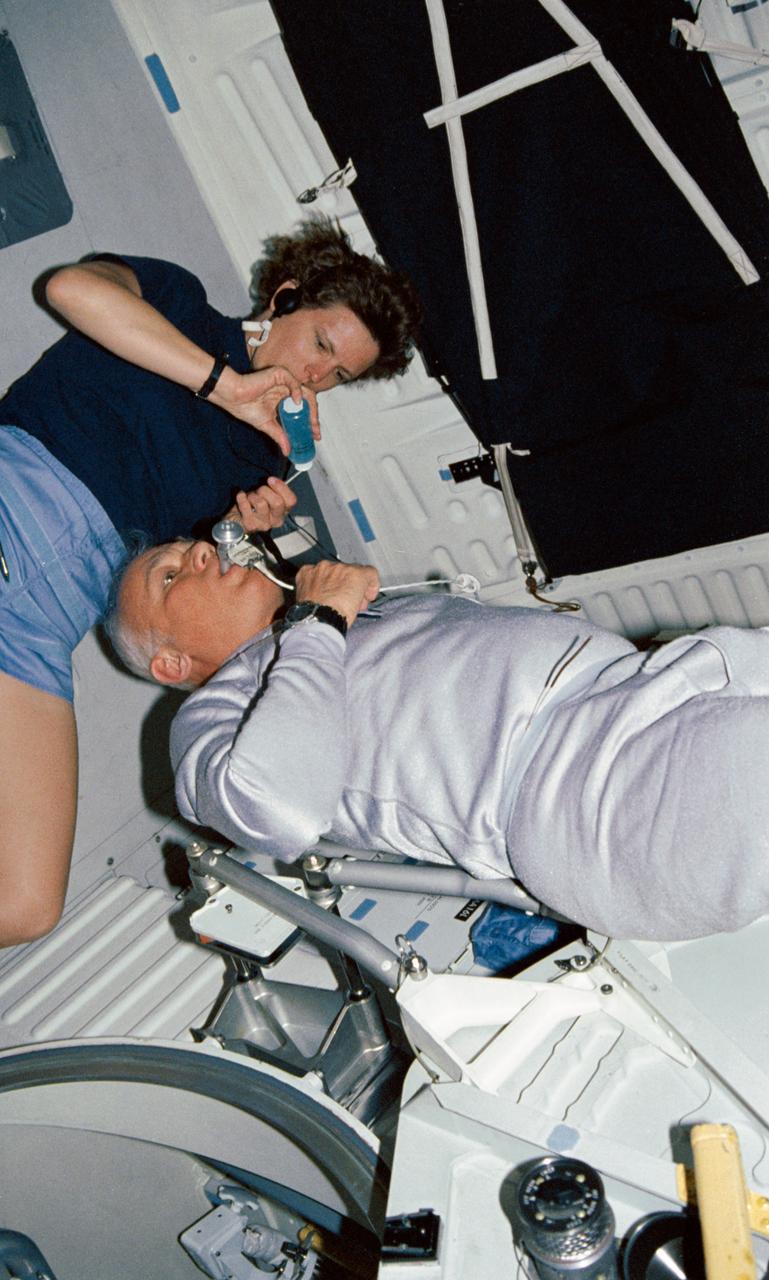
STS031-04-002 (24-29 April 1990) --- Astronauts Kathryn D. Sullivan and Bruce McCandless II, mission specialists, work together to perform one of the mission's medical experiments. The experiment is Detailed Supplementary Objective (DSO) 462, Non invasive Estimation of Central Venous Pressure During Spaceflight. Sullivan applies a gel substance to a transducer which will be placed on McCandless' jugular vein to collect the sought data. The cable links to a data recorder.
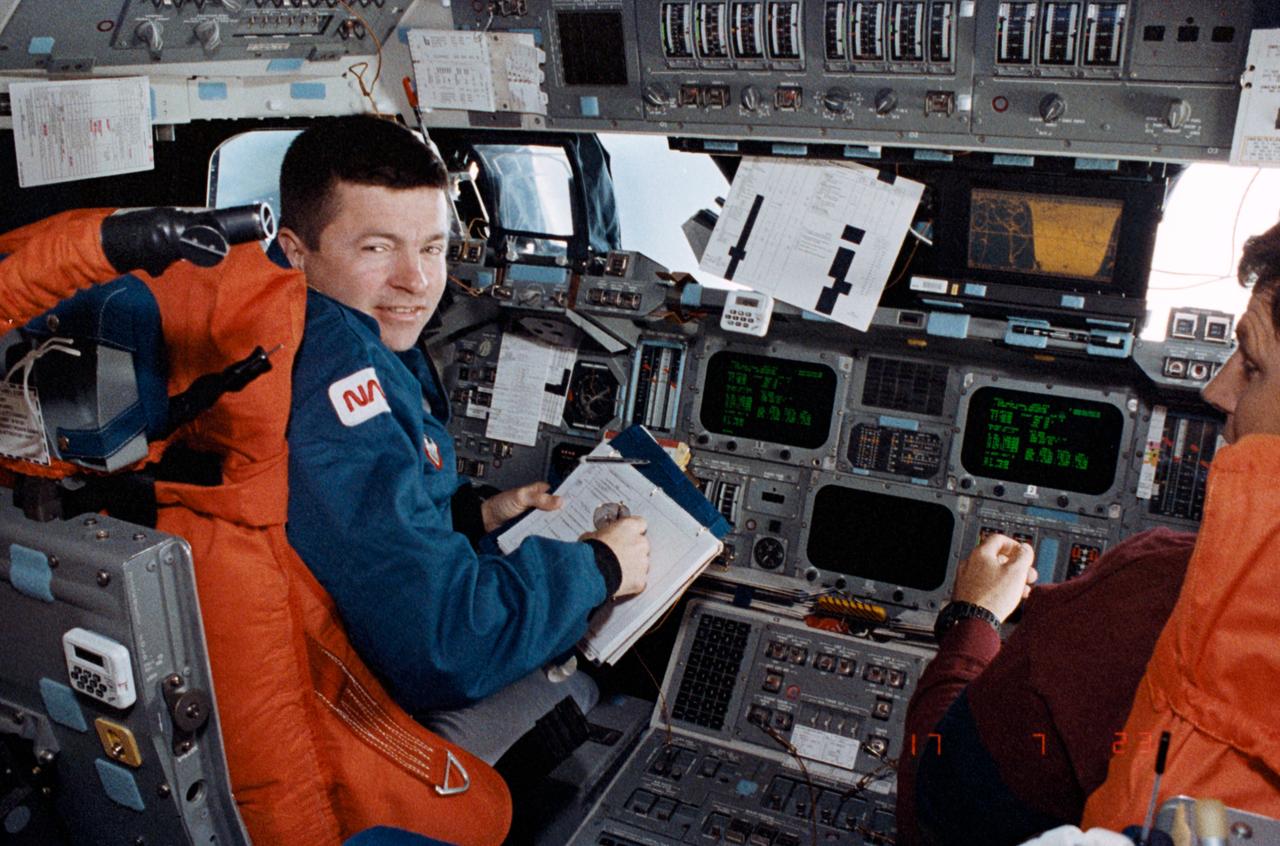
STS056-39-010 (8-17 April 1993) --- Astronaut Kenneth D. Cameron mans the mission commander's station during an orbiter maneuver aboard the Earth-orbiting Space Shuttle Discovery. Astronaut Stephen S. Oswald, pilot, is partially visible at right edge of the frame. The two were joined by three other NASA astronauts for nine days of science in support of the Atlas 2 mission in Earth orbit.
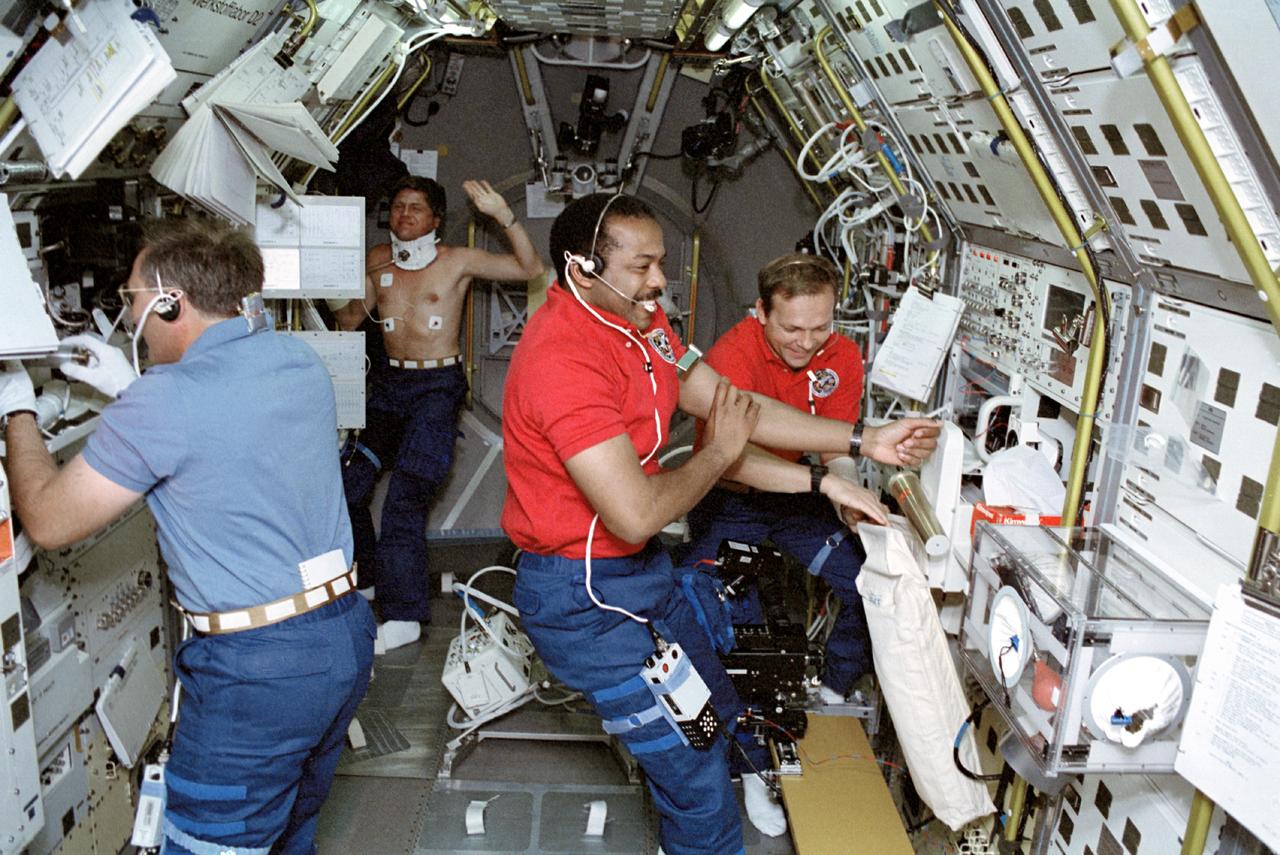
STS055-22-004 (26 April-6 May 1993) --- Four of the seven crew members who spent 10 days aboard the Space Shuttle Columbia are pictured during a brief shift overlap period in the Spacelab D-2 Science Module. Left to right are Jerry L. Ross, Ulrich Walter, Bernard A. Harris, Jr. and Hans Schlegel. Ross, STS-55 payload commander, is changing a sample in a materials processing furnace; Walter, a German payload specialist is in the midst of a baroreflex test and fellow payload specialist Schlegel assists mission specialist and physician Harris with a physiological test at the "Anthrorack".
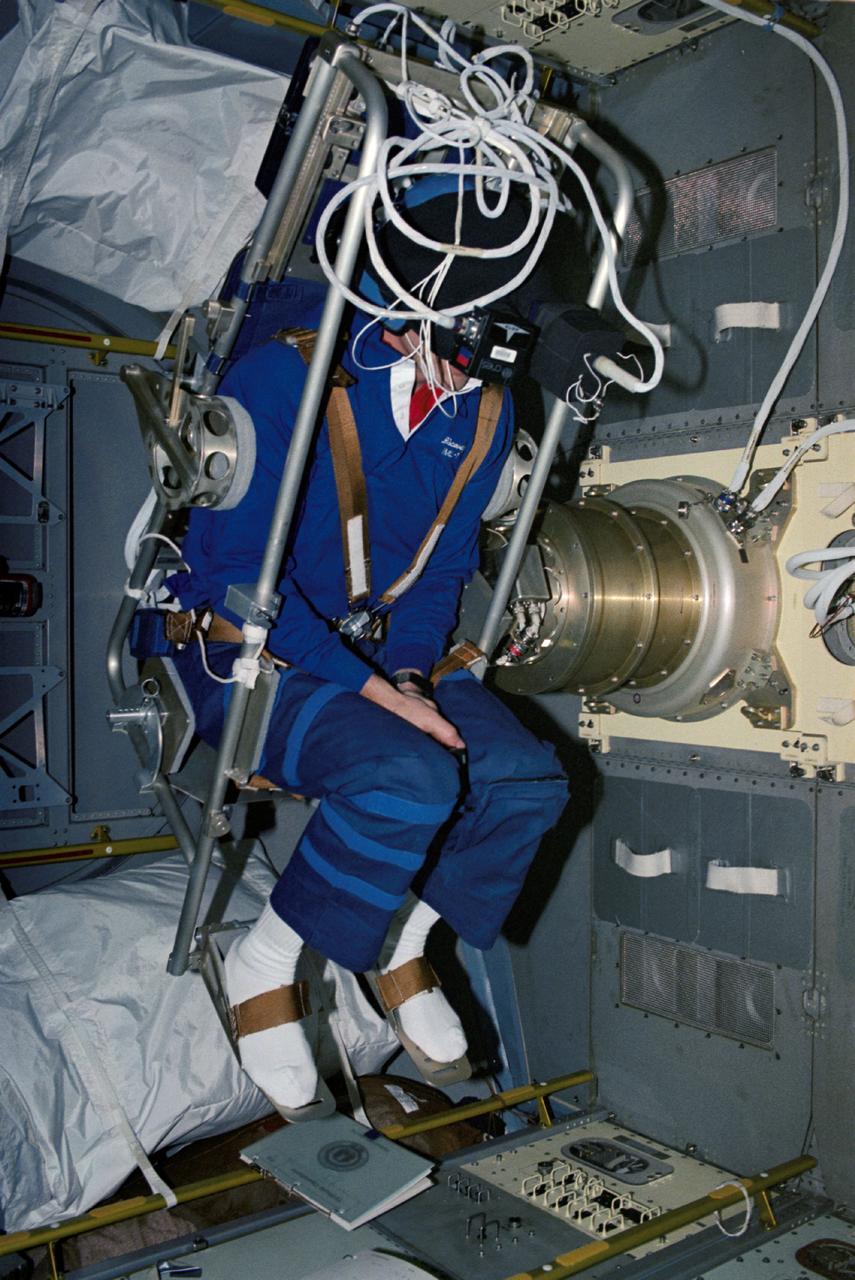
STS042-27-037 (22-30 Jan. 1992) --- Astronaut David C. Hilmers, STS-42 mission specialist, wearing a helmet assembly, sits in the Microgravity Vestibular Investigation (MVI) rotating chair. The scene is in the International Microgravity Laboratory (IML-1) science module aboard Discovery. Hilmers, a mission specialist, and six other crewmembers spent more than eight days in Earth-orbit conducting experiments. Hilmer's helmet assembly is outfitted with accelerometers to measure head movements and visors that fit over each eye independently to provide visual stimuli. The chair system has three movement patterns: "sinusoidal" or traveling predictably back and forth over the same distance at a constant speed; "pseudorandom" or moving back and forth over the varying distances; and "stepped" or varying speeds beginning and stopping suddenly.
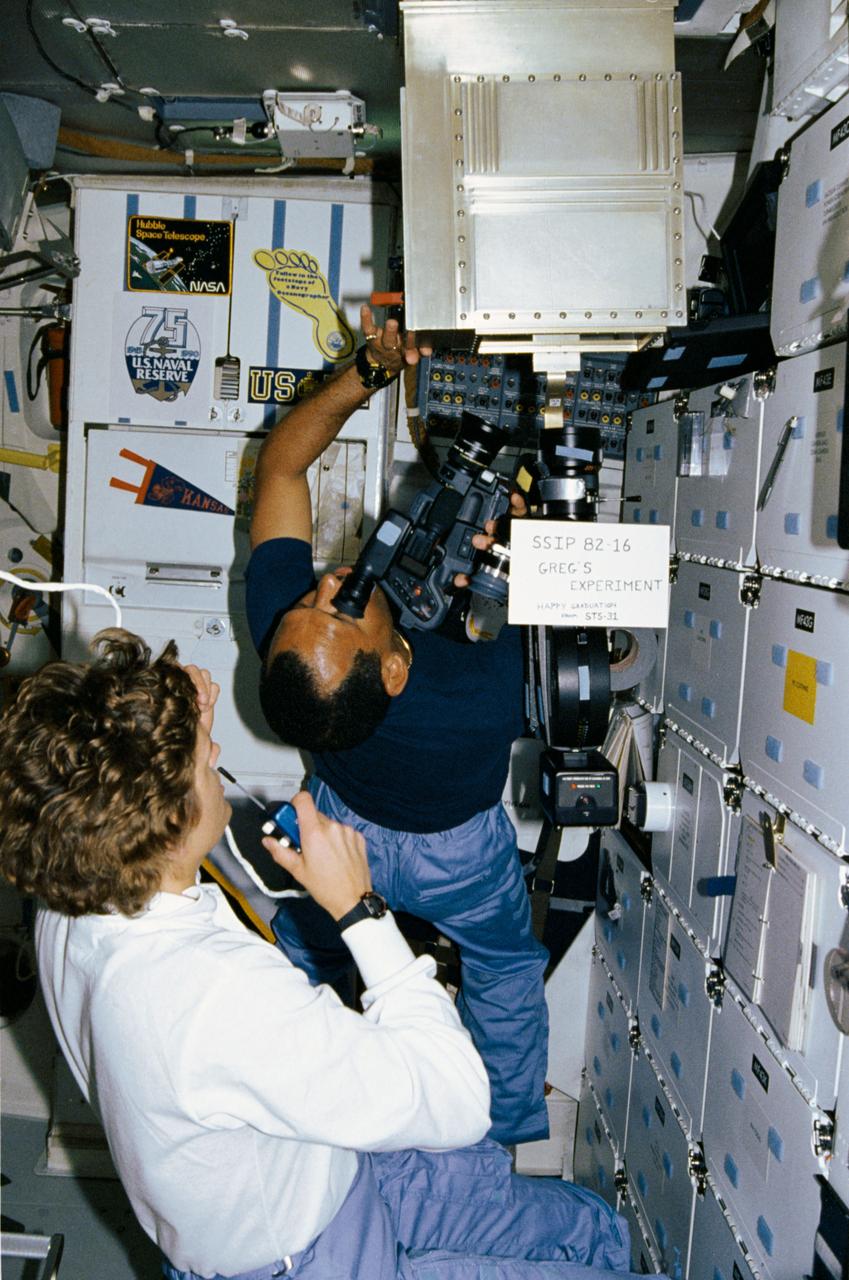
STS-31 Mission Specialist (MS) Kathryn D. Sullivan monitors and advises ground controllers of the activity inside the Student Experiment (SE) 82-16, Ion arc - studies of the effects of microgravity and a magnetic field on an electric arc, mounted in front of the middeck lockers aboard Discovery, Orbiter Vehicle (OV) 103. Pilot Charles F. Bolden uses a video camera and an ARRIFLEX motion picture camera to record the activity inside the special chamber. A sign in front of the experiment reads "SSIP 82-16 Greg's Experiment Happy Graduation from STS-31." SSIP stands for Shuttle Student Involvement Program. Gregory S. Peterson who developed the experiment (Greg's Experiment) is a student at Utah State University and monitored the experiment's operation from JSC's Mission Control Center (MCC) during the flight. Decals displayed in the background on the orbiter galley represent the Hubble Space Telescope (HST), the United States (U.S.) Naval Reserve, Navy Oceanographers, U.S. Navy, and University of Kansas.
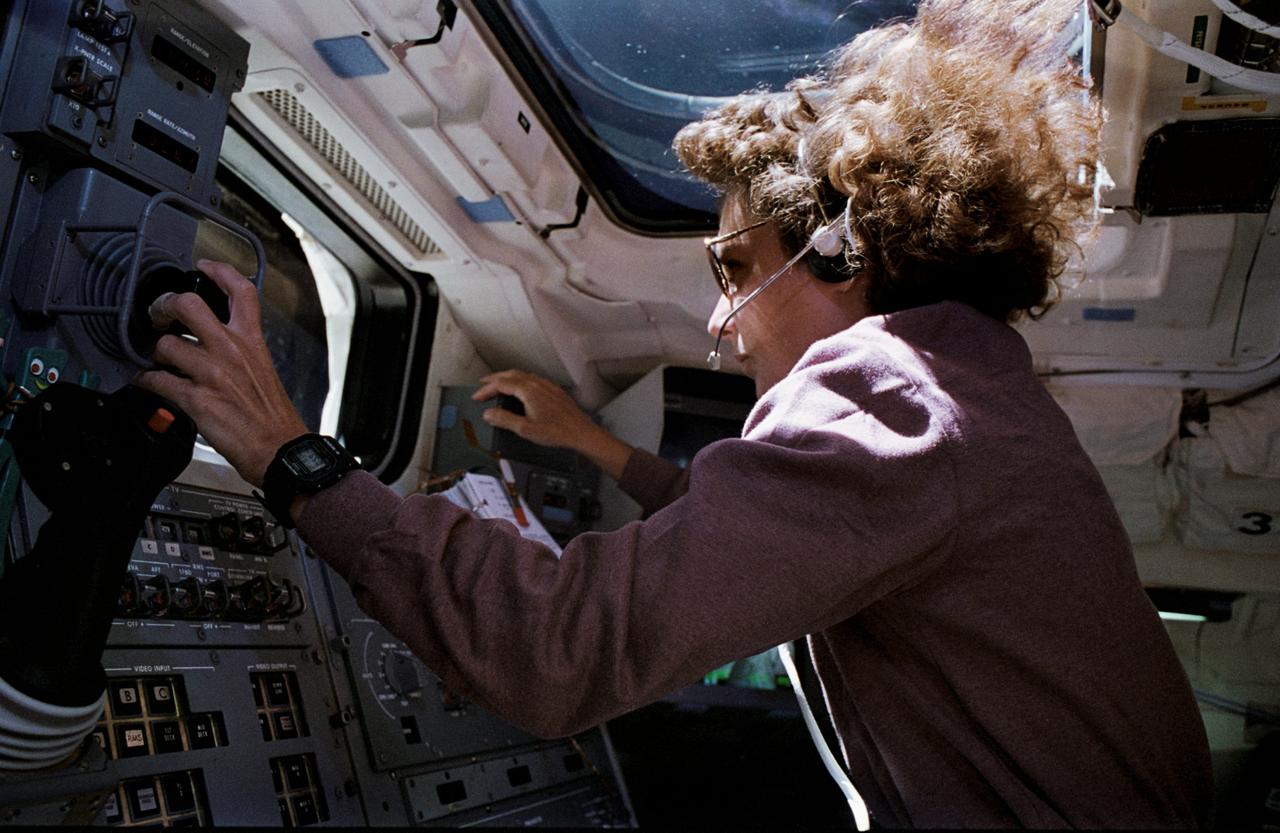
STS057-31-030 (25 June 1993) --- Astronaut Nancy J. Sherlock operates Endeavour's remote manipulator system (RMS) during the June 25 extravehicular activity of two crewmates. At one point, astronaut G. David Low, while his feet were anchored to a special restraint device on the end of the RMS arm, moved about, with Sherlock's aid, while holding astronaut Peter J. K. (Jeff) Wisoff. The activity represented an evaluation of techniques which might be used on planned future missions -- a 1993 servicing visit to the Hubble Space Telescope and later space station work -- which will require astronauts to frequently lift objects of similar sized bulk.
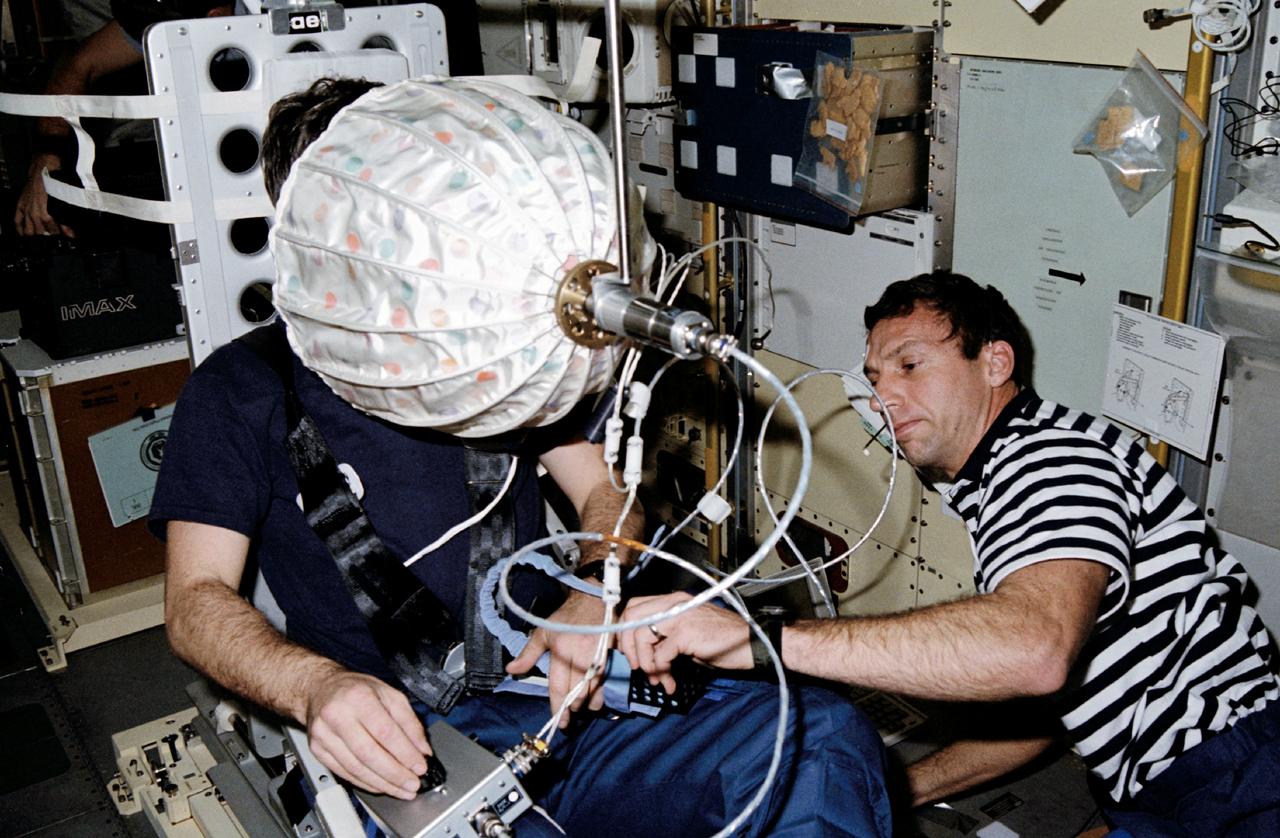
STS042-203-024 (22-30 Jan. 1992) --- Astronaut David C. Hilmers (right), STS-42 mission specialist, assists European Space Agency (ESA) payload specialist Ulf Merbold with the visual stimulator experiment on the Space Shuttle Discovery's middeck. This particular test is part of an ongoing study of the Space Adaptation Syndrome (SAS). Seated in a stationary mini-sled, Merbold (or any other subject for this test) stares at an umbrella-shaped rotating dome with a pattern of colored dots on its interior. While observing the rotating dome, the subject turns a knob to indicate his perception of body rotation. The strength of circular vection is calculated by comparing the signals from the dome and the knob. The greater the false sense of circular vection, the more the subject is relying on visual information instead of otolith information.
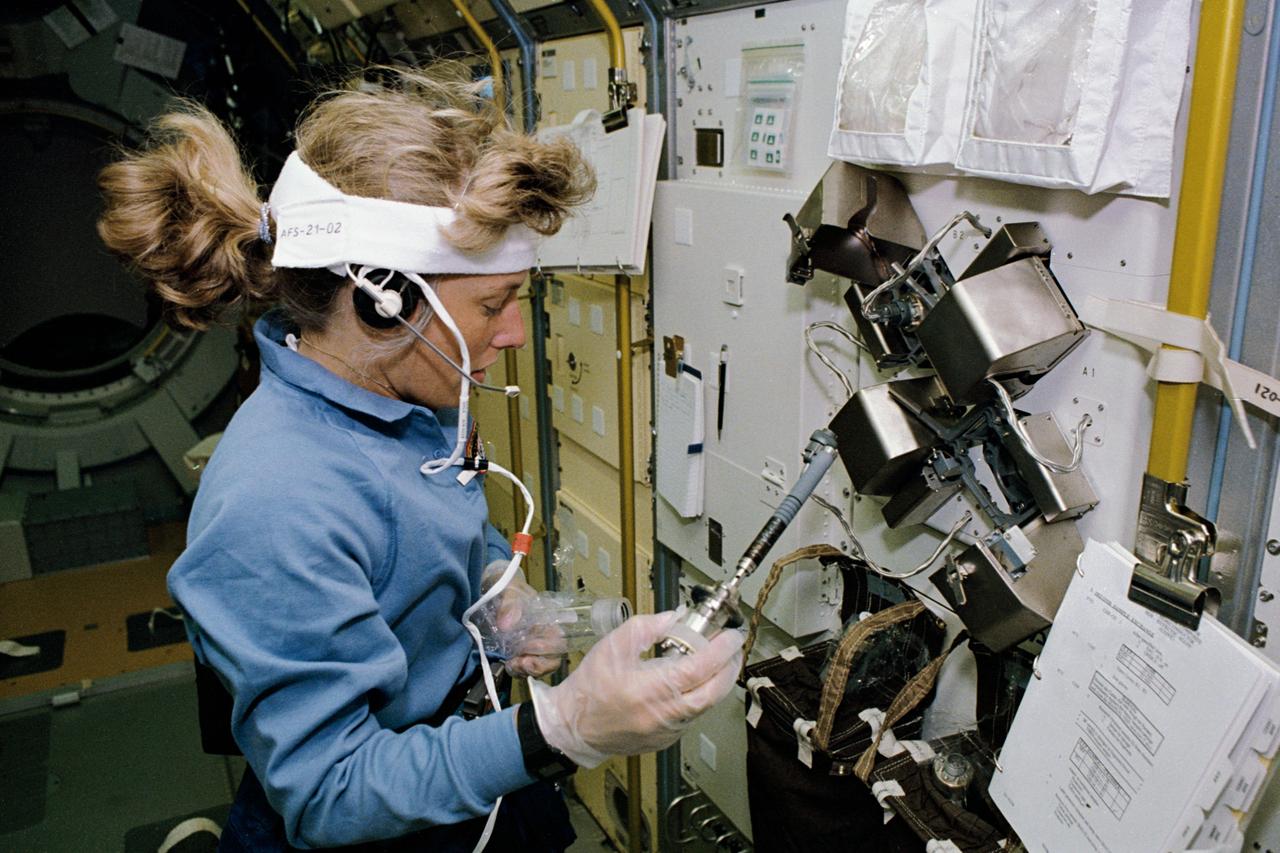
STS047-02-003 (12 - 20 Sept 1992) --- Astronaut N. Jan Davis, mission specialist, works at the Continuous Heating Furnace (CHF) in the Spacelab-J Science Module. This furnace provided temperatures up to 1,300 degrees Celsius and rapid cooling to two sets of samples concurrently. The furnace accommodated in-space experiments in the Fabrication of Si-As-Te:Ni Ternary Amorphous Semiconductor and the Crystal Growth of Compound Semiconductors. These were two of the many experiments designed and monitored by Japan's National Space Development Agency (NASDA).

AS07-04-1586 (20 Oct. 1968) --- Astronaut Walter Cunningham, Apollo 7 lunar module pilot, writes with space pen as he is photographed performing flight tasks on the ninth day of the Apollo 7 mission. Note the 70mm Hasselblad camera film magazine just above Cunningham's right hand floating in the weightless (zero gravity) environment of the spacecraft.
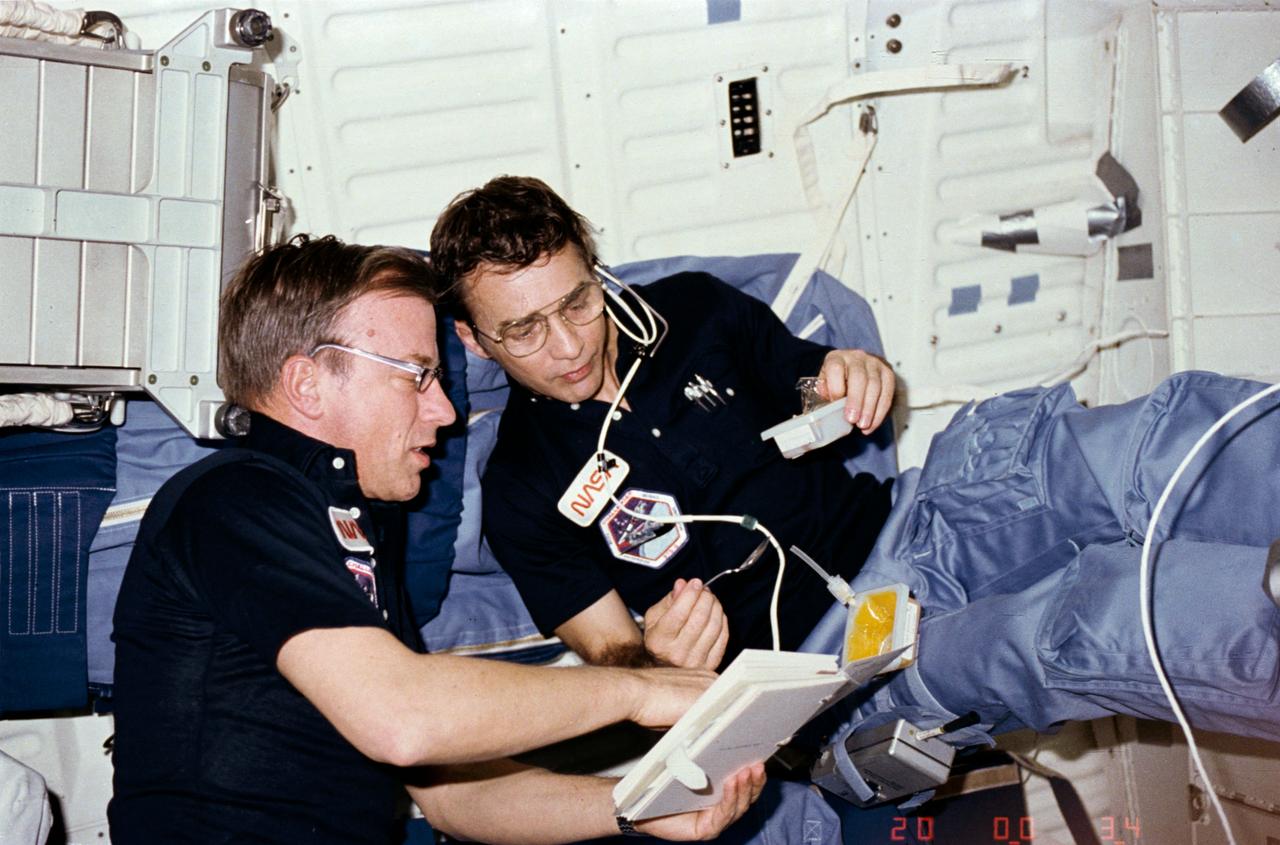
STS006-06-456 (4-9 April 1983) --- Astronaut Paul J. Weitz, STS-6 commander, points out an item in the crew activity plan (CAP) to astronaut Donald H. Peterson as the mission specialist uses a spoon to eat a meal aboard the Earth-orbiting space shuttle Challenger. The two are on the middeck. They are wearing the shirt and trouser portions of the blue cotton multi-piece constant wear garments. This frame was photographed with a 35mm camera. Photo credit: NASA
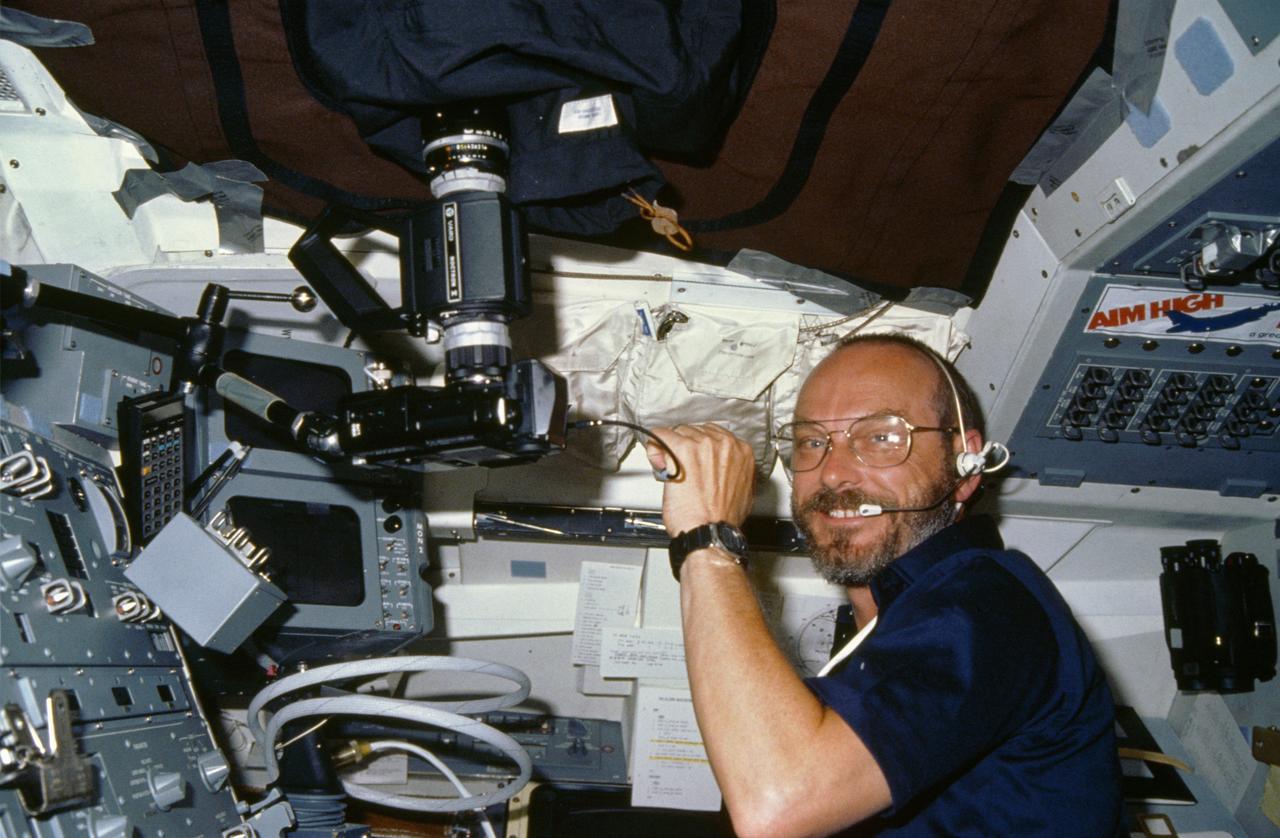
51F-17-011 (29 July-6 Aug 1985) --- Loren W. Acton, 51-F payload specialist, triggers a 35mm camera recording stellar imagery through the aft flight deck overhead windows aboard the Earth-orbiting Space Shuttle Challenger. The extension on the camera's lens is an image intensifier.
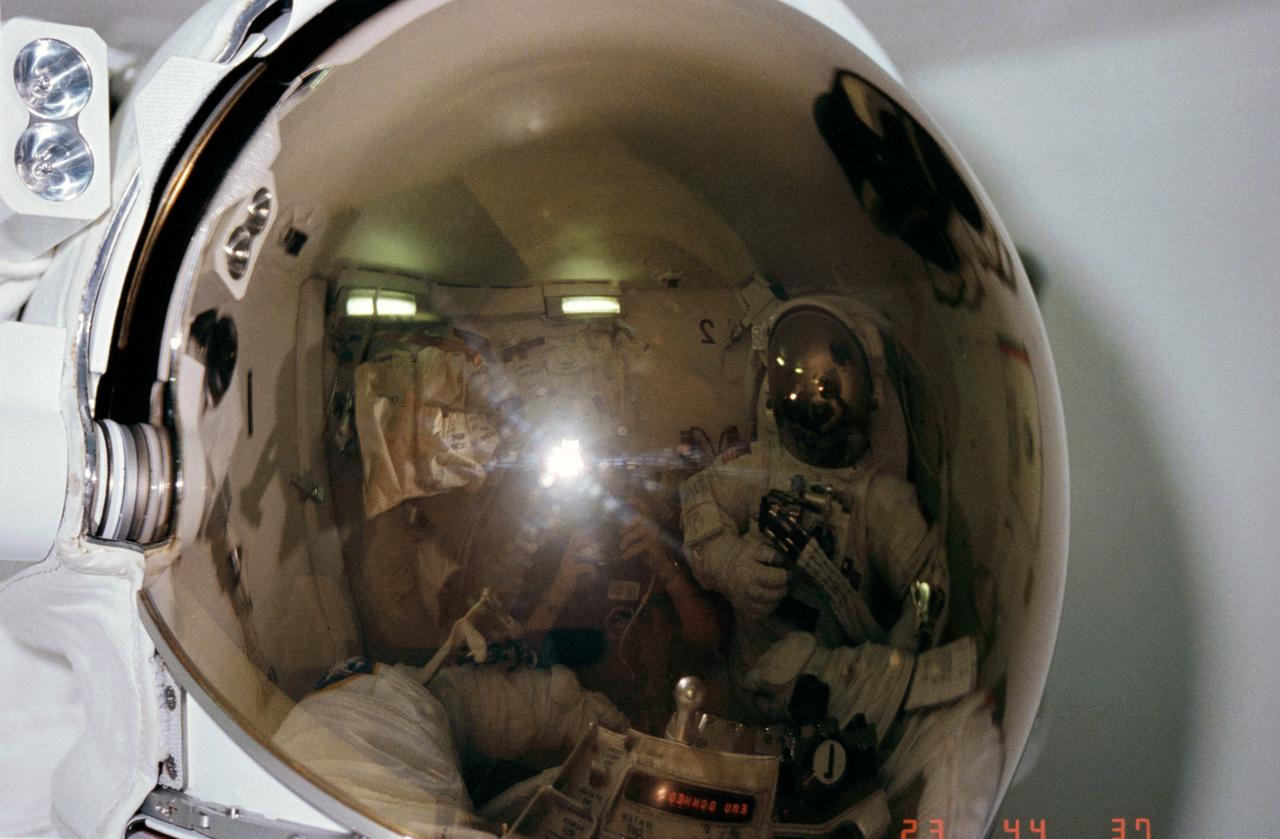
STS006-06-465 (7 April 1983) --- Three-fourths of the STS-6 astronaut crew appears in this unusual 35mm frame exposed in the airlock of the Earth-orbiting space shuttle Challenger. Astronaut F. Story Musgrave’s helmet visor encompasses all the action in the frame. Dr. Musgrave and astronaut Donald H. Peterson (reflected on right side of the visor) were fully suited in their Extravehicular Mobility Unit (EMU) spacesuits and were participating in EVA preparation exercises. Astronaut Karol J. Bobko, STS-6 pilot, wearing conventional onboard shuttle clothing, photographed the two during their procedures and appears at center of frame. The reversed number (1 and 2 in the mirrored image represent the EVA designations for the two mission specialists. Photo credit: NASA
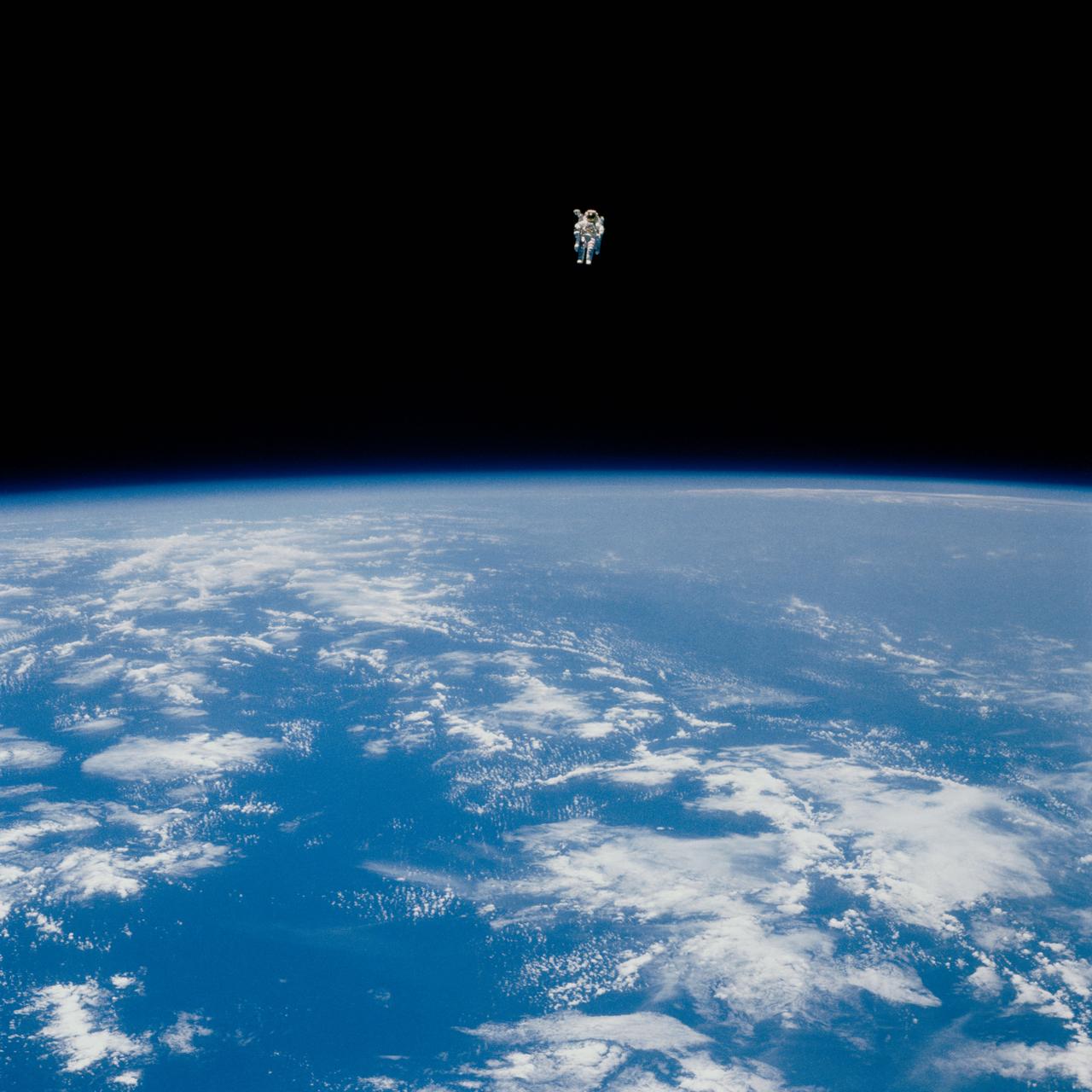
S84-27031 (7 Feb 1984) --- Astronaut Bruce McCandless II, 41-B mission specialist, reaches a maximum distance from the Challenger before reversing direction his manned maneuvering unit (MMU) and returning to the Challenger. A fellow crewmember inside the vehicle's cabin took this photograph with a 70mm camera. The untethered EVA marked the first such experience for astronauts.
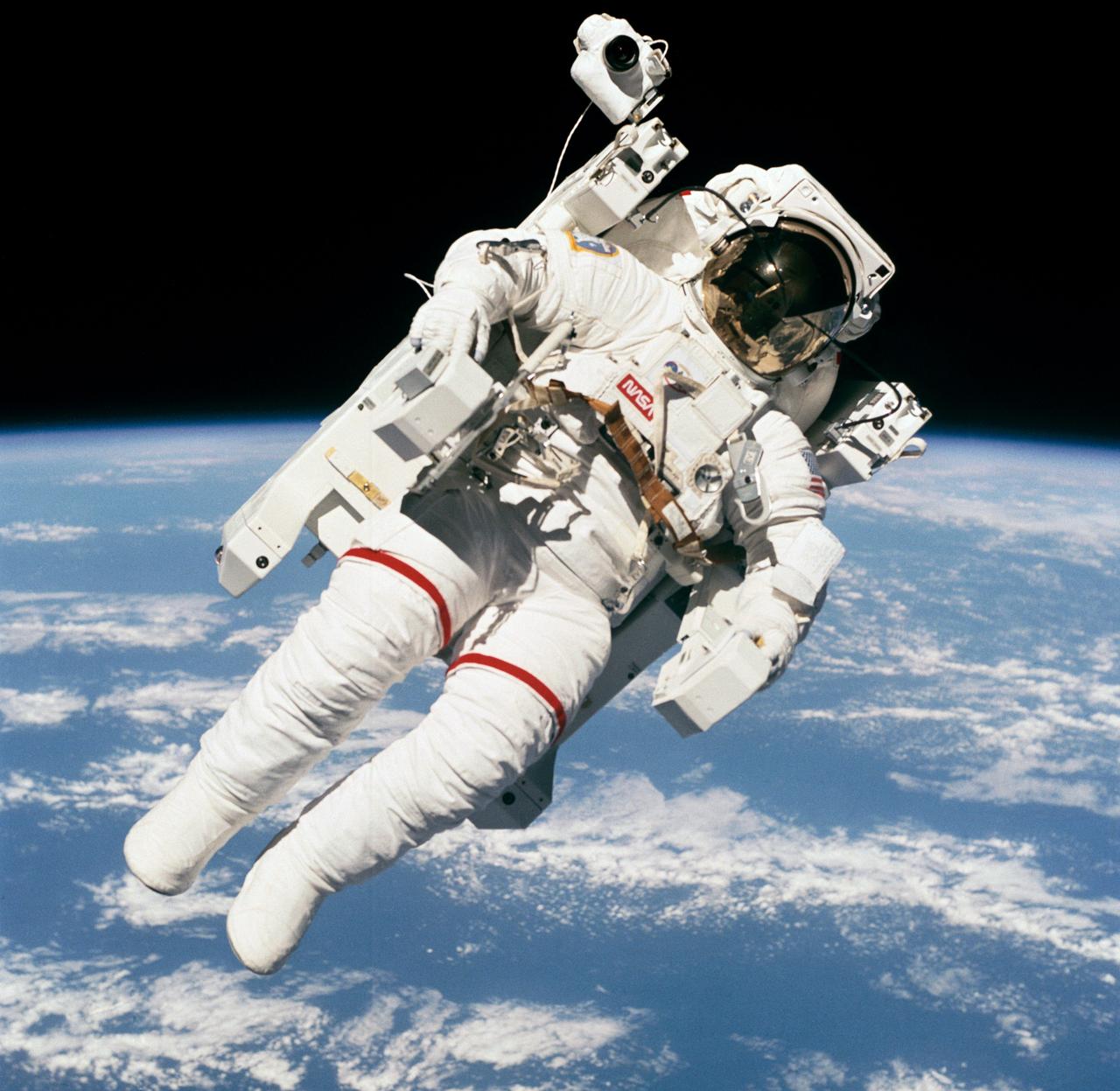
S84-27232 (& Feb 1984) --- Astronaut Bruce McCandless II, 41-B mission specialist, uses his hands to control his movement above the Earth - and just few meters away from the Challenger - during the first-ever extravehicular activity (EVA) which didn?t use restrictive tethers and umbilical?s. Fellow crewmembers aboard the Challenger used a 70mm camera to expose this frame through windows on the flight deck. McCandless was joined by Robert L. Stewart, one of two other mission specialists for this flight, on two sessions of EVA.
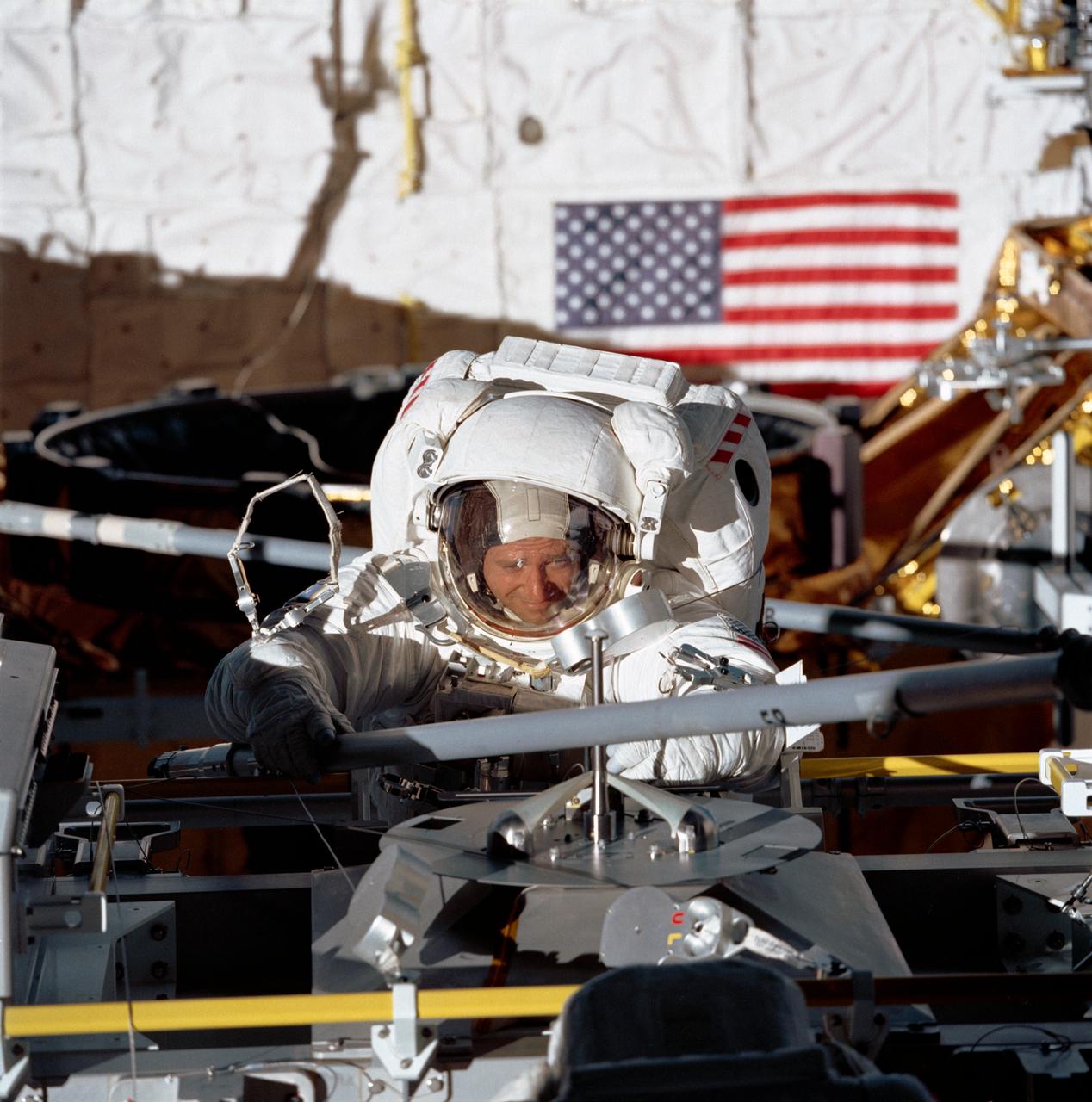
STS049-77-028 (14 May 1992) --- Astronaut Thomas D. Akers, STS-49 mission specialist, grabs a strut device as fourth period of extravehicular activity (EVA) gets underway in the Space Shuttle Endeavour's cargo bay. Akers is positioned near the Multi-purpose Support Structure (MPESS). The purpose of the final EVA on this nine-day mission was the evaluation of Assembly of Station by EVA Methods (ASEM). The scene was recorded on 70mm film by a fellow crew member in the space shuttle's cabin. Astronaut Kathryn C. Thornton (out of frame) joined Akers on the 7 1/2 hour EVA.
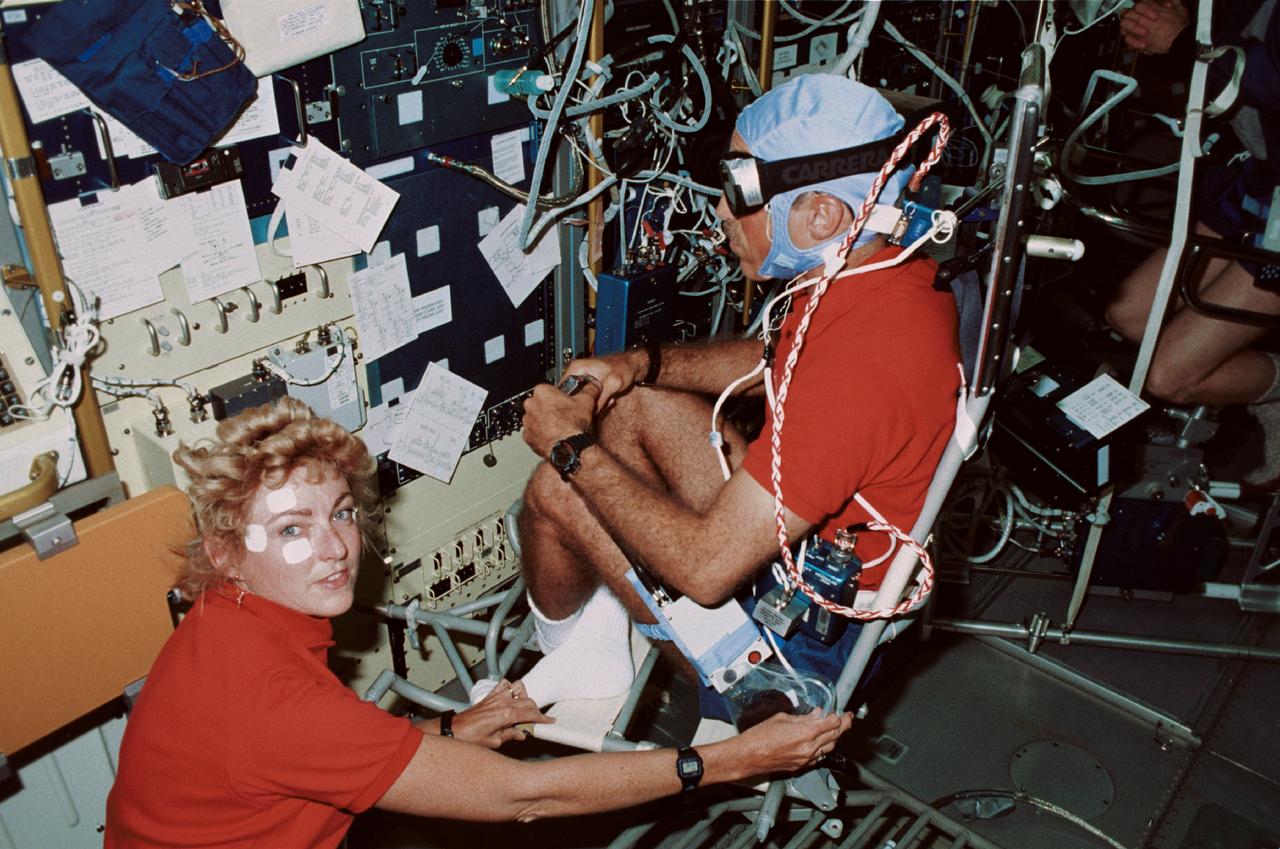
STS040-211-020 (5-14 June 1991) --- Vestibular experiment activities were captured onboard Columbia's Spacelab Life Sciences (SLS-1) module in this 35mm scene. Astronaut James P. Bagian, STS-40 mission specialist, is in a rotating chair while wearing an accelometer and electrodes to record head motion and horizontal and vertical eye movements during the rotations. Payload specialist Millie Hughes-Fulford, lower left, assists with the test.
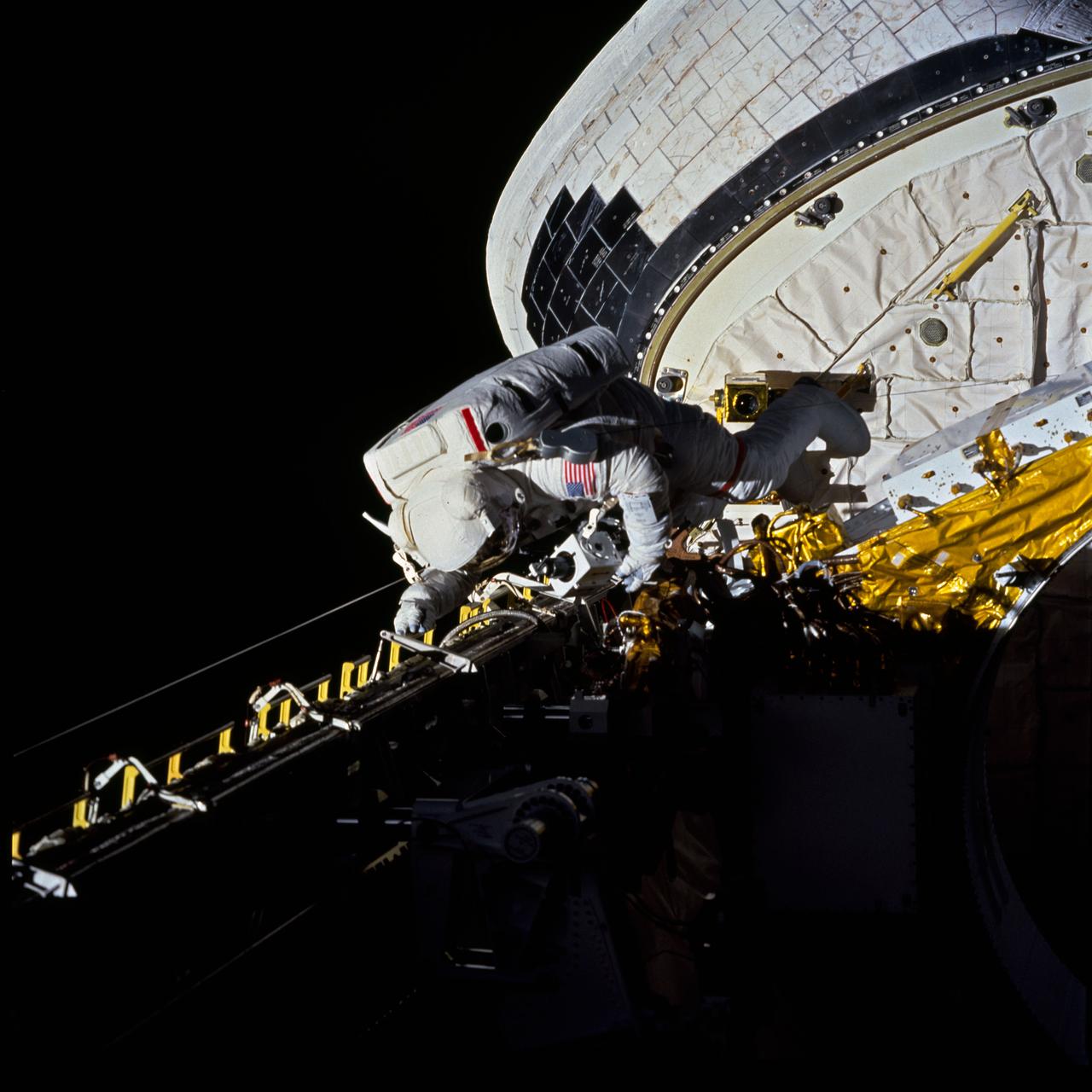
STS054-80-0N (17 Jan 1993) --- Astronaut Gregory J. Harbaugh moves along the starboard side of Endeavour's cargo bay during the four-plus hour long extravehicular activity (EVA) on January 17, 1993. The photograph was taken with a 70mm camera from inside Endeavour's cabin by a fellow crewmember. Three astronauts remained inside to support the spacewalk by astronauts Harbaugh and Mario Runco Jr. (out of frame).
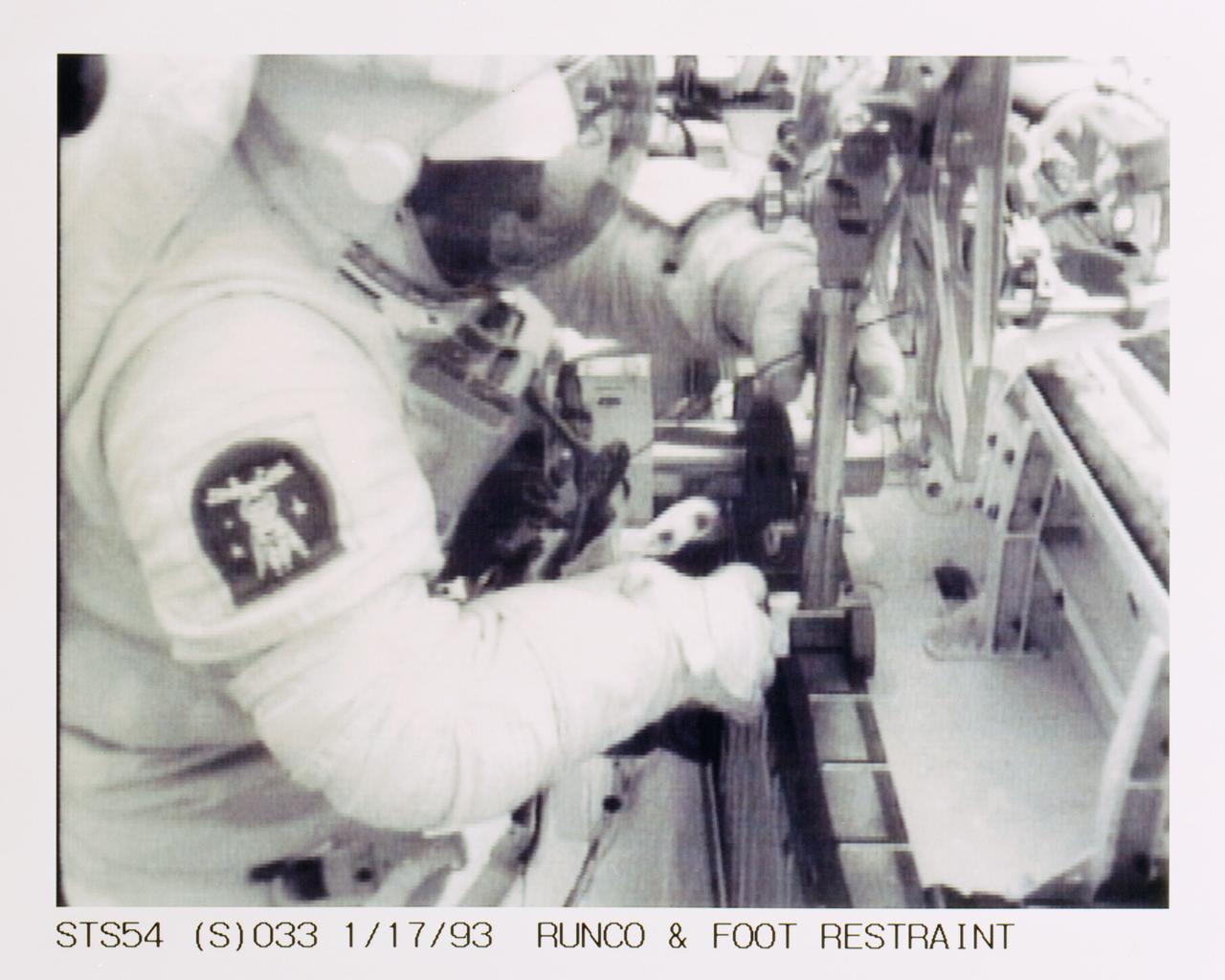
STS054-S-033 (17 Jan 1993) --- Runco works with a mobile foot restraint during extravehicular activity (EVA) in Endeavour's cargo bay. The scene was downlinked at 11:52:04:28 GMT, Jan. 17, 1993.
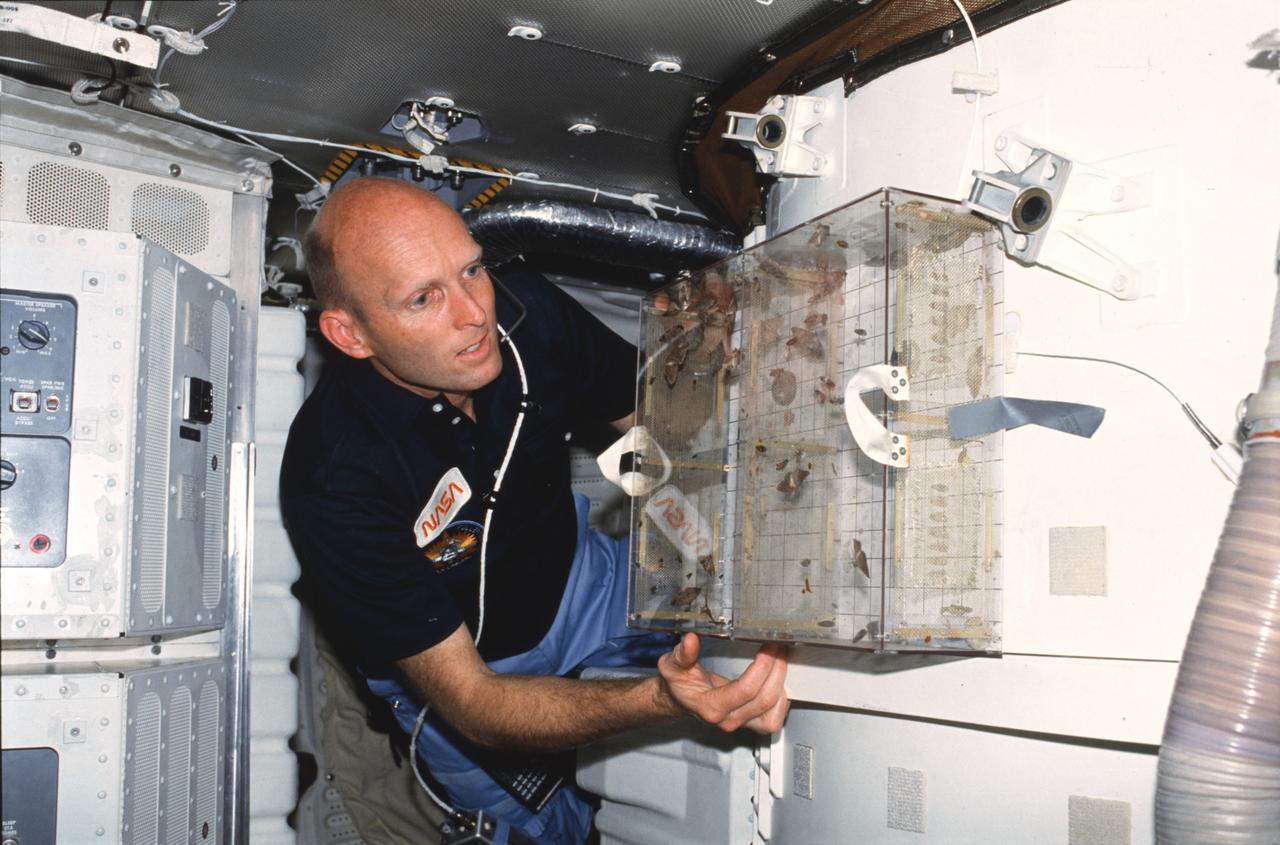
STS003-23-178 (22-30 March 1982) --- Astronaut C. Gordon Fullerton, STS-3 pilot, examines Student Experiment 81-8 (SE-81-8) Insect Flight Motion Study taped to the airlock on aft middeck. Todd Nelson, a high school senior from Minnesota, won a national contest to fly his experiment on this particular flight. Moths, flies, and bees were studied in the near weightless environment. Photo credit: NASA

STS065-214-037 (8-23 July 1994) --- Ready to begin one of her busy twelve hour shifts, payload specialist Dr. Chiaki Naito-Mukai enters the International Microgravity Laboratory (IML-2) science module in the cargo bay via the tunnel connecting it to the Space Shuttle Columbia's cabin. Dr. Mukai joined six NASA astronauts for more than two weeks of experimenting in Earth orbit. This photo was among the first released by NASA following IML-2. Also onboard were NASA astronauts Robert D. Cabana, James D. Halsell, Jr., Richard J. Hieb, Carl E. Walz, Donald A. Thomas and Leroy Chiao. Dr. Mukai represented the National Space Development Agency (NASDA) of Japan.
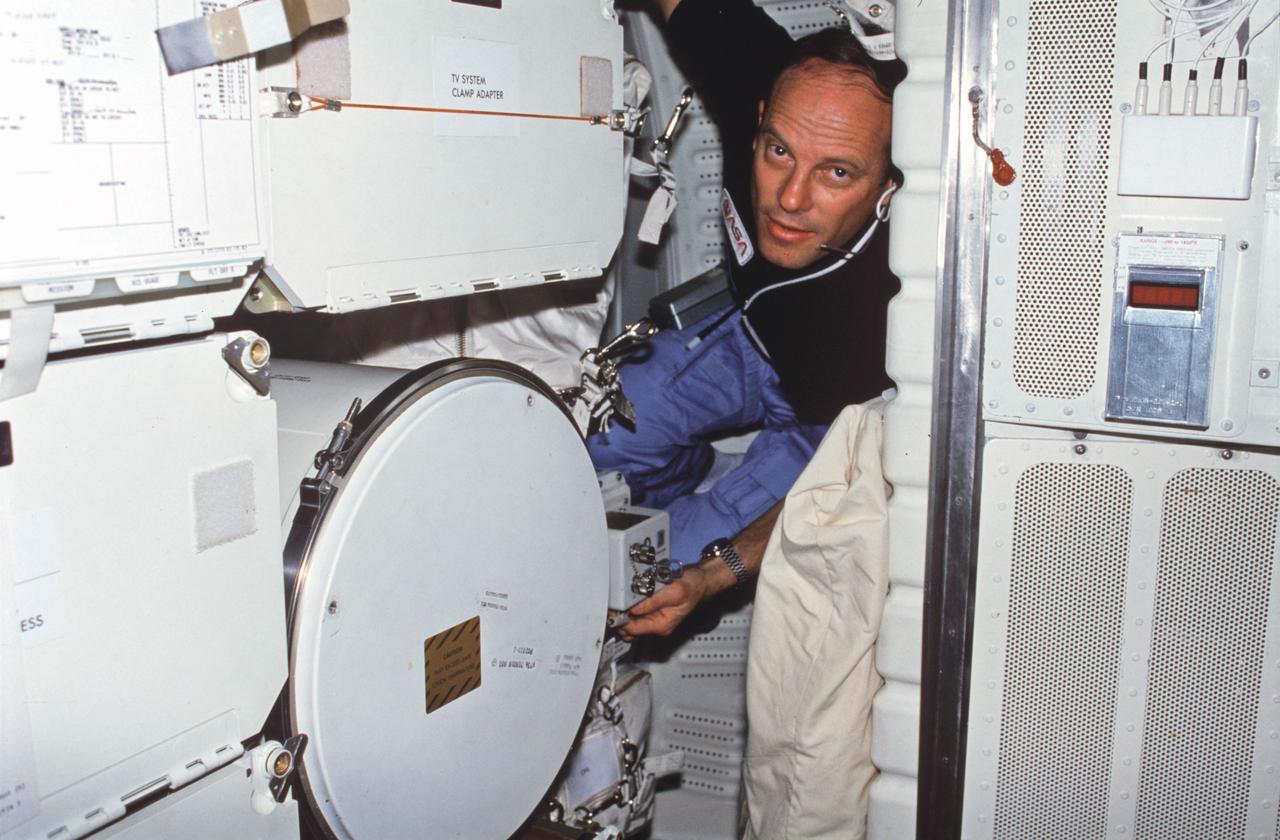
STS003-22-127 (22-30 March 1982) --- Astronaut Jack R. Lousma, STS-3 commander, wearing communications kit assembly (assy) mini-headset, adjusts controls on Monodisperse Latex Reactor (MLR) experiment located in forward middeck lockers MF57H and MF57K. To reach MLR support electronics assy controls, Lousma squeezes in between forward lockers and Development Flight Instrument (DFI) unit on starboard bulkhead. Photo credit: NASA
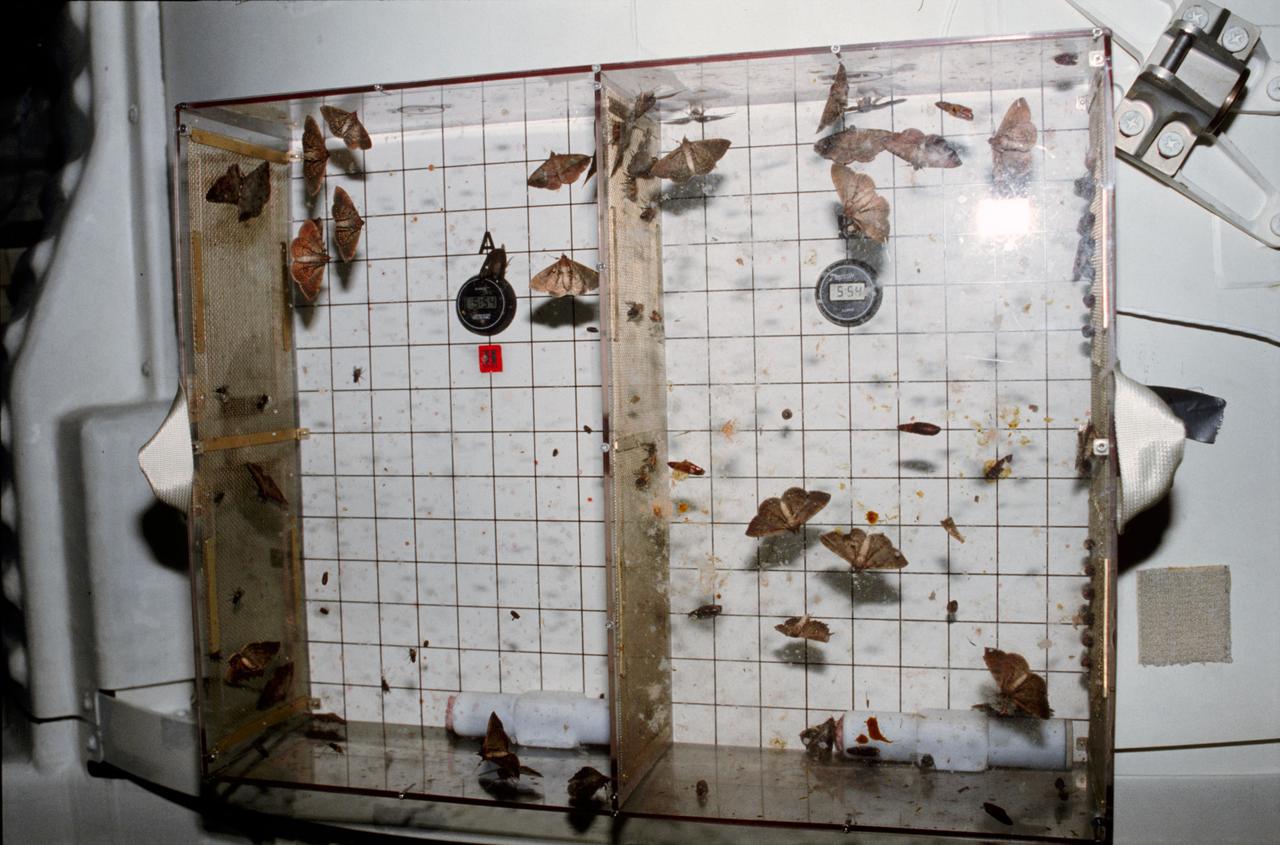
STS003-23-175 (22-30 March 1982) --- Student Experiment 81-8 (SE-81-8) Insect Flight Motion Study taped to the airlock on aft middeck of space shuttle Columbia. Photo credit: NASA
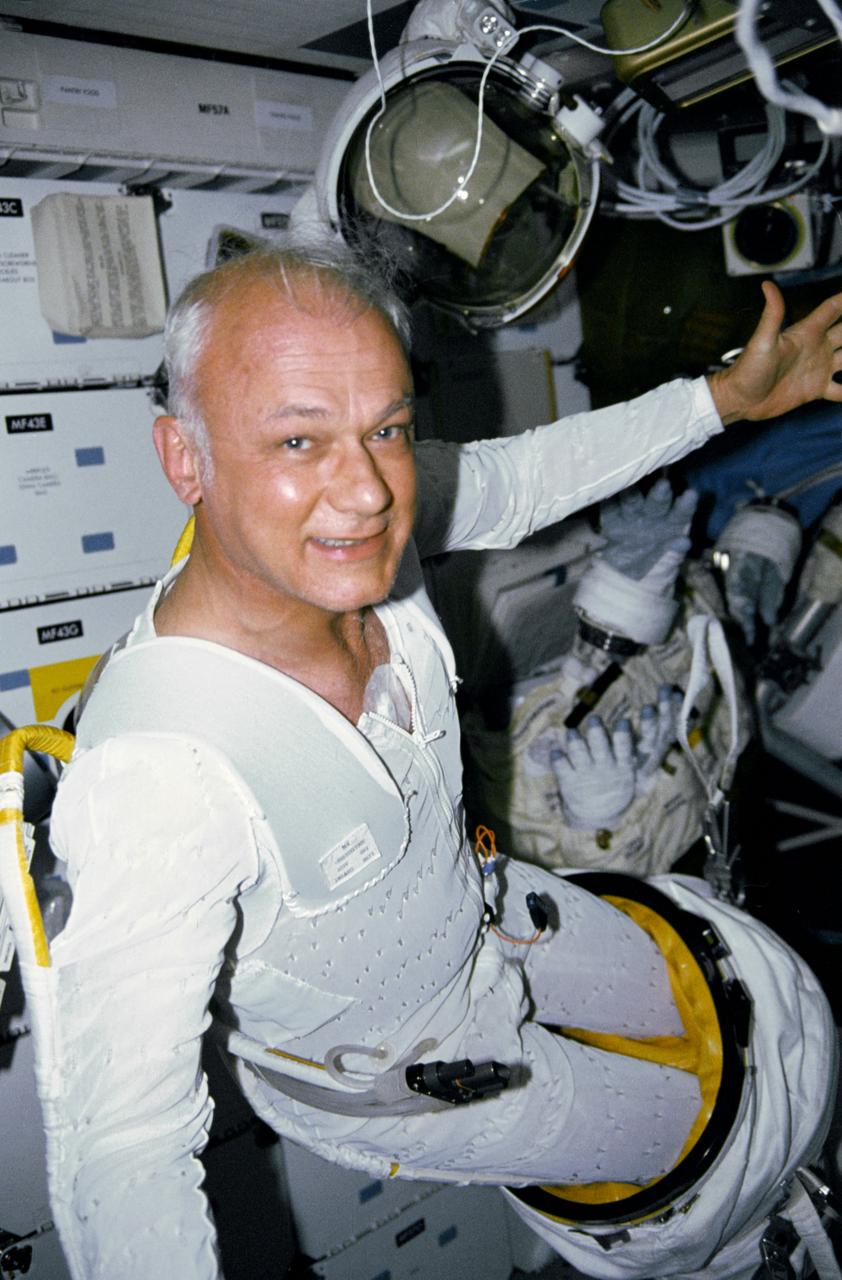
STS-31 Mission Specialist (MS) Bruce McCandless II, wearing liquid cooling and ventilation garment (LCVG), works his way out of the extravehicular mobility unit (EMU) lower torso on the middeck of Discovery, Orbiter Vehicle (OV) 103. McCandless was in a standby mode to perform extravehicular activity (EVA) if needed to support Hubble Space Telescope (HST) deployment and post- deployment tasks. None was needed. His helmet and gloves freefloat in the background.
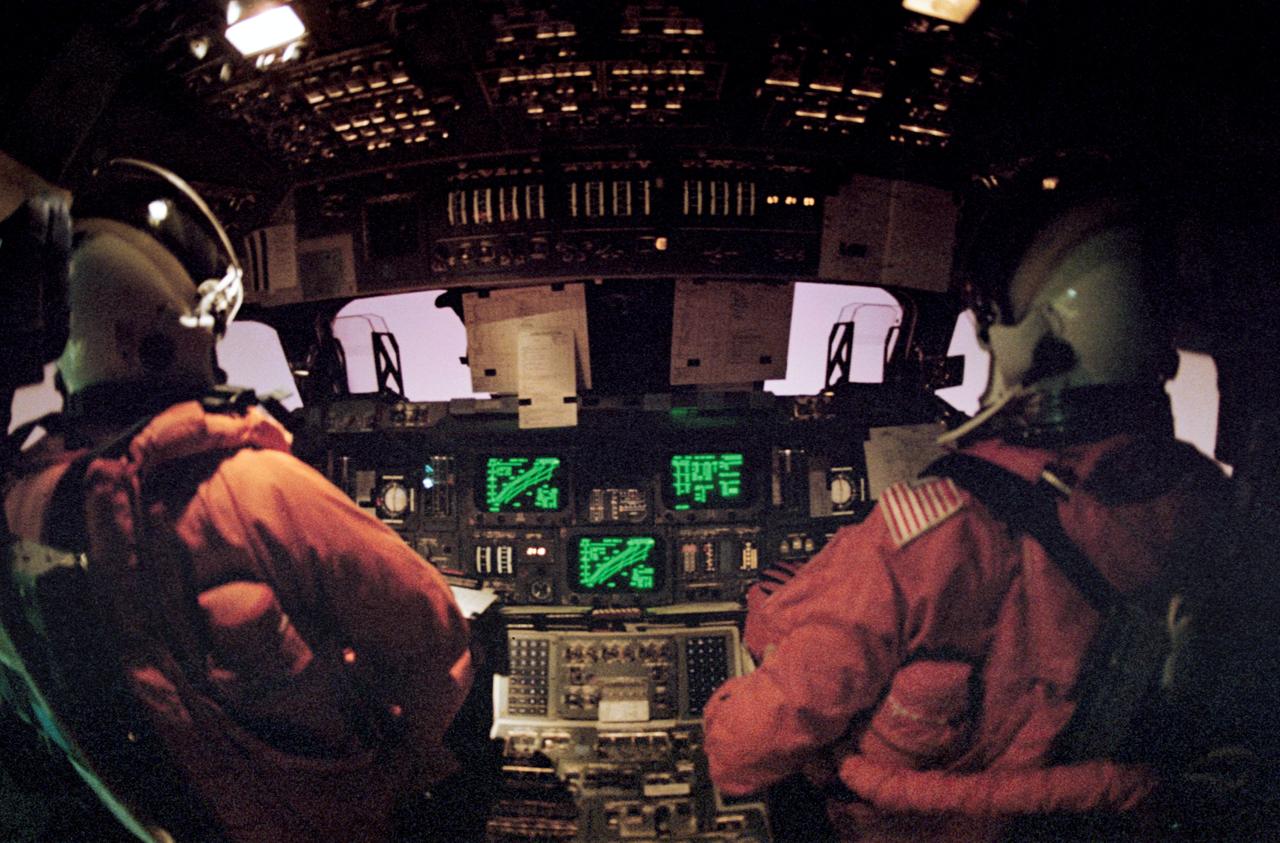
STS042-45-033 (30 Jan. 1992) --- Astronauts Ronald J. Grabe (left) and Stephen S. Oswald man the commander and pilot stations, respectively, during the entry phase of the STS-42 mission. The pink glow through the front windows telltale of friction caused heat encountered upon passing through Earth's atmosphere on the return trip home.
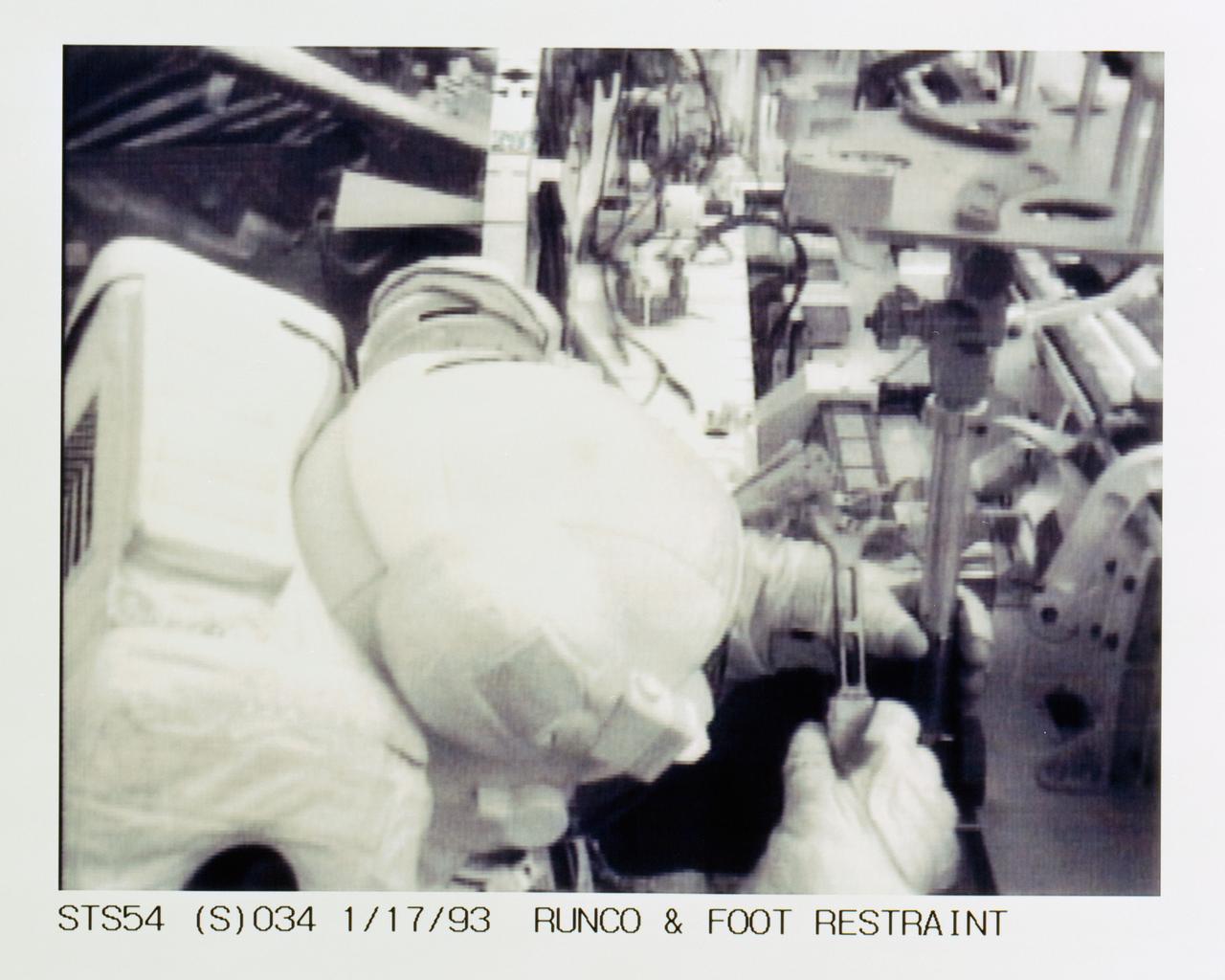
STS054-S-034 (17 Jan 1993) --- Closeup view of Runco as he works to install a mobile foot restraint during extravehicular activity (EVA) in Endeavour's cargo bay. The scene was downlinked at 11:55:07:24 GMT, Jan. 17, 1993.
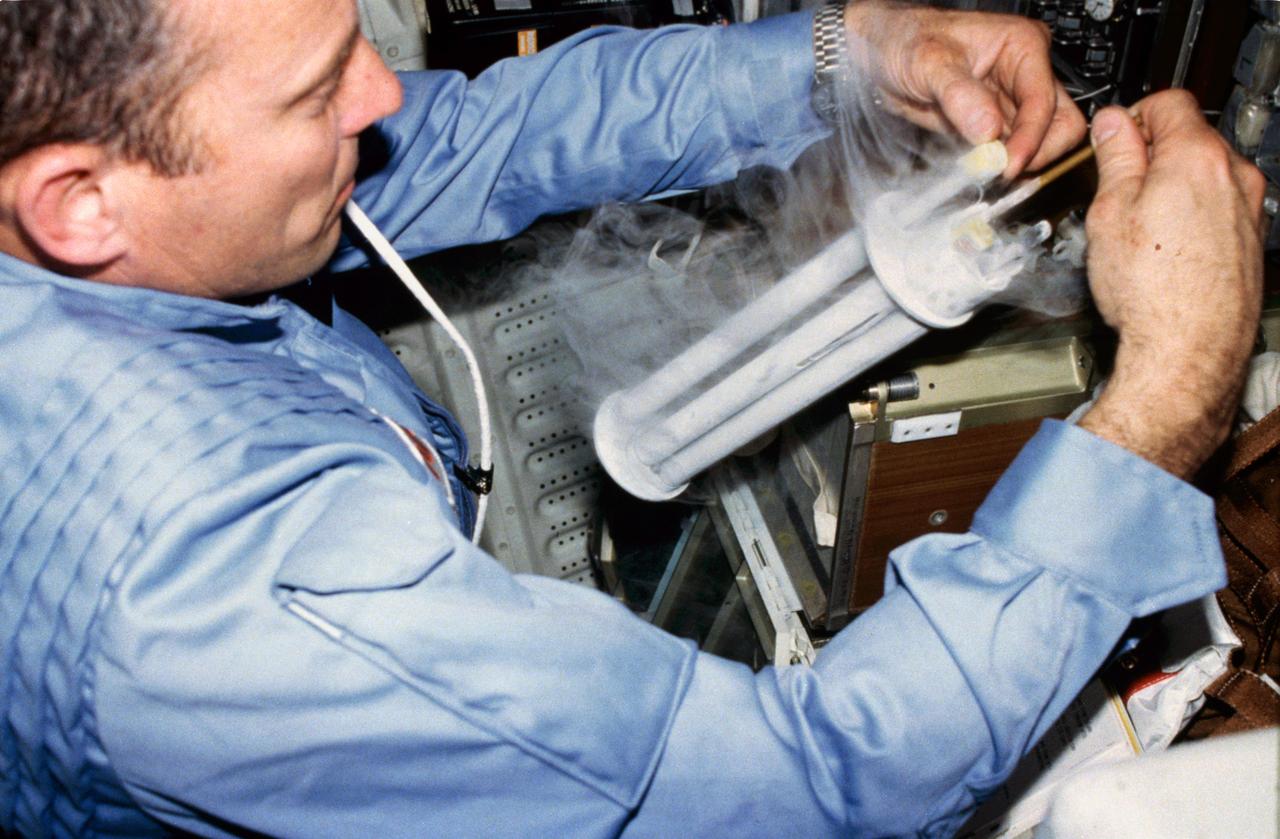
Commander Jack Lousma works with Electrophoresis Equipment Verification Test (EEVT) electrophoresis unit, cryogenic freezer and tube, and stowage locker equipment located on crew compartment middeck aft bulkhead.
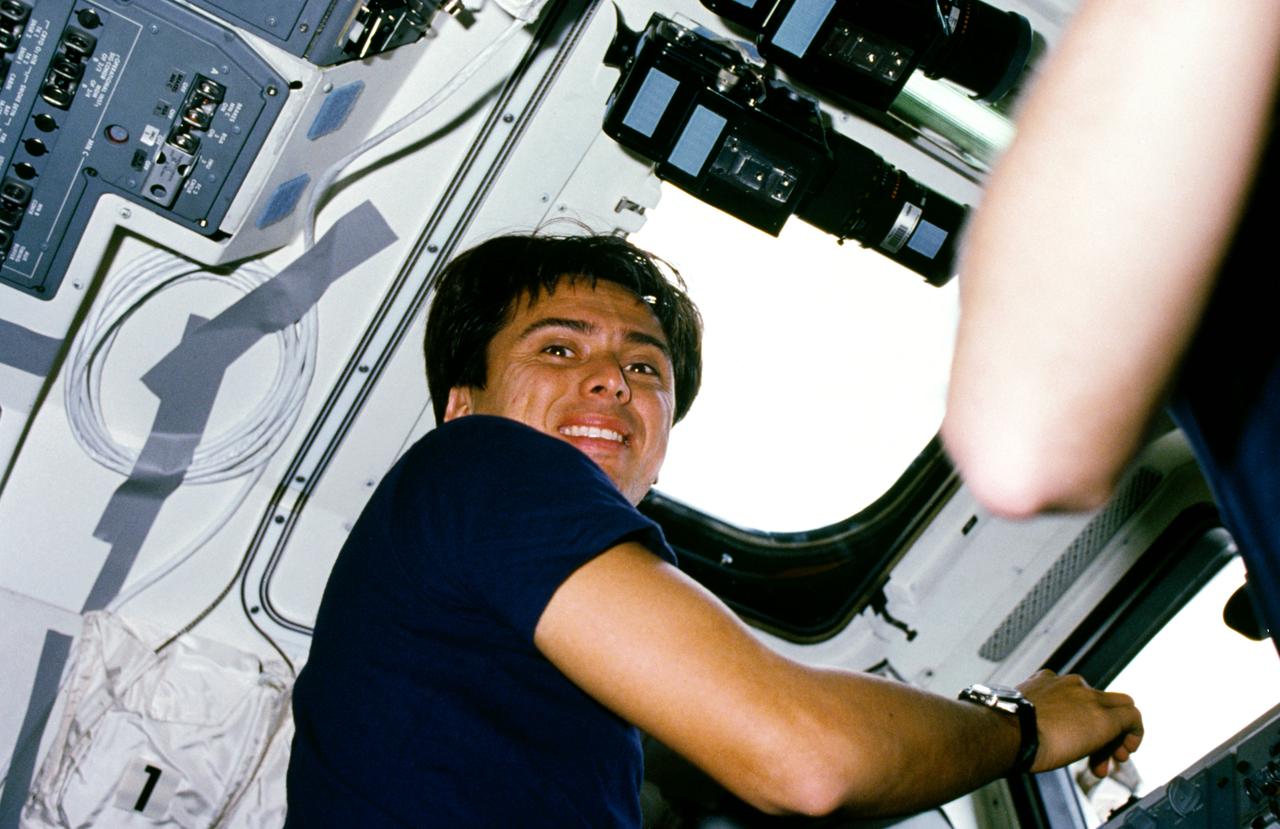
61C-02-032 (12-18 Jan. 1986) --- Astronaut Franklin R. Chang-Diaz, STS-61C mission specialist, while checking cargo in the space shuttle Columbia's payload bay, turns to smile at a fellow crew member using a 35mm camera. Some of the prolific camera gear onboard the spacecraft is affixed above the mission specialist's right shoulder.
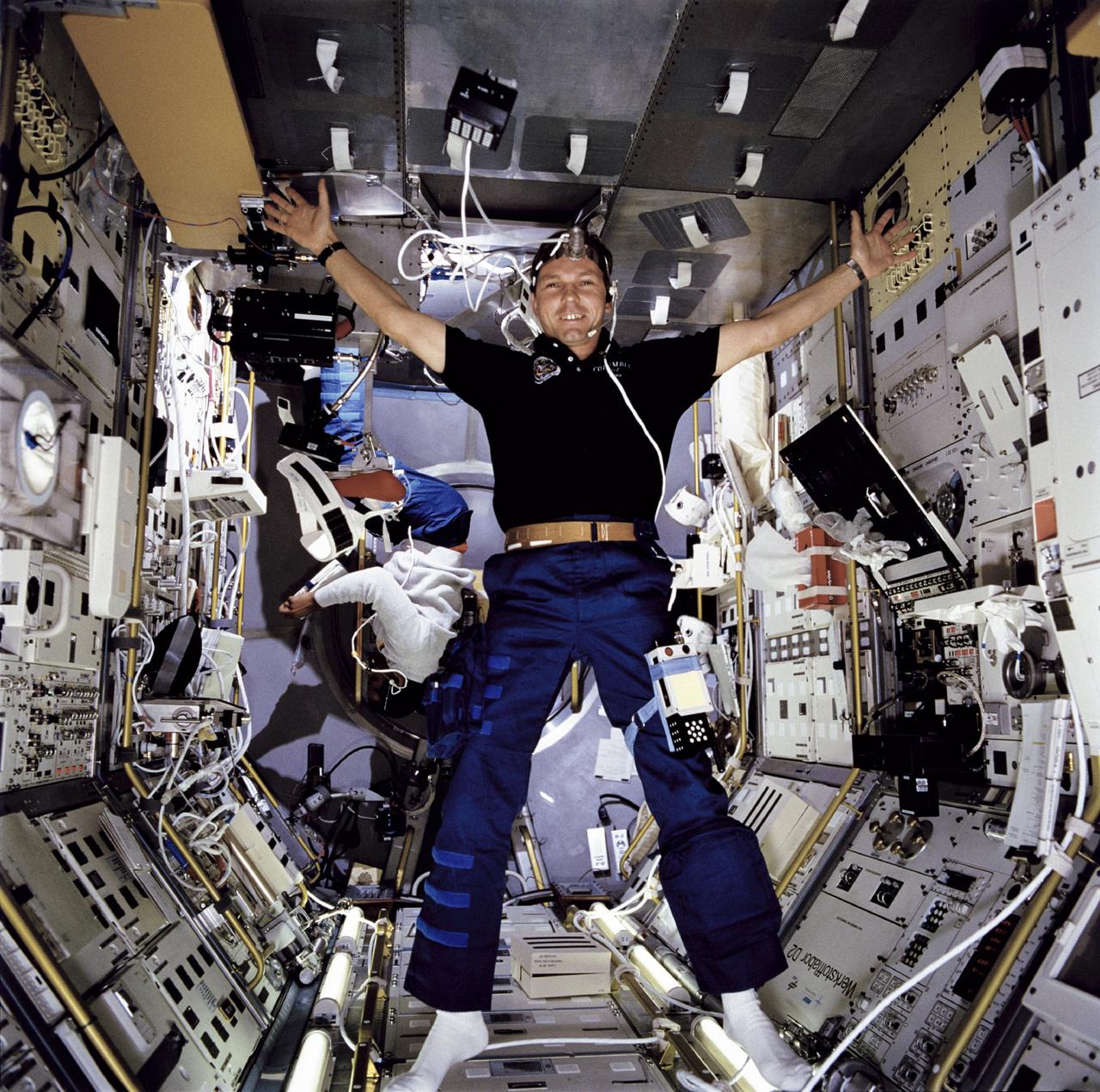
STS055-106-090 (26 April- 6 May 1993) --- Hans Schlegel, one of two STS-55 payload specialists representing the German Aerospace Research Establishment (DLR) onboard the Space Shuttle Columbia, finds plenty of room to "spread out" while participating in a Tissue experiment. Astronaut Bernard A. Harris, Jr., mission specialist, monitors an experiment in the background.
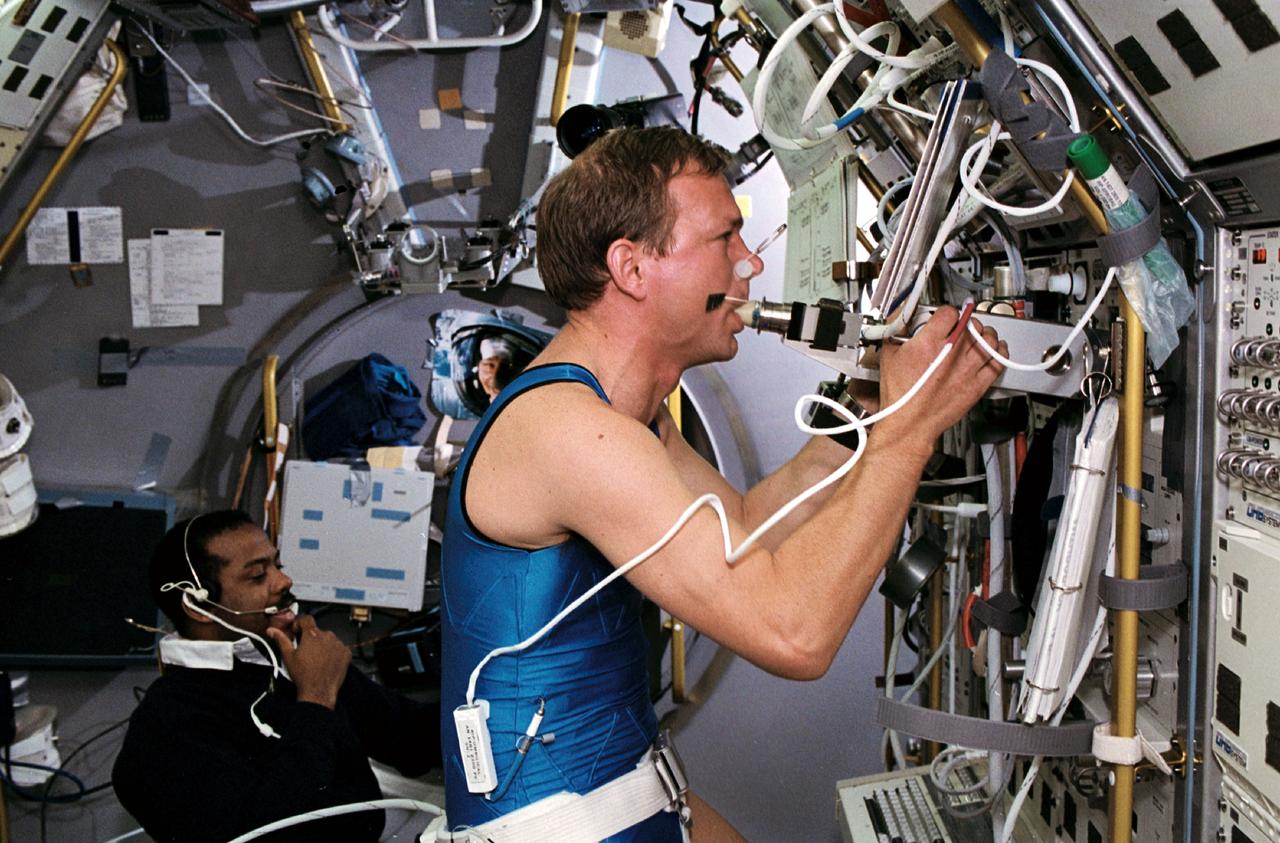
STS055-45-017 (26 April-6 May 1993) --- Hans Schlegel (foreground) participates in the ongoing investigation of human physiology under microgravity conditions as he works out on the ergometer at the Anthrorack. Monitoring the "run" is astronaut Bernard A. Harris, Jr., STS-55 mission specialist. Schlegel is one of two payload specialists representing the German Aerospace Research Establishment (DLR) on the Spacelab D-2 mission.
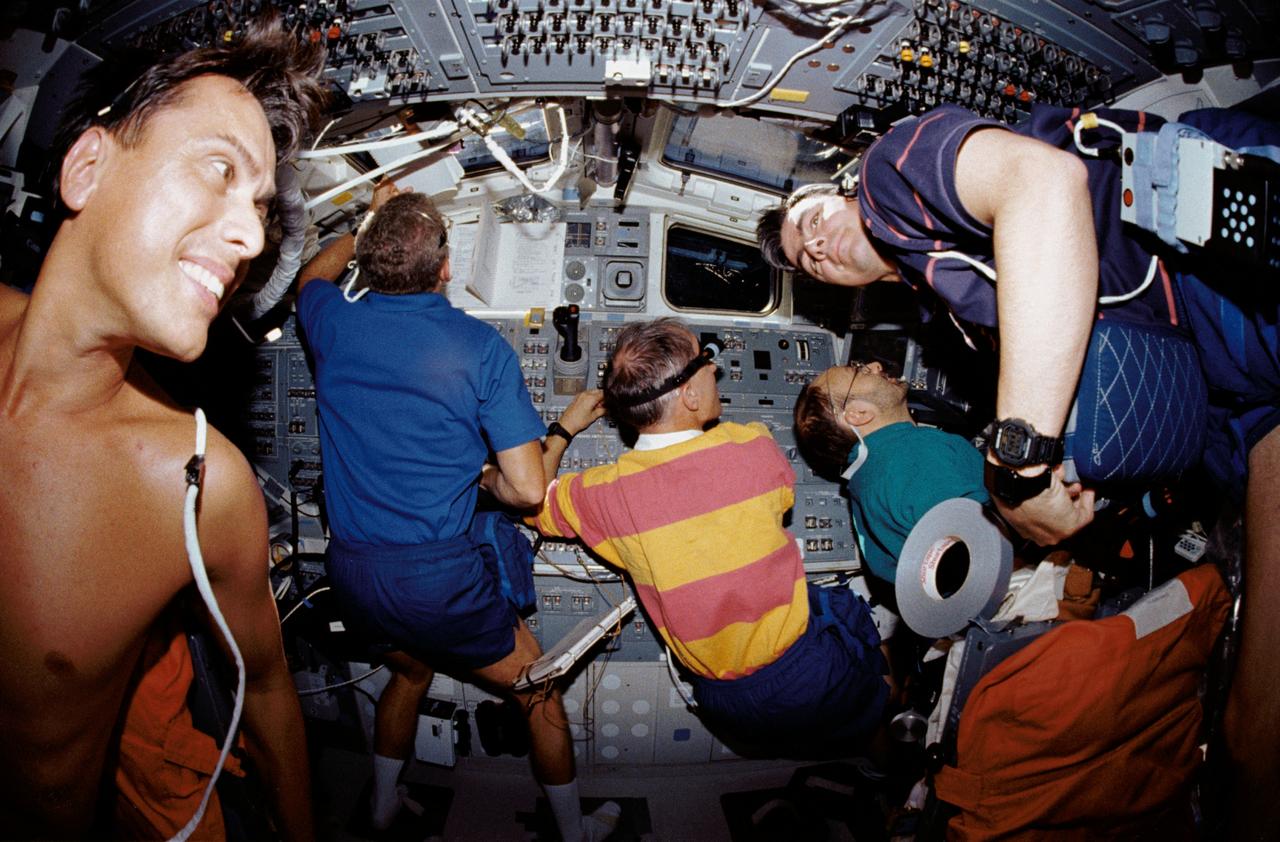
STS046-14-013 (4 Aug. 1992) --- Five of the seven crew members squeezed into this busy scene on the Space Shuttle Atlantis' flight deck during operations with the Tethered Satellite System (TSS). Pictured are, left to right, Franklin R. Chang-Diaz, Loren J. Shriver, Claude Nicollier, Franco Malerba and Andrew M. Allen. Not pictured are astronauts Jeffrey A. Hoffman and Marsha S. Ivins. Mission specialist Ivins used a 35mm camera with a 16mm lens to take this picture.
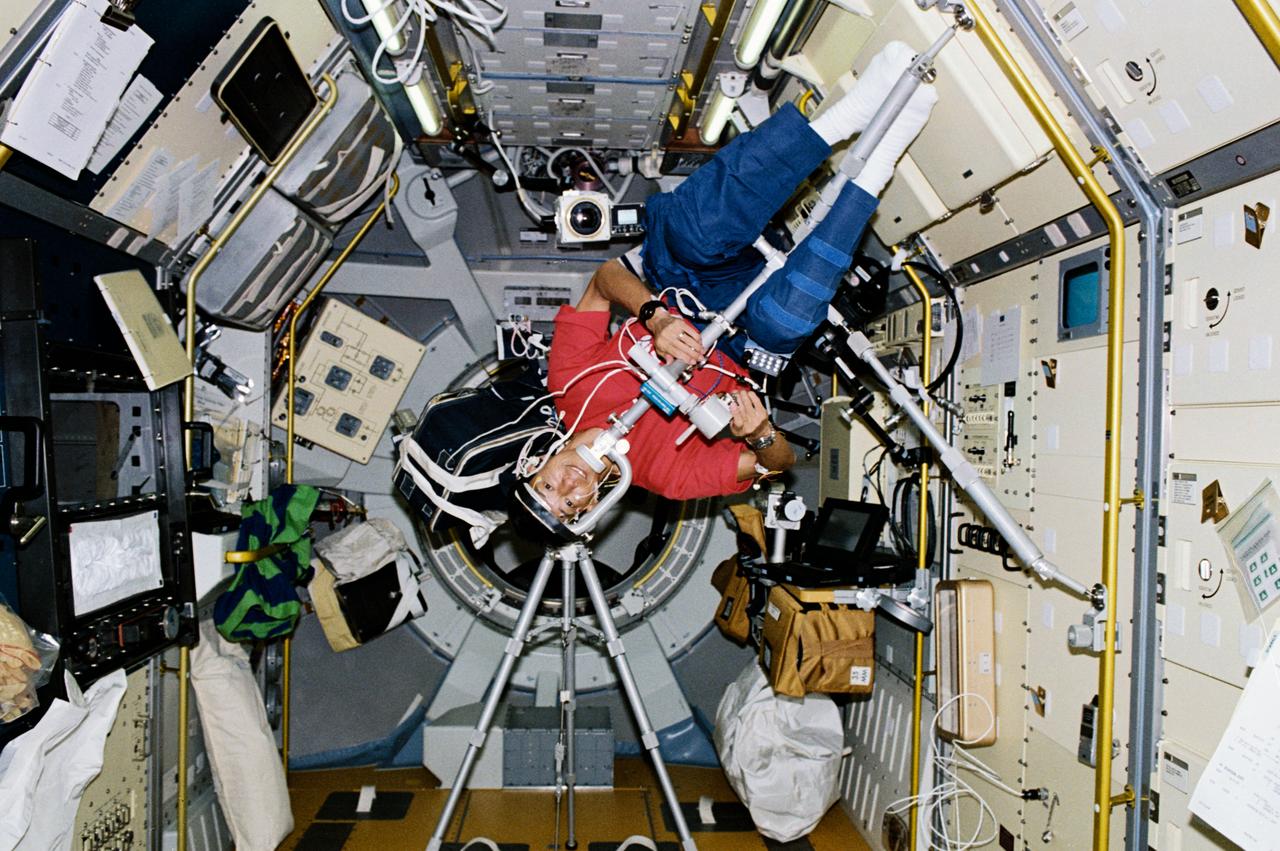
STS047-204-006 (12 - 20 Sept 1992) --- Dr. Mamoru Mohri, payload specialist representing Japan's National Space Development Agency (NASDA), participates in an experiment designed to learn more about Space Adaptation Syndrome (SAS). The experiment is titled, "Comparative Measurement of Visual Stability in Earth and Cosmic Space." During the experiment, Dr. Mohri tracked a flickering light target while eye movements and neck muscle tension were measured. This 45-degree angle position was one of four studied during the eight-day Spacelab-J mission.
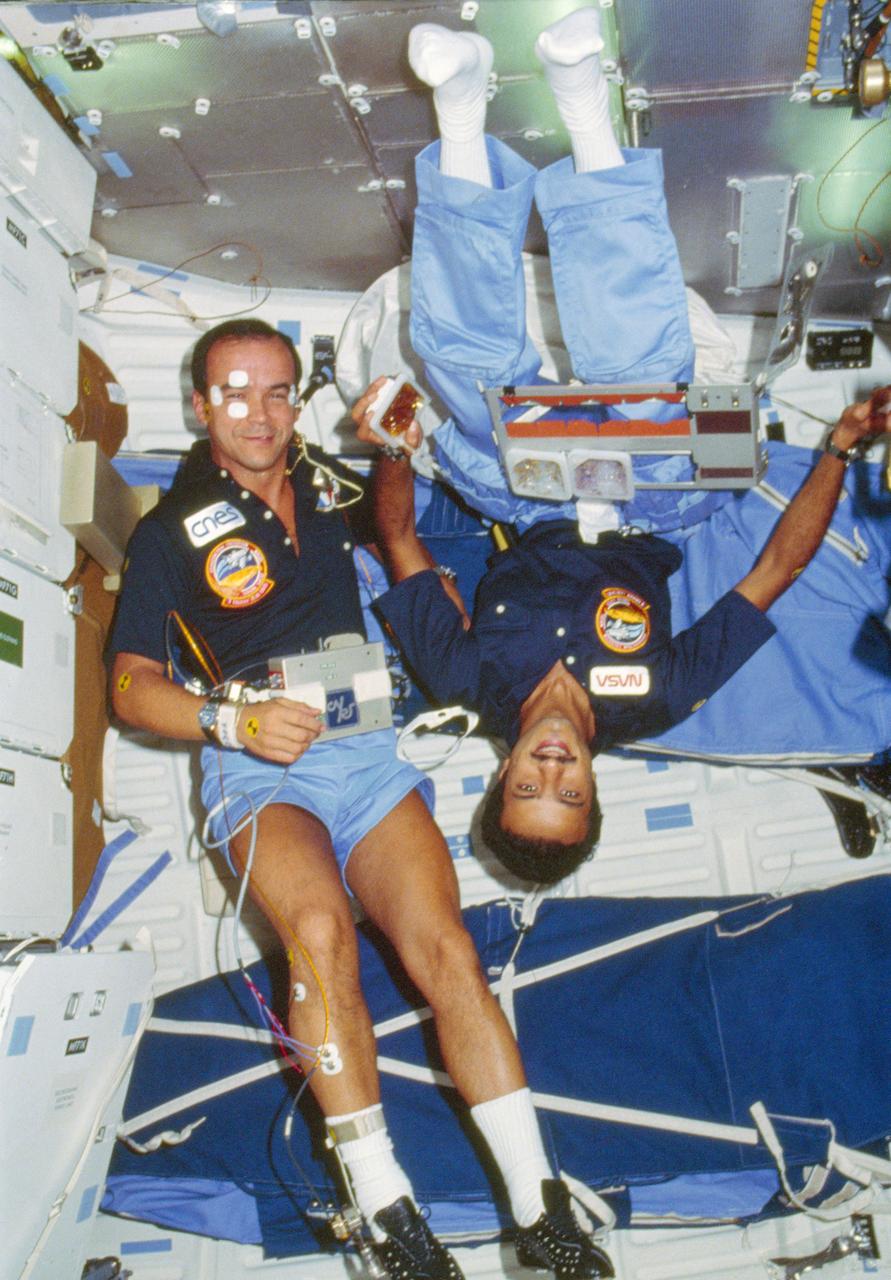
51G-102-035 (17-24 June 1985) --- The two payload specialists for the week-long flight share a middeck scene on the earth-orbiting Discovery. Sultan Salman Abdelazize Al-Saud (left) is in the midst of a meal while Patrick Baudry conducts a phase of the French Postural Experiment (FPE) on himself. Sleep restraints are in the background.

STS055-203-034 (26 April-6 May 1993) --- Astronaut Steven R. Nagel, STS-55 mission commander, has found an isolated station in the D-2 science module from which to talk to students on Earth. Like many before it, the seven member crew participated in communications with students and licensed radio operators via the Shuttle Amateur Radio Experiment (SAREX). Photo credit: NASA
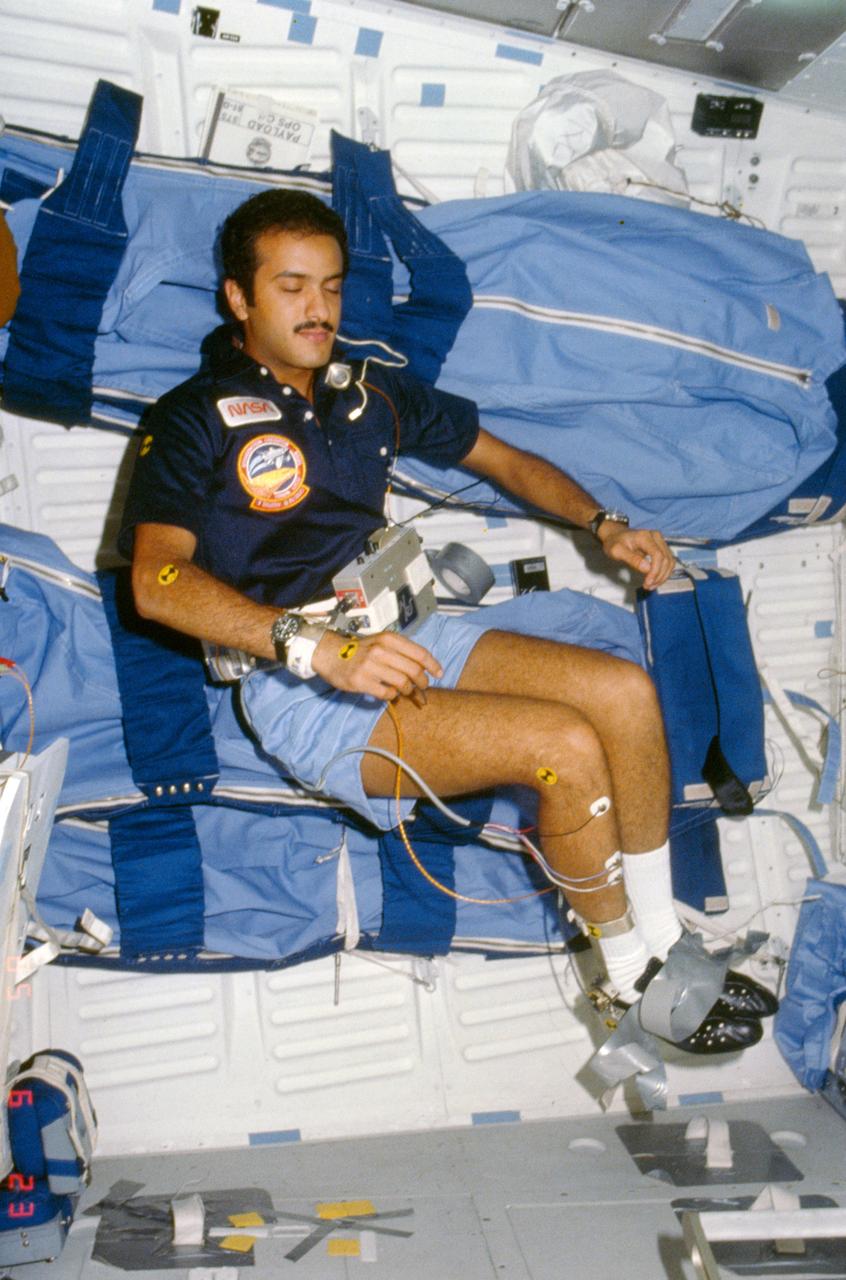
51G-105-030 (17-24 June 1985) --- Payload specialist Sultan Salman Abdelazize Al-Saud participates in the French Postural Experiment (FPE) on the middeck of the earth-orbiting Discovery.
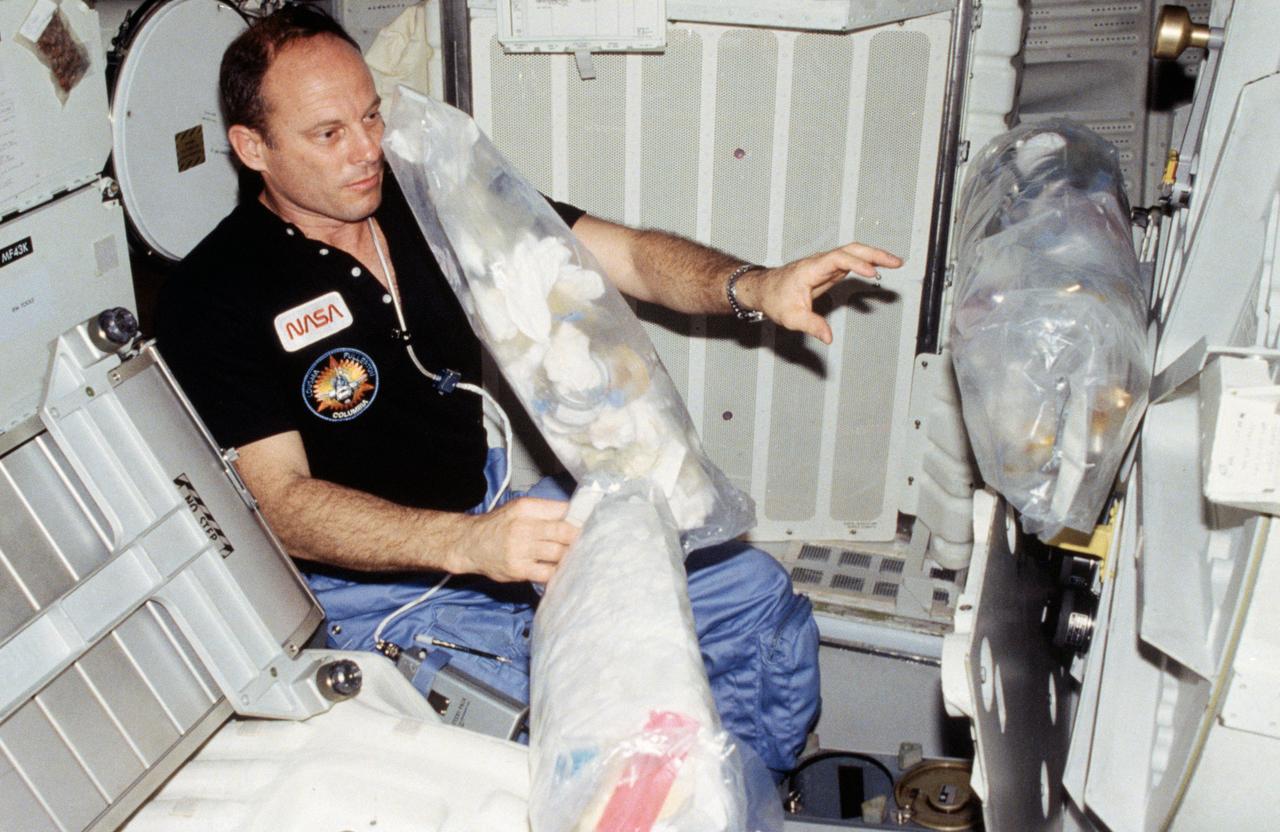
STS003-25-231 (22-30 March 1982) --- Astronaut Jack R. Lousma, STS-3 commander, wearing communication kit assembly mini headset, gathers three freefloating plastic trash bags filled with empty containers, paper towels, straws, etc. Lousma will stow them in a designated stowage volume. Photo credit: NASA
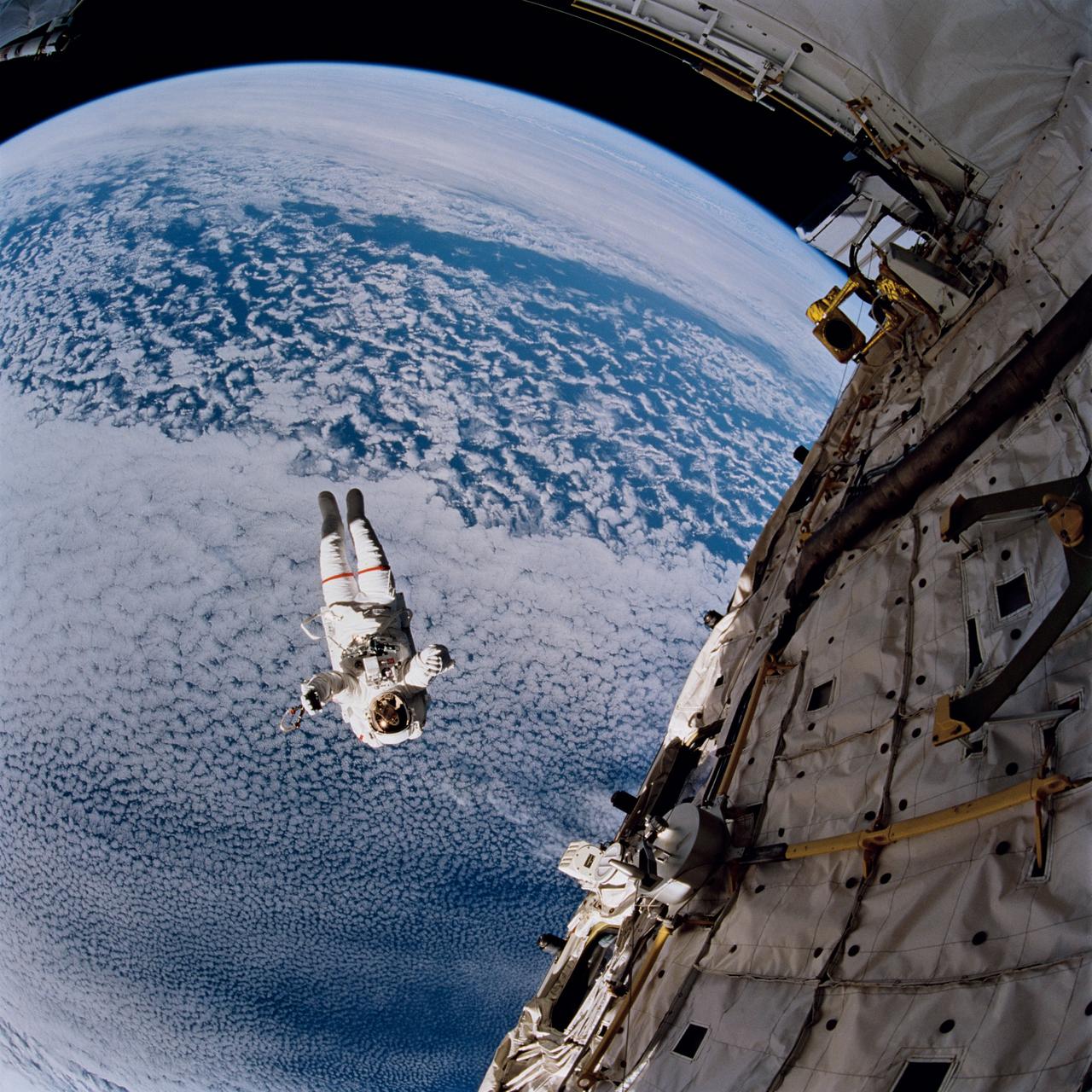
STS064-217-008 (16 Sept. 1994) --- Backdropped against the blue and white Earth, 130 nautical miles below, astronaut Mark C. Lee tests the new Simplified Aid for EVA Rescue (SAFER) system. The scene was captured with a 70mm handheld Hasselblad camera with a 30mm lens attached. Astronauts Lee and Carl J. Meade took turns using the SAFER hardware during their shared Extravehicular Activity (EVA) of Sept. 16, 1994. The test of SAFER is the first phase of a larger SAFER program whose objectives are to establish a common set of requirements for both space shuttle and space station program needs, develop a flight demonstration of SAFER, validate system performance and, finally, develop a production version of SAFER for the shuttle and station programs. Photo credit: NASA or National Aeronautics and Space Administration