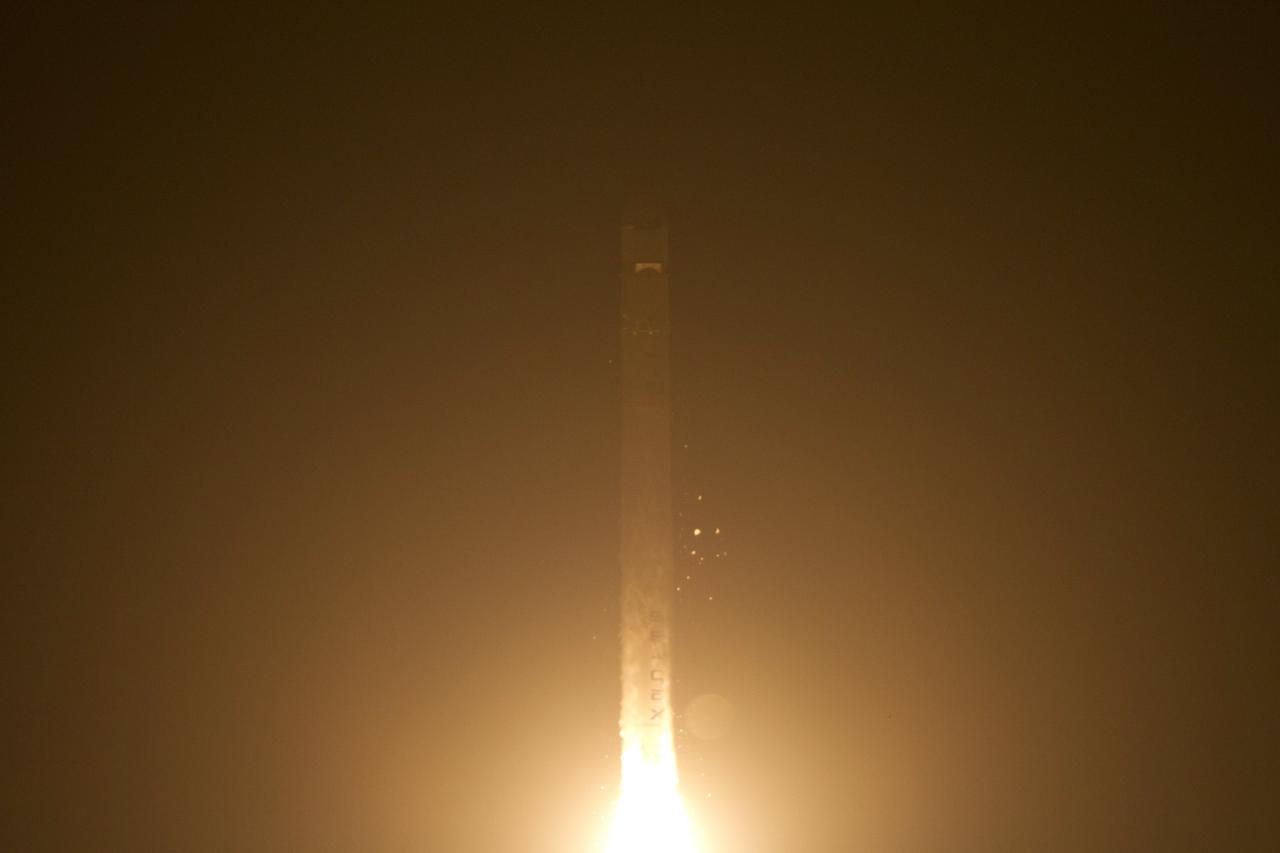
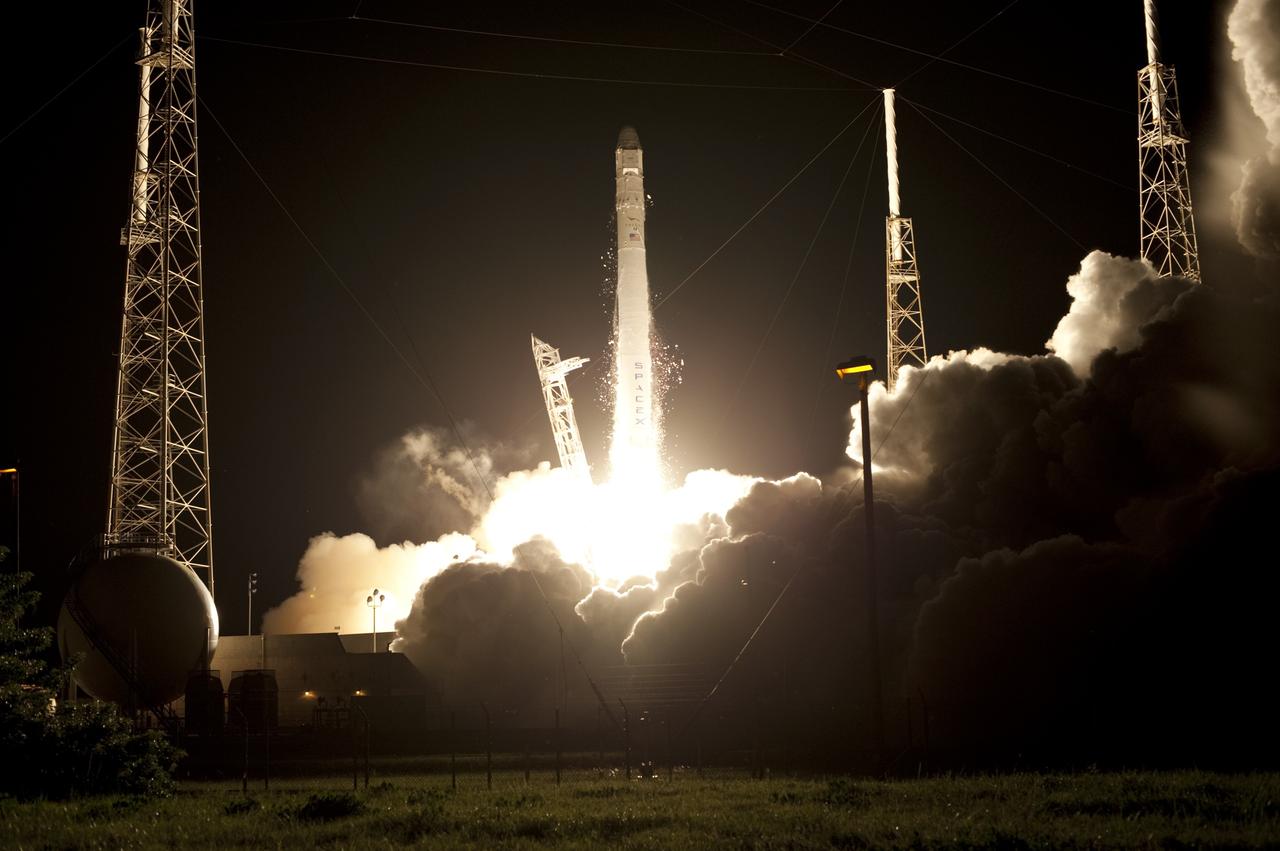
CAPE CANAVERAL, Fla. - At Space Launch Complex 40 on Cape Canaveral Air Force Station in Florida a Falcon 9 rocket carrying a Dragon capsule lifts off at 8:35 p.m. EDT. Space Exploration Technologies Corp., or SpaceX, built both the rocket and capsule for NASA's first Commercial Resupply Services, or CRS-1, mission to the International Space Station. SpaceX CRS-1 is an important step toward making America’s microgravity research program self-sufficient by providing a way to deliver and return significant amounts of cargo, including science experiments, to and from the orbiting laboratory. NASA has contracted for 12 commercial resupply flights from SpaceX and eight from the Orbital Sciences Corp. For more information, visit http://www.nasa.gov/mission_pages/station/living/launch/index.html Photo credit: NASA/Ken Allen
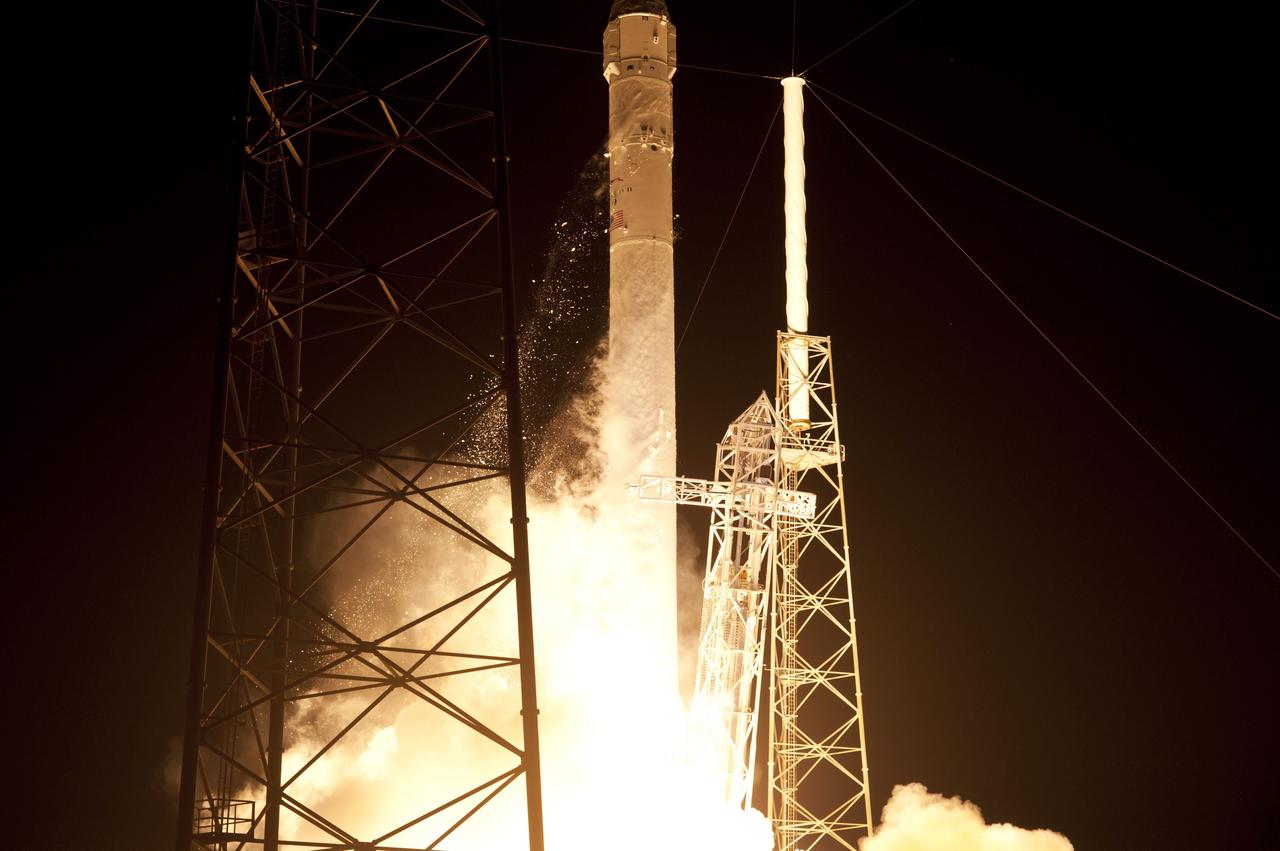
CAPE CANAVERAL, Fla. - Space Launch Complex 40 on Cape Canaveral Air Force Station in Florida comes alive as the Merlin engines ignite under the Falcon 9 rocket carrying a Dragon capsule to orbit. Liftoff was at 8:35 p.m. EDT. Space Exploration Technologies Corp., or SpaceX, built both the rocket and capsule for NASA's first Commercial Resupply Services, or CRS-1, mission to the International Space Station. SpaceX CRS-1 is an important step toward making America’s microgravity research program self-sufficient by providing a way to deliver and return significant amounts of cargo, including science experiments, to and from the orbiting laboratory. NASA has contracted for 12 commercial resupply flights from SpaceX and eight from the Orbital Sciences Corp. For more information, visit http://www.nasa.gov/mission_pages/station/living/launch/index.html Photo credit: NASA/Rusty Backer
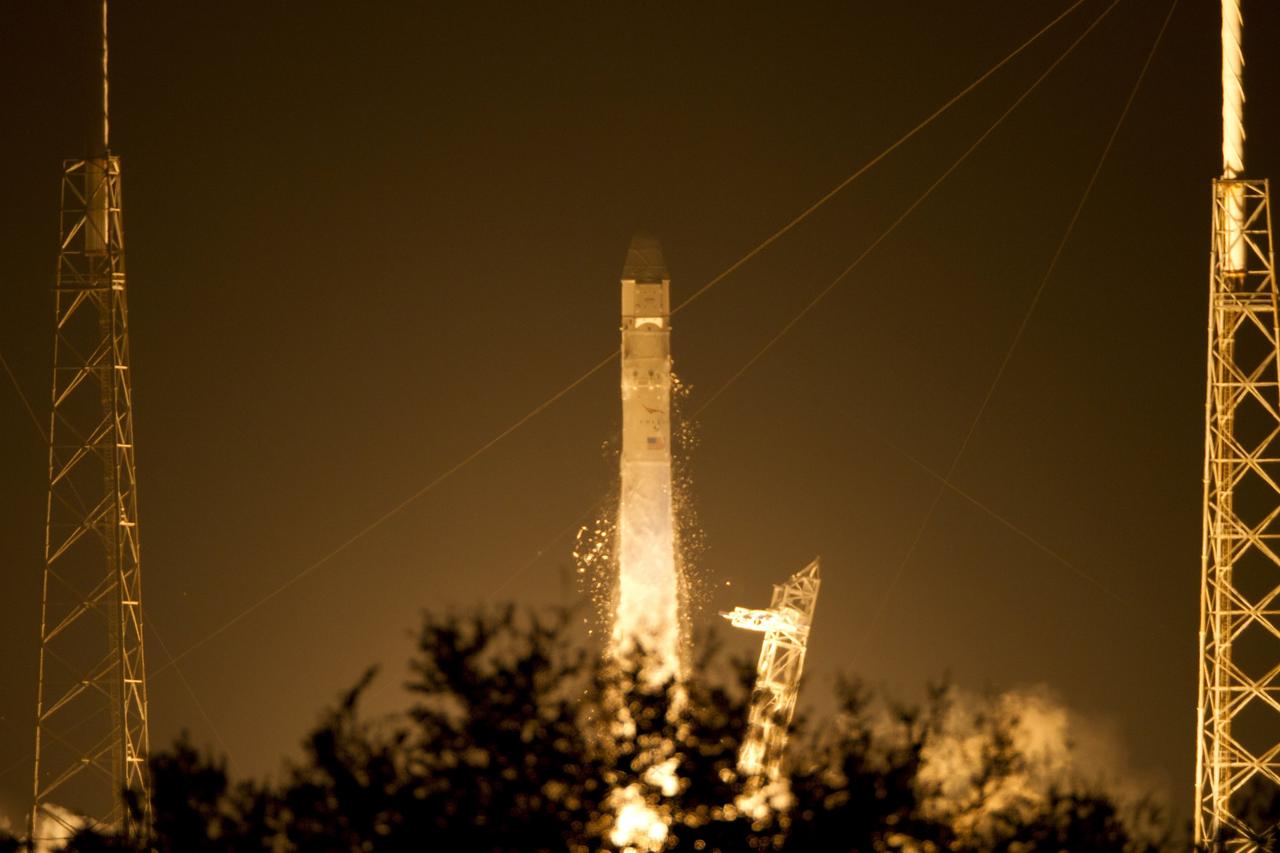
CAPE CANAVERAL, Fla. - At Space Launch Complex 40 on Cape Canaveral Air Force Station in Florida a Falcon 9 rocket carrying a Dragon capsule lifts off at 8:35 p.m. EDT. Space Exploration Technologies Corp., or SpaceX, built both the rocket and capsule for NASA's first Commercial Resupply Services, or CRS-1, mission to the International Space Station. SpaceX CRS-1 is an important step toward making America’s microgravity research program self-sufficient by providing a way to deliver and return significant amounts of cargo, including science experiments, to and from the orbiting laboratory. NASA has contracted for 12 commercial resupply flights from SpaceX and eight from the Orbital Sciences Corp. For more information, visit http://www.nasa.gov/mission_pages/station/living/launch/index.html Photo credit: NASA/Ken Allen
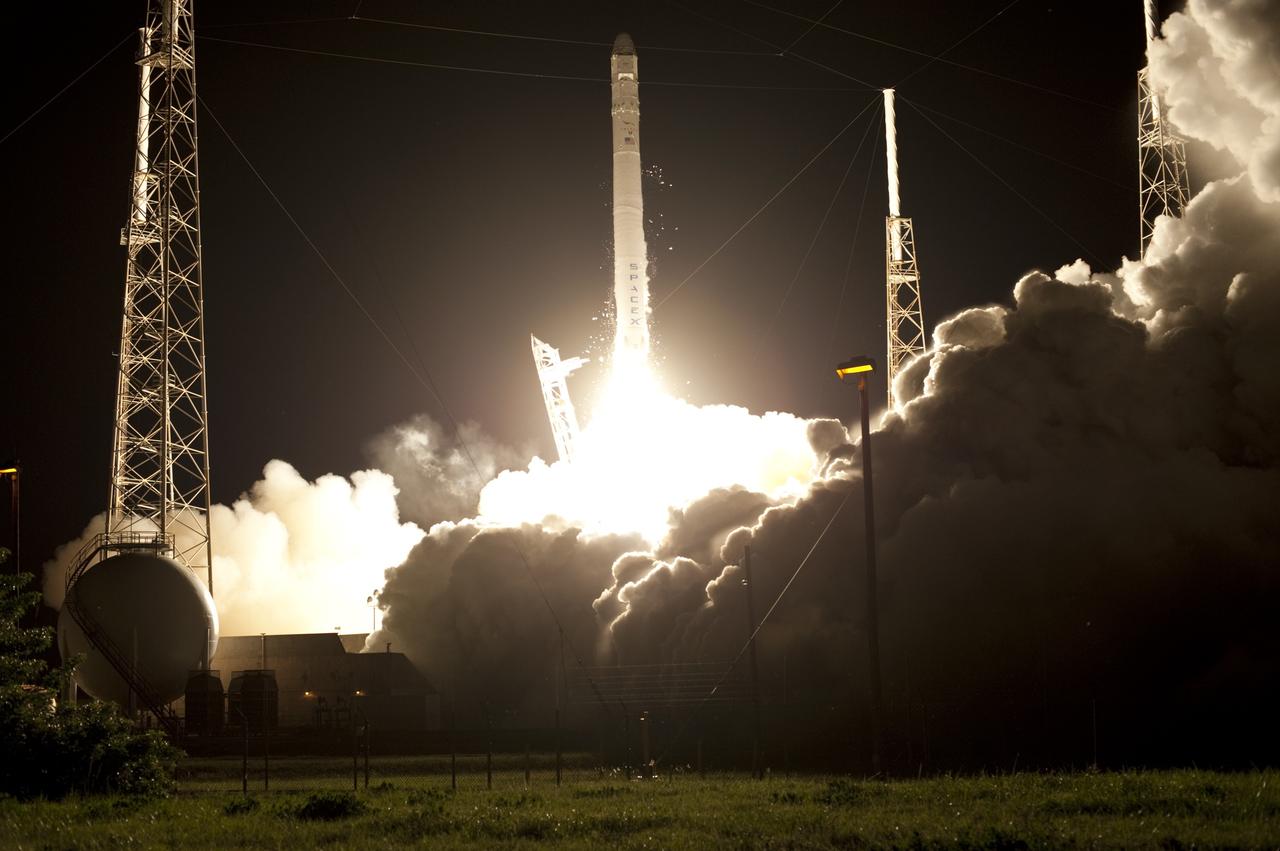
CAPE CANAVERAL, Fla. -- Space Launch Complex 40 on Cape Canaveral Air Force Station in Florida comes alive as the Merlin engines ignite under the Falcon 9 rocket carrying a Dragon capsule to orbit. Liftoff was at 8:35 p.m. EDT. Space Exploration Technologies Corp., or SpaceX, built both the rocket and capsule for NASA's first Commercial Resupply Services, or CRS-1, mission to the International Space Station. SpaceX CRS-1 is an important step toward making America’s microgravity research program self-sufficient by providing a way to deliver and return significant amounts of cargo, including science experiments, to and from the orbiting laboratory. NASA has contracted for 12 commercial resupply flights from SpaceX and eight from the Orbital Sciences Corp. For more information, visit http://www.nasa.gov/mission_pages/station/living/launch/index.html. Photo credit: NASA/Tony Gray and Rick Wetherington
CAPE CANAVERAL, Fla. -- A Dragon capsule begins its much-anticipated journey to orbit atop a Falcon 9 rocket at 8:35 p.m. EDT from Space Launch Complex 40 on Cape Canaveral Air Force Station in Florida. Space Exploration Technologies Corp., or SpaceX, built both the rocket and capsule for NASA's first Commercial Resupply Services, or CRS-1, mission to the International Space Station. SpaceX CRS-1 is an important step toward making America’s microgravity research program self-sufficient by providing a way to deliver and return significant amounts of cargo, including science experiments, to and from the orbiting laboratory. NASA has contracted for 12 commercial resupply flights from SpaceX and eight from the Orbital Sciences Corp. For more information, visit http://www.nasa.gov/mission_pages/station/living/launch/index.html. Photo credit: NASA/Tony Gray and Rick Wetherington
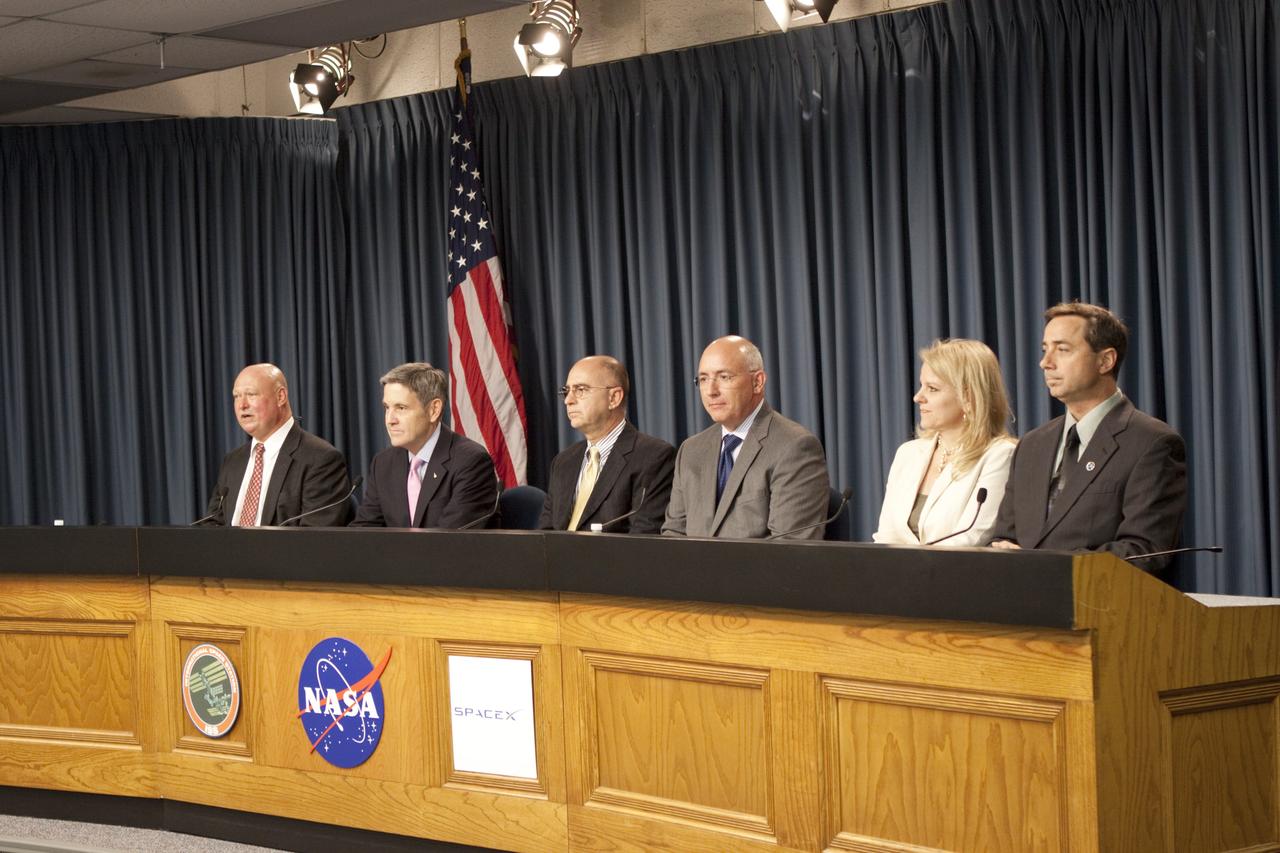
CAPE CANAVERAL, Fla. -- A prelaunch news conference is held in NASA Kennedy Space Center's Press Site auditorium in Florida. From left are Michael Curie, NASA Public Affairs, Bob Cabana, director of NASA Kennedy Space Center, Sam Scimemi, director of International Space Station at NASA Headquarters, Mike Suffredini, program manager of International Space Station at NASA Johnson Space Center, Gwynne Shotwell, president of Space Exploration Technologies Corp., or SpaceX, and Mike McAleenan, launch weather officer from the 45th Weather Squadron at Cape Canaveral Air Force Station. The news conference provided the media with a status on the readiness to launch NASA's first Commercial Resupply Services, or CRS-1, mission to the International Space Station. Space Exploration Technologies Corp., or SpaceX, built both the mission's Falcon 9 rocket and Dragon capsule. Launch is scheduled for 8:35 p.m. EDT on Oct. 7 from Space Launch Complex 40 on Cape Canaveral Air Force Station. SpaceX CRS-1 is an important step toward making America’s microgravity research program self-sufficient by providing a way to deliver and return significant amounts of cargo, including science experiments, to and from the orbiting laboratory. NASA has contracted for 12 commercial resupply flights from SpaceX and eight from the Orbital Sciences Corp. For more information, visit http://www.nasa.gov/mission_pages/station/living/launch/index.html. Photo credit: NASA/Jim Grossmann
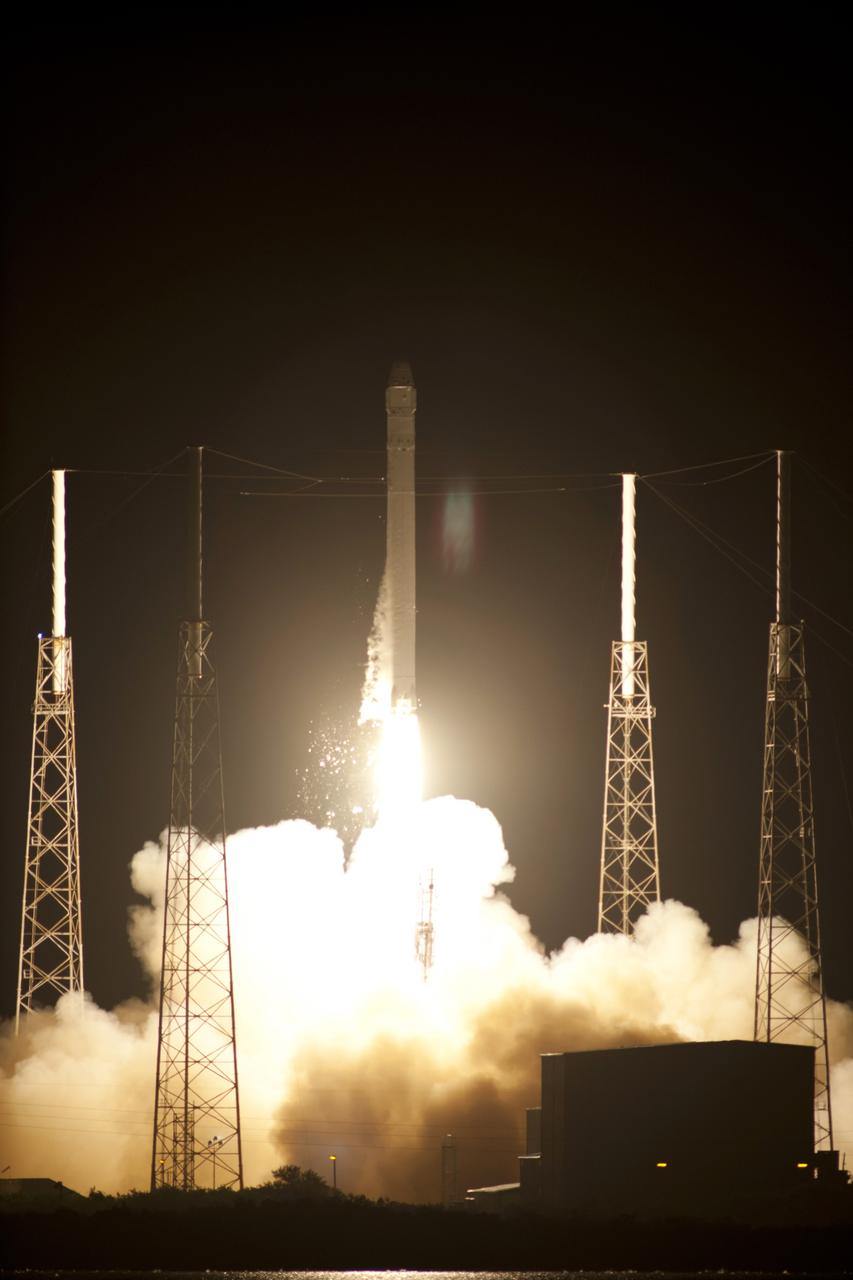
CAPE CANAVERAL, Fla. - Space Launch Complex 40 on Cape Canaveral Air Force Station in Florida comes alive as the Merlin engines ignite under the Falcon 9 rocket carrying a Dragon capsule to orbit. Liftoff was at 8:35 p.m. EDT. Space Exploration Technologies Corp., or SpaceX, built both the rocket and capsule for NASA's first Commercial Resupply Services, or CRS-1, mission to the International Space Station. SpaceX CRS-1 is an important step toward making America’s microgravity research program self-sufficient by providing a way to deliver and return significant amounts of cargo, including science experiments, to and from the orbiting laboratory. NASA has contracted for 12 commercial resupply flights from SpaceX and eight from the Orbital Sciences Corp. For more information, visit http://www.nasa.gov/mission_pages/station/living/launch/index.html Photo credit: NASA/Tony Gray
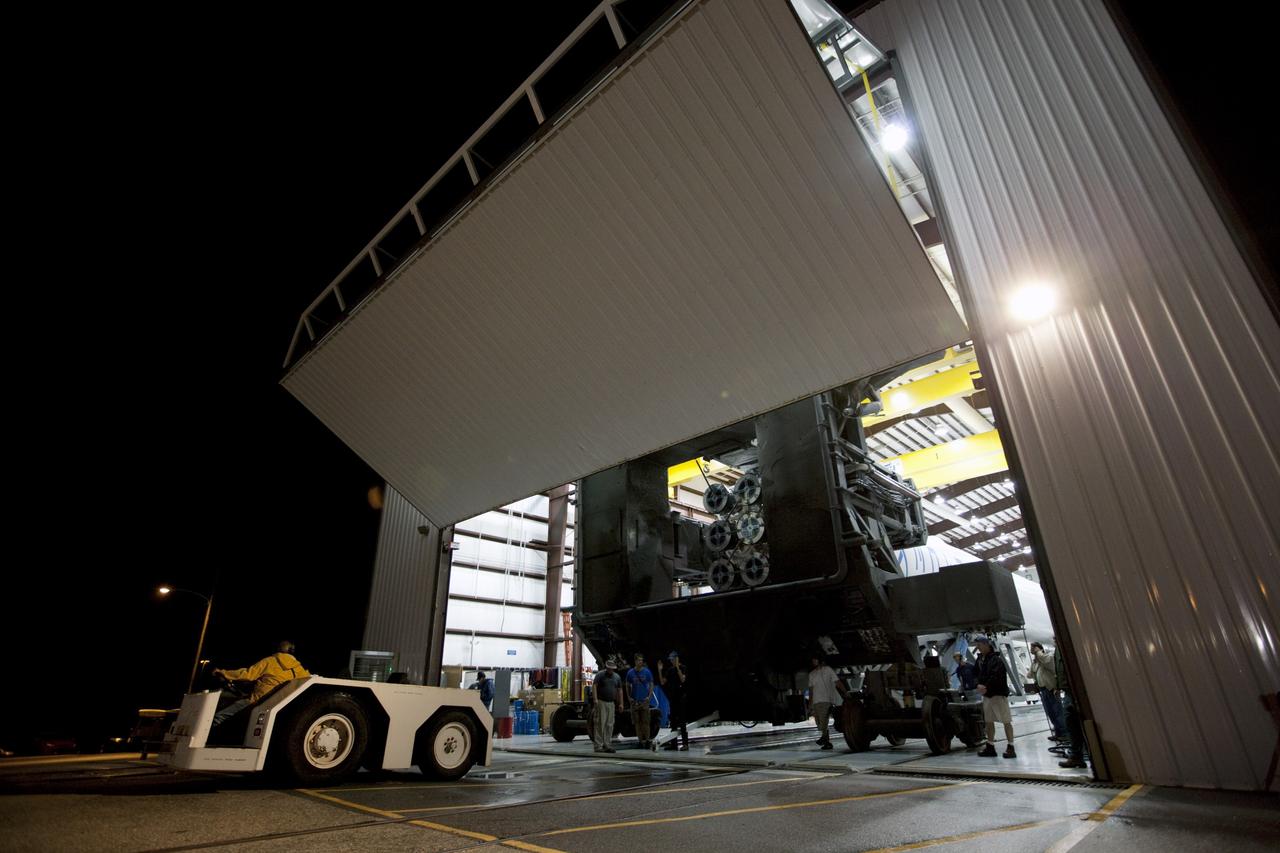
CAPE CANAVERAL, Fla. -- Preparations are under way to roll a Falcon 9 rocket with a Dragon capsule secured atop from the processing hangar to the pad at Space Launch Complex 40 on Cape Canaveral Air Force Station in Florida. Space Exploration Technologies Corp., or SpaceX, built both the rocket and capsule for NASA's first Commercial Resupply Services, or CRS-1, mission to the International Space Station. Rollout was complete at 9:55 p.m. EDT. SpaceX CRS-1 is an important step toward making America’s microgravity research program self-sufficient by providing a way to deliver and return significant amounts of cargo, including science experiments, to and from the orbiting laboratory. Launch is scheduled for 8:35 p.m. EDT on Oct. 7. NASA has contracted for 12 commercial resupply flights from SpaceX and eight from the Orbital Sciences Corp. For more information, visit http://www.nasa.gov/mission_pages/station/living/launch/index.html. Photo credit: NASA/Kim Shiflett
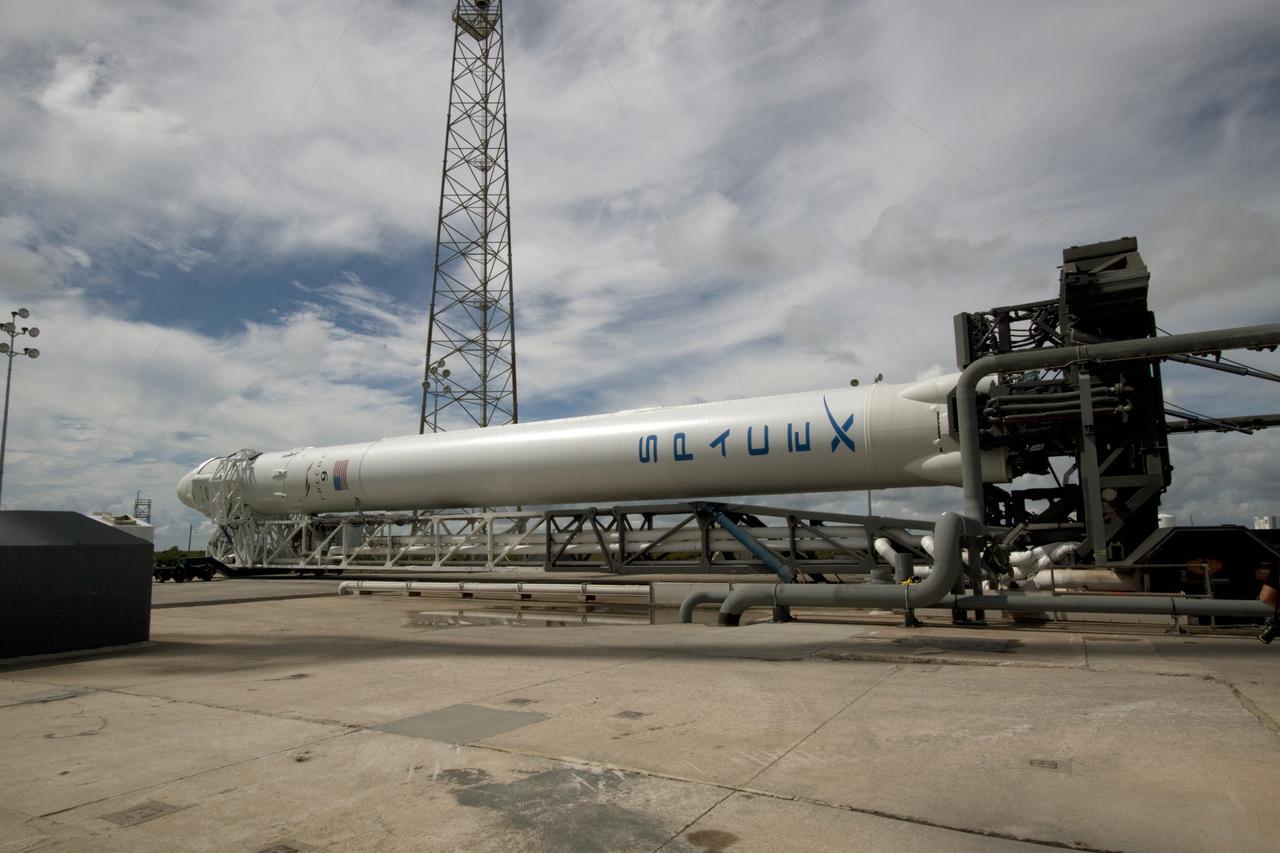
CAPE CANAVERAL, Fla. -- Preparations are under way to lift a Falcon 9 rocket with a Dragon capsule secured atop into a vertical position on the pad at Space Launch Complex 40 on Cape Canaveral Air Force Station in Florida. Space Exploration Technologies Corp., or SpaceX, built both the rocket and capsule for NASA's first Commercial Resupply Services, or CRS-1, mission to the International Space Station. The vertical lift was complete at 1 p.m. EDT. SpaceX CRS-1 is an important step toward making America’s microgravity research program self-sufficient by providing a way to deliver and return significant amounts of cargo, including science experiments, to and from the orbiting laboratory. Launch is scheduled for 8:35 p.m. EDT on Oct. 7. NASA has contracted for 12 commercial resupply flights from SpaceX and eight from the Orbital Sciences Corp. For more information, visit http://www.nasa.gov/mission_pages/station/living/launch/index.html. Photo credit: NASA/Jim Grossmann
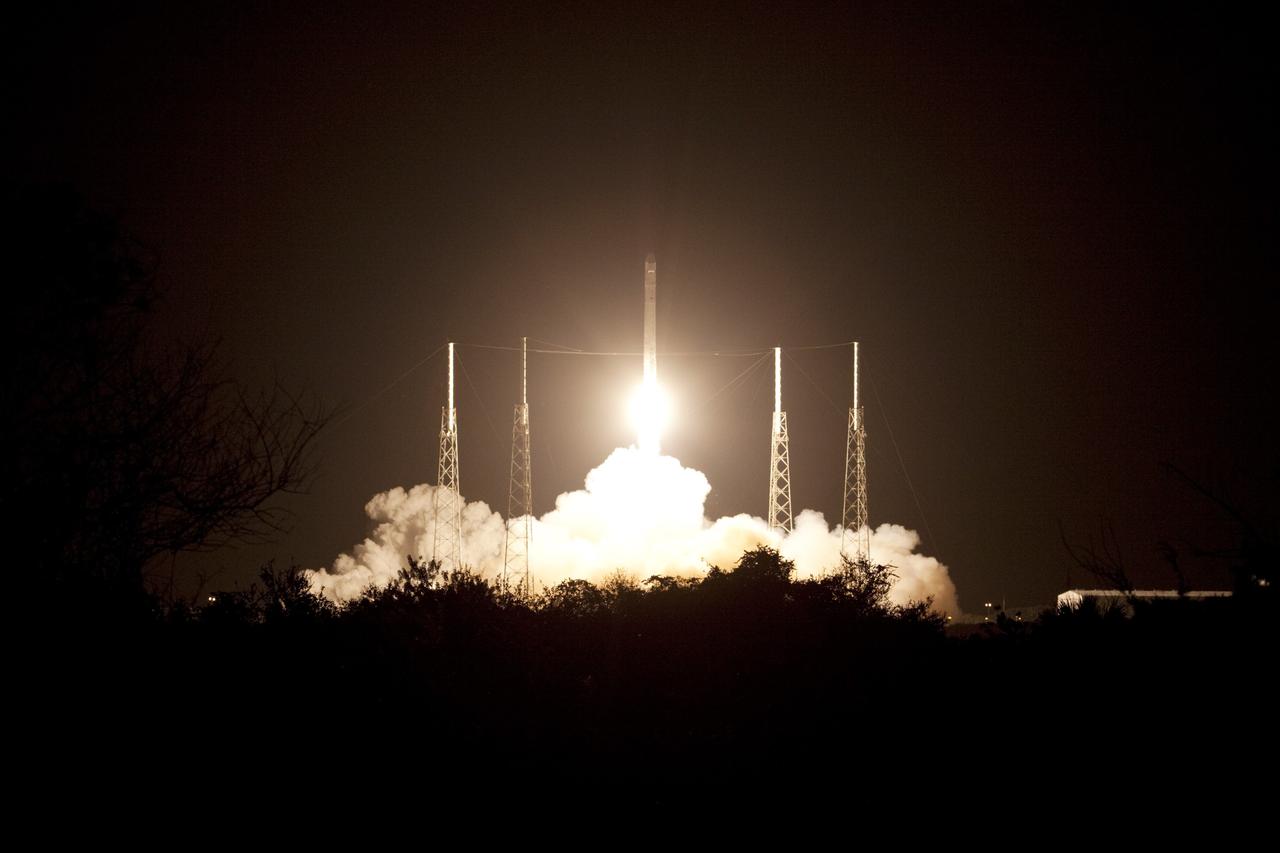
CAPE CANAVERAL, Fla. -- A rumble is heard across the Space Coast as a Falcon 9 rocket lifts off Space Launch Complex 40 on Cape Canaveral Air Force Station in Florida at 8:35 p.m. EDT, carrying a Dragon capsule to orbit. Space Exploration Technologies Corp., or SpaceX, built both the rocket and capsule for NASA's first Commercial Resupply Services, or CRS-1, mission to the International Space Station. SpaceX CRS-1 is an important step toward making America’s microgravity research program self-sufficient by providing a way to deliver and return significant amounts of cargo, including science experiments, to and from the orbiting laboratory. NASA has contracted for 12 commercial resupply flights from SpaceX and eight from the Orbital Sciences Corp. For more information, visit http://www.nasa.gov/mission_pages/station/living/launch/index.html. Photo credit: NASA/Jim Grossmann
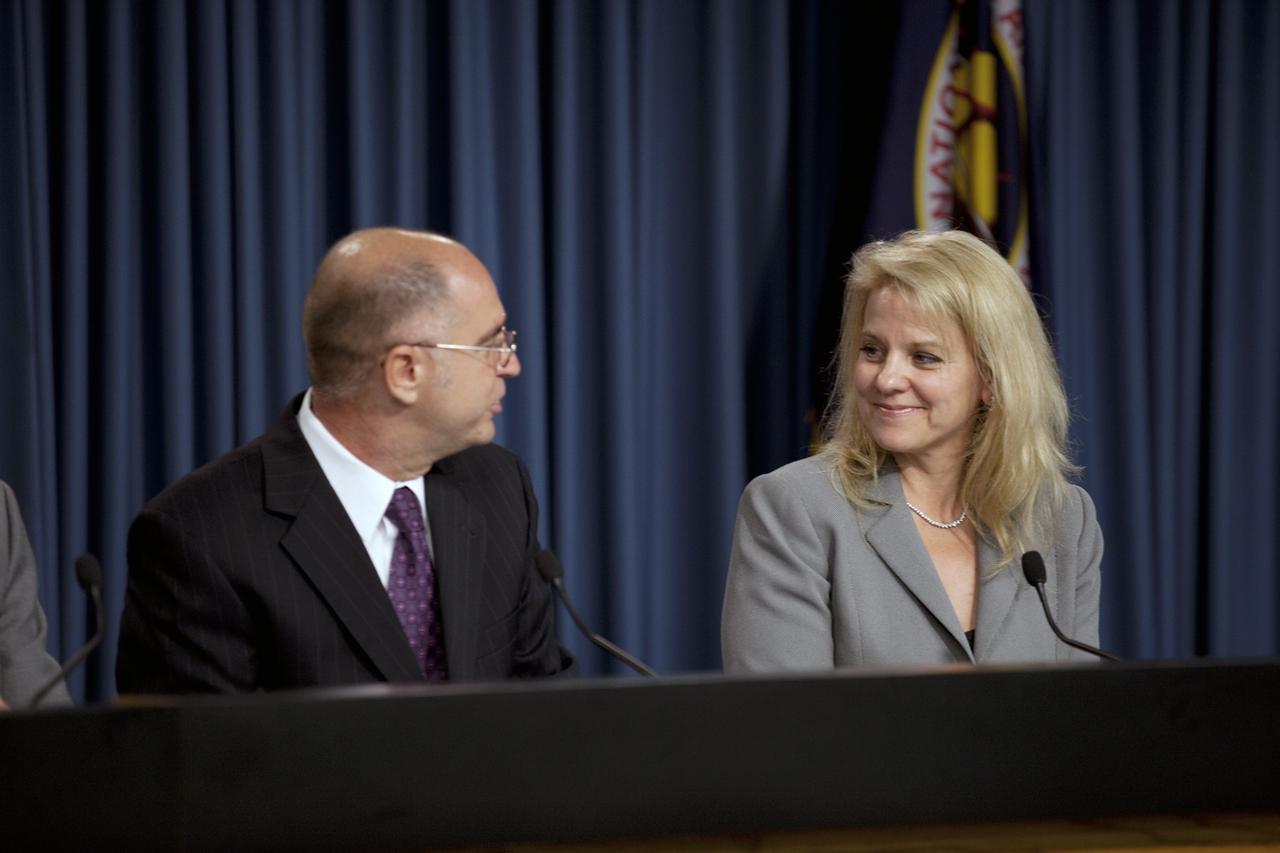
CAPE CANAVERAL, Fla. -- Sam Scimemi, at left, director of International Space Station at NASA Headquarters, congratulates Gwynne Shotwell, president of Space Exploration Technologies Corp., or SpaceX, on the successful launch of NASA's first Commercial Resupply Services, or CRS-1, mission to the International Space Station during a post-launch news conference held in the Press Site auditorium at NASA's Kennedy Space Center in Florida. SpaceX built both the Falcon 9 rocket and Dragon capsule that launched at 8:35 p.m. EDT from Space Launch Complex 40 on Cape Canaveral Air Force Station. SpaceX CRS-1 is an important step toward making America’s microgravity research program self-sufficient by providing a way to deliver and return significant amounts of cargo, including science experiments, to and from the orbiting laboratory. NASA has contracted for 12 commercial resupply flights from SpaceX and eight from the Orbital Sciences Corp. For more information, visit http://www.nasa.gov/mission_pages/station/living/launch/index.html. Photo credit: NASA/Kim Shiflett
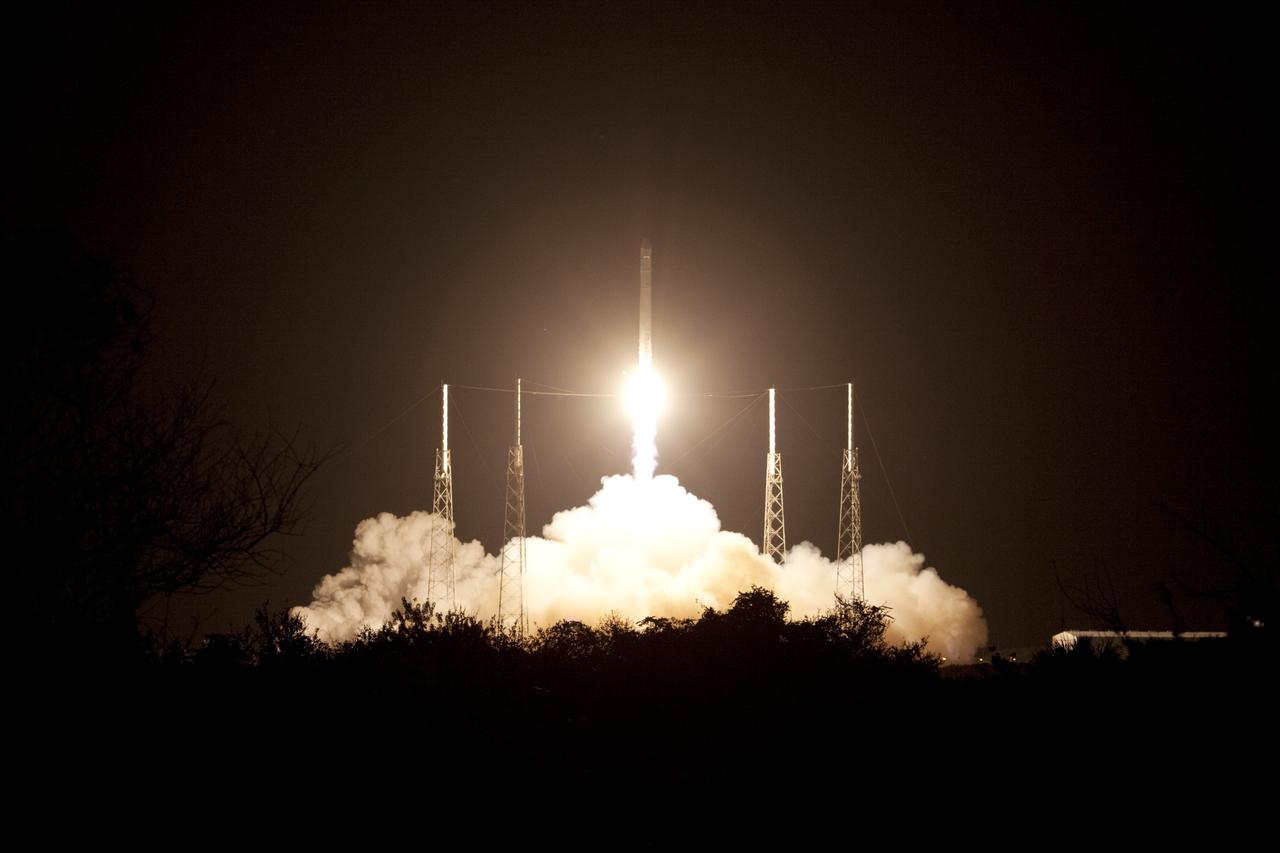
CAPE CANAVERAL, Fla. -- A Dragon capsule begins its journey to orbit atop a Falcon 9 rocket at 8:35 p.m. EDT from Space Launch Complex 40 on Cape Canaveral Air Force Station in Florida. Space Exploration Technologies Corp., or SpaceX, built both the rocket and capsule for NASA's first Commercial Resupply Services, or CRS-1, mission to the International Space Station. SpaceX CRS-1 is an important step toward making America’s microgravity research program self-sufficient by providing a way to deliver and return significant amounts of cargo, including science experiments, to and from the orbiting laboratory. NASA has contracted for 12 commercial resupply flights from SpaceX and eight from the Orbital Sciences Corp. For more information, visit http://www.nasa.gov/mission_pages/station/living/launch/index.html. Photo credit: NASA/Jim Grossmann
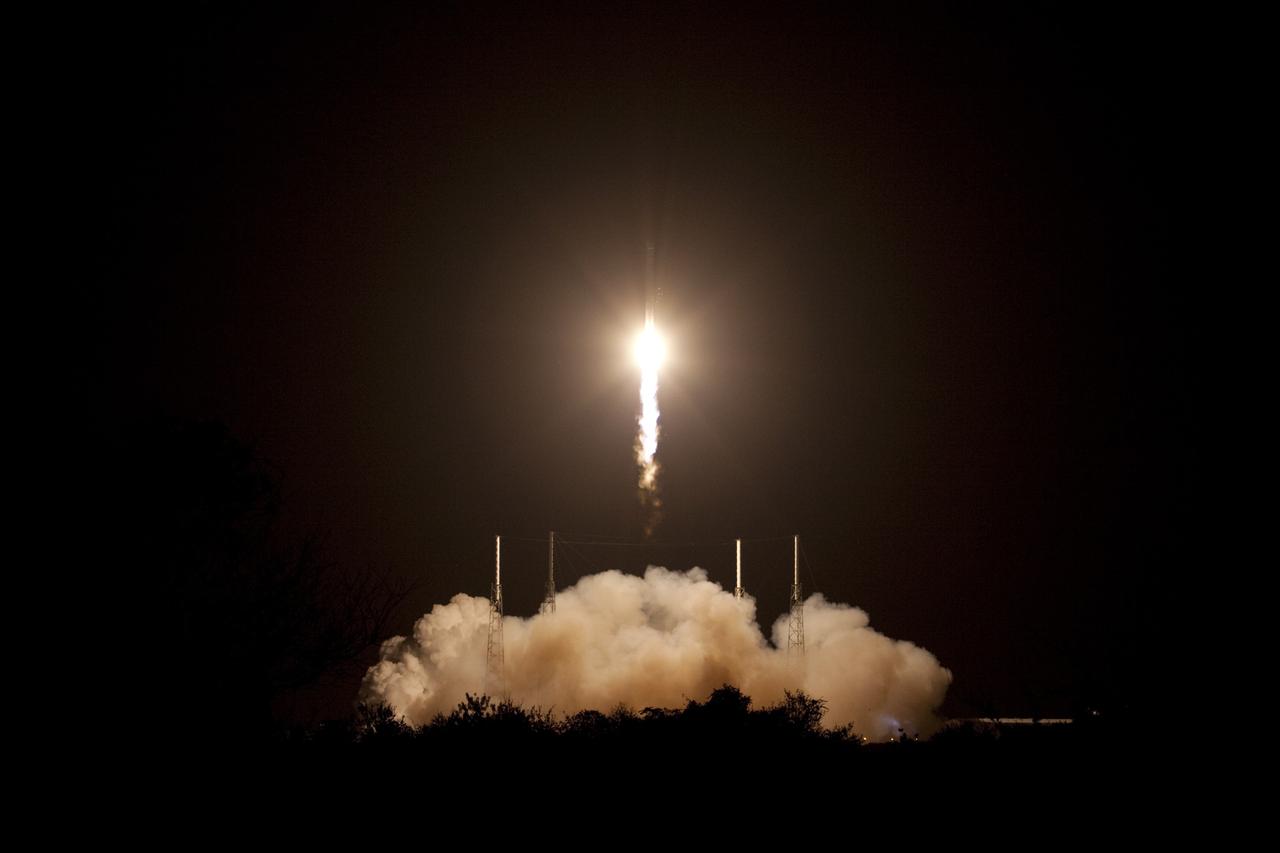
CAPE CANAVERAL, Fla. -- A Falcon 9 rocket makes its way into the night sky over Space Launch Complex 40 on Cape Canaveral Air Force Station in Florida carrying a Dragon capsule to orbit. Launch was at 8:35 p.m. EDT. Space Exploration Technologies Corp., or SpaceX, built both the rocket and capsule for NASA's first Commercial Resupply Services, or CRS-1, mission to the International Space Station. SpaceX CRS-1 is an important step toward making America’s microgravity research program self-sufficient by providing a way to deliver and return significant amounts of cargo, including science experiments, to and from the orbiting laboratory. NASA has contracted for 12 commercial resupply flights from SpaceX and eight from the Orbital Sciences Corp. For more information, visit http://www.nasa.gov/mission_pages/station/living/launch/index.html. Photo credit: NASA/Jim Grossmann
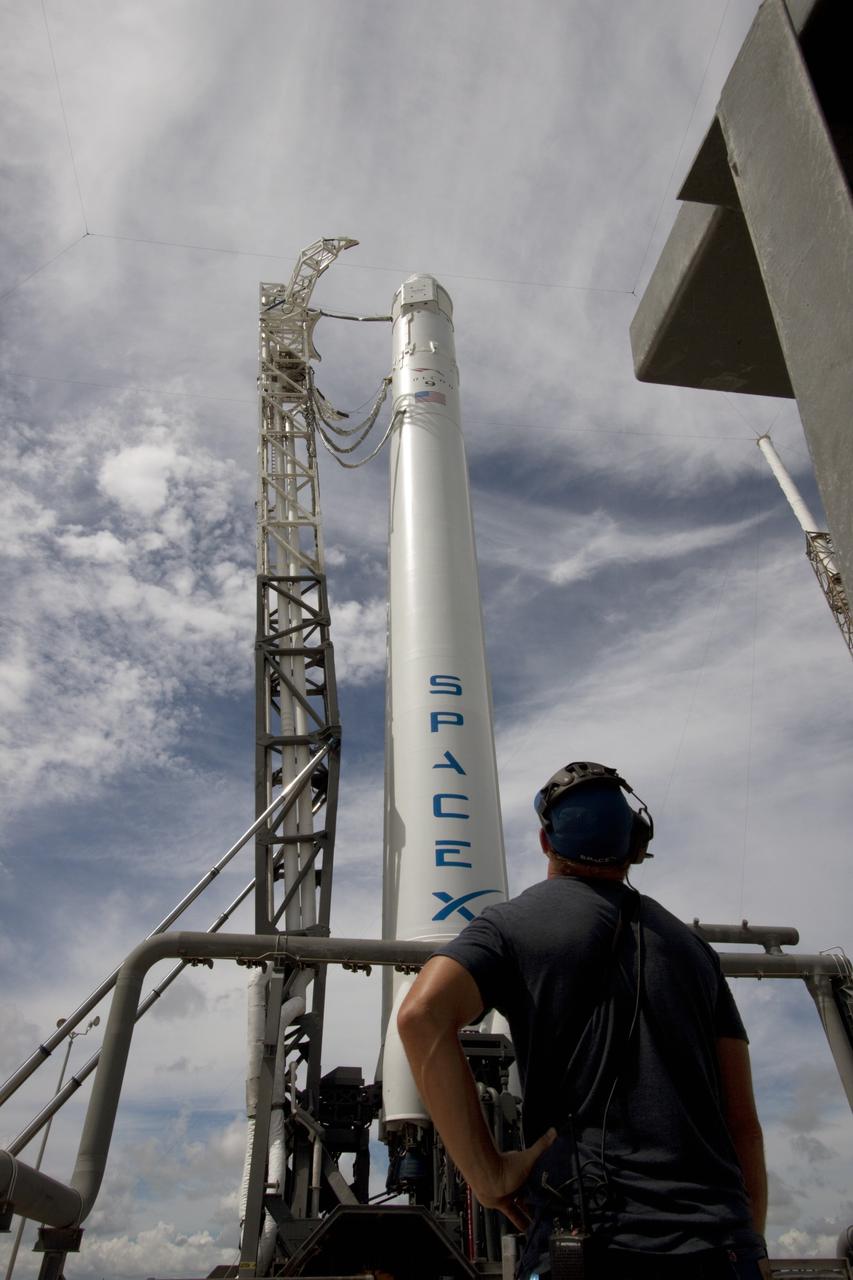
CAPE CANAVERAL, Fla. -- Umbilical lines are attached to a Falcon 9 rocket with a Dragon capsule secured atop on the pad at Space Launch Complex 40 on Cape Canaveral Air Force Station in Florida. Space Exploration Technologies Corp., or SpaceX, built both the rocket and capsule for NASA's first Commercial Resupply Services, or CRS-1, mission to the International Space Station. The vertical lift was complete at 1 p.m. EDT. SpaceX CRS-1 is an important step toward making America’s microgravity research program self-sufficient by providing a way to deliver and return significant amounts of cargo, including science experiments, to and from the orbiting laboratory. Launch is scheduled for 8:35 p.m. EDT on Oct. 7. NASA has contracted for 12 commercial resupply flights from SpaceX and eight from the Orbital Sciences Corp. For more information, visit http://www.nasa.gov/mission_pages/station/living/launch/index.html. Photo credit: NASA/Jim Grossmann
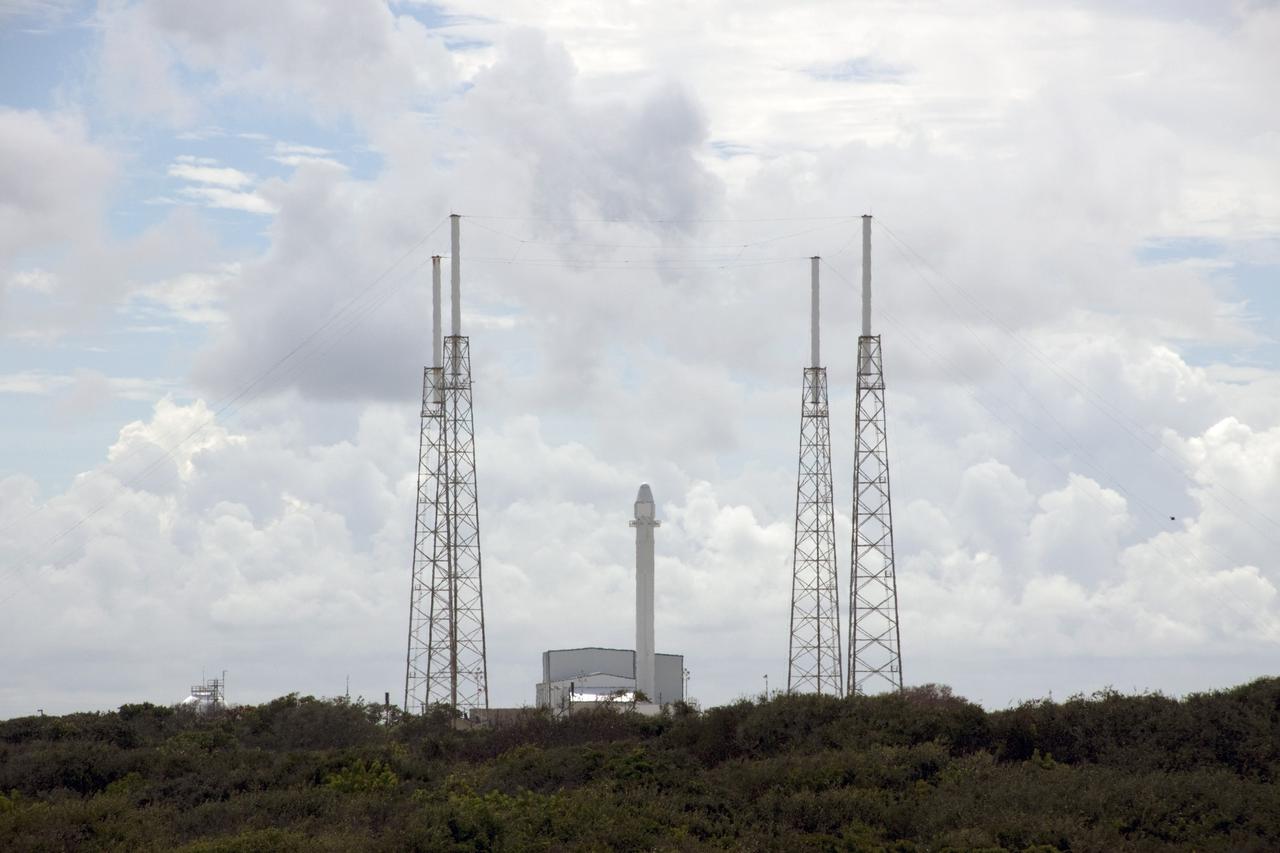
CAPE CANAVERAL, Fla. -- A Falcon 9 rocket with a Dragon capsule secured atop stands upright between the lightning masts on the pad at Space Launch Complex 40 on Cape Canaveral Air Force Station in Florida. Preparations are under way to fuel the rocket for launch. Space Exploration Technologies Corp., or SpaceX, built both the rocket and capsule for NASA's first Commercial Resupply Services, or CRS-1, mission to the International Space Station. The vertical lift was complete at 1 p.m. EDT. SpaceX CRS-1 is an important step toward making America’s microgravity research program self-sufficient by providing a way to deliver and return significant amounts of cargo, including science experiments, to and from the orbiting laboratory. Launch is scheduled for 8:35 p.m. EDT on Oct. 7. NASA has contracted for 12 commercial resupply flights from SpaceX and eight from the Orbital Sciences Corp. For more information, visit http://www.nasa.gov/mission_pages/station/living/launch/index.html. Photo credit: NASA/Jim Grossmann
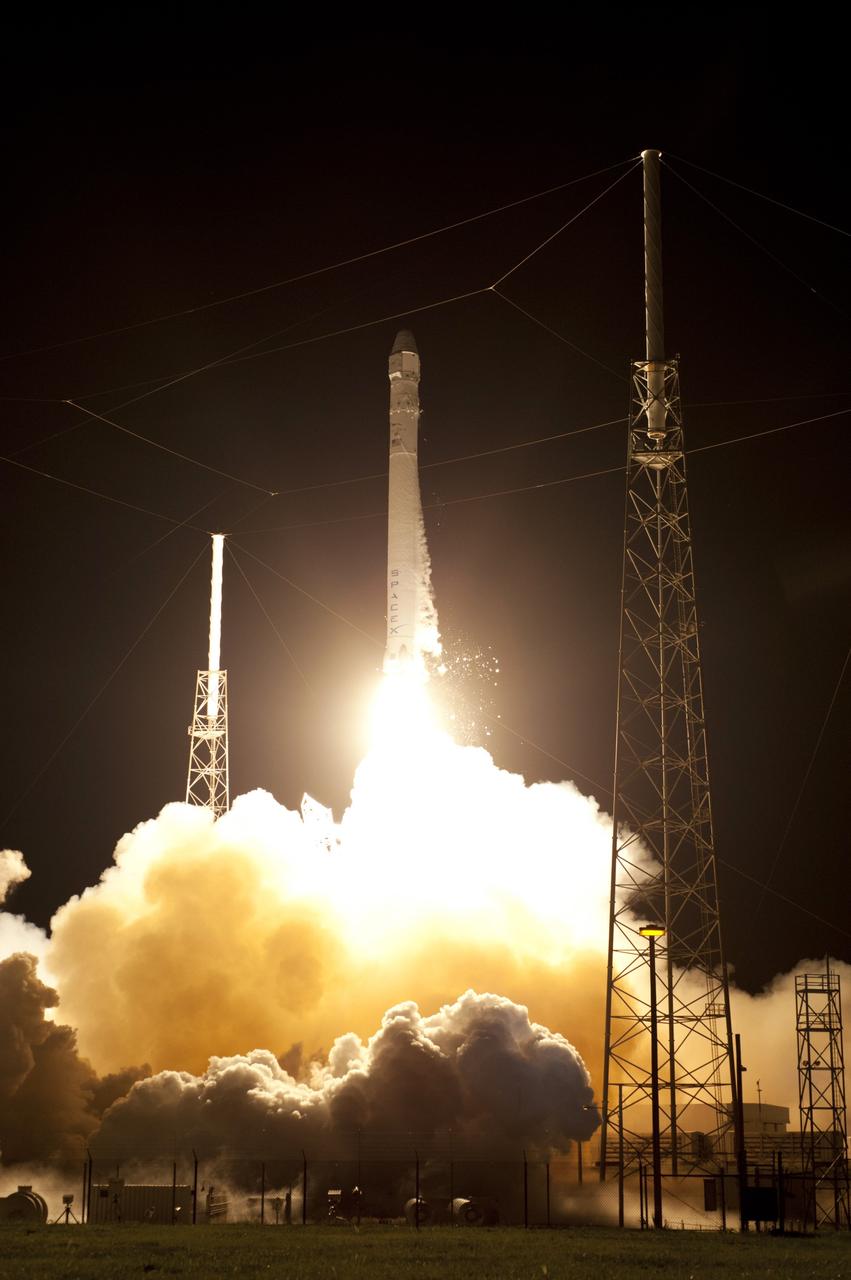
CAPE CANAVERAL, Fla. - Space Launch Complex 40 on Cape Canaveral Air Force Station in Florida comes alive as the Merlin engines ignite under the Falcon 9 rocket carrying a Dragon capsule to orbit. Liftoff was at 8:35 p.m. EDT. Space Exploration Technologies Corp., or SpaceX, built both the rocket and capsule for NASA's first Commercial Resupply Services, or CRS-1, mission to the International Space Station. SpaceX CRS-1 is an important step toward making America’s microgravity research program self-sufficient by providing a way to deliver and return significant amounts of cargo, including science experiments, to and from the orbiting laboratory. NASA has contracted for 12 commercial resupply flights from SpaceX and eight from the Orbital Sciences Corp. For more information, visit http://www.nasa.gov/mission_pages/station/living/launch/index.html Photo credit: NASA/Rick Wetherington and Tony Gray
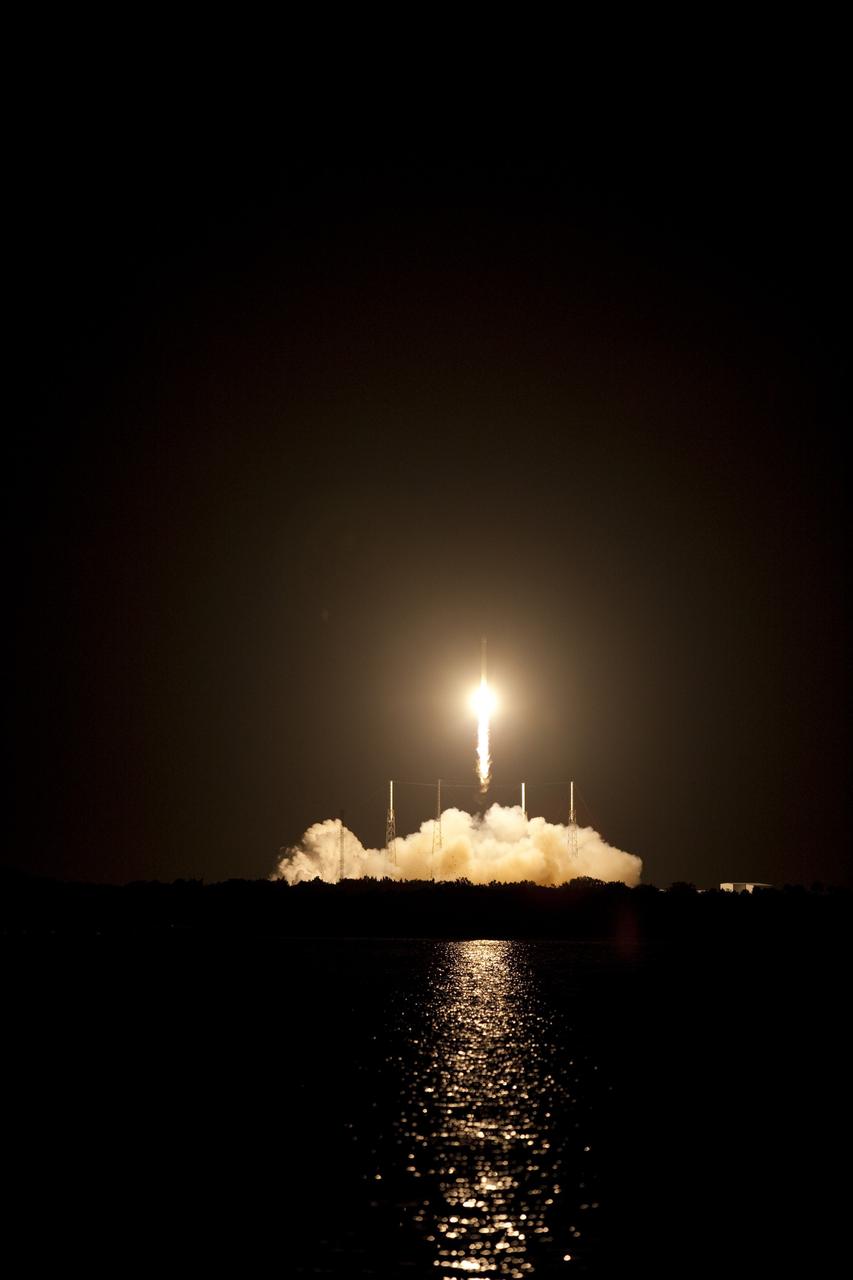
CAPE CANAVERAL, Fla. -- Plumes of exhaust and smoke billow around the lightning masts on Space Launch Complex 40 on Cape Canaveral Air Force Station in Florida as a Falcon 9 rocket lifts off at 8:35 p.m. EDT, carrying a Dragon capsule to orbit. Space Exploration Technologies Corp., or SpaceX, built both the rocket and capsule for NASA's first Commercial Resupply Services, or CRS-1, mission to the International Space Station. SpaceX CRS-1 is an important step toward making America’s microgravity research program self-sufficient by providing a way to deliver and return significant amounts of cargo, including science experiments, to and from the orbiting laboratory. NASA has contracted for 12 commercial resupply flights from SpaceX and eight from the Orbital Sciences Corp. For more information, visit http://www.nasa.gov/mission_pages/station/living/launch/index.html. Photo credit: NASA/Glenn Benson
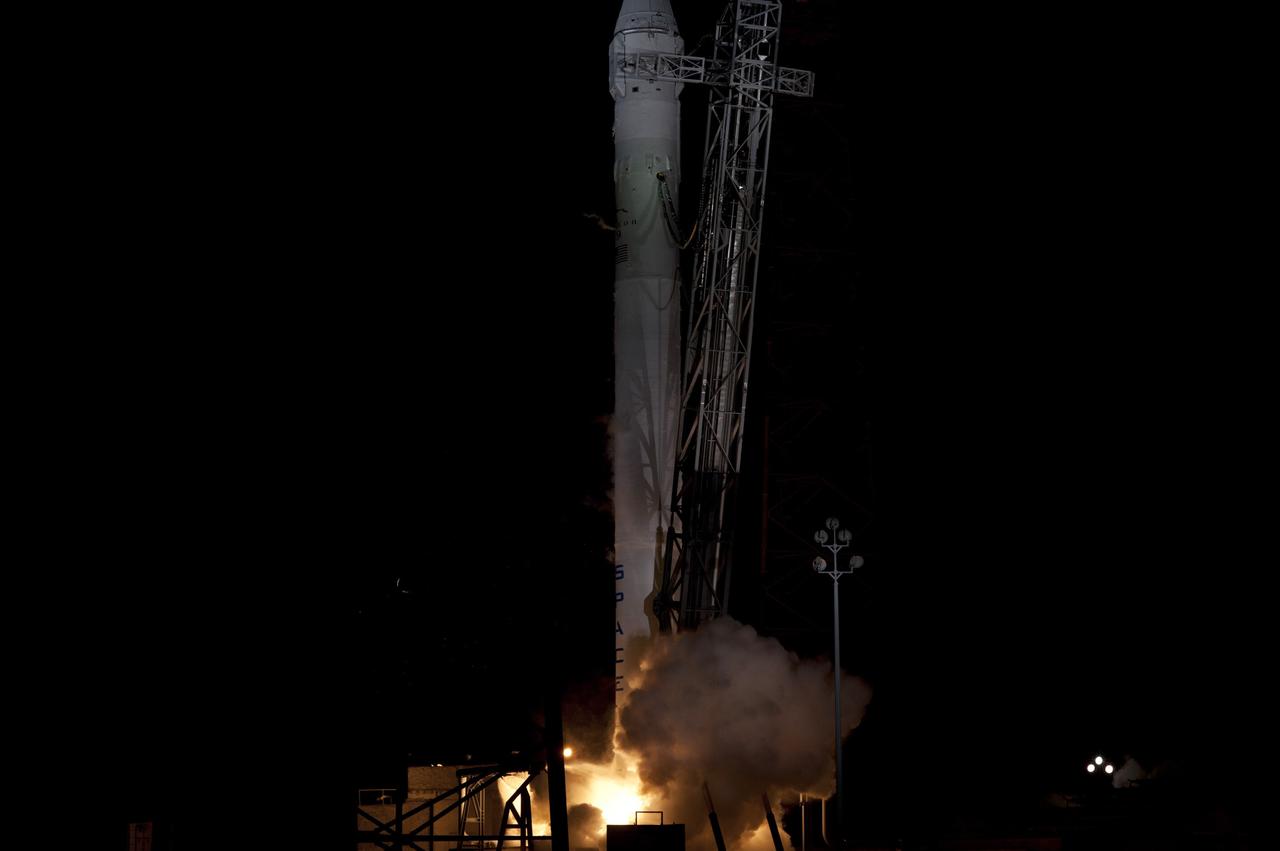
CAPE CANAVERAL, Fla. - Space Launch Complex 40 on Cape Canaveral Air Force Station in Florida comes alive as the Merlin engines ignite under the Falcon 9 rocket carrying a Dragon capsule to orbit. Liftoff was at 8:35 p.m. EDT. Space Exploration Technologies Corp., or SpaceX, built both the rocket and capsule for NASA's first Commercial Resupply Services, or CRS-1, mission to the International Space Station. SpaceX CRS-1 is an important step toward making America’s microgravity research program self-sufficient by providing a way to deliver and return significant amounts of cargo, including science experiments, to and from the orbiting laboratory. NASA has contracted for 12 commercial resupply flights from SpaceX and eight from the Orbital Sciences Corp. For more information, visit http://www.nasa.gov/mission_pages/station/living/launch/index.html Photo credit: NASA/Rusty Backer
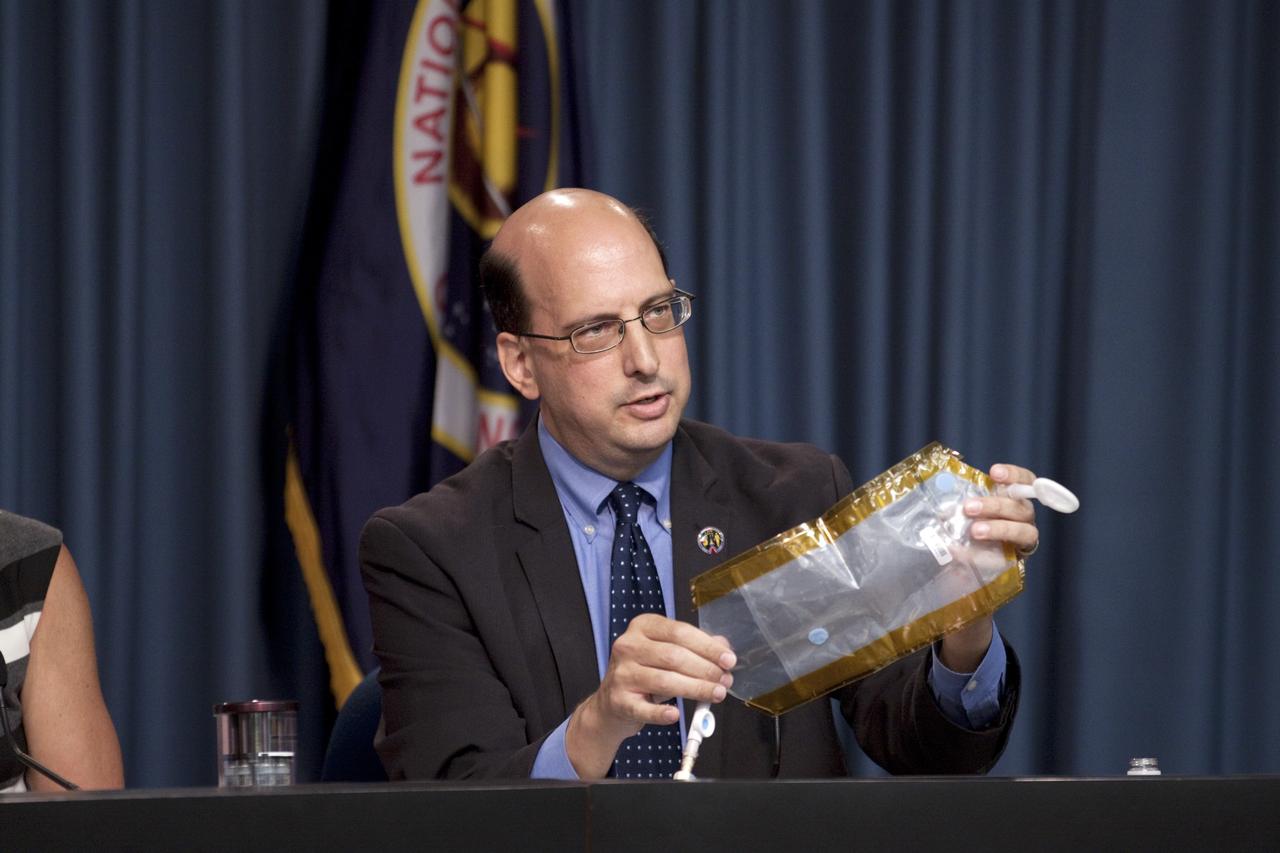
CAPE CANAVERAL, Fla. -- Scott Smith, NASA nutritionist at NASA's Johnson Space Center, explains one method of urine collection on the space station during a mission science briefing in Kennedy Space Center's Press Site auditorium in Florida. The briefing provided media with an overview of the experiments and payloads scheduled for launch on NASA's first Commercial Resupply Services, or CRS-1, mission to the International Space Station. Space Exploration Technologies Corp., or SpaceX, built both the mission's Falcon 9 rocket and Dragon capsule. Launch is scheduled for 8:35 p.m. EDT on Oct. 7 from Space Launch Complex 40 on Cape Canaveral Air Force Station. SpaceX CRS-1 is an important step toward making America’s microgravity research program self-sufficient by providing a way to deliver and return significant amounts of cargo, including science experiments, to and from the orbiting laboratory. NASA has contracted for 12 commercial resupply flights from SpaceX and eight from the Orbital Sciences Corp. For more information, visit http://www.nasa.gov/mission_pages/station/living/launch/index.html. Photo credit: NASA/Kim Shiflett
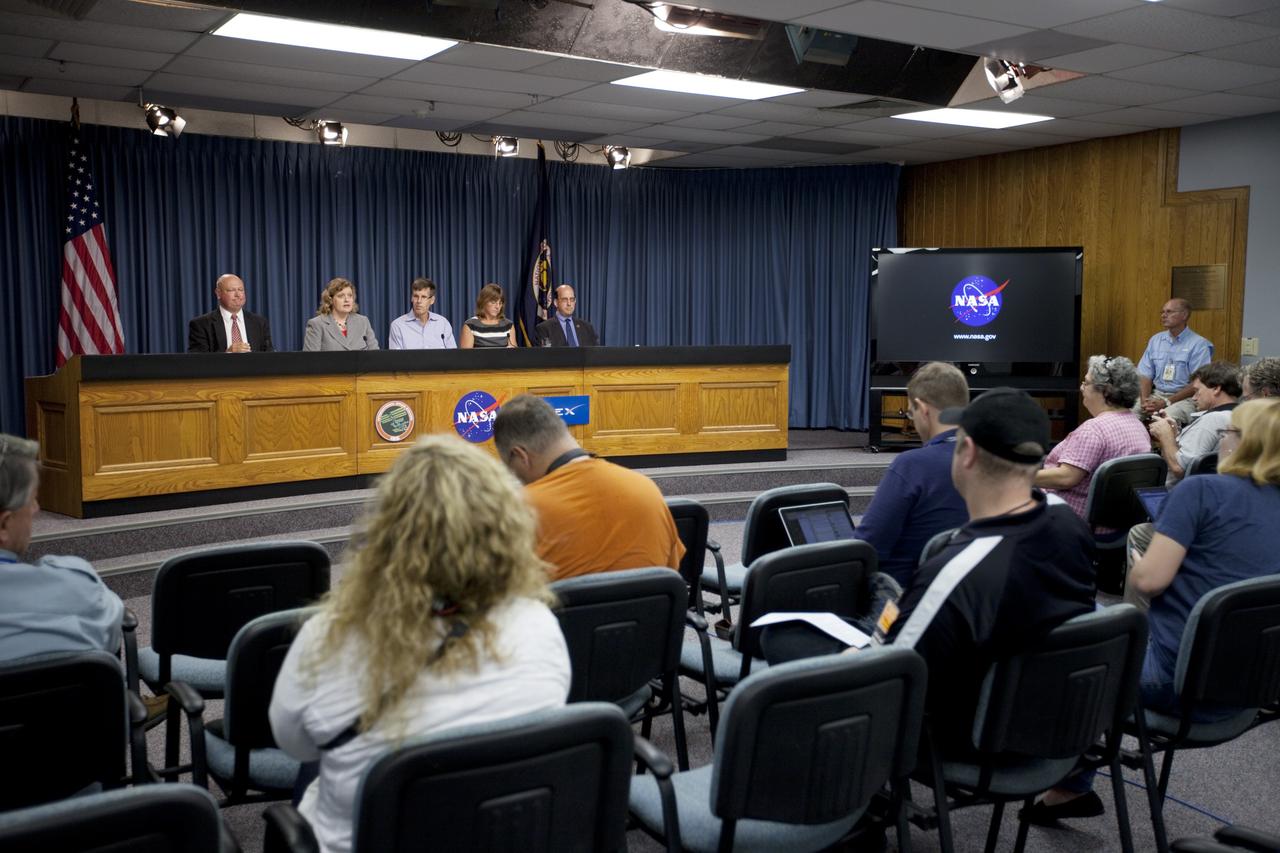
CAPE CANAVERAL, Fla. -- News and social media representatives participate in a space station and mission science briefing in NASA Kennedy Space Center's Press Site auditorium in Florida. On the dais from left are Michael Curie, NASA Public Affairs, Julie Robinson, program scientist for International Space Station at NASA's Johnson Space Center, Timothy Yeatman, interim chief scientist at the Center for the Advancement of Science in Space, Sheila Nielsen-Preiss, cell biologist at Montana State University, and Scott Smith, NASA nutritionist at NASA's Johnson Space Center. The briefing provided media with an overview of the experiments and payloads scheduled for launch on NASA's first Commercial Resupply Services, or CRS-1, mission to the International Space Station. Space Exploration Technologies Corp., or SpaceX, built both the mission's Falcon 9 rocket and Dragon capsule. Launch is scheduled for 8:35 p.m. EDT on Oct. 7 from Space Launch Complex 40 on Cape Canaveral Air Force Station. SpaceX CRS-1 is an important step toward making America’s microgravity research program self-sufficient by providing a way to deliver and return significant amounts of cargo, including science experiments, to and from the orbiting laboratory. NASA has contracted for 12 commercial resupply flights from SpaceX and eight from the Orbital Sciences Corp. For more information, visit http://www.nasa.gov/mission_pages/station/living/launch/index.html. Photo credit: NASA/Kim Shiflett
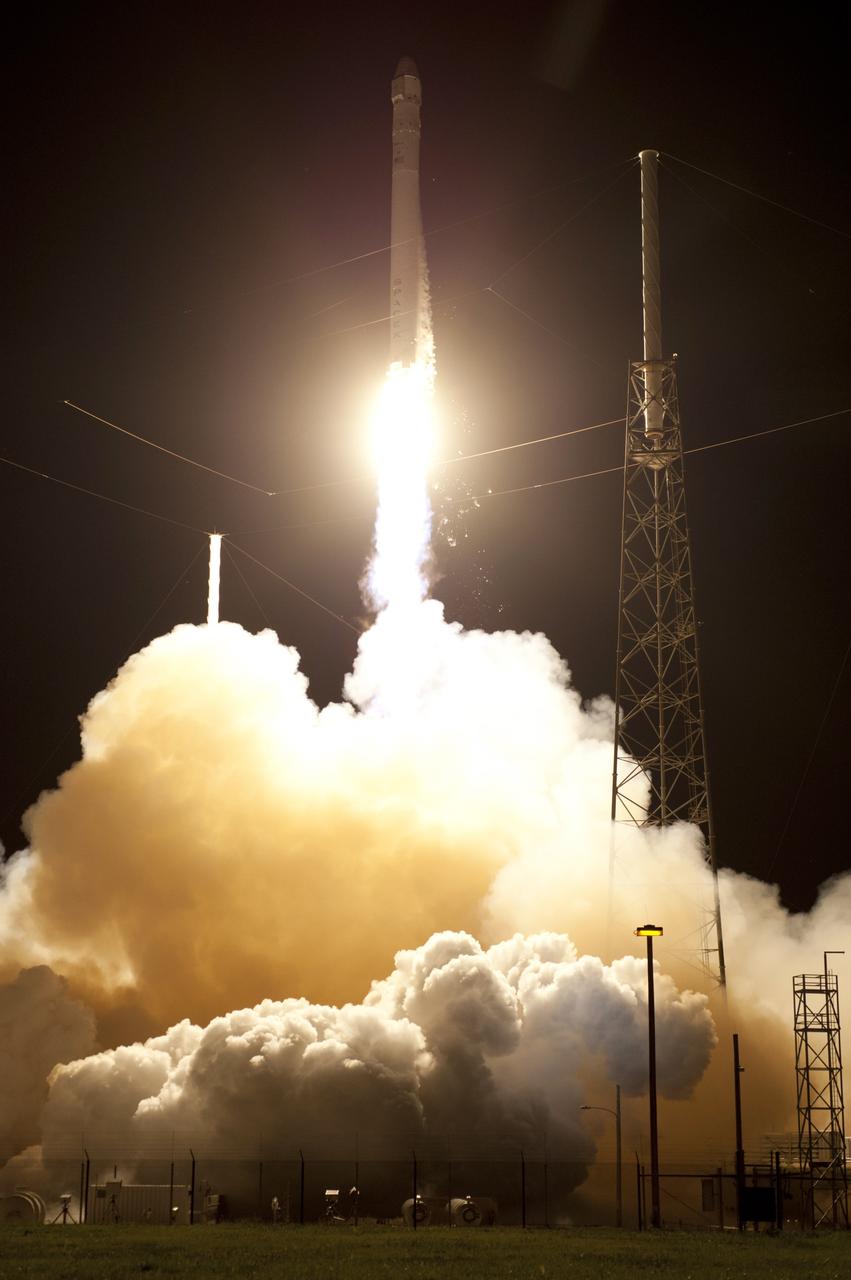
CAPE CANAVERAL, Fla. - Space Launch Complex 40 on Cape Canaveral Air Force Station in Florida comes alive as the Merlin engines ignite under the Falcon 9 rocket carrying a Dragon capsule to orbit. Liftoff was at 8:35 p.m. EDT. Space Exploration Technologies Corp., or SpaceX, built both the rocket and capsule for NASA's first Commercial Resupply Services, or CRS-1, mission to the International Space Station. SpaceX CRS-1 is an important step toward making America’s microgravity research program self-sufficient by providing a way to deliver and return significant amounts of cargo, including science experiments, to and from the orbiting laboratory. NASA has contracted for 12 commercial resupply flights from SpaceX and eight from the Orbital Sciences Corp. For more information, visit http://www.nasa.gov/mission_pages/station/living/launch/index.html Photo credit: NASA/Rick Wetherington and Tony Gray
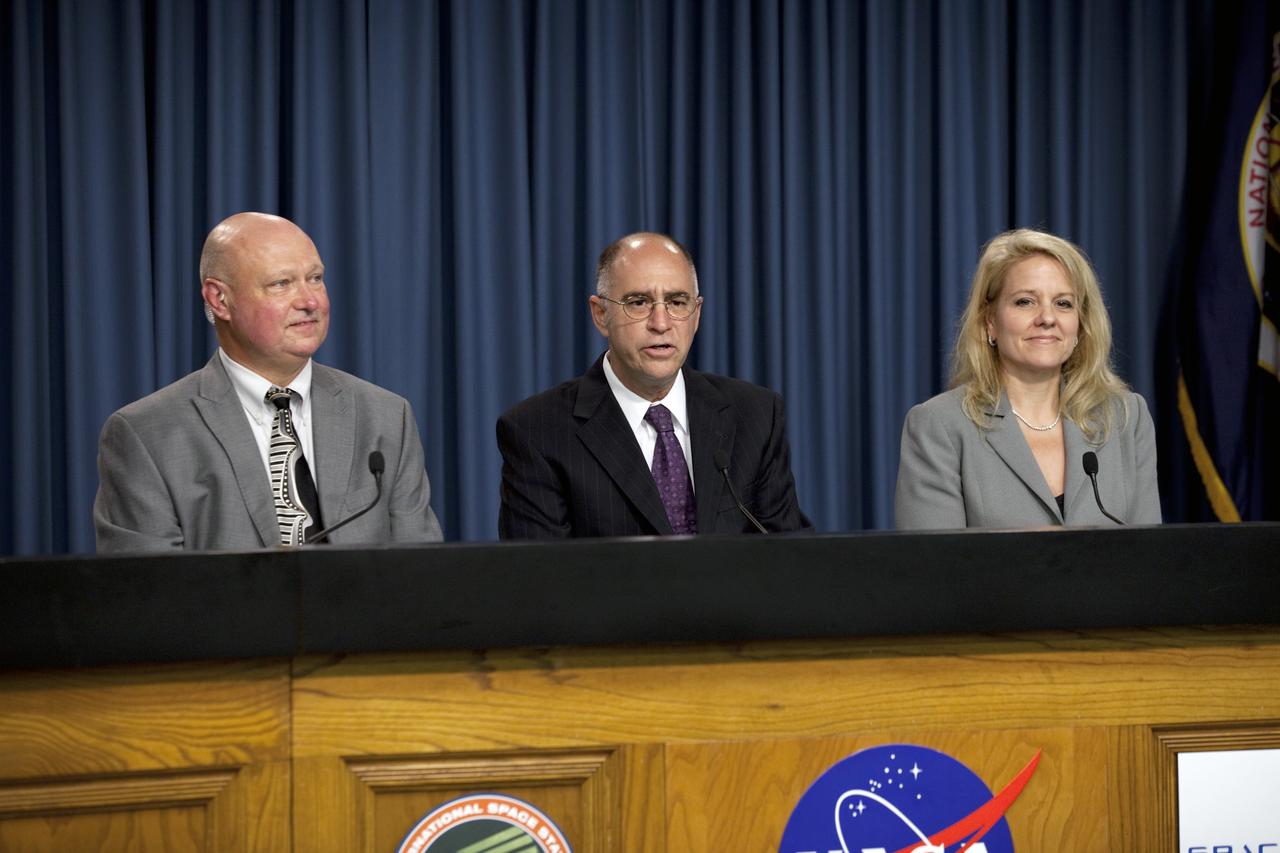
CAPE CANAVERAL, Fla. -- Sam Scimemi, director of International Space Station at NASA Headquarters, addresses news and social media representatives during a post-launch news conference in the Press Site auditorium at NASA's Kennedy Space Center in Florida following the successful launch of NASA's first Commercial Resupply Services, or CRS-1, mission to the International Space Station. Also participating in the conference are Michael Curie, at left, NASA Public Affairs, and Gwynne Shotwell, at right, president of Space Exploration Technologies Corp., or SpaceX. SpaceX built both the Falcon 9 rocket and Dragon capsule that launched at 8:35 p.m. EDT from Space Launch Complex 40 on Cape Canaveral Air Force Station. SpaceX CRS-1 is an important step toward making America’s microgravity research program self-sufficient by providing a way to deliver and return significant amounts of cargo, including science experiments, to and from the orbiting laboratory. NASA has contracted for 12 commercial resupply flights from SpaceX and eight from the Orbital Sciences Corp. For more information, visit http://www.nasa.gov/mission_pages/station/living/launch/index.html. Photo credit: NASA/Kim Shiflett
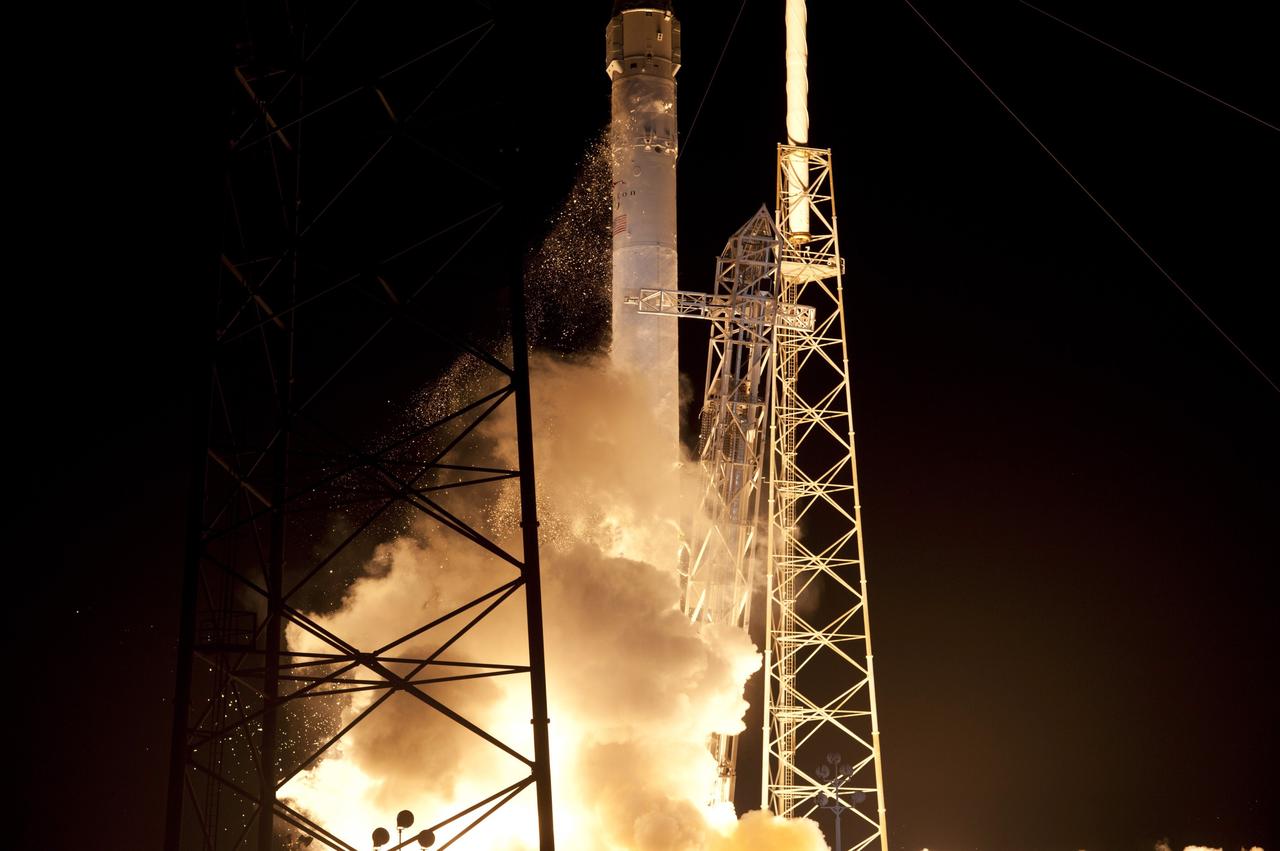
CAPE CANAVERAL, Fla. - Space Launch Complex 40 on Cape Canaveral Air Force Station in Florida comes alive as the Merlin engines ignite under the Falcon 9 rocket carrying a Dragon capsule to orbit. Liftoff was at 8:35 p.m. EDT. Space Exploration Technologies Corp., or SpaceX, built both the rocket and capsule for NASA's first Commercial Resupply Services, or CRS-1, mission to the International Space Station. SpaceX CRS-1 is an important step toward making America’s microgravity research program self-sufficient by providing a way to deliver and return significant amounts of cargo, including science experiments, to and from the orbiting laboratory. NASA has contracted for 12 commercial resupply flights from SpaceX and eight from the Orbital Sciences Corp. For more information, visit http://www.nasa.gov/mission_pages/station/living/launch/index.html Photo credit: NASA/Rusty Backer
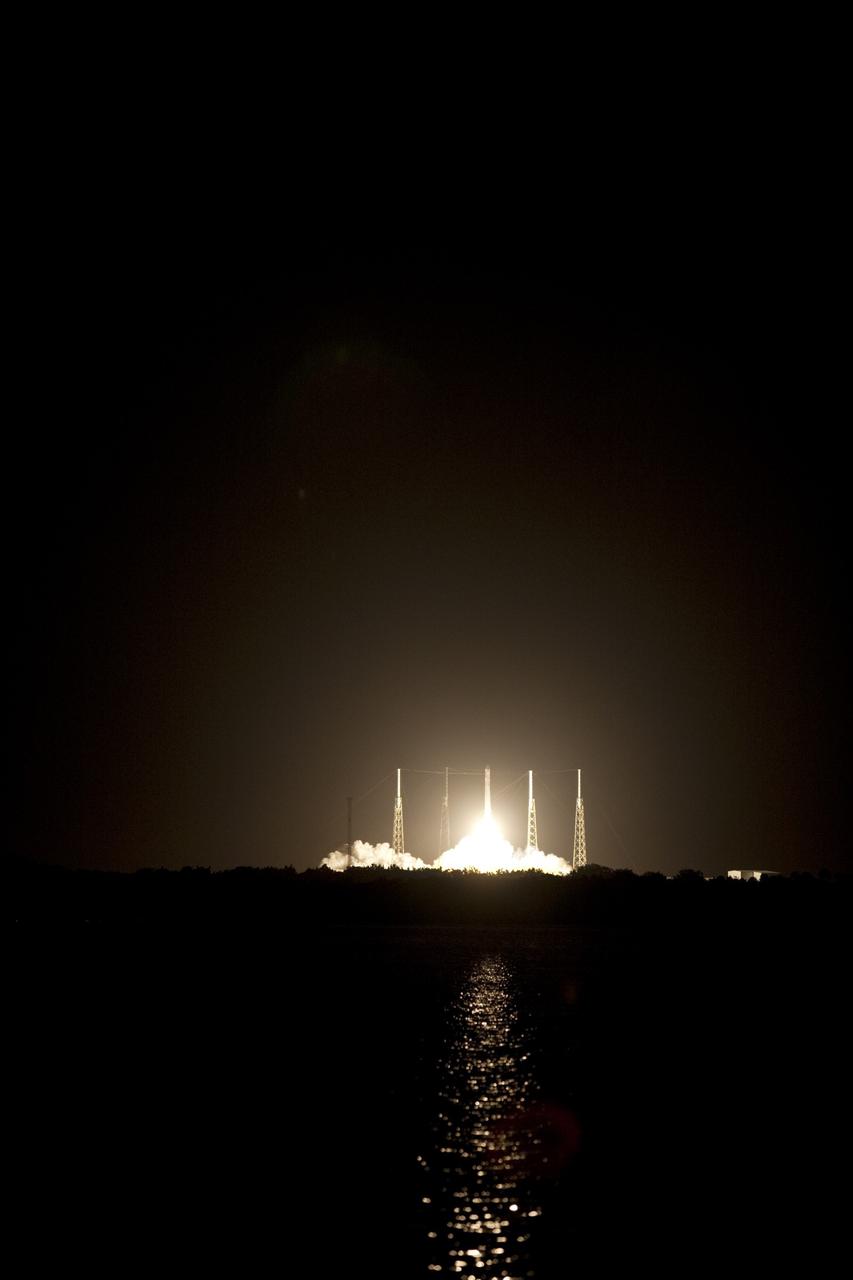
CAPE CANAVERAL, Fla. -- A rumble is heard across the Space Coast as a Falcon 9 rocket lifts off Space Launch Complex 40 on Cape Canaveral Air Force Station in Florida at 8:35 p.m. EDT, carrying a Dragon capsule to orbit. Space Exploration Technologies Corp., or SpaceX, built both the rocket and capsule for NASA's first Commercial Resupply Services, or CRS-1, mission to the International Space Station. SpaceX CRS-1 is an important step toward making America’s microgravity research program self-sufficient by providing a way to deliver and return significant amounts of cargo, including science experiments, to and from the orbiting laboratory. NASA has contracted for 12 commercial resupply flights from SpaceX and eight from the Orbital Sciences Corp. For more information, visit http://www.nasa.gov/mission_pages/station/living/launch/index.html. Photo credit: NASA/Glenn Benson
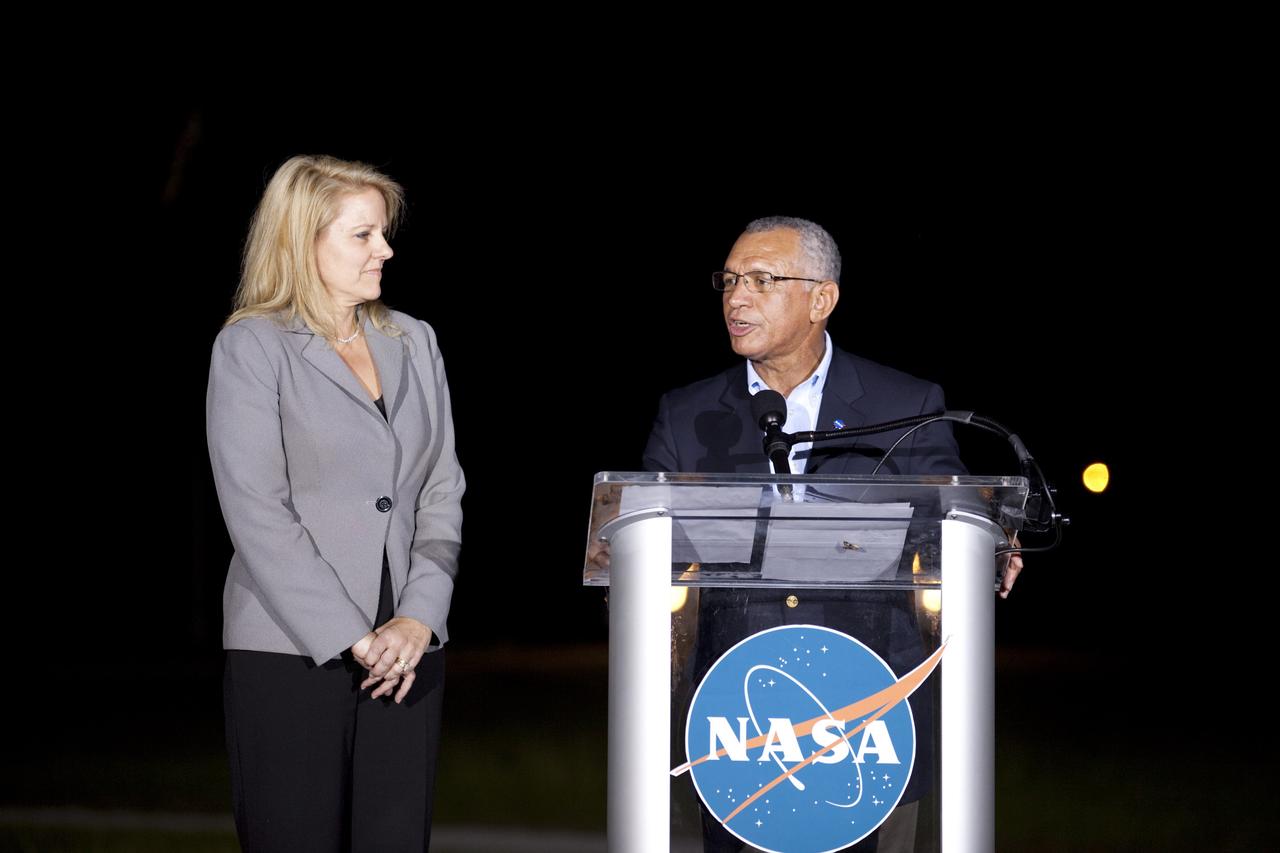
CAPE CANAVERAL, Fla. -- NASA Administrator Charlie Bolden addresses news and social media representatives at the Press Site at NASA's Kennedy Space Center in Florida following the successful launch of NASA's first Commercial Resupply Services, or CRS-1, mission to the International Space Station. Beside him on the podium is Gwynne Shotwell, president of Space Exploration Technologies Corp., or SpaceX. SpaceX built both the Falcon 9 rocket and Dragon capsule that launched at 8:35 p.m. EDT from Space Launch Complex 40 on Cape Canaveral Air Force Station. SpaceX CRS-1 is an important step toward making America’s microgravity research program self-sufficient by providing a way to deliver and return significant amounts of cargo, including science experiments, to and from the orbiting laboratory. NASA has contracted for 12 commercial resupply flights from SpaceX and eight from the Orbital Sciences Corp. For more information, visit http://www.nasa.gov/mission_pages/station/living/launch/index.html. Photo credit: NASA/Kim Shiflett
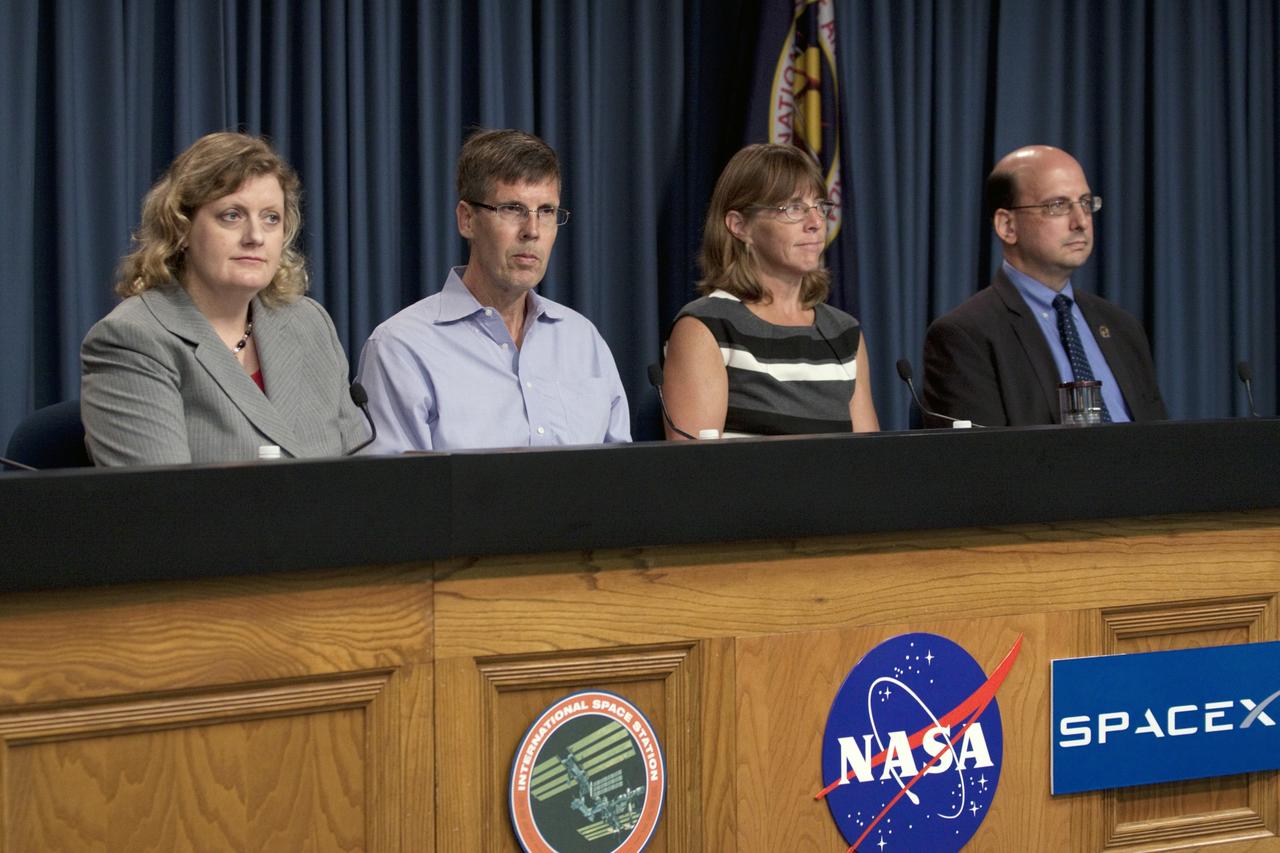
CAPE CANAVERAL, Fla. -- Scientists participate in a space station and mission science briefing in NASA Kennedy Space Center's Press Site auditorium in Florida. From left are Julie Robinson, program scientist for International Space Station at NASA's Johnson Space Center, Timothy Yeatman, interim chief scientist at the Center for the Advancement of Science in Space, Sheila Nielsen-Preiss, cell biologist at Montana State University, and Scott Smith, NASA nutritionist at NASA's Johnson Space Center. The briefing provided media with an overview of the experiments and payloads scheduled for launch on NASA's first Commercial Resupply Services, or CRS-1, mission to the International Space Station. Space Exploration Technologies Corp., or SpaceX, built both the mission's Falcon 9 rocket and Dragon capsule. Launch is scheduled for 8:35 p.m. EDT on Oct. 7 from Space Launch Complex 40 on Cape Canaveral Air Force Station. SpaceX CRS-1 is an important step toward making America’s microgravity research program self-sufficient by providing a way to deliver and return significant amounts of cargo, including science experiments, to and from the orbiting laboratory. NASA has contracted for 12 commercial resupply flights from SpaceX and eight from the Orbital Sciences Corp. For more information, visit http://www.nasa.gov/mission_pages/station/living/launch/index.html. Photo credit: NASA/Kim Shiflett
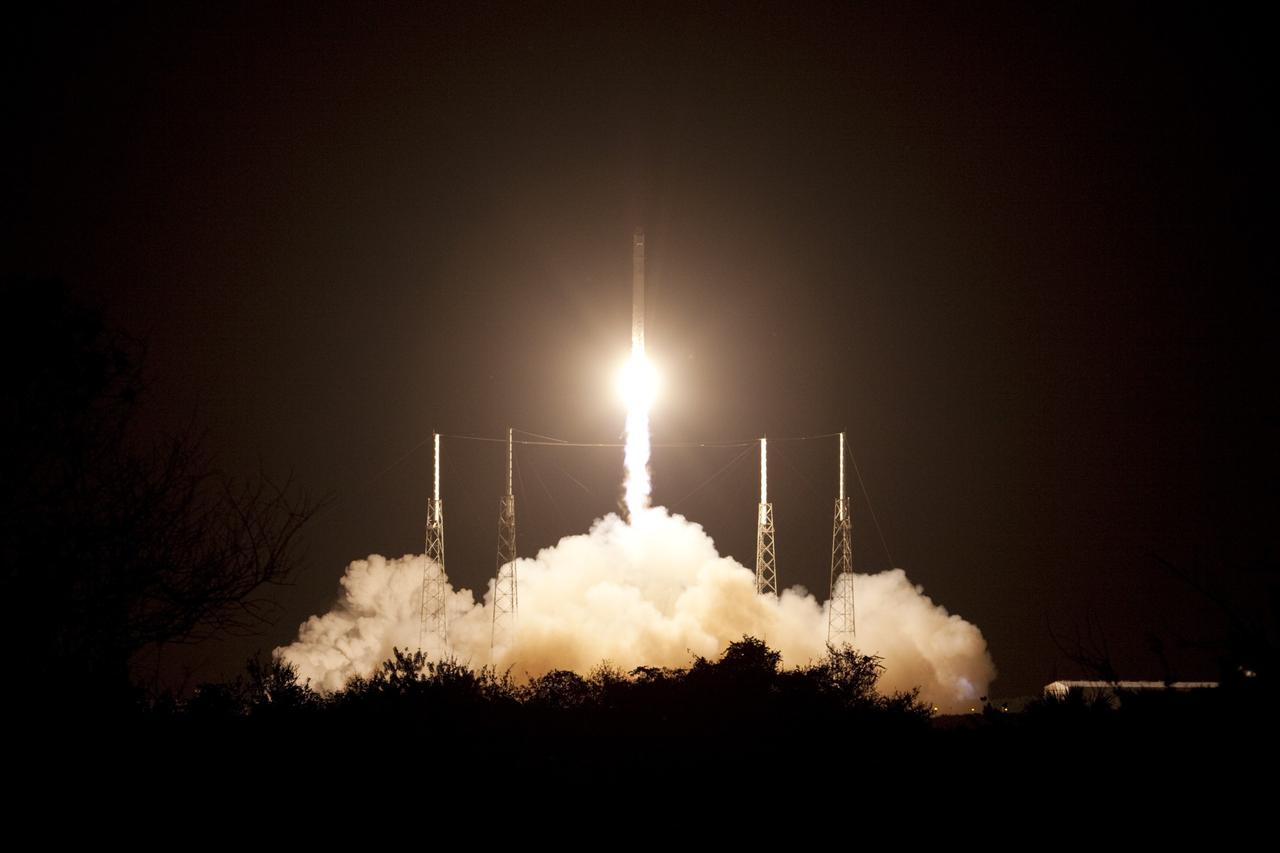
CAPE CANAVERAL, Fla. -- Space Launch Complex 40 on Cape Canaveral Air Force Station in Florida is illuminated by a Falcon 9 rocket as it lifts off at 8:35 p.m. EDT carrying a Dragon capsule to orbit. Space Exploration Technologies Corp., or SpaceX, built both the rocket and capsule for NASA's first Commercial Resupply Services, or CRS-1, mission to the International Space Station. SpaceX CRS-1 is an important step toward making America’s microgravity research program self-sufficient by providing a way to deliver and return significant amounts of cargo, including science experiments, to and from the orbiting laboratory. NASA has contracted for 12 commercial resupply flights from SpaceX and eight from the Orbital Sciences Corp. For more information, visit http://www.nasa.gov/mission_pages/station/living/launch/index.html. Photo credit: NASA/Jim Grossmann
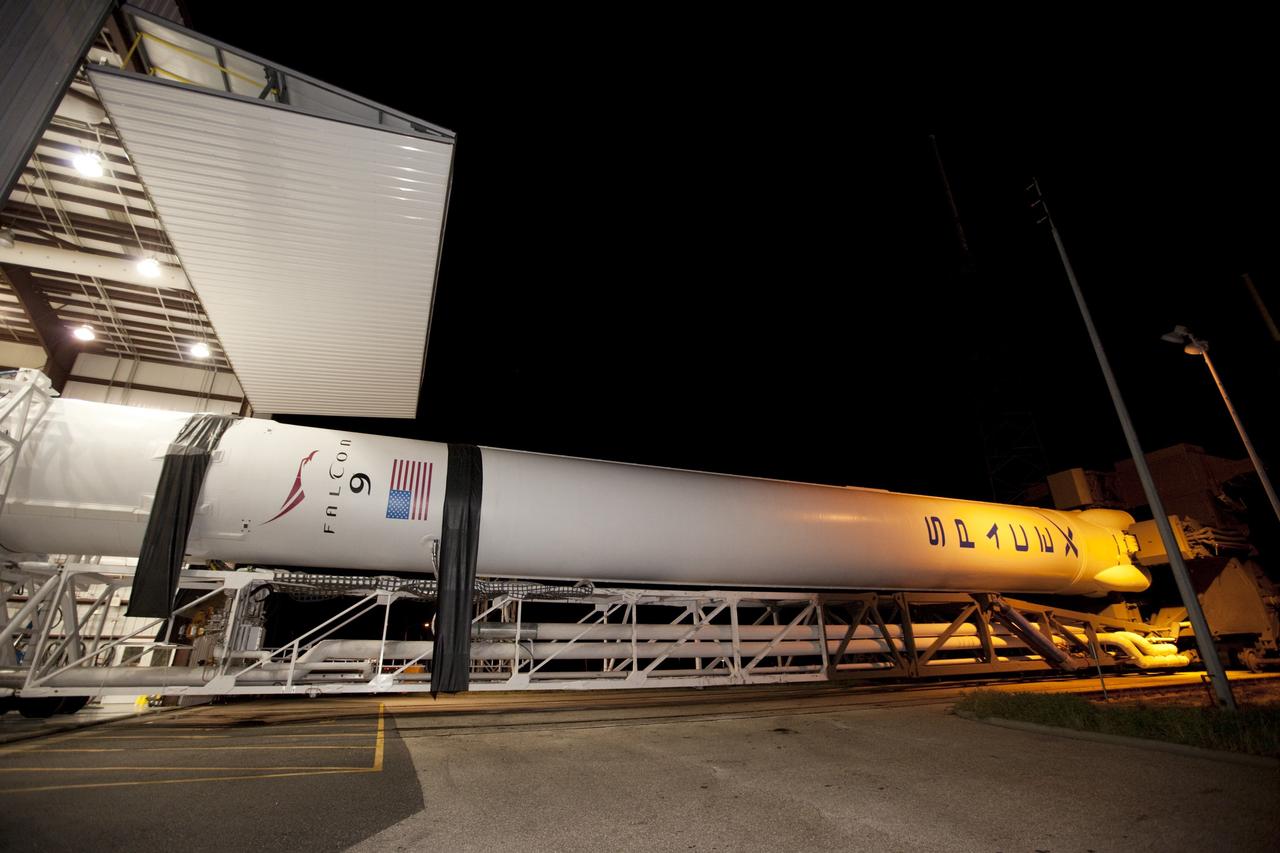
CAPE CANAVERAL, Fla. -- A Falcon 9 rocket with a Dragon capsule secured atop begins to roll from the processing hangar to the pad at Space Launch Complex 40 on Cape Canaveral Air Force Station in Florida. Space Exploration Technologies Corp., or SpaceX, built both the rocket and capsule for NASA's first Commercial Resupply Services, or CRS-1, mission to the International Space Station. Rollout was complete at 9:55 p.m. EDT. SpaceX CRS-1 is an important step toward making America’s microgravity research program self-sufficient by providing a way to deliver and return significant amounts of cargo, including science experiments, to and from the orbiting laboratory. Launch is scheduled for 8:35 p.m. EDT on Oct. 7. NASA has contracted for 12 commercial resupply flights from SpaceX and eight from the Orbital Sciences Corp. For more information, visit http://www.nasa.gov/mission_pages/station/living/launch/index.html. Photo credit: NASA/Kim Shiflett
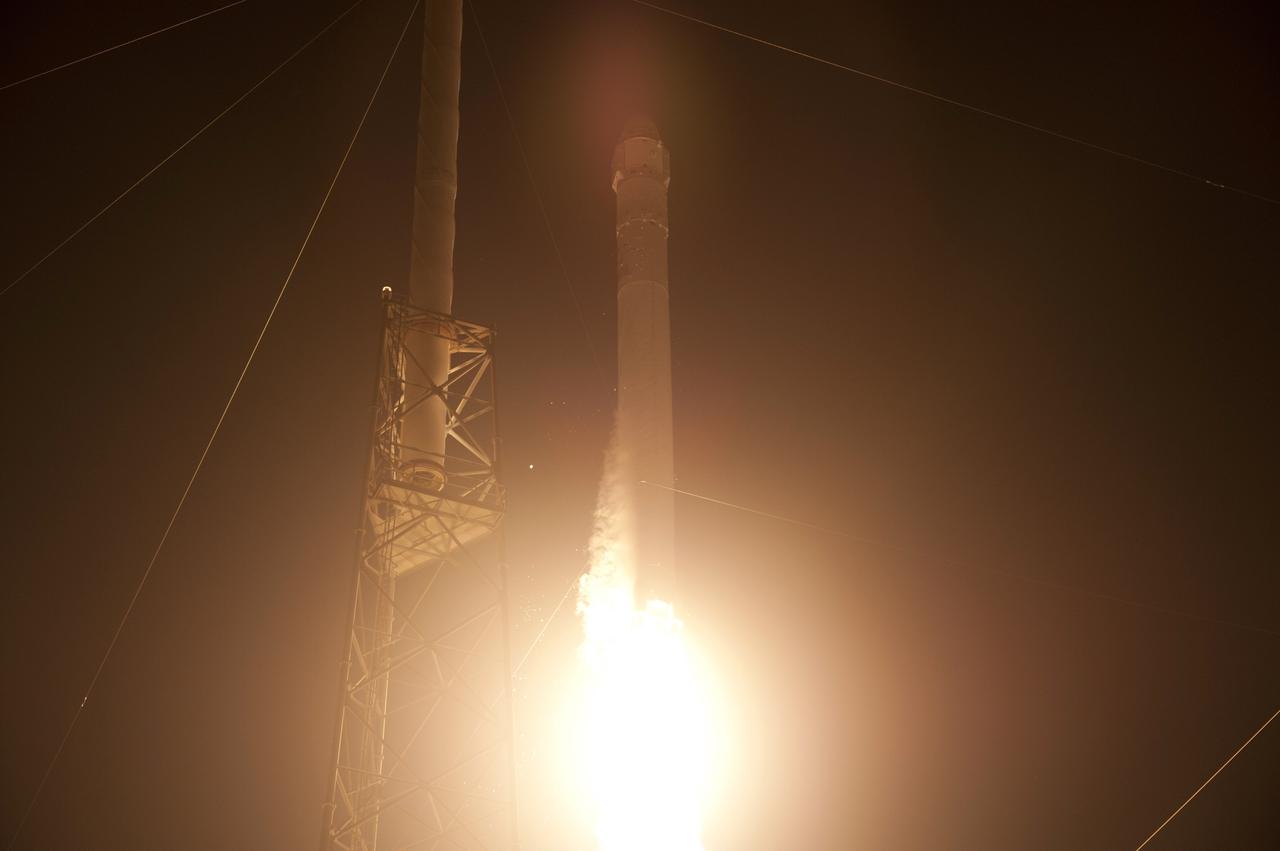
CAPE CANAVERAL, Fla. - Space Launch Complex 40 on Cape Canaveral Air Force Station in Florida comes alive as the Merlin engines ignite under the Falcon 9 rocket carrying a Dragon capsule to orbit. Liftoff was at 8:35 p.m. EDT. Space Exploration Technologies Corp., or SpaceX, built both the rocket and capsule for NASA's first Commercial Resupply Services, or CRS-1, mission to the International Space Station. SpaceX CRS-1 is an important step toward making America’s microgravity research program self-sufficient by providing a way to deliver and return significant amounts of cargo, including science experiments, to and from the orbiting laboratory. NASA has contracted for 12 commercial resupply flights from SpaceX and eight from the Orbital Sciences Corp. For more information, visit http://www.nasa.gov/mission_pages/station/living/launch/index.html Photo credit: NASA/Rusty Backer
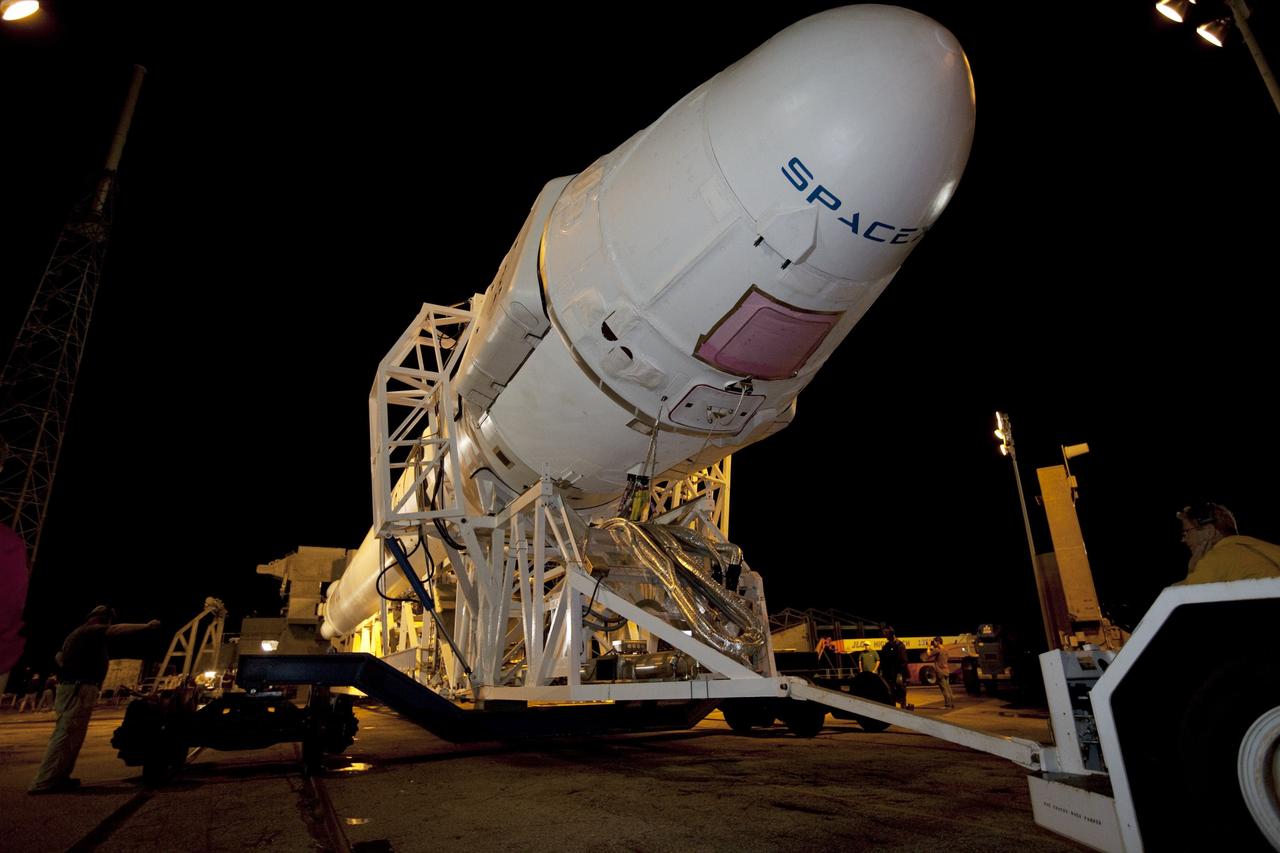
CAPE CANAVERAL, Fla. -- A Falcon 9 rocket with a Dragon capsule secured atop makes slow, steady progress as it rolls from the processing hangar to the pad at Space Launch Complex 40 on Cape Canaveral Air Force Station in Florida. Space Exploration Technologies Corp., or SpaceX, built both the rocket and capsule for NASA's first Commercial Resupply Services, or CRS-1, mission to the International Space Station. Rollout was complete at 9:55 p.m. EDT. SpaceX CRS-1 is an important step toward making America’s microgravity research program self-sufficient by providing a way to deliver and return significant amounts of cargo, including science experiments, to and from the orbiting laboratory. Launch is scheduled for 8:35 p.m. EDT on Oct. 7. NASA has contracted for 12 commercial resupply flights from SpaceX and eight from the Orbital Sciences Corp. For more information, visit http://www.nasa.gov/mission_pages/station/living/launch/index.html. Photo credit: NASA/Kim Shiflett
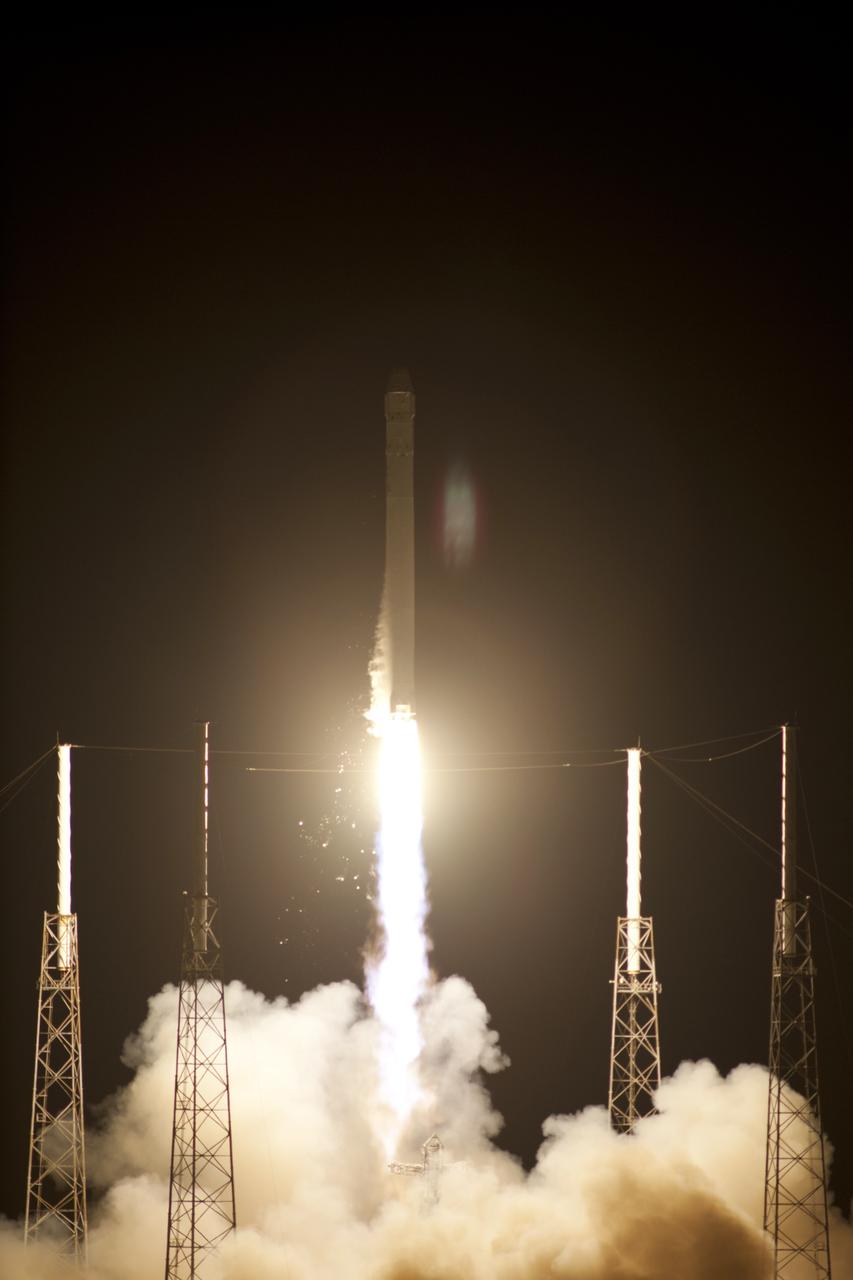
CAPE CANAVERAL, Fla. - At Space Launch Complex 40 on Cape Canaveral Air Force Station in Florida a Falcon 9 rocket carrying a Dragon capsule lifts off at 8:35 p.m. EDT. Space Exploration Technologies Corp., or SpaceX, built both the rocket and capsule for NASA's first Commercial Resupply Services, or CRS-1, mission to the International Space Station. SpaceX CRS-1 is an important step toward making America’s microgravity research program self-sufficient by providing a way to deliver and return significant amounts of cargo, including science experiments, to and from the orbiting laboratory. NASA has contracted for 12 commercial resupply flights from SpaceX and eight from the Orbital Sciences Corp. For more information, visit http://www.nasa.gov/mission_pages/station/living/launch/index.html Photo credit: NASA/Tony Gray
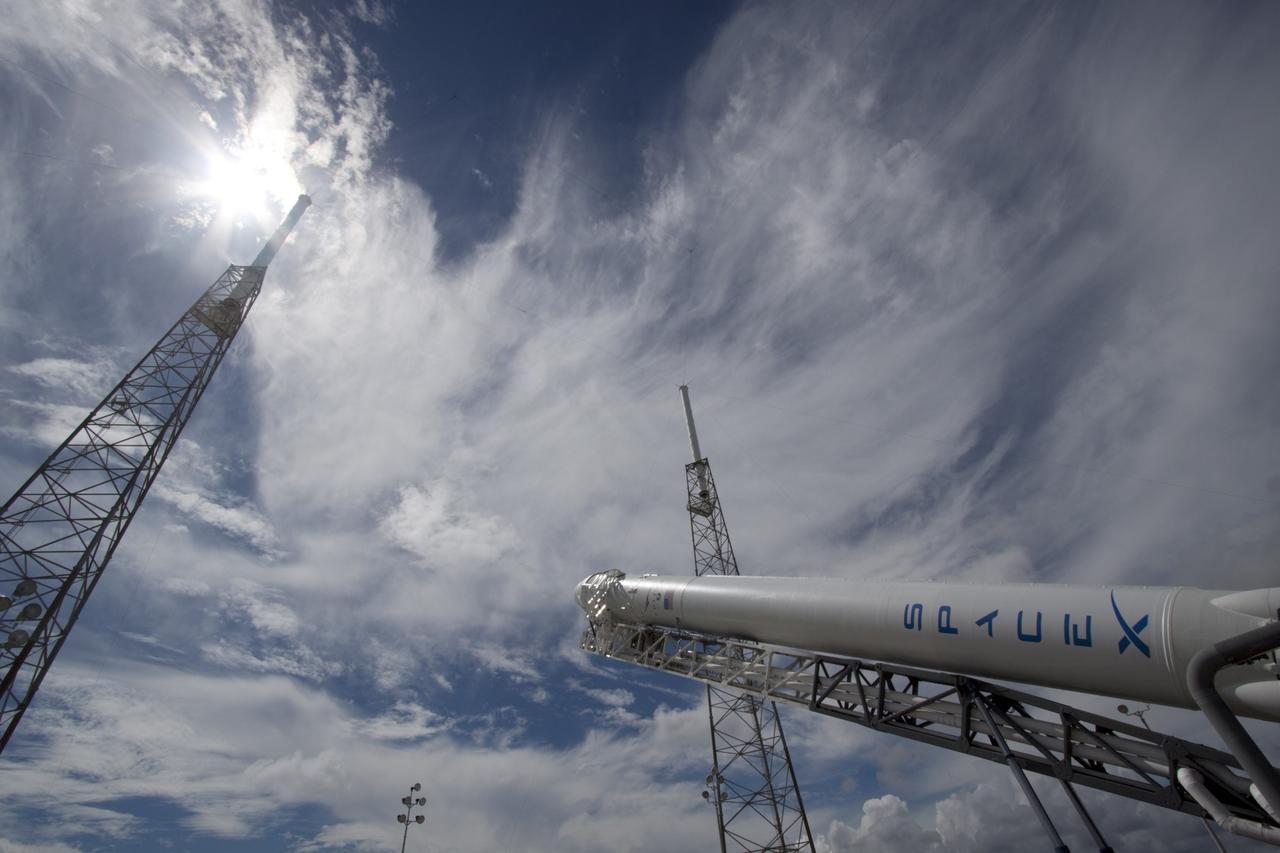
CAPE CANAVERAL, Fla. -- A Falcon 9 rocket with a Dragon capsule secured atop begins to rise into a vertical position between the lightning masts on the pad at Space Launch Complex 40 on Cape Canaveral Air Force Station in Florida. Space Exploration Technologies Corp., or SpaceX, built both the rocket and capsule for NASA's first Commercial Resupply Services, or CRS-1, mission to the International Space Station. The vertical lift was complete at 1 p.m. EDT. SpaceX CRS-1 is an important step toward making America’s microgravity research program self-sufficient by providing a way to deliver and return significant amounts of cargo, including science experiments, to and from the orbiting laboratory. Launch is scheduled for 8:35 p.m. EDT on Oct. 7. NASA has contracted for 12 commercial resupply flights from SpaceX and eight from the Orbital Sciences Corp. For more information, visit http://www.nasa.gov/mission_pages/station/living/launch/index.html. Photo credit: NASA/Jim Grossmann
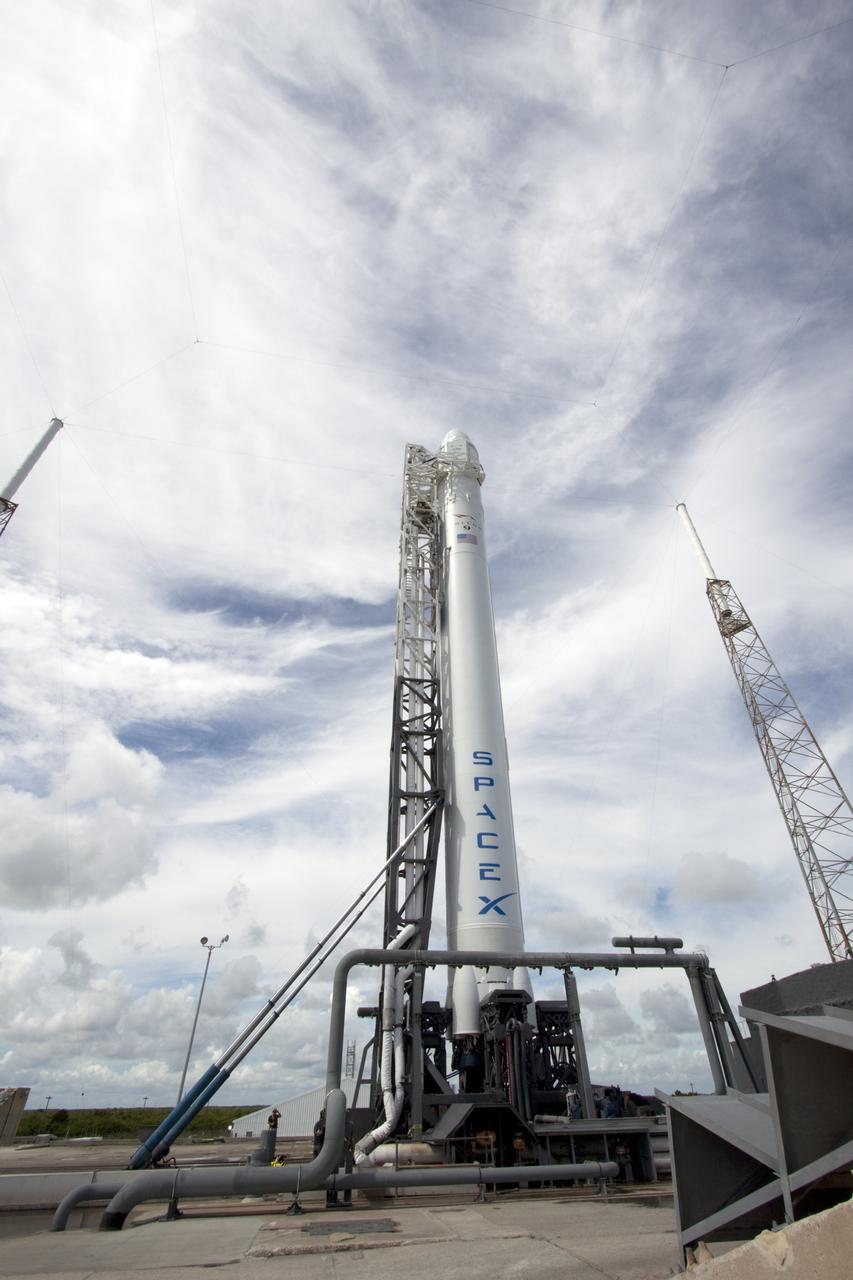
CAPE CANAVERAL, Fla. -- A Falcon 9 rocket with a Dragon capsule secured atop stands upright between the lightning masts on the pad at Space Launch Complex 40 on Cape Canaveral Air Force Station in Florida. Space Exploration Technologies Corp., or SpaceX, built both the rocket and capsule for NASA's first Commercial Resupply Services, or CRS-1, mission to the International Space Station. The vertical lift was complete at 1 p.m. EDT. SpaceX CRS-1 is an important step toward making America’s microgravity research program self-sufficient by providing a way to deliver and return significant amounts of cargo, including science experiments, to and from the orbiting laboratory. Launch is scheduled for 8:35 p.m. EDT on Oct. 7. NASA has contracted for 12 commercial resupply flights from SpaceX and eight from the Orbital Sciences Corp. For more information, visit http://www.nasa.gov/mission_pages/station/living/launch/index.html. Photo credit: NASA/Jim Grossmann
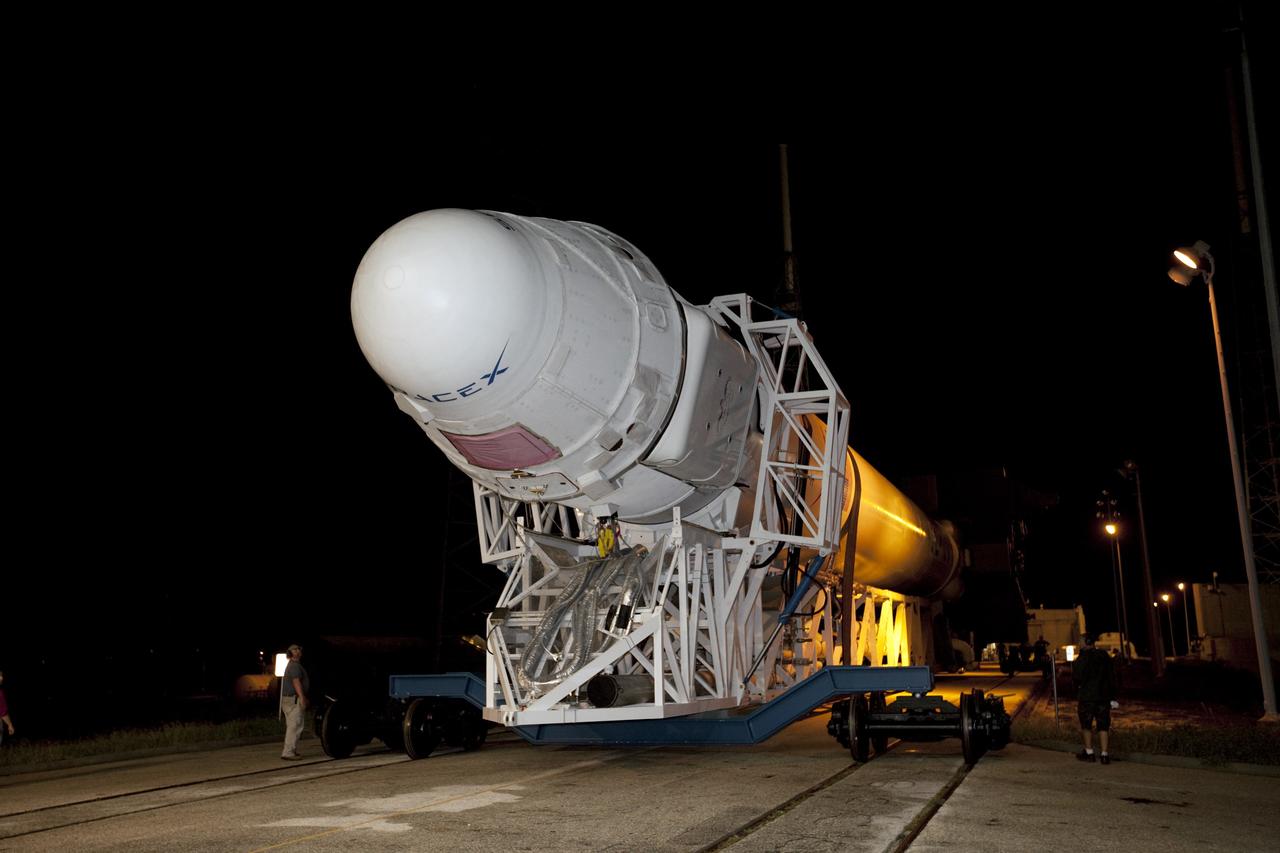
CAPE CANAVERAL, Fla. -- A Falcon 9 rocket with a Dragon capsule secured atop rolls from the processing hangar to the pad at Space Launch Complex 40 on Cape Canaveral Air Force Station in Florida. Space Exploration Technologies Corp., or SpaceX, built both the rocket and capsule for NASA's first Commercial Resupply Services, or CRS-1, mission to the International Space Station. Rollout was complete at 9:55 p.m. EDT. SpaceX CRS-1 is an important step toward making America’s microgravity research program self-sufficient by providing a way to deliver and return significant amounts of cargo, including science experiments, to and from the orbiting laboratory. Launch is scheduled for 8:35 p.m. EDT on Oct. 7. NASA has contracted for 12 commercial resupply flights from SpaceX and eight from the Orbital Sciences Corp. For more information, visit http://www.nasa.gov/mission_pages/station/living/launch/index.html. Photo credit: NASA/Kim Shiflett
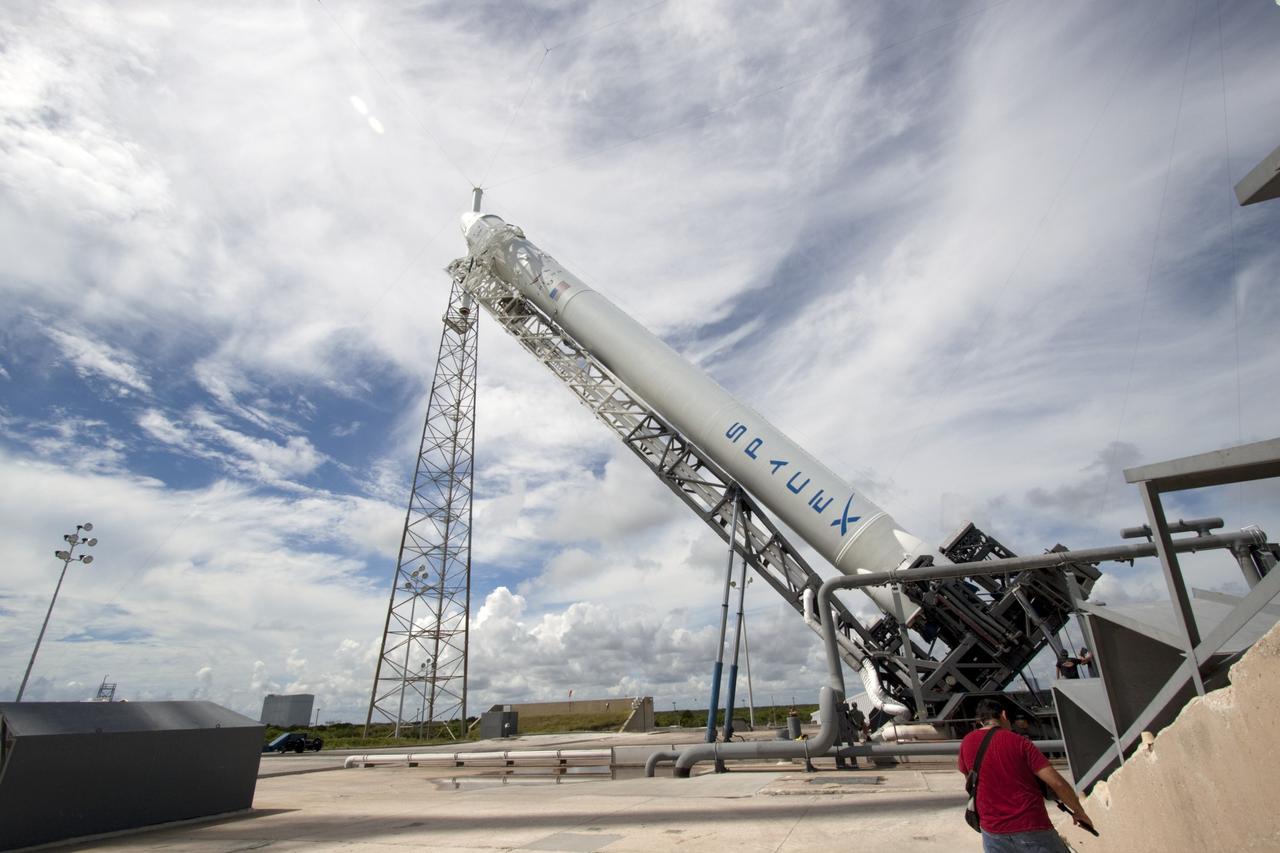
CAPE CANAVERAL, Fla. -- A Falcon 9 rocket with a Dragon capsule secured atop rises into a vertical position between the lightning masts on the pad at Space Launch Complex 40 on Cape Canaveral Air Force Station in Florida. Space Exploration Technologies Corp., or SpaceX, built both the rocket and capsule for NASA's first Commercial Resupply Services, or CRS-1, mission to the International Space Station. The vertical lift was complete at 1 p.m. EDT. SpaceX CRS-1 is an important step toward making America’s microgravity research program self-sufficient by providing a way to deliver and return significant amounts of cargo, including science experiments, to and from the orbiting laboratory. Launch is scheduled for 8:35 p.m. EDT on Oct. 7. NASA has contracted for 12 commercial resupply flights from SpaceX and eight from the Orbital Sciences Corp. For more information, visit http://www.nasa.gov/mission_pages/station/living/launch/index.html. Photo credit: NASA/Jim Grossmann
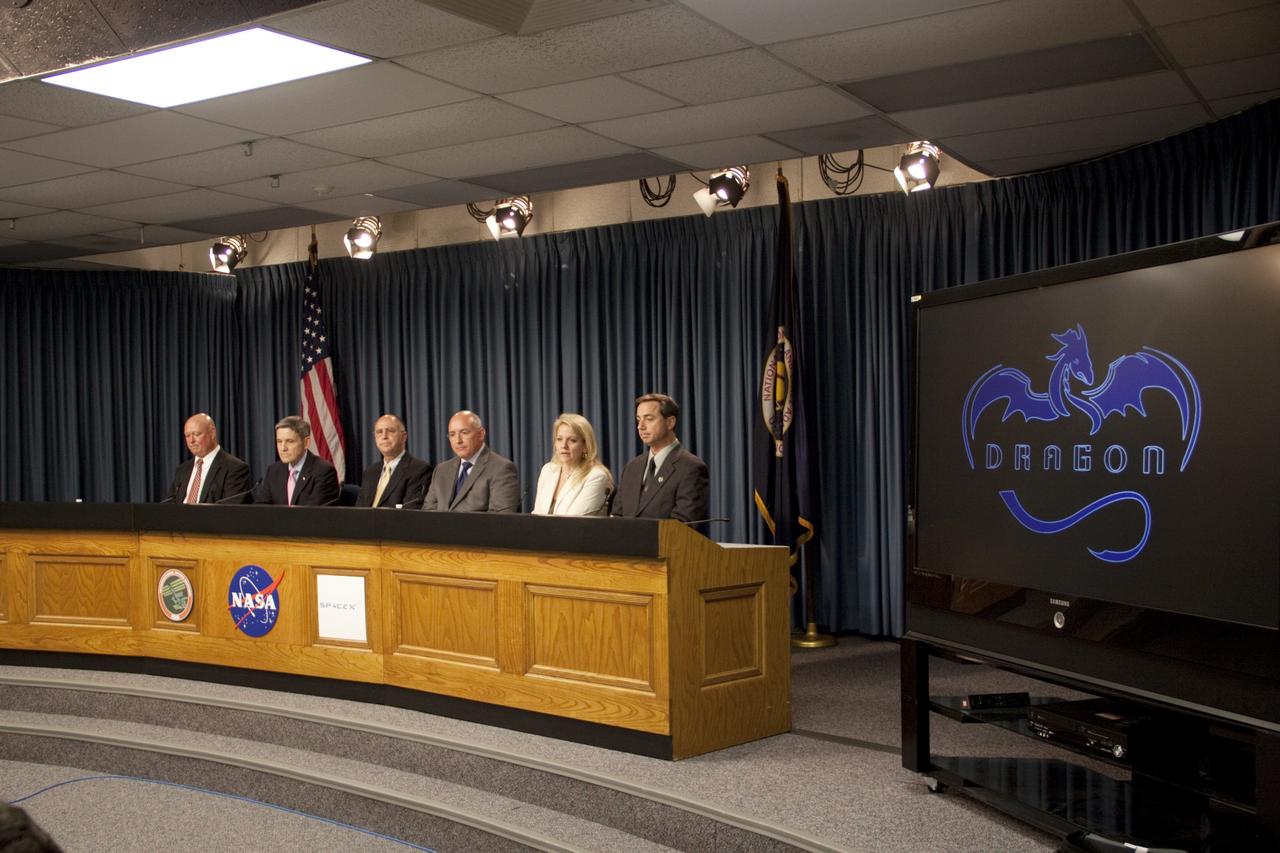
CAPE CANAVERAL, Fla. -- A prelaunch news conference is held in NASA Kennedy Space Center's Press Site auditorium in Florida. From left are Michael Curie, NASA Public Affairs, Bob Cabana, director of NASA Kennedy Space Center, Sam Scimemi, director of International Space Station at NASA Headquarters, Mike Suffredini, program manager of International Space Station at NASA Johnson Space Center, Gwynne Shotwell, president of Space Exploration Technologies Corp., or SpaceX, and Mike McAleenan, launch weather officer from the 45th Weather Squadron at Cape Canaveral Air Force Station. The news conference provided the media with a status on the readiness to launch NASA's first Commercial Resupply Services, or CRS-1, mission to the International Space Station. Space Exploration Technologies Corp., or SpaceX, built both the mission's Falcon 9 rocket and Dragon capsule. Launch is scheduled for 8:35 p.m. EDT on Oct. 7 from Space Launch Complex 40 on Cape Canaveral Air Force Station. SpaceX CRS-1 is an important step toward making America’s microgravity research program self-sufficient by providing a way to deliver and return significant amounts of cargo, including science experiments, to and from the orbiting laboratory. NASA has contracted for 12 commercial resupply flights from SpaceX and eight from the Orbital Sciences Corp. For more information, visit http://www.nasa.gov/mission_pages/station/living/launch/index.html. Photo credit: NASA/Jim Grossmann
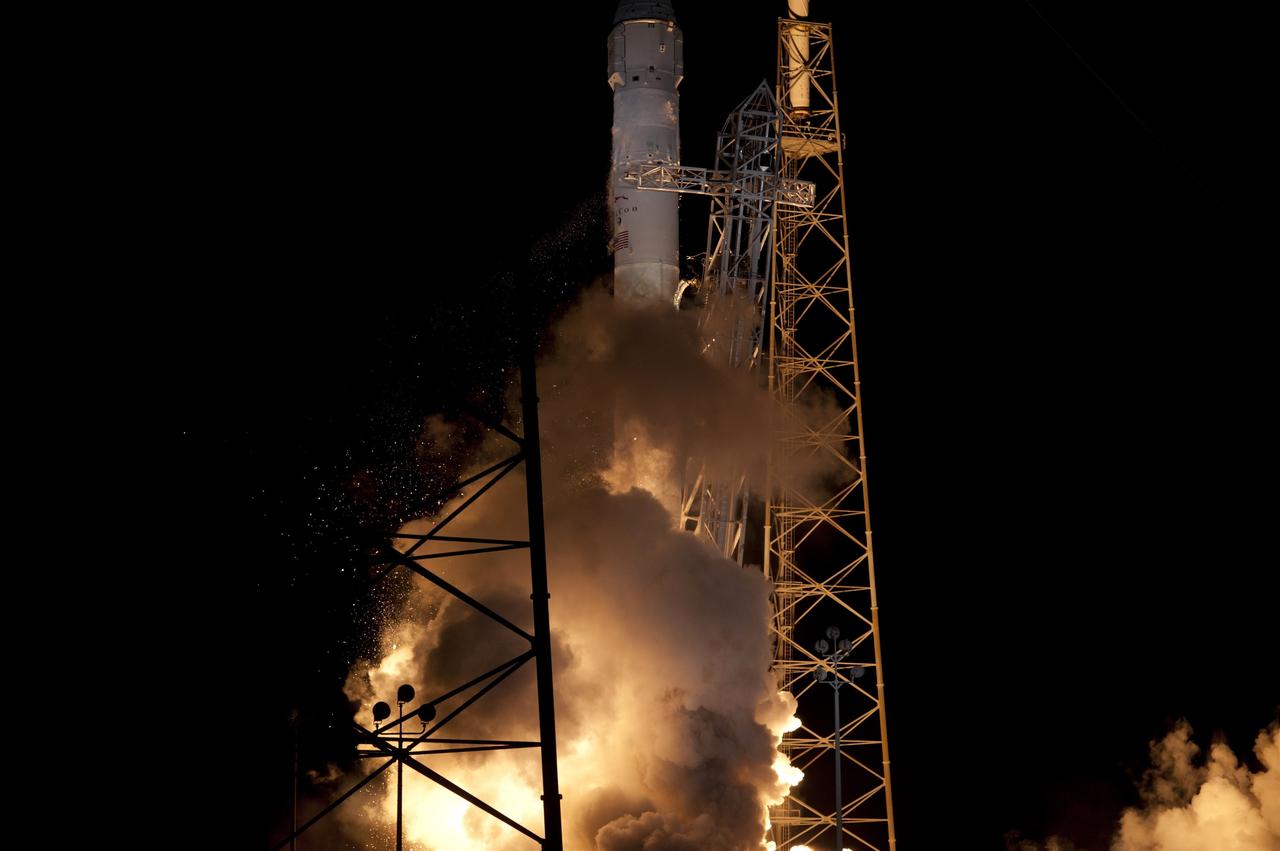
CAPE CANAVERAL, Fla. - Space Launch Complex 40 on Cape Canaveral Air Force Station in Florida comes alive as the Merlin engines ignite under the Falcon 9 rocket carrying a Dragon capsule to orbit. Liftoff was at 8:35 p.m. EDT. Space Exploration Technologies Corp., or SpaceX, built both the rocket and capsule for NASA's first Commercial Resupply Services, or CRS-1, mission to the International Space Station. SpaceX CRS-1 is an important step toward making America’s microgravity research program self-sufficient by providing a way to deliver and return significant amounts of cargo, including science experiments, to and from the orbiting laboratory. NASA has contracted for 12 commercial resupply flights from SpaceX and eight from the Orbital Sciences Corp. For more information, visit http://www.nasa.gov/mission_pages/station/living/launch/index.html Photo credit: NASA/Rusty Backer
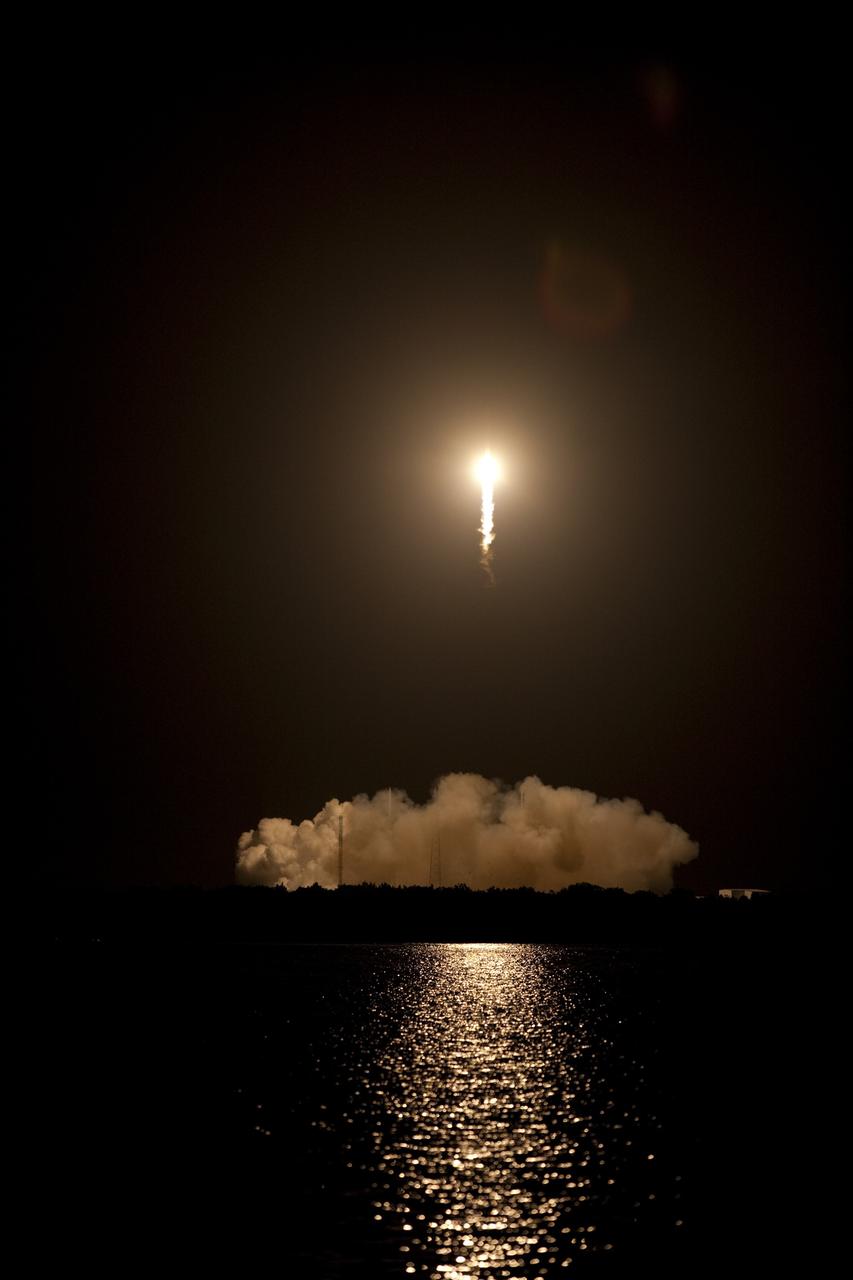
CAPE CANAVERAL, Fla. -- A Falcon 9 rocket cuts its way through the clouds over Space Launch Complex 40 on Cape Canaveral Air Force Station in Florida carrying a Dragon capsule to orbit. Launch was at 8:35 p.m. EDT. Space Exploration Technologies Corp., or SpaceX, built both the rocket and capsule for NASA's first Commercial Resupply Services, or CRS-1, mission to the International Space Station. SpaceX CRS-1 is an important step toward making America’s microgravity research program self-sufficient by providing a way to deliver and return significant amounts of cargo, including science experiments, to and from the orbiting laboratory. NASA has contracted for 12 commercial resupply flights from SpaceX and eight from the Orbital Sciences Corp. For more information, visit http://www.nasa.gov/mission_pages/station/living/launch/index.html. Photo credit: NASA/Glenn Benson
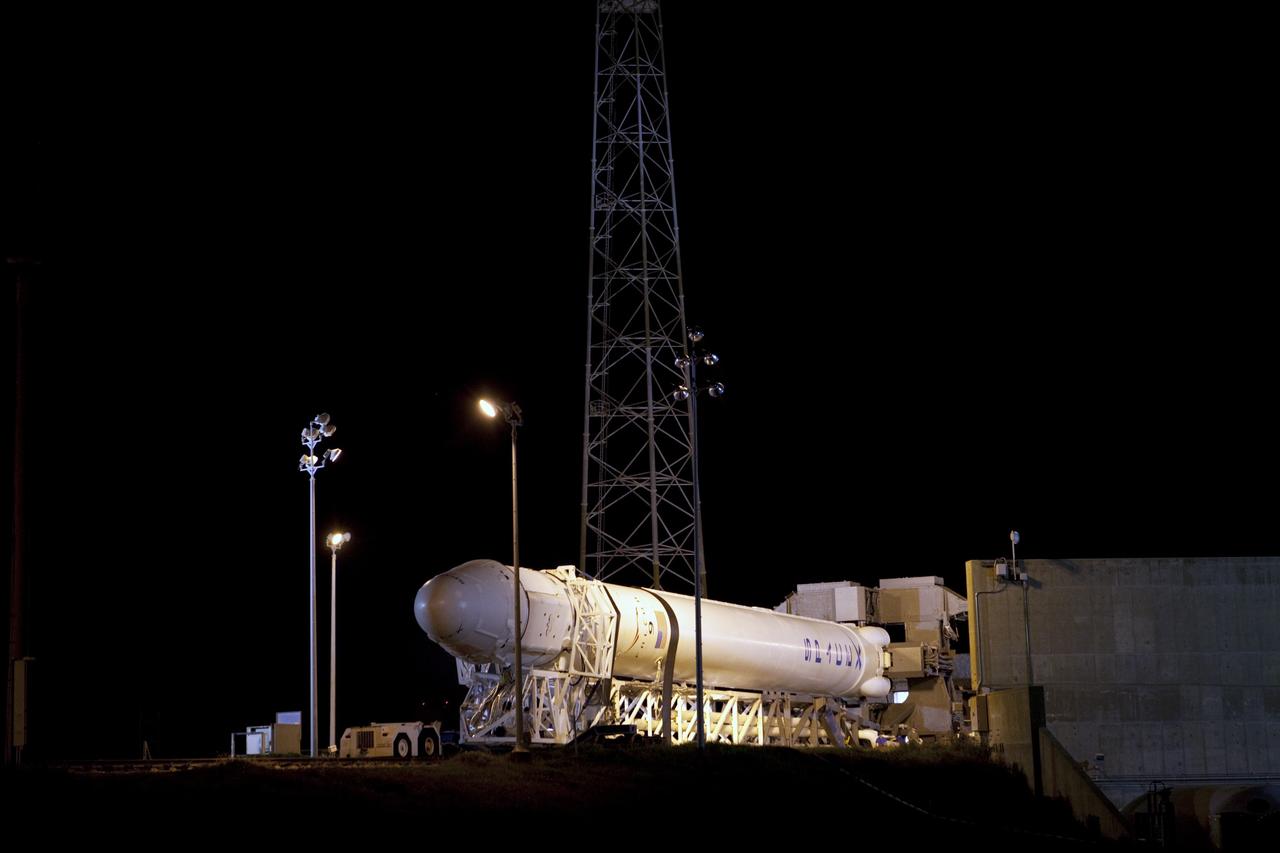
CAPE CANAVERAL, Fla. -- A Falcon 9 rocket with a Dragon capsule secured atop rolls into position between the lightning masts on the pad at Space Launch Complex 40 on Cape Canaveral Air Force Station in Florida. Preparations are under way to lift the rocket into a vertical position for launch. Space Exploration Technologies Corp., or SpaceX, built both the rocket and capsule for NASA's first Commercial Resupply Services, or CRS-1, mission to the International Space Station. Rollout was complete at 9:55 p.m. EDT. SpaceX CRS-1 is an important step toward making America’s microgravity research program self-sufficient by providing a way to deliver and return significant amounts of cargo, including science experiments, to and from the orbiting laboratory. Launch is scheduled for 8:35 p.m. EDT on Oct. 7. NASA has contracted for 12 commercial resupply flights from SpaceX and eight from the Orbital Sciences Corp. For more information, visit http://www.nasa.gov/mission_pages/station/living/launch/index.html. Photo credit: NASA/Kim Shiflett
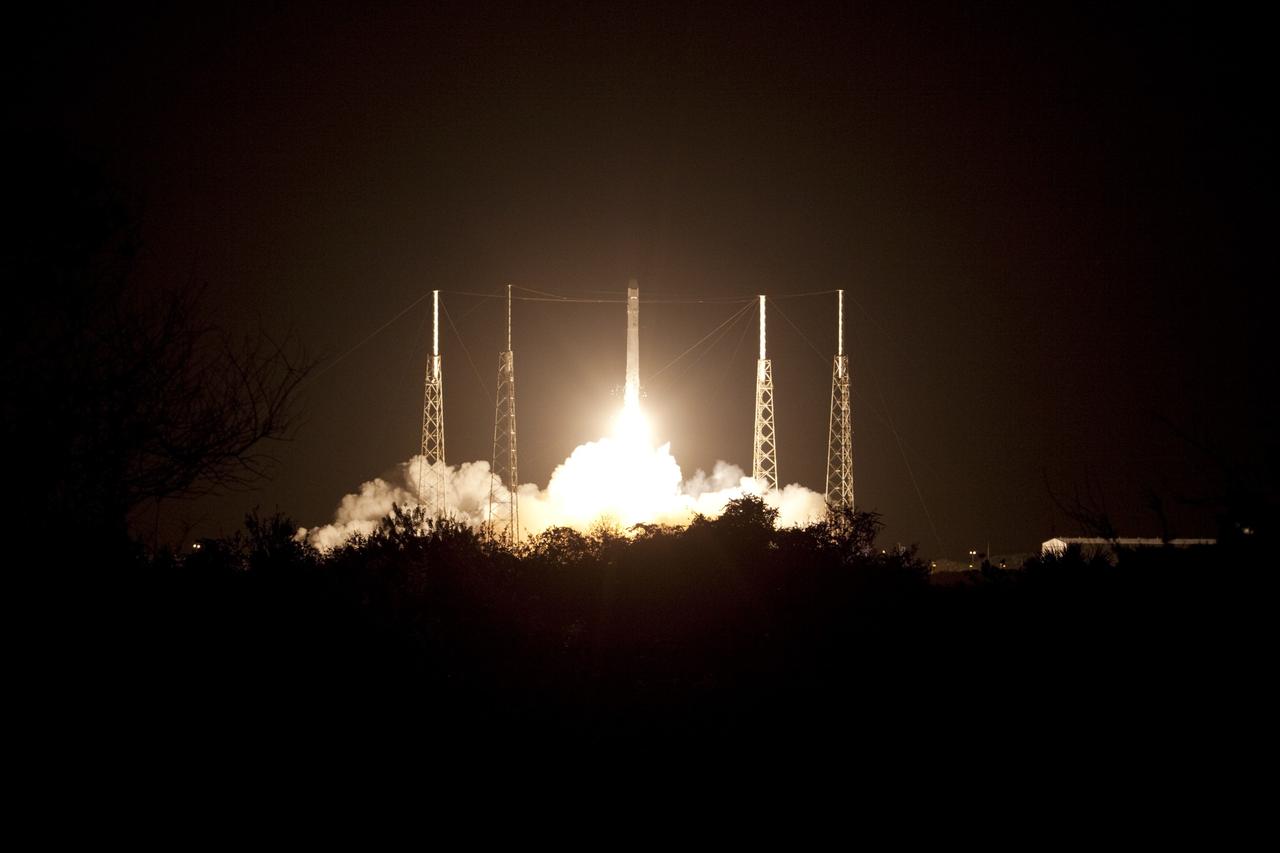
CAPE CANAVERAL, Fla. -- A Falcon 9 rocket lifts off Space Launch Complex 40 on Cape Canaveral Air Force Station in Florida at 8:35 p.m. EDT, carrying a Dragon capsule to orbit. Space Exploration Technologies Corp., or SpaceX, built both the rocket and capsule for NASA's first Commercial Resupply Services, or CRS-1, mission to the International Space Station. SpaceX CRS-1 is an important step toward making America’s microgravity research program self-sufficient by providing a way to deliver and return significant amounts of cargo, including science experiments, to and from the orbiting laboratory. NASA has contracted for 12 commercial resupply flights from SpaceX and eight from the Orbital Sciences Corp. For more information, visit http://www.nasa.gov/mission_pages/station/living/launch/index.html. Photo credit: NASA/Jim Grossmann
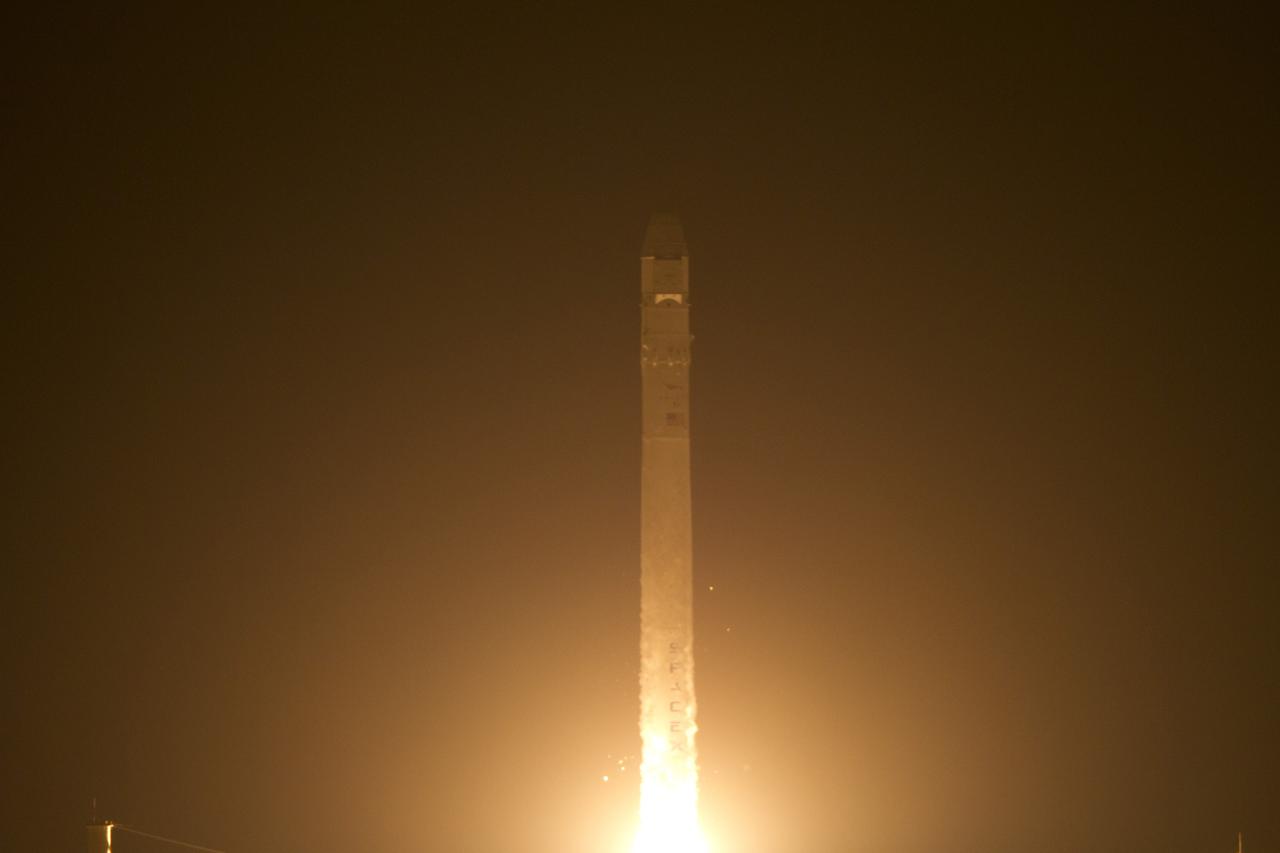
CAPE CANAVERAL, Fla. - At Space Launch Complex 40 on Cape Canaveral Air Force Station in Florida a Falcon 9 rocket carrying a Dragon capsule lifts off at 8:35 p.m. EDT. Space Exploration Technologies Corp., or SpaceX, built both the rocket and capsule for NASA's first Commercial Resupply Services, or CRS-1, mission to the International Space Station. SpaceX CRS-1 is an important step toward making America’s microgravity research program self-sufficient by providing a way to deliver and return significant amounts of cargo, including science experiments, to and from the orbiting laboratory. NASA has contracted for 12 commercial resupply flights from SpaceX and eight from the Orbital Sciences Corp. For more information, visit http://www.nasa.gov/mission_pages/station/living/launch/index.html Photo credit: NASA/Ken Allen
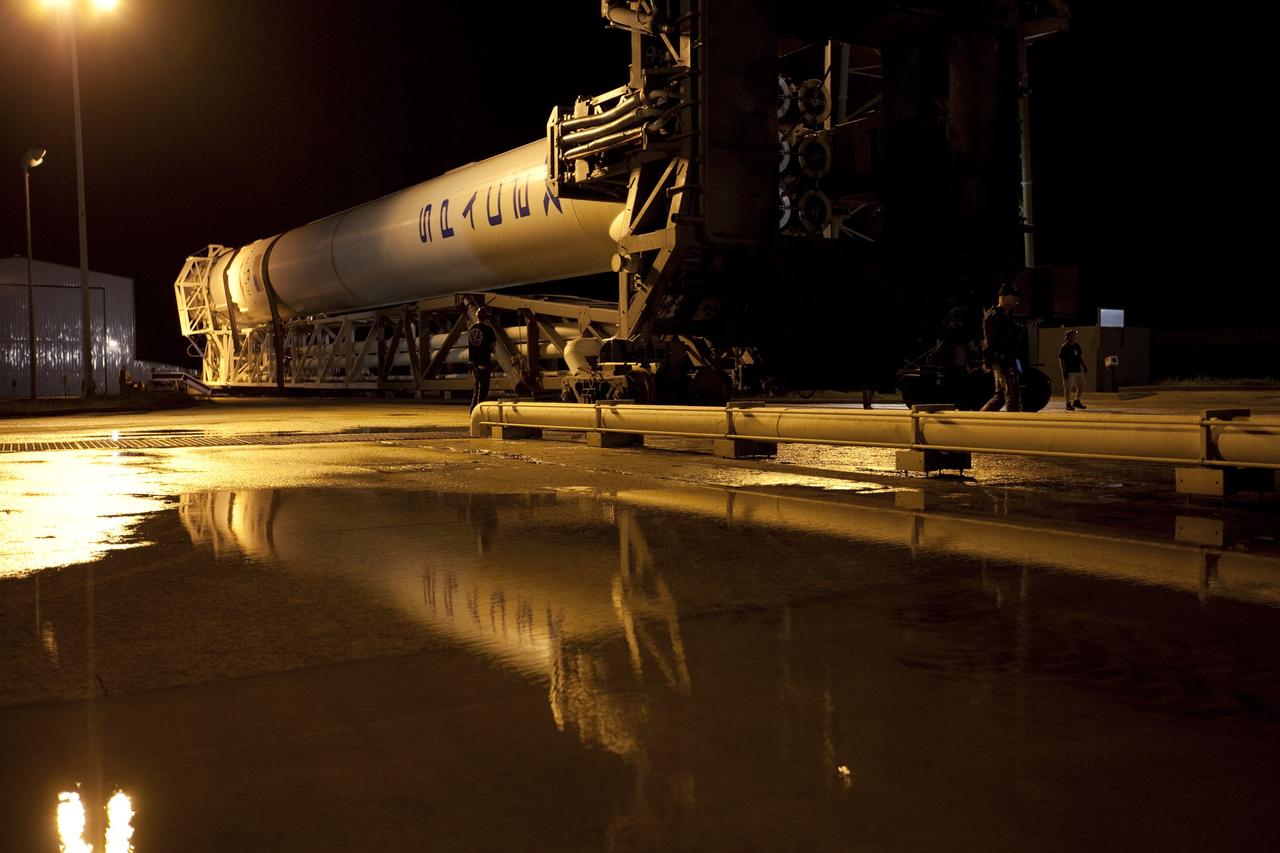
CAPE CANAVERAL, Fla. -- A Falcon 9 rocket with a Dragon capsule secured atop is reflected in the rainwater standing on the surface of Space Launch Complex 40 on Cape Canaveral Air Force Station in Florida as it rolls from the processing hangar to the pad. Space Exploration Technologies Corp., or SpaceX, built both the rocket and capsule for NASA's first Commercial Resupply Services, or CRS-1, mission to the International Space Station. Rollout was complete at 9:55 p.m. EDT. SpaceX CRS-1 is an important step toward making America’s microgravity research program self-sufficient by providing a way to deliver and return significant amounts of cargo, including science experiments, to and from the orbiting laboratory. Launch is scheduled for 8:35 p.m. EDT on Oct. 7. NASA has contracted for 12 commercial resupply flights from SpaceX and eight from the Orbital Sciences Corp. For more information, visit http://www.nasa.gov/mission_pages/station/living/launch/index.html. Photo credit: NASA/Kim Shiflett
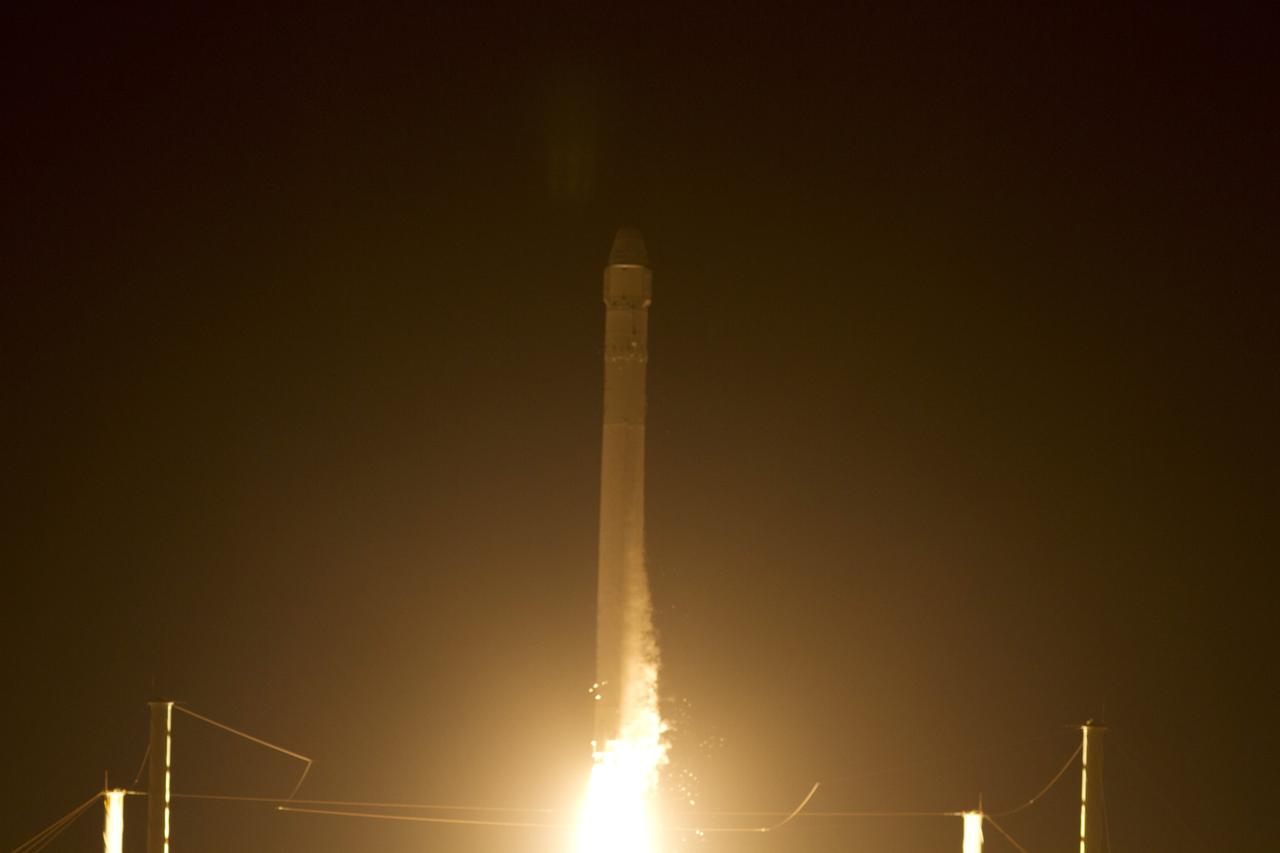
CAPE CANAVERAL, Fla. - At Space Launch Complex 40 on Cape Canaveral Air Force Station in Florida a Falcon 9 rocket carrying a Dragon capsule lifts off at 8:35 p.m. EDT. Space Exploration Technologies Corp., or SpaceX, built both the rocket and capsule for NASA's first Commercial Resupply Services, or CRS-1, mission to the International Space Station. SpaceX CRS-1 is an important step toward making America’s microgravity research program self-sufficient by providing a way to deliver and return significant amounts of cargo, including science experiments, to and from the orbiting laboratory. NASA has contracted for 12 commercial resupply flights from SpaceX and eight from the Orbital Sciences Corp. For more information, visit http://www.nasa.gov/mission_pages/station/living/launch/index.html Photo credit: NASA/Gina Mitchell and George Roberts
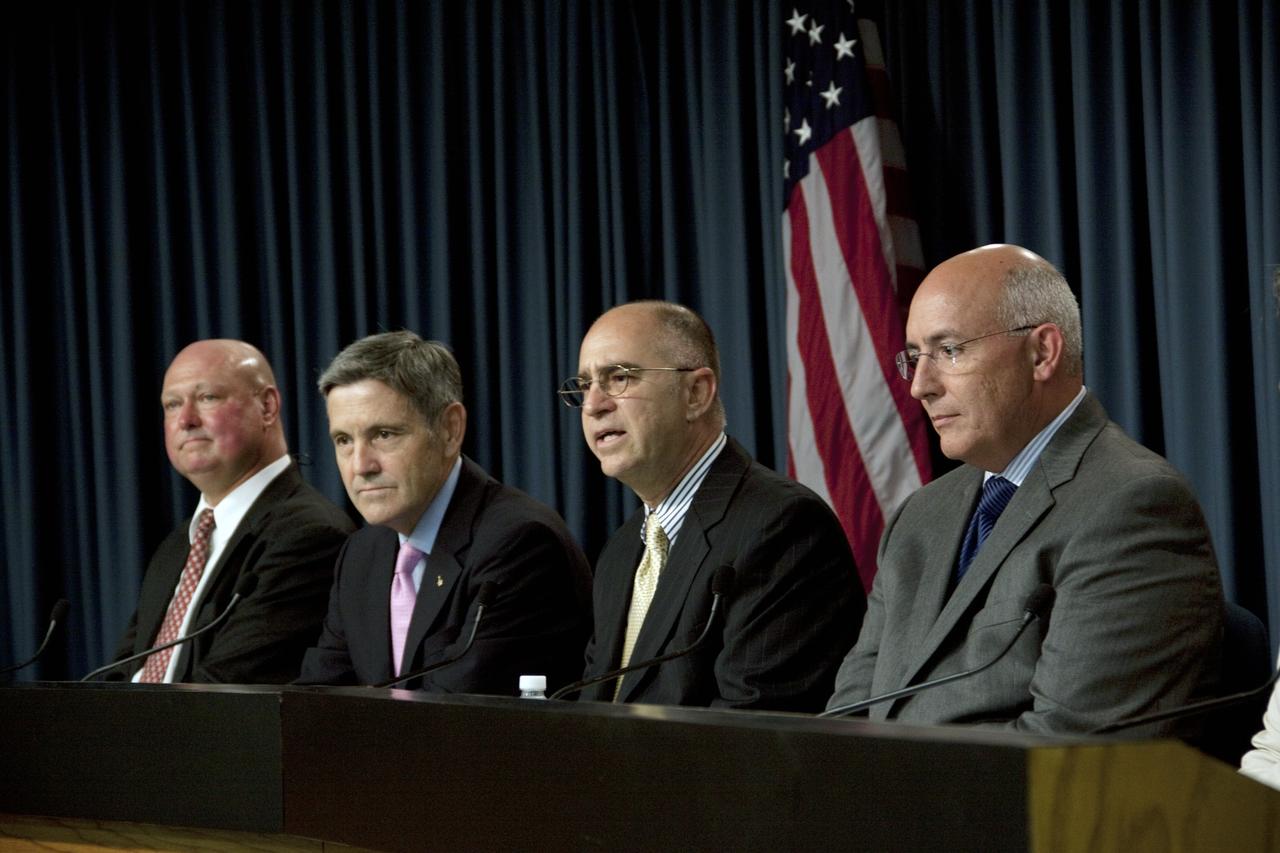
CAPE CANAVERAL, Fla. -- Sam Scimemi, director of International Space Station at NASA Headquarters, participates in a prelaunch news conference in Kennedy Space Center's Press Site auditorium in Florida. Also pictured are, from left, Michael Curie, NASA Public Affairs, Bob Cabana, director of NASA Kennedy Space Center, and to Scimemi's right, Mike Suffredini, program manager of International Space Station at NASA Johnson Space Center. The news conference provided the media with a status on the readiness to launch NASA's first Commercial Resupply Services, or CRS-1, mission to the International Space Station. Space Exploration Technologies Corp., or SpaceX, built both the mission's Falcon 9 rocket and Dragon capsule. Launch is scheduled for 8:35 p.m. EDT on Oct. 7 from Space Launch Complex 40 on Cape Canaveral Air Force Station. SpaceX CRS-1 is an important step toward making America’s microgravity research program self-sufficient by providing a way to deliver and return significant amounts of cargo, including science experiments, to and from the orbiting laboratory. NASA has contracted for 12 commercial resupply flights from SpaceX and eight from the Orbital Sciences Corp. For more information, visit http://www.nasa.gov/mission_pages/station/living/launch/index.html. Photo credit: NASA/Jim Grossmann
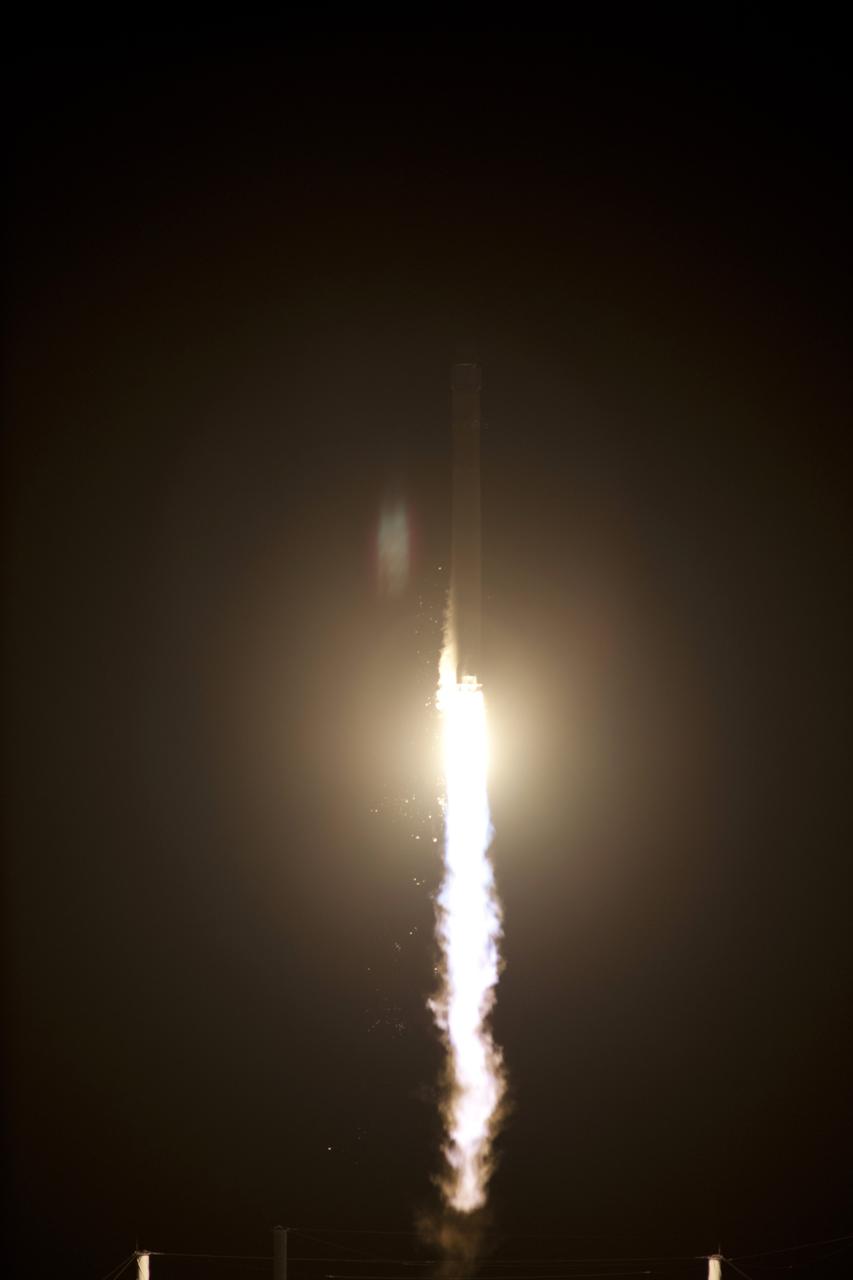
CAPE CANAVERAL, Fla. - At Space Launch Complex 40 on Cape Canaveral Air Force Station in Florida a Falcon 9 rocket carrying a Dragon capsule lifts off at 8:35 p.m. EDT. Space Exploration Technologies Corp., or SpaceX, built both the rocket and capsule for NASA's first Commercial Resupply Services, or CRS-1, mission to the International Space Station. SpaceX CRS-1 is an important step toward making America’s microgravity research program self-sufficient by providing a way to deliver and return significant amounts of cargo, including science experiments, to and from the orbiting laboratory. NASA has contracted for 12 commercial resupply flights from SpaceX and eight from the Orbital Sciences Corp. For more information, visit http://www.nasa.gov/mission_pages/station/living/launch/index.html Photo credit: NASA/Tony Gray
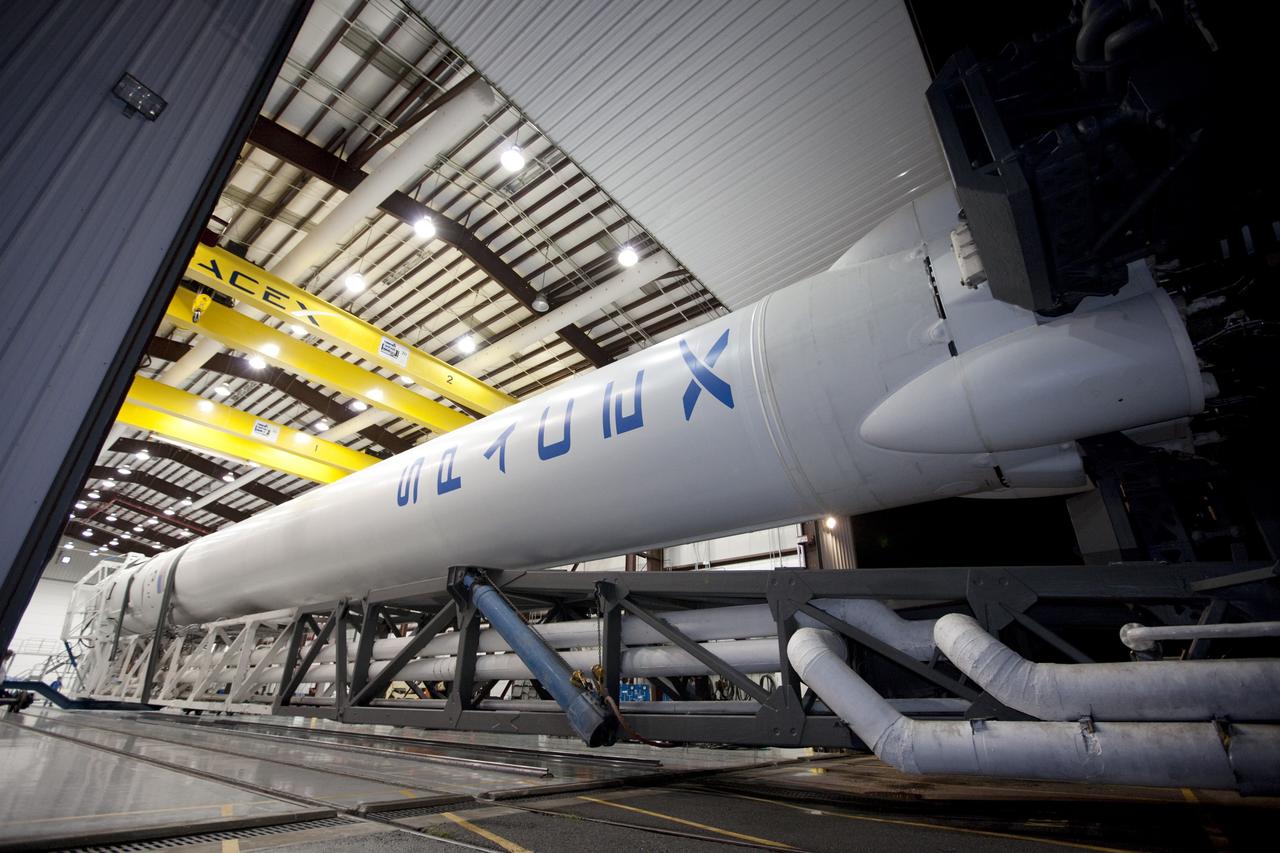
CAPE CANAVERAL, Fla. -- A Falcon 9 rocket with a Dragon capsule secured atop begins to roll from the processing hangar to the pad at Space Launch Complex 40 on Cape Canaveral Air Force Station in Florida. Space Exploration Technologies Corp., or SpaceX, built both the rocket and capsule for NASA's first Commercial Resupply Services, or CRS-1, mission to the International Space Station. Rollout was complete at 9:55 p.m. EDT. SpaceX CRS-1 is an important step toward making America’s microgravity research program self-sufficient by providing a way to deliver and return significant amounts of cargo, including science experiments, to and from the orbiting laboratory. Launch is scheduled for 8:35 p.m. EDT on Oct. 7. NASA has contracted for 12 commercial resupply flights from SpaceX and eight from the Orbital Sciences Corp. For more information, visit http://www.nasa.gov/mission_pages/station/living/launch/index.html. Photo credit: NASA/Kim Shiflett
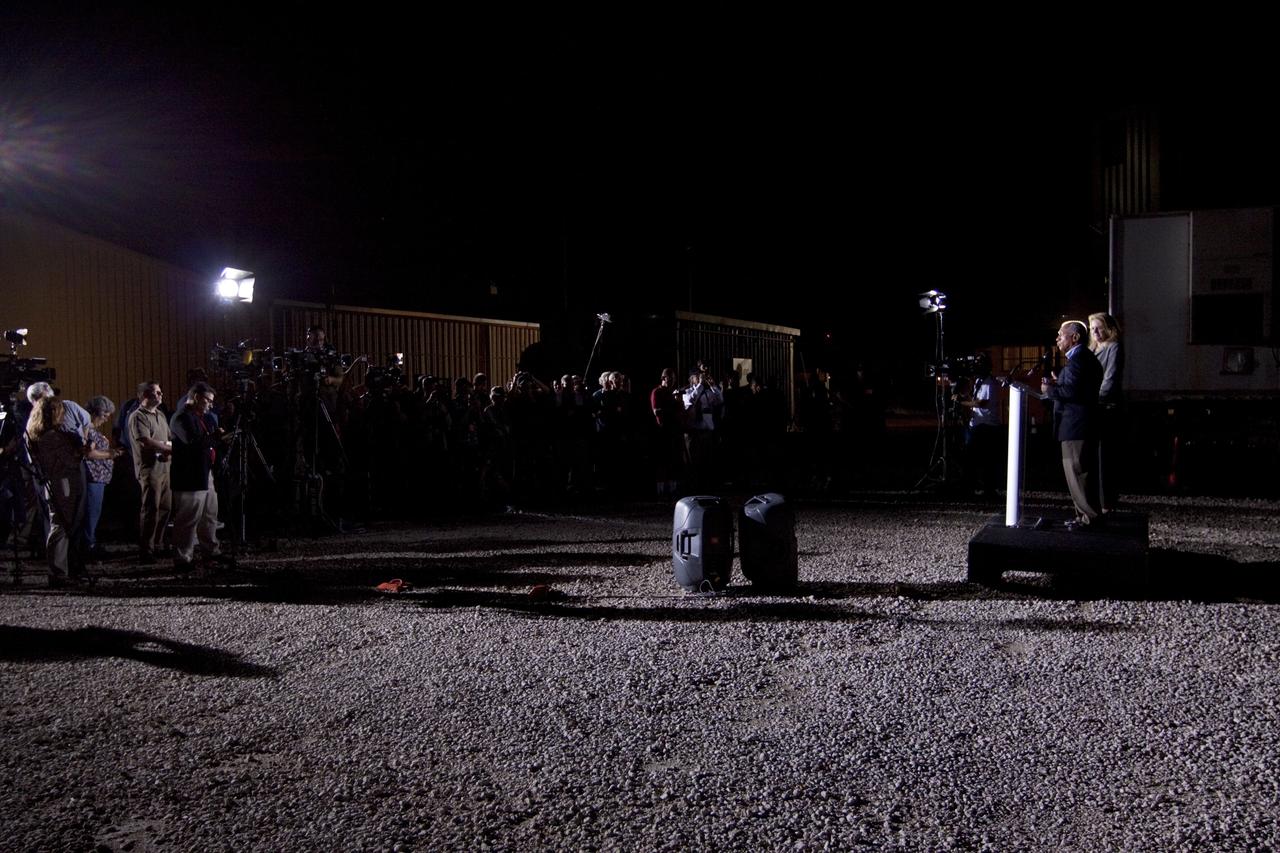
CAPE CANAVERAL, Fla. -- NASA Administrator Charlie Bolden addresses news and social media representatives at the Press Site at NASA's Kennedy Space Center in Florida following the successful launch of NASA's first Commercial Resupply Services, or CRS-1, mission to the International Space Station. Beside him on the podium is Gwynne Shotwell, president of Space Exploration Technologies Corp., or SpaceX. SpaceX built both the Falcon 9 rocket and Dragon capsule that launched at 8:35 p.m. EDT from Space Launch Complex 40 on Cape Canaveral Air Force Station. SpaceX CRS-1 is an important step toward making America’s microgravity research program self-sufficient by providing a way to deliver and return significant amounts of cargo, including science experiments, to and from the orbiting laboratory. NASA has contracted for 12 commercial resupply flights from SpaceX and eight from the Orbital Sciences Corp. For more information, visit http://www.nasa.gov/mission_pages/station/living/launch/index.html. Photo credit: NASA/Kim Shiflett
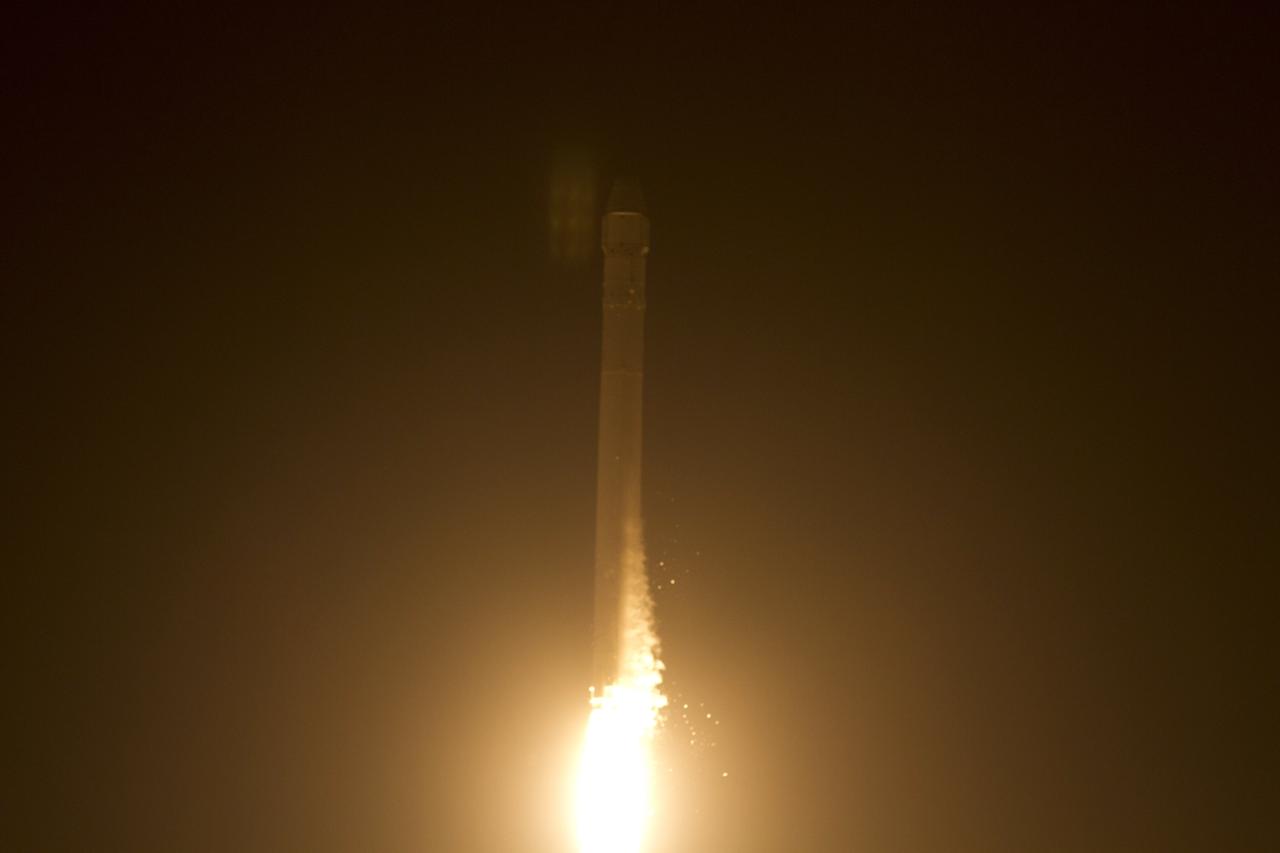
CAPE CANAVERAL, Fla. - At Space Launch Complex 40 on Cape Canaveral Air Force Station in Florida a Falcon 9 rocket carrying a Dragon capsule lifts off at 8:35 p.m. EDT. Space Exploration Technologies Corp., or SpaceX, built both the rocket and capsule for NASA's first Commercial Resupply Services, or CRS-1, mission to the International Space Station. SpaceX CRS-1 is an important step toward making America’s microgravity research program self-sufficient by providing a way to deliver and return significant amounts of cargo, including science experiments, to and from the orbiting laboratory. NASA has contracted for 12 commercial resupply flights from SpaceX and eight from the Orbital Sciences Corp. For more information, visit http://www.nasa.gov/mission_pages/station/living/launch/index.html Photo credit: NASA/Gina Mitchell and George Roberts
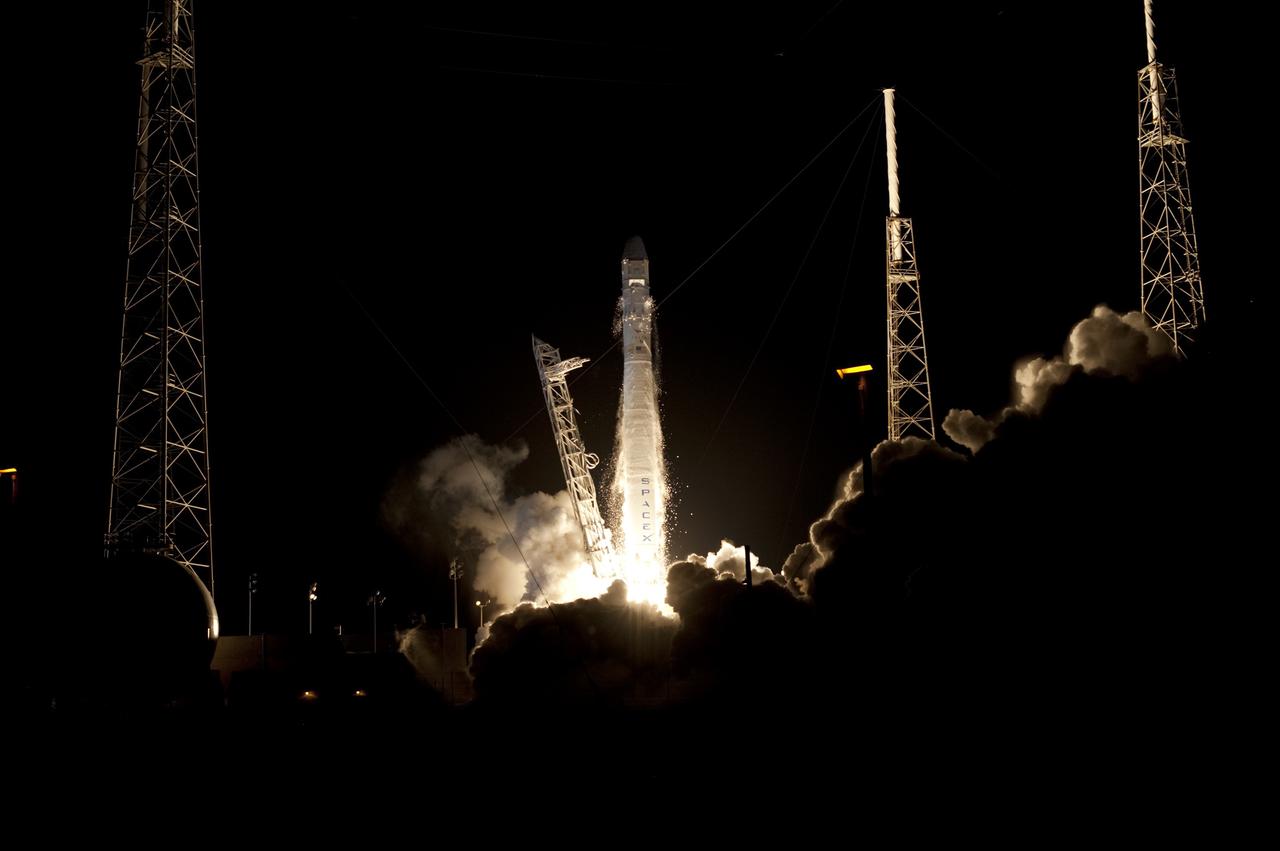
CAPE CANAVERAL, Fla. -- Plumes of exhaust and smoke form around a Falcon 9 rocket at 8:35 p.m. EDT as it lifts off Space Launch Complex 40 on Cape Canaveral Air Force Station in Florida, carrying a Dragon capsule to orbit. Space Exploration Technologies Corp., or SpaceX, built both the rocket and capsule for NASA's first Commercial Resupply Services, or CRS-1, mission to the International Space Station. SpaceX CRS-1 is an important step toward making America’s microgravity research program self-sufficient by providing a way to deliver and return significant amounts of cargo, including science experiments, to and from the orbiting laboratory. NASA has contracted for 12 commercial resupply flights from SpaceX and eight from the Orbital Sciences Corp. For more information, visit http://www.nasa.gov/mission_pages/station/living/launch/index.html. Photo credit: NASA/Tony Gray and Rick Wetherington
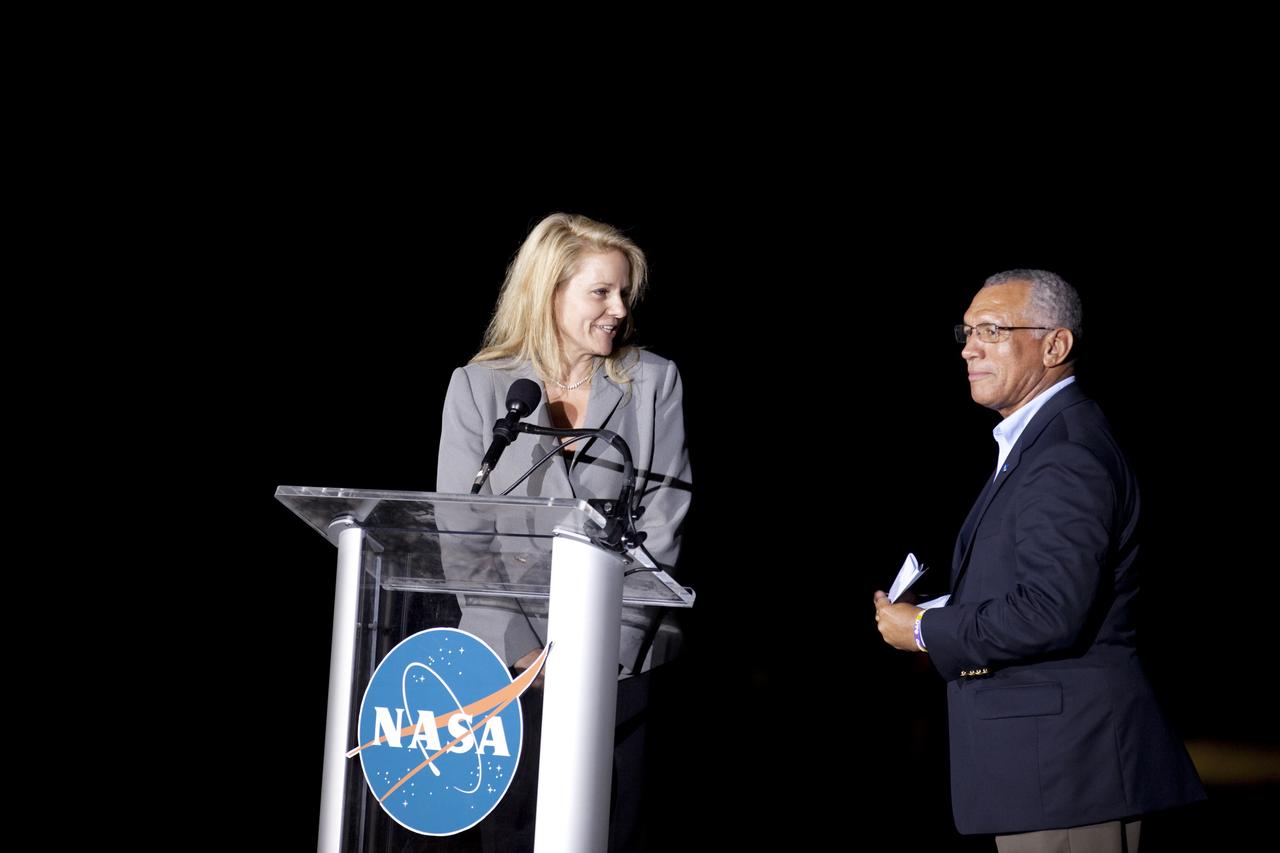
CAPE CANAVERAL, Fla. -- Gwynne Shotwell, president of Space Exploration Technologies Corp., or SpaceX, takes her turn at the podium from NASA Administrator Charlie Bolden, at right. Bolden and Shotwell are addressing news and social media representatives at the Press Site at NASA's Kennedy Space Center in Florida following the successful launch of NASA's first Commercial Resupply Services, or CRS-1, mission to the International Space Station. SpaceX built both the Falcon 9 rocket and Dragon capsule that launched at 8:35 p.m. EDT from Space Launch Complex 40 on Cape Canaveral Air Force Station. SpaceX CRS-1 is an important step toward making America’s microgravity research program self-sufficient by providing a way to deliver and return significant amounts of cargo, including science experiments, to and from the orbiting laboratory. NASA has contracted for 12 commercial resupply flights from SpaceX and eight from the Orbital Sciences Corp. For more information, visit http://www.nasa.gov/mission_pages/station/living/launch/index.html. Photo credit: NASA/Kim Shiflett
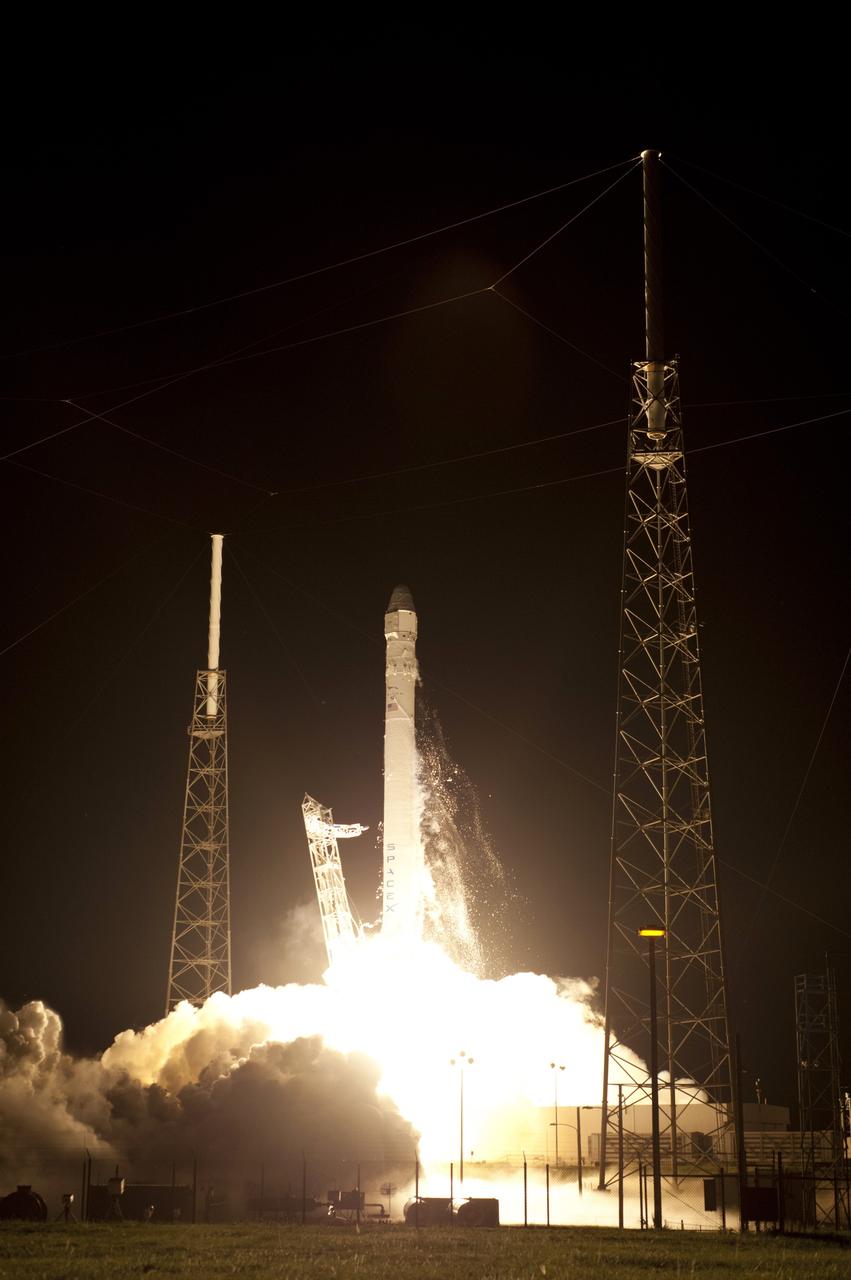
CAPE CANAVERAL, Fla. - Space Launch Complex 40 on Cape Canaveral Air Force Station in Florida comes alive as the Merlin engines ignite under the Falcon 9 rocket carrying a Dragon capsule to orbit. Liftoff was at 8:35 p.m. EDT. Space Exploration Technologies Corp., or SpaceX, built both the rocket and capsule for NASA's first Commercial Resupply Services, or CRS-1, mission to the International Space Station. SpaceX CRS-1 is an important step toward making America’s microgravity research program self-sufficient by providing a way to deliver and return significant amounts of cargo, including science experiments, to and from the orbiting laboratory. NASA has contracted for 12 commercial resupply flights from SpaceX and eight from the Orbital Sciences Corp. For more information, visit http://www.nasa.gov/mission_pages/station/living/launch/index.html Photo credit: NASA/Rick Wetherington and Tony Gray
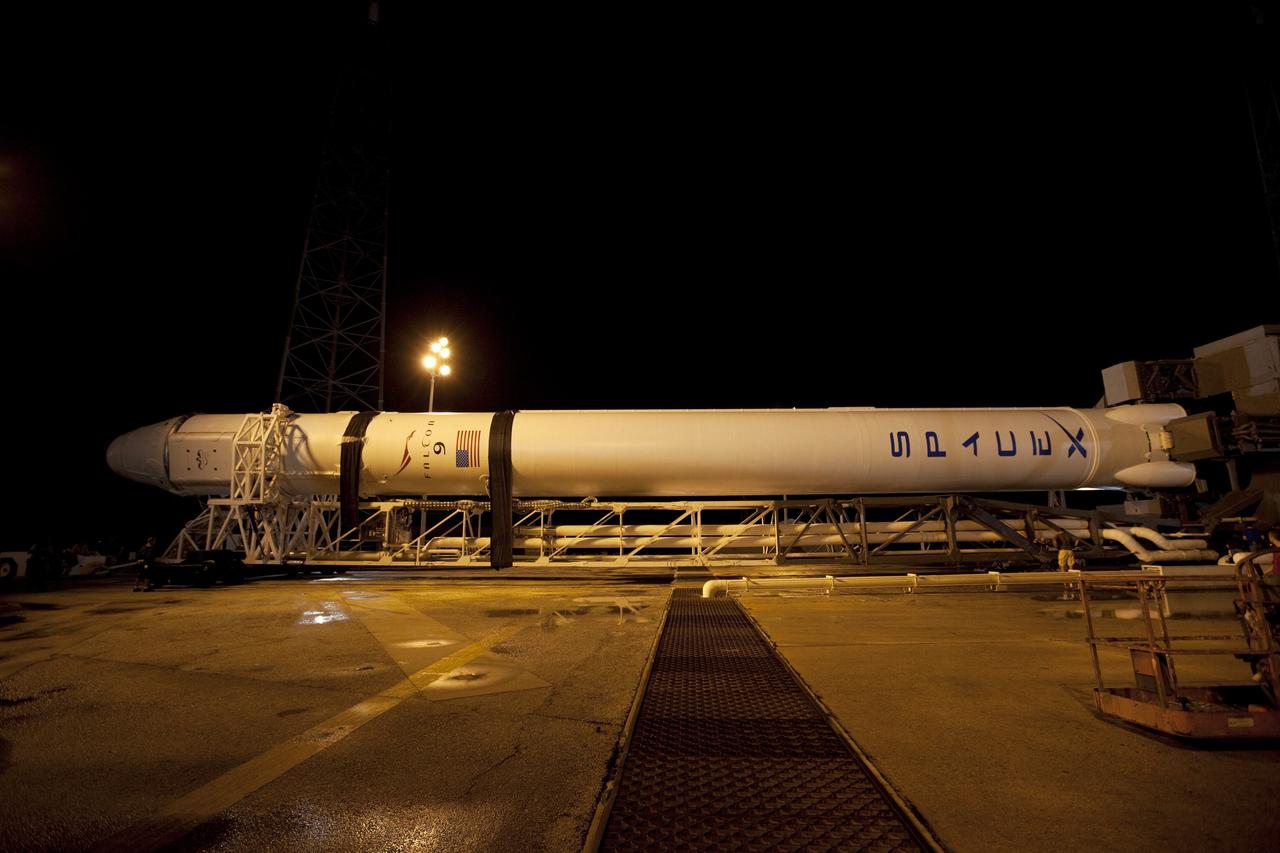
CAPE CANAVERAL, Fla. -- A Falcon 9 rocket with a Dragon capsule secured atop rolls into position between the lightning masts on the pad at Space Launch Complex 40 on Cape Canaveral Air Force Station in Florida. Preparations are under way to lift the rocket into a vertical position for launch. Space Exploration Technologies Corp., or SpaceX, built both the rocket and capsule for NASA's first Commercial Resupply Services, or CRS-1, mission to the International Space Station. Rollout was complete at 9:55 p.m. EDT. SpaceX CRS-1 is an important step toward making America’s microgravity research program self-sufficient by providing a way to deliver and return significant amounts of cargo, including science experiments, to and from the orbiting laboratory. Launch is scheduled for 8:35 p.m. EDT on Oct. 7. NASA has contracted for 12 commercial resupply flights from SpaceX and eight from the Orbital Sciences Corp. For more information, visit http://www.nasa.gov/mission_pages/station/living/launch/index.html. Photo credit: NASA/Kim Shiflett
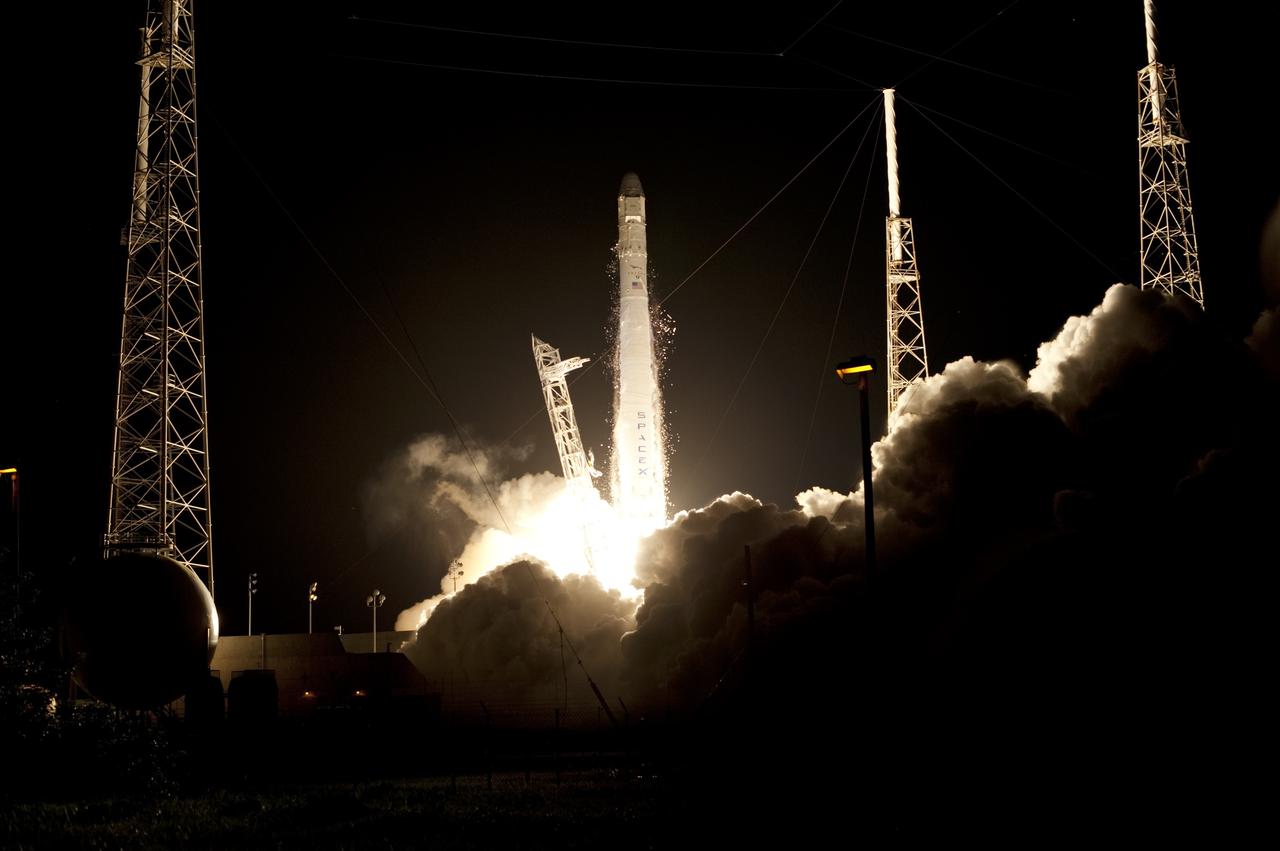
CAPE CANAVERAL, Fla. -- A Falcon 9 rocket roars to life on Space Launch Complex 40 on Cape Canaveral Air Force Station in Florida at 8:35 p.m. EDT, carrying a Dragon capsule to orbit. Space Exploration Technologies Corp., or SpaceX, built both the rocket and capsule for NASA's first Commercial Resupply Services, or CRS-1, mission to the International Space Station. SpaceX CRS-1 is an important step toward making America’s microgravity research program self-sufficient by providing a way to deliver and return significant amounts of cargo, including science experiments, to and from the orbiting laboratory. NASA has contracted for 12 commercial resupply flights from SpaceX and eight from the Orbital Sciences Corp. For more information, visit http://www.nasa.gov/mission_pages/station/living/launch/index.html. Photo credit: NASA/Tony Gray and Rick Wetherington
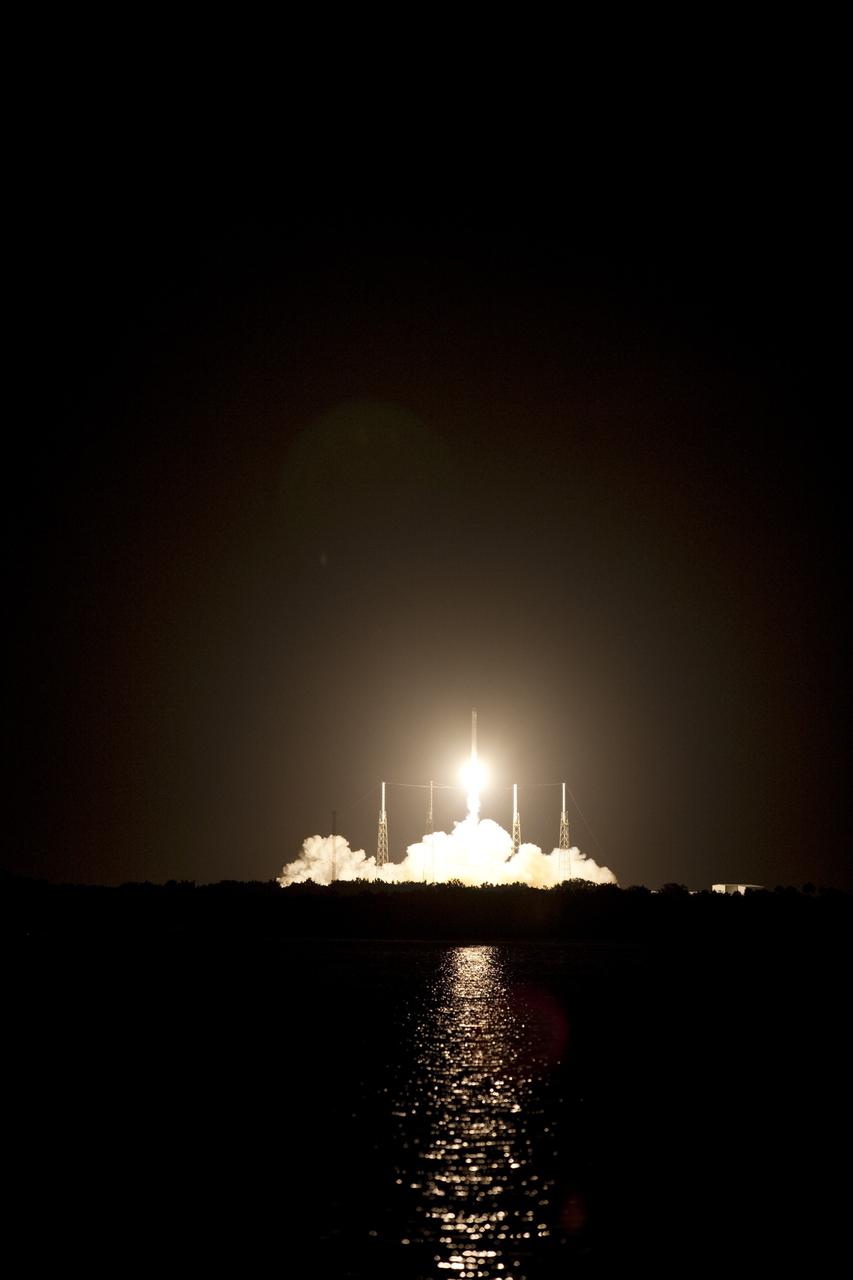
CAPE CANAVERAL, Fla. -- Space Launch Complex 40 on Cape Canaveral Air Force Station in Florida is illuminated by a Falcon 9 rocket as it lifts off at 8:35 p.m. EDT carrying a Dragon capsule to orbit. Space Exploration Technologies Corp., or SpaceX, built both the rocket and capsule for NASA's first Commercial Resupply Services, or CRS-1, mission to the International Space Station. SpaceX CRS-1 is an important step toward making America’s microgravity research program self-sufficient by providing a way to deliver and return significant amounts of cargo, including science experiments, to and from the orbiting laboratory. NASA has contracted for 12 commercial resupply flights from SpaceX and eight from the Orbital Sciences Corp. For more information, visit http://www.nasa.gov/mission_pages/station/living/launch/index.html. Photo credit: NASA/Glenn Benson
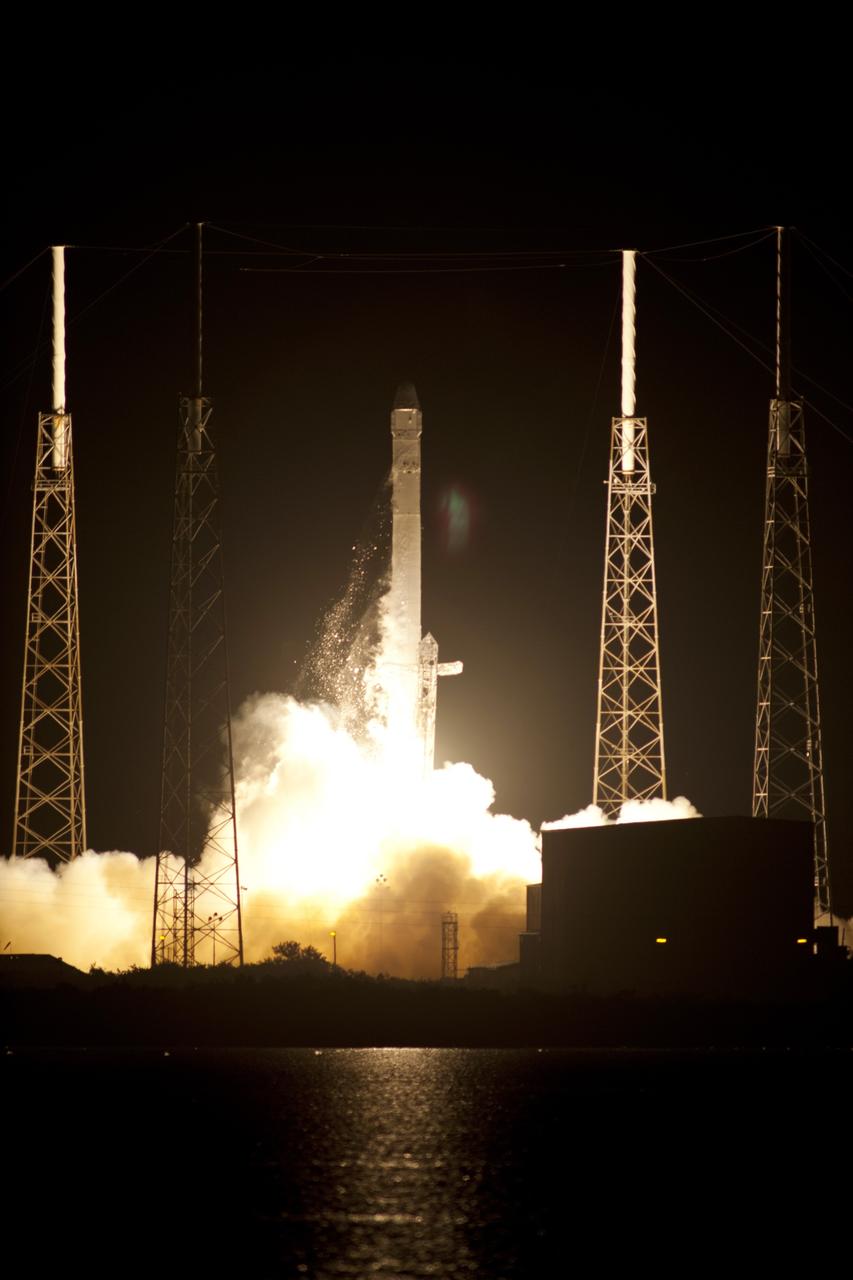
CAPE CANAVERAL, Fla. - Space Launch Complex 40 on Cape Canaveral Air Force Station in Florida comes alive as the Merlin engines ignite under the Falcon 9 rocket carrying a Dragon capsule to orbit. Liftoff was at 8:35 p.m. EDT. Space Exploration Technologies Corp., or SpaceX, built both the rocket and capsule for NASA's first Commercial Resupply Services, or CRS-1, mission to the International Space Station. SpaceX CRS-1 is an important step toward making America’s microgravity research program self-sufficient by providing a way to deliver and return significant amounts of cargo, including science experiments, to and from the orbiting laboratory. NASA has contracted for 12 commercial resupply flights from SpaceX and eight from the Orbital Sciences Corp. For more information, visit http://www.nasa.gov/mission_pages/station/living/launch/index.html Photo credit: NASA/Tony Gray
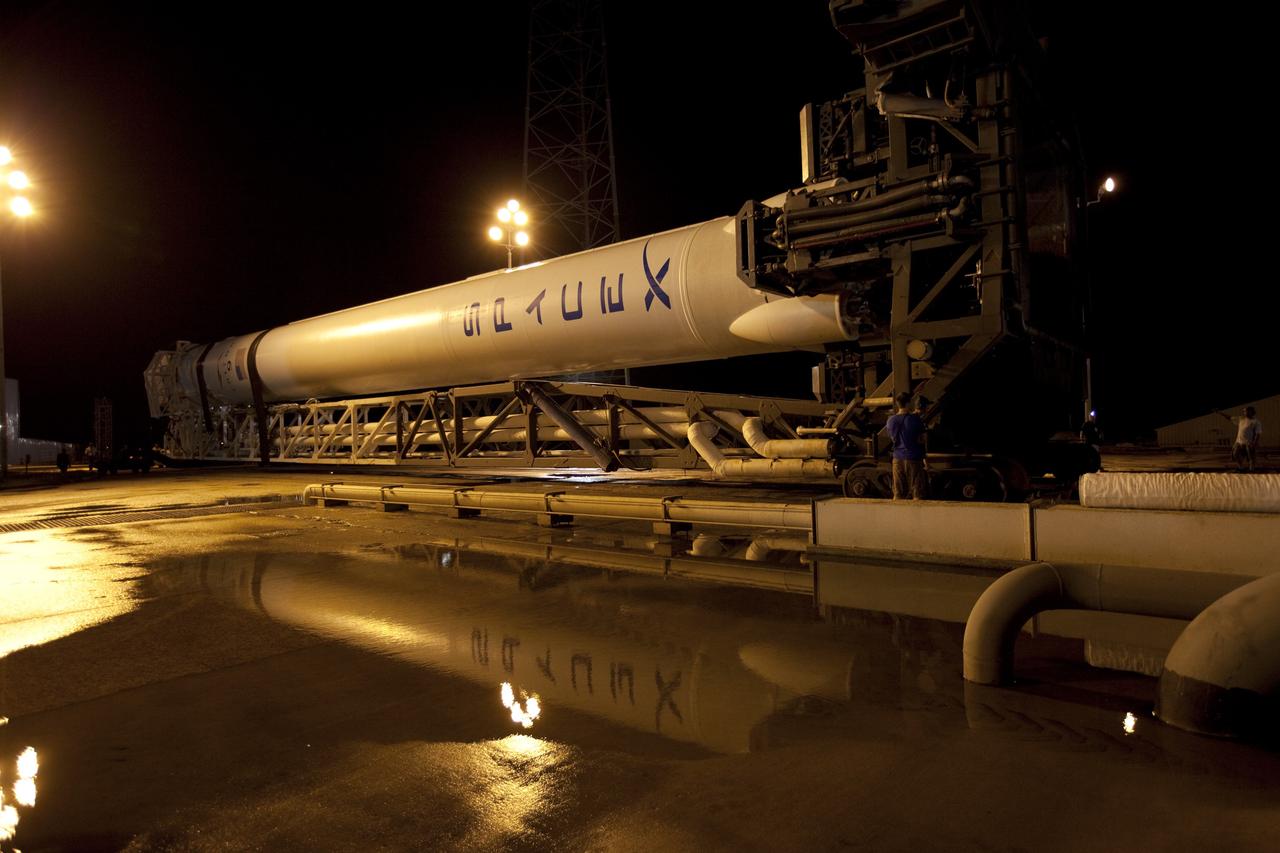
CAPE CANAVERAL, Fla. -- A Falcon 9 rocket with a Dragon capsule secured atop is reflected in the rainwater standing on the surface of Space Launch Complex 40 on Cape Canaveral Air Force Station in Florida as it rolls from the processing hangar to the pad. Space Exploration Technologies Corp., or SpaceX, built both the rocket and capsule for NASA's first Commercial Resupply Services, or CRS-1, mission to the International Space Station. Rollout was complete at 9:55 p.m. EDT. SpaceX CRS-1 is an important step toward making America’s microgravity research program self-sufficient by providing a way to deliver and return significant amounts of cargo, including science experiments, to and from the orbiting laboratory. Launch is scheduled for 8:35 p.m. EDT on Oct. 7. NASA has contracted for 12 commercial resupply flights from SpaceX and eight from the Orbital Sciences Corp. For more information, visit http://www.nasa.gov/mission_pages/station/living/launch/index.html. Photo credit: NASA/Kim Shiflett
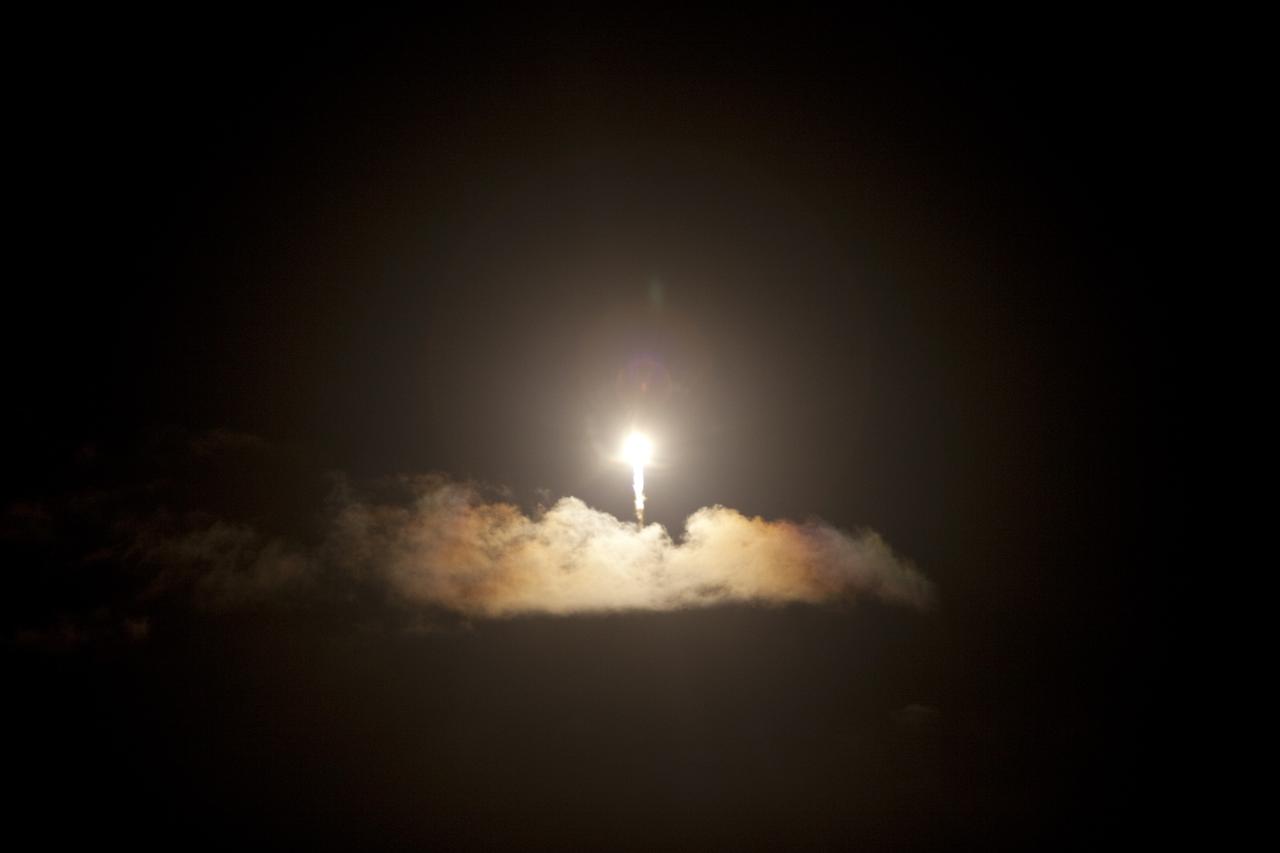
CAPE CANAVERAL, Fla. -- The clouds over Space Launch Complex 40 on Cape Canaveral Air Force Station in Florida light up as a Falcon 9 rocket passes through, carrying a Dragon capsule to orbit. Liftoff was at 8:35 p.m. EDT. Space Exploration Technologies Corp., or SpaceX, built both the rocket and capsule for NASA's first Commercial Resupply Services, or CRS-1, mission to the International Space Station. SpaceX CRS-1 is an important step toward making America’s microgravity research program self-sufficient by providing a way to deliver and return significant amounts of cargo, including science experiments, to and from the orbiting laboratory. NASA has contracted for 12 commercial resupply flights from SpaceX and eight from the Orbital Sciences Corp. For more information, visit http://www.nasa.gov/mission_pages/station/living/launch/index.html. Photo credit: NASA/Gianni Woods
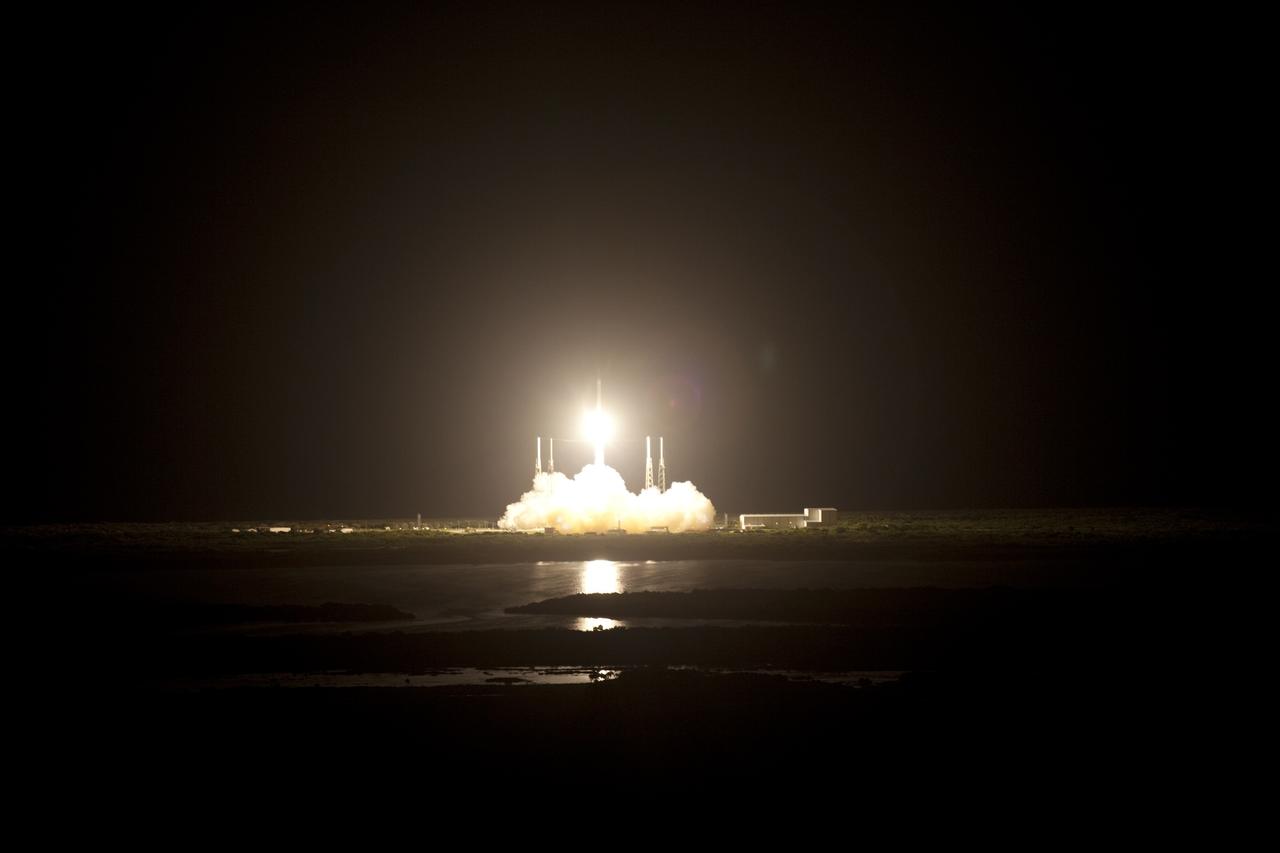
CAPE CANAVERAL, Fla. -- Plumes of exhaust and smoke billow around the lightning masts on Space Launch Complex 40 on Cape Canaveral Air Force Station in Florida as a Falcon 9 rocket lifts off at 8:35 p.m. EDT, carrying a Dragon capsule to orbit. Space Exploration Technologies Corp., or SpaceX, built both the rocket and capsule for NASA's first Commercial Resupply Services, or CRS-1, mission to the International Space Station. SpaceX CRS-1 is an important step toward making America’s microgravity research program self-sufficient by providing a way to deliver and return significant amounts of cargo, including science experiments, to and from the orbiting laboratory. NASA has contracted for 12 commercial resupply flights from SpaceX and eight from the Orbital Sciences Corp. For more information, visit http://www.nasa.gov/mission_pages/station/living/launch/index.html. Photo credit: NASA/Gianni Woods
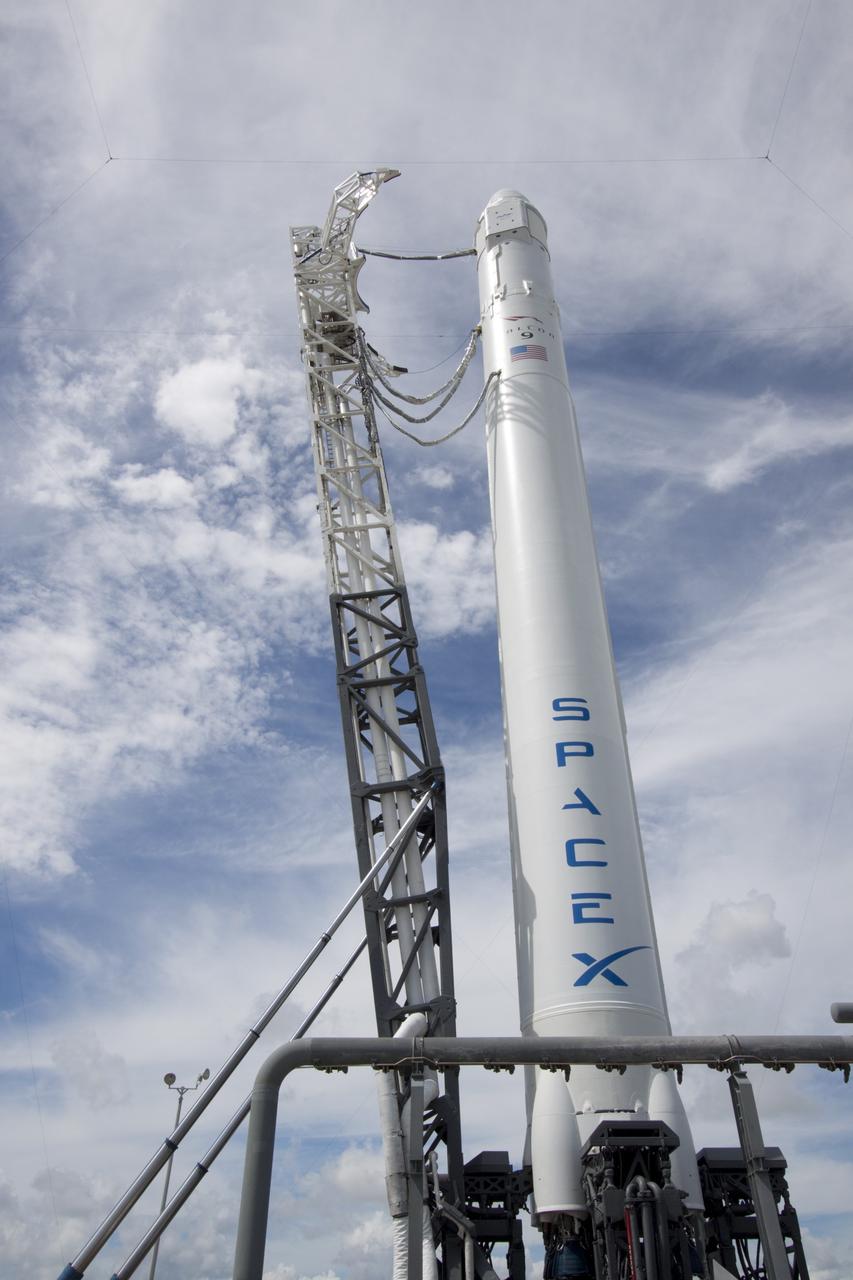
CAPE CANAVERAL, Fla. -- Umbilical lines are attached to a Falcon 9 rocket with a Dragon capsule secured atop on the pad at Space Launch Complex 40 on Cape Canaveral Air Force Station in Florida. Space Exploration Technologies Corp., or SpaceX, built both the rocket and capsule for NASA's first Commercial Resupply Services, or CRS-1, mission to the International Space Station. The vertical lift was complete at 1 p.m. EDT. SpaceX CRS-1 is an important step toward making America’s microgravity research program self-sufficient by providing a way to deliver and return significant amounts of cargo, including science experiments, to and from the orbiting laboratory. Launch is scheduled for 8:35 p.m. EDT on Oct. 7. NASA has contracted for 12 commercial resupply flights from SpaceX and eight from the Orbital Sciences Corp. For more information, visit http://www.nasa.gov/mission_pages/station/living/launch/index.html. Photo credit: NASA/Jim Grossmann
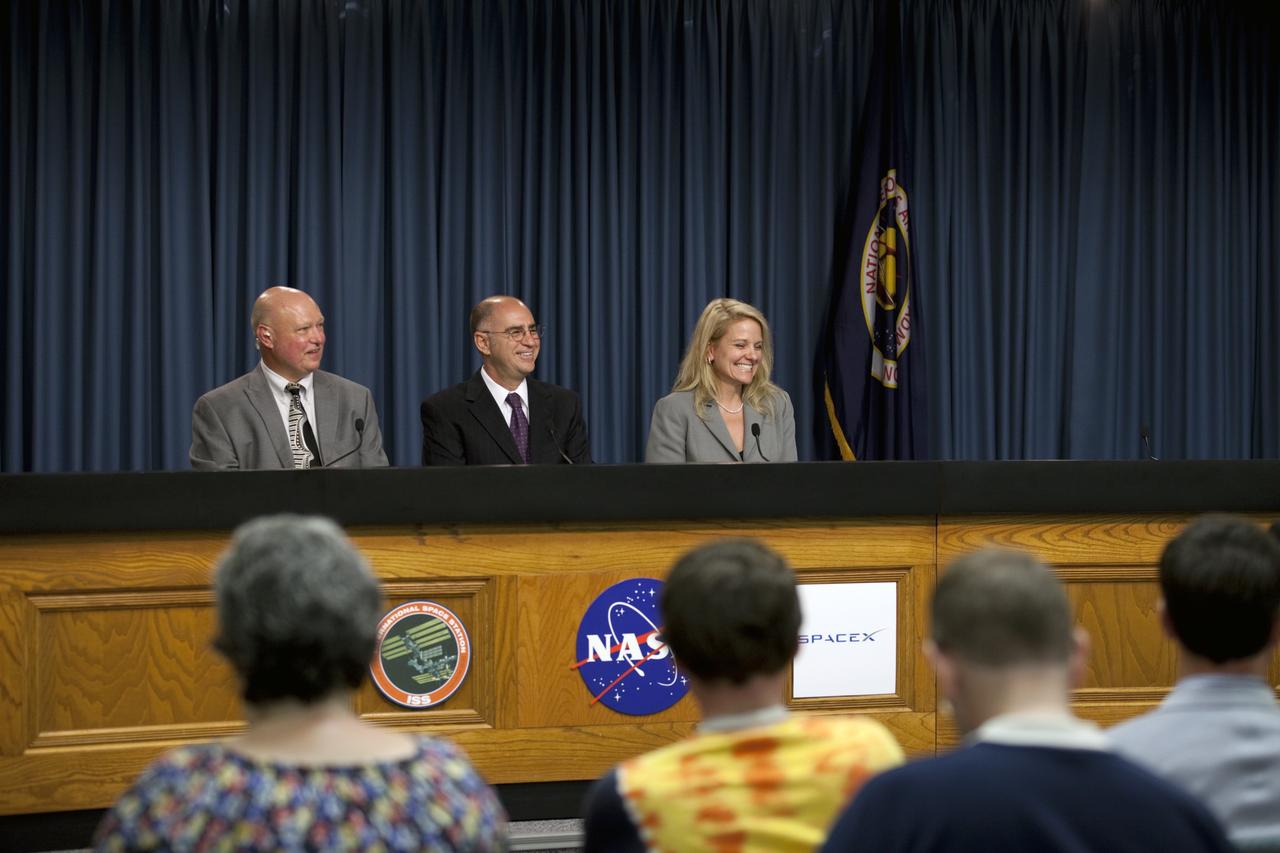
CAPE CANAVERAL, Fla. -- The participants of a post-launch news conference held in the Press Site auditorium at NASA's Kennedy Space Center in Florida are all smiles following the successful launch of NASA's first Commercial Resupply Services, or CRS-1, mission to the International Space Station. On the dais are, from left, Michael Curie, NASA Public Affairs, Sam Scimemi, director of International Space Station at NASA Headquarters, and Gwynne Shotwell, president of Space Exploration Technologies Corp., or SpaceX. SpaceX built both the Falcon 9 rocket and Dragon capsule that launched at 8:35 p.m. EDT from Space Launch Complex 40 on Cape Canaveral Air Force Station. SpaceX CRS-1 is an important step toward making America’s microgravity research program self-sufficient by providing a way to deliver and return significant amounts of cargo, including science experiments, to and from the orbiting laboratory. NASA has contracted for 12 commercial resupply flights from SpaceX and eight from the Orbital Sciences Corp. For more information, visit http://www.nasa.gov/mission_pages/station/living/launch/index.html. Photo credit: NASA/Kim Shiflett
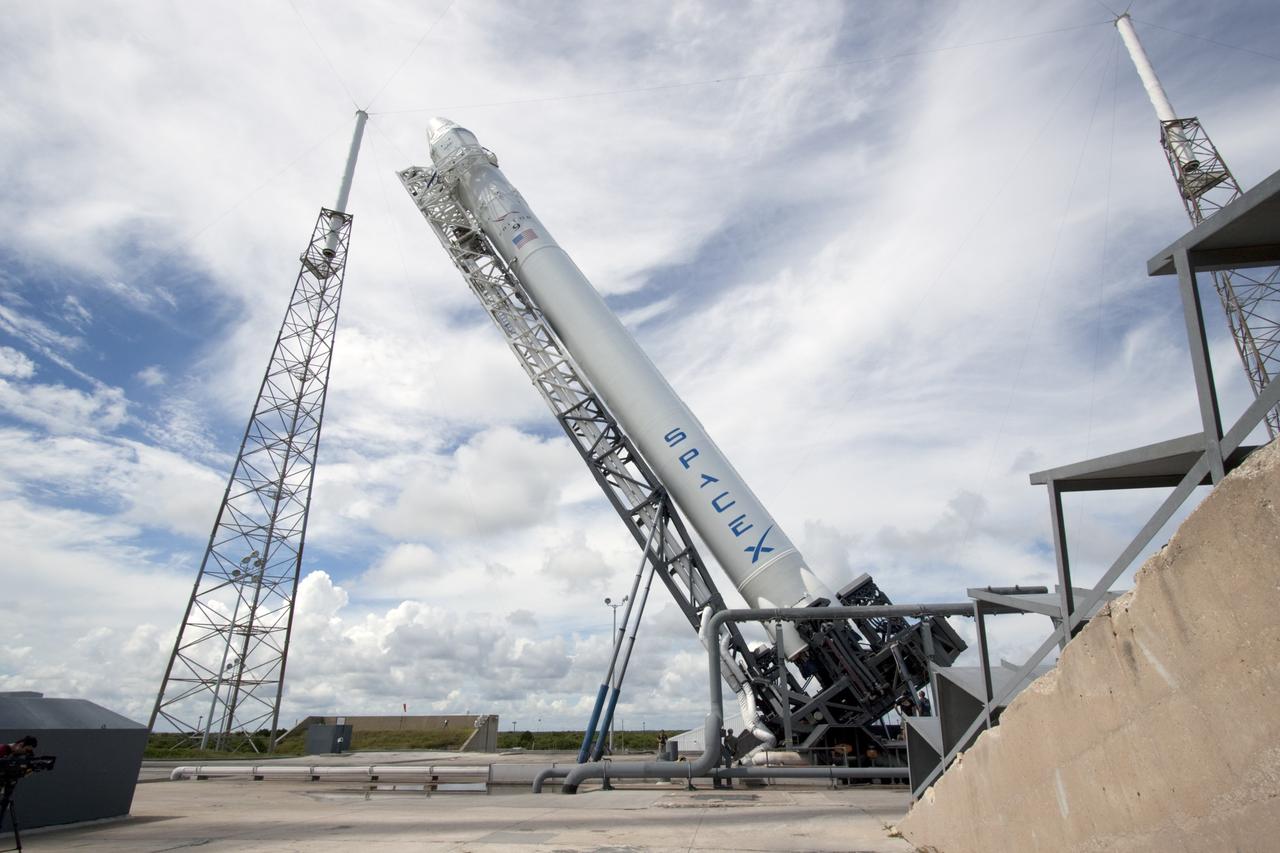
CAPE CANAVERAL, Fla. -- A Falcon 9 rocket with a Dragon capsule secured atop is lifted into a vertical position between the lightning masts on the pad at Space Launch Complex 40 on Cape Canaveral Air Force Station in Florida. Space Exploration Technologies Corp., or SpaceX, built both the rocket and capsule for NASA's first Commercial Resupply Services, or CRS-1, mission to the International Space Station. The vertical lift was complete at 1 p.m. EDT. SpaceX CRS-1 is an important step toward making America’s microgravity research program self-sufficient by providing a way to deliver and return significant amounts of cargo, including science experiments, to and from the orbiting laboratory. Launch is scheduled for 8:35 p.m. EDT on Oct. 7. NASA has contracted for 12 commercial resupply flights from SpaceX and eight from the Orbital Sciences Corp. For more information, visit http://www.nasa.gov/mission_pages/station/living/launch/index.html. Photo credit: NASA/Jim Grossmann
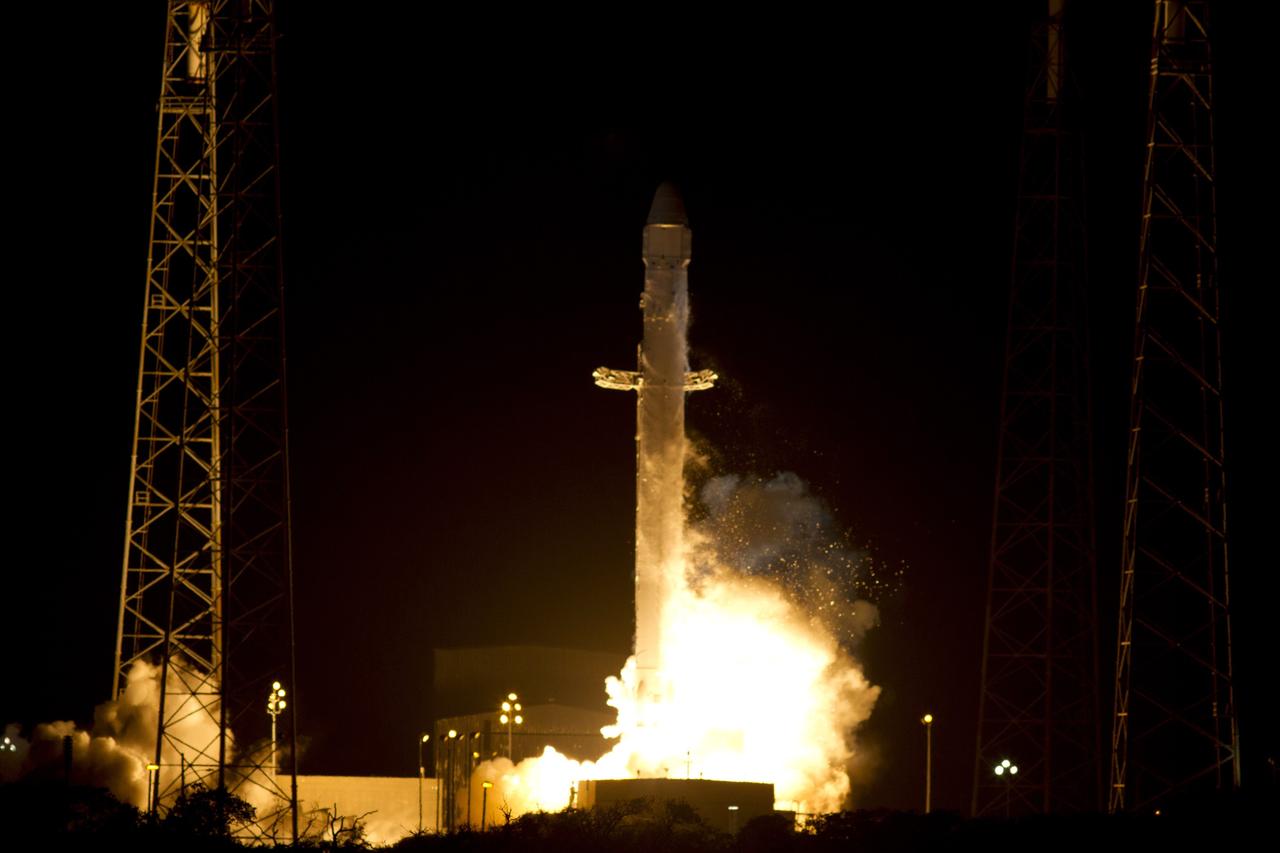
CAPE CANAVERAL, Fla. - Space Launch Complex 40 on Cape Canaveral Air Force Station in Florida comes alive as the Merlin engines ignite under the Falcon 9 rocket carrying a Dragon capsule to orbit. Liftoff was at 8:35 p.m. EDT. Space Exploration Technologies Corp., or SpaceX, built both the rocket and capsule for NASA's first Commercial Resupply Services, or CRS-1, mission to the International Space Station. SpaceX CRS-1 is an important step toward making America’s microgravity research program self-sufficient by providing a way to deliver and return significant amounts of cargo, including science experiments, to and from the orbiting laboratory. NASA has contracted for 12 commercial resupply flights from SpaceX and eight from the Orbital Sciences Corp. For more information, visit http://www.nasa.gov/mission_pages/station/living/launch/index.html Photo credit: NASA/Gina Mitchell and George Roberts
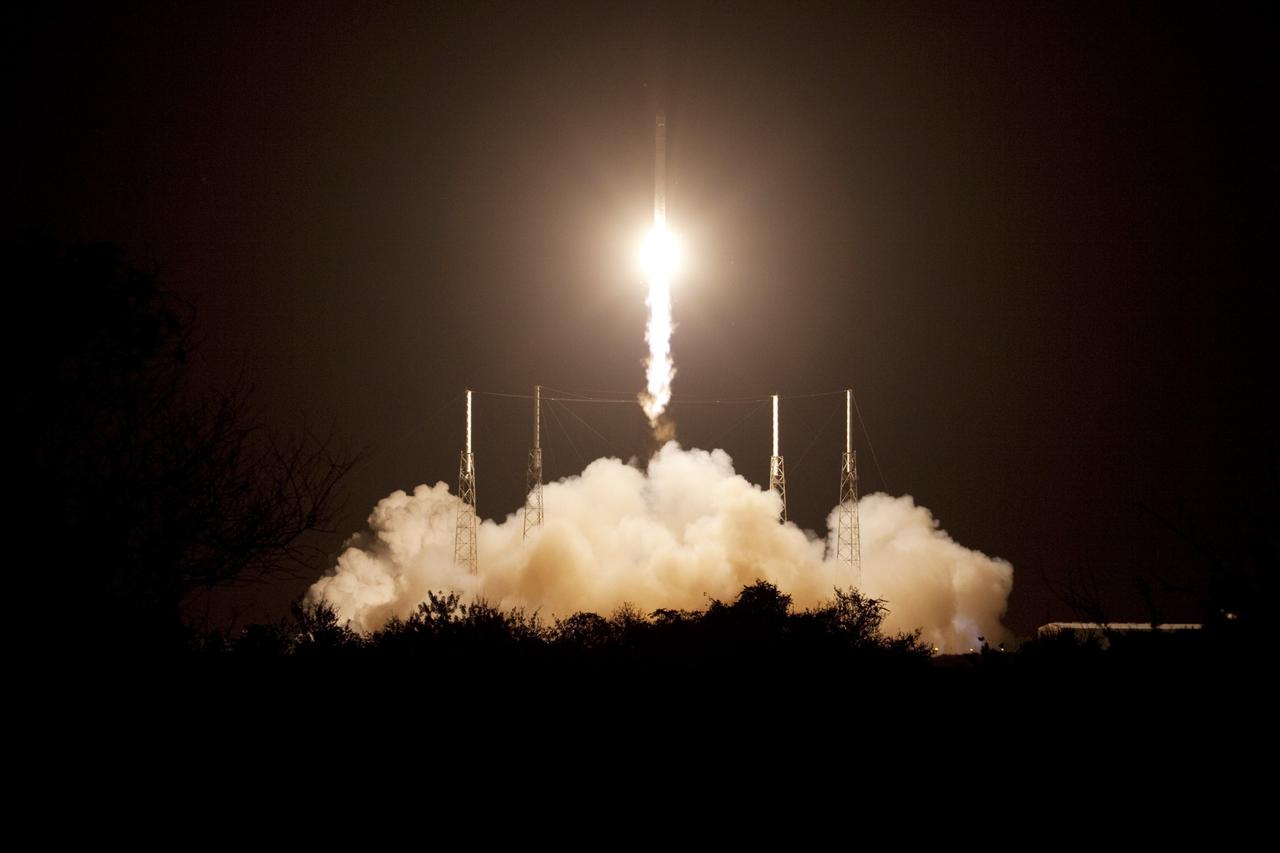
CAPE CANAVERAL, Fla. -- A Falcon 9 rocket makes its way into the clouds over Space Launch Complex 40 on Cape Canaveral Air Force Station in Florida carrying a Dragon capsule to orbit. Launch was at 8:35 p.m. EDT. Space Exploration Technologies Corp., or SpaceX, built both the rocket and capsule for NASA's first Commercial Resupply Services, or CRS-1, mission to the International Space Station. SpaceX CRS-1 is an important step toward making America’s microgravity research program self-sufficient by providing a way to deliver and return significant amounts of cargo, including science experiments, to and from the orbiting laboratory. NASA has contracted for 12 commercial resupply flights from SpaceX and eight from the Orbital Sciences Corp. For more information, visit http://www.nasa.gov/mission_pages/station/living/launch/index.html. Photo credit: NASA/Jim Grossmann
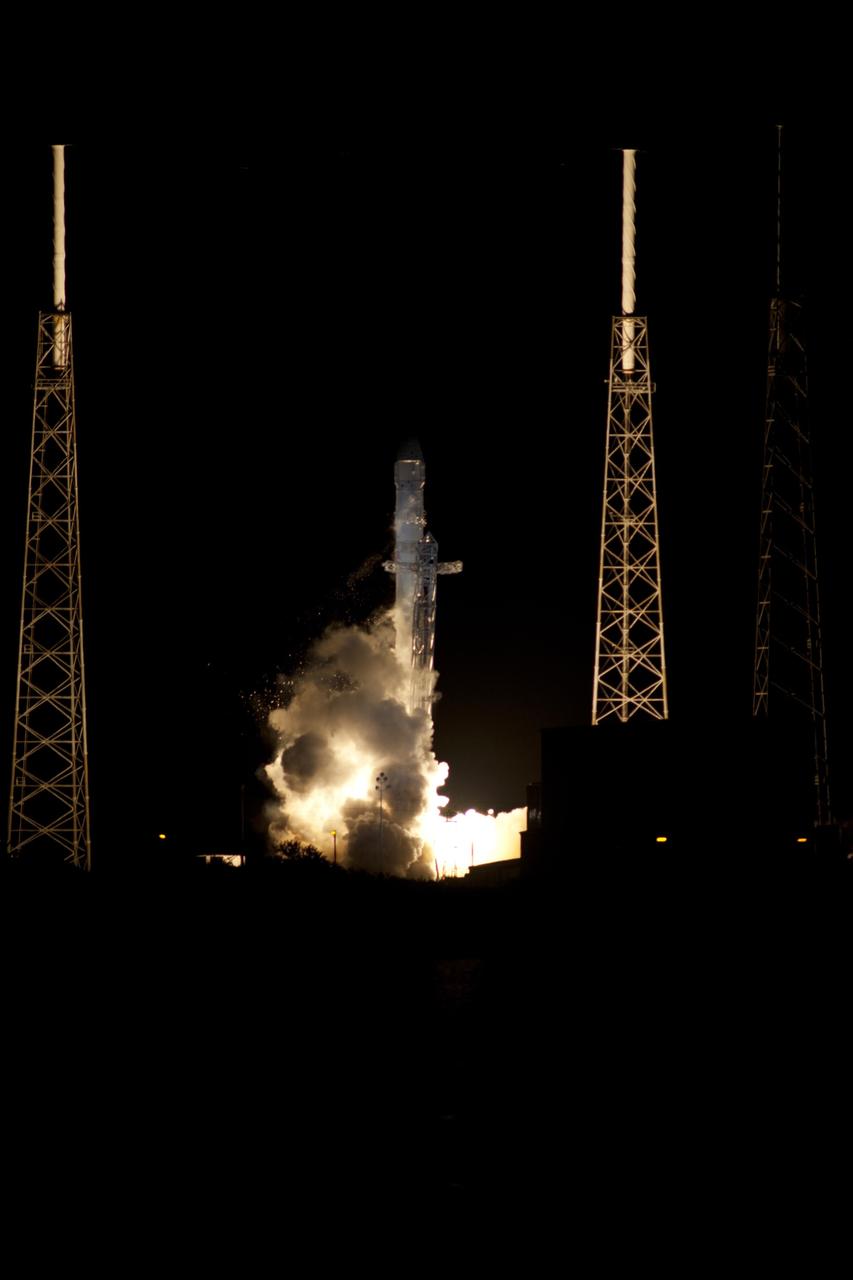
CAPE CANAVERAL, Fla. - Space Launch Complex 40 on Cape Canaveral Air Force Station in Florida comes alive as the Merlin engines ignite under the Falcon 9 rocket carrying a Dragon capsule to orbit. Liftoff was at 8:35 p.m. EDT. Space Exploration Technologies Corp., or SpaceX, built both the rocket and capsule for NASA's first Commercial Resupply Services, or CRS-1, mission to the International Space Station. SpaceX CRS-1 is an important step toward making America’s microgravity research program self-sufficient by providing a way to deliver and return significant amounts of cargo, including science experiments, to and from the orbiting laboratory. NASA has contracted for 12 commercial resupply flights from SpaceX and eight from the Orbital Sciences Corp. For more information, visit http://www.nasa.gov/mission_pages/station/living/launch/index.html Photo credit: NASA/Tony Gray
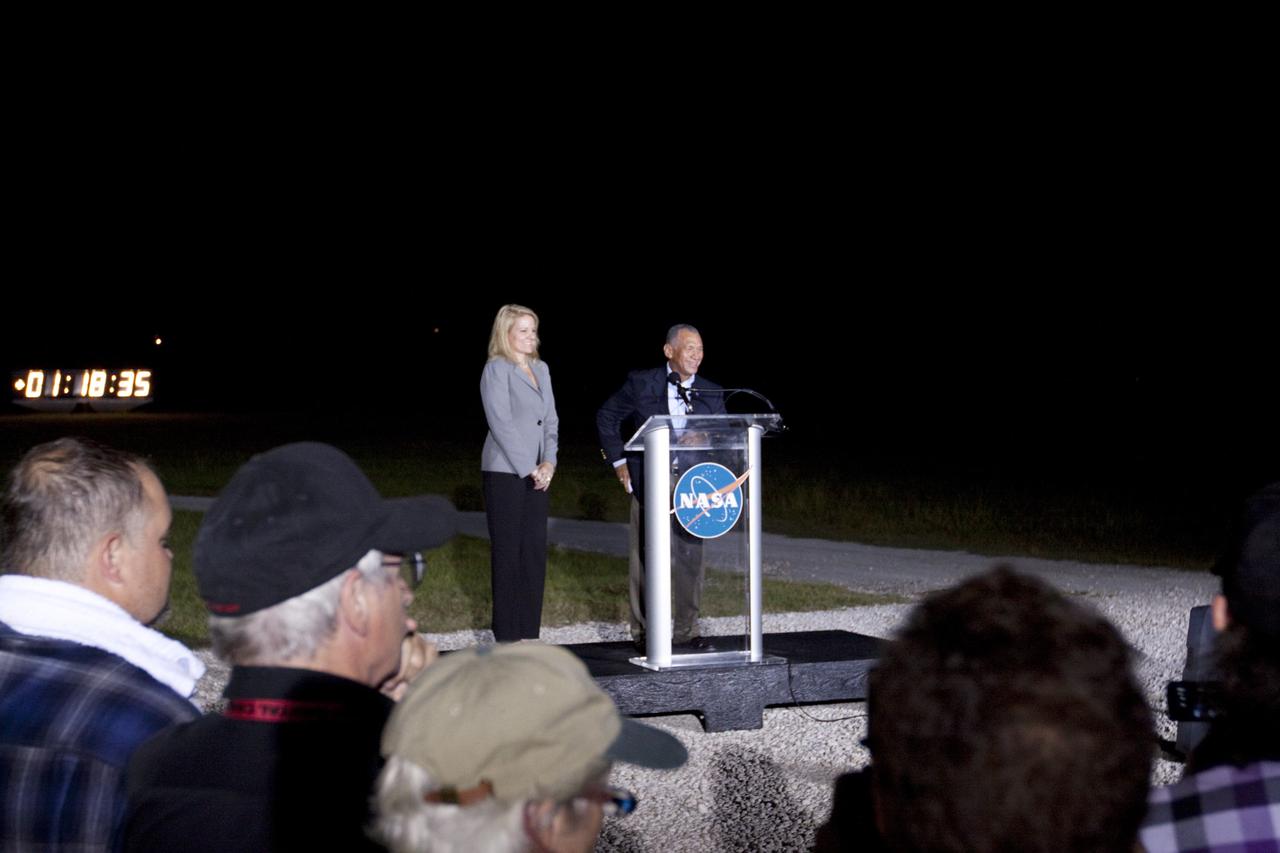
CAPE CANAVERAL, Fla. -- NASA Administrator Charlie Bolden addresses news and social media representatives at the Press Site at NASA's Kennedy Space Center in Florida following the successful launch of NASA's first Commercial Resupply Services, or CRS-1, mission to the International Space Station. Beside him on the podium is Gwynne Shotwell, president of Space Exploration Technologies Corp., or SpaceX. SpaceX built both the Falcon 9 rocket and Dragon capsule that launched at 8:35 p.m. EDT from Space Launch Complex 40 on Cape Canaveral Air Force Station. SpaceX CRS-1 is an important step toward making America’s microgravity research program self-sufficient by providing a way to deliver and return significant amounts of cargo, including science experiments, to and from the orbiting laboratory. NASA has contracted for 12 commercial resupply flights from SpaceX and eight from the Orbital Sciences Corp. For more information, visit http://www.nasa.gov/mission_pages/station/living/launch/index.html. Photo credit: NASA/Kim Shiflett
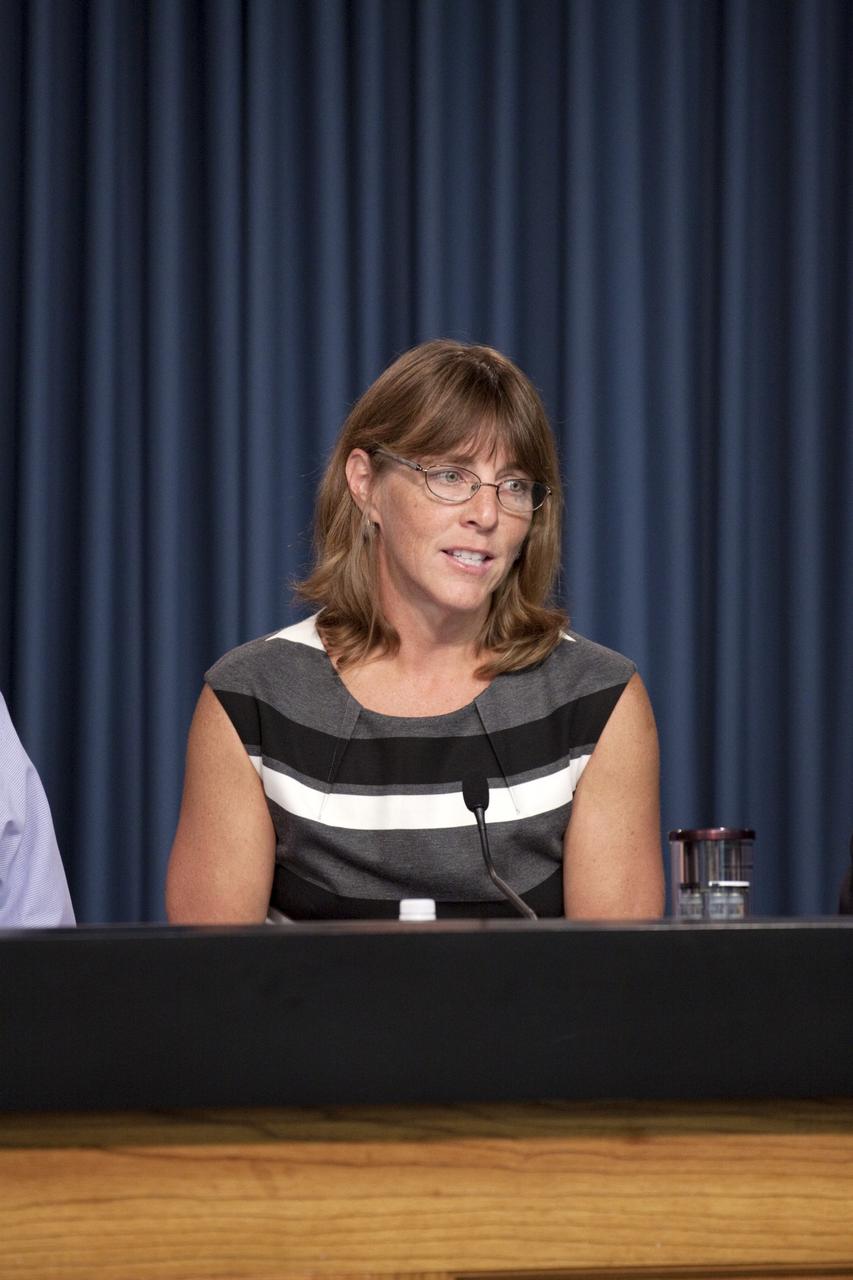
CAPE CANAVERAL, Fla. -- Sheila Nielsen-Preiss, cell biologist at Montana State University, participates in a space station and mission science briefing in NASA Kennedy Space Center's Press Site auditorium in Florida. The briefing provided media with an overview of the experiments and payloads scheduled for launch on NASA's first Commercial Resupply Services, or CRS-1, mission to the International Space Station. Space Exploration Technologies Corp., or SpaceX, built both the mission's Falcon 9 rocket and Dragon capsule. Launch is scheduled for 8:35 p.m. EDT on Oct. 7 from Space Launch Complex 40 on Cape Canaveral Air Force Station. SpaceX CRS-1 is an important step toward making America’s microgravity research program self-sufficient by providing a way to deliver and return significant amounts of cargo, including science experiments, to and from the orbiting laboratory. NASA has contracted for 12 commercial resupply flights from SpaceX and eight from the Orbital Sciences Corp. For more information, visit http://www.nasa.gov/mission_pages/station/living/launch/index.html. Photo credit: NASA/Kim Shiflett
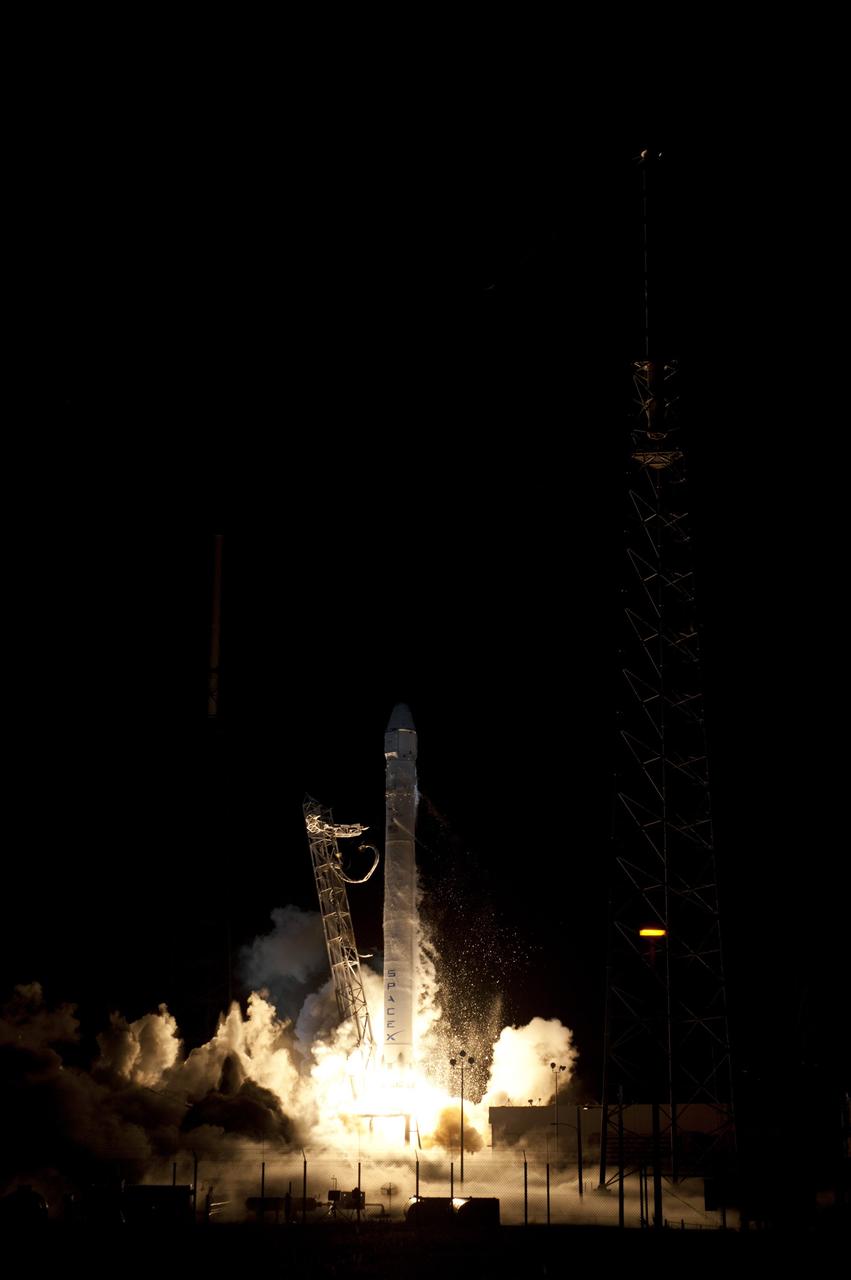
CAPE CANAVERAL, Fla. - Space Launch Complex 40 on Cape Canaveral Air Force Station in Florida comes alive as the Merlin engines ignite under the Falcon 9 rocket carrying a Dragon capsule to orbit. Liftoff was at 8:35 p.m. EDT. Space Exploration Technologies Corp., or SpaceX, built both the rocket and capsule for NASA's first Commercial Resupply Services, or CRS-1, mission to the International Space Station. SpaceX CRS-1 is an important step toward making America’s microgravity research program self-sufficient by providing a way to deliver and return significant amounts of cargo, including science experiments, to and from the orbiting laboratory. NASA has contracted for 12 commercial resupply flights from SpaceX and eight from the Orbital Sciences Corp. For more information, visit http://www.nasa.gov/mission_pages/station/living/launch/index.html Photo credit: NASA/Rick Wetherington and Tony Gray
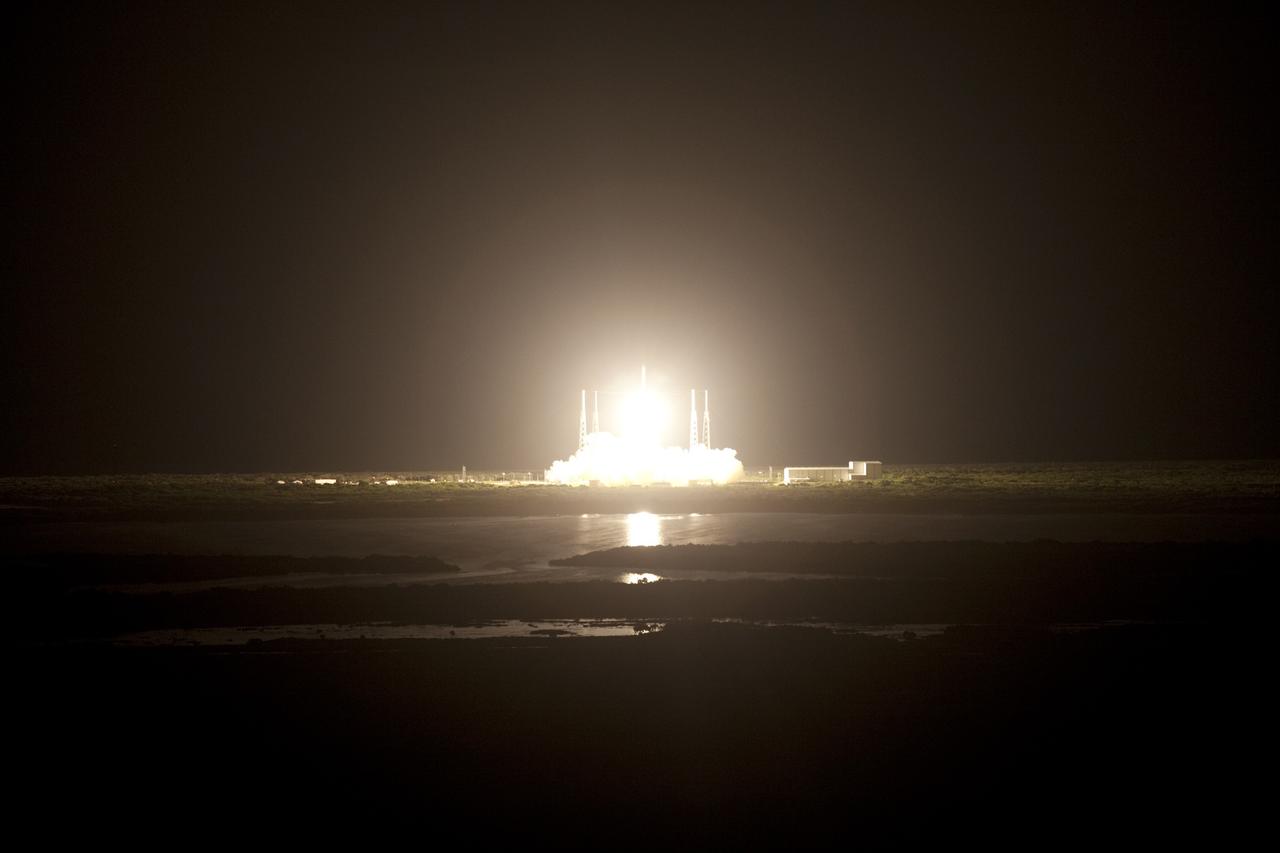
CAPE CANAVERAL, Fla. -- Space Launch Complex 40 on Cape Canaveral Air Force Station in Florida is illuminated by a Falcon 9 rocket as it lifts off at 8:35 p.m. EDT carrying a Dragon capsule to orbit. Space Exploration Technologies Corp., or SpaceX, built both the rocket and capsule for NASA's first Commercial Resupply Services, or CRS-1, mission to the International Space Station. SpaceX CRS-1 is an important step toward making America’s microgravity research program self-sufficient by providing a way to deliver and return significant amounts of cargo, including science experiments, to and from the orbiting laboratory. NASA has contracted for 12 commercial resupply flights from SpaceX and eight from the Orbital Sciences Corp. For more information, visit http://www.nasa.gov/mission_pages/station/living/launch/index.html. Photo credit: NASA/Gianni Woods
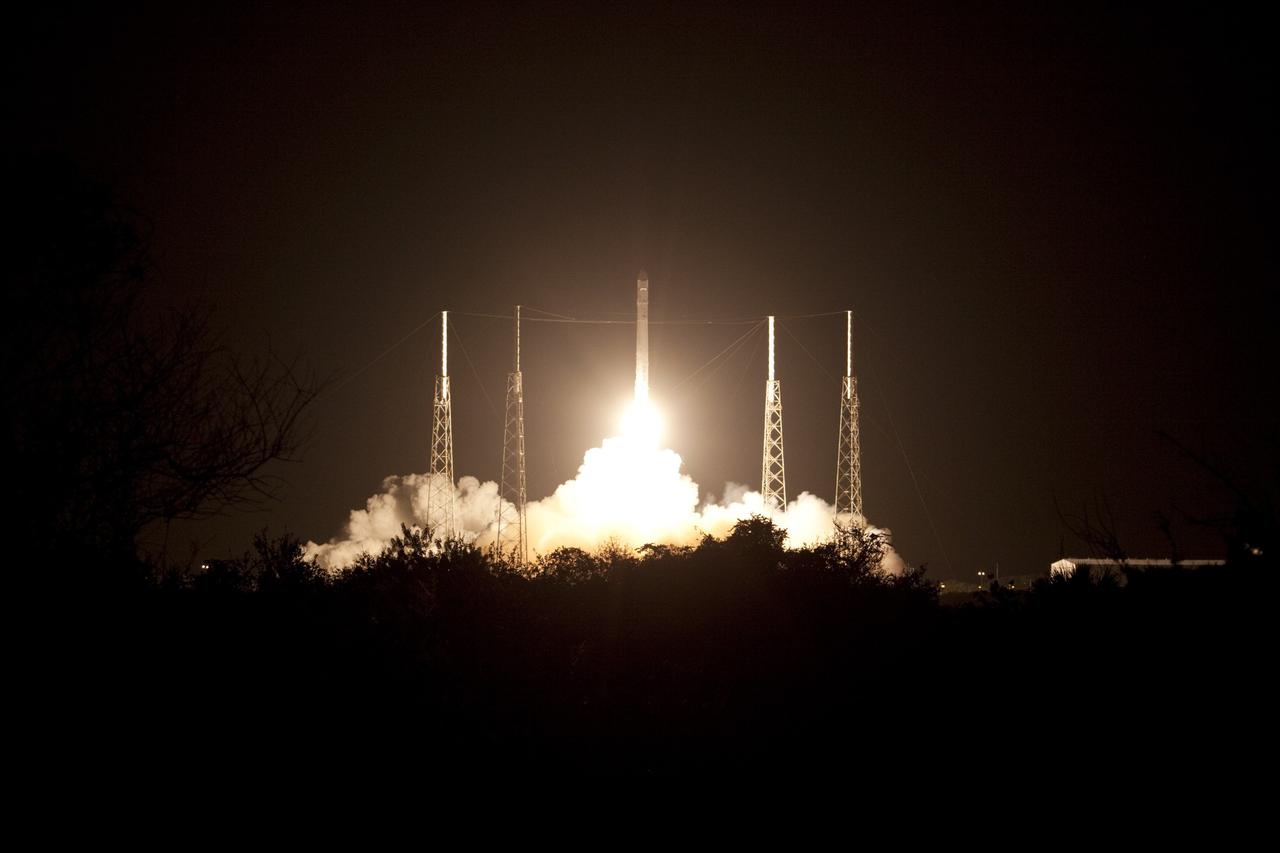
CAPE CANAVERAL, Fla. -- Plumes of exhaust and smoke form around a Falcon 9 rocket at 8:35 p.m. EDT as it lifts off Space Launch Complex 40 on Cape Canaveral Air Force Station in Florida, carrying a Dragon capsule to orbit. Space Exploration Technologies Corp., or SpaceX, built both the rocket and capsule for NASA's first Commercial Resupply Services, or CRS-1, mission to the International Space Station. SpaceX CRS-1 is an important step toward making America’s microgravity research program self-sufficient by providing a way to deliver and return significant amounts of cargo, including science experiments, to and from the orbiting laboratory. NASA has contracted for 12 commercial resupply flights from SpaceX and eight from the Orbital Sciences Corp. For more information, visit http://www.nasa.gov/mission_pages/station/living/launch/index.html. Photo credit: NASA/Jim Grossmann
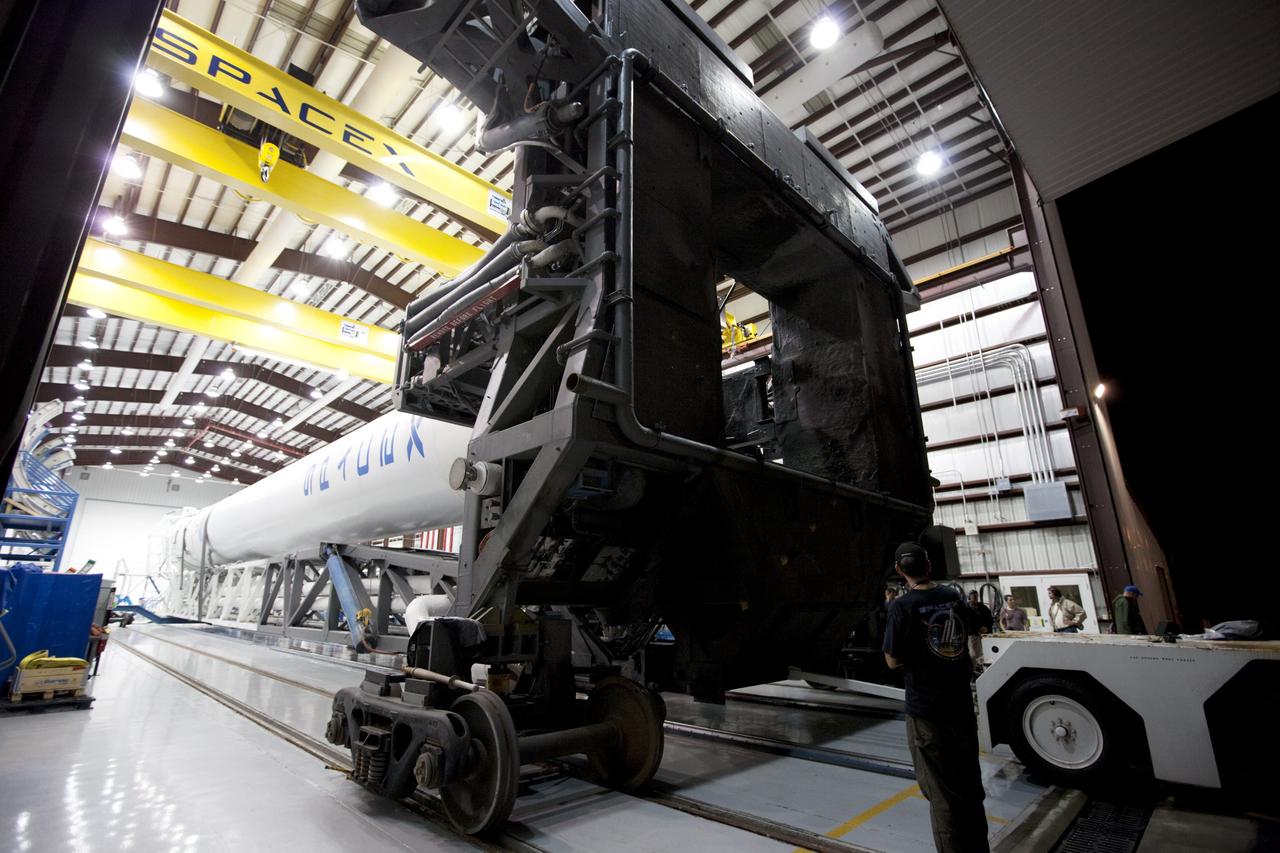
CAPE CANAVERAL, Fla. -- Preparations are under way to roll a Falcon 9 rocket with a Dragon capsule secured atop from the processing hangar to the pad at Space Launch Complex 40 on Cape Canaveral Air Force Station in Florida. Space Exploration Technologies Corp., or SpaceX, built both the rocket and capsule for NASA's first Commercial Resupply Services, or CRS-1, mission to the International Space Station. Rollout was complete at 9:55 p.m. EDT. SpaceX CRS-1 is an important step toward making America’s microgravity research program self-sufficient by providing a way to deliver and return significant amounts of cargo, including science experiments, to and from the orbiting laboratory. Launch is scheduled for 8:35 p.m. EDT on Oct. 7. NASA has contracted for 12 commercial resupply flights from SpaceX and eight from the Orbital Sciences Corp. For more information, visit http://www.nasa.gov/mission_pages/station/living/launch/index.html. Photo credit: NASA/Kim Shiflett
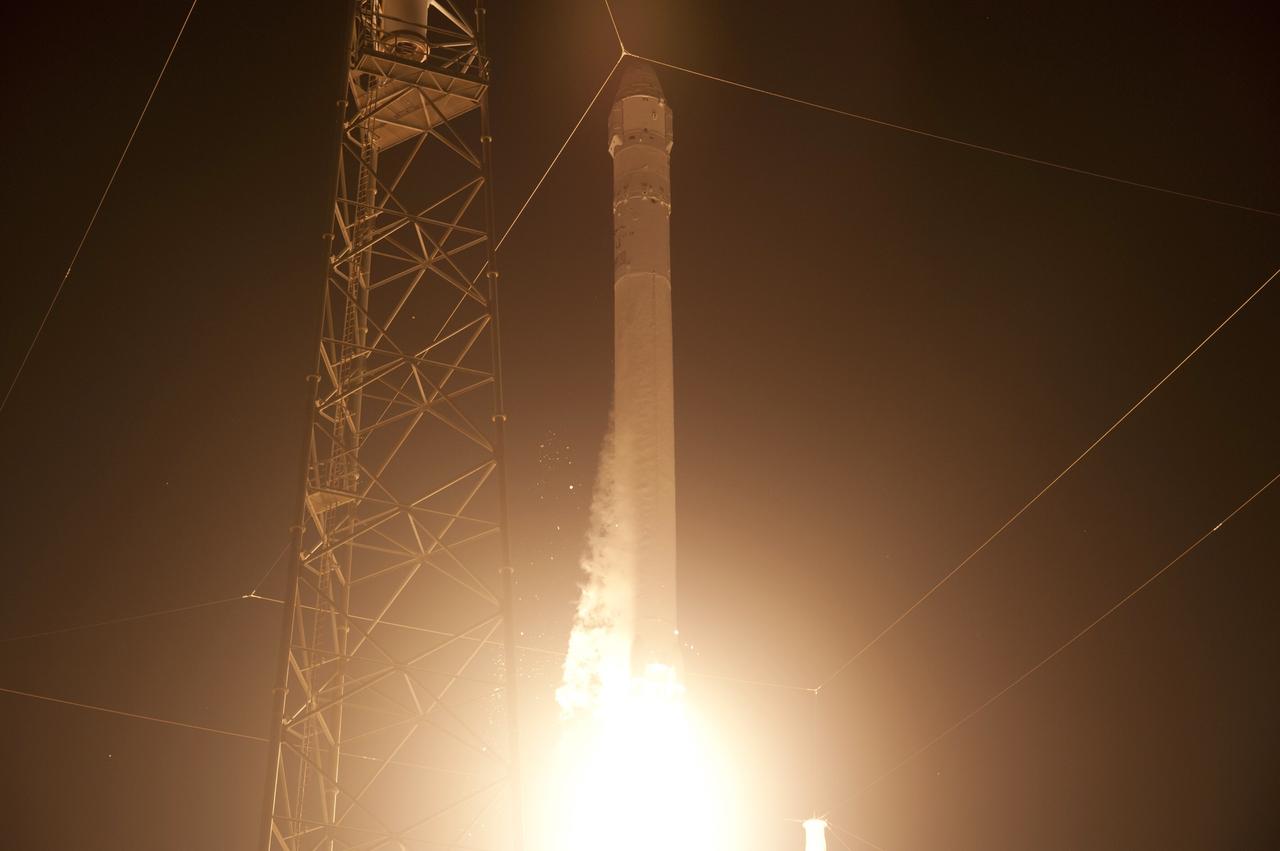
CAPE CANAVERAL, Fla. - Space Launch Complex 40 on Cape Canaveral Air Force Station in Florida comes alive as the Merlin engines ignite under the Falcon 9 rocket carrying a Dragon capsule to orbit. Liftoff was at 8:35 p.m. EDT. Space Exploration Technologies Corp., or SpaceX, built both the rocket and capsule for NASA's first Commercial Resupply Services, or CRS-1, mission to the International Space Station. SpaceX CRS-1 is an important step toward making America’s microgravity research program self-sufficient by providing a way to deliver and return significant amounts of cargo, including science experiments, to and from the orbiting laboratory. NASA has contracted for 12 commercial resupply flights from SpaceX and eight from the Orbital Sciences Corp. For more information, visit http://www.nasa.gov/mission_pages/station/living/launch/index.html Photo credit: NASA/Rusty Backer
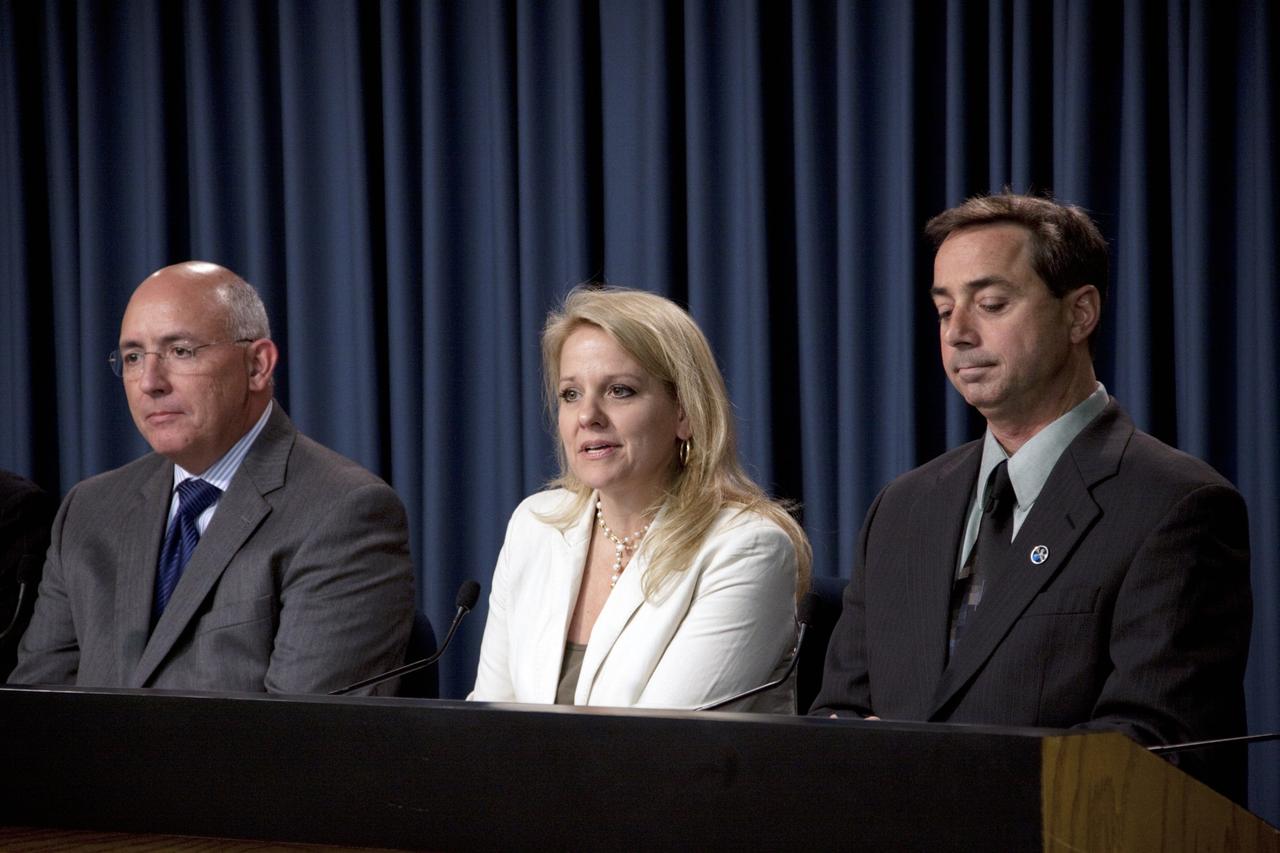
CAPE CANAVERAL, Fla. -- Gwynne Shotwell, president of Space Exploration Technologies Corp. or SpaceX, participates in a prelaunch news conference in Kennedy Space Center's Press Site auditorium in Florida. To her left is Mike Suffredini, program manager, International Space Station, Johnson Space Center and to her right is Mike McAleenan, launch weather officer, 45th Weather Squadron, Cape Canaveral Air Force Station The news conference provided the media with a status on the readiness to launch NASA's first Commercial Resupply Services, or CRS-1, mission to the International Space Station. Space Exploration Technologies Corp., or SpaceX, built both the mission's Falcon 9 rocket and Dragon capsule. Launch is scheduled for 8:35 p.m. EDT on Oct. 7 from Space Launch Complex 40 on Cape Canaveral Air Force Station. SpaceX CRS-1 is an important step toward making America’s microgravity research program self-sufficient by providing a way to deliver and return significant amounts of cargo, including science experiments, to and from the orbiting laboratory. NASA has contracted for 12 commercial resupply flights from SpaceX and eight from the Orbital Sciences Corp. For more information, visit http://www.nasa.gov/mission_pages/station/living/launch/index.html. Photo credit: NASA/Jim Grossmann The news conference provided the media with a status on the readiness to launch NASA's first Commercial Resupply Services, or CRS-1, mission to the International Space Station. Space Exploration Technologies Corp., or SpaceX, built both the mission's Falcon 9 rocket and Dragon capsule. Launch is scheduled for 8:35 p.m. EDT on Oct. 7 from Space Launch Complex 40 on Cape Canaveral Air Force Station. SpaceX CRS-1 is an important step toward making America’s microgravity research program self-sufficient by providing a way to deliver and return significant amounts of cargo, including science experiments, to and from the orbiting laboratory. NASA has contracted for 12 commercial resupply flights from SpaceX and eight from the Orbital Sciences Corp. For more information, visit http://www.nasa.gov/mission_pages/station/living/launch/index.html. Photo credit: NASA/Jim Grossmann
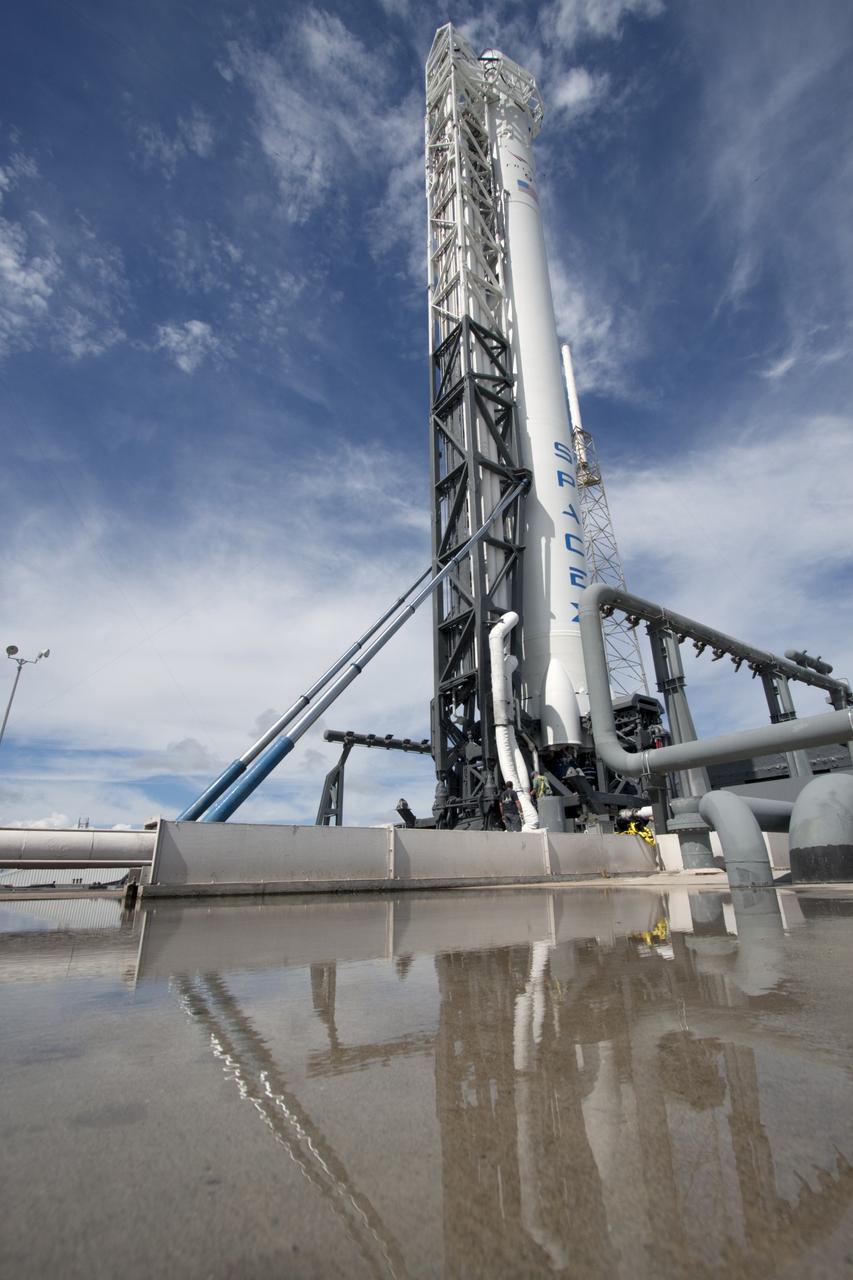
CAPE CANAVERAL, Fla. -- A Falcon 9 rocket with a Dragon capsule secured atop is reflected in the rainwater standing on the surface of the pad of Space Launch Complex 40 on Cape Canaveral Air Force Station in Florida following its lift into a vertical position. Space Exploration Technologies Corp., or SpaceX, built both the rocket and capsule for NASA's first Commercial Resupply Services, or CRS-1, mission to the International Space Station. The vertical lift was complete at 1 p.m. EDT. SpaceX CRS-1 is an important step toward making America’s microgravity research program self-sufficient by providing a way to deliver and return significant amounts of cargo, including science experiments, to and from the orbiting laboratory. Launch is scheduled for 8:35 p.m. EDT on Oct. 7. NASA has contracted for 12 commercial resupply flights from SpaceX and eight from the Orbital Sciences Corp. For more information, visit http://www.nasa.gov/mission_pages/station/living/launch/index.html. Photo credit: NASA/Jim Grossmann
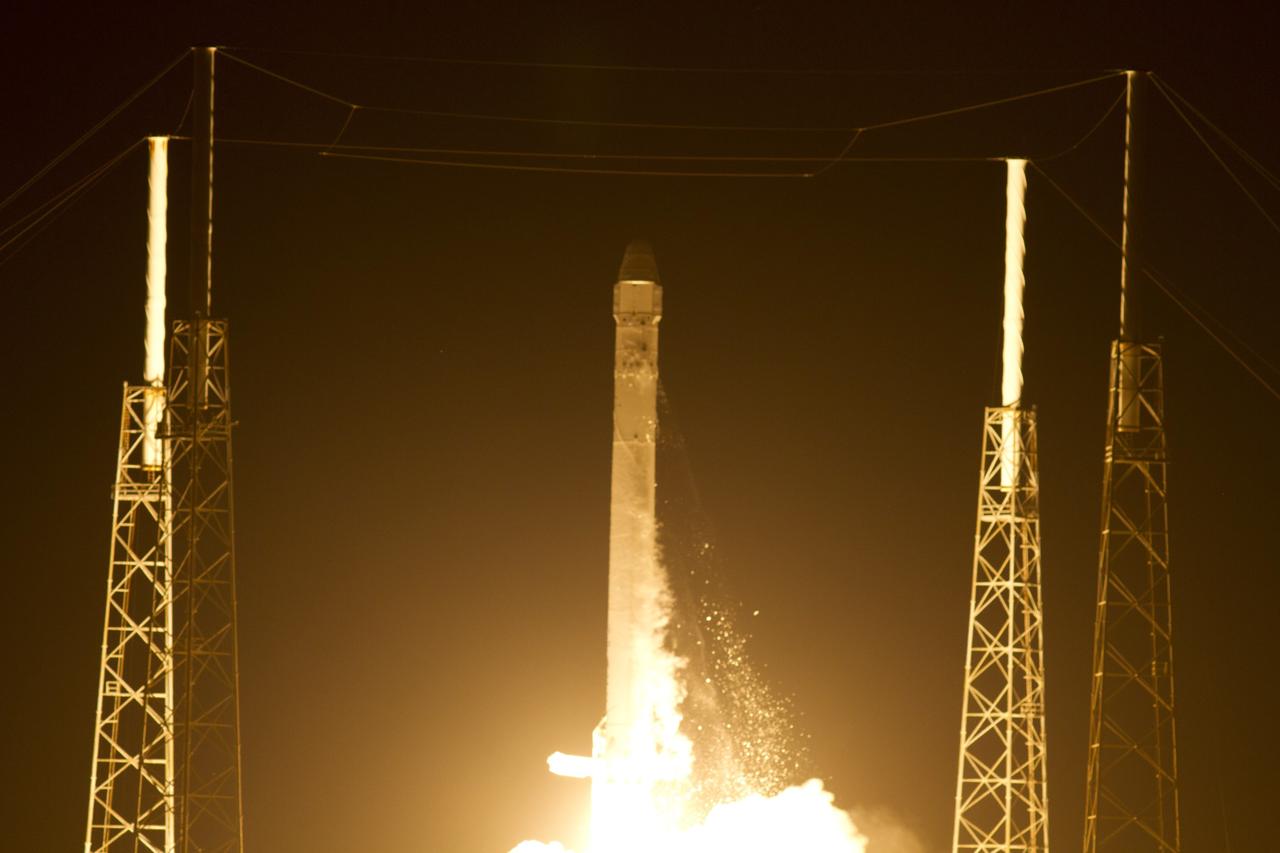
CAPE CANAVERAL, Fla. - Space Launch Complex 40 on Cape Canaveral Air Force Station in Florida comes alive as the Merlin engines ignite under the Falcon 9 rocket carrying a Dragon capsule to orbit. Liftoff was at 8:35 p.m. EDT. Space Exploration Technologies Corp., or SpaceX, built both the rocket and capsule for NASA's first Commercial Resupply Services, or CRS-1, mission to the International Space Station. SpaceX CRS-1 is an important step toward making America’s microgravity research program self-sufficient by providing a way to deliver and return significant amounts of cargo, including science experiments, to and from the orbiting laboratory. NASA has contracted for 12 commercial resupply flights from SpaceX and eight from the Orbital Sciences Corp. For more information, visit http://www.nasa.gov/mission_pages/station/living/launch/index.html Photo credit: NASA/Gina Mitchell and George Roberts
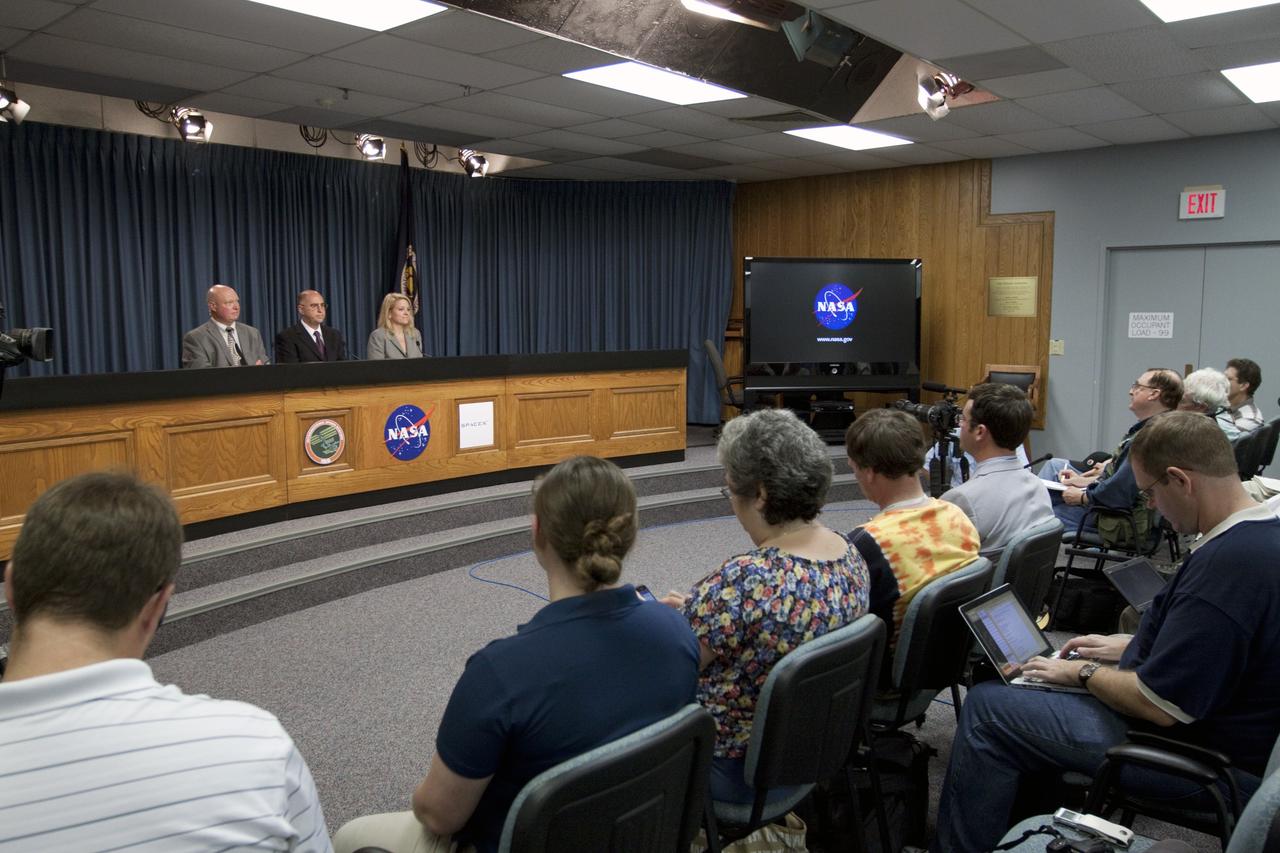
CAPE CANAVERAL, Fla. -- News and social media representatives participate in a post-launch news conference in the Press Site auditorium at NASA's Kennedy Space Center in Florida following the successful launch of NASA's first Commercial Resupply Services, or CRS-1, mission to the International Space Station. On the dais are, from left, Michael Curie, NASA Public Affairs, Sam Scimemi, director of International Space Station at NASA Headquarters, and Gwynne Shotwell, president of Space Exploration Technologies Corp., or SpaceX. SpaceX built both the Falcon 9 rocket and Dragon capsule that launched at 8:35 p.m. EDT from Space Launch Complex 40 on Cape Canaveral Air Force Station. SpaceX CRS-1 is an important step toward making America’s microgravity research program self-sufficient by providing a way to deliver and return significant amounts of cargo, including science experiments, to and from the orbiting laboratory. NASA has contracted for 12 commercial resupply flights from SpaceX and eight from the Orbital Sciences Corp. For more information, visit http://www.nasa.gov/mission_pages/station/living/launch/index.html. Photo credit: NASA/Kim Shiflett
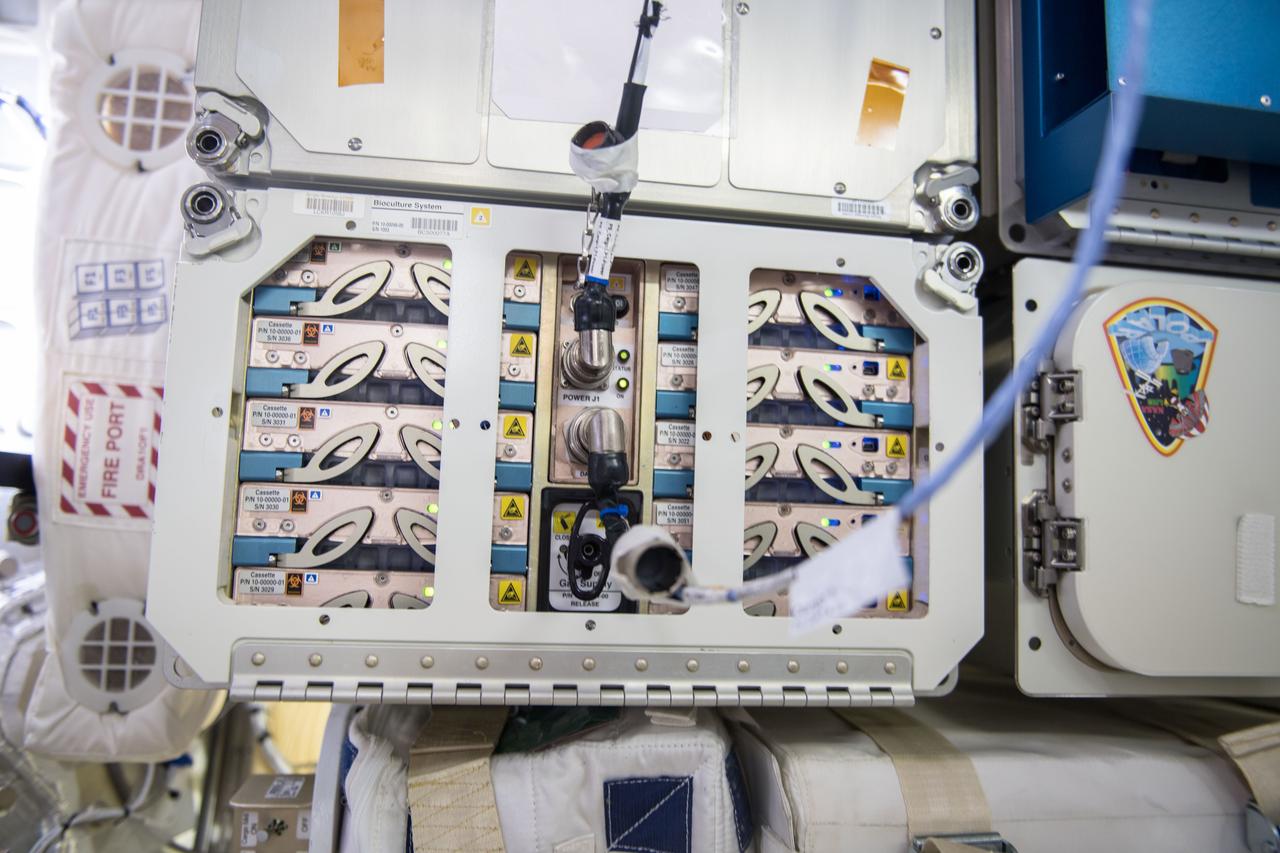
iss054e020928 (1/12/2018) --- Photo documentation of the Bioculture System Facility installed in the SpaceX Dragon Commercial Resupply Services-13 (CRS-13) spacecraft for return to Earth. The Bioculture System Hardware Validation (Cell Science-Validation) tests the performance and life-support capability of a new cell culture hardware system for use aboard the International Space Station (ISS).
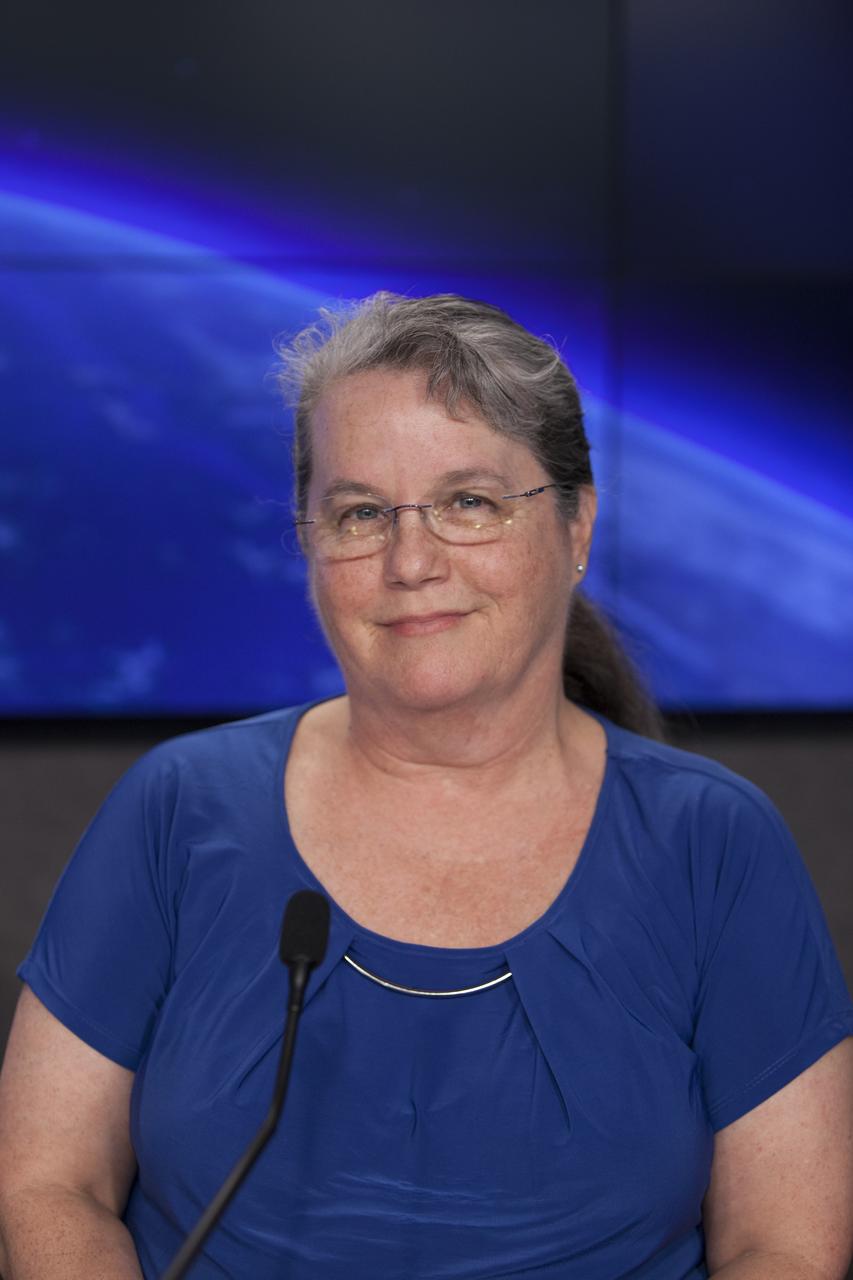
CAPE CANAVERAL, Fla. – Ruth Globus, project scientist, Rodent Habitat/Rodent Research-1, NASA Ames Research Center, briefs media representatives in Kennedy Space Center’s Press Site auditorium in preparation for the launch of the SpaceX CRS-4 mission to resupply the International Space Station. Globus is a member of the ISS Science Panel on Model Organisms. The mission is the fourth of 12 SpaceX flights NASA contracted with the company to resupply the space station. It will be the fifth trip by a Dragon spacecraft to the orbiting laboratory. The spacecraft’s 2.5 tons of supplies, science experiments, and technology demonstrations include critical materials to support 255 science and research investigations that will occur during the station's Expeditions 41 and 42. Liftoff is targeted for an instantaneous window at 2:14 a.m. EDT. To learn more about the mission, visit http://www.nasa.gov/mission_pages/station/structure/launch/index.html. Photo credit: NASA/Jim Grossmann
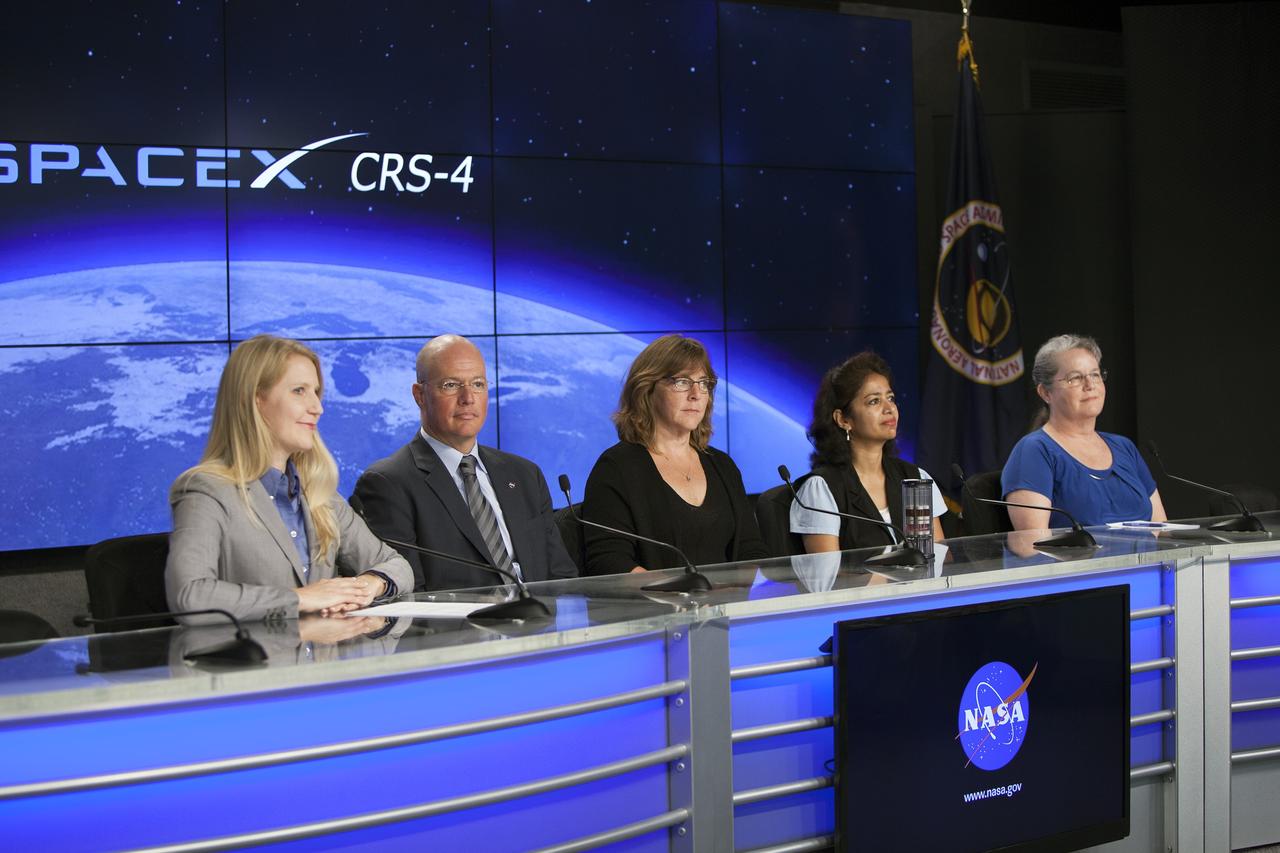
CAPE CANAVERAL, Fla. – Members of an ISS Science Panel on Model Organisms brief media representatives in Kennedy Space Center’s Press Site auditorium in preparation for the launch of the SpaceX CRS-4 mission to resupply the International Space Station. From left are Stephanie Schierholz, NASA Public Affairs, Marshall Porterfield, division director, Space Life and Physical Sciences, HEOMD, Shiela Neilsen, principal investigator, Micro-8, University of Montana, Sharmila Bhattacharya, principal investigator, Ames Student Fruit-Fly Experiment, NASA Ames Research Center, and Ruth Globus, project scientist, Rodent Habitat/Rodent Research-1, NASA Ames. The mission is the fourth of 12 SpaceX flights NASA contracted with the company to resupply the space station. It will be the fifth trip by a Dragon spacecraft to the orbiting laboratory. The spacecraft’s 2.5 tons of supplies, science experiments, and technology demonstrations include critical materials to support 255 science and research investigations that will occur during the station's Expeditions 41 and 42. Liftoff is targeted for an instantaneous window at 2:14 a.m. EDT. To learn more about the mission, visit http://www.nasa.gov/mission_pages/station/structure/launch/index.html. Photo credit: NASA/Jim Grossmann
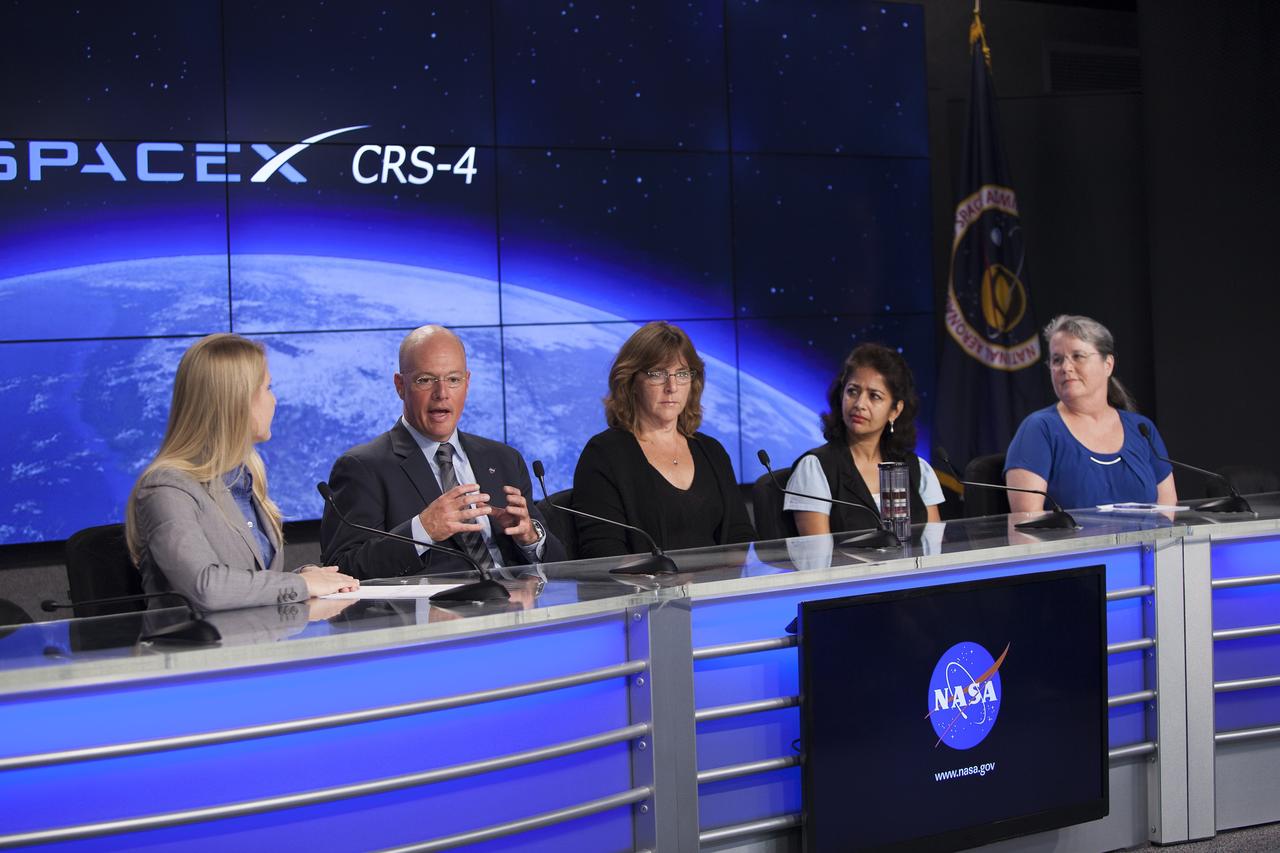
CAPE CANAVERAL, Fla. – Members of an ISS Science Panel on Model Organisms brief media representatives in Kennedy Space Center’s Press Site auditorium in preparation for the launch of the SpaceX CRS-4 mission to resupply the International Space Station. From left are Stephanie Schierholz, NASA Public Affairs, Marshall Porterfield, division director, Space Life and Physical Sciences, HEOMD, Shiela Neilsen, principal investigator, Micro-8, University of Montana, Sharmila Bhattacharya, principal investigator, Ames Student Fruit-Fly Experiment, NASA Ames Research Center, and Ruth Globus, project scientist, Rodent Habitat/Rodent Research-1, NASA Ames. The mission is the fourth of 12 SpaceX flights NASA contracted with the company to resupply the space station. It will be the fifth trip by a Dragon spacecraft to the orbiting laboratory. The spacecraft’s 2.5 tons of supplies, science experiments, and technology demonstrations include critical materials to support 255 science and research investigations that will occur during the station's Expeditions 41 and 42. Liftoff is targeted for an instantaneous window at 2:14 a.m. EDT. To learn more about the mission, visit http://www.nasa.gov/mission_pages/station/structure/launch/index.html. Photo credit: NASA/Jim Grossmann