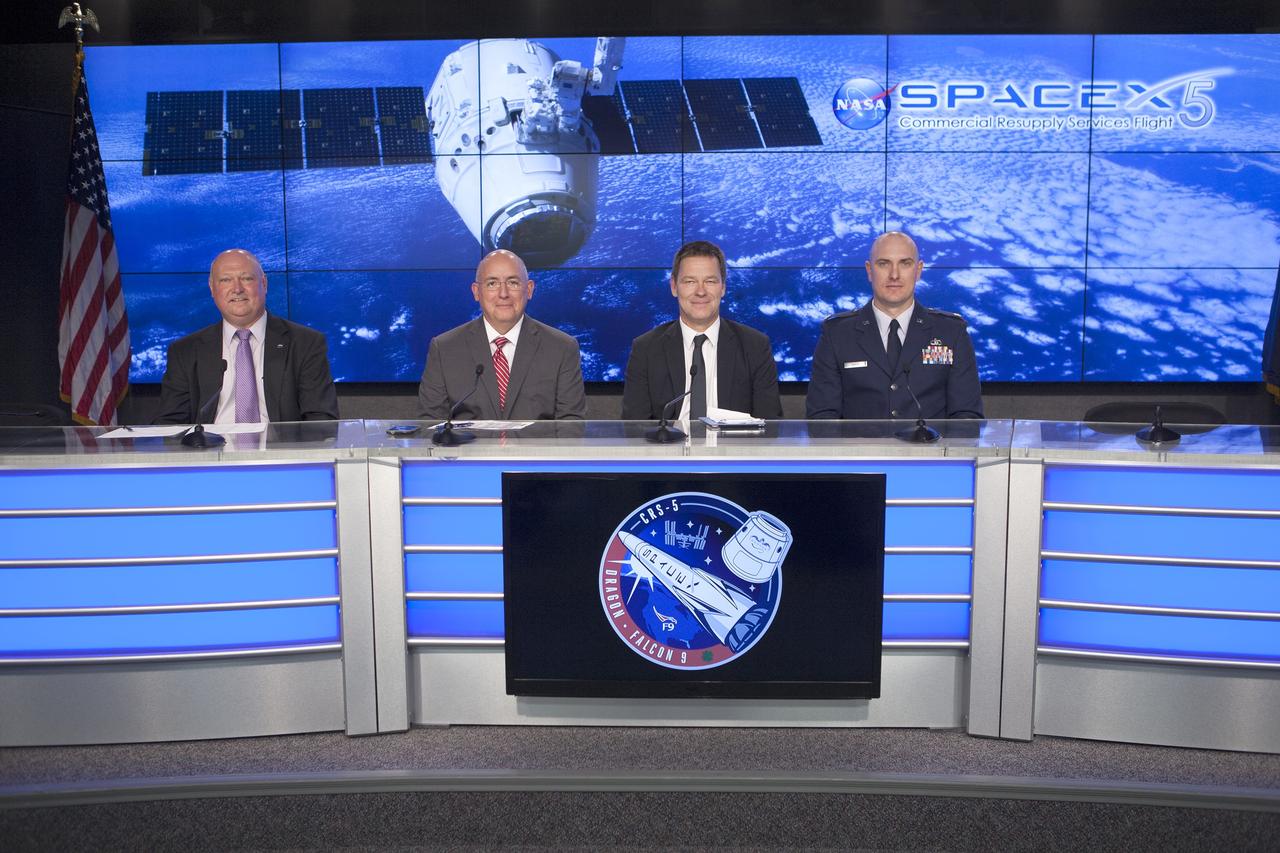
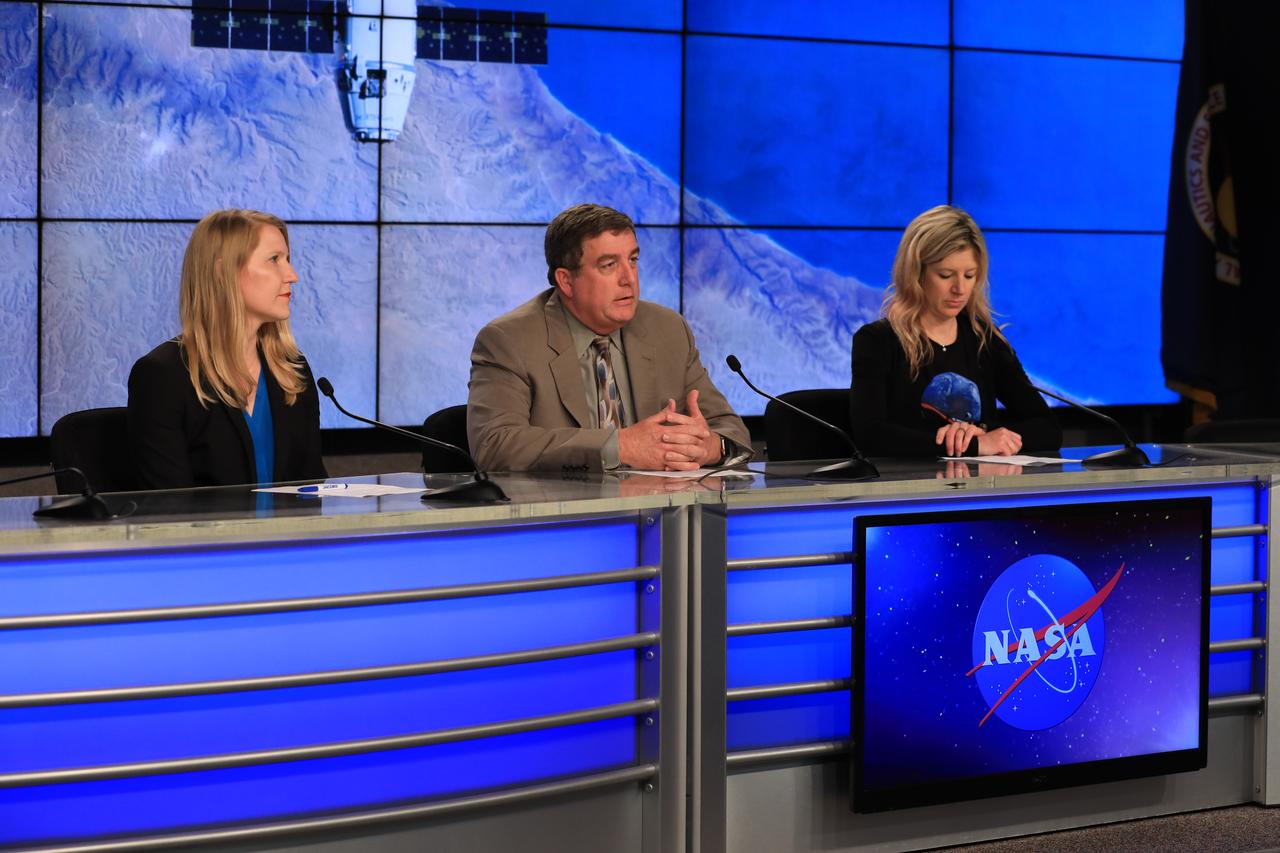
In the Kennedy Space Center’s Press Site auditorium, agency and industry leaders spoke to members of the news media as the SpaceX Dragon spacecraft and its Falcon 9 rocket were being prepared for launch. From left are: Mike Curie of NASA Public Affairs, Mike Suffredini, NASA International Space Station program manager, Hans Koenigsmann, SpaceX vice president of Mission Assurance, and Maj. Perry Sweat, U.S. Air Force’s 45th Weather Squadron at Cape Canaveral Air Force Station. Photo credit: NASA/Kim Shiflett
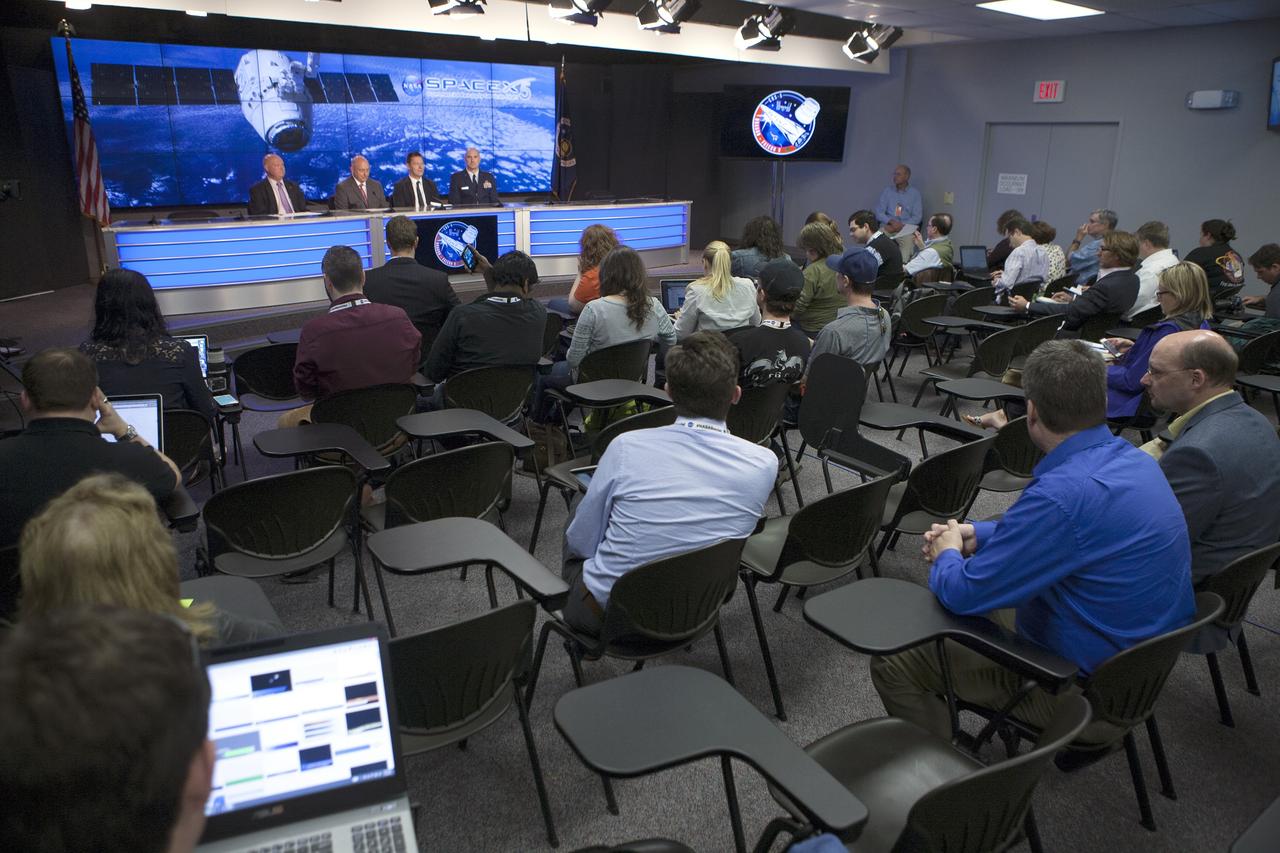
In the Kennedy Space Center’s Press Site auditorium, agency and industry leaders spoke to members of the news media as the SpaceX Dragon spacecraft and its Falcon 9 rocket were being prepared for launch. From left are: Mike Curie of NASA Public Affairs, Mike Suffredini, NASA International Space Station program manager, Hans Koenigsmann, SpaceX vice president of Mission Assurance, and Maj. Perry Sweat, U.S. Air Force’s 45th Weather Squadron at Cape Canaveral Air Force Station. Photo credit: NASA/Kim Shiflett
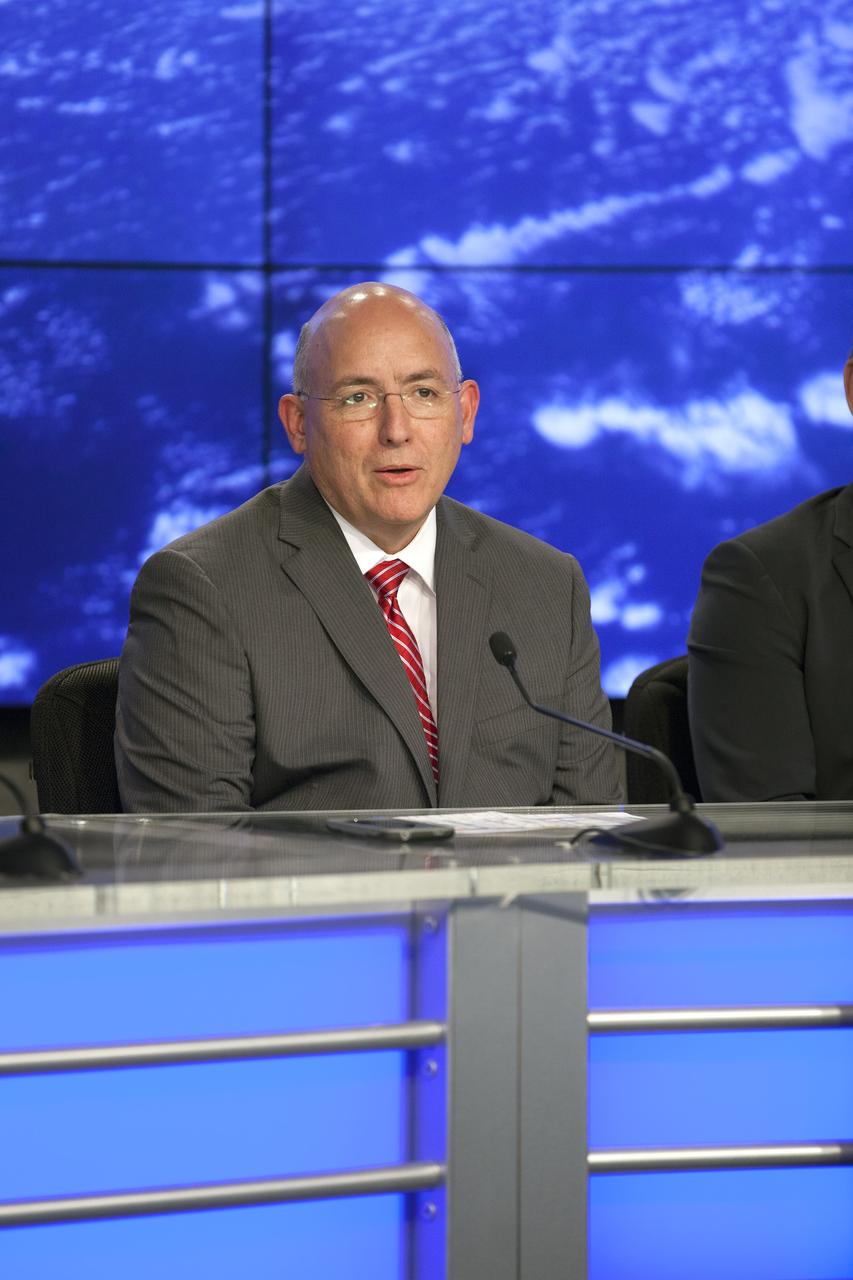
In the Kennedy Space Center’s Press Site auditorium, agency and industry leaders spoke to members of the news media on International Space Station research and technology developments. Participants included Mike Suffredini, NASA International Space Station program manager. Photo credit: NASA/Kim Shiflett
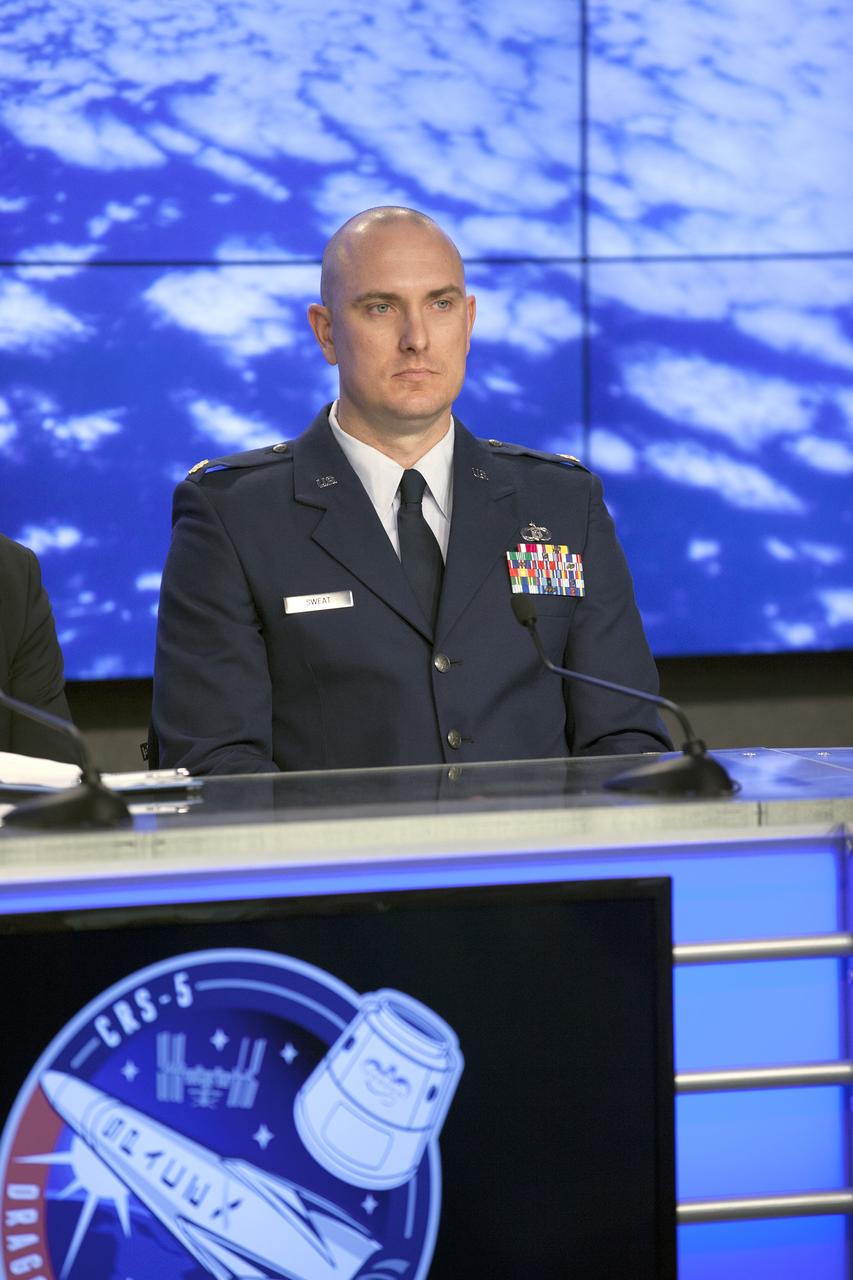
In the Kennedy Space Center’s Press Site auditorium, agency and industry leaders spoke to members of the news media on International Space Station research and technology developments. Participants included Maj. Perry Sweat, U.S. Air Force’s 45th Weather Squadron at Cape Canaveral Air Force Station. Photo credit: NASA/Kim Shiflett
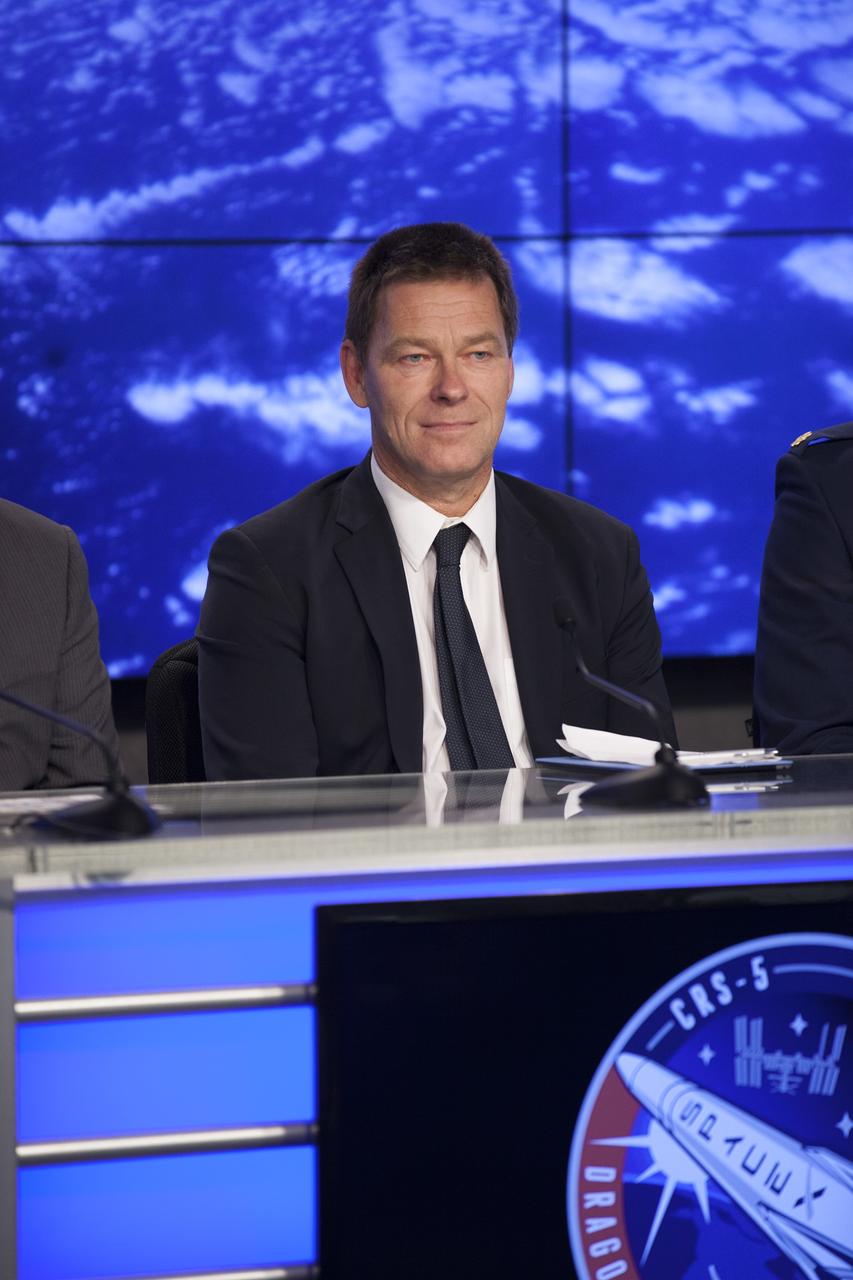
In the Kennedy Space Center’s Press Site auditorium, agency and industry leaders spoke to members of the news media on International Space Station research and technology developments. Participants included Hans Koenigsmann, SpaceX vice president of Mission Assurance. Photo credit: NASA/Kim Shiflett
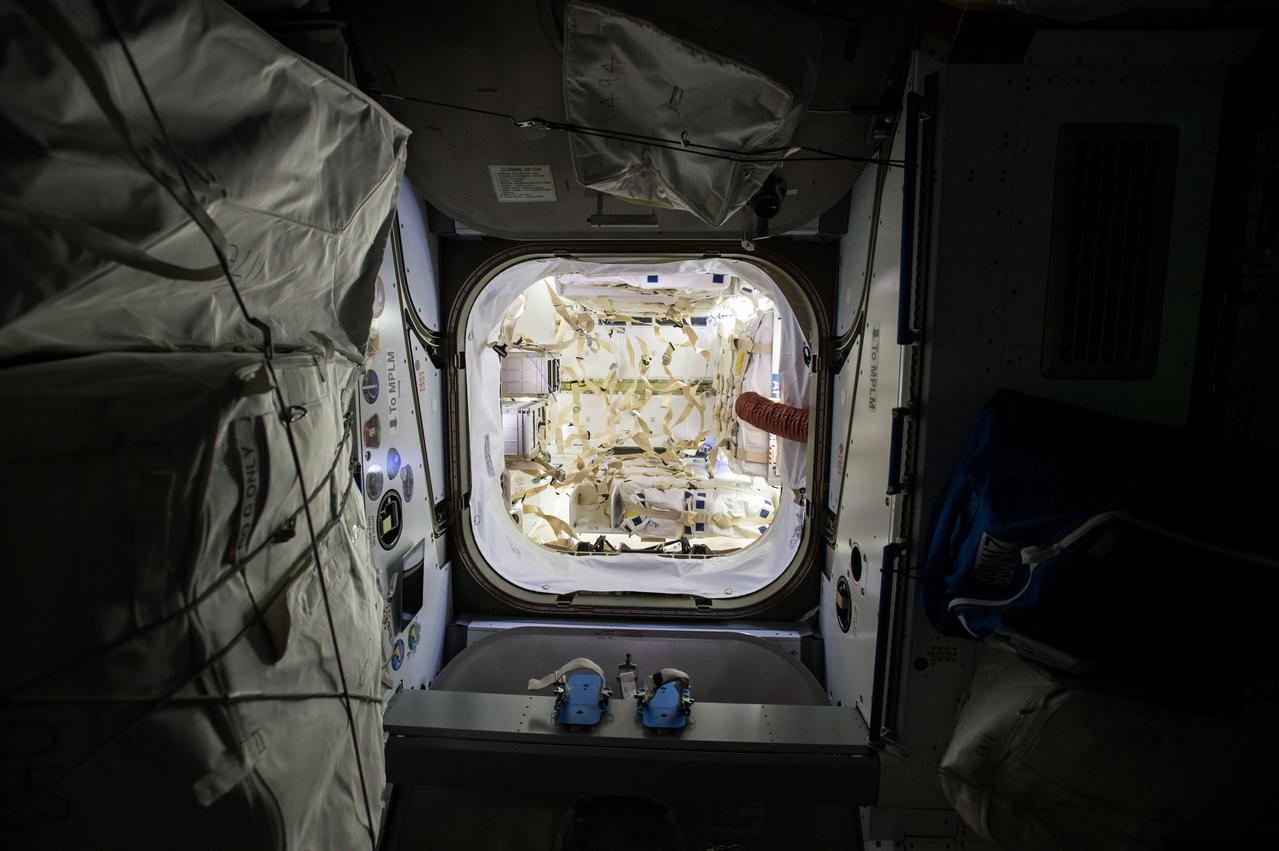
ISS042e136056 (Jan 13, 2015) -- Overall interior view of the SpaceX Dragon Commercial Resupply Services-5 (CRS-5) spacecraft.
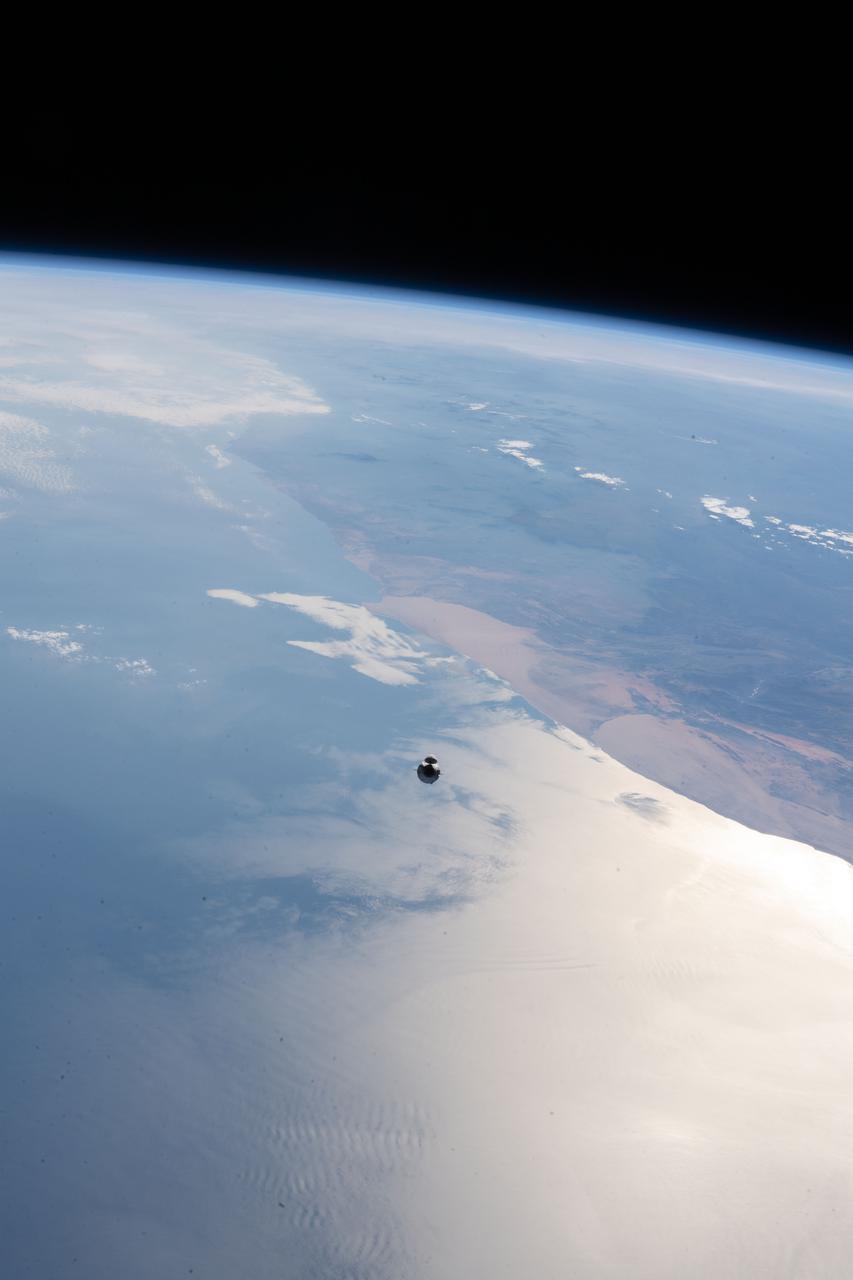
iss065e094357 (June 5, 2021) --- The SpaceX Cargo Dragon vehicle, on the SpaceX CRS-22 mission, approaches the International Space Station 265 miles above the Atlantic Ocean off the coast of Namibia on the African continent.
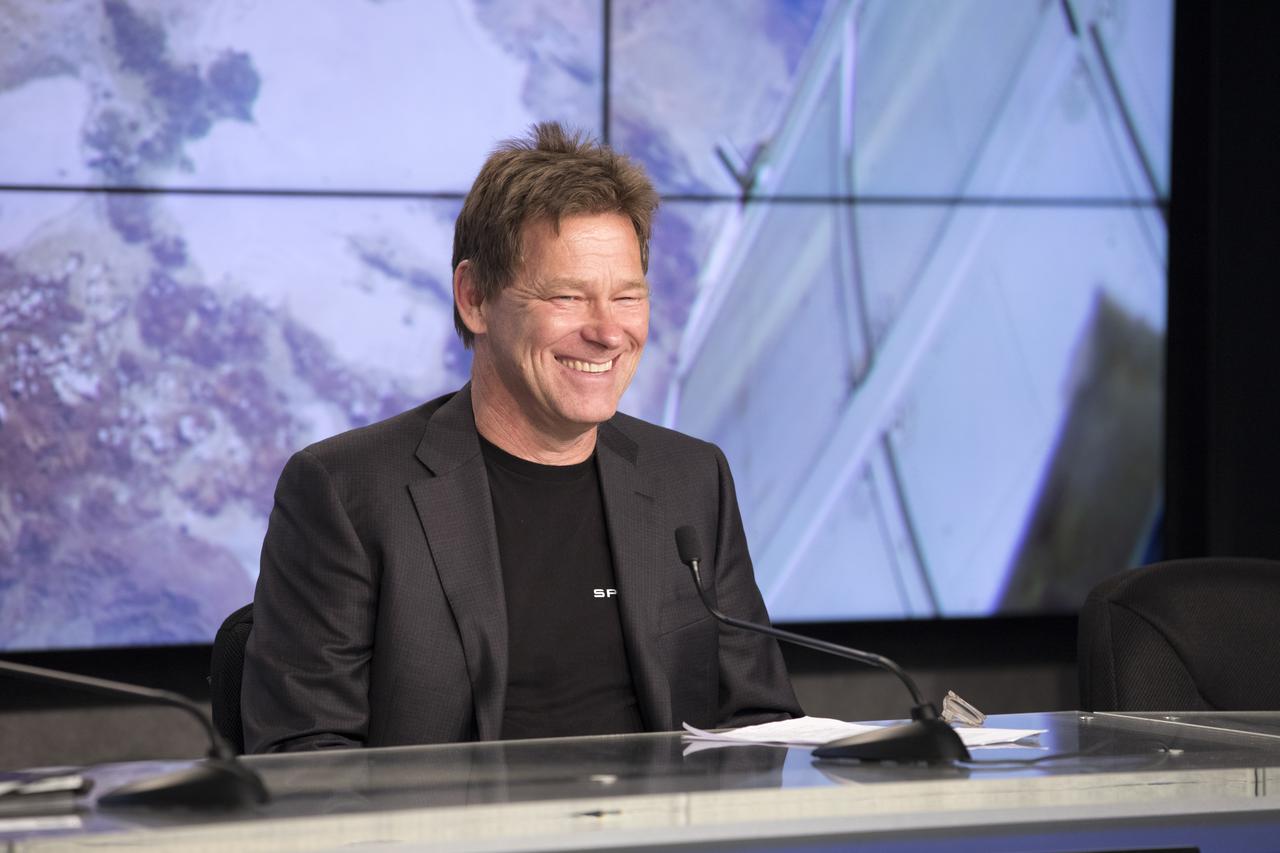
In the Press Site auditorium of NASA's Kennedy Space Center in Florida, Hans Koenigsmann, vice president of Flight Reliability for SpaceX. SpaceX, speaks to media at a post-launch news conference following the liftoff of SpaceX CRS-11, a commercial resupply services mission to the International Space Station. SpaceX CRS-11 lifted off atop a Falcon 9 rocket from Kennedy's Launch Complex 39A at 5:07 p.m. EDT.
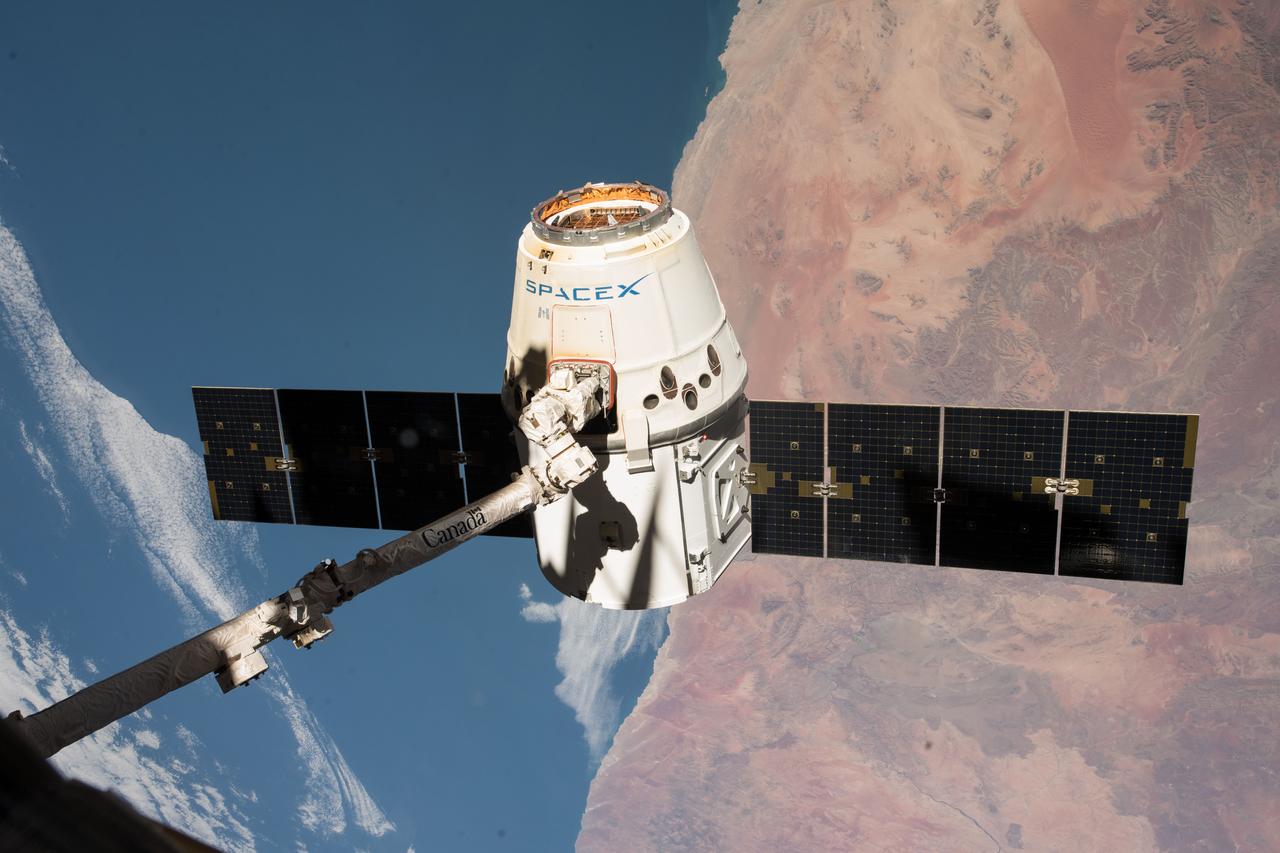
iss055e057155 (May 5, 2018) --- The SpaceX Dragon cargo craft is pictured in the grips of the Canadarm2 robotic arm as the International Space Station was orbiting across the central coast of Namibia. Dragon was later released for its splashdown in the Pacific Ocean off the coast of California on May 5, 2018 ending the SpaceX CRS-14 mission.
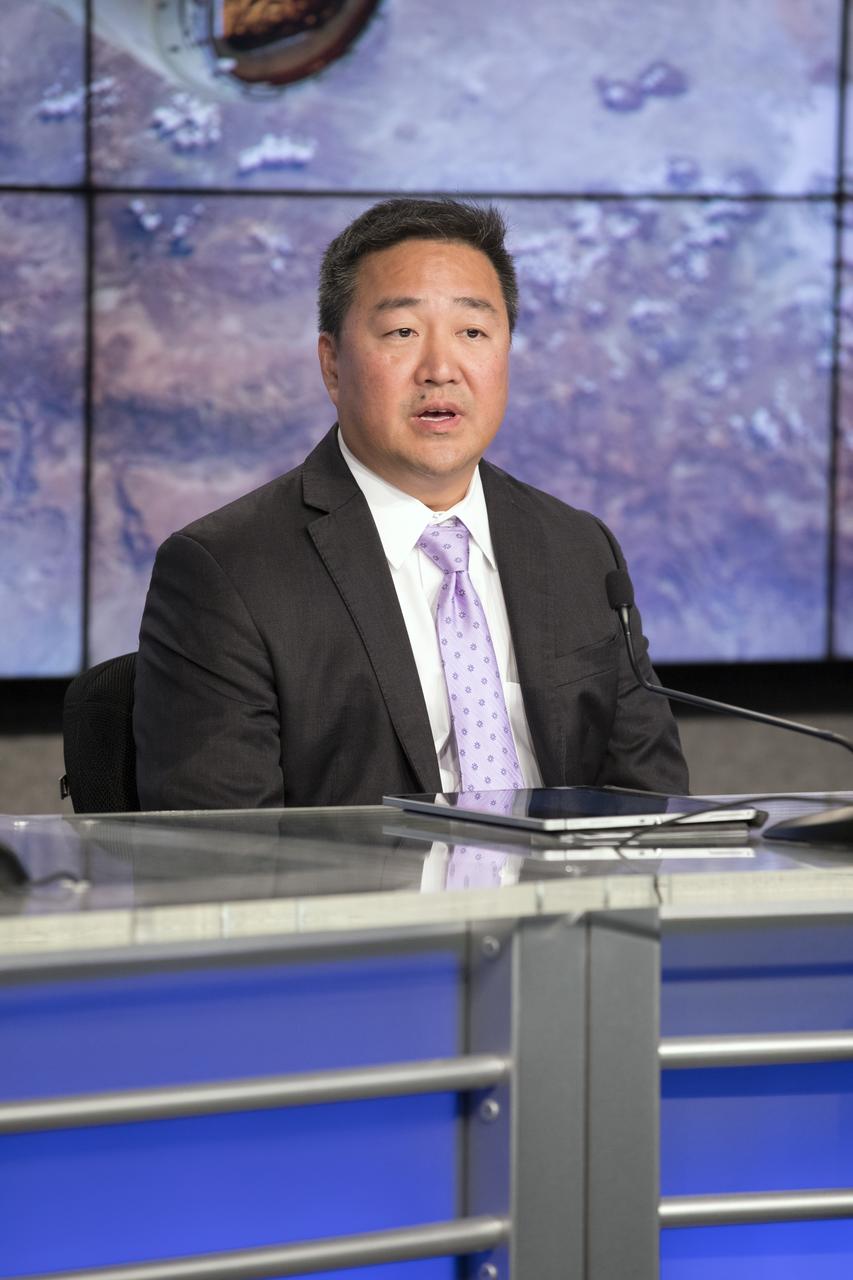
In the Press Site auditorium of NASA's Kennedy Space Center in Florida, Ven Feng, NASA's manager of the International Space Station Transportation Integration Office, speaks to media at a post-launch news conference following the liftoff of SpaceX CRS-11, a commercial resupply services mission to the International Space Station. SpaceX CRS-11 lifted off atop a Falcon 9 rocket from Kennedy's Launch Complex 39A at 5:07 p.m. EDT.
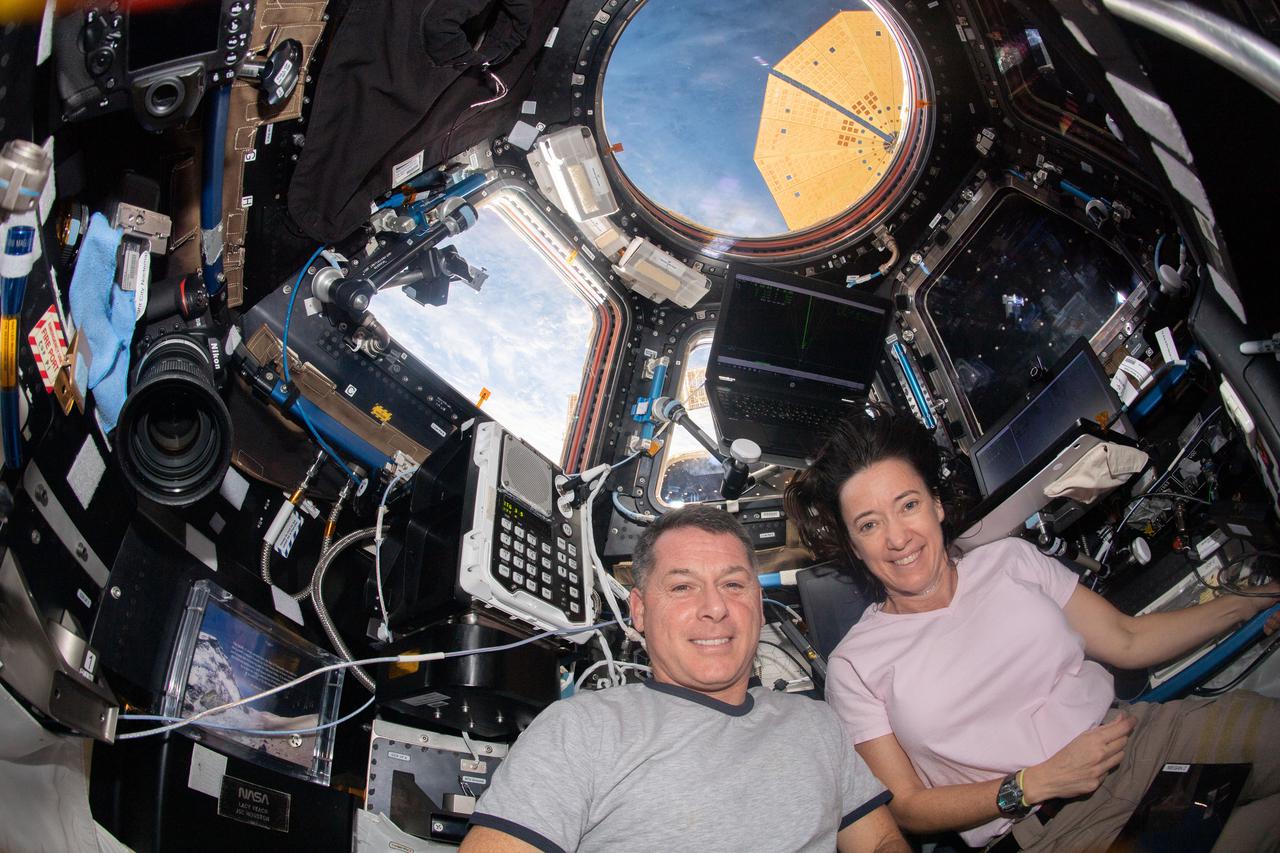
iss065e087513 (June 5, 2021) --- NASA's Expedition 65 Flight Engineers Shane Kimbrough and Megan McArthur are pictured inside the cupola, the International Space Station's "window to the world," monitoring the approach and rendezvous of the SpaceX Cargo Dragon vehicle on the SpaceX CRS-22 mission.
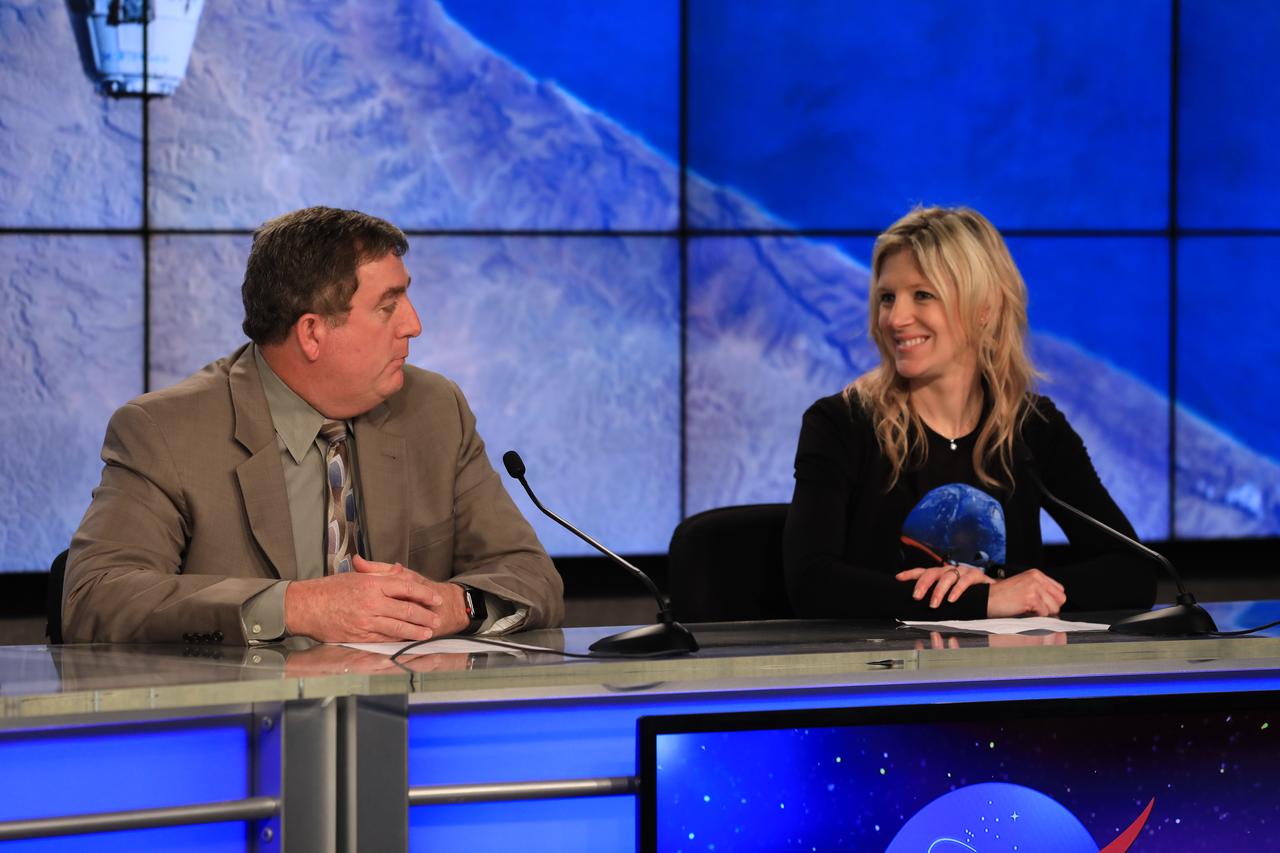
In the Press Site auditorium of NASA's Kennedy Space Center in Florida, from left, Kirk Shireman, manager, International Space Station Program, and Jessica Jensen, Director, Dragon Mission Management, SpaceX, speak to media at a post-launch news conference following the liftoff of SpaceX CRS-15. The flight is a commercial resupply services mission to the International Space Station. SpaceX CRS-15 lifted off atop a Falcon 9 rocket from Space Launch Complex 40 at Cape Canaveral Air Force Station on Friday, June 29, 2018, at 5:42 a.m. EDT with supplies and materials to support multiple critical science and research investigations.
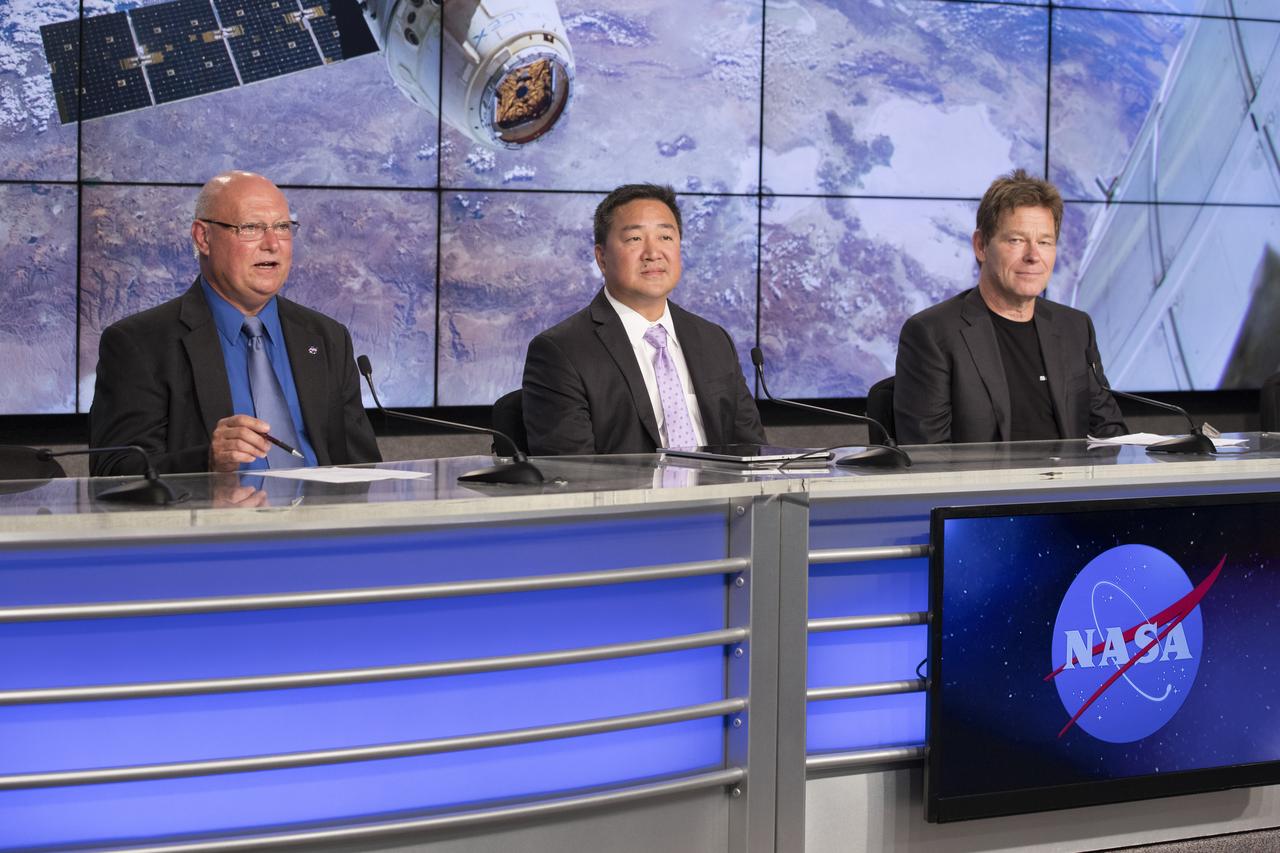
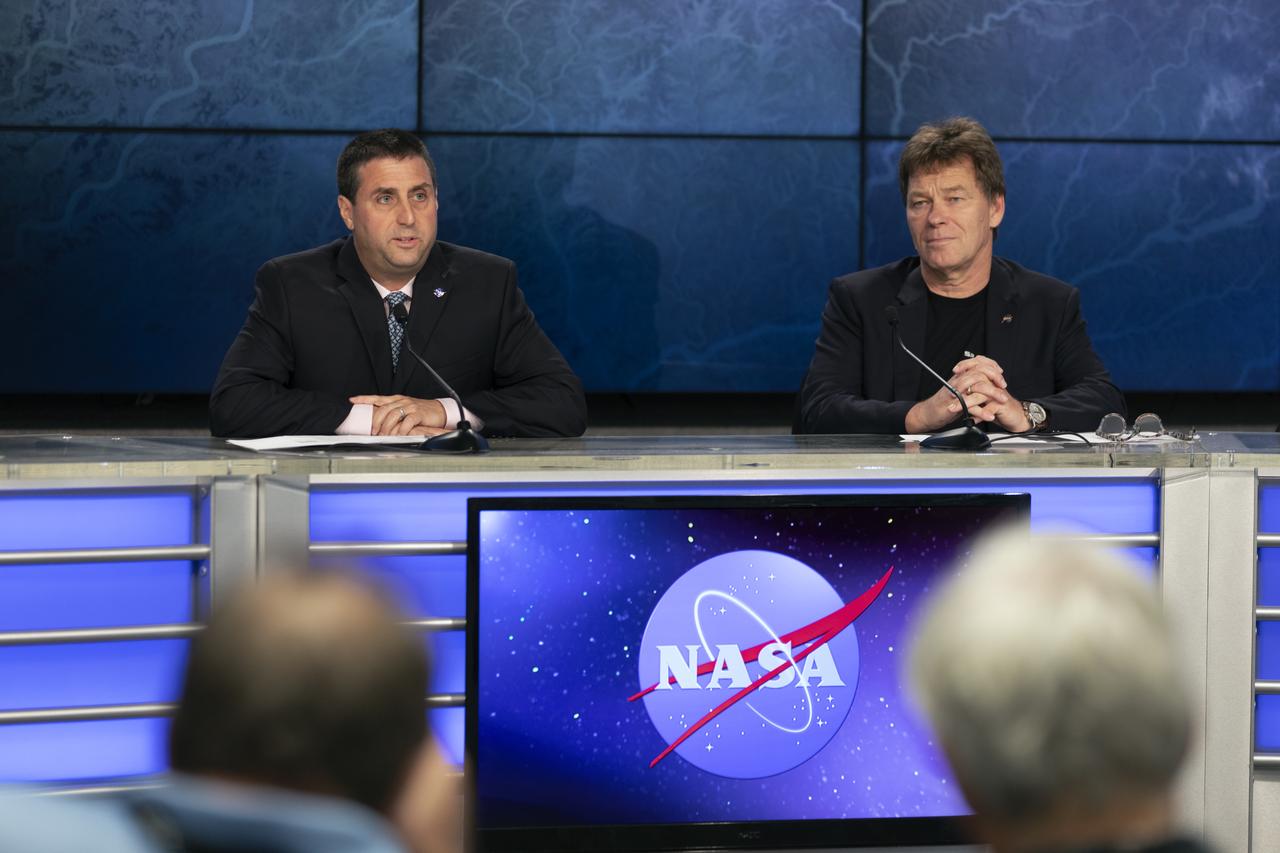
In the Press Site auditorium of NASA's Kennedy Space Center in Florida, NASA and industry leaders speak to media at a post-launch news conference following the liftoff of SpaceX CRS-11, a commercial resupply services mission to the International Space Station. From left are: Mike Curie of NASA Communications, Ven Feng, NASA's manager of the International Space Station Transportation Integration Office, and Hans Koenigsmann, vice president of Flight Reliability for SpaceX. SpaceX CRS-11 lifted off atop a Falcon 9 rocket from Kennedy's Launch Complex 39A at 5:07 p.m. EDT.
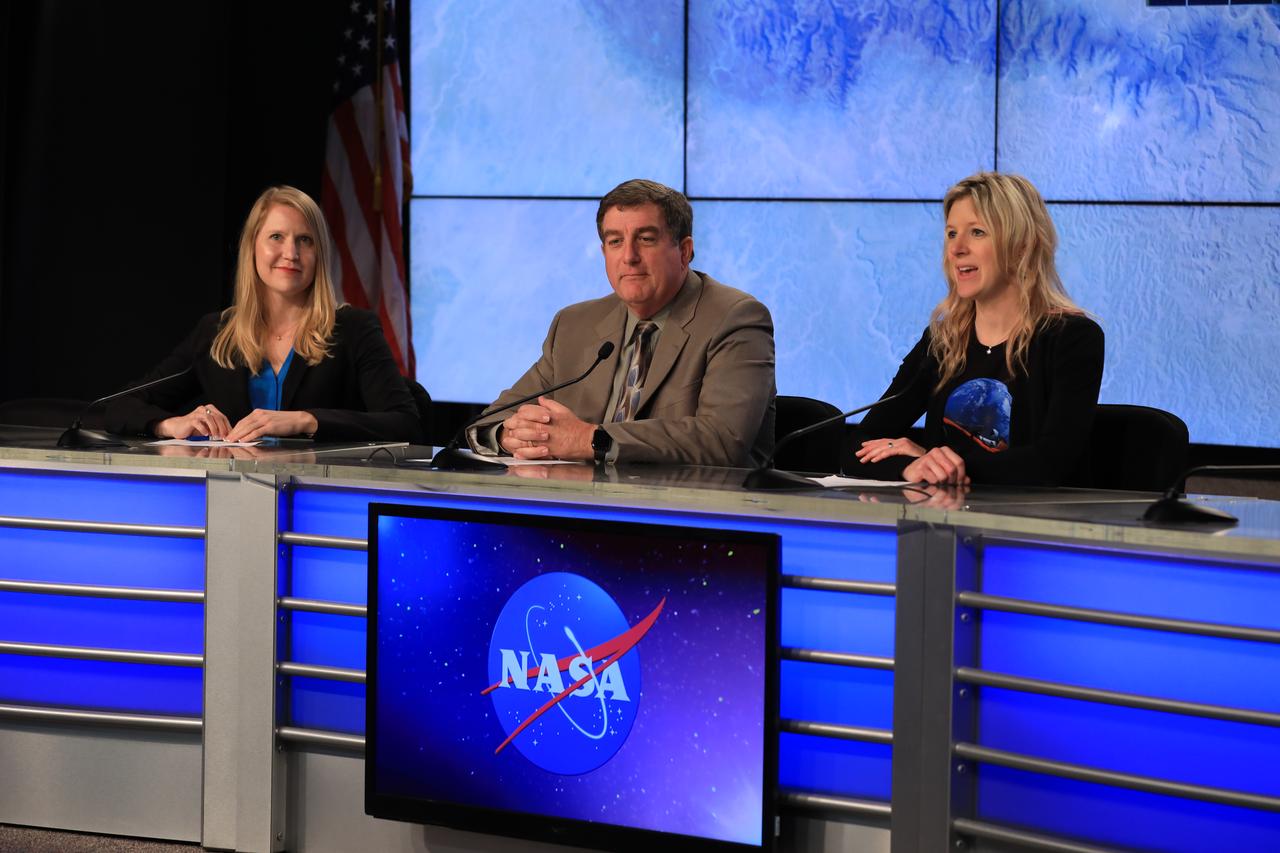
In the Press Site auditorium of NASA's Kennedy Space Center in Florida, from left, Stephanie Schierholz of NASA Communications, Kirk Shireman, manager, International Space Station Program, and Jessica Jensen, Director, Dragon Mission Management, SpaceX, speak to media at a post-launch news conference following the liftoff of SpaceX CRS-15. The flight is a commercial resupply services mission to the International Space Station. SpaceX CRS-15 lifted off atop a Falcon 9 rocket from Space Launch Complex 40 at Cape Canaveral Air Force Station on Friday, June 29, 2018, at 5:42 a.m. EDT with supplies and materials to support multiple critical science and research investigations.
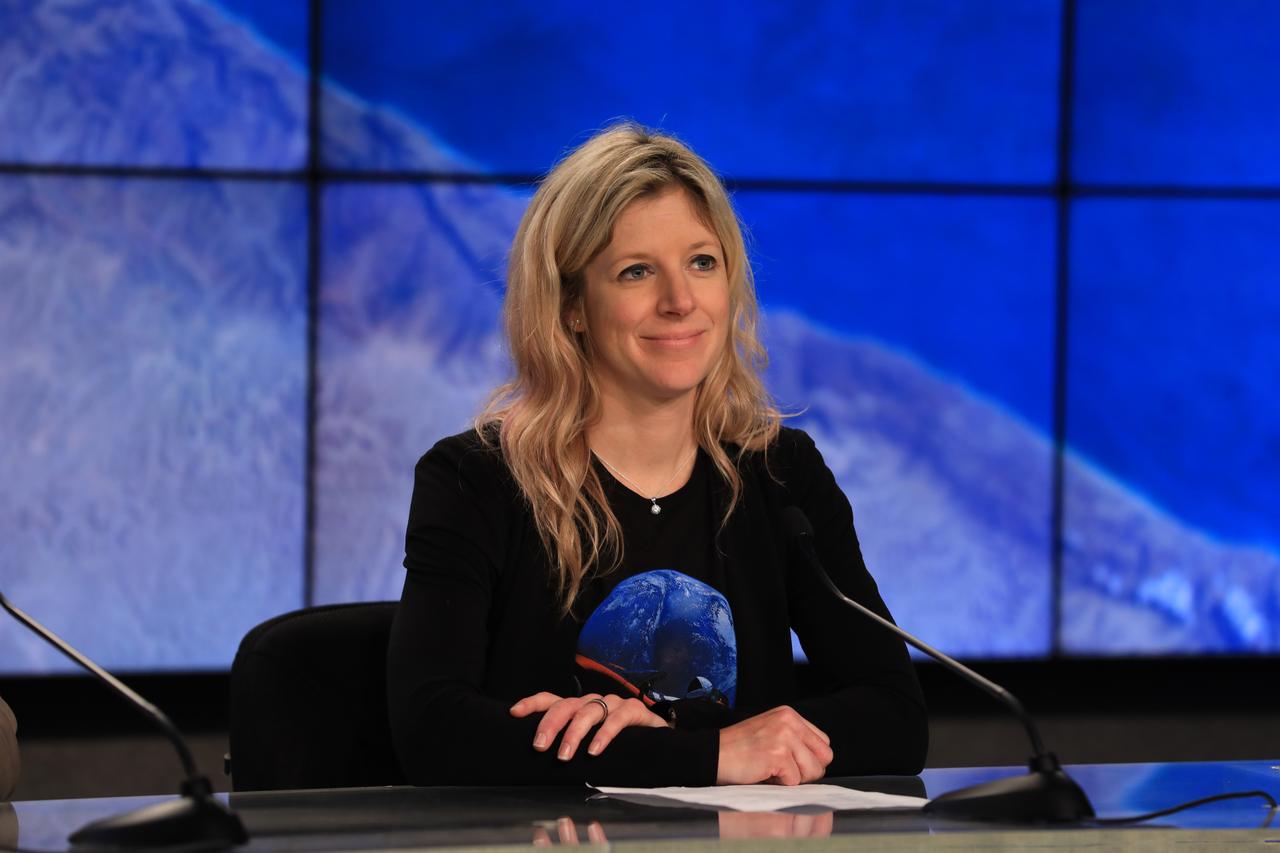
In the Press Site auditorium of NASA's Kennedy Space Center in Florida, Jessica Jensen, Director, Dragon Mission Management, SpaceX, speaks to media at a post-launch news conference following the liftoff of SpaceX CRS-15. The flight is a commercial resupply services mission to the International Space Station. SpaceX CRS-15 lifted off atop a Falcon 9 rocket from Space Launch Complex 40 at Cape Canaveral Air Force Station on Friday, June 29, 2018, at 5:42 a.m. EDT with supplies and materials to support multiple critical science and research investigations.
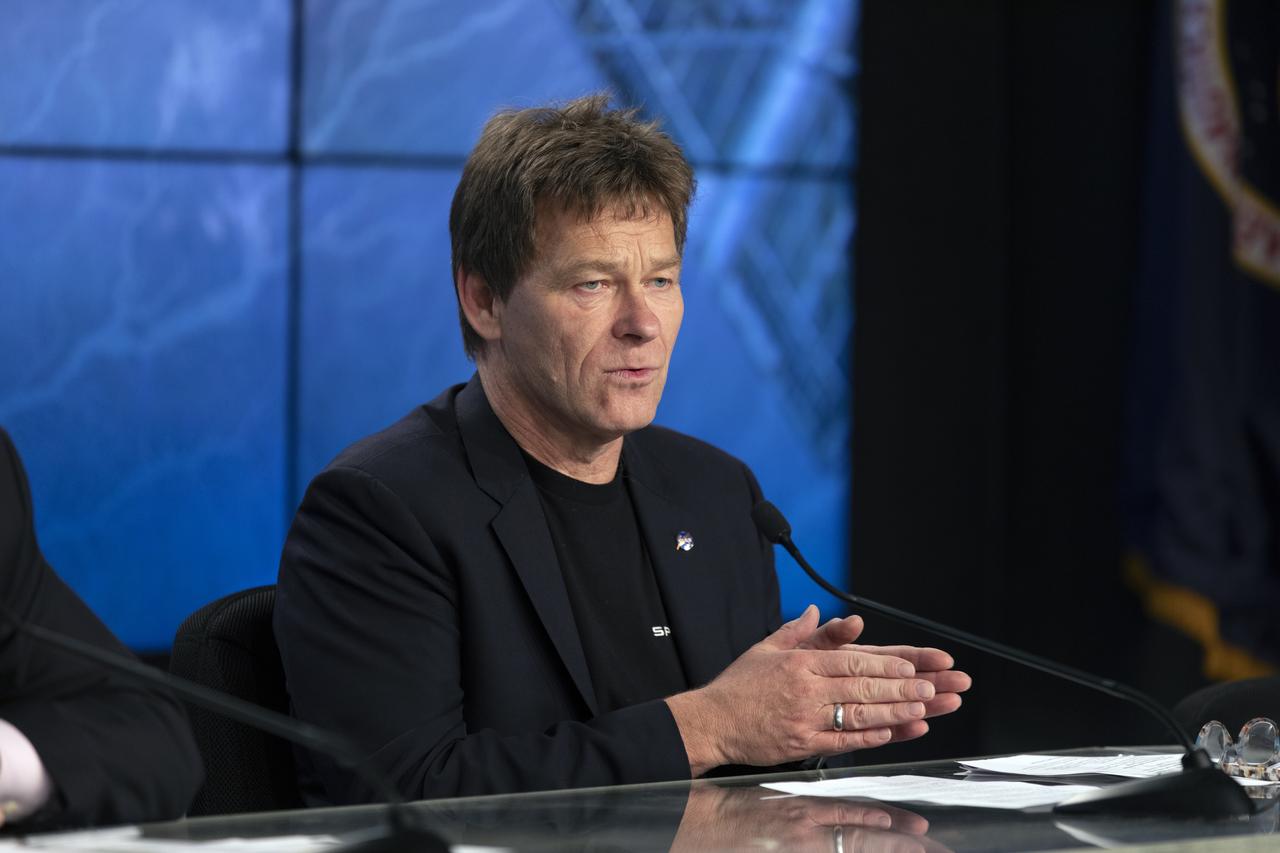
In the Press Site auditorium of NASA's Kennedy Space Center in Florida, Hans Koenigsmann, vice president of Build and Flight Reliability for SpaceX, speaks to media at a post-launch news conference following the liftoff of SpaceX CRS-16. The flight is a commercial resupply services mission to the International Space Station. SpaceX CRS-16 lifted off atop a Falcon 9 rocket from Space Launch Complex 40 at Cape Canaveral Air Force Station at 1:16 p.m. EST, Dec. 5, 2018, with supplies and equipment and new science experiments for technology research.
In the Press Site auditorium of NASA's Kennedy Space Center in Florida, from left, Stephanie Schierholz of NASA Communications, Kirk Shireman, manager, International Space Station Program, and Jessica Jensen, Director, Dragon Mission Management, SpaceX, speak to media at a post-launch news conference following the liftoff of SpaceX CRS-15. The flight is a commercial resupply services mission to the International Space Station. SpaceX CRS-15 lifted off atop a Falcon 9 rocket from Space Launch Complex 40 at Cape Canaveral Air Force Station on Friday, June 29, 2018, at 5:42 a.m. EDT with supplies and materials to support multiple critical science and research investigations.
In the Press Site auditorium of NASA's Kennedy Space Center in Florida, Joel Montalbano, deputy International Space Station program manager at NASA's Johnson Space Center in Houston, left, and Hans Koenigsmann, vice president of Build and Flight Reliability for SpaceX, speak to media at a post-launch news conference following the liftoff of SpaceX CRS-16. The flight is a commercial resupply services mission to the International Space Station. SpaceX CRS-16 lifted off atop a Falcon 9 rocket from Space Launch Complex 40 at Cape Canaveral Air Force Station at 1:16 p.m. EST, Dec. 5, 2018, with supplies and equipment and new science experiments for technology research.
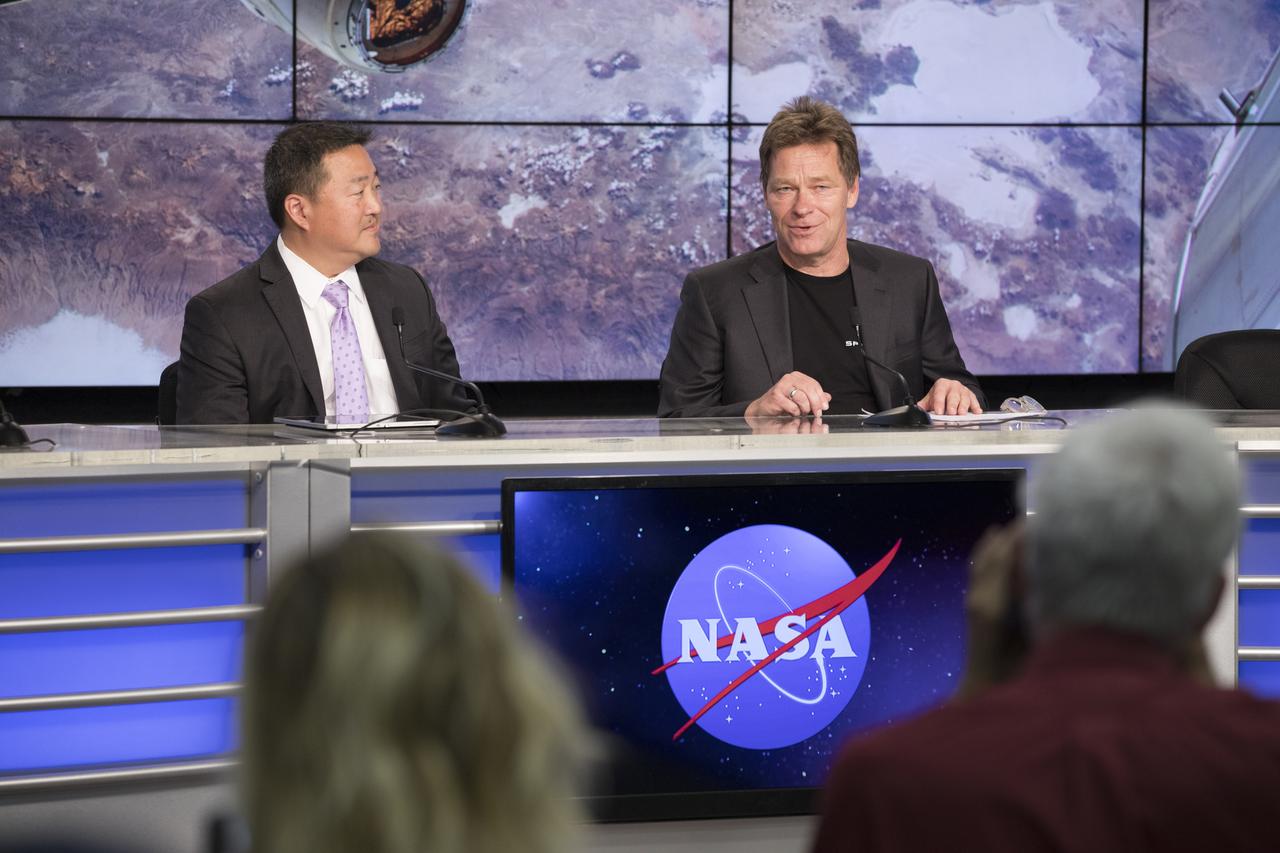
In the Press Site auditorium of NASA's Kennedy Space Center in Florida, NASA and industry leaders speak to media at a post-launch news conference following the liftoff of SpaceX CRS-11, a commercial resupply services mission to the International Space Station. From left are: Ven Feng, NASA's manager of the International Space Station Transportation Integration Office, and Hans Koenigsmann, vice president of Flight Reliability for SpaceX. SpaceX CRS-11 lifted off atop a Falcon 9 rocket from Kennedy's Launch Complex 39A at 5:07 p.m. EDT.

iss055e063934 (May 5, 2018) --- The SpaceX Dragon cargo craft is pictured in the grips of the Canadarm2 robotic arm as the International Space Station was orbiting above northern Africa. Dragon would be released a few hours later for its splashdown in the Pacific Ocean off the coast of California on May 5, 2018 ending the SpaceX CRS-14 mission.
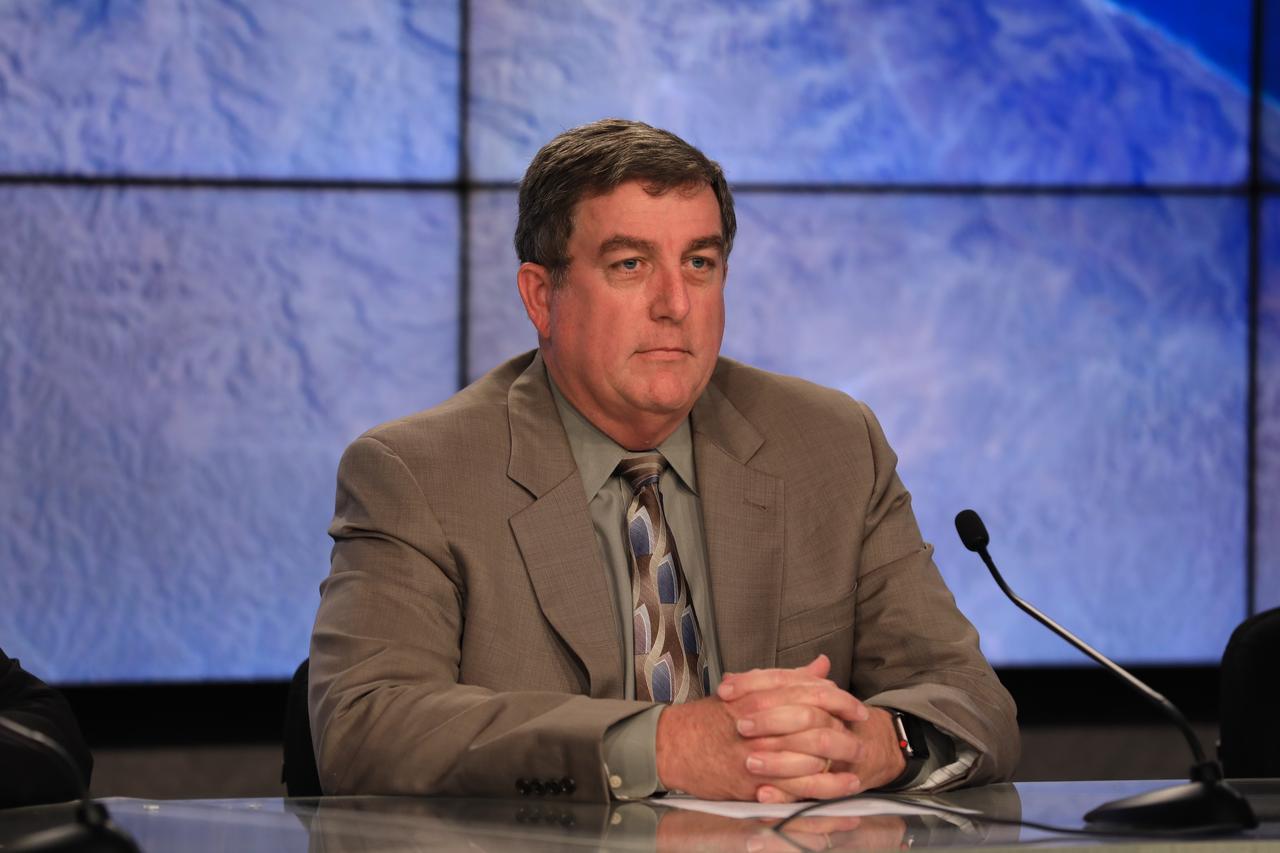
In the Press Site auditorium of NASA's Kennedy Space Center in Florida, Kirk Shireman, manager, International Space Station Program, speaks to media at a post-launch news conference following the liftoff of SpaceX CRS-15. The flight is a commercial resupply services mission to the International Space Station. SpaceX CRS-15 lifted off atop a Falcon 9 rocket from Space Launch Complex 40 at Cape Canaveral Air Force Station on Friday, June 29, 2018, at 5:42 a.m. EDT with supplies and materials to support multiple critical science and research investigations.

NASA Communications’ Jennifer Wolfinger moderates a What’s on Board science briefing at the agency’s Kennedy Space Center in Florida on March 5, 2020. During the briefing, NASA Social participants had the opportunity to hear from principal investigators for payloads launching on SpaceX’s 20th Commercial Resupply Services (CRS-20) mission. CRS-20 is scheduled to launch from Cape Canaveral Air Force Station’s Space Launch Complex 40 on March 6, 2020. The SpaceX Falcon 9 rocket and cargo Dragon spacecraft are targeting an instantaneous liftoff at 11:50 p.m. EST.
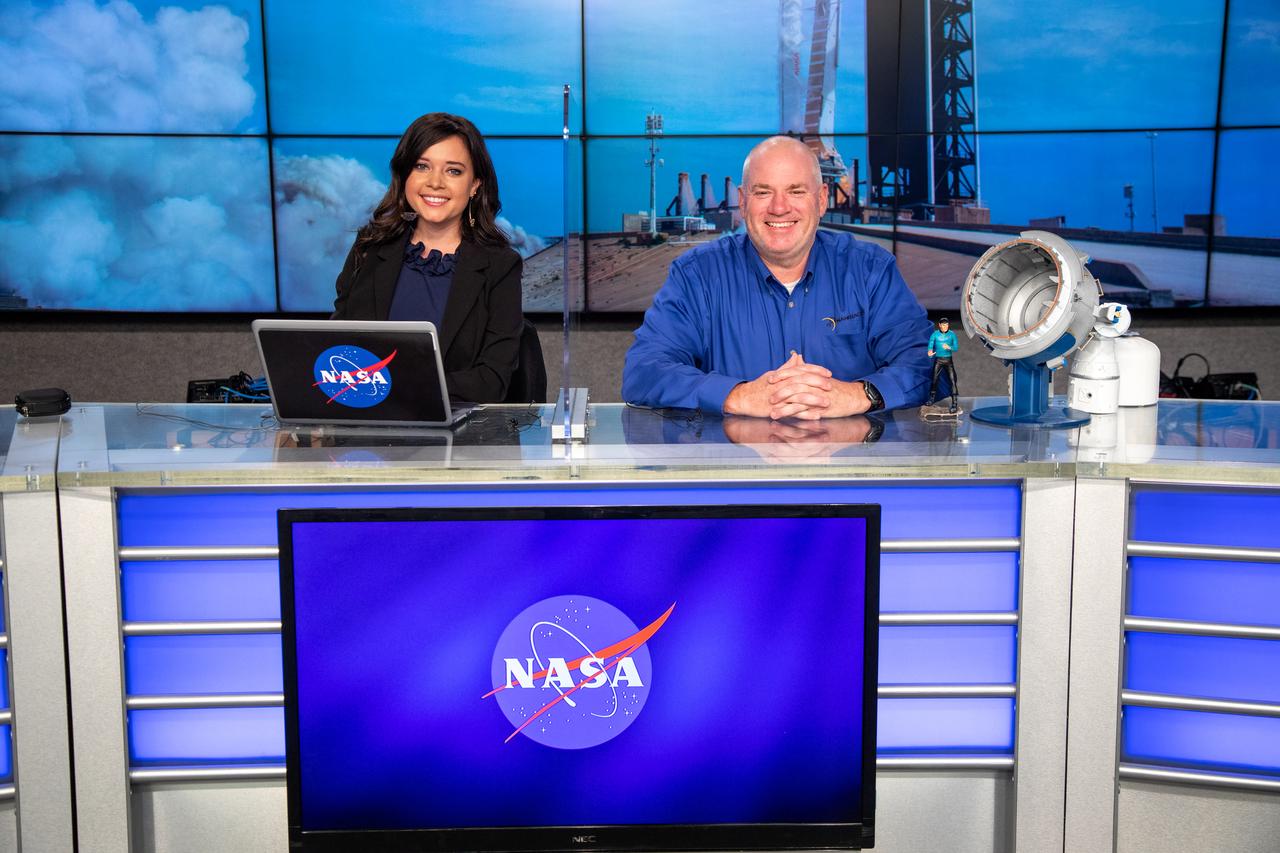
NASA Communications’ Kenna Pell, left, and Brock Howe, airlock program manager, Nanoracks, participate in a #NASASocial Science and Station Q&A show at the agency’s Kennedy Space Center in Florida on Dec. 4, 2020. During the briefing, NASA Social participants heard from principal investigators for payloads launching on SpaceX’s 21st Commercial Resupply Services (CRS-21) mission. CRS-21 is scheduled to launch from Kennedy’s Launch Complex 39A on Dec. 5, 2020. Liftoff of the SpaceX Falcon 9 rocket and cargo Dragon spacecraft is targeted for 11:39 a.m. EST.
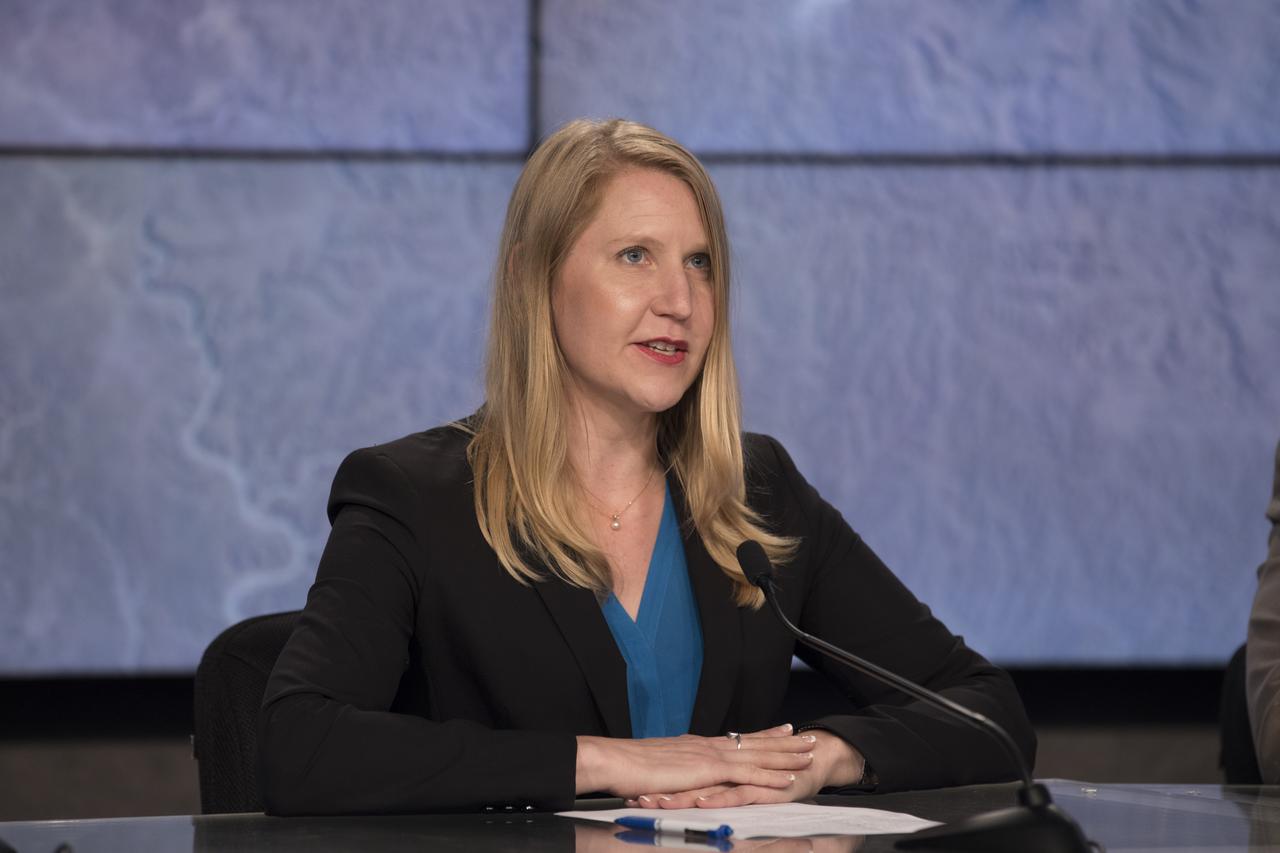
In the Press Site auditorium of NASA's Kennedy Space Center in Florida, Stephanie Schierholz of NASA Communications speaks to media at a post-launch news conference following the liftoff of SpaceX CRS-15. The flight is a commercial resupply services mission to the International Space Station. SpaceX CRS-15 lifted off atop a Falcon 9 rocket from Space Launch Complex 40 at Cape Canaveral Air Force Station on Friday, June 29, 2018, at 5:42 a.m. EDT with supplies and materials to support multiple critical science and research investigations.

The upgraded version of SpaceX’s Cargo Dragon spacecraft, Dragon 2, is seen atop a Falcon 9 rocket on Dec. 2, 2020, as they prepare to be rolled out to Launch Complex 39A at NASA’s Kennedy Space Center in Florida for the company’s 21st Commercial Resupply Services (CRS-21) launch. The first launch for SpaceX under NASA’s second Commercial Resupply Services contract, CRS-21 will deliver critical supplies, equipment, and material to support a variety of science and research investigations that will take place aboard the International Space Station. Liftoff is scheduled for 11:39 a.m. EST on Saturday, Dec. 5.

A SpaceX Falcon 9 rocket, topped with the upgraded version of the Cargo Dragon spacecraft, is seen inside the company’s hangar at NASA’s Kennedy Space Center in Florida on Dec. 2, 2020, prior to being rolled out to the launch pad in preparation for the 21st Commercial Resupply Services (CRS-21) launch. The first launch for SpaceX under NASA’s second Commercial Resupply Services contract, CRS-21 will deliver critical supplies, equipment, and material to support a variety of science and research investigations that will take place aboard the International Space Station. Liftoff is scheduled for 11:39 a.m. EST on Saturday, Dec. 5, from Kennedy’s Launch Complex 39A.

A SpaceX Falcon 9 rocket, topped with the upgraded version of the Cargo Dragon spacecraft, is seen inside the company’s hangar at NASA’s Kennedy Space Center in Florida on Dec. 2, 2020, prior to being rolled out to the launch pad in preparation for the 21st Commercial Resupply Services (CRS-21) launch. The first launch for SpaceX under NASA’s second Commercial Resupply Services contract, CRS-21 will deliver critical supplies, equipment, and material to support a variety of science and research investigations that will take place aboard the International Space Station. Liftoff is scheduled for 11:39 a.m. EST on Saturday, Dec. 5, from Kennedy’s Launch Complex 39A.
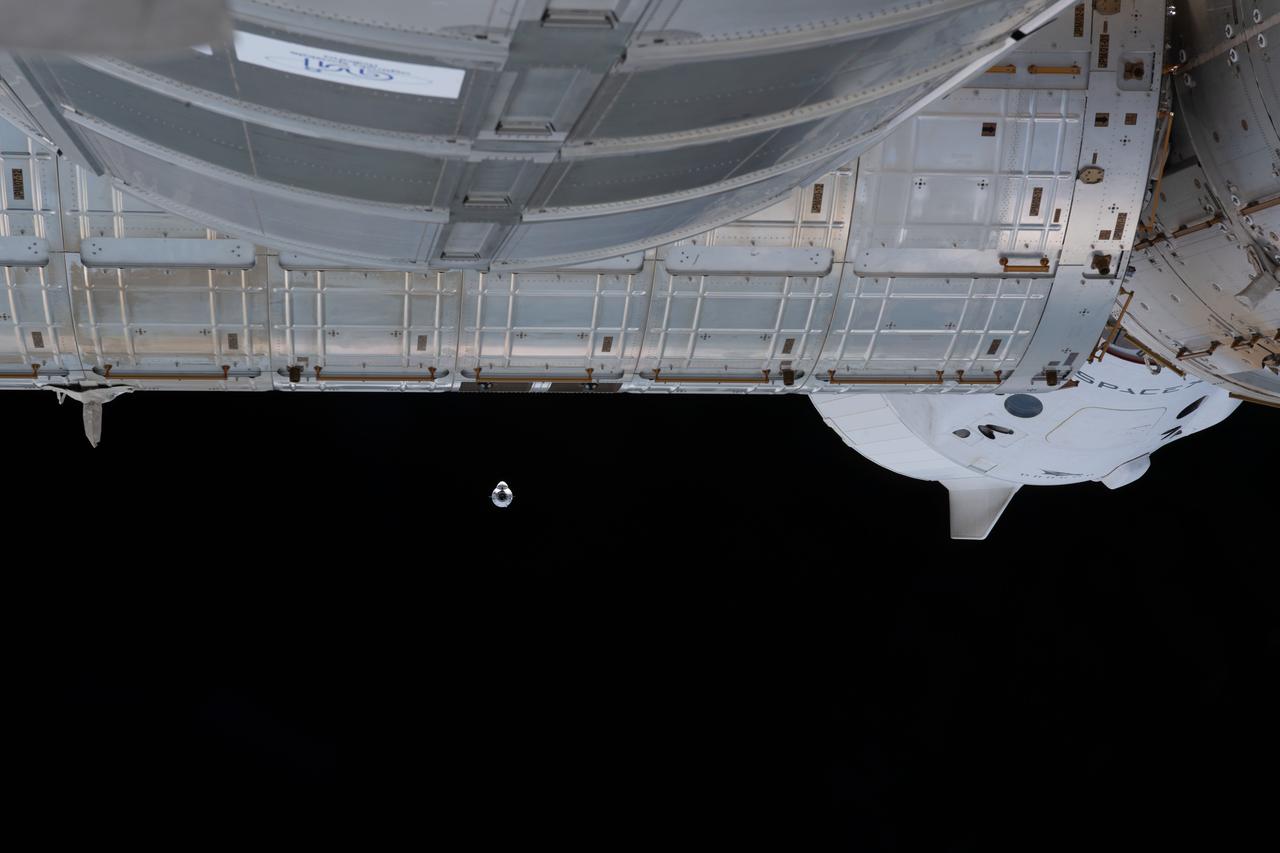
iss065e094372 (June 5, 2021) --- The SpaceX Cargo Dragon vehicle approaches the International Space Station on the SpaceX CRS-22 mission. At center right, is the SpaceX Crew Dragon spaceship docked to the Harmony module's forward-facing international docking adapter. The Cargo Dragon would dock adjacent to the Crew Dragon on Harmony's space-facing international docking adapter.
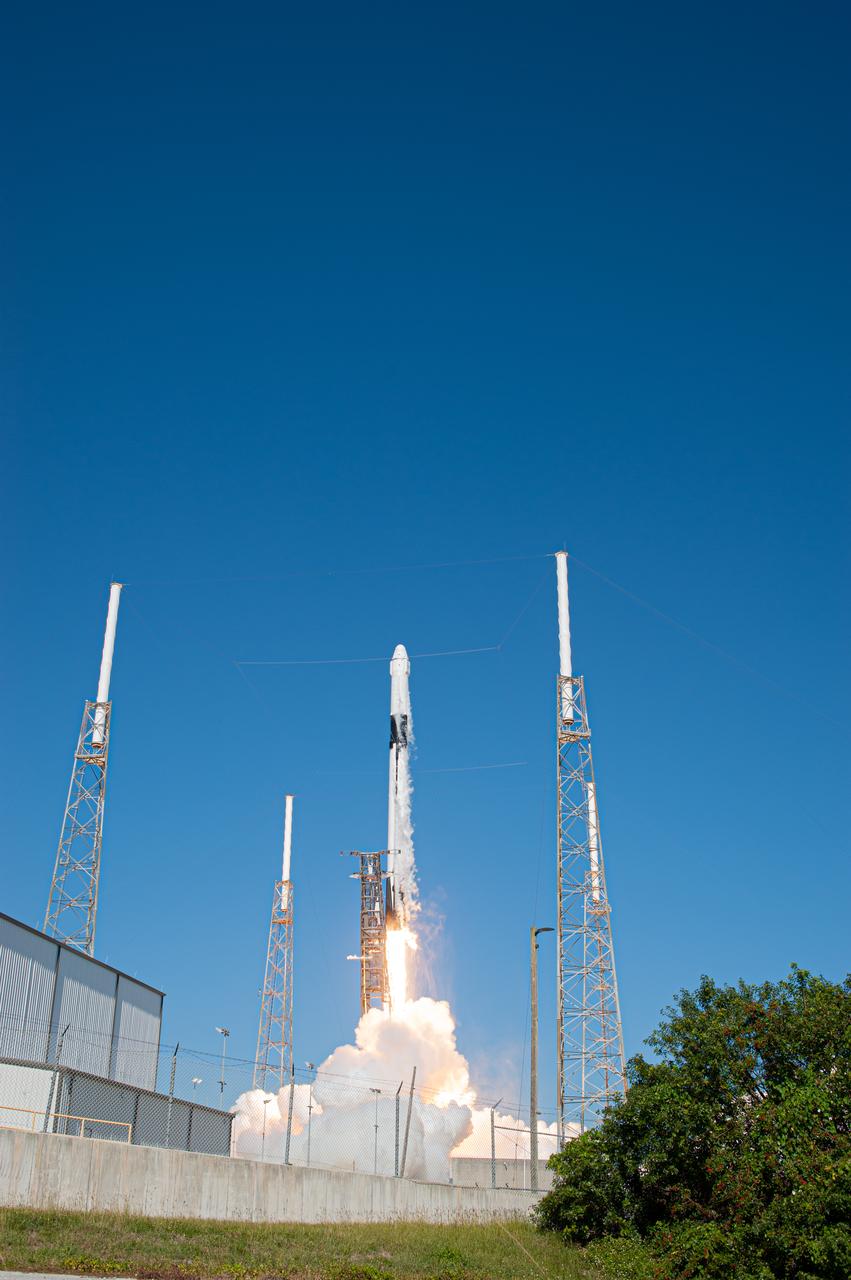
The SpaceX Falcon 9 rocket with the Dragon cargo module climbs upward after liftoff from Space Launch Complex 40 on Cape Canaveral Air Force Station in Florida in the early afternoon on Dec. 5, 2019. Liftoff was at 12:29 p.m. EST. This is SpaceX’s 19th Commercial Resupply Services (CRS-19) mission for NASA to the International Space Station. The Dragon cargo module will deliver more than 5,700 pounds of science and research, crew supplies and vehicle hardware to the orbital laboratory and its crew.
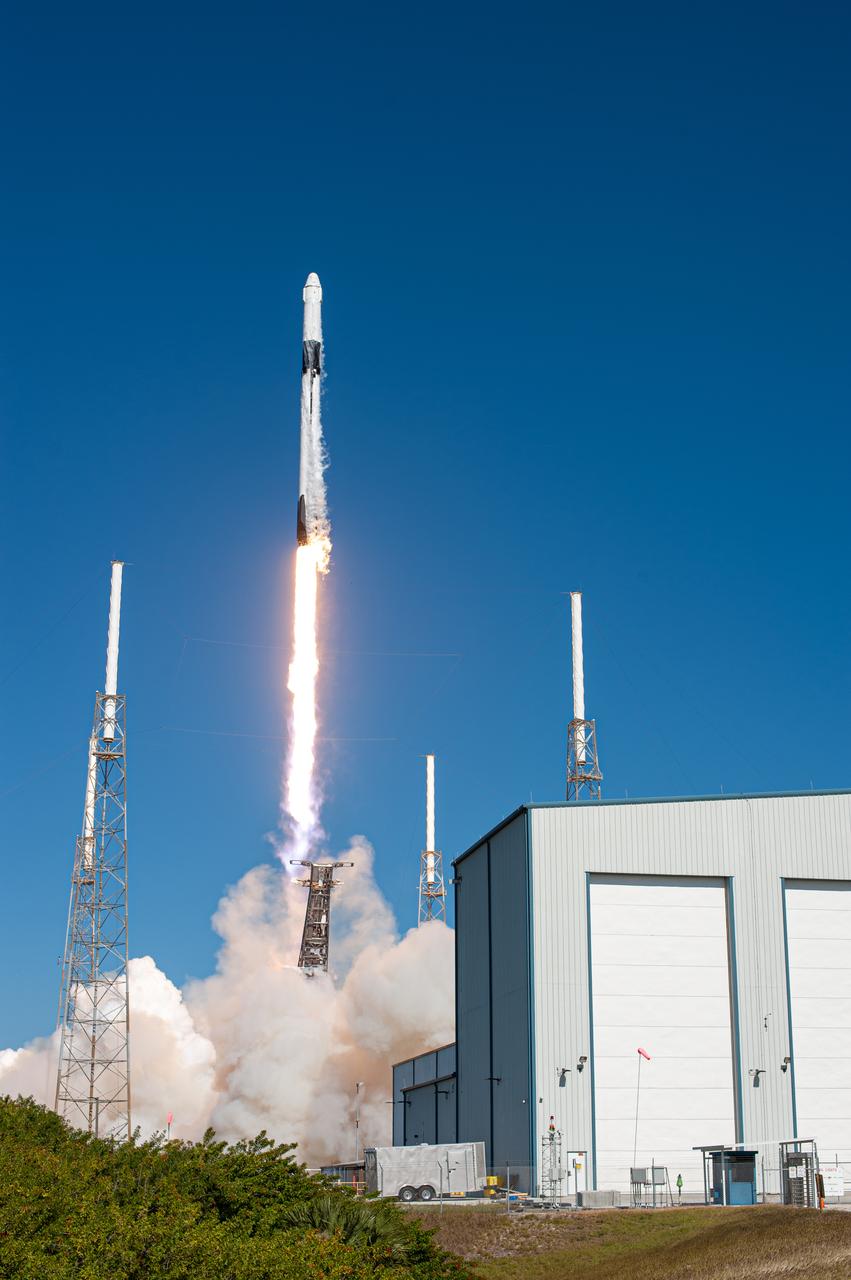
The SpaceX Falcon 9 rocket with the Dragon cargo module climbs upward after liftoff from Space Launch Complex 40 on Cape Canaveral Air Force Station in Florida in the early afternoon on Dec. 5, 2019. Liftoff was at 12:29 p.m. EST. This is SpaceX’s 19th Commercial Resupply Services (CRS-19) mission for NASA to the International Space Station. The Dragon cargo module will deliver more than 5,700 pounds of science and research, crew supplies and vehicle hardware to the orbital laboratory and its crew.
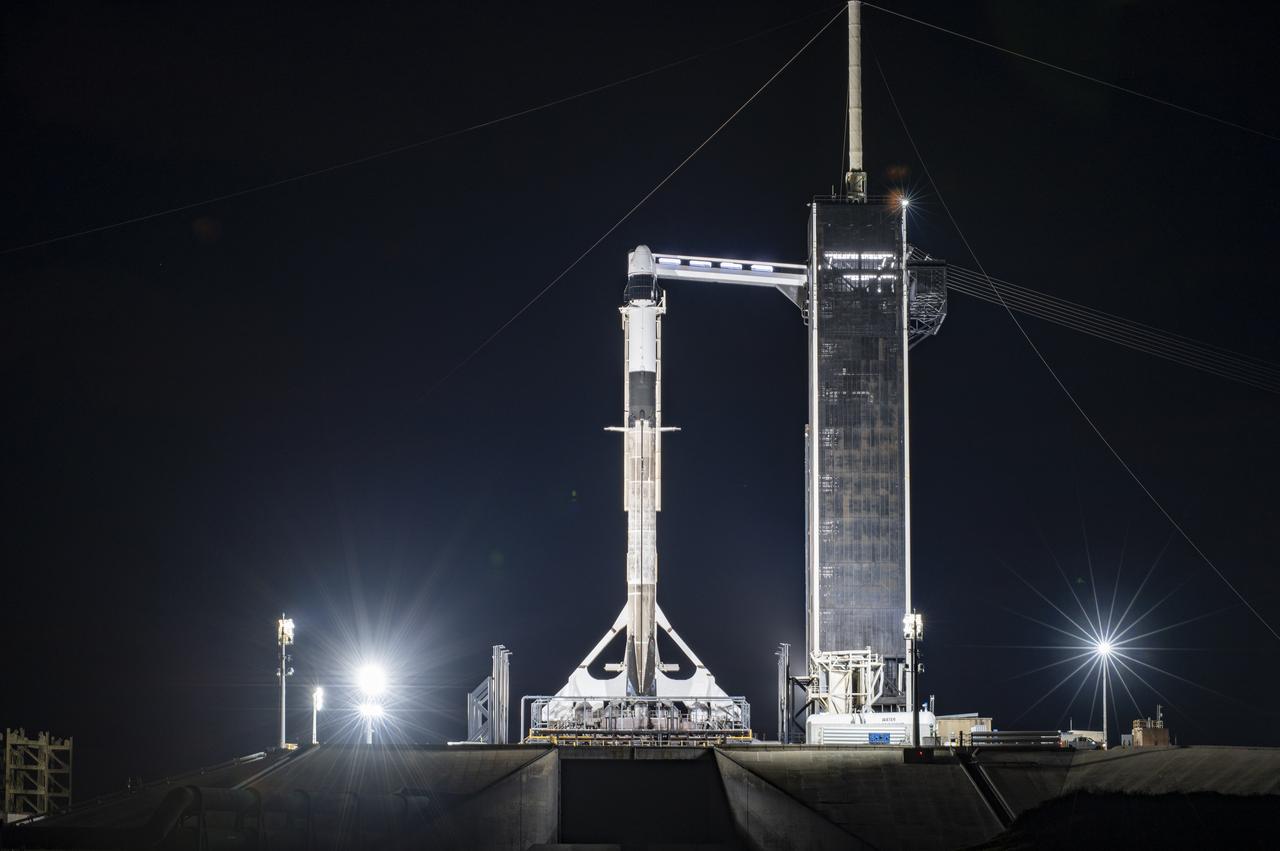
A SpaceX Falcon 9 rocket, topped with the company’s upgraded version of the Dragon spacecraft, stands vertical at NASA Kennedy Space Center’s Launch Complex 39A in Florida on Wednesday, Dec. 2, 2020. The first mission for SpaceX under NASA’s second Commercial Resupply Services contract, CRS-21 is scheduled to lift off from Launch Complex 39A on Saturday, Dec. 5, at 11:39 a.m. EST. The mission will deliver critical supplies and equipment to the International Space Station.
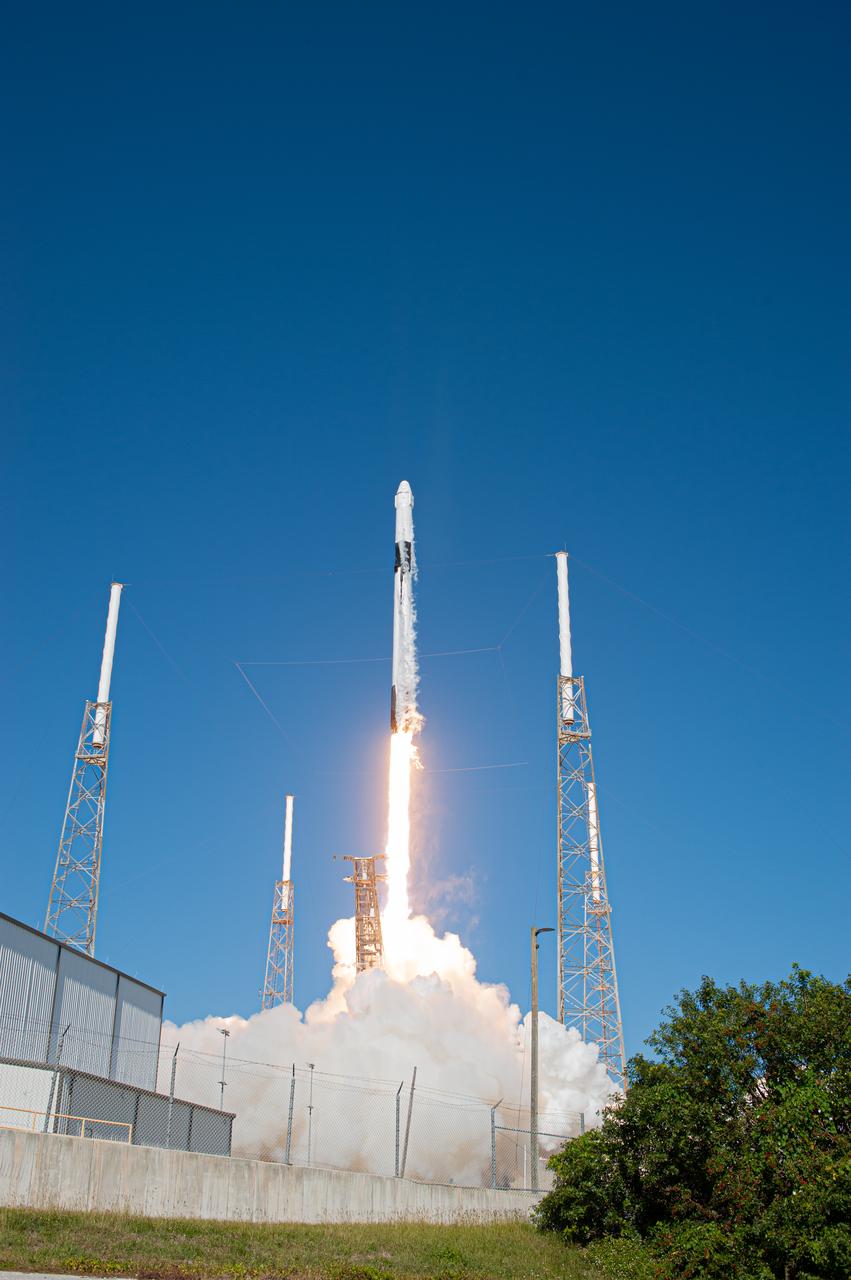
The SpaceX Falcon 9 rocket with the Dragon cargo module climbs upward after liftoff from Space Launch Complex 40 on Cape Canaveral Air Force Station in Florida in the early afternoon on Dec. 5, 2019. Liftoff was at 12:29 p.m. EST. This is SpaceX’s 19th Commercial Resupply Services (CRS-19) mission for NASA to the International Space Station. The Dragon cargo module will deliver more than 5,700 pounds of science and research, crew supplies and vehicle hardware to the orbital laboratory and its crew.
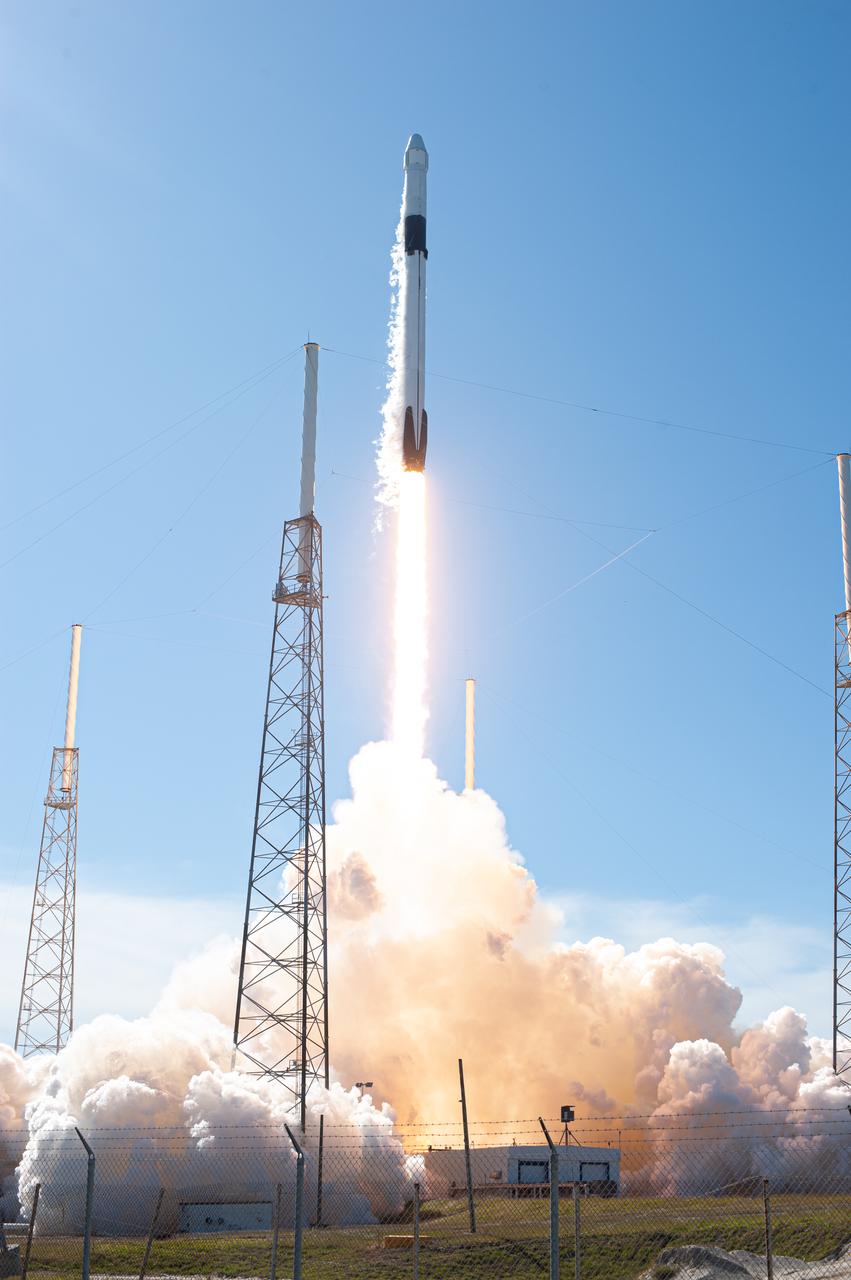
The SpaceX Falcon 9 rocket with the Dragon cargo module lifts off Space Launch Complex 40 on Cape Canaveral Air Force Station in Florida in the early afternoon on Dec. 5, 2019. Liftoff was at 12:29 p.m. EST. This is SpaceX’s 19th Commercial Resupply Services (CRS-19) mission for NASA to the International Space Station. The Dragon cargo module will deliver more than 5,700 pounds of science and research, crew supplies and vehicle hardware to the orbital laboratory and its crew.
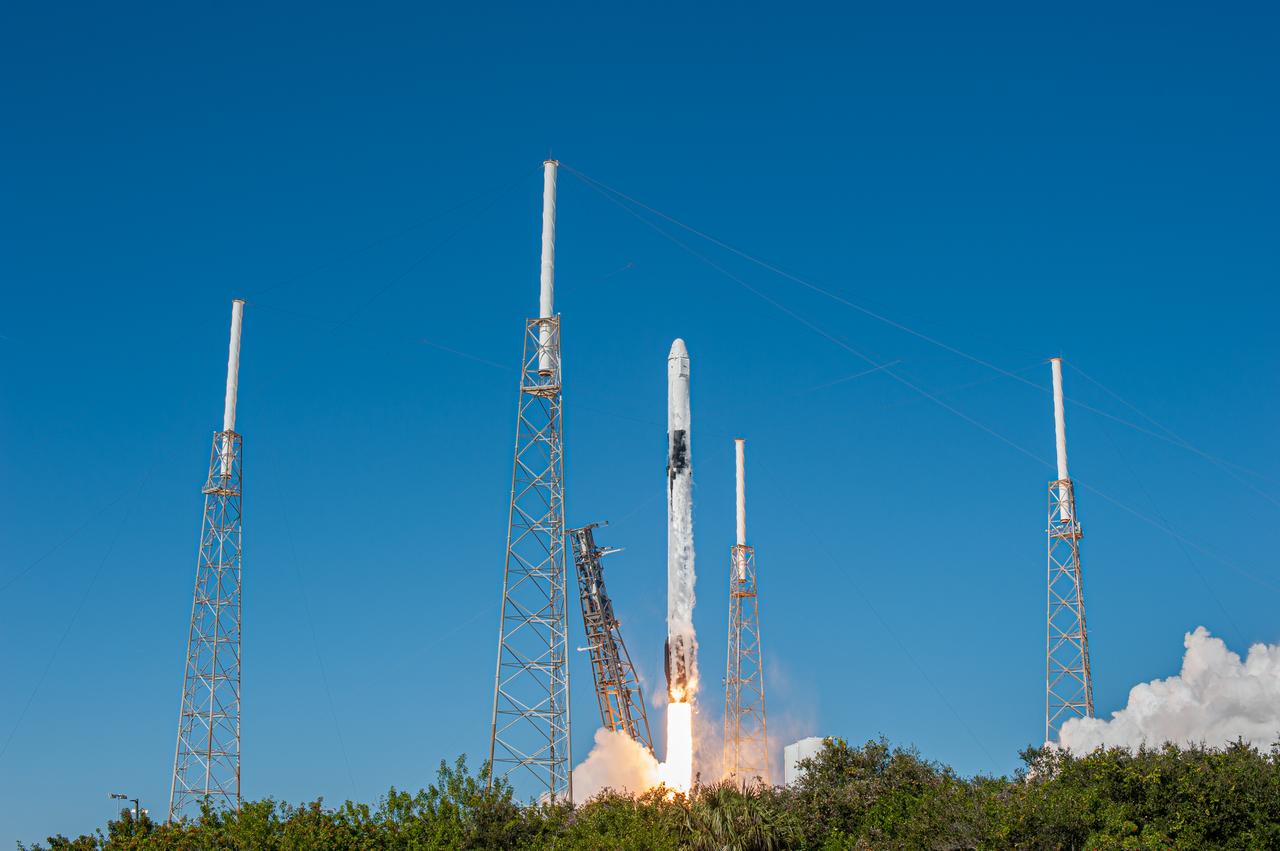
The SpaceX Falcon 9 rocket with the Dragon cargo module lifts off Space Launch Complex 40 on Cape Canaveral Air Force Station in Florida in the early afternoon on Dec. 5, 2019. Liftoff was at 12:29 p.m. EST. This is SpaceX’s 19th Commercial Resupply Services (CRS-19) mission for NASA to the International Space Station. The Dragon cargo module will deliver more than 5,700 pounds of science and research, crew supplies and vehicle hardware to the orbital laboratory and its crew.
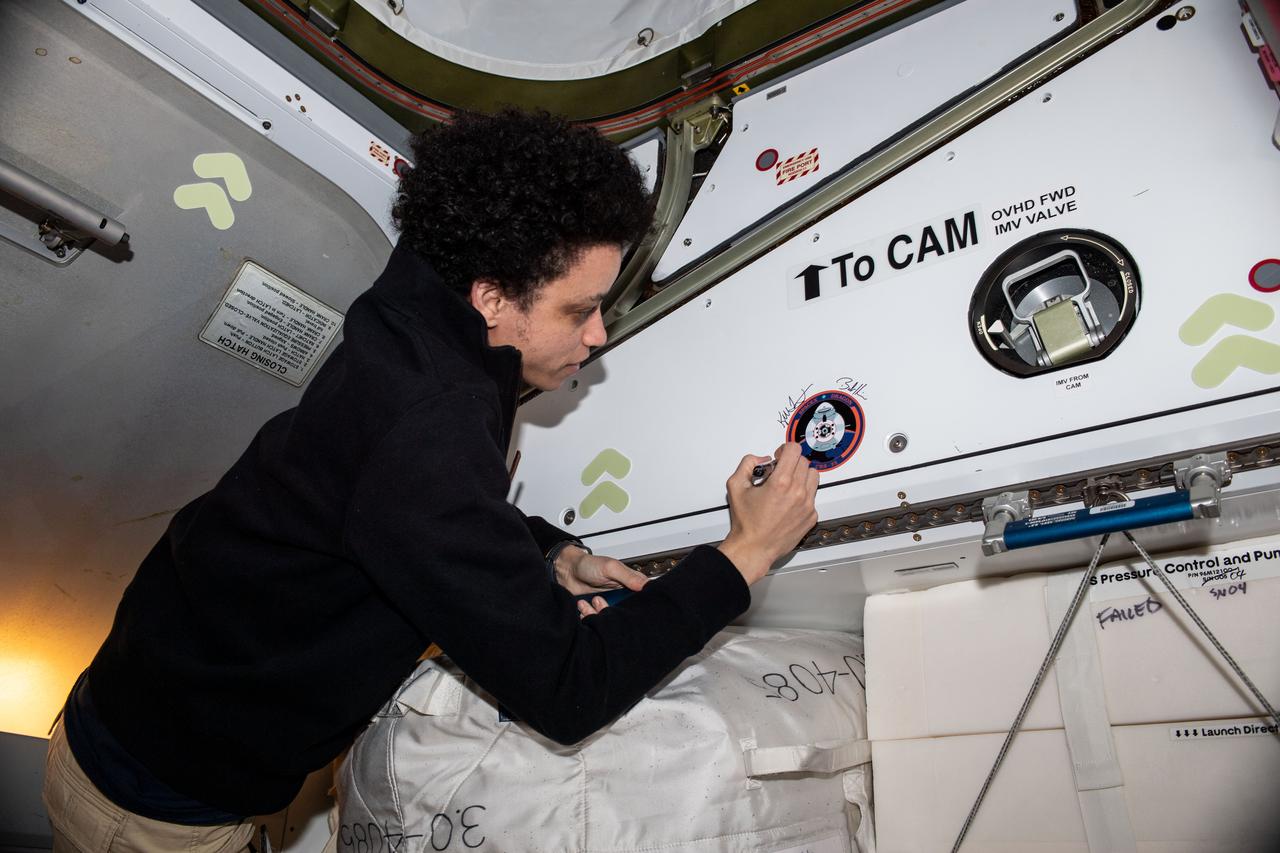
iss068e012458 (Oct. 5, 2022) --- NASA astronaut and Expedition 68 Flight Engineer Jessica Watkins signs her name around the SpaceX CRS-25 mission insignia sticker affixed to the Harmony module's vestibule. Watkins was aboard the International Space Station when the SpaceX Dragon resupply ship docked to Harmony's forward port on July 16, 2022, for a five-week cargo mission.
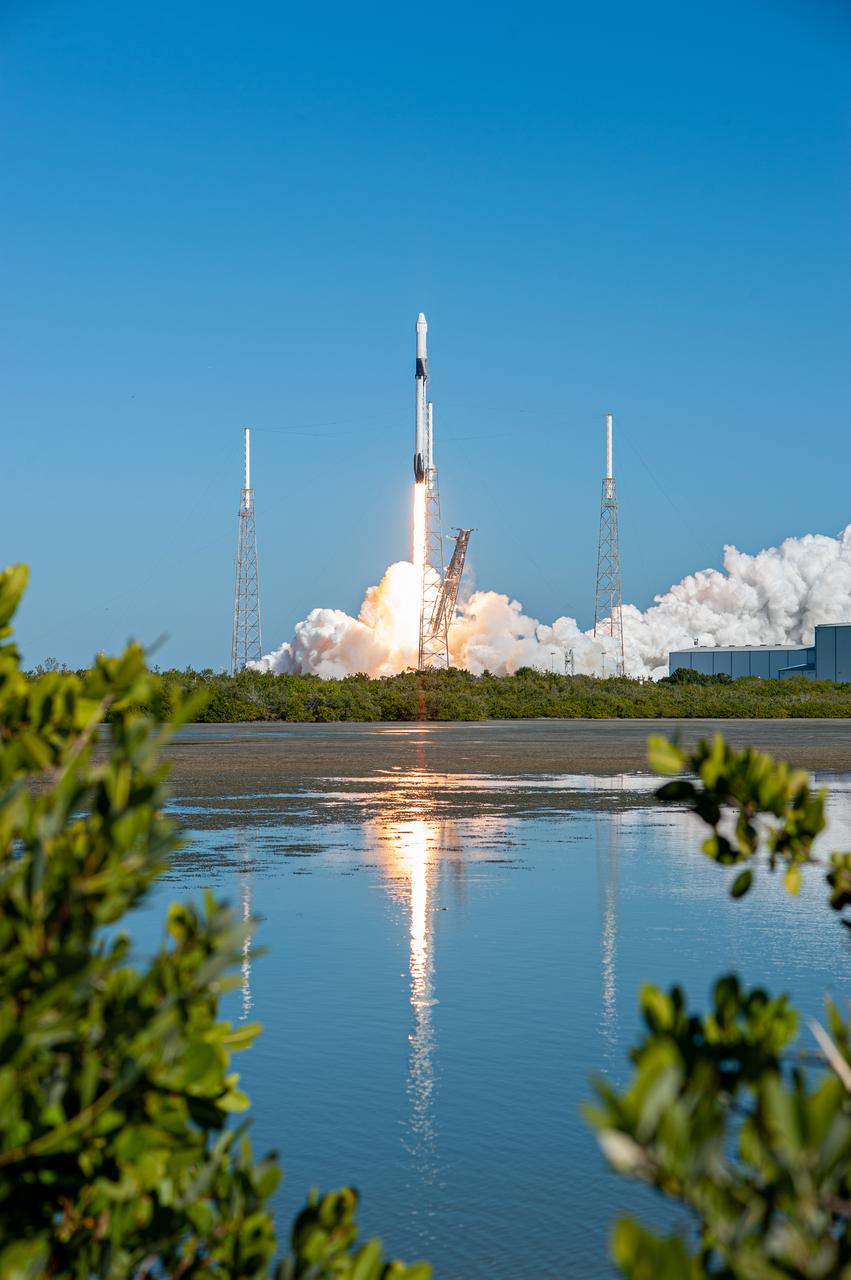
The SpaceX Falcon 9 rocket with the Dragon cargo module climbs upward after liftoff from Space Launch Complex 40 on Cape Canaveral Air Force Station in Florida in the early afternoon on Dec. 5, 2019. Liftoff was at 12:29 p.m. EST. This is SpaceX’s 19th Commercial Resupply Services (CRS-19) mission for NASA to the International Space Station. The Dragon cargo module will deliver more than 5,700 pounds of science and research, crew supplies and vehicle hardware to the orbital laboratory and its crew.
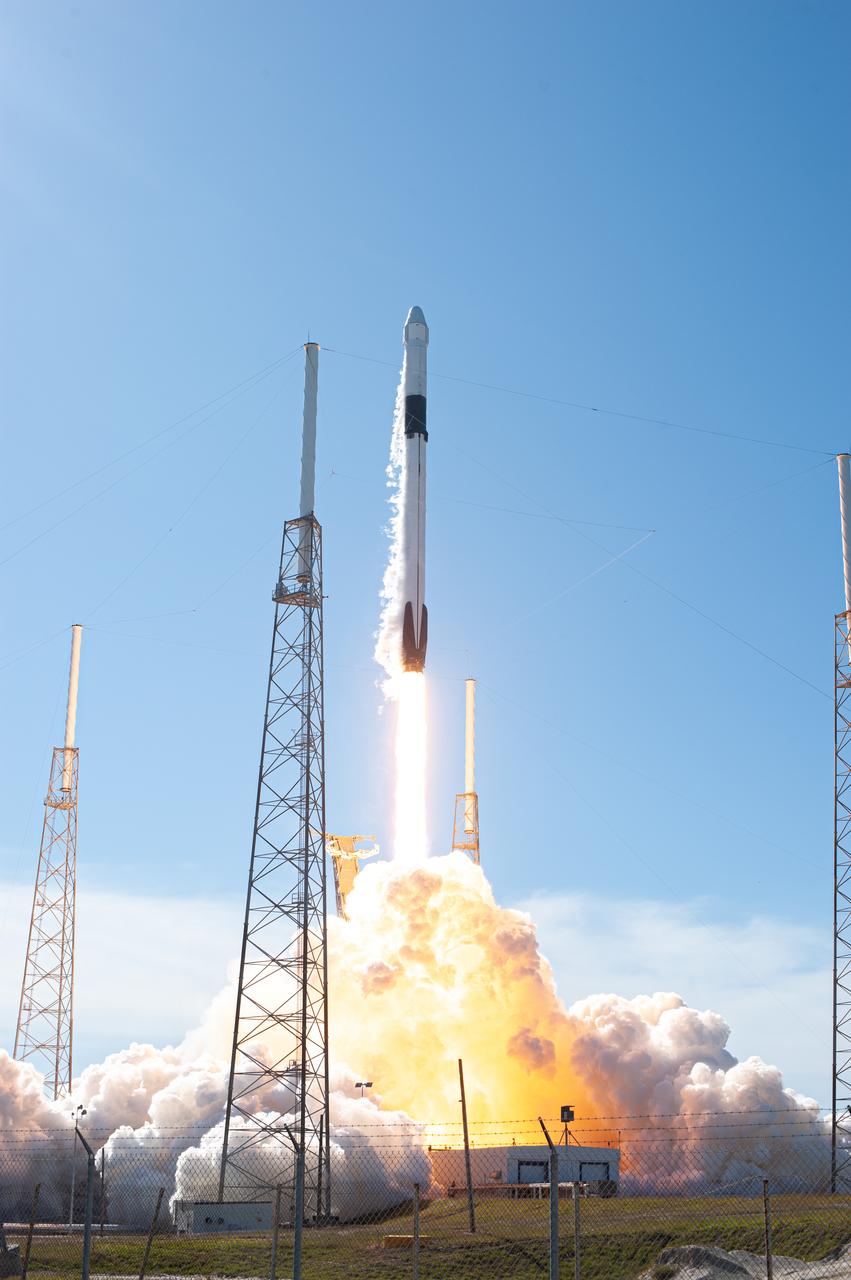
The SpaceX Falcon 9 rocket with the Dragon cargo module lifts off Space Launch Complex 40 on Cape Canaveral Air Force Station in Florida in the early afternoon on Dec. 5, 2019. Liftoff was at 12:29 p.m. EST. This is SpaceX’s 19th Commercial Resupply Services (CRS-19) mission for NASA to the International Space Station. The Dragon cargo module will deliver more than 5,700 pounds of science and research, crew supplies and vehicle hardware to the orbital laboratory and its crew.

The SpaceX Falcon 9 rocket with the Dragon cargo module lifts off Space Launch Complex 40 on Cape Canaveral Air Force Station in Florida in the early afternoon on Dec. 5, 2019. Liftoff was at 12:29 p.m. EST. This is SpaceX’s 19th Commercial Resupply Services (CRS-19) mission for NASA to the International Space Station. The Dragon cargo module will deliver more than 5,700 pounds of science and research, crew supplies and vehicle hardware to the orbital laboratory and its crew.
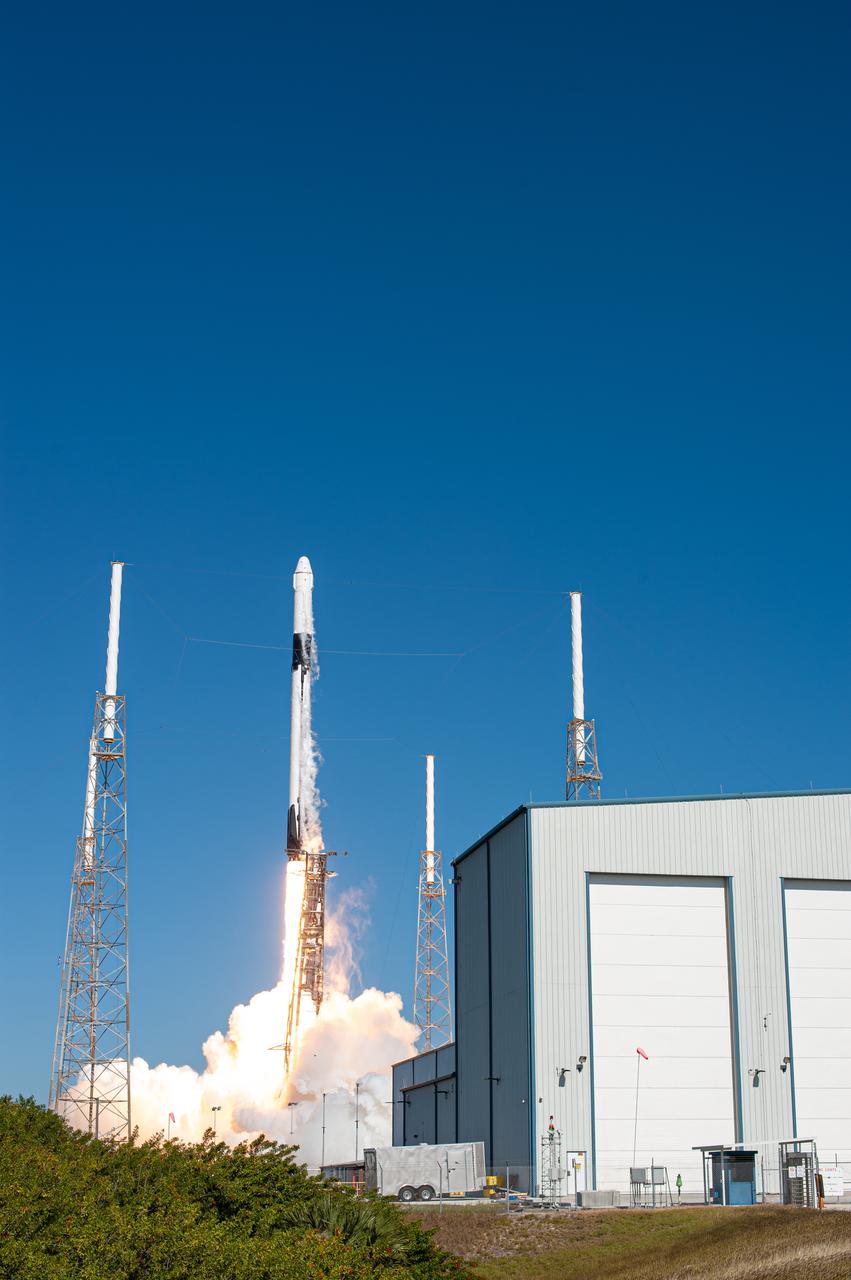
The SpaceX Falcon 9 rocket with the Dragon cargo module climbs upward after liftoff from Space Launch Complex 40 on Cape Canaveral Air Force Station in Florida in the early afternoon on Dec. 5, 2019. Liftoff was at 12:29 p.m. EST. This is SpaceX’s 19th Commercial Resupply Services (CRS-19) mission for NASA to the International Space Station. The Dragon cargo module will deliver more than 5,700 pounds of science and research, crew supplies and vehicle hardware to the orbital laboratory and its crew.
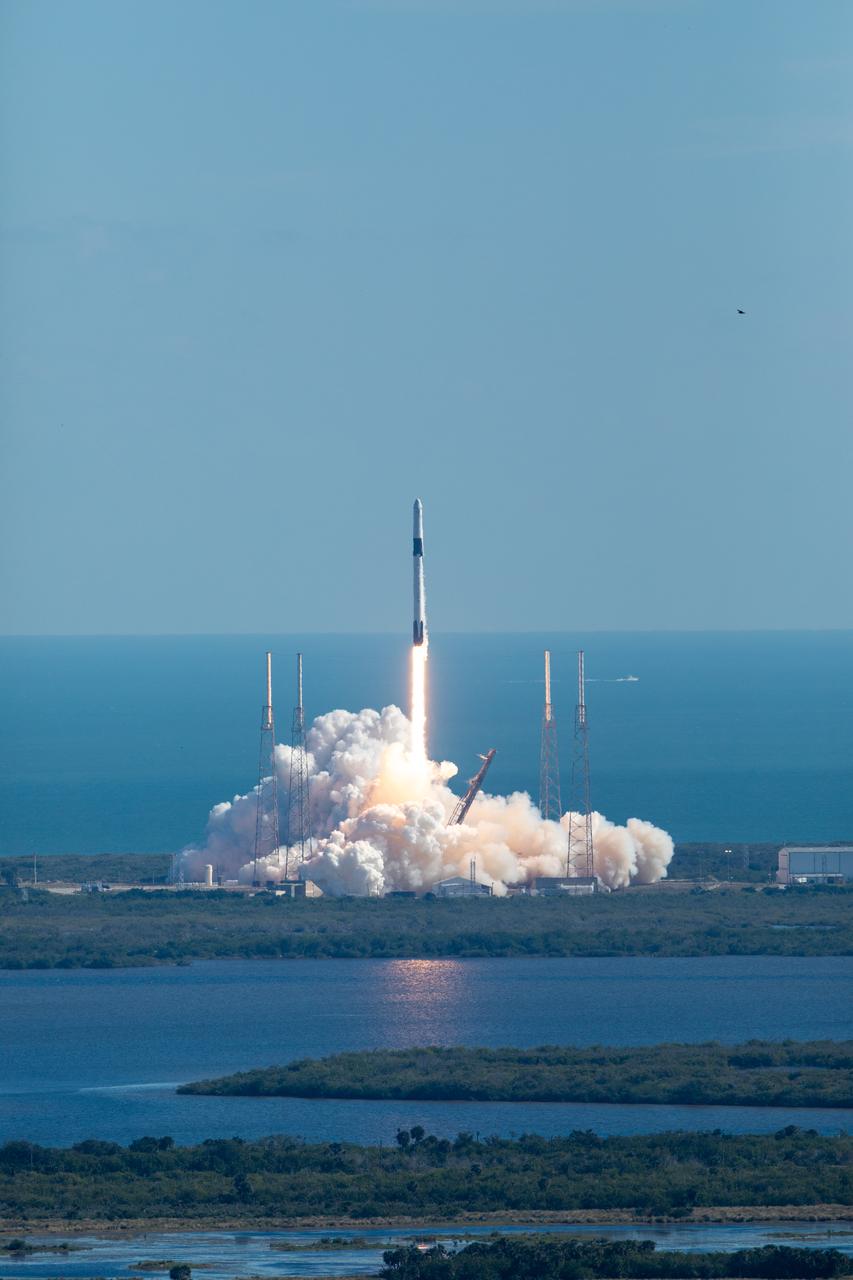
The SpaceX Falcon 9 rocket with the Dragon cargo module lifts off Space Launch Complex 40 on Cape Canaveral Air Force Station in Florida in the early afternoon on Dec. 5, 2019. Liftoff was at 12:29 p.m. EST. This is SpaceX’s 19th Commercial Resupply Services (CRS-19) mission for NASA to the International Space Station. The Dragon cargo module will deliver more than 5,700 pounds of science and research, crew supplies and vehicle hardware to the orbital laboratory and its crew.

The SpaceX Falcon 9 rocket with the Dragon cargo module climbs upward after liftoff from Space Launch Complex 40 on Cape Canaveral Air Force Station in Florida in the early afternoon on Dec. 5, 2019. Liftoff was at 12:29 p.m. EST. This is SpaceX’s 19th Commercial Resupply Services (CRS-19) mission for NASA to the International Space Station. The Dragon cargo module will deliver more than 5,700 pounds of science and research, crew supplies and vehicle hardware to the orbital laboratory and its crew.
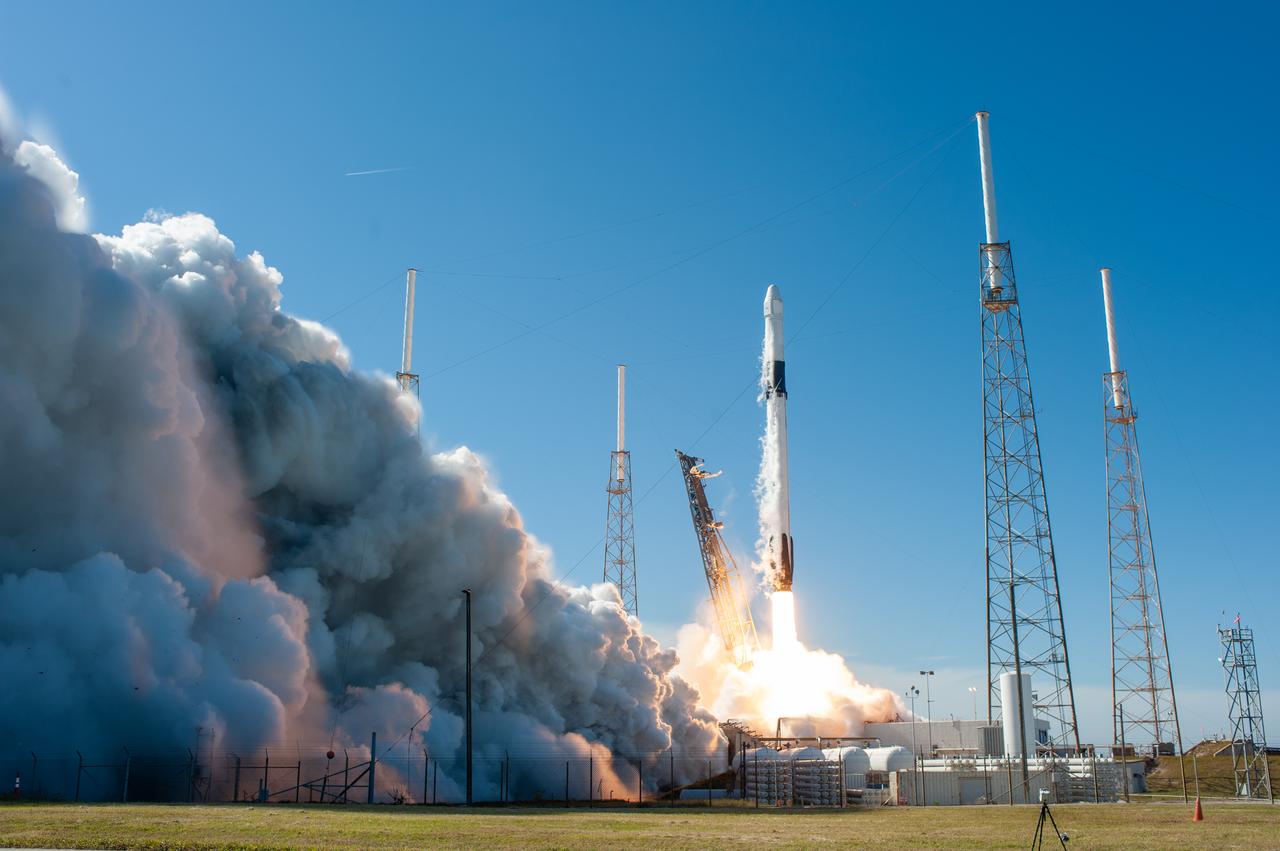
The SpaceX Falcon 9 rocket with the Dragon cargo module lifts off Space Launch Complex 40 on Cape Canaveral Air Force Station in Florida in the early afternoon on Dec. 5, 2019. Liftoff was at 12:29 p.m. EST. This is SpaceX’s 19th Commercial Resupply Services (CRS-19) mission for NASA to the International Space Station. The Dragon cargo module will deliver more than 5,700 pounds of science and research, crew supplies and vehicle hardware to the orbital laboratory and its crew.
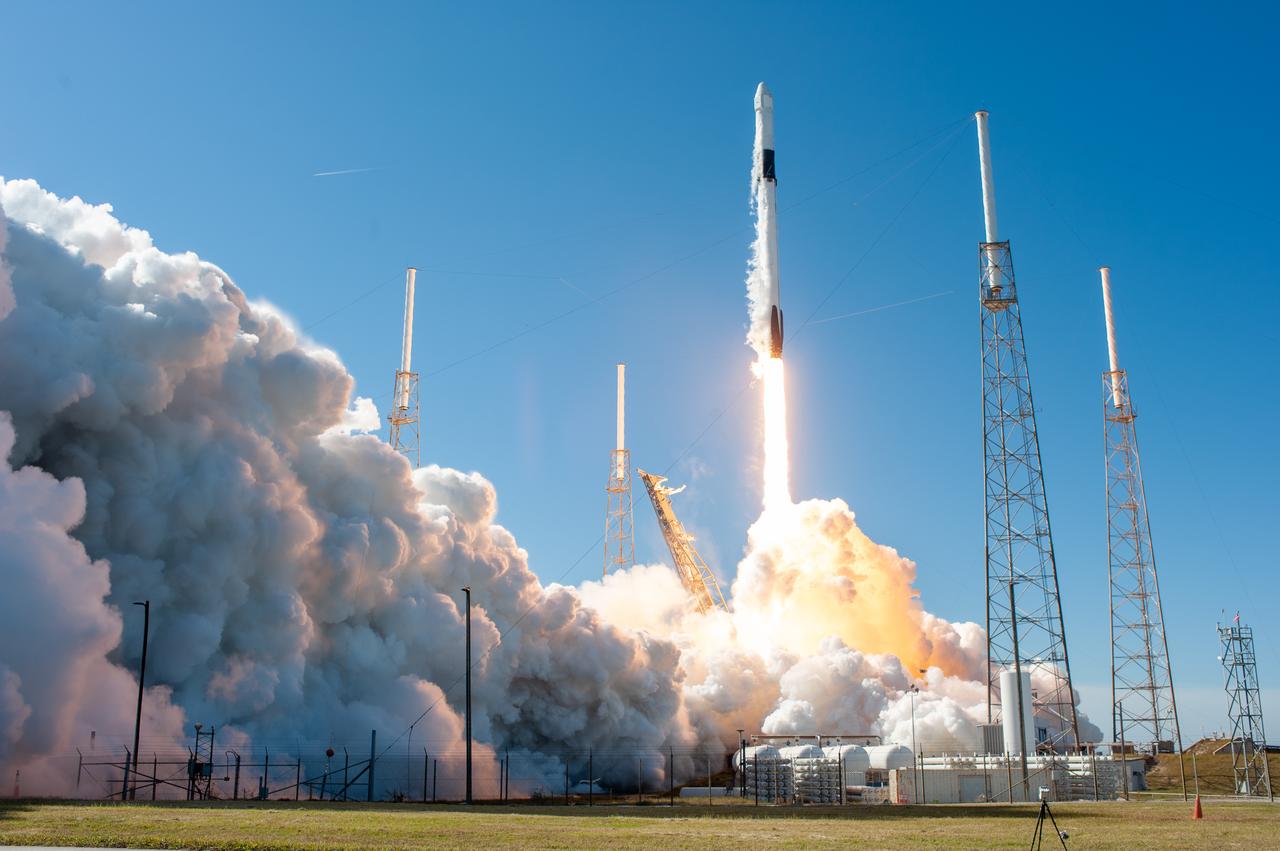
The SpaceX Falcon 9 rocket with the Dragon cargo module lifts off Space Launch Complex 40 on Cape Canaveral Air Force Station in Florida in the early afternoon on Dec. 5, 2019. Liftoff was at 12:29 p.m. EST. This is SpaceX’s 19th Commercial Resupply Services (CRS-19) mission for NASA to the International Space Station. The Dragon cargo module will deliver more than 5,700 pounds of science and research, crew supplies and vehicle hardware to the orbital laboratory and its crew.
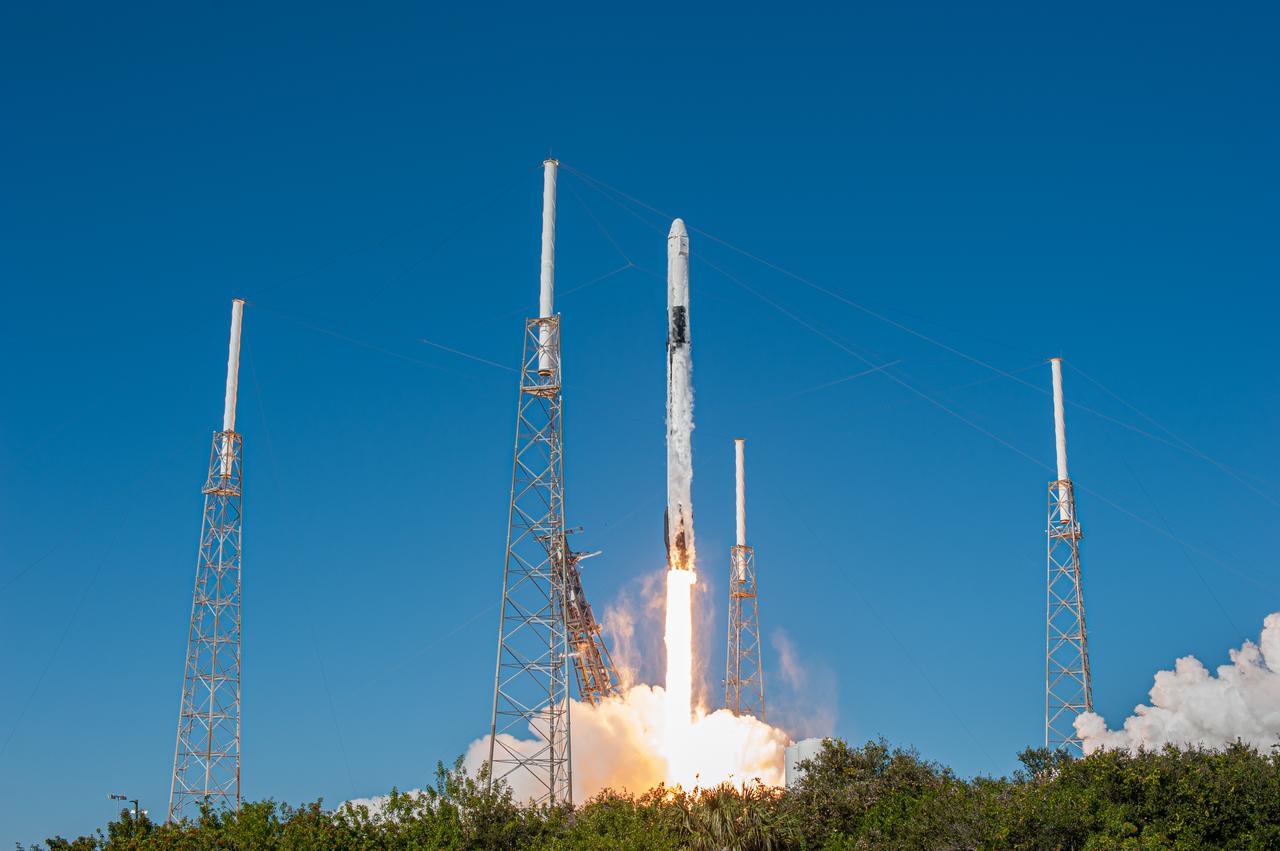
The SpaceX Falcon 9 rocket with the Dragon cargo module lifts off Space Launch Complex 40 on Cape Canaveral Air Force Station in Florida in the early afternoon on Dec. 5, 2019. Liftoff was at 12:29 p.m. EST. This is SpaceX’s 19th Commercial Resupply Services (CRS-19) mission for NASA to the International Space Station. The Dragon cargo module will deliver more than 5,700 pounds of science and research, crew supplies and vehicle hardware to the orbital laboratory and its crew.
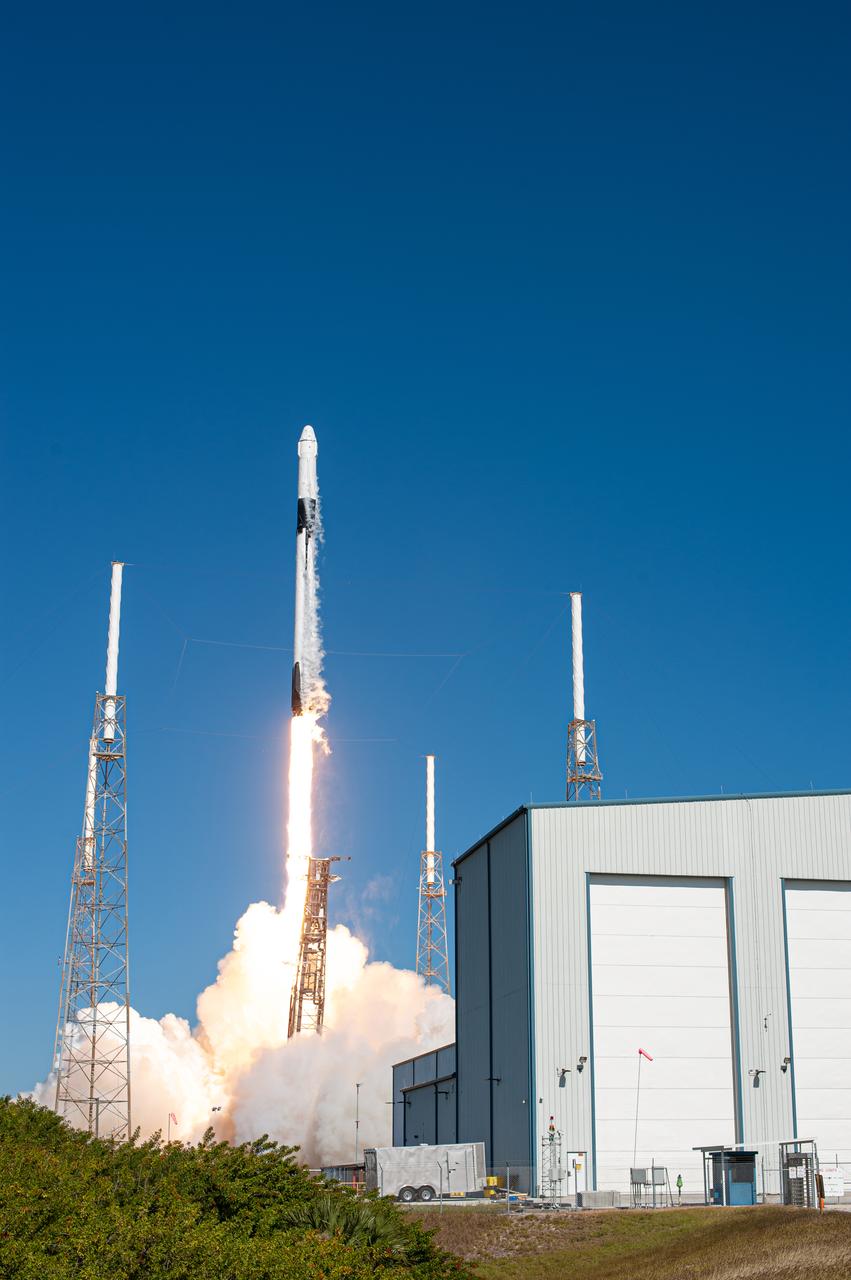
The SpaceX Falcon 9 rocket with the Dragon cargo module climbs upward after liftoff from Space Launch Complex 40 on Cape Canaveral Air Force Station in Florida in the early afternoon on Dec. 5, 2019. Liftoff was at 12:29 p.m. EST. This is SpaceX’s 19th Commercial Resupply Services (CRS-19) mission for NASA to the International Space Station. The Dragon cargo module will deliver more than 5,700 pounds of science and research, crew supplies and vehicle hardware to the orbital laboratory and its crew.
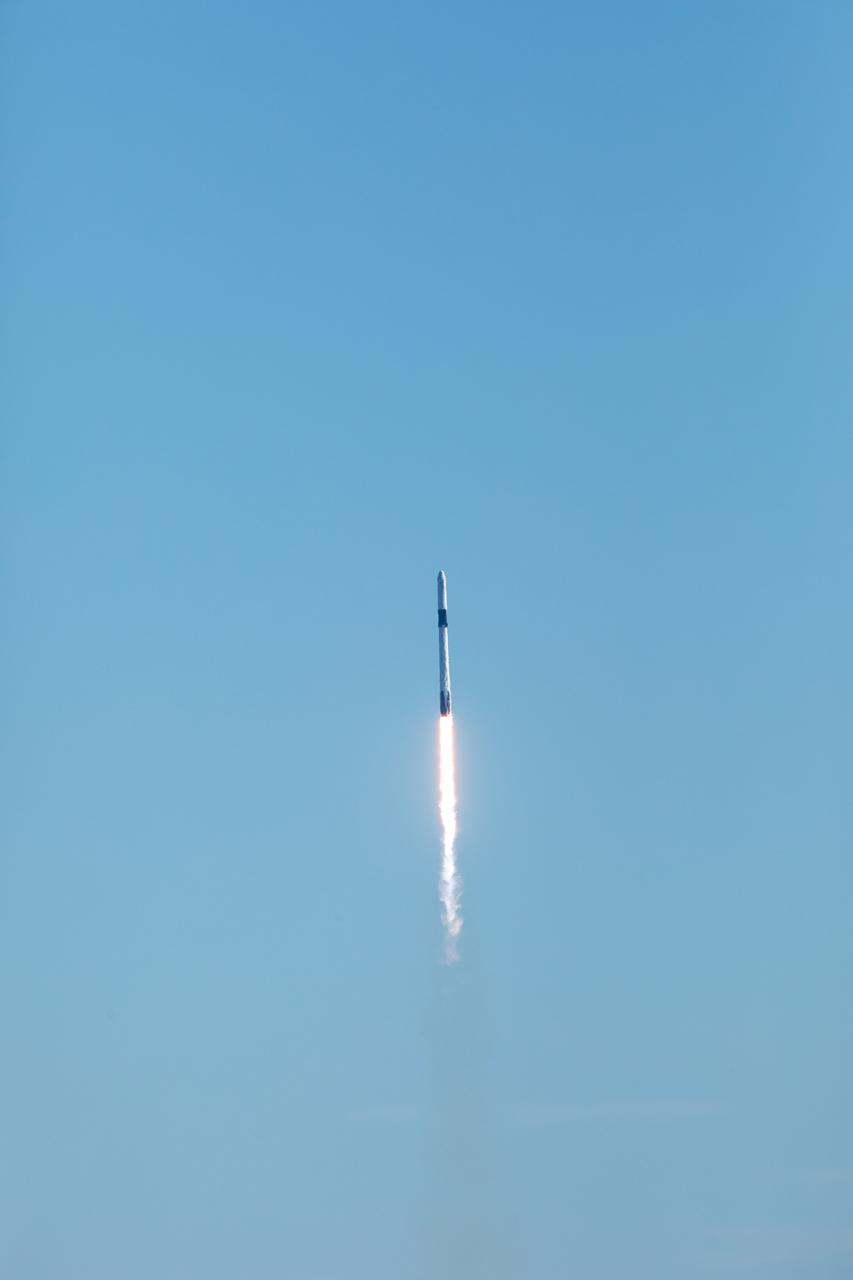
The SpaceX Falcon 9 rocket with the Dragon cargo module climbs upward after liftoff from Space Launch Complex 40 on Cape Canaveral Air Force Station in Florida in the early afternoon on Dec. 5, 2019. Liftoff was at 12:29 p.m. EST. This is SpaceX’s 19th Commercial Resupply Services (CRS-19) mission for NASA to the International Space Station. The Dragon cargo module will deliver more than 5,700 pounds of science and research, crew supplies and vehicle hardware to the orbital laboratory and its crew.
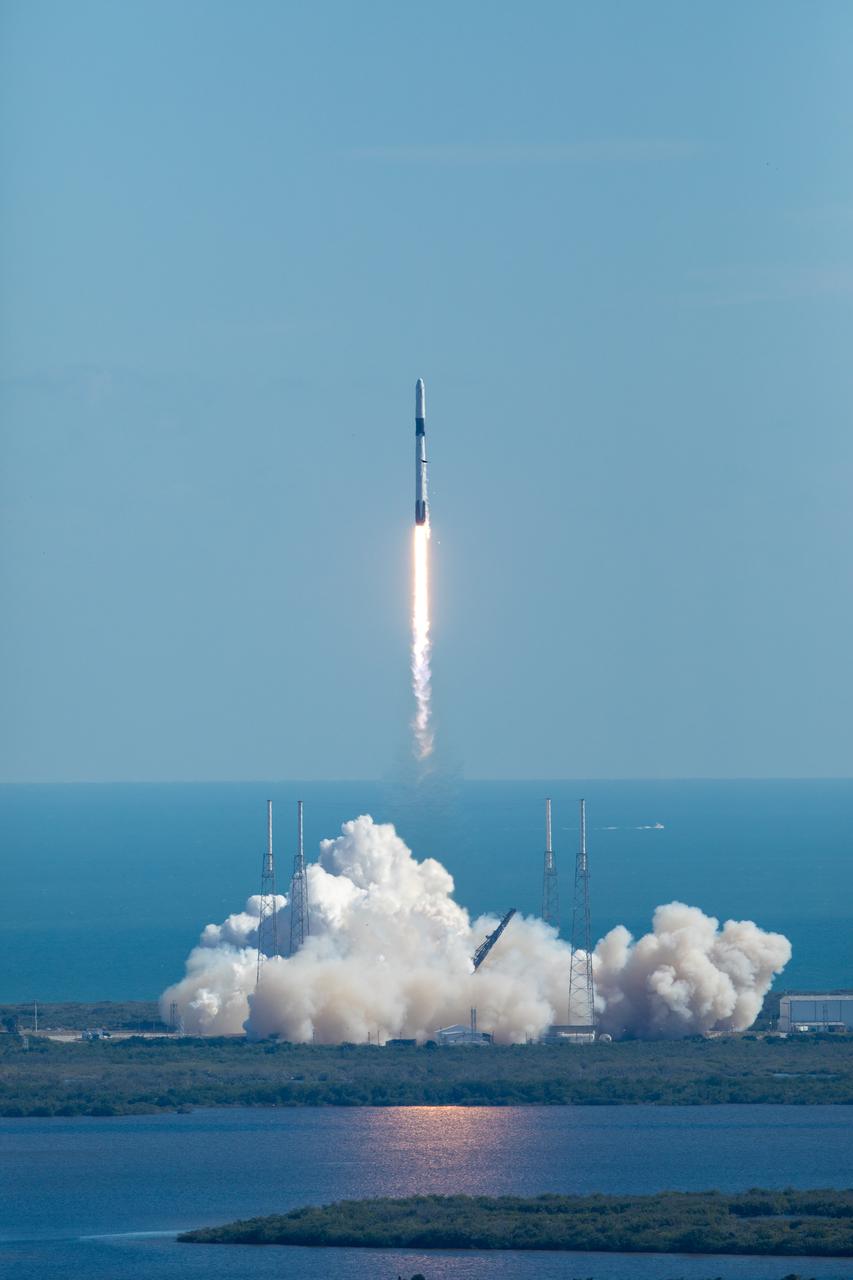
The SpaceX Falcon 9 rocket with the Dragon cargo module lifts off Space Launch Complex 40 on Cape Canaveral Air Force Station in Florida in the early afternoon on Dec. 5, 2019. Liftoff was at 12:29 p.m. EST. This is SpaceX’s 19th Commercial Resupply Services (CRS-19) mission for NASA to the International Space Station. The Dragon cargo module will deliver more than 5,700 pounds of science and research, crew supplies and vehicle hardware to the orbital laboratory and its crew.
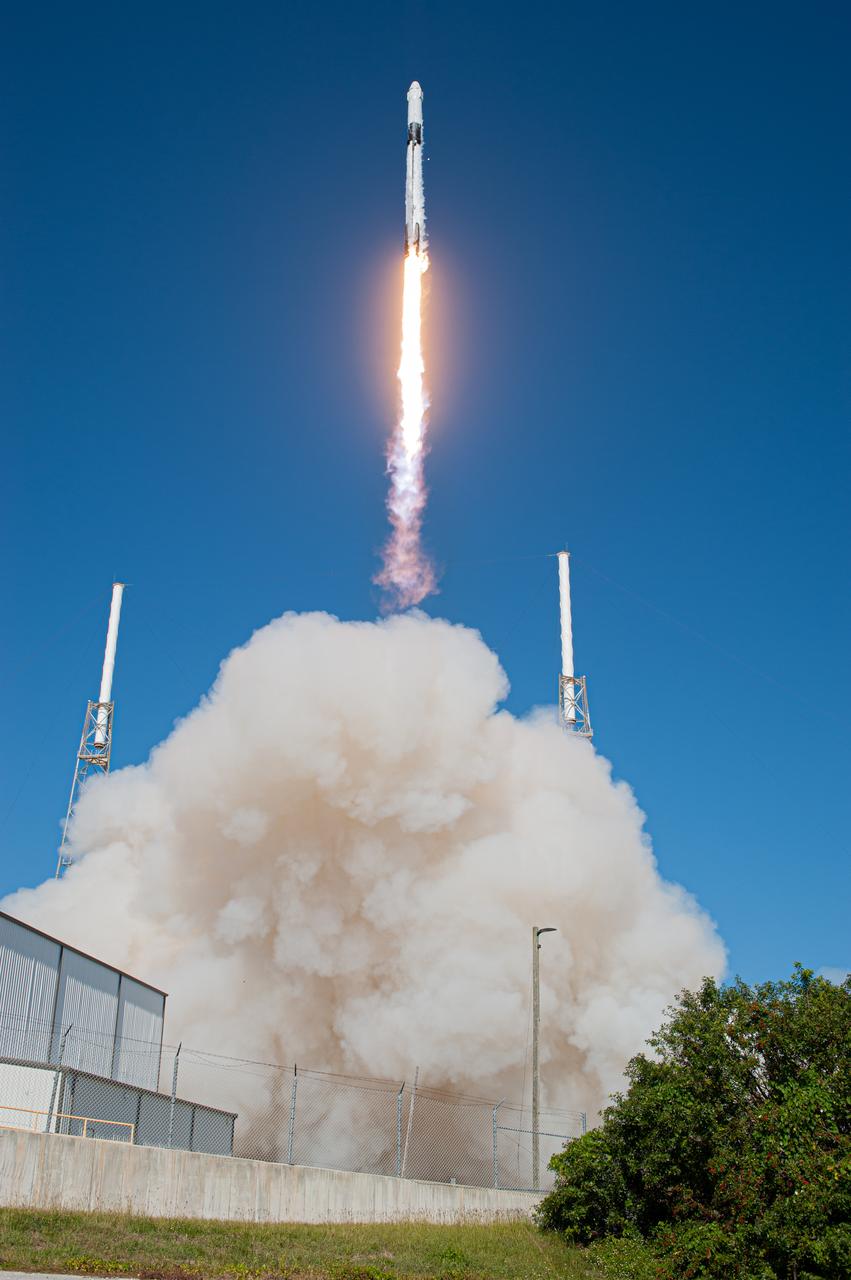
The SpaceX Falcon 9 rocket with the Dragon cargo module climbs upward after liftoff from Space Launch Complex 40 on Cape Canaveral Air Force Station in Florida in the early afternoon on Dec. 5, 2019. Liftoff was at 12:29 p.m. EST. This is SpaceX’s 19th Commercial Resupply Services (CRS-19) mission for NASA to the International Space Station. The Dragon cargo module will deliver more than 5,700 pounds of science and research, crew supplies and vehicle hardware to the orbital laboratory and its crew.
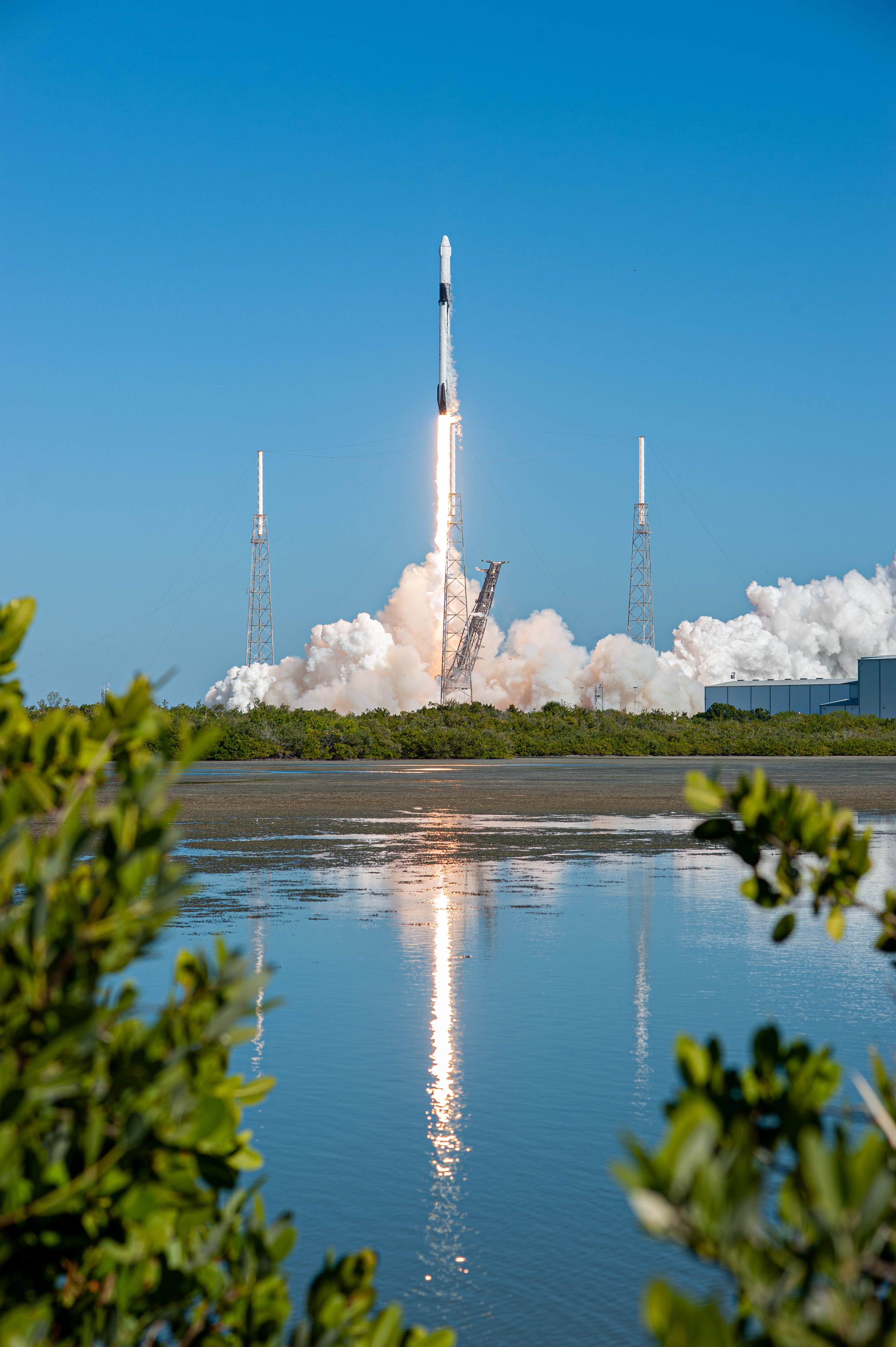
The SpaceX Falcon 9 rocket with the Dragon cargo module climbs upward after liftoff from Space Launch Complex 40 on Cape Canaveral Air Force Station in Florida in the early afternoon on Dec. 5, 2019. Liftoff was at 12:29 p.m. EST. This is SpaceX’s 19th Commercial Resupply Services (CRS-19) mission for NASA to the International Space Station. The Dragon cargo module will deliver more than 5,700 pounds of science and research, crew supplies and vehicle hardware to the orbital laboratory and its crew.
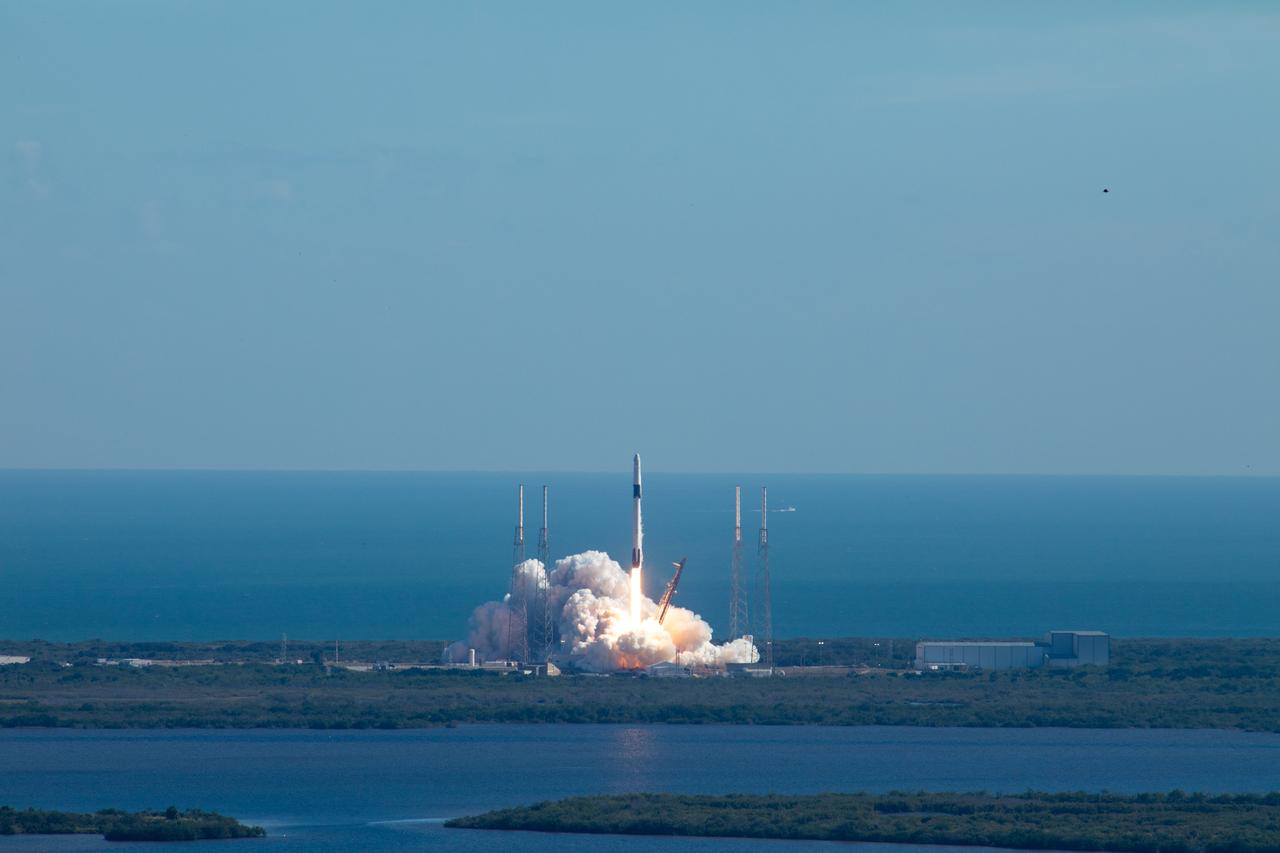
The SpaceX Falcon 9 rocket with the Dragon cargo module lifts off Space Launch Complex 40 on Cape Canaveral Air Force Station in Florida in the early afternoon on Dec. 5, 2019. Liftoff was at 12:29 p.m. EST. This is SpaceX’s 19th Commercial Resupply Services (CRS-19) mission for NASA to the International Space Station. The Dragon cargo module will deliver more than 5,700 pounds of science and research, crew supplies and vehicle hardware to the orbital laboratory and its crew.
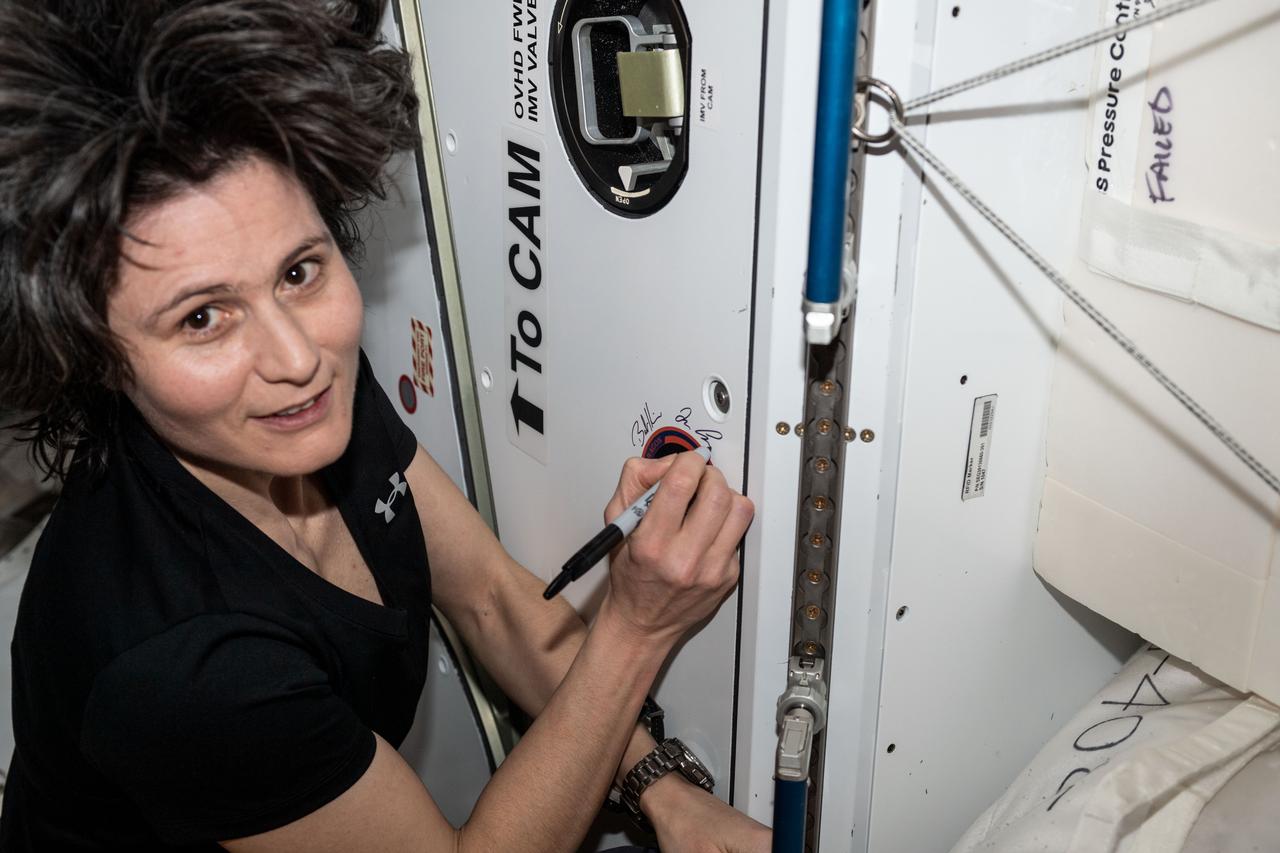
iss068e012464 (Oct. 5, 2022) --- ESA (European Space Agency) astronaut and Expedition 68 Commander Samantha Cristoforetti signs her name around the SpaceX CRS-25 mission insignia sticker affixed to the Harmony module's vestibule. Cristoforetti was aboard the International Space Station when the SpaceX Dragon resupply ship docked to Harmony's forward port on July 16, 2022, for a five-week cargo mission.
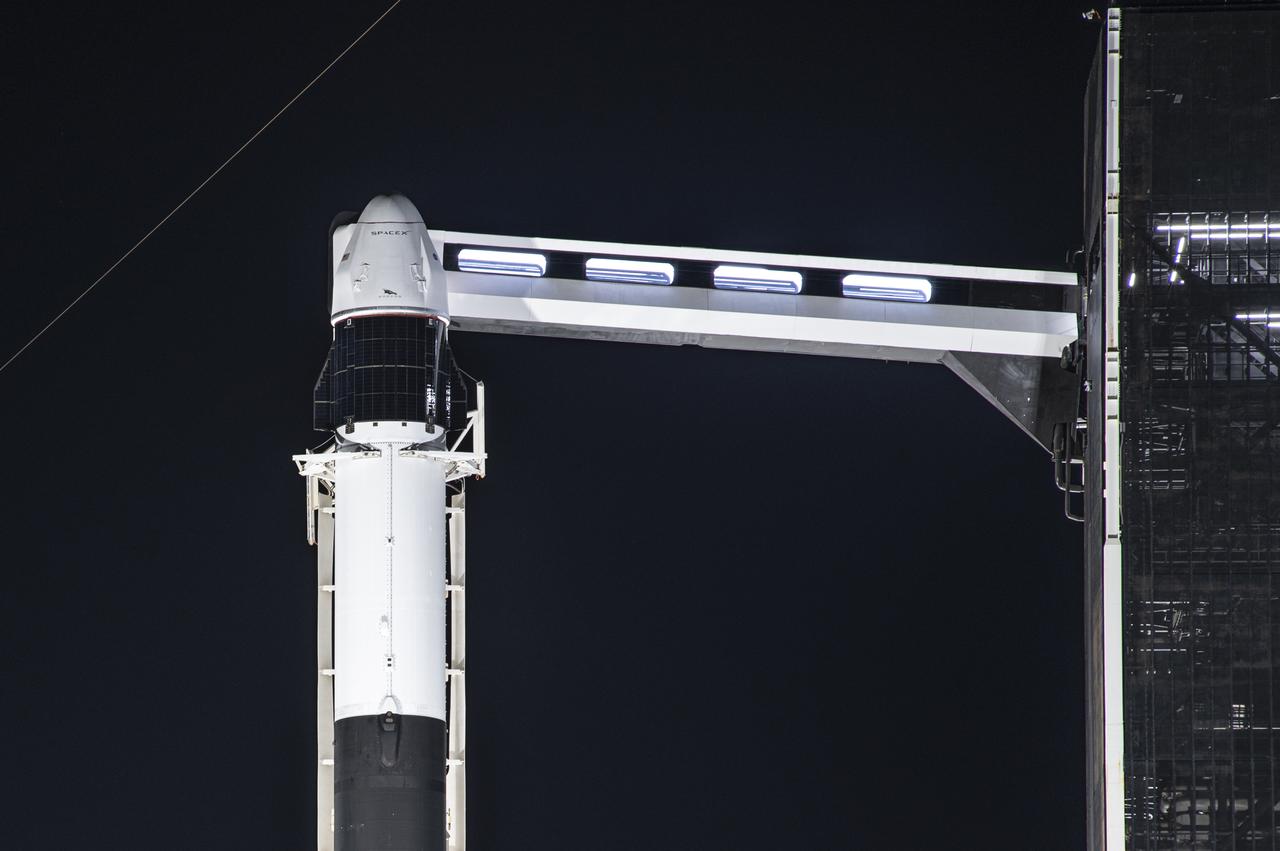
A SpaceX Falcon 9 rocket, topped with the company’s upgraded version of the Dragon spacecraft, stands vertical at NASA Kennedy Space Center’s Launch Complex 39A in Florida on Wednesday, Dec. 2, 2020. The first mission for SpaceX under NASA’s second Commercial Resupply Services contract, CRS-21 is scheduled to lift off from Launch Complex 39A on Saturday, Dec. 5, at 11:39 a.m. EST. The mission will deliver critical supplies and equipment to the International Space Station.
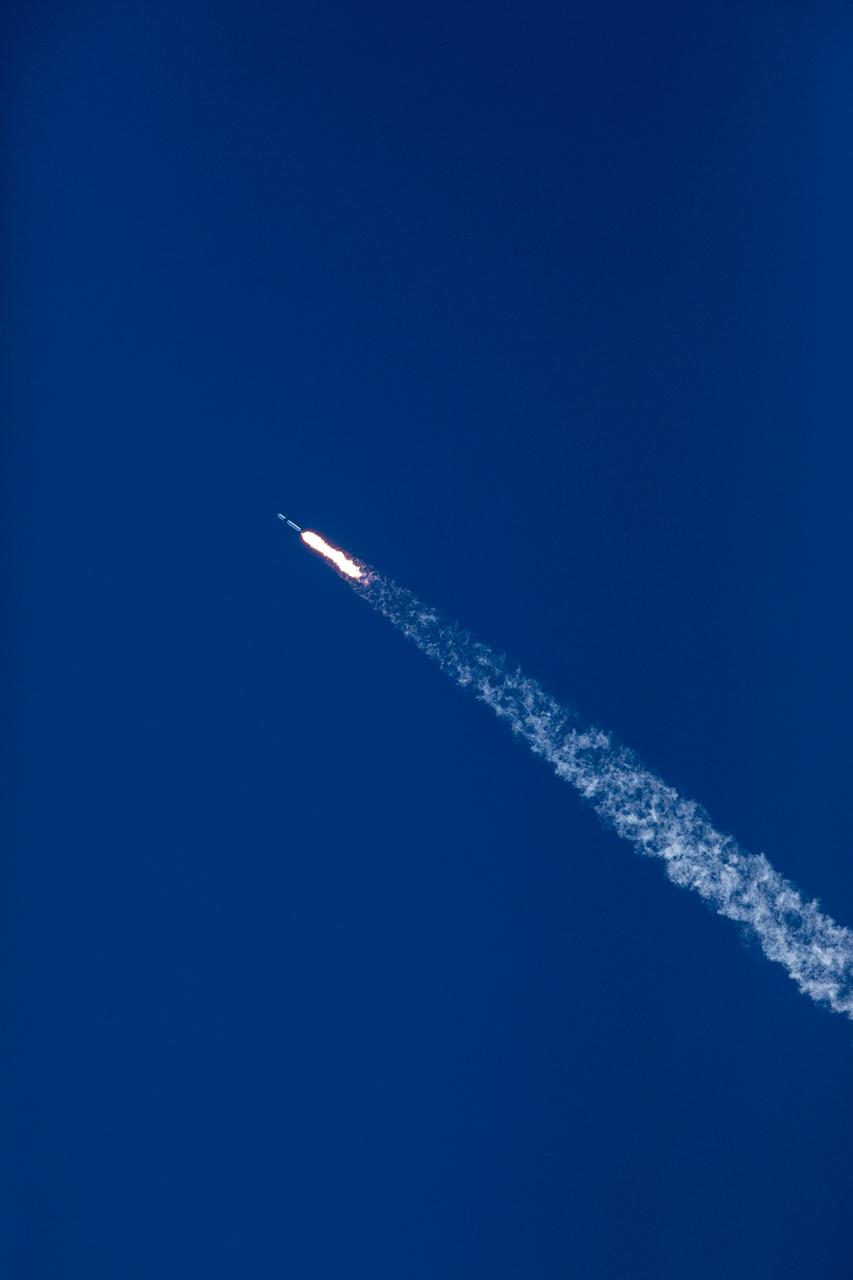
The SpaceX Falcon 9 rocket with the Dragon cargo module climbs upward after liftoff from Space Launch Complex 40 on Cape Canaveral Air Force Station in Florida in the early afternoon on Dec. 5, 2019. Liftoff was at 12:29 p.m. EST. This is SpaceX’s 19th Commercial Resupply Services (CRS-19) mission for NASA to the International Space Station. The Dragon cargo module will deliver more than 5,700 pounds of science and research, crew supplies and vehicle hardware to the orbital laboratory and its crew.
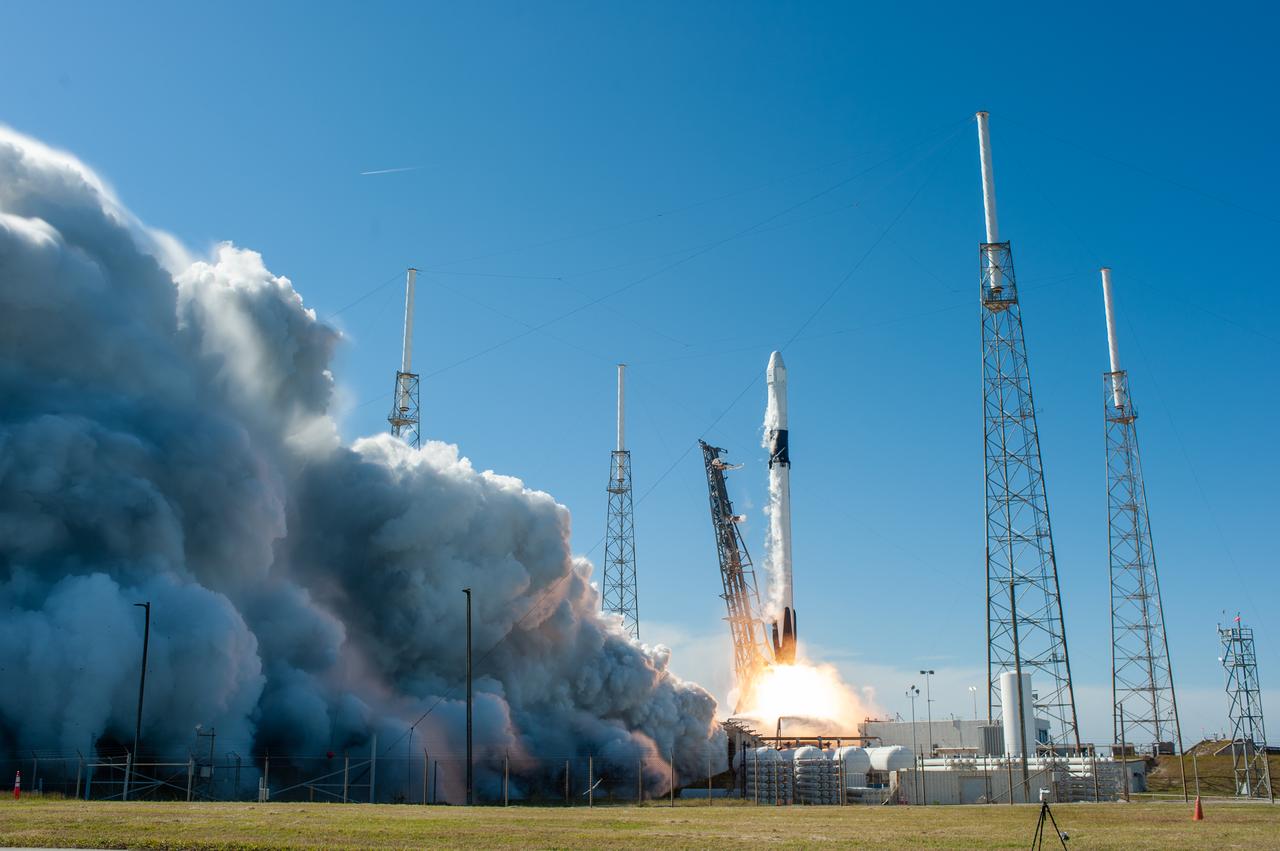
The SpaceX Falcon 9 rocket with the Dragon cargo module lifts off Space Launch Complex 40 on Cape Canaveral Air Force Station in Florida in the early afternoon on Dec. 5, 2019. Liftoff was at 12:29 p.m. EST. This is SpaceX’s 19th Commercial Resupply Services (CRS-19) mission for NASA to the International Space Station. The Dragon cargo module will deliver more than 5,700 pounds of science and research, crew supplies and vehicle hardware to the orbital laboratory and its crew.
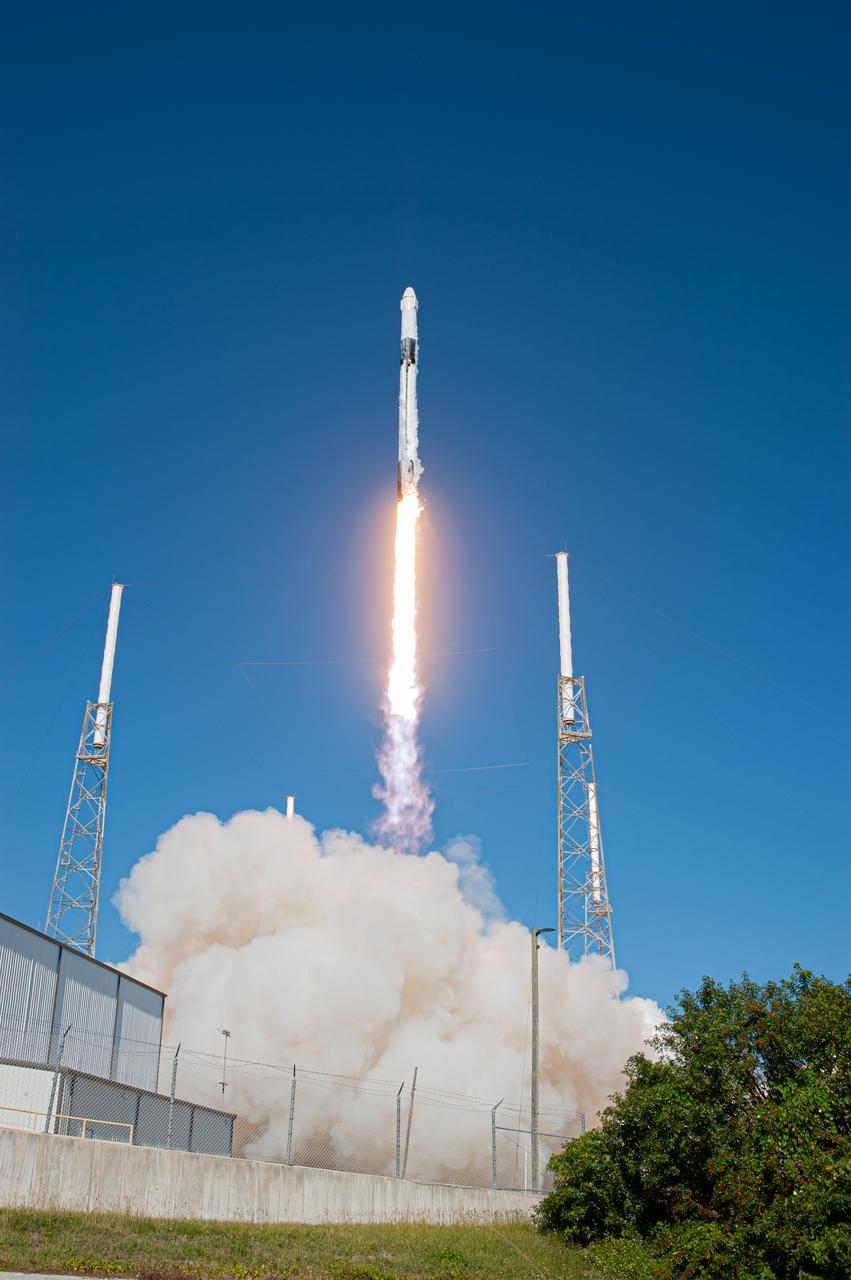
The SpaceX Falcon 9 rocket with the Dragon cargo module climbs upward after liftoff from Space Launch Complex 40 on Cape Canaveral Air Force Station in Florida in the early afternoon on Dec. 5, 2019. Liftoff was at 12:29 p.m. EST. This is SpaceX’s 19th Commercial Resupply Services (CRS-19) mission for NASA to the International Space Station. The Dragon cargo module will deliver more than 5,700 pounds of science and research, crew supplies and vehicle hardware to the orbital laboratory and its crew.
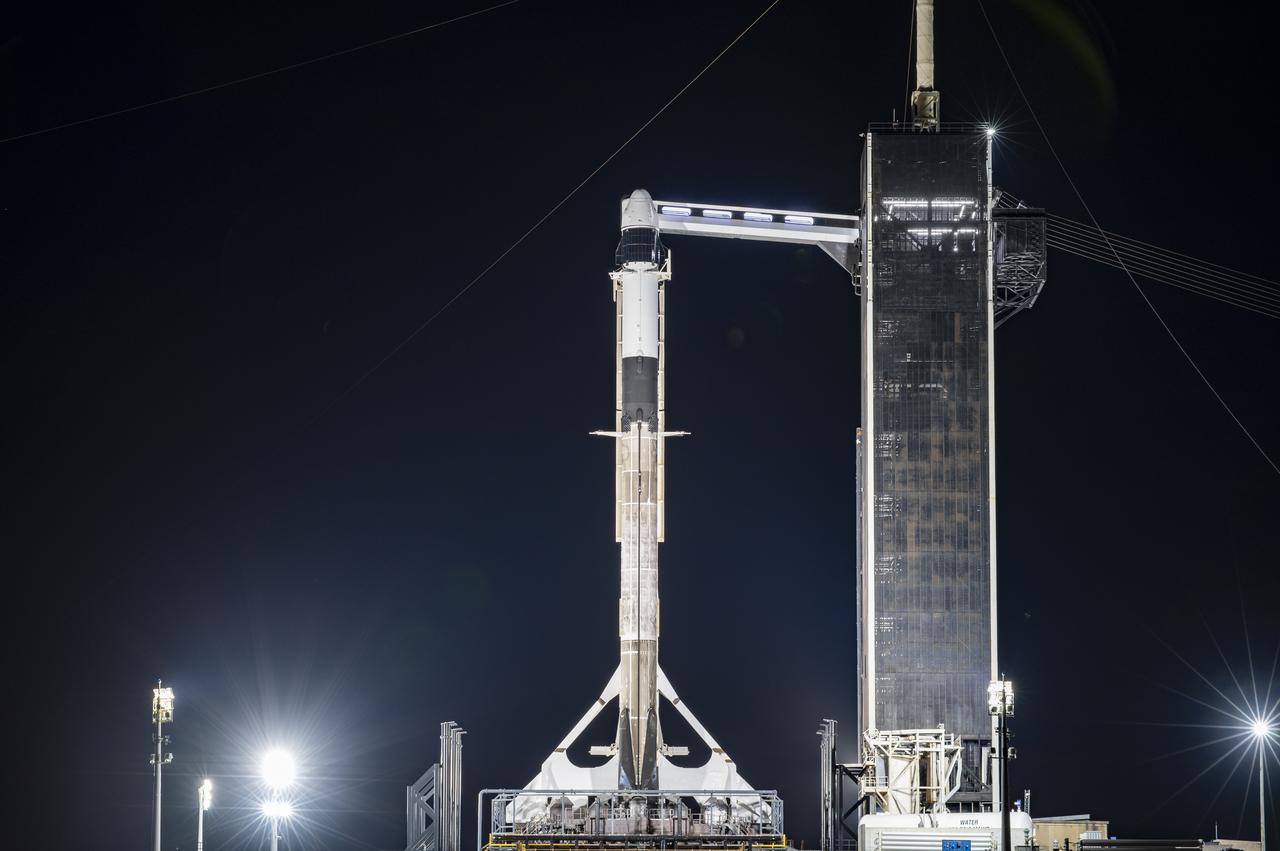
A SpaceX Falcon 9 rocket, topped with the company’s upgraded version of the Dragon spacecraft, stands vertical at NASA Kennedy Space Center’s Launch Complex 39A in Florida on Wednesday, Dec. 2, 2020. The first mission for SpaceX under NASA’s second Commercial Resupply Services contract, CRS-21 is scheduled to lift off from Launch Complex 39A on Saturday, Dec. 5, at 11:39 a.m. EST. The mission will deliver critical supplies and equipment to the International Space Station.
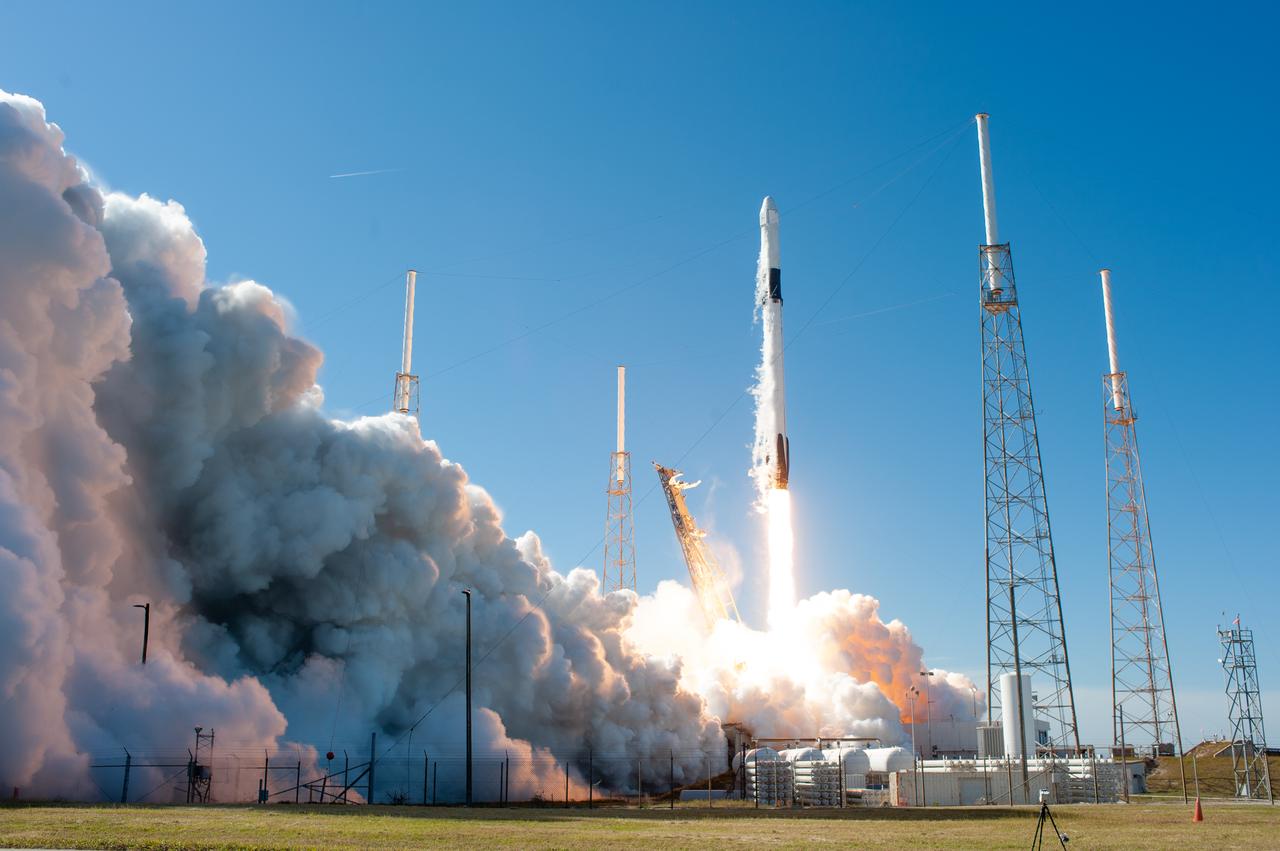
The SpaceX Falcon 9 rocket with the Dragon cargo module lifts off Space Launch Complex 40 on Cape Canaveral Air Force Station in Florida in the early afternoon on Dec. 5, 2019. Liftoff was at 12:29 p.m. EST. This is SpaceX’s 19th Commercial Resupply Services (CRS-19) mission for NASA to the International Space Station. The Dragon cargo module will deliver more than 5,700 pounds of science and research, crew supplies and vehicle hardware to the orbital laboratory and its crew.
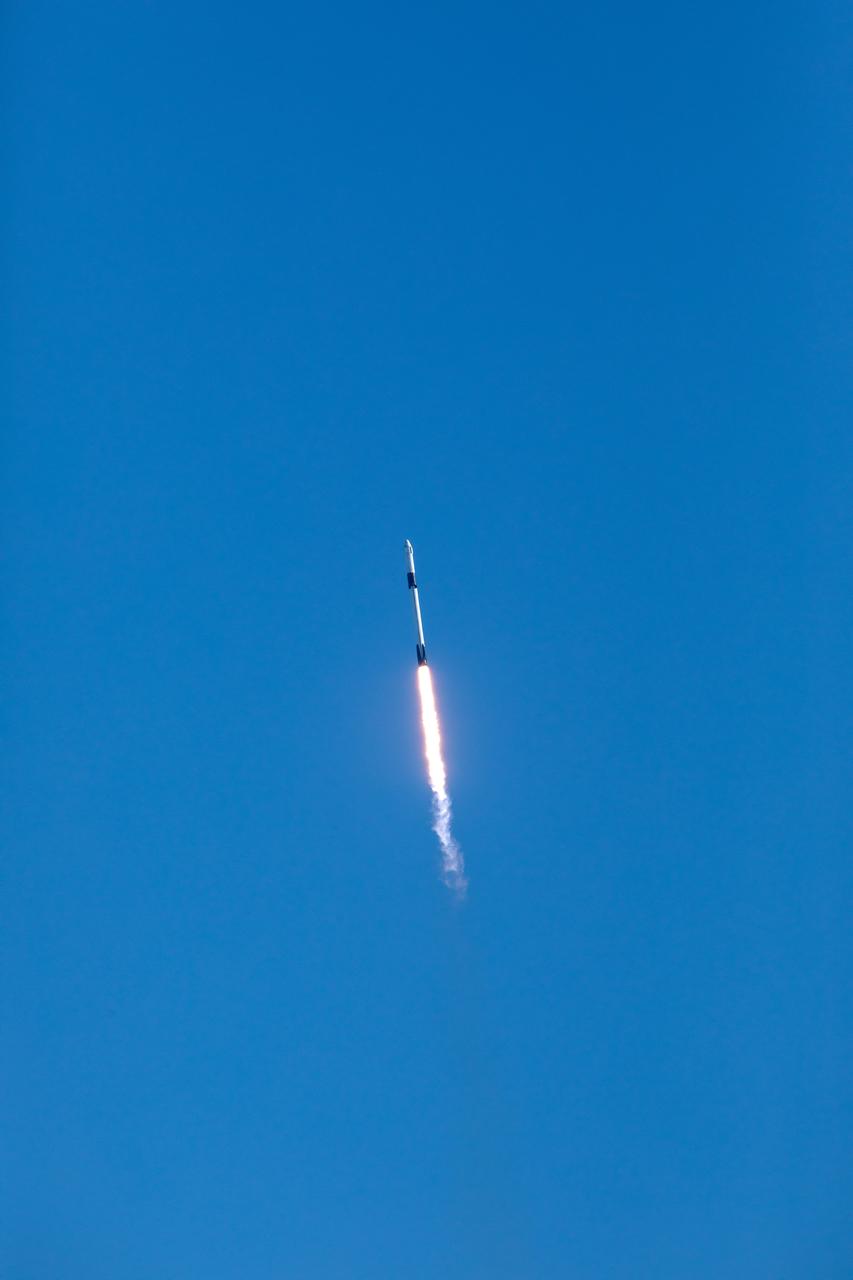
The SpaceX Falcon 9 rocket with the Dragon cargo module climbs upward after liftoff from Space Launch Complex 40 on Cape Canaveral Air Force Station in Florida in the early afternoon on Dec. 5, 2019. Liftoff was at 12:29 p.m. EST. This is SpaceX’s 19th Commercial Resupply Services (CRS-19) mission for NASA to the International Space Station. The Dragon cargo module will deliver more than 5,700 pounds of science and research, crew supplies and vehicle hardware to the orbital laboratory and its crew.
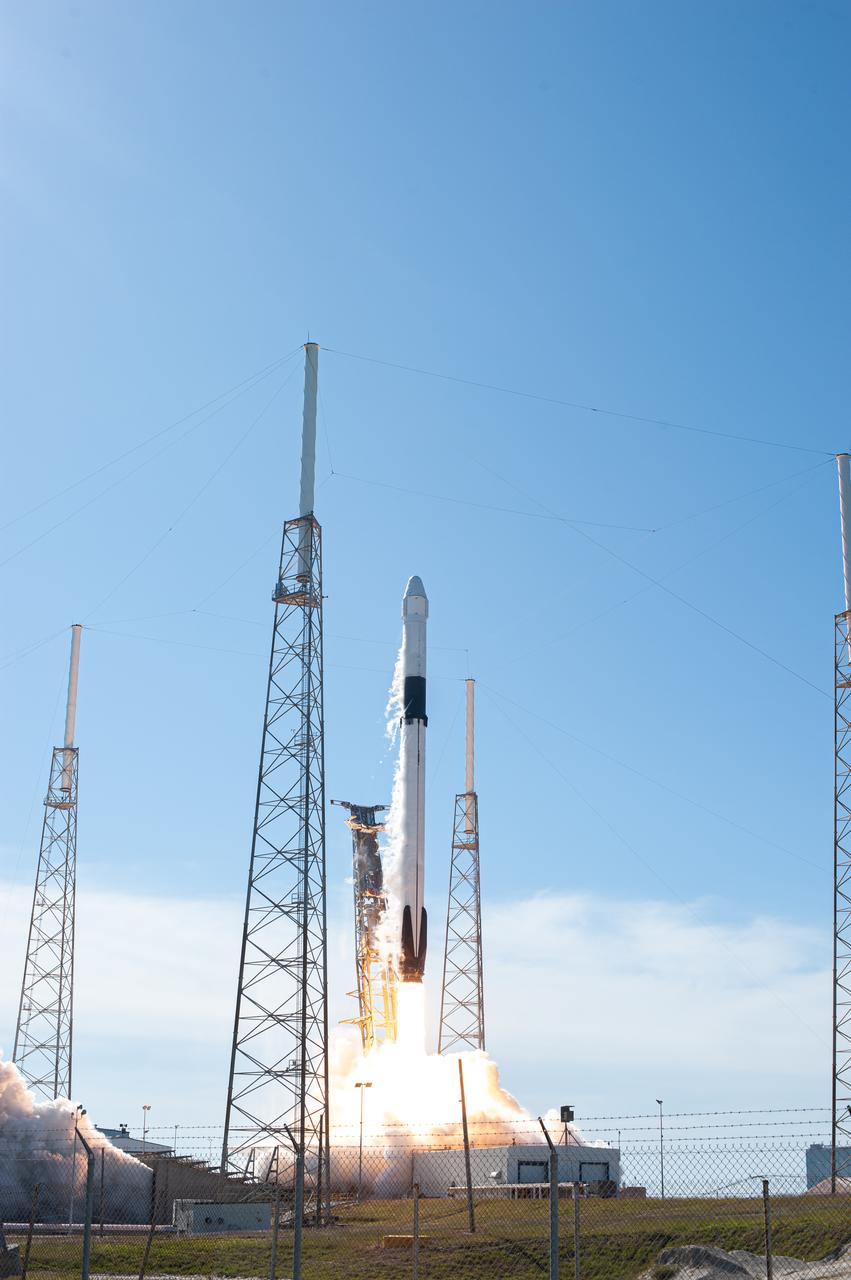
The SpaceX Falcon 9 rocket with the Dragon cargo module lifts off Space Launch Complex 40 on Cape Canaveral Air Force Station in Florida in the early afternoon on Dec. 5, 2019. Liftoff was at 12:29 p.m. EST. This is SpaceX’s 19th Commercial Resupply Services (CRS-19) mission for NASA to the International Space Station. The Dragon cargo module will deliver more than 5,700 pounds of science and research, crew supplies and vehicle hardware to the orbital laboratory and its crew.
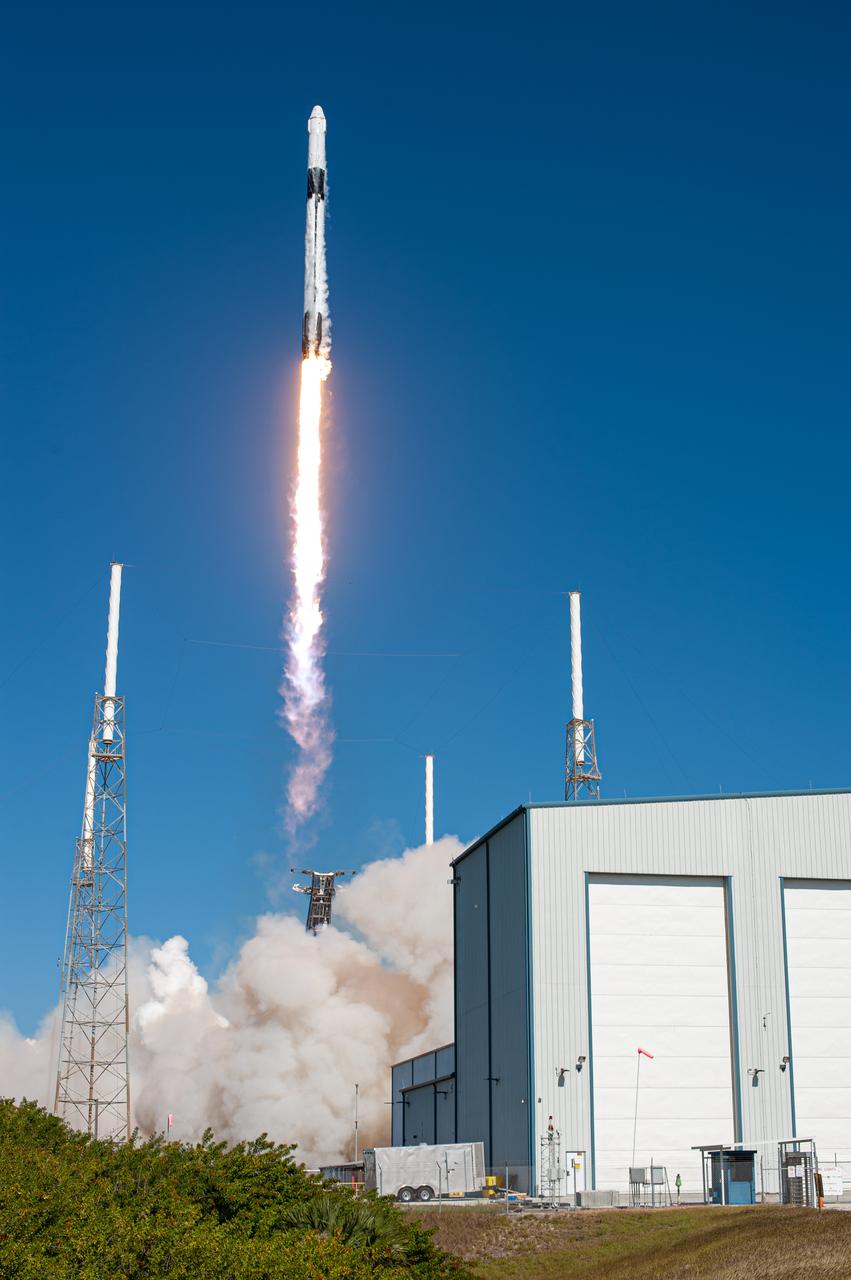
The SpaceX Falcon 9 rocket with the Dragon cargo module climbs upward after liftoff from Space Launch Complex 40 on Cape Canaveral Air Force Station in Florida in the early afternoon on Dec. 5, 2019. Liftoff was at 12:29 p.m. EST. This is SpaceX’s 19th Commercial Resupply Services (CRS-19) mission for NASA to the International Space Station. The Dragon cargo module will deliver more than 5,700 pounds of science and research, crew supplies and vehicle hardware to the orbital laboratory and its crew.
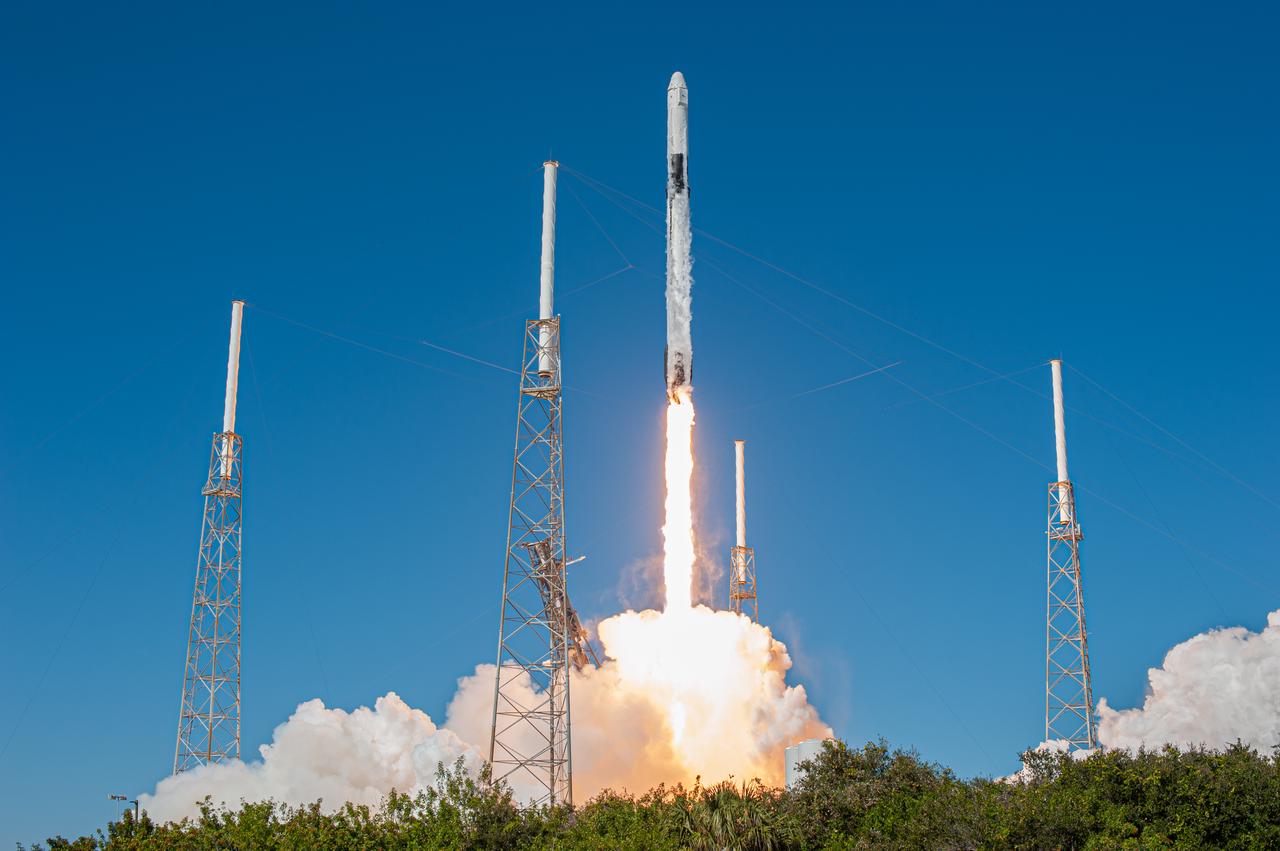
The SpaceX Falcon 9 rocket with the Dragon cargo module lifts off Space Launch Complex 40 on Cape Canaveral Air Force Station in Florida in the early afternoon on Dec. 5, 2019. Liftoff was at 12:29 p.m. EST. This is SpaceX’s 19th Commercial Resupply Services (CRS-19) mission for NASA to the International Space Station. The Dragon cargo module will deliver more than 5,700 pounds of science and research, crew supplies and vehicle hardware to the orbital laboratory and its crew.
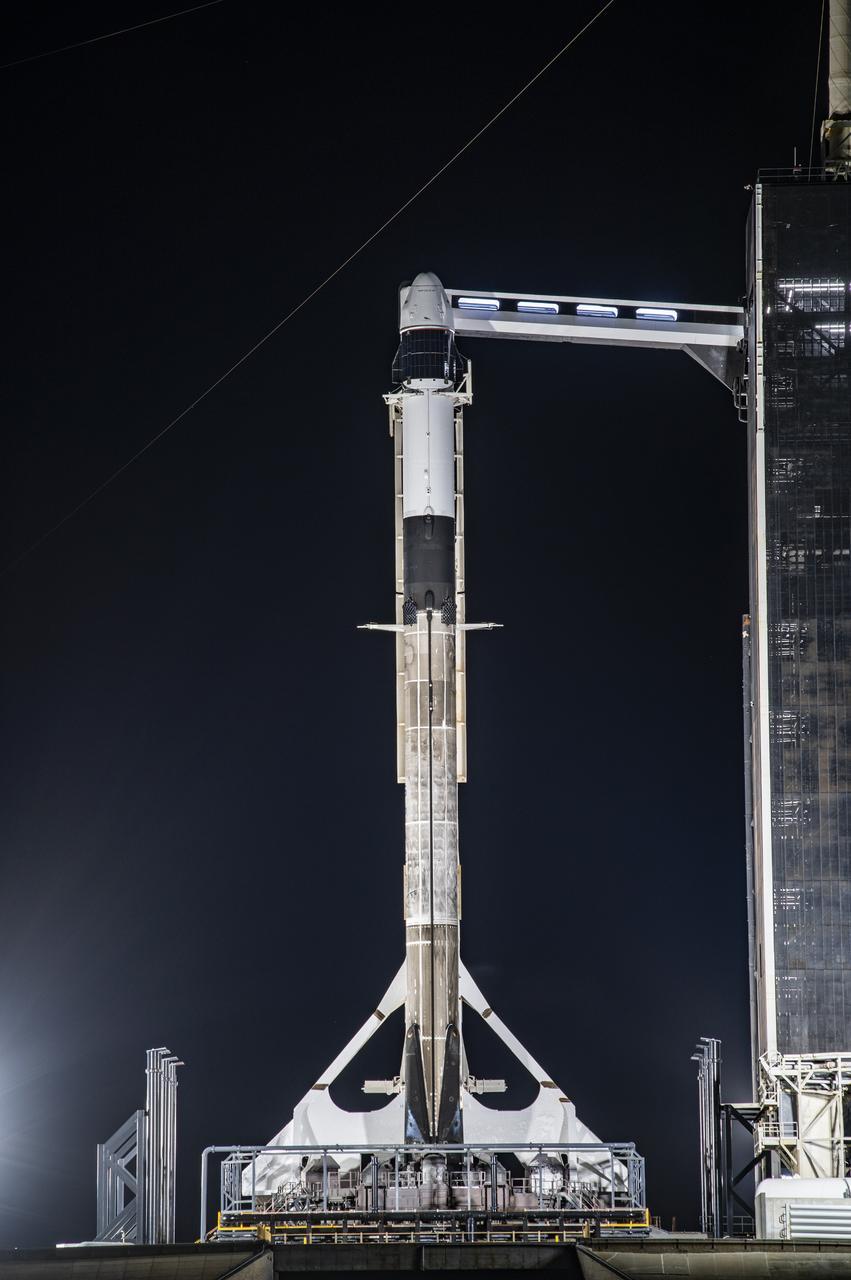
A SpaceX Falcon 9 rocket, topped with the company’s upgraded version of the Dragon spacecraft, stands vertical at NASA Kennedy Space Center’s Launch Complex 39A in Florida on Wednesday, Dec. 2, 2020. The first mission for SpaceX under NASA’s second Commercial Resupply Services contract, CRS-21 is scheduled to lift off from Launch Complex 39A on Saturday, Dec. 5, at 11:39 a.m. EST. The mission will deliver critical supplies and equipment to the International Space Station.
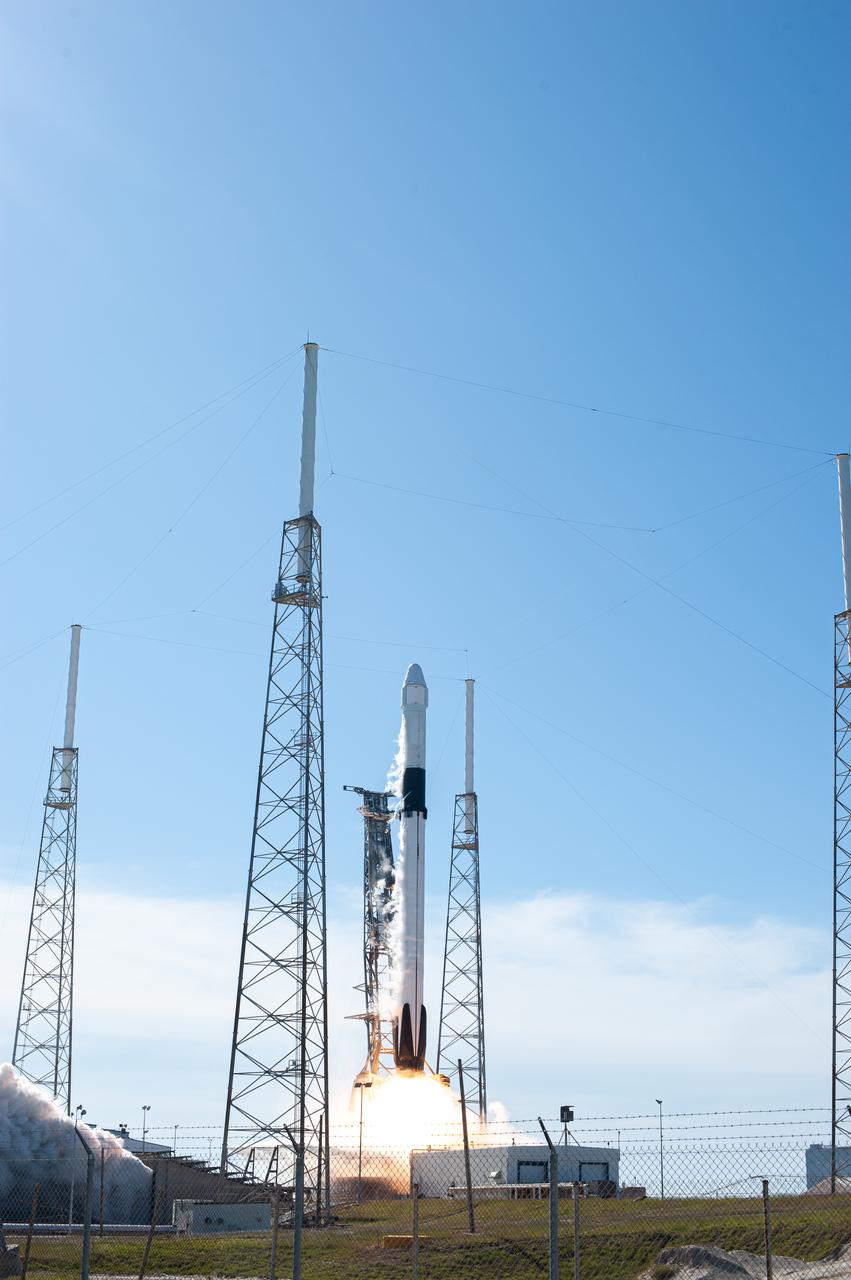
The SpaceX Falcon 9 rocket with the Dragon cargo module lifts off Space Launch Complex 40 on Cape Canaveral Air Force Station in Florida in the early afternoon on Dec. 5, 2019. Liftoff was at 12:29 p.m. EST. This is SpaceX’s 19th Commercial Resupply Services (CRS-19) mission for NASA to the International Space Station. The Dragon cargo module will deliver more than 5,700 pounds of science and research, crew supplies and vehicle hardware to the orbital laboratory and its crew.
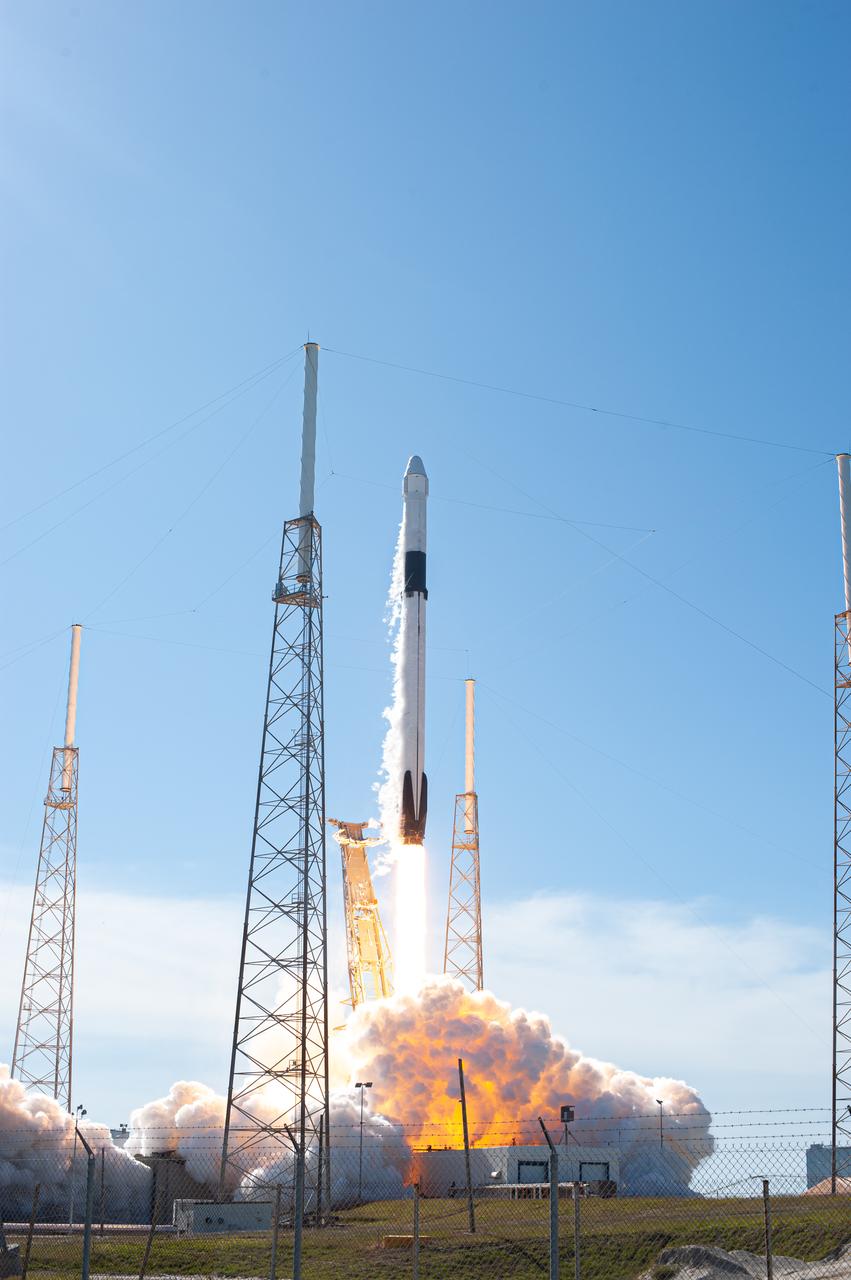
The SpaceX Falcon 9 rocket with the Dragon cargo module lifts off Space Launch Complex 40 on Cape Canaveral Air Force Station in Florida in the early afternoon on Dec. 5, 2019. Liftoff was at 12:29 p.m. EST. This is SpaceX’s 19th Commercial Resupply Services (CRS-19) mission for NASA to the International Space Station. The Dragon cargo module will deliver more than 5,700 pounds of science and research, crew supplies and vehicle hardware to the orbital laboratory and its crew.

The SpaceX Falcon 9 rocket with the Dragon cargo module lifts off Space Launch Complex 40 on Cape Canaveral Air Force Station in Florida in the early afternoon on Dec. 5, 2019. Liftoff was at 12:29 p.m. EST. This is SpaceX’s 19th Commercial Resupply Services (CRS-19) mission for NASA to the International Space Station. The Dragon cargo module will deliver more than 5,700 pounds of science and research, crew supplies and vehicle hardware to the orbital laboratory and its crew.
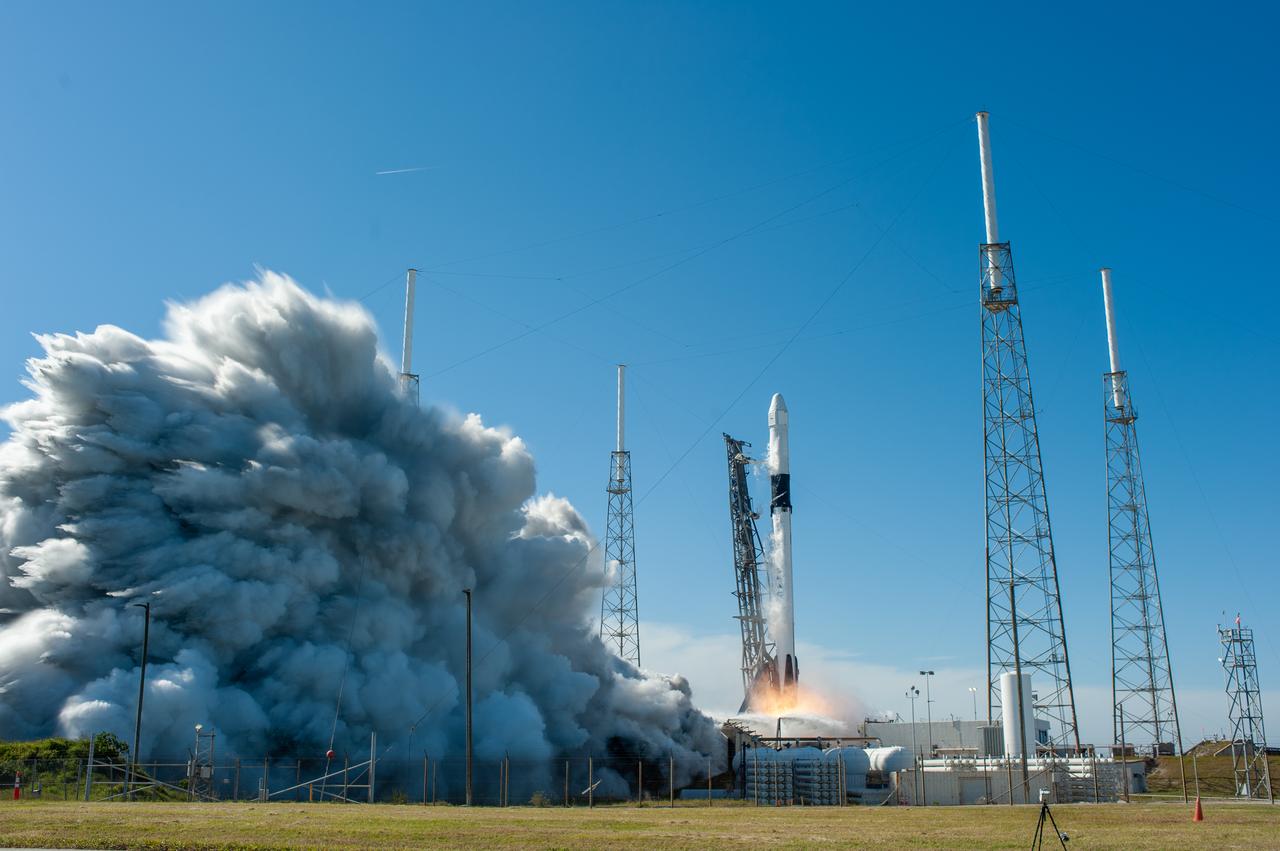
The SpaceX Falcon 9 rocket with the Dragon cargo module lifts off Space Launch Complex 40 on Cape Canaveral Air Force Station in Florida in the early afternoon on Dec. 5, 2019. Liftoff was at 12:29 p.m. EST. This is SpaceX’s 19th Commercial Resupply Services (CRS-19) mission for NASA to the International Space Station. The Dragon cargo module will deliver more than 5,700 pounds of science and research, crew supplies and vehicle hardware to the orbital laboratory and its crew.
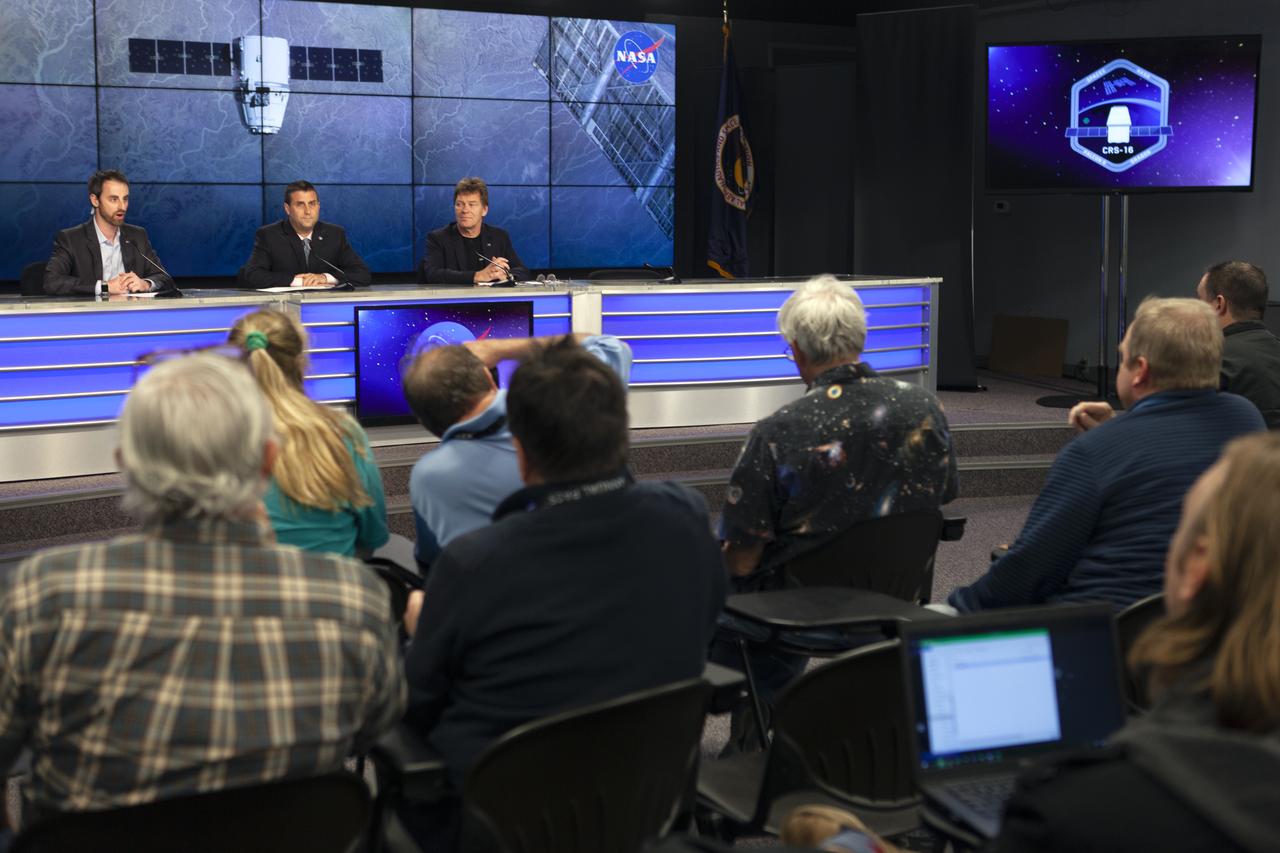
In the Press Site auditorium of NASA's Kennedy Space Center in Florida, from left, Joshua Santora of NASA Communications, Joel Montalbano, deputy International Space Station program manager at NASA's Johnson Space Center in Houston, and Hans Koenigsmann, vice president of Build and Flight Reliability for SpaceX, speak to media at a post-launch news conference following the liftoff of SpaceX CRS-16. The flight is a commercial resupply services mission to the International Space Station. SpaceX CRS-16 lifted off atop a Falcon 9 rocket from Space Launch Complex 40 at Cape Canaveral Air Force Station at 1:16 p.m. EST, Dec. 5, 2018, with supplies and equipment and new science experiments for technology research.
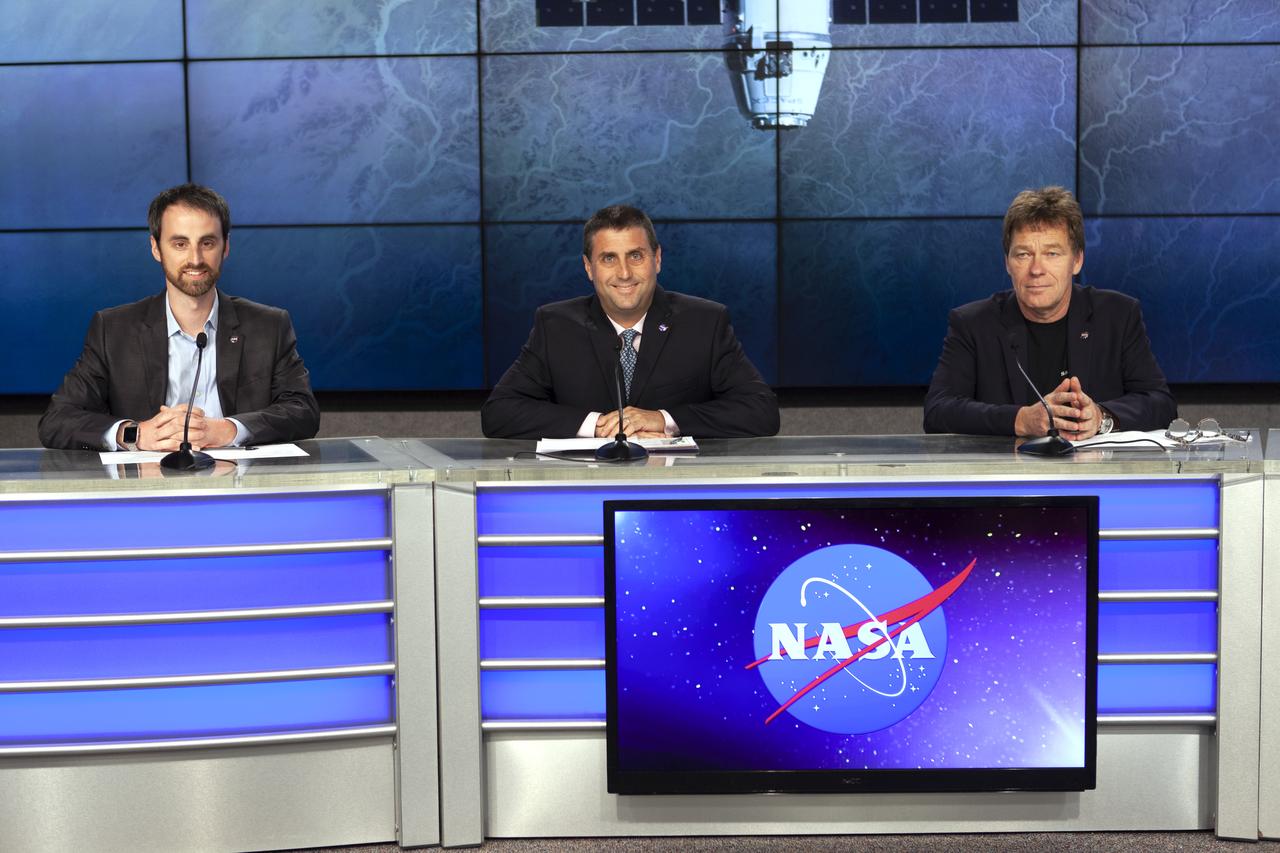
In the Press Site auditorium of NASA's Kennedy Space Center in Florida, from left, Joshua Santora of NASA Communications, Joel Montalbano, deputy International Space Station program manager at NASA's Johnson Space Center in Houston, and Hans Koenigsmann, vice president of Build and Flight Reliability for SpaceX, speak to media at a post-launch news conference following the liftoff of SpaceX CRS-16. The flight is a commercial resupply services mission to the International Space Station. SpaceX CRS-16 lifted off atop a Falcon 9 rocket from Space Launch Complex 40 at Cape Canaveral Air Force Station at 1:16 p.m. EST, Dec. 5, 2018, with supplies and equipment and new science experiments for technology research.
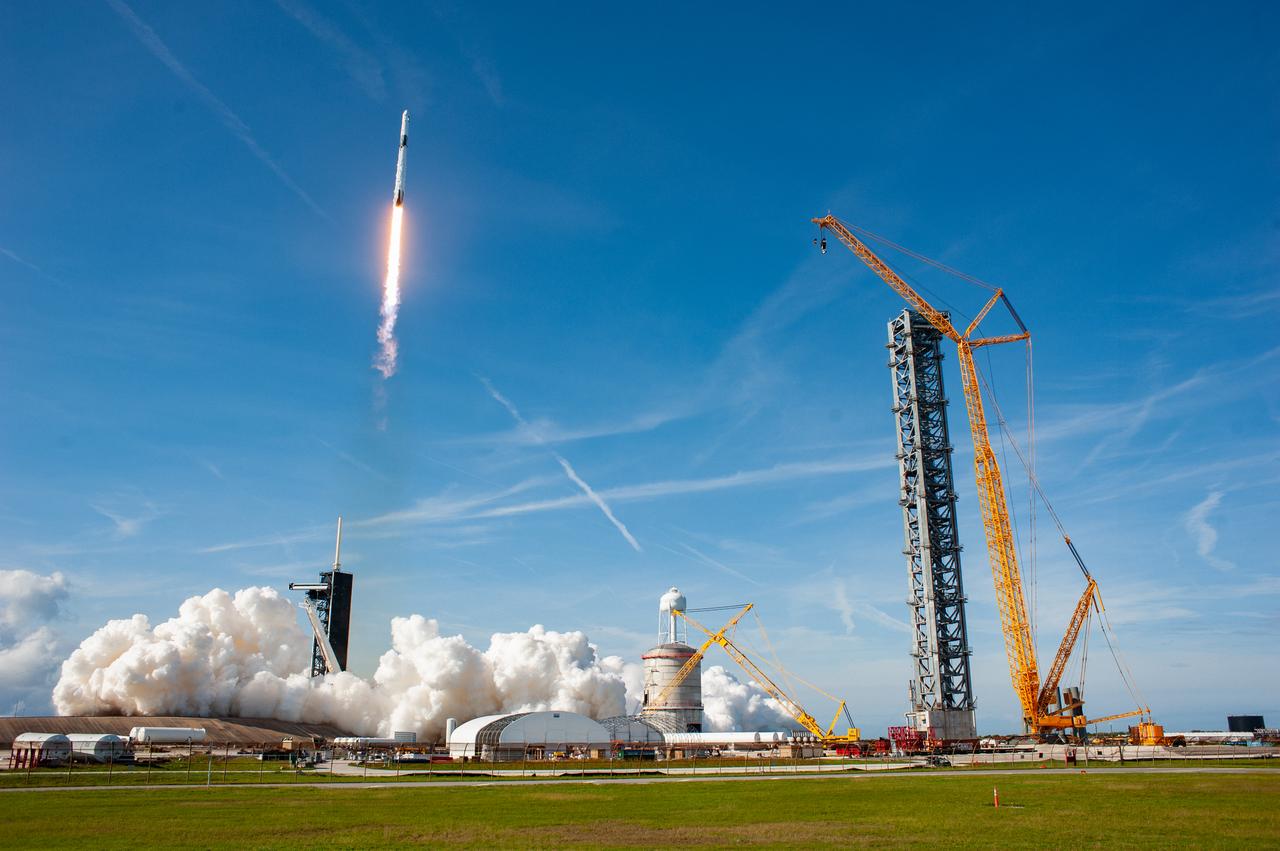
The SpaceX Falcon 9 rocket carrying the Dragon cargo spacecraft lifts off from Launch Complex 39A at NASA’s Kennedy Space Center in Florida on Nov. 26, 2022, on the company’s 26th commercial resupply services mission for the agency to the International Space Station. Liftoff was at 2:20 p.m. EST. Dragon will deliver more than 7,700 pounds of cargo, including a variety of NASA investigations, supplies, and equipment to the crew aboard the space station, including the next pair of ISS Roll Out Solar Arrays (iROSAs). The spacecraft is expected to spend about a month attached to the orbiting outpost before it returns to Earth with research and return cargo, splashing down off the coast of Florida.

A SpaceX Falcon 9 rocket lifts off from Launch Complex 39A at NASA’s Kennedy Space Center in Florida at 3:14 a.m. on Aug. 29, 2021, carrying the Dragon spacecraft on its journey to the International Space Station for NASA and SpaceX’s 23rd commercial resupply services mission. Dragon delivered new science investigations, supplies, and equipment to the crew aboard the orbiting laboratory.
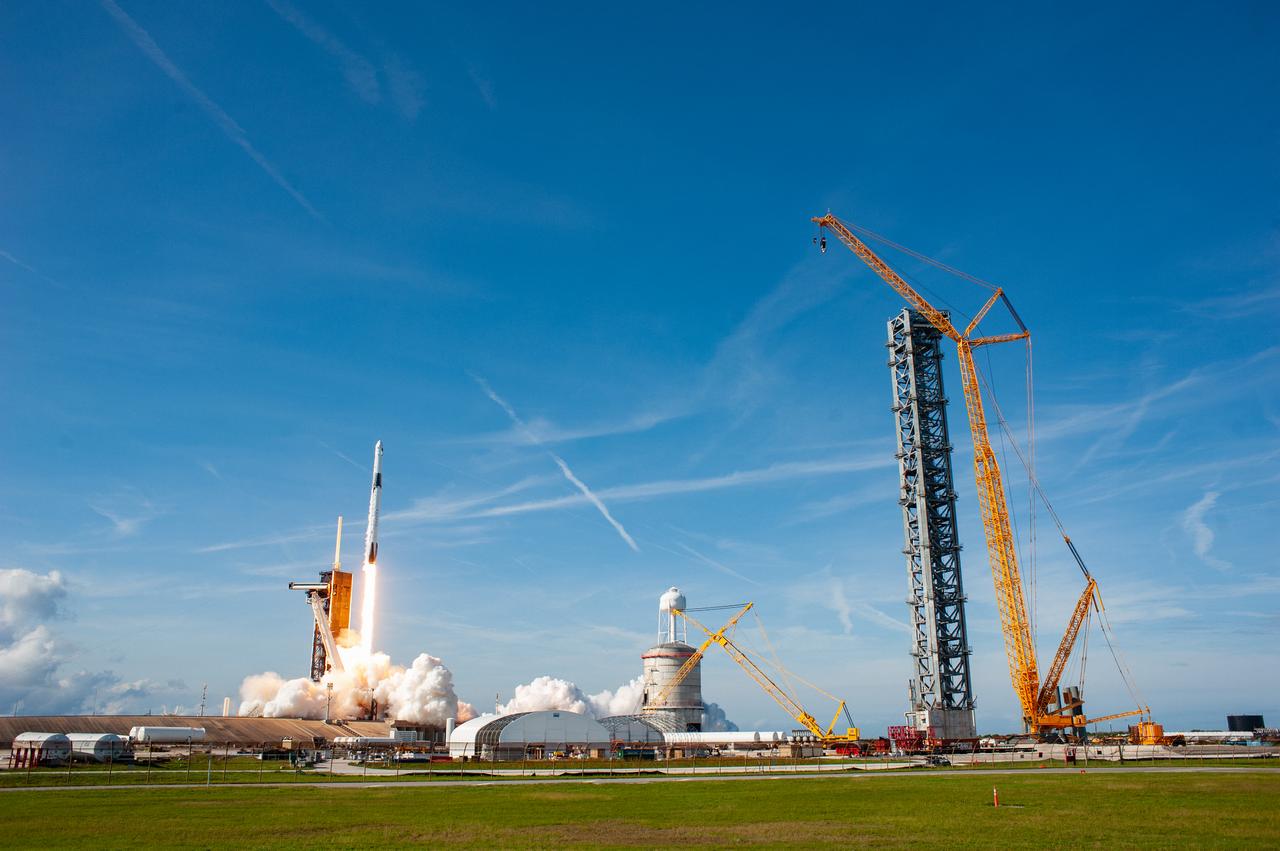
The SpaceX Falcon 9 rocket carrying the Dragon cargo spacecraft lifts off from Launch Complex 39A at NASA’s Kennedy Space Center in Florida on Nov. 26, 2022, on the company’s 26th commercial resupply services mission for the agency to the International Space Station. Liftoff was at 2:20 p.m. EST. Dragon will deliver more than 7,700 pounds of cargo, including a variety of NASA investigations, supplies, and equipment to the crew aboard the space station, including the next pair of ISS Roll Out Solar Arrays (iROSAs). The spacecraft is expected to spend about a month attached to the orbiting outpost before it returns to Earth with research and return cargo, splashing down off the coast of Florida.
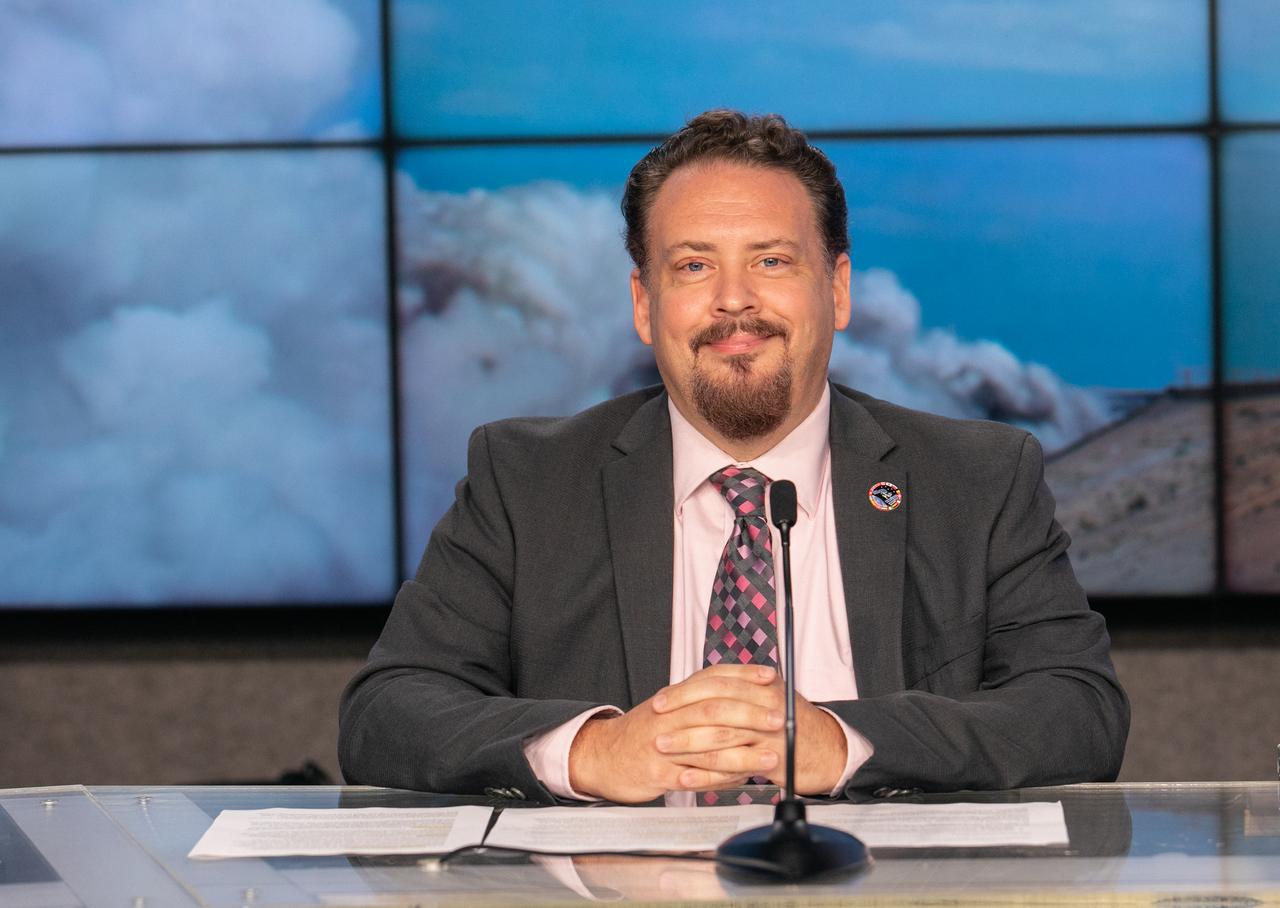
Kirt Costello, chief scientist, International Space Station Program Office, is introduced during a CRS-21 prelaunch news conference at NASA’s Kennedy Space Center in Florida on Dec. 4, 2020. Kenny Todd, deputy program manager, International Space Station Program Office; Sarah Walker, director, Dragon Mission Management, SpaceX; and Melody Lovin, launch weather officer, U.S. Air Force 45th Space Wing, also participated in the event, which was moderated by NASA Communications’ Jasmine Hopkins. SpaceX’s Falcon 9 rocket, with the upgraded version of the Cargo Dragon spacecraft atop, is targeted to lift off from Kennedy’s Launch Complex 39A Saturday, Dec. 5, at 11:39 a.m. EST. CRS-21 will deliver supplies, equipment, and critical materials needed to support a variety of science and research investigations on the International Space Station.
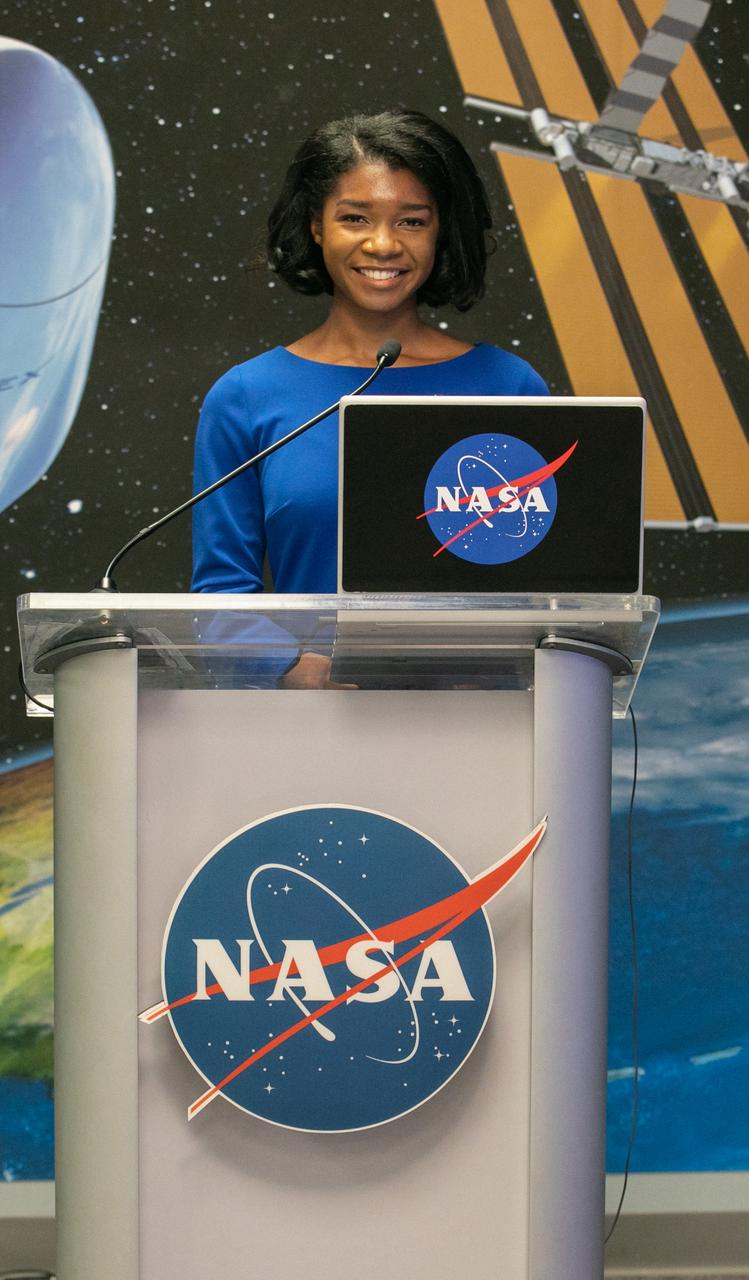
NASA Communications’ Jasmine Hopkins moderates a CRS-21 prelaunch news conference at Kennedy Space Center in Florida on Dec. 4, 2020. Participants included Kenny Todd, deputy program manager, International Space Station Program Office; Kirt Costello, chief scientist, International Space Station Program Office; Sarah Walker, director, Dragon Mission Management, SpaceX; and Melody Lovin, launch weather officer, U.S. Air Force 45th Space Wing. SpaceX’s Falcon 9 rocket, with the upgraded version of the Cargo Dragon spacecraft atop, is targeted to lift off from Kennedy’s Launch Complex 39A Saturday, Dec. 5, at 11:39 a.m. EST. CRS-21 will deliver supplies, equipment, and critical materials needed to support a variety of science and research investigations on the International Space Station.

Melody Lovin, launch weather officer, U.S. Air Force 45th Space Wing, responds to a question during a CRS-21 prelaunch news conference at NASA’s Kennedy Space Center in Florida on Dec. 4, 2020. Sarah Walker, director, Dragon Mission Management, SpaceX, Kirt Costello, chief scientist, International Space Station Program Office, and Kenny Todd, deputy program manager, International Space Station Program Office, also participated in the event, which was moderated by NASA Communications’ Jasmine Hopkins. SpaceX’s Falcon 9 rocket, with the upgraded version of the Cargo Dragon spacecraft atop, is targeted to lift off from Kennedy’s Launch Complex 39A Saturday, Dec. 5, at 11:39 a.m. EST. CRS-21 will deliver supplies, equipment, and critical materials needed to support a variety of science and research investigations on the International Space Station.
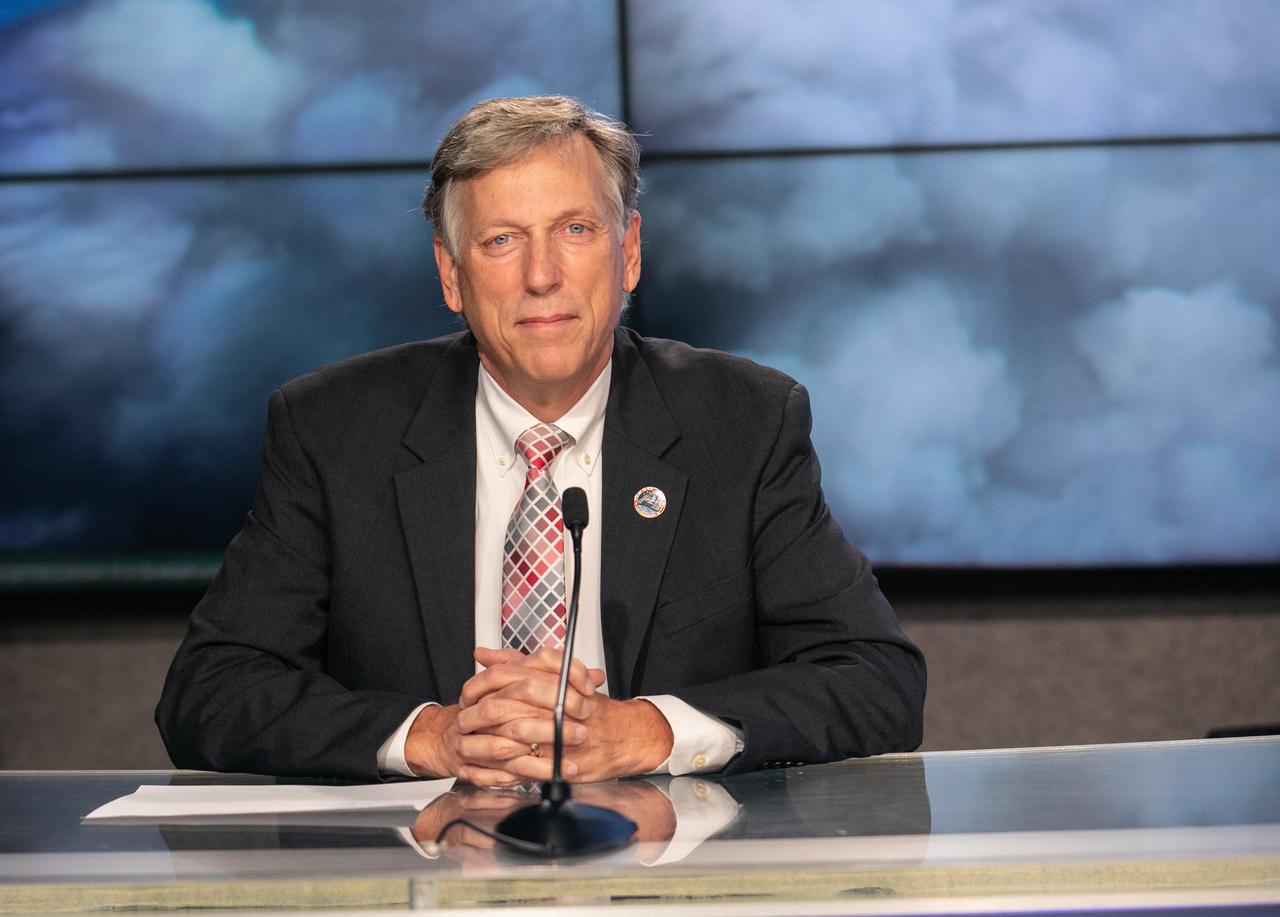
Kenny Todd, deputy program manager, International Space Station Program Office, is introduced during a CRS-21 prelaunch news conference at NASA’s Kennedy Space Center in Florida on Dec. 4, 2020. Kirt Costello, chief scientist, International Space Station Program Office; Sarah Walker, director, Dragon Mission Management, SpaceX; and Melody Lovin, launch weather officer, U.S. Air Force 45th Space Wing, also participated in the event, which was moderated by NASA Communications’ Jasmine Hopkins. SpaceX’s Falcon 9 rocket, with the upgraded version of the Cargo Dragon spacecraft atop, is targeted to lift off from Kennedy’s Launch Complex 39A Saturday, Dec. 5, at 11:39 a.m. EST. CRS-21 will deliver supplies, equipment, and critical materials needed to support a variety of science and research investigations on the International Space Station.

Melody Lovin, launch weather officer, U.S. Air Force 45th Space Wing, is introduced during a CRS-21 prelaunch news conference at NASA’s Kennedy Space Center in Florida on Dec. 4, 2020. Sarah Walker, director, Dragon Mission Management, SpaceX, Kirt Costello, chief scientist, International Space Station Program Office, and Kenny Todd, deputy program manager, International Space Station Program Office, also participated in the event, which was moderated by NASA Communications’ Jasmine Hopkins. SpaceX’s Falcon 9 rocket, with the upgraded version of the Cargo Dragon spacecraft atop, is targeted to lift off from Kennedy’s Launch Complex 39A Saturday, Dec. 5, at 11:39 a.m. EST. CRS-21 will deliver supplies, equipment, and critical materials needed to support a variety of science and research investigations on the International Space Station.
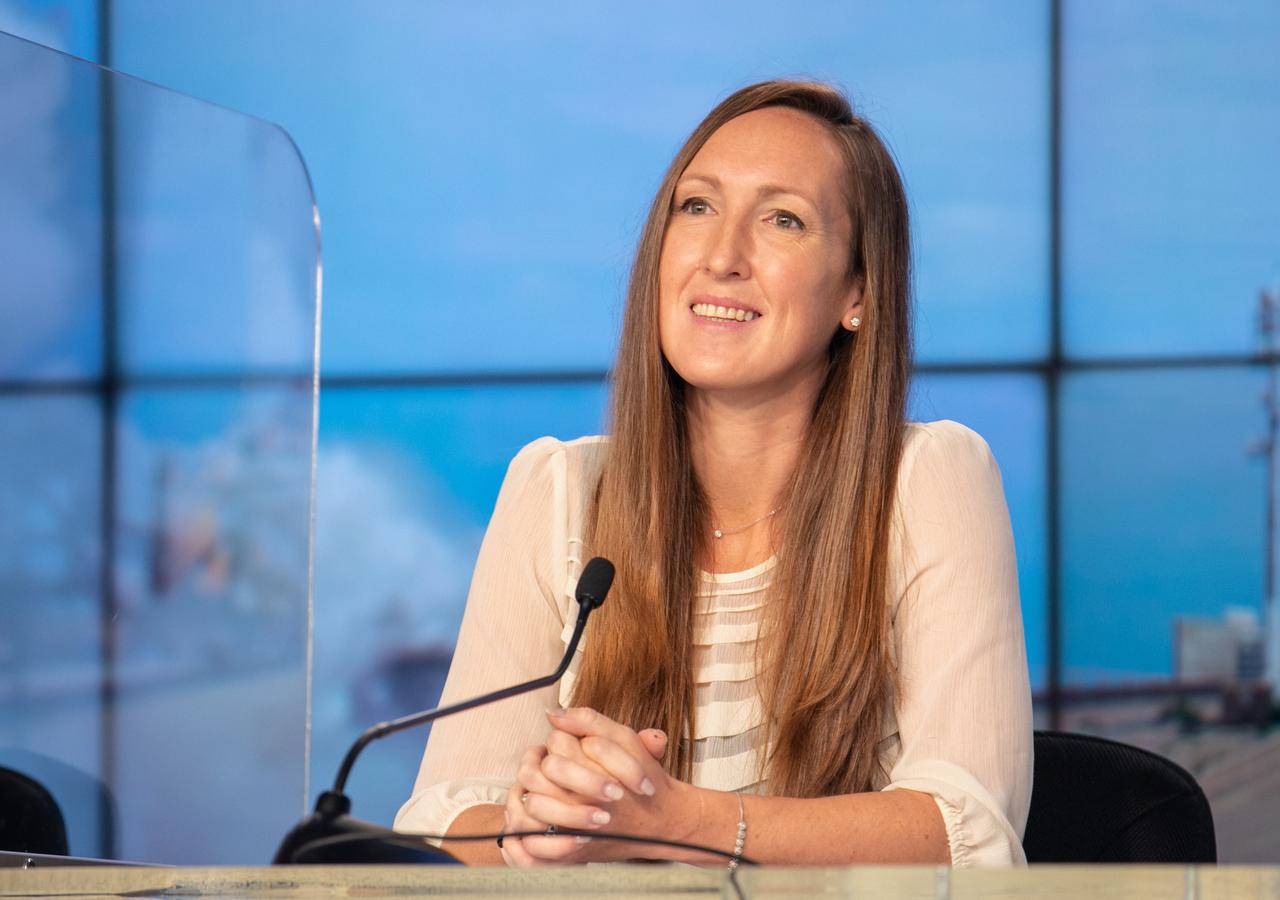
Sarah Walker, director, Dragon Mission Management, SpaceX, listens to a question during a CRS-21 prelaunch news conference at NASA’s Kennedy Space Center in Florida on Dec. 4, 2020. Kirt Costello, chief scientist, International Space Station Program Office, Kenny Todd, deputy program manager, International Space Station Program Office; and Melody Lovin, launch weather officer, U.S. Air Force 45th Space Wing, also participated in the event, which was moderated by NASA Communications’ Jasmine Hopkins. SpaceX’s Falcon 9 rocket, with the upgraded version of the Cargo Dragon spacecraft atop, is targeted to lift off from Kennedy’s Launch Complex 39A Saturday, Dec. 5, at 11:39 a.m. EST. CRS-21 will deliver supplies, equipment, and critical materials needed to support a variety of science and research investigations on the International Space Station.
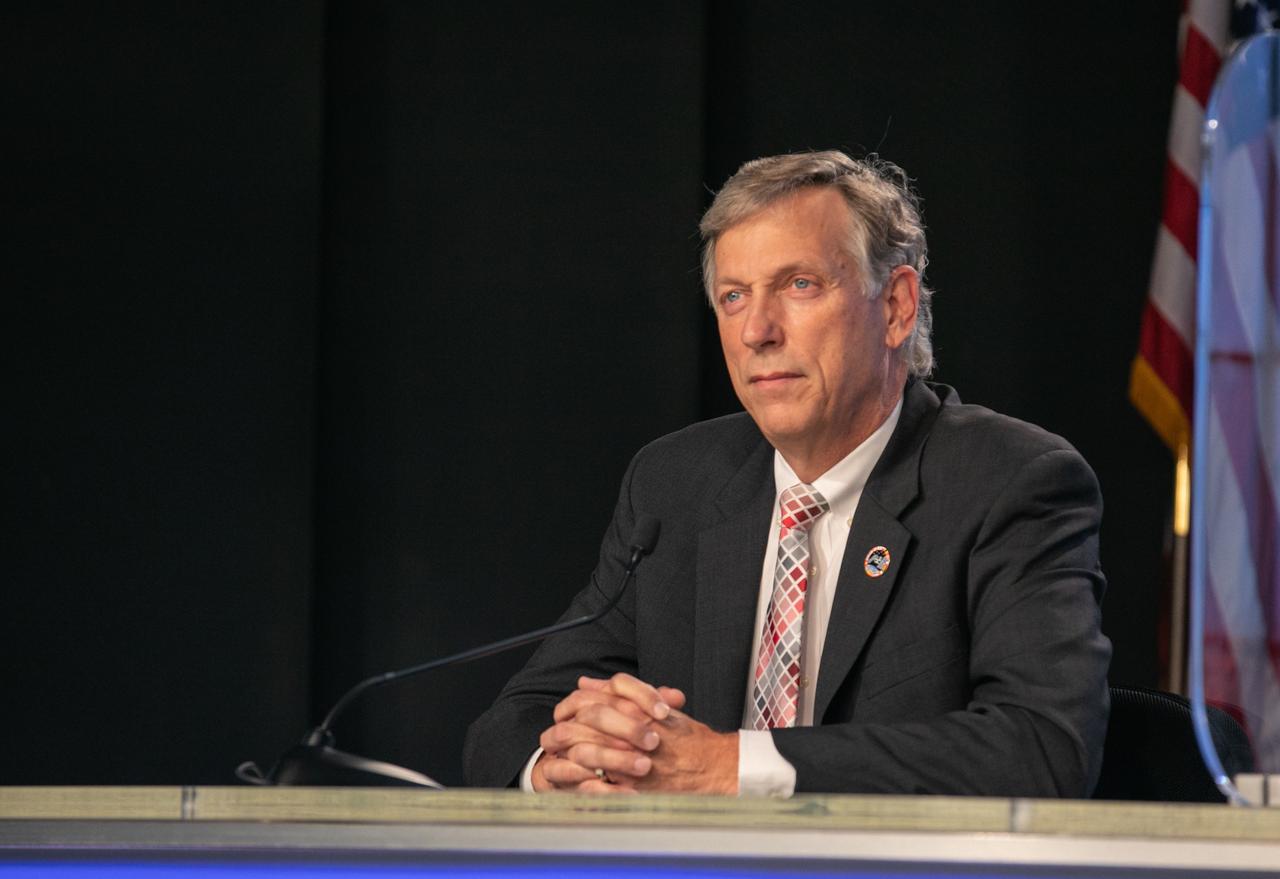
Kenny Todd, deputy program manager, International Space Station Program Office, listens to a question during a CRS-21 prelaunch news conference at NASA’s Kennedy Space Center in Florida on Dec. 4, 2020. Kirt Costello, chief scientist, International Space Station Program Office; Sarah Walker, director, Dragon Mission Management, SpaceX; and Melody Lovin, launch weather officer, U.S. Air Force 45th Space Wing, also participated in the event, which was moderated by NASA Communications’ Jasmine Hopkins. SpaceX’s Falcon 9 rocket, with the upgraded version of the Cargo Dragon spacecraft atop, is targeted to lift off from Kennedy’s Launch Complex 39A Saturday, Dec. 5, at 11:39 a.m. EST. CRS-21 will deliver supplies, equipment, and critical materials needed to support a variety of science and research investigations on the International Space Station.
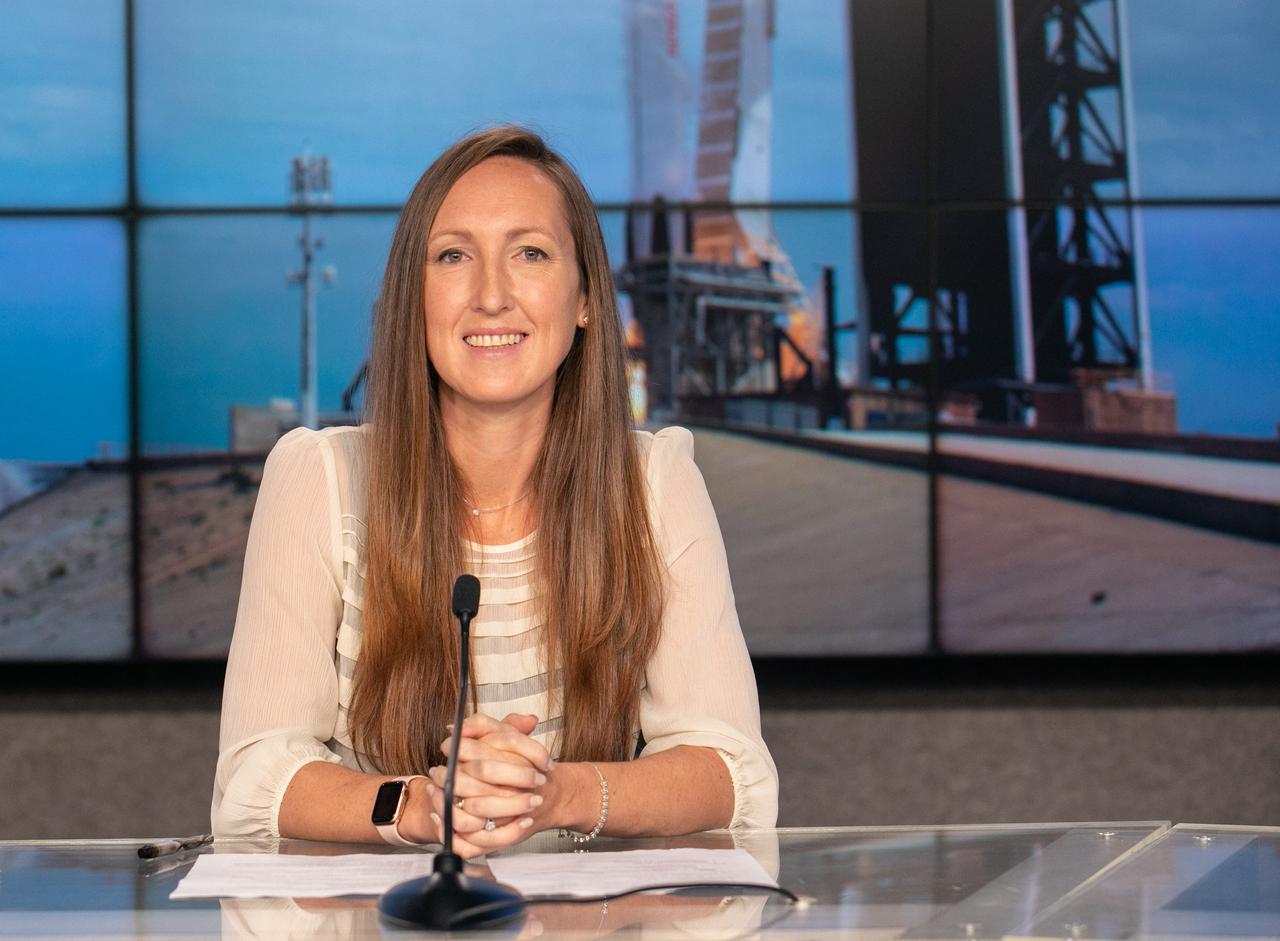
Sarah Walker, director, Dragon Mission Management, SpaceX, is introduced during a CRS-21 prelaunch news conference at NASA’s Kennedy Space Center in Florida on Dec. 4, 2020. Kirt Costello, chief scientist, International Space Station Program Office, Kenny Todd, deputy program manager, International Space Station Program Office; and Melody Lovin, launch weather officer, U.S. Air Force 45th Space Wing, also participated in the event, which was moderated by NASA Communications’ Jasmine Hopkins. SpaceX’s Falcon 9 rocket, with the upgraded version of the Cargo Dragon spacecraft atop, is targeted to lift off from Kennedy’s Launch Complex 39A Saturday, Dec. 5, at 11:39 a.m. EST. CRS-21 will deliver supplies, equipment, and critical materials needed to support a variety of science and research investigations on the International Space Station.
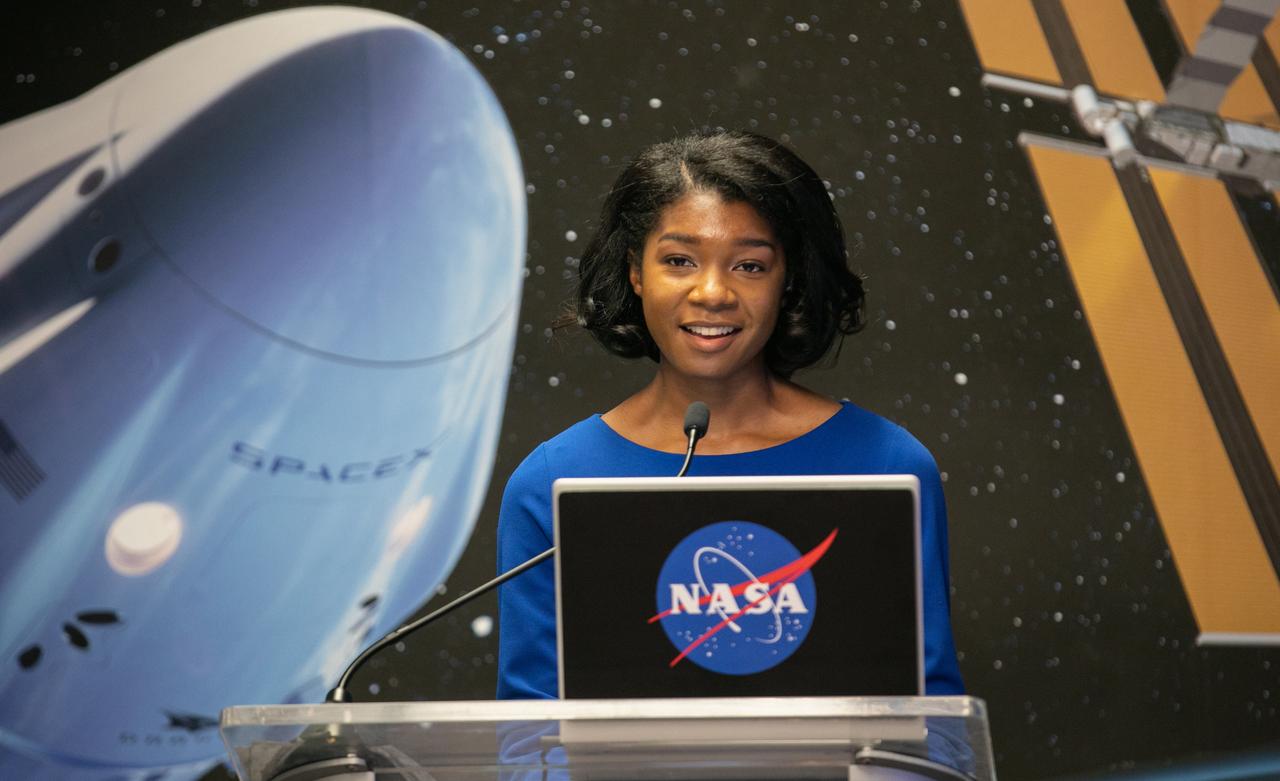
NASA Communications’ Jasmine Hopkins moderates a CRS-21 prelaunch news conference at Kennedy Space Center in Florida on Dec. 4, 2020. Participants included Kenny Todd, deputy program manager, International Space Station Program Office; Kirt Costello, chief scientist, International Space Station Program Office; Sarah Walker, director, Dragon Mission Management, SpaceX; and Melody Lovin, launch weather officer, U.S. Air Force 45th Space Wing. SpaceX’s Falcon 9 rocket, with the upgraded version of the Cargo Dragon spacecraft atop, is targeted to lift off from Kennedy’s Launch Complex 39A Saturday, Dec. 5, at 11:39 a.m. EST. CRS-21 will deliver supplies, equipment, and critical materials needed to support a variety of science and research investigations on the International Space Station.

Kirt Costello, chief scientist, International Space Station Program Office, listens to a question during a CRS-21 prelaunch news conference at NASA’s Kennedy Space Center in Florida on Dec. 4, 2020. Kenny Todd, deputy program manager, International Space Station Program Office; Sarah Walker, director, Dragon Mission Management, SpaceX; and Melody Lovin, launch weather officer, U.S. Air Force 45th Space Wing, also participated in the event, which was moderated by NASA Communications’ Jasmine Hopkins. SpaceX’s Falcon 9 rocket, with the upgraded version of the Cargo Dragon spacecraft atop, is targeted to lift off from Kennedy’s Launch Complex 39A Saturday, Dec. 5, at 11:39 a.m. EST. CRS-21 will deliver supplies, equipment, and critical materials needed to support a variety of science and research investigations on the International Space Station.
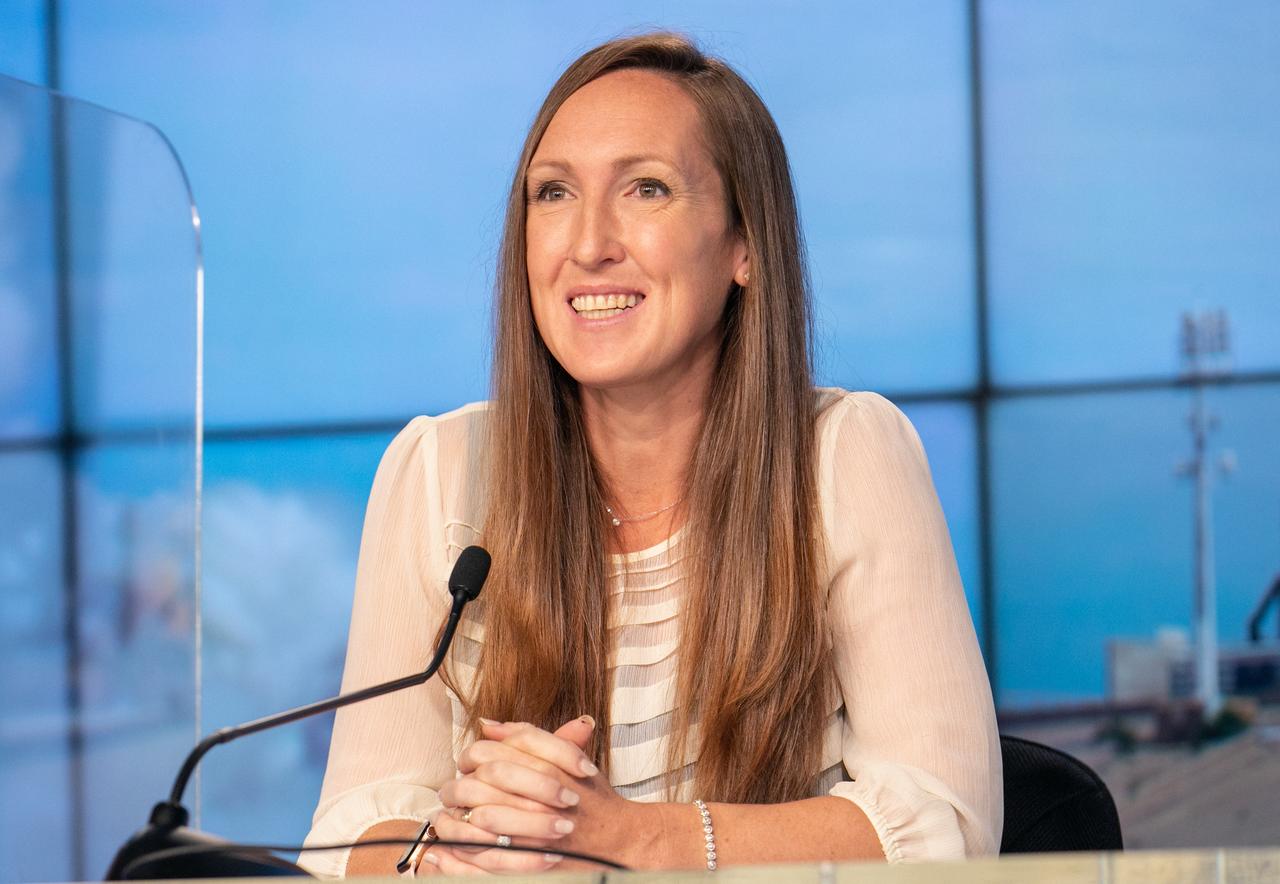
Sarah Walker, director, Dragon Mission Management, SpaceX, responds to a question during a CRS-21 prelaunch news conference at NASA’s Kennedy Space Center in Florida on Dec. 4, 2020. Kirt Costello, chief scientist, International Space Station Program Office, Kenny Todd, deputy program manager, International Space Station Program Office; and Melody Lovin, launch weather officer, U.S. Air Force 45th Space Wing, also participated in the event, which was moderated by NASA Communications’ Jasmine Hopkins. SpaceX’s Falcon 9 rocket, with the upgraded version of the Cargo Dragon spacecraft atop, is targeted to lift off from Kennedy’s Launch Complex 39A Saturday, Dec. 5, at 11:39 a.m. EST. CRS-21 will deliver supplies, equipment, and critical materials needed to support a variety of science and research investigations on the International Space Station.
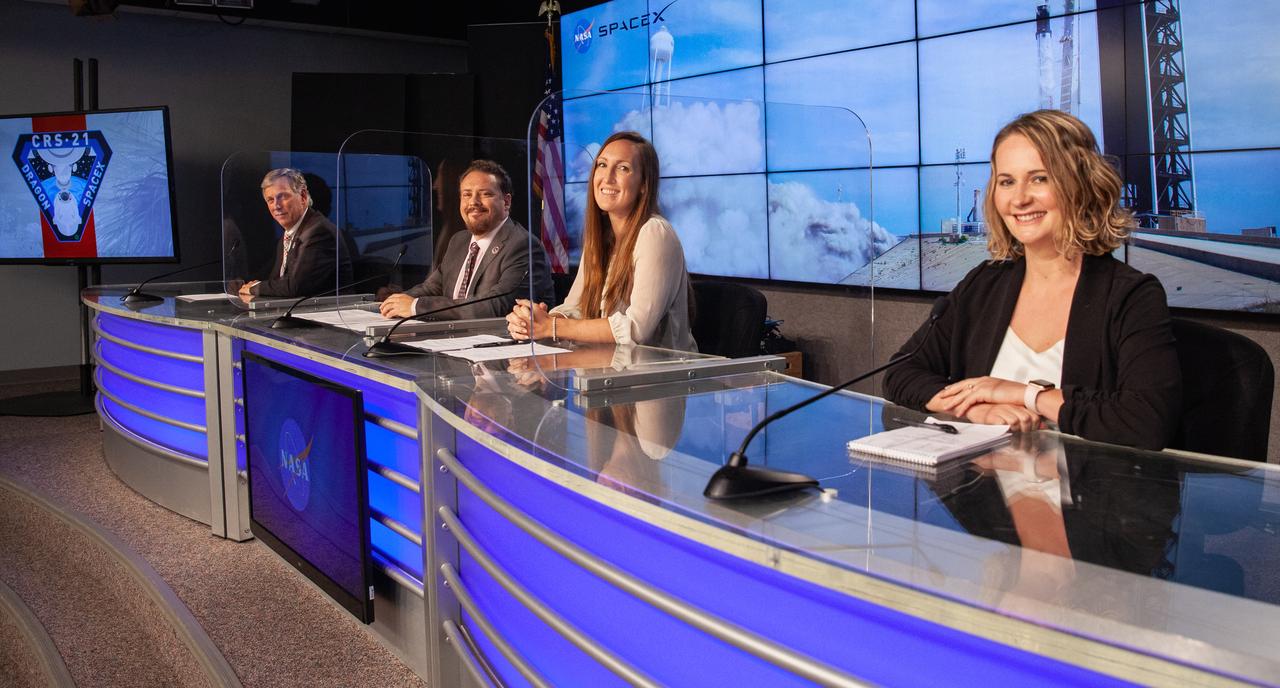
From left, Kenny Todd, deputy program manager, International Space Station Program Office; Kirt Costello, chief scientist, International Space Station Program Office; Sarah Walker, director, Dragon Mission Management, SpaceX; and Melody Lovin, launch weather officer, U.S. Air Force 45th Space Wing, participate in a CRS-21 prelaunch news conference at Kennedy Space Center in Florida on Dec. 4, 2020. NASA Communications’ Jasmine Hopkins moderated the event. SpaceX’s Falcon 9 rocket, with the upgraded version of the Cargo Dragon spacecraft atop, is targeted to lift off from Kennedy’s Launch Complex 39A Saturday, Dec. 5, at 11:39 a.m. EST. CRS-21 will deliver supplies, equipment, and critical materials needed to support a variety of science and research investigations on the International Space Station.
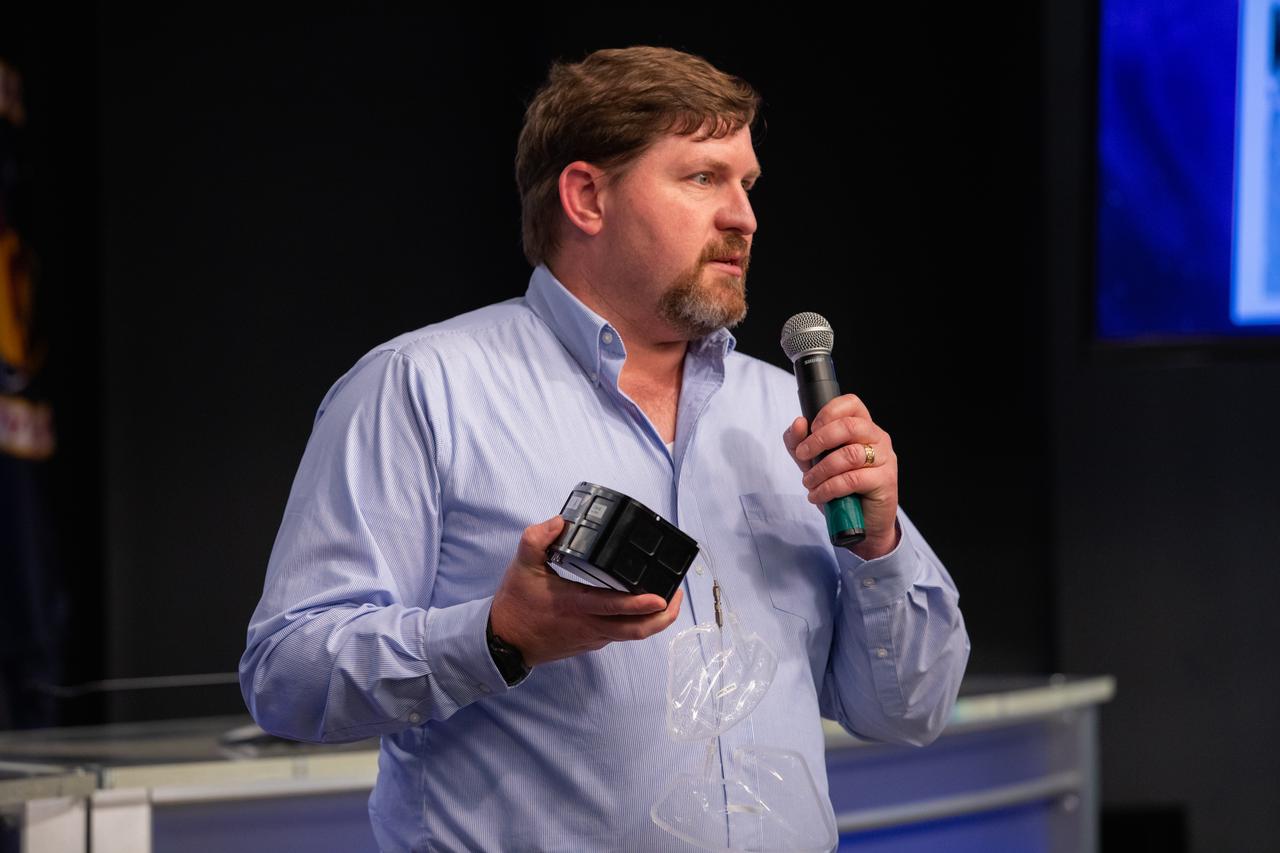
Gene Boland, chief scientist of Techshot, addresses NASA Social participants during a What’s on Board science briefing at the agency’s Kennedy Space Center in Florida on March 5, 2020. The briefing provided a closer look at some of the payloads launching on SpaceX’s 20th Commercial Resupply Services (CRS-20) mission to the International Space Station. The company’s Falcon 9 rocket is scheduled to lift off from Cape Canaveral Air Force Station’s Space Launch Complex 40 at 11:50 p.m. EST on March 6, 2020.
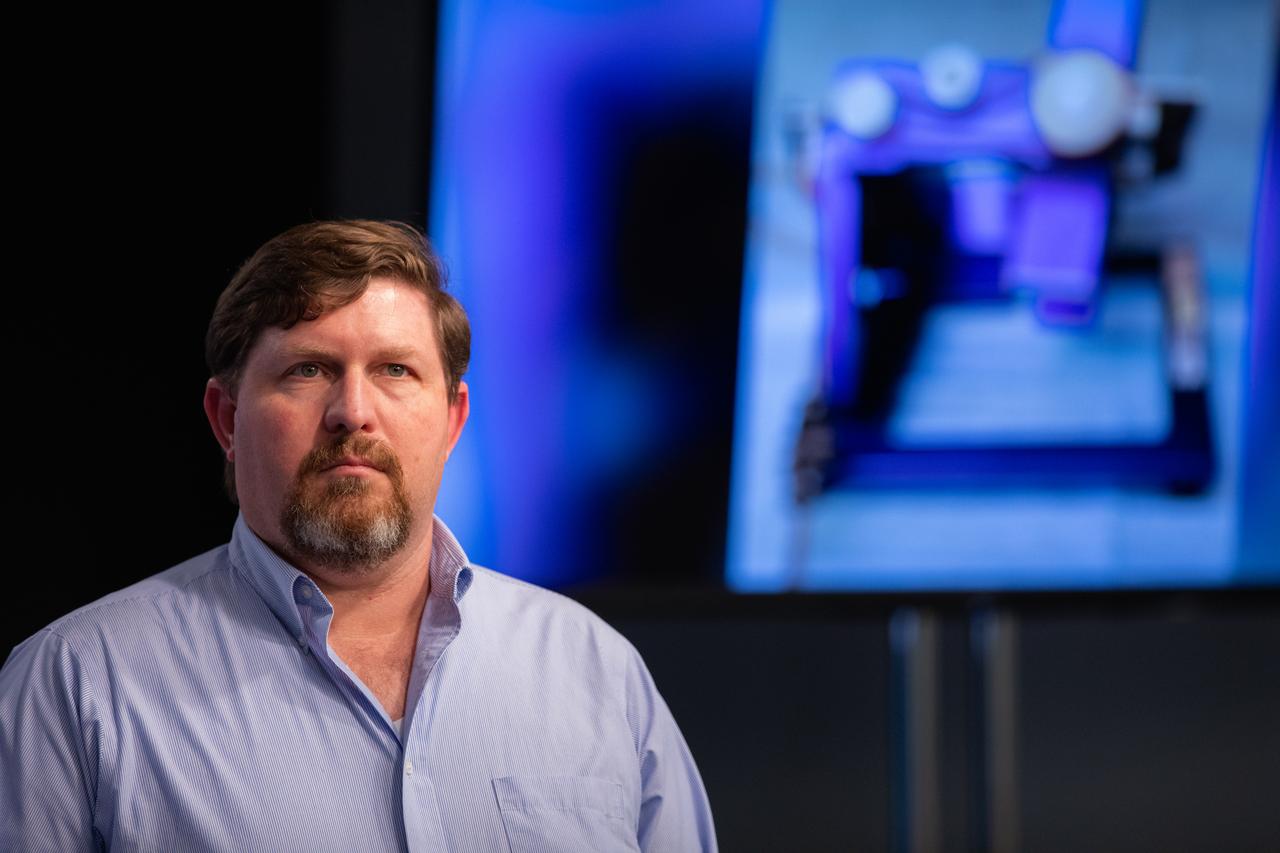
Gene Boland, chief scientist of Techshot, participates in a What’s on Board science briefing at NASA’s Kennedy Space Center in Florida on March 5, 2020. The briefing provided a closer look at some of the payloads launching on SpaceX’s 20th Commercial Resupply Services (CRS-20) mission to the International Space Station. The company’s Falcon 9 rocket is scheduled to lift off from Cape Canaveral Air Force Station’s Space Launch Complex 40 at 11:50 p.m. EST on March 6, 2020.
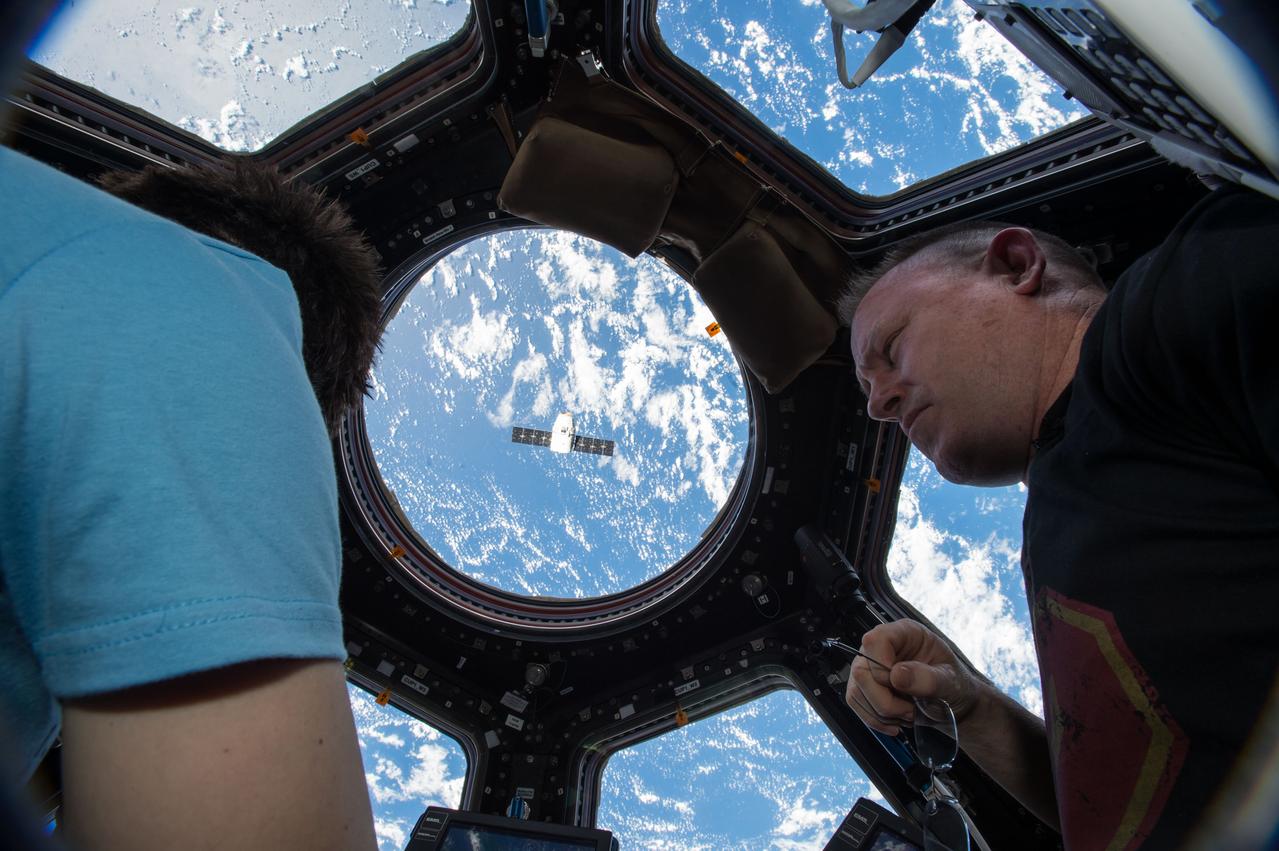
ISS042E119674 (01/12/2015) --- Expedition 42 Commander and NASA Astronaut Barry “Butch” Wilmore, with the assistance of Flight Engineer of the European Space Agency Astronaut Samantha Cristoforetti, prepared to use the Canadarm2 robotic arm to grapple the SpaceX Dragon (CRS-5) ship on Jan. 12 2015. Two days after its launch from the Cape Canaveral Air Force Station, Florida Dragon was attached to the station's Harmony module where it will spend a month being unloaded. Photo Credit: (NASA)
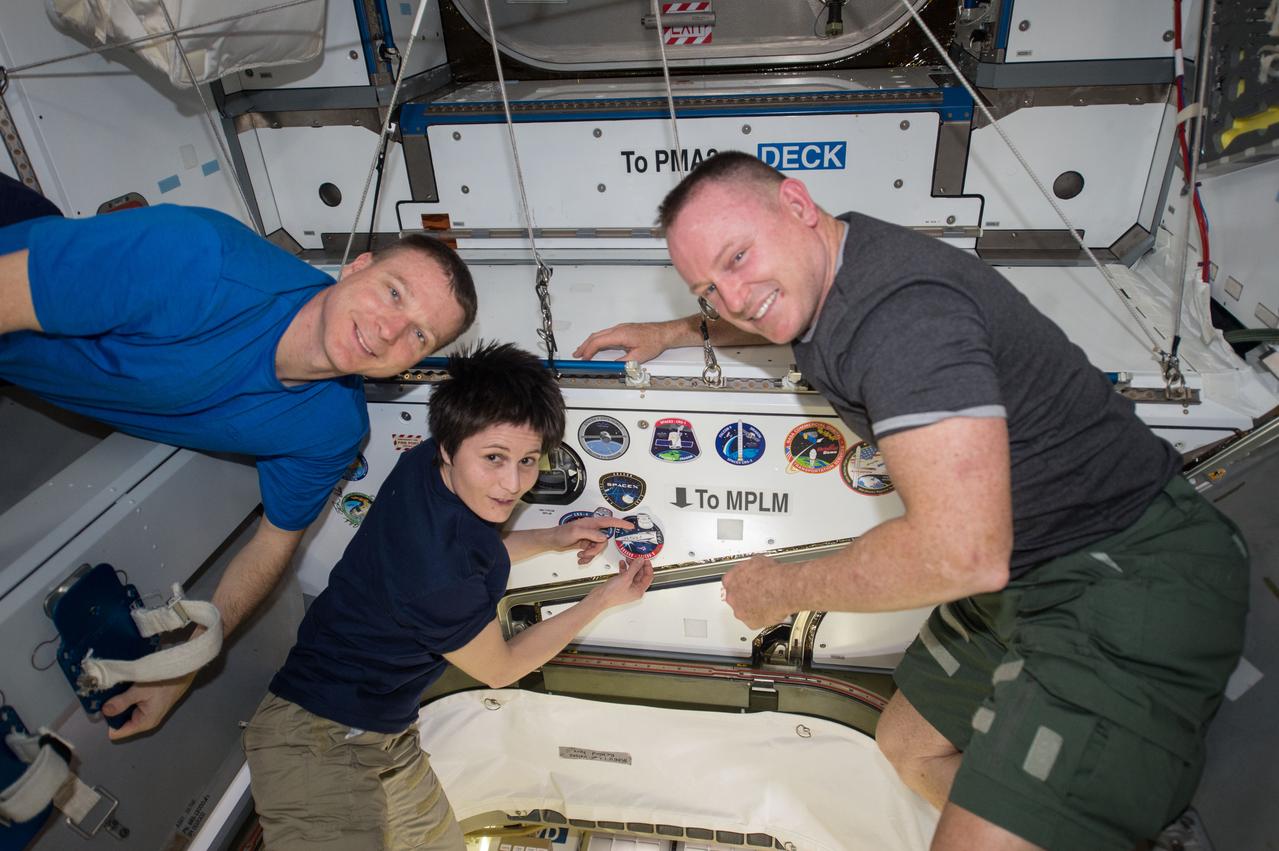
ISS042E262032 (02/10/2015) --- Expedition 42 Commander Barry Wilmore of NASA (right to left), Flight Engineer Samantha Cristoforetti of the European Space Agency (ESA) and Flight Engineer Terry Virts of NASA on the International Space Station are preparing for the departure of the Dragon supply spacecraft on Feb. 10, 2015. In this picture Astronaut Cristoforetti points to the SpaceX CRS-5 Dragon patch.
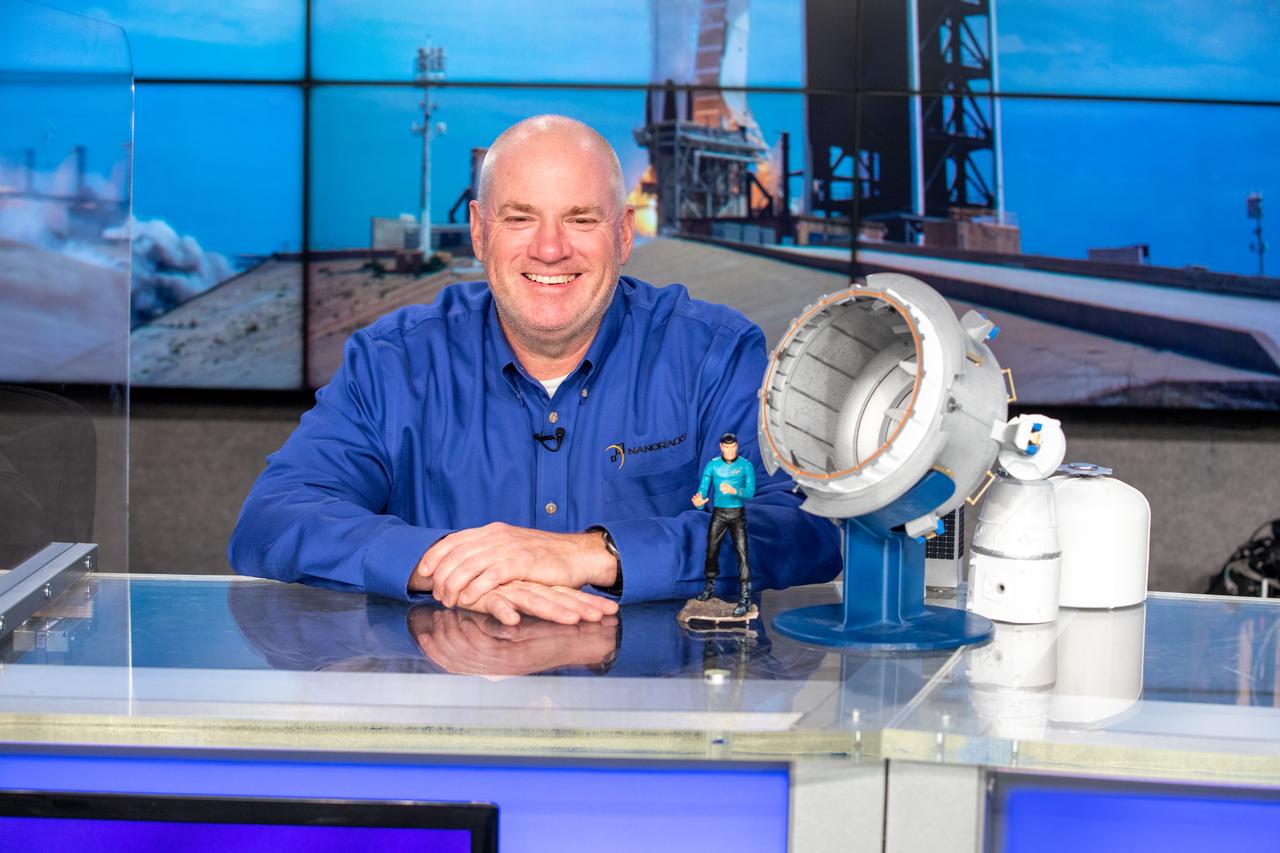
Brock Howe, airlock program manager, Nanoracks, participates in a #NASASocial Science and Station Q&A show at the agency’s Kennedy Space Center in Florida on Dec. 4, 2020. Jennifer Scott-Williams, ISS Program Research Office; and Pinar Mesci, project scientist, Sanford Consortium for Regenerative Medicine, UC San Diego, also participated in the event, which was moderated by NASA Communications’ Kenna Pell. SpaceX’s 21st Commercial Resupply Services (CRS-21) mission is scheduled to launch from Kennedy’s Launch Complex 39A on Dec. 5, 2020. Liftoff of the SpaceX Falcon 9 rocket and cargo Dragon spacecraft is targeted for 11:39 a.m. EST.
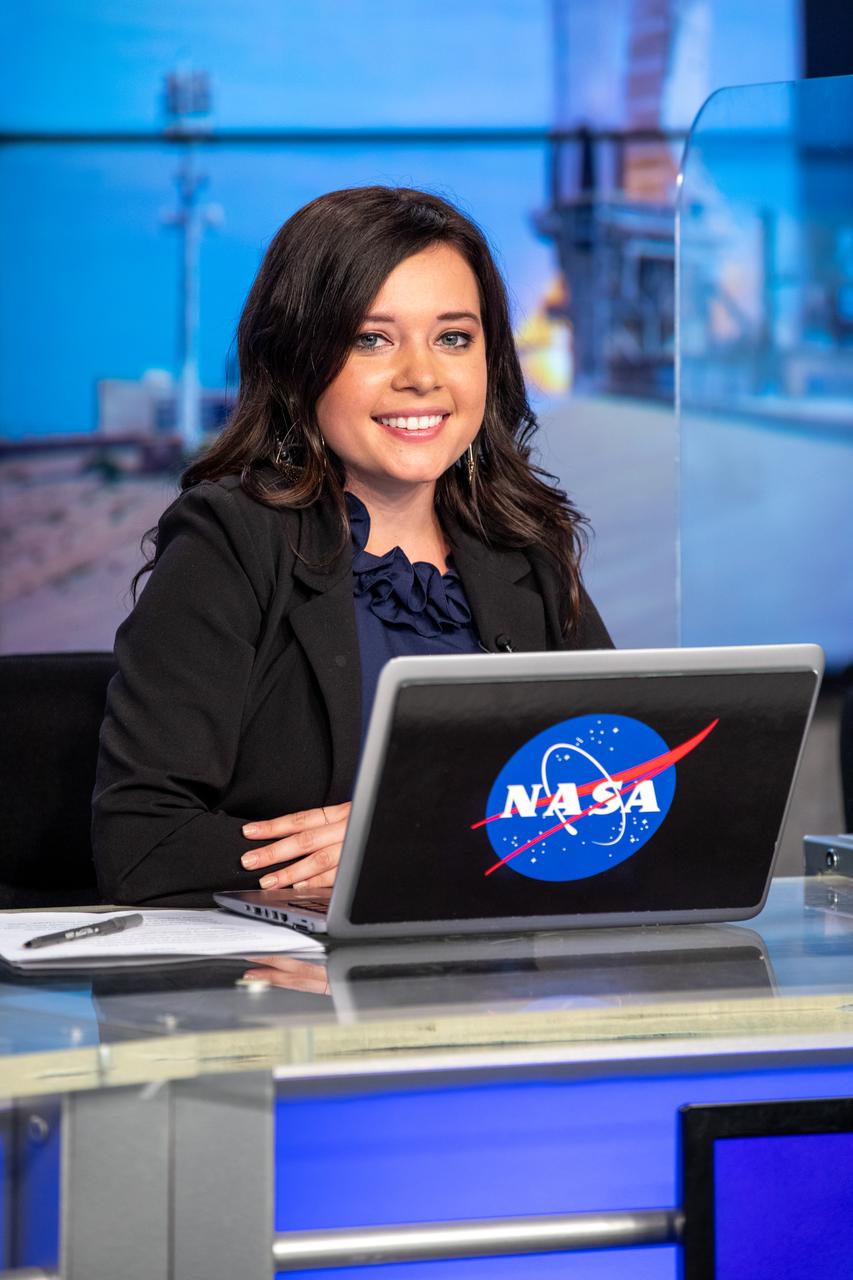
NASA Communications’ Kenna Pell moderates a #NASASocial Science and Station Q&A show at the agency’s Kennedy Space Center in Florida on Dec. 4, 2020. Participants included Brock Howe, airlock program manager, Nanoracks; Jennifer Scott-Williams, ISS Program Research Office; and Pinar Mesci, project scientist, Sanford Consortium for Regenerative Medicine, UC San Diego. SpaceX’s 21st Commercial Resupply Services (CRS-21) mission is scheduled to launch from Kennedy’s Launch Complex 39A on Dec. 5, 2020. Liftoff of the SpaceX Falcon 9 rocket and cargo Dragon spacecraft is targeted for 11:39 a.m. EST.
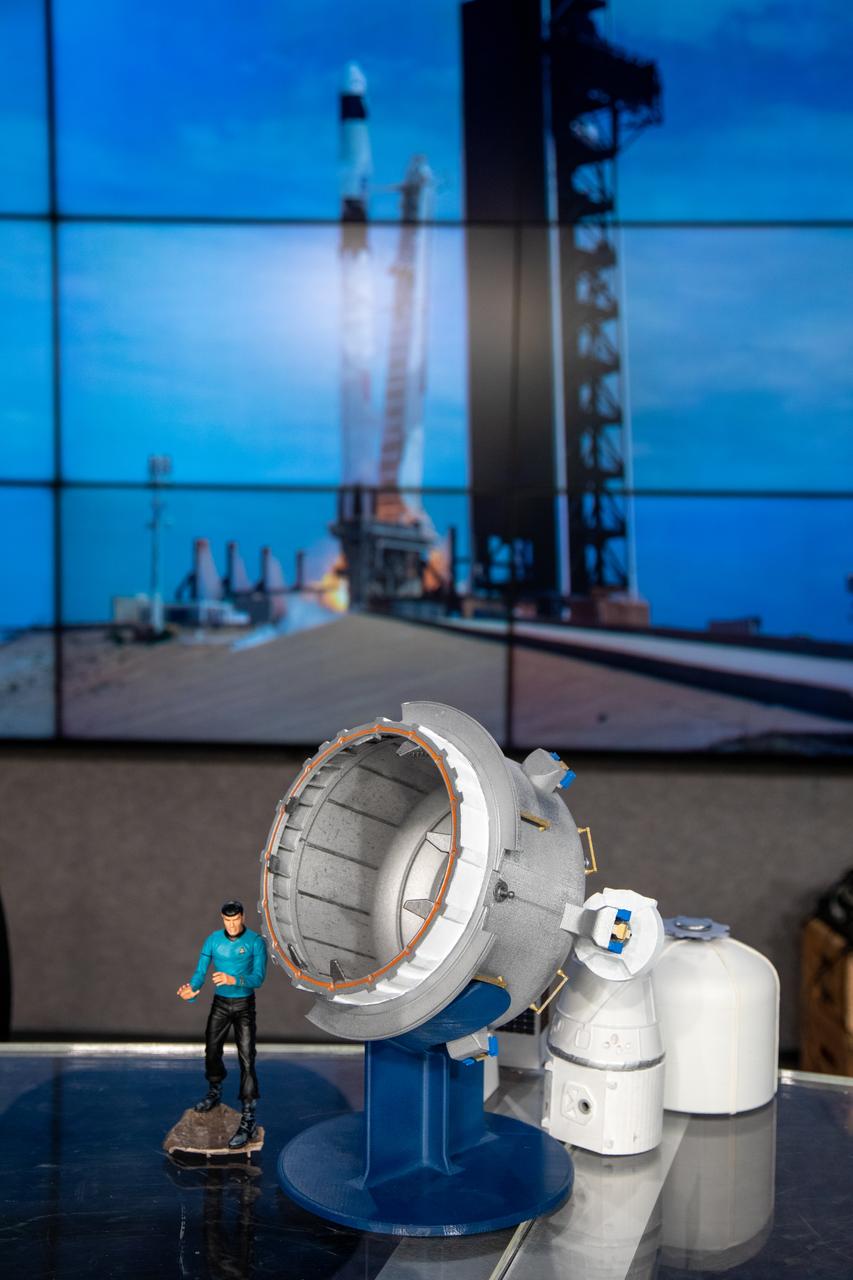
Props are used by Brock Howe, airlock program manager, Nanoracks, during a #NASASocial Science and Station Q&A show at the agency’s Kennedy Space Center in Florida on Dec. 4, 2020. NASA Communications’ Kenna Pell moderated the program, which also included Jennifer Scott-Williams, ISS Program Research Office; and Pinar Mesci, project scientist, Sanford Consortium for Regenerative Medicine, UC San Diego. SpaceX’s 21st Commercial Resupply Services (CRS-21) mission is scheduled to launch from Kennedy’s Launch Complex 39A on Dec. 5, 2020. Liftoff of the SpaceX Falcon 9 rocket and cargo Dragon spacecraft is targeted for 11:39 a.m. EST.

Chunhui Xu, associate professor at Emory University School of Medicine and principal investigator for the Generation of Cardiomyocytes from Induced Pluripotent Stem Cells experiment, addresses NASA Social participants during a What’s on Board science briefing at the agency’s Kennedy Space Center in Florida on March 5, 2020. The briefing provided a closer look at some of the payloads launching on SpaceX’s 20th Commercial Resupply Services (CRS-20) mission to the International Space Station. The company’s Falcon 9 rocket is scheduled to lift off from Cape Canaveral Air Force Station’s Space Launch Complex 40 at 11:50 p.m. EST on March 6, 2020.
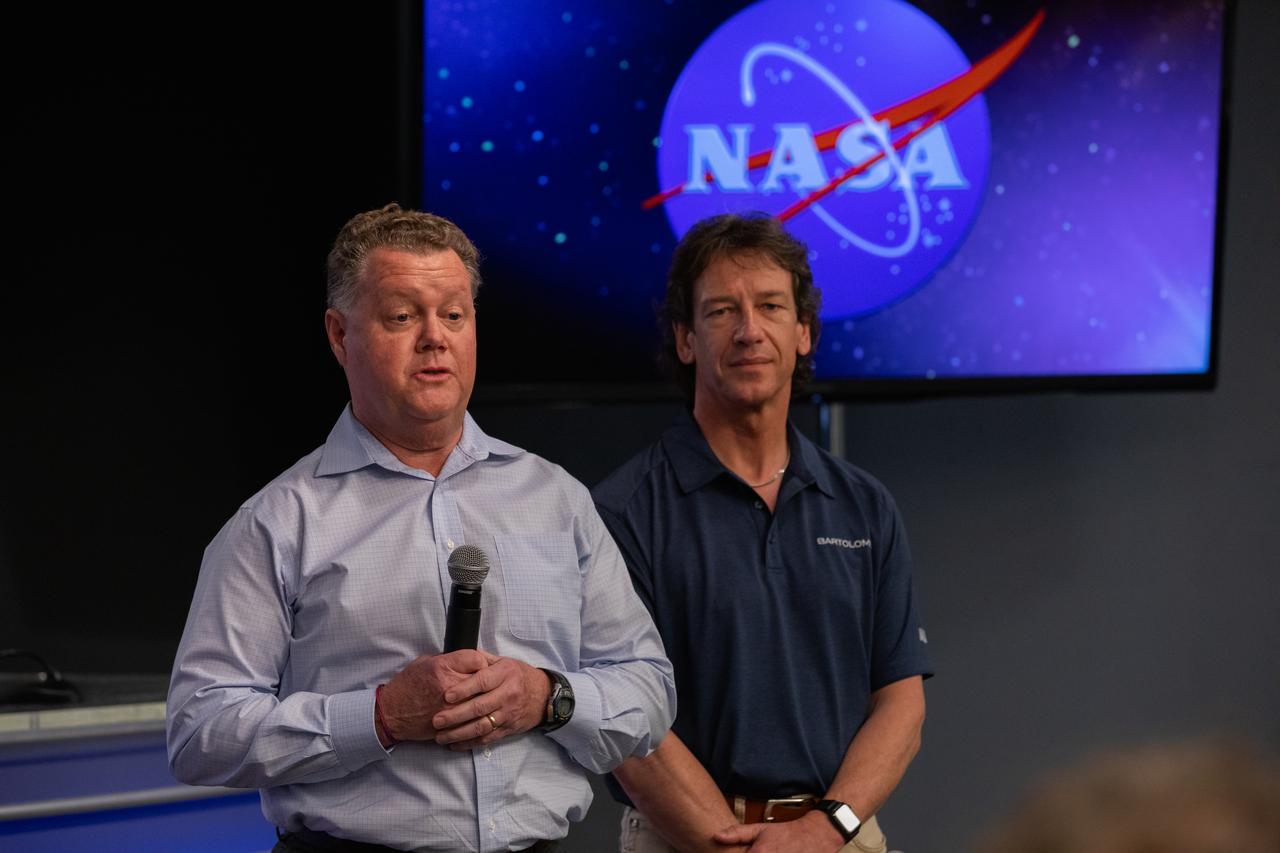
Bill Corely, left, director of business development for Airbus Defence and Space, and Andreas Schütte, Bartolomeo project manager, address NASA Social participants during a What’s on Board science briefing at the agency’s Kennedy Space Center in Florida on March 5, 2020. The briefing provided a closer look at some of the payloads launching on SpaceX’s 20th Commercial Resupply Services (CRS-20) mission to the International Space Station. The company’s Falcon 9 rocket is scheduled to lift off from Cape Canaveral Air Force Station’s Space Launch Complex 40 at 11:50 p.m. EST on March 6, 2020.
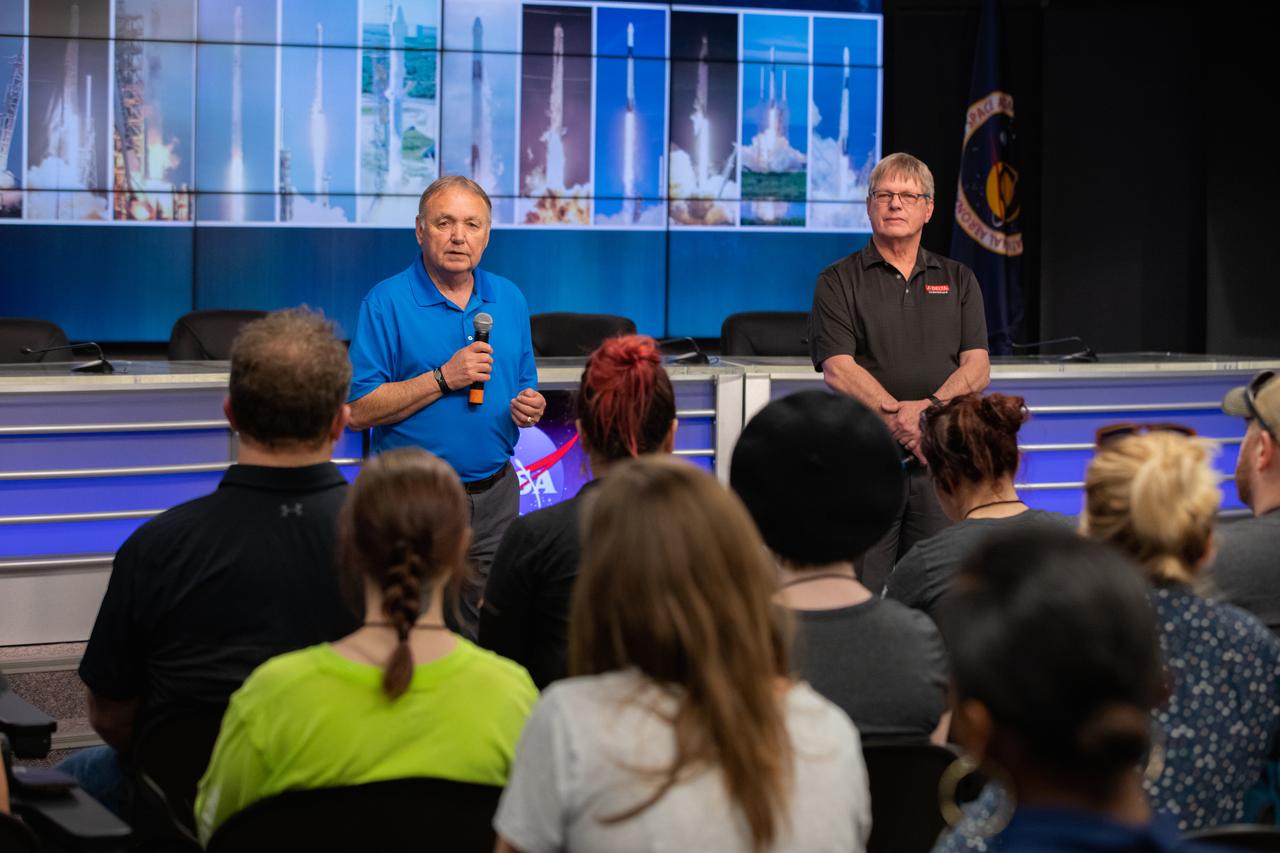
Paul Patton, left, senior manager, front end innovation and regulatory for Delta Faucet, and Garry Marty, principal product engineer for Delta Faucet, address NASA Social participants during a What’s on Board science briefing at the agency’s Kennedy Space Center in Florida on March 5, 2020. The briefing provided a closer look at some of the payloads launching on SpaceX’s 20th Commercial Resupply Services (CRS-20) mission to the International Space Station. The company’s Falcon 9 rocket is scheduled to lift off from Cape Canaveral Air Force Station’s Space Launch Complex 40 at 11:50 p.m. EST on March 6, 2020.

Jennifer Buchli, deputy chief scientist for NASA’s International Space Station Program Science Office, addresses NASA Social participants during a What’s on Board science briefing at the agency’s Kennedy Space Center in Florida on March 5, 2020. The briefing provided a closer look at some of the payloads launching on SpaceX’s 20th Commercial Resupply Services (CRS-20) mission to the International Space Station. The company’s Falcon 9 rocket is scheduled to lift off from Cape Canaveral Air Force Station’s Space Launch Complex 40 at 11:50 p.m. EST on March 6, 2020.
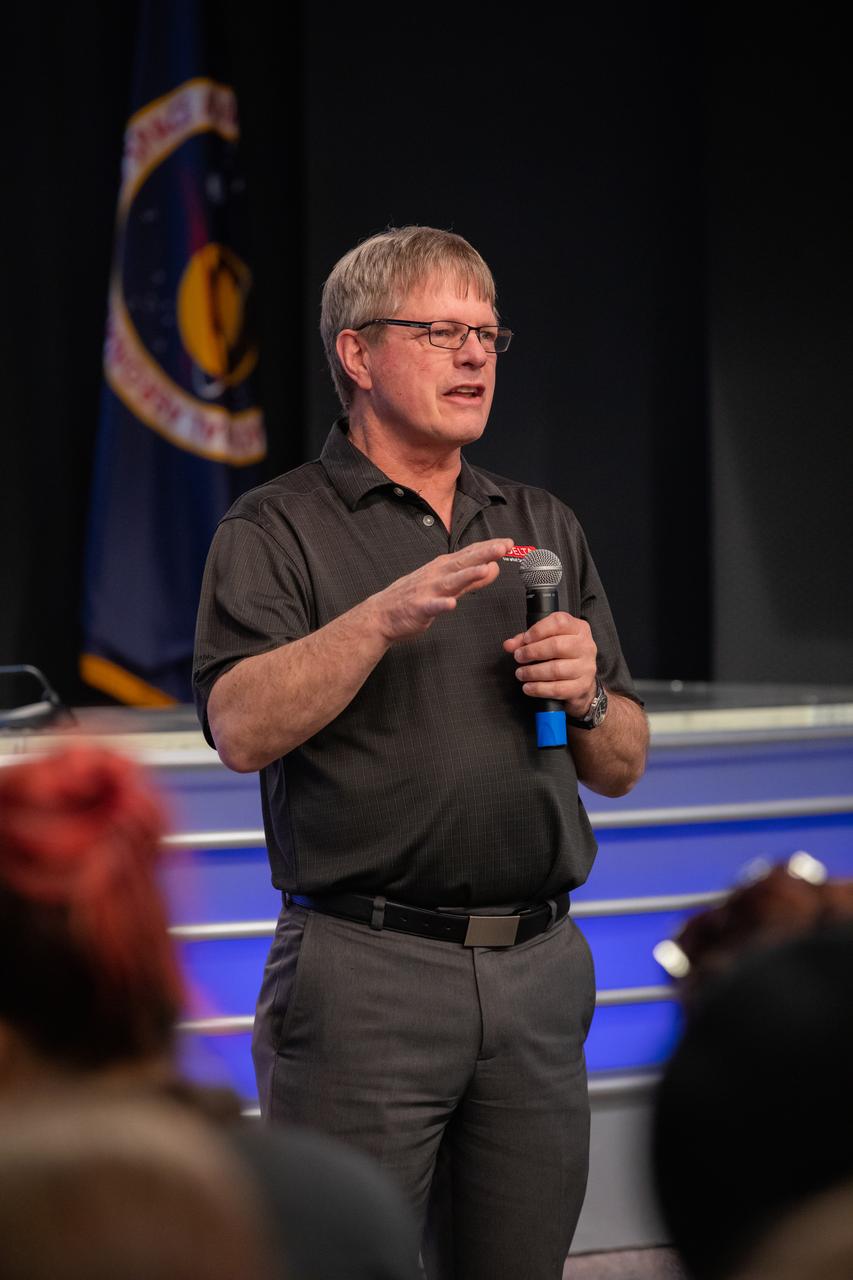
Garry Marty, principal product engineer for Delta Faucet, addresses NASA Social participants during a What’s on Board science briefing at the agency’s Kennedy Space Center in Florida on March 5, 2020. The briefing provided a closer look at some of the payloads launching on SpaceX’s 20th Commercial Resupply Services (CRS-20) mission to the International Space Station. The company’s Falcon 9 rocket is scheduled to lift off from Cape Canaveral Air Force Station’s Space Launch Complex 40 at 11:50 p.m. EST on March 6, 2020.
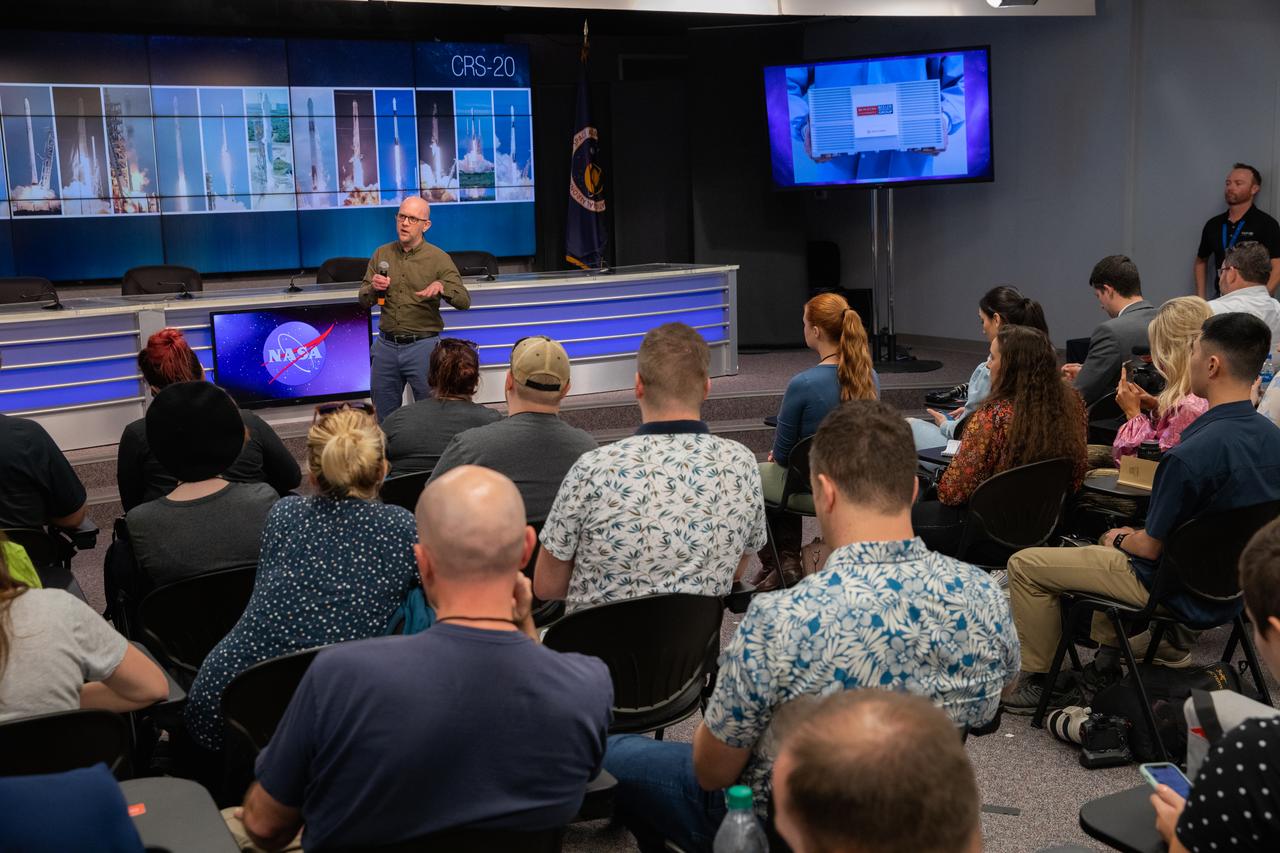
Aaron Beeler, professor of chemistry at Boston University and principal investigator of the Flow Chemistry Platform for Synthetic Reactions on ISS study, addresses NASA Social participants during a What’s on Board science briefing at the agency’s Kennedy Space Center in Florida on March 5, 2020. The briefing provided a closer look at some of the payloads launching on SpaceX’s 20th Commercial Resupply Services (CRS-20) mission to the International Space Station. The company’s Falcon 9 rocket is scheduled to lift off from Cape Canaveral Air Force Station’s Space Launch Complex 40 at 11:50 p.m. EST on March 6, 2020.
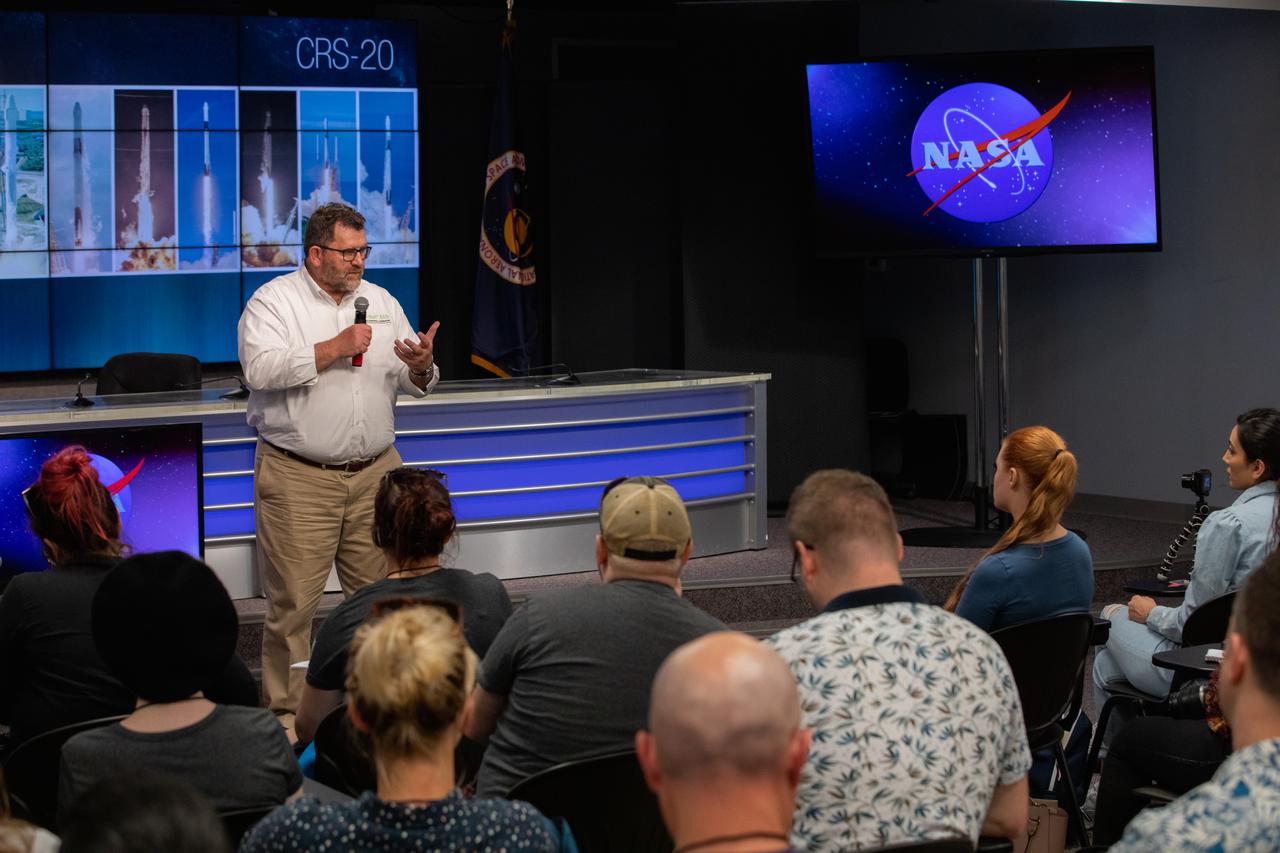
Michael Roberts, interim chief scientist for the International Space Station U.S. National Laboratory, addresses NASA Social participants during a What’s on Board science briefing at the agency’s Kennedy Space Center in Florida on March 5, 2020. The briefing provided a closer look at some of the payloads launching on SpaceX’s 20th Commercial Resupply Services (CRS-20) mission to the International Space Station. The company’s Falcon 9 rocket is scheduled to lift off from Cape Canaveral Air Force Station’s Space Launch Complex 40 at 11:50 p.m. EST on March 6, 2020.
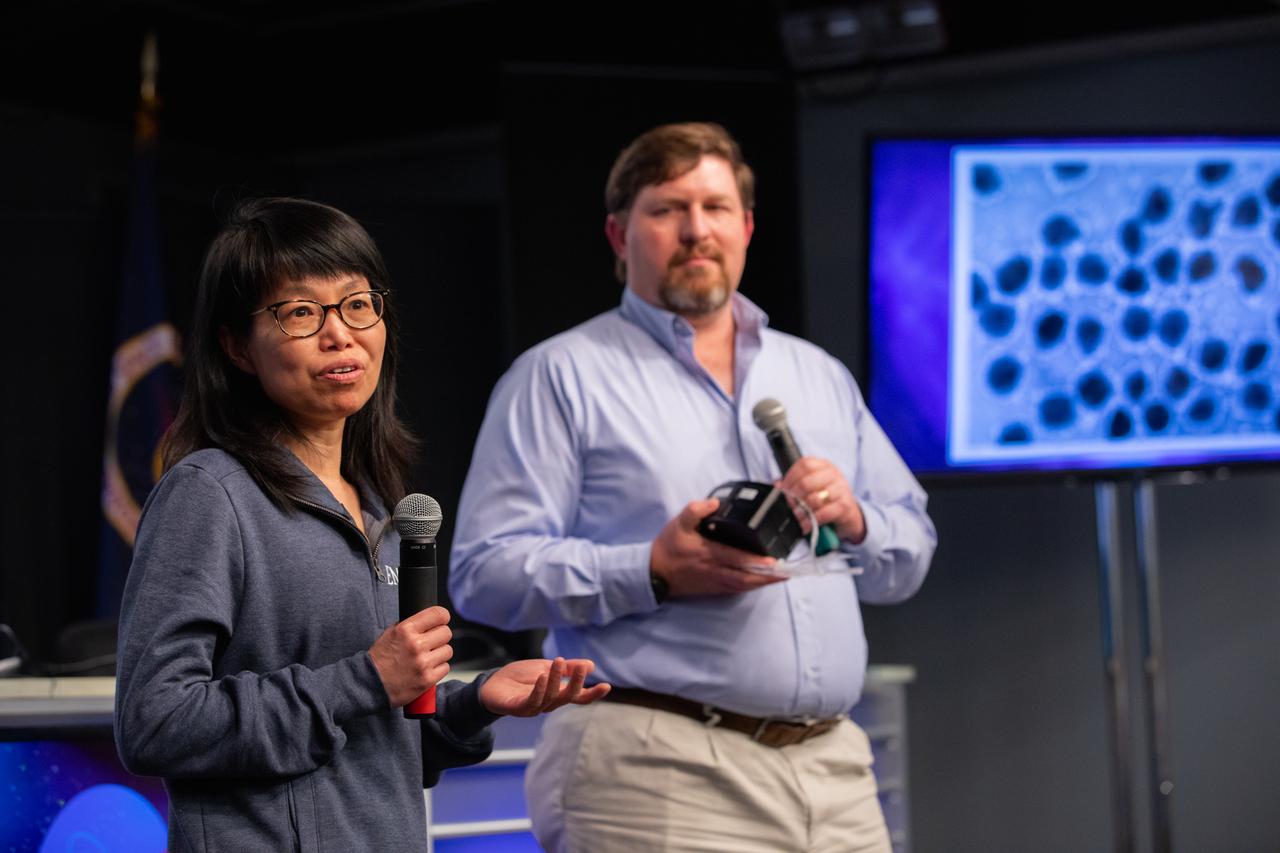
Chunhui Xu, left, associate professor at Emory University School of Medicine and principal investigator for the Generation of Cardiomyocytes from Induced Pluripotent Stem Cells experiment, and Gene Boland, chief scientist of Techshot, address NASA Social participants during a What’s on Board science briefing at the agency’s Kennedy Space Center in Florida on March 5, 2020. The briefing provided a closer look at some of the payloads launching on SpaceX’s 20th Commercial Resupply Services (CRS-20) mission to the International Space Station. The company’s Falcon 9 rocket is scheduled to lift off from Cape Canaveral Air Force Station’s Space Launch Complex 40 at 11:50 p.m. EST on March 6, 2020.
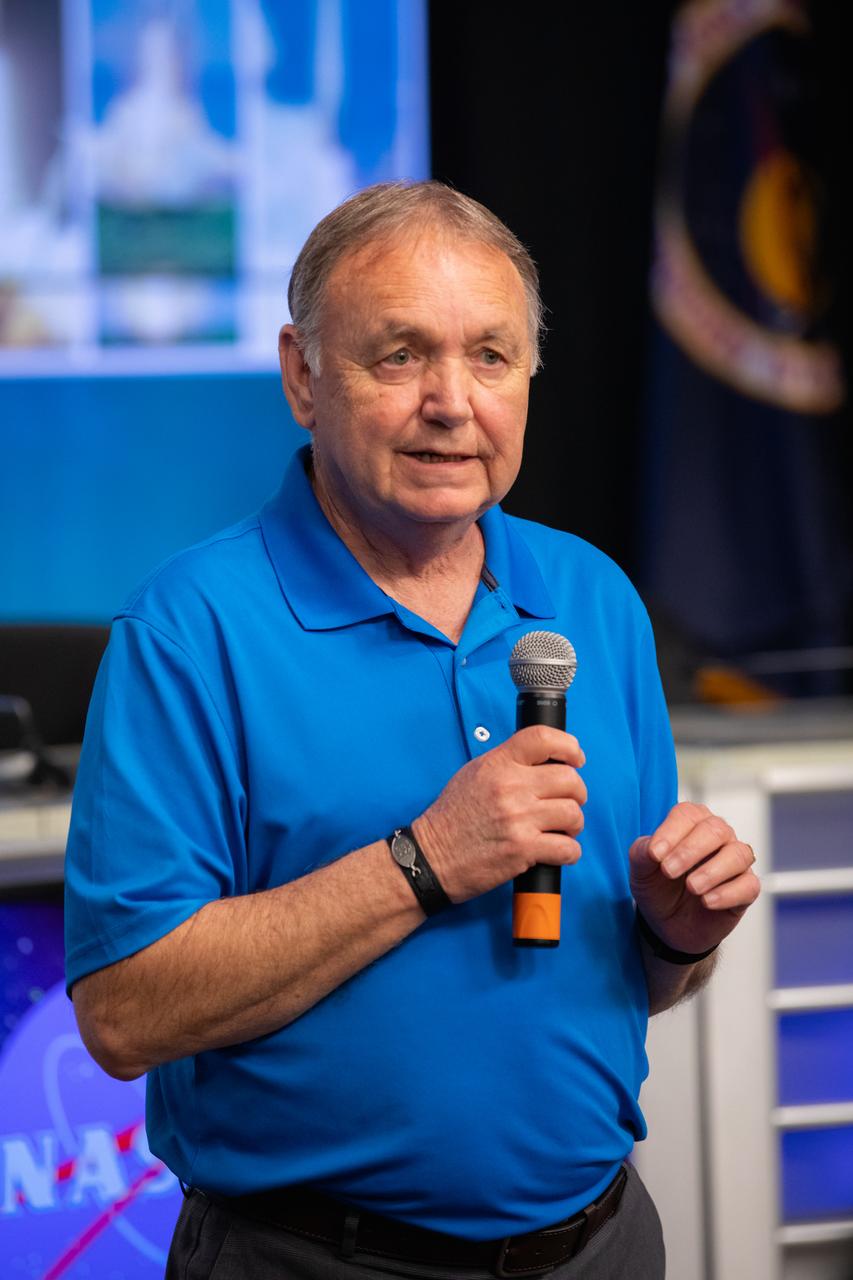
Paul Patton, senior manager, front end innovation and regulatory for Delta Faucet, addresses NASA Social participants during a What’s on Board science briefing at the agency’s Kennedy Space Center in Florida on March 5, 2020. The briefing provided a closer look at some of the payloads launching on SpaceX’s 20th Commercial Resupply Services (CRS-20) mission to the International Space Station. The company’s Falcon 9 rocket is scheduled to lift off from Cape Canaveral Air Force Station’s Space Launch Complex 40 at 11:50 p.m. EST on March 6, 2020.

Aaron Beeler, professor of chemistry at Boston University and principal investigator of the Flow Chemistry Platform for Synthetic Reactions on ISS study, addresses NASA Social participants during a What’s on Board science briefing at the agency’s Kennedy Space Center in Florida on March 5, 2020. The briefing provided a closer look at some of the payloads launching on SpaceX’s 20th Commercial Resupply Services (CRS-20) mission to the International Space Station. The company’s Falcon 9 rocket is scheduled to lift off from Cape Canaveral Air Force Station’s Space Launch Complex 40 at 11:50 p.m. EST on March 6, 2020.