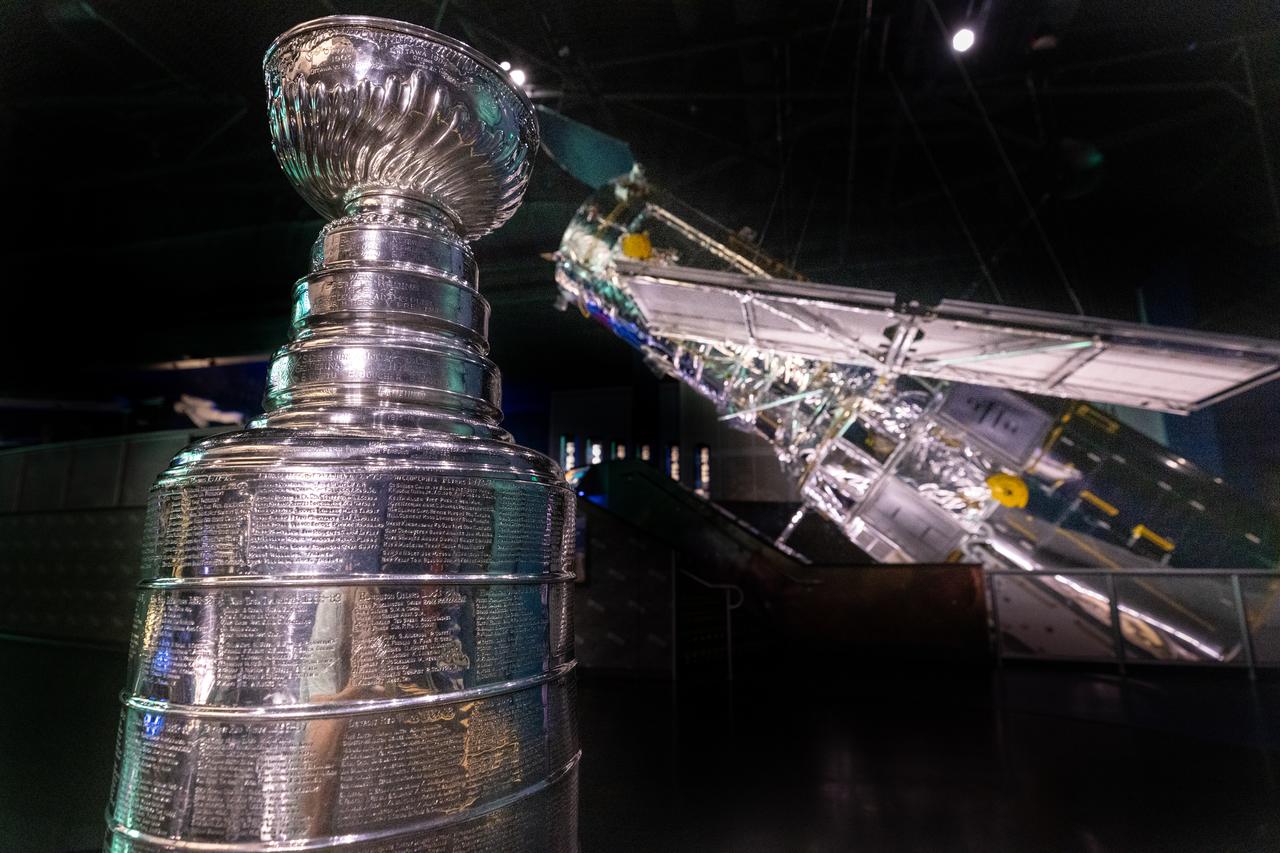
Earlier this year, the Florida Panthers won their first NHL championship and brought victory to the state of Florida. As part of its championship tour, the Stanley Cup made a visit to NASA’s Kennedy Space Center. Pictured here is the shining silver Stanley Cup in the foreground with a large-scale mockup of the Hubble Space Telescope in the background at the Kennedy Space Center Visitor’s Complex on Tuesday Sept. 17, 2024.
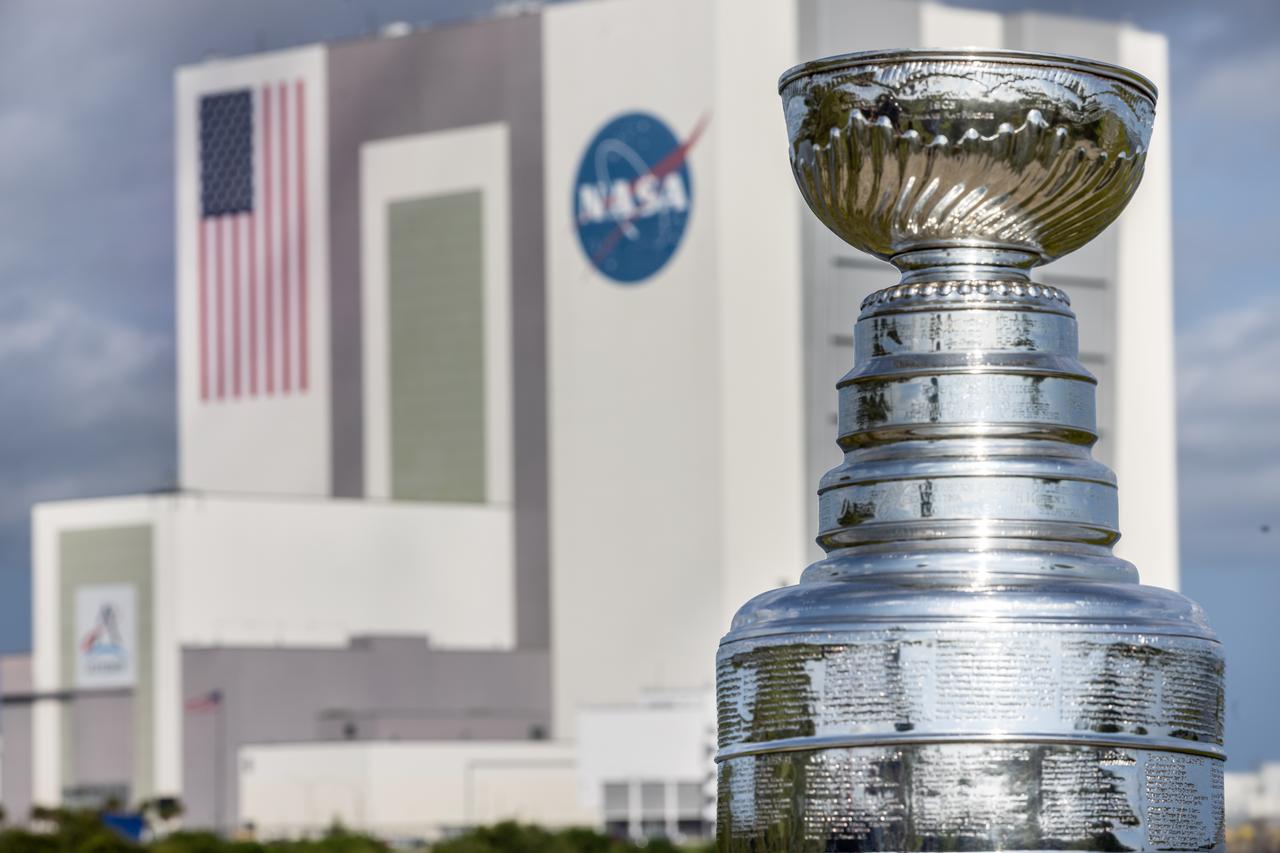
Earlier this year, the Florida Panthers won their first NHL championship and brought victory to the state of Florida. As part of its championship tour, the Stanley Cup made a visit to NASA’s Kennedy Space Center. Pictured here is the silver Stanley Cup with NASA’s iconic Vehicle Assembly Building, which currently houses components of the agency’s Artemis II mission, shown in the background at the Kennedy Space Center on Tuesday Sept. 17, 2024.
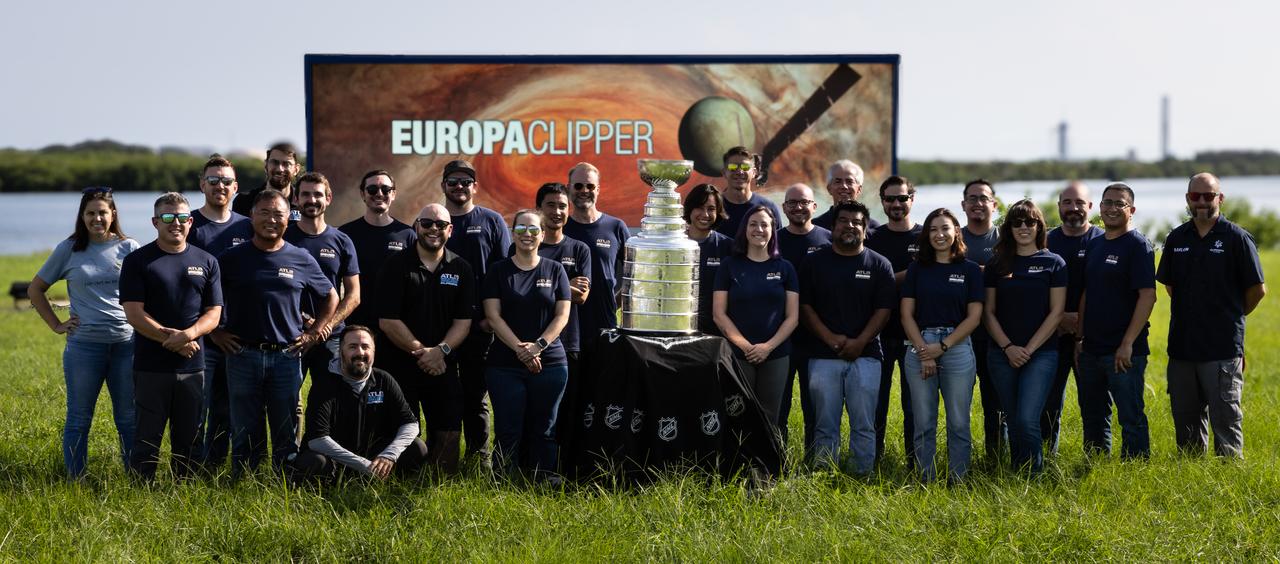
Earlier this year, the Florida Panthers won their first NHL championship and brought victory to the state of Florida. As part of its championship tour, the Stanley Cup made a visit to NASA’s Kennedy Space Center. Here, members of NASA’s Europa Clipper team pose with the National Hockey League’s Stanley Cup trophy in front of the countdown clock near the NASA News Center at Kennedy on Tuesday, Sept. 17, 2024. Europa Clipper will soon begin its Jupiter to explore if places below Europa’s surface could support life.
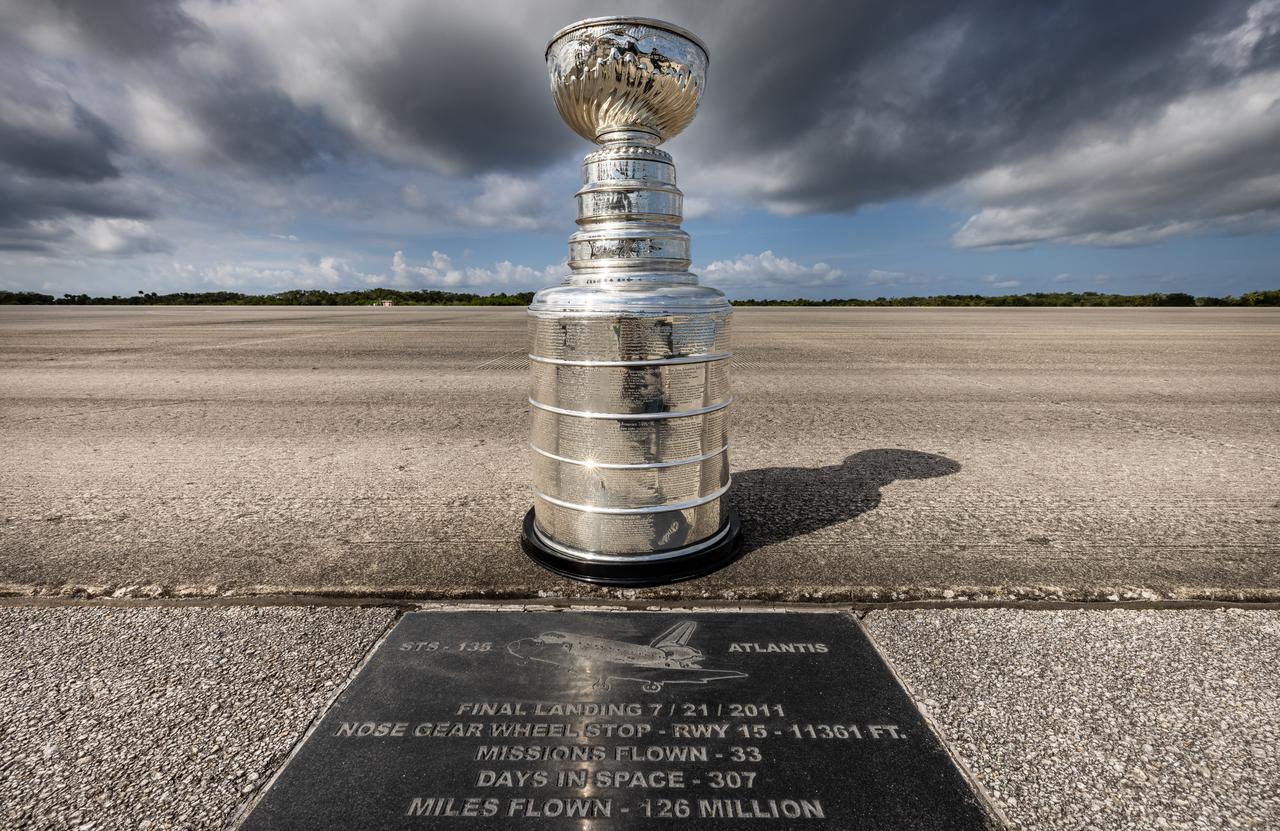
Earlier this year, the Florida Panthers won their first NHL championship and brought victory to the state of Florida. As part of its championship tour, the Stanley Cup made a visit to Kennedy Space Center. Pictured here is the Stanley Cup on the runway of the Launch and Landing Facility, formerly the Shuttle Landing Facility at NASA’s Kennedy Space Center on Tuesday Sept. 17, 2024. The trophy is beside the Space Shuttle Atlantis landmark, a commemorative plaque marking the landing spot of the last shuttle flight that occurred in July 2011.
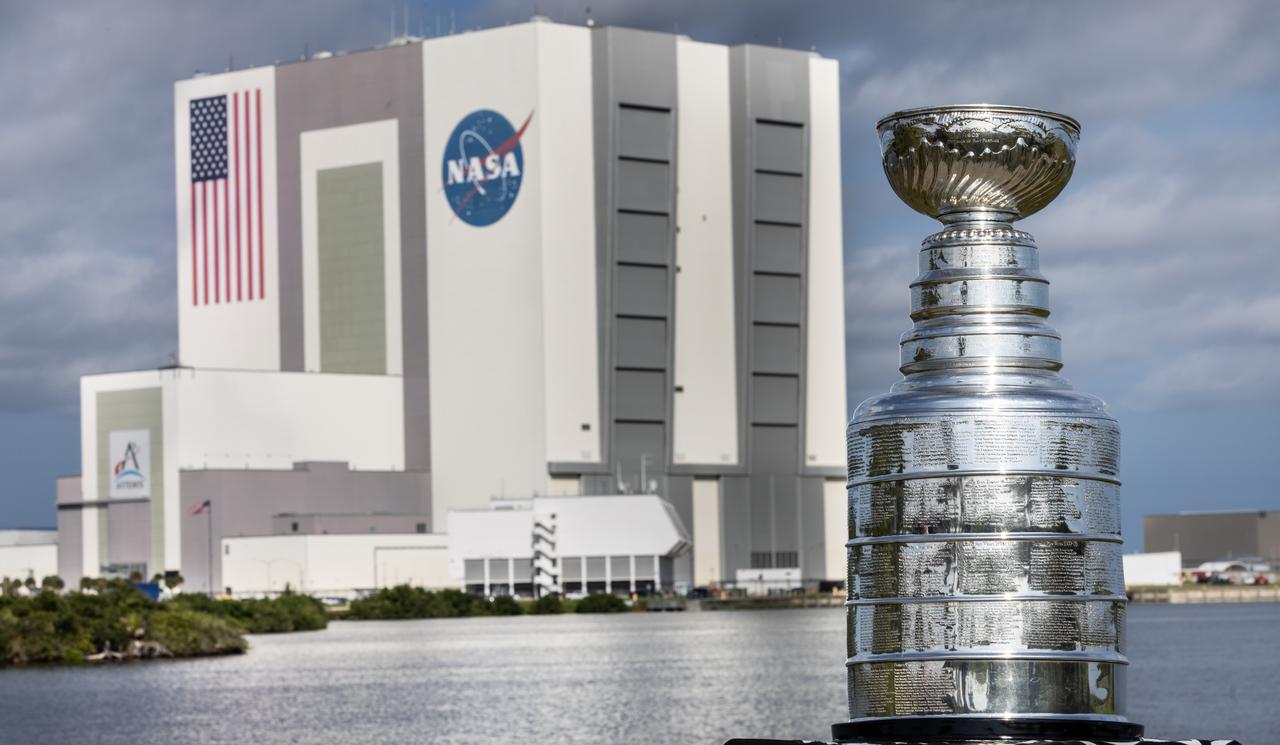
Earlier this year, the Florida Panthers won their first NHL championship and brought victory to the state of Florida. As part of its championship tour, the Stanley Cup made a visit to NASA’s Kennedy Space Center. Pictured here is the silver Stanley Cup with NASA’s iconic Vehicle Assembly Building, which currently houses components of the agency’s Artemis II mission, shown in the background at the Kennedy Space Center on Tuesday Sept. 17, 2024.
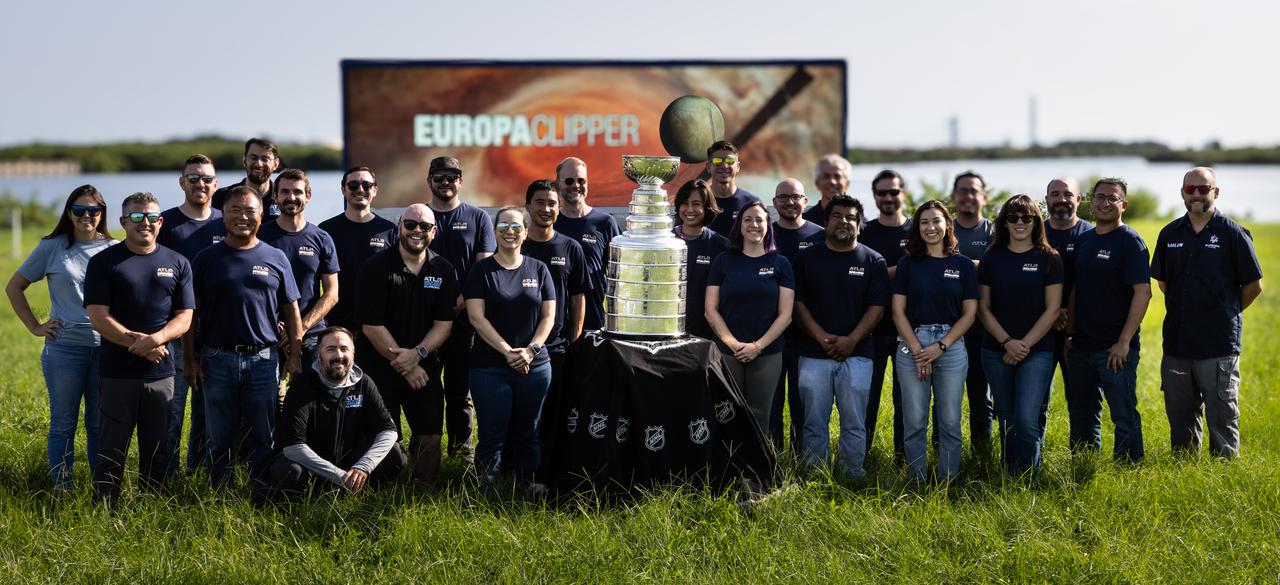
Earlier this year, the Florida Panthers won their first NHL championship and brought victory to the state of Florida. As part of its championship tour, the Stanley Cup made a visit to NASA’s Kennedy Space Center. Here, members of NASA’s Europa Clipper team pose with the National Hockey League’s Stanley Cup trophy in front of the countdown clock near the NASA News Center at Kennedy on Tuesday, Sept. 17, 2024. Europa Clipper will soon begin its Jupiter to explore if places below Europa’s surface could support life.

On July 9, hundreds of millions of fans worldwide were glued to their television sets watching the final match of the 2006 FIFA World Cup, played in Berlin Olympic stadium Olympiastadion. This image was acquired by NASA Terra spacecraft.

THE SOLAR PROBE PLUS CUP INSTRUMENT WILL BE PART OF THE SOLAR PROBE PLUS MISSION TO STUDY THE SUN. THE CUP WILL FLY ON THE SPACECRAFT ON THE OUTSIDE OF THE SHIELD AND WILL "CATCH" CHARGED PARTICLES FROM THE SUN AND ANALYZE THEM. A TEAM FROM THE HARVARD SMITHSONIAN ASTROPHYSICS OBSERVATORY IS BUILDING THIS INSTRUMENT AND TESTED AN ENGINEERING MODEL OF THE CUP IN AN ENVIRONMENTAL TEST FACILITY AT NASA'S MARSHALL SPACE FLIGHT CENTER.INSIDE THE VACUUM CHAMBER, THE PROBE WAS EXPOSED TO AN ENVIRONMENTAL CONDITIONS SIMILAR TO THOSE FOUND IN SPACE
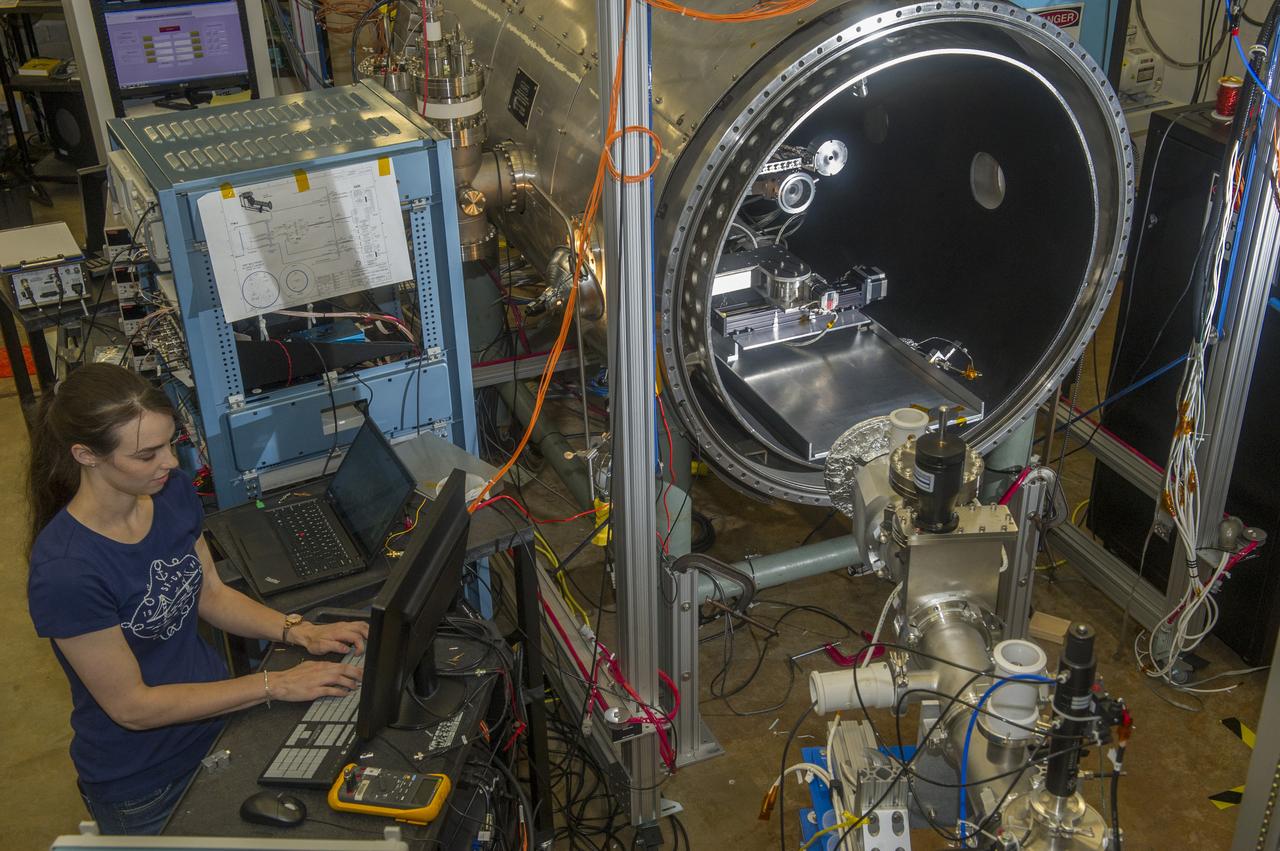
PHYLLIS WHITTLESEY, UAH GRAD STUDENT IN SPACE SCIENCES, IS ASSISTING WITH TESTING OF SOLAR PROBE PLUS CUP INSTRUMENT
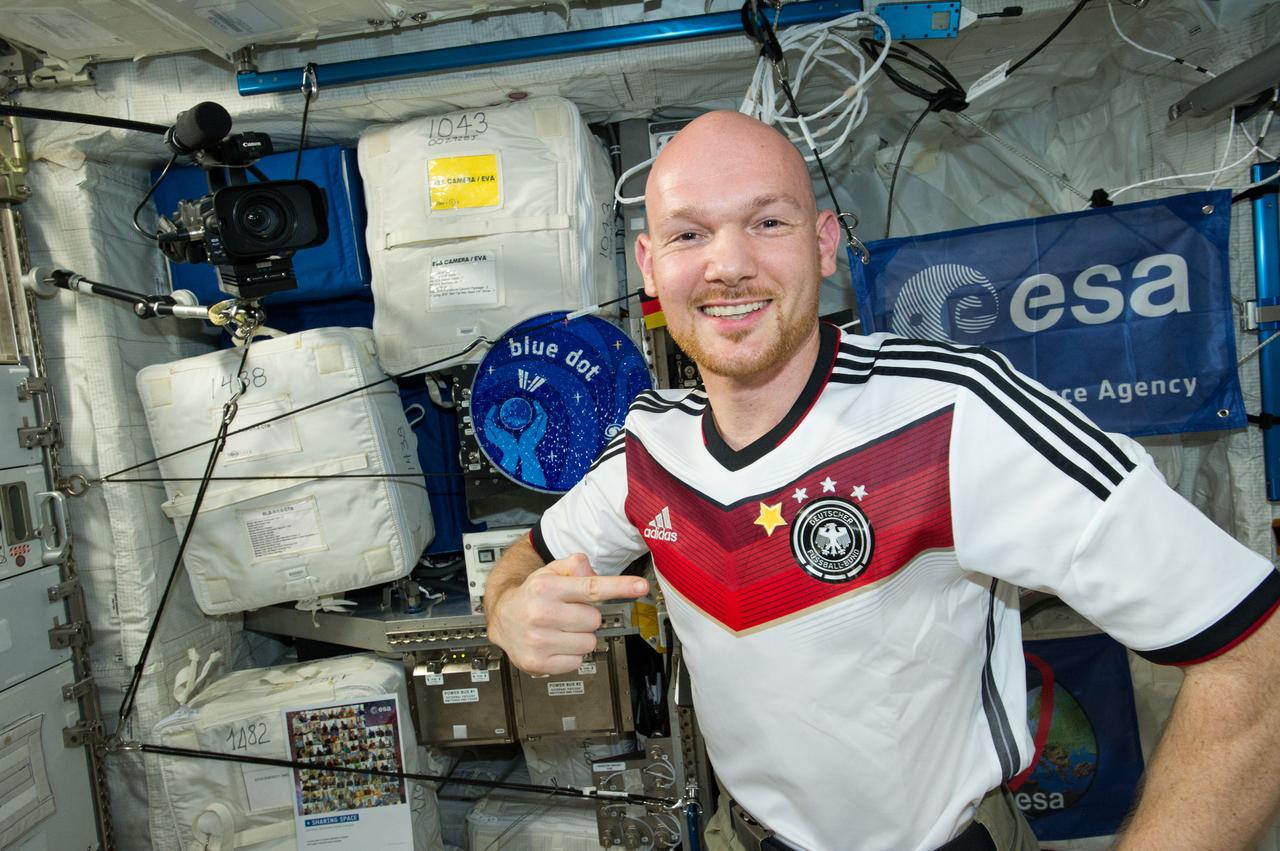
European Space Agency astronaut Alexander Gerst,Expedition 40 flight engineer,sends down a congratulations to the victorious German team after the World Cup finals. Photo taken in Columbus module.
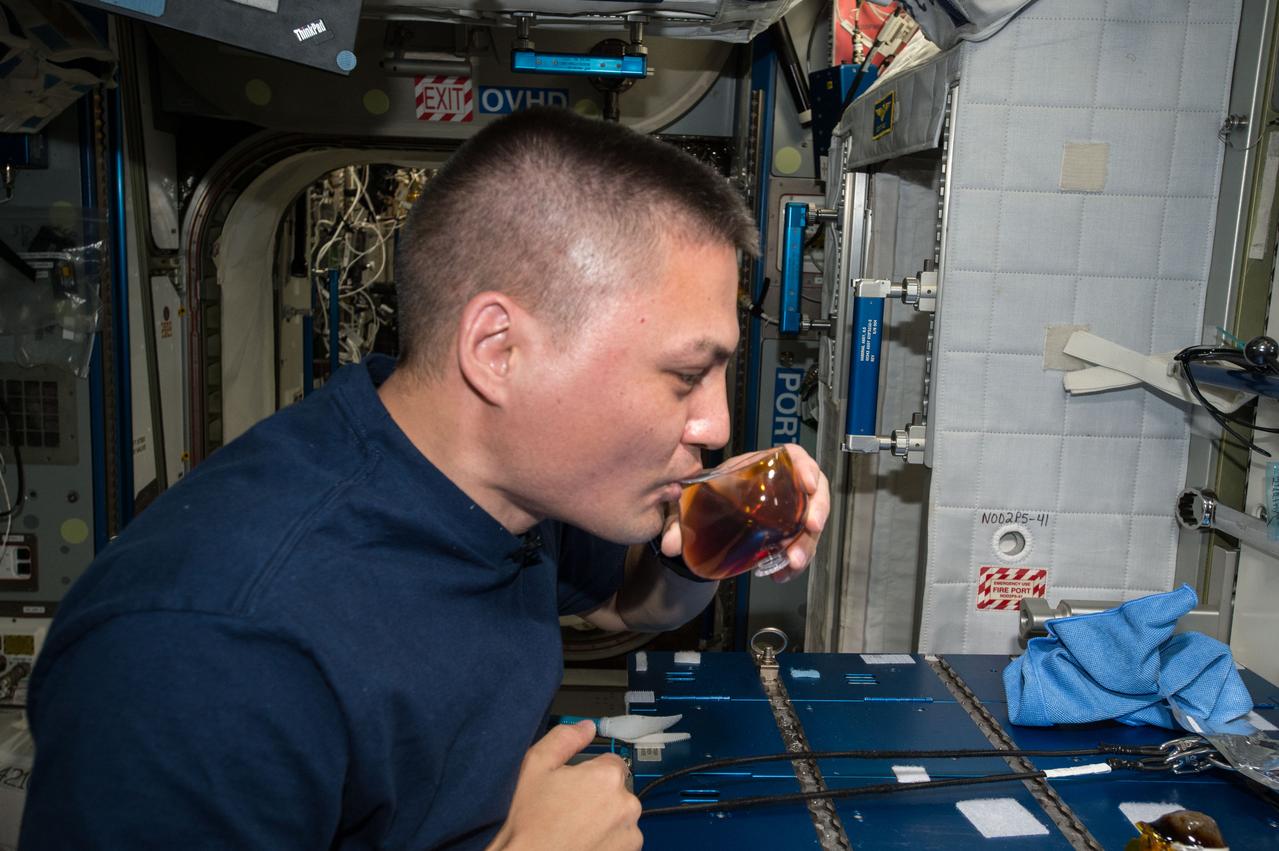
iss045e035341 (9/29/2015) --- NASA astronaut Kjell Lindgren celebrates International Coffee Day aboard the International Space Station (ISS) with his first hand-brewed cup of coffee in space, brewed using the Capillary Beverage Cup.
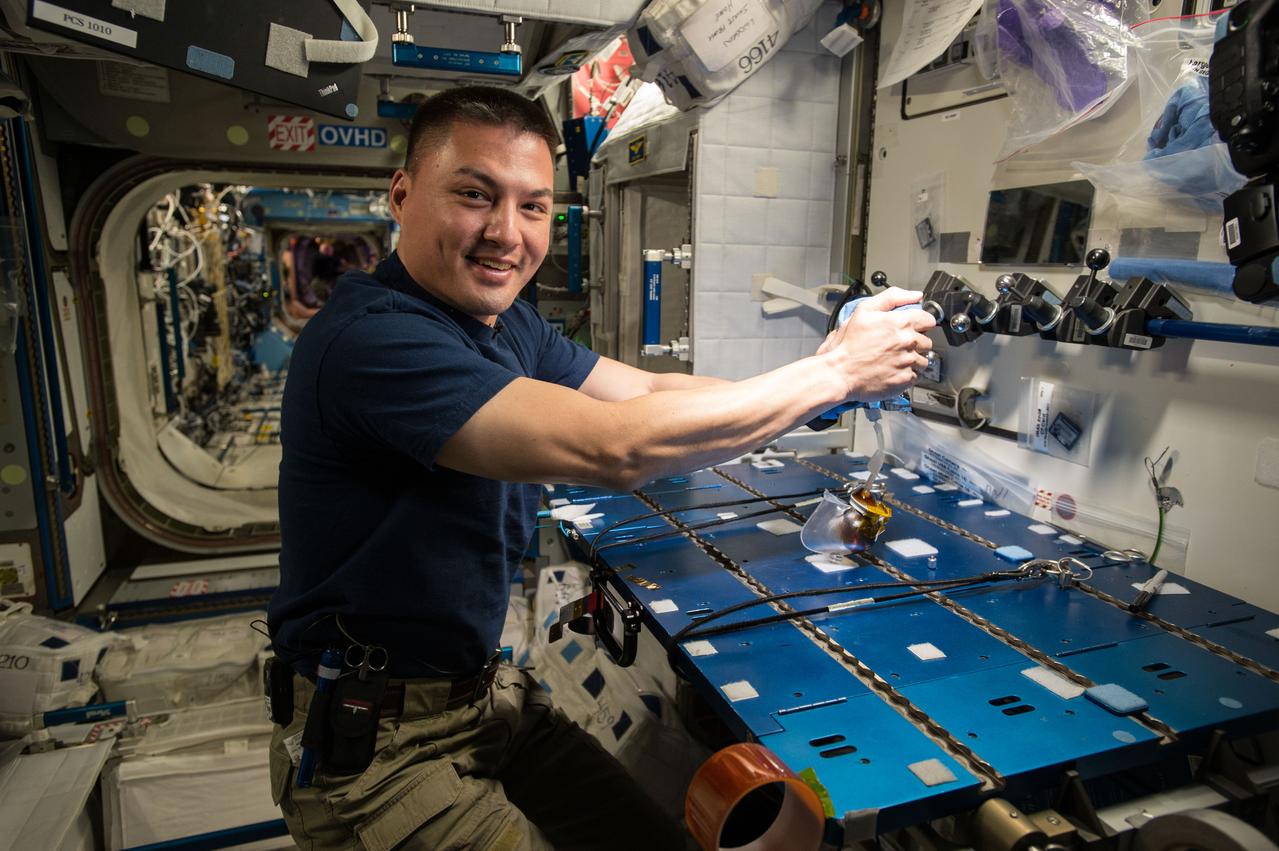
iss045e035321 (9/29/2015) --- NASA astronaut Kjell Lindgren celebrates International Coffee Day aboard the International Space Station (ISS) with his first hand-brewed cup of coffee in space, brewed using the Capillary Beverage Cup.

iss045e035336 (9/29/2015) --- NASA astronaut Kjell Lindgren celebrates International Coffee Day aboard the International Space Station (ISS) with his first hand-brewed cup of coffee in space, brewed using the Capillary Beverage Cup.
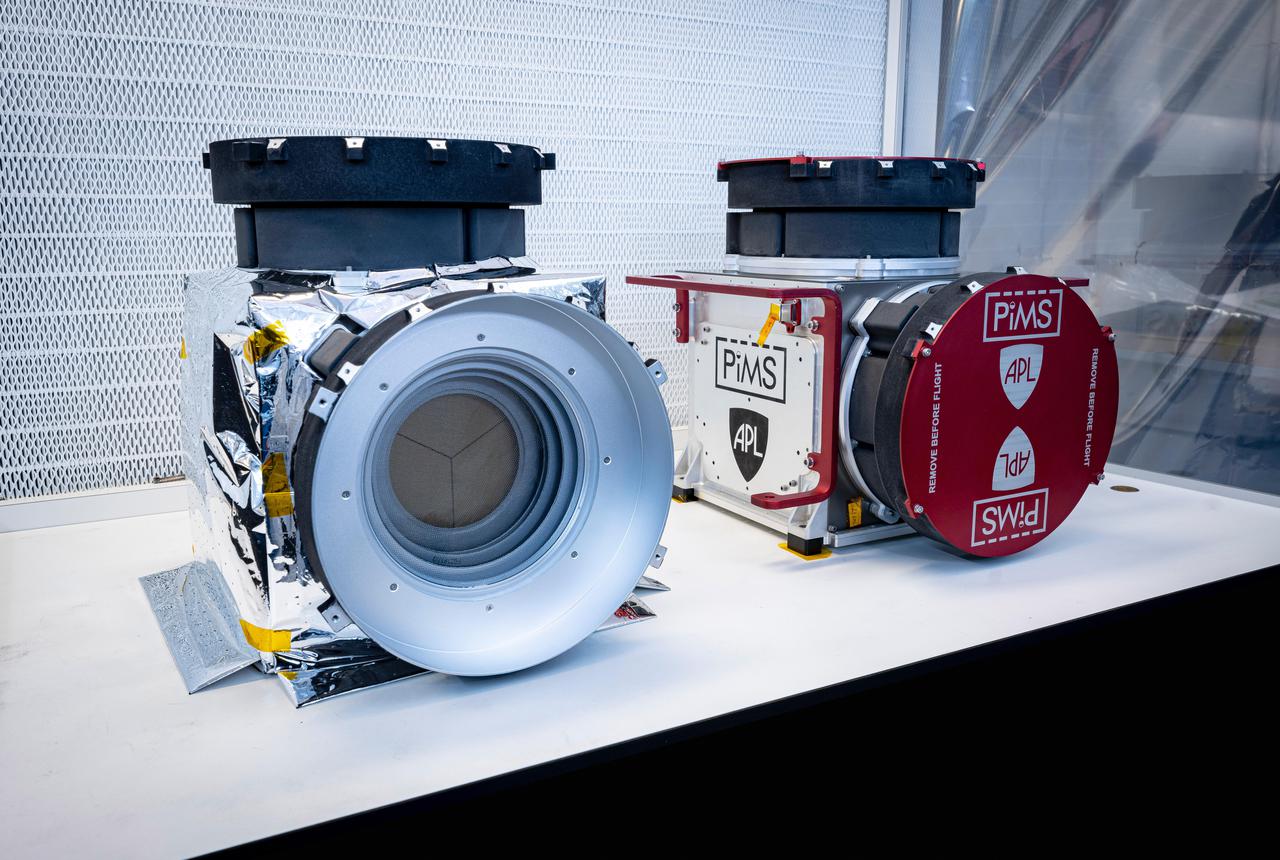
Included in the payload of science instruments for NASA's Europa Clipper is the Plasma Instrument for Magnetic Sounding (PIMS). Scientists will use PIMS to study the characteristics of plasma around Europa to better understand the moon's ice shell thickness, ocean depth, and ocean salinity. Built by the Johns Hopkins Applied Physics Laboratory (APL) in Laurel, Maryland, PIMS is made up of two instruments, each with two identical sensors called Faraday cups that will measure the plasmas, or electrically charged gases, in Europa's ionosphere and Jupiter's magnetosphere. Pictured in a clean room at APL are the recently assembled Faraday cup sensors and instrument housings in two configurations. On the left is the final flight hardware, with insulating thermal blankets installed; on the right is a test configuration that protects sensitive hardware for transportation. With an internal global ocean twice the size of Earth's oceans combined, Europa may have the potential to harbor life. NASA's Europa Clipper spacecraft will swoop around Jupiter on an elliptical path, dipping close to the moon on each flyby to collect data. Understanding Europa's habitability will help scientists better understand how life developed on Earth and the potential for finding life beyond our planet. https://photojournal.jpl.nasa.gov/catalog/PIA24327
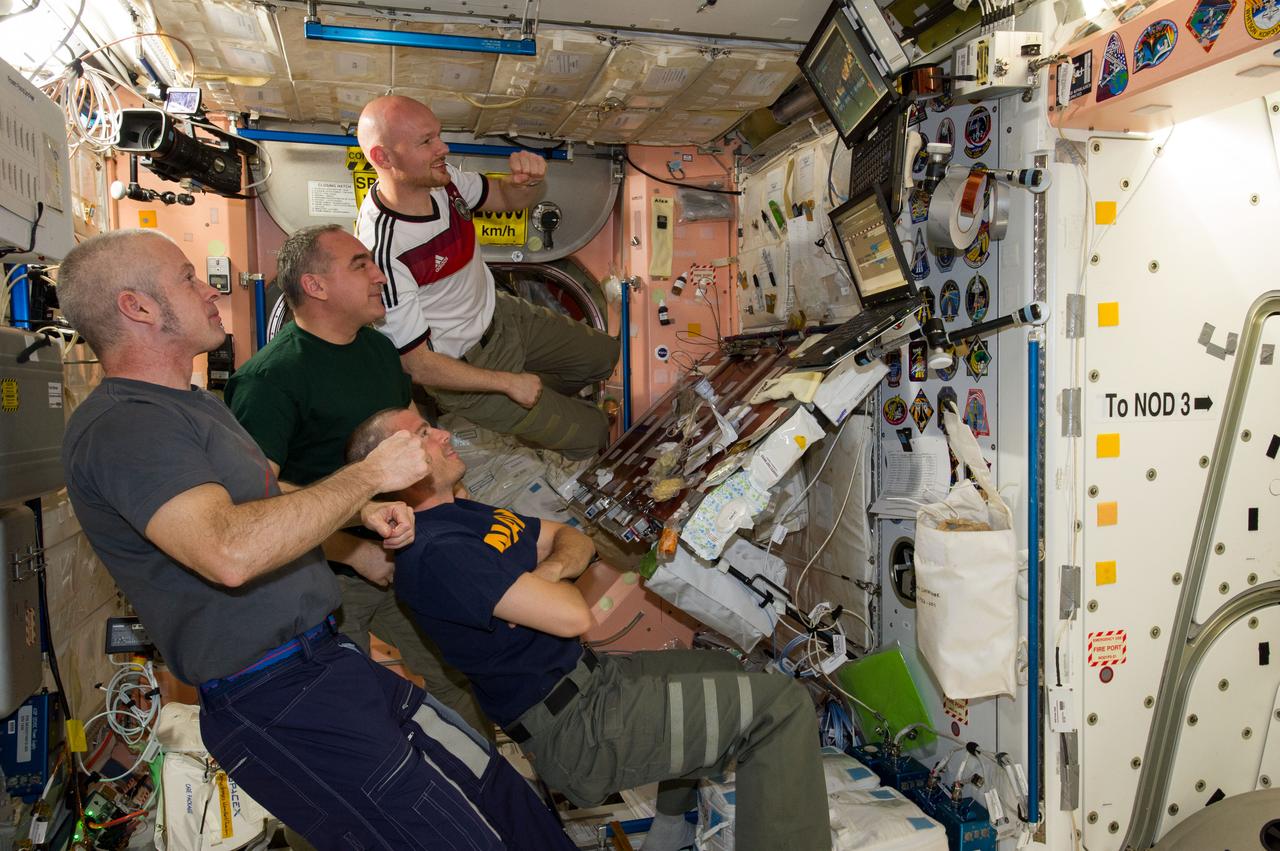
NASA astronaut Steve Swanson (left),Expedition 40 commander; along with European Space Agency astronaut Alexander Gerst (upper left), NASA astronaut Reid Wiseman and Cosmonaut Alexander Skvortsov,all three flight engineers,gather around a computer in Node 1 to watch the World Cup finals.
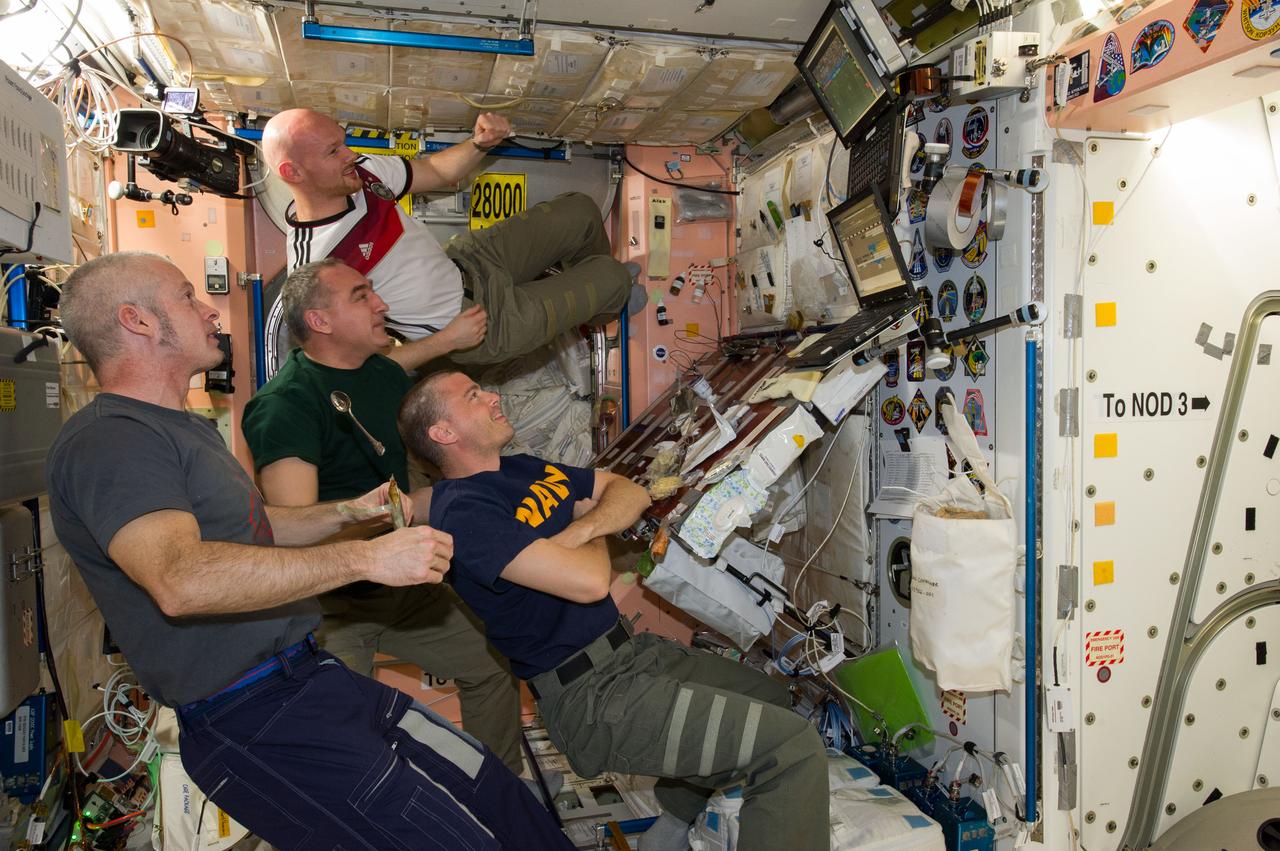
NASA astronaut Steve Swanson (left),Expedition 40 commander; along with European Space Agency astronaut Alexander Gerst (upper left),NASA astronaut Reid Wiseman and Cosmonaut Alexander Skvortsov,all three flight engineers,gather around a computer in Node 1 to watch the World Cup finals.
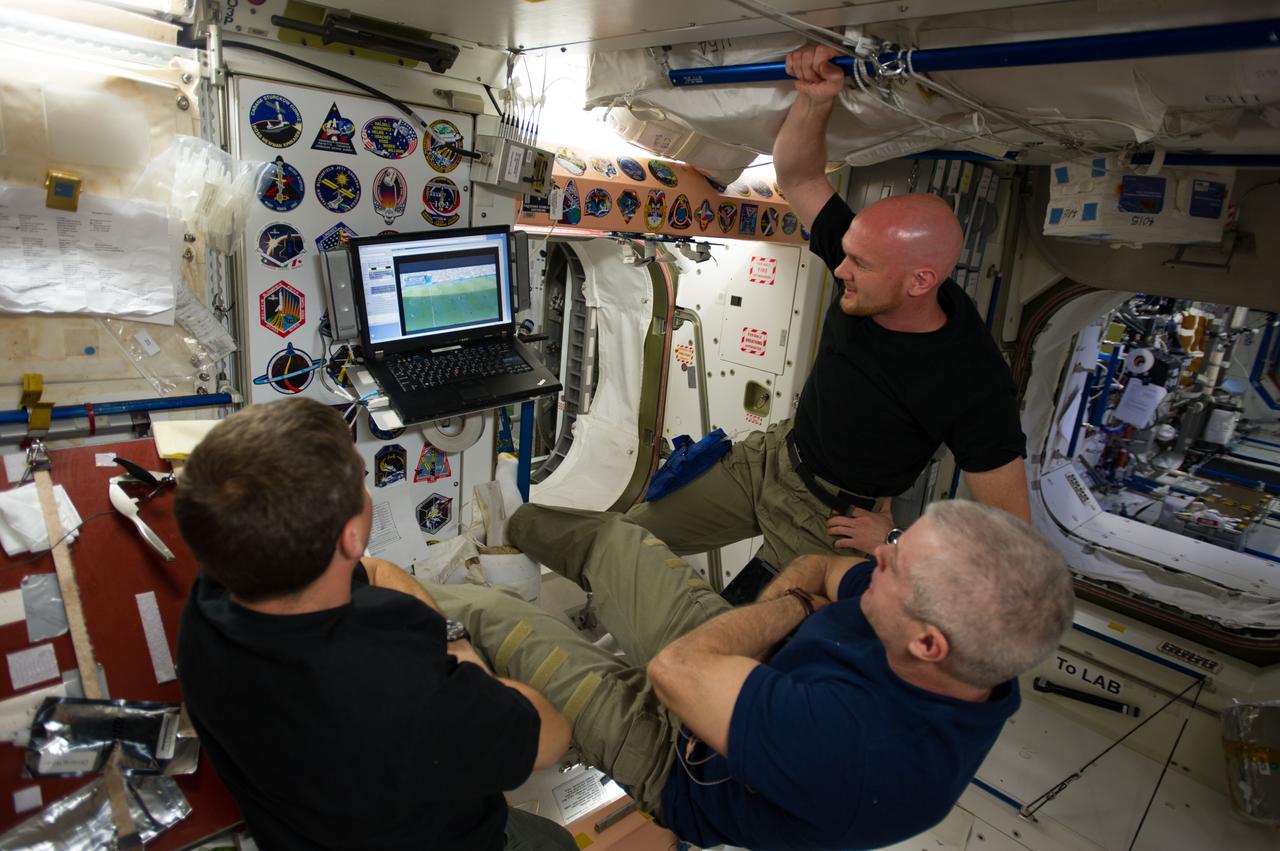
ISS040-E-012313 (17 June 2014) --- From left, Expedition 40 crew members Reid Wiseman and Steve Swanson of NASA and ESA astronaut Alexander Gerst take a break to watch ten minutes of live World Cup matches between science experiments while living and working aboard the International Space Station. Swanson is Expedition 40 commander and the others are flight engineers.
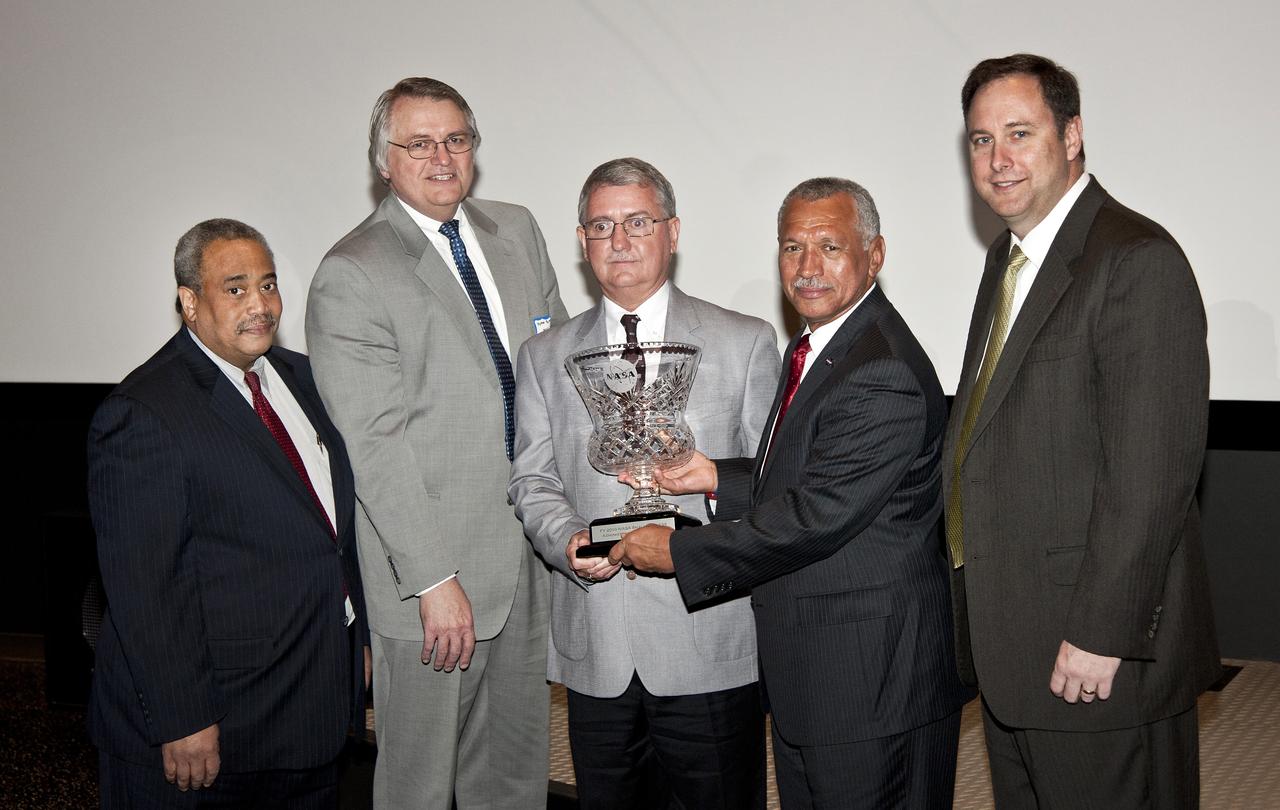
CHARLES BOLDEN, NASA ADMINISTRATOR PRESENTING THE 2010 ADMINISTRATOR’S CUP AWARD TO DAVID BROCK, SMALL BUSINESS SPECIALIST, MSFC. LEFT TO RIGHT GLENN DELGADO, ASSOCIATE DIRECTOR, NASA, OFFICE OF SMALL BUSINESS PROGRAMS, BYRON BUTLER, DIRECTOR, OFFICE OF PROCUREMENT, MSFC, DAVID BROCK, SMALL BUSINESS SPECIALIST, MSFC, CHARLES BOLDEN, NASA ADMINISTRATOR AND ROBERT LIGHTFOOT, MSFC CENTER DIRECTOR.
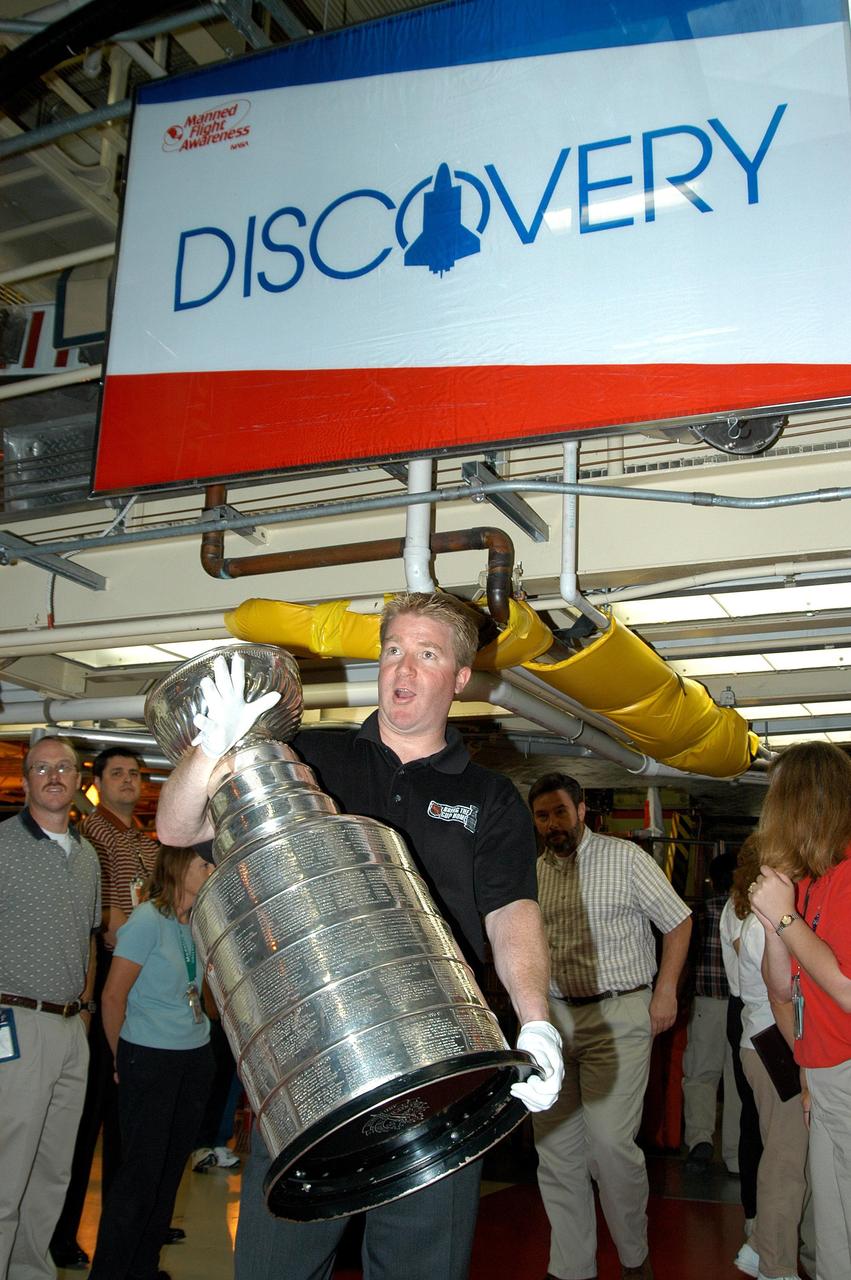
KENNEDY SPACE CENTER, FLA. - In the Orbiter Processing Facility, Mike Bolt holds the Stanley Cup, won this year by the National Hockey League’s Tampa Bay Lightning. Bolt is the Stanley Cup keeper. The cup was also briefly available for viewing by employees in the KSC Training Auditorium. Jay Feaster, general manager of the Tampa Bay Lightning, brought the cup to KSC while on a tour. The Stanley Cup weighs 35 pounds and is more than 100 years old. The Lightning will be added to the cup in September.
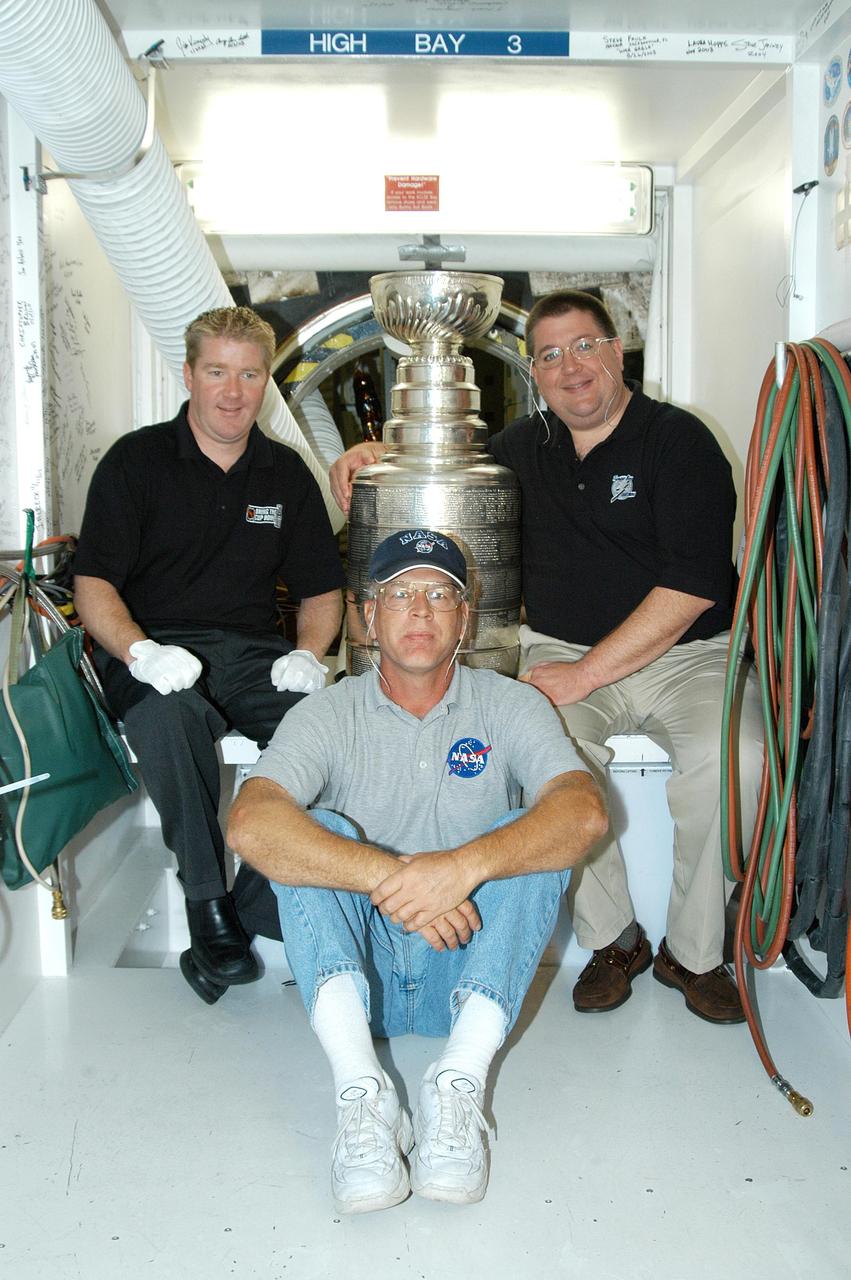
KENNEDY SPACE CENTER, FLA. - Sitting in front of the open hatch into Discovery, which is in the Orbiter Processing Facility, Mike Bolt (left), NASA’s Jack Legere (center front) and Jay Feaster (right) display the Stanley Cup. Feaster is general manager of the Tampa Bay Lightning, who won the cup in 2004, and Bolt is keeper of the cup. Legere is NASA Quality Assurance specialist for the Shuttle Program. The cup was also briefly available for viewing by employees in the KSC Training Auditorium. Feaster brought the cup to KSC while on a tour. The Stanley Cup weighs 35 pounds and is more than 100 years old. The Lightning will be added to the cup in September.
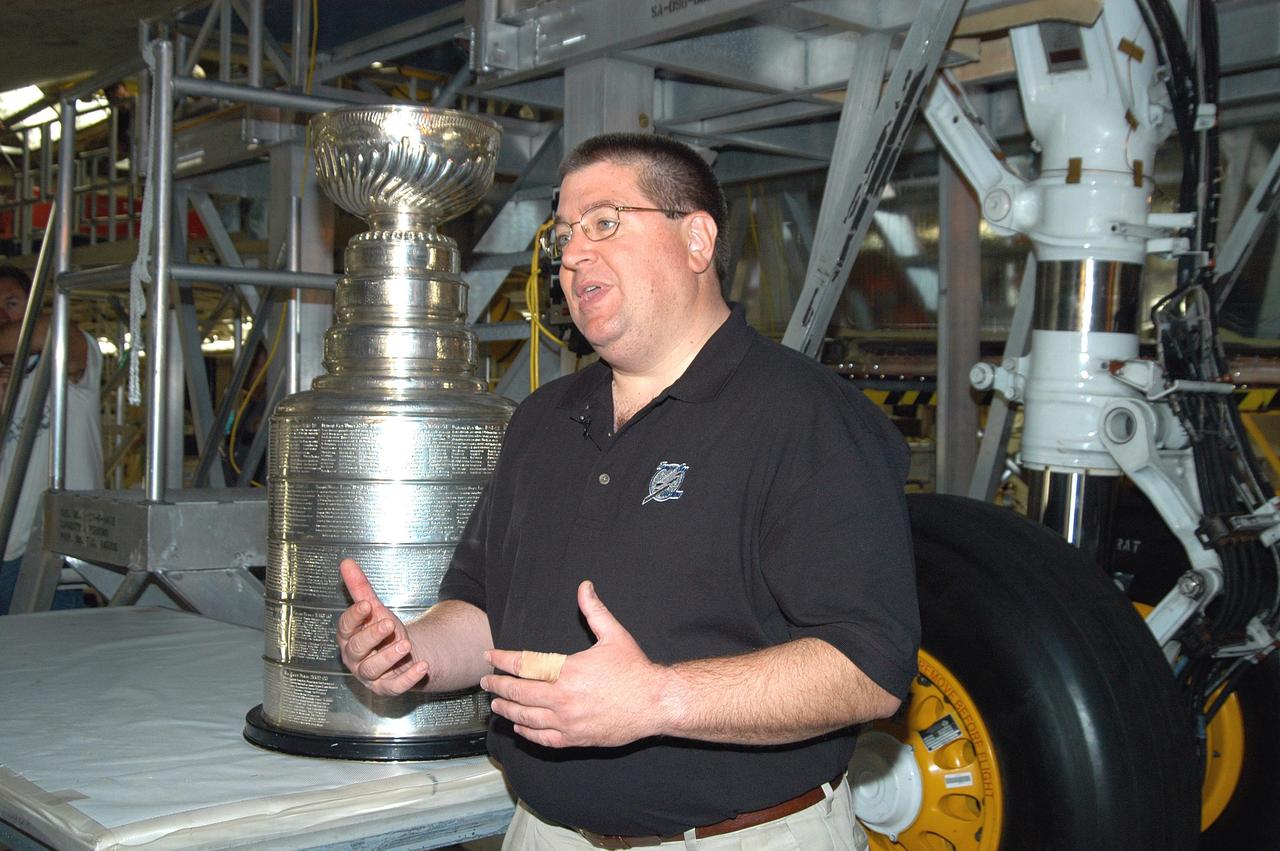
KENNEDY SPACE CENTER, FLA. - Jay Feaster, general manager of the National Hockey League 2004 Champions Tampa Bay Lightning, stands next to the Stanley Cup, which he brought to KSC while on a tour. The cup stands next to the orbiter Discovery in the Orbiter Processing Facility. The cup was also briefly available for viewing by employees in the KSC Training Auditorium. The Stanley Cup weighs 35 pounds and is more than 100 years old. The Lightning will be added to the cup in September.
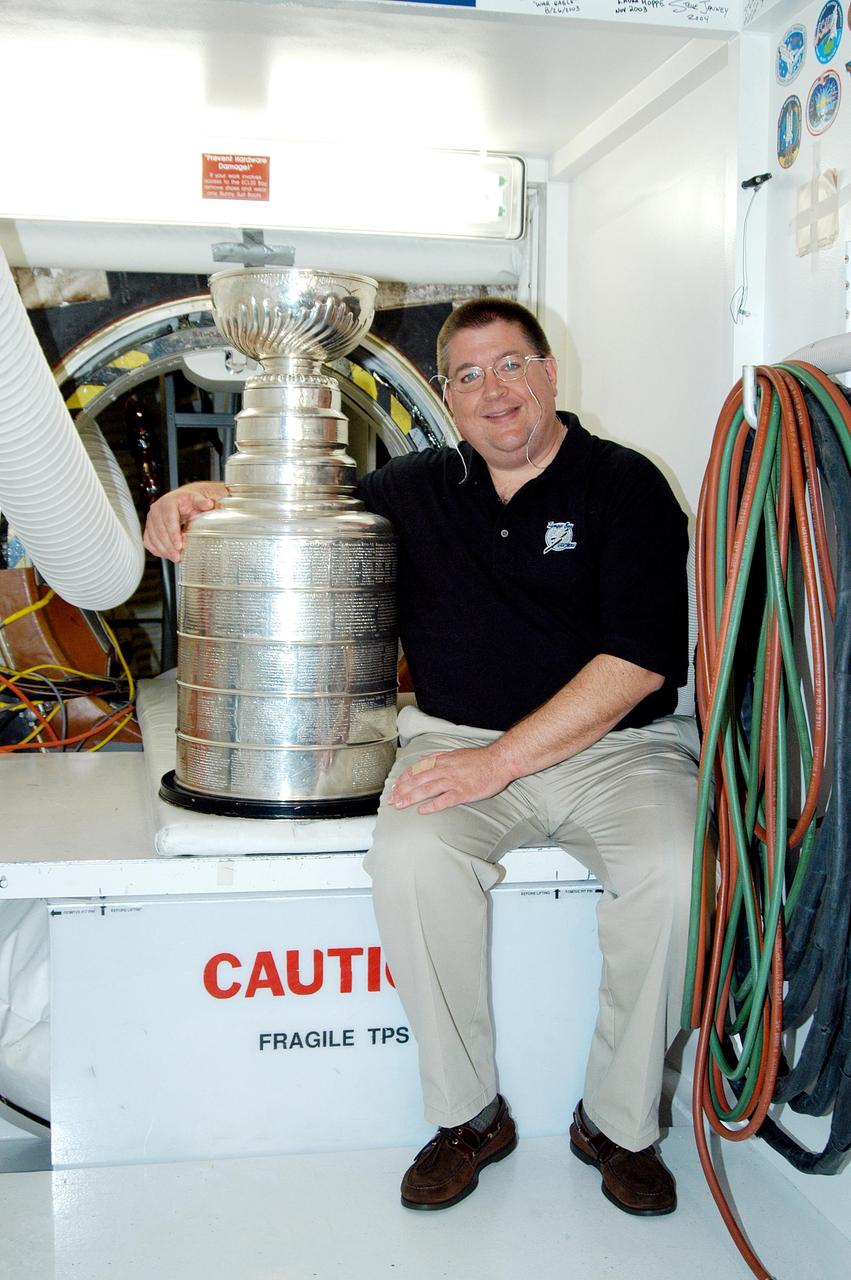
KENNEDY SPACE CENTER, FLA. - In the Orbiter Processing Facility, Jay Feaster, general manager of the National Hockey League 2004 Champions Tampa Bay Lightning, sits next to the Stanley Cup in front of the open hatch into Discovery. The cup was also briefly available for viewing by employees in the KSC Training Auditorium. Feaster brought the cup to KSC while on a tour. The Stanley Cup weighs 35 pounds and is more than 100 years old. The Lightning will be added to the cup in September.
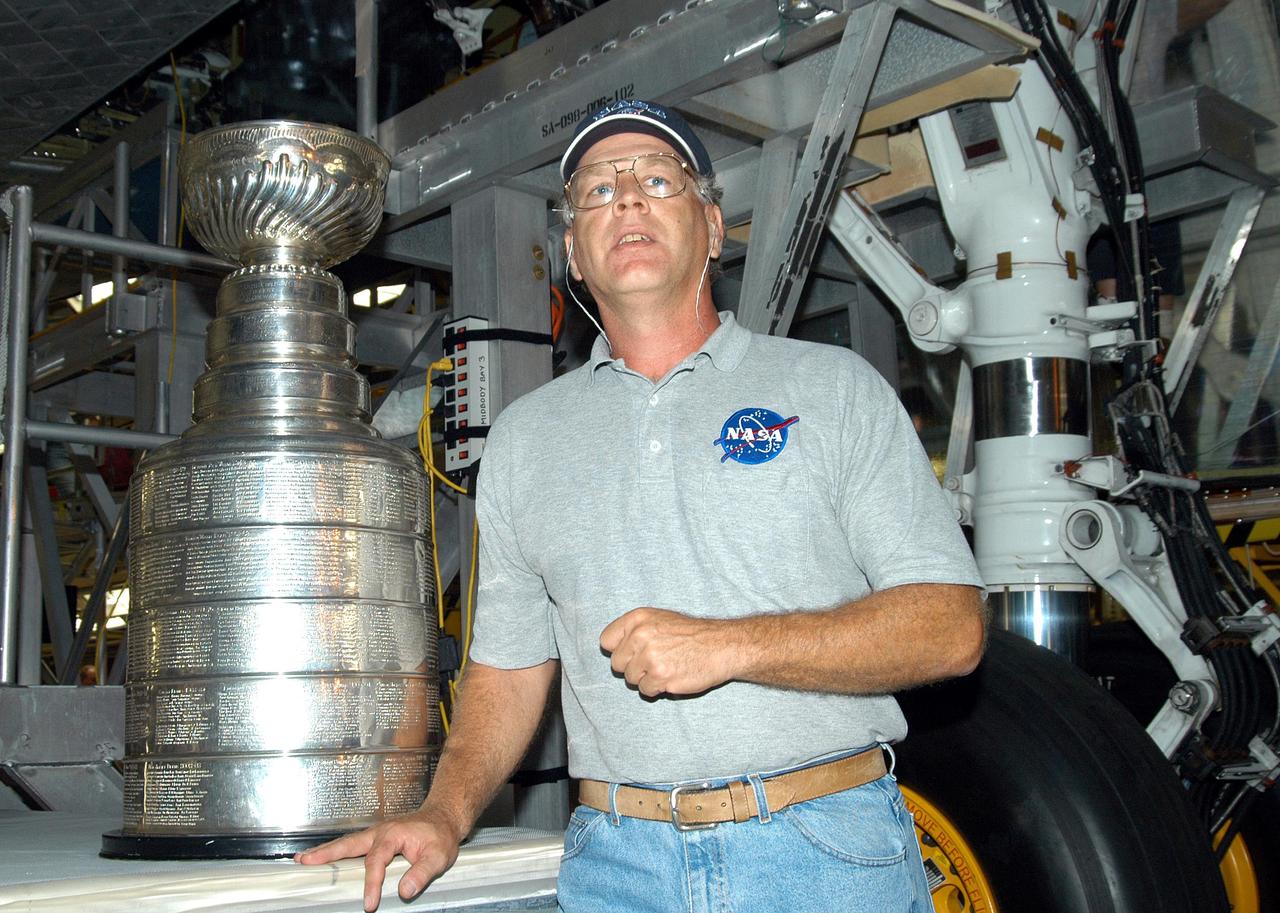
KENNEDY SPACE CENTER, FLA. - Jack Legere, NASA Quality Assurance specialist for the Shuttle Program, displays the Stanley Cup to employees in the Orbiter Processing Facility. Behind him is Discovery. Jay Feaster, general manager of the National Hockey League 2004 Champions Tampa Bay Lightning, brought the cup to KSC while on a tour. The cup was also briefly available for viewing by employees in the KSC Training Auditorium. The Stanley Cup weighs 35 pounds and is more than 100 years old. The Lightning will be added to the cup in September.

KENNEDY SPACE CENTER, FLA. - In the Orbiter Processing Facility, Jay Feaster, general manager of the National Hockey League 2004 Champions Tampa Bay Lightning, displays the Stanley Cup. At right is KSC Deputy Director Woodrow Whitlow. The cup was also briefly available for viewing by employees in the KSC Training Auditorium. Feaster brought the cup to KSC while on a tour. The Stanley Cup weighs 35 pounds and is more than 100 years old. The Lightning will be added to the cup in September.
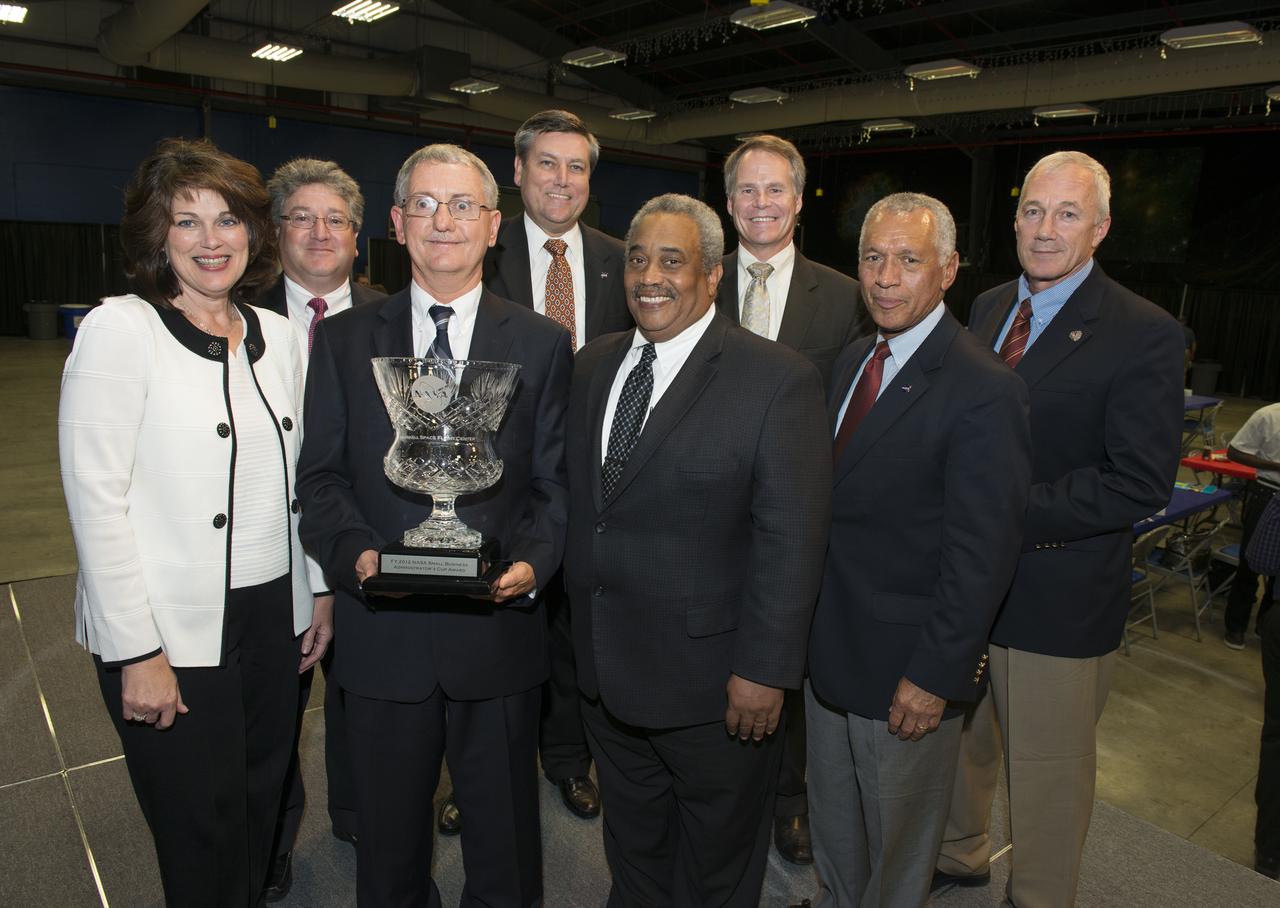
NASA ADMINISTRATOR CHARLES BOLDEN PRESENTS CENTER LEADERS WITH THE SMALL BUSINESS ADMINISTRATOR’S CUP. PARTICIPATING IN THE AWARD CEREMONY WERE, FROM LEFT, MARSHALL ASSOCIATE DIRECTOR ROBIN HENDERSON, DAVID IOSCO, DEPUTY DIRECTOR OF MARSHALL’S OFFICE OF PROCUREMENT; MARSHALL SMALL BUSINESS SPECIALIST DAVID BROCK; MARSHALL CENTER DIRECTOR PATRICK SCHEUERMANN; GLENN DELGADO, ASSOCIATE ADMINISTRATOR OF NASA’S OFFICE OF SMALL BUSINESS PROGRAMS; KIM WHITSON, DIRECTOR OF MARSHALL’S OFFICE OF PROCUREMENT; NASA ADMINISTRATOR CHARLES BOLDEN; AND TERRY WILCUTT, ASSOCIATE ADMINISTRATOR OF NASA’S OFFICE OF SAFETY AND MISSION ASSURANCE.

GENERAL ELECTRIC GE 2 CUP SECTOR
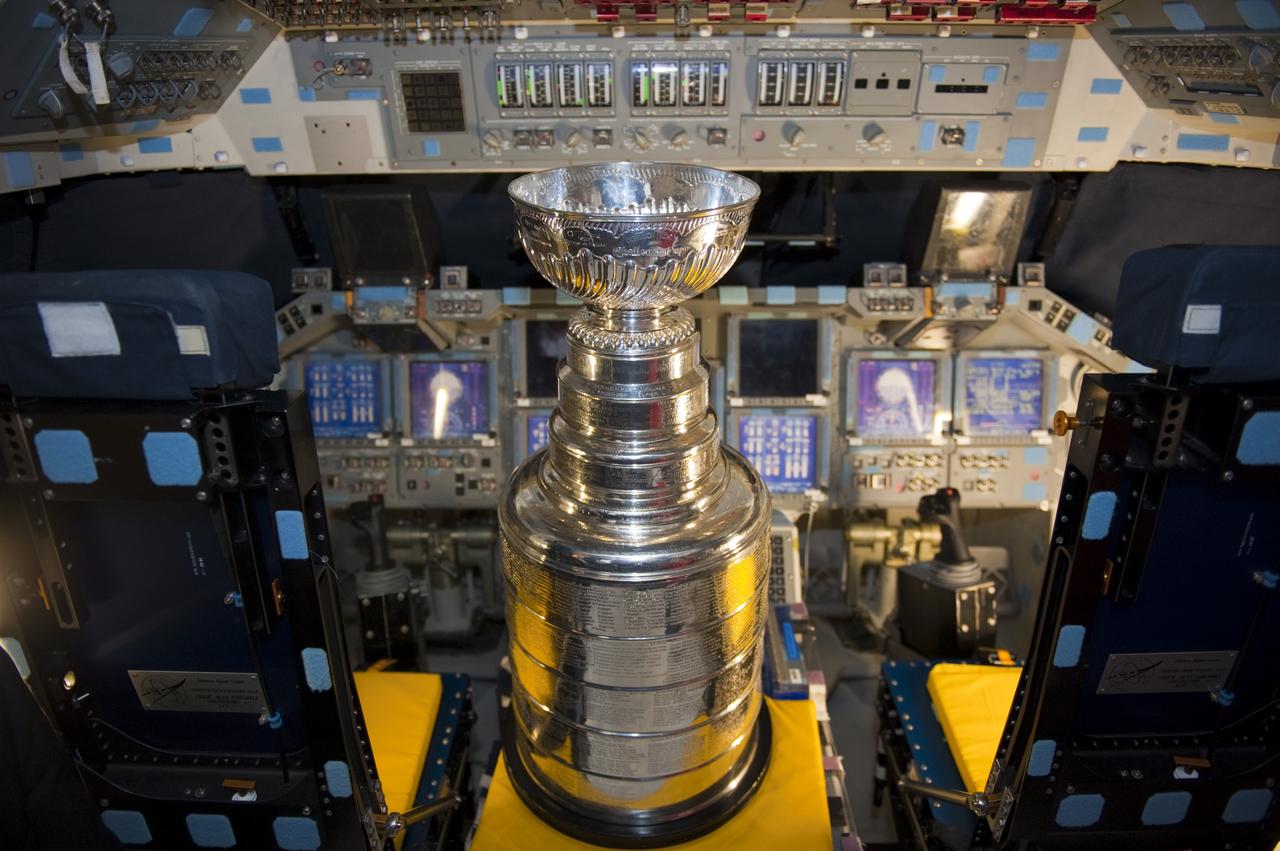
CAPE CANAVERAL, Fla. -- In Orbiter Processing Facility-2 at NASA's Kennedy Space Center in Florida, Lord Stanley’s Cup sits in the flight deck of space shuttle Atlantis. The Stanley Cup was awarded to the Boston Bruins after winning the 2011 National Hockey League (NHL) Championship. Jeremy Jacobs, chairman and chief executive officer of Delaware North Companies and owner of the Boston Bruins, brought the cup for Kennedy and Delaware North employees to view and take photographs of. The Stanley Cup is 34 1/4 inches tall, weighs 34 1/2 pounds and is more than 100 years old. Atlantis is being prepared for public display in 2013 at the Kennedy Space Center Visitor Complex. For more information, visit http://www.nasa.gov/shuttle. Photo credit: NASA/Kim Shiflett

iss071e650313 (Sept. 14, 2024) --- Expedition 71 Flight Engineer (from left) Don Pettit from NASA demonstrates filling a specially-made coffee cup from a drink bag to Expedition 71 Flight Engineer Alexey Ovchinin from Roscosmos. The coffee stays inside the cup due to surface tension, a property that enables liquids to resist an external force, such as microgravity, and adhere, or stick to a surface.
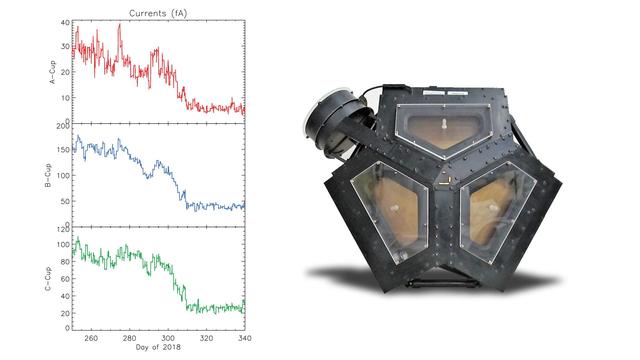
The set of graphs on the left illustrates the drop in electrical current detected in three directions by Voyager 2's plasma science experiment (PLS) to background levels. They are among the key pieces of data that Voyager scientists used to determine that Voyager 2 entered interstellar space, the space between stars, in November 2018. The disappearance in electrical current in the sunward-looking detectors indicates the spacecraft is no longer in the outward flow of solar wind plasma. It is instead in a new plasma environment -- interstellar medium plasma. The image on the right shows the Faraday cups of the PLS. The three sunward pointed cups point in slightly different directions in order to measure the direction of the solar wind. The fourth cup (on the upper left) points perpendicular to the others. https://photojournal.jpl.nasa.gov/catalog/PIA22922
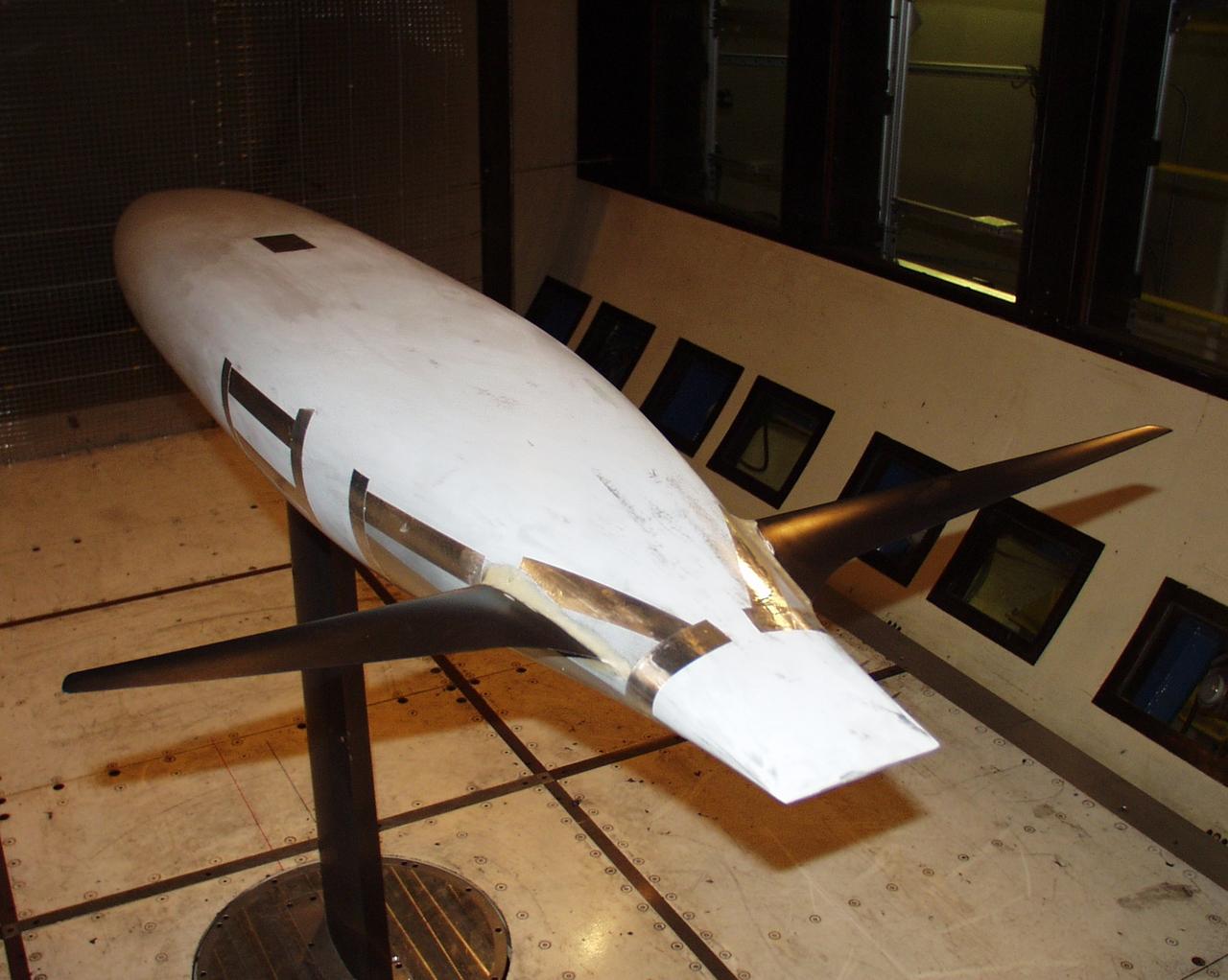
One World Challenge: boat hull configuration optimization test 12-0095 in Ames 12ft pressure wind tunnel. (Three phase Dec 2000 thru May 2002 - America Cup Sailing)

One World Challenge: boat hull configuration optimization test 12-0095 in Ames 12ft pressure wind tunnel. (Three phase Dec 2000 thru May 2002 - America Cup Sailing)
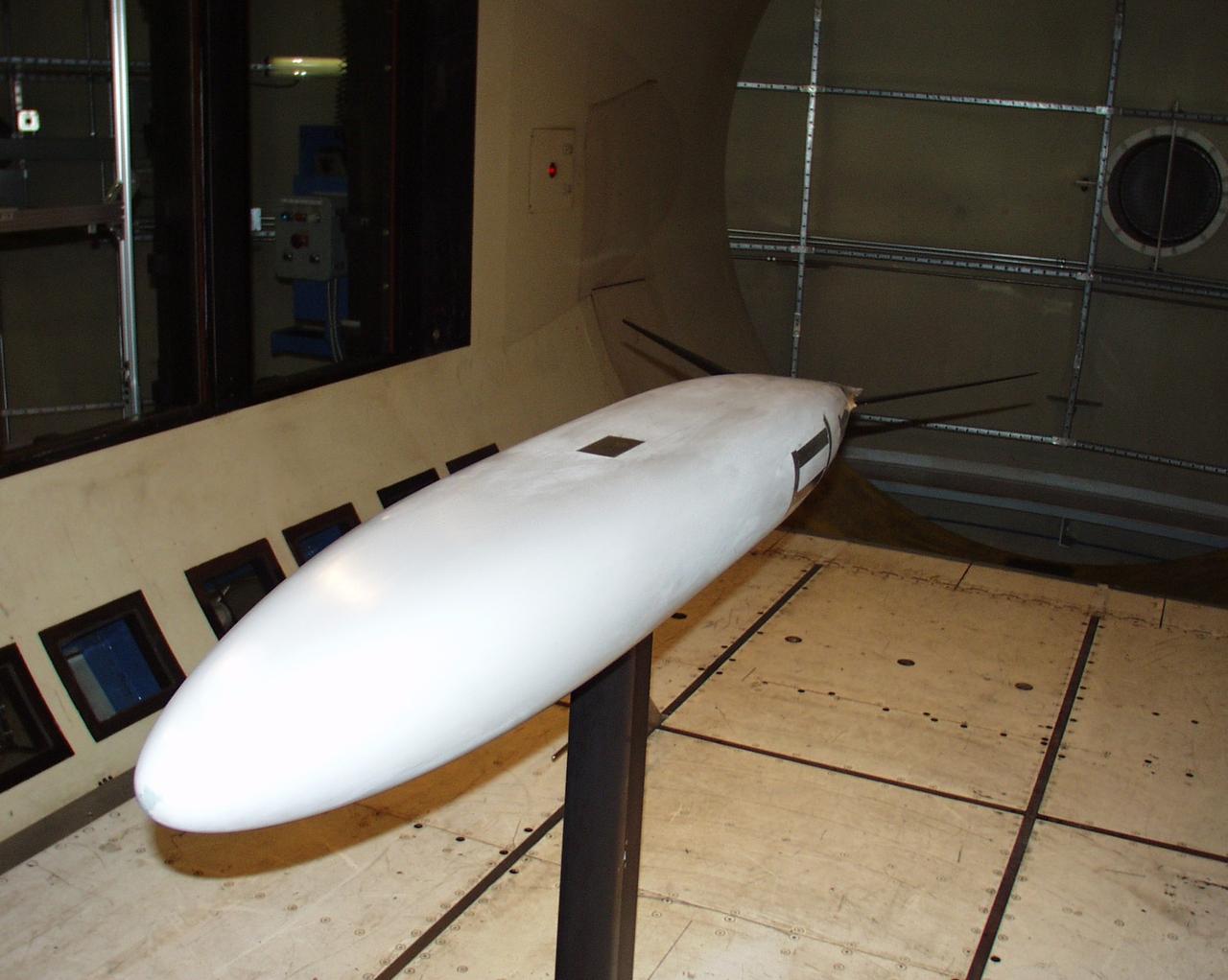
One World Challenge: boat hull configuration optimization test 12-0095 in Ames 12ft pressure wind tunnel. (Three phase Dec 2000 thru May 2002 - America Cup Sailing)

BYRON BUTLER, DIRECTOR, OFFICE OF PROCUREMENT NASA, MARSHALL SPACE FLIGHT CENTER ASSISTING DAVID BROCK, SMALL BUSINESS SPECIALIST, AS HE IS BEING CONGRATULATED BY NASA ADMINISTRATOR CHARLES BOLDEN ON RECEIVING THE NASA SMALL BUSINESS ADMINISTRATOR’S CUP AWARD FOR FISCAL YEAR 2010.
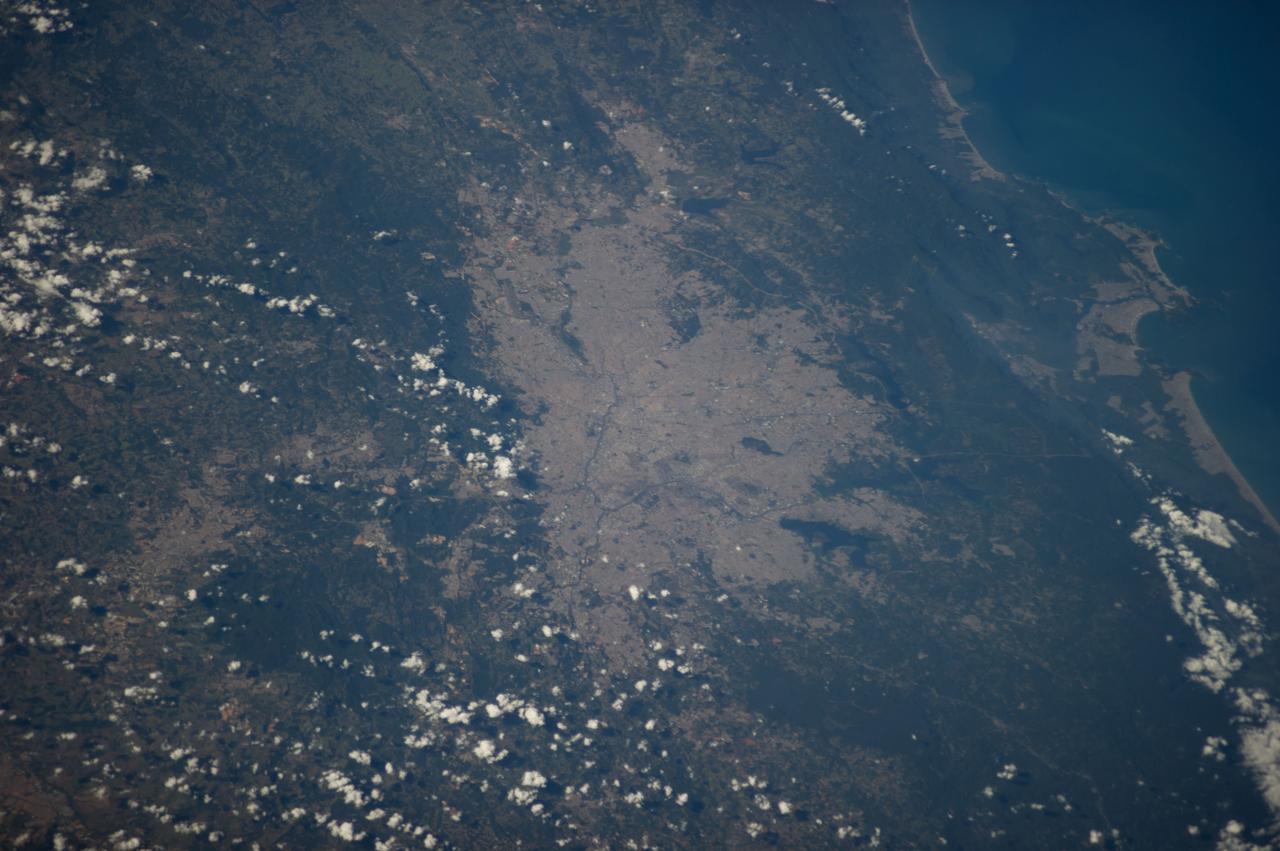
ISS040-E-010803 (12 June 2014) --- One of the Expedition 40 crew members aboard the International Space Station photographed this image featuring Sao Paulo, one of the host cities in Brazil for the 2014 World Cup. A 200mm focal length was used to record the photograph on June 12.
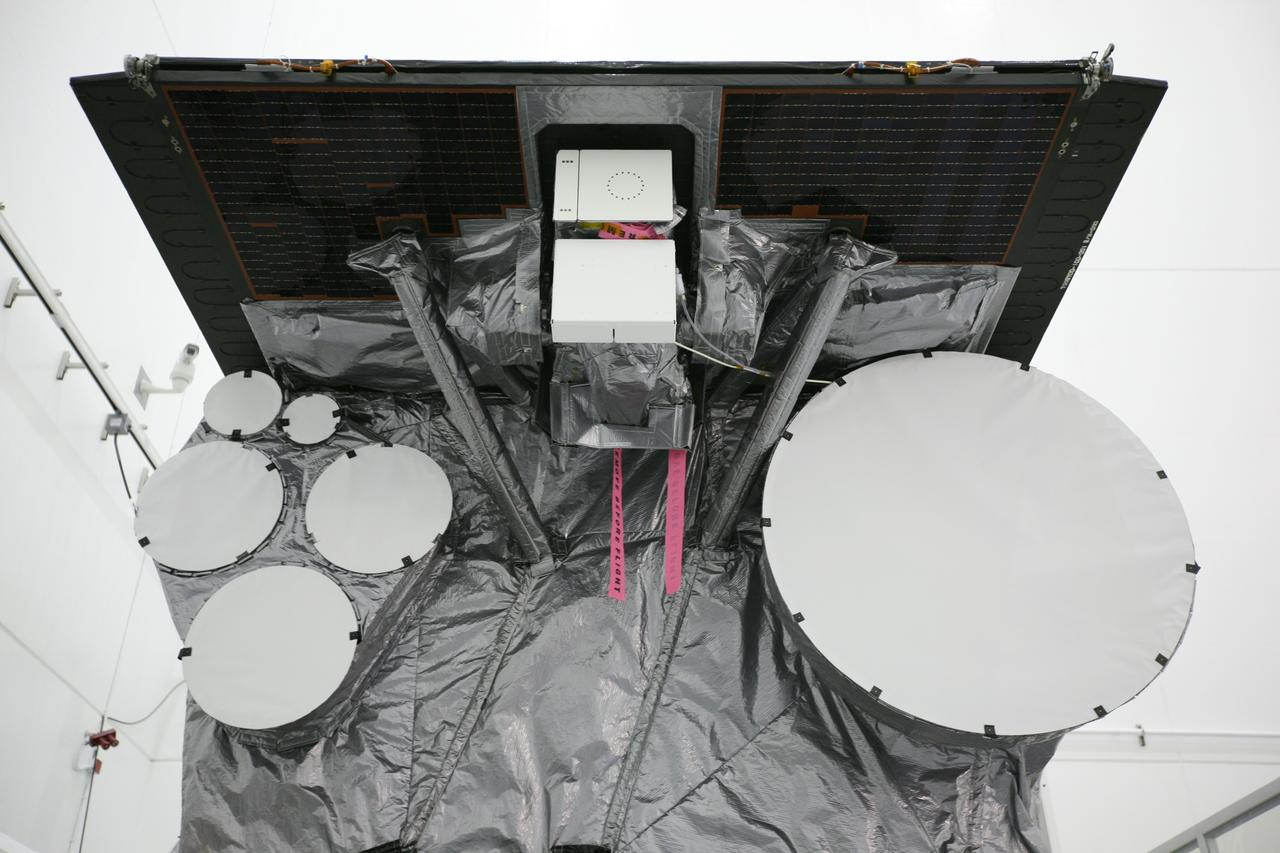
CAPE CANAVERAL, Fla. – At the Astrotech Space Operations facility in Titusville, Fla., the components of NASA's GOES-P meteorological satellite are in view following the spacecraft's unbagging. The cup-shaped objects on the left side of the spacecraft include the S-band and L-band antennas. The large cup-shaped object at right is the ultrahigh frequency, or UHF, antenna. GOES-P, the latest Geostationary Operational Environmental Satellite, was developed by NASA for the National Oceanic and Atmospheric Administration, or NOAA. GOES-P is designed to watch for storm development and observed current weather conditions on Earth. Launch of GOES-P is targeted for no earlier than March 1 from Launch Complex 37 aboard a United Launch Alliance Delta IV rocket. For information on GOES-P, visit http://goespoes.gsfc.nasa.gov/goes/spacecraft/n_p_spacecraft.html. Photo credit: NASA/Amanda Diller

ISS040-E-010458 (12 June 2014) --- Early morning of June 12, one of the Expedition 40 crew members aboard the International Space Station took this picture of Brazil, site of the 2014 World Cup soccer matches, which start this week. Sao Paulo is the large cluster of night lights near the coast on the right side of the frame. Rio de Janeiro is the coastal city to the left of Sao Paulo. Belo Horizonte is the cluster of lights near frame center.

TODD MAY, SPECIAL TECHNICAL ASSISTANT TO THE MARSHALL CENTER DIRECTOR, AND NASA ADMINISTRATOR CHARLES BOLDEN TALK WITH HUNTSVILLE CITY MAYOR TOMMY BATTLE, CENTER, DURING THE MARSHALL SMALL BUSINESS ALLIANCE MEETING MARCH 24 AT THE DAVIDSON CENTER FOR SPACE EXPLORATION IN HUNTSVILLE. BATTLE PROVIDED OPENING REMARKS AT THE EVENT, AND BOLDEN WELCOMED GUESTS AND PRESENTED THE MARSHALL CENTER WITH THE NASA SMALL BUSINESS ADMINISTRATOR'S CUP AWARD FOR FISCAL YEAR 2010 -- THE SECOND TIME IN THREE YEARS MARSHALL HAS BROUGHT HOME THIS PARTICULAR AWARD FOR EXCELLENCE.

An alien themed cup cake is seen during the Mars celebration Saturday, June 1, 2019, in Mars, Pennsylvania. NASA is in the small town to celebrate Mars exploration and share the agency’s excitement about landing astronauts on the Moon in five years. The celebration includes a weekend of Science, Technology, Engineering, Arts and Mathematics (STEAM) activities. Photo Credit: (NASA/Bill Ingalls)
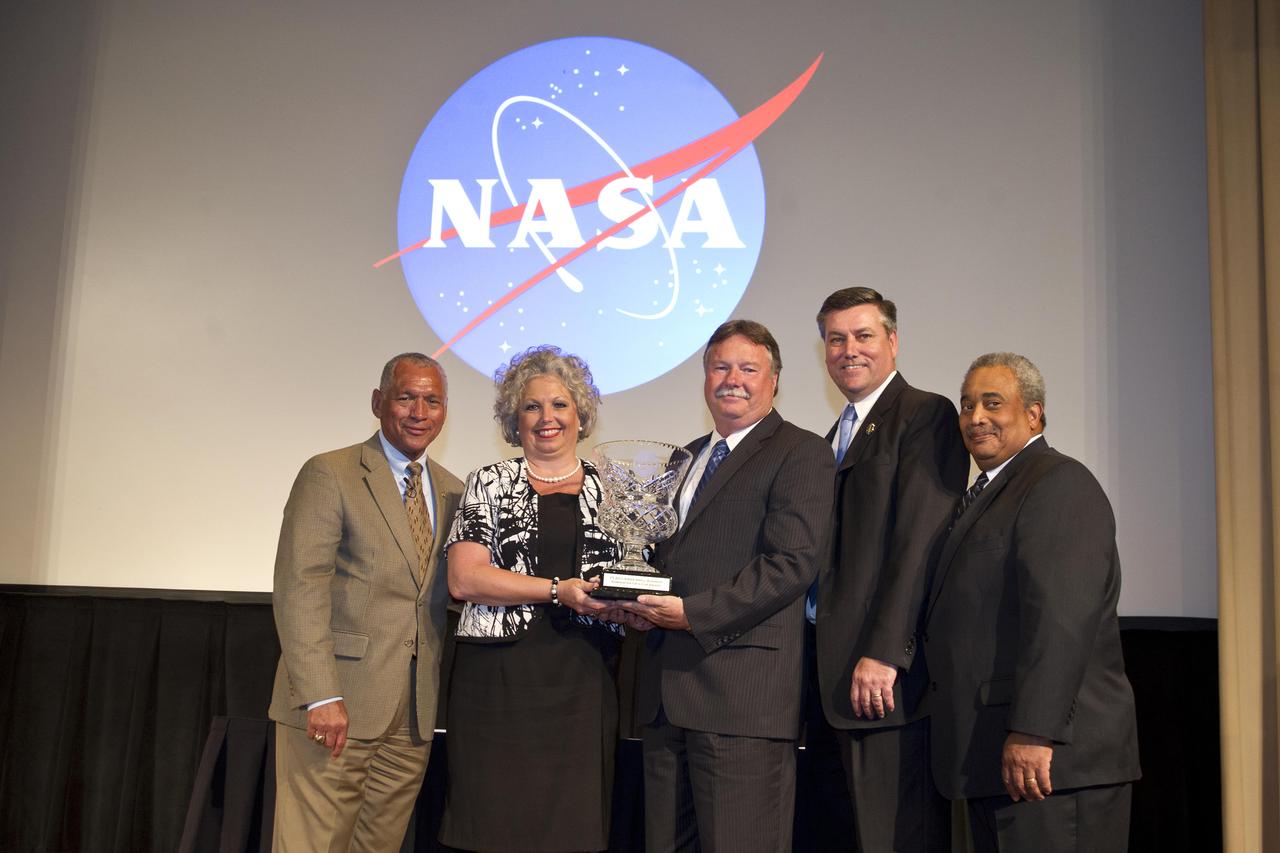
NASA Administrator Charles Bolden (l) and NASA Small Business Programs Associate Administrator Glenn Delgado (r) present NASA's Small Business Administrator's Cup Award to Stennis Space Center in recognition of its stellar small business program for fiscal year 2011. Receiving the award April 20, 2012, are (l to r) Stennis Procurement Office personnel Michelle Stracener and Rob Harris, along with Stennis Space Center Director Patrick Scheuermann. Bolden and Delgado presented the award during an onsite visit April 20.

Wearing native garb, Expedition 49 backup crewmembers Mark Vande Hei of NASA and Alexander Misurkin and Nikolai Tikhonov of Roscosmos enjoy a cup a tea in a traditional Kazakh setting at a local museum Sept. 10 while on a tour of the city of Baikonur, Kazakhstan. They are serving as backups to Shane Kimbrough of NASA and Sergey Ryzhikov and Andrey Borisenko of Roscosmos, who will launch on Sept. 24, Kazakh time from the Baikonur Cosmodrome in Kazakhstan on the Soyuz MS-02 vehicle for a five-month mission on the International Space Station. NASA/Victor Zelentsov
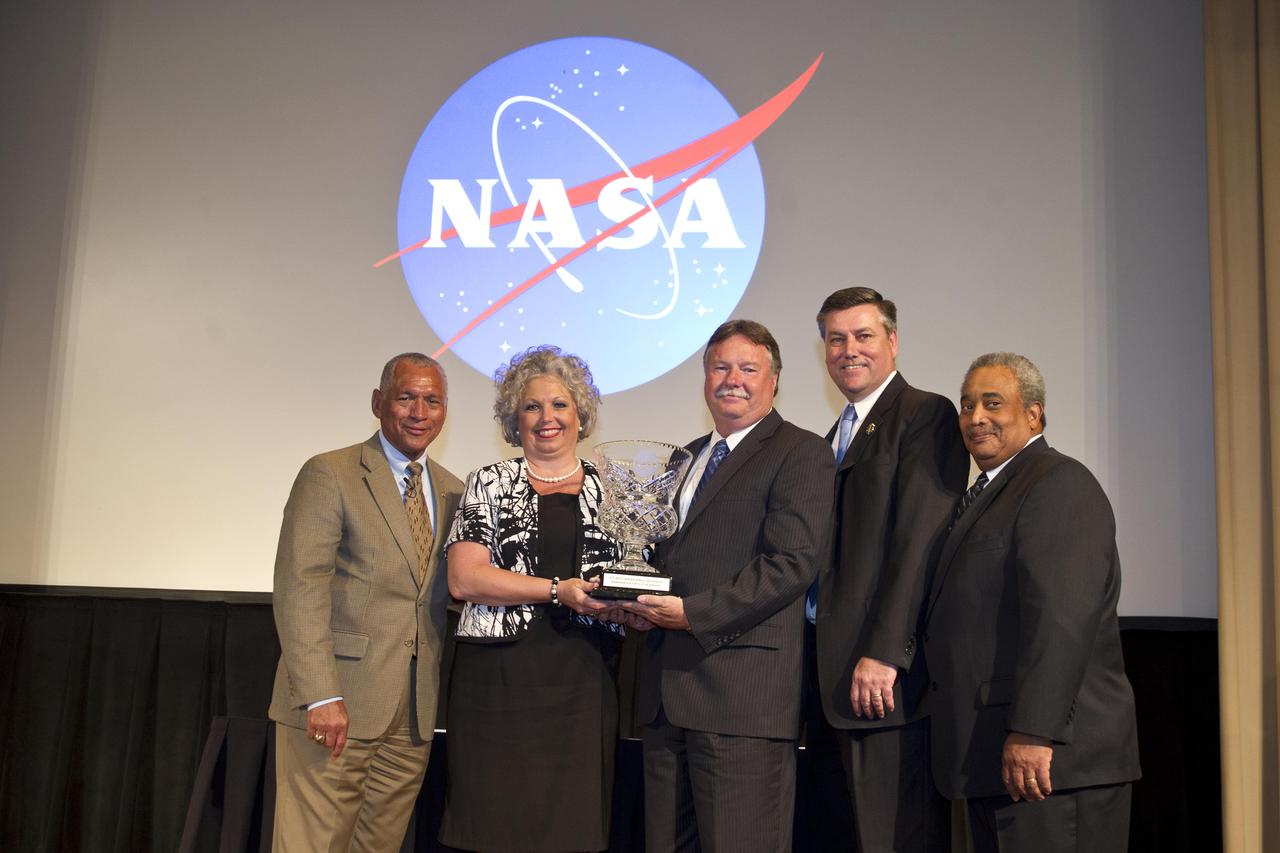
NASA Administrator Charles Bolden (l) and NASA Small Business Programs Associate Administrator Glenn Delgado (r) present NASA's Small Business Administrator's Cup Award to Stennis Space Center in recognition of its stellar small business program for fiscal year 2011. Receiving the award April 20, 2012, are (l to r) Stennis Procurement Office personnel Michelle Stracener and Rob Harris, along with Stennis Space Center Director Patrick Scheuermann. Bolden and Delgado presented the award during an onsite visit April 20.
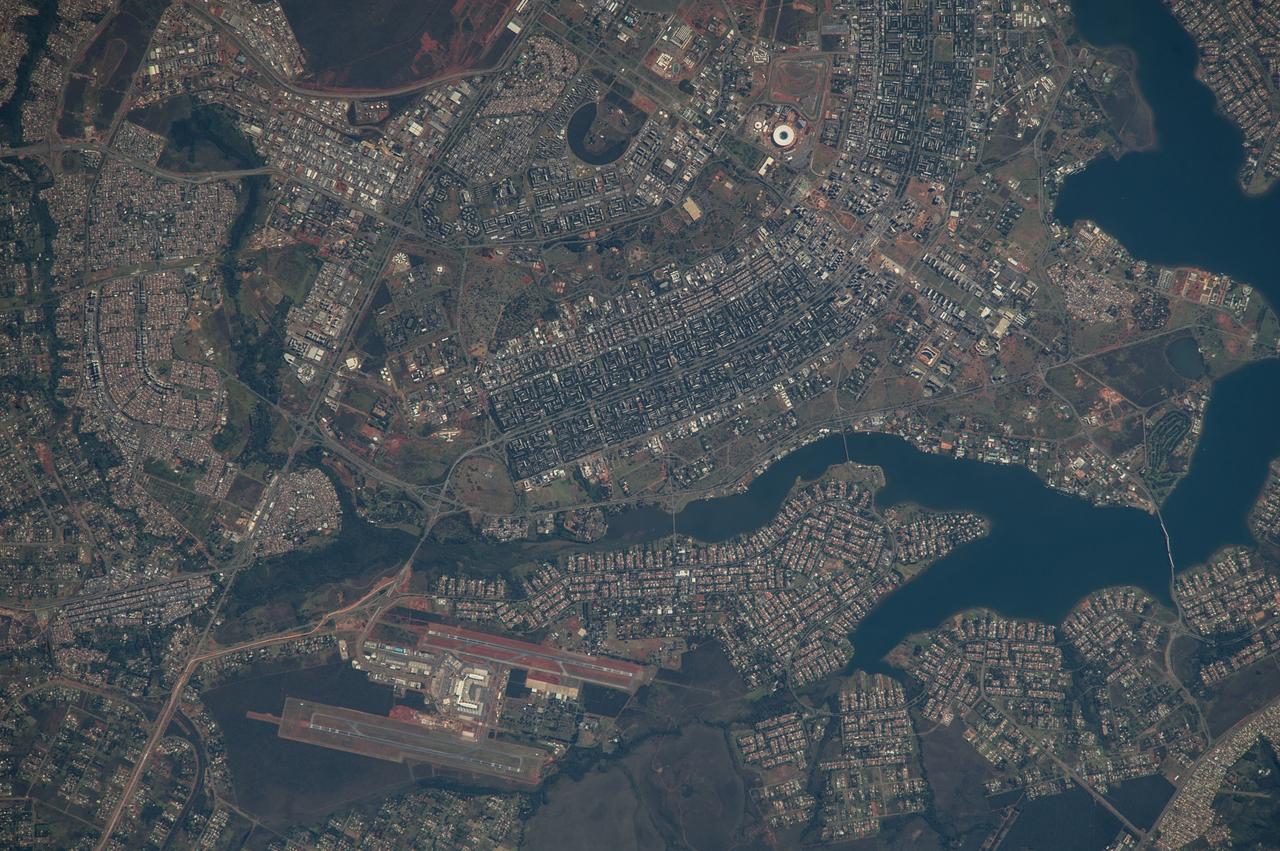
ISS040-E-005839 (28 May 2014) --- The Brasilia World Cup Stadium (top center) is featured in this image photographed by an Expedition 40 crew member on the International Space Station on May 28, 2014. Brazil?s national football stadium, the Estado Nacional, lies near the heart of the capital city of Brasilia. The new roof appears as a brilliant white ring in this image. The stadium is one of Brasilia?s largest buildings. Renovation began in 2010 and it is now the second most expensive stadium in the world, after Wembley Stadium in London, UK. To accommodate expected World Cup fans from all over the world, renovations for all modes of transportation, particularly airports, have been put in place in Brasilia and other host cities. Brasilia?s international airport can be seen lower left on the far side of Lake Paranoa. Brasilia is widely known for its modern building designs and city layout. Space station crew members have the best view of the city?s well-known ?swept wing? city layout ? giving the sense of a flying bird ? expressed in the curves of the boulevards (top). The stadium occupies the city center between the wings. The President Juscelino Kubitschek Bridge crosses the lake at bottom right. Its 1200-meter span gives scale to the city and stadium.
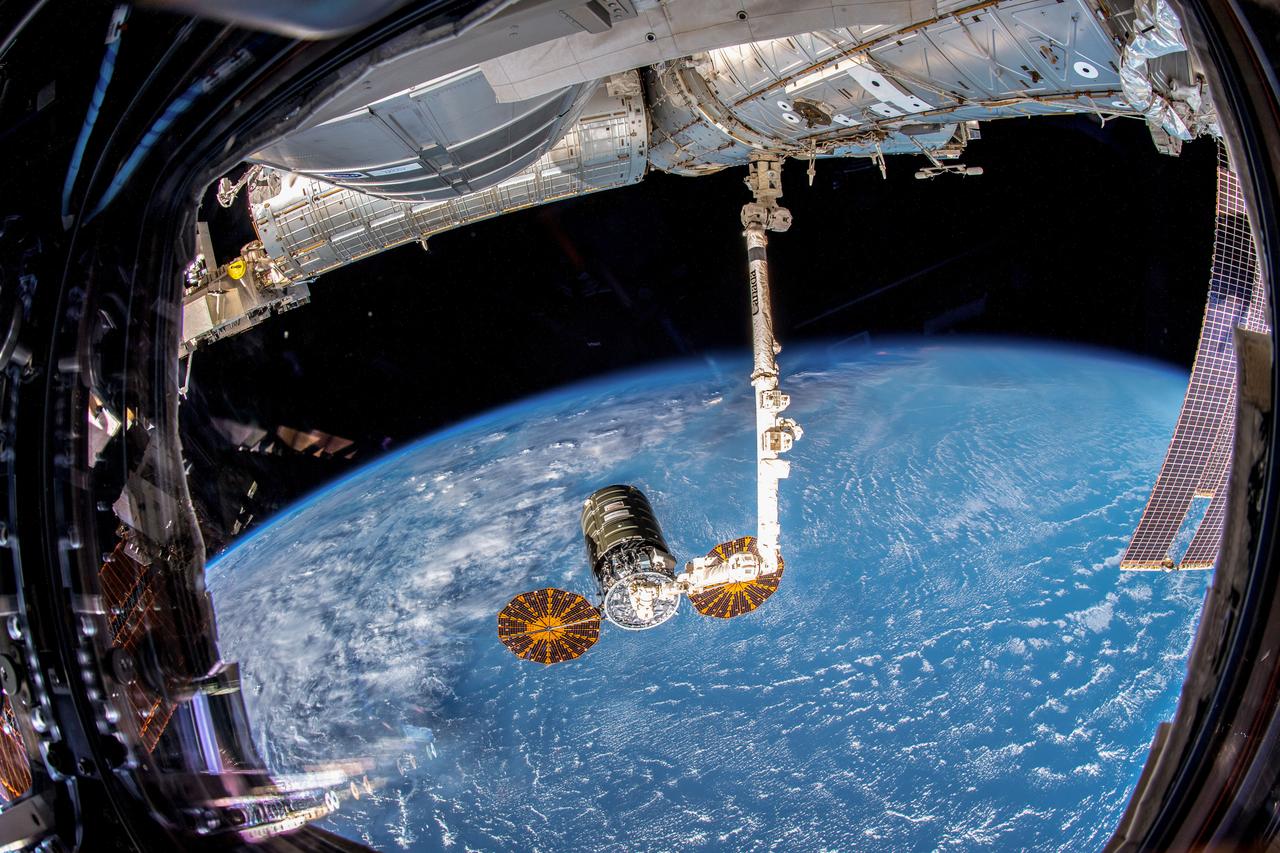
iss057e105337 (Nov. 19, 2018) --- Northrop Grumman's Cygnus space freighter with its prominent cymbal-shaped UltraFlex solar arrays is pictured in the grips of the Canadarm2 robotic arm after it was captured by Expedition 57 Flight Engineer Serena Auñón-Chancellor and ESA (European Space Agency) astronaut Alexander Gerst.
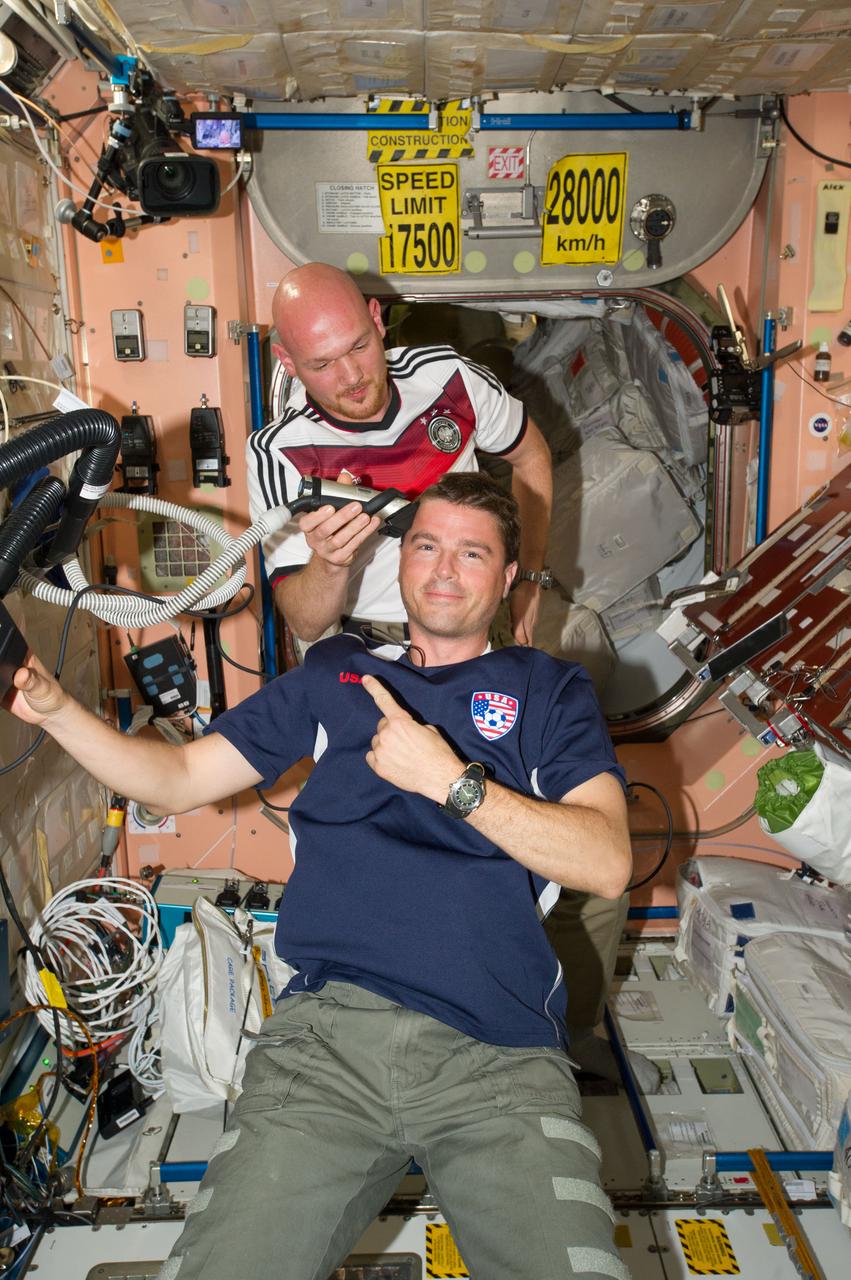
ISS040-E-020378 (26 June 2014) --- European Space Agency astronaut Alexander Gerst, Expedition 40 flight engineer, shaves the head of NASA astronaut Reid Wiseman, flight engineer, in the Unity node of the International Space Station. Gerst used hair clippers fashioned with a vacuum device to garner freshly cut hair. A friendly World Cup Soccer-related agreement between the crew members representing the USA, and Gerst, a German citizen who represents the European Space Agency, called for the American losers of a German-USA match to have their heads shaved. The German team won the match 1-0.
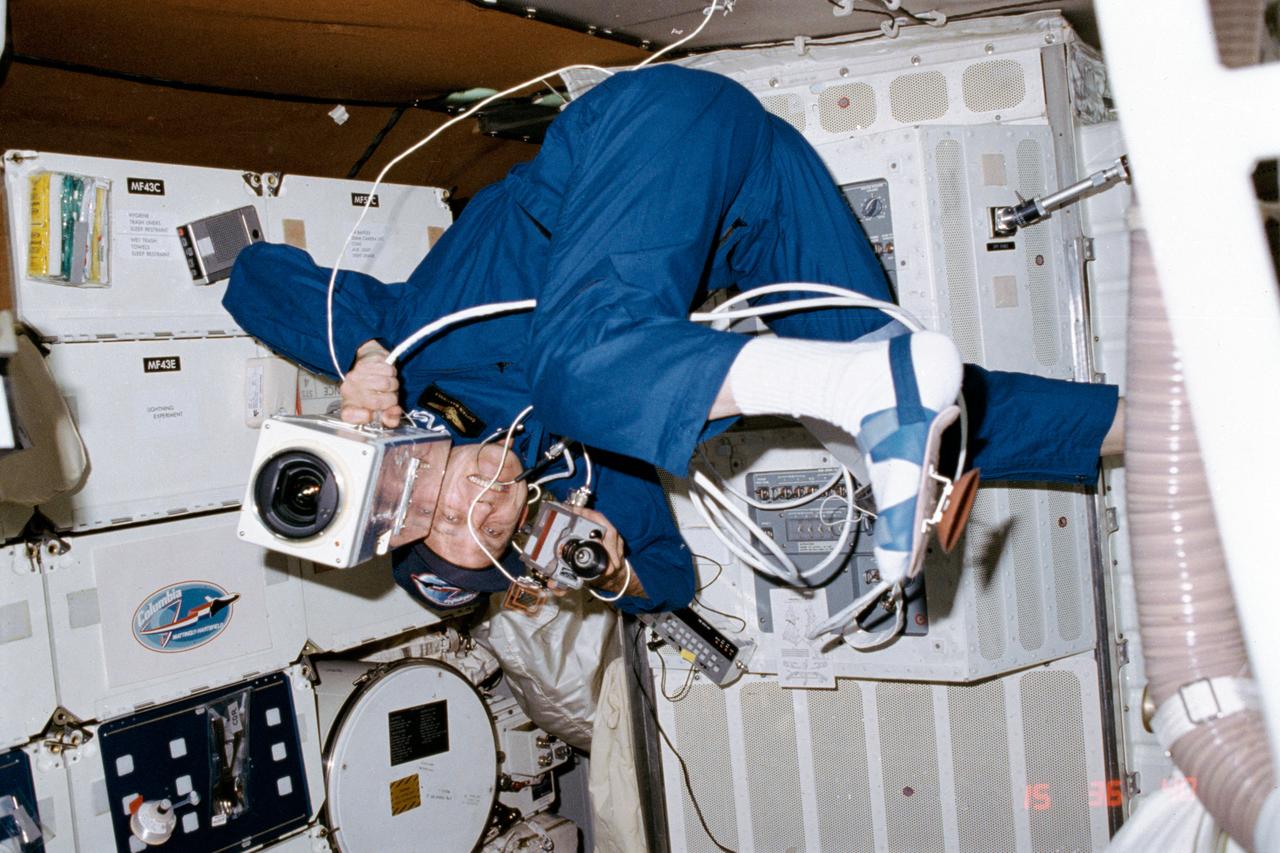
STS004-23-131 (27 June-4 July 1982) ---Astronaut Thomas K. Mattingly II, STS-4 commander, floats in the middeck area of the Earth-orbiting space shuttle Columbia. He handles two cameras at one time. In the commander’s right hand is a 16mm data acquisition camera (DAC), and in his left hand is a TV camera. Note the suction-cup equipped footwear which Mattingly revealed to the world via TV on one of his popular “cook’s tours” from crewmate Henry W. Hartsfield, pilot, operated a 35mm camera to expose this frame. Photo credit: NASA

jsc2019e052908 - At the Baikonur Museum in the town of Baikonur, Kazakhstan, the backup crewmembers for the next launch to the International Space Station enjoy an afternoon cup of tea Sept. 12 in traditional Kazakh garb during a pre-launch tour. Spaceflight participant Sultan Al-Neyadi of the United Arab Emirates (left), Tom Marshburn of NASA (center) and Sergey Ryzhikov of Roscosmos (right) are the backups to the prime Expedition 61 crew, Oleg Skripochka of Roscosmos and Jessica Meir of NASA and spaceflight participant Hazzaa Ali Almansoori of the United Arab Emirates, who will launch Sept. 25 on the Soyuz MS-15 spacecraft for a mission on the International Space Station...NASA/Victor Zelentsov.
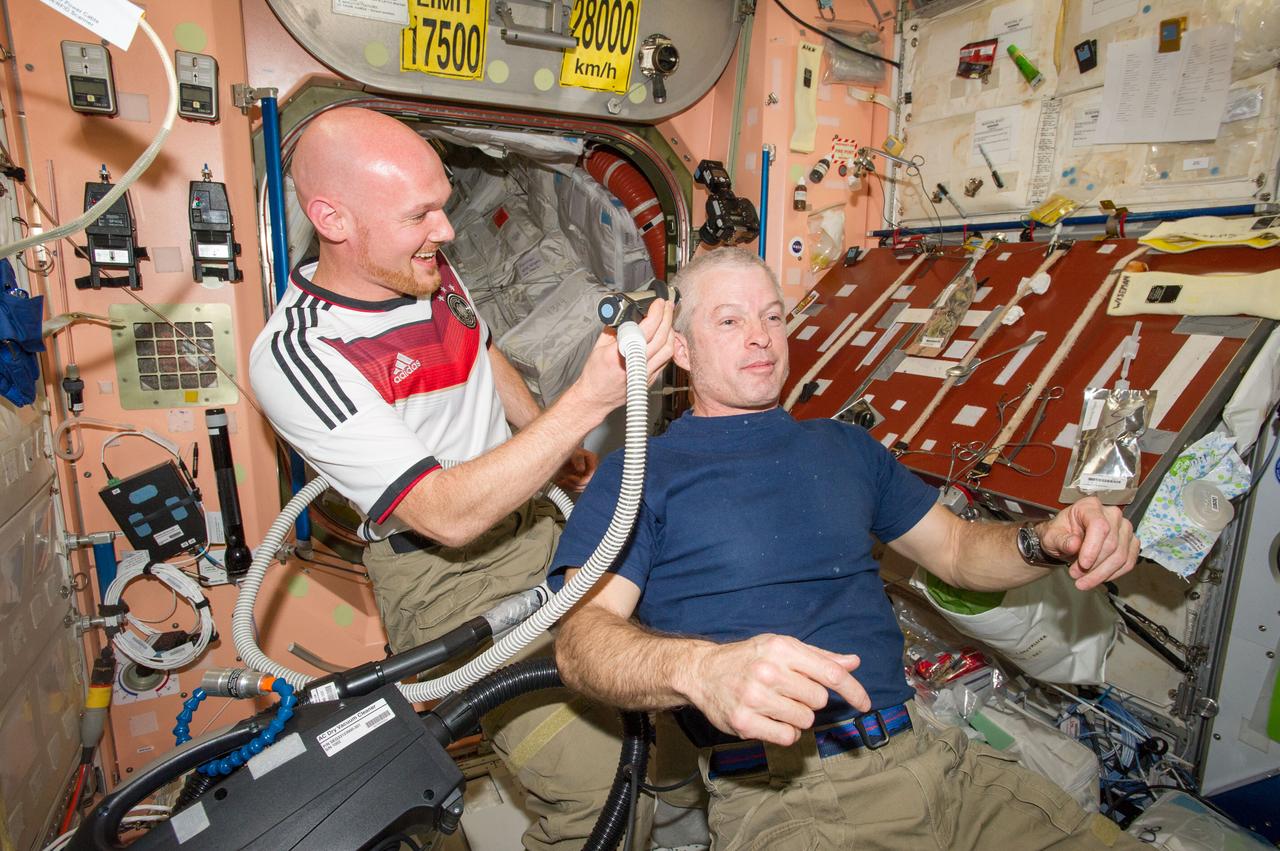
ISS040-E-020364 (26 June 2014) --- European Space Agency astronaut Alexander Gerst, Expedition 40 flight engineer, shaves the head of NASA astronaut Steve Swanson, commander, in the Unity node of the International Space Station. Gerst used hair clippers fashioned with a vacuum device to garner freshly cut hair. A friendly World Cup Soccer-related agreement between the crew members representing the USA, and Gerst, a German citizen who represents the European Space Agency, called for the American losers of a German-USA match to have their heads shaved. The German team won the match 1-0.
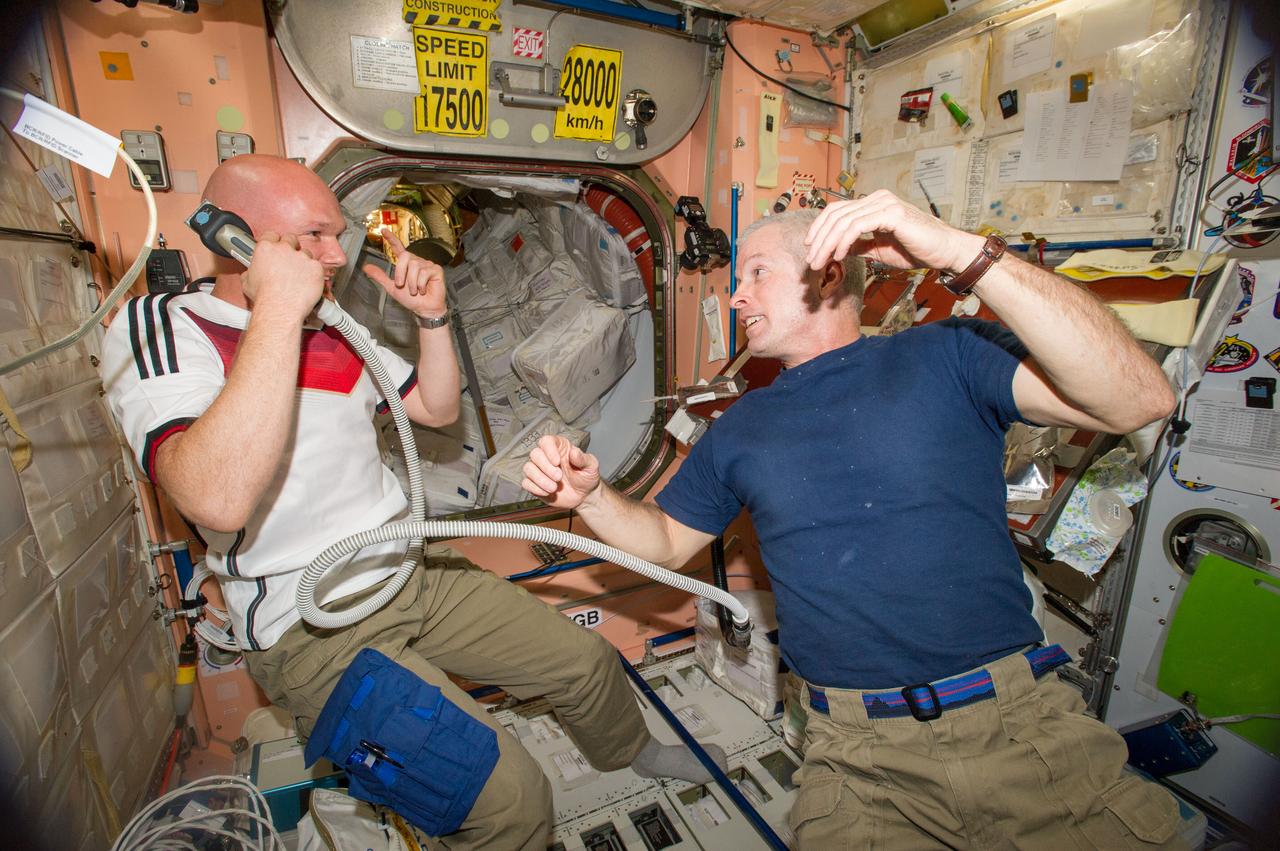
ISS040-E-020361 (26 June 2014) --- NASA astronaut Steve Swanson (right), Expedition 40 commander; and European Space Agency astronaut Alexander Gerst, flight engineer, enjoy a light moment in the Unity node of the International Space Station. Gerst is holding hair clippers fashioned with a vacuum device to garner freshly cut hair. A friendly World Cup Soccer-related agreement between the crew members representing the USA, and Gerst, a German citizen who represents the European Space Agency, called for the American losers of a German-USA match to have their heads shaved. The German team won the match 1-0.

jsc2018e050023 - At the Baikonur Museum in Baikonur, Kazakhstan, Expedition 56 backup crewmembers David Saint-Jacques of the Canadian Space Agency (left), Anne McClain of NASA (center) and Oleg Kononenko of Roscosmos (right) enjoy a cup of tea May 21 in a model of a “yurt”, a traditional Kazakh tent, during pre-launch activities. They are the backups to the prime crewmembers, Serena Aunon-Chancellor of NASA, Sergey Prokopyev of Roscosmos and Alexander Gerst of the European Space Agency, who will launch June 6 on the Soyuz MS-09 spacecraft from Baikonur for a six-month mission on the International Space Station...NASA/Victor Zelentsov.
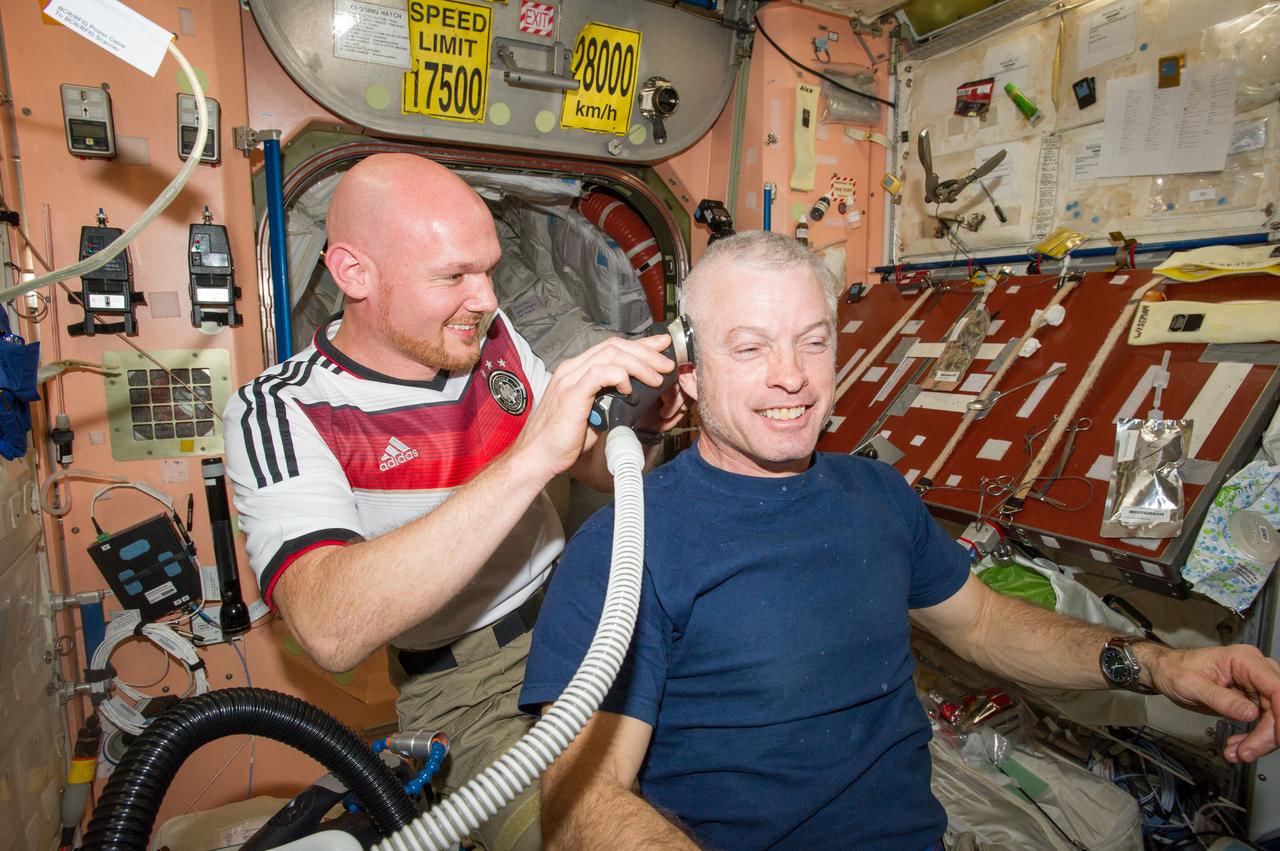
ISS040-E-020368 (26 June 2014) --- European Space Agency astronaut Alexander Gerst, Expedition 40 flight engineer, shaves the head of NASA astronaut Steve Swanson, commander, in the Unity node of the International Space Station. Gerst used hair clippers fashioned with a vacuum device to garner freshly cut hair. A friendly World Cup Soccer-related agreement between the crew members representing the USA, and Gerst, a German citizen who represents the European Space Agency, called for the American losers of a German-USA match to have their heads shaved. The German team won the match 1-0.
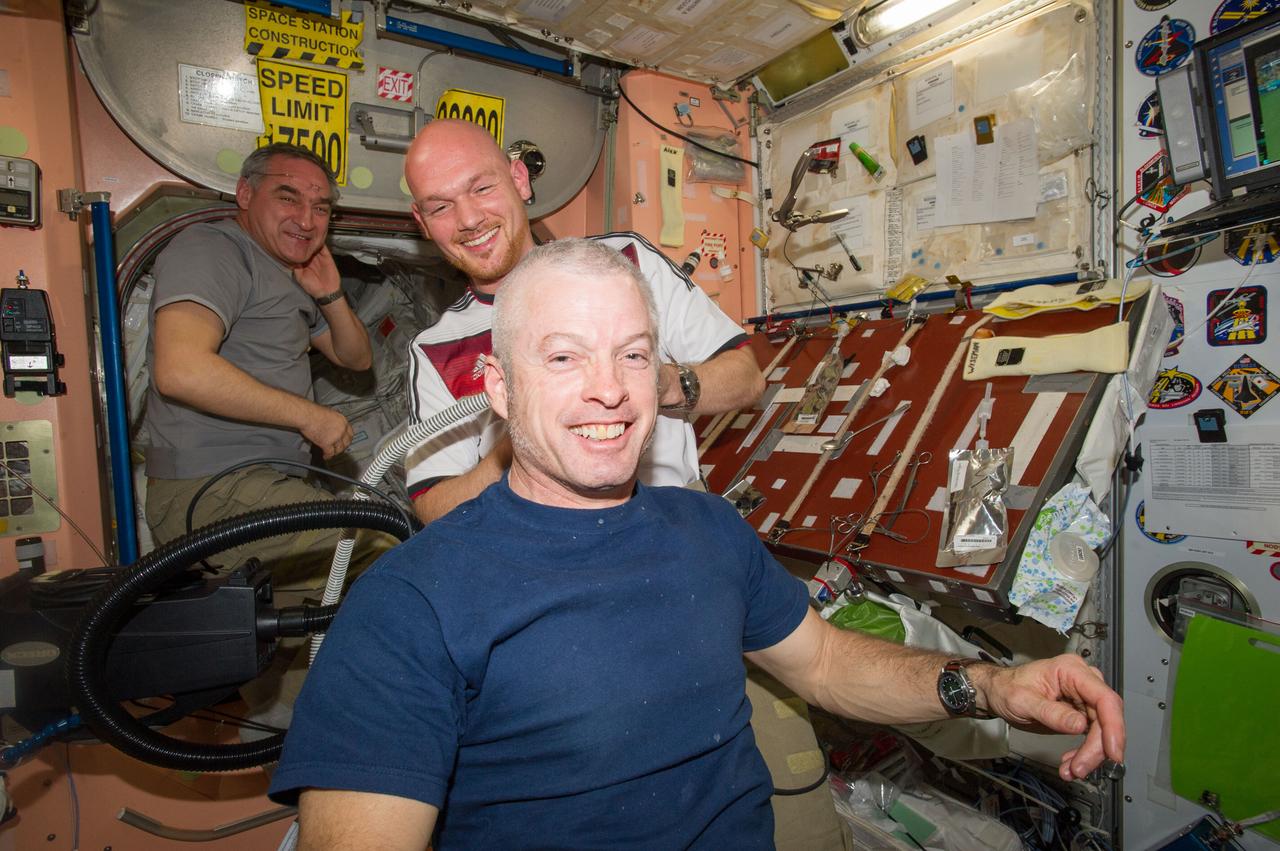
ISS040-E-020367 (26 June 2014) --- European Space Agency astronaut Alexander Gerst, Expedition 40 flight engineer, shaves the head of NASA astronaut Steve Swanson, commander, in the Unity node of the International Space Station. Gerst used hair clippers fashioned with a vacuum device to garner freshly cut hair. Russian cosmonaut Alexander Skvortsov, flight engineer, is visible in the background. A friendly World Cup Soccer-related agreement between the crew members representing the USA, and Gerst, a German citizen who represents the European Space Agency, called for the American losers of a German-USA match to have their heads shaved. The German team won the match 1-0.
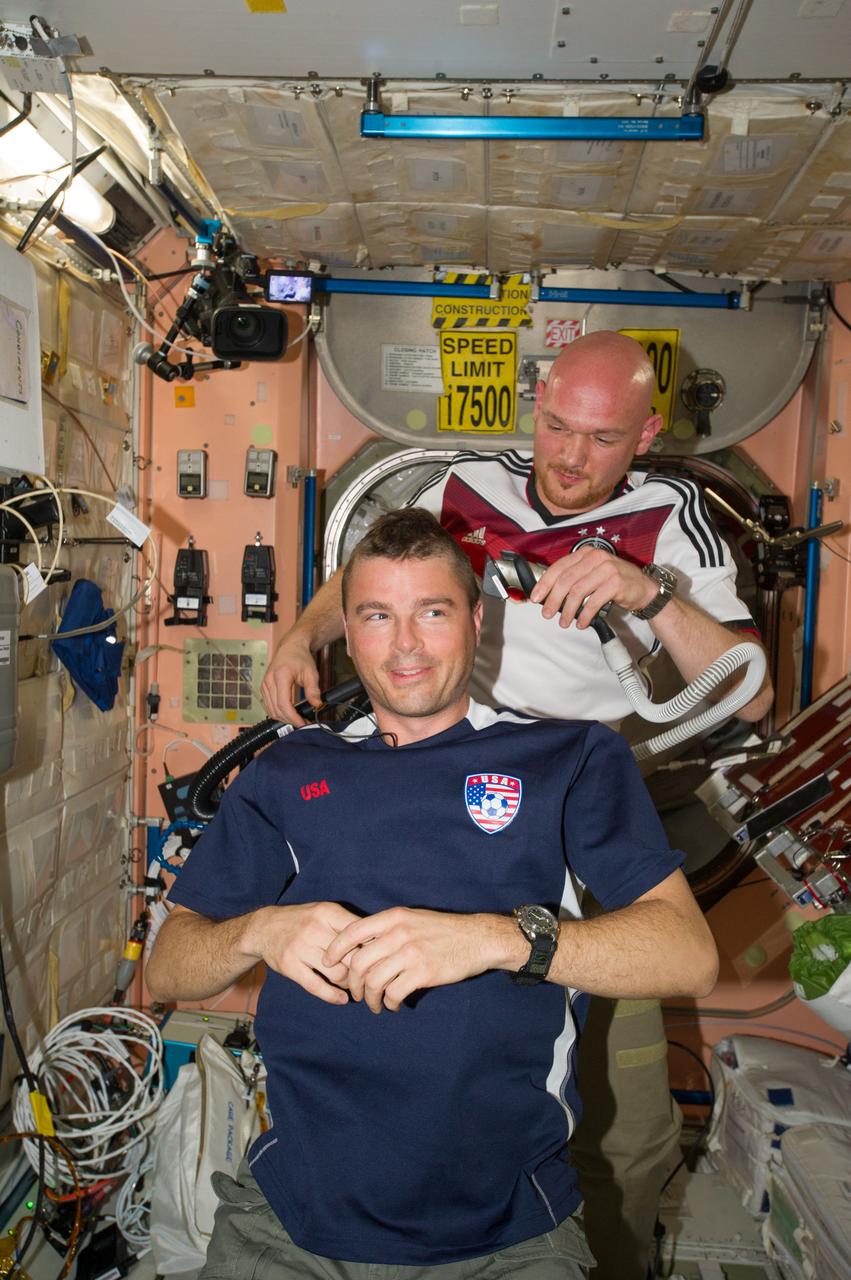
ISS040-E-020384 (26 June 2014) --- European Space Agency astronaut Alexander Gerst, Expedition 40 flight engineer, shaves the head of NASA astronaut Reid Wiseman, flight engineer, in the Unity node of the International Space Station. Gerst used hair clippers fashioned with a vacuum device to garner freshly cut hair. A friendly World Cup Soccer-related agreement between the crew members representing the USA, and Gerst, a German citizen who represents the European Space Agency, called for the American losers of a German-USA match to have their heads shaved. The German team won the match 1-0.

NASA Orbital Processing Facility Inspector Janaro Negrete, fills cups with the post launch traditional beans and cornbread to take share with his colleagues at the Launch Control Center (LCC) after the launch of the space shuttle Discovery (STS-133) at the Kennedy Space Center, Thursday, Feb. 24, 2011, in Cape Canaveral, Fla. Discovery, on its 39th and final flight, is carrying the Italian-built Permanent Multipurpose Module (PMM), Express Logistics Carrier 4 (ELC4) and Robonaut 2, the first humanoid robot in space to the International Space Station. Photo Credit: (NASA/Bill Ingalls)
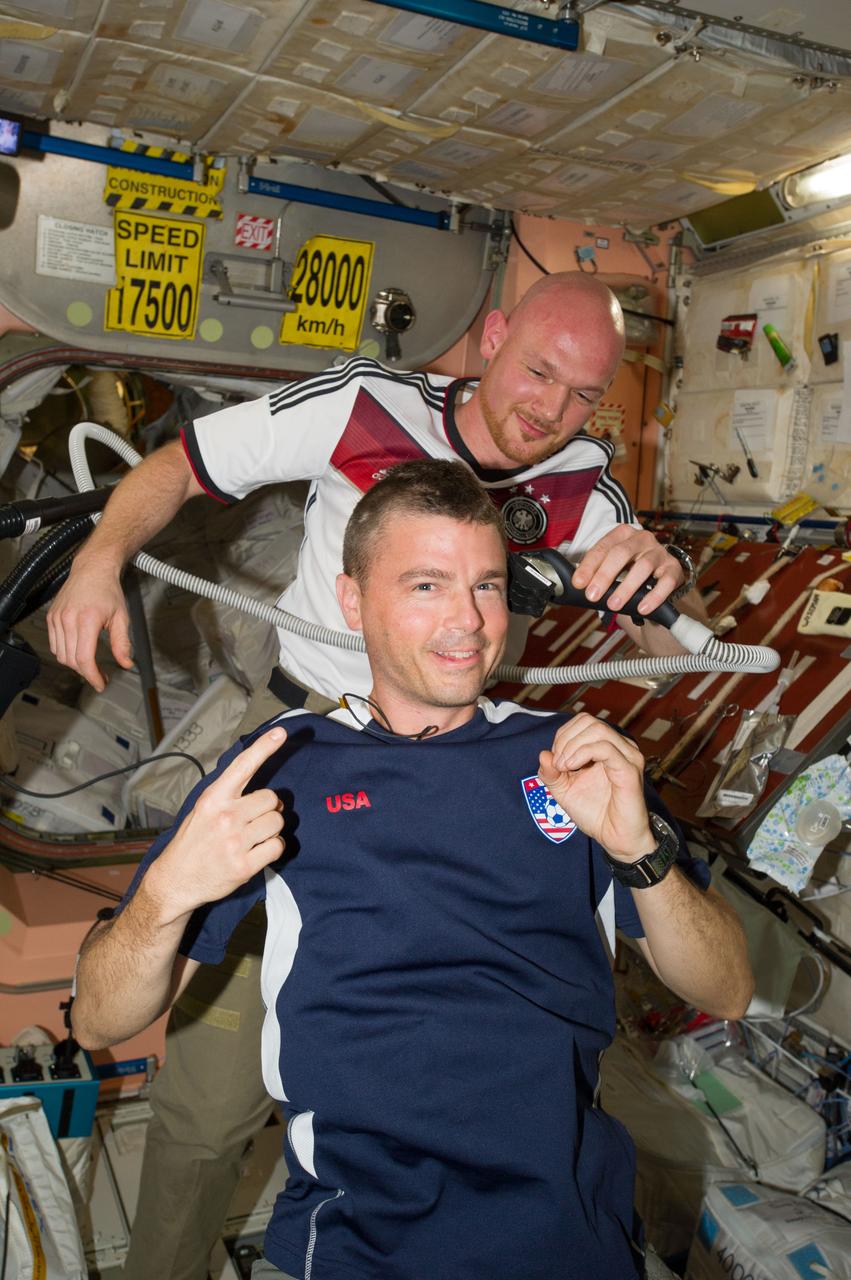
ISS040-E-020383 (26 June 2014) --- European Space Agency astronaut Alexander Gerst, Expedition 40 flight engineer, shaves the head of NASA astronaut Reid Wiseman, flight engineer, in the Unity node of the International Space Station. Gerst used hair clippers fashioned with a vacuum device to garner freshly cut hair. A friendly World Cup Soccer-related agreement between the crew members representing the USA, and Gerst, a German citizen who represents the European Space Agency, called for the American losers of a German-USA match to have their heads shaved. The German team won the match 1-0.

At dawn on Launch Pad 36A, Cape Canaveral Air Force Station, an Atlas IIA/Centaur rocket is fueled for launch of NASA’s Tracking and Data Relay Satellite (TDRS-H). One of three satellites (labeled H, I and J) being built by the Hughes Space and Communications Company, the latest TDRS uses an innovative springback antenna design. A pair of 15-foot-diameter, flexible mesh antenna reflectors fold up for launch, then spring back into their original cupped circular shape on orbit. The new satellites will augment the TDRS system’s existing Sand Ku-band frequencies by adding Ka-band capability. TDRS will serve as the sole means of continuous, high-data-rate communication with the Space Shuttle, with the International Space Station upon its completion, and with dozens of unmanned scientific satellites in low earth orbit
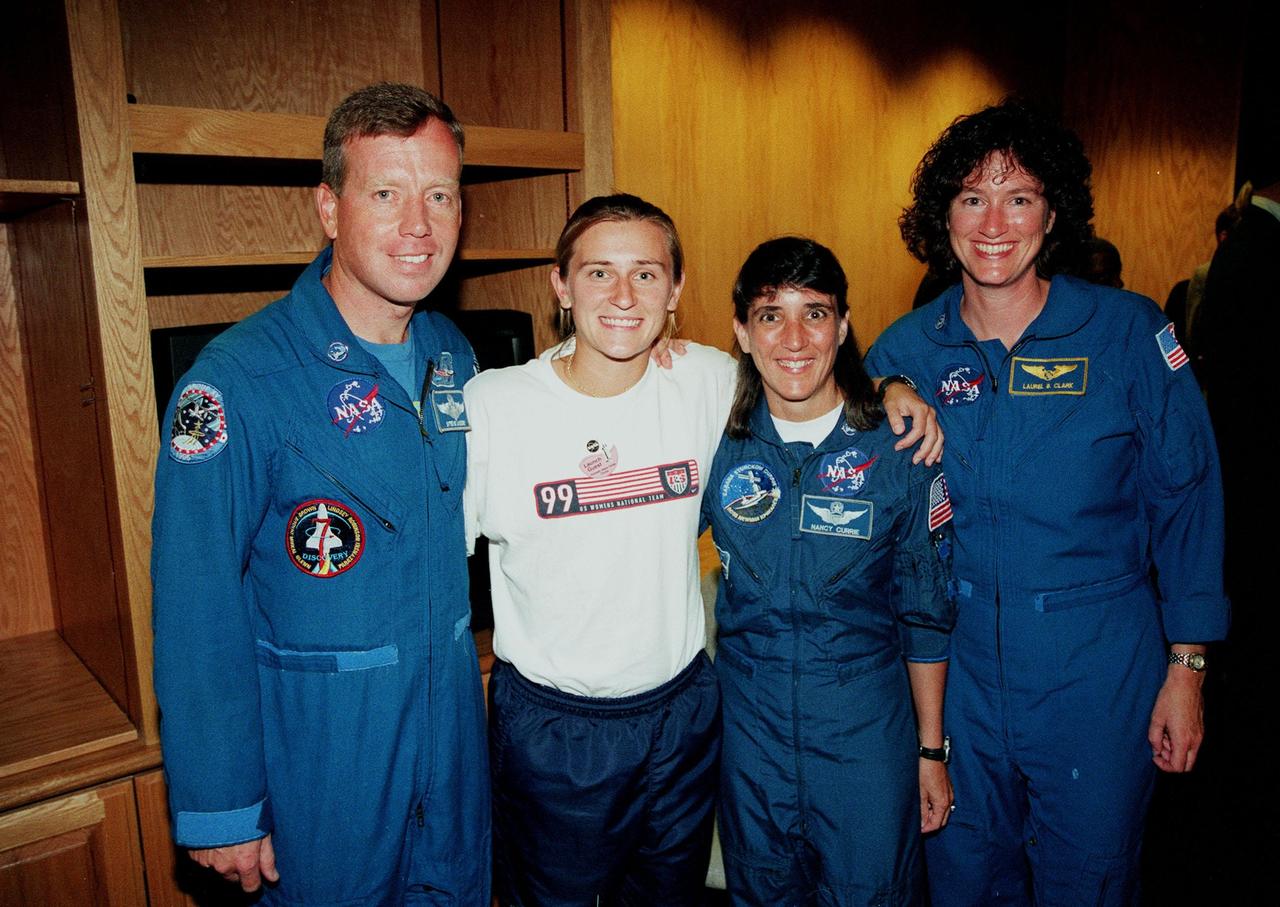
A member of the U.S. Women's World Cup Soccer Team poses with Astronauts (from left) Steven W. Lindsey, Nancy Jane Currie and Laurel B. Clark. The team arrived at the Skid Strip at Cape Canaveral Air Station with First Lady Hillary Rodham Clinton to view the launch of Space Shuttle mission STS-93. Liftoff is scheduled for 12:36 a.m. EDT July 20. Much attention has been generated over the launch due to Commander Eileen M. Collins, the first woman to serve as commander of a Shuttle mission. The primary payload of the five-day mission is the Chandra X-ray Observatory, which will allow scientists from around the world to study some of the most distant, powerful and dynamic objects in the universe. The new telescope is 20 to 50 times more sensitive than any previous X-ray telescope and is expected to unlock the secrets of supernovae, quasars and black holes
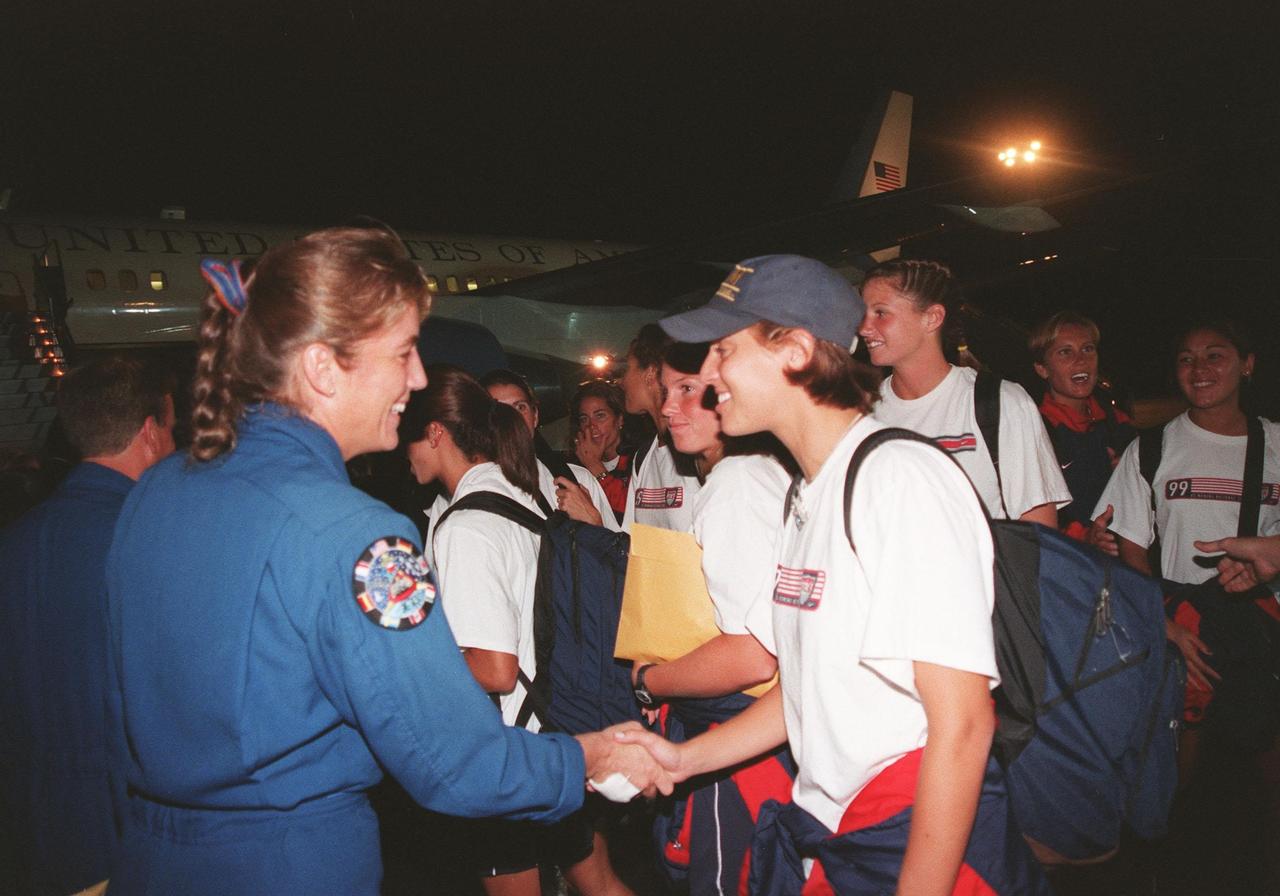
A member of the U.S. Women's World Cup Soccer Team is greeted by NASA Astronaut Heidemarie M. Stefanyshyn-Piper (left) upon her arrival at the Skid Strip at Cape Canaveral Air Station to view the launch of Space Shuttle mission STS-93. Liftoff is scheduled for 12:36 a.m. EDT July 20. Much attention has been generated over the launch due to Commander Eileen M. Collins, the first woman to serve as commander of a Shuttle mission. The primary payload of the five-day mission is the Chandra X-ray Observatory, which will allow scientists from around the world to study some of the most distant, powerful and dynamic objects in the universe. The new telescope is 20 to 50 times more sensitive than any previous X-ray telescope and is expected to unlock the secrets of supernovae, quasars and black holes
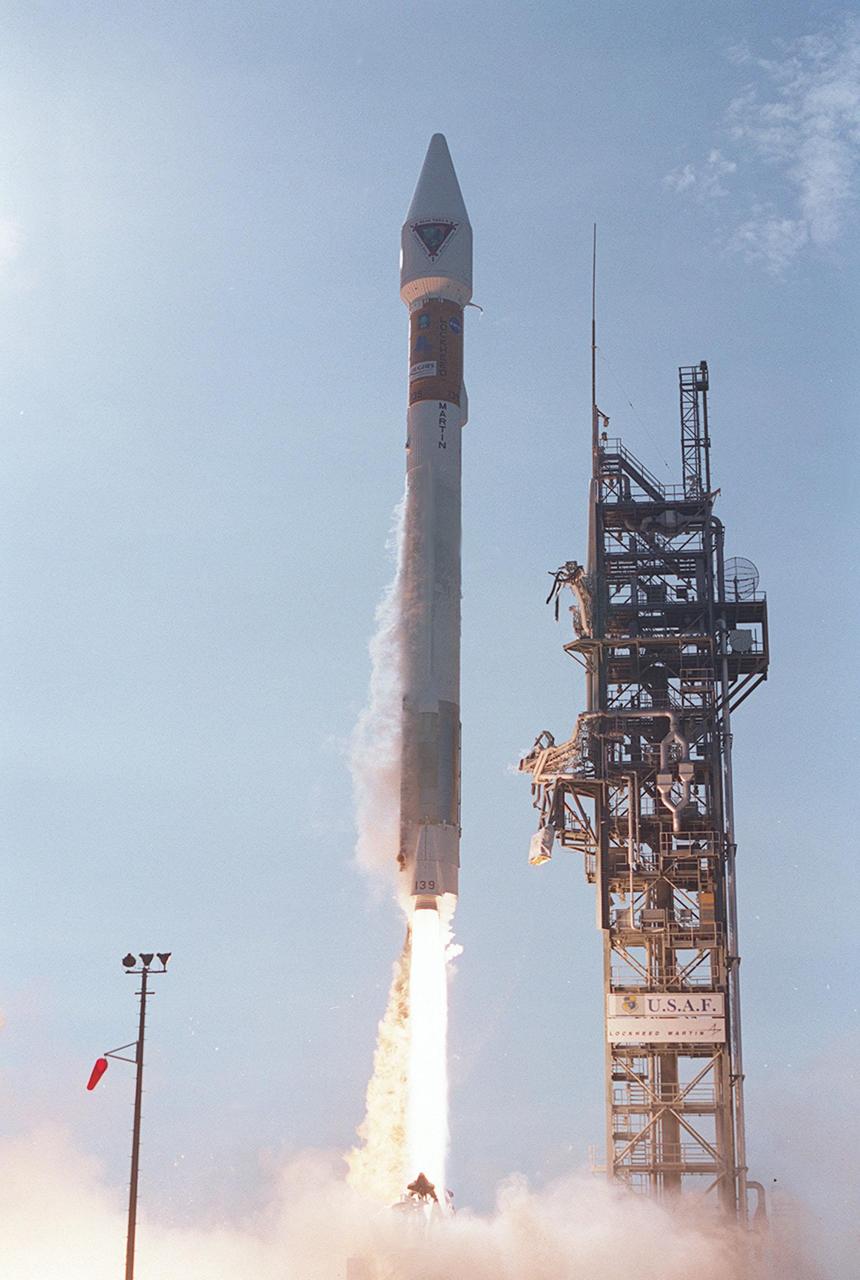
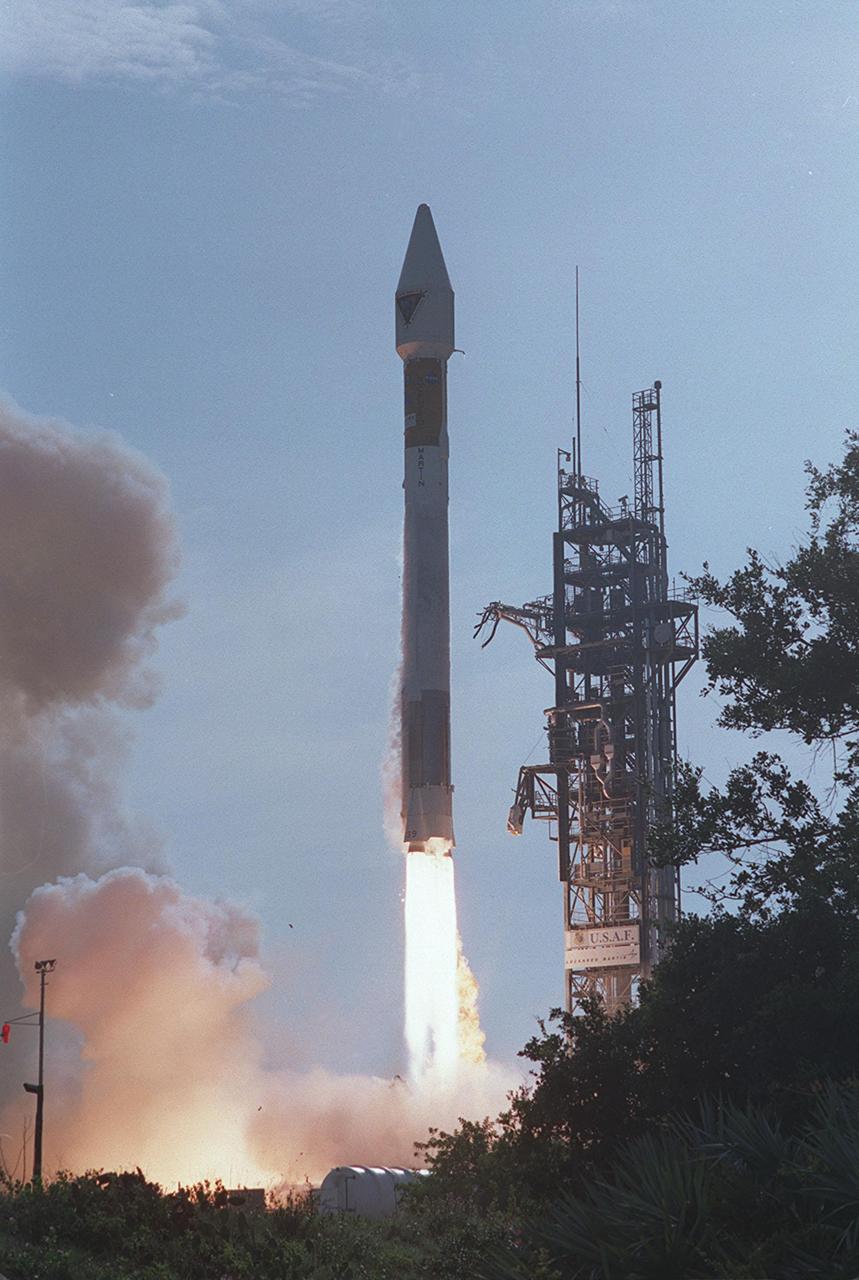
Looking like a Roman candle, NASA’s Tracking and Data Relay Satellite (TDRS-H) shoots into the blue sky aboard an Atlas IIA/Centaur rocket from Pad 36A, Cape Canaveral Air Force Station. Liftoff occurred at 8:56 a.m. EDT. One of three satellites (labeled H, I and J) being built by the Hughes Space and Communications Company, the latest TDRS uses an innovative springback antenna design. A pair of 15-foot-diameter, flexible mesh antenna reflectors fold up for launch, then spring back into their original cupped circular shape on orbit. The new satellites will augment the TDRS system’s existing Sand Ku-band frequencies by adding Ka-band capability. TDRS will serve as the sole means of continuous, high-data-rate communication with the space shuttle, with the International Space Station upon its completion, and with dozens of unmanned scientific satellites in low earth orbit

A member of the U.S. Women's World Cup Soccer Team is greeted by NASA Astronaut Scott E. Parazynski (left) upon her arrival at the Skid Strip at Cape Canaveral Air Station as her teammates look on. The team is at KSC to view the launch of Space Shuttle mission STS-93 scheduled for liftoff at 12:36 a.m. EDT July 20. Much attention has been generated over the launch due to Commander Eileen M. Collins, the first woman to serve as commander of a Shuttle mission. The primary payload of the five-day mission is the Chandra X-ray Observatory, which will allow scientists from around the world to study some of the most distant, powerful and dynamic objects in the universe. The new telescope is 20 to 50 times more sensitive than any previous X-ray telescope and is expected to unlock the secrets of supernovae, quasars and black holes
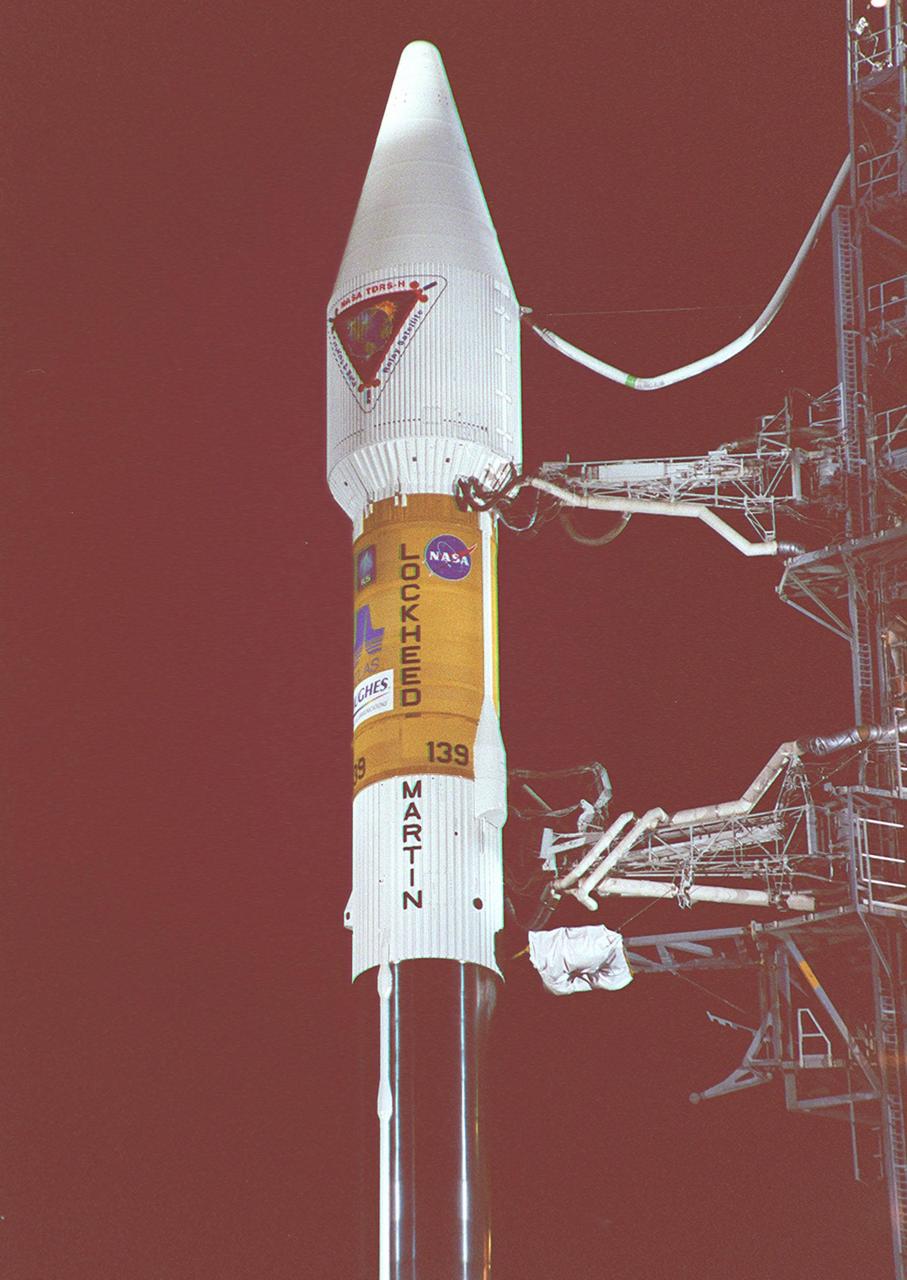
NASA’s Tracking and Data Relay Satellite (TDRS-H) sits poised on Launch Pad 36A, Cape Canaveral Air Force Station, before its scheduled launch aboard an Atlas IIA/Centaur rocket. One of three satellites (labeled H, I and J) being built by the Hughes Space and Communications Company, the latest TDRS uses an innovative springback antenna design. A pair of 15-foot-diameter, flexible mesh antenna reflectors fold up for launch, then spring back into their original cupped circular shape on orbit. The new satellites will augment the TDRS system’s existing Sand Ku-band frequencies by adding Ka-band capability. TDRS will serve as the sole means of continuous, high-data-rate communication with the space shuttle, with the International Space Station upon its completion, and with dozens of unmanned scientific satellites in low earth orbit
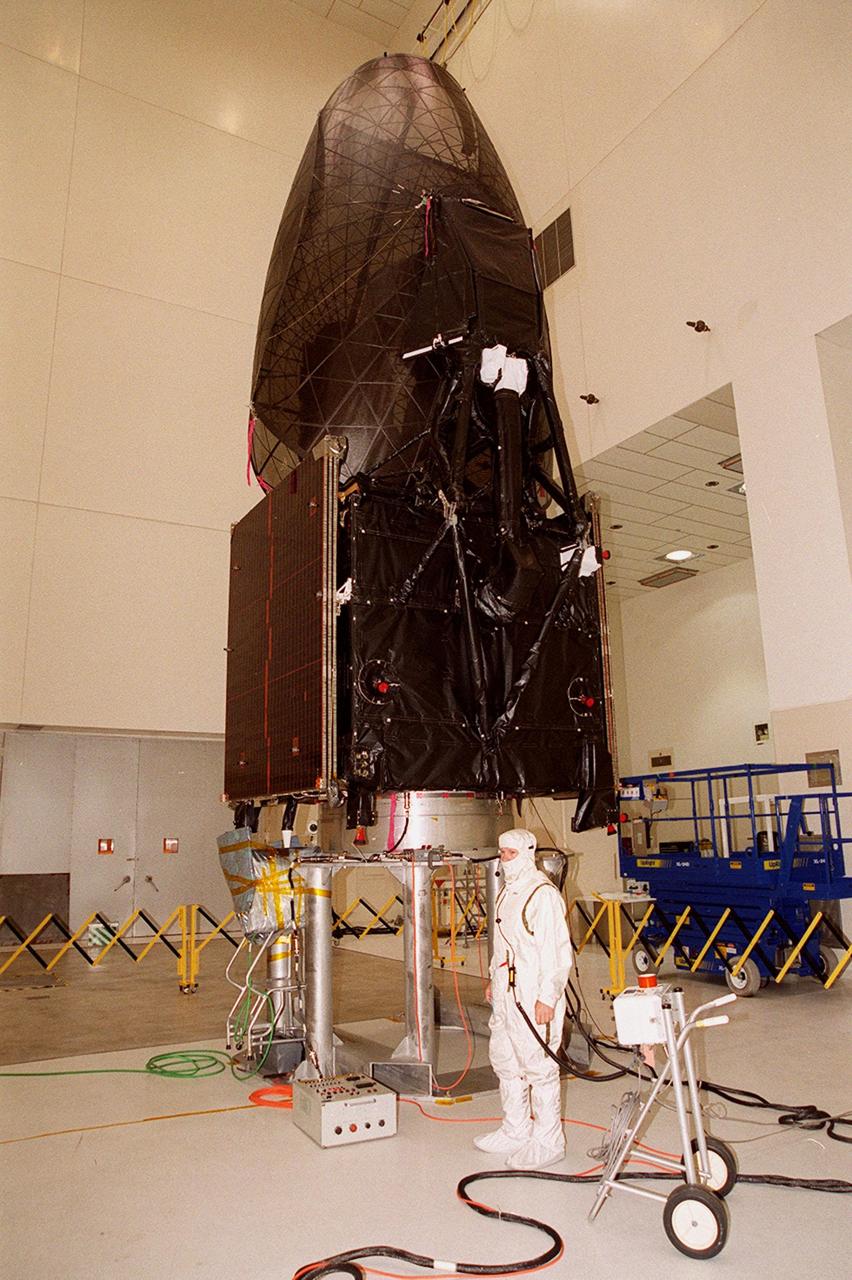
The Tracking and Data Relay Satellite (TDRS-H) sits on a workstand in KSC’s Spacecraft Assembly and Encapsulation Facility (SAEF-2) in order to undergo electrical testing. The TDRS is scheduled to be launched from CCAFS June 29 aboard an Atlas IIA/Centaur rocket. One of three satellites (labeled H, I and J) being built in the Hughes Space and Communications Company Integrated Satellite Factory in El Segundo, Calif., the latest TDRS uses an innovative springback antenna design. A pair of 15-foot-diameter, flexible mesh antenna reflectors fold up for launch, then spring back into their original cupped circular shape on orbit. The new satellites will augment the TDRS system’s existing Sand Ku-band frequencies by adding Ka-band capability. TDRS will serve as the sole means of continuous, high-data-rate communication with the space shuttle, with the International Space Station upon its completion, and with dozens of unmanned scientific satellites in low earth orbit
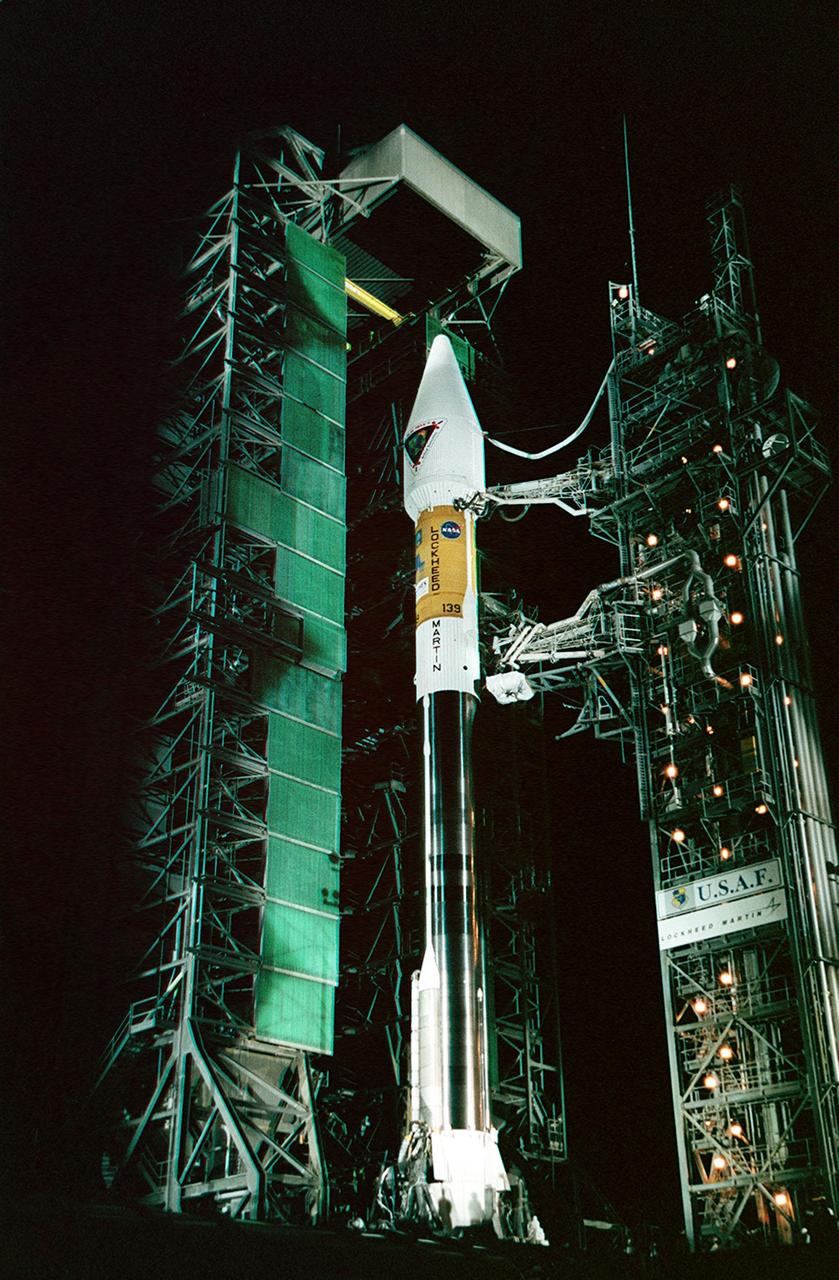
In the early morning hours, NASA’s Tracking and Data Relay Satellite (TDRS-H) sits poised on Launch Pad 36A, Cape Canaveral Air Force Station, before its scheduled launch aboard an Atlas IIA/Centaur rocket. One of three satellites (labeled H, I and J) being built by the Hughes Space and Communications Company, the latest TDRS uses an innovative springback antenna design. A pair of 15-foot-diameter, flexible mesh antenna reflectors fold up for launch, then spring back into their original cupped circular shape on orbit. The new satellites will augment the TDRS system’s existing Sand Ku-band frequencies by adding Ka-band capability. TDRS will serve as the sole means of continuous, high-data-rate communication with the Space Shuttle, with the International Space Station upon its completion, and with dozens of unmanned scientific satellites in low earth orbit
In the early morning hours on Launch Pad 36A, Cape Canaveral Air Force Station, the tower rolls back from NASA’s Tracking and Data Relay Satellite (TDRS-H) before liftoff atop an Atlas IIA/Centaur rocket. One of three satellites (labeled H, I and J) being built by the Hughes Space and Communications Company, the latest TDRS uses an innovative springback antenna design. A pair of 15-foot-diameter, flexible mesh antenna reflectors fold up for launch, then spring back into their original cupped circular shape on orbit. The new satellites will augment the TDRS system’s existing Sand Ku-band frequencies by adding Ka-band capability. TDRS will serve as the sole means of continuous, high-data-rate communication with the Space Shuttle, with the International Space Station upon its completion, and with dozens of unmanned scientific satellites in low earth orbit

jsc2017e100895 (July 18, 2017) --- In the town of Baikonur, Kazakhstan, Expedition 52-53 backup crewmembers Norishige Kanai of the Japan Aerospace Exploration Agency (JAXA, second from left), Alexander Misurkin of the Russian Federal Space Agency (Roscosmos, second from right) and Mark Vande Hei of NASA (far right) enjoy a traditional cup of tea in a mockup of a Russian “yurt” or tent in Baikonur’s space museum July 18 as part of traditional pre-launch ceremonies. They are serving as backups to Sergey Ryazanskiy of Roscosmos, Randy Bresnik of NASA and Paolo Nespoli of the European Space Agency, who will launch July 28 on the Soyuz MS-05 spacecraft from the Baikonur Cosmodrome for a five-month mission on the International Space Station. Credit: NASA/Victor Zelentsov
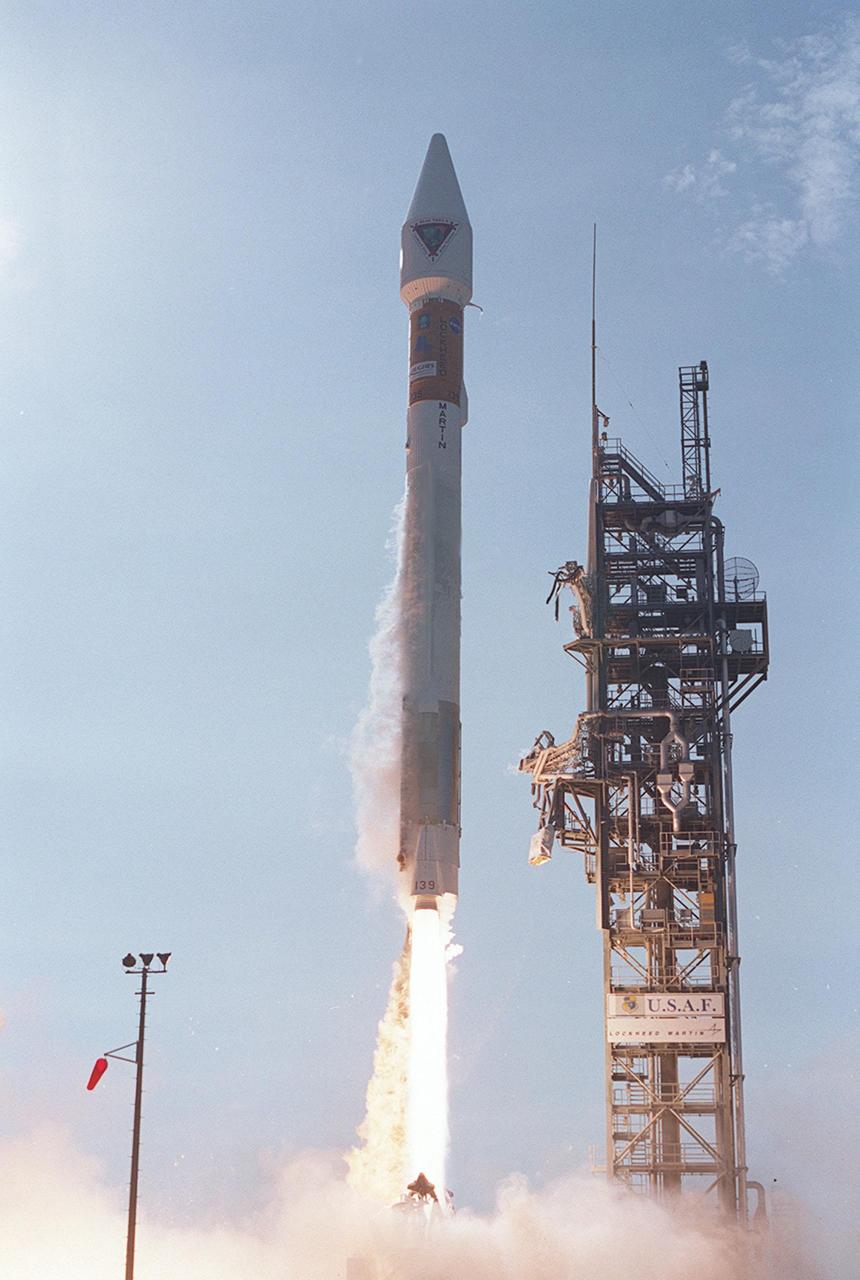
Looking like a Roman candle, NASA’s Tracking and Data Relay Satellite (TDRS-H) shoots into the blue sky aboard an Atlas IIA/Centaur rocket from Pad 36A, Cape Canaveral Air Force Station. Liftoff occurred at 8:56 a.m. EDT. One of three satellites (labeled H, I and J) being built by the Hughes Space and Communications Company, the latest TDRS uses an innovative springback antenna design. A pair of 15-foot-diameter, flexible mesh antenna reflectors fold up for launch, then spring back into their original cupped circular shape on orbit. The new satellites will augment the TDRS system’s existing Sand Ku-band frequencies by adding Ka-band capability. TDRS will serve as the sole means of continuous, high-data-rate communication with the space shuttle, with the International Space Station upon its completion, and with dozens of unmanned scientific satellites in low earth orbit
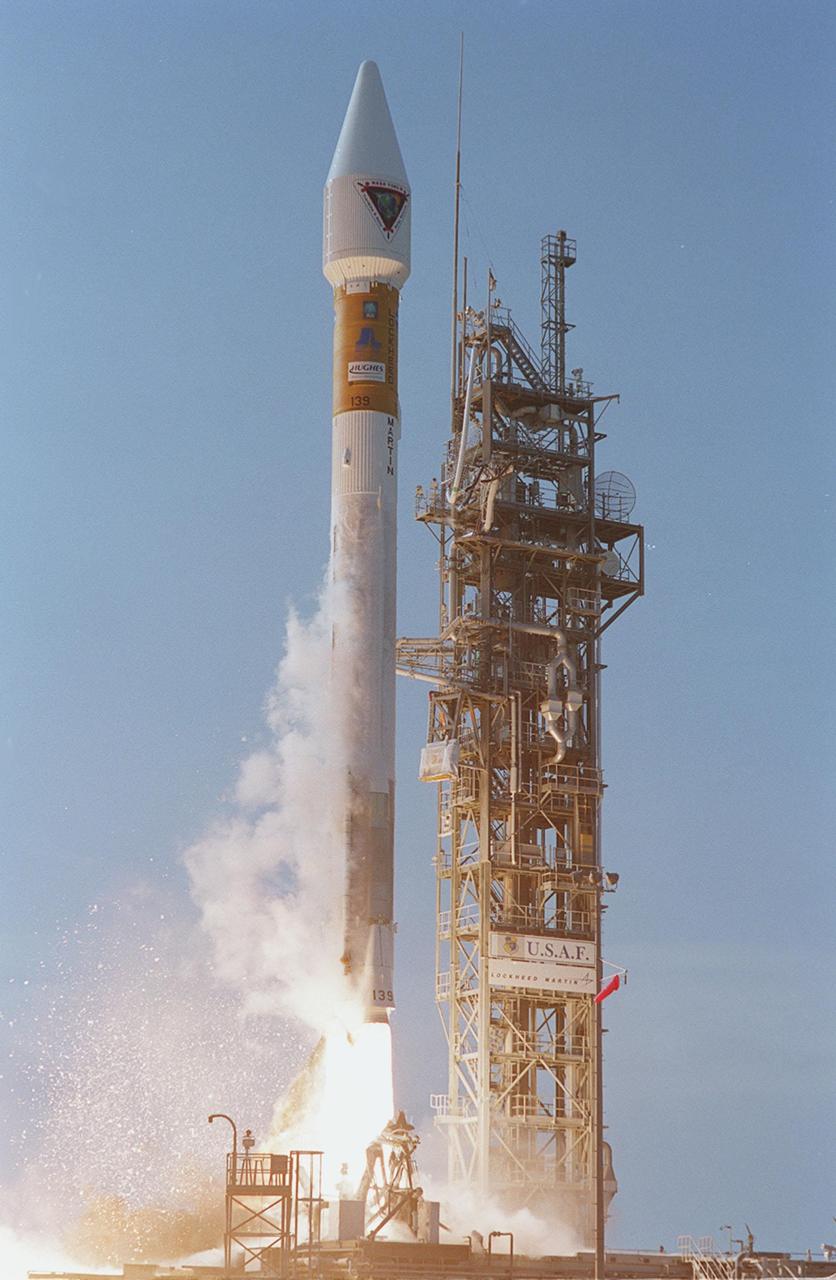
NASA’s Tracking and Data Relay Satellite (TDRS-H) rises into the blue sky from Pad 36A, Cape Canaveral Air Force Station. Liftoff occurred at 8:56 a.m. EDT aboard an Atlas IIA/Centaur rocket. One of three satellites (labeled H, I and J) being built by the Hughes Space and Communications Company, the latest TDRS uses an innovative springback antenna design. A pair of 15-foot-diameter, flexible mesh antenna reflectors fold up for launch, then spring back into their original cupped circular shape on orbit. The new satellites will augment the TDRS system’s existing Sand Ku-band frequencies by adding Ka-band capability. TDRS will serve as the sole means of continuous, high-data-rate communication with the space shuttle, with the International Space Station upon its completion, and with dozens of unmanned scientific satellites in low earth orbit

Workers in KSC’s Spacecraft Assembly and Encapsulation Facility (SAEF-2) prepare the Tracking and Data Relay Satellite (TDRS-H) above them for electrical testing. The TDRS is scheduled to be launched from CCAFS June 29 aboard an Atlas IIA/Centaur rocket. One of three satellites (labeled H, I and J) being built in the Hughes Space and Communications Company Integrated Satellite Factory in El Segundo, Calif., the latest TDRS uses an innovative springback antenna design. A pair of 15-foot-diameter, flexible mesh antenna reflectors fold up for launch, then spring back into their original cupped circular shape on orbit. The new satellites will augment the TDRS system’s existing Sand Ku-band frequencies by adding Ka-band capability. TDRS will serve as the sole means of continuous, high-data-rate communication with the space shuttle, with the International Space Station upon its completion, and with dozens of unmanned scientific satellites in low earth orbit

NASA’s Tracking and Data Relay Satellite (TDRS-H) sits poised on Launch Pad 36A, Cape Canaveral Air Force Station, before its scheduled launch aboard an Atlas IIA/Centaur rocket. One of three satellites (labeled H, I and J) being built by the Hughes Space and Communications Company, the latest TDRS uses an innovative springback antenna design. A pair of 15-foot-diameter, flexible mesh antenna reflectors fold up for launch, then spring back into their original cupped circular shape on orbit. The new satellites will augment the TDRS system’s existing Sand Ku-band frequencies by adding Ka-band capability. TDRS will serve as the sole means of continuous, high-data-rate communication with the space shuttle, with the International Space Station upon its completion, and with dozens of unmanned scientific satellites in low earth orbit
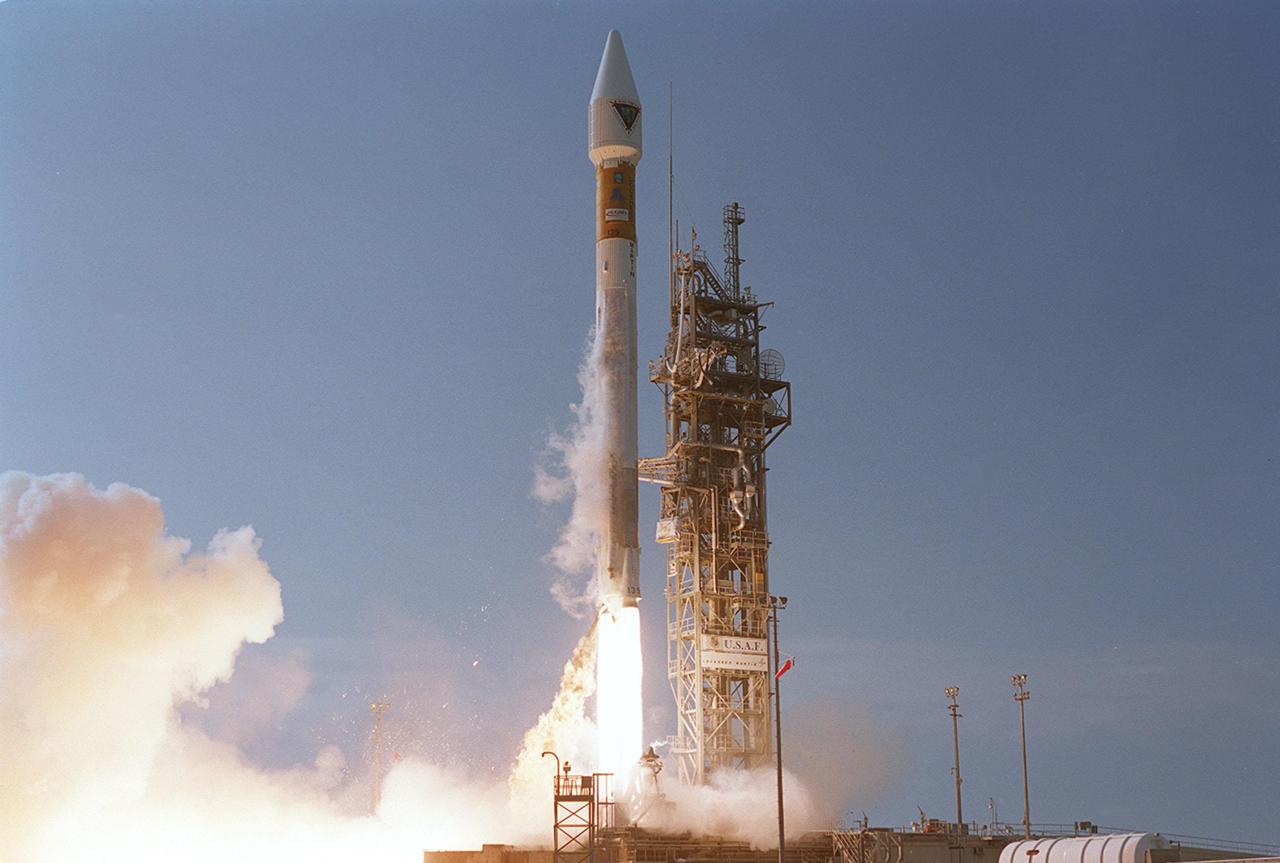
Leaving billowing clouds of steam and smoke behind, NASA’s Tracking and Data Relay Satellite (TDRS-H) shoots into the blue sky aboard an Atlas IIA/Centaur rocket from Pad 36A, Cape Canaveral Air Force Station. Liftoff occurred at 8:56 a.m. EDT. One of three satellites (labeled H, I and J) being built by the Hughes Space and Communications Company, the latest TDRS uses an innovative springback antenna design. A pair of 15-foot-diameter, flexible mesh antenna reflectors fold up for launch, then spring back into their original cupped circular shape on orbit. The new satellites will augment the TDRS system’s existing Sand Ku-band frequencies by adding Ka-band capability. TDRS will serve as the sole means of continuous, high-data-rate communication with the space shuttle, with the International Space Station upon its completion, and with dozens of unmanned scientific satellites in low earth orbit
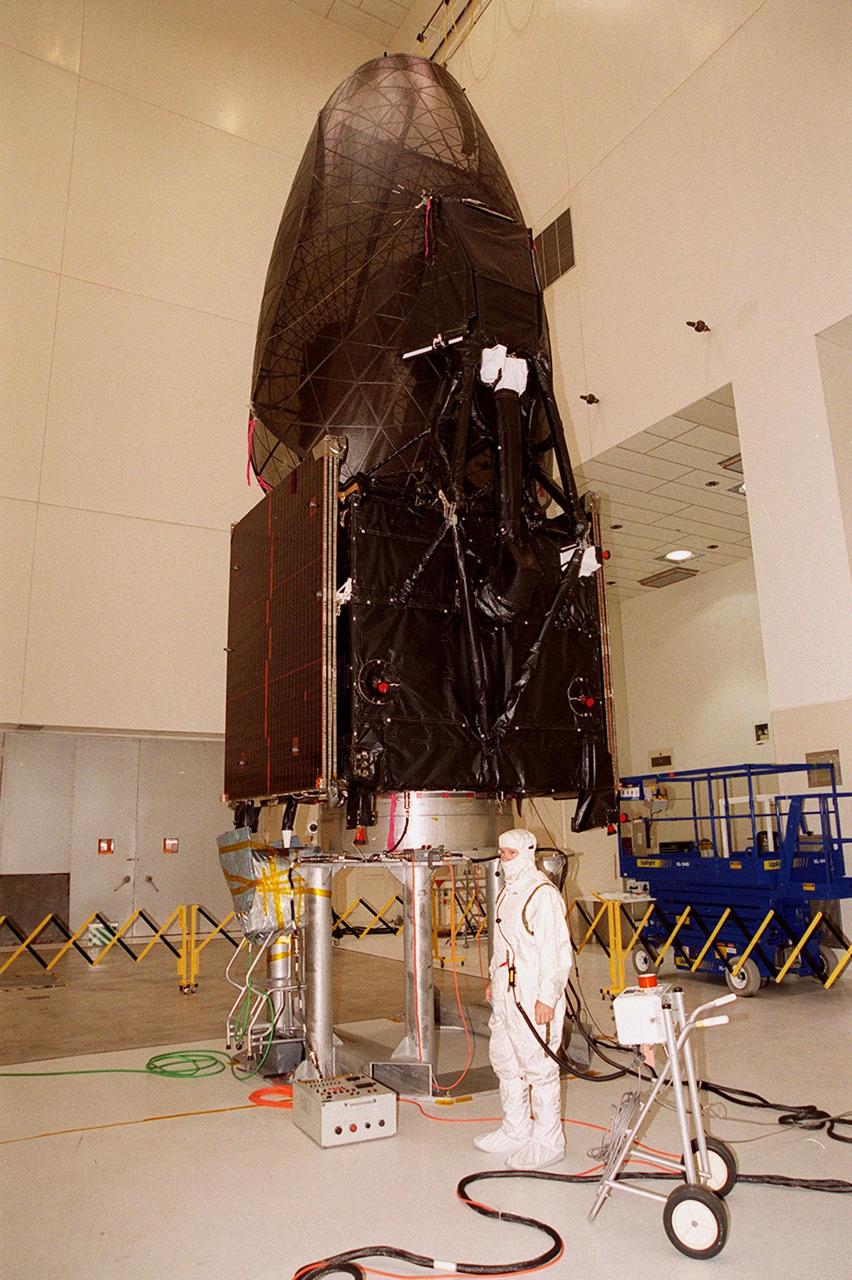
The Tracking and Data Relay Satellite (TDRS-H) sits on a workstand in KSC’s Spacecraft Assembly and Encapsulation Facility (SAEF-2) in order to undergo electrical testing. The TDRS is scheduled to be launched from CCAFS June 29 aboard an Atlas IIA/Centaur rocket. One of three satellites (labeled H, I and J) being built in the Hughes Space and Communications Company Integrated Satellite Factory in El Segundo, Calif., the latest TDRS uses an innovative springback antenna design. A pair of 15-foot-diameter, flexible mesh antenna reflectors fold up for launch, then spring back into their original cupped circular shape on orbit. The new satellites will augment the TDRS system’s existing Sand Ku-band frequencies by adding Ka-band capability. TDRS will serve as the sole means of continuous, high-data-rate communication with the space shuttle, with the International Space Station upon its completion, and with dozens of unmanned scientific satellites in low earth orbit

In the early morning hours on Launch Pad 36A, Cape Canaveral Air Force Station, the tower rolls back from NASA’s Tracking and Data Relay Satellite (TDRS-H) before liftoff atop an Atlas IIA/Centaur rocket. One of three satellites (labeled H, I and J) being built by the Hughes Space and Communications Company, the latest TDRS uses an innovative springback antenna design. A pair of 15-foot-diameter, flexible mesh antenna reflectors fold up for launch, then spring back into their original cupped circular shape on orbit. The new satellites will augment the TDRS system’s existing Sand Ku-band frequencies by adding Ka-band capability. TDRS will serve as the sole means of continuous, high-data-rate communication with the Space Shuttle, with the International Space Station upon its completion, and with dozens of unmanned scientific satellites in low earth orbit

Members of the U.S. Women's World Cup Soccer Team were greeted upon their arrival at the Skid Strip at Cape Canaveral Air Station by Astronauts (right) Steven W. Lindsey, Heidemarie M. Stefanyshyn-Piper and Scott E. Parzynski. The team are here to view the launch of Space Shuttle mission STS-93, scheduled for 12:36 a.m. EDT July 20. Much attention has been generated over the launch due to Commander Eileen M. Collins, the first woman to serve as commander of a Shuttle mission. The primary payload of the five-day mission is the Chandra X-ray Observatory, which will allow scientists from around the world to study some of the most distant, powerful and dynamic objects in the universe. The new telescope is 20 to 50 times more sensitive than any previous X-ray telescope and is expected to unlock the secrets of supernovae, quasars and black holes
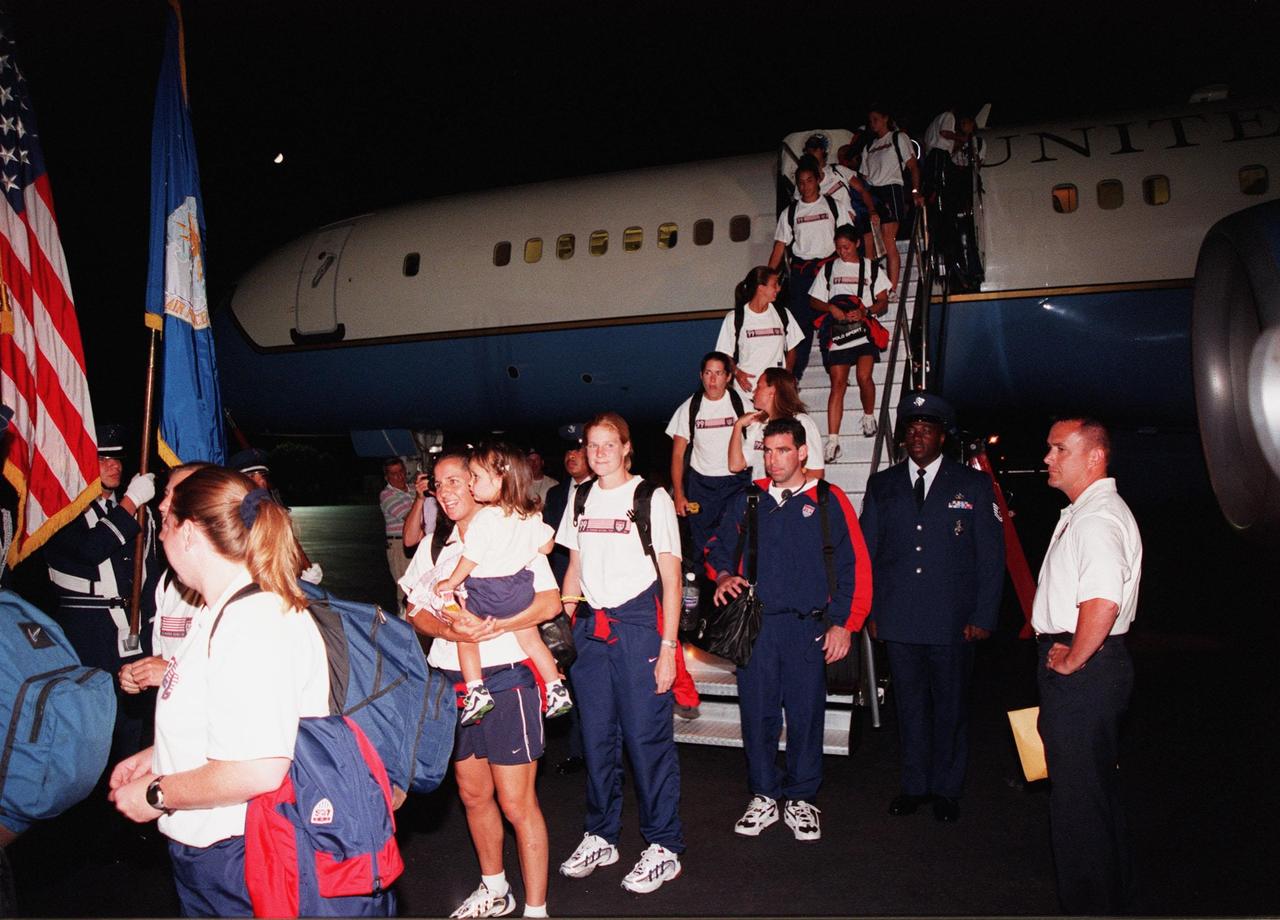
KENNEDY SPACE CENTER, FLA. -- Members of the U.S. Women's World Cup Soccer Team are greeted by NASA Administrator Daniel S. Goldin as they disembark from a plane at the Skid Strip at Cape Canaveral Air Station. They arrived with First Lady Hillary Rodham Clinton to view the launch of Space Shuttle mission STS-93 scheduled for 12:36 a.m. EDT July 20. Much attention has been generated over the launch due to Commander Eileen M. Collins, the first woman to serve as commander of a Shuttle mission. The primary payload of the five-day mission is the release of the Chandra X-ray Observatory, which will allow scientists from around the world to study some of the most distant, powerful and dynamic objects in the universe
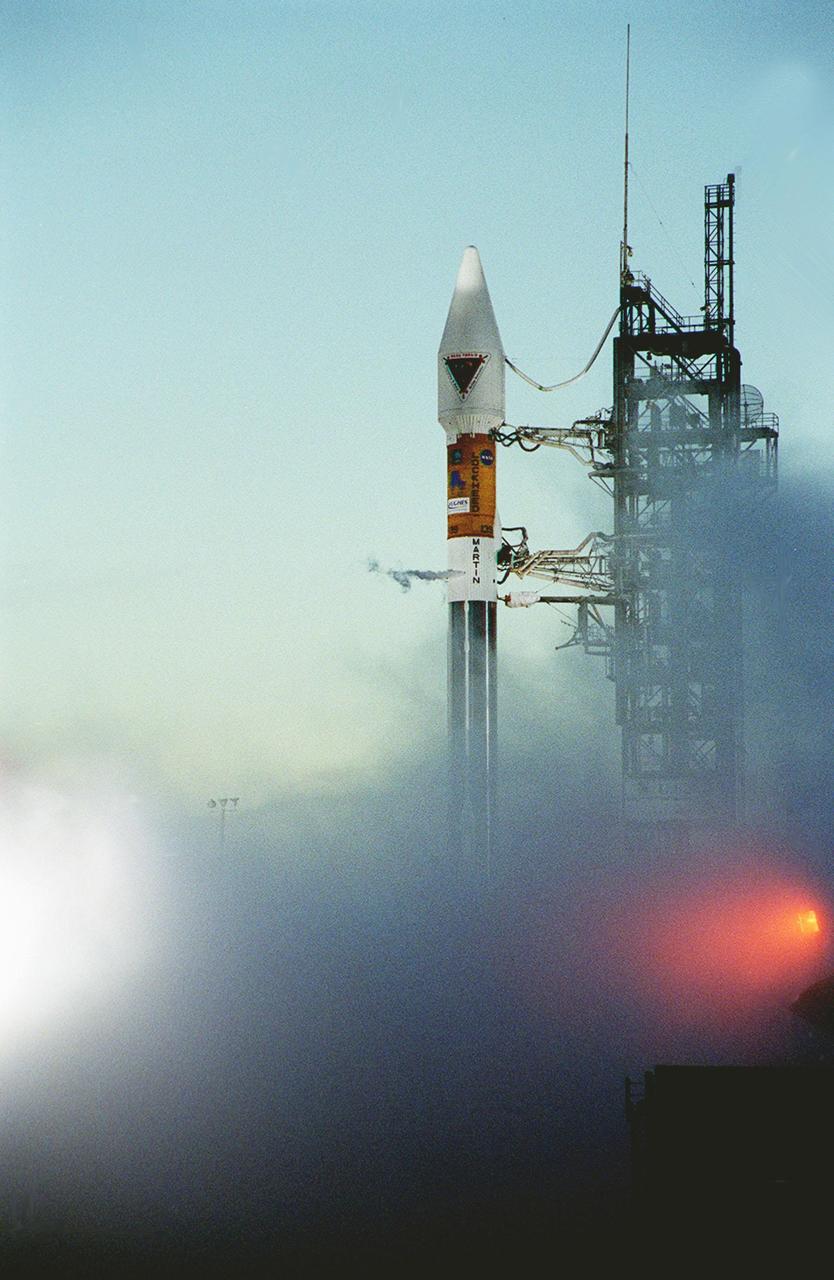
At dawn on Launch Pad 36A, Cape Canaveral Air Force Station, an Atlas IIA/Centaur rocket is fueled for launch of NASA’s Tracking and Data Relay Satellite (TDRS-H). One of three satellites (labeled H, I and J) being built by the Hughes Space and Communications Company, the latest TDRS uses an innovative springback antenna design. A pair of 15-foot-diameter, flexible mesh antenna reflectors fold up for launch, then spring back into their original cupped circular shape on orbit. The new satellites will augment the TDRS system’s existing Sand Ku-band frequencies by adding Ka-band capability. TDRS will serve as the sole means of continuous, high-data-rate communication with the Space Shuttle, with the International Space Station upon its completion, and with dozens of unmanned scientific satellites in low earth orbit
NASA’s Tracking and Data Relay Satellite (TDRS-H) rises into the blue sky from Pad 36A, Cape Canaveral Air Force Station. Liftoff occurred at 8:56 a.m. EDT aboard an Atlas IIA/Centaur rocket. One of three satellites (labeled H, I and J) being built by the Hughes Space and Communications Company, the latest TDRS uses an innovative springback antenna design. A pair of 15-foot-diameter, flexible mesh antenna reflectors fold up for launch, then spring back into their original cupped circular shape on orbit. The new satellites will augment the TDRS system’s existing Sand Ku-band frequencies by adding Ka-band capability. TDRS will serve as the sole means of continuous, high-data-rate communication with the space shuttle, with the International Space Station upon its completion, and with dozens of unmanned scientific satellites in low earth orbit
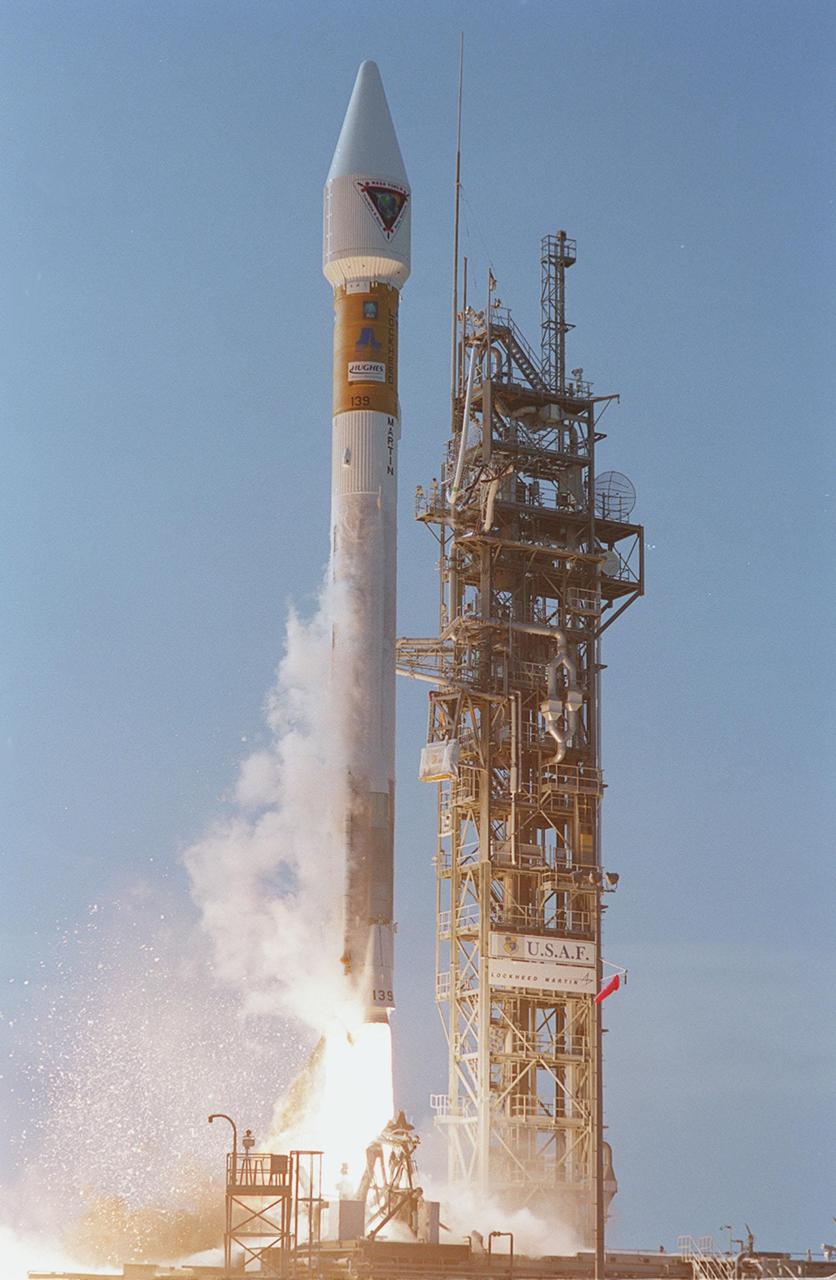
NASA’s Tracking and Data Relay Satellite (TDRS-H) rises into the blue sky from Pad 36A, Cape Canaveral Air Force Station. Liftoff occurred at 8:56 a.m. EDT aboard an Atlas IIA/Centaur rocket. One of three satellites (labeled H, I and J) being built by the Hughes Space and Communications Company, the latest TDRS uses an innovative springback antenna design. A pair of 15-foot-diameter, flexible mesh antenna reflectors fold up for launch, then spring back into their original cupped circular shape on orbit. The new satellites will augment the TDRS system’s existing Sand Ku-band frequencies by adding Ka-band capability. TDRS will serve as the sole means of continuous, high-data-rate communication with the space shuttle, with the International Space Station upon its completion, and with dozens of unmanned scientific satellites in low earth orbit
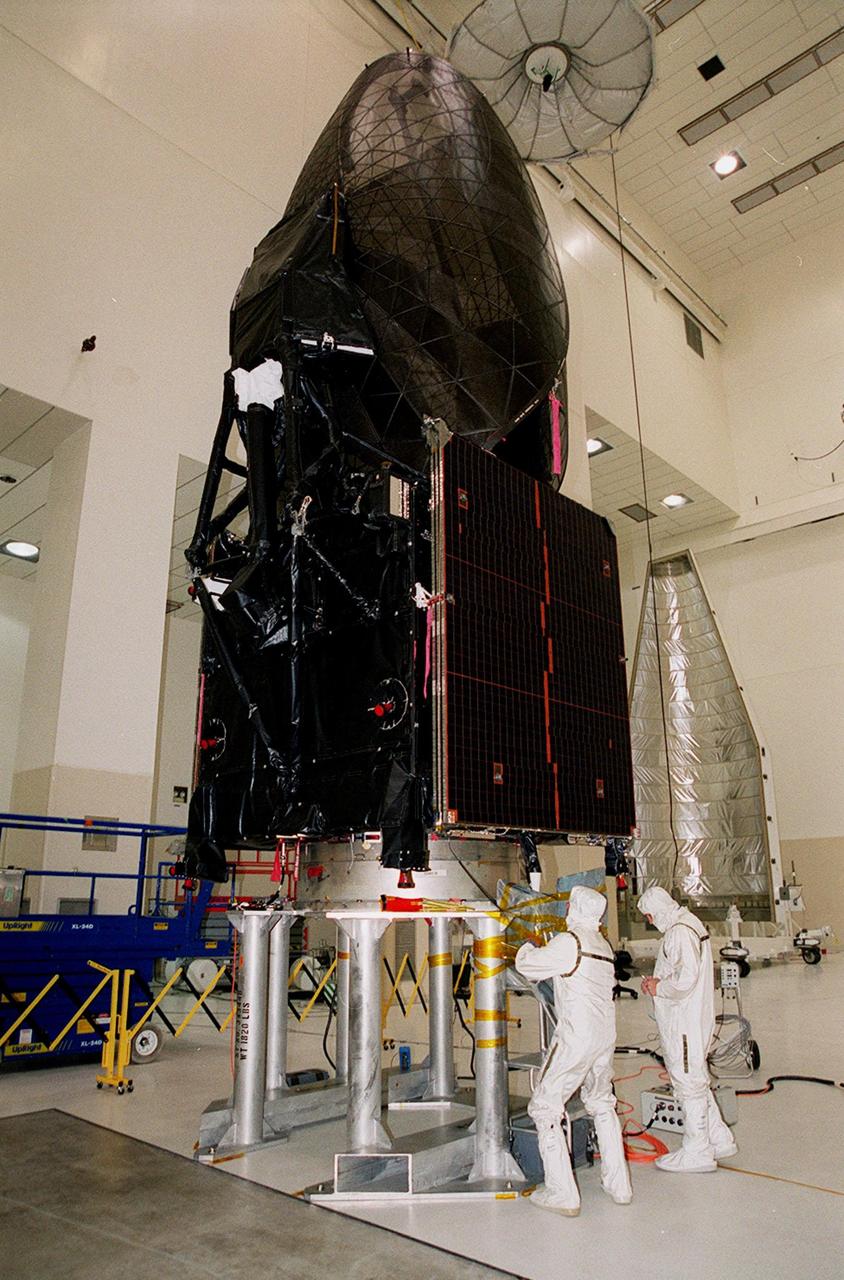
Workers in KSC’s Spacecraft Assembly and Encapsulation Facility (SAEF-2) prepare the Tracking and Data Relay Satellite (TDRS-H) above them for electrical testing. The TDRS is scheduled to be launched from CCAFS June 29 aboard an Atlas IIA/Centaur rocket. One of three satellites (labeled H, I and J) being built in the Hughes Space and Communications Company Integrated Satellite Factory in El Segundo, Calif., the latest TDRS uses an innovative springback antenna design. A pair of 15-foot-diameter, flexible mesh antenna reflectors fold up for launch, then spring back into their original cupped circular shape on orbit. The new satellites will augment the TDRS system’s existing Sand Ku-band frequencies by adding Ka-band capability. TDRS will serve as the sole means of continuous, high-data-rate communication with the space shuttle, with the International Space Station upon its completion, and with dozens of unmanned scientific satellites in low earth orbit
In the early morning hours, NASA’s Tracking and Data Relay Satellite (TDRS-H) sits poised on Launch Pad 36A, Cape Canaveral Air Force Station, before its scheduled launch aboard an Atlas IIA/Centaur rocket. One of three satellites (labeled H, I and J) being built by the Hughes Space and Communications Company, the latest TDRS uses an innovative springback antenna design. A pair of 15-foot-diameter, flexible mesh antenna reflectors fold up for launch, then spring back into their original cupped circular shape on orbit. The new satellites will augment the TDRS system’s existing Sand Ku-band frequencies by adding Ka-band capability. TDRS will serve as the sole means of continuous, high-data-rate communication with the Space Shuttle, with the International Space Station upon its completion, and with dozens of unmanned scientific satellites in low earth orbit
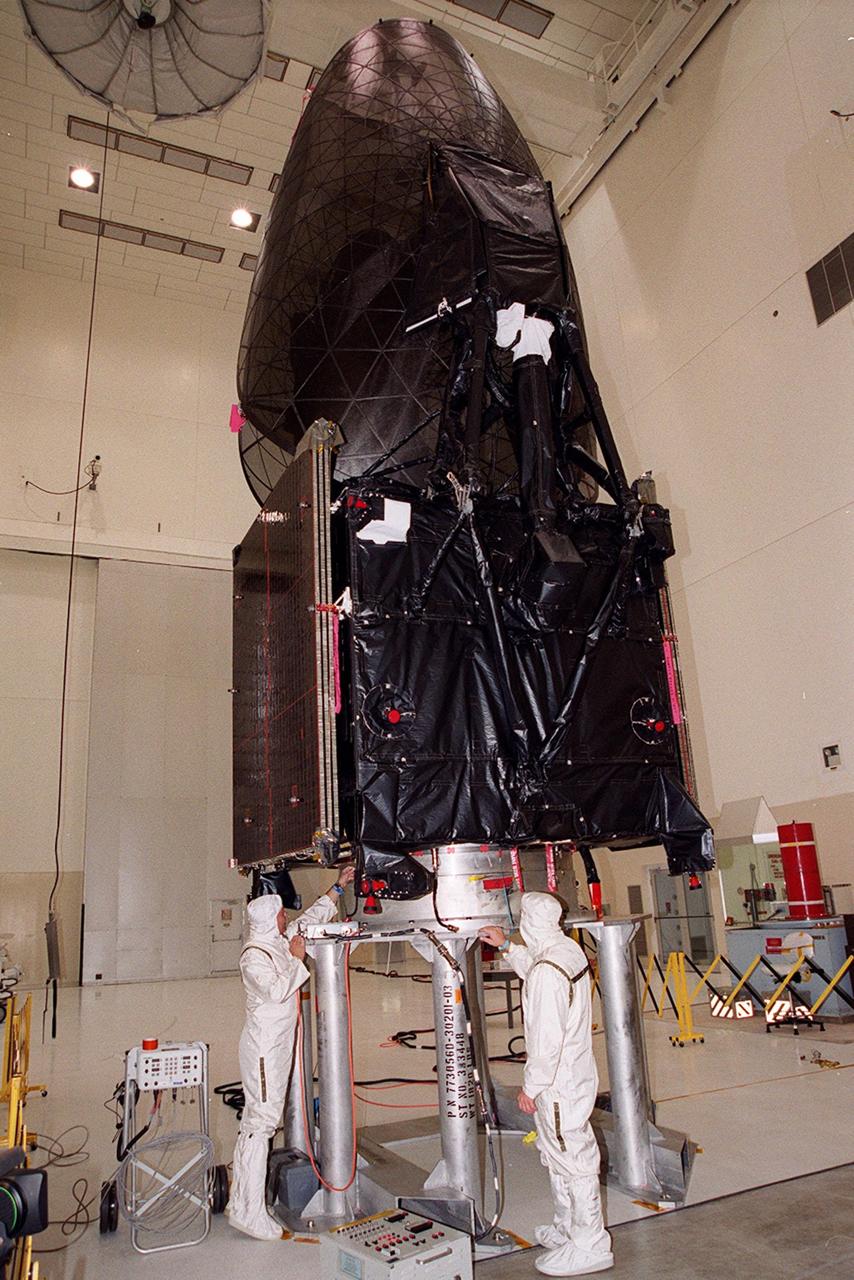
Workers in KSC’s Spacecraft Assembly and Encapsulation Facility (SAEF-2) conduct electrical testing on the Tracking and Data Relay Satellite (TDRS-H) above them. The TDRS is scheduled to be launched from CCAFS June 29 aboard an Atlas IIA/Centaur rocket. One of three satellites (labeled H, I and J) being built in the Hughes Space and Communications Company Integrated Satellite Factory in El Segundo, Calif., the latest TDRS uses an innovative springback antenna design. A pair of 15-foot-diameter, flexible mesh antenna reflectors fold up for launch, then spring back into their original cupped circular shape on orbit. The new satellites will augment the TDRS system’s existing Sand Ku-band frequencies by adding Ka-band capability. TDRS will serve as the sole means of continuous, high-data-rate communication with the space shuttle, with the International Space Station upon its completion, and with dozens of unmanned scientific satellites in low earth orbit
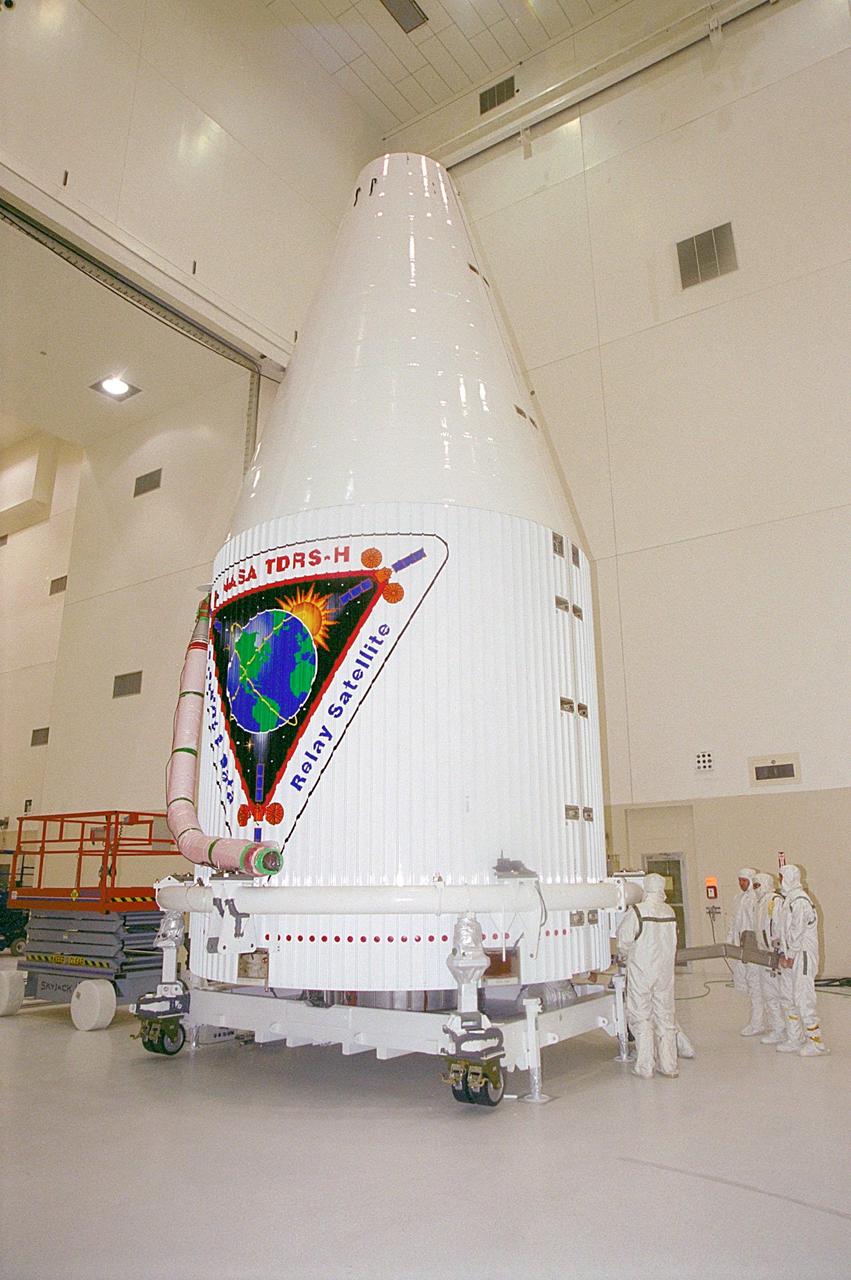
The Tracking and Data Relay Satellite (TDRS-H) sits fully encapsulated inside the fairing. Next, it will be transported to Launch Pad 36A, Cape Canaveral Air Force Station for launch scheduled June 29 aboard an Atlas IIA/Centaur rocket. One of three satellites (labeled H, I and J) being built in the Hughes Space and Communications Company Integrated Satellite Factory in El Segundo, Calif., the latest TDRS uses an innovative springback antenna design. A pair of 15-foot-diameter, flexible mesh antenna reflectors fold up for launch, then spring back into their original cupped circular shape on orbit. The new satellites will augment the TDRS system’s existing Sand Ku-band frequencies by adding Ka-band capability. TDRS will serve as the sole means of continuous, high-data-rate communication with the space shuttle, with the International Space Station upon its completion, and with dozens of unmanned scientific satellites in low earth orbit
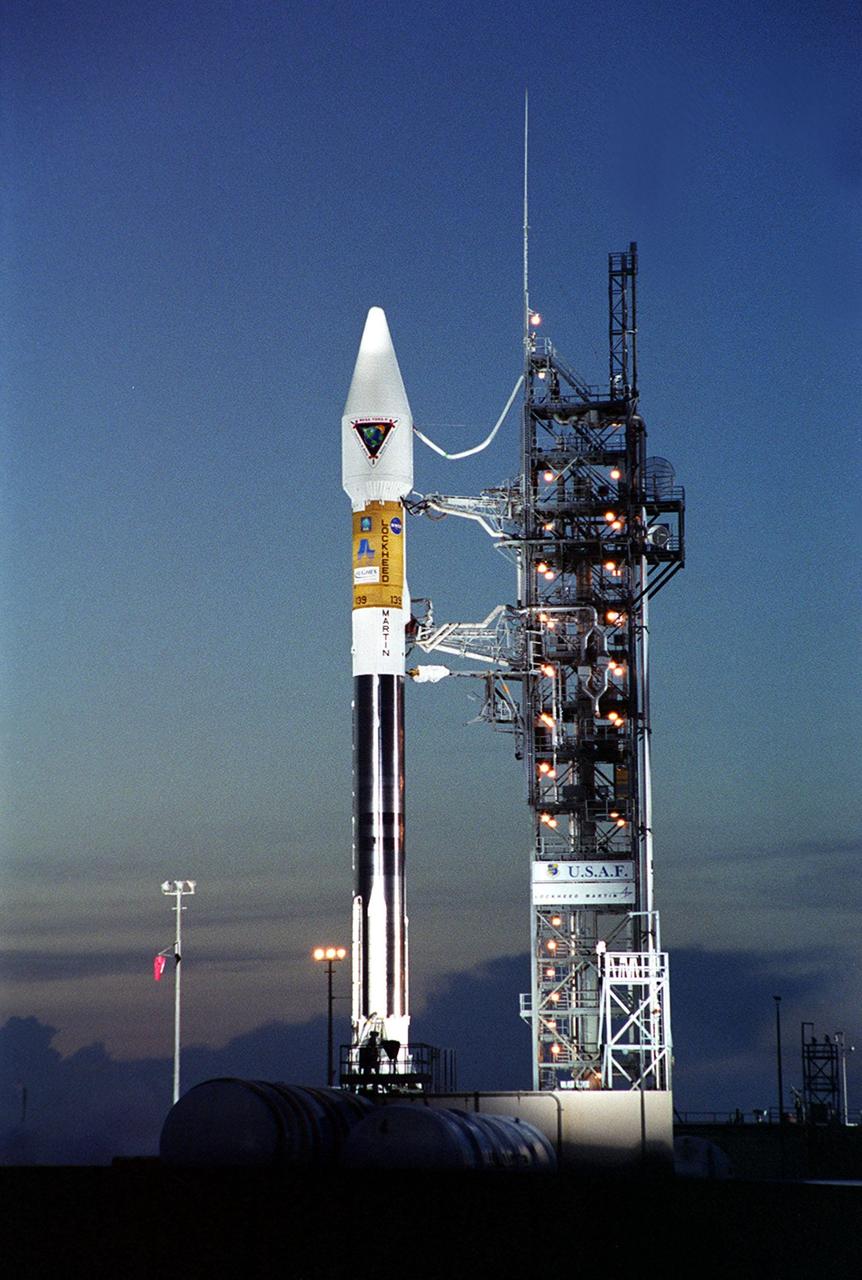
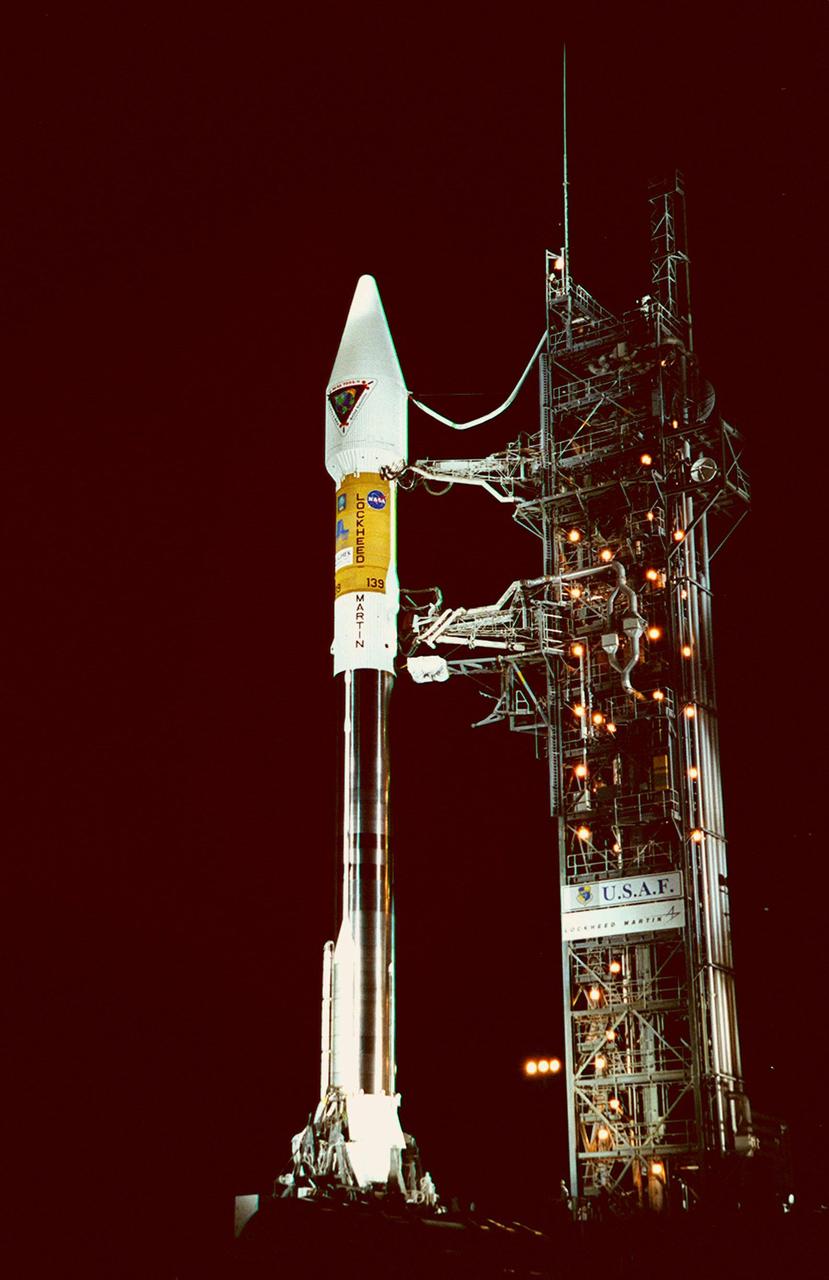
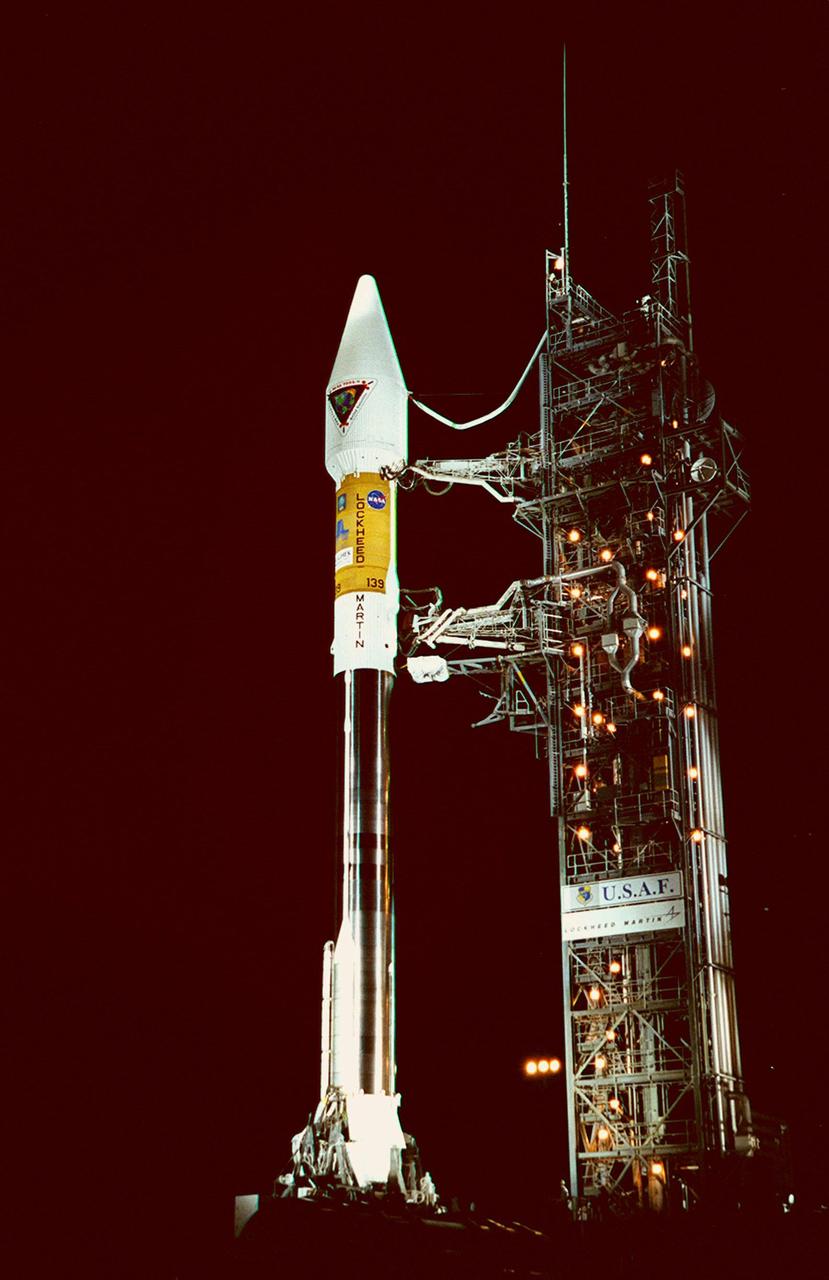
After tower rollback just before dawn on Launch Pad 36A, Cape Canaveral Air Force Station, NASA’s Tracking and Data Relay Satellite (TDRS-H) sits bathed in spotlights before liftoff atop an Atlas IIA/Centaur rocket. One of three satellites (labeled H, I and J) being built by the Hughes Space and Communications Company, the latest TDRS uses an innovative springback antenna design. A pair of 15-foot-diameter, flexible mesh antenna reflectors fold up for launch, then spring back into their original cupped circular shape on orbit. The new satellites will augment the TDRS system’s existing Sand Ku-band frequencies by adding Ka-band capability. TDRS will serve as the sole means of continuous, high-data-rate communication with the Space Shuttle, with the International Space Station upon its completion, and with dozens of unmanned scientific satellites in low earth orbit
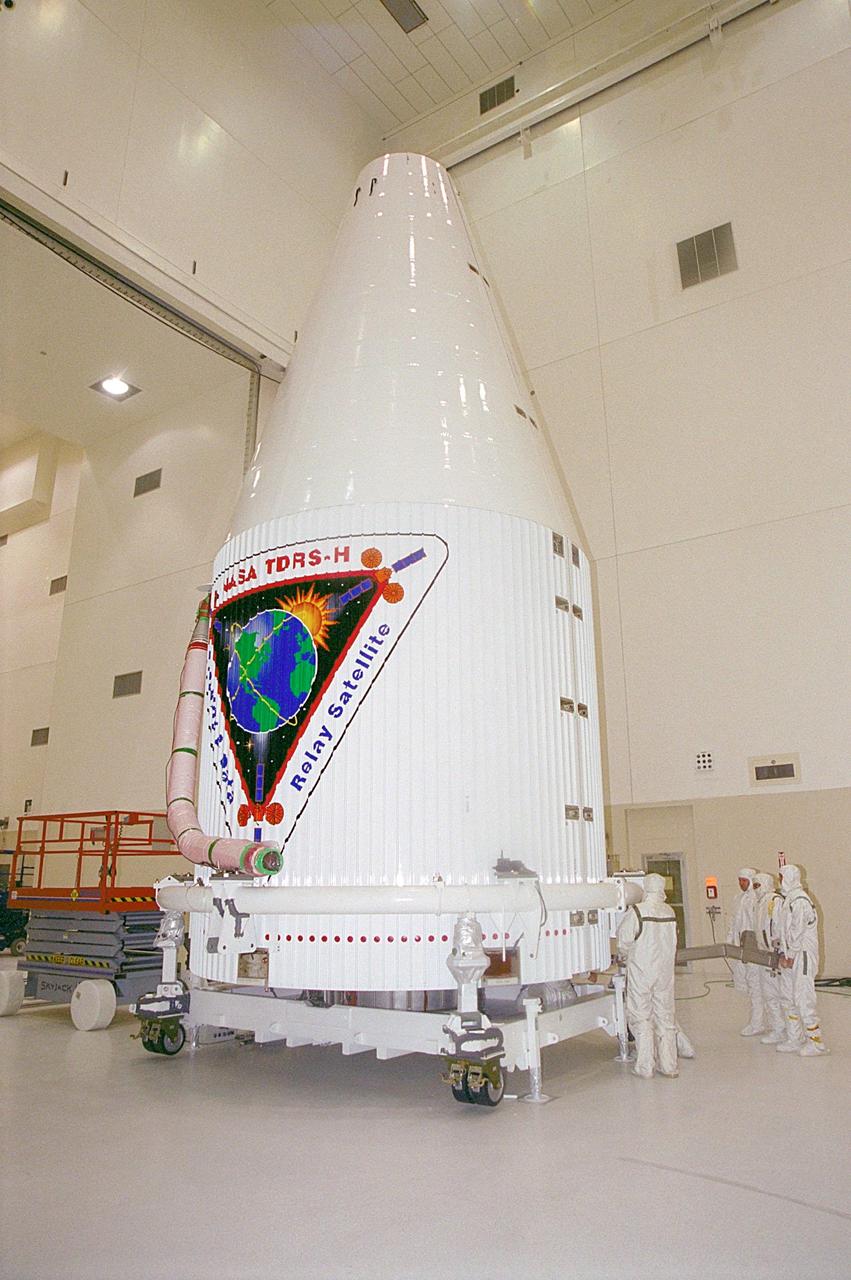
The Tracking and Data Relay Satellite (TDRS-H) sits fully encapsulated inside the fairing. Next, it will be transported to Launch Pad 36A, Cape Canaveral Air Force Station for launch scheduled June 29 aboard an Atlas IIA/Centaur rocket. One of three satellites (labeled H, I and J) being built in the Hughes Space and Communications Company Integrated Satellite Factory in El Segundo, Calif., the latest TDRS uses an innovative springback antenna design. A pair of 15-foot-diameter, flexible mesh antenna reflectors fold up for launch, then spring back into their original cupped circular shape on orbit. The new satellites will augment the TDRS system’s existing Sand Ku-band frequencies by adding Ka-band capability. TDRS will serve as the sole means of continuous, high-data-rate communication with the space shuttle, with the International Space Station upon its completion, and with dozens of unmanned scientific satellites in low earth orbit
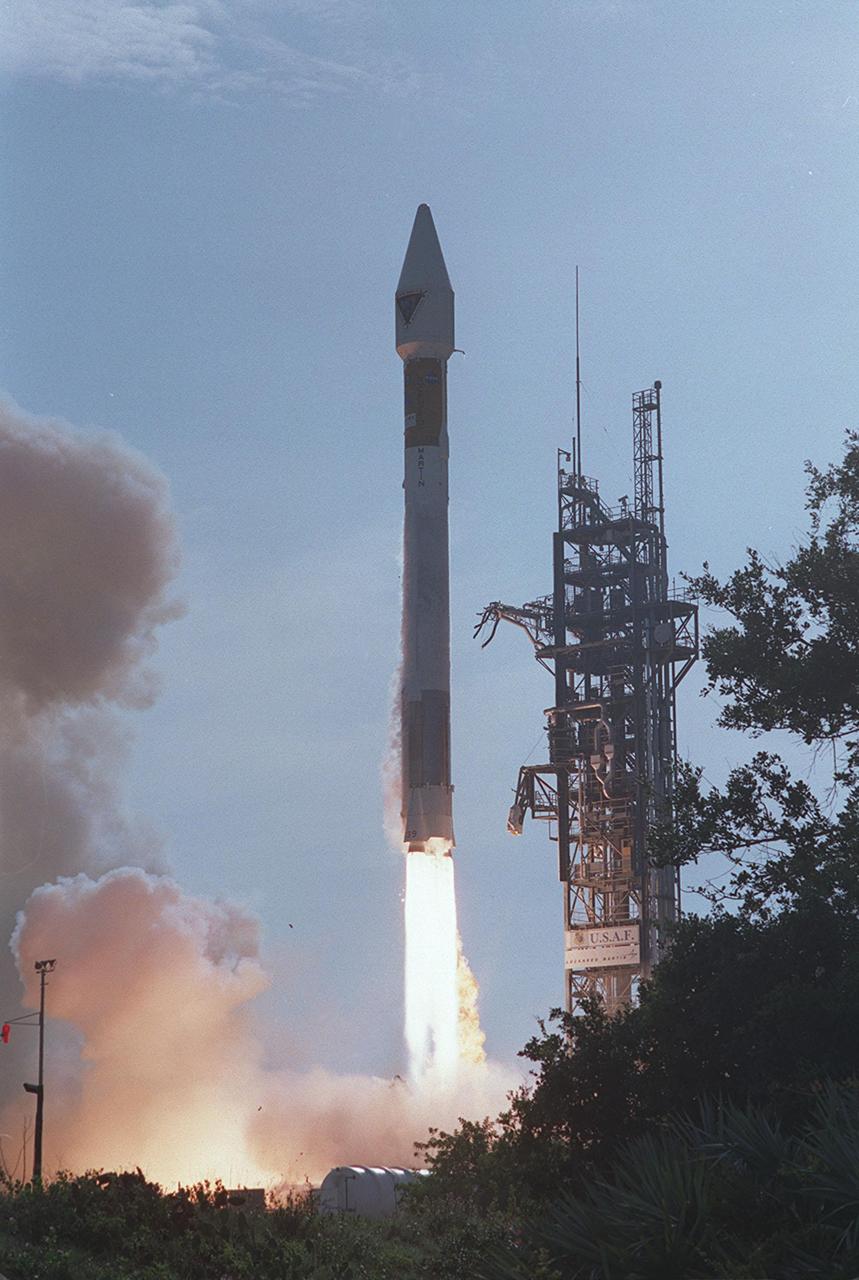
NASA’s Tracking and Data Relay Satellite (TDRS-H) rises into the blue sky from Pad 36A, Cape Canaveral Air Force Station. Liftoff occurred at 8:56 a.m. EDT aboard an Atlas IIA/Centaur rocket. One of three satellites (labeled H, I and J) being built by the Hughes Space and Communications Company, the latest TDRS uses an innovative springback antenna design. A pair of 15-foot-diameter, flexible mesh antenna reflectors fold up for launch, then spring back into their original cupped circular shape on orbit. The new satellites will augment the TDRS system’s existing Sand Ku-band frequencies by adding Ka-band capability. TDRS will serve as the sole means of continuous, high-data-rate communication with the space shuttle, with the International Space Station upon its completion, and with dozens of unmanned scientific satellites in low earth orbit

CAPE CANAVERAL, Fla. – At the Astrotech Space Operations facility in Titusville, Fla., NASA's GOES-P meteorological satellite has been unbagged and rotated. The large cup-shaped object on the right side of the spacecraft is the ultrahigh frequency, or UHF, antenna. GOES-P, the latest Geostationary Operational Environmental Satellite, was developed by NASA for the National Oceanic and Atmospheric Administration, or NOAA. GOES-P is designed to watch for storm development and observed current weather conditions on Earth. Launch of GOES-P is targeted for no earlier than March 1 from Launch Complex 37 aboard a United Launch Alliance Delta IV rocket. For information on GOES-P, visit http://goespoes.gsfc.nasa.gov/goes/spacecraft/n_p_spacecraft.html. Photo credit: NASA/Amanda Diller

After tower rollback just before dawn on Launch Pad 36A, Cape Canaveral Air Force Station, NASA’s Tracking and Data Relay Satellite (TDRS-H) sits bathed in spotlights before liftoff atop an Atlas IIA/Centaur rocket. One of three satellites (labeled H, I and J) being built by the Hughes Space and Communications Company, the latest TDRS uses an innovative springback antenna design. A pair of 15-foot-diameter, flexible mesh antenna reflectors fold up for launch, then spring back into their original cupped circular shape on orbit. The new satellites will augment the TDRS system’s existing Sand Ku-band frequencies by adding Ka-band capability. TDRS will serve as the sole means of continuous, high-data-rate communication with the Space Shuttle, with the International Space Station upon its completion, and with dozens of unmanned scientific satellites in low earth orbit
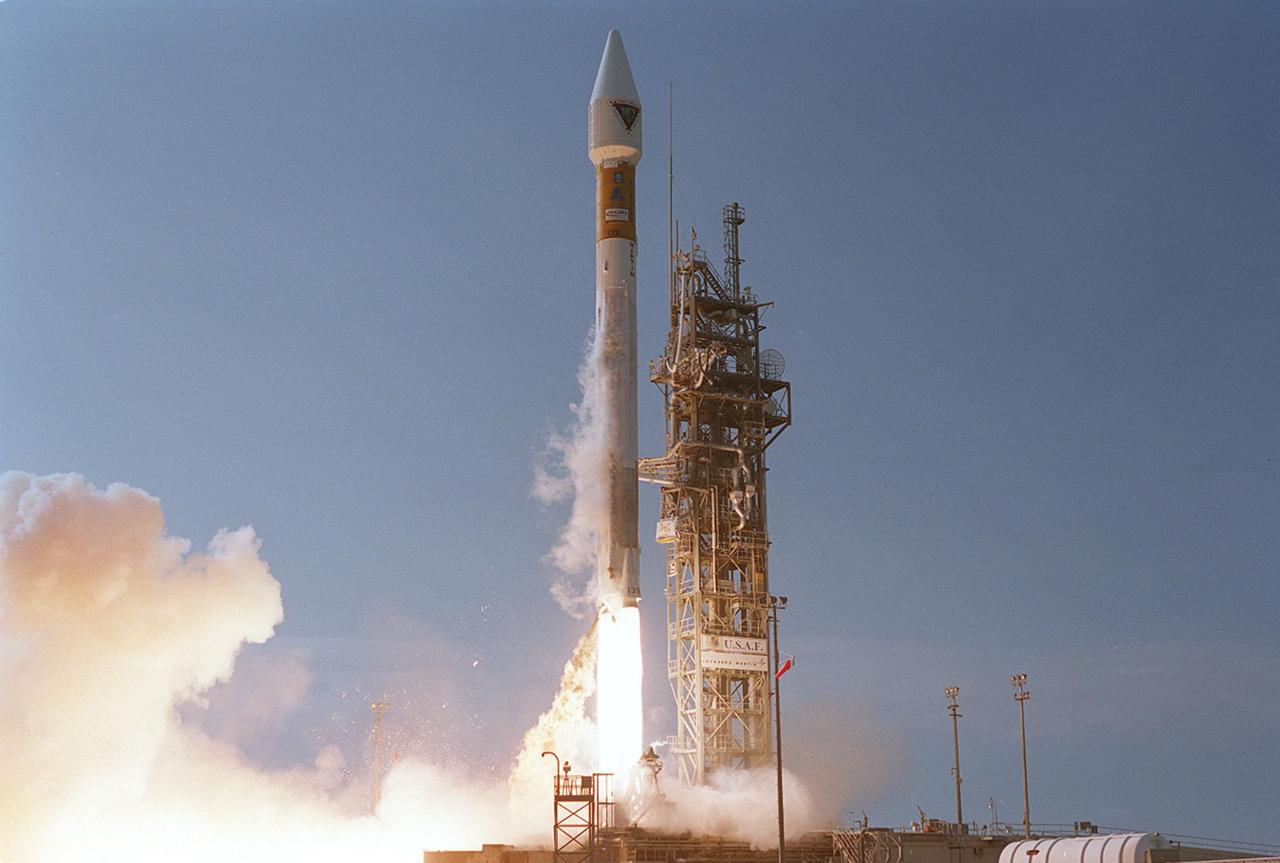
Leaving billowing clouds of steam and smoke behind, NASA’s Tracking and Data Relay Satellite (TDRS-H) shoots into the blue sky aboard an Atlas IIA/Centaur rocket from Pad 36A, Cape Canaveral Air Force Station. Liftoff occurred at 8:56 a.m. EDT. One of three satellites (labeled H, I and J) being built by the Hughes Space and Communications Company, the latest TDRS uses an innovative springback antenna design. A pair of 15-foot-diameter, flexible mesh antenna reflectors fold up for launch, then spring back into their original cupped circular shape on orbit. The new satellites will augment the TDRS system’s existing Sand Ku-band frequencies by adding Ka-band capability. TDRS will serve as the sole means of continuous, high-data-rate communication with the space shuttle, with the International Space Station upon its completion, and with dozens of unmanned scientific satellites in low earth orbit
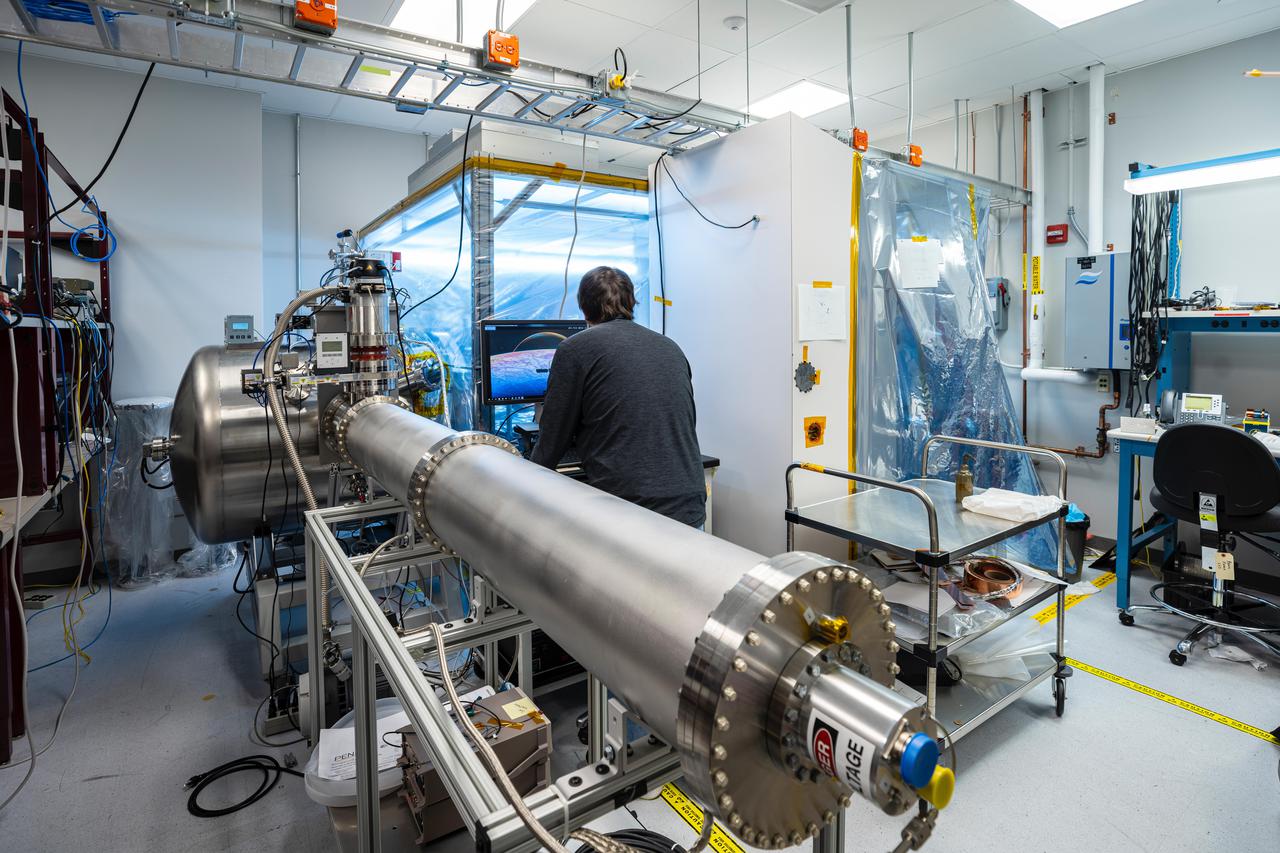
Included in the payload of science instruments for NASA's Europa Clipper is the Plasma Instrument for Magnetic Sounding (PIMS). Scientists will use PIMS to study the characteristics of plasma around Europa to better understand the moon's ice-shell thickness, ocean depth, and ocean salinity. PIMS will have four sensors, called Faraday cups, to measure the electrical current produced by charged particles (or plasma) as they strike a detector plate inside each sensor. In this photo, the Plasma Instrument Calibration Chamber at the Johns Hopkins Applied Physics Laboratory (APL) in Laurel, Maryland, recreates the plasma environments that PIMS and other instruments will encounter in space. The equipment in this lab simulates these environments with ion beams that reproduce plasma energy ranges found at Jupiter and Europa. Once PIMS is fully assembled in the clean room attached to the chamber, the team will direct these ion and electron beams into the Faraday cup sensors for calibration. This will be used specifically to simulate the plasma in Europa's ionosphere and Jupiter's magnetosphere, which PIMS will later measure directly. With an internal global ocean twice the size of Earth's oceans combined, Europa may have the potential to harbor life. NASA's Europa Clipper spacecraft will swoop around Jupiter on an elliptical path, dipping close to the moon on each flyby to collect data. Understanding Europa's habitability will help scientists better understand how life developed on Earth and the potential for finding life beyond our planet. https://photojournal.jpl.nasa.gov/catalog/PIA24330
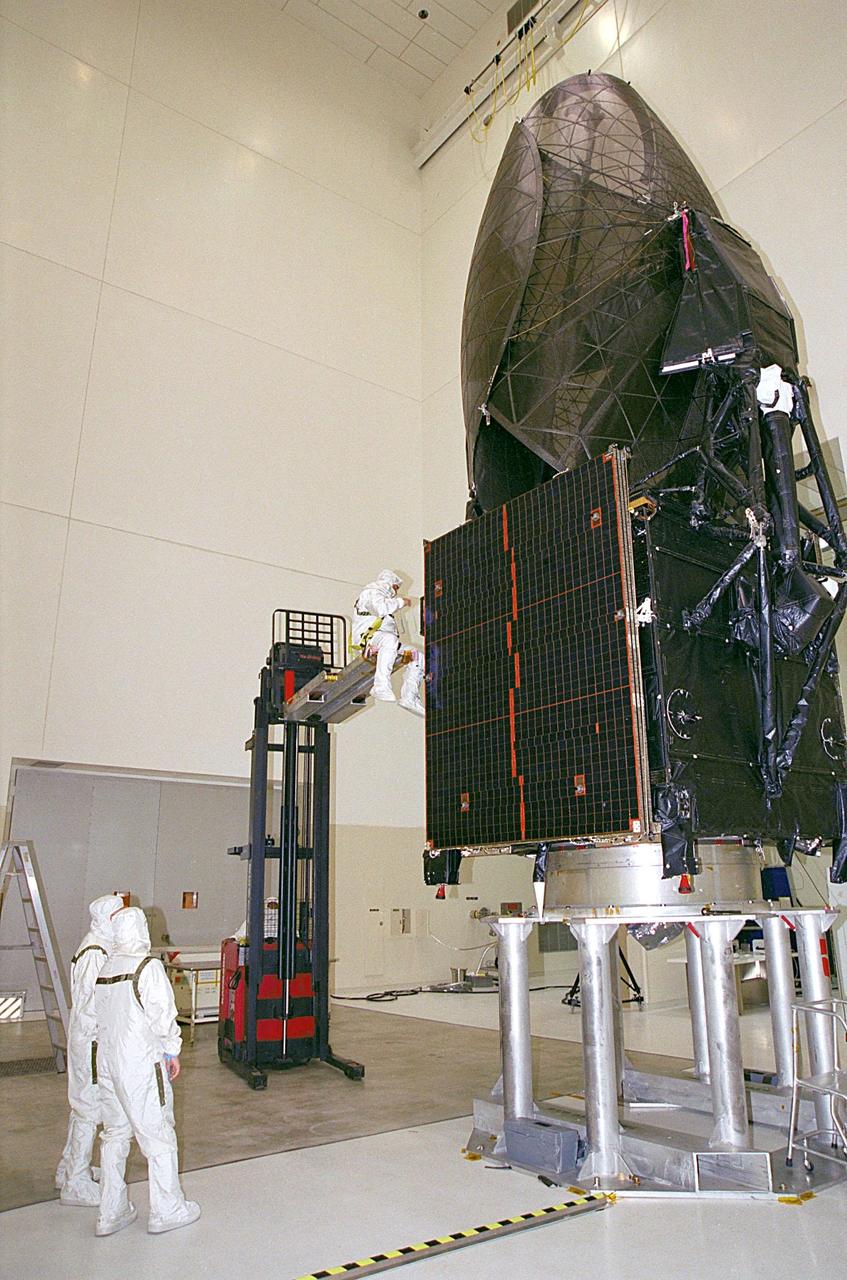
In the Spacecraft Assembly and Encapsulation Facility, a worker (left center) checks out the Tracking and Data Relay Satellite (TDRS-H) after its move to the payload adapter (below). Next step is the encapsulation of the TDRS in the fairing. TDRS is scheduled to be launched June 29 aboard an Atlas IIA/Centaur rocket. One of three satellites (labeled H, I and J) being built in the Hughes Space and Communications Company Integrated Satellite Factory in El Segundo, Calif., the latest TDRS uses an innovative springback antenna design. A pair of 15-foot-diameter, flexible mesh antenna reflectors fold up for launch, then spring back into their original cupped circular shape on orbit. The new satellites will augment the TDRS system’s existing Sand Ku-band frequencies by adding Ka-band capability. TDRS will serve as the sole means of continuous, high-data-rate communication with the space shuttle, with the International Space Station upon its completion, and with dozens of unmanned scientific satellites in low earth orbit

The logo for the Tracking and Data Relay Satellite (TDRS-H) is predominantly displayed on the fairing that will encapsulate the satellite for launch. The fairing is in KSC’s Spacecraft Assembly and Encapsulation Facility (SAEF-2) where TDRS is undergoing testing. The TDRS is scheduled to be launched from CCAFS June 29 aboard an Atlas IIA/Centaur rocket. One of three satellites (labeled H, I and J) being built in the Hughes Space and Communications Company Integrated Satellite Factory in El Segundo, Calif., the latest TDRS uses an innovative springback antenna design. A pair of 15-foot-diameter, flexible mesh antenna reflectors fold up for launch, then spring back into their original cupped circular shape on orbit. The new satellites will augment the TDRS system’s existing Sand Ku-band frequencies by adding Ka-band capability. TDRS will serve as the sole means of continuous, high-data-rate communication with the space shuttle, with the International Space Station upon its completion, and with dozens of unmanned scientific satellites in low earth orbit
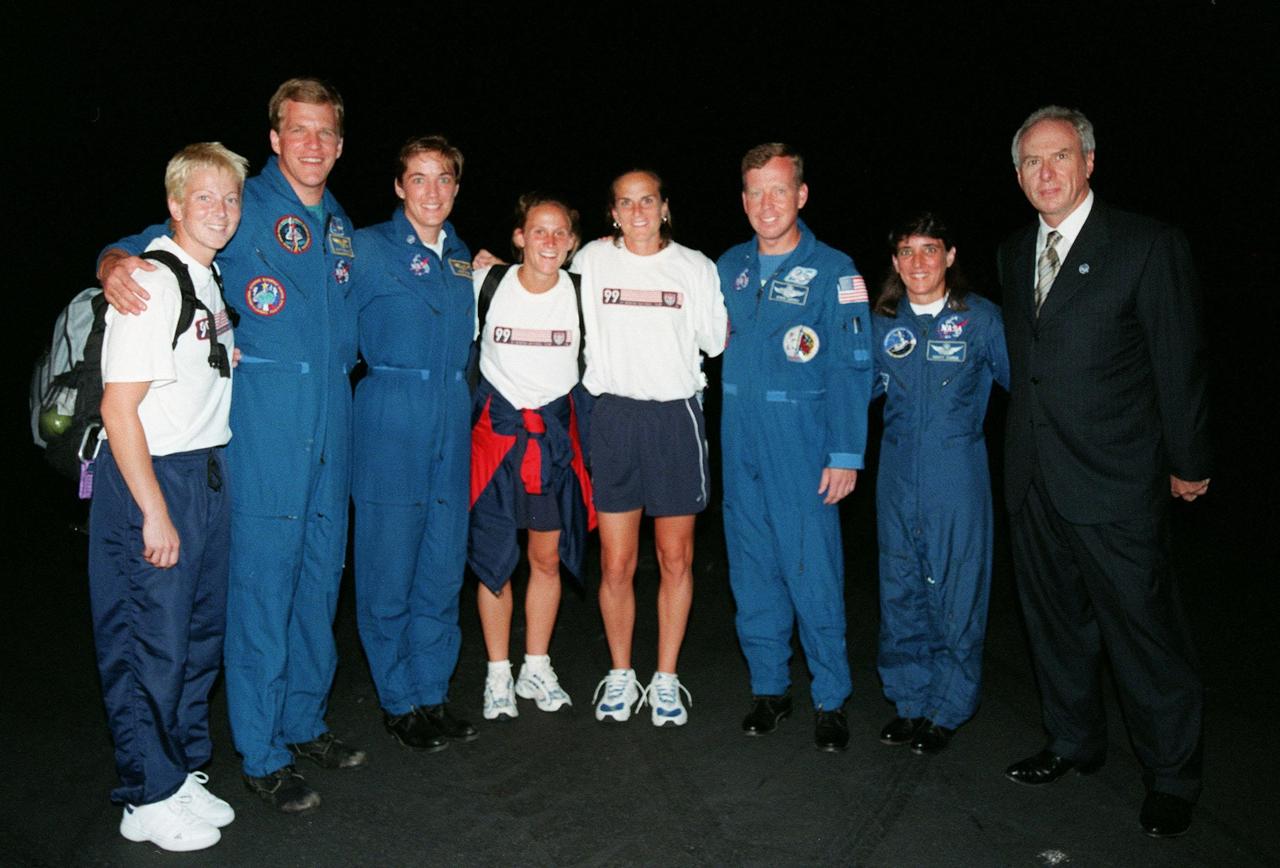
Members of the U.S. World Cup Soccer Team pose with Astronauts Scott Parazynski, Heidemarie M. Stefanyshyn-Piper, Steven W. Lindsey, and Nancy Jane Currie and NASA Administrator Daniel Goldin after the team's arrival at the Skid Strip at Cape Canaveral Air Station. The team arrived with First Lady Hillary Rodham Clinton to view the launch of Space Shuttle mission STS-93. Liftoff is scheduled for 12:36 a.m. EDT July 20. Much attention has been generated over the launch due to Commander Eileen M. Collins, the first woman to serve as commander of a Shuttle mission. The primary payload of the five-day mission is the Chandra X-ray Observatory, which will allow scientists from around the world to study some of the most distant, powerful and dynamic objects in the universe. The new telescope is 20 to 50 times more sensitive than any previous X-ray telescope and is expected to unlock the secrets of supernovae, quasars and black holes
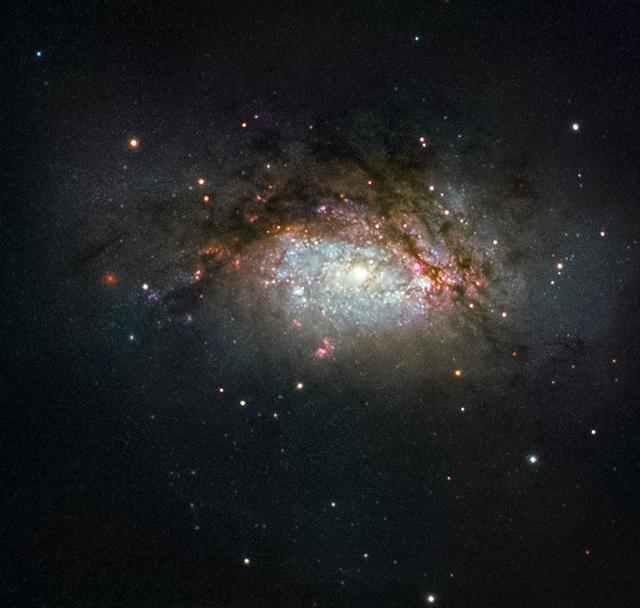
The subject of this NASA/ESA Hubble Space Telescope image is known as NGC 3597. It is the product of a collision between two good-sized galaxies, and is slowly evolving to become a giant elliptical galaxy. This type of galaxy has grown more and more common as the Universe has evolved, with initially small galaxies merging and progressively building up into larger galactic structures over time. NGC 3597 is located approximately 150 million light-years away in the constellation of Crater (The Cup). Astronomers study NGC 3597 to learn more about how elliptical galaxies form — many ellipticals began their lives far earlier in the history of the Universe. Older ellipticals are nicknamed “red and dead” by astronomers because these bloated galaxies are not anymore producing new, bluer, stars in ages, and are thus packed full of old and redder stellar populations. Before infirmity sets in, some freshly formed elliptical galaxies experience a final flush of youth, as is the case with NGC 3597. Galaxies smashing together pool their available gas and dust, triggering new rounds of star birth. Some of this material ends up in dense pockets initially called proto-globular clusters, dozens of which festoon NGC 3597. These pockets will go on to collapse and form fully-fledged globular clusters, large spheres that orbit the centres of galaxies like satellites, packed tightly full of millions of stars.
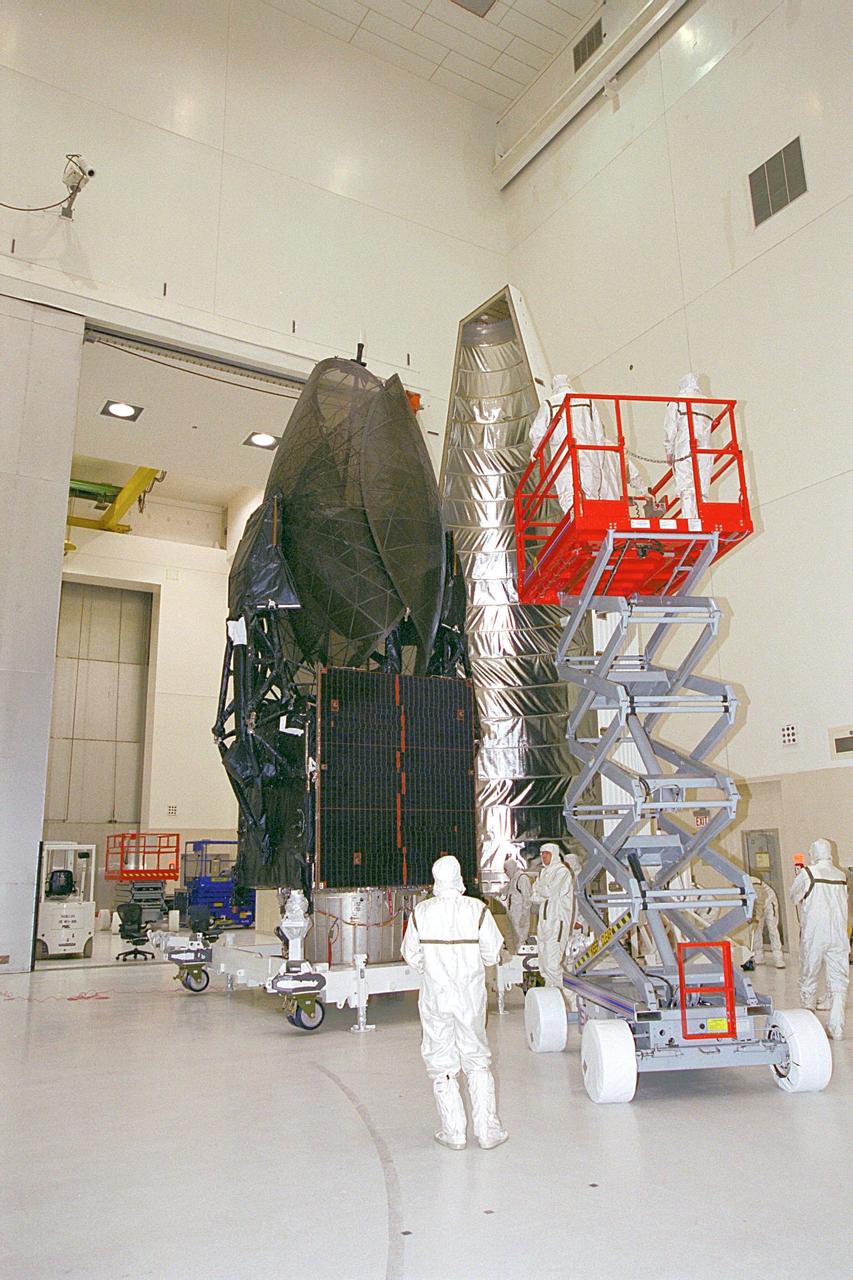
In the Spacecraft Assembly and Encapsulation Facility, the Tracking and Data Relay Satellite (TDRS-H) at left is ready for encapsulation. Workers in an extended platform are moved closer to the fairing at right of the satellite. After encapsulation in the fairing, TDRS will be transported to Launch Pad 36A, Cape Canaveral Air Force Station for launch scheduled June 29 aboard an Atlas IIA/Centaur rocket. One of three satellites (labeled H, I and J) being built in the Hughes Space and Communications Company Integrated Satellite Factory in El Segundo, Calif., the latest TDRS uses an innovative springback antenna design. A pair of 15-foot-diameter, flexible mesh antenna reflectors fold up for launch, then spring back into their original cupped circular shape on orbit. The new satellites will augment the TDRS system’s existing Sand Ku-band frequencies by adding Ka-band capability. TDRS will serve as the sole means of continuous, high-data-rate communication with the space shuttle, with the International Space Station upon its completion, and with dozens of unmanned scientific satellites in low earth orbit
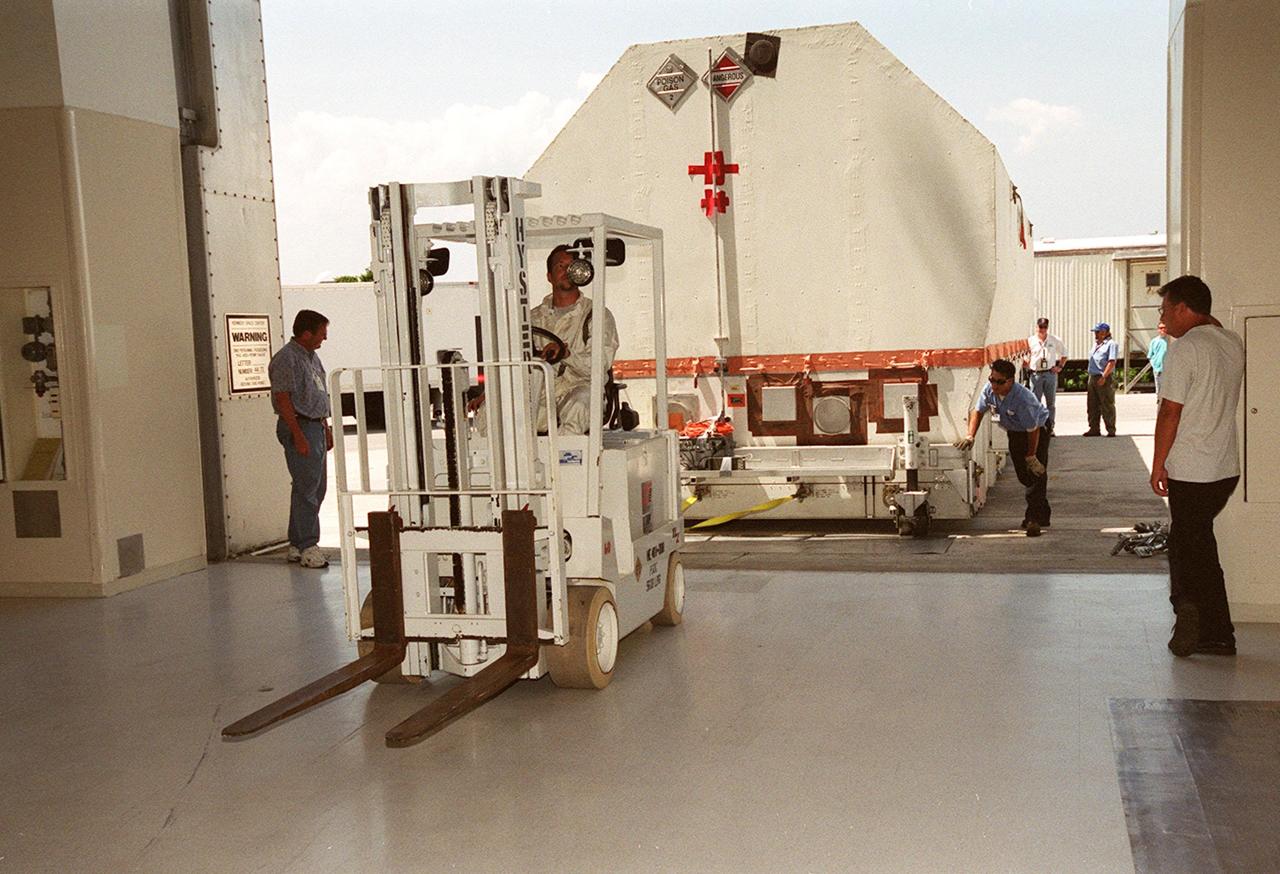
The crated Tracking and Data Relay Satellite (TDRS-H) is pulled inside the Spacecraft Assembly and Encapsulation Facility (SAEF-2) after its arrival at KSC. The TDRS will undergo testing in the SAEF-2. One of three satellites (labeled H, I and J) being built in the Hughes Space and Communications Company Integrated Satellite Factory in El Segundo, Calif., the latest TDRS uses an innovative springback antenna design. A pair of 15-foot-diameter, flexible mesh antenna reflectors fold up for launch, then spring back into their original cupped circular shape on orbit. The new satellites will augment the TDRS system’s existing Sand Ku-band frequencies by adding Ka-band capability. TDRS will serve as the sole means of continuous, high-data-rate communication with the space shuttle, with the International Space Station upon its completion, and with dozens of unmanned scientific satellites in low earth orbit. The TDRS is scheduled to be launched from CCAFS June 29 aboard an Atlas IIA/Centaur rocket
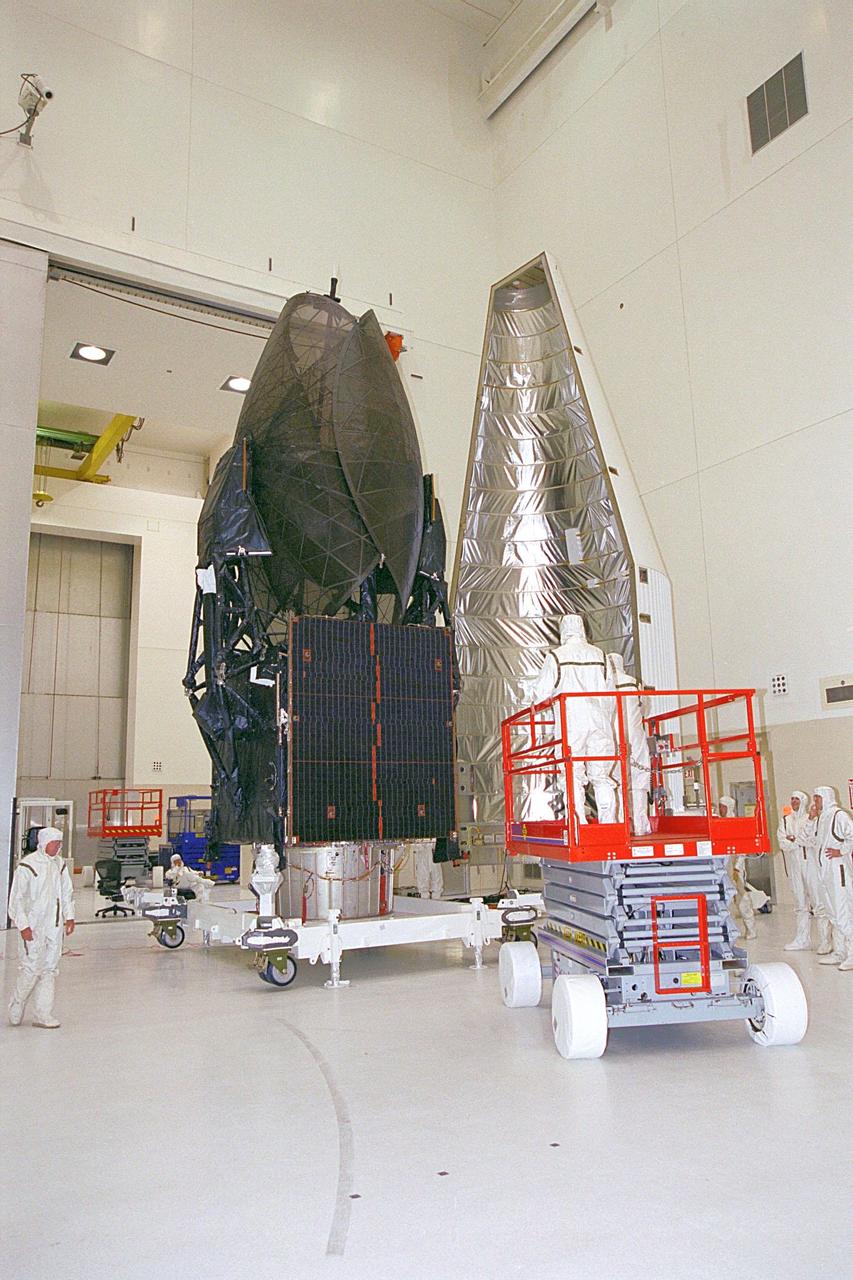
In the Spacecraft Assembly and Encapsulation Facility, the Tracking and Data Relay Satellite (TDRS-H) at left is ready for encapsulation. Workers in an extendable platform wait for the fairing (right) to move into place. After encapsulation in the fairing, TDRS will be transported to Launch Pad 36A, Cape Canaveral Air Force Station for launch scheduled June 29 aboard an Atlas IIA/Centaur rocket. One of three satellites (labeled H, I and J) being built in the Hughes Space and Communications Company Integrated Satellite Factory in El Segundo, Calif., the latest TDRS uses an innovative springback antenna design. A pair of 15-foot-diameter, flexible mesh antenna reflectors fold up for launch, then spring back into their original cupped circular shape on orbit. The new satellites will augment the TDRS system’s existing Sand Ku-band frequencies by adding Ka-band capability. TDRS will serve as the sole means of continuous, high-data-rate communication with the space shuttle, with the International Space Station upon its completion, and with dozens of unmanned scientific satellites in low earth orbit
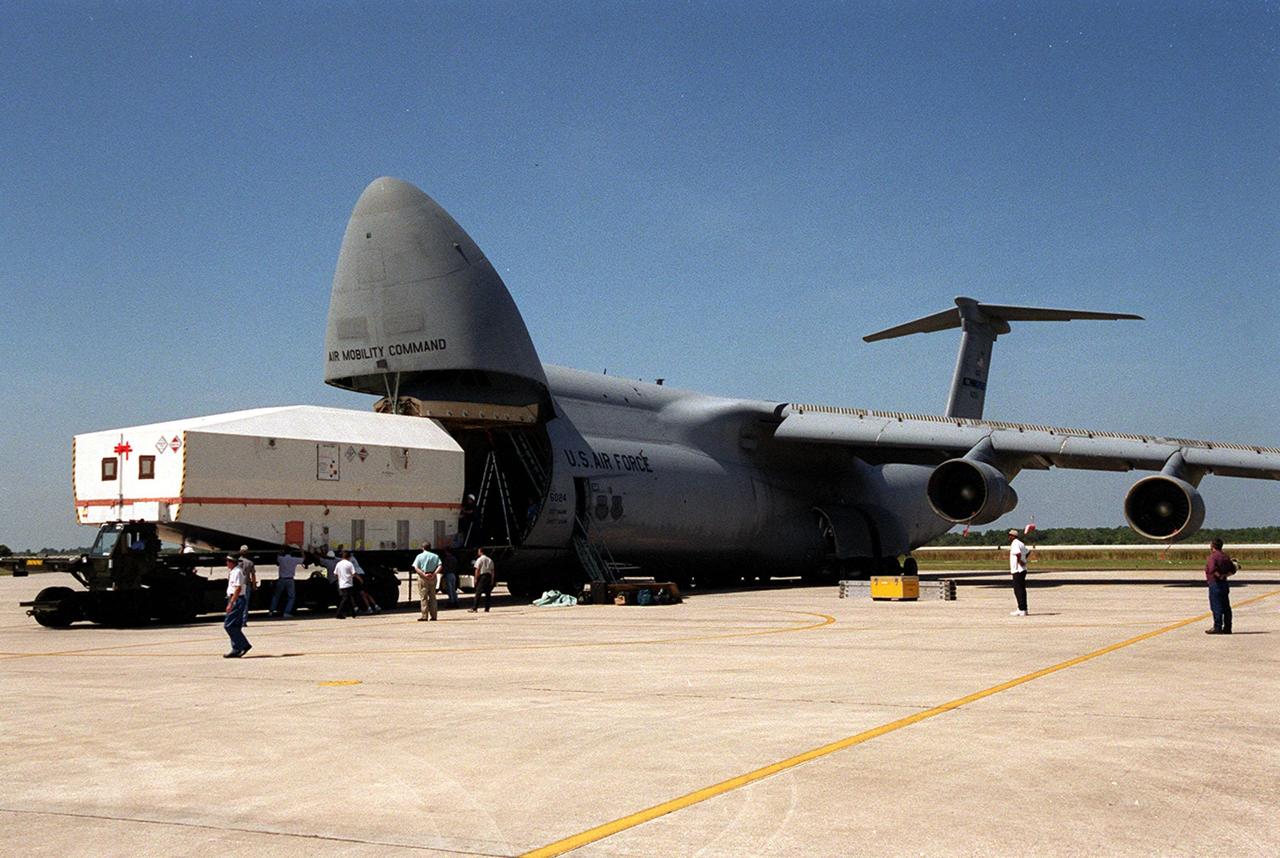
At the Shuttle Landing Facility, the crated Tracking and Data Relay Satellite (TDRS-H) is offloaded from an air cargo plane. It will be taken to the Spacecraft Assembly and Encapsulation Facility (SAEF-2) for testing. The TDRS is one of three (labeled H, I and J) being built in the Hughes Space and Communications Company Integrated Satellite Factory in El Segundo, Calif. The latest TDRS uses an innovative springback antenna design. A pair of 15-foot-diameter, flexible mesh antenna reflectors fold up for launch, then spring back into their original cupped circular shape on orbit. The new satellites will augment the TDRS system’s existing Sand Ku-band frequencies by adding Ka-band capability. TDRS will serve as the sole means of continuous, high-data-rate communication with the space shuttle, with the International Space Station upon its completion, and with dozens of unmanned scientific satellites in low earth orbit. The TDRS is scheduled to be launched from CCAFS June 29 aboard an Atlas IIA/Centaur rocket

In the Spacecraft Assembly and Encapsulation Facility, the Tracking and Data Relay Satellite (TDRS-H) at left is ready for encapsulation. Workers in an extended platform are moved closer to the fairing at right of the satellite. After encapsulation in the fairing, TDRS will be transported to Launch Pad 36A, Cape Canaveral Air Force Station for launch scheduled June 29 aboard an Atlas IIA/Centaur rocket. One of three satellites (labeled H, I and J) being built in the Hughes Space and Communications Company Integrated Satellite Factory in El Segundo, Calif., the latest TDRS uses an innovative springback antenna design. A pair of 15-foot-diameter, flexible mesh antenna reflectors fold up for launch, then spring back into their original cupped circular shape on orbit. The new satellites will augment the TDRS system’s existing Sand Ku-band frequencies by adding Ka-band capability. TDRS will serve as the sole means of continuous, high-data-rate communication with the space shuttle, with the International Space Station upon its completion, and with dozens of unmanned scientific satellites in low earth orbit
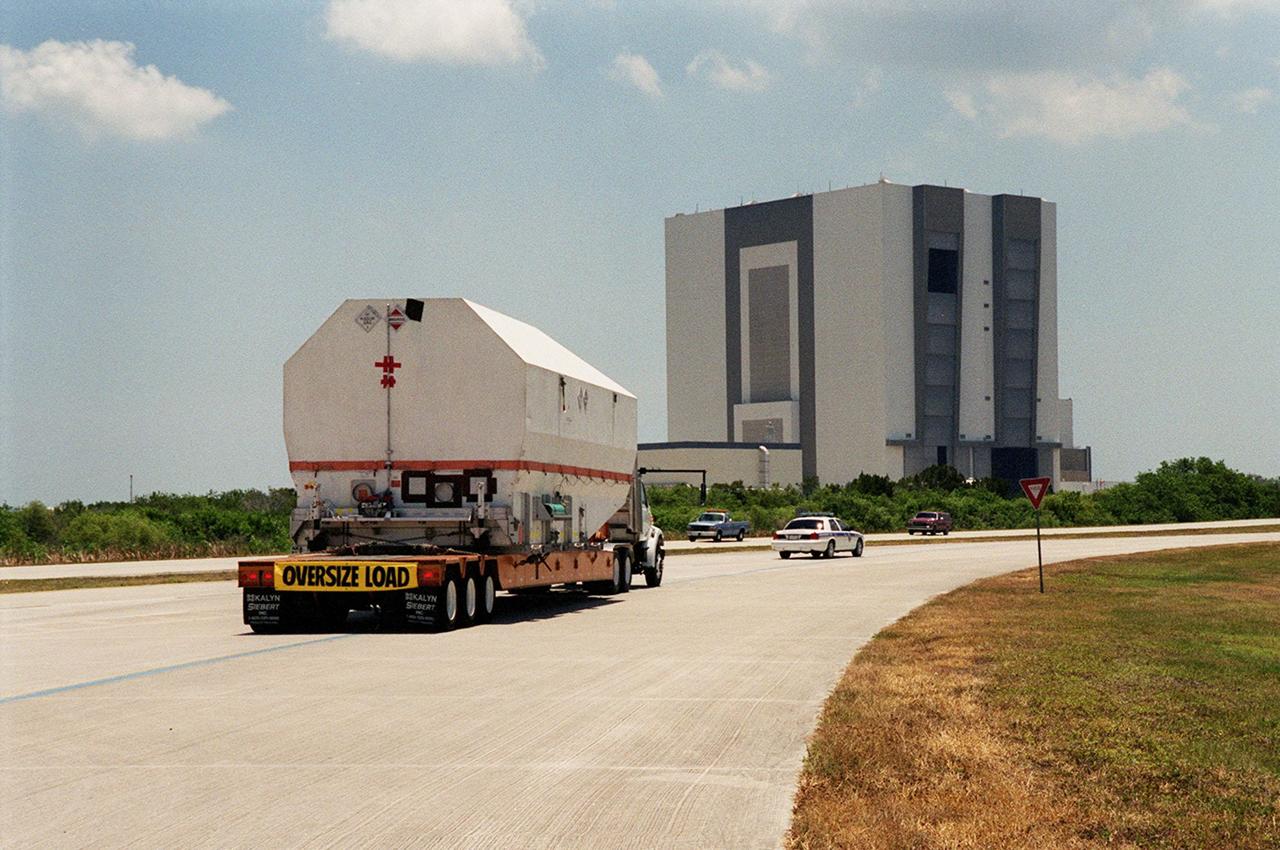
After its arrival at the Shuttle Landing Facility, the crated Tracking and Data Relay Satellite (TDRS-H) is transported past the Vehicle Assembly Building (in the background) to the Spacecraft Assembly and Encapsulation Facility (SAEF-2) for testing. The TDRS is one of three (labeled H, I and J) being built in the Hughes Space and Communications Company Integrated Satellite Factory in El Segundo, Calif. The latest TDRS uses an innovative springback antenna design. A pair of 15-foot-diameter, flexible mesh antenna reflectors fold up for launch, then spring back into their original cupped circular shape on orbit. The new satellites will augment the TDRS system’s existing Sand Ku-band frequencies by adding Ka-band capability. TDRS will serve as the sole means of continuous, high-data-rate communication with the space shuttle, with the International Space Station upon its completion, and with dozens of unmanned scientific satellites in low earth orbit. The TDRS is scheduled to be launched from CCAFS June 29 aboard an Atlas IIA/Centaur rocket
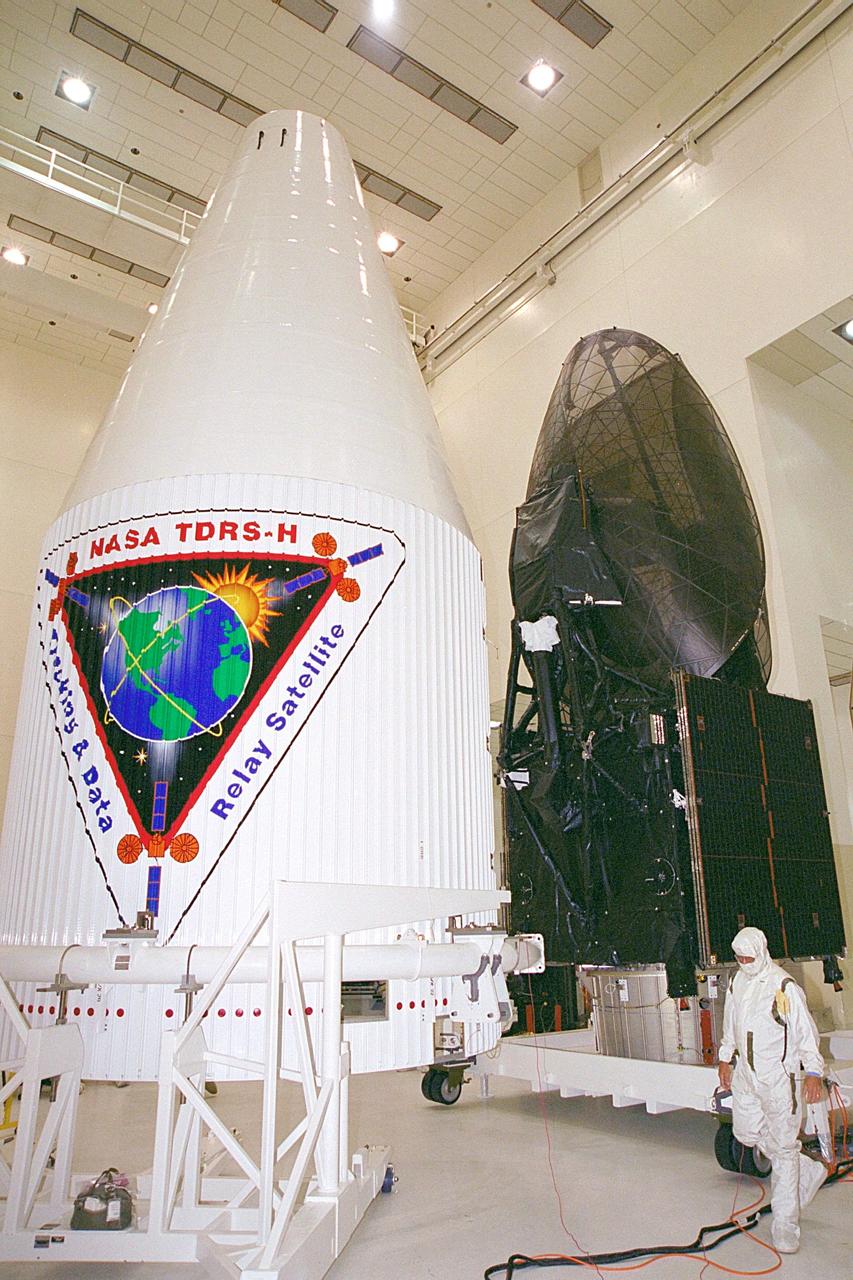
In the Spacecraft Assembly and Encapsulation Facility, the Tracking and Data Relay Satellite (TDRS-H) at right sits while one-half of the fairing (left) is moved closer to it. After encapsulation in the fairing, TDRS will be transported to Launch Pad 36A, Cape Canaveral Air Force Station for launch scheduled June 29 aboard an Atlas IIA/Centaur rocket. One of three satellites (labeled H, I and J) being built in the Hughes Space and Communications Company Integrated Satellite Factory in El Segundo, Calif., the latest TDRS uses an innovative springback antenna design. A pair of 15-foot-diameter, flexible mesh antenna reflectors fold up for launch, then spring back into their original cupped circular shape on orbit. The new satellites will augment the TDRS system’s existing Sand Ku-band frequencies by adding Ka-band capability. TDRS will serve as the sole means of continuous, high-data-rate communication with the space shuttle, with the International Space Station upon its completion, and with dozens of unmanned scientific satellites in low earth orbit
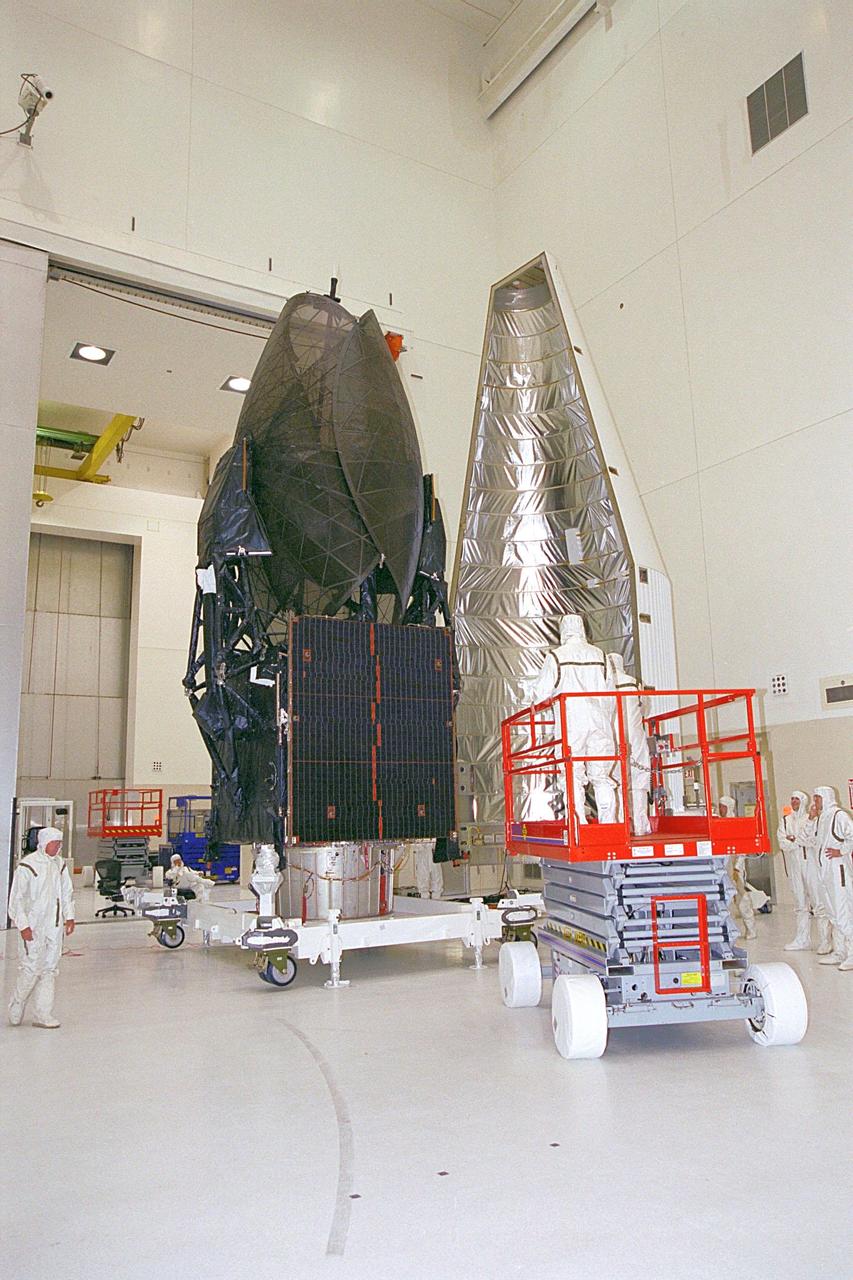
In the Spacecraft Assembly and Encapsulation Facility, the Tracking and Data Relay Satellite (TDRS-H) at left is ready for encapsulation. Workers in an extendable platform wait for the fairing (right) to move into place. After encapsulation in the fairing, TDRS will be transported to Launch Pad 36A, Cape Canaveral Air Force Station for launch scheduled June 29 aboard an Atlas IIA/Centaur rocket. One of three satellites (labeled H, I and J) being built in the Hughes Space and Communications Company Integrated Satellite Factory in El Segundo, Calif., the latest TDRS uses an innovative springback antenna design. A pair of 15-foot-diameter, flexible mesh antenna reflectors fold up for launch, then spring back into their original cupped circular shape on orbit. The new satellites will augment the TDRS system’s existing Sand Ku-band frequencies by adding Ka-band capability. TDRS will serve as the sole means of continuous, high-data-rate communication with the space shuttle, with the International Space Station upon its completion, and with dozens of unmanned scientific satellites in low earth orbit
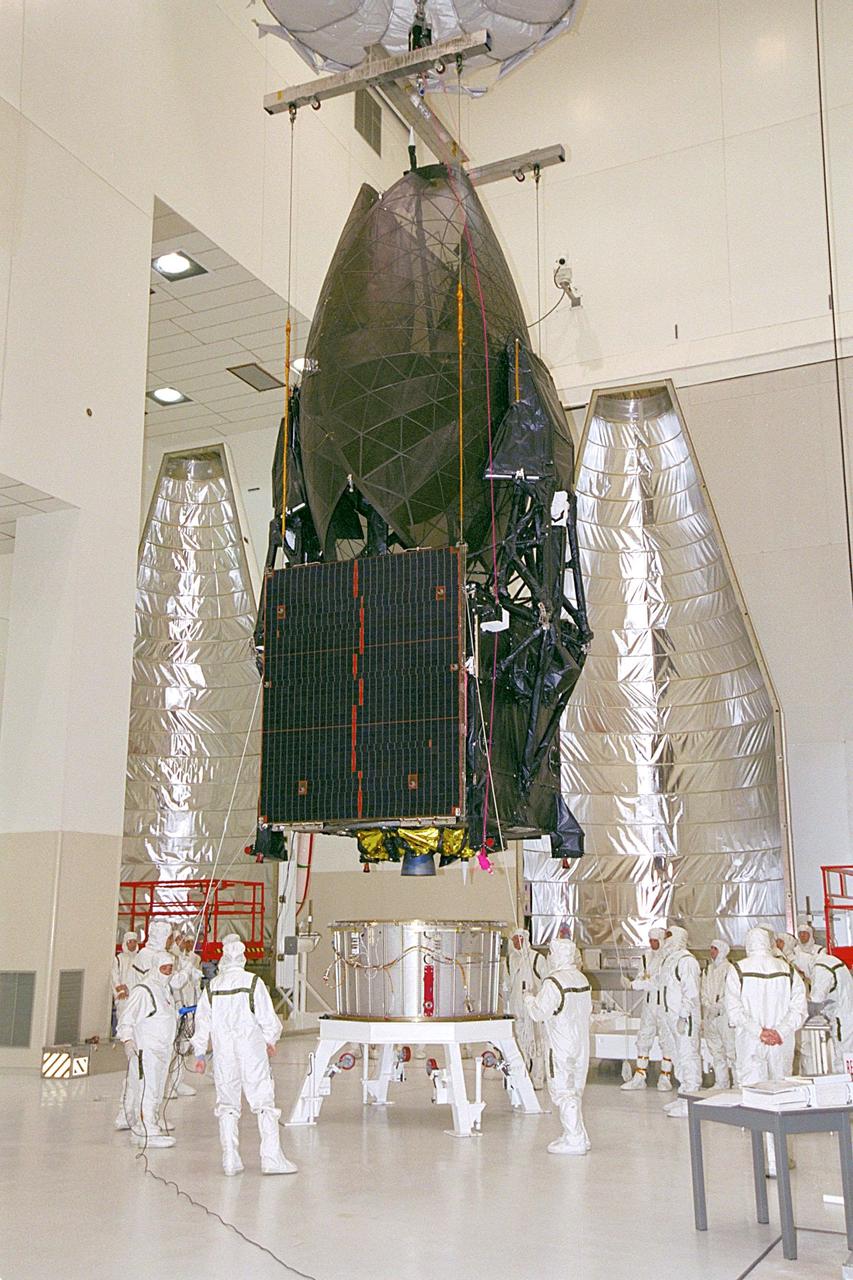
In the Spacecraft Assembly and Encapsulation Facility, overhead cranes lower the Tracking and Data Relay Satellite (TDRS-H) onto a payload adapter. Next step is the encapsulation of the satellite in the fairing behind it (right and left). TDRS is scheduled to be launched June 29 aboard an Atlas IIA/Centaur rocket. One of three satellites (labeled H, I and J) being built in the Hughes Space and Communications Company Integrated Satellite Factory in El Segundo, Calif., the latest TDRS uses an innovative springback antenna design. A pair of 15-foot-diameter, flexible mesh antenna reflectors fold up for launch, then spring back into their original cupped circular shape on orbit. The new satellites will augment the TDRS system’s existing Sand Ku-band frequencies by adding Ka-band capability. TDRS will serve as the sole means of continuous, high-data-rate communication with the space shuttle, with the International Space Station upon its completion, and with dozens of unmanned scientific satellites in low earth orbit