
This most distant x-ray cluster of galaxies yet has been found by astronomers using Chandra X-ray Observatory (CXO). Approximately 10 billion light-years from Earth, the cluster 3C294 is 40 percent farther than the next most distant x-ray galaxy cluster. The existence of such a faraway cluster is important for understanding how the universe evolved. CXO's image reveals an hourglass-shaped region of x-ray emissions centered on the previously known central radio source (seen in this image as the blue central object) that extends outward for 60,000 light- years. The vast clouds of hot gas that surround such galaxies in clusters are thought to be heated by collapse toward the center of the cluster. Until CXO, x-ray telescopes have not had the needed sensitivity to identify such distant clusters of galaxies. Galaxy clusters are the largest gravitationally bound structures in the universe. The intensity of the x-rays in this CXO image of 3C294 is shown as red for low energy x-rays, green for intermediate, and blue for the most energetic x-rays. (Photo credit: NASA/loA/A. Fabian et al)

After barely 2 months in space, the Chandra X-Ray Observatory (CXO) took this sturning image of the Crab Nebula, the spectacular remains of a stellar explosion, revealing something never seen before, a brilliant ring around the nebula's heart. The image shows the central pulsar surrounded by tilted rings of high-energy particles that appear to have been flung outward over a distance of more than a light-year from the pulsar. Perpendicular to the rings, jet-like structures produced by high-energy particles blast away from the pulsar. Hubble Space Telescope images have shown moving knots and wisps around the neutron star, and previous x-ray images have shown the outer parts of the jet and hinted at the ring structure. With CXO's exceptional resolution, the jet can be traced all the way in to the neutron star, and the ring pattern clearly appears. The image was made with CXO's Advanced Charge-Coupled Device (CCD) Imaging Spectrometer (ACIS) and High Energy Transmission Grating. The Crab Nebula, easily the most intensively studied object beyond our solar system, has been observed using virtually every astronomical instrument that could see that part of the sky
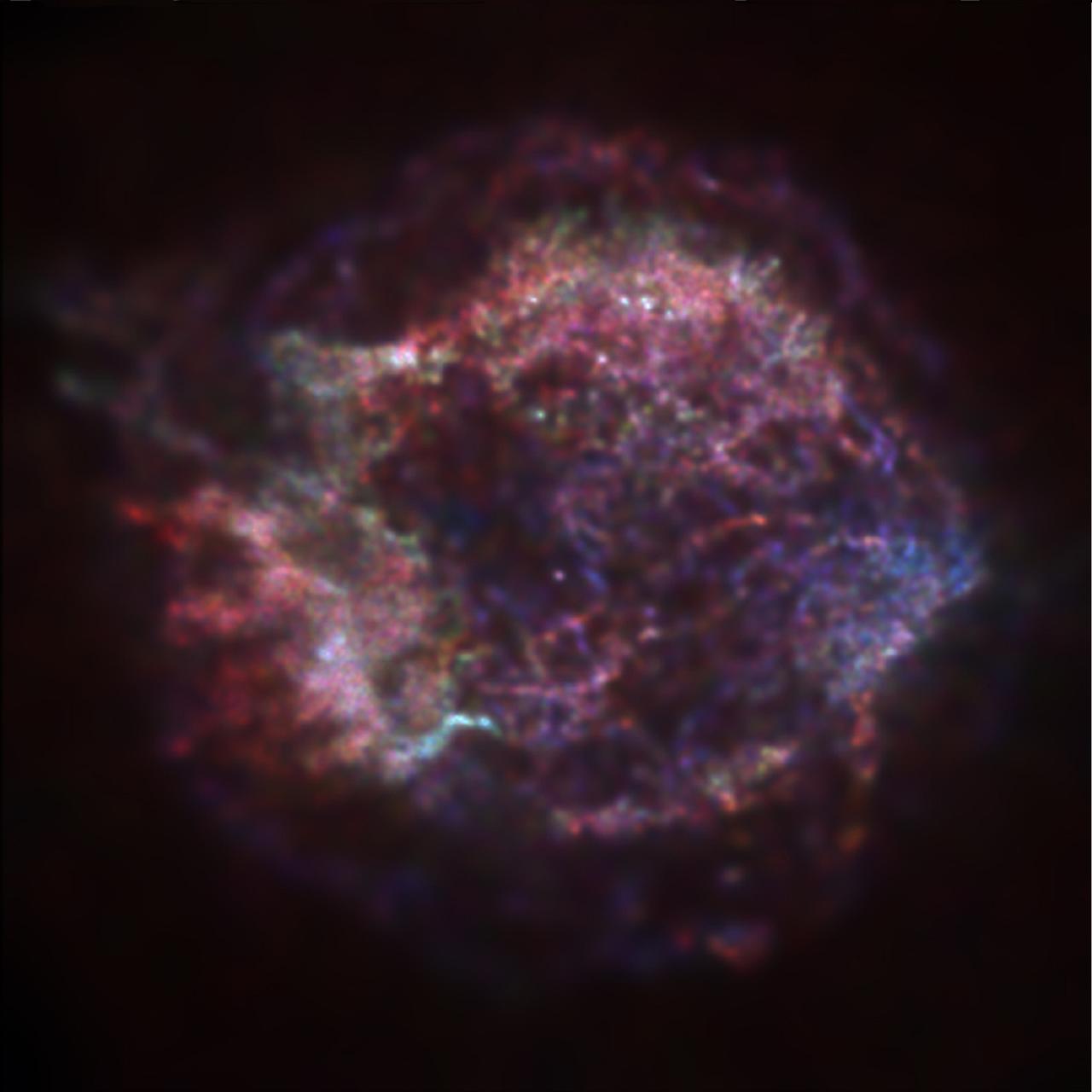
This is an extraordinary first image from the Chandra X-Ray Observatory (CXO), the supernova remnant Cassiopeia A, tracing the aftermath of a gigantic stellar explosion in such sturning detail that scientists can see evidence of what may be a neutron star or black hole near the center. The red, green, and blue regions in this image of the supernova remnant Cassiopeia A show where the intensity of low, medium, and high energy X-rays, respectively, is greatest. The red material on the left outer edge is enriched in iron, whereas the bright greenish white region on the low left is enriched in silicon and sulfur. In the blue region on the right edge, low and medium energy X-rays have been filtered out by a cloud of dust and gas in the remnant . The image was made with the CXO's Advanced Charged-Coupled Device (CCD) Imaging Spectrometer (ACIS). Photo credit: NASA/CXC/SAO/Rutgers/J.Hughes
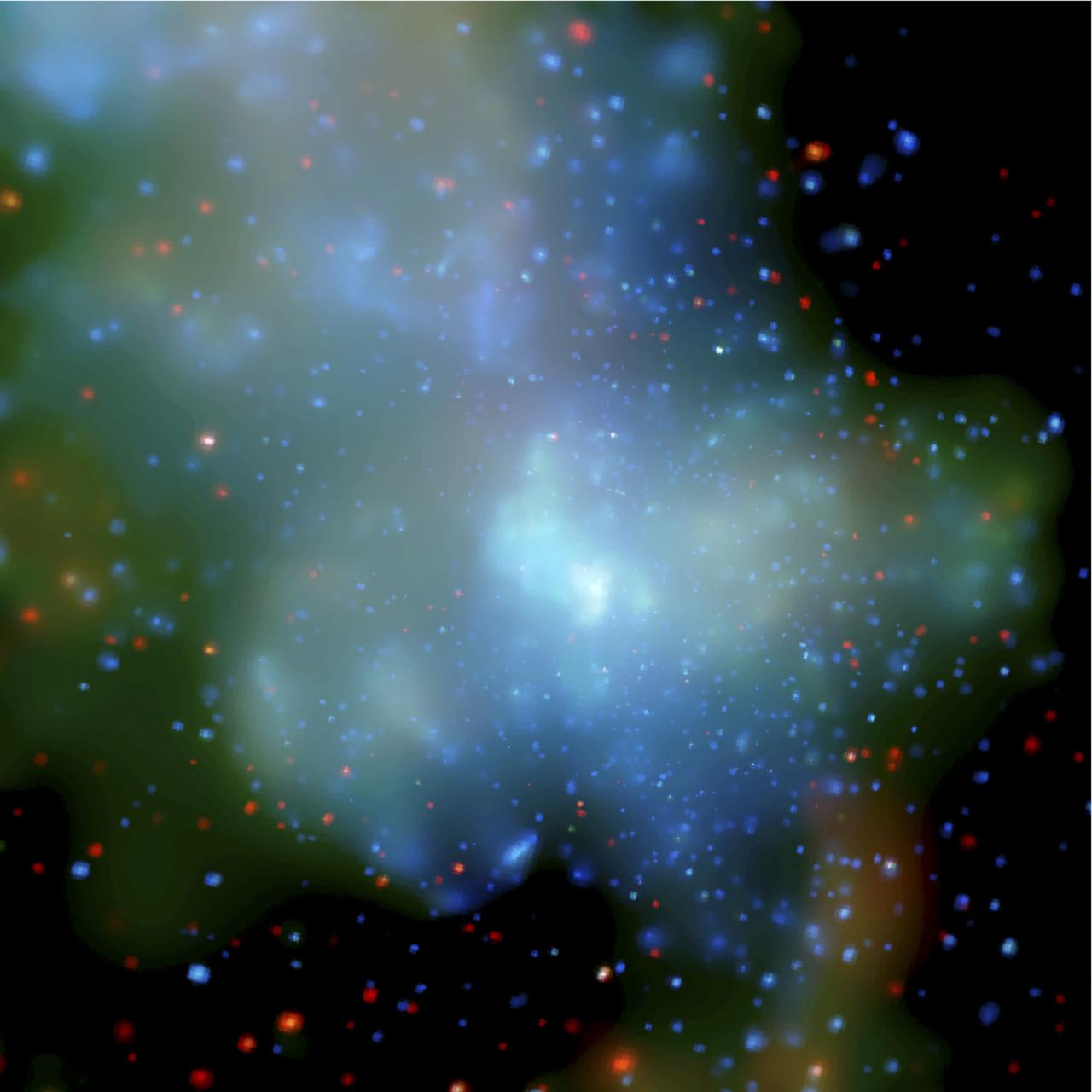
NASA’s Chandra X-Ray Observatory (CXO) was launched July 22, 1999 aboard the Space Shuttle Columbia, STS-93 mission. This image was produced by combining a dozen CXO observations made of a 130 light-year region in the center of the Milky Way over the last 5 years. The colors represent low (red), medium (green) and high (blue) energy x-rays. Thanks to Chandra's unique resolving power, astronomers have now been able to identify thousands of point-like x-ray sources due to neutron stars, black holes, white dwarfs, foreground stars, and background galaxies. What remains is a diffuse x-ray glow extending from the upper left to the lower right, along the direction of the disk of the galaxy. NASA’s Marshall Space Flight Center in Huntsville, Alabama manages the Chandra program. (NASA/CXC/UCLA/M. Muno et al.)
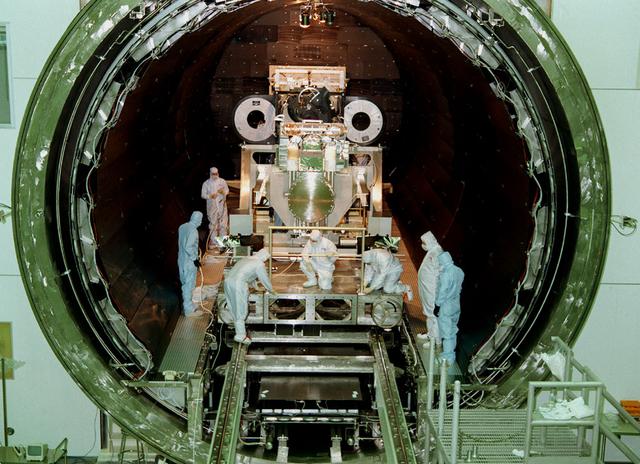
This photo shows the High Resolution Camera (HRC) for the Chandra X-Ray Observatory (CXO), formerly Advanced X-Ray Astrophysics Facility (AXAF), being integrated with the High Resolution Mirror Assembly (HRMA) in Marshall Space Flight Center's (MSFC's) 24-foot Vacuum Chamber at the X-Ray Calibration Facility (XRCF). The AXAF was renamed CXO in 1999. The CXO is the most sophisticated and the world's most poweful x-ray telescope ever built. It observes x-rays from high-energy regions of the universe, such as hot gas in the remnants of exploded stars. The HRC is one of the two instruments used at the focus of CXO, where it will detect x-rays reflected from an assembly of eight mirrors. The unique capabilities of the HRC stem from the close match of its imaging capability to the focusing of the mirrors. When used with CXO mirrors, the HRC makes images that reveal detail as small as one-half an arc second. This is equivalent to the ability to read a newspaper at a distance of 1 kilometer. MSFC's XRCF is the world's largest, most advanced laboratory for simulating x-ray emissions from distant celestial objects. It produces a space-like environment in which components relatedto x-ray telescope imaging are tested and the quality of their performances in space is predicted. TRW, Inc. was the prime contractor for the development of the CXO and NASA's MSFC was responsible for its project management. The Smithsonian Astrophysical Observatory controls science and flight operations of the CXO for NASA from Cambridge, Massachusetts. The CXO was launched July 22, 1999 aboard the Space Shuttle Columbia (STS-93).
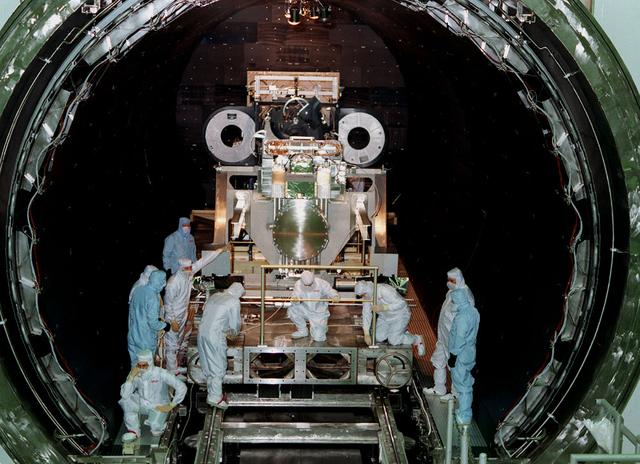
This photo shows the High Resolution Camera (HRC) for the Chandra X-Ray Observatory (CXO), formerly Advanced X-Ray Astrophysics Facility (AXAF), being integrated with the High Resolution Mirror Assembly (HRMA) in Marshall Space Flight Center's (MSFC's) 24-foot Vacuum Chamber at the X-Ray Calibration Facility (XRCF). The AXAF was renamed CXO in 1999. The CXO is the most sophisticated and the world's most powerful x-ray telescope ever built. It observes x-rays from high-energy regions of the universe, such as hot gas in the remnants of exploded stars. The HRC is one of the two instruments used at the focus of CXO, where it will detect x-rays reflected from an assembly of eight mirrors. The unique capabilities of the HRC stem from the close match of its imaging capability to the focusing of the mirrors. When used with CXO mirrors, the HRC makes images that reveal detail as small as one-half an arc second. This is equivalent to the ability to read a newspaper at a distance of 1 kilometer. MSFC's XRCF is the world's largest, most advanced laboratory for simulating x-ray emissions from distant celestial objects. It produces a space-like environment in which components related to x-ray telescope imaging are tested and the quality of their performances in space is predicted. TRW, Inc. was the prime contractor for the development of the CXO and NASA's MSFC was responsible for its project management. The Smithsonian Astrophysical Observatory controls science and flight operations of the CXO for NASA from Cambridge, Massachusetts. The CXO was launched July 22, 1999 aboard the Space Shuttle Columbia (STS-93).
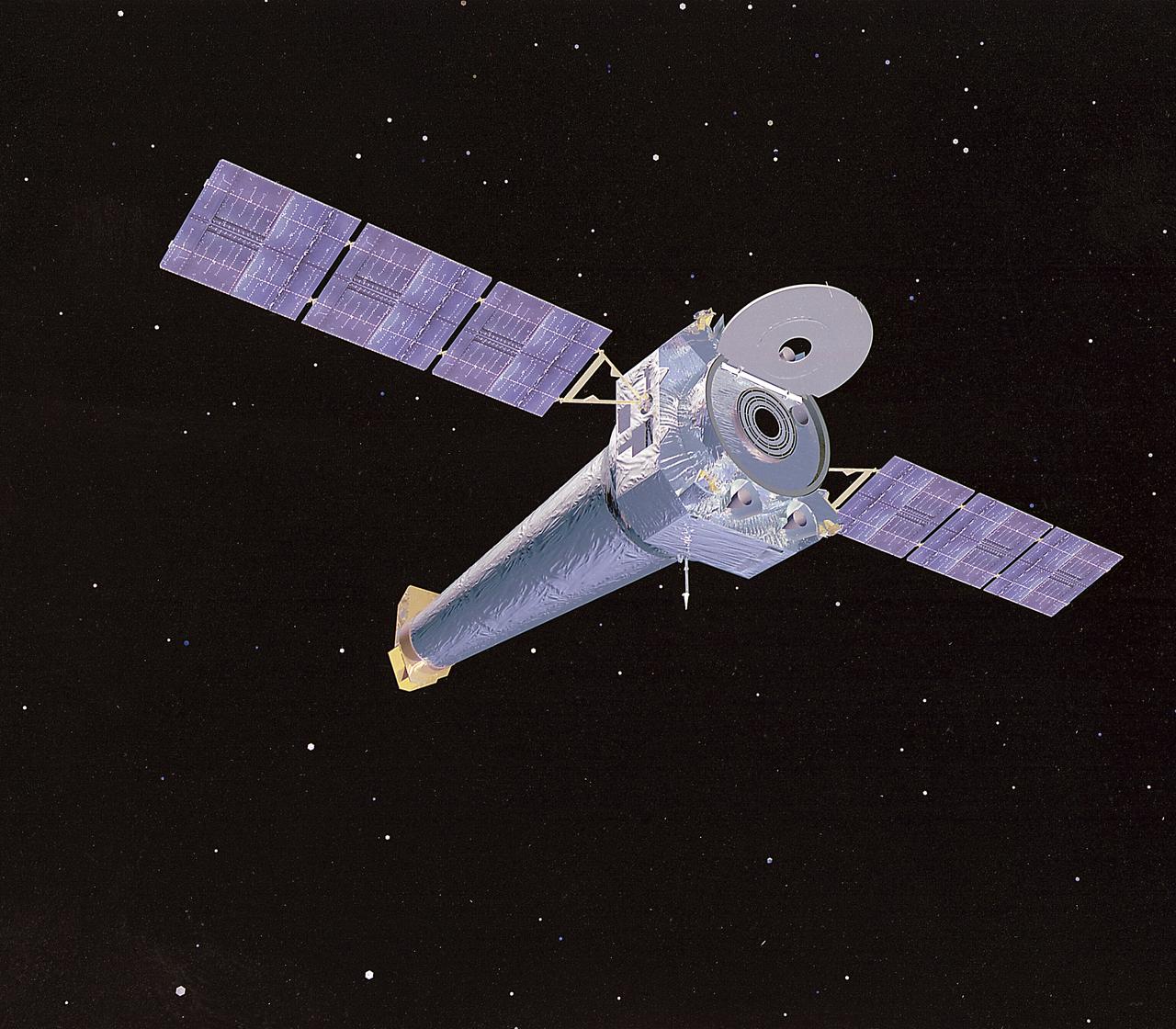
This is a computer rendering of the fully developed Chandra X-Ray Observatory (CXO), formerly Advanced X-Ray Astrophysics Facility (AXAF). In 1999, the AXAF was renamed the CXO in honor of the late Indian-American Novel Laureate Subrahmanyan Chandrasekhar. The CXO is the most sophisticated and the world's most powerful x-ray telescope ever built. It is designed to observe x-rays from high energy regions of the Universe, such as hot gas in the renmants of exploded stars. It produces picture-like images of x-ray emissions analogous to those made in visible light, as well as gathers data on the chemical composition of x-ray radiating objects. The CXO helps astronomers world-wide better understand the structure and evolution of the universe by studying powerful sources of x-ray such as exploding stars, matter falling into black holes, and other exotic celestial objects. The Observatory has three major parts: (1) the x-ray telescope, whose mirrors will focus x-rays from celestial objects; (2) the science instruments that record the x-rays so that x-ray images can be produced and analyzed; and (3) the spacecraft, which provides the environment necessary for the telescope and the instruments to work. TRW, Inc. was the prime contractor for the development of the CXO and NASA's Marshall Space Flight Center was responsible for its project management. The Smithsonian Astrophysical Observatory controls science and flight operations of the CXO for NASA from Cambridge, Massachusetts. The Observatory was launched July 22, 1999 aboard the Space Shuttle Columbia, STS-93 mission. (Image courtesy of TRW).
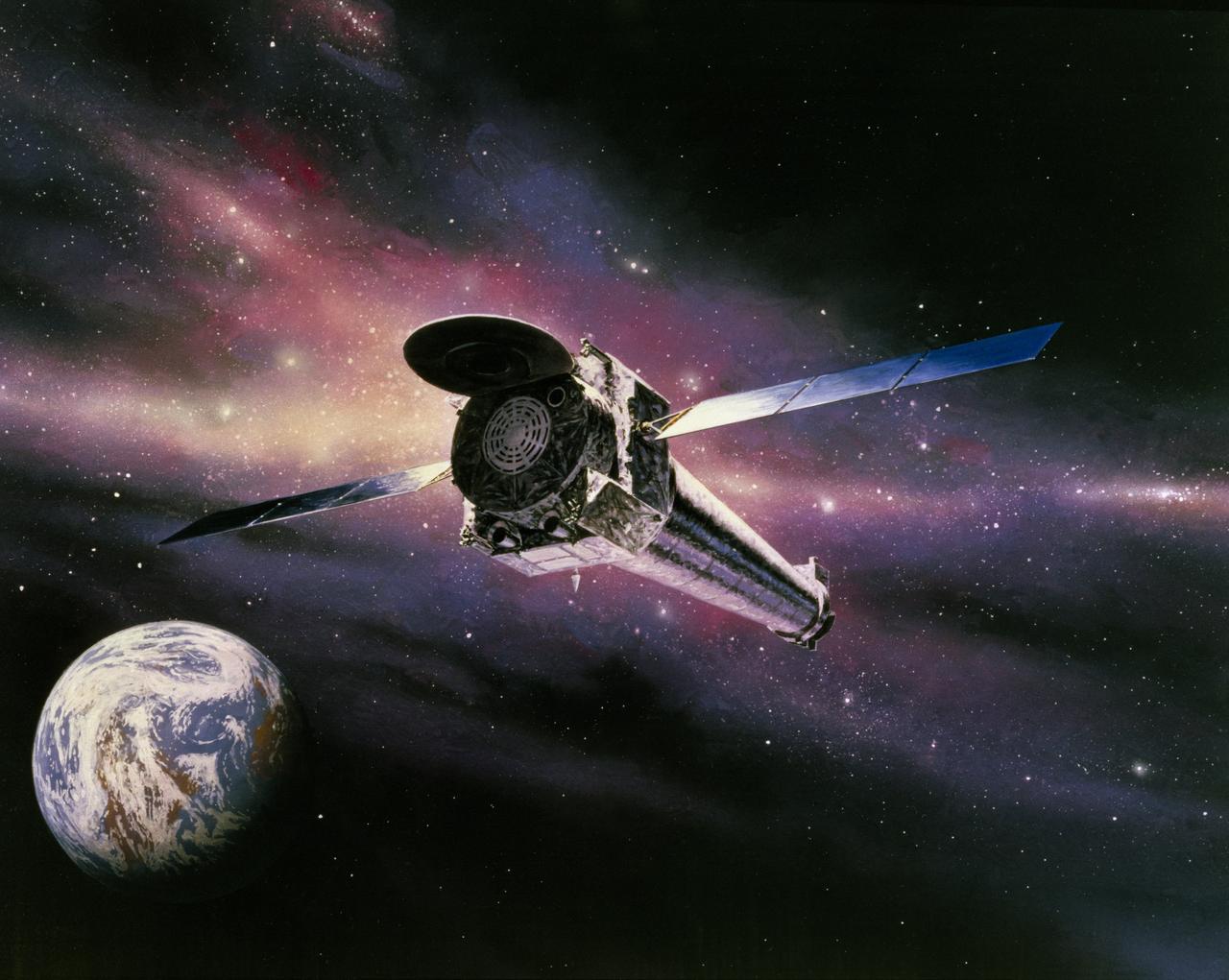
This is an artist's concept of the Chandra X-Ray Observatory (CXO), formerly Advanced X-Ray Astrophysics Facility (AXAF), fully developed in orbit in a star field with Earth. In 1999, the AXAF was renamed the CXO in honor of the late Indian-American Novel Laureate Subrahmanyan Chandrasekhar. The CXO is the most sophisticated and the world's most powerful x-ray telescope ever built. It is designed to observe x-rays from high energy regions of the Universe, such as hot gas in the renmants of exploded stars. It produces picture-like images of x-ray emissions analogous to those made in visible light, as well as gathers data on the chemical composition of x-ray radiating objects. The CXO helps astronomers world-wide better understand the structure and evolution of the universe by studying powerful sources of x-ray such as exploding stars, matter falling into black holes, and other exotic celestial objects. The Observatory has three major parts: (1) the x-ray telescope, whose mirrors will focus x-rays from celestial objects; (2) the science instruments that record the x-rays so that x-ray images can be produced and analyzed; and (3) the spacecraft, which provides the environment necessary for the telescope and the instruments to work. TRW, Inc. was the prime contractor for the development the CXO and NASA's Marshall Space Flight Center was responsible for its project management. The Smithsonian Astrophysical Observatory controls science and flight operations of the CXO for NASA from Cambridge, Massachusetts. The Observatory was launched July 22, 1999 aboard the Space Shuttle Columbia, STS-93 mission. (Image courtesy of TRW).
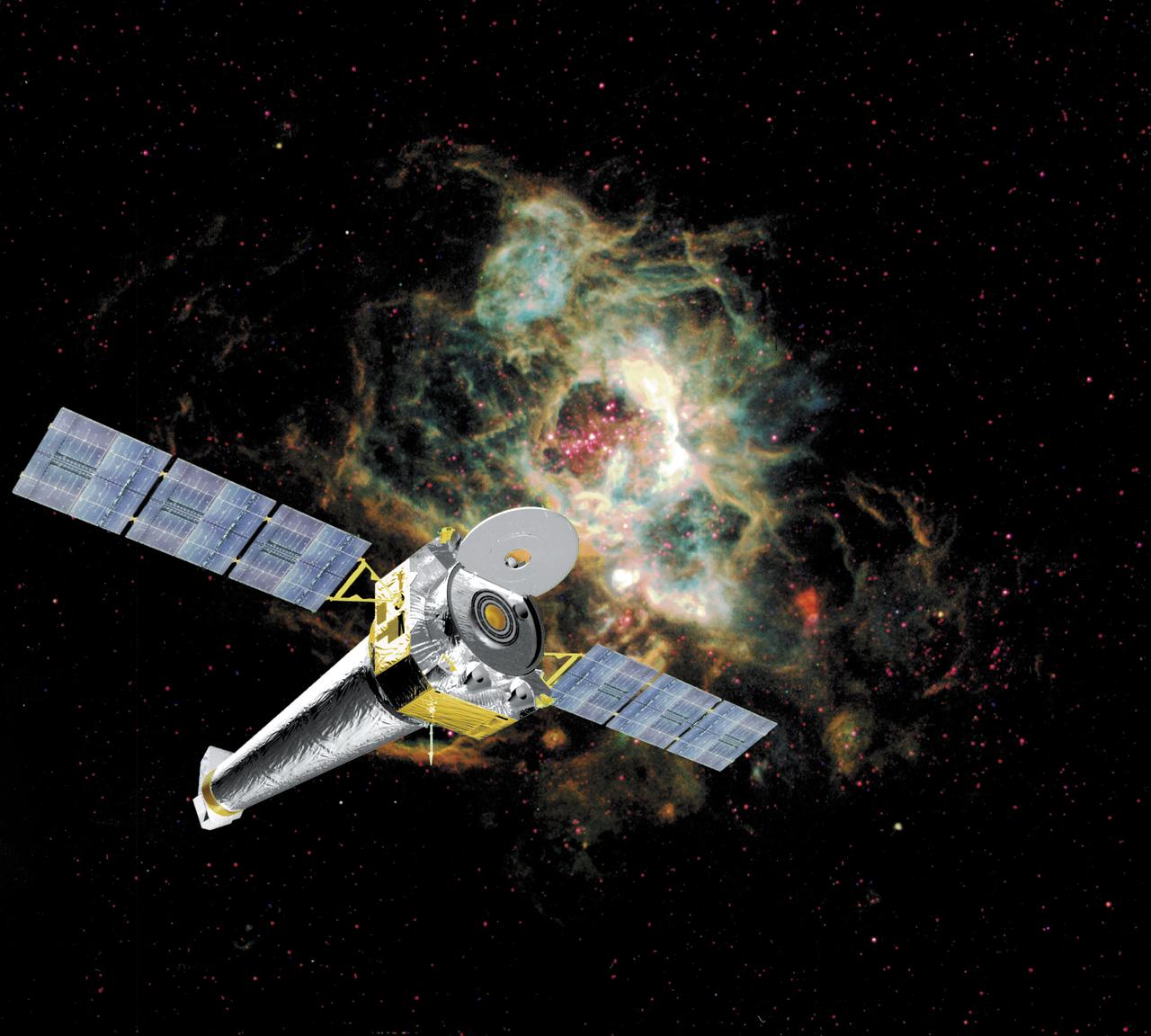
This is a computer rendering of the fully developed Chandra X-ray Observatory (CXO), formerly Advanced X-Ray Astrophysics Facility (AXAF), in orbit in a star field. In 1999, the AXAF was renamed the CXO in honor of the late Indian-American Novel Laureate Subrahmanyan Chandrasekhar. The CXO is the most sophisticated and the world's most powerful x-ray telescope ever built. It is designed to observe x-rays from high energy regions of the Universe, such as hot gas in the renmants of exploded stars. It produces picture-like images of x-ray emissions analogous to those made in visible light, as well as gathers data on the chemical composition of x-ray radiating objects. The CXO helps astronomers world-wide better understand the structure and evolution of the universe by studying powerful sources of x-rays such as exploding stars, matter falling into black holes, and other exotic celestial objects. The Observatory has three major parts: (1) the x-ray telescope, whose mirrors will focus x-rays from celestial objects; (2) the science instruments that record the x-rays so that x-ray images can be produced and analyzed; and (3) the spacecraft, which provides the environment necessary for the telescope and the instruments to work. TRW, Inc. was the prime contractor for the development of the CXO and NASA's Marshall Space Flight Center was responsible for its project management. The Smithsonian Astrophysical Observatory controls science and flight operations of the CXO for NASA from Cambridge, Massachusetts. The Observatory was launched July 22, 1999 aboard the Space Shuttle Columbia, STS-93 mission. (Image courtesy of TRW).
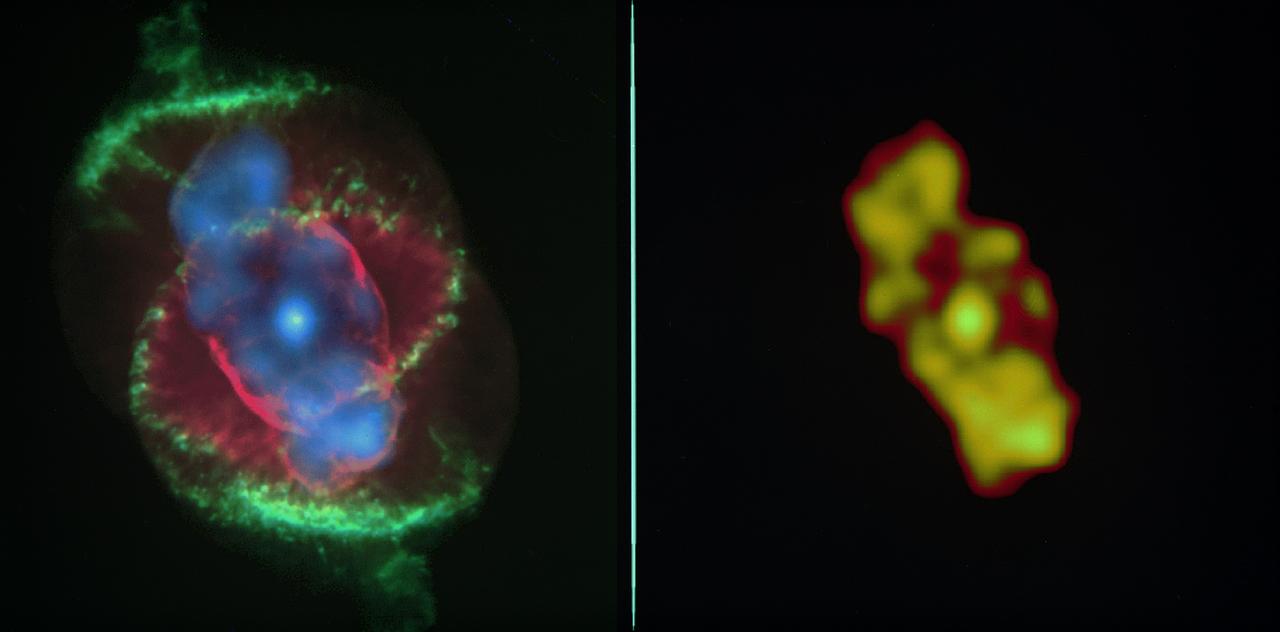
Left image: The x-ray data from the Chandra X-Ray Observatory (CXO) has revealed a bright central star surrounded by a cloud of multimillion-degree gas in the planetary nebula known as the Cat's Eye. This CXO image, where the intensity of the x-ray emission is correlated to the brightness of the orange coloring, captures the expulsion of material from a star that is expected to collapse into a white dwarf in a few million years. The intensity of x-rays from the central star was unexpected, and it is the first time astronomers have seen such x-ray emission from the central star of a planetary nebula. Right image: An image of Cat's Eye taken by the Hubble Space Telescope (HST). By comparing the CXO data with that from the HST, researchers are able to see where the hotter, x-ray emitting gas appears in relation to the cooler material seen in optical wavelengths by the HST. The CXO team found that the chemical abundance in the region of hot gas (its x-ray intensity is shown in purple) was not like those in the wind from the central star and different from the outer cooler material (the red and green structures.) Although still incredibly energetic and hot enough to radiate x-rays, CXO shows the hot gas to be somewhat cooler than scientists would have expected for such a system. CXO image credit: (NASA/UIUC/Y. Chu et al.) HST image credit: (NASA/HST)
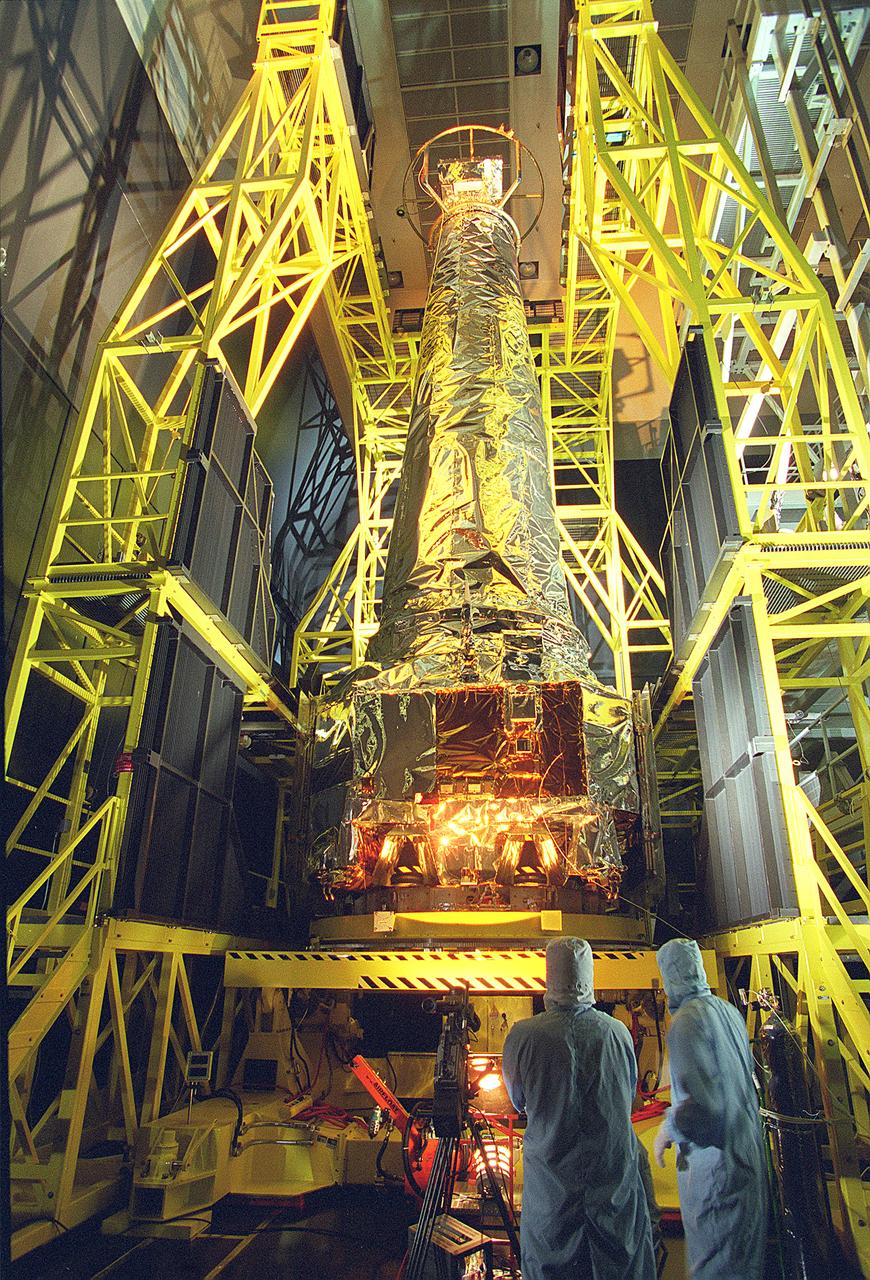
This photograph shows TRW technicians preparing the assembled Chandra X-Ray Observatory (CXO) for an official unveiling at TRW Space and Electronics Group of Redondo Beach, California. The CXO is formerly known as the Advanced X-Ray Astrophysics Facility (AXAF), which was renamed in honor of the late Indian-American Astronomer, Subrahmanyan Chandrasekhar in 1999. The CXO will help astronomers world-wide better understand the structure and evolution of the universe by studying powerful sources of x-rays such as exploding stars, matter falling into black holes, and other exotic celestial objects. X-ray astronomy can only be done from space because Earth's atmosphere blocks x-rays from reaching the surface. The Observatory provides images that are 50 times more detailed than previous x-ray missions. At more than 45 feet in length and weighing more than 5 tons, it will be one of the largest objects ever placed in Earth orbit by the Space Shuttle. TRW, Inc. was the prime contractor and assembled and tested the observatory for NASA. The CXO program is managed by the Marshall Space Flight Center. The Observatory was launched on July 22, 1999 aboard the Space Shuttle Columbia, STS-93 mission. (Image courtesy of TRW)
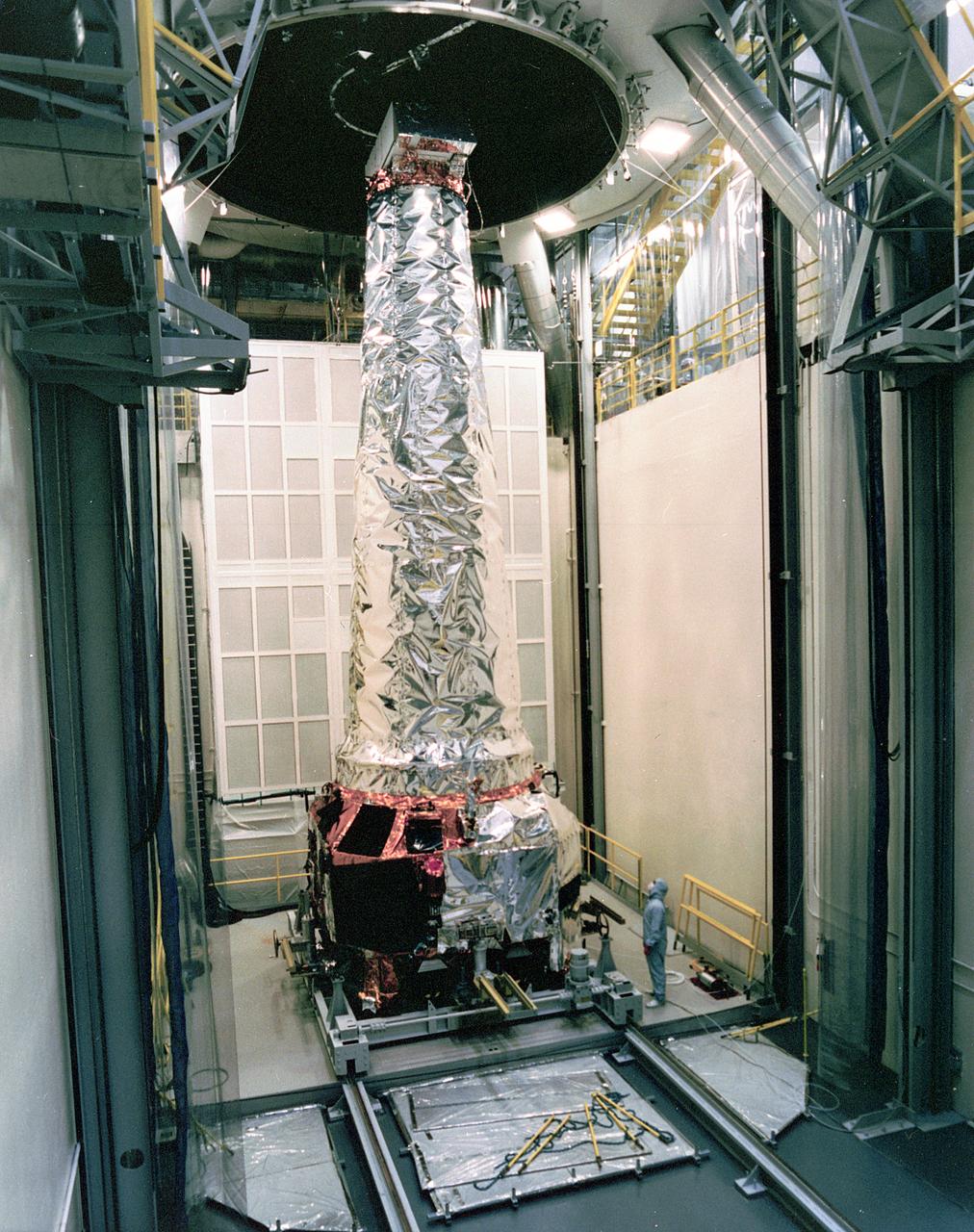
This photograph shows a TRW technician inspecting the completely assembled Chandra X-ray Observatory (CXO) in the Thermal Vacuum Chamber at TRW Space and Electronics Group of Redondo Beach, California. The CXO is formerly known as the Advanced X-Ray Astrophysics Facility (AXAF), which was renamed in honor of the late Indian-American Astronomer, Subrahmanyan Chandrasekhar in 1999. The CXO will help astronomers worldwide better understand the structure and evolution of the universe by studying powerful sources of x-rays such as exploding stars, matter falling into black holes and other exotic celestial objects. X-ray astronomy can only be done from space because Earth's atmosphere blocks x-rays from reaching the surface. The Observatory provides images that are 50 times more detailed than previous x-ray missions. At more than 45 feet in length and weighing more than 5 tons, it will be one of the largest objects ever placed in Earth orbit by the Space Shuttle. TRW, Inc. was the prime contractor and assembled and tested the observatory for NASA. The CXO program is managed by the Marshall Space Flight Center. The Observatory was launched on July 22, 1999 aboard the Space Shuttle Columbia, STS-93 mission. (Image courtesy of TRW)

This photograph shows the mirrors of the High Resolution Mirror Assembly (HRMA) for the Chandra X-Ray Observatory (CXO), formerly Advanced X-Ray Astrophysics Facility (AXAF), being assembled in the Eastman Kodak Company in Rochester, New York. The AXAF was renamed CXO in 1999. The CXO is the most sophisticated and the world's most powerful x-ray telescope ever built. It observes x-rays from high-energy regions of the universe, such as hot gas in the remnants of exploded stars. The HRMA, the heart of the telescope system, is contained in the cylindrical "telescope" portion of the observatory. Since high-energy x-rays would penetrate a normal mirror, special cylindrical mirrors were created. The two sets of four nested mirrors resemble tubes within tubes. Incoming x-rays graze off the highly polished mirror surface and are furneled to the instrument section for detection and study. TRW, Inc. was the prime contractor for the development of the CXO and NASA's Marshall Space Flight Center was responsible for its project management. The Observatory was launched July 22, 1999 aboard the Space Shuttle Columbia, STS-93 mission.
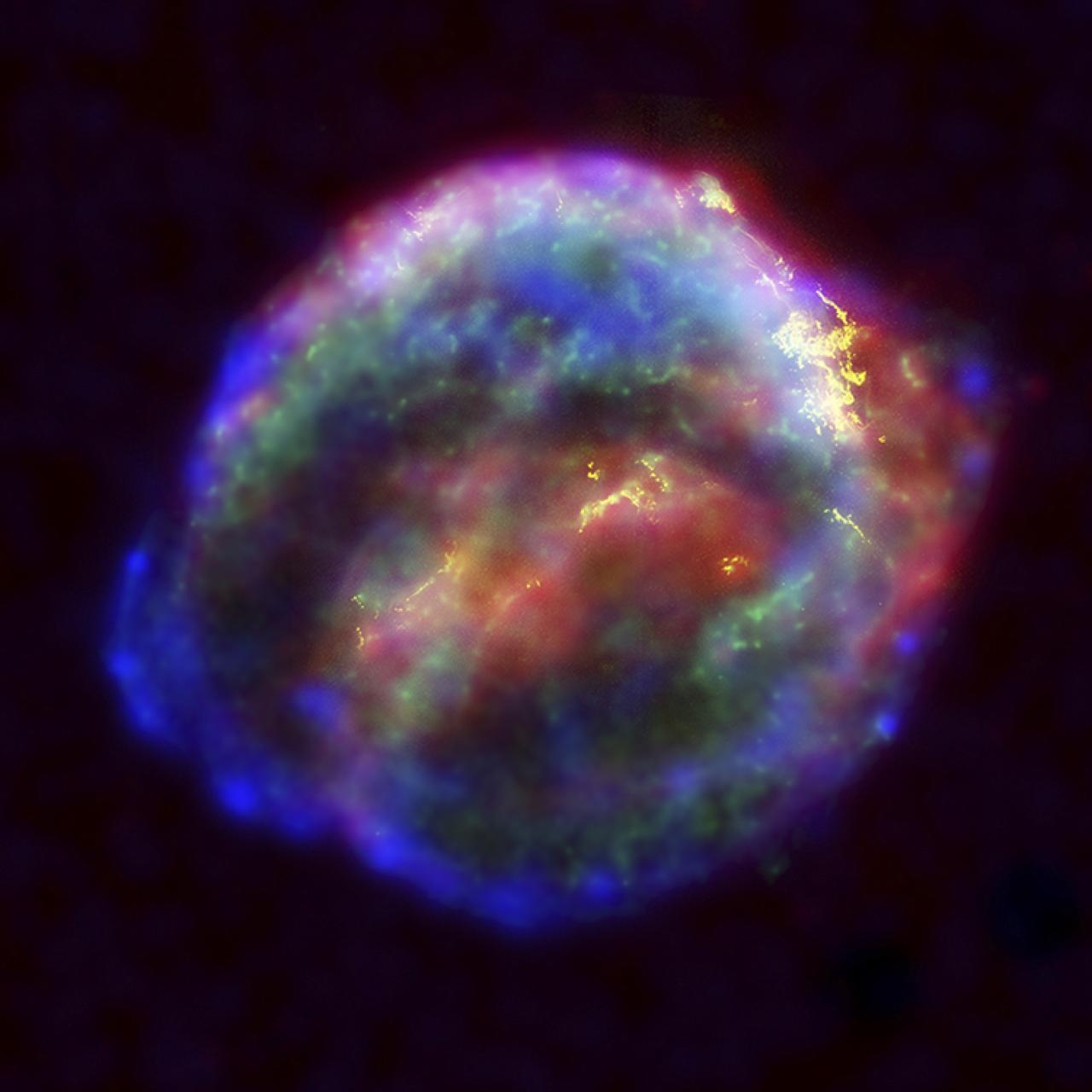
Four hundred years ago, sky watchers, including the famous astronomer Johannes Kepler, best known as the discoverer of the laws of planetary motion, were startled by the sudden appearance of a new star in the western sky, rivaling the brilliance of the nearby planets. Modern astronomers, using NASA's three orbiting Great Observatories, are unraveling the mysteries of the expanding remains of Kepler's supernova, the last such object seen to explode in our Milky Way galaxy. When a new star appeared Oct. 9, 1604, observers could use only their eyes to study it. The telescope would not be invented for another four years. A team of modern astronomers has the combined abilities of NASA's Great Observatories, the Spritzer Space Telescope (SST), Hubble Space Telescope (HST), and Chandra X-Ray Observatory (CXO), to analyze the remains in infrared radiation, visible light, and X-rays. Visible-light images from Hubble's Advanced Camera for Surveys reveal where the supernova shock wave is slamming into the densest regions of surrounding gas. The astronomers used the SST to probe for material that radiates in infrared light, which shows heated microscopic dust particles that have been swept up by the supernova shock wave. The CXO data show regions of very hot gas. The combined image unveils a bubble-shaped shroud of gas and dust, 14 light-years wide and expanding at 4 million mph. There have been six known supernovas in our Milky Way over the past 1,000 years. Kepler's is the only one in which astronomers do not know what type of star exploded. By combining information from all three Great Observatories, astronomers may find the clues they need. Project management for both the HST and CXO programs is the responsibility of NASA’s Marshall Space Flight Center in Huntsville, Alabama.
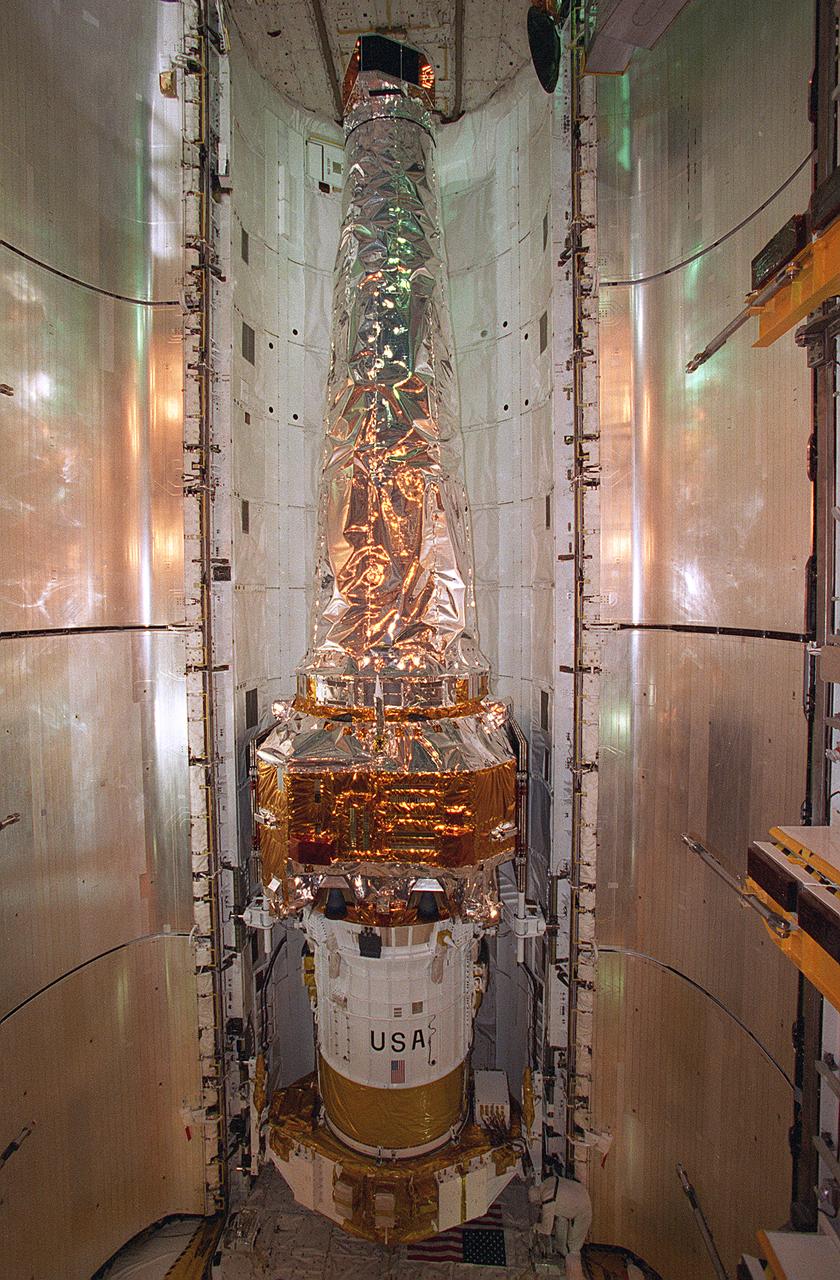
In this photograph, the Chandra X-Ray Observatory (CXO) was installed and mated to the Inertial Upper Stage (IUS) inside the Shuttle Columbia's cargo bay at the Kennedy Space Center. The CXO will help astronomers world-wide better understand the structure and evolution of the universe by studying powerful sources of x-rays such as exploding stars, matter falling into black holes, and other exotic celestial objects. X-ray astronomy can only be done from space because Earth's atmosphere blocks x-rays from reaching the surface. The Observatory provides images that are 50 times more detailed than previous x-ray missions. At more than 45 feet in length and weighing more than 5 tons, the CXO was carried into low-Earth orbit by the Space Shuttle Columbia (STS-93 mission) on July 22, 1999. The Observatory was deployed from the Shuttle's cargo bay at 155 miles above the Earth. Two firings of an attached IUS rocket, and several firings of its own onboard rocket motors, after separating from the IUS, placed the Observatory into its working orbit. The IUS is a solid rocket used to place spacecraft into orbit or boost them away from the Earth on interplanetary missions. Since its first use by NASA in 1983, the IUS has supported a variety of important missions, such as the Tracking and Data Relay Satellite, Galileo spacecraft, Magellan spacecraft, and Ulysses spacecraft. The IUS was built by the Boeing Aerospace Co., at Seattle, Washington and managed by the Marshall Space Flight Center.
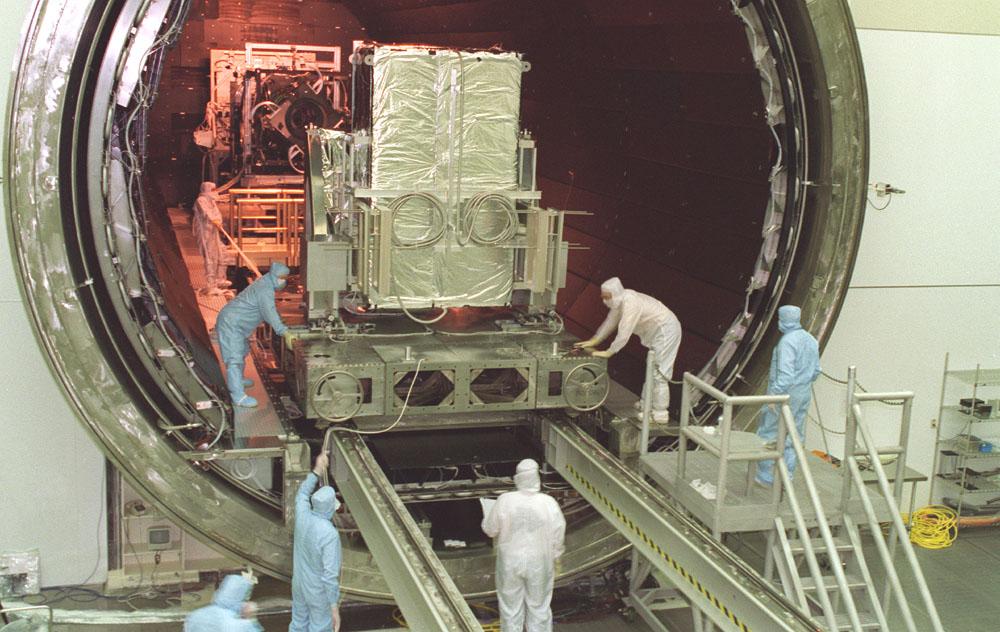
This photograph captures the installation of the Chandra X-Ray Observatory, formerly Advanced X-Ray Astrophysics Facility (AXAF), Advanced Charged-Coupled Device (CCD) Imaging Spectrometer (ACIS) into the Vacuum Chamber at the X-Ray Calibration Facility (XRCF) at Marshall Space Flight Center (MSFC). The AXAF was renamed Chandra X-Ray Observatory (CXO) in 1999. The CXO is the most sophisticated and the world's most powerful x-ray telescope ever built. It observes x-rays from high-energy regions of the universe, such as hot gas in the remnants of exploded stars. The ACIS is one of two focal plane instruments. As the name suggests, this instrument is an array of CCDs similar to those used in a camcorder. This instrument will be especially useful because it can make x-ray images and measure the energies of incoming x-rays. It is the instrument of choice for studying the temperature variation across x-ray sources, such as vast clouds of hot-gas intergalactic space. MSFC's XRCF is the world's largest, most advanced laboratory for simulating x-ray emissions from distant celestial objects. It produces a space-like environment in which components related to x-ray telescope imaging are tested and the quality of their performances in space is predicted. TRW, Inc. was the prime contractor for the development of the CXO and NASA's MSFC was responsible for its project management. The Smithsonian Astrophysical Observatory controls science and flight operations of the CXO for NASA from Cambridge, Massachusetts. The CXO was launched July 22, 1999 aboard the Space Shuttle Columbia (STS-93).
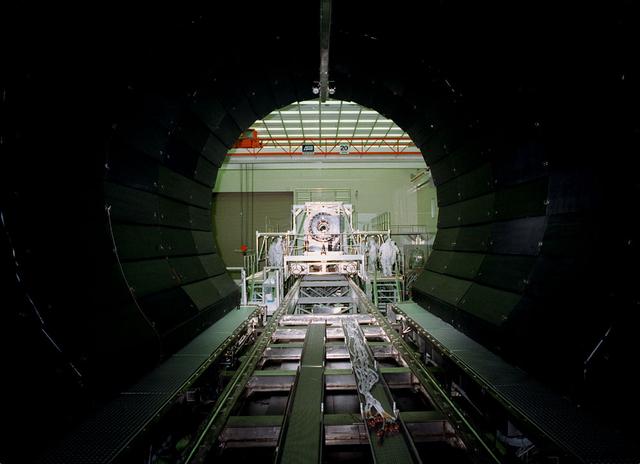
This is a photograph of the Chandra X-Ray Observatory (CXO), formerly Advanced X-Ray Astrophysics Facility (AXAF), High Resolution Mirror Assembly (HRMA) integration at the X-Ray Calibration Facility (XRCF) at the Marshall Space Flight Center (MSFC). The AXAF was renamed CXO in 1999. The CXO is the most sophisticated and the world's most powerful x-ray telescope ever built. It observes x-rays from high-energy regions of the universe, such as hot gas in the remnants of exploded stars. The HRMA, the heart of the telescope system, is contained in the cylindrical "telescope" portion of the observatory. Since high-energy x-rays would penetrate a normal mirror, special cylindrical mirrors were created. The two sets of four nested mirrors resemble tubes within tubes. Incoming x-rays graze off the highly polished mirror surface and are furneled to the instrument section for detection and study. MSFC's XRCF is the world's largest, most advanced laboratory for simulating x-ray emissions from distant celestial objects. It produces a space-like environment in which components related to x-ray telescope imaging are tested and the quality of their performances in space is predicted. TRW, Inc. was the prime contractor for the development of the CXO and NASA's MSCF was responsible for its project management. The Smithsonian Astrophysical Observatory controls science and flight operations of the CXO for NASA from Cambridge, Massachusetts. The CXO was launched July 22, 1999 aboard the Space Shuttle Columbia (STS-93).
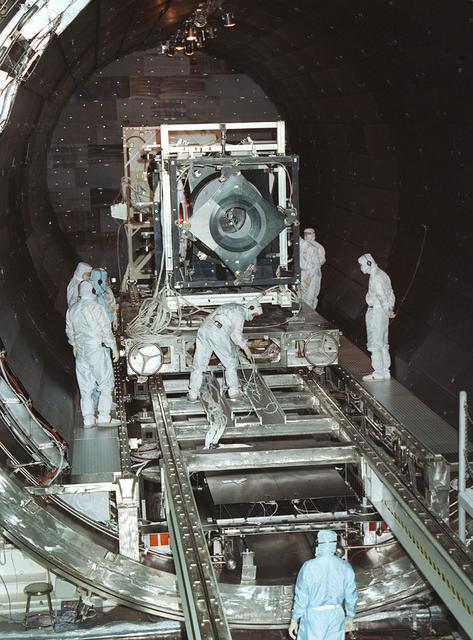
This is a photograph of the Chandra X-Ray Observatory (CXO), formerly Advanced X-Ray Astrophysics Facility (AXAF), High Resolution Mirror Assembly (HRMA) integration at the X-Ray Calibration Facility (XRCF) at the Marshall Space Flight Center (MSFC). The AXAF was renamed CXO in 1999. The CXO is the most sophisticated and the world's most powerful x-ray telescope ever built. It observes x-rays from high-energy regions of the universe, such as hot gas in the remnants of exploded stars. The HRMA, the heart of the telescope system, is contained in the cylindrical "telescope" portion of the observatory. Since high-energy x-rays would penetrate a normal mirror, special cylindrical mirrors were created. The two sets of four nested mirrors resemble tubes within tubes. Incoming x-rays graze off the highly polished mirror surface and are furneled to the instrument section for detection and study. MSFC's XRCF is the world's largest, most advanced laboratory for simulating x-ray emissions from distant celestial objects. It produces a space-like environment in which components related to x-ray telescope imaging are tested and the quality of their performances in space is predicted. TRW, Inc. was the prime contractor for the development of the CXO and NASA's MSFC was responsible for its project management. The Smithsonian Astrophysical Observatory controls science and flight operations of the CXO for NASA from Cambridge, Massachusetts. The CXO was launched July 22, 1999 aboard the Space Shuttle Columbia (STS-93).
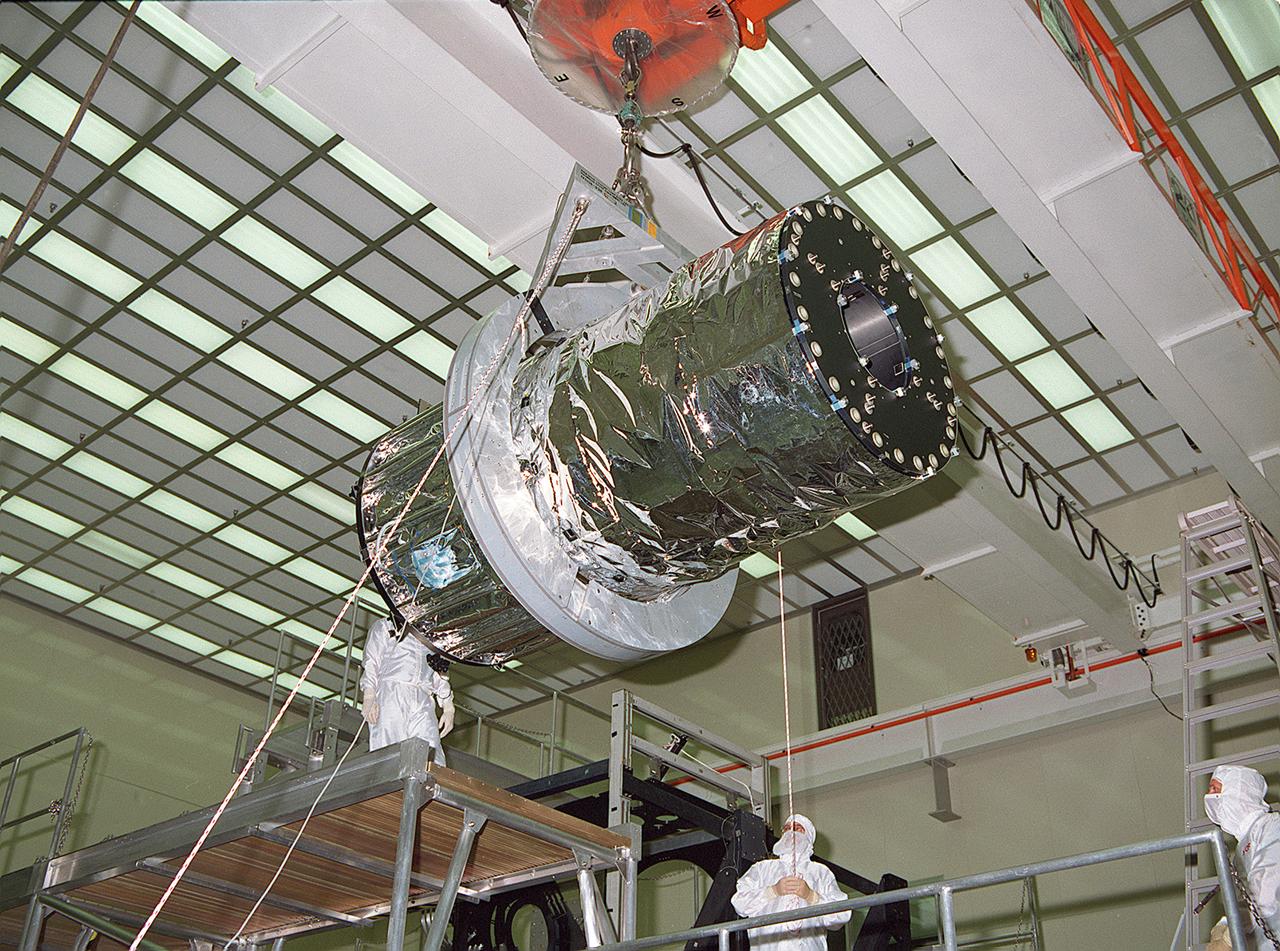
This photograph shows the Chandra X-ray Observatory (CXO), formerly Advanced X-Ray Astrophysics Facility (AXAF), High Resolution Mirror Assembly (HRMA) being removed from the test structure in the X-Ray Calibration Facility (XRCF) at the Marshall Space Flight Center (MSFC). The AXAF was renamed CXO in 1999. The CXO is the most sophisticated and the world's most powerful x-ray telescope ever built. It observes x-rays from high-energy regions of the universe, such as hot gas in the remnants of exploded stars. The HRMA, the heart of the telescope system, is contained in the cylindrical "telescope" portion of the observatory. Since high-energy x-rays would penetrate a normal mirror, special cylindrical mirrors were created. The two sets of four nested mirrors resemble tubes within tubes. Incoming x-rays graze off the highly polished mirror surface and are furneled to the instrument section for detection and study. MSFC's XRCF is the world's largest, most advanced laboratory for simulating x-ray emissions from distant celestial objects. It produces a space-like environment in which components related to x-ray telescope imaging are tested and the quality of their performances in space is predicted. TRW, Inc. was the prime contractor for the development of the CXO and NASA's MSFC was responsible for its project management. The Smithsonian Astrophysical Observatory controls science and flight operations of the CXO for NASA from Cambridge, Massachusetts. The CXO was launched July 22, 1999 aboard the Space Shuttle Columbia (STS-93).
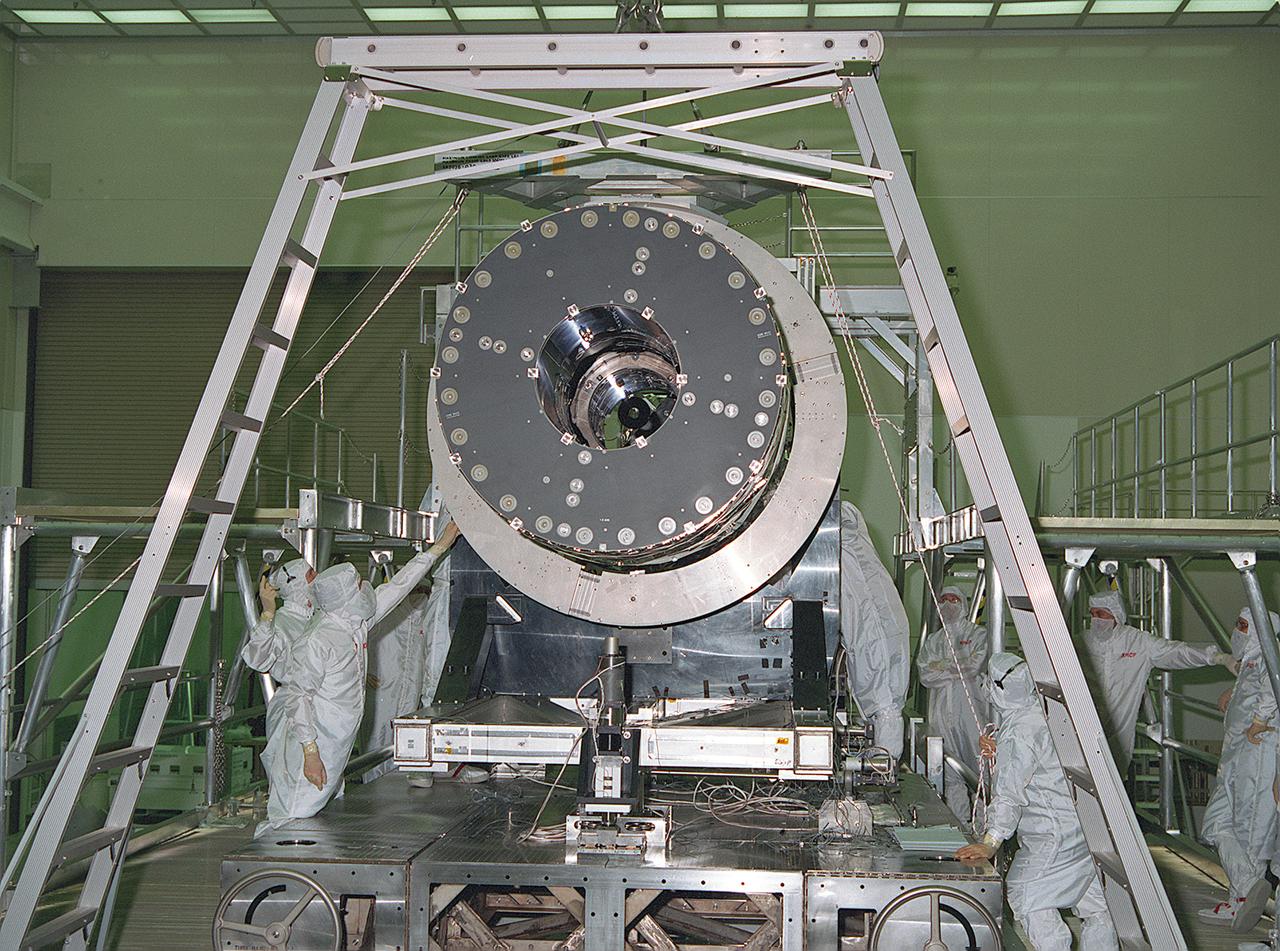
This photograph shows the Chandra X-Ray Observatory (CXO), formerly Advanced X-Ray Astrophysics Facility (AXAF), High Resolution Mirror Assembly (HRMA) being removed from the test structure in the X-Ray Calibration Facility (XRCF) at the Marshall Space Flight Center (MSFC). The AXAF was renamed CXO in 1999. The CXO is the most sophisticated and the world's most powerful x-ray telescope ever built. It observes x-rays from high-energy regions of the universe, such as hot gas in the remnants of exploded stars. The HRMA, the heart of the telescope system, is contained in the cylindrical "telescope" portion of the observatory. Since high-energy x-rays would penetrate a normal mirror, special cylindrical mirrors were created. The two sets of four nested mirrors resemble tubes within tubes. Incoming x-rays graze off the highly polished mirror surface and are furneled to the instrument section for detection and study. MSFC's XRCF is the world's largest, most advanced laboratory for simulating x-ray emissions from distant celestial objects. It produces a space-like environment in which components related to x-ray telescope imaging are tested and the quality of their performances in space is predicted. TRW, Inc. was the prime contractor for the development of the CXO and NASA's MSFC was responsible for its project management. The Smithsonian Astrophysical Observatory controls science and flight operations of the CXO for NASA from Cambridge, Massachusetts. The CXO was launched July 22, 1999 aboard the Space Shuttle Columbia (STS-93).
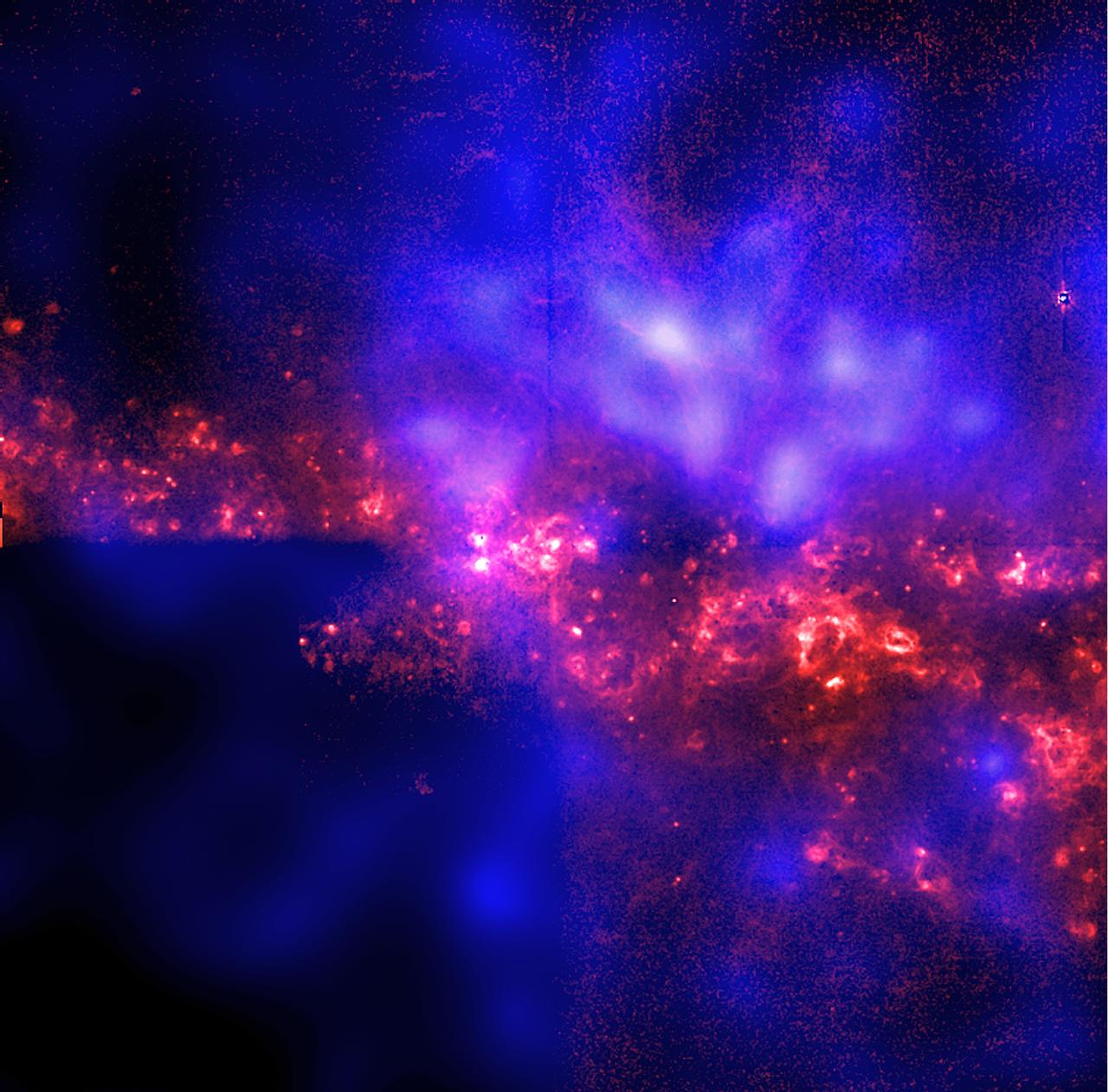
This image shows the central region of the spiral galaxy NGC 4631 as seen edge-on from the Chandra X-Ray Observatory (CXO) and the Hubble Space Telescope (HST). The Chandra data, shown in blue and purple, provide the first unambiguous evidence for a halo of hot gas surrounding a galaxy that is very similar to our Milky Way. The structure across the middle of the image and the extended faint filaments, shown in orange, represent the observation from the HST that reveals giant bursting bubbles created by clusters of massive stars. Scientists have debated for more than 40 years whether the Milky Way has an extended corona, or halo, of hot gas. Observations of NGC 4631 and similar galaxies provide astronomers with an important tool in the understanding our own galactic environment. A team of astronomers, led by Daniel Wang of the University of Massachusetts at Amherst, observed NGC 4631 with CXO's Advanced Charge-Coupled Device (CCD) Imaging Spectrometer (ACIS). The observation took place on April 15, 2000, and its duration was approximately 60,000 seconds.
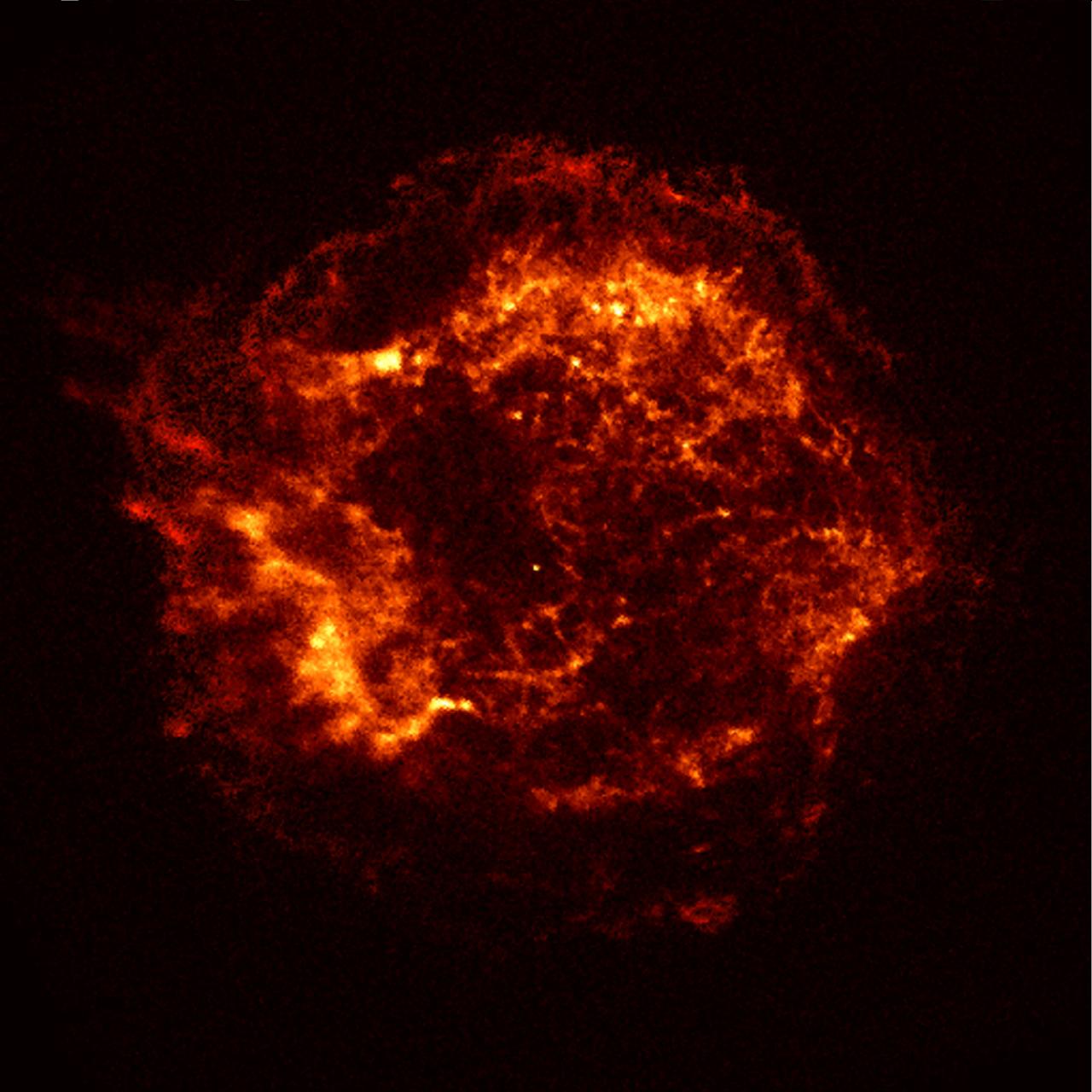
This x-ray image of the Cassiopeia A (CAS A) supernova remnant is the official first light image of the Chandra X-Ray Observatory (CXO). The 5,000-second image was made with the Advanced Charged Coupled Device (CCD) Image Spectrometer (ACIS). Two shock waves are visible: A fast outer shock and a slower irner shock. The inner shock wave is believed to be due to the collision of ejecta from the supernova explosion with a circumstellar shell of material, heating it to a temperature of 10 million-degrees Celsius. The outer shock wave is analogous to an awesome sonic boom resulting from this collision The x-rays reveal a bright object near the center, which may be the long-sought neutron star or black hole remnant of the explosion that produced Cassiopeia A. Cassiopeia A is the 320-year-old remnant of a massive star that exploded. Located in the constellation Cassiopeia, it is 10 light-years across and 10,000 light-years from Earth. A supernova occurs when a massive star has used up its nuclear fuel and the pressure drops in the central core of the star. The matter in the core is crushed by gravity to higher and higher densities, and temperatures reach billions of degrees. Under these extreme conditions, nuclear reactions occur violently and catastrophically, reversing the collapse. A thermonuclear shock wave races through the now expanding stellar debris, fusing lighter elements into heavier ones and producing a brilliant visual outburst.
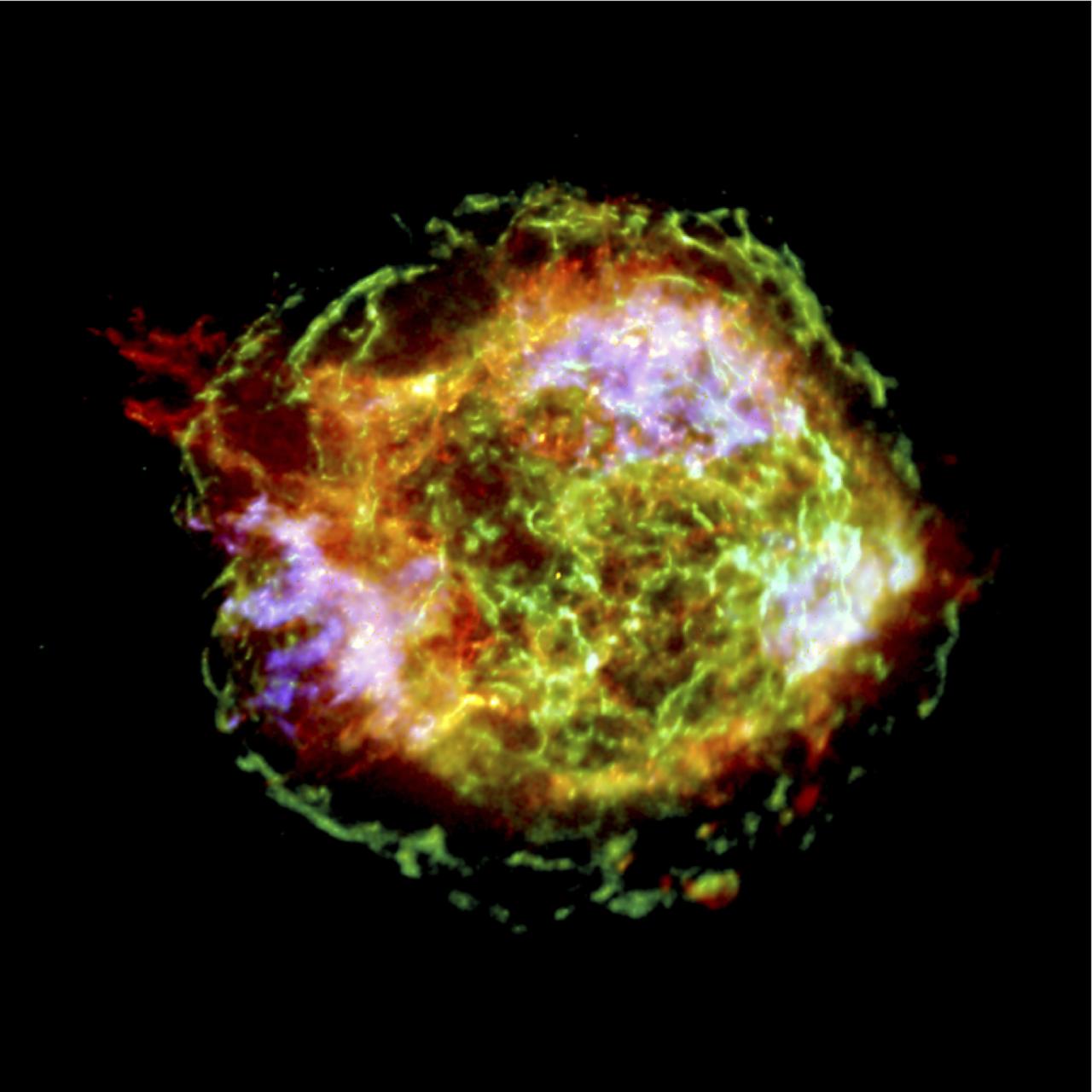
This spectacular Chandra X-Ray Observatory (CXO) image of the supernova remnant Cassiopeia A is the most detailed image ever made of the remains of an exploded star. The one-million-second image shows a bright outer ring (green) 10 light years in diameter that marks the location of a shock wave generated by the supernova explosion. In the upper left corner is a large jet-like structure that protrudes beyond the shock wave, and a counter-jet can be seen on the lower right. The x-ray spectra show that the jets are rich in silicon atoms, and relatively poor in iron atoms. This indicates that the jets formed soon after the initial explosion of the star, otherwise, the jets should have contained large quantities of iron from the star’s central regions. The bright blue areas are composed almost purely of iron gas, which was produced in the central, hottest regions of the star and somehow ejected in a direction almost perpendicular to the jets. The bright source at the center of the image is presumed to be a neutron star created during the supernova. Unlike most others, this neutron star is quiet, faint, and so far shows no evidence of pulsed radiation. A working hypothesis is that the explosion that created Cassiopeia A produced high speed jets similar to, but less energetic than, the hyper nova jets thought to produce gamma-ray bursts. During the explosion, the star may have developed an extremely strong magnetic filed that helped to accelerate the jets and later stifled any pulsar wind activity. CXO project management is the responsibility of NASA’s Marshall Space Flight Center in Huntsville, Alabama.
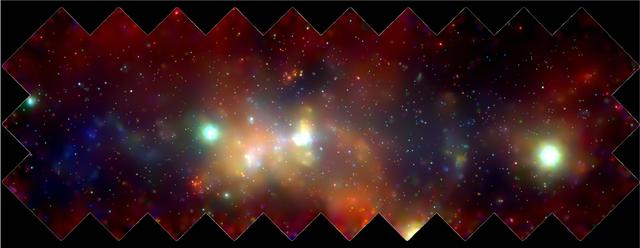
The Chandra X-Ray Observatory (CXO) has made a sturning, high-energy panorama of the central regions of our Milky Way galaxy. The findings are an important step toward understanding the most active area of the Milky Way as well as other galaxies throughout the universe. This 400 by 900-light-year mosaic of several CXO images reveals hundreds of white dwarf stars, neutron stars, and black holes bathed in an incandescent fog of miltimillion-degree gas. The diffuse x-ray emission seems to be related to the turmoil and density of matter in the inner Milky Way. Stars are forming there at a much more rapid rate than in the galactic "suburbs." Many of the most massive stars in the galaxy are located in the galactic center and are furiously boiling off their outer layers in searing stellar winds. Supernova explosions are far more common in the region and send shock waves booming through the inner galaxy. The super massive black hole at the center of the galaxy is located inside the bright white patch in the center of the image. The colors indicate x-ray energy bands-red (low), green (medial), and blue (high). A supernova occurs when a massive star has used up its nuclear fuel and the pressure drops in the central core of the star. The matter in the core is crushed by gravity to higher and higher densities, and temperatures reach billions of degrees. Under these extreme conditions, nuclear reactions occur violently and catastrophically reversing the collapse. A thermonuclear shock wave races through the now expanding stellar debris, fusing lighter elements into heavier ones and producing a brilliant visual outburst. (Photo credit: NASA/UMass/D. Wang et al)
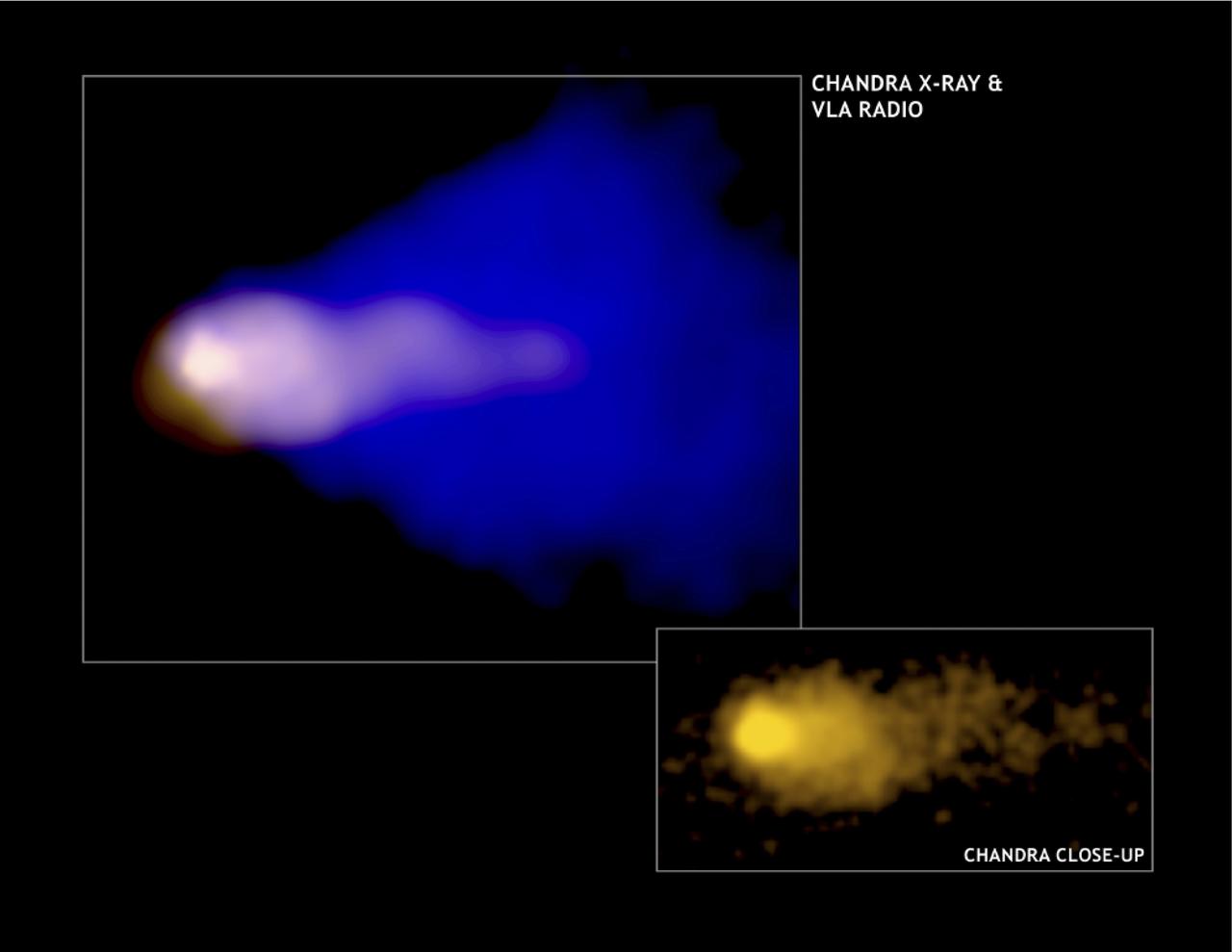
Astronomers have used an x-ray image to make the first detailed study of the behavior of high-energy particles around a fast moving pulsar. This image, from NASA's Chandra X-Ray Observatory (CXO), shows the shock wave created as a pulsar plows supersonically through interstellar space. These results will provide insight into theories for the production of powerful winds of matter and antimatter by pulsars. Chandra's image of the glowing cloud, known as the Mouse, shows a stubby bright column of high-energy particles, about four light years in length, swept back by the pulsar's interaction with interstellar gas. The intense source at the head of the X-ray column is the pulsar, estimated to be moving through space at about 1.3 million miles per hour. A cone-shaped cloud of radio-wave-emitting particles envelopes the x-ray column. The Mouse, a.k.a. G359.23-0.82, was discovered in 1987 by radio astronomers using the National Science Foundation's Very Large Array in New Mexico. G359.23-0.82 gets its name from its appearance in radio images that show a compact snout, a bulbous body, and a remarkable long, narrow, tail that extends for about 55 light years. NASA’s Marshall Space Flight Center in Huntsville, Alabama manages the Chandler program.
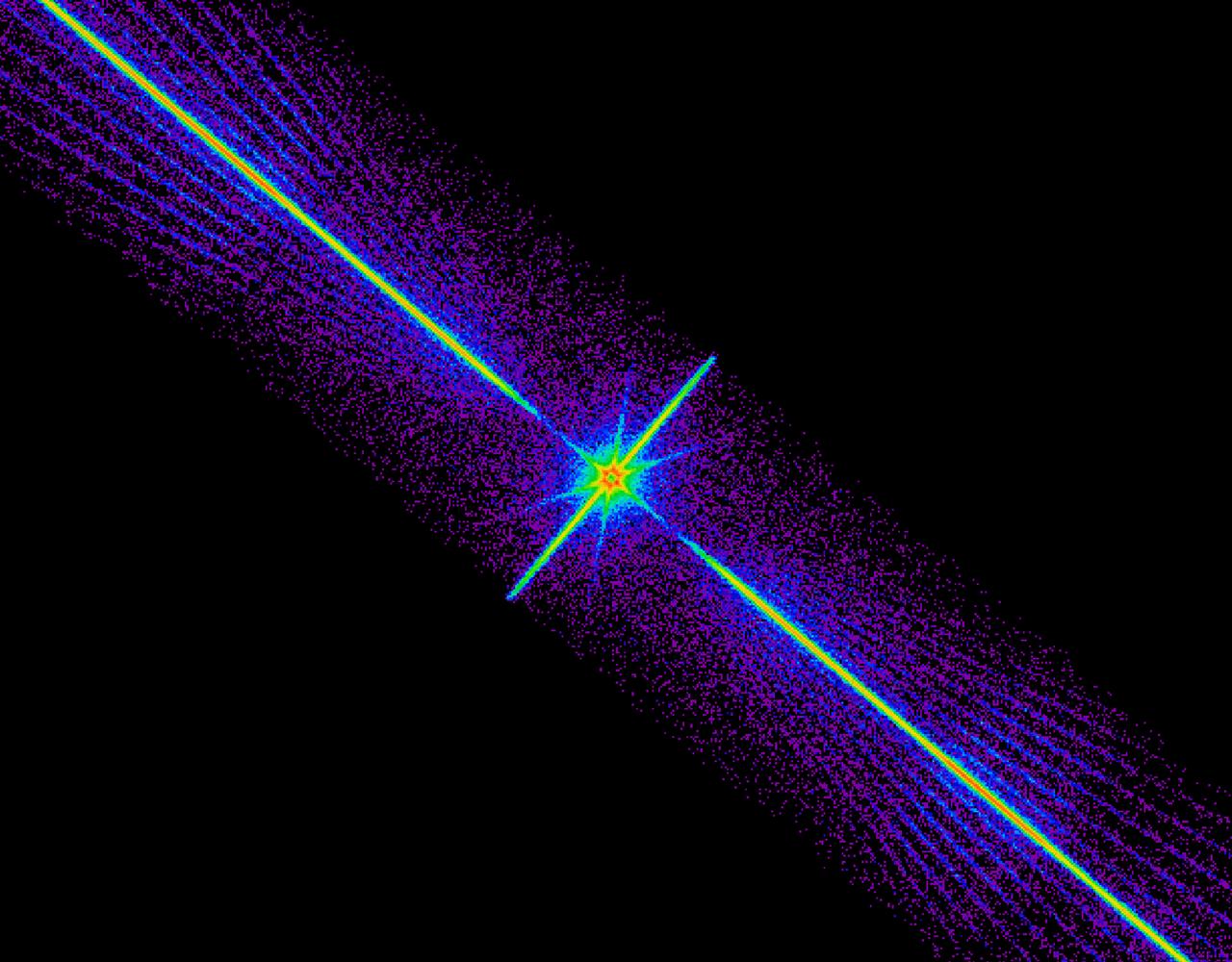
This Chandra X-Ray Observatory (CXO) image is a spectrum of a black hole, which is similar to the colorful spectrum of sunlight produced by a prism. The x-rays of interest are shown here recorded in bright stripes that run rightward and leftward from the center of the image. These x-rays are sorted precisely according to their energy with the highest-energy x-rays near the center of the image and the lower-energy x-rays farther out. The spectrum was obtained by using the Low Energy Transmission Grating (LETG), which intercepts x-rays and changes their direction by the amounts that depend sensitively on the x-ray energy. The assembly holds 540 gold transmission gratings. When in place behind the mirrors, the gratings intercept the x-rays reflected from the telescope. The bright spot at the center is due to a fraction of the x-ray radiation that is not deflected by the LETG. The spokes that intersect the central spot and the faint diagonal rays that flank the spectrum itself are artifacts due to the structure that supports the LETG grating elements. (Photo credit: NASA Cfa/J. McClintock et al)
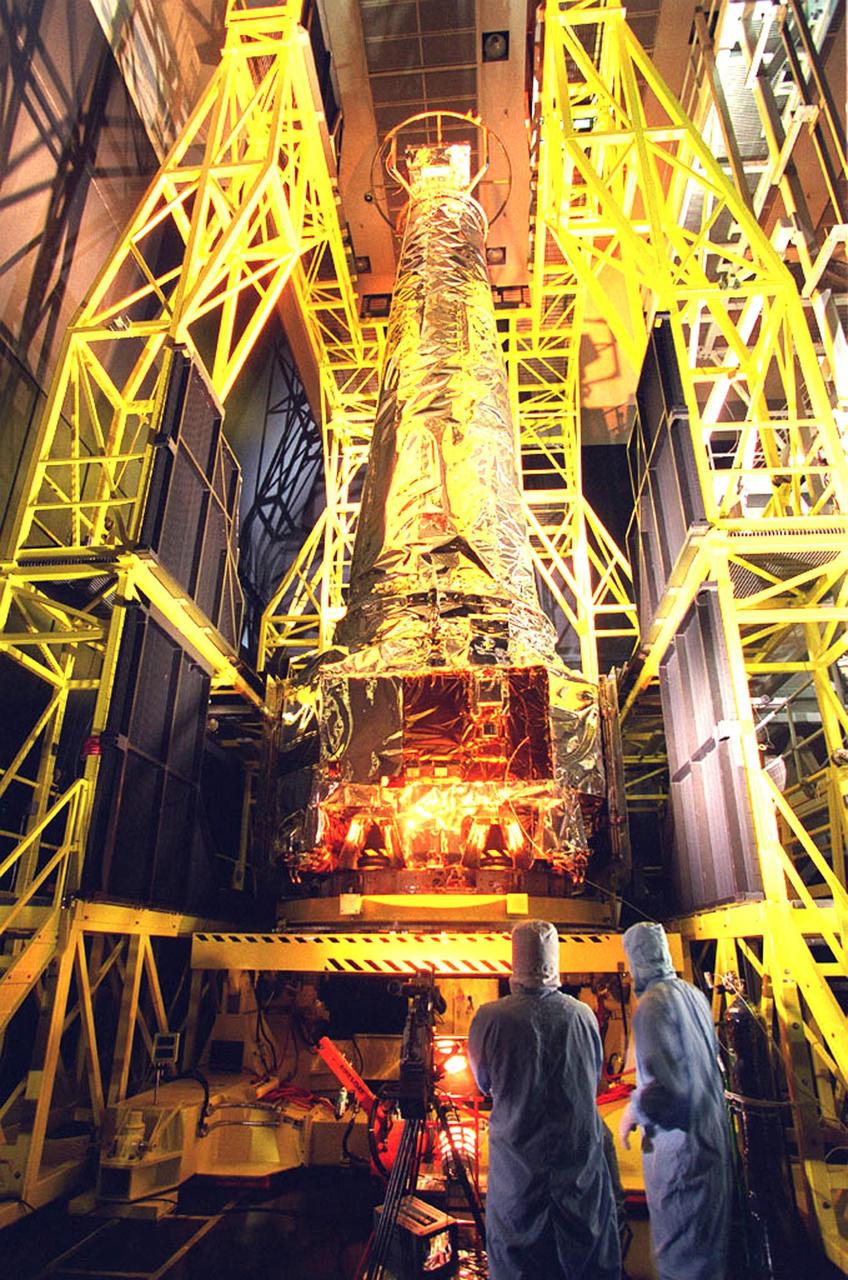
The Chandra X-ray Observatory (CXO), NASA's newest space telescope, is seen above at the unveiling ceremony at TRW Space and Electronics Group in Redondo Beach, Calif. The photo was taken by Marshall Space Flight Center and appears on its <a href="http://www.msfc.nasa.gov/news">Marshall News Center Web site</a>, along with other digital images of the completely assembled observatory. Formerly called the Advanced X-ray Astrophysics Facility, the CXO is the world's most powerful X-ray telescope. Scientists believe its ability to see previously invisible black holes and high-temperature gas clouds give the observatory the potential to rewrite the books on the structure and evolution of our universe
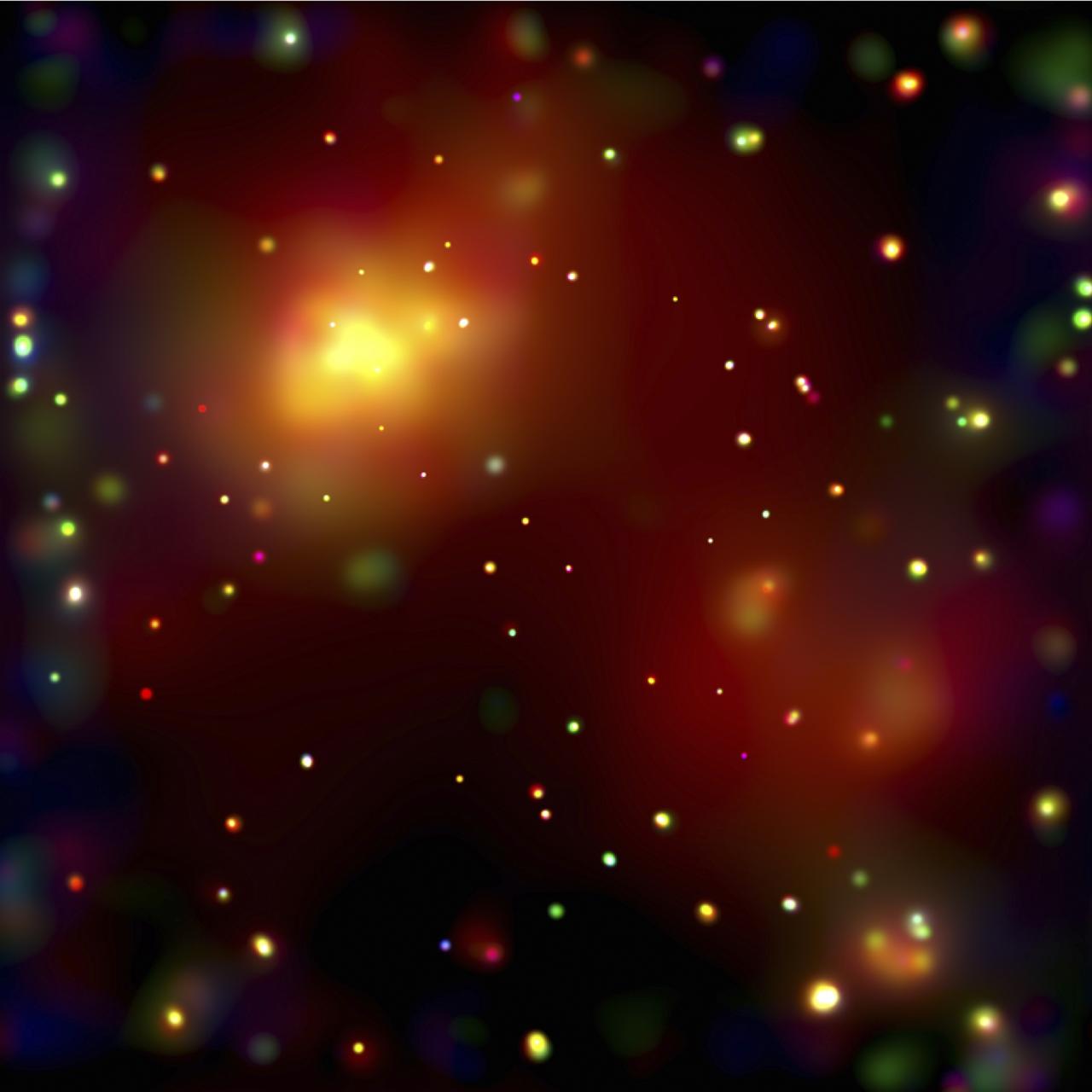
This image of the galaxy cluster Abell 2125, provided by the Chandra X-Ray Observatory (CXO), reveals several massive multimillion degree Celsius gas clouds that appear to be in the process of merging. Ten of the point-like sources are associated with galaxies in the cluster and the rest are probably distant background galaxies. The small bright feature in the extreme lower right-hand corner is probably a background galaxy cluster not associated with Abell 2125. The bright gas cloud on the upper left is the core of the cluster and envelopes hundreds of galaxies. It consists of several elongated clouds that are merging. Chandra, Hubble Space Telescope (HST), and Very Large Array radio telescope data show that several galaxies in the Abell 2125 core cluster are being stripped of their gas as they fall through surrounding high-pressure hot gas. This stripping process has enriched the core cluster's gas in heavy elements such as iron. In contrast, the bright large cloud on the lower right envelopes hundreds of galaxies and has an extraordinarily low concentration of iron atoms. It is thought that this cloud, which is several million light years from the core cluster, has not yet been enriched by the stripping of iron-rich gas from its member galaxies. Over time, as this cloud merges into the core and the hot gas pressure increases, iron atoms should be swept from the galaxies. Building a massive galaxy cluster is a step-by-step enterprise that takes billions of years and affects the growth and evolution of the member galaxies. The observations of A 2125 provide a rare glimpse into the early steps in this process. NASA’s Marshall Space Flight Center in Huntsville, Alabama manages both the Chandra and Hubble programs. (NASA/UMass/D. Wang et al.))
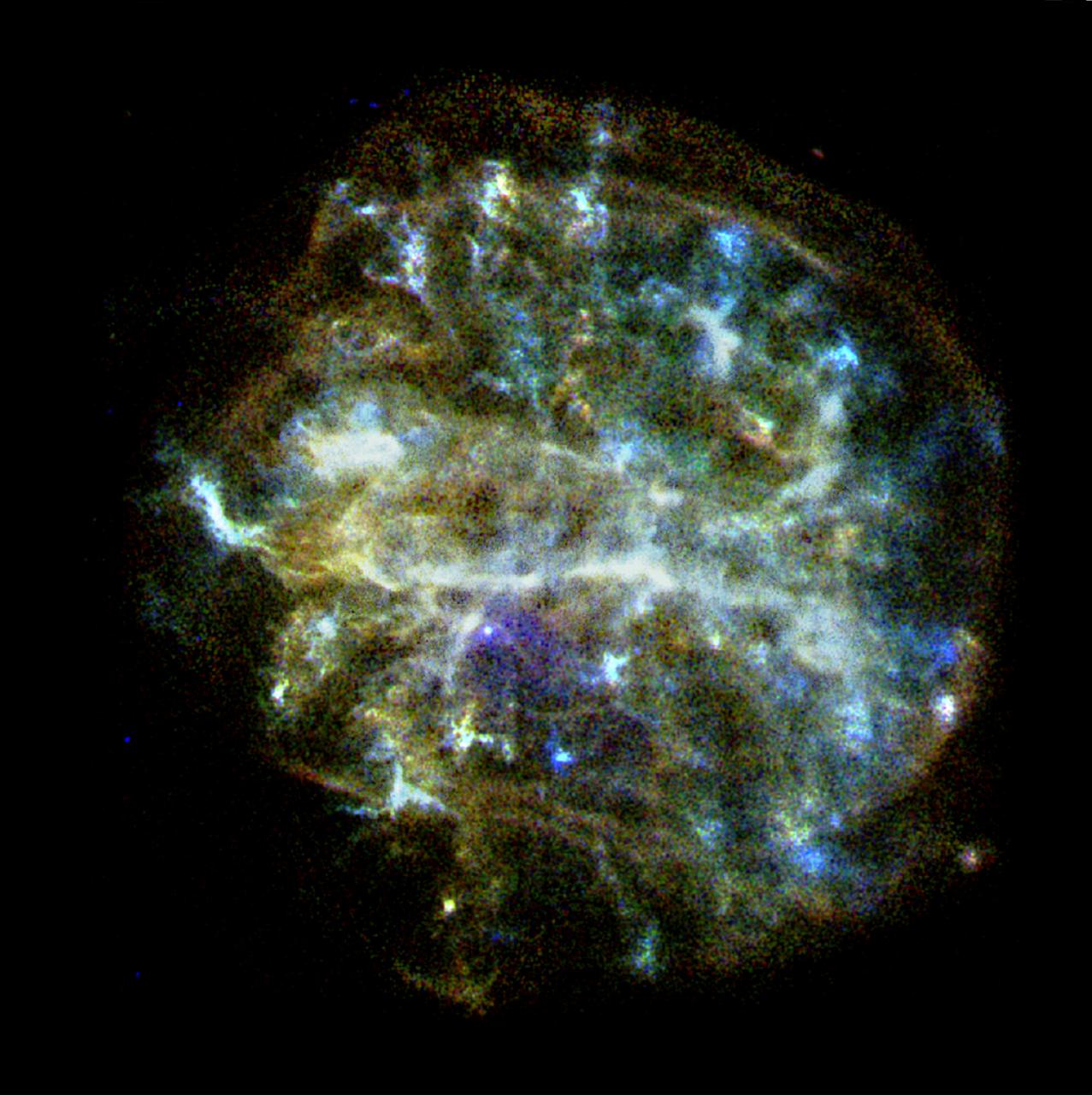
The Chandra X-Ray Observatory has captured this spectacular image of G292.0+1.8, a young, oxygen-rich supernova remnant with a pulsar at its center surrounded by outflowing material. This image shows a rapidly expanding shell of gas that is 36 light-years across and contains large amounts of elements such as oxygen, neon, magnesium, silicon and sulfur. Embedded in this cloud of multimillion-degree gas is a key piece of evidence linking neutron stars and supernovae produced by the collapse of massive stars. With an age estimated at 1,600 years, G292.0+1.8 is one of three known oxygen-rich supernovae in our galaxy. These supernovae are of great interest to astronomers because they are one of the primary sources of the heavy elements necessary to form planets and people. Scattered through the image are bluish knots of emissions containing material that is highly enriched in newly created oxygen, neon, and magnesium produced deep within the original star and ejected by the supernova explosion.
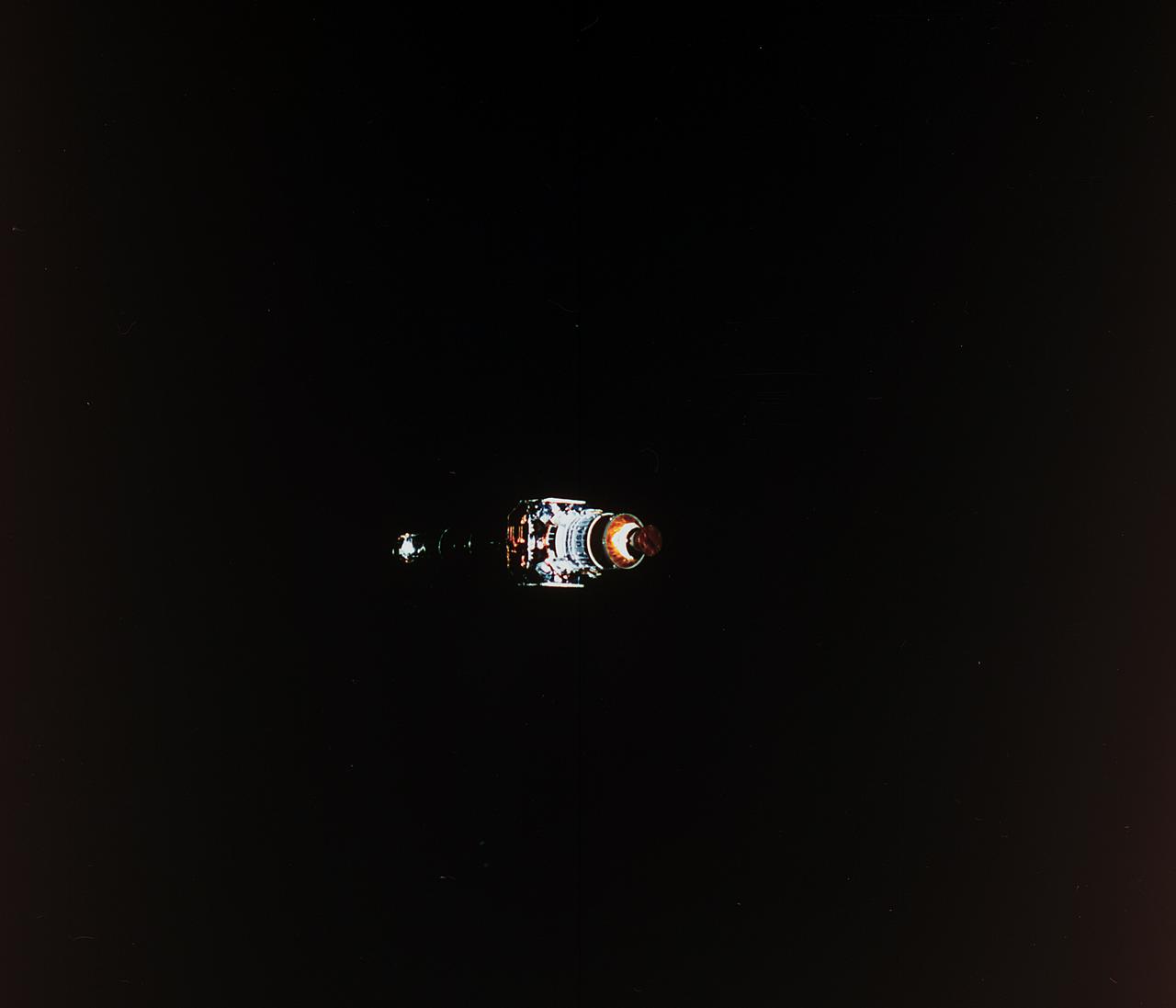
A crew member of the STS-93 mission took this photograph of the Chandra X-Ray Observatory, still attached to the Inertial Upper Stage (IUS), backdropped against the darkness of space not long after its release from Orbiter Columbia. Two firings of an attached IUS rocket placed the Observatory into its working orbit. The primary duty of the crew of this mission was to deploy the 50,162-pound Observatory, the world's most powerful x-ray telescope.

This Chandra X-Ray Observatory image of the mysterious superstar Eta Carinae reveals a surprising hot irner core, creating more questions than answers for astronomers. The image shows three distinct structures: An outer, horseshoe shaped ring about 2 light-years in diameter, a hot inner core about 3 light-months in diameter, and a hot central source less than a light-month in diameter which may contain the superstar. In 1 month, light travels a distance of approximately 489 billion miles (about 788 billion kilometers). All three structures are thought to represent shock waves produced by matter rushing away from the superstar at supersonic speeds. The temperature of the shock-heated gas ranges from 60 million degrees Kelvin in the central regions to 7 million degrees Kelvin on the outer structure. Eta Carinae is one of the most enigmatic and intriguing objects in our galaxy. Between 1837 and 1856, it increased dramatically in brightness to become the most prominent star in the sky except for Sirius, even through it is 7,500 light-years away, more than 80 times the distance to Sirius. This "Great Eruption," as it is called, had an energy comparable to a supernova, yet did not destroy the star, which faded to become a dim star, invisible to the naked eye. Since 1940, Eta Carinae has begun to brighten again, becoming visible to the naked eye. Photo credit: NASA/CXC/SAO
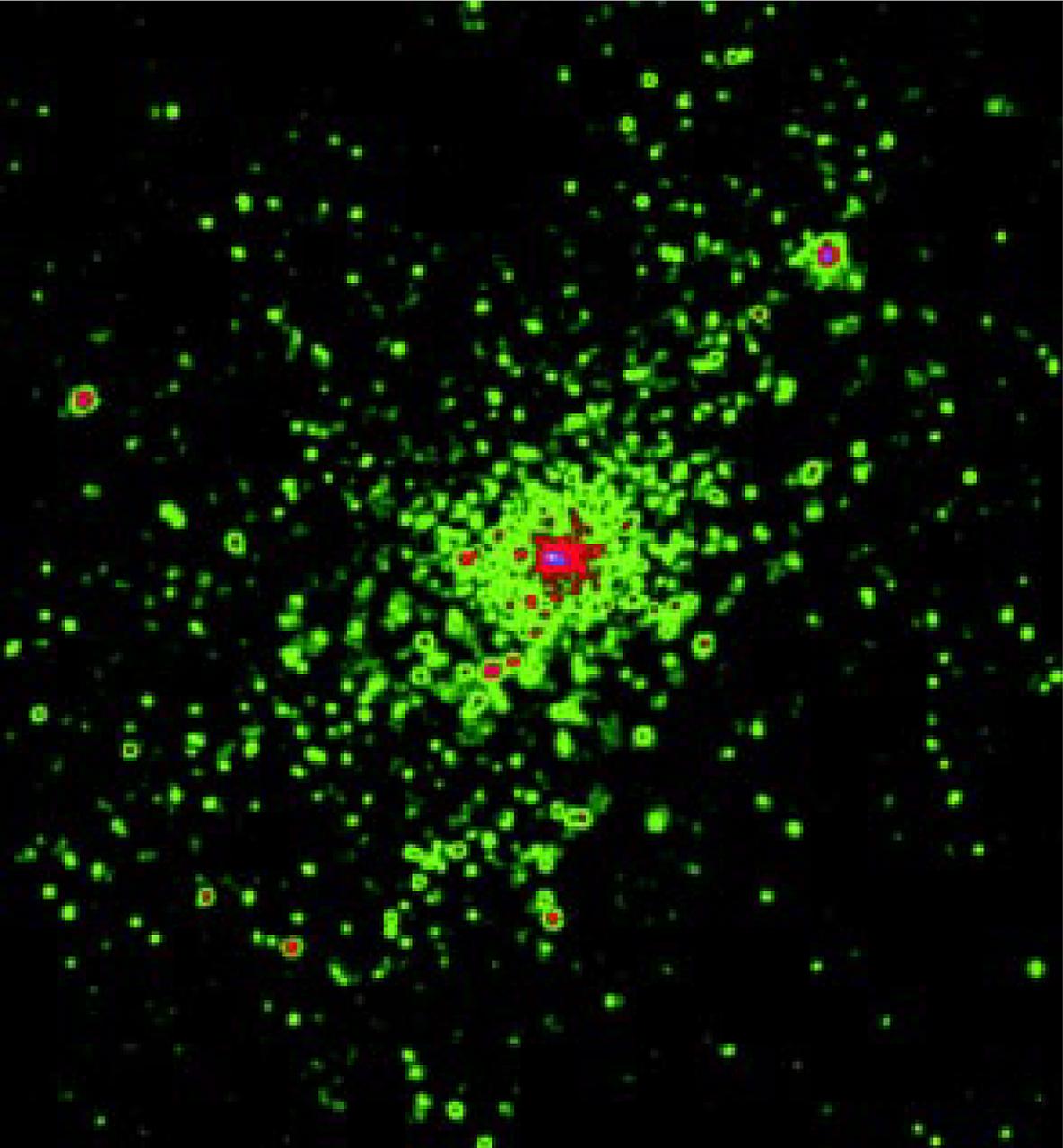
NGC 3603 is a bustling region of star birth in the Carina spiral arm of the Milky Way galaxy, about 20,000 light-years from Earth. For the first time, this Chandra image resolves the multitude of individual x-ray sources in this star-forming region. (The intensity of the x-rays observed by Chandra are depicted by the various colors in this image. Green represents lower intensity sources, while purple and red indicate increasing x-ray intensity.) Specifically, the Chandra image reveals dozens of extremely massive stars born in a burst of star formation about 2 million years ago. This region's activities may be indicative of what is happening in other distant "starburst" galaxies (bright galaxies flush with new stars). In the case of NGC 3603, scientists now believe that these x-rays are emitted from massive stars and stellar winds, since the stars are too young to have produced supernovae or have evolved into neutron stars. The Chandra observations of NGC 3603 may provide new clues about x-ray emission in starburst galaxies as well as star formation itself. (Photo credit: NASA/GSFC/M. Corcoran et al)

Chandra X-Ray Observatory took this first x-ray picture of the Andromeda Galaxy (M31) on October 13, 1999. The blue dot in the center of the image is a "cool" million-degree x-ray source where a supermassive black hole with the mass of 30-million suns is located. The x-rays are produced by matter furneling toward the black hole. Numerous other hotter x-ray sources are also apparent. Most of these are probably due to x-ray binary systems, in which a neutron star or black hole is in close orbit around a normal star. While the gas falling into the central black hole is cool, it is only cool by comparison to the 100 other x-ray sources in the Andromeda Galaxy. To be detected by an x-ray telescope, the gas must have a temperature of more than a million degrees. The Andromeda Galaxy is our nearest neighbor spiral galaxy at a distance of two million light years. It is similar to our own Milky Way in size, shape, and also contains a supermassive black hole at the center. (Photo Credit: NASA/CXC/SAO/S. Murray, M. Garcia)

NASA image release March 2, 2012 This composite image shows the distribution of dark matter, galaxies, and hot gas in the core of the merging galaxy cluster Abell 520, formed from a violent collision of massive galaxy clusters. The natural-color image of the galaxies was taken with NASA's Hubble Space Telescope and with the Canada-France-Hawaii Telescope in Hawaii. Superimposed on the image are "false-colored" maps showing the concentration of starlight, hot gas, and dark matter in the cluster. Starlight from galaxies, derived from observations by the Canada-France-Hawaii Telescope, is colored orange. The green-tinted regions show hot gas, as detected by NASA's Chandra X-ray Observatory. The gas is evidence that a collision took place. The blue-colored areas pinpoint the location of most of the mass in the cluster, which is dominated by dark matter. Dark matter is an invisible substance that makes up most of the universe's mass. The dark-matter map was derived from the Hubble Wide Field Planetary Camera 2 observations, by detecting how light from distant objects is distorted by the cluster galaxies, an effect called gravitational lensing. The blend of blue and green in the center of the image reveals that a clump of dark matter resides near most of the hot gas, where very few galaxies are found. This finding confirms previous observations of a dark-matter core in the cluster. The result could present a challenge to basic theories of dark matter, which predict that galaxies should be anchored to dark matter, even during the shock of a collision. Abell 520 resides 2.4 billion light-years away. To read more go to: <a href="http://www.nasa.gov/mission_pages/hubble/science/dark-matter-core.html" rel="nofollow">www.nasa.gov/mission_pages/hubble/science/dark-matter-cor...</a> Credit: NASA, ESA, CFHT, CXO, M.J. Jee (University of California, Davis), and A. Mahdavi (San Francisco State University) <b><a href="http://www.nasa.gov/audience/formedia/features/MP_Photo_Guidelines.html" rel="nofollow">NASA image use policy.</a></b> <b><a href="http://www.nasa.gov/centers/goddard/home/index.html" rel="nofollow">NASA Goddard Space Flight Center</a></b> enables NASA’s mission through four scientific endeavors: Earth Science, Heliophysics, Solar System Exploration, and Astrophysics. Goddard plays a leading role in NASA’s accomplishments by contributing compelling scientific knowledge to advance the Agency’s mission. <b>Follow us on <a href="http://twitter.com/NASA_GoddardPix" rel="nofollow">Twitter</a></b> <b>Like us on <a href="http://www.facebook.com/pages/Greenbelt-MD/NASA-Goddard/395013845897?ref=tsd" rel="nofollow">Facebook</a></b> <b>Find us on <a href="http://instagrid.me/nasagoddard/?vm=grid" rel="nofollow">Instagram</a></b>

RCW 108 is a region where stars are actively forming within the Milky Way galaxy about 4,000 light years from Earth. This image is part of a large collection of images of merging galaxies taken by NASA Hubble Space Telescope.
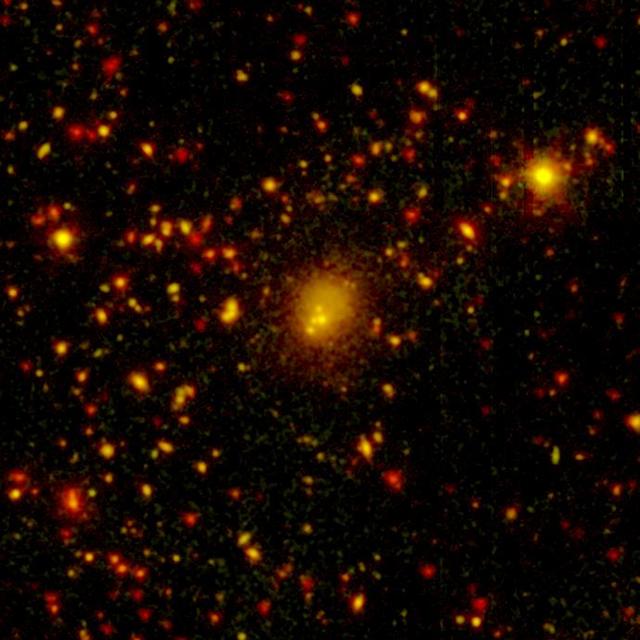
NASA Spitzer Space Telescope spotted a four-way collision, or merger, in a giant cluster of galaxies, called CL0958+4702, located nearly five billion light-years away.