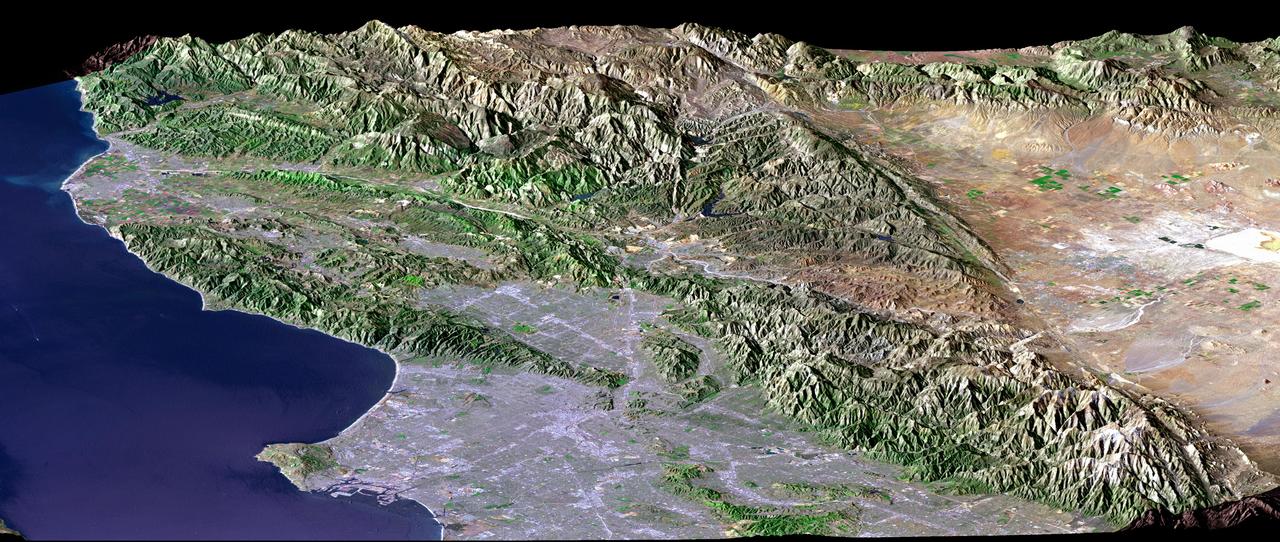
Los Angeles, Calif., is one of the world largest metropolitan areas with a population of about 15 million people. The urban areas mostly cover the coastal plains and lie within the inland valleys.
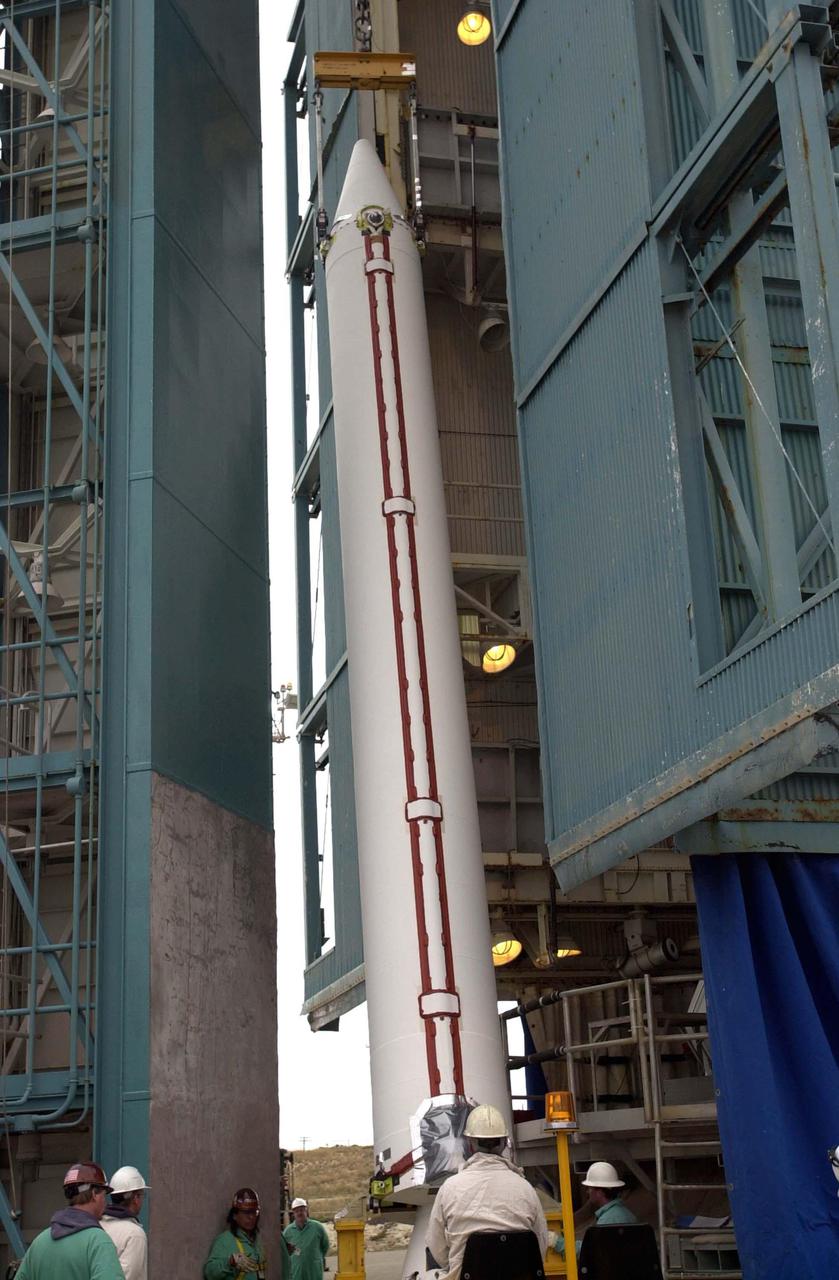
VANDENBERG AIR FORCE BASE, CALIF. - One of four Solid Rocket Boosters for the CALIPSO_CloudSat launch is ready for lifting into the mobile service tower, or gantry, where it will be attached to the Boeing Delta II rocket. CALIPSO stands for Cloud-Aerosol Lidar and Infrared Pathfinder Satellite Observation. CALIPSO and CloudSat are highly complementary satellites and together will provide never-before-seen 3-D perspectives of how clouds and aerosols form, evolve, and affect weather and climate. CALIPSO and CloudSat will fly in formation with three other satellites in the A-train constellation to enhance understanding of our climate system. Launch of CALIPSO_CloudSat aboard a Boeing Delta II rocket is scheduled for 3:01 a.m. Sept. 29.
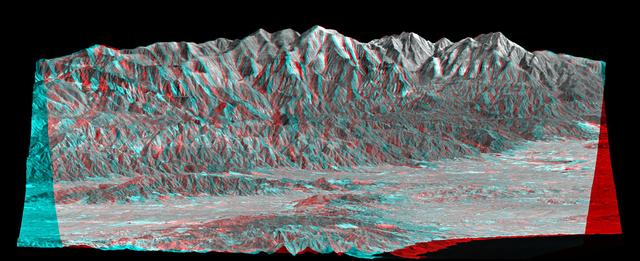
Mount San Antonio more commonly known as Mount Baldy crowns the San Gabriel Mountains northeast of Los Angeles, Calif., in this anaglyph from NASA Shuttle Radar Topography Mission. 3D glasses are necessary to view this image.
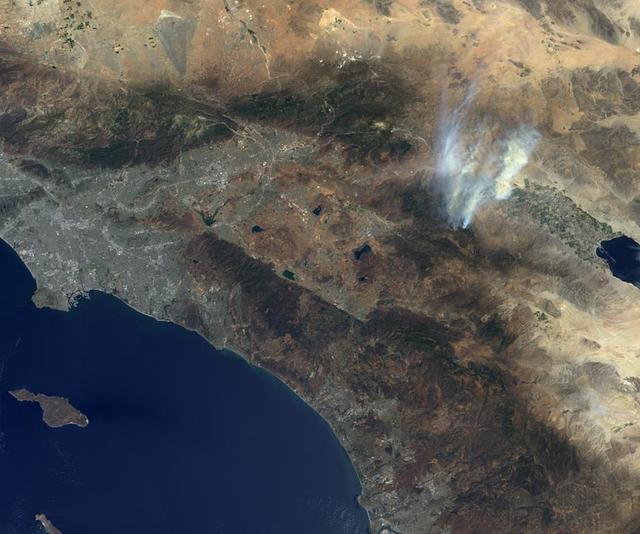
NASA Terra spacecraft passed over the Mountain Fire near Idyllwild, Calif., on Jul. 17, 2013. Los Angeles and the Pacific Ocean can been seen to the left and the Salton Sea is the dark feature in the right center of the image.
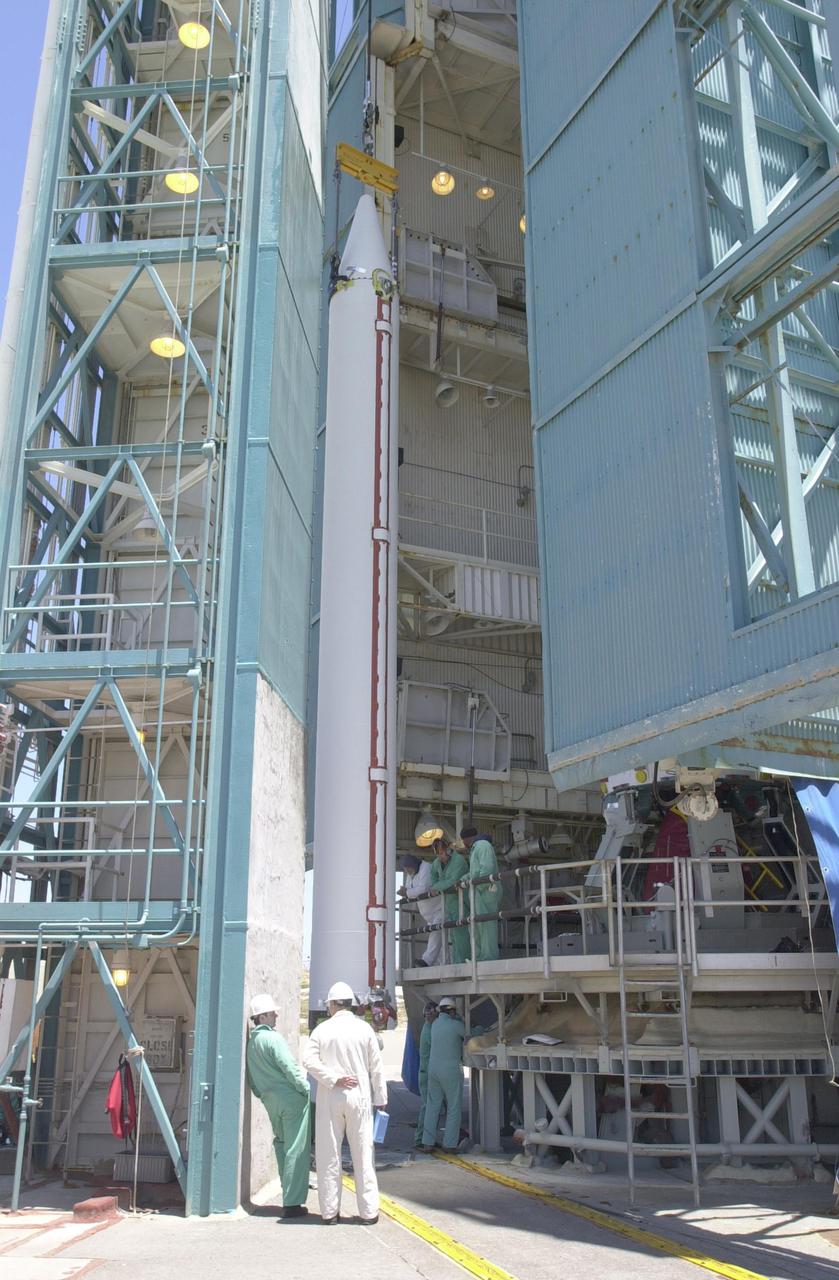
VANDENBERG AIR FORCE BASE, CALIF. - At NASA Space Launch Complex 2 on Vandenberg Air Force Base in California, another Solid Rocket Booster is attached to the Boeing Delta II rocket seen behind it. The Delta is the launch vehicle for the CALIPSO_CloudSat spacecraft. CALIPSO stands for Cloud-Aerosol Lidar and Infrared Pathfinder Satellite Observation. CALIPSO and CloudSat are highly complementary satellites and together will provide never-before-seen 3-D perspectives of how clouds and aerosols form, evolve, and affect weather and climate. CALIPSO and CloudSat will fly in formation with three other satellites in the A-train constellation to enhance understanding of our climate system. Launch of CALIPSO_CloudSat aboard a Boeing Delta II rocket is scheduled for 3:01 a.m. Sept. 29.
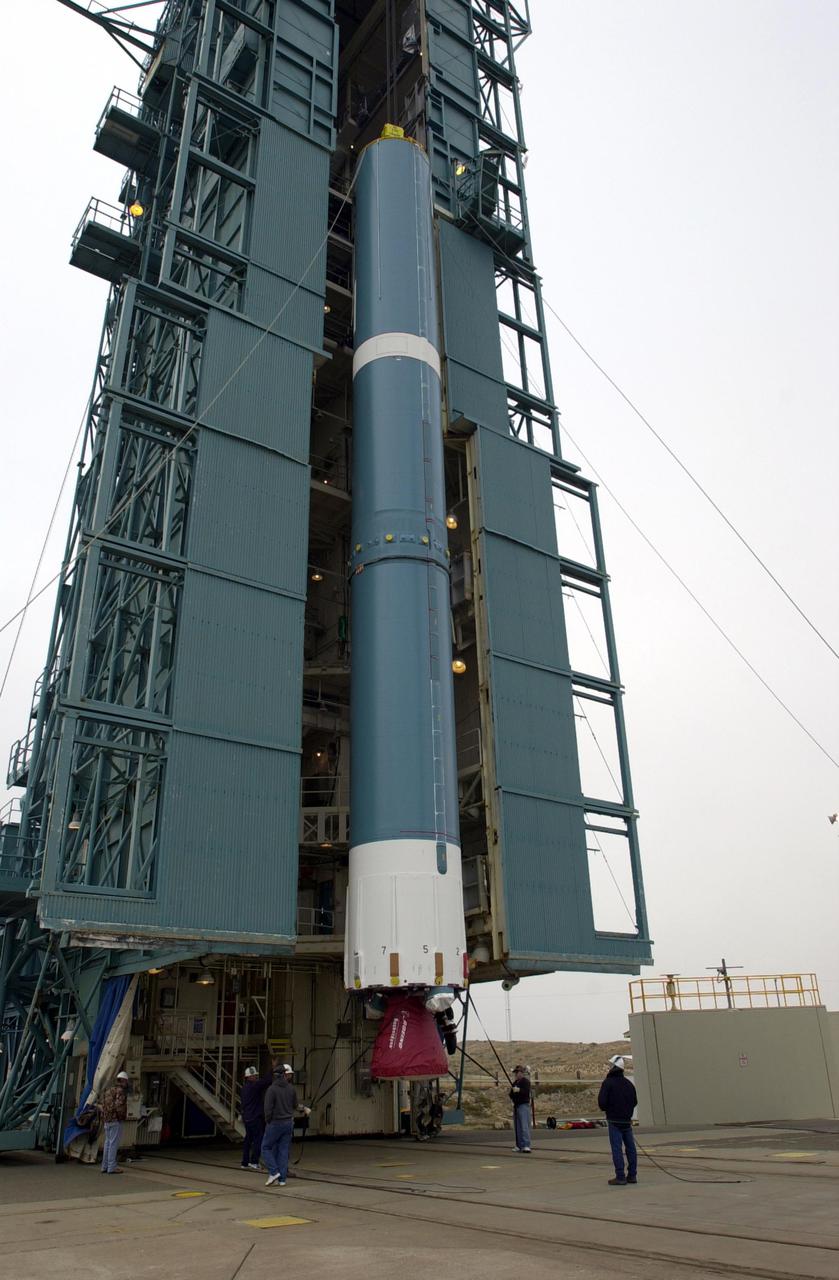
VANDENBERG AIR FORCE BASE, CALIF. - At NASA Space Launch Complex 2 on Vandenberg Air Force Base in California, the Boeing Delta II rocket, launch vehicle for the CALIPSO_CloudSat spacecraft, is ready to lifted into the mobile service tower, or gantry. CALIPSO stands for Cloud-Aerosol Lidar and Infrared Pathfinder Satellite Observation. CALIPSO and CloudSat are highly complementary satellites and together will provide never-before-seen 3-D perspectives of how clouds and aerosols form, evolve, and affect weather and climate. CALIPSO and CloudSat will fly in formation with three other satellites in the A-train constellation to enhance understanding of our climate system. Launch of CALIPSO_CloudSat aboard a Boeing Delta II rocket is scheduled for 3:01 a.m. Sept. 29.
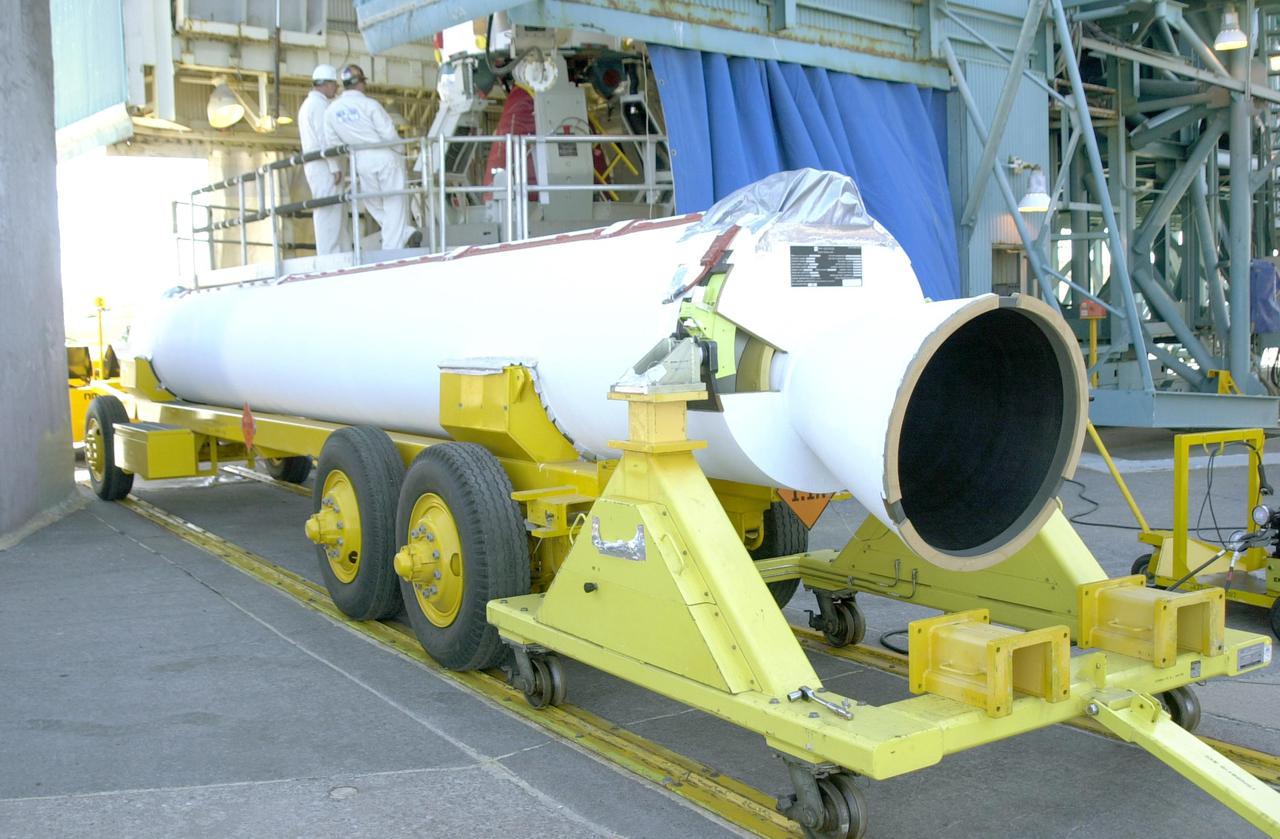
VANDENBERG AIR FORCE BASE, CALIF. - Another Solid Rocket Booster for the CALIPSO_CloudSat launch is ready to be raised to a vertical position at NASA Space Launch Complex 2 on Vandenberg Air Force Base in California. It will then be lifted into the mobile service tower, or gantry, and attached to the Boeing Delta II rocket. The Delta is the launch vehicle for the CALIPSO_CloudSat spacecraft. CALIPSO stands for Cloud-Aerosol Lidar and Infrared Pathfinder Satellite Observation. CALIPSO and CloudSat are highly complementary satellites and together will provide never-before-seen 3-D perspectives of how clouds and aerosols form, evolve, and affect weather and climate. CALIPSO and CloudSat will fly in formation with three other satellites in the A-train constellation to enhance understanding of our climate system. Launch of CALIPSO_CloudSat aboard a Boeing Delta II rocket is scheduled for 3:01 a.m. Sept. 29.
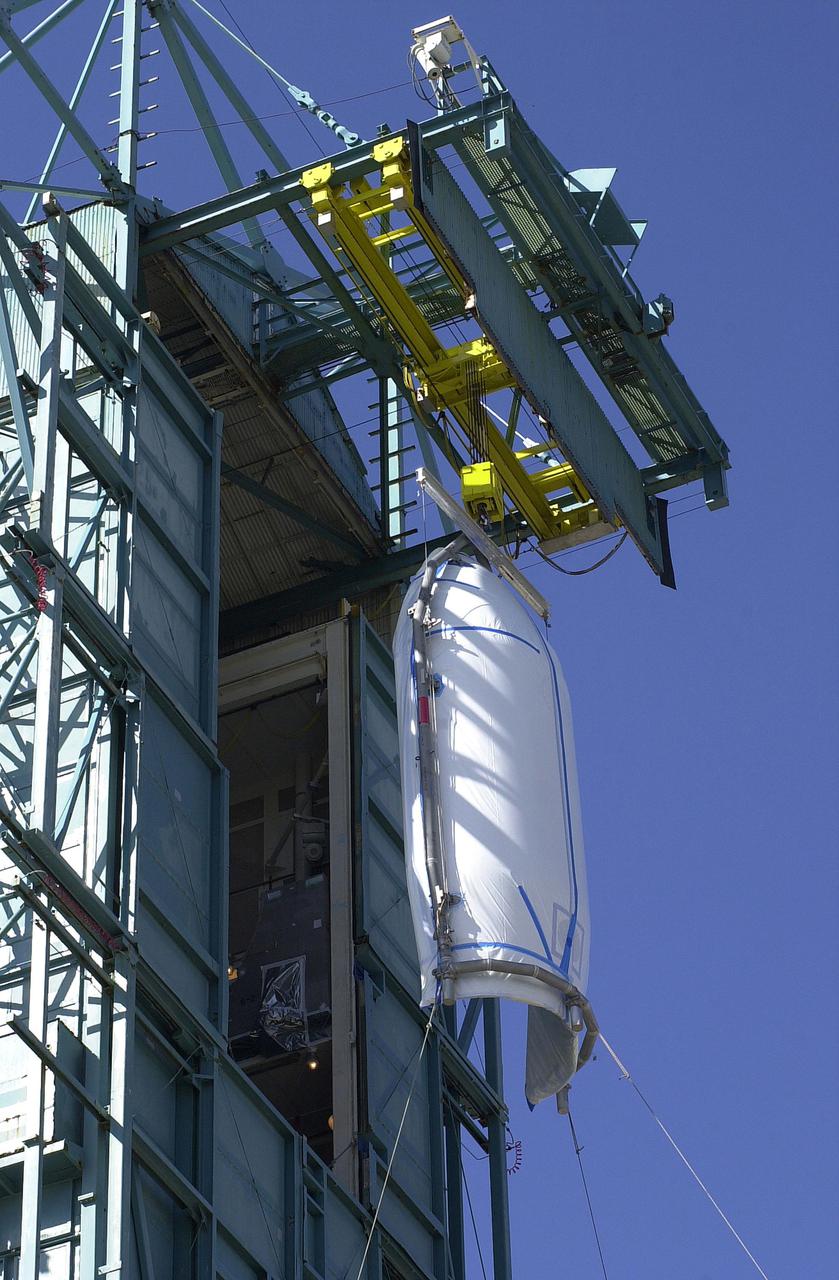
VANDENBERG AIR FORCE BASE, CALIF. - At NASA Space Launch Complex 2 on Vandenberg Air Force Base in California, the first half of the fairing for CALIPSO_CloudSat reaches the top of the mobile service tower, or gantry. The fairing encloses and protects the spacecraft during launch and flight through the atmosphere. Once in space, it is jettisoned. CALIPSO stands for Cloud-Aerosol Lidar and Infrared Pathfinder Satellite Observation. CALIPSO and CloudSat are highly complementary satellites and together will provide never-before-seen 3-D perspectives of how clouds and aerosols form, evolve, and affect weather and climate. CALIPSO and CloudSat will fly in formation with three other satellites in the A-train constellation to enhance understanding of our climate system. Launch of CALIPSO_CloudSat aboard a Boeing Delta II rocket is scheduled for 3:01 a.m. Sept. 29.
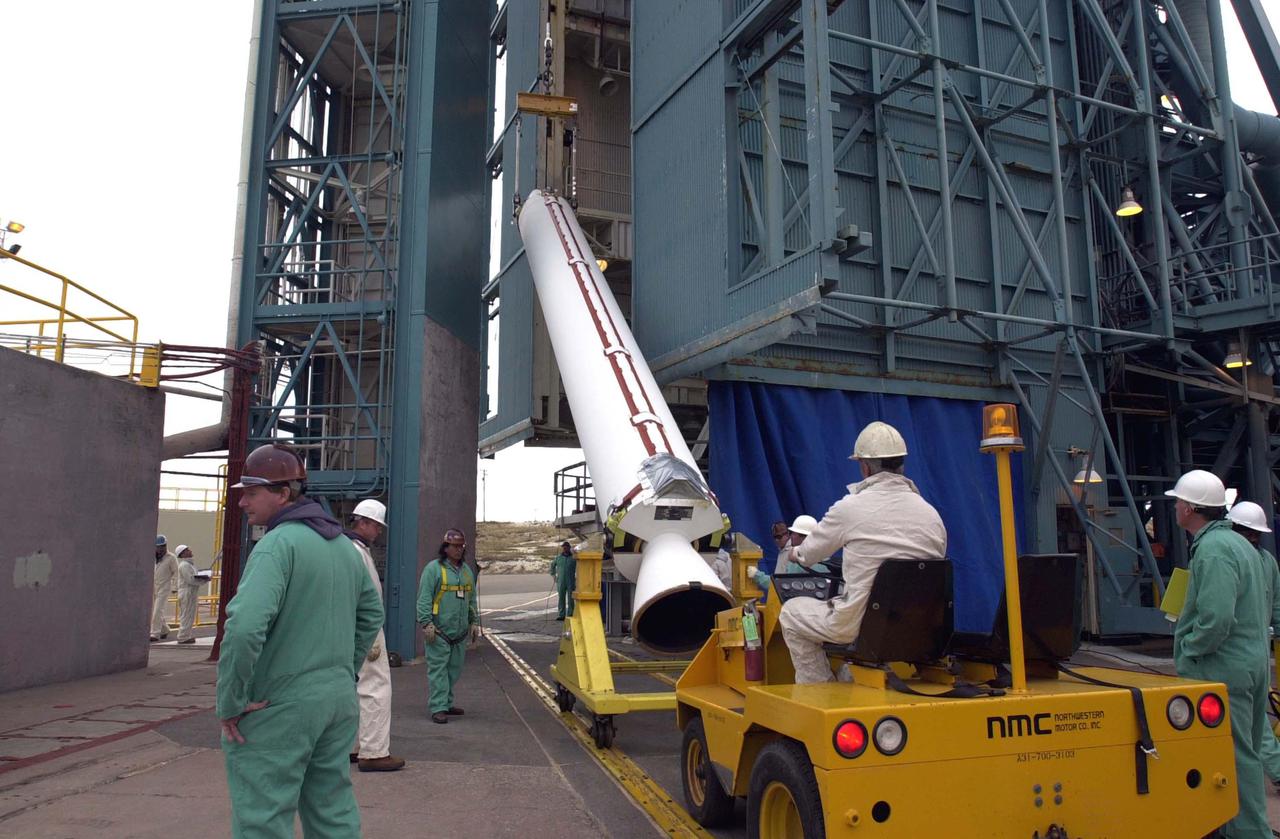
VANDENBERG AIR FORCE BASE, CALIF. - One of four Solid Rocket Boosters for the CALIPSO_CloudSat launch is raised off the transporter to a vertical position. It will be lifted into the mobile service tower, or gantry, and attached to the Boeing Delta II rocket. CALIPSO stands for Cloud-Aerosol Lidar and Infrared Pathfinder Satellite Observation. CALIPSO and CloudSat are highly complementary satellites and together will provide never-before-seen 3-D perspectives of how clouds and aerosols form, evolve, and affect weather and climate. CALIPSO and CloudSat will fly in formation with three other satellites in the A-train constellation to enhance understanding of our climate system. Launch of CALIPSO_CloudSat aboard a Boeing Delta II rocket is scheduled for 3:01 a.m. Sept. 29.
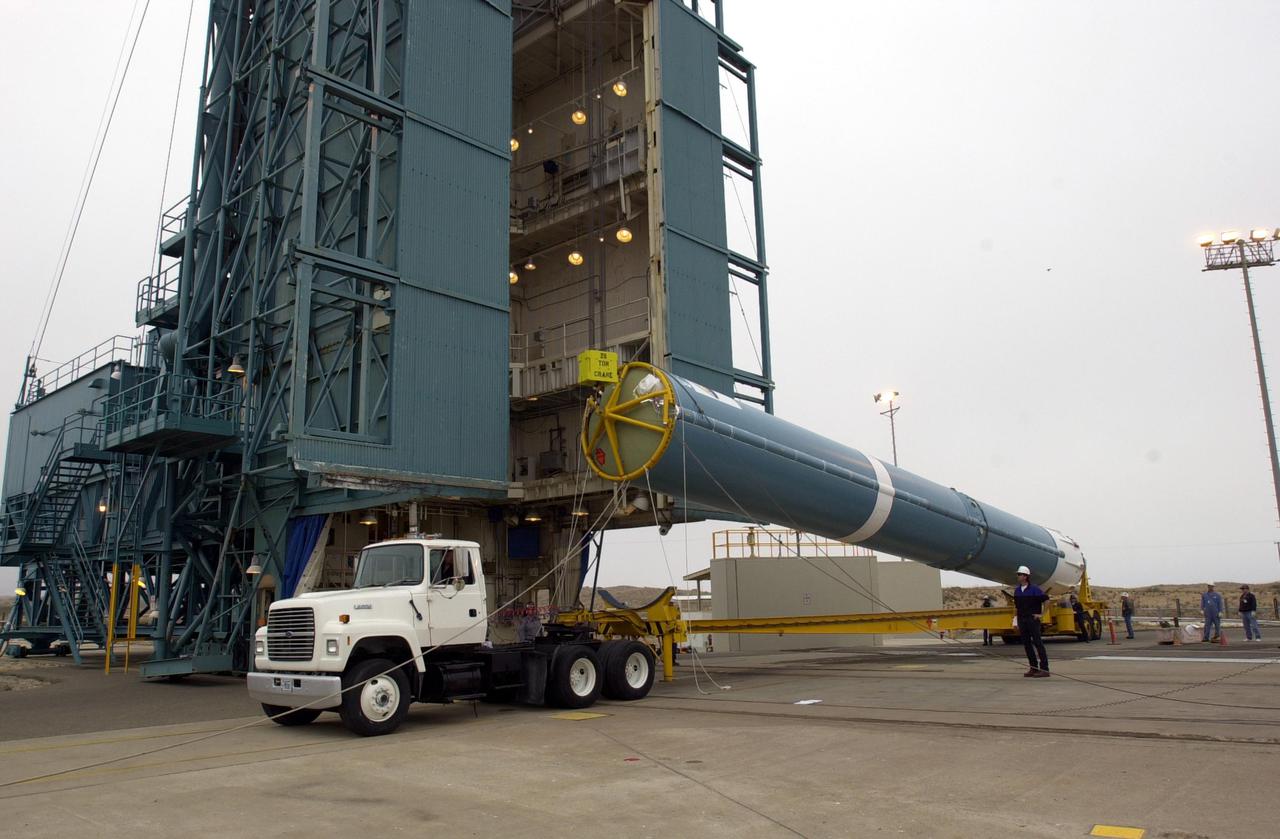
VANDENBERG AIR FORCE BASE, CALIF. - At NASA Space Launch Complex 2 on Vandenberg Air Force Base in California, the first stage of the Boeing Delta II rocket, launch vehicle for the CALIPSO_CloudSat spacecraft, is raised off the transporter. Once it is vertical, it will be lifted up into the mobile service tower, or gantry. CALIPSO stands for Cloud-Aerosol Lidar and Infrared Pathfinder Satellite Observation. CALIPSO and CloudSat are highly complementary satellites and together will provide never-before-seen 3-D perspectives of how clouds and aerosols form, evolve, and affect weather and climate. CALIPSO and CloudSat will fly in formation with three other satellites in the A-train constellation to enhance understanding of our climate system. Launch of CALIPSO_CloudSat aboard a Boeing Delta II rocket is scheduled for 3:01 a.m. Sept. 29.
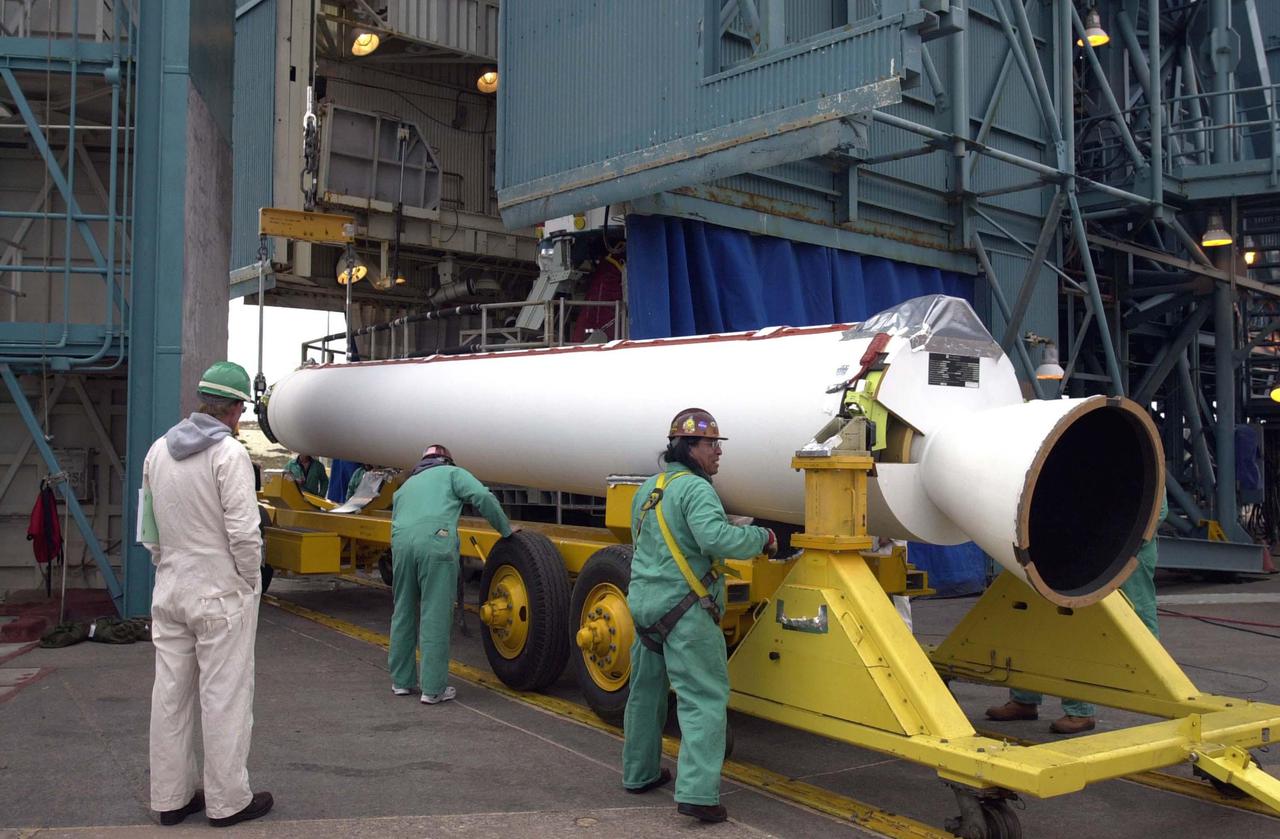
VANDENBERG AIR FORCE BASE, CALIF. - One of four Solid Rocket Boosters for the CALIPSO_CloudSat launch arrives at NASA Space Launch Complex 2 on Vandenberg Air Force Base in California. It will be lifted into the mobile service tower, or gantry, and attached to the Boeing Delta II rocket. CALIPSO stands for Cloud-Aerosol Lidar and Infrared Pathfinder Satellite Observation. CALIPSO and CloudSat are highly complementary satellites and together will provide never-before-seen 3-D perspectives of how clouds and aerosols form, evolve, and affect weather and climate. CALIPSO and CloudSat will fly in formation with three other satellites in the A-train constellation to enhance understanding of our climate system. Launch of CALIPSO_CloudSat aboard a Boeing Delta II rocket is scheduled for 3:01 a.m. Sept. 29.
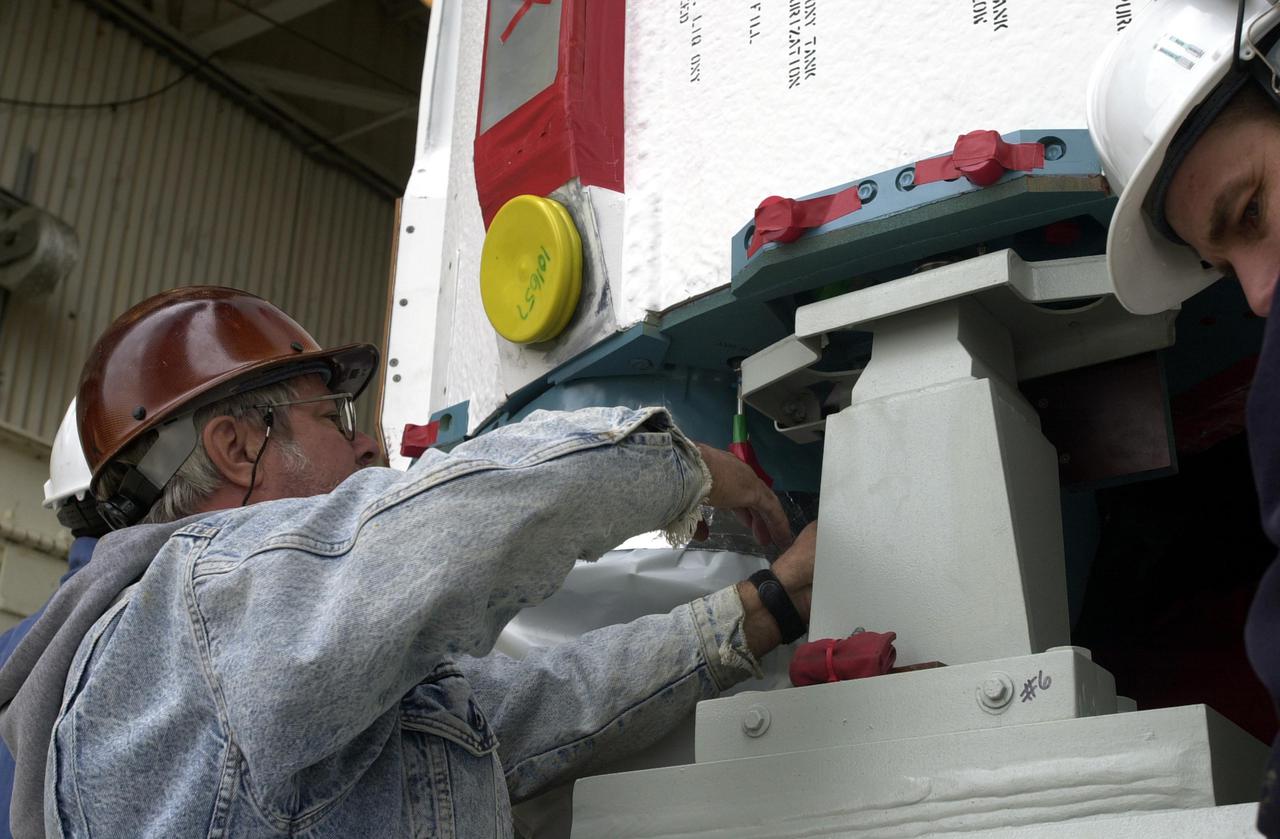
VANDENBERG AIR FORCE BASE, CALIF. - At NASA Space Launch Complex 2 on Vandenberg Air Force Base in California, the Boeing Delta II rocket, launch vehicle for the CALIPSO_CloudSat spacecraft, is prepared for lifting into the mobile service tower, or gantry. CALIPSO stands for Cloud-Aerosol Lidar and Infrared Pathfinder Satellite Observation. CALIPSO and CloudSat are highly complementary satellites and together will provide never-before-seen 3-D perspectives of how clouds and aerosols form, evolve, and affect weather and climate. CALIPSO and CloudSat will fly in formation with three other satellites in the A-train constellation to enhance understanding of our climate system. Launch of CALIPSO_CloudSat aboard a Boeing Delta II rocket is scheduled for 3:01 a.m. Sept. 29.
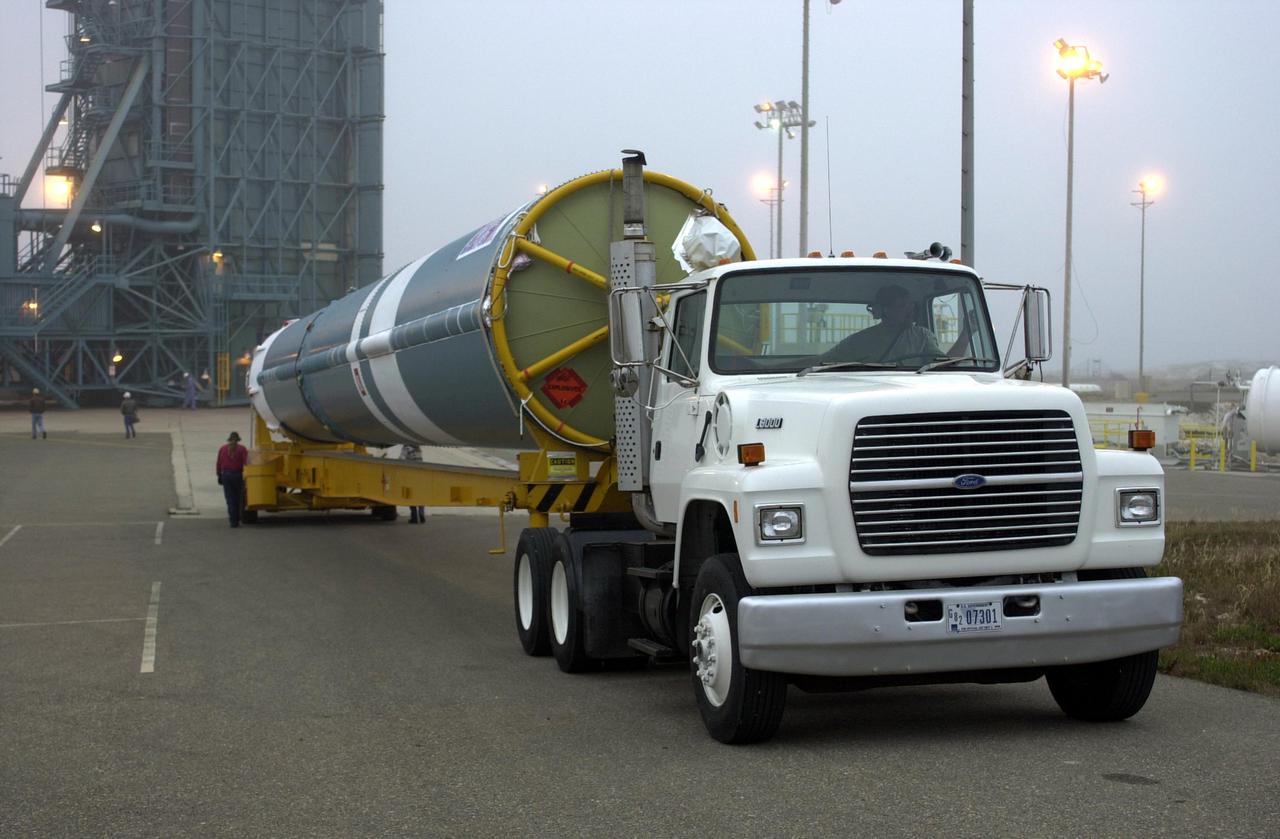
VANDENBERG AIR FORCE BASE, CALIF. - At NASA Space Launch Complex 2 on Vandenberg Air Force Base in California, the first stage of the Boeing Delta II rocket for the CALIPSO_CloudSat launch arrives on the pad. It will be raised to vertical and lifted up into the mobile service tower, or gantry. CALIPSO stands for Cloud-Aerosol Lidar and Infrared Pathfinder Satellite Observation. CALIPSO and CloudSat are highly complementary satellites and together will provide never-before-seen 3-D perspectives of how clouds and aerosols form, evolve, and affect weather and climate. CALIPSO and CloudSat will fly in formation with three other satellites in the A-train constellation to enhance understanding of our climate system. Launch of CALIPSO_CloudSat aboard a Boeing Delta II rocket is scheduled for 3:01 a.m. Sept. 29.
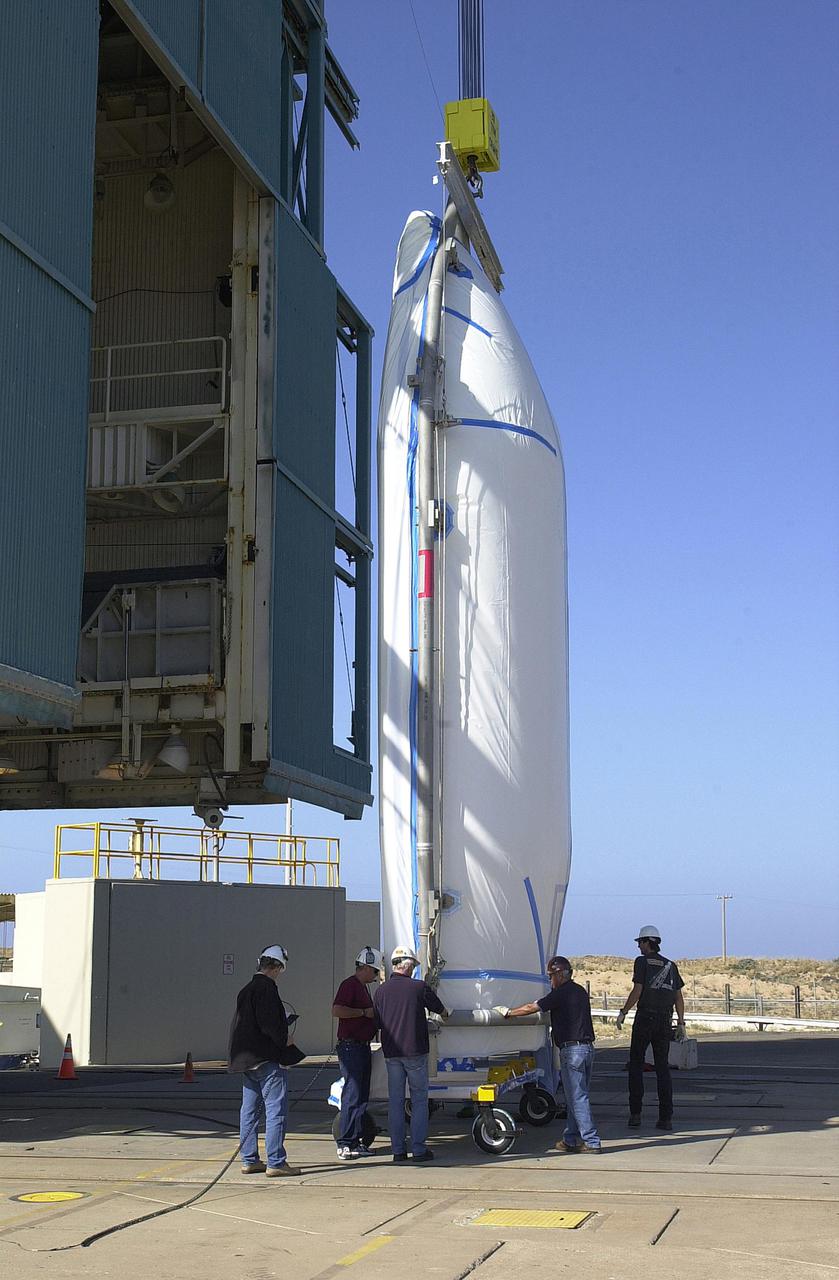
VANDENBERG AIR FORCE BASE, CALIF. - At NASA Space Launch Complex 2 on Vandenberg Air Force Base in California, one half of the fairing for CALIPSO_CloudSat is ready to be lifted into the mobile service tower, or gantry. The fairing encloses and protects the spacecraft during launch and flight through the atmosphere. Once in space, it is jettisoned. CALIPSO stands for Cloud-Aerosol Lidar and Infrared Pathfinder Satellite Observation. CALIPSO and CloudSat are highly complementary satellites and together will provide never-before-seen 3-D perspectives of how clouds and aerosols form, evolve, and affect weather and climate. CALIPSO and CloudSat will fly in formation with three other satellites in the A-train constellation to enhance understanding of our climate system. Launch of CALIPSO_CloudSat aboard a Boeing Delta II rocket is scheduled for 3:01 a.m. Sept. 29.
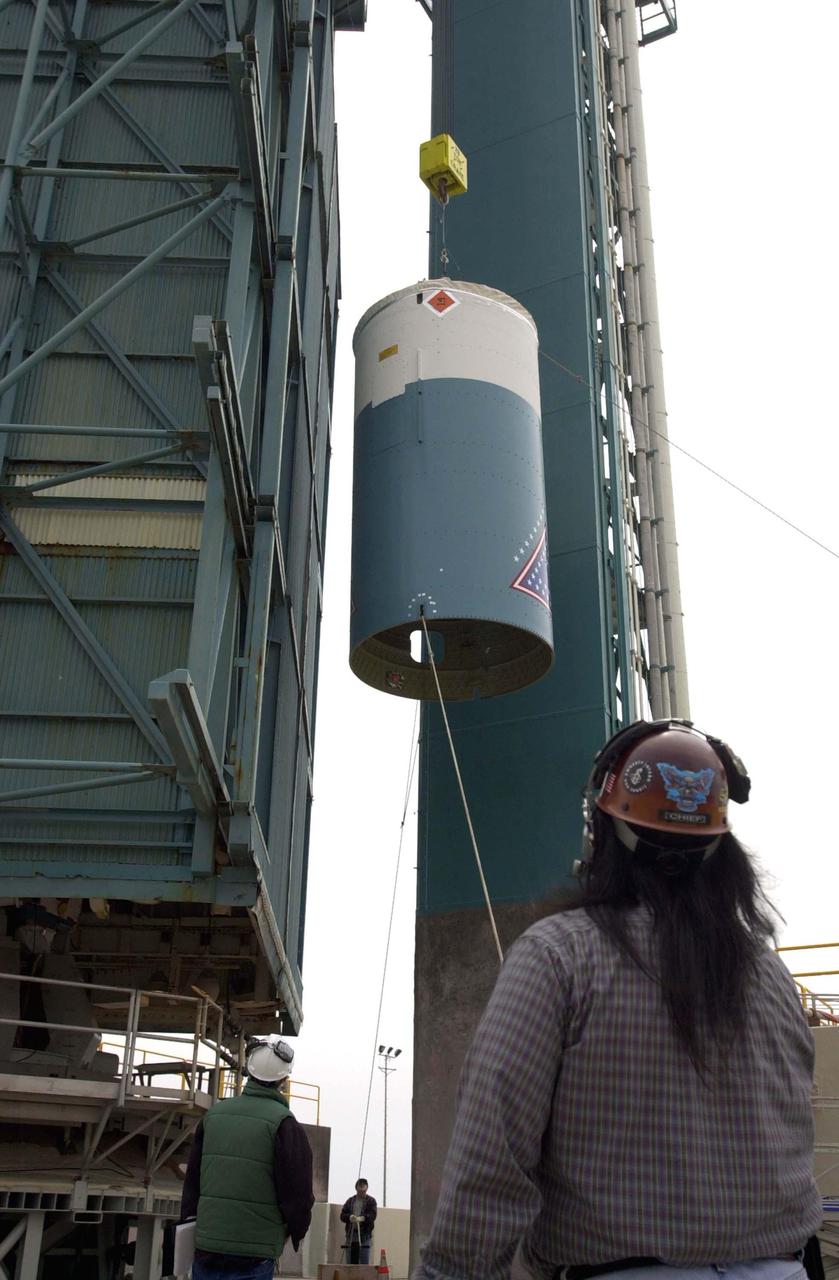
VANDENBERG AIR FORCE BASE, CALIF. - At NASA Space Launch Complex 2 on Vandenberg Air Force Base in California, the interstage for the Boeing Delta II rocket is lifted up the mobile service tower, or gantry. There it will be mated with the first stage already there. The Delta is the launch vehicle for the CALIPSO_CloudSat spacecraft. CALIPSO stands for Cloud-Aerosol Lidar and Infrared Pathfinder Satellite Observation. CALIPSO and CloudSat are highly complementary satellites and together will provide never-before-seen 3-D perspectives of how clouds and aerosols form, evolve, and affect weather and climate. CALIPSO and CloudSat will fly in formation with three other satellites in the A-train constellation to enhance understanding of our climate system. Launch of CALIPSO_CloudSat aboard a Boeing Delta II rocket is scheduled for 3:01 a.m. Sept. 29.
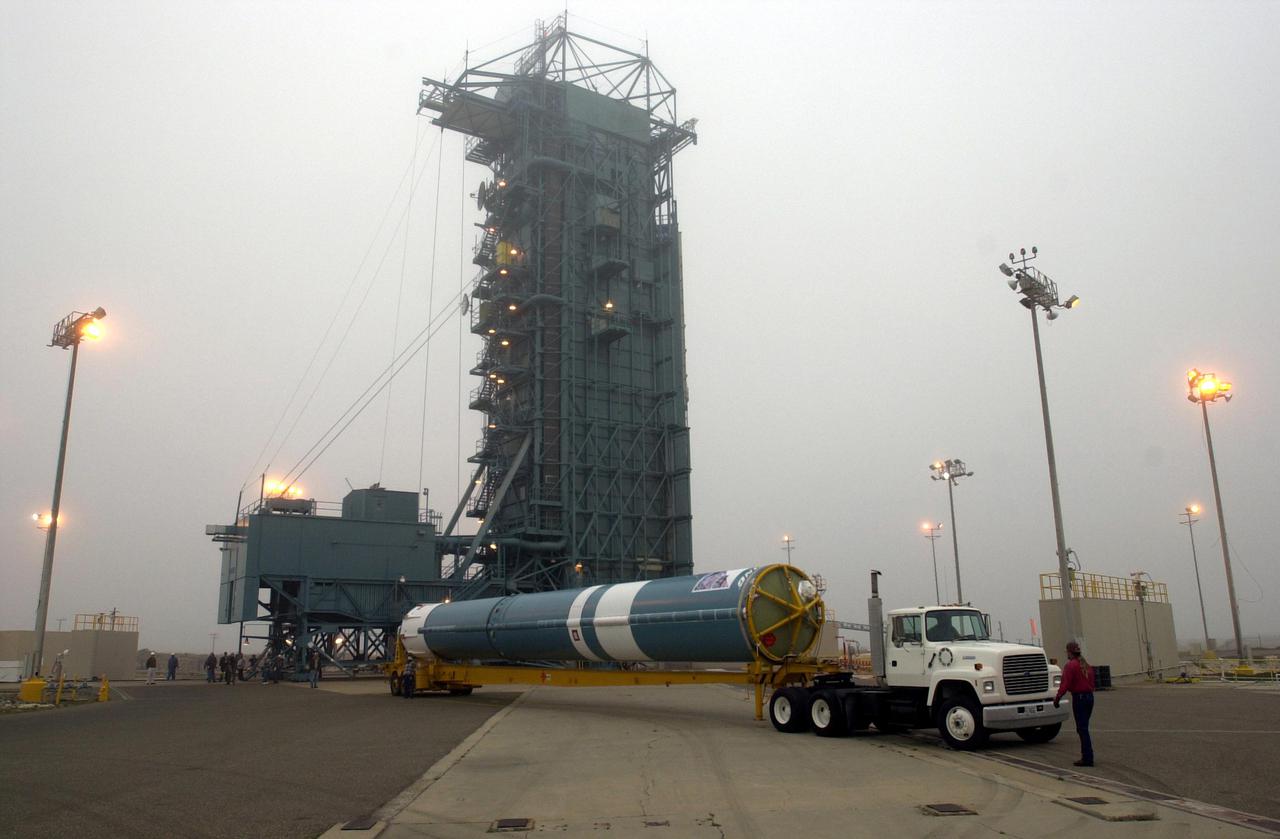
VANDENBERG AIR FORCE BASE, CALIF. - At NASA Space Launch Complex 2 on Vandenberg Air Force Base in California, the first stage of the Boeing Delta II rocket for the CALIPSO_CloudSat launch arrives on the pad. It will be raised to vertical and lifted up into the mobile service tower, or gantry. CALIPSO stands for Cloud-Aerosol Lidar and Infrared Pathfinder Satellite Observation. CALIPSO and CloudSat are highly complementary satellites and together will provide never-before-seen 3-D perspectives of how clouds and aerosols form, evolve, and affect weather and climate. CALIPSO and CloudSat will fly in formation with three other satellites in the A-train constellation to enhance understanding of our climate system. Launch of CALIPSO_CloudSat aboard a Boeing Delta II rocket is scheduled for 3:01 a.m. Sept. 29.
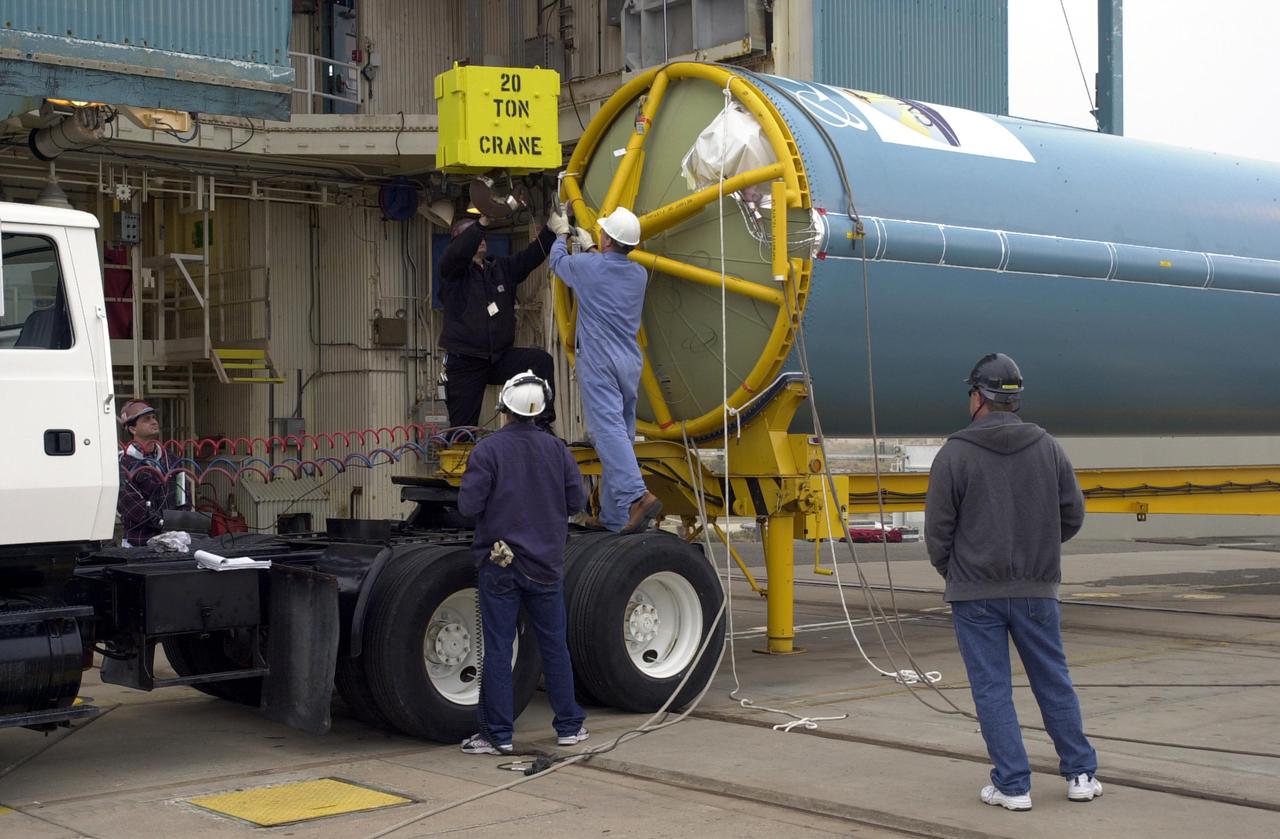
VANDENBERG AIR FORCE BASE, CALIF. — At NASA Space Launch Complex 2 on Vandenberg Air Force Base in California, workers get ready to raise the first stage of the Boeing Delta II rocket, launch vehicle for the CALIPSO_CloudSat spacecraft. Once it is vertical, it will be lifted up into the Mobile service tower, or gantry. CALIPSO stands for Cloud-Aerosol Lidar and Infrared Pathfinder Satellite Observation. CALIPSO and CloudSat are highly complementary satellites and together will provide never-before-seen 3-D perspectives of how clouds and aerosols form, evolve, and affect weather and climate. CALIPSO and CloudSat will fly in formation with three other satellites in the A-train constellation to enhance understanding of our climate system. Launch of CALIPSO_CloudSat aboard a Boeing Delta II rocket is scheduled for 3:01 a.m. Sept. 29.
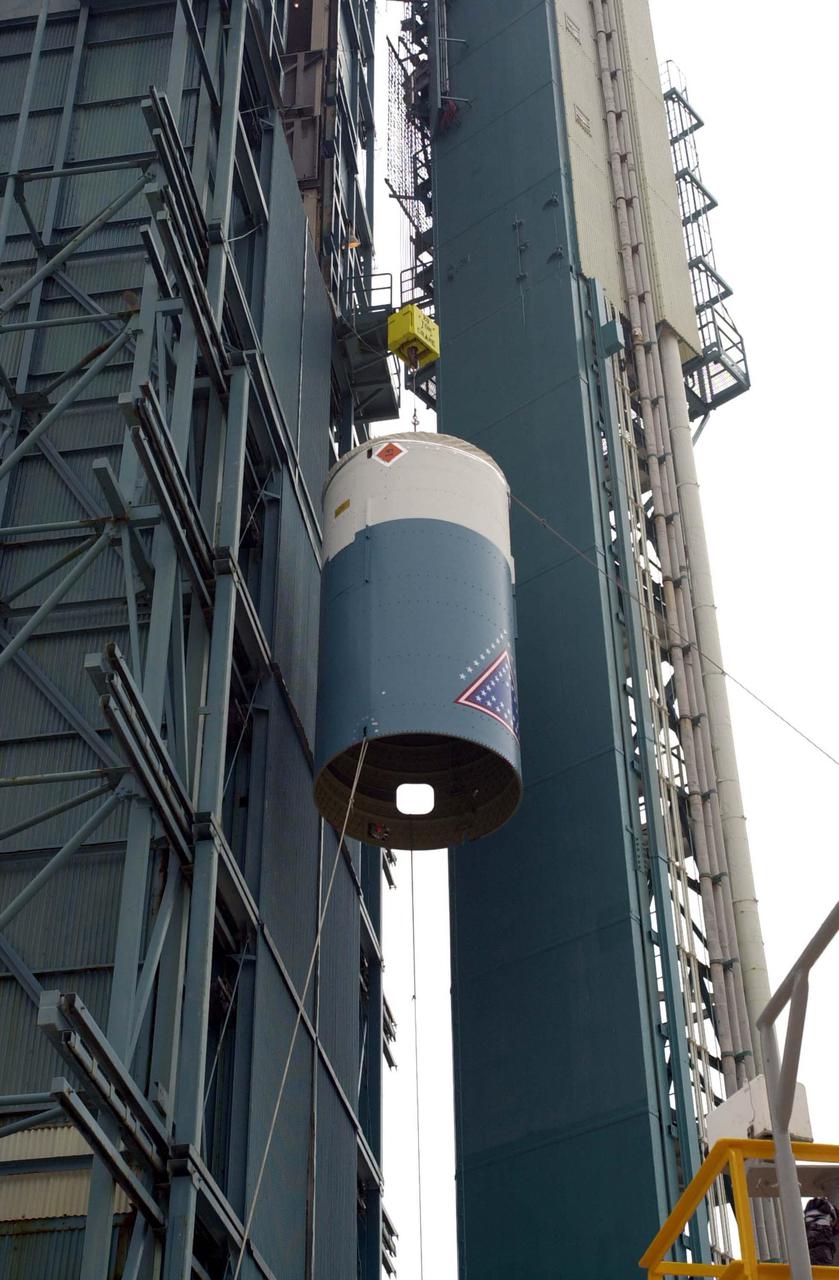
VANDENBERG AIR FORCE BASE, CALIF. - At NASA Space Launch Complex 2 on Vandenberg Air Force Base in California, the interstage for the Boeing Delta II rocket is lifted up the mobile service tower, or gantry. There it will be mated with the first stage already there. The Delta is the launch vehicle for the CALIPSO_CloudSat spacecraft. CALIPSO stands for Cloud-Aerosol Lidar and Infrared Pathfinder Satellite Observation. CALIPSO and CloudSat are highly complementary satellites and together will provide never-before-seen 3-D perspectives of how clouds and aerosols form, evolve, and affect weather and climate. CALIPSO and CloudSat will fly in formation with three other satellites in the A-train constellation to enhance understanding of our climate system. Launch of CALIPSO_CloudSat aboard a Boeing Delta II rocket is scheduled for 3:01 a.m. Sept. 29.
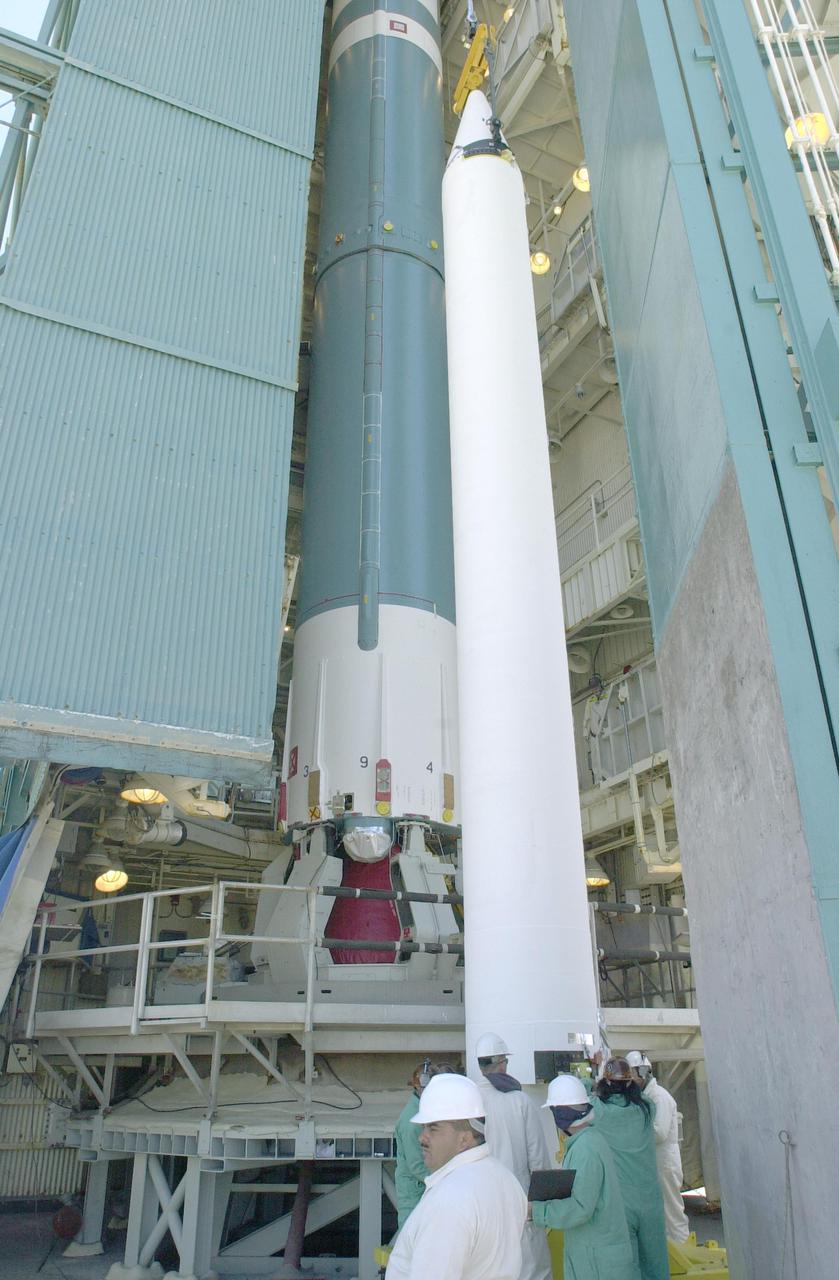
VANDENBERG AIR FORCE BASE, CALIF. - At NASA Space Launch Complex 2 on Vandenberg Air Force Base in California, another Solid Rocket Booster is ready to be attached to the Boeing Delta II rocket seen behind it. The Delta is the launch vehicle for the CALIPSO_CloudSat spacecraft. CALIPSO stands for Cloud-Aerosol Lidar and Infrared Pathfinder Satellite Observation. CALIPSO and CloudSat are highly complementary satellites and together will provide never-before-seen 3-D perspectives of how clouds and aerosols form, evolve, and affect weather and climate. CALIPSO and CloudSat will fly in formation with three other satellites in the A-train constellation to enhance understanding of our climate system. Launch of CALIPSO_CloudSat aboard a Boeing Delta II rocket is scheduled for 3:01 a.m. Sept. 29.
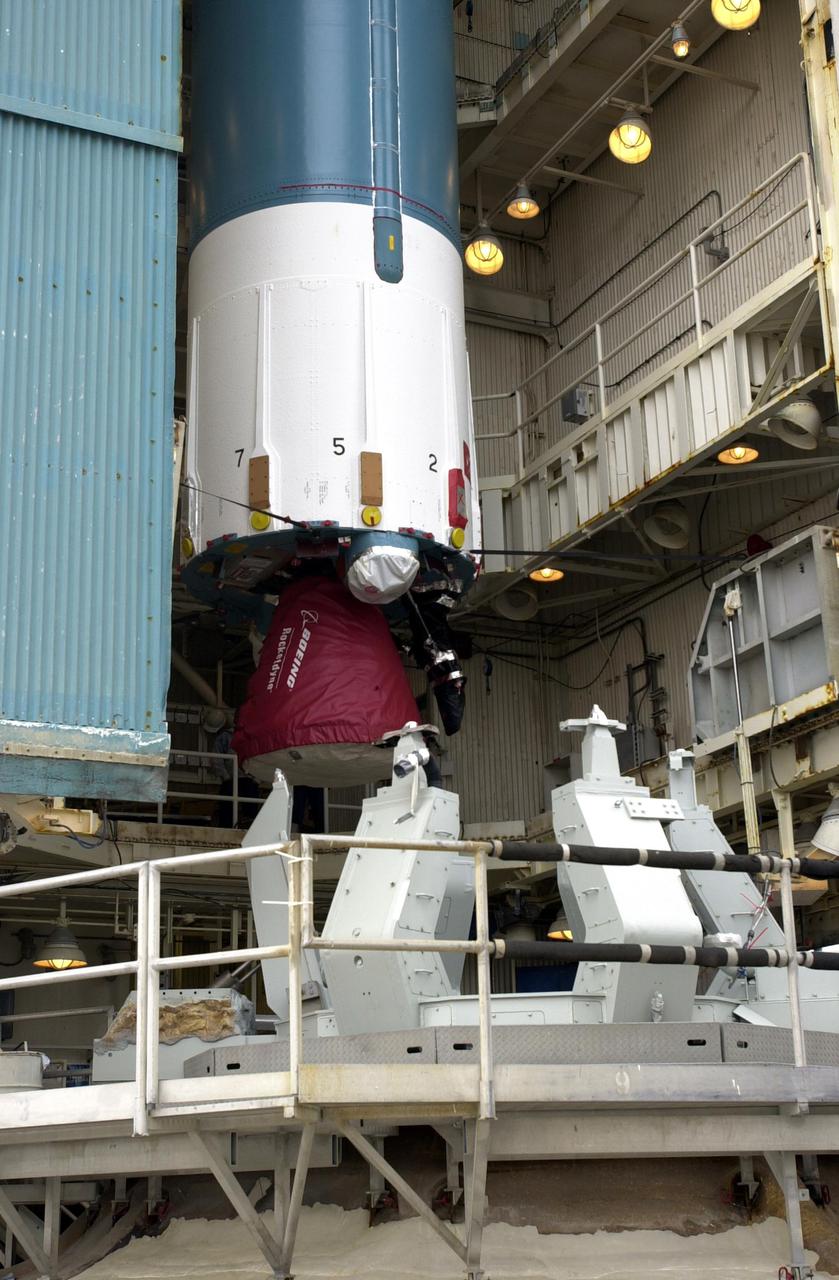
VANDENBERG AIR FORCE BASE, CALIF. - At NASA Space Launch Complex 2 on Vandenberg Air Force Base in California, the first stage of the Boeing Delta II rocket, launch vehicle for the CALIPSO_CloudSat spacecraft, begins to be lifted into the mobile service tower, or gantry. CALIPSO stands for Cloud-Aerosol Lidar and Infrared Pathfinder Satellite Observation. CALIPSO and CloudSat are highly complementary satellites and together will provide never-before-seen 3-D perspectives of how clouds and aerosols form, evolve, and affect weather and climate. CALIPSO and CloudSat will fly in formation with three other satellites in the A-train constellation to enhance understanding of our climate system. Launch of CALIPSO_CloudSat aboard a Boeing Delta II rocket is scheduled for 3:01 a.m. Sept. 29.
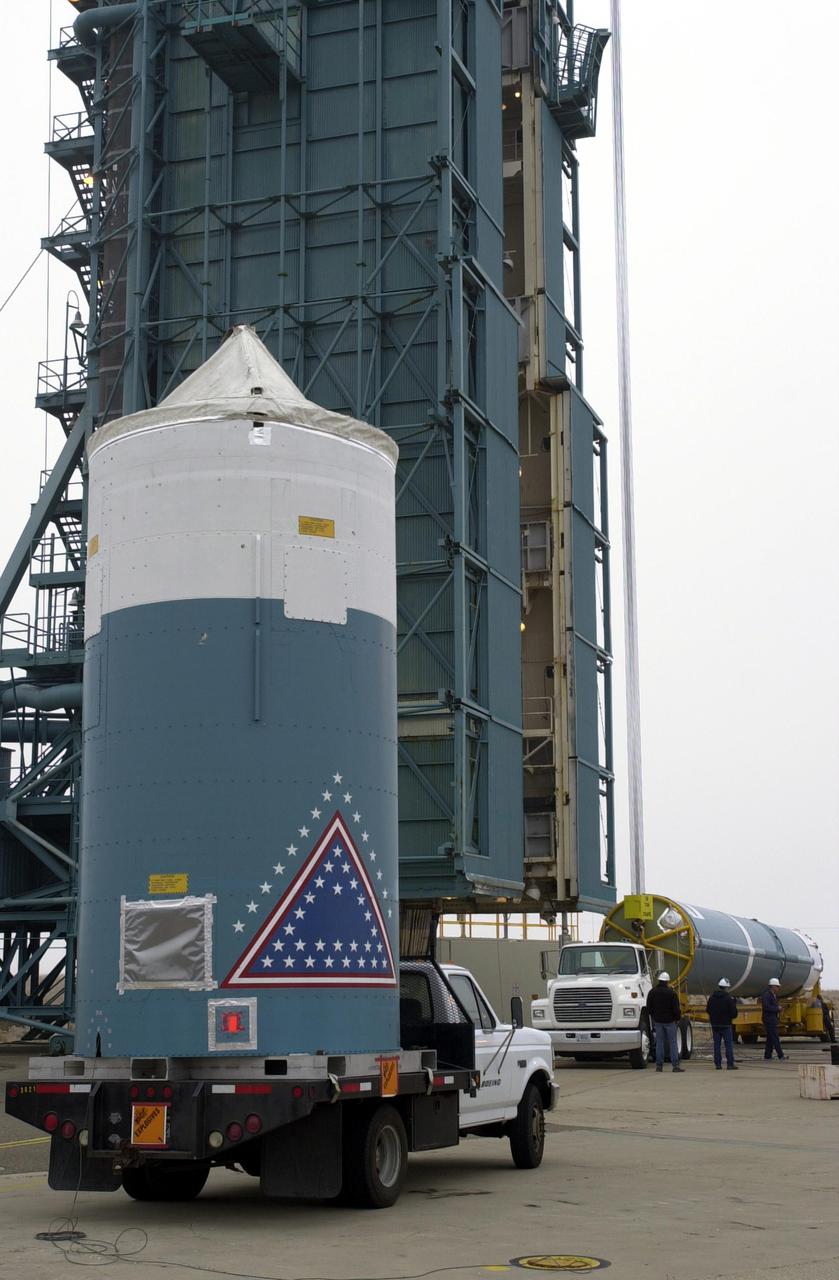
VANDENBERG AIR FORCE BASE, CALIF. - At NASA Space Launch Complex 2 on Vandenberg Air Force Base in California, the interstage for the Boeing Delta II rocket, launch vehicle for the CALIPSO_CloudSat spacecraft, arrives at the pad. It will be lifted up into the mobile service tower, or gantry, and mated with the first stage. CALIPSO stands for Cloud-Aerosol Lidar and Infrared Pathfinder Satellite Observation. CALIPSO and CloudSat are highly complementary satellites and together will provide never-before-seen 3-D perspectives of how clouds and aerosols form, evolve, and affect weather and climate. CALIPSO and CloudSat will fly in formation with three other satellites in the A-train constellation to enhance understanding of our climate system. Launch of CALIPSO_CloudSat aboard a Boeing Delta II rocket is scheduled for 3:01 a.m. Sept. 29.
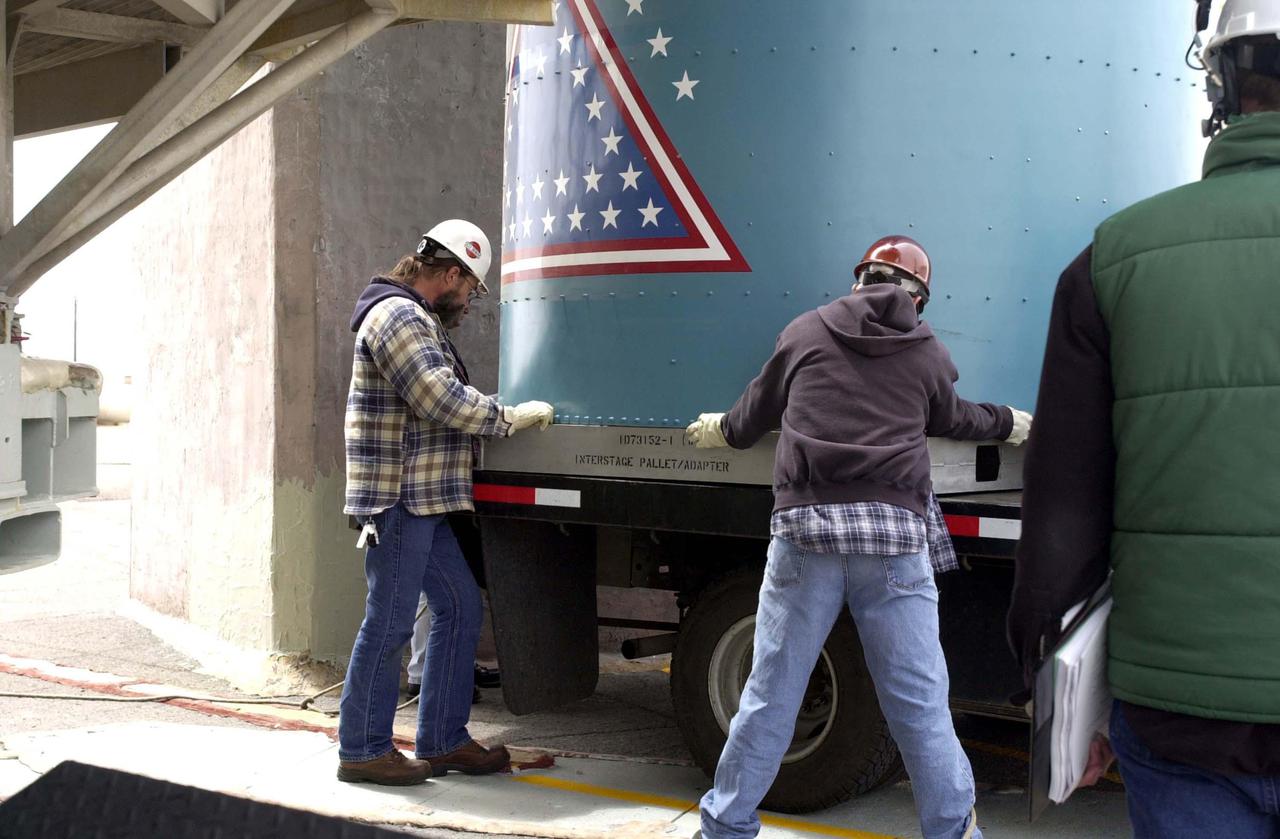
VANDENBERG AIR FORCE BASE, CALIF. - At NASA Space Launch Complex 2 on Vandenberg Air Force Base in California, workers prepare the interstage for the Boeing Delta II rocket to be lifted up the mobile service tower, or gantry. Then it will be mated with the first stage already there. The Delta is the launch vehicle for the CALIPSO_CloudSat spacecraft. CALIPSO stands for Cloud-Aerosol Lidar and Infrared Pathfinder Satellite Observation. CALIPSO and CloudSat are highly complementary satellites and together will provide never-before-seen 3-D perspectives of how clouds and aerosols form, evolve, and affect weather and climate. CALIPSO and CloudSat will fly in formation with three other satellites in the A-train constellation to enhance understanding of our climate system. Launch of CALIPSO_CloudSat aboard a Boeing Delta II rocket is scheduled for 3:01 a.m. Sept. 29.
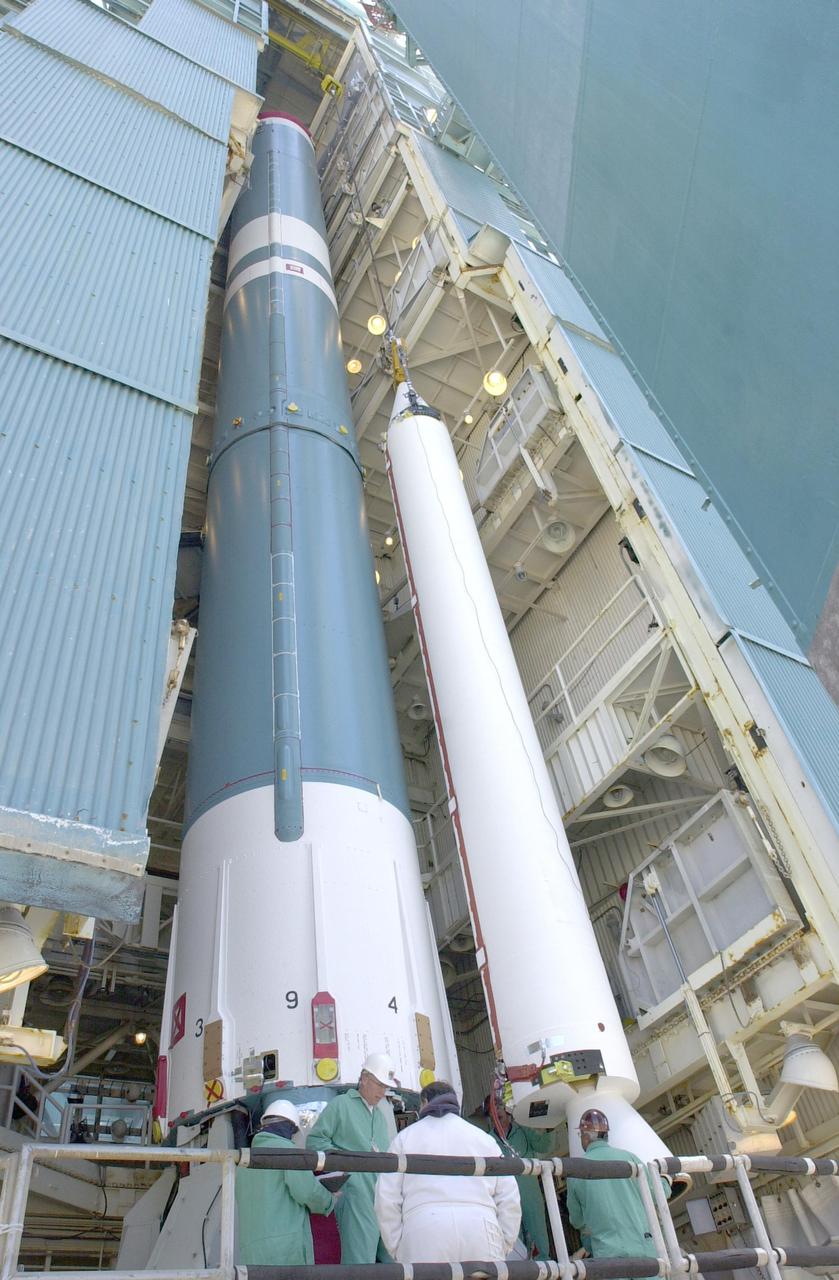
VANDENBERG AIR FORCE BASE, CALIF. - At NASA Space Launch Complex 2 on Vandenberg Air Force Base in California, another Solid Rocket Booster is attached to the Boeing Delta II rocket seen behind it. The Delta is the launch vehicle for the CALIPSO_CloudSat spacecraft. CALIPSO stands for Cloud-Aerosol Lidar and Infrared Pathfinder Satellite Observation. CALIPSO and CloudSat are highly complementary satellites and together will provide never-before-seen 3-D perspectives of how clouds and aerosols form, evolve, and affect weather and climate. CALIPSO and CloudSat will fly in formation with three other satellites in the A-train constellation to enhance understanding of our climate system. Launch of CALIPSO_CloudSat aboard a Boeing Delta II rocket is scheduled for 3:01 a.m. Sept. 29.
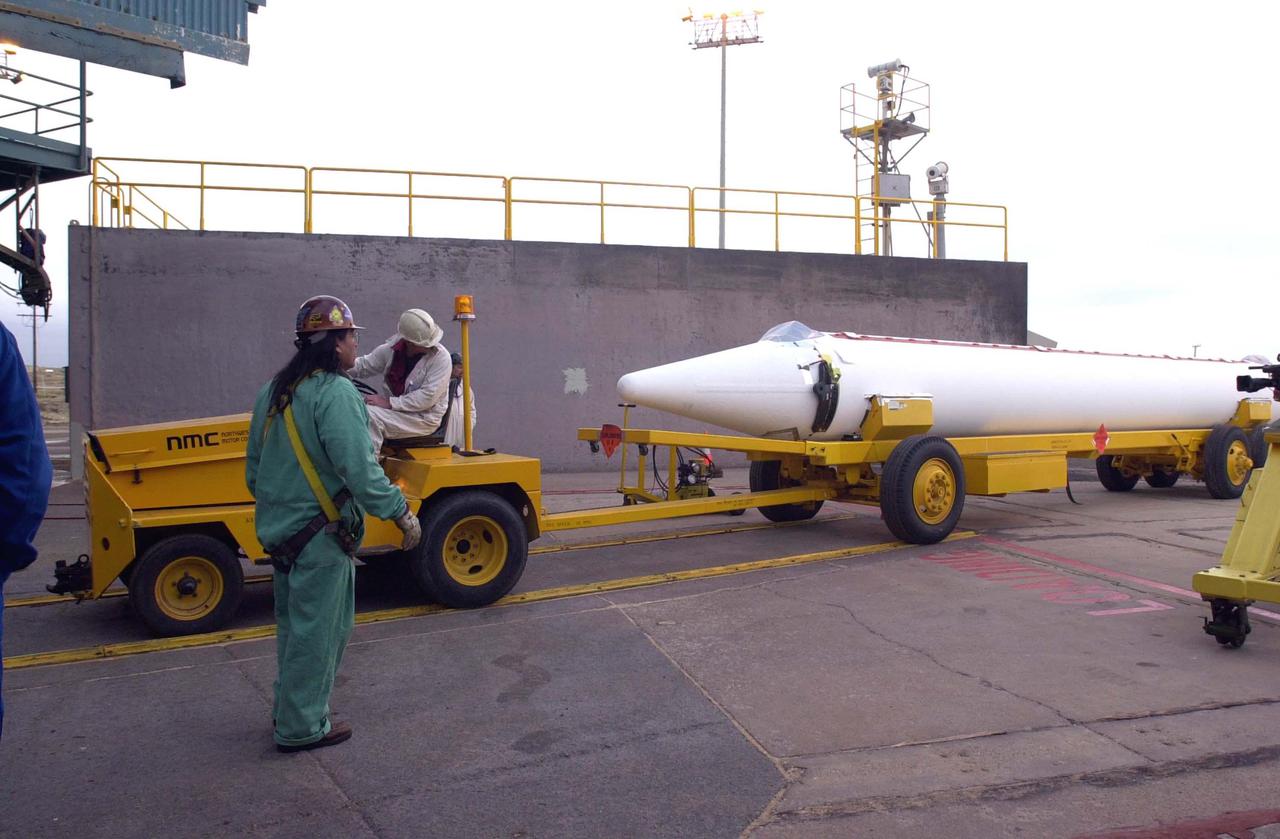
VANDENBERG AIR FORCE BASE, CALIF. - The first Solid Rocket Booster for the CALIPSO_CloudSat launch arrives at NASA Space Launch Complex 2 on Vandenberg Air Force Base in California. It will be lifted into the mobile service tower, or gantry, and attached to the Boeing Delta II rocket. CALIPSO stands for Cloud-Aerosol Lidar and Infrared Pathfinder Satellite Observation. CALIPSO and CloudSat are highly complementary satellites and together will provide never-before-seen 3-D perspectives of how clouds and aerosols form, evolve, and affect weather and climate. CALIPSO and CloudSat will fly in formation with three other satellites in the A-train constellation to enhance understanding of our climate system. Launch of CALIPSO_CloudSat aboard a Boeing Delta II rocket is scheduled for 3:01 a.m. Sept. 29.
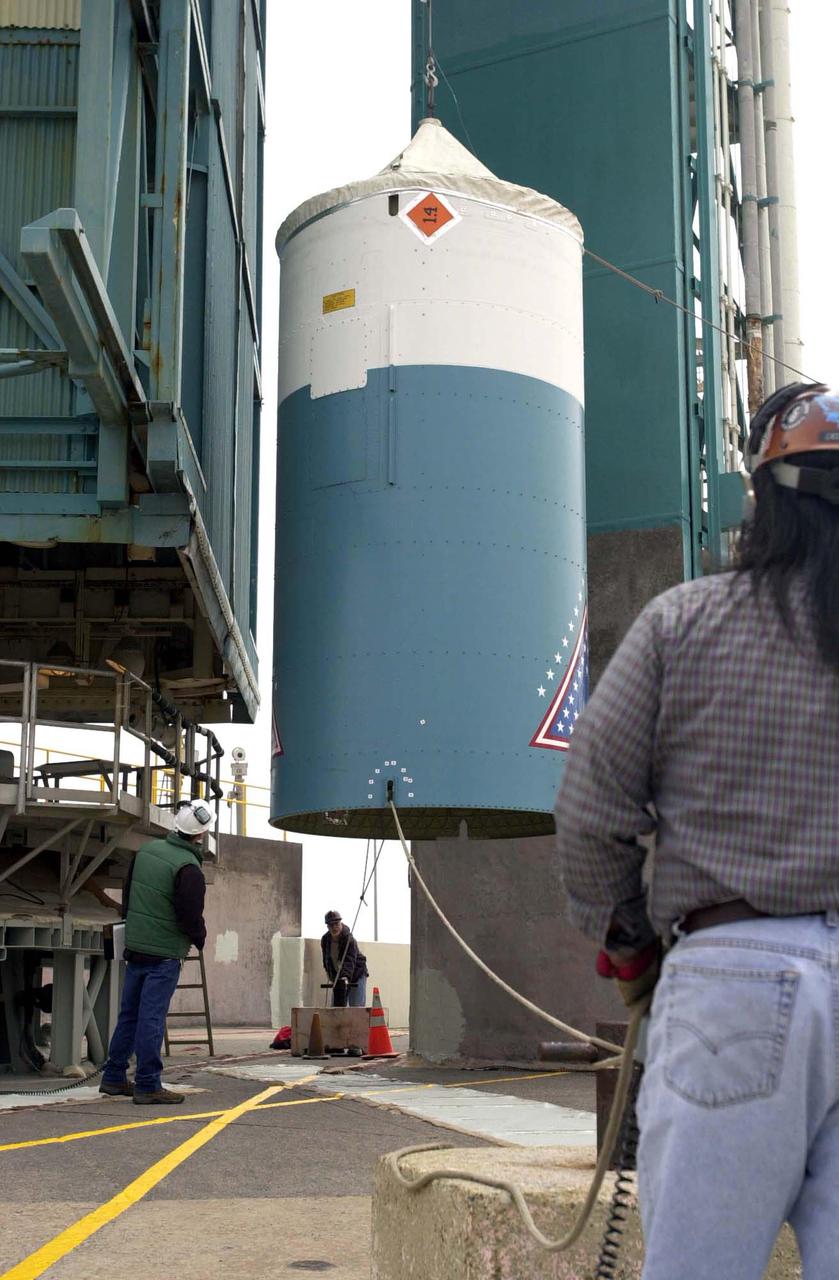
VANDENBERG AIR FORCE BASE, CALIF. - At NASA Space Launch Complex 2 on Vandenberg Air Force Base in California, the interstage for the Boeing Delta II rocket is lifted up the mobile service tower, or gantry. Then it will be mated with the first stage already there. The Delta is the launch vehicle for the CALIPSO_CloudSat spacecraft. CALIPSO stands for Cloud-Aerosol Lidar and Infrared Pathfinder Satellite Observation. CALIPSO and CloudSat are highly complementary satellites and together will provide never-before-seen 3-D perspectives of how clouds and aerosols form, evolve, and affect weather and climate. CALIPSO and CloudSat will fly in formation with three other satellites in the A-train constellation to enhance understanding of our climate system. Launch of CALIPSO_CloudSat aboard a Boeing Delta II rocket is scheduled for 3:01 a.m. Sept. 29.
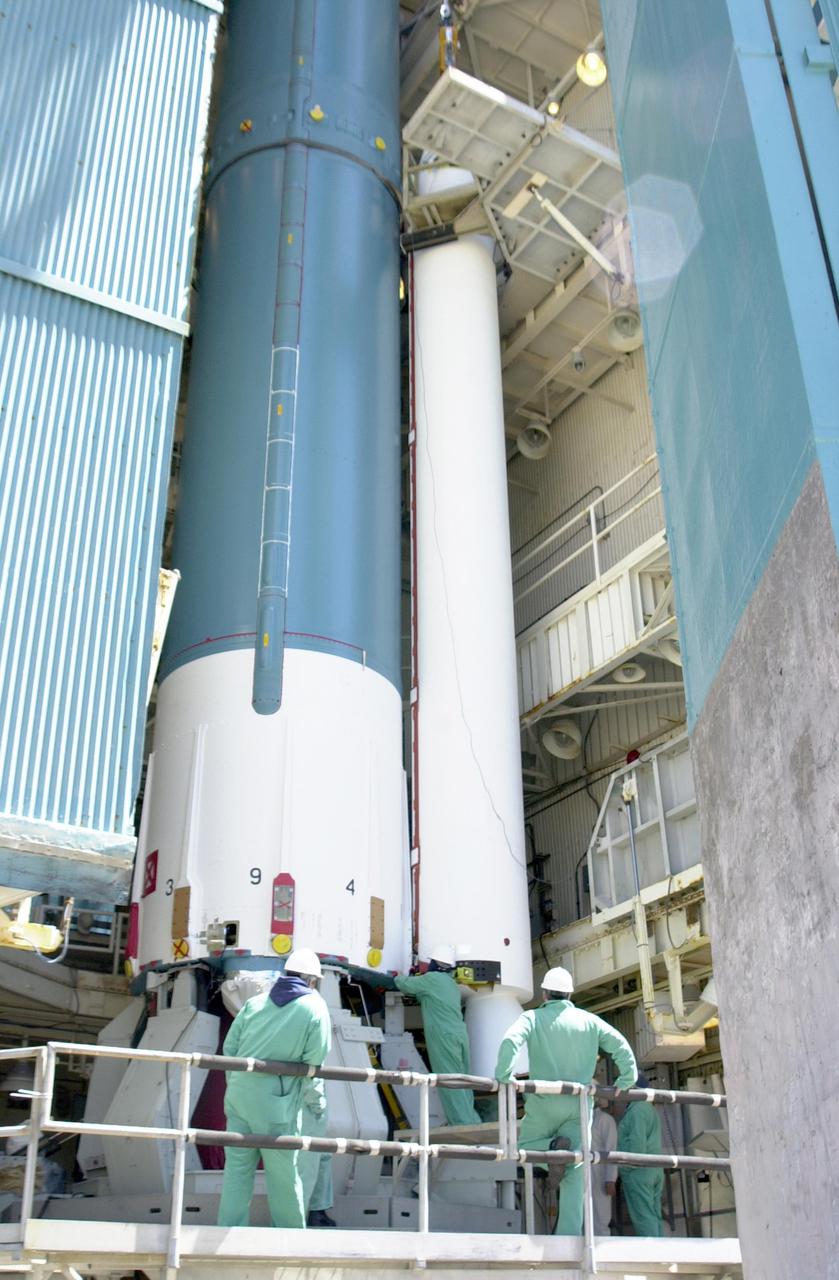
VANDENBERG AIR FORCE BASE, CALIF. - At NASA Space Launch Complex 2 on Vandenberg Air Force Base in California, another Solid Rocket Booster is attached to the Boeing Delta II rocket seen behind it. The Delta is the launch vehicle for the CALIPSO_CloudSat spacecraft. CALIPSO stands for Cloud-Aerosol Lidar and Infrared Pathfinder Satellite Observation. CALIPSO and CloudSat are highly complementary satellites and together will provide never-before-seen 3-D perspectives of how clouds and aerosols form, evolve, and affect weather and climate. CALIPSO and CloudSat will fly in formation with three other satellites in the A-train constellation to enhance understanding of our climate system. Launch of CALIPSO_CloudSat aboard a Boeing Delta II rocket is scheduled for 3:01 a.m. Sept. 29.
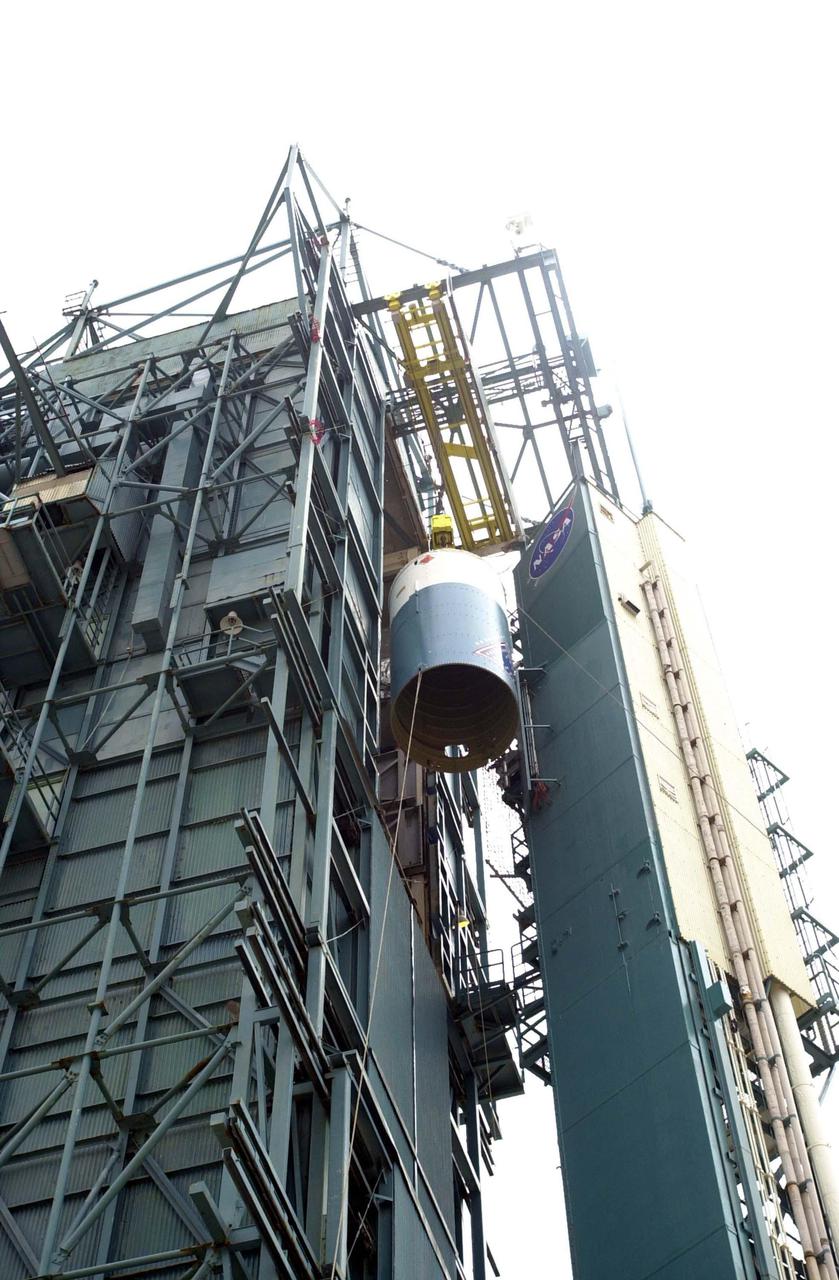
VANDENBERG AIR FORCE BASE, CALIF. - At NASA Space Launch Complex 2 on Vandenberg Air Force Base in California, the interstage for the Boeing Delta II rocket nears the top of the mobile service tower, or gantry. Then it will be mated with the first stage already there. The Delta is the launch vehicle for the CALIPSO_CloudSat spacecraft. CALIPSO stands for Cloud-Aerosol Lidar and Infrared Pathfinder Satellite Observation. CALIPSO and CloudSat are highly complementary satellites and together will provide never-before-seen 3-D perspectives of how clouds and aerosols form, evolve, and affect weather and climate. CALIPSO and CloudSat will fly in formation with three other satellites in the A-train constellation to enhance understanding of our climate system. Launch of CALIPSO_CloudSat aboard a Boeing Delta II rocket is scheduled for 3:01 a.m. Sept. 29.
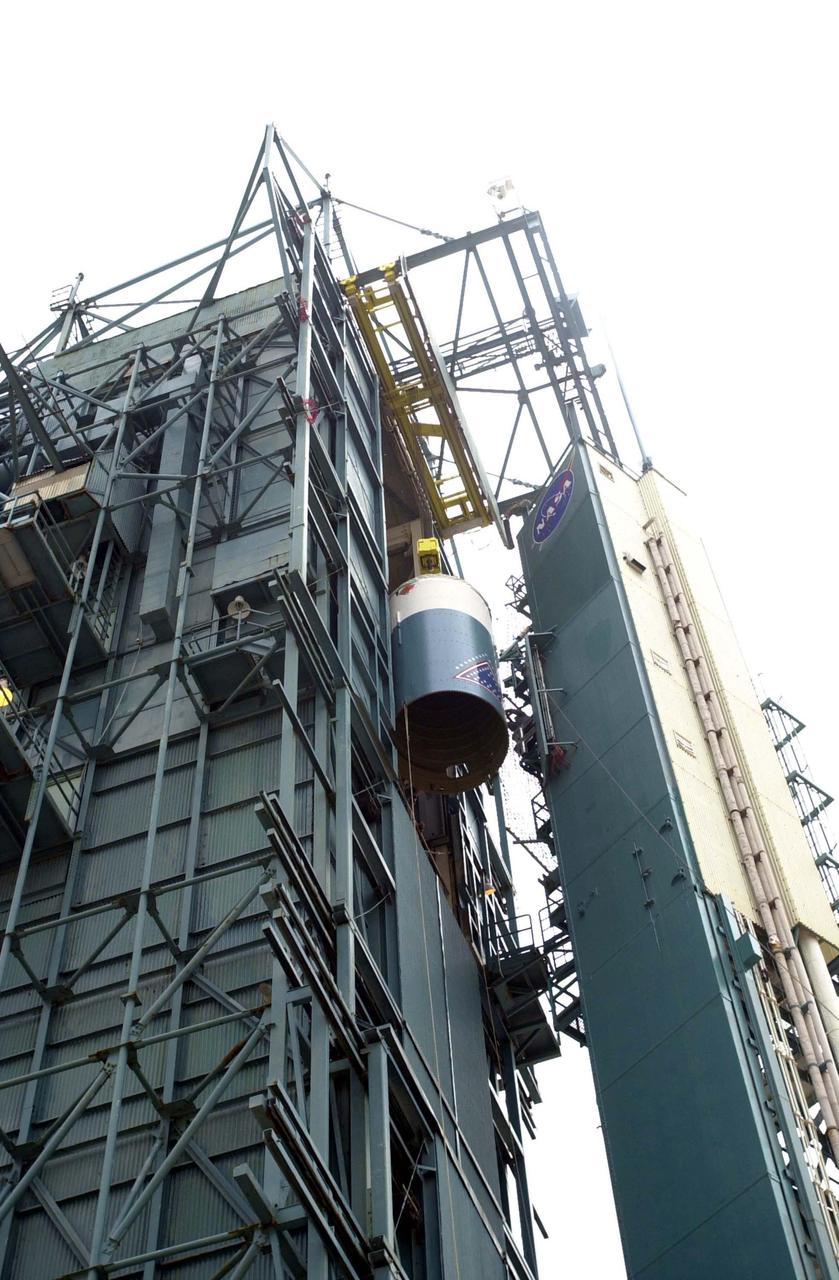
VANDENBERG AIR FORCE BASE, CALIF. - At NASA Space Launch Complex 2 on Vandenberg Air Force Base in California, the interstage for the Boeing Delta II rocket nears the top of the mobile service tower, or gantry. There it will be mated with the first stage already there. The Delta is the launch vehicle for the CALIPSO_CloudSat spacecraft. CALIPSO stands for Cloud-Aerosol Lidar and Infrared Pathfinder Satellite Observation. CALIPSO and CloudSat are highly complementary satellites and together will provide never-before-seen 3-D perspectives of how clouds and aerosols form, evolve, and affect weather and climate. CALIPSO and CloudSat will fly in formation with three other satellites in the A-train constellation to enhance understanding of our climate system. Launch of CALIPSO_CloudSat aboard a Boeing Delta II rocket is scheduled for 3:01 a.m. Sept. 29.
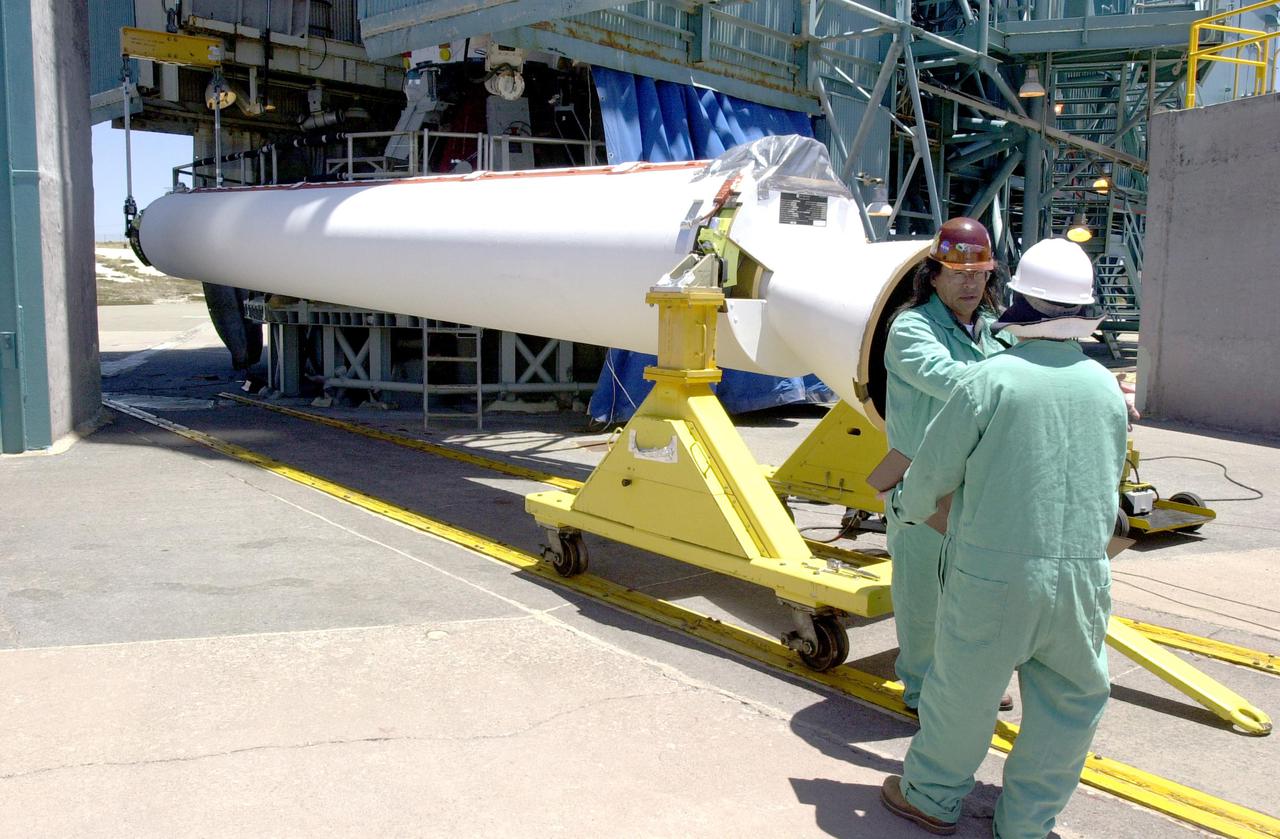
VANDENBERG AIR FORCE BASE, CALIF. - At NASA Space Launch Complex 2 on Vandenberg Air Force Base in California, workers prepare a Solid Rocket Booster to be raised to a vertical position. It will then be lifted into the mobile service tower, or gantry, and attached to the Boeing Delta II rocket. The Delta is the launch vehicle for the CALIPSO_CloudSat spacecraft. CALIPSO stands for Cloud-Aerosol Lidar and Infrared Pathfinder Satellite Observation. CALIPSO and CloudSat are highly complementary satellites and together will provide never-before-seen 3-D perspectives of how clouds and aerosols form, evolve, and affect weather and climate. CALIPSO and CloudSat will fly in formation with three other satellites in the A-train constellation to enhance understanding of our climate system. Launch of CALIPSO_CloudSat aboard a Boeing Delta II rocket is scheduled for 3:01 a.m. Sept. 29.
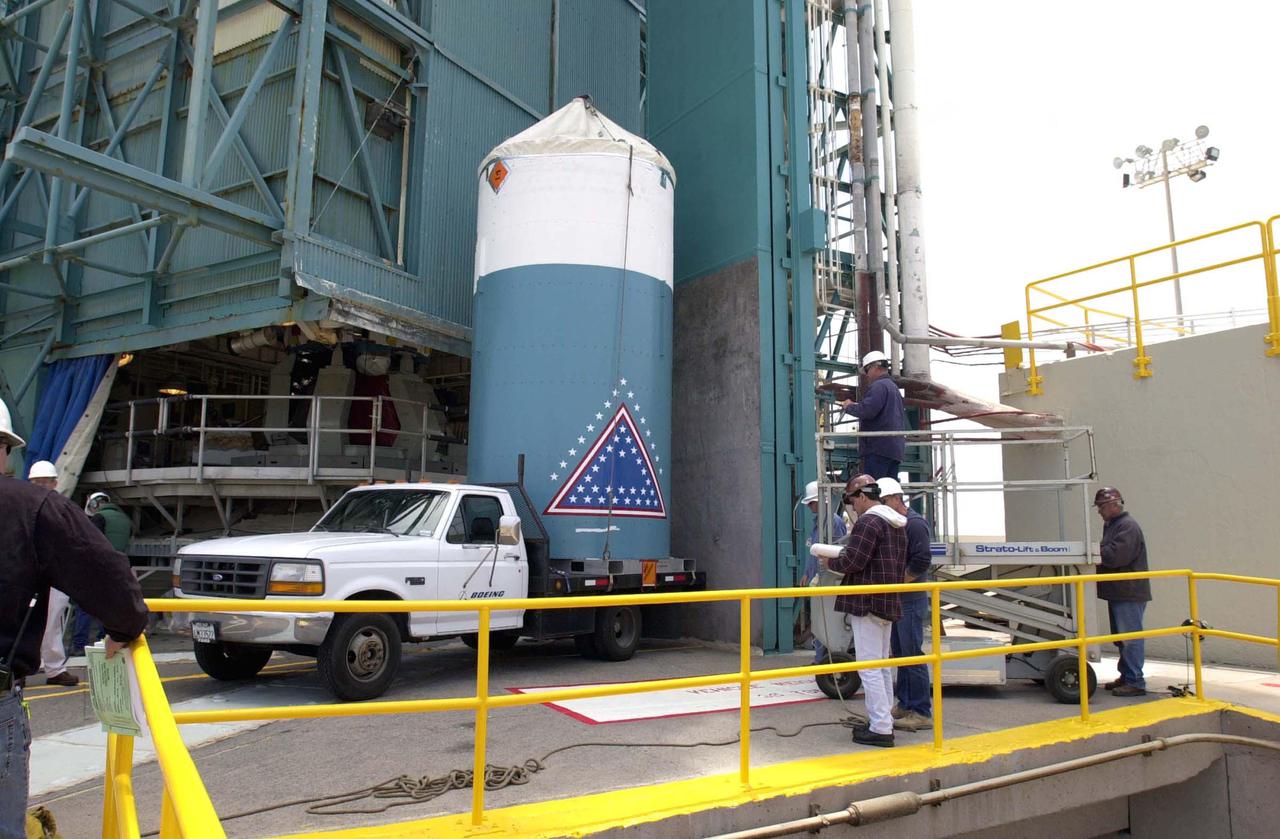
VANDENBERG AIR FORCE BASE, CALIF. - At NASA Space Launch Complex 2 on Vandenberg Air Force Base in California, the interstage for the Boeing Delta II rocket arrives on the pad. It will be lifted up the mobile service tower, or gantry, and mated with the first stage already there. The Delta is the launch vehicle for the CALIPSO_CloudSat spacecraft. CALIPSO stands for Cloud-Aerosol Lidar and Infrared Pathfinder Satellite Observation. CALIPSO and CloudSat are highly complementary satellites and together will provide never-before-seen 3-D perspectives of how clouds and aerosols form, evolve, and affect weather and climate. CALIPSO and CloudSat will fly in formation with three other satellites in the A-train constellation to enhance understanding of our climate system. Launch of CALIPSO_CloudSat aboard a Boeing Delta II rocket is scheduled for 3:01 a.m. Sept. 29.
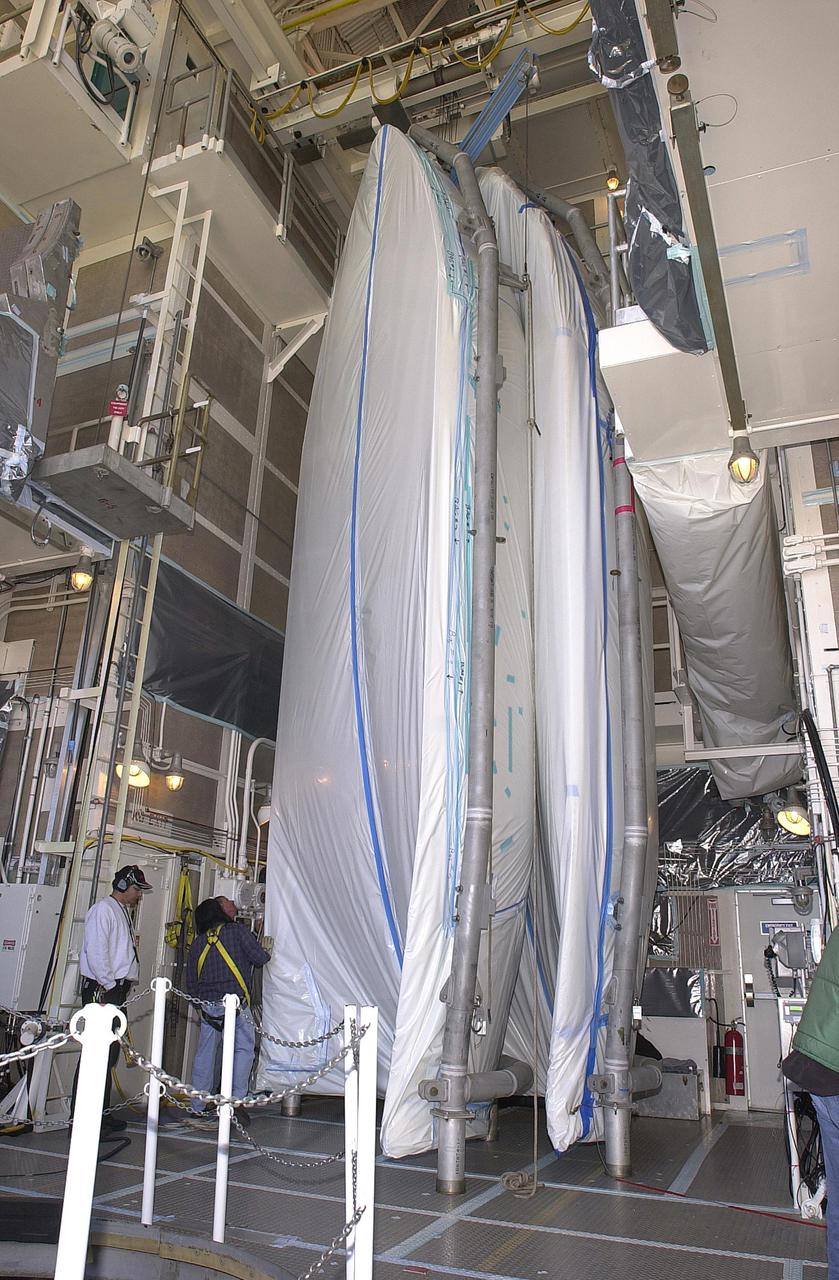
VANDENBERG AIR FORCE BASE, CALIF. - In the mobile service tower, or gantry, at NASA Space Launch Complex 2 on Vandenberg Air Force Base in California, the two halves of the fairing are ready to encapsulate CALIPSO_CloudSat for launch. The fairing encloses and protects the spacecraft during launch and flight through the atmosphere. Once in space, it is jettisoned. CALIPSO stands for Cloud-Aerosol Lidar and Infrared Pathfinder Satellite Observation. CALIPSO and CloudSat are highly complementary satellites and together will provide never-before-seen 3-D perspectives of how clouds and aerosols form, evolve, and affect weather and climate. CALIPSO and CloudSat will fly in formation with three other satellites in the A-train constellation to enhance understanding of our climate system. Launch of CALIPSO_CloudSat aboard a Boeing Delta II rocket is scheduled for 3:01 a.m. Sept. 29.
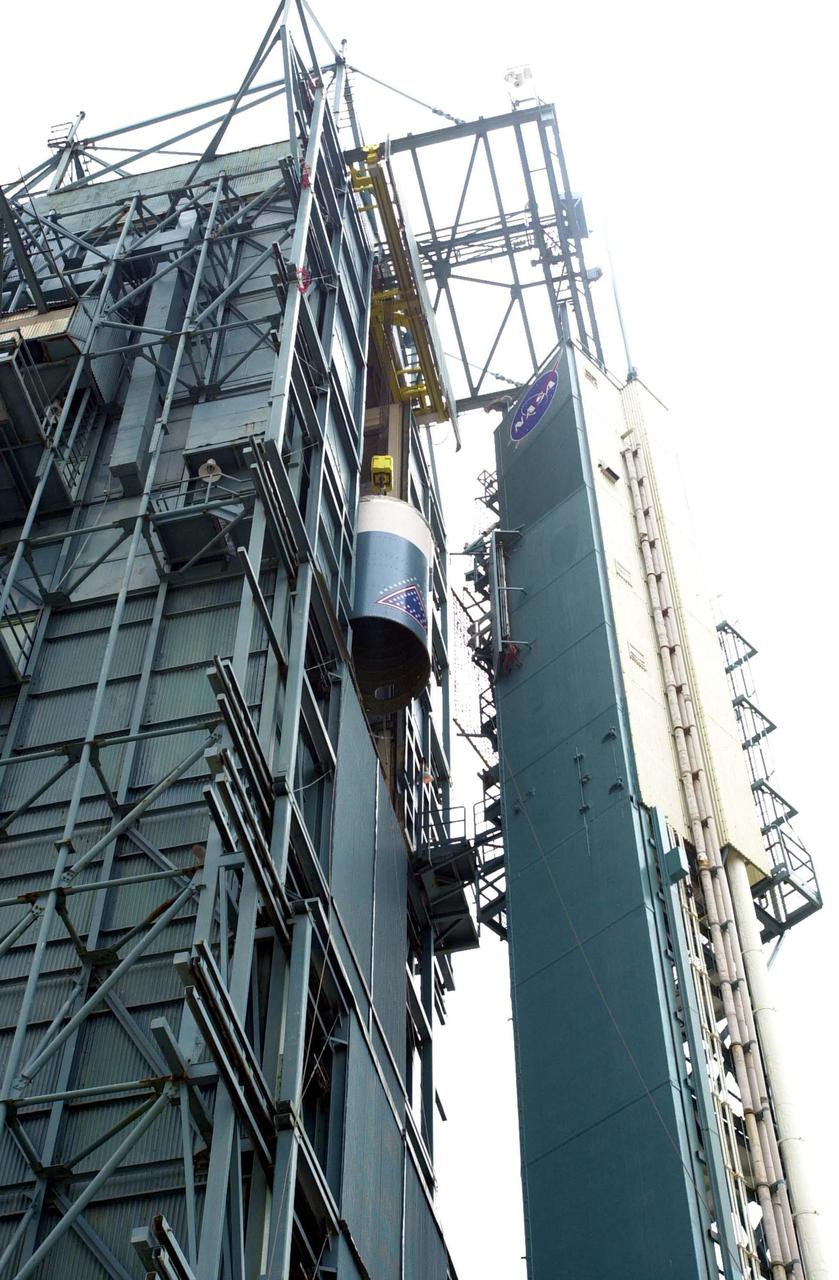
VANDENBERG AIR FORCE BASE, CALIF. - At NASA Space Launch Complex 2 on Vandenberg Air Force Base in California, the interstage for the Boeing Delta II rocket nears the top of the mobile service tower, or gantry. There it will be mated with the first stage already there. The Delta is the launch vehicle for the CALIPSO_CloudSat spacecraft. CALIPSO stands for Cloud-Aerosol Lidar and Infrared Pathfinder Satellite Observation. CALIPSO and CloudSat are highly complementary satellites and together will provide never-before-seen 3-D perspectives of how clouds and aerosols form, evolve, and affect weather and climate. CALIPSO and CloudSat will fly in formation with three other satellites in the A-train constellation to enhance understanding of our climate system. Launch of CALIPSO_CloudSat aboard a Boeing Delta II rocket is scheduled for 3:01 a.m. Sept. 29.
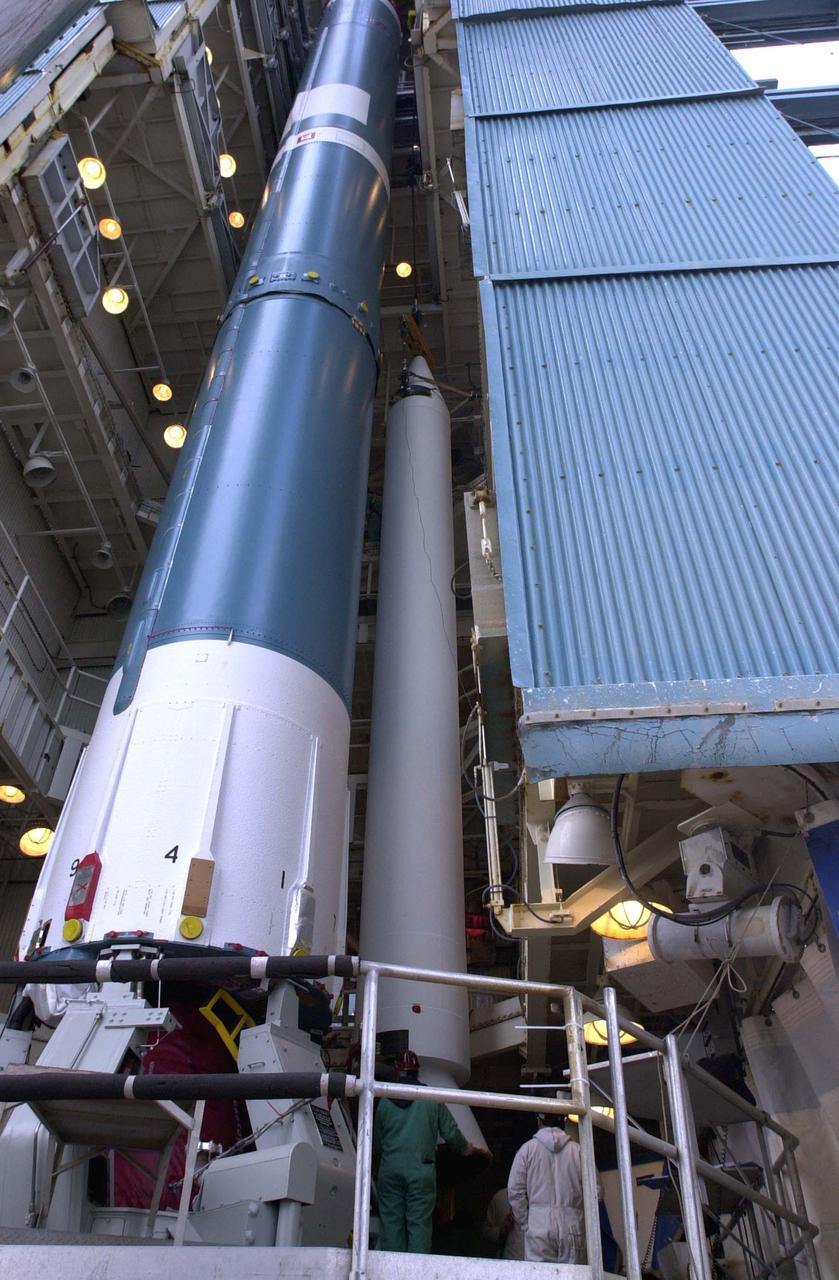
VANDENBERG AIR FORCE BASE, CALIF. - Workers on NASA Space Launch Complex 2 at Vandenberg Air Force Base in California are ready to attach a Solid Rocket Booster to the Boeing Delta II rocket. The Delta is the launch vehicle for the CALIPSO_CloudSat spacecraft. CALIPSO stands for Cloud-Aerosol Lidar and Infrared Pathfinder Satellite Observation. CALIPSO and CloudSat are highly complementary satellites and together will provide never-before-seen 3-D perspectives of how clouds and aerosols form, evolve, and affect weather and climate. CALIPSO and CloudSat will fly in formation with three other satellites in the A-train constellation to enhance understanding of our climate system. Launch of CALIPSO_CloudSat aboard a Boeing Delta II rocket is scheduled for 3:01 a.m. Sept. 29.
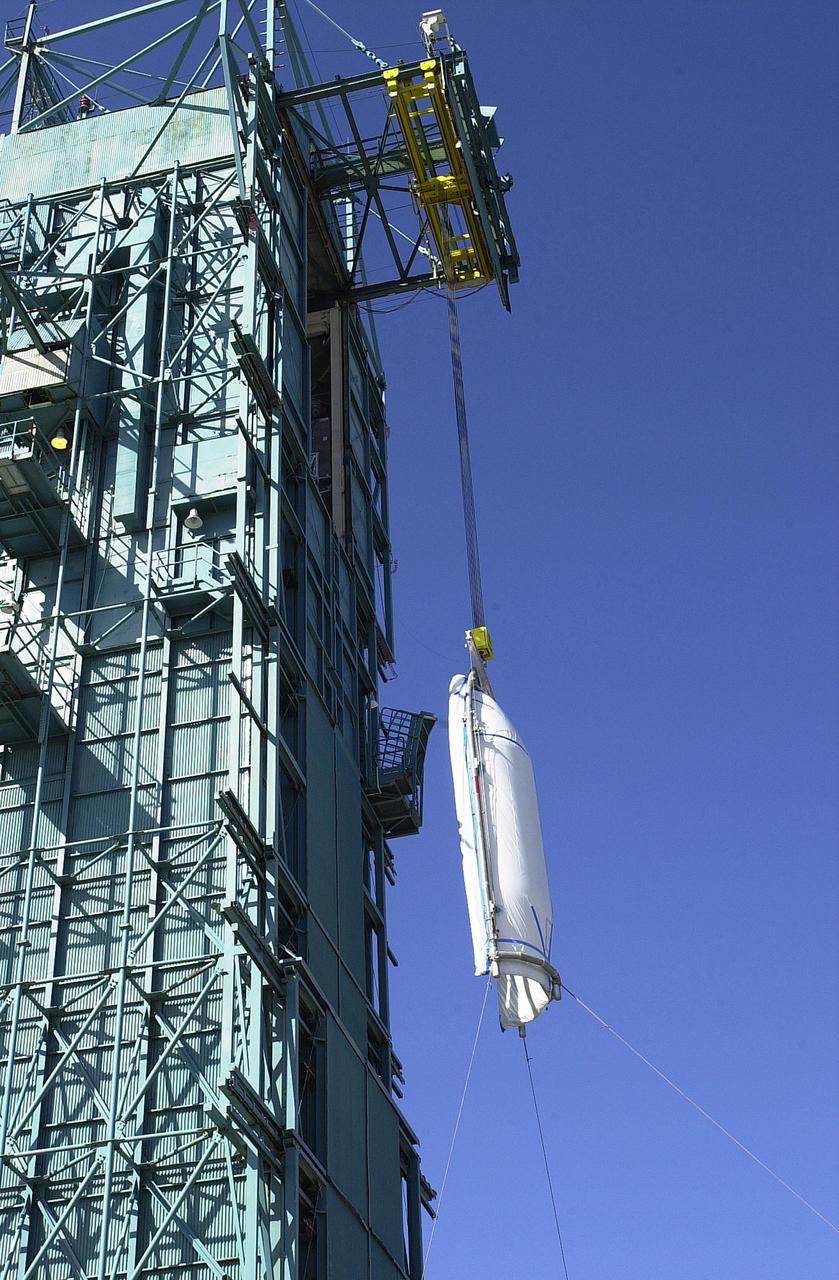
VANDENBERG AIR FORCE BASE, CALIF. - At NASA Space Launch Complex 2 on Vandenberg Air Force Base in California, one half of the fairing for CALIPSO_CloudSat is being lifted up the mobile service tower, or gantry. The fairing encloses and protects the spacecraft during launch and flight through the atmosphere. Once in space, it is jettisoned. CALIPSO stands for Cloud-Aerosol Lidar and Infrared Pathfinder Satellite Observation. CALIPSO and CloudSat are highly complementary satellites and together will provide never-before-seen 3-D perspectives of how clouds and aerosols form, evolve, and affect weather and climate. CALIPSO and CloudSat will fly in formation with three other satellites in the A-train constellation to enhance understanding of our climate system. Launch of CALIPSO_CloudSat aboard a Boeing Delta II rocket is scheduled for 3:01 a.m. Sept. 29.
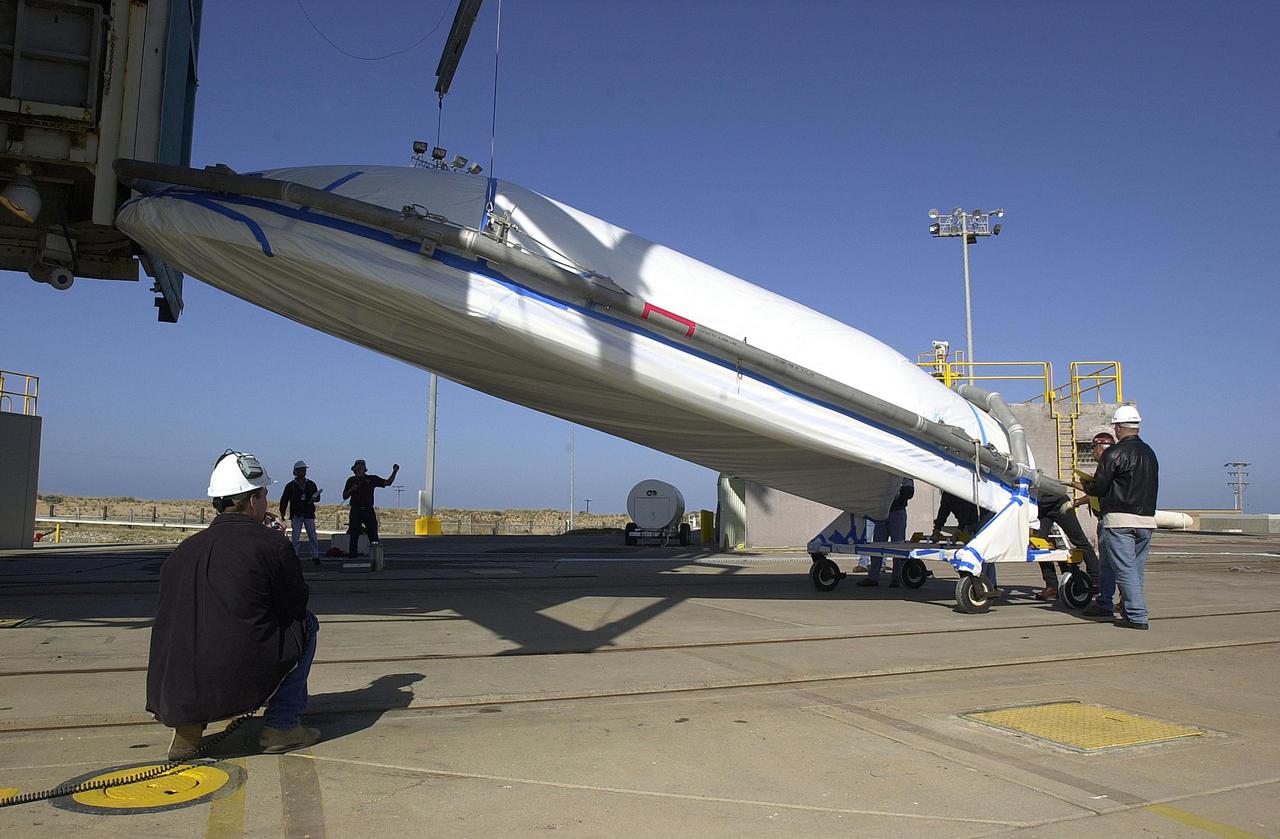
VANDENBERG AIR FORCE BASE, CALIF. - At NASA Space Launch Complex 2 on Vandenberg Air Force Base in California, one half of the fairing for CALIPSO_CloudSat to cover CALIPSO_CloudSat is being raised to a vertical position. It will then be lifted into the mobile service tower, or gantry. The fairing encloses and protects the spacecraft during launch and flight through the atmosphere. Once in space, it is jettisoned. CALIPSO stands for Cloud-Aerosol Lidar and Infrared Pathfinder Satellite Observation. CALIPSO and CloudSat are highly complementary satellites and together will provide never-before-seen 3-D perspectives of how clouds and aerosols form, evolve, and affect weather and climate. CALIPSO and CloudSat will fly in formation with three other satellites in the A-train constellation to enhance understanding of our climate system. Launch of CALIPSO_CloudSat aboard a Boeing Delta II rocket is scheduled for 3:01 a.m. Sept. 29.
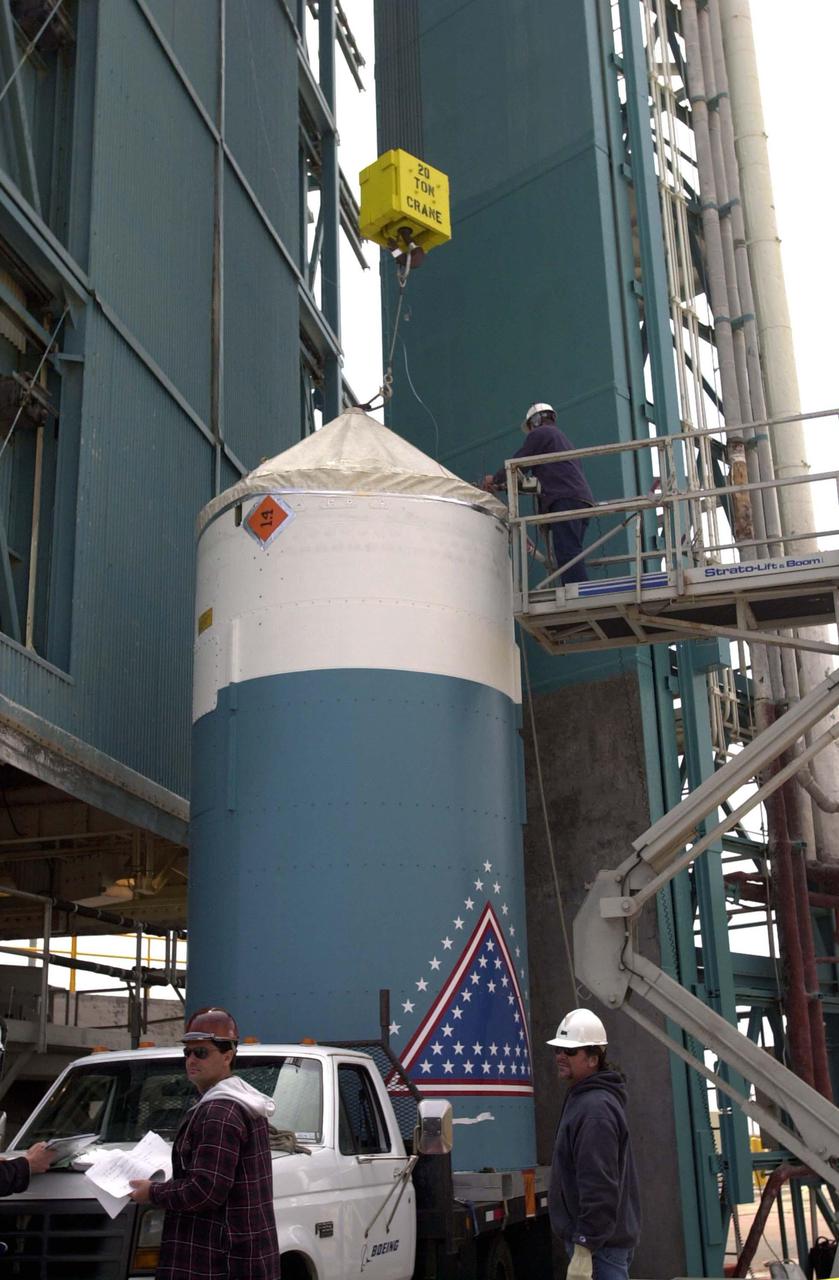
VANDENBERG AIR FORCE BASE, CALIF. - At NASA Space Launch Complex 2 on Vandenberg Air Force Base in California, the interstage for the Boeing Delta II rocket waits to be lifted up the mobile service tower, or gantry. Then it will be mated with the first stage already there. The Delta is the launch vehicle for the CALIPSO_CloudSat spacecraft. CALIPSO stands for Cloud-Aerosol Lidar and Infrared Pathfinder Satellite Observation. CALIPSO and CloudSat are highly complementary satellites and together will provide never-before-seen 3-D perspectives of how clouds and aerosols form, evolve, and affect weather and climate. CALIPSO and CloudSat will fly in formation with three other satellites in the A-train constellation to enhance understanding of our climate system. Launch of CALIPSO_CloudSat aboard a Boeing Delta II rocket is scheduled for 3:01 a.m. Sept. 29.
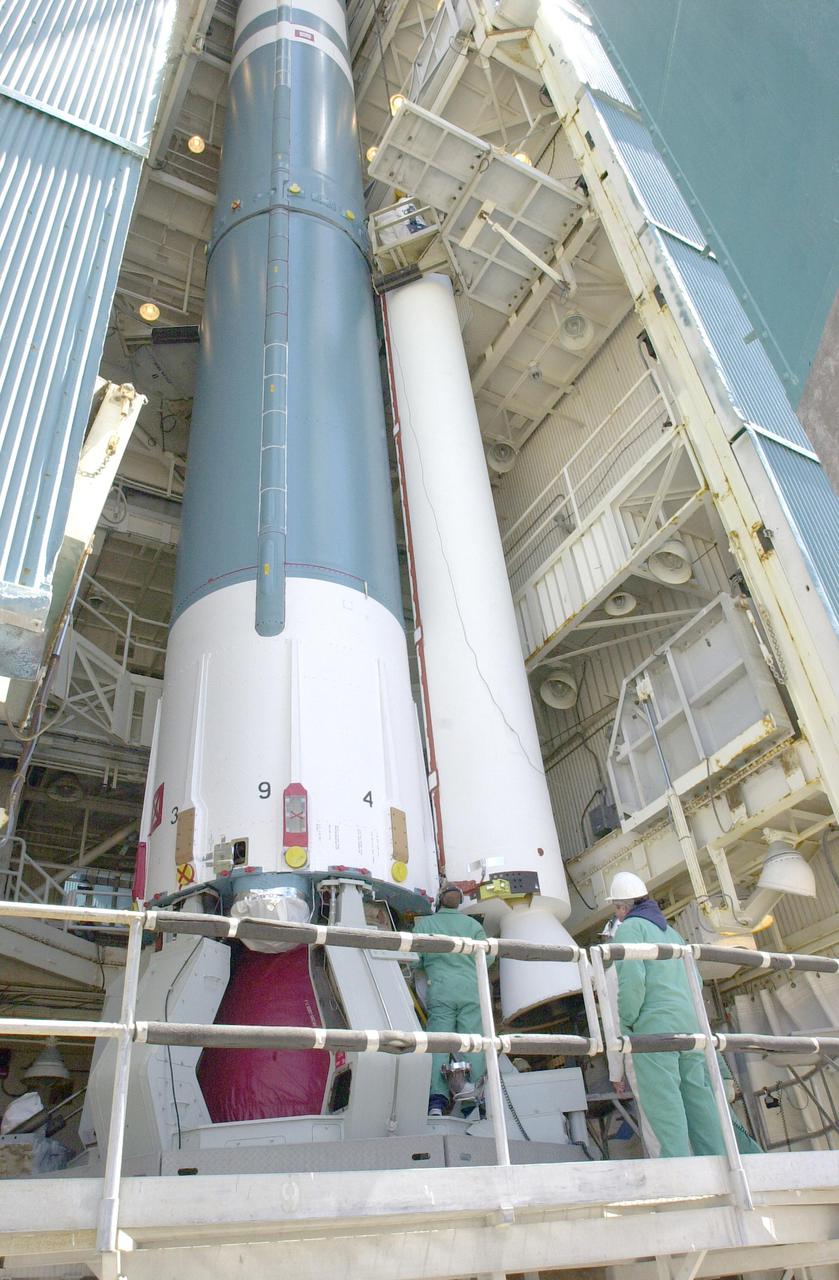
VANDENBERG AIR FORCE BASE, CALIF. - At NASA Space Launch Complex 2 on Vandenberg Air Force Base in California, another Solid Rocket Booster is attached to the Boeing Delta II rocket seen behind it. The Delta is the launch vehicle for the CALIPSO_CloudSat spacecraft. CALIPSO stands for Cloud-Aerosol Lidar and Infrared Pathfinder Satellite Observation. CALIPSO and CloudSat are highly complementary satellites and together will provide never-before-seen 3-D perspectives of how clouds and aerosols form, evolve, and affect weather and climate. CALIPSO and CloudSat will fly in formation with three other satellites in the A-train constellation to enhance understanding of our climate system. Launch of CALIPSO_CloudSat aboard a Boeing Delta II rocket is scheduled for 3:01 a.m. Sept. 29.
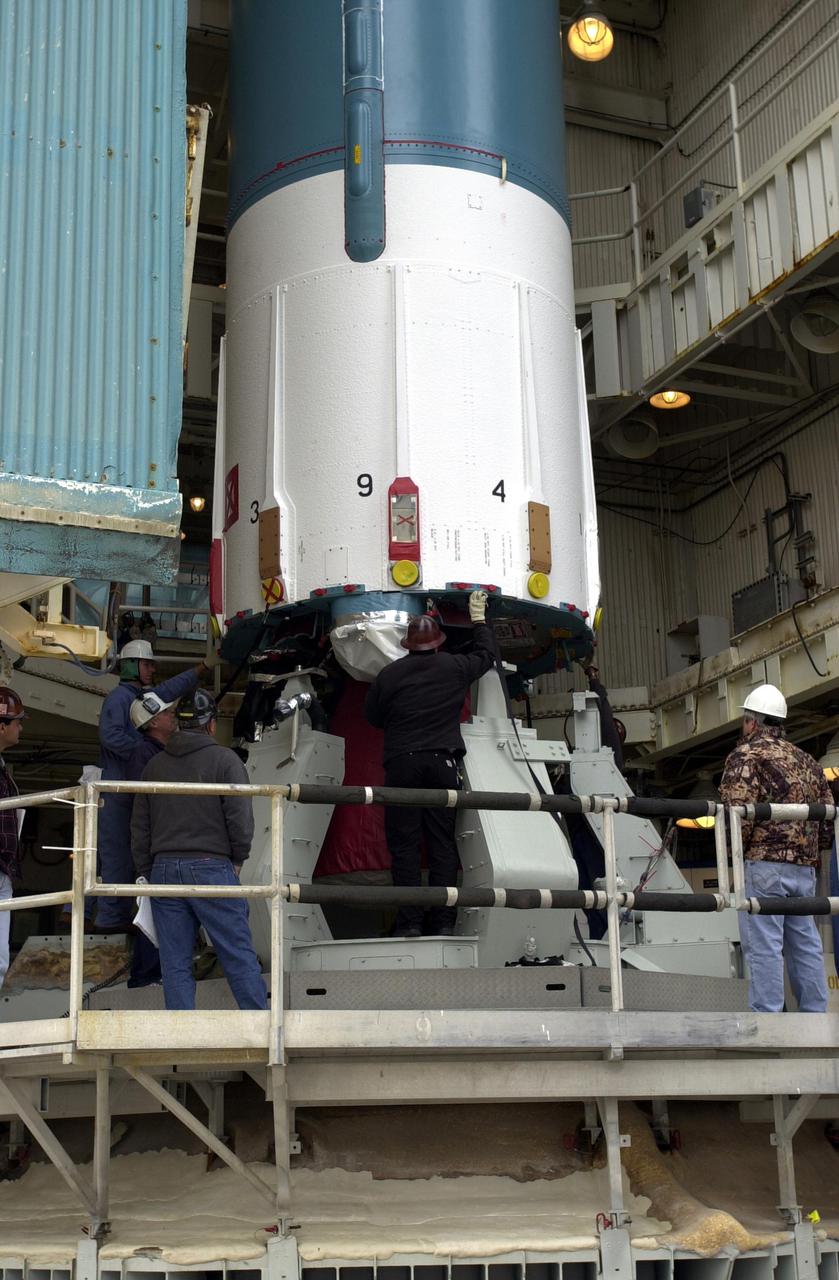
VANDENBERG AIR FORCE BASE, CALIF. - At NASA Space Launch Complex 2 on Vandenberg Air Force Base in California, the Boeing Delta II rocket, launch vehicle for the CALIPSO_CloudSat spacecraft, is prepared for lifting into the mobile service tower, or gantry. CALIPSO stands for Cloud-Aerosol Lidar and Infrared Pathfinder Satellite Observation. CALIPSO and CloudSat are highly complementary satellites and together will provide never-before-seen 3-D perspectives of how clouds and aerosols form, evolve, and affect weather and climate. CALIPSO and CloudSat will fly in formation with three other satellites in the A-train constellation to enhance understanding of our climate system. Launch of CALIPSO_CloudSat aboard a Boeing Delta II rocket is scheduled for 3:01 a.m. Sept. 29.
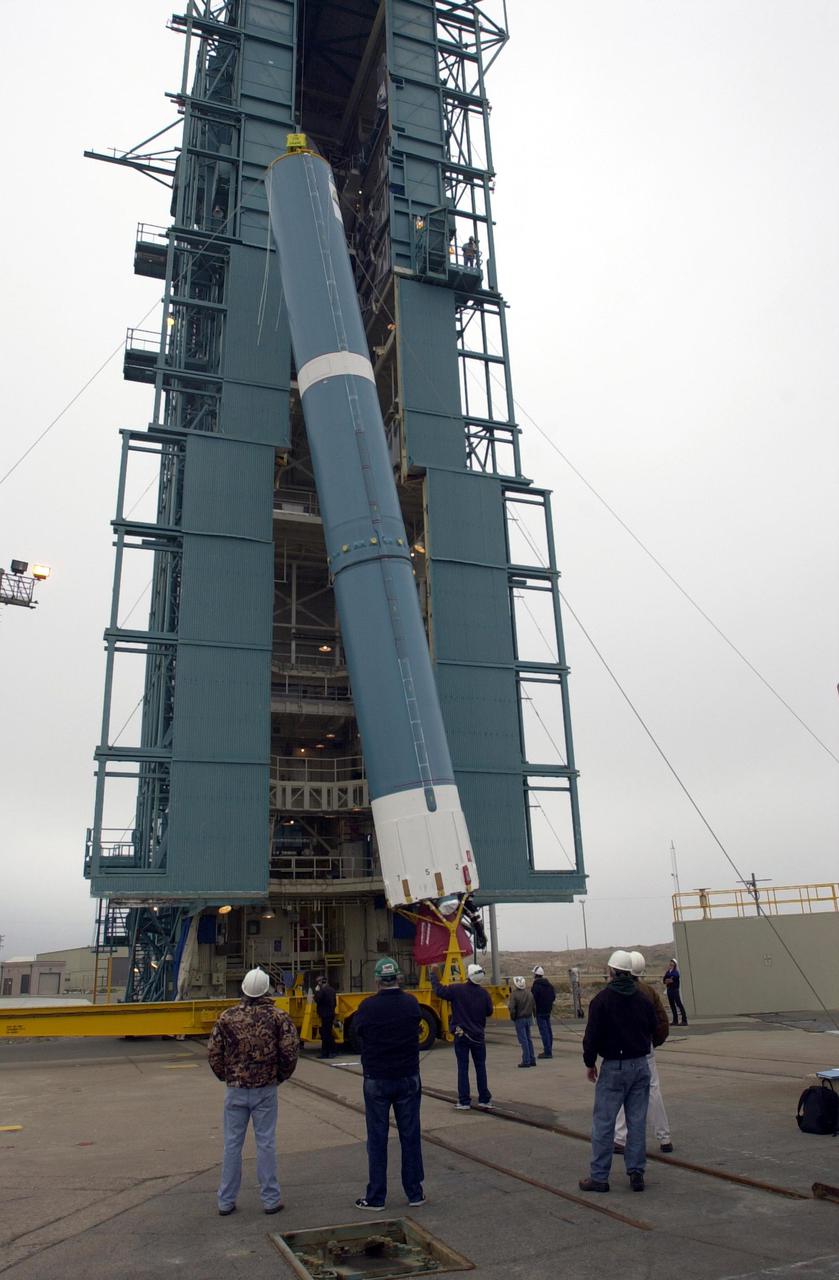
VANDENBERG AIR FORCE BASE, CALIF. - At NASA Space Launch Complex 2 on Vandenberg Air Force Base in California, the Boeing Delta II rocket, launch vehicle for the CALIPSO_CloudSat spacecraft, is being raised to a vertical position. Once it is vertical, it will be lifted up into the mobile service tower, or gantry. CALIPSO stands for Cloud-Aerosol Lidar and Infrared Pathfinder Satellite Observation. CALIPSO and CloudSat are highly complementary satellites and together will provide never-before-seen 3-D perspectives of how clouds and aerosols form, evolve, and affect weather and climate. CALIPSO and CloudSat will fly in formation with three other satellites in the A-train constellation to enhance understanding of our climate system. Launch of CALIPSO_CloudSat aboard a Boeing Delta II rocket is scheduled for 3:01 a.m. Sept. 29.
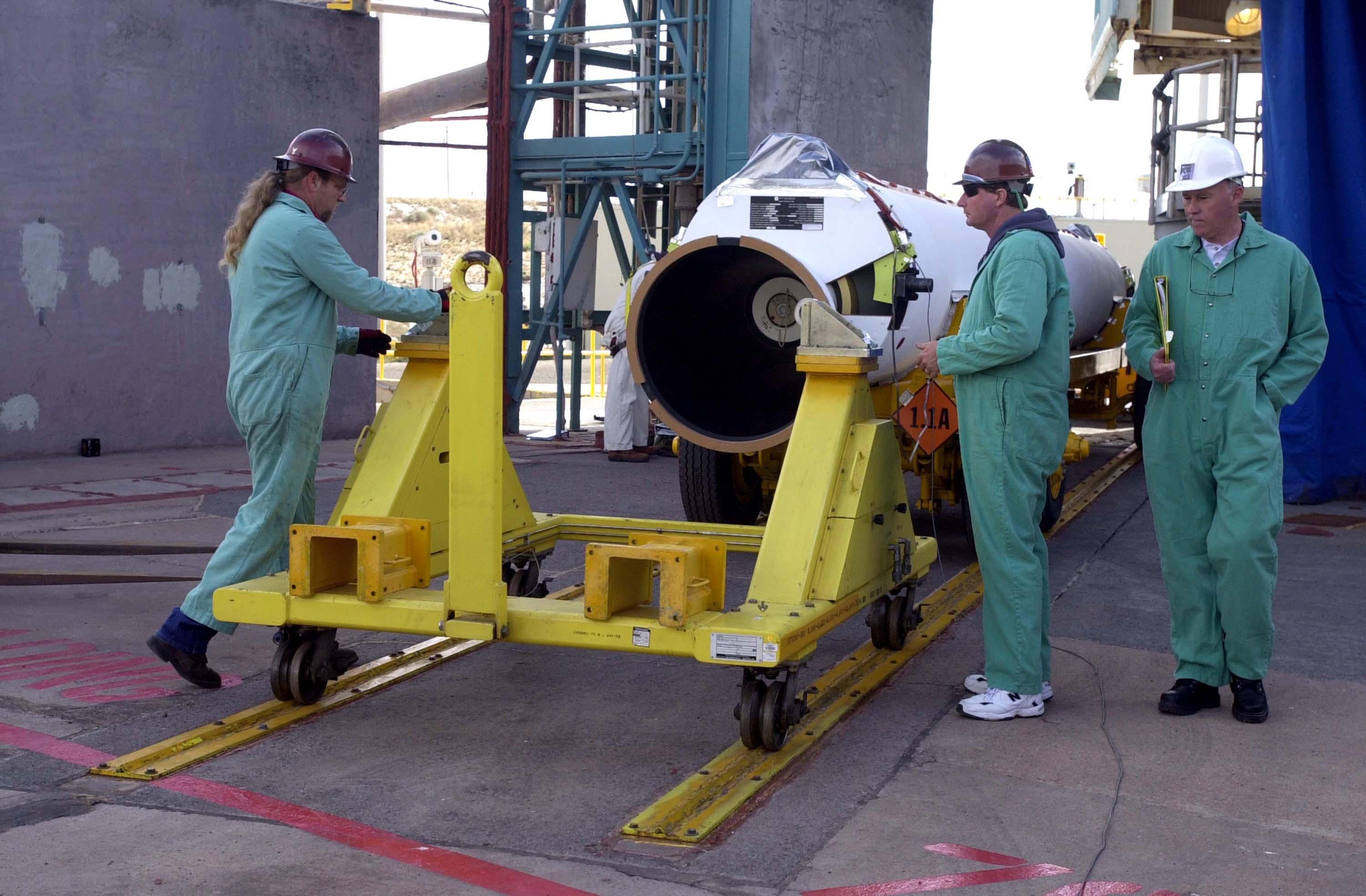
VANDENBERG AIR FORCE BASE, CALIF. - Another Solid Rocket Booster arrives on NASA Space Launch Complex 2 at Vandenberg Air Force Base in California. It will be lifted up the mobile service tower, or gantry, where it will be attached to the Boeing Delta II rocket. The Delta is the launch vehicle for the CALIPSO_CloudSat spacecraft. CALIPSO stands for Cloud-Aerosol Lidar and Infrared Pathfinder Satellite Observation. CALIPSO and CloudSat are highly complementary satellites and together will provide never-before-seen 3-D perspectives of how clouds and aerosols form, evolve, and affect weather and climate. CALIPSO and CloudSat will fly in formation with three other satellites in the A-train constellation to enhance understanding of our climate system. Launch of CALIPSO_CloudSat aboard a Boeing Delta II rocket is scheduled for 3:01 a.m. Sept. 29.
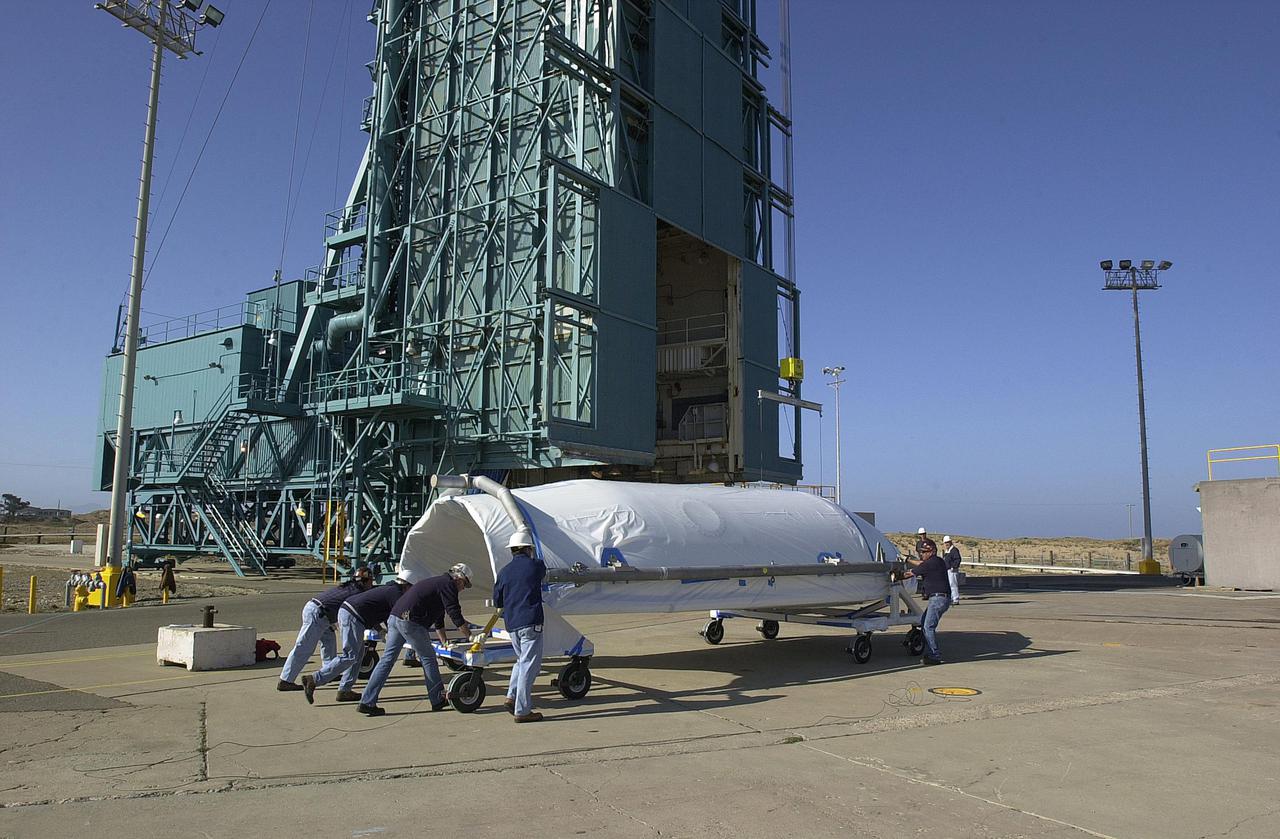
VANDENBERG AIR FORCE BASE, CALIF. - One half of the fairing to cover CALIPSO_CloudSat arrives at NASA Space Launch Complex 2 on Vandenberg Air Force Base in California. The fairing encloses and protects the spacecraft during launch and flight through the atmosphere. Once in space, it is jettisoned. CALIPSO stands for Cloud-Aerosol Lidar and Infrared Pathfinder Satellite Observation. CALIPSO and CloudSat are highly complementary satellites and together will provide never-before-seen 3-D perspectives of how clouds and aerosols form, evolve, and affect weather and climate. CALIPSO and CloudSat will fly in formation with three other satellites in the A-train constellation to enhance understanding of our climate system. Launch of CALIPSO_CloudSat aboard a Boeing Delta II rocket is scheduled for 3:01 a.m. Sept. 29.
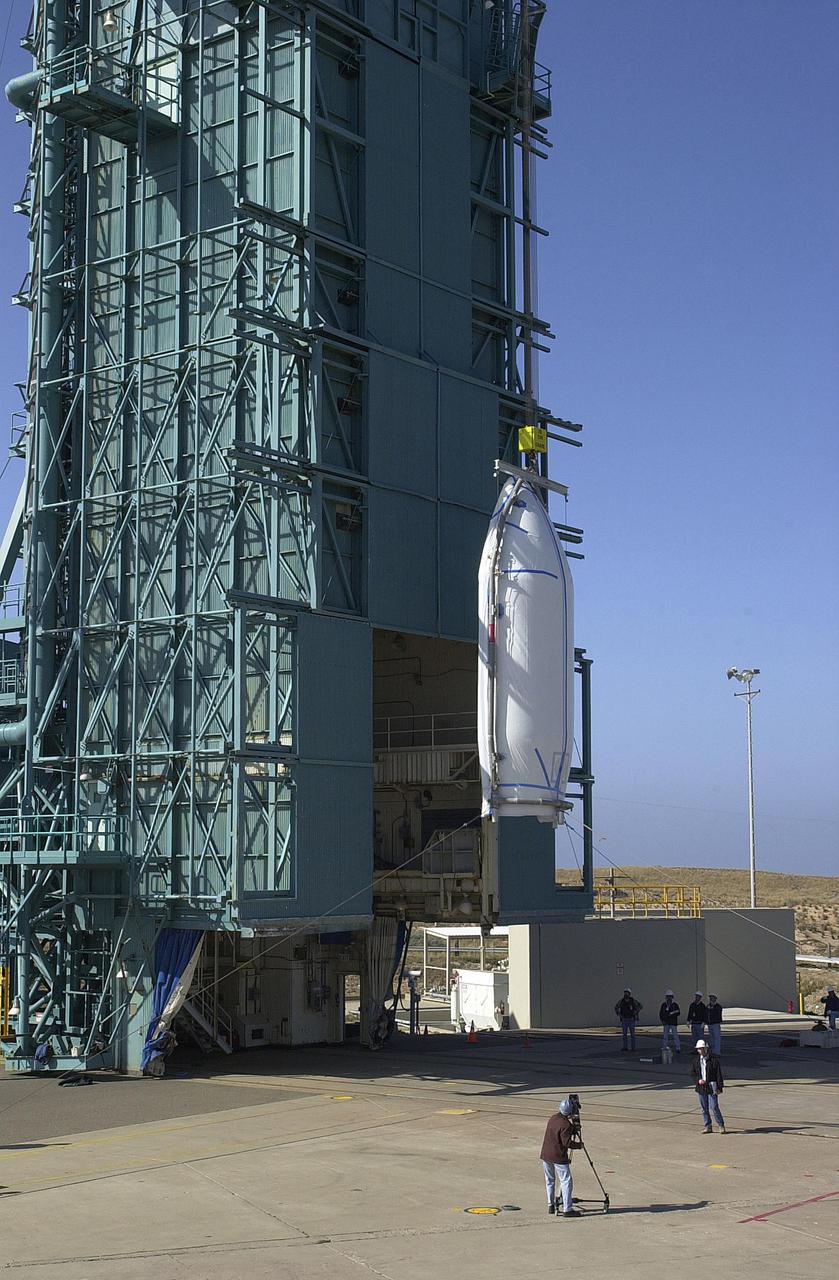
VANDENBERG AIR FORCE BASE, CALIF. - At NASA Space Launch Complex 2 on Vandenberg Air Force Base in California, one half of the fairing for CALIPSO_CloudSat begins the slow lift up the mobile service tower, or gantry. The fairing encloses and protects the spacecraft during launch and flight through the atmosphere. Once in space, it is jettisoned. CALIPSO stands for Cloud-Aerosol Lidar and Infrared Pathfinder Satellite Observation. CALIPSO and CloudSat are highly complementary satellites and together will provide never-before-seen 3-D perspectives of how clouds and aerosols form, evolve, and affect weather and climate. CALIPSO and CloudSat will fly in formation with three other satellites in the A-train constellation to enhance understanding of our climate system. Launch of CALIPSO_CloudSat aboard a Boeing Delta II rocket is scheduled for 3:01 a.m. Sept. 29.
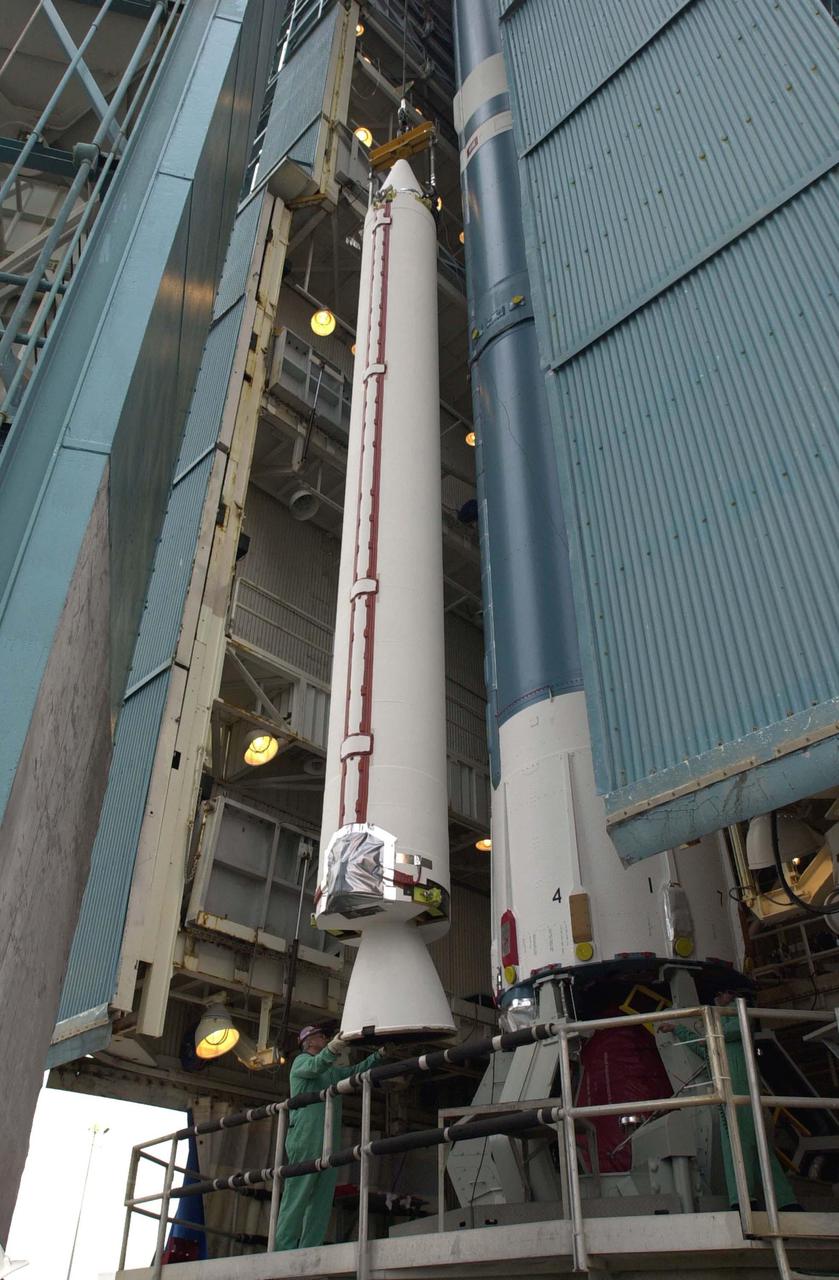
VANDENBERG AIR FORCE BASE, CALIF. - Workers on NASA Space Launch Complex 2 at Vandenberg Air Force Base in California prepare the Solid Rocket Booster for lifting into the mobile service tower, or gantry, where it will be attached to the Boeing Delta II rocket. The Delta is the launch vehicle for the CALIPSO_CloudSat spacecraft. CALIPSO stands for Cloud-Aerosol Lidar and Infrared Pathfinder Satellite Observation. CALIPSO and CloudSat are highly complementary satellites and together will provide never-before-seen 3-D perspectives of how clouds and aerosols form, evolve, and affect weather and climate. CALIPSO and CloudSat will fly in formation with three other satellites in the A-train constellation to enhance understanding of our climate system. Launch of CALIPSO_CloudSat aboard a Boeing Delta II rocket is scheduled for 3:01 a.m. Sept. 29.
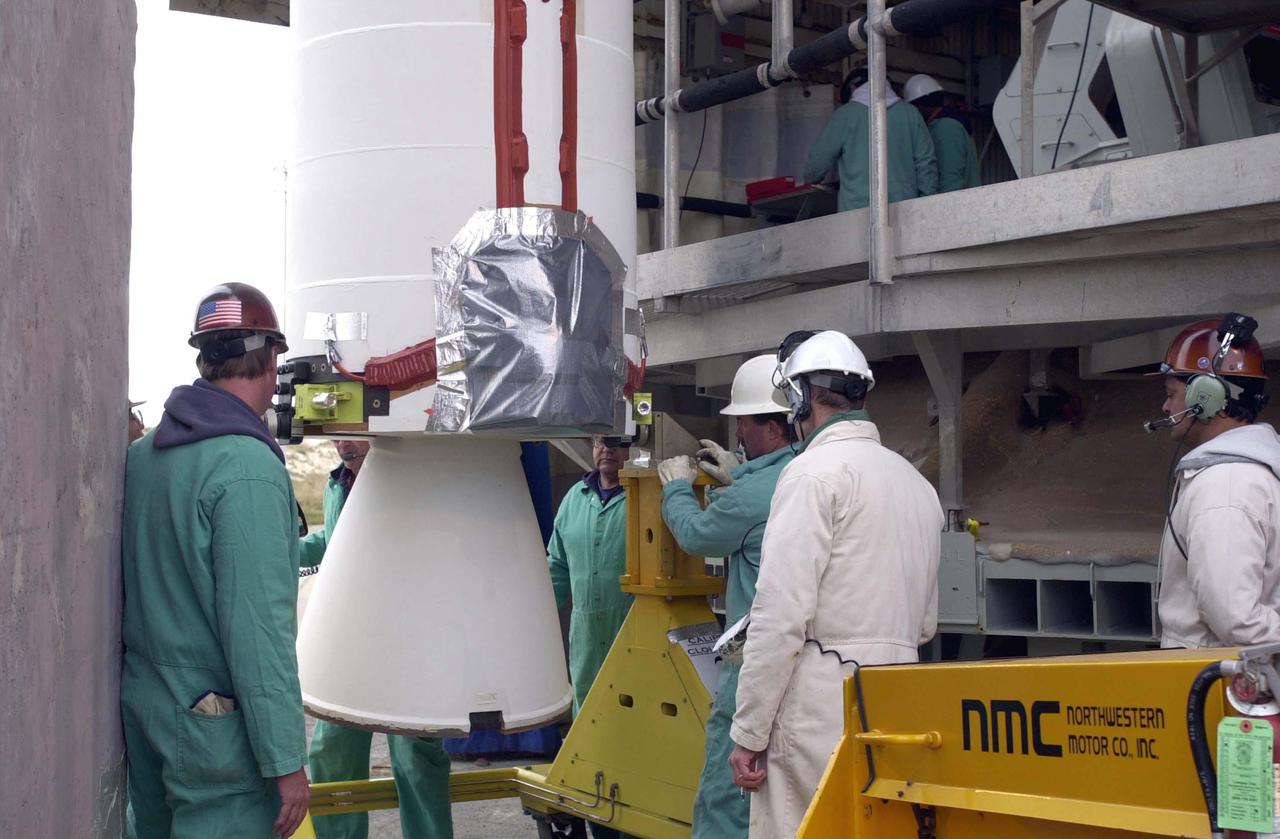
VANDENBERG AIR FORCE BASE, CALIF. - Workers on NASA Space Launch Complex 2 at Vandenberg Air Force Base in California prepare the Solid Rocket Booster for lifting into the mobile service tower, or gantry, where it will be attached to the Boeing Delta II rocket. The Delta is the launch vehicle for the CALIPSO_CloudSat spacecraft. CALIPSO stands for Cloud-Aerosol Lidar and Infrared Pathfinder Satellite Observation. CALIPSO and CloudSat are highly complementary satellites and together will provide never-before-seen 3-D perspectives of how clouds and aerosols form, evolve, and affect weather and climate. CALIPSO and CloudSat will fly in formation with three other satellites in the A-train constellation to enhance understanding of our climate system. Launch of CALIPSO_CloudSat aboard a Boeing Delta II rocket is scheduled for 3:01 a.m. Sept. 29.
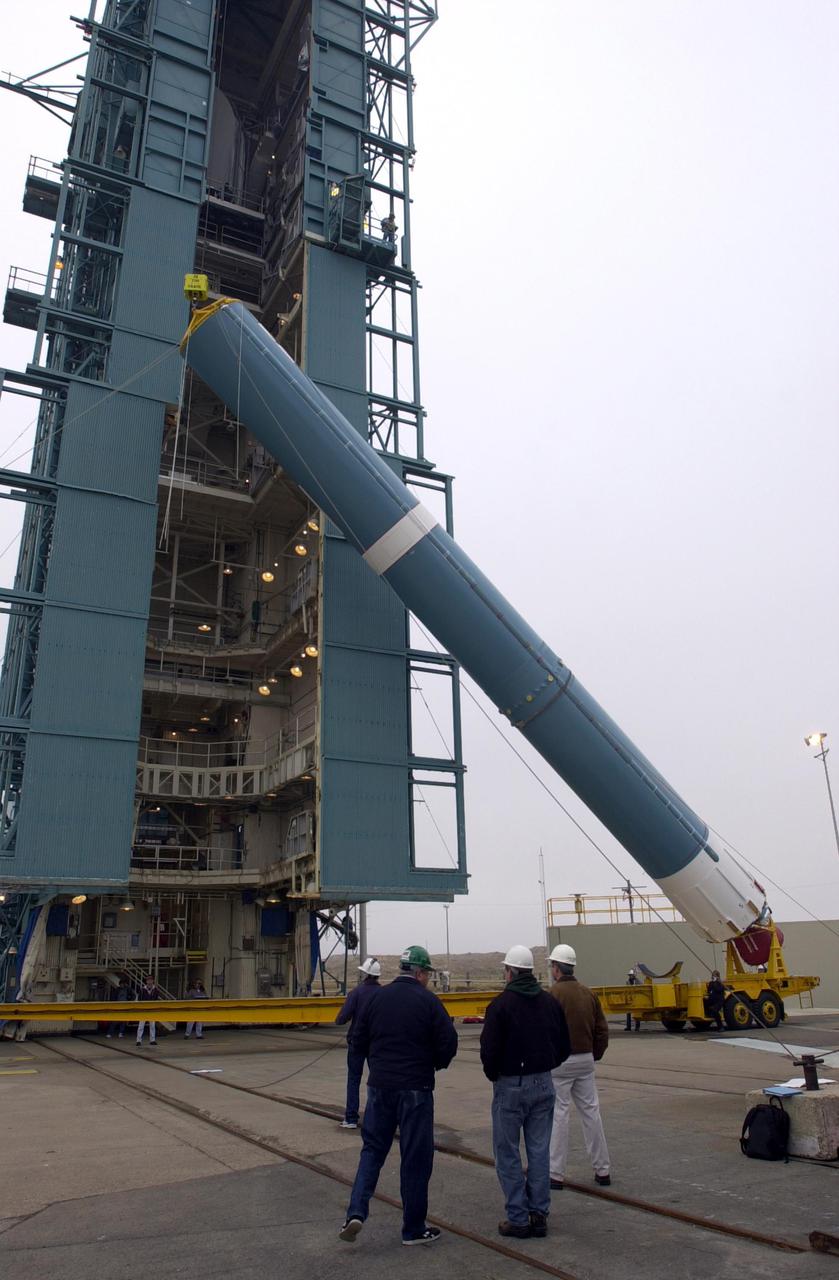
VANDENBERG AIR FORCE BASE, CALIF. - At NASA Space Launch Complex 2 on Vandenberg Air Force Base in California, the Boeing Delta II rocket, launch vehicle for the CALIPSO_CloudSat spacecraft, is being raised to a vertical position. Once it is vertical, it will be lifted up into the Mobile service tower, or gantry. CALIPSO stands for Cloud-Aerosol Lidar and Infrared Pathfinder Satellite Observation. CALIPSO and CloudSat are highly complementary satellites and together will provide never-before-seen 3-D perspectives of how clouds and aerosols form, evolve, and affect weather and climate. CALIPSO and CloudSat will fly in formation with three other satellites in the A-train constellation to enhance understanding of our climate system. Launch of CALIPSO_CloudSat aboard a Boeing Delta II rocket is scheduled for 3:01 a.m. Sept. 29.
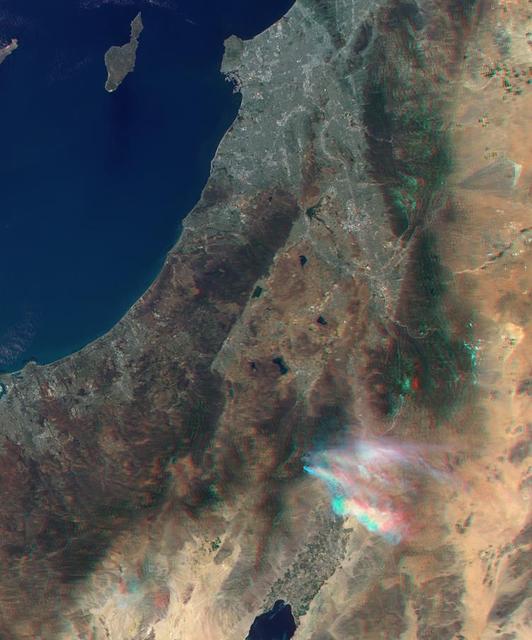
NASA MISR instrument onbard NASA Terra spacecraft captured a stereo view of Mountain Fire near Idyllwild, Calif. in July, 2013.
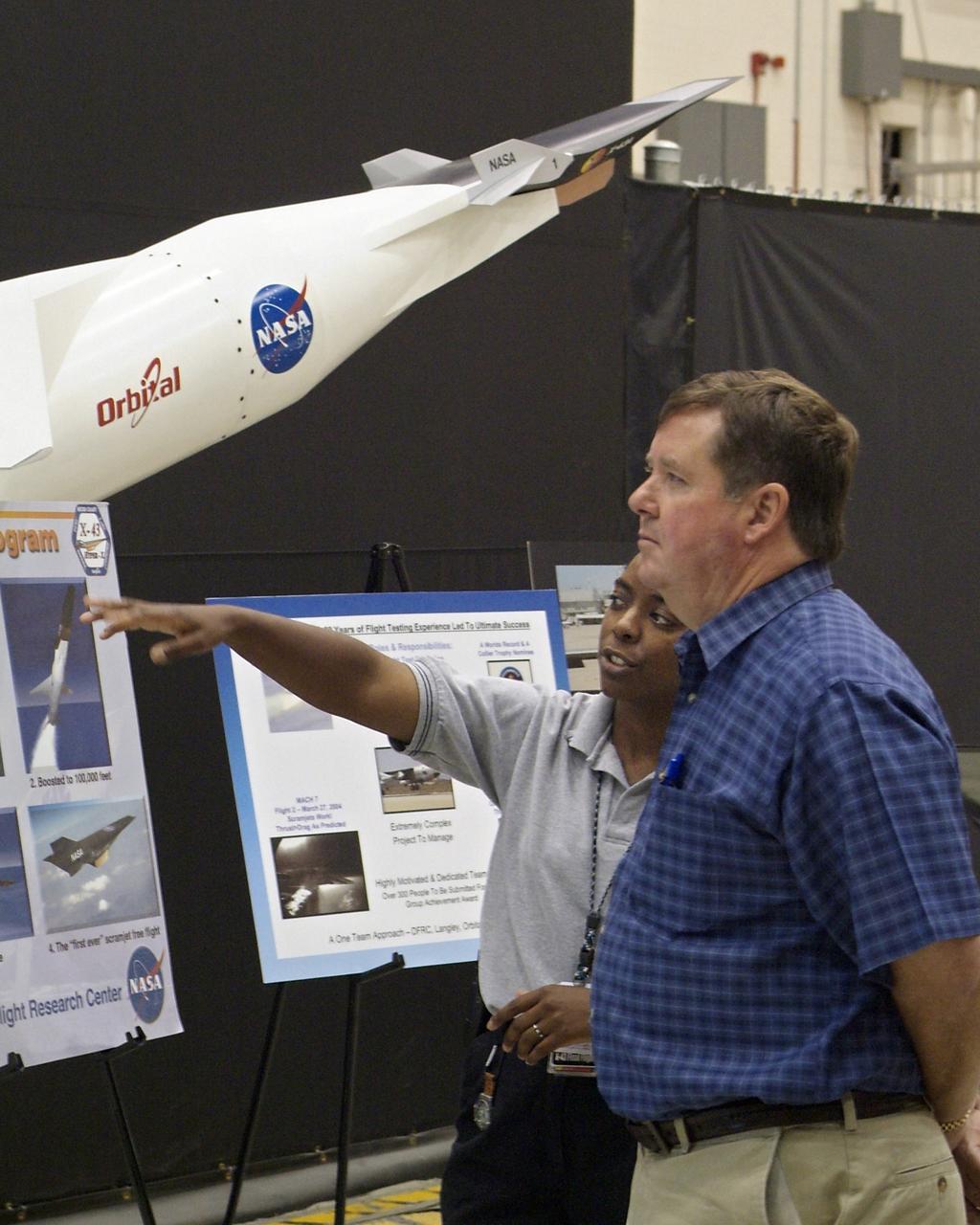
Rep. Ken Calvert, (R-Calif.), chairman of the House Subcommittee on Space and Aeronautics, received an update on the mission of NASA's Dryden Flight Research Center during a visit on June 2, 2005. Rep. Calvert, accompanied by several staff members, was briefed by center management on the Dryden's role as a flight research institution, and then reviewed some of the center's recent, current and upcoming flight research projects during a tour of the facility. During the afternoon, Rep. Calvert received similar briefings on a variety of projects at several aerospace development firms at the Civilian Flight Test Center in Mojave. Rep. Calvert's tour of NASA Dryden was the second in a series of visits to all 10 NASA field centers to better acquaint him with the roles and responsibilities of each center.
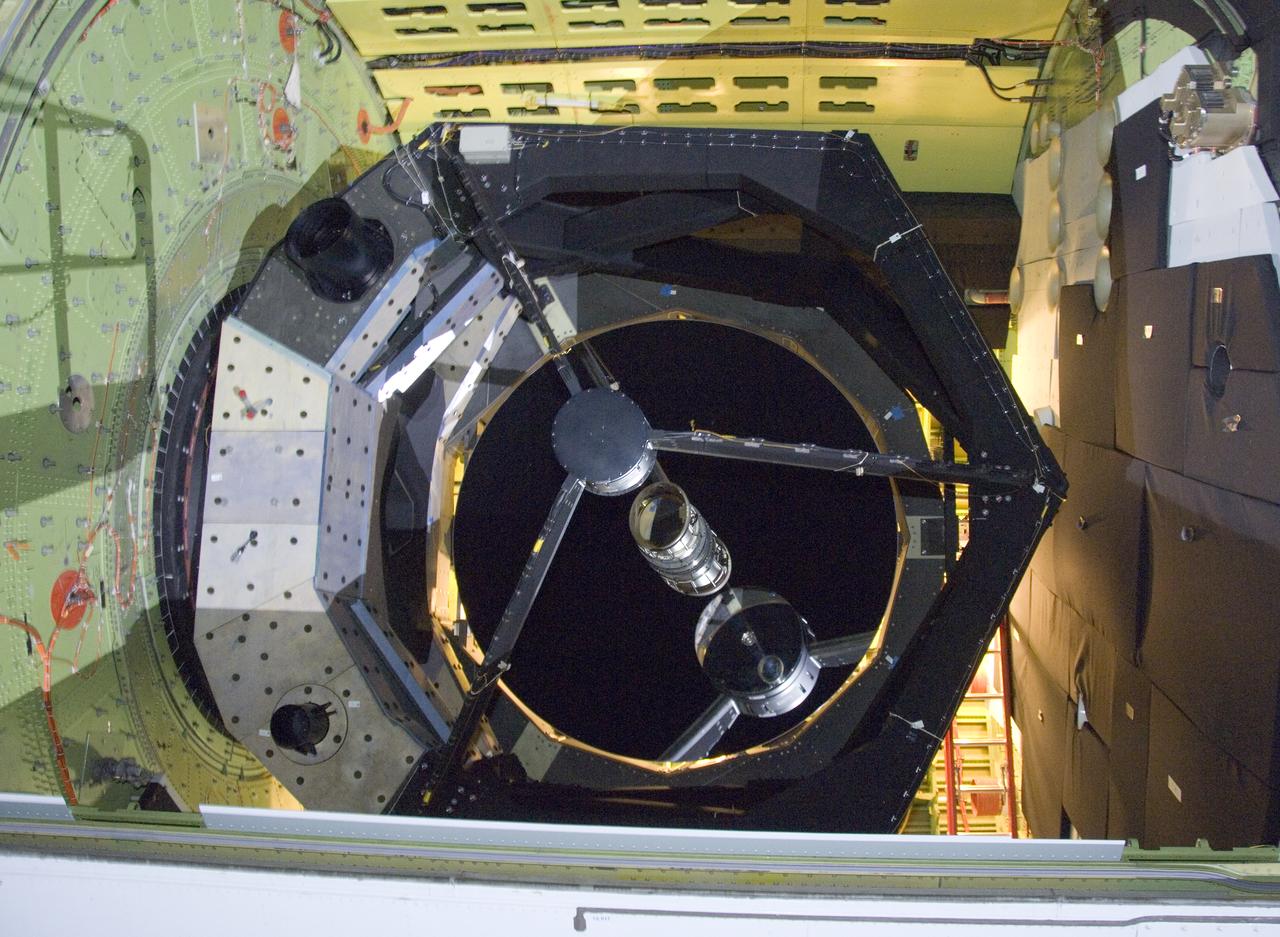
The 2.5-meter infrared telescope peers out from its cavity in the SOFIA airborne observatory during nighttime line operations testing at Palmdale, Calif.

The SOFIA telescope team collected baseline operational measurements during several nights of characterization testing in March 2008 while the SOFIA 747SP aircraft that houses the German-built infrared telescope was parked on an unlit ramp next to its hangar at the NASA Dryden Flight Operations Facility in Palmdale, Calif. The primary celestial target was Polaris, the North Star. The activity provided the team with a working knowledge of how telescope operating systems interact and the experience of tracking celestial targets from the ground.

KENNEDY SPACE CENTER, FLA. - At NASA Space Launch Complex 2 on Vandenberg Air Force Base in California, a hoist and crane is placed around a Solid Rocket Booster to raise it to a vertical position. It will then be lifted into the mobile service tower, or gantry, and attached to the Boeing Delta II rocket. The Delta is the launch vehicle for the CALIPSO_CloudSat spacecraft. CALIPSO stands for Cloud-Aerosol Lidar and Infrared Pathfinder Satellite Observation. CALIPSO and CloudSat are highly complementary satellites and together will provide never-before-seen 3-D perspectives of how clouds and aerosols form, evolve, and affect weather and climate. CALIPSO and CloudSat will fly in formation with three other satellites in the A-train constellation to enhance understanding of our climate system. Launch of CALIPSO_CloudSat aboard a Boeing Delta II rocket is scheduled for 3:01 a.m. Sept. 29.
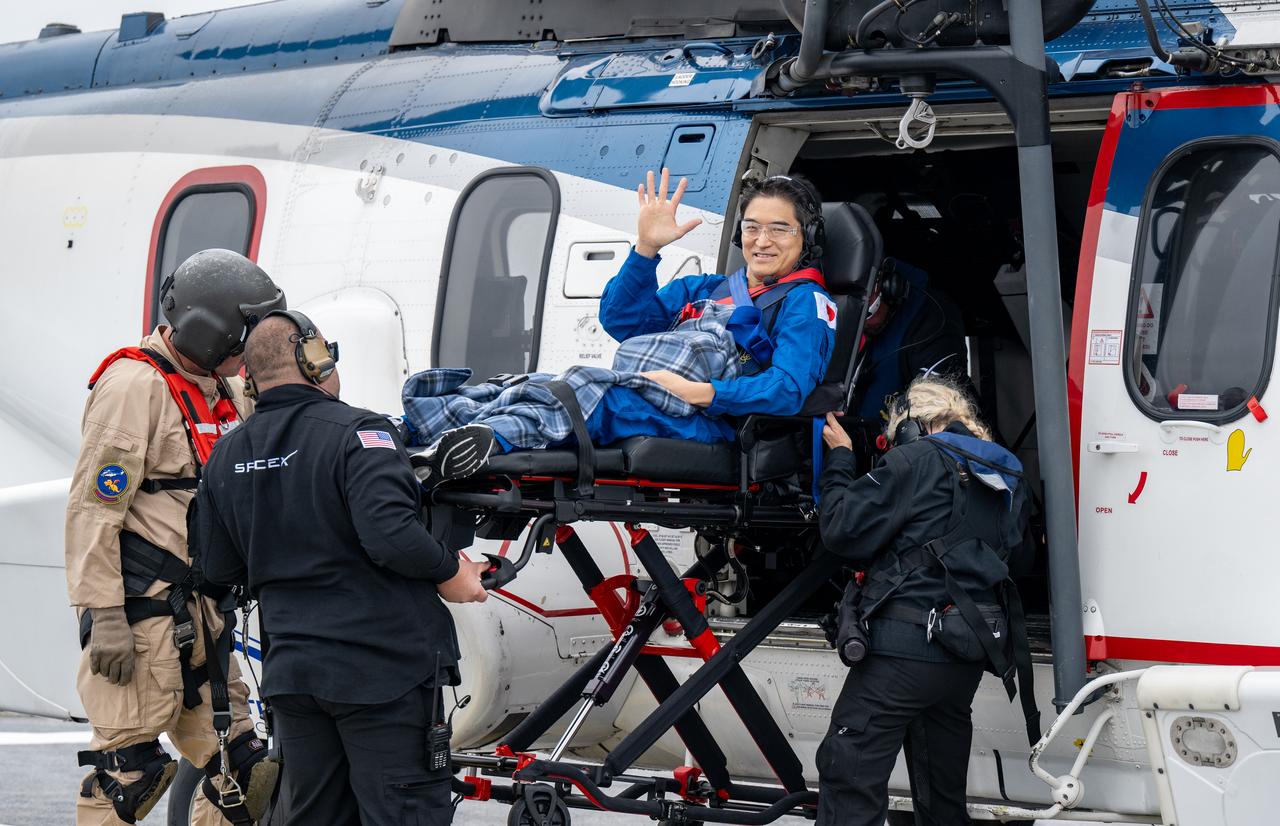
JAXA (Japan Aerospace Exploration Agency) astronaut Takuya Onishi is helped aboard a helicopter on the SpaceX recovery ship SHANNON to fly to Long Beach, Calif. along with NASA astronaut Nichole Ayers, Anne McClain, and Roscosmos cosmonaut Kirill Peskov shortly after they landed in the Pacific Ocean off the coast of San Diego, Calif., Saturday, Aug. 9, 2025. McClain, Ayers, Onishi, and Peskov are returning after 147 days in space as part of Expedition 73 aboard the International Space Station. Photo Credit: (NASA/Keegan Barber)
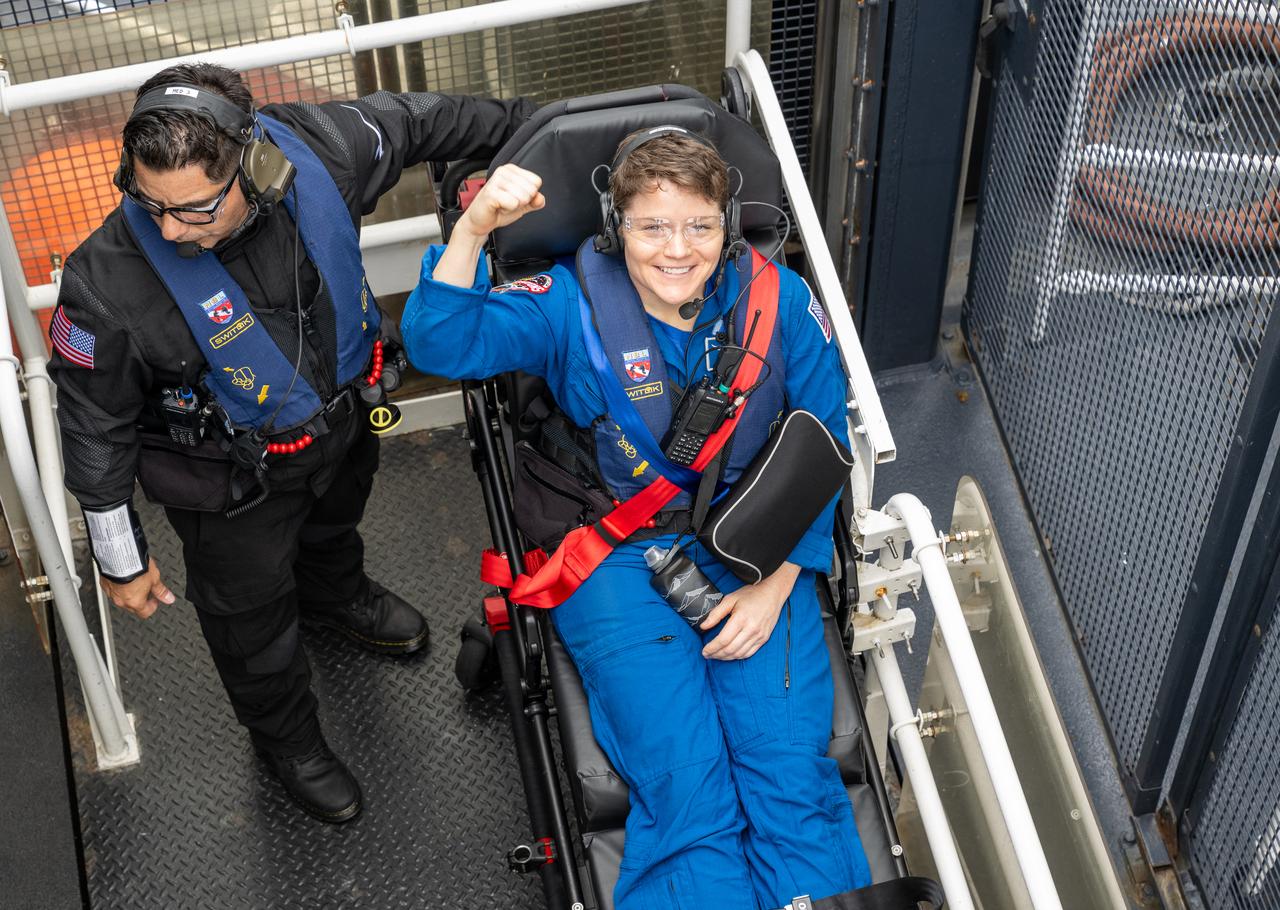
NASA astronaut Anne McClain is seen inside an elevator onboard the SpaceX recovery ship SHANNON that will take her up to a waiting helicopter to fly to Long Beach, Calif. along with NASA astronaut Nichole Ayers, JAXA (Japan Aerospace Exploration Agency) astronaut Takuya Onishi, and Roscosmos cosmonaut Kirill Peskov shortly after they landed in the Pacific Ocean off the coast of San Diego, Calif., Saturday, Aug. 9, 2025. McClain, Ayers, Onishi, and Peskov are returning after 147 days in space as part of Expedition 73 aboard the International Space Station. Photo Credit: (NASA/Keegan Barber)

JAXA (Japan Aerospace Exploration Agency) astronaut Takuya Onishi is helped aboard a helicopter on the SpaceX recovery ship SHANNON to fly to Long Beach, Calif. along with NASA astronaut Nichole Ayers, Anne McClain, and Roscosmos cosmonaut Kirill Peskov shortly after they landed in the Pacific Ocean off the coast of San Diego, Calif., Saturday, Aug. 9, 2025. McClain, Ayers, Onishi, and Peskov are returning after 147 days in space as part of Expedition 73 aboard the International Space Station. Photo Credit: (NASA/Keegan Barber)
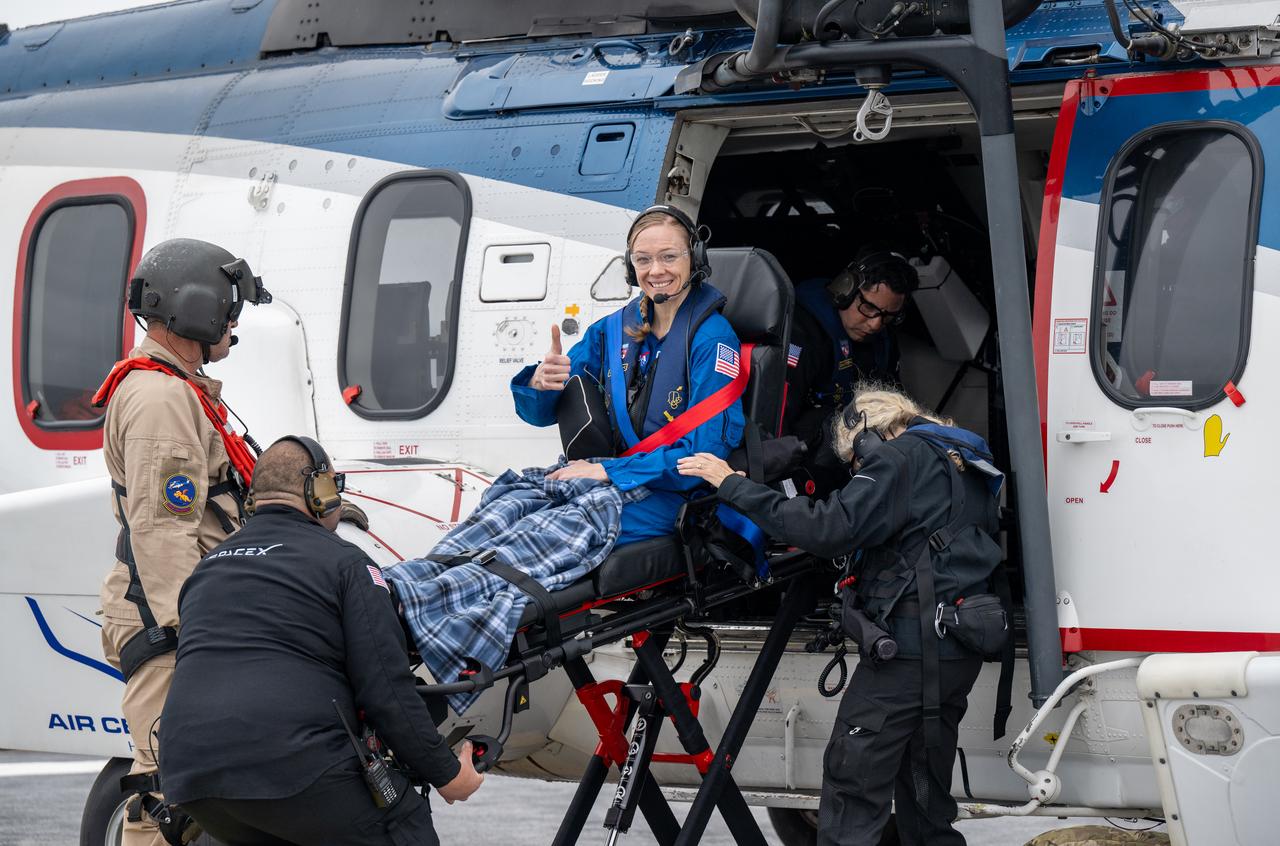
NASA astronaut Nichole Ayers is helped aboard a helicopter on the SpaceX recovery ship SHANNON to fly to Long Beach, Calif. along with NASA astronaut Anne McClain, JAXA (Japan Aerospace Exploration Agency) astronaut Takuya Onishi, and Roscosmos cosmonaut Kirill Peskov shortly after they landed in the Pacific Ocean off the coast of San Diego, Calif., Saturday, Aug. 9, 2025. McClain, Ayers, Onishi, and Peskov are returning after 147 days in space as part of Expedition 73 aboard the International Space Station. Photo Credit: (NASA/Keegan Barber)

NASA astronaut Anne McClain is helped aboard a helicopter on the SpaceX recovery ship SHANNON to fly to Long Beach, Calif. along with NASA astronaut Nichole Ayers, JAXA (Japan Aerospace Exploration Agency) astronaut Takuya Onishi, and Roscosmos cosmonaut Kirill Peskov shortly after they landed in the Pacific Ocean off the coast of San Diego, Calif., Saturday, Aug. 9, 2025. McClain, Ayers, Onishi, and Peskov are returning after 147 days in space as part of Expedition 73 aboard the International Space Station. Photo Credit: (NASA/Keegan Barber)

NASA's Stratospheric Observatory for Infrared Astronomy touches down at Moffett Field, Calif., for its first visit to NASA Ames Research Center, Jan. 14, 2008.
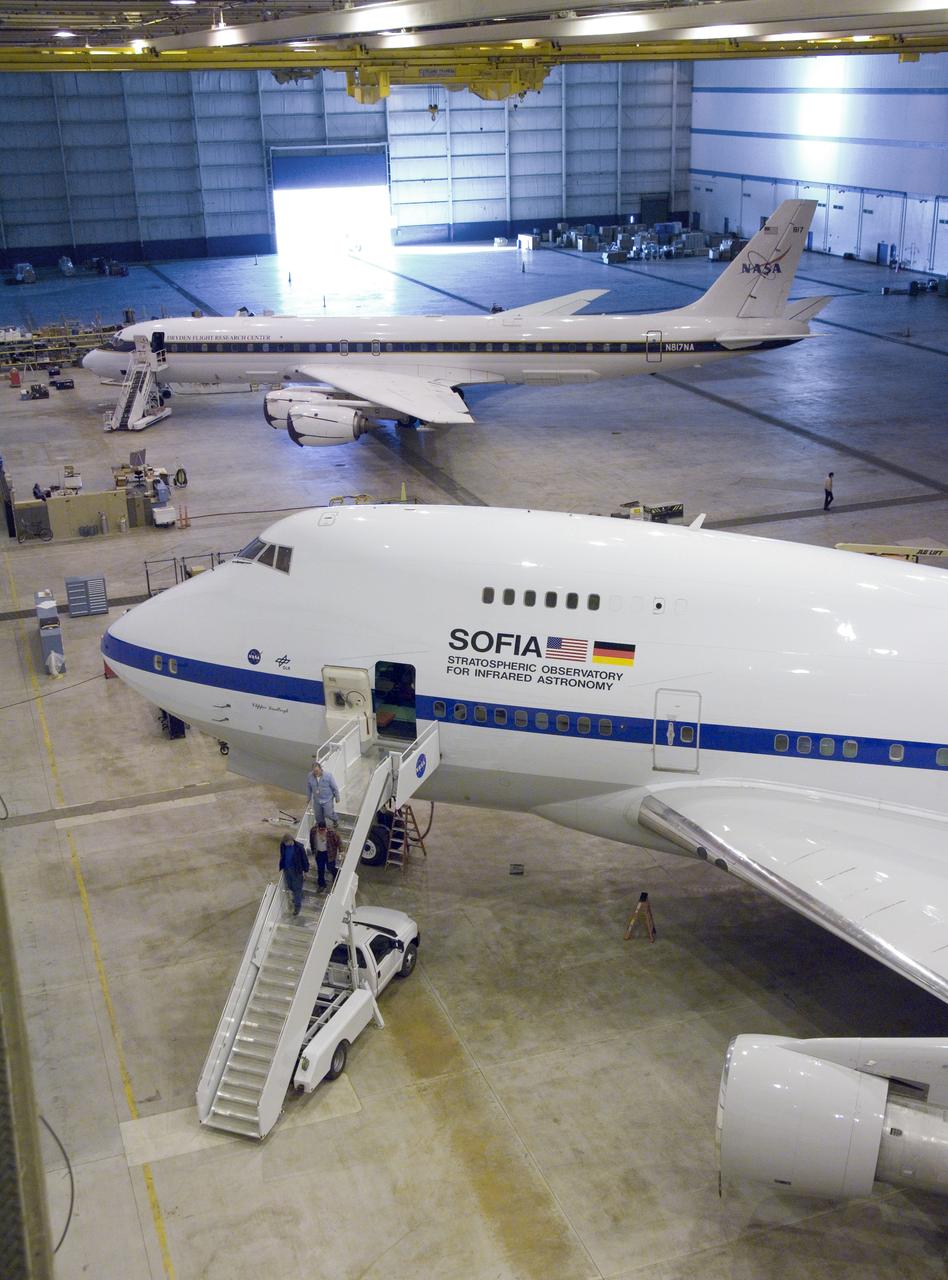
NASA'S SOFIA infrared observatory 747SP (front) and DC-8 flying laboratory (rear) are now housed at the Dryden Aircraft Operations Facility in Palmdale, Calif.
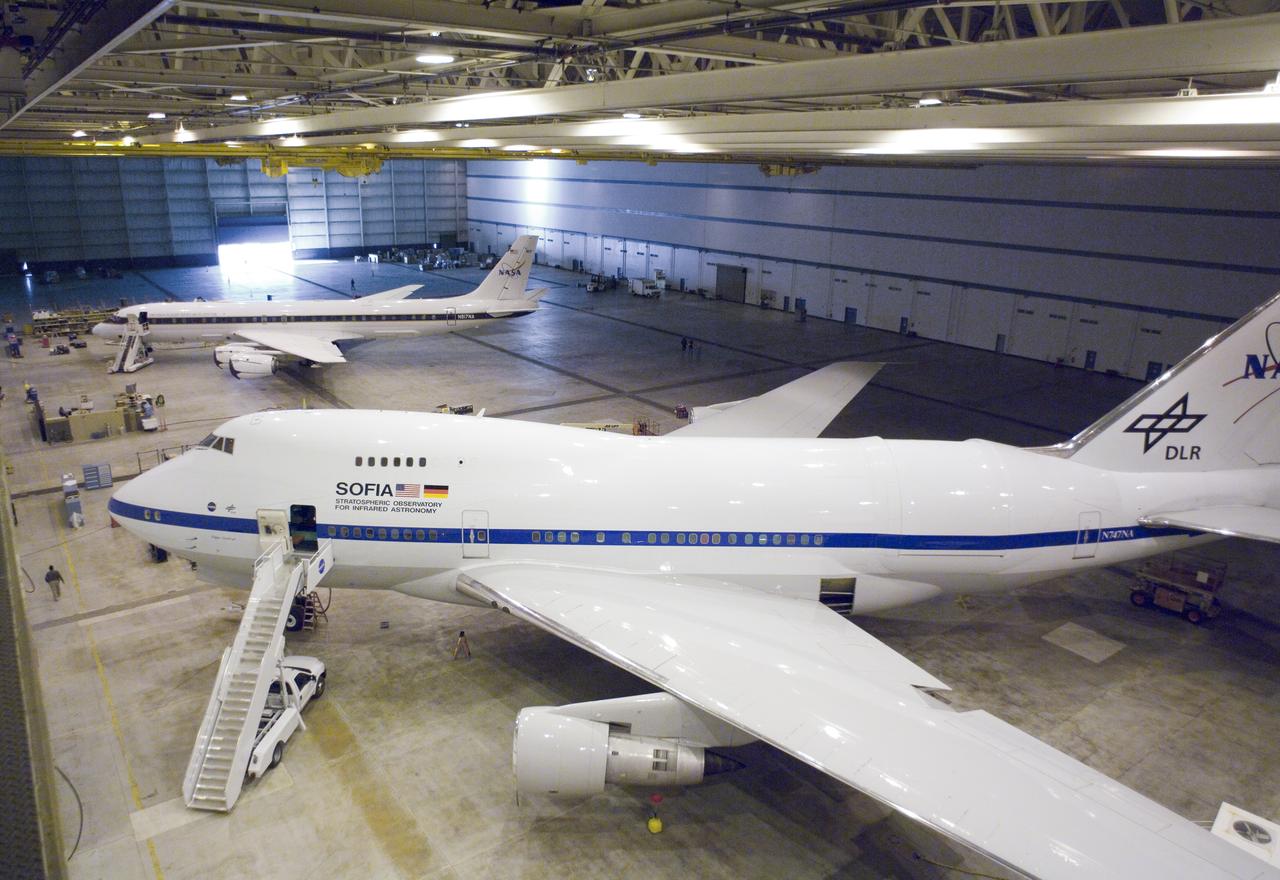
The Dryden Aircraft Operations Facility in Palmdale, Calif., is now home to two large science aircraft, NASA's SOFIA observatory and a DC-8 science laboratory.
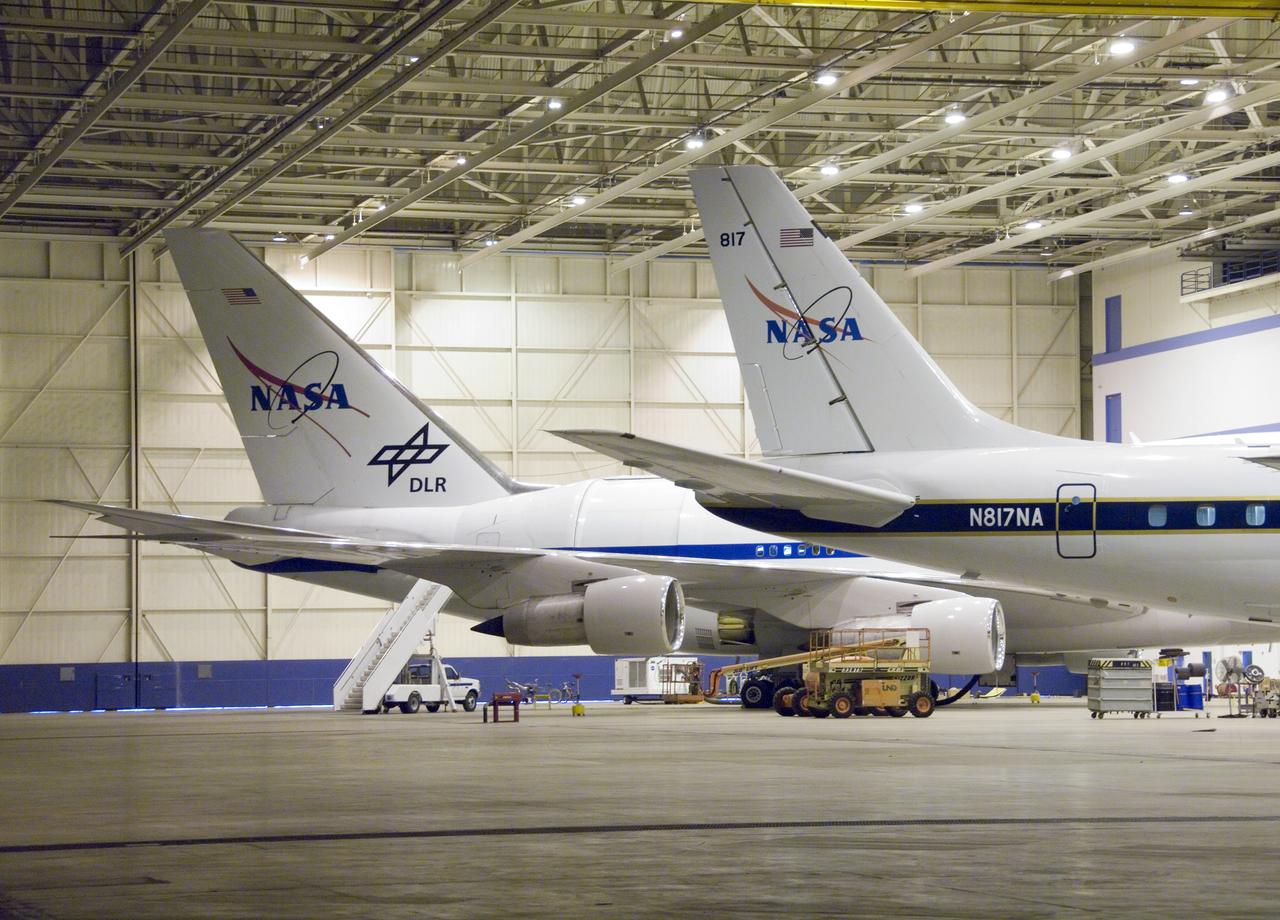
Two large science aircraft, a DC-8 flying laboratory and the SOFIA 747SP, are based at NASA's Dryden Aircraft Operations Facility in Palmdale, Calif.
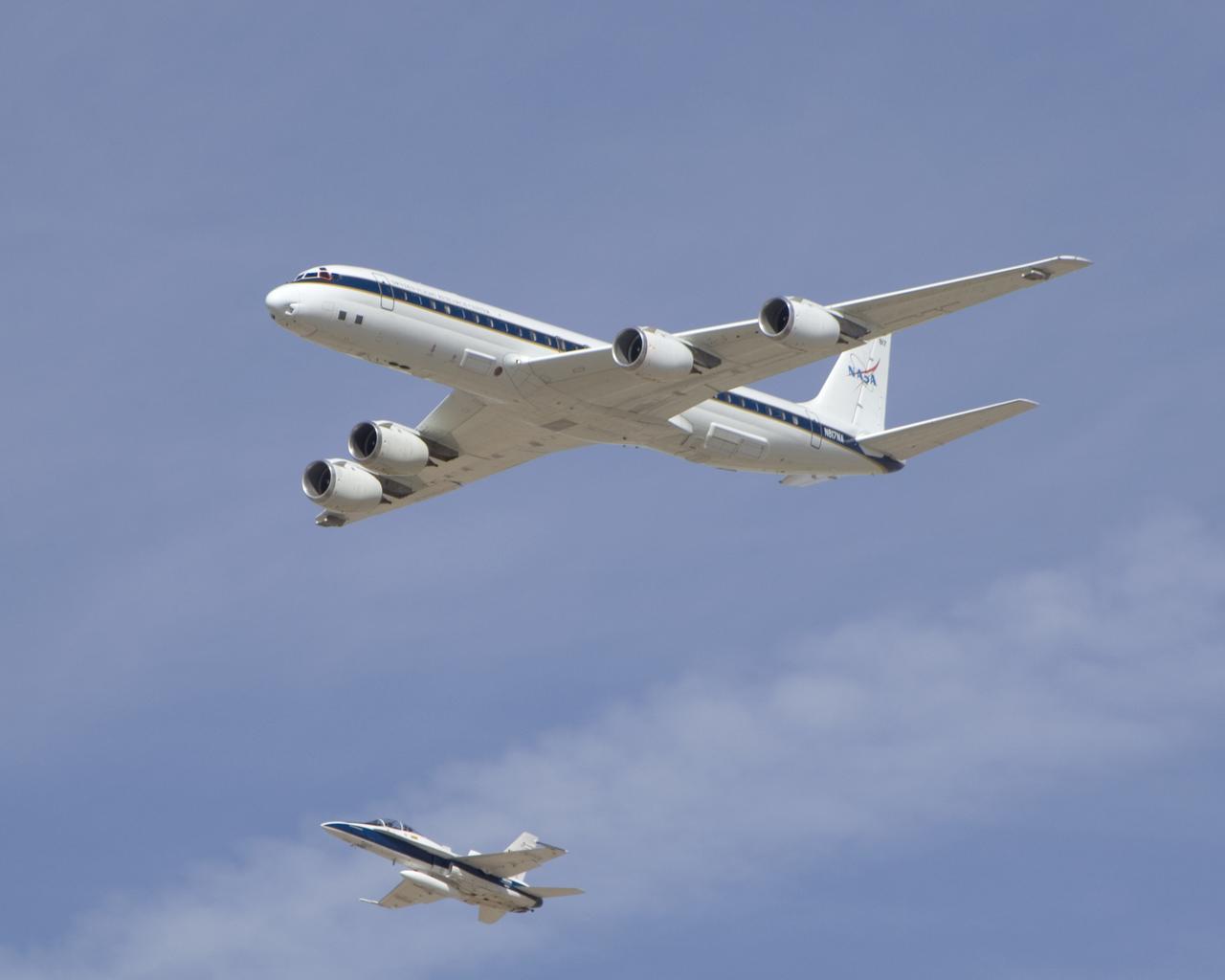
NASA's DC-8 airborne science laboratory is shadowed by a NASA F/A-18 chase plane during a flyover of the Dryden Aircraft Operations Facility in Palmdale, Calif.

NASA's SOFIA infrared observatory 747SP is shadowed by a NASA F/A-18 during a flyby at its new home, the Dryden Aircraft Operations Facility in Palmdale, Calif.
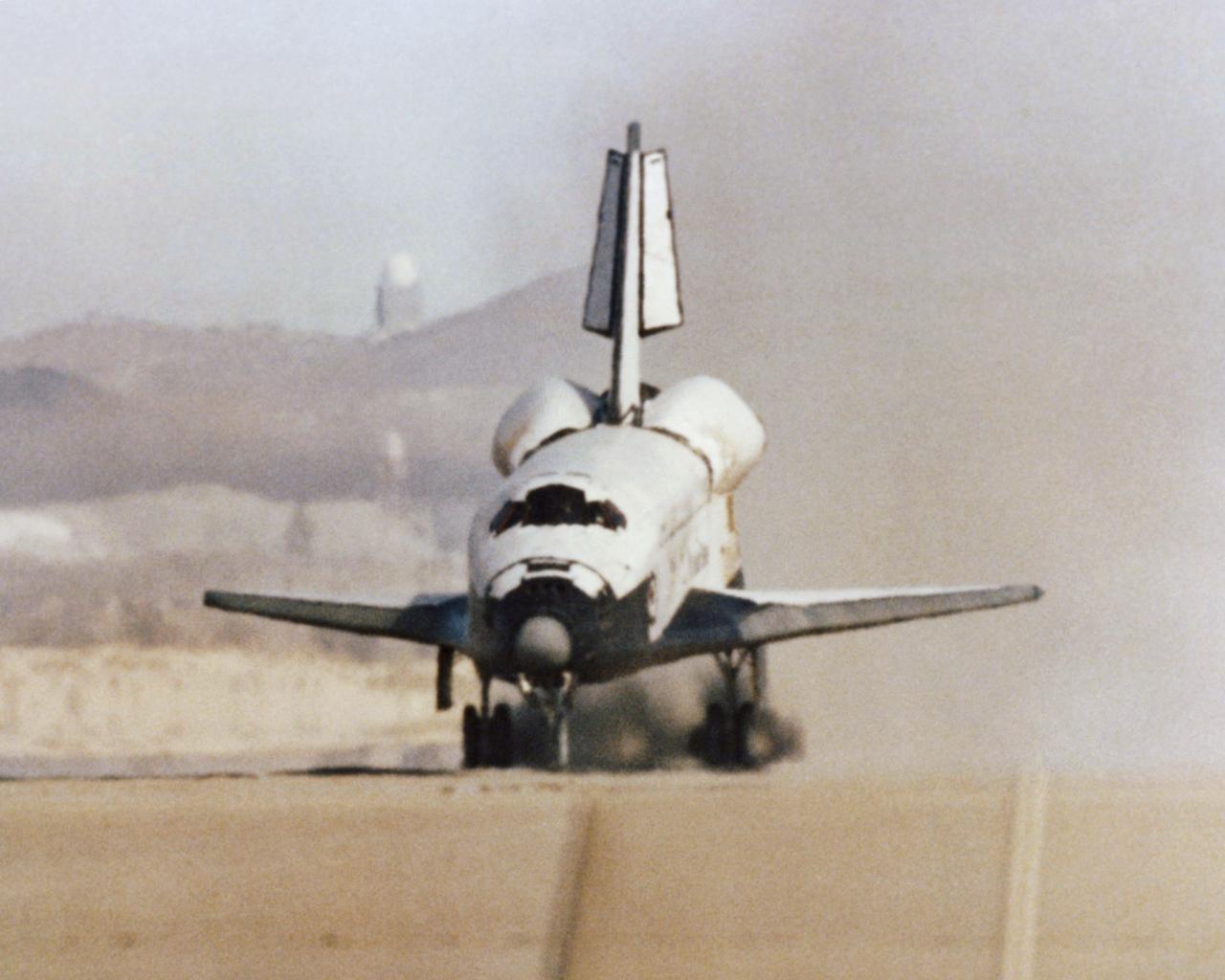
The Space Shuttle Columbia touches down on lakebed runway 23 at Edwards Air Force Base, Calif., to conclude the first orbital shuttle mission.
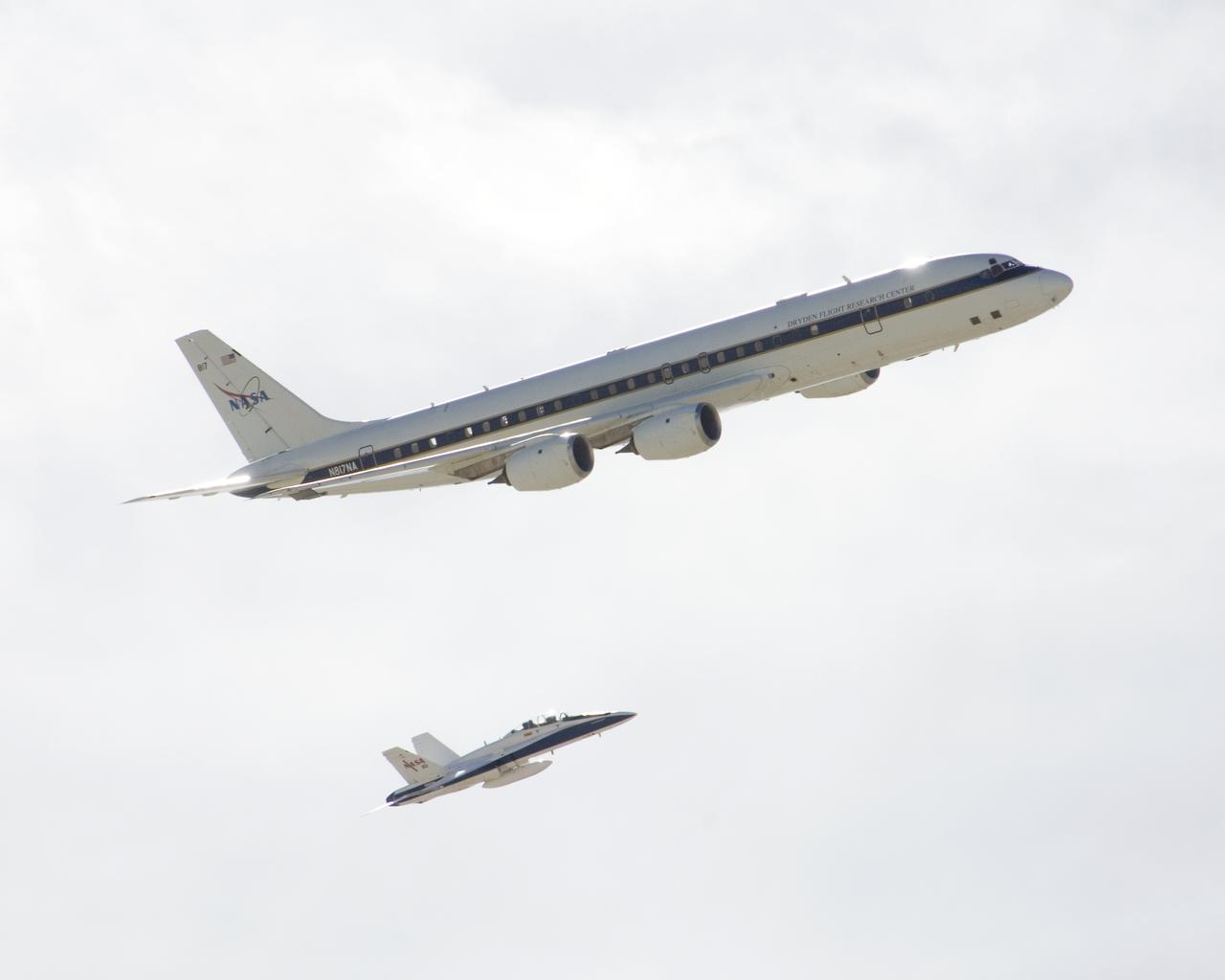
NASA's DC-8 airborne science laboratory is shadowed by a NASA F/A-18 chase plane during a flyover of the Dryden Aircraft Operations Facility in Palmdale, Calif.
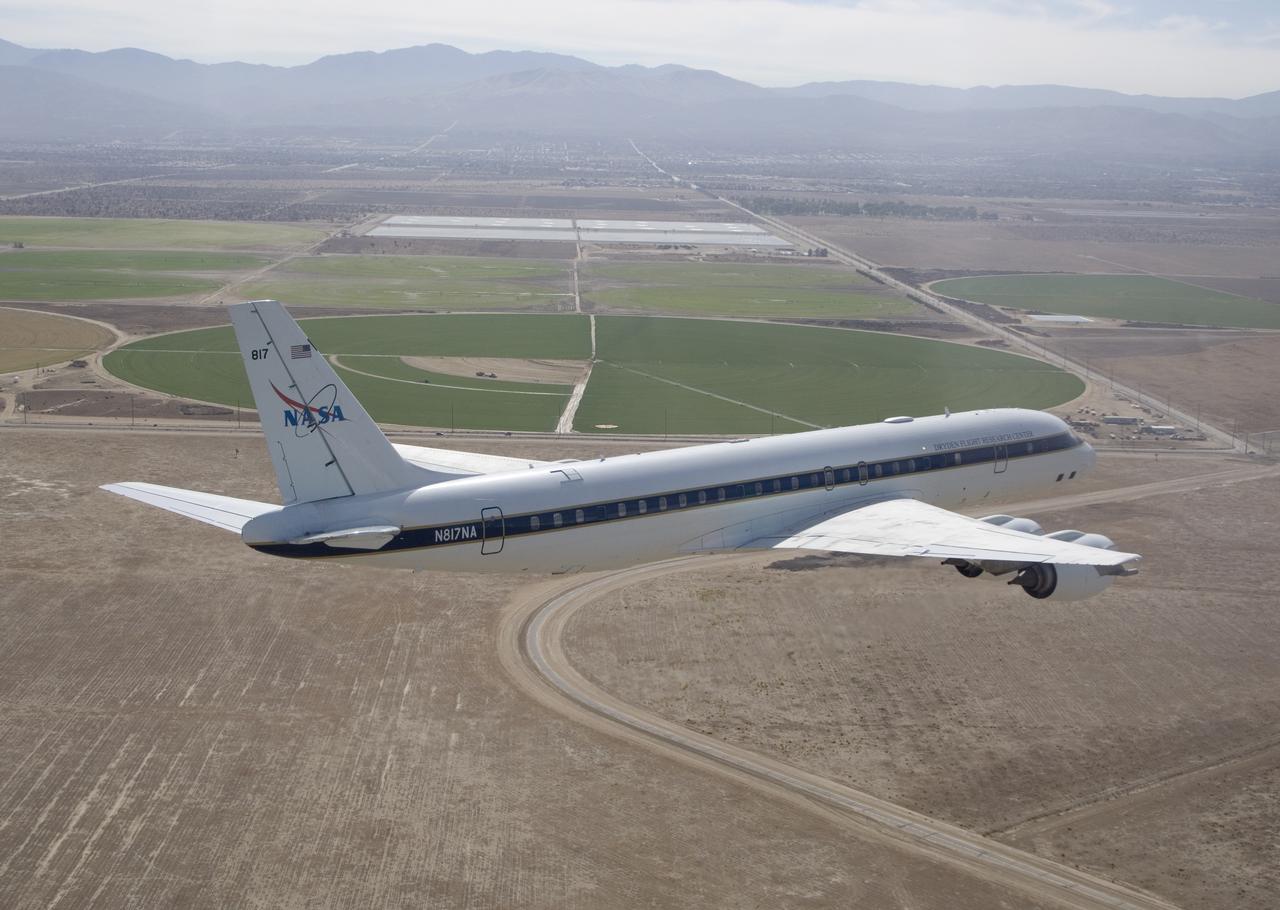
Agricultural fields spread out beyond NASA's DC-8 airborne science laboratory as it heads for landing at Air Force Plant 42 in Palmdale, Calif.
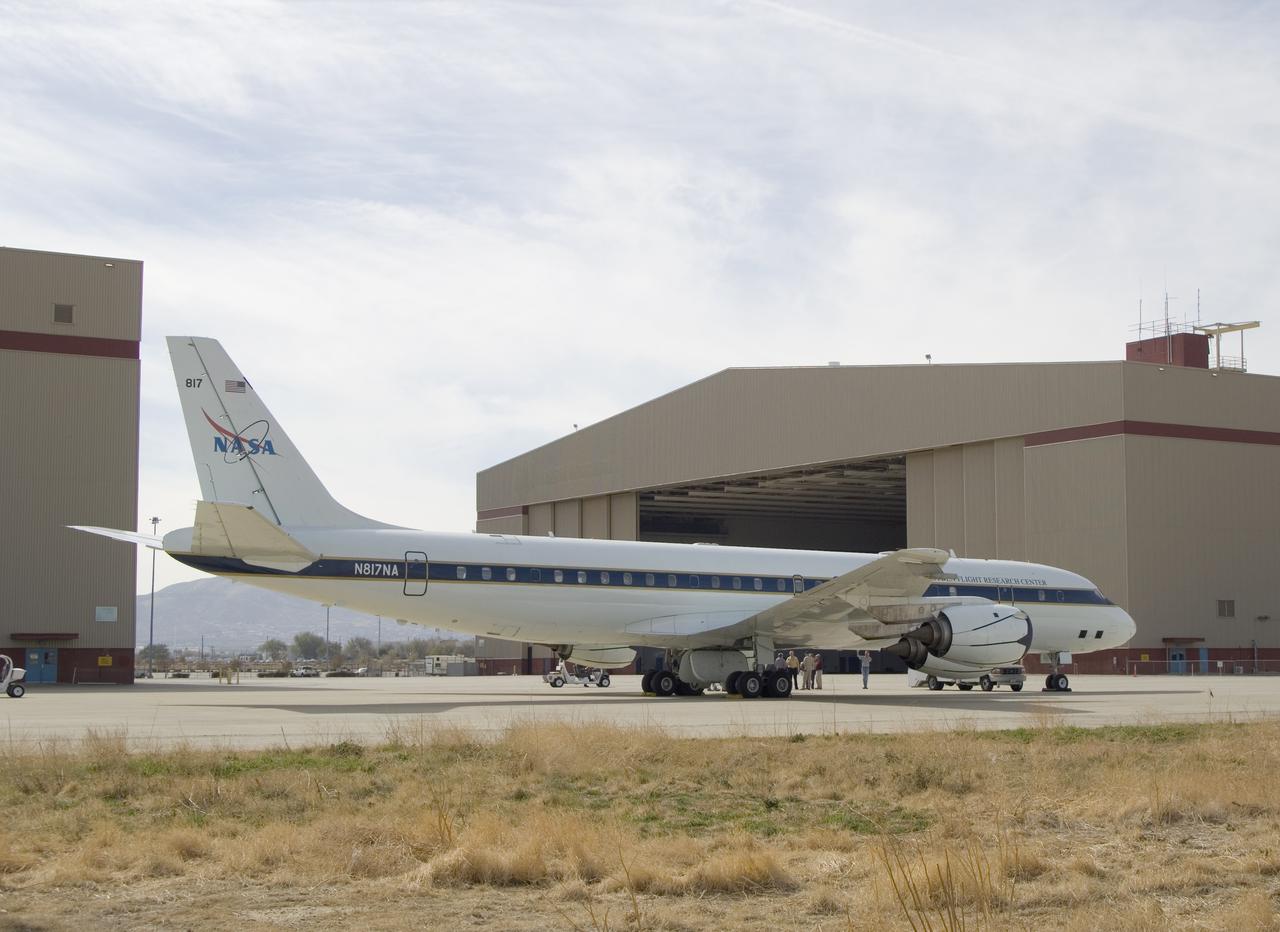
NASA's DC-8 airborne science laboratory has become the first science aircraft to be based at the Dryden Aircraft Operations Facility in Palmdale, Calif.
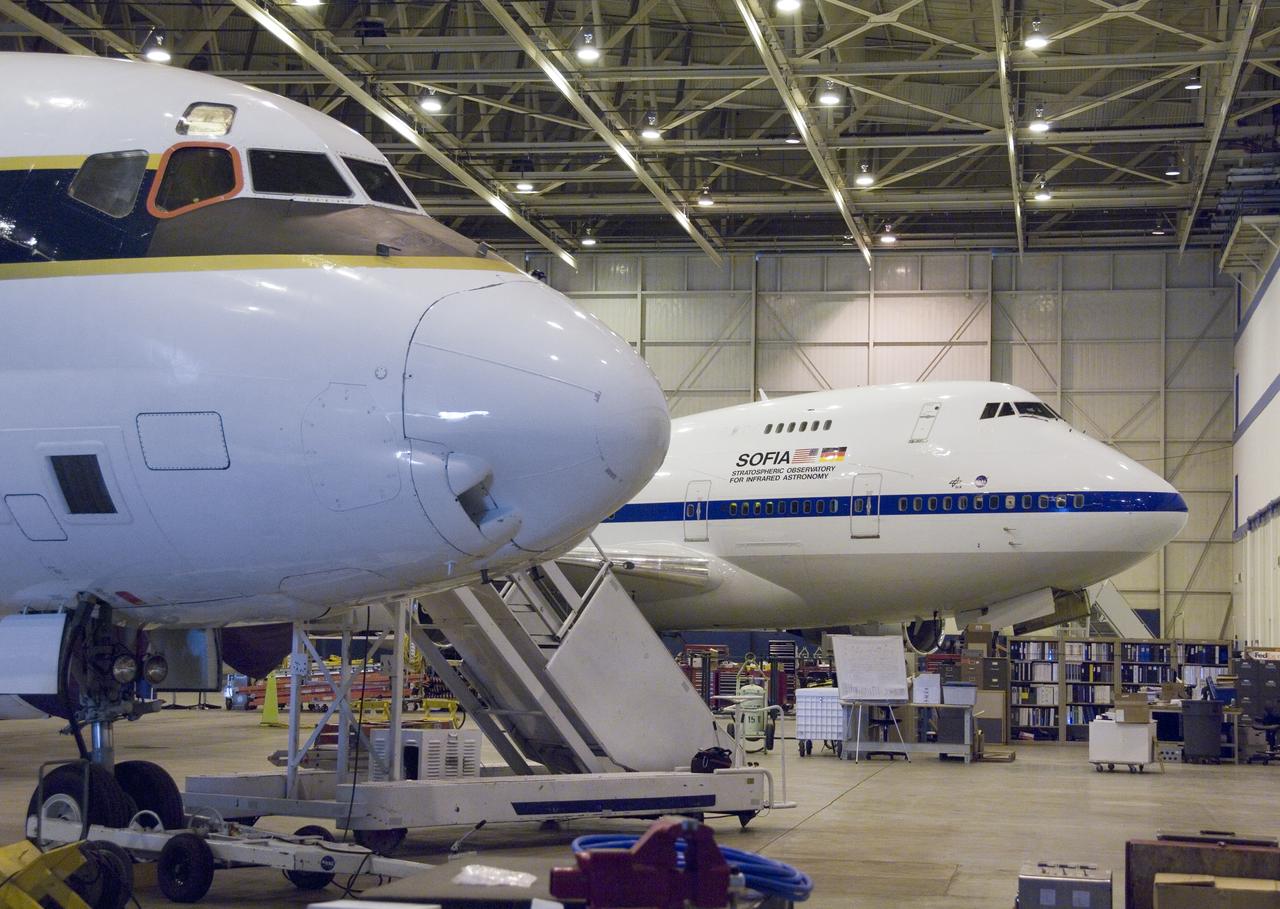
The cavernous expanse of the Dryden Aircraft Operations Facility in Palmdale, Calif., now houses NASA's DC-8 science laboratory and SOFIA infrared observatory.
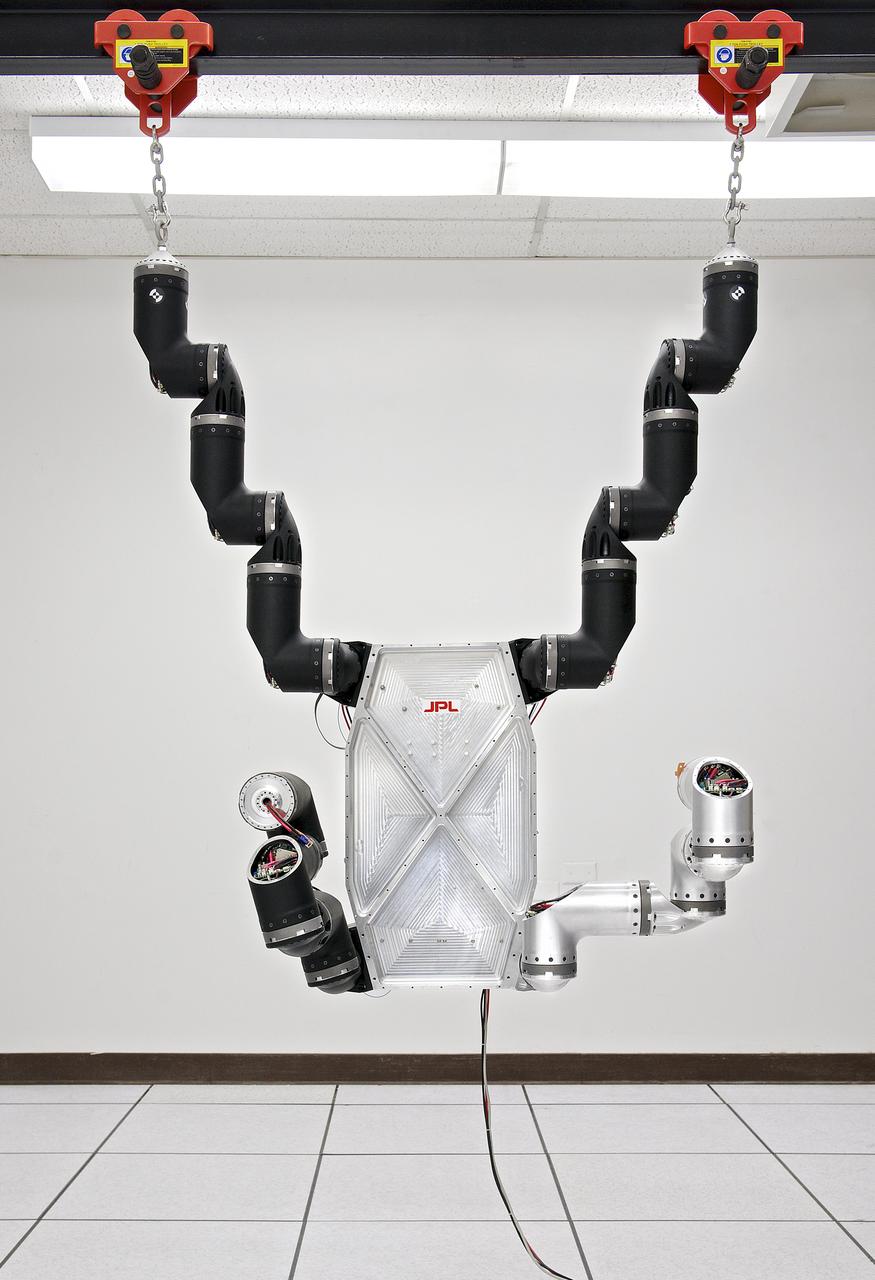
This photograph shows RoboSimian, a disaster-relief and -mitigation robot, under construction in a lab at NASA Jet Propulsion Laboratory, Pasadena, Calif.
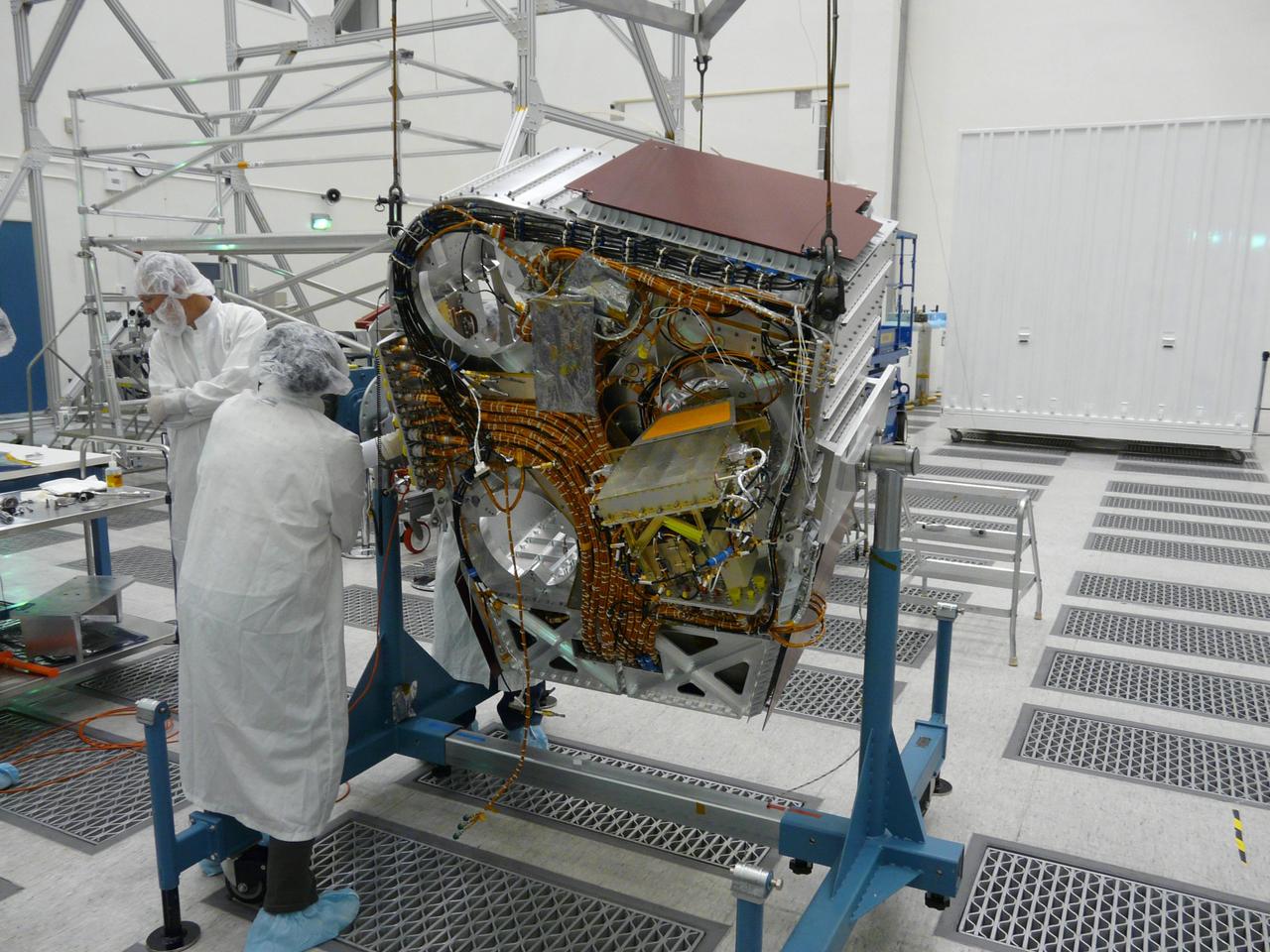
Engineers check cables on back of Aquarius instrument in the clean room at NASA Jet Propulsion Laboratory in Pasadena, Calif.
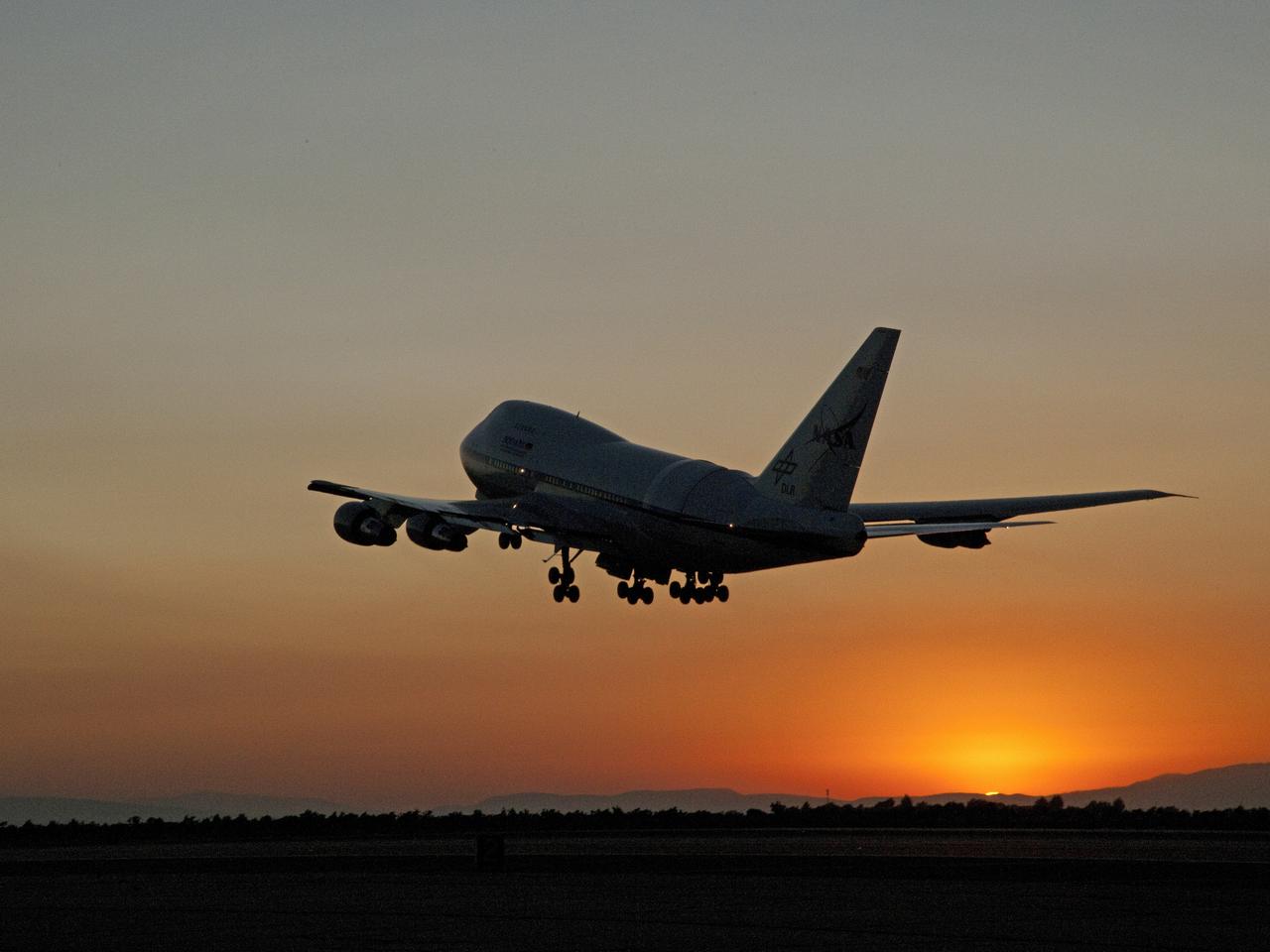
SOFIA lifts off from Air Force Plant 42 in Palmdale, Calif., at sunset.
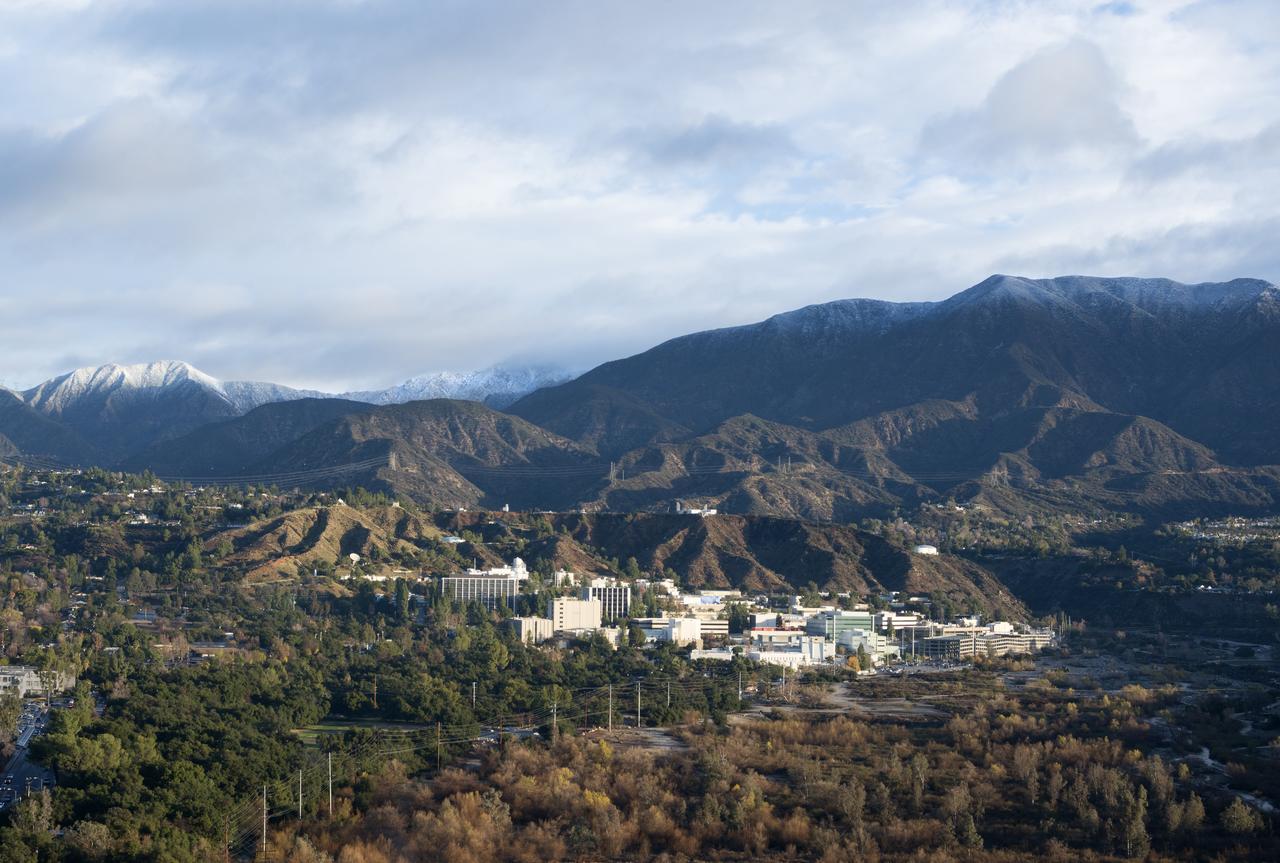
Photo of NASA's Jet Propulsion Laboratory nestled in the Pasadena, Calif. hillside, taken in January, 2016.
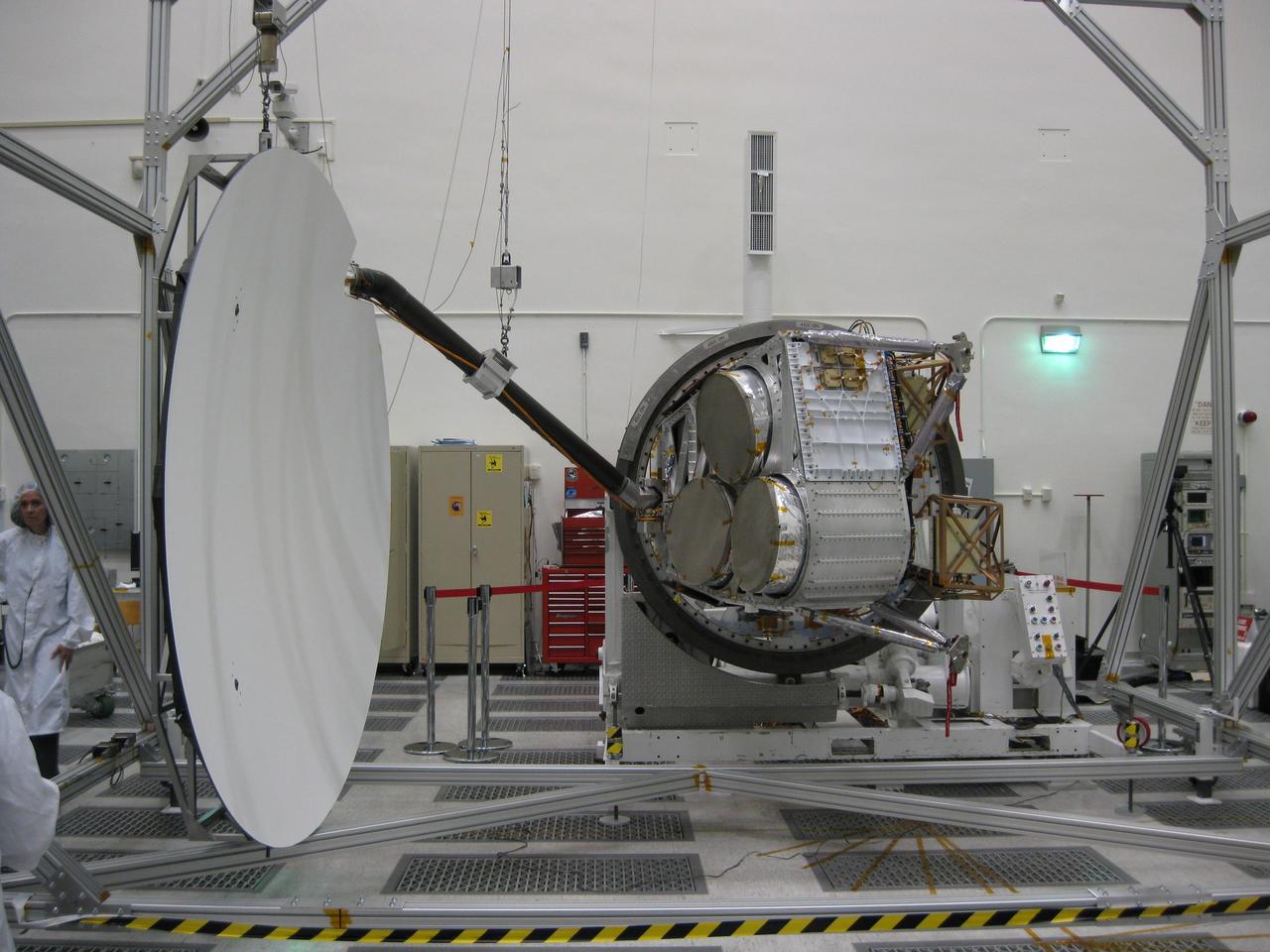
Aquarius reflector deployment is tested in the clean room at NASA Jet Propulsion Laboratory in Pasadena, Calif.
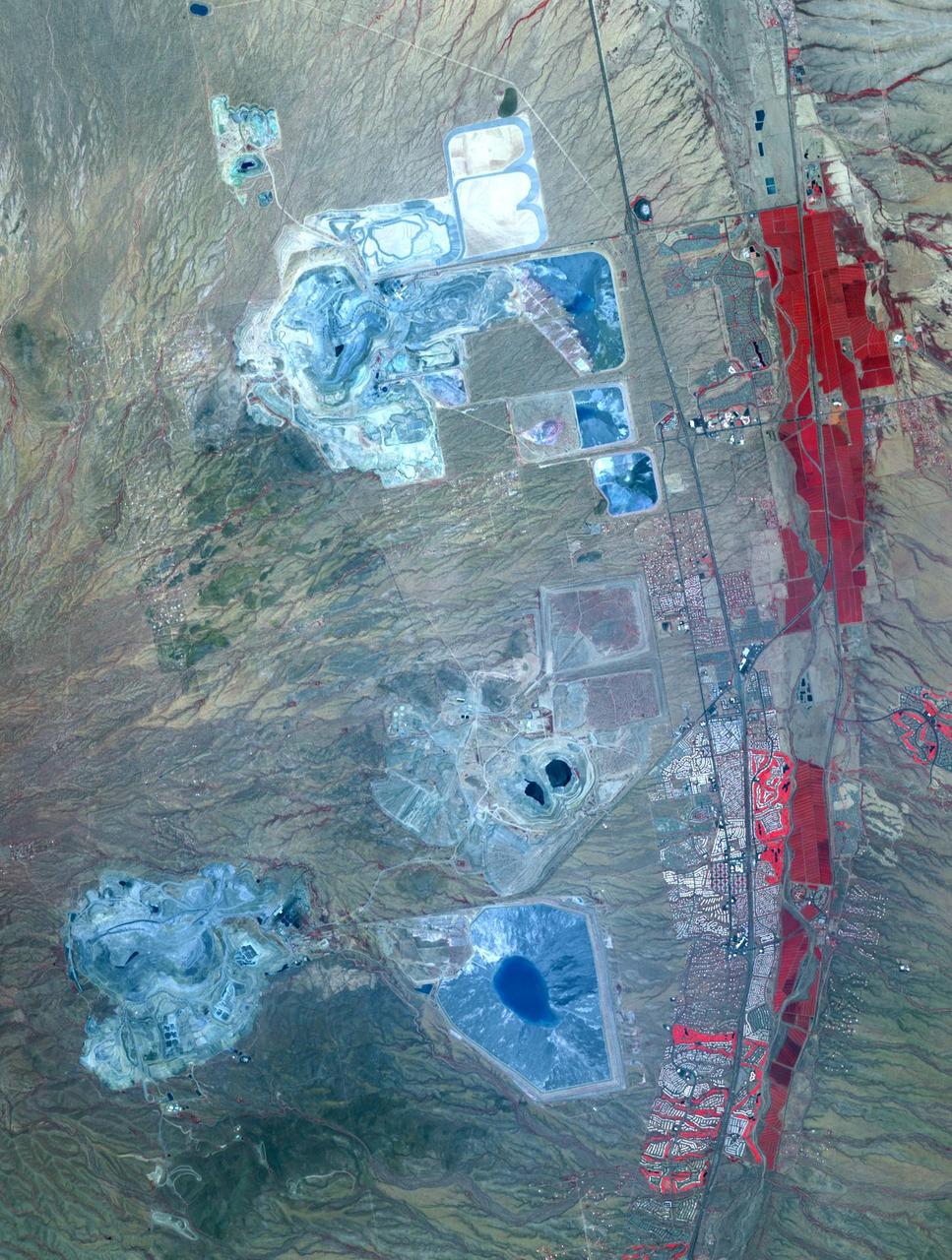
This image acquired by NASA Terra spacecraft shows Arizona, Calif., which produces 60% of the total copper mined in the United States.
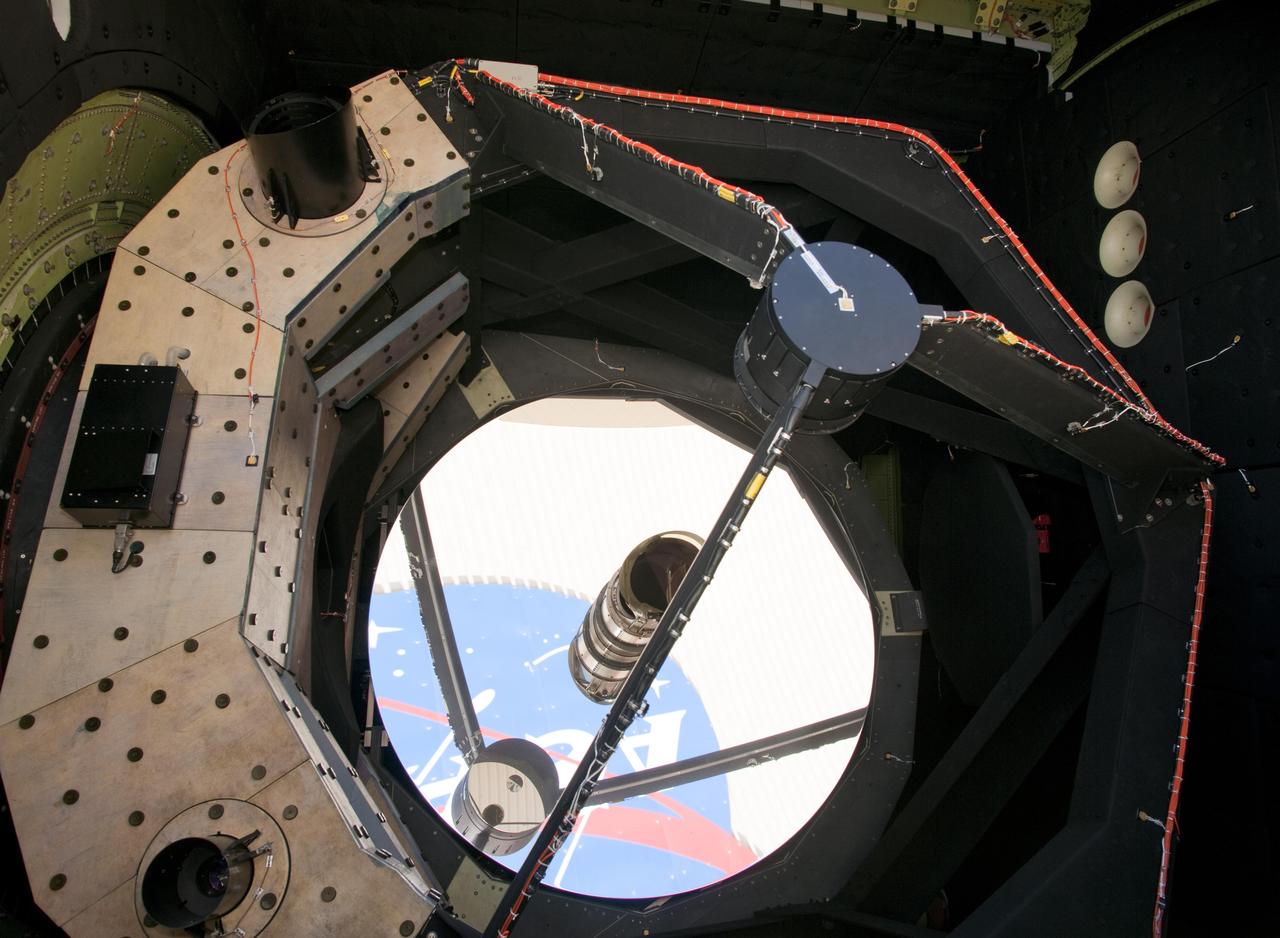
The NASA logo on Bldg. 703 at Armstrong Flight Research Center in Palmdale, Calif., is reflected in the telescope's 2.5-meter primary mirror.
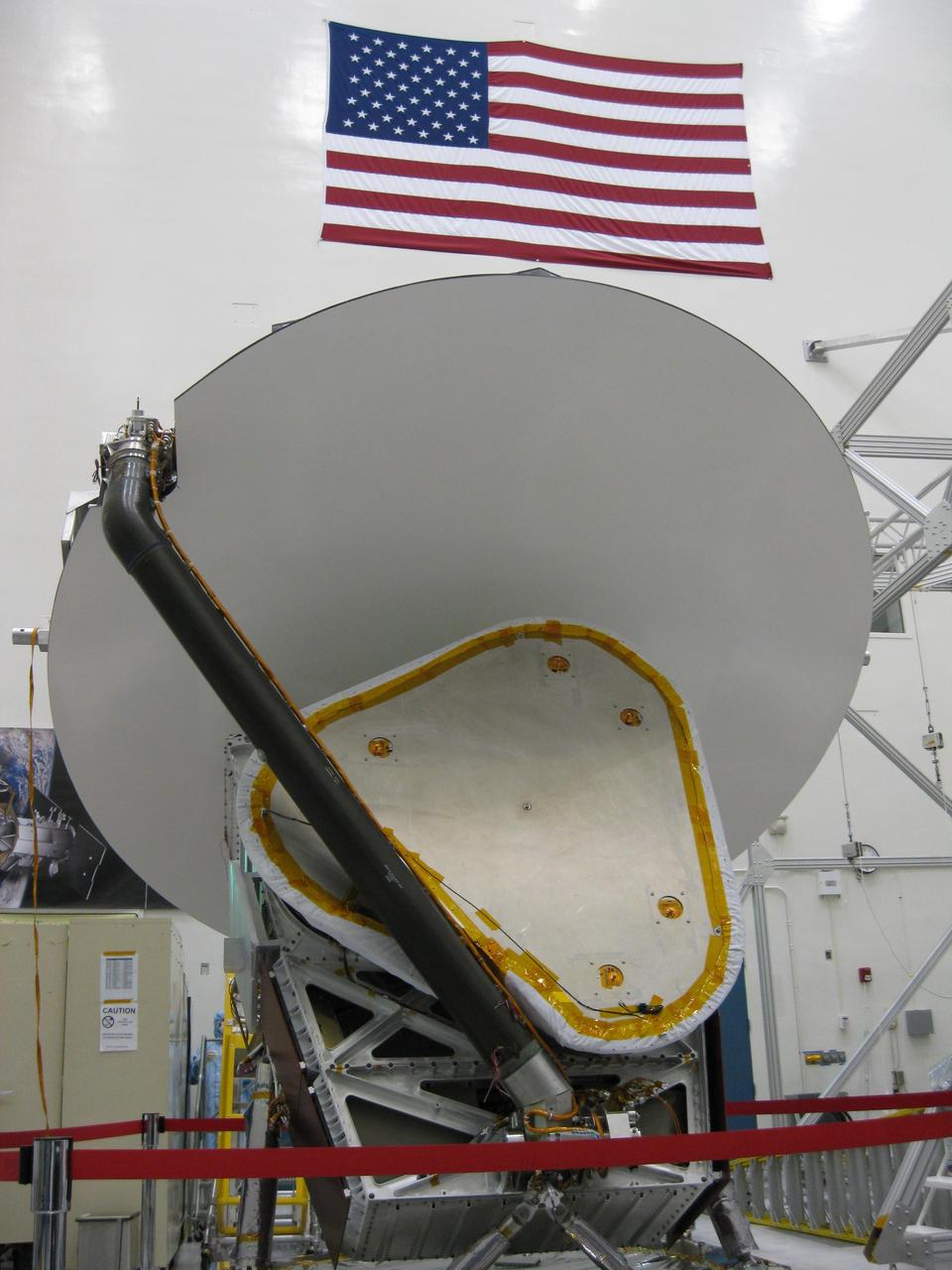
Aquarius instrument, including 2.5 meter reflector, in the clean room at NASA Jet Propulsion Laboratory in Pasadena, Calif.
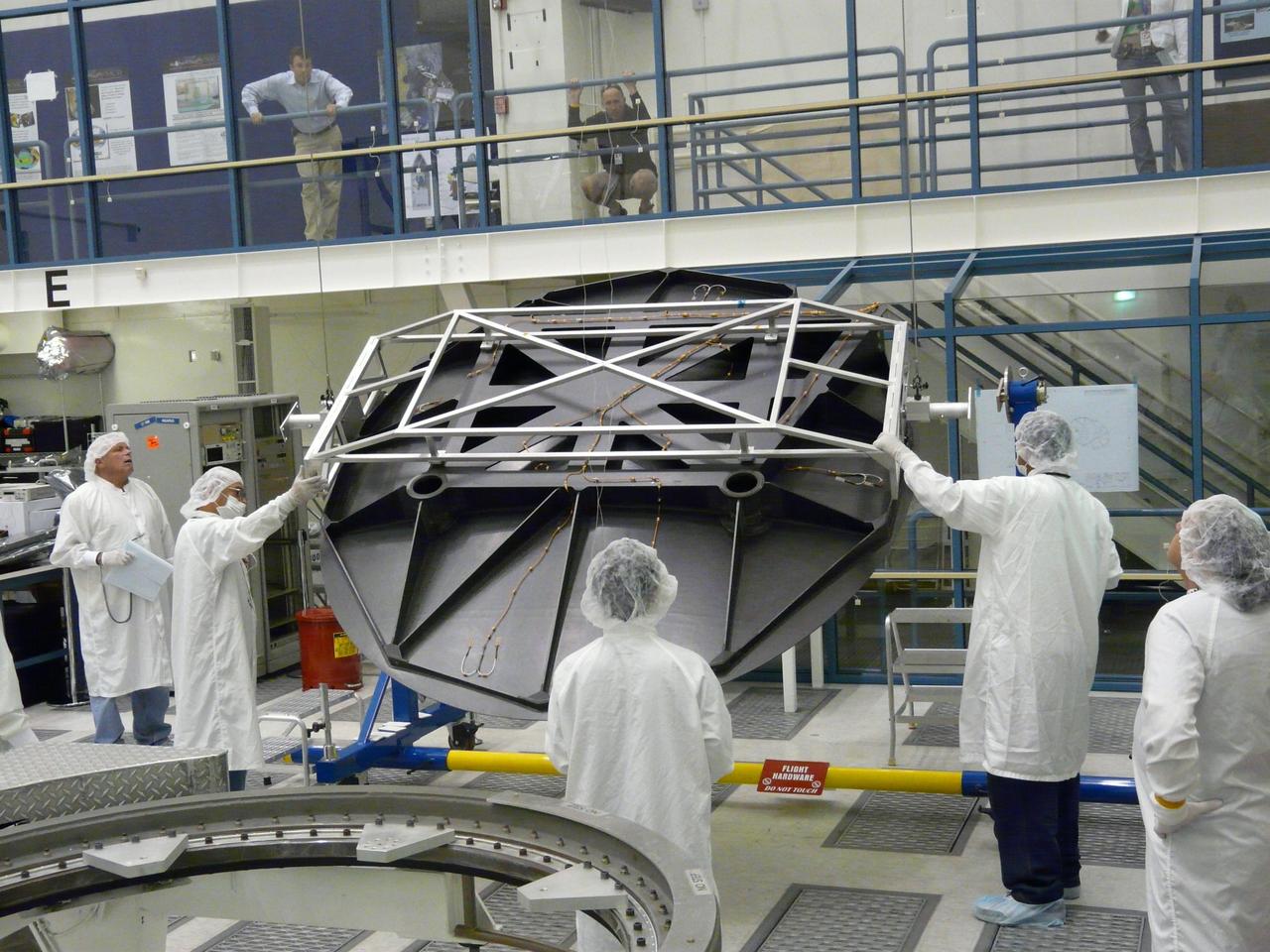
Engineers test Aquarius 2.5 meter reflector in the clean room at NASA Jet Propulsion Laboratory in Pasadena, Calif.
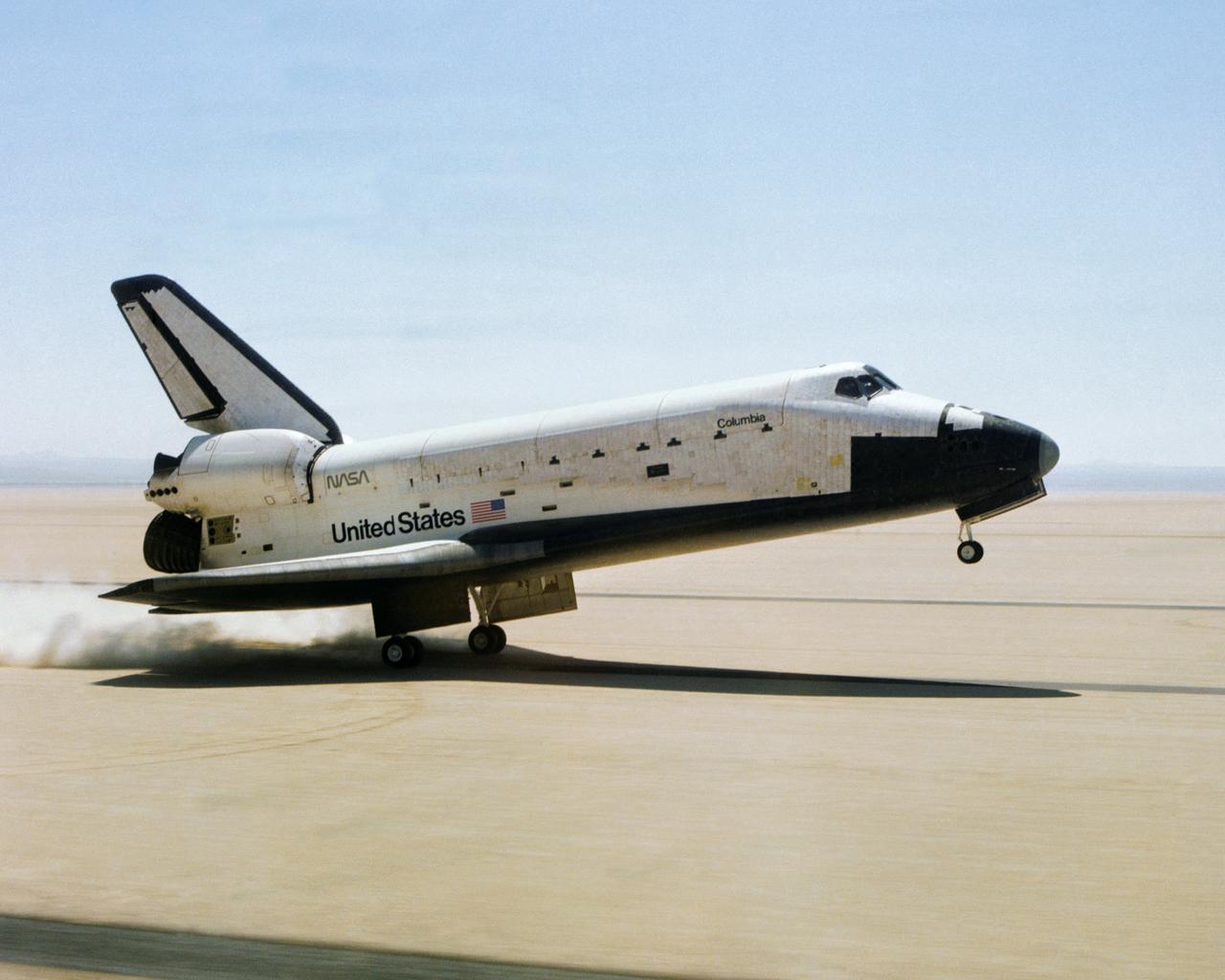
The Space Shuttle Columbia touches down on lakebed runway 23 at Edwards Air Force Base, Calif., to conclude the first orbital shuttle mission. (JSC photo # S81-30734)
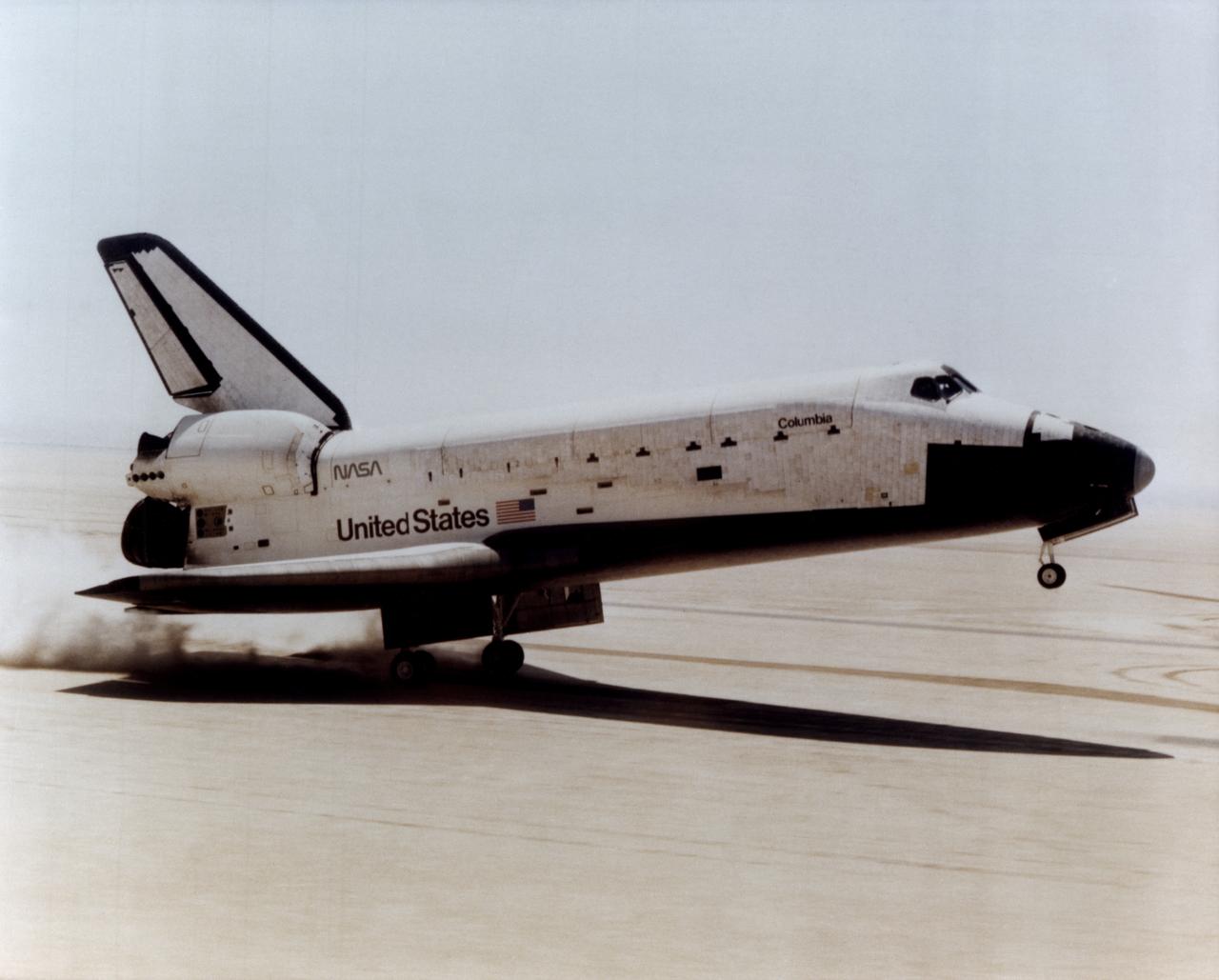
TOUCHDOWN! -- The Space Shuttle Columbia touches down on lakebed runway 23 at Edwards Air Force Base, Calif., to conclude the first orbital shuttle mission, April 14, 1981.
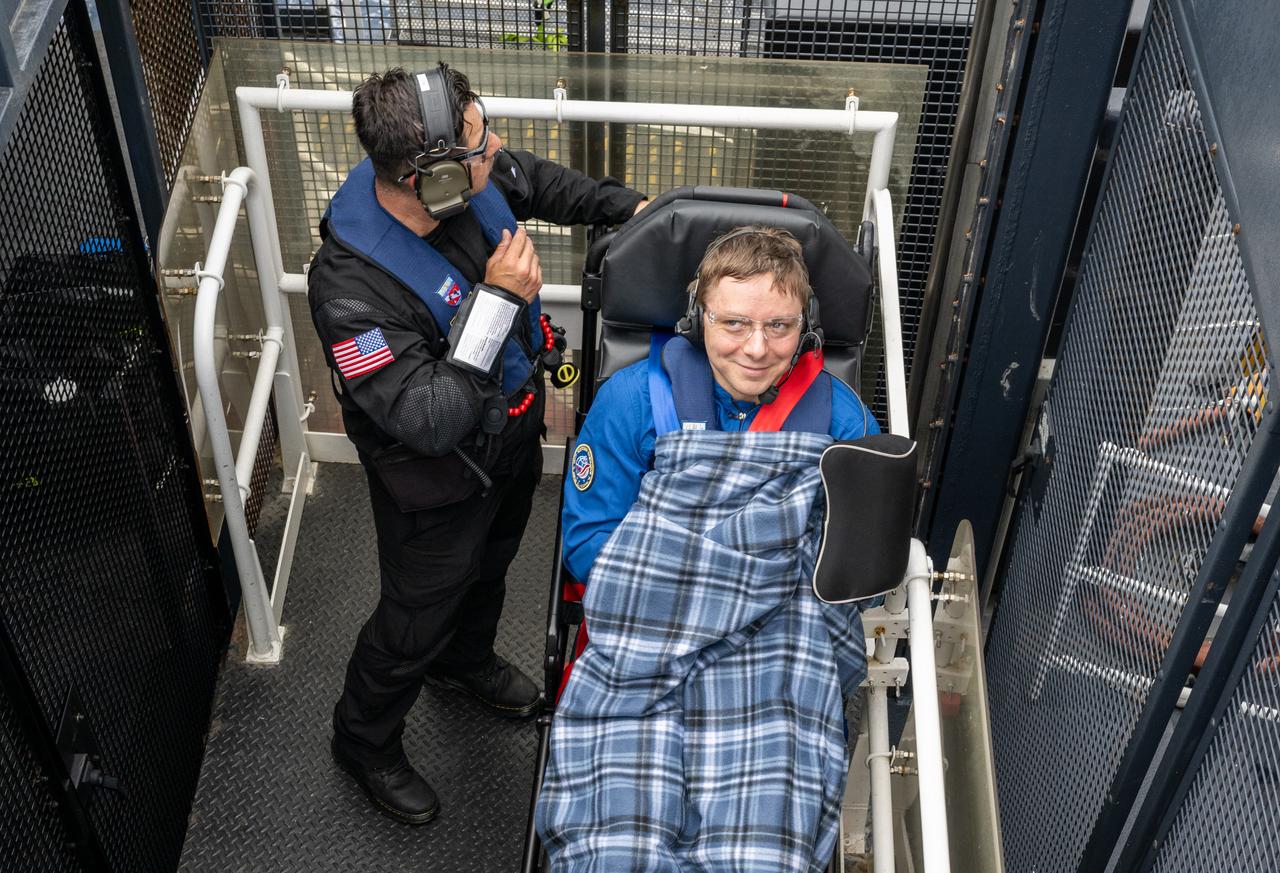
Roscosmos cosmonaut Kirill Peskov is seen inside an elevator onboard the SpaceX recovery ship SHANNON that will take him up to a waiting helicopter to fly to Long Beach, Calif. along with NASA astronauts Nichole Ayers, Anne McClain and JAXA (Japan Aerospace Exploration Agency) astronaut Takuya Onishi shortly after they landed in the Pacific Ocean off the coast of San Diego, Calif., Saturday, Aug. 9, 2025. McClain, Ayers, Onishi, and Peskov are returning after 147 days in space as part of Expedition 73 aboard the International Space Station. Photo Credit: (NASA/Keegan Barber)

A destructive forest fire broke out June 24, 2007 near South Lake Tahoe, Calif. This image was acquired by NASA Terra on June 27, 2007.
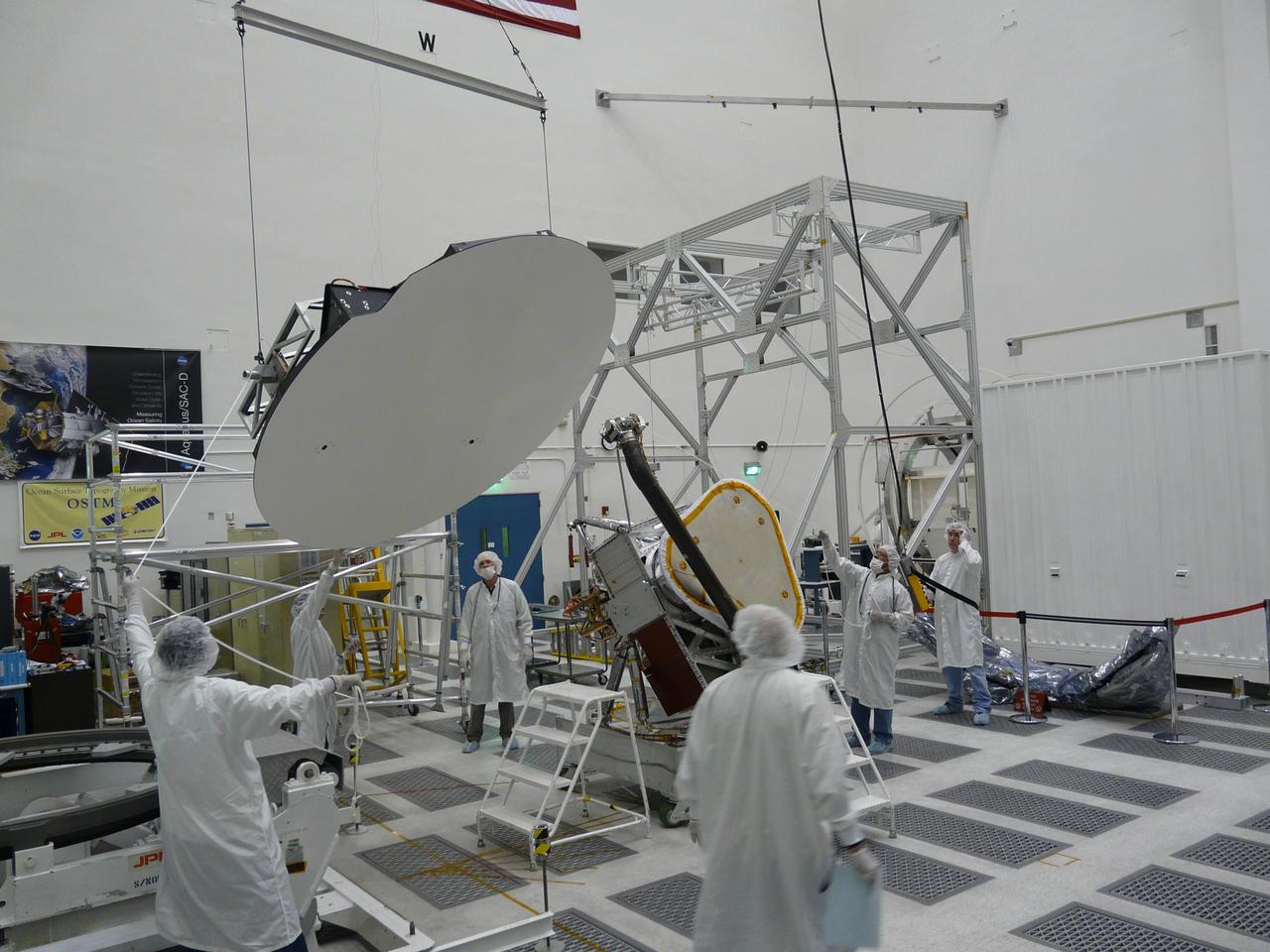
Aquarius 2.5 meter reflector is hoisted before being attached to boom in the clean room at NASA Jet Propulsion Laboratory in Pasadena, Calif.
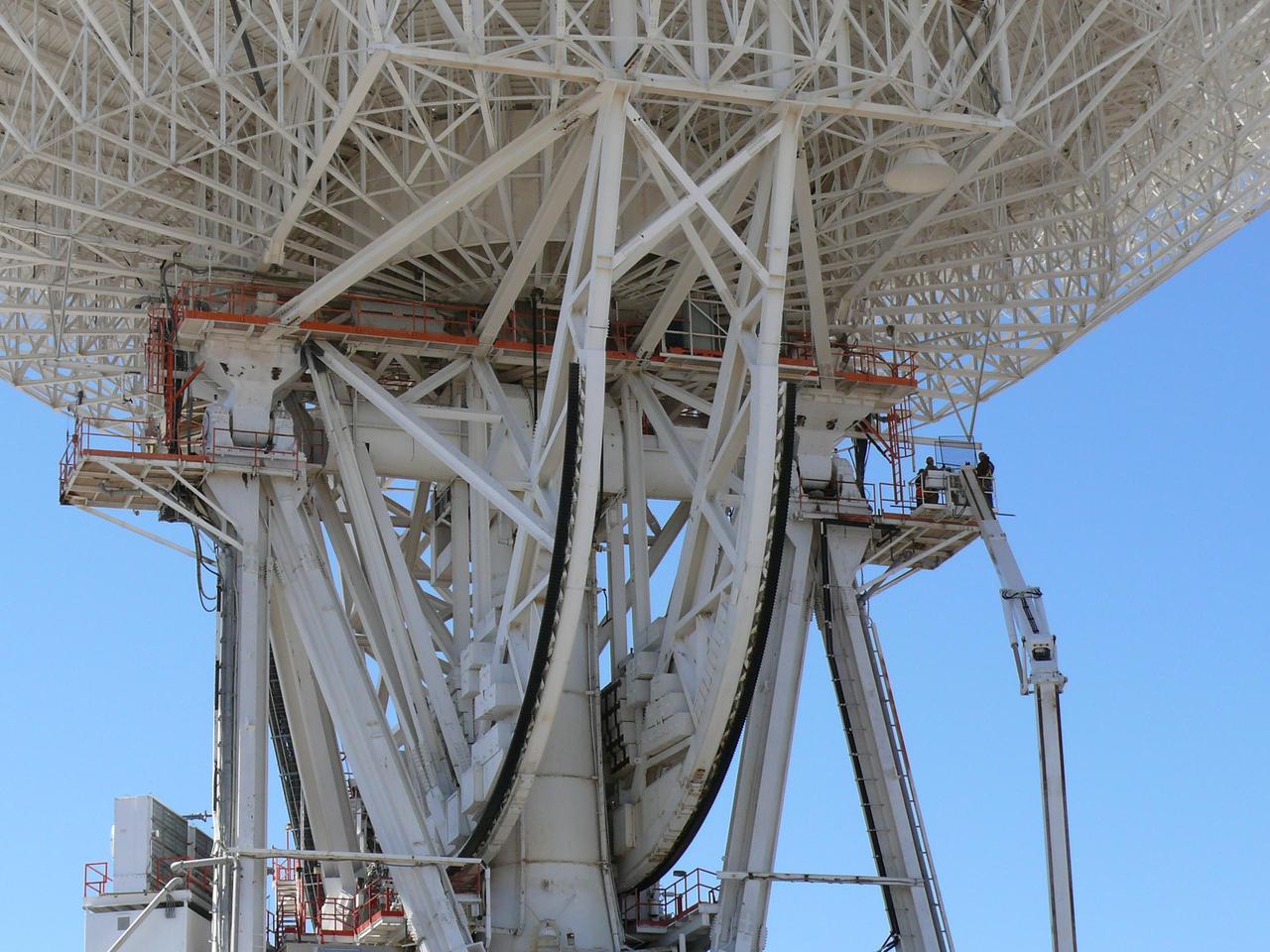
Work began on March 11, 2010 to replace a set of elevation bearings on the giant Mars antenna at NASA Deep Space Network complex in Goldstone, Calif.
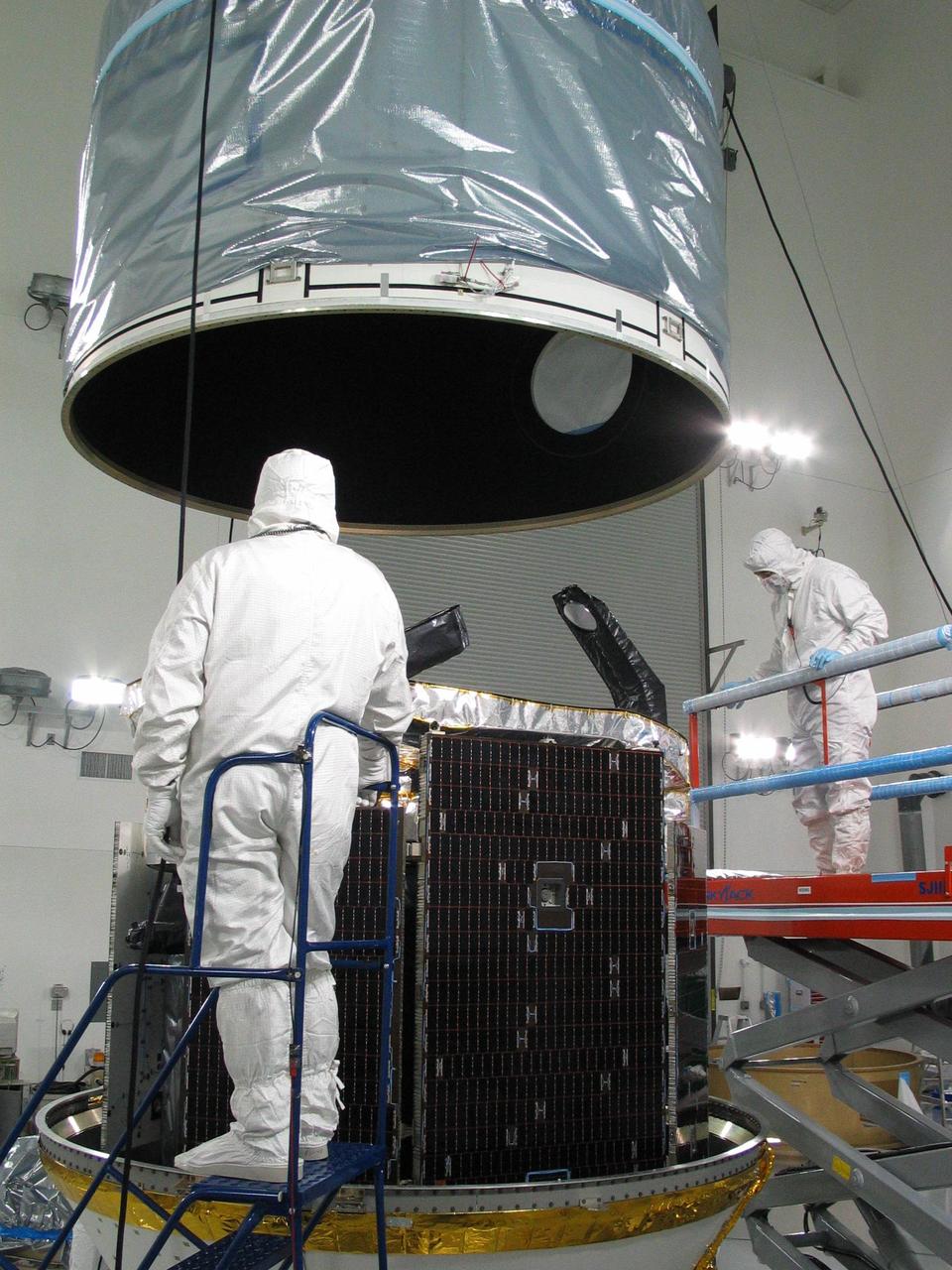
NASA CloudSat spacecraft sits encapsulated within its Boeing Delta launch vehicle dual payload attach fitting at Vandenberg Air Force Base, Calif.
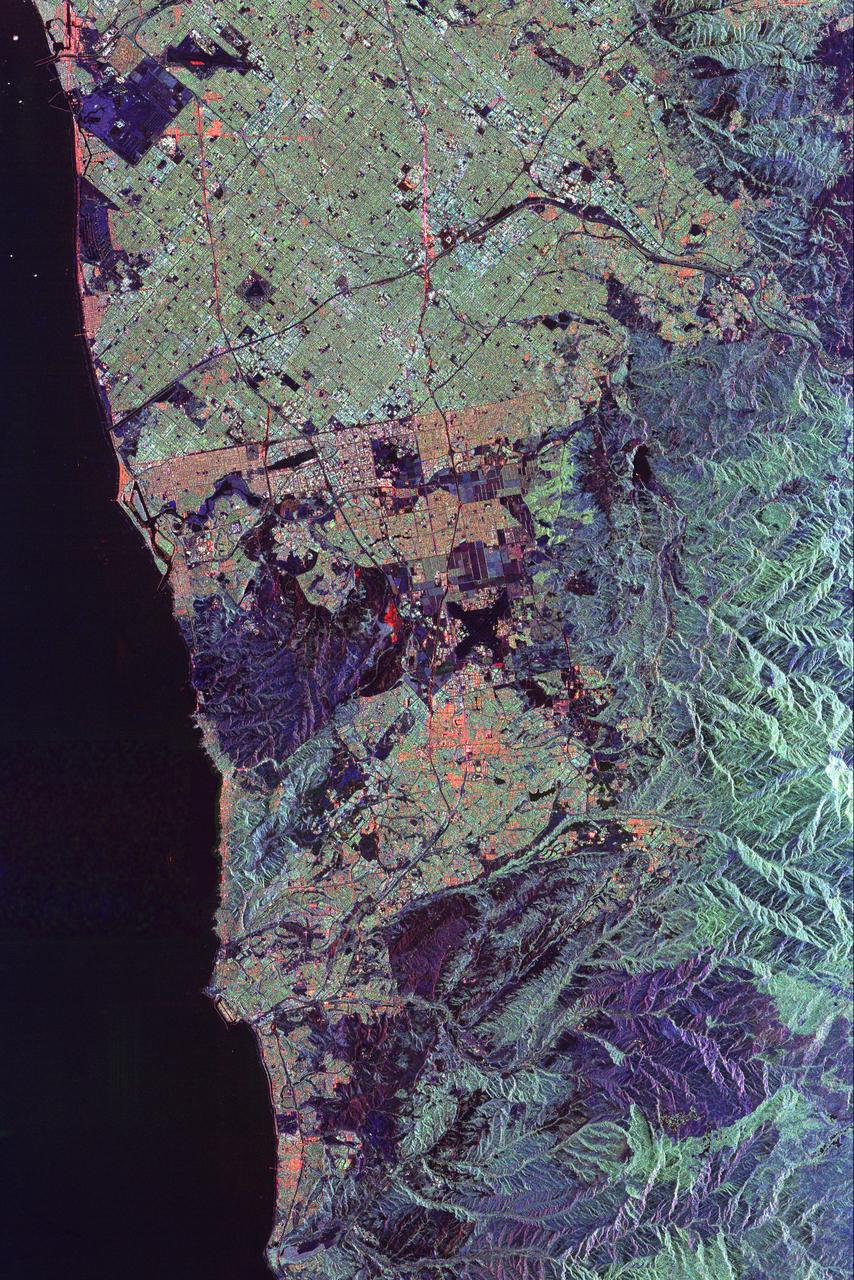
This spaceborne radar image of Orange County, Calif., shows the massive urbanization of this rapidly growing region located just south of Los Angeles.
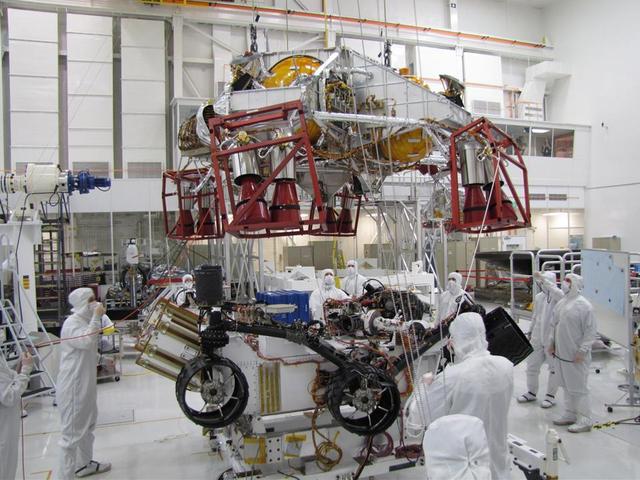
Spacecraft specialists test the descent stage and rover of the Mars Science Laboratory in this scene from the Spacecraft Assembly Facility at NASA Jet Propulsion Laboratory, Pasadena, Calif.
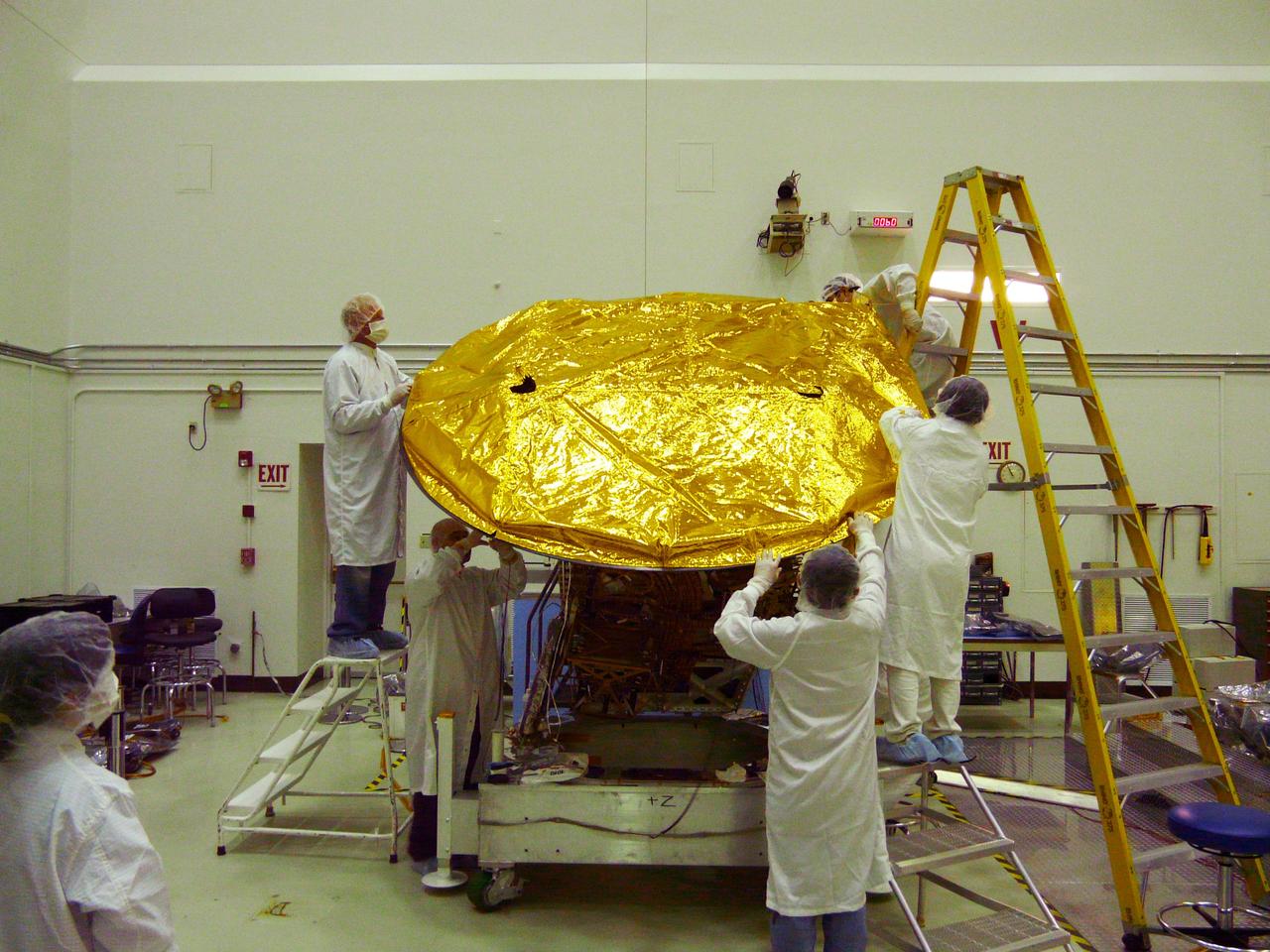
Aquarius 2.5 meter composite reflector being fitted with gold foil covering in the clean room at NASA Jet Propulsion Laboratory in Pasadena, Calif.
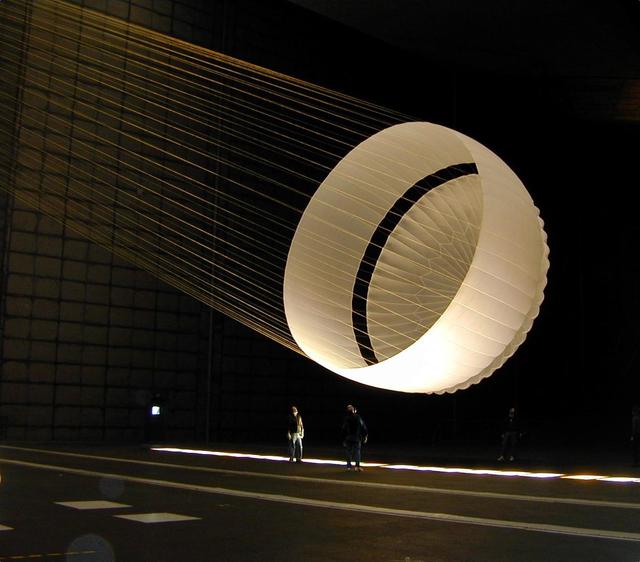
NASA Mars Exploration Rover parachute deployment testing in the world largest wind tunnel at NASA Ames Research Center, Moffet Field, Calif.
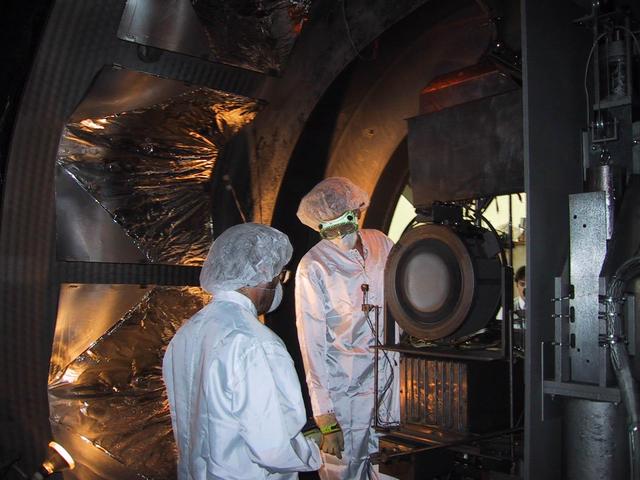
An ion thruster is removed from a vacuum chamber at NASA Jet Propulsion Laboratory, Pasadena, Calif., its job done following almost five years of testing.
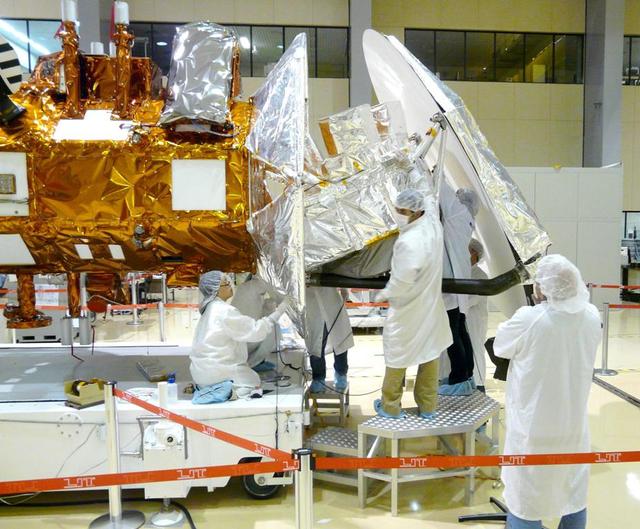
Technicians from NASA Jet Propulsion Laboratory in Pasadena, Calif., install thermal blankets on the Aquarius instrument at Brazil National Institute for Space Research.
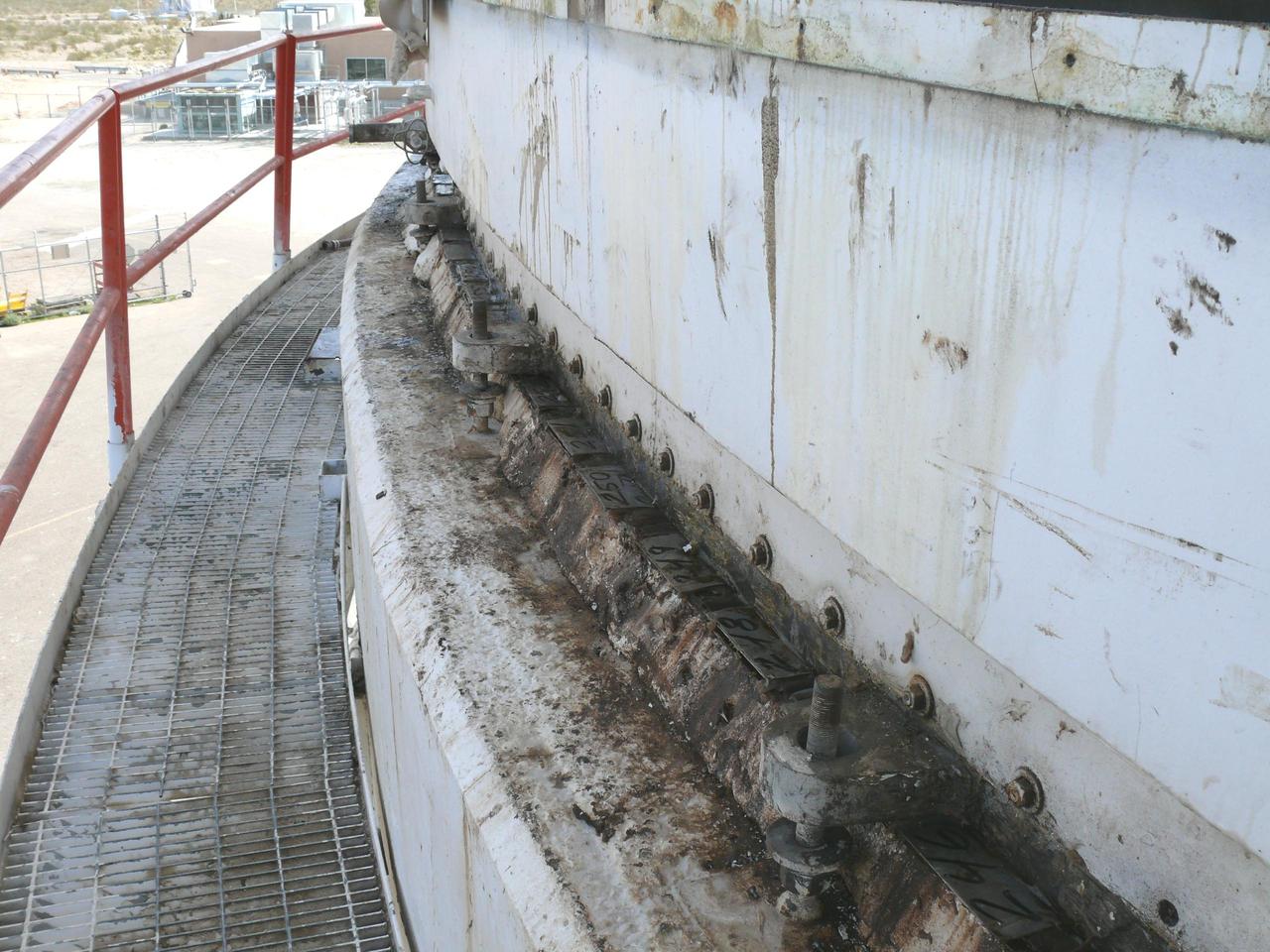
This image, taken on March 22, 2010, shows the condition of grout that was replaced in the giant Mars antenna at NASA Deep Space Network Goldstone, Calif. complex.
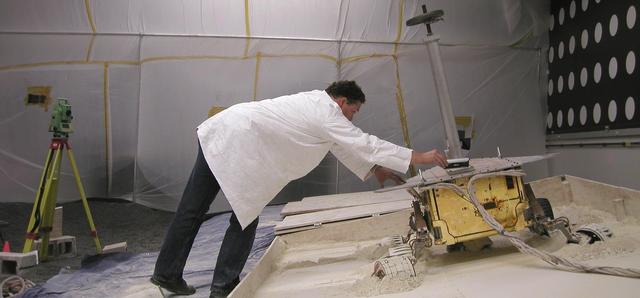
Tests of possible maneuvers for use by NASA rover Spirit on Mars include use of this lightweight test rover at the Jet Propulsion Laboratory, Pasadena, Calif.
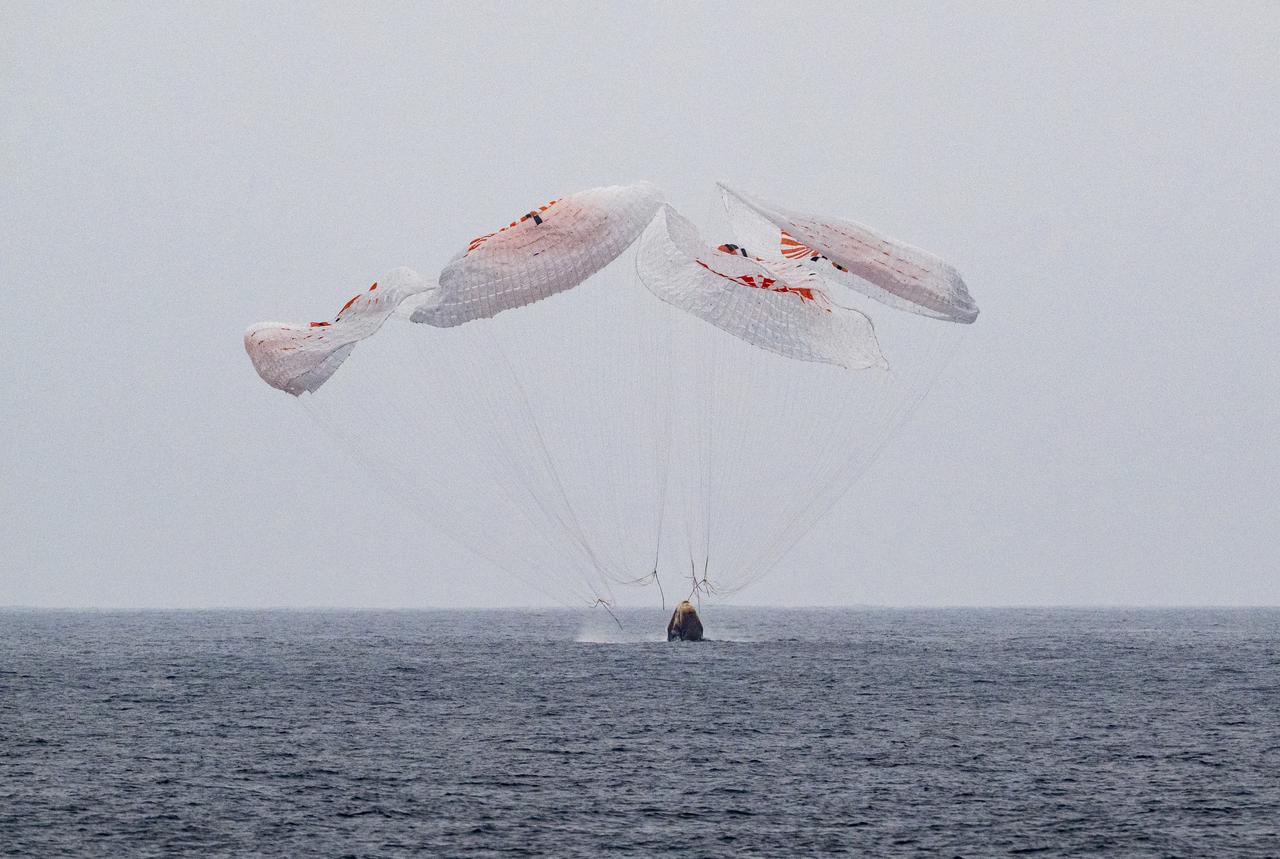
The SpaceX Crew Dragon Endurance spacecraft is seen as it lands with NASA astronauts Anne McClain and Nichole Ayers, JAXA (Japan Aerospace Exploration Agency) astronaut Takuya Onishi, and Roscosmos cosmonaut Kirill Peskov aboard in the Pacific Ocean off the coast of San Diego, Calif., Saturday, Aug. 9, 2025. McClain, Ayers, Onishi, and Peskov are returning after 147 days in space as part of Expedition 73 aboard the International Space Station. Photo Credit: (NASA/Keegan Barber)
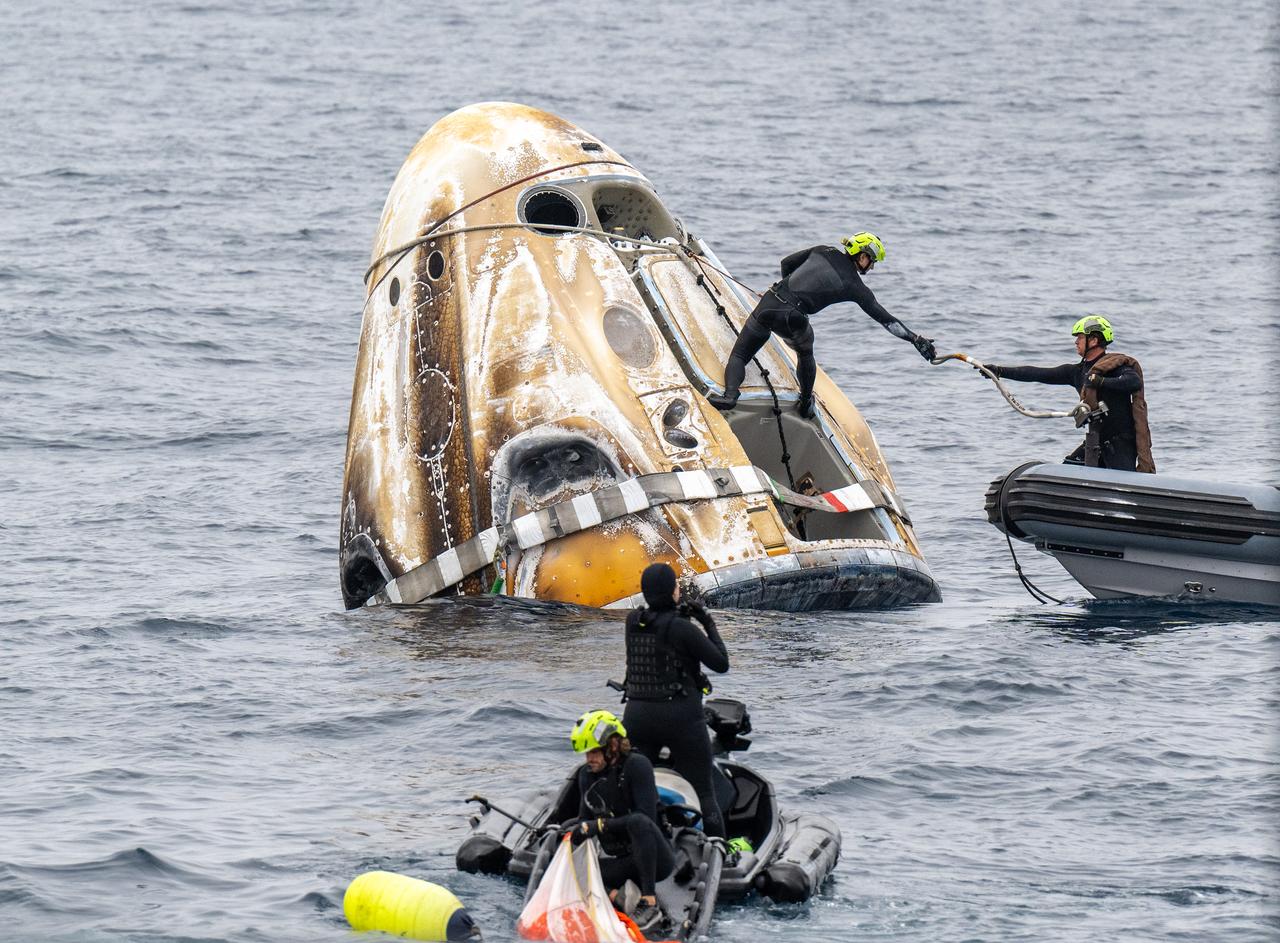
Support teams work around the SpaceX Dragon Endurance spacecraft shortly after it landed with NASA astronauts Anne McClain and Nichole Ayers, JAXA (Japan Aerospace Exploration Agency) astronaut Takuya Onishi, and Roscosmos cosmonaut Kirill Peskov aboard in the Pacific Ocean off the coast of San Diego, Calif., Saturday, Aug. 9,2025. McClain, Ayers, Onishi, and Peskov are returning after 147 days in space as part of Expedition 73 aboard the International Space Station. Photo Credit: (NASA/Keegan Barber)
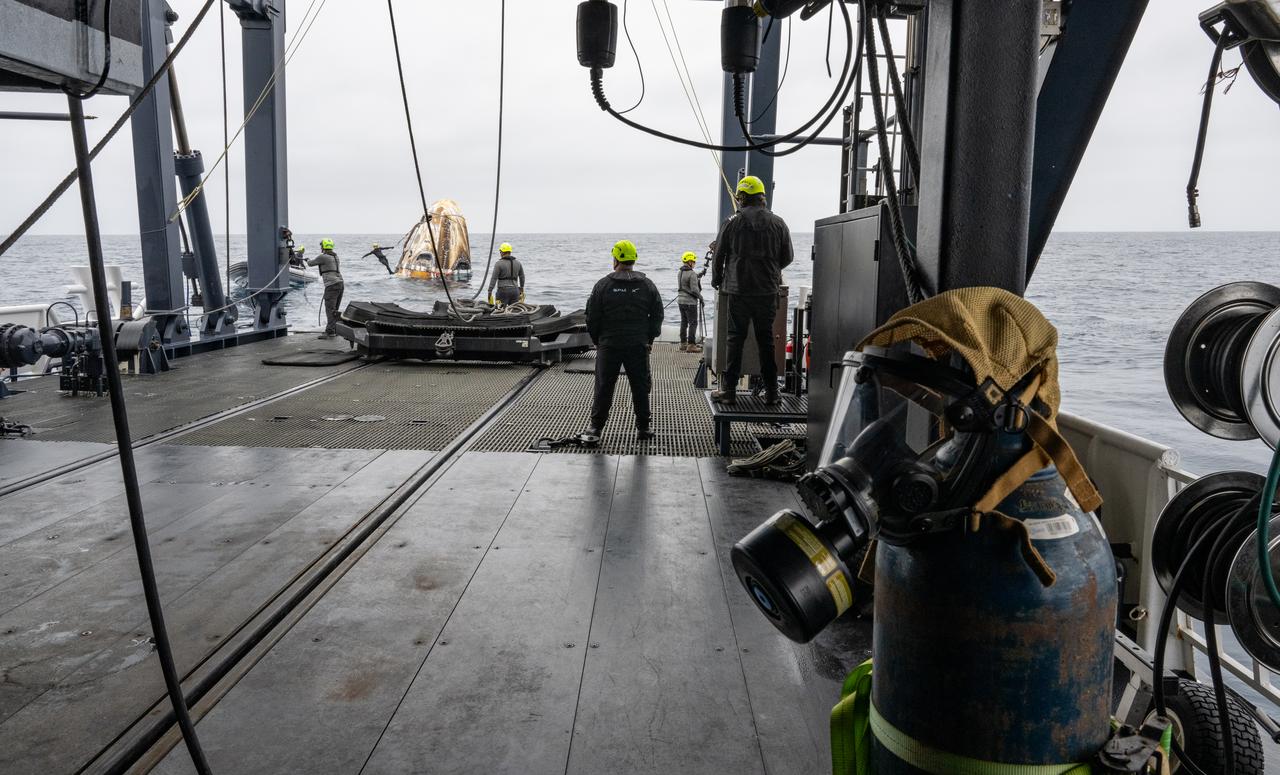
Support teams work around the SpaceX Dragon Endurance spacecraft shortly after it landed with NASA astronauts Anne McClain and Nichole Ayers, JAXA (Japan Aerospace Exploration Agency) astronaut Takuya Onishi, and Roscosmos cosmonaut Kirill Peskov aboard in the Pacific Ocean off the coast of San Diego, Calif., Saturday, Aug. 9,2025. McClain, Ayers, Onishi, and Peskov are returning after 147 days in space as part of Expedition 73 aboard the International Space Station. Photo Credit: (NASA/Keegan Barber)
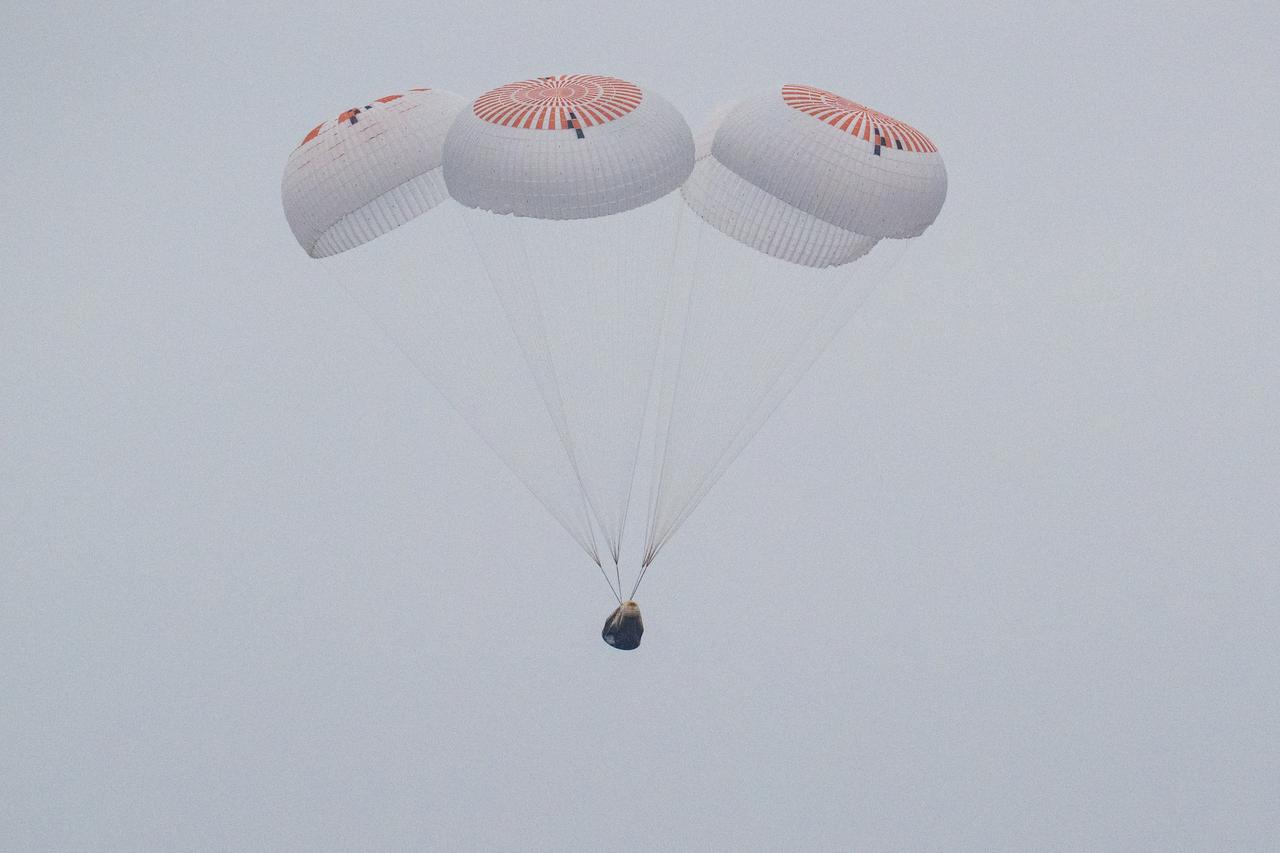
The SpaceX Crew Dragon Endurance spacecraft is seen as it lands with NASA astronauts Anne McClain and Nichole Ayers, JAXA (Japan Aerospace Exploration Agency) astronaut Takuya Onishi, and Roscosmos cosmonaut Kirill Peskov aboard in the Pacific Ocean off the coast of San Diego, Calif., Saturday, Aug. 9, 2025. McClain, Ayers, Onishi, and Peskov are returning after 147 days in space as part of Expedition 73 aboard the International Space Station. Photo Credit: (NASA/Keegan Barber)

Support teams work around the SpaceX Dragon Endurance spacecraft shortly after it landed with NASA astronauts Anne McClain and Nichole Ayers, JAXA (Japan Aerospace Exploration Agency) astronaut Takuya Onishi, and Roscosmos cosmonaut Kirill Peskov aboard in the Pacific Ocean off the coast of San Diego, Calif., Saturday, Aug. 9,2025. McClain, Ayers, Onishi, and Peskov are returning after 147 days in space as part of Expedition 73 aboard the International Space Station. Photo Credit: (NASA/Keegan Barber)
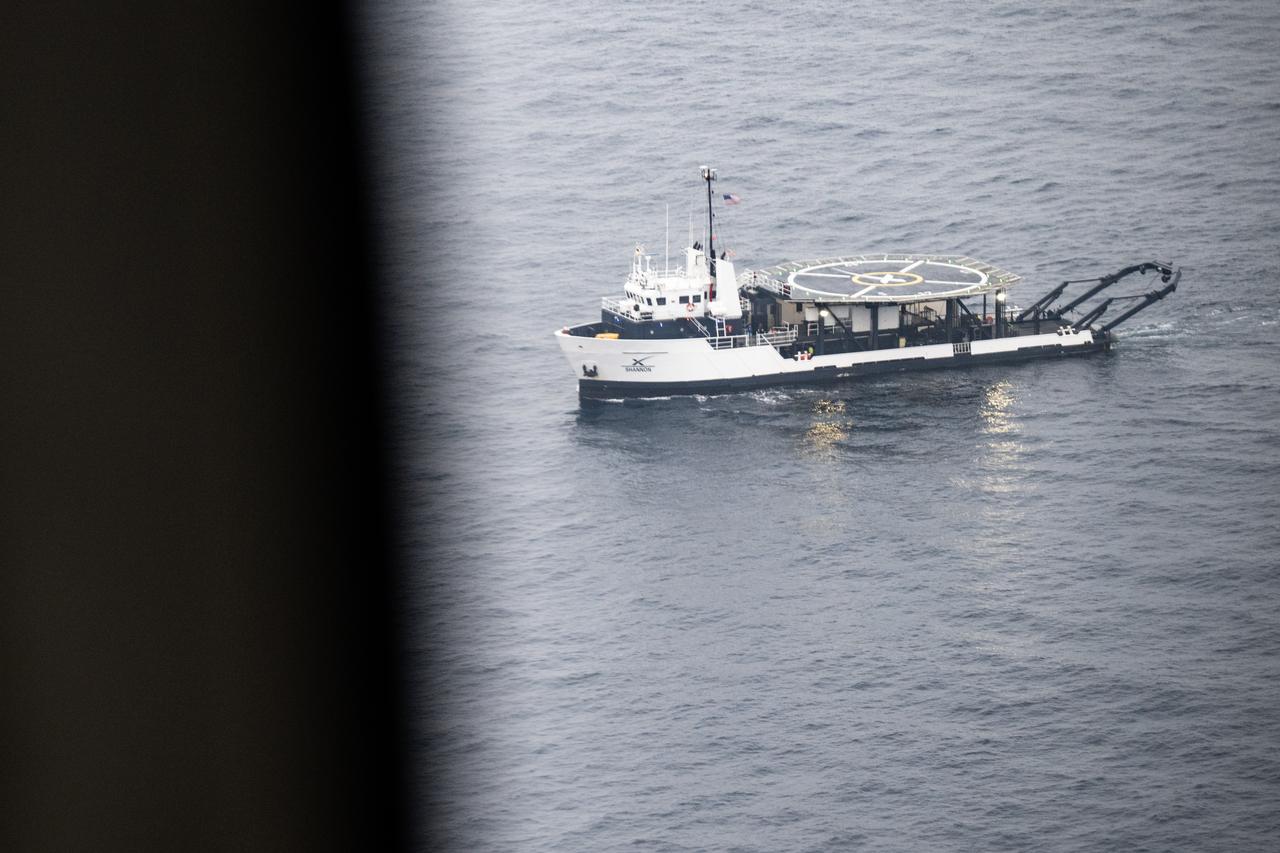
The SpaceX recovery ship SHANNON is seen in the Pacific Ocean as the recovery team prepares for the landing of the SpaceX Dragon spacecraft with NASA astronauts Anne McClain and Nichole Ayers, JAXA (Japan Aerospace Exploration Agency) astronaut Takuya Onishi, and Roscosmos cosmonaut Kirill Peskov aboard, Saturday, Aug. 9, 2025, off the coast of San Diego, Calif.. McClain, Ayers, Onishi, and Peskov are returning after 147 days in space as part of Expedition 73 aboard the International Space Station. Photo Credit: (NASA/Keegan Barber)

The helicopter carrying NASA astronauts Anne McClain and Nichole Ayers, JAXA (Japan Aerospace Exploration Agency) astronaut Takuya Onishi, and Roscosmos cosmonaut Kirill Peskov takes off from the SpaceX recovery ship SHANNON shortly after they landed in the Pacific Ocean off the coast of San Diego, Calif., Saturday, Aug. 9, 2025. McClain, Ayers, Onishi, and Peskov are returning after 147 days in space as part of Expedition 73 aboard the International Space Station. Photo Credit: (NASA/Keegan Barber)
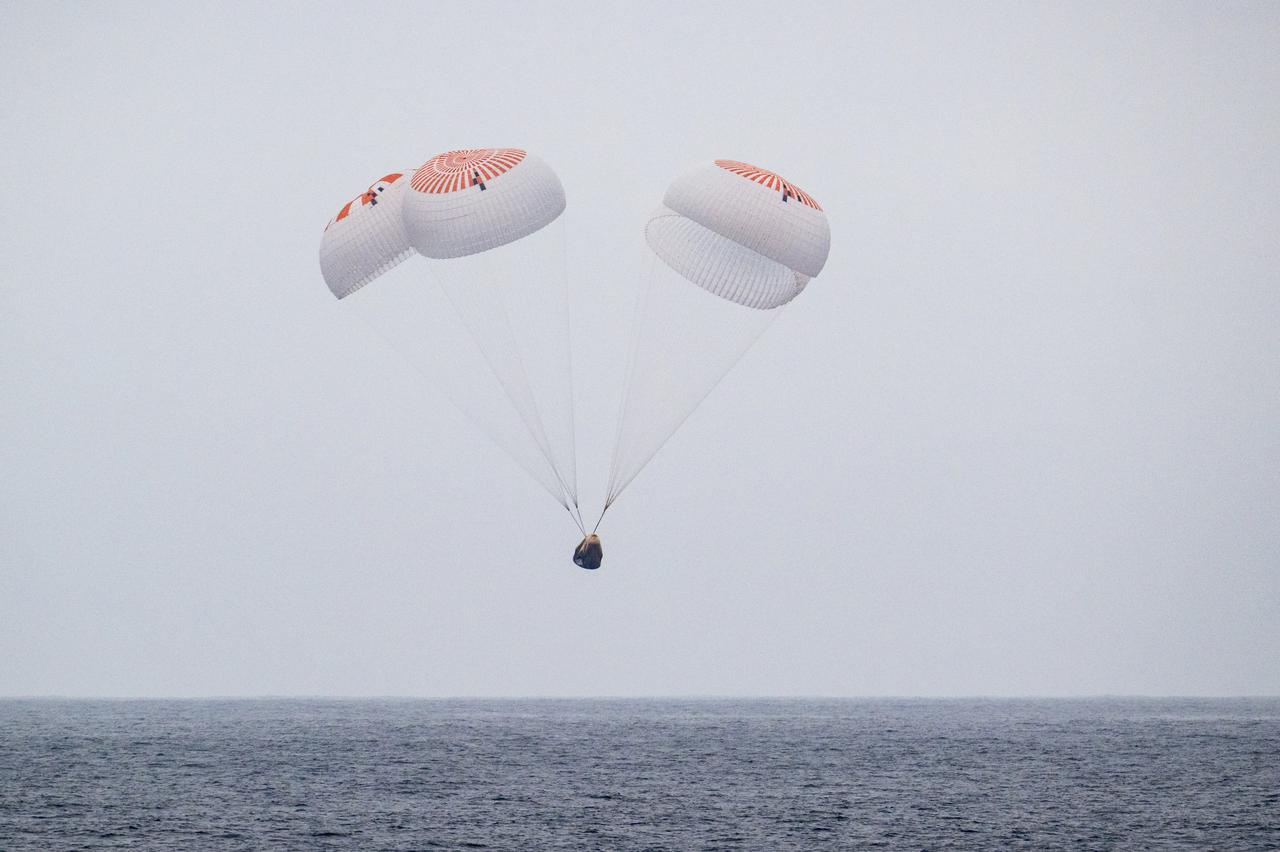
The SpaceX Crew Dragon Endurance spacecraft is seen as it lands with NASA astronauts Anne McClain and Nichole Ayers, JAXA (Japan Aerospace Exploration Agency) astronaut Takuya Onishi, and Roscosmos cosmonaut Kirill Peskov aboard in the Pacific Ocean off the coast of San Diego, Calif., Saturday, Aug. 9, 2025. McClain, Ayers, Onishi, and Peskov are returning after 147 days in space as part of Expedition 73 aboard the International Space Station. Photo Credit: (NASA/Keegan Barber)
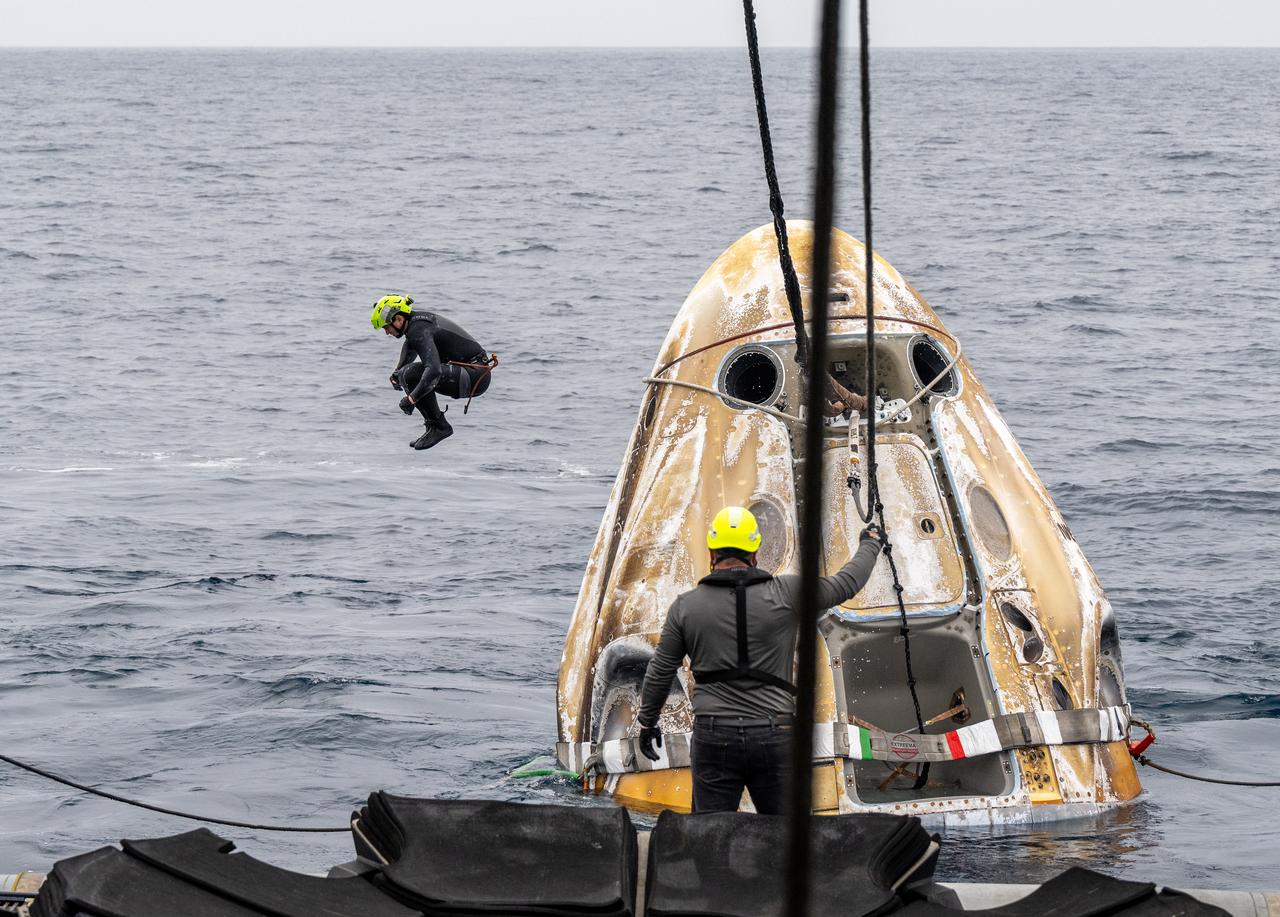
Support teams work around the SpaceX Dragon Endurance spacecraft shortly after it landed with NASA astronauts Anne McClain and Nichole Ayers, JAXA (Japan Aerospace Exploration Agency) astronaut Takuya Onishi, and Roscosmos cosmonaut Kirill Peskov aboard in the Pacific Ocean off the coast of San Diego, Calif., Saturday, Aug. 9,2025. McClain, Ayers, Onishi, and Peskov are returning after 147 days in space as part of Expedition 73 aboard the International Space Station. Photo Credit: (NASA/Keegan Barber)
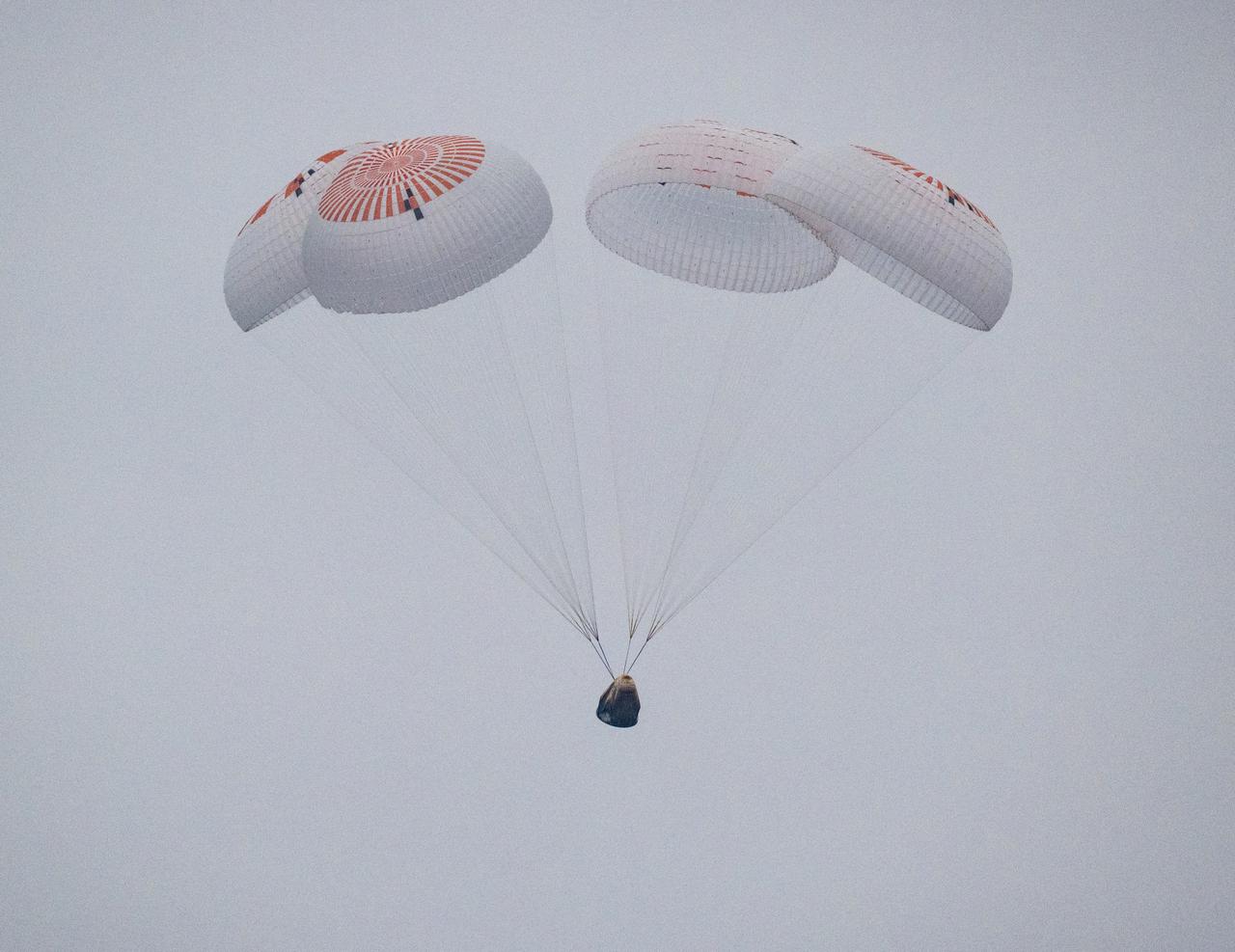
The SpaceX Crew Dragon Endurance spacecraft is seen as it lands with NASA astronauts Anne McClain and Nichole Ayers, JAXA (Japan Aerospace Exploration Agency) astronaut Takuya Onishi, and Roscosmos cosmonaut Kirill Peskov aboard in the Pacific Ocean off the coast of San Diego, Calif., Saturday, Aug. 9, 2025. McClain, Ayers, Onishi, and Peskov are returning after 147 days in space as part of Expedition 73 aboard the International Space Station. Photo Credit: (NASA/Keegan Barber)