Callisto
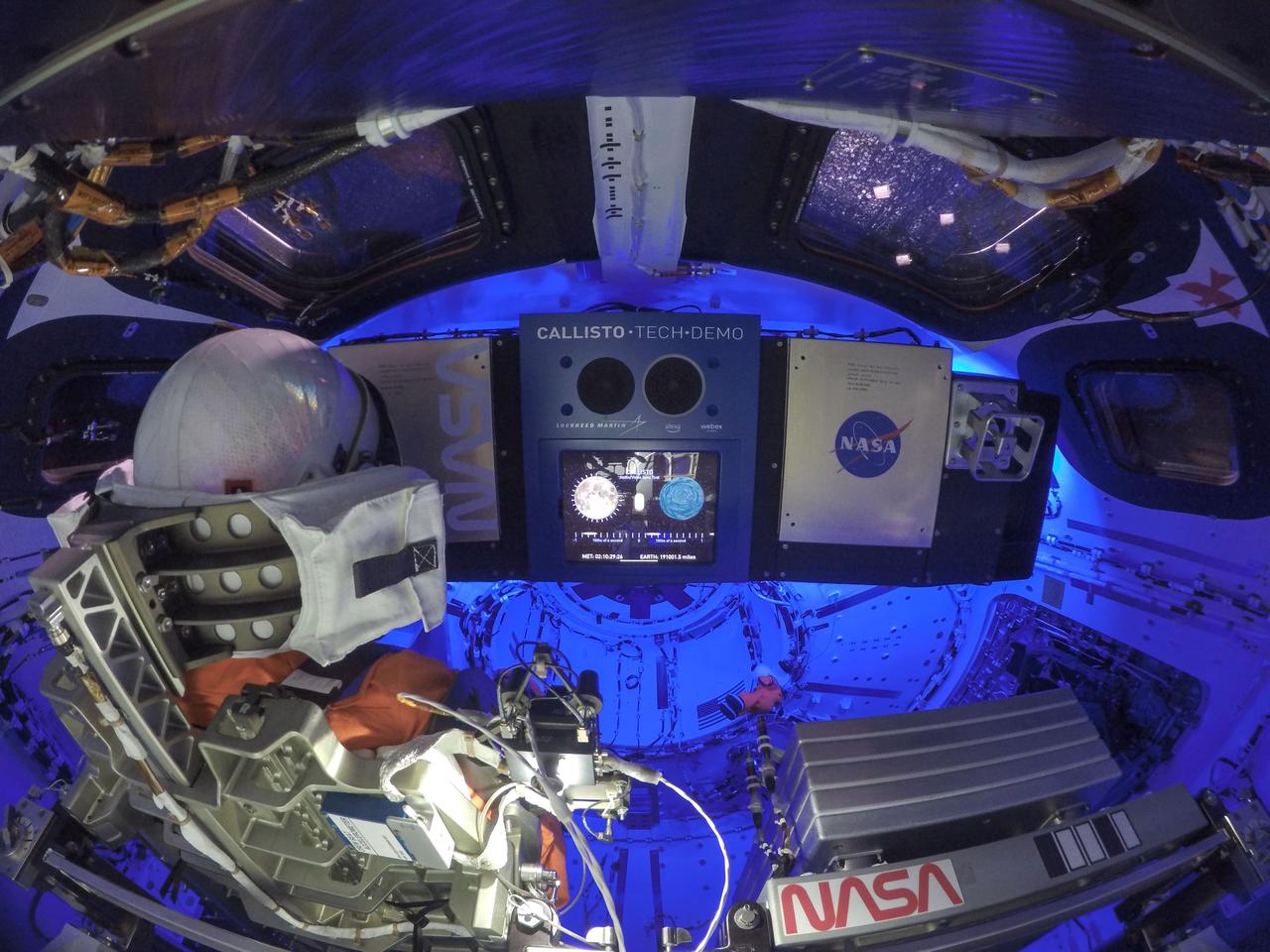
Engineers activated the Callisto payload, Lockheed Martin’s technology demonstration in collaboration with Amazon and Cisco. Callisto will test voice-activated and video technology that may assist future astronauts on deep space missions.
Callisto Basin
Landslides on Callisto
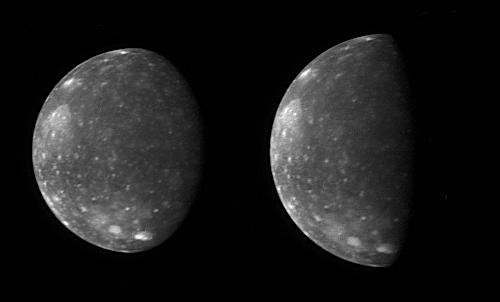
Capturing Callisto
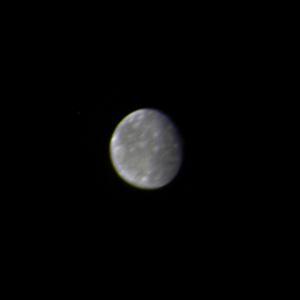
Callisto From 8,023,000 kilometers
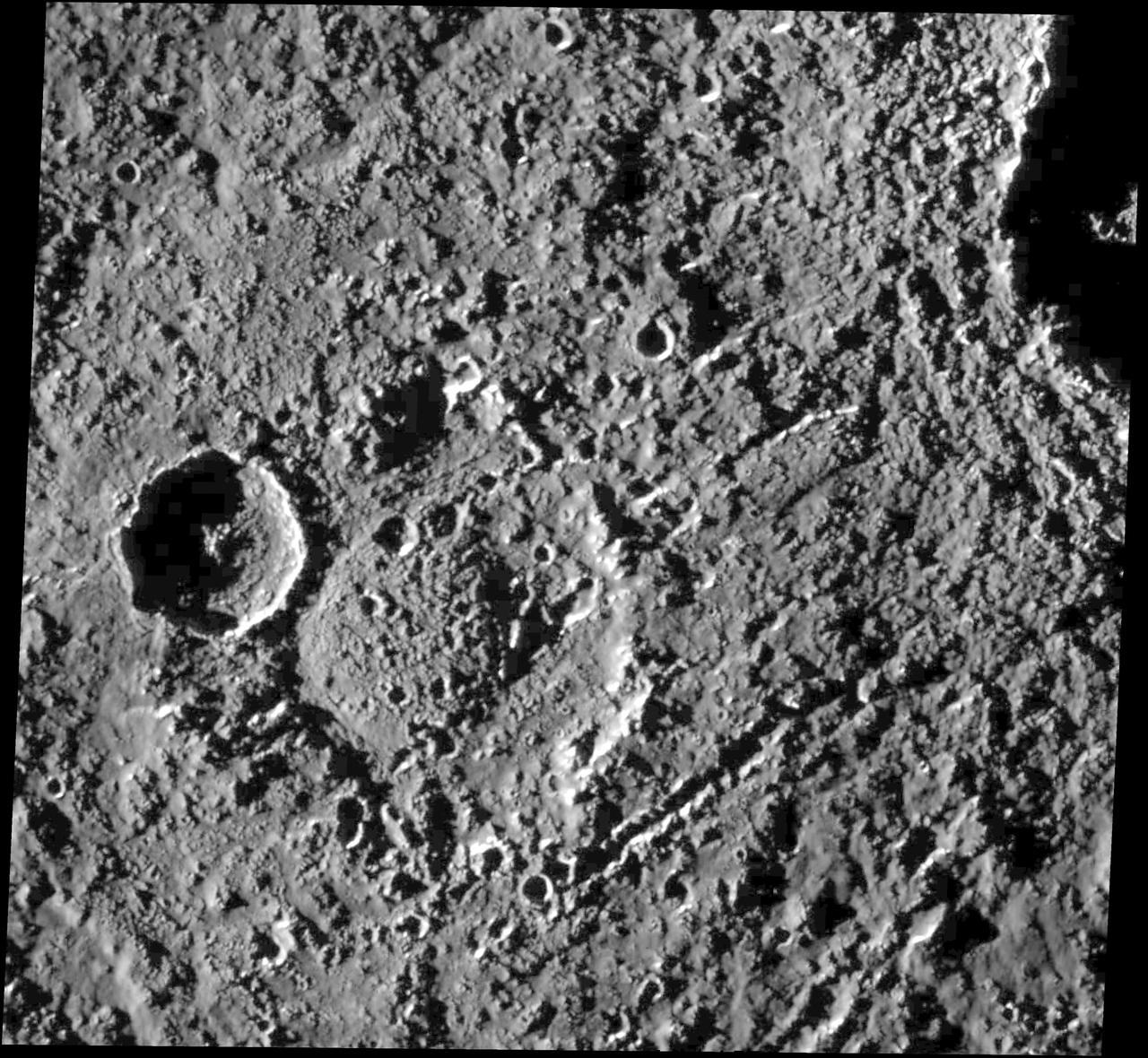
Har Crater on Callisto
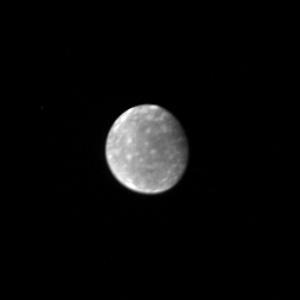
Callisto From 7,000,000 kilometers
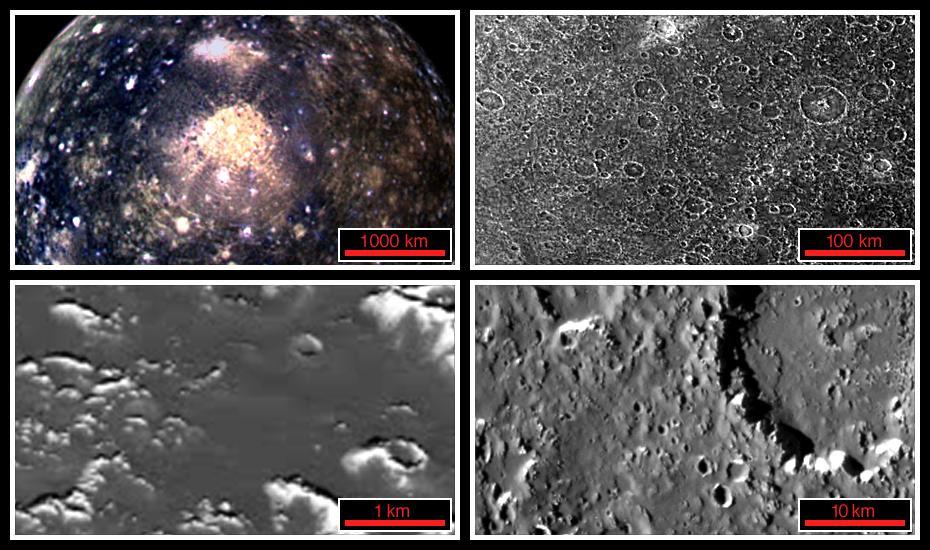
View of Callisto at Increasing Resolutions
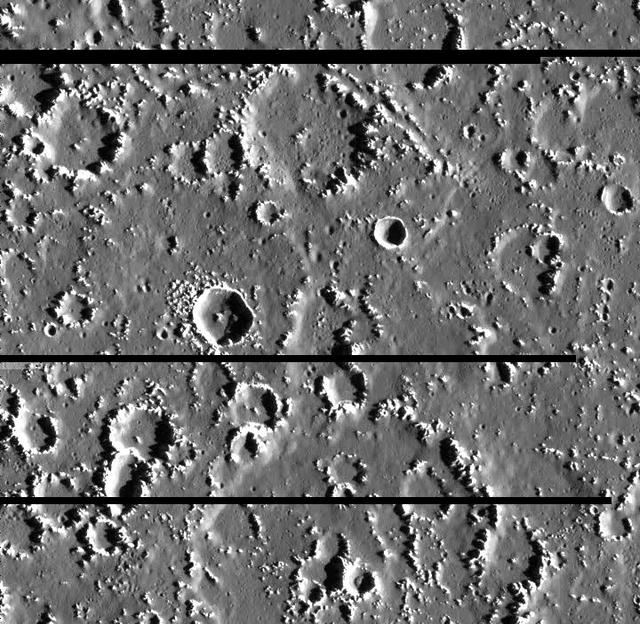
Callisto Varied Crater Landscape
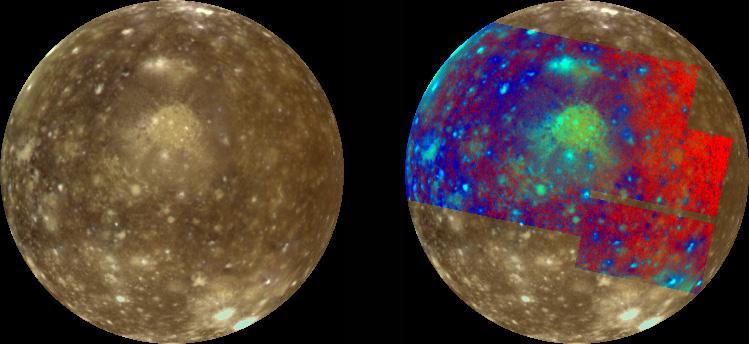
Global Color Variations on Callisto
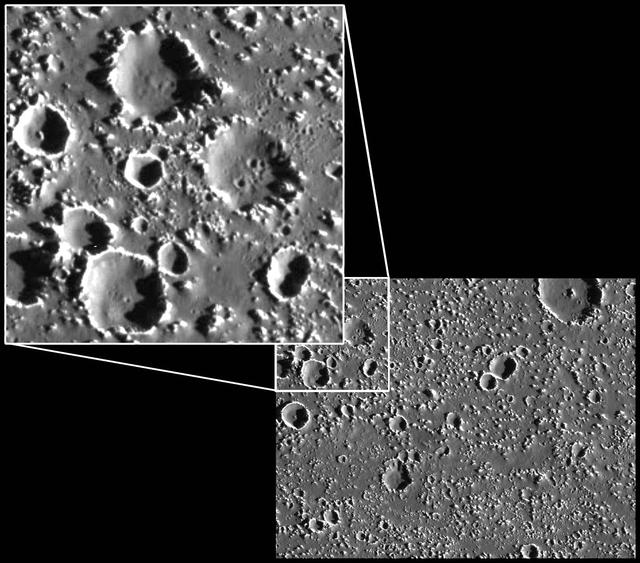
Callisto: Pits or Craters?
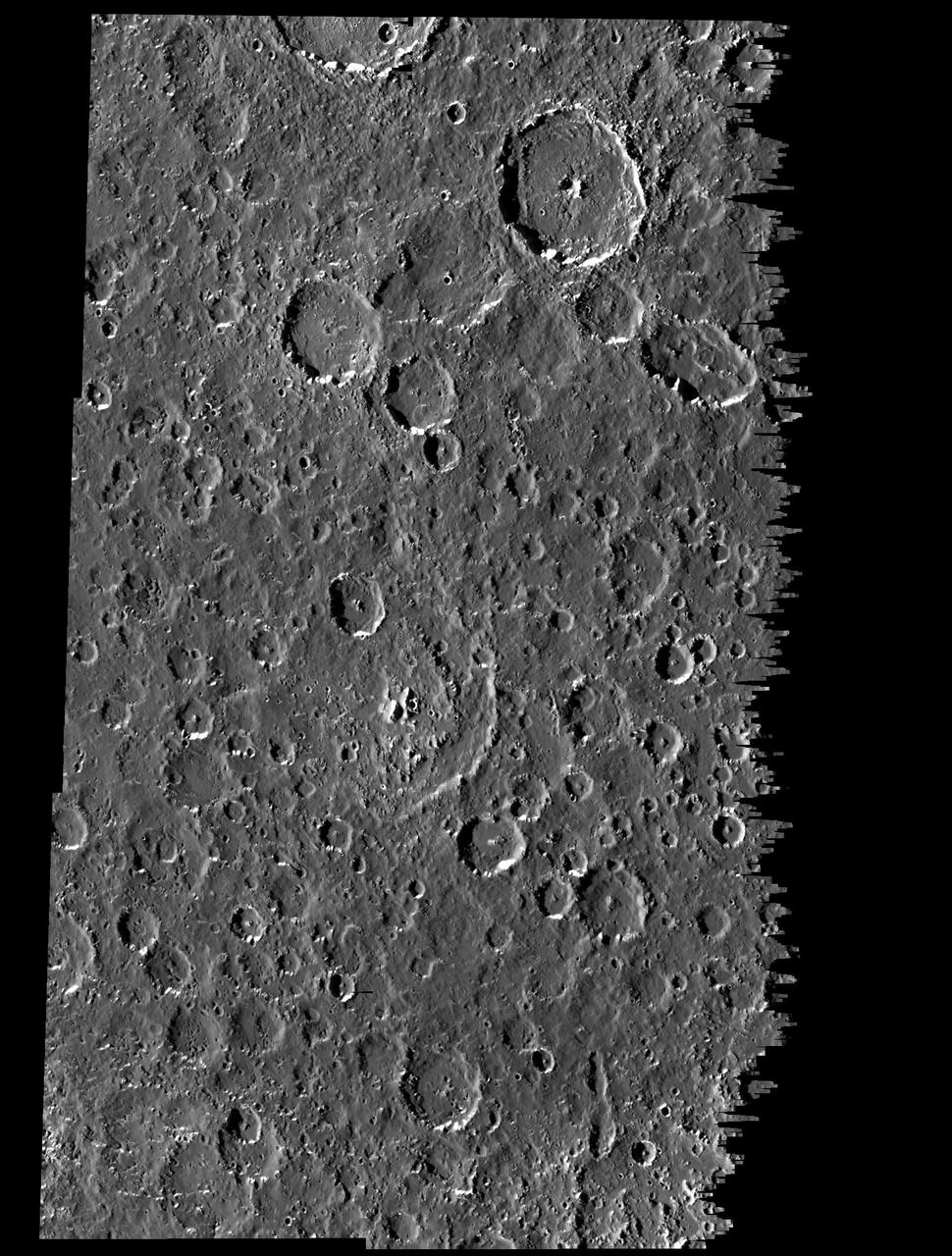
Callisto Equatorial Region
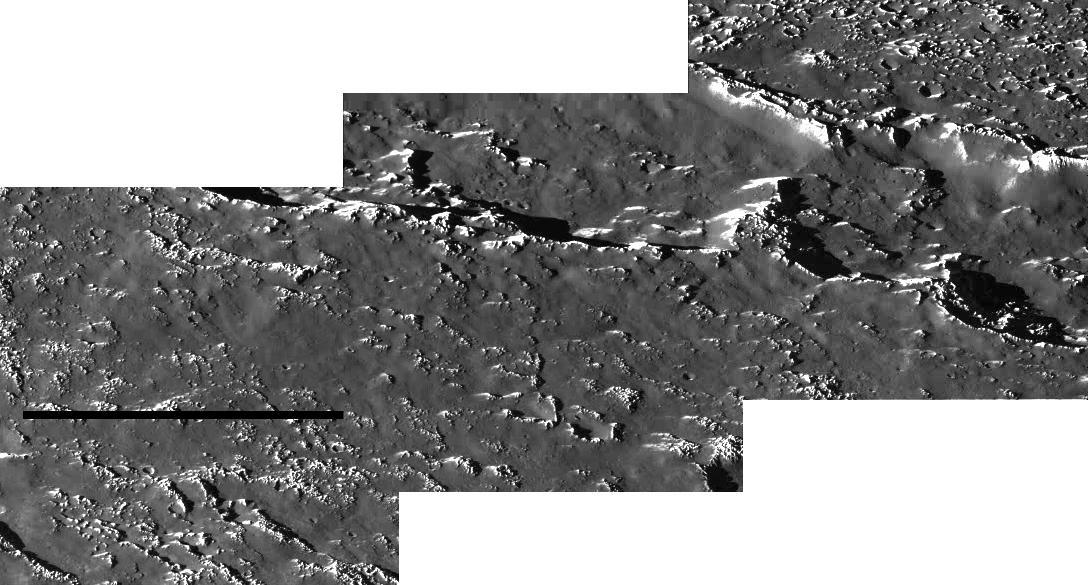
Callisto Crater Chain Mosaic
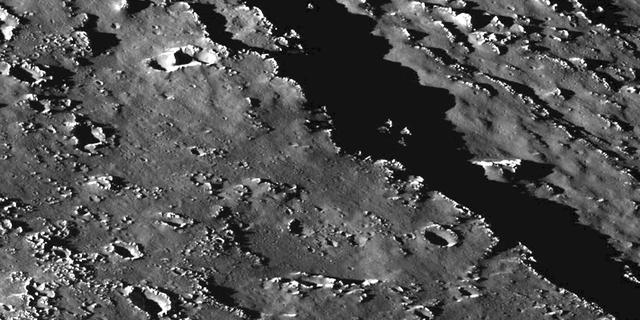
Callisto Scarp Mosaic
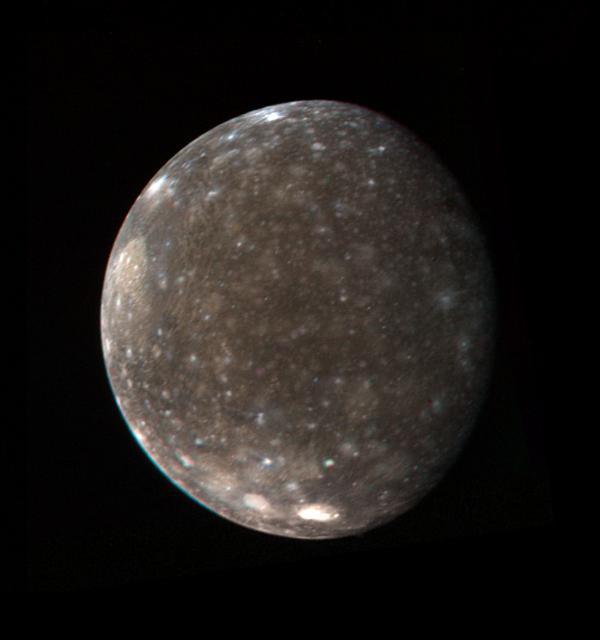
Callisto Icy Surface http://photojournal.jpl.nasa.gov/catalog/PIA00362
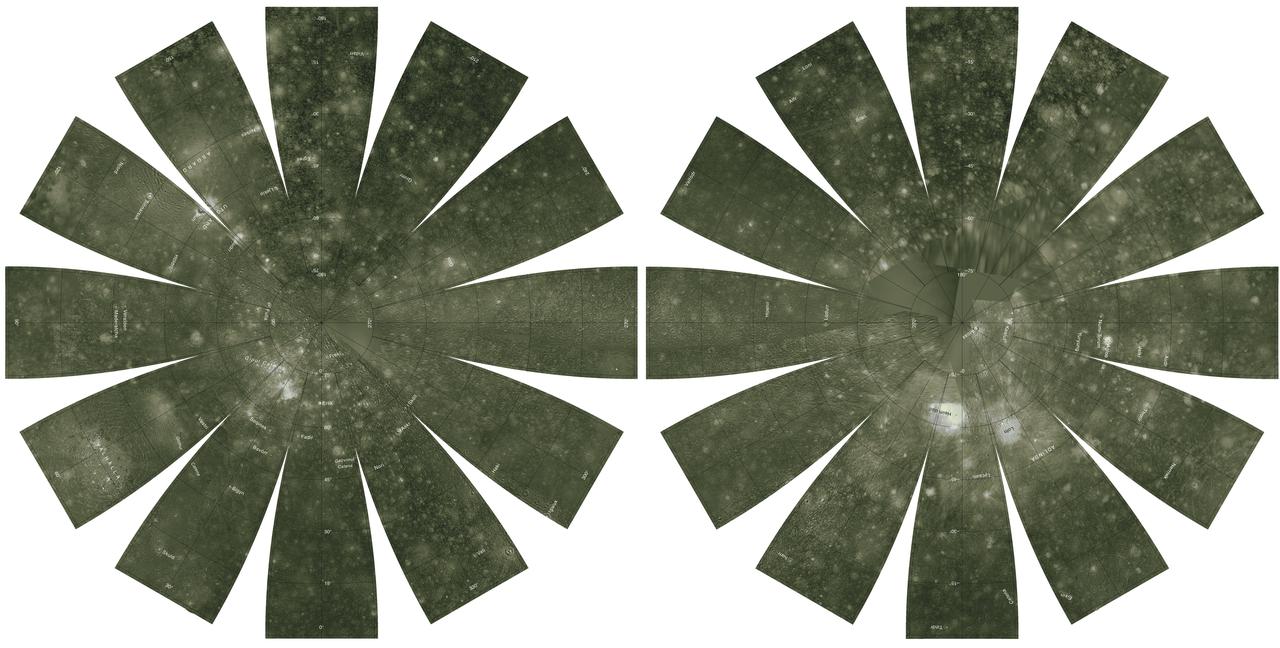
Callisto Hemispherical Globes
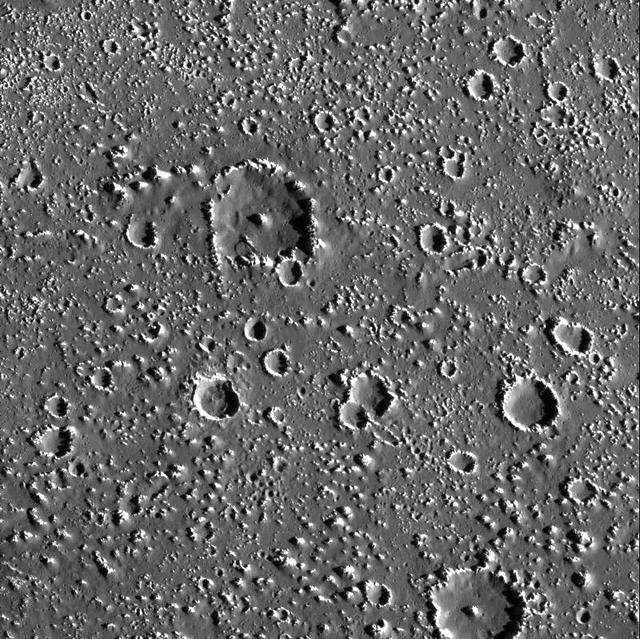
So few Small Craters on Callisto
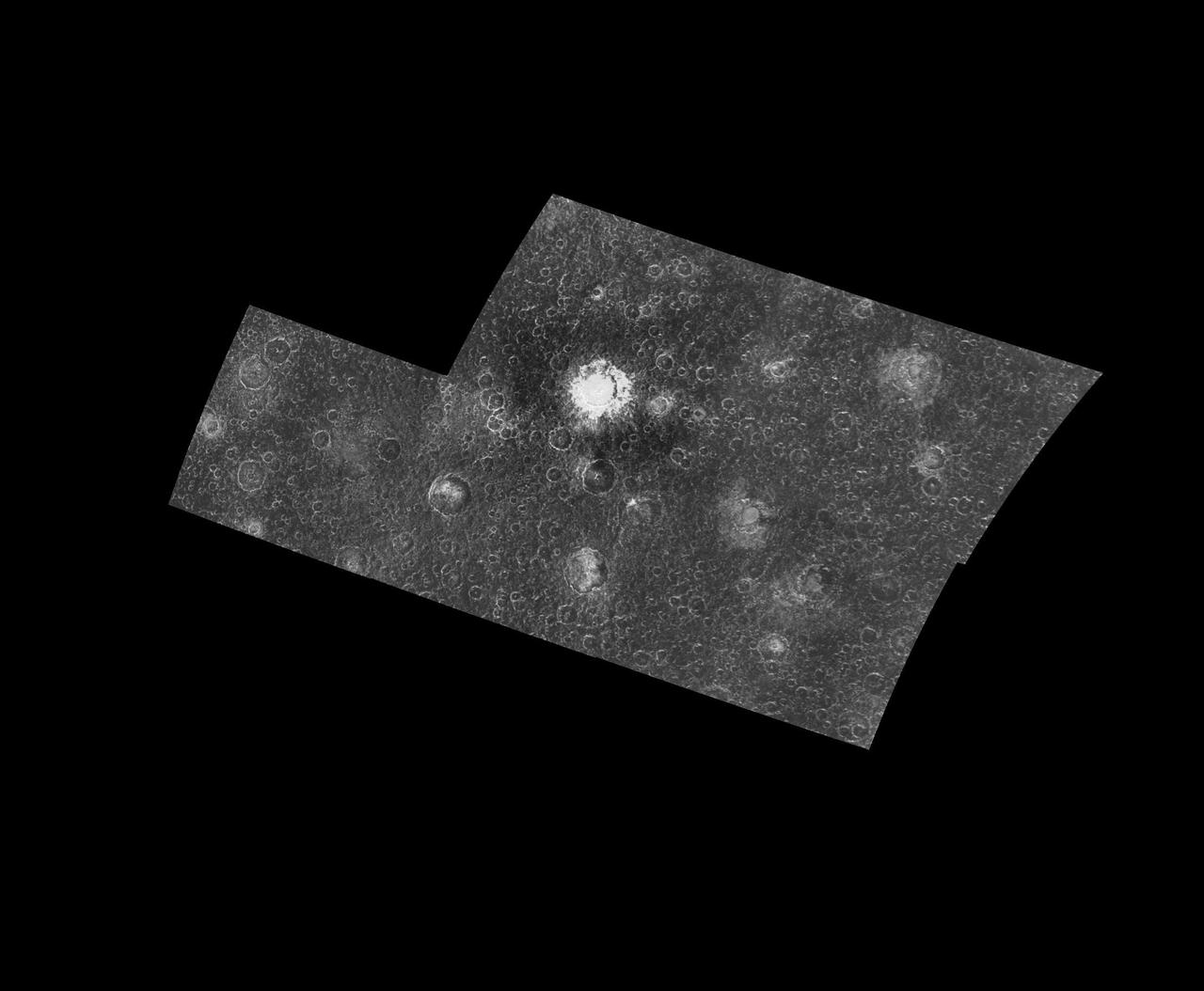
Moderate-resolution view of Callisto surface
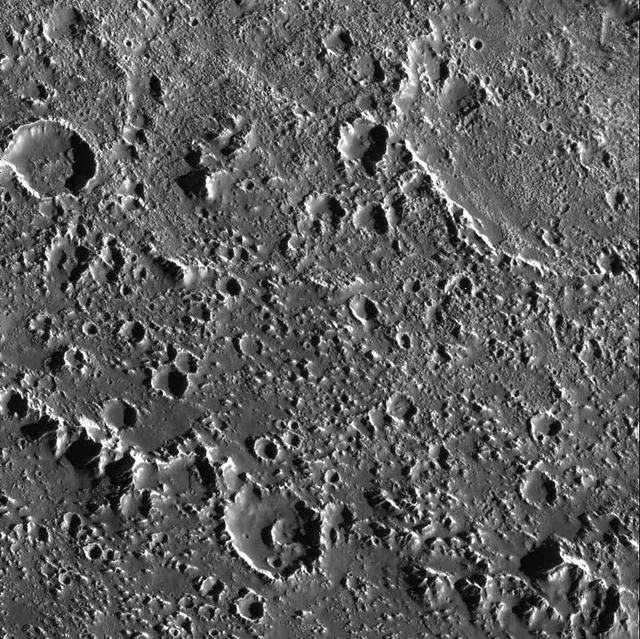
Textured Terrain in Callisto Asgard Basin
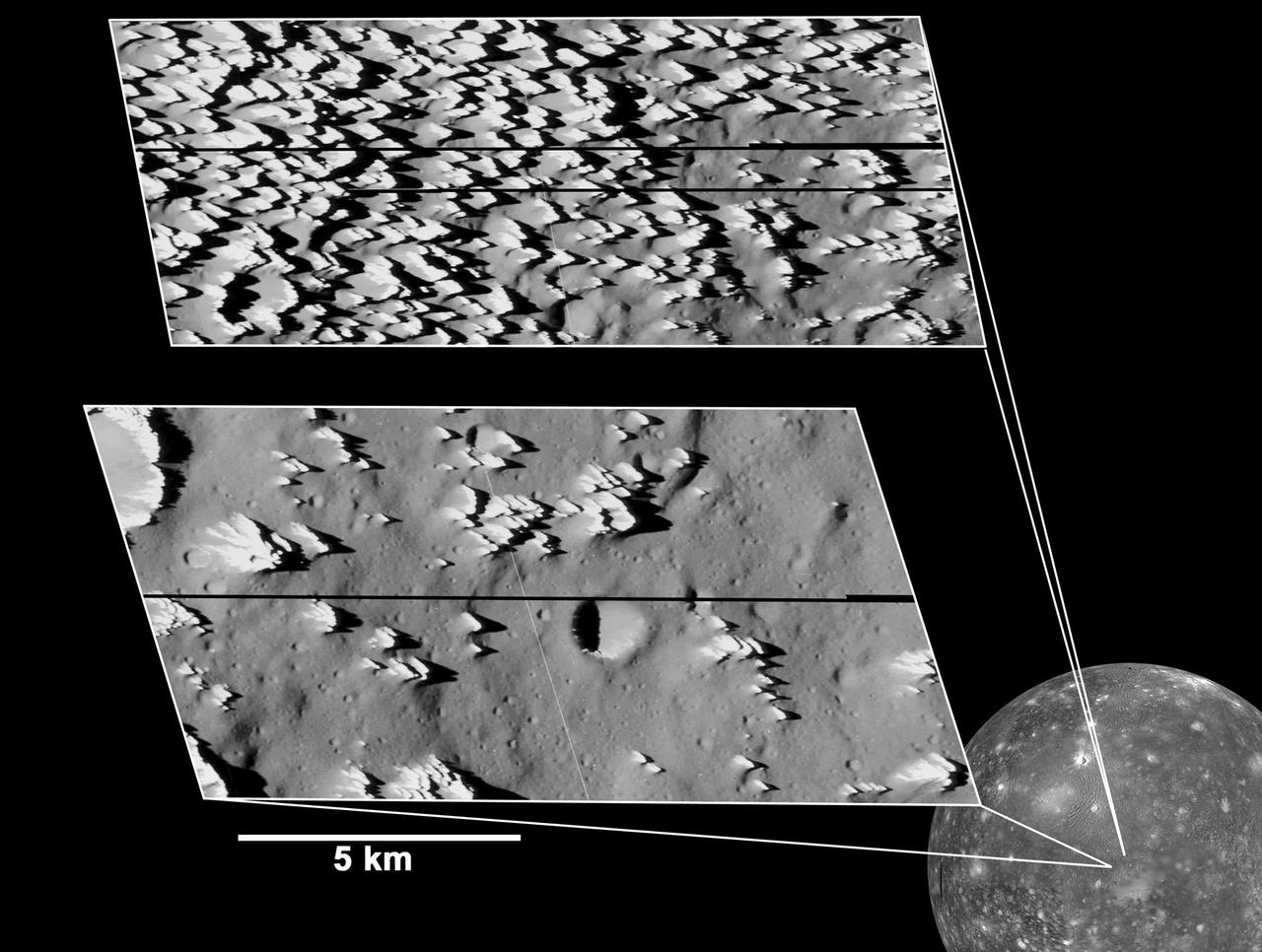
Callisto Close-up with Jagged Hills

View of Callisto from Voyager and Galileo
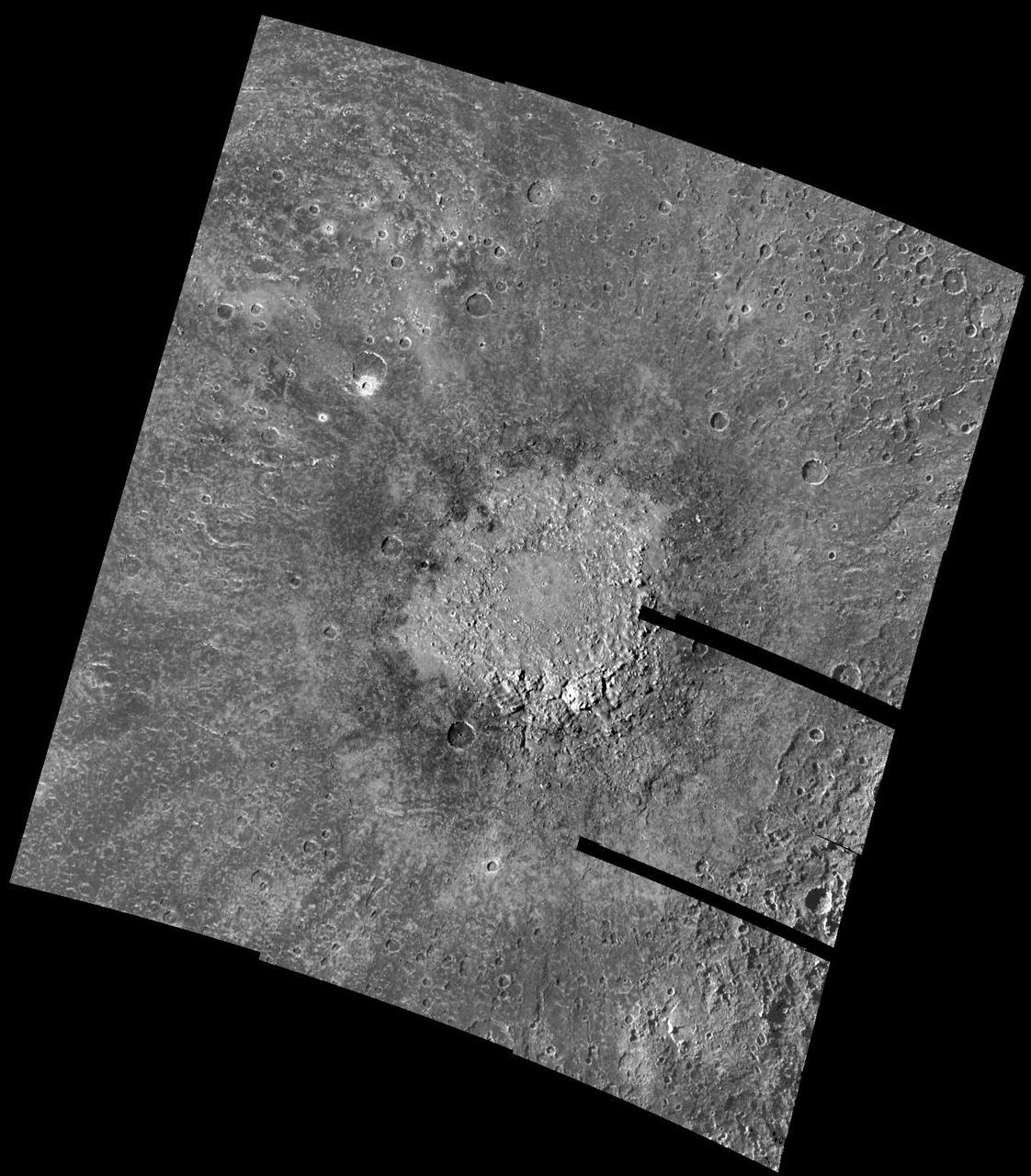
Large impact on Callisto Southern Hemisphere
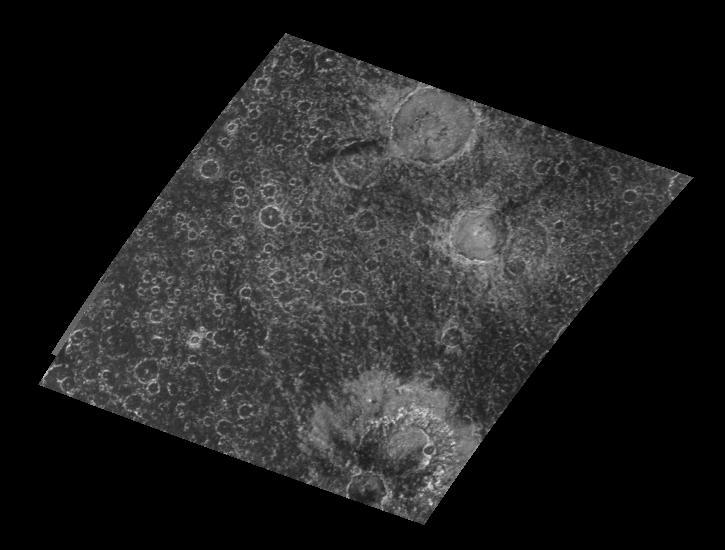
Large Craters in Callisto Southern Hemisphere
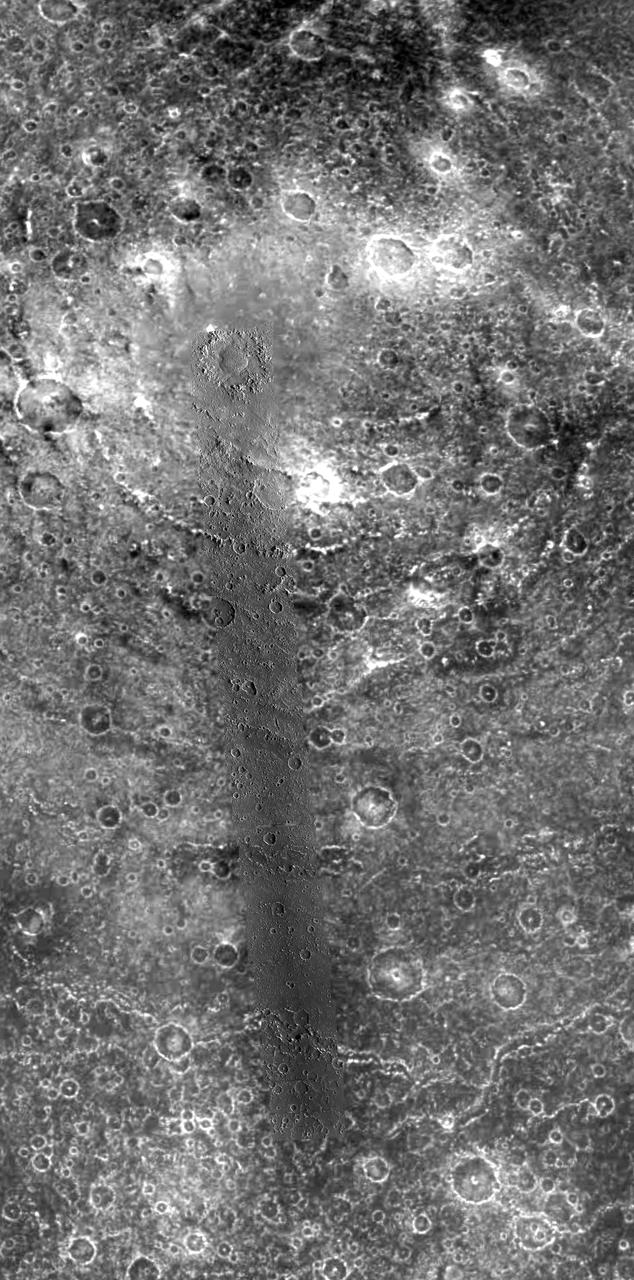
Asgard Multi-Ring Structure on Callisto
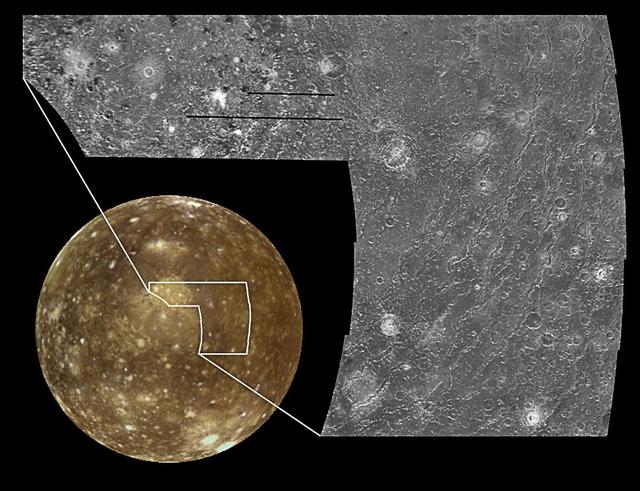
The Valhalla Multi-ring Structure on Callisto
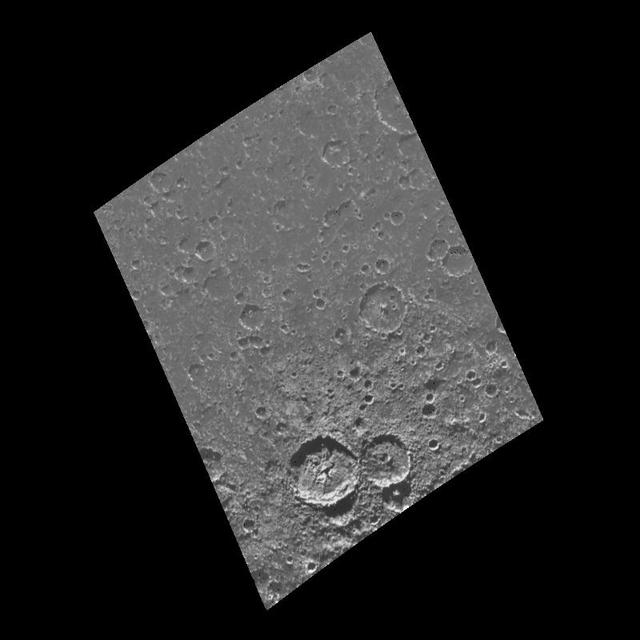
Craters Near the South Pole of Callisto
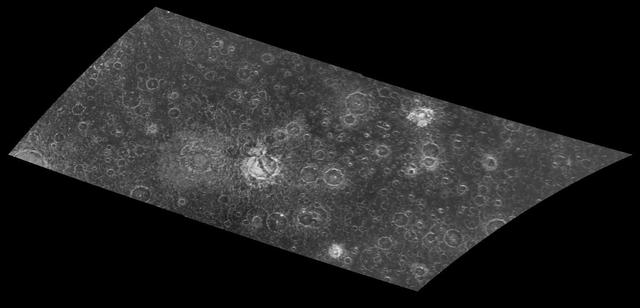
Craters in a Newly Imaged Area on Callisto

Bright scars on a darker surface testify to a long history of impacts on Jupiter moon Callisto in this image of Callisto from NASA Galileo spacecraft.
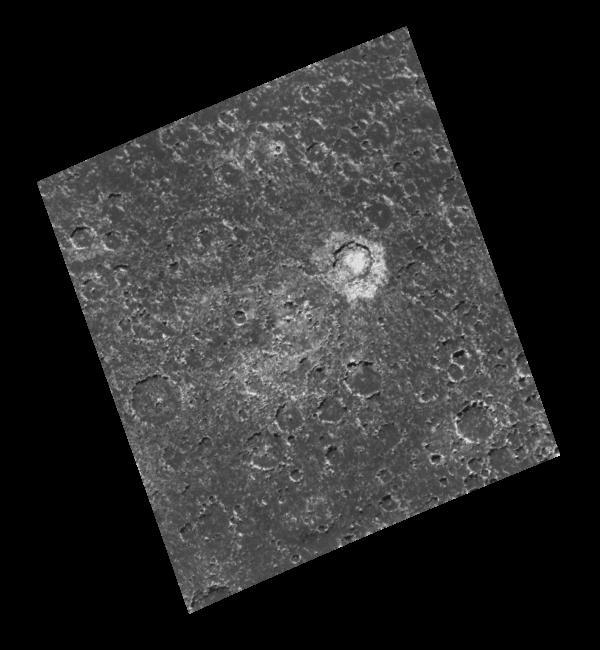
Mass Wasting in Craters near the South Pole of Callisto
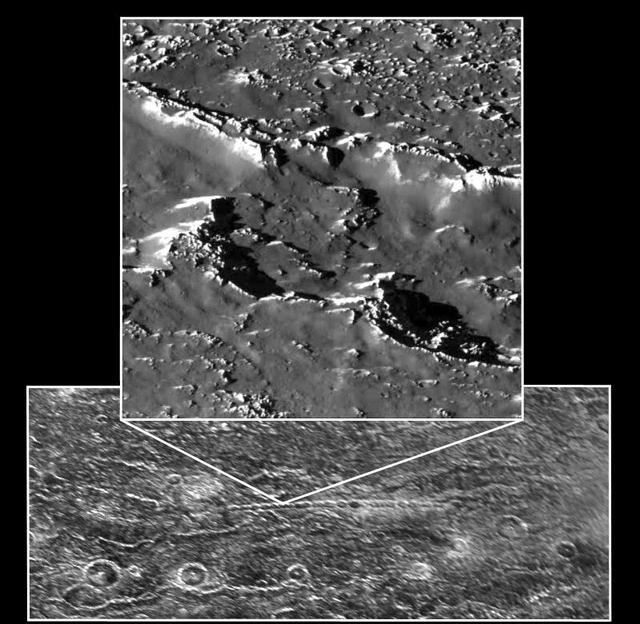
Callisto Crater Chain at High Resolution Shown in Context
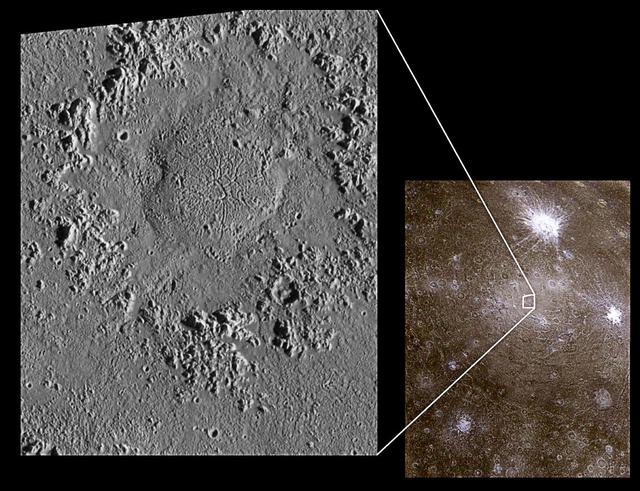
Impact Craters on Icy Callisto: Doh Crater and Asgard
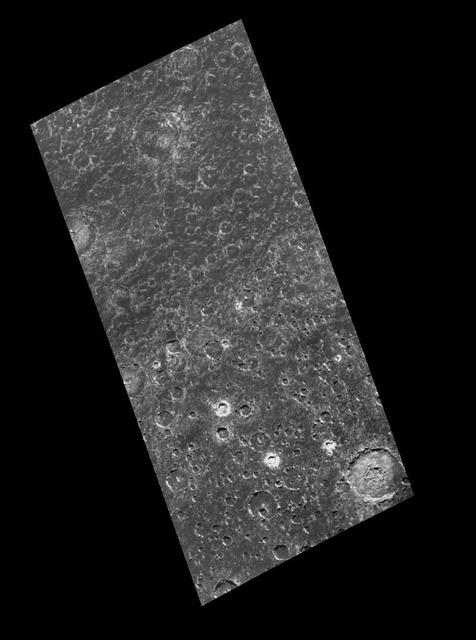
Heavy Cratering near Callisto South Pole
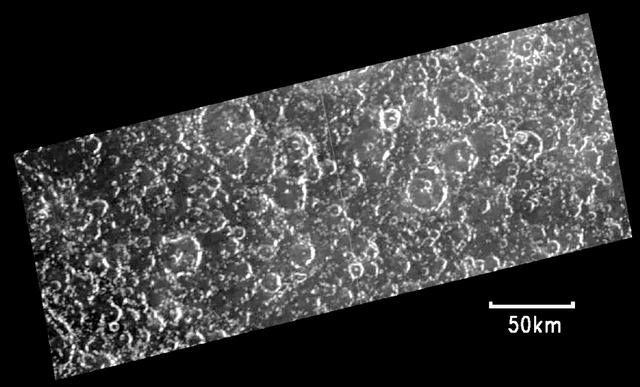
Opposite Side of Callisto from Valhalla Impact
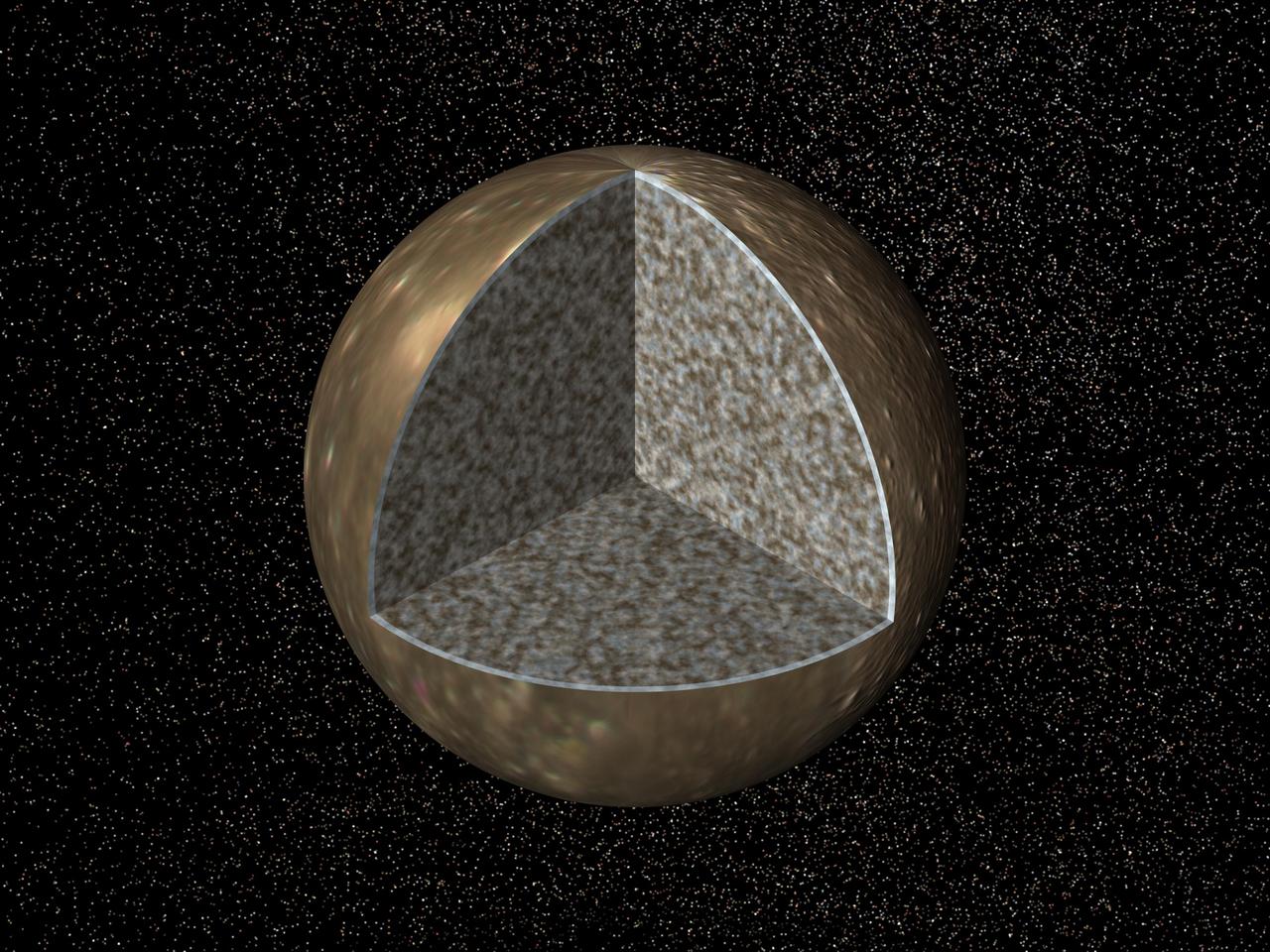
Cutaway view of the possible internal structure of Callisto. The surface of the satellite is a mosaic of images obtained in 1979 by NASA Voyager spacecraft.
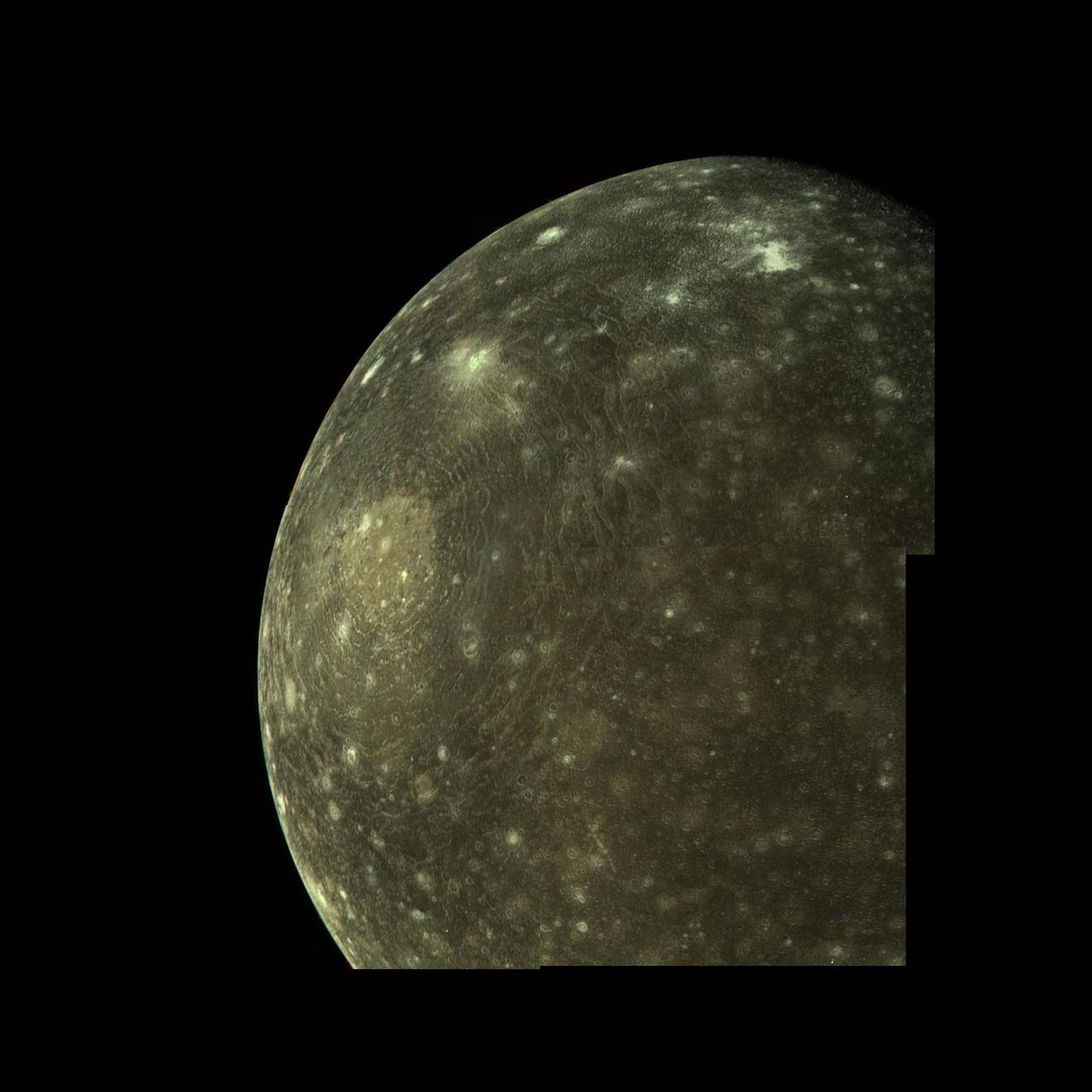
Callisto was revealed by NASA Voyager cameras to be a heavily cratered and hence geologically inactive world. http://photojournal.jpl.nasa.gov/catalog/PIA00080
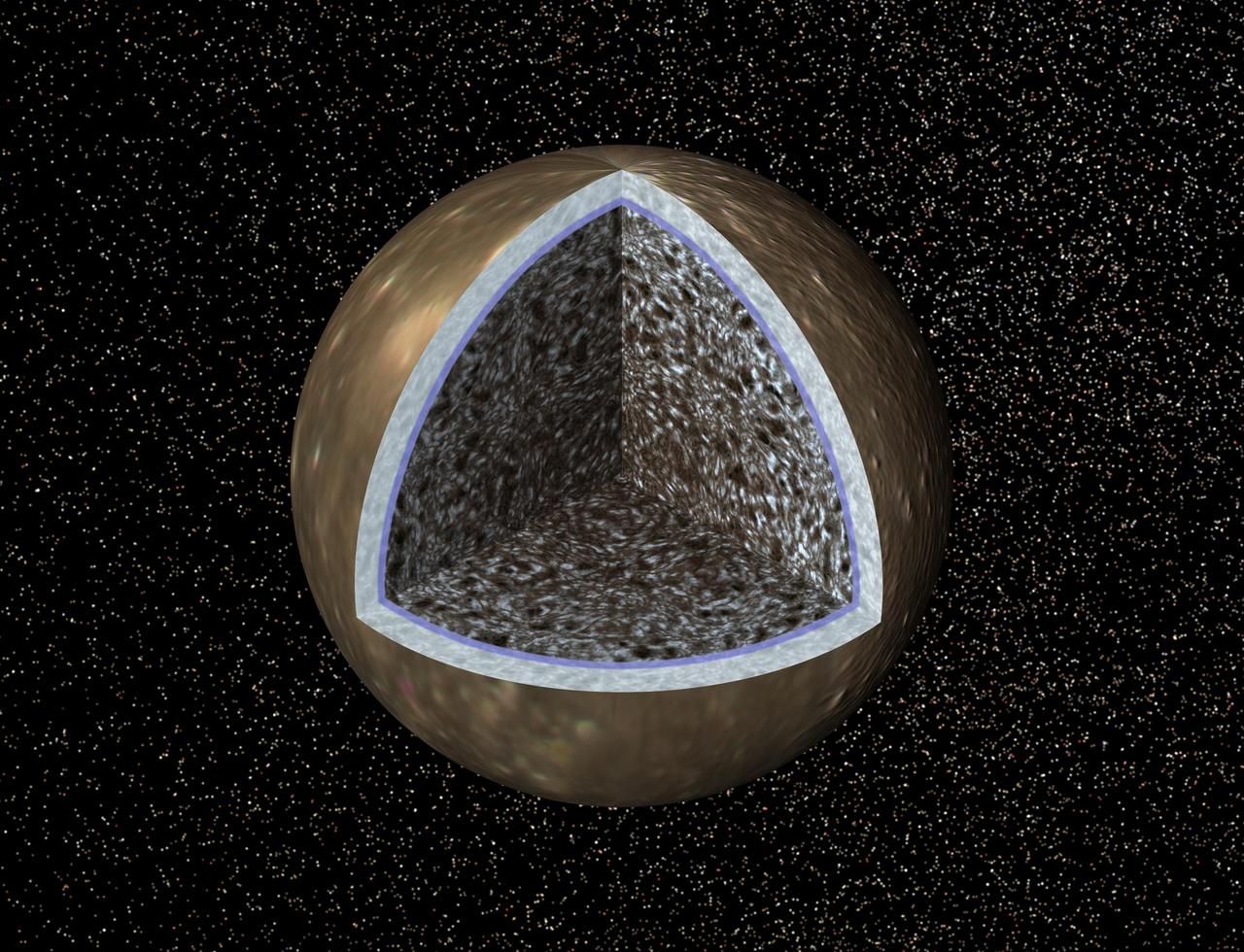
This artist concept, a cutaway view of Jupiter moon Callisto, is based on recent data from NASA Galileo spacecraft which indicates a salty ocean may lie beneath Callisto icy crust.
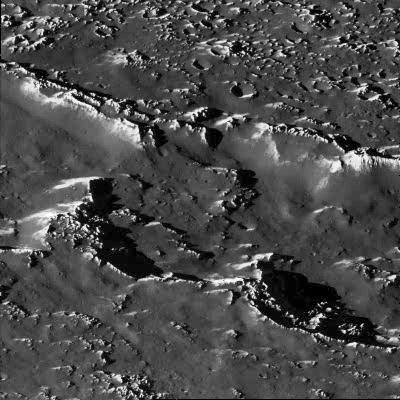
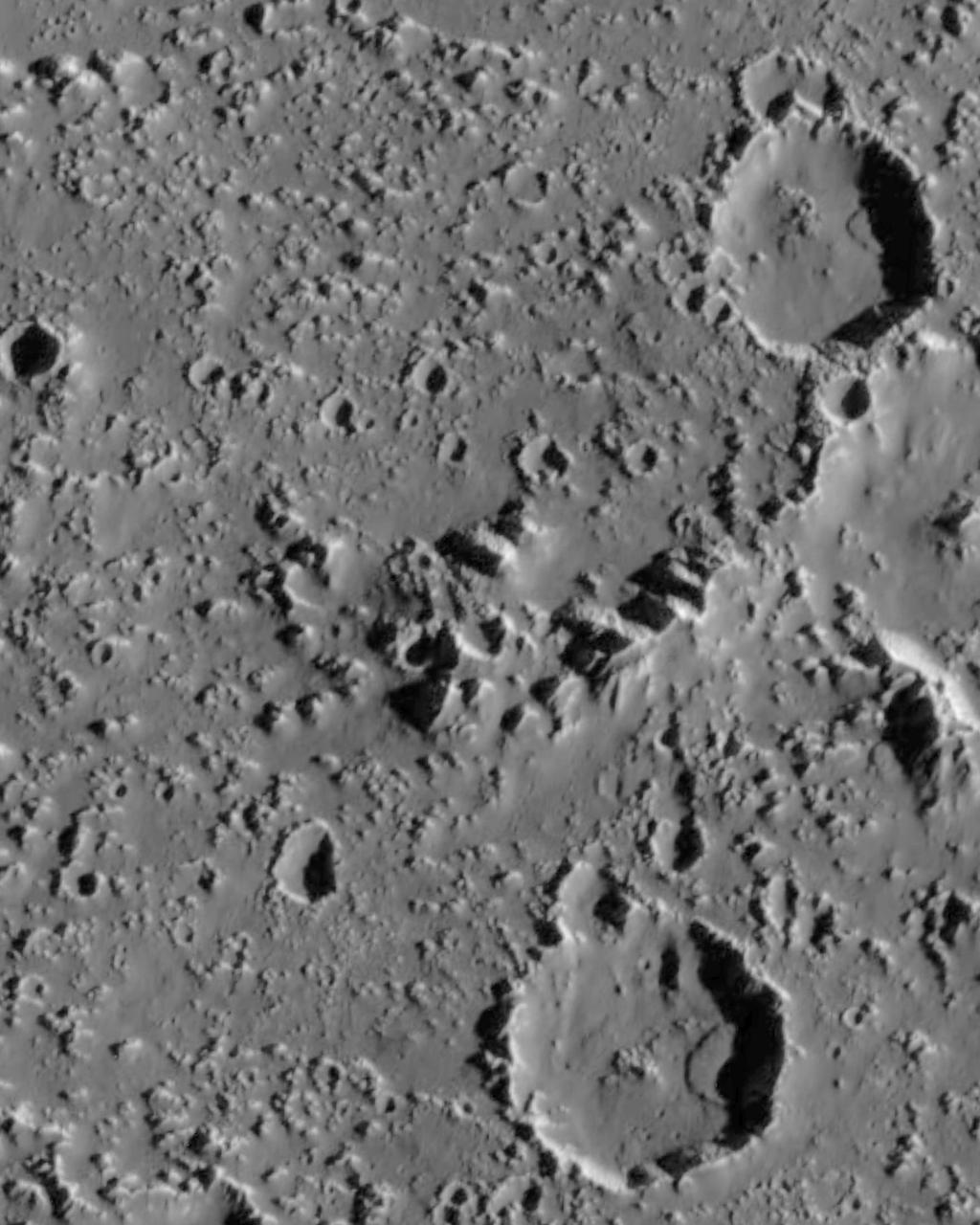
A portion of a chain of impact craters on Jupiter's moon Callisto is seen in this image taken by the Galileo spacecraft on November 4, 1996. This crater chain on Callisto is believed to result from the impact of a split object, similar to the fragments of Comet Shoemaker-Levy 9 which smashed into Jupiter's atmosphere in July of 1994. This high-resolution view, taken by Galileo's solid state imaging television camera during its third orbit around Jupiter, is of Callisto's northern hemisphere at 35 degrees north, 46 degrees west, and covers an area of about eight miles (13 kilometers) across. The smallest visible crater is about 140 yards (130 meters) across. The image was taken at a range of 974 miles (1,567 kilometers). On a global scale, Callisto is heavily cratered, indicating the great age of its surface. At the scale of this image, it was anticipated that the surface would be heavily cratered as well; however, there is a surprising lack of small craters, suggesting that one or more processes have obliterated these and other small-scale features. For example, downslope movement of ice-rich debris could bury small craters. The bright slopes visible in this picture represent places where downslope movement has taken place, exposing fresh ice surfaces. http://photojournal.jpl.nasa.gov/catalog/PIA00514
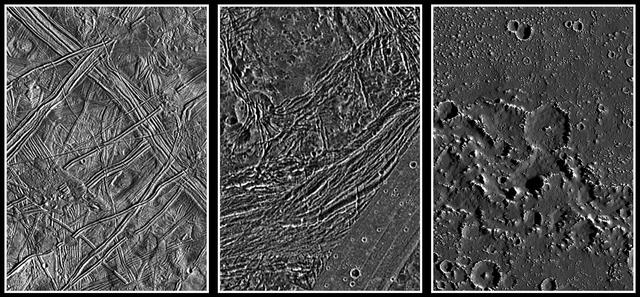
Europa, Ganymede, and Callisto: Surface Comparison at High Spatial Resolution
![A portion of the central zone of the large impact structure Valhalla on Jupiter's moon Callisto was imaged by the Galileo spacecraft on November 4, 1996. The area shown here is centered at 16 degrees north, 55 degrees west and is about seven miles (11 kilometers) across. This is the highest resolution picture ever taken of Callisto and shows features as small as 200 feet (60 meters) across. The formation of Valhalla occurred early in Callisto's history; however, the central zone shown here is probably younger than Valhalla's surrounding structure. This newly [sic] acquired picture shows some small craters, although they have been softened or modified by downslope movement of debris, revealing bright ice-rich surfaces. In contrast to other areas on Callisto, most of the very smallest craters appear to have been completely obliterated. This image was taken by the solid state imaging television camera onboard the Galileo spacecraft during its third orbit around Jupiter, at a distance of 757 miles (1,219 kilometers). http://photojournal.jpl.nasa.gov/catalog/PIA00516](https://images-assets.nasa.gov/image/PIA00516/PIA00516~thumb.jpg)
A portion of the central zone of the large impact structure Valhalla on Jupiter's moon Callisto was imaged by the Galileo spacecraft on November 4, 1996. The area shown here is centered at 16 degrees north, 55 degrees west and is about seven miles (11 kilometers) across. This is the highest resolution picture ever taken of Callisto and shows features as small as 200 feet (60 meters) across. The formation of Valhalla occurred early in Callisto's history; however, the central zone shown here is probably younger than Valhalla's surrounding structure. This newly [sic] acquired picture shows some small craters, although they have been softened or modified by downslope movement of debris, revealing bright ice-rich surfaces. In contrast to other areas on Callisto, most of the very smallest craters appear to have been completely obliterated. This image was taken by the solid state imaging television camera onboard the Galileo spacecraft during its third orbit around Jupiter, at a distance of 757 miles (1,219 kilometers). http://photojournal.jpl.nasa.gov/catalog/PIA00516
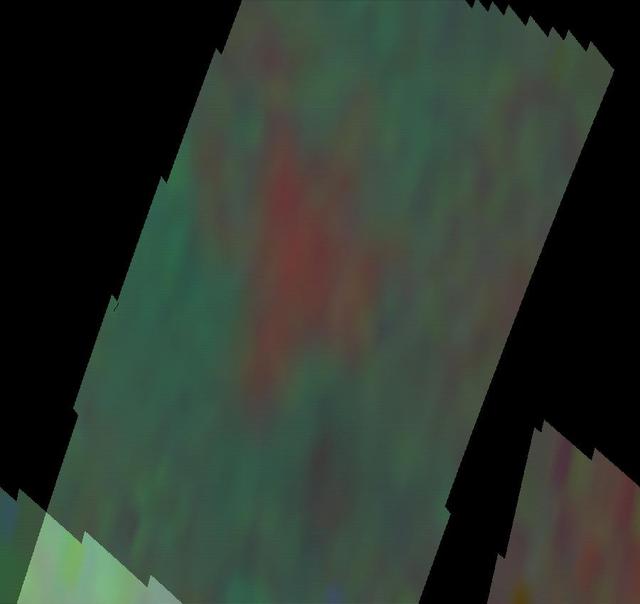
False color view of a portion of the leading hemisphere of Jupiter's moon Callisto as seen through the infrared filters of the Solid State Imaging (CCD) system aboard NASA's Galileo spacecraft. North is to the top of the picture and the sun illuminates the surface from the east. More recent impacts have excavated bright, relatively clean ice from beneath Callisto's battered surface. Callisto's dark mottled appearance may be due to contamination by non-ice components contributed by impactors or concentrated in a residue as ice is removed. This color composite image is centered on longitude 139 West and encompasses an area about 1000 miles (1600 kilometers) by 2470 miles (4000 kilometers). The images were obtained on November 3rd, 1996. http://photojournal.jpl.nasa.gov/catalog/PIA01100

This observation of a small section of the Asgard terrain reveals compositional variations over the surface of Callisto was captured by NASA Galileo spacecraft in 1996.
These views of Callisto southern hemisphere were taken by NASA Galileo spacecraft on May 6, 1997. The upper left view contains Buri, a crater with a diameter of about 60 km.
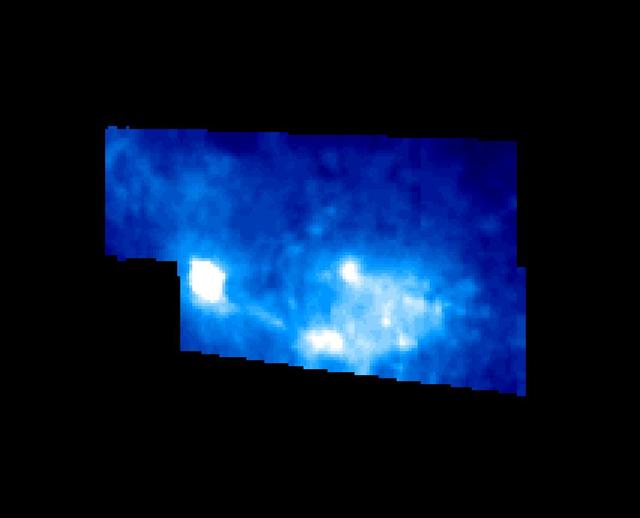
This view of Callisto Asgard multi-ring structure was taken by NASA Galileo spacecraft. The large bright/white area is the palimpsest or center of Asgard. The smaller bright area is the crater Tornasuk.
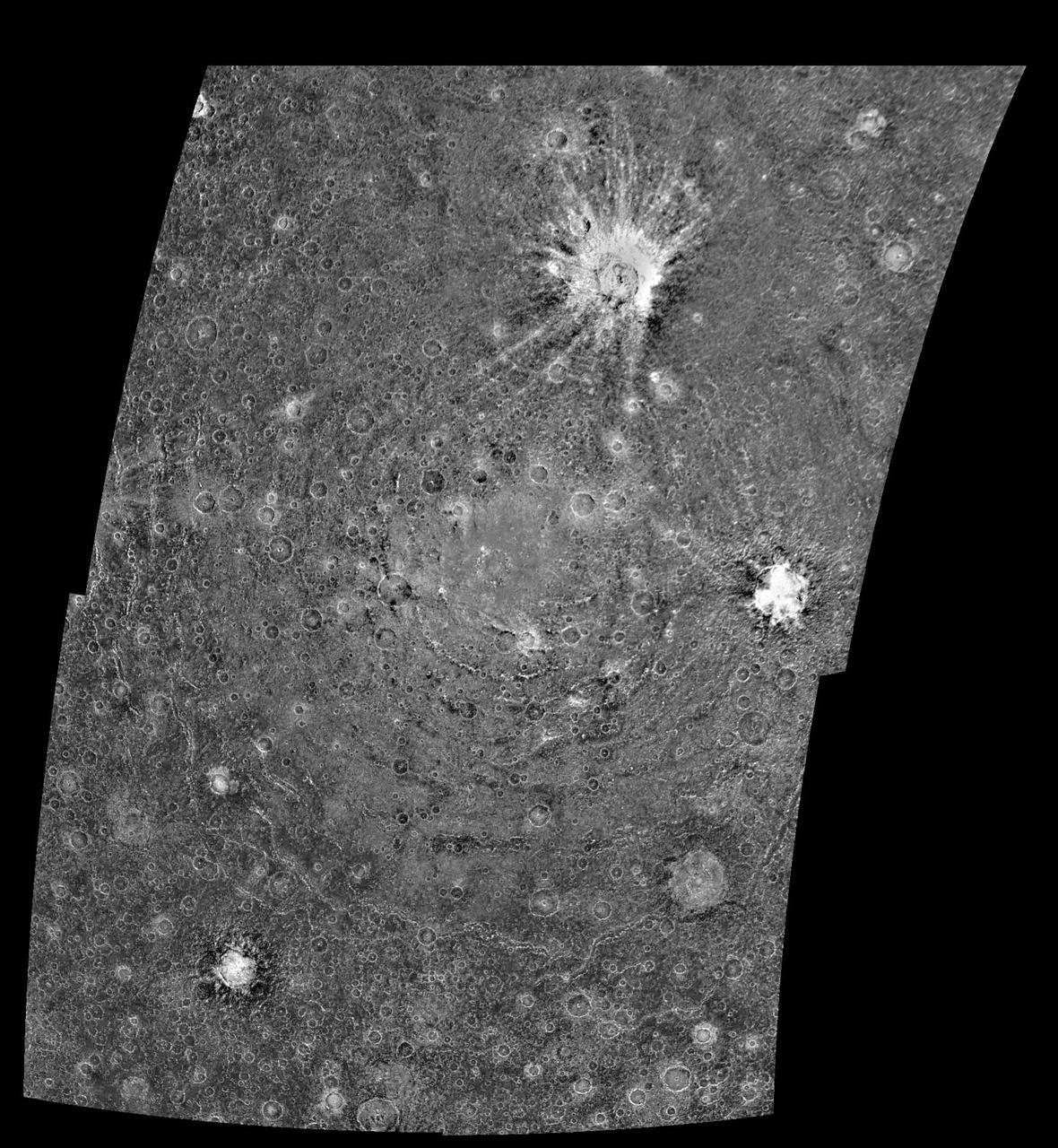
This four-frame mosaic shows the ancient impact structure Asgard on Jupiter's moon Callisto. This image is centered at 30 degrees north, 142 degrees west. The Asgard structure is approximately 1700 km across (1,056 mi) and consists of a bright central zone surrounded by discontinuous rings. The rings are tectonic features with scarps near the central zone and troughs at the outer margin. Several large impacts have smashed into Callisto after the formation of Asgard. The very young, bright-rayed crater Burr is located on the northern part of Asgard. This mosaic has been projected to show a uniform scale between the four mosaiced images. The image was processed by Deutsche Forschungsanstalt fuer Luftund Raumfahrt e.V., Berlin, Germany. This image was taken on November 4, 1996, at a distance of 111,891 kilometers (69,070 miles) by the solid state imaging television camera onboard the Galileo spacecraft during its third orbit around Jupiter. http://photojournal.jpl.nasa.gov/catalog/PIA00517
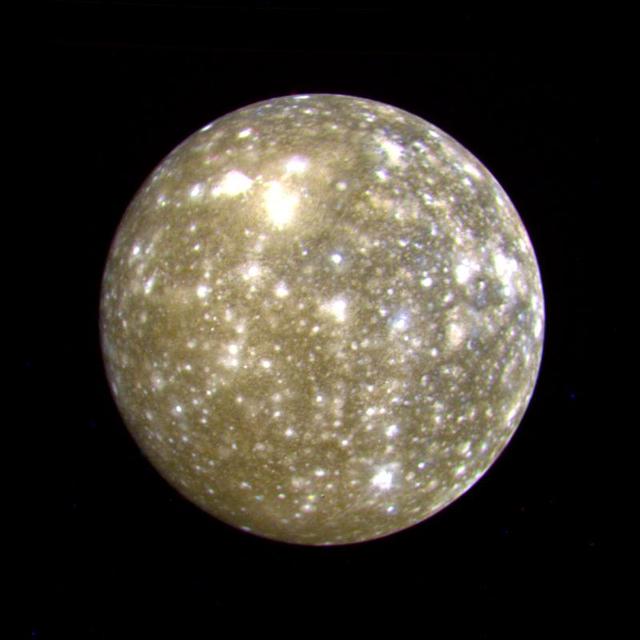
This false color picture of Callisto was taken by NASA's Voyager 2 on July 7, 1979 at a range of 1,094,666 kilometers (677,000 miles) and is centered on 11 degrees N and 171 degrees W. This rendition uses an ultraviolet image for the blue component. Because the surface displays regional contrast in UV, variations in surface materials are apparent. Notice in particular the dark blue haloes which surround bright craters in the eastern hemisphere. The surface of Callisto is the most heavily cratered of the Galilean satellites and resembles ancient heavily cratered terrains on the moon, Mercury and Mars. The bright areas are ejecta thrown out by relatively young impact craters. A large ringed structure, probably an impact basin, is shown in the upper left part of the picture. The color version of this picture was constructed by compositing black and white images taken through the ultraviolet, clear and orange filters. http://photojournal.jpl.nasa.gov/catalog/PIA00457
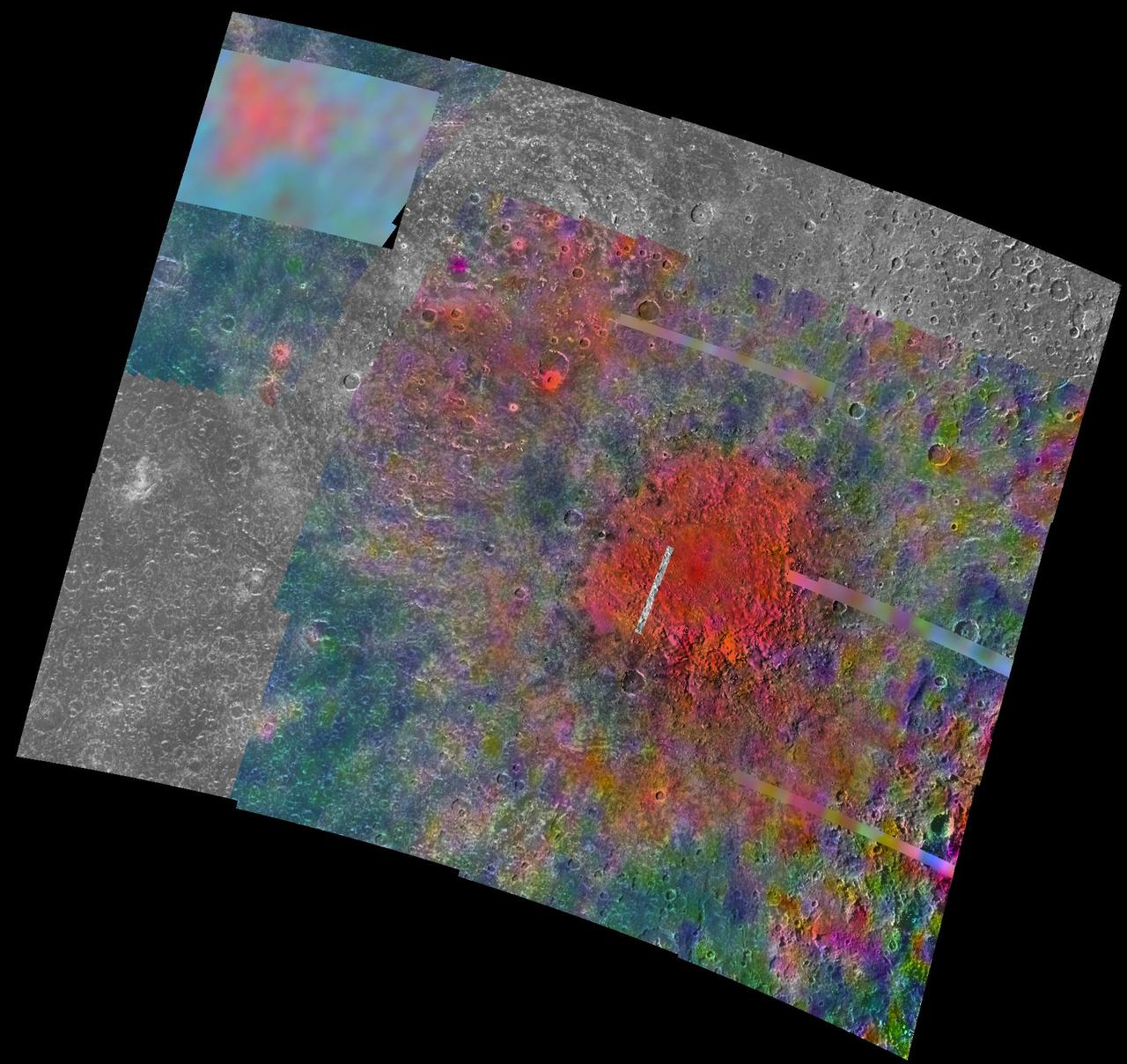
Callisto southern hemisphere was imaged by both the Near Infrared Mapping Spectrometer NIMS and the Solid State Imaging SSI instrument during NASA Galileo eighth orbit of Jupiter. This is a mosaic combining both views.
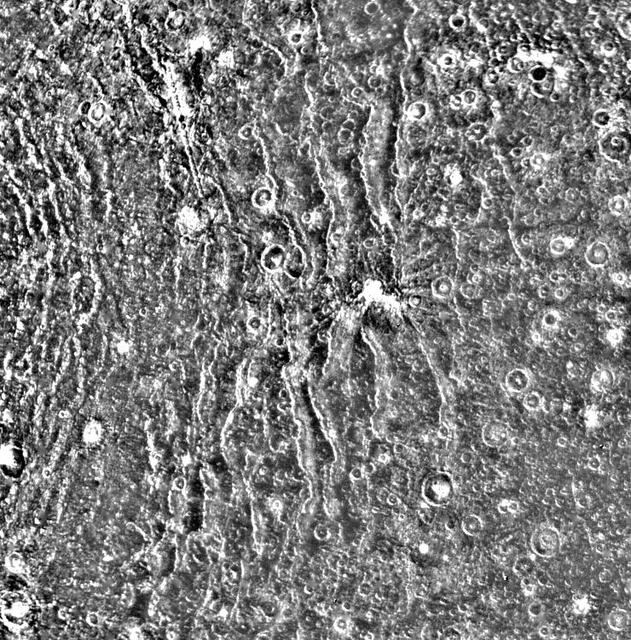
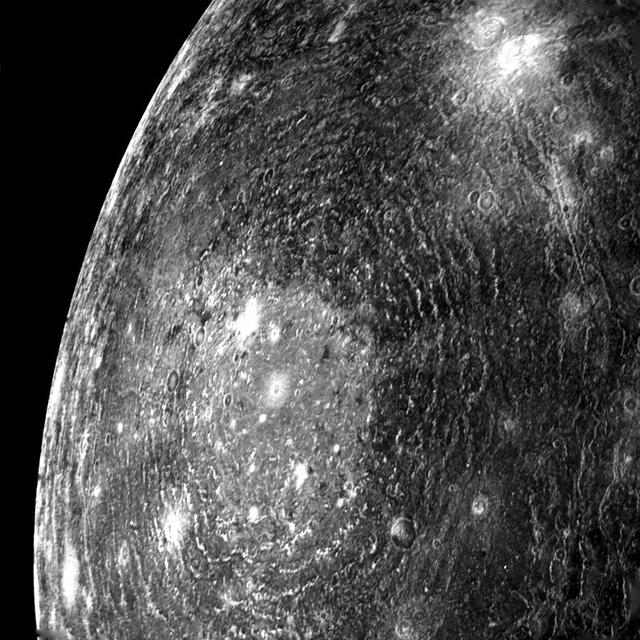
The concentric rings surrounding Valhalla are perhaps the most distinctive geological feature on Callisto. This NASA Voyager 1 close-up shows a segment of the ridged terrain.
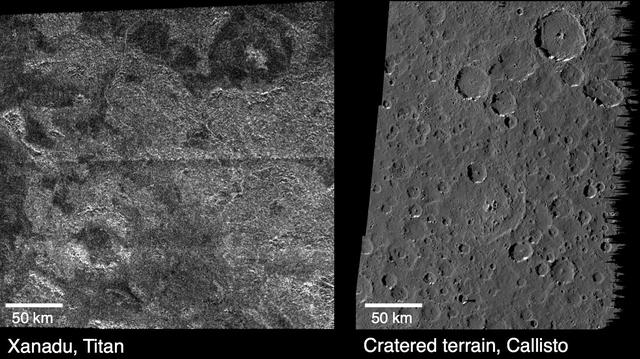
These images compare surface features observed by NASA Cassini spacecraft at the Xanadu region on Saturn moon Titan left, and features observed by NASA Galileo spacecraft on Jupiter cratered moon Callisto right.
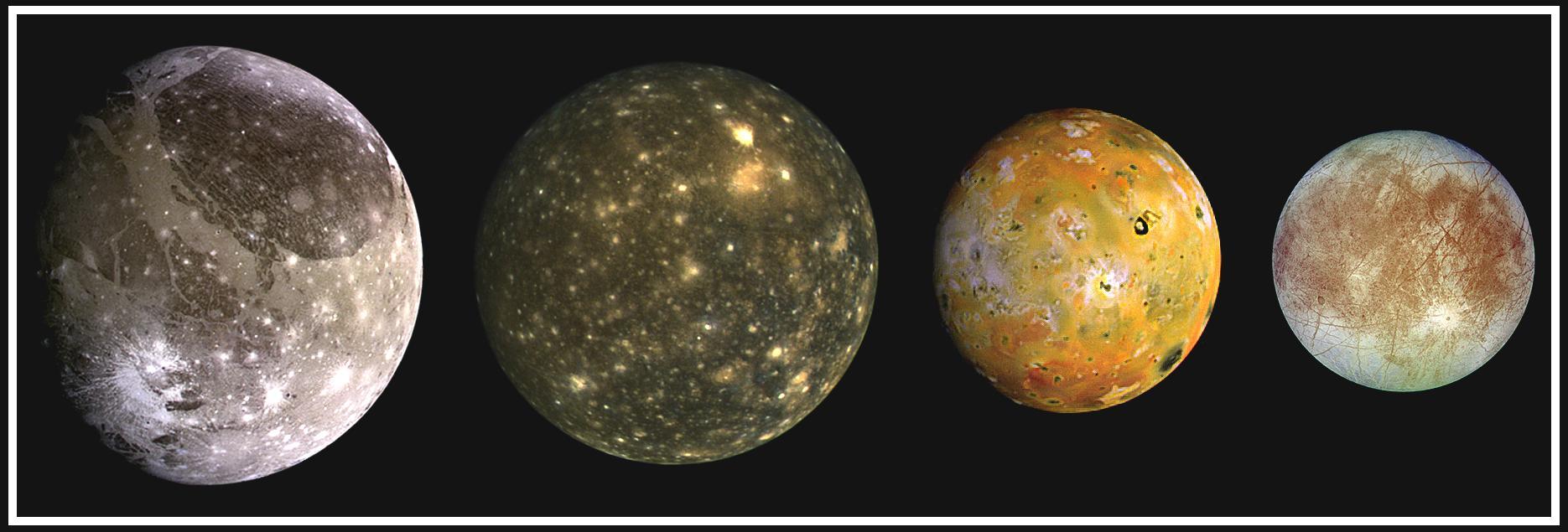
This composite includes the four largest moons of Jupiter which are known as the Galilean satellites. From left to right, the moons shown are Ganymede, Callisto, Io, and Europa. The Galilean satellites were first seen by the Italian astronomer Galileo Galilei in 1610. In order of increasing distance from Jupiter, Io is closest, followed by Europa, Ganymede, and Callisto. The order of these satellites from the planet Jupiter helps to explain some of the visible differences among the moons. Io is subject to the strongest tidal stresses from the massive planet. These stresses generate internal heating which is released at the surface and makes Io the most volcanically active body in our solar system. Europa appears to be strongly differentiated with a rock/iron core, an ice layer at its surface, and the potential for local or global zones of water between these layers. Tectonic resurfacing brightens terrain on the less active and partially differentiated moon Ganymede. Callisto, furthest from Jupiter, appears heavily cratered at low resolutions and shows no evidence of internal activity. North is to the top of this composite picture in which these satellites have all been scaled to a common factor of 10 kilometers (6 miles) per picture element. The Solid State Imaging (CCD) system aboard NASA's Galileo spacecraft obtained the Io and Ganymede images in June 1996, while the Europa images were obtained in September 1996. Because Galileo focuses on high resolution imaging of regional areas on Callisto rather than global coverage, the portrait of Callisto is from the 1979 flyby of NASA's Voyager spacecraft. http://photojournal.jpl.nasa.gov/catalog/PIA00601
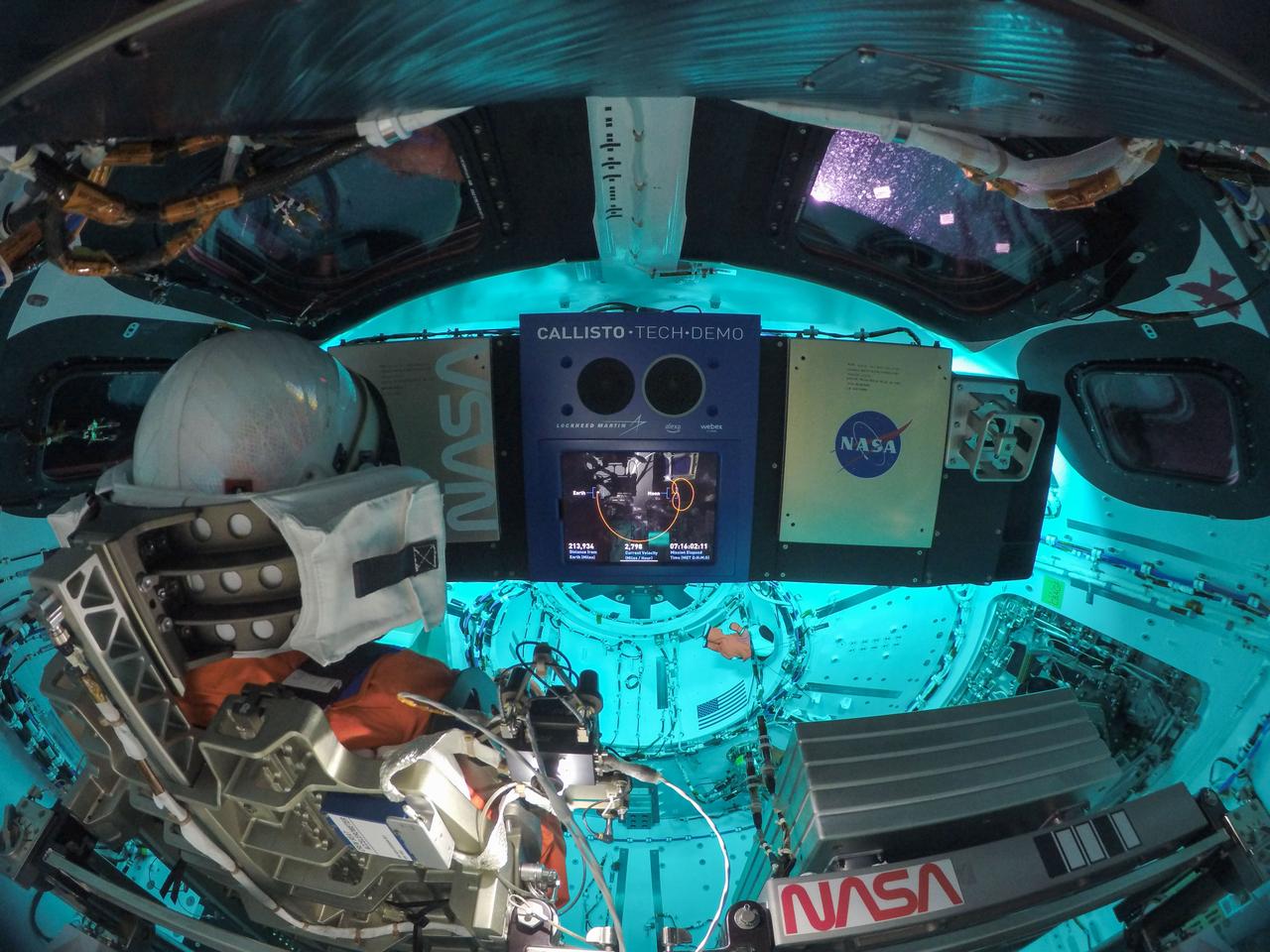
art001e000607 (Nov. 24, 2022) On flight day 9, the inside of Orion shows the display of the Callisto payload. Callisto is Lockheed Martin’s technology demonstration in collaboration with Amazon and Cisco, testing voice-activated and video technology that may assist future astronauts on deep space missions.
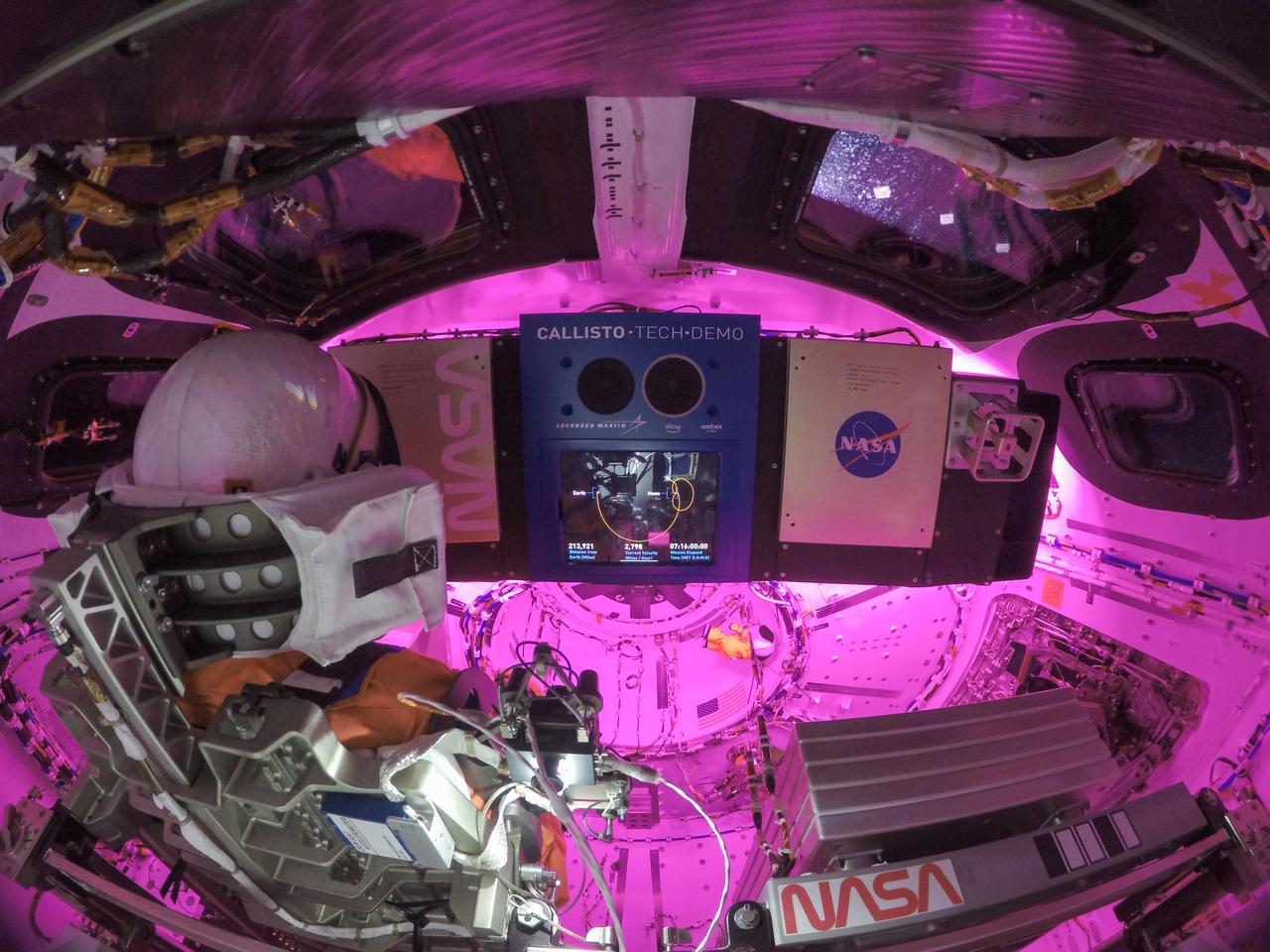
art001e000606 (Nov. 24, 2022) On flight day 9, the inside of Orion shows the display of the Callisto payload. Callisto is Lockheed Martin’s technology demonstration in collaboration with Amazon and Cisco, testing voice-activated and video technology that may assist future astronauts on deep space missions.

The main image and the inset image were taken by the JunoCam imager about NASA's Juno spacecraft a few hours before its closest approach to Jupiter on its 38th perijove pass, on Nov. 29, 2021, during an encounter with the Jovian moon Io. After snapping a series of Io images, JunoCam acquired this picture of Jupiter and Io together. Much fainter and more distant is Jupiter's moon Callisto, barely visible below and to the right of Io. The original JunoCam image used to produce this view was taken from an altitude of 15,404 miles (24,791 kilometers) above Jupiter's cloud tops near its north pole. At the time, Io was at a distance of 270,648 miles (435,567 kilometers), and Callisto was almost 1.2 million miles (2 million kilometers). Citizen scientist Brian Swift processed the main image and inset to enhance the color and contrast. https://photojournal.jpl.nasa.gov/catalog/PIA25032
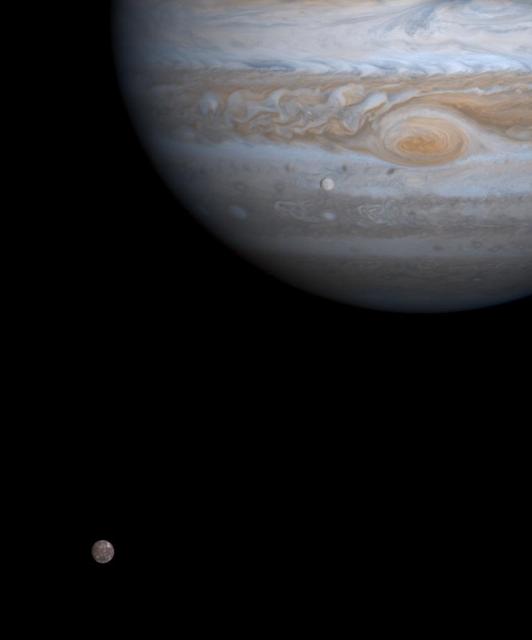
One moment in an ancient, orbital dance is caught in this color picture taken by NASA Cassini spacecraft on Dec. 7, 2000, just as two of Jupiter four major moons, Europa and Callisto, were nearly perfectly aligned with each other.
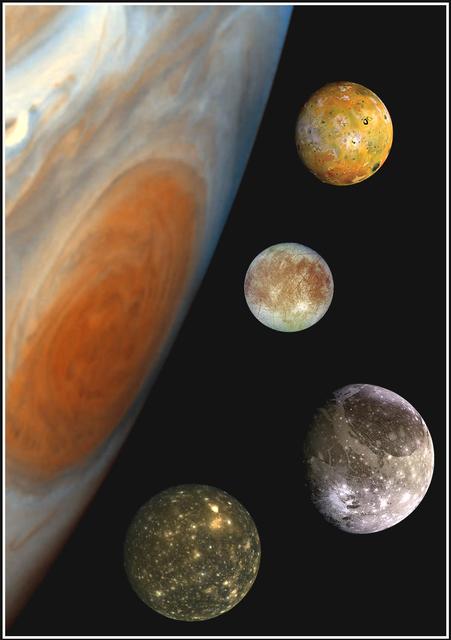
This "family portrait," a composite of the Jovian system, includes the edge of Jupiter with its Great Red Spot, and Jupiter's four largest moons, known as the Galilean satellites. From top to bottom, the moons shown are Io, Europa, Ganymede and Callisto. The Great Red Spot, a storm in Jupiter's atmosphere, is at least 300 years old. Winds blow counterclockwise around the Great Red Spot at about 400 kilometers per hour (250 miles per hour). The storm is larger than one Earth diameter from north to south, and more than two Earth diameters from east to west. In this oblique view, the Great Red Spot appears longer in the north-south direction. Europa, the smallest of the four moons, is about the size of Earth's moon, while Ganymede is the largest moon in the solar system. North is at the top of this composite picture in which the massive planet and its largest satellites have all been scaled to a common factor of 15 kilometers (9 miles) per picture element. The Solid State Imaging (CCD) system aboard NASA's Galileo spacecraft obtained the Jupiter, Io and Ganymede images in June 1996, while the Europa images were obtained in September 1996. Because Galileo focuses on high resolution imaging of regional areas on Callisto rather than global coverage, the portrait of Callisto is from the 1979 flyby of NASA's Voyager spacecraft. http://photojournal.jpl.nasa.gov/catalog/PIA00600
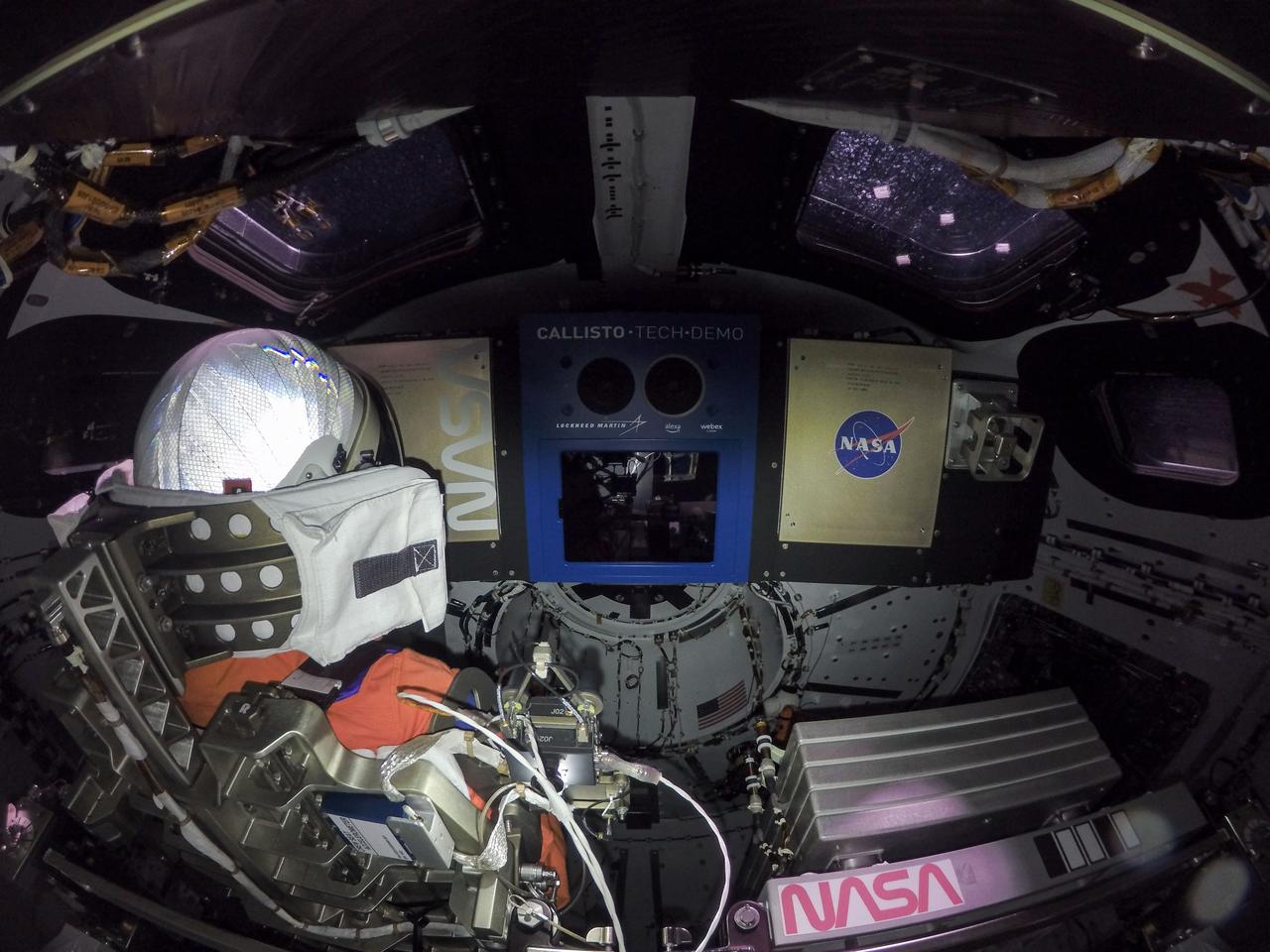
This high-resolution image captures the inside of the Orion crew module on flight day one of the Artemis I mission. At left is Commander Moonikin Campos, a purposeful passenger equipped with sensors to collect data that will help scientists and engineers understand the deep-space environment for future Artemis missions. At center is the Callisto payload, a technology demonstration of voice-activated audio and video technology from Lockheed Martin in collaboration with Amazon and Cisco. Callisto could assist future astronauts on deep-space missions. Below and to the right of Callisto is the Artemis I zero-gravity indicator, astronaut Snoopy.
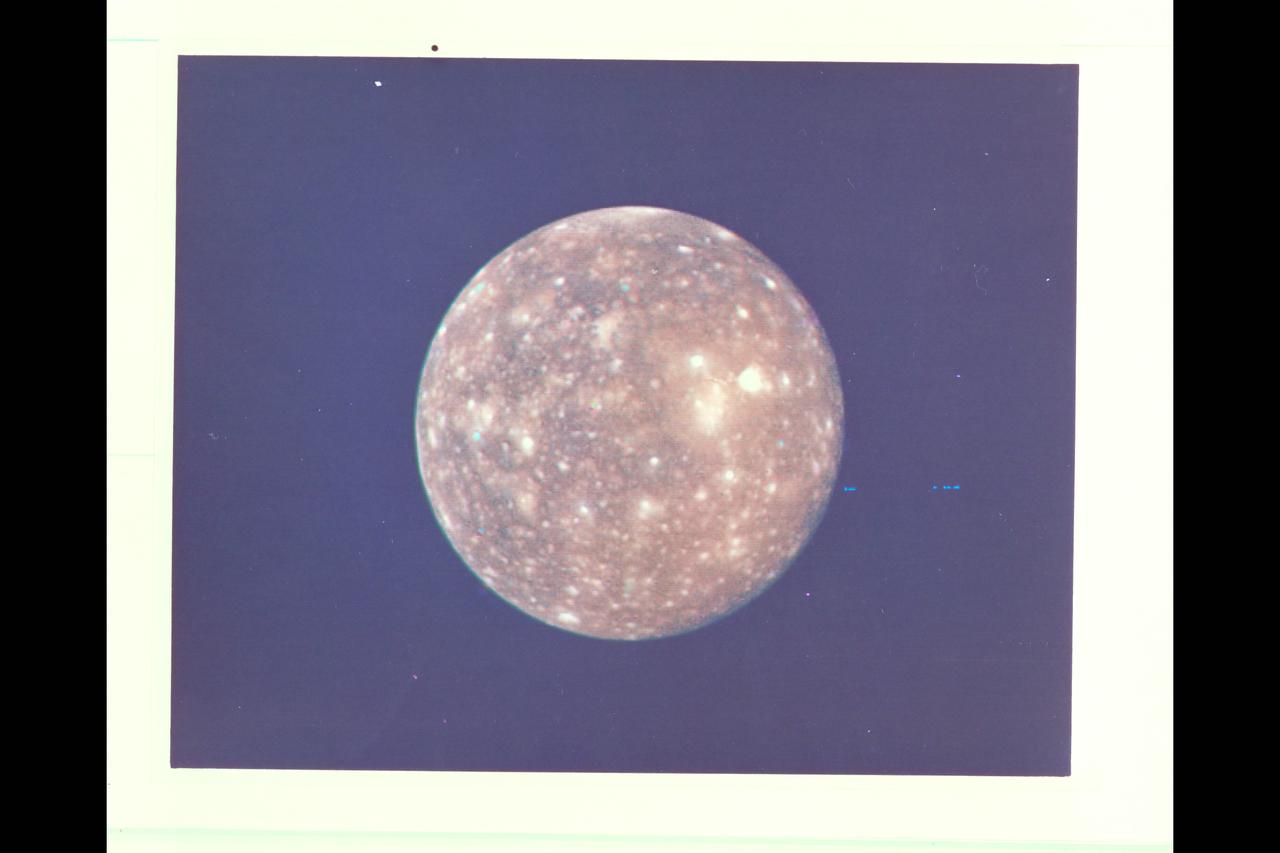
P-21740 C Range: 2,318,000 kilometers (1,438,000 miles) This picture of Callisto taken by Voyager 2 shows the moon covered with bright spots which are metoerite impact craters--a fact originally discovered from the high resolution pictures taken by Voyager 1. Scientists believe that heavily cratered terrains like these on Callisto are indicative of ancient planetary surfaces. Voyager 2 mapped the side of Callisto not seen by Voyager 1. The obsure dark streaks in this area may be fault zones, but higher resolution pictures are needed for identification.
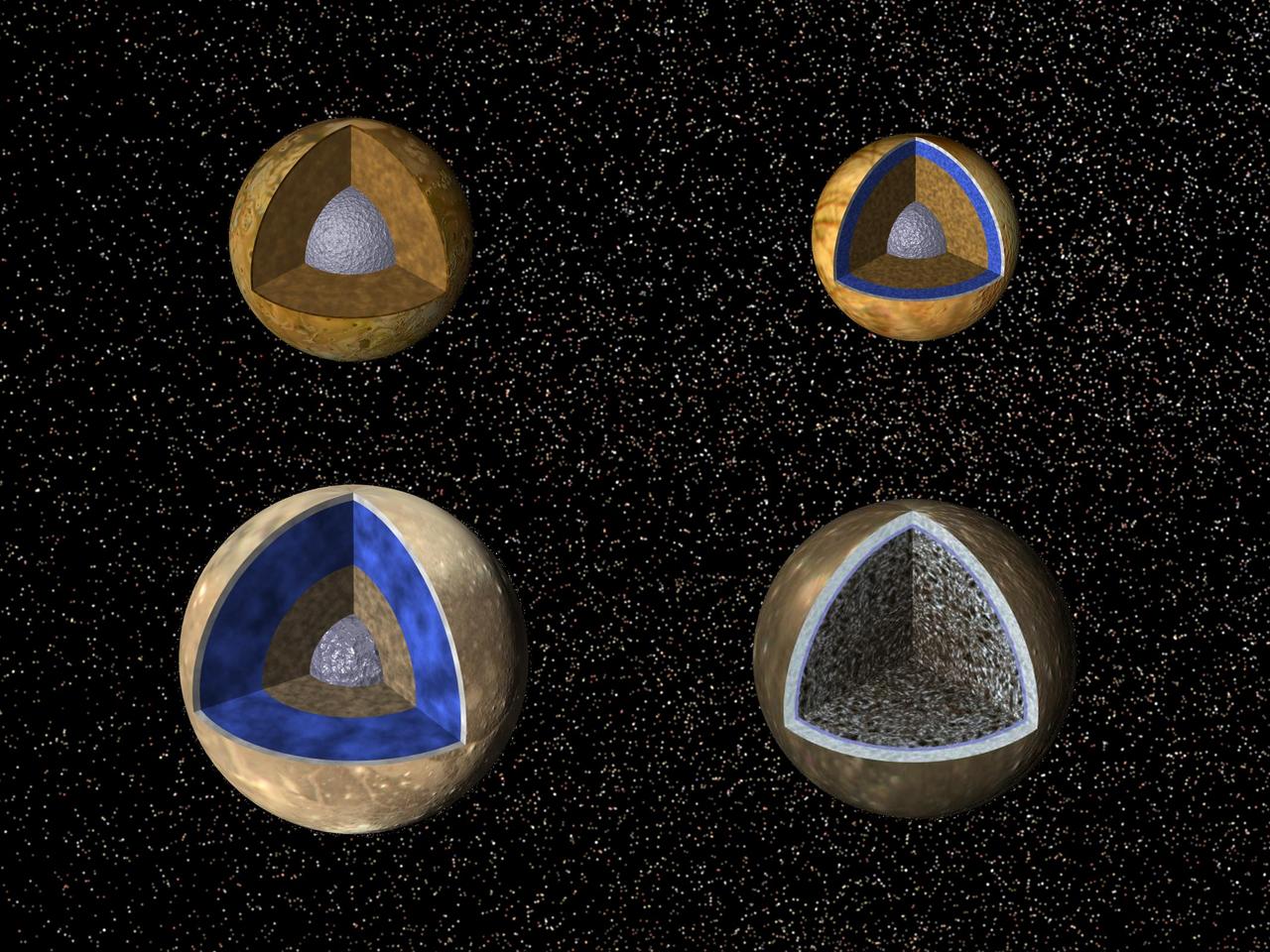
Cutaway views of the possible internal structures of the Galilean satellites. Ganymede at lower left, Callisto at lower right, Io on upper left, and Europa on upper right in a combined biew from NASA Galileo and Voyager spacecraft.
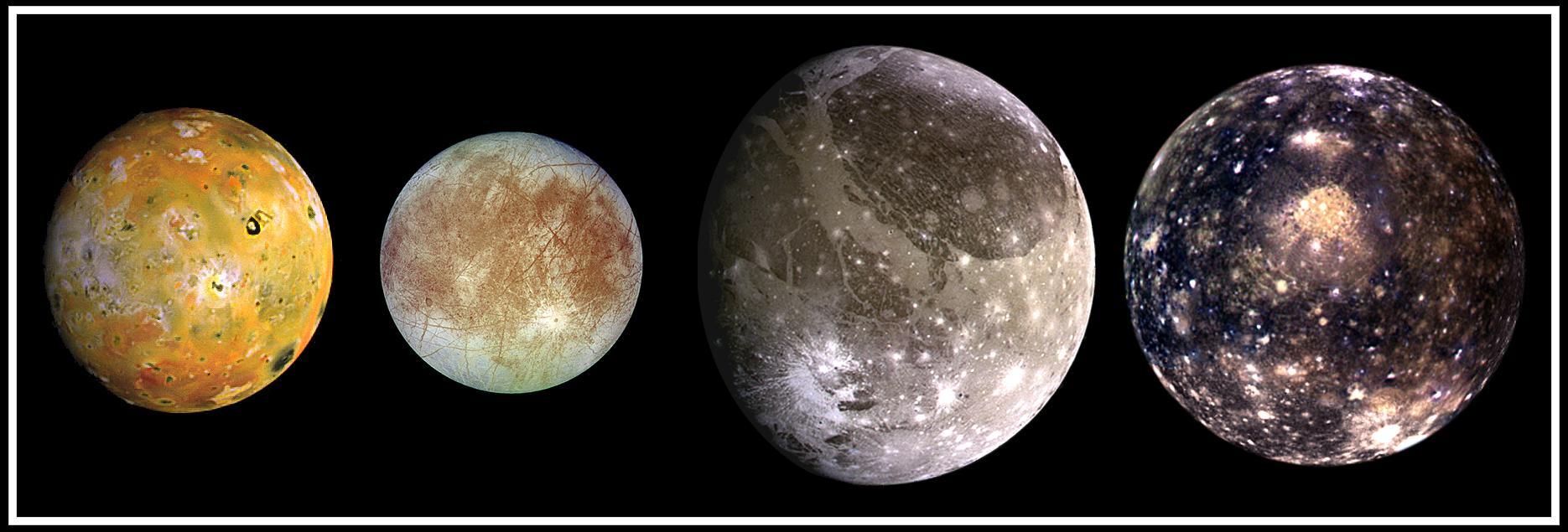
This composite includes the four largest moons of Jupiter which are known as the Galilean satellites. Shown from left to right are Io, closest to Jupiter, followed by Europa, Ganymede, and Callisto.
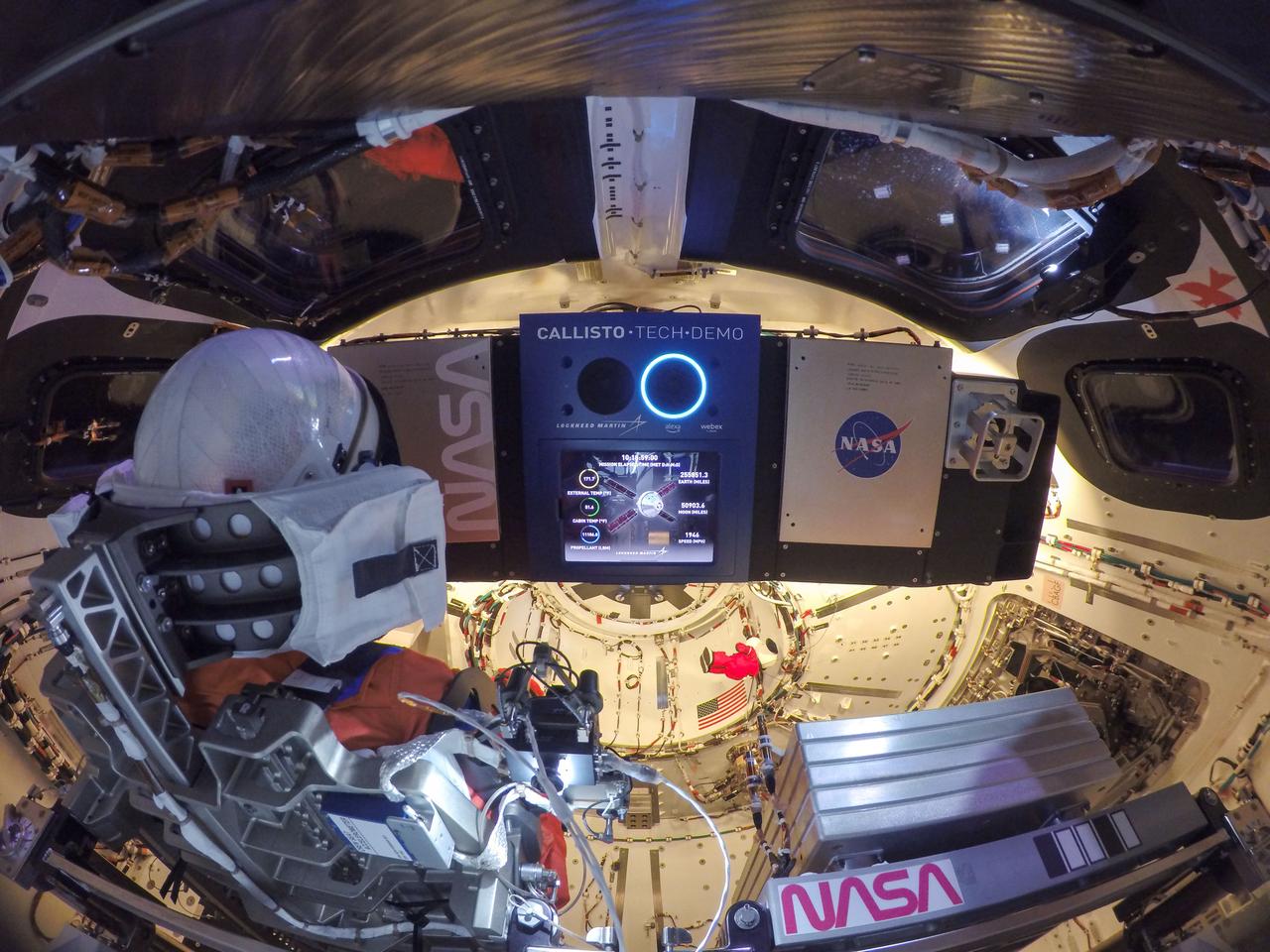
art001e001451 (Nov. 27, 2022) On flight day 12, the inside of Orion shows the display of the Callisto payload. Callisto is Lockheed Martin’s technology demonstration in collaboration with Amazon and Cisco, testing voice-activated and video technology that may assist future astronauts on deep space missions.
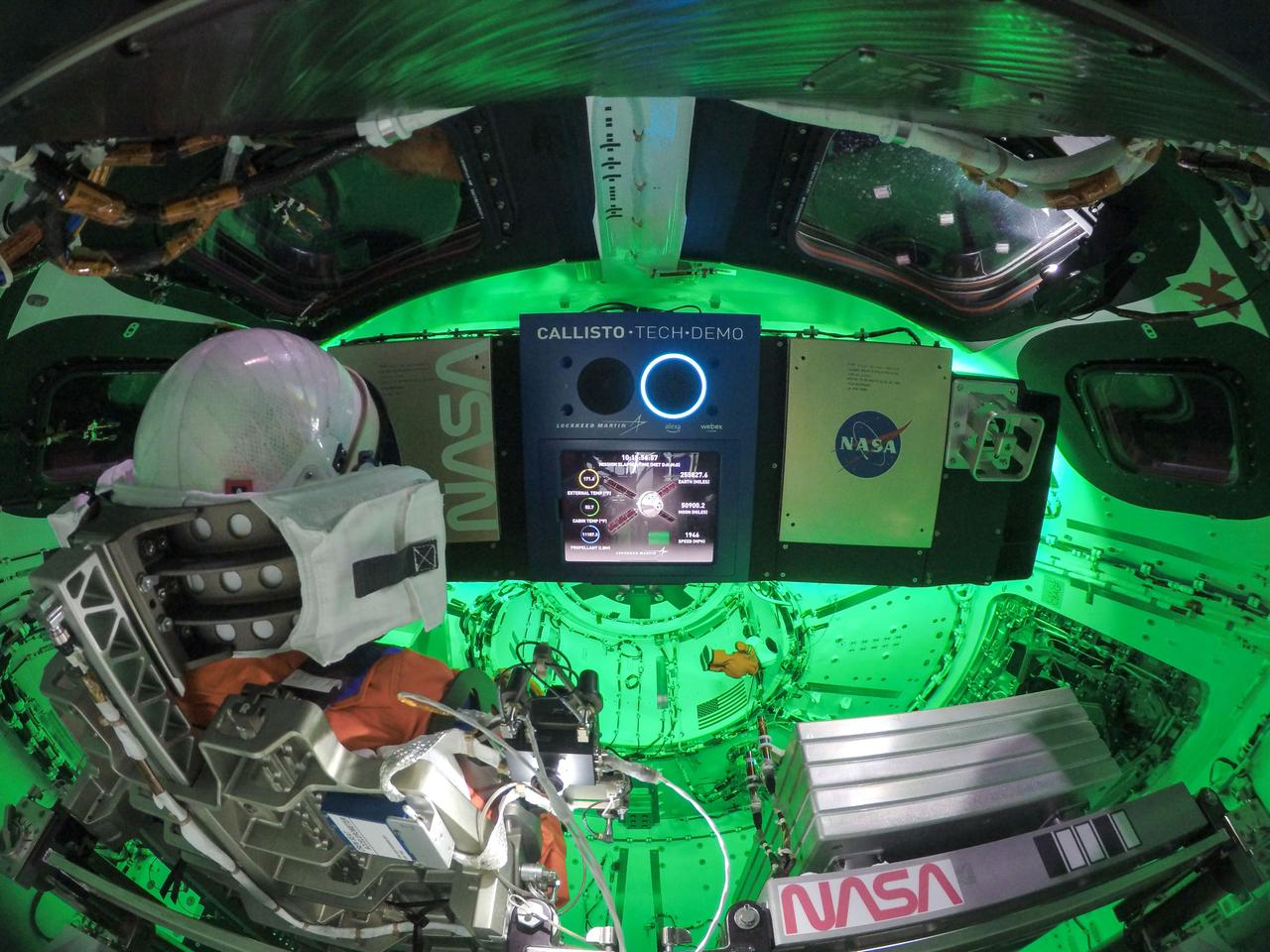
art001e001450 (Nov. 27, 2022) On flight day 12, the inside of Orion shows the display of the Callisto payload. Callisto is Lockheed Martin’s technology demonstration in collaboration with Amazon and Cisco, testing voice-activated and video technology that may assist future astronauts on deep space missions.
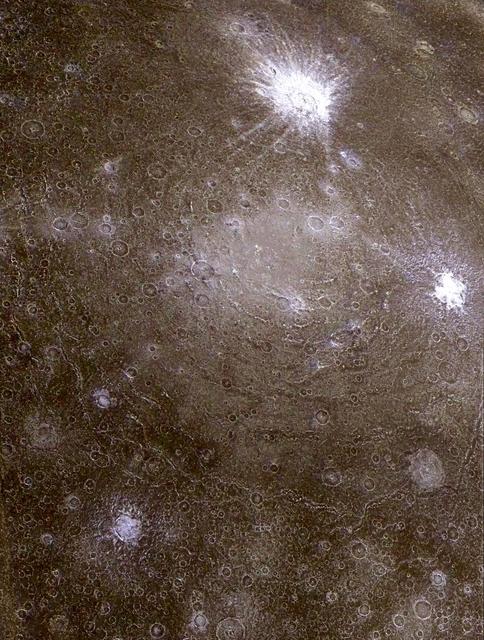
Asgard Scarp Mosaic
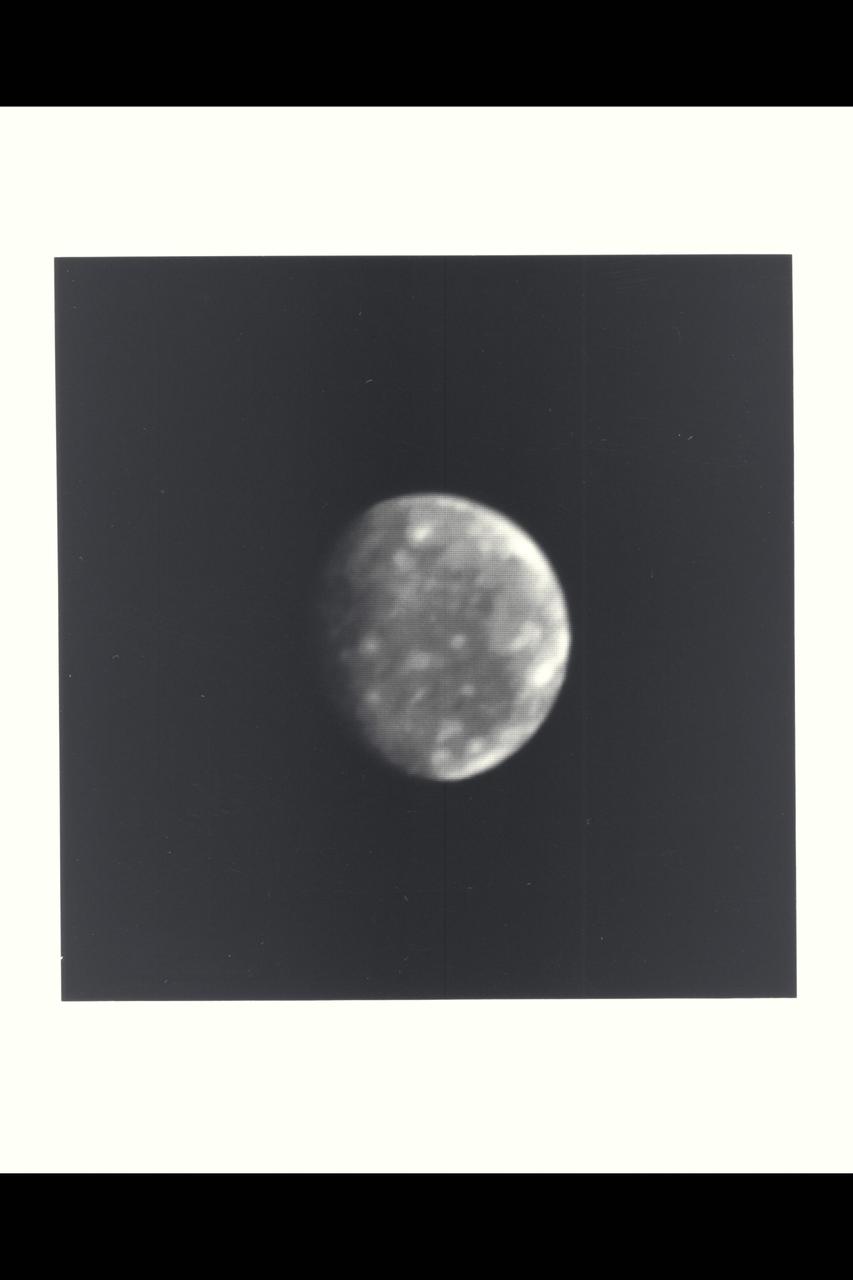
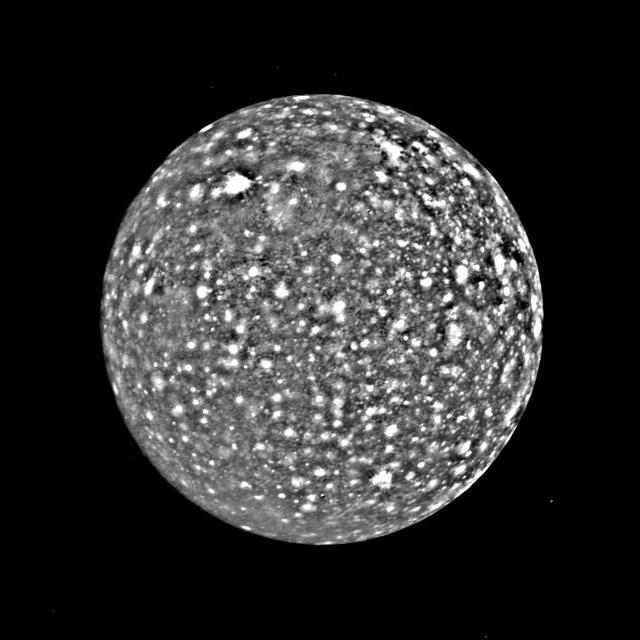
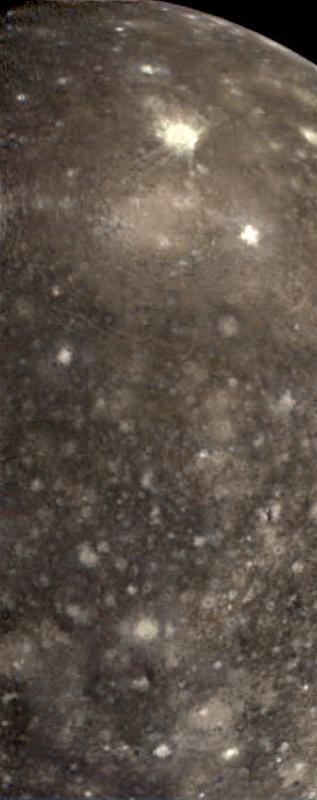
This photo of Callisto, outermost of Jupiter's four Galilean satellites, was taken a few minutes after midnight (PST) Feb. 25 by Voyager 1. The distance to Callisto was 8,023,000 kilometers (4.98 million miles). The hemisphere in this picture shows a fairly uniform surface dotted with brighter spots that are up to several hundred kilometers across. Scientists believe the spots may be impact craters but higher-resolution photos will be necessary before the features can be interpreted. Callisto is about the same size as the planet Mercury--about 5,000 kilometers (3,000 miles) in diameter. Callisto is less massive than Mercury, however, giving it a density less than twice that of water. Scientists believe Callisto, therefore, is composed of a mixture of rock and ice (up to about 50 percent by weight). Its surface is darker than those of the other Galilean satellites, but is still about twice as bright as Earth's Moon. This black-and-white photo was taken through a violet filter. Jet Propulsion Laboratory manages and controls the Voyager project for NASA's Office of Space Science. (JPL ref. No. P-21149)

Jupiter, its Great Red Spot and three of its four largest satellites are visible in this photo taken Feb. 5, 1979, by Voyager 1. Io, Europa, and Callisto are seen against Jupiter disk. http://photojournal.jpl.nasa.gov/catalog/PIA00358
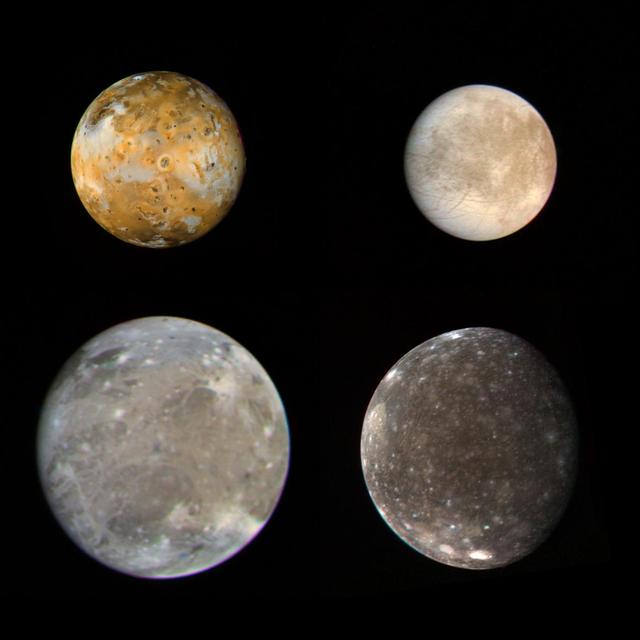
These photos of the four Galilean satellites of Jupiter were taken by NASA Voyager 1 during its approach to the planet in early March 1979. Io, Europa, Ganymede, and Callisto are shown in their correct relative sizes. http://photojournal.jpl.nasa.gov/catalog/PIA00012
Range : 7 million kilometers (5 million miles) Callisto is the outermost Galilean satellite of Jupiter and the darkest of the four, but still twice as bright as Earth's Moon. Mottled appearance from bright and dark patches; bright ones look like rayed or brite craters on our Moon. This face of Callisto is always turned toward Jupiter. Photo taken through violet filter.
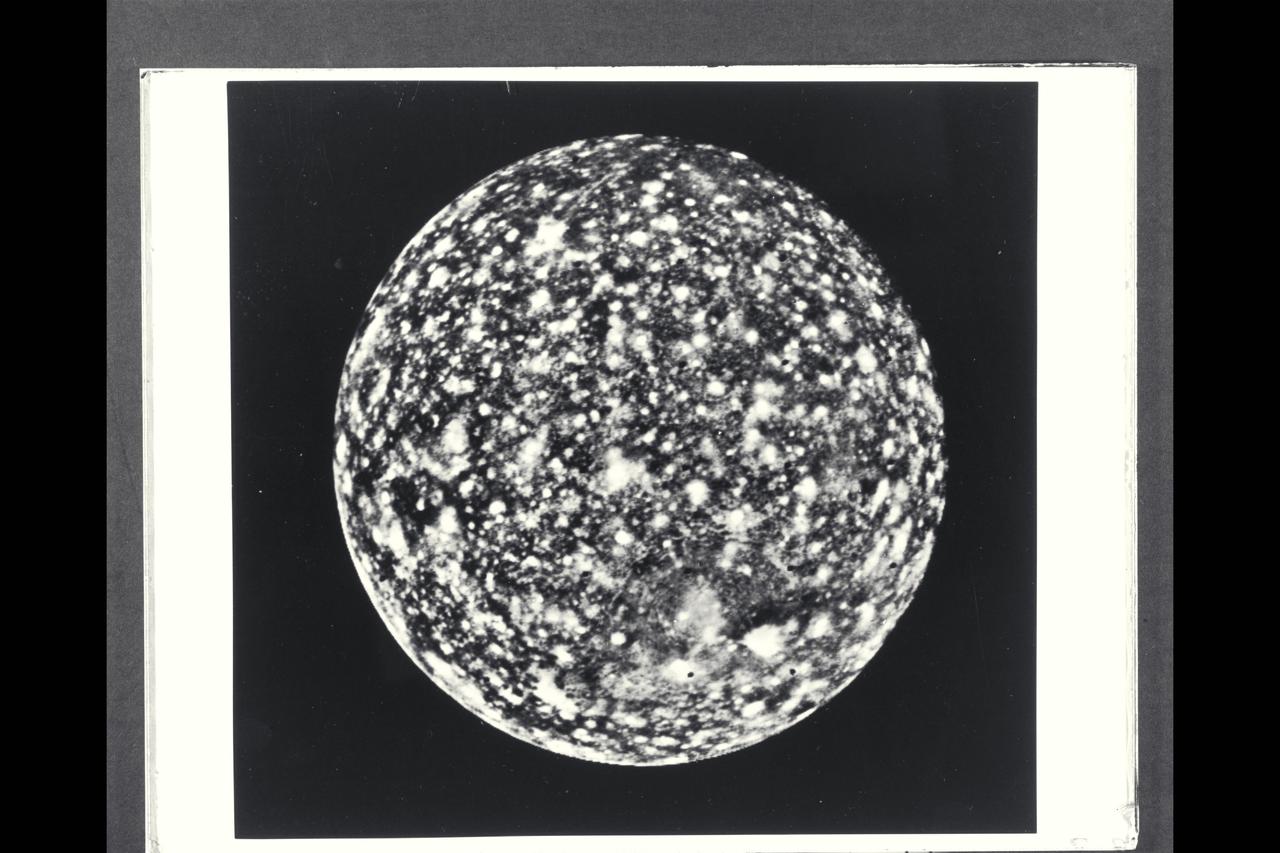
P-21745 BW Range: 1.1 million miles (675,000 miles) This image of Callisto taken by Voyager 2 was enhanced to reveal detail in the scene. Voyager 1's high resolution coverage was of the hemisphere just over the right-hand (eastern) horizon, and the large ring structure discovered by Voyager 1 is just over the eastern limb. This image shows yet another ring structure in the upper part of the picture. Callisto exhibits some of the most ancient terrain seen on any of the satellites. Scientists think Callisto's surface is a mixture of ice and rock dating back to the final stages of planetary accretion (over 4 billion years ago) when the surface was pockmarked by a torrential bombardment of meteorites. Younger craters show as bright spots, probably because they expose fresh ice and frost.
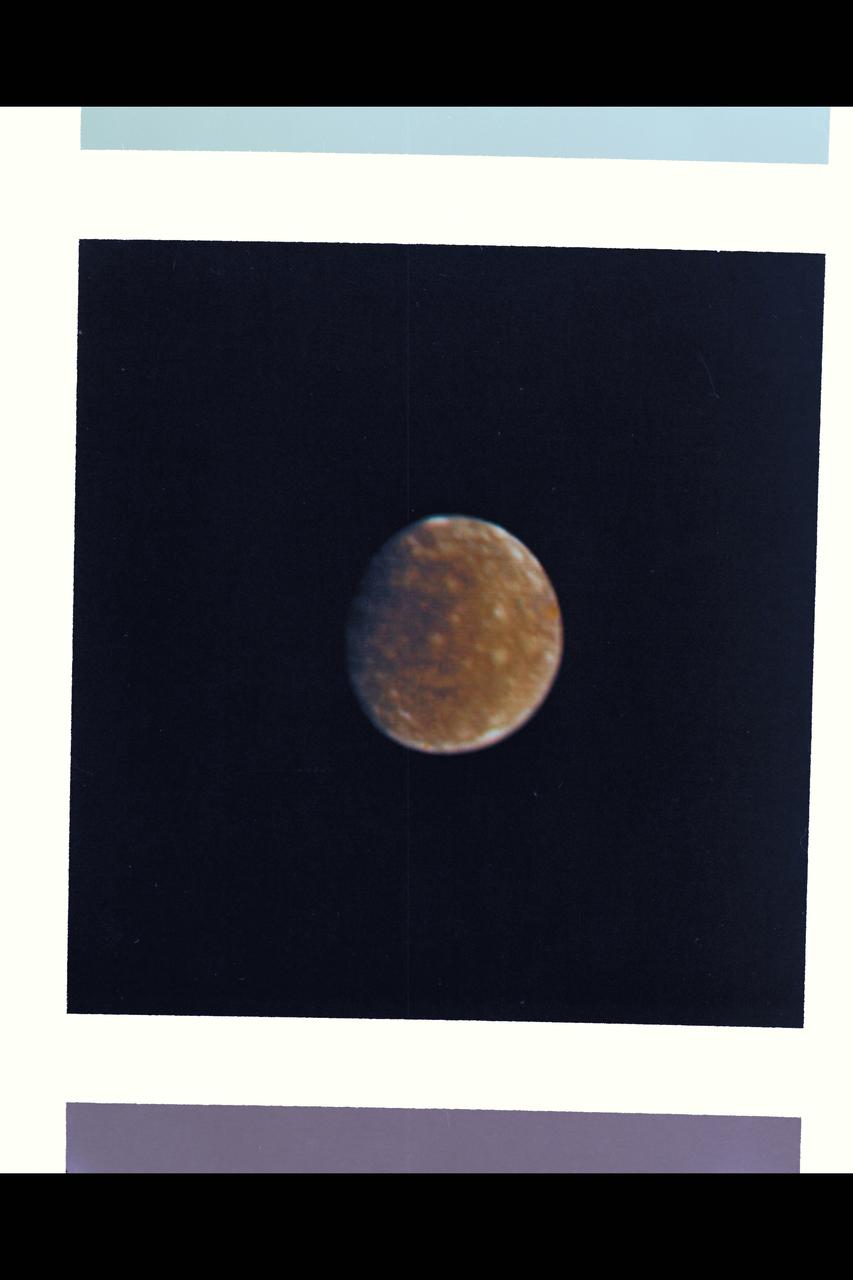
Callisto , The outermost Galilean Satellite , or Moon , of Jupiter, as taken by Voyager I . Range : About 7 Million km (5 Million miles) . Callisto, the darkest of the Galilean Satellites, still nearly twice as bright as the Earth's Moon, is seen here from the face that always faces Jupiter. All of the Galilean Satellites always show the same face to Jupiter, as the Earth's moon does to Earth. The Surface shows a mottled appearance of bright and dark patches. The former reminds scientists of rayed or bright haloed craters, similiar to those seen on earth's Moon. This color photo is assembled from 3 black and wite images taken though violet, orange, & green filters

NASA Galileo spacecraft acquired this global mosaic right during Galileo third orbit on Nov. 4, 1996. The lighter bluish area in the upper latitudes is the Asgard multi-ring structure with crater Burr to the north and Tornasuk to the east.
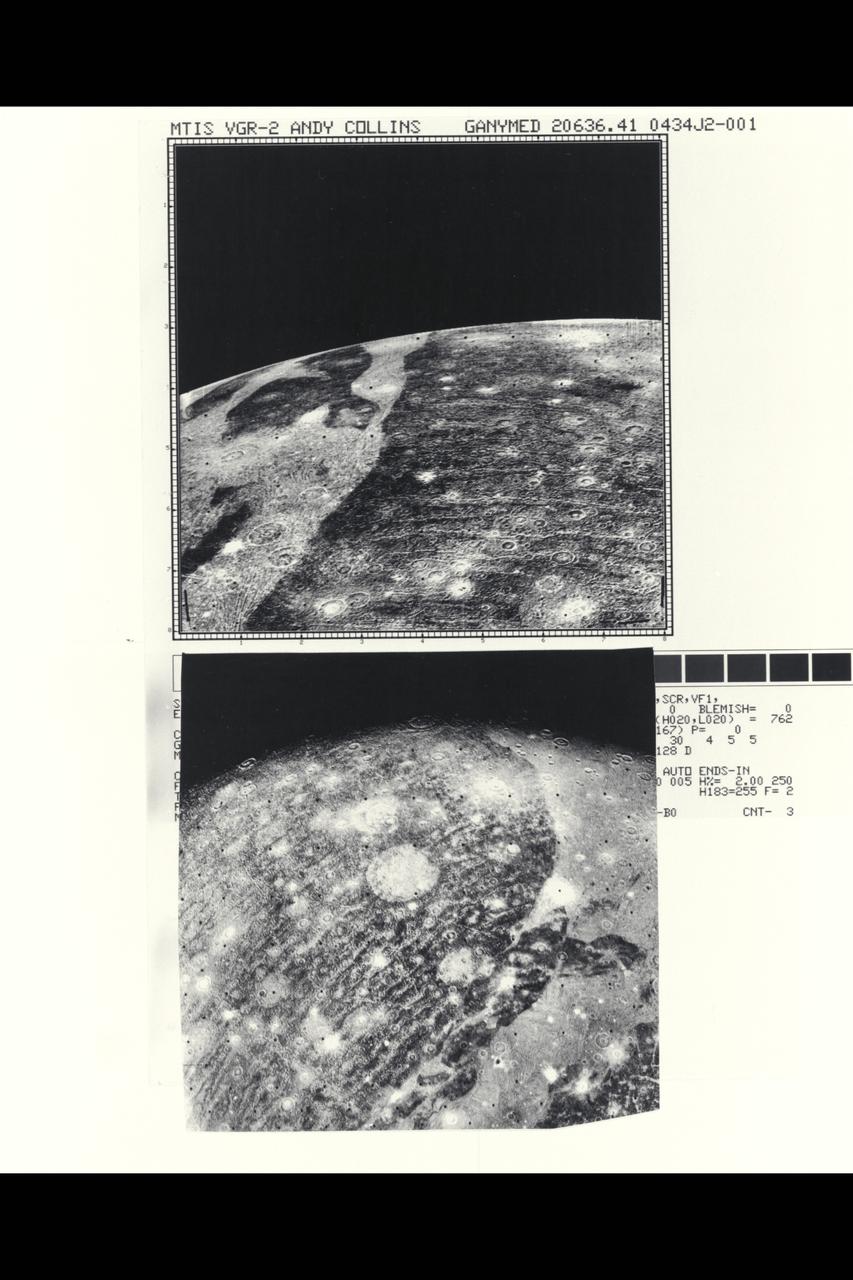
Range : top- 86,000 miles bottom- 192,000 mi. These two close-ups of Ganymede, the largest of Jupiter's 13 moons, show different views of the largest block of dark, heavily cratered terrain. The bottom image shows objects 3 or 4 miles across, with resolution of about 1.5 miles. The light, linear stripes recurring across the dark region resemble the outer rings of the large ring structure around Callisto. If these features are related to an ancient ring structure formed by a large impact, their small curvature suggests that the original structure was even larger than one seen on Callisto. There is no apparent trace now of the center of this suggested structure, which must have been destroyed by the resurfacing evident over most of Ganymede in the grooved terrain. Another interpretation is that these features are not impact-related rings, but rather internally produced fractures crossing the dark terrain, similiar to the grooved bands.
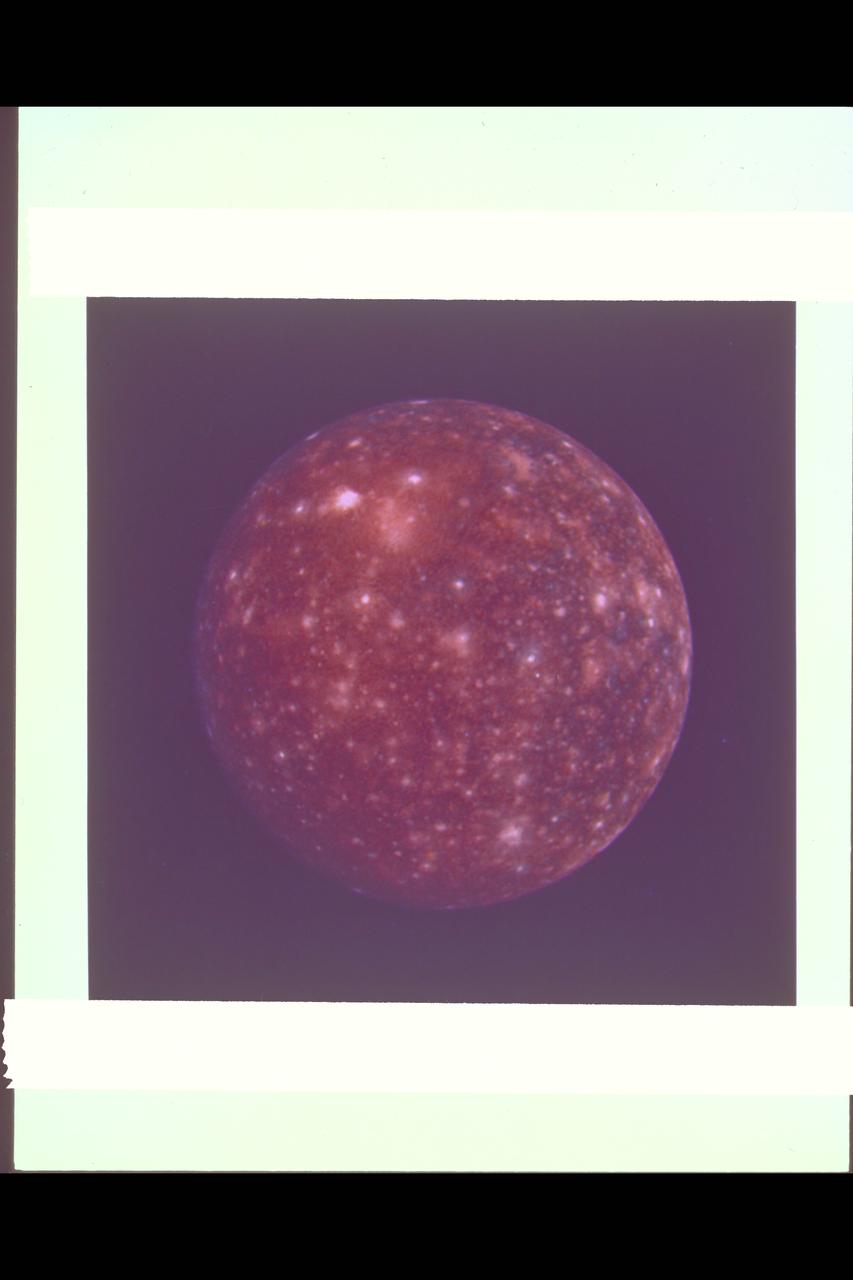
Range : 1,094,666 km (677,000 mi.) This false color picture of Callisto was taken by Voyager 2 and is centered on 11 degrees N and 171 degrees W. This rendition uses an ultraviolet image for the blue component. Because the surface displays regional contrast in UV, variations in surface materials are apparent. Notice in particular the dark blue haloes which surround bright craters in the eastern hemisphere. The surface of Callisto is the most heavily cratered of the Galilean satellites and resembles ancient heavily cratered terrains on the moon, Mercury and Mars. The bright areas are ejecta thrown out by relatively young impact craters. A large ringed structure, probably an impact basin, is shown in the upper left part of the picture. The color version of this picture was constructed by compositing black and white images taken through the ultraviolet, clear and orange filters.
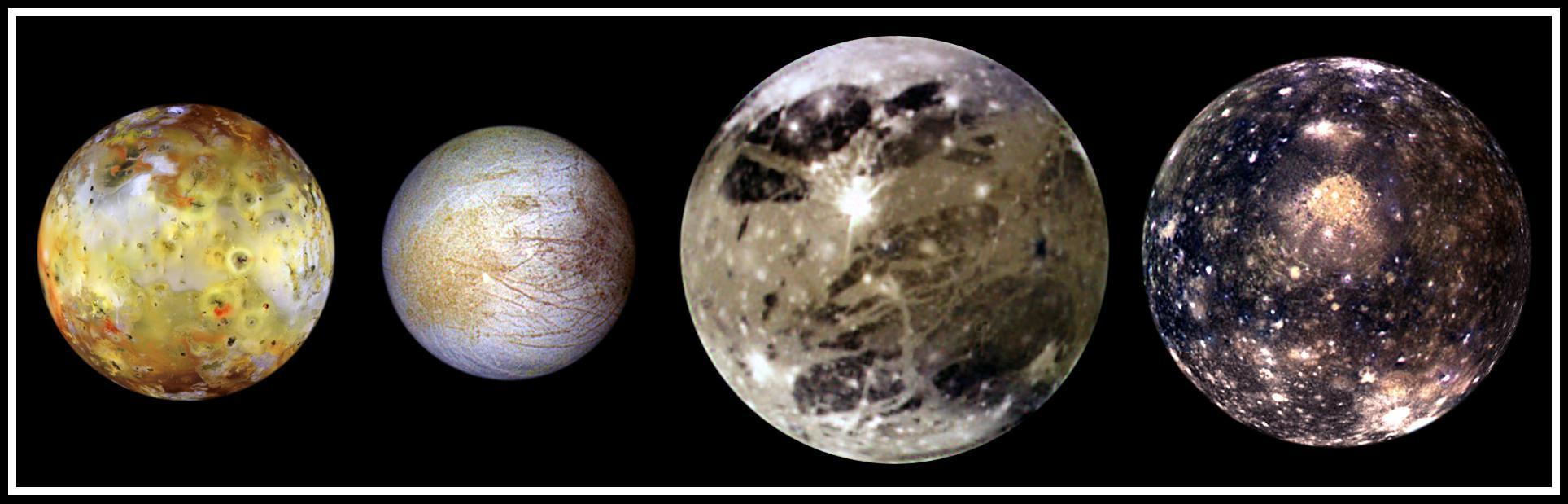
In this "family portrait," the four Galilean Satellites are shown to scale. These four largest moons of Jupiter shown in increasing distance from Jupiter are (left to right) Io, Europa, Ganymede, and Callisto. These global views show the side of volcanically active Io which always faces away from Jupiter, icy Europa, the Jupiter-facing side of Ganymede, and heavily cratered Callisto. The appearances of these neighboring satellites are amazingly different even though they are relatively close to Jupiter (350,000 kilometers for Io; 1, 800,000 kilometers for Callisto). These images were acquired on several orbits at very low "phase" angles (the sun, spacecraft, moon angle) so that the sun is illuminating the Jovian moons from completely behind the spacecraft, in the same way a full moon is viewed from Earth. The colors have been enhanced to bring out subtle color variations of surface features. North is to the top of all the images which were taken by the Solid State Imaging (SSI) system on NASA's Galileo spacecraft. Io, which is slightly larger than Earth's moon, is the most colorful of the Galilean satellites. Its surface is covered by deposits from actively erupting volcanoes, hundreds of lava flows, and volcanic vents which are visible as small dark spots. Several of these volcanoes are very hot; at least one reached a temperature of 2000 degrees Celsius (3600 degrees Fahrenheit) in the summer of 1997. Prometheus, a volcano located slightly right of center on Io's image, was active during the Voyager flybys in 1979 and is still active as Galileo images were obtained. This global view was obtained in September 1996 when Galileo was 485,000 kilometers from Io; the finest details that can be discerned are about 10 km across. The bright, yellowish and white materials located at equatorial latitudes are believed to be composed of sulfur and sulfur dioxide. The polar caps are darker and covered by a redder material. Europa has a very different surface from its rocky neighbor, Io. Galileo images hint at the possibility of liquid water beneath the icy crust of this moon. The bright white and bluish parts of Europa's surface are composed almost completely of water ice. In contrast, the brownish mottled regions on the right side of the image may be covered by salts (such as hydrated magnesium-sulfate) and an unknown red component. The yellowish mottled terrain on the left side of the image is caused by some other, unknown contaminant. This global view was obtained in June 1997 when Galileo was 1.25 million kilometers from Europa; the finest details that can be discerned are 25 kilometers across. Ganymede, larger than the planet Mercury, is the largest Jovian satellite. Its distinctive surface is characterized by patches of dark and light terrain. Bright frost is visible at the north and south poles. The very bright icy impact crater, Tros, is near the center of the image in a region known as Phrygia Sulcus. The dark area to the northwest of Tros is Perrine Regio; the dark terrain to the south and southeast is Nicholson Regio. Ganymede's surface is characterized by a high degree of crustal deformation. Much of the surface is covered by water ice, with a higher amount of rocky material in the darker areas. This global view was taken in September 1997 when Galileo was 1.68 million kilometers from Ganymede; the finest details that can be discerned are about 67 kilometers across. Callisto's dark surface is pocked by numerous bright impact craters. The large Valhalla multi-ring structure (visible near the center of the image) has a diameter of about 4,000 kilometers, making it one of the largest impact features in the Solar System. Although many crater rims exhibit bright icy "bedrock" material, a dark layer composed of hydrated minerals and organic components (tholins) is seen inside many craters and in other low lying areas. Evidence of tectonic and volcanic activity, seen on the other Galilean satellites, appears to be absent on Callisto. This global view was obtained in November 1997 when Galileo was 684,500 kilometers from Callisto; the finest details that can be discerned are about 27 kilometers across. http://photojournal.jpl.nasa.gov/catalog/PIA01400
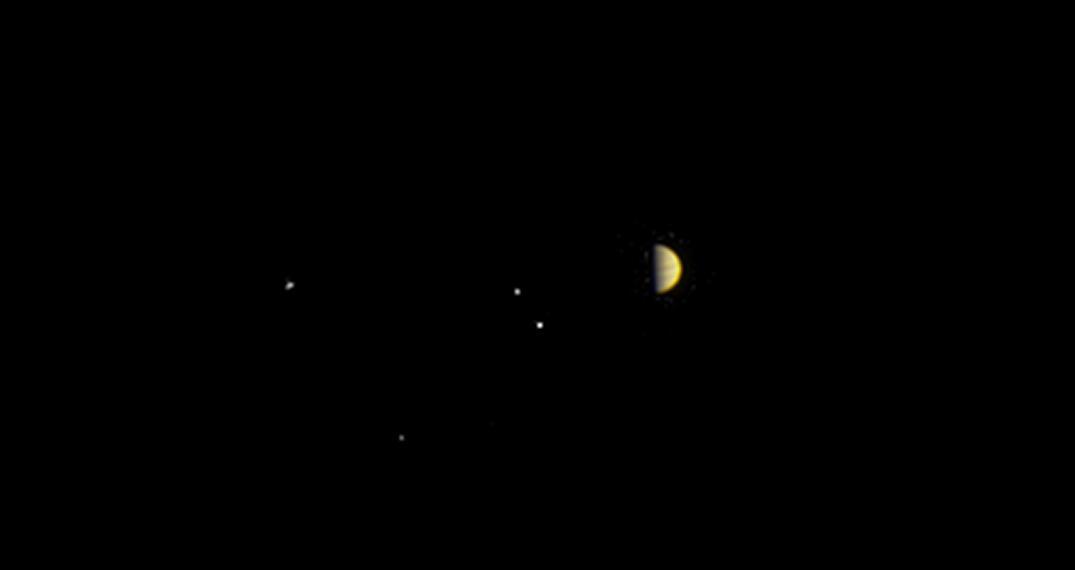
NASA's Juno spacecraft obtained this color view on June 21, 2016, at a distance of 6.8 million miles (10.9 million kilometers) from Jupiter. As Juno makes its initial approach, the giant planet's four largest moons -- Io, Europa, Ganymede and Callisto -- are visible, and the alternating light and dark bands of the planet's clouds are just beginning to come into view. Juno is approaching over Jupiter's north pole, affording the spacecraft a unique perspective on the Jupiter system. Previous missions that imaged Jupiter on approach saw the system from much lower latitudes, closer to the planet's equator. The scene was captured by the mission's imaging camera, called JunoCam, which is designed to acquire high resolution views of features in Jupiter's atmosphere from very close to the planet. http://photojournal.jpl.nasa.gov/catalog/PIA20701
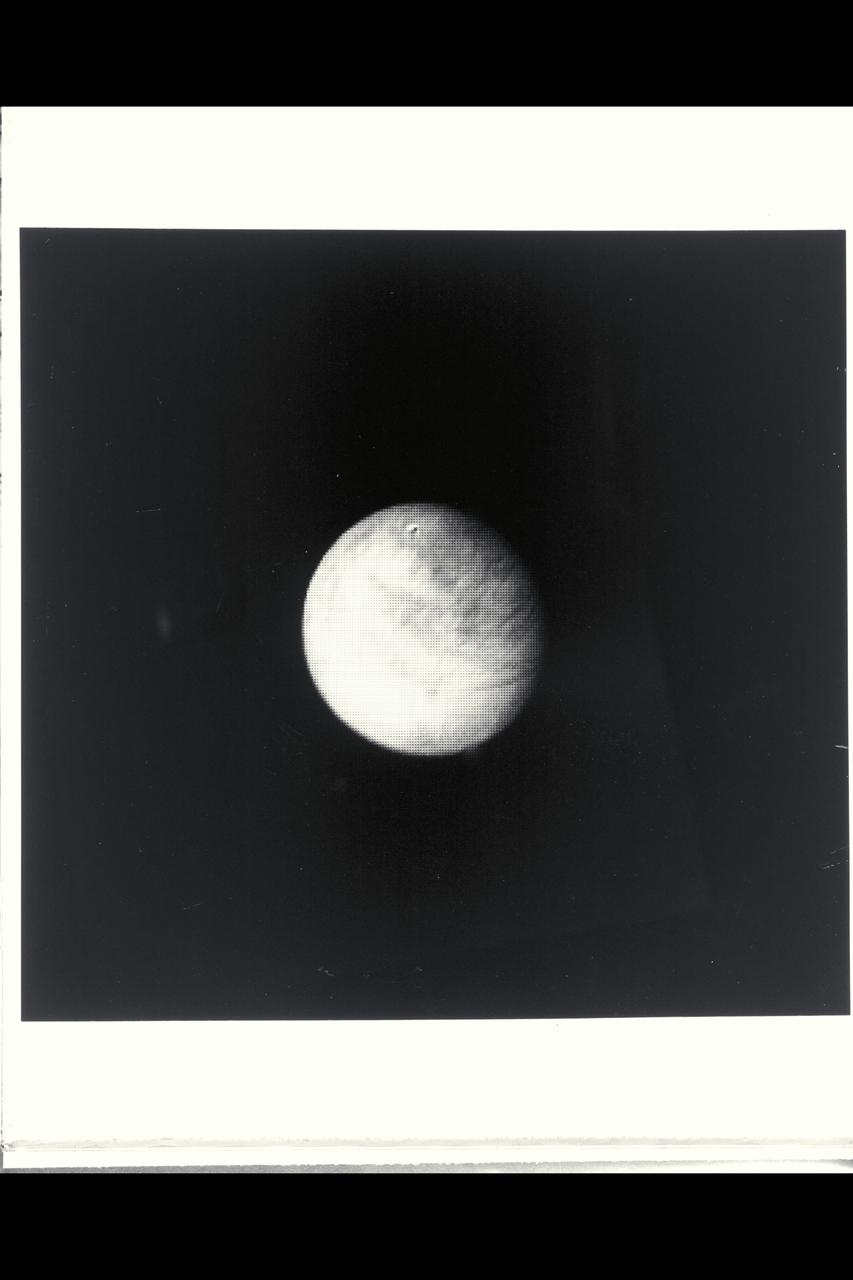
Range : 4.2 million km. ( 2.6 million miles ) Jupiter's moon Europa, the size of earth's moon, is apparently covered by water ice, as indicated by ground spectrometers and its brightness. In this view, global scale dark sreaks discovered by Voyager 1 that criss-cross the the satelite are becoming visible. Bright rayed impact craters, which are abundant on Ganymede and Callisto, would be easily visible at this range, suggesting that Europa's surface is young and that the streaks are reflections of currently active internal dynamic processes.
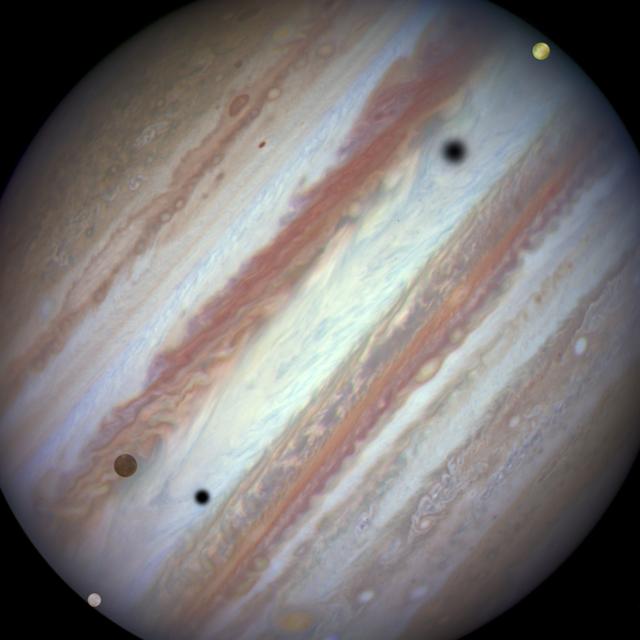
Three moons and their shadows parade across Jupiter near the end of the event at 07:10 UT on January 24, 2015. Europa has entered the frame at lower left. Slower-moving Callisto is above and to the right of Europa. Fastest-moving Io is approaching the eastern limb of the planet. Europa's shadow is toward the left side of the image and Callisto's shadow to the right. (The moons' orbital velocities are proportionally slower with increasing distance from the planet.) Credit: NASA, ESA, and the Hubble Heritage Team (STScI/AURA) More info: Firing off a string of snapshots like a sports photographer at a NASCAR race, NASA's Hubble Space Telescope captured a rare look at three of Jupiter's largest moons zipping across the banded face of the gas-giant planet: Europa, Callisto, and Io. Jupiter's four largest moons can commonly be seen transiting the face of the giant planet and casting shadows onto its cloud tops. However, seeing three moons transiting the face of Jupiter at the same time is rare, occurring only once or twice a decade. Missing from the sequence, taken on January 24, 2015, is the moon Ganymede that was too far from Jupiter in angular separation to be part of the conjunction. <b><a href="http://www.nasa.gov/audience/formedia/features/MP_Photo_Guidelines.html" rel="nofollow">NASA image use policy.</a></b> <b><a href="http://www.nasa.gov/centers/goddard/home/index.html" rel="nofollow">NASA Goddard Space Flight Center</a></b> enables NASA’s mission through four scientific endeavors: Earth Science, Heliophysics, Solar System Exploration, and Astrophysics. Goddard plays a leading role in NASA’s accomplishments by contributing compelling scientific knowledge to advance the Agency’s mission. <b>Follow us on <a href="http://twitter.com/NASAGoddardPix" rel="nofollow">Twitter</a></b> <b>Like us on <a href="http://www.facebook.com/pages/Greenbelt-MD/NASA-Goddard/395013845897?ref=tsd" rel="nofollow">Facebook</a></b> <b>Find us on <a href="http://instagram.com/nasagoddard?vm=grid" rel="nofollow">Instagram</a></b>
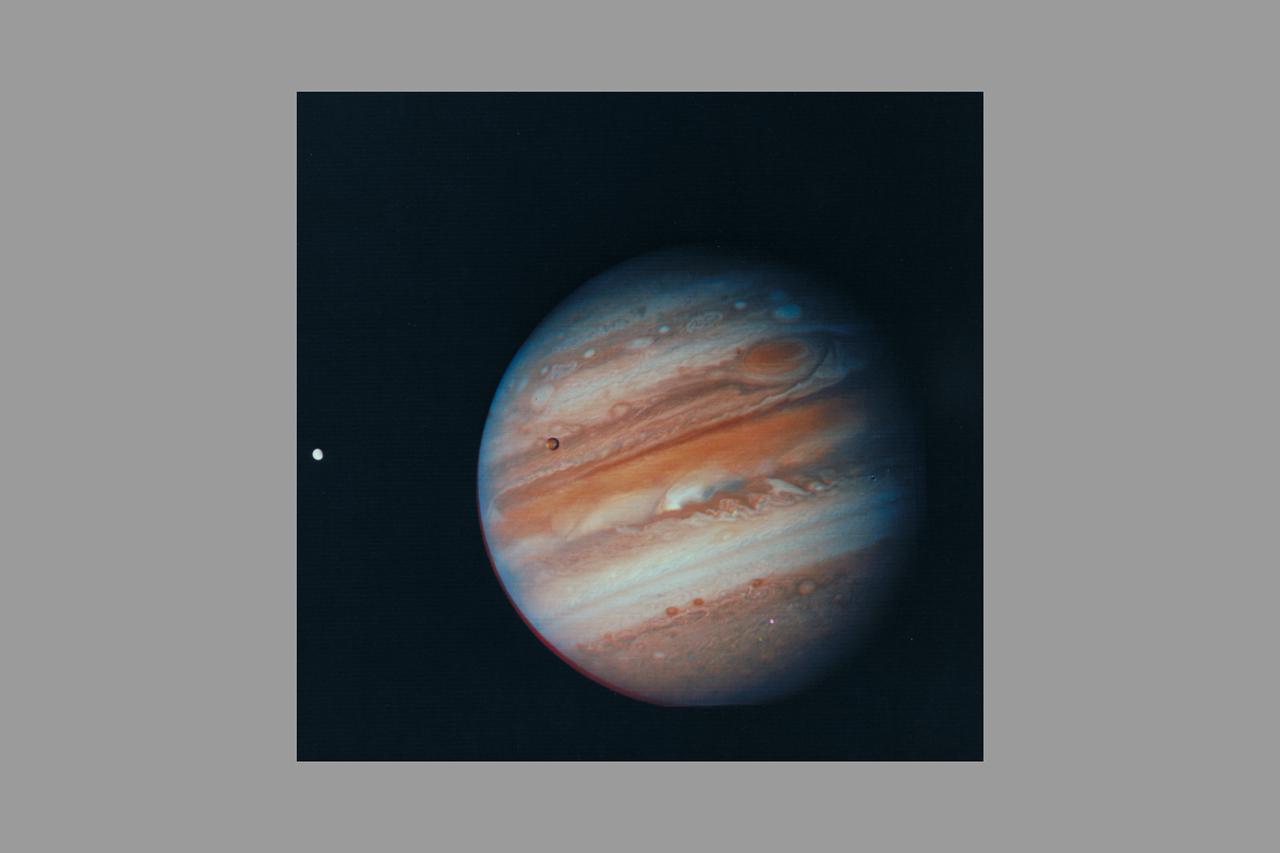
Photo by Voyager 1 (JPL) Jupiter, its Great Red Spot and three of its four largest satellites are visible in this photo taken Feb 5, 1979 by Voyager 1. The spacecraft was 28.4 million kilomters (17.5 million miles) from the planet at the time. The inner-most large satellite, Io, can be seen against Jupiter's disk. Io is distinguished by its bright, brown-yellow surface. To the right of Jupiter is the satellite Europa, also very bright but with fainter surface markings. The darkest satellite, Callisto (still nearly twice as bright as Earth's Moon), is barely visible at the bottom left of the picture. Callisto shows a bright patch in its northern hemisphere. All tThree orbit Jupiter in the equatorial plane, and appear in their present position because Voyageris above the plane. All three satellites show the same face to Jupiter always -- just as Earth's Moon always shows us the same face. In this photo we see the sides of the satellites that always face away from the planet. Jupiter's colorfully banded atmosphere displays complex patterns highlighted by the Great Red Spot, a large, circulating atmospheric disturbance. This photo was assembled from three black and white negatives by the Image Processing Lab at Jet Propulsion Laboratory. JPL manages and controls the Voyage Project for NASA's Office of Space Science. (ref: P-21083)
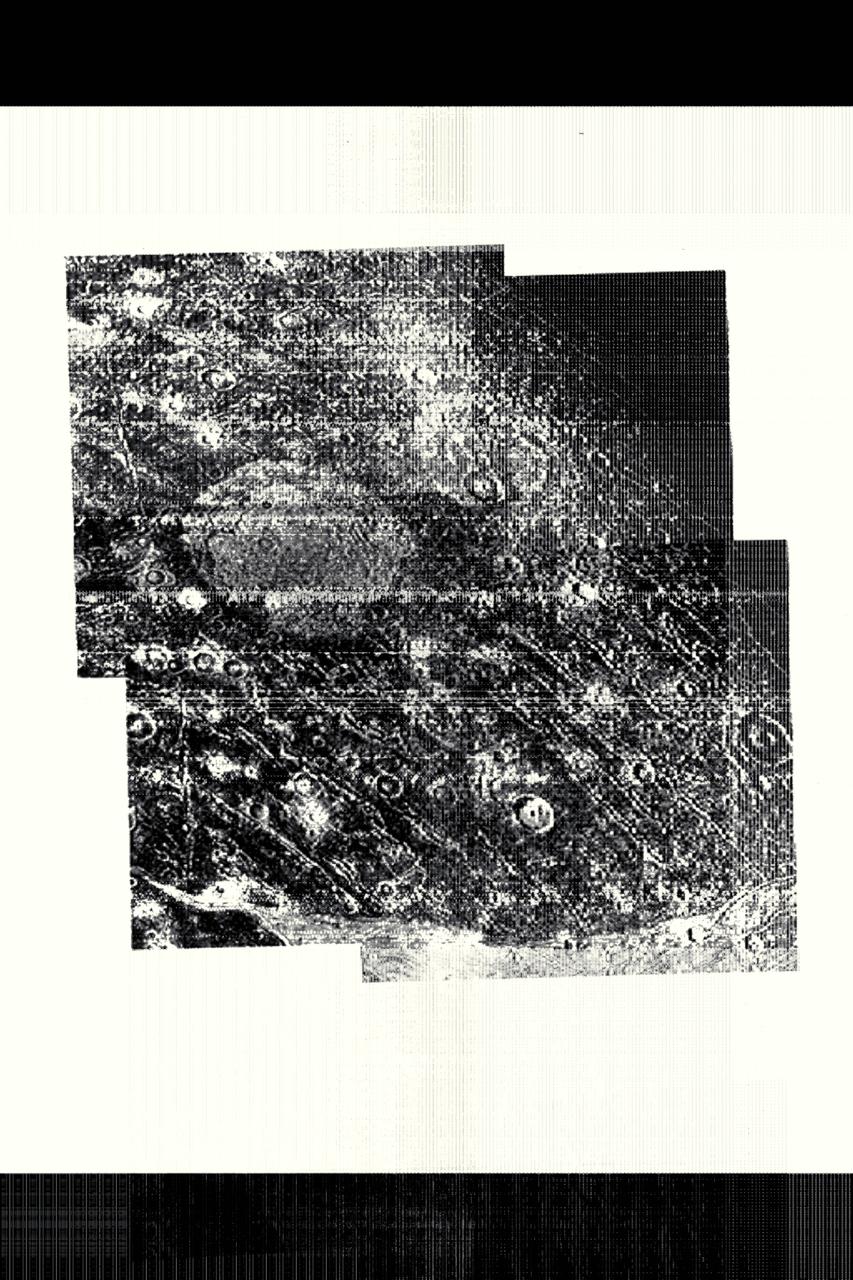
Range : 85,000 kilometers (53,000 miles) This photo of Jupiter's satellite Ganymede shows ancient cratered terrain. A variety of impact craters of different ages are shown. The brightest craters are the youngest. The ejecta blankets fade with age. The center shows a bright patch that represents the rebounding of the floor of the crater. The dirty ice has lost all topography except for faint circular patterns. Also shown are the 'Callisto type' curved troughs and ridges that mark an ancient enormous impact basin. The basin itself has been destroyed by later geologic processes. Only the ring features are preserved on the ancient surface. Near the bottom of the picture, these curved features are trumcated by the younger grooved terrain.
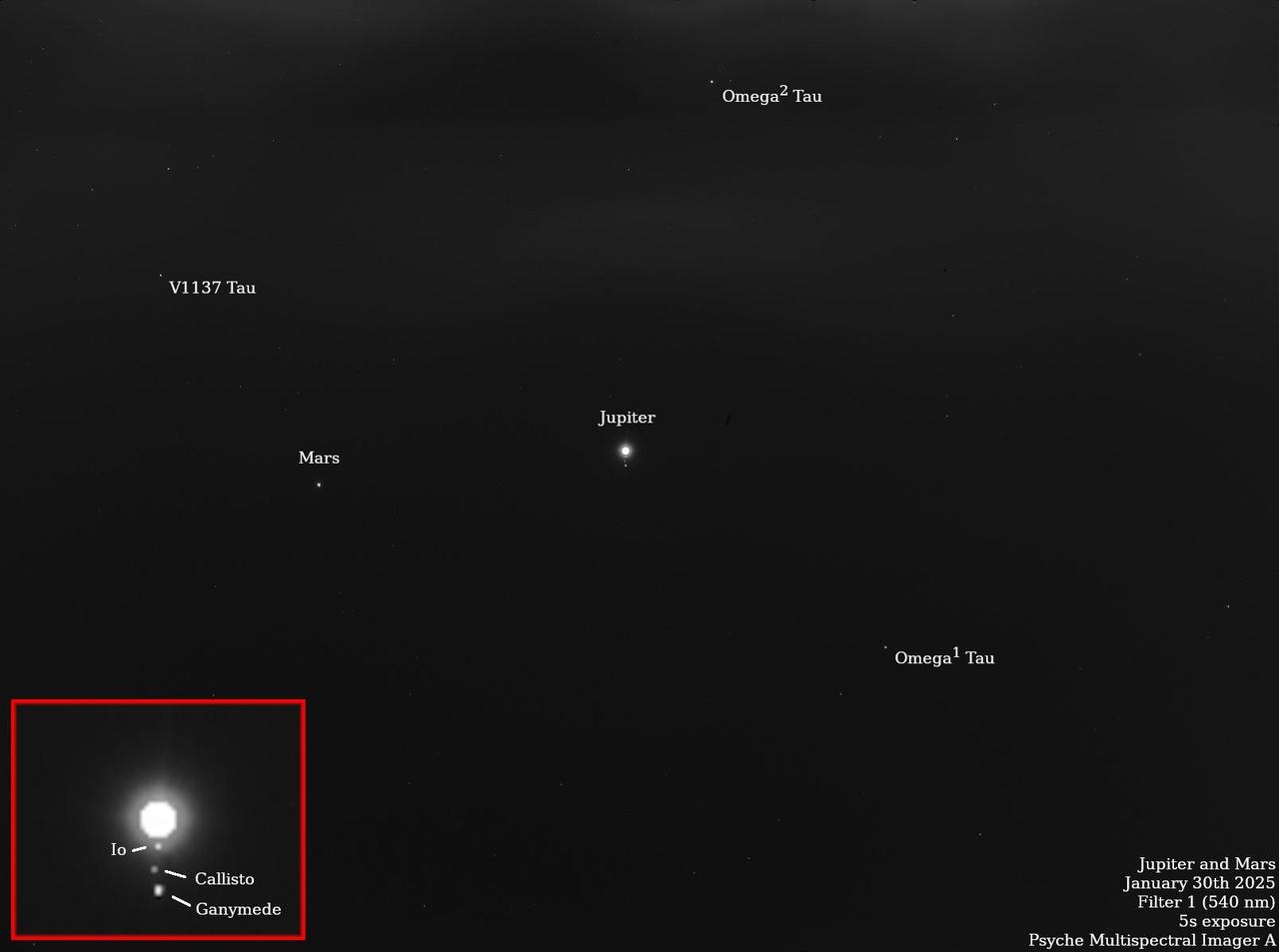
NASA's Psyche spacecraft captured multiple star and planet images in late January 2025 that include notable appearances by Mars, Jupiter, and the Jovian moons Io, Ganymede, Callisto, and Europa. The planned observation by Psyche's imaging instrument was part of a periodic maintenance and calibration test for the twin cameras that make up the imager instrument. Scientists on the imaging team, led by Arizona State University, also took images of the bright stars Vega and Canopus, which have served as standard calibration sources for astronomers for decades. The team is also using the data to assess the effects of minor wiggles or "jitter" in the spacecraft's pointing system as it points the cameras to different places in the sky. The observations of Jupiter and Mars also help the team determine how the cameras respond to solar system objects that shine by reflected sunlight, just like the Psyche asteroid. The starfield pictures shown here are long-exposure (five-second) images captured by each camera. By over-exposing Jupiter to bring out some of the background stars in the Taurus constellation, the imagers were able to capture Jupiter's fainter Galilean moons as well. The image was captured by the Psyche mission's primary camera, Imager-A, on Jan. 30. The image was obtained using the camera's "clear" filter, to provide maximum sensitivity for both bright and faint stars and solar system objects. https://photojournal.jpl.nasa.gov/catalog/PIA26563
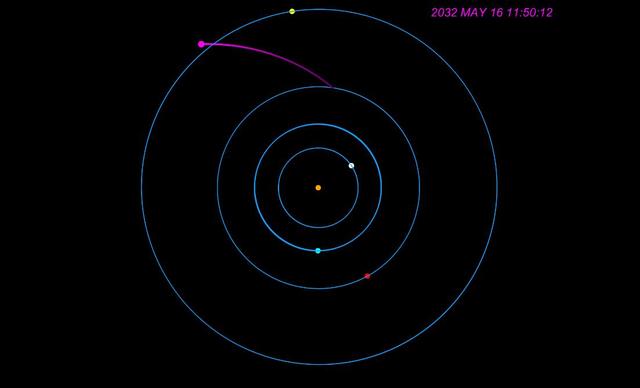
This animation shows how NASA's Europa Clipper spacecraft will orbit Jupiter and perform 49 flybys of Europa during its prime mission. The center orange dot represents Jupiter, with the simplified circular orbits of four of the planet's moons shown: Io (gray), Europa (blue), Ganymede (red), and Callisto (yellow). The Europa Clipper spacecraft is represented by the magenta dot looping in and out. At top right is a timestamp indicating when the flybys shown would occur; those depicted take place from April to July 2032. Europa Clipper's three main science objectives are to determine the thickness of the moon's icy shell and its interactions with the ocean below, to investigate its composition, and to characterize its geology. The mission's detailed exploration of Europa will help scientists better understand the astrobiological potential for habitable worlds beyond our planet. Animation available at https://photojournal.jpl.nasa.gov/catalog/PIA26463
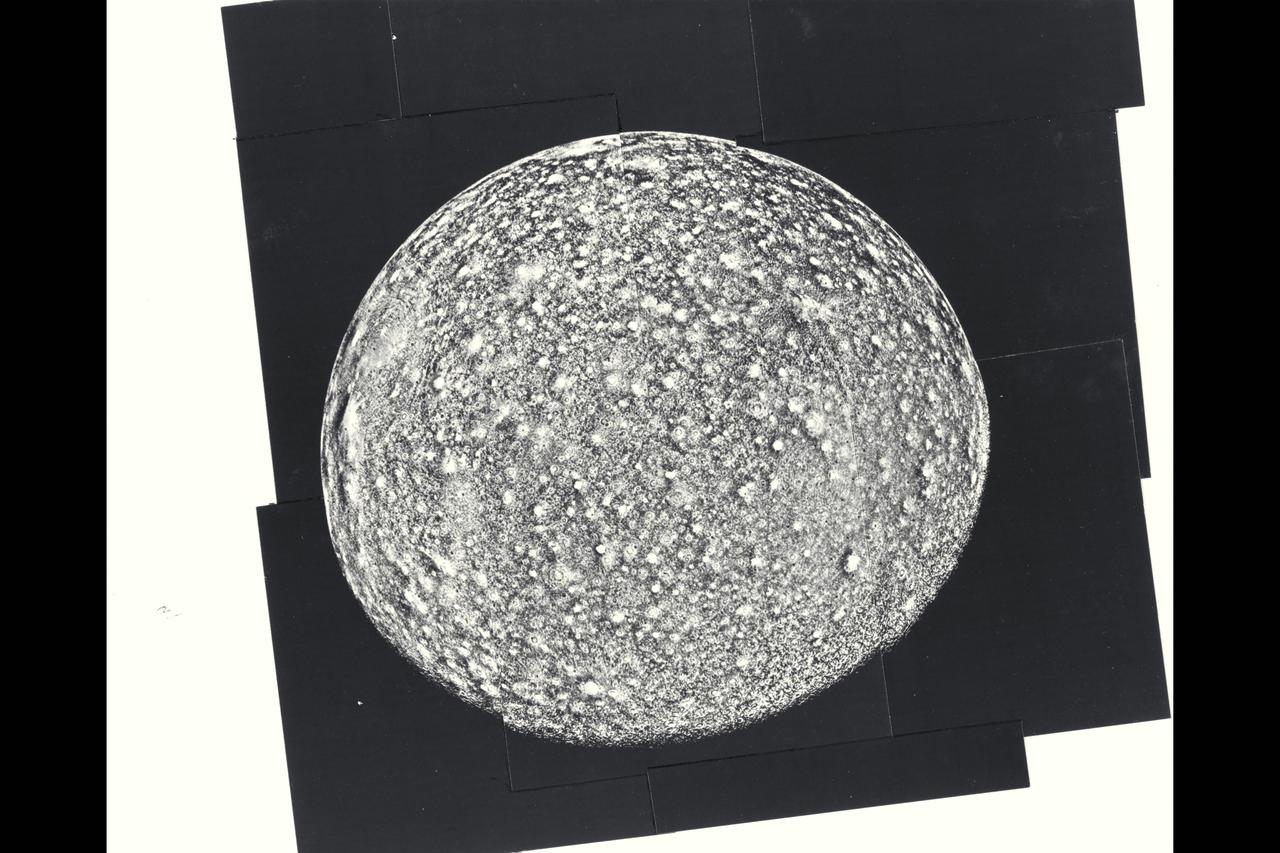
P-21746 BW Range: 390,000 kilometers (245,000 miles) This photomosaic of Callisto is composed of nine frames. The impact crater distribution is very uniform across the disk. Notable are the very bright rayed craters that probably are very young. Near the limb is a giant probable impact structure. Several large structures were discovered by Voyager 1. This one is smaller than the largest one found by Voyager 1 but is more clearly shown. About 15 concentric rings surround the bright central spot. Many hundreds of moderate sized impacts are also seen, a few with bright radial ray patterns. The limb is very smooth confirming that no high topography has been seen on the satellite, and observation consistent with its icy composition.
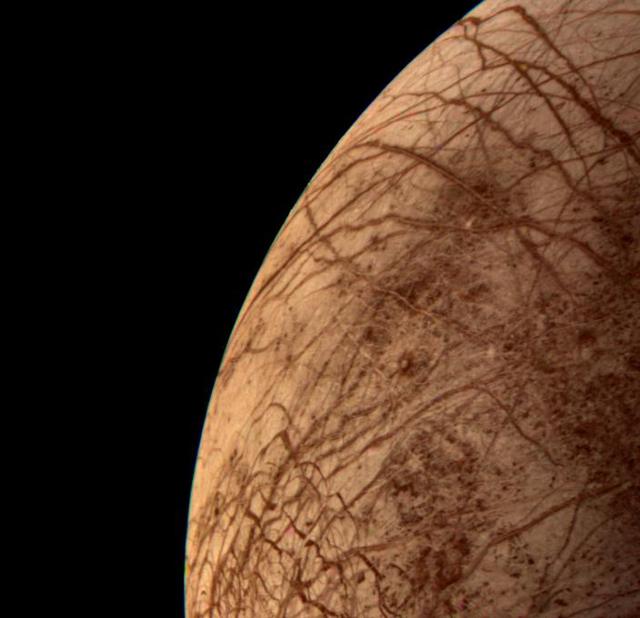
This color image of the Jovian moon Europa was acquired by NASA Voyager 2 during its close encounter on Jul. 9, 1979. Europa, the size of our moon, is thought to have a crust of ice perhaps 100 kilometers thick which overlies the silicate crust. The complex array of streaks indicate that the crust has been fractured and filled by materials from the interior. The lack of relief, any visible mountains or craters, on its bright limb is consistent with a thick ice crust. In contrast to its icy neighbors, Ganymede and Callisto, Europa has very few impact craters. One possible candidate is the small feature near the center of this image with radiating rays and a bright circular interior. The relative absence of features and low topography suggests the crust is young and warm a few kilometers below the surface. The tidal heating process suggested for Io also may be heating Europa's interior at a lower rate. http://photojournal.jpl.nasa.gov/catalog/PIA00459

NASA's Europa Clipper is tasked with up-close study of Jupiter's enigmatic moon Europa, which orbits the gas giant within a band of powerful radiation generated by the planet's strong magnetic field. The relative intensity of Jupiter's radiation bands is illustrated in this diagram, along with the orbits of Jupiter's three other largest moons: Io, Ganymede, and Callisto. To limit the damaging effects of radiation on the spacecraft, Europa Clipper will orbit Jupiter elliptically, dipping in for dozens of close flybys of Europa. Between each pass, the spacecraft will retreat to a safer distance from which it can safely transmit the science data it collects back to Earth. Europa Clipper's three main science objectives are to determine the thickness of the moon's icy shell and its interactions with the ocean below, to investigate its composition, and to characterize its geology. The mission's detailed exploration of Europa will help scientists better understand the astrobiological potential for habitable worlds beyond our planet. https://photojournal.jpl.nasa.gov/catalog/PIA26436
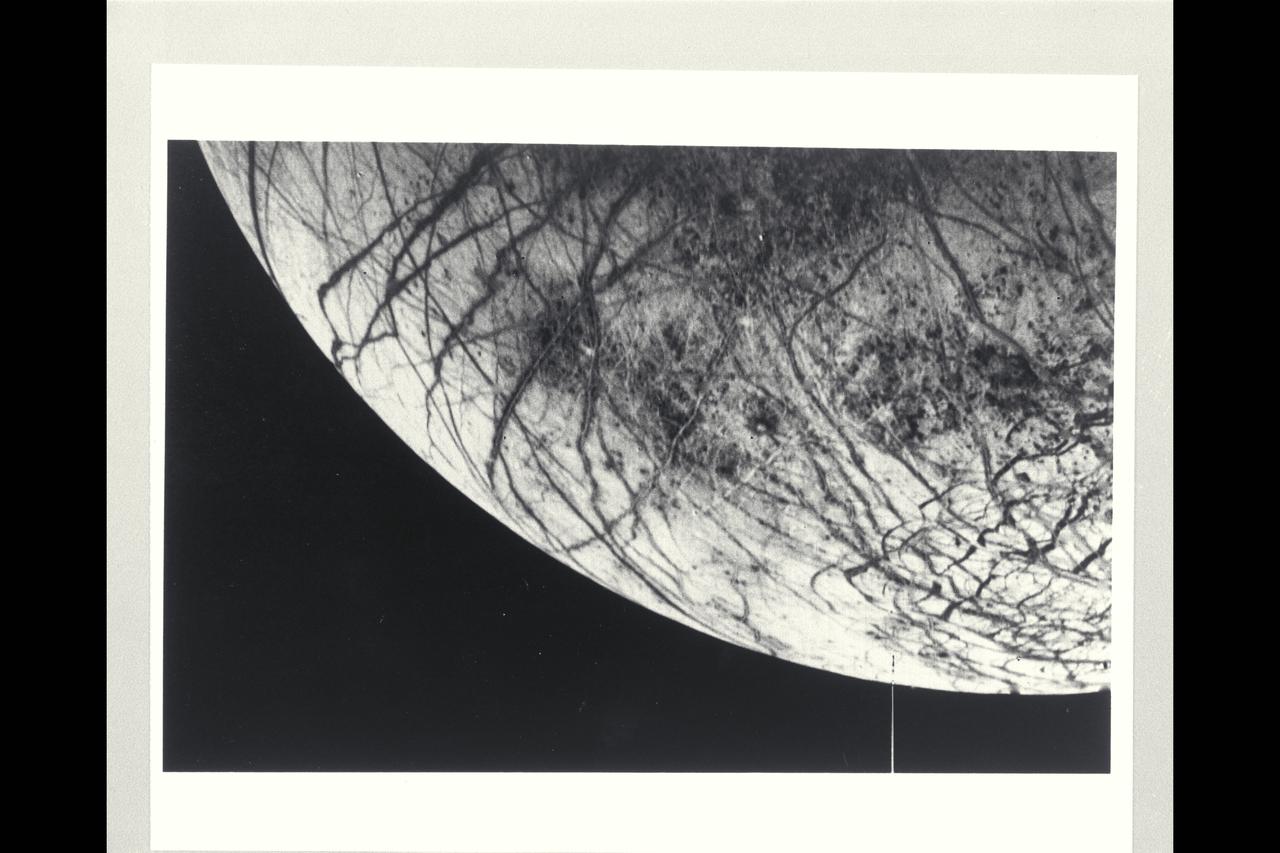
P-21760 BW This color image of the Jovian moon Europa, which is the size of our moon, is thought to have a crust of ice perhaps 100 kilometers thick which overlies the silicate crust. The complex array of streaks indicate that the crust has been fractured and filled by materials from the interior. The lack of relief, any visible mountains or craters, on its bright limb is consistent with a thick ice crust. In contrast to its icy neighbors, Ganymede and Callisto, Europa has very few impact craters. One possible candidate is the small feature near the center of this image with radiating rays and a bright circular interior. The relative absence of features and low topography suggests the crust is young and warm a few kilometers below the surface. The tidal heating process suggested for Io also may be heating Europa's interior at a lower rate.
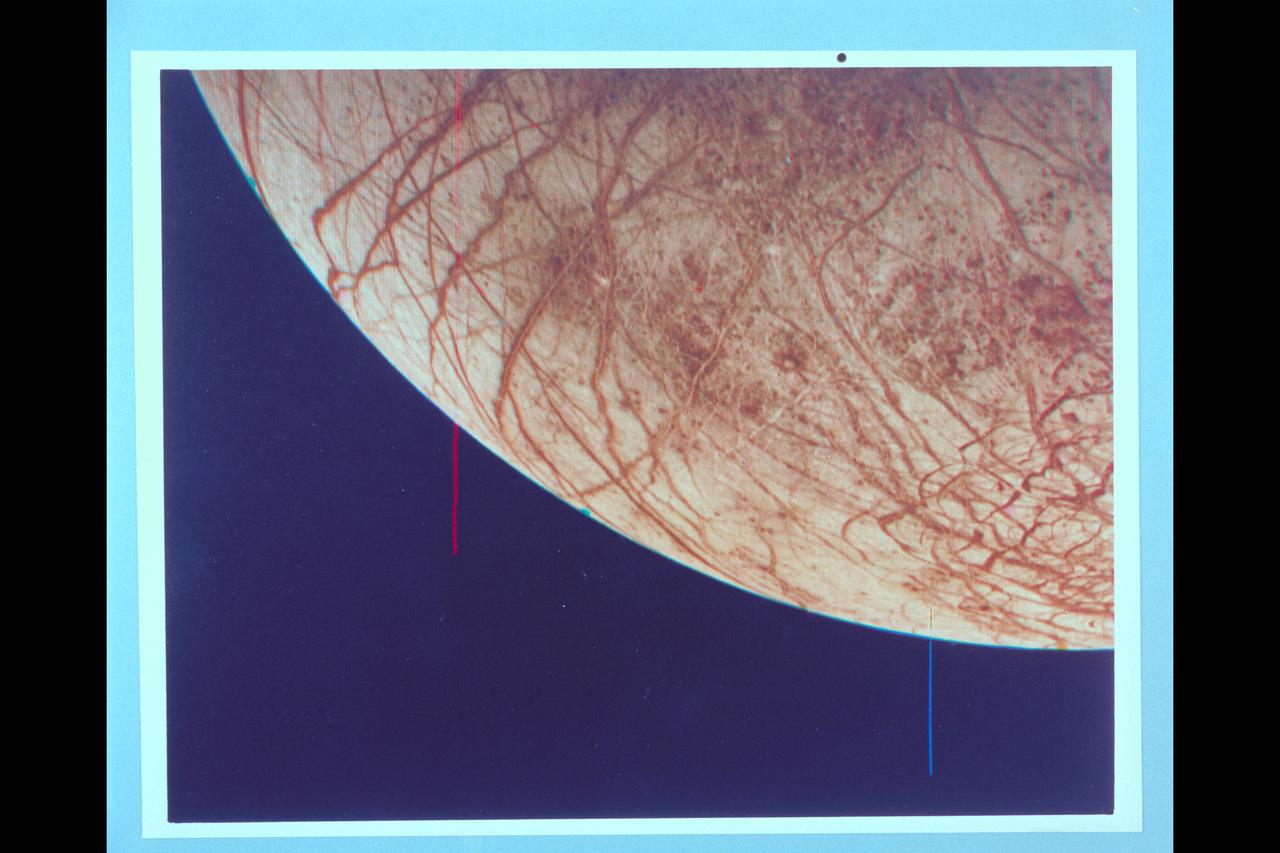
P-21760 C This color image of the Jovian moon Europa, which is the size of our moon, is thought to have a crust of ice perhaps 100 kilometers thick which overlies the silicate crust. The complex array of streaks indicate that the crust has been fractured and filled by materials from the interior. The lack of relief, any visible mountains or craters, on its bright limb is consistent with a thick ice crust. In contrast to its icy neighbors, Ganymede and Callisto, Europa has very few impact craters. One possible candidate is the small feature near the center of this image with radiating rays and a bright circular interior. The relative absence of features and low topography suggests the crust is young and warm a few kilometers below the surface. The tidal heating process suggested for Io also may be heating Europa's interior at a lower rate.
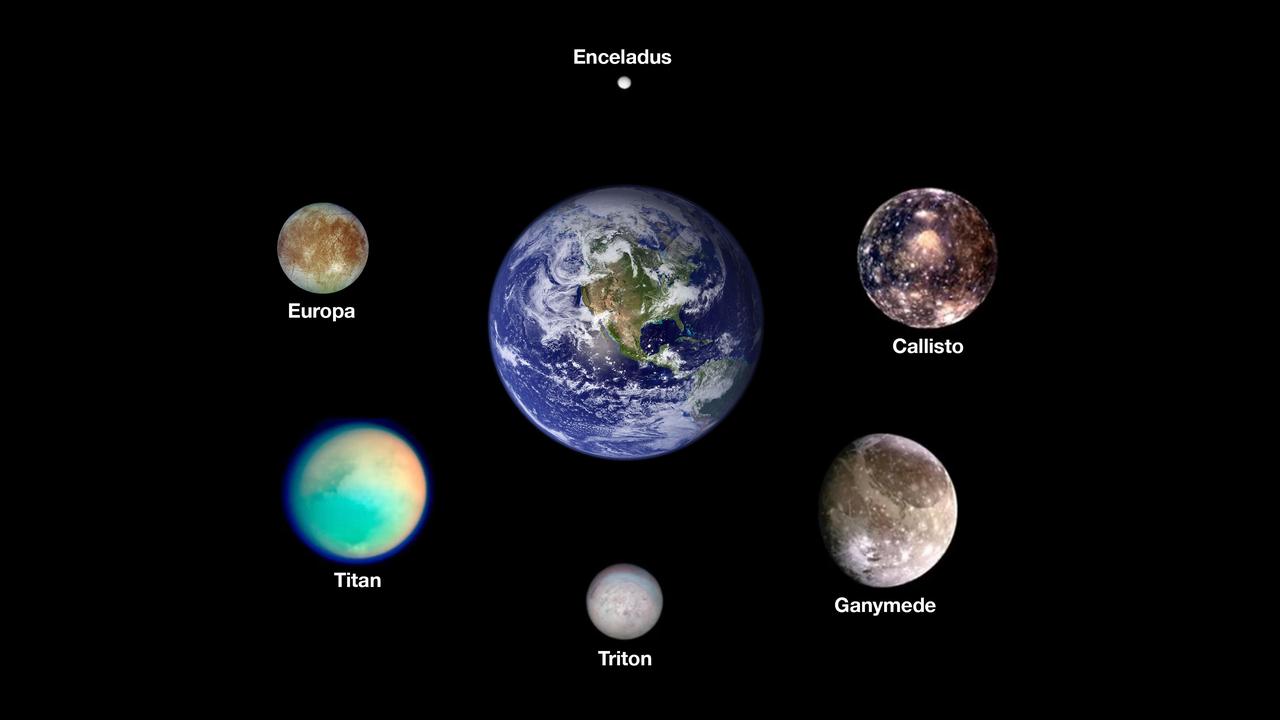
Scientists think six icy moons in our solar system may currently host oceans of liquid water beneath their outer surfaces. Arranged around Earth are images from NASA spacecraft of, clockwise from the top, Saturn's moon Enceladus, Jupiter's moons Callisto and Ganymede, Neptune's moon Triton, Saturn's moon Titan, and Jupiter's moon Europa, the target of NASA's Europa Clipper mission. The worlds here are shown to scale. The images of the Saturnian moons were taken by NASA's Cassini mission. The images of the Jovian moons were taken by NASA's Galileo mission. The image of Triton was taken by NASA's Voyager 2 mission. The image of Earth was stitched together using months of satellite-based observations, mostly using data from the Moderate Resolution Imaging Spectroradiometer (MODIS) on NASA's Terra satellite. https://photojournal.jpl.nasa.gov/catalog/PIA26103
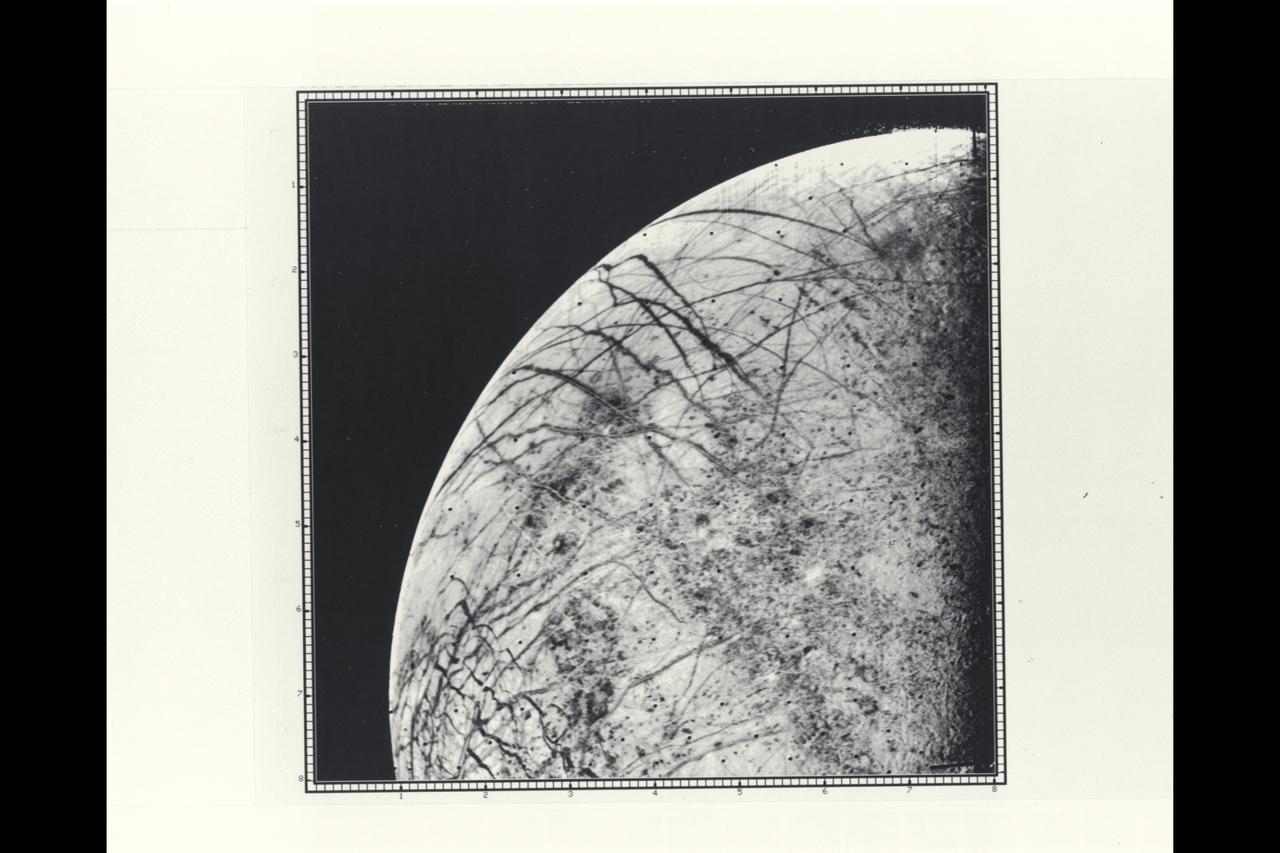
P-21758 BW Range: 246,000 kilometers (152,000 miles) This picture by Voyager 2 is the first close look ever obtained of Jupiter's satellite, Europa. The linear crack-like features had been seen from a much greater distance by Voyager 1 but this image provides a resolution of about four kilometers (2.5 miles). The complicated linear features appear even more like cracks or huge fractures in these images. Also seen are somewhat darker mottled regions which appear to have a slightly pitted appearance, perhaps due to small scale craters. No large craters (more than five kilometers in diameter) are easily identifiable in the Europa photographs to date, suggesting that this satellite has a young surface relative to Ganymede and Callisto, although not perhaps as young as Io's. Various models for Europa's structure will be tested during analysis of these images, including the possibility that the surface is a thin ice crust overlying water or softer ice and that the fracture systems seen are breaks in that crust. Resurfacing mechanisms such as production of fresh ice or snow along the cracks and cold glacier-like flows are being considered as possibilities for removing evidence of impact events. Europa thus appears to truly be a satellite with many properties intermediate between Ganymede and Io.
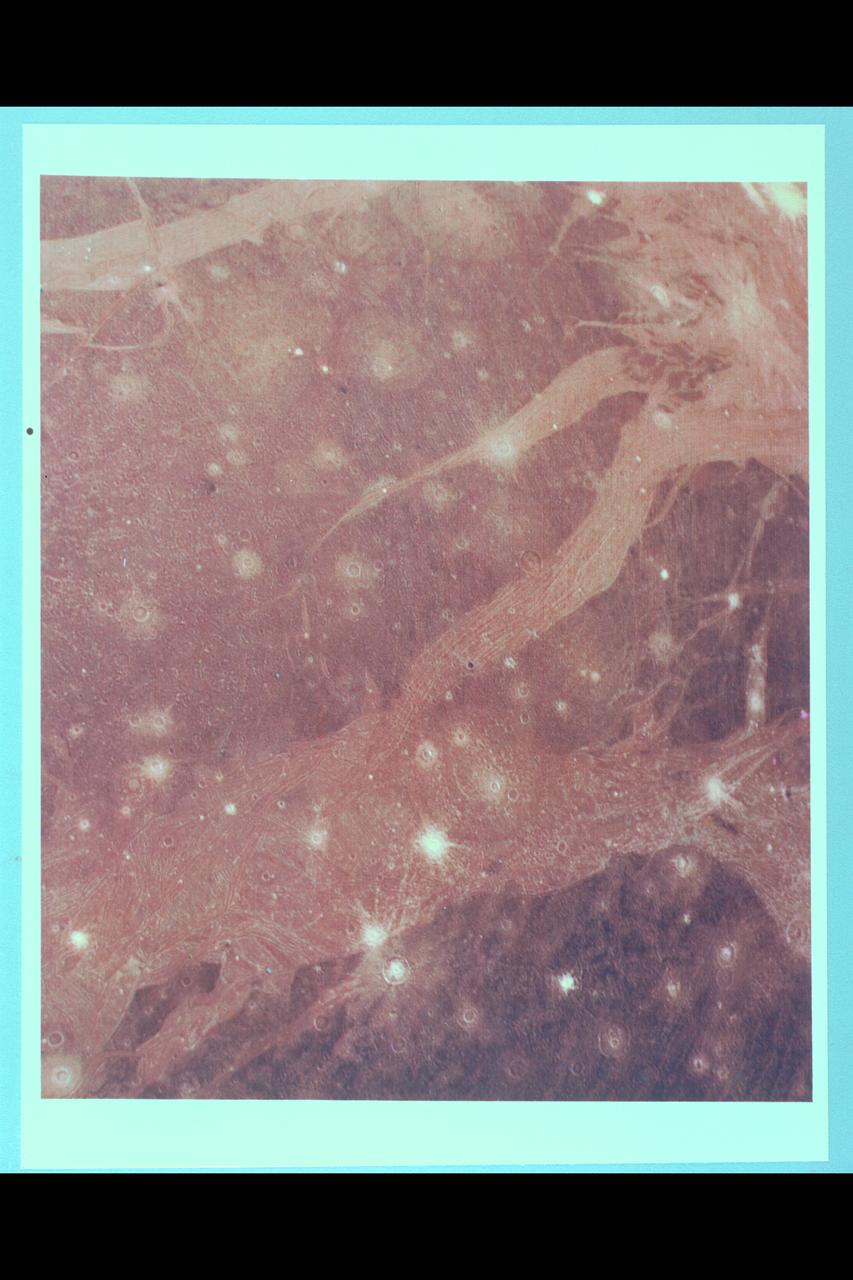
Range : 312, 000 kilometers (195,000 miles) This photo of Ganymede (Ice Giant) was taken from Voyager 2 and shows features down to about 5 to 6 kilometers across. Different types of terrain common on Ganymede's surface are visible. The boundary of the largest region of dark ancient terrain on Ganymede can be seen to the east (right), revealing some of the light linear features which may be all that remains of a large ancient impact structure similar to the large ring structure on Callisto. The broad light regions running through the image are the typical grooved structures seen within another example of what might be evidence of large scale lateral motion in Ganymede's crust. The band of grooved terrain (about 100 kilometers wide) in this region appears to be offset by 50 kilometers or more on the left hand edge by a linear feature perpendicular to it. A feature similar to this one was previously discovered by Voyager 1. These are the first clear examples of strike-slip style faulting on any planet other than Earth. Many examples of craters of all ages can be seen in this image, ranging from fresh, bright ray craters to large, subdued circular markings thought to be the 'scars' of large ancient impacts that have been flatteded by glacier-like flows.
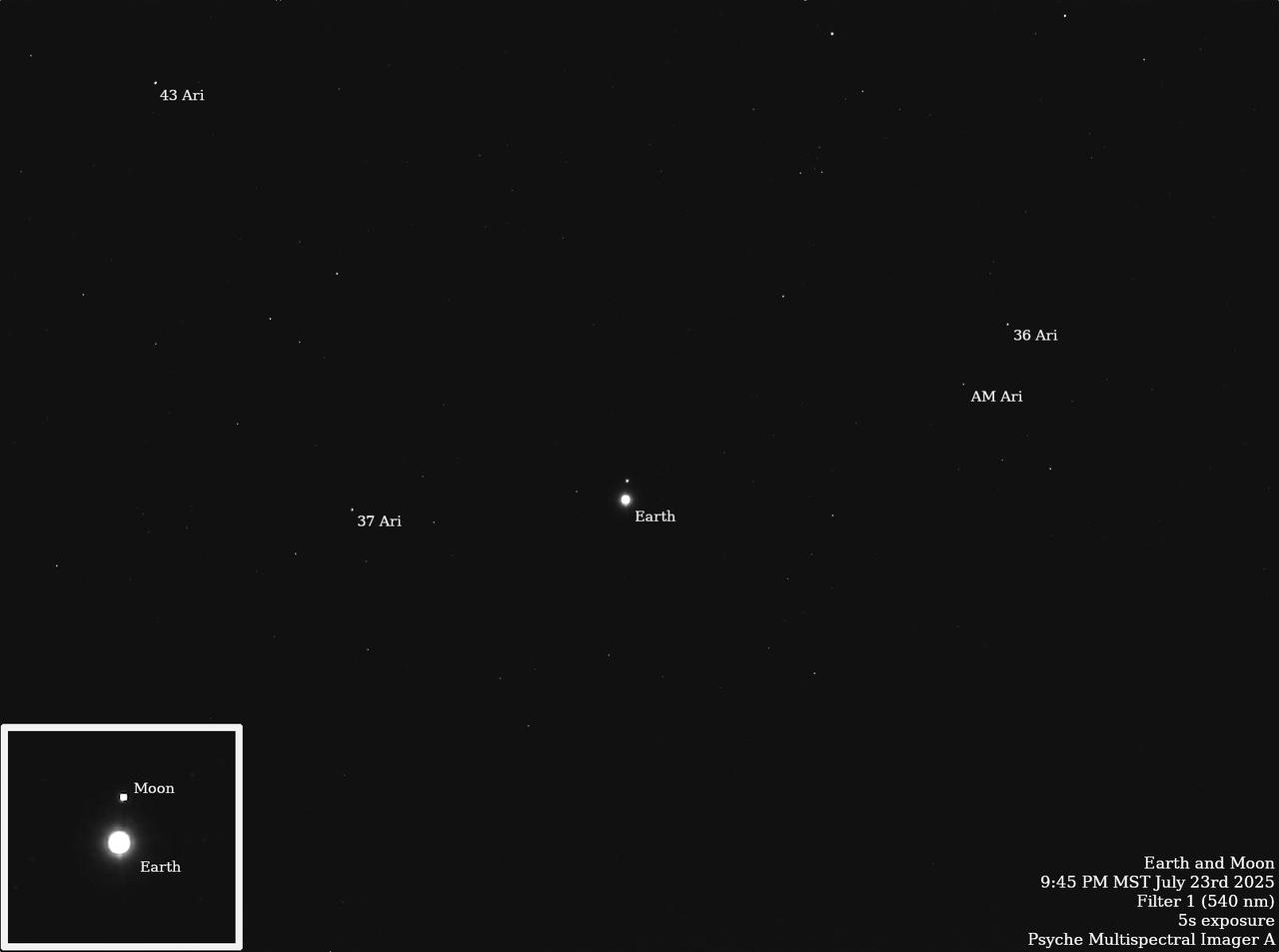
NASA's Psyche spacecraft captured images of Earth and our Moon from about 180 million miles (290 kilometers) away in July 2025. The images were obtained during one of the mission team's periodic maintenance and calibration tests for the twin cameras that make up the imager instrument. Scientists on the imaging team, led by Arizona State University, captured multiple long-exposure (up to 10-second) pictures of the two bodies, which appear as dots sparkling with reflected sunlight amid a starfield in the constellation Aries. The observations help the team determine how the cameras respond to solar system objects that shine by reflected sunlight, just like the Psyche asteroid. In January 2025, Psyche captured an image that included Mars, Jupiter, and the Jovian moons Io, Ganymede, Callisto, and Europa. The image here was captured by Psyche's primary camera, Imager A, on July 23. The Psyche mission is led by ASU. Lindy Elkins-Tanton of the University of California, Berkeley is the principal investigator. A division of Caltech in Pasadena, JPL is responsible for the mission's overall management, system engineering, integration and test, and mission operations. Maxar Technologies in Palo Alto, California, provided the high-power solar electric propulsion spacecraft chassis. ASU leads the operations of the imager instrument, working in collaboration with Malin Space Science Systems in San Diego on the design, fabrication, and testing of the cameras. https://photojournal.jpl.nasa.gov/catalog/PIA26569
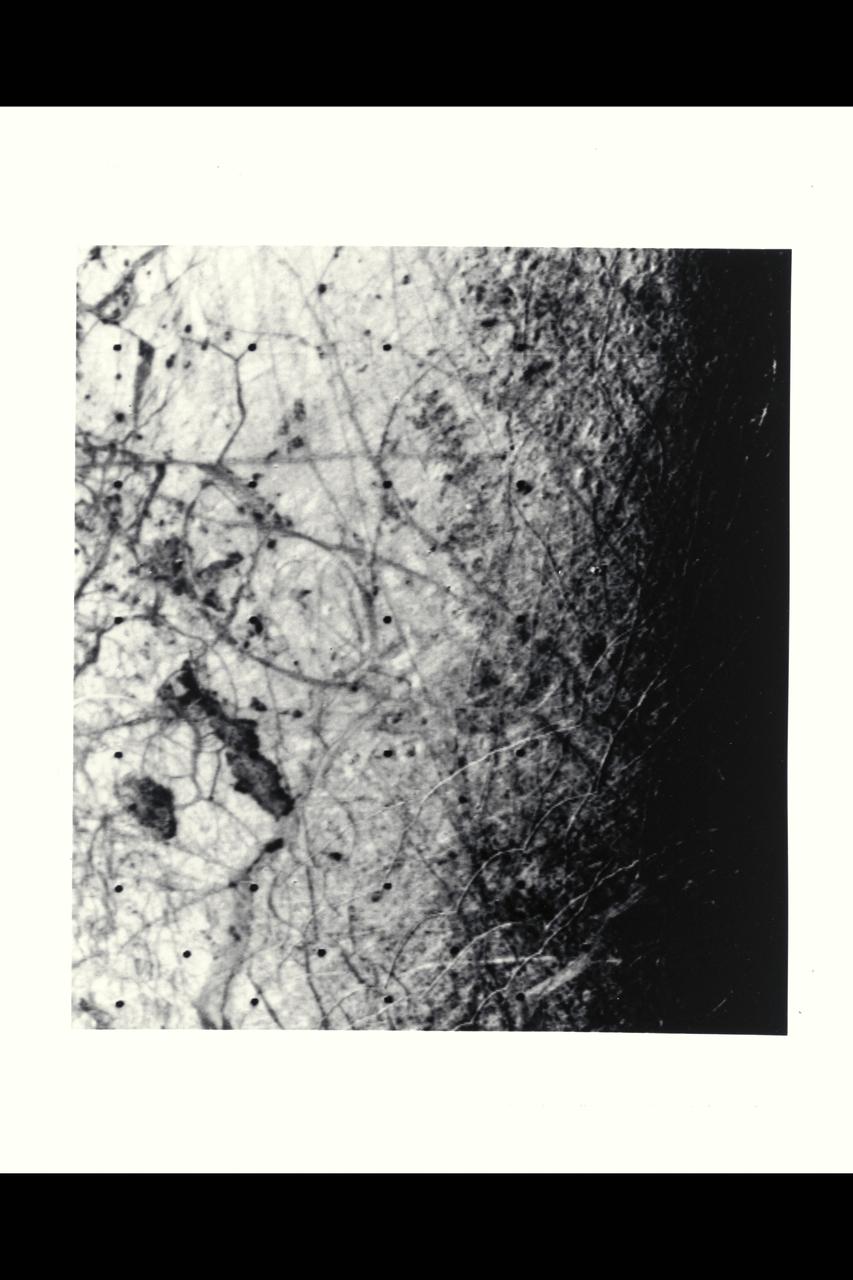
Range : 225,000 kilometers (140,625 miles) This image of the Jovian moon Europa was taken by Voyager 2 along the evening terminator, which best shows the surface topography of complex narrow ridges, seen as curved bright streaks, 5 to 10 kilometers wide, and typically 100 kilometers in length. The area shown is about 600 by 800 kilometers, and the smallest features visible are about 4 kilometers in size. Also visable are dark bands, more diffused in character, 20 to 40 kilometers wide and hundreds to thousands of kilometers in length. A few features are suggestive of impact craters but are rare, indication that the surface thought to be dominantly ice is still active, perhaps warmed by tidal heating like Io. The larger icy satellites, Callisto and Ganymede, are evidently colder with much more rigid crusts and ancient impact craters. The complex intersection of dark markings and bright ridges suggest that the surface has been fractured and material from beneath has welled up to fill the cracks.
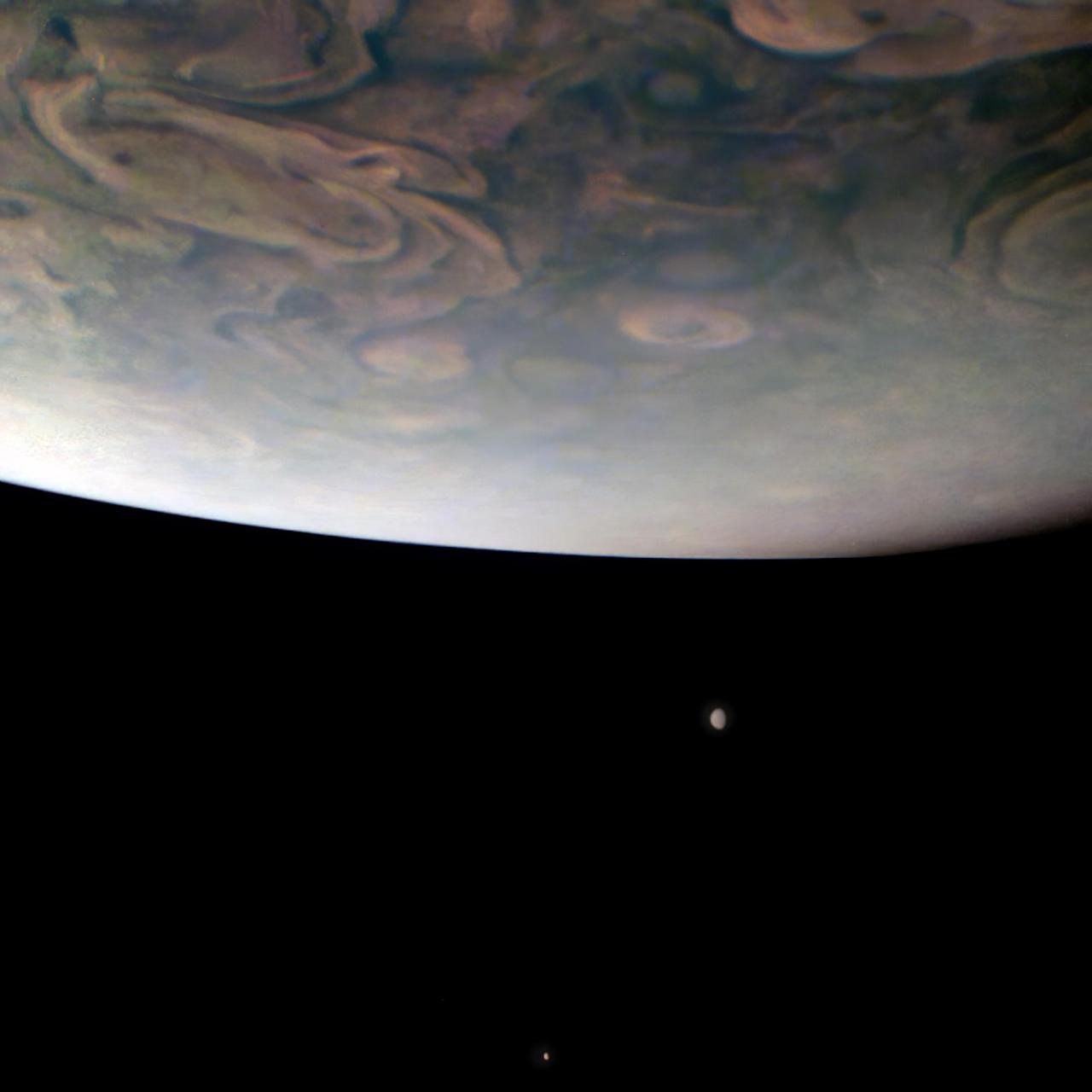
On Nov. 29, 2021, NASA's Juno mission completed its 38th close flyby of Jupiter. As the spacecraft sped low over the giant planet's cloud tops, its JunoCam instrument captured this look at two of Jupiter's largest moons. In the foreground, hurricane-like spiral wind patterns called vortices can be seen spinning in the planet's north polar region. These powerful storms can be over 30 miles (50 kilometers) in height and hundreds of miles across. Below Jupiter's curving horizon, two Jovian moons make an appearance: Callisto (below) and Io (above). Juno will make close flybys of Io in December 2023 and February 2024, the first such close encounters with this intriguing moon in over two decades. Io is the most volcanic body in our solar system, and its eruptions leave a trail of material behind that both fills Jupiter's magnetosphere and creates a torus of gas and dust around Jupiter. During the flybys, Juno will study Io's volcanoes and geology, search for signs of a magma ocean, and investigate how Io interacts with Jupiter's giant magnetosphere. Citizen scientist Gerald Eichstädt used raw JunoCam data to make the original version of this image, and then another citizen scientist, Thomas Thomopoulos, further processed it, zooming in and making color enhancements. In this view, north is down. At the time the image was taken, Juno was about 8,700 miles (14,000 kilometers) above Jupiter's cloud tops, at a latitude of about 69 degrees, traveling at a speed of about 123,000 mph (198,000 kilometers per hour) relative to the planet. https://photojournal.jpl.nasa.gov/catalog/PIA25019
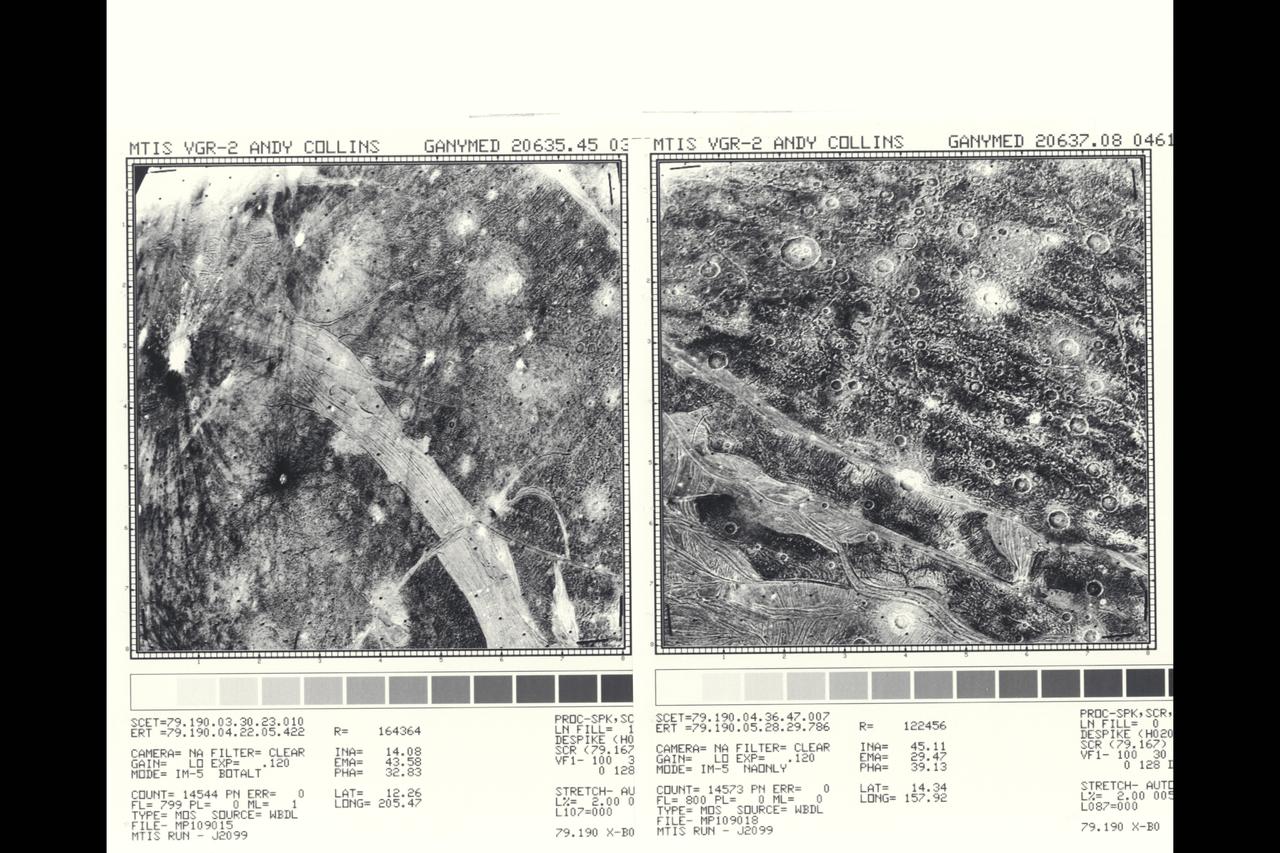
P-21756 BW only Range: 120,000 km (right) 169,000 km (left) Right: In the foreground of this picture taken by Voyager 2, the part of the surface of Ganymede shown is the typical grooved terrain as seen by Voyager 1. It consists of mutually intersecting bands of closely-spaced, parallel ridges and grooves. In the background is newly-cratered dark terrain across which can be traced several widely spaced parellel linear features. When viewed from a distance the line features appear to trace broad circular areas. The features resemble the circular ridges on Callisto that surround an almost complete annealed impact basin. The feature on Ganymede may be of similar origin but all traces of the impact itself have been destroyed. Left: This picture of Ganymede shows that the dark contrast terrain is separated by bright bands of grooved terain. The band of closely spaced linear grooves in the foreground is 150 km across and appears to be offset by another narrow band at right angles, as though by faulting. A variety of ray patterns are seen around the craters. One is in the left of the picture, it has prominent dark rays around an inner bright halo. Other craters have dark haloes; others have diffuse bright rays. The variation of albedo patterns around the craters may be indications of layering in the surface materials. The intensity of the craters suggests the dark areas are extremely old. The bright grooved terrain is less cratered and probably somewhat younger.