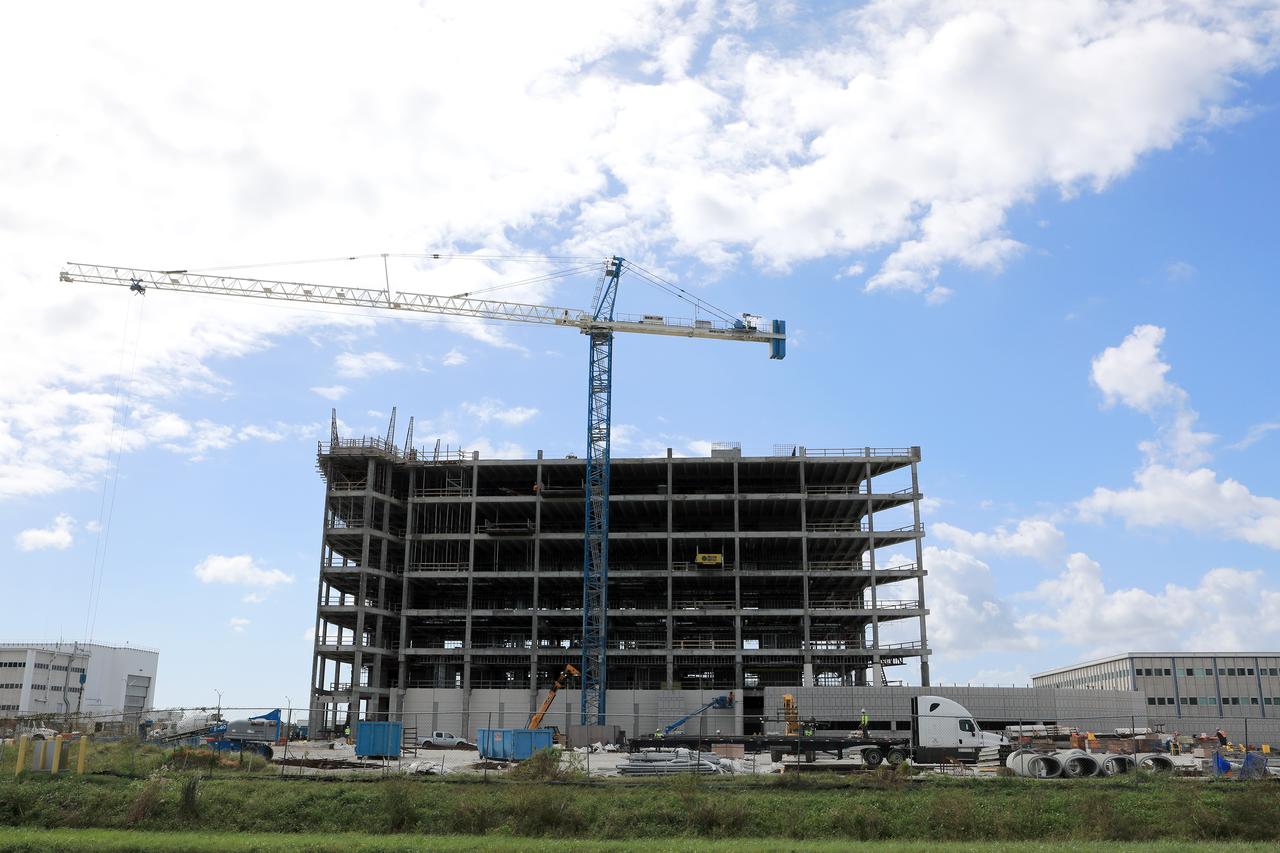
A large crane towers overhead as the new, seven-story headquarters building takes shape in the industrial area at NASA’s Kennedy Space Center in Florida. The 200,000-square-foot facility will anchor the spaceport’s Central Campus and house about 500 NASA civil service and contractor employees. The building will be more energy efficient than the current Headquarters building and will feature the latest in office and administrative building technology to fulfill Kennedy's role as the premiere multi-user spaceport for NASA and, increasingly, commercial entities.

The new headquarters building’s seven floors are clearly visible as construction continues in the industrial area at NASA’s Kennedy Space Center in Florida. The 200,000-square-foot facility will anchor the spaceport’s Central Campus and house about 500 NASA civil service and contractor employees. The building will be more energy efficient than the current Headquarters building and will feature the latest in office and administrative building technology to fulfill Kennedy's role as the premiere multi-user spaceport for NASA and, increasingly, commercial entities.
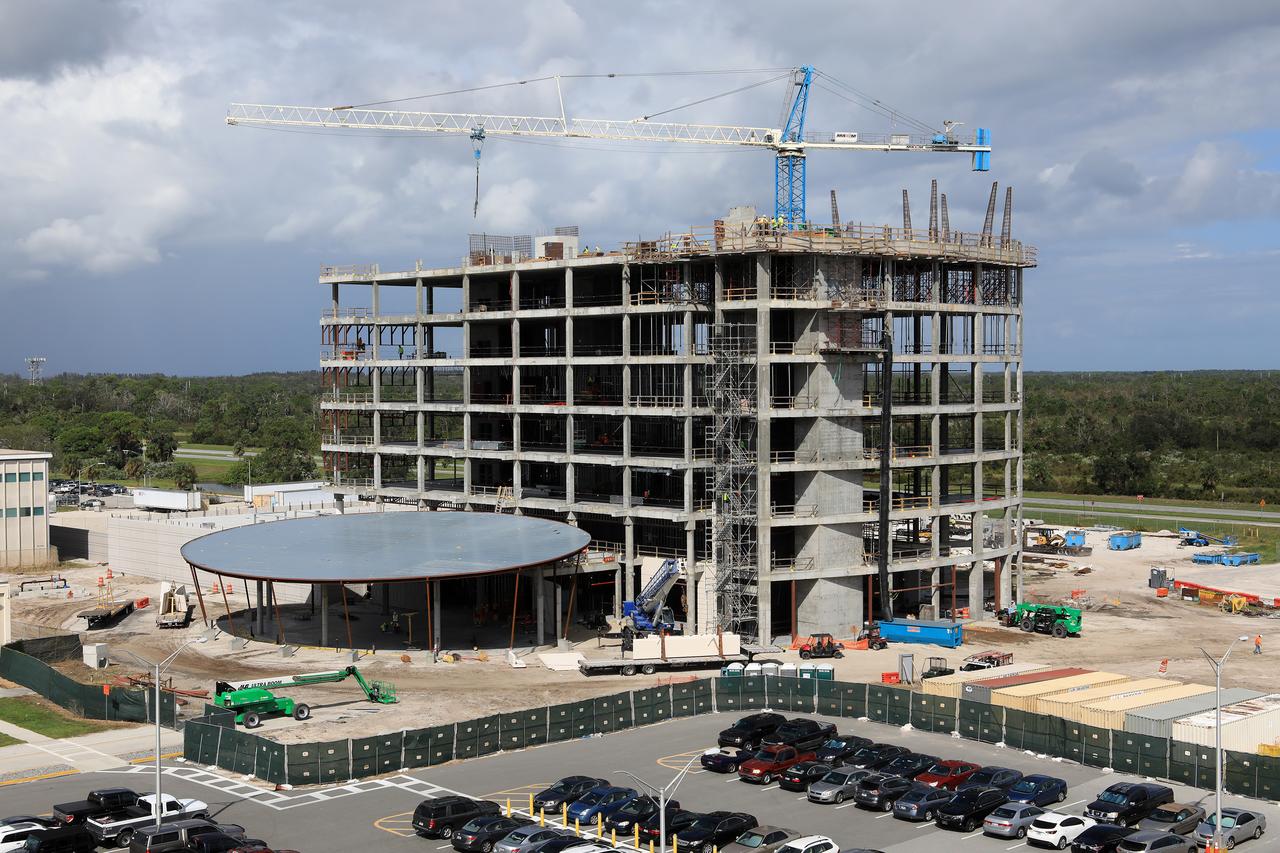
A large crane towers overhead as the new, seven-story headquarters building takes shape in the industrial area at NASA’s Kennedy Space Center in Florida. The 200,000-square-foot facility will anchor the spaceport’s Central Campus and house about 500 NASA civil service and contractor employees. The building will be more energy efficient than the current Headquarters building and will feature the latest in office and administrative building technology to fulfill Kennedy's role as the premiere multi-user spaceport for NASA and, increasingly, commercial entities.
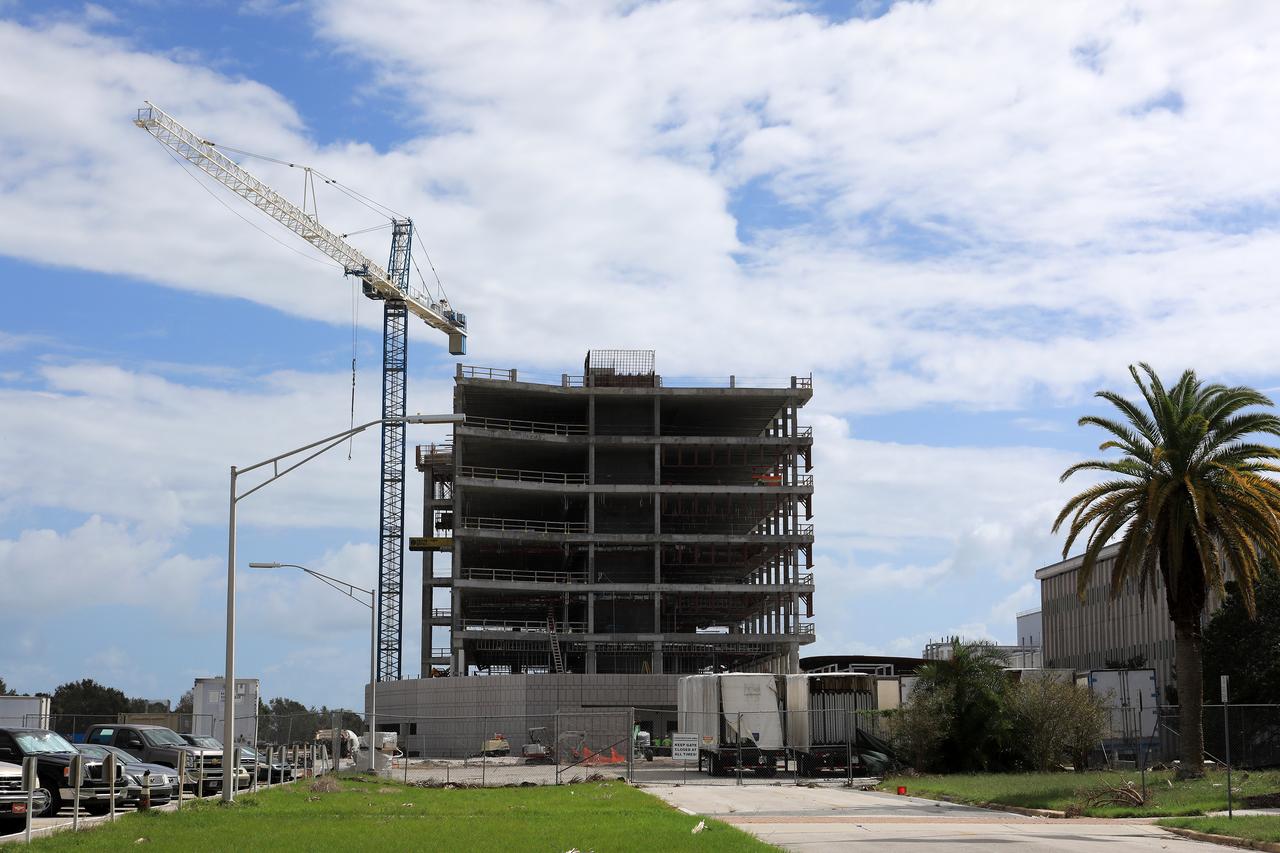
A large crane towers overhead as the new, seven-story headquarters building takes shape in the industrial area at NASA’s Kennedy Space Center in Florida. The 200,000-square-foot facility will anchor the spaceport’s Central Campus and house about 500 NASA civil service and contractor employees. The building will be more energy efficient than the current Headquarters building and will feature the latest in office and administrative building technology to fulfill Kennedy's role as the premiere multi-user spaceport for NASA and, increasingly, commercial entities.
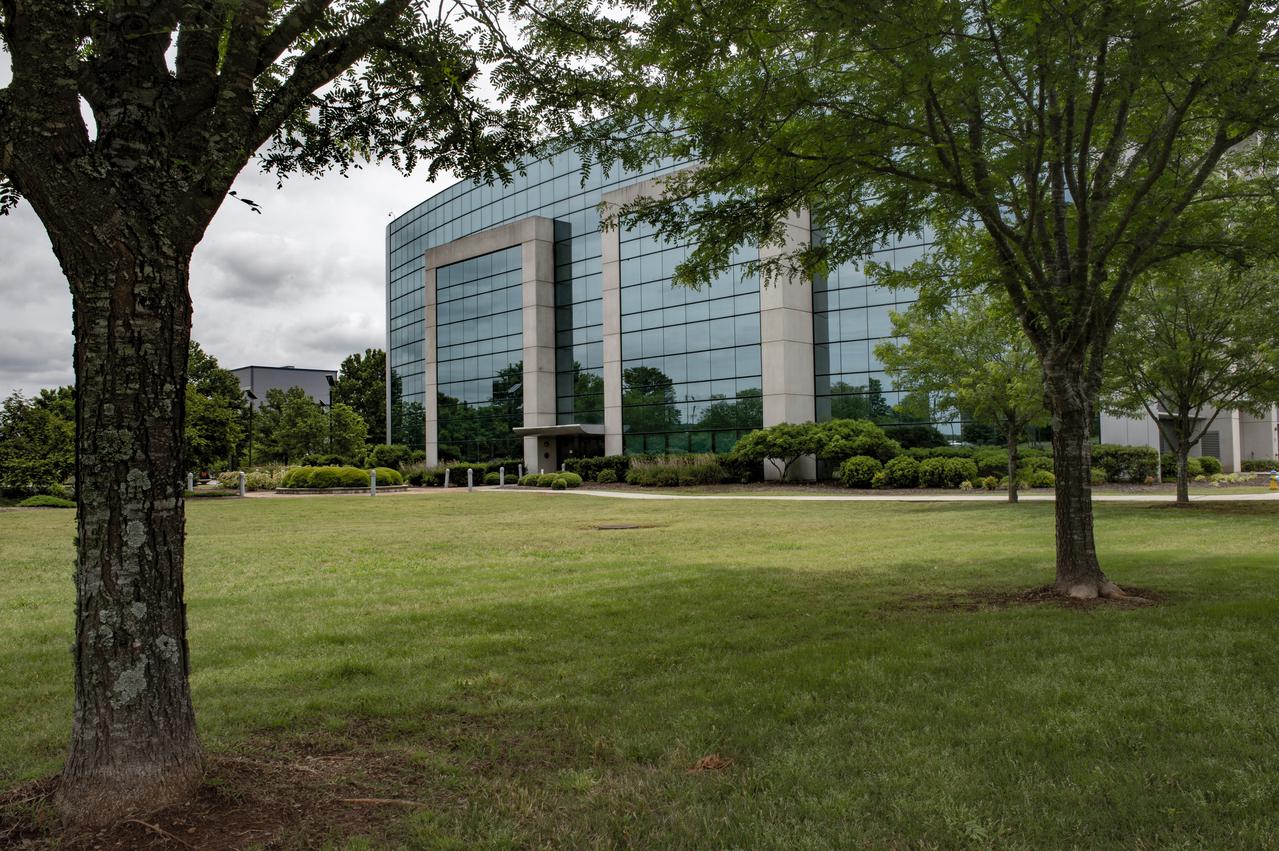
MSFC Campus, BLDG. 4600

The refurbished sign from the original Headquarters building at NASA’s Kennedy Space Center in Florida is installed by the main entrance of the new Central Campus Headquarters, Feb. 18, 2021. The sign, which reads “National Aeronautics and Space Administration – Kennedy Space Center Headquarters,” was placed on the center’s first Headquarters building when the facility was completed in 1965. Kennedy’s modern Central Campus Headquarters, a seven-story building with several sustainable features, opened in May 2019 and provides space for 500 NASA and contractor employees.
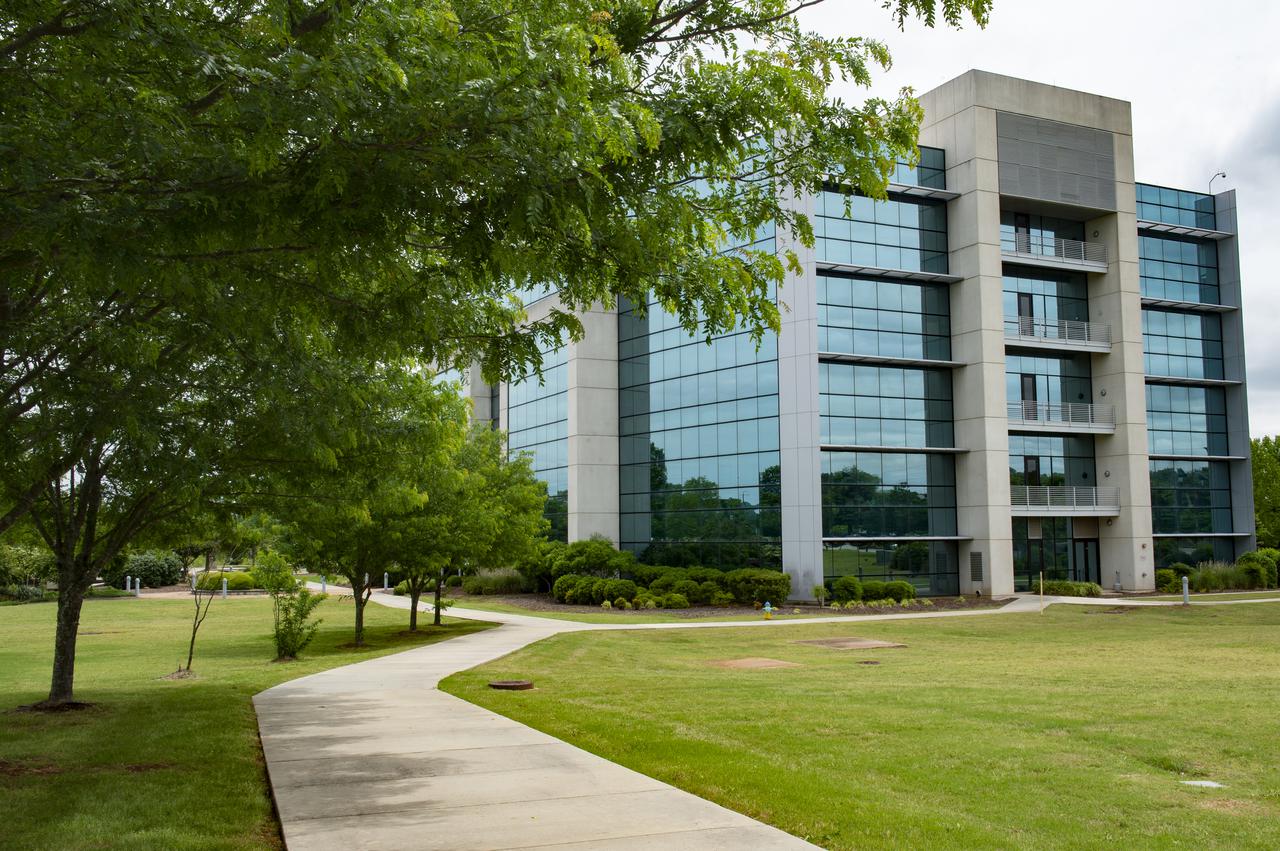
Pictured is the north end of Building 4600 on Marshall Space Flight Center campus.
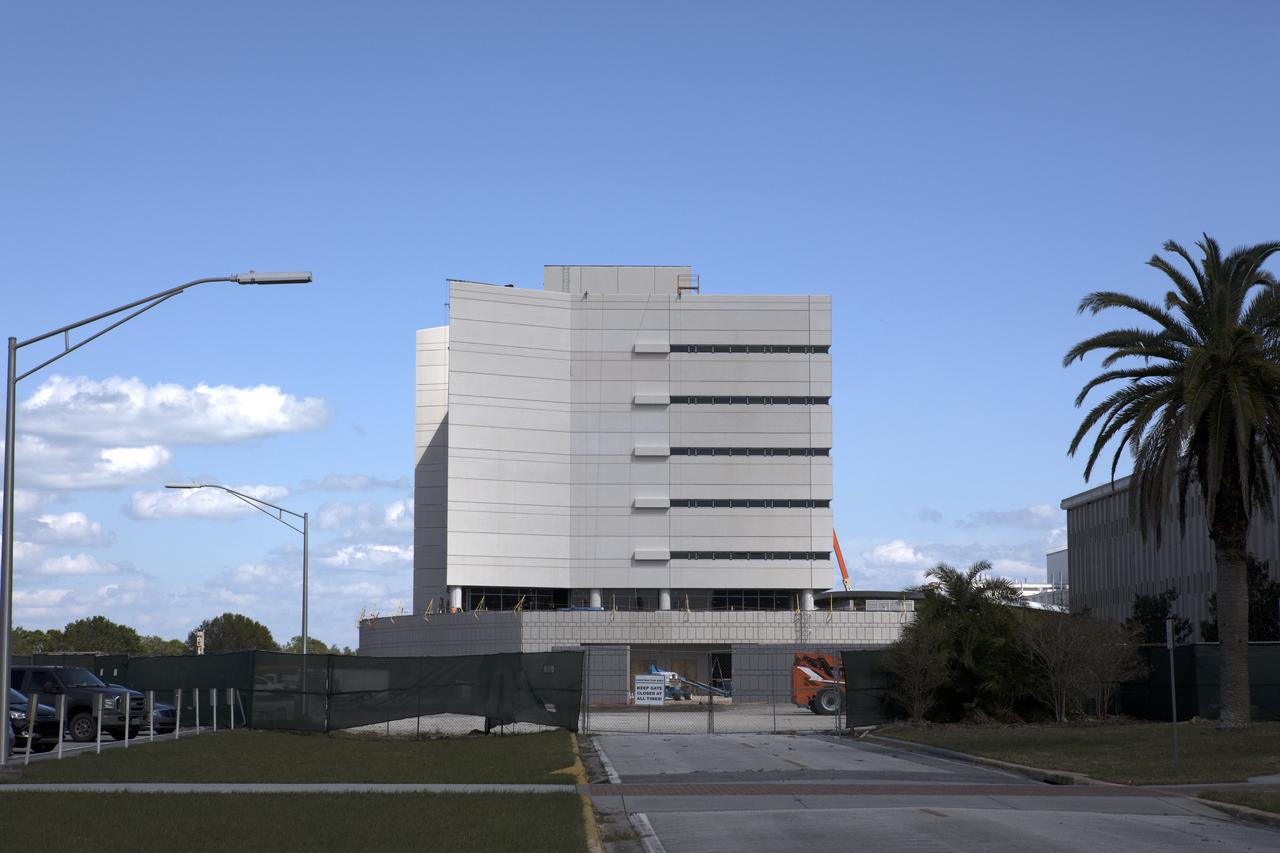
NASA's Kennedy Space Center in Florida is a premier, multi-user spaceport with ongoing construction adding new, ultra-modern facilities. A key element of the Central Campus makeover is a new, seven-story, 200,000-square-foot headquarters building that has taken shape in the heart of the spaceport. The headquarters building's glass facade, as seen from NASA Causeway, is complete. The exterior skin of the building also is nearly finished. The remainder of the glass components are being installed on each floor. Construction of interior walls and utilities on most floors is well underway. Construction of the headquarters building is targeted for completion in November 2017 and employees are expected to be able to move in soon after.
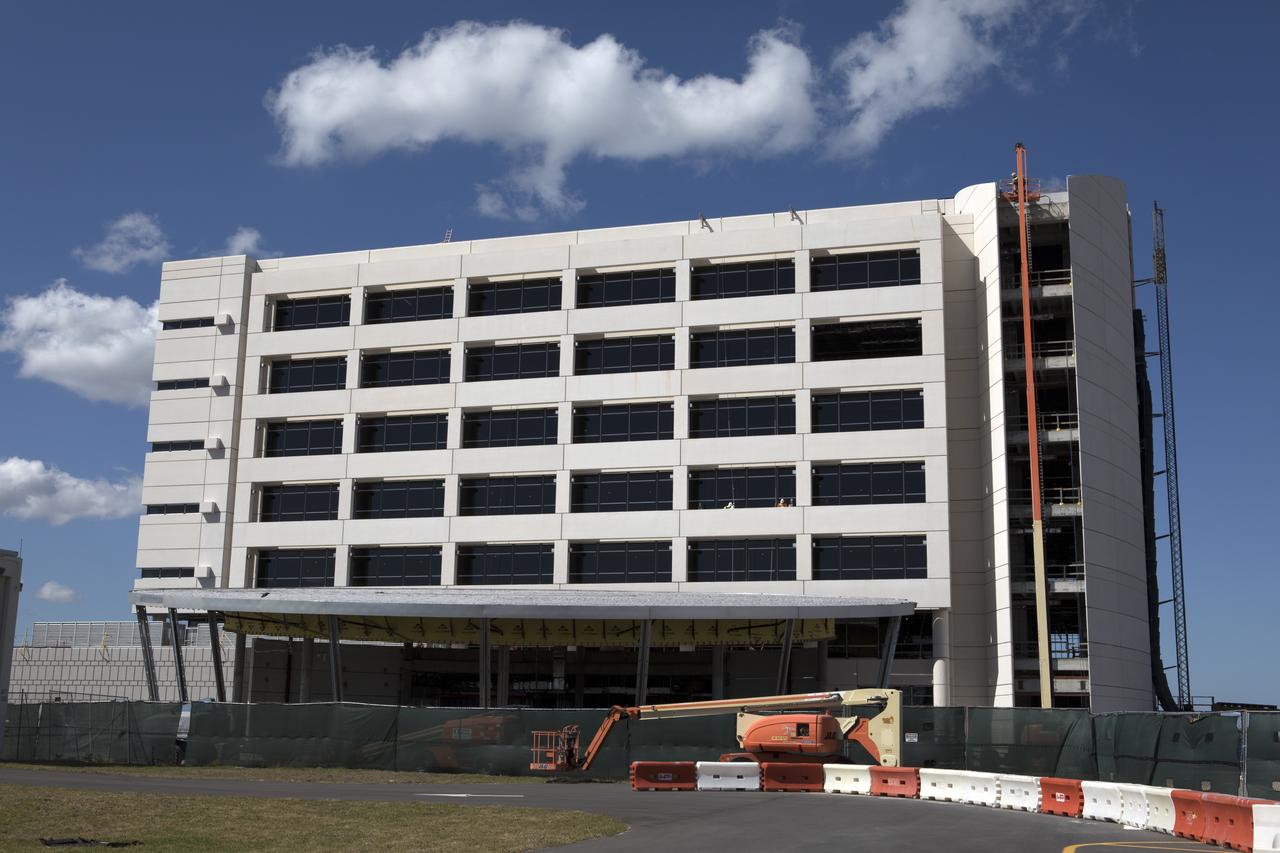
NASA's Kennedy Space Center in Florida is a premier, multi-user spaceport with ongoing construction adding new, ultra-modern facilities. A key element of the Central Campus makeover is a new, seven-story, 200,000-square-foot headquarters building that has taken shape in the heart of the spaceport. The headquarters building's glass facade, as seen from NASA Causeway, is complete. The exterior skin of the building also is nearly finished. The remainder of the glass components are being installed on each floor. Construction of interior walls and utilities on most floors is well underway. Construction of the headquarters building is targeted for completion in November 2017 and employees are expected to be able to move in soon after.
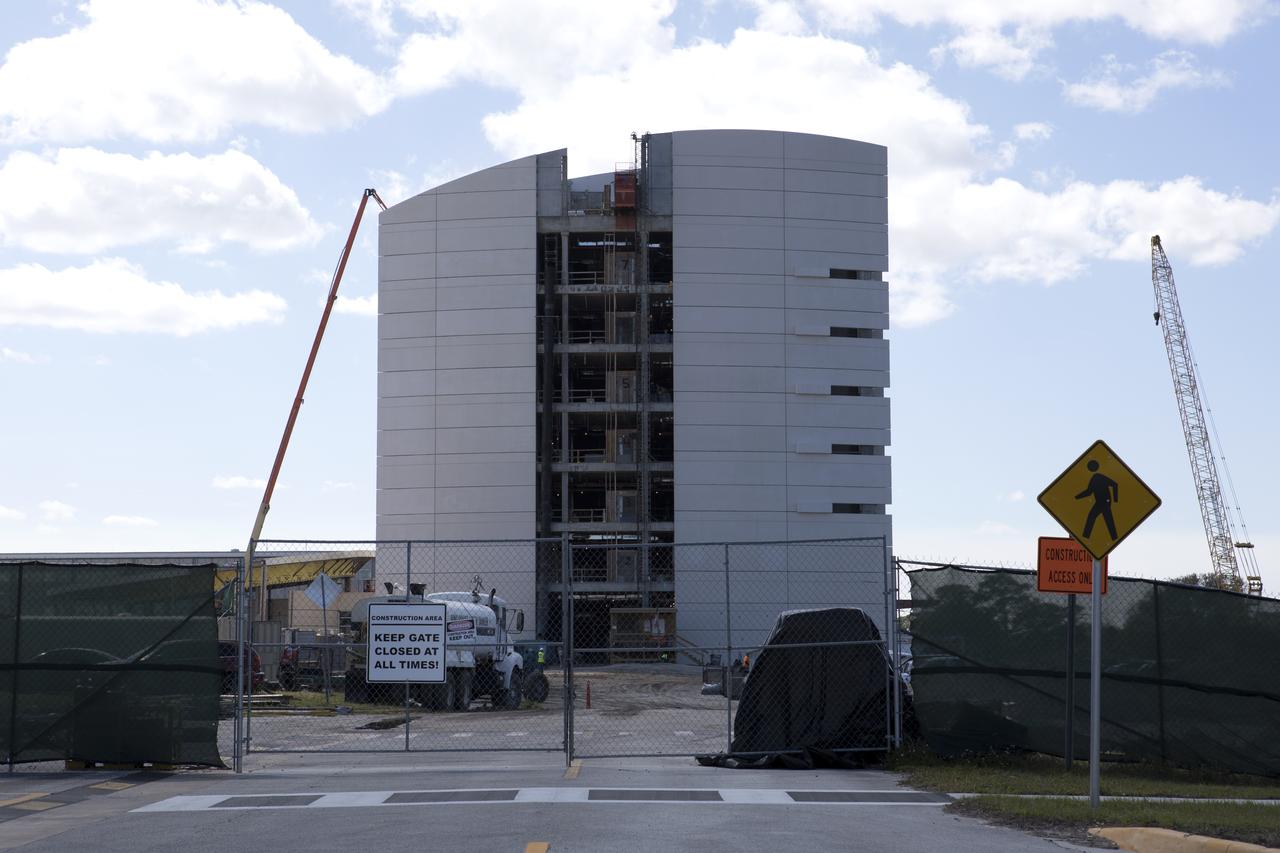
NASA's Kennedy Space Center in Florida is a premier, multi-user spaceport with ongoing construction adding new, ultra-modern facilities. A key element of the Central Campus makeover is a new, seven-story, 200,000-square-foot headquarters building that has taken shape in the heart of the spaceport. The headquarters building's glass facade, as seen from NASA Causeway, is complete. The exterior skin of the building also is nearly finished. The remainder of the glass components are being installed on each floor. Construction of interior walls and utilities on most floors is well underway. Construction of the headquarters building is targeted for completion in November 2017 and employees are expected to be able to move in soon after.
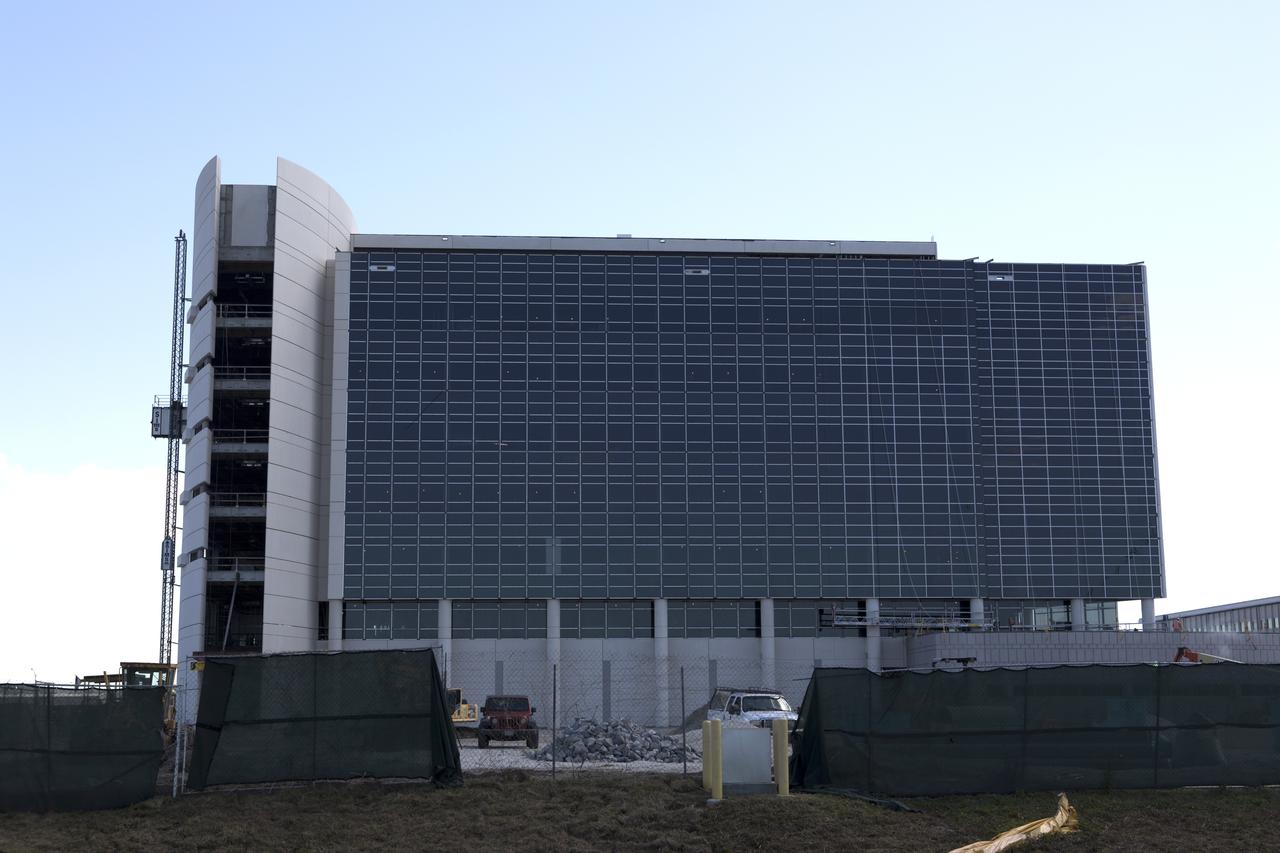
NASA's Kennedy Space Center in Florida is a premier, multi-user spaceport with ongoing construction adding new, ultra-modern facilities. A key element of the Central Campus makeover is a new, seven-story, 200,000-square-foot headquarters building that has taken shape in the heart of the spaceport. The headquarters building's glass facade, as seen from NASA Causeway, is complete. The exterior skin of the building also is nearly finished. The remainder of the glass components are being installed on each floor. Construction of interior walls and utilities on most floors is well underway. Construction of the headquarters building is targeted for completion in November 2017 and employees are expected to be able to move in soon after.
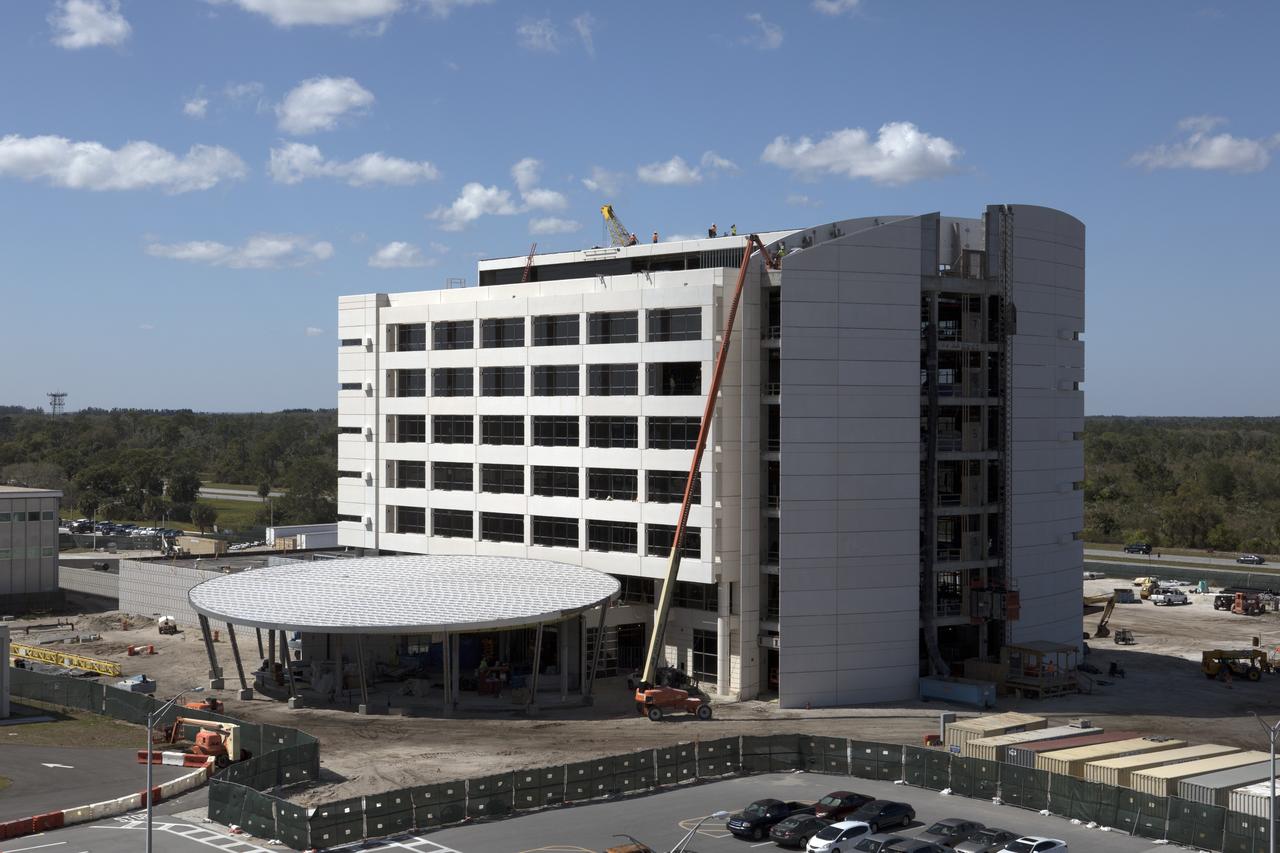
NASA's Kennedy Space Center in Florida is a premier, multi-user spaceport with ongoing construction adding new, ultra-modern facilities. A key element of the Central Campus makeover is a new, seven-story, 200,000-square-foot headquarters building that has taken shape in the heart of the spaceport. The headquarters building's glass facade, as seen from NASA Causeway, is complete. The exterior skin of the building also is nearly finished. The remainder of the glass components are being installed on each floor. Construction of interior walls and utilities on most floors is well underway. Construction of the headquarters building is targeted for completion in November 2017 and employees are expected to be able to move in soon after.
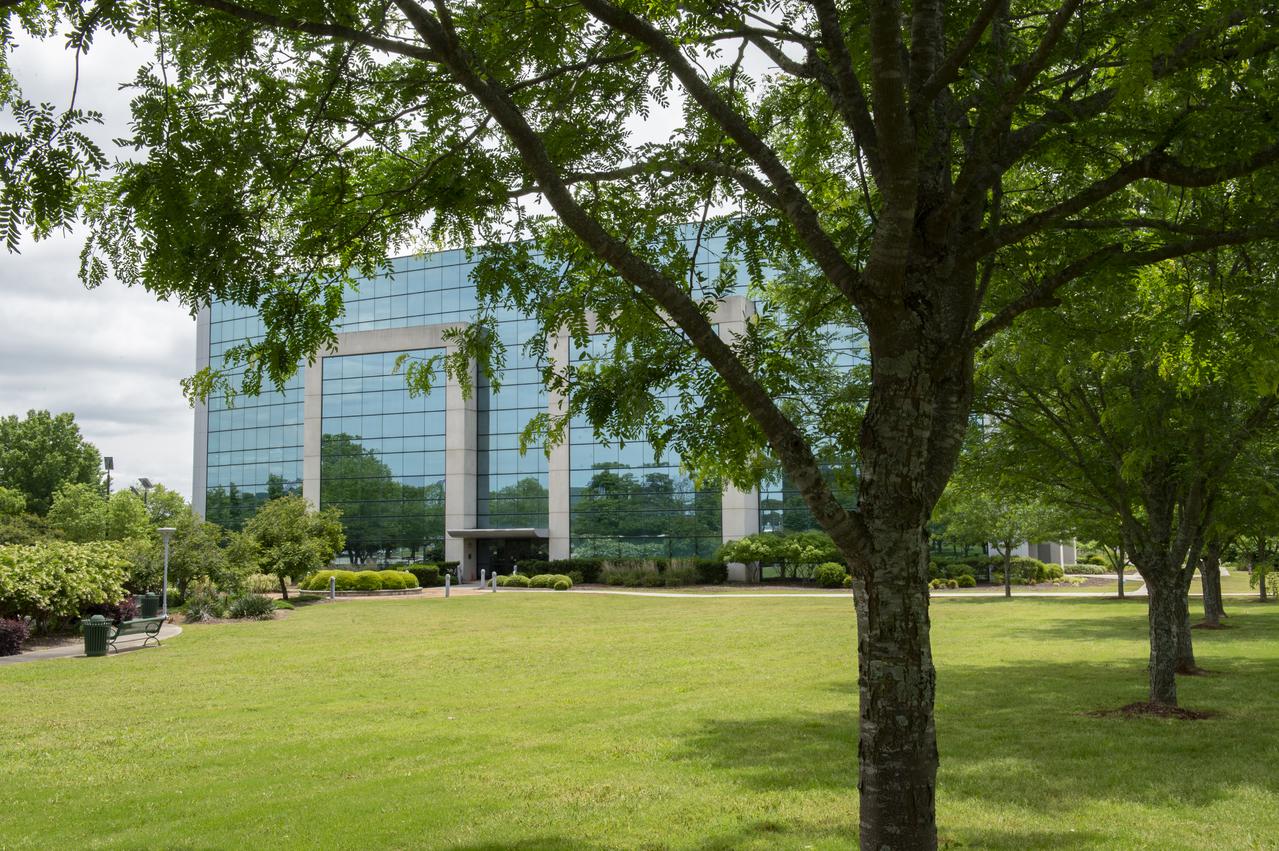
Pictured is the northward-facing view of Building 4600 on Marshall Space Flight Center’s campus.
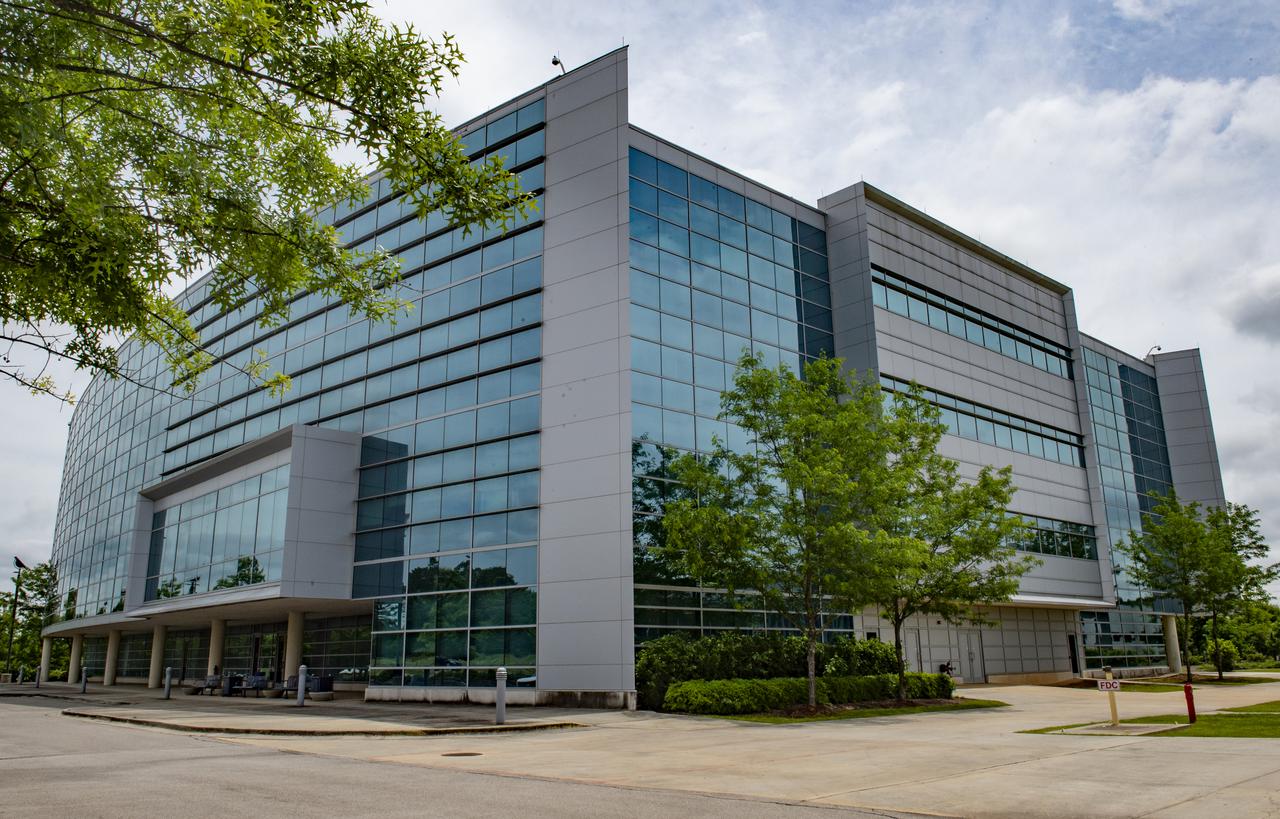
Pictured is the northwest corner of Building 4601 on the campus of Marshall Space Flight Center.
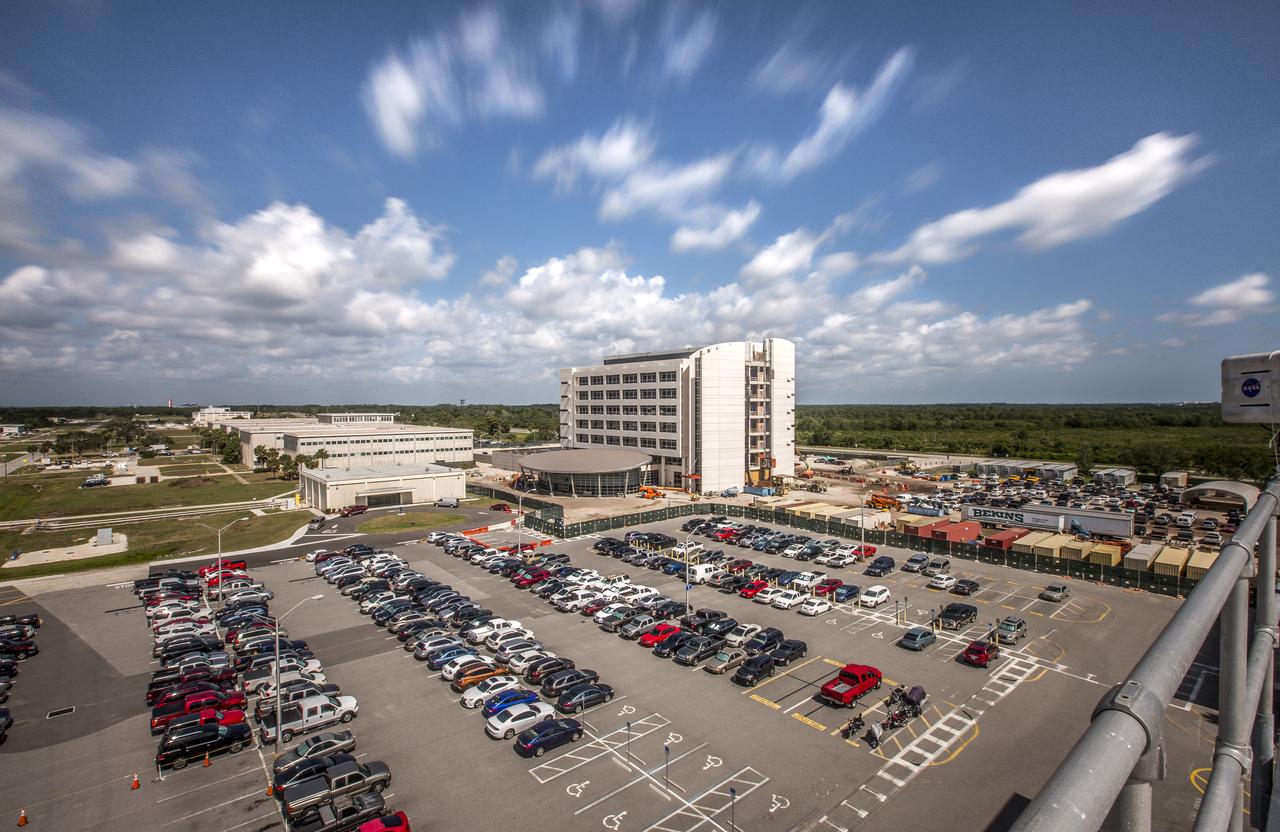
A long exposure photograph of the new headquarters building, part of the Central Campus in the industrial area at NASA’s Kennedy Space Center in Florida. The nearly-complete seven-story, 200,000-square-foot facility will house about 500 NASA civil service and contractor employees. The building will be more energy efficient than the current Headquarters building and will feature the latest in office and administrative building technology to fulfill Kennedy's role as the premiere spaceport for NASA and, increasingly, commercial entities.
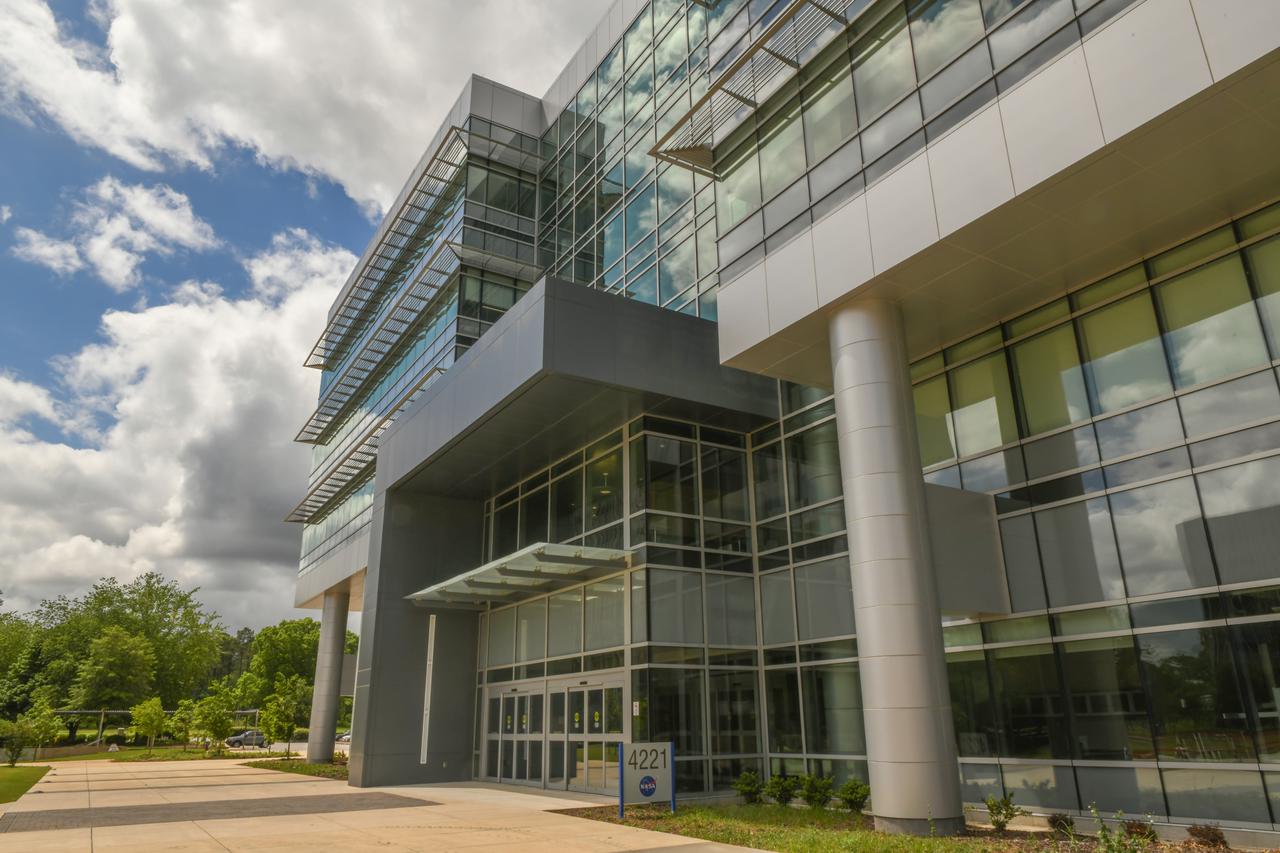
The newest building on Marshall Space Flight Center’s campus as of April 22, 2019, Building 4221 houses offices for the center’s top leaders, as well as the Human Exploration, Development and Operations Office; the Science Technology Office; the Engineering Directorate; the Human Landing Program Office; and the Office of Strategic Analysis and Communications.
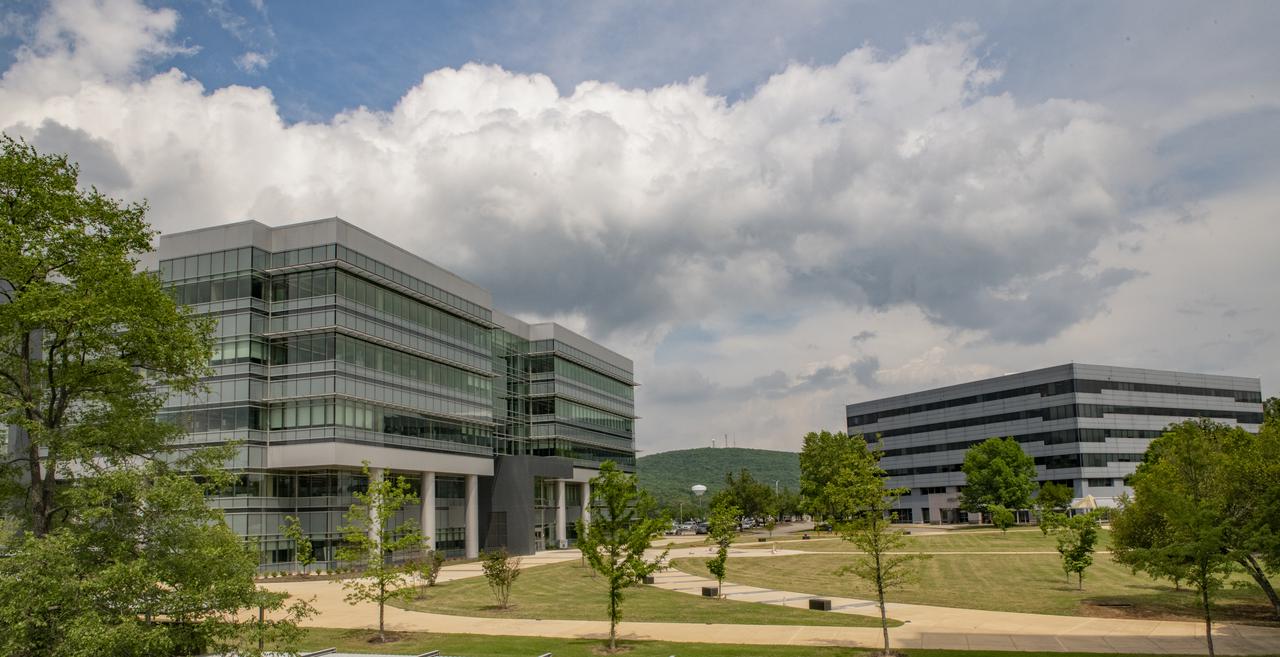
Pictured is a westward-facing view of Buildings 4221 (left) and 4203 on Marshall Space Flight Center’s campus.
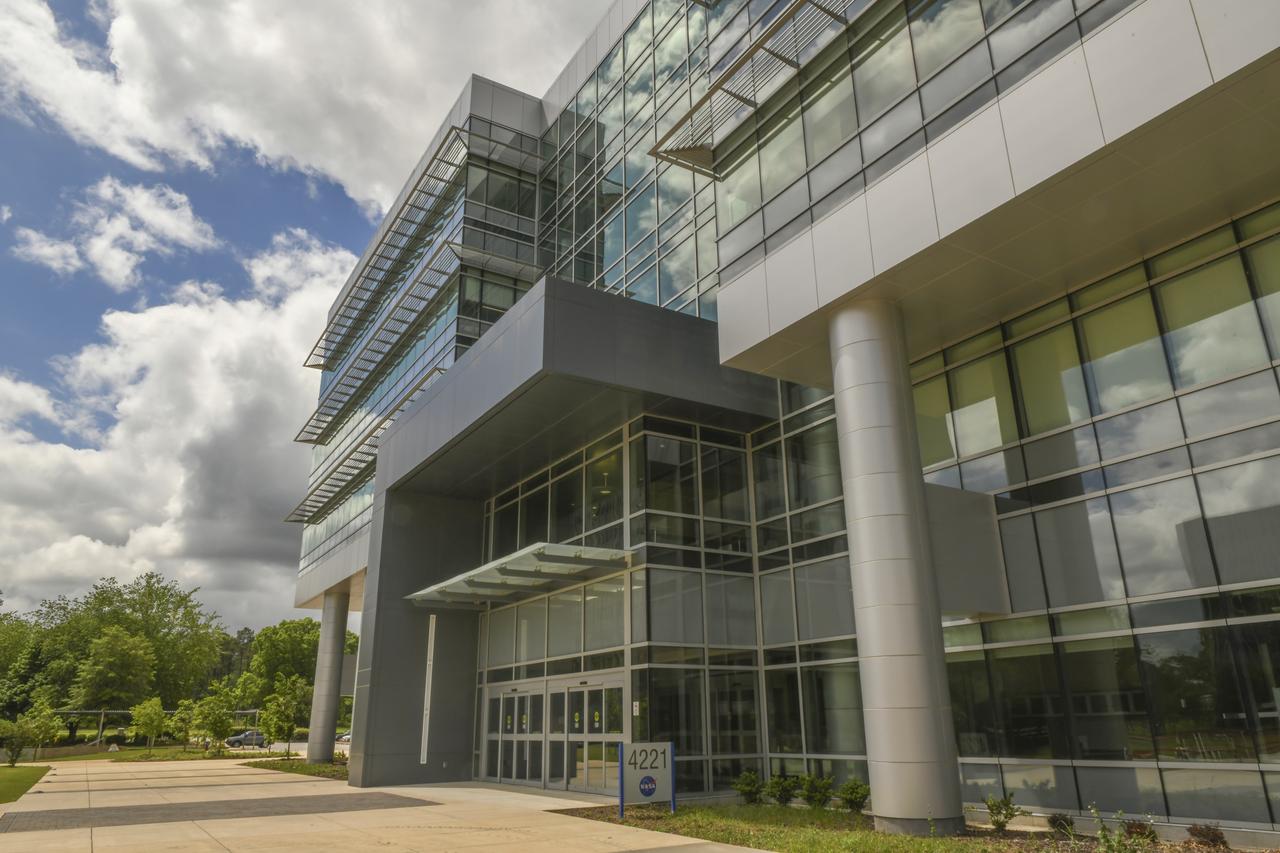
Building 4221 is the new executive administrative building on the Marshall Space Flight Center campus.
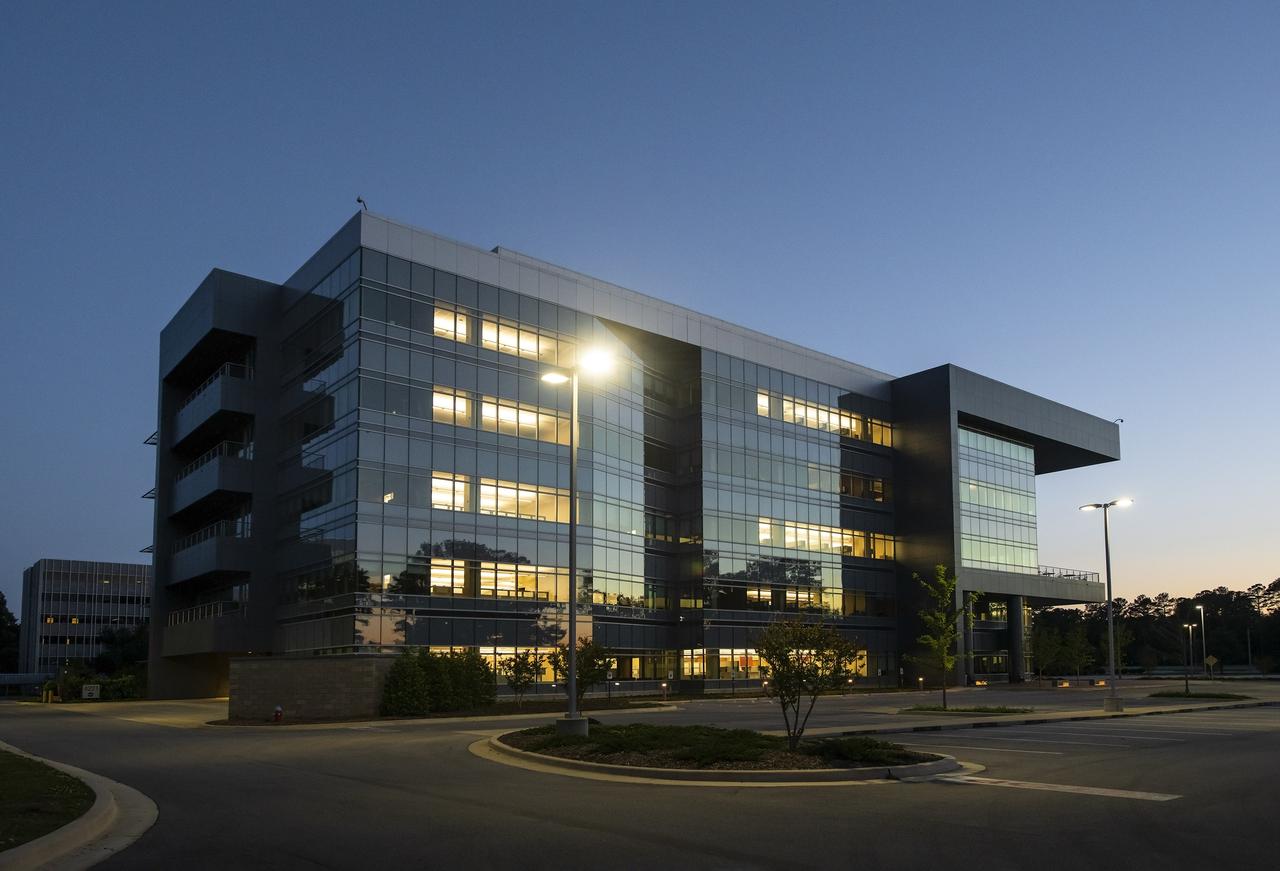
Building 4221 is the new executive administrative building on the Marshall Space Flight Center campus.
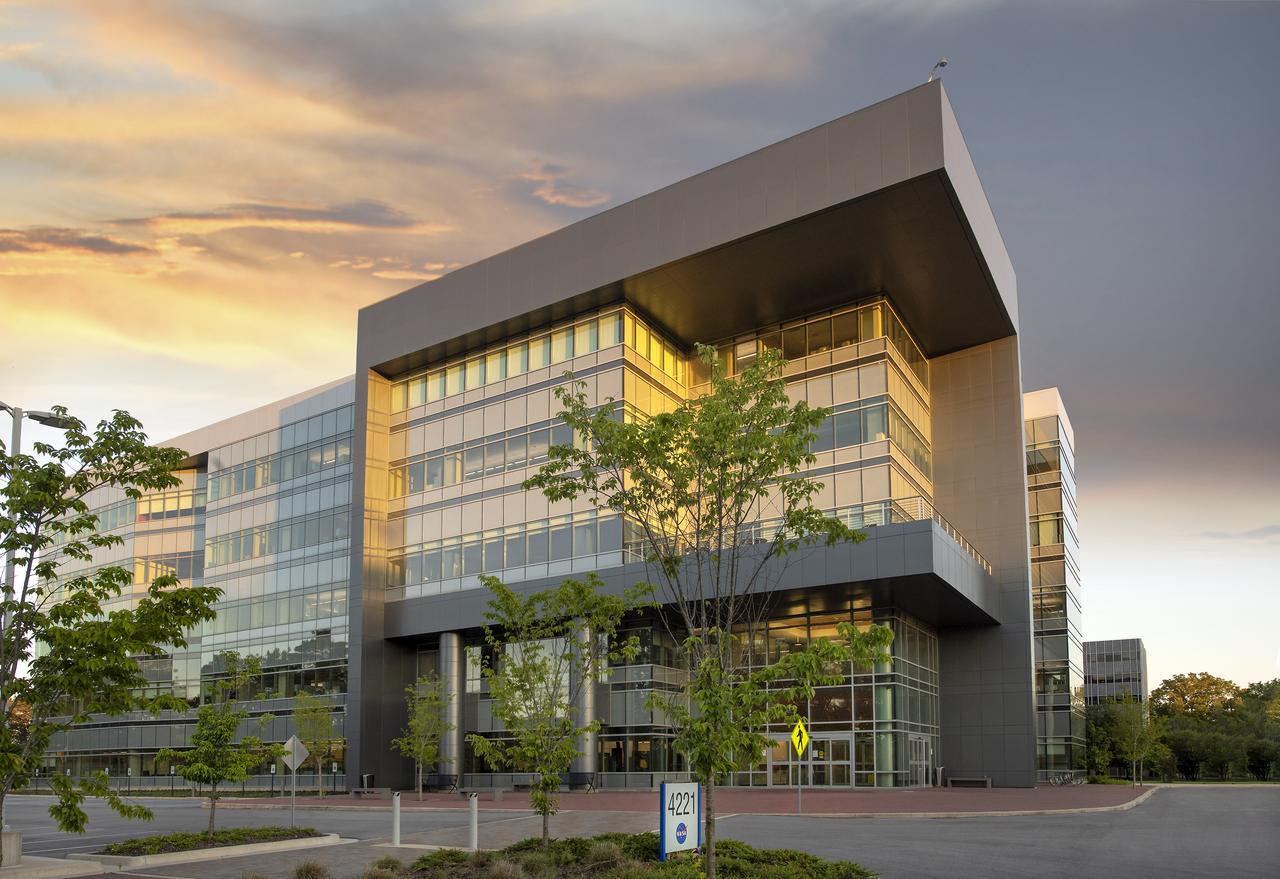
Building 4221 is the new executive administrative building on the Marshall Space Flight Center campus.
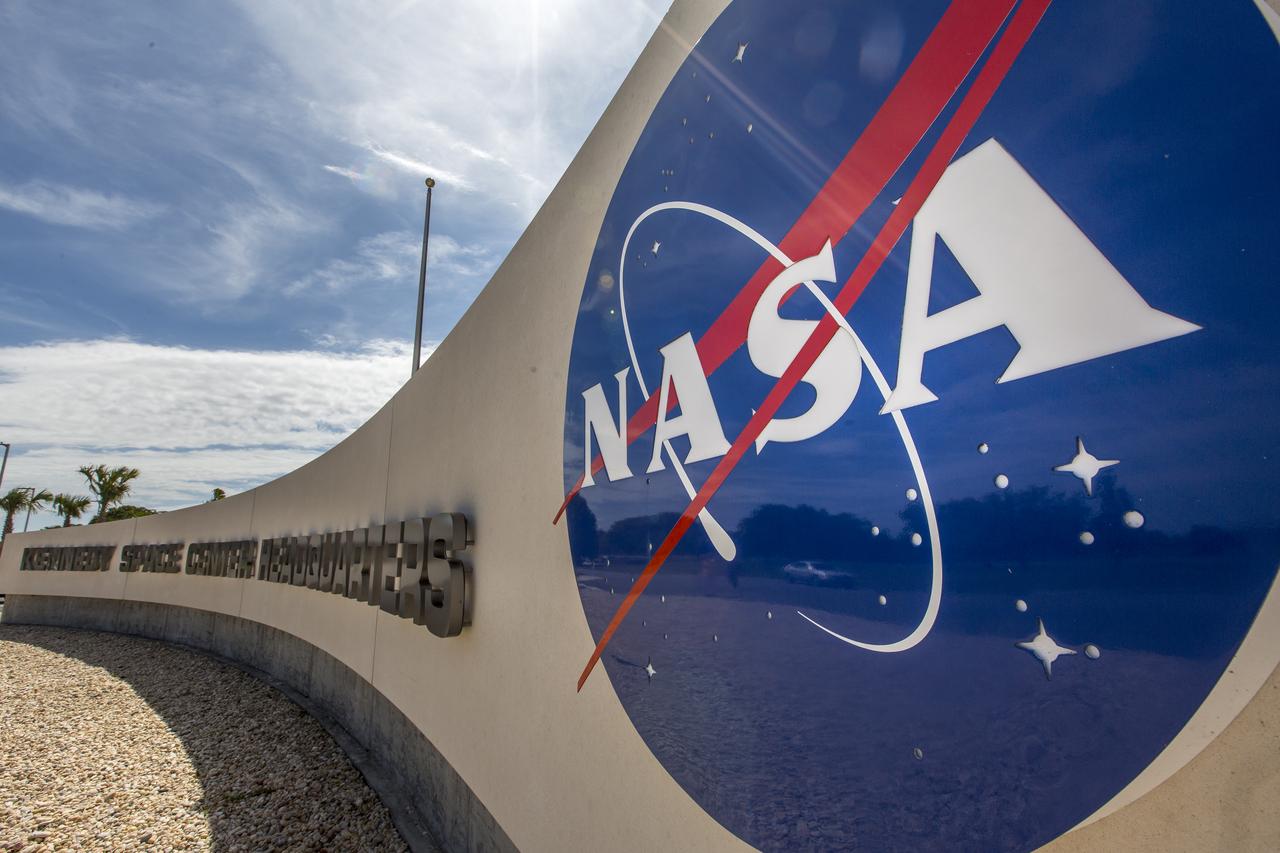
A close-up view the NASA insignia in front of the entrance to the new headquarters building on April 3, 2019, at NASA’s Kennedy Space Center in Florida. The newly constructed facility anchors the multi-user spaceport’s Central Campus. More than 500 civil service and contractor employees will be based in the 200,000-square-foot building. The facility earned the U.S. Green Building Council’s Leadership in Energy and Environmental Design (LEED) Gold designation. Features include LED lighting throughout, along with occupancy sensors to turn off unneeded lights; windows, screens and shades designed to maximize natural light; chilled beam HVAC technology reducing the need for ductwork, and more.
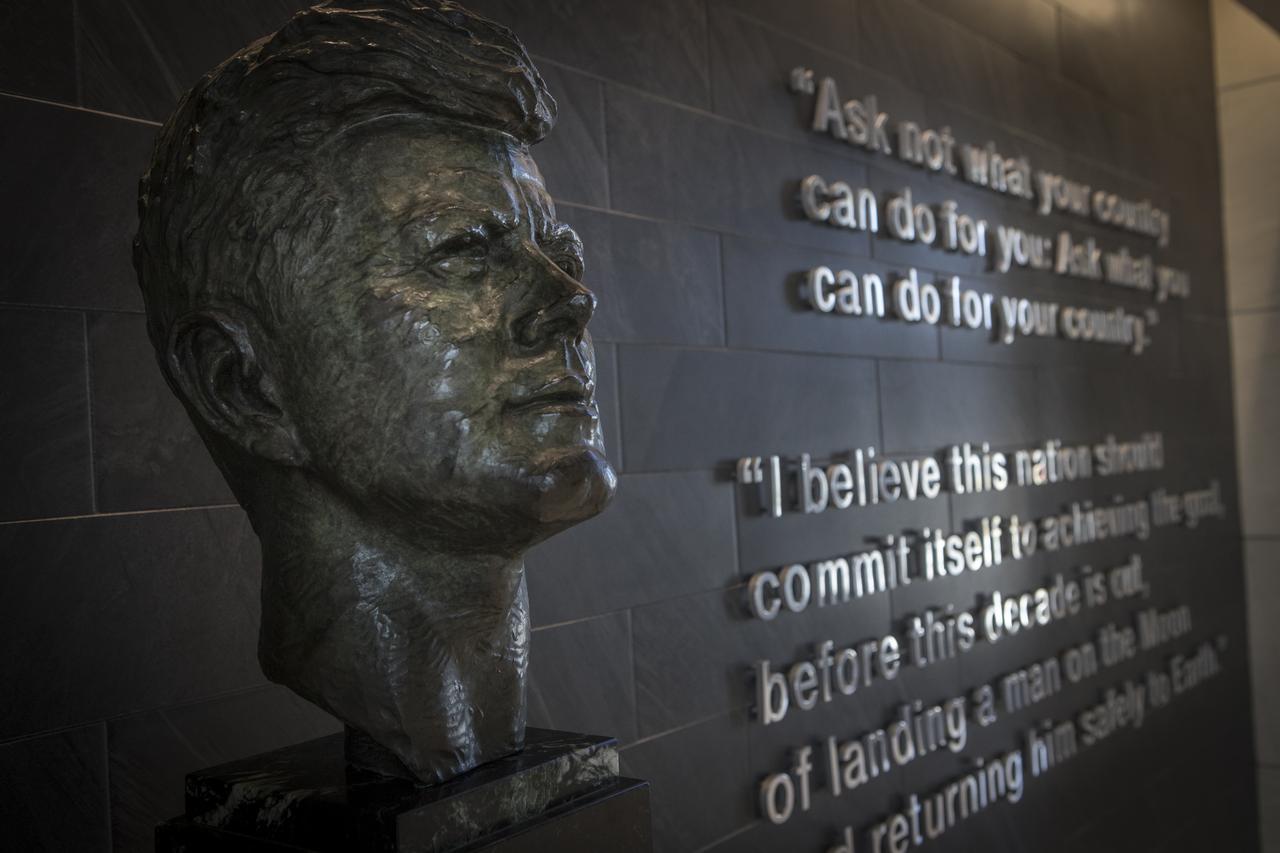
A view of some of the design elements in the lobby of the new headquarters building on April 3, 2019, at NASA’s Kennedy Space Center in Florida. The newly constructed facility anchors the multi-user spaceport’s Central Campus. More than 500 civil service and contractor employees will be based in the 200,000-square-foot building. The facility earned the U.S. Green Building Council’s Leadership in Energy and Environmental Design (LEED) Gold designation. Features include LED lighting throughout, along with occupancy sensors to turn off unneeded lights; windows, screens and shades designed to maximize natural light; chilled beam HVAC technology reducing the need for ductwork, and more.
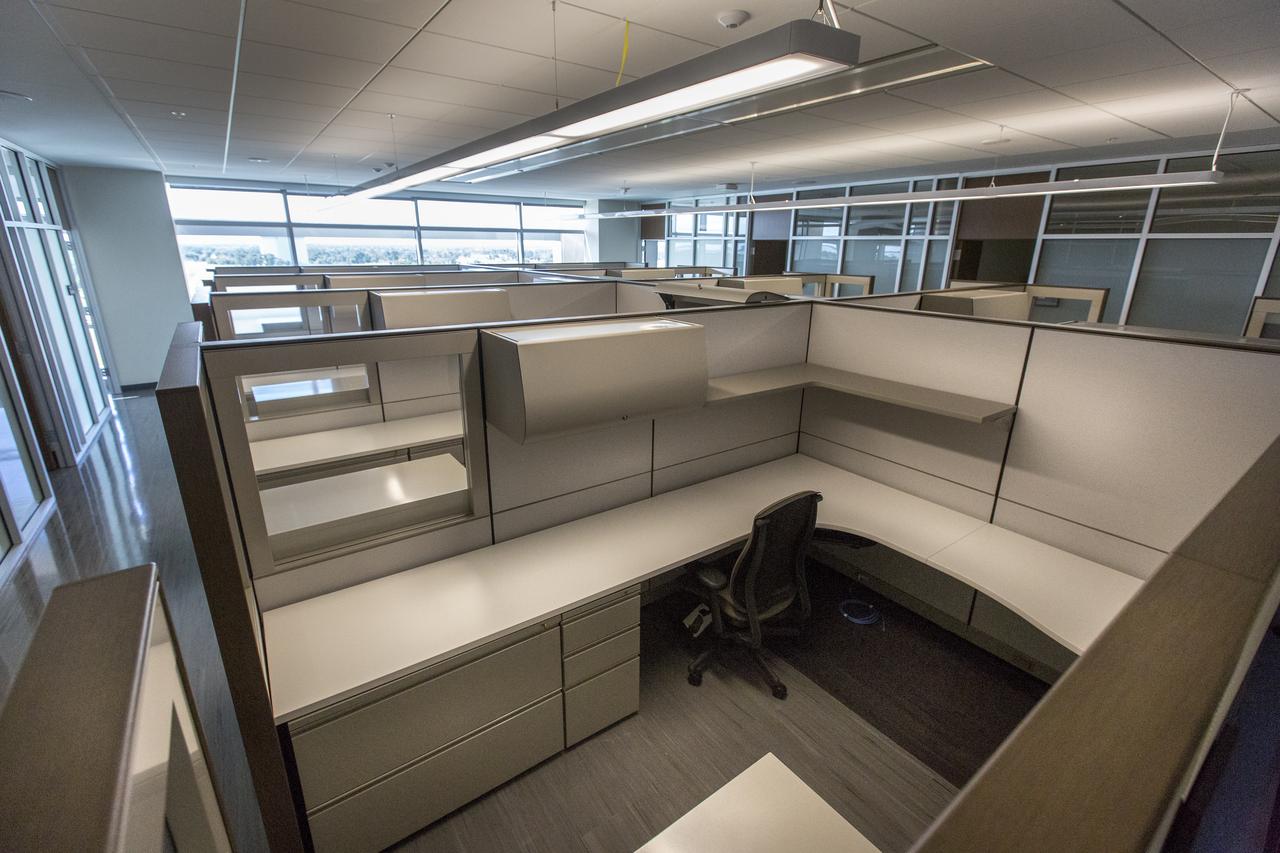
A view of some of the work stations in the new headquarters building on April 3, 2019, at NASA’s Kennedy Space Center in Florida. The newly constructed facility anchors the multi-user spaceport’s Central Campus. More than 500 civil service and contractor employees will be based in the 200,000-square-foot building. The facility earned the U.S. Green Building Council’s Leadership in Energy and Environmental Design (LEED) Gold designation. Features include LED lighting throughout, along with occupancy sensors to turn off unneeded lights; windows, screens and shades designed to maximize natural light; chilled beam HVAC technology reducing the need for ductwork, and more.
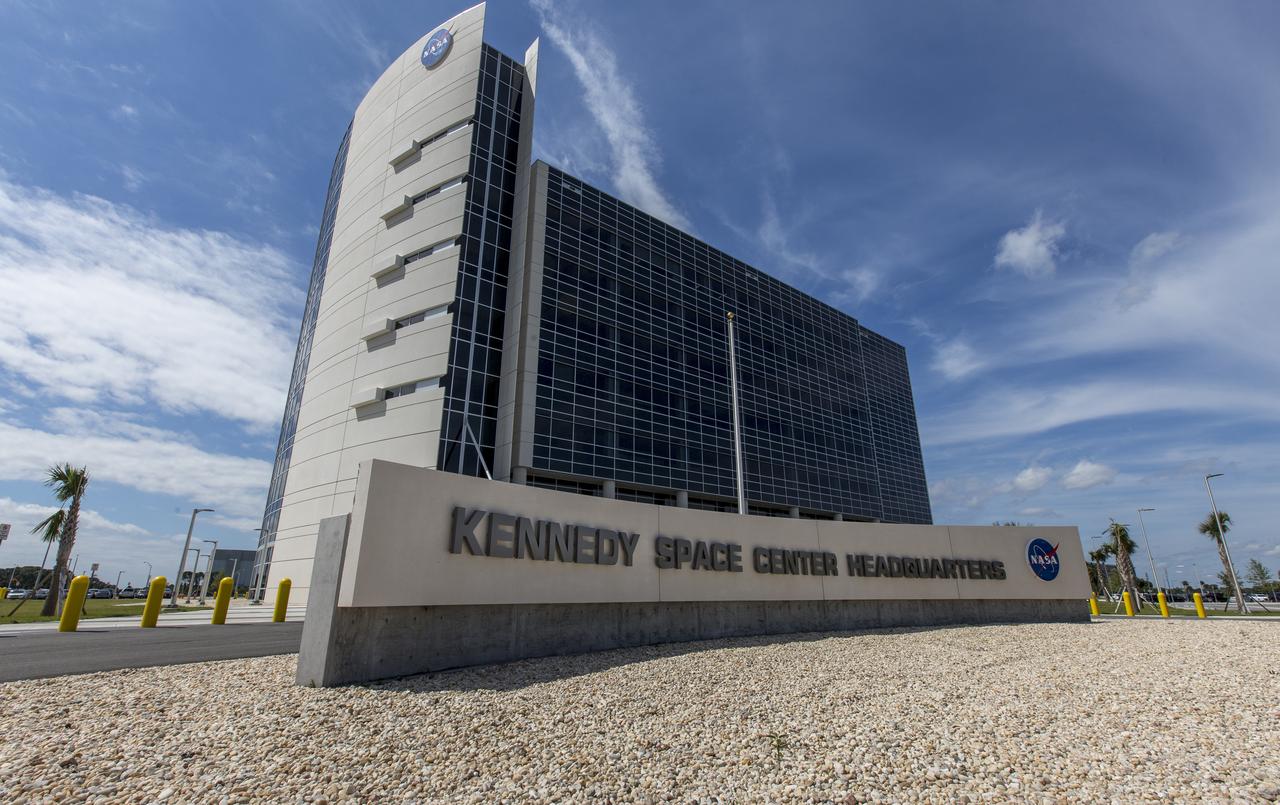
A view of the front of the new headquarters building on April 3, 2019, at NASA’s Kennedy Space Center in Florida. The newly constructed facility anchors the multi-user spaceport’s Central Campus. More than 500 civil service and contractor employees will be based in the 200,000-square-foot building. The facility earned the U.S. Green Building Council’s Leadership in Energy and Environmental Design (LEED) Gold designation. Features include LED lighting throughout, along with occupancy sensors to turn off unneeded lights; windows, screens and shades designed to maximize natural light; chilled beam HVAC technology reducing the need for ductwork, and more.
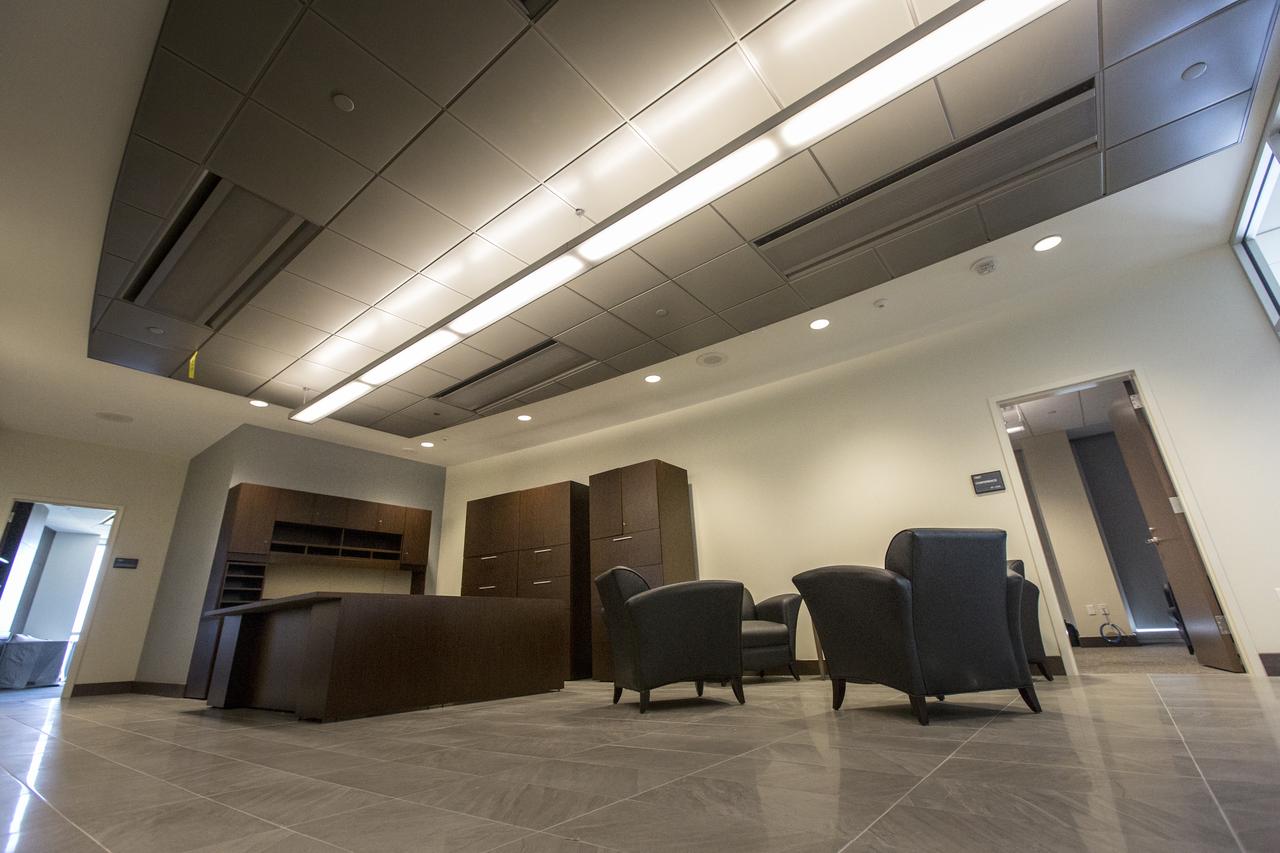
A view of the Kennedy Space Center director’s office suite on the seventh floor of the new headquarters building on April 3, 2019, at NASA’s Kennedy Space Center in Florida. The newly constructed facility anchors the multi-user spaceport’s Central Campus. More than 500 civil service and contractor employees will be based in the 200,000-square-foot building. The facility earned the U.S. Green Building Council’s Leadership in Energy and Environmental Design (LEED) Gold designation. Features include LED lighting throughout, along with occupancy sensors to turn off unneeded lights; windows, screens and shades designed to maximize natural light; chilled beam HVAC technology reducing the need for ductwork, and more.
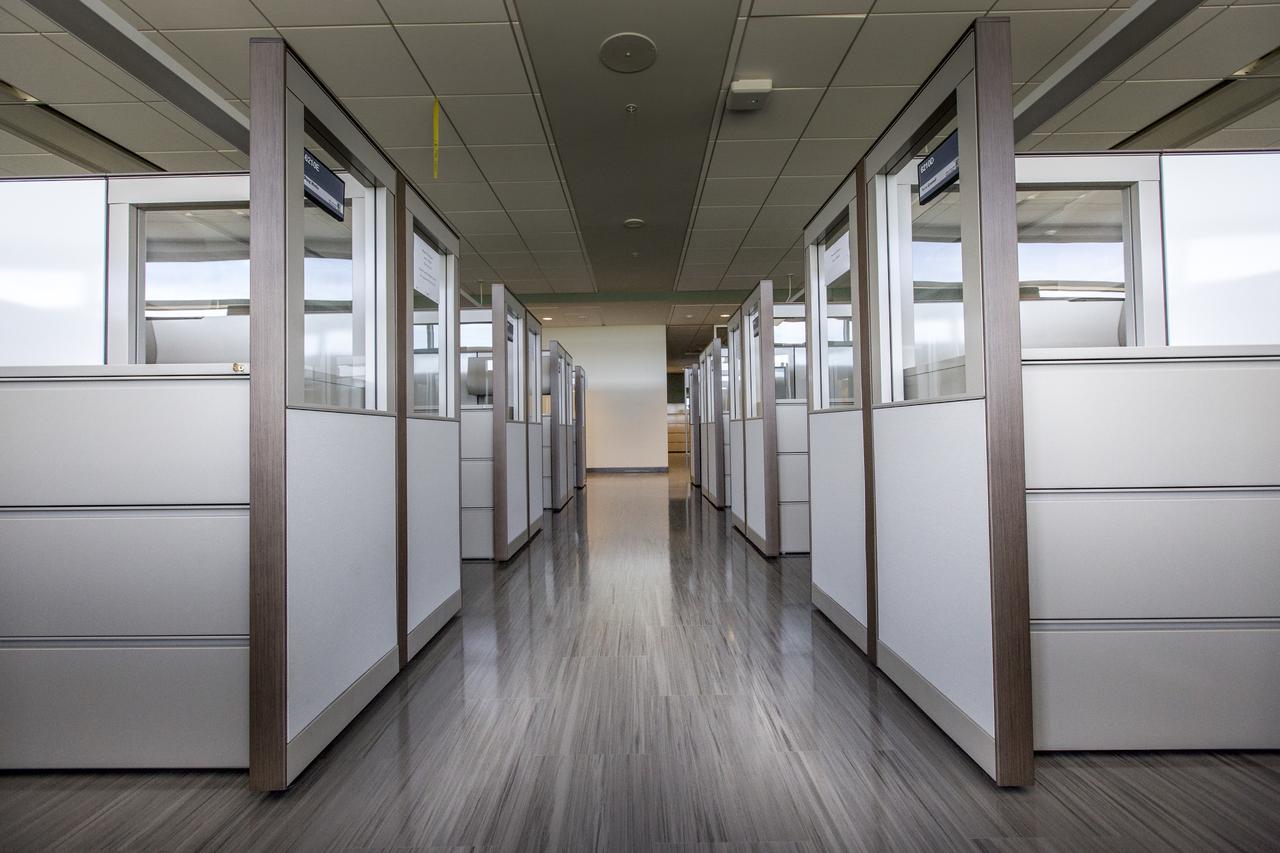
A view of some of the work stations in the new headquarters building on April 3, 2019, at NASA’s Kennedy Space Center in Florida. The newly constructed facility anchors the multi-user spaceport’s Central Campus. More than 500 civil service and contractor employees will be based in the 200,000-square-foot building. The facility earned the U.S. Green Building Council’s Leadership in Energy and Environmental Design (LEED) Gold designation. Features include LED lighting throughout, along with occupancy sensors to turn off unneeded lights; windows, screens and shades designed to maximize natural light; chilled beam HVAC technology reducing the need for ductwork, and more.
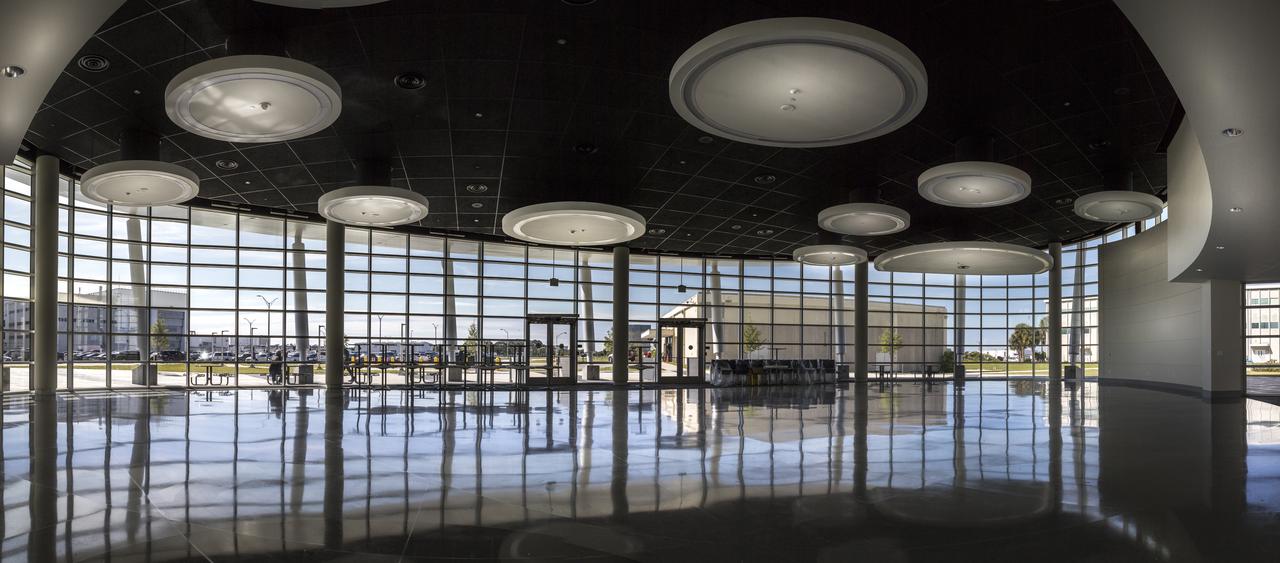
A view of the cafeteria area inside the new headquarters building on April 3, 2019, at NASA’s Kennedy Space Center in Florida. The newly constructed facility anchors the multi-user spaceport’s Central Campus. More than 500 civil service and contractor employees will be based in the 200,000-square-foot building. The facility earned the U.S. Green Building Council’s Leadership in Energy and Environmental Design (LEED) Gold designation. Features include LED lighting throughout, along with occupancy sensors to turn off unneeded lights; windows, screens and shades designed to maximize natural light; chilled beam HVAC technology reducing the need for ductwork, and more.
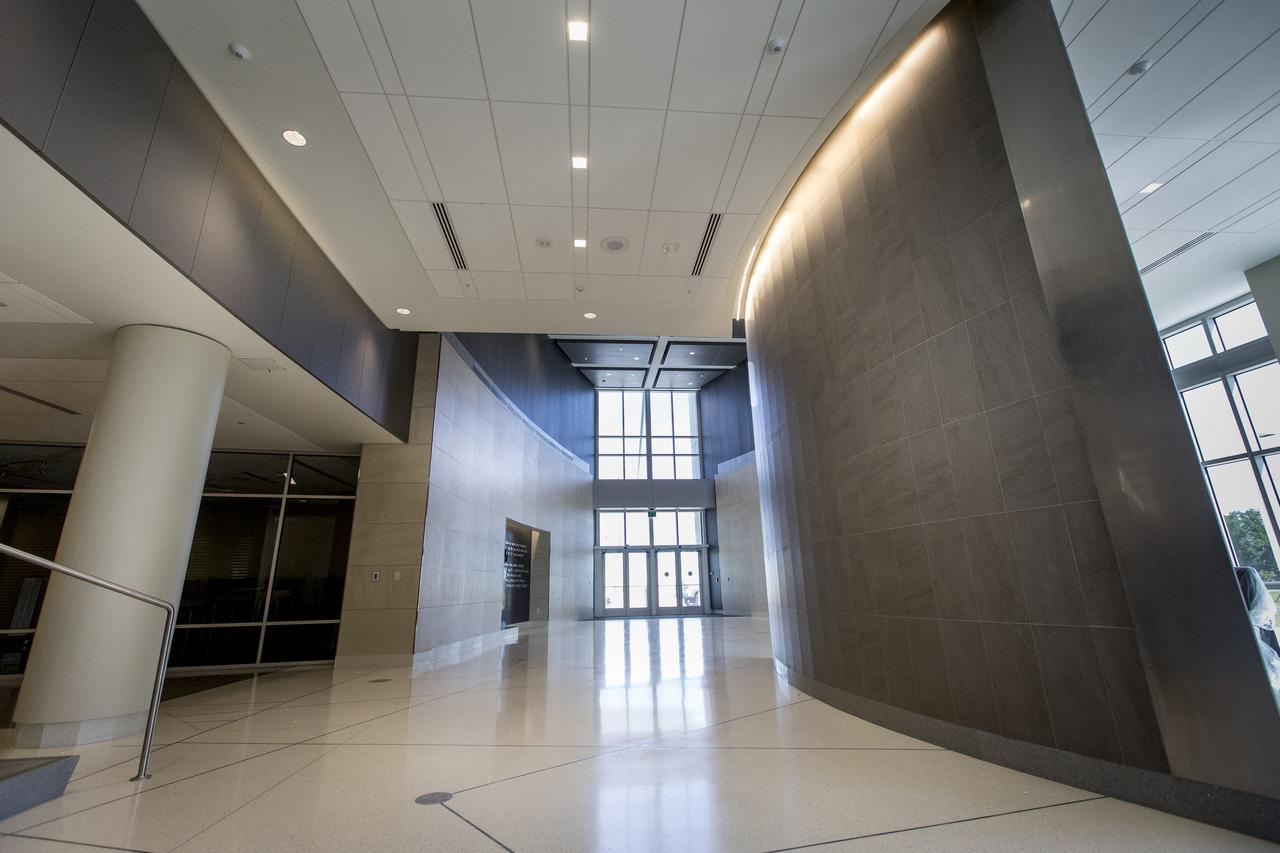
A view of the entranceway and lobby in the new headquarters building on April 3, 2019, at NASA’s Kennedy Space Center in Florida. The newly constructed facility anchors the multi-user spaceport’s Central Campus. More than 500 civil service and contractor employees will be based in the 200,000-square-foot building. The facility earned the U.S. Green Building Council’s Leadership in Energy and Environmental Design (LEED) Gold designation. Features include LED lighting throughout, along with occupancy sensors to turn off unneeded lights; windows, screens and shades designed to maximize natural light; chilled beam HVAC technology reducing the need for ductwork, and more.
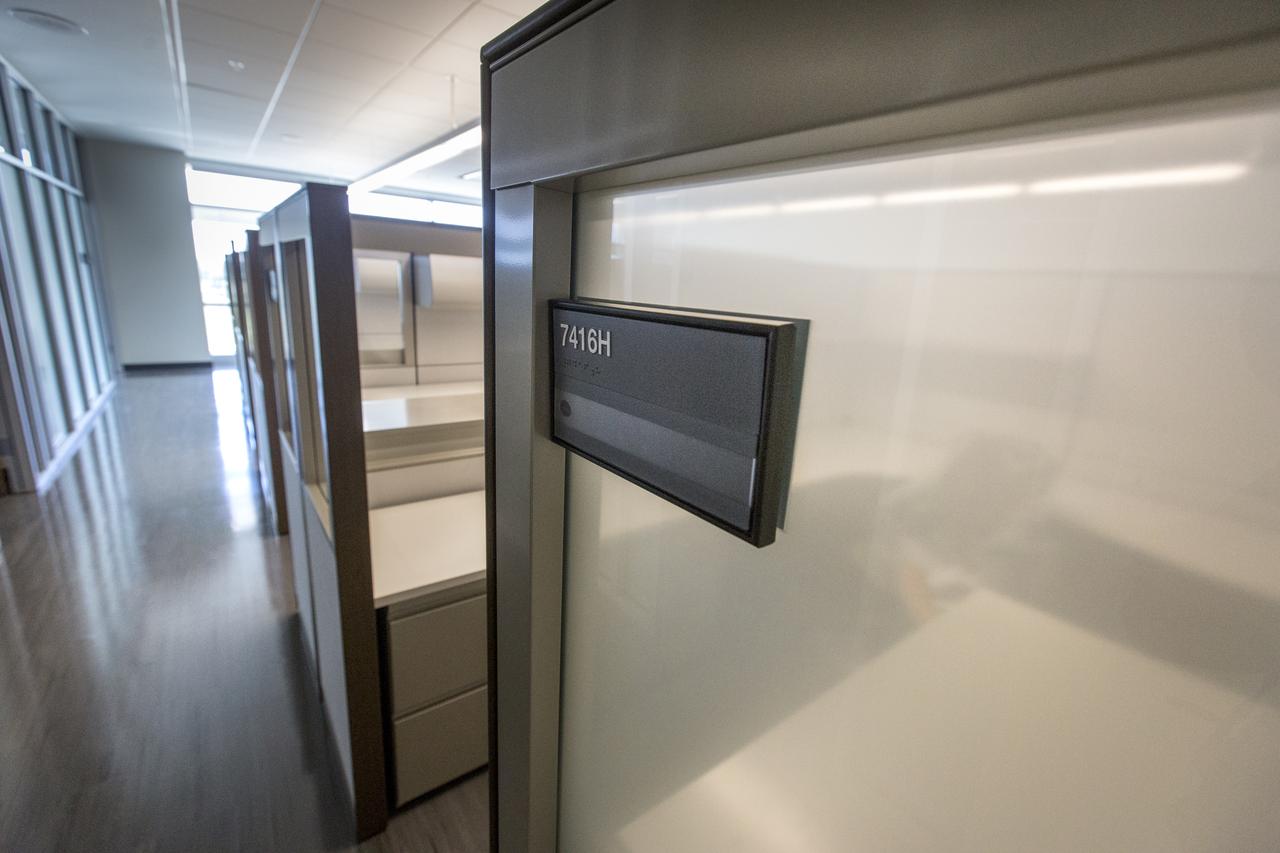
A view of some of the work stations and the entryway to the Center Director’s suite on the seventh floor in the new headquarters building on April 3, 2019, at NASA’s Kennedy Space Center in Florida. The newly constructed facility anchors the multi-user spaceport’s Central Campus. More than 500 civil service and contractor employees will be based in the 200,000-square-foot building. The facility earned the U.S. Green Building Council’s Leadership in Energy and Environmental Design (LEED) Gold designation. Features include LED lighting throughout, along with occupancy sensors to turn off unneeded lights; windows, screens and shades designed to maximize natural light; chilled beam HVAC technology reducing the need for ductwork, and more.
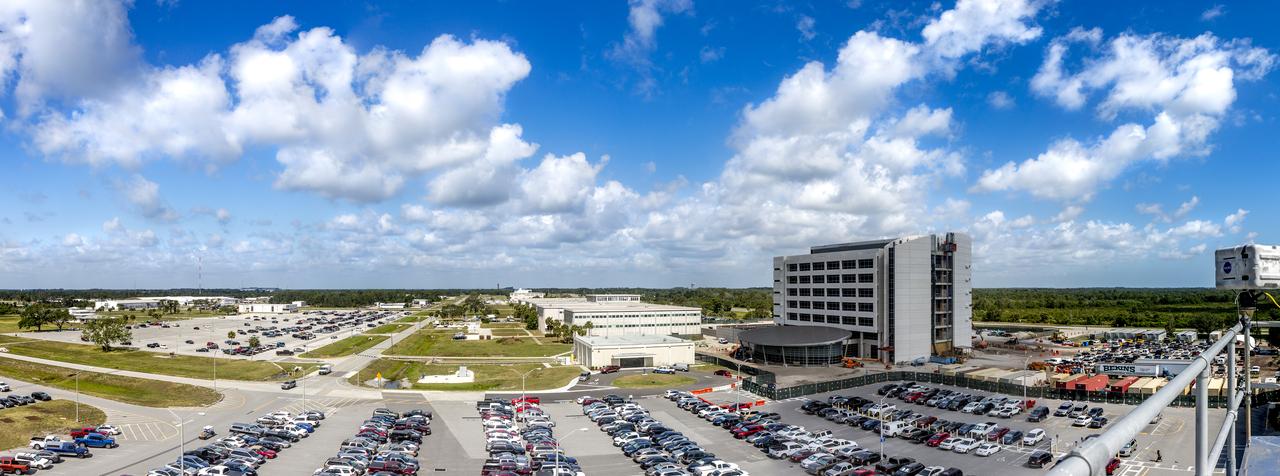
A panoramic view of the Industrial Area at NASA's Kennedy Space Center in Florida, shows the nearly-complete new headquarters building at right. The new seven-story, 200,000-square-foot facility will house about 500 NASA civil service and contractor employees. The building will be more energy efficient than the current Headquarters building and will feature the latest in office and administrative building technology to fulfill Kennedy's role as the premiere spaceport for NASA and, increasingly, commercial entities.
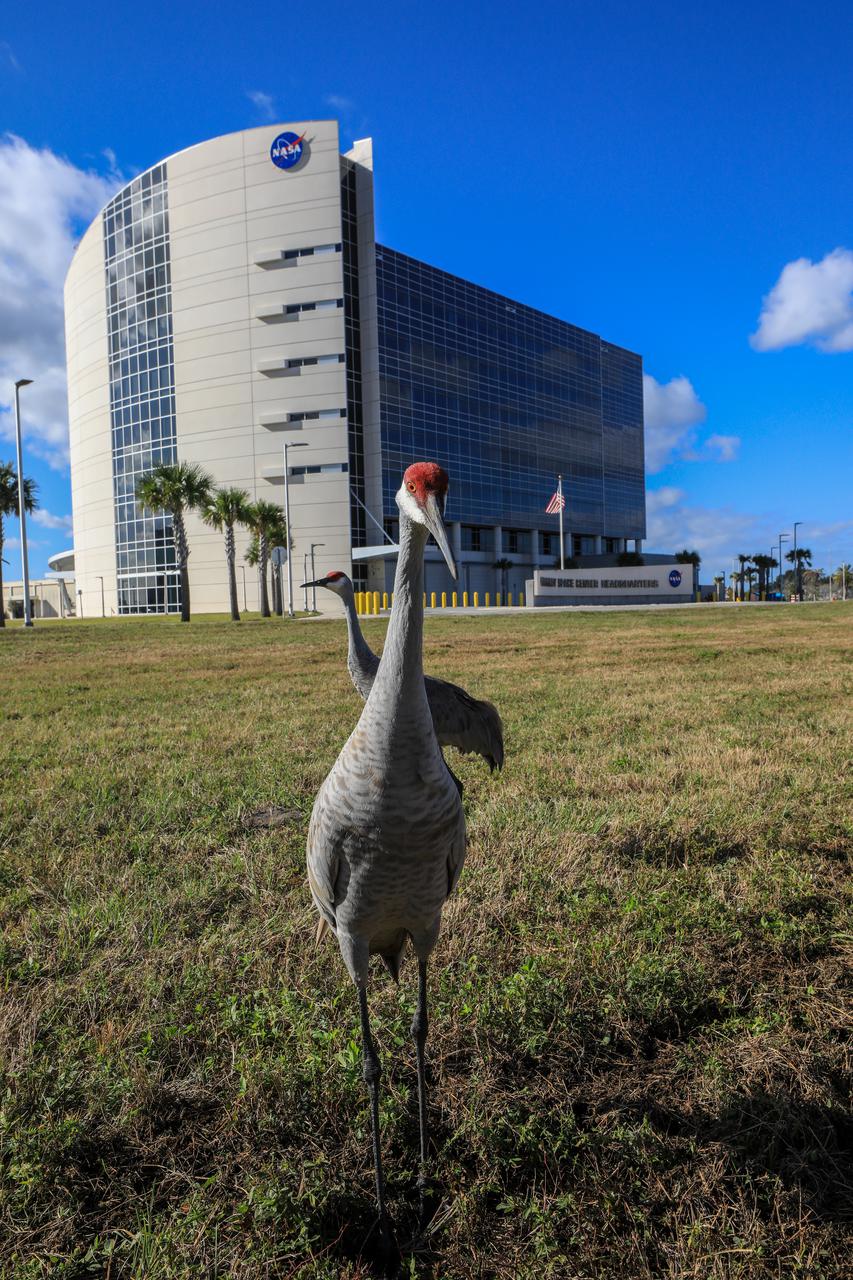
Sandhill cranes pose in front of the Central Campus Headquarters (CCHQ) Building at NASA’s Kennedy Space Center in Florida on Jan. 11, 2022. The CCHQ is a modernized, energy efficient facility representative of Kennedy’s transformation to America’s premier multi-user spaceport. It opened in May 2019. Built in 1965, the former headquarters building was recently demolished. The area previously occupied by the 439,000 square-foot-facility will be utilized as greenspace.
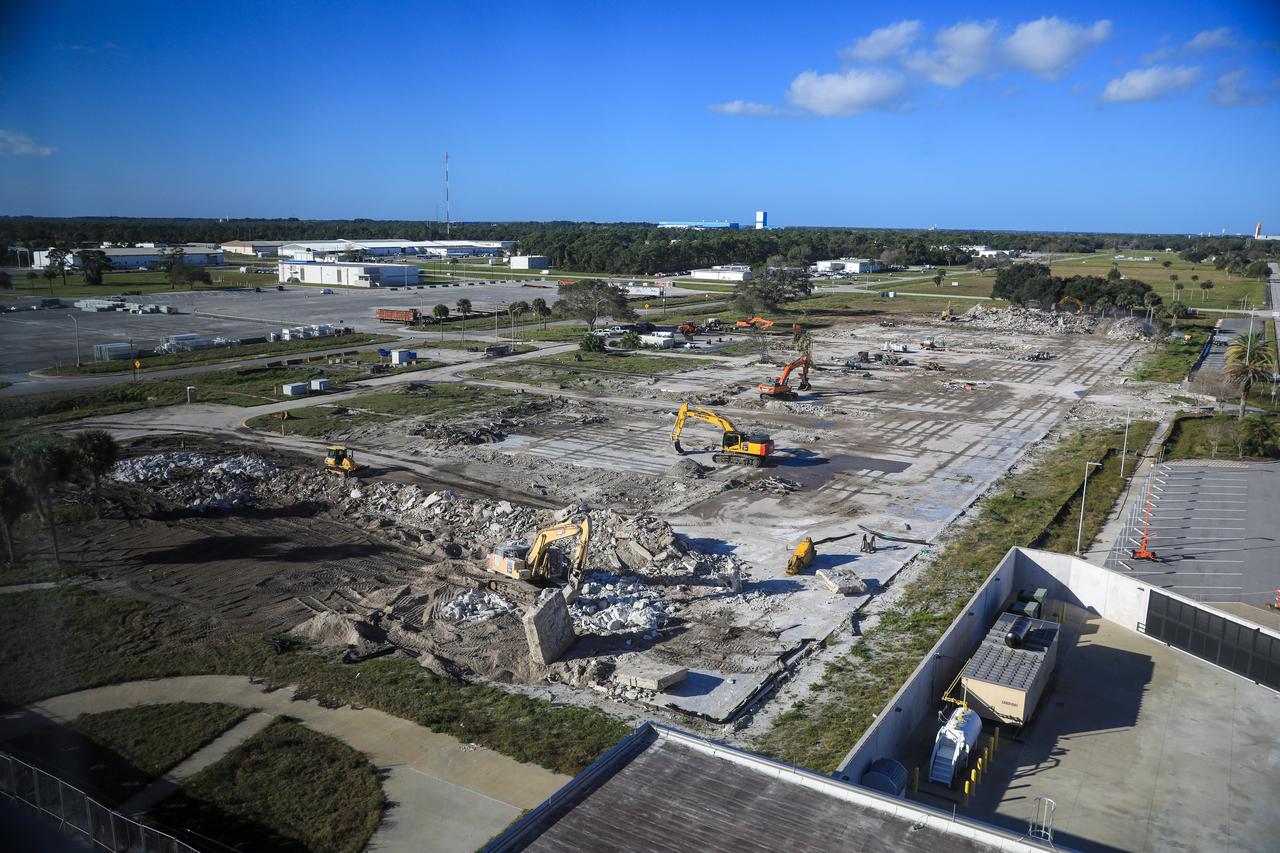
Shown on Jan. 11, 2022, is the area formerly occupied by the headquarters building at NASA’s Kennedy Space Center. Built in 1965, the 439,000-square-foot-structure was demolished and replaced at the Florida spaceport by the 200,000-square-foot, seven-story Central Campus Headquarters (CCHQ) Building. The CCHQ is a modernized, energy efficient facility representative of Kennedy’s transformation to America’s premier multi-user spaceport. It opened in May 2019. The area previously occupied by the old headquarters building will be utilized as greenspace.
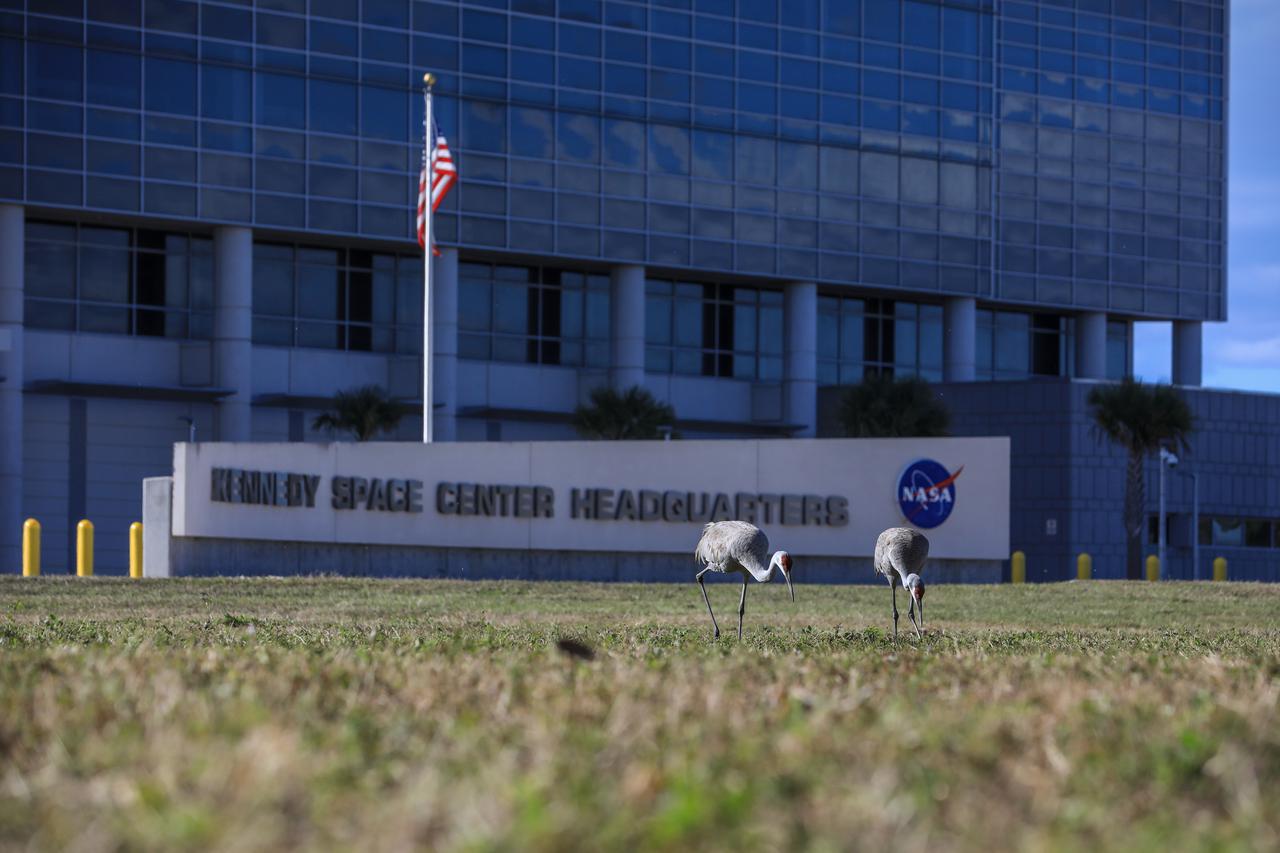
Sandhill cranes dig in the ground in front of the Central Campus Headquarters (CCHQ) Building at NASA’s Kennedy Space Center in Florida on Jan. 11, 2022. The CCHQ is a modernized, energy efficient facility representative of Kennedy’s transformation to America’s premier multi-user spaceport. It opened in May 2019. Built in 1965, the former headquarters building was recently demolished. The area previously occupied by the 439,000 square-foot-facility will be utilized as greenspace.
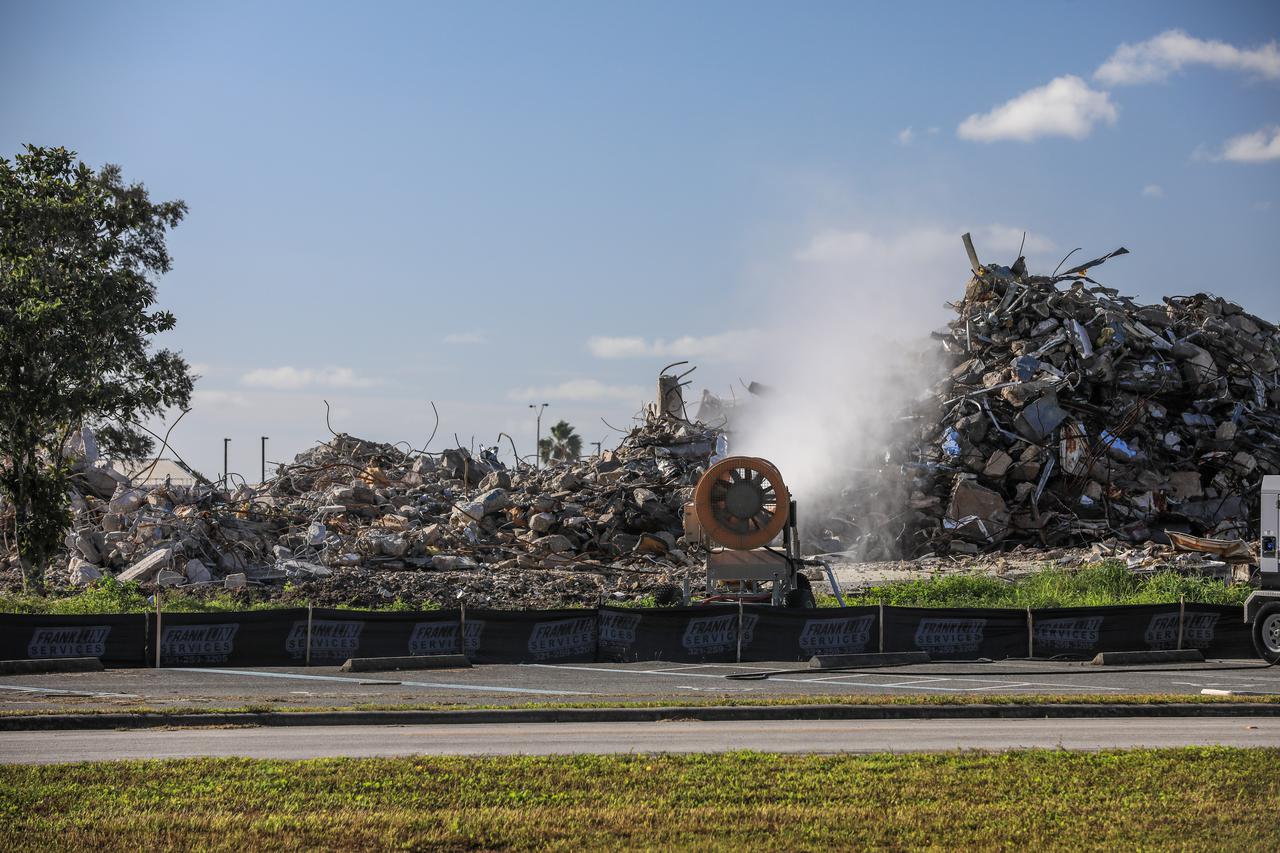
Shown is remnants of the former headquarters building at NASA’s Kennedy Space Center on Jan. 11, 2022. Built in 1965, the 439,000-square-foot structure was demolished and replaced at the Florida spaceport by the 200,000-square-foot, seven-story Central Campus Headquarters (CCHQ) Building. The CCHQ is a modernized, energy efficient facility representative of Kennedy’s transformation to America’s premier multi-user spaceport. The area previously occupied by the old headquarters building will be utilized as greenspace.
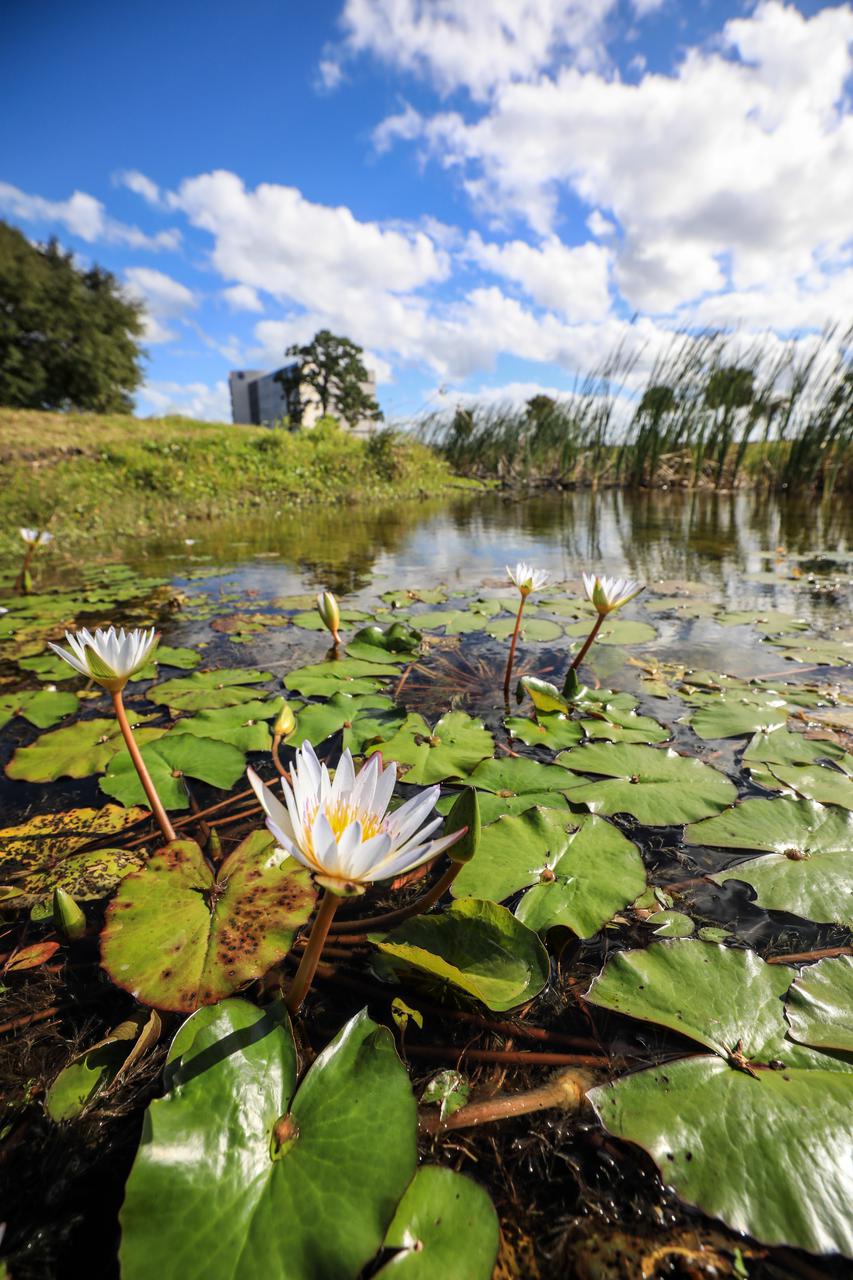
Budding flowers adorn the forefront of the Central Campus Headquarters (CCHQ) Building at NASA’s Kennedy Space Center in Florida on Jan. 11, 2022. The CCHQ is a modernized, energy efficient facility representative of Kennedy’s transformation to America’s premier multi-user spaceport. It opened in May 2019. Built in 1965, the former headquarters building was recently demolished. The area previously occupied by the 439,000 square-foot-facility will be utilized as greenspace.
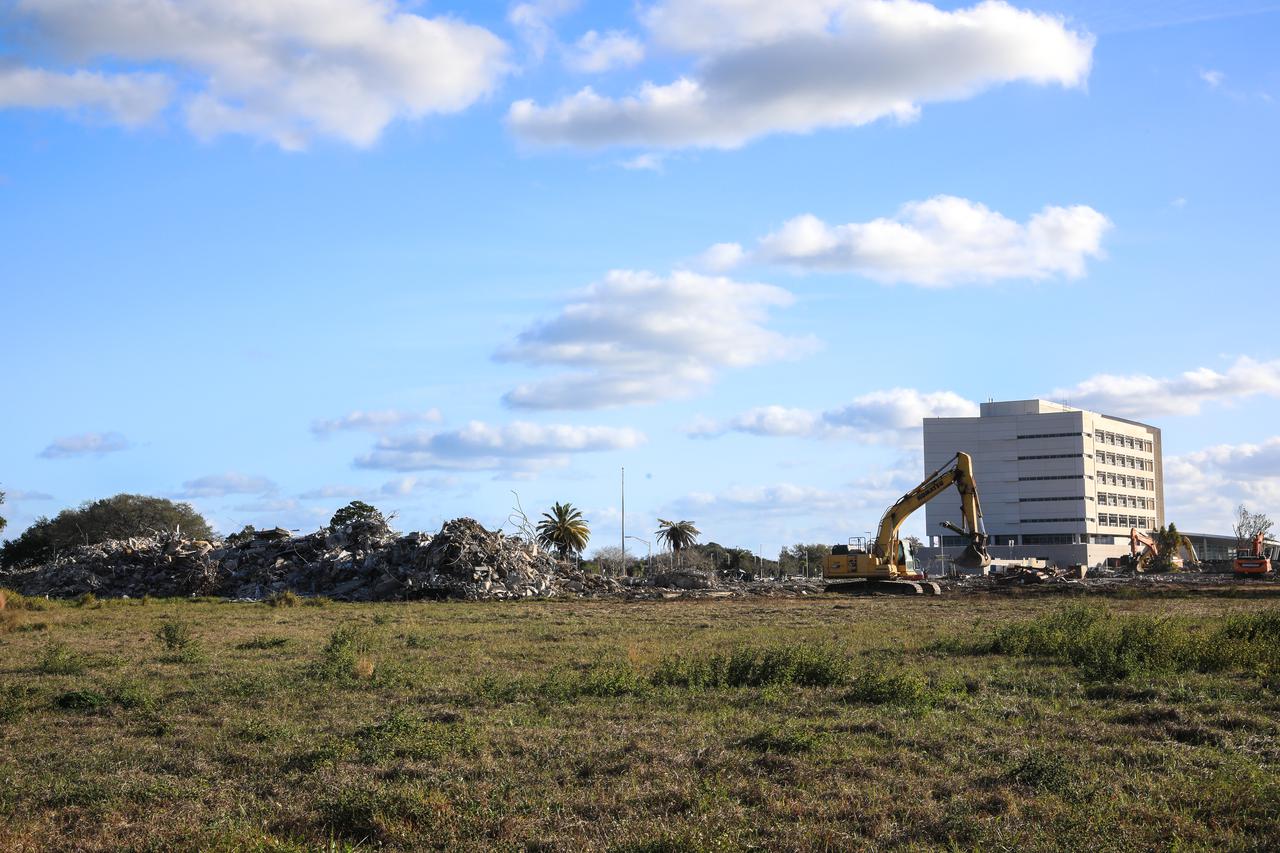
In the foreground is remnants of the former headquarters building at NASA’s Kennedy Space Center on Jan. 11, 2022. Built in 1965, the 439,000-square-foot structure was demolished and replaced at the Florida spaceport by the 200,000-square-foot, seven-story Central Campus Headquarters (CCHQ) Building, shown in the background. The CCHQ is a modernized, energy efficient facility representative of Kennedy’s transformation to America’s premier multi-user spaceport. It opened in May 2019. The area previously occupied by the old headquarters building will be utilized as greenspace.
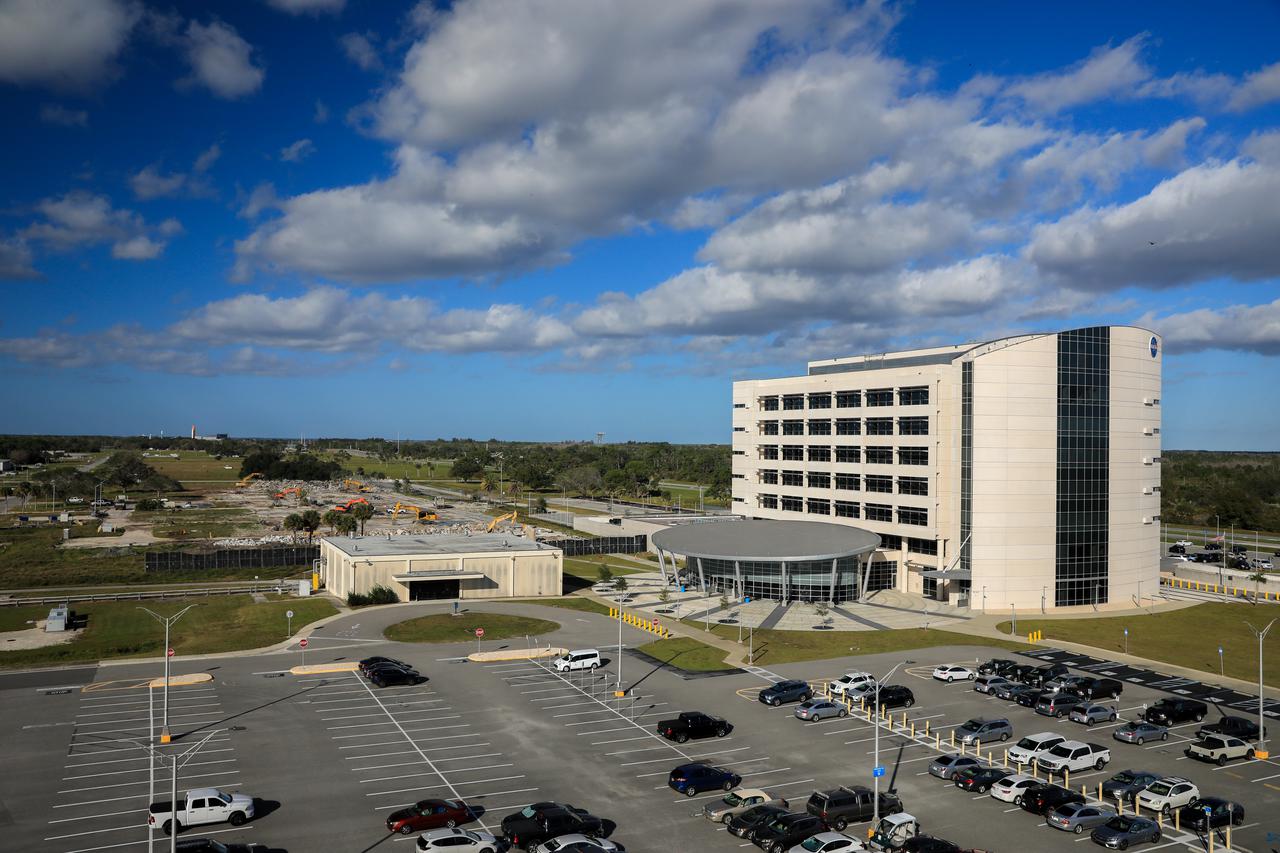
Shown is a view of the seven-story, 200,000-square-foot Central Campus Headquarters (CCHQ) Building at NASA’s Kennedy Space Center in Florida on Jan. 11, 2022. The CCHQ is a modernized, energy efficient facility representative of Kennedy’s transformation to America’s premier multi-user spaceport. It opened in May 2019. Built in 1965, the former headquarters building was recently demolished. The area previously occupied by the 439,000 square-foot-facility will be utilized as greenspace.
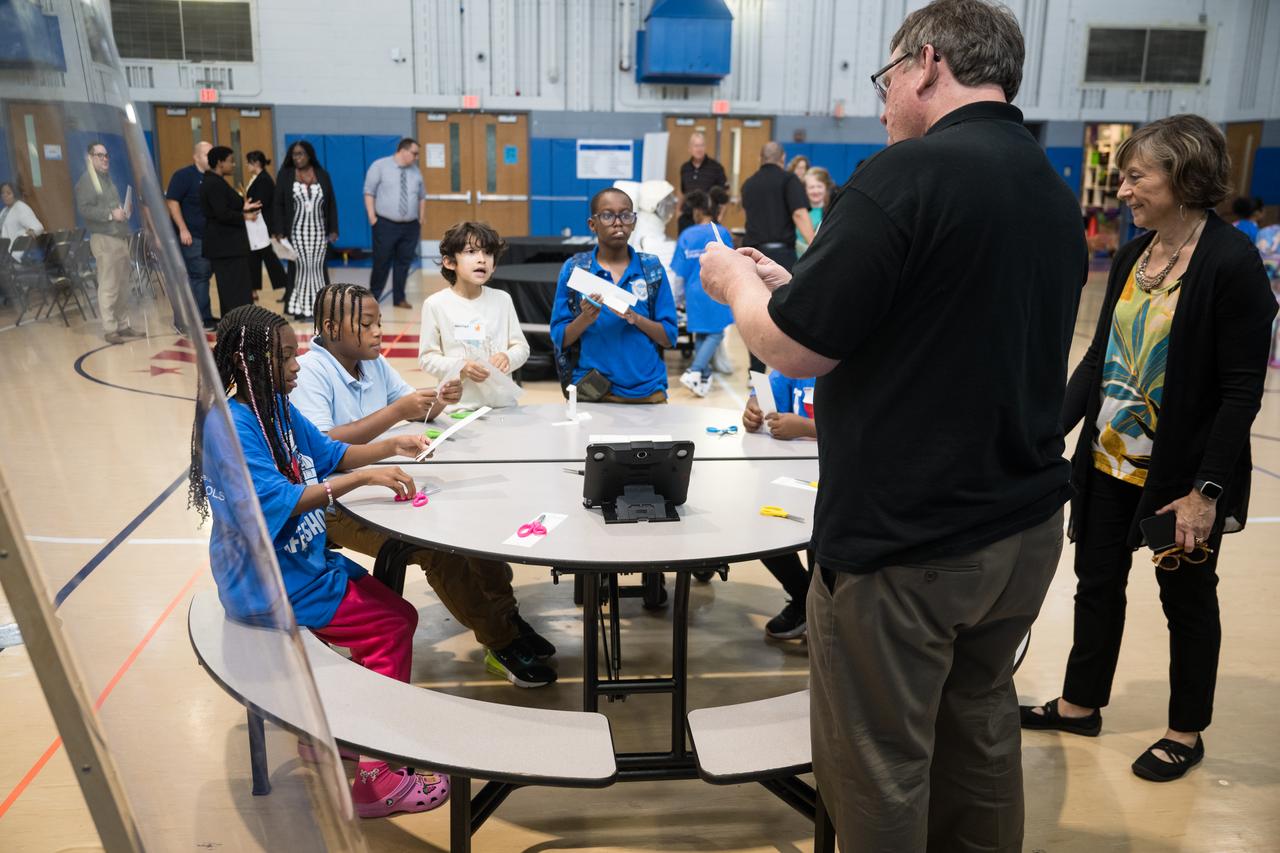
Students at Wheatley Education Campus participate in a rotor motor and wind tunnel activity during a kickoff event for the 21st Century Community Learning Centers NASA and Department of Education partnership, Monday, Sept. 23, 2024 at Wheatley Education Campus in Washington. Photo Credit: (NASA/Aubrey Gemignani)
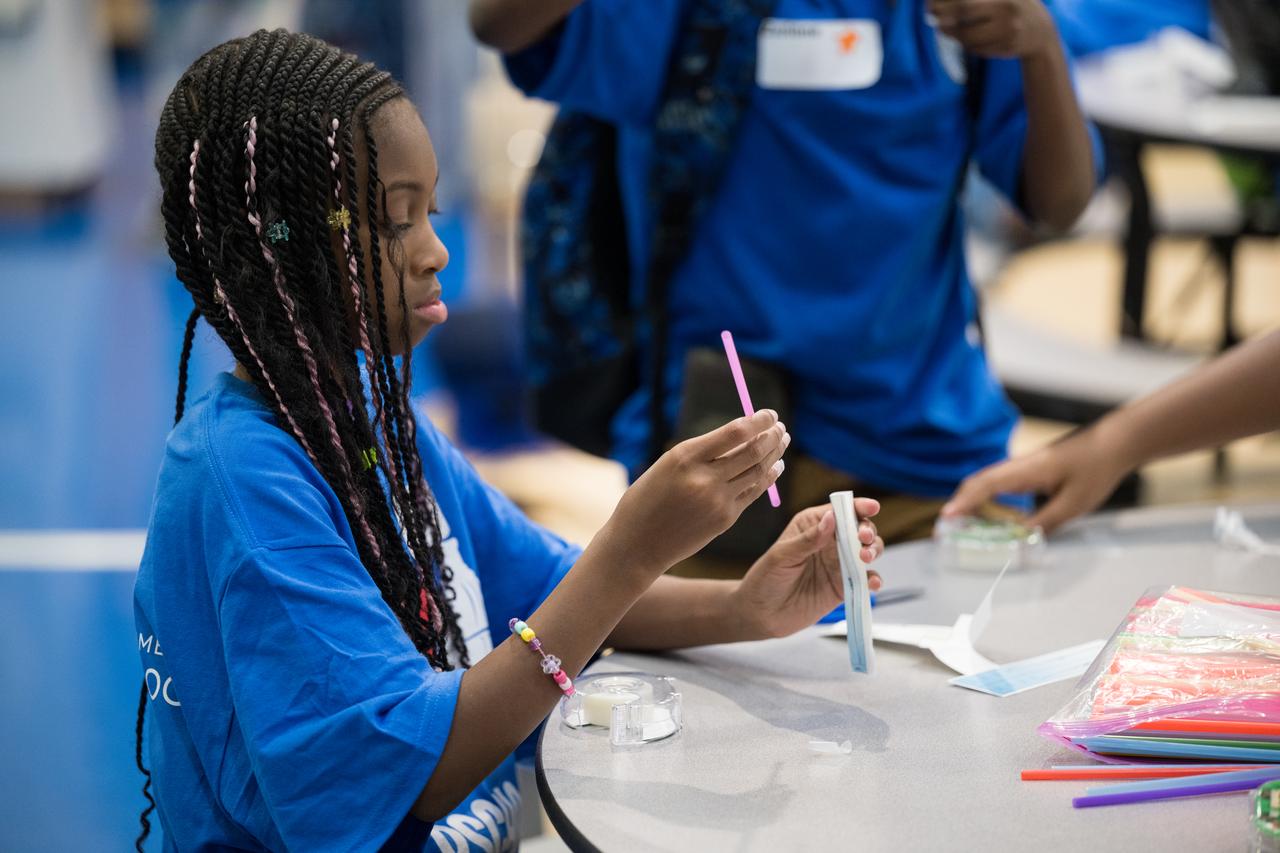
Students at Wheatley Education Campus participate in an activity to build their own rocket launcher during a kickoff event for the 21st Century Community Learning Centers NASA and Department of Education partnership, Monday, Sept. 23, 2024 at Wheatley Education Campus in Washington. Photo Credit: (NASA/Aubrey Gemignani)
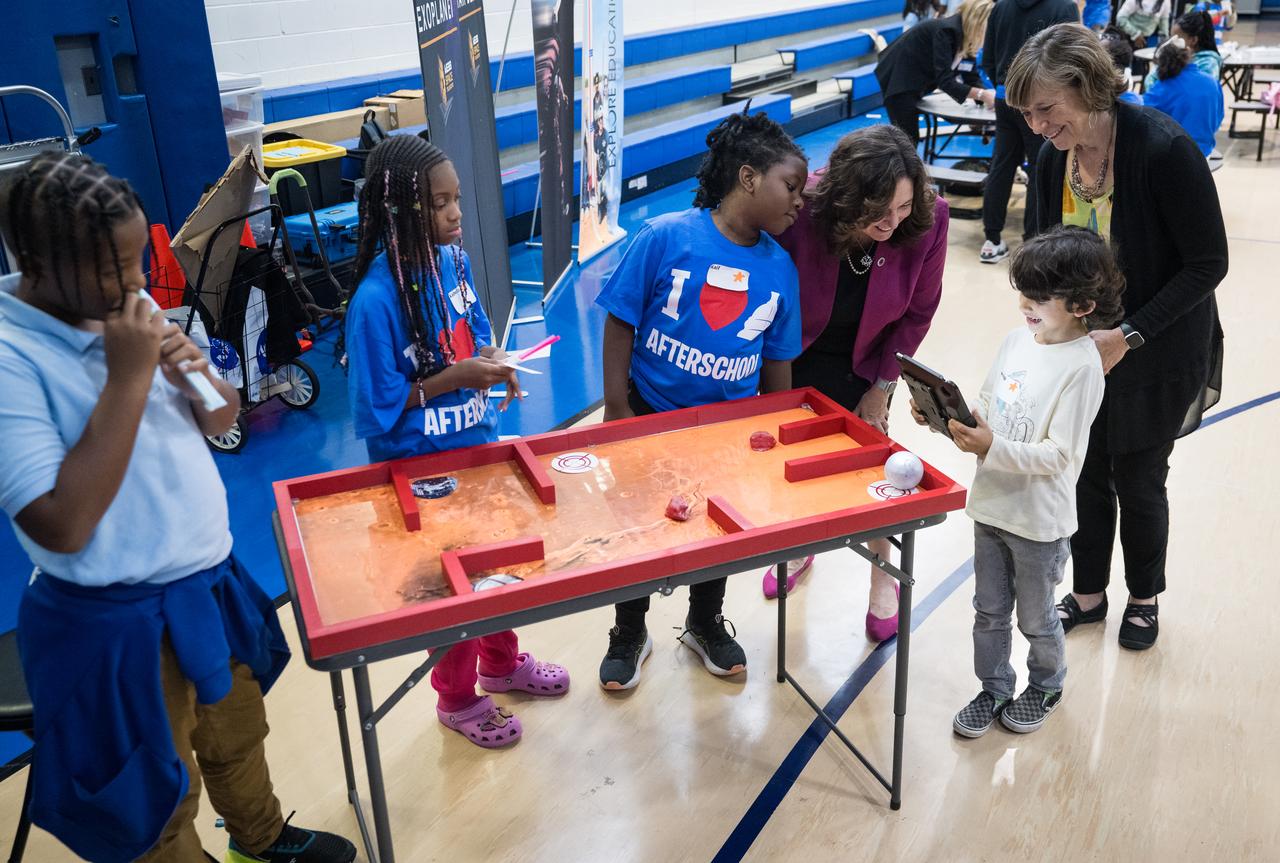
Students at Wheatley Education Campus participate in a Mars rolling rover activity with a robot, during a kickoff event for the 21st Century Community Learning Centers NASA and Department of Education partnership, Monday, Sept. 23, 2024 at Wheatley Education Campus in Washington. Photo Credit: (NASA/Aubrey Gemignani)
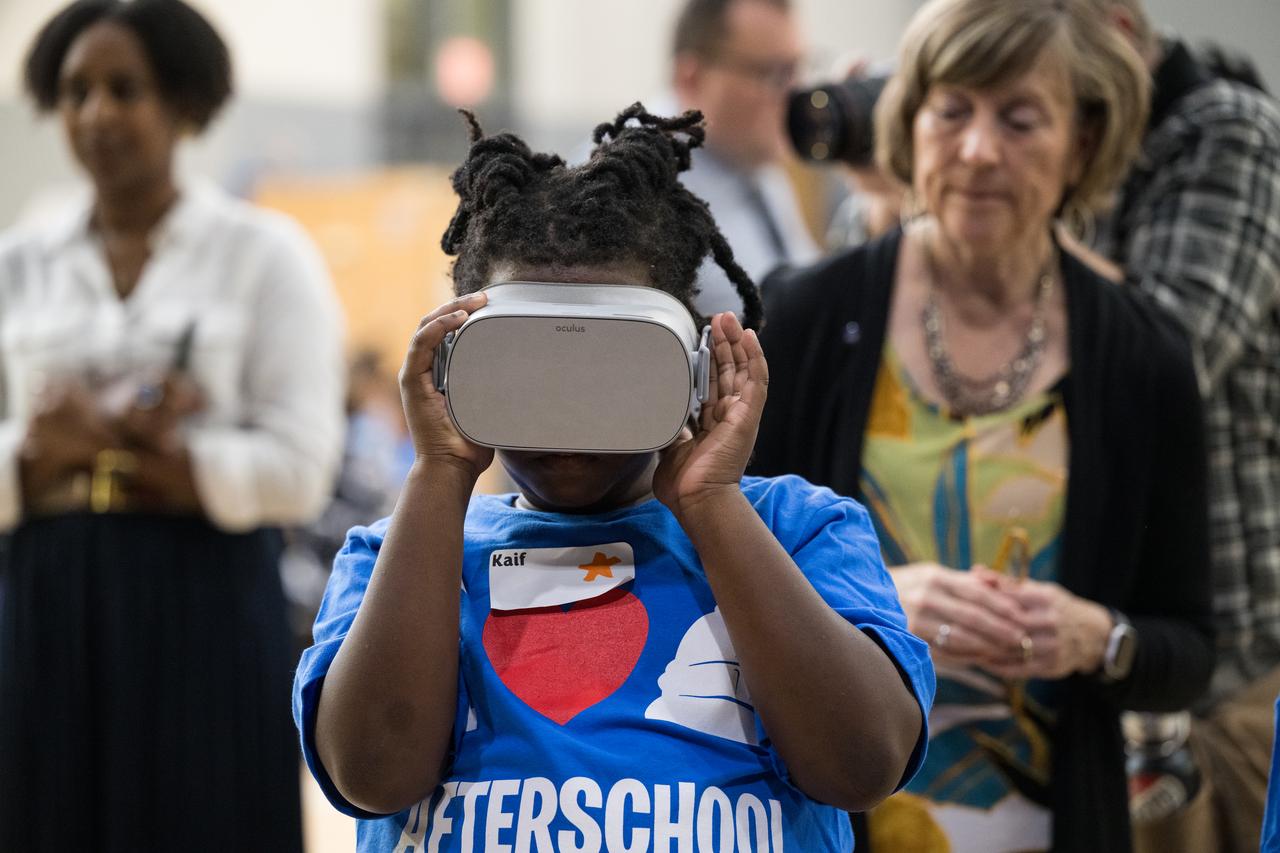
Students at Wheatley Education Campus participate in a virtual reality tour of NASA’s Neutral Buoyancy Lab during a kickoff event for the 21st Century Community Learning Centers NASA and Department of Education partnership, Monday, Sept. 23, 2024 at Wheatley Education Campus in Washington. Photo Credit: (NASA/Aubrey Gemignani)
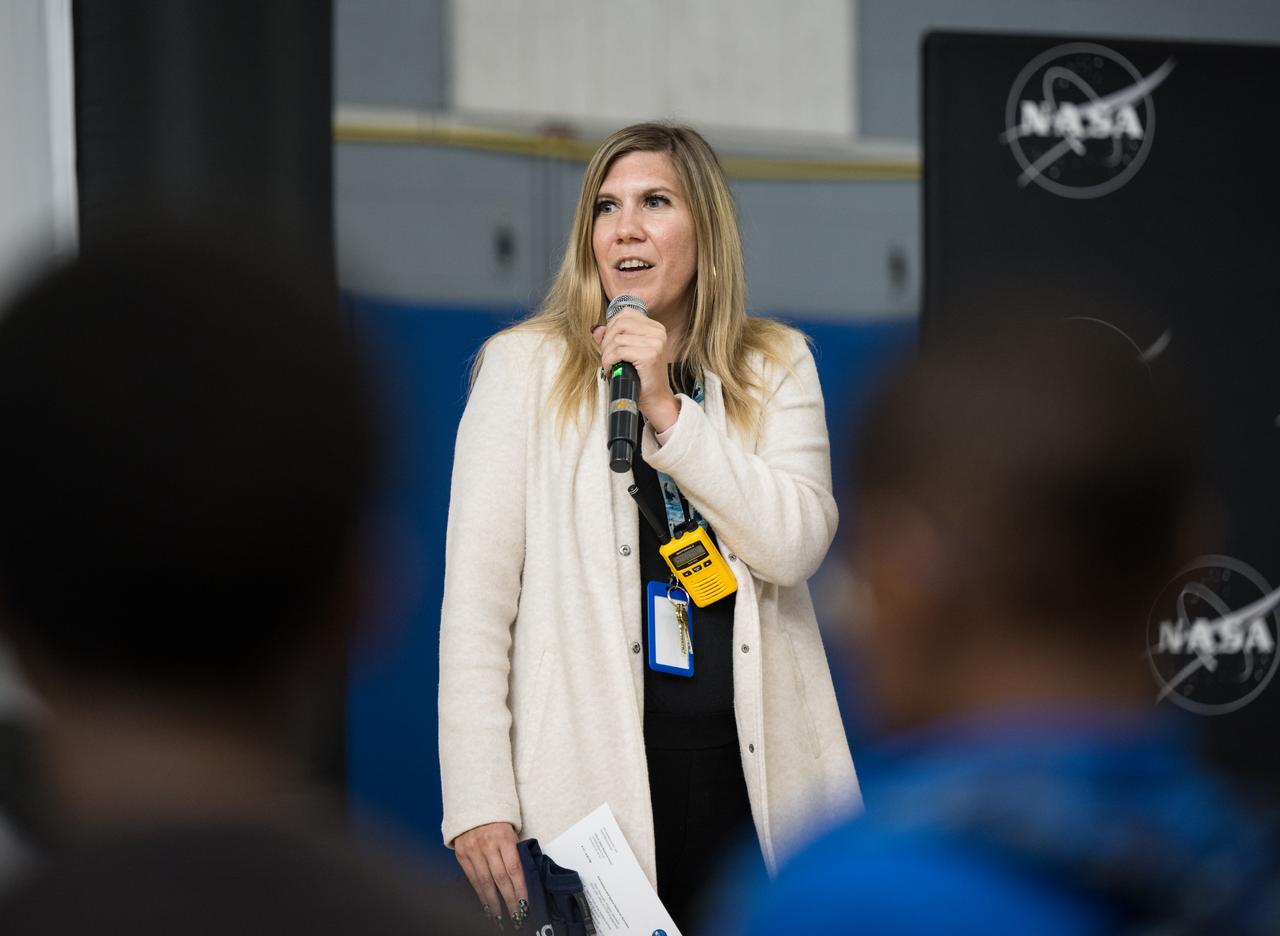
Principle of Wheatley Education Campus, Amanda Schmitt, provides remarks at a kickoff event for the 21st Century Community Learning Centers NASA and Department of Education partnership, Monday, Sept. 23, 2024 at Wheatley Education Campus in Washington. Students engaged in NASA hands-on activities and an engineering design challenge. Photo Credit: (NASA/Aubrey Gemignani)
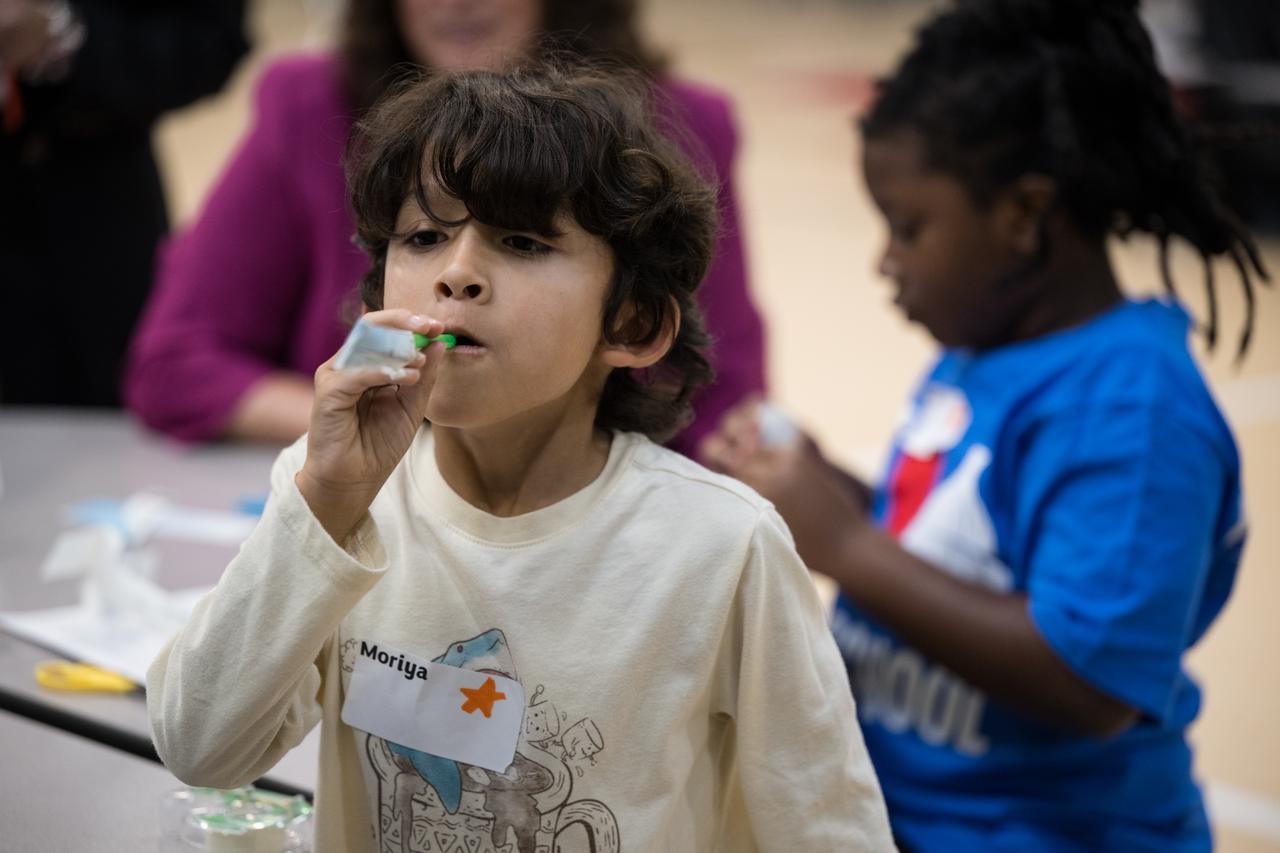
Students at Wheatley Education Campus participate in an activity to build their own rocket launcher during a kickoff event for the 21st Century Community Learning Centers NASA and Department of Education partnership, Monday, Sept. 23, 2024 at Wheatley Education Campus in Washington. Photo Credit: (NASA/Aubrey Gemignani)
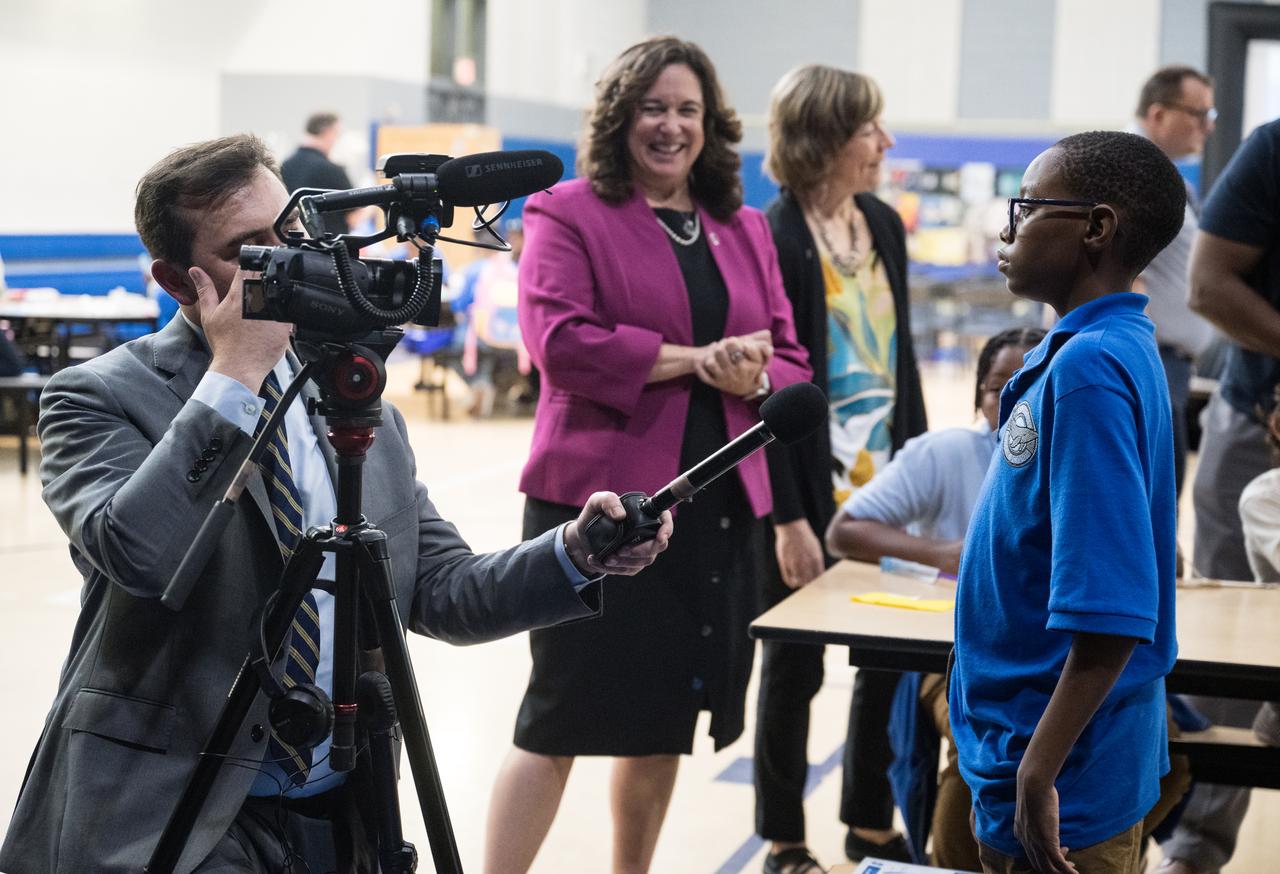
A student at Wheatley Education Campus is interviewed by media during a kickoff event for the 21st Century Community Learning Centers NASA and Department of Education partnership, Monday, Sept. 23, 2024 at Wheatley Education Campus in Washington. Photo Credit: (NASA/Aubrey Gemignani)
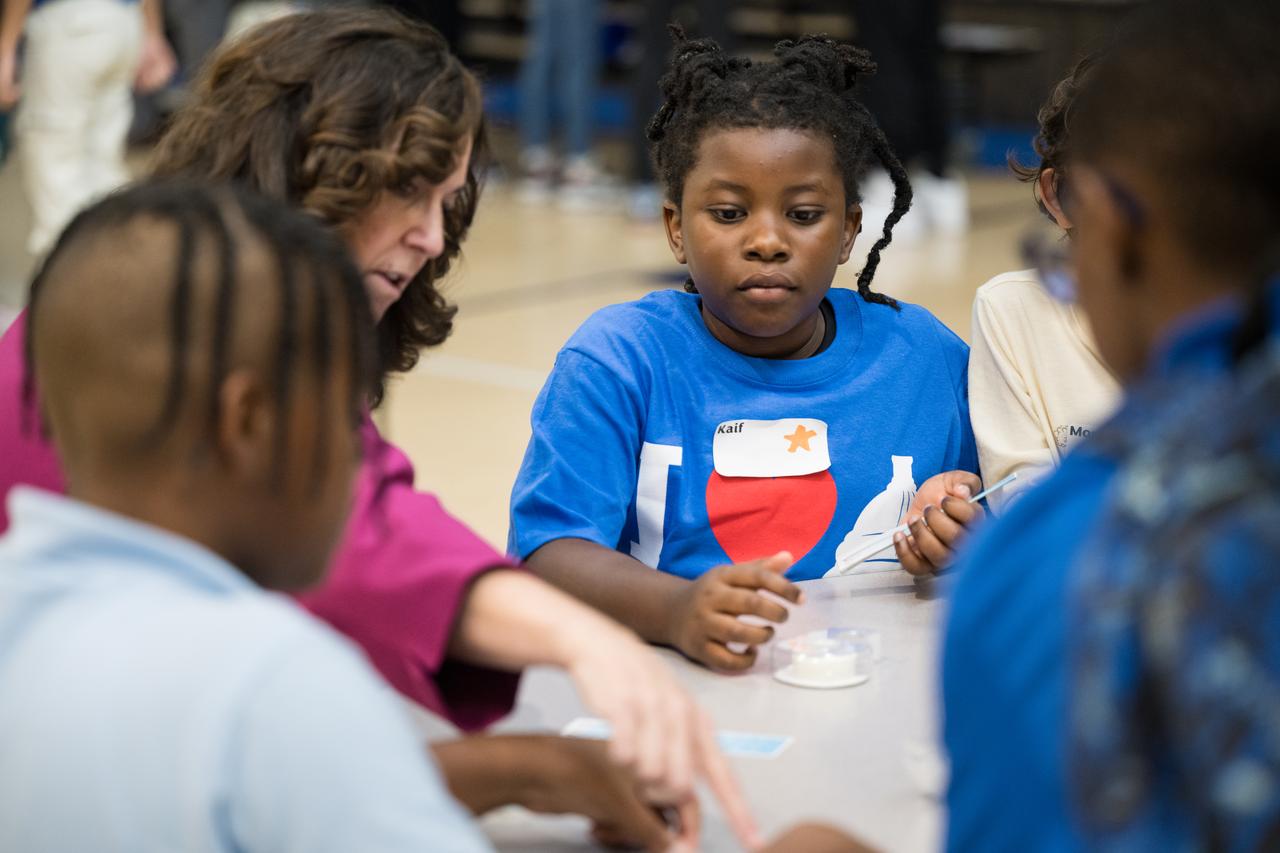
Students at Wheatley Education Campus participate in an activity to build their own rocket launcher during a kickoff event for the 21st Century Community Learning Centers NASA and Department of Education partnership, Monday, Sept. 23, 2024 at Wheatley Education Campus in Washington. Photo Credit: (NASA/Aubrey Gemignani)
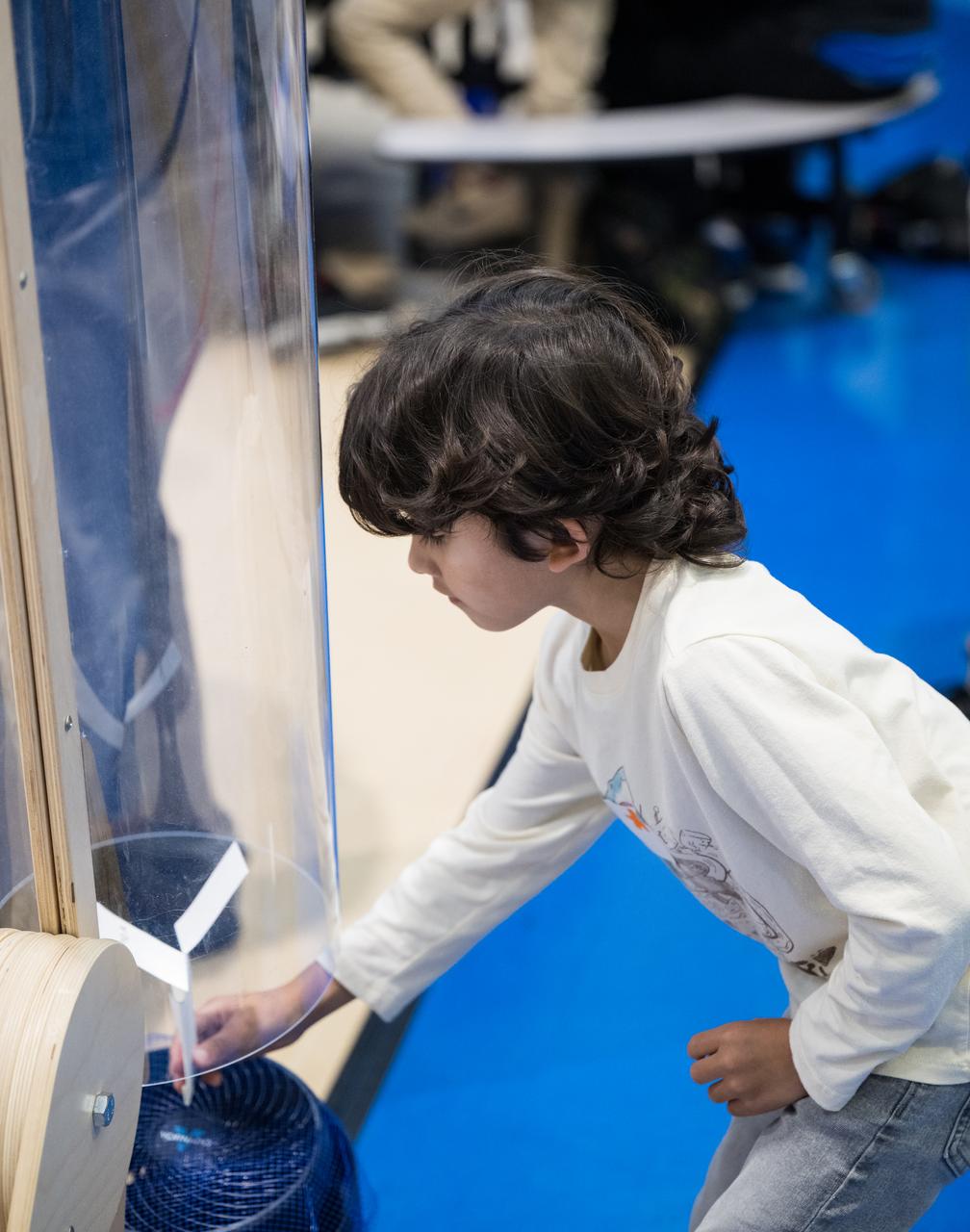
Students at Wheatley Education Campus participate in a rotor motor and wind tunnel activity during a kickoff event for the 21st Century Community Learning Centers NASA and Department of Education partnership, Monday, Sept. 23, 2024 at Wheatley Education Campus in Washington. Photo Credit: (NASA/Aubrey Gemignani)
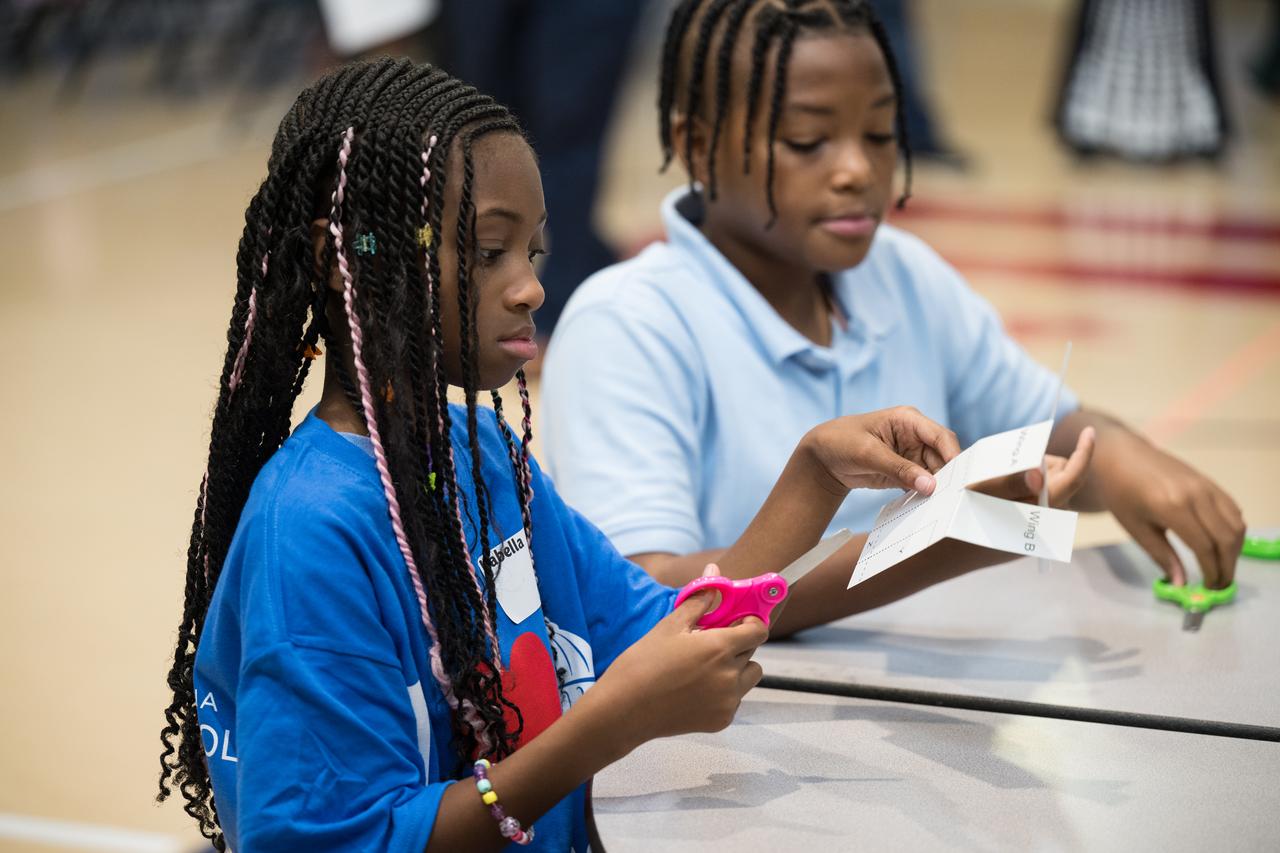
Students at Wheatley Education Campus participate in a rotor motor and wind tunnel activity during a kickoff event for the 21st Century Community Learning Centers NASA and Department of Education partnership, Monday, Sept. 23, 2024 at Wheatley Education Campus in Washington. Photo Credit: (NASA/Aubrey Gemignani)
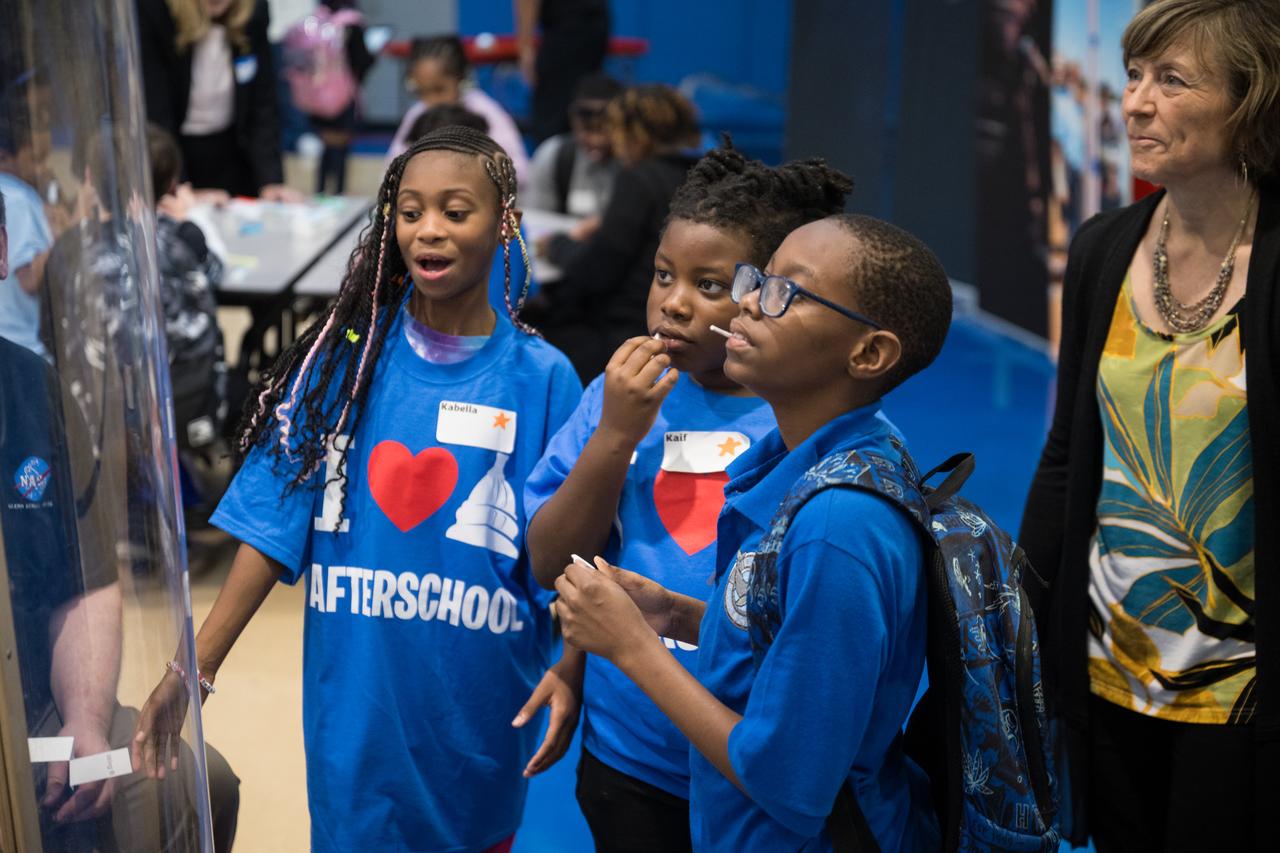
Students at Wheatley Education Campus participate in a rotor motor and wind tunnel activity during a kickoff event for the 21st Century Community Learning Centers NASA and Department of Education partnership, Monday, Sept. 23, 2024 at Wheatley Education Campus in Washington. Photo Credit: (NASA/Aubrey Gemignani)
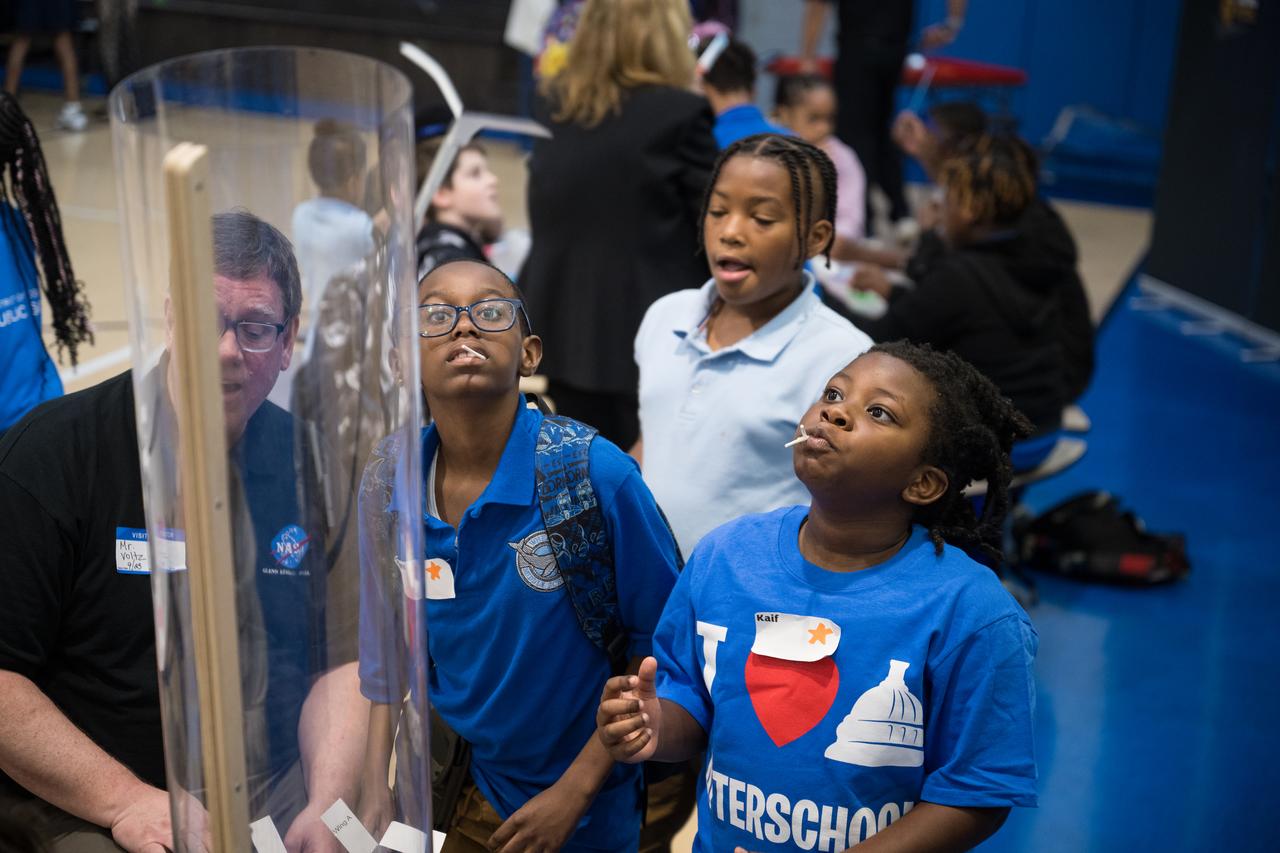
Students at Wheatley Education Campus participate in a rotor motor and wind tunnel activity during a kickoff event for the 21st Century Community Learning Centers NASA and Department of Education partnership, Monday, Sept. 23, 2024 at Wheatley Education Campus in Washington. Photo Credit: (NASA/Aubrey Gemignani)
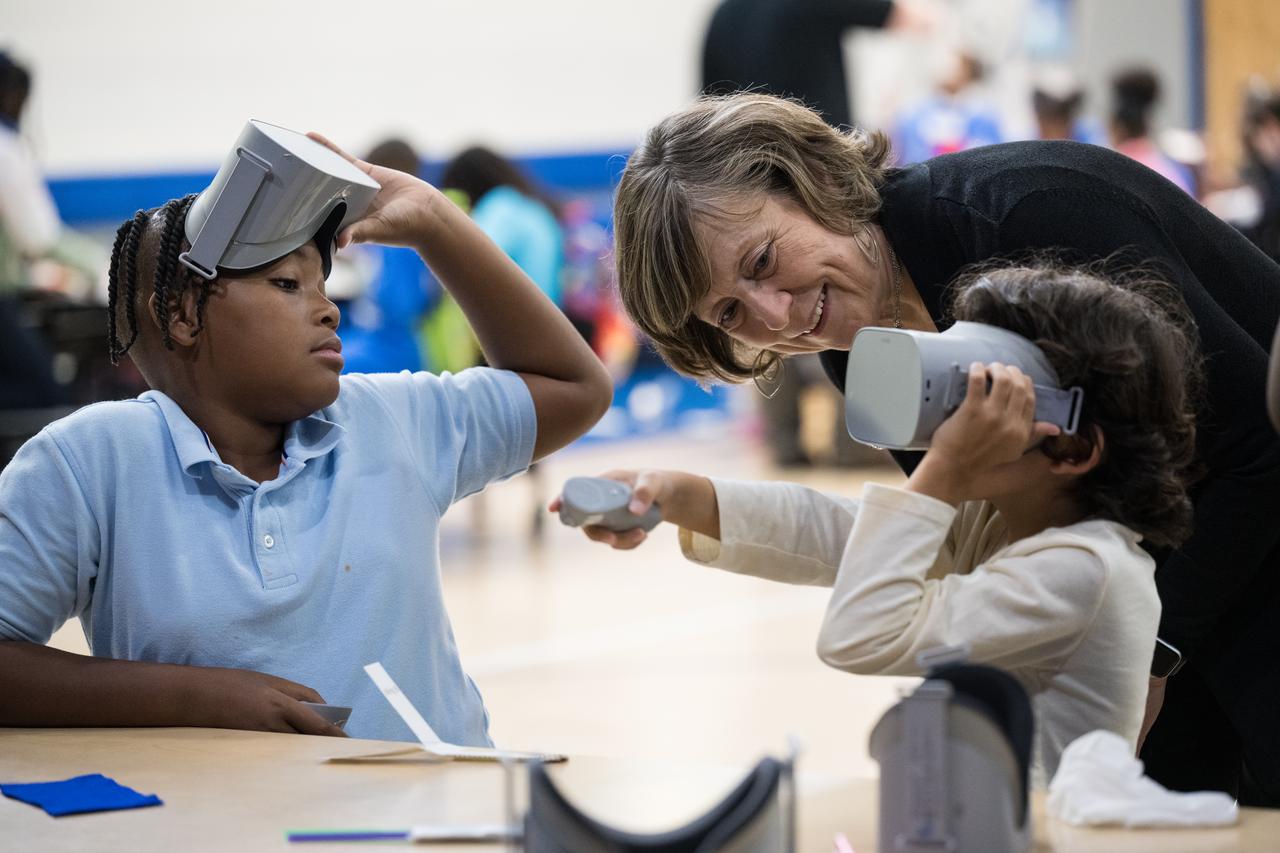
Students at Wheatley Education Campus participate in a virtual reality tour of NASA’s Neutral Buoyancy Lab during a kickoff event for the 21st Century Community Learning Centers NASA and Department of Education partnership, Monday, Sept. 23, 2024 at Wheatley Education Campus in Washington. Photo Credit: (NASA/Aubrey Gemignani)
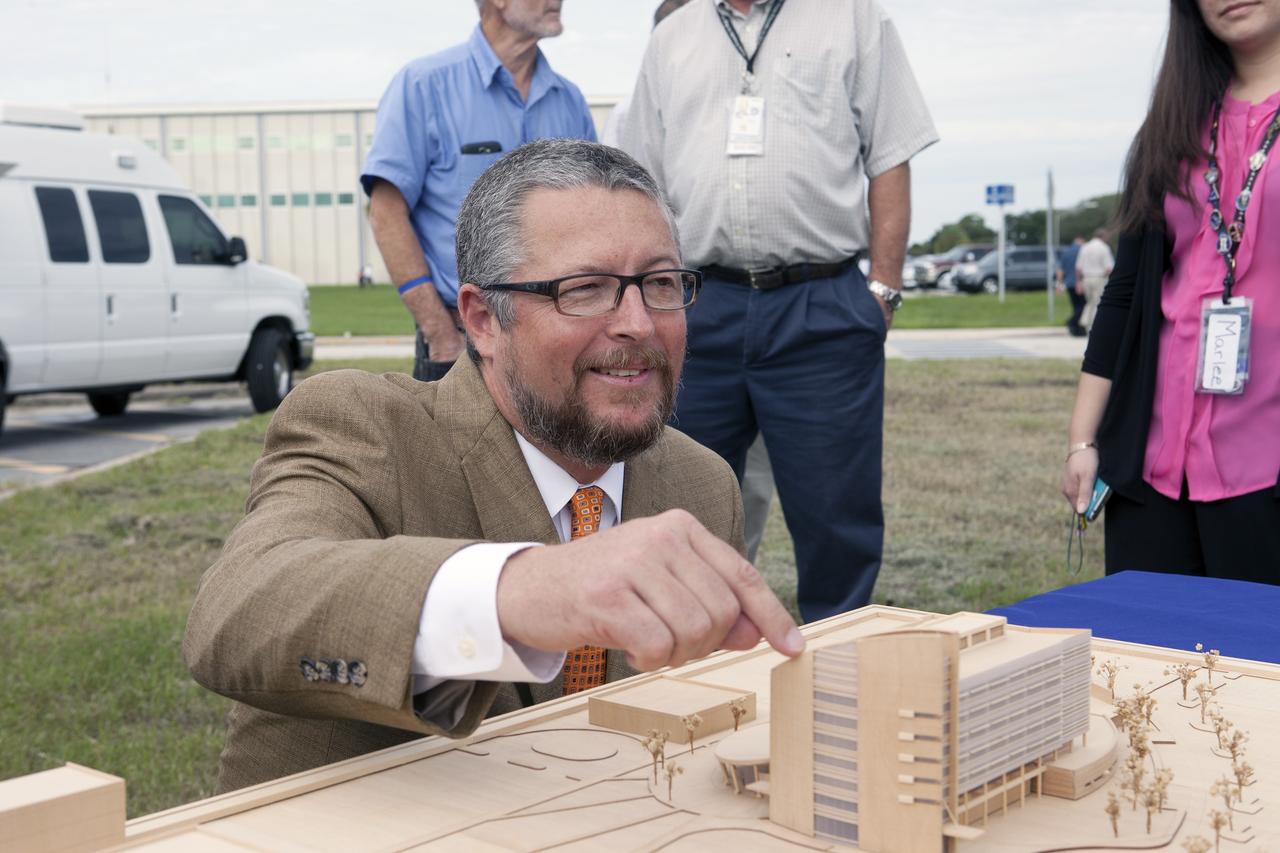
CAPE CANAVERAL, Fla. – Groundbreaking for the new Central Campus took place in the Industrial Area at NASA's Kennedy Space Center in Florida. Steve Belflower, vice president of HuntonBrady Architects of Orlando, points to a scale model of the Central Campus building on display during the groundbreaking ceremony. Kennedy is transforming into a multi-user, 21st century spaceport supporting both commercial and government users and operations. Central Campus Phase I includes construction of a new Headquarters Building as one of the major components of the strategy. The new Headquarters Building will be a seven-story, 200,000-square-foot facility that will house about 500 NASA civil service and contractor employees. Photo credit: NASA/Kim Shiflett
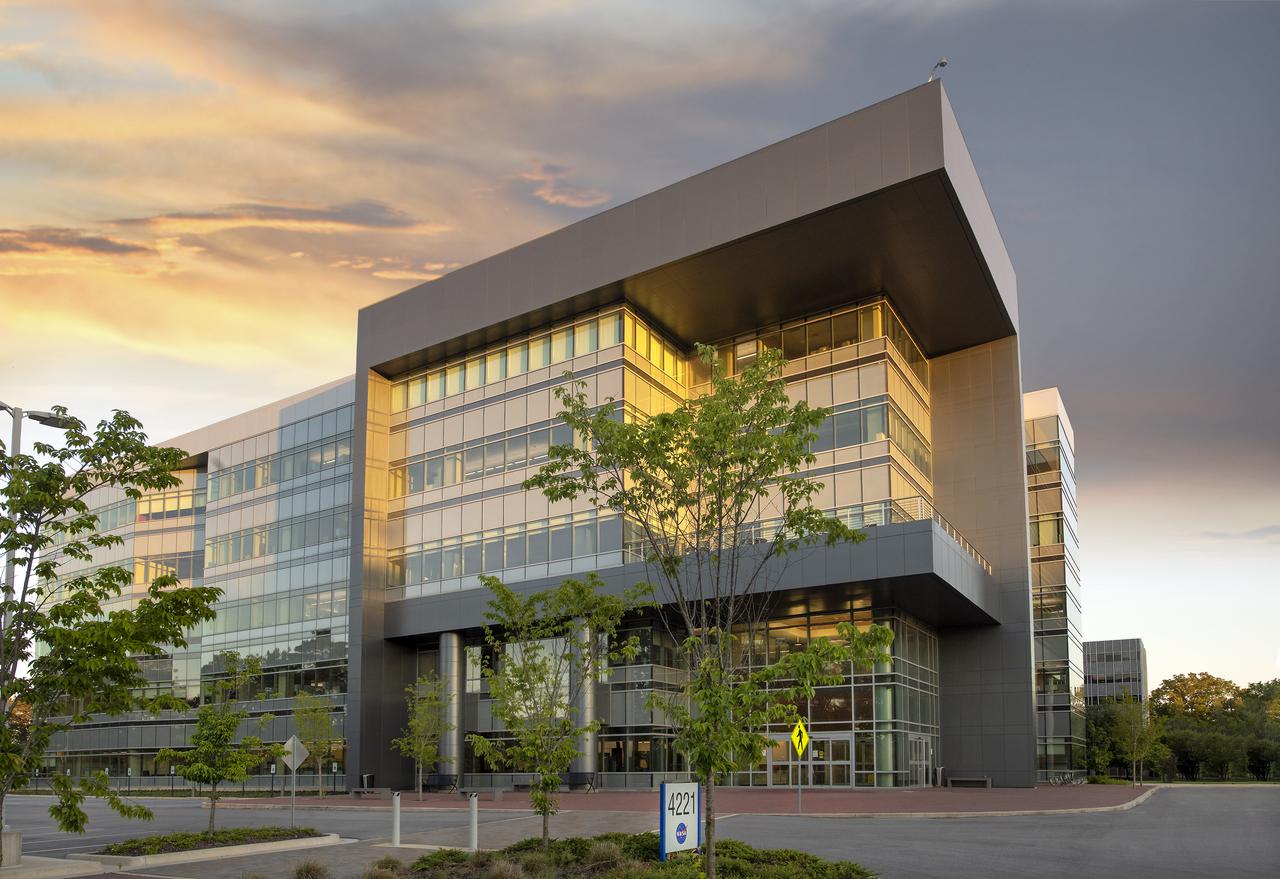
Pictured is the north side of Building 4221 on the campus of Marshall Space Flight Center.
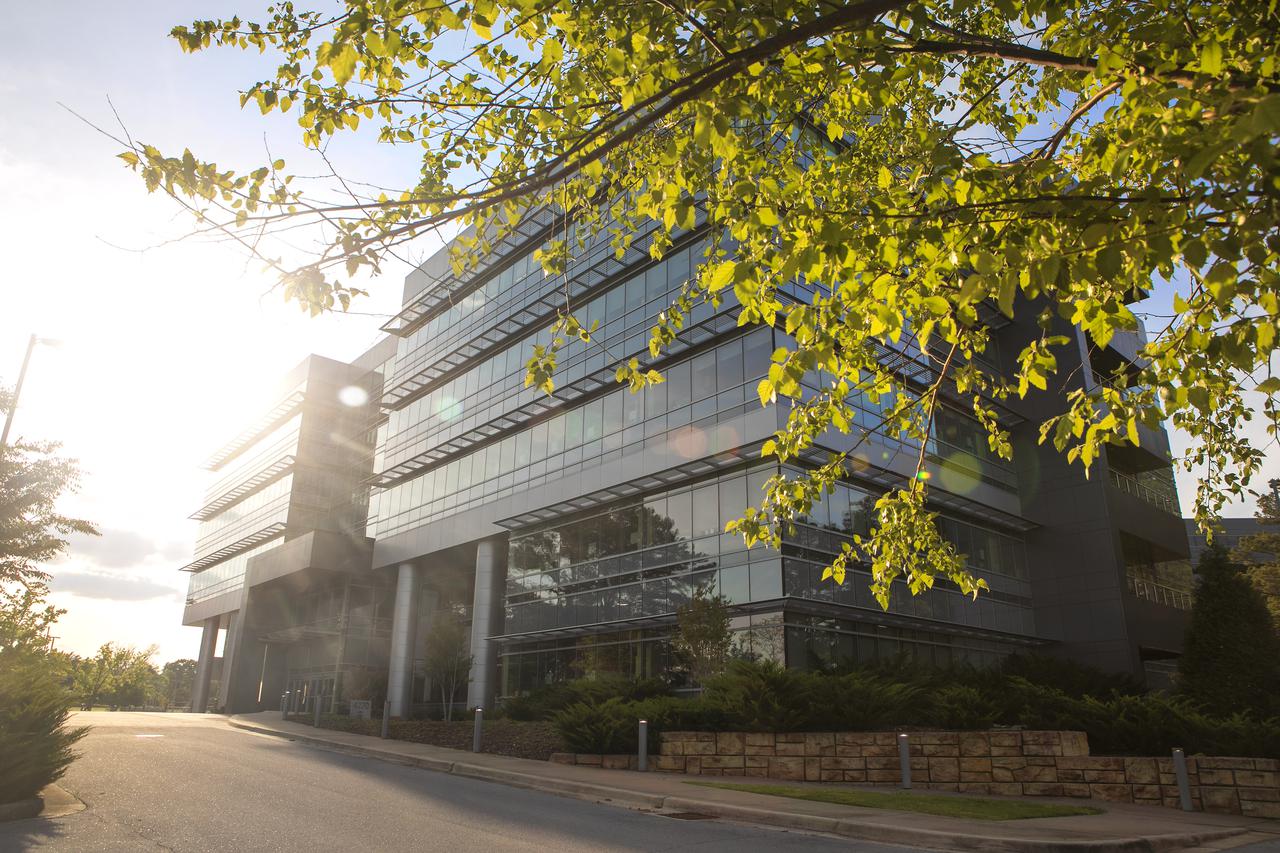
The southward-facing side of Building 4220 on Marshall Space Flight Center’s campus is illuminated by the afternoon sun.
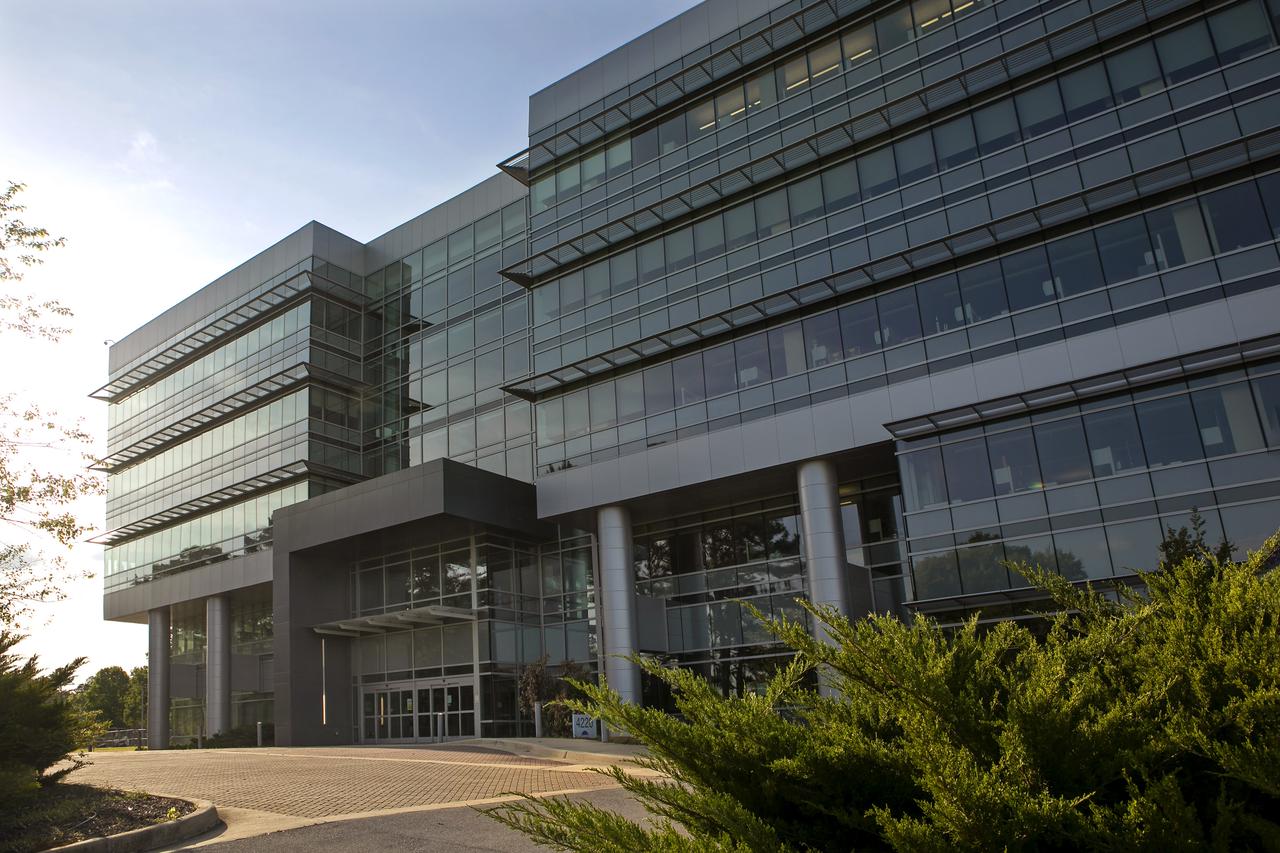
Building 4220 on the campus of Marshall Space Flight Center is home to NASA’s Space Launch System Program.
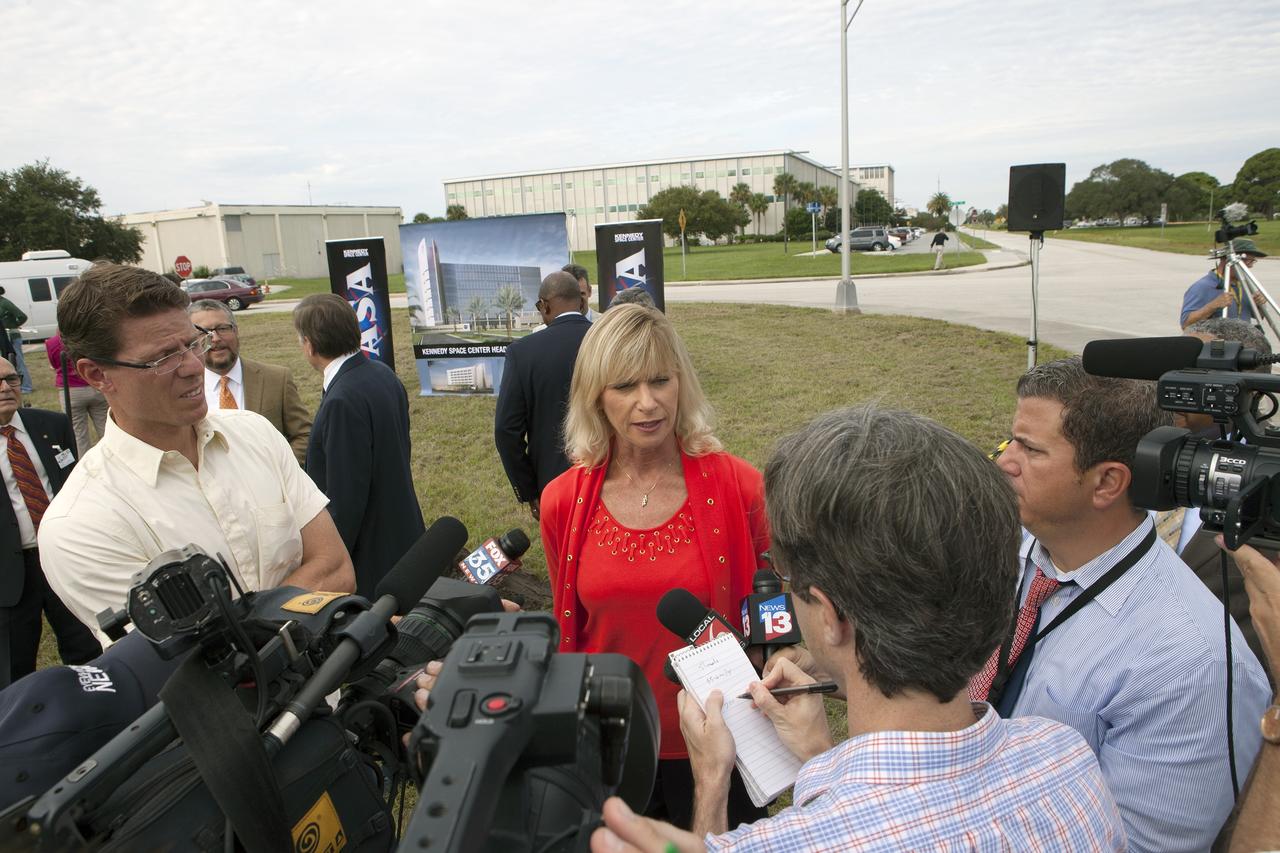
CAPE CANAVERAL, Fla. – Groundbreaking for the new Central Campus will take place in the Industrial Area at NASA's Kennedy Space Center in Florida. Nancy Bray, director of Kennedy's Center Operations Directorate, is interviewed by members of the media during the groundbreaking ceremony. Kennedy is transforming into a multi-user, 21st century spaceport supporting both commercial and government users and operations. Central Campus Phase I includes construction of a new Headquarters Building as one of the major components of the strategy. The new Headquarters Building will be a seven-story, 200,000-square-foot facility that will house about 500 NASA civil service and contractor employees. Photo credit: NASA/Kim Shiflett
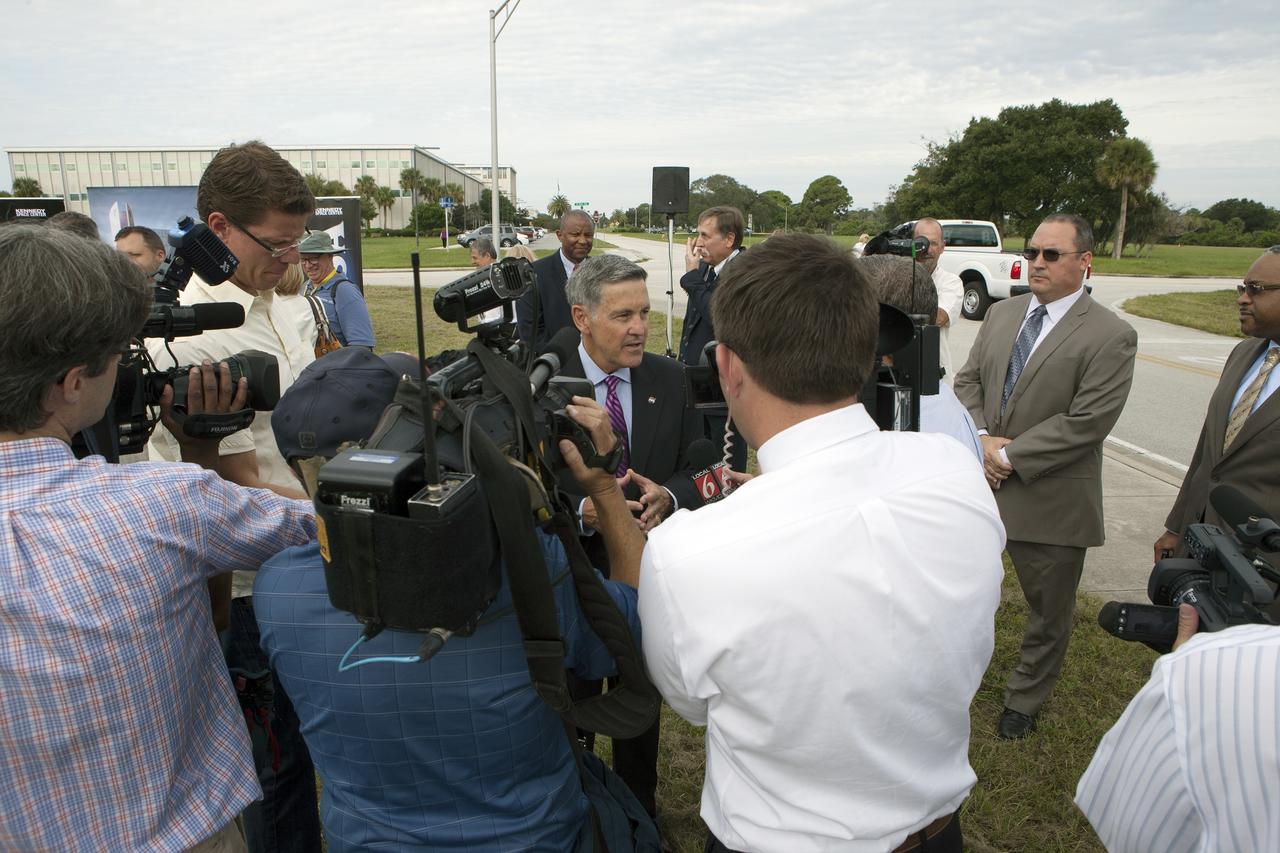
CAPE CANAVERAL, Fla. – Groundbreaking for the new Central Campus took place in the Industrial Area at NASA's Kennedy Space Center in Florida. Kennedy's Center Director Bob Cabana speaks to members of the media after the groundbreaking ceremony. Kennedy is transforming into a multi-user, 21st century spaceport supporting both commercial and government users and operations. Central Campus Phase I includes construction of a new Headquarters Building as one of the major components of the strategy. The new Headquarters Building will be a seven-story, 200,000-square-foot facility that will house about 500 NASA civil service and contractor employees. Photo credit: NASA/Kim Shiflett
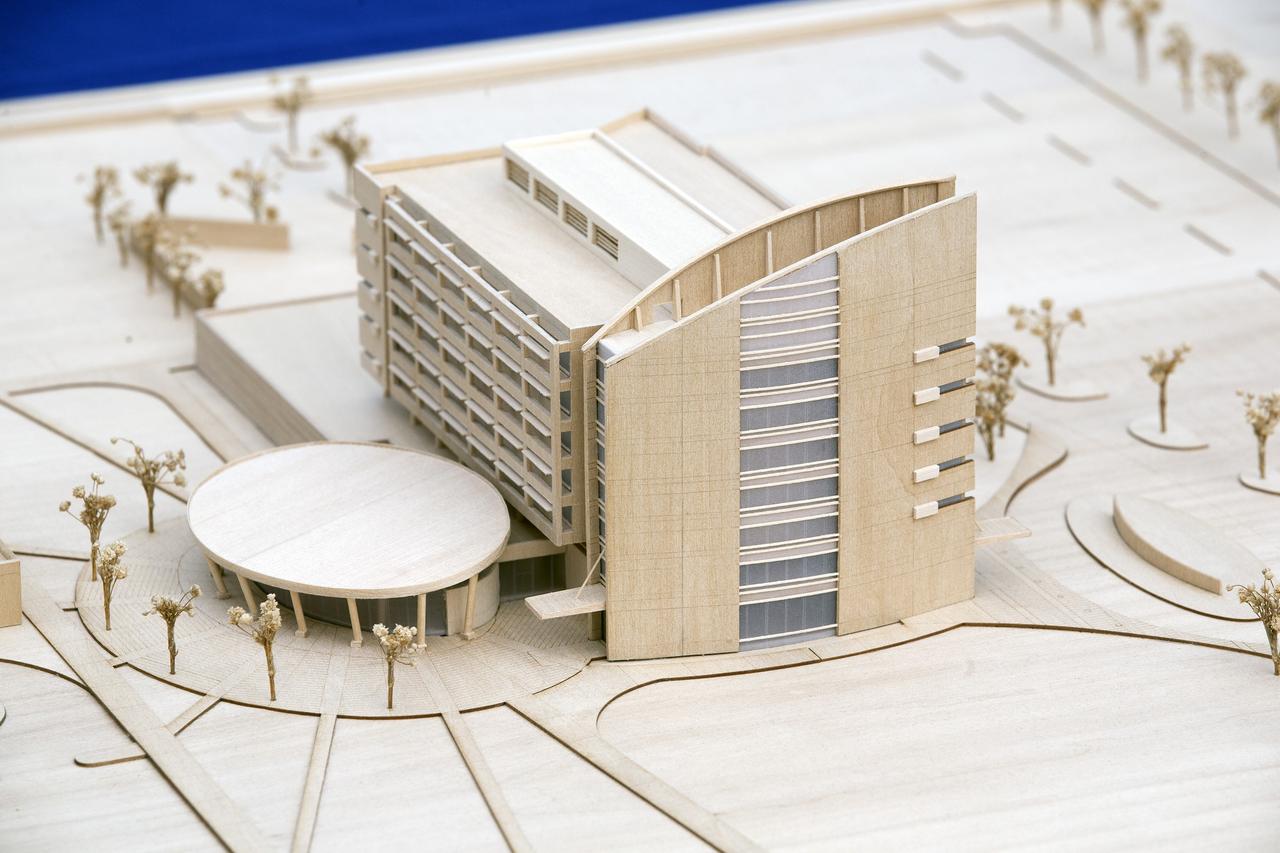
CAPE CANAVERAL, Fla. – Groundbreaking for the new Central Campus will take place in the Industrial Area at NASA's Kennedy Space Center in Florida. A scale model of the new facility and landscaping is on display for the ceremony. Kennedy is transforming into a multi-user, 21st century spaceport supporting both commercial and government users and operations. Central Campus Phase I includes construction of a new Headquarters Building as one of the major components of the strategy. The new Headquarters Building will be a seven-story, 200,000-square-foot facility that will house about 500 NASA civil service and contractor employees. Photo credit: NASA/Kim Shiflett
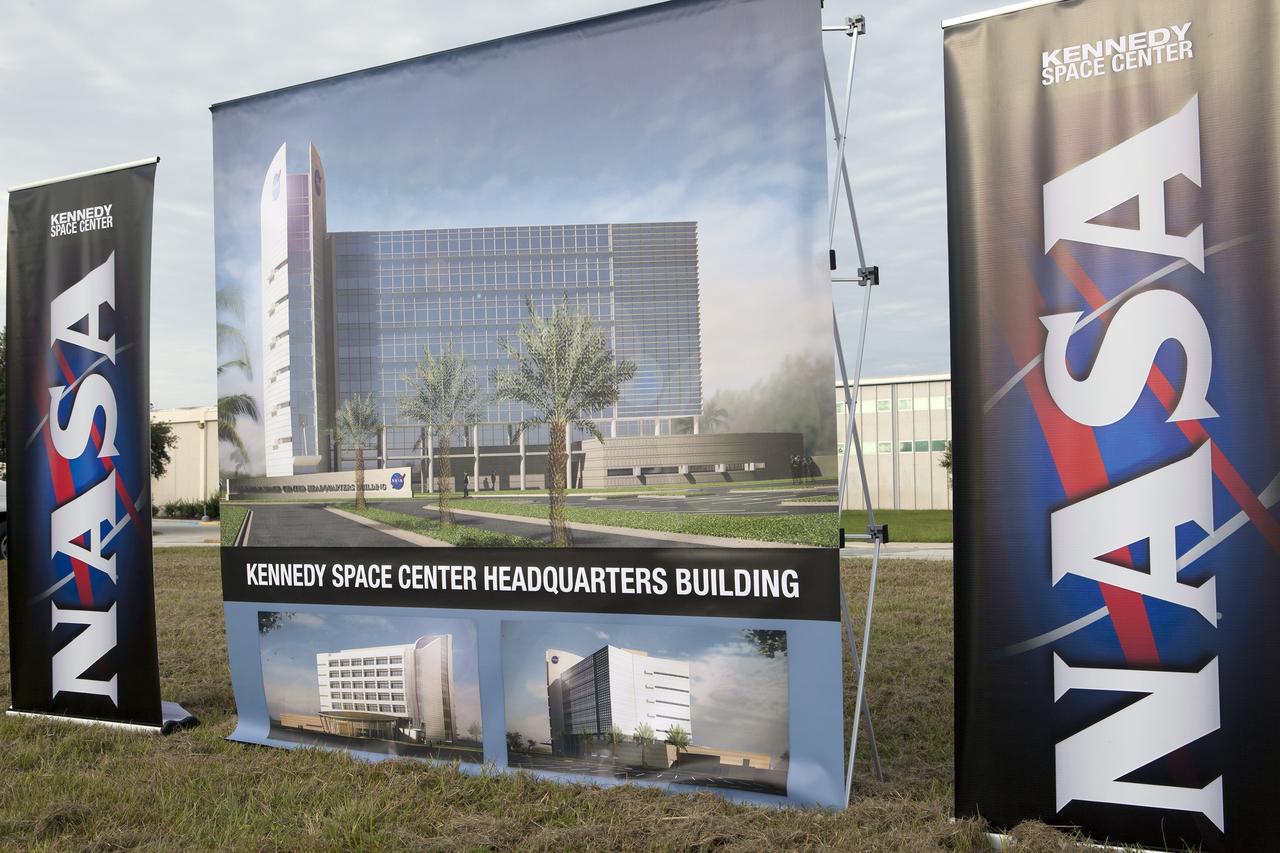
CAPE CANAVERAL, Fla. – Groundbreaking for the new Central Campus will take place in the Industrial Area at NASA's Kennedy Space Center in Florida. NASA banners and an artist rendering of the new facility have been set up for the ceremony. Kennedy is transforming into a multi-user, 21st century spaceport supporting both commercial and government users and operations. Central Campus Phase I includes construction of a new Headquarters Building as one of the major components of the strategy. The new Headquarters Building will be a seven-story, 200,000-square-foot facility that will house about 500 NASA civil service and contractor employees. Photo credit: NASA/Kim Shiflett
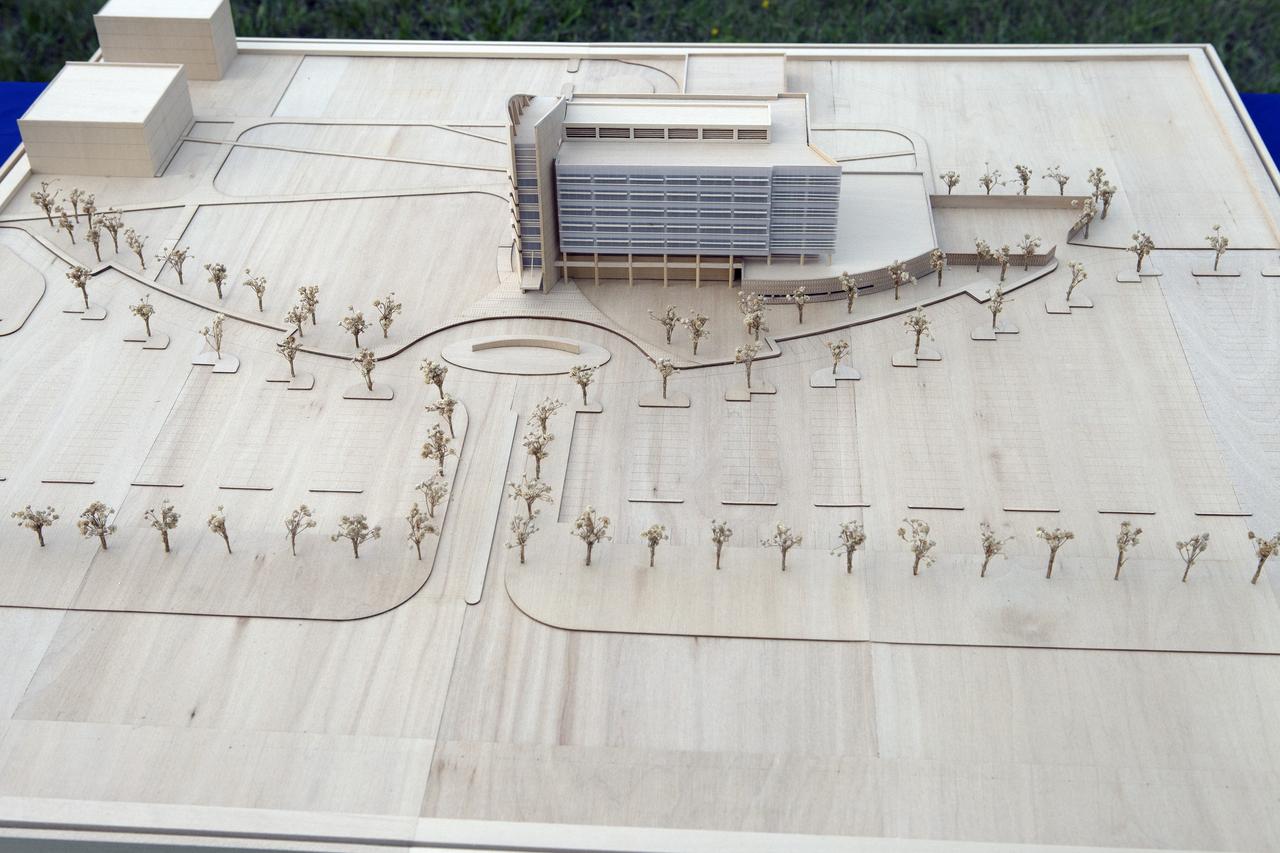
CAPE CANAVERAL, Fla. – Groundbreaking for the new Central Campus will take place in the Industrial Area at NASA's Kennedy Space Center in Florida. A scale model of the new facility and landscaping is on display for the ceremony. Kennedy is transforming into a multi-user, 21st century spaceport supporting both commercial and government users and operations. Central Campus Phase I includes construction of a new Headquarters Building as one of the major components of the strategy. The new Headquarters Building will be a seven-story, 200,000-square-foot facility that will house about 500 NASA civil service and contractor employees. Photo credit: NASA/Kim Shiflett
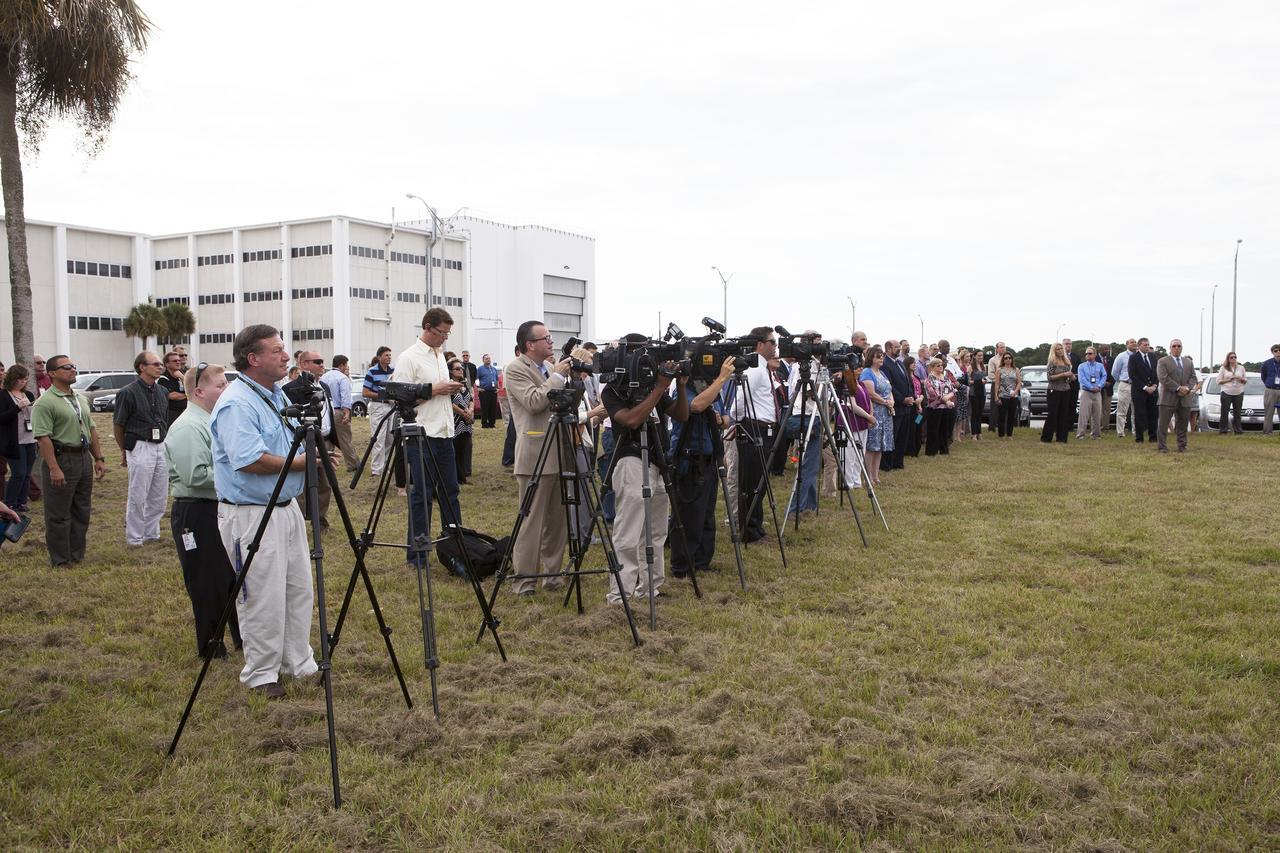
CAPE CANAVERAL, Fla. – Groundbreaking for the new Central Campus took place in the Industrial Area at NASA's Kennedy Space Center in Florida. Members of the media and guests gathered for the groundbreaking ceremony. Kennedy is transforming into a multi-user, 21st century spaceport supporting both commercial and government users and operations. Central Campus Phase I includes construction of a new Headquarters Building as one of the major components of the strategy. The new Headquarters Building will be a seven-story, 200,000-square-foot facility that will house about 500 NASA civil service and contractor employees. Photo credit: NASA/Kim Shiflett
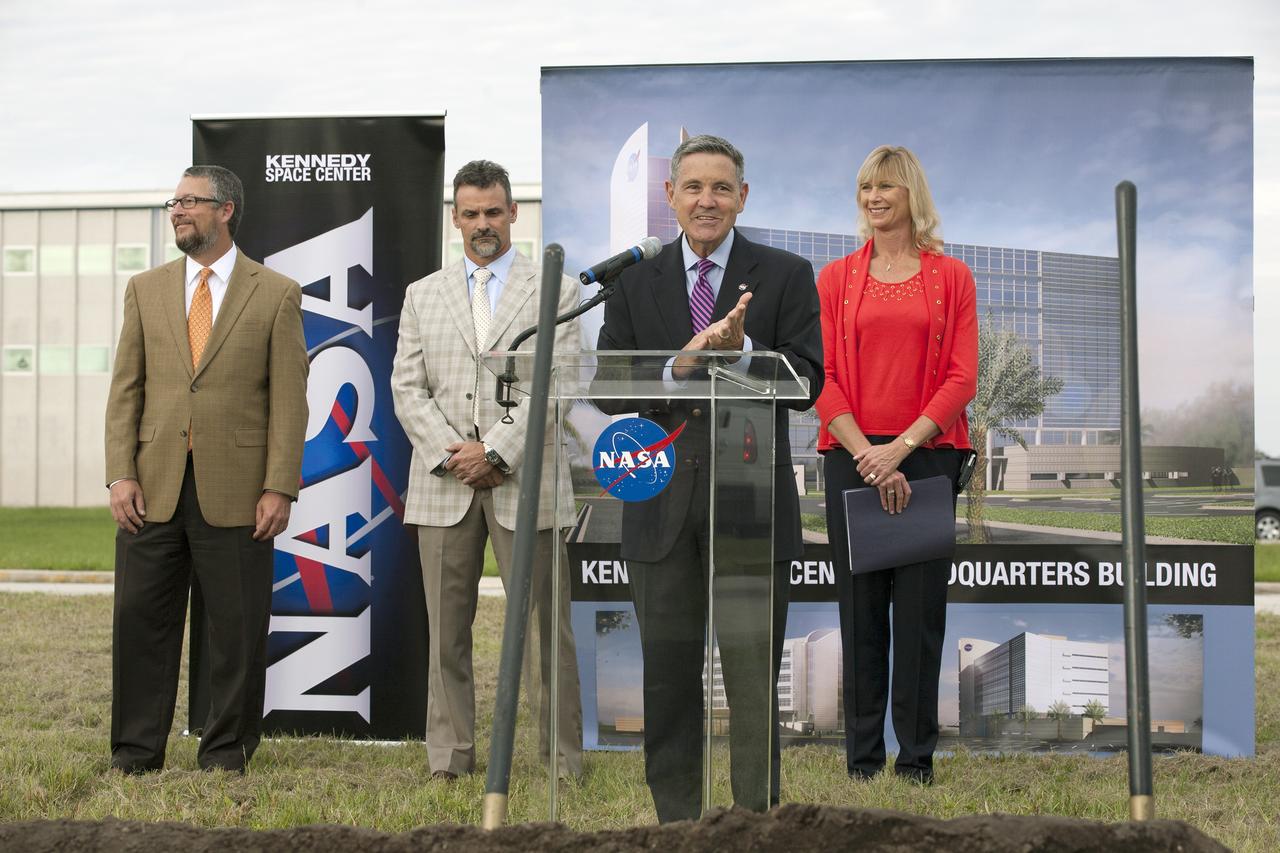
CAPE CANAVERAL, Fla. – Groundbreaking for the new Central Campus took place in the Industrial Area at NASA's Kennedy Space Center in Florida. Kennedy Center Director Bob Cabana speaks to members of the media and guests during the groundbreaking ceremony. To his right is Nancy Bray, director of Kennedy's Center Operations Directorate. From far left, are Steve Belflower, vice president of HuntonBrady Architects of Orlando, and Kirk Hazen, southeast district manager and vice president of Hensel Phelps, the construction contractor. Kennedy is transforming into a multi-user, 21st century spaceport supporting both commercial and government users and operations. Central Campus Phase I includes construction of a new Headquarters Building as one of the major components of the strategy. The new Headquarters Building will be a seven-story, 200,000-square-foot facility that will house about 500 NASA civil service and contractor employees. Photo credit: NASA/Kim Shiflett
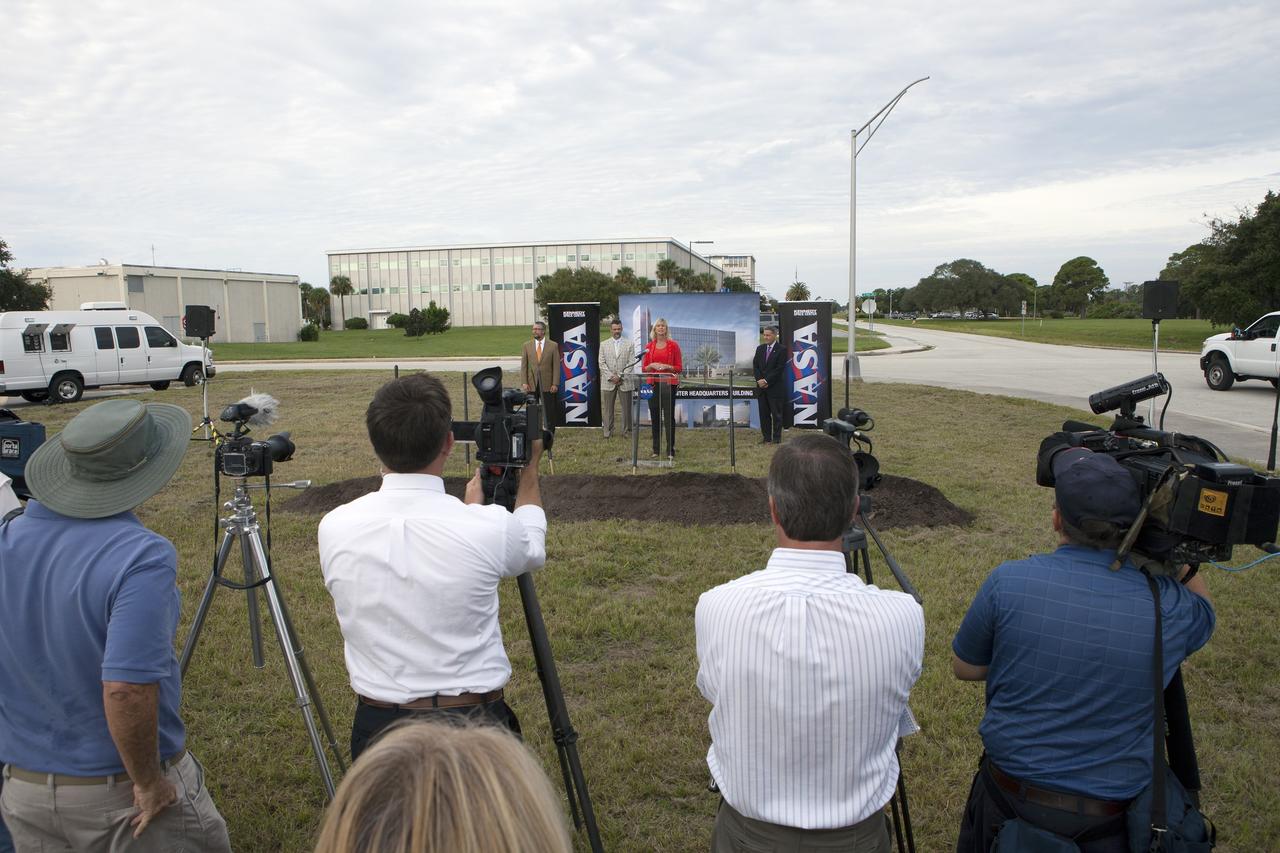
CAPE CANAVERAL, Fla. – Groundbreaking for the new Central Campus took place in the Industrial Area at NASA's Kennedy Space Center in Florida. Nancy Bray, director of Kennedy's Center Operations Directorate, speaks to members of the media and guests during the ceremony. To her right is Kennedy Center Director Bob Cabana. From far left, are Steve Belflower, vice president of HuntonBrady Architects of Orlando, and Kirk Hazen, southeast district manager and vice president of Hensel Phelps, the construction contractor. Kennedy is transforming into a multi-user, 21st century spaceport supporting both commercial and government users and operations. Central Campus Phase I includes construction of a new Headquarters Building as one of the major components of the strategy. The new Headquarters Building will be a seven-story, 200,000-square-foot facility that will house about 500 NASA civil service and contractor employees. Photo credit: NASA/Kim Shiflett
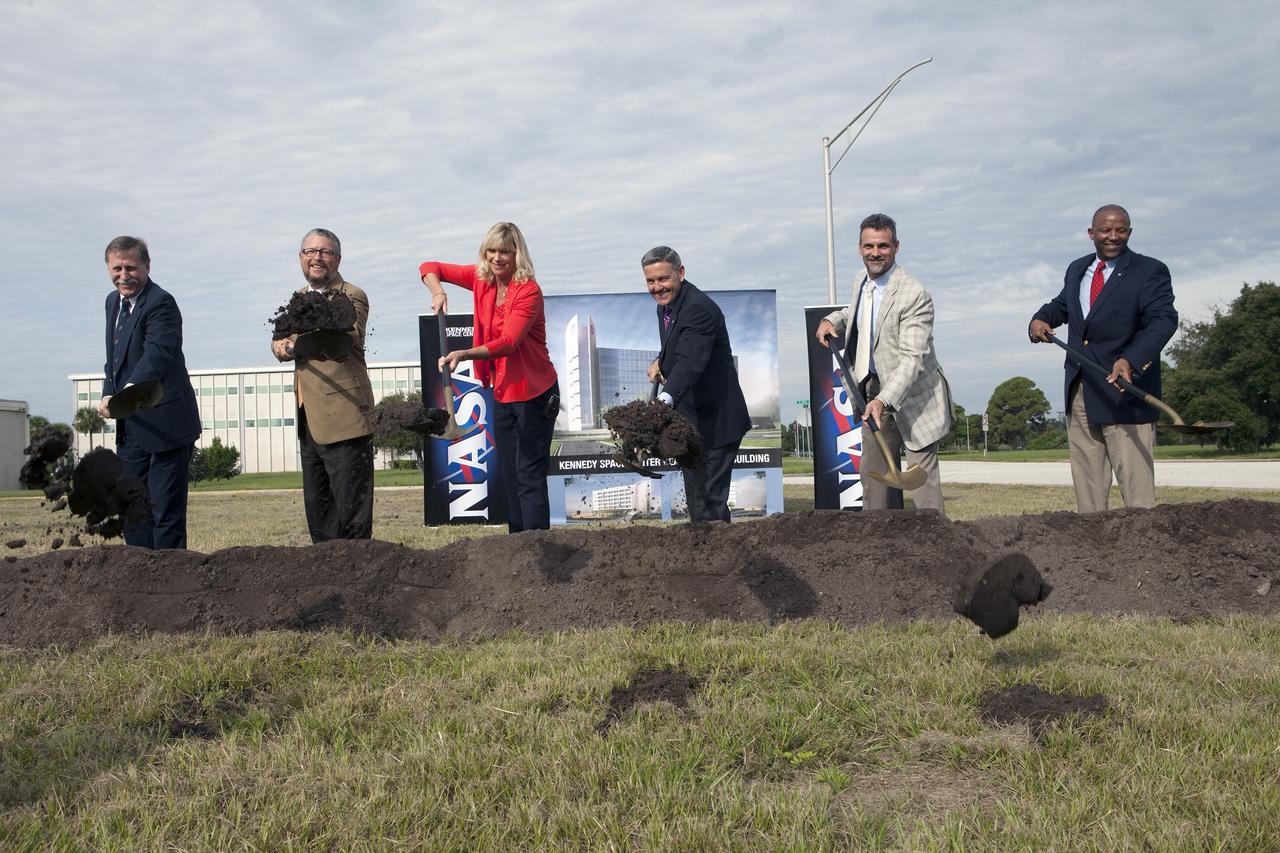
CAPE CANAVERAL, Fla. – Groundbreaking for the new Central Campus took place in the Industrial Area at NASA's Kennedy Space Center in Florida. Digging in with shovels during the groundbreaking ceremony, are Dan Tweed, associate director for Facilities at Kennedy Steve Belflower, vice president of HuntonBrady Architects of Orlando Nancy Bray, director of Kennedy's Center Operations Directorate Kennedy Center Director Bob Cabana Kirk Hazen, southeast district manager and vice president of Hensel Phelps, the construction contractor and Kelvin Manning, Kennedy's associate director. Kennedy is transforming into a multi-user, 21st century spaceport supporting both commercial and government users and operations. Central Campus Phase I includes construction of a new Headquarters Building as one of the major components of the strategy. The new Headquarters Building will be a seven-story, 200,000-square-foot facility that will house about 500 NASA civil service and contractor employees. Photo credit: NASA/Kim Shiflett
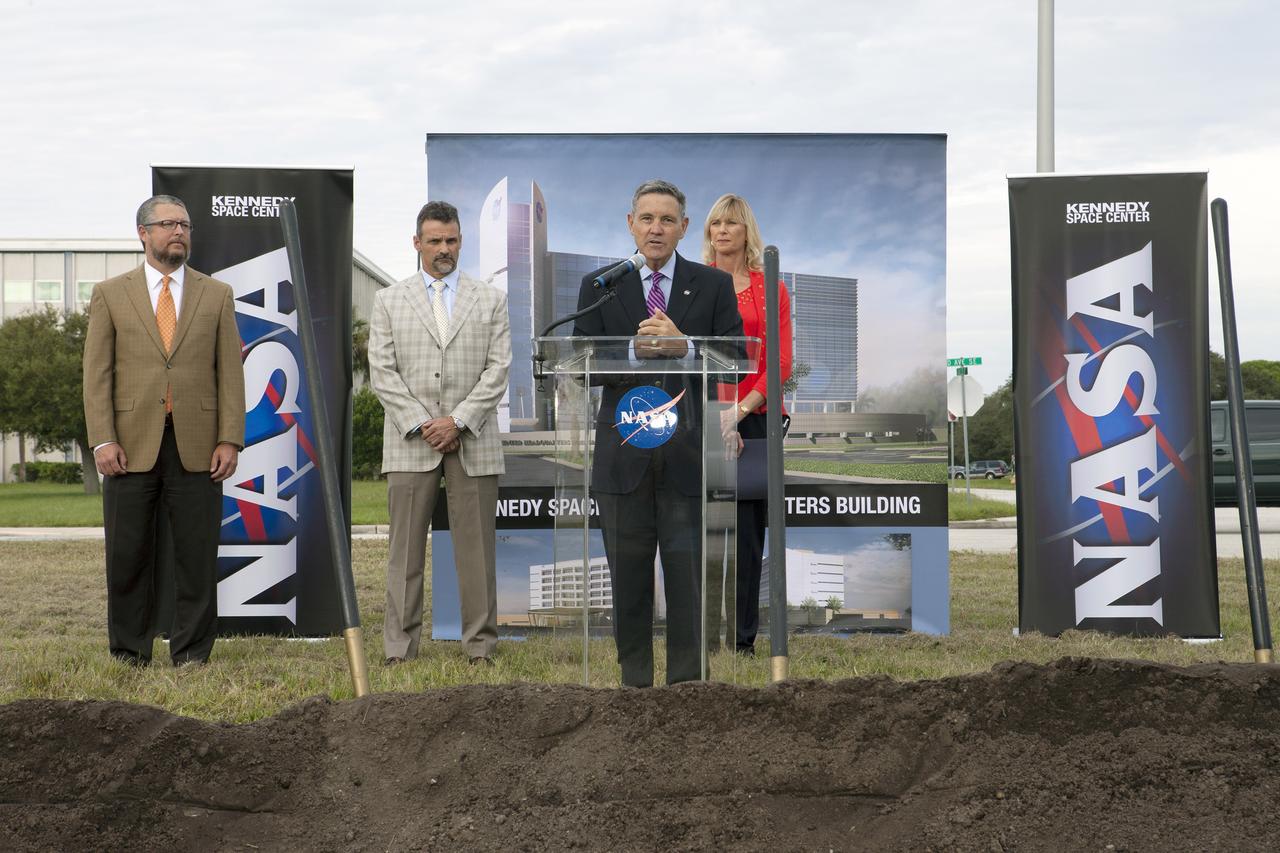
CAPE CANAVERAL, Fla. – Groundbreaking for the new Central Campus took place in the Industrial Area at NASA's Kennedy Space Center in Florida. Kennedy Center Director Bob Cabana speaks to members of the media and guests during the ceremony. Behind Cabana is Nancy Bray, director of Kennedy's Center Operations Directorate. From far left, are Steve Belflower, vice president of HuntonBrady Architects of Orlando, and Kirk Hazen, southeast district manager and vice president of Hensel Phelps, the construction contractor. Kennedy is transforming into a multi-user, 21st century spaceport supporting both commercial and government users and operations. Central Campus Phase I includes construction of a new Headquarters Building as one of the major components of the strategy. The new Headquarters Building will be a seven-story, 200,000-square-foot facility that will house about 500 NASA civil service and contractor employees. Photo credit: NASA/Kim Shiflett
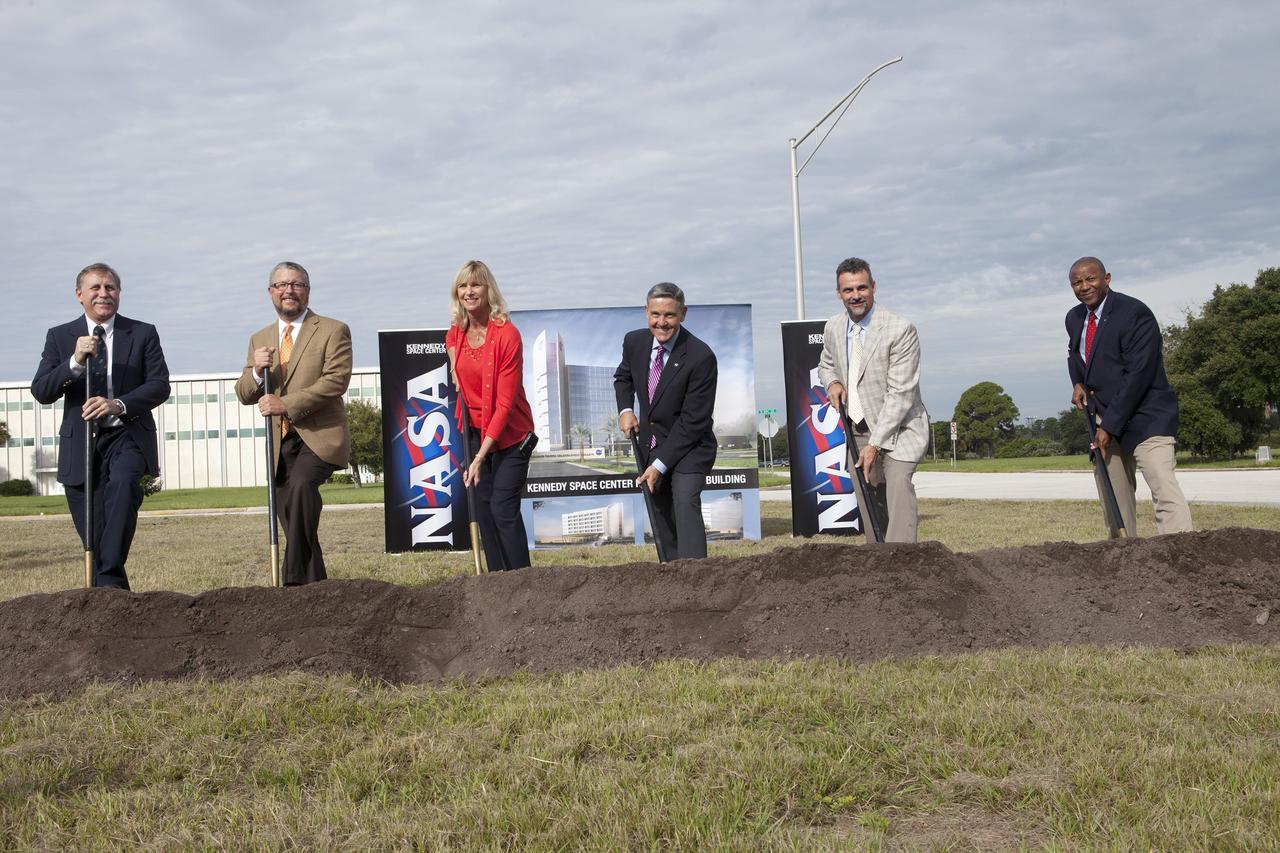
CAPE CANAVERAL, Fla. – Groundbreaking for the new Central Campus took place in the Industrial Area at NASA's Kennedy Space Center in Florida. Digging in with shovels during the groundbreaking ceremony, are Dan Tweed, associate director for Facilities at Kennedy Steve Belflower, vice president of HuntonBrady Architects of Orlando Nancy Bray, director of Kennedy's Center Operations Directorate Kennedy Center Director Bob Cabana Kirk Hazen, southeast district manager and vice president of Hensel Phelps, the construction contractor and Kelvin Manning, Kennedy's associate director. Kennedy is transforming into a multi-user, 21st century spaceport supporting both commercial and government users and operations. Central Campus Phase I includes construction of a new Headquarters Building as one of the major components of the strategy. The new Headquarters Building will be a seven-story, 200,000-square-foot facility that will house about 500 NASA civil service and contractor employees. Photo credit: NASA/Kim Shiflett
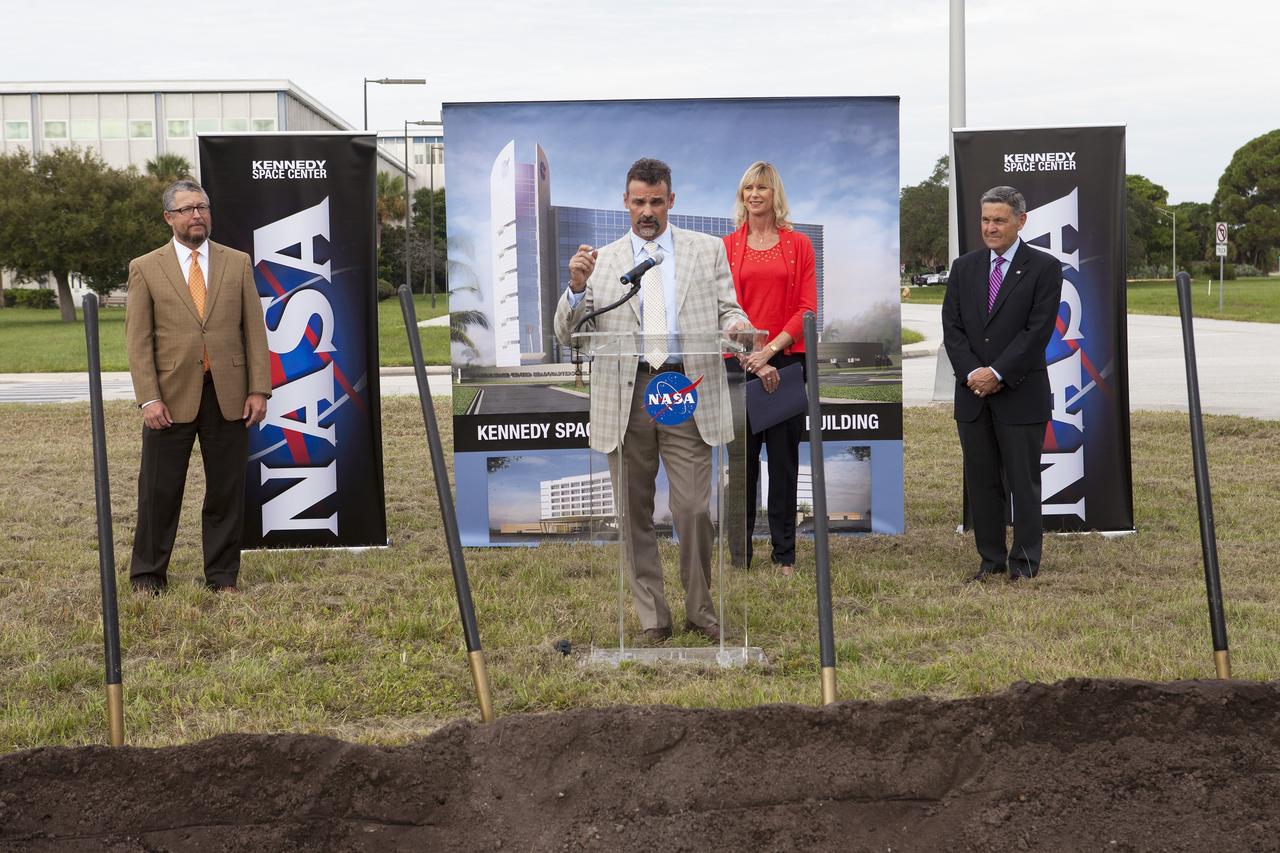
CAPE CANAVERAL, Fla. – Groundbreaking for the new Central Campus took place in the Industrial Area at NASA's Kennedy Space Center in Florida. Kirk Hazen, southeast district manager and vice president of Hensel Phelps, the construction contractor, speaks to members of the media and guests during the groundbreaking ceremony. Behind him is Nancy Bray, director of Kennedy's Center Operations Directorate. To his right is Kennedy Center Director Bob Cabana. To his left is Steve Belflower, vice president of HuntonBrady Architects of Orlando. Kennedy is transforming into a multi-user, 21st century spaceport supporting both commercial and government users and operations. Central Campus Phase I includes construction of a new Headquarters Building as one of the major components of the strategy. The new Headquarters Building will be a seven-story, 200,000-square-foot facility that will house about 500 NASA civil service and contractor employees. Photo credit: NASA/Kim Shiflett
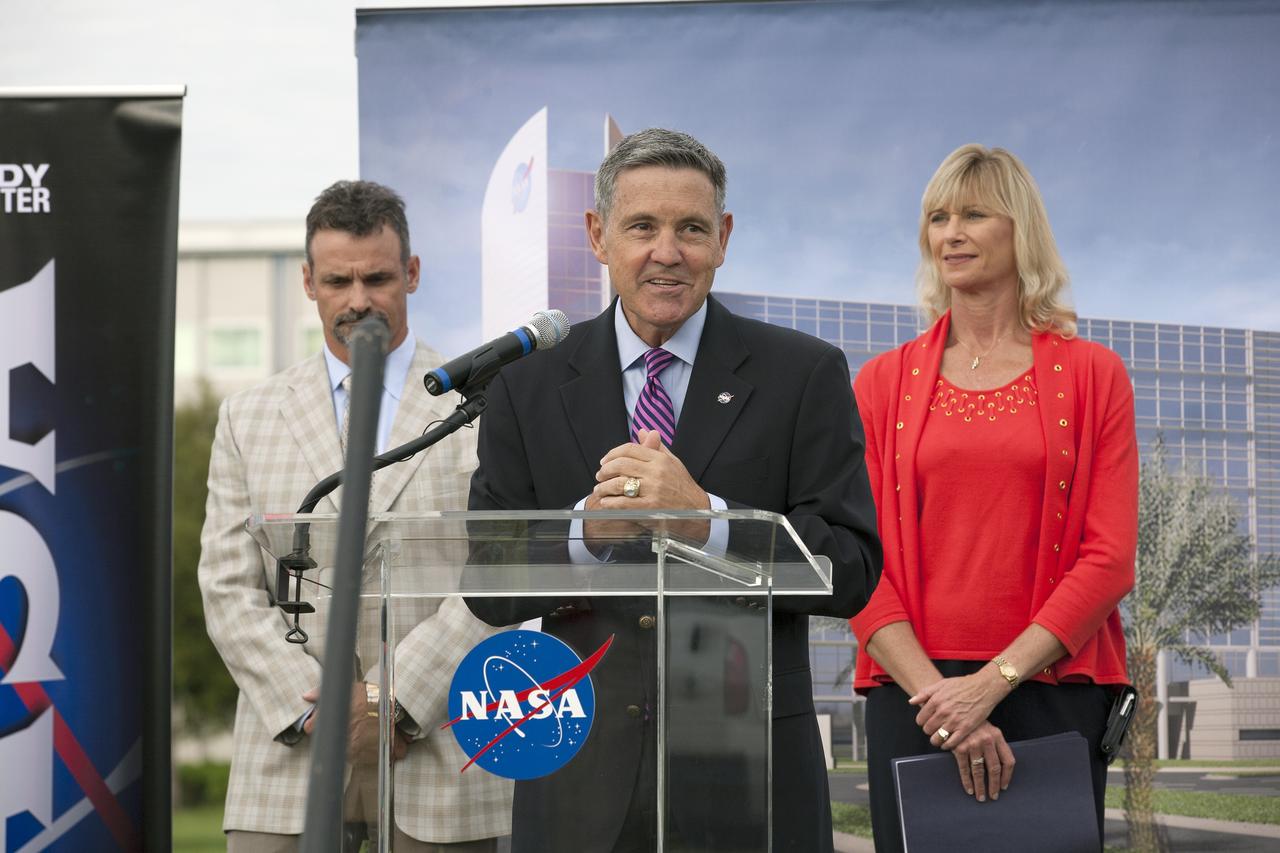
CAPE CANAVERAL, Fla. – Groundbreaking for the new Central Campus will take place in the Industrial Area at NASA's Kennedy Space Center in Florida. Kennedy Center Director Bob Cabana welcomes members of the media and guests to the ceremony. To his right is Nancy Bray, director of Kennedy's Center Operations Directorate. To his left is Kirk Hazen, southeast district manager and vice president of Hensel Phelps, the construction contractor. Kennedy is transforming into a multi-user, 21st century spaceport supporting both commercial and government users and operations. Central Campus Phase I includes construction of a new Headquarters Building as one of the major components of the strategy. The new Headquarters Building will be a seven-story, 200,000-square-foot facility that will house about 500 NASA civil service and contractor employees. Photo credit: NASA/Kim Shiflett

NASA Deputy Associate Administrator for NASA’s Office of STEM Engagement, Kris Brown, right, and U.S. Department of Education Deputy Secretary Cindy Marten, left, watch as a student operates a robot during a STEM event to kickoff the 21st Century Community Learning Centers NASA and U.S. Department of Education partnership, Monday, Sept. 23, 2024 at Wheatley Education Campus (EC) in Washington. Students engaged in NASA hands-on activities and an engineering design challenge. Photo Credit: (NASA/Aubrey Gemignani)

NASA Deputy Associate Administrator for NASA’s Office of STEM Engagement, Kris Brown, provides remarks at a kickoff event for the 21st Century Community Learning Centers NASA and Department of Education partnership, Monday, Sept. 23, 2024 at Wheatley Education Campus in Washington. Students engaged in NASA hands-on activities and an engineering design challenge. Photo Credit: (NASA/Aubrey Gemignani)
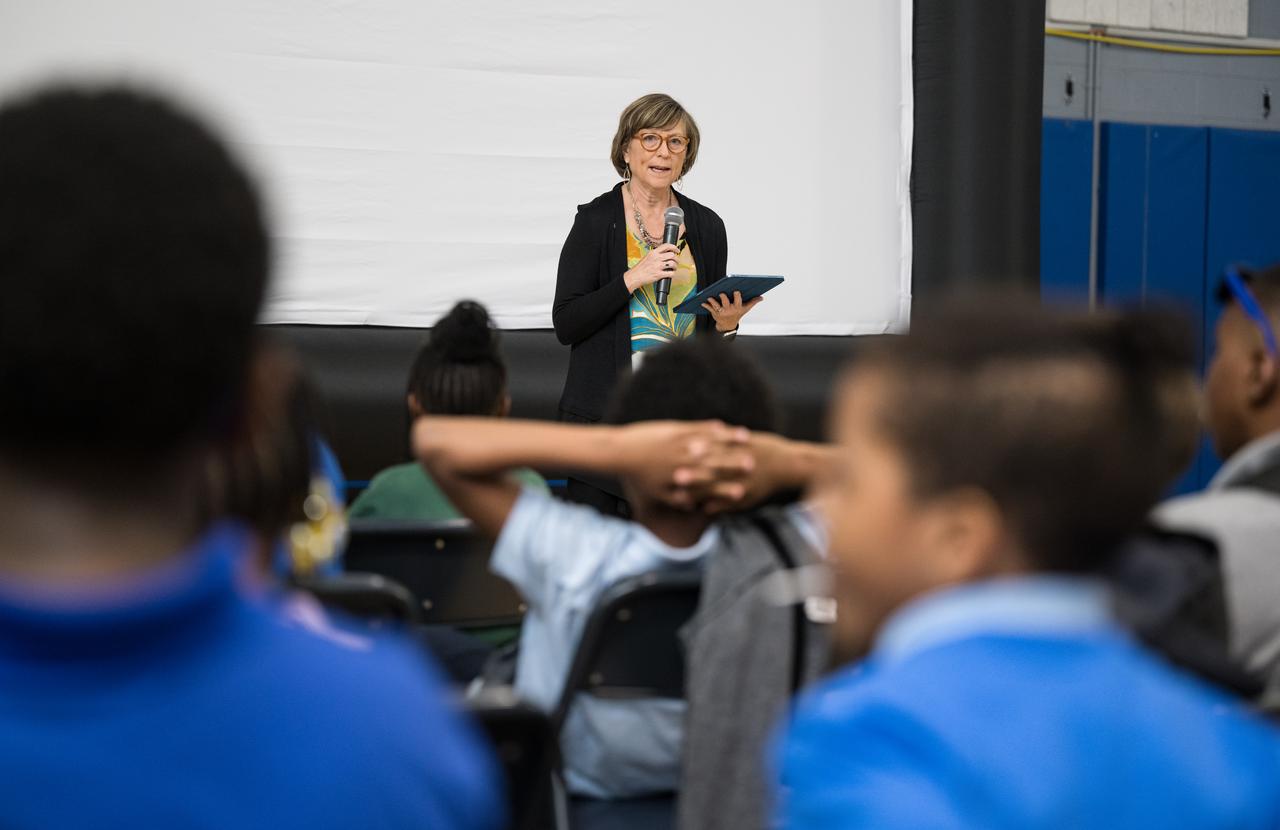
NASA Deputy Associate Administrator for NASA’s Office of STEM Engagement, Kris Brown, provides remarks at a kickoff event for the 21st Century Community Learning Centers NASA and Department of Education partnership, Monday, Sept. 23, 2024 at Wheatley Education Campus in Washington. Students engaged in NASA hands-on activities and an engineering design challenge. Photo Credit: (NASA/Aubrey Gemignani)
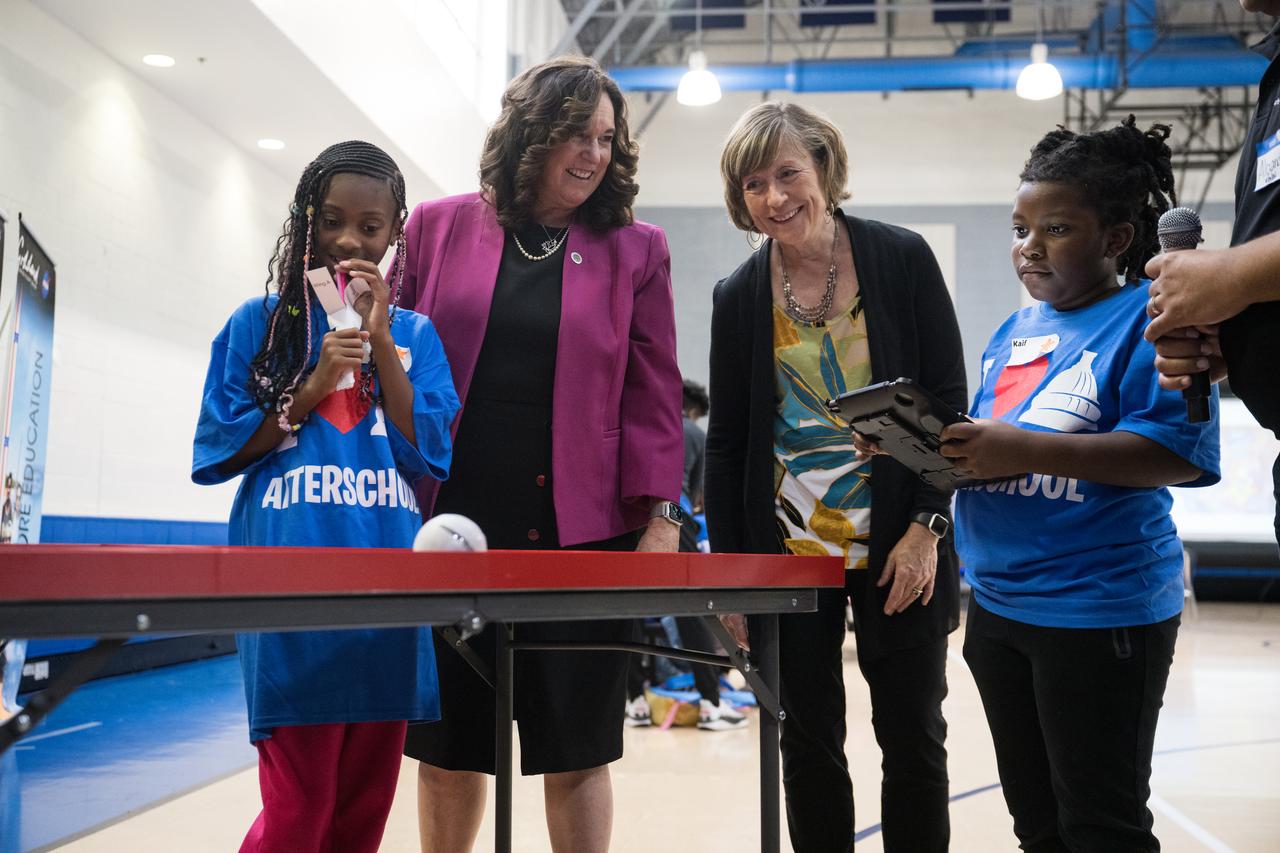
NASA Deputy Associate Administrator for NASA’s Office of STEM Engagement, Kris Brown, second from right, and U.S. Department of Education Deputy Secretary Cindy Marten, second from left, watch as a student operates a robot during a STEM event to kickoff the 21st Century Community Learning Centers NASA and U.S. Department of Education partnership, Monday, Sept. 23, 2024 at Wheatley Education Campus (EC) in Washington. Students engaged in NASA hands-on activities and an engineering design challenge. Photo Credit: (NASA/Aubrey Gemignani)
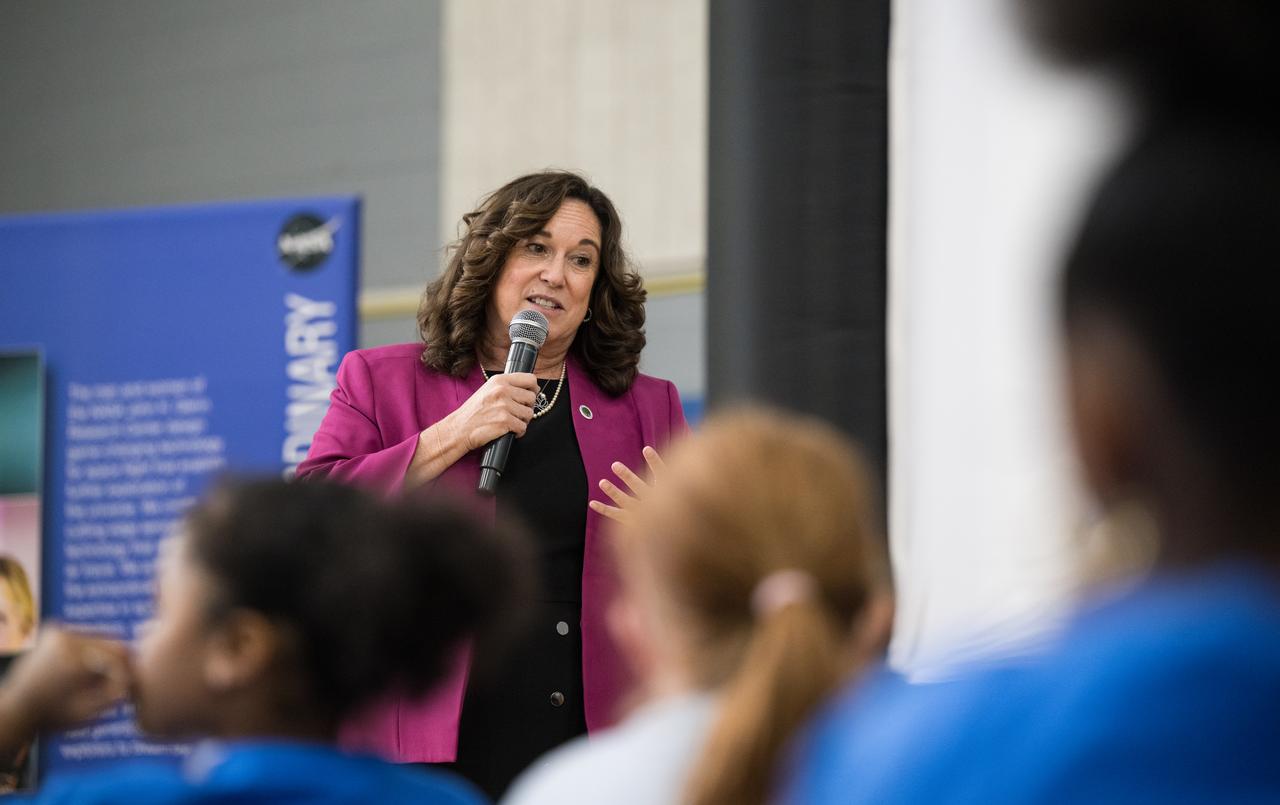
Deputy Secretary of the U.S. Department of Education, Cindy Marten, provides remarks at a kickoff event for the 21st Century Community Learning Centers NASA and Department of Education partnership, Monday, Sept. 23, 2024 at Wheatley Education Campus in Washington. Students engaged in NASA hands-on activities and an engineering design challenge. Photo Credit: (NASA/Aubrey Gemignani)
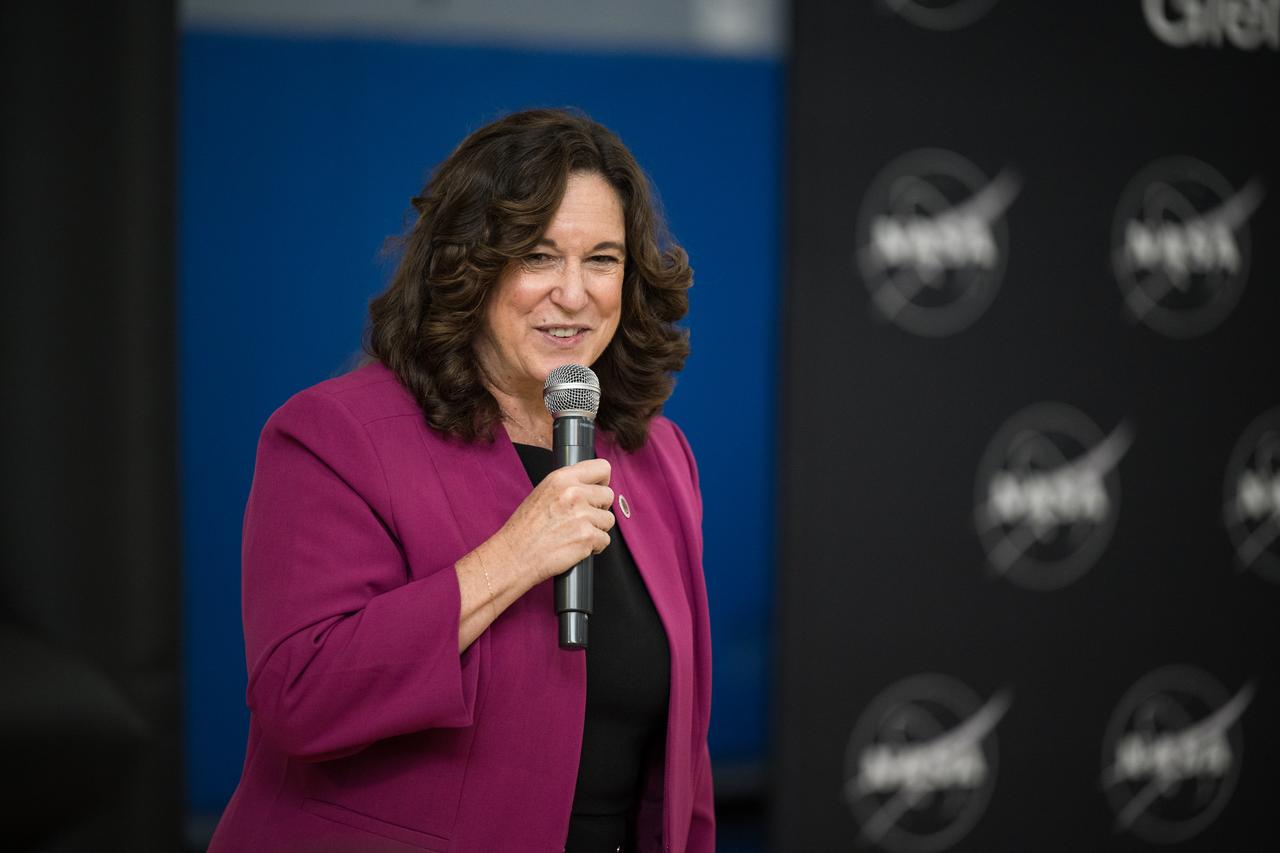
Deputy Secretary of the U.S. Department of Education, Cindy Marten, provides remarks at a kickoff event for the 21st Century Community Learning Centers NASA and Department of Education partnership, Monday, Sept. 23, 2024 at Wheatley Education Campus in Washington. Students engaged in NASA hands-on activities and an engineering design challenge. Photo Credit: (NASA/Aubrey Gemignani)
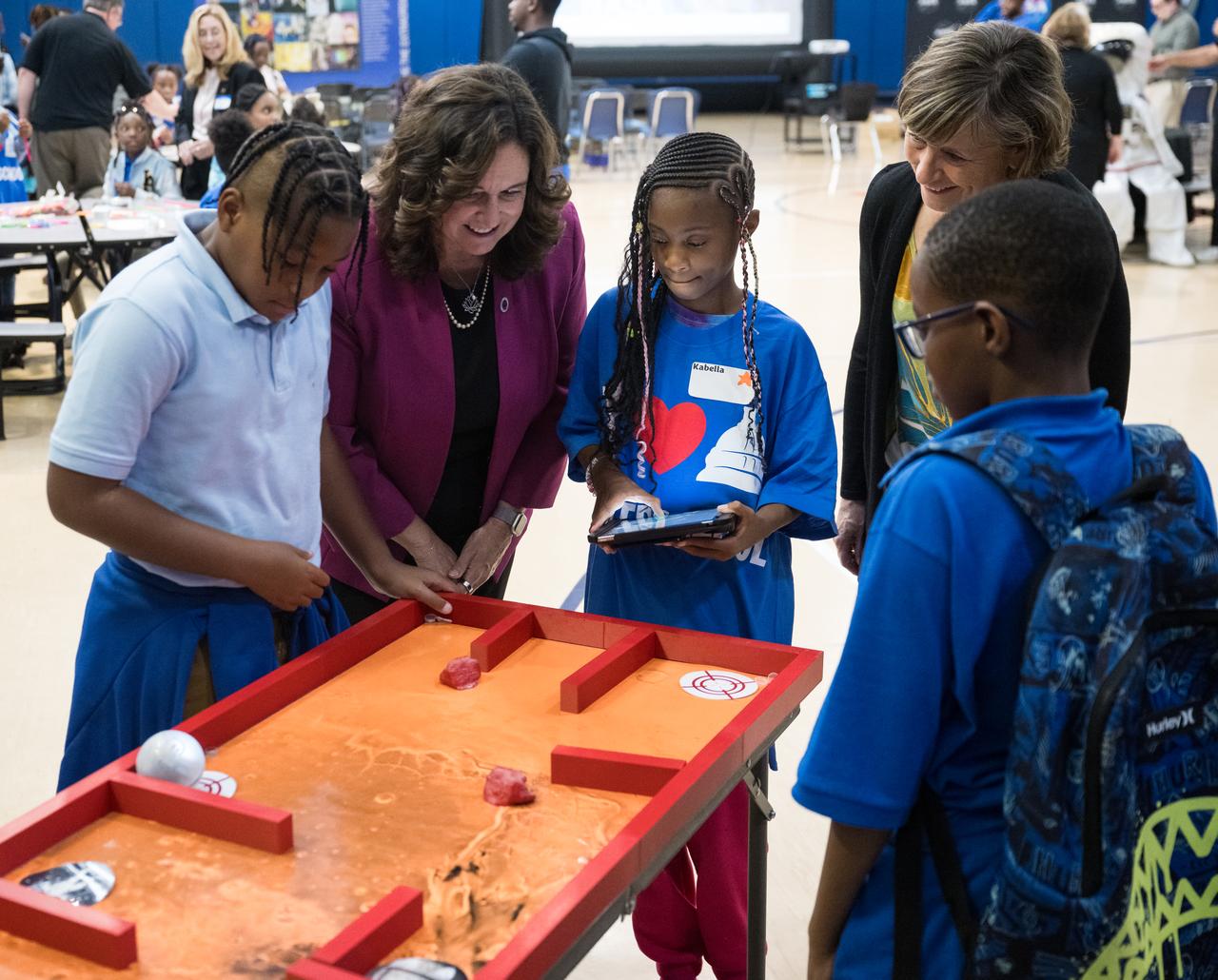
NASA Deputy Associate Administrator for NASA’s Office of STEM Engagement, Kris Brown, second from right, and U.S. Department of Education Deputy Secretary Cindy Marten, second from left, watch as a student operates a robot during a STEM event to kickoff the 21st Century Community Learning Centers NASA and U.S. Department of Education partnership, Monday, Sept. 23, 2024 at Wheatley Education Campus (EC) in Washington. Students engaged in NASA hands-on activities and an engineering design challenge. Photo Credit: (NASA/Aubrey Gemignani)
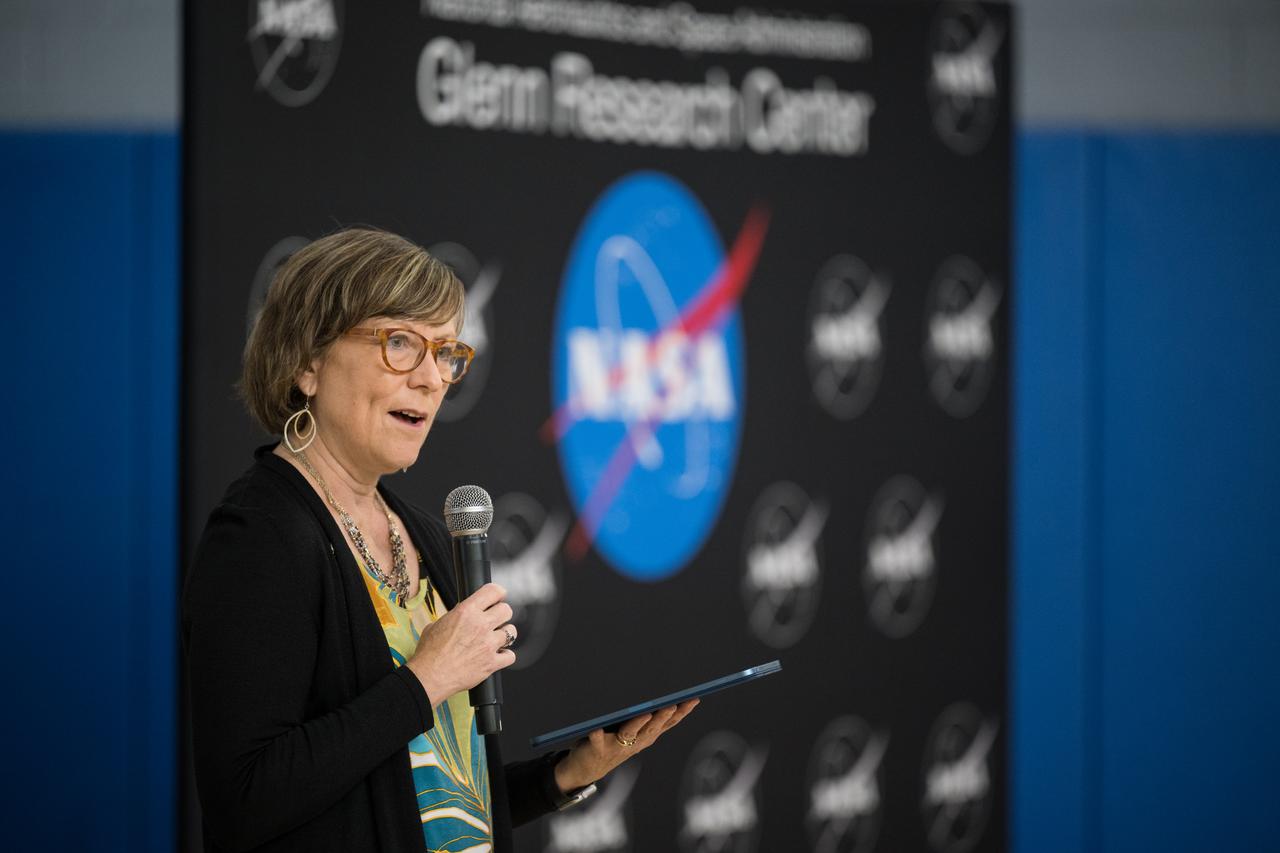
NASA Deputy Associate Administrator for NASA’s Office of STEM Engagement, Kris Brown, provides remarks at a kickoff event for the 21st Century Community Learning Centers NASA and Department of Education partnership, Monday, Sept. 23, 2024 at Wheatley Education Campus in Washington. Students engaged in NASA hands-on activities and an engineering design challenge. Photo Credit: (NASA/Aubrey Gemignani)
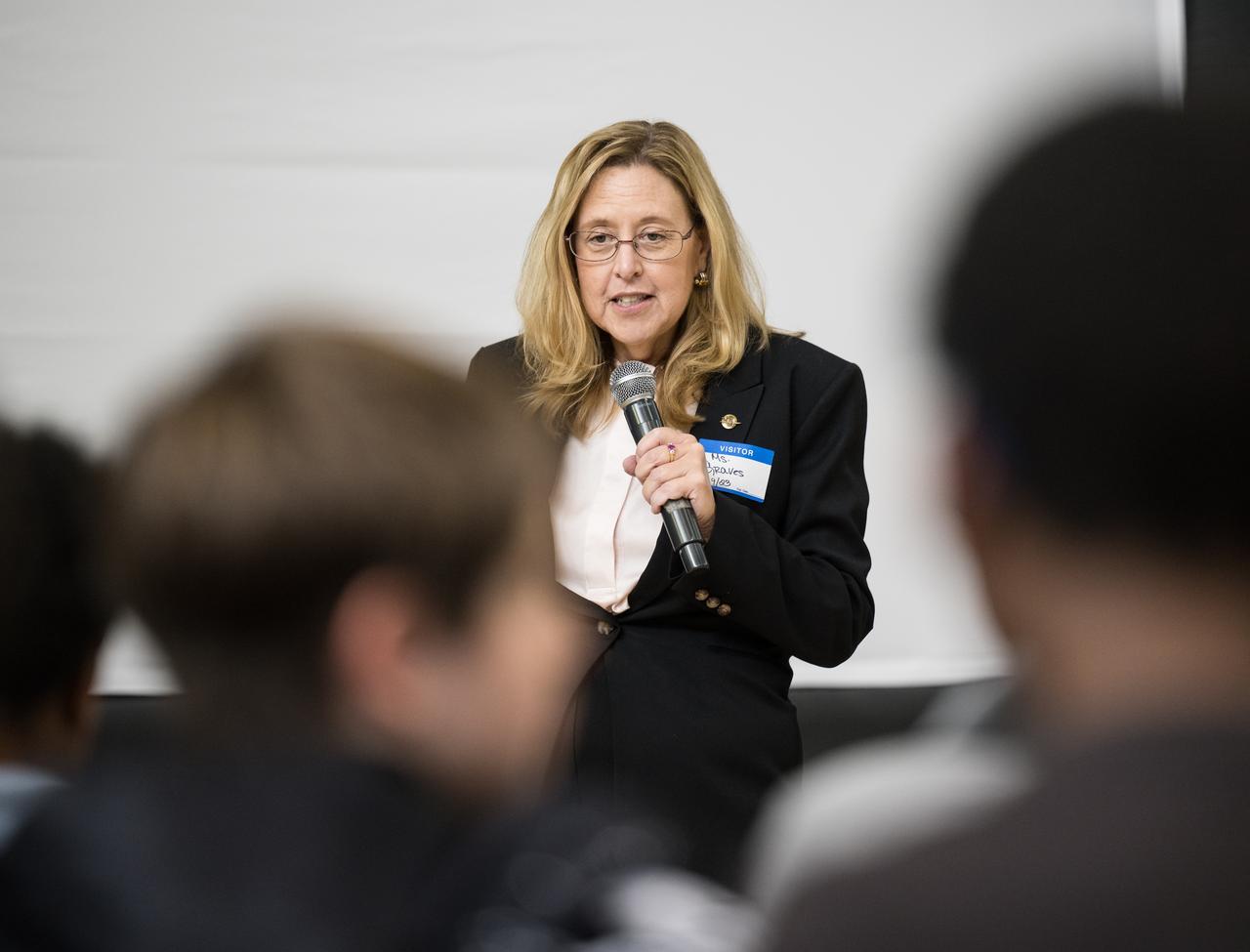
STEM Integration Manager at NASA’s Glenn Research Center (GRC) Office of STEM Engagement, Catherine Graves, provides welcome remarks at a kickoff event for the 21st Century Community Learning Centers NASA and Department of Education partnership, Monday, Sept. 23, 2024 at Wheatley Education Campus in Washington. Students engaged in NASA hands-on activities and an engineering design challenge. Photo Credit: (NASA/Aubrey Gemignani)
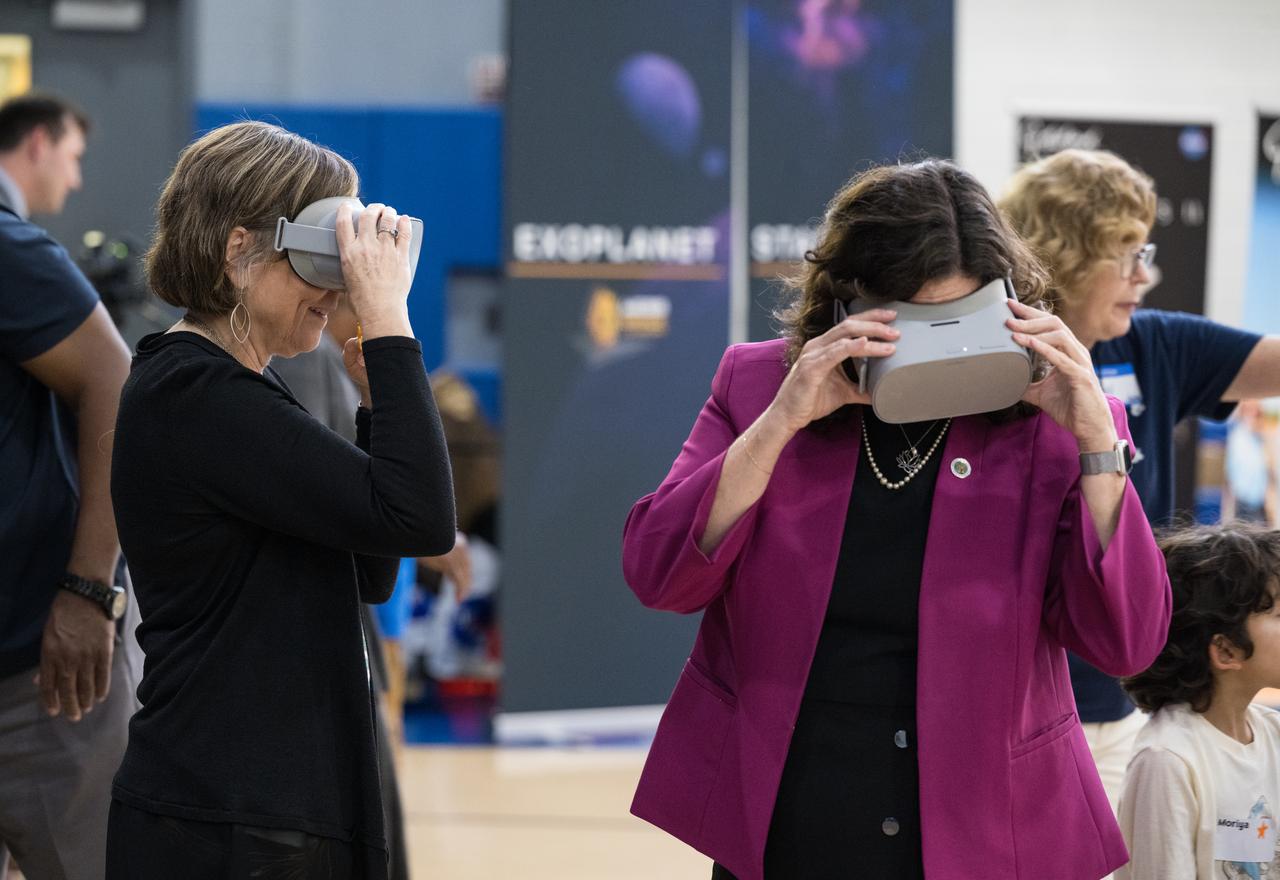
NASA Deputy Associate Administrator for NASA’s Office of STEM Engagement, Kris Brown, left, and U.S. Department of Education Deputy Secretary Cindy Marten, right, participate in a virtual reality tour of NASA’s Neutral Buoyancy Lab during a kickoff event for the 21st Century Community Learning Centers NASA and Department of Education partnership, Monday, Sept. 23, 2024 at Wheatley Education Campus in Washington. Photo Credit: (NASA/Aubrey Gemignani)

Deputy Secretary of the U.S. Department of Education, Cindy Marten, provides remarks at a kickoff event for the 21st Century Community Learning Centers NASA and Department of Education partnership, Monday, Sept. 23, 2024 at Wheatley Education Campus in Washington. Students engaged in NASA hands-on activities and an engineering design challenge. Photo Credit: (NASA/Aubrey Gemignani)
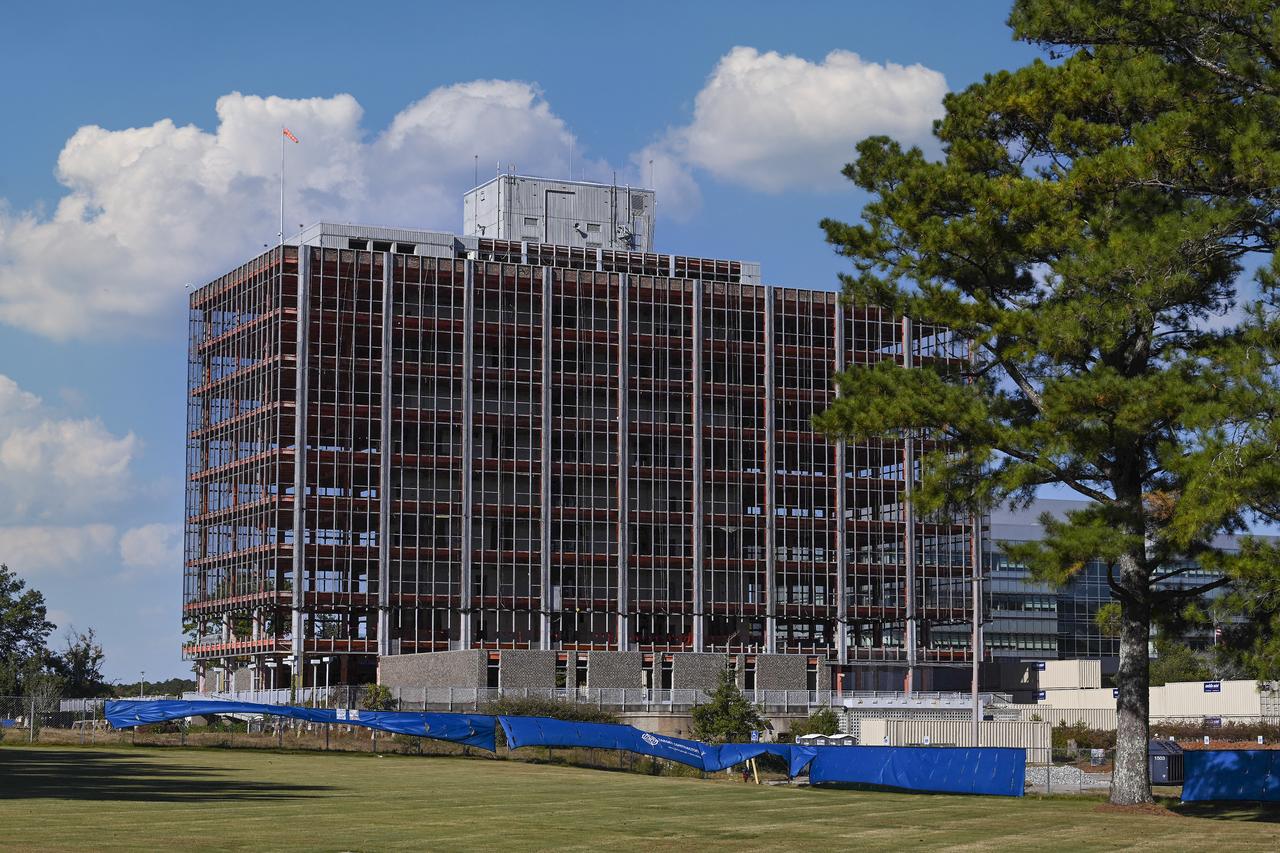
Building 4200 of Marshall’s administrative complex is prepared for demolition in the fall of 2022. Building 4200 was Marshall’s administrative headquarters from 1963 until 2020. The project will make way for a newer, more energy-efficient facilities, providing worksites for new generations of engineers, scientists, and support teams.
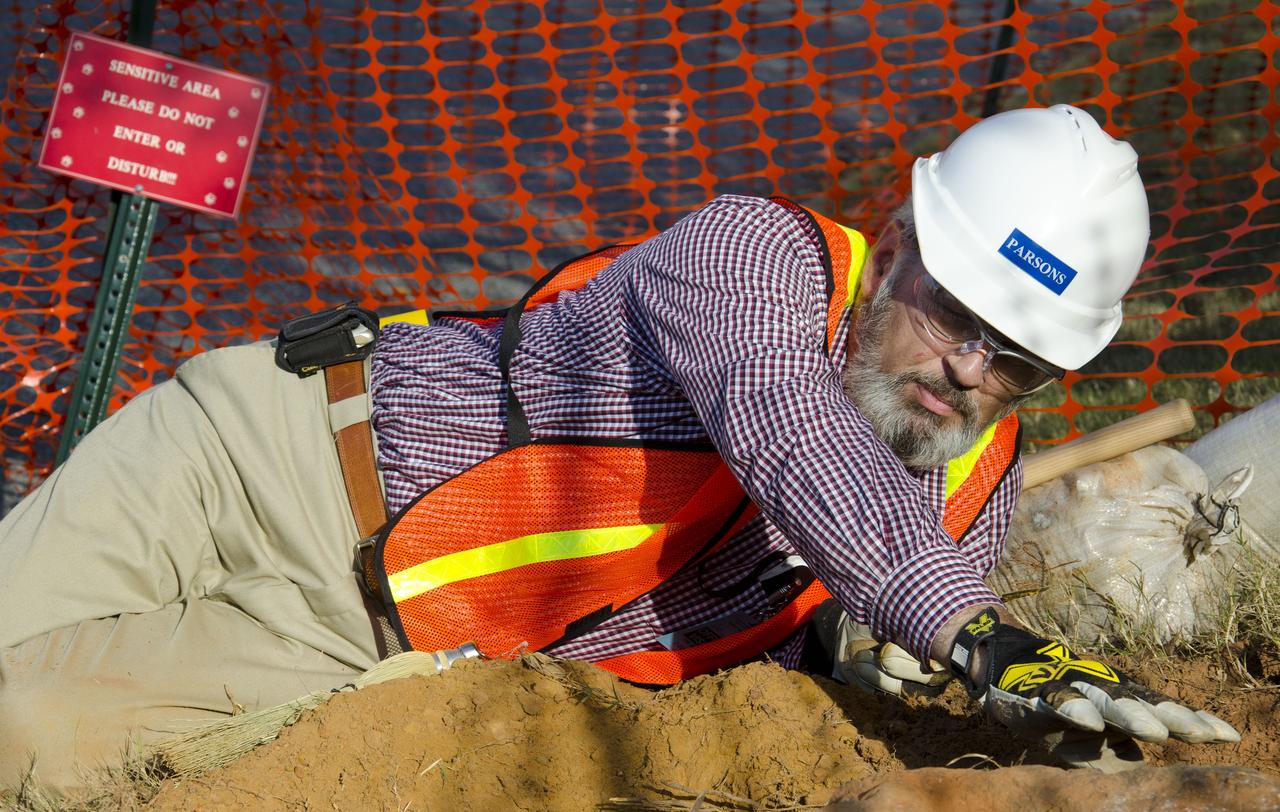
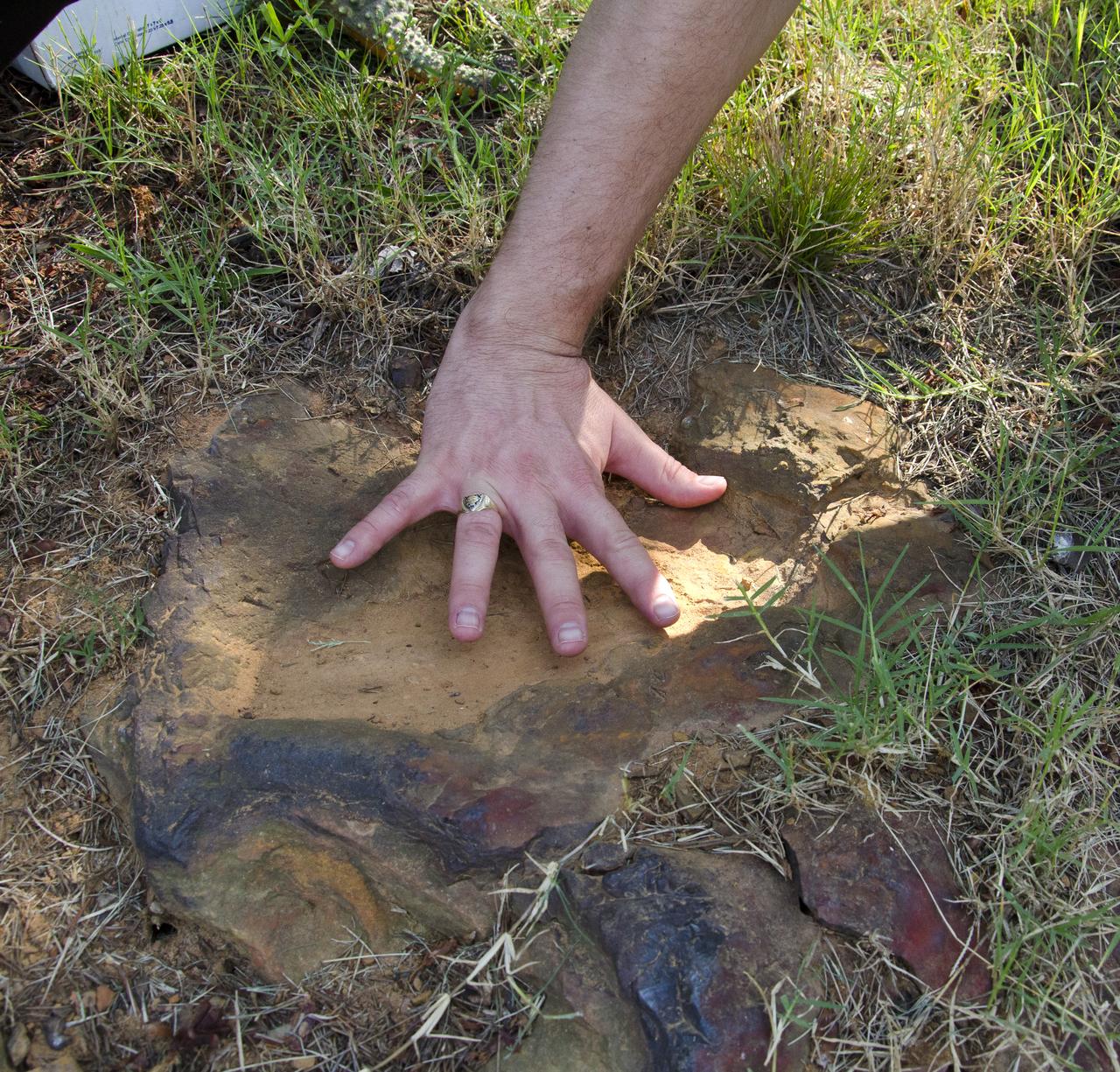
Goddard's consultant paleontologist Dr. Lee Monnens verified the track and discovered additional footprints hiding under a thin layer of topsoil in the same rock layer on October 23, 2012. Credit: NASA/Goddard/Rebecca Roth <b><a href="http://www.nasa.gov/audience/formedia/features/MP_Photo_Guidelines.html" rel="nofollow">NASA image use policy.</a></b> <b><a href="http://www.nasa.gov/centers/goddard/home/index.html" rel="nofollow">NASA Goddard Space Flight Center</a></b> enables NASA’s mission through four scientific endeavors: Earth Science, Heliophysics, Solar System Exploration, and Astrophysics. Goddard plays a leading role in NASA’s accomplishments by contributing compelling scientific knowledge to advance the Agency’s mission. <b>Follow us on <a href="http://twitter.com/NASA_GoddardPix" rel="nofollow">Twitter</a></b> <b>Like us on <a href="http://www.facebook.com/pages/Greenbelt-MD/NASA-Goddard/395013845897?ref=tsd" rel="nofollow">Facebook</a></b> <b>Find us on <a href="http://instagram.com/nasagoddard?vm=grid" rel="nofollow">Instagram</a></b>
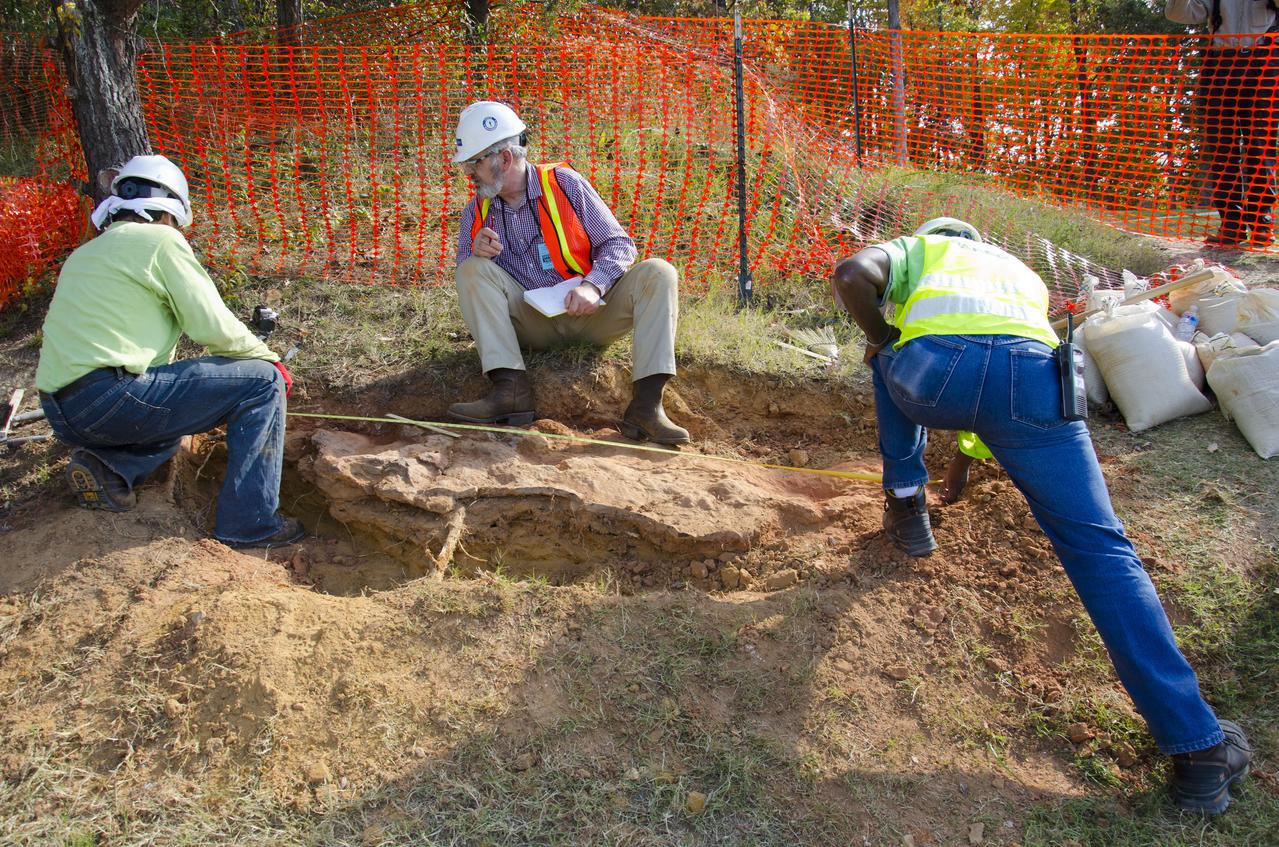
Goddard's consultant paleontologist Dr. Lee Monnens verified the track and discovered additional footprints hiding under a thin layer of topsoil in the same rock layer on October 23, 2012. Credit: NASA/Goddard/Rebecca Roth <b><a href="http://www.nasa.gov/audience/formedia/features/MP_Photo_Guidelines.html" rel="nofollow">NASA image use policy.</a></b> <b><a href="http://www.nasa.gov/centers/goddard/home/index.html" rel="nofollow">NASA Goddard Space Flight Center</a></b> enables NASA’s mission through four scientific endeavors: Earth Science, Heliophysics, Solar System Exploration, and Astrophysics. Goddard plays a leading role in NASA’s accomplishments by contributing compelling scientific knowledge to advance the Agency’s mission. <b>Follow us on <a href="http://twitter.com/NASA_GoddardPix" rel="nofollow">Twitter</a></b> <b>Like us on <a href="http://www.facebook.com/pages/Greenbelt-MD/NASA-Goddard/395013845897?ref=tsd" rel="nofollow">Facebook</a></b> <b>Find us on <a href="http://instagram.com/nasagoddard?vm=grid" rel="nofollow">Instagram</a></b>
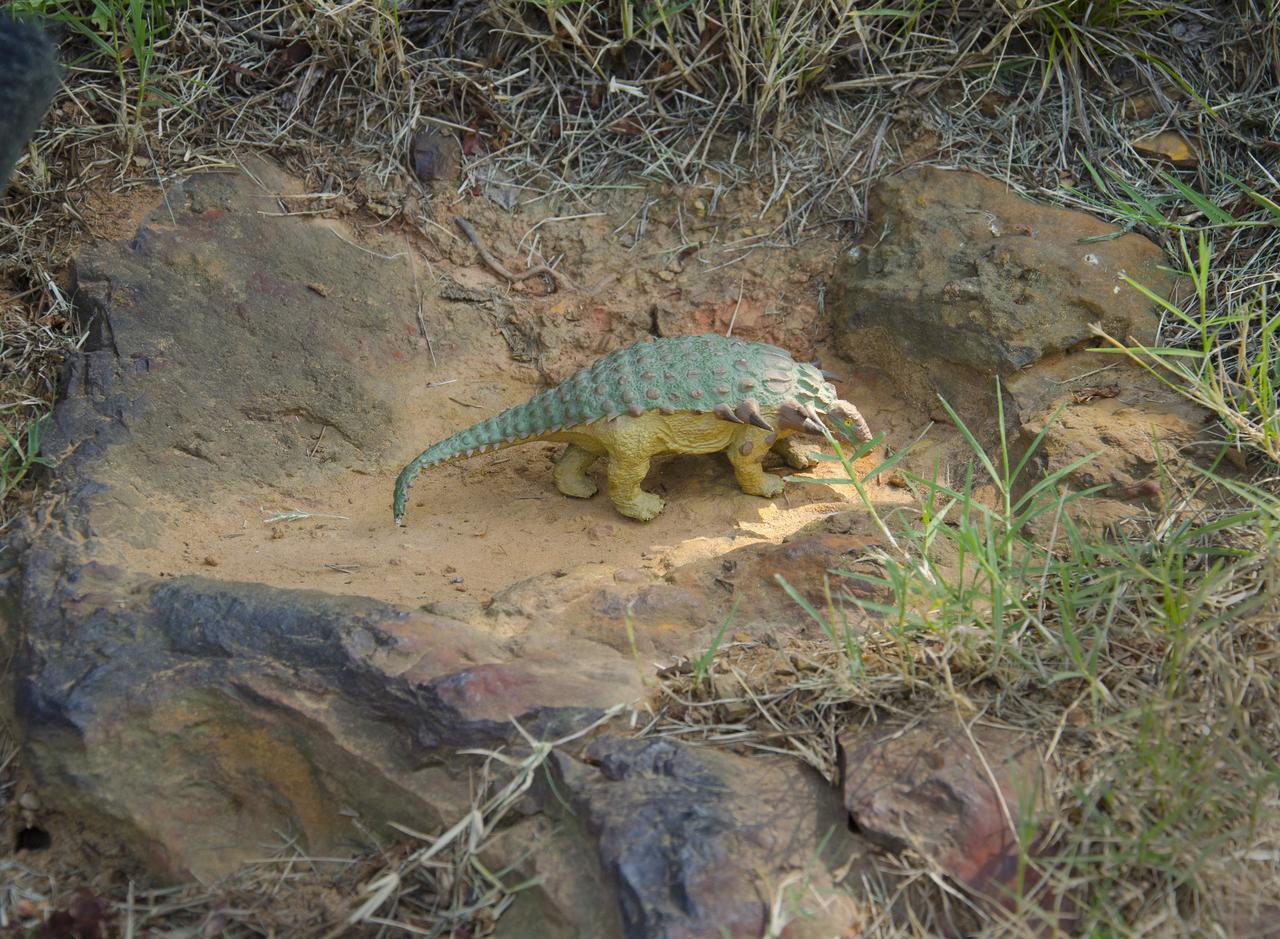
About 110 million light years away, the bright, barred spiral galaxy NGC3259 was just forming stars in dark bands of dust and gas. On Earth, a plant-eating dinosaur left footprints in the Cretaceous mud of what would later become the grounds of NASA’s Goddard Space Flight Center in Greenbelt, Md. A model of a Nodosaur dinosaur sits inside what is believed to be the fossil of a Nodosaur footprint. The footprint was found by Ray Stanford a local dinosaur hunter. <b>To read more go to: <a href="http://www.nasa.gov/centers/goddard/news/features/2012/nodosaur.html" rel="nofollow">www.nasa.gov/centers/goddard/news/features/2012/nodosaur....</a></b> Credit: NASA/Goddard/Rebecca Roth <b><a href="http://www.nasa.gov/audience/formedia/features/MP_Photo_Guidelines.html" rel="nofollow">NASA image use policy.</a></b> <b><a href="http://www.nasa.gov/centers/goddard/home/index.html" rel="nofollow">NASA Goddard Space Flight Center</a></b> enables NASA’s mission through four scientific endeavors: Earth Science, Heliophysics, Solar System Exploration, and Astrophysics. Goddard plays a leading role in NASA’s accomplishments by contributing compelling scientific knowledge to advance the Agency’s mission. <b>Follow us on <a href="http://twitter.com/NASA_GoddardPix" rel="nofollow">Twitter</a></b> <b>Like us on <a href="http://www.facebook.com/pages/Greenbelt-MD/NASA-Goddard/395013845897?ref=tsd" rel="nofollow">Facebook</a></b> <b>Find us on <a href="http://instagrid.me/nasagoddard/?vm=grid" rel="nofollow">Instagram</a></b>
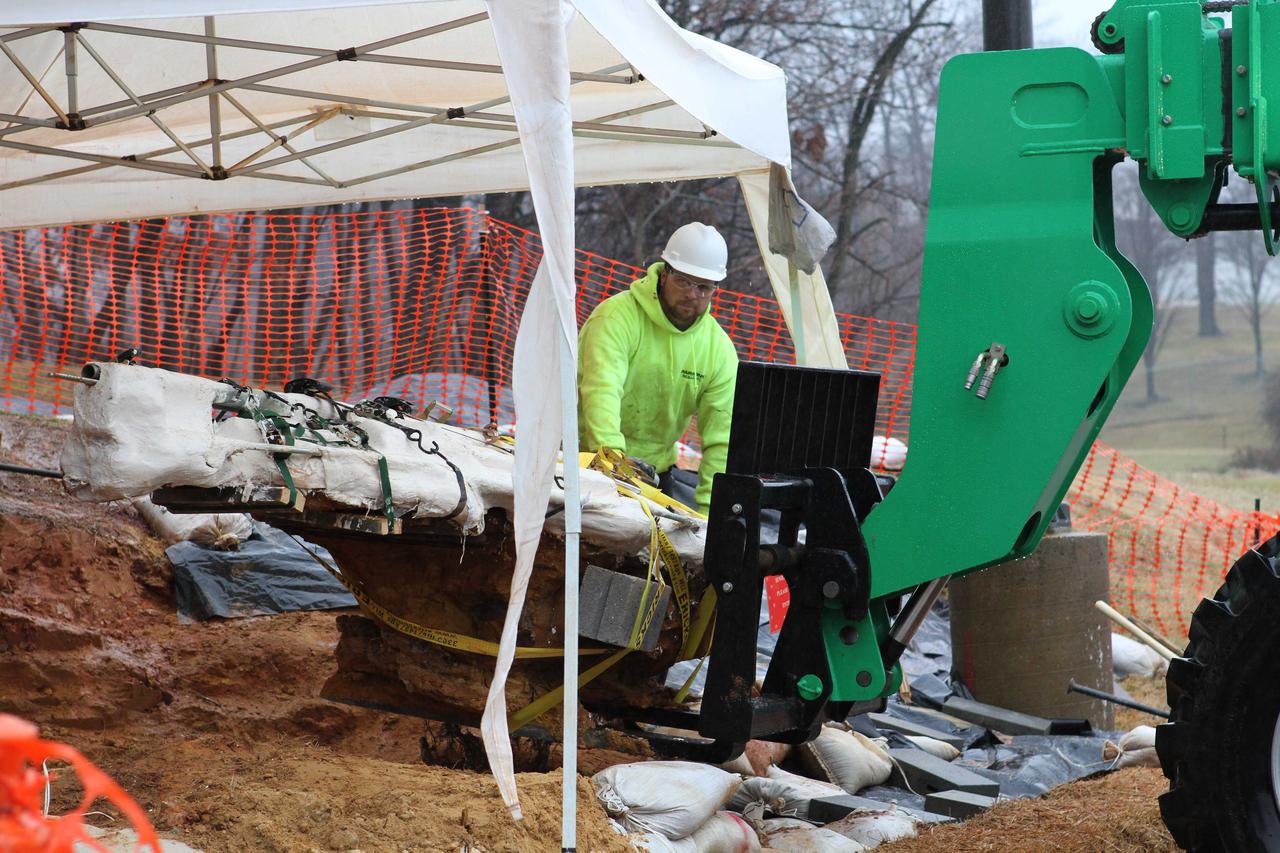
The entire find, containing at least three dinosaur footprints, is approximately seven feet long and three feet across at its widest point. Additionally, the footprint-rich layer is bonded to a separate layer of iron-rich sandstone that complicated the efforts to extract and preserve it. Before removing the rock layer, Godfrey made a silicon-rubber cast of the prints, then jacketed the entire find in multiple layers of plaster-soaked burlap (i.e. just like a cast) to add rigidity and to further ward against breakage during transport. Galvanized steel pipes wrapped into the jacket acted like splints to provide additional structural support. The combined weight of the footprint, field jacket material and surrounding soil that was removed was estimated to be approximately 3,000 pounds, so extra care was taken in moving it to avoid damaging the rather extraordinary find. Credit: NASA/GSFC/Michelle Handleman <b><a href="http://www.nasa.gov/audience/formedia/features/MP_Photo_Guidelines.html" rel="nofollow">NASA image use policy.</a></b> <b><a href="http://www.nasa.gov/centers/goddard/home/index.html" rel="nofollow">NASA Goddard Space Flight Center</a></b> enables NASA’s mission through four scientific endeavors: Earth Science, Heliophysics, Solar System Exploration, and Astrophysics. Goddard plays a leading role in NASA’s accomplishments by contributing compelling scientific knowledge to advance the Agency’s mission. <b>Follow us on <a href="http://twitter.com/NASA_GoddardPix" rel="nofollow">Twitter</a></b> <b>Like us on <a href="http://www.facebook.com/pages/Greenbelt-MD/NASA-Goddard/395013845897?ref=tsd" rel="nofollow">Facebook</a></b> <b>Find us on <a href="http://instagram.com/nasagoddard?vm=grid" rel="nofollow">Instagram</a></b>

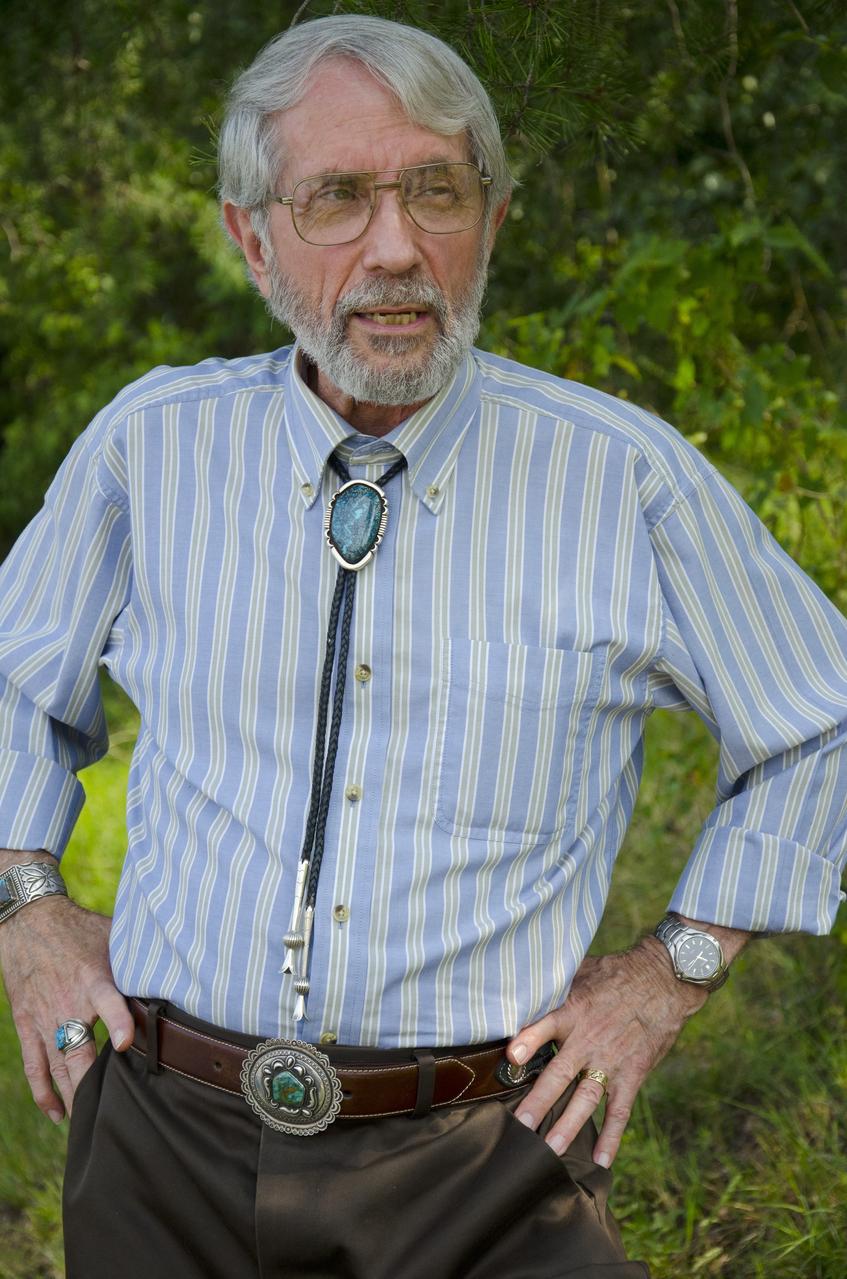
About 110 million light years away, the bright, barred spiral galaxy NGC3259 was just forming stars in dark bands of dust and gas. On Earth, a plant-eating dinosaur left footprints in the Cretaceous mud of what would later become the grounds of NASA’s Goddard Space Flight Center in Greenbelt, Md. Local dinosaur hunter Ray Stanford reviews a fossil found at the site. <b>To read more go to: <a href="http://www.nasa.gov/centers/goddard/news/features/2012/nodosaur.html" rel="nofollow">www.nasa.gov/centers/goddard/news/features/2012/nodosaur....</a></b> Credit: NASA/Goddard/Rebecca Roth <b><a href="http://www.nasa.gov/audience/formedia/features/MP_Photo_Guidelines.html" rel="nofollow">NASA image use policy.</a></b> <b><a href="http://www.nasa.gov/centers/goddard/home/index.html" rel="nofollow">NASA Goddard Space Flight Center</a></b> enables NASA’s mission through four scientific endeavors: Earth Science, Heliophysics, Solar System Exploration, and Astrophysics. Goddard plays a leading role in NASA’s accomplishments by contributing compelling scientific knowledge to advance the Agency’s mission. <b>Follow us on <a href="http://twitter.com/NASA_GoddardPix" rel="nofollow">Twitter</a></b> <b>Like us on <a href="http://www.facebook.com/pages/Greenbelt-MD/NASA-Goddard/395013845897?ref=tsd" rel="nofollow">Facebook</a></b> <b>Find us on <a href="http://instagrid.me/nasagoddard/?vm=grid" rel="nofollow">Instagram</a></b>
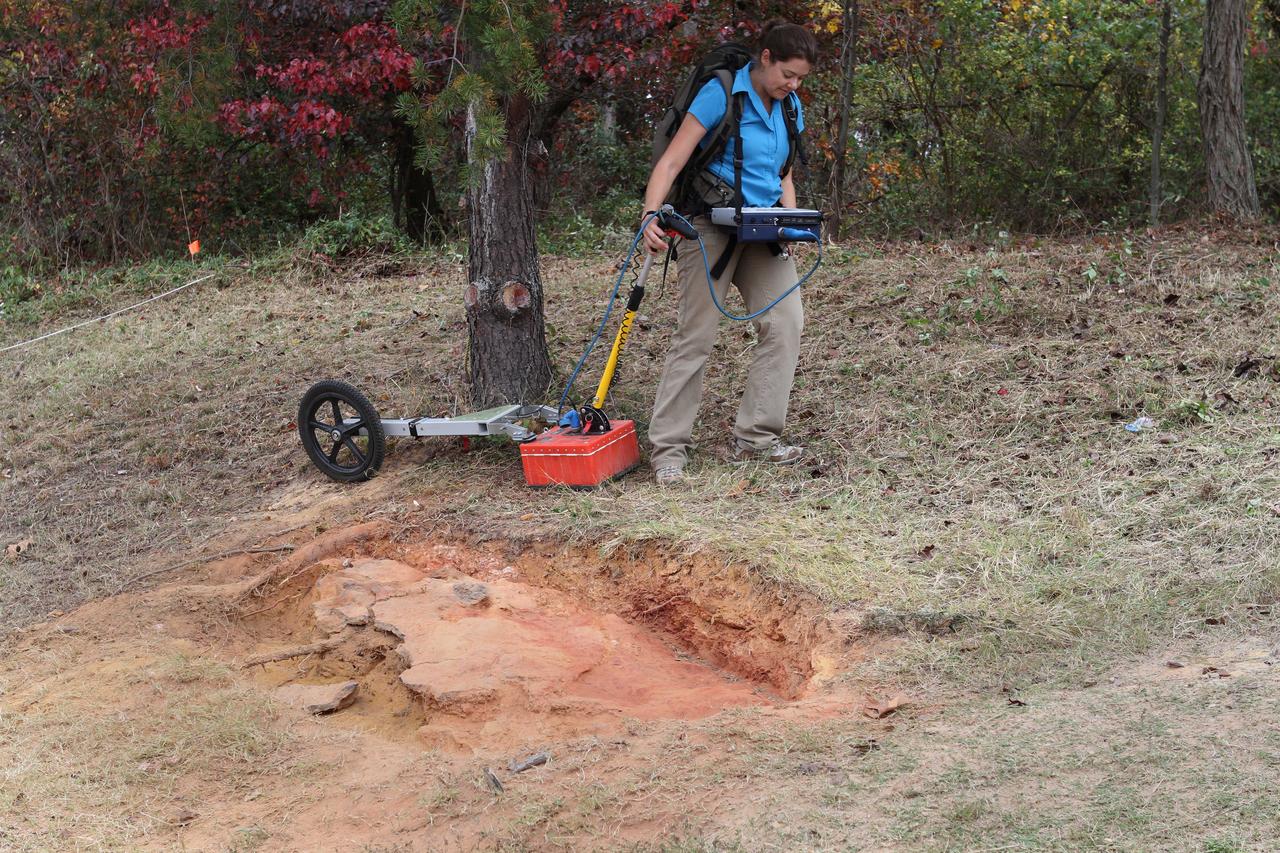
In December, 2012, Goddard scientists using ground penetrating radar showed that the sedimentary rock layer bearing these prints was preserved in its original location, but that investigation found no additional indications of locations of dinosaur track specimens of scientific value. Credit: NASA/Goddard/Michelle Handleman <b><a href="http://www.nasa.gov/audience/formedia/features/MP_Photo_Guidelines.html" rel="nofollow">NASA image use policy.</a></b> <b><a href="http://www.nasa.gov/centers/goddard/home/index.html" rel="nofollow">NASA Goddard Space Flight Center</a></b> enables NASA’s mission through four scientific endeavors: Earth Science, Heliophysics, Solar System Exploration, and Astrophysics. Goddard plays a leading role in NASA’s accomplishments by contributing compelling scientific knowledge to advance the Agency’s mission. <b>Follow us on <a href="http://twitter.com/NASA_GoddardPix" rel="nofollow">Twitter</a></b> <b>Like us on <a href="http://www.facebook.com/pages/Greenbelt-MD/NASA-Goddard/395013845897?ref=tsd" rel="nofollow">Facebook</a></b> <b>Find us on <a href="http://instagram.com/nasagoddard?vm=grid" rel="nofollow">Instagram</a></b>
About 110 million light years away, the bright, barred spiral galaxy NGC3259 was just forming stars in dark bands of dust and gas. On Earth, a plant-eating dinosaur left footprints in the Cretaceous mud of what would later become the grounds of NASA’s Goddard Space Flight Center in Greenbelt, Md. Local dinosaur hunter Ray Stanford points out the impression to Goddard officials and members of local media. <b>To read more go to: <a href="http://www.nasa.gov/centers/goddard/news/features/2012/nodosaur.html" rel="nofollow">www.nasa.gov/centers/goddard/news/features/2012/nodosaur....</a></b> Credit: NASA/Goddard/Rebecca Roth <b><a href="http://www.nasa.gov/audience/formedia/features/MP_Photo_Guidelines.html" rel="nofollow">NASA image use policy.</a></b> <b><a href="http://www.nasa.gov/centers/goddard/home/index.html" rel="nofollow">NASA Goddard Space Flight Center</a></b> enables NASA’s mission through four scientific endeavors: Earth Science, Heliophysics, Solar System Exploration, and Astrophysics. Goddard plays a leading role in NASA’s accomplishments by contributing compelling scientific knowledge to advance the Agency’s mission. <b>Follow us on <a href="http://twitter.com/NASA_GoddardPix" rel="nofollow">Twitter</a></b> <b>Like us on <a href="http://www.facebook.com/pages/Greenbelt-MD/NASA-Goddard/395013845897?ref=tsd" rel="nofollow">Facebook</a></b> <b>Find us on <a href="http://instagrid.me/nasagoddard/?vm=grid" rel="nofollow">Instagram</a></b>
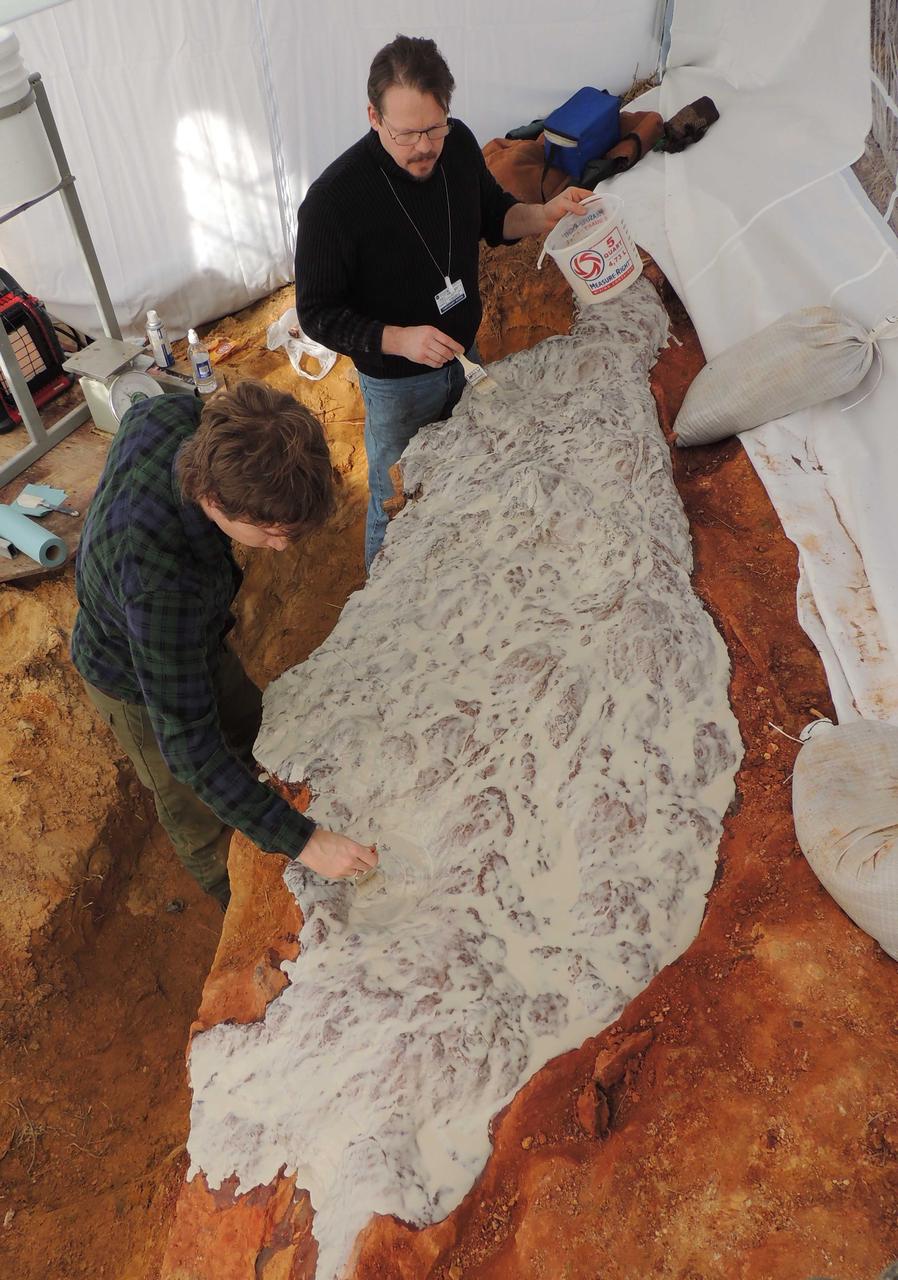
Michael Godfrey (left) and Perry Carsley (center) are coating the dinosaur footprints with a silicone rubber molding compound. A mold was made of the prints so that in addition to preserving the original rocky surface, cast replicas of the surface could also be made. Photo taken January 5, 2013. Image courtesy Stephen Godfrey <b><a href="http://www.nasa.gov/audience/formedia/features/MP_Photo_Guidelines.html" rel="nofollow">NASA image use policy.</a></b> <b><a href="http://www.nasa.gov/centers/goddard/home/index.html" rel="nofollow">NASA Goddard Space Flight Center</a></b> enables NASA’s mission through four scientific endeavors: Earth Science, Heliophysics, Solar System Exploration, and Astrophysics. Goddard plays a leading role in NASA’s accomplishments by contributing compelling scientific knowledge to advance the Agency’s mission. <b>Follow us on <a href="http://twitter.com/NASA_GoddardPix" rel="nofollow">Twitter</a></b> <b>Like us on <a href="http://www.facebook.com/pages/Greenbelt-MD/NASA-Goddard/395013845897?ref=tsd" rel="nofollow">Facebook</a></b> <b>Find us on <a href="http://instagram.com/nasagoddard?vm=grid" rel="nofollow">Instagram</a></b>

About 110 million light years away, the bright, barred spiral galaxy NGC3259 was just forming stars in dark bands of dust and gas. On Earth, a plant-eating dinosaur left footprints in the Cretaceous mud of what would later become the grounds of NASA’s Goddard Space Flight Center in Greenbelt, Md. <b>To read more go to: <a href="http://www.nasa.gov/centers/goddard/news/features/2012/nodosaur.html" rel="nofollow">www.nasa.gov/centers/goddard/news/features/2012/nodosaur....</a></b> Credit: NASA/Goddard/Rebecca Roth <b><a href="http://www.nasa.gov/audience/formedia/features/MP_Photo_Guidelines.html" rel="nofollow">NASA image use policy.</a></b> <b><a href="http://www.nasa.gov/centers/goddard/home/index.html" rel="nofollow">NASA Goddard Space Flight Center</a></b> enables NASA’s mission through four scientific endeavors: Earth Science, Heliophysics, Solar System Exploration, and Astrophysics. Goddard plays a leading role in NASA’s accomplishments by contributing compelling scientific knowledge to advance the Agency’s mission. <b>Follow us on <a href="http://twitter.com/NASA_GoddardPix" rel="nofollow">Twitter</a></b> <b>Like us on <a href="http://www.facebook.com/pages/Greenbelt-MD/NASA-Goddard/395013845897?ref=tsd" rel="nofollow">Facebook</a></b> <b>Find us on <a href="http://instagrid.me/nasagoddard/?vm=grid" rel="nofollow">Instagram</a></b>
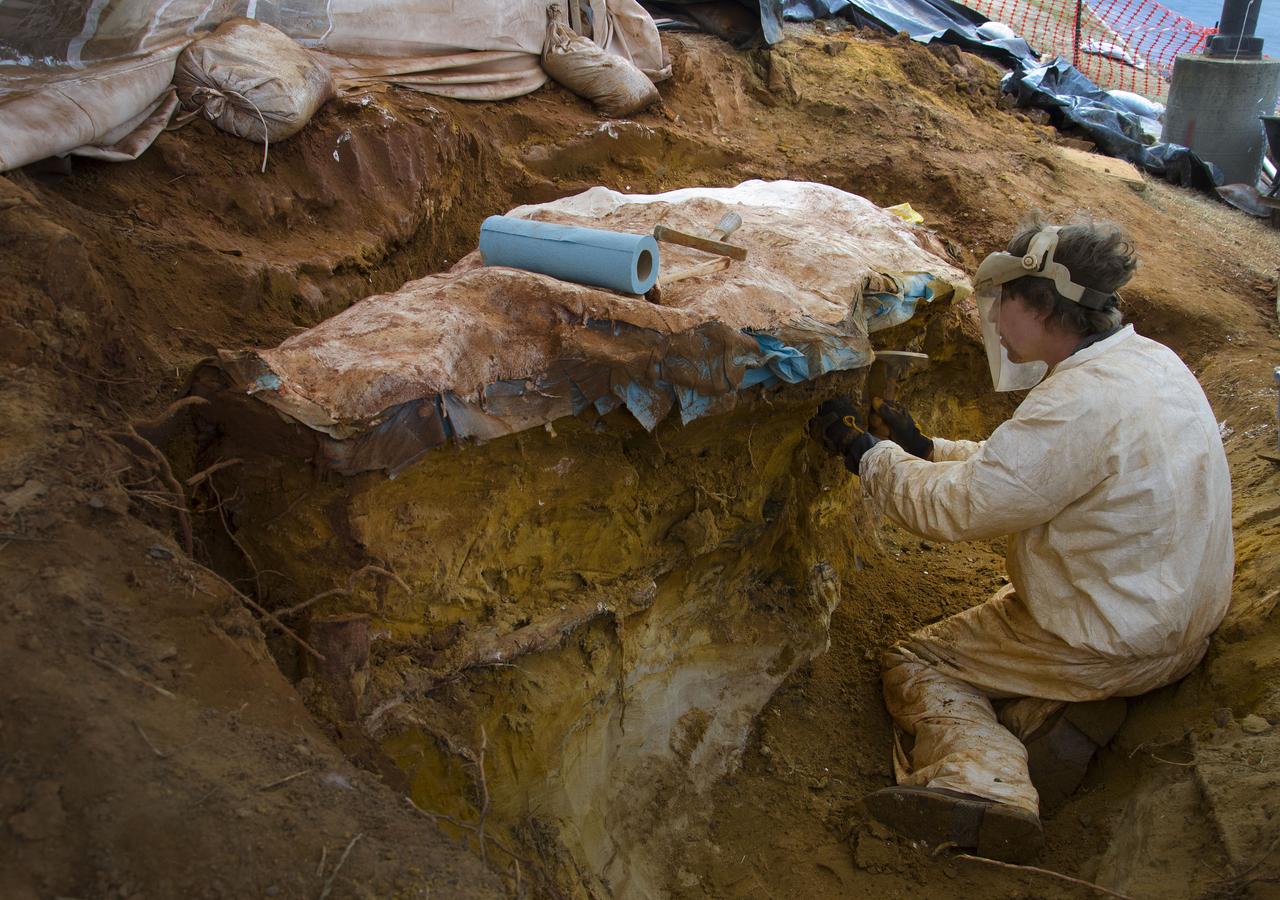
Seen here we have started to encase the dinosaur footprints in what is known as a field jacket. A field jacket is much like a cast that a doctor would place on a broken arm or leg. Our field jacket consisted of many layers of burlap soaked in plaster-of-Paris into which we also laminate metal pipes to act like splints for additional support. Here Michael is working to remove the very hard sandstone layer below the iron-rich clay layer in which the prints were preserved. Photo taken on January 7, 2013. Credit: NASA/GSFC/Rebecca Roth <b><a href="http://www.nasa.gov/audience/formedia/features/MP_Photo_Guidelines.html" rel="nofollow">NASA image use policy.</a></b> <b><a href="http://www.nasa.gov/centers/goddard/home/index.html" rel="nofollow">NASA Goddard Space Flight Center</a></b> enables NASA’s mission through four scientific endeavors: Earth Science, Heliophysics, Solar System Exploration, and Astrophysics. Goddard plays a leading role in NASA’s accomplishments by contributing compelling scientific knowledge to advance the Agency’s mission. <b>Follow us on <a href="http://twitter.com/NASA_GoddardPix" rel="nofollow">Twitter</a></b> <b>Like us on <a href="http://www.facebook.com/pages/Greenbelt-MD/NASA-Goddard/395013845897?ref=tsd" rel="nofollow">Facebook</a></b> <b>Find us on <a href="http://instagram.com/nasagoddard?vm=grid" rel="nofollow">Instagram</a></b>
About 110 million light years away, the bright, barred spiral galaxy NGC3259 was just forming stars in dark bands of dust and gas. On Earth, a plant-eating dinosaur left footprints in the Cretaceous mud of what would later become the grounds of NASA’s Goddard Space Flight Center in Greenbelt, Md. Local dinosaur hunter Ray Stanford speaks to local press and Goddard officials about this discovery. <b>To read more go to: <a href="http://www.nasa.gov/centers/goddard/news/features/2012/nodosaur.html" rel="nofollow">www.nasa.gov/centers/goddard/news/features/2012/nodosaur....</a></b> Credit: NASA/Goddard/Rebecca Roth <b><a href="http://www.nasa.gov/audience/formedia/features/MP_Photo_Guidelines.html" rel="nofollow">NASA image use policy.</a></b> <b><a href="http://www.nasa.gov/centers/goddard/home/index.html" rel="nofollow">NASA Goddard Space Flight Center</a></b> enables NASA’s mission through four scientific endeavors: Earth Science, Heliophysics, Solar System Exploration, and Astrophysics. Goddard plays a leading role in NASA’s accomplishments by contributing compelling scientific knowledge to advance the Agency’s mission. <b>Follow us on <a href="http://twitter.com/NASA_GoddardPix" rel="nofollow">Twitter</a></b> <b>Like us on <a href="http://www.facebook.com/pages/Greenbelt-MD/NASA-Goddard/395013845897?ref=tsd" rel="nofollow">Facebook</a></b> <b>Find us on <a href="http://instagrid.me/nasagoddard/?vm=grid" rel="nofollow">Instagram</a></b>
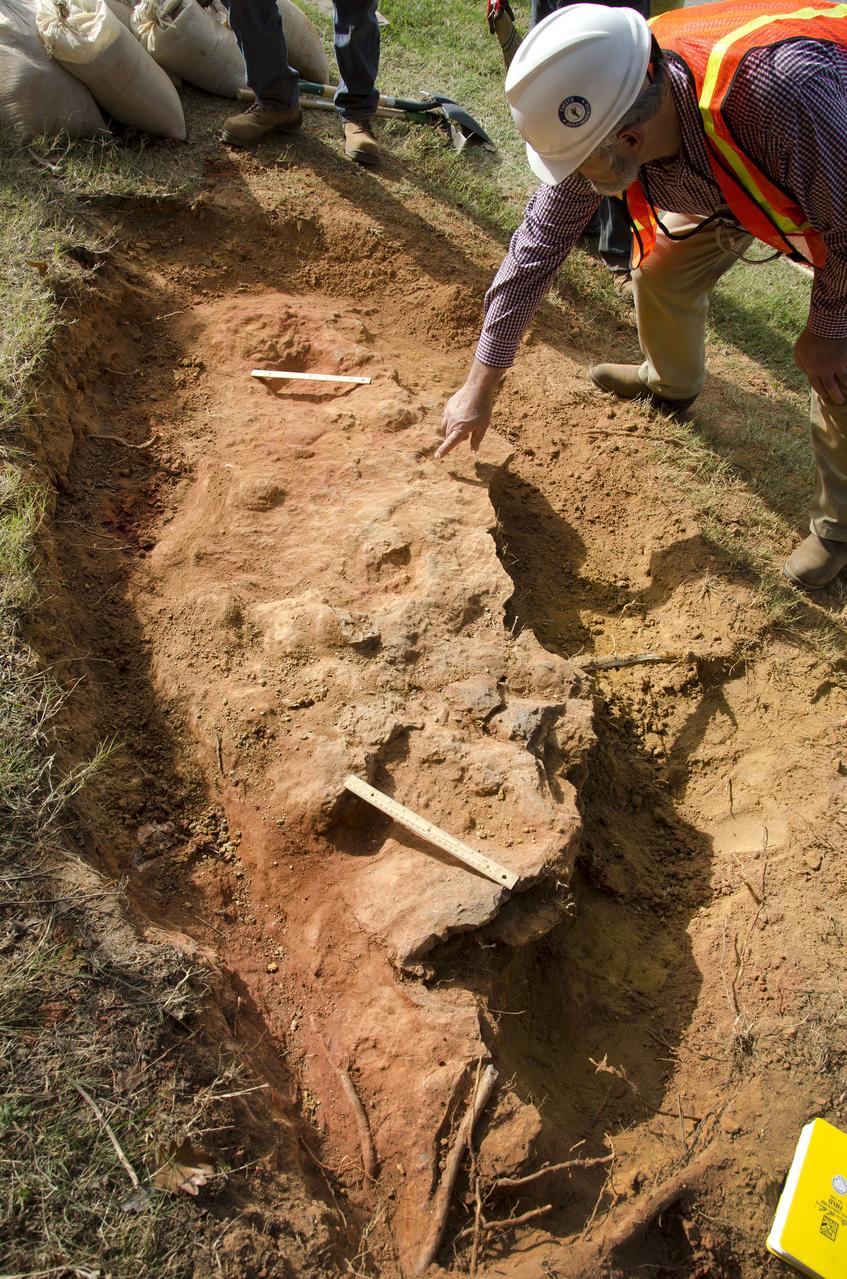
Goddard's consultant paleontologist Dr. Lee Monnens verified the track and discovered additional footprints hiding under a thin layer of topsoil in the same rock layer on October 23, 2012. Credit: NASA/Goddard/Rebecca Roth <b><a href="http://www.nasa.gov/audience/formedia/features/MP_Photo_Guidelines.html" rel="nofollow">NASA image use policy.</a></b> <b><a href="http://www.nasa.gov/centers/goddard/home/index.html" rel="nofollow">NASA Goddard Space Flight Center</a></b> enables NASA’s mission through four scientific endeavors: Earth Science, Heliophysics, Solar System Exploration, and Astrophysics. Goddard plays a leading role in NASA’s accomplishments by contributing compelling scientific knowledge to advance the Agency’s mission. <b>Follow us on <a href="http://twitter.com/NASA_GoddardPix" rel="nofollow">Twitter</a></b> <b>Like us on <a href="http://www.facebook.com/pages/Greenbelt-MD/NASA-Goddard/395013845897?ref=tsd" rel="nofollow">Facebook</a></b> <b>Find us on <a href="http://instagram.com/nasagoddard?vm=grid" rel="nofollow">Instagram</a></b>
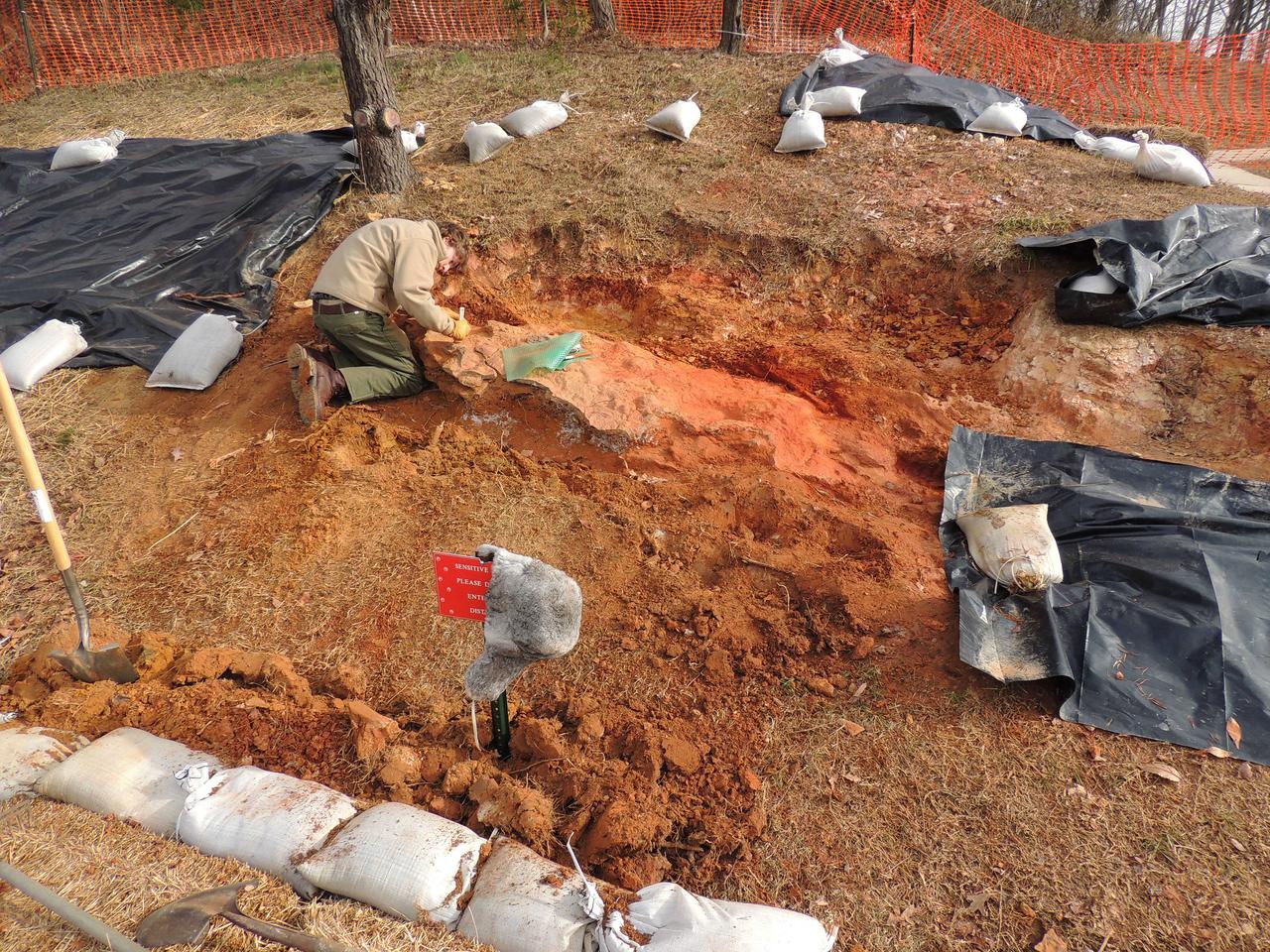
Michael Godfrey beginning the process of quarrying down around the footprint bearing layer. Photo taken December 31, 2012. Image courtesy Stephen Godfrey <b><a href="http://www.nasa.gov/audience/formedia/features/MP_Photo_Guidelines.html" rel="nofollow">NASA image use policy.</a></b> <b><a href="http://www.nasa.gov/centers/goddard/home/index.html" rel="nofollow">NASA Goddard Space Flight Center</a></b> enables NASA’s mission through four scientific endeavors: Earth Science, Heliophysics, Solar System Exploration, and Astrophysics. Goddard plays a leading role in NASA’s accomplishments by contributing compelling scientific knowledge to advance the Agency’s mission. <b>Follow us on <a href="http://twitter.com/NASA_GoddardPix" rel="nofollow">Twitter</a></b> <b>Like us on <a href="http://www.facebook.com/pages/Greenbelt-MD/NASA-Goddard/395013845897?ref=tsd" rel="nofollow">Facebook</a></b> <b>Find us on <a href="http://instagram.com/nasagoddard?vm=grid" rel="nofollow">Instagram</a></b>
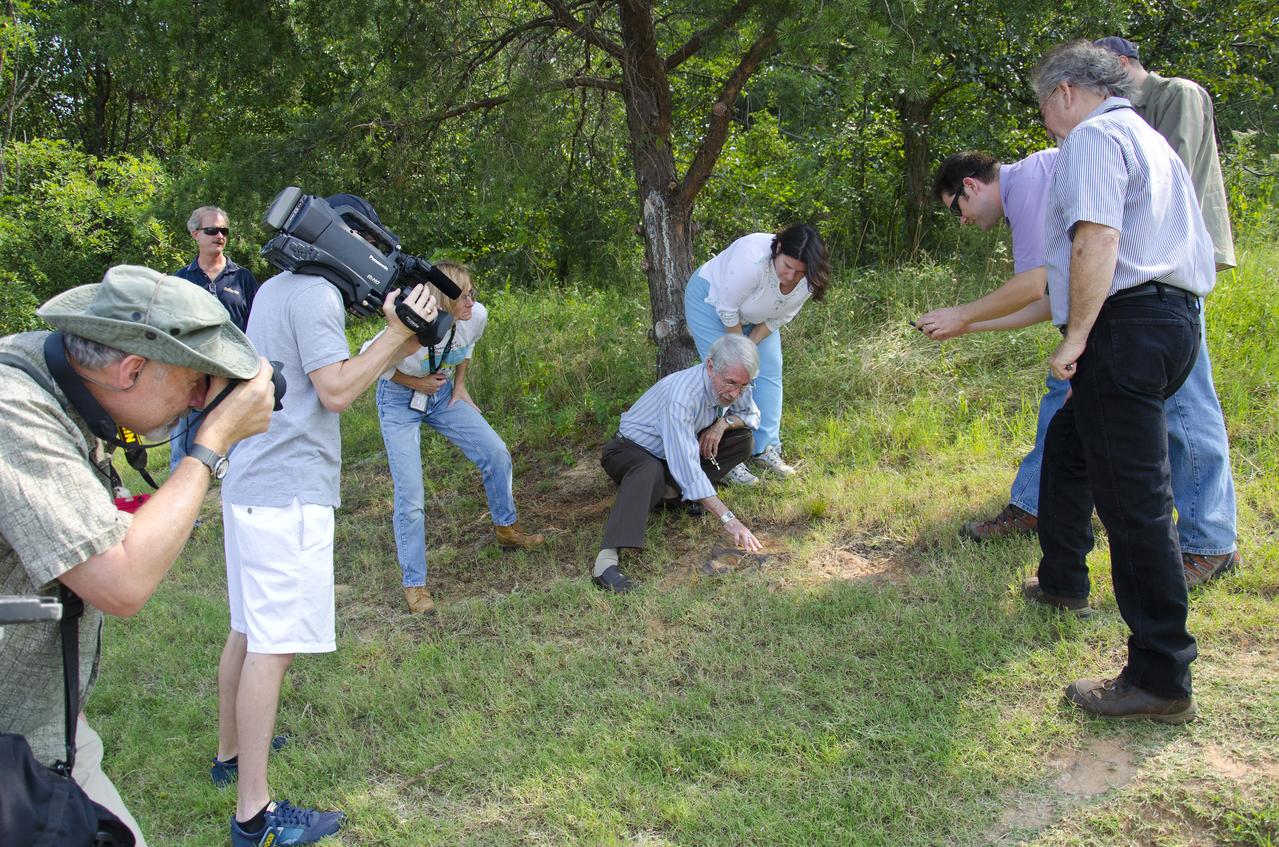
About 110 million light years away, the bright, barred spiral galaxy NGC3259 was just forming stars in dark bands of dust and gas. On Earth, a plant-eating dinosaur left footprints in the Cretaceous mud of what would later become the grounds of NASA’s Goddard Space Flight Center in Greenbelt, Md. Local dinosaur hunter Ray Stanford points out the impression to Goddard officials and members of local media. <b>To read more go to: <a href="http://www.nasa.gov/centers/goddard/news/features/2012/nodosaur.html" rel="nofollow">www.nasa.gov/centers/goddard/news/features/2012/nodosaur....</a></b> Credit: NASA/Goddard/Rebecca Roth <b><a href="http://www.nasa.gov/audience/formedia/features/MP_Photo_Guidelines.html" rel="nofollow">NASA image use policy.</a></b> <b><a href="http://www.nasa.gov/centers/goddard/home/index.html" rel="nofollow">NASA Goddard Space Flight Center</a></b> enables NASA’s mission through four scientific endeavors: Earth Science, Heliophysics, Solar System Exploration, and Astrophysics. Goddard plays a leading role in NASA’s accomplishments by contributing compelling scientific knowledge to advance the Agency’s mission. <b>Follow us on <a href="http://twitter.com/NASA_GoddardPix" rel="nofollow">Twitter</a></b> <b>Like us on <a href="http://www.facebook.com/pages/Greenbelt-MD/NASA-Goddard/395013845897?ref=tsd" rel="nofollow">Facebook</a></b> <b>Find us on <a href="http://instagrid.me/nasagoddard/?vm=grid" rel="nofollow">Instagram</a></b>
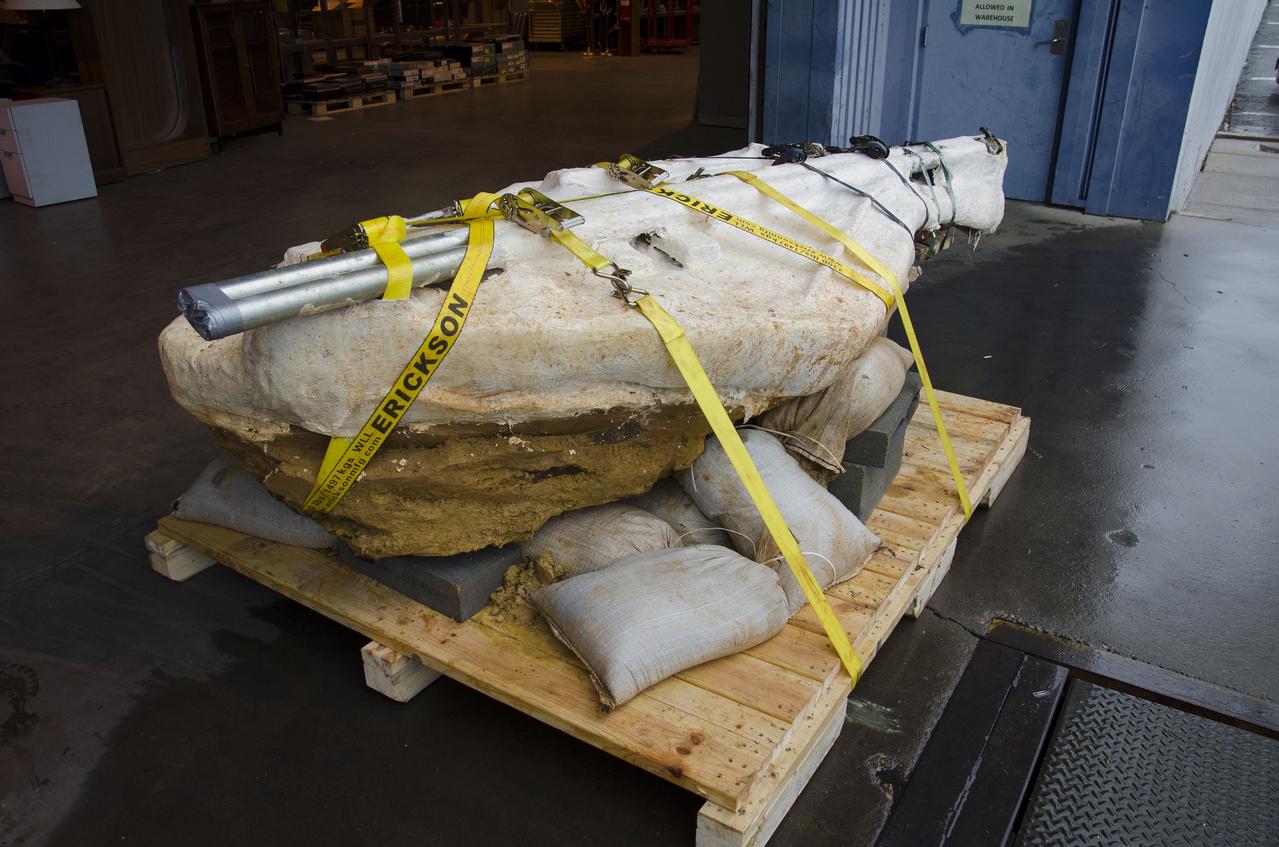
The entire find, containing at least three dinosaur footprints, is approximately seven feet long and three feet across at its widest point. Additionally, the footprint-rich layer is bonded to a separate layer of iron-rich sandstone that complicated the efforts to extract and preserve it. Before removing the rock layer, Godfrey made a silicon-rubber cast of the prints, then jacketed the entire find in multiple layers of plaster-soaked burlap (i.e. just like a cast) to add rigidity and to further ward against breakage during transport. Galvanized steel pipes wrapped into the jacket acted like splints to provide additional structural support. The combined weight of the footprint, field jacket material and surrounding soil that was removed was estimated to be approximately 3,000 pounds, so extra care was taken in moving it to avoid damaging the rather extraordinary find. Credit: NASA/GSFC/Rebecca Roth <b><a href="http://www.nasa.gov/audience/formedia/features/MP_Photo_Guidelines.html" rel="nofollow">NASA image use policy.</a></b> <b><a href="http://www.nasa.gov/centers/goddard/home/index.html" rel="nofollow">NASA Goddard Space Flight Center</a></b> enables NASA’s mission through four scientific endeavors: Earth Science, Heliophysics, Solar System Exploration, and Astrophysics. Goddard plays a leading role in NASA’s accomplishments by contributing compelling scientific knowledge to advance the Agency’s mission. <b>Follow us on <a href="http://twitter.com/NASA_GoddardPix" rel="nofollow">Twitter</a></b> <b>Like us on <a href="http://www.facebook.com/pages/Greenbelt-MD/NASA-Goddard/395013845897?ref=tsd" rel="nofollow">Facebook</a></b> <b>Find us on <a href="http://instagram.com/nasagoddard?vm=grid" rel="nofollow">Instagram</a></b>
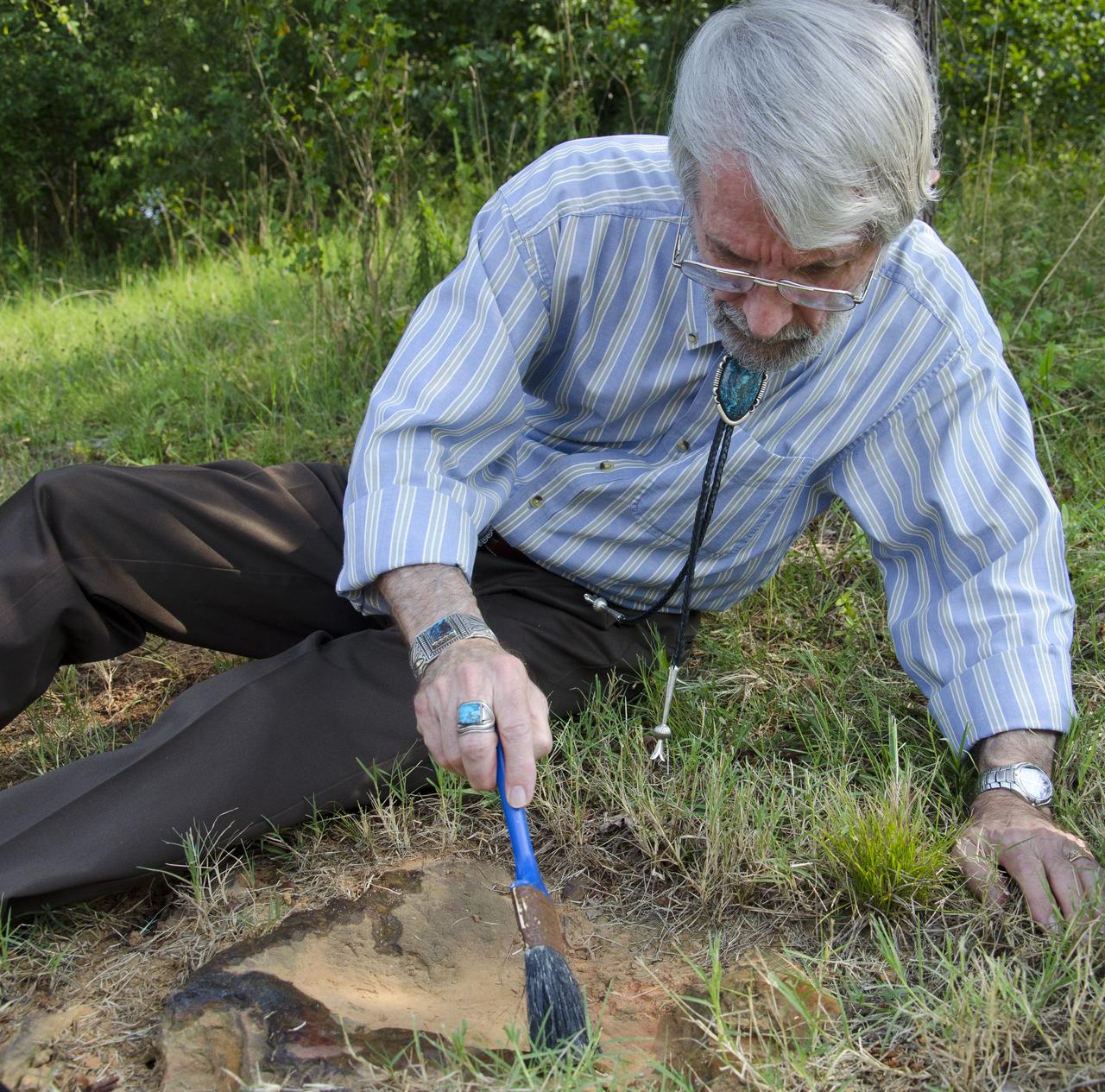
About 110 million light years away, the bright, barred spiral galaxy NGC3259 was just forming stars in dark bands of dust and gas. On Earth, a plant-eating dinosaur left footprints in the Cretaceous mud of what would later become the grounds of NASA’s Goddard Space Flight Center in Greenbelt, Md. Local dinosaur hunter Ray Stanford points out the impression to Goddard officials and members of local media. <b>To read more go to: <a href="http://www.nasa.gov/centers/goddard/news/features/2012/nodosaur.html" rel="nofollow">www.nasa.gov/centers/goddard/news/features/2012/nodosaur....</a></b> Credit: NASA/Goddard/Rebecca Roth <b><a href="http://www.nasa.gov/audience/formedia/features/MP_Photo_Guidelines.html" rel="nofollow">NASA image use policy.</a></b> <b><a href="http://www.nasa.gov/centers/goddard/home/index.html" rel="nofollow">NASA Goddard Space Flight Center</a></b> enables NASA’s mission through four scientific endeavors: Earth Science, Heliophysics, Solar System Exploration, and Astrophysics. Goddard plays a leading role in NASA’s accomplishments by contributing compelling scientific knowledge to advance the Agency’s mission. <b>Follow us on <a href="http://twitter.com/NASA_GoddardPix" rel="nofollow">Twitter</a></b> <b>Like us on <a href="http://www.facebook.com/pages/Greenbelt-MD/NASA-Goddard/395013845897?ref=tsd" rel="nofollow">Facebook</a></b> <b>Find us on <a href="http://instagrid.me/nasagoddard/?vm=grid" rel="nofollow">Instagram</a></b>
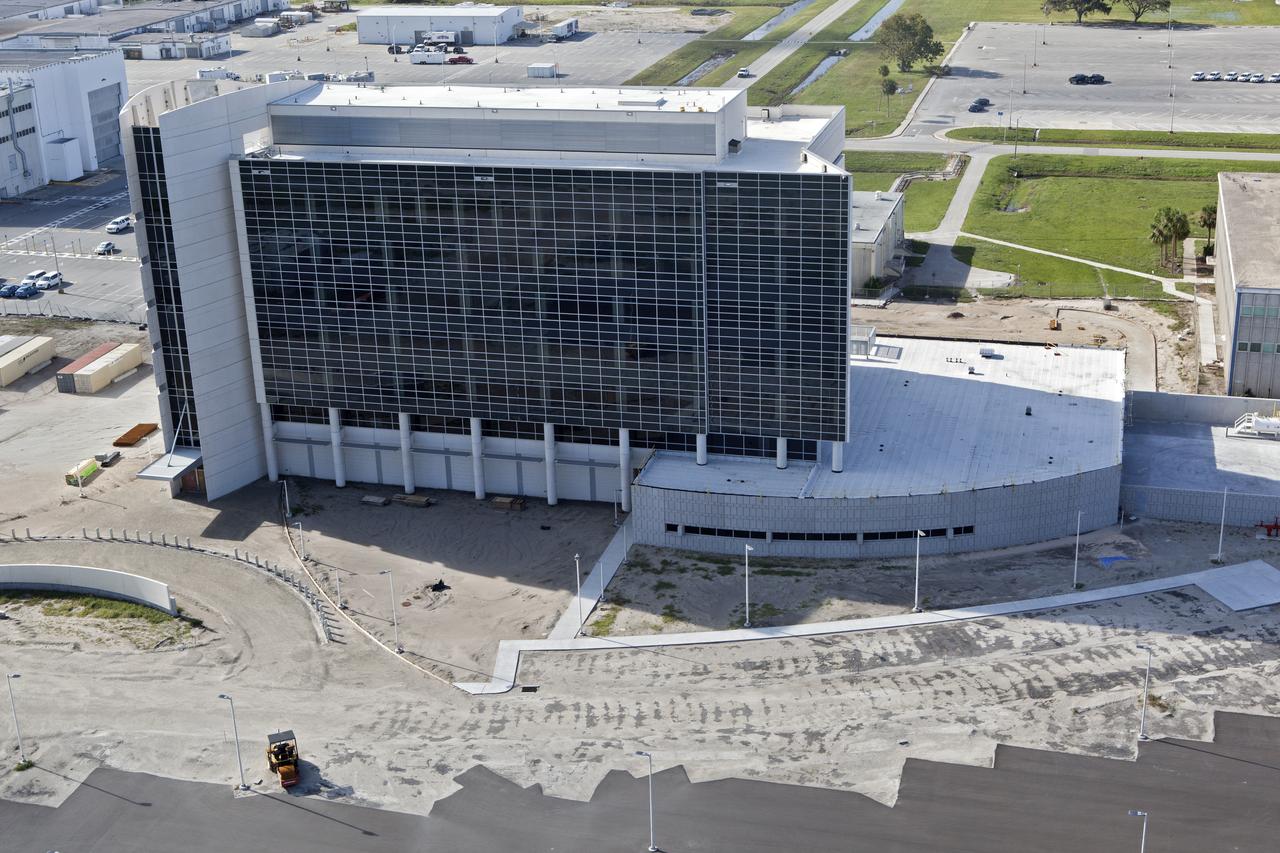
The Central Campus construction site is seen during an aerial survey of NASA's Kennedy Space Center in Florida on September 12, 2017. The survey was performed to identify structures and facilities that may have sustained damage from Hurricane Irma as the storm passed Kennedy on September 10, 2017. NASA closed the center ahead of the storm’s onset and only a small team of specialists known as the Rideout Team was on the center as the storm approached and passed.
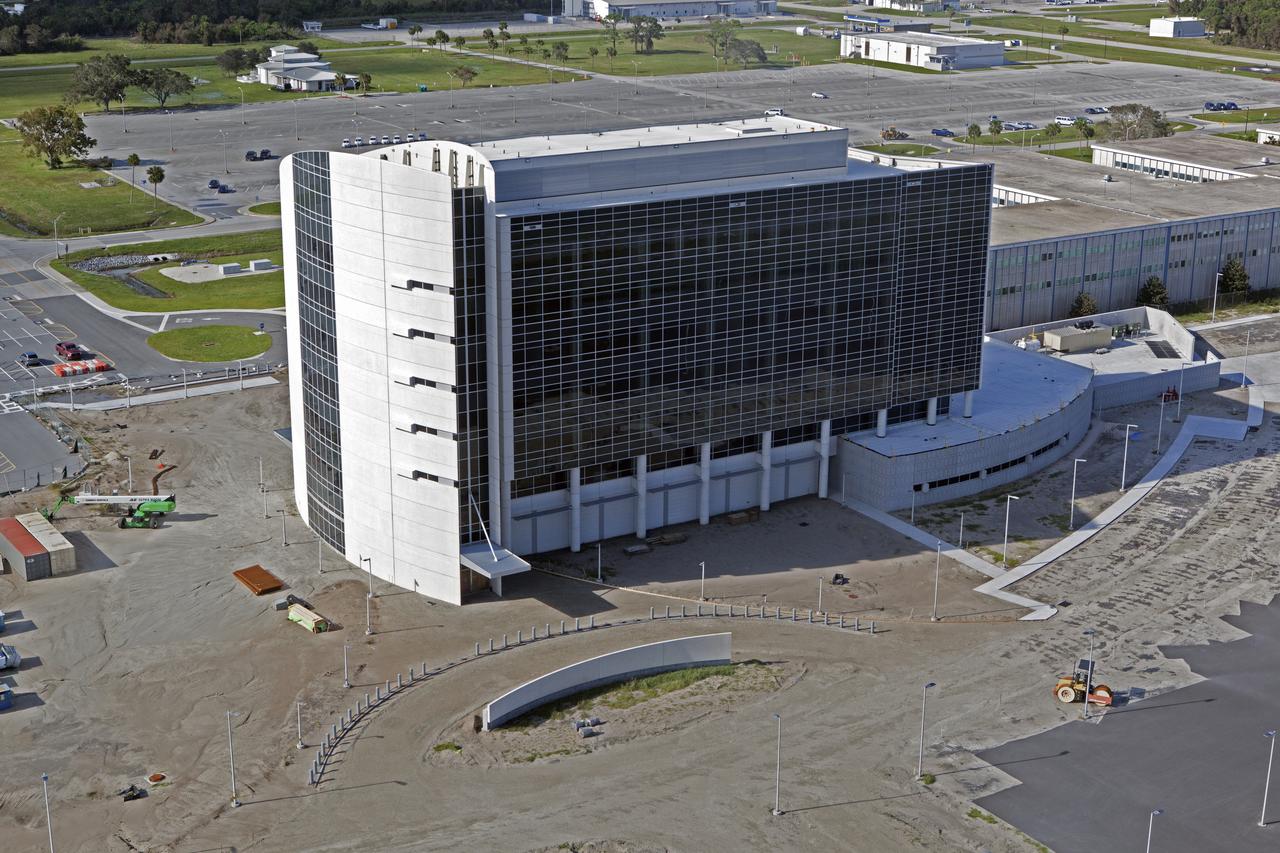
The Central Campus construction site is seen during an aerial survey of NASA's Kennedy Space Center in Florida on September 12, 2017. The survey was performed to identify structures and facilities that may have sustained damage from Hurricane Irma as the storm passed Kennedy on September 10, 2017. NASA closed the center ahead of the storm’s onset and only a small team of specialists known as the Rideout Team was on the center as the storm approached and passed.
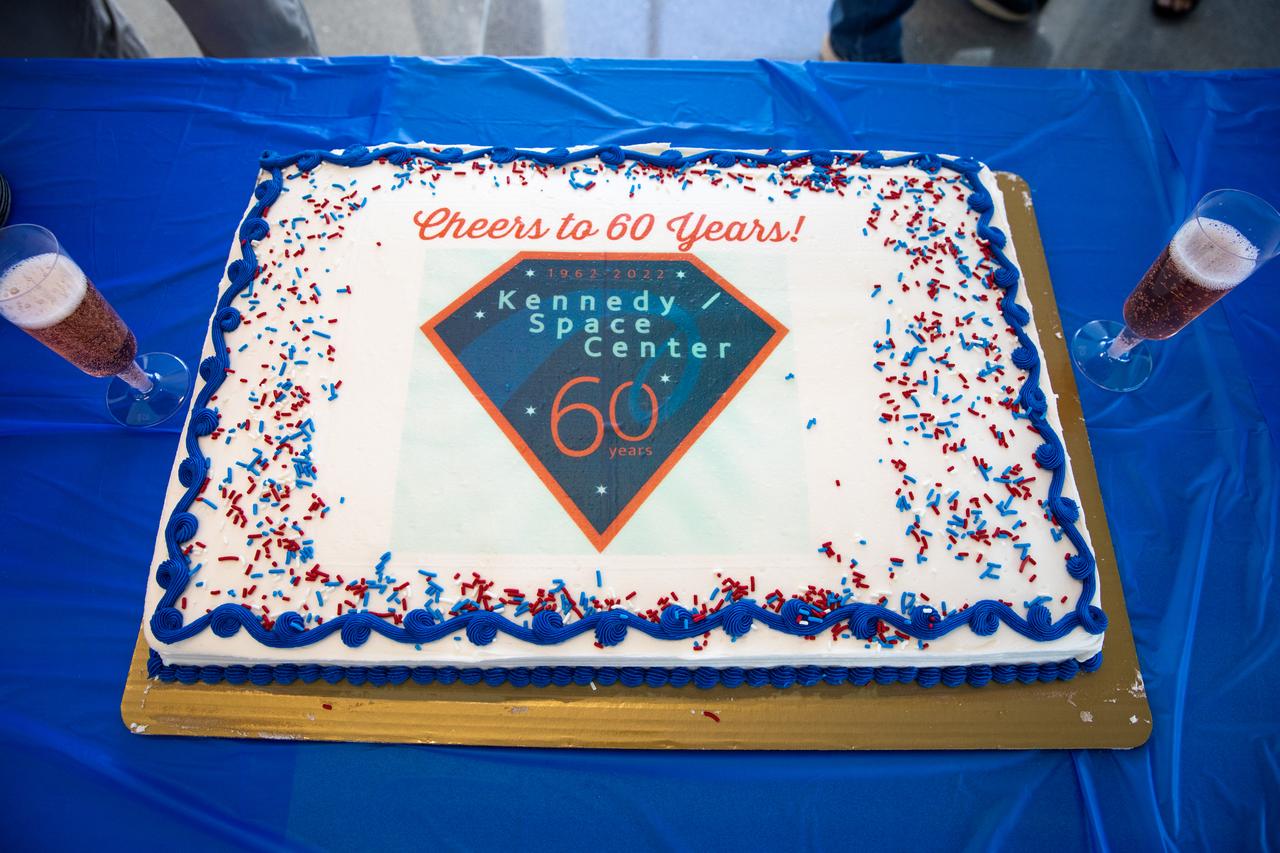
The NASA Kennedy Space Center senior leaders and employees celebrated the center’s 60th anniversary with a “Cheers to 60 Years” cake and non-alcoholic toast in the Central Campus Headquarters on June 28, 2022. In July 1962, the Launch Operations Center in Florida was established. By December 1963, it was renamed the John F. Kennedy Space Center.
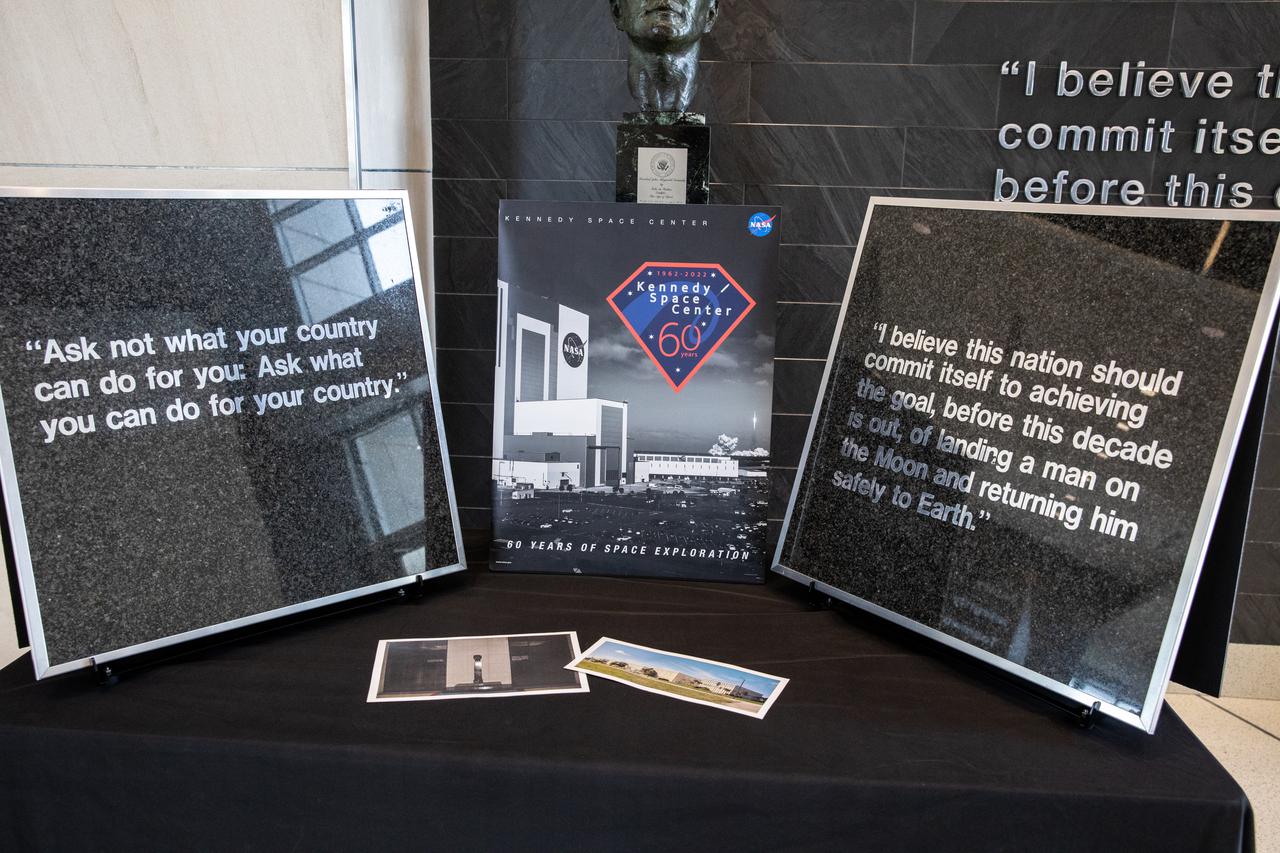
Wall tiles from Kennedy Space Center’s former headquarters building are presented to Kennedy Director Janet Petro inside the Florida spaceport’s Central Campus Headquarters Building on May 3, 2022. The two 15-pound sections from the building were preserved by Maverick Constructors LLC, the construction company that completed demolition of the structure. The company’s presentation of the tiles is in honor of the many civil servants and contractors who dedicated their lives to working for and supporting NASA in this building.

Senior managers at NASA’s Kennedy Space Center pose inside the Florida spaceport’s Central Campus Headquarters building on Feb. 24, 2020, in recognition of Women’s History Month. Pictured are: Hortense Diggs, Susan Kroskey, Janet Petro, Charlie Blackwell-Thompson, Vicki Johnston, Maria Collura, Jeanne O’Bryan, Vanessa Stromer, Kim Carter, Laura Rochester, Becky Murray, Jennifer Kunz, Barbara Brown, Kathy Loftin, Jenny Lyons, Dana Hutcherson and Dicksy Chrostowski.