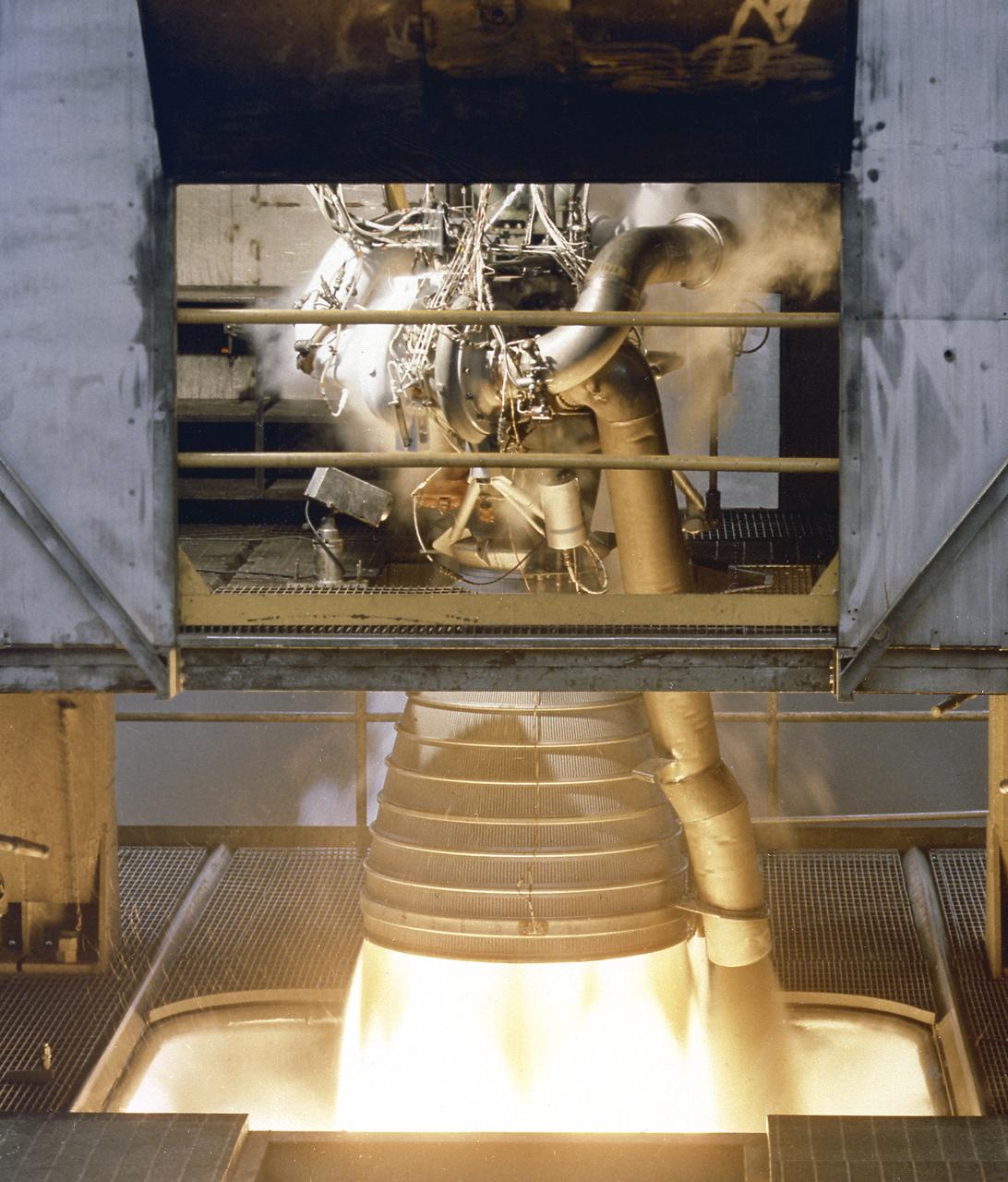
A close-up image of the single H-1 engine was test-fired at Canoga Park, California. Initial development of testing for the H-1 engine took place in the engineering facilities at Rocketdyne's main plant in Canoga Park, California.
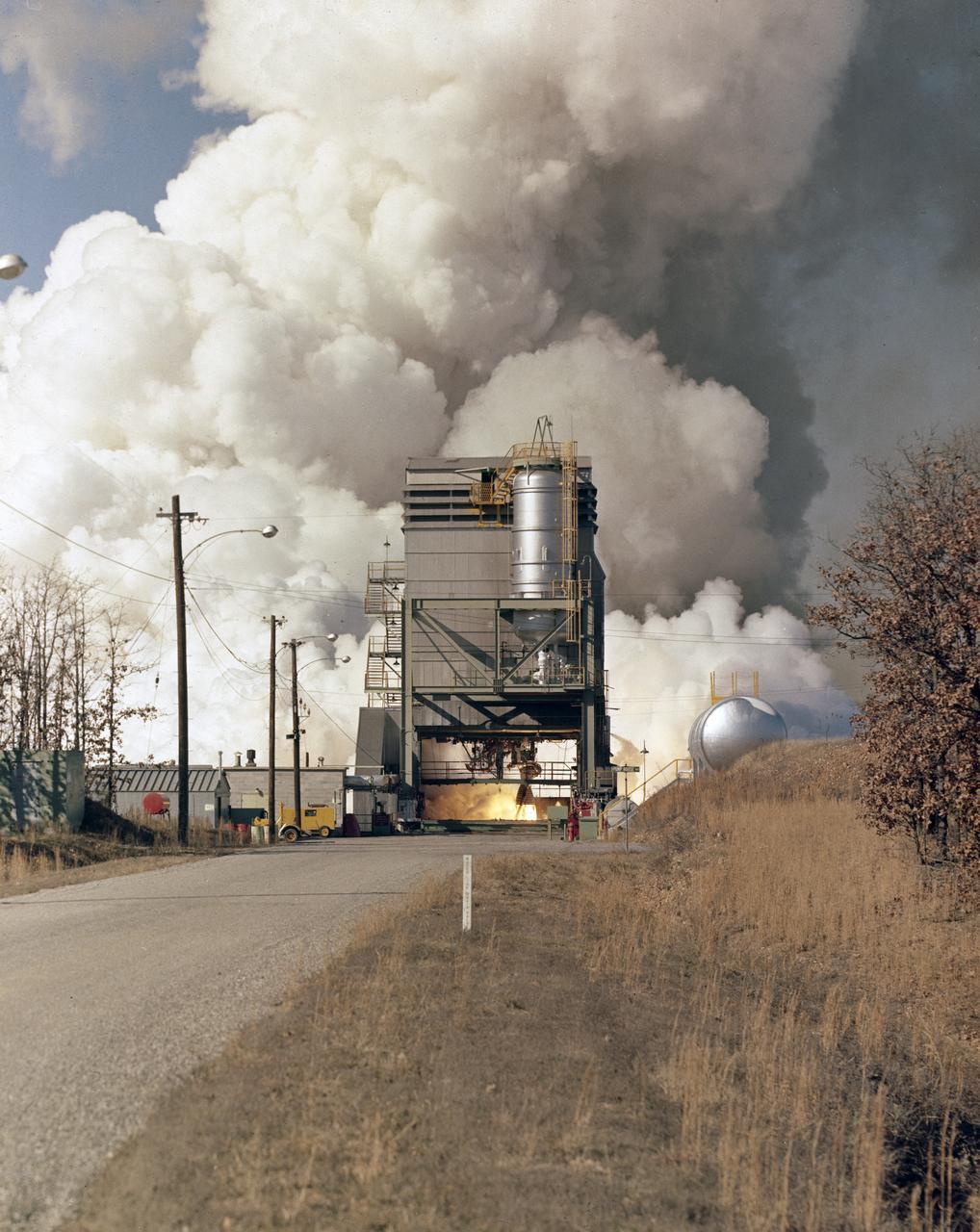
In this photograph, the single H-1 engine was test-fired at Canoga Park, California. Initial development of testing for the H-1 engine took place in the engineering facilities at Rocketdyne's main plant in Canoga Park, California.
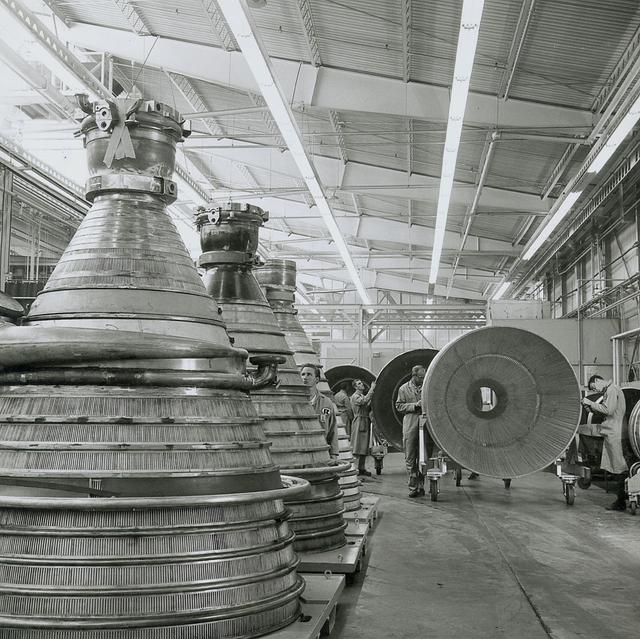
J-2 engines for the Saturn IB/Saturn V launch vehicles are lined up in the assembly area at Rocketdyne's manufacturing plant in Canoga Park, California. Five J-2 engines provided more than 1,000,000 pounds of thrust to accelerate the second stage toward a Moon trajectory.
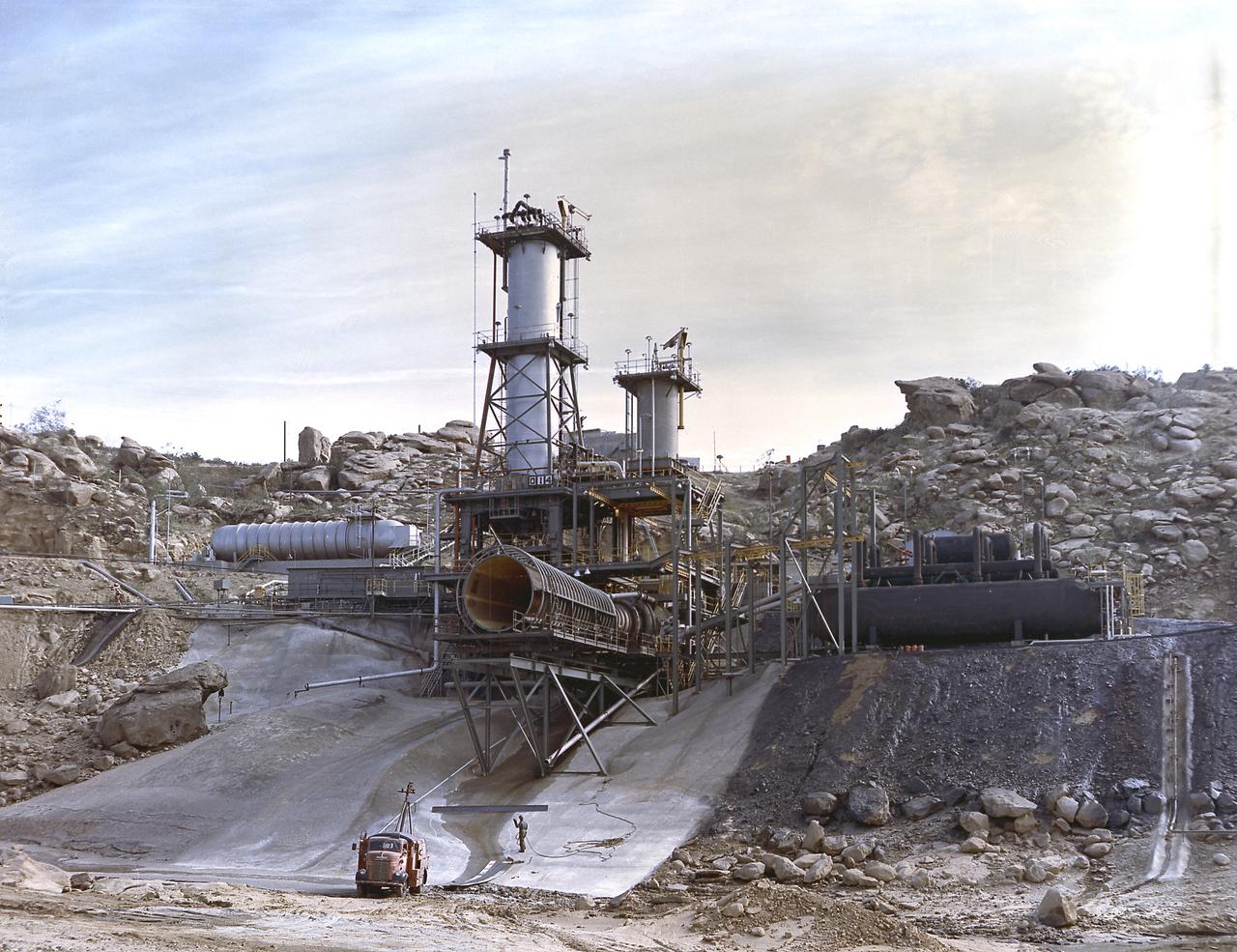
This image depicts an overall view of the vertical test stand for testing the J-2 engine at Rocketdyne's Propulsion Field Laboratory, in the Santa Susana Mountains, near Canoga Park, California. The J-2 engines were assembled and tested at Rocketdyne under the direction of the Marshall Space Flight Center.

KENNEDY SPACE CENTER, FLA. - In the Orbiter Processing Facility bay 1, the main engine is in place on Discovery. The main engine configuration is manufactured by Boeing Rocketdyne in Canoga Park, Calif., and includes a Pratt & Whitney high-pressure fuel turbo pump. Each space shuttle main engine is 14 feet (4.3 meters) long, weighs about 6,700 pounds (3,039 kilograms), and is 7.5 feet (2.3 meters) in diameter at the end of the nozzle. Discovery is being processed for the second return-to-flight mission STS-121.
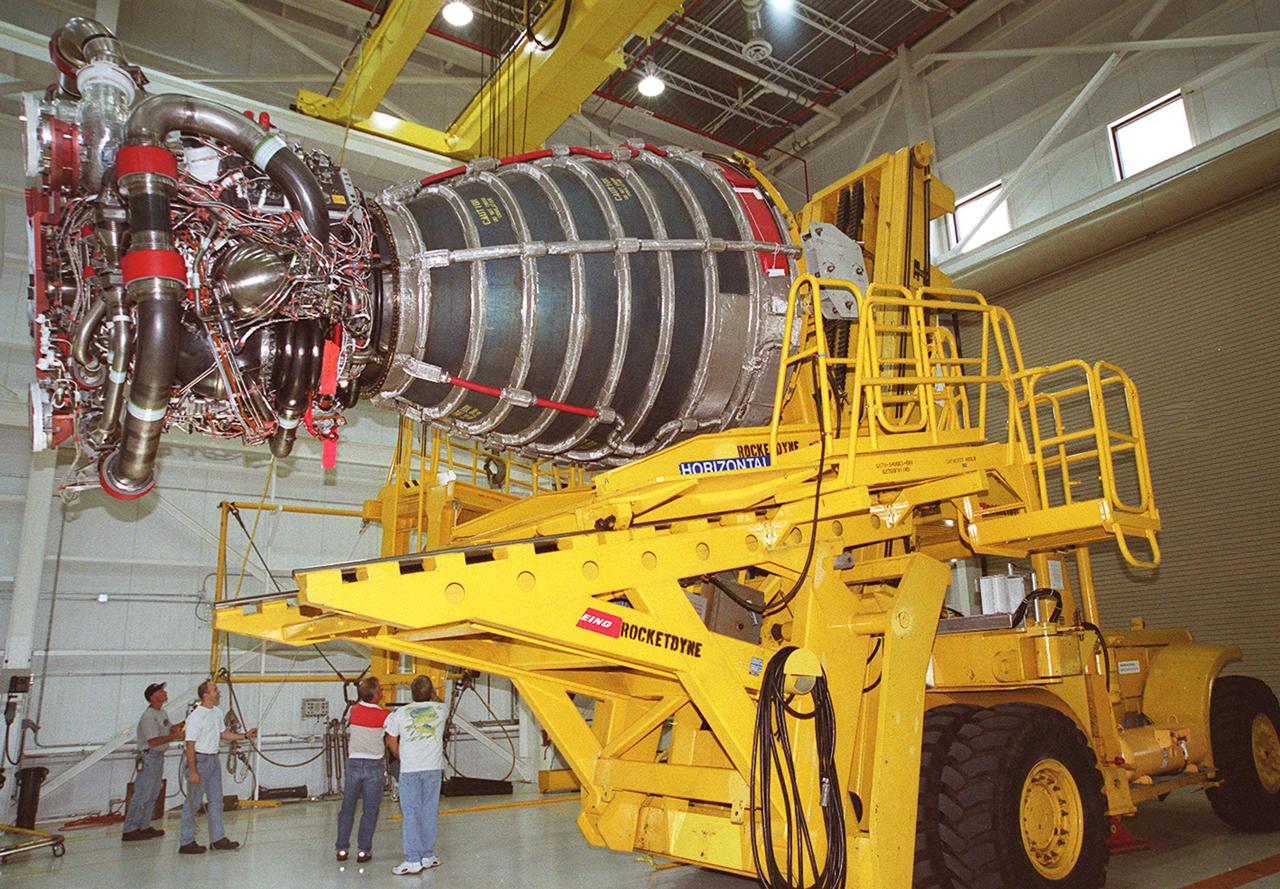
KENNEDY SPACE CENTER, FLA. -- A new block 2 engine is ready for its move to Orbiter Processing Facility bay 3. There it will be installed on the orbiter Atlantis, on mission STS-104, for its first flight. The Block II Main Engine configuration is manufactured by Boeing Rocketdyne in Canoga Park, Calif., and includes a new Pratt and Whitney high-pressure fuel turbo pump. Engine improvements are managed by NASA’s Marshall Space Flight Center in Huntsville, Ala. Each Space Shuttle Main Engine is 14 feet (4.3 meters) long, weighs about 7,000 pounds (3,175 kilograms), and is 7.5 feet (2.3 meters) in diameter at the end of the nozzle
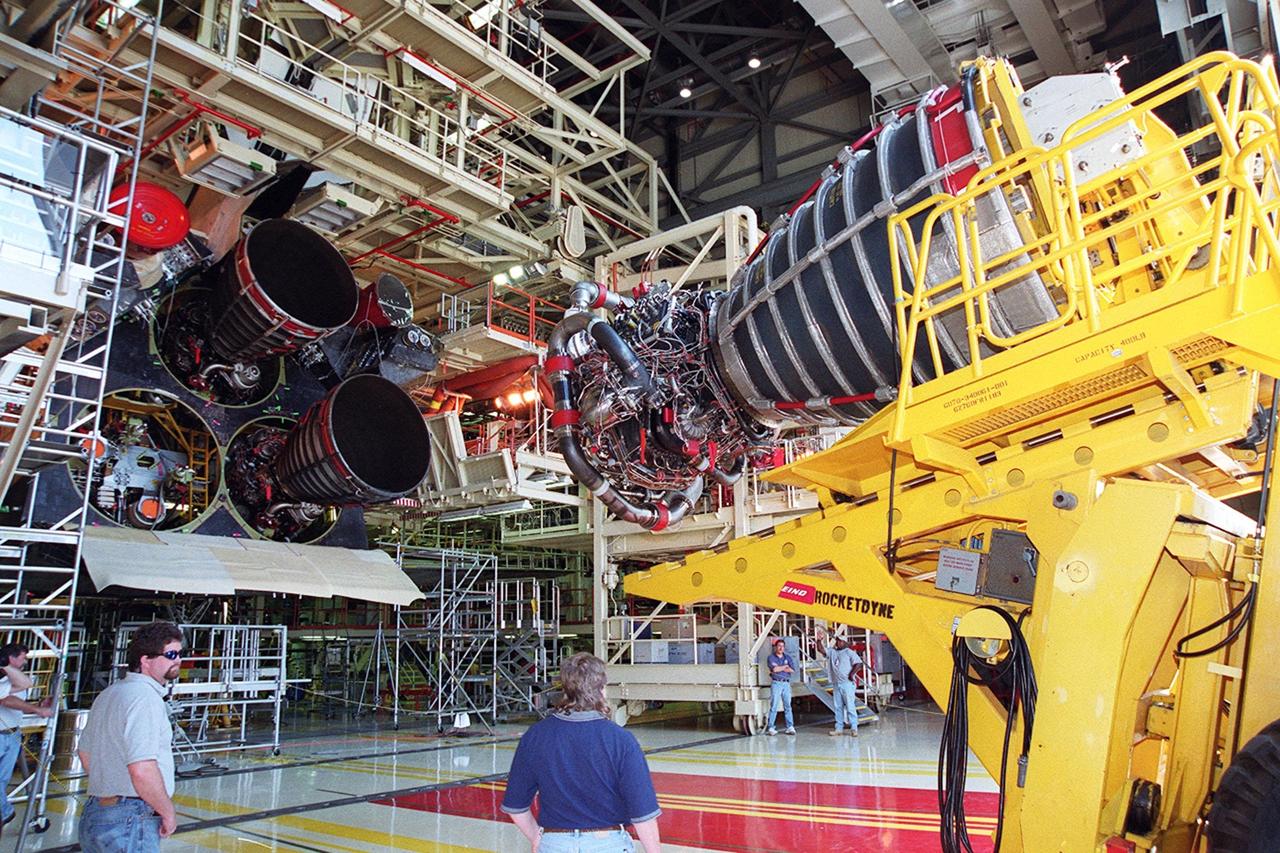
KENNEDY SPACE CENTER, FLA. -- A new block 2 engine heads toward Atlantis in Orbiter Processing Facility bay 3. There the new engine will be installed for its first flight on Atlantis, for mission STS-104. The Block II Main Engine configuration is manufactured by Boeing Rocketdyne in Canoga Park, Calif., and includes a new Pratt & Whitney high-pressure fuel turbo pump. Engine improvements are managed by NASA’s Marshall Space Flight Center in Huntsville, Ala. Each Space Shuttle Main Engine is 14 feet (4.3 meters) long, weighs about 7,000 pounds (3,175 kilograms), and is 7.5 feet (2.3 meters) in diameter at the end of the nozzle
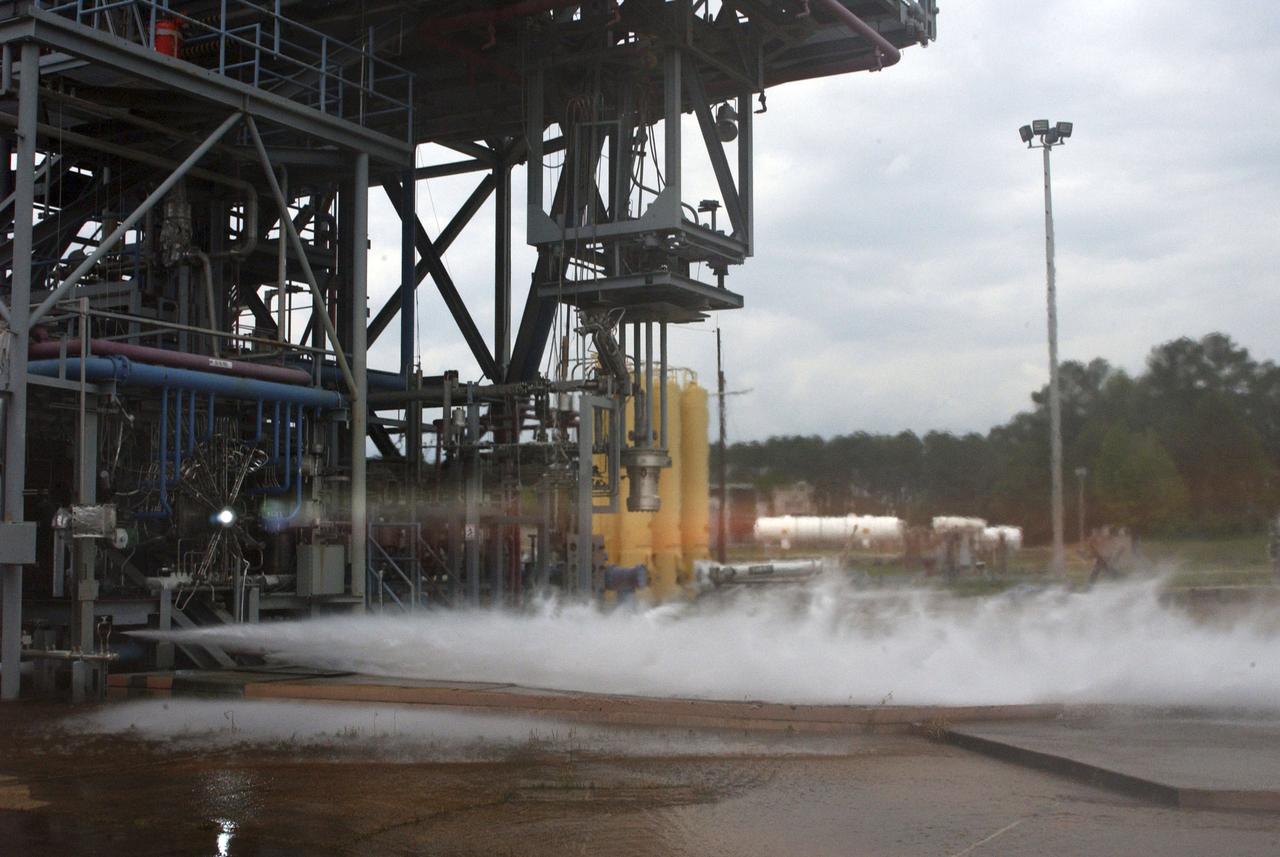
Chosen to power the upper stages of the new Ares I Crew Launch Vehicle (CLV) and the Ares V cargo segment, the J-2X engine is a stepped up version of the hydrogen/oxygen-fuelled Apollo-era J-2 engine. It was developed for NASA by Pratt & Whitney Rocketdyne (PWR), a business unit of United Technologies Corporation of Canoga Park, California. As seen in this photograph, the engine underwent a series of hot fire tests, performed on sub scale main injector hardware in the Test Stand 116 at Marshall Space Flight Center (MSFC). The injector is a major component of the engine that injects and mixes propellants in the combustion chamber, where they are ignited and burned to produce thrust.
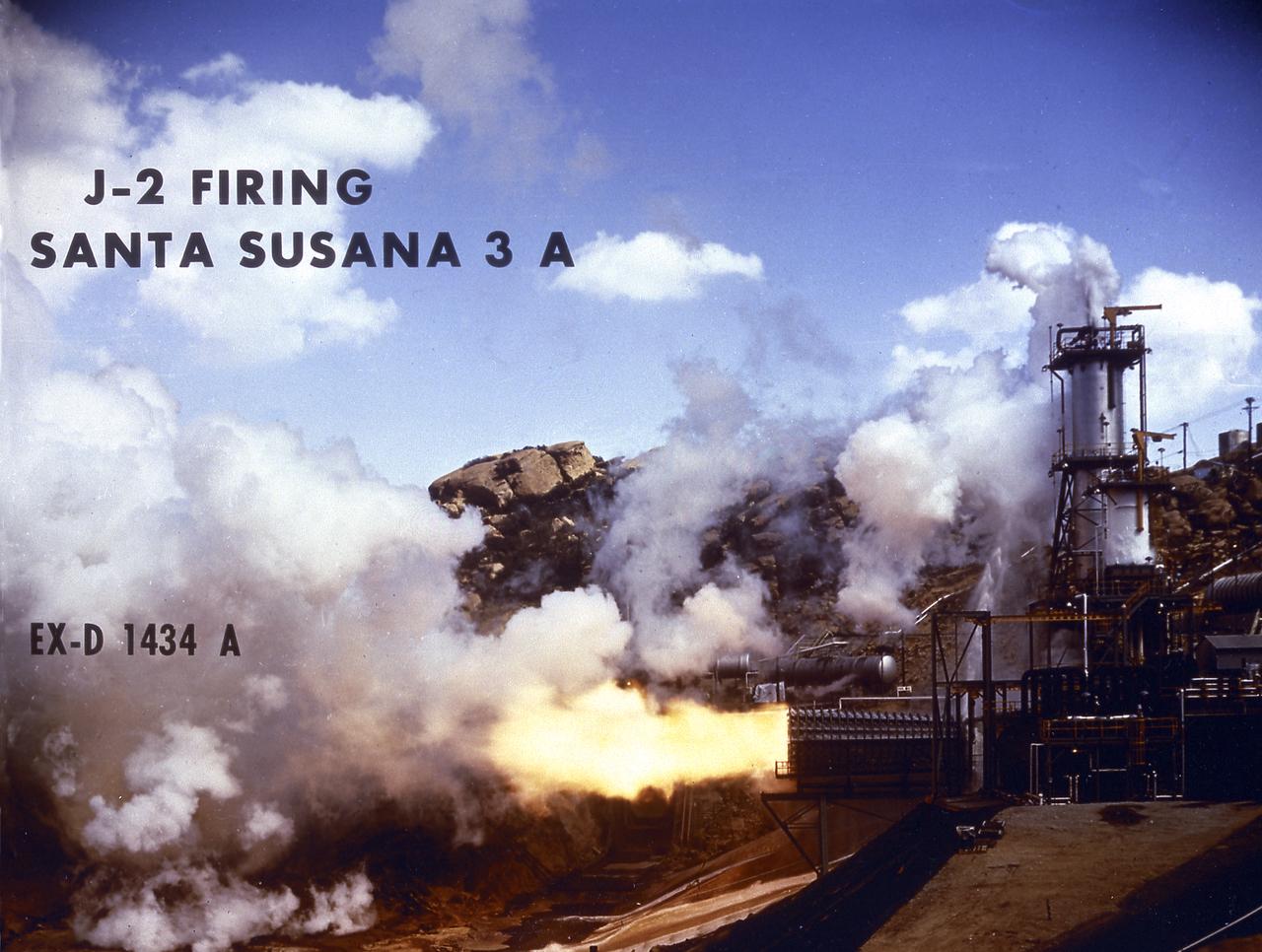
Smokeless flame juts from the diffuser of a unique vacuum chamber in which the upper stage rocket engine, the hydrogen fueled J-2, was tested at a simulated space altitude in excess of 60,000 feet. The smoke you see is actually steam. In operation, vacuum is established by injecting steam into the chamber and is maintained by the thrust of the engine firing through the diffuser. The engine was tested in this environment for start, stop, coast, restart, and full-duration operations. The chamber was located at Rocketdyne's Propulsion Field Laboratory, in the Santa Susana Mountains, near Canoga Park, California. The J-2 engine was developed by Rocketdyne for the Marshall Space Flight Center.
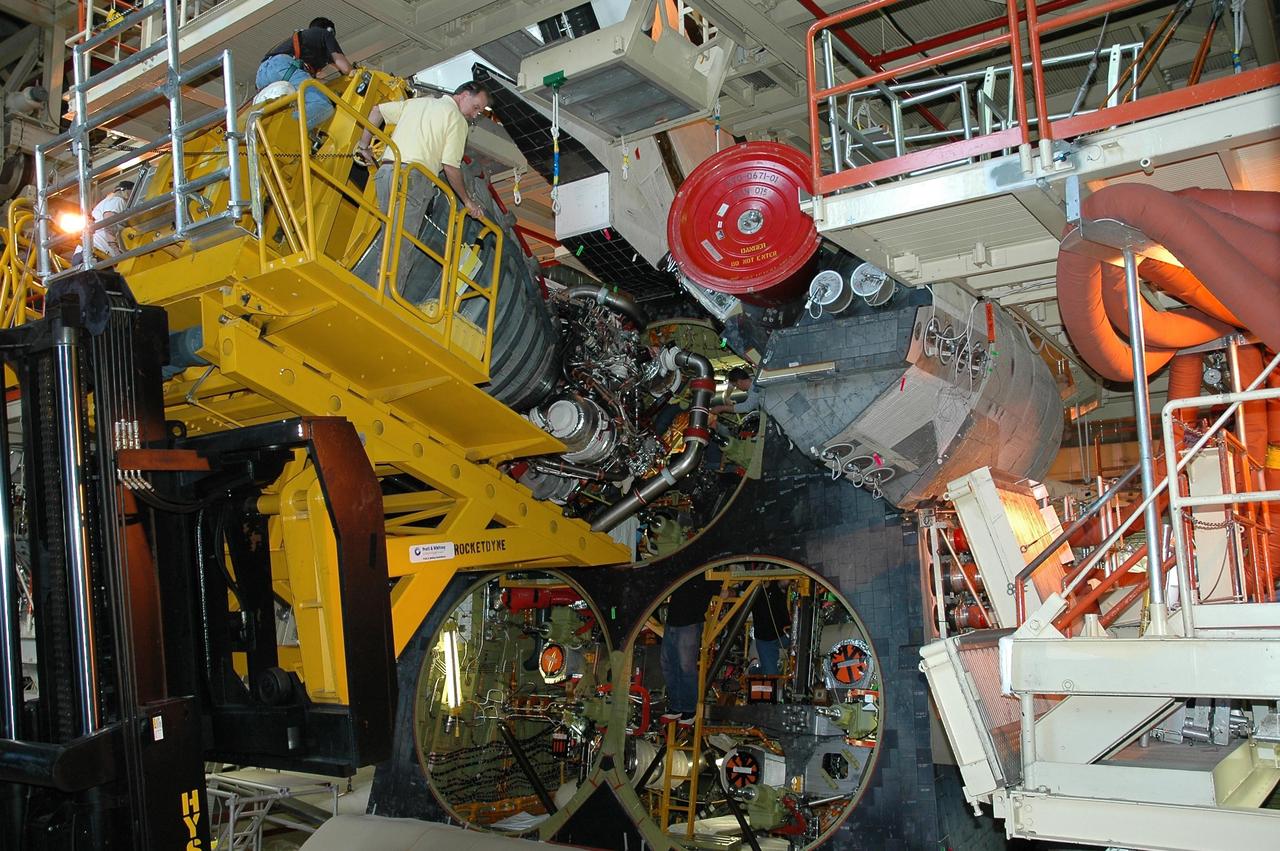
KENNEDY SPACE CENTER, FLA. - In the Orbiter Processing Facility bay 1, technicians on the Hyster forklift move a main engine into place on Discovery. The main engine configuration is manufactured by Boeing Rocketdyne in Canoga Park, Calif., and includes a Pratt & Whitney high-pressure fuel turbo pump. Each space shuttle main engine is 14 feet (4.3 meters) long, weighs about 6,700 pounds (3,039 kilograms), and is 7.5 feet (2.3 meters) in diameter at the end of the nozzle. Discovery is being processed for the second return-to-flight mission STS-121.
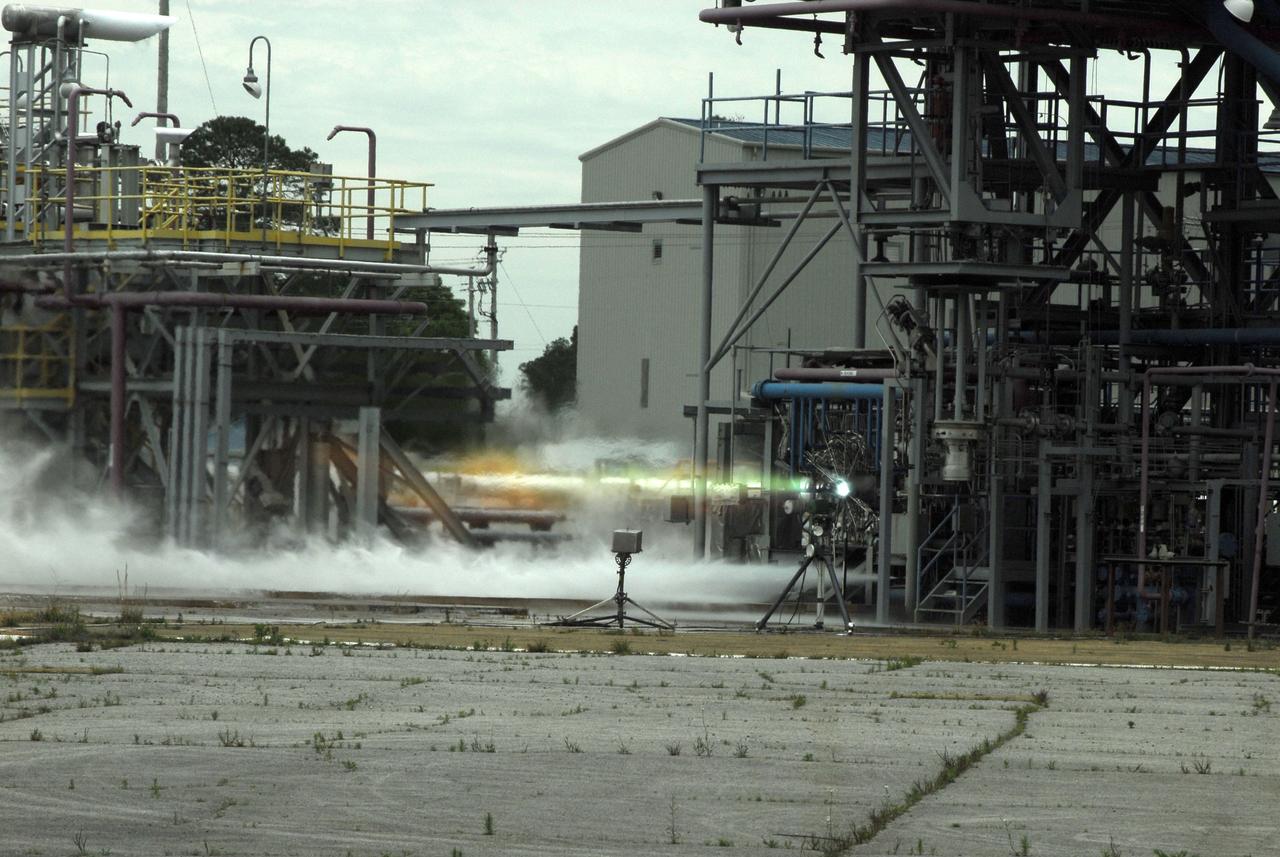
Chosen to power the upper stages of the new Ares I Crew Launch Vehicle (CLV) and the Ares V cargo segment, the J-2X engine is a stepped up version of the hydrogen/oxygen-fuelled Apollo-era J-2 engine. It was developed for NASA by Pratt & Whitney Rocketdyne (PWR), a business unit of United Technologies Corporation of Canoga Park, California. As seen in this photograph, the engine underwent a series of hot fire tests, performed on sub scale main injector hardware in the Test Stand 116 at Marshall Space Flight Center (MSFC). The injector is a major component of the engine that injects and mixes propellants in the combustion chamber, where they are ignited and burned to produce thrust.
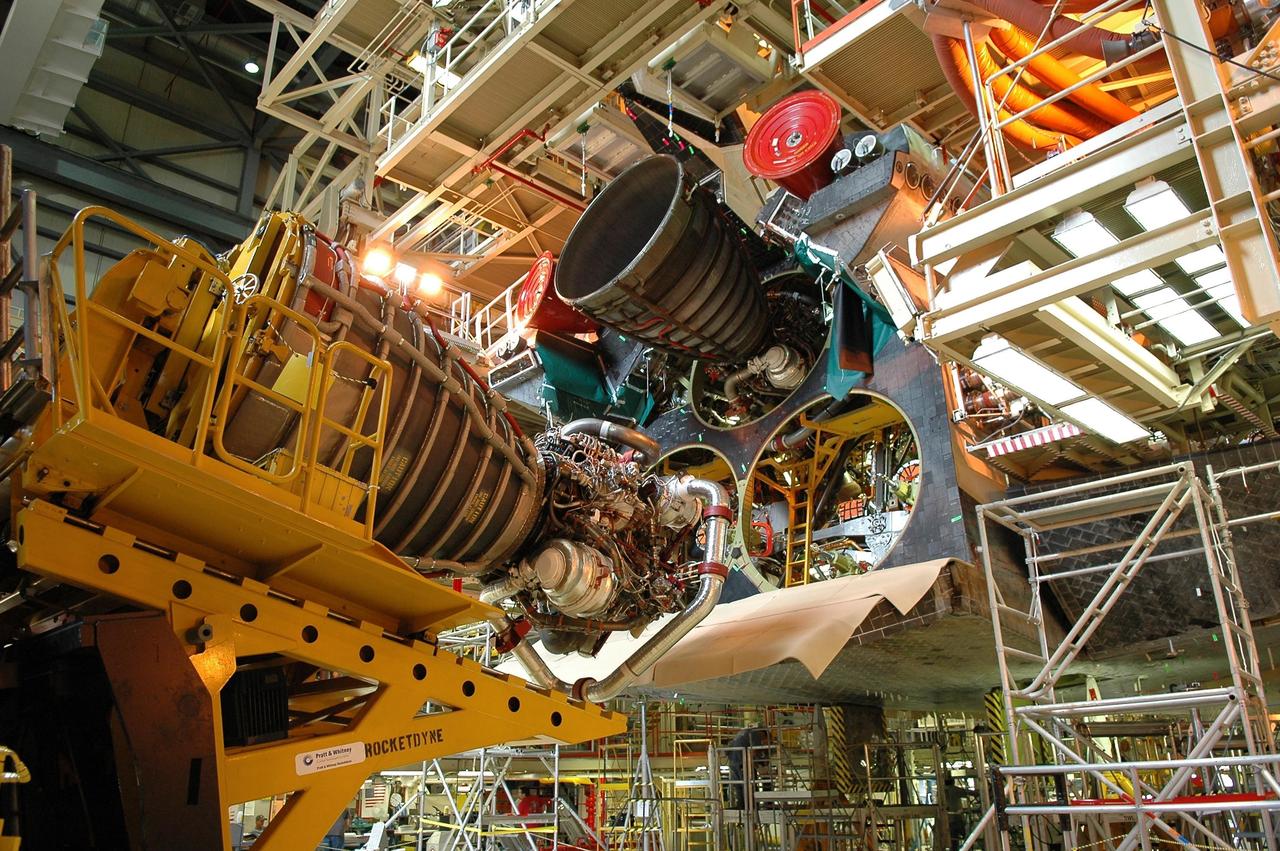
KENNEDY SPACE CENTER, FLA. - Engine No. 3 is ready to be installed on Discovery in the Orbiter Processing Facility bay 3. The main engine configuration is manufactured by Pratt & Whitney Rocketdyne in Canoga Park, Calif., and includes a Pratt & Whitney high-pressure fuel turbo pump. Each space shuttle main engine is 14 feet long, weighs about 6,700 pounds, and is 7.5 feet in diameter at the end of the nozzle. Discovery is being processed for its next mission, STS-116 (12A.1), to deliver a third truss segment, a SPACEHAB module and other key components to the International Space Station. The launch is currently scheduled no earlier than Dec. 14. Photo credit: NASA/Kim Shiflett
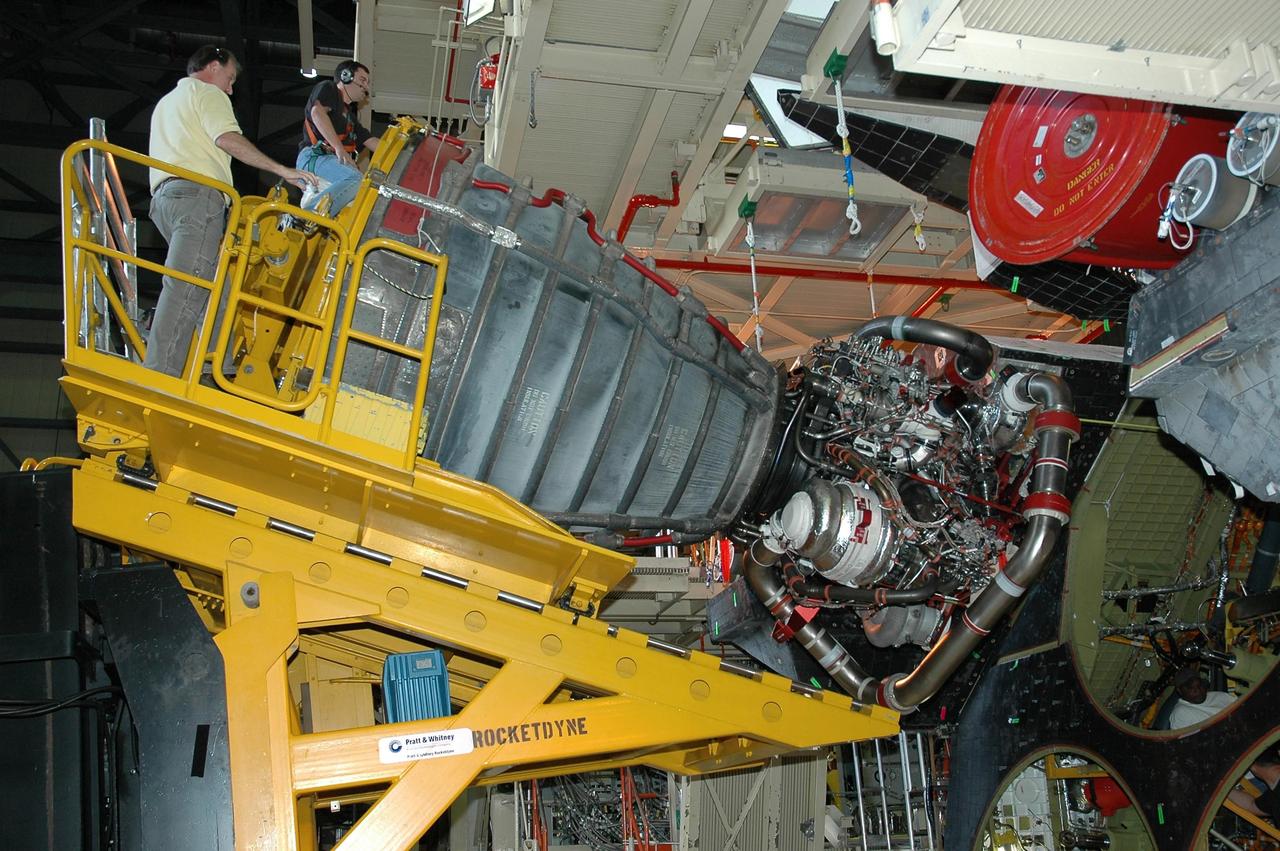
KENNEDY SPACE CENTER, FLA. - In In the Orbiter Processing Facility bay 1, a Hyster forklift maneuvers a main engine into position for installation into Discovery. The main engine configuration is manufactured by Boeing Rocketdyne in Canoga Park, Calif., and includes a Pratt & Whitney high-pressure fuel turbo pump. Each space shuttle main engine is 14 feet (4.3 meters) long, weighs about 6,700 pounds (3,039 kilograms), and is 7.5 feet (2.3 meters) in diameter at the end of the nozzle. Discovery is being processed for the second return-to-flight mission STS-121.
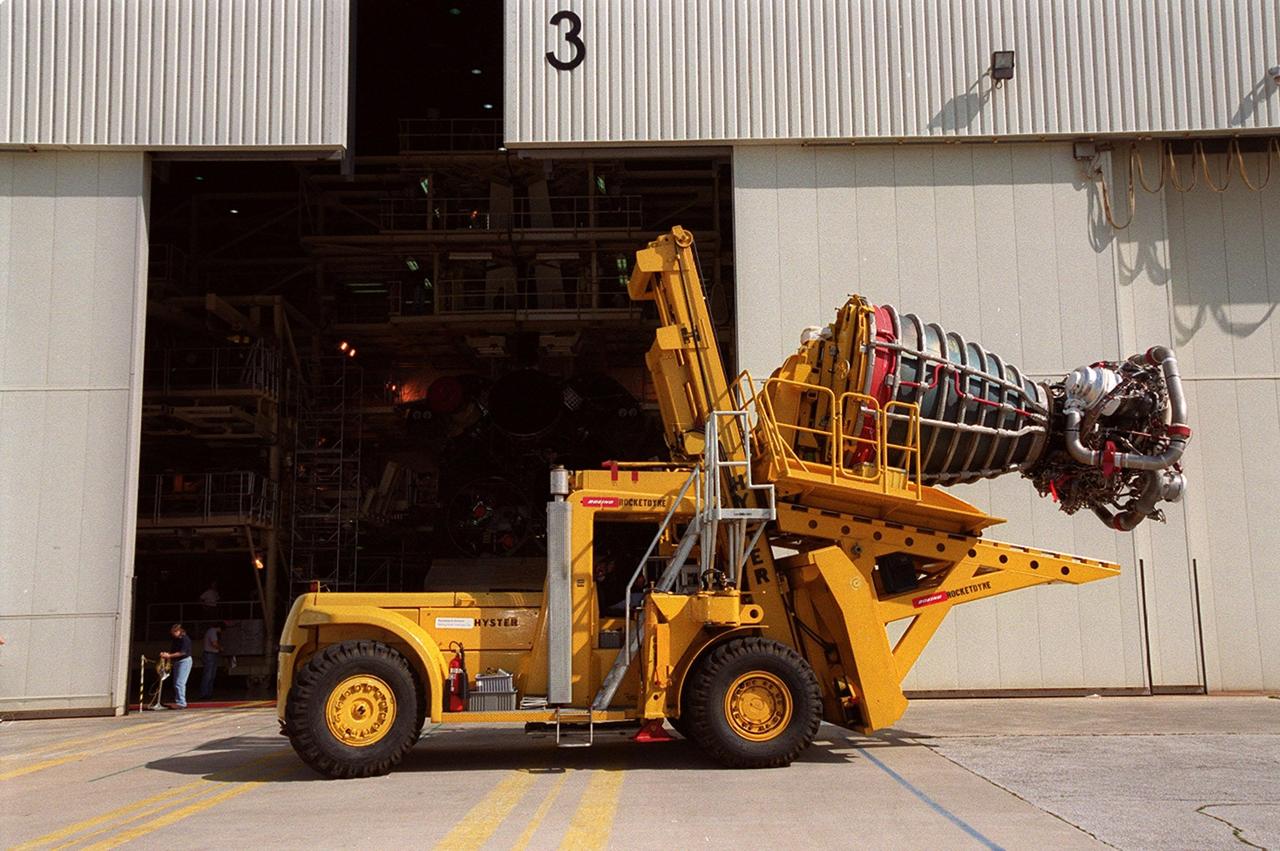
KENNEDY SPACE CENTER, FLA. -- The transport vehicle carrying a new block 2 engine arrives at Orbiter Processing Facility bay 3. There the new engine will be installed on the orbiter Atlantis, on mission STS-104, for its first flight. The Block II Main Engine configuration is manufactured by Boeing Rocketdyne in Canoga Park, Calif., and includes a new Pratt & Whitney high-pressure fuel turbo pump. Engine improvements are managed by NASA’s Marshall Space Flight Center in Huntsville, Ala. Each Space Shuttle Main Engine is 14 feet (4.3 meters) long, weighs about 7,000 pounds (3,175 kilograms), and is 7.5 feet (2.3 meters) in diameter at the end of the nozzle
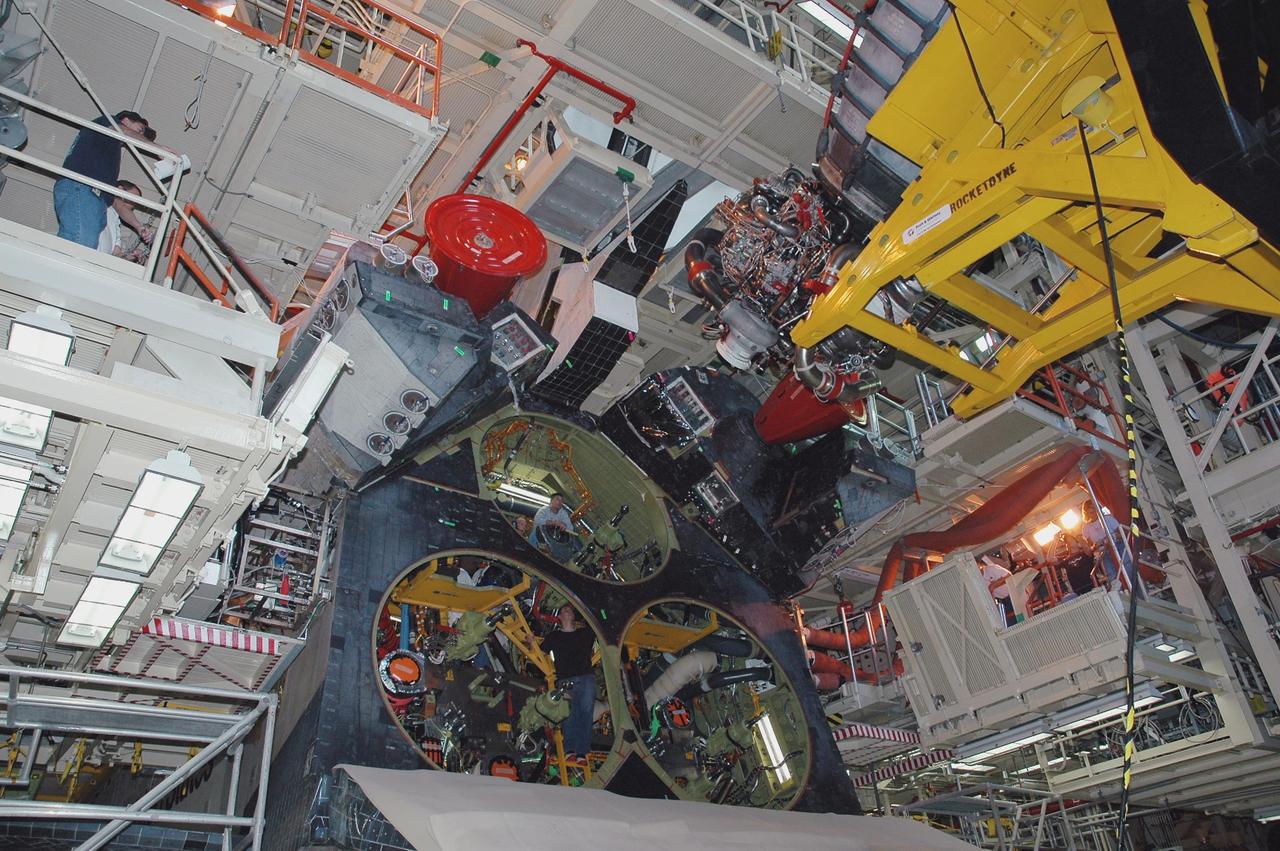
KENNEDY SPACE CENTER, FLA. - In the Orbiter Processing Facility bay 1, a Hyster forklift moves a main engine toward the aft of Discovery as technicians stand by for insertion and installation. The main engine configuration is manufactured by Boeing Rocketdyne in Canoga Park, Calif., and includes a Pratt & Whitney high-pressure fuel turbo pump. Each space shuttle main engine is 14 feet (4.3 meters) long, weighs about 6,700 pounds (3,039 kilograms), and is 7.5 feet (2.3 meters) in diameter at the end of the nozzle. Discovery is being processed for the second return-to-flight mission STS-121.
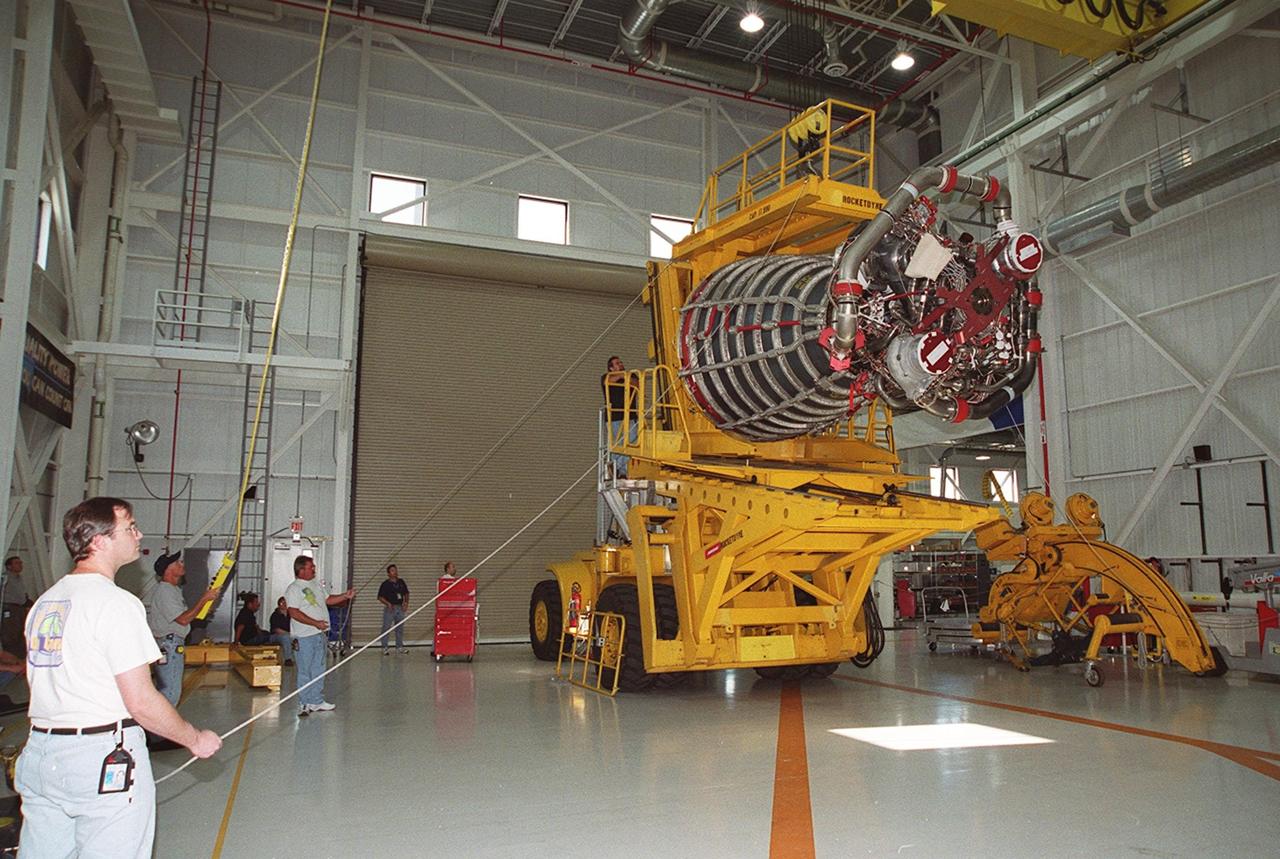
A new block 2 engine is lowered onto a transport vehicle for a move to the Orbiter Processing Facility. There it will be installed for its first flight on the orbiter Atlantis, on mission STS-104. The Block II Main Engine configuration is manufactured by Boeing Rocketdyne in Canoga Park, Calif., and includes a new Pratt & Whitney high-pressure fuel turbo pump. Engine improvements are managed by NASA’s Marshall Space Flight Center in Huntsville, Ala. Each Space Shuttle Main Engine is 14 feet (4.3 meters) long, weighs about 7,000 pounds (3,175 kilograms), and is 7.5 feet (2.3 meters) in diameter at the end of the nozzle
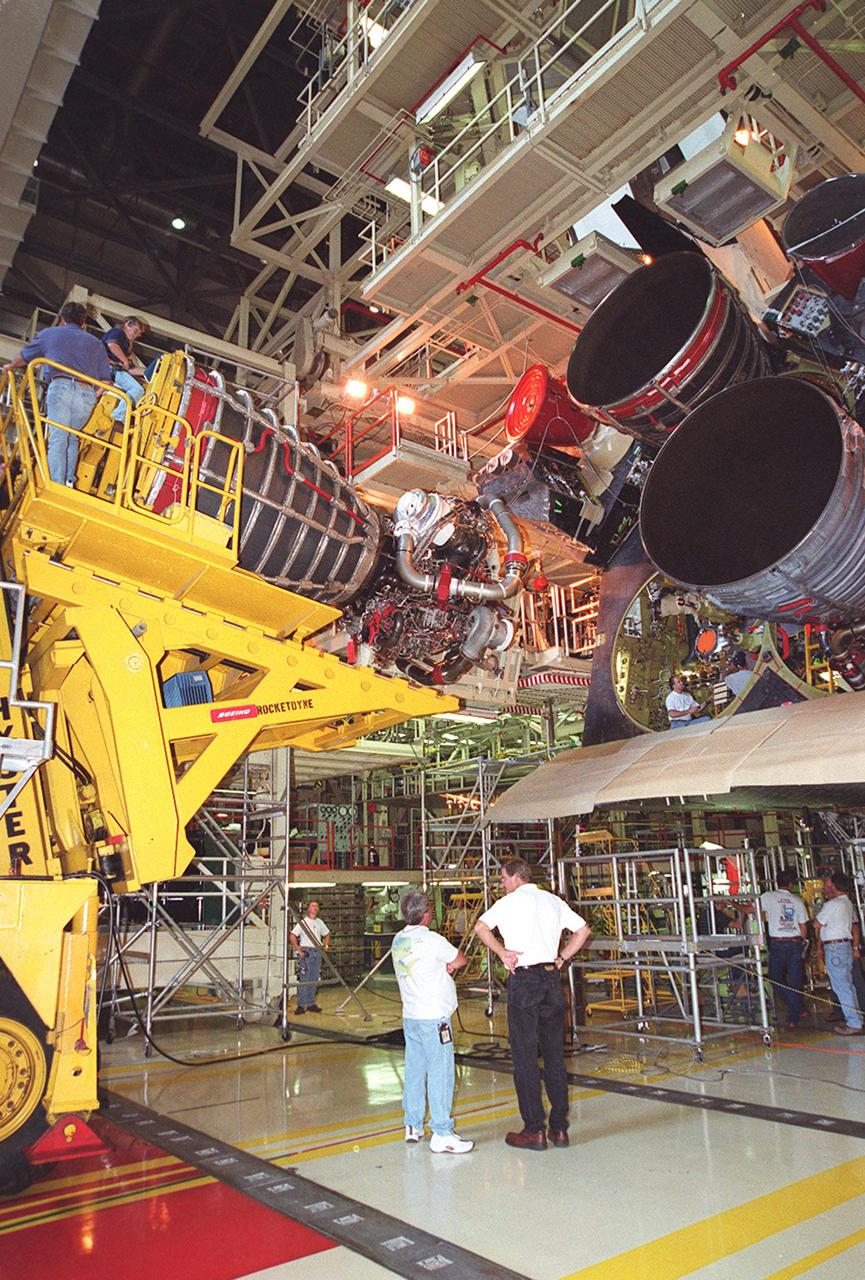
KENNEDY SPACE CENTER, FLA. -- In Orbiter Processing Facility bay 3, a new block 2 engine, at left, is moved into position for installation on Atlantis. The engine will have its first flight on mission STS-104, scheduled for launch June 14. The Block II Main Engine configuration is manufactured by Boeing Rocketdyne in Canoga Park, Calif., and includes a new Pratt and Whitney high-pressure fuel turbo pump. Engine improvements are managed by NASA’s Marshall Space Flight Center in Huntsville, Ala. Each Space Shuttle Main Engine is 14 feet (4.3 meters) long, weighs about 7,000 pounds (3,175 kilograms), and is 7.5 feet (2.3 meters) in diameter at the end of the nozzle
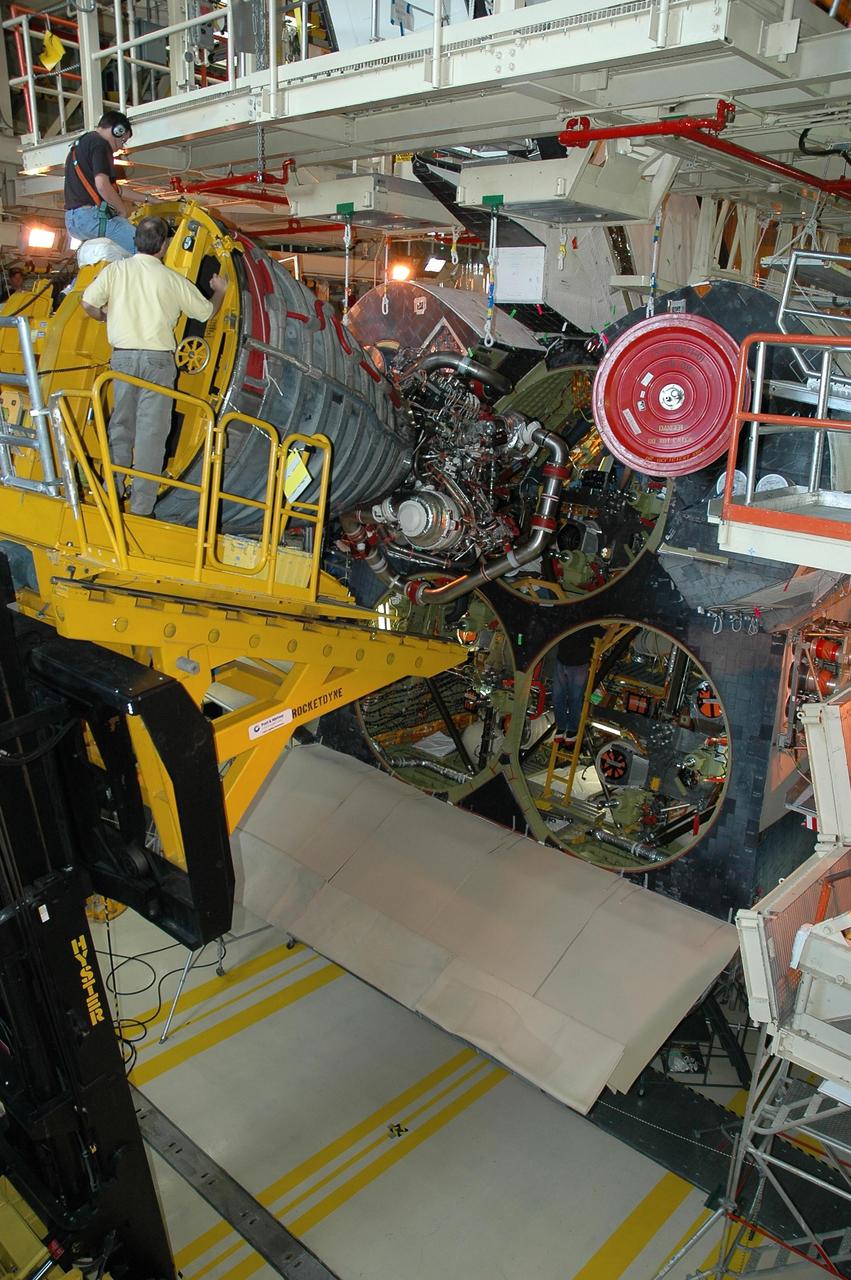
KENNEDY SPACE CENTER, FLA. - In the Orbiter Processing Facility bay 1, a Hyster forklift moves a main engine into position for installation into Discovery. The main engine configuration is manufactured by Boeing Rocketdyne in Canoga Park, Calif., and includes a Pratt & Whitney high-pressure fuel turbo pump. Each space shuttle main engine is 14 feet (4.3 meters) long, weighs about 6,700 pounds (3,039 kilograms), and is 7.5 feet (2.3 meters) in diameter at the end of the nozzle. Discovery is being processed for the second return-to-flight mission STS-121.

A new block 2 engine is lowered onto a transport vehicle for a move to the Orbiter Processing Facility. There it will be installed for its first flight on the orbiter Atlantis, on mission STS-104. The Block II Main Engine configuration is manufactured by Boeing Rocketdyne in Canoga Park, Calif., and includes a new Pratt & Whitney high-pressure fuel turbo pump. Engine improvements are managed by NASA’s Marshall Space Flight Center in Huntsville, Ala. Each Space Shuttle Main Engine is 14 feet (4.3 meters) long, weighs about 7,000 pounds (3,175 kilograms), and is 7.5 feet (2.3 meters) in diameter at the end of the nozzle

KENNEDY SPACE CENTER, FLA. -- An upgraded Space Shuttle main engine (block 2 engine) sits in the Space Shuttle Main Engine Processing Facility. The new engine will be installed for its first flight on the orbiter Atlantis, on mission STS-104. The Block II Main Engine configuration is manufactured by Boeing Rocketdyne in Canoga Park, Calif., and includes a new Pratt & Whitney high-pressure fuel turbo pump. Engine improvements are managed by NASA’s Marshall Space Flight Center in Huntsville, Ala. Each Space Shuttle Main Engine is 14 feet (4.3 meters) long, weighs about 7,000 pounds (3,175 kilograms), and is 7.5 feet (2.3 meters) in diameter at the end of the nozzle
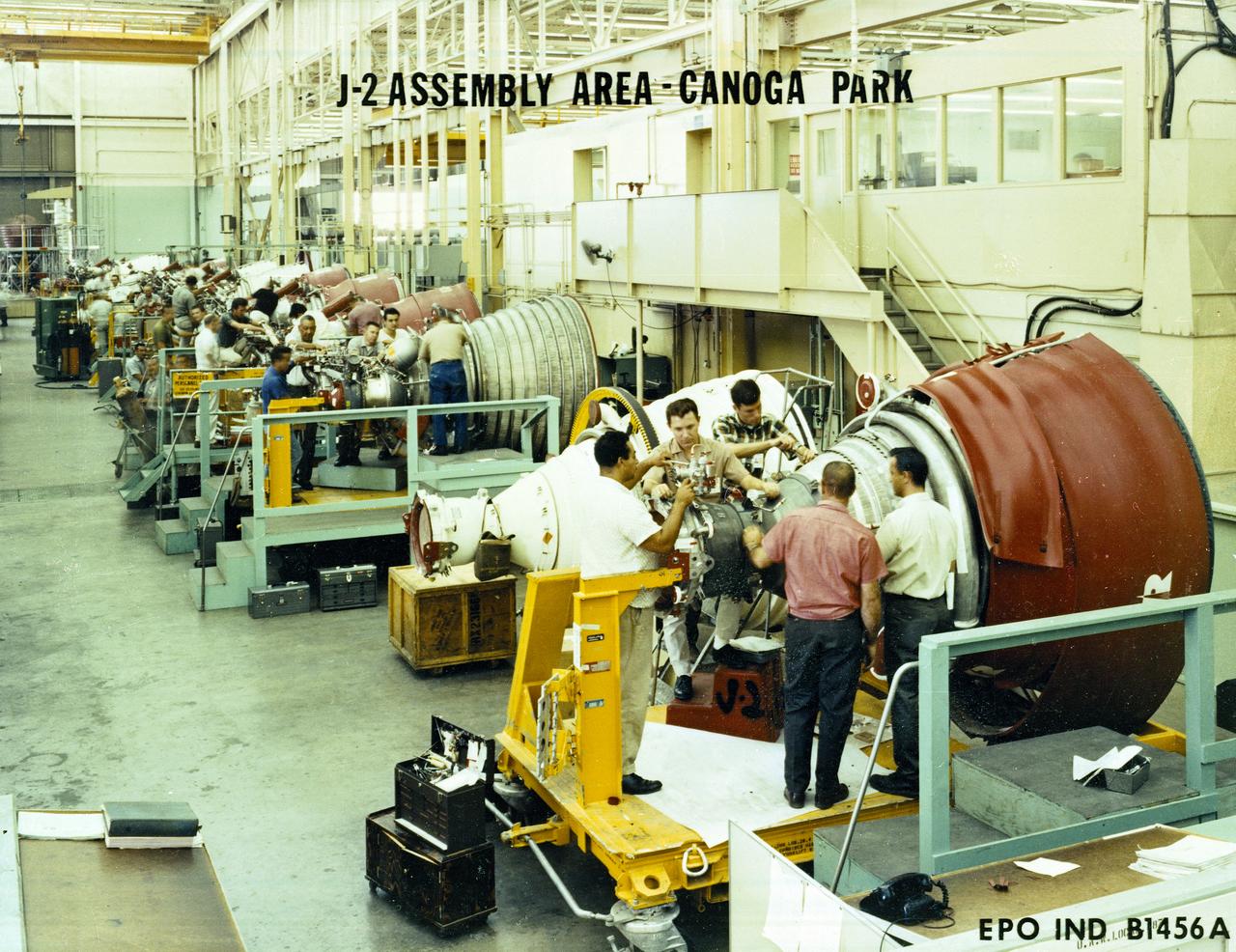
Workmen inspect a J-2 engine at Rocketdyne's Canoga Park, California production facility. The J-2, developed under the direction of the Marshall Space Flight Center, was propelled by liquid hydrogen and liquid oxygen. A single J-2 engine was used in the S-IVB stage (the second stage of the Saturn IB and third stage for the Saturn V) and a cluster of five J-2 engines was used to propel the second stage of the Saturn V, the S-II. Initially rated at 200,000 pounds of thrust, the J-2 engine was later uprated in the Saturn V program to 230,000 pounds.
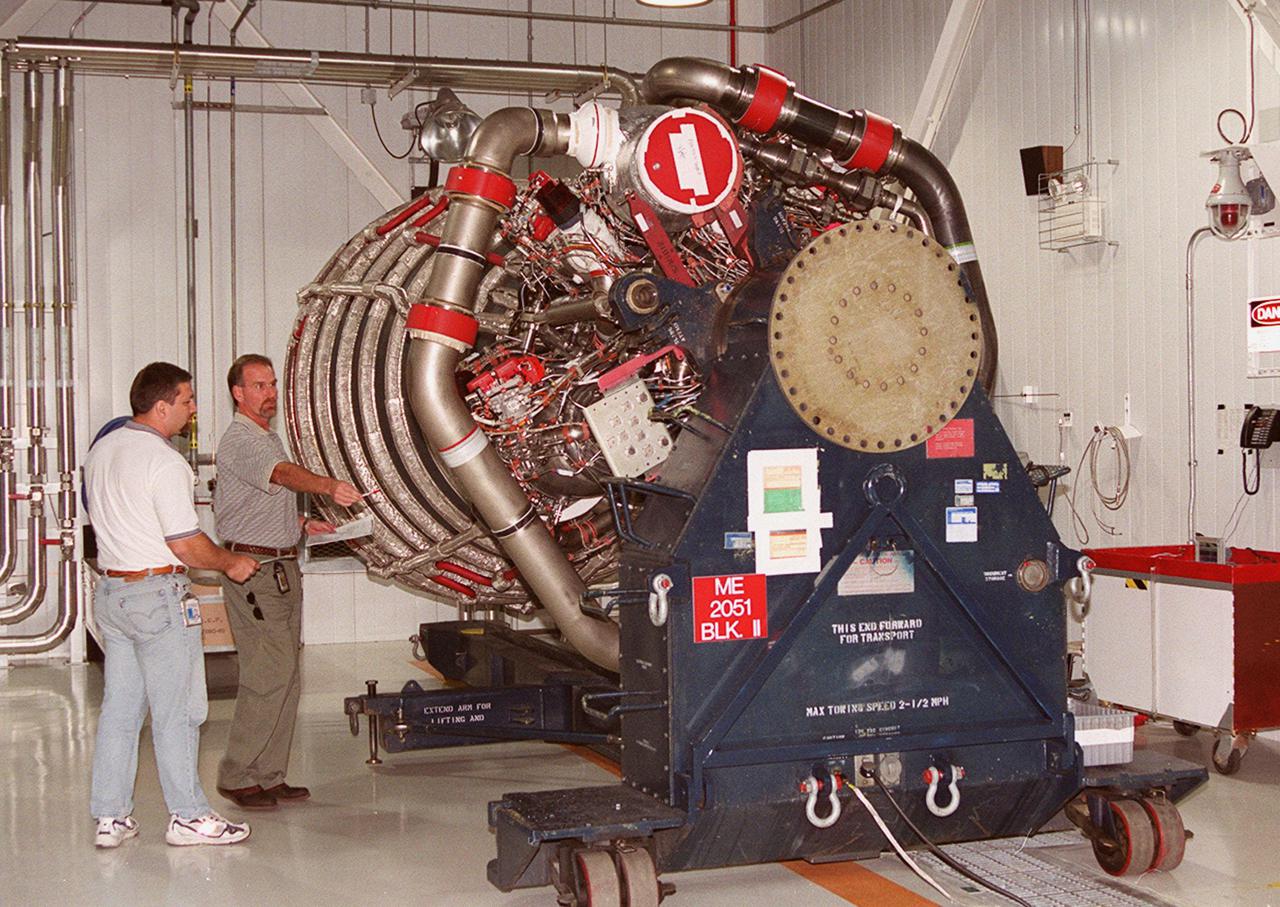
KENNEDY SPACE CENTER, FLA. -- Mike Cosgrove (left) and Bob Petrie (right), both with Boeing_Rocketdyne, look over the upgraded Space Shuttle main engine (block 2 engine) as it sits in the Space Shuttle Main Engine Processing Facility. The new engine will be installed for its first flight on the orbiter Atlantis, on mission STS-104. The Block II Main Engine configuration is manufactured by Boeing Rocketdyne in Canoga Park, Calif., and includes a new Pratt and Whitney high-pressure fuel turbo pump. Engine improvements are managed by NASA’s Marshall Space Flight Center in Huntsville, Ala. Each Space Shuttle Main Engine is 14 feet (4.3 meters) long, weighs about 7,000 pounds (3,175 kilograms), and is 7.5 feet (2.3 meters) in diameter at the end of the nozzle
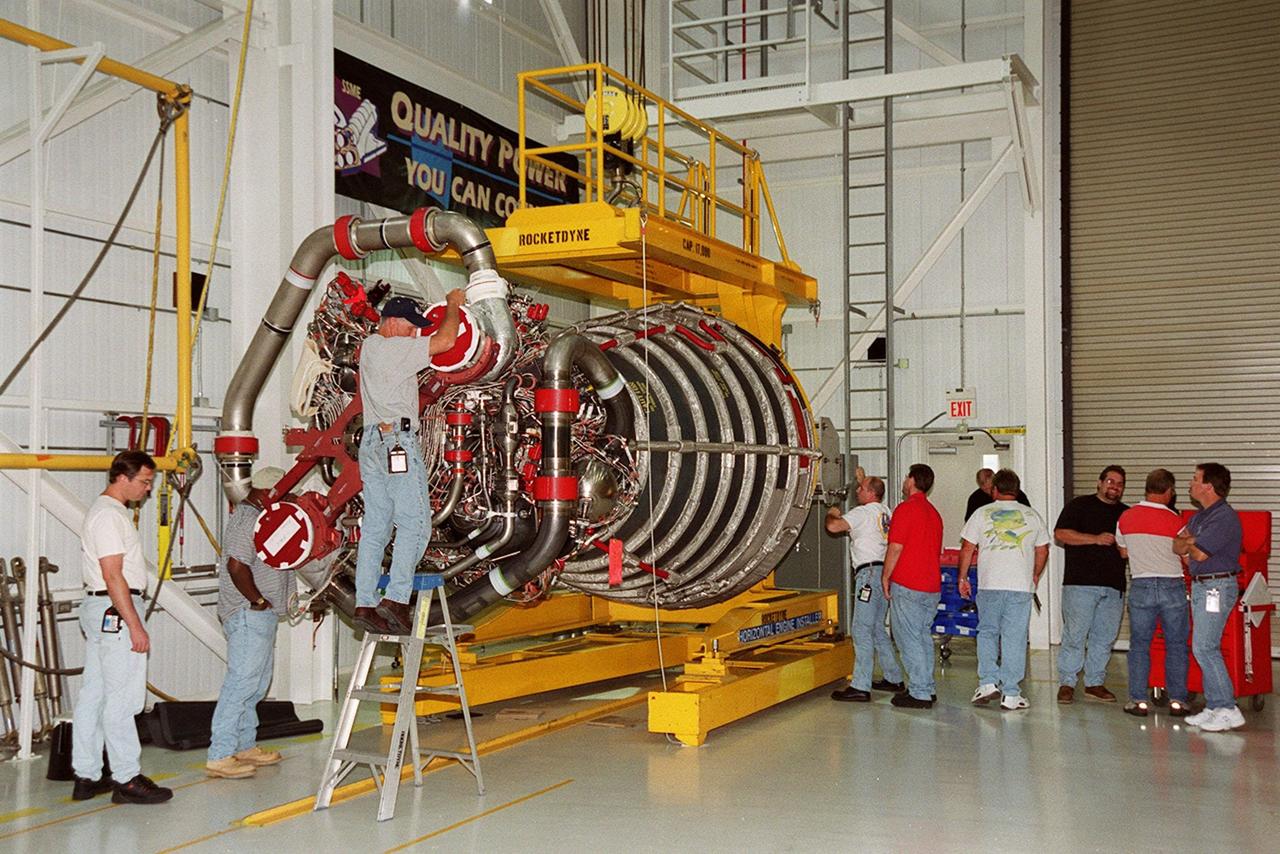
Workers in the Space Shuttle Main Engine Processing Facility prepare a new Space Shuttle main engine (block 2 engine) for its move to the Orbiter Processing Facility. The engine will be installed for its first flight on the orbiter Atlantis, on mission STS-104. The Block II Main Engine configuration is manufactured by Boeing Rocketdyne in Canoga Park, Calif., and includes a new Pratt & Whitney high-pressure fuel turbo pump. Engine improvements are managed by NASA’s Marshall Space Flight Center in Huntsville, Ala. Each Space Shuttle Main Engine is 14 feet (4.3 meters) long, weighs about 7,000 pounds (3,175 kilograms), and is 7.5 feet (2.3 meters) in diameter at the end of the nozzle. <font
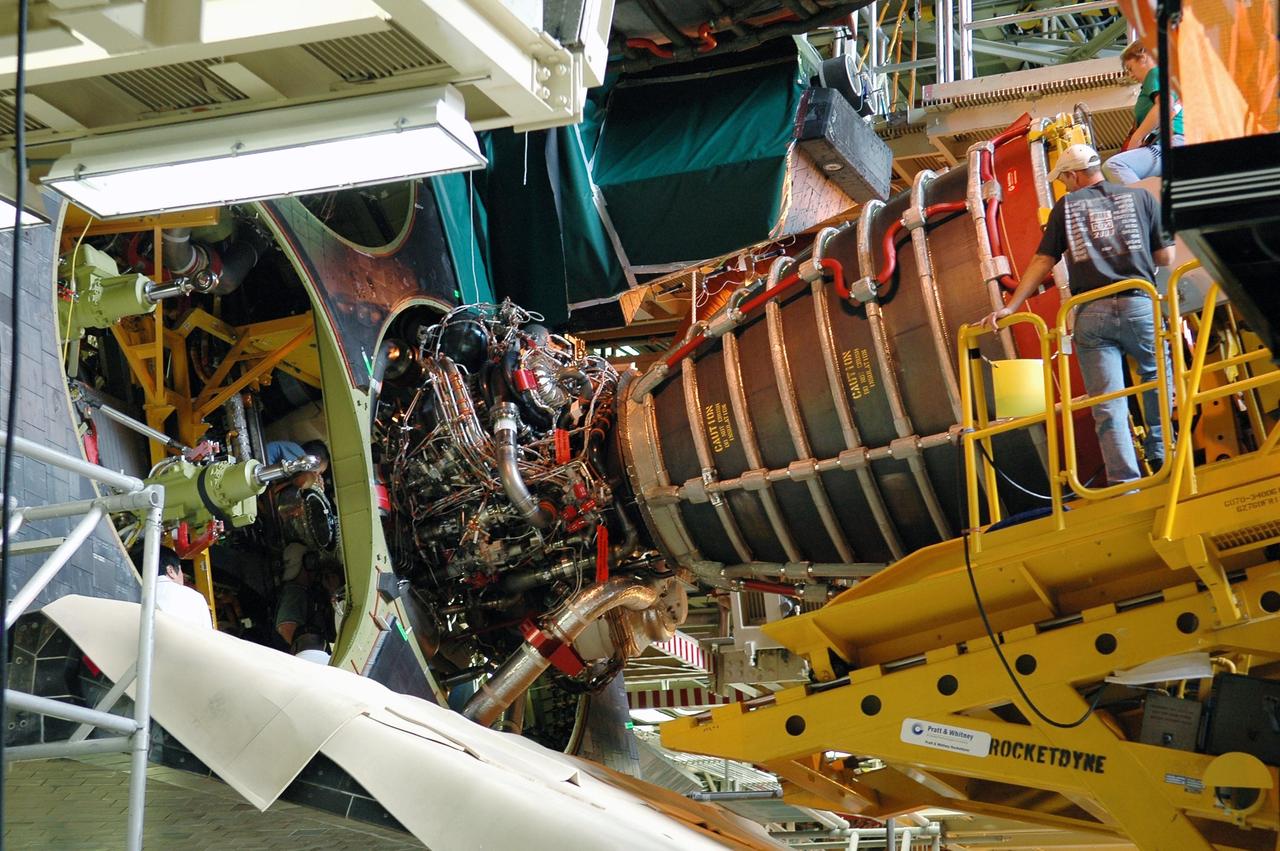
KENNEDY SPACE CENTER, FLA. - In the Orbiter Processing Facility bay 3, technicians on the Hyster forklift maneuver main engine No. 3 into place in Discovery. The main engine configuration is manufactured by Pratt & Whitney Rocketdyne in Canoga Park, Calif., and includes a Pratt & Whitney high-pressure fuel turbo pump. Each space shuttle main engine is 14 feet long, weighs about 6,700 pounds, and is 7.5 feet in diameter at the end of the nozzle. Discovery is being processed for its next mission, STS-116 (12A.1), to deliver a third truss segment, a SPACEHAB module and other key components to the International Space Station. The launch is currently scheduled no earlier than Dec. 14. Photo credit: NASA/Kim Shiflett
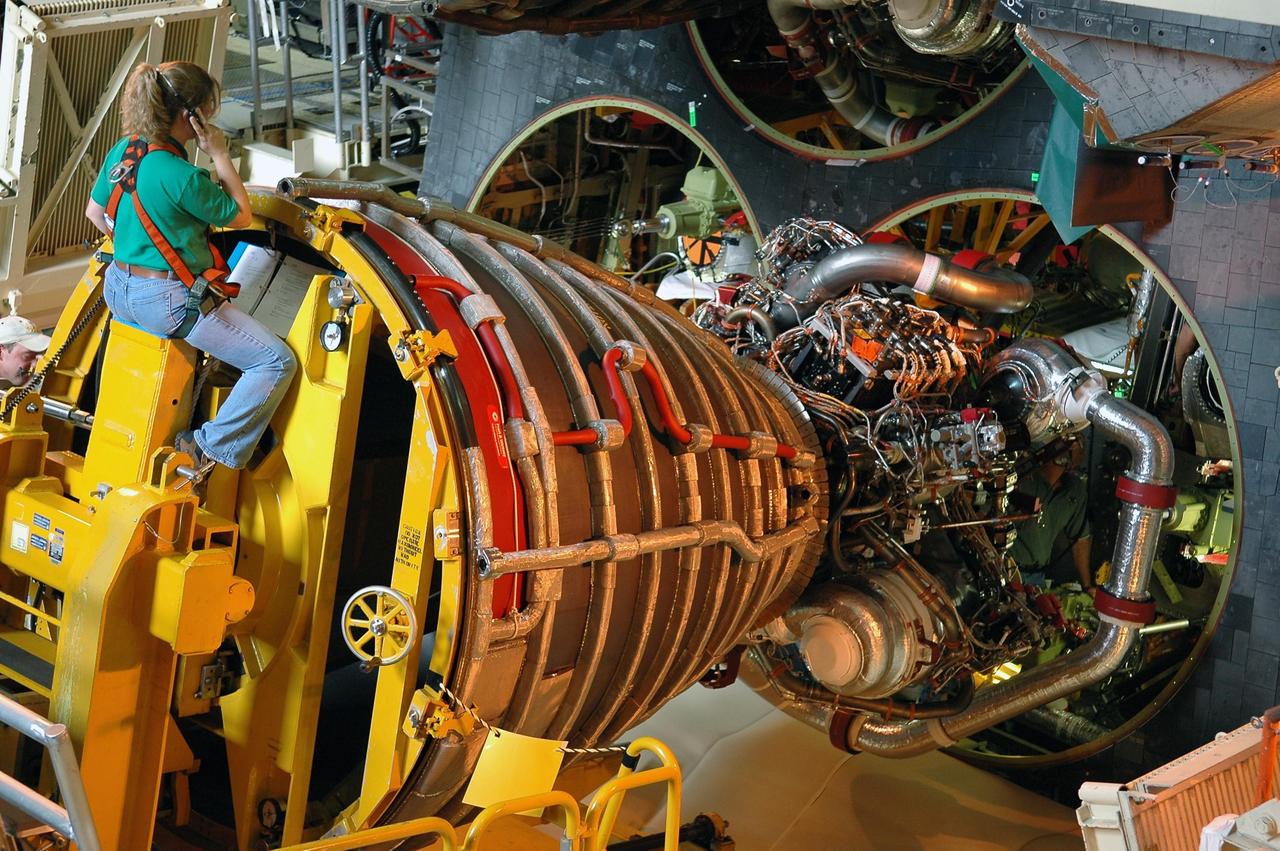
KENNEDY SPACE CENTER, FLA. - In the Orbiter Processing Facility bay 3, technicians on the Hyster forklift maneuver main engine No. 3 into place in Discovery. The main engine configuration is manufactured by Pratt & Whitney Rocketdyne in Canoga Park, Calif., and includes a Pratt & Whitney high-pressure fuel turbo pump. Each space shuttle main engine is 14 feet long, weighs about 6,700 pounds, and is 7.5 feet in diameter at the end of the nozzle. Discovery is being processed for its next mission, STS-116 (12A.1), to deliver a third truss segment, a SPACEHAB module and other key components to the International Space Station. The launch is currently scheduled no earlier than Dec. 14. Photo credit: NASA/Kim Shiflett
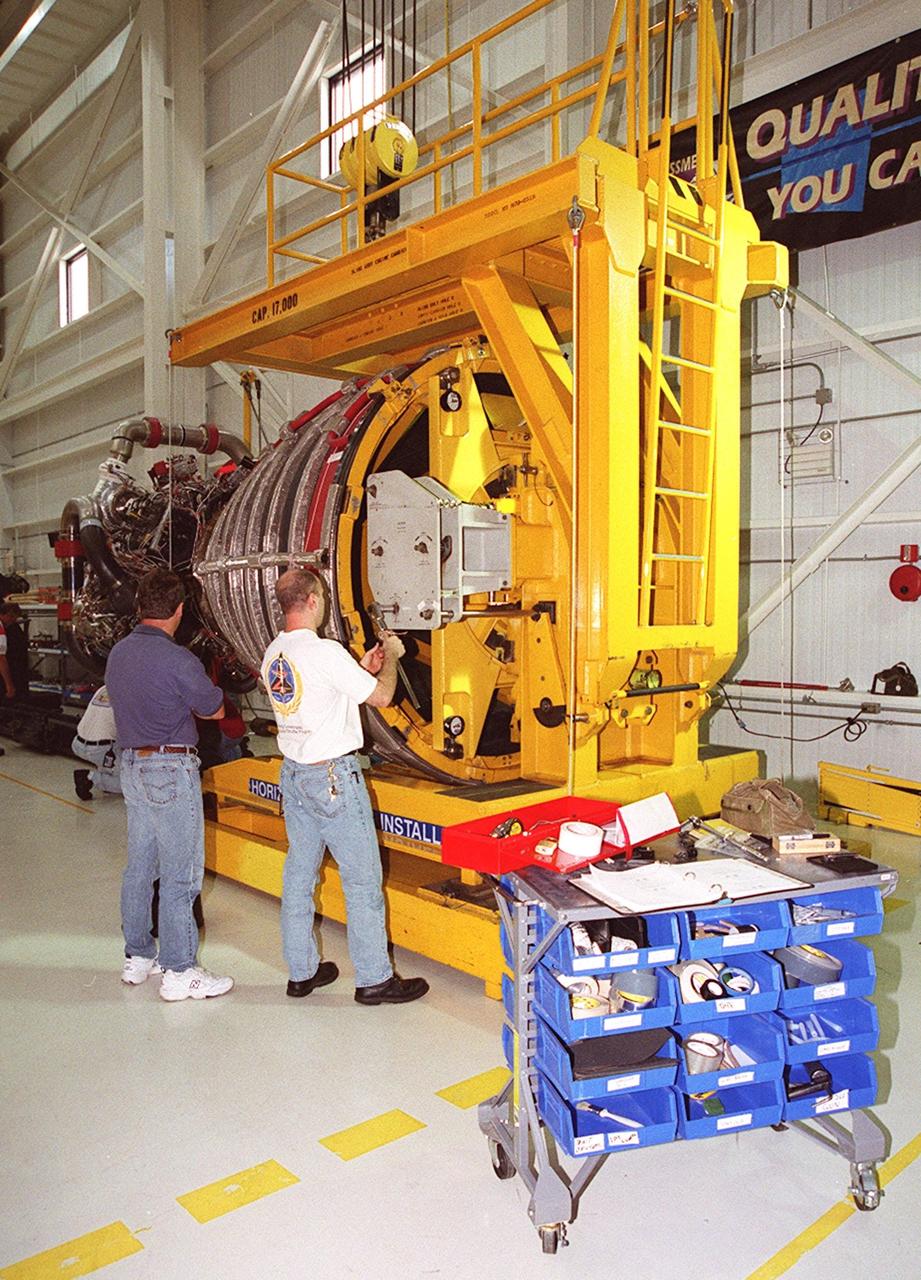
Workers in the Space Shuttle Main Engine Processing Facility get a new Space Shuttle main engine (block 2 engine) ready to move to the Orbiter Processing Facility. The engine will be installed for its first flight on the orbiter Atlantis, on mission STS-104. The Block II Main Engine configuration is manufactured by Boeing Rocketdyne in Canoga Park, Calif., and includes a new Pratt & Whitney high-pressure fuel turbo pump. Engine improvements are managed by NASA’s Marshall Space Flight Center in Huntsville, Ala. Each Space Shuttle Main Engine is 14 feet (4.3 meters) long, weighs about 7,000 pounds (3,175 kilograms), and is 7.5 feet (2.3 meters) in diameter at the end of the nozzle
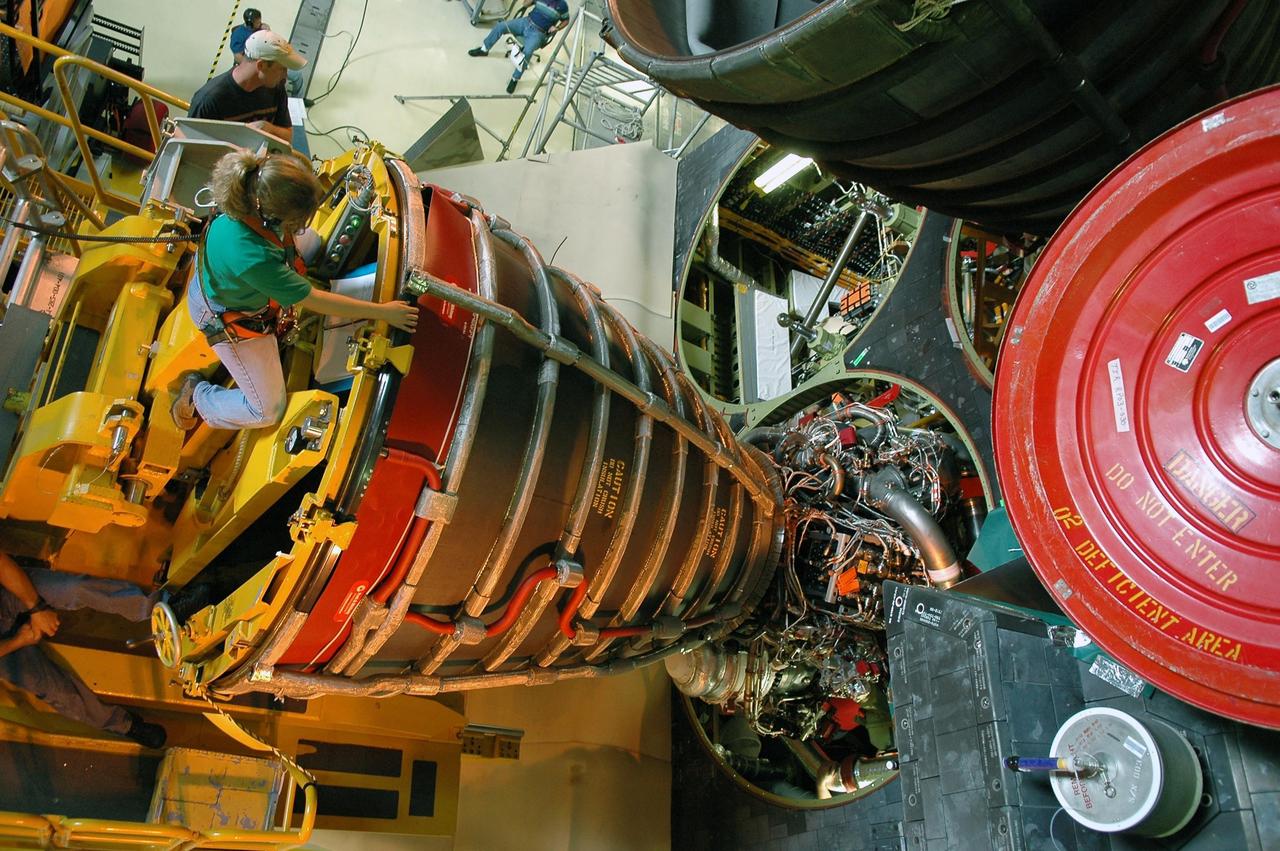
KENNEDY SPACE CENTER, FLA. - In the Orbiter Processing Facility bay 3, technicians on the Hyster forklift maneuver main engine No. 3 into place in Discovery. The main engine configuration is manufactured by Pratt & Whitney Rocketdyne in Canoga Park, Calif., and includes a Pratt & Whitney high-pressure fuel turbo pump. Each space shuttle main engine is 14 feet long, weighs about 6,700 pounds, and is 7.5 feet in diameter at the end of the nozzle. Discovery is being processed for its next mission, STS-116 (12A.1), to deliver a third truss segment, a SPACEHAB module and other key components to the International Space Station. The launch is currently scheduled no earlier than Dec. 14. Photo credit: NASA/Kim Shiflett
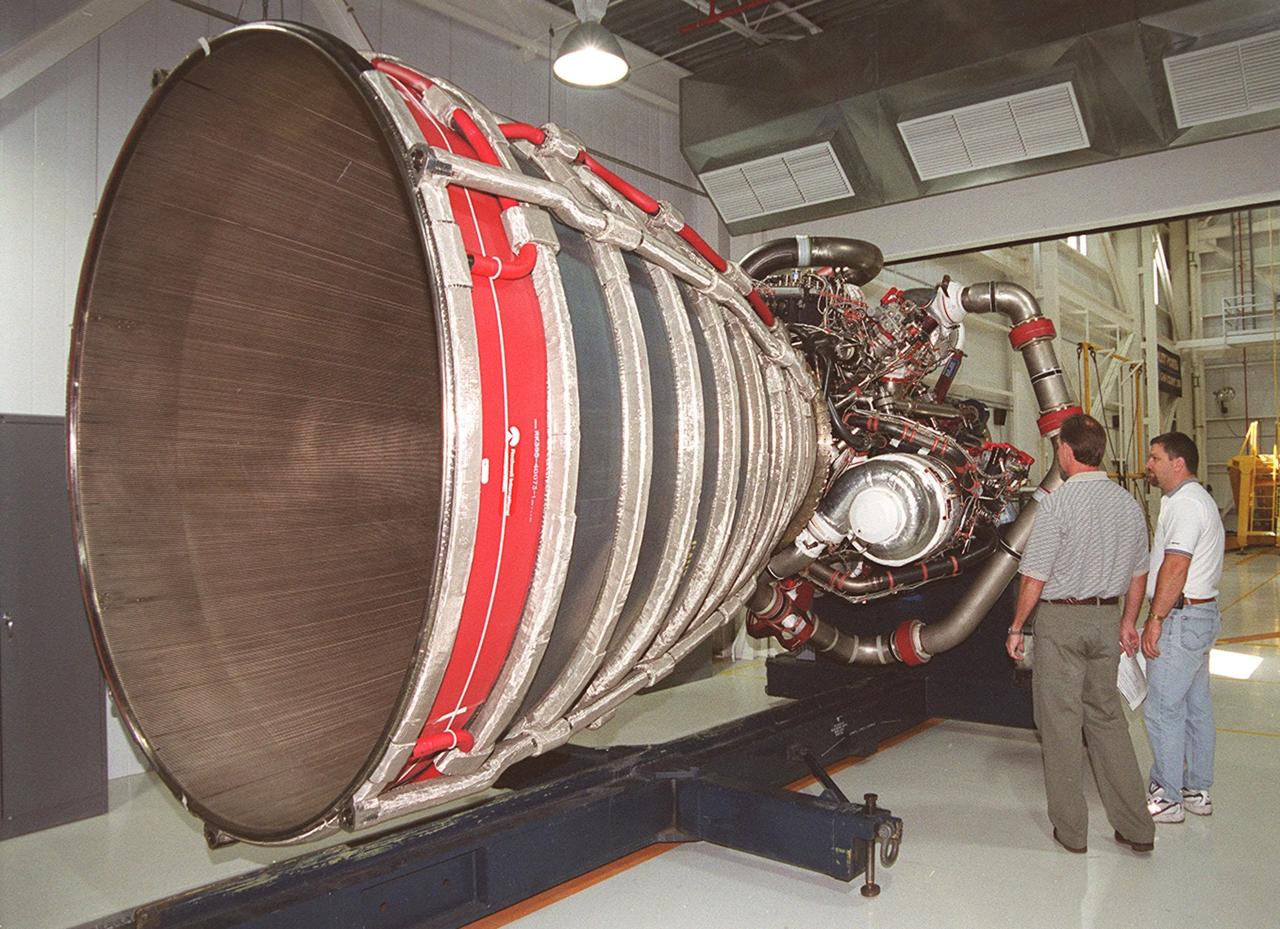
KENNEDY SPACE CENTER, FLA. -- Looking over the upgraded Space Shuttle main engine (block 2 engine) in the Space Shuttle Main Engine Processing Facility are Bob Petrie (left) and Mike Cosgrove (right). Both are with Boeing/Rocketdyne. The new engine will be installed for its first flight on the orbiter Atlantis, on mission STS-104. The Block II Main Engine configuration is manufactured by Boeing Rocketdyne in Canoga Park, Calif., and includes a new Pratt & Whitney high-pressure fuel turbo pump. Engine improvements are managed by NASA’s Marshall Space Flight Center in Huntsville, Ala. Each Space Shuttle Main Engine is 14 feet (4.3 meters) long, weighs about 7,000 pounds (3,175 kilograms), and is 7.5 feet (2.3 meters) in diameter at the end of the nozzle
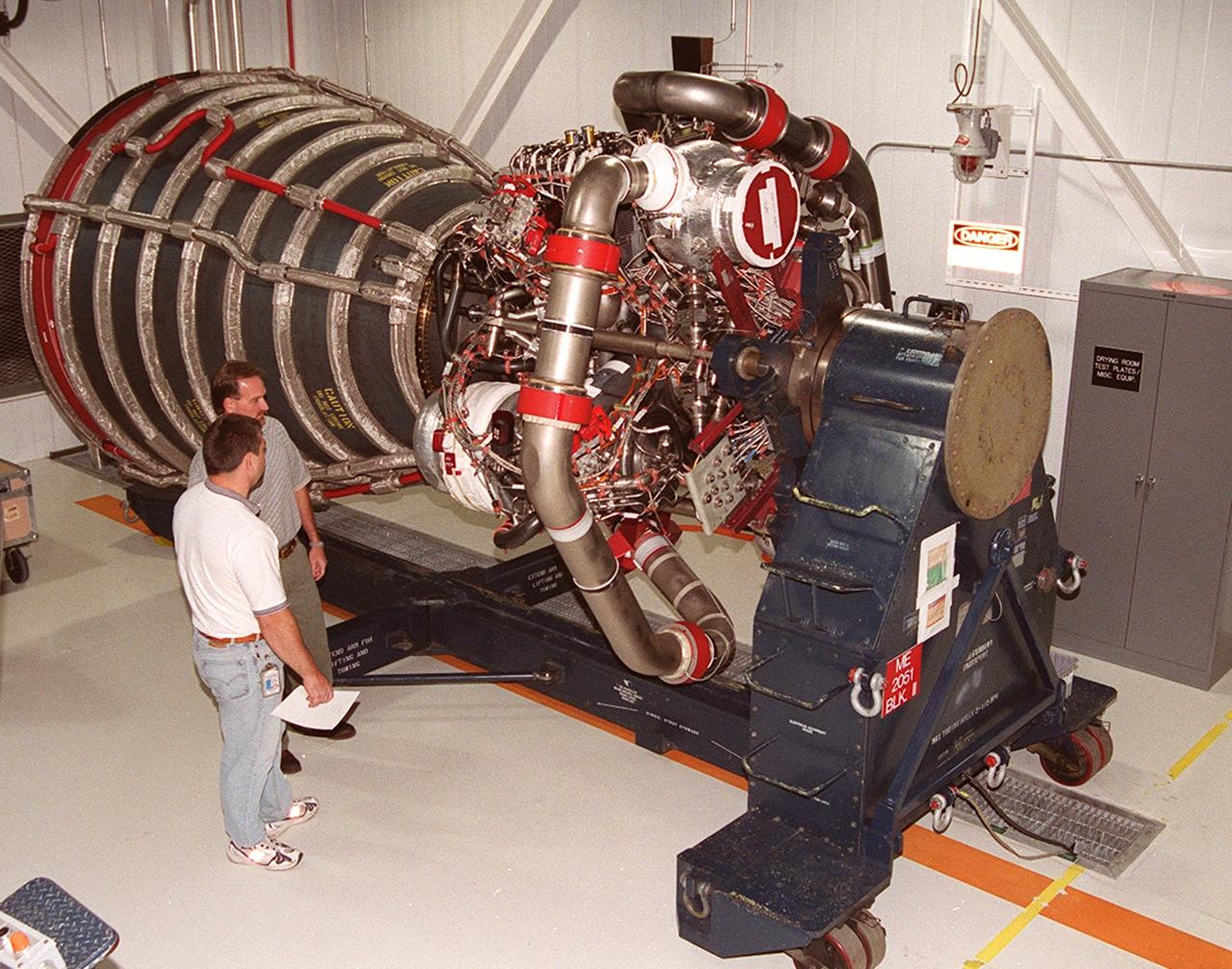
KENNEDY SPACE CENTER, FLA. -- Mike Cosgrove (front) and Bob Petrie (behind), both with Boeing/Rocketdyne, look over the upgraded Space Shuttle main engine (block 2 engine) as it sits in the Space Shuttle Main Engine Processing Facility. The new engine will be installed for its first flight on the orbiter Atlantis, on mission STS-104. The Block II Main Engine configuration is manufactured by Boeing Rocketdyne in Canoga Park, Calif., and includes a new Pratt & Whitney high-pressure fuel turbo pump. Engine improvements are managed by NASA’s Marshall Space Flight Center in Huntsville, Ala. Each Space Shuttle Main Engine is 14 feet (4.3 meters) long, weighs about 7,000 pounds (3,175 kilograms), and is 7.5 feet (2.3 meters) in diameter at the end of the nozzle
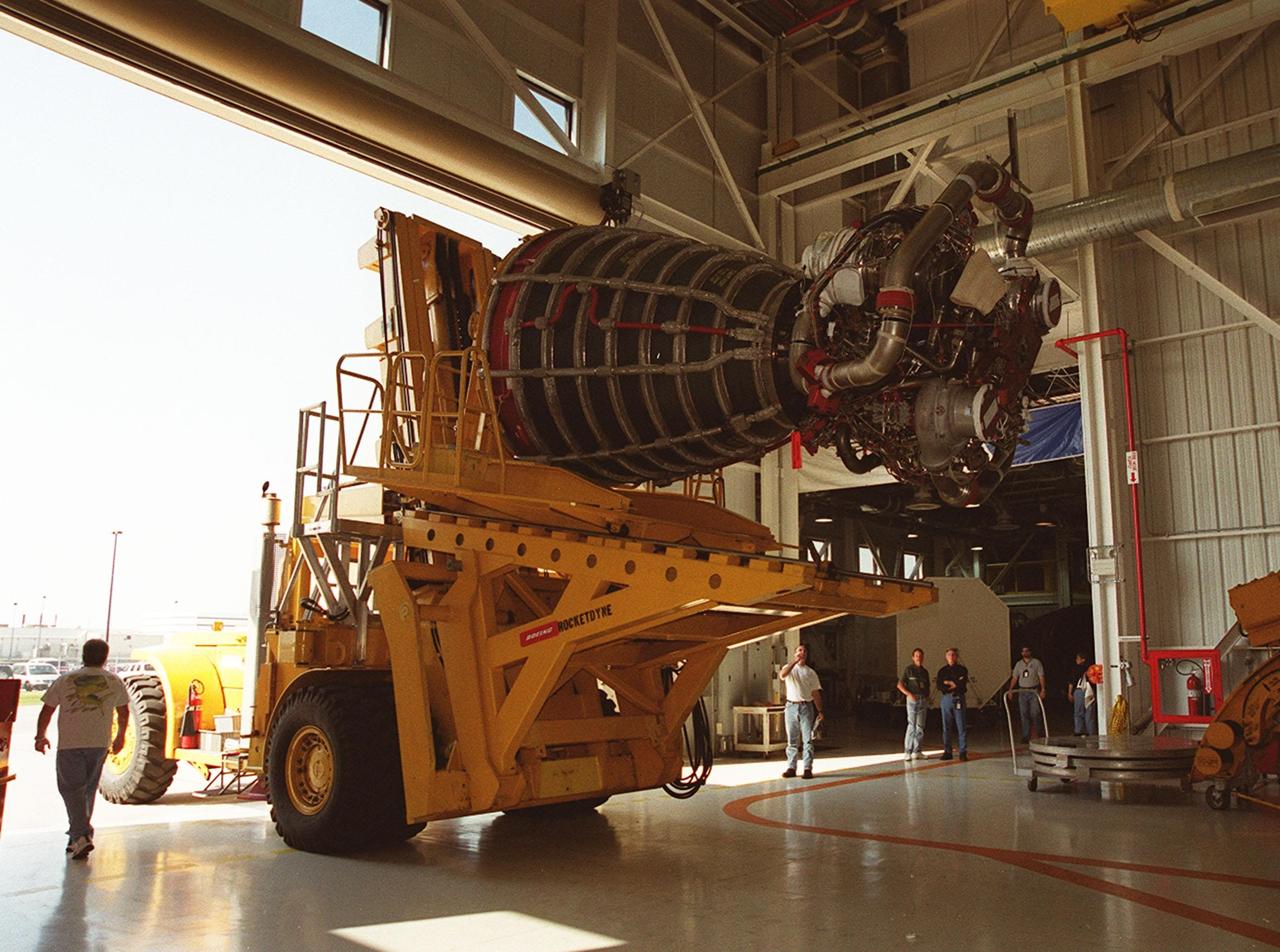
KENNEDY SPACE CENTER, FLA. -- The transport vehicle carrying a new block 2 engine leaves the Space Station Main Engine Processing Facility for a short trip to Orbiter Processing Facility bay 3. The new engine will be installed on the orbiter Atlantis, on mission STS-104, for its first flight. The Block II Main Engine configuration is manufactured by Boeing Rocketdyne in Canoga Park, Calif., and includes a new Pratt & Whitney high-pressure fuel turbo pump. Engine improvements are managed by NASA’s Marshall Space Flight Center in Huntsville, Ala. Each Space Shuttle Main Engine is 14 feet (4.3 meters) long, weighs about 7,000 pounds (3,175 kilograms), and is 7.5 feet (2.3 meters) in diameter at the end of the nozzle

KENNEDY SPACE CENTER, FLA. -- A new block 2 engine, situated on a giant forklift, is moved toward the aft of Atlantis where it will be installed. The work is being done in the Orbiter Processing Facility bay 3. The engine will have its first flight on mission STS-104, scheduled for launch June 14. The Block II Main Engine configuration is manufactured by Boeing Rocketdyne in Canoga Park, Calif., and includes a new Pratt & Whitney high-pressure fuel turbo pump. Engine improvements are managed by NASA’s Marshall Space Flight Center in Huntsville, Ala. Each Space Shuttle Main Engine is 14 feet (4.3 meters) long, weighs about 7,000 pounds (3,175 kilograms), and is 7.5 feet (2.3 meters) in diameter at the end of the nozzle
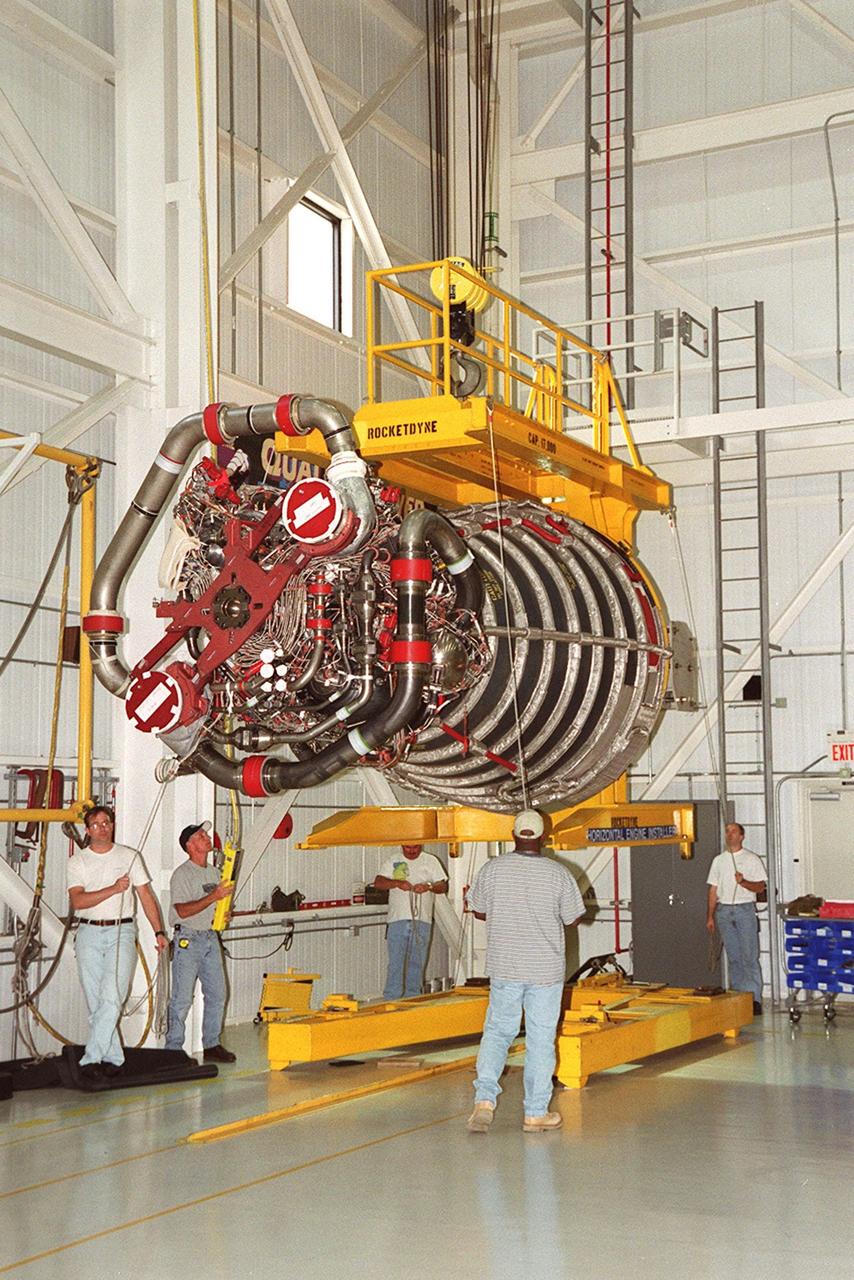
KENNEDY SPACE CENTER, FLA. -- Workers in the Space Shuttle Main Engine Processing Facility oversee lifting a new Space Shuttle main engine (block 2 engine) off its stand. The engine will be moved to the Orbiter Processing Facility and installed for its first flight on the orbiter Atlantis, on mission STS-104. The Block II Main Engine configuration is manufactured by Boeing Rocketdyne in Canoga Park, Calif., and includes a new Pratt & Whitney high-pressure fuel turbo pump. Engine improvements are managed by NASA’s Marshall Space Flight Center in Huntsville, Ala. Each Space Shuttle Main Engine is 14 feet (4.3 meters) long, weighs about 7,000 pounds (3,175 kilograms), and is 7.5 feet (2.3 meters) in diameter at the end of the nozzle
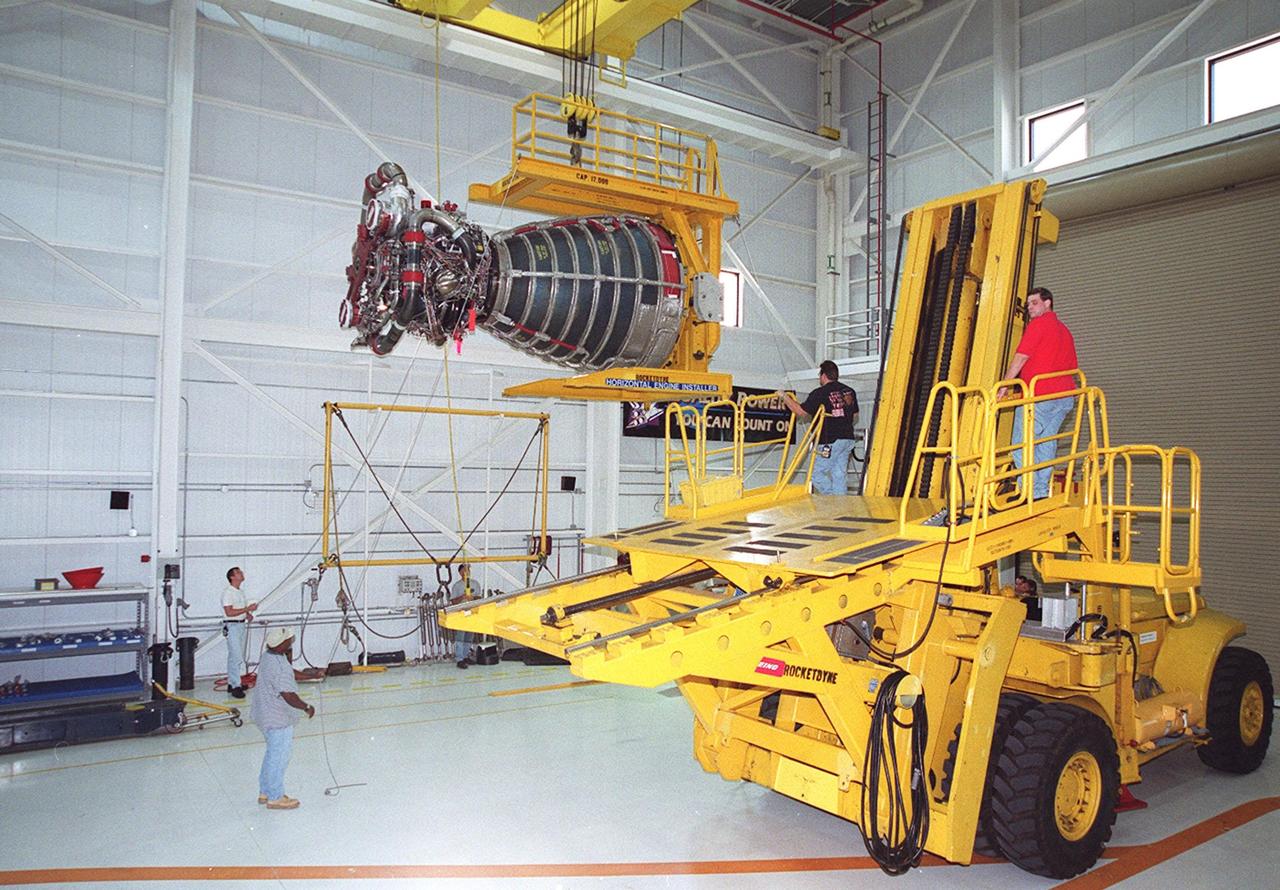
Workers in the Space Shuttle Main Engine Processing Facility oversee the movement of a new Space Shuttle main engine (block 2 engine) toward the transport vehicle in the foreground. The engine will be moved to the Orbiter Processing Facility and installed for its first flight on the orbiter Atlantis, on mission STS-104. The Block II Main Engine configuration is manufactured by Boeing Rocketdyne in Canoga Park, Calif., and includes a new Pratt & Whitney high-pressure fuel turbo pump. Engine improvements are managed by NASA’s Marshall Space Flight Center in Huntsville, Ala. Each Space Shuttle Main Engine is 14 feet (4.3 meters) long, weighs about 7,000 pounds (3,175 kilograms), and is 7.5 feet (2.3 meters) in diameter at the end of the nozzle. <font
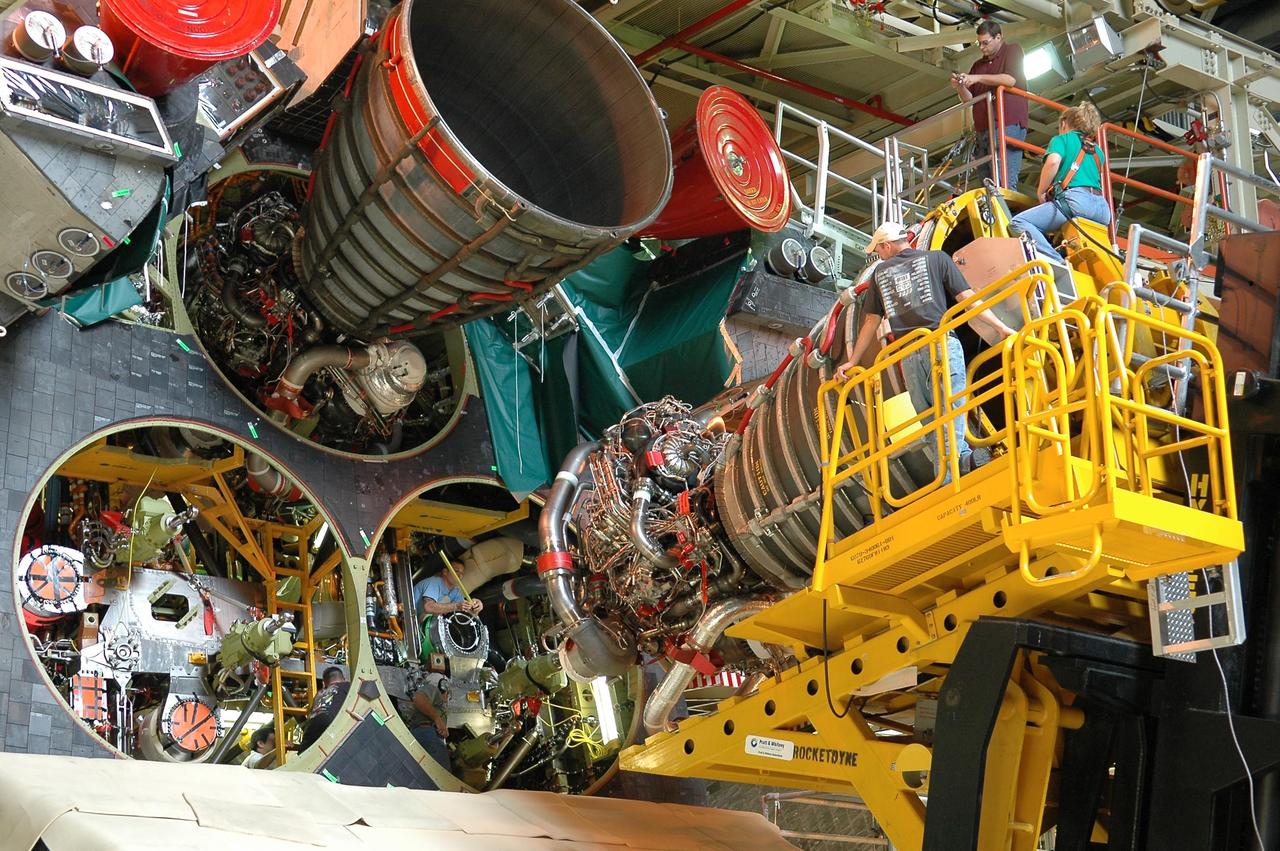
KENNEDY SPACE CENTER, FLA. - In the Orbiter Processing Facility bay 3, technicians on the Hyster forklift maneuver main engine No. 3 into place in Discovery. The main engine configuration is manufactured by Pratt & Whitney Rocketdyne in Canoga Park, Calif., and includes a Pratt & Whitney high-pressure fuel turbo pump. Each space shuttle main engine is 14 feet long, weighs about 6,700 pounds, and is 7.5 feet in diameter at the end of the nozzle. Discovery is being processed for its next mission, STS-116 (12A.1), to deliver a third truss segment, a SPACEHAB module and other key components to the International Space Station. The launch is currently scheduled no earlier than Dec. 14. Photo credit: NASA/Kim Shiflett
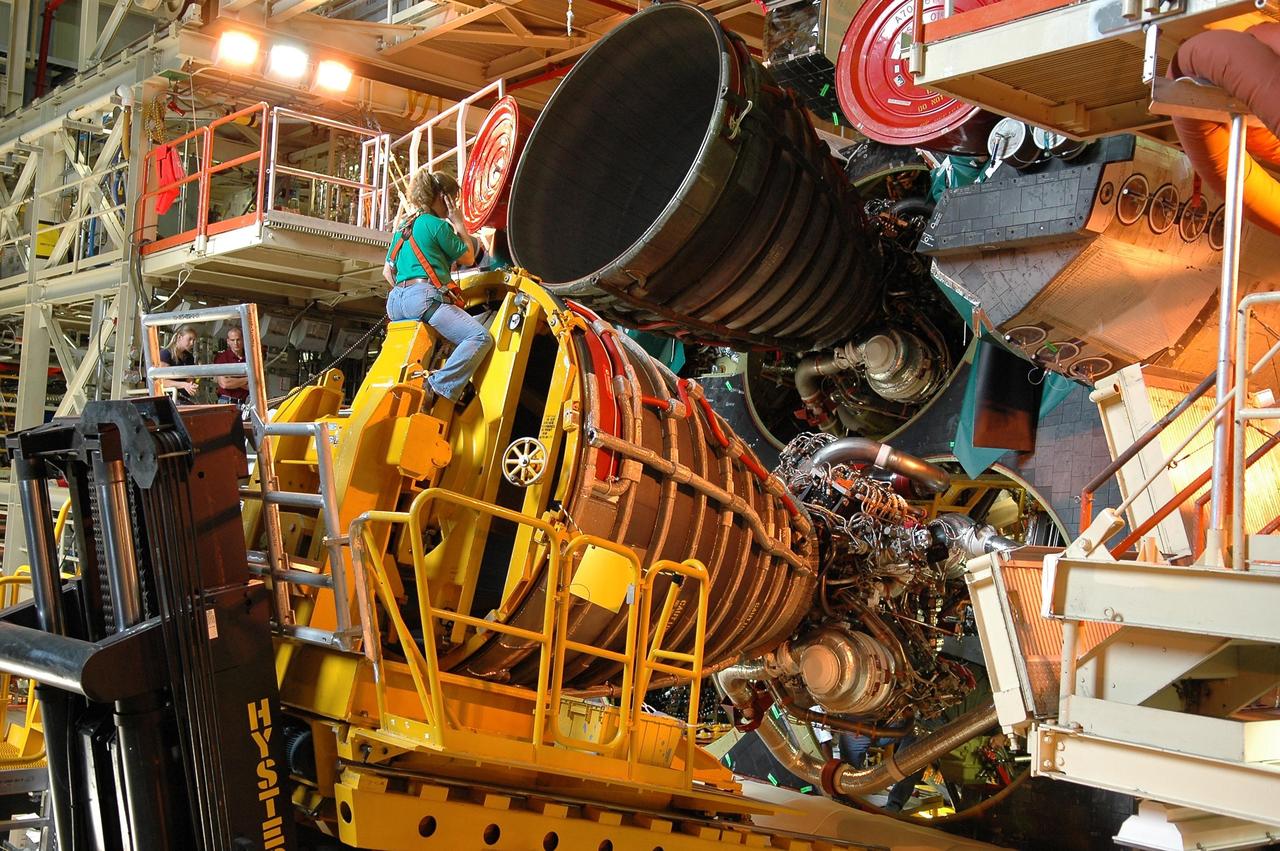
KENNEDY SPACE CENTER, FLA. - In the Orbiter Processing Facility bay 3, technicians on the Hyster forklift maneuver main engine No. 3 into place in Discovery. The main engine configuration is manufactured by Pratt & Whitney Rocketdyne in Canoga Park, Calif., and includes a Pratt & Whitney high-pressure fuel turbo pump. Each space shuttle main engine is 14 feet long, weighs about 6,700 pounds, and is 7.5 feet in diameter at the end of the nozzle. Discovery is being processed for its next mission, STS-116 (12A.1), to deliver a third truss segment, a SPACEHAB module and other key components to the International Space Station. The launch is currently scheduled no earlier than Dec. 14. Photo credit: NASA/Kim Shiflett
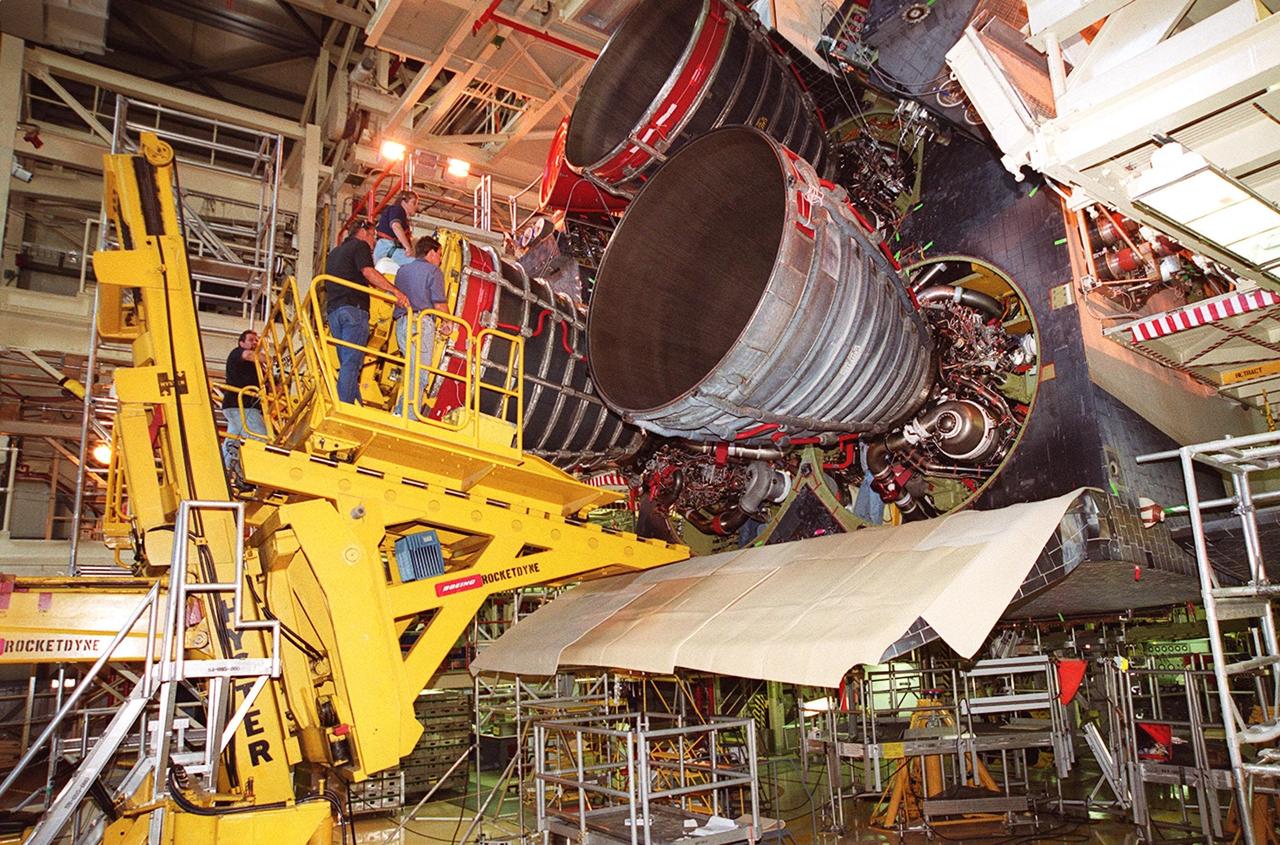
KENNEDY SPACE CENTER, FLA. -- The new block 2 engine for the orbiter Atlantis is moved into place next to the other two engines. The work is being done in the Orbiter Processing Facility bay 3. The engine will have its first flight on mission STS-104, scheduled for launch June 14. The Block II Main Engine configuration is manufactured by Boeing Rocketdyne in Canoga Park, Calif., and includes a new Pratt & Whitney high-pressure fuel turbo pump. Engine improvements are managed by NASA’s Marshall Space Flight Center in Huntsville, Ala. Each Space Shuttle Main Engine is 14 feet (4.3 meters) long, weighs about 7,000 pounds (3,175 kilograms), and is 7.5 feet (2.3 meters) in diameter at the end of the nozzle
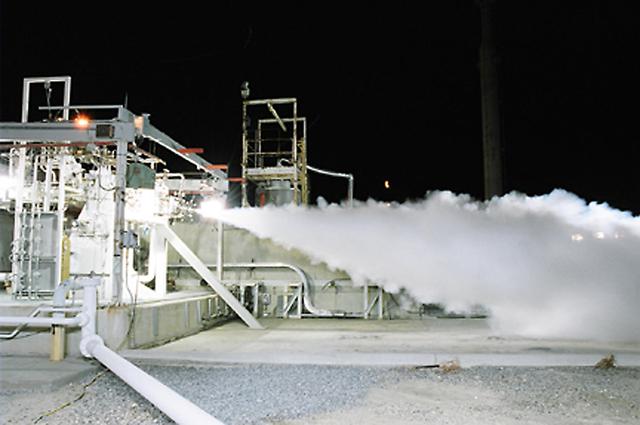
NASA Stennis Space Center engineers conducted a successful cold-flow test of an RS-84 engine component Sept. 24. The RS-84 is a reusable engine fueled by rocket propellant - a special blend of kerosene - designed to power future flight vehicles. Liquid oxygen was blown through the RS-84 subscale preburner to characterize the test facility's performance and the hardware's resistance. Engineers are now moving into the next phase, hot-fire testing, which is expected to continue into February 2004. The RS-84 engine prototype, developed by the Rocketdyne Propulsion and Power division of The Boeing Co. of Canoga Park, Calif., is one of two competing Rocket Engine Prototype technologies - a key element of NASA's Next Generation Launch Technology program.

KENNEDY SPACE CENTER, FLA. -- The new block 2 engine for the orbiter Atlantis is moved into place next to the other two engines. The work is being done in the Orbiter Processing Facility bay 3. The engine will have its first flight on mission STS-104, scheduled for launch June 14. The Block II Main Engine configuration is manufactured by Boeing Rocketdyne in Canoga Park, Calif., and includes a new Pratt and Whitney high-pressure fuel turbo pump. Engine improvements are managed by NASA’s Marshall Space Flight Center in Huntsville, Ala. Each Space Shuttle Main Engine is 14 feet (4.3 meters) long, weighs about 7,000 pounds (3,175 kilograms), and is 7.5 feet (2.3 meters) in diameter at the end of the nozzle

KENNEDY SPACE CENTER, FLA. -- As the giant forklift moves closer to Atlantis, workers keep watch as the new block 2 engine nears its installation point. The work is being done in the Orbiter Processing Facility bay 3. The engine will have its first flight on mission STS-104, scheduled for launch June 14. The Block II Main Engine configuration is manufactured by Boeing Rocketdyne in Canoga Park, Calif., and includes a new Pratt & Whitney high-pressure fuel turbo pump. Engine improvements are managed by NASA’s Marshall Space Flight Center in Huntsville, Ala. Each Space Shuttle Main Engine is 14 feet (4.3 meters) long, weighs about 7,000 pounds (3,175 kilograms), and is 7.5 feet (2.3 meters) in diameter at the end of the nozzle
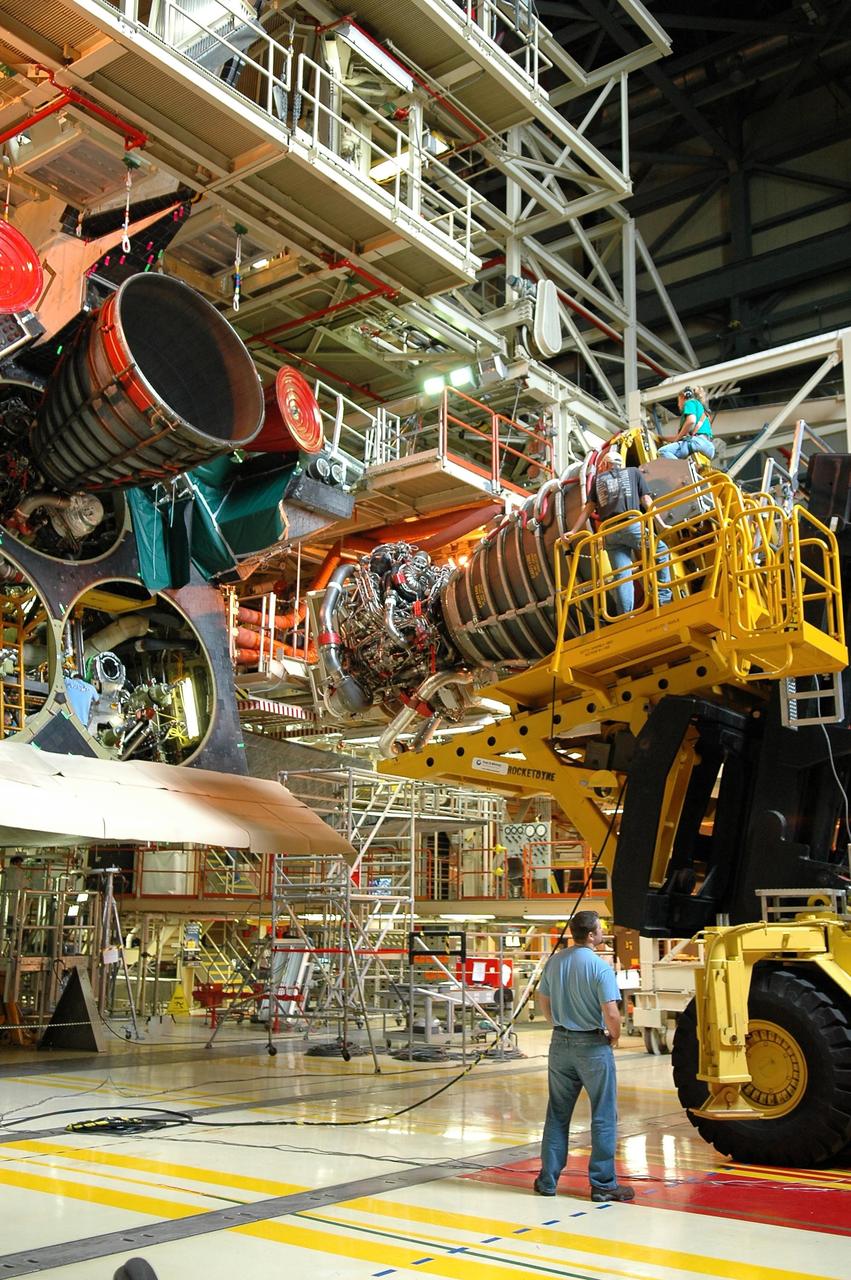
KENNEDY SPACE CENTER, FLA. - In the Orbiter Processing Facility bay 3, technicians on the Hyster forklift are ready to install main engine No. 3 on Discovery. The main engine configuration is manufactured by Pratt & Whitney Rocketdyne in Canoga Park, Calif., and includes a Pratt & Whitney high-pressure fuel turbo pump. Each space shuttle main engine is 14 feet long, weighs about 6,700 pounds, and is 7.5 feet in diameter at the end of the nozzle. Discovery is being processed for its next mission, STS-116 (12A.1), to deliver a third truss segment, a SPACEHAB module and other key components to the International Space Station. The launch is currently scheduled no earlier than Dec. 14. Photo credit: NASA/Kim Shiflett
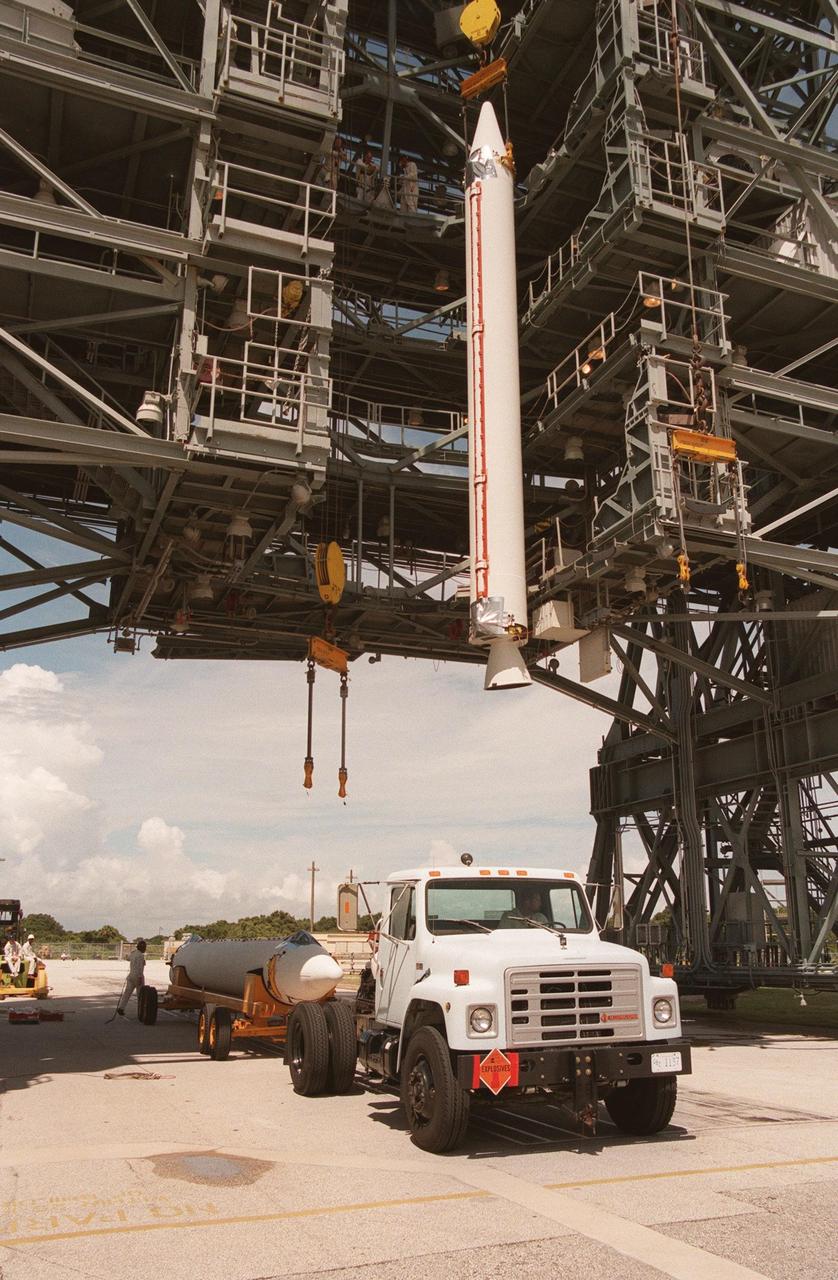
A booster is lifted off a truck for installation onto the Boeing Delta 7326 rocket that will launch Deep Space 1 at Launch Pad 17A, Cape Canaveral Air Station. Delta II rockets are medium capacity expendable launch vehicles derived from the Delta family of rockets built and launched since 1960. Since then there have been more than 245 Delta launches. The Delta 7236 has three solid rocket boosters and a Star 37 upper stage. Delta IIs are manufactured in Huntington Beach, Calif. Rocketdyne, a division of The Boeing Company, builds Delta II's main engine in Canoga Park, Calif. Deep Space 1, the first flight in NASA's New Millennium Program, is designed to validate 12 new technologies for scientific space missions of the next century. Onboard experiments include an ion propulsion engine and software that tracks celestial bodies so the spacecraft can make its own navigation decisions without the intervention of ground controllers. Deep Space 1 will complete most of its mission objectives within the first two months, but may also do a flyby of a near-Earth asteroid, 1992 KD, in July 1999
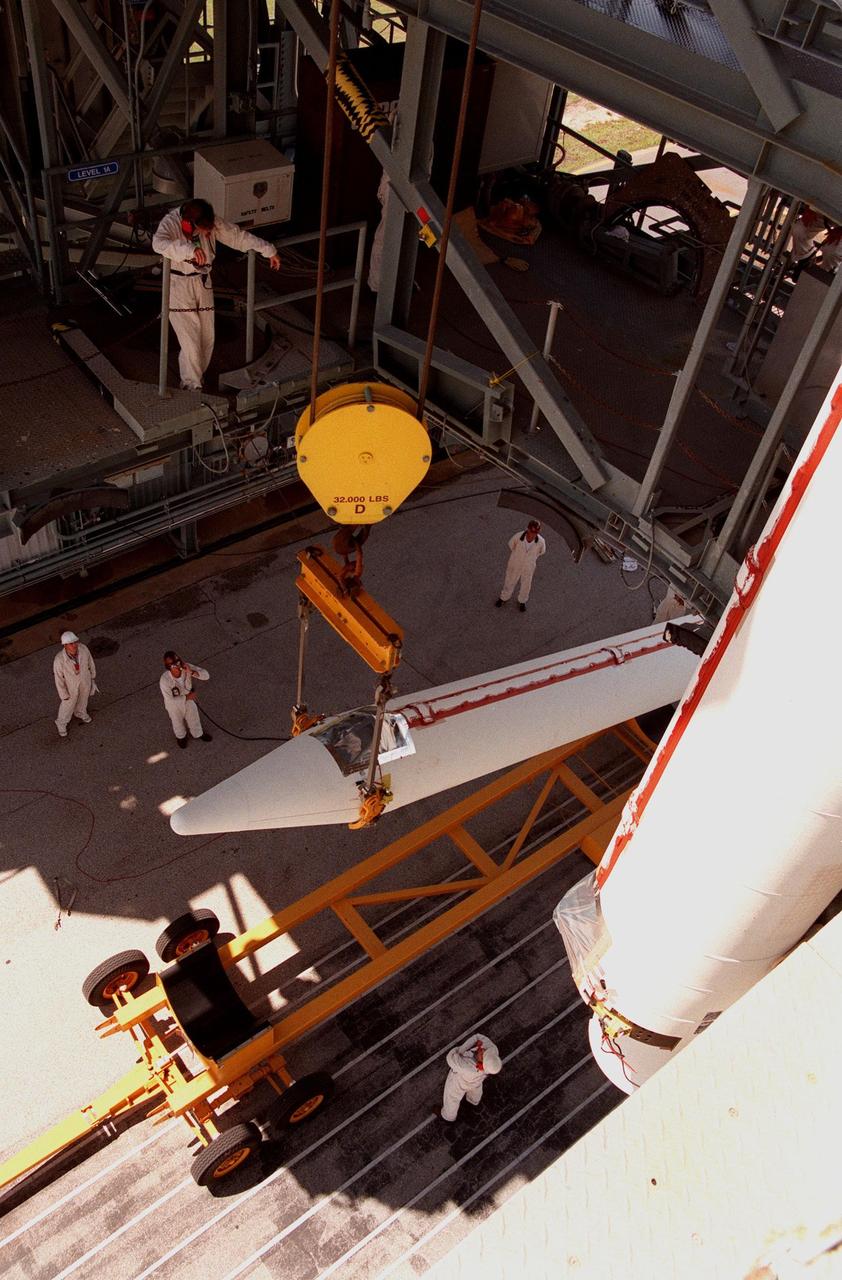
A booster is lifted for installation onto the Boeing Delta 7326 rocket that will launch Deep Space 1 at Launch Pad 17A, Cape Canaveral Air Station. Delta II rockets are medium capacity expendable launch vehicles derived from the Delta family of rockets built and launched since 1960. Since then there have been more than 245 Delta launches. The Delta 7236 has three solid rocket boosters and a Star 37 upper stage. Delta IIs are manufactured in Huntington Beach, Calif. Rocketdyne, a division of The Boeing Company, builds Delta II's main engine in Canoga Park, Calif. Deep Space 1, the first flight in NASA's New Millennium Program, is designed to validate 12 new technologies for scientific space missions of the next century. Onboard experiments include an ion propulsion engine and software that tracks celestial bodies so the spacecraft can make its own navigation decisions without the intervention of ground controllers. Deep Space 1 will complete most of its mission objectives within the first two months, but may also do a flyby of a near-Earth asteroid, 1992 KD, in July 1999
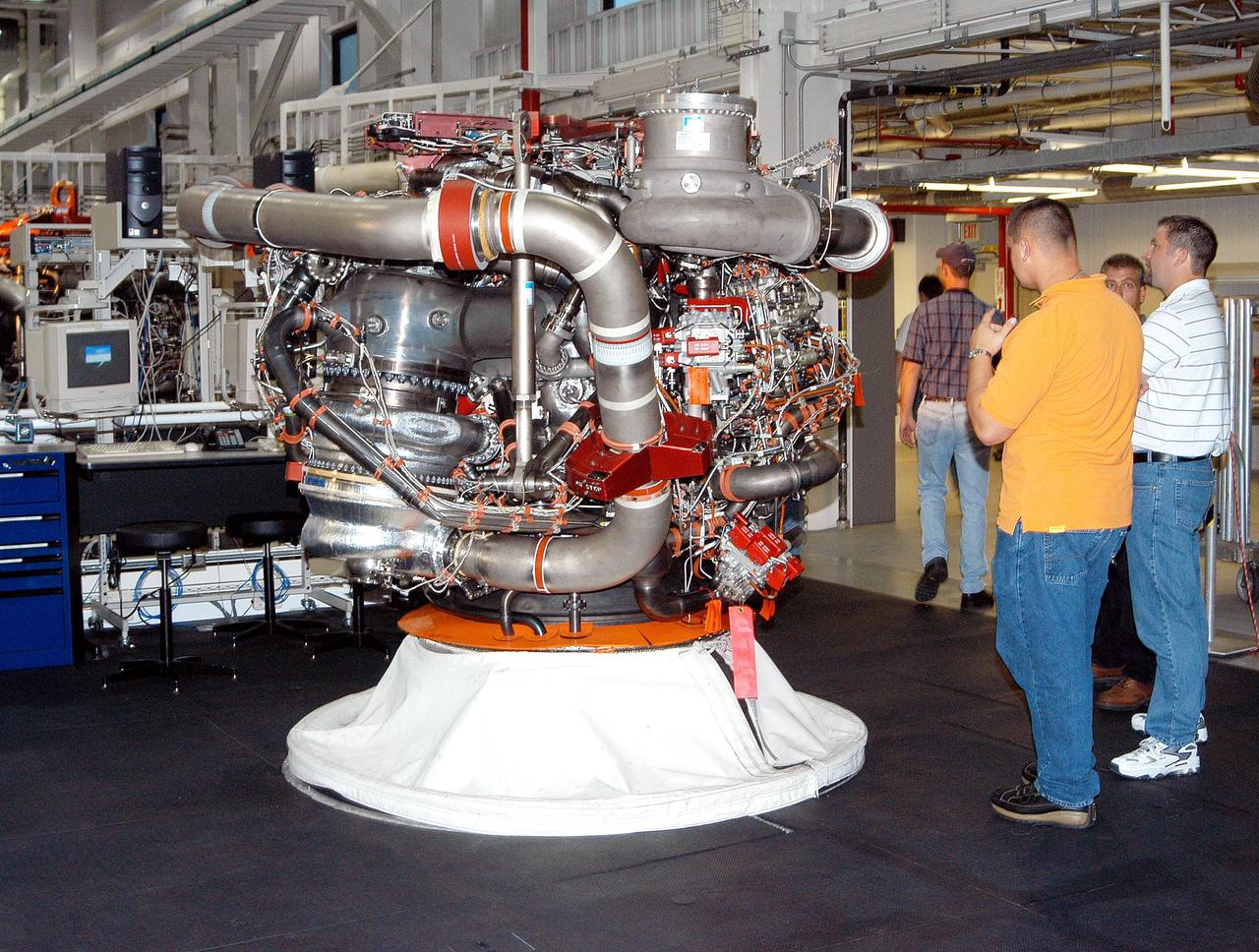
KENNEDY SPACE CENTER, FLA. - In the Space Shuttle Main Engine (SSME) Processing Facility, Boeing-Rocketdyne technicians prepare to move SSME 2058, the first SSME fully assembled at KSC. The engine will be lifted from its vertical work stand into a horizontal position in preparation for shipment to NASA’s Stennis Space Center in Mississippi to undergo a hot fire acceptance test. It is the first of five engines to be fully assembled on site to reach the desired number of 15 engines ready for launch at any given time in the Space Shuttle program. A Space Shuttle has three reusable main engines. Each is 14 feet long, weighs about 7,800 pounds, is seven-and-a-half feet in diameter at the end of its nozzle, and generates almost 400,000 pounds of thrust. Historically, SSMEs were assembled in Canoga Park, Calif., with post-flight inspections performed at KSC. Both functions were consolidated in February 2002. The Rocketdyne Propulsion and Power division of The Boeing Co. manufactures the engines for NASA.
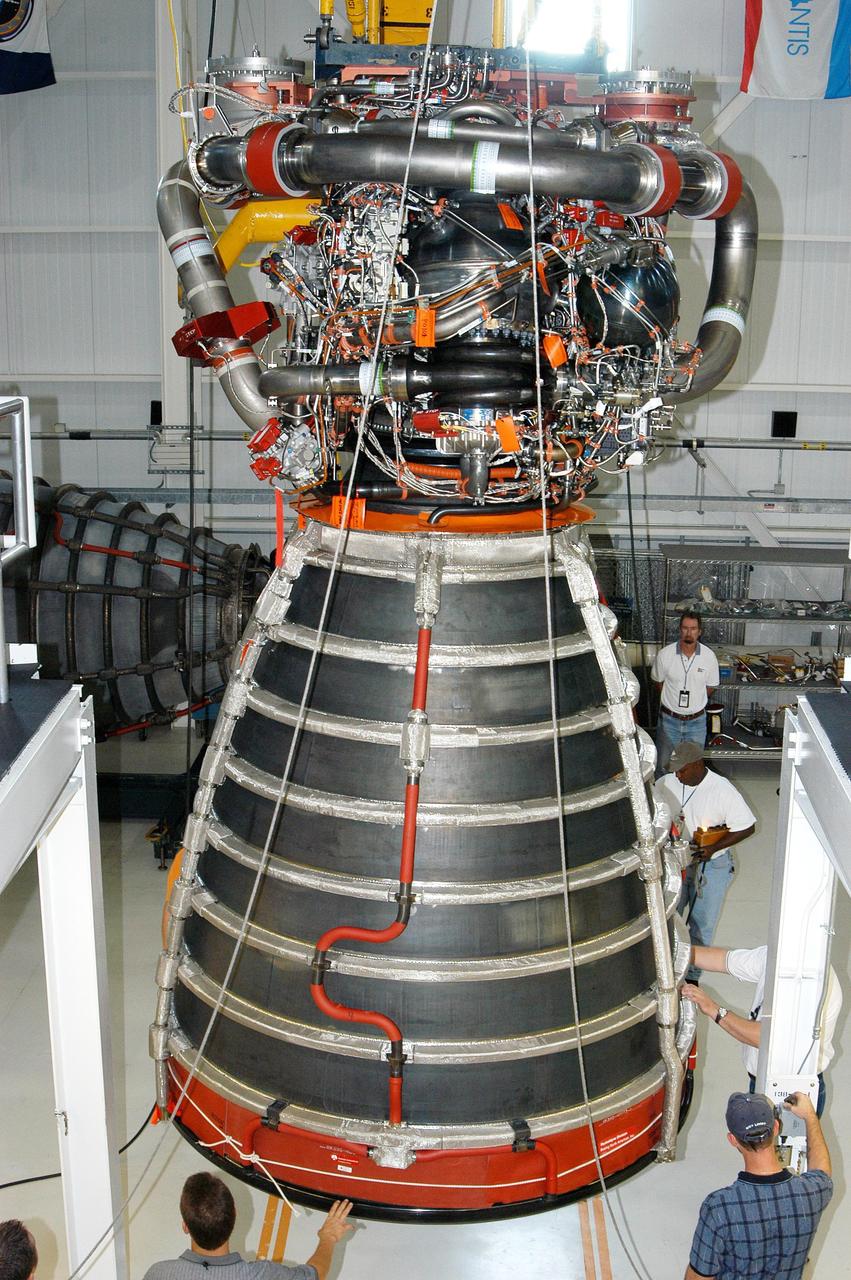
KENNEDY SPACE CENTER, FLA. - In the Space Shuttle Main Engine (SSME) Processing Facility, Boeing-Rocketdyne technicians lift SSME 2058, the first SSME fully assembled at KSC. The engine is being lifted from its vertical work stand into a horizontal position in preparation for shipment to NASA’s Stennis Space Center in Mississippi to undergo a hot fire acceptance test. It is the first of five engines to be fully assembled on site to reach the desired number of 15 engines ready for launch at any given time in the Space Shuttle program. A Space Shuttle has three reusable main engines. Each is 14 feet long, weighs about 7,800 pounds, is seven-and-a-half feet in diameter at the end of its nozzle, and generates almost 400,000 pounds of thrust. Historically, SSMEs were assembled in Canoga Park, Calif., with post-flight inspections performed at KSC. Both functions were consolidated in February 2002. The Rocketdyne Propulsion and Power division of The Boeing Co. manufactures the engines for NASA.
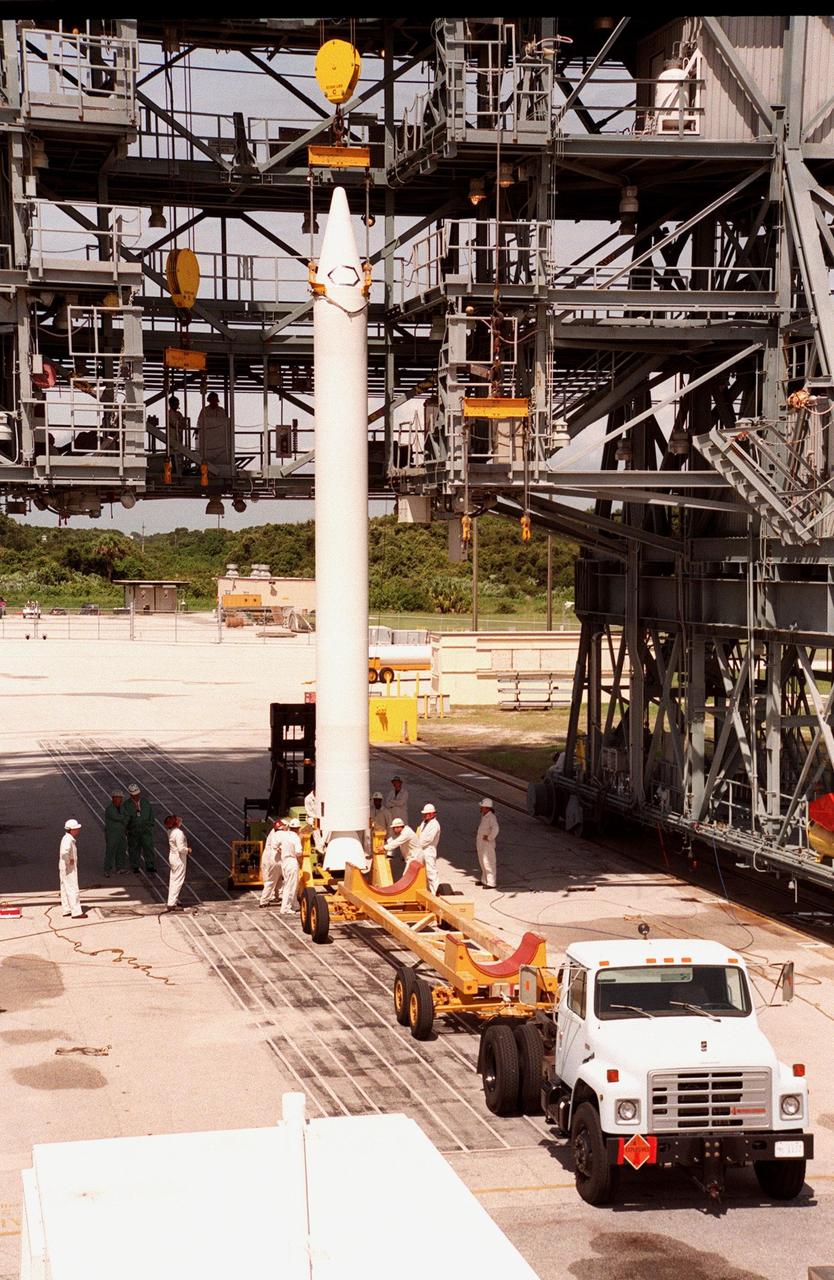
A booster is raised off a truck bed and prepared for lifting to the Boeing Delta 7326 rocket that will launch Deep Space 1 at Launch Pad 17A, Cape Canaveral Air Station. Delta II rockets are medium capacity expendable launch vehicles derived from the Delta family of rockets built and launched since 1960. Since then there have been more than 245 Delta launches. The Delta 7236 has three solid rocket boosters and a Star 37 upper stage. Delta IIs are manufactured in Huntington Beach, Calif. Rocketdyne, a division of The Boeing Company, builds Delta II's main engine in Canoga Park, Calif. Deep Space 1, the first flight in NASA's New Millennium Program, is designed to validate 12 new technologies for scientific space missions of the next century. Onboard experiments include an ion propulsion engine and software that tracks celestial bodies so the spacecraft can make its own navigation decisions without the intervention of ground controllers. Deep Space 1 will complete most of its mission objectives within the first two months, but may also do a flyby of a near-Earth asteroid, 1992 KD, in July 1999
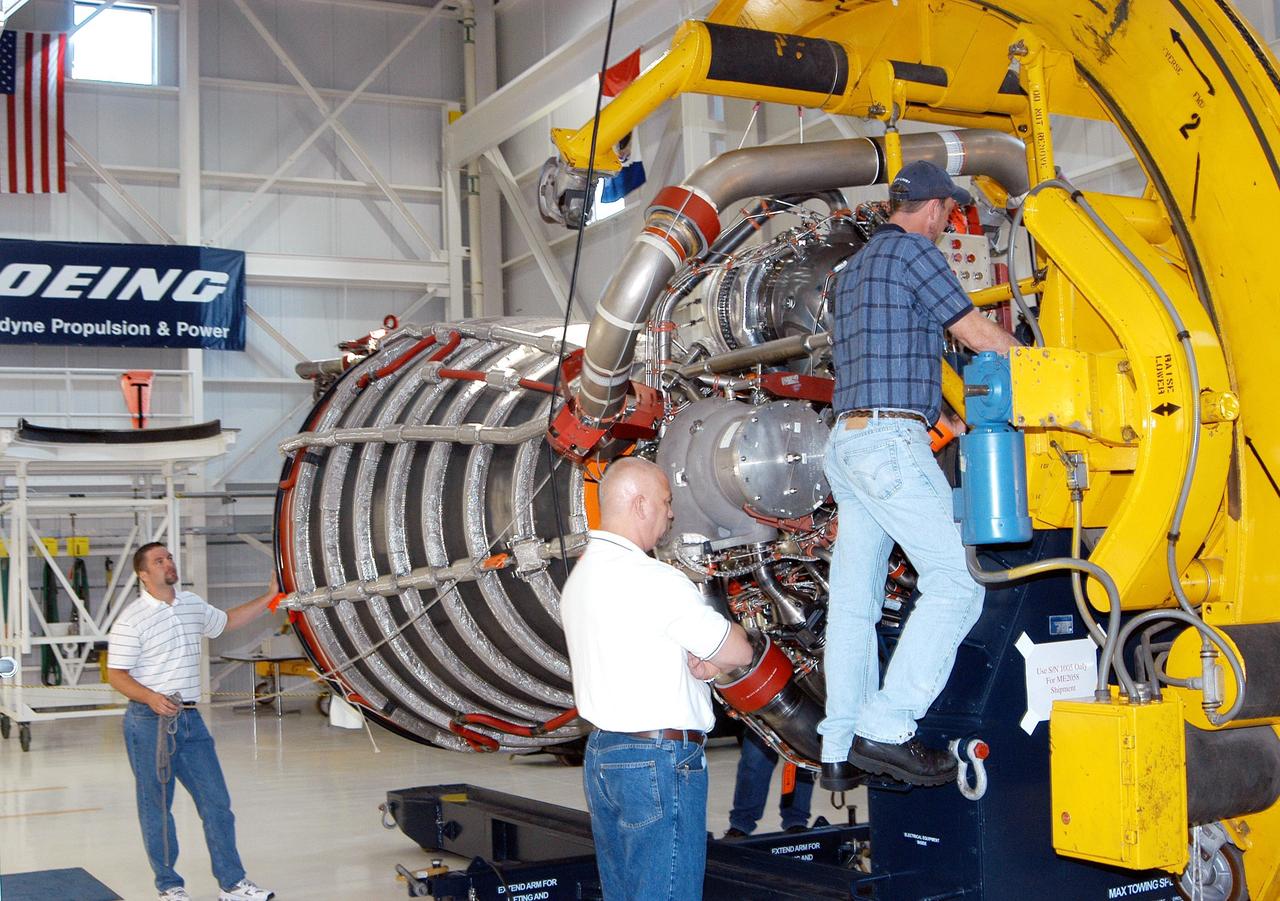
KENNEDY SPACE CENTER, FLA. - In the Space Shuttle Main Engine (SSME) Processing Facility, Boeing-Rocketdyne quality inspector Nick Grimm (center) monitors the work of technicians on his team as they lower SSME 2058, the first SSME fully assembled at KSC, onto an engine stand. The engine is being placed into a horizontal position in preparation for shipment to NASA’s Stennis Space Center in Mississippi to undergo a hot fire acceptance test. It is the first of five engines to be fully assembled on site to reach the desired number of 15 engines ready for launch at any given time in the Space Shuttle program. A Space Shuttle has three reusable main engines. Each is 14 feet long, weighs about 7,800 pounds, is seven-and-a-half feet in diameter at the end of its nozzle, and generates almost 400,000 pounds of thrust. Historically, SSMEs were assembled in Canoga Park, Calif., with post-flight inspections performed at KSC. Both functions were consolidated in February 2002. The Rocketdyne Propulsion and Power division of The Boeing Co. manufactures the engines for NASA.
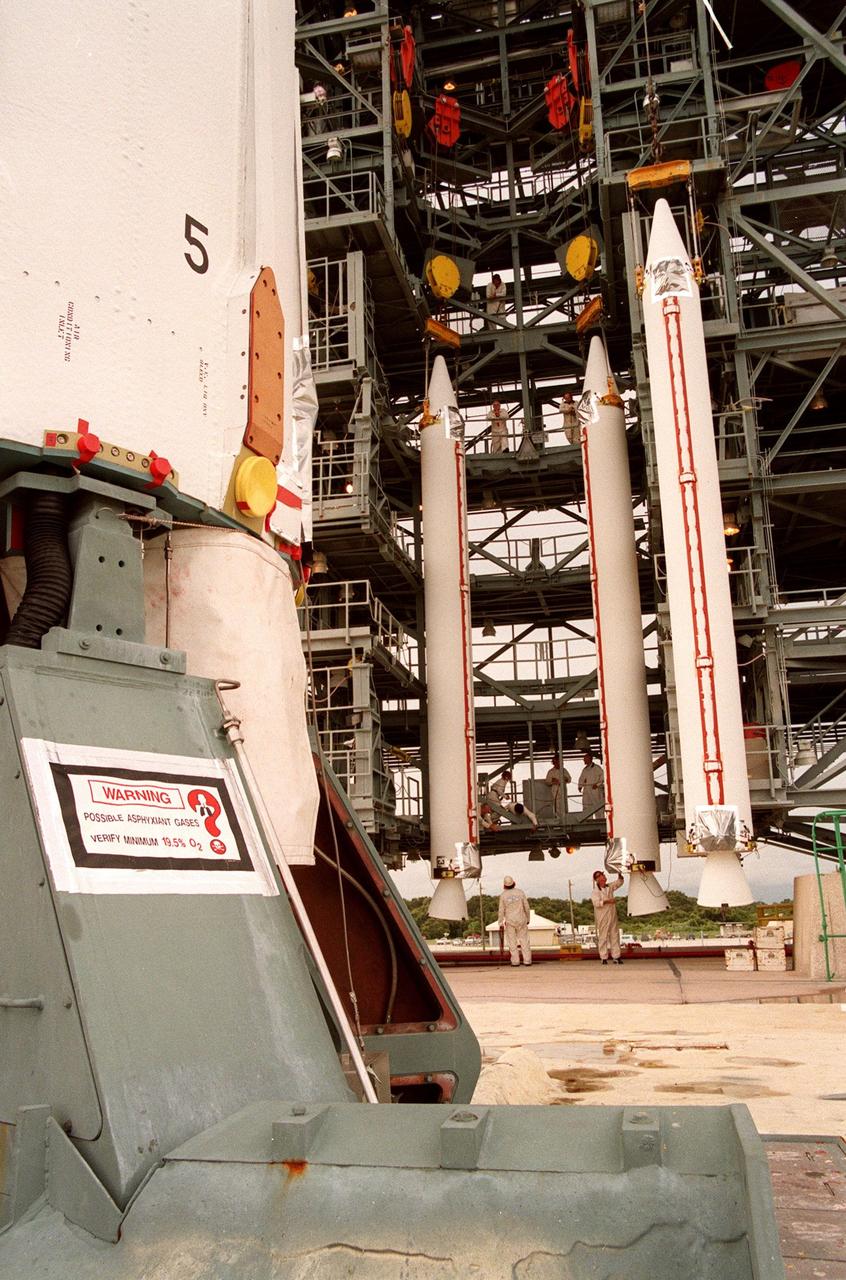
Three boosters are lifted into place at Launch Pad 17A, Cape Canaveral Air Station, for installation onto the Boeing Delta 7326 rocket that will launch Deep Space 1. Delta II rockets are medium capacity expendable launch vehicles derived from the Delta family of rockets built and launched since 1960. Since then there have been more than 245 Delta launches. The Delta 7236 has three solid rocket boosters and a Star 37 upper stage. Delta IIs are manufactured in Huntington Beach, Calif. Rocketdyne, a division of The Boeing Company, builds Delta II's main engine in Canoga Park, Calif. Deep Space 1, the first flight in NASA's New Millennium Program, is designed to validate 12 new technologies for scientific space missions of the next century. Onboard experiments include an ion propulsion engine and software that tracks celestial bodies so the spacecraft can make its own navigation decisions without the intervention of ground controllers. Deep Space 1 will complete most of its mission objectives within the first two months, but may also do a flyby of a near-Earth asteroid, 1992 KD, in July 1999
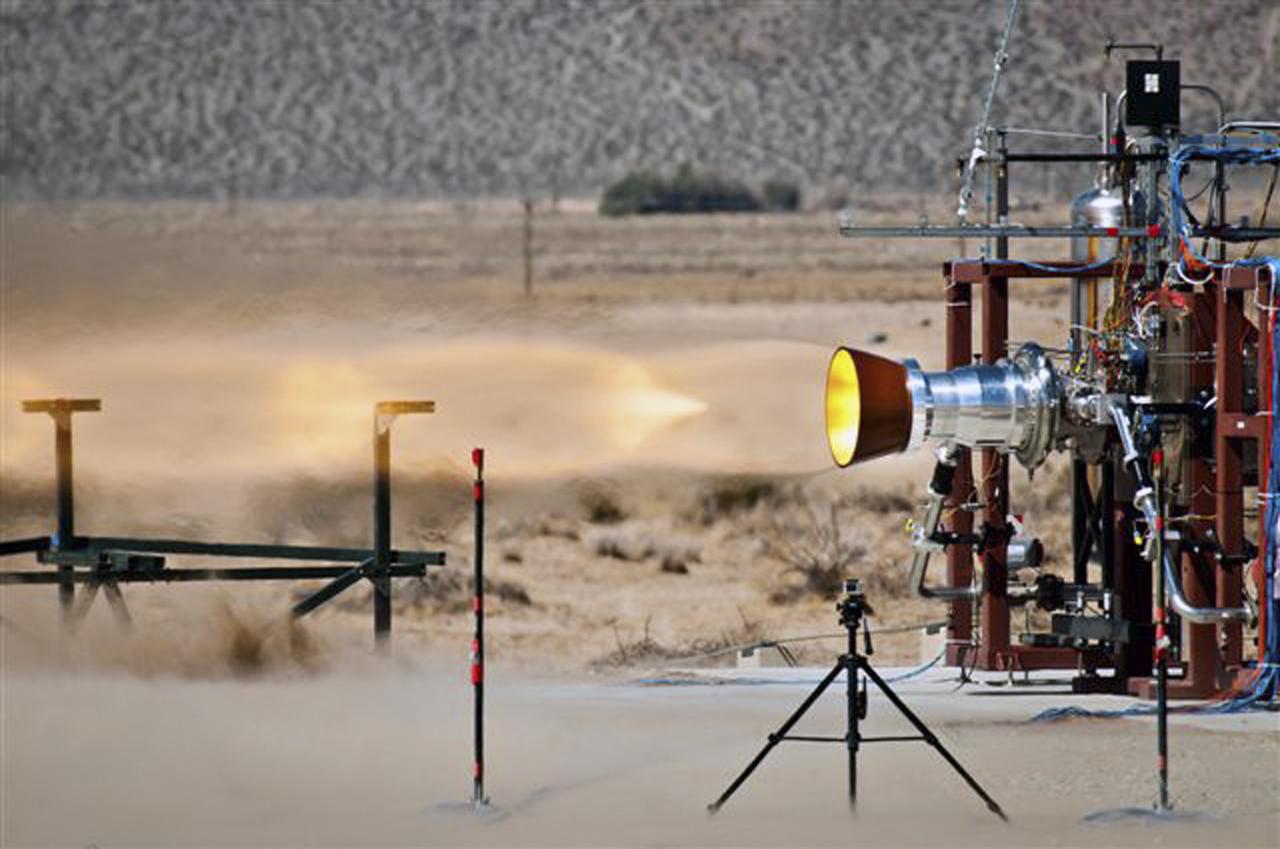
CANOGA PARK, Calif. -- Pratt & Whitney Rocketdyne hot-fires a launch abort engine for The Boeing Co., which is developing its CST-100 spacecraft for NASA's Commercial Crew Program. Under its fixed-price contract with Boeing, Pratt and Whitney Rocketdyne is combining its Attitude Control Propulsion System thrusters from heritage spaceflight programs, Bantam abort engine design and storable propellant engineering capabilities. In 2011, NASA selected Boeing of Houston during Commercial Crew Development Round 2 CCDev2) activities to mature the design and development of a crew transportation system with the overall goal of accelerating a United States-led capability to the International Space Station. The goal of CCP is to drive down the cost of space travel as well as open up space to more people than ever before by balancing industry’s own innovative capabilities with NASA's 50 years of human spaceflight experience. Six other aerospace companies also are maturing launch vehicle and spacecraft designs under CCDev2, including Alliant Techsystems Inc. ATK, Blue Origin, Excalibur Almaz Inc., Sierra Nevada Corp., Space Exploration Technologies SpaceX, and United Launch Alliance ULA. For more information, visit www.nasa.gov/commercialcrew. Image credit: Pratt & Whitney Rocketdyne
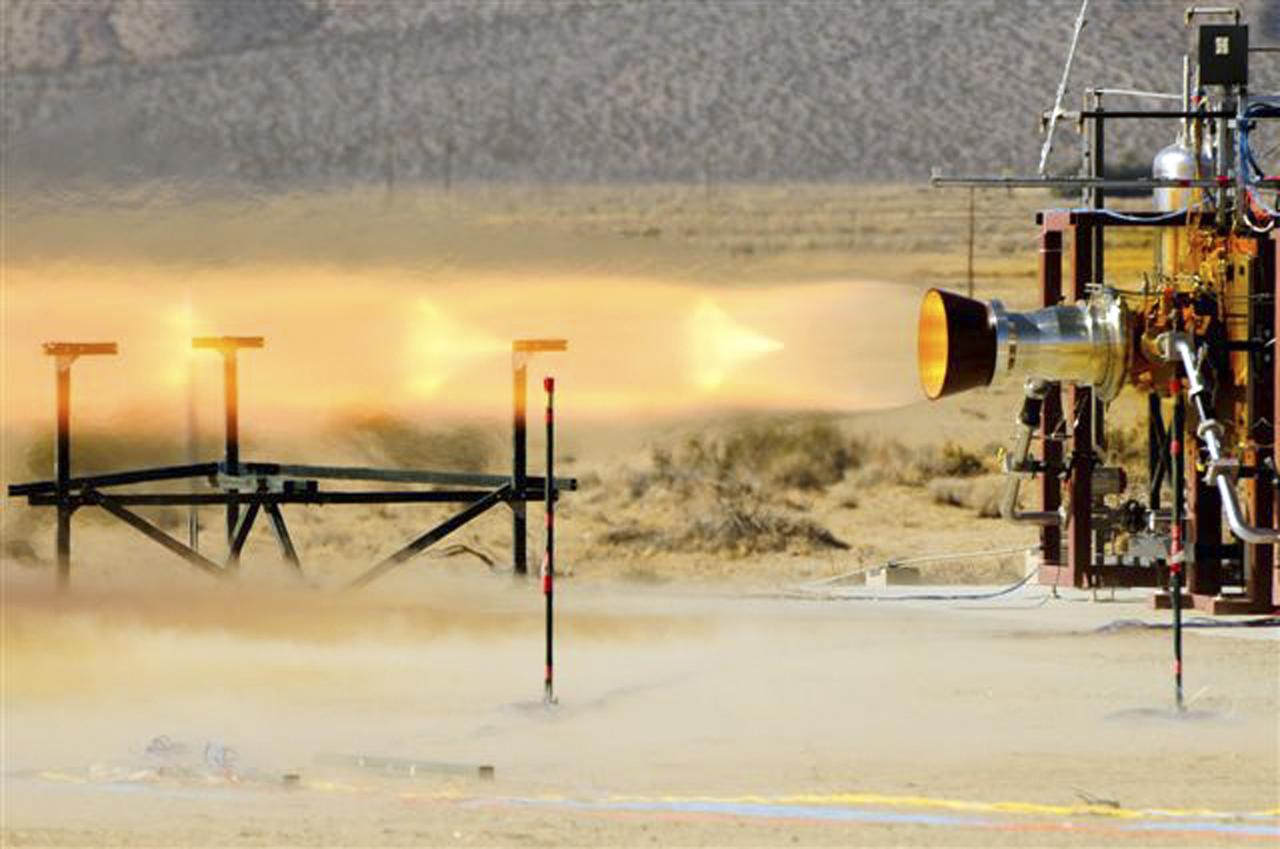
CANOGA PARK, Calif. -- Pratt & Whitney Rocketdyne hot-fires a launch abort engine for The Boeing Co., which is developing its CST-100 spacecraft for NASA's Commercial Crew Program. Under its fixed-price contract with Boeing, Pratt and Whitney Rocketdyne is combining its Attitude Control Propulsion System thrusters from heritage spaceflight programs, Bantam abort engine design and storable propellant engineering capabilities. In 2011, NASA selected Boeing of Houston during Commercial Crew Development Round 2 CCDev2) activities to mature the design and development of a crew transportation system with the overall goal of accelerating a United States-led capability to the International Space Station. The goal of CCP is to drive down the cost of space travel as well as open up space to more people than ever before by balancing industry’s own innovative capabilities with NASA's 50 years of human spaceflight experience. Six other aerospace companies also are maturing launch vehicle and spacecraft designs under CCDev2, including Alliant Techsystems Inc. ATK, Blue Origin, Excalibur Almaz Inc., Sierra Nevada Corp., Space Exploration Technologies SpaceX, and United Launch Alliance ULA. For more information, visit www.nasa.gov/commercialcrew. Image credit: Pratt & Whitney Rocketdyne
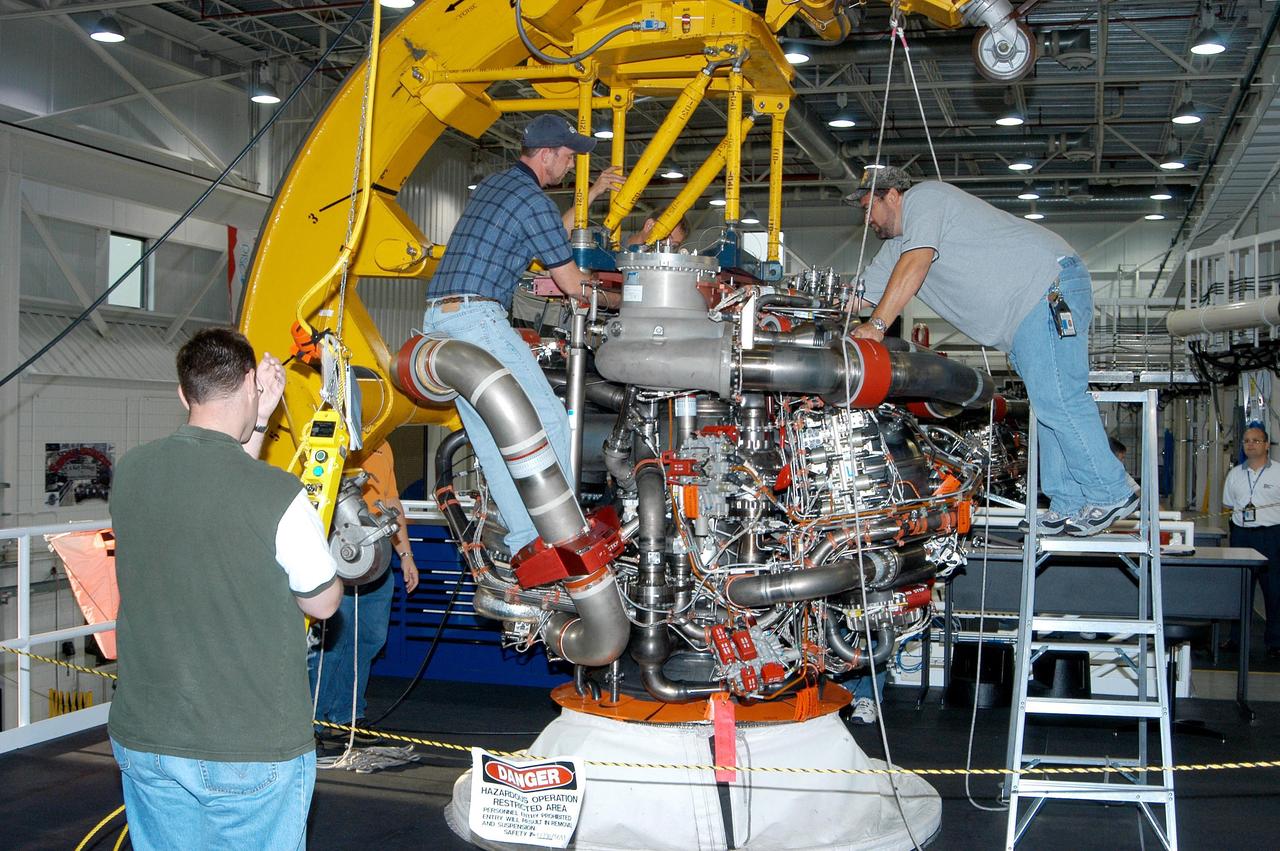
KENNEDY SPACE CENTER, FLA. - In the Space Shuttle Main Engine (SSME) Processing Facility, Boeing-Rocketdyne technicians prepare to move SSME 2058, the first SSME fully assembled at KSC. Move conductor Bob Brackett (on ladder) and technicians secure a sling around the engine under the direction of crane operator Joe Ferrante (left). The engine will be lifted from its vertical work stand into a horizontal position in preparation for shipment to NASA’s Stennis Space Center in Mississippi to undergo a hot fire acceptance test. It is the first of five engines to be fully assembled on site to reach the desired number of 15 engines ready for launch at any given time in the Space Shuttle program. A Space Shuttle has three reusable main engines. Each is 14 feet long, weighs about 7,800 pounds, is seven-and-a-half feet in diameter at the end of its nozzle, and generates almost 400,000 pounds of thrust. Historically, SSMEs were assembled in Canoga Park, Calif., with post-flight inspections performed at KSC. Both functions were consolidated in February 2002. The Rocketdyne Propulsion and Power division of The Boeing Co. manufactures the engines for NASA.
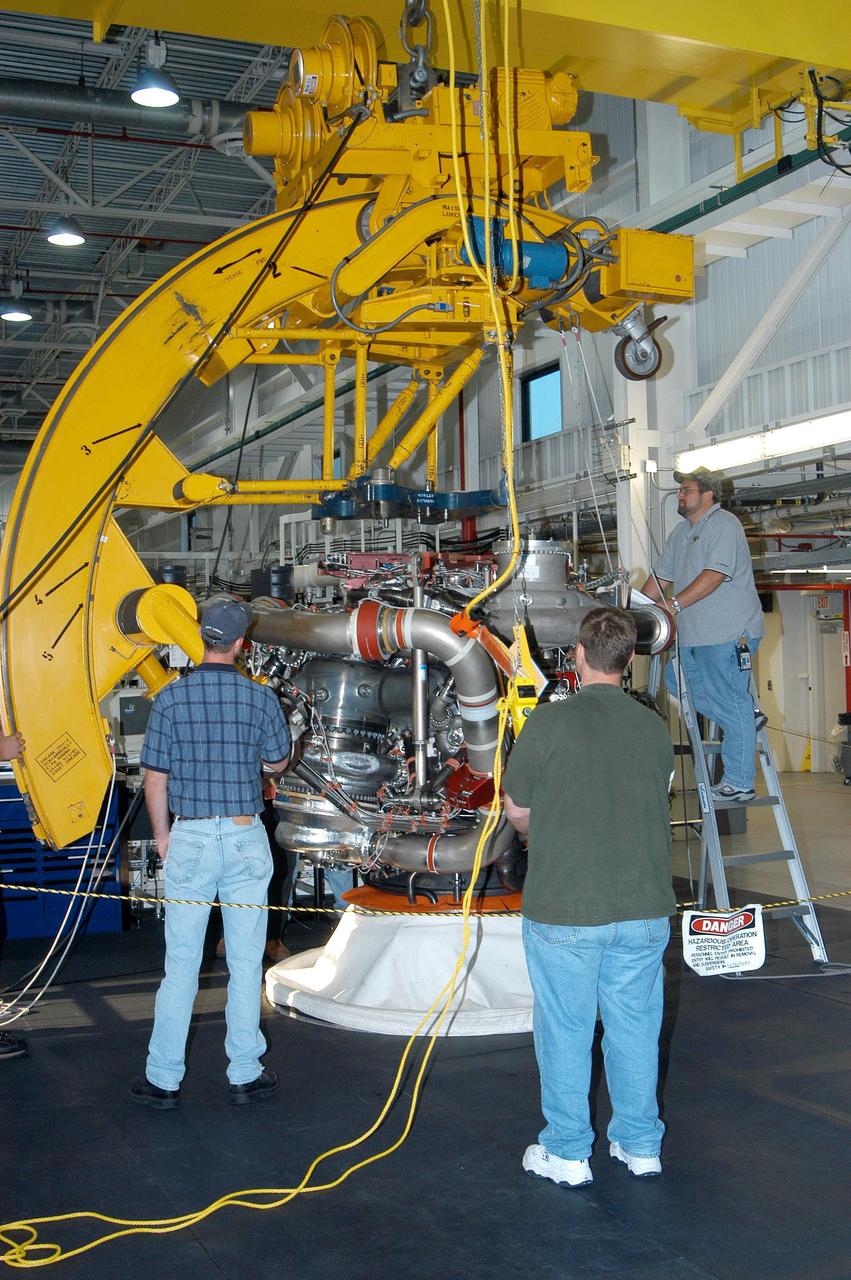
KENNEDY SPACE CENTER, FLA. - In the Space Shuttle Main Engine (SSME) Processing Facility, Boeing-Rocketdyne technicians prepare to move SSME 2058, the first SSME fully assembled at KSC. Move conductor Bob Brackett (on ladder) supervises the placement of a sling around the engine with the assistance of crane operator Joe Ferrante (center) and a technician. The engine will be lifted from its vertical work stand into a horizontal position in preparation for shipment to NASA’s Stennis Space Center in Mississippi to undergo a hot fire acceptance test. It is the first of five engines to be fully assembled on site to reach the desired number of 15 engines ready for launch at any given time in the Space Shuttle program. A Space Shuttle has three reusable main engines. Each is 14 feet long, weighs about 7,800 pounds, is seven-and-a-half feet in diameter at the end of its nozzle, and generates almost 400,000 pounds of thrust. Historically, SSMEs were assembled in Canoga Park, Calif., with post-flight inspections performed at KSC. Both functions were consolidated in February 2002. The Rocketdyne Propulsion and Power division of The Boeing Co. manufactures the engines for NASA.
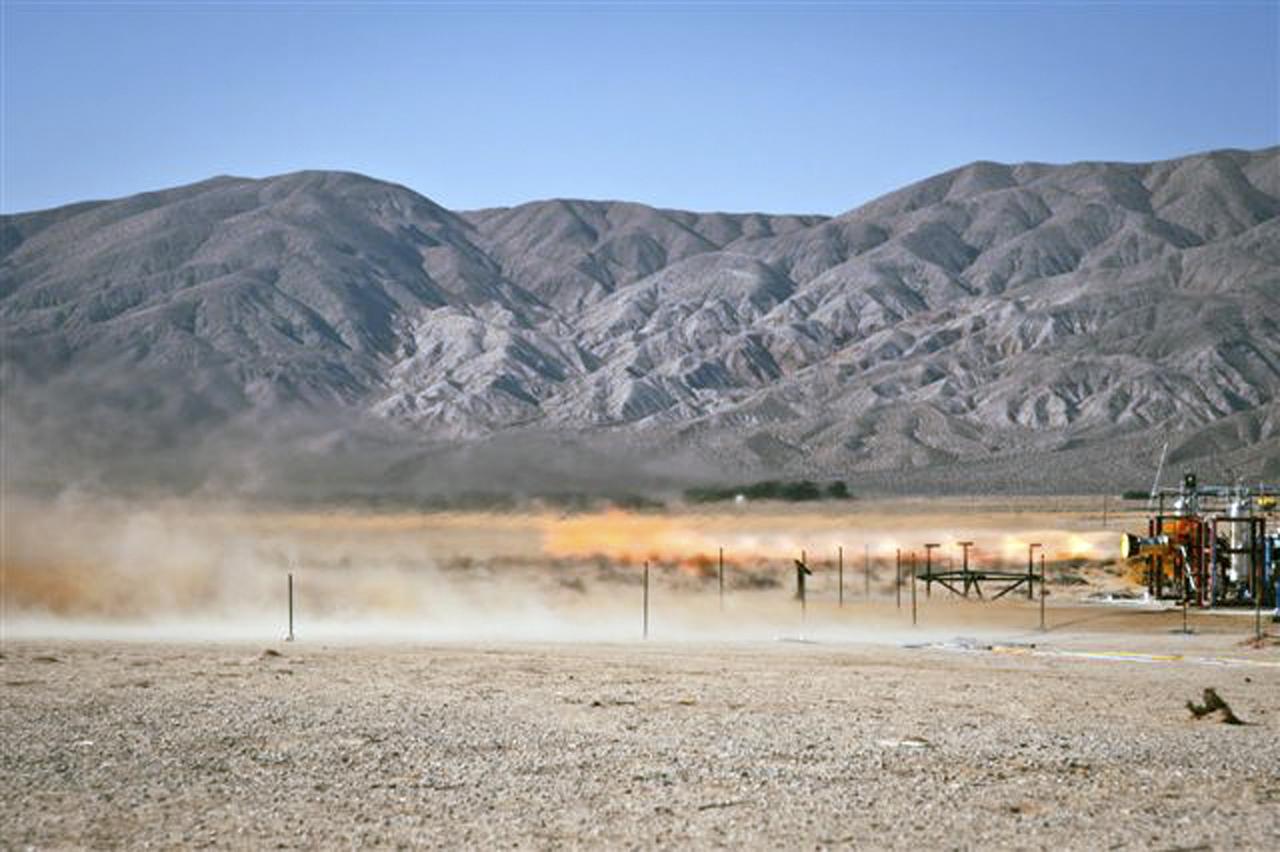
CANOGA PARK, Calif. -- Pratt & Whitney Rocketdyne hot-fires a launch abort engine for The Boeing Co., which is developing its CST-100 spacecraft for NASA's Commercial Crew Program. Under its fixed-price contract with Boeing, Pratt and Whitney Rocketdyne is combining its Attitude Control Propulsion System thrusters from heritage spaceflight programs, Bantam abort engine design and storable propellant engineering capabilities. In 2011, NASA selected Boeing of Houston during Commercial Crew Development Round 2 CCDev2) activities to mature the design and development of a crew transportation system with the overall goal of accelerating a United States-led capability to the International Space Station. The goal of CCP is to drive down the cost of space travel as well as open up space to more people than ever before by balancing industry’s own innovative capabilities with NASA's 50 years of human spaceflight experience. Six other aerospace companies also are maturing launch vehicle and spacecraft designs under CCDev2, including Alliant Techsystems Inc. ATK, Blue Origin, Excalibur Almaz Inc., Sierra Nevada Corp., Space Exploration Technologies SpaceX, and United Launch Alliance ULA. For more information, visit www.nasa.gov/commercialcrew. Image credit: Pratt & Whitney Rocketdyne
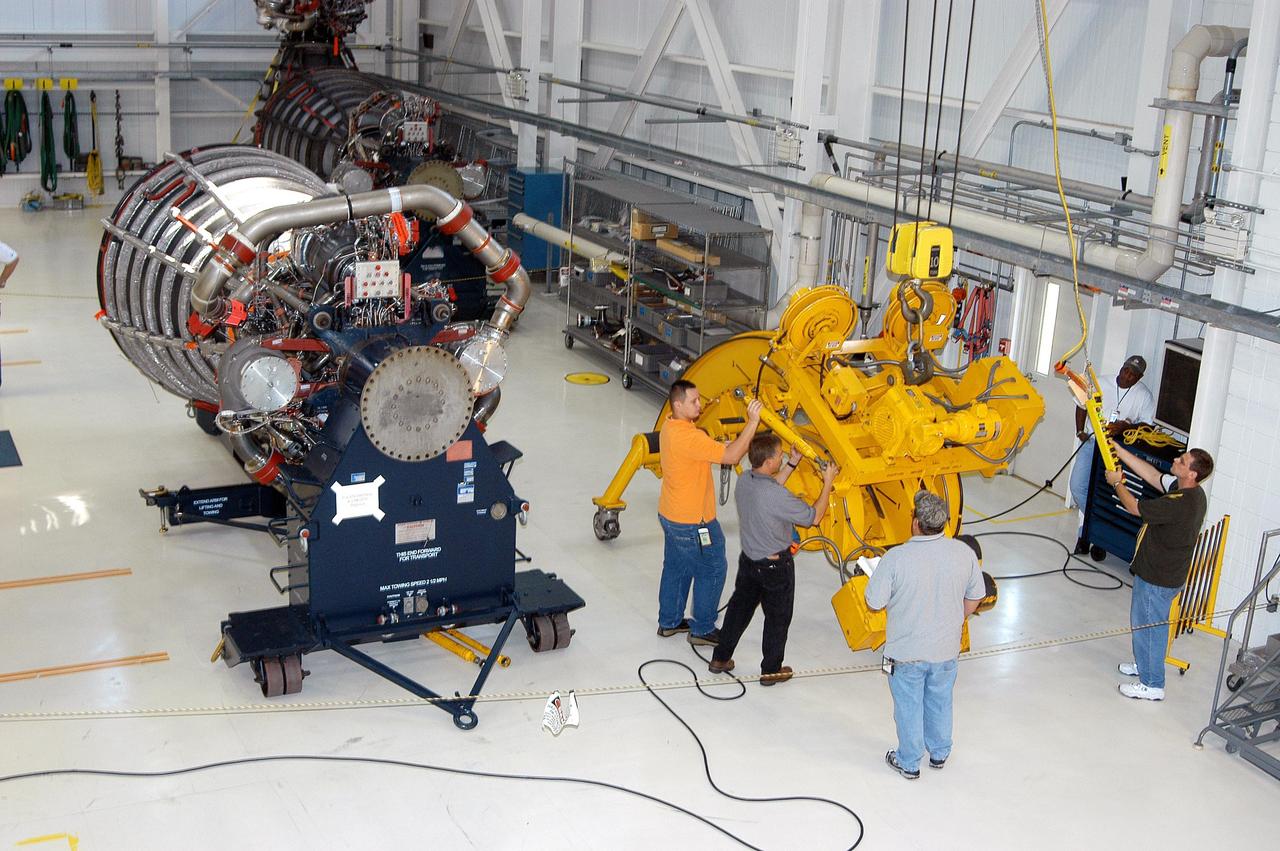
KENNEDY SPACE CENTER, FLA. - In the Space Shuttle Main Engine (SSME) Processing Facility, Boeing-Rocketdyne move conductor Bob Brackett (center) oversees the work of technicians on his team as they remove the crane used to lift SSME 2058, the first SSME fully assembled at KSC, from its vertical work stand. The engine has been placed into a horizontal position in preparation for shipment to NASA’s Stennis Space Center in Mississippi to undergo a hot fire acceptance test. It is the first of five engines to be fully assembled on site to reach the desired number of 15 engines ready for launch at any given time in the Space Shuttle program. A Space Shuttle has three reusable main engines. Each is 14 feet long, weighs about 7,800 pounds, is seven-and-a-half feet in diameter at the end of its nozzle, and generates almost 400,000 pounds of thrust. Historically, SSMEs were assembled in Canoga Park, Calif., with post-flight inspections performed at KSC. Both functions were consolidated in February 2002. The Rocketdyne Propulsion and Power division of The Boeing Co. manufactures the engines for NASA.
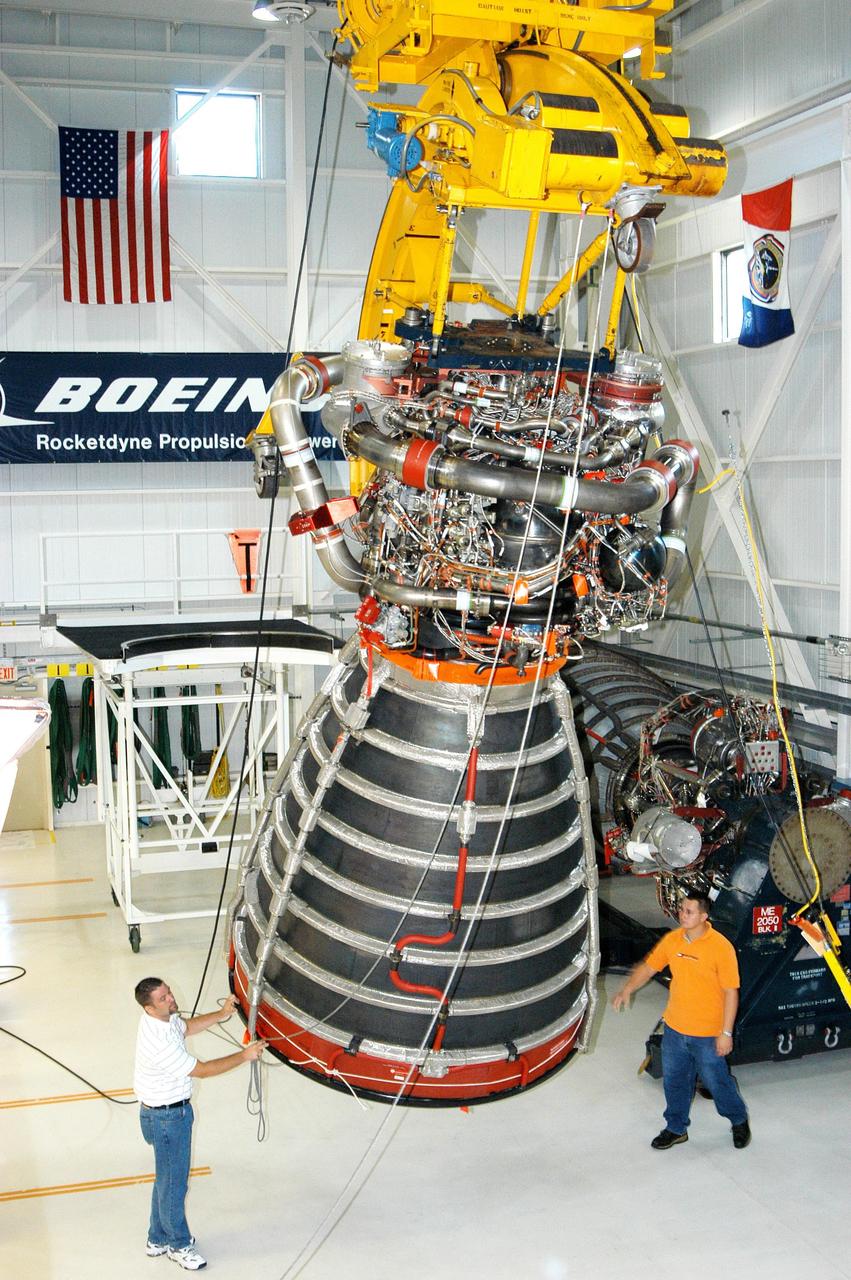
KENNEDY SPACE CENTER, FLA. - In the Space Shuttle Main Engine (SSME) Processing Facility, Boeing-Rocketdyne technicians steady SSME 2058, the first SSME fully assembled at KSC. The engine is being lifted from its vertical work stand into a horizontal position in preparation for shipment to NASA’s Stennis Space Center in Mississippi to undergo a hot fire acceptance test. It is the first of five engines to be fully assembled on site to reach the desired number of 15 engines ready for launch at any given time in the Space Shuttle program. A Space Shuttle has three reusable main engines. Each is 14 feet long, weighs about 7,800 pounds, is seven-and-a-half feet in diameter at the end of its nozzle, and generates almost 400,000 pounds of thrust. Historically, SSMEs were assembled in Canoga Park, Calif., with post-flight inspections performed at KSC. Both functions were consolidated in February 2002. The Rocketdyne Propulsion and Power division of The Boeing Co. manufactures the engines for NASA.
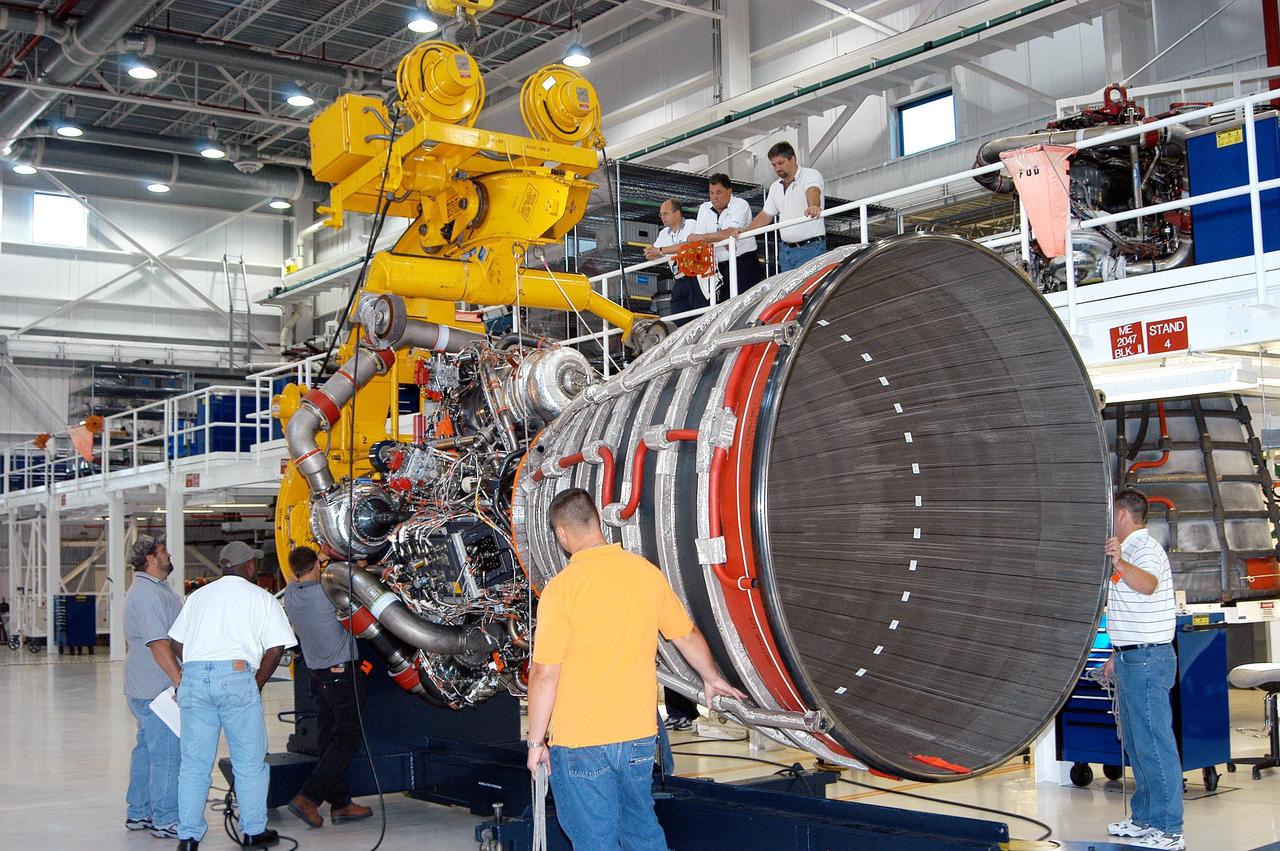
KENNEDY SPACE CENTER, FLA. - In the Space Shuttle Main Engine (SSME) Processing Facility, Boeing-Rocketdyne move conductor Bob Brackett (left) oversees the work of technicians on his team as they secure SSME 2058, the first SSME fully assembled at KSC, onto an engine stand. The engine is being placed into a horizontal position in preparation for shipment to NASA’s Stennis Space Center in Mississippi to undergo a hot fire acceptance test. It is the first of five engines to be fully assembled on site to reach the desired number of 15 engines ready for launch at any given time in the Space Shuttle program. A Space Shuttle has three reusable main engines. Each is 14 feet long, weighs about 7,800 pounds, is seven-and-a-half feet in diameter at the end of its nozzle, and generates almost 400,000 pounds of thrust. Historically, SSMEs were assembled in Canoga Park, Calif., with post-flight inspections performed at KSC. Both functions were consolidated in February 2002. The Rocketdyne Propulsion and Power division of The Boeing Co. manufactures the engines for NASA.
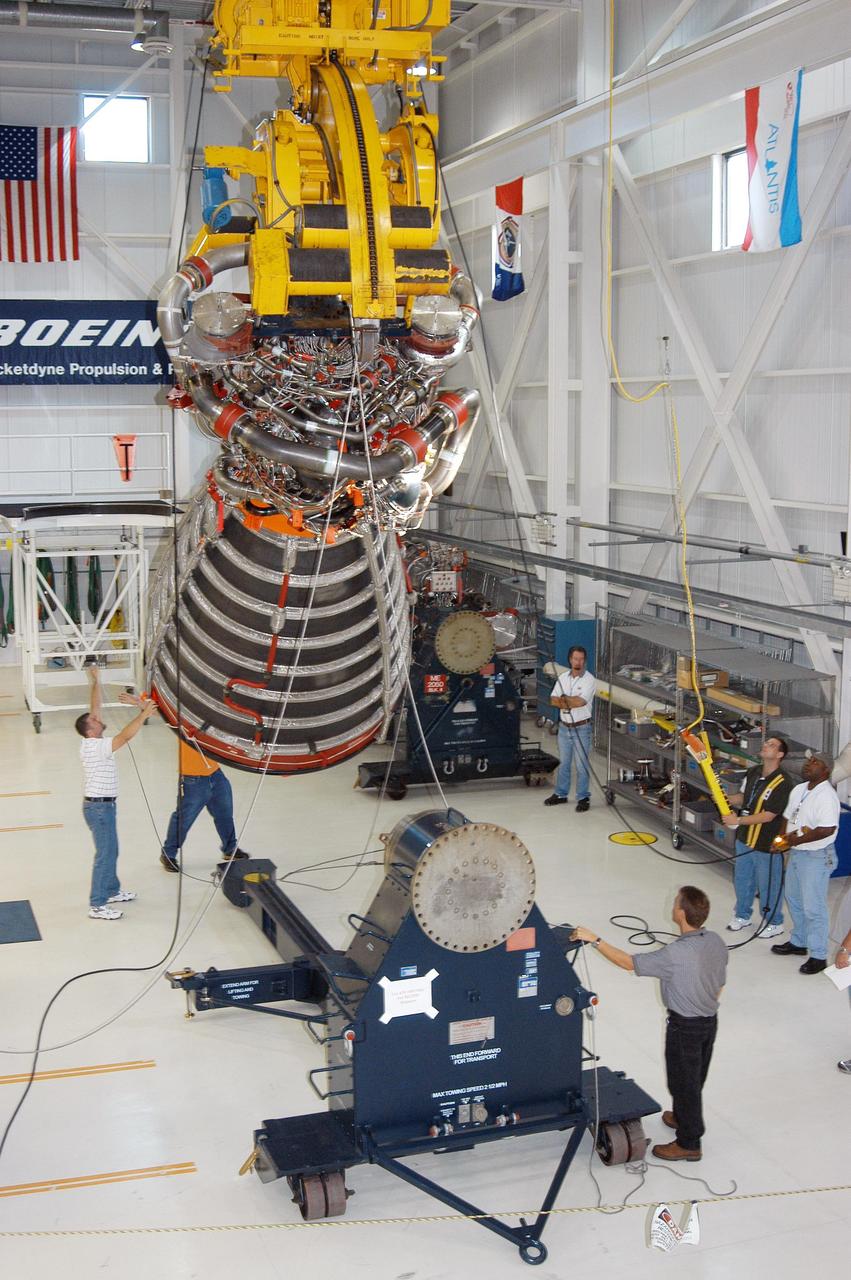
KENNEDY SPACE CENTER, FLA. - In the Space Shuttle Main Engine (SSME) Processing Facility, Boeing-Rocketdyne crane operator Joe Ferrante (second from right) lifts SSME 2058, the first SSME fully assembled at KSC, with the assistance of other technicians on his team. The engine is being lifted from its vertical work stand into a horizontal position in preparation for shipment to NASA’s Stennis Space Center in Mississippi to undergo a hot fire acceptance test. It is the first of five engines to be fully assembled on site to reach the desired number of 15 engines ready for launch at any given time in the Space Shuttle program. A Space Shuttle has three reusable main engines. Each is 14 feet long, weighs about 7,800 pounds, is seven-and-a-half feet in diameter at the end of its nozzle, and generates almost 400,000 pounds of thrust. Historically, SSMEs were assembled in Canoga Park, Calif., with post-flight inspections performed at KSC. Both functions were consolidated in February 2002. The Rocketdyne Propulsion and Power division of The Boeing Co. manufactures the engines for NASA.
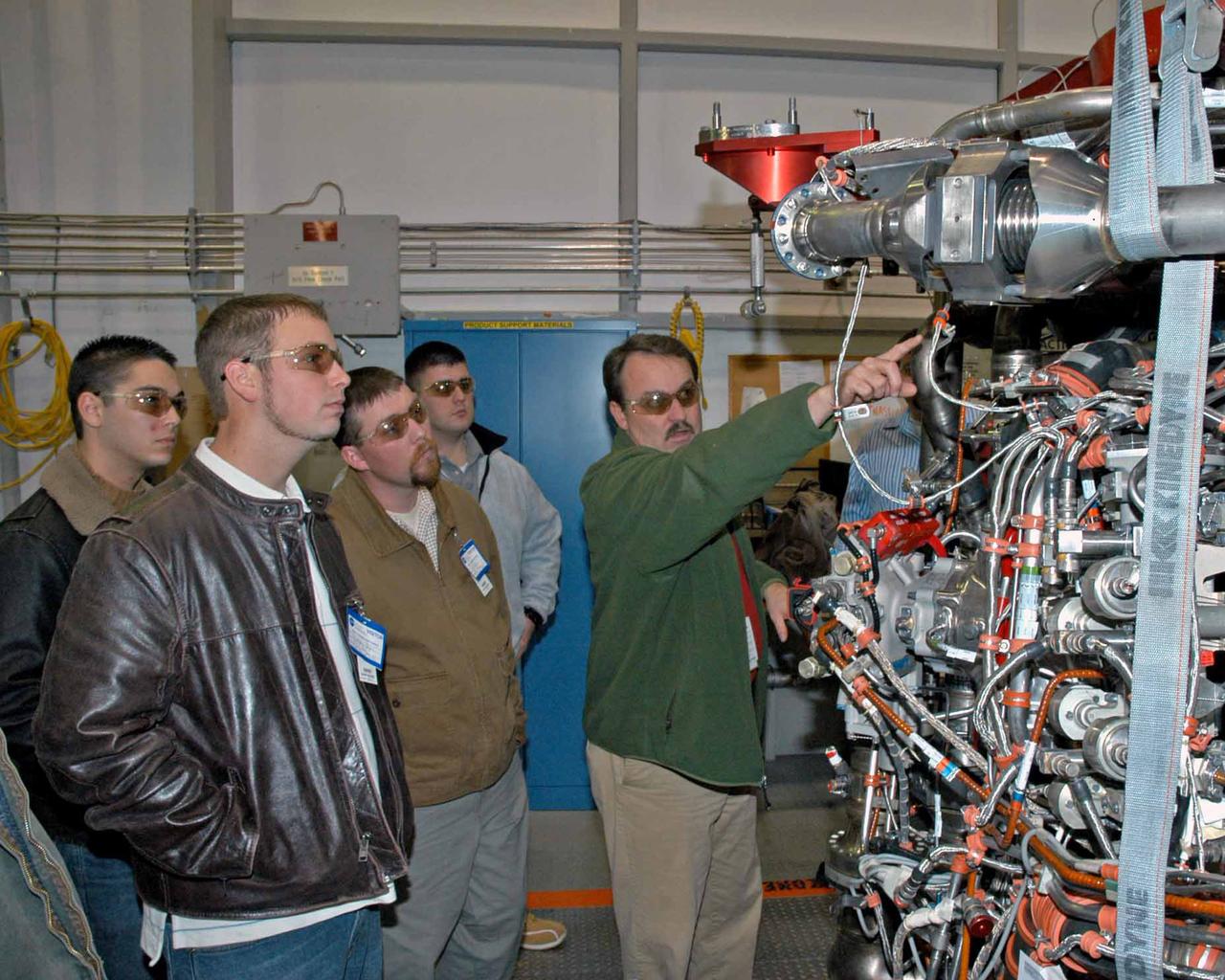
Pratt & Whitney Rocketdyne's Jeff Hansell, right, explains functions of a space shuttle main engine to Pearl River Community College Aviation Maintenance Technology Program students. Christopher Bryon, left, of Bay St. Louis, Ret Tolar of Kiln, Dan Holston of Baxterville and Billy Zugg of Long Beach took a recent tour of the SSME Processing Facility and the E-1 Test Complex at Stennis Space Center in South Mississippi. The students attend class adjacent to the Stennis International Airport tarmac in Kiln, where they get hands-on experience. PRCC's program prepares students to be responsible for the inspection, repair and maintenance of technologically advanced aircraft. A contractor to NASA, Pratt & Whitney Rocketdyne in Canoga Park, Calif., manufactures the space shuttle main engine and its high-pressure turbo pumps. SSC was established in the 1960s to test the huge engines for the Saturn V moon rockets. Now 40 years later, the center tests every main engine for the space shuttle, and is America's largest rocket engine test complex. SSC will soon begin testing the rocket engines that will power spacecraft carrying Americans back to the moon and on to Mars.
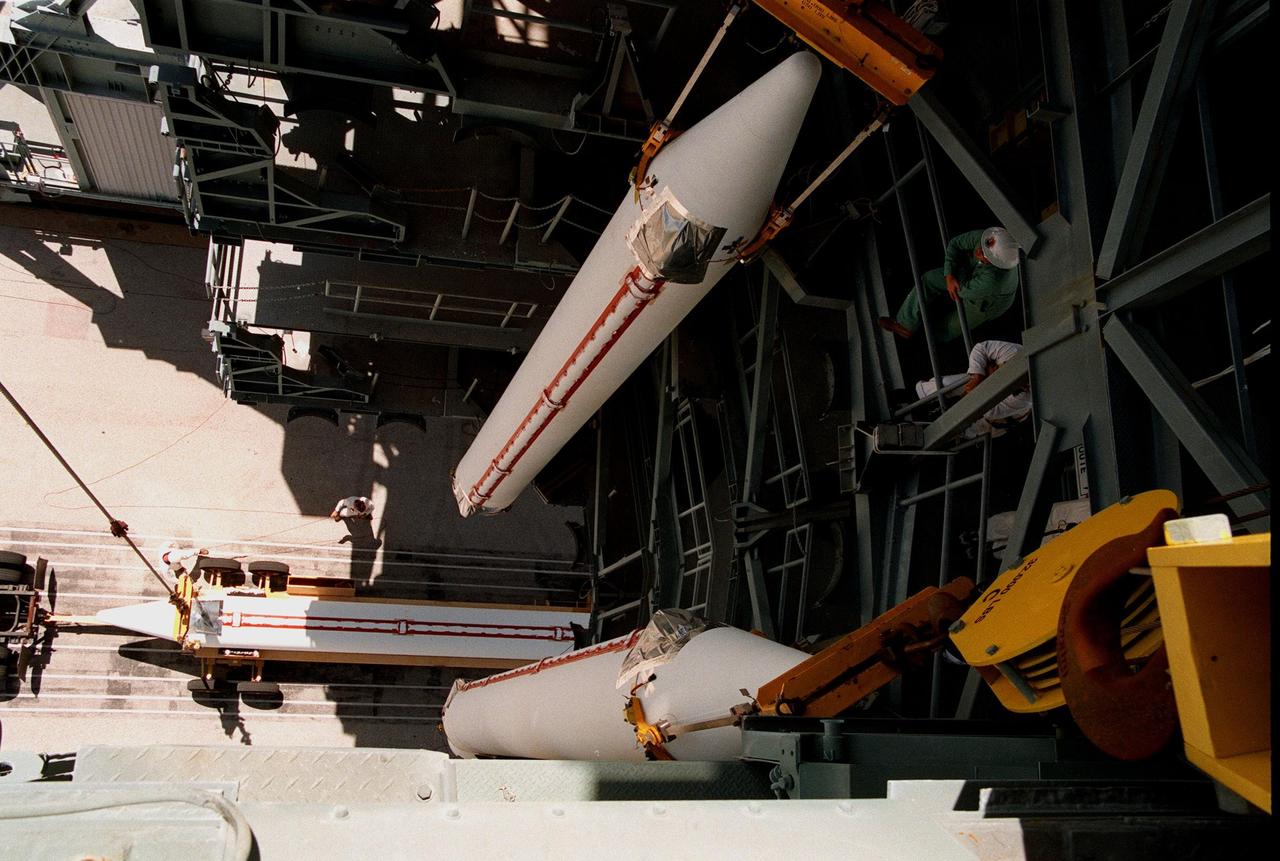
Two boosters are lifted into place, while a third waits on the ground, for installation onto the Boeing Delta 7326 rocket that will launch Deep Space 1 at Launch Pad 17A, Cape Canaveral Air Station. Delta II rockets are medium capacity expendable launch vehicles derived from the Delta family of rockets built and launched since 1960. Since then there have been more than 245 Delta launches. The Delta 7236 has three solid rocket boosters and a Star 37 upper stage. Delta IIs are manufactured in Huntington Beach, Calif. Rocketdyne, a division of The Boeing Company, builds Delta II's main engine in Canoga Park, Calif. Deep Space 1, the first flight in NASA's New Millennium Program, is designed to validate 12 new technologies for scientific space missions of the next century. Onboard experiments include an ion propulsion engine and software that tracks celestial bodies so the spacecraft can make its own navigation decisions without the intervention of ground controllers. Deep Space 1 will complete most of its mission objectives within the first two months, but may also do a flyby of a near-Earth asteroid, 1992 KD, in July 1999
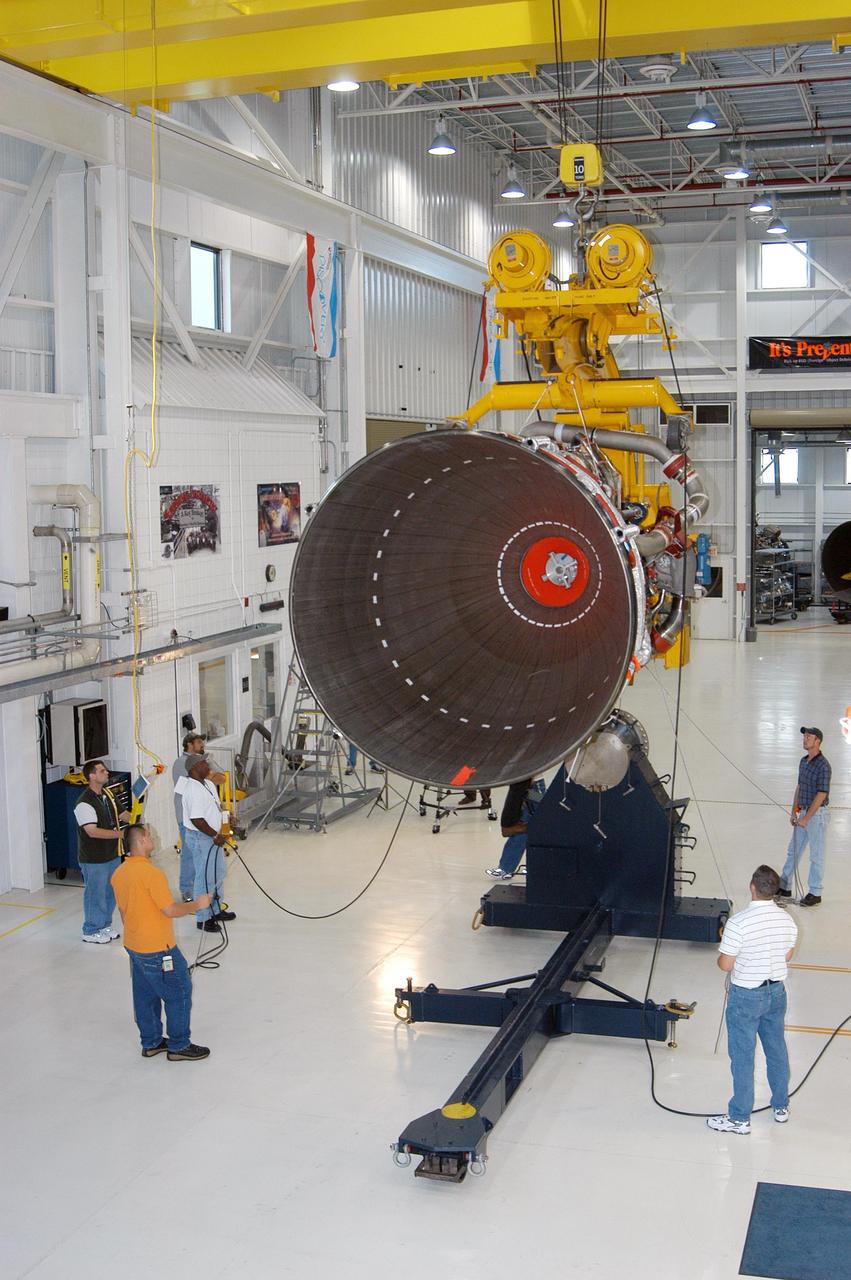
KENNEDY SPACE CENTER, FLA. - In the Space Shuttle Main Engine (SSME) Processing Facility, Boeing-Rocketdyne crane operator Joe Ferrante (left) lowers SSME 2058, the first SSME fully assembled at KSC, onto an engine stand with the assistance of other technicians on his team. The engine is being moved from its vertical work stand into a horizontal position in preparation for shipment to NASA’s Stennis Space Center in Mississippi to undergo a hot fire acceptance test. It is the first of five engines to be fully assembled on site to reach the desired number of 15 engines ready for launch at any given time in the Space Shuttle program. A Space Shuttle has three reusable main engines. Each is 14 feet long, weighs about 7,800 pounds, is seven-and-a-half feet in diameter at the end of its nozzle, and generates almost 400,000 pounds of thrust. Historically, SSMEs were assembled in Canoga Park, Calif., with post-flight inspections performed at KSC. Both functions were consolidated in February 2002. The Rocketdyne Propulsion and Power division of The Boeing Co. manufactures the engines for NASA.
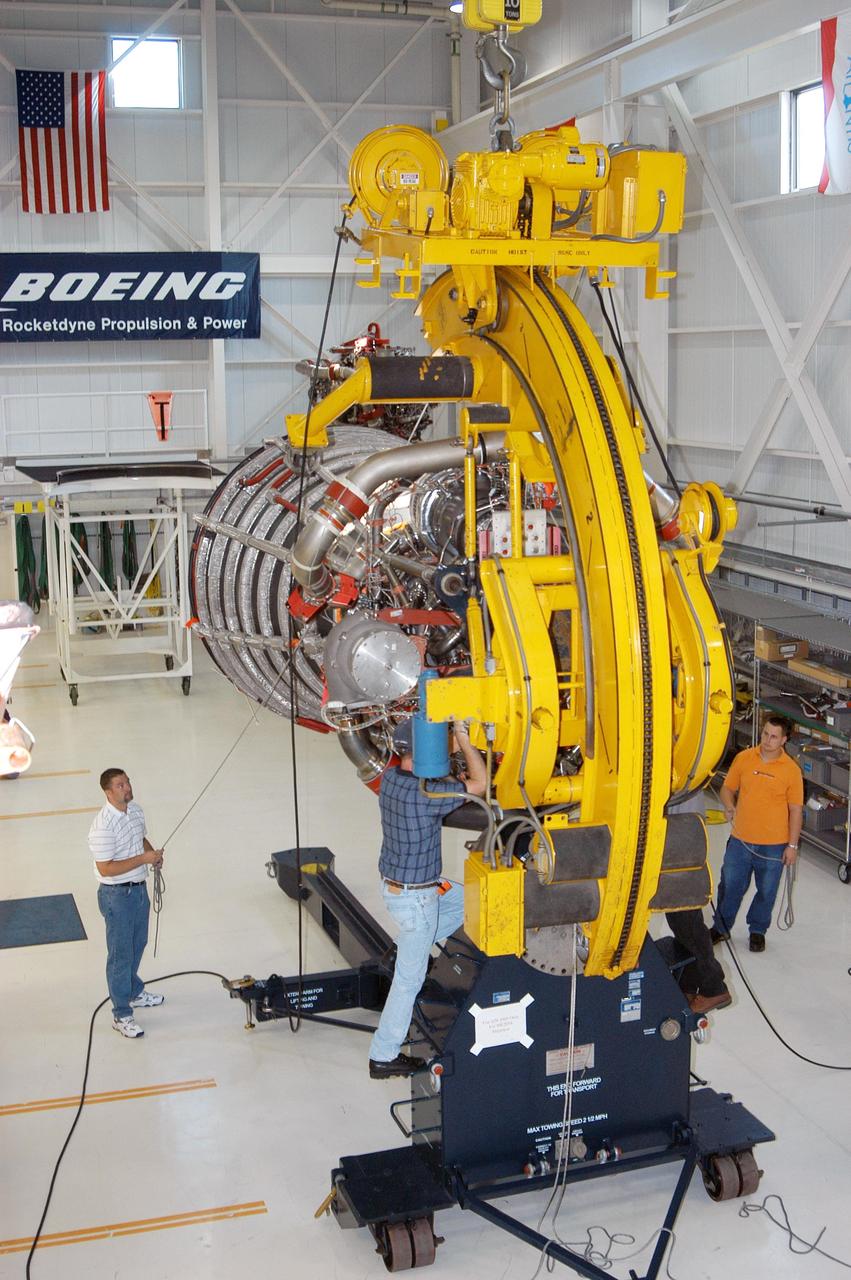
KENNEDY SPACE CENTER, FLA. - In the Space Shuttle Main Engine (SSME) Processing Facility, Boeing-Rocketdyne technicians lower SSME 2058, the first SSME fully assembled at KSC, onto an engine stand. The engine is being moved from its vertical work stand into a horizontal position in preparation for shipment to NASA’s Stennis Space Center in Mississippi to undergo a hot fire acceptance test. It is the first of five engines to be fully assembled on site to reach the desired number of 15 engines ready for launch at any given time in the Space Shuttle program. A Space Shuttle has three reusable main engines. Each is 14 feet long, weighs about 7,800 pounds, is seven-and-a-half feet in diameter at the end of its nozzle, and generates almost 400,000 pounds of thrust. Historically, SSMEs were assembled in Canoga Park, Calif., with post-flight inspections performed at KSC. Both functions were consolidated in February 2002. The Rocketdyne Propulsion and Power division of The Boeing Co. manufactures the engines for NASA.
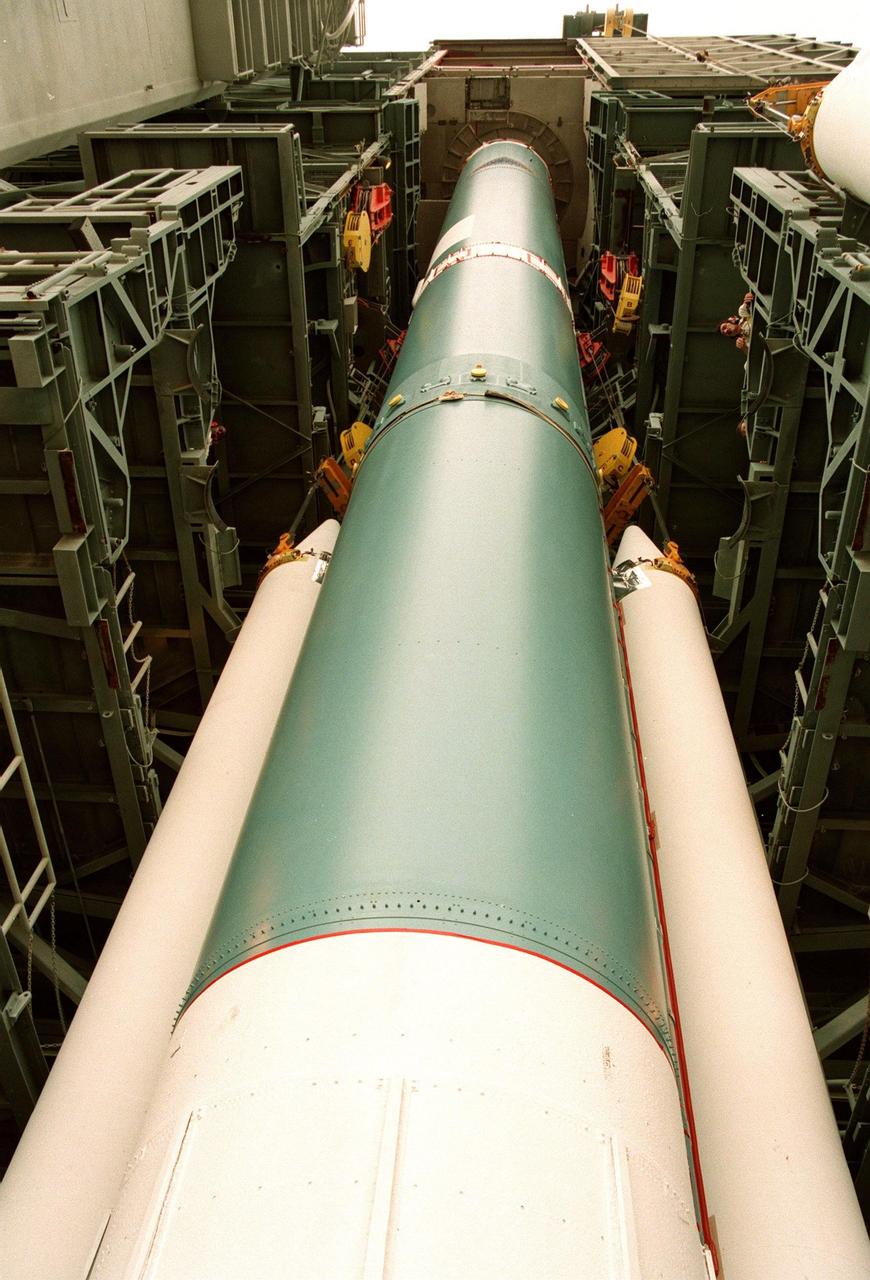
A Boeing Delta 7326 rocket with two solid rocket boosters attached sits on Launch Pad 17A, Cape Canaveral Air Station. Delta II rockets are medium capacity expendable launch vehicles derived from the Delta family of rockets built and launched since 1960. Since then there have been more than 245 Delta launches. Delta's origins go back to the Thor intermediate-range ballistic missile, which was developed in the mid-1950s for the U.S. Air Force. The Thor a single-stage, liquid-fueled rocket later was modified to become the Delta launch vehicle. Delta IIs are manufactured in Huntington Beach, Calif. Rocketdyne, a division of The Boeing Company, builds Delta II's main engine in Canoga Park, Calif. Final assembly takes place at the Boeing facility in Pueblo, Colo. The Delta 7236, which has three solid rocket boosters and a Star 37 upper stage, will launch Deep Space 1, the first flight in NASA's New Millennium Program. It is designed to validate 12 new technologies for scientific space missions of the next century. Onboard experiments include an ion propulsion engine and software that tracks celestial bodies so the spacecraft can make its own navigation decisions without the intervention of ground controllers. Deep Space 1 will complete most of its mission objectives within the first two months, but may also do a flyby of a near-Earth asteroid, 1992 KD, in July 1999
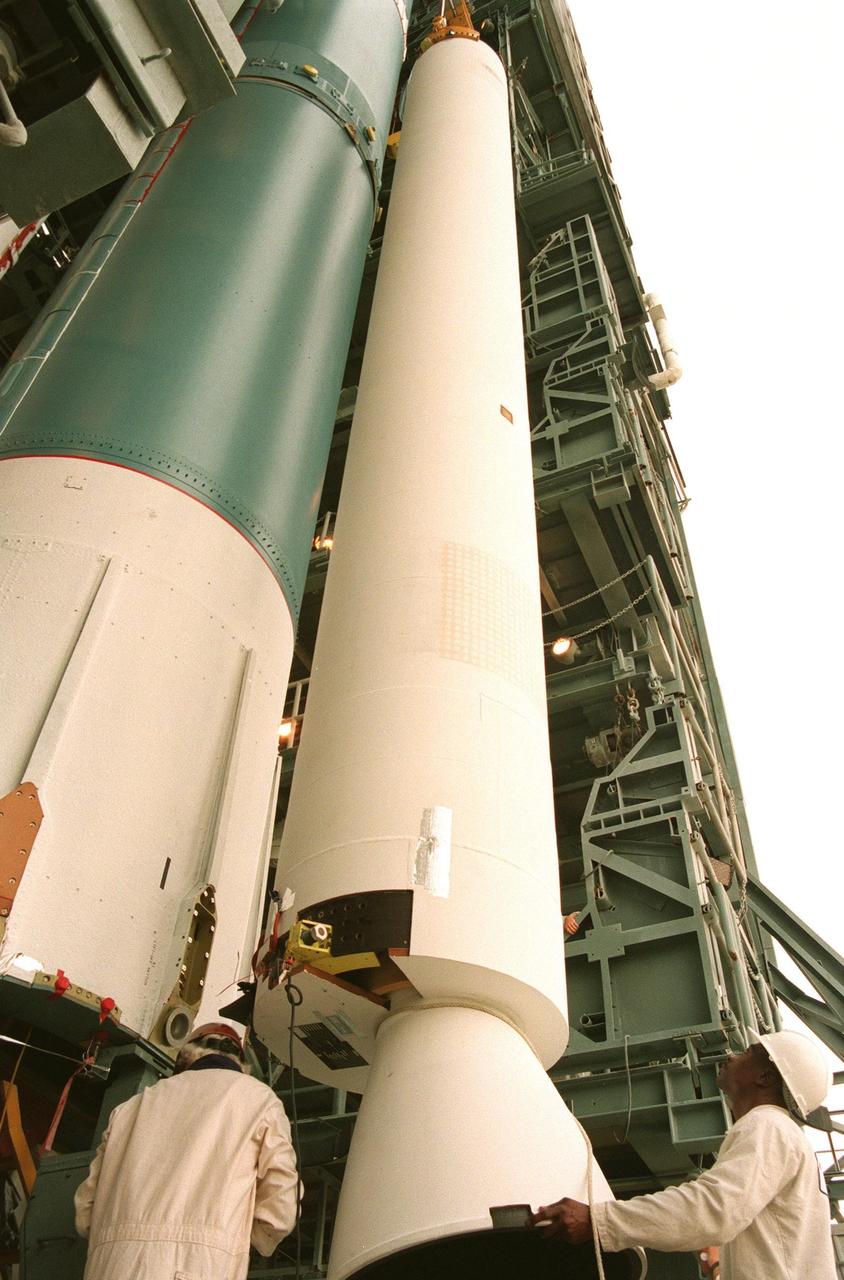
A solid rocket booster is maneuvered into place for installation on the Boeing Delta 7326 rocket that will launch Deep Space 1 at Launch Pad 17A, Cape Canaveral Air Station. Delta II rockets are medium capacity expendable launch vehicles derived from the Delta family of rockets built and launched since 1960. Since then there have been more than 245 Delta launches. Delta's origins go back to the Thor intermediate-range ballistic missile, which was developed in the mid-1950s for the U.S. Air Force. The Thor a single-stage, liquid-fueled rocket later was modified to become the Delta launch vehicle. The Delta 7236 has three solid rocket boosters and a Star 37 upper stage. Delta IIs are manufactured in Huntington Beach, Calif. Rocketdyne, a division of The Boeing Company, builds Delta II's main engine in Canoga Park, Calif. Final assembly takes place at the Boeing facility in Pueblo, Colo. Deep Space 1, the first flight in NASA's New Millennium Program, is designed to validate 12 new technologies for scientific space missions of the next century. Onboard experiments include an ion propulsion engine and software that tracks celestial bodies so the spacecraft can make its own navigation decisions without the intervention of ground controllers. Deep Space 1 will complete most of its mission objectives within the first two months, but may also do a flyby of a near-Earth asteroid, 1992 KD, in July 1999
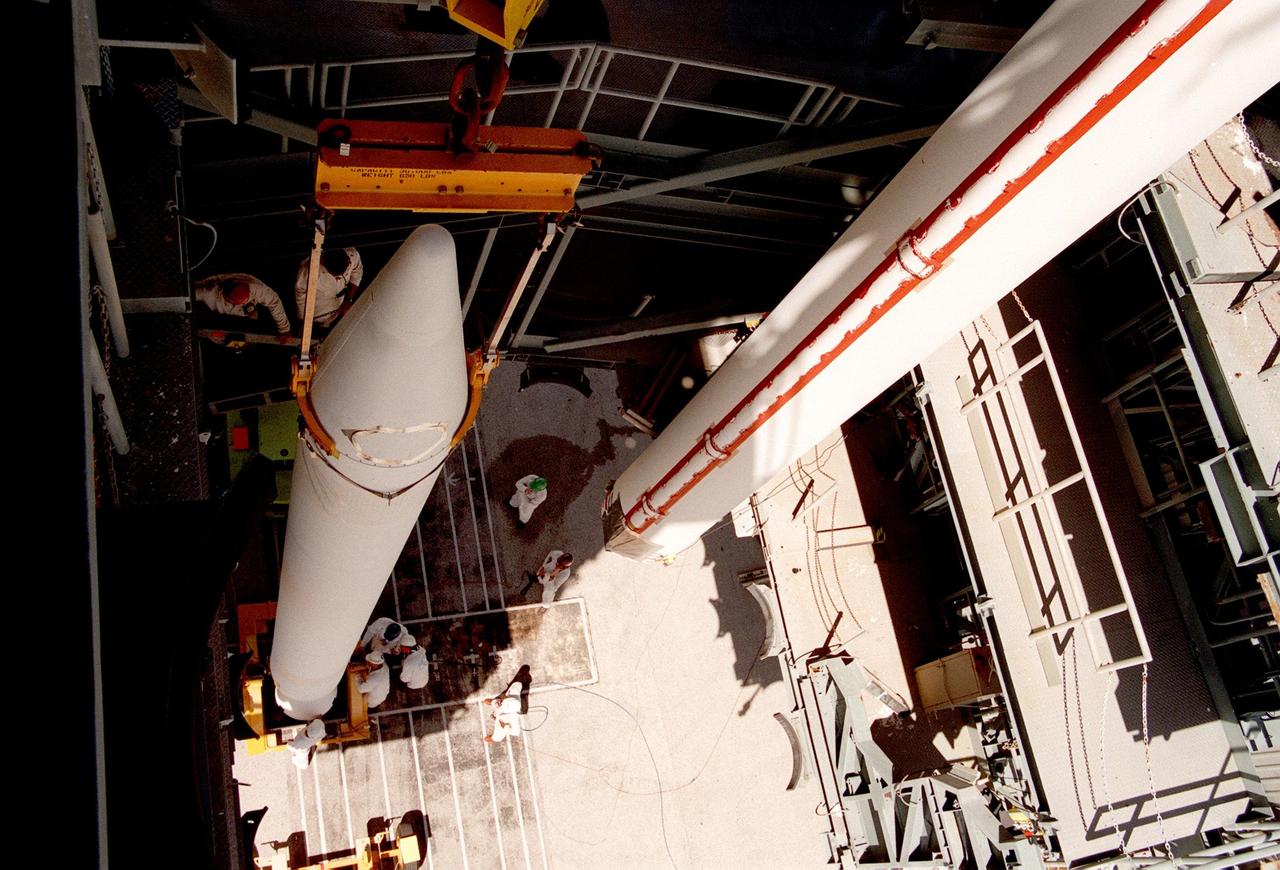
A solid rocket booster (left) is raised for installation onto the Boeing Delta 7326 rocket that will launch Deep Space 1 at Launch Pad 17A, Cape Canaveral Air Station. Delta II rockets are medium capacity expendable launch vehicles derived from the Delta family of rockets built and launched since 1960. Since then there have been more than 245 Delta launches. Delta's origins go back to the Thor intermediate-range ballistic missile, which was developed in the mid-1950s for the U.S. Air Force. The Thor a single-stage, liquid-fueled rocket later was modified to become the Delta launch vehicle. The Delta 7236 has three solid rocket boosters and a Star 37 upper stage. Delta IIs are manufactured in Huntington Beach, Calif. Rocketdyne, a division of The Boeing Company, builds Delta II's main engine in Canoga Park, Calif. Final assembly takes place at the Boeing facility in Pueblo, Colo. Deep Space 1, the first flight in NASA's New Millennium Program, is designed to validate 12 new technologies for scientific space missions of the next century. Onboard experiments include an ion propulsion engine and software that tracks celestial bodies so the spacecraft can make its own navigation decisions without the intervention of ground controllers. Deep Space 1 will complete most of its mission objectives within the first two months, but may also do a flyby of a near-Earth asteroid, 1992 KD, in July 1999
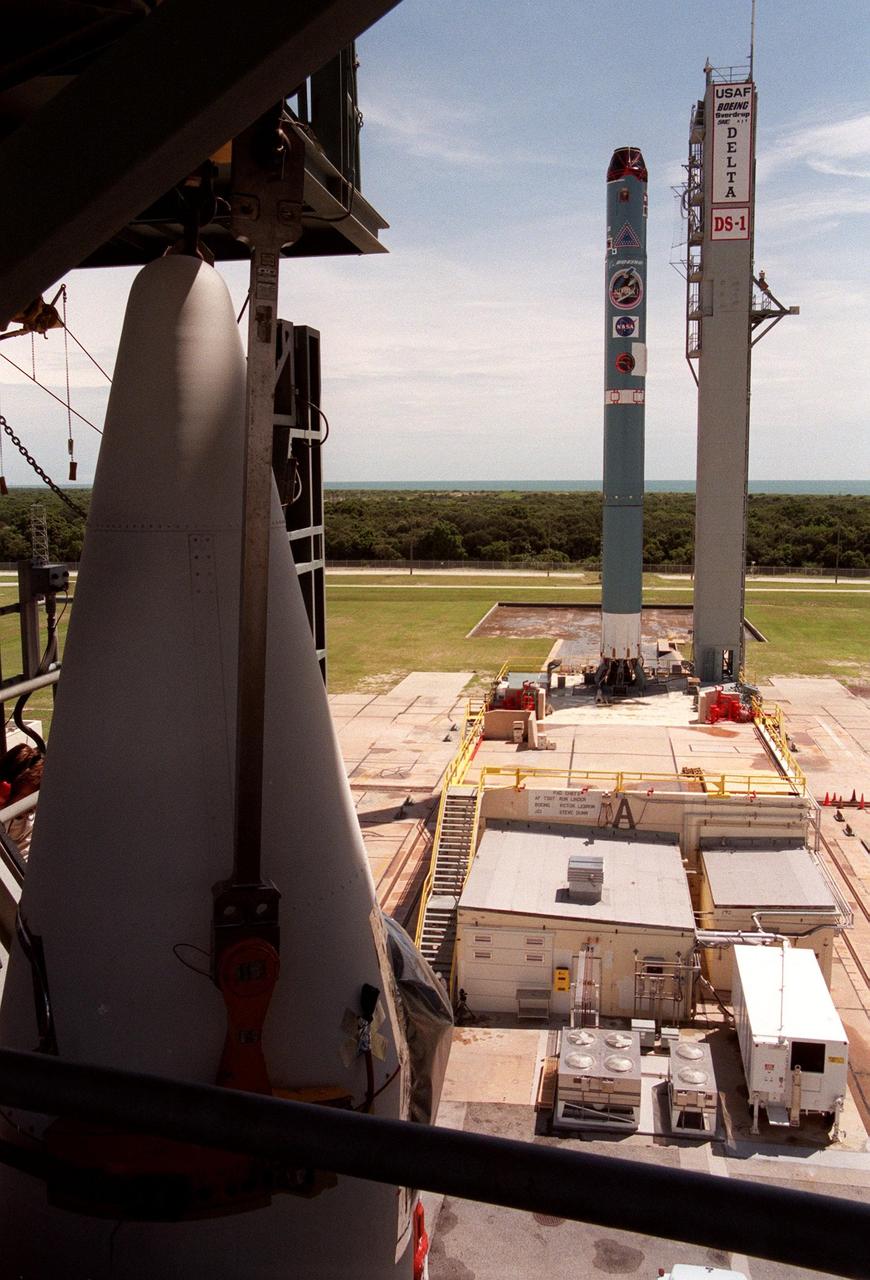
(Left) A solid rocket booster is lifted for installation onto the Boeing Delta 7326 rocket that will launch Deep Space 1 at Launch Pad 17A, Cape Canaveral Air Station. Delta II rockets are medium capacity expendable launch vehicles derived from the Delta family of rockets built and launched since 1960. Since then there have been more than 245 Delta launches. Delta's origins go back to the Thor intermediate-range ballistic missile, which was developed in the mid-1950s for the U.S. Air Force. The Thor a single-stage, liquid-fueled rocket later was modified to become the Delta launch vehicle. The Delta 7236 has three solid rocket boosters and a Star 37 upper stage. Delta IIs are manufactured in Huntington Beach, Calif. Rocketdyne, a division of The Boeing Company, builds Delta II's main engine in Canoga Park, Calif. Final assembly takes place at the Boeing facility in Pueblo, Colo. Deep Space 1, the first flight in NASA's New Millennium Program, is designed to validate 12 new technologies for scientific space missions of the next century. Onboard experiments include an ion propulsion engine and software that tracks celestial bodies so the spacecraft can make its own navigation decisions without the intervention of ground controllers. Deep Space 1 will complete most of its mission objectives within the first two months, but may also do a flyby of a near-Earth asteroid, 1992 KD, in July 1999