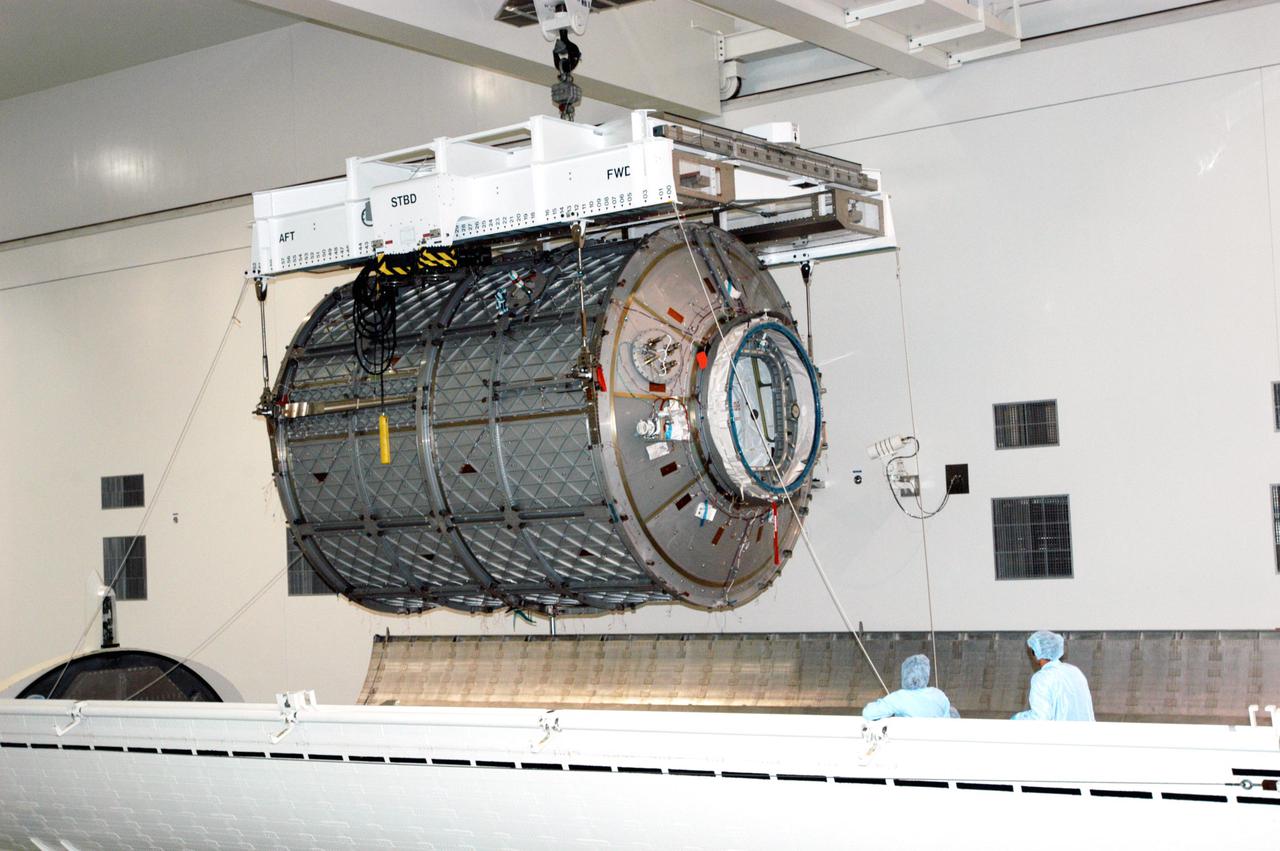
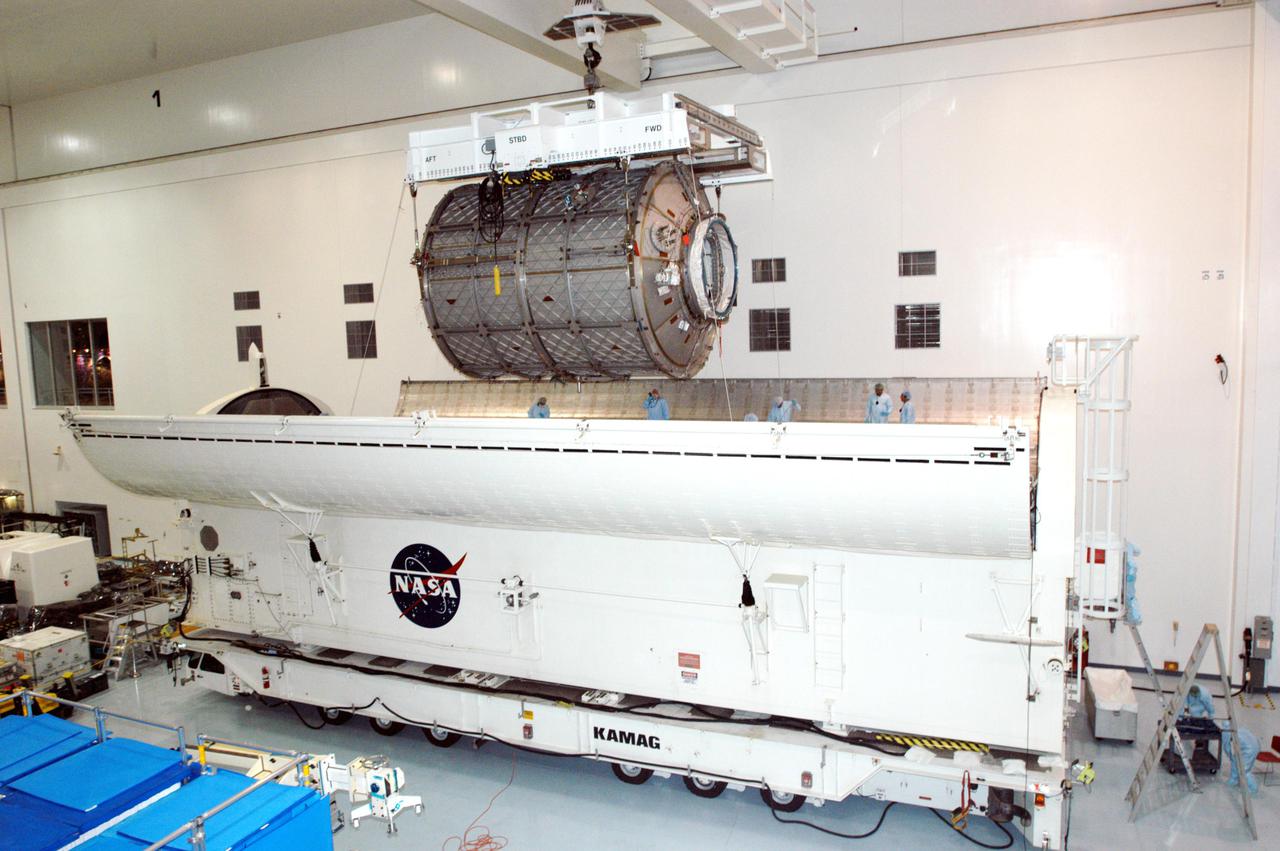
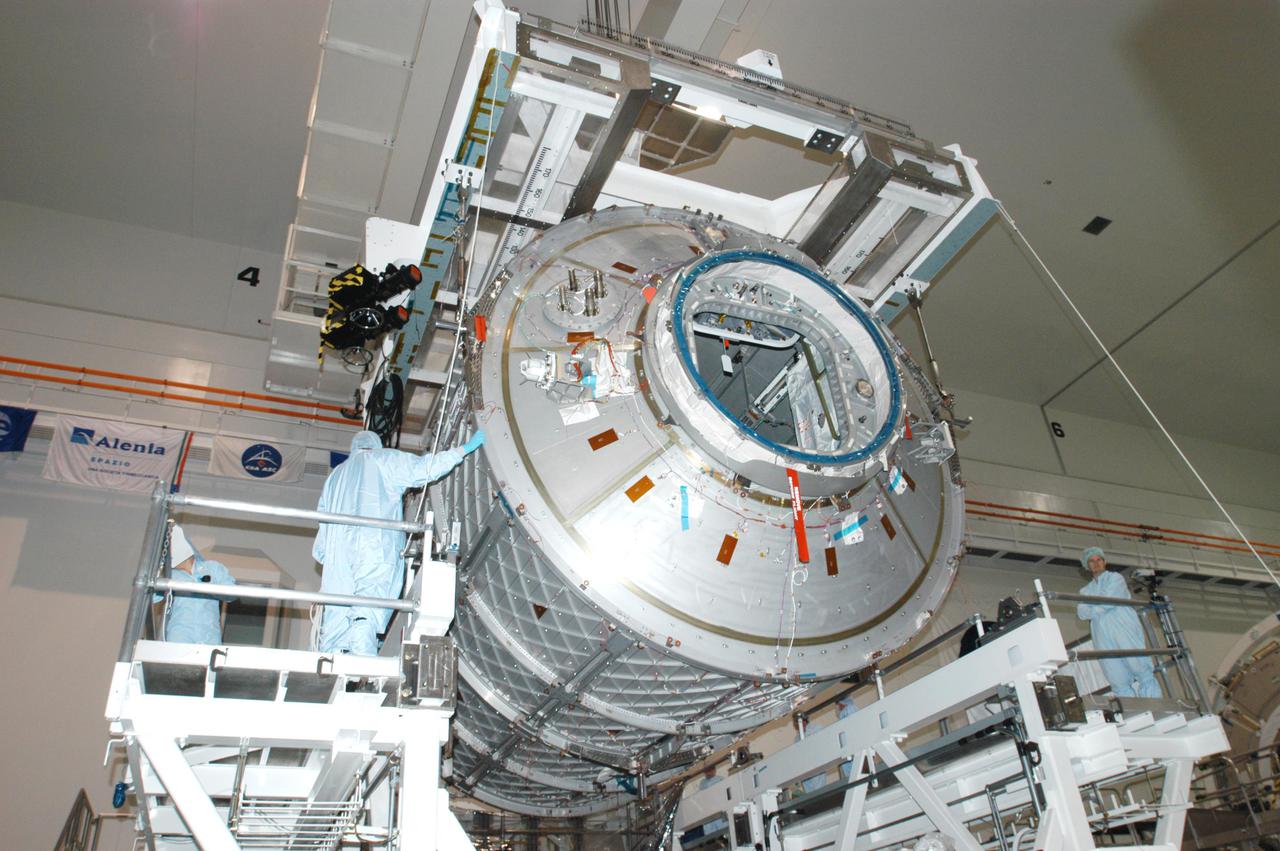
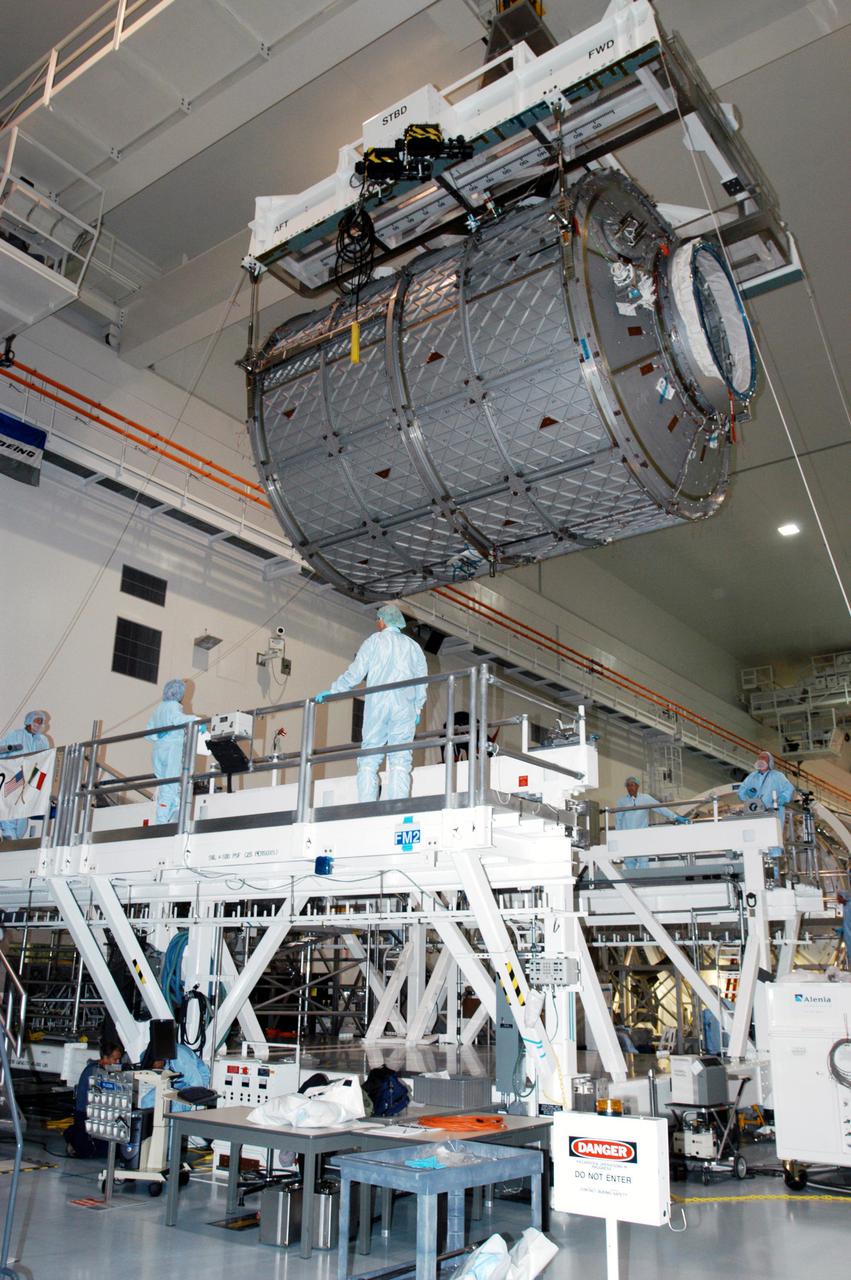
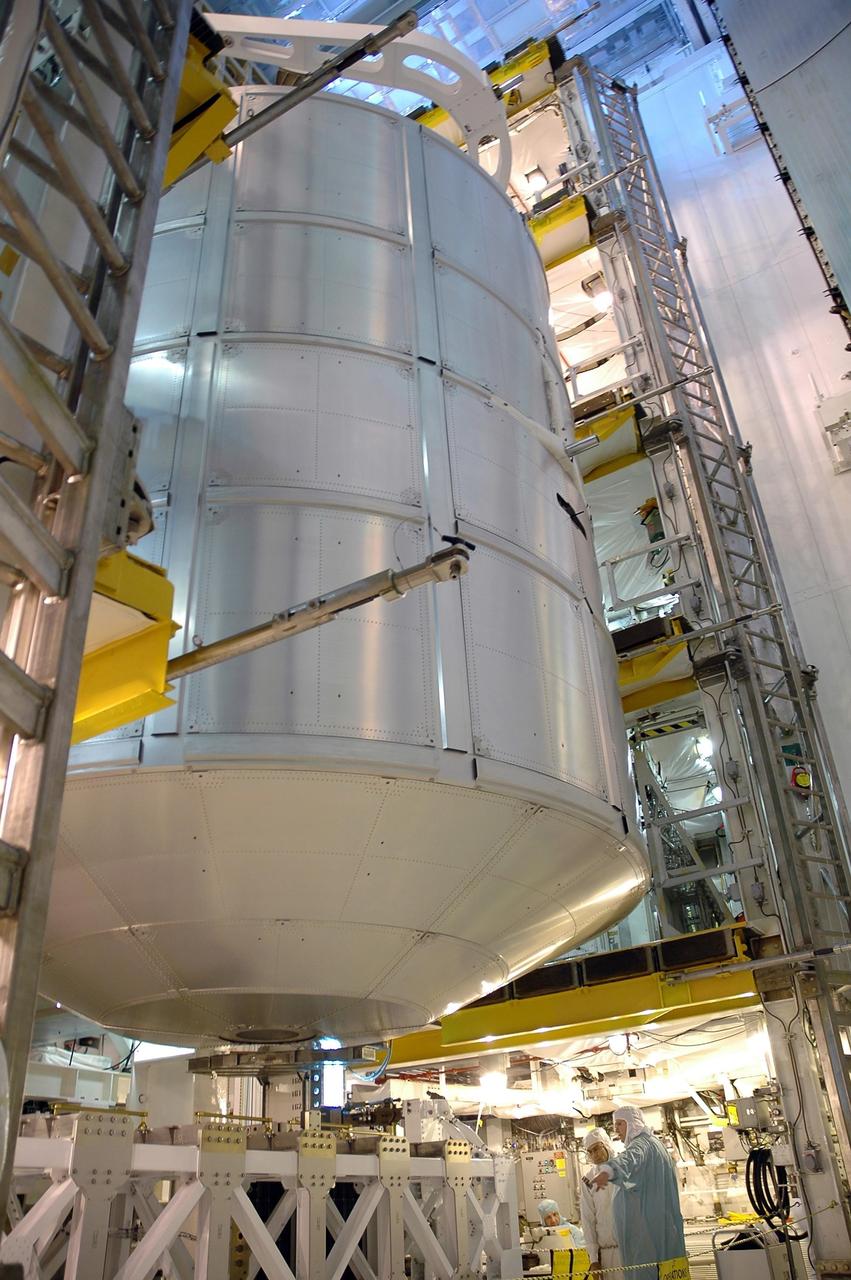
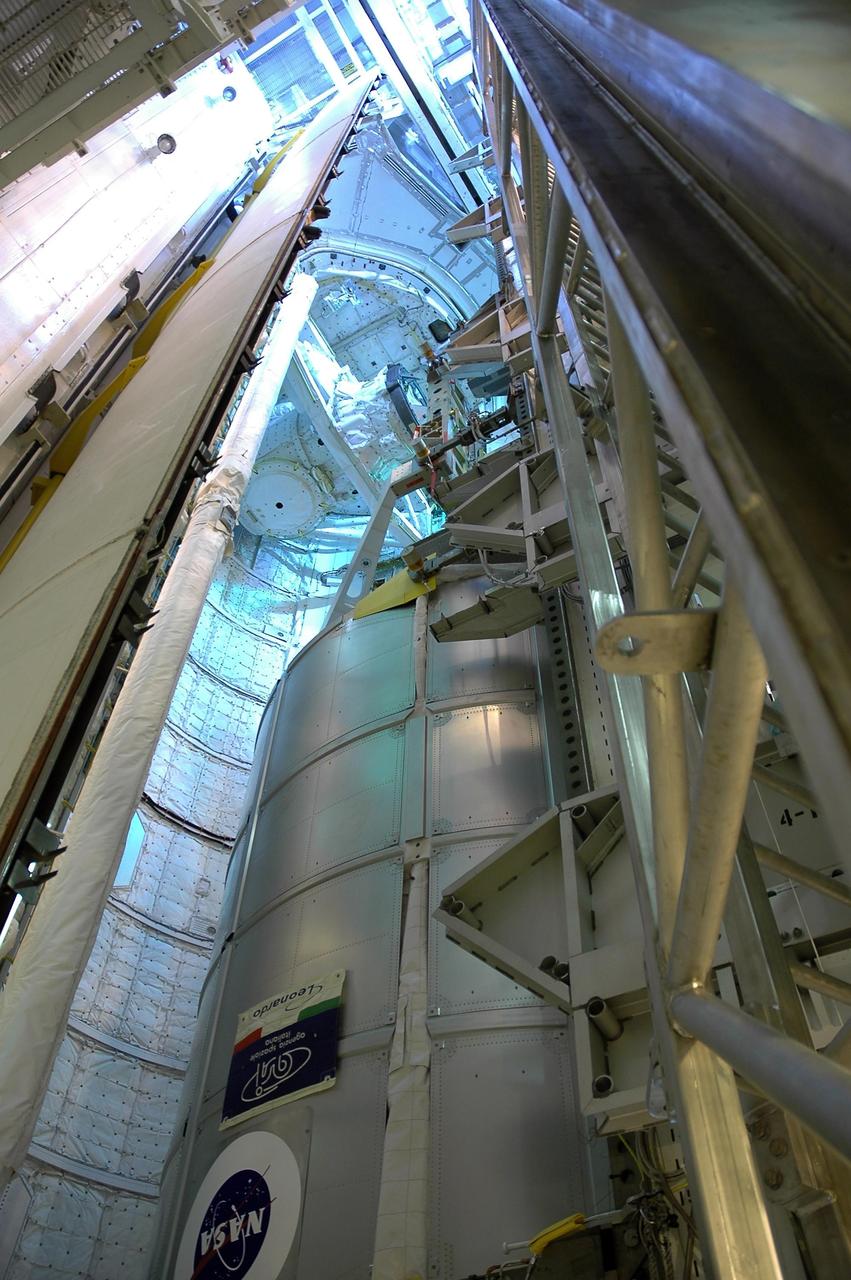
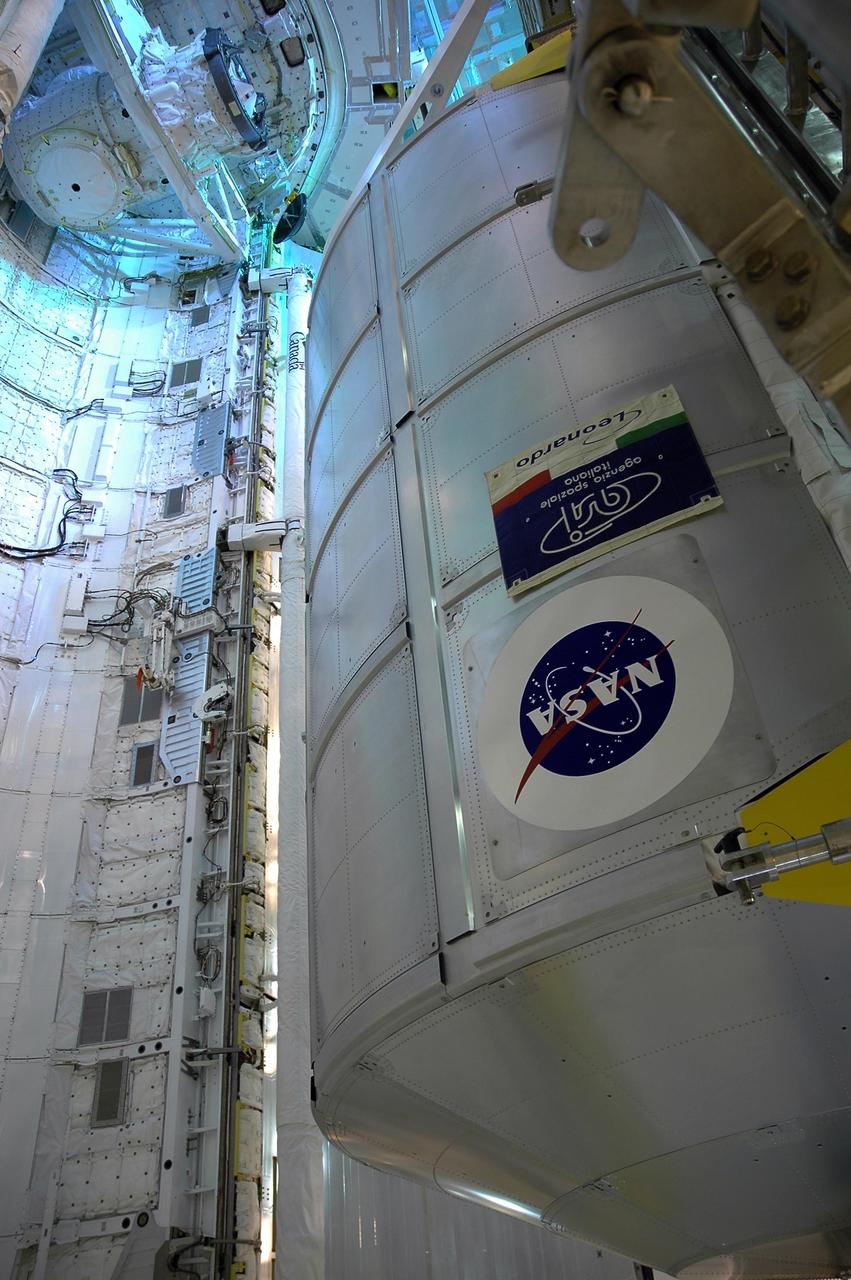
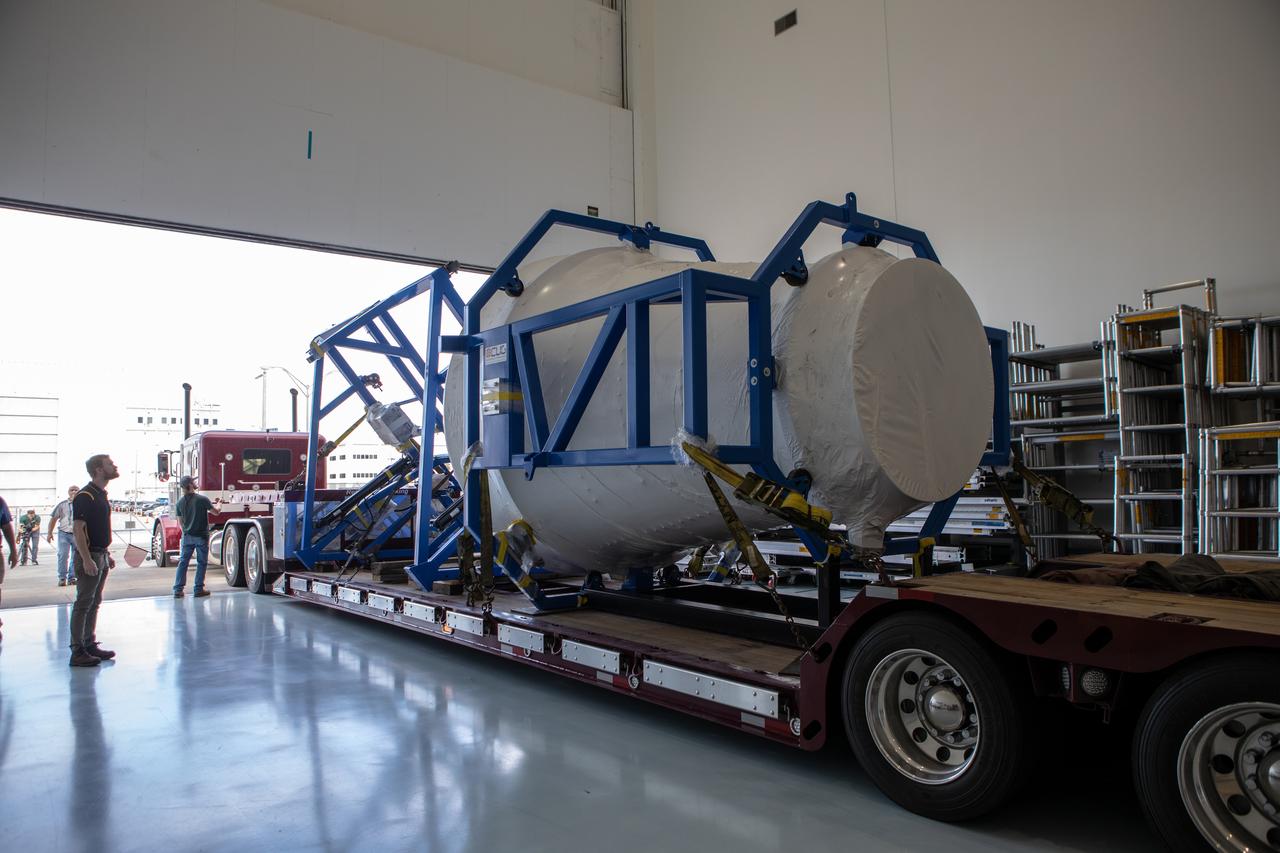
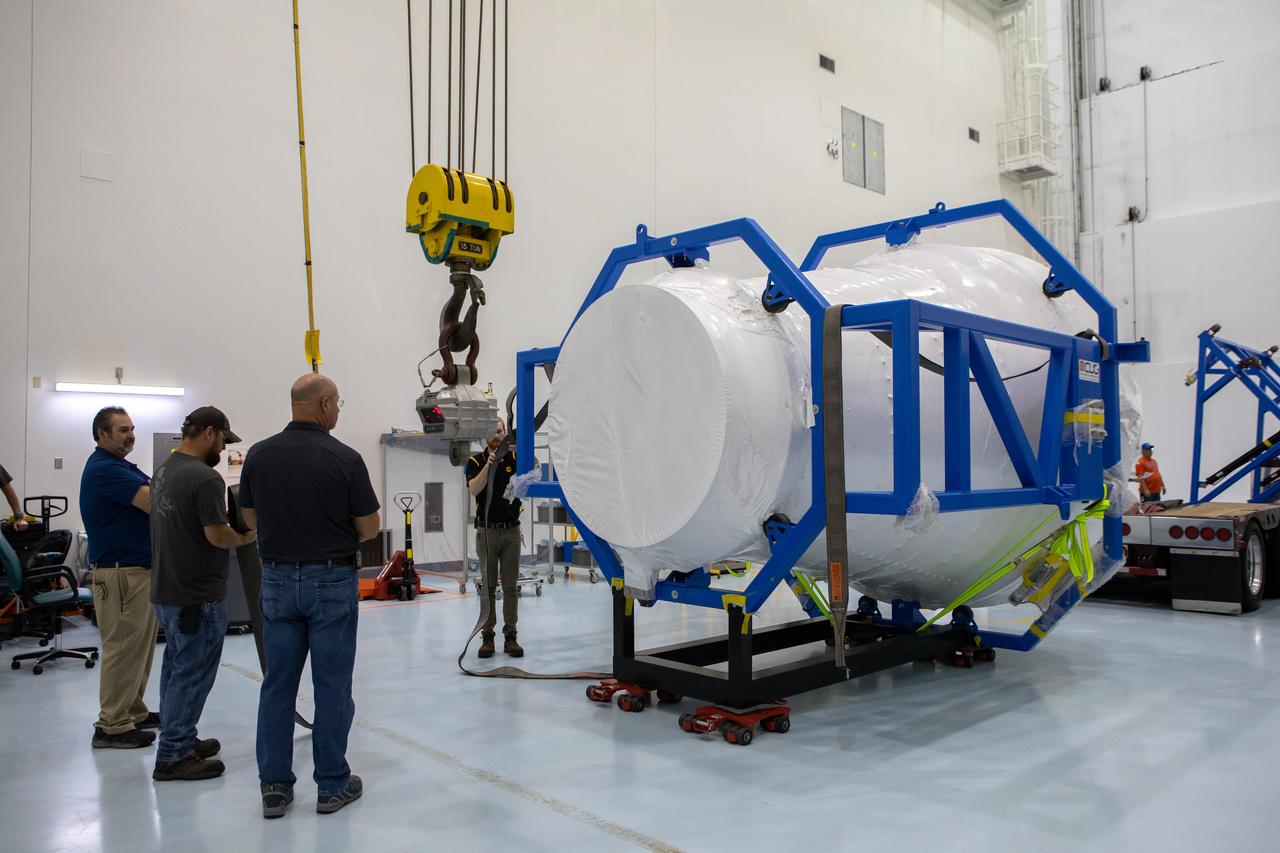
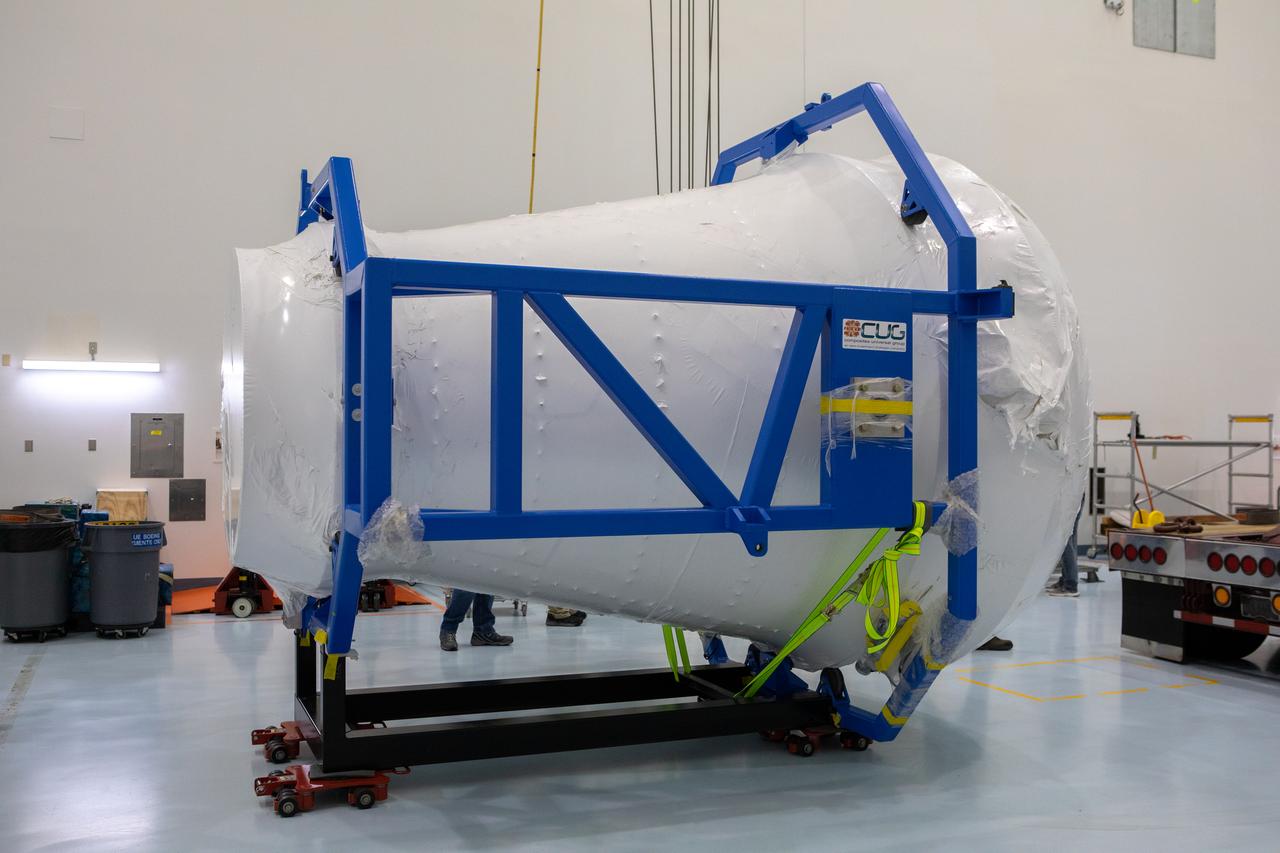
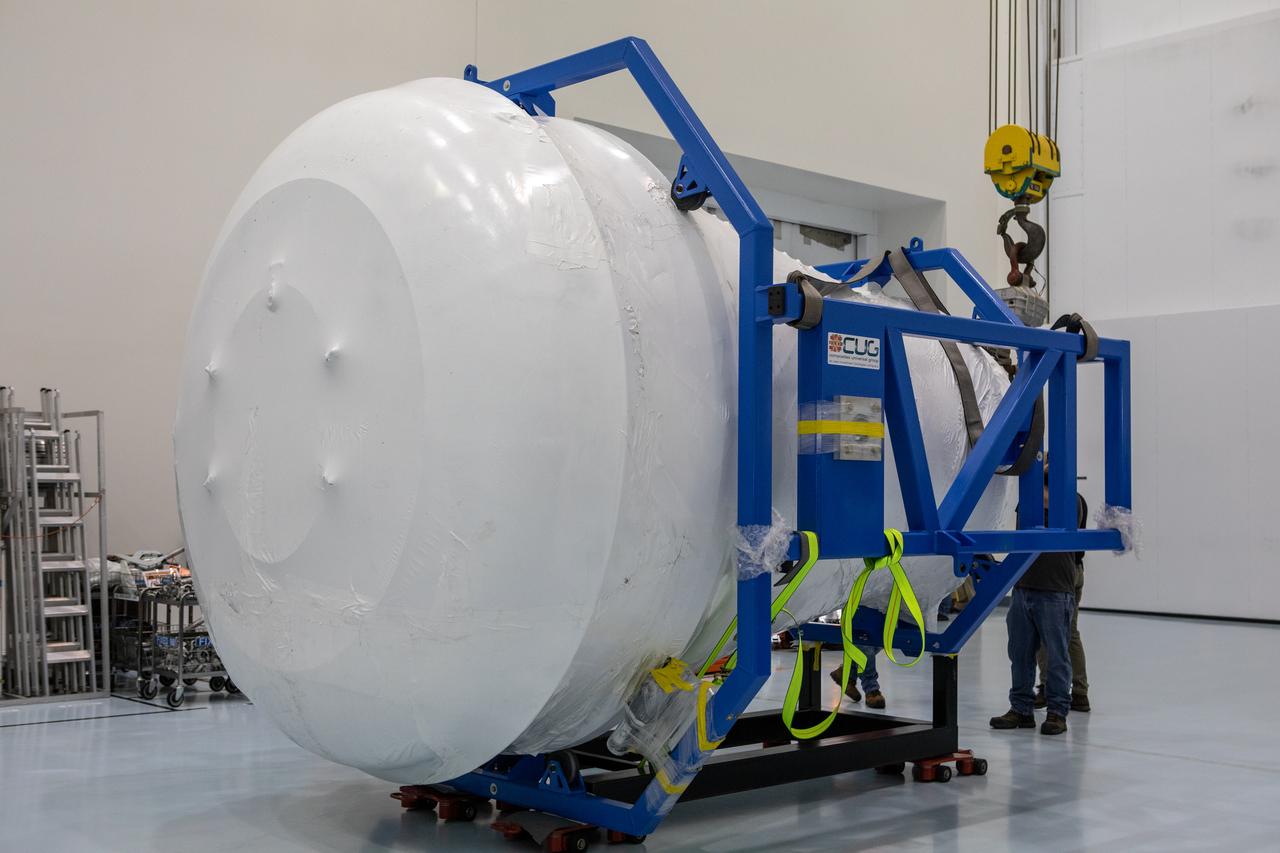
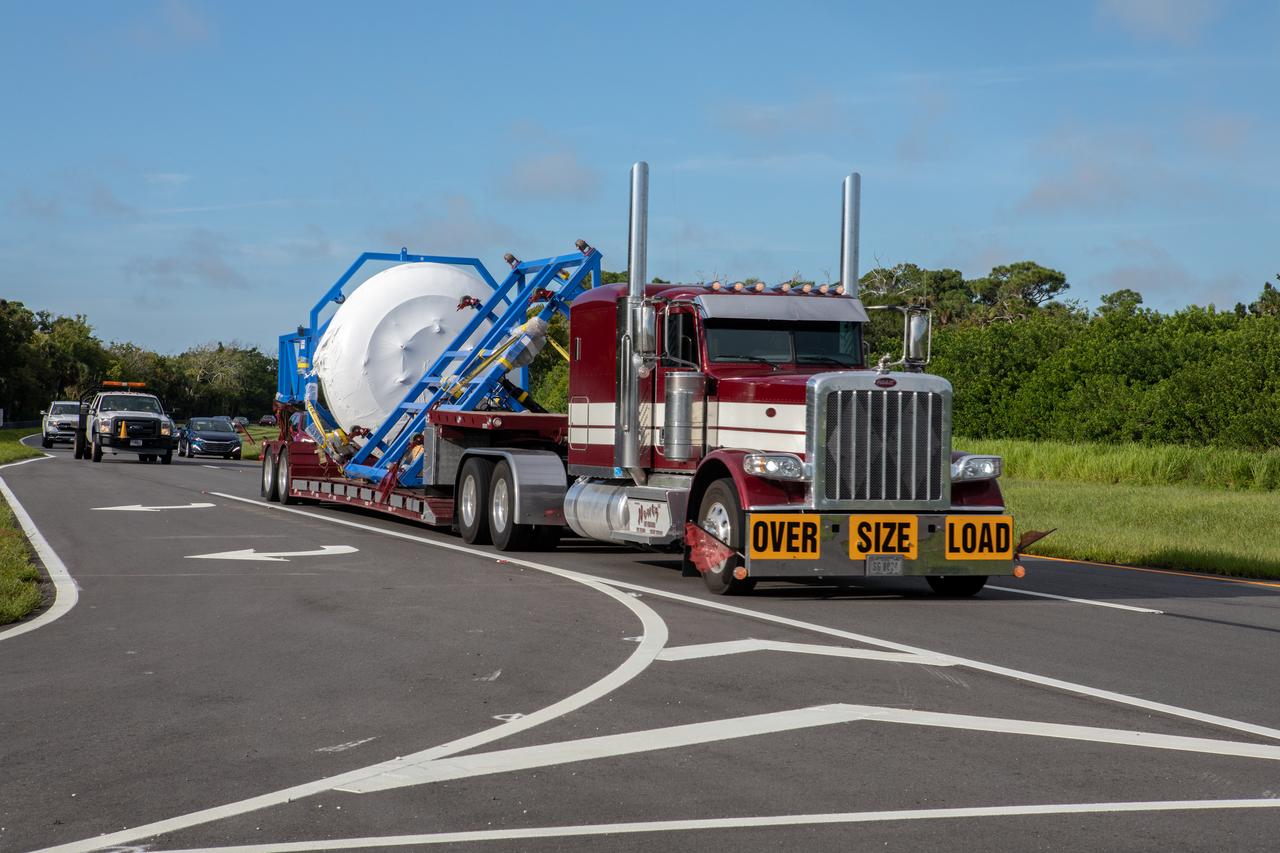
The cargo logistics module for Sierra Nevada Corporation’s Dream Chaser, the company’s reusable spaceplane, arrives at NASA’s Kennedy Space Center in Florida on Aug. 27, 2019. The cargo module – secured atop a truck – is being taken to Kennedy’s Space Station Processing Facility. A 15-foot attachment to Dream Chaser, the cargo module provides extra storage for payloads and provides cargo disposal upon re-entry into Earth’s atmosphere. Dream Chaser will deliver more than 12,000 pounds of cargo to the International Space Station under NASA’s Commercial Resupply Services 2 contract. The spacecraft and cargo module will begin resupply and return services missions to the space station in late 2021.
SNC Cargo Logistics Module Arrival
The cargo logistics module for Sierra Nevada Corporation’s Dream Chaser, the company’s reusable spaceplane, arrives at the Space Station Processing Facility high bay at NASA’s Kennedy Space Center in Florida on Aug. 27, 2019. The cargo module – a 15-foot attachment to Dream Chaser – provides extra storage for payloads and provides cargo disposal upon re-entry into Earth’s atmosphere. Dream Chaser will deliver more than 12,000 pounds of cargo to the International Space Station under the agency’s Commercial Resupply Services 2 contract. The spacecraft and cargo module will begin resupply and return services missions to the space station in late 2021.
SNC Cargo Logistics Module Arrival
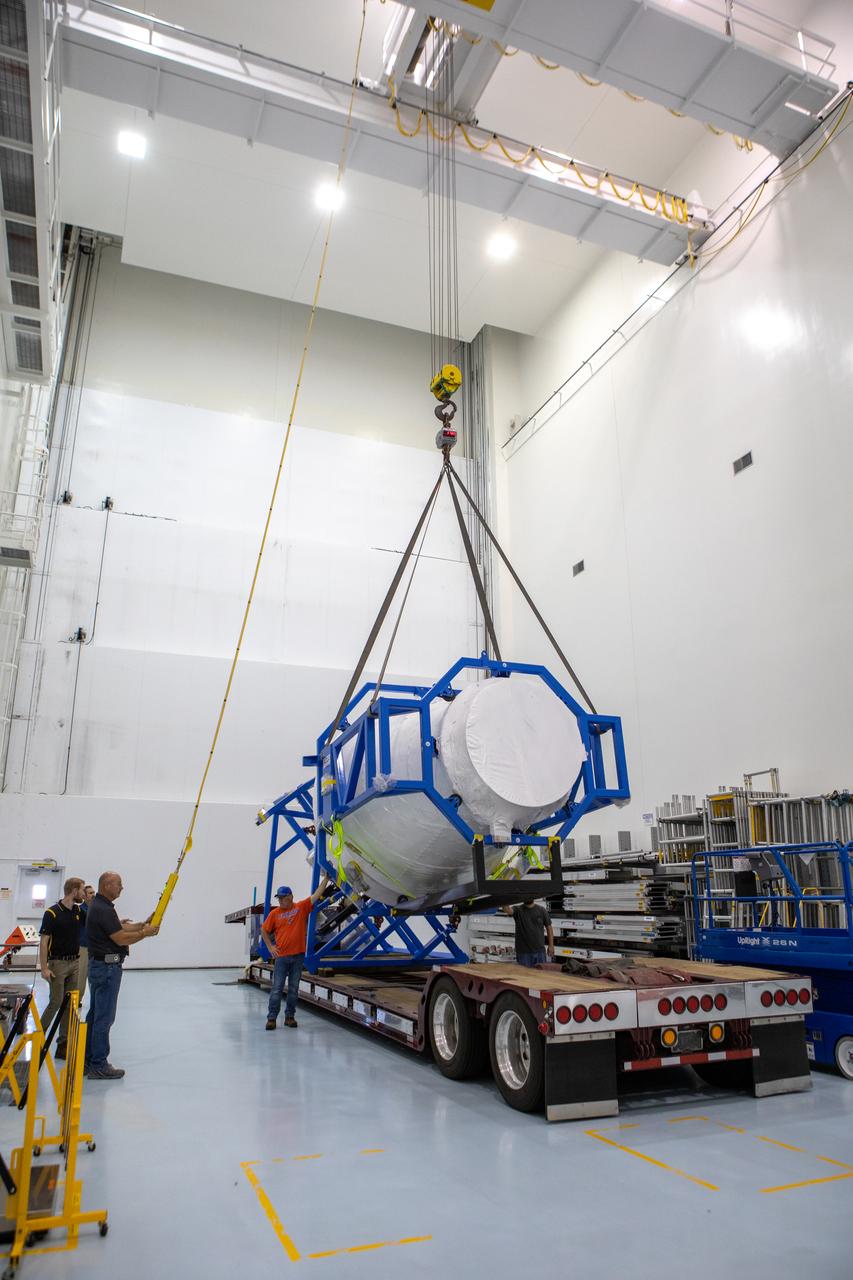
The cargo logistics module for Sierra Nevada Corporation’s Dream Chaser, the company’s reusable spaceplane, is lifted from the bed of a truck following its arrival at the Space Station Processing Facility high bay at NASA’s Kennedy Space Center in Florida on Aug. 27, 2019. The cargo module – a 15-foot attachment to Dream Chaser – provides extra storage for payloads and provides cargo disposal upon re-entry into Earth’s atmosphere. Dream Chaser will deliver more than 12,000 pounds of cargo to the International Space Station under the agency’s Commercial Resupply Services 2 contract. The spacecraft and cargo module will begin resupply and return services missions to the space station in late 2021.
SNC Cargo Logistics Module Arrival
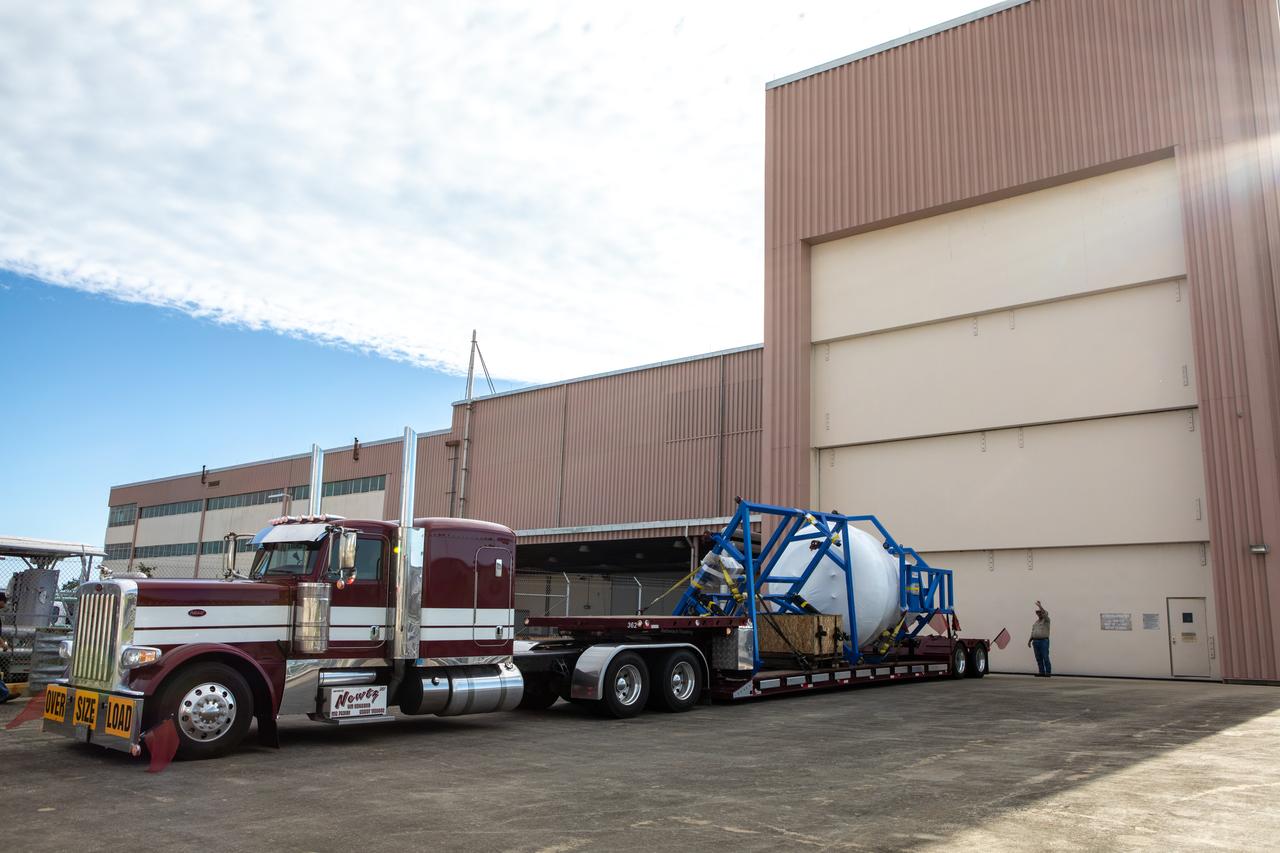
A truck carrying the cargo logistics module for Sierra Nevada Corporation’s Dream Chaser, the company’s reusable spaceplane, enters the Space Station Processing Facility high bay at NASA’s Kennedy Space Center in Florida on Aug. 27, 2019. The cargo module – a 15-foot attachment to Dream Chaser – provides extra storage for payloads and provides cargo disposal upon re-entry into Earth’s atmosphere. Dream Chaser will deliver more than 12,000 pounds of cargo to the International Space Station under the agency’s Commercial Resupply Services 2 contract. The spacecraft and cargo module will begin resupply and return services missions to the space station in late 2021.
SNC Cargo Logistics Module Arrival
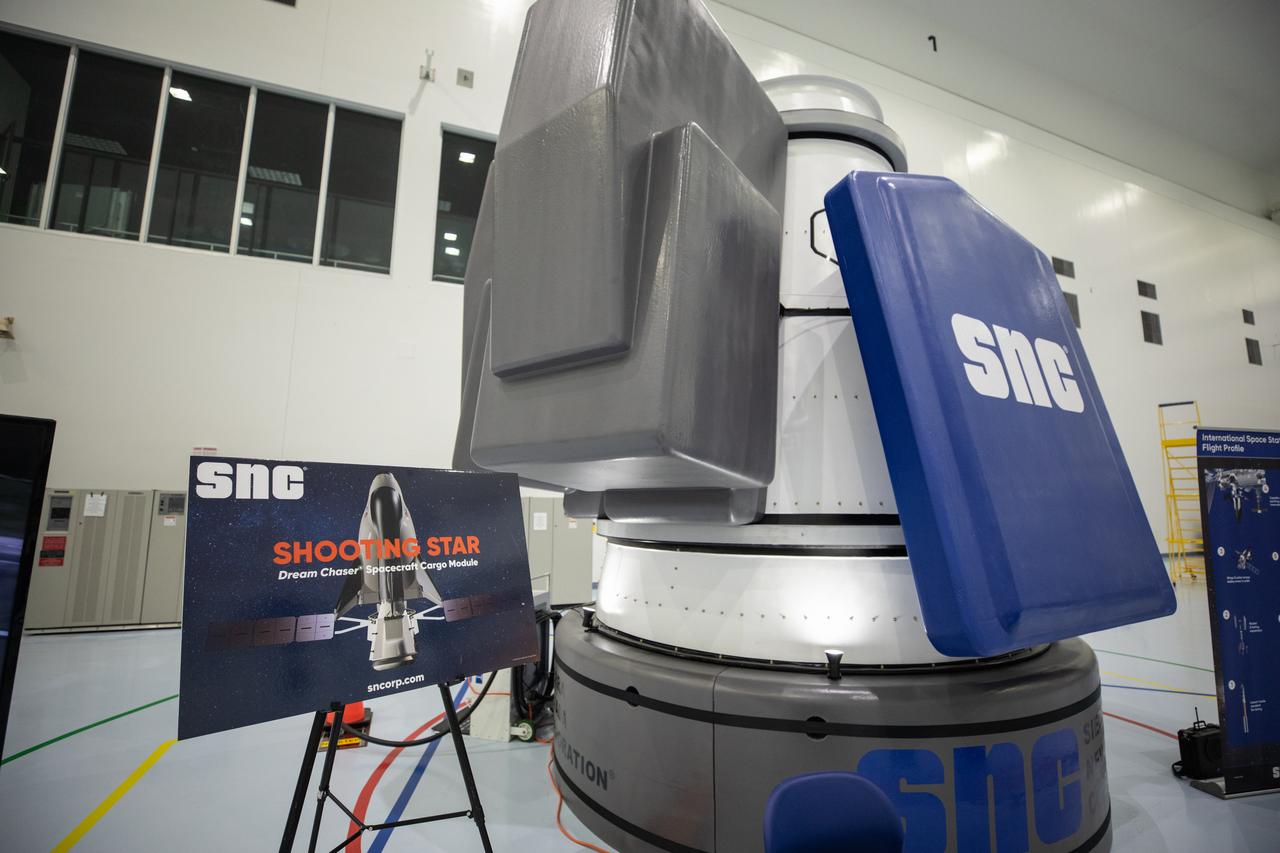
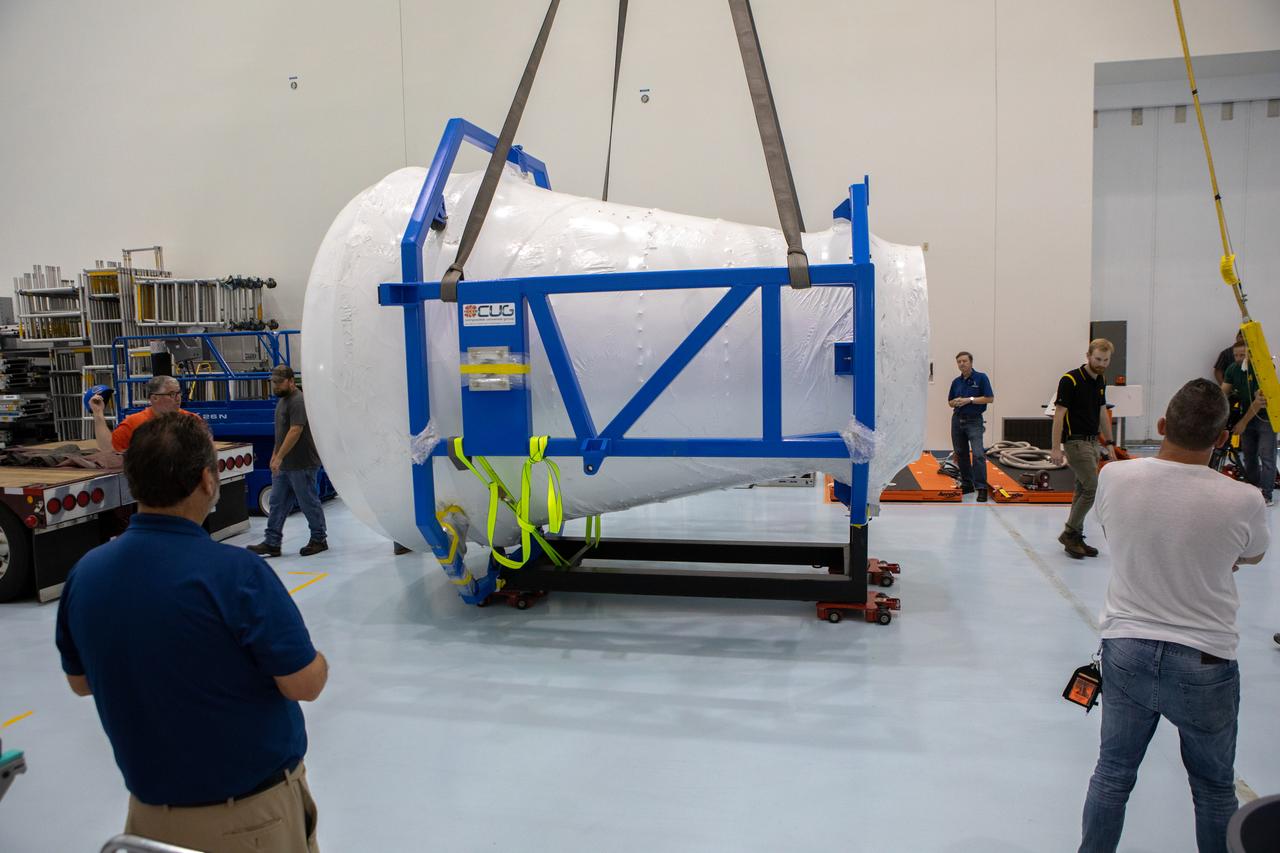
The cargo logistics module for Sierra Nevada Corporation’s Dream Chaser, the company’s reusable spaceplane, is photographed inside the Space Station Processing Facility high bay at NASA’s Kennedy Space Center in Florida following its arrival on Aug. 27, 2019. The cargo module – a 15-foot attachment to Dream Chaser – provides extra storage for payloads and provides cargo disposal upon re-entry into Earth’s atmosphere. Dream Chaser will deliver more than 12,000 pounds of cargo to the International Space Station under the agency’s Commercial Resupply Services 2 contract. The spacecraft and cargo module will begin resupply and return services missions to the space station in late 2021.
SNC Cargo Logistics Module Arrival
The cargo logistics module for Sierra Nevada Corporation’s Dream Chaser, the company’s reusable spaceplane, is photographed inside the Space Station Processing Facility high bay at NASA’s Kennedy Space Center in Florida following its arrival on Aug. 27, 2019. The cargo module – a 15-foot attachment to Dream Chaser – provides extra storage for payloads and provides cargo disposal upon re-entry into Earth’s atmosphere. Dream Chaser will deliver more than 12,000 pounds of cargo to the International Space Station under the agency’s Commercial Resupply Services 2 contract. The spacecraft and cargo module will begin resupply and return services missions to the space station in late 2021.
SNC Cargo Logistics Module Arrival
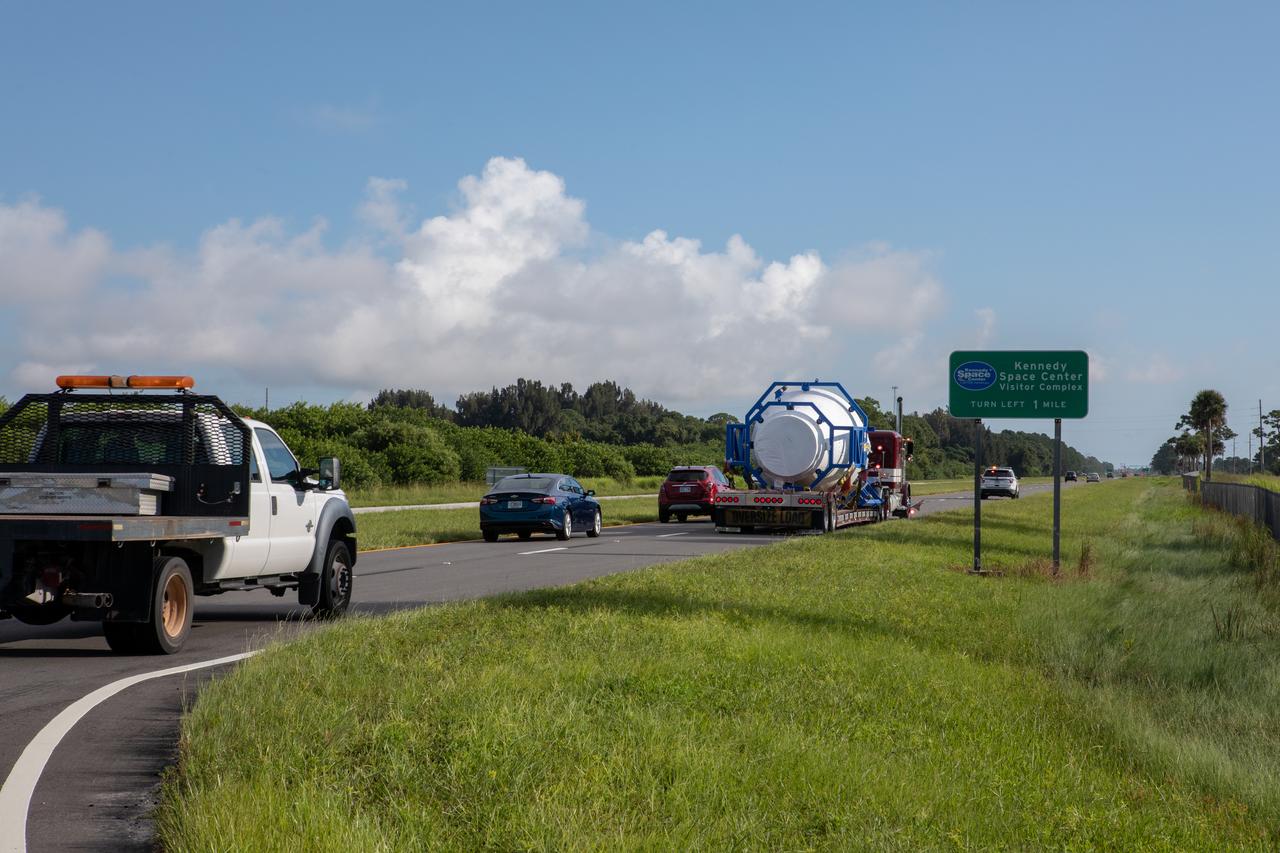
The cargo logistics module for Sierra Nevada Corporation’s Dream Chaser, the company’s reusable spaceplane, is in transit to the Space Station Processing Facility at NASA’s Kennedy Space Center in Florida on Aug. 27, 2019. The cargo module – a 15-foot attachment to Dream Chaser – provides extra storage for payloads and provides cargo disposal upon re-entry into Earth’s atmosphere. Dream Chaser will deliver more than 12,000 pounds of cargo to the International Space Station under NASA’s Commercial Resupply Services 2 contract. The spacecraft and cargo module will begin resupply and return services missions to the space station in late 2021.
SNC Cargo Logistics Module Arrival
The cargo logistics module for Sierra Nevada Corporation’s Dream Chaser, the company’s reusable spaceplane, is photographed inside the Space Station Processing Facility high bay at NASA’s Kennedy Space Center in Florida following its arrival on Aug. 27, 2019. The cargo module – a 15-foot attachment to Dream Chaser – provides extra storage for payloads and provides cargo disposal upon re-entry into Earth’s atmosphere. Dream Chaser will deliver more than 12,000 pounds of cargo to the International Space Station under the agency’s Commercial Resupply Services 2 contract. The spacecraft and cargo module will begin resupply and return services missions to the space station in late 2021.
SNC Cargo Logistics Module Arrival
A truck carrying the cargo logistics module for Sierra Nevada Corporation’s Dream Chaser, the company’s reusable spaceplane, arrives at the Space Station Processing Facility high bay entrance at NASA’s Kennedy Space Center in Florida on Aug. 27, 2019. The cargo module – a 15-foot attachment to Dream Chaser – provides extra storage for payloads and provides cargo disposal upon re-entry into Earth’s atmosphere. Dream Chaser will deliver more than 12,000 pounds of cargo to the International Space Station under the agency’s Commercial Resupply Services 2 contract. The spacecraft and cargo module will begin resupply and return services missions to the space station in late 2021.
SNC Cargo Logistics Module Arrival
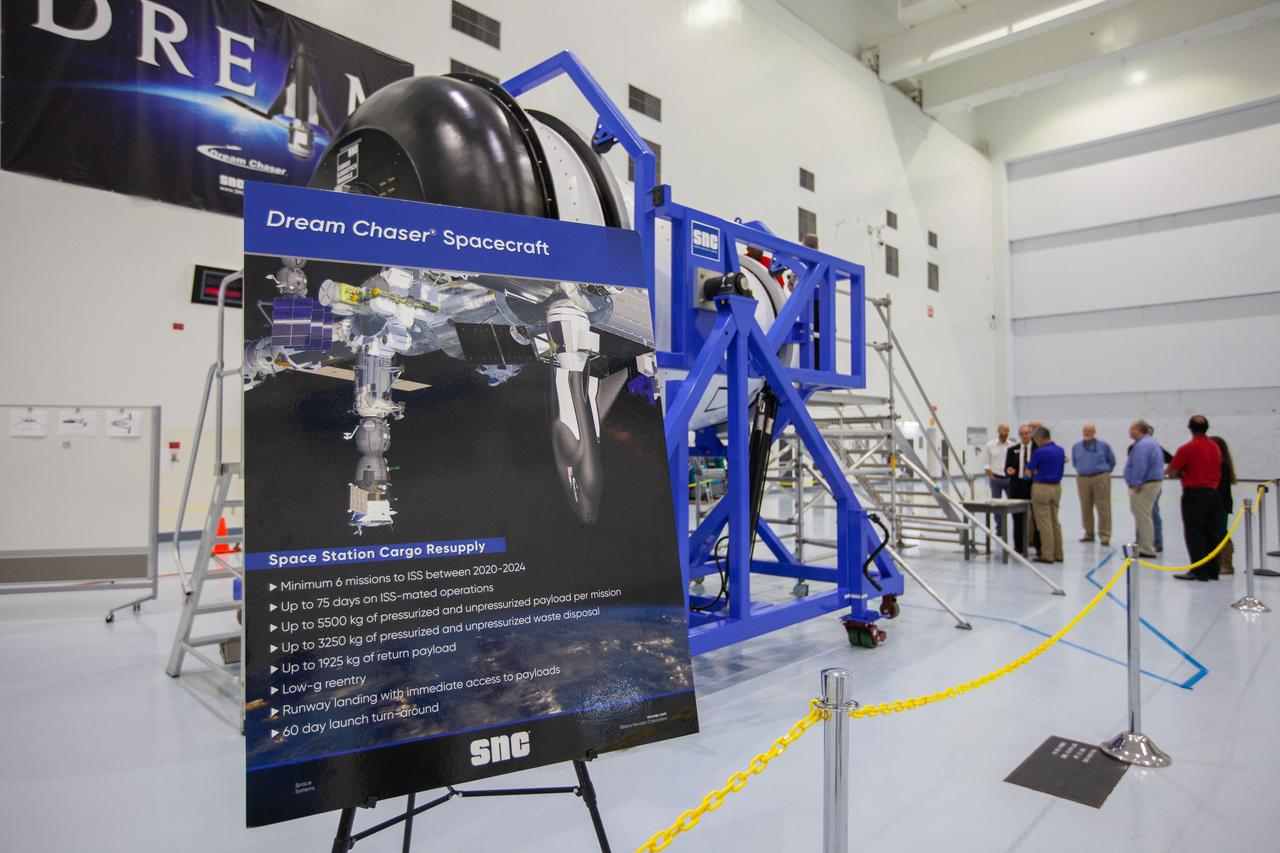
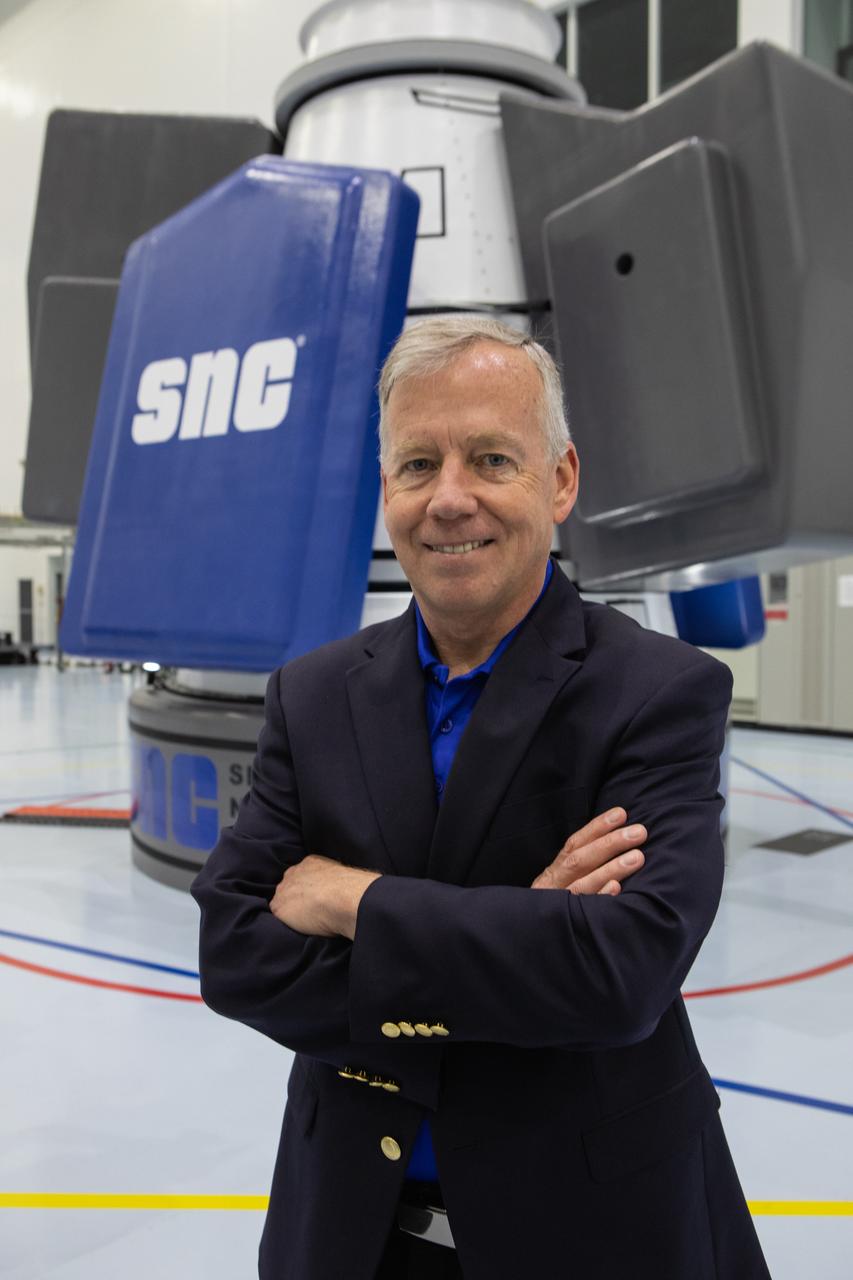
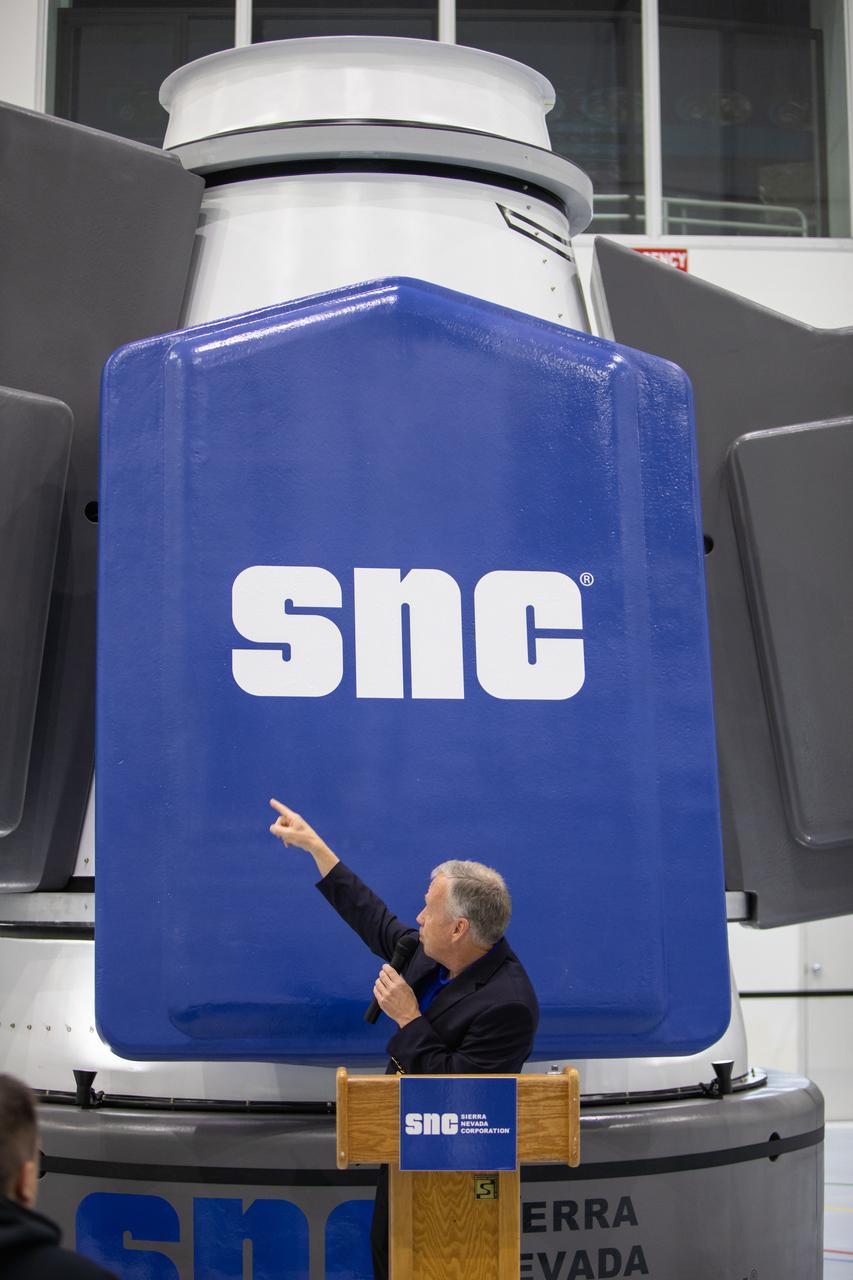
A mockup of the cargo logistics module for Sierra Nevada Corporation’s Dream Chaser, the company’s reusable spaceplane, arrived at the Space Station Processing Facility (SSPF) at NASA’s Kennedy Space Center in Florida in August. On Sept. 20, 2019, senior leadership had the opportunity to view the cargo module in the SSPF high bay. Kennedy Center Director Bob Cabana, views the interior of the cargo module with Steve Lindsey, vice president, Space Exploration Systems, Sierra Nevada Corporation. The SSPF is providing support for current and future NASA and commercial provider programs, including Commercial Resupply Services, Artemis 1, sending the first woman and next man to the Moon, and deep space destinations including Mars.
Sierra Nevada Open House
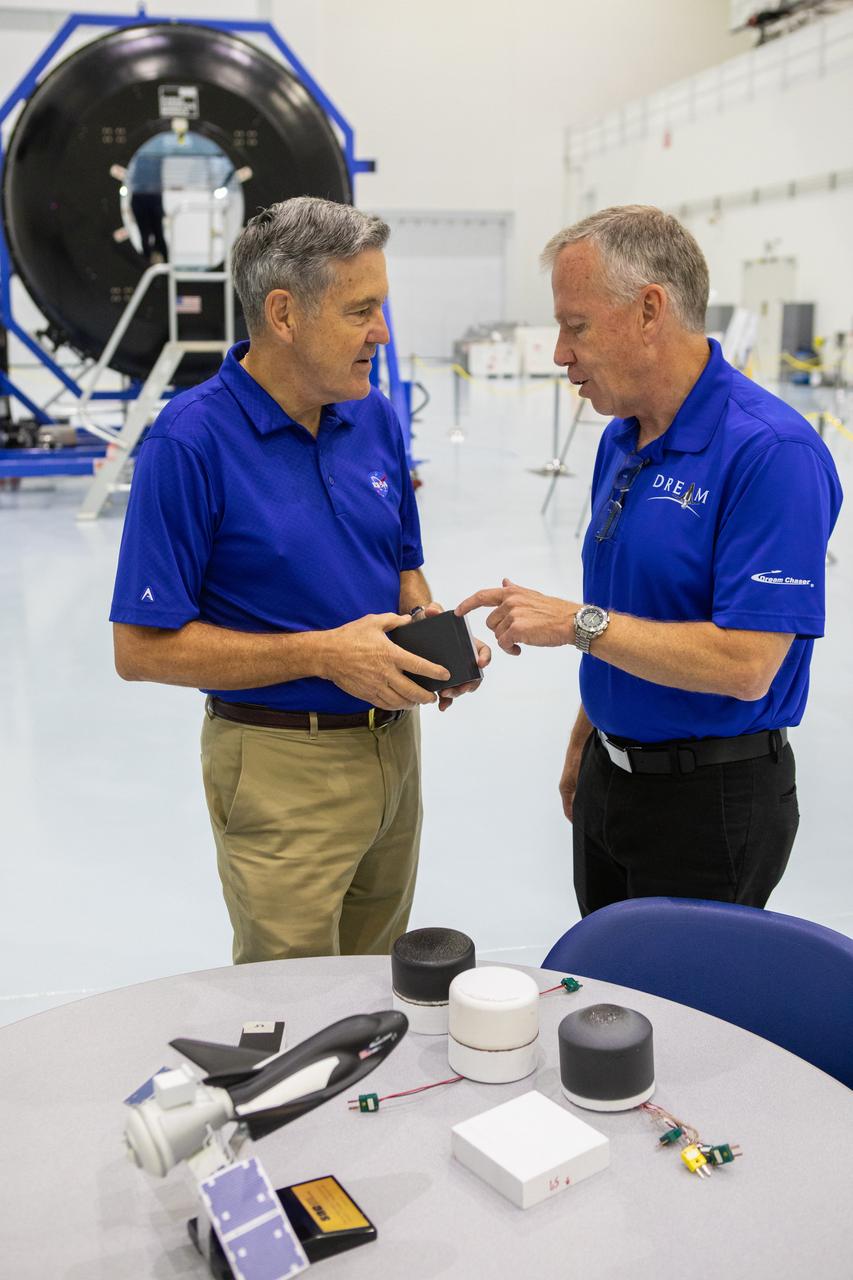
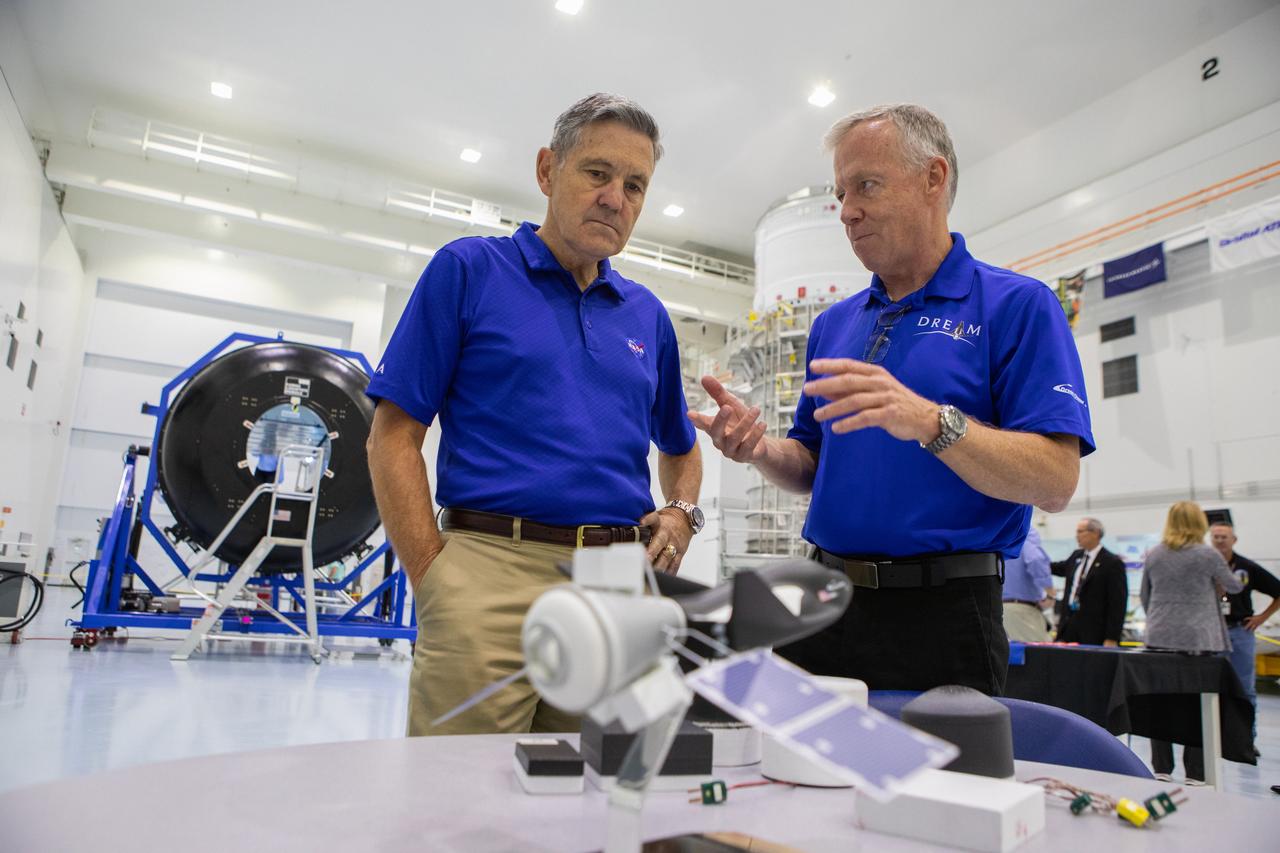
A mockup of the cargo logistics module for Sierra Nevada Corporation’s Dream Chaser, the company’s reusable spaceplane, arrived at the Space Station Processing Facility (SSPF) at NASA’s Kennedy Space Center in Florida in August. On Sept. 20, 2019, senior leadership had the opportunity to view the cargo module in the SSPF high bay. Kennedy Center Director Bob Cabana, at right, views the cargo module with Steve Lindsey, vice president, Space Exploration Systems, Sierra Nevada Corporation. The SSPF is providing support for current and future NASA and commercial provider programs, including Commercial Resupply Services, Artemis 1, sending the first woman and next man to the Moon, and deep space destinations including Mars.
Sierra Nevada Open House
A mockup of the cargo logistics module for Sierra Nevada Corporation’s Dream Chaser, the company’s reusable spaceplane, arrived at the Space Station Processing Facility (SSPF) at NASA’s Kennedy Space Center in Florida in August. On Sept. 20, 2019, senior leadership had the opportunity to view the cargo module in the SSPF high bay. The SSPF is providing support for current and future NASA and commercial provider programs, including Commercial Resupply Services, Artemis 1, sending the first woman and next man to the Moon, and deep space destinations including Mars.
Sierra Nevada Open House
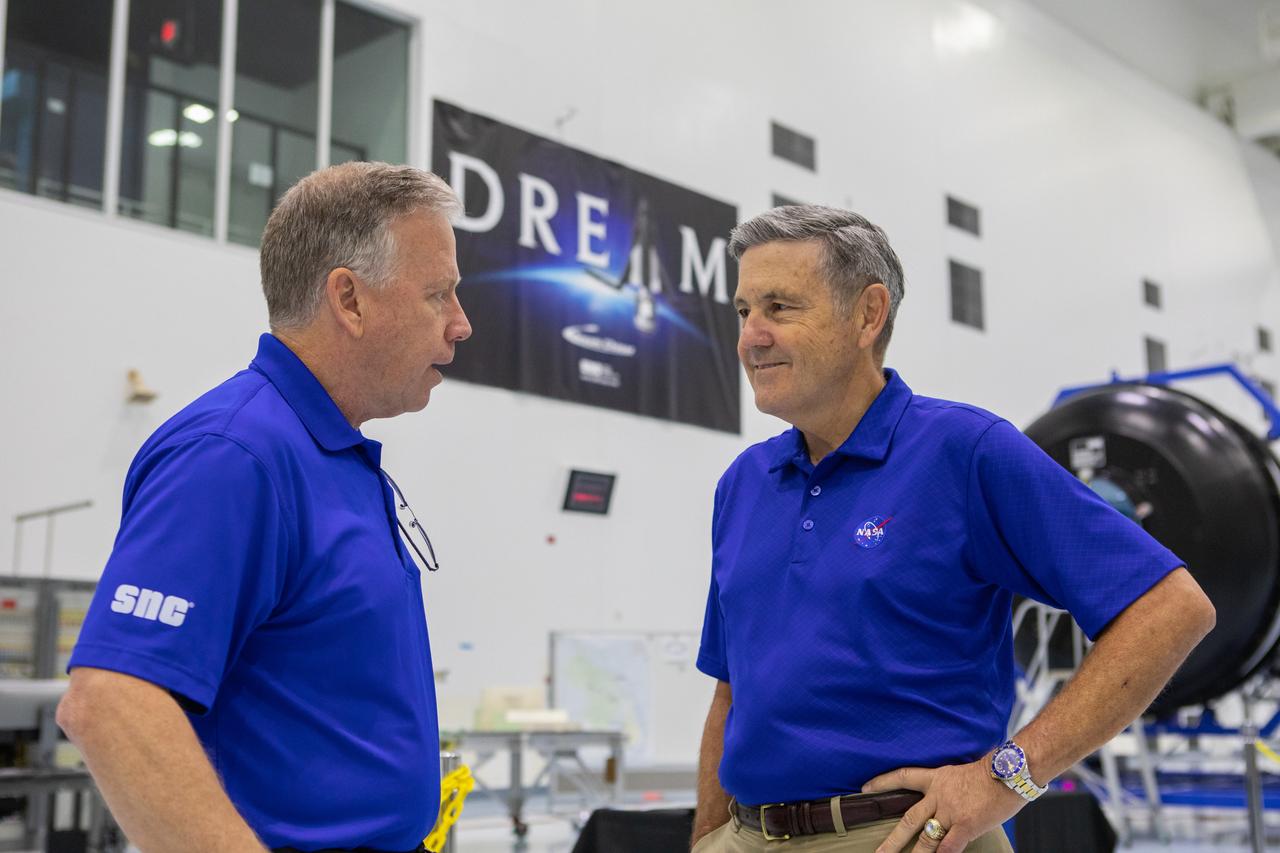
A mockup of the cargo logistics module for Sierra Nevada Corporation’s Dream Chaser, the company’s reusable spaceplane, arrived at the Space Station Processing Facility (SSPF) at NASA’s Kennedy Space Center in Florida in August. On Sept. 20, 2019, senior leadership had the opportunity to view the cargo module in the SSPF high bay. Kennedy Center Director Bob Cabana, at right, speaks with Steve Lindsey, vice president, Space Exploration Systems, Sierra Nevada Corporation. The SSPF is providing support for current and future NASA and commercial provider programs, including Commercial Resupply Services, Artemis 1, sending the first woman and next man to the Moon, and deep space destinations including Mars.
Sierra Nevada Open House
A mockup of the cargo logistics module for Sierra Nevada Corporation’s Dream Chaser, the company’s reusable spaceplane, arrived at the Space Station Processing Facility (SSPF) at NASA’s Kennedy Space Center in Florida in August. On Sept. 20, 2019, senior leadership had the opportunity to view the cargo module in the SSPF high bay. Kennedy Center Director Bob Cabana, left, speaks to Steve Lindsey, vice president, Space Exploration Systems, Sierra Nevada Corporation. The SSPF is providing support for current and future NASA and commercial provider programs, including Commercial Resupply Services, Artemis 1, sending the first woman and next man to the Moon, and deep space destinations including Mars.
Sierra Nevada Open House
A mockup of the cargo logistics module for Sierra Nevada Corporation’s Dream Chaser, the company’s reusable spaceplane, arrived at the Space Station Processing Facility (SSPF) at NASA’s Kennedy Space Center in Florida in August. On Sept. 20, 2019, senior leadership had the opportunity to view the cargo module in the SSPF high bay. Kennedy Center Director Bob Cabana, left, speaks to Steve Lindsey, vice president, Space Exploration Systems, Sierra Nevada Corporation. The SSPF is providing support for current and future NASA and commercial provider programs, including Commercial Resupply Services, Artemis 1, sending the first woman and next man to the Moon, and deep space destinations including Mars.
Sierra Nevada Open House
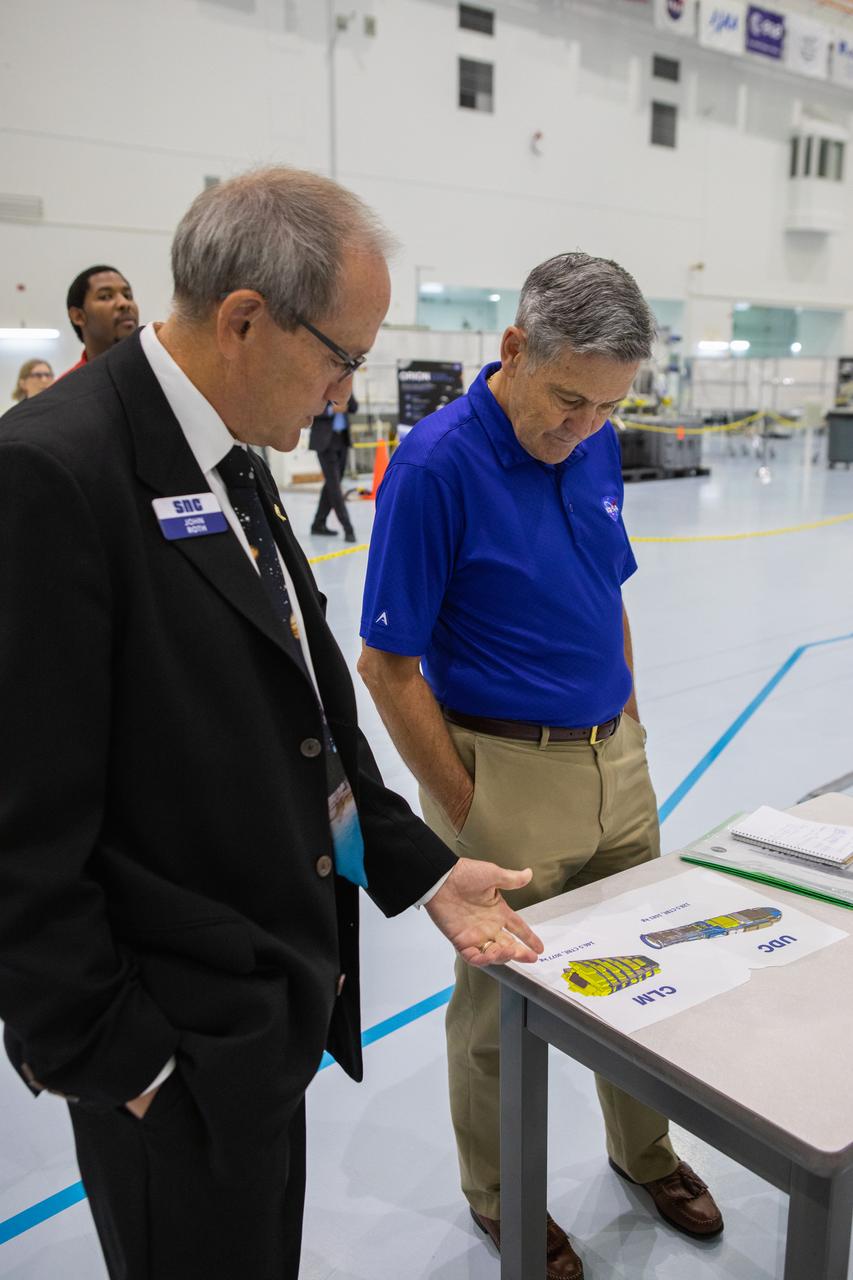
A mockup of the cargo logistics module for Sierra Nevada Corporation’s Dream Chaser, the company’s reusable spaceplane, arrived at the Space Station Processing Facility (SSPF) at NASA’s Kennedy Space Center in Florida in August. On Sept. 20, 2019, senior leadership had the opportunity to view the cargo module in the SSPF high bay. Kennedy Center Director Bob Cabana, at right, listens to John Roth, vice president, Business Development Space Systems, Sierra Nevada Corporation. The SSPF is providing support for current and future NASA and commercial provider programs, including Commercial Resupply Services, Artemis 1, sending the first woman and next man to the Moon, and deep space destinations including Mars.
Sierra Nevada Open House
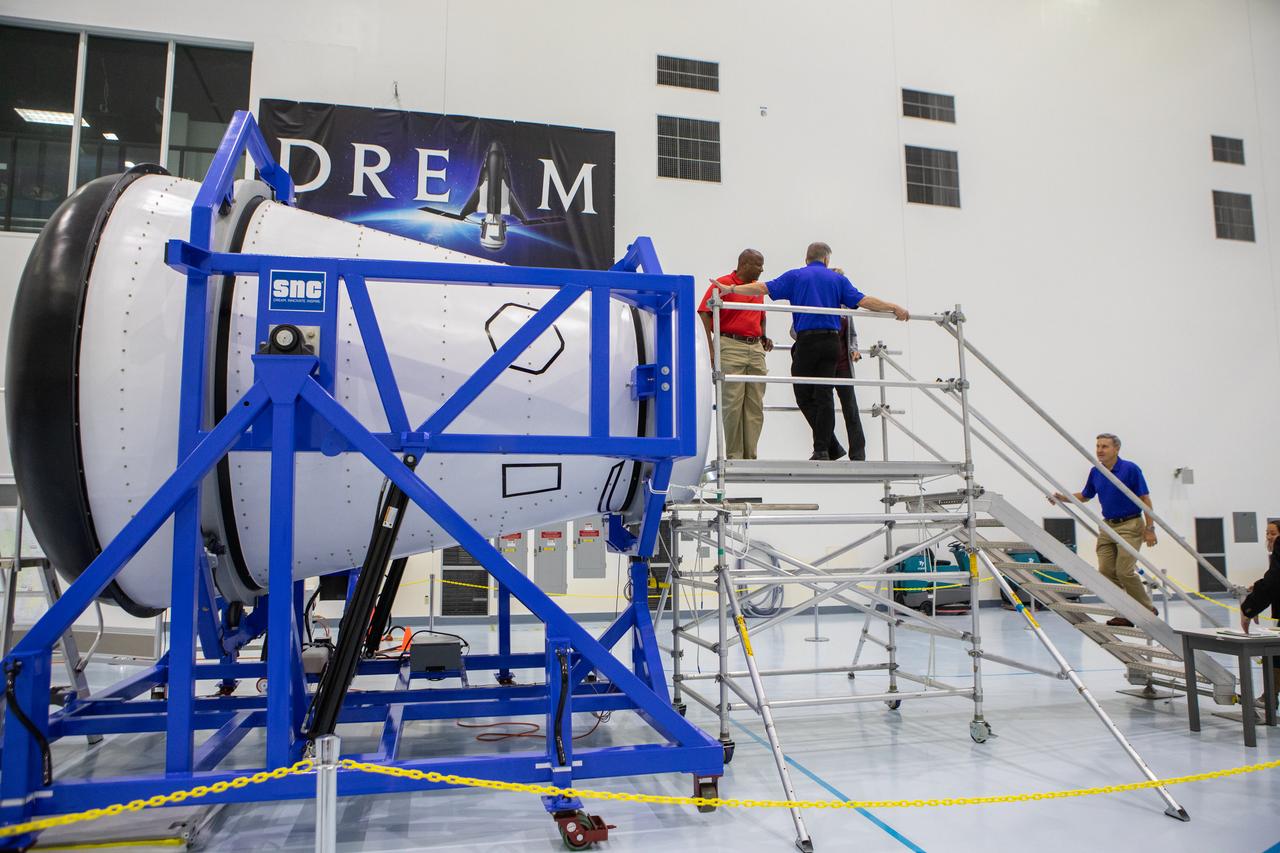
A mockup of the cargo logistics module for Sierra Nevada Corporation’s Dream Chaser, the company’s reusable spaceplane, arrived at the Space Station Processing Facility (SSPF) at NASA’s Kennedy Space Center in Florida in August. On Sept. 20, 2019, senior leadership had the opportunity to view the cargo module in the SSPF high bay. From left are Kelvin Manning, Kennedy associate director, technical; Steve Lindsey, vice president, Space Exploration Systems, Sierra Nevada Corporation; behind Lindsey is Kennedy Deputy Director Janet Petro; and ascending the stairs is Kennedy Center Director Bob Cabana. The SSPF is providing support for current and future NASA and commercial provider programs, including Commercial Resupply Services, Artemis 1, sending the first woman and next man to the Moon, and deep space destinations including Mars.
Sierra Nevada Open House
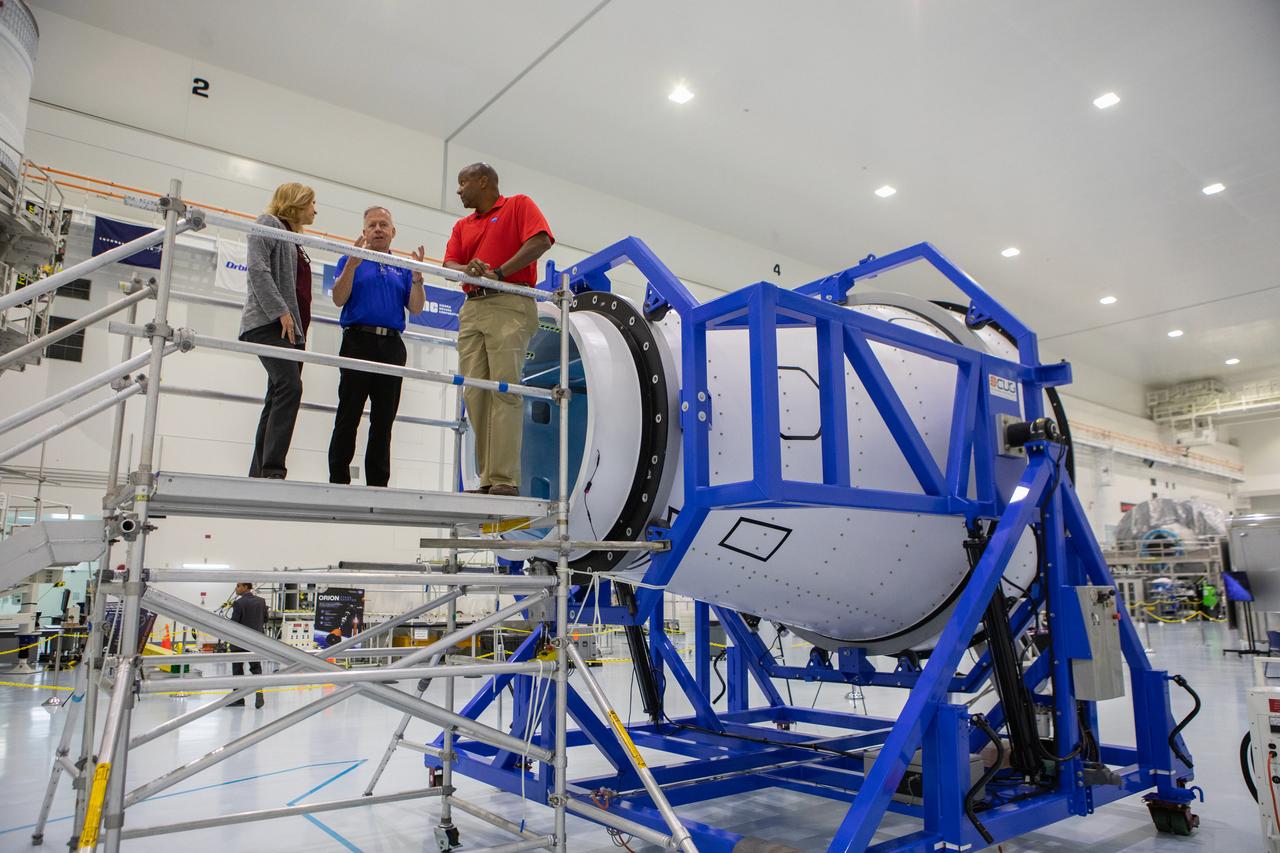
A mockup of the cargo logistics module for Sierra Nevada Corporation’s Dream Chaser, the company’s reusable spaceplane, arrived at the Space Station Processing Facility (SSPF) at NASA’s Kennedy Space Center in Florida in August. On Sept. 20, 2019, senior leadership had the opportunity to view the cargo module in the SSPF high bay. From left are Kelvin Manning, Kennedy associate director, technical; Steve Lindsey, vice president, Space Exploration Systems, Sierra Nevada Corporation; Kennedy Deputy Director Janet Petro; and Kennedy Center Director Bob Cabana. The SSPF is providing support for current and future NASA and commercial provider programs, including Commercial Resupply Services, Artemis 1, sending the first woman and next man to the Moon, and deep space destinations including Mars.
Sierra Nevada Open House
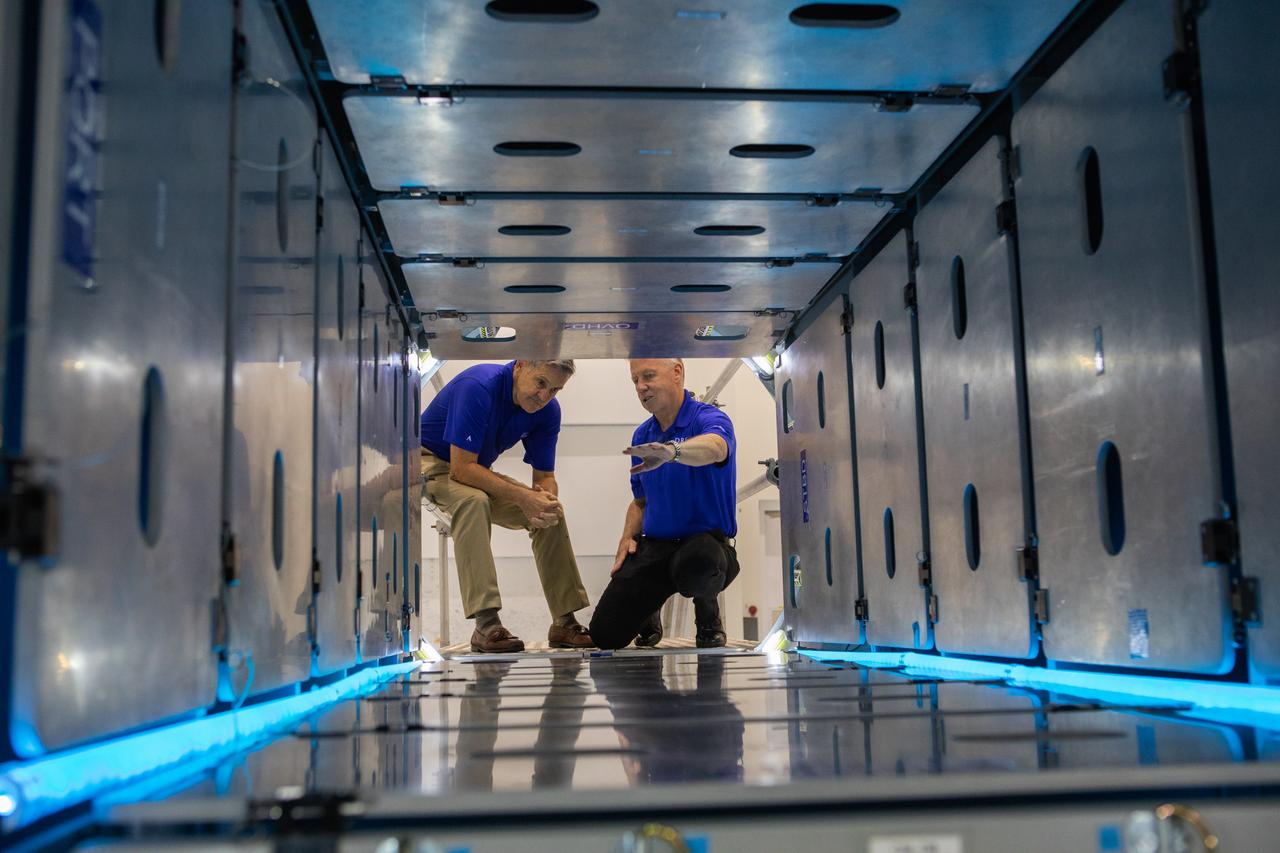
A mockup of the cargo logistics module for Sierra Nevada Corporation’s Dream Chaser, the company’s reusable spaceplane, arrived at the Space Station Processing Facility (SSPF) at NASA’s Kennedy Space Center in Florida in August. On Sept. 20, 2019, senior leadership had the opportunity to view the cargo module in the SSPF high bay. From left are Kennedy Deputy Director Janet Petro; Steve Lindsey, vice president, Space Exploration Systems, Sierra Nevada Corporation; and Kelvin Manning, Kennedy associate director, technical. The SSPF is providing support for current and future NASA and commercial provider programs, including Commercial Resupply Services, Artemis 1, sending the first woman and next man to the Moon, and deep space destinations including Mars.
Sierra Nevada Open House
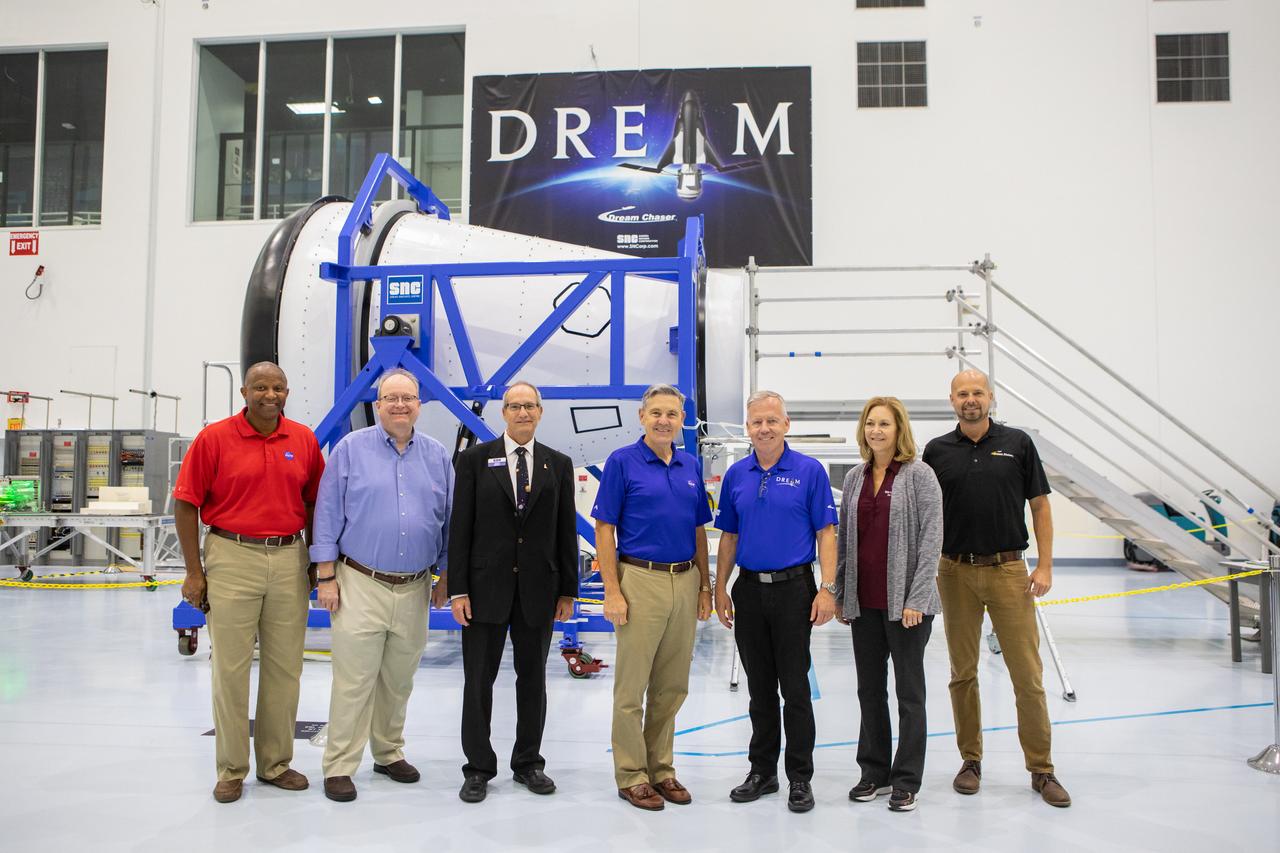
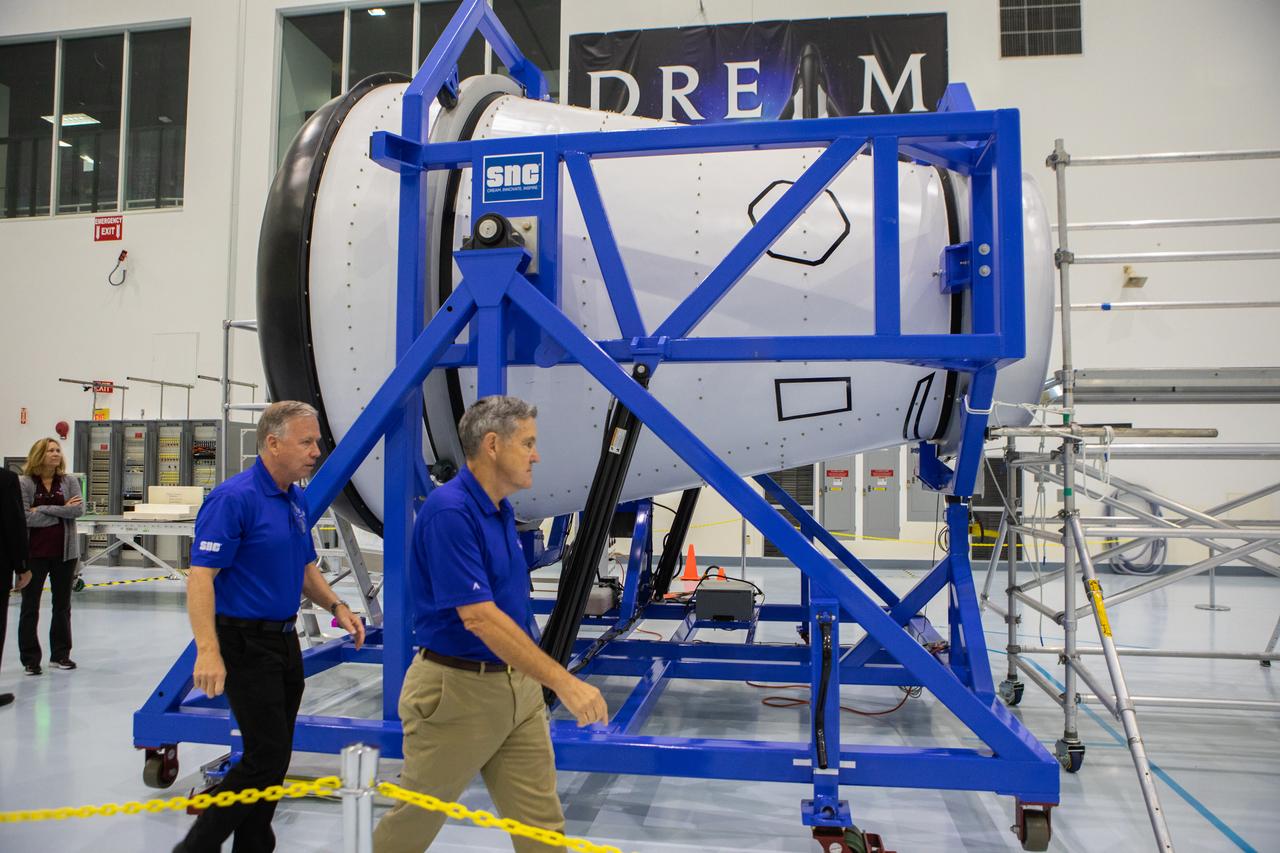
A mockup of the cargo logistics module for Sierra Nevada Corporation’s Dream Chaser, the company’s reusable spaceplane, arrived at the Space Station Processing Facility (SSPF) at NASA’s Kennedy Space Center in Florida in August. On Sept. 20, 2019, senior leadership had the opportunity to view the cargo module in the SSPF high bay. From left are Kelvin Manning, Kennedy associate director, technical; Burt Summerfield, associate director, management; John Roth, vice president, Business Development Space Systems, Sierra Nevada Corporation; Kennedy Center Director Bob Cabana; Steve Lindsey, vice president, Space Exploration Systems, Sierra Nevada Corporation; Kennedy Deputy Director Janet Petro; and Nate Wood, Sierra Nevada Corporation. The SSPF is providing support for current and future NASA and commercial provider programs, including Commercial Resupply Services, Artemis 1, sending the first woman and next man to the Moon, and deep space destinations including Mars.
Sierra Nevada Open House
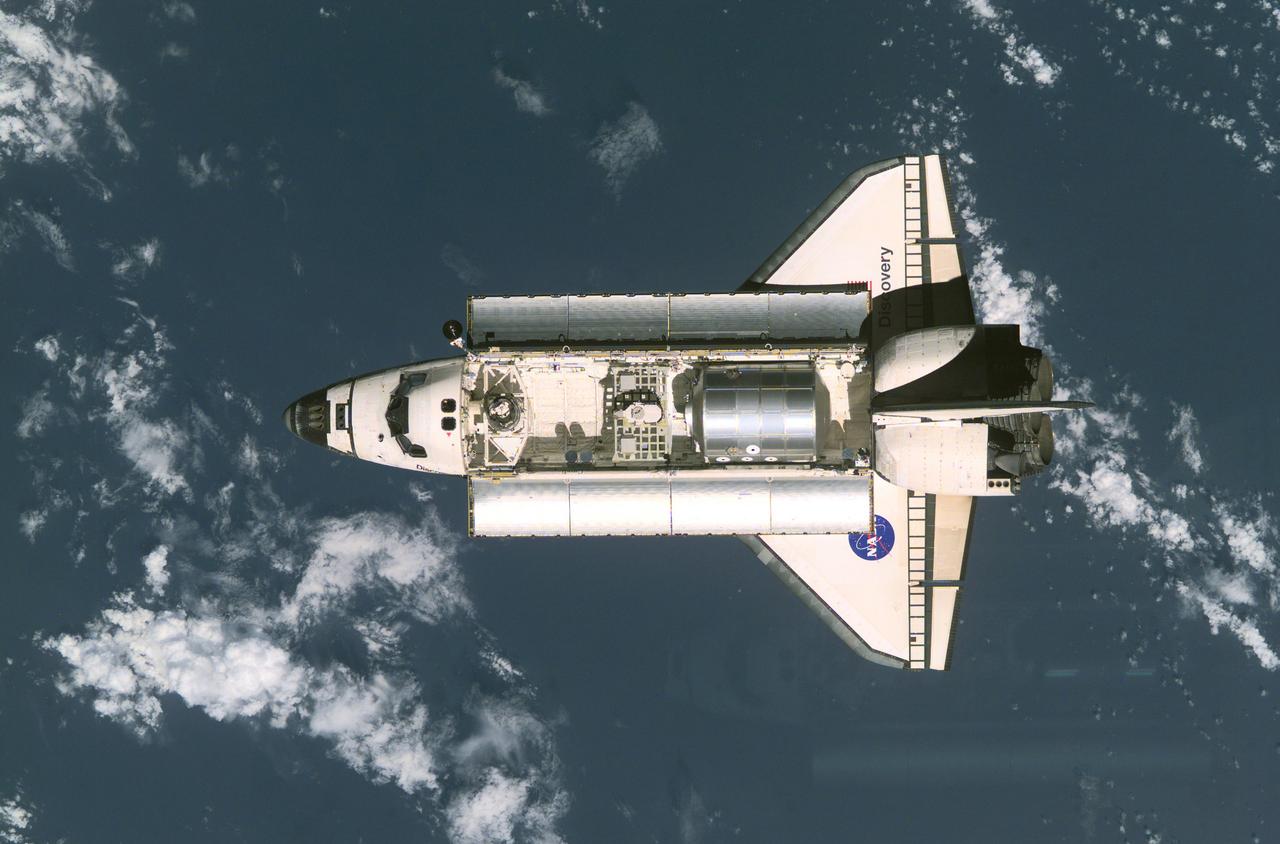
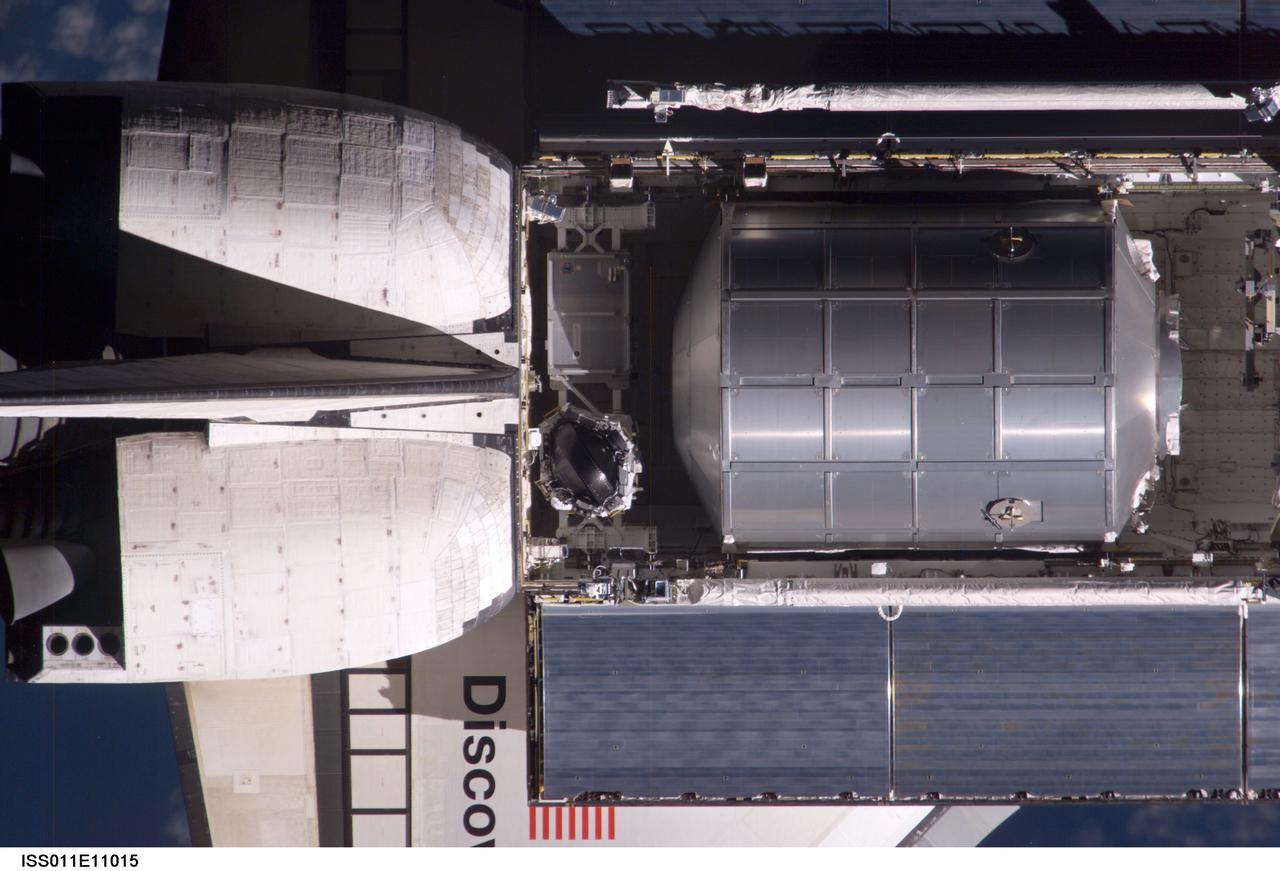
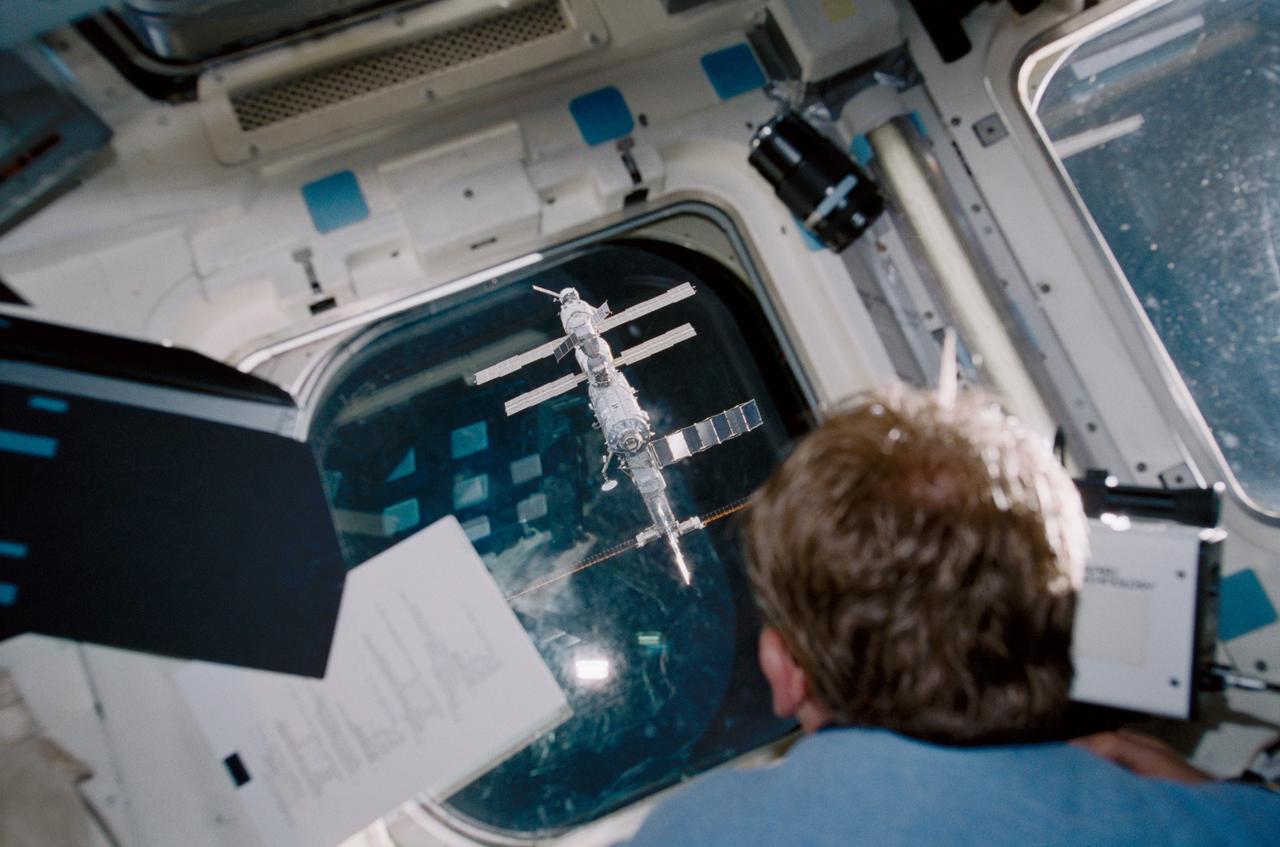
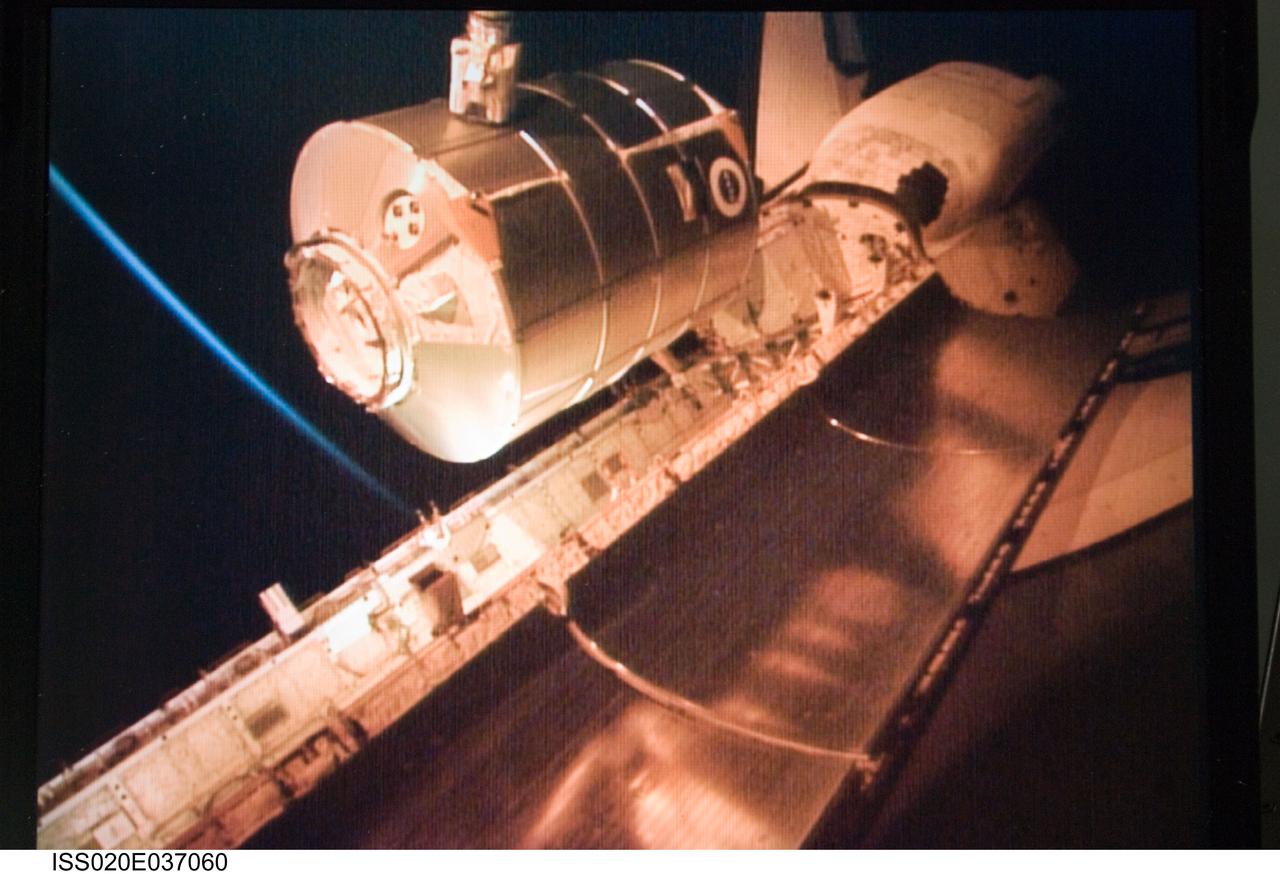
This is a view of the Space Shuttle Discovery as it approaches the International Space Station (ISS) during the STS-105 mission. Visible in the payload bay of Discovery are the Multipurpose Logistics Module (MPLM) Leonardo at right, which stores various supplies and experiments to be transferred into the ISS; at center, the Integrated Cargo Carrier (ICC) which carries the Early Ammonia Servicer (EAS); and two Materials International Space Station Experiment (MISSE) containers at left. Aboard Discovery were the ISS Expedition Three crew, who were to replace the Expedition Two crew that had been living on the ISS for the past five months.
Space Shuttle Projects
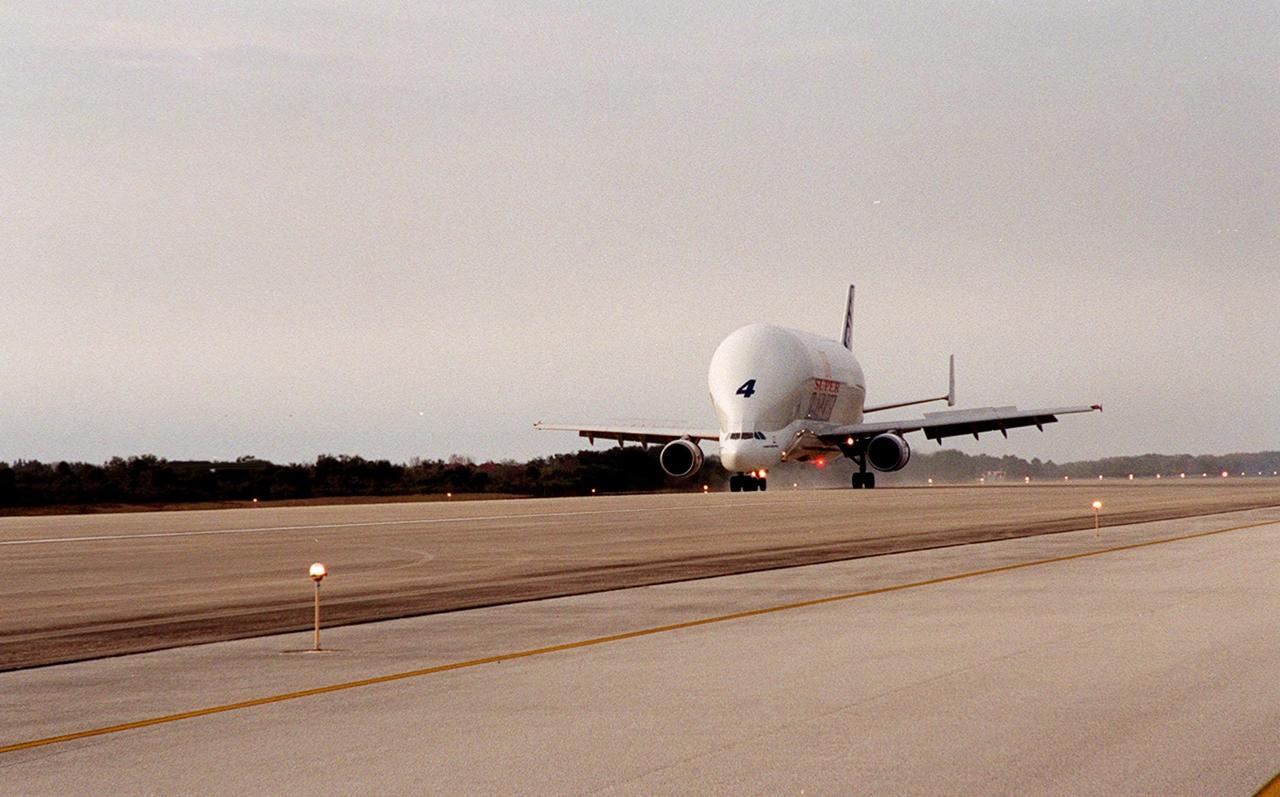
KKENNEDY SPACE CENTER, FLA. -  A Beluga aircraft arrives at the Shuttle Landing Facility with its cargo of the Italian-built module, U.S. Node 2, for the International Space Station.  The second of three Station connecting modules, Node 2 attaches to the end of the U.S. Lab and provides attach locations for the Japanese laboratory, European laboratory, the Centrifuge Accommodation Module and, later, Multipurpose Logistics Modules. It will provide the primary docking location for the Shuttle when a pressurized mating adapter is attached to Node 2.  Installation of the module will complete  the U.S. Core of the ISS.  Node 2 is the designated payload for mission STS-120.  No orbiter or launch date has been determined yet.
KKENNEDY SPACE CENTER, FLA. - A Beluga aircraft arrives at the Shuttle Landing Facility with its cargo of the Italian-built module, U.S. Node 2, for the International Space Station. The second of three Station connecting modules, Node 2 attaches to the end of the U.S. Lab and provides attach locations for the Japanese laboratory, European laboratory, the Centrifuge Accommodation Module and, later, Multipurpose Logistics Modules. It will provide the primary docking location for the Shuttle when a pressurized mating adapter is attached to Node 2. Installation of the module will complete the U.S. Core of the ISS. Node 2 is the designated payload for mission STS-120. No orbiter or launch date has been determined yet.
KENNEDY SPACE CENTER, FLA. - A Beluga aircraft arrives at the Shuttle Landing Facility with its cargo of the Italian-built module, U.S. Node 2, for the International Space Station.  The second of three Station connecting modules, Node 2 attaches to the end of the U.S. Lab and provides attach locations for the Japanese laboratory, European laboratory, the Centrifuge Accommodation Module and, later, Multipurpose Logistics Modules. It will provide the primary docking location for the Shuttle when a pressurized mating adapter is attached to Node 2.  Installation of the module will complete  the U.S. Core of the ISS.  Node 2 is the designated payload for mission STS-120.  No orbiter or launch date has been determined yet.
KENNEDY SPACE CENTER, FLA. - A Beluga aircraft arrives at the Shuttle Landing Facility with its cargo of the Italian-built module, U.S. Node 2, for the International Space Station. The second of three Station connecting modules, Node 2 attaches to the end of the U.S. Lab and provides attach locations for the Japanese laboratory, European laboratory, the Centrifuge Accommodation Module and, later, Multipurpose Logistics Modules. It will provide the primary docking location for the Shuttle when a pressurized mating adapter is attached to Node 2. Installation of the module will complete the U.S. Core of the ISS. Node 2 is the designated payload for mission STS-120. No orbiter or launch date has been determined yet.
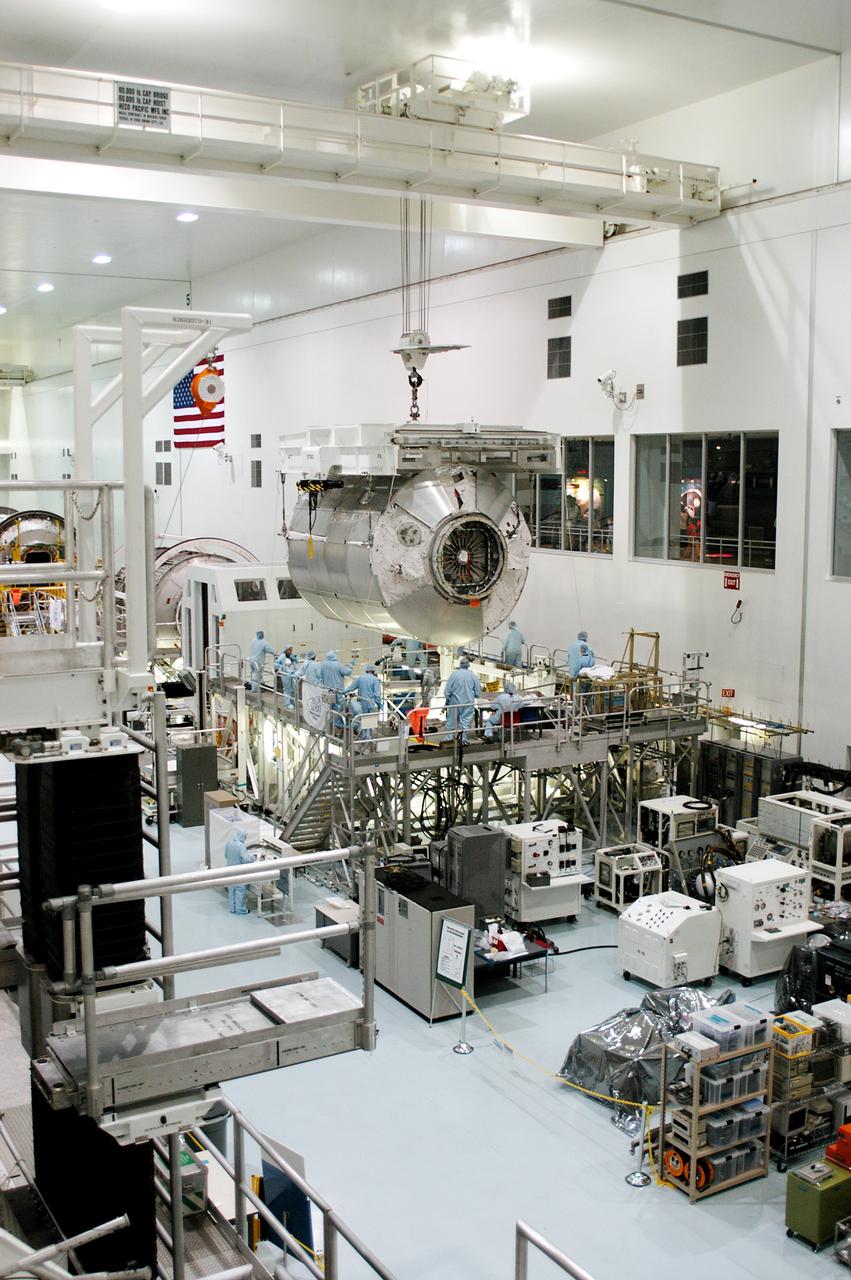
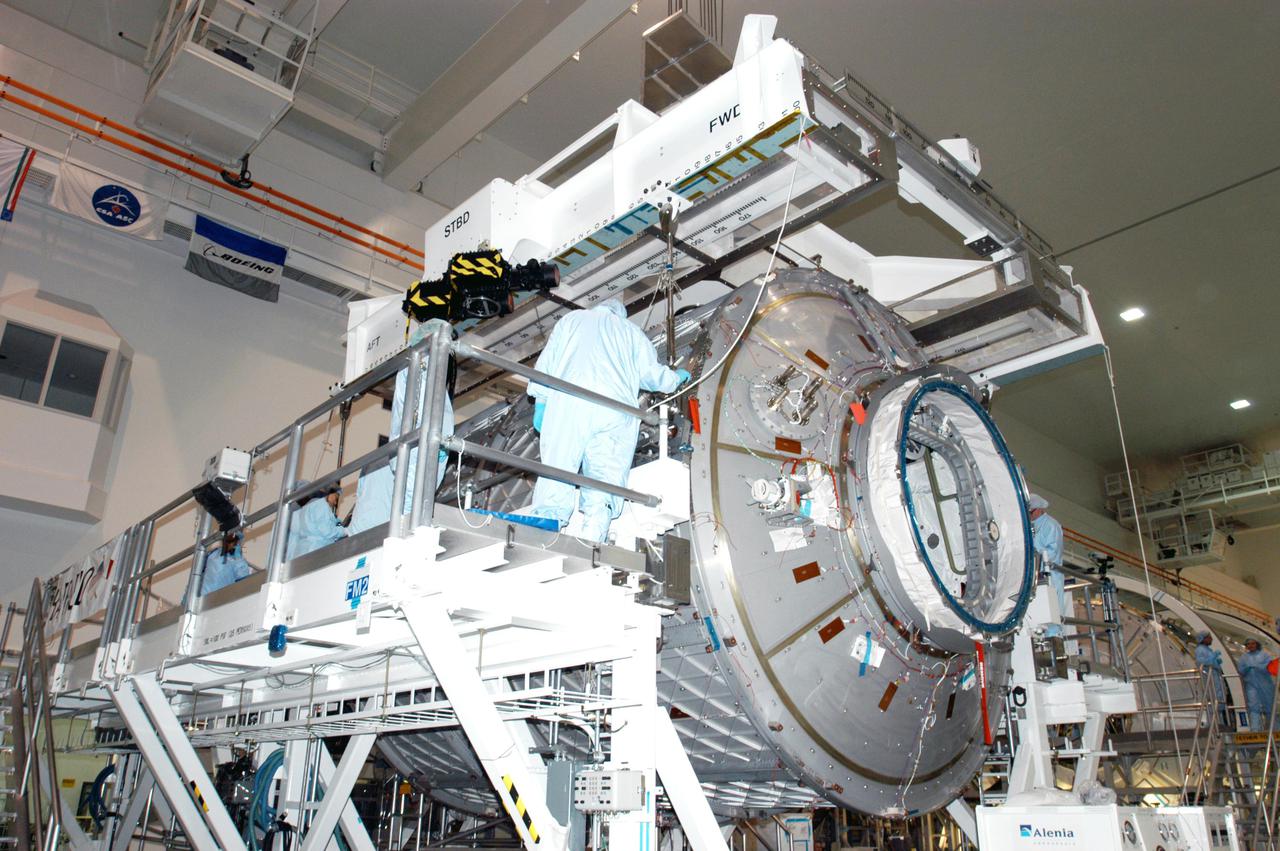
KENNEDY SPACE CENTER, FLA. - The Multi-Purpose Logistics Module Donatello is suspended by cables over the payload canister in the Space Station Processing Facility.  Previously housed in the Operations and Checkout Building, Donatello was brought into the SSPF for routine testing.  This is the first time all three MPLMs (Donatello, Raffaello and Leonardo) are in the SSPF.  The MPLMs were built by the Italian Space Agency, to serve as reusable logistics carriers and the primary delivery system to resupply and return station cargo requiring a pressurized environment.  The third MPLM, Raffaello is scheduled to fly on Space Shuttle Atlantis on mission STS-114.
KENNEDY SPACE CENTER, FLA. - The Multi-Purpose Logistics Module Donatello is suspended by cables over the payload canister in the Space Station Processing Facility. Previously housed in the Operations and Checkout Building, Donatello was brought into the SSPF for routine testing. This is the first time all three MPLMs (Donatello, Raffaello and Leonardo) are in the SSPF. The MPLMs were built by the Italian Space Agency, to serve as reusable logistics carriers and the primary delivery system to resupply and return station cargo requiring a pressurized environment. The third MPLM, Raffaello is scheduled to fly on Space Shuttle Atlantis on mission STS-114.
KENNEDY SPACE CENTER, FLA. - Overhead cables carry the Multi-Purpose Logistics Module Donatello from the payload canister (lower right) to a work stand in the Space Station Processing Facility.  Previously housed in the Operations and Checkout Building, Donatello was brought into the SSPF for routine testing.  This is the first time all three MPLMs (Donatello, Raffaello and Leonardo) are in the SSPF.  The MPLMs were built by the Italian Space Agency, to serve as reusable logistics carriers and the primary delivery system to resupply and return station cargo requiring a pressurized environment.  The third MPLM, Raffaello is scheduled to fly on Space Shuttle Atlantis on mission STS-114.
KENNEDY SPACE CENTER, FLA. - Overhead cables carry the Multi-Purpose Logistics Module Donatello from the payload canister (lower right) to a work stand in the Space Station Processing Facility. Previously housed in the Operations and Checkout Building, Donatello was brought into the SSPF for routine testing. This is the first time all three MPLMs (Donatello, Raffaello and Leonardo) are in the SSPF. The MPLMs were built by the Italian Space Agency, to serve as reusable logistics carriers and the primary delivery system to resupply and return station cargo requiring a pressurized environment. The third MPLM, Raffaello is scheduled to fly on Space Shuttle Atlantis on mission STS-114.
KENNEDY SPACE CENTER, FLA. - In the Space Station Processing Facility,  the Multi-Purpose Logistics Module Donatello is slowly lowered toward a work stand.  Previously housed in the Operations and Checkout Building, Donatello was brought into the SSPF for routine testing.  This is the first time all three MPLMs (Donatello, Raffaello and Leonardo) are in the SSPF.  The MPLMs were built by the Italian Space Agency, to serve as reusable logistics carriers and the primary delivery system to resupply and return station cargo requiring a pressurized environment.  The third MPLM, Raffaello is scheduled to fly on Space Shuttle Atlantis on mission STS-114.
KENNEDY SPACE CENTER, FLA. - In the Space Station Processing Facility, the Multi-Purpose Logistics Module Donatello is slowly lowered toward a work stand. Previously housed in the Operations and Checkout Building, Donatello was brought into the SSPF for routine testing. This is the first time all three MPLMs (Donatello, Raffaello and Leonardo) are in the SSPF. The MPLMs were built by the Italian Space Agency, to serve as reusable logistics carriers and the primary delivery system to resupply and return station cargo requiring a pressurized environment. The third MPLM, Raffaello is scheduled to fly on Space Shuttle Atlantis on mission STS-114.
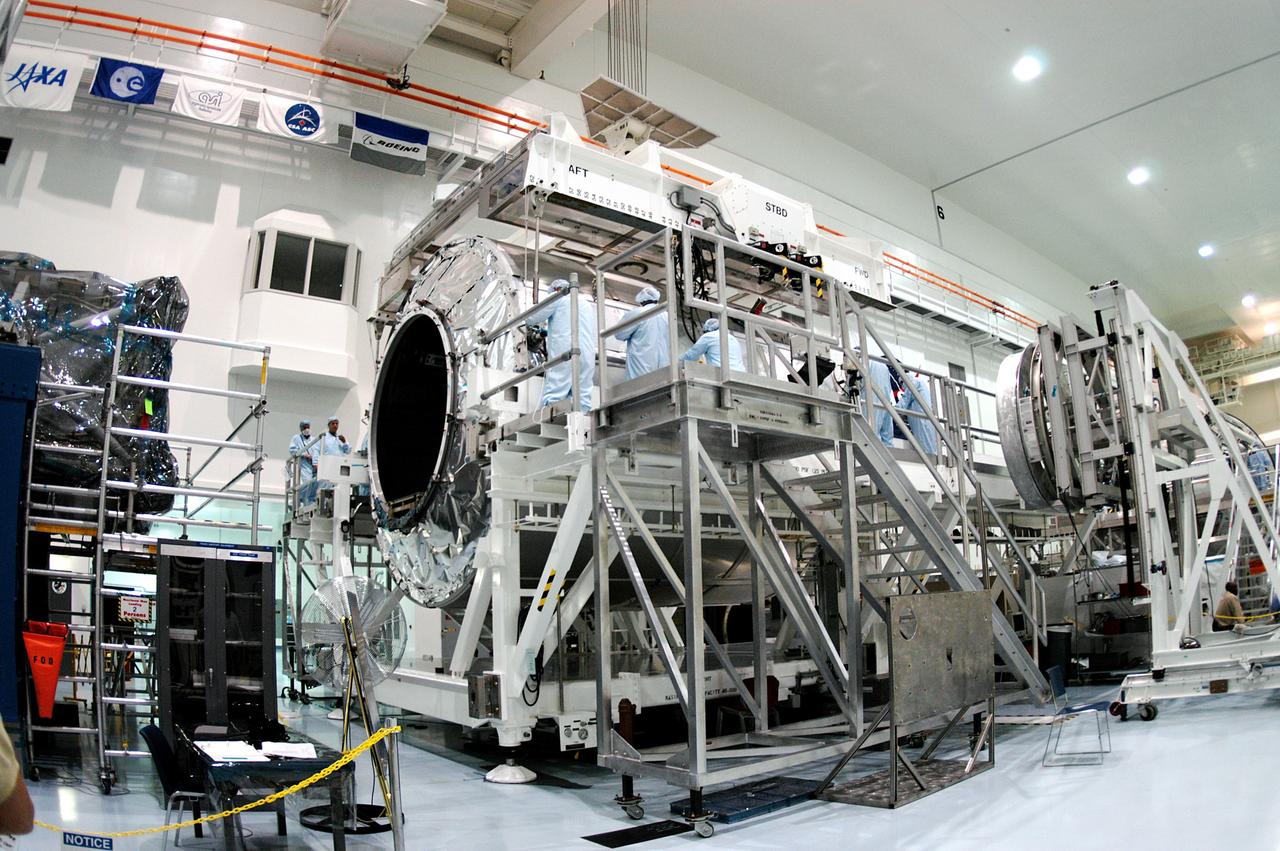
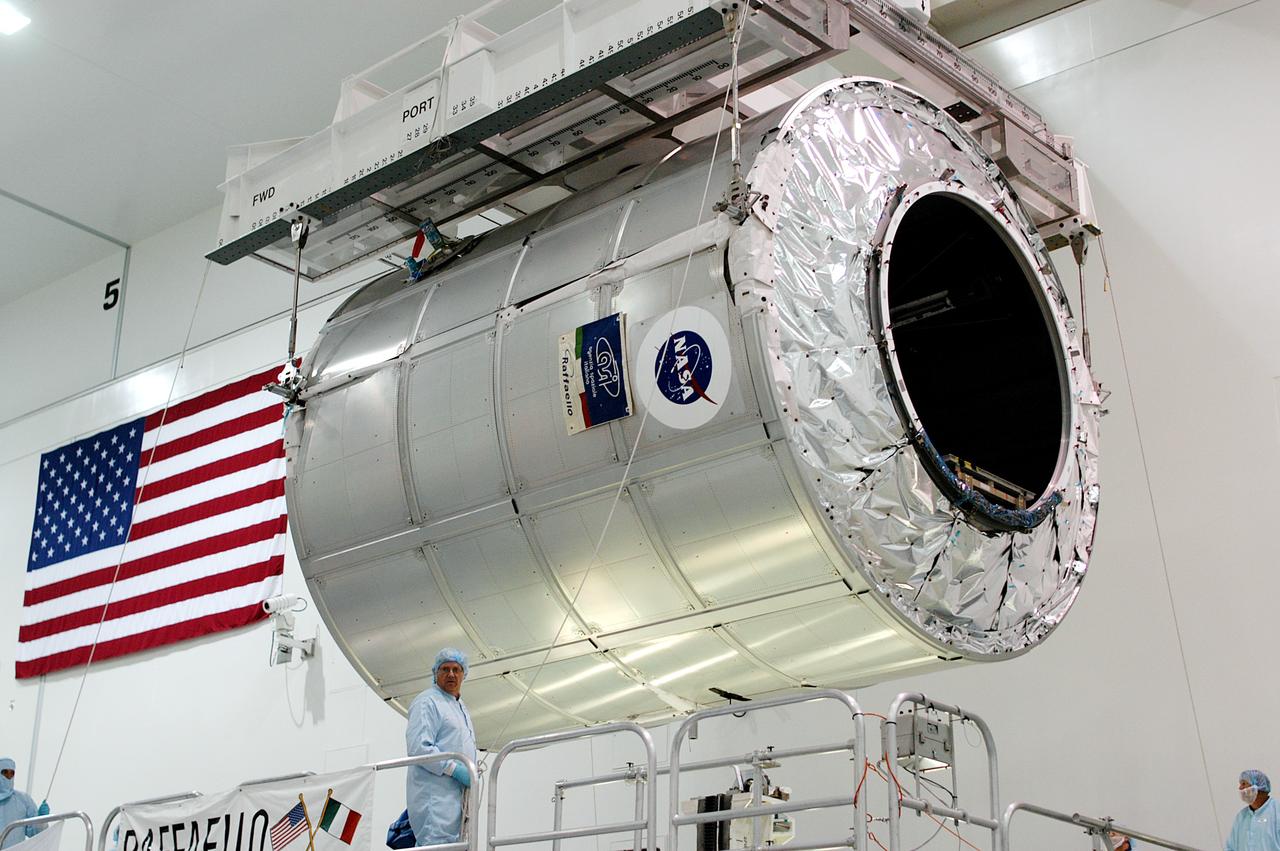
KENNEDY SPACE CENTER, FLA. - A worker on the floor watches as the Multi-Purpose Logistics Module Raffaello moves toward another work stand in the Space Station Processing Facility.  Raffaello is the second MPLM built by the Italian Space Agency, serving as a reusable logistics carrier and primary delivery system to resupply and return station cargo requiring a pressurized environment.  It has been moved across the floor to allow the third MPLM, Donatello, to be brought in for routine testing.  Donatello has been stored in the Operations and Checkout Building.  This is the first time all three MPLMs are in the SSPF; the other one is the Leonardo.  Raffaello is scheduled to fly on Space Shuttle Atlantis on mission STS-114.
KENNEDY SPACE CENTER, FLA. - A worker on the floor watches as the Multi-Purpose Logistics Module Raffaello moves toward another work stand in the Space Station Processing Facility. Raffaello is the second MPLM built by the Italian Space Agency, serving as a reusable logistics carrier and primary delivery system to resupply and return station cargo requiring a pressurized environment. It has been moved across the floor to allow the third MPLM, Donatello, to be brought in for routine testing. Donatello has been stored in the Operations and Checkout Building. This is the first time all three MPLMs are in the SSPF; the other one is the Leonardo. Raffaello is scheduled to fly on Space Shuttle Atlantis on mission STS-114.
KENNEDY SPACE CENTER, FLA. - The Multi-Purpose Logistics Module Raffaello moves away from its stand in the Space Station Processing Facility.  Raffaello is the second MPLM built by the Italian Space Agency, serving as a reusable logistics carrier and primary delivery system to resupply and return station cargo requiring a pressurized environment.  It is being moved to allow the third MPLM, Donatello, to be brought in for routine testing.  Donatello has been stored in the Operations and Checkout Building.  This is the first time all three MPLMs are in the SSPF; the other one is the Leonardo.  Raffaello is scheduled to fly on Space Shuttle Atlantis on mission STS-114.
KENNEDY SPACE CENTER, FLA. - The Multi-Purpose Logistics Module Raffaello moves away from its stand in the Space Station Processing Facility. Raffaello is the second MPLM built by the Italian Space Agency, serving as a reusable logistics carrier and primary delivery system to resupply and return station cargo requiring a pressurized environment. It is being moved to allow the third MPLM, Donatello, to be brought in for routine testing. Donatello has been stored in the Operations and Checkout Building. This is the first time all three MPLMs are in the SSPF; the other one is the Leonardo. Raffaello is scheduled to fly on Space Shuttle Atlantis on mission STS-114.
KENNEDY SPACE CENTER, FLA. - Workers on the floor of the Space Station Processing Facility watch as overhead cables carry the Multi-Purpose Logistics Module Donatello to a work stand.  Previously housed in the Operations and Checkout Building, Donatello was brought into the SSPF for routine testing.  This is the first time all three MPLMs (Donatello, Raffaello and Leonardo) are in the SSPF.  The MPLMs were built by the Italian Space Agency, to serve as reusable logistics carriers and the primary delivery system to resupply and return station cargo requiring a pressurized environment.  The third MPLM, Raffaello is scheduled to fly on Space Shuttle Atlantis on mission STS-114.
KENNEDY SPACE CENTER, FLA. - Workers on the floor of the Space Station Processing Facility watch as overhead cables carry the Multi-Purpose Logistics Module Donatello to a work stand. Previously housed in the Operations and Checkout Building, Donatello was brought into the SSPF for routine testing. This is the first time all three MPLMs (Donatello, Raffaello and Leonardo) are in the SSPF. The MPLMs were built by the Italian Space Agency, to serve as reusable logistics carriers and the primary delivery system to resupply and return station cargo requiring a pressurized environment. The third MPLM, Raffaello is scheduled to fly on Space Shuttle Atlantis on mission STS-114.
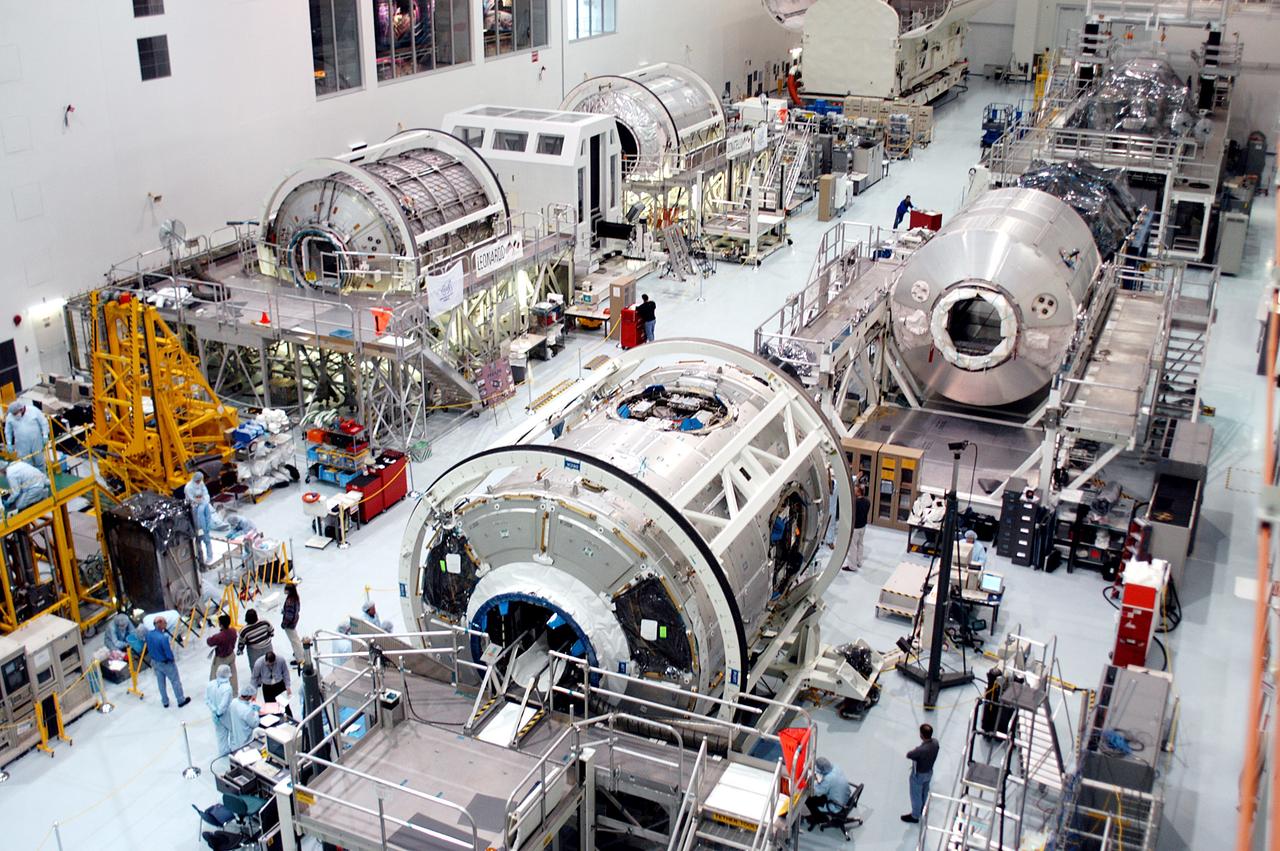
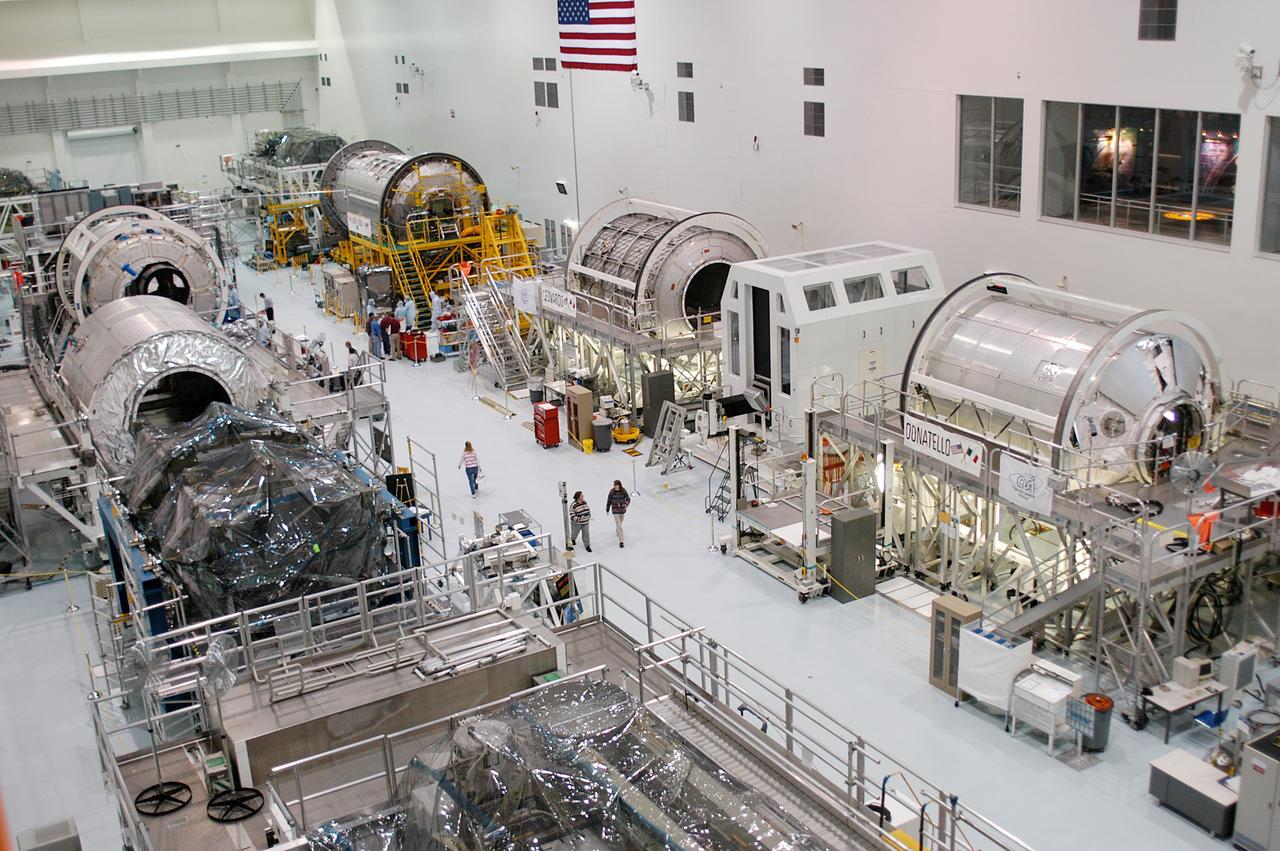
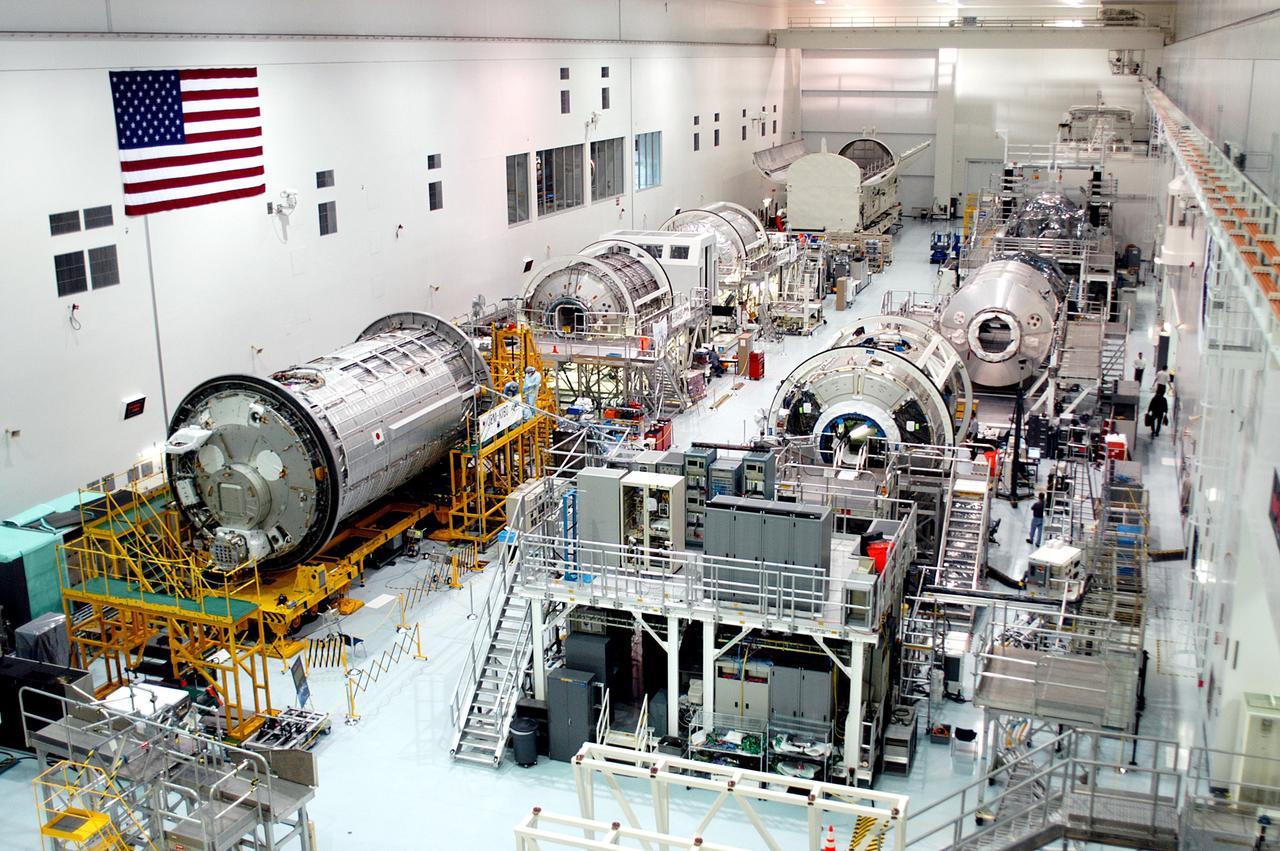
KENNEDY SPACE CENTER, FLA. - All three Multi-Purpose Logistics Modules are on the floor of the Space Station Processing Facility.  This is the first time the three - Leonardo, Raffaello and Donatello -- have been in one location.  Donatello has been stored in the Operations and Checkout Building since its arrival at KSC and was brought into the SSPF for routine testing. The MPLMs were built by the Italian Space Agency, to serve as reusable logistics carriers and the primary delivery system to resupply and return station cargo requiring a pressurized environment.  Raffaello is scheduled to fly on Space Shuttle Atlantis on mission STS-114.
KENNEDY SPACE CENTER, FLA. - All three Multi-Purpose Logistics Modules are on the floor of the Space Station Processing Facility. This is the first time the three - Leonardo, Raffaello and Donatello -- have been in one location. Donatello has been stored in the Operations and Checkout Building since its arrival at KSC and was brought into the SSPF for routine testing. The MPLMs were built by the Italian Space Agency, to serve as reusable logistics carriers and the primary delivery system to resupply and return station cargo requiring a pressurized environment. Raffaello is scheduled to fly on Space Shuttle Atlantis on mission STS-114.
KENNEDY SPACE CENTER, FLA. - In the Space Station Processing Facility,  workers help the Multi-Purpose Logistics Module Donatello settle onto a work stand.  Previously housed in the Operations and Checkout Building, Donatello was brought into the SSPF for routine testing.  This is the first time all three MPLMs (Donatello, Raffaello and Leonardo) are in the SSPF.  The MPLMs were built by the Italian Space Agency, to serve as reusable logistics carriers and the primary delivery system to resupply and return station cargo requiring a pressurized environment.  The third MPLM, Raffaello, is scheduled to fly on Space Shuttle Atlantis on mission STS-114.
KENNEDY SPACE CENTER, FLA. - In the Space Station Processing Facility, workers help the Multi-Purpose Logistics Module Donatello settle onto a work stand. Previously housed in the Operations and Checkout Building, Donatello was brought into the SSPF for routine testing. This is the first time all three MPLMs (Donatello, Raffaello and Leonardo) are in the SSPF. The MPLMs were built by the Italian Space Agency, to serve as reusable logistics carriers and the primary delivery system to resupply and return station cargo requiring a pressurized environment. The third MPLM, Raffaello, is scheduled to fly on Space Shuttle Atlantis on mission STS-114.
KENNEDY SPACE CENTER, FLA. - This view reveals all three Multi-Purpose Logistics Modules on the floor of the Space Station Processing Facility.  This is the first time all three - Leonardo, Raffaello and Donatello -- have been in one location.  Donatello has been stored in the Operations and Checkout Building since its arrival at KSC and was brought into the SSPF for routine testing. The MPLMs were built by the Italian Space Agency, to serve as reusable logistics carriers and the primary delivery system to resupply and return station cargo requiring a pressurized environment.  Raffaello is scheduled to fly on Space Shuttle Atlantis on mission STS-114.
KENNEDY SPACE CENTER, FLA. - This view reveals all three Multi-Purpose Logistics Modules on the floor of the Space Station Processing Facility. This is the first time all three - Leonardo, Raffaello and Donatello -- have been in one location. Donatello has been stored in the Operations and Checkout Building since its arrival at KSC and was brought into the SSPF for routine testing. The MPLMs were built by the Italian Space Agency, to serve as reusable logistics carriers and the primary delivery system to resupply and return station cargo requiring a pressurized environment. Raffaello is scheduled to fly on Space Shuttle Atlantis on mission STS-114.
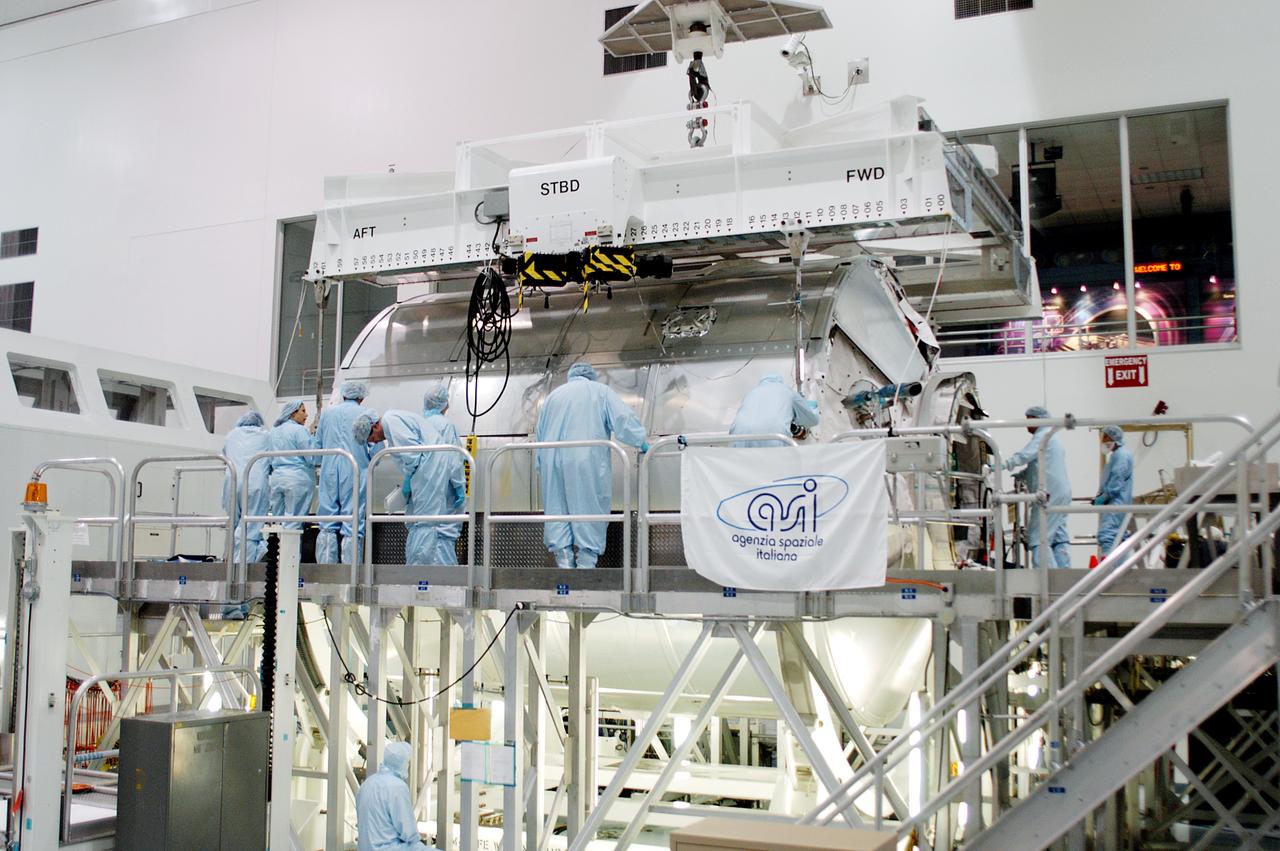
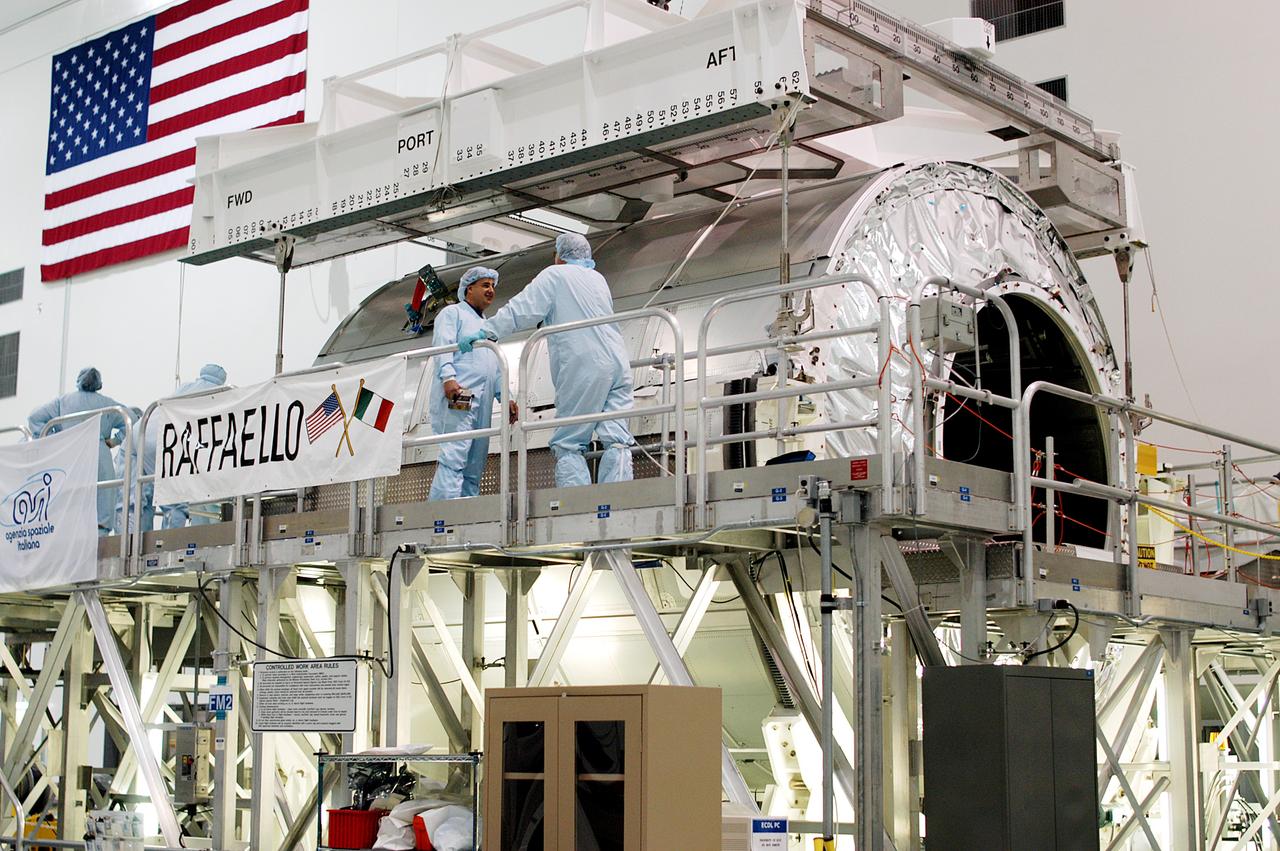
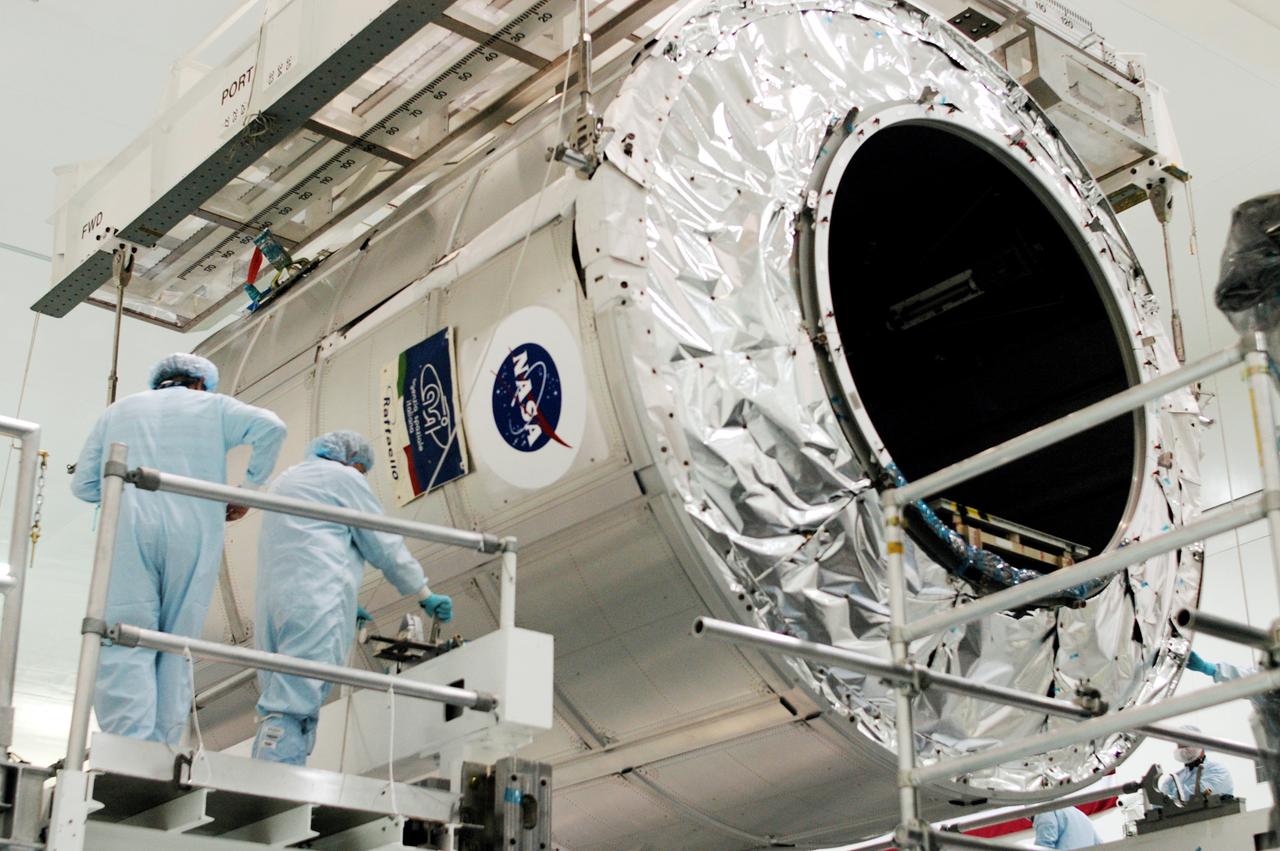
KENNEDY SPACE CENTER, FLA. - Workers in the Space Station Processing Facility prepare to release the overhead crane from the Multi-Purpose Logistics Module Raffaello now secure on a new work stand.  Raffaello is the second MPLM built by the Italian Space Agency, serving as a reusable logistics carrier and primary delivery system to resupply and return station cargo requiring a pressurized environment.  It has been moved to allow the third MPLM, Donatello, to be brought in for routine testing.  Donatello has been stored in the Operations and Checkout Building.  This is the first time all three MPLMs are in the SSPF; the other one is the Leonardo.  Raffaello is scheduled to fly on Space Shuttle Atlantis on mission STS-114.
KENNEDY SPACE CENTER, FLA. - Workers in the Space Station Processing Facility prepare to release the overhead crane from the Multi-Purpose Logistics Module Raffaello now secure on a new work stand. Raffaello is the second MPLM built by the Italian Space Agency, serving as a reusable logistics carrier and primary delivery system to resupply and return station cargo requiring a pressurized environment. It has been moved to allow the third MPLM, Donatello, to be brought in for routine testing. Donatello has been stored in the Operations and Checkout Building. This is the first time all three MPLMs are in the SSPF; the other one is the Leonardo. Raffaello is scheduled to fly on Space Shuttle Atlantis on mission STS-114.
KENNEDY SPACE CENTER, FLA. - Workers in the Space Station Processing Facility secure the Multi-Purpose Logistics Module Raffaello onto a new work stand.  Raffaello is the second MPLM built by the Italian Space Agency, serving as a reusable logistics carrier and primary delivery system to resupply and return station cargo requiring a pressurized environment.  It has been moved to allow the third MPLM, Donatello, to be brought in for routine testing.  Donatello has been stored in the Operations and Checkout Building.  This is the first time all three MPLMs are in the SSPF; the other one is the Leonardo.  Raffaello is scheduled to fly on Space Shuttle Atlantis on mission STS-114.
KENNEDY SPACE CENTER, FLA. - Workers in the Space Station Processing Facility secure the Multi-Purpose Logistics Module Raffaello onto a new work stand. Raffaello is the second MPLM built by the Italian Space Agency, serving as a reusable logistics carrier and primary delivery system to resupply and return station cargo requiring a pressurized environment. It has been moved to allow the third MPLM, Donatello, to be brought in for routine testing. Donatello has been stored in the Operations and Checkout Building. This is the first time all three MPLMs are in the SSPF; the other one is the Leonardo. Raffaello is scheduled to fly on Space Shuttle Atlantis on mission STS-114.
KENNEDY SPACE CENTER, FLA. - The Multi-Purpose Logistics Module Donatello is moved away from the payload canister in the Space Station Processing Facility.  Previously housed in the Operations and Checkout Building, Donatello was brought into the SSPF for routine testing.  This is the first time all three MPLMs (Donatello, Raffaello and Leonardo) are in the SSPF.  The MPLMs were built by the Italian Space Agency, to serve as reusable logistics carriers and the primary delivery system to resupply and return station cargo requiring a pressurized environment.  The third MPLM, Raffaello is scheduled to fly on Space Shuttle Atlantis on mission STS-114.
KENNEDY SPACE CENTER, FLA. - The Multi-Purpose Logistics Module Donatello is moved away from the payload canister in the Space Station Processing Facility. Previously housed in the Operations and Checkout Building, Donatello was brought into the SSPF for routine testing. This is the first time all three MPLMs (Donatello, Raffaello and Leonardo) are in the SSPF. The MPLMs were built by the Italian Space Agency, to serve as reusable logistics carriers and the primary delivery system to resupply and return station cargo requiring a pressurized environment. The third MPLM, Raffaello is scheduled to fly on Space Shuttle Atlantis on mission STS-114.
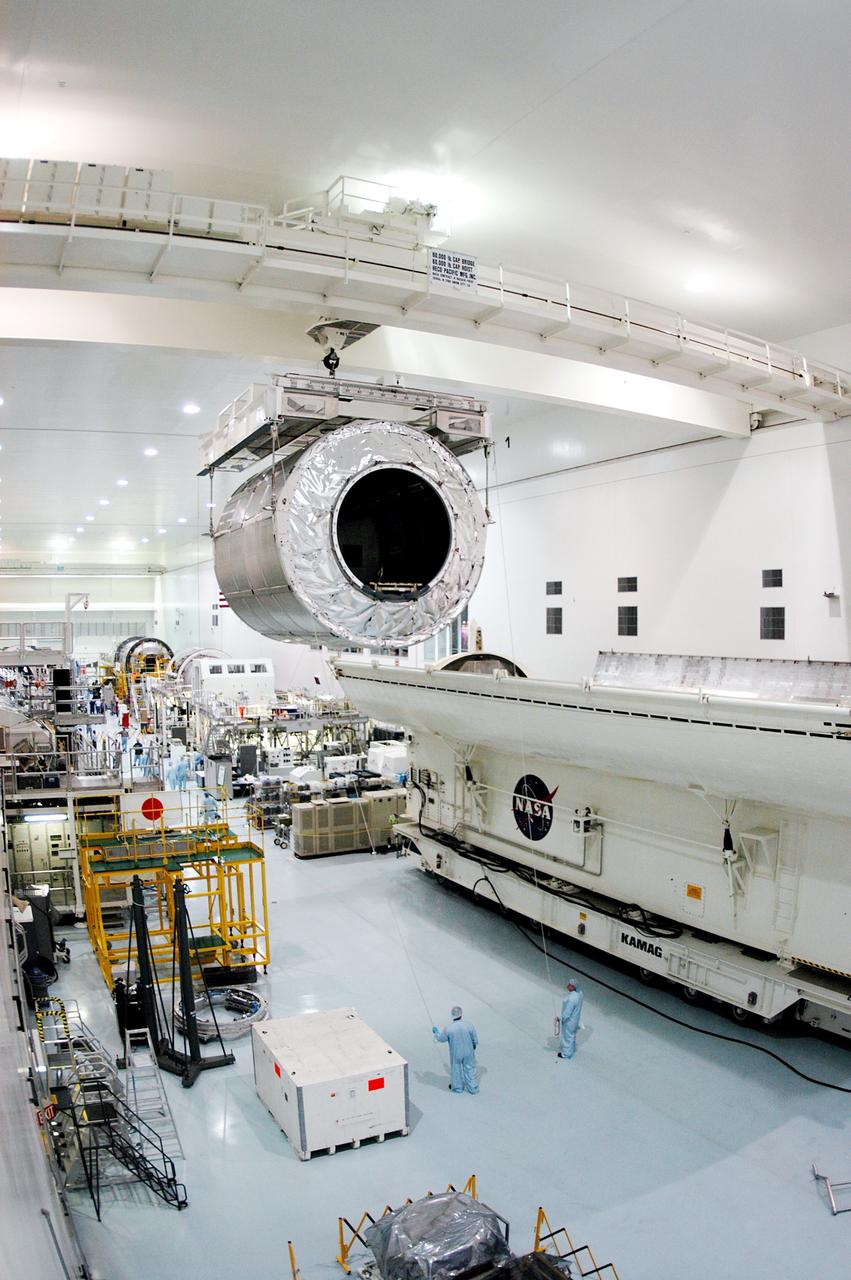
KENNEDY SPACE CENTER, FLA. - An overhead crane is attached to the Multi-Purpose Logistics Module Raffaello in order to move it to another work stand in the Space Station Processing Facility.  Raffaello is the second MPLM built by the Italian Space Agency, serving as a reusable logistics carrier and primary delivery system to resupply and return station cargo requiring a pressurized environment.  It is being moved to allow the third MPLM, Donatello, to be brought in for routine testing.  Donatello has been stored in the Operations and Checkout Building.  This is the first time all three MPLMs are in the SSPF; the other one is the Leonardo.  Raffaello is scheduled to fly on Space Shuttle Atlantis on mission STS-114.
KENNEDY SPACE CENTER, FLA. - An overhead crane is attached to the Multi-Purpose Logistics Module Raffaello in order to move it to another work stand in the Space Station Processing Facility. Raffaello is the second MPLM built by the Italian Space Agency, serving as a reusable logistics carrier and primary delivery system to resupply and return station cargo requiring a pressurized environment. It is being moved to allow the third MPLM, Donatello, to be brought in for routine testing. Donatello has been stored in the Operations and Checkout Building. This is the first time all three MPLMs are in the SSPF; the other one is the Leonardo. Raffaello is scheduled to fly on Space Shuttle Atlantis on mission STS-114.
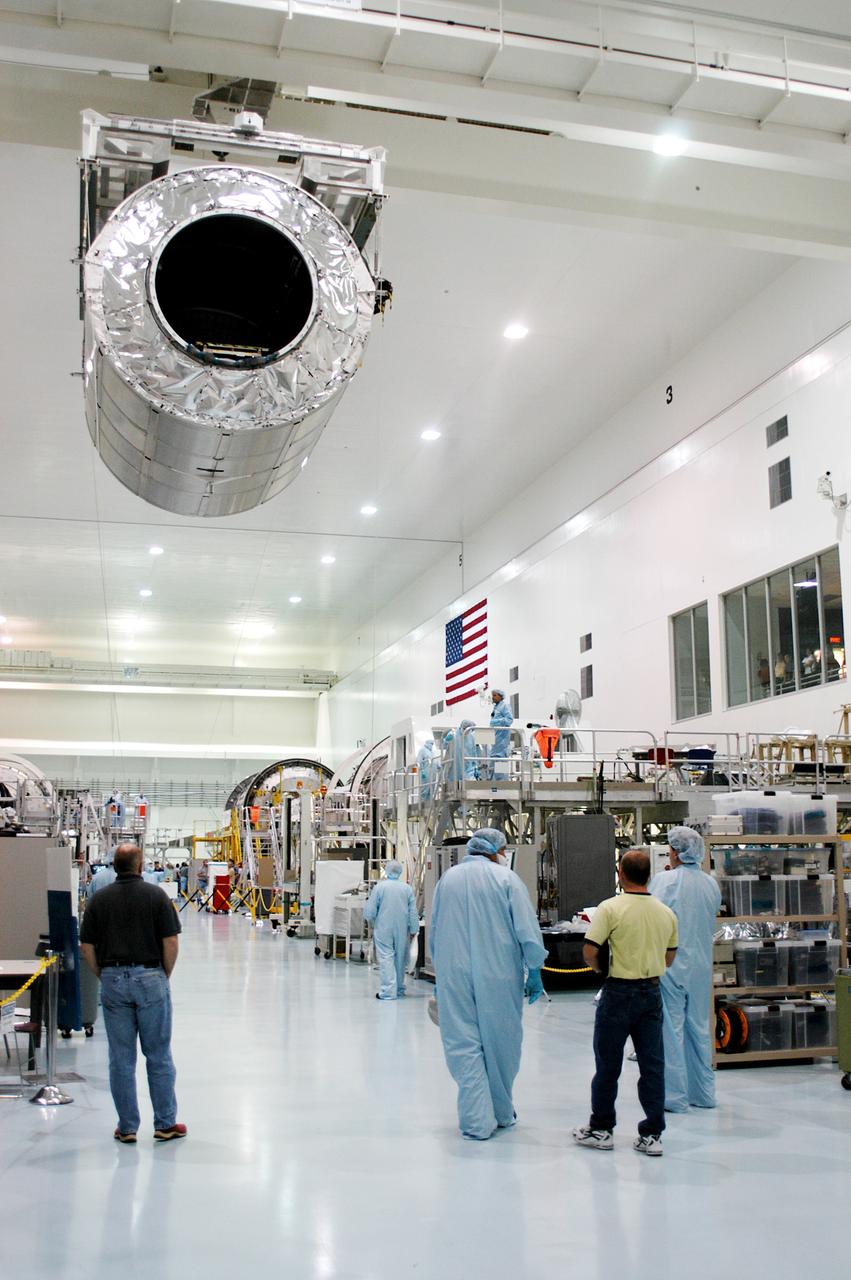
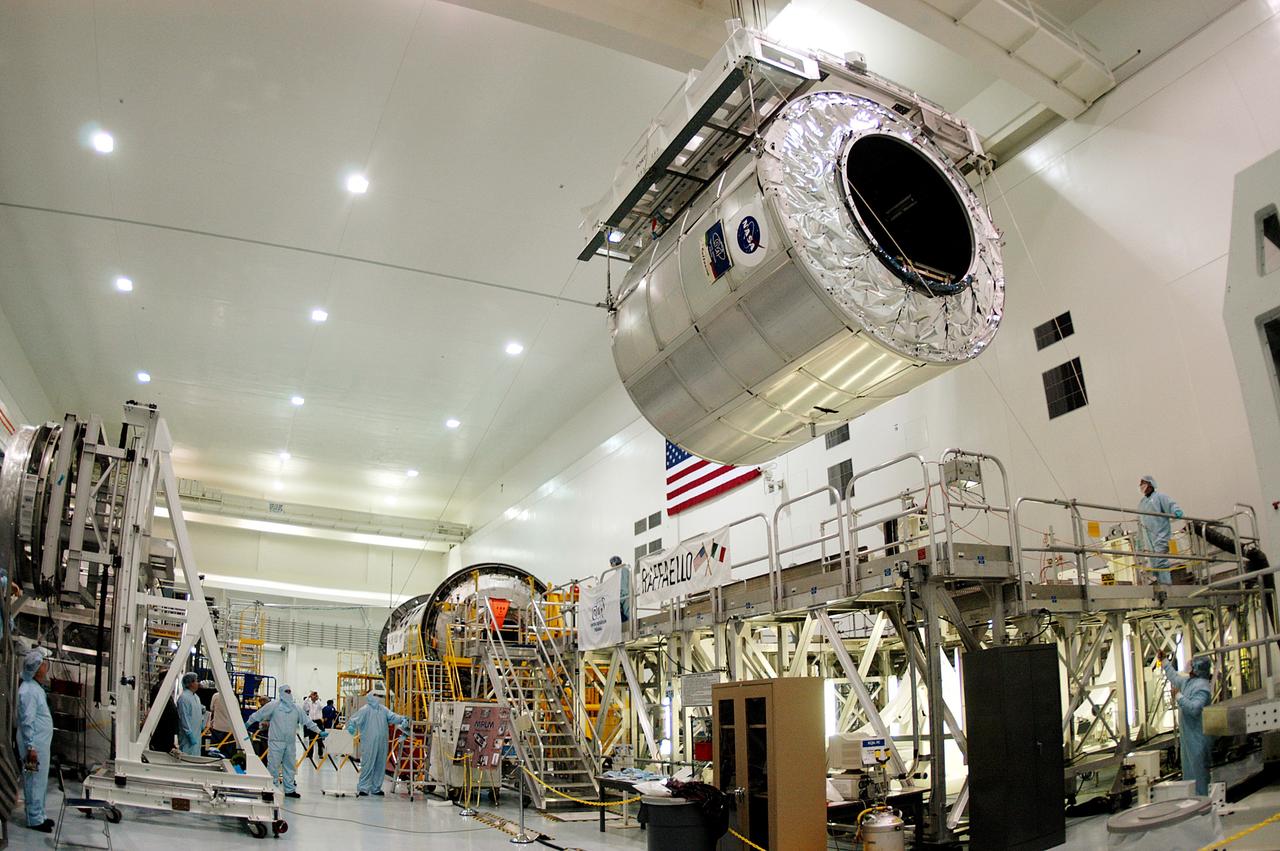
KENNEDY SPACE CENTER, FLA. - Workers watch as the Multi-Purpose Logistics Module Raffaello is lowered toward a work stand in the Space Station Processing Facility.  Raffaello is the second MPLM built by the Italian Space Agency, serving as a reusable logistics carrier and primary delivery system to resupply and return station cargo requiring a pressurized environment.  It has been moved across the floor to allow the third MPLM, Donatello, to be brought in for routine testing.  Donatello has been stored in the Operations and Checkout Building.  This is the first time all three MPLMs are in the SSPF; the other one is the Leonardo.  Raffaello is scheduled to fly on Space Shuttle Atlantis on mission STS-114.
KENNEDY SPACE CENTER, FLA. - Workers watch as the Multi-Purpose Logistics Module Raffaello is lowered toward a work stand in the Space Station Processing Facility. Raffaello is the second MPLM built by the Italian Space Agency, serving as a reusable logistics carrier and primary delivery system to resupply and return station cargo requiring a pressurized environment. It has been moved across the floor to allow the third MPLM, Donatello, to be brought in for routine testing. Donatello has been stored in the Operations and Checkout Building. This is the first time all three MPLMs are in the SSPF; the other one is the Leonardo. Raffaello is scheduled to fly on Space Shuttle Atlantis on mission STS-114.
KENNEDY SPACE CENTER, FLA. - In the Space Station Processing Facility, the Multi-Purpose Logistics Module Raffaello glides above the floor as it moves to another stand on the other side.  Raffaello is the second MPLM built by the Italian Space Agency, serving as a reusable logistics carrier and primary delivery system to resupply and return station cargo requiring a pressurized environment.  It is being moved to allow the third MPLM, Donatello, to be brought in for routine testing.  Donatello has been stored in the Operations and Checkout Building.  This is the first time all three MPLMs are in the SSPF; the other one is the Leonardo.  Raffaello is scheduled to fly on Space Shuttle Atlantis on mission STS-114.
KENNEDY SPACE CENTER, FLA. - In the Space Station Processing Facility, the Multi-Purpose Logistics Module Raffaello glides above the floor as it moves to another stand on the other side. Raffaello is the second MPLM built by the Italian Space Agency, serving as a reusable logistics carrier and primary delivery system to resupply and return station cargo requiring a pressurized environment. It is being moved to allow the third MPLM, Donatello, to be brought in for routine testing. Donatello has been stored in the Operations and Checkout Building. This is the first time all three MPLMs are in the SSPF; the other one is the Leonardo. Raffaello is scheduled to fly on Space Shuttle Atlantis on mission STS-114.
KENNEDY SPACE CENTER, FLA. - In the Space Station Processing Facility,  workers confirm the Multi-Purpose Logistics Module Donatello is safely in place on a work stand.  Previously housed in the Operations and Checkout Building, Donatello was brought into the SSPF for routine testing.  This is the first time all three MPLMs (Donatello, Raffaello and Leonardo) are in the SSPF.  The MPLMs were built by the Italian Space Agency, to serve as reusable logistics carriers and the primary delivery system to resupply and return station cargo requiring a pressurized environment.  The third MPLM, Raffaello, is scheduled to fly on Space Shuttle Atlantis on mission STS-114.
KENNEDY SPACE CENTER, FLA. - In the Space Station Processing Facility, workers confirm the Multi-Purpose Logistics Module Donatello is safely in place on a work stand. Previously housed in the Operations and Checkout Building, Donatello was brought into the SSPF for routine testing. This is the first time all three MPLMs (Donatello, Raffaello and Leonardo) are in the SSPF. The MPLMs were built by the Italian Space Agency, to serve as reusable logistics carriers and the primary delivery system to resupply and return station cargo requiring a pressurized environment. The third MPLM, Raffaello, is scheduled to fly on Space Shuttle Atlantis on mission STS-114.
KENNEDY SPACE CENTER, FLA. - All three Multi-Purpose Logistics Modules are on the floor of the Space Station Processing Facility.  This is the first time the three - Leonardo, Raffaello and Donatello -- have been in one location.  Donatello has been stored in the Operations and Checkout Building since its arrival at KSC and was brought into the SSPF for routine testing. The MPLMs were built by the Italian Space Agency, to serve as reusable logistics carriers and the primary delivery system to resupply and return station cargo requiring a pressurized environment.  Raffaello is scheduled to fly on Space Shuttle Atlantis on mission STS-114.
KENNEDY SPACE CENTER, FLA. - All three Multi-Purpose Logistics Modules are on the floor of the Space Station Processing Facility. This is the first time the three - Leonardo, Raffaello and Donatello -- have been in one location. Donatello has been stored in the Operations and Checkout Building since its arrival at KSC and was brought into the SSPF for routine testing. The MPLMs were built by the Italian Space Agency, to serve as reusable logistics carriers and the primary delivery system to resupply and return station cargo requiring a pressurized environment. Raffaello is scheduled to fly on Space Shuttle Atlantis on mission STS-114.
KENNEDY SPACE CENTER, FLA. - The Multi-Purpose Logistics Module Raffaello is lifted from its stand in the Space Station Processing Facility to move to another work stand.  Raffaello is the second MPLM built by the Italian Space Agency, serving as a reusable logistics carrier and primary delivery system to resupply and return station cargo requiring a pressurized environment.  It is being moved to allow the third MPLM, Donatello, to be brought in for routine testing.  Donatello has been stored in the Operations and Checkout Building.  This is the first time all three MPLMs are in the SSPF; the other one is the Leonardo.  Raffaello is scheduled to fly on Space Shuttle Atlantis on mission STS-114.
KENNEDY SPACE CENTER, FLA. - The Multi-Purpose Logistics Module Raffaello is lifted from its stand in the Space Station Processing Facility to move to another work stand. Raffaello is the second MPLM built by the Italian Space Agency, serving as a reusable logistics carrier and primary delivery system to resupply and return station cargo requiring a pressurized environment. It is being moved to allow the third MPLM, Donatello, to be brought in for routine testing. Donatello has been stored in the Operations and Checkout Building. This is the first time all three MPLMs are in the SSPF; the other one is the Leonardo. Raffaello is scheduled to fly on Space Shuttle Atlantis on mission STS-114.
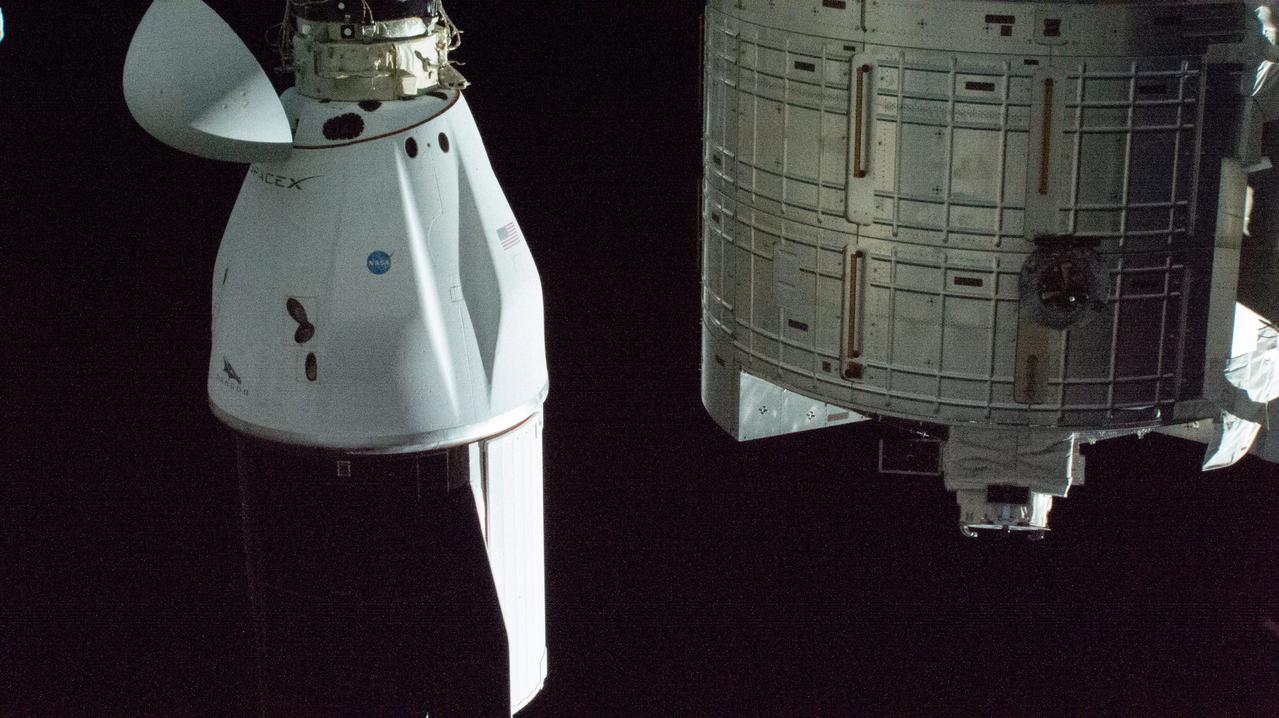
iss064e021970 (Jan. 9, 2021) --- The SpaceX Cargo Dragon resupply ship is pictured docked to the Harmony module's space-facing international docking adapter. At right, a portion of the JAXA Kibo laboratory module, the Experiment Logistics Module (Kibo's stowage facility), is pictured.
iss064e021970
iss064e021974 (Jan. 9, 2021) --- The SpaceX Cargo Dragon resupply ship is pictured docked to the Harmony module's space-facing international docking adapter. At right, a portion of the JAXA Kibo laboratory module, the Experiment Logistics Module (Kibo's stowage facility), is pictured.
iss064e021974
ISS011-E-11015 (28 July 2005) --- The Space Shuttle Discovery's cargo bay and Multipurpose Logistics Module (MPLM) payload as seen from the International Space Station (ISS) just prior to docking earlier today.
Mapping sequence performed during the STS-114 R-Bar Pitch Maneuver.
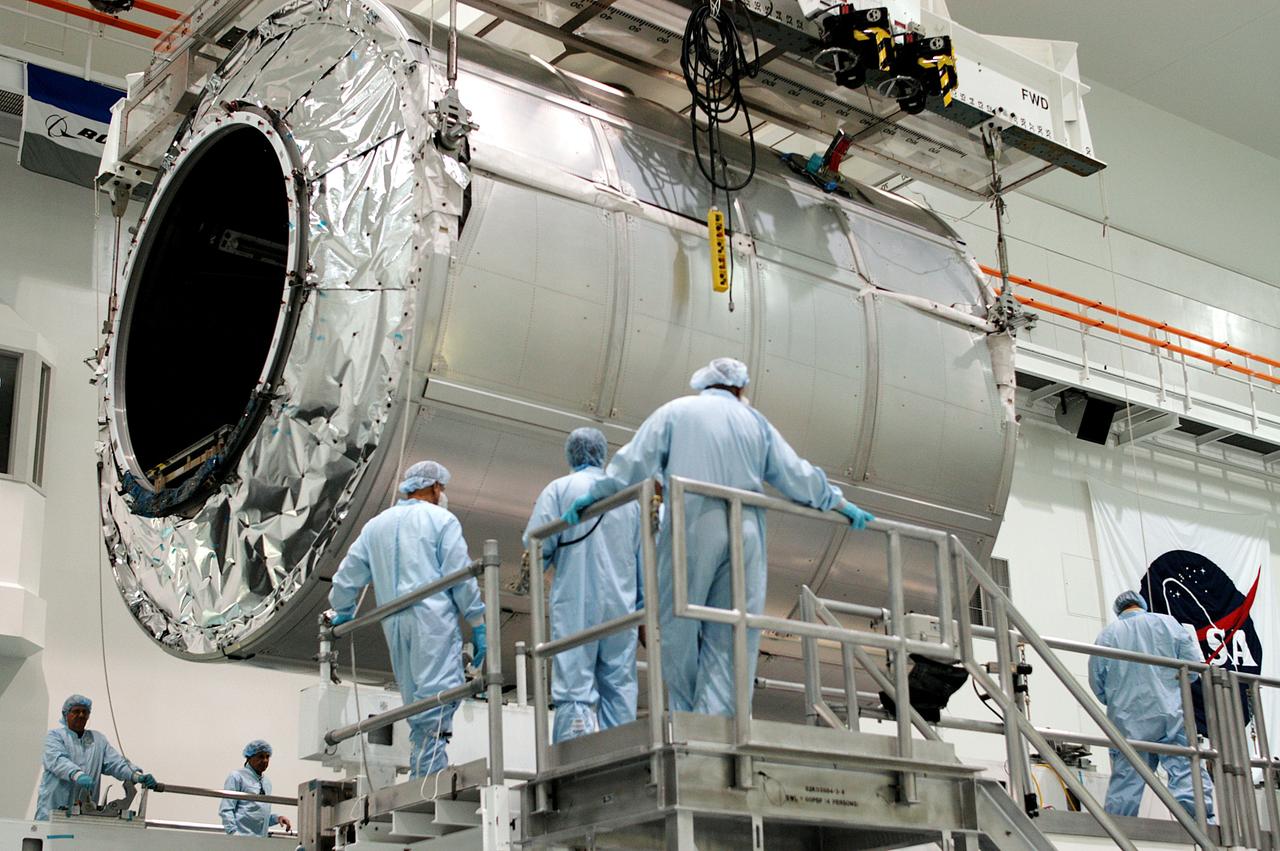
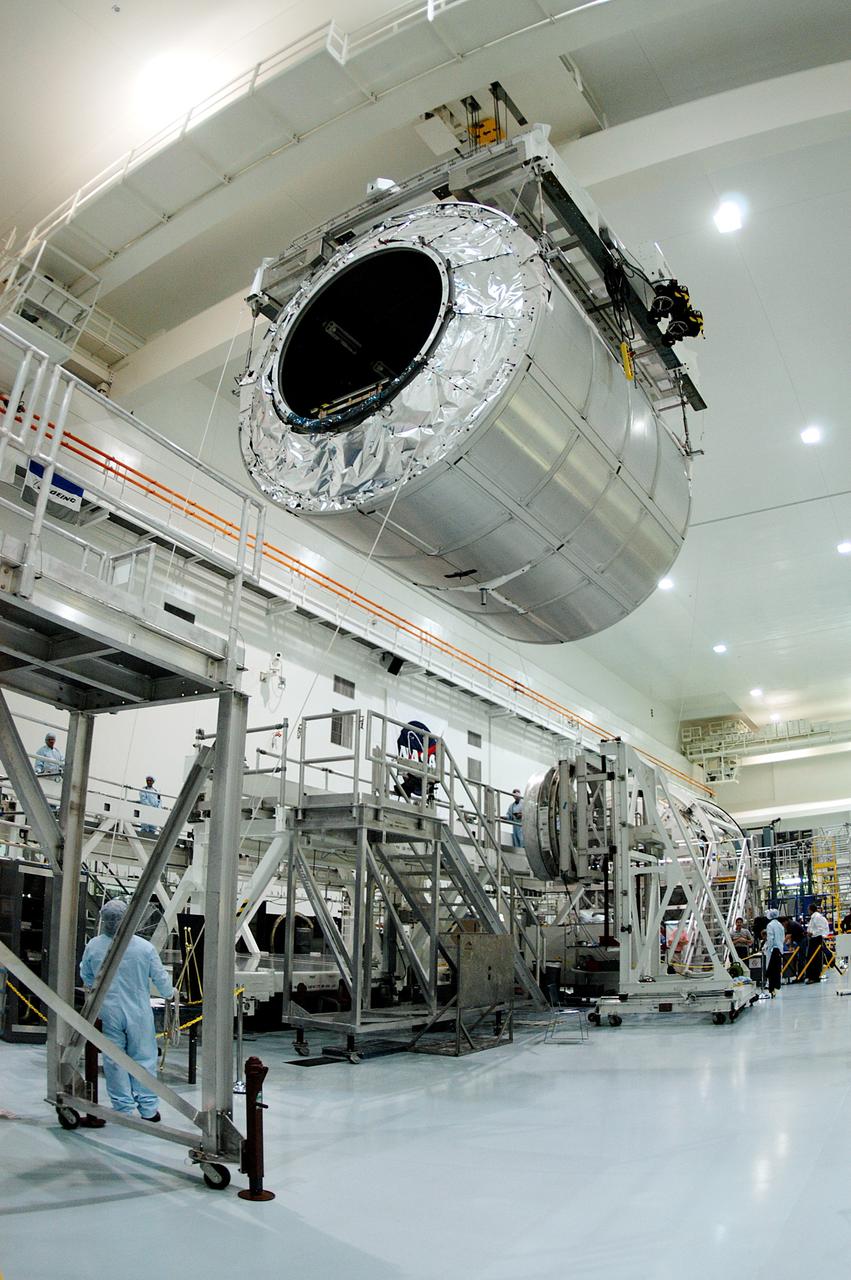
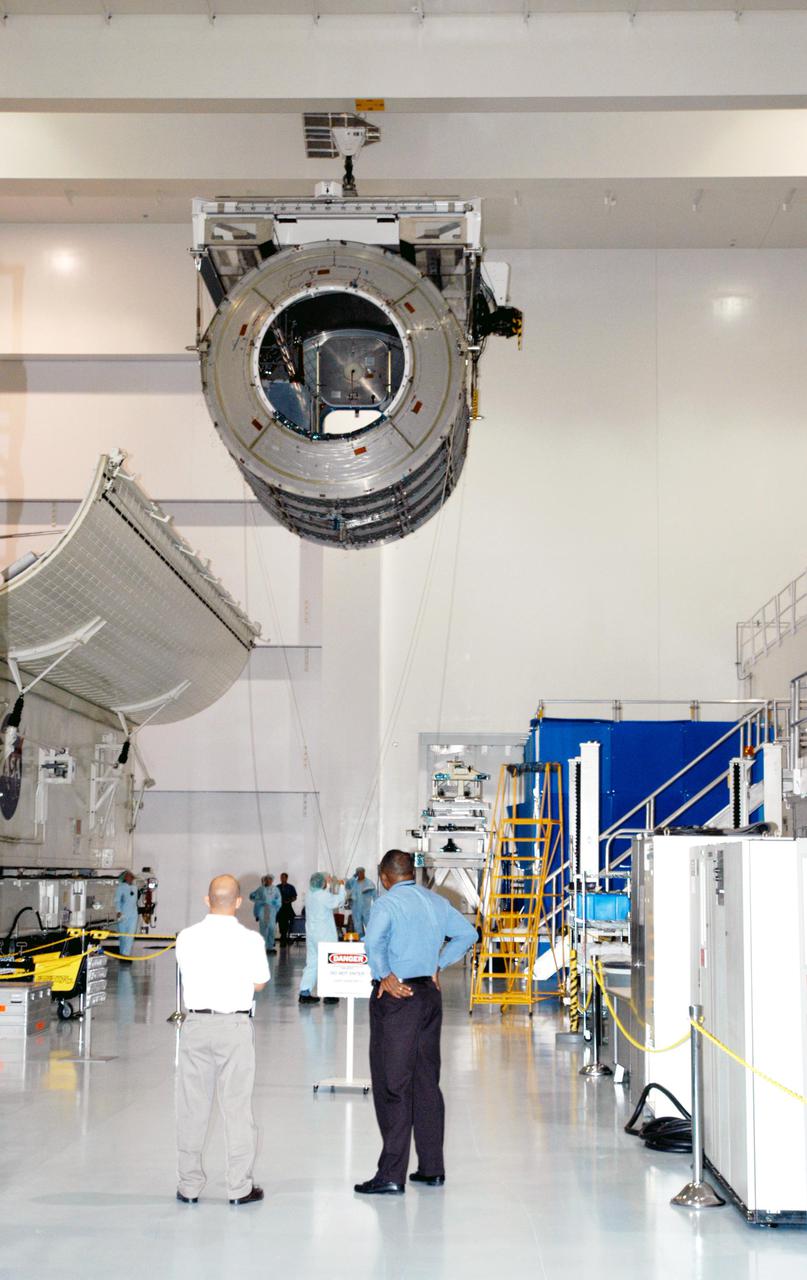
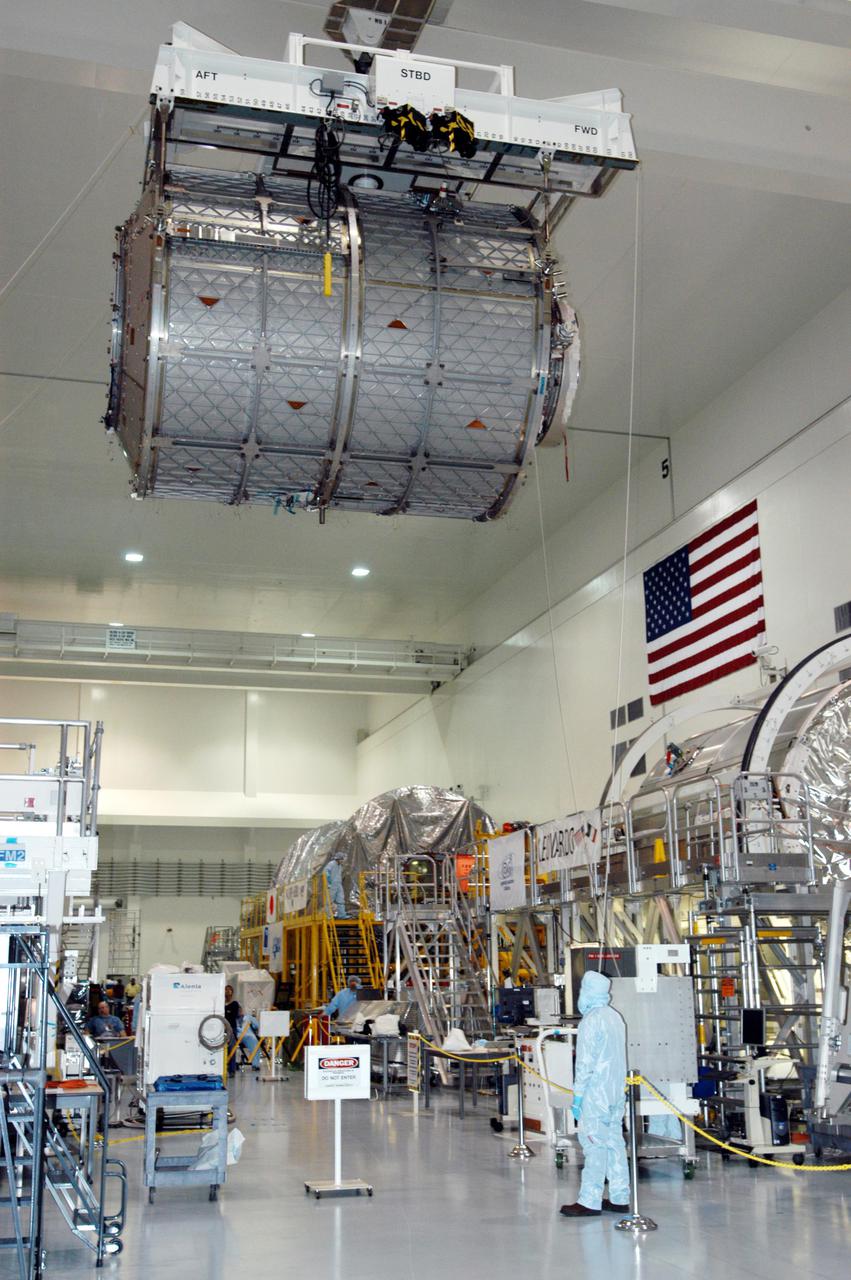
KENNEDY SPACE CENTER, FLA. -  In the Space Station Processing Facility, workers stand by as the Multi-Purpose Logistics Module Leonardo is lowered toward the Cargo Element Work Stand that Raffaello recently vacated.  The payload canister was a temporary location during the switch.  Three MPLMs were built by the Italian Space Agency - Donatello, Leonardo and Raffaello - to serve as a reusable logistics carrier and primary delivery system to resupply and return cargo requiring a pressurized environment to the International Space Station.
KSC-04pd-2310
KENNEDY SPACE CENTER, FLA. -  In the Space Station Processing Facility, workers stand by as the Multi-Purpose Logistics Module Leonardo settles onto the Cargo Element Work Stand that Raffaello recently vacated.  The payload canister was a temporary location during the switch.  Three MPLMs were built by the Italian Space Agency - Donatello, Leonardo and Raffaello - to serve as a reusable logistics carrier and primary delivery system to resupply and return cargo requiring a pressurized environment to the International Space Station.
KSC-04pd-2312
KENNEDY SPACE CENTER, FLA. -  In the Space Station Processing Facility, workers watch the progress of the Multi-Purpose Logistics Module Leonardo as it moves across the building to the Cargo Element Work Stand that Raffaello recently vacated.  The payload canister was a temporary location during the switch.  Three MPLMs were built by the Italian Space Agency - Donatello, Leonardo and Raffaello - to serve as a reusable logistics carrier and primary delivery system to resupply and return cargo requiring a pressurized environment to the International Space Station.
KSC-04pd-2308
KENNEDY SPACE CENTER, FLA. -  In the Space Station Processing Facility, workers guide the Multi-Purpose Logistics Module Leonardo as it is lowered toward the Cargo Element Work Stand that Raffaello recently vacated.  The payload canister was a temporary location during the switch.  Three MPLMs were built by the Italian Space Agency - Donatello, Leonardo and Raffaello - to serve as a reusable logistics carrier and primary delivery system to resupply and return cargo requiring a pressurized environment to the International Space Station.
KSC-04pd-2311
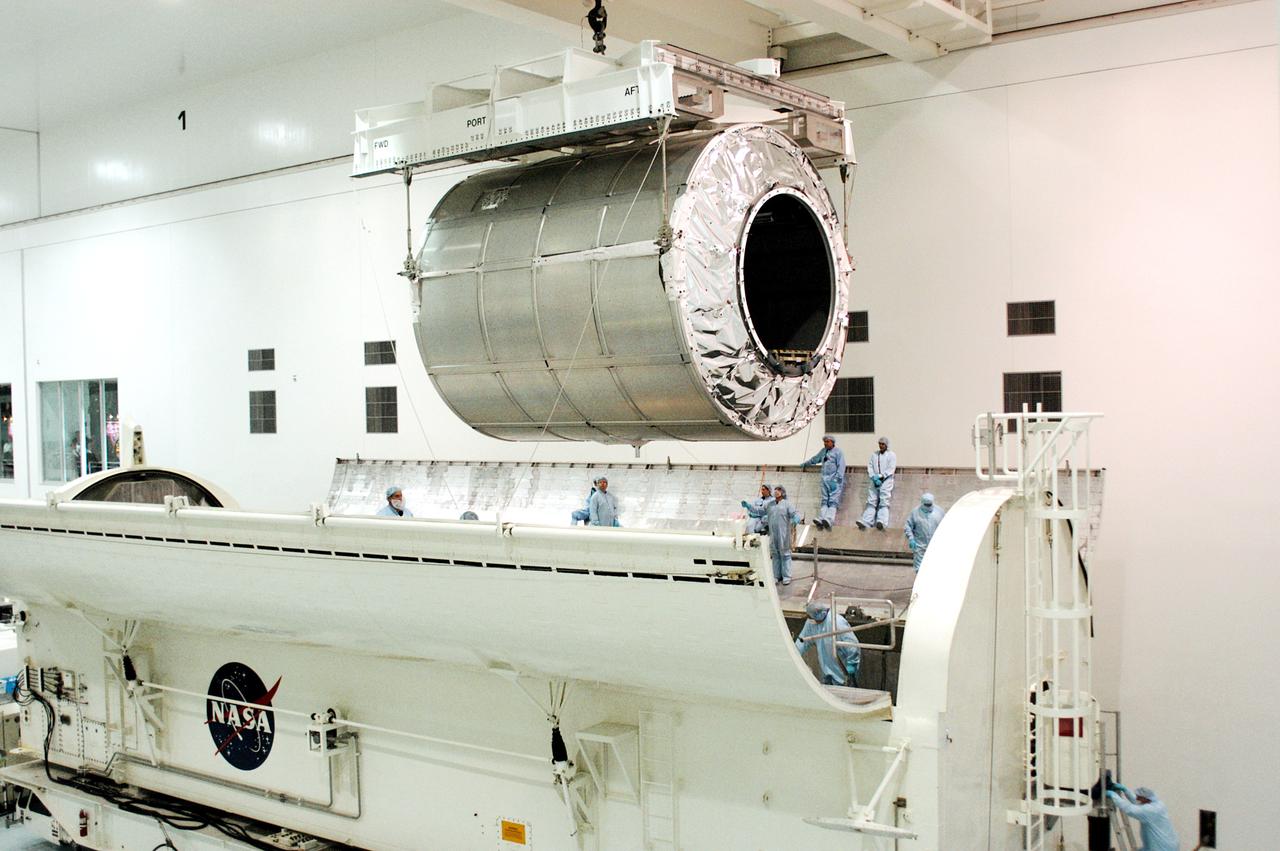
KENNEDY SPACE CENTER, FLA. -  The Multi-Purpose Logistics Module Leonardo is lifted from the payload canister in the Space Station Processing Facility.  The MPLM will be placed in the Cargo Element Work Stand that Raffaello recently vacated.  The payload canister was a temporary location during the switch.  Three MPLMs were built by the Italian Space Agency - Donatello, Leonardo and Raffaello - to serve as a reusable logistics carrier and primary delivery system to resupply and return cargo requiring a pressurized environment to the International Space Station.
KSC-04pd-2306
KENNEDY SPACE CENTER, FLA. -  In the Space Station Processing Facility, an overhead crane lifts the Multi-Purpose Logistics Module Leonardo from the payload canister.  The MPLM will be placed in the Cargo Element Work Stand that Raffaello recently vacated.  The payload canister was a temporary location during the switch.  Three MPLMs were built by the Italian Space Agency - Donatello, Leonardo and Raffaello - to serve as a reusable logistics carrier and primary delivery system to resupply and return cargo requiring a pressurized environment to the International Space Station.
KSC-04pd-2307
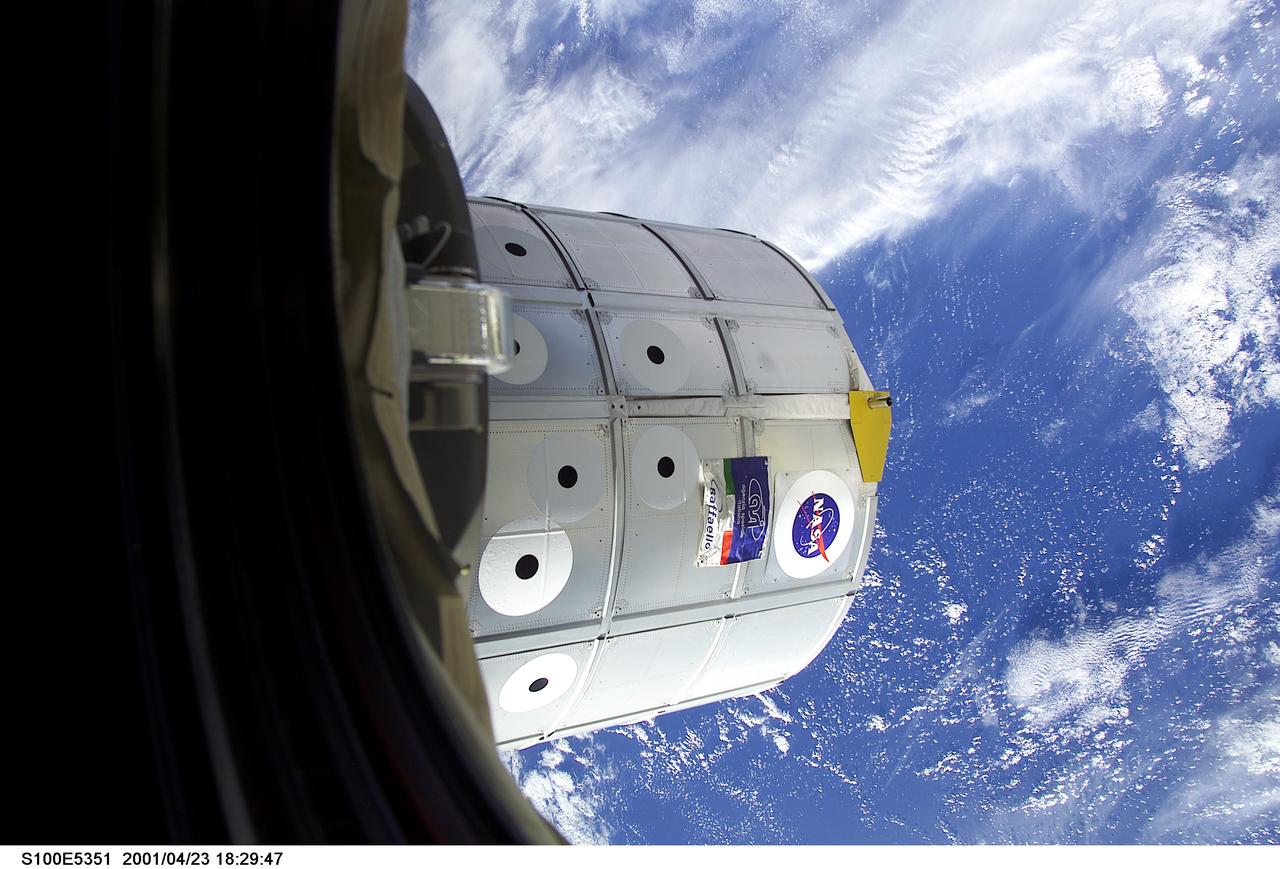
S100-E-5351 (23 April 2001) --- The Raffaello logistics module is backdropped over clouds and water on Earth. Endeavour’s 50-foot robotic arm, operated by astronaut Jeffrey S. Ashby, STS-100 pilot, had  earlier grappled the logistics module in the shuttle's cargo bay and docked it to the Unity module.  The Expedition Two crew was scheduled to begin the following day transferring food, supplies, equipment and two experiment racks for installation in Destiny from Raffaello to the station.   The image was recorded with a digital still camera.
MPLM FM2, forward side
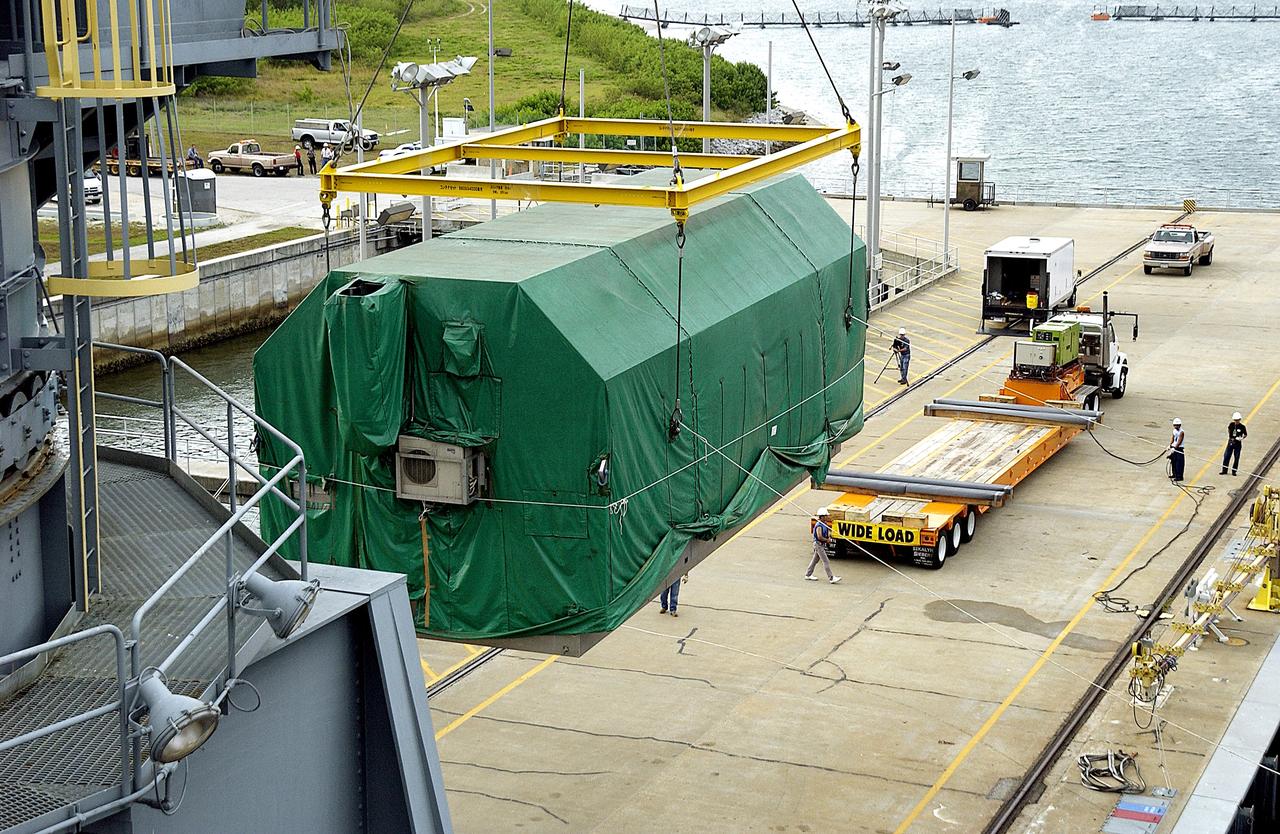
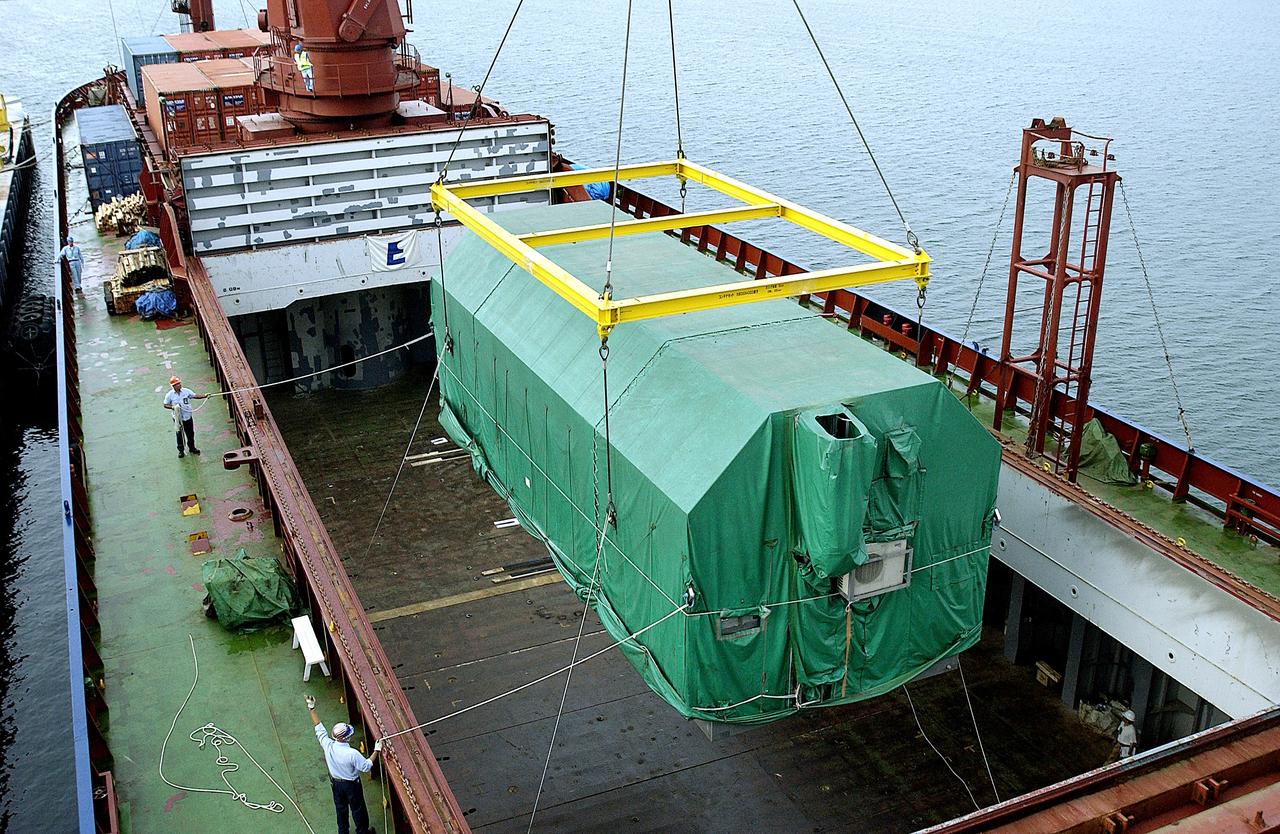
KENNEDY SPACE CENTER, FLA. - At Port Canaveral, the Pressurized Module of the Japanese Experiment Module (JEM) is lifted out of the ship’s cargo hold.  It will be loaded onto the truck bed in the background for transfer to KSC’s Space Station Processing Facility.  The container transport ship carrying JEM departed May 2 from Yokohama Harbor in Japan for the voyage to the United States. The National Space Development Agency of Japan (NASDA) developed the laboratory at the Tsukuba Space Center near Tokyo. The Pressurized Module is the first element of the JEM, named "Kibo" (Hope), to be delivered to KSC. The JEM is Japan's primary contribution to the Station. It will enhance the unique research capabilities of the orbiting complex by providing an additional environment for astronauts to conduct science experiments.  The JEM also includes an exposed facility (platform) for space environment experiments, a robotic manipulator system, and two logistics modules. The various JEM components will be  assembled in space over the course of three Shuttle missions.
KENNEDY SPACE CENTER, FLA. - At Port Canaveral, the Pressurized Module of the Japanese Experiment Module (JEM) is lifted out of the ship’s cargo hold. It will be loaded onto the truck bed in the background for transfer to KSC’s Space Station Processing Facility. The container transport ship carrying JEM departed May 2 from Yokohama Harbor in Japan for the voyage to the United States. The National Space Development Agency of Japan (NASDA) developed the laboratory at the Tsukuba Space Center near Tokyo. The Pressurized Module is the first element of the JEM, named "Kibo" (Hope), to be delivered to KSC. The JEM is Japan's primary contribution to the Station. It will enhance the unique research capabilities of the orbiting complex by providing an additional environment for astronauts to conduct science experiments. The JEM also includes an exposed facility (platform) for space environment experiments, a robotic manipulator system, and two logistics modules. The various JEM components will be assembled in space over the course of three Shuttle missions.
KENNEDY SPACE CENTER, FLA. - At Port Canaveral, the Pressurized Module of the Japanese Experiment Module (JEM) is lifted out of the ship’s cargo hold.  The container transport ship carrying JEM departed May 2 from Yokohama Harbor in Japan for the voyage to the United States. The National Space Development Agency of Japan (NASDA) developed the laboratory at the Tsukuba Space Center near Tokyo. The Pressurized Module is the first element of the JEM, named "Kibo" (Hope), to be delivered to KSC. The JEM is Japan's primary contribution to the Station. It will enhance the unique research capabilities of the orbiting complex by providing an additional environment for astronauts to conduct science experiments.  The JEM also includes an exposed facility (platform) for space environment experiments, a robotic manipulator system, and two logistics modules. The various JEM components will be  assembled in space over the course of three Shuttle missions.
KENNEDY SPACE CENTER, FLA. - At Port Canaveral, the Pressurized Module of the Japanese Experiment Module (JEM) is lifted out of the ship’s cargo hold. The container transport ship carrying JEM departed May 2 from Yokohama Harbor in Japan for the voyage to the United States. The National Space Development Agency of Japan (NASDA) developed the laboratory at the Tsukuba Space Center near Tokyo. The Pressurized Module is the first element of the JEM, named "Kibo" (Hope), to be delivered to KSC. The JEM is Japan's primary contribution to the Station. It will enhance the unique research capabilities of the orbiting complex by providing an additional environment for astronauts to conduct science experiments. The JEM also includes an exposed facility (platform) for space environment experiments, a robotic manipulator system, and two logistics modules. The various JEM components will be assembled in space over the course of three Shuttle missions.
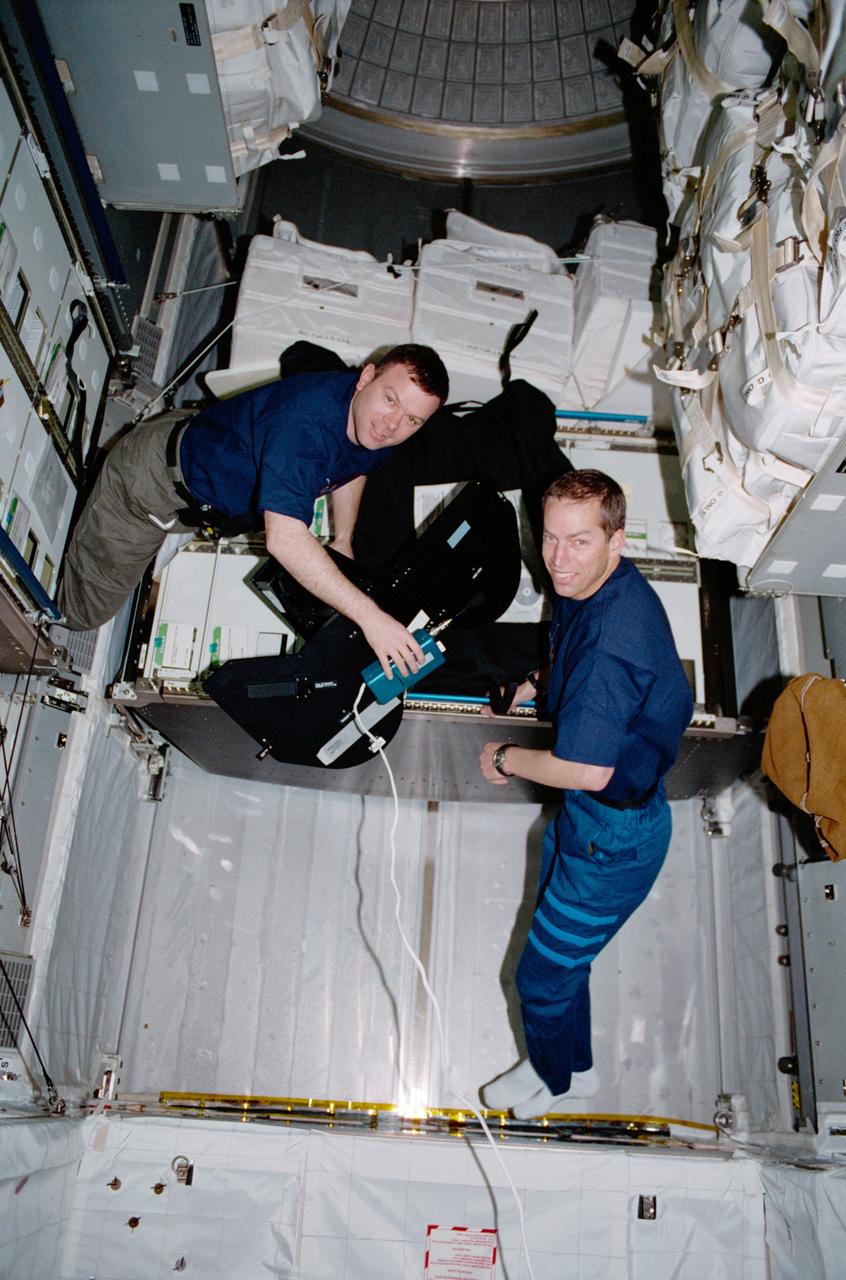
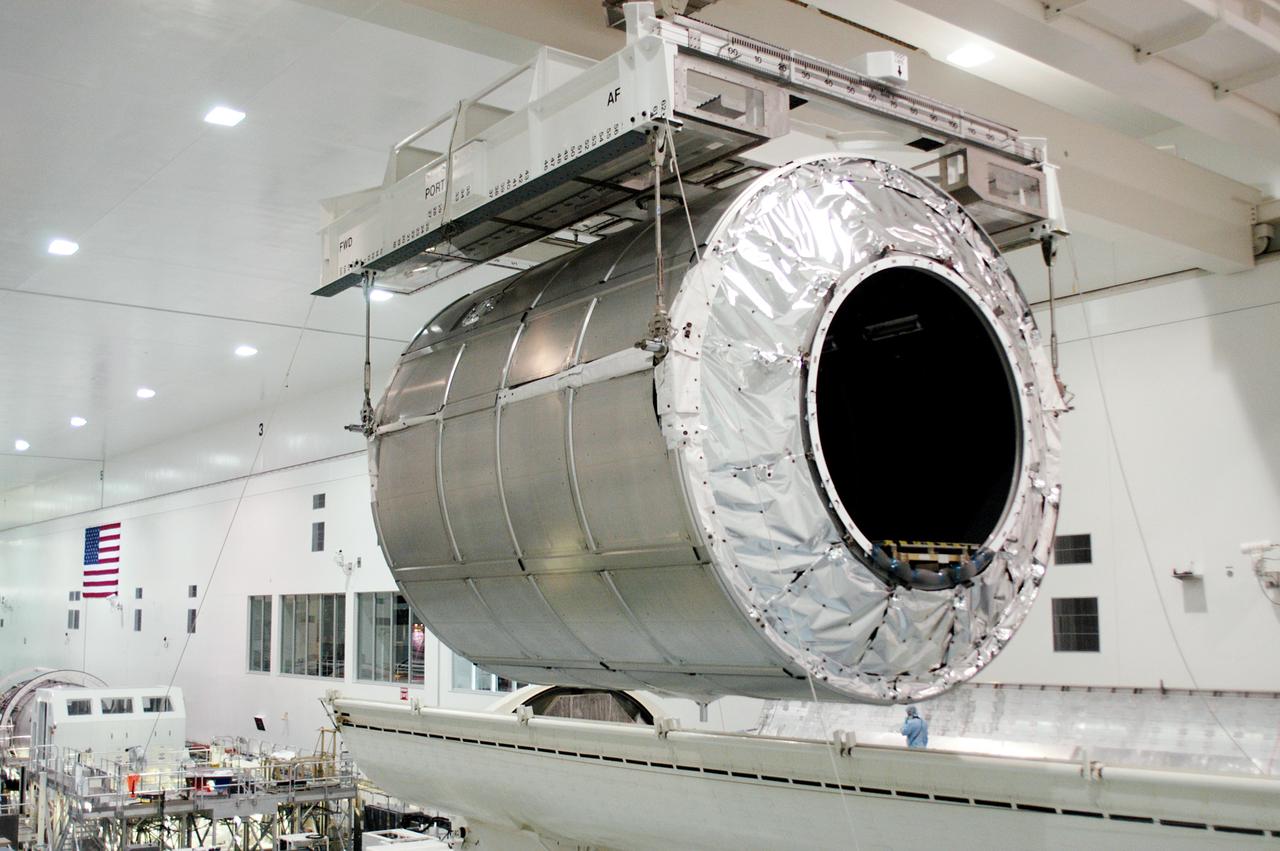
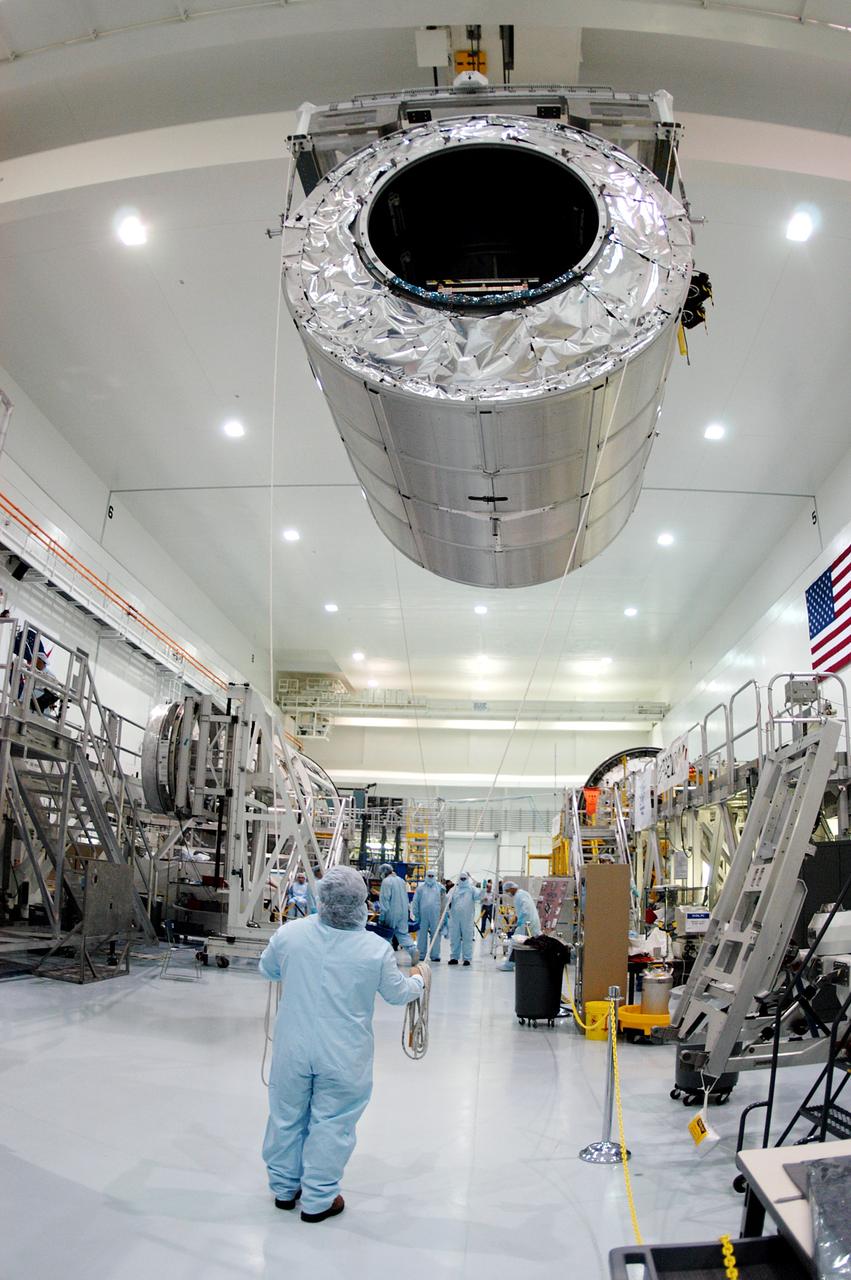
Pilot James M. Kelly (left) and Commander James D. Wetherbee for the STS-102 mission, participate in the movement of supplies inside Leonardo, the Italian Space Agency built Multipurpose Logistics Module (MPLM). In this particular photograph, the two are handling a film magazine for the IMAX cargo bay camera. The primary cargo of the STS-102 mission, the Leonardo MPLM is the first of three such pressurized modules that will serve as the International Space Station's (ISS') moving vans, carrying laboratory racks filled with equipment, experiments, and supplies to and from the Station aboard the Space Shuttle. The cylindrical module is approximately 21-feet long and 15- feet in diameter, weighing almost 4.5 tons. It can carry up to 10 tons of cargo in 16 standard Space Station equipment racks. Of the 16 racks the module can carry, 5 can be furnished with power, data, and fluid to support refrigerators or freezers. In order to function as an attached station module as well as a cargo transport, the logistics module also includes components that provide life support, fire detection and suppression, electrical distribution, and computer functions. The eighth station assembly flight, the STS-102 mission also served as a crew rotation flight. It delivered the Expedition Two crew to the Station and returned the Expedition One crew back to Earth.
International Space Station (ISS)
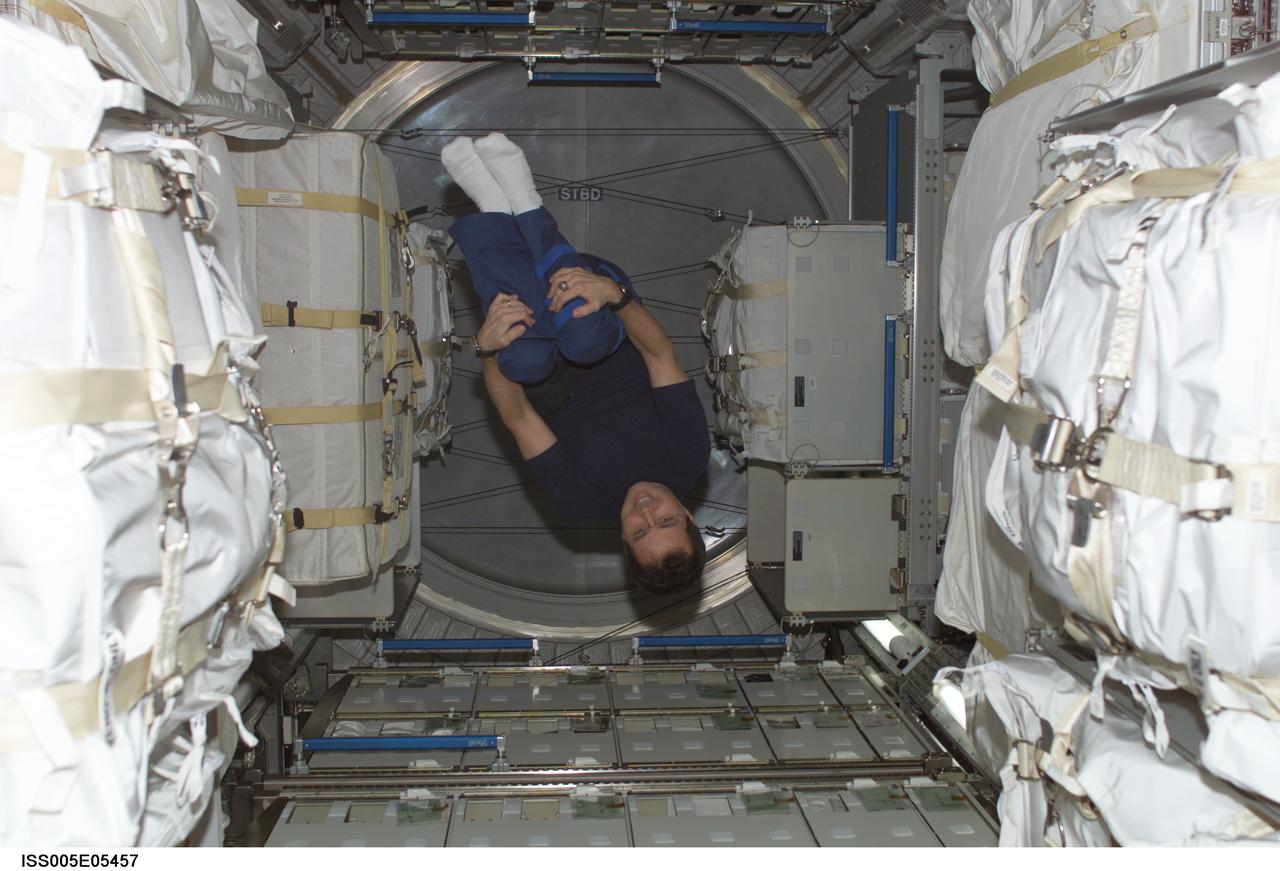
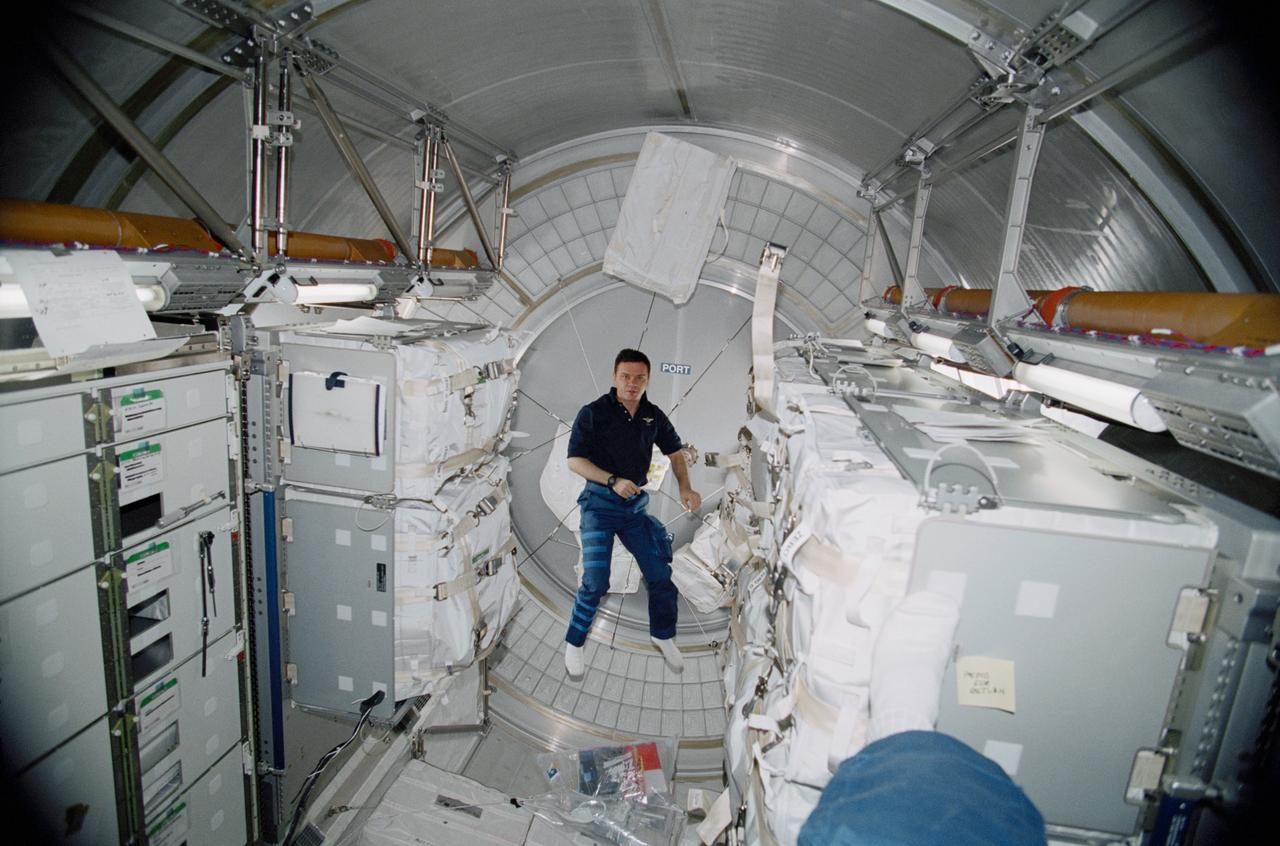
ISS005-E-05457 (June 2002) --- Astronaut Daniel W. Bursch, Expedition Four flight engineer, floats in the Leonardo Multi-Purpose Logistics Module (MPLM). Leonardo is one of three Multi-Purpose Logistics Modules built by the Italian Space Agency that serve as pressurized, reusable cargo carriers to ferry supplies, equipment and experiments between the ground and the space station.
Bursch, Expedition Four flight engineer, floats in the Leonardo MPLM
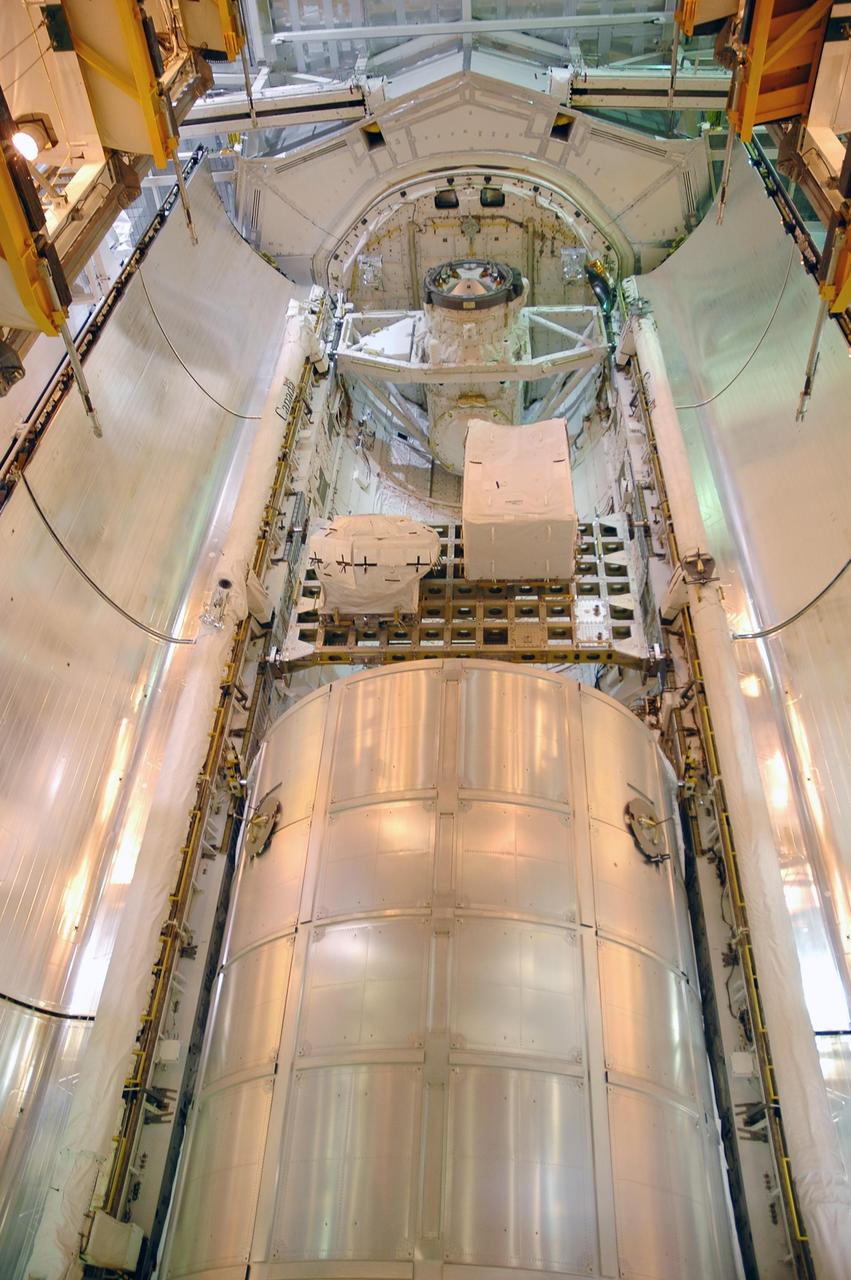
KENNEDY SPACE CENTER, FLA. -    At Launch Pad 39B, the open doors of Space Shuttle Discovery's payload bay show the cargo the orbiter will carry into orbit.  At the lower end is multi-purpose logistics module Leonardo.  Above it is the integrated cargo carrier that holds the mobile transporter reel assembly the astronauts will replace on the station and a spare pump module.   Discovery is scheduled to launch at 3:48 p.m. July 1 carrying a crew of seven on the 12-day mission to the International Space Station.  Photo credit: NASA/Charisse Nahser
KSC-06pd1163
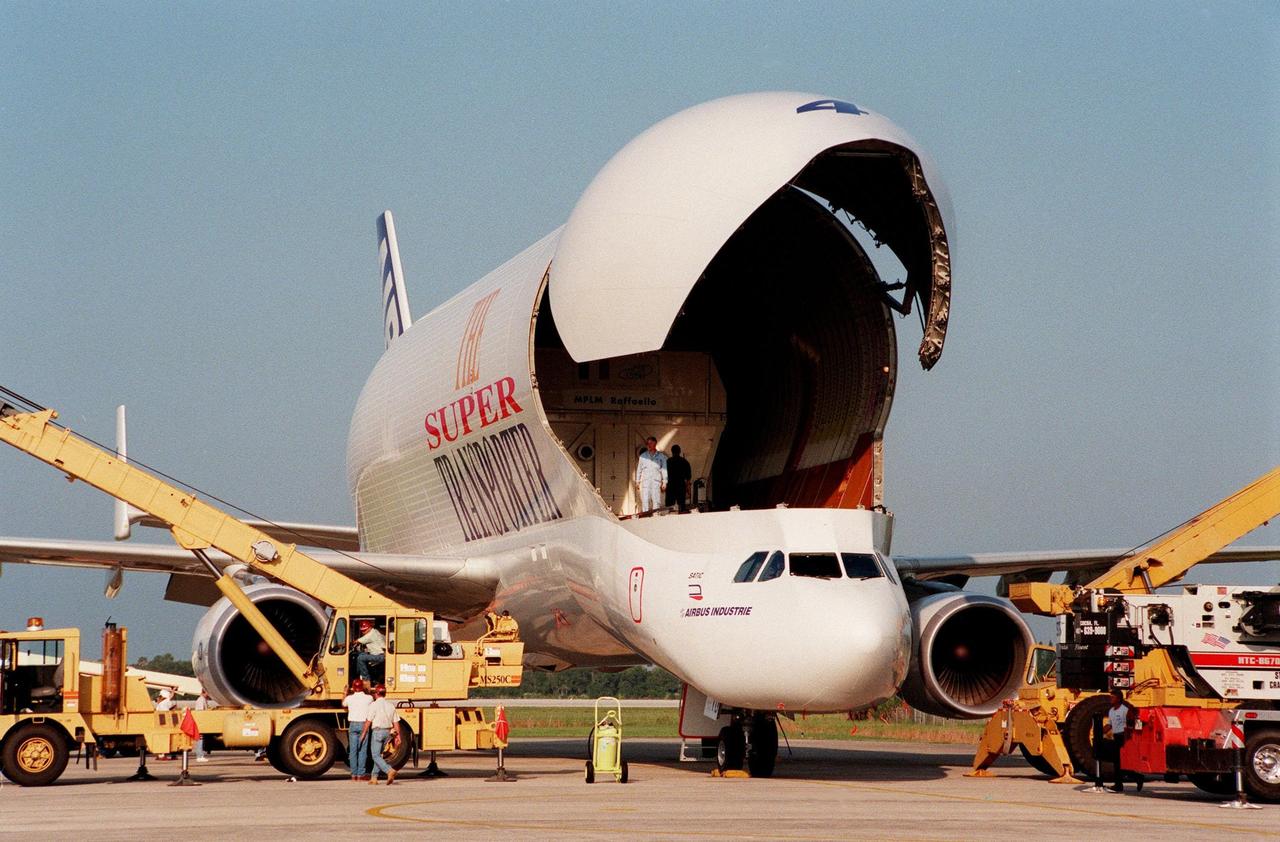
KENNEDY SPACE CENTER, FLA. -- At the Shuttle Landing Facility, the one-piece, upward-hinged main cargo door of the Airbus Industrie A300-600ST "Beluga" Super Transporter is open to offload its cargo, the second Multi-Purpose Logistics Module (MPLM) for the International Space Station (ISS). One of Italy's major contributions to the ISS program, the MPLM, named Raffaello, is a reusable logistics carrier and the primary delivery system used to resupply and return station cargo requiring a pressurized environment. Weighing nearly 4.5 tons, the module measures 21 feet long and 15 feet in diameter. Raffaello will join Leonardo, the first Italian-built MPLM, in the Space Station Processing Facility for testing. NASA, Boeing, the Italian Space Agency and Alenia Aerospazio will provide engineering support
KSC-99pp1011
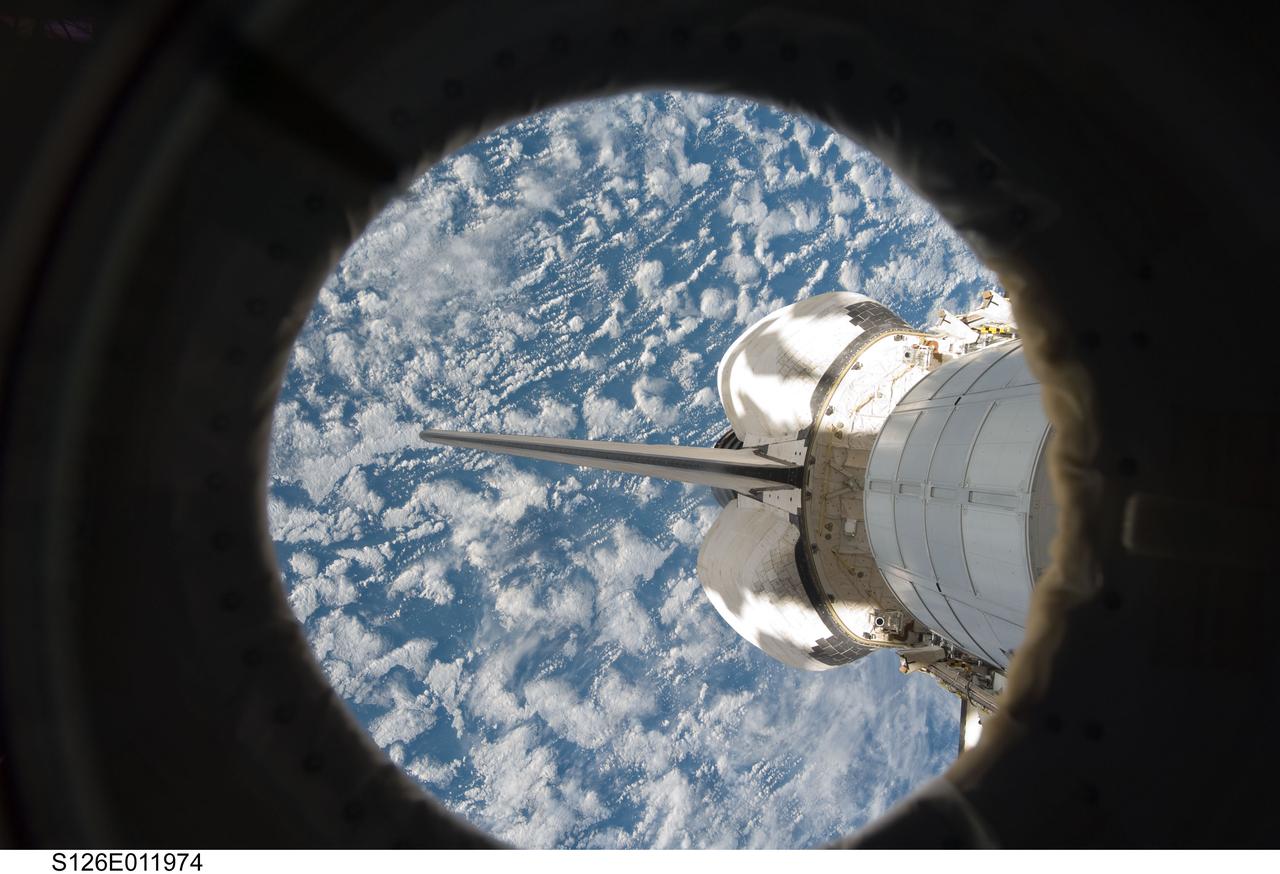
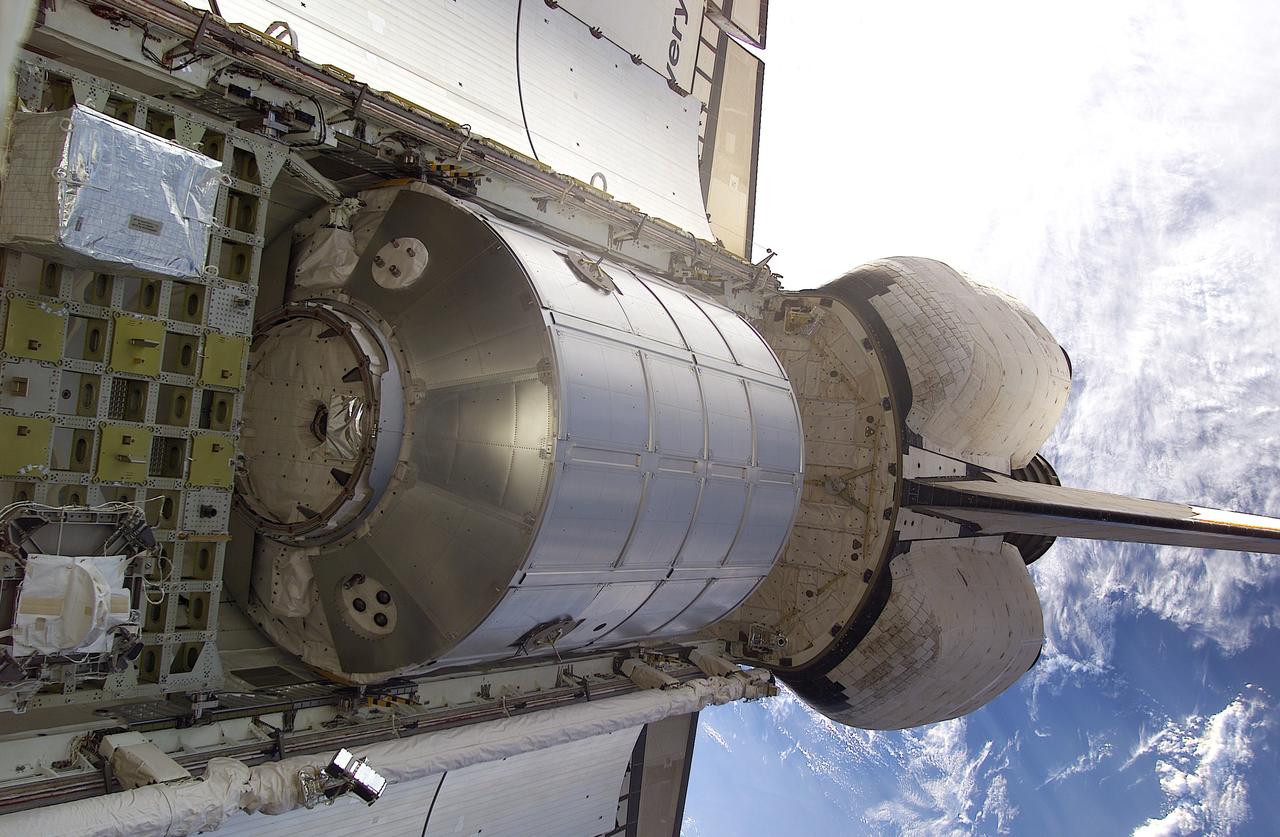
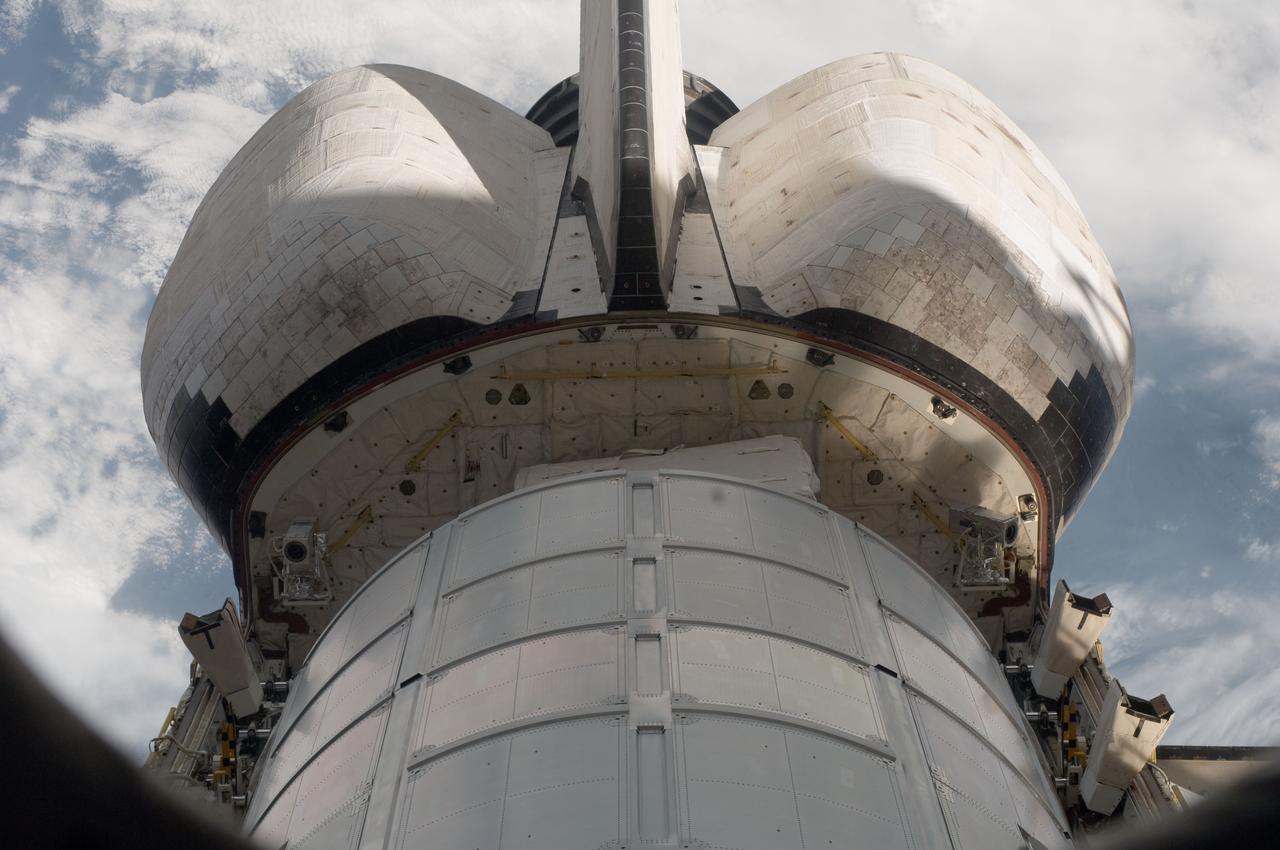
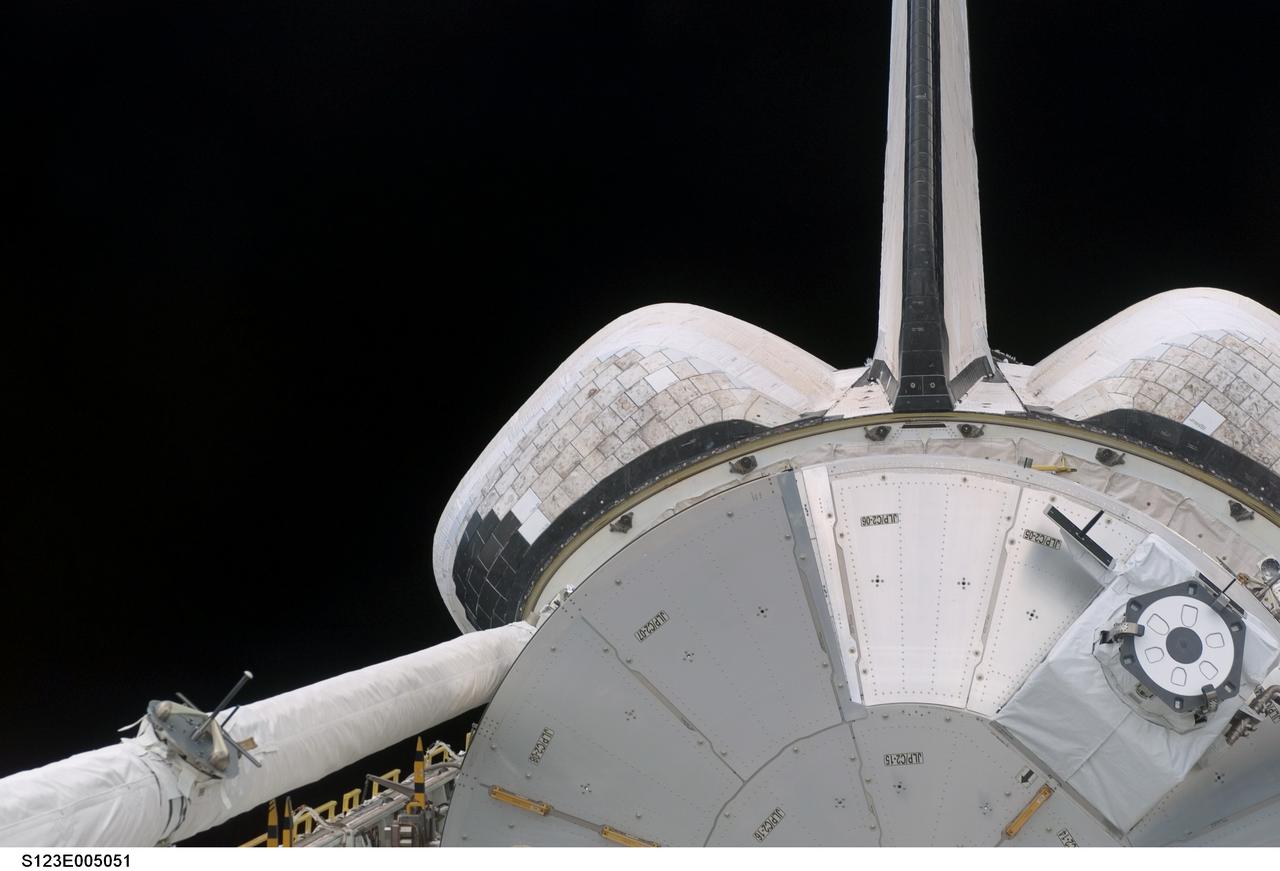
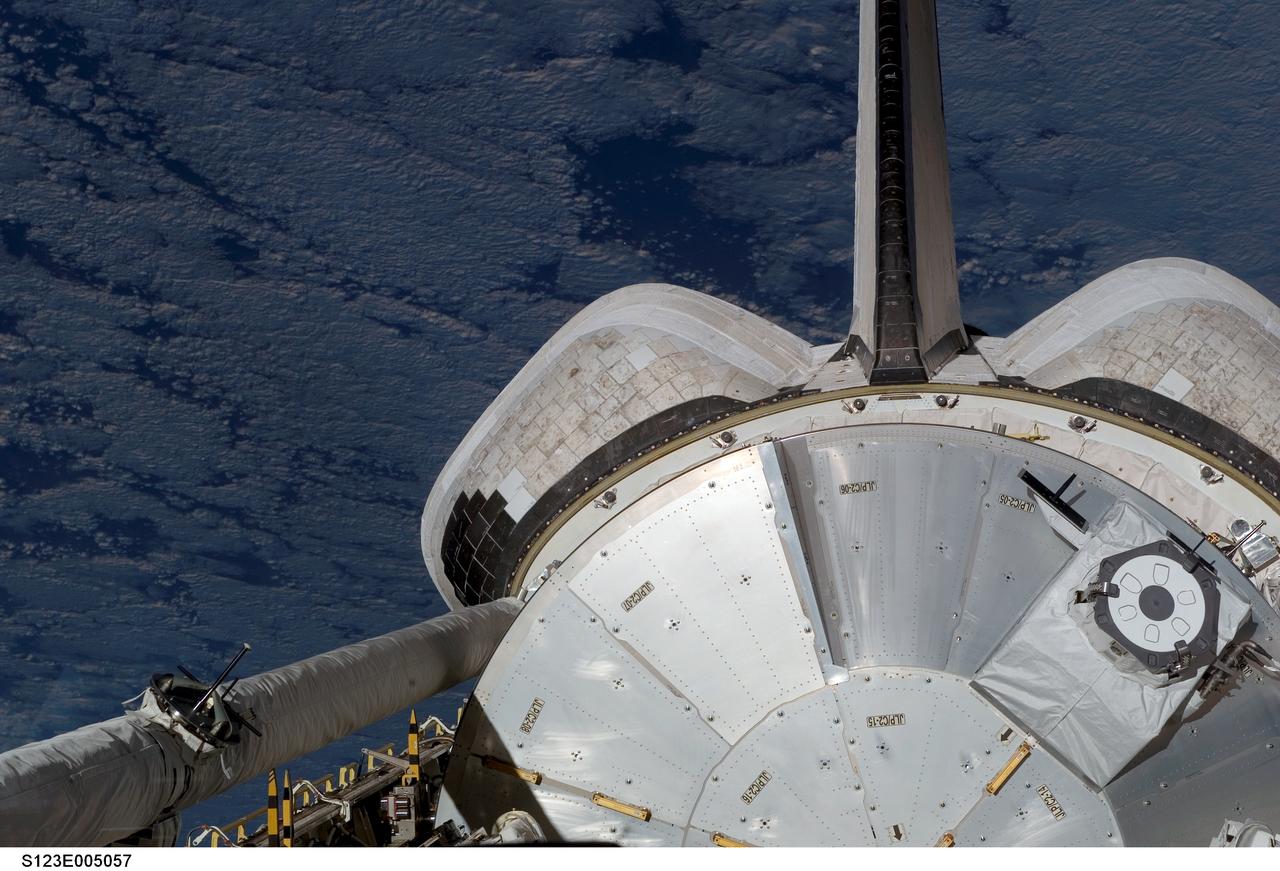
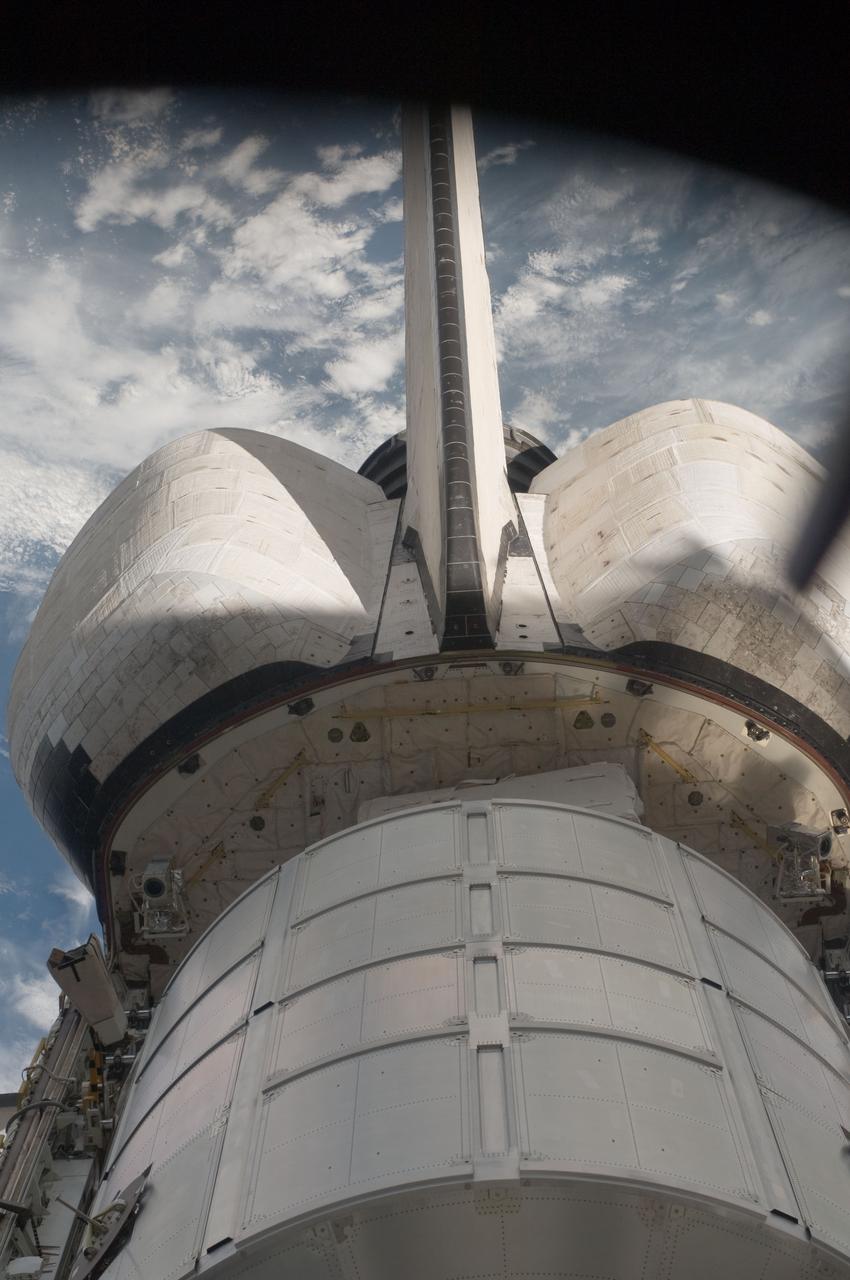
S126-E-11974 (26 Nov. 2008) --- Backdropped against white clouds, the aft section of Endeavour's cargo bay, now holding the multipurpose logistics module Leonardo, is featured in this digital still photo, framed through a window on the International Space Station. Endeavour and the orbital outpost have been docked for almost two weeks while their crews have joined efforts in home improvement on the station and other work. Astronauts Donald Pettit and Shane Kimbrough, operating the space station's robot arm from inside the Destiny laboratory module, detached the Leonardo cargo canister from its temporary parking place on the station a few hours earlier and re-berthed it in the cargo bay.
Payload Bay of Endeavour
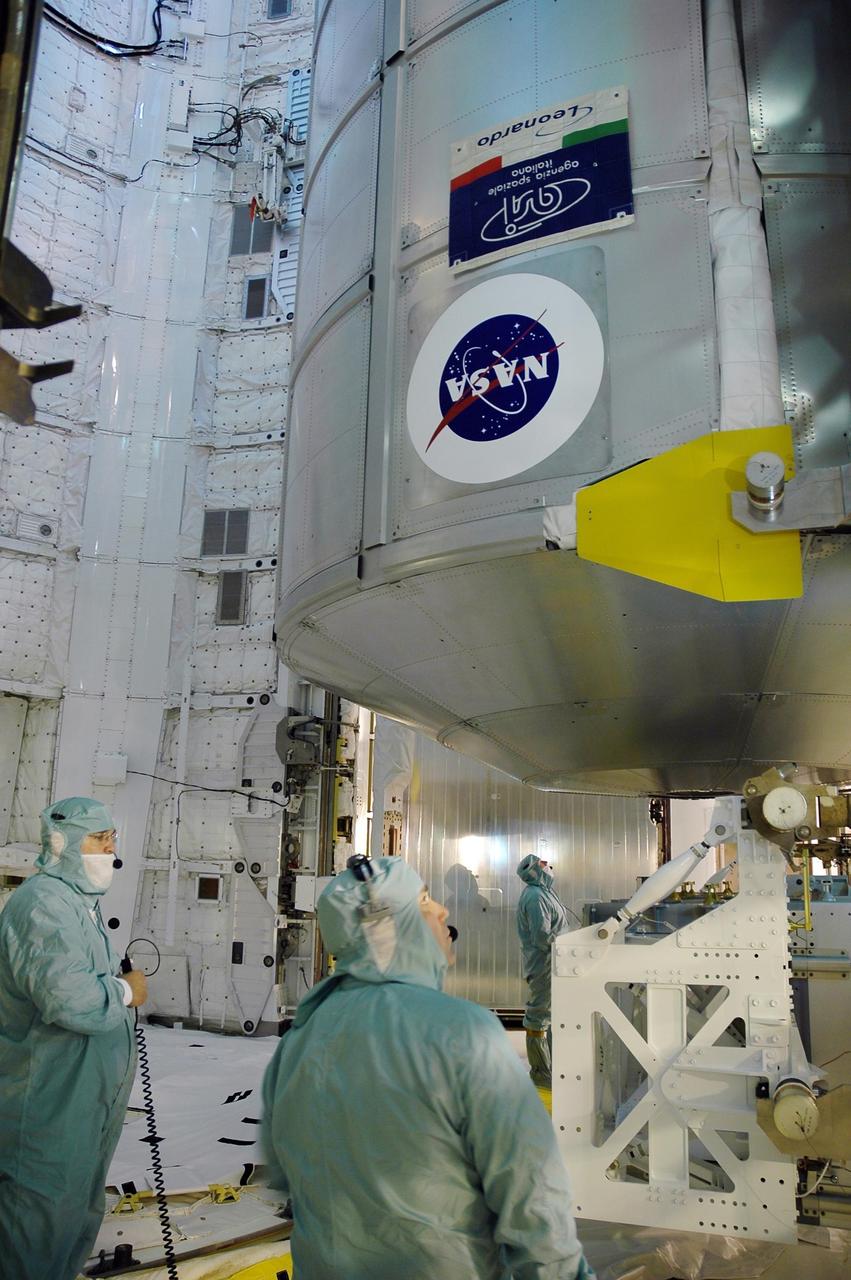
KENNEDY SPACE CENTER, FLA. --   From inside the payload changeout room on the rotating service structure on Launch Pad 39B, the multi-purpose logistics module Leonardo is lowered into Space Shuttle Discovery's payload bay.   The payload ground-handling mechanism (PGHM) is used to transfer the module into the payload bay.  Leonardo is a reusable logistics carrier. It is the primary delivery system used to resupply and return station cargo requiring a pressurized environment. Leonardo is part of the payload on mission STS-121.  Other payloads include the integrated cargo carrier with the mobile transporter reel assembly and a spare pump module, and the lightweight multi-purpose experiment support structure carrier.  Discovery is scheduled to launch in a window extending from July 1 through July 19. Photo credit: NASA/Jack Pfaller
KSC-06pd0927
KENNEDY SPACE CENTER, FLA. --   From inside the payload changeout room on the rotating service structure on Launch Pad 39B, the multi-purpose logistics module Leonardo is being moved into Space Shuttle Discovery's payload bay (at left).  The payload ground-handling mechanism (PGHM) is used to transfer the module into the payload bay.  Leonardo is a reusable logistics carrier. It is the primary delivery system used to resupply and return station cargo requiring a pressurized environment. Leonardo is part of the payload on mission STS-121.  Other payloads include the integrated cargo carrier with the mobile transporter reel assembly and a spare pump module, and the lightweight multi-purpose experiment support structure carrier.  Discovery is scheduled to launch in a window extending from July 1 through July 19. Photo credit: NASA/Jack Pfaller
KSC-06pd0925
KENNEDY SPACE CENTER, FLA. --   From inside the payload changeout room on the rotating service structure on Launch Pad 39B, the multi-purpose logistics module Leonardo is being moved into Space Shuttle Discovery's payload bay.  The payload ground-handling mechanism (PGHM) is used to transfer the module into the payload bay.  Leonardo is a reusable logistics carrier. It is the primary delivery system used to resupply and return station cargo requiring a pressurized environment. Leonardo is part of the payload on mission STS-121.  Other payloads include the integrated cargo carrier with the mobile transporter reel assembly and a spare pump module, and the lightweight multi-purpose experiment support structure carrier.  Discovery is scheduled to launch in a window extending from July 1 through July 19. Photo credit: NASA/Jack Pfaller
KSC-06pd0924
KENNEDY SPACE CENTER, FLA. --   From inside the payload changeout room on the rotating service structure on Launch Pad 39B, workers maneuver the multi-purpose logistics module Leonardo into Space Shuttle Discovery's payload bay (at left). The payload ground-handling mechanism (PGHM) is used to transfer the module into the payload bay.  Leonardo is a reusable logistics carrier. It is the primary delivery system used to resupply and return station cargo requiring a pressurized environment. Leonardo is part of the payload on mission STS-121.  Other payloads include the integrated cargo carrier with the mobile transporter reel assembly and a spare pump module, and the lightweight multi-purpose experiment support structure carrier.  Discovery is scheduled to launch in a window extending from July 1 through July 19. Photo credit: NASA/Jack Pfaller
KSC-06pd0926
A crewmember of Expedition One, cosmonaut Yuri P. Gidzenko, is dwarfed by transient hardware aboard Leonardo, the Italian Space Agency-built Multi-Purpose Logistics Module (MPLM), a primary cargo of the STS-102 mission. The Leonardo MPLM is the first of three such pressurized modules that will serve as the International Space Station's (ISS's) moving vans, carrying laboratory racks filled with equipment, experiments and supplies to and from the Space Station aboard the Space Shuttle. The cylindrical module is approximately 21-feet long and 15- feet in diameter, weighing almost 4.5 tons. It can carry up to 10 tons of cargo into 16 standard Space Station equipment racks. Of the 16 racks the module can carry, 5 can be furnished with power, data, and fluid to support refrigerators or freezers. In order to function as an attached station module as well as a cargo transport, the logistics module also includes components that provide life support, fire detection and suppression, electrical distribution, and computer functions. The eighth Shuttle mission to visit the ISS, the STS-102 mission served as a crew rotation flight. It delivered the Expedition Two crew to the Station and returned the Expedition One crew back to Earth.
International Space Station (ISS)
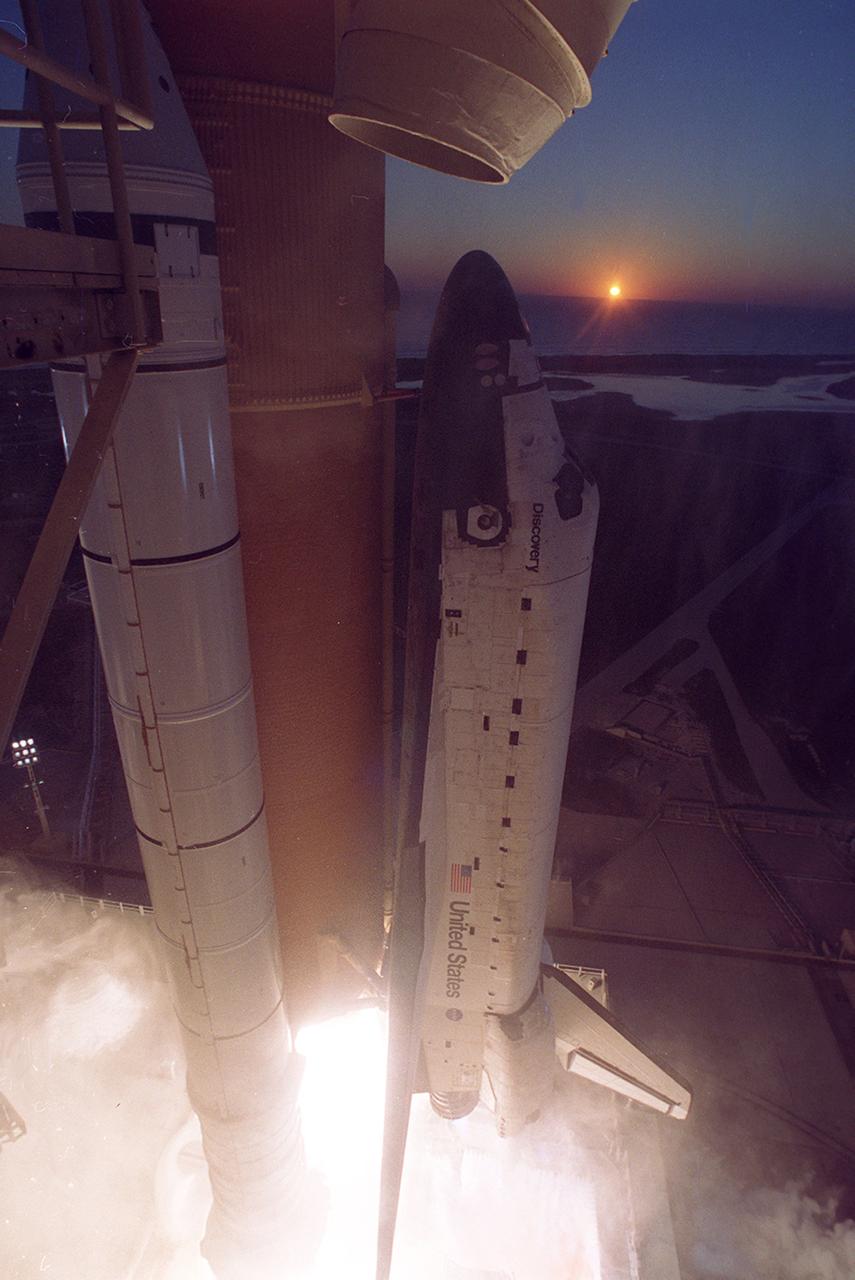
The Space Shuttle Discovery, STS-102 mission, clears launch pad 39B at the Kennedy Space Center as the sun peers over the Atlantic Ocean on March 8, 2001. STS-102's primary cargo was the Leonardo, the Italian Space Agency built Multipurpose Logistics Module (MPLM). The Leonardo MPLM is the first of three such pressurized modules that will serve as the International Space Station's (ISS') moving vans, carrying laboratory racks filled with equipment, experiments, and supplies to and from the Station aboard the Space Shuttle. The cylindrical module is approximately 21-feet long and 15- feet in diameter, weighing almost 4.5 tons. It can carry up to 10 tons of cargo in 16 standard Space Station equipment racks. Of the 16 racks the module can carry, 5 can be furnished with power, data, and fluid to support refrigerators or freezers. In order to function as an attached station module as well as a cargo transport, the logistics module also includes components that provide life support, fire detection and suppression, electrical distribution, and computer functions. NASA's 103rd overall flight and the eighth assembly flight, STS-102 was also the first flight involved with Expedition Crew rotation. The Expedition Two crew was delivered to the station while Expedition One was returned home to Earth.
International Space Station (ISS)
STS-102 astronaut and mission specialist, Andrew S.W. Thomas, gazes through an aft window of the Space Shuttle Orbiter Discovery as it approaches the docking bay of the International Space Station (ISS). Launched March 8, 2001, STS-102's primary cargo was the Leonardo, the Italian Space Agency-built Multipurpose Logistics Module (MPLM). The Leonardo MPLM is the first of three such pressurized modules that will serve as the ISS's moving vans, carrying laboratory racks filled with equipment, experiments, and supplies to and from the Station aboard the Space Shuttle. The cylindrical module is approximately 21-feet long and 15- feet in diameter, weighing almost 4.5 tons. It can carry up to 10 tons of cargo in 16 standard Space Station equipment racks. Of the 16 racks the module can carry, 5 can be furnished with power, data, and fluid to support refrigerators or freezers. In order to function as an attached station module as well as a cargo transport, the logistics module also includes components that provide life support, fire detection and suppression, electrical distribution, and computer functions. NASA's 103rd overall mission and the 8th Space Station Assembly Flight, STS-102 mission also served as a crew rotation flight. It delivered the Expedition Two crew to the Station and returned the Expedition One crew back to Earth.
International Space Station (ISS)
This in-orbit close up shows the Italian Space Agency-built multipurpose Logistics Module (MPLM), Leonardo, the primary cargo of the STS-102 mission, resting in the payload bay of the Space Shuttle Orbiter Discovery. The Leonardo MPLM is the first of three such pressurized modules that will serve as the International Space Station's (ISS') moving vans, carrying laboratory racks filled with equipment, experiments, and supplies to and from the Station aboard the Space Shuttle. The cylindrical module is approximately 21-feet long and 15- feet in diameter, weighing almost 4.5 tons. It can carry up to 10 tons of cargo in 16 standard Space Station equipment racks. Of the 16 racks the module can carry, 5 can be furnished with power, data, and fluid to support refrigerators or freezers. In order to function as an attached station module as well as a cargo transport, the logistics module also includes components that provide life support, fire detection and suppression, electrical distribution, and computer functions. The eighth station assembly flight and NASA's 103rd overall flight, STS-102 launched March 8, 2001 for an almost 13 day mission.
International Space Station (ISS)
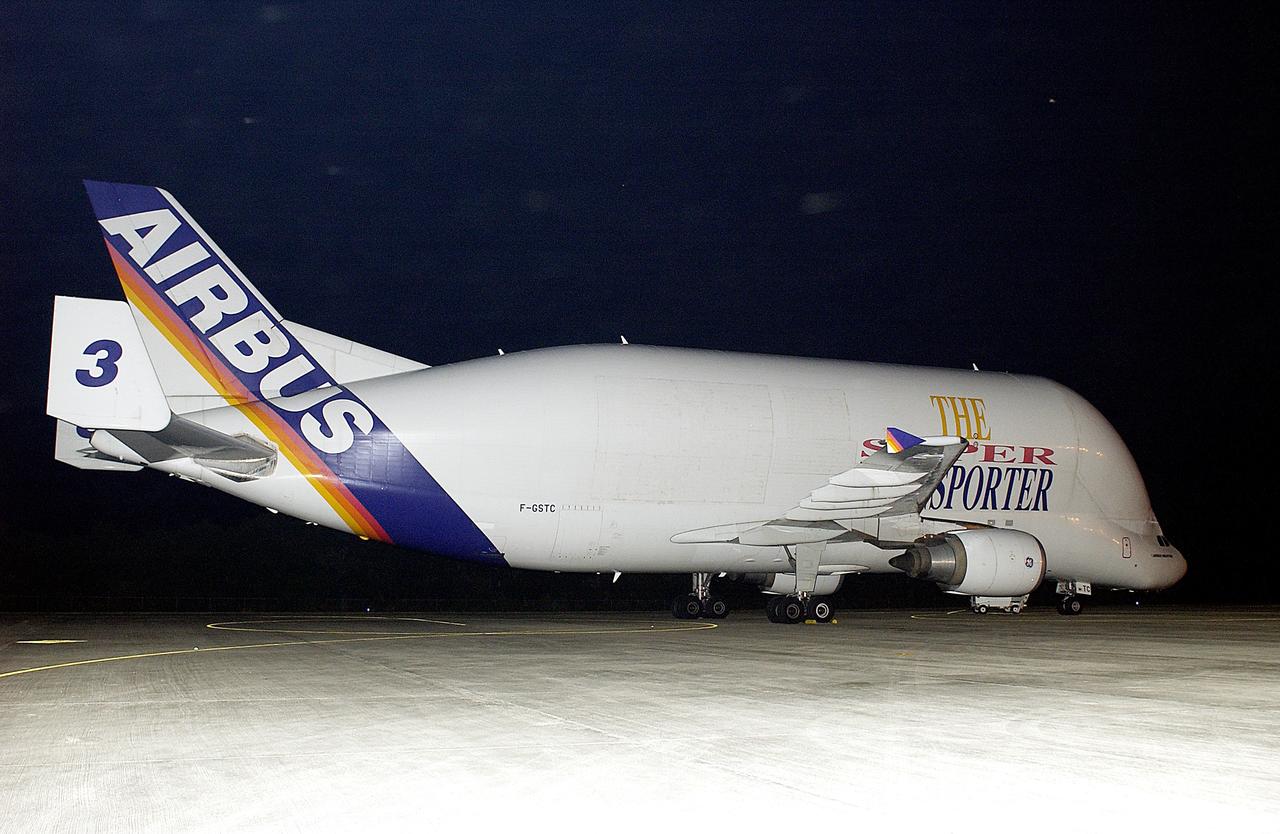
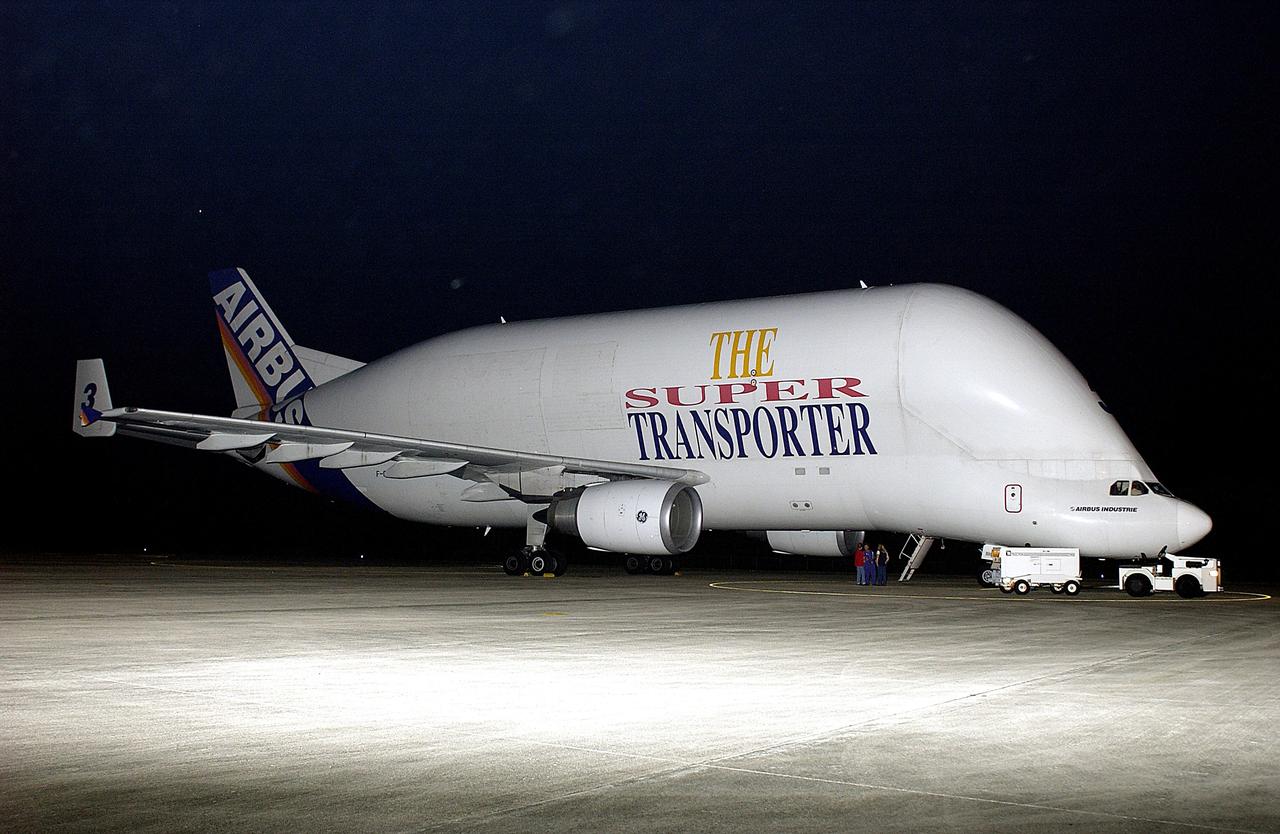
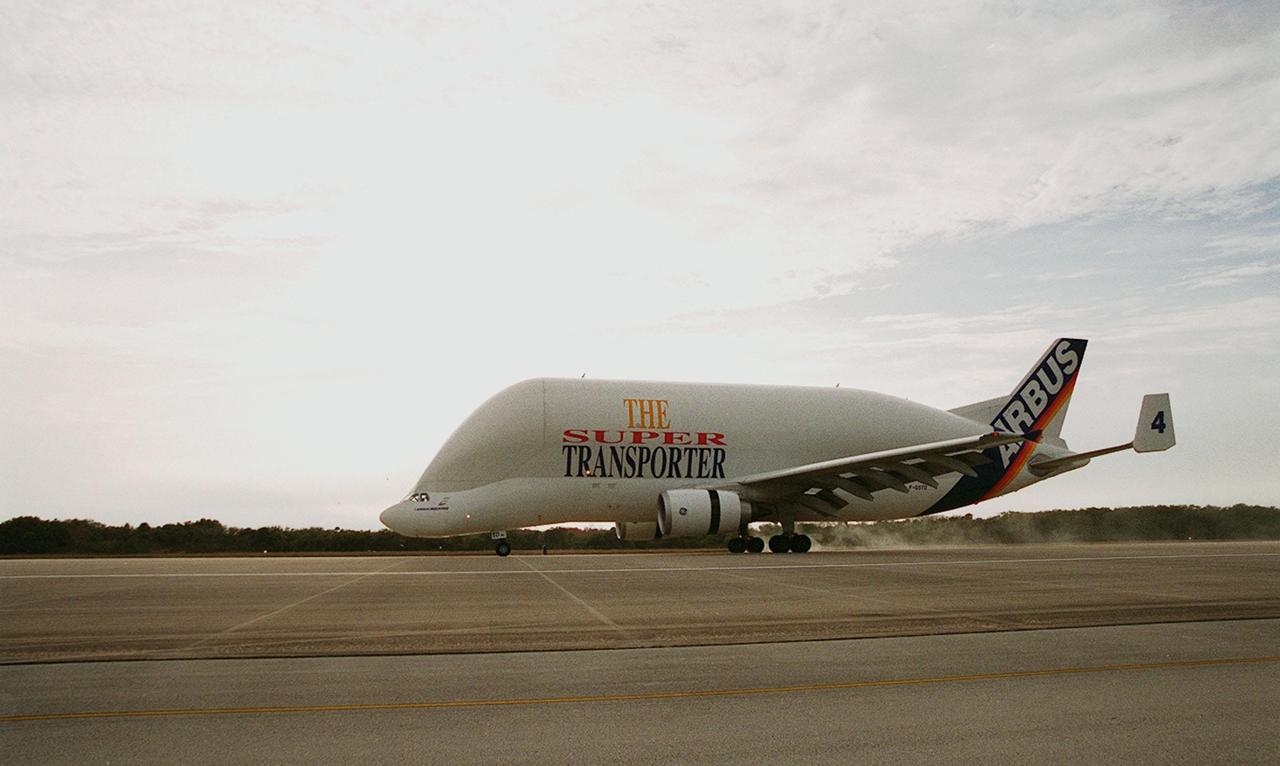
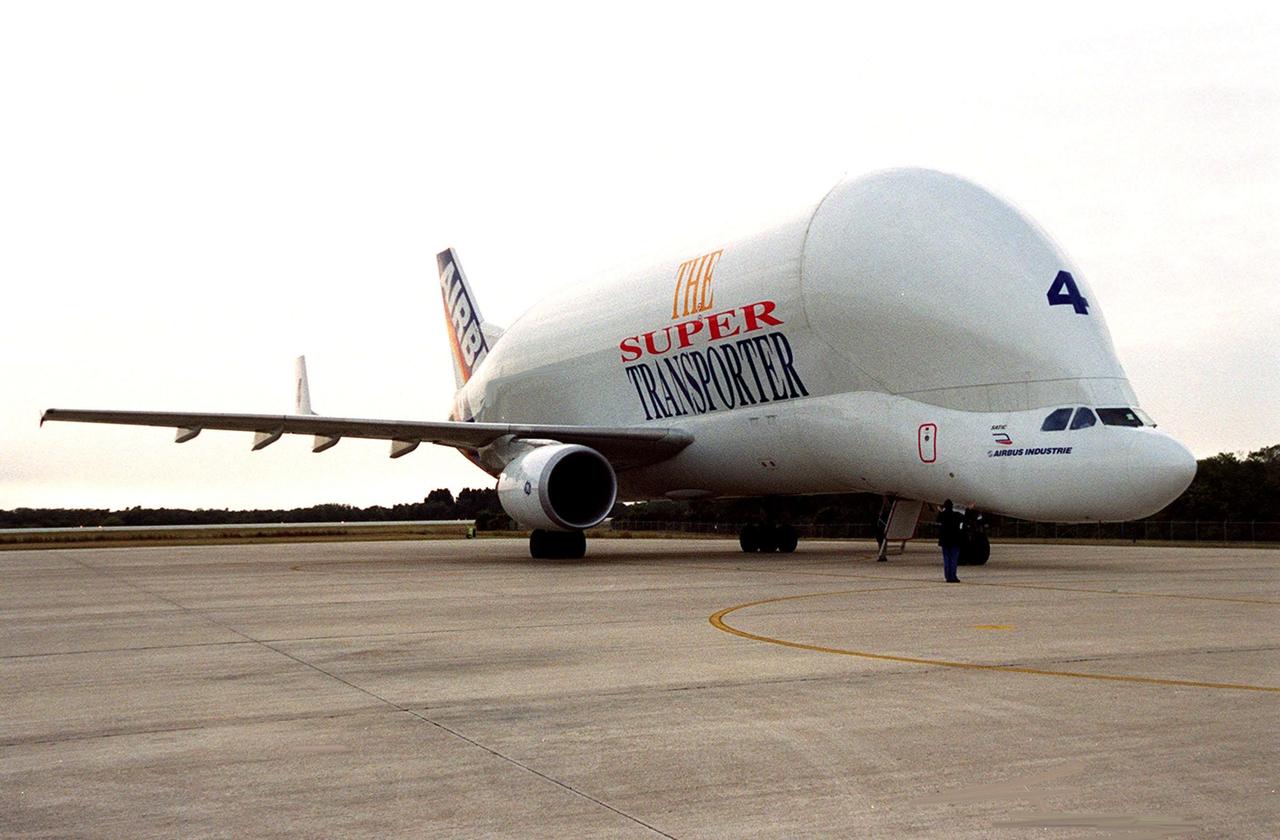
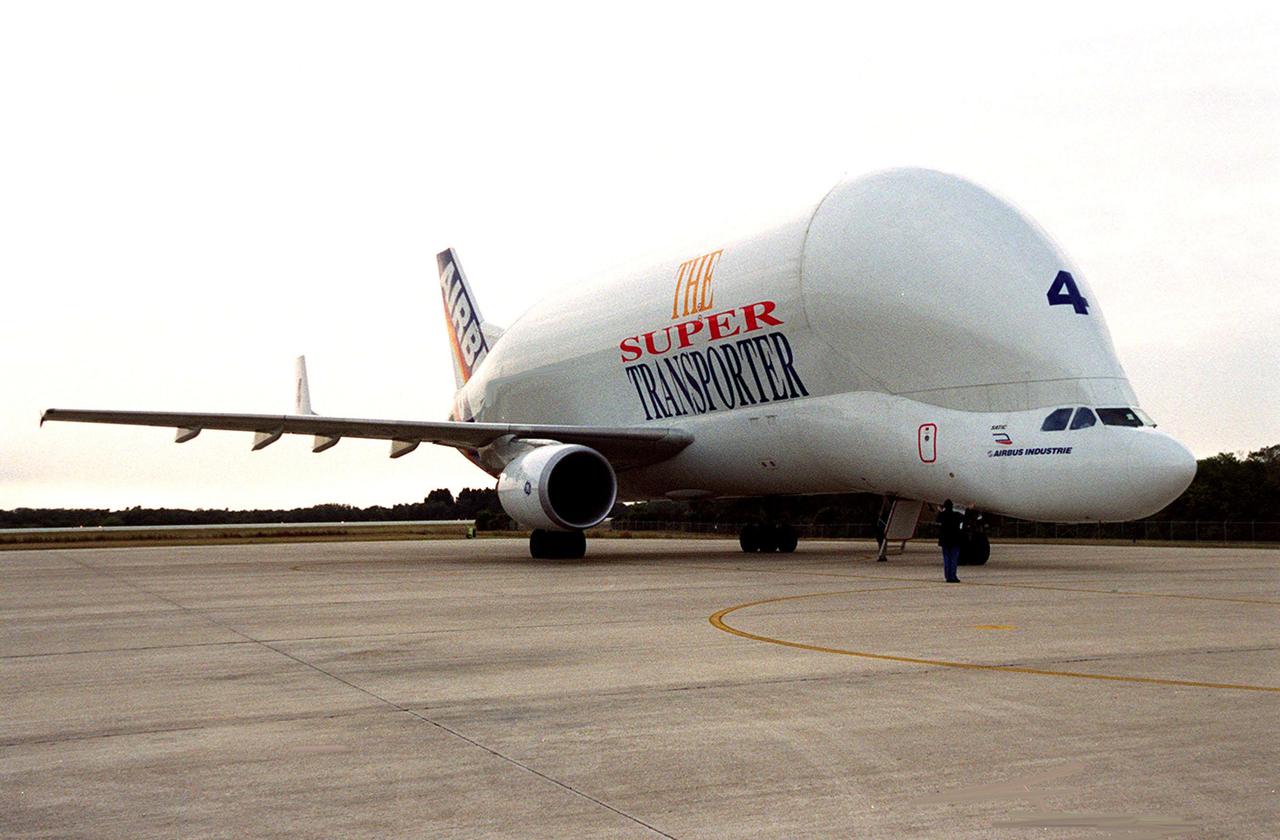
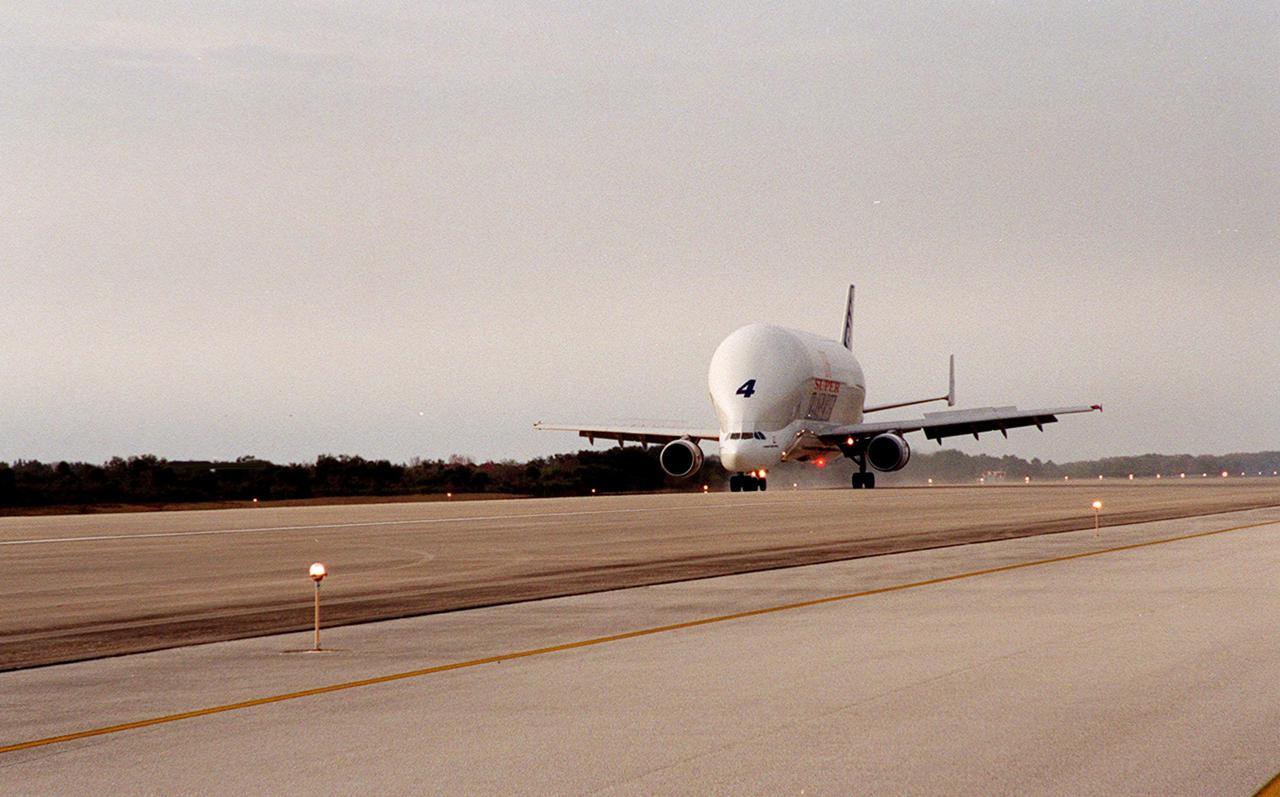
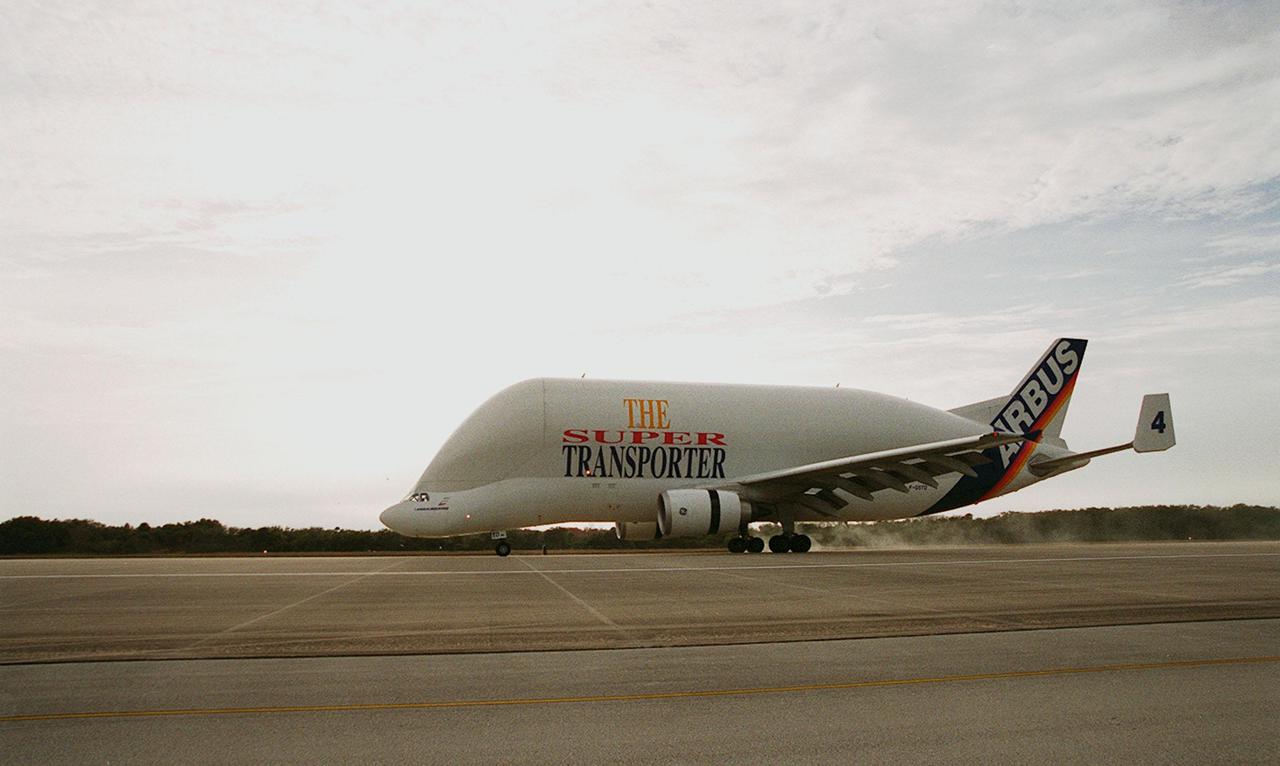
An Airbus “Beluga” air cargo plane, The Super Transporter, arrives at KSC’s Shuttle Landing Facility from the factory of Alenia Aerospazio in Turin, Italy. Its cargo is the Italian Space Agency’s Multi-Purpose Logistics Module Donatello, the third of three for the International Space Station. The module will be transported to the Space Station Processing Facility for processing. Among the activities for the payload test team are integrated electrical tests with other Station elements in the SSPF, leak tests, electrical and software compatibility tests with the Space Shuttle (using the Cargo Integrated Test equipment) and an Interface Verification Test once the module is installed in the Space Shuttle’s payload bay at the launch pad. The most significant mechanical task to be performed on Donatello in the SSPF is the installation and outfitting of the racks for carrying the various experiments and cargo
KSC01pp0232
An Airbus “Beluga” air cargo plane, The Super Transporter, taxis onto the parking apron at KSC’s Shuttle Landing Facility. Its cargo, from the factory of Alenia Aerospazio in Turin, Italy, is the Italian Space Agency’s Multi-Purpose Logistics Module Donatello, the third of three for the International Space Station. The module will be transported to the Space Station Processing Facility for processing. Among the activities for the payload test team are integrated electrical tests with other Station elements in the SSPF, leak tests, electrical and software compatibility tests with the Space Shuttle (using the Cargo Integrated Test equipment) and an Interface Verification Test once the module is installed in the Space Shuttle’s payload bay at the launch pad. The most significant mechanical task to be performed on Donatello in the SSPF is the installation and outfitting of the racks for carrying the various experiments and cargo
KSC-01PP-0234
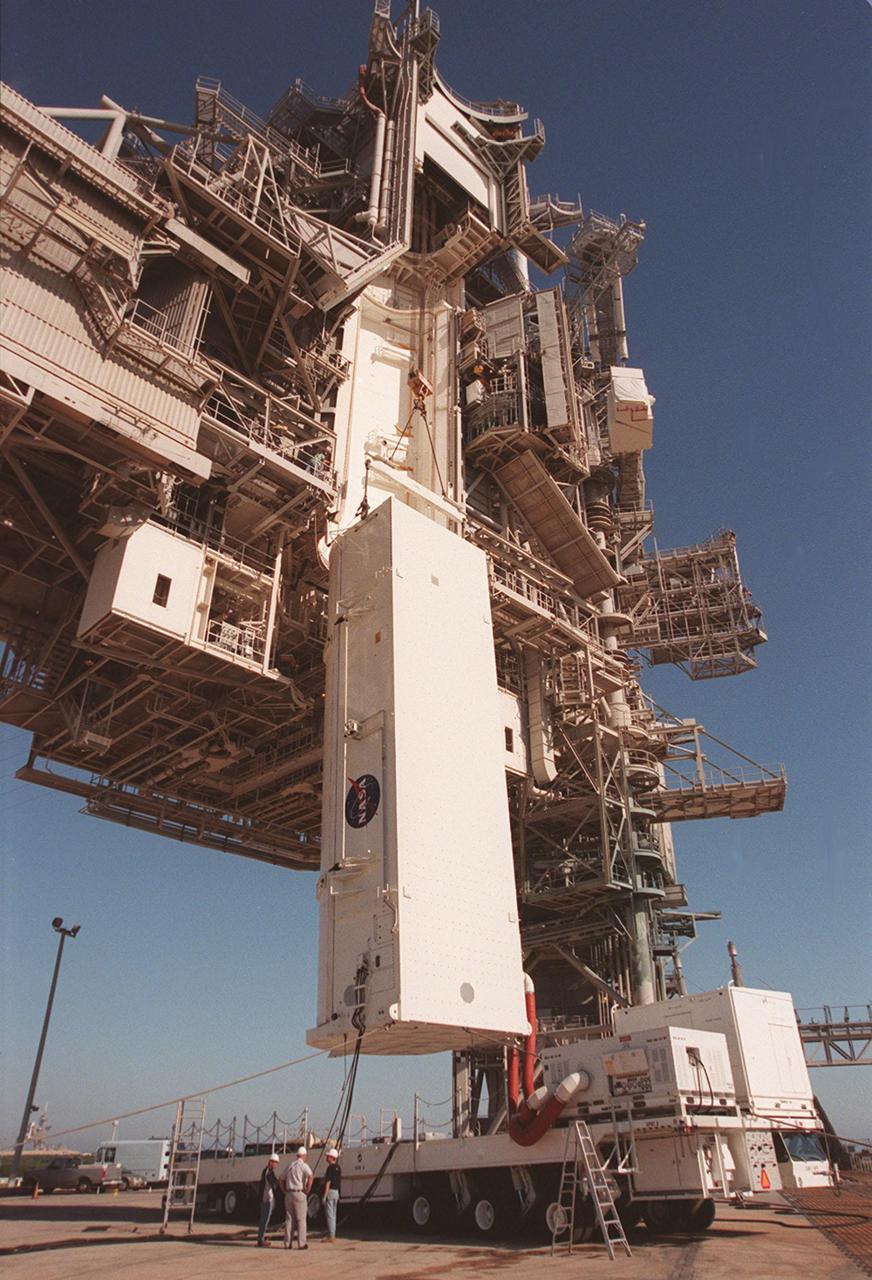
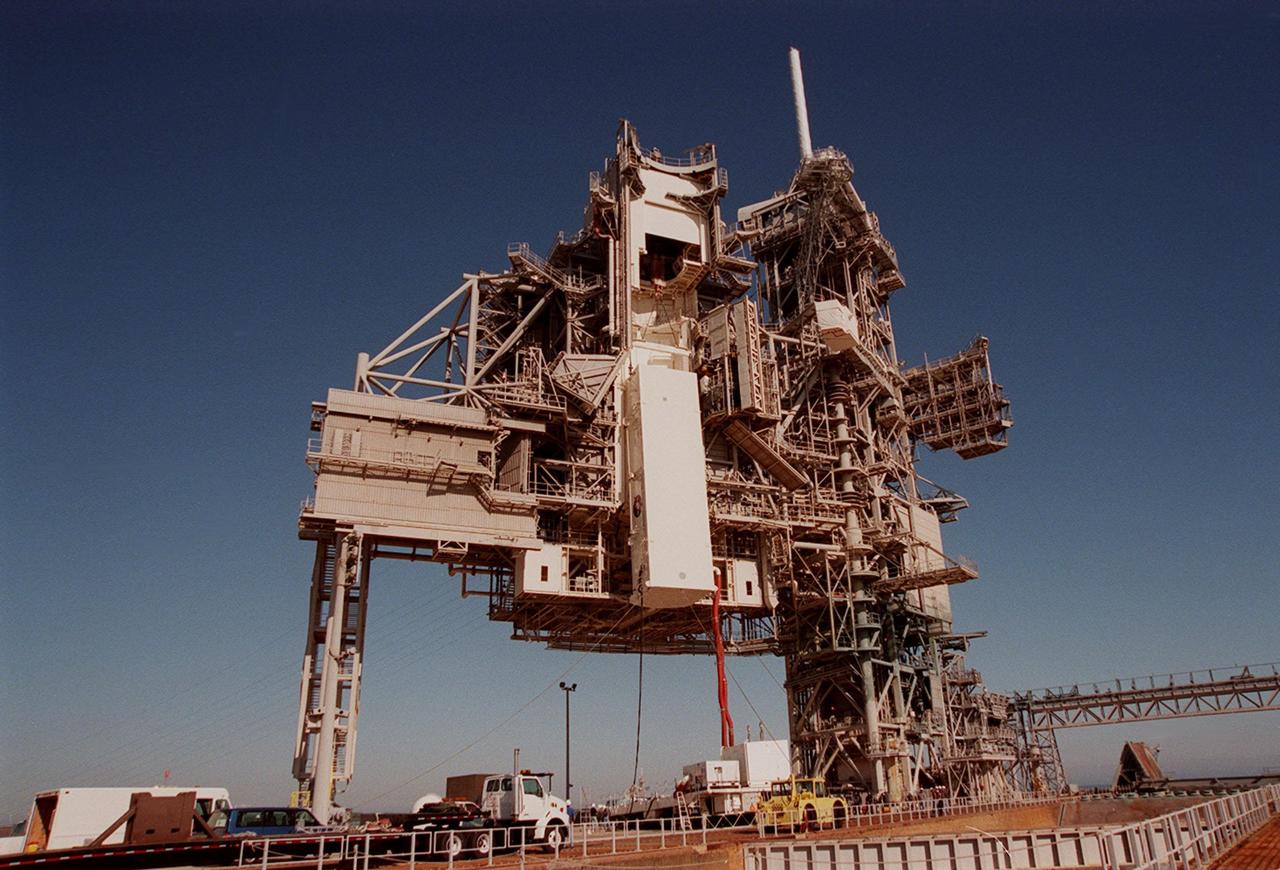
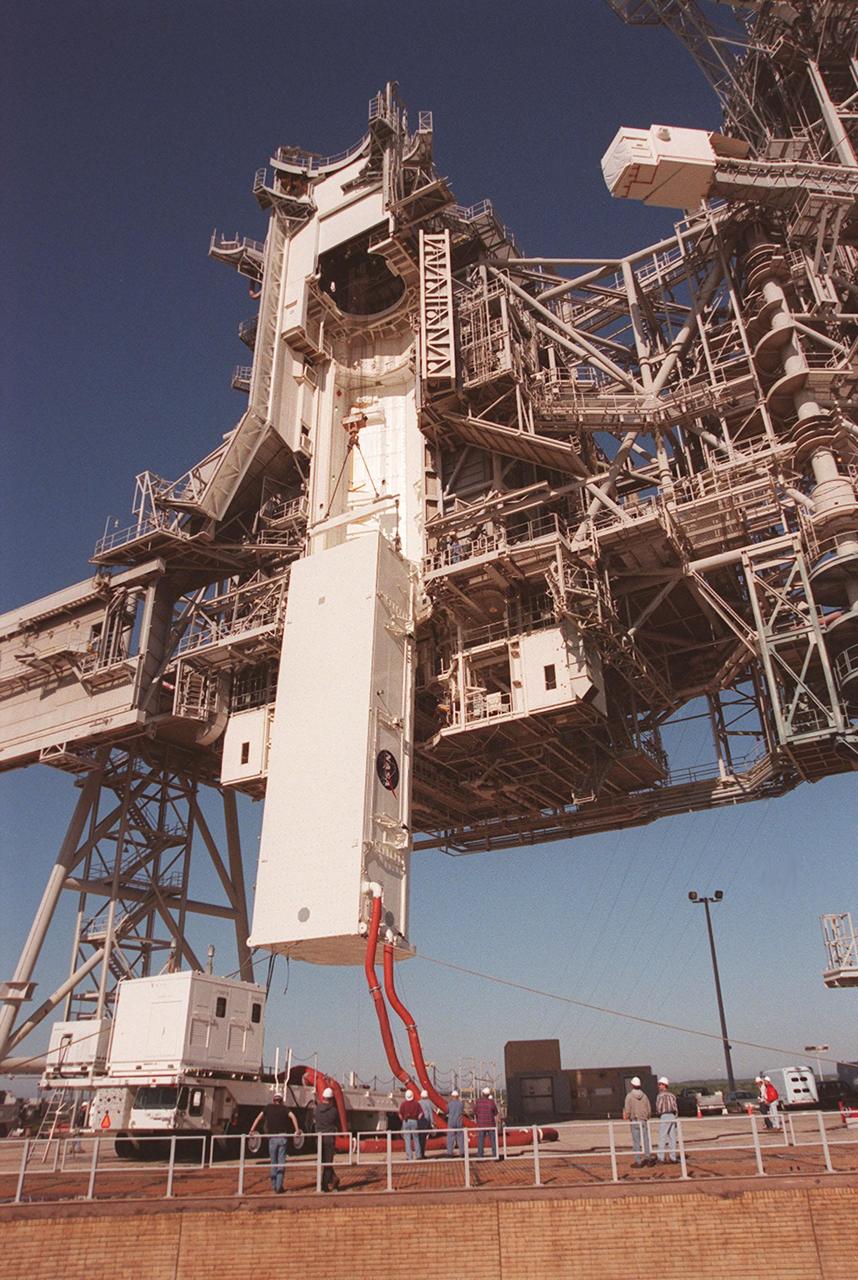
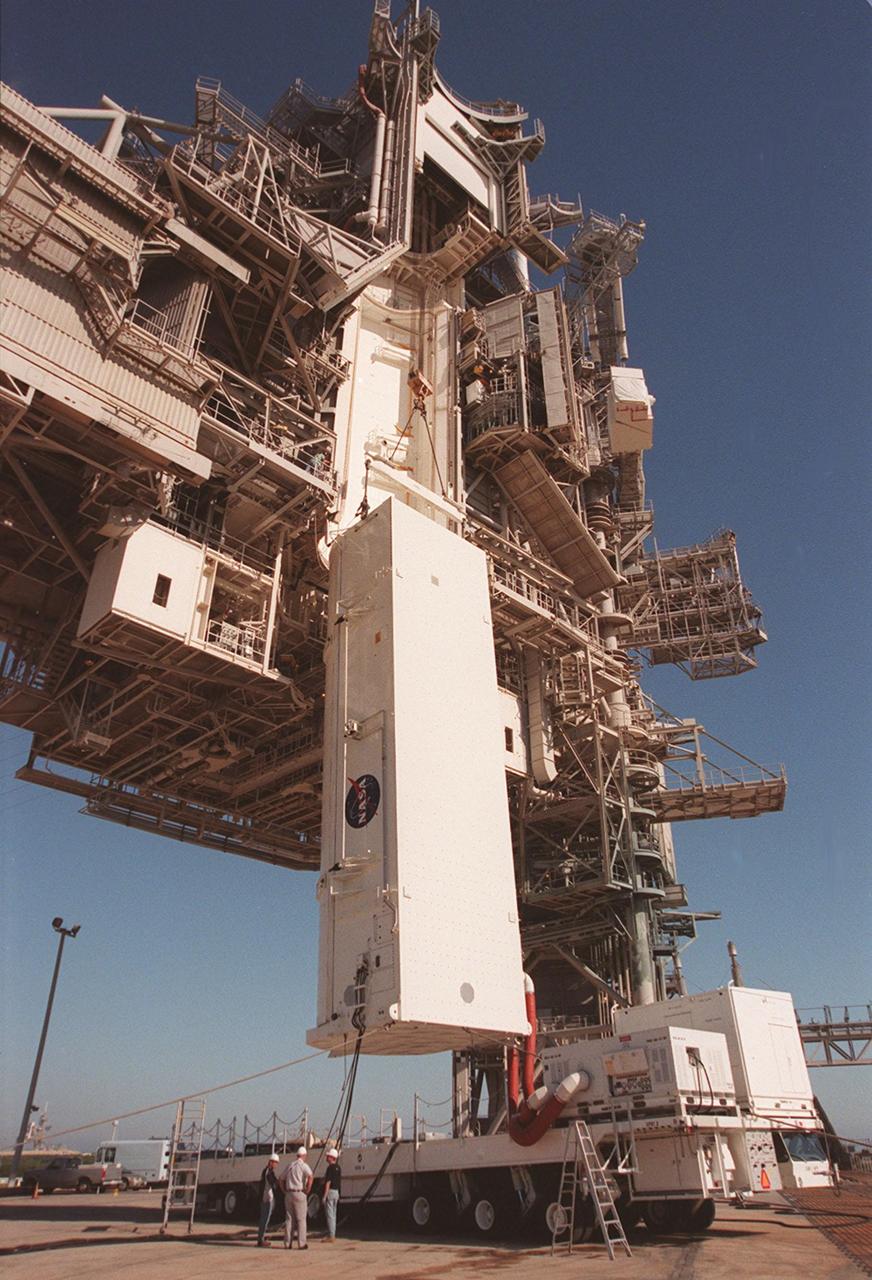
KENNEDY SPACE CENTER, FLA. -- At Launch Pad 39A, the payload canister with the SPACEHAB Double Module and Integrated Cargo Carrier (ICC) inside is lifted up the Rotating Service Structure toward the Payload Changeout Room, an environmentally controlled facility supporting cargo delivery to the pad and vertical installation in the orbiter cargo bay. The primary payloads on mission STS-101, the module and ICC contain internal logistics and resupply cargo for restoring full redundancy to the International Space Station power system in preparation for the arrival of the next pressurized module, the Russian-built Zvezda. The payloads will be transferred to Space Shuttle Atlantis after Atlantis rolls out to the pad. Launch of Atlantis on mission STS-101 is scheduled no earlier than April 17, 2000
KSC00pp0367
An Airbus “Beluga” air cargo plane, The Super Transporter, lands at KSC’s Shuttle Landing Facility. Its cargo, from the factory of Alenia Aerospazio in Turin, Italy, is the Italian Space Agency’s Multi-Purpose Logistics Module Donatello, the third of three for the International Space Station. The module will be transported to the Space Station Processing Facility for processing. Among the activities for the payload test team are integrated electrical tests with other Station elements in the SSPF, leak tests, electrical and software compatibility tests with the Space Shuttle (using the Cargo Integrated Test equipment) and an Interface Verification Test once the module is installed in the Space Shuttle’s payload bay at the launch pad. The most significant mechanical task to be performed on Donatello in the SSPF is the installation and outfitting of the racks for carrying the various experiments and cargo
KSC01pp0233
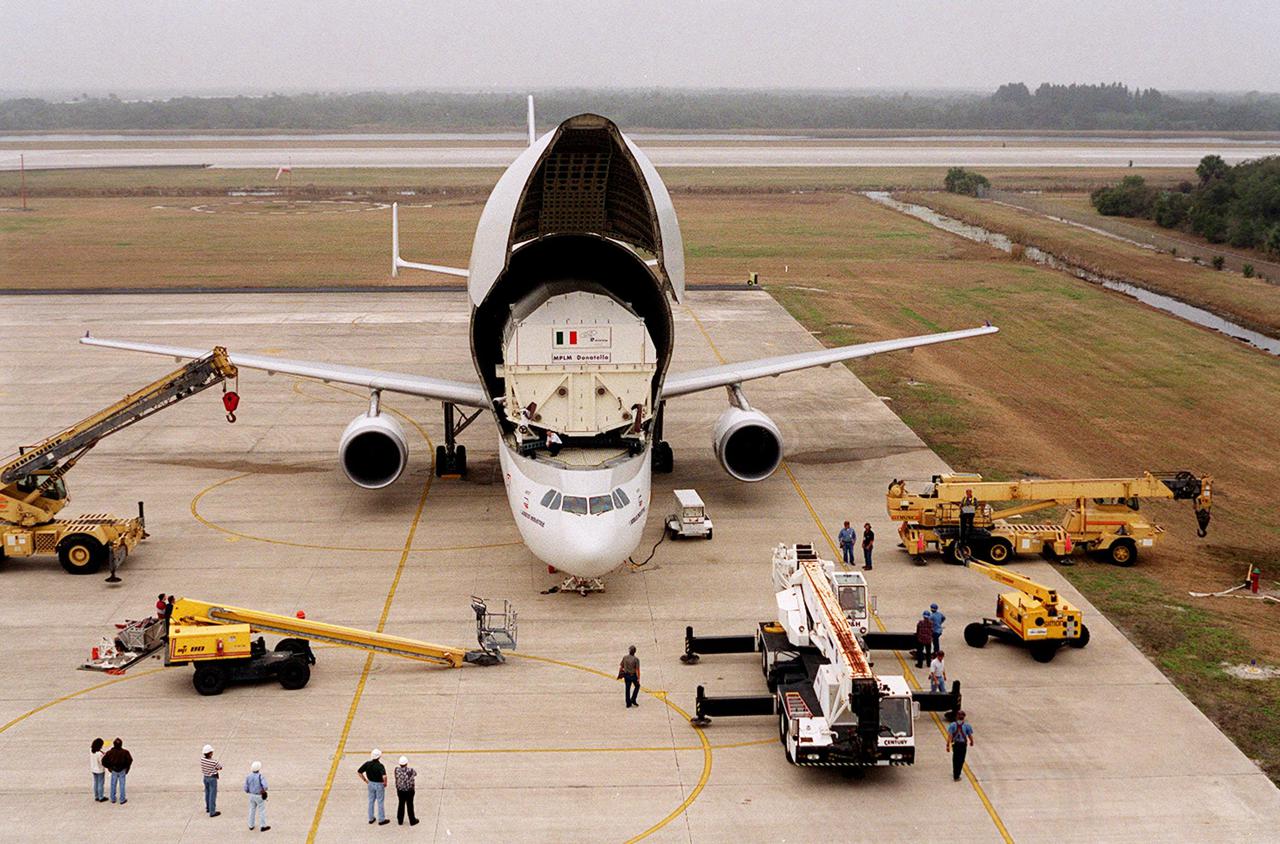
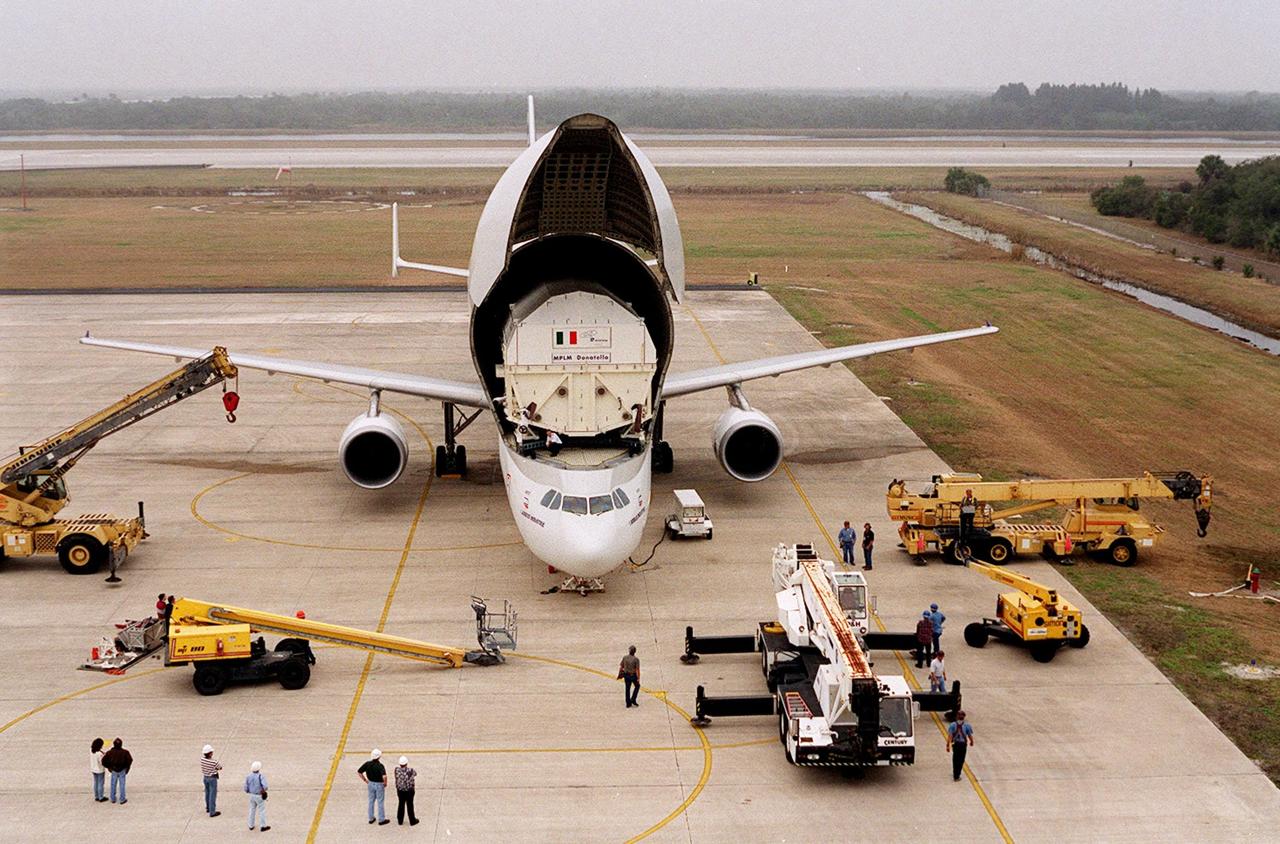
At the KSC <a href="../../subjects/slf.htm"> Shuttle Landing Facility</a>, an Airbus “Beluga” air cargo plane opens to reveal its cargo, the Italian Space Agency’s <a href="../../subjects/mplm.htm"> Multi-Purpose Logistics Module</a> Donatello, from the factory of Alenia Aerospazio in Turin, Italy. The third of three for the International Space Station, the module will be transported to the <a href="../../subjects/sspf.htm"> Space Station Processing Facility</a> for processing. Among the activities for the payload test team are integrated electrical tests with other Station elements in the SSPF, leak tests, electrical and software compatibility tests with the Space Shuttle (using the Cargo Integrated Test equipment) and an Interface Verification Test once the module is installed in the Space Shuttle’s payload bay at the launch pad. The most significant mechanical task to be performed on Donatello in the SSPF is the installation and outfitting of the racks for carrying the various experiments and cargo
KSC01pp0236
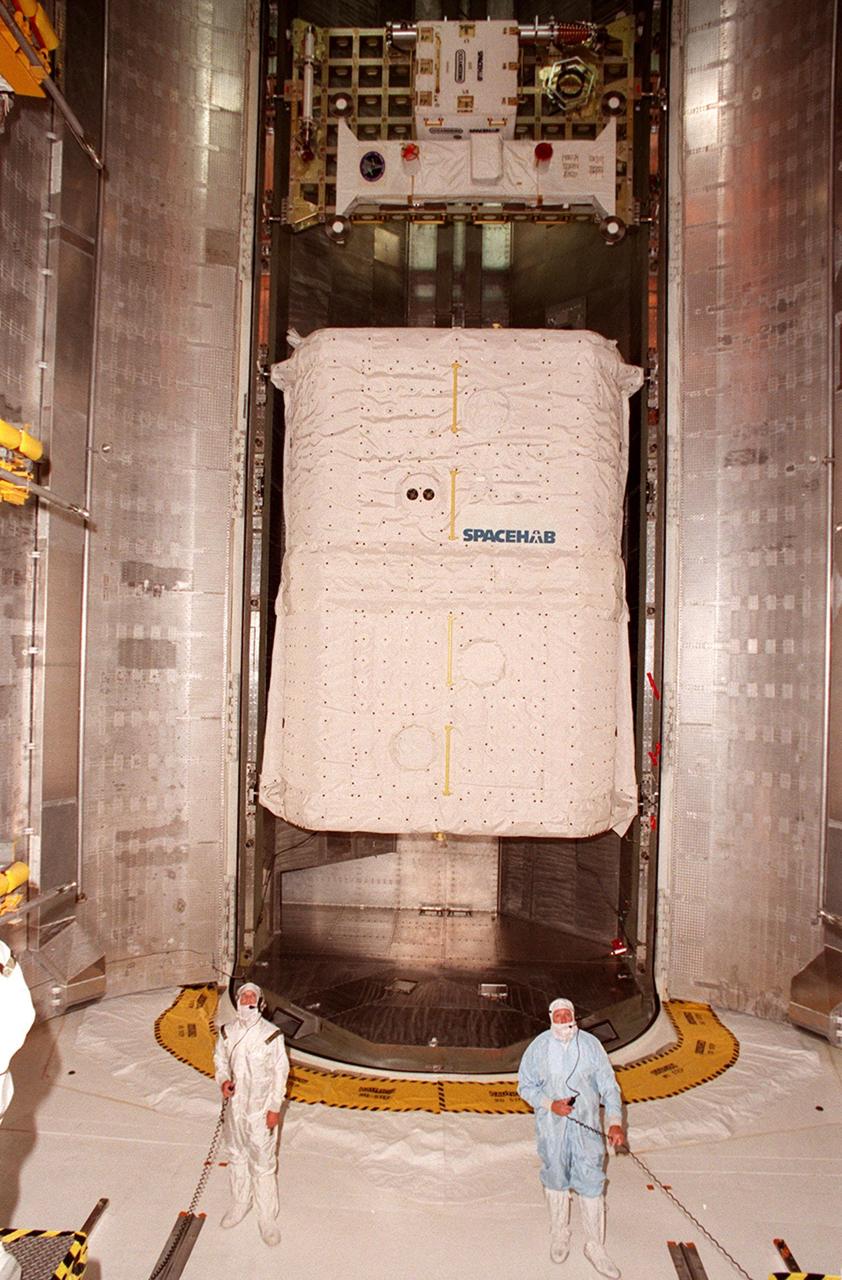
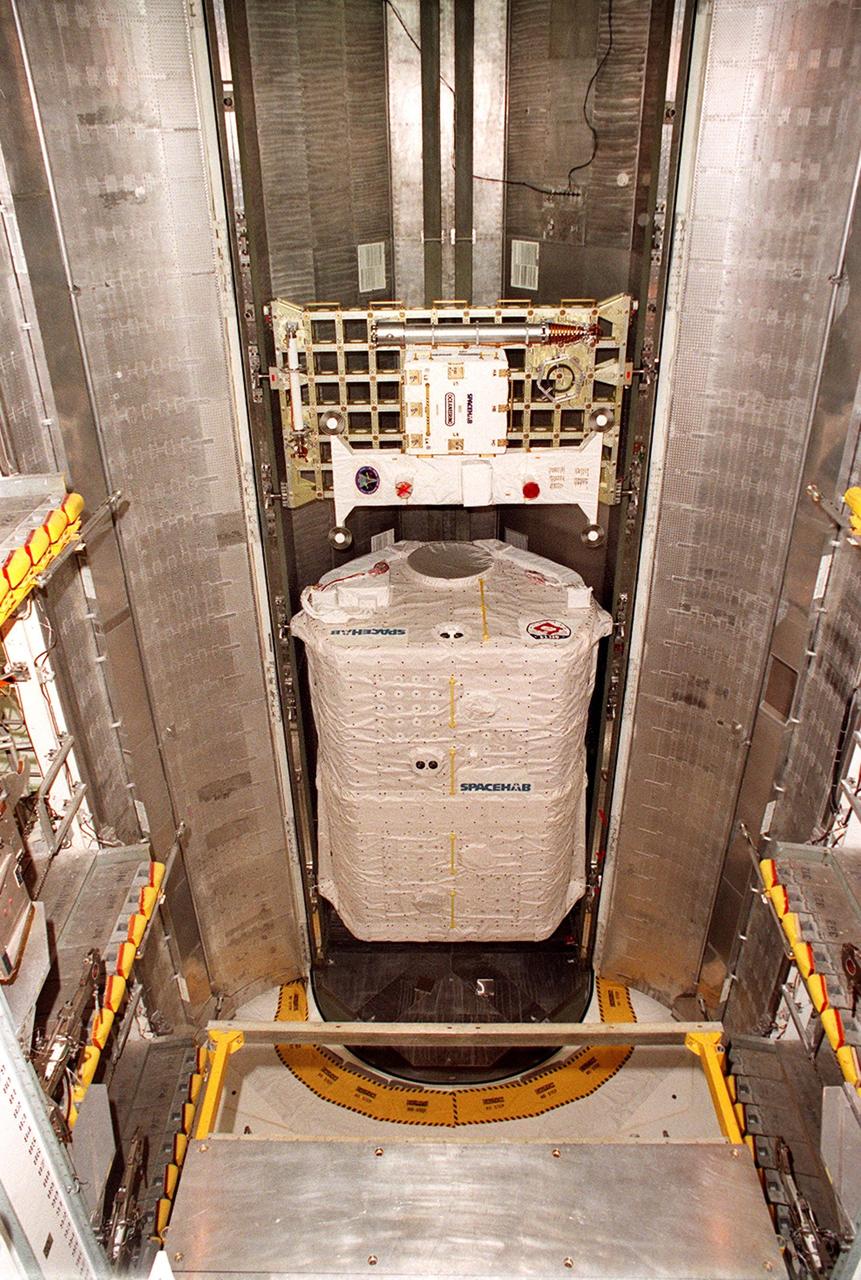
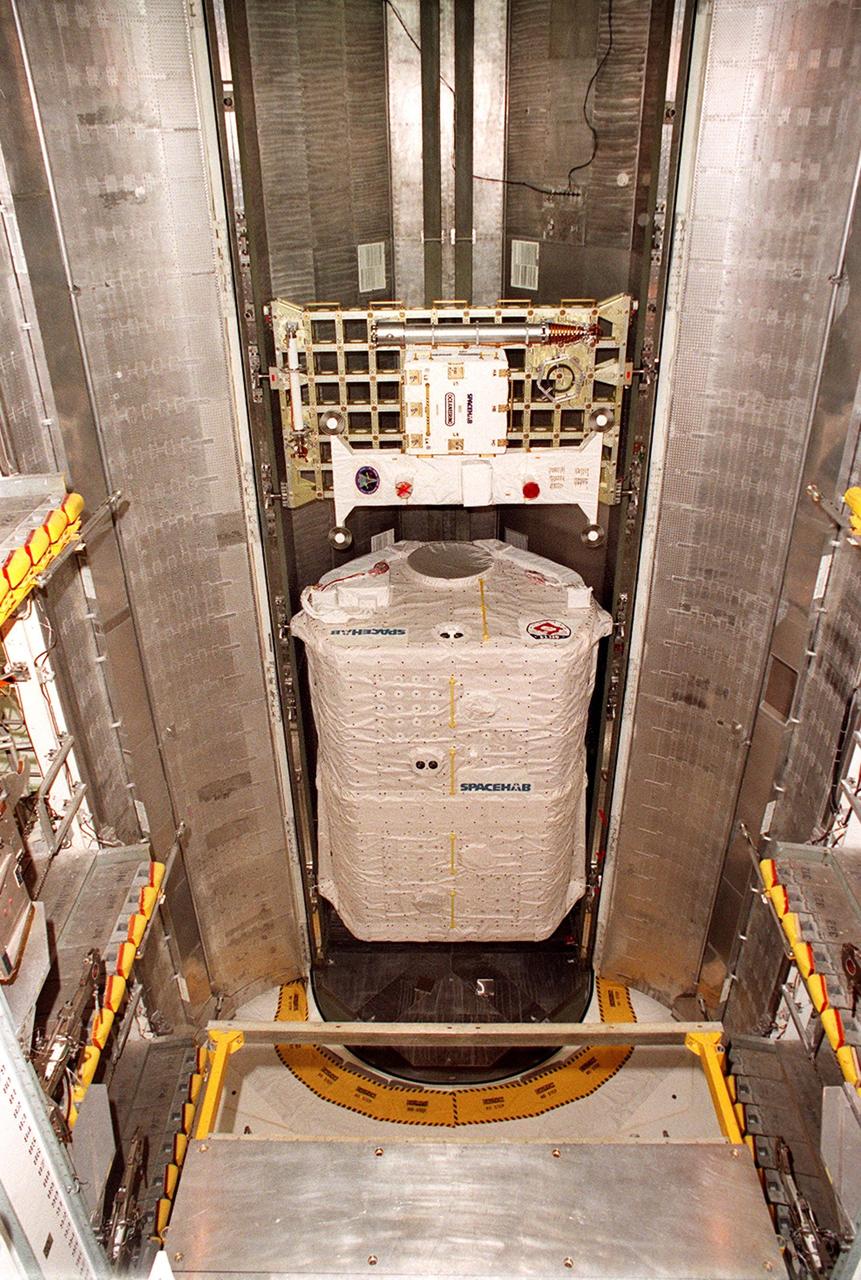
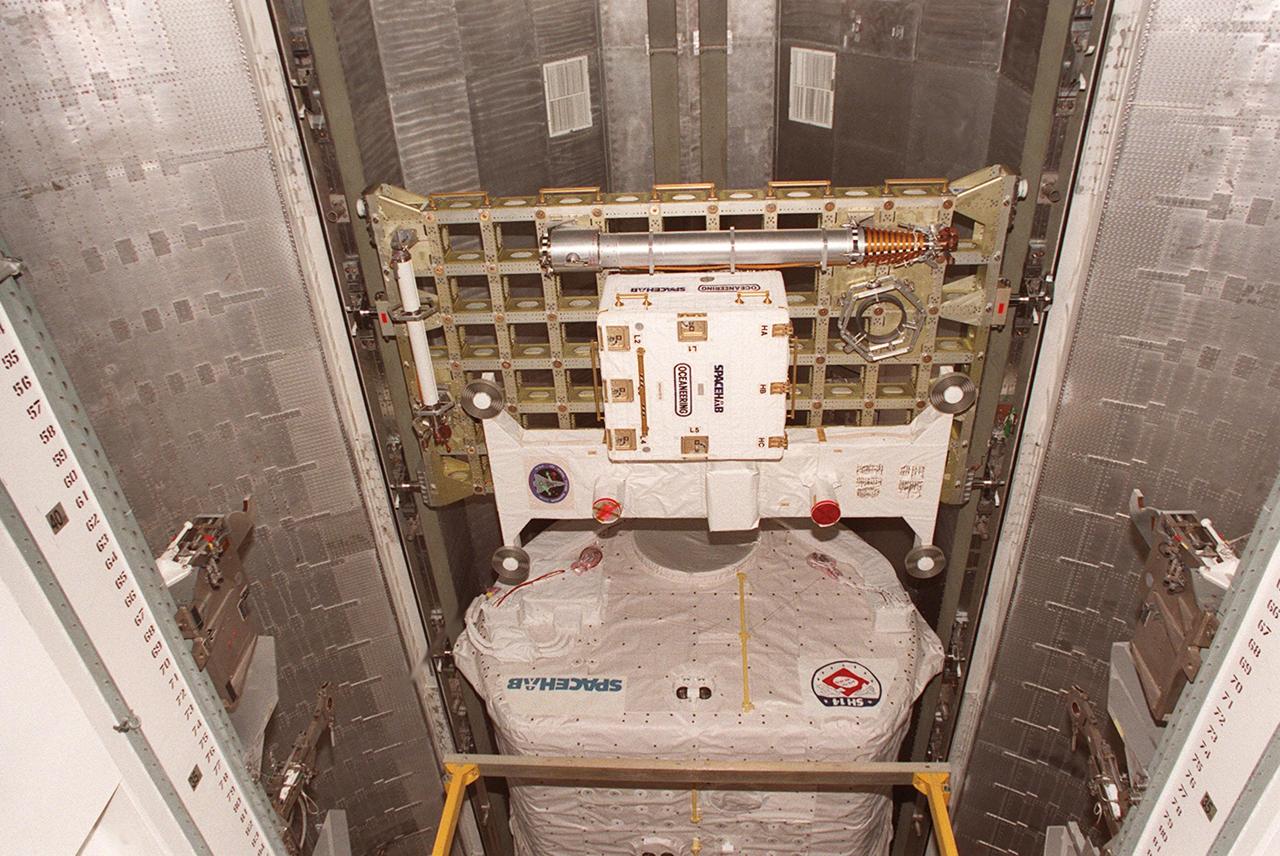
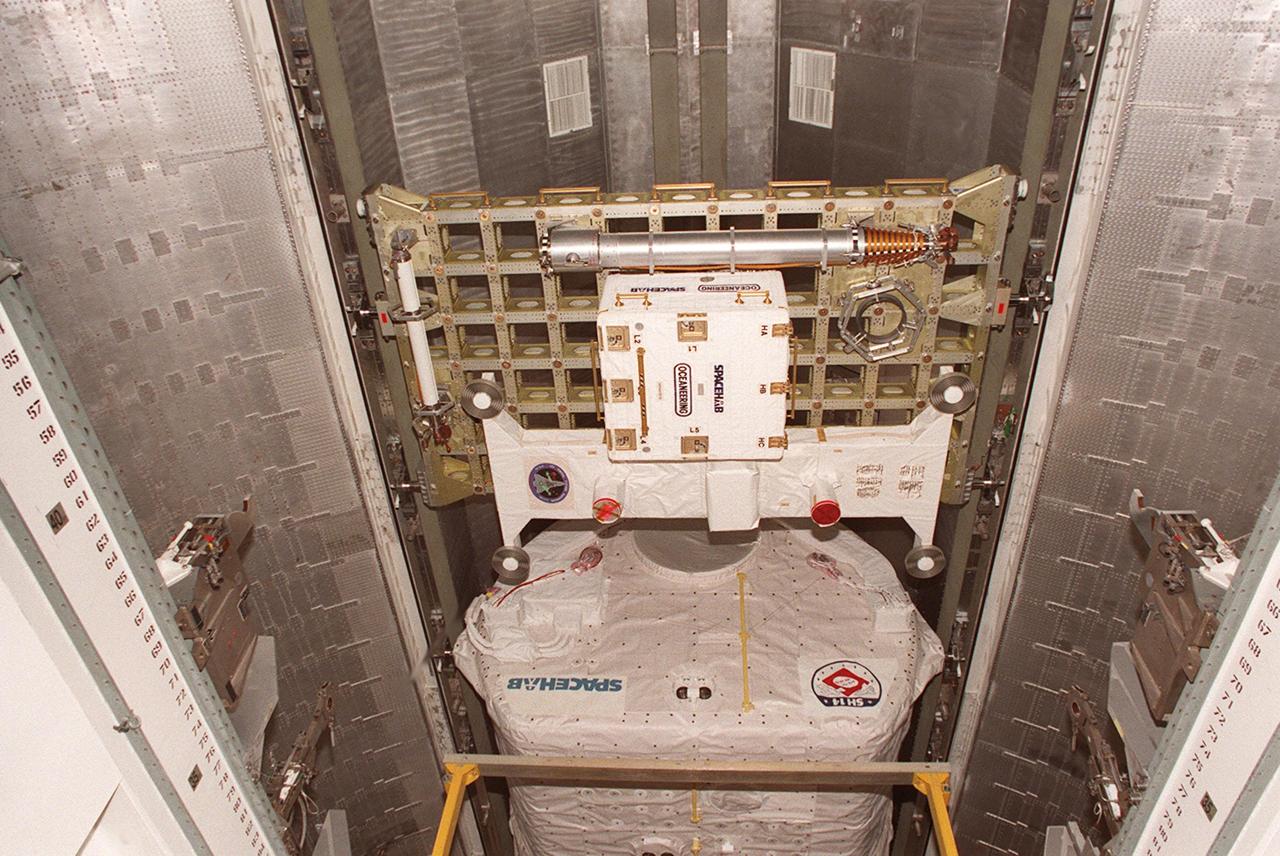
KENNEDY SPACE CENTER, FLA. -- A closeup shows the Integrated Cargo Carrier (top) and SPACEHAB Double Module (below) ready to be moved into the Payload Changeout Room (PCR) at Launch Pad 39A. Part of the Rotating Service Structure, the PCR is an environmentally controlled facility supporting cargo delivery to the pad and vertical installation in the orbiter cargo bay. The primary payloads on mission STS-101, the module and ICC contain internal logistics and resupply cargo for restoring full redundancy to the International Space Station power system in preparation for the arrival of the next pressurized module, the Russian-built Zvezda. The payloads will be transferred to Space Shuttle Atlantis after Atlantis rolls out to the pad. Launch of Atlantis on mission STS-101 is scheduled no earlier than April 17, 2000
KSC-00pp0372
An Airbus “Beluga” air cargo plane, The Super Transporter, arrives at KSC’s Shuttle Landing Facility from the factory of Alenia Aerospazio in Turin, Italy. Its cargo is the Italian Space Agency’s Multi-Purpose Logistics Module Donatello, the third of three for the International Space Station. The module will be transported to the Space Station Processing Facility for processing. Among the activities for the payload test team are integrated electrical tests with other Station elements in the SSPF, leak tests, electrical and software compatibility tests with the Space Shuttle (using the Cargo Integrated Test equipment) and an Interface Verification Test once the module is installed in the Space Shuttle’s payload bay at the launch pad. The most significant mechanical task to be performed on Donatello in the SSPF is the installation and outfitting of the racks for carrying the various experiments and cargo
KSC-01PP-0232
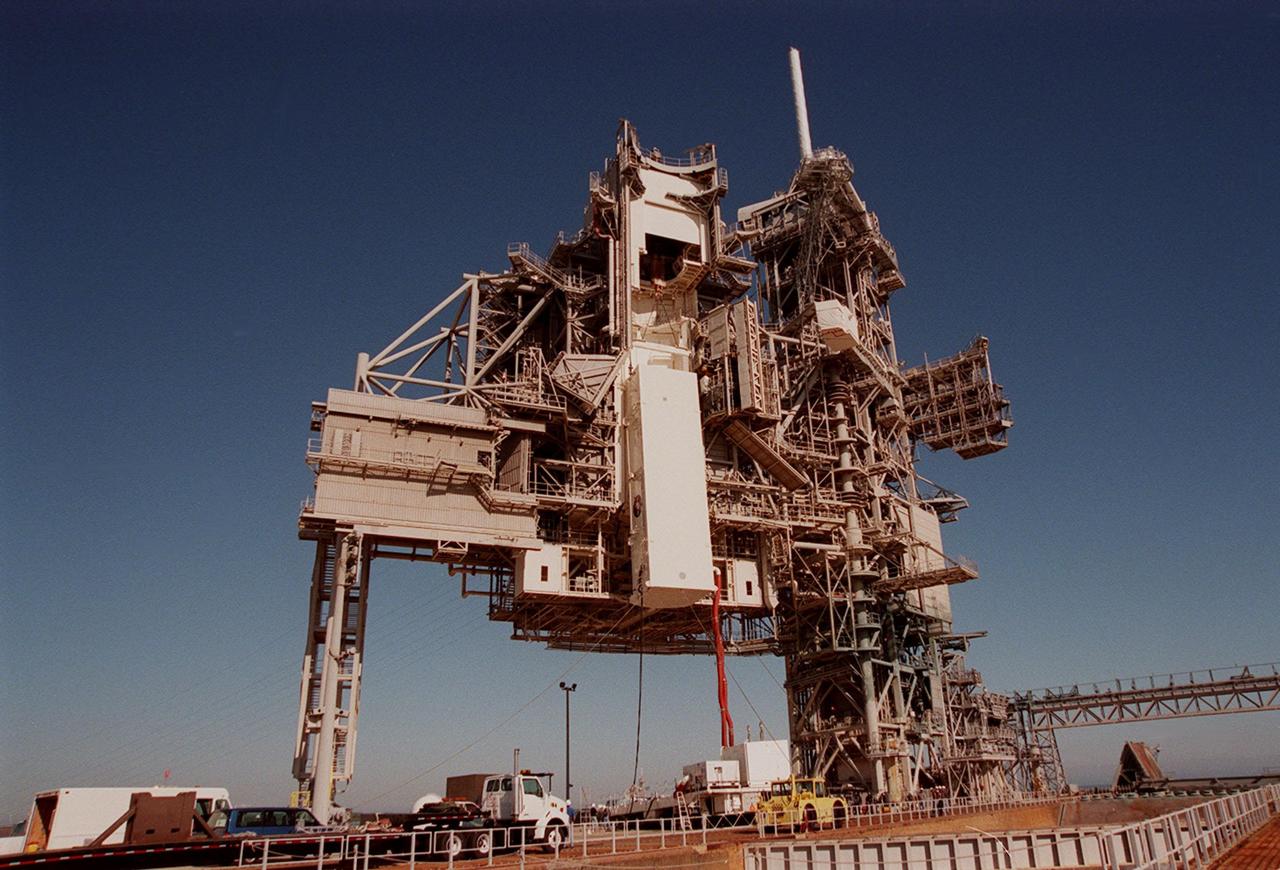
KENNEDY SPACE CENTER, FLA. -- At Launch Pad 39A, the payload canister with the SPACEHAB Double Module and the Integrated Cargo Carrier (ICC) inside is lifted off the payload transporter toward the Payload Changeout Room (PCR) on the Rotating Service Structure (RSS). The PCR is an environmentally controlled facility supporting cargo delivery to the pad and vertical installation in the orbiter cargo bay. At right of the RSS is the Fixed Service Structure. The primary payloads on mission STS-101, the module and ICC contain internal logistics and resupply cargo for restoring full redundancy to the International Space Station power system in preparation for the arrival of the next pressurized module, the Russian-built Zvezda. The payloads will be transferred to Space Shuttle Atlantis after Atlantis rolls out to the pad. Launch of Atlantis on mission STS-101 is scheduled no earlier than April 17, 2000
KSC-00pp0369
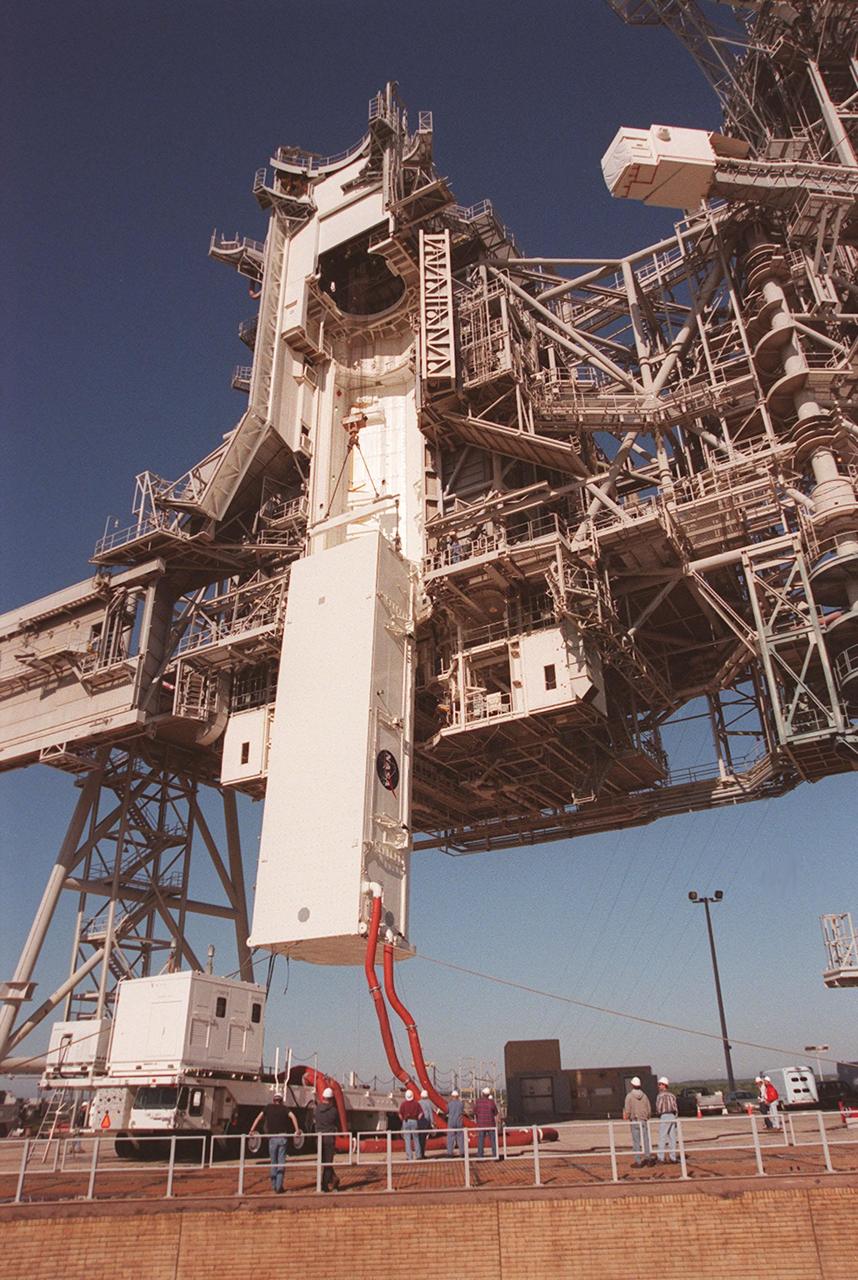
KENNEDY SPACE CENTER, FLA. -- At Launch Pad 39A, the payload canister with the SPACEHAB Double Module and Integrated Cargo Carrier (ICC) inside is lifted up the Rotating Service Structure (RSS) toward the Payload Changeout Room, an environmentally controlled facility supporting cargo delivery to the pad and vertical installation in the orbiter cargo bay. At right of the RSS is the Fixed Service Structure, topped by the 80-foot-tall fiberglass lightning mast. The primary payload on mission STS-101, the module and ICC contain internal logistics and resupply cargo for restoring full redundancy to the International Space Station power system in preparation for the arrival of the next pressurized module, the Russian-built Zvezda. The payloads will be transferred to Space Shuttle Atlantis after Atlantis rolls out to the pad. Launch of Atlantis on mission STS-101 is scheduled no earlier than April 17, 2000
KSC00pp0368
KENNEDY SPACE CENTER, FLA. -- At Launch Pad 39A, the payload canister with the SPACEHAB Double Module and the Integrated Cargo Carrier (ICC) inside is lifted off the payload transporter toward the Payload Changeout Room (PCR) on the Rotating Service Structure (RSS). The PCR is an environmentally controlled facility supporting cargo delivery to the pad and vertical installation in the orbiter cargo bay. At right of the RSS is the Fixed Service Structure. The primary payloads on mission STS-101, the module and ICC contain internal logistics and resupply cargo for restoring full redundancy to the International Space Station power system in preparation for the arrival of the next pressurized module, the Russian-built Zvezda. The payloads will be transferred to Space Shuttle Atlantis after Atlantis rolls out to the pad. Launch of Atlantis on mission STS-101 is scheduled no earlier than April 17, 2000
KSC00pp0369
KENNEDY SPACE CENTER, FLA. -- A closeup shows the Integrated Cargo Carrier (top) and SPACEHAB Double Module (below) ready to be moved into the Payload Changeout Room (PCR) at Launch Pad 39A. Part of the Rotating Service Structure, the PCR is an environmentally controlled facility supporting cargo delivery to the pad and vertical installation in the orbiter cargo bay. The primary payloads on mission STS-101, the module and ICC contain internal logistics and resupply cargo for restoring full redundancy to the International Space Station power system in preparation for the arrival of the next pressurized module, the Russian-built Zvezda. The payloads will be transferred to Space Shuttle Atlantis after Atlantis rolls out to the pad. Launch of Atlantis on mission STS-101 is scheduled no earlier than April 17, 2000
KSC00pp0372
KENNEDY SPACE CENTER, FLA. -- At Launch Pad 39A, the payload canister with the SPACEHAB Double Module and Integrated Cargo Carrier (ICC) inside is lifted up the Rotating Service Structure (RSS) toward the Payload Changeout Room, an environmentally controlled facility supporting cargo delivery to the pad and vertical installation in the orbiter cargo bay. At right of the RSS is the Fixed Service Structure, topped by the 80-foot-tall fiberglass lightning mast. The primary payload on mission STS-101, the module and ICC contain internal logistics and resupply cargo for restoring full redundancy to the International Space Station power system in preparation for the arrival of the next pressurized module, the Russian-built Zvezda. The payloads will be transferred to Space Shuttle Atlantis after Atlantis rolls out to the pad. Launch of Atlantis on mission STS-101 is scheduled no earlier than April 17, 2000
KSC-00pp0368
KENNEDY SPACE CENTER, FLA. -- The SPACEHAB Double Module (bottom) and Integrated Cargo Carrier (above) are ready to be moved from the payload canister into the Payload Changeout Room (PCR) at Launch Pad 39A. Part of the Rotating Service Structure, the PCR is an environmentally controlled facility supporting cargo delivery to the pad and vertical installation in the orbiter cargo bay. The primary payloads on mission STS-101, the module and ICC contain internal logistics and resupply cargo for restoring full redundancy to the International Space Station power system in preparation for the arrival of the next pressurized module, the Russian-built Zvezda. The payloads will be transferred to Space Shuttle Atlantis after Atlantis rolls out to the pad. Launch of Atlantis on mission STS-101 is scheduled no earlier than April 17, 2000
KSC00pp0371
At the KSC <a href='.._.._subjects_slf.htm'> Shuttle Landing Facility<_a>, an Airbus “Beluga” air cargo plane opens to reveal its cargo, the Italian Space Agency’s <a href='.._.._subjects_mplm.htm'> Multi-Purpose Logistics Module<_a> Donatello, from the factory of Alenia Aerospazio in Turin, Italy. The third of three for the International Space Station, the module will be transported to the <a href='.._.._subjects_sspf.htm'> Space Station Processing Facility<_a> for processing. Among the activities for the payload test team are integrated electrical tests with other Station elements in the SSPF, leak tests, electrical and software compatibility tests with the Space Shuttle (using the Cargo Integrated Test equipment) and an Interface Verification Test once the module is installed in the Space Shuttle’s payload bay at the launch pad. The most significant mechanical task to be performed on Donatello in the SSPF is the installation and outfitting of the racks for carrying the various experiments and cargo
KSC-01PP-0236
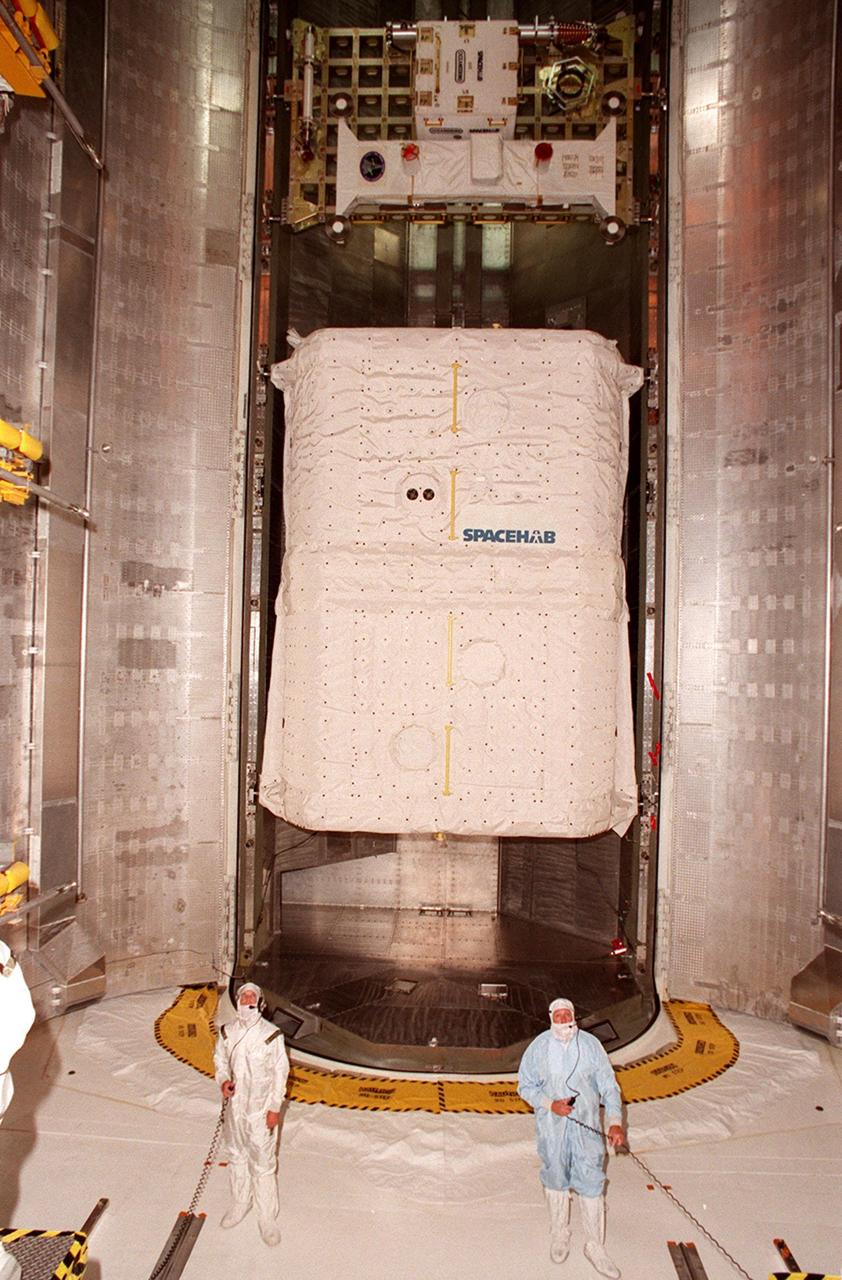
KENNEDY SPACE CENTER, FLA. -- The doors of the payload canister open in the Payload Changeout Room (PCR) at Launch Pad 39A to reveal the SPACEHAB Double Module (bottom) and Integrated Cargo Carrier (ICC). Part of the Rotating Service Structure, the PCR is an environmentally controlled facility supporting cargo delivery to the pad and vertical installation in the orbiter cargo bay. The primary payloads on mission STS-101, the module and ICC contain internal logistics and resupply cargo for restoring full redundancy to the International Space Station power system in preparation for the arrival of the next pressurized module, the Russian-built Zvezda. The payloads will be transferred to Space Shuttle Atlantis after Atlantis rolls out to the pad. Launch of Atlantis on mission STS-101 is scheduled no earlier than April 17, 2000
KSC-00pp0370
KENNEDY SPACE CENTER, FLA. -- At Launch Pad 39A, the payload canister with the SPACEHAB Double Module and Integrated Cargo Carrier (ICC) inside is lifted up the Rotating Service Structure toward the Payload Changeout Room, an environmentally controlled facility supporting cargo delivery to the pad and vertical installation in the orbiter cargo bay. The primary payloads on mission STS-101, the module and ICC contain internal logistics and resupply cargo for restoring full redundancy to the International Space Station power system in preparation for the arrival of the next pressurized module, the Russian-built Zvezda. The payloads will be transferred to Space Shuttle Atlantis after Atlantis rolls out to the pad. Launch of Atlantis on mission STS-101 is scheduled no earlier than April 17, 2000
KSC-00pp0367
KENNEDY SPACE CENTER, FLA. -- The doors of the payload canister open in the Payload Changeout Room (PCR) at Launch Pad 39A to reveal the SPACEHAB Double Module (bottom) and Integrated Cargo Carrier (ICC). Part of the Rotating Service Structure, the PCR is an environmentally controlled facility supporting cargo delivery to the pad and vertical installation in the orbiter cargo bay. The primary payloads on mission STS-101, the module and ICC contain internal logistics and resupply cargo for restoring full redundancy to the International Space Station power system in preparation for the arrival of the next pressurized module, the Russian-built Zvezda. The payloads will be transferred to Space Shuttle Atlantis after Atlantis rolls out to the pad. Launch of Atlantis on mission STS-101 is scheduled no earlier than April 17, 2000
KSC00pp0370
KENNEDY SPACE CENTER, FLA. -- The SPACEHAB Double Module (bottom) and Integrated Cargo Carrier (above) are ready to be moved from the payload canister into the Payload Changeout Room (PCR) at Launch Pad 39A. Part of the Rotating Service Structure, the PCR is an environmentally controlled facility supporting cargo delivery to the pad and vertical installation in the orbiter cargo bay. The primary payloads on mission STS-101, the module and ICC contain internal logistics and resupply cargo for restoring full redundancy to the International Space Station power system in preparation for the arrival of the next pressurized module, the Russian-built Zvezda. The payloads will be transferred to Space Shuttle Atlantis after Atlantis rolls out to the pad. Launch of Atlantis on mission STS-101 is scheduled no earlier than April 17, 2000
KSC-00pp0371
An Airbus “Beluga” air cargo plane, The Super Transporter, lands at KSC’s Shuttle Landing Facility. Its cargo, from the factory of Alenia Aerospazio in Turin, Italy, is the Italian Space Agency’s Multi-Purpose Logistics Module Donatello, the third of three for the International Space Station. The module will be transported to the Space Station Processing Facility for processing. Among the activities for the payload test team are integrated electrical tests with other Station elements in the SSPF, leak tests, electrical and software compatibility tests with the Space Shuttle (using the Cargo Integrated Test equipment) and an Interface Verification Test once the module is installed in the Space Shuttle’s payload bay at the launch pad. The most significant mechanical task to be performed on Donatello in the SSPF is the installation and outfitting of the racks for carrying the various experiments and cargo
KSC-01PP-0233
An Airbus “Beluga” air cargo plane, The Super Transporter, taxis onto the parking apron at KSC’s Shuttle Landing Facility. Its cargo, from the factory of Alenia Aerospazio in Turin, Italy, is the Italian Space Agency’s Multi-Purpose Logistics Module Donatello, the third of three for the International Space Station. The module will be transported to the Space Station Processing Facility for processing. Among the activities for the payload test team are integrated electrical tests with other Station elements in the SSPF, leak tests, electrical and software compatibility tests with the Space Shuttle (using the Cargo Integrated Test equipment) and an Interface Verification Test once the module is installed in the Space Shuttle’s payload bay at the launch pad. The most significant mechanical task to be performed on Donatello in the SSPF is the installation and outfitting of the racks for carrying the various experiments and cargo
KSC01pp0234
KENNEDY SPACE CENTER, FLA. -  In the Space Station Processing Facility, workers watch the progress of the Multi-Purpose Logistics Module Leonardo as it moves across the building to the Cargo Element Work Stand that Raffaello recently vacated.  The payload canister was a temporary location during the switch. At right is the MPLM Raffaello, temporarily occupying the Element Rotation Stand formerly holding Leonardo.  Three MPLMs were built by the Italian Space Agency - Donatello, Leonardo and Raffaello - to serve as a reusable logistics carrier and primary delivery system to resupply and return cargo requiring a pressurized environment to the International Space Station.
KSC-04pd-2309
S123-E-005051 (11 Mar. 2008) --- During their first full day in space, STS-123 crewmembers aboard the Earth-orbiting Space Shuttle Endeavour  recorded and downlinked pictures of its cargo bay where the logistics module for the Japanese Kibo laboratory awaits being added to the   growing International Space Station.
Space Shuttle Endeavour,OV 105,Payload Bay during STS-123
ISS020-E-037060 (31 Aug. 2009) --- Viewed from a computer monitor, the International Space Station’s robotic Canadarm2 unberths the Leonardo Multi-Purpose Logistics Module from Space Shuttle Discovery’s (STS-128) cargo bay for installation on the nadir port of the station’s Harmony node.
ROBO MPLM berth camera views
ISS028-E-017434 (18 July 2011) --- The space shuttle Atlantis' cargo bay now holds the Raffaello multi-purpose logistics module, as photographed by one of the Expedition 28 crew members onboard the International Space Station before the two spacecraft undocked.
Raffaello MPLM stowed in the Shuttle Atlantis Cargo Bay
S123-E-005057 (11 Mar. 2008) --- During their first full day in space, STS-123 crewmembers aboard the Earth-orbiting Space Shuttle Endeavour  recorded and downlinked pictures of its cargo bay where the logistics module for the Japanese Kibo laboratory awaits being added to the   growing International Space Station.
Space Shuttle Endeavour,OV 105,Payload Bay during STS-123
ISS020-E-037059 (31 Aug. 2009) --- Viewed from a computer monitor, the International Space Station’s robotic Canadarm2 unberths the Leonardo Multi-Purpose Logistics Module from Space Shuttle Discovery’s (STS-128) cargo bay for installation on the nadir port of the station’s Harmony node.
ROBO MPLM berth camera views
S123-E-005056 (11 Mar. 2008) --- During their first full day in space, STS-123 crewmembers aboard the Earth-orbiting Space Shuttle Endeavour  recorded and downlinked pictures of its cargo bay where the logistics module for the Japanese Kibo laboratory awaits being added to the   growing International Space Station.
Space Shuttle Endeavour,OV 105,Payload Bay during STS-123
ISS028-E-017435 (18 July 2011) --- The space shuttle Atlantis' cargo bay now holds the Raffaello multi-purpose logistics module, as photographed by one of the Expedition 28 crew members onboard the International Space Station before the two spacecraft undocked.
Raffaello MPLM stowed in the Shuttle Atlantis Cargo Bay
KENNEDY SPACE CENTER, FLA. -- Inside the Space Station Processing Facility, two Multi-Purpose Logistics Modules, Italian-built Raffaello and Leonardo, undergo testing. Italy's major contributions to the International Space Station program, Raffaello and Leonardo are reusable logistics carriers to resupply and return Space Station cargo requiring a pressurized environment. They are slated as payloads on missions STS-102 and STS-100, respectively. Dates have not yet been determined for the two missions
KSC-00pp0294
KENNEDY SPACE CENTER, FLA. -- Workers in the Space Station Processing Facility stand outside the Multi-Purpose Logistics Module Raffaello. One of Italy's major contribution to the International Space Station program, Raffaello is a reusable logistics carrier to resupply and return Space Station cargo requiring a pressurized environment. It is slated as a payload on mission STS-100. A date has not yet been determined for the mission
KSC-00pp0295
KENNEDY SPACE CENTER, FLA. -- Workers in the Space Station Processing Facility stand outside the Multi-Purpose Logistics Module (MPLM) Raffaello (left). At right is the MPLM Leonardo. They are reusable logistics carriers to resupply the International Space Station, and return cargo, that requires a pressurized environment. The MPLMs are slated as payloads on missions STS-102 and STS-100, respectively. Dates have not yet been determined for the two missions
KSC00pp0296
KENNEDY SPACE CENTER, FLA. -- Workers in the Space Station Processing Facility stand outside the Multi-Purpose Logistics Module Raffaello. One of Italy's major contribution to the International Space Station program, Raffaello is a reusable logistics carrier to resupply and return Space Station cargo requiring a pressurized environment. It is slated as a payload on mission STS-100. A date has not yet been determined for the mission
KSC00pp0295
KENNEDY SPACE CENTER, FLA. -- Inside the Space Station Processing Facility, two Multi-Purpose Logistics Modules, Italian-built Raffaello and Leonardo, undergo testing. Italy's major contributions to the International Space Station program, Raffaello and Leonardo are reusable logistics carriers to resupply and return Space Station cargo requiring a pressurized environment. They are slated as payloads on missions STS-102 and STS-100, respectively. Dates have not yet been determined for the two missions
KSC00pp0294
KENNEDY SPACE CENTER, FLA. -- Workers in the Space Station Processing Facility stand outside the Multi-Purpose Logistics Module (MPLM) Raffaello (left). At right is the MPLM Leonardo. They are reusable logistics carriers to resupply the International Space Station, and return cargo, that requires a pressurized environment. The MPLMs are slated as payloads on missions STS-102 and STS-100, respectively. Dates have not yet been determined for the two missions
KSC-00pp0296