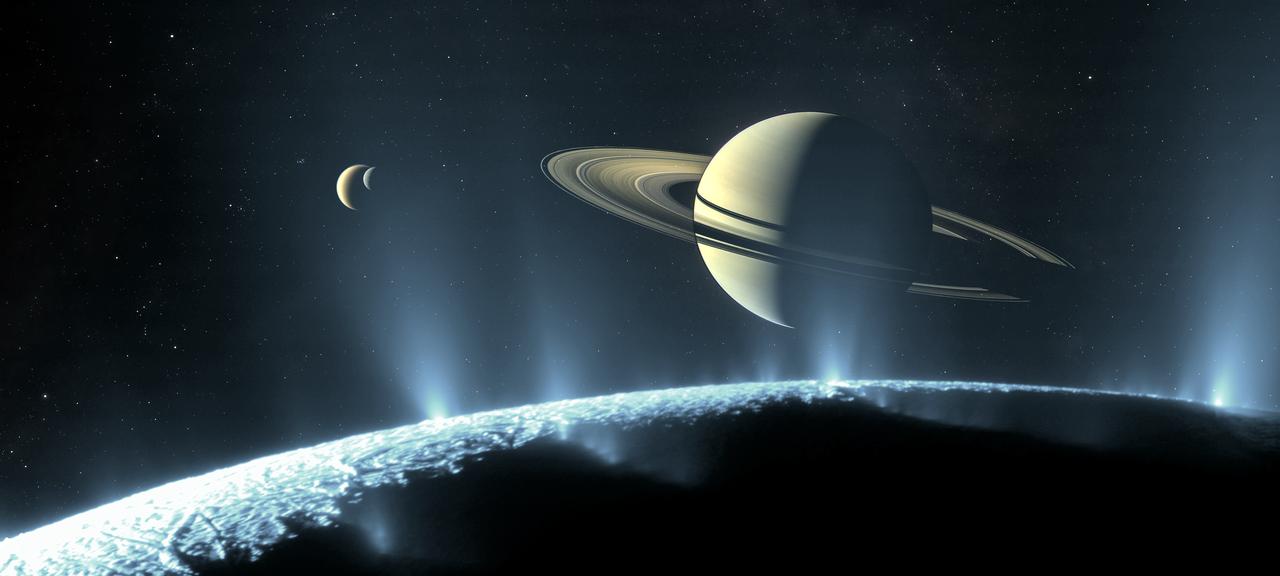
Saturn has long inspired astronomers, from Galileo’s first glimpse of its rings in 1610 to the last pictures taken by the Cassini spacecraft as it descended toward the planet’s atmosphere in 2017. But after four centuries of observing Saturn with telescopes, robotic flybys and orbiters, what might it look like to visit in person and witness the jewel of the solar system rising above one of its many natural satellites? Here we imagine the scene. Gazing over the south pole of the small moon Enceladus, geysers burst forth from cracks in the ice, scattering sunlight and forming a luminous veil around Saturn. In the distance, the large moons Rhea (right) and Titan (left) make their rounds of the gas giant’s far side. These bodies were discovered in the 17th century by astronomers Giovanni Domenico Cassini and Christiaan Huygens – the namesakes of the Cassini-Huygens mission, which explored the Saturn system from 2004 to 2017. The wealth of data and imagery returned by Cassini-Huygens vastly improved our understanding of the ringed planet and paved the way for future exploration.
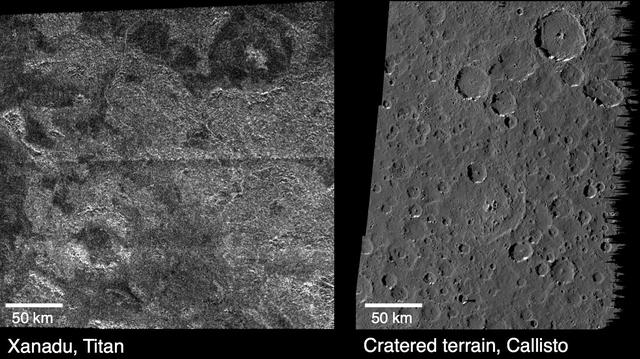
These images compare surface features observed by NASA Cassini spacecraft at the Xanadu region on Saturn moon Titan left, and features observed by NASA Galileo spacecraft on Jupiter cratered moon Callisto right.

Two tall volcanic plumes and the rings of red material they have deposited onto surrounding surface areas appear in images taken of Jupiter moon Io by NASA Galileo and Cassini spacecraft in late December 2000 and early January 2001.
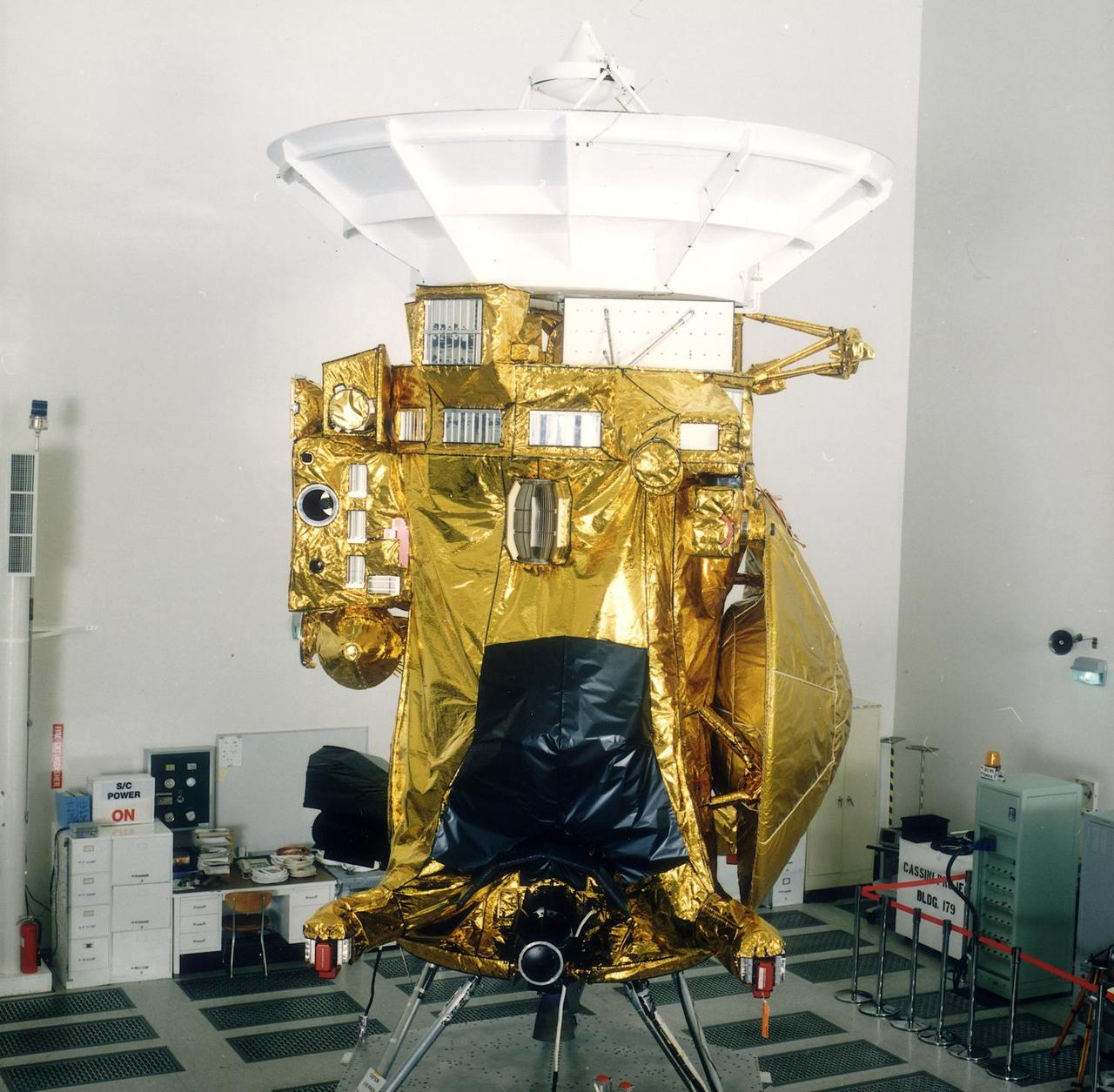
On October of 1997, a two-story-tall robotic spacecraft will begin a journey of many years to reach and explore the exciting realm of Saturn, the most distant planet that can easily be seen by the unaided human eye. In addition to Saturn's interesting atmosphere and interior, its vast system contains the most spectacular of the four planetary ring systems, numerous icy satellites with a variety of unique surface features. A huge magnetosphere teeming with particles that interact with the rings and moons, and the intriguing moon Titan, which is slightly larger than the planet Mercury, and whose hazy atmosphere is denser than that of Earth, make Saturn a fascinating planet to study. The Cassini mission is an international venture involving NASA, the European Space Agency (ESA), the Italian Space Agency (ASI), and several separate European academic and industrial partners. The mission is managed for NASA by JPL. The spacecraft will carry a sophisticated complement of scientific sensors to support 27 different investigations to probe the mysteries of the Saturn system. The large spacecraft will consist of an orbiter and ESA's Huygens Titan probe. The orbiter mass at launch will be nearly 5300 kg, over half of which is propellant for trajectory control. The mass of the Titan probe (2.7 m diameter) is roughly 350 kg. The mission is named in honor of the seventeenth-century, French-Italian astronomer Jean Dominique Cassini, who discovered the prominent gap in Saturn's main rings, as well as the icy moons Iapetus, Rhea, Dione, and Tethys. The ESA Titan probe is named in honor of the exceptional Dutch scientist Christiaan Huygens, who discovered Titan in 1655, followed in 1659 by his announcement that the strange Saturn "moons" seen by Galileo in 1610 were actually a ring system surrounding the planet. Huygens was also famous for his invention of the pendulum clock, the first accurate timekeeping device. http://photojournal.jpl.nasa.gov/catalog/PIA04603