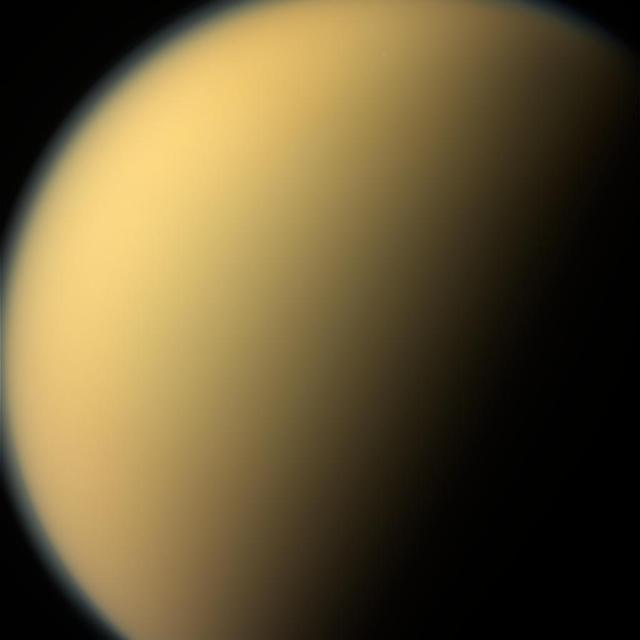
As it glanced around the Saturn system one final time, NASA's Cassini spacecraft captured this view of the planet's giant moon Titan. Interest in mysterious Titan was a major motivating factor to return to Saturn with Cassini-Huygens following the Voyager mission flybys of the early 1980s. Cassini and its Huygens probe, supplied by European Space Agency, revealed the moon to be every bit as fascinating as scientists had hoped. These views were obtained by Cassini's narrow-angle camera on Sept. 13, 2017. They are among the last images Cassini sent back to Earth. This natural color view, made from images taken using red, green and blue spectral filters, shows Titan much as Voyager saw it -- a mostly featureless golden orb, swathed in a dense atmospheric haze. An enhanced-color view (Figure 1) adds to this color a separate view taken using a spectral filter (centered at 938 nanometers) that can partially see through the haze. The views were acquired at a distance of 481,000 miles (774,000 kilometers) from Titan. The image scale is about 3 miles (5 kilometers) per pixel. https://photojournal.jpl.nasa.gov/catalog/PIA21890
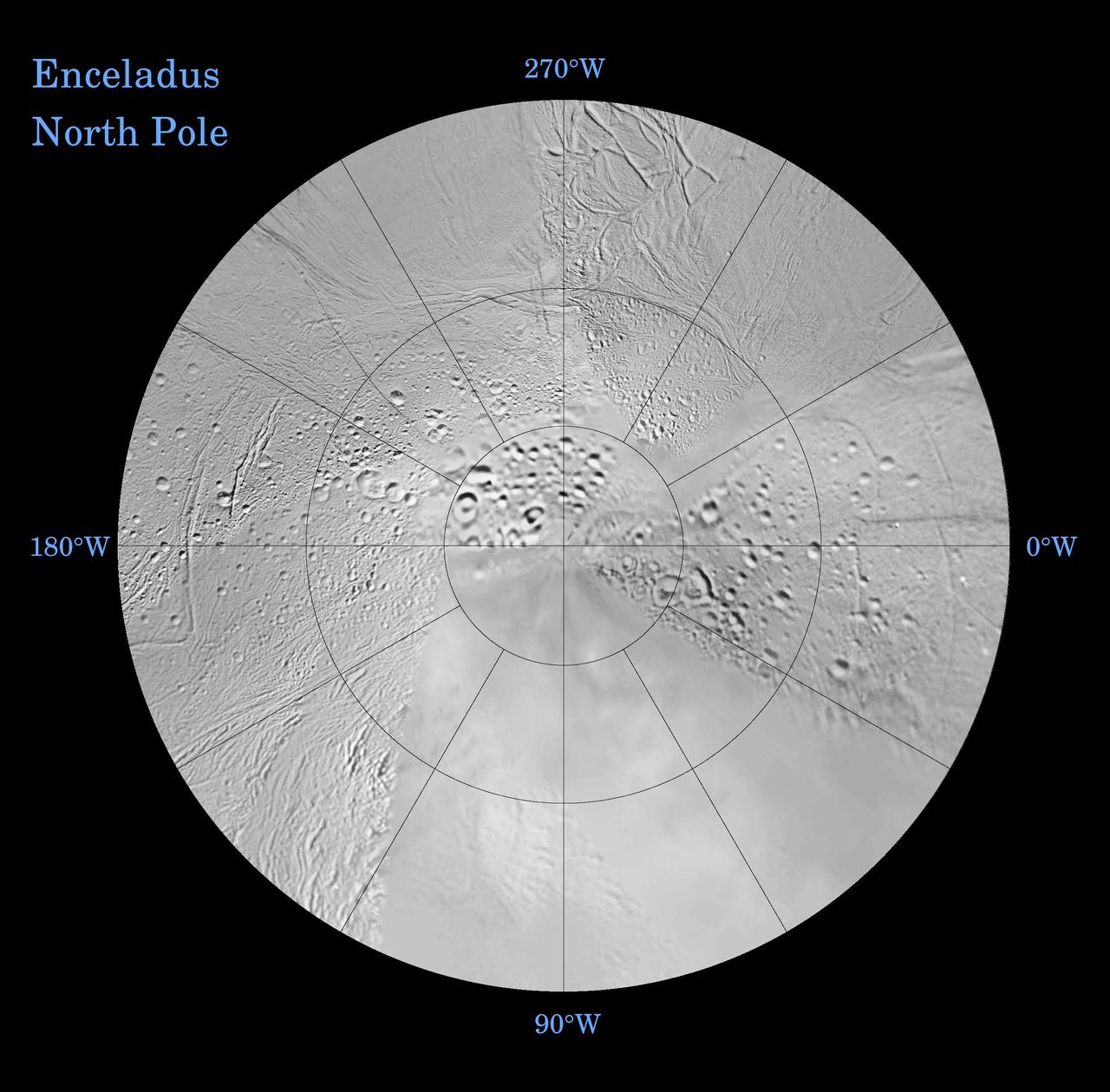
Enceladus: North and South Northern Polar Projection
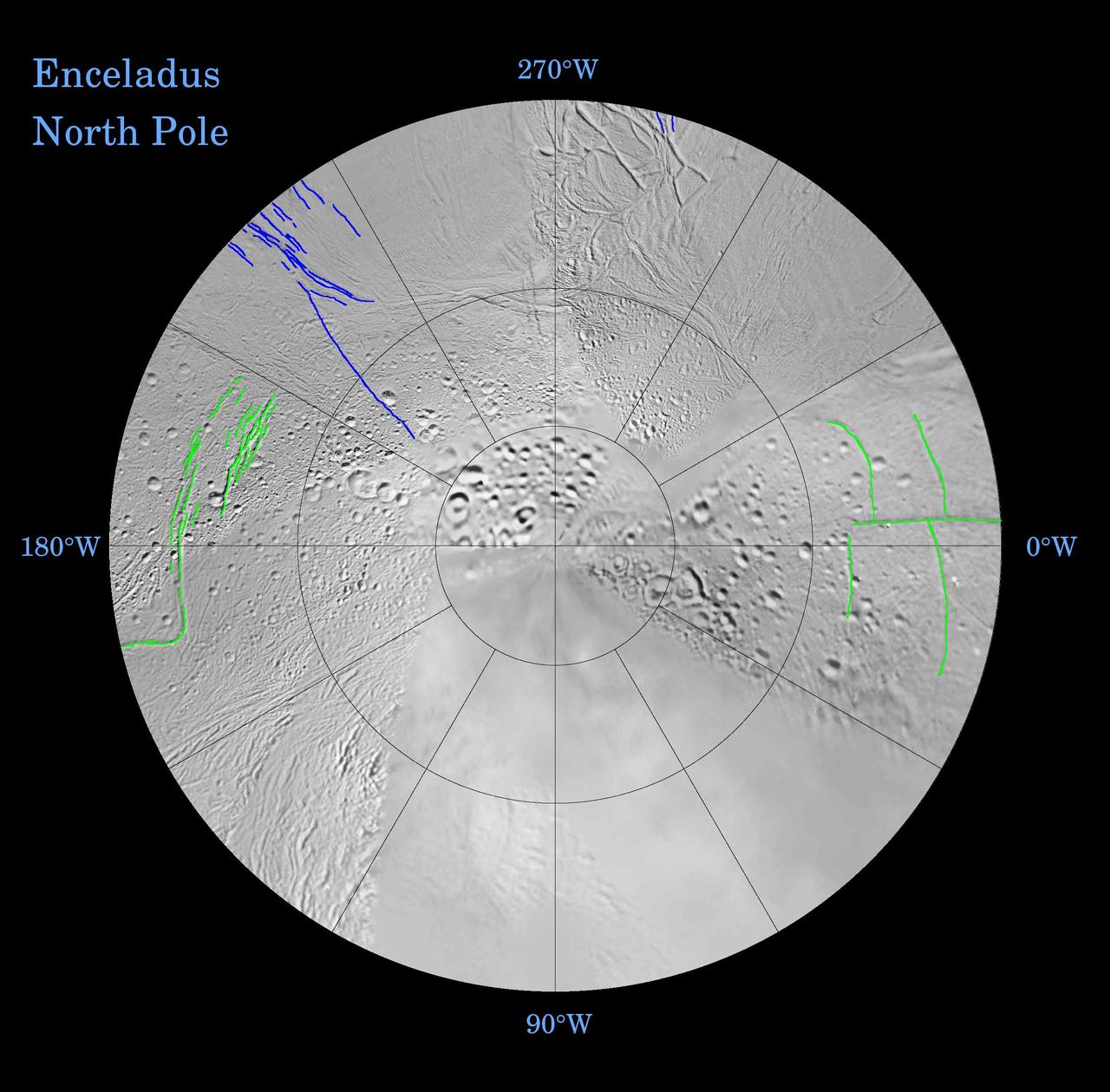
Enceladus: Global Patterns of Fracture Northern Polar Projection
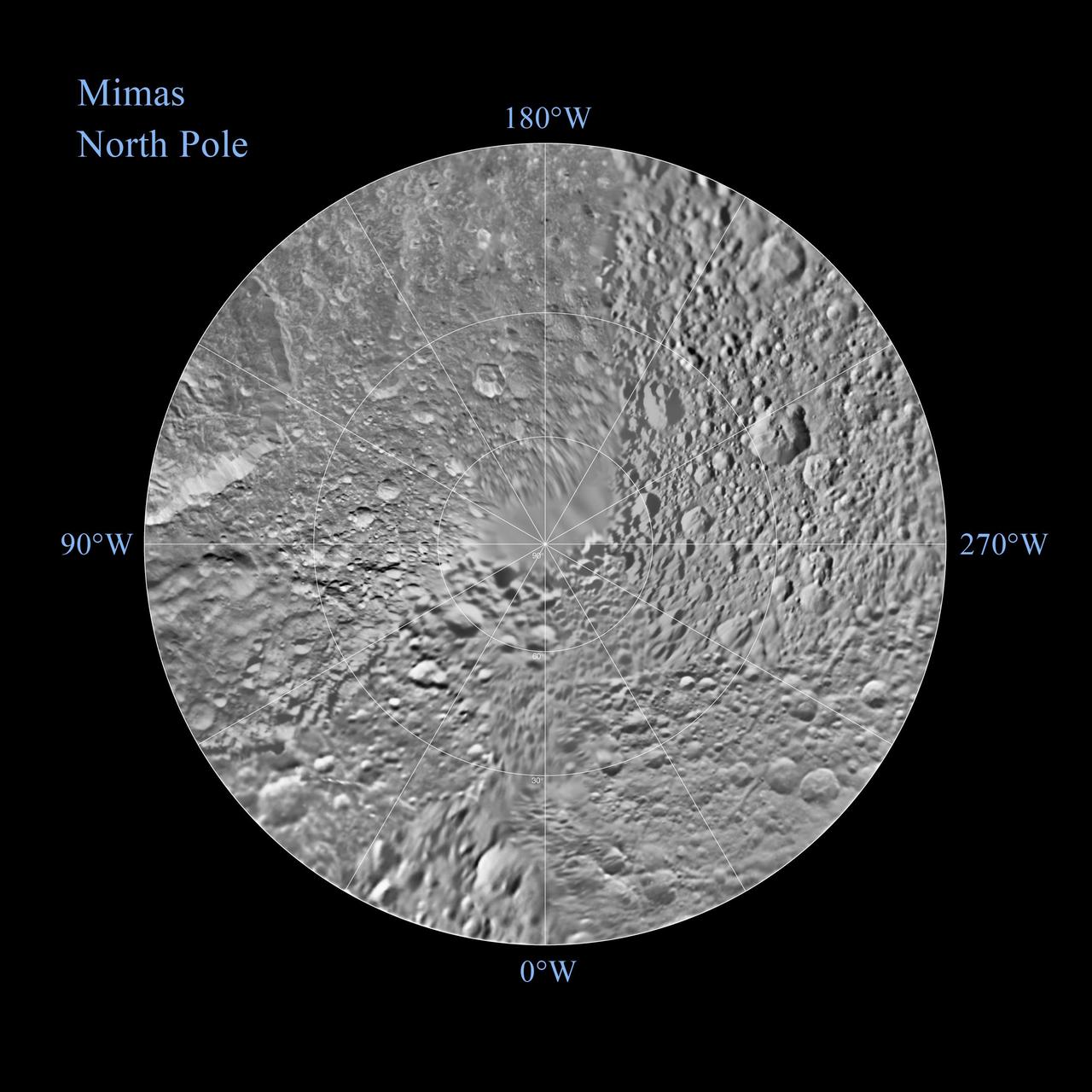
The northern hemisphere of Saturn moon Mimas is seen in these polar stereographic maps, mosaicked from the best-available NASA Cassini and Voyager images.
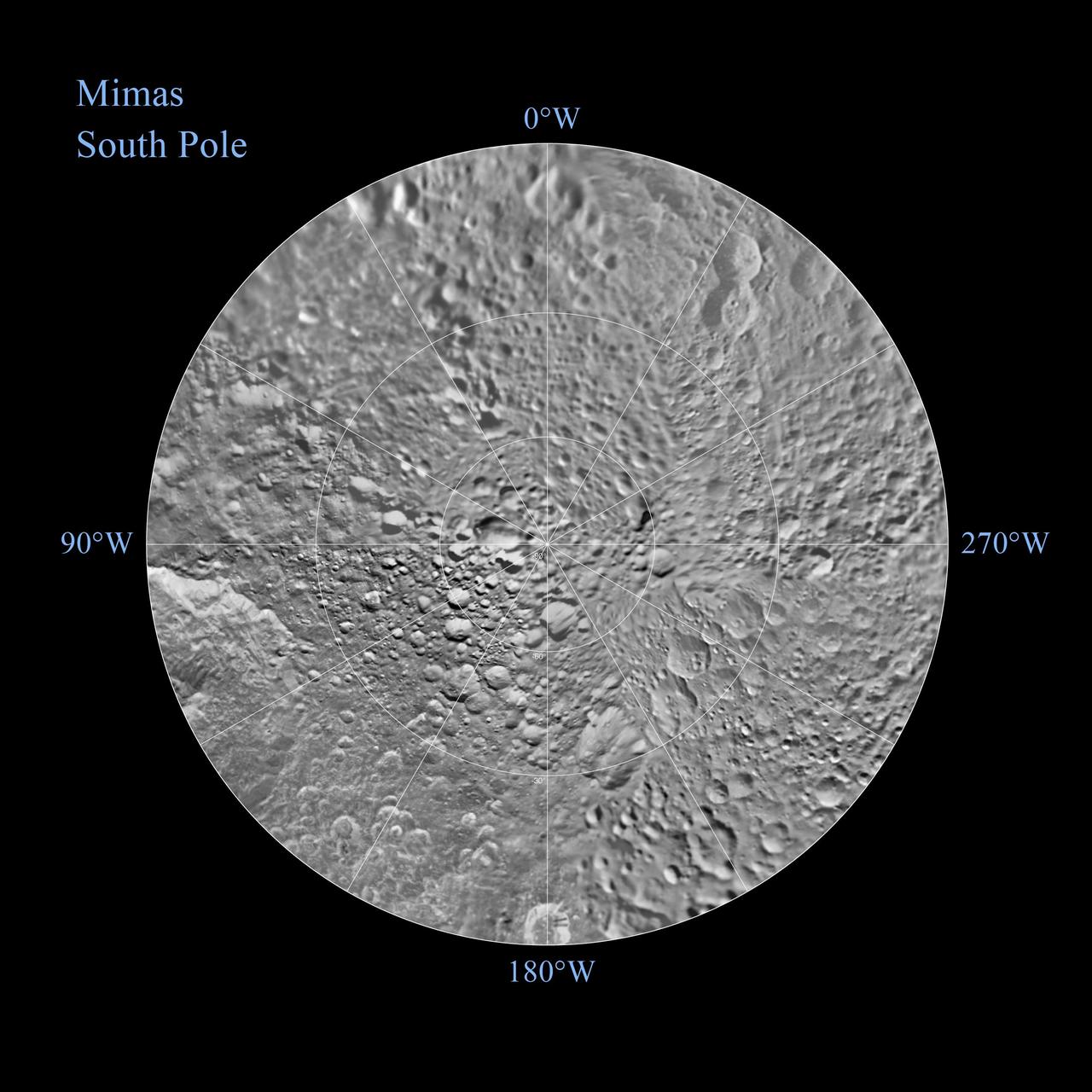
The southern hemisphere of Saturn moon Mimas is seen in these polar stereographic maps, mosaicked from the best-available NASA Cassini and Voyager images.
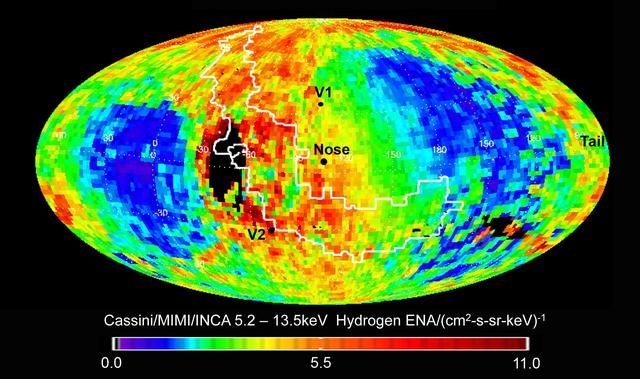
Data from NASA Cassini spacecraft have enabled scientists to create this map of the heliosphere, the bubble of charged particles around our sun. Charged particles stream out from our sun in a phenomenon known as solar wind.
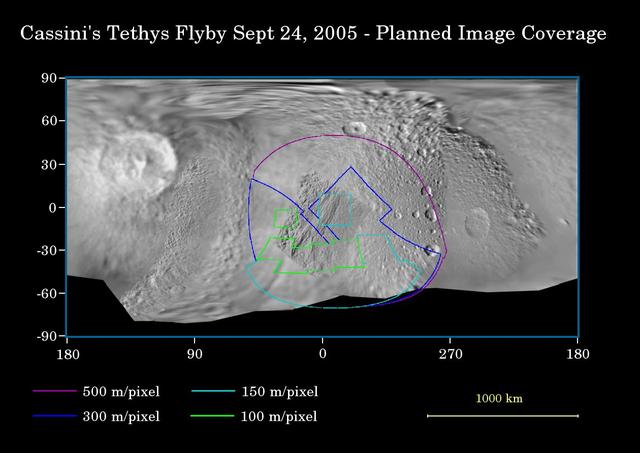
Cassini Close Look at Tethys
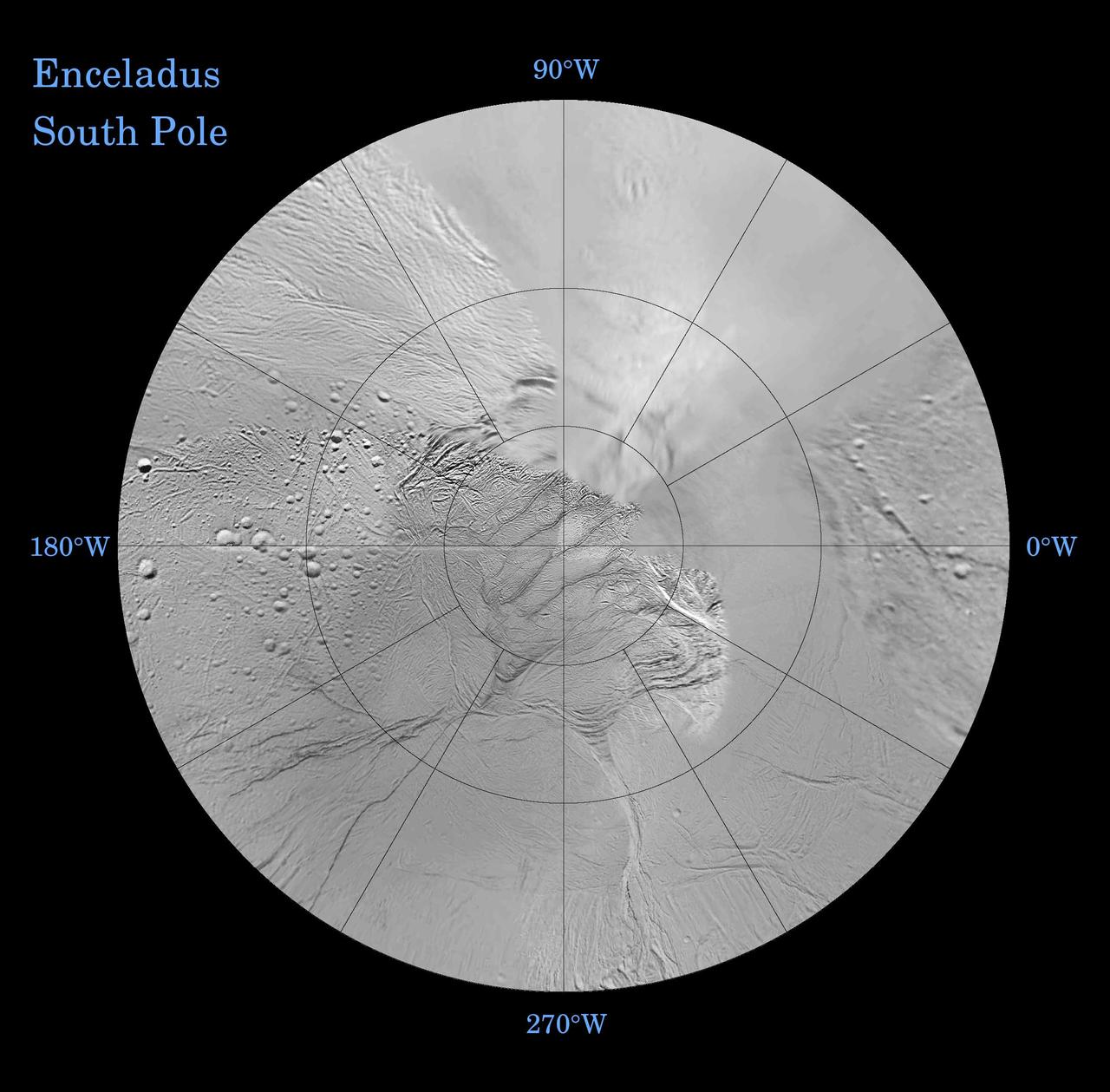
Enceladus: North and South Southern Polar Projection
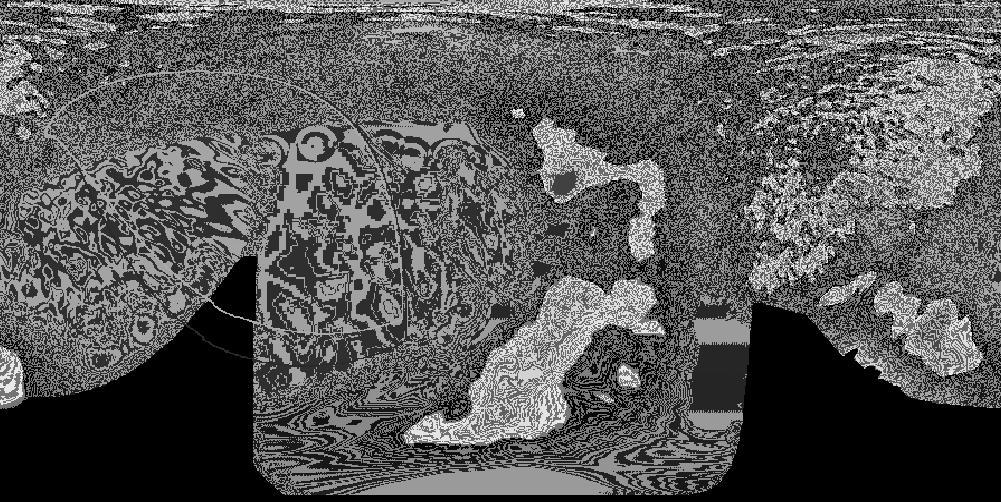
Iapetus New Year Flyby
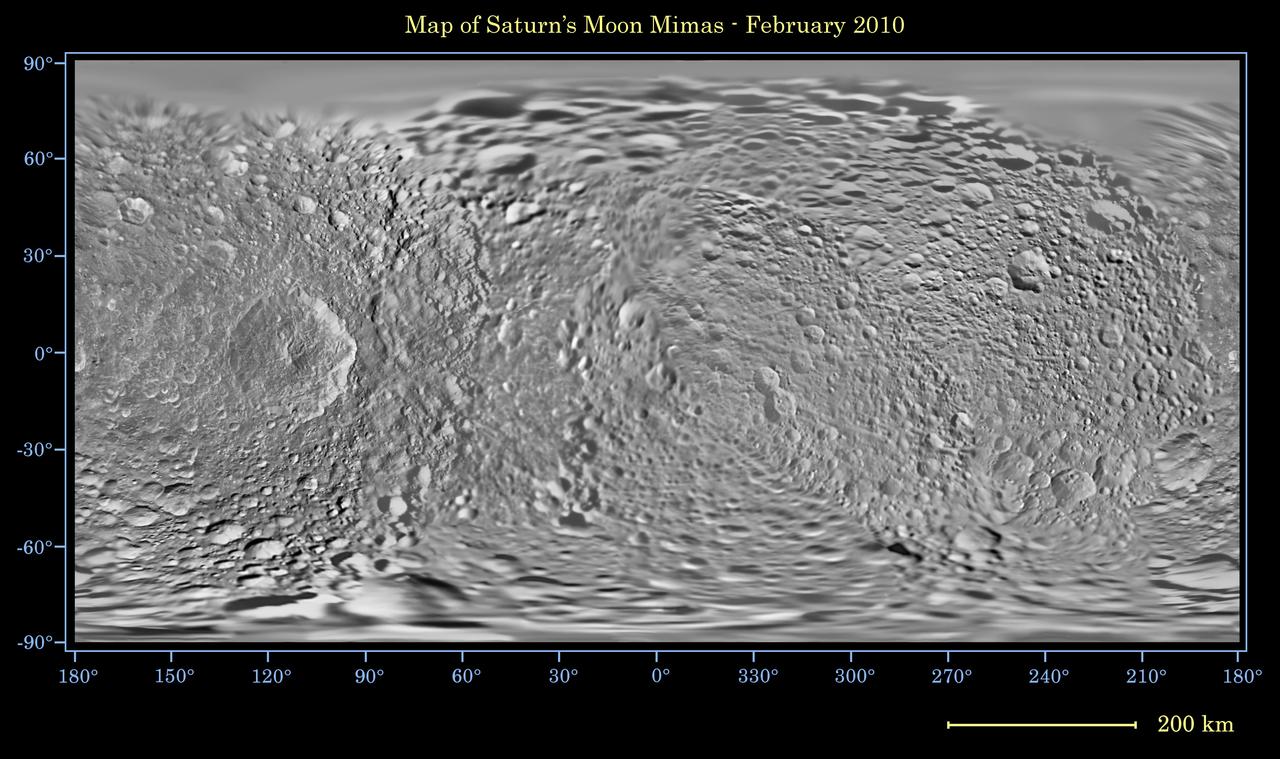
This global map of Saturn moon Mimas was created using images taken during NASA Cassini spacecraft flybys, with NASA Voyager images filling in the gaps in Cassini coverage.
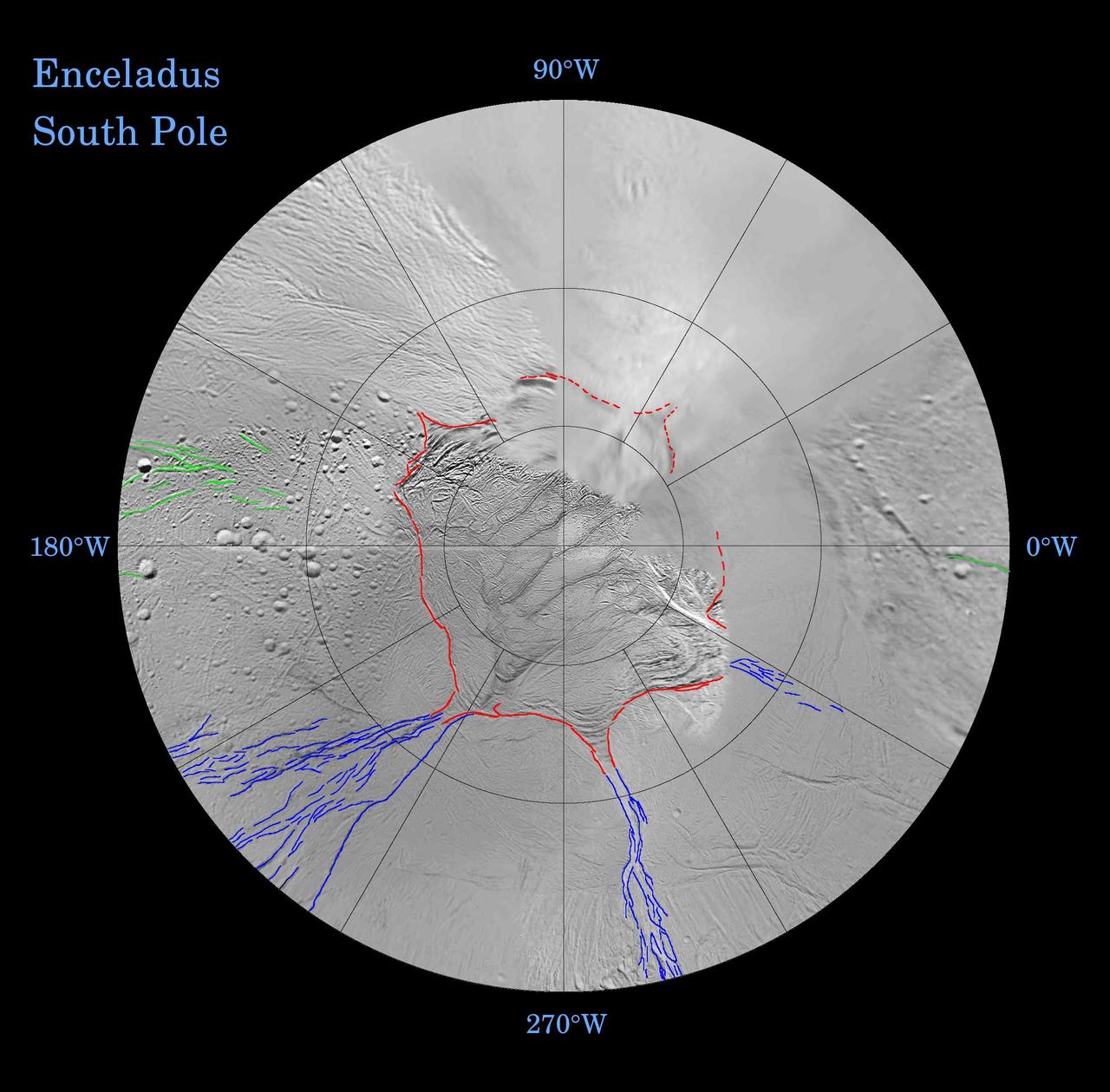
Enceladus: Global Patterns of Fracture Southern Polar Projection
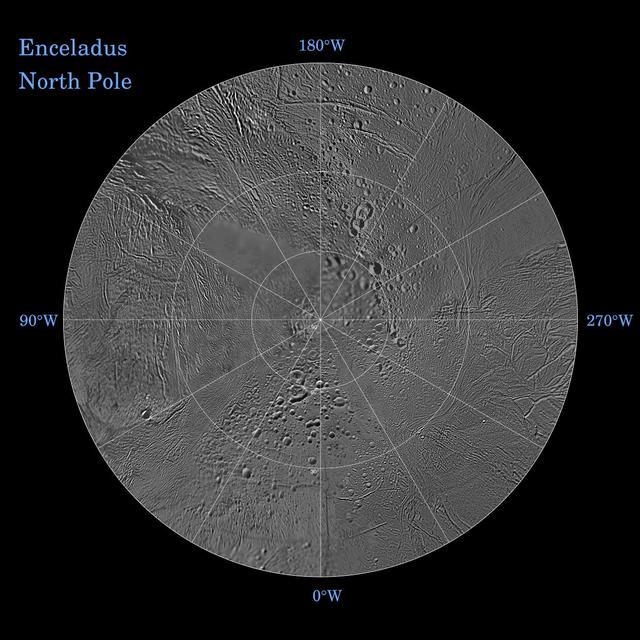
Enceladus North Polar Map - October 2009
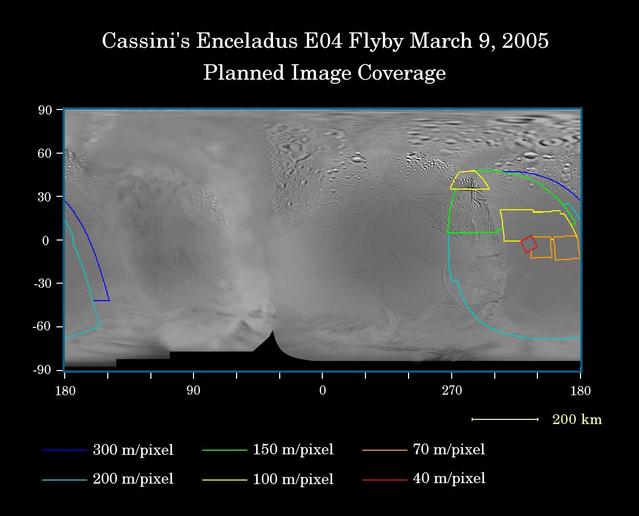
Cassini Closest Enceladus Flyby
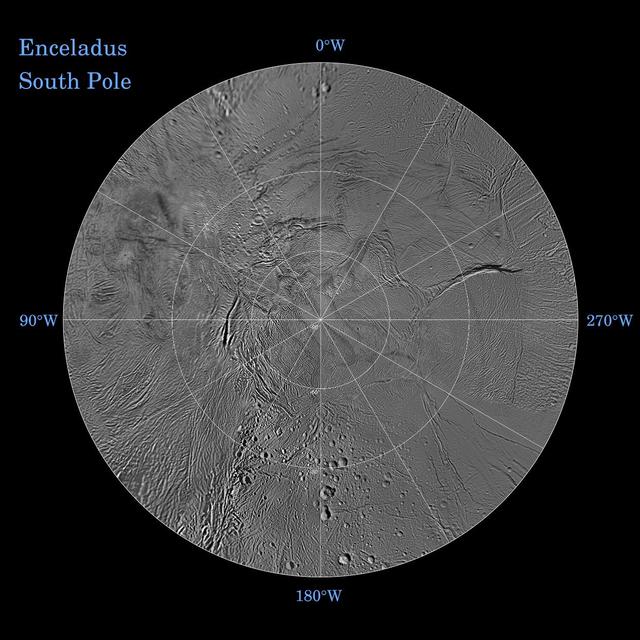
Enceladus South Polar Map - October 2009

D Ring Revelations Inset image
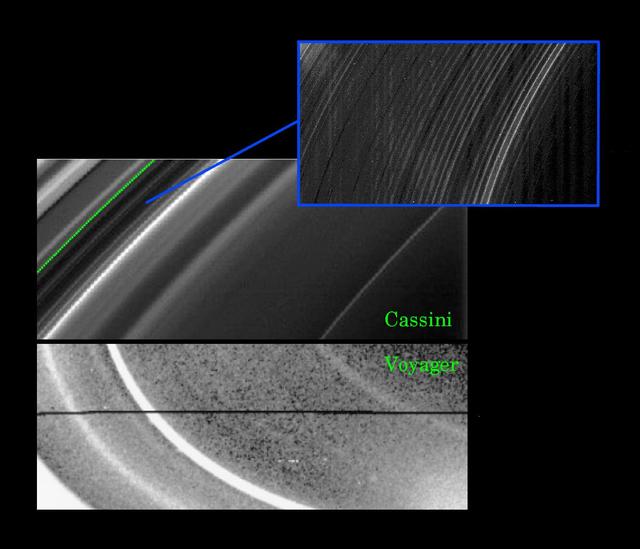
D Ring Revelations

Saturn appears serene and majestic in the first color composite made of images taken by NASA's Cassini spacecraft on its approach to the ringed planet, with arrival still 20 months away. The planet was 285 million kilometers (177 million miles) away from the spacecraft, nearly twice the distance between the Sun and Earth, when Cassini took images of it in various filters as an engineering test on Oct. 21, 2002. It is summer in Saturn's southern hemisphere. The Sun is a lofty 27 degrees below the equator and casts a semi-circular shadow of the planet on the rings. The shadow extends partway across the rings, leaving the outer A ring in sunlight. The last Saturn-bound spacecraft, Voyager 2, arrived in early northern spring. Many features seen in Voyager images -- spoke-like markings on the rings, clouds and eddies in the hazy atmosphere, ring-shepherding moons -- are not yet visible to Cassini. Titan, Saturn's largest moon, appears in the upper left. It is the only moon resolved from this distance. This composite uses a threefold enhancement in the brightness of Titan relative to the brightness of Saturn. Titan is a major attraction for scientists of the Cassini-Huygens mission. They will study its haze-enshrouded atmosphere and peer down, with special instrumentation, to its surface to look for evidence of organic processes similar to those that might have occurred on the early Earth, prior to the emergence of life. http://photojournal.jpl.nasa.gov/catalog/PIA02884
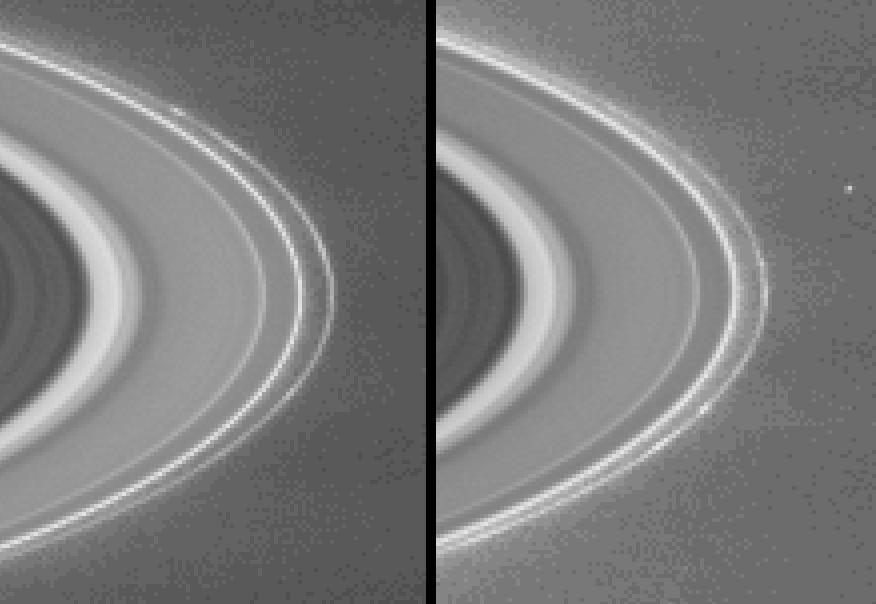
Scientists have only a rough idea of the lifetime of clumps in Saturn's rings - a mystery that Cassini may help answer. The latest images taken by the Cassini-Huygens spacecraft show clumps seemingly embedded within Saturn's narrow, outermost F ring. The narrow angle camera took the images on Feb. 23, 2004, from a distance of 62.9 million kilometers (39 million miles). The two images taken nearly two hours apart show these clumps as they revolve about the planet. The small dot at center right in the second image is one of Saturn's small moons, Janus, which is 181 kilometers, (112 miles) across. Like all particles in Saturn's ring system, these clump features orbit the planet in the same direction in which the planet rotates. This direction is clockwise as seen from Cassini's southern vantage point below the ring plane. Two clumps in particular, one of them extended, is visible in the upper part of the F ring in the image on the left, and in the lower part of the ring in the image on the right. Other knot-like irregularities in the ring's brightness are visible in the image on the right. The core of the F ring is about 50 kilometers (31miles) wide, and from Cassini's current distance, is not fully visible. The imaging team enhanced the contrast of the images and magnified them to aid visibility of the F ring and the clump features. The camera took the images with the green filter, which is centered at 568 nanometers. The image scale is 377 kilometers (234 miles) per pixel. NASA's two Voyager spacecraft that flew past Saturn in 1980 and 1981 were the first to see these clumps. The Voyager data suggest that the clumps change very little and can be tracked as they orbit for 30 days or more. No clump survived from the time of the first Voyager flyby to the Voyager 2 flyby nine months later. Scientists are not certain of the cause of these features. Among the theories proposed are meteoroid bombardments and inter-particle collisions in the F ring. http://photojournal.jpl.nasa.gov/catalog/PIA05382
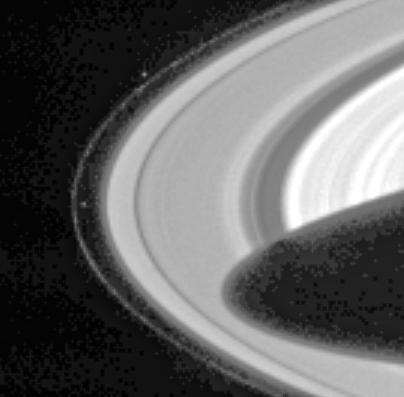
Cassini has sighted Prometheus and Pandora, the two F-ring-shepherding moons whose unpredictable orbits both fascinate scientists and wreak havoc on the F ring. Prometheus (102 kilometers, or 63 miles across) is visible left of center in the image, inside the F ring. Pandora (84 kilometers, or 52 miles across) appears above center, outside the ring. The dark shadow cast by the planet stretches more than halfway across the A ring, the outermost main ring. The mottled pattern appearing in the dark regions of the image is 'noise' in the signal recorded by the camera system, which has subsequently been magnified by the image processing. The F ring is a narrow, ribbon-like structure, with a width seen in this geometry equivalent to a few kilometers. The two small, irregularly shaped moons exert a gravitational influence on particles that make up the F ring, confining it and possibly leading to the formation of clumps, strands and other structures observed there. Pandora prevents the F ring from spreading outward and Prometheus prevents it from spreading inward. However, their interaction with the ring is complex and not fully understood. The shepherds are also known to be responsible for many of the observed structures in Saturn's A ring. The moons, which were discovered in images returned by the Voyager 1 spacecraft in 1980, are in chaotic orbits--their orbits can change unpredictably when the moons get very close to each other. This strange behavior was first noticed in ground-based and Hubble Space Telescope observations in 1995, when the rings were seen nearly edge-on from Earth and the usual glare of the rings was reduced, making the satellites more readily visible than usual. The positions of both satellites at that time were different than expected based on Voyager data. One of the goals for the Cassini-Huygens mission is to derive more precise orbits for Prometheus and Pandora. Seeing how their orbits change over the duration of the mission will help to determine their masses, which in turn will help constrain models of their interiors and provide a more complete understanding of their effect on the rings. This narrow angle camera image was snapped through the broadband green spectral filter, centered at 568 nanometers, on March 10, 2004, when the spacecraft was 55.5 million kilometers (34.5 million miles) from the planet. Image scale is approximately 333 kilometers (207 miles) per pixel. Contrast has been greatly enhanced, and the image has been magnified to aid visibility of the moons as well as structure in the rings. http://photojournal.jpl.nasa.gov/catalog/PIA05387