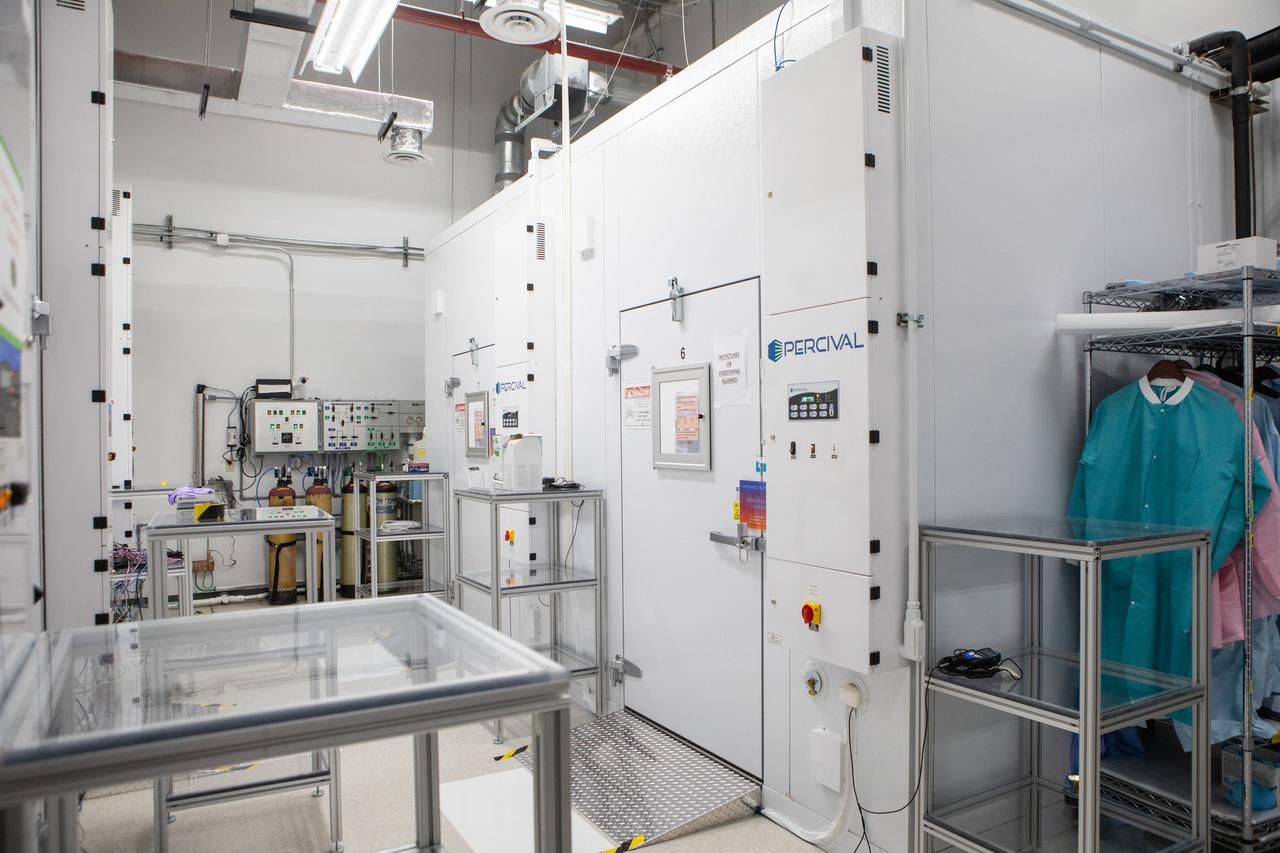
A walk-in experiment chamber for the Center for the Advancement of Science in Space (CASIS) is in view inside a laboratory in the Space Station Processing Facility (SSPF) at NASA's Kennedy Space Center in Florida, on May 16, 2019. The center is celebrating the SSPF’s 25th anniversary. The facility was built to process elements for the International Space Station. Now it is providing support for current and future NASA and commercial provider programs, including Commercial Resupply Services, Artemis 1, sending the first woman and next man to the Moon, and deep space destinations including Mars.
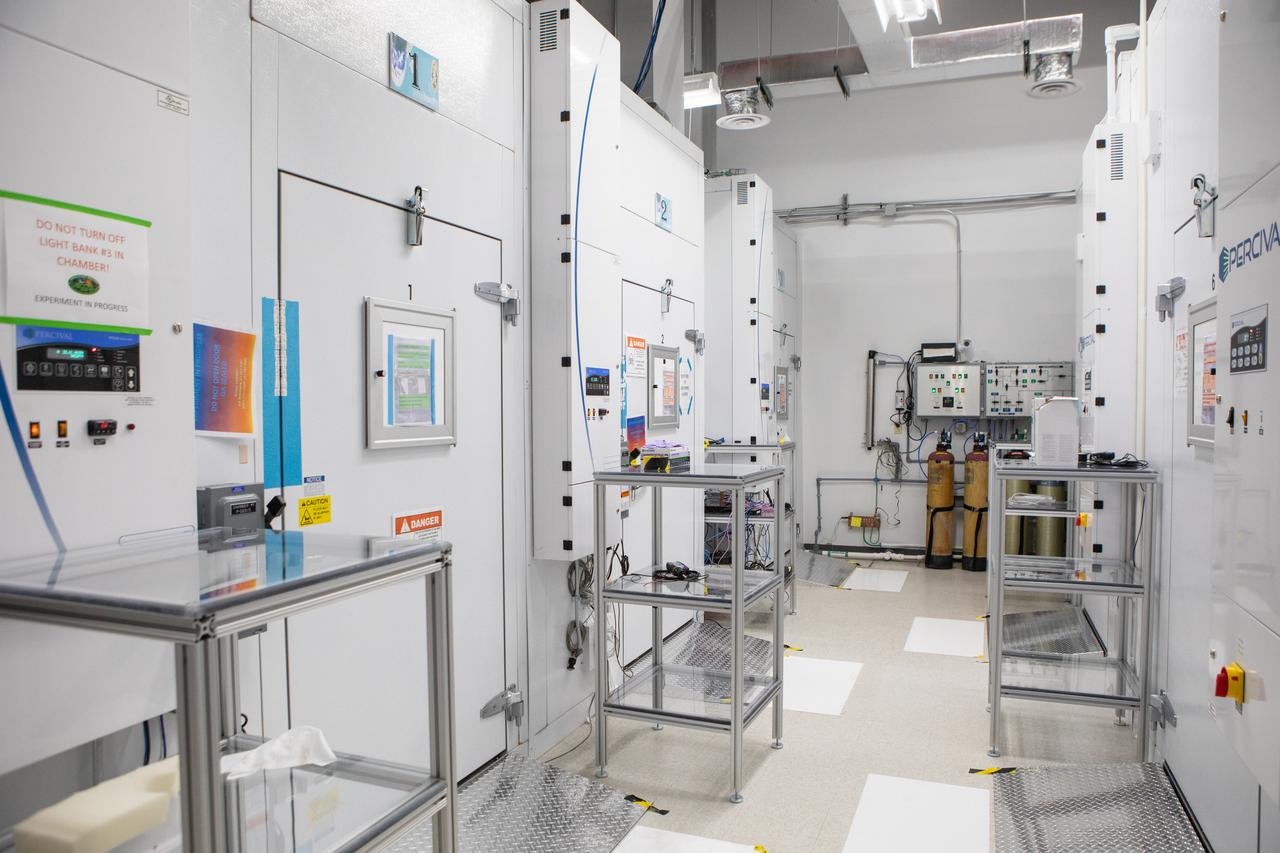
A walk-in experiment chamber for the Center for the Advancement of Science in Space (CASIS) is in view in the foreground inside a laboratory in the Space Station Processing Facility (SSPF) at NASA's Kennedy Space Center in Florida, on May 16, 2019. Further back is an experiment chamber for ground test flight experiments. The center is celebrating the SSPF’s 25th anniversary. The facility was built to process elements for the International Space Station. Now it is providing support for current and future NASA and commercial provider programs, including Commercial Resupply Services, Artemis 1, sending the first woman and next man to the Moon, and deep space destinations including Mars.

Science Crew Operations and Utility Testbed (SCOUT) Rover testing with Advanced Extravehicular Activity (EVA) Suit on Johnson Space Center (JSC) Fields near Avenue B. View of two technicians with the SCOUT Rover during testing.
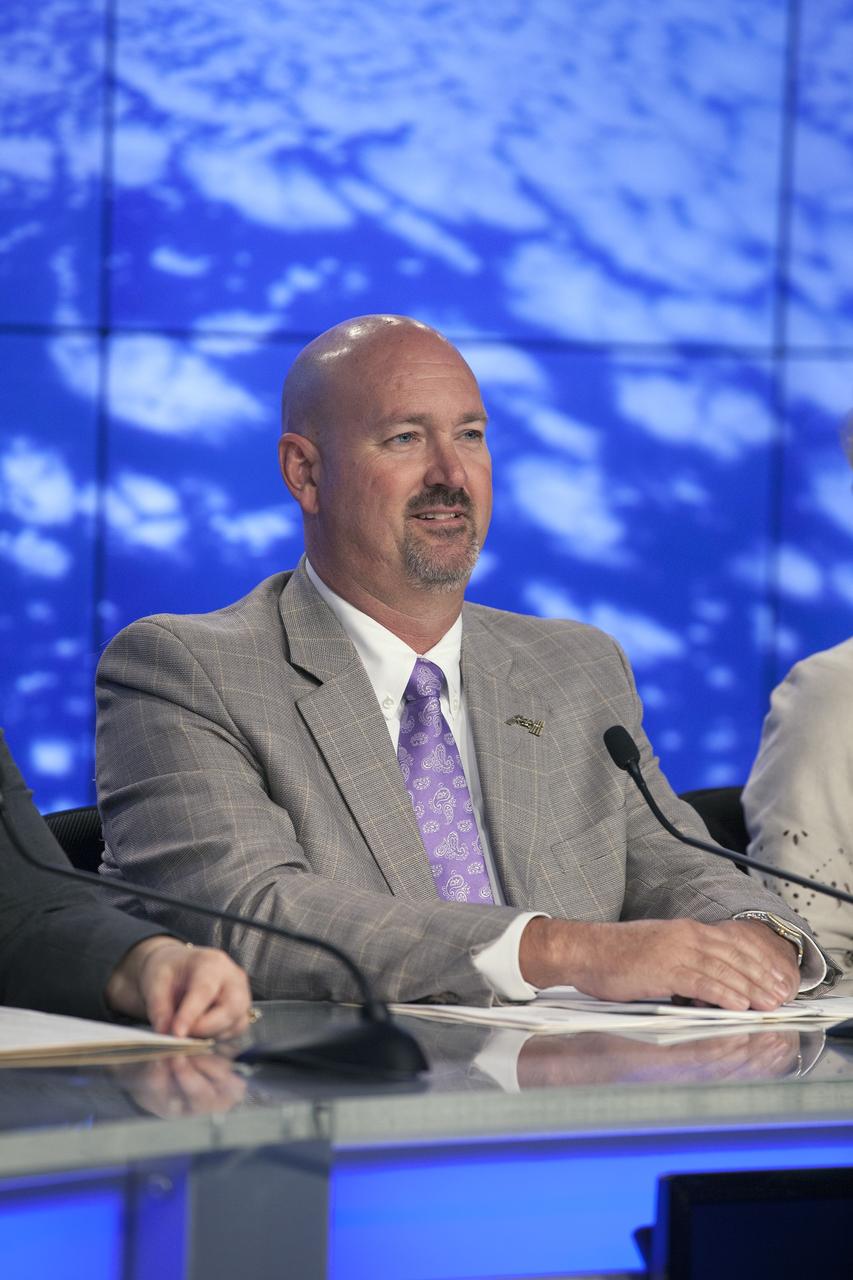
CAPE CANAVERAL, Fla. -- In the Kennedy Space Center’s Press Site auditorium, agency and industry leaders spoke to members of the news media on International Space Station research and technology developments. Participants included Kenneth Shields, director of operations and education for the Center for the Advancement of Science in Space. Photo credit: NASA/ Kim Shiflett
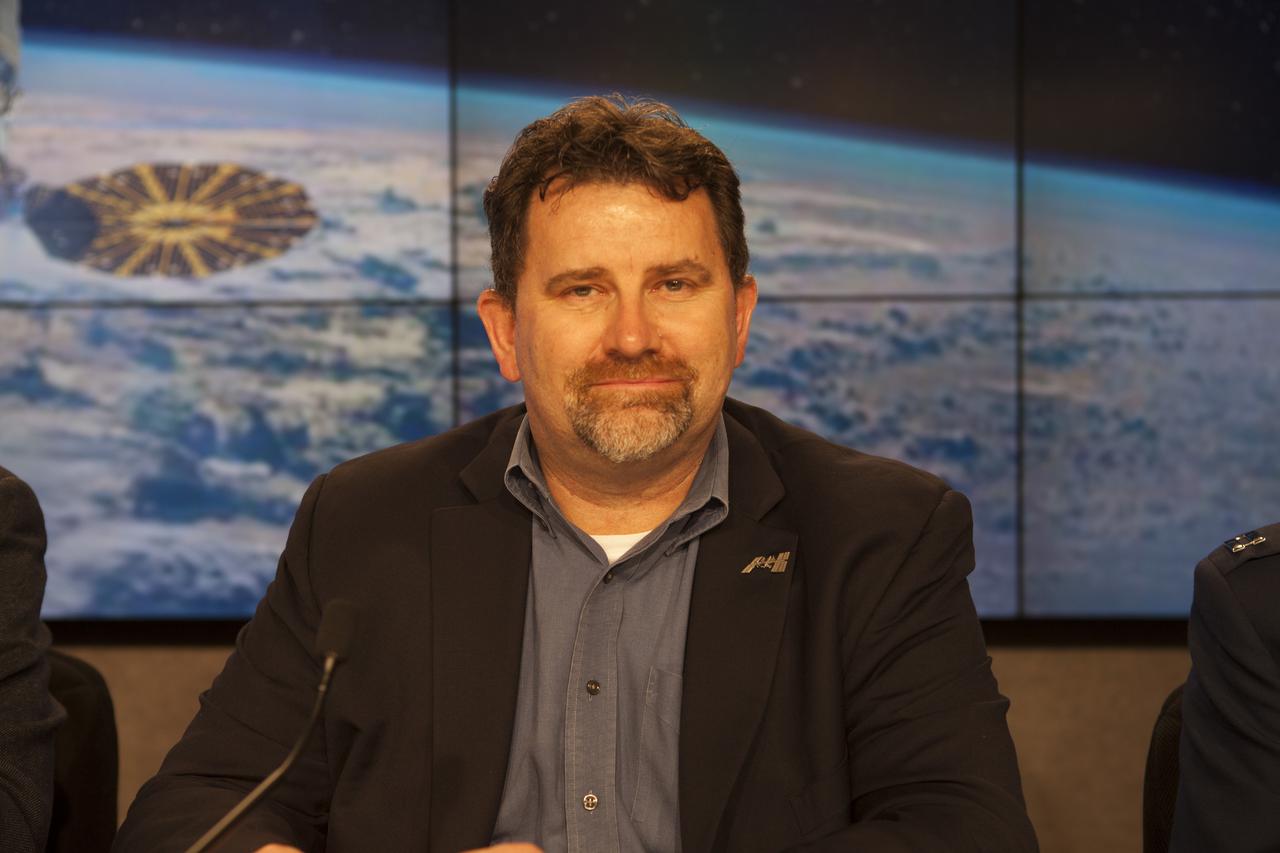
In the Kennedy Space Center’s Press Site auditorium, Dr. Michael Roberts deputy chief scientist for the Center for the Advancement for Science in Space, or CASIS, speaks to members of the media at a prelaunch news conference for Orbital ATK CRS-6 commercial resupply services mission to the International Space Station.
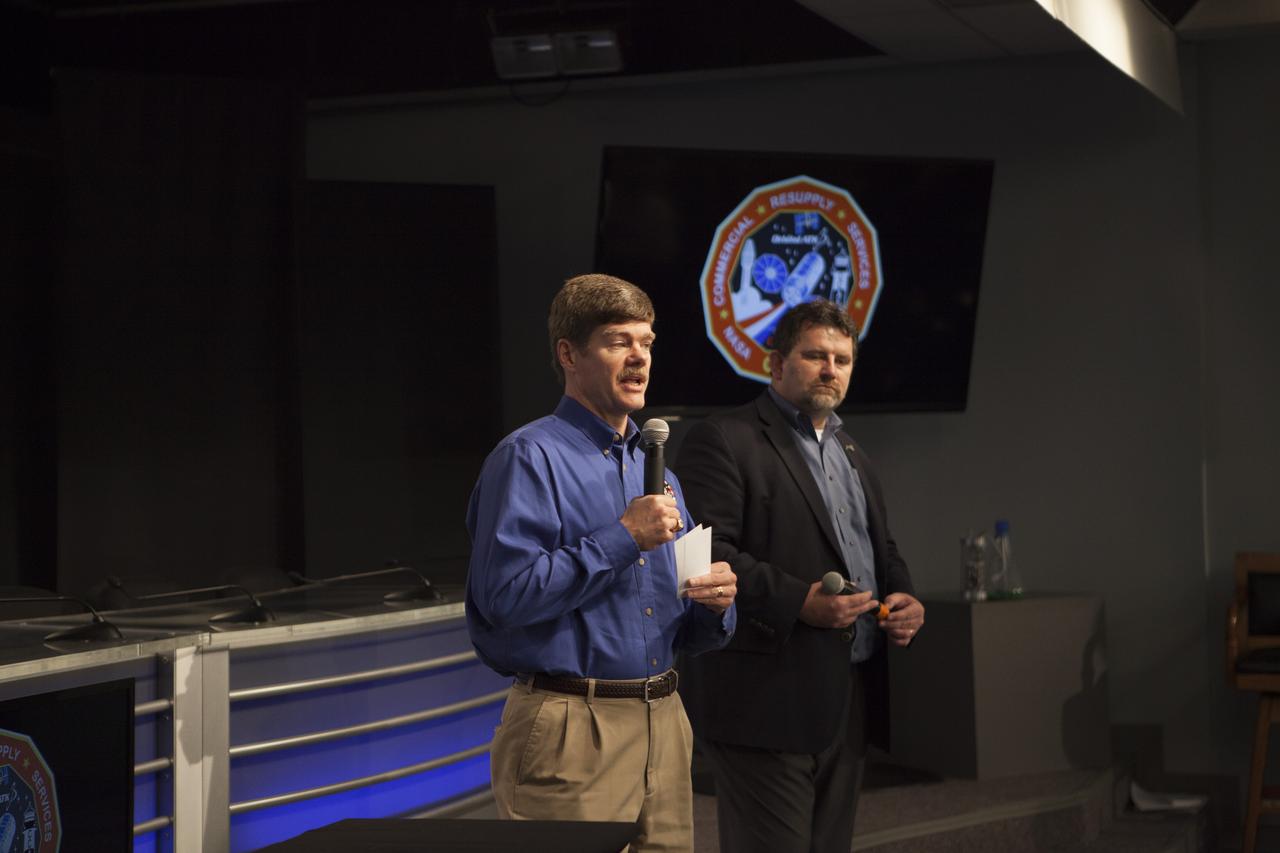
In the Kennedy Space Center’s Press Site auditorium, members of the media participate in a briefing on science research and technology work planned for the International Space Station, or ISS. NASA is preparing for the launch of a Cygnus spacecraft on the Orbital ATK CRS-6 commercial resupply services mission to the ISS. From left are: Pete Hasbrook, NASA associate program scientist for the ISS Program at the Johnson Space Center in Houston, and Dr. Michael Roberts, deputy chief scientist for the Center for the Advancement for Science in Space, or CASIS.
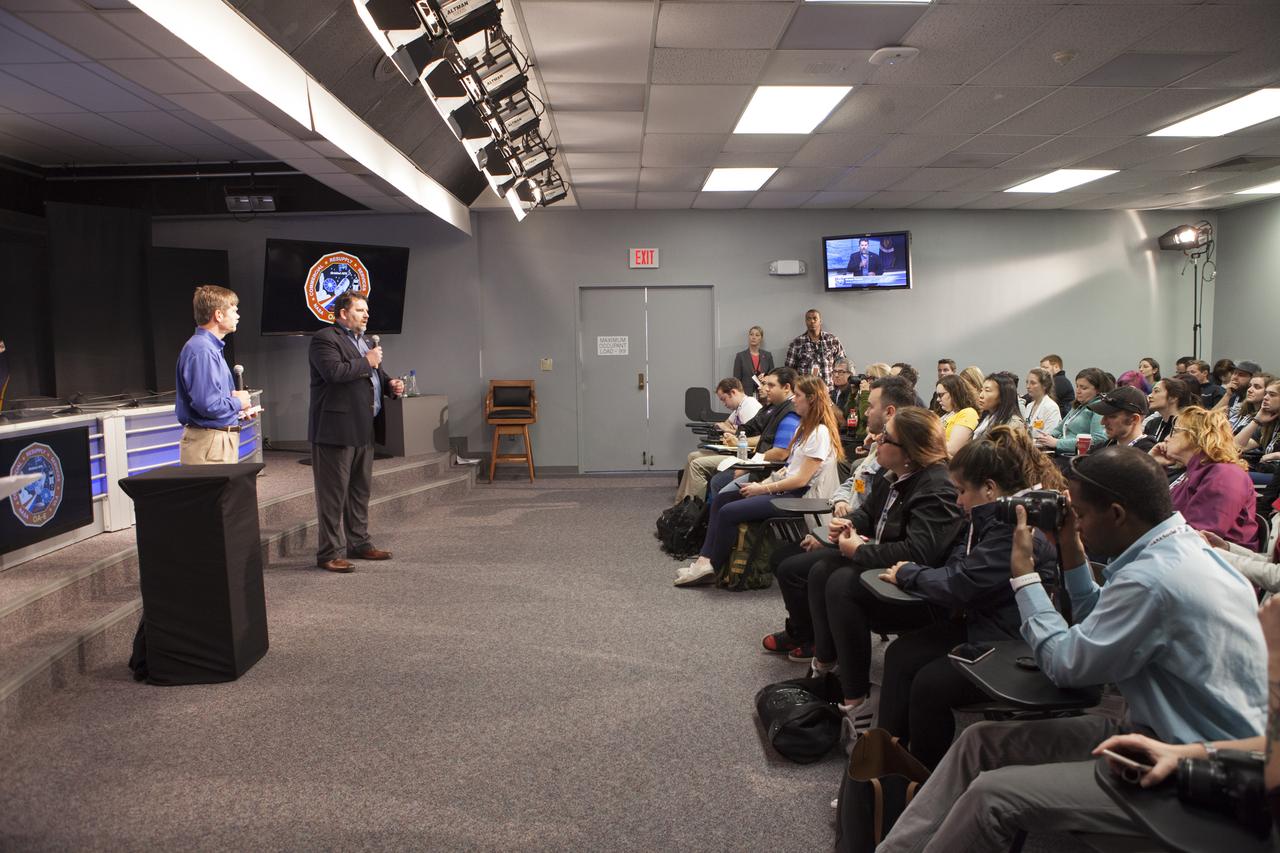
In the Kennedy Space Center’s Press Site auditorium, members of the media participate in a briefing on science research and technology work planned for the International Space Station, or ISS. NASA is preparing for the launch of a Cygnus spacecraft on the Orbital ATK CRS-6 commercial resupply services mission to the ISS. From left are: Pete Hasbrook, NASA associate program scientist for the ISS Program at the Johnson Space Center in Houston, and Dr. Michael Roberts, deputy chief scientist for the Center for the Advancement for Science in Space, or CASIS.
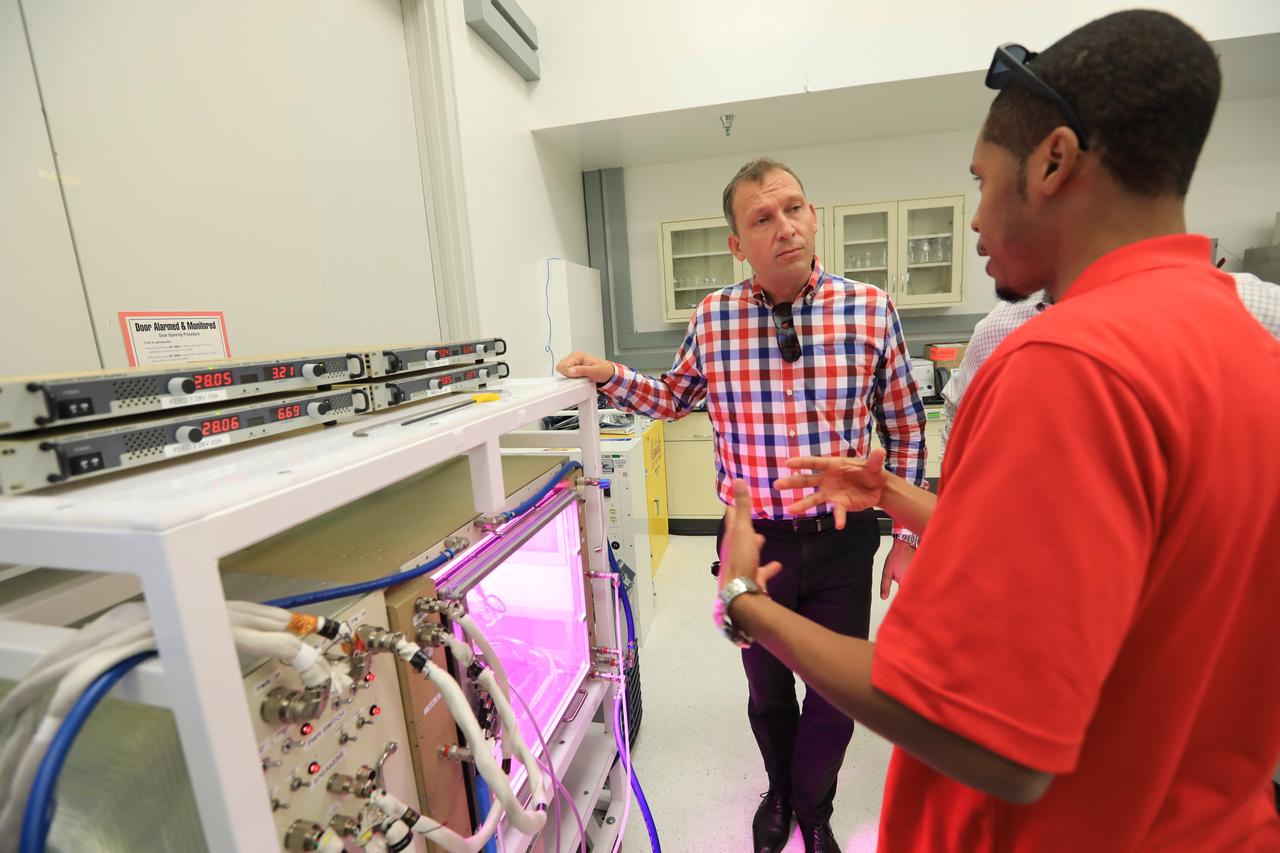
While touring the Space Station Processing Facility at NASA's Kennedy Space Center in Florida, Thomas Zurbuchen, in plaid shirt, NASA's associate administrator for the Science Mission Directorate, learns about the advanced plant habitat used to grow plants in space.
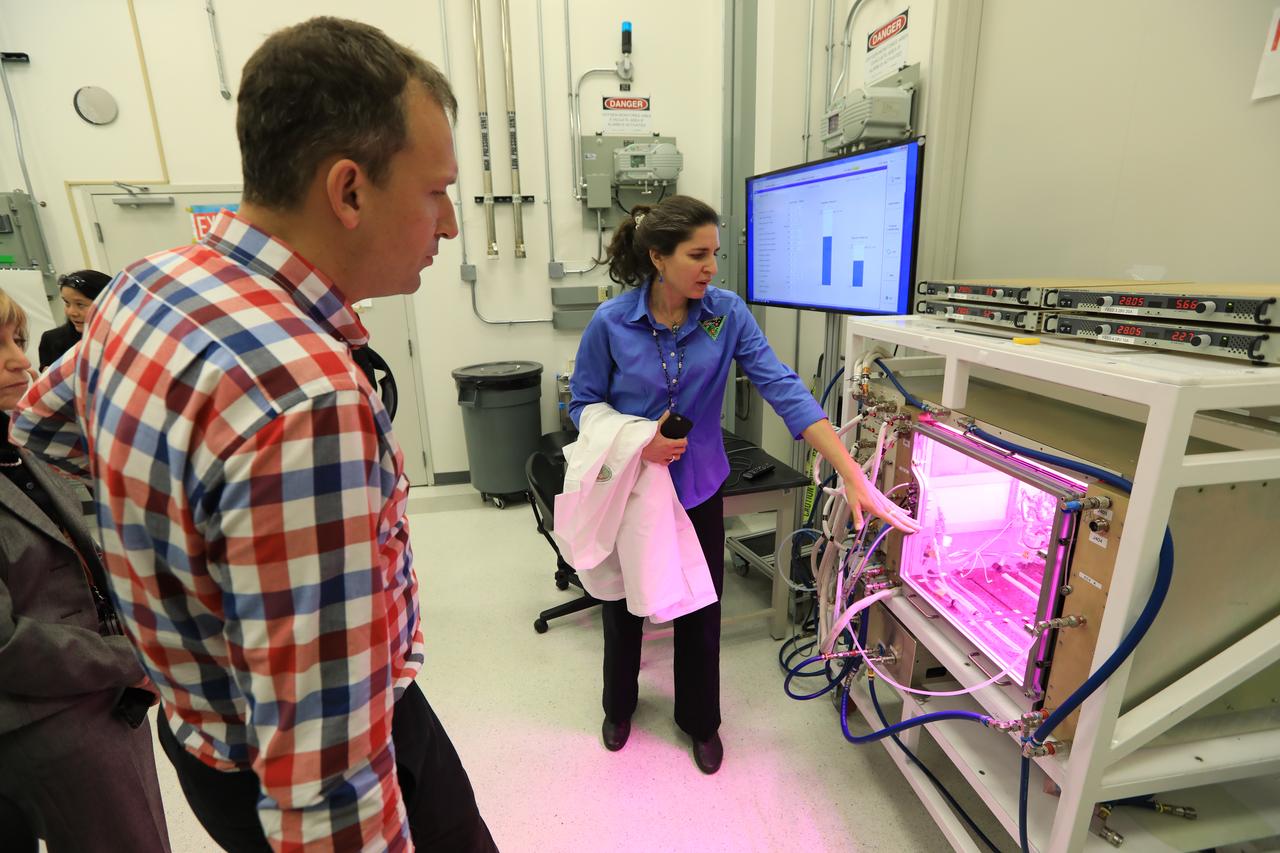
While touring the Space Station Processing Facility at NASA's Kennedy Space Center in Florida, Thomas Zurbuchen, in plaid shirt, NASA's associate administrator for the Science Mission Directorate, learns about the advanced plant habitat used to grow plants in space.
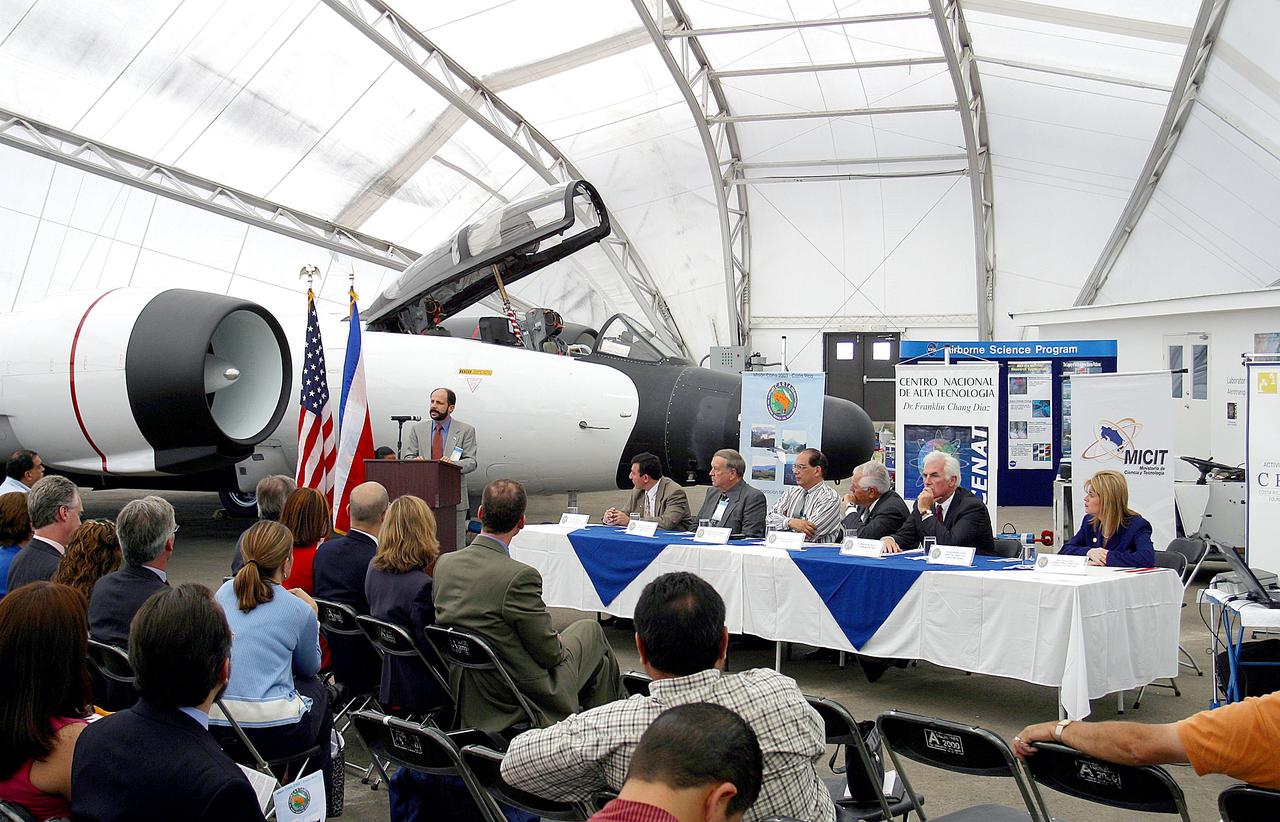
KENNEDY SPACE CENTER, FLA. - At the airport in San Jose, Costa Rica, the NASA hangar is dedicated. The speaker is Hermann Faith, executive director, Costa Rica-USA (CRUSA) Foundation. At the table are (from left) Dr. Jorge Andres Diaz, head scientiest CARTA mission; Gary Shelton, NASA deployment manager; Dr. Pedro Leon, general director, National Center for Advanced Technology (CENAT); Dr. Rogelio Pardo, minister of science and tchnology; John Danilovioch, U.S. ambassador to Costa Rica; and Lic. Vilma Lopez, subdirector, Civil Aviation (DGAC). NASA KSC has been testing its Aircraft-based Volcanic Emission Mass Spectrometer (AVEMS) in flights over the Turrialba volcano and in the crater, sampling and analyzing fresh volcanic gases in their natural chemical state. The AVEMS system has been developed for use in the Space Shuttle program, to detect toxic gas leaks and emissions in the Shuttle’s aft compartment and the crew compartment.
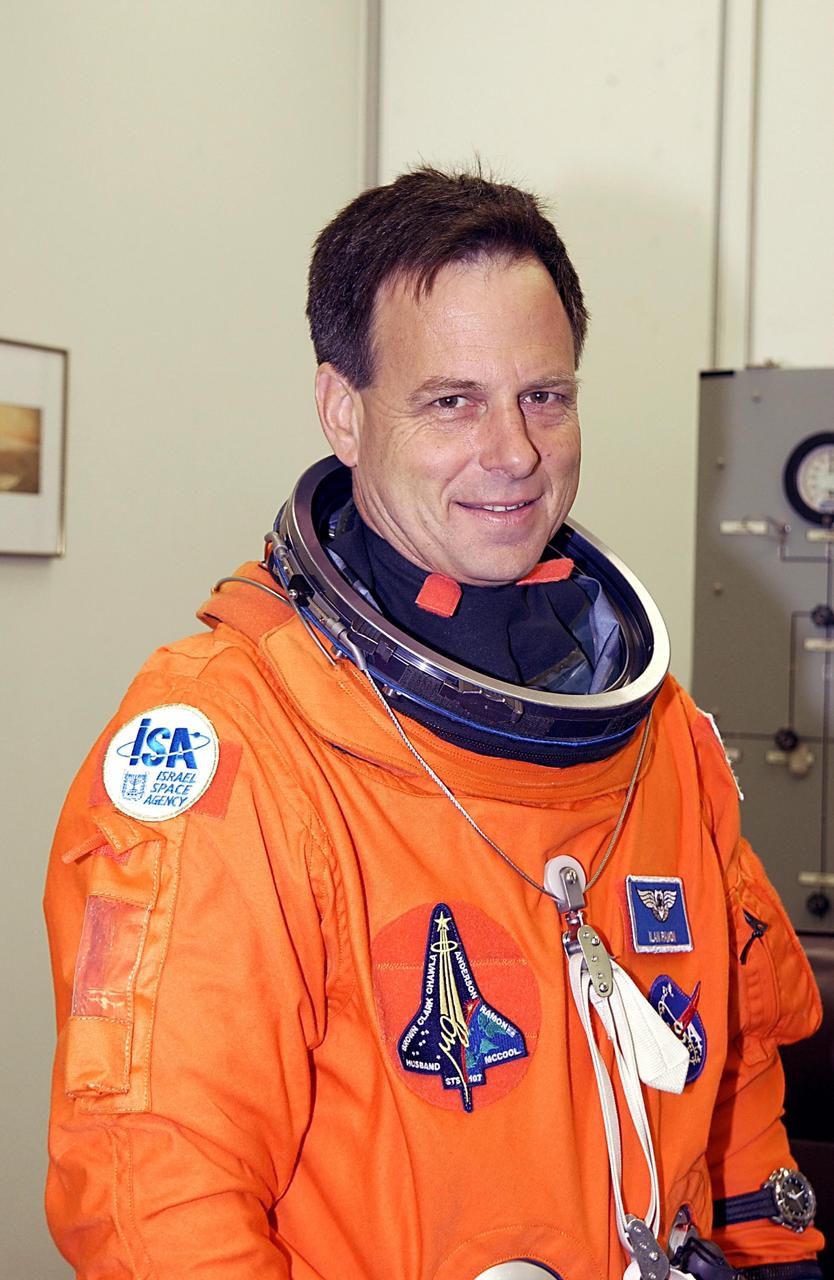
KENNEDY SPACE CENTER, FLA. -- STS-107 Payload Specialist Ilan Ramon, who represents the Israeli Space Agency, suits up for launch. STS-107 is a mission devoted to research and will include more than 80 experiments that will study Earth and space science, advanced technology development, and astronaut health and safety. The payload on Space Shuttle Columbia includes FREESTAR (Fast Reaction Experiments Enabling Science, Technology, Applications and Research) and the SHI Research Double Module (SHI/RDM), known as SPACEHAB. Experiments on the module range from material sciences to life sciences. Liftoff is scheduled for 10:39 a.m. EST.
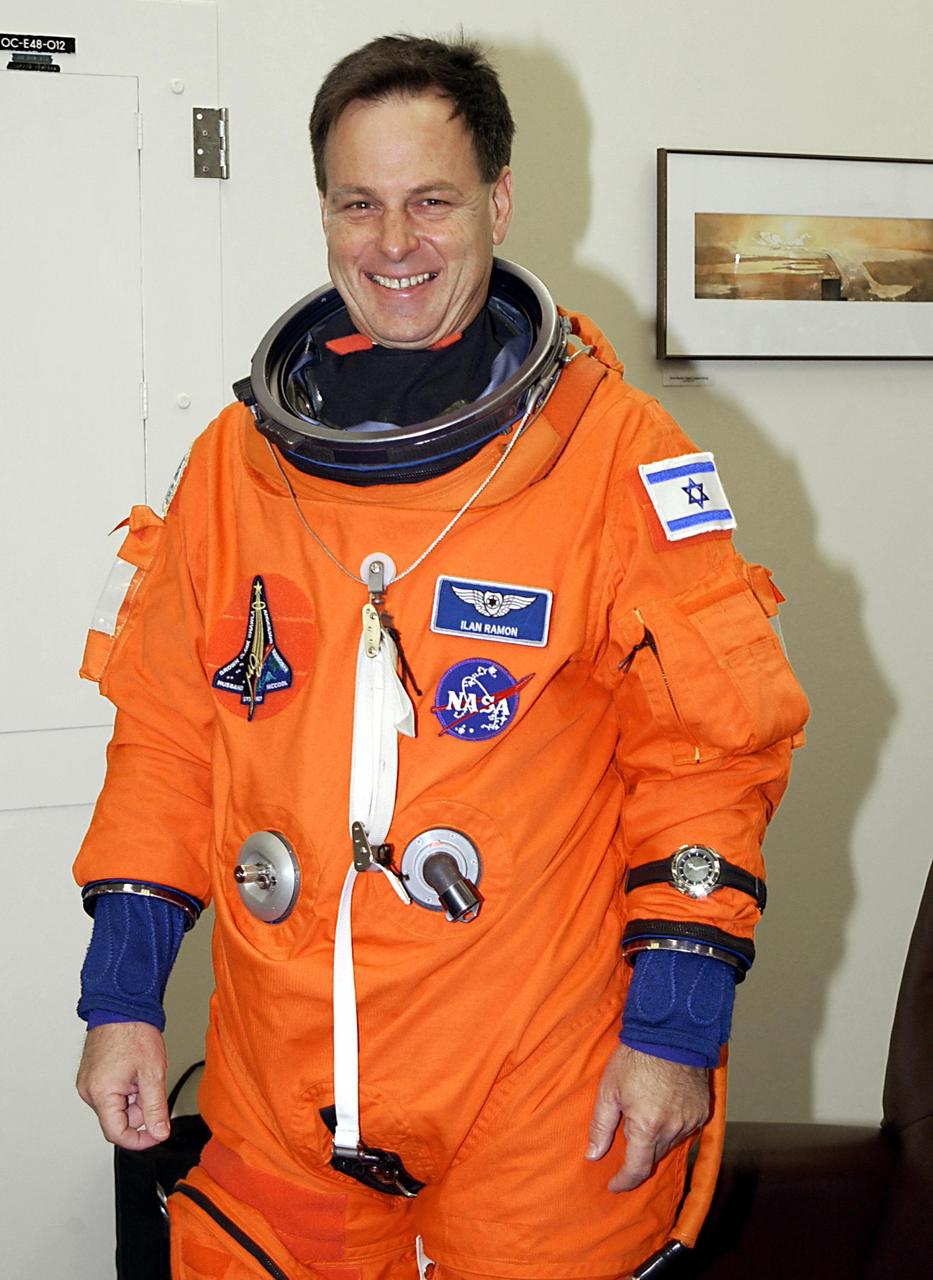
KENNEDY SPACE CENTER, FLA. -- STS-107 Payload Specialist Ilan Ramon, who represents the Israeli Space Agency, suits up for launch. STS-107 is a mission devoted to research and will include more than 80 experiments that will study Earth and space science, advanced technology development, and astronaut health and safety. The payload on Space Shuttle Columbia includes FREESTAR (Fast Reaction Experiments Enabling Science, Technology, Applications and Research) and the SHI Research Double Module (SHI/RDM), known as SPACEHAB. Experiments on the module range from material sciences to life sciences. Liftoff is scheduled for 10:39 a.m. EST.
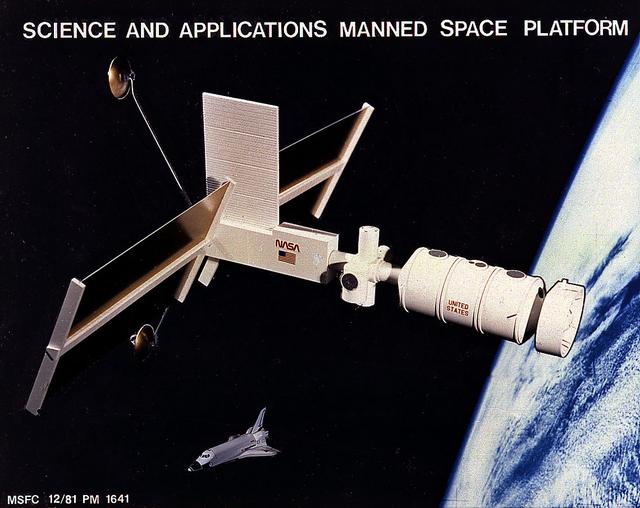
During 1980 and the first half of 1981, the Marshall Space Flight Center conducted studies concerned with a relatively low-cost, near-term, manned space platform to satisfy current user needs, yet capable of evolutionary growth to meet future needs. The Science and Application Manned Space Platform (SAMSP) studies were to serve as a test bed for developing scientific and operational capabilities required by later, more advanced manned platforms while accomplishing early science and operations. This concept illustrates a manned space platform.
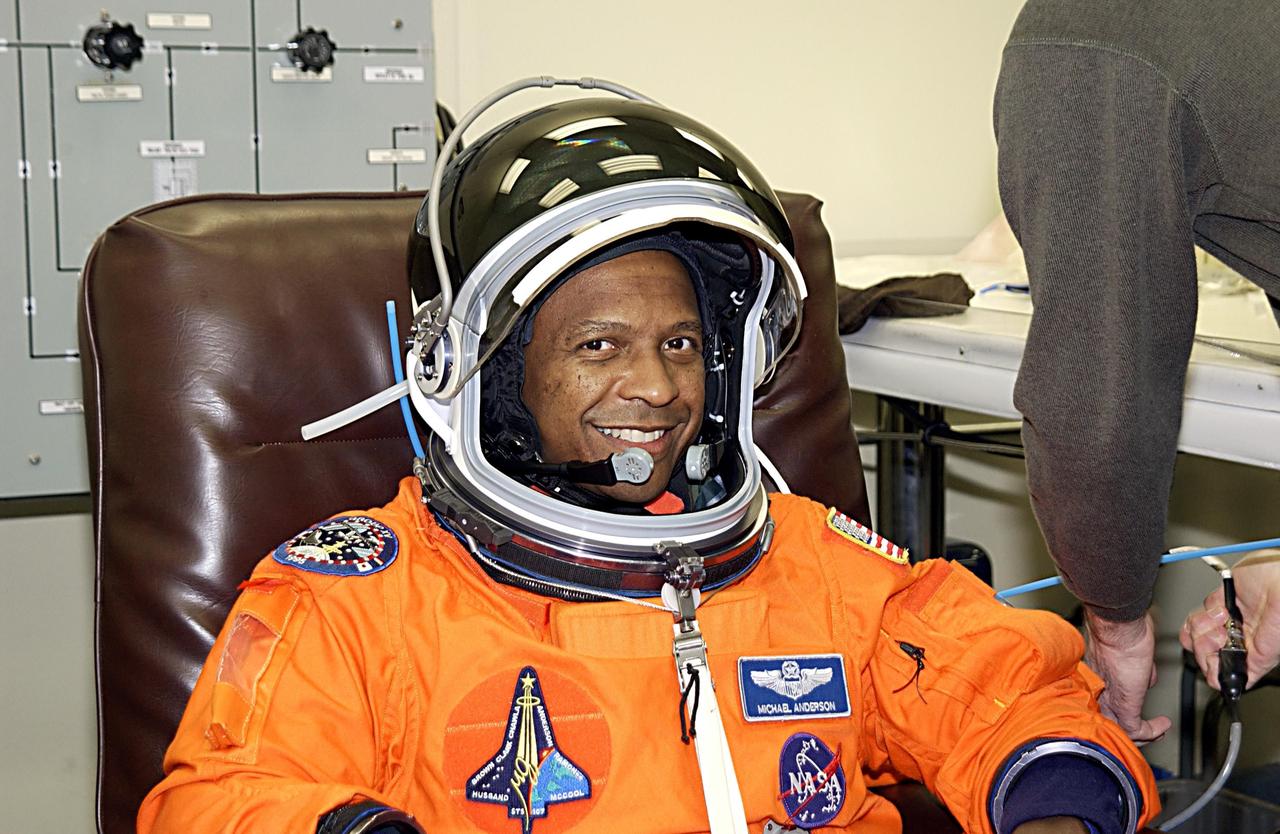
KENNEDY SPACE CENTER, FLA. - STS-107 Payload Commander Michael Anderson is helped with suit check, part of launch preparations. STS-107 is a mission devoted to research and will include more than 80 experiments that will study Earth and space science, advanced technology development, and astronaut health and safety. The payload on Space Shuttle Columbia includes FREESTAR (Fast Reaction Experiments Enabling Science, Technology, Applications and Research) and the SHI Research Double Module (SHI/RDM), known as SPACEHAB. Experiments on the module range from material sciences to life sciences. Launch is scheduled for Jan. 16, between 10 a.m. and 2 p.m.
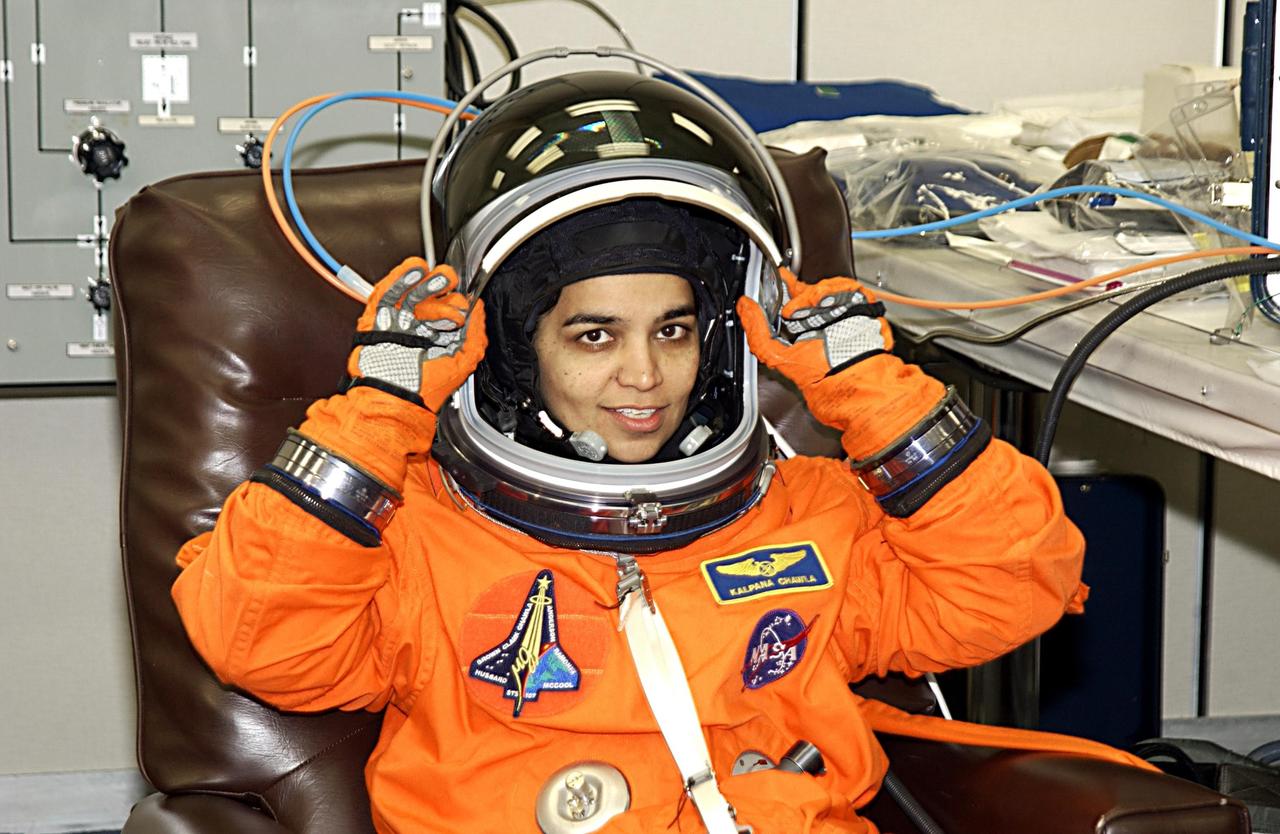
KENNEDY SPACE CENTER, FLA. -- STS-107 Mission Specialist Kalpana Chawla puts on her helmet during suit check, part of launch preparations. STS-107 is a mission devoted to research and will include more than 80 experiments that will study Earth and space science, advanced technology development, and astronaut health and safety. The payload on Space Shuttle Columbia includes FREESTAR (Fast Reaction Experiments Enabling Science, Technology, Applications and Research) and the SHI Research Double Module (SHI/RDM), known as SPACEHAB. Experiments on the module range from material sciences to life sciences. Launch is scheduled for Jan. 16, between 10 a.m. and 2 p.m.
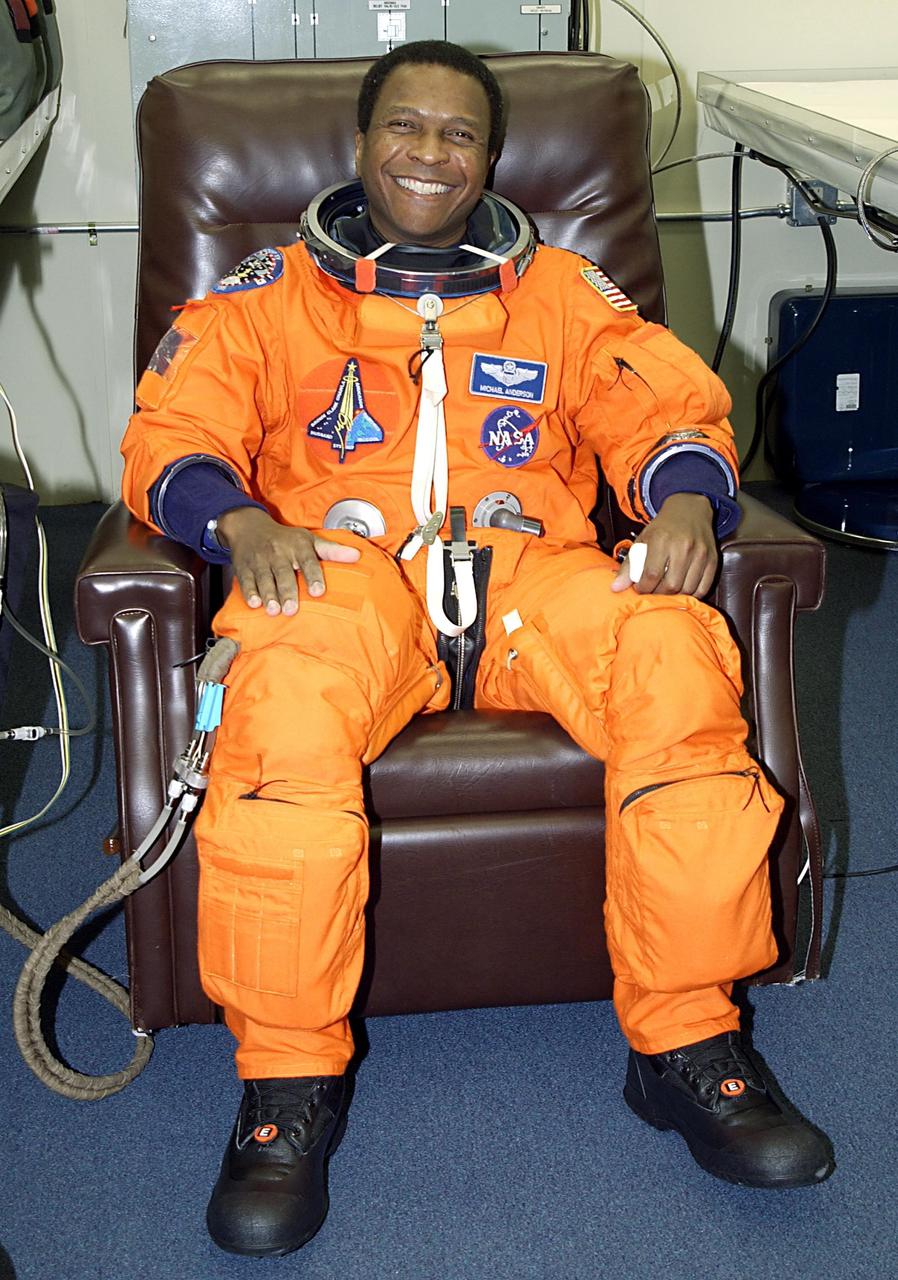
KENNEDY SPACE CENTER, FLA. - STS-107 Payload Commander Michael Anderson is happy to being suiting up for launch on mission STS-107. The mission is devoted to research and will include more than 80 experiments that will study Earth and space science, advanced technology development, and astronaut health and safety. The payload on Space Shuttle Columbia includes FREESTAR (Fast Reaction Experiments Enabling Science, Technology, Applications and Research) and the SHI Research Double Module (SHI/RDM), known as SPACEHAB. Experiments on the module range from material sciences to life sciences. Liftoff is scheduled for 10:39 a.m. EST.

KENNEDY SPACE CENTER, FLA. -- STS-107 Mission Specialist David Brown gets help during suitup for launch. STS-107 is a mission devoted to research and will include more than 80 experiments that will study Earth and space science, advanced technology development, and astronaut health and safety. The payload on Space Shuttle Columbia includes FREESTAR (Fast Reaction Experiments Enabling Science, Technology, Applications and Research) and the SHI Research Double Module (SHI/RDM), known as SPACEHAB. Experiments on the module range from material sciences to life sciences. Liftoff is scheduled for 10:39 a.m. EST.
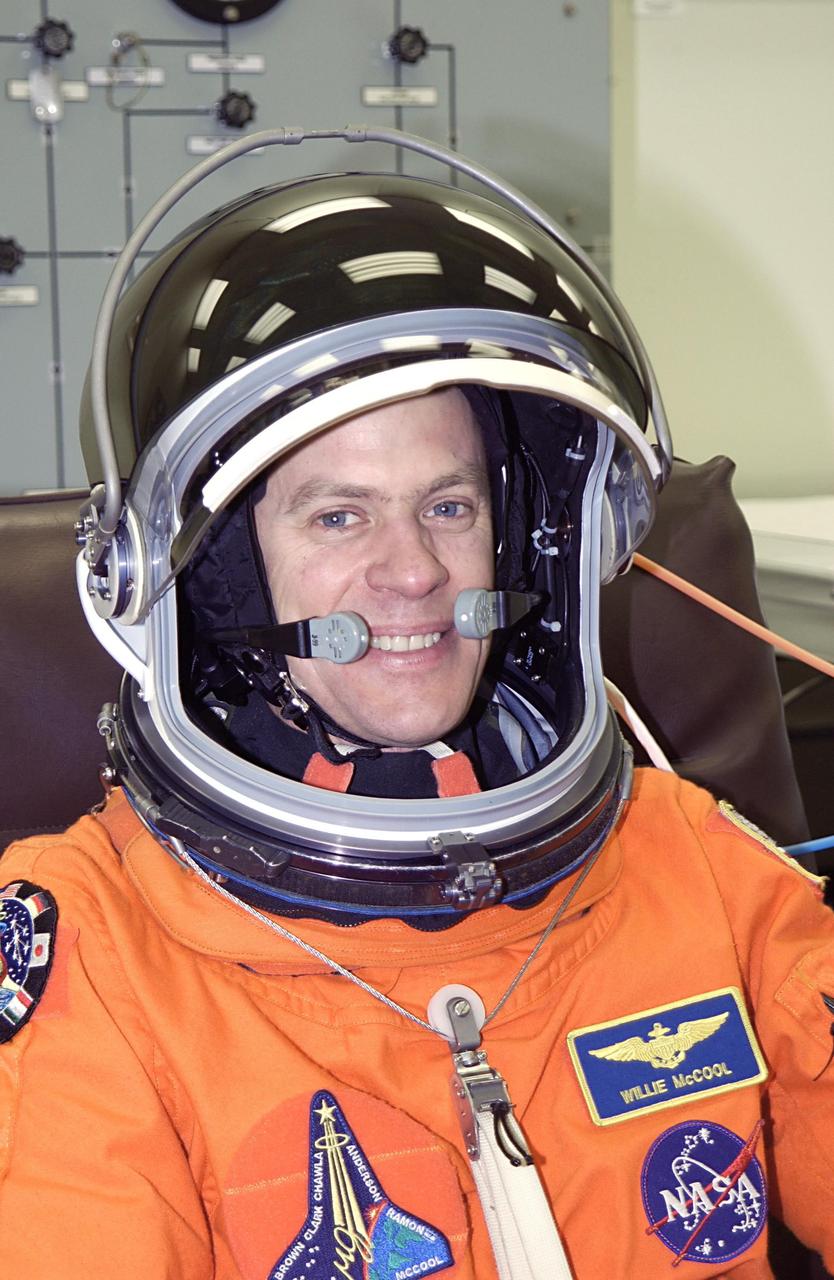
KENNEDY SPACE CENTER, FLA. - STS-107 Pilot William "Willie" McCool shows his pleasure at suiting up for launch. STS-107 is a mission devoted to research and will include more than 80 experiments that will study Earth and space science, advanced technology development, and astronaut health and safety. The payload on Space Shuttle Columbia includes FREESTAR (Fast Reaction Experiments Enabling Science, Technology, Applications and Research) and the SHI Research Double Module (SHI/RDM), known as SPACEHAB. Experiments on the module range from material sciences to life sciences. Liftoff is scheduled for 10:39 a.m. EST.
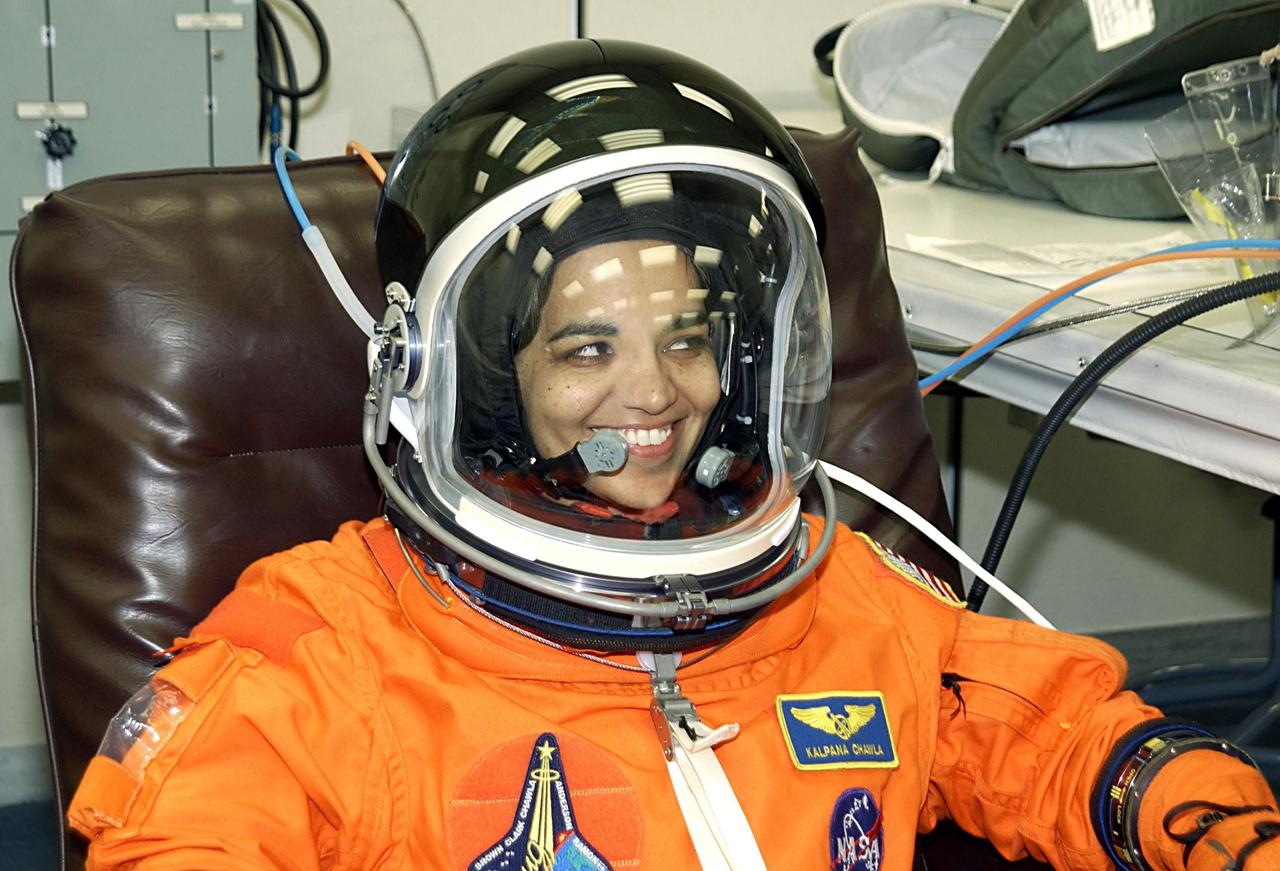
KENNEDY SPACE CENTER, FLA. -- STS-107 Mission Specialist Kalpana Chawla finishes suitup for launch. STS-107 is a mission devoted to research and will include more than 80 experiments that will study Earth and space science, advanced technology development, and astronaut health and safety. The payload on Space Shuttle Columbia includes FREESTAR (Fast Reaction Experiments Enabling Science, Technology, Applications and Research) and the SHI Research Double Module (SHI/RDM), known as SPACEHAB. Experiments on the module range from material sciences to life sciences. Liftoff is scheduled for 10:39 a.m. EST.
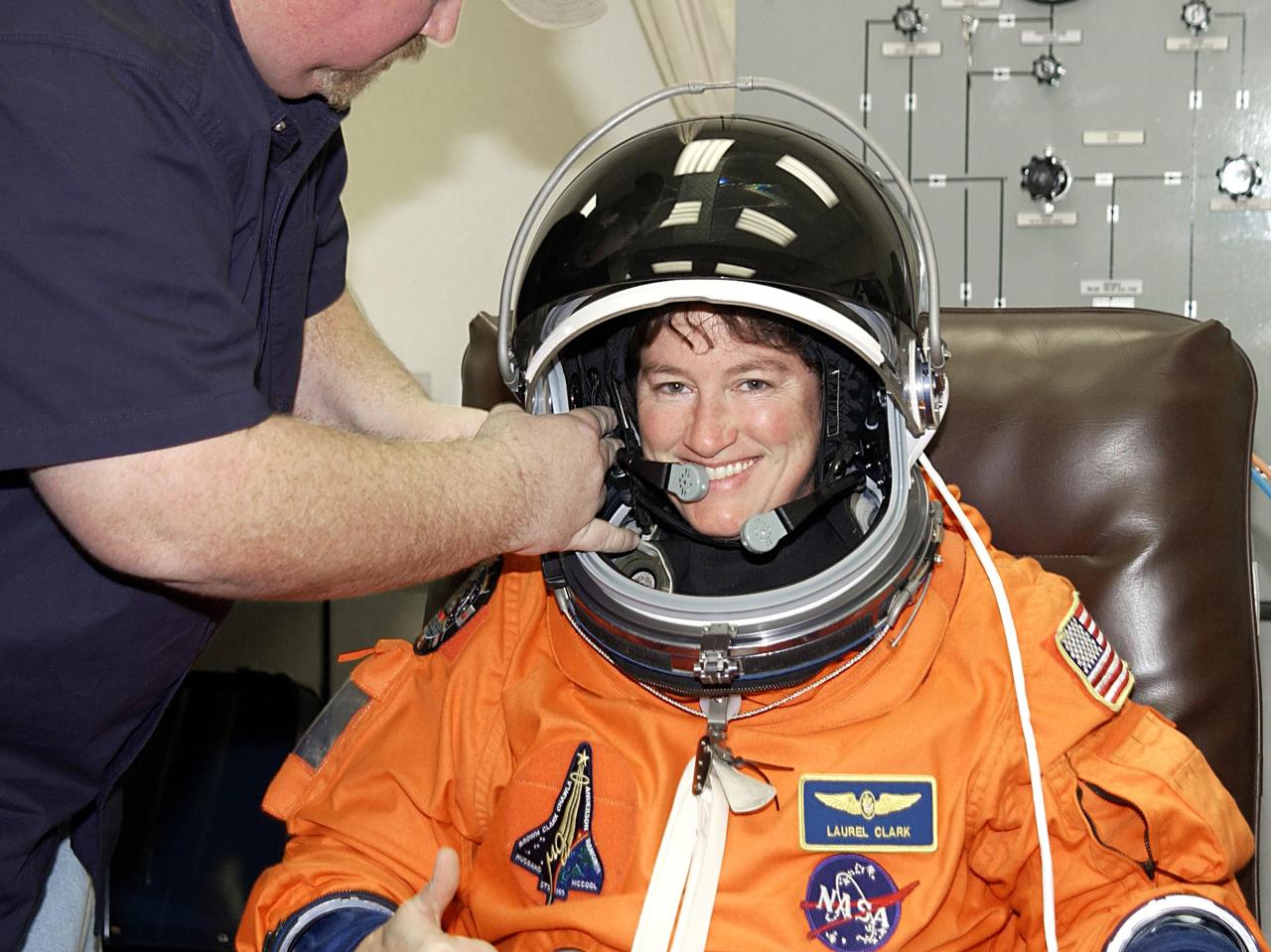
KENNEDY SPACE CENTER, FLA. - STS-107 Mission Specialist Laurel Clark is helped with her helmet during suitup for launch. STS-107 is a mission devoted to research and will include more than 80 experiments that will study Earth and space science, advanced technology development, and astronaut health and safety. The payload on Space Shuttle Columbia includes FREESTAR (Fast Reaction Experiments Enabling Science, Technology, Applications and Research) and the SHI Research Double Module (SHI/RDM), known as SPACEHAB. Experiments on the module range from material sciences to life sciences. Liftoff is scheduled for 10:39 a.m. EST.
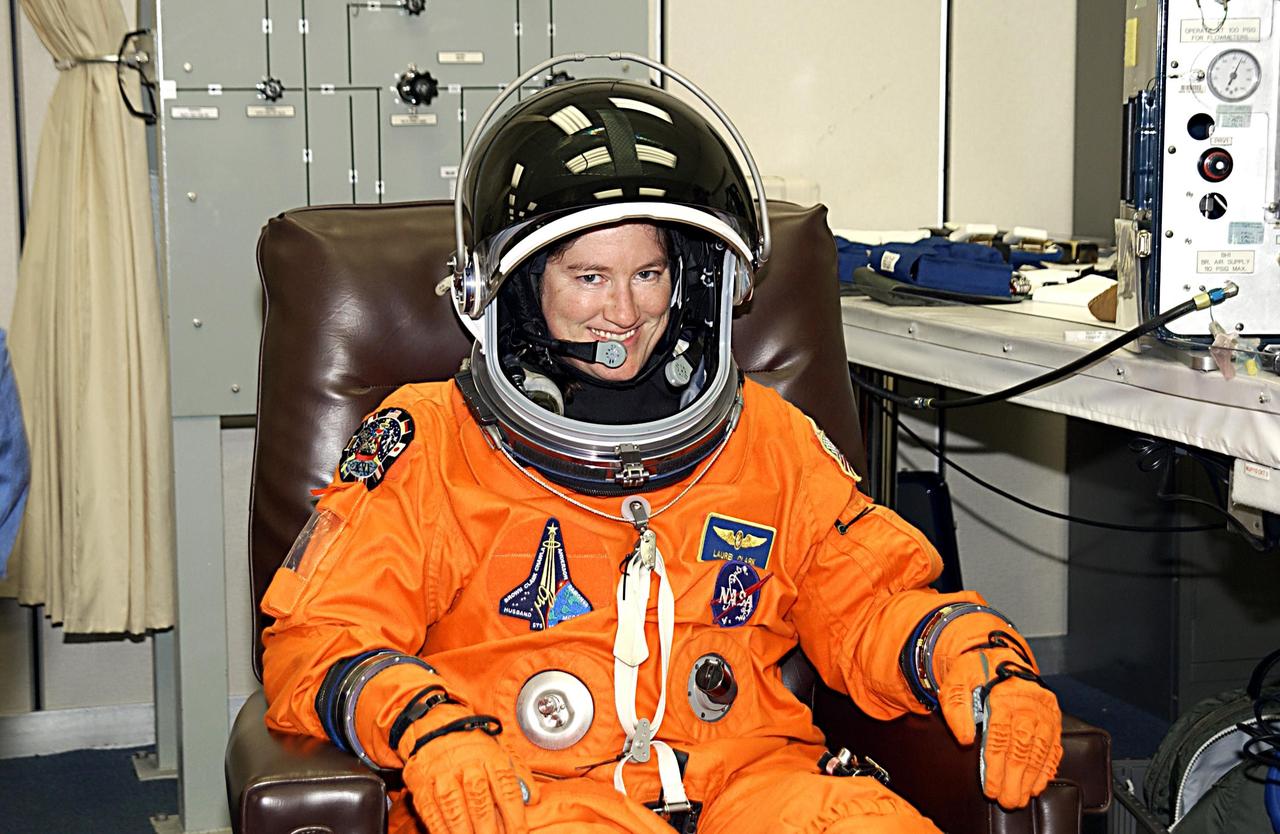
KENNEDY SPACE CENTER, FLA. - STS-107 Mission Specialist Laurel Clark gets a final fitting on her launch and entry suit as part of launch preparations. STS-107 is a mission devoted to research and will include more than 80 experiments that will study Earth and space science, advanced technology development, and astronaut health and safety. The payload on Space Shuttle Columbia includes FREESTAR (Fast Reaction Experiments Enabling Science, Technology, Applications and Research) and the SHI Research Double Module (SHI/RDM), known as SPACEHAB. Experiments on the module range from material sciences to life sciences. Launch is scheduled for Jan. 16, between 10 a.m. and 2 p.m.
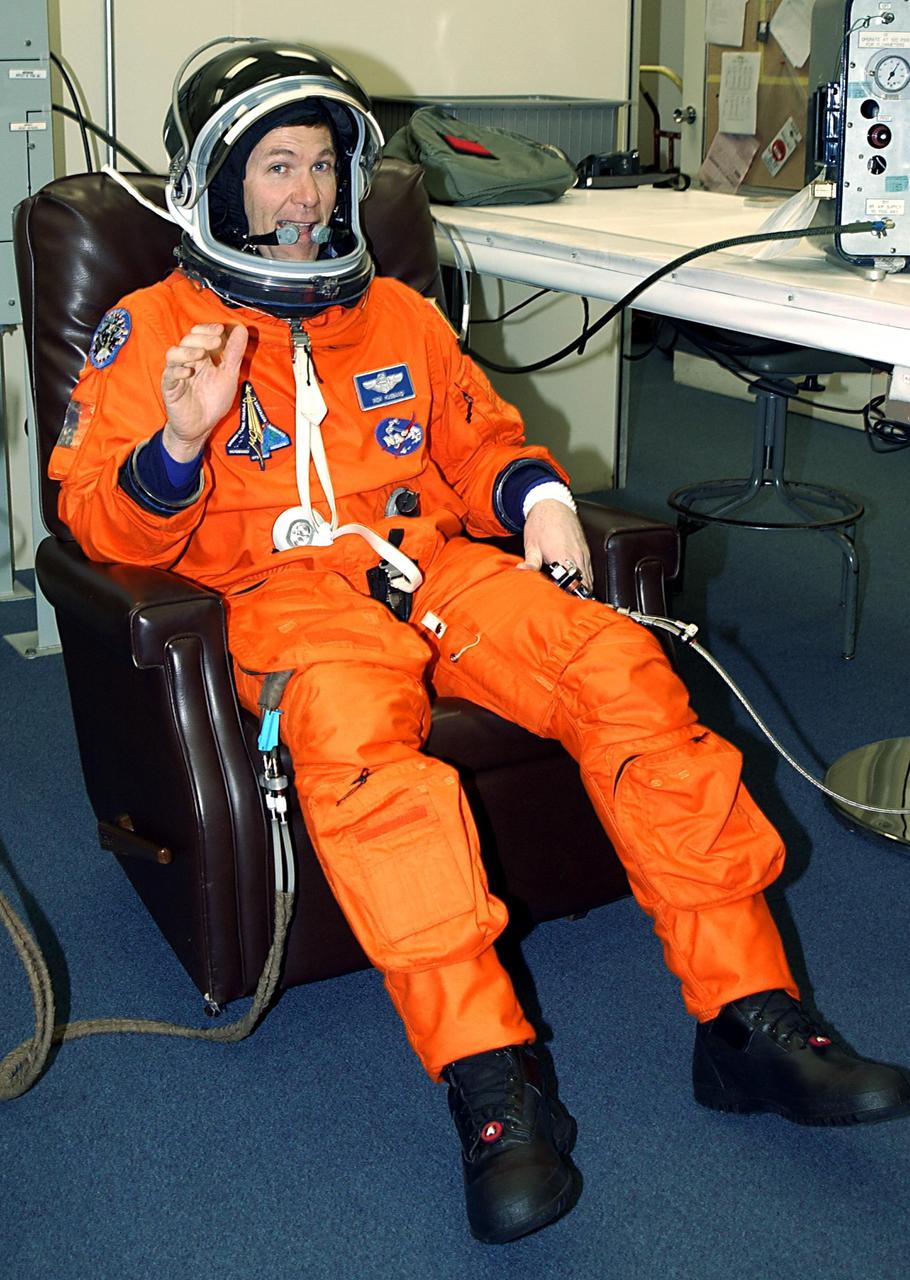
KENNEDY SPACE CENTER, FLA. - STS-107 Mission Commander Rick Husband waves during suitup for launch on mission STS-107. The mission is devoted to research and will include more than 80 experiments that will study Earth and space science, advanced technology development, and astronaut health and safety. The payload on Space Shuttle Columbia includes FREESTAR (Fast Reaction Experiments Enabling Science, Technology, Applications and Research) and the SHI Research Double Module (SHI/RDM), known as SPACEHAB. Experiments on the module range from material sciences to life sciences. Liftoff is scheduled for 10:39 a.m. EST.
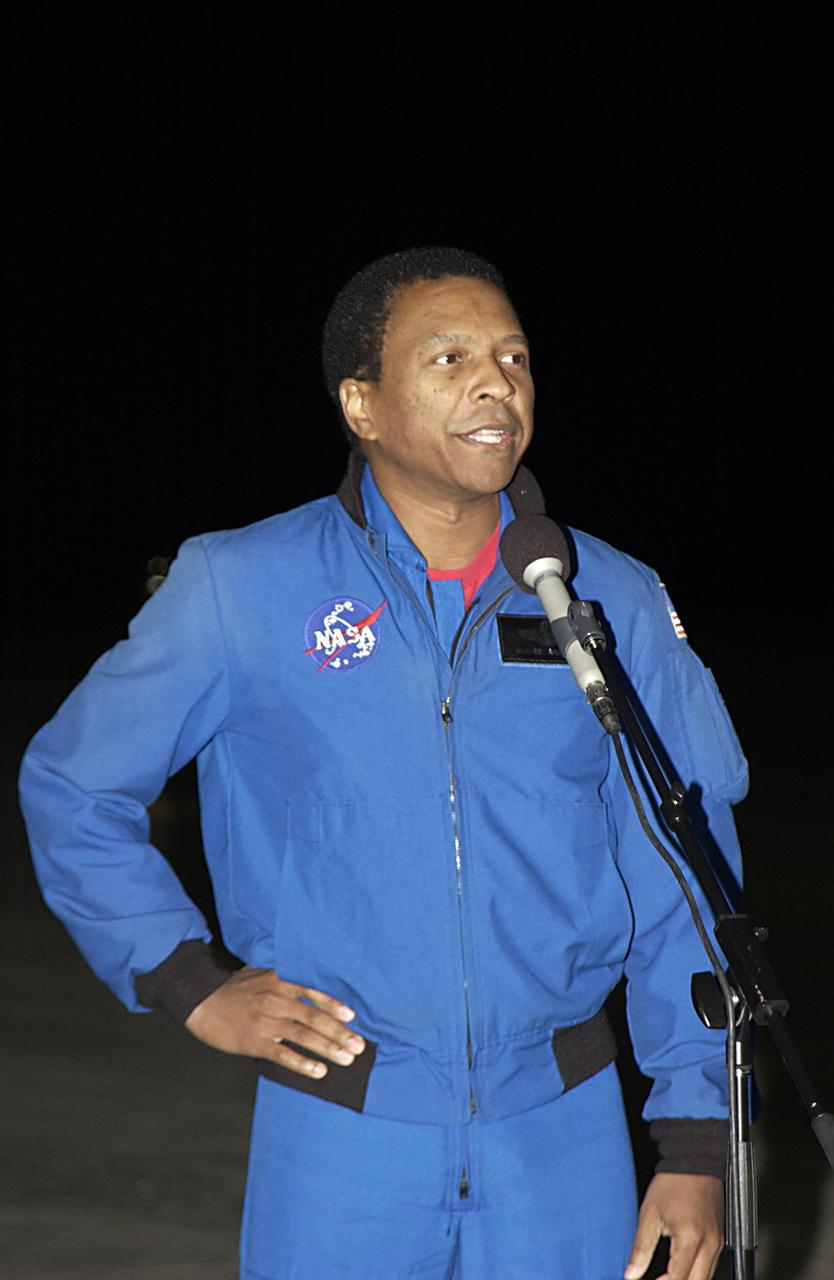
KENNEDY SPACE CENTER, FLA. - STS-107 Payload Commander Michael Anderson comments about the mission after the crew's arrival at KSC for pre-launch preparations. STS-107 is a mission devoted to research and will include more than 80 experiments that will study Earth and space science, advanced technology development, and astronaut health and safety. The payload on Space Shuttle Columbia includes FREESTAR (Fast Reaction Experiments Enabling Science, Technology, Applications and Research) and the SHI Research Double Module (SHI/RDM), known as SPACEHAB. Experiments on the module range from material sciences to life sciences. Launch of Columbia is targeted for Jan. 16 between 10 a.m. and 2 p.m.
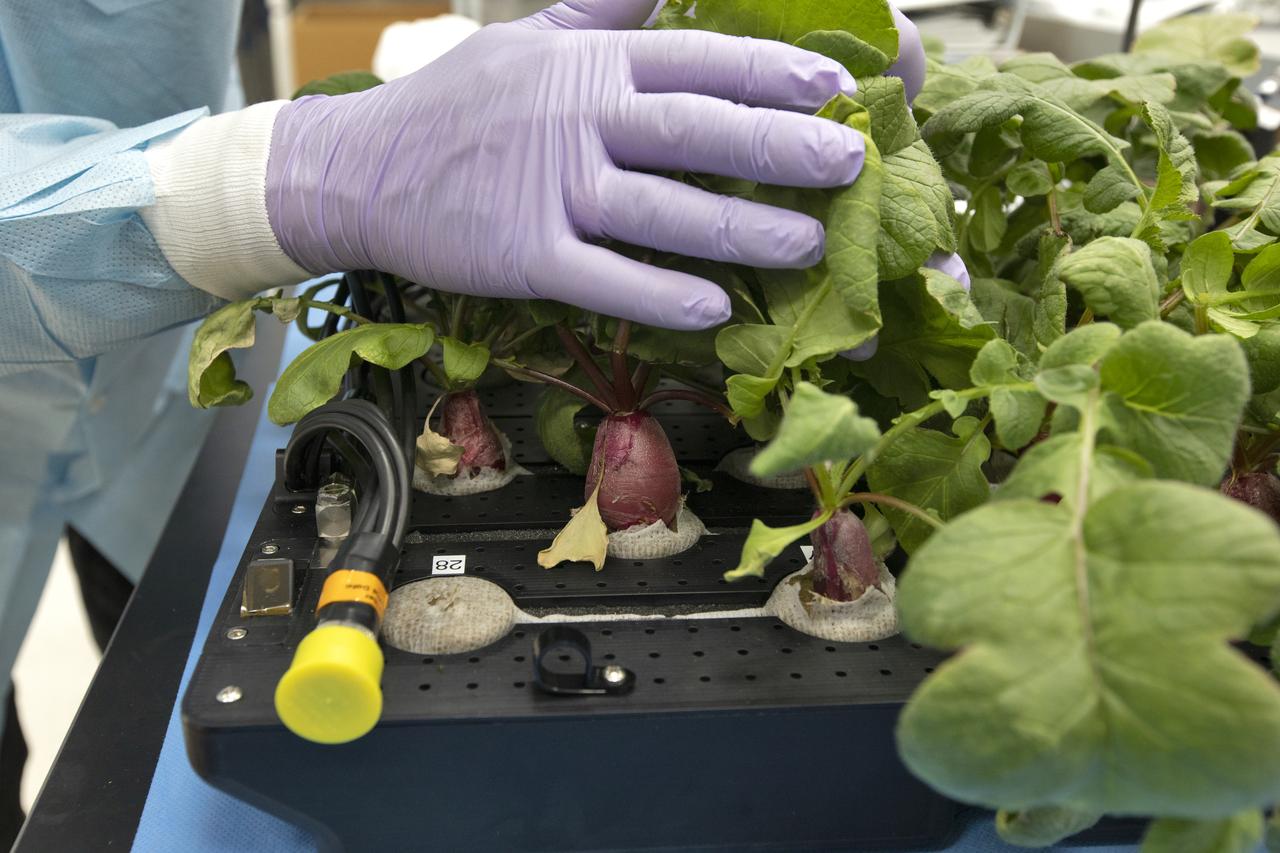
Radish plants are growing inside the Advanced Plant Habitat (APH) ground unit inside a laboratory in the Space Station Processing Facility at NASA's Kennedy Space Center in Florida on June 13, 2019. The plants are being grown as part of a science verification test for PH-02, a Space Life and Physical Sciences Research and Applications-funded experiment which seeks to determine the effects of spaceflight on radishes. The APH is a highly automated plant growth chamber with 180 sensors and is able to closely regulate variables related to plant growth.
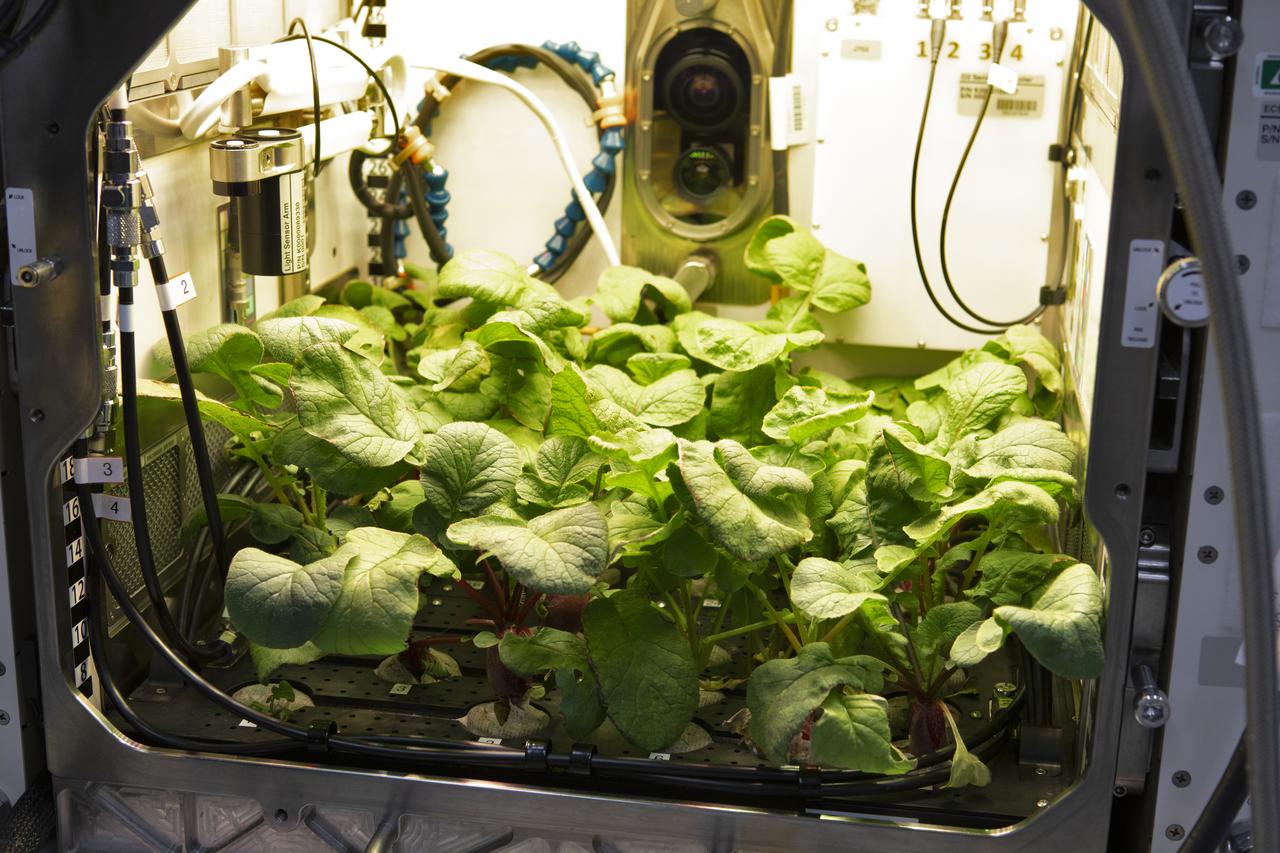
Radish plants are growing inside the Advanced Plant Habitat (APH) ground unit inside a laboratory in the Space Station Processing Facility at NASA's Kennedy Space Center in Florida on June 13, 2019. The plants are being grown as part of a science verification test for PH-02, a Space Life and Physical Sciences Research and Applications-funded experiment which seeks to determine the effects of spaceflight on radishes. The APH is a highly automated plant growth chamber with 180 sensors and is able to closely regulate variables related to plant growth.

Radish plants are growing inside the Advanced Plant Habitat (APH) ground unit inside a laboratory in the Space Station Processing Facility at NASA's Kennedy Space Center in Florida on June 13, 2019. The plants are being grown as part of a science verification test for PH-02, a Space Life and Physical Sciences Research and Applications-funded experiment which seeks to determine the effects of spaceflight on radishes. The APH is a highly automated plant growth chamber with 180 sensors and is able to closely regulate variables related to plant growth.
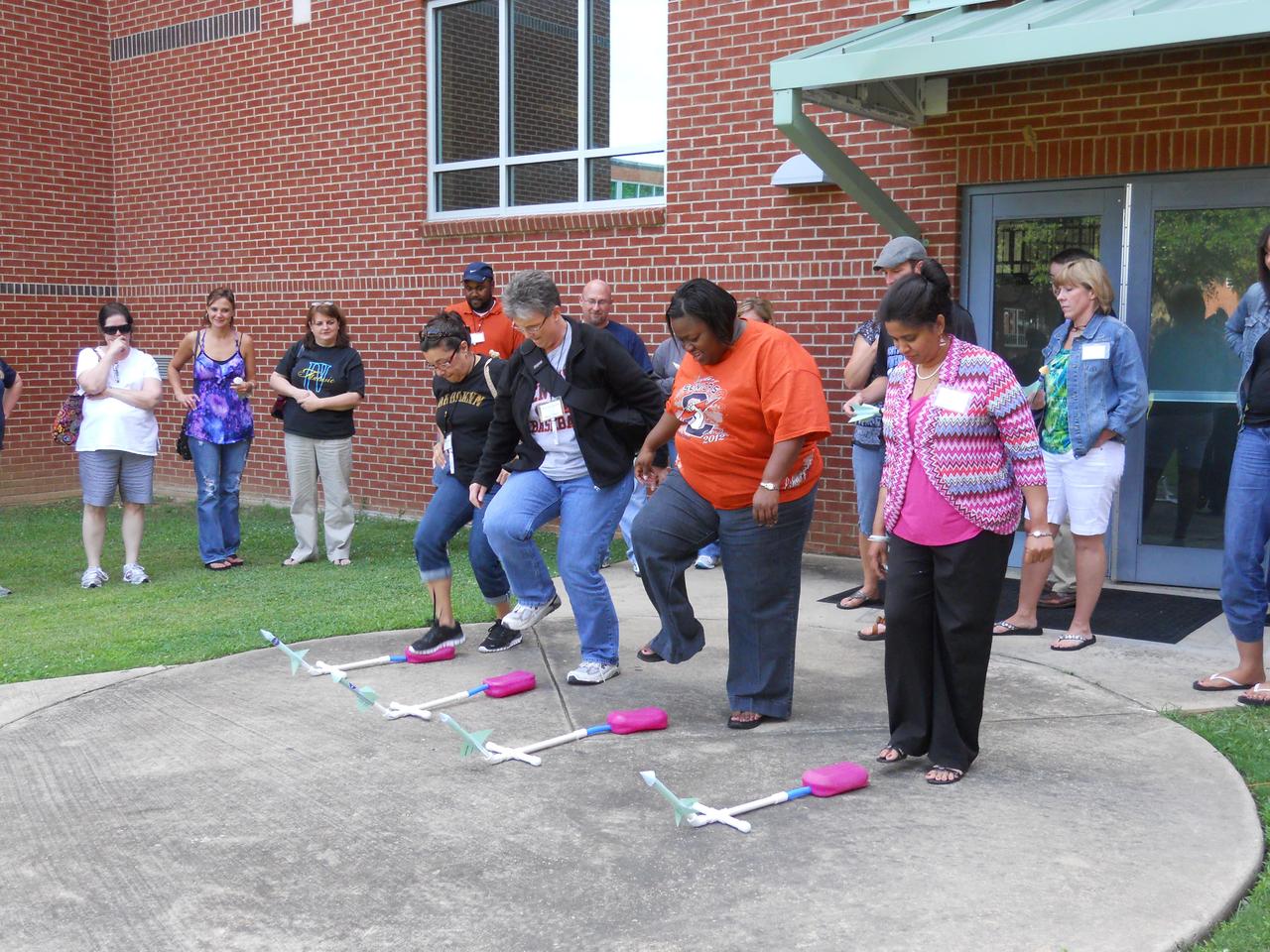
Mississippi educators participated in a variety of hands-on activities, including rocketry, robotics, and NASA's BEST (Beginning Engineering, Science, and Technology) during a pair of during a pair of professional development workshops conducted by Stennis Space Center educators in June. On June 14, Stennis educators presented workshops to 96 kindergarten-through-12th-grade science teachers and eight Jackson State University faculty, as part of JSU's Project MAST (Mississippi Academy for Science Teaching) Project. On June 21, educators presented workshops in Starkville to 43 fourth-through-eighth-grade science teachers as part of Mississippi State University's Advancing Teachers of Middle School Science initiative.
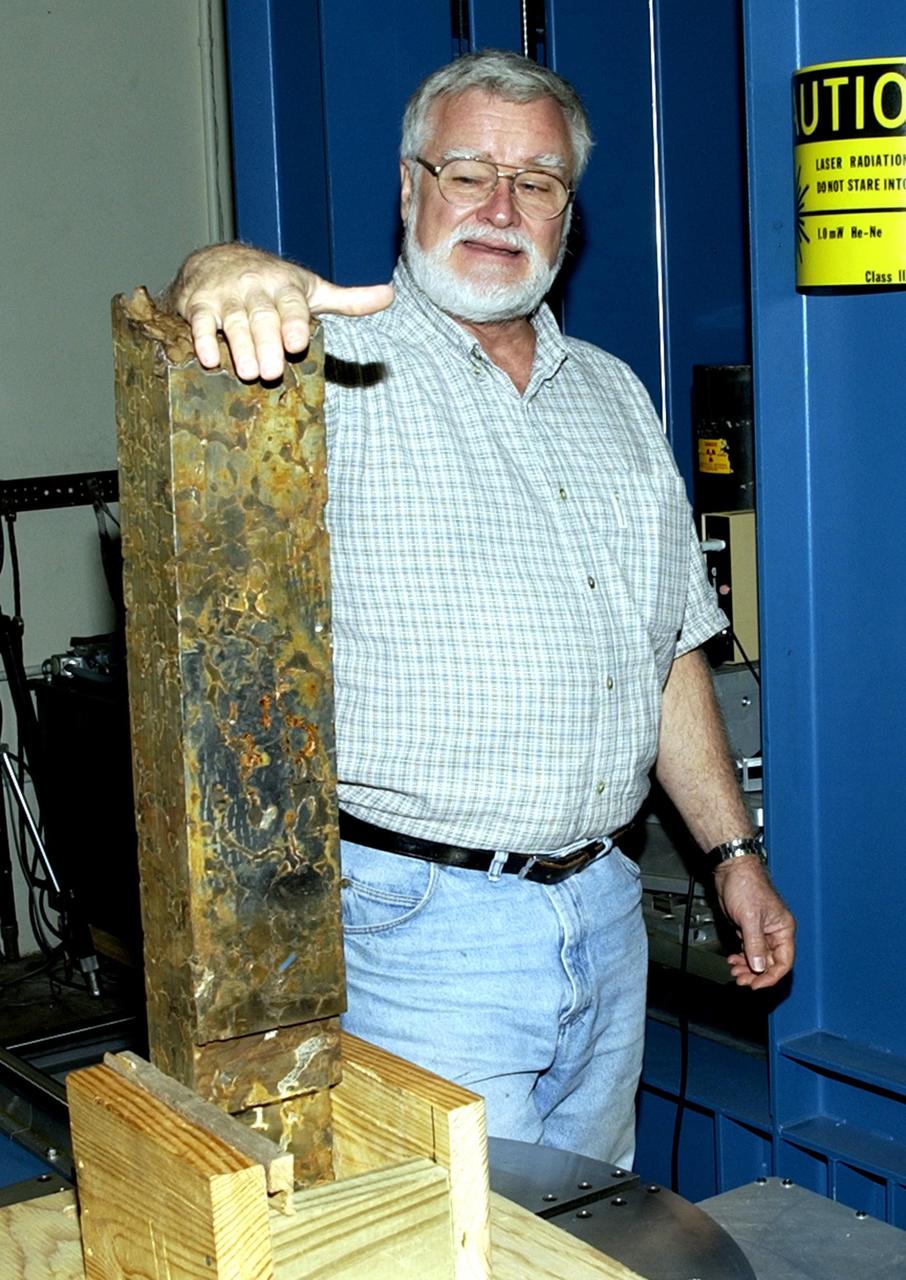
KENNEDY SPACE CENTER, FLA. -- Pete Engel, an engineering specialist in Wyle Laboratory's Nondestructive Testing Laboratory at KSC, explains the testing being performed on a 100-pound Mundrabilla meteorite sample. The one-of-a-kind meteorite was found 36 years ago in Australia and is on loan to Marshall Space Flight Center (MSFC) from the Smithsonian Institution's National Museum of Natural History. Dr. Donald Gillies, discipline scientist for materials science at MSFC's Microgravity Science and Applications Department, is the Principal Investigator. The studies may help provide the science community and industry with fundamental knowledge for use in the design of advanced materials.
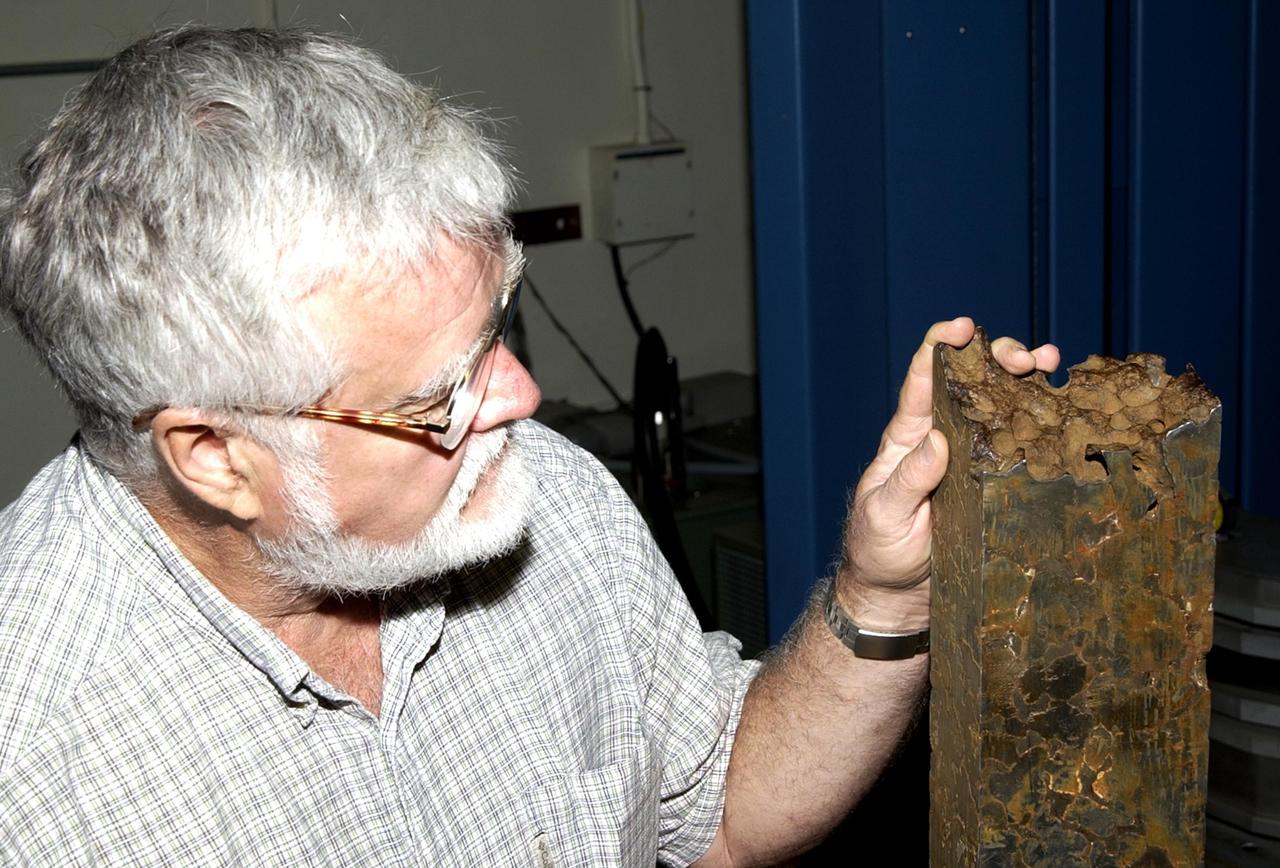
KENNEDY SPACE CENTER, FLA. -- Pete Engel, an engineering specialist in Wyle Laboratory's Nondestructive Testing Laboratory at KSC, explains the testing being performed on a 100-pound Mundrabilla meteorite sample. The one-of-a-kind meteorite was found 36 years ago in Australia and is on loan to Marshall Space Flight Center (MSFC) from the Smithsonian Institution's National Museum of Natural History. Dr. Donald Gillies, discipline scientist for materials science at MSFC's Microgravity Science and Applications Department, is the Principal Investigator. The studies may help provide the science community and industry with fundamental knowledge for use in the design of advanced materials.
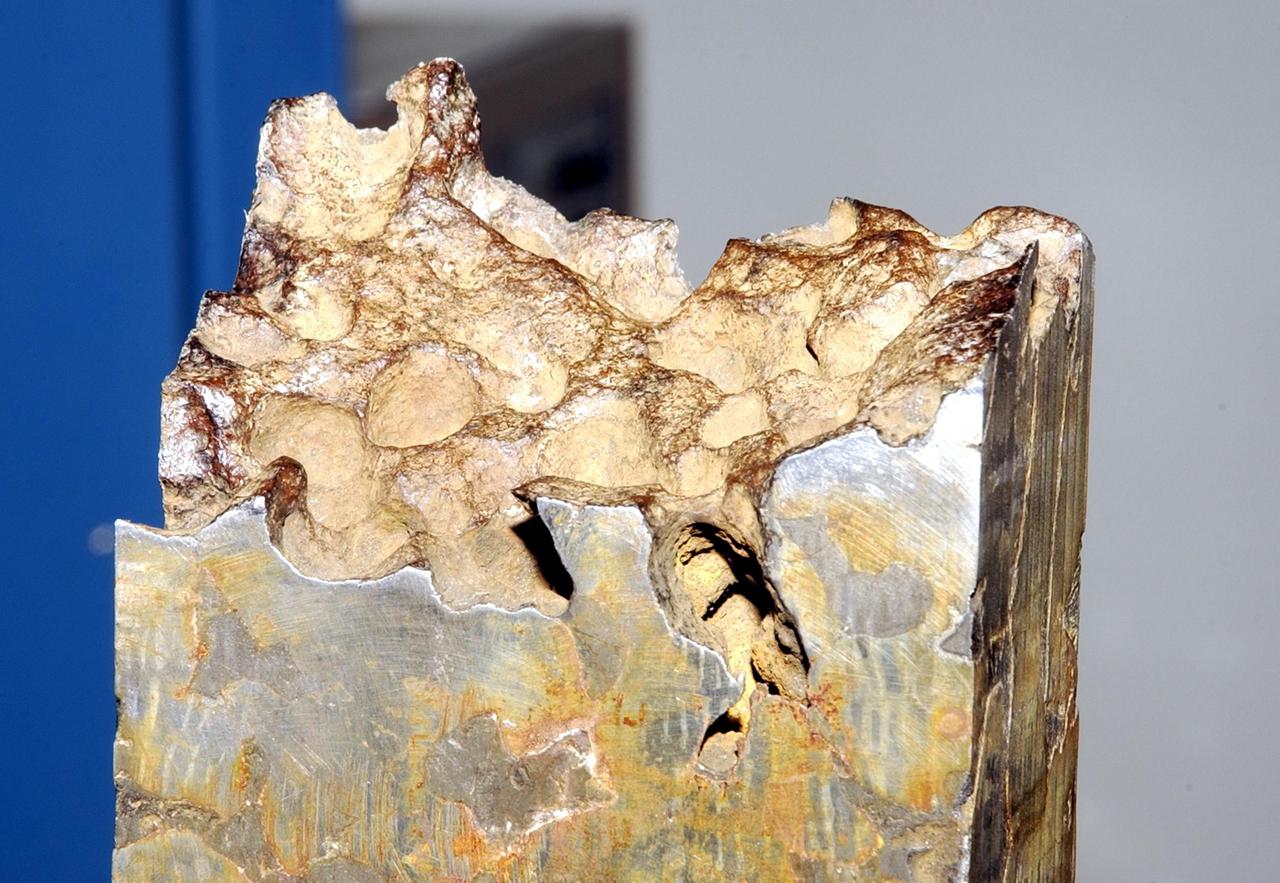
KENNEDY SPACE CENTER, FLA. -- This 100-pound Mundrabilla meteorite sample is being studied in Wyle Laboratory's Nondestructive Testing Laboratory at KSC. The one-of-a-kind meteorite was found 36 years ago in Australia and is on loan to Marshall Space Flight Center (MSFC) from the Smithsonian Institution's National Museum of Natural History. Dr. Donald Gillies, discipline scientist for materials science at MSFC's Microgravity Science and Applications Department, is the Principal Investigator. The studies may help provide the science community and industry with fundamental knowledge for use in the design of advanced materials.
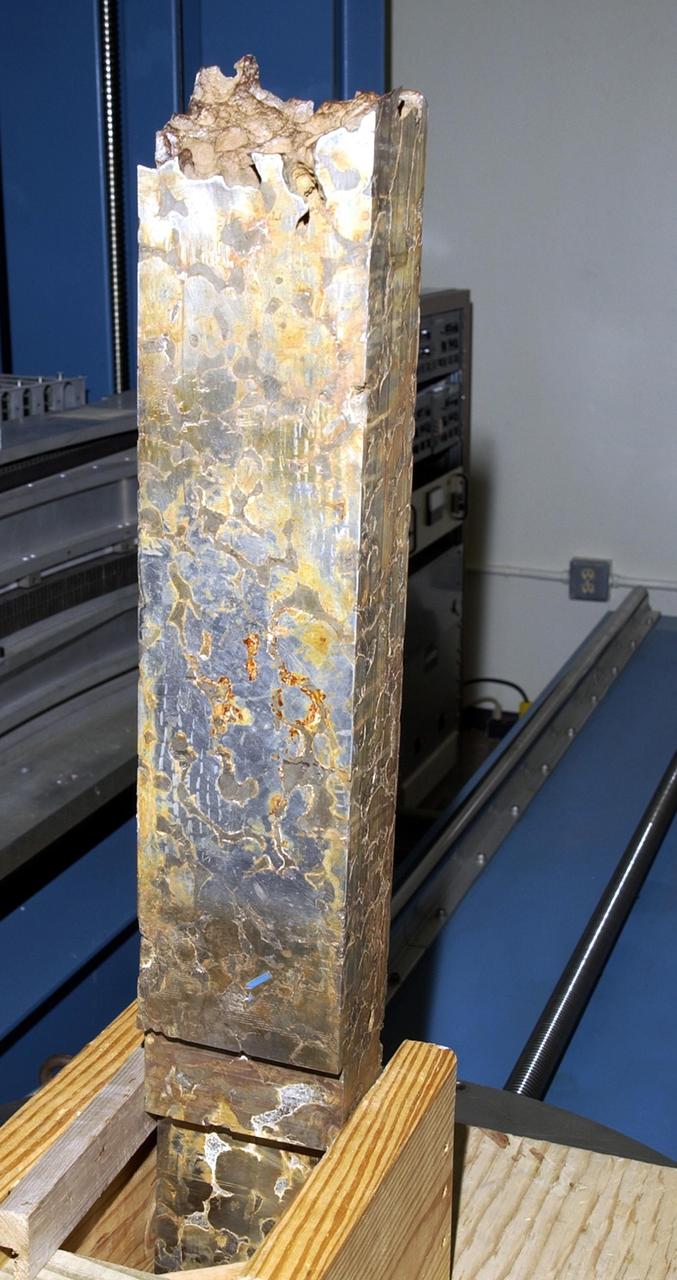
KENNEDY SPACE CENTER, FLA. -- This 100-pound Mundrabilla meteorite sample is being studied in Wyle Laboratory's Nondestructive Testing Laboratory at KSC. The one-of-a-kind meteorite was found 36 years ago in Australia and is on loan to Marshall Space Flight Center (MSFC) from the Smithsonian Institution's National Museum of Natural History. Dr. Donald Gillies, discipline scientist for materials science at MSFC's Microgravity Science and Applications Department, is the Principal Investigator. The studies may help provide the science community and industry with fundamental knowledge for use in the design of advanced materials.
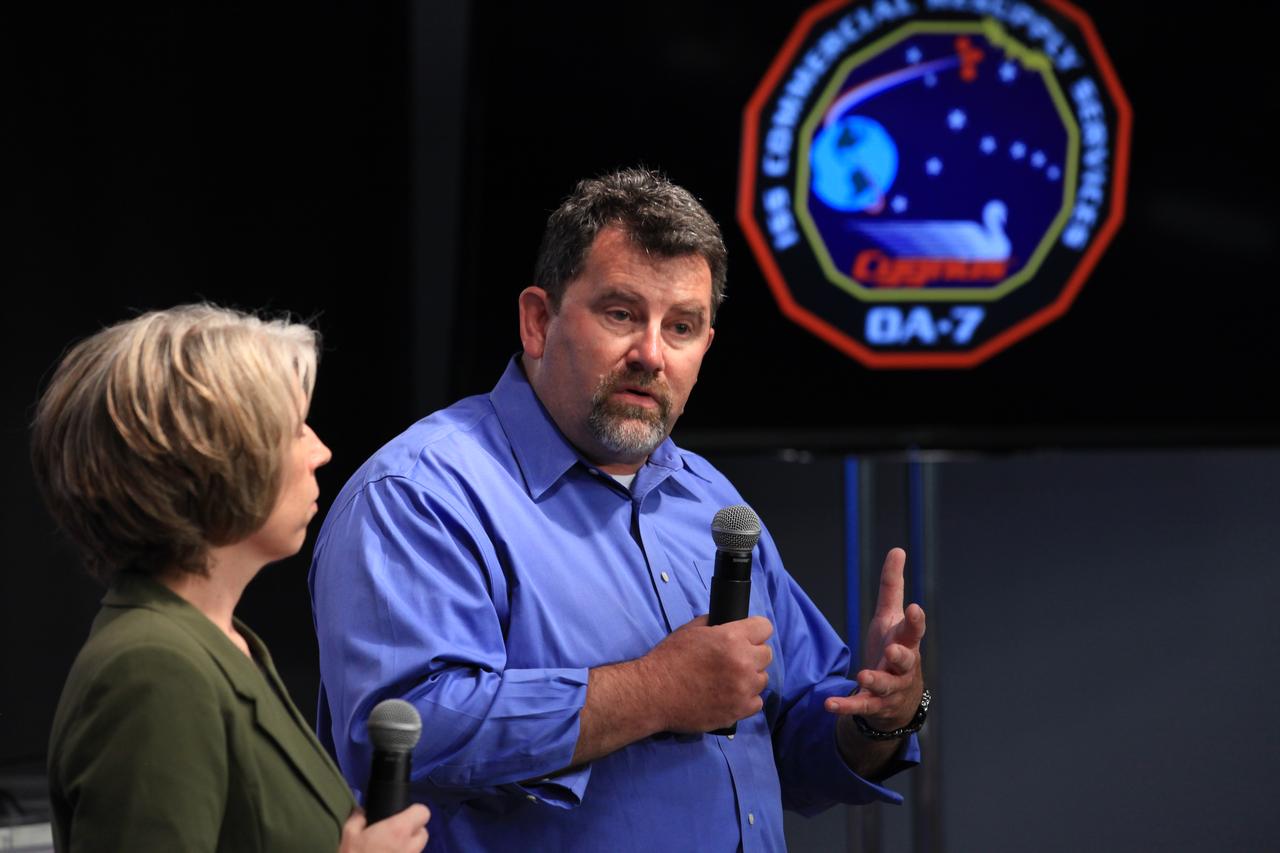
Tara Ruttley, left, associate program scientist with NASA's Johnson Space Center in Houston, and Dr. Mike Roberts, with the Center for the Advancement of Science in Space (CASIS), speak to NASA Social participants during a "What's on Board" science briefing at the agency's Kennedy Space Center in Florida. The briefing is for Orbital ATK's seventh commercial resupply services mission, CRS-7, to the International Space Station. Orbital ATK's Cygnus pressurized cargo module is set to launch on the United Launch Alliance Atlas V rocket from Space Launch Complex 41 at Cape Canaveral Air Force Station on April 18. Liftoff is scheduled for 11:11 a.m. EDT.
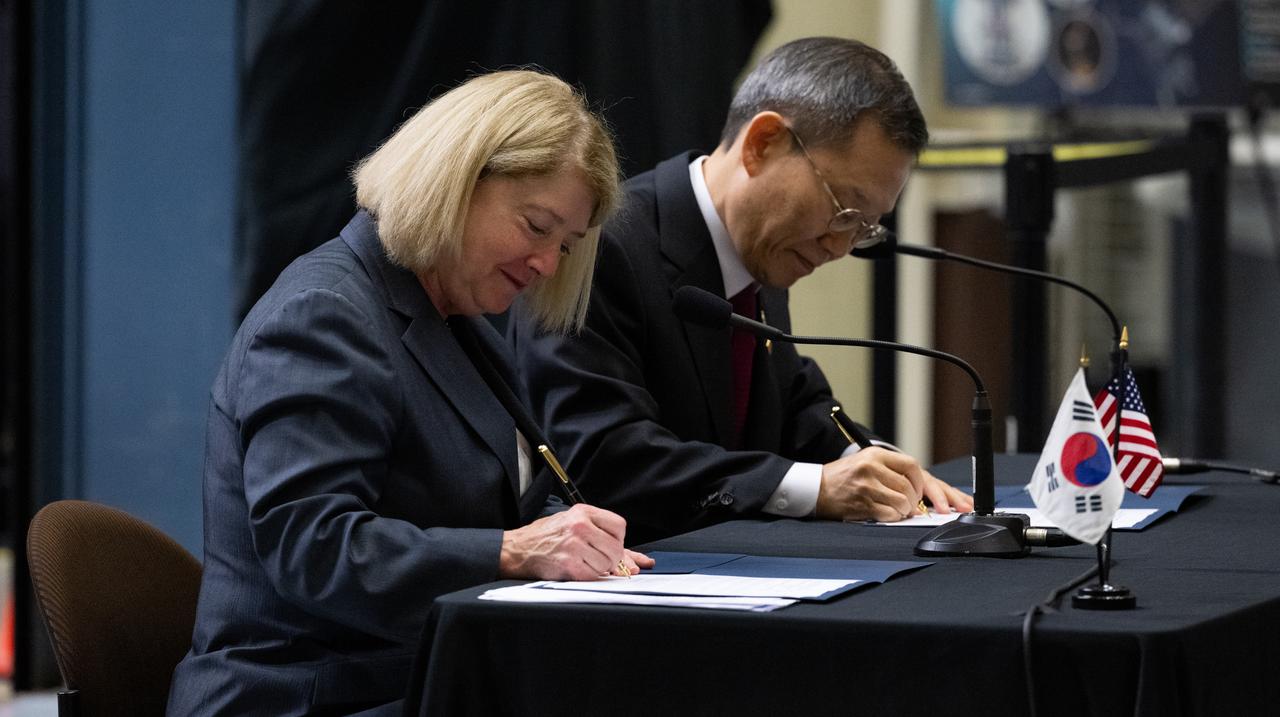
NASA Deputy Administrator Pam Melroy, left, and MSIT Minister Jong-Ho Lee sign a Joint Statement of Intent to advance cooperation in exploration and science between NASA and the Ministry of Science and ICT of the Republic of Korea, Tuesday, April 25, 2023, at NASA’s Goddard Space Flight Center in Greenbelt, Md. Photo Credit: (NASA/Joel Kowsky)
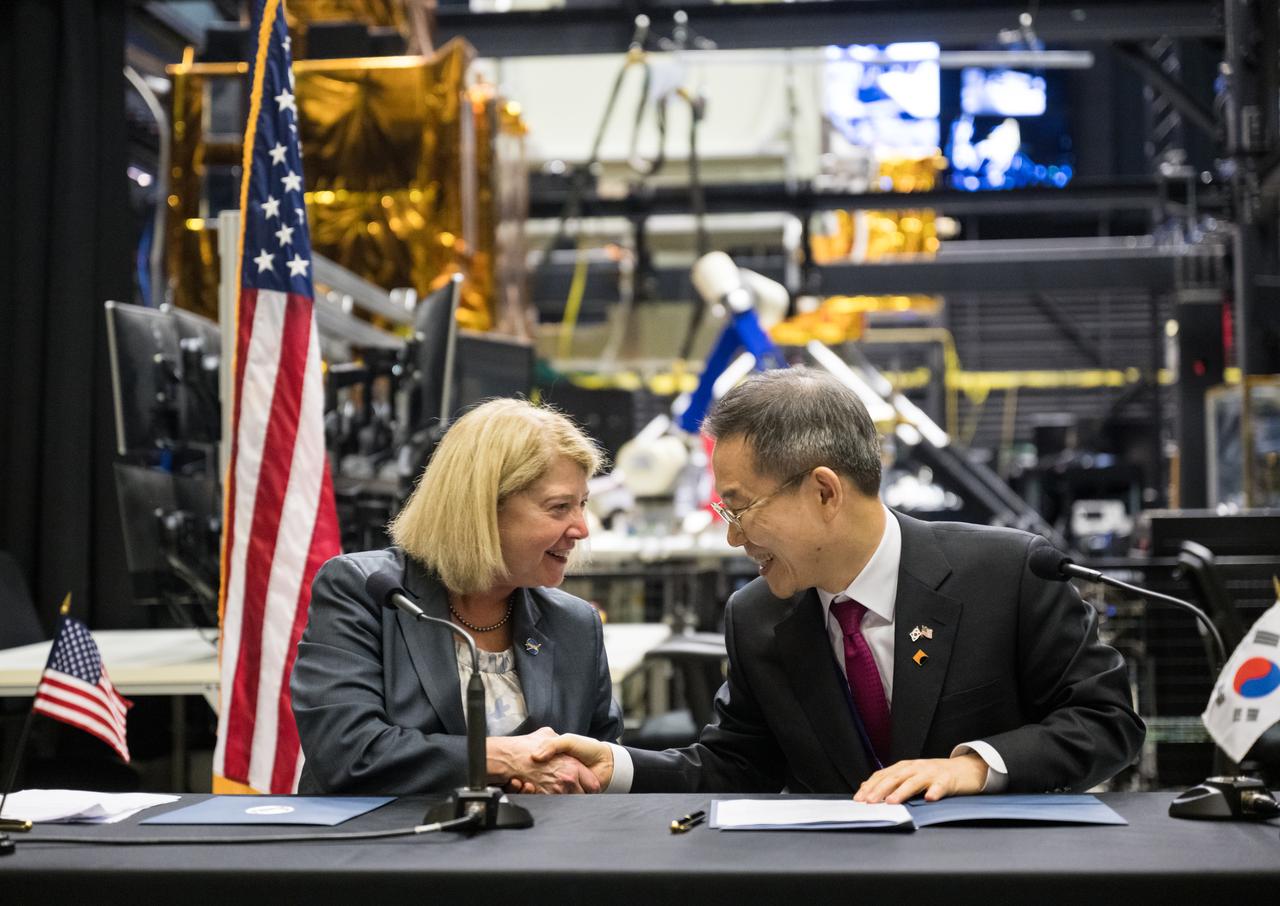
NASA Deputy Administrator Pam Melroy and MSIT Minister Jong-Ho Lee shake hands after signing a Joint Statement of Intent to advance cooperation in exploration and science between NASA and the Ministry of Science and ICT of the Republic of Korea, Tuesday, April 25, 2023, at NASA’s Goddard Space Flight Center in Greenbelt, Md. Photo Credit: (NASA/Aubrey Gemignani)
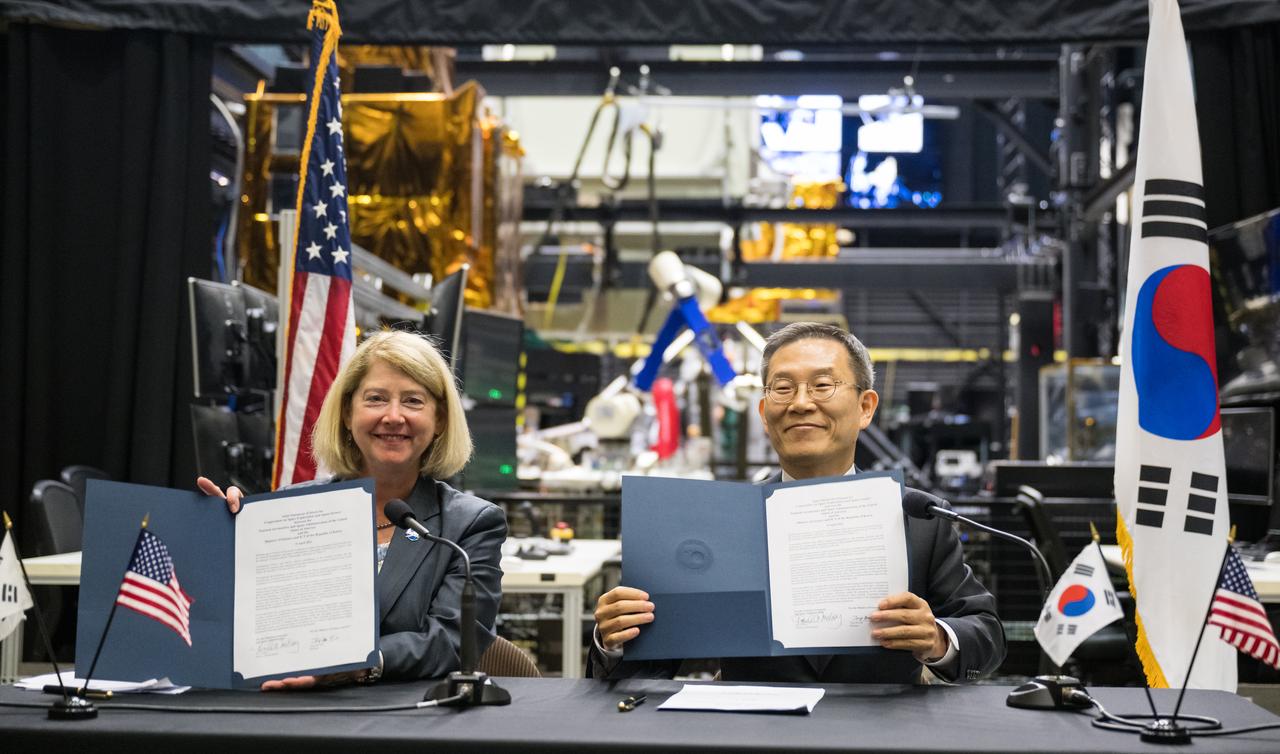
NASA Deputy Administrator Pam Melroy and MSIT Minister Jong-Ho Lee display the Joint Statement of Intent to advance cooperation in exploration and science between NASA and the Ministry of Science and ICT of the Republic of Korea after signing them, Tuesday, April 25, 2023, at NASA’s Goddard Space Flight Center in Greenbelt, Md. Photo Credit: (NASA/Aubrey Gemignani)
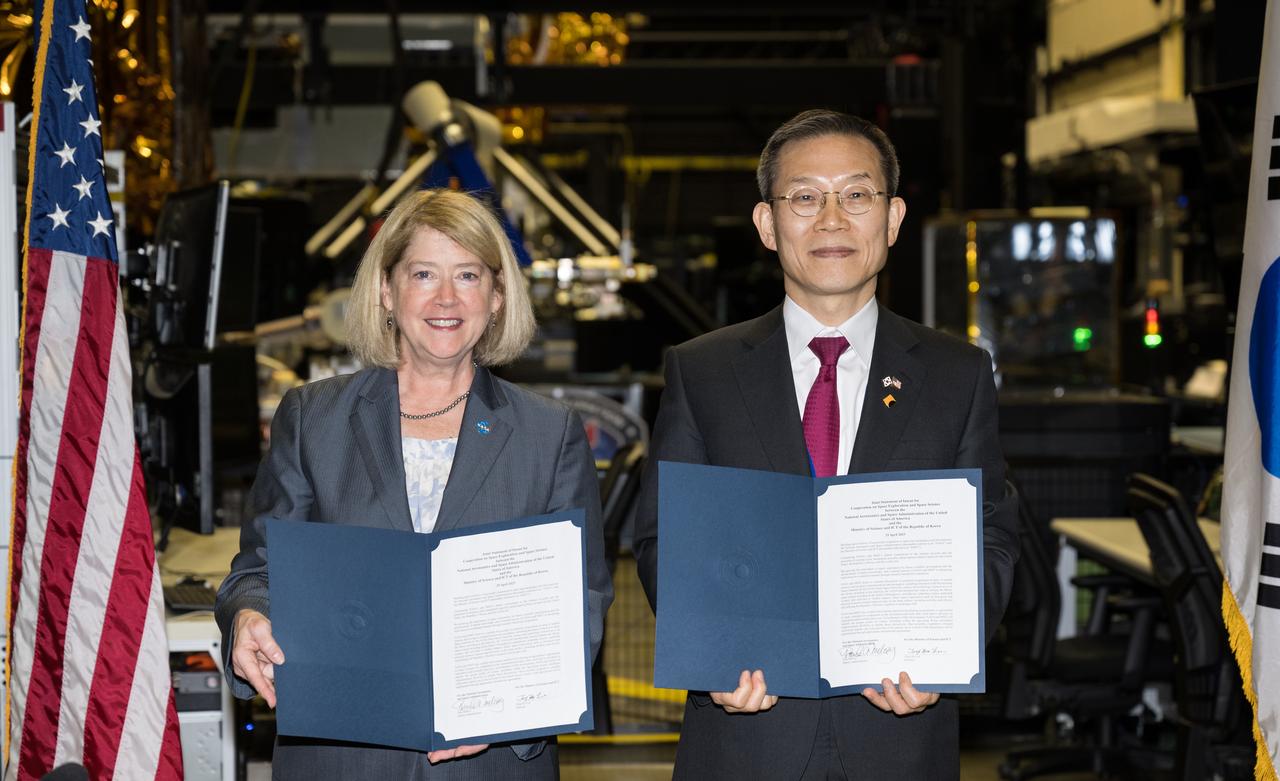
NASA Deputy Administrator Pam Melroy and MSIT Minister Jong-Ho Lee pose for a photo after signing a Joint Statement of Intent to advance cooperation in exploration and science between NASA and the Ministry of Science and ICT of the Republic of Korea, Tuesday, April 25, 2023, at NASA’s Goddard Space Flight Center in Greenbelt, Md. Photo Credit: (NASA/Aubrey Gemignani)
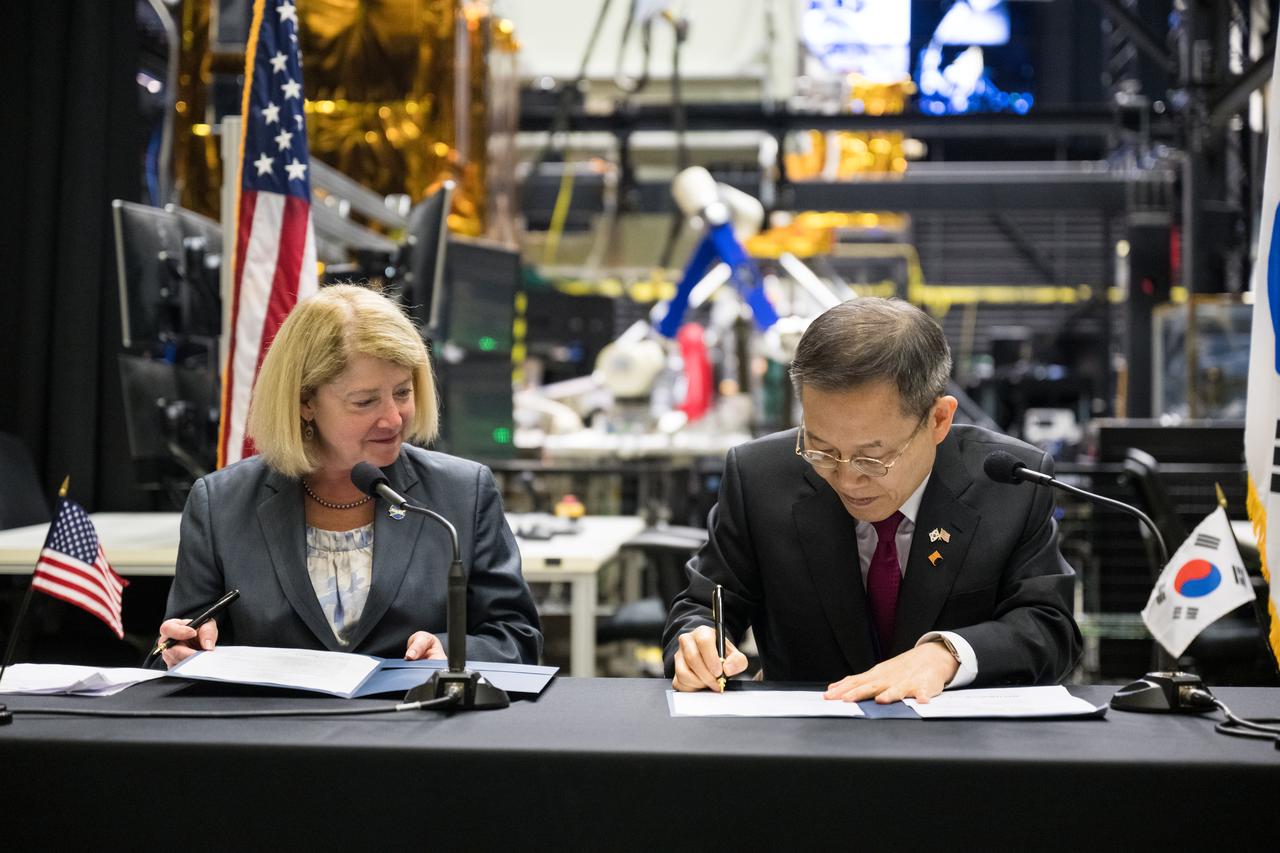
NASA Deputy Administrator Pam Melroy and MSIT Minister Jong-Ho Lee sign a Joint Statement of Intent to advance cooperation in exploration and science between NASA and the Ministry of Science and ICT of the Republic of Korea, Tuesday, April 25, 2023, at NASA’s Goddard Space Flight Center in Greenbelt, Md. Photo Credit: (NASA/Aubrey Gemignani)
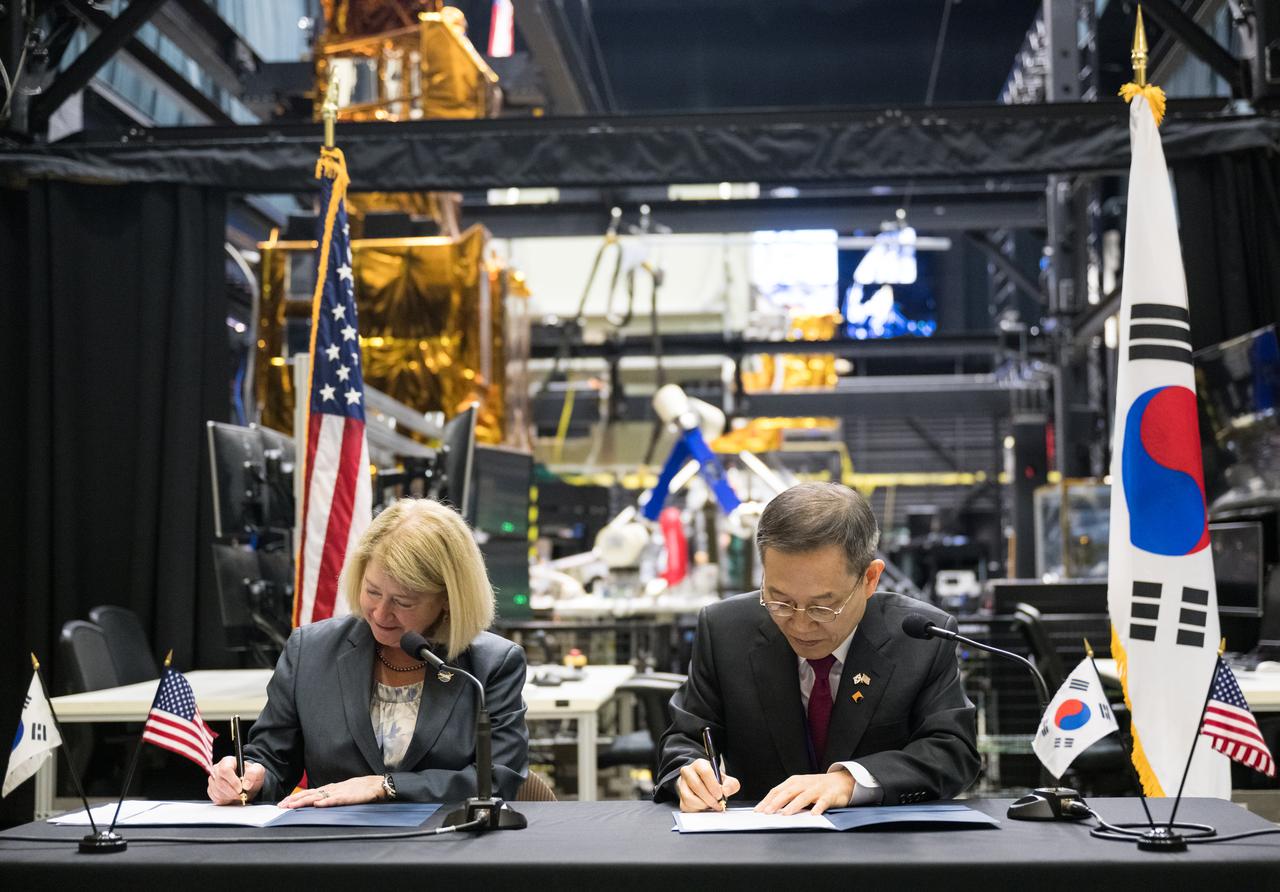
NASA Deputy Administrator Pam Melroy and MSIT Minister Jong-Ho Lee sign a Joint Statement of Intent to advance cooperation in exploration and science between NASA and the Ministry of Science and ICT of the Republic of Korea, Tuesday, April 25, 2023, at NASA’s Goddard Space Flight Center in Greenbelt, Md. Photo Credit: (NASA/Aubrey Gemignani)
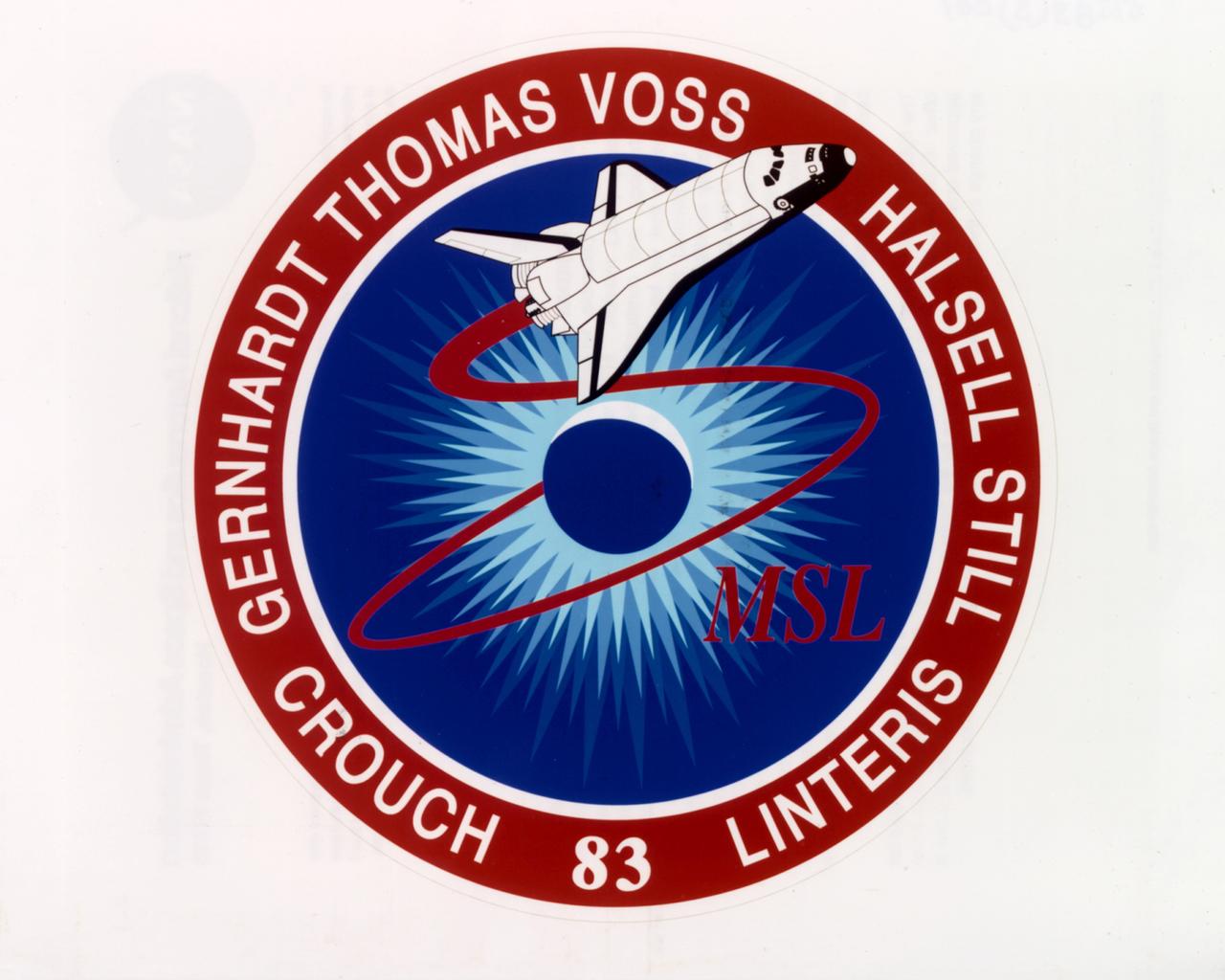
The crew patch for NASA's STS-83 mission depicts the Space Shuttle Columbia launching into space for the first Microgravity Sciences Laboratory 1 (MSL-1) mission. MSL-1 investigated materials science, fluid dynamics, biotechnology, and combustion science in the microgravity environment of space, experiments that were conducted in the Spacelab Module in the Space Shuttle Columbia's cargo bay. The center circle symbolizes a free liquid under microgravity conditions representing various fluid and materials science experiments. Symbolic of the combustion experiments is the surrounding starburst of a blue flame burning in space. The 3-lobed shape of the outermost starburst ring traces the dot pattern of a transmission Laue photograph typical of biotechnology experiments. The numerical designation for the mission is shown at bottom center. As a forerunner to missions involving International Space Station (ISS), STS-83 represented the hope that scientific results and knowledge gained during the flight will be applied to solving problems on Earth for the benefit and advancement of humankind.
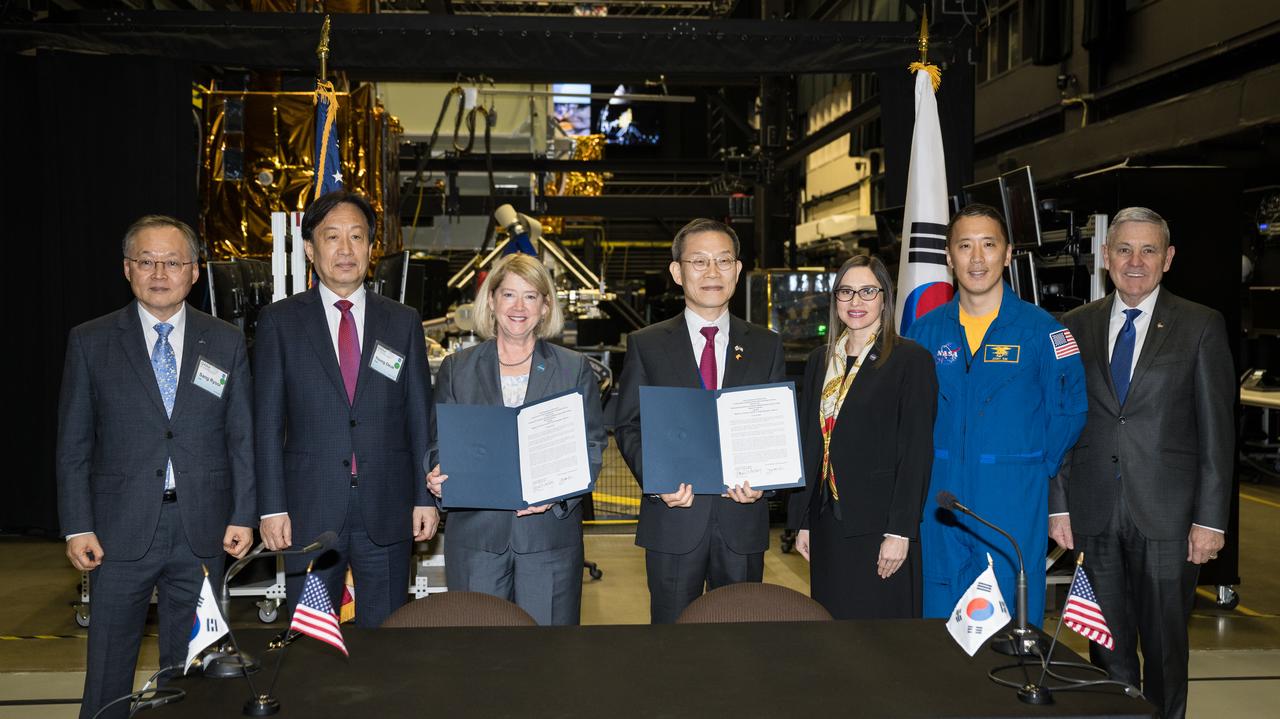
From left to right, President of Korea Aerospace Research Institute, Sang-ryul Lee, President of Korea Astronomy and Space Research Institute, Young-deuk Park, NASA Deputy Administrator Pam Melroy, MSIT Minister Jong-Ho Lee, Director of NASA’s Goddard Space Flight Center, Dr. Makenzie Lystrup, NASA astronaut Jonny Kim, and NASA Associate Administrator Bob Cabana pose for a photo after a Joint Statement of Intent to advance cooperation in exploration and science between NASA and the Ministry of Science and ICT of the Republic of Korea was signed, Tuesday, April 25, 2023, at NASA’s Goddard Space Flight Center in Greenbelt, Md. Photo Credit: (NASA/Aubrey Gemignani)
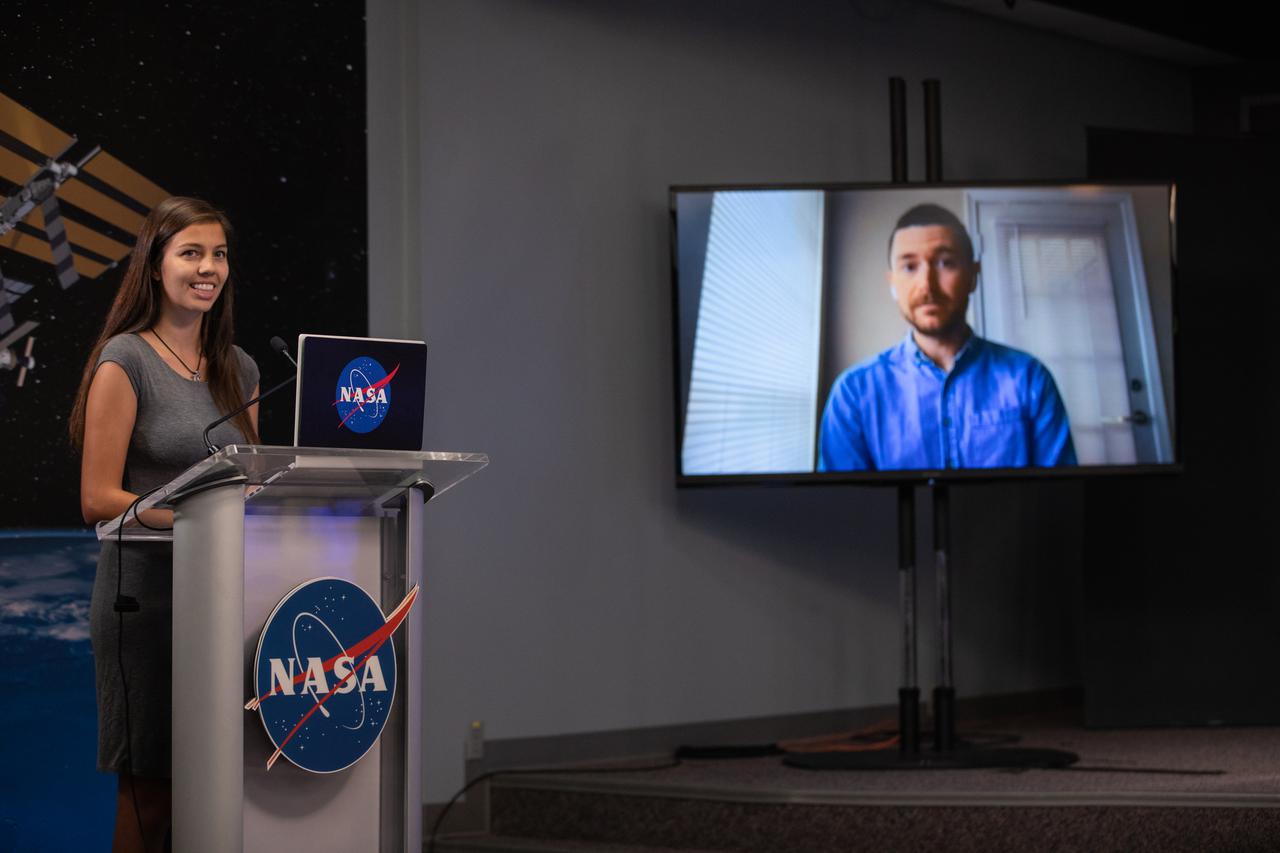
Antonia Jaramillo, NASA Communications, moderates a What’s On Board Science Briefing on June 2, 2021, at Kennedy Space Center in Florida for SpaceX’s 22nd Commercial Resupply Services mission for NASA to the International Space Station. On screen, principal investigator Dr. Thomas Boothby describes the Cell Science-04 experiment that will be delivered to the space station. Cell Science-04 will research the effects of microgravity on tardigrades, more commonly known as water bears. The results could advance understanding of the stress factors affecting humans in space. The SpaceX Falcon 9 rocket with the Dragon capsule atop is scheduled to launch at 1:29 p.m. EDT on Thursday, June 3, from the center’s Launch Complex 39A. Dragon will deliver more than 7,300 pounds of cargo and science experiments to the space station.
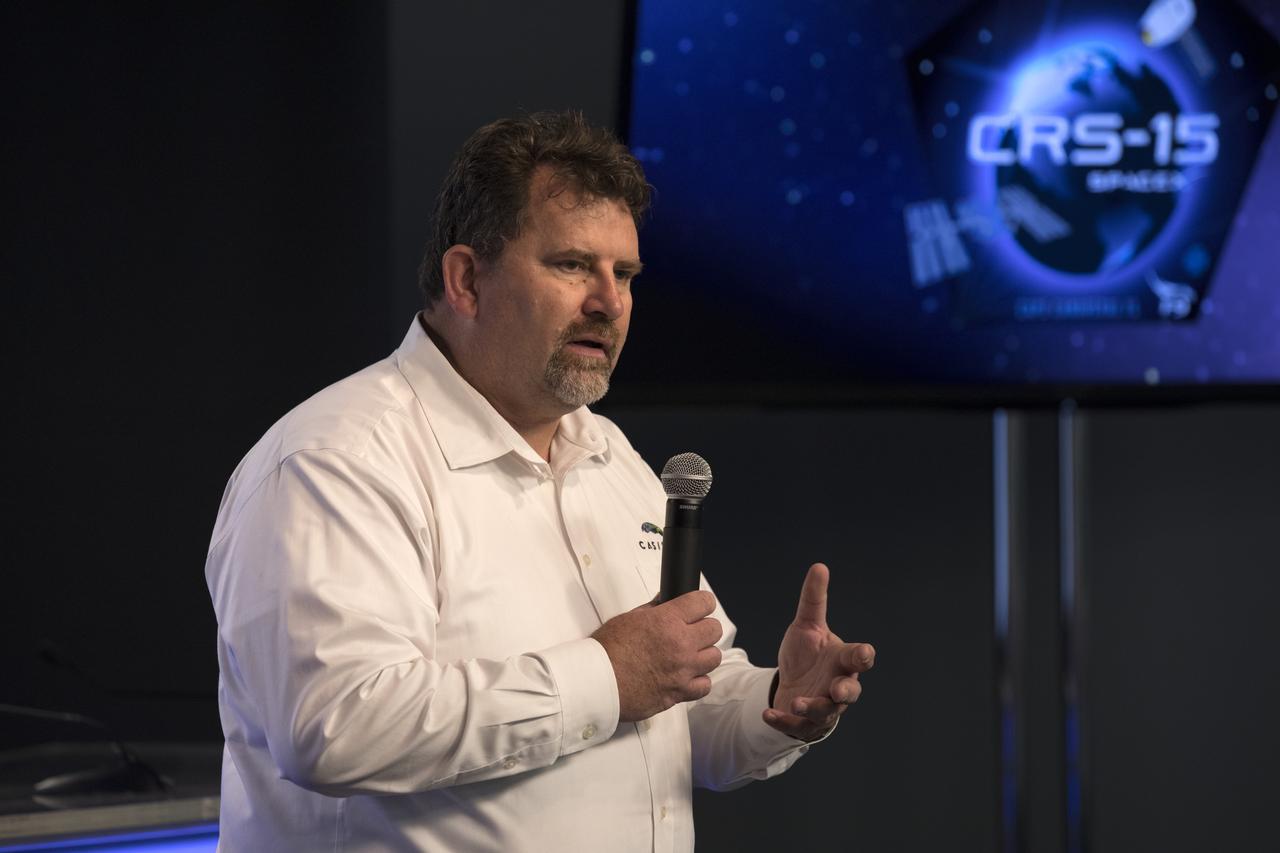
Mike Roberts, deputy chief scientist, Center for the Advancement of Science in Space (CASIS), speaks to members of the media during a briefing in the Kennedy Space Center’s Press Site auditorium. The briefing focused on research planned for launch to the International Space Station. The scientific materials and supplies will be aboard a SpaceX Dragon spacecraft scheduled for liftoff from Cape Canaveral Air Force Station's Space Launch Complex 40. The SpaceX Falcon 9 rocket will launch the company's 15th Commercial Resupply Services mission to the space station.
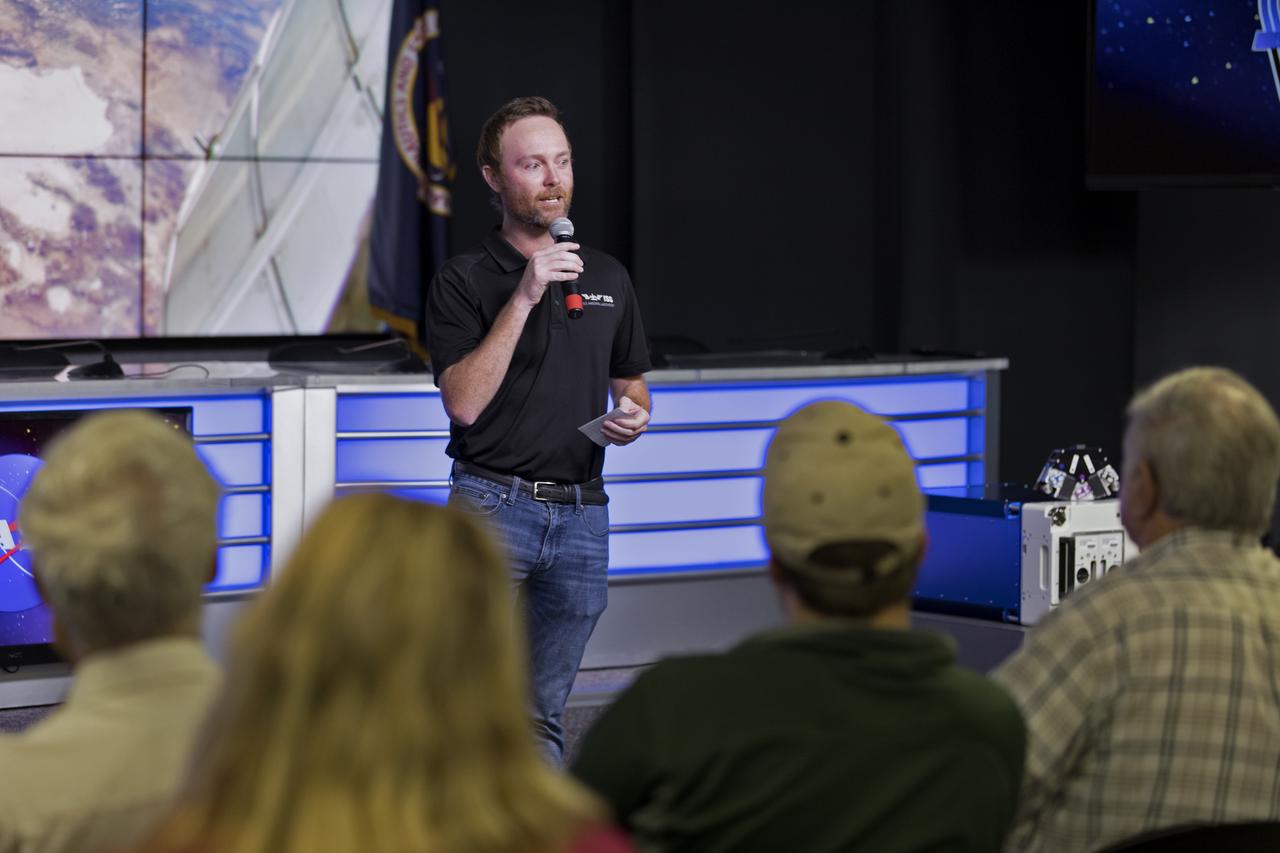
Patrick O'Neill, Marketing and Communications Manager, Center for the Advancement of Science in Space, speaks to members of the media in the Kennedy Space Center Press Site auditorium. The briefing focused on research planned for launch to the International Space Station. The scientific materials and supplies will be aboard a Dragon spacecraft scheduled for liftoff from Cape Canaveral Air Force Station's Space Launch Complex 40 at 4:30 p.m. EST, on April 2, 2018. The SpaceX Falcon 9 rocket will launch the company's 14th Commercial Resupply Services mission to the space station.
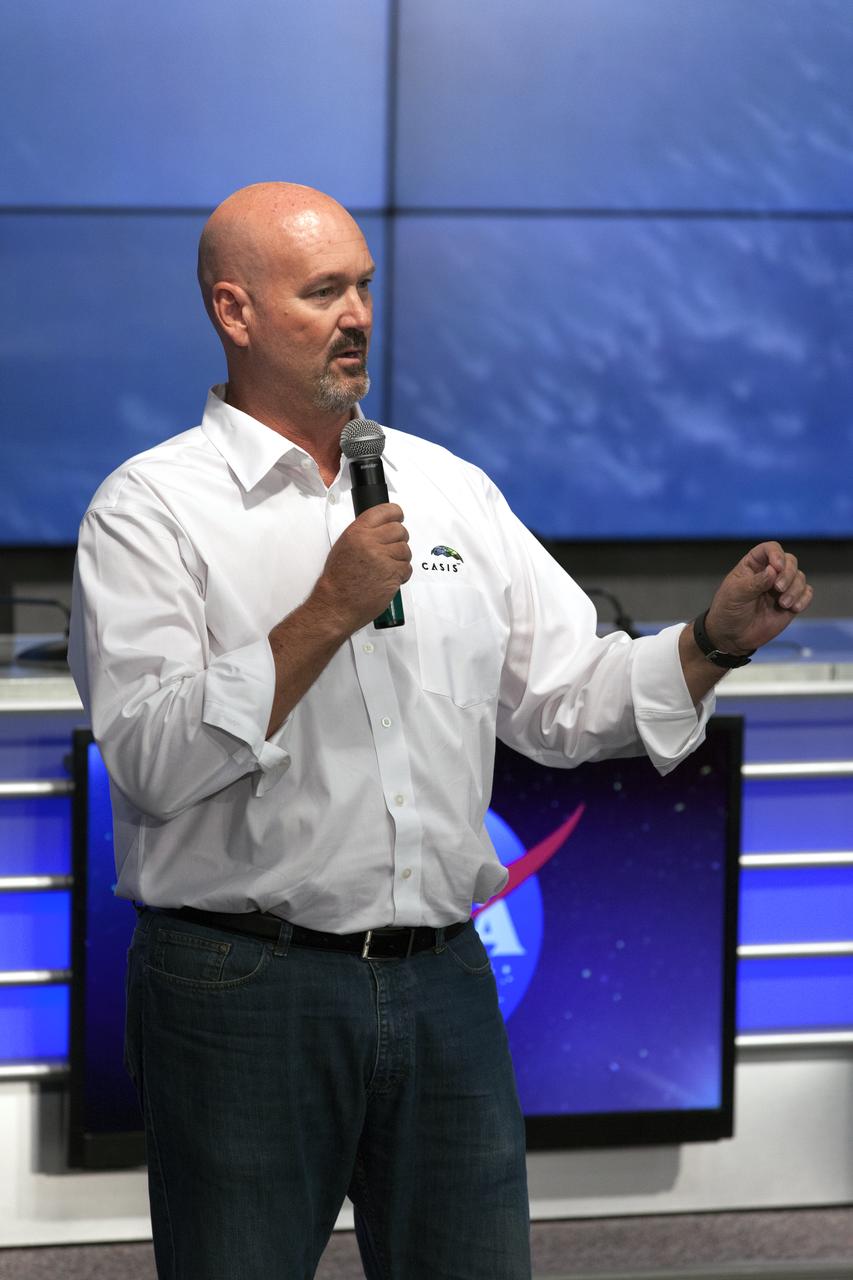
Ken Shields, director of Operations for Center for the Advancement of Science in Space/ISS National Lab, speaks to members of social media in the Kennedy Space Center’s Press Site auditorium. The briefing focused on research planned for launch to the International Space Station. The scientific materials and supplies will be aboard a Dragon spacecraft scheduled for launch from Kennedy’s Launch Complex 39A on Aug. 14 atop a SpaceX Falcon 9 rocket on the company's 12th Commercial Resupply Services mission to the space station.
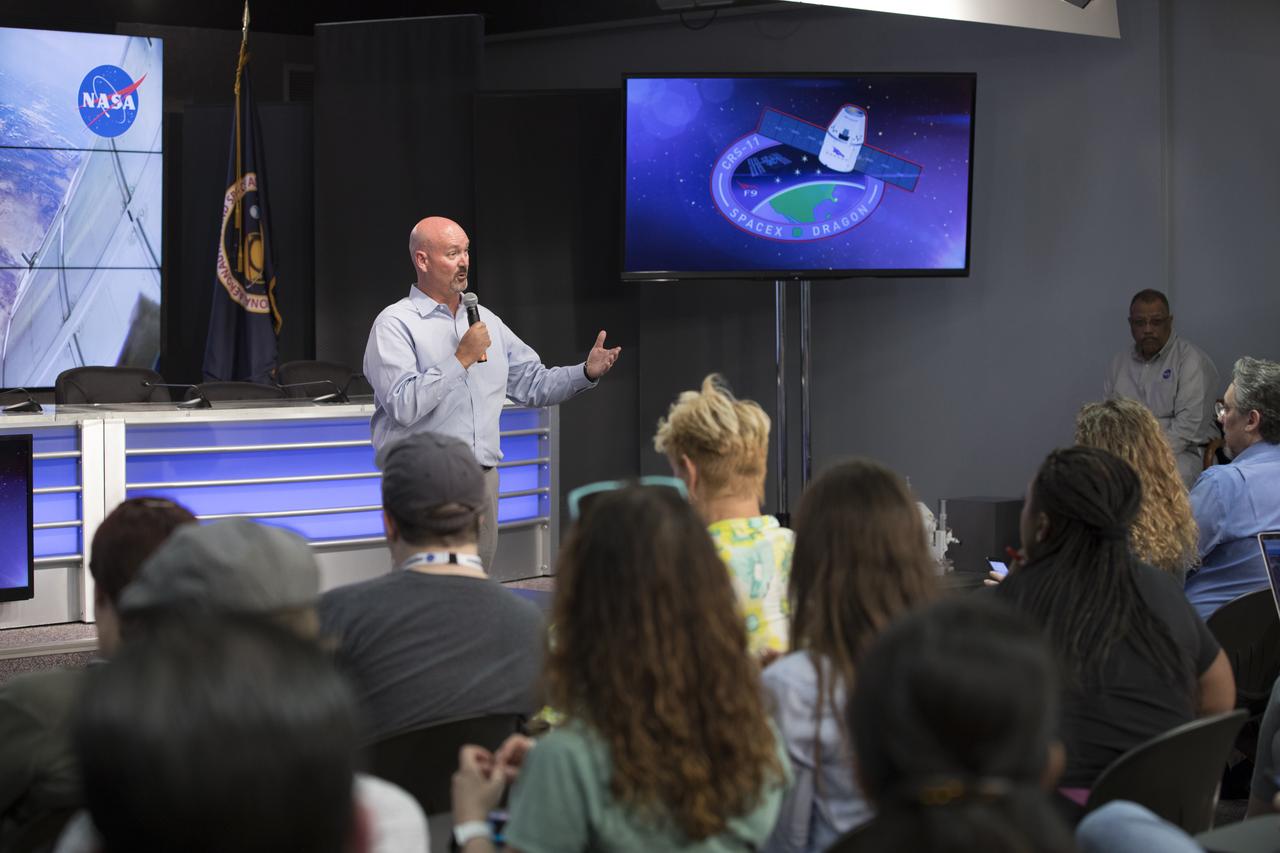
Ken Shields, director of Operations for the Center for the Advancement of Science in Space (CASIS)/ISS National Lab, speaks to members of social media in the Kennedy Space Center’s Press Site auditorium. The briefing focused on research planned for launch to the International Space Station. The scientific materials and supplies will be aboard a Dragon spacecraft scheduled for launch from Kennedy’s Launch Complex 39A on June 1 atop a SpaceX Falcon 9 rocket on the company's 11th Commercial Resupply Services mission to the space station.
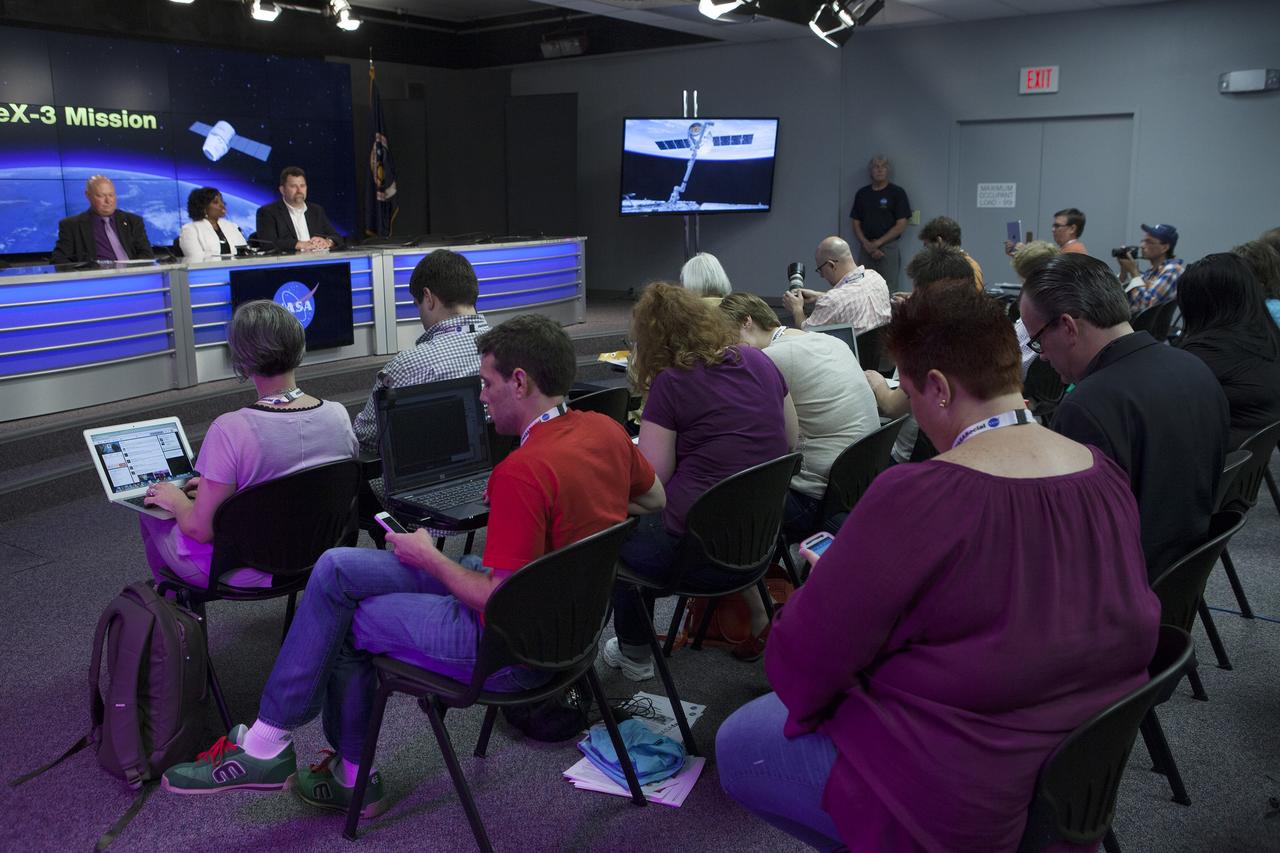
CAPE CANAVERAL, Fla. – During a news conference at NASA's Kennedy Space Center in Florida, agency and contractor officials discussed science and technology experiment payloads being transported to the International Space Station by the SpaceX-3 Commercial Resupply Services mission. Participating in the briefing, from the left, are Mike Curie of NASA Public Affairs, Camille Alleyne, assistant program scientist in the NASA ISS Program Science Office, and Michael Roberts, senior research pathway manager with the Center for the Advancement of Science in Space CASIS. Scheduled for launch on April 14, 2014 atop a Falcon 9 rocket, the Dragon spacecraft will be marking its fourth trip to the space station. The SpaceX-3 mission carrying almost 2.5 tons of supplies, technology and science experiments is the third of 12 flights contracted by NASA to resupply the orbiting laboratory. For more information, visit http://www.nasa.gov/mission_pages/station/structure/launch/index.html Photo credit: NASA/ Kim Shiflett
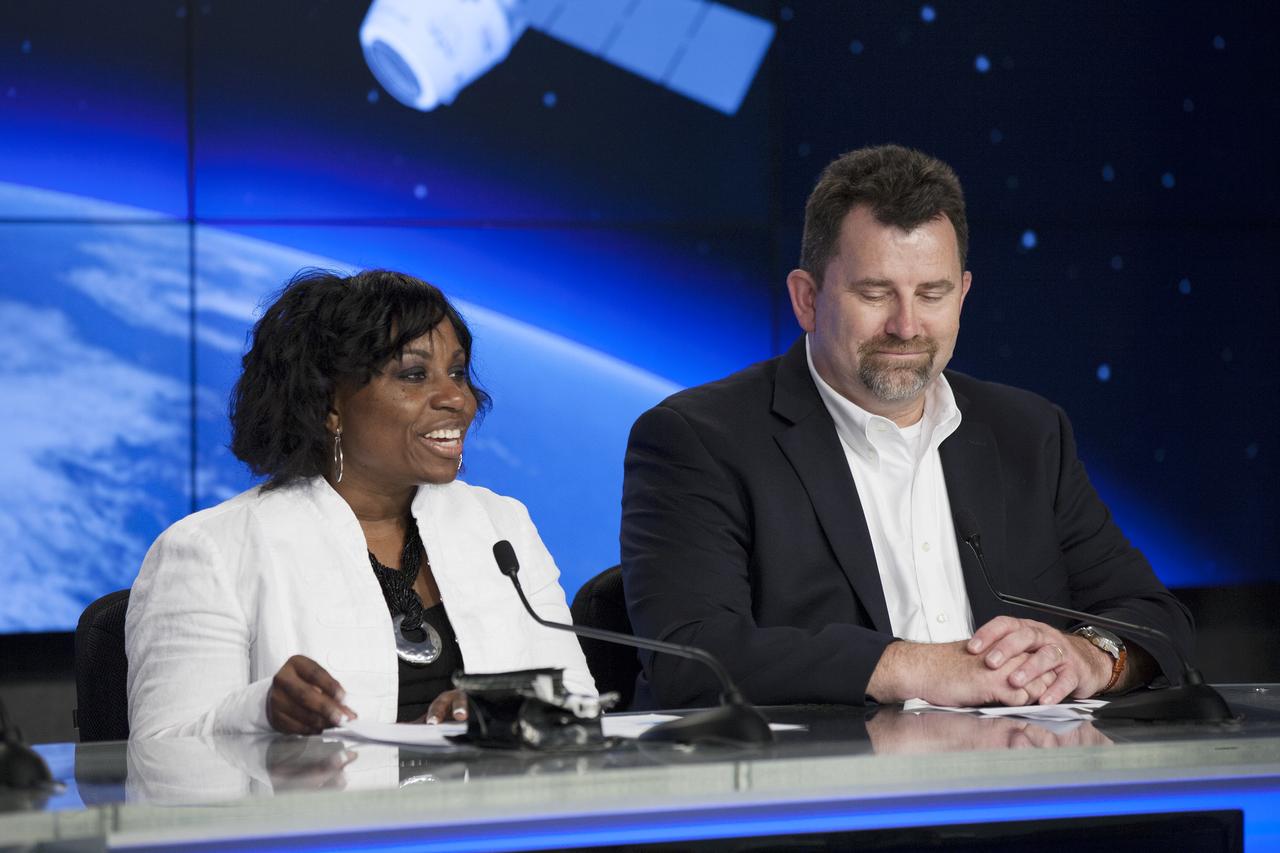
CAPE CANAVERAL, Fla. – During a news conference at NASA's Kennedy Space Center in Florida, agency and contractor officials discussed science and technology experiment payloads being transported to the International Space Station by the SpaceX-3 Commercial Resupply Services mission. Participating in the briefing, from the left, are Camille Alleyne, assistant program scientist in the NASA ISS Program Science Office, and Michael Roberts, senior research pathway manager with the Center for the Advancement of Science in Space CASIS. Scheduled for launch on April 14, 2014 atop a Falcon 9 rocket, the Dragon spacecraft will be marking its fourth trip to the space station. The SpaceX-3 mission carrying almost 2.5 tons of supplies, technology and science experiments is the third of 12 flights contracted by NASA to resupply the orbiting laboratory. For more information, visit http://www.nasa.gov/mission_pages/station/structure/launch/index.html Photo credit: NASA/ Kim Shiflett
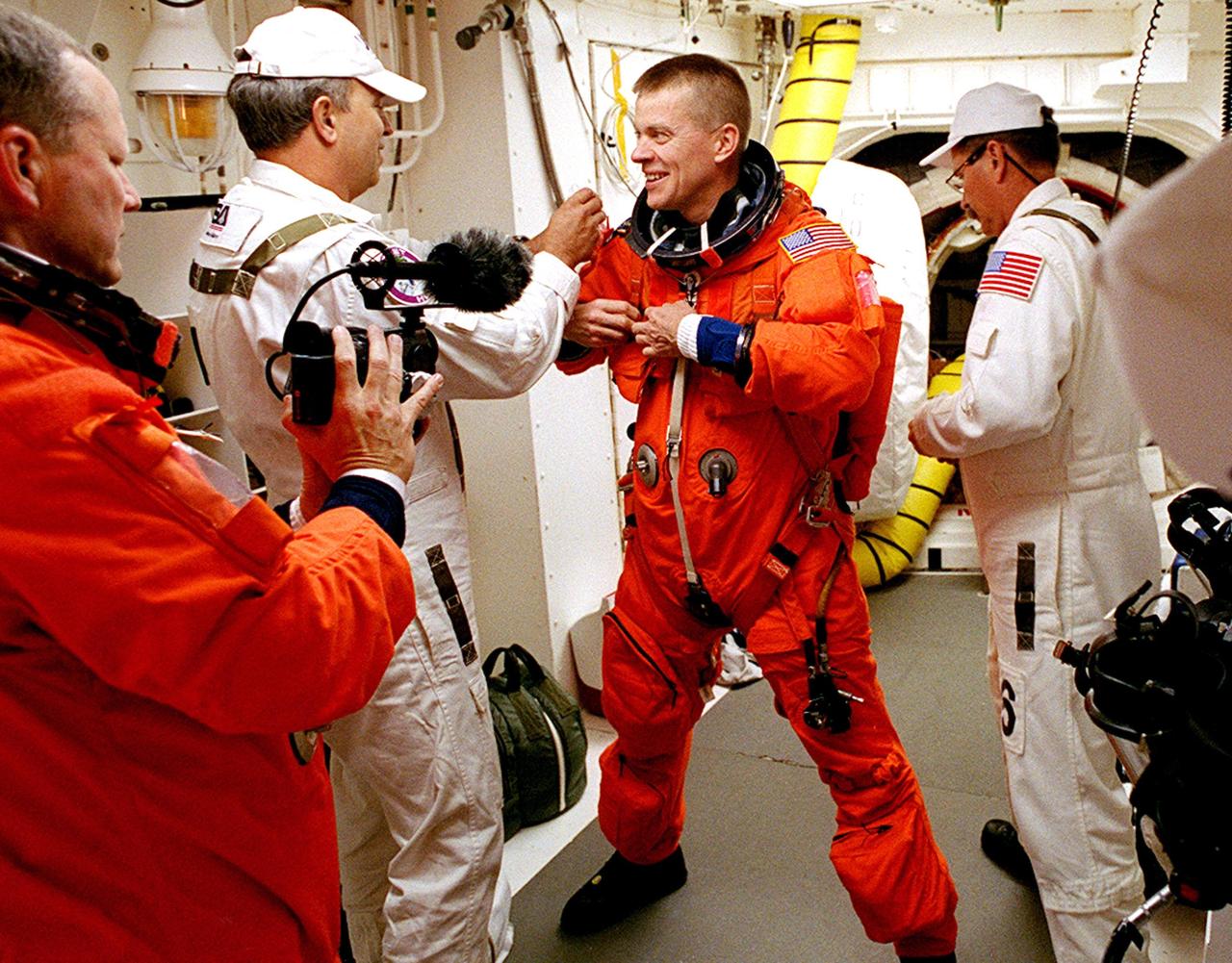
KENNEDY SPACE CENTER, FLA. - STS-107 Pilot William "Willie" McCool (center) gets help with his launch and entry suit from the Closeout Crew in the White Room. The environmentally controlled chamber is mated to Space Shuttle Columbia for entry into the Shuttle. In the foreground, left, is Mission Specialist David Brown. STS-107 is a mission devoted to research and will include more than 80 experiments that will study Earth and space science, advanced technology development, and astronaut health and safety. The payload on Space Shuttle Columbia includes FREESTAR (Fast Reaction Experiments Enabling Science, Technology, Applications and Research) and the SHI Research Double Module (SHI/RDM), known as SPACEHAB. Experiments on the module range from material sciences to life sciences. Liftoff is scheduled for 10:39 a.m. EST.
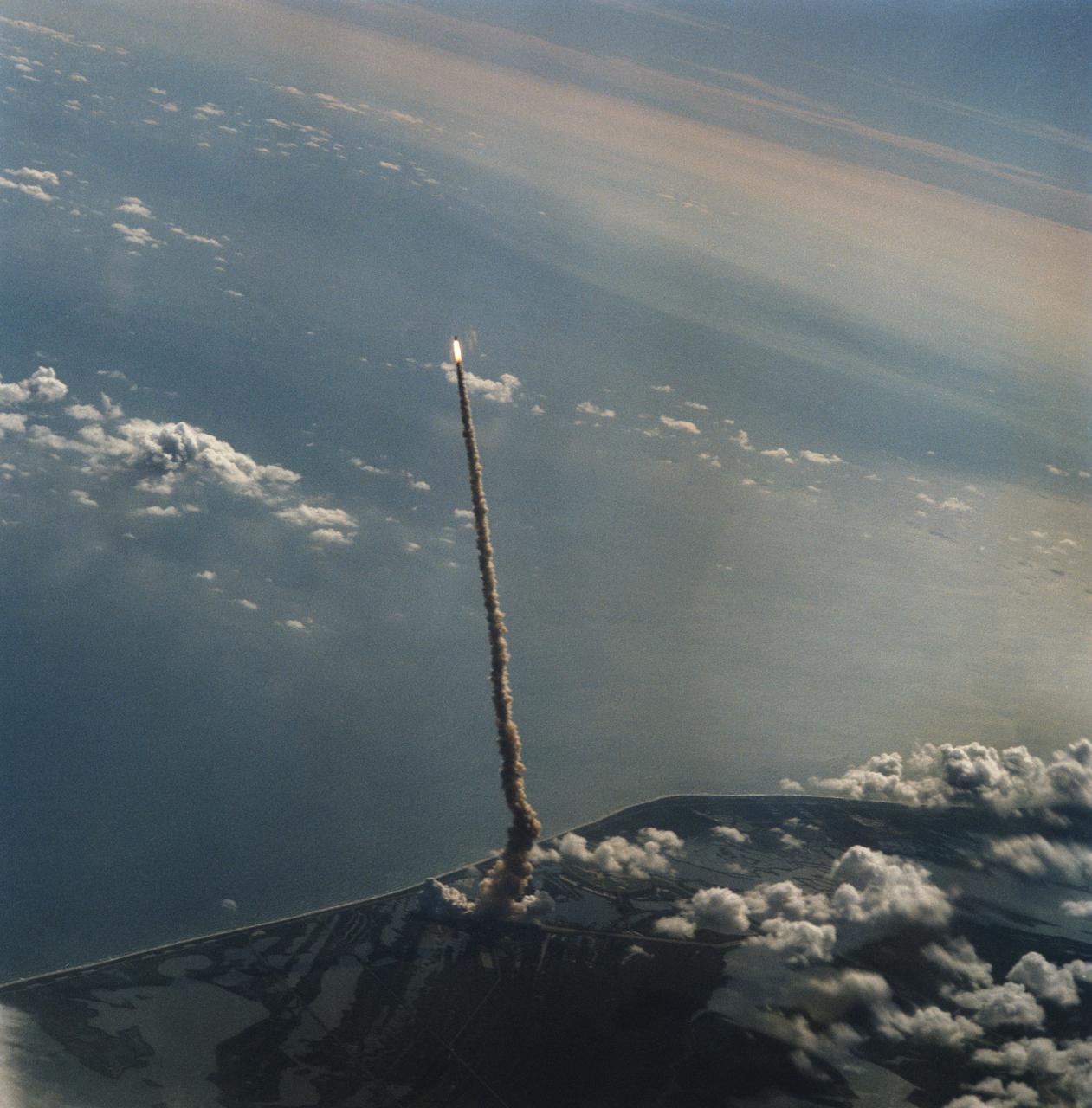
STS058-S-122 (18 Oct 1993) --- This distant shot of Columbia on its way to Earth-orbit was captured on film from the Shuttle Training Aircraft (STA) assigned to advance launch range screening. Onboard the spacecraft were six NASA astronauts, a veterinarian from the private sector and the Spacelab Life Sciences (SLS-2) science module. The crew will spend two weeks in Earth-orbiting devoting all its on-duty time to life sciences research. Launch occurred at 10:53 a.m. (EDT), October 18, 1993, from the Kennedy Space Center (KSC).
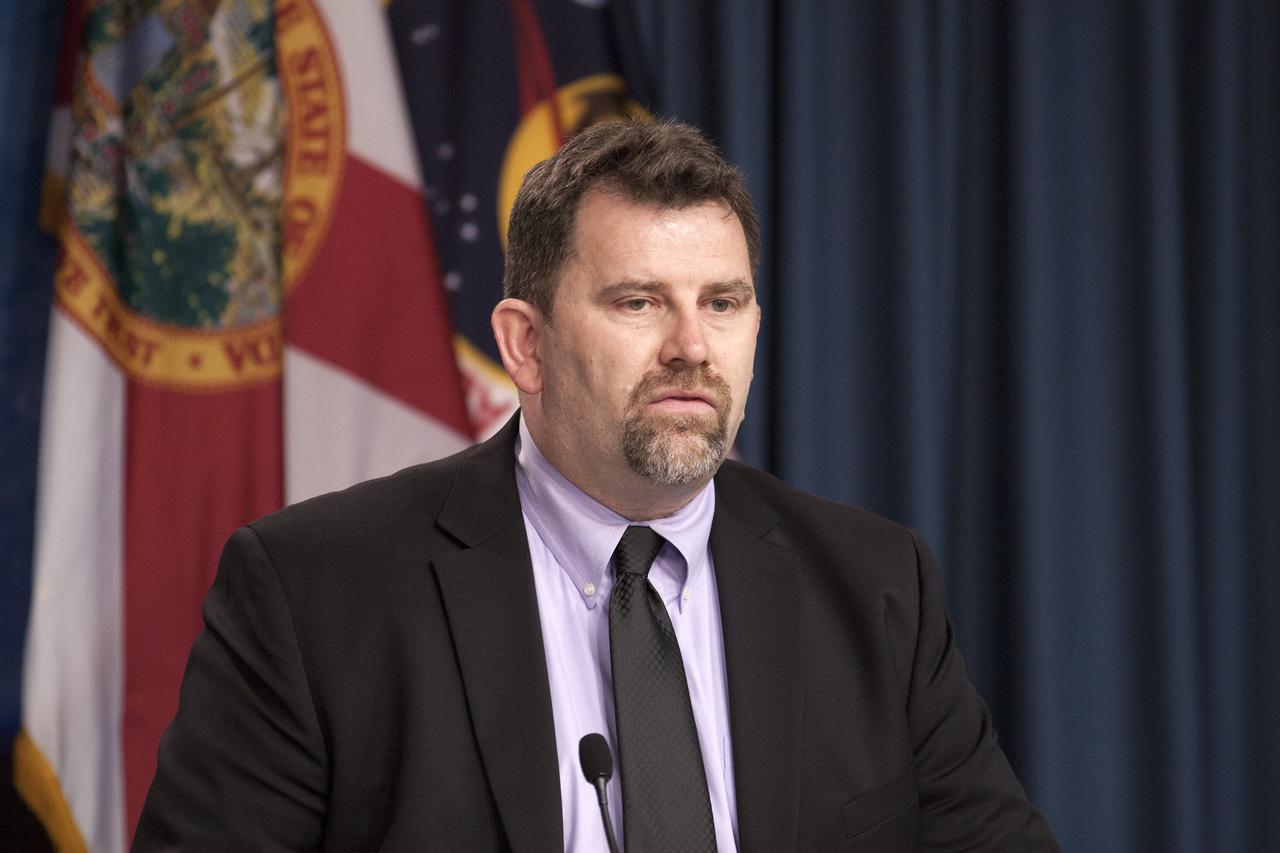
CAPE CANAVERAL, Fla. - Media attending a pre-launch news conference at the Kennedy Space Center, Fla. heard from Michael Roberts, research scientist with the Center for Advancement of Science in Space. Scheduled for launch March 1 atop a Falcon 9 rocket, the SpaceX Dragon capsule will be making its third trip to the space station. The mission is the second of 12 SpaceX flights contracted by NASA to resupply the orbiting laboratory. For more information, visit http:__www.nasa.gov_mission_pages_station_structure_launch_spacex2-feature.html Photo credit: NASA_Kim Shiflett
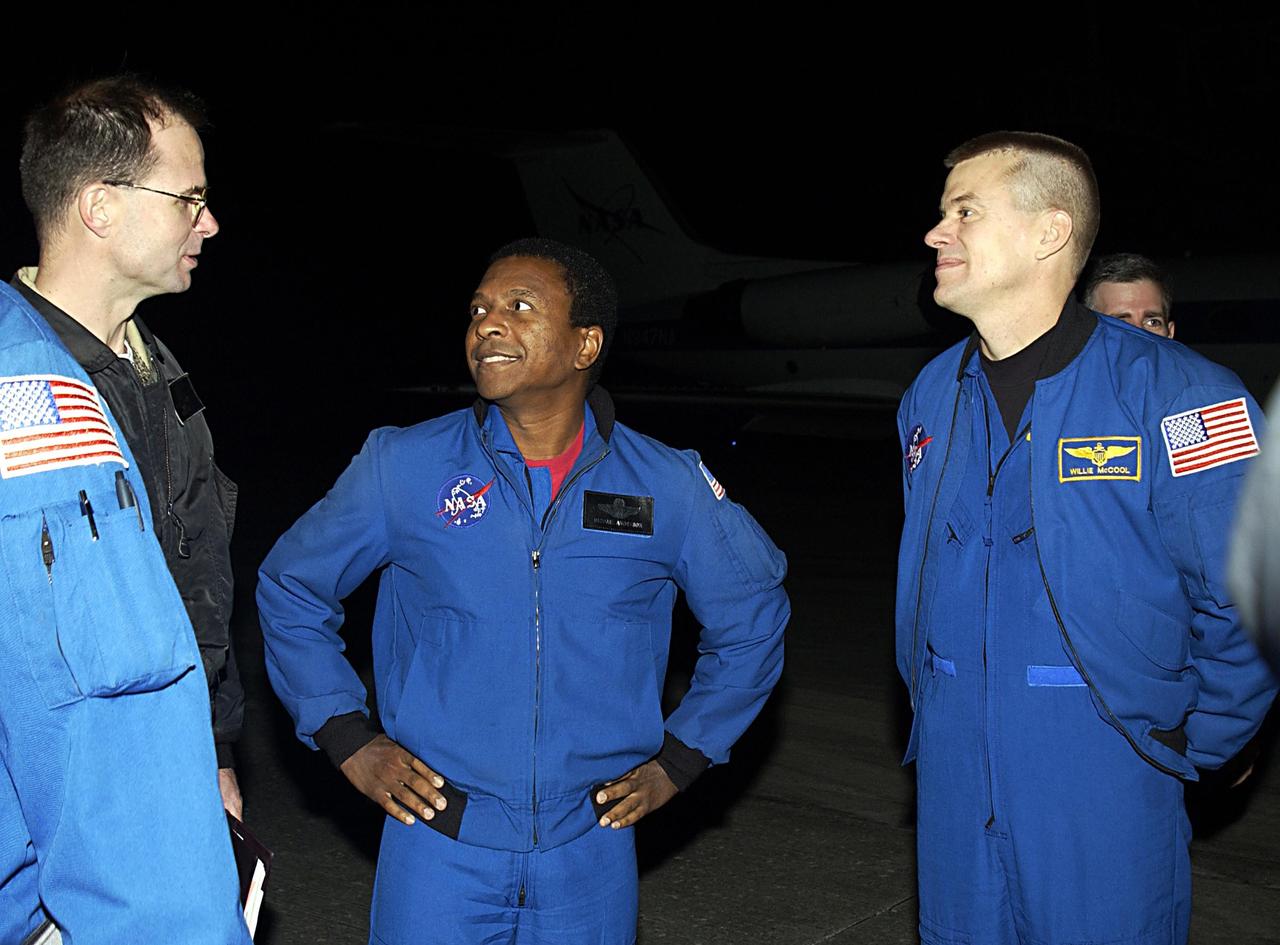
KENNEDY SPACE CENTER, FLA. - After their arrival at KSC, STS-107 Payload Commander Michael Anderson (center) and Pilot William "Willie" McCool (right) talk with Robert Hanley, who is mission lead with the Vehicle Integration Test team from Houston. STS-107 is a mission devoted to research and will include more than 80 experiments that will study Earth and space science, advanced technology development, and astronaut health and safety. The payload on Space Shuttle Columbia includes FREESTAR (Fast Reaction Experiments Enabling Science, Technology, Applications and Research) and the SHI Research Double Module (SHI/RDM), known as SPACEHAB. Experiments on the module range from material sciences to life sciences. Launch of Columbia is targeted for Jan. 16 between 10 a.m. and 2 p.m.
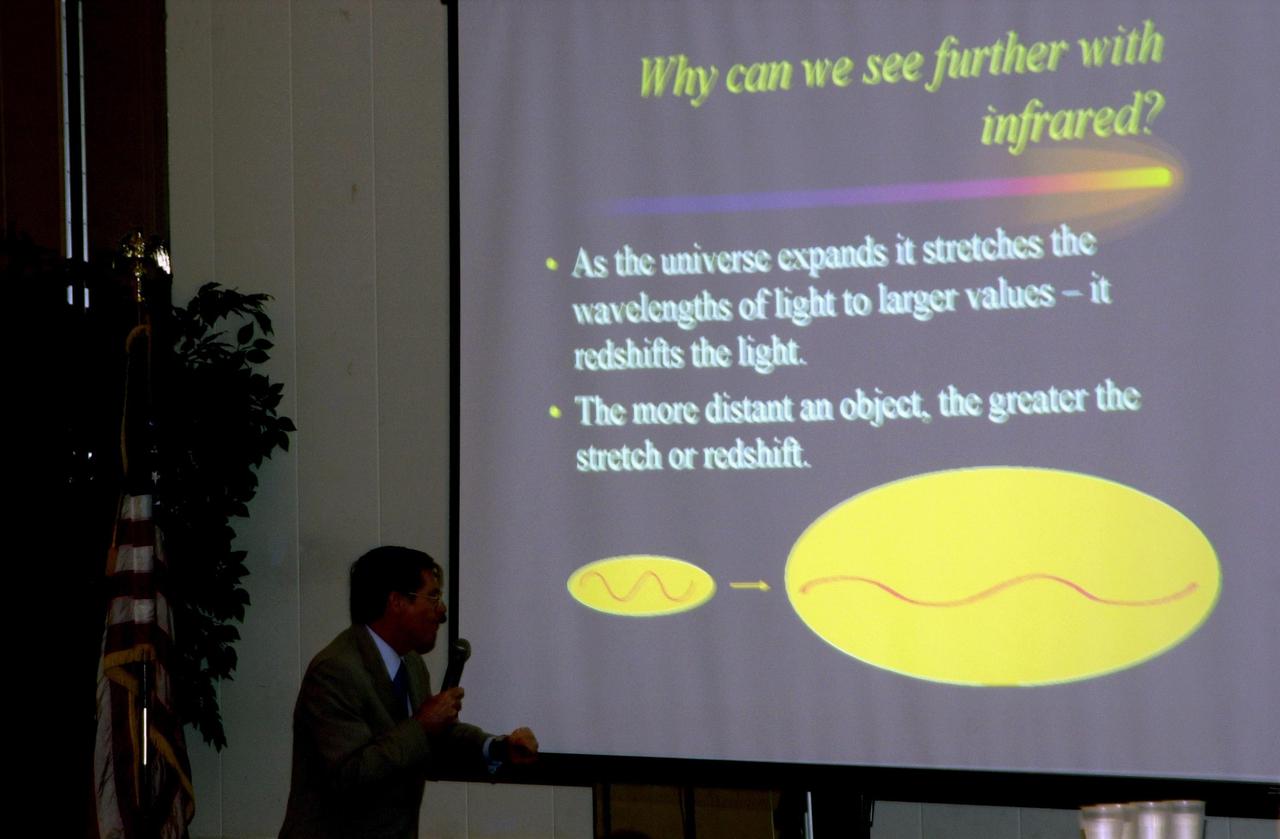
KENNEDY SPACE CENTER, FLA. -- At the 2002 Space Congress, Cape Canaveral, Fla., a presentation on 'Hubble Discoveries' included a discussion on infrared, as seen on the screen. At left is Dr. Mario Liviio, director of Science Division, Space Telescope Science Institute. The Space Congress is held annually to highlight military and space initiatives, new technologies, and Florida's role in programs and research. This year's theme is Beginning a New Era - Initiatives in Space. NASA presented several paper sessions, including Advancements in Technology. Space Congress is sponsored by the Canaveral Council of Technical Societies
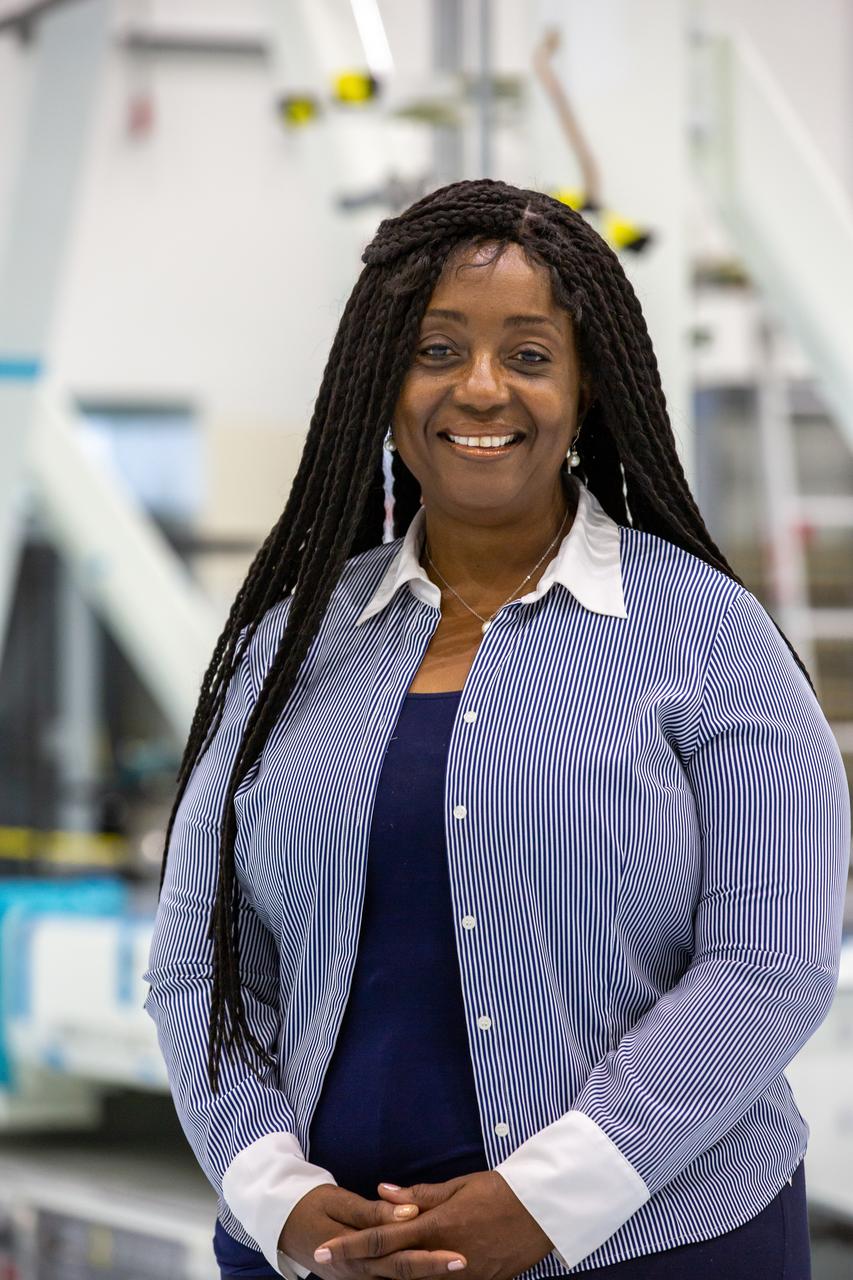
Barbara L. Brown, director of Exploration Research and Technology Programs at NASA's Kennedy Space Center in Florida, poses for a portrait inside the spaceport’s Space Station Processing Facility High Bay on Aug. 5, 2022. Brown leads processing, assembly, integration, and test of payloads and flight science experiments bound for the International Space Station. Additionally, Brown serves as Kennedy’s lead for the formulation of concepts to support uncrewed operations on the Moon and Mars, directing research, development, testing, and demonstration of flight systems and technologies to advance exploration and space systems. The programs and projects under her purview span NASA’s Exploration Systems, Science, Space Operations, and Space Technology mission directorates.
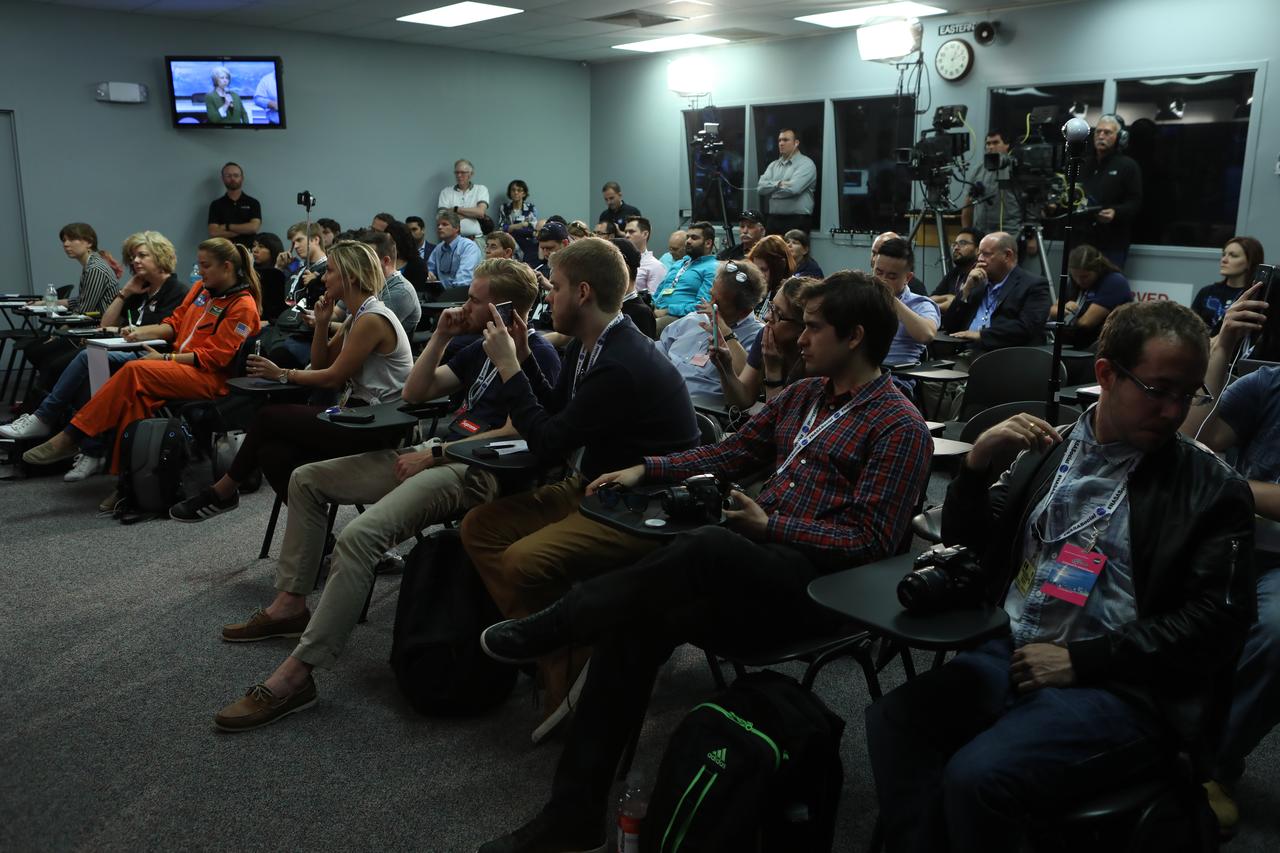
NASA Social participants attend a "What's on Board" science, research and technology briefing at NASA's Kennedy Space Center in Florida, for Orbital ATK's seventh commercial resupply services mission, CRS-7, to the International Space Station. Participants discussed some of the science launching to the space station, including the Advanced Plant Habitat, 3-D cell tools, and CubeSats set to deploy from space. Orbital ATK's Cygnus pressurized cargo module is set to launch on the United Launch Alliance Atlas V rocket from Space Launch Complex 41 at Cape Canaveral Air Force Station on April 18. Liftoff is scheduled for 11:11 a.m. EDT.
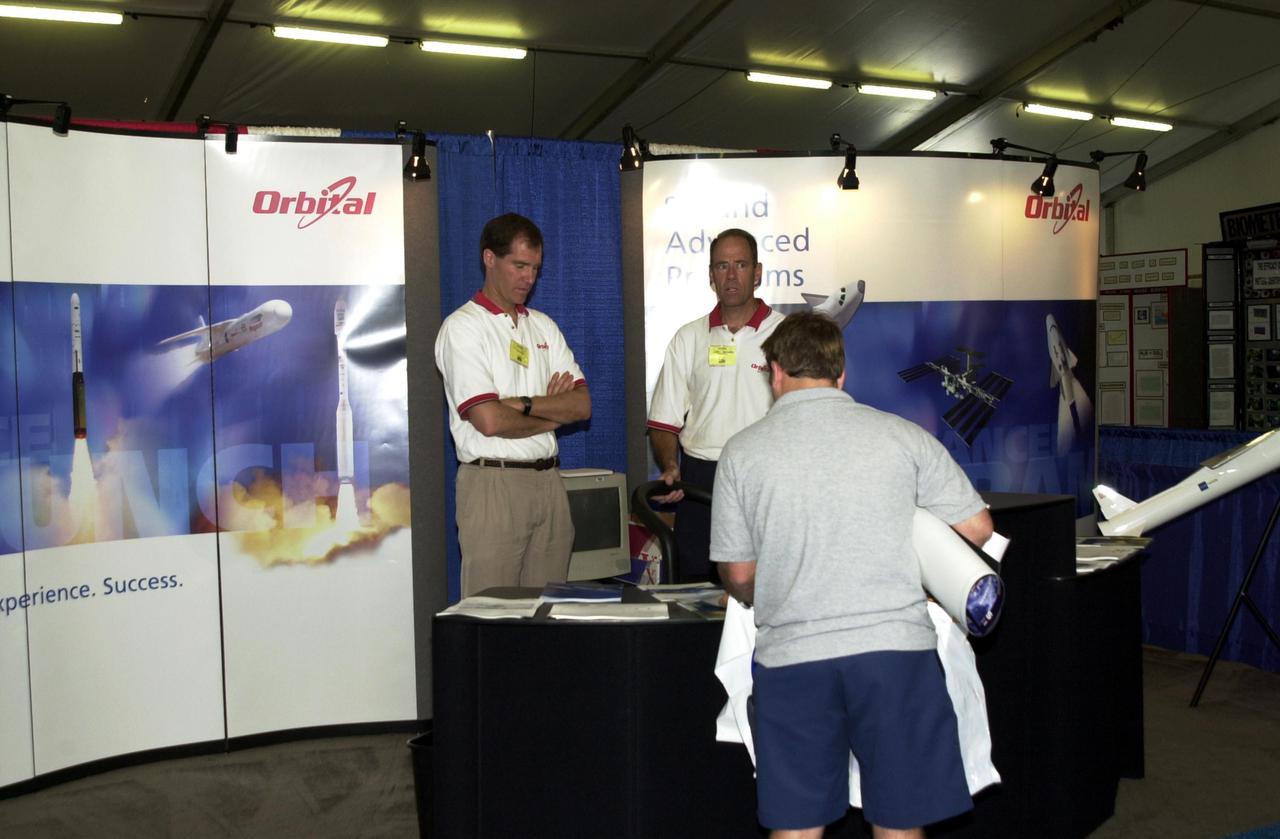
KENNEDY SPACE CENTER, FLA. -- At the 2002 Space Congress, Cape Canaveral, Fla., held April 30 - May 3, a visitor stops by the Orbital Sciences display booth. The Space Congress is held annually to highlight military and space initiatives, new technologies, and Florida's role in programs and research. This year's theme is Beginning a New Era - Initiatives in Space. NASA presented several paper sessions, including Hubble Discoveries and Advancements in Technology. Space Congress is sponsored by the Canaveral Council of Technical Societies
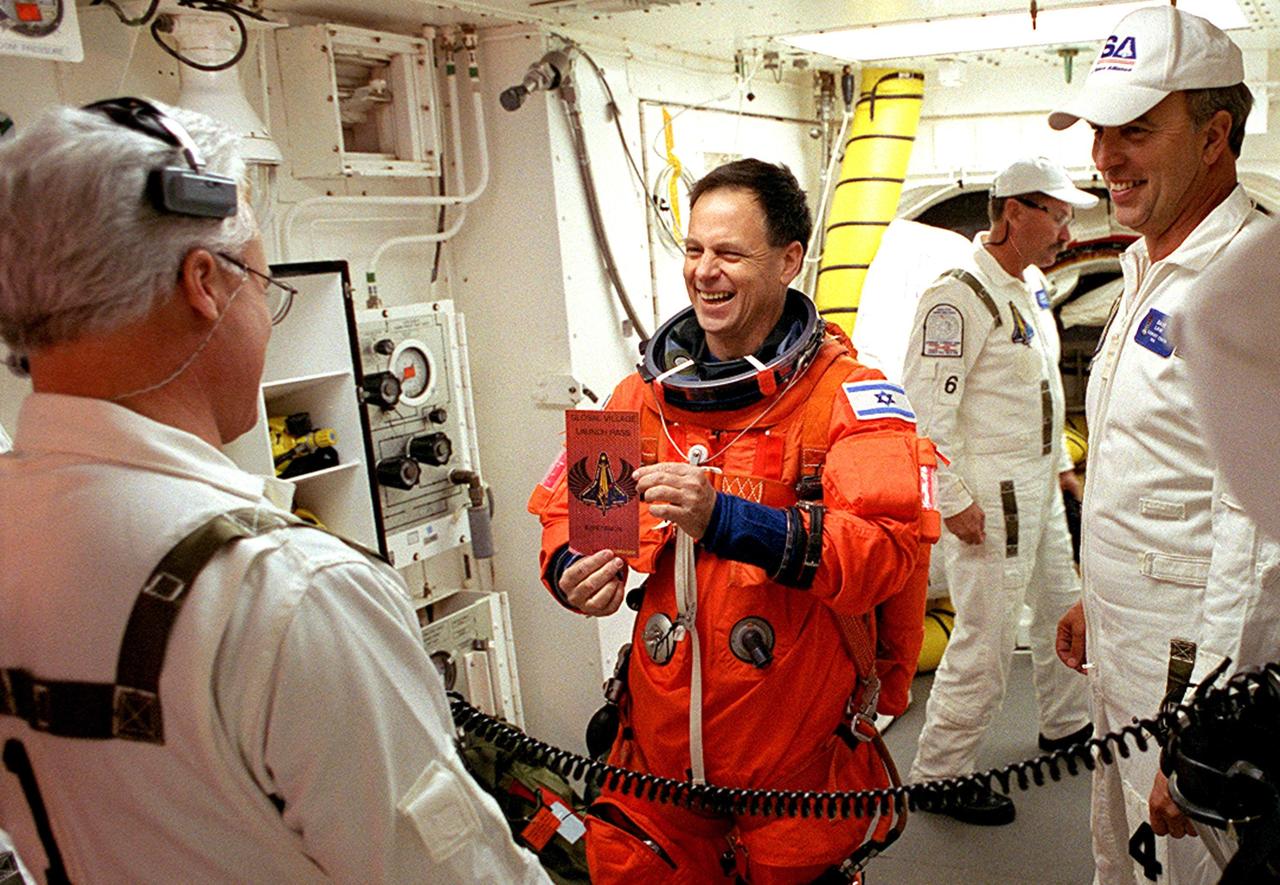
KENNEDY SPACE CENTER, FLA. -- STS-107 Payload Specialist Ilan Ramon, who represents the Israel Space Agency, chats with the Closeout Crew in the White Room before entering Columbia. The environmentally controlled chamber is mated to Space Shuttle Columbia for entry into the Shuttle. Ramon is the first Israeli astronaut to fly in the Shuttle. STS-107 is a mission devoted to research and will include more than 80 experiments that will study Earth and space science, advanced technology development, and astronaut health and safety. The payload on Space Shuttle Columbia includes FREESTAR (Fast Reaction Experiments Enabling Science, Technology, Applications and Research) and the SHI Research Double Module (SHI/RDM), known as SPACEHAB. Experiments on the module range from material sciences to life sciences. Liftoff is scheduled for 10:39 a.m. EST.
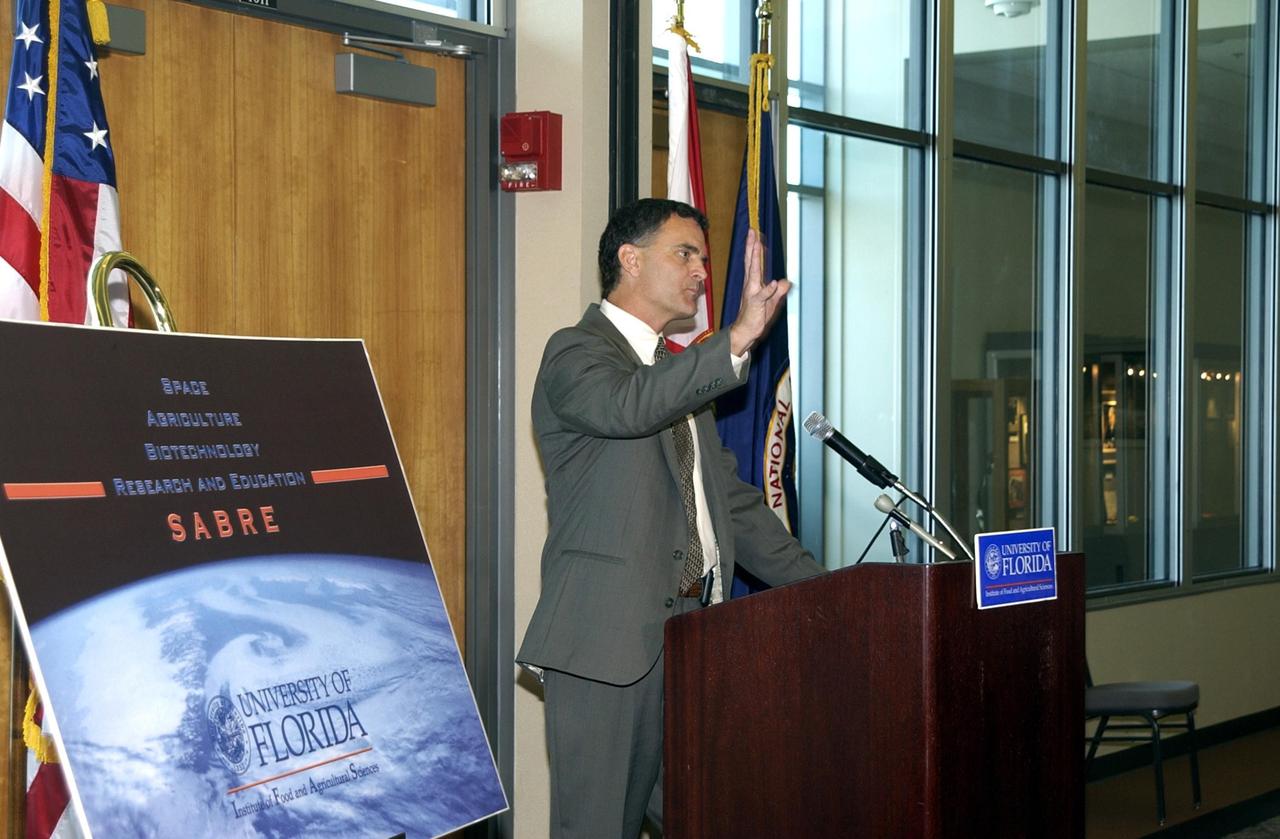
KENNEDY SPACE CENTER, FLA. -- Robert Ferl, professor in the horticultural sciences department and assistant director of the University of Florida Biotechnology Program, speaks during the opening ceremony to launch a new program called SABRE, Space Agricultural Biotechnology Research and Education, that involves UF and NASA. SABRE will focus on the discovery, development and application of the biological aspects of advanced life support strategies. The program will include faculty from UF's Institute of Food and Agricultural Sciences, who will be located at both KSC - in the state-owned Space Experiment Research and Processing Laboratory (SERPL) being built there - and UF in Gainesville. Ferl will direct and be responsible for coordinating the research and education efforts of UF and NASA.
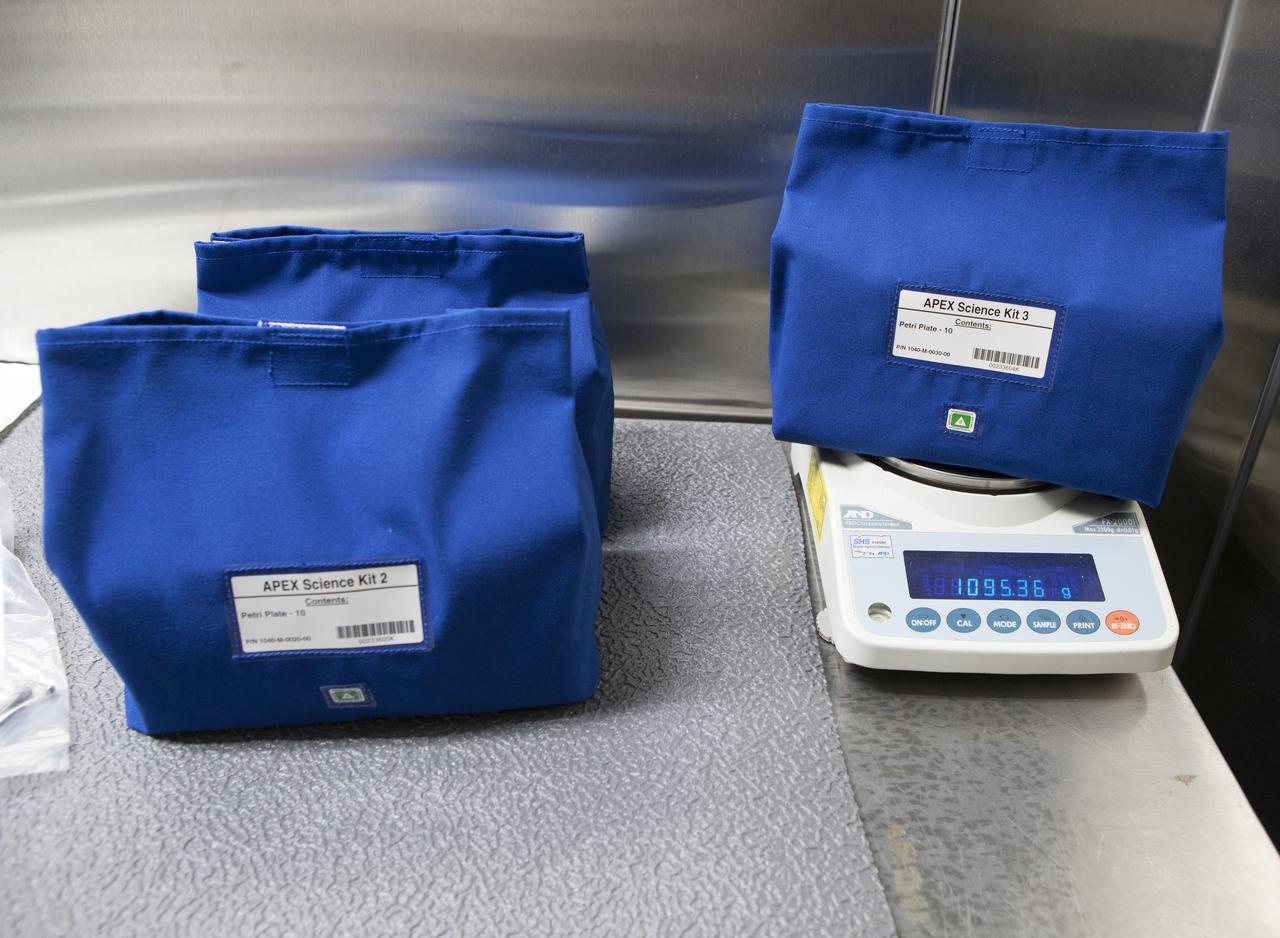
APEX-04, or Advanced Plant EXperiments-04, is being prepared in a cold room in the Kennedy Space Center Processing Facility for SpaceX-10. The three science kits are weighed prior to flight. Dr. Anna Lisa Paul of the University of Florida is the principal investigator for APEX-04. Apex-04 is an experiment involving Arabidopsis in petri plates inside the Veggie facility aboard the International Space Station. Since Arabidopsis is the genetic model of the plant world, it is a perfect sample organism for performing genetic studies in spaceflight. The experiment is the result of a grant from NASA’s Space Life and Physical Sciences division.
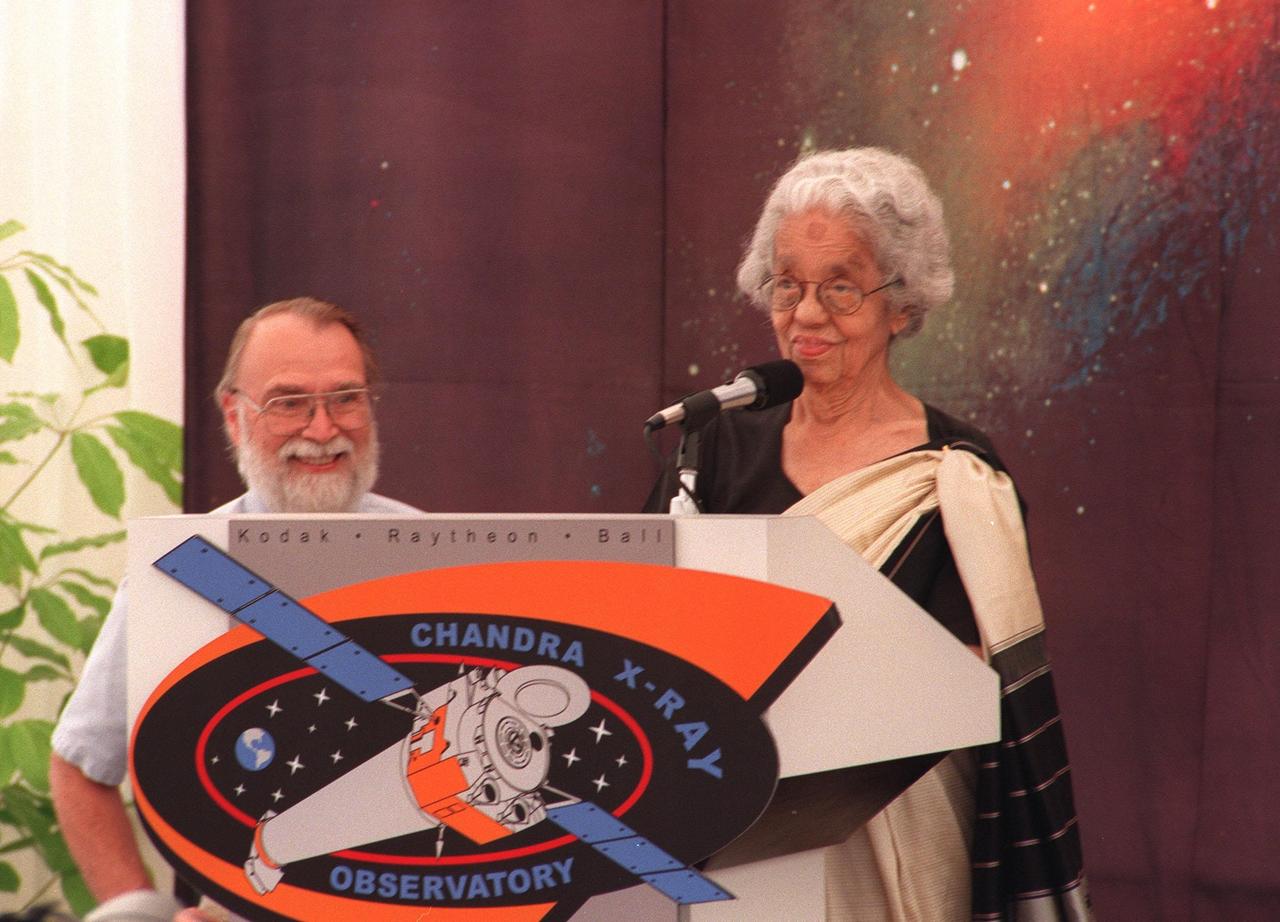
KENNEDY SPACE CENTER, FLA. -- Mrs. Lalitha Chandrasekhar (right), wife of the late Indian-American Nobel Laureate Subrahmanyan Chandrasekhar, addresses the media and other invited guests in the TRW Media Hospitality Tent at the NASA Press Site at KSC as Dr. Alan Bunner, Science Program Director, Structure and Evolution of the Universe, Office of Space Science, NASA Headquarters, Washington, D.C., looks on. The name "Chandra," a shortened version of her husband's name which he preferred among friends and colleagues, was chosen in a contest to rename the Advanced X-ray Astrophysics Facility. "Chandra" also means "Moon" or "luminous" in Sanskrit. The observatory is scheduled to be launched aboard Columbia on Space Shuttle mission STS-93
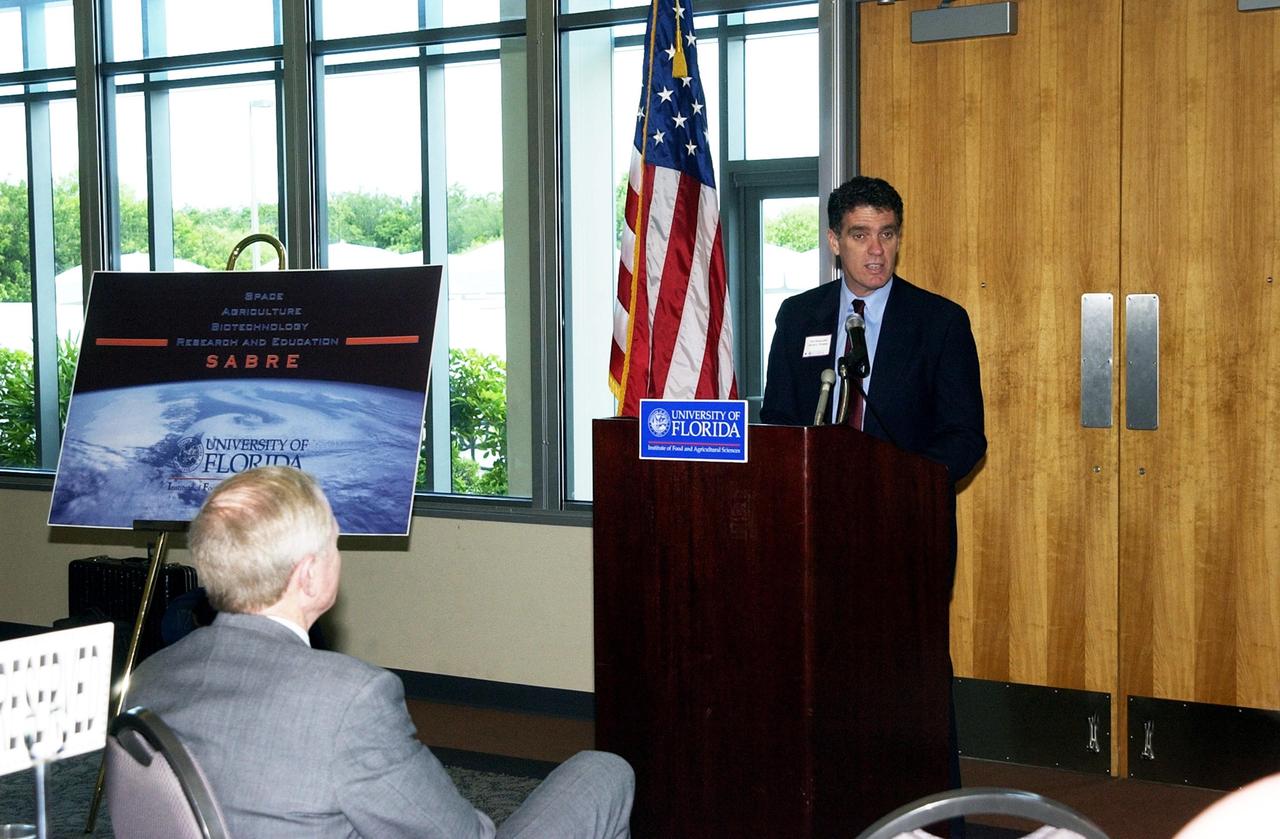
KENNEDY SPACE CENTER, FLA. -- U.S. Representative Dave Weldon addresses a large group attending the opening of a new program known as SABRE, Space Agricultural Biotechnology Research and Education, that involves the University of Florida and NASA. SABRE will focus on the discovery, development and application of the biological aspects of advanced life support strategies. The program will include faculty from UF's Institute of Food and Agricultural Sciences, who will be located at both KSC - in the state-owned Space Experiment Research and Processing Laboratory (SERPL) being built there - and UF in Gainesville. SABRE will be directed by Robert Ferl, professor in the horticultural sciences department and assistant director of UF's Biotechnology Program. He will be responsible for coordinating the research and education efforts of UF and NASA
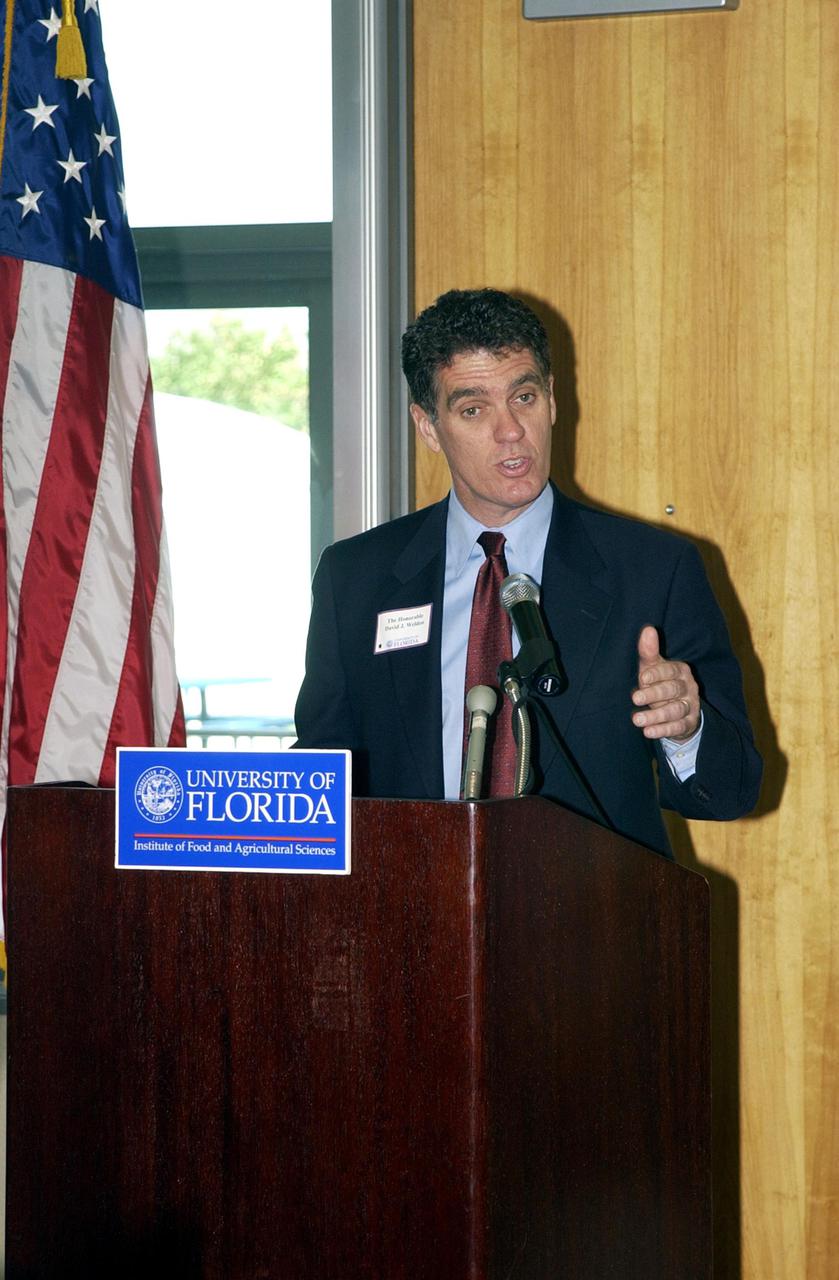
KENNEDY SPACE CENTER, FLA. -- U.S. Representative Dave Weldon addresses a large group attending the opening of a new program known as SABRE, Space Agricultural Biotechnology Research and Education, that involves the University of Florida and NASA. SABRE will focus on the discovery, development and application of the biological aspects of advanced life support strategies. The program will include faculty from UF's Institute of Food and Agricultural Sciences, who will be located at both KSC - in the state-owned Space Experiment Research and Processing Laboratory (SERPL) being built there - and UF in Gainesville. SABRE will be directed by Robert Ferl, professor in the horticultural sciences department and assistant director of UF's Biotechnology Program. He will be responsible for coordinating the research and education efforts of UF and NASA
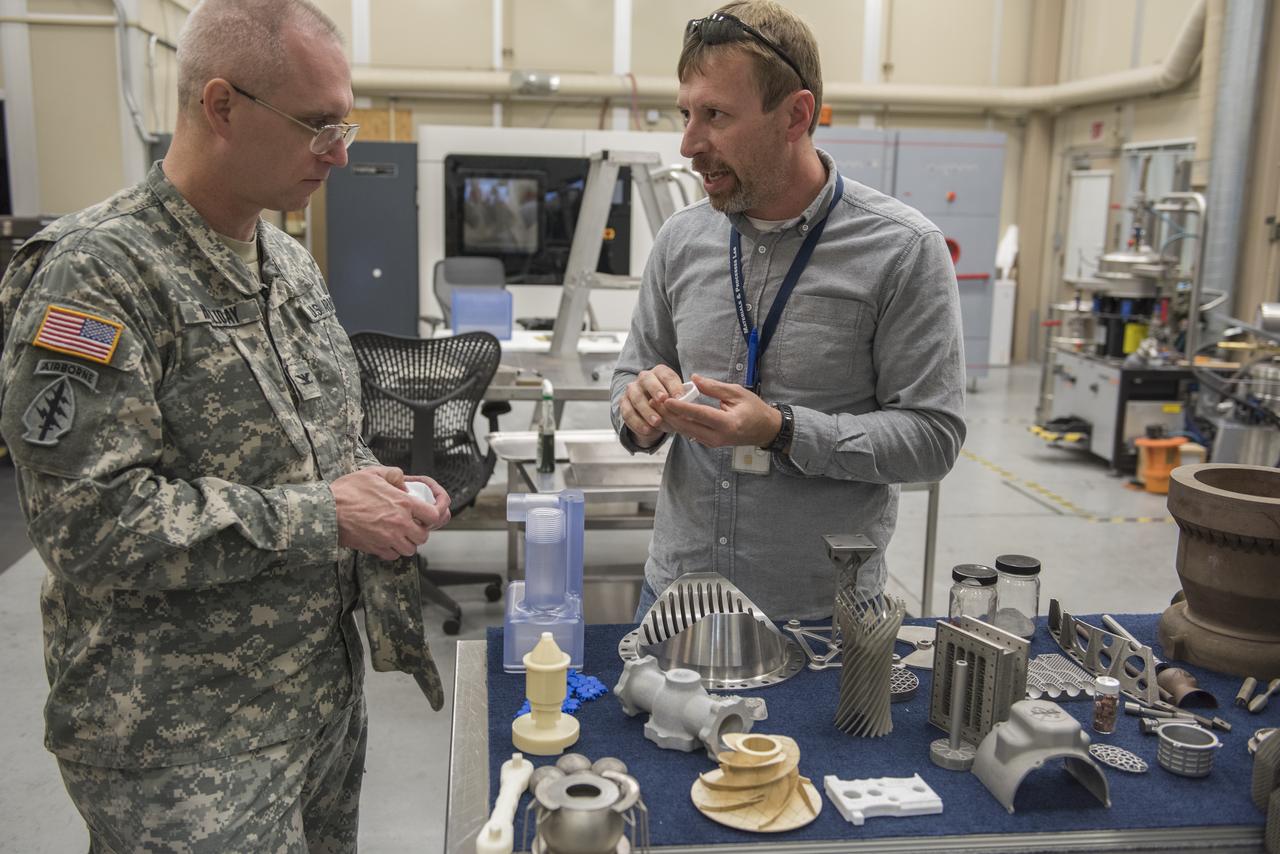
REDSTONE ARSENAL GARRISON COMMANDER COL. THOMAS "DOC" HOLLIDAY, LEFT, DISCUSSES THE PROCESSES AND HARDWARE USED IN NASA IN-SPACE MANUFACTURING TECHNIQUES WITH KEN COOPER, A STRUCTURAL MATERIALS ENGINEER AT NASA'S MARSHALL SPACE FLIGHT CENTER. COOPER, PART OF THE MARSHALL ENGINEERING DIRECTORATE'S ADVANCED MANUFACTURING AND DIGITAL SOLUTIONS TEAM, WAS AMONG NUMEROUS SUBJECT-MATTER EXPERTS WHO SHARED KEY MARSHALL CAPABILITIES DURING HOLLIDAY'S MARCH 3 MARSHALL TOUR. HOLLIDAY, A DECORATED OFFICER WHOSE MILITARY CAREER BEGAN IN 1992, GAINED FIRSTHAND INSIGHT INTO MARSHALL'S ADVANCED MANUFACTURING AND 3-D PRINTING TECHNIQUES; ROUND-THE-CLOCK INTERNATIONAL SPACE STATION SCIENCE AND COMMUNICATIONS SUPPORT BY THE PAYLOAD OPERATIONS INTEGRATION CENTER TEAM; AND THE LATEST UPGRADES TO MARSHALL TEST STANDS IN SUPPORT OF NEXT-GENERATION LAUNCH VEHICLE AND FLIGHT HARDWARE DEVELOPMENT. MARSHALL, A REDSTONE ARSENAL TENANT, ROUTINELY SHARES CUTTING-EDGE RESEARCH AND MANUFACTURING ADVANCES WITH ITS MILITARY AND FEDERAL AGENCY COUNTERPARTS, WORKING IN PARTNERSHIP TO ADVANCE NASA'S MISSION AND MAINTAIN THE NATION'S TECHNOLOGICAL LEADERSHIP.
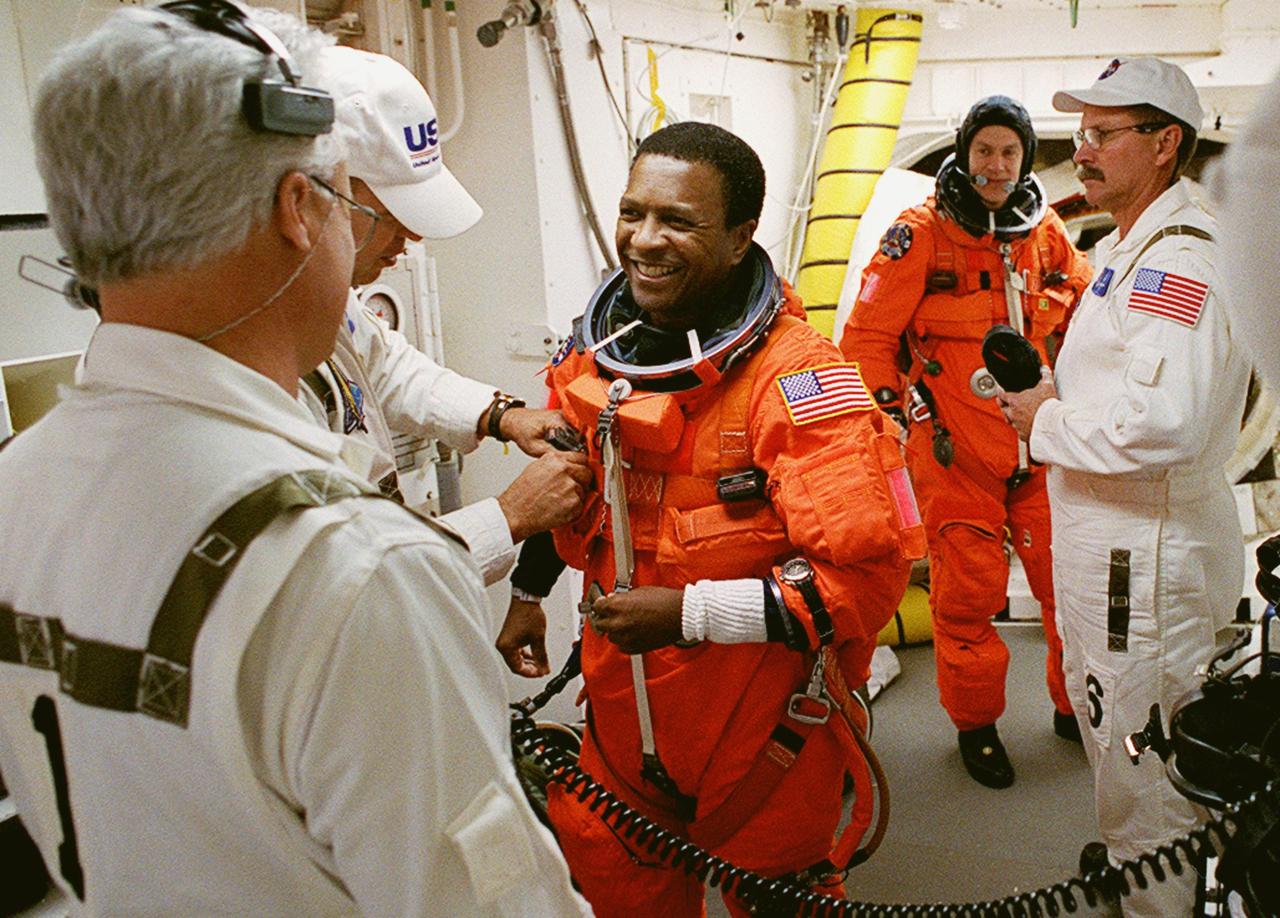
KENNEDY SPACE CENTER, FLA. -- STS-107 Payload Commander Michael Anderson gets help with his launch and entry suit from the Closeout Crew in the White Room. The environmentally controlled chamber is mated to Space Shuttle Columbia for entry into the Shuttle. Behind him is Pilot William "Willie" McCool. STS-107 is a mission devoted to research and will include more than 80 experiments that will study Earth and space science, advanced technology development, and astronaut health and safety. The payload on Space Shuttle Columbia includes FREESTAR (Fast Reaction Experiments Enabling Science, Technology, Applications and Research) and the SHI Research Double Module (SHI/RDM), known as SPACEHAB. Experiments on the module range from material sciences to life sciences. Liftoff is scheduled for 10:39 a.m. EST.
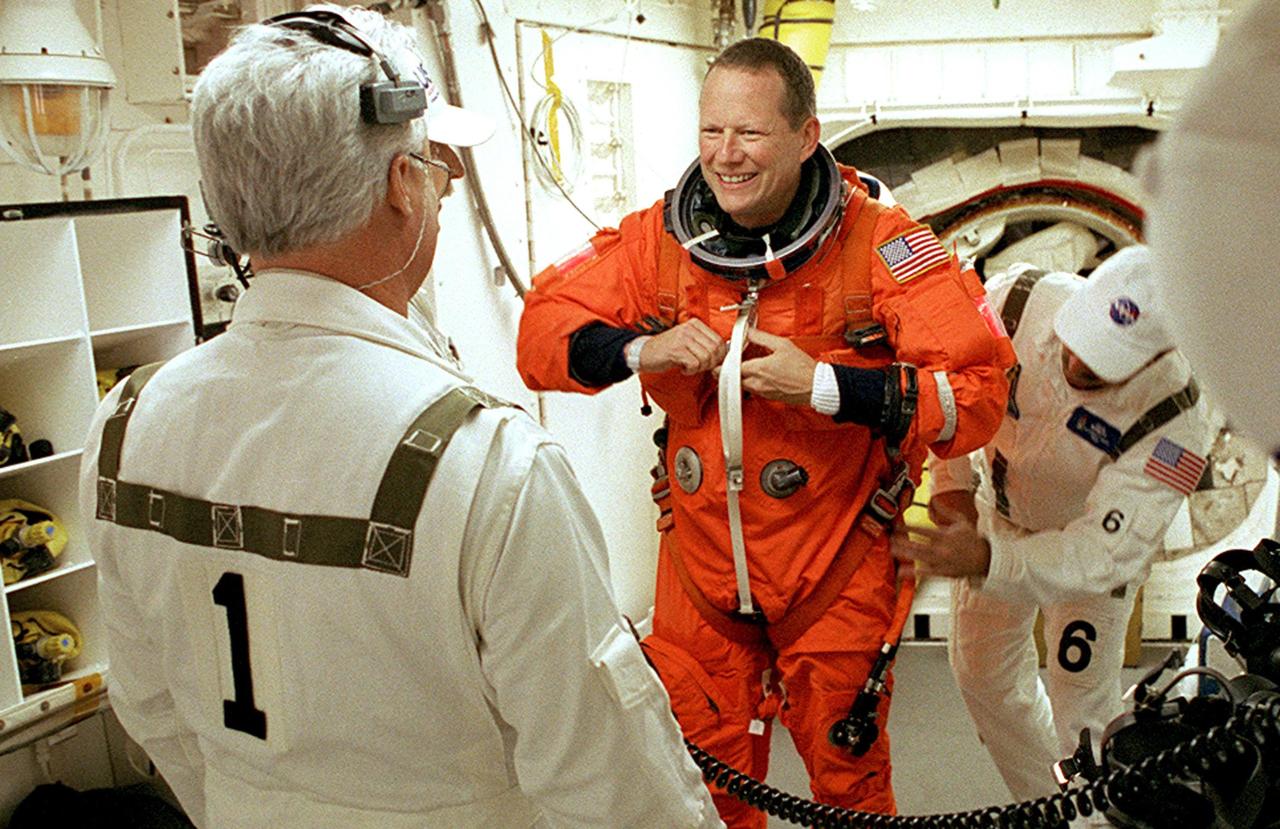
KENNEDY SPACE CENTER, FLA. - STS-107 David Brown chats with the Closeout Crew during final preparations of his launch and entry suit in the White Room. The environmentally controlled chamber is mated to Space Shuttle Columbia for entry into the Shuttle. The hatch is seen in the background right. STS-107 is a mission devoted to research and will include more than 80 experiments that will study Earth and space science, advanced technology development, and astronaut health and safety. The payload on Space Shuttle Columbia includes FREESTAR (Fast Reaction Experiments Enabling Science, Technology, Applications and Research) and the SHI Research Double Module (SHI/RDM), known as SPACEHAB. Experiments on the module range from material sciences to life sciences. Liftoff is scheduled for 10:39 a.m. EST.
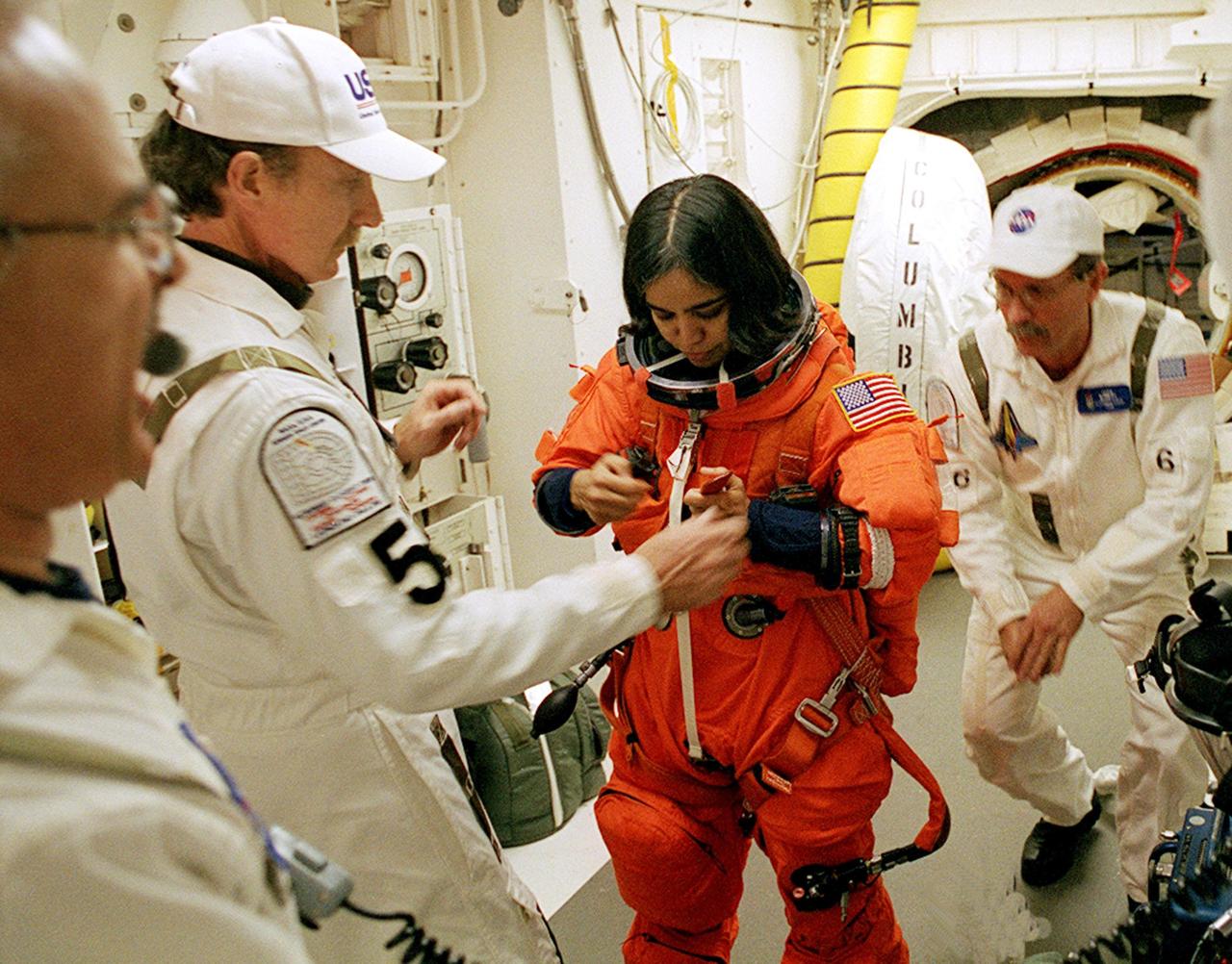
KENNEDY SPACE CENTER, FLA. -- STS-107 Mission Specialist Kalpana Chawla gets help with her launch and entry suit from the Closeout Crew in the White Room. The environmentally controlled chamber is mated to Space Shuttle Columbia for entry into the Shuttle. The hatch is seen in the background right. STS-107 is a mission devoted to research and will include more than 80 experiments that will study Earth and space science, advanced technology development, and astronaut health and safety. The payload on Space Shuttle Columbia includes FREESTAR (Fast Reaction Experiments Enabling Science, Technology, Applications and Research) and the SHI Research Double Module (SHI/RDM), known as SPACEHAB. Experiments on the module range from material sciences to life sciences. Liftoff is scheduled for 10:39 a.m. EST.

KENNEDY SPACE CENTER, FLA. - STS-107 Mission Specialist Laurel Clark waves to a camera out of view during final preparations of her launch and entry suit in the White Room. The environmentally controlled chamber is mated to Space Shuttle Columbia for entry into the Shuttle. The hatch is seen in the background right. STS-107 is a mission devoted to research and will include more than 80 experiments that will study Earth and space science, advanced technology development, and astronaut health and safety. The payload on Space Shuttle Columbia includes FREESTAR (Fast Reaction Experiments Enabling Science, Technology, Applications and Research) and the SHI Research Double Module (SHI/RDM), known as SPACEHAB. Experiments on the module range from material sciences to life sciences. Liftoff is scheduled for 10:39 a.m. EST.

Dr. Oscar Monje, a research scientist, pours a growing substrate called arcillite in the science carrier, or base, of the Advanced Plant Habitat (APH) inside a laboratory at the Space Station Processing Facility at NASA's Kennedy Space Center in Florida. Developed by NASA and ORBITEC of Madison, Wisconsin, the APH is the largest plant chamber built for the agency. It is a fully automated plant growth facility that will be used to conduct bioscience research on the International Space Station. The APH will be delivered to the space station aboard future Commercial Resupply Services missions.
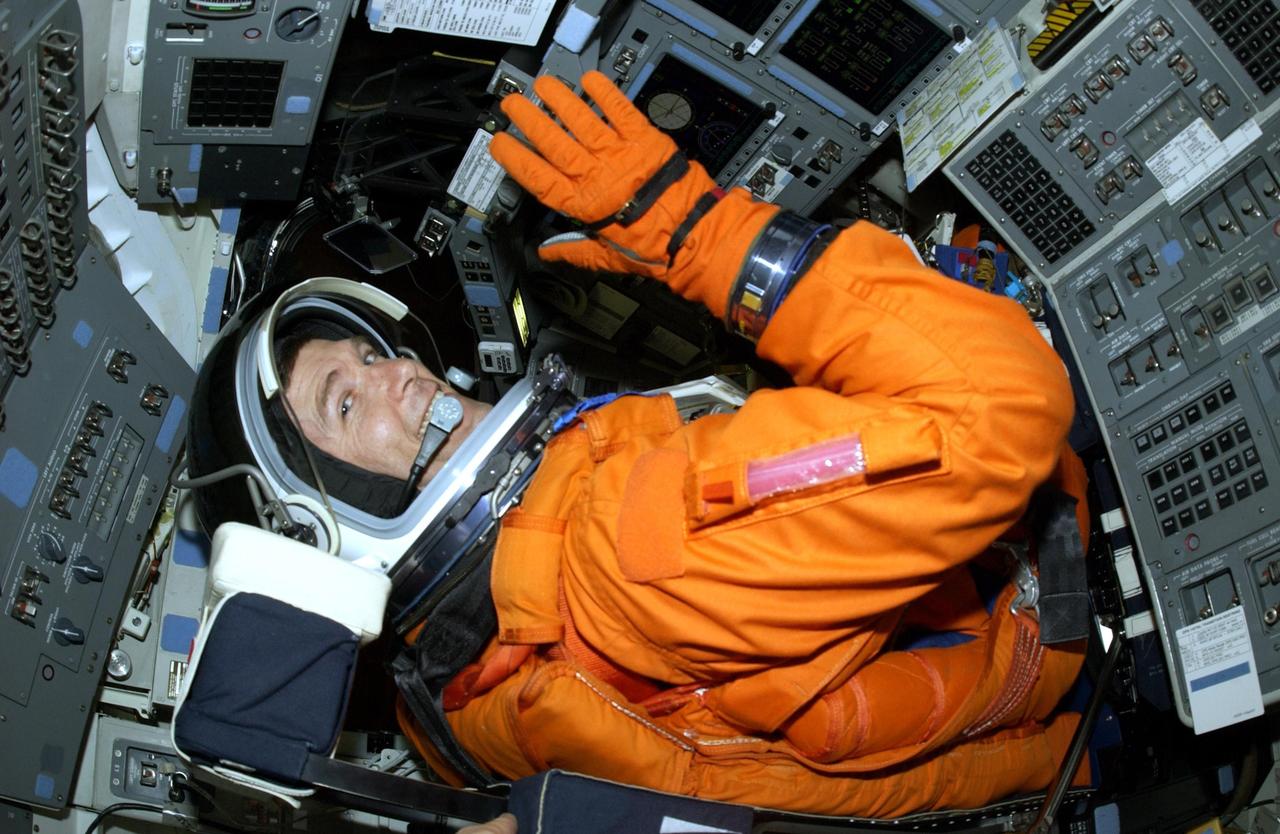
KENNEDY SPACE CENTER, FLA. - STS-107 Commander Rick Husband sits in the cockpit of Space Shuttle Columbia during a simulated launch countdown, part of Terminal Countdown Demonstration Test activities. STS-107 is a mission devoted to research and will include more than 80 experiments that will study Earth and space science, advanced technology development, and astronaut health and safety. Launch is planned for Jan. 16, 2003, between 10 a.m. and 2 p.m. EST aboard Space Shuttle Columbia. .

Dr. Oscar Monje, a research scientist, pours a growing substrate called arcillite in the science carrier, or base, of the Advanced Plant Habitat (APH) inside a laboratory at the Space Station Processing Facility at NASA's Kennedy Space Center in Florida. Developed by NASA and ORBITEC of Madison, Wisconsin, the APH is the largest plant chamber built for the agency. It is a fully automated plant growth facility that will be used to conduct bioscience research on the International Space Station. The APH will be delivered to the space station aboard future Commercial Resupply Services missions.
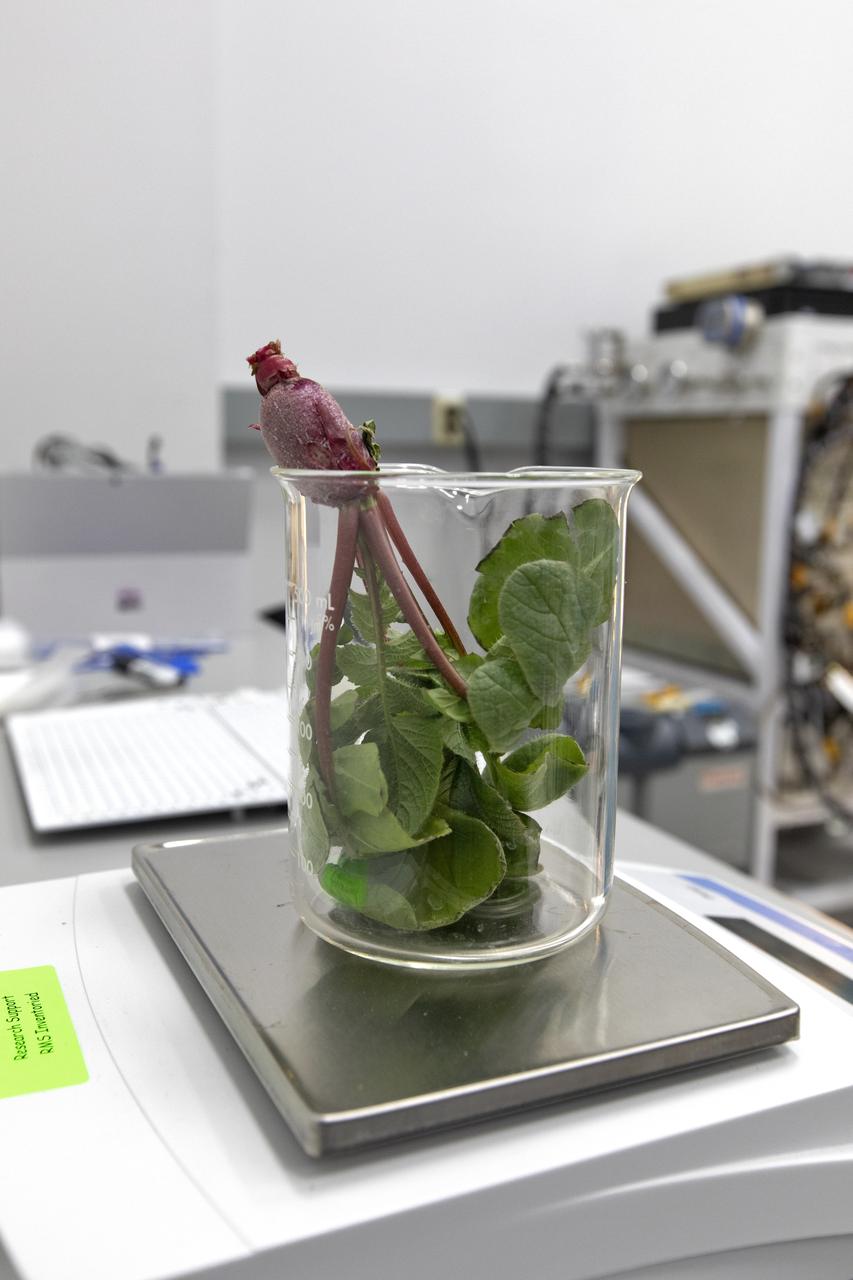
A radish plant is weighed inside a laboratory in the Space Station Processing Facility at NASA’s Kennedy Space Center in Florida on June 13, 2019. The radishes are being harvested from the base of the Advanced Plant Habitat (APH) ground unit as part of a science verification test. The APH is currently the largest plant chamber built for the agency in use on the International Space Station. It is an autonomous plant growth facility that is being used to conduct bioscience research on the space station with the goal of enabling astronauts to be sustainable on long duration missions to the Moon, Mars and beyond.
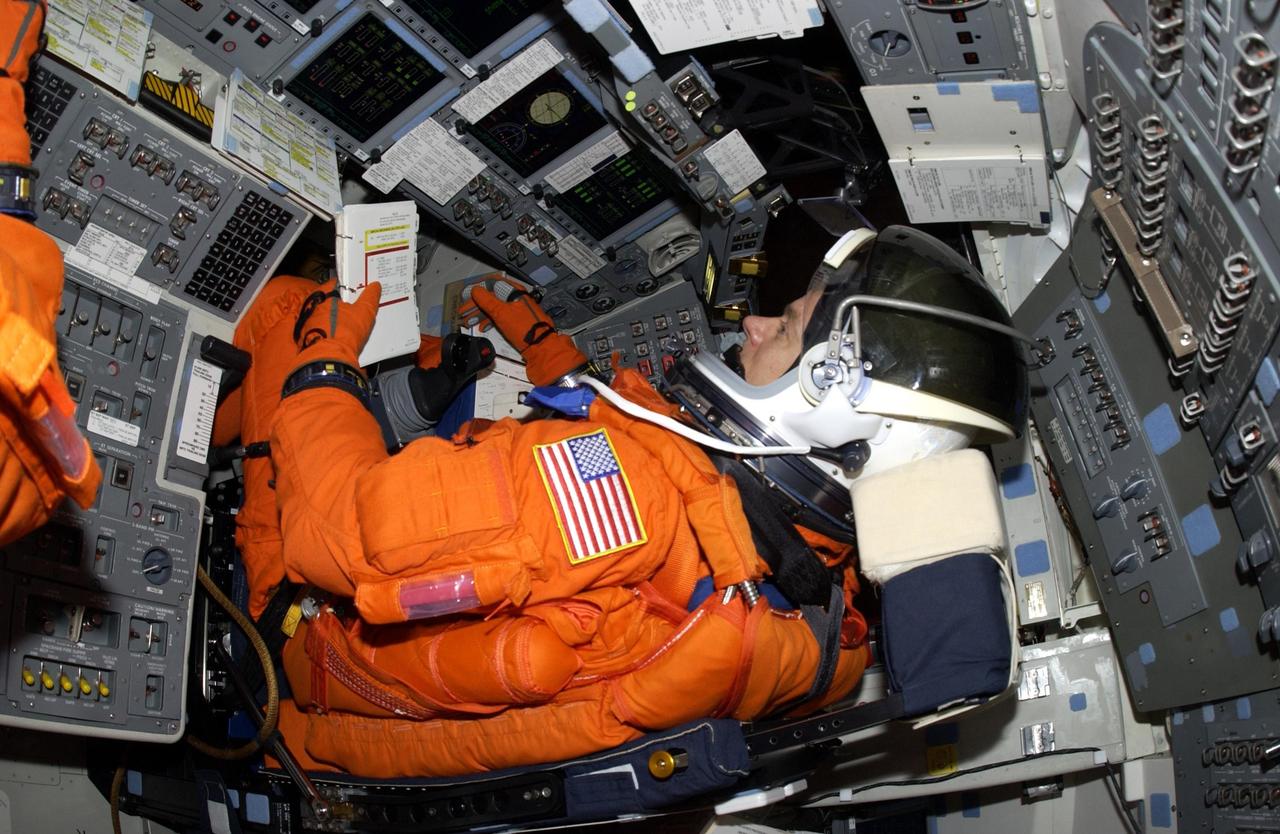
KENNEDY SPACE CENTER, FLA. - STS-107 Pilot William "Willie" McCool checks instructions in the cockpit of Space Shuttle Columbia during a simulated launch countdown, part of Terminal Countdown Demonstration Test activities. STS-107 is a mission devoted to research and will include more than 80 experiments that will study Earth and space science, advanced technology development, and astronaut health and safety. Launch is planned for Jan. 16, 2003, between 10 a.m. and 2 p.m. EST aboard Space Shuttle Columbia. .

Dr. Oscar Monje, a research scientist, packs a growing substrate called arcillite in the science carrier, or base, of the Advanced Plant Habitat (APH) inside a laboratory at the Space Station Processing Facility at NASA's Kennedy Space Center in Florida. Developed by NASA and ORBITEC of Madison, Wisconsin, the APH is the largest plant chamber built for the agency. It is a fully automated plant growth facility that will be used to conduct bioscience research on the International Space Station. The APH will be delivered to the space station aboard future Commercial Resupply Services missions.
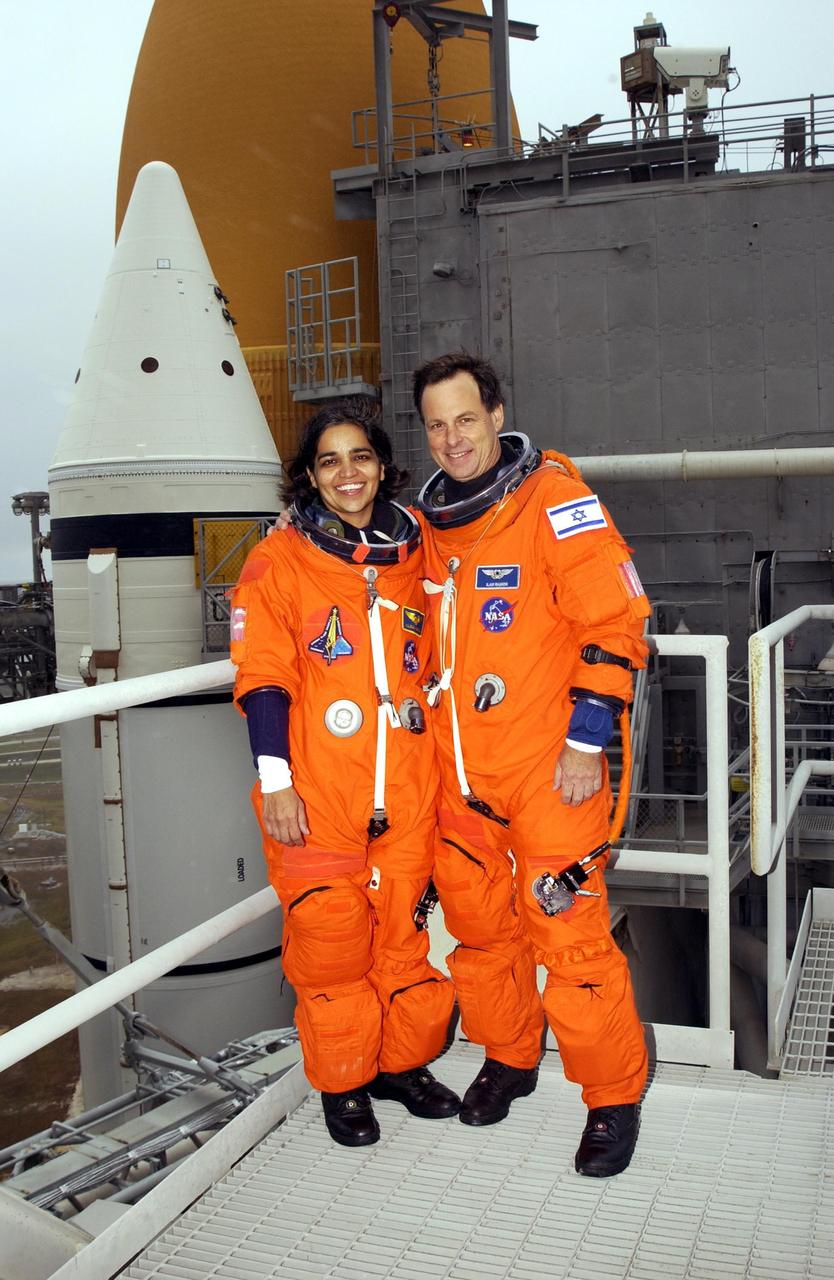
KENNEDY SPACE CENTER, FLA. -- - During Terminal Countdown Demonstration Test activities at the launch pad, Mission Specialists Kalpana Chawla and Ilan Ramon pause for a photo. Behind them is Space Shuttle Columbia. STS-107 is a mission devoted to research and will include more than 80 experiments that will study Earth and space science, advanced technology development, and astronaut health and safety. Launch is planned for Jan. 16, 2003, between 10 a.m. and 2 p.m. EST aboard Space Shuttle Columbia. .
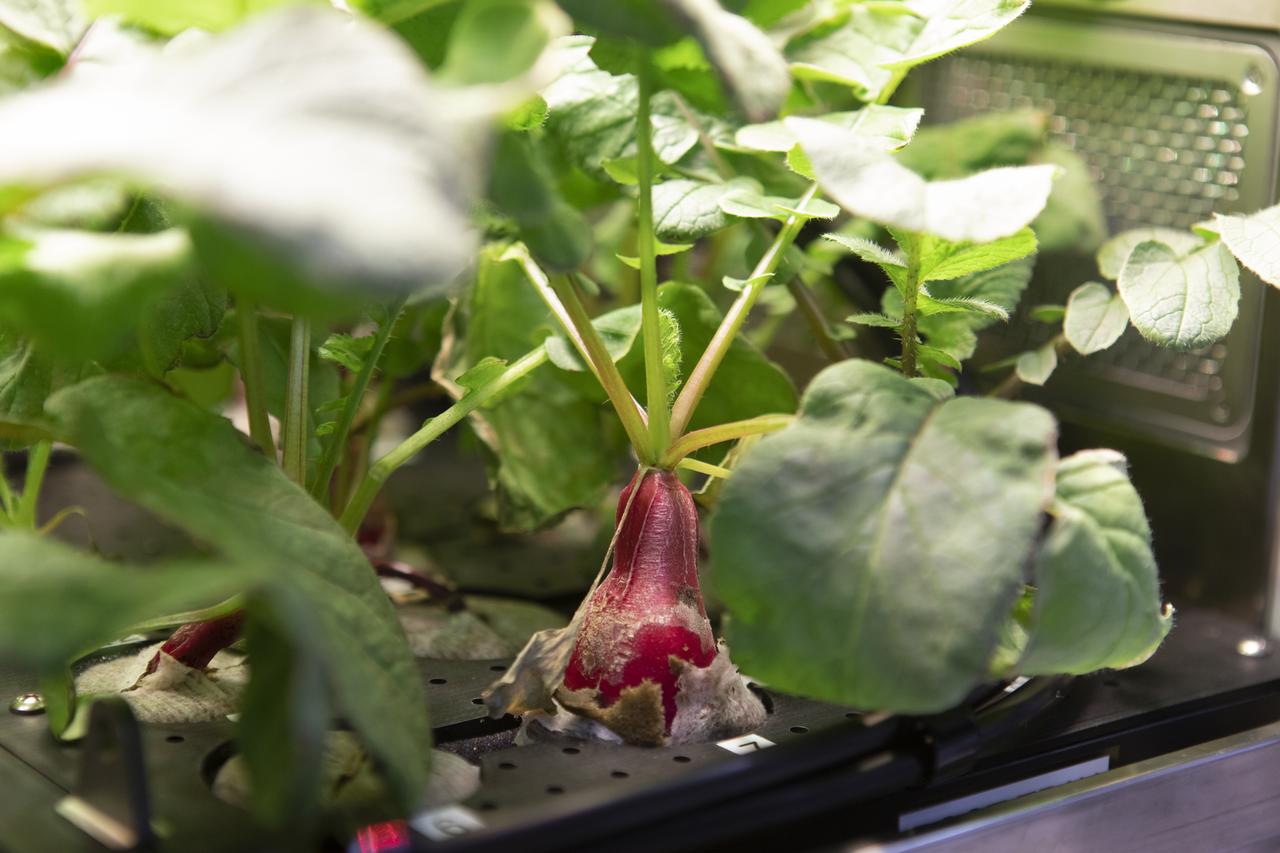
A colorful radish plant is in view inside the Advanced Plant Habitat (APH) ground unit inside a laboratory in the Space Station Processing Facility at NASA's Kennedy Space Center in Florida on June 13, 2019. The radishes are being grown as part of a science verification test. The APH is currently the largest plant chamber built for the agency in use on the International Space Station. It is an autonomous plant growth facility that is being used to conduct bioscience research on the space station with the goal of enabling astronauts to be sustainable on long duration missions to the Moon, Mars and beyond.
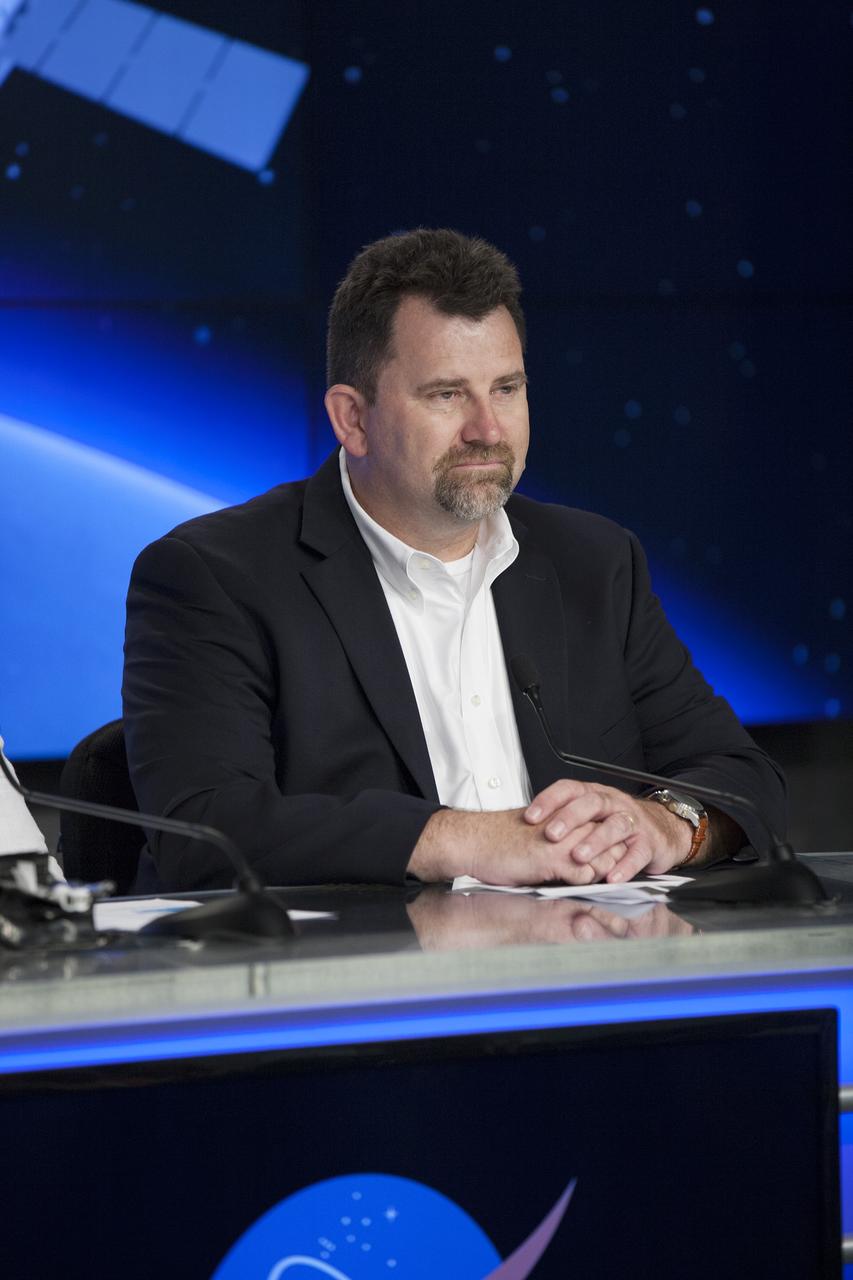
CAPE CANAVERAL, Fla. – During a news conference at NASA's Kennedy Space Center in Florida, agency and contractor officials discussed science and technology experiment payloads being transported to the International Space Station by the SpaceX-3 Commercial Resupply Services mission. Participating in the briefing is Michael Roberts, senior research pathway manager with the Center for the Advancement of Science in Space CASIS. Scheduled for launch on April 14, 2014 atop a Falcon 9 rocket, the Dragon spacecraft will be marking its fourth trip to the space station. The SpaceX-3 mission carrying almost 2.5 tons of supplies, technology and science experiments is the third of 12 flights contracted by NASA to resupply the orbiting laboratory. For more information, visit http://www.nasa.gov/mission_pages/station/structure/launch/index.html Photo credit: NASA/ Kim Shiflett
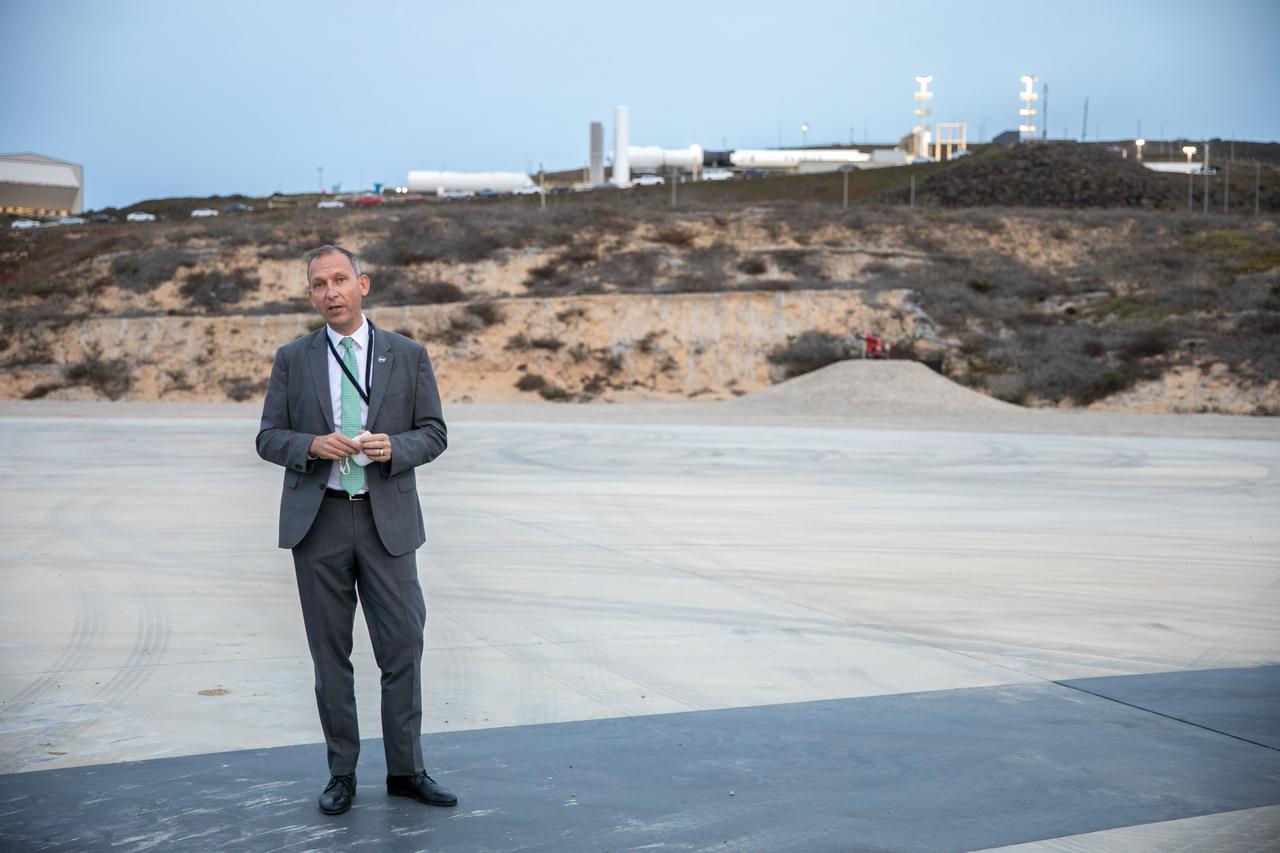
Associate Administrator for NASA’s Science Mission Directorate Thomas Zurbuchen speaks to family members of Dr. Michael Freilich, for whom the Sentinel-6 Michael Freilich satellite is named, at Vandenberg Air Force Base in California on Nov. 20, 2020, the day before the spacecraft’s planned launch atop a Falcon 9 rocket. Freilich served as director of NASA’s Earth Science Division in the Science Mission Directorate at the agency’s Headquarters from 2006 until his retirement in 2019. A tireless advocate for advancing satellite measurements of the ocean, he was instrumental in advancing ocean altimetry and helped drive the evolution of NASA Earth science from a program that launched an Earth-observing space mission every few years to one that launches several missions each year. Freilich died Aug. 5, 2020, of pancreatic cancer. Sentinel-6 Michael Freilich launched Nov. 21, 2020, at 9:17 a.m. PST (12:17 p.m. EST). NASA’s Launch Services Program at Kennedy Space Center was responsible for launch management.
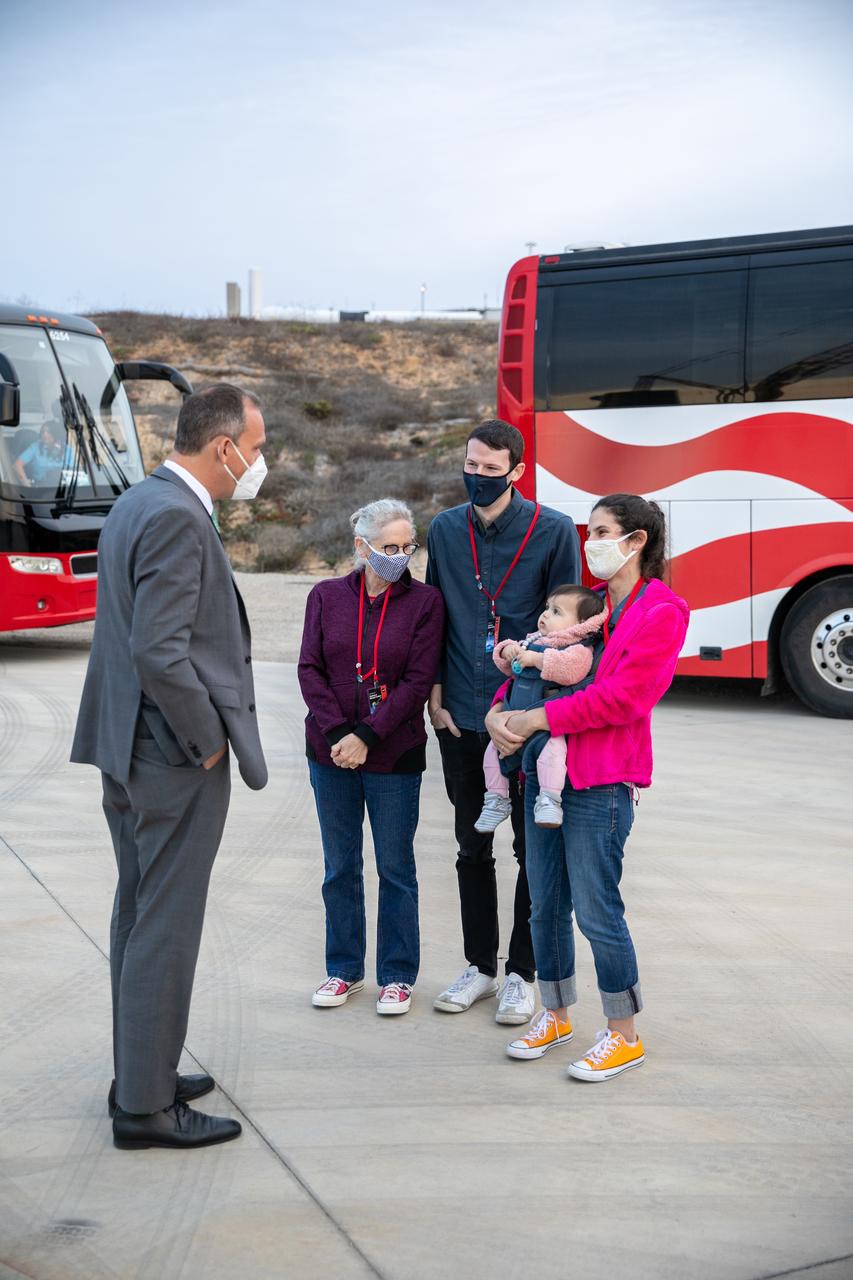
Associate Administrator for NASA’s Science Mission Directorate Thomas Zurbuchen, far left, greets family members of Dr. Michael Freilich, for whom the Sentinel-6 Michael Freilich satellite is named, at Vandenberg Air Force Base in California on Nov. 20, 2020, the day before the spacecraft’s planned launch atop a Falcon 9 rocket. From left are Freilich’s wife, Shoshannah, and their children, Daniel and Sarah. Freilich served as director of NASA’s Earth Science Division in the Science Mission Directorate at the agency’s Headquarters from 2006 until his retirement in 2019. A tireless advocate for advancing satellite measurements of the ocean, he was instrumental in advancing ocean altimetry and helped drive the evolution of NASA Earth science from a program that launched an Earth-observing space mission every few years to one that launches several missions each year. Freilich died Aug. 5, 2020, of pancreatic cancer. Sentinel-6 Michael Freilich launched Nov. 21, 2020, at 9:17 a.m. PST (12:17 p.m. EST). NASA’s Launch Services Program at Kennedy Space Center was responsible for launch management.
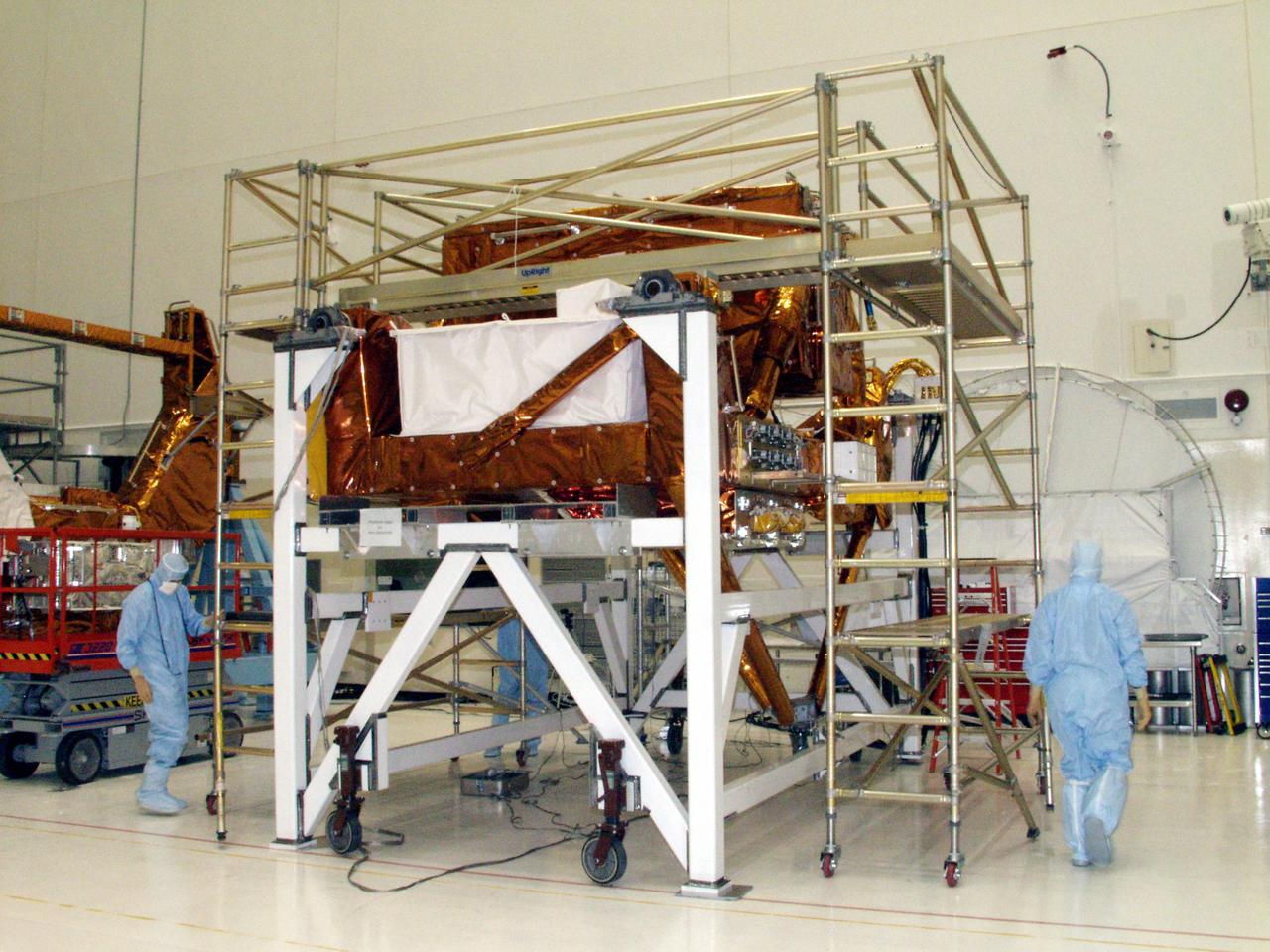
KENNEDY SPACE CENTER, FLA. --The STS-109 flight hardware for maintenance of the Hubble Space Telescope (HST) is being processed inside the clean room at the Vertical Processing Facility (VPF). Seen here is the Axial Science Instrument Protective Enclosure (ASIPE), which will house the Advanced Camera for Surveys (ACS). The hardware will be installed on four principle payload carriers. The STS-109 launch aboard Columbia is targeted for Feb. 14, 2002, and will be the 108th flight in the Space Shuttle program

KENNEDY SPACE CENTER, FLA. - STS-107 Payload Commander Michael Anderson smiles as he undergoes suit check prior to Terminal Countdown Demonstration Test activities, which include a simulated launch countdown at the pad. STS-107 is a mission devoted to research and will include more than 80 experiments that will study Earth and space science, advanced technology development, and astronaut health and safety. Launch is planned for Jan. 16, 2003, between 10 a.m. and 2 p.m. EST aboard Space Shuttle Columbia. .
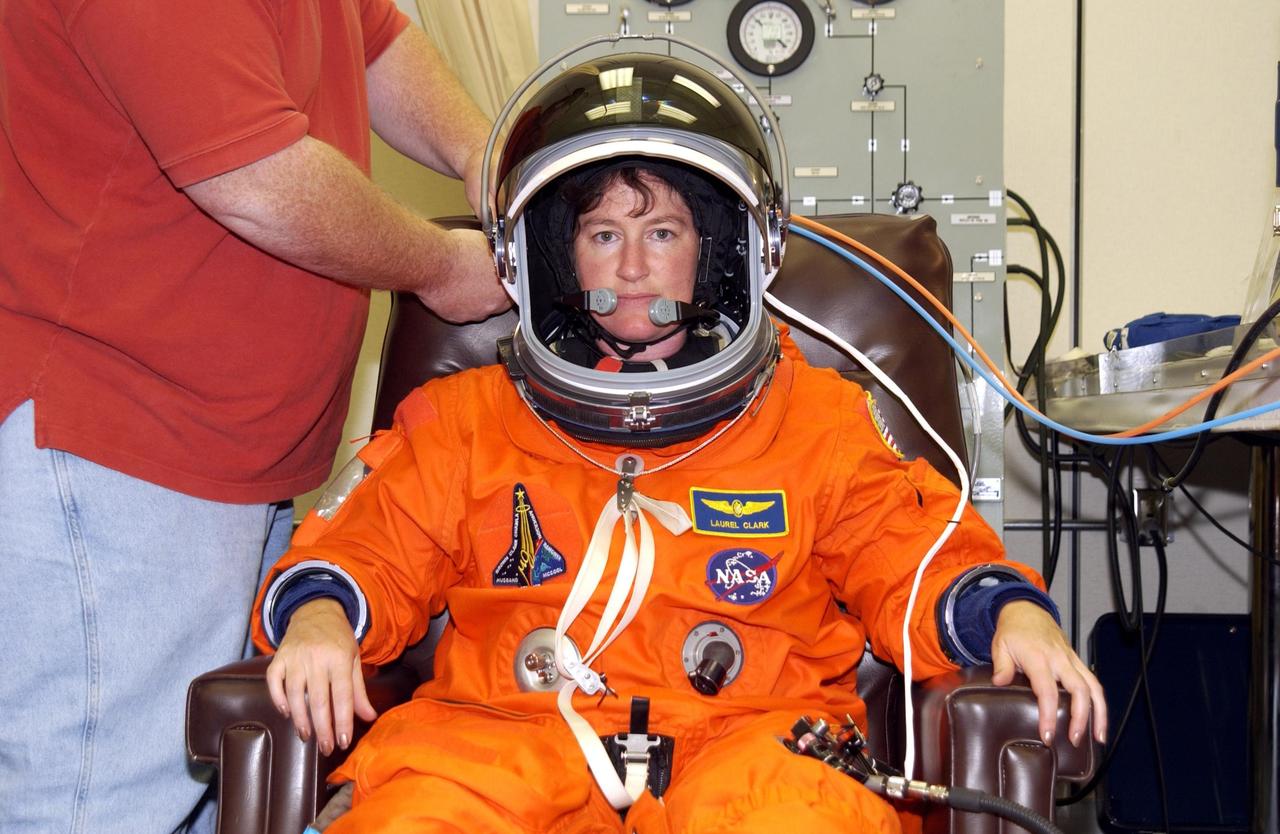
KENNEDY SPACE CENTER, FLA. -- STS-107 Mission Specialist Laurel Clark has her helmet checked during suitup for Terminal Countdown Demonstration Test activities, which include a simulated launch countdown at the pad. STS-107 is a mission devoted to research and will include more than 80 experiments that will study Earth and space science, advanced technology development, and astronaut health and safety. Launch is planned for Jan. 16, 2003, between 10 a.m. and 2 p.m. EST aboard Space Shuttle Columbia. .
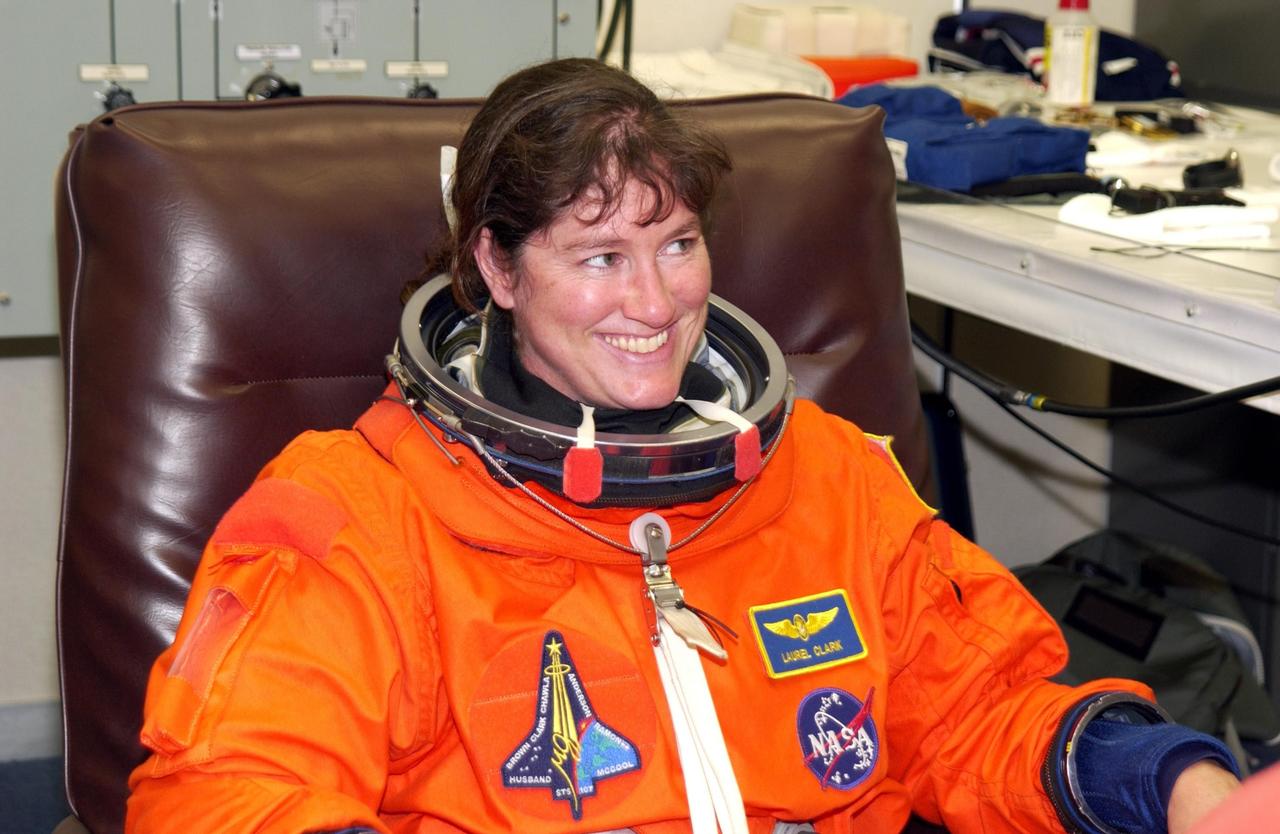
KENNEDY SPACE CENTER, FLA. - STS-107 Mission Specialist Laurel Clark happily submits to suit check prior to Terminal Countdown Demonstration Test activities, which include a simulated launch countdown at the pad. STS-107 is a mission devoted to research and will include more than 80 experiments that will study Earth and space science, advanced technology development, and astronaut health and safety. Launch is planned for Jan. 16, 2003, between 10 a.m. and 2 p.m. EST aboard Space Shuttle Columbia. .

A test unit, or prototype, of NASA's Advanced Plant Habitat (APH) was delivered to the Space Station Processing Facility at the agency's Kennedy Space Center in Florida. The APH is the largest plant chamber built for the agency. Oscar Monje, a scientist on the Engineering Services Contract, prepares the base of the APH for engineering development tests to see how the science will integrate with the various systems of the plant habitat. The APH will have about 180 sensors and fourt times the light output of Veggie. The APH will be delivered to the International Space Station in March 2017.
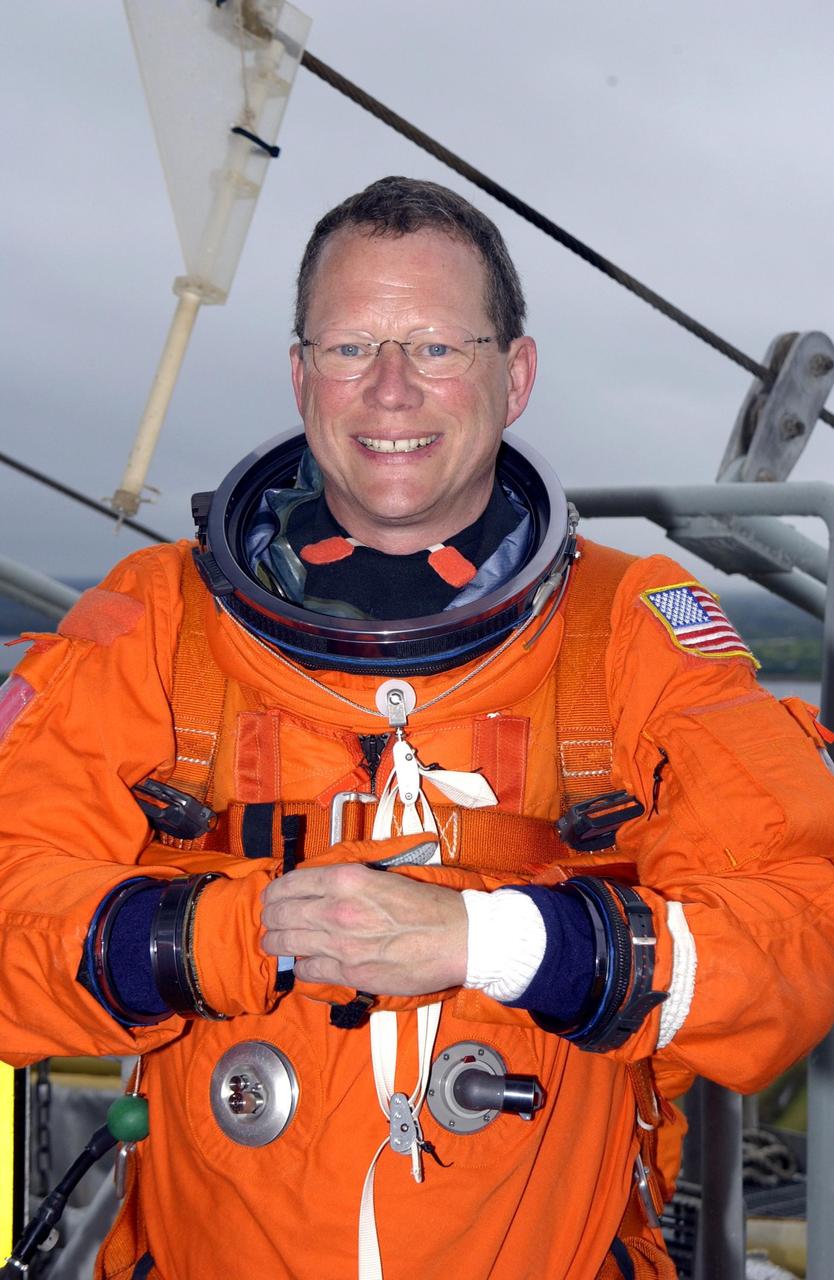
KENNEDY SPACE CENTER, FLA. -- Sitting in the slidewire basket on the launch pad is Mission Specialist David Brown. The crew is taking part in a simulated launch countdown, part of Terminal Countdown Demonstration Test activities. STS-107 is a mission devoted to research and will include more than 80 experiments that will study Earth and space science, advanced technology development, and astronaut health and safety. Launch is planned for Jan. 16, 2003, between 10 a.m. and 2 p.m. EST aboard Space Shuttle Columbia. .
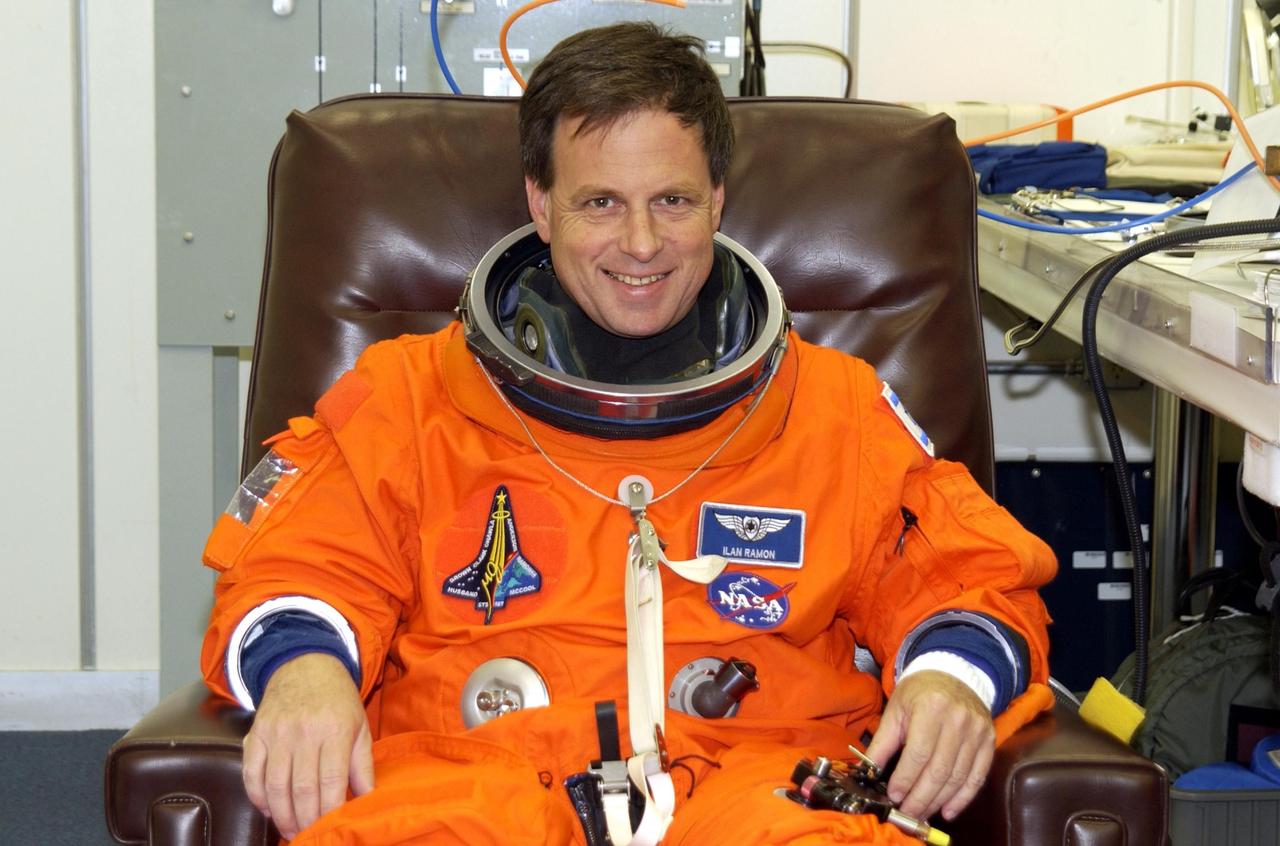
KENNEDY SPACE CENTER, FLA. - STS-107 Payload Specialist Ilan Ramon, the first Israeli astronaut, sits happily during suitup for Terminal Countdown Demonstration Test activities, which include a simulated launch countdown at the pad. STS-107 is a mission devoted to research and will include more than 80 experiments that will study Earth and space science, advanced technology development, and astronaut health and safety. Launch is planned for Jan. 16, 2003, between 10 a.m. and 2 p.m. EST aboard Space Shuttle Columbia. .
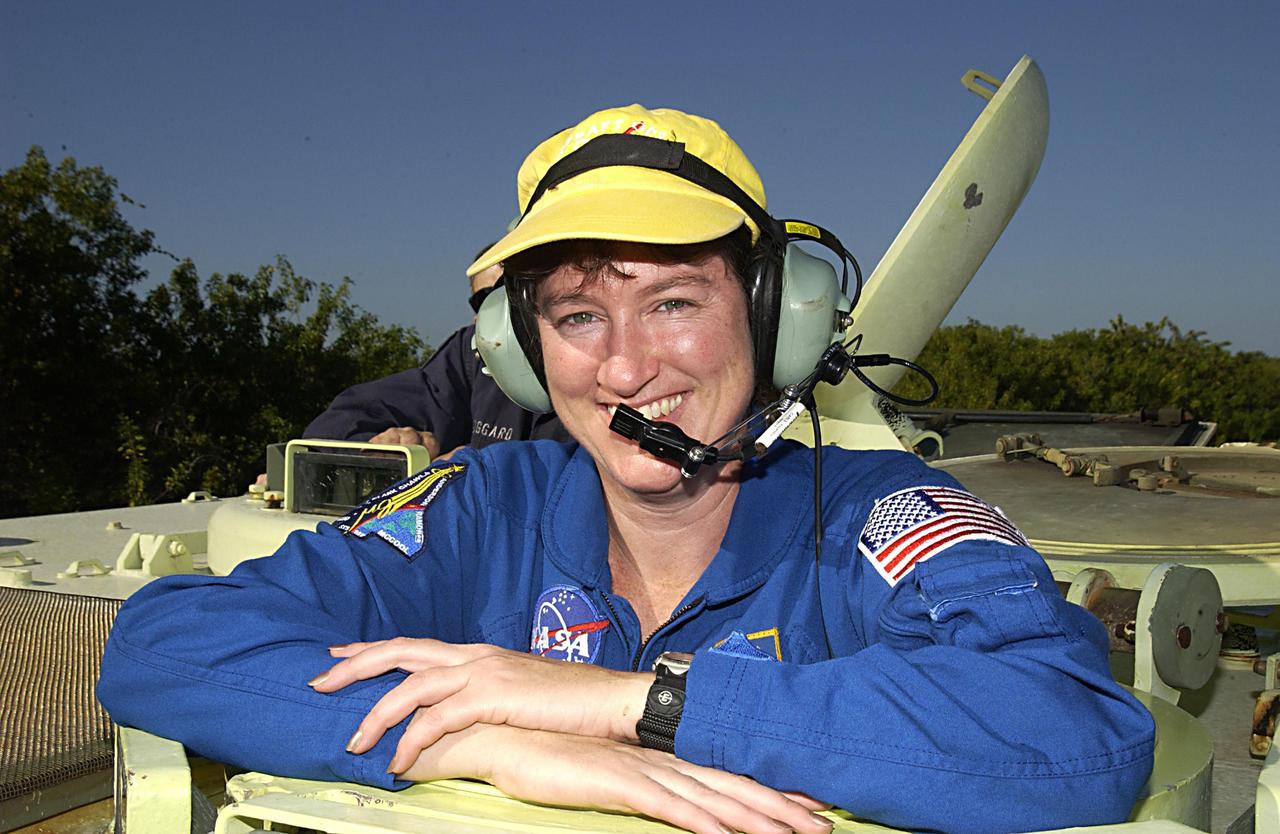
KENNEDY SPACE CENTER, FLA. -- STS-107 Mission Specialist Laurel Clark takes a break during training on the operation of an M113 armored personnel carrier during Terminal Countdown Demonstration Test activities, a standard part of launch preparations. STS-107 is a mission devoted to research and will include more than 80 experiments that will study Earth and space science, advanced technology development, and astronaut health and safety. Launch is planned for Jan. 16, 2003, between 10 a.m. and 2 p.m. EST aboard Space Shuttle Columbia.

KENNEDY SPACE CENTER, FLA. -- STS-107 Payload Specialist Ilan Ramon, the first Israeli astronaut, gets help with his suitup for Terminal Countdown Demonstration Test activities, which include a simulated launch countdown at the pad. STS-107 is a mission devoted to research and will include more than 80 experiments that will study Earth and space science, advanced technology development, and astronaut health and safety. Launch is planned for Jan. 16, 2003, between 10 a.m. and 2 p.m. EST aboard Space Shuttle Columbia. .
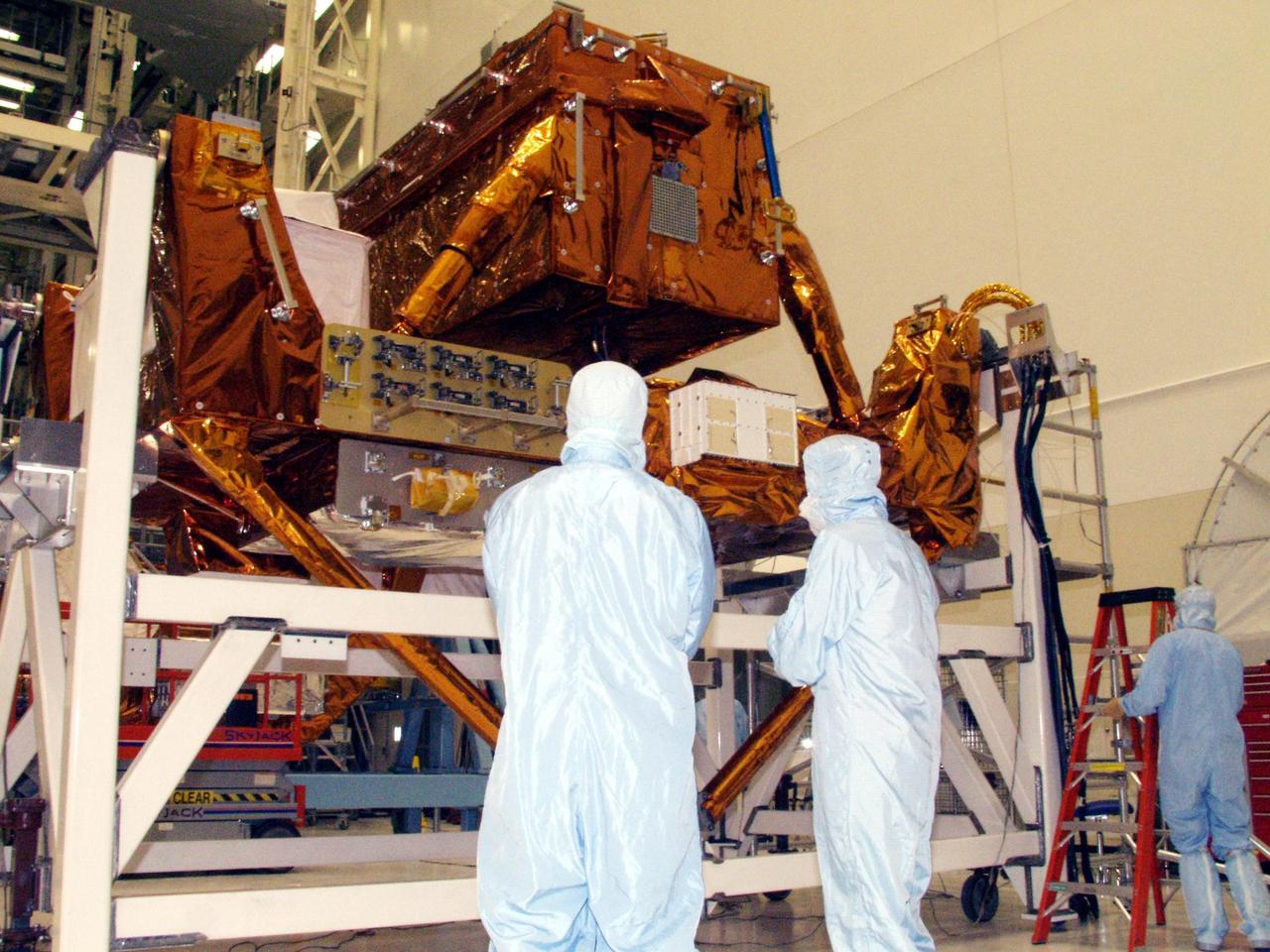
KENNEDY SPACE CENTER, FLA. -- Workers in the Vertical Processing Facility take a close look at the Axial Science Instrument Protective Enclosure (ASIPE), which will house the Advanced Camera for Surveys (ACS), part of the STS-109 flight hardware for maintenance of the Hubble Space Telescope (HST). The hardware is installed on four principle payload carriers. The STS-109 launch aboard Columbia is targeted for Feb. 14, 2002, and will be the 108th flight in the Space Shuttle program
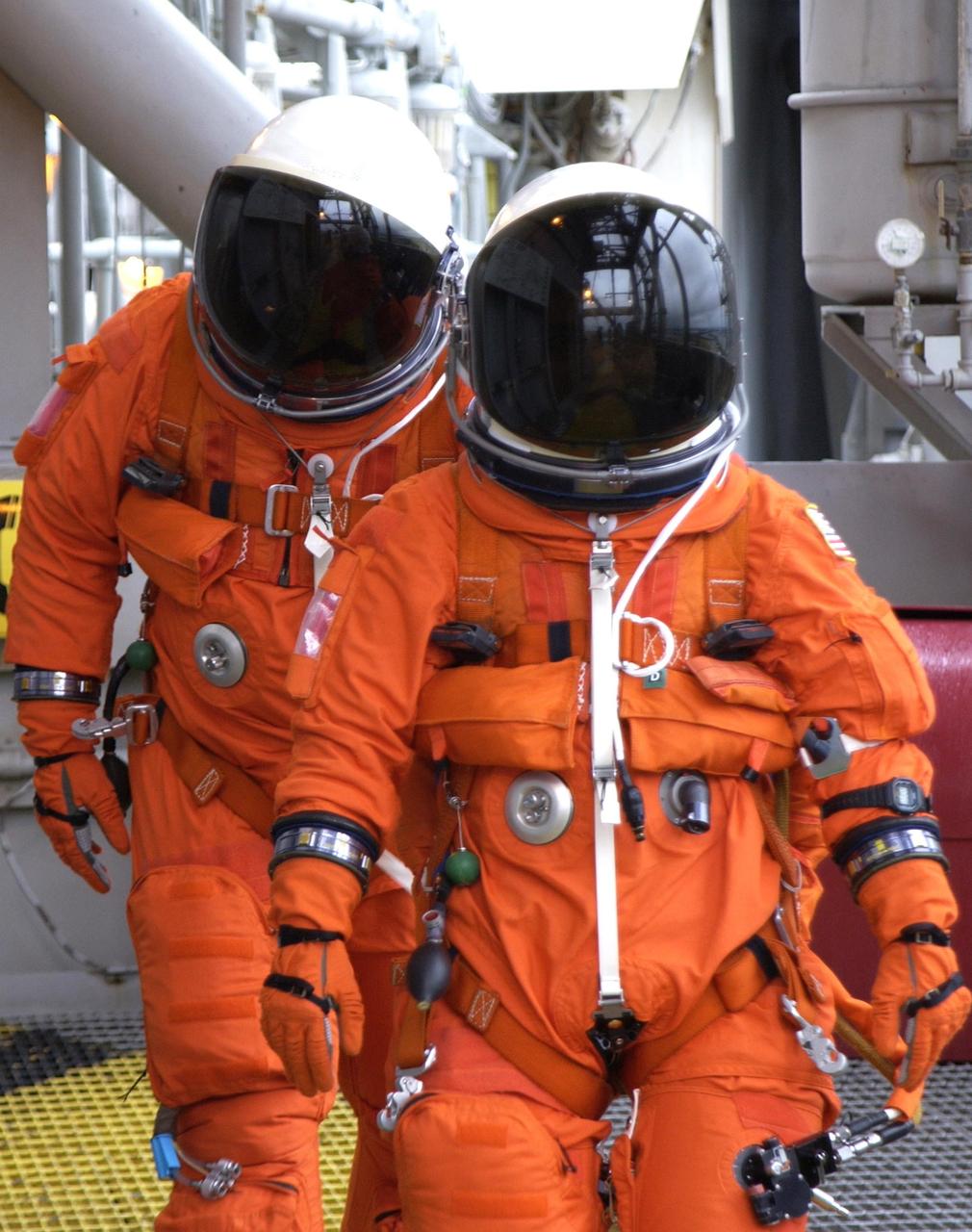
KENNEDY SPACE CENTER, FLA. - The STS-107 crew practice emergency egress from the launch pad during a simulated launch countdown, part of Terminal Countdown Demonstration Test activities. STS-107 is a mission devoted to research and will include more than 80 experiments that will study Earth and space science, advanced technology development, and astronaut health and safety. Launch is planned for Jan. 16, 2003, between 10 a.m. and 2 p.m. EST aboard Space Shuttle Columbia. .
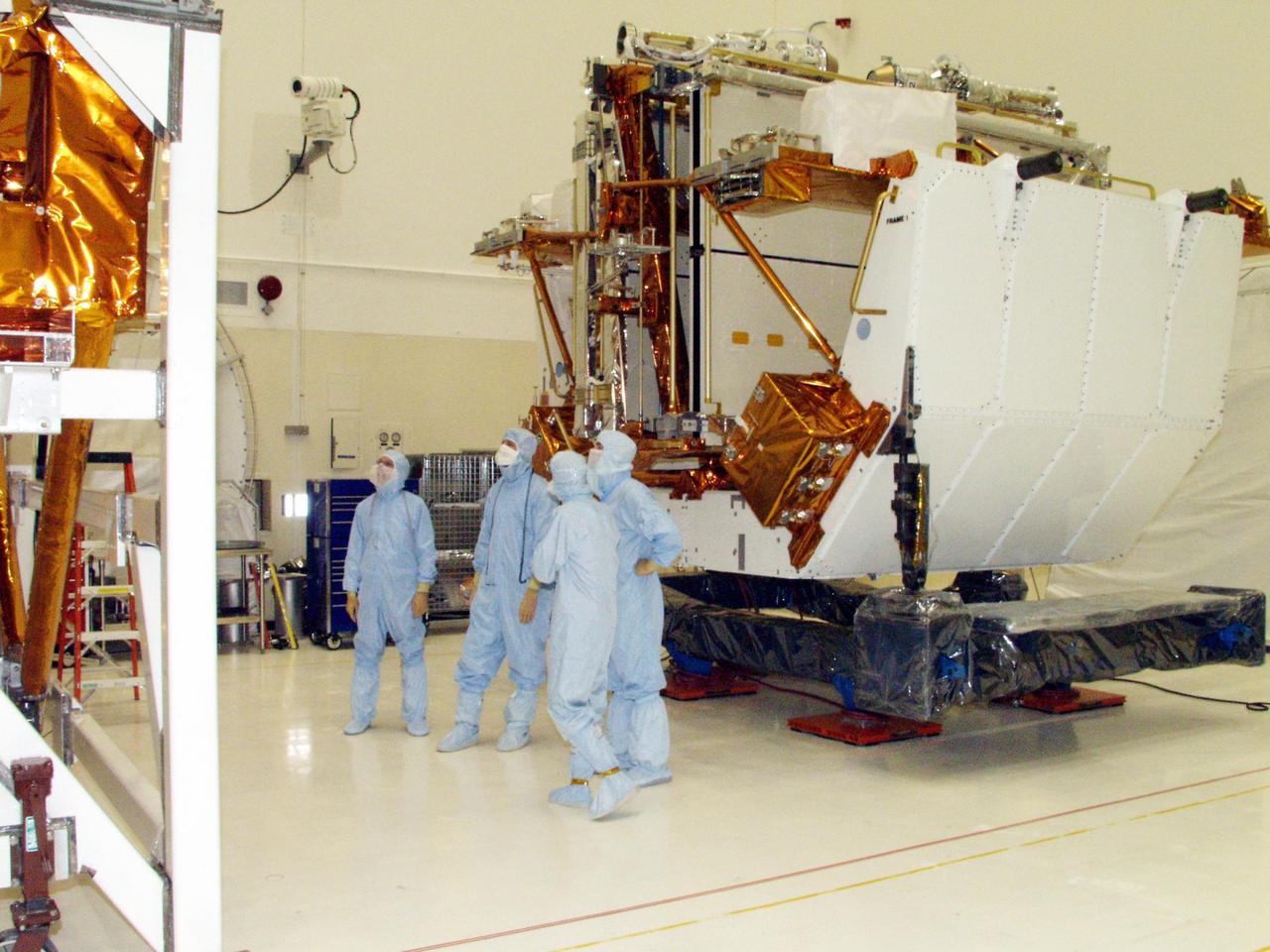
KENNEDY SPACE CENTER, FLA. -- Workers in the Vertical Processing Facility look over the Axial Science Instrument Protective Enclosure (ASIPE), which will house the Advanced Camera for Surveys (ACS), part of the STS-109 flight hardware for maintenance of the Hubble Space Telescope (HST). The Solar Array 3 panels behind them, and other HST hardware, are installed on four principle payload carriers. The STS-109 launch aboard Columbia is targeted for Feb. 14, 2002, and will be the 108th flight in the Space Shuttle program
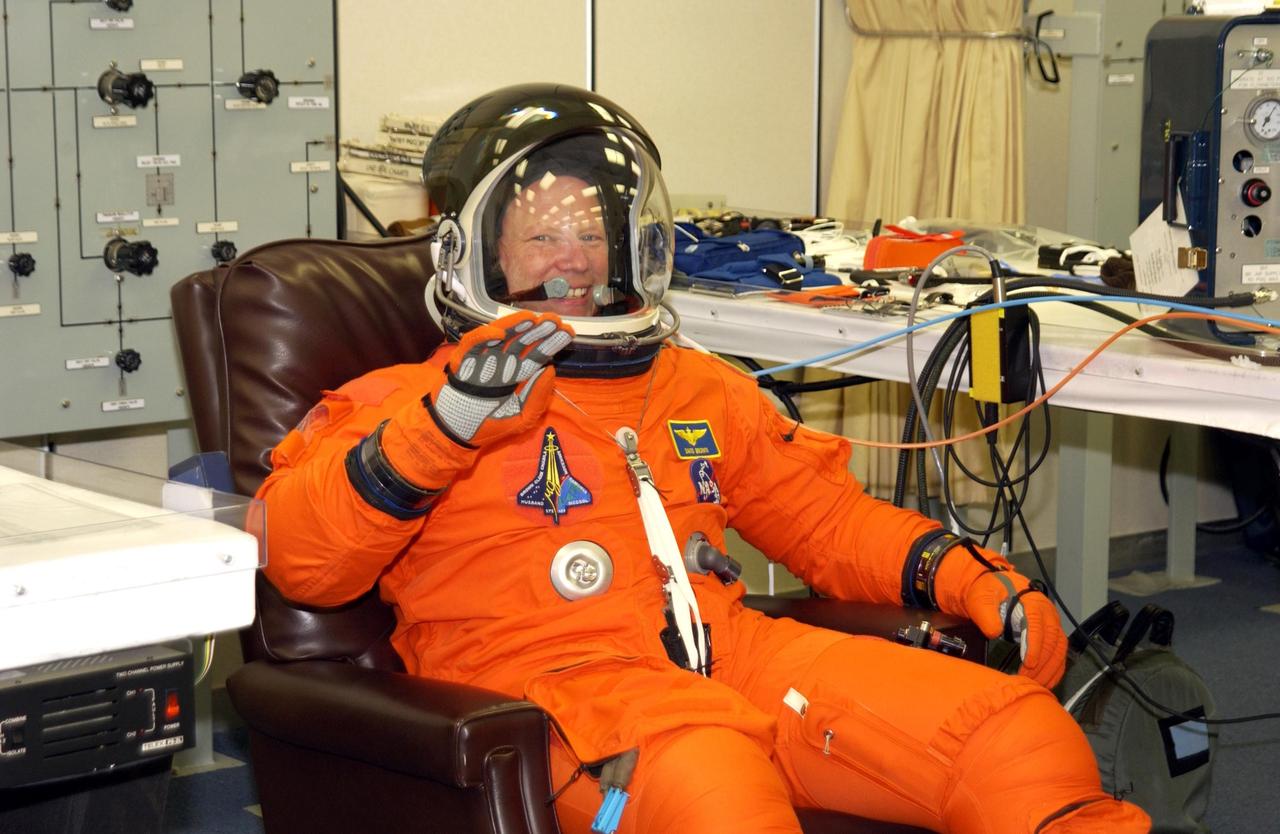
KENNEDY SPACE CENTER, FLA. -- STS-107 Mission Specialist David Brown waves as he completes suit check prior to Terminal Countdown Demonstration Test activities, which include a simulated launch countdown at the pad. STS-107 is a mission devoted to research and will include more than 80 experiments that will study Earth and space science, advanced technology development, and astronaut health and safety. Launch is planned for Jan. 16, 2003, between 10 a.m. and 2 p.m. EST aboard Space Shuttle Columbia. .
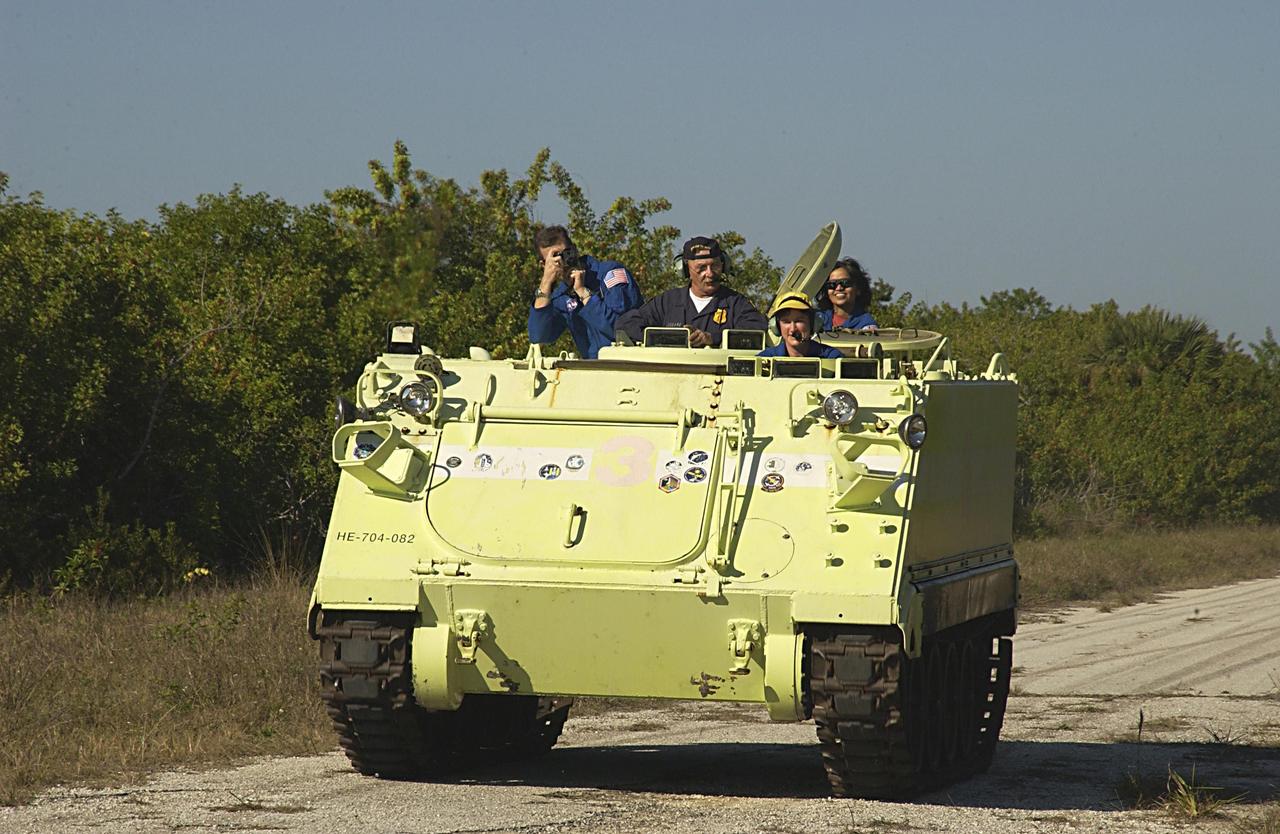
KENNEDY SPACE CENTER, FLA. -- STS-107 Mission Specialist Laurel Clark (in yellow cap) is instructed on the operation of an M113 armored personnel carrier during Terminal Countdown Demonstration Test activities, a standard part of launch preparations. STS-107 is a mission devoted to research and will include more than 80 experiments that will study Earth and space science, advanced technology development, and astronaut health and safety. Launch is planned for Jan. 16, 2003, between 10 a.m. and 2 p.m. EST aboard Space Shuttle Columbia.
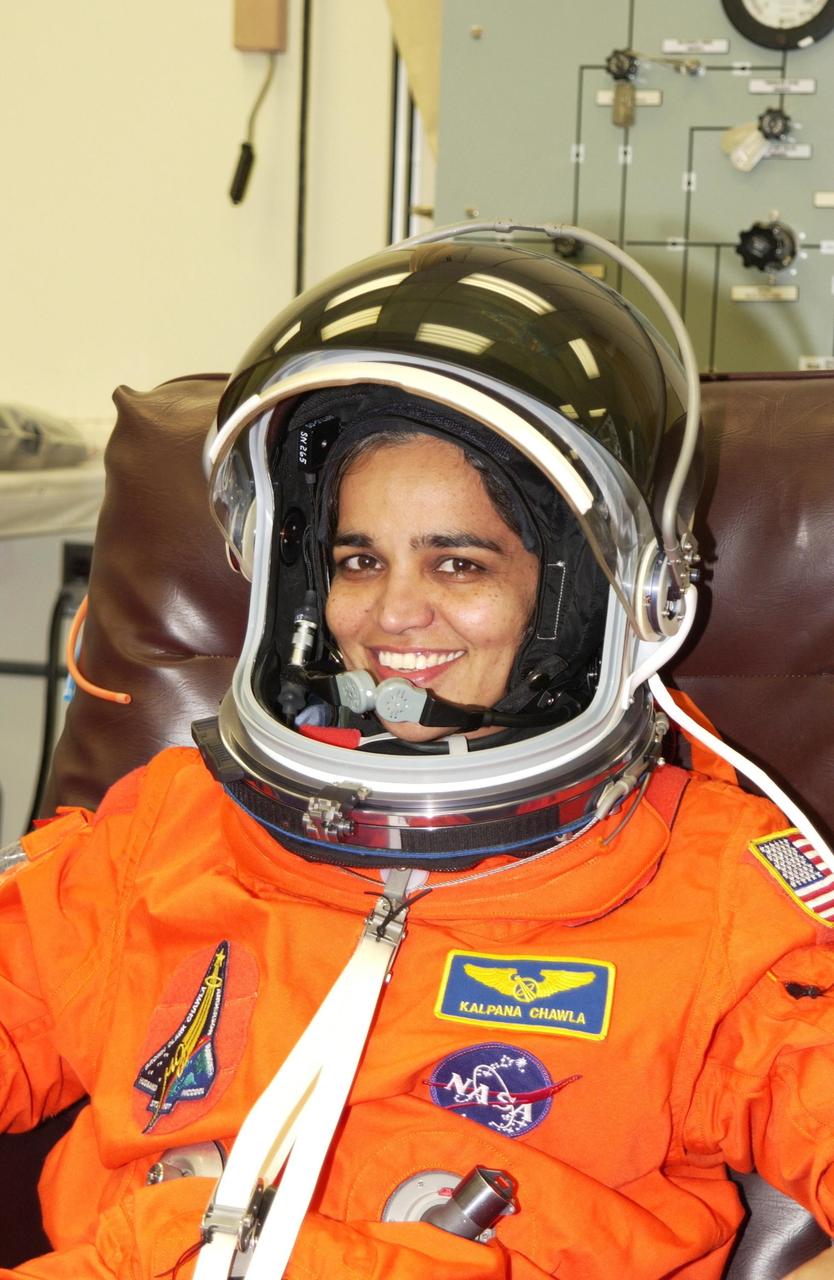
KENNEDY SPACE CENTER, FLA. -- STS-107 Mission Specialist Kalpana Chawla is helped suiting up for Terminal Countdown Demonstration Test activities, which include a simulated launch countdown at the pad. STS-107 is a mission devoted to research and will include more than 80 experiments that will study Earth and space science, advanced technology development, and astronaut health and safety. Launch is planned for Jan. 16, 2003, between 10 a.m. and 2 p.m. EST aboard Space Shuttle Columbia. .
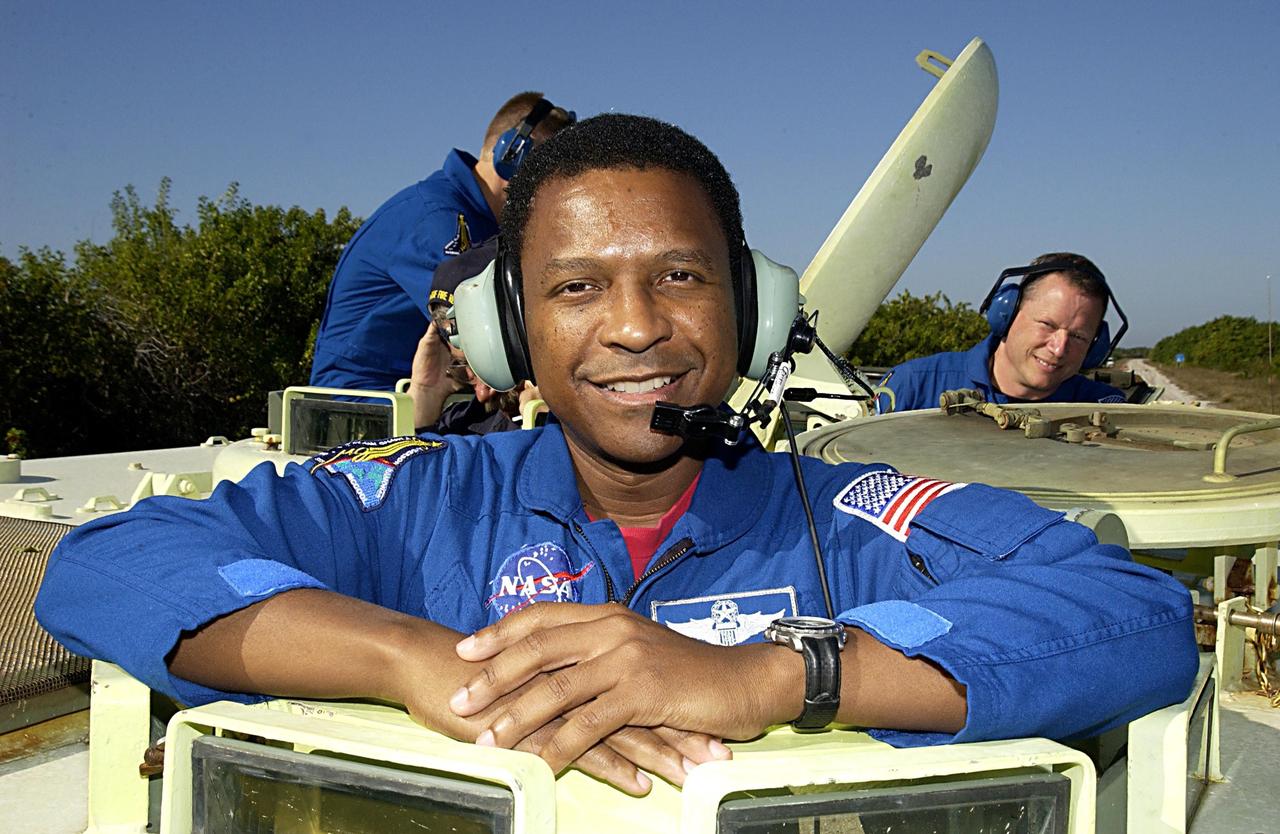
KENNEDY SPACE CENTER, FLA. -- -- STS-107 Payload Commander Michael Anderson takes a break during training on the operation of an M113 armored personnel carrier during Terminal Countdown Demonstration Test activities, a standard part of launch preparations. STS-107 is a mission devoted to research and will include more than 80 experiments that will study Earth and space science, advanced technology development, and astronaut health and safety. Launch is planned for Jan. 16, 2003, between 10 a.m. and 2 p.m. EST aboard Space Shuttle Columbia.
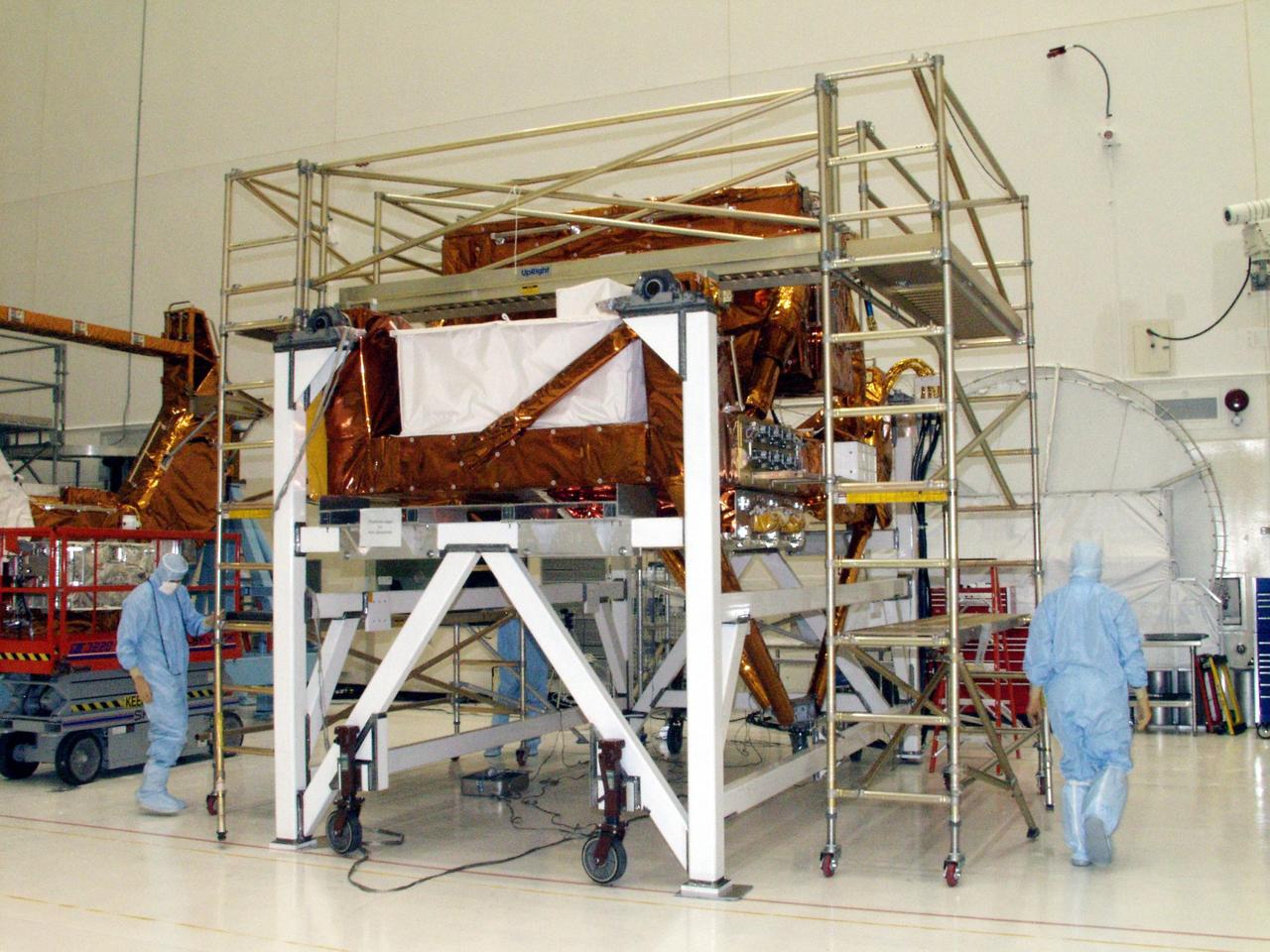
KENNEDY SPACE CENTER, FLA. --The STS-109 flight hardware for maintenance of the Hubble Space Telescope (HST) is being processed inside the clean room at the Vertical Processing Facility (VPF). Seen here is the Axial Science Instrument Protective Enclosure (ASIPE), which will house the Advanced Camera for Surveys (ACS). The hardware will be installed on four principle payload carriers. The STS-109 launch aboard Columbia is targeted for Feb. 14, 2002, and will be the 108th flight in the Space Shuttle program
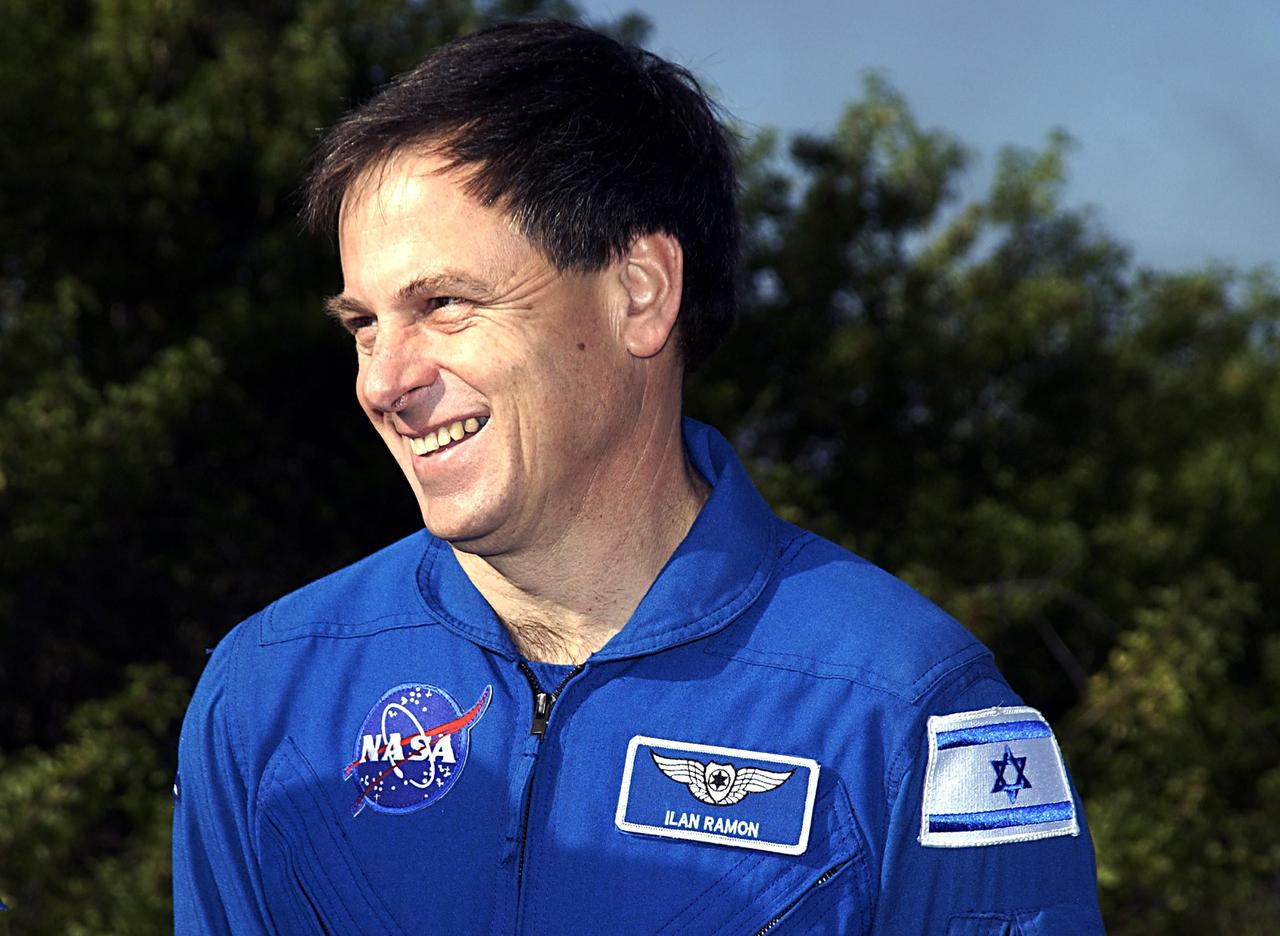
KENNEDY SPACE CENTER, FLA. -- STS-107 Payload Specialist Ilan Ramon, the first Israeli astronaut, participates in Terminal Countdown Demonstration Test activities, a standard part of Shuttle launch preparations. STS-107 is a mission devoted to research and will include more than 80 experiments that will study Earth and space science, advanced technology development, and astronaut health and safety. Launch is planned for Jan. 16, 2003, between 10 a.m. and 2 p.m. EST aboard Space Shuttle Columbia.
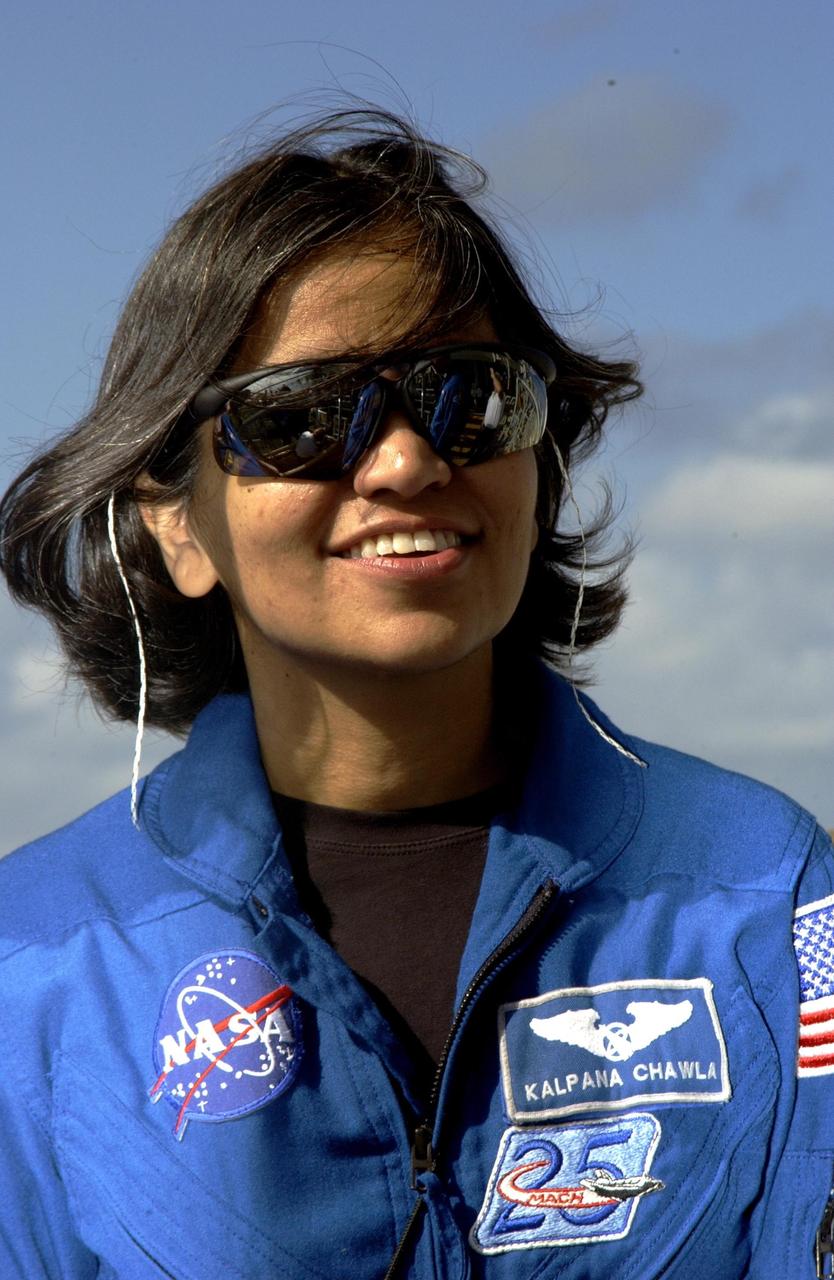
KENNEDY SPACE CENTER, FLA. - STS-107 Mission Specialist Kalpana Chawla is shown during the crew's Terminal Countdown Demonstration Test activities on Launch Pad 39A. The TCDT also includes a simulated launch countdown. STS-107 is a mission devoted to research and will include more than 80 experiments that will study Earth and space science, advanced technology development, and astronaut health and safety. Launch is planned for Jan. 16, 2003, between 10 a.m. and 2 p.m. EST aboard Space Shuttle Columbia. .
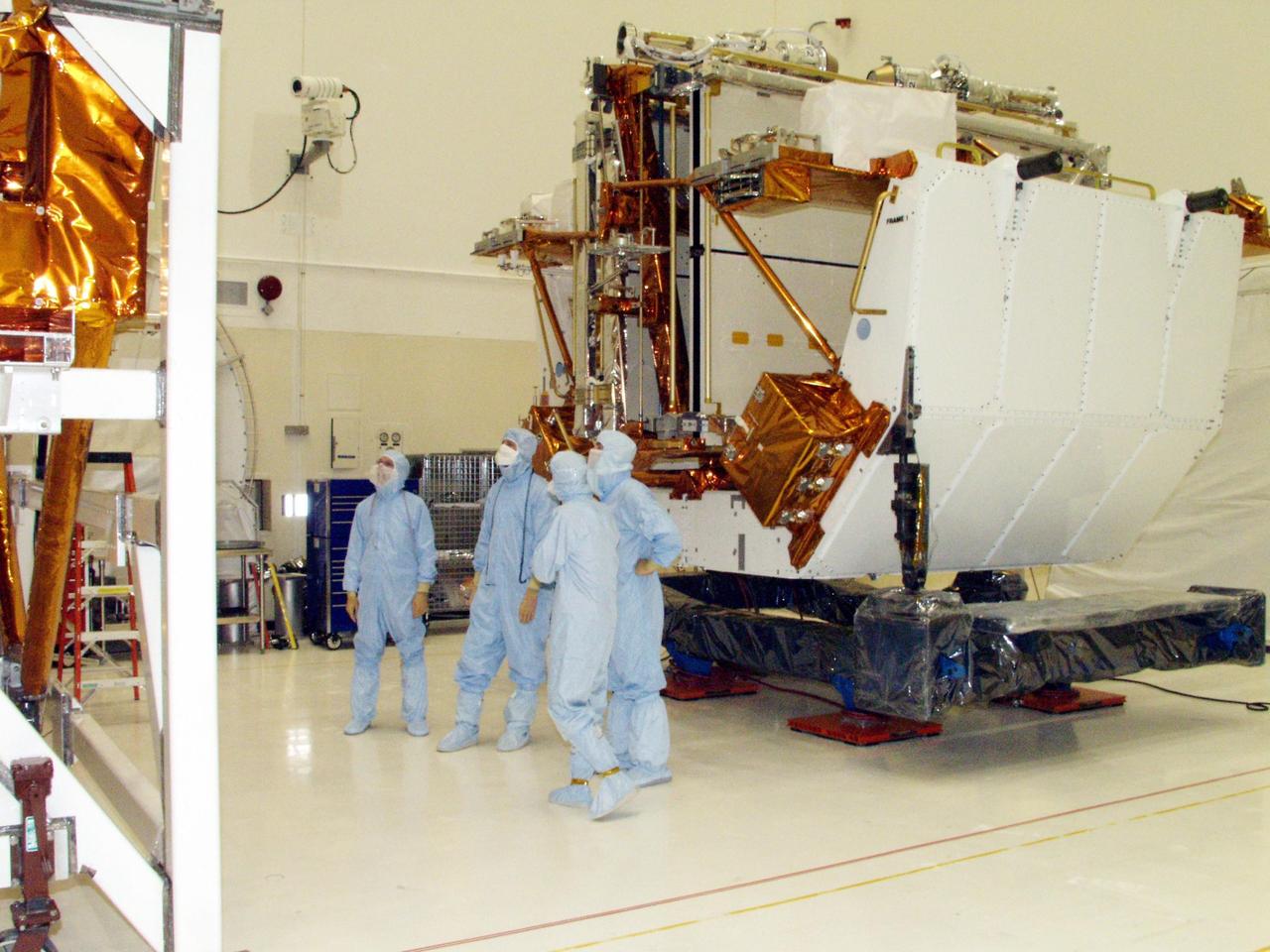
KENNEDY SPACE CENTER, FLA. -- Workers in the Vertical Processing Facility look over the Axial Science Instrument Protective Enclosure (ASIPE), which will house the Advanced Camera for Surveys (ACS), part of the STS-109 flight hardware for maintenance of the Hubble Space Telescope (HST). The Solar Array 3 panels behind them, and other HST hardware, are installed on four principle payload carriers. The STS-109 launch aboard Columbia is targeted for Feb. 14, 2002, and will be the 108th flight in the Space Shuttle program
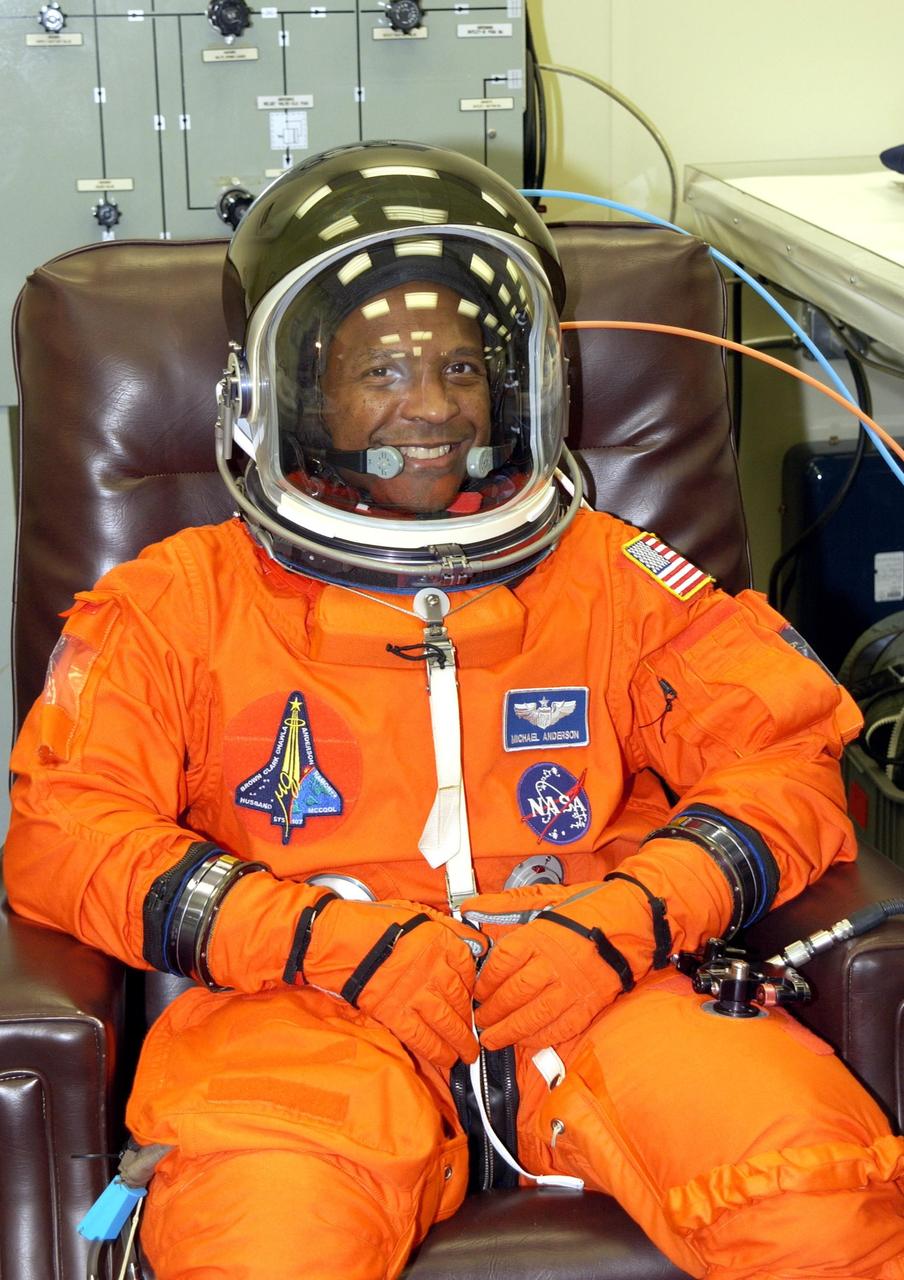
KENNEDY SPACE CENTER, FLA. -- STS-107 Payload Commander Michael Anderson completes suit check prior to Terminal Countdown Demonstration Test activities, which include a simulated launch countdown at the pad. STS-107 is a mission devoted to research and will include more than 80 experiments that will study Earth and space science, advanced technology development, and astronaut health and safety. Launch is planned for Jan. 16, 2003, between 10 a.m. and 2 p.m. EST aboard Space Shuttle Columbia. .
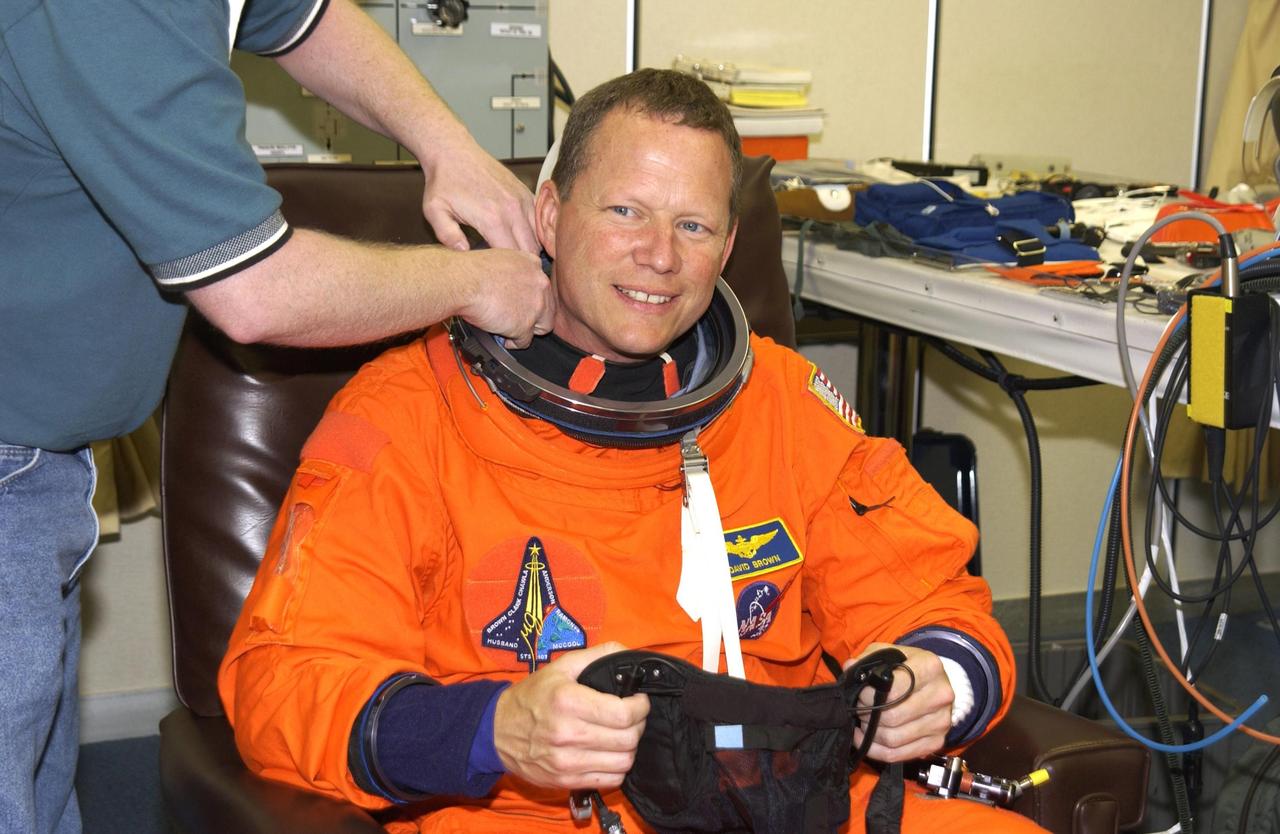
KENNEDY SPACE CENTER, FLA. -- STS-107 Mission Specialist David Brown happily submits to suit check prior to Terminal Countdown Demonstration Test activities, which include a simulated launch countdown at the pad. STS-107 is a mission devoted to research and will include more than 80 experiments that will study Earth and space science, advanced technology development, and astronaut health and safety. Launch is planned for Jan. 16, 2003, between 10 a.m. and 2 p.m. EST aboard Space Shuttle Columbia. .
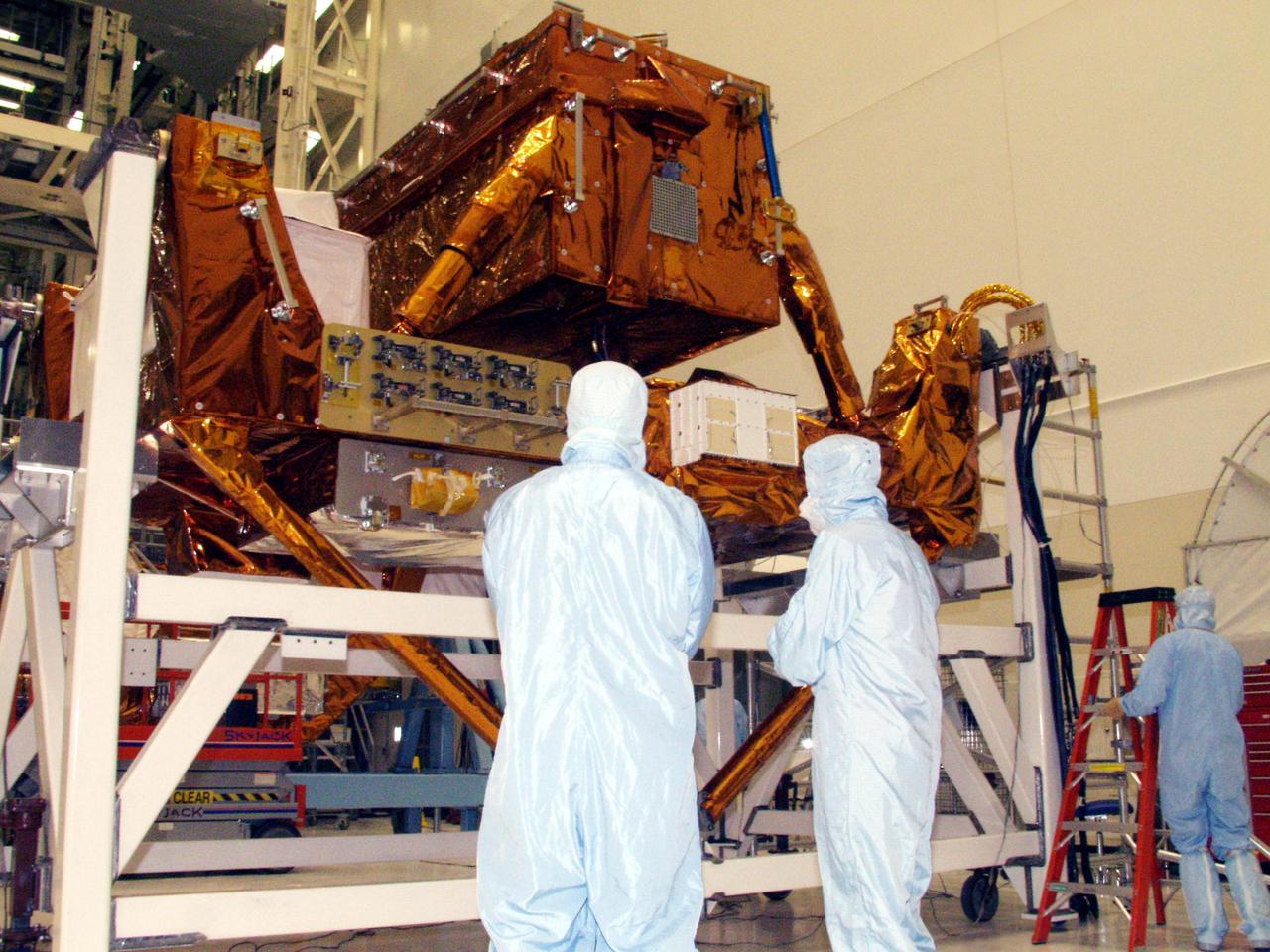
KENNEDY SPACE CENTER, FLA. -- Workers in the Vertical Processing Facility take a close look at the Axial Science Instrument Protective Enclosure (ASIPE), which will house the Advanced Camera for Surveys (ACS), part of the STS-109 flight hardware for maintenance of the Hubble Space Telescope (HST). The hardware is installed on four principle payload carriers. The STS-109 launch aboard Columbia is targeted for Feb. 14, 2002, and will be the 108th flight in the Space Shuttle program