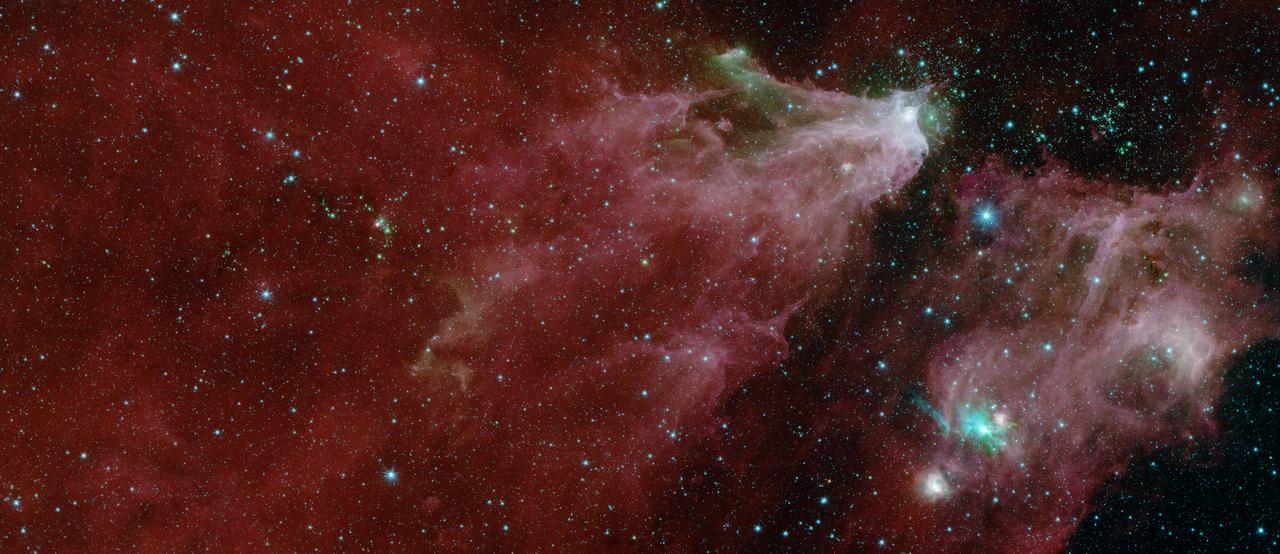
This image shows data from NASA's Spitzer Space Telescope, from the IRAC instrument, with colors corresponding to wavelengths of 3.6, 4.5, 5.8 and 8.0 µm (shown as blue, green, orange and red). The grand red delta filling most of the image is a far-away nebula, or a cloud of gas and dust. A second nebula is located in the lower right portion of the image. Within the first nebula, on the left side of this image, a dark filament runs horizontally through the green cloud. A smattering of baby stars (the red and yellow dots) appear inside it. Known as Cepheus C, the area is a particularly dense concentration of gas and dust where infant stars form. This region is called Cepheus C because it lies in the constellation Cepheus, which can be found near the constellation Cassiopeia. Cepheus-C is about 6 light years long, and lies about 40 light-years from the bright spot at the tip of the nebula. Two features identified in the annotated image are visible only in the multi-instrument version of the image, found here. The first is V374 Ceph in the larger nebula. The second is the "runaway star" in the smaller nebula. A second star cluster is located just above the second large nebula on the right side of the image. Known as Cepheus B, the cluster sits within a few thousand light-years of our Sun. A study of this region using Spitzer found that the dramatic collection is about 4 million to 5 million years old — slightly older than those in Cepheus C. Also found in the second nebula is a small cluster of newborn stars that illuminates the dense cloud of gas and dust where they formed. It appears as a bright teal splash. https://photojournal.jpl.nasa.gov/catalog/PIA23127
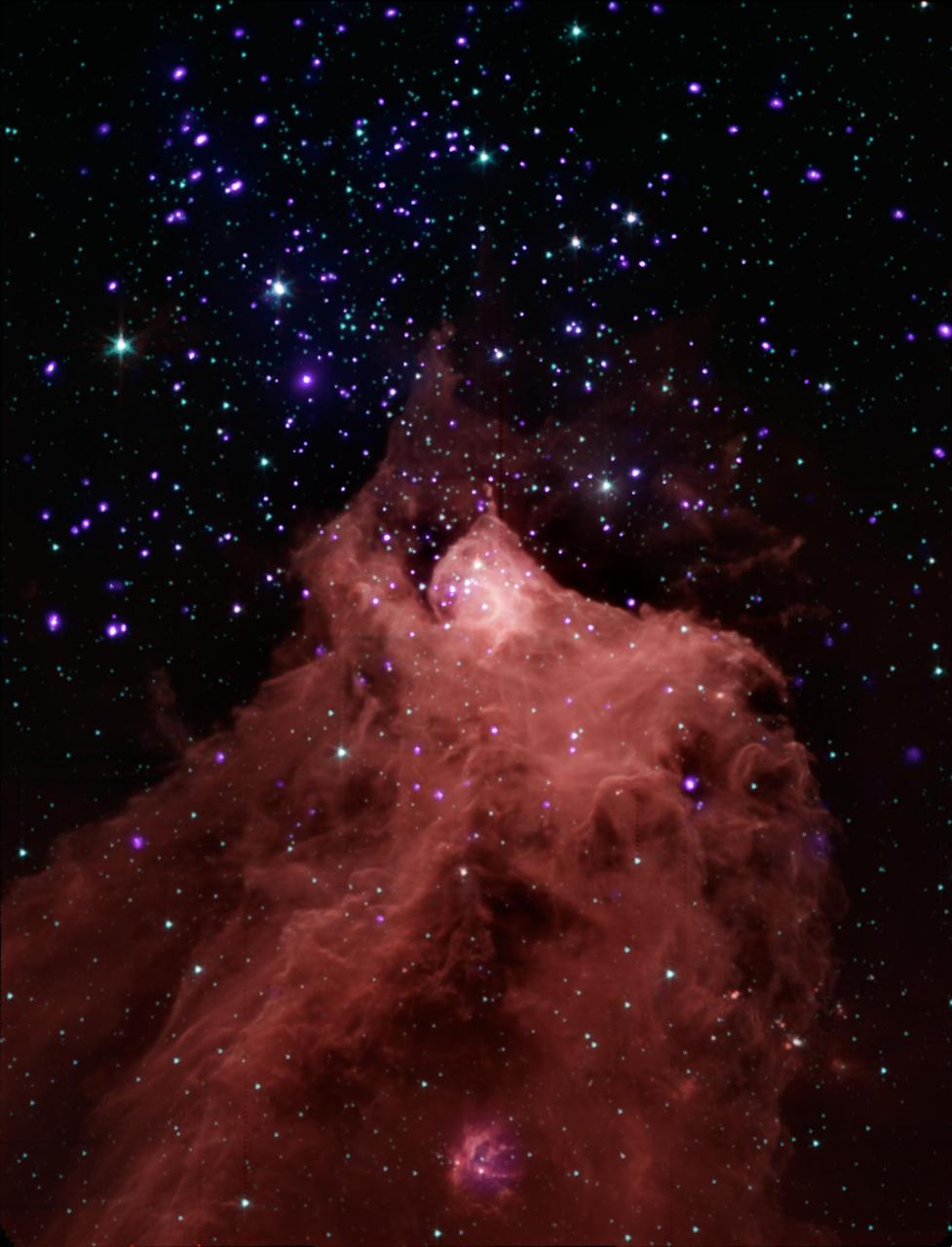
This composite image, combining data from NASA Chandra X-ray Observatory and Spitzer Space Telescope shows the star-forming cloud Cepheus B, located in our Milky Way galaxy about 2,400 light years from Earth

This image was compiled using data from NASA's Spitzer Space Telescope using the Infrared Array Camera (IRAC) and the Multiband Imaging Photometer (MIPS) during Spitzer's "cold" mission, before the spacecraft's liquid helium coolant ran out in 2009. The colors correspond with IRAC wavelengths of 3.6 microns (blue), 4.5 microns (cyan) and 8 microns (green), and 24 microns (red) from the MIPS instrument. The green-and-orange delta filling most of this image is a nebula, or a cloud of gas and dust. This region formed from a much larger cloud of gas and dust that has been carved away by radiation from stars. The bright region at the tip of the nebula is dust that has been heated by the stars' radiation, which creates the surrounding red glow. The white color is the combination of four colors (blue, green, orange and red), each representing a different wavelength of infrared light, which is invisible to human eyes. The massive stars illuminating this region belong to a star cluster that extends above the white spot. On the left side of this image, a dark filament runs horizontally through the green cloud. A smattering of baby stars (the red and yellow dots) appear inside it. Known as Cepheus C, the area is a particularly dense concentration of gas and dust where infant stars form. This region is called Cepheus C because it lies in the constellation Cepheus, which can be found near the constellation Cassiopeia. Cepheus-C is about 6 light-years long, and lies about 40 light-years from the bright spot at the tip of the nebula. The small, red hourglass shape just below Cepheus C is V374 Ceph. Astronomers studying this massive star have speculated that it might be surrounded by a nearly edge-on disk of dark, dusty material. The dark cones extending to the right and left of the star are a shadow of that disk. The smaller nebula on the right side of the image includes a blue star crowned by a small, red arc of light. This "runaway star" is plowing through the gas and dust at a rapid clip, creating a shock wave or "bow shock" in front of itself. https://photojournal.jpl.nasa.gov/catalog/PIA23126
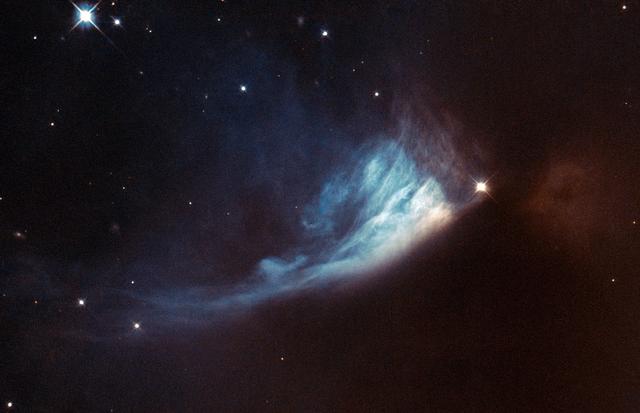
The Universe is rarely static, although the timescales involved can be very long. Since modern astronomical observations began we have been observing the birthplaces of new stars and planets, searching for and studying the subtle changes that help us to figure out what is happening within. The bright spot located at the edge of the bluish fan-shaped structure in this Hubble image is a young star called V* PV Cephei, or PV Cep. It is a favorite target for amateur astronomers because the fan-shaped nebulosity, known as GM 1-29 or Gyulbudaghian’s Nebula, changes over a timescale of months. The brightness of the star has also varied over time. Images of PV Cep taken in 1952 showed a nebulous streak, similar to a comet’s tail. However, this had vanished when new images of the star were obtained some twenty-five years later. Instead, the blue fan-shaped nebula had appeared. Twenty-five years is a very short period on cosmic timescales, so astronomers think that the mysterious streak may have been a temporary phenomenon, such as the remnants of a massive stellar flare — similar to the solar flares we are used to seeing in the solar system. At the same time as this was happening, the star itself was brightening. This provided the light to illuminate the newly formed fan-shaped nebula. This brightening might be related to the start of the hydrogen-burning phase of the star, which would mean that it was reaching maturity. PV Cep is thought to be surrounded by a disc of gas and dust, which would stop light from escaping in all directions. The fan-like appearance is therefore probably a result of starlight escaping from the dust disc and projecting onto the nebula. PV Cep is located in the northern constellation of Cepheus at a distance of over 1600 light-years from Earth. European Space Agency/NASA Hubble <b><a href="http://www.nasa.gov/audience/formedia/features/MP_Photo_Guidelines.html" rel="nofollow">NASA image use policy.</a></b> <b><a href="http://www.nasa.gov/centers/goddard/home/index.html" rel="nofollow">NASA Goddard Space Flight Center</a></b> enables NASA’s mission through four scientific endeavors: Earth Science, Heliophysics, Solar System Exploration, and Astrophysics. Goddard plays a leading role in NASA’s accomplishments by contributing compelling scientific knowledge to advance the Agency’s mission. <b>Follow us on <a href="http://twitter.com/NASA_GoddardPix" rel="nofollow">Twitter</a></b> <b>Like us on <a href="http://www.facebook.com/pages/Greenbelt-MD/NASA-Goddard/395013845897?ref=tsd" rel="nofollow">Facebook</a></b> <b>Find us on <a href="http://instagram.com/nasagoddard?vm=grid" rel="nofollow">Instagram</a></b>