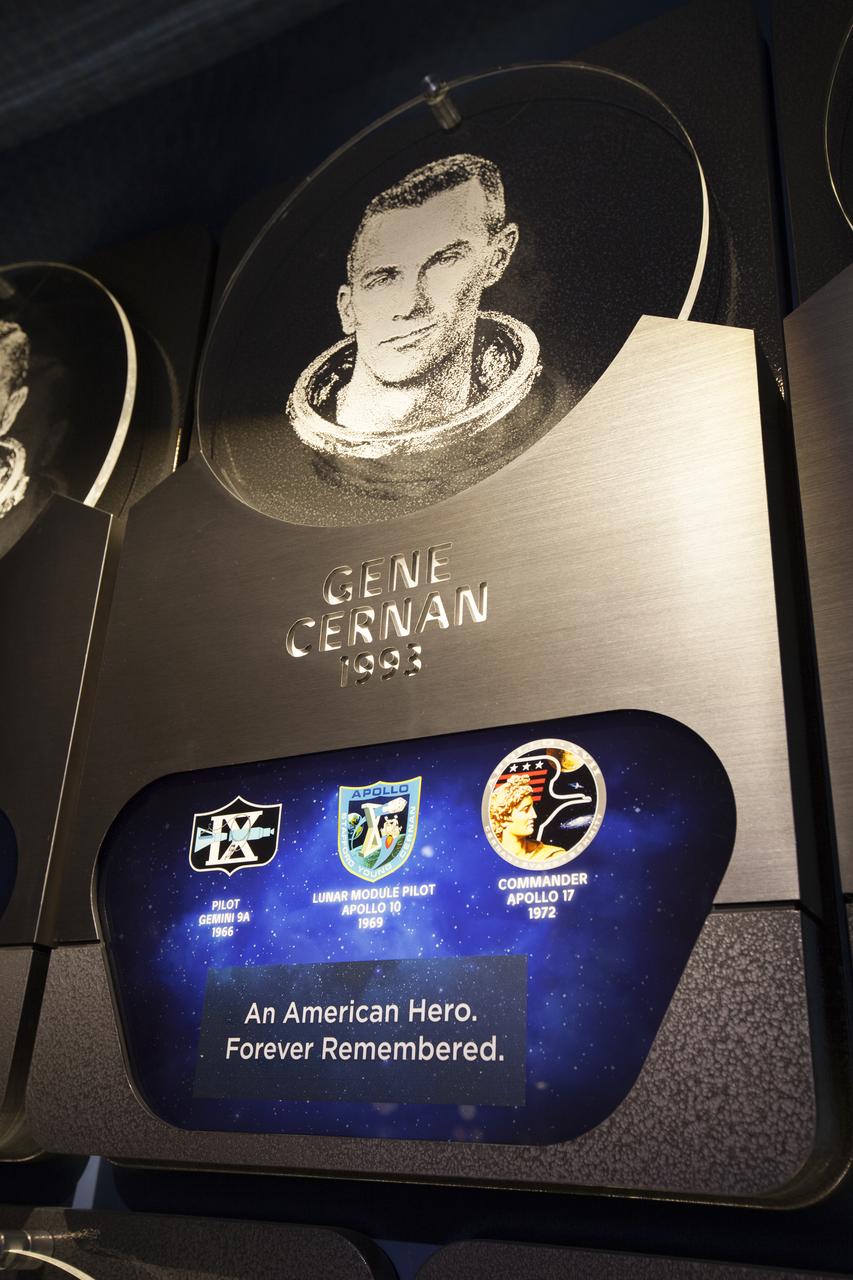
The Astronaut Hall of Fame display for astronaut Gene Cernan is shown following a remembrance ceremony Jan. 18, 2017, at NASA's Kennedy Space Center in Florida. Cernan, who flew on Gemini and Apollo missions, commanded the Apollo 17 mission and was the last person to walk on the moon.
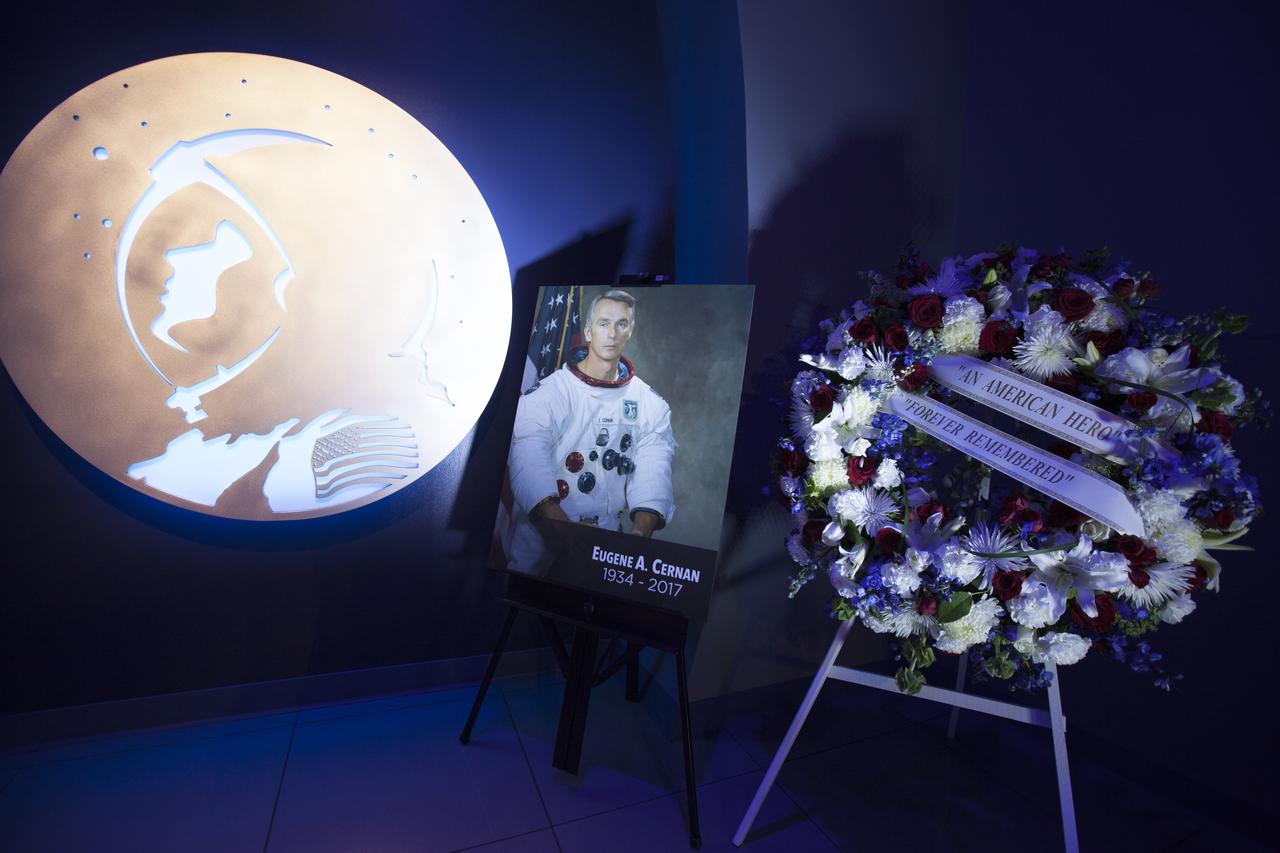
A photo of astronaut Gene Cernan is displayed alongside a memorial wreath before a remembrance ceremony Jan. 18, 2017, at NASA's Kennedy Space Center in Florida. Cernan, who flew on Gemini and Apollo missions, commanded the Apollo 17 mission and was the last person to walk on the moon.

A photo of astronaut Gene Cernan is displayed alongside a memorial wreath before a remembrance ceremony Jan. 18, 2017, at NASA's Kennedy Space Center in Florida. Cernan, who flew on Gemini and Apollo missions, commanded the Apollo 17 mission and was the last person to walk on the moon.
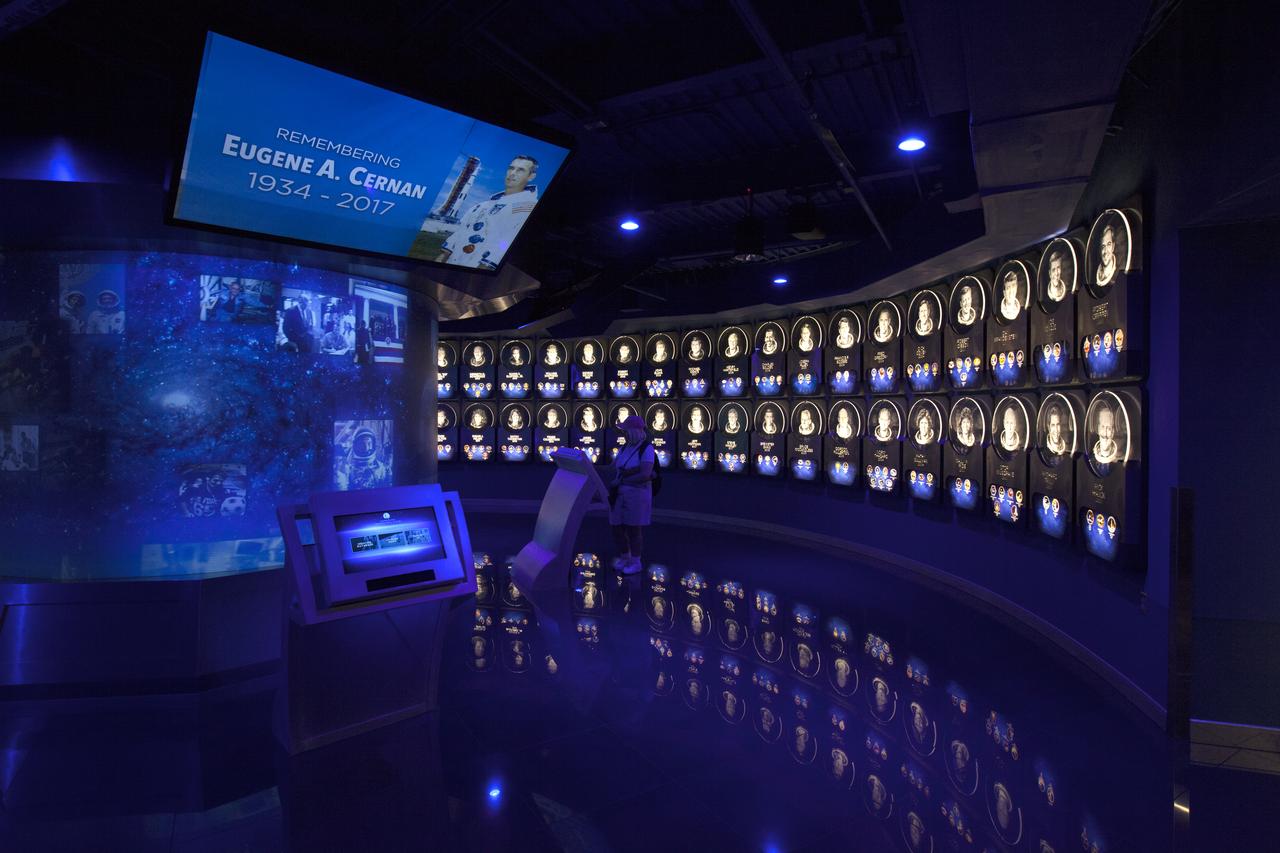
A display for astronaut Gene Cernan is shown following a remembrance ceremony Jan. 18, 2017, at NASA's Kennedy Space Center in Florida. Cernan, who flew on Gemini and Apollo missions, commanded the Apollo 17 mission and was the last person to walk on the moon.
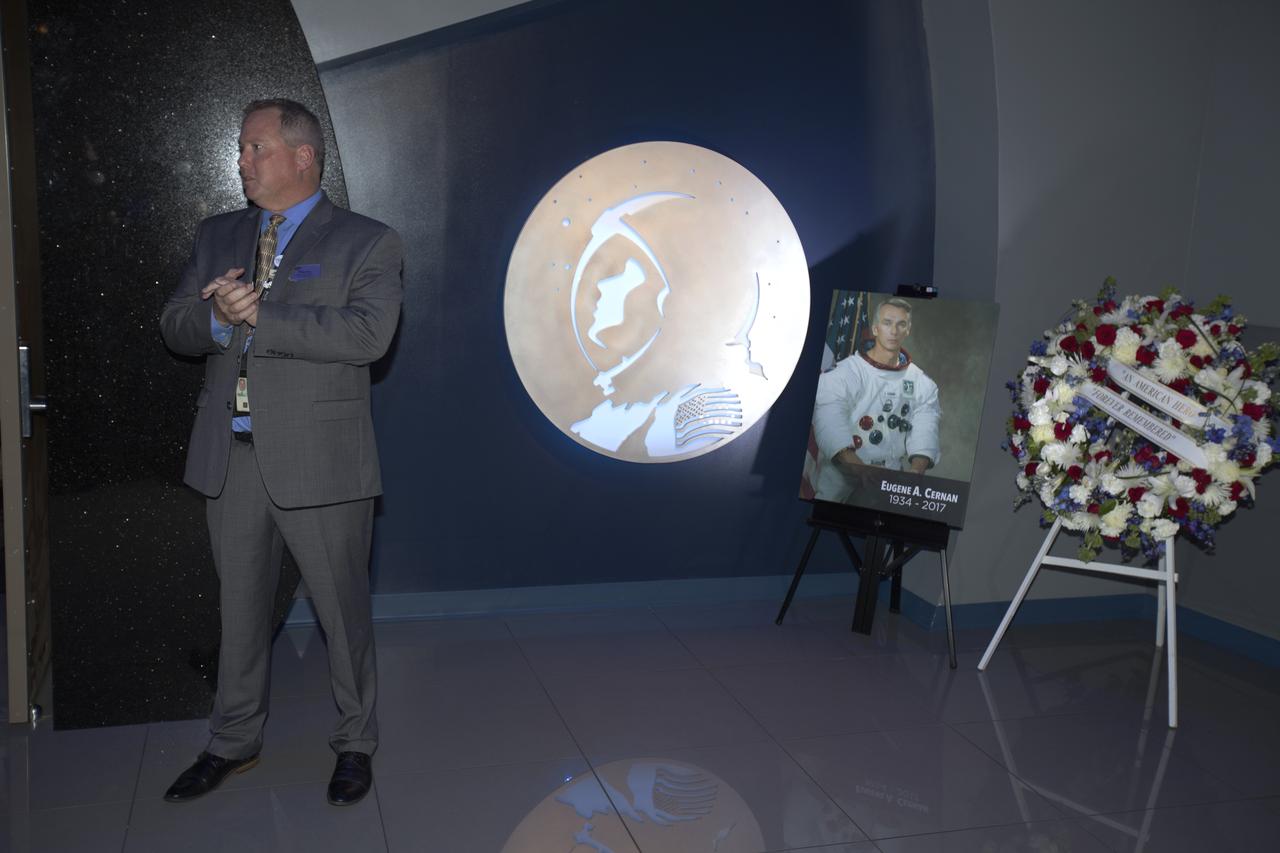
Therrin Protze, Chief Operating Officer, Delaware North Corporation Parks & Resorts at KSC, Inc., speaks during a remembrance ceremony Jan. 18, 2017, at NASA's Kennedy Space Center in Florida. Cernan, who flew on Gemini and Apollo missions, commanded the Apollo 17 mission and was the last person to walk on the moon.
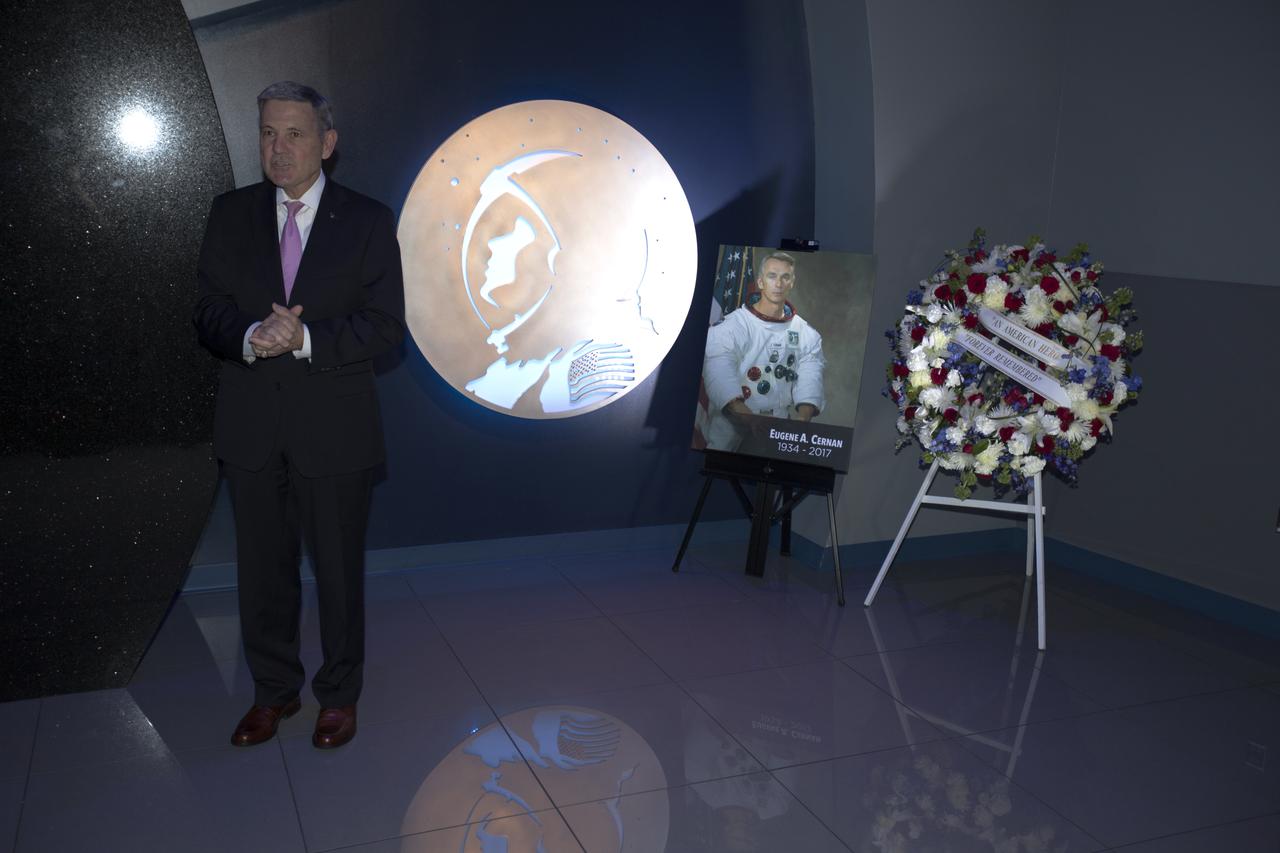
Former astronaut Bob Cabana, director of NASA's Kennedy Space Center in Florida, speaks during a remembrance ceremony Jan. 18, 2017. Cernan, who flew on Gemini and Apollo missions, commanded the Apollo 17 mission and was the last person to walk on the moon.
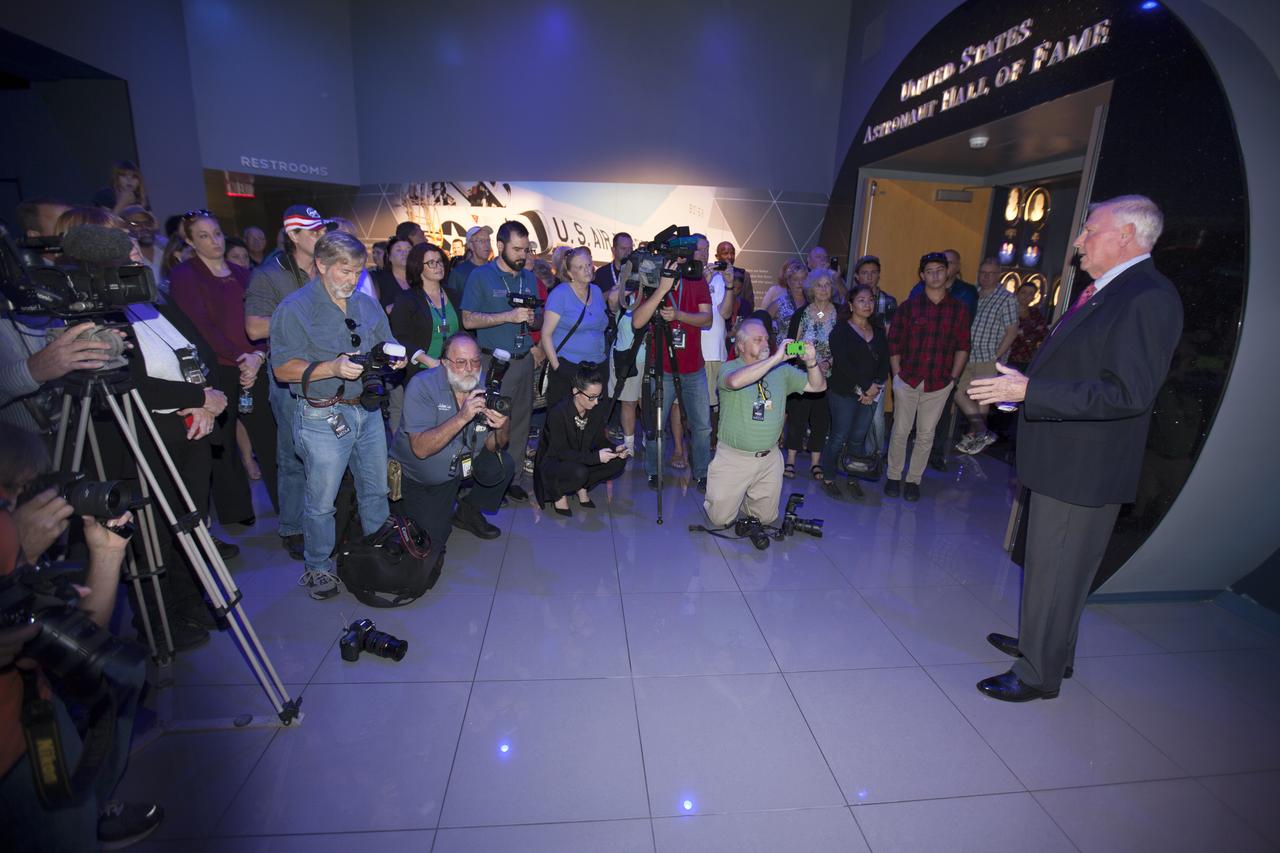
Former astronaut Jon McBride speaks during a remembrance ceremony Jan. 18, 2017, at NASA's Kennedy Space Center in Florida. Cernan, who flew on Gemini and Apollo missions, commanded the Apollo 17 mission and was the last person to walk on the moon.
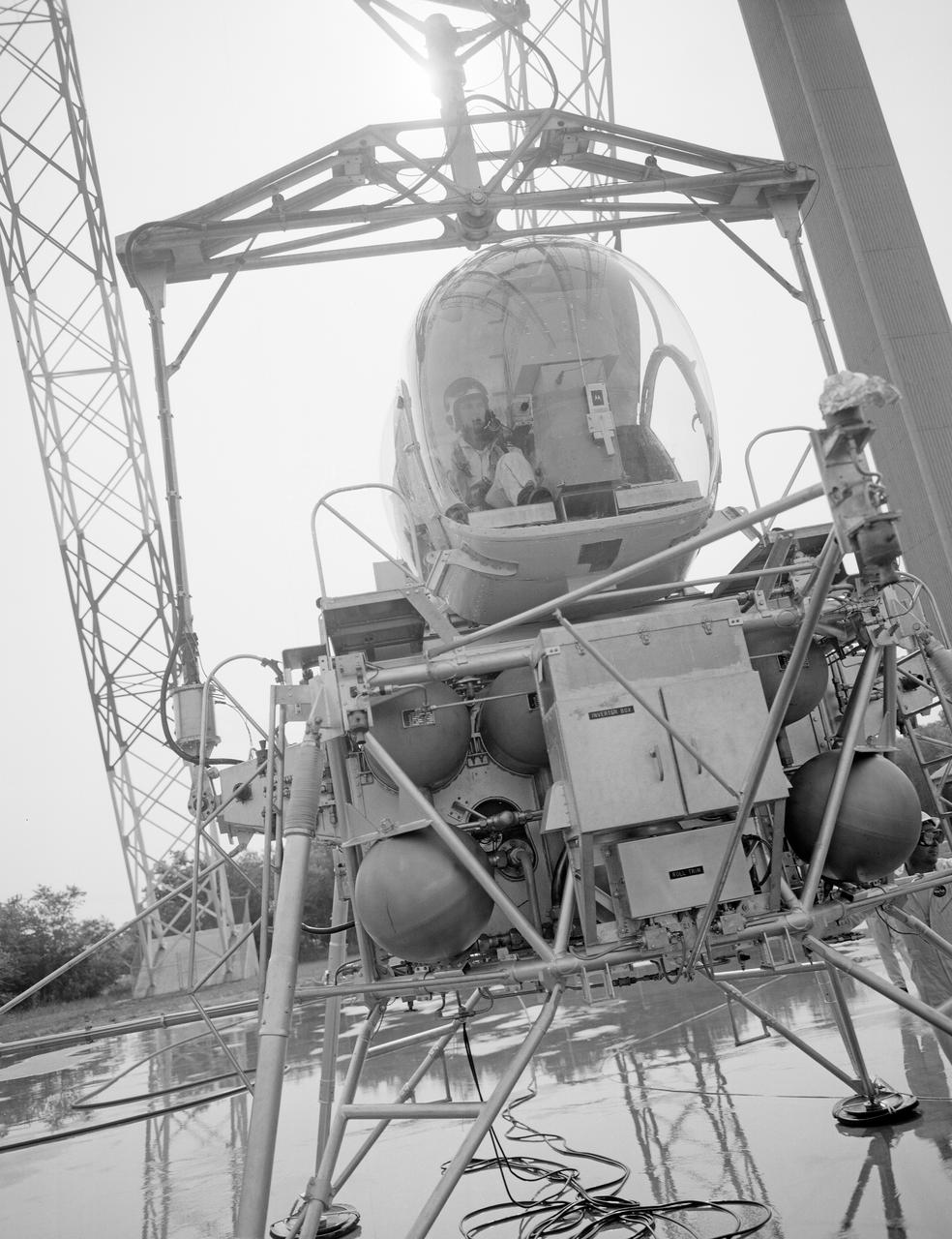
Astronaut Eugene Cernan at Lunar Lander Research Facility. Cernan under gantry, in training module. Captain Cernan was one of fourteen astronauts selected by NASA in October 1963. On his second space flight, he was lunar module pilot of Apollo 10, May 18-26, 1969, the first comprehensive lunar-orbital qualification and verification flight test of an Apollo lunar module.
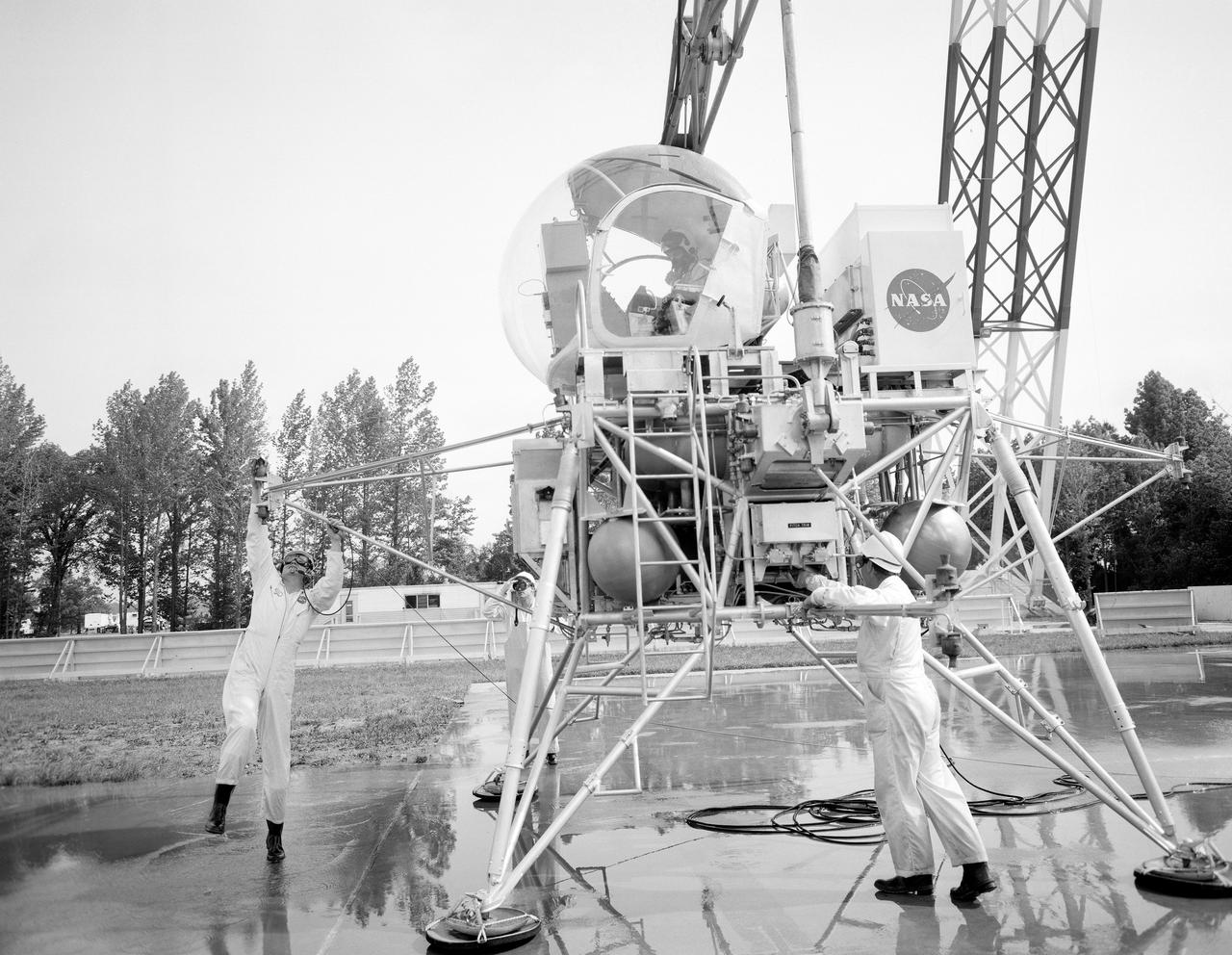
Astronaut Eugene Cernan at Lunar Lander Research Facility. Cernan under gantry, in training module. Captain Cernan was one of fourteen astronauts selected by NASA in October 1963. On his second space flight, he was lunar module pilot of Apollo 10, May 18-26, 1969, the first comprehensive lunar-orbital qualification and verification flight test of an Apollo lunar module.
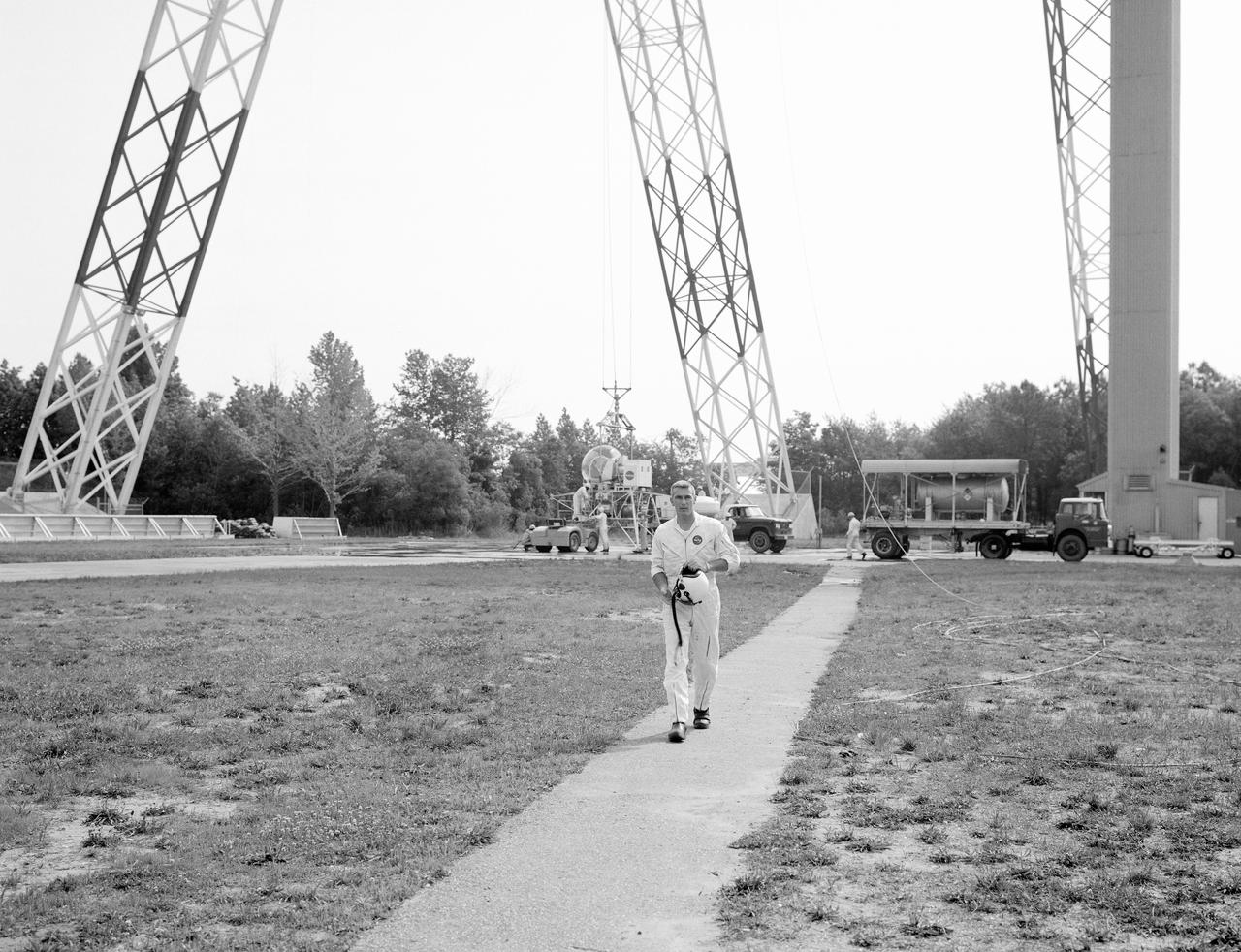
Astronaut Eugene Cernan at Lunar Lander Research Facility. Cernan under gantry, in training module. Captain Cernan was one of fourteen astronauts selected by NASA in October 1963. On his second space flight, he was lunar module pilot of Apollo 10, May 18-26, 1969, the first comprehensive lunar-orbital qualification and verification flight test of an Apollo lunar module.
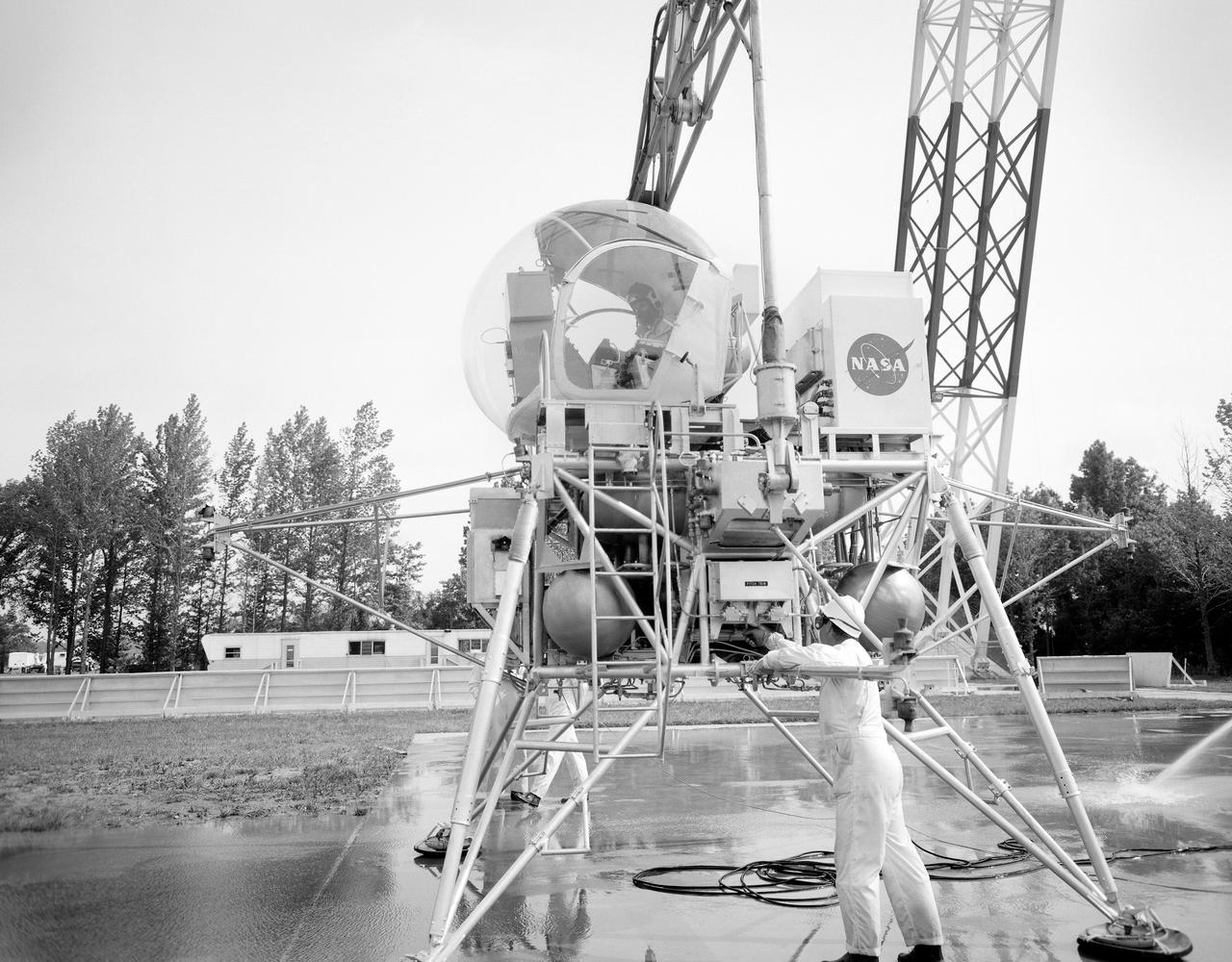
Astronaut Eugene Cernan at Lunar Lander Research Facility. Cernan under gantry, in training module. Captain Cernan was one of fourteen astronauts selected by NASA in October 1963. On his second space flight, he was lunar module pilot of Apollo 10, May 18-26, 1969, the first comprehensive lunar-orbital qualification and verification flight test of an Apollo lunar module.
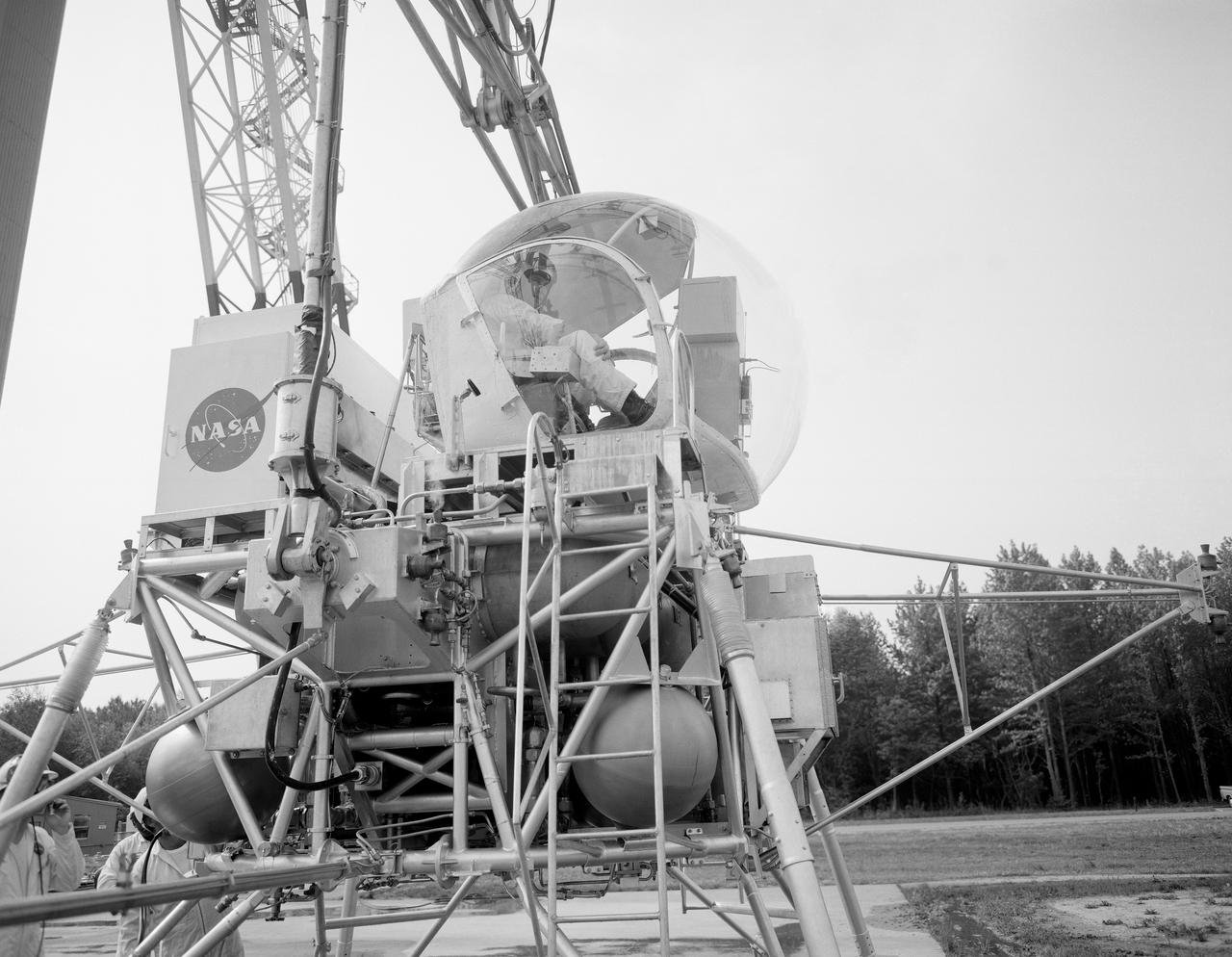
Astronaut Eugene Cernan at Lunar Lander Research Facility. Cernan under gantry, in training module. Captain Cernan was one of fourteen astronauts selected by NASA in October 1963. On his second space flight, he was lunar module pilot of Apollo 10, May 18-26, 1969, the first comprehensive lunar-orbital qualification and verification flight test of an Apollo lunar module.
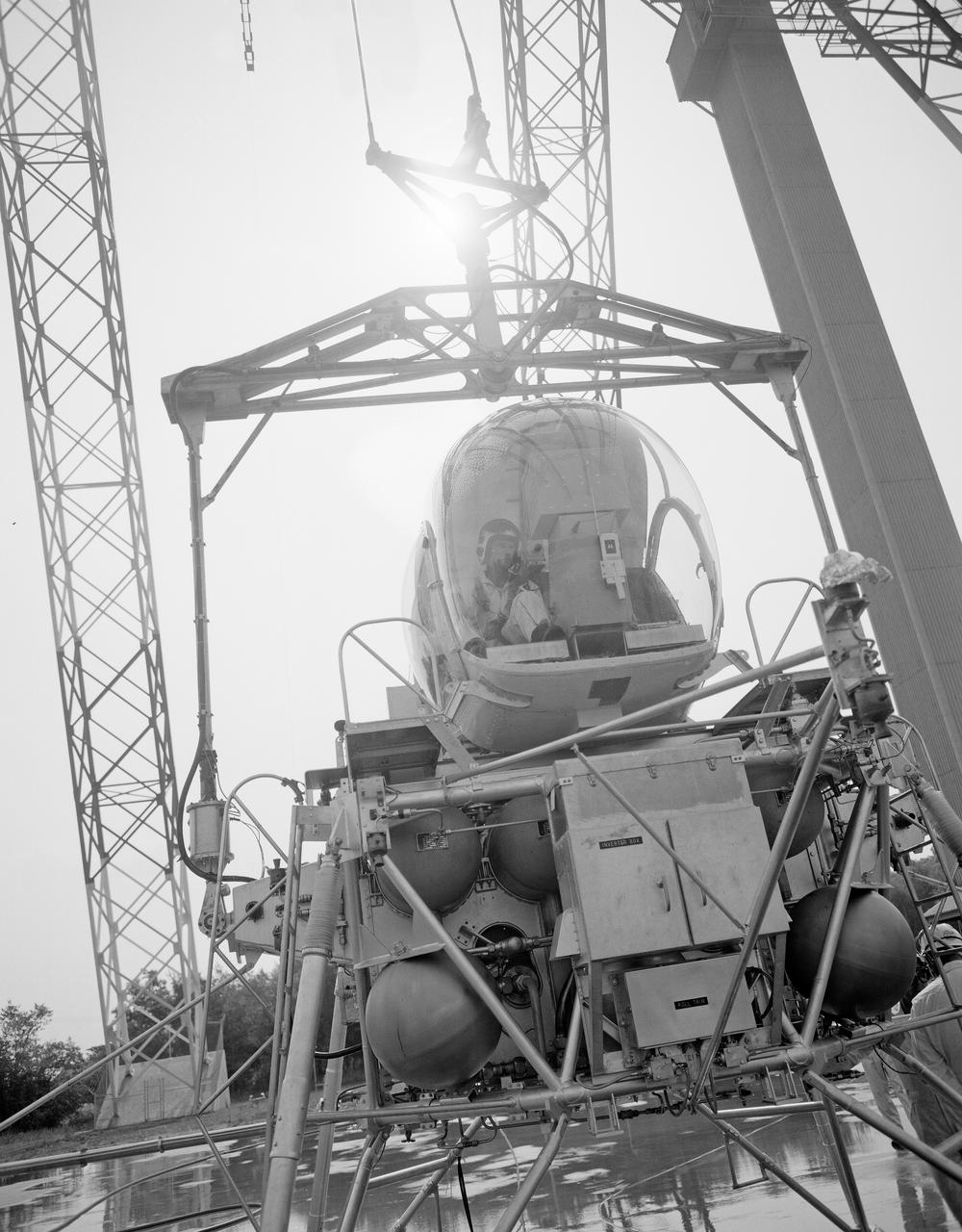
Astronaut Eugene Cernan at Lunar Lander Research Facility. Cernan under gantry, in training module. Captain Cernan was one of fourteen astronauts selected by NASA in October 1963. On his second space flight, he was lunar module pilot of Apollo 10, May 18-26, 1969, the first comprehensive lunar-orbital qualification and verification flight test of an Apollo lunar module.
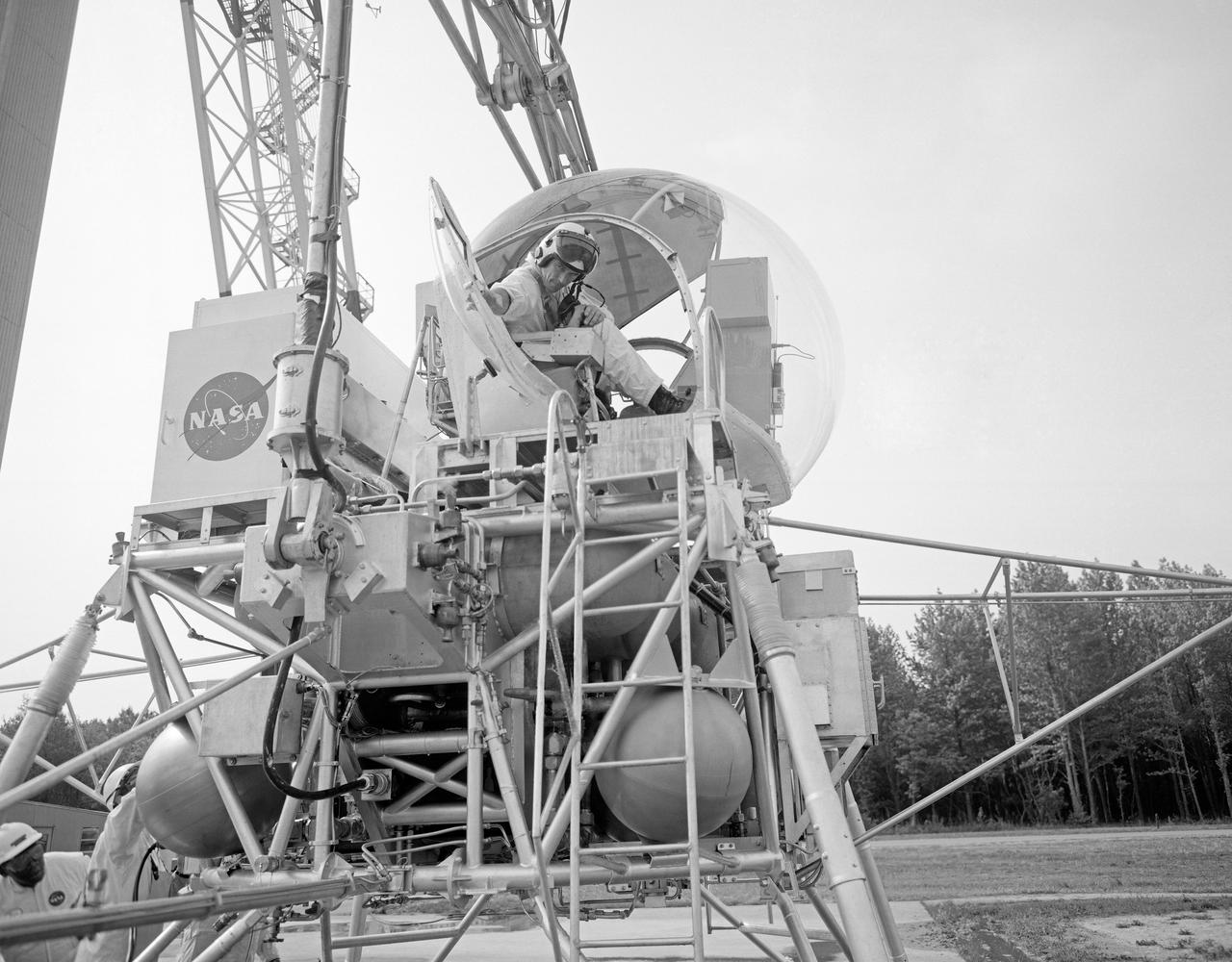
Astronaut Eugene Cernan at Lunar Lander Research Facility. Cernan under gantry, in training module. Captain Cernan was one of fourteen astronauts selected by NASA in October 1963. On his second space flight, he was lunar module pilot of Apollo 10, May 18-26, 1969, the first comprehensive lunar-orbital qualification and verification flight test of an Apollo lunar module.
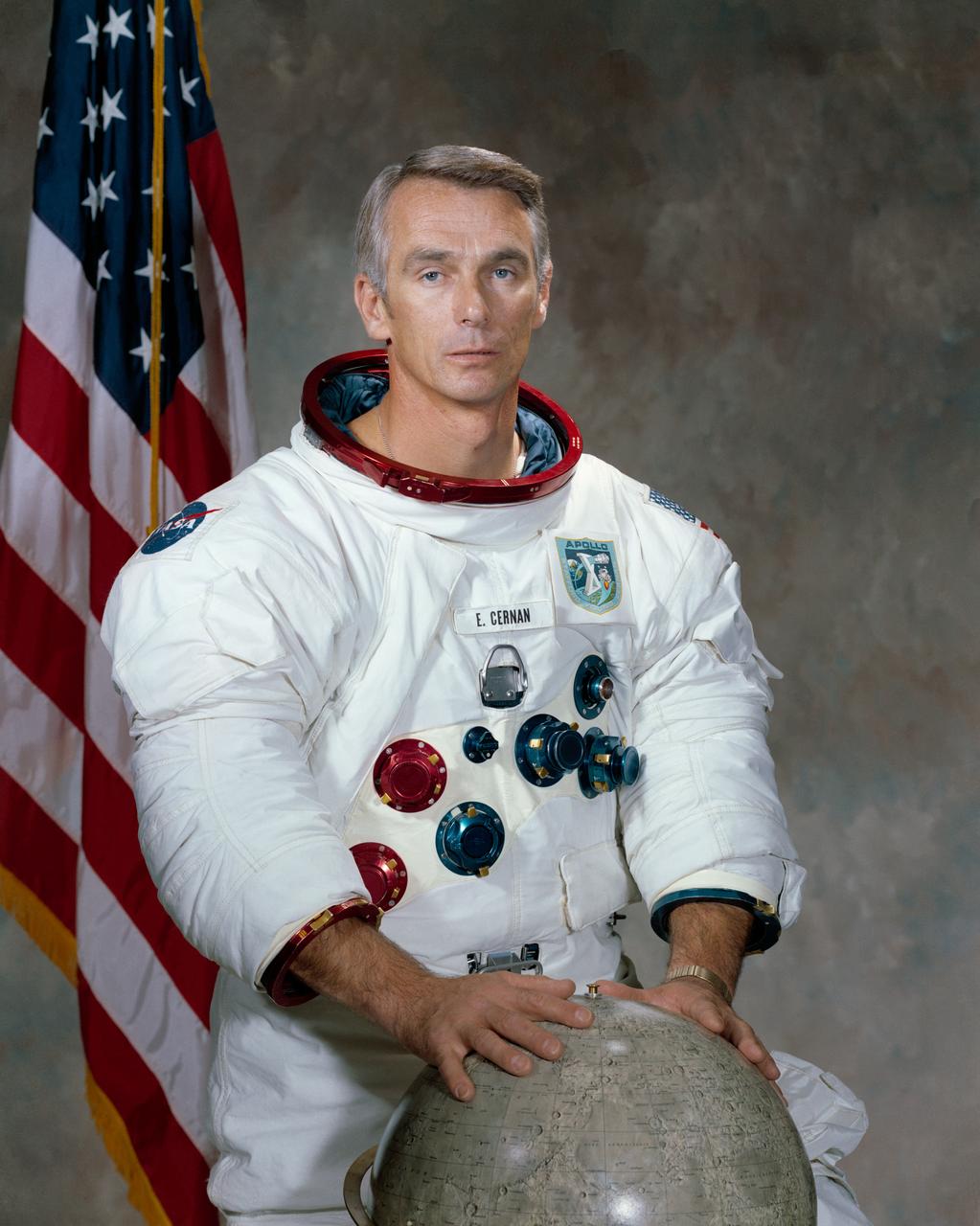
S71-51308 (21 Sept. 1971) --- Astronaut Eugene A. Cernan
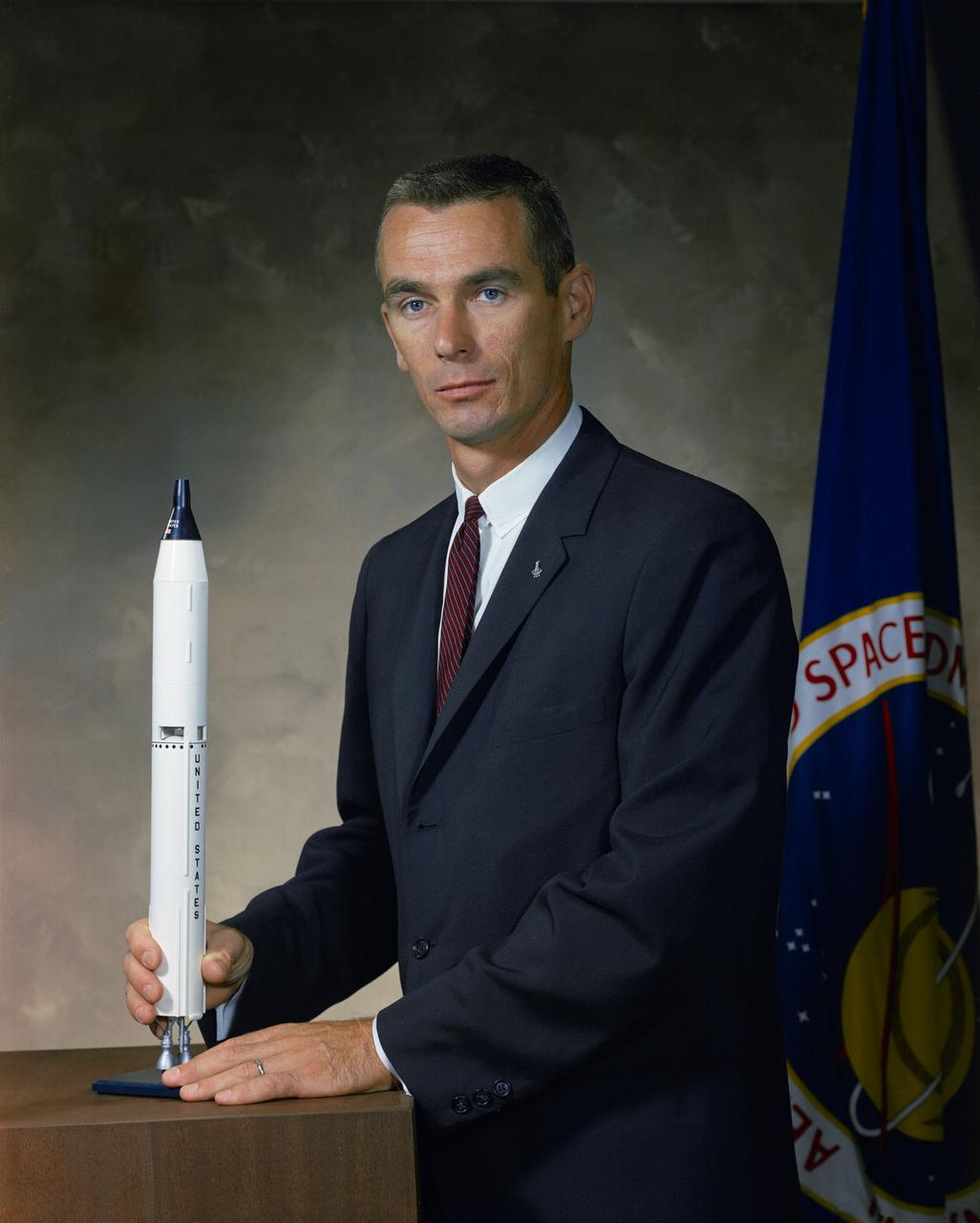
S64-31845 (10 Sept. 1964) --- Portrait of astronaut Eugene A. Cernan in civilian clothes with model of Gemini spacecraft and launch vehicle on table in front of him. Photo credit: NASA
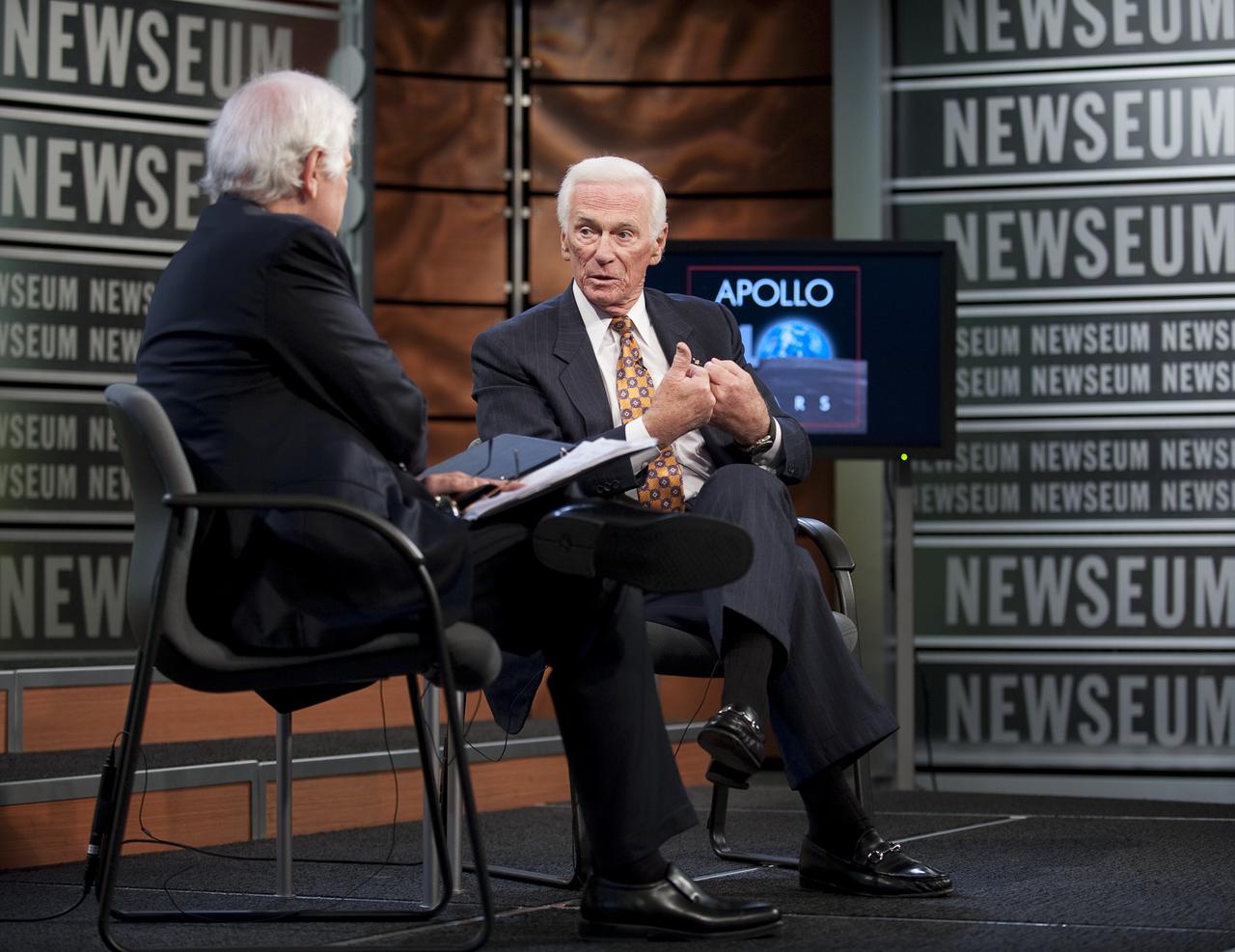
NASA Apollo 10 Astronaut Gene Cernan, right, answers questions from the Newseum's distinguished journalist-in-residence, Nick Clooney during a Newseum TV program celebrating the 40th anniversary of Apollo 10, Monday, May 18, 2009, in Washington. Photo Credit (NASA/Bill Ingalls)
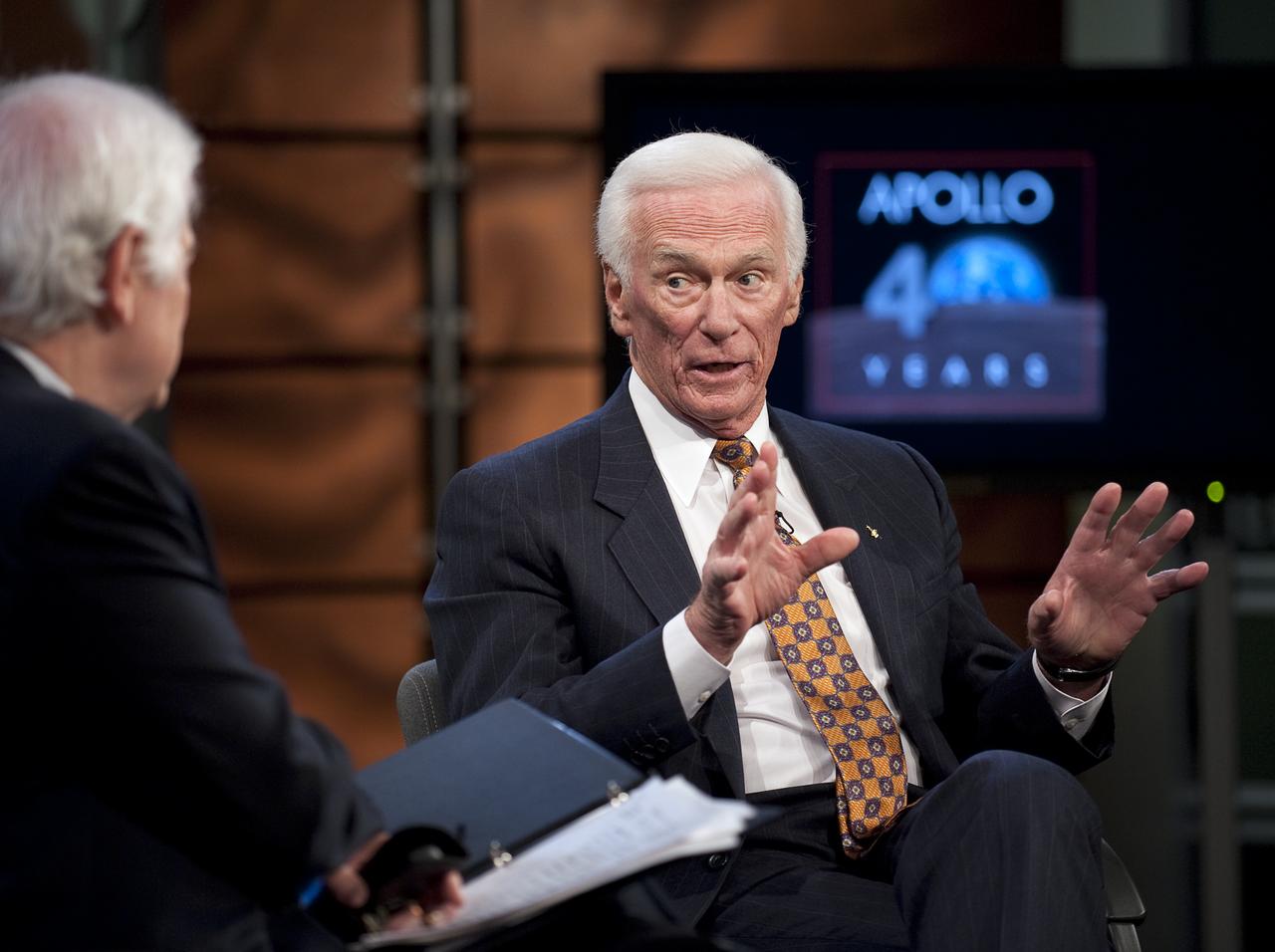
NASA Apollo 10 Astronaut Gene Cernan, right, answers questions from the Newseum's distinguished journalist-in-residence, Nick Clooney during a Newseum TV program celebrating the 40th anniversary of Apollo 10, Monday, May 18, 2009, in Washington. Photo Credit (NASA/Bill Ingalls)
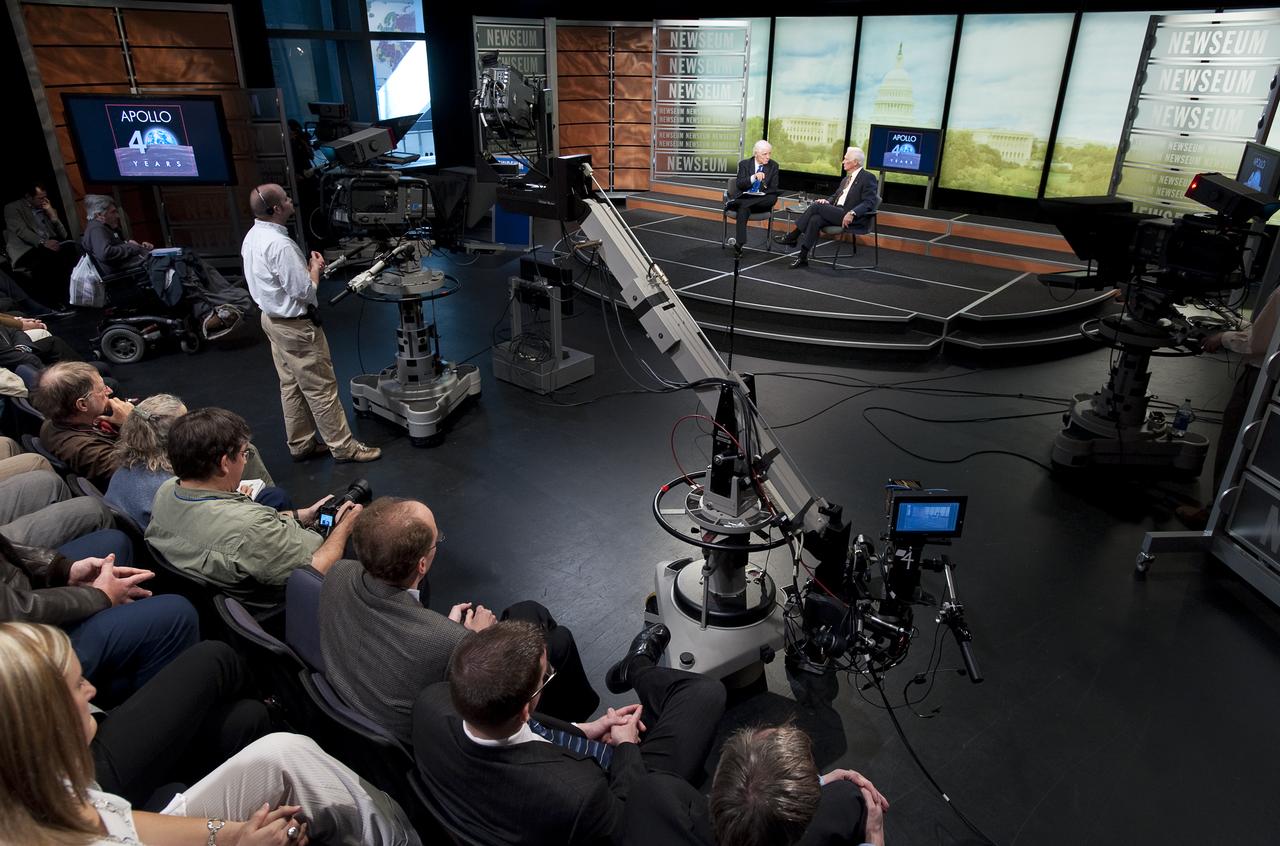
NASA Apollo 10 Astronaut Gene Cernan, right, answers questions from the Newseum's distinguished journalist-in-residence, Nick Clooney during a Newseum TV program celebrating the 40th anniversary of Apollo 10, Monday, May 18, 2009, in Washington. Photo Credit (NASA/Bill Ingalls)
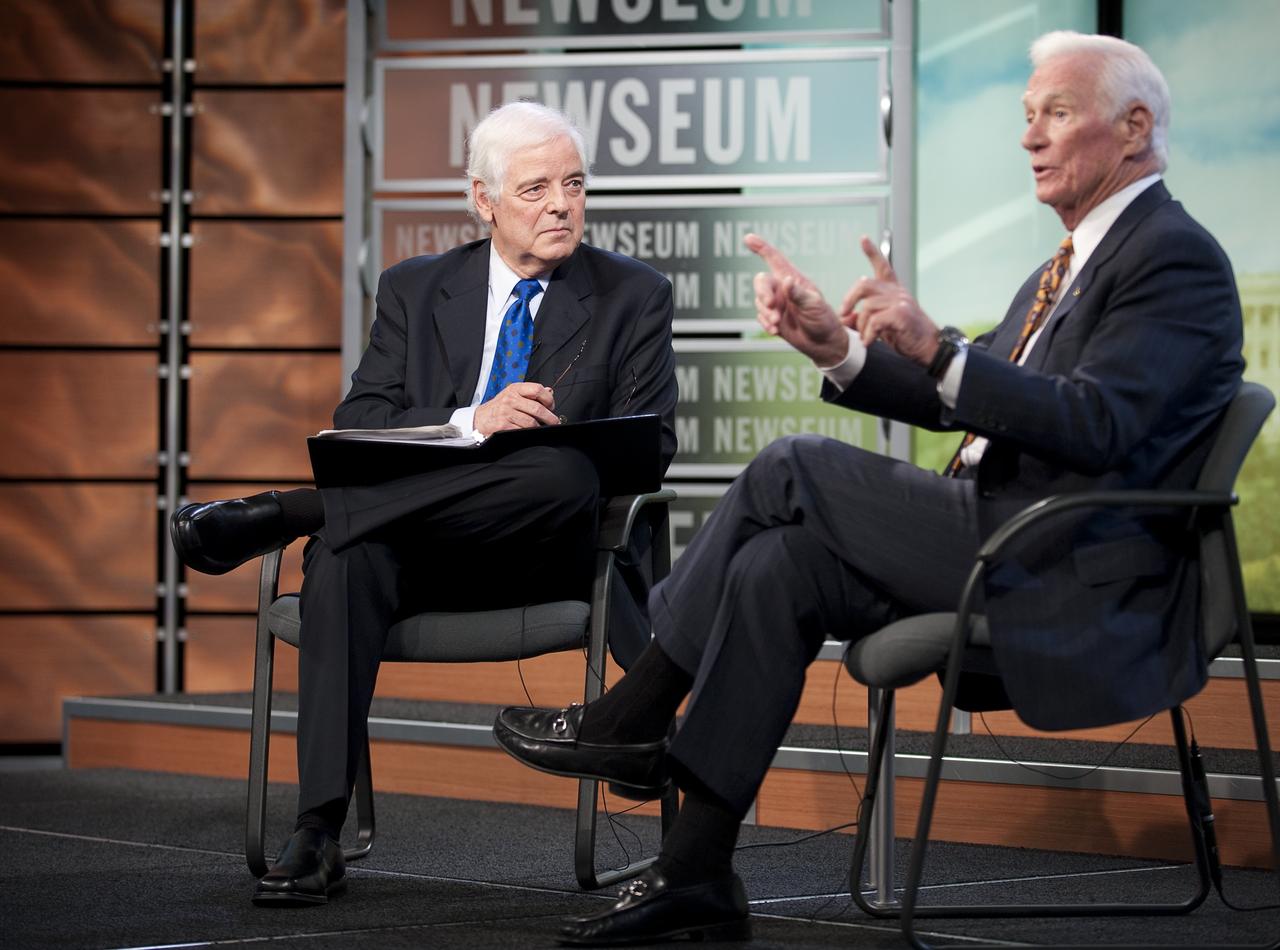
NASA Apollo 10 Astronaut Gene Cernan, right, answers questions from the Newseum's distinguished journalist-in-residence, Nick Clooney during a Newseum TV program celebrating the 40th anniversary of Apollo 10, Monday, May 18, 2009, in Washington. Photo Credit (NASA/Bill Ingalls)
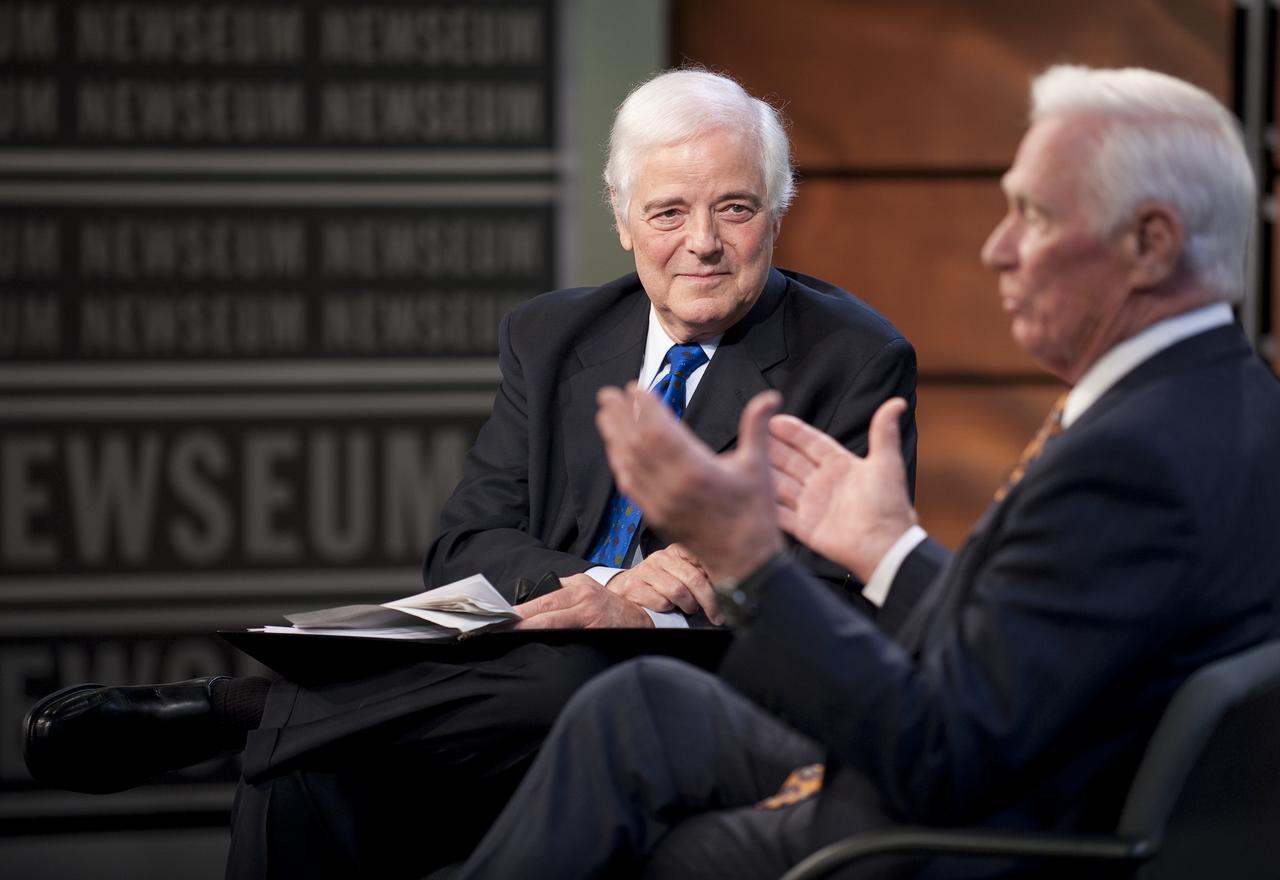
NASA Apollo 10 Astronaut Gene Cernan, right, answers questions from the Newseum's distinguished journalist-in-residence, Nick Clooney during a Newseum TV program celebrating the 40th anniversary of Apollo 10, Monday, May 18, 2009, in Washington. Photo Credit (NASA/Bill Ingalls)
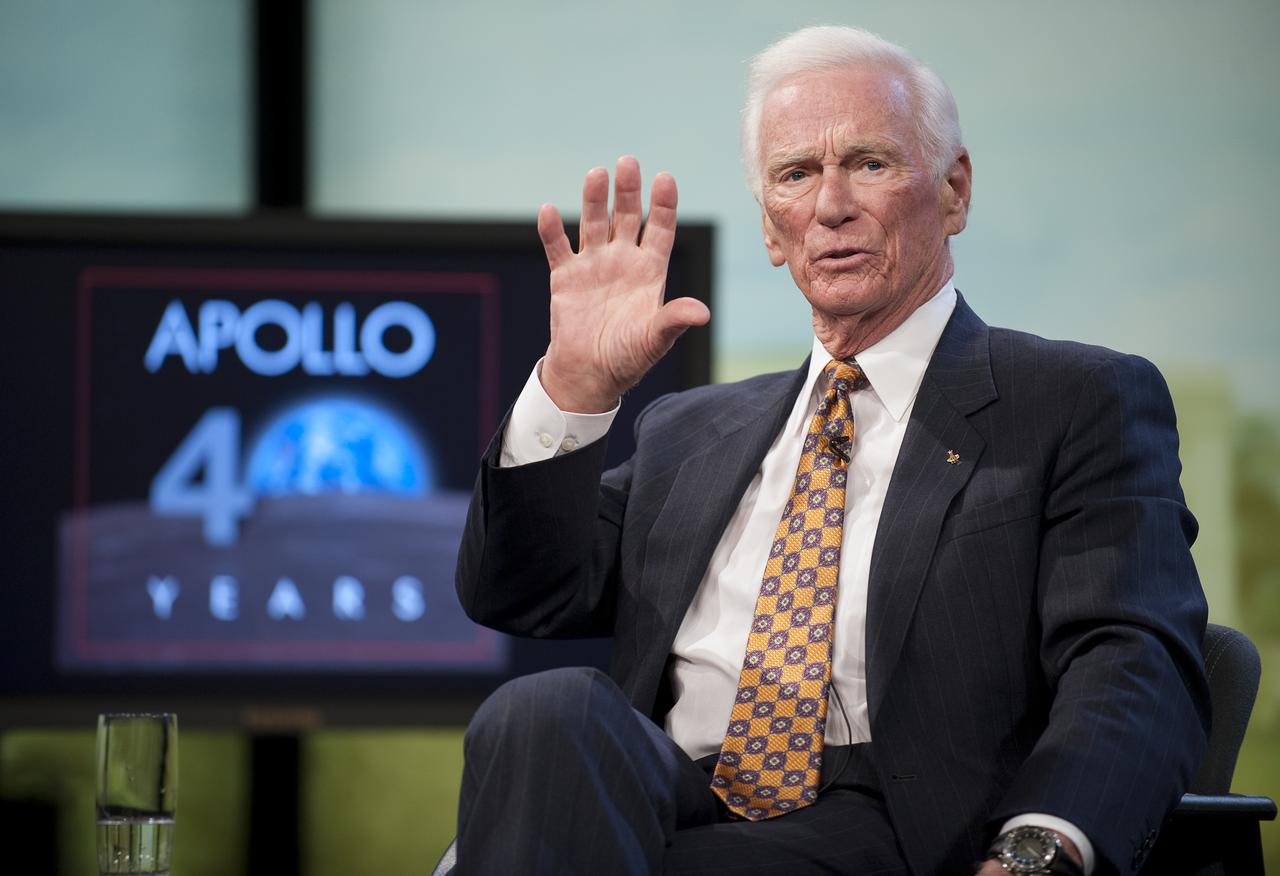
NASA Apollo 10 Astronaut Gene Cernan explains how wonderful the Earth looked from the Moon during a Newseum TV program celebrating the 40th anniversary of Apollo 10, Monday, May 18, 2009, in Washington. Photo Credit (NASA/Bill Ingalls)
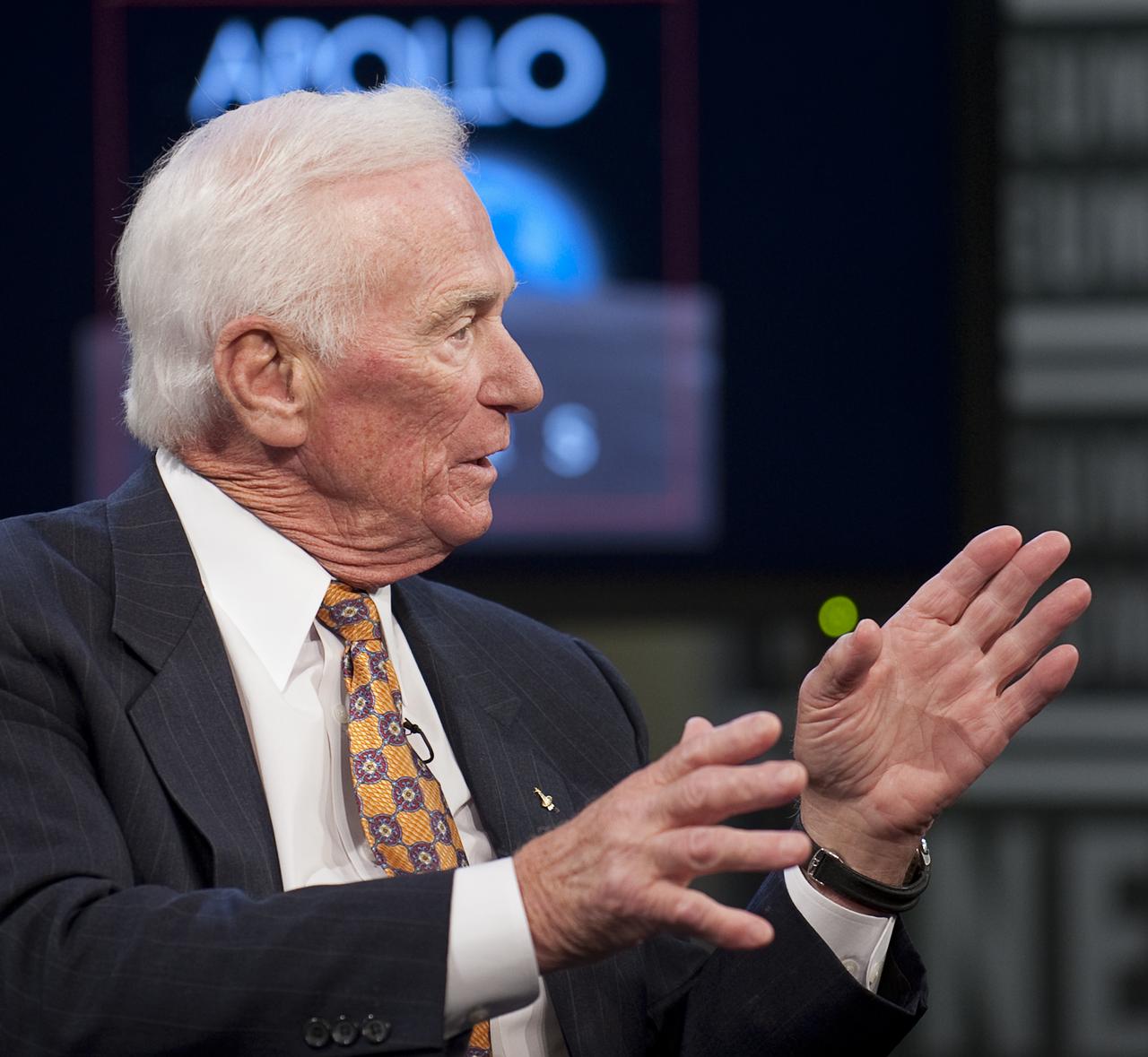
NASA Apollo 10 Astronaut Gene Cernan explains the importance of the nations space program for future generations during a Newseum TV program celebrating the 40th anniversary of Apollo 10, Monday, May 18, 2009, in Washington. Photo Credit (NASA/Bill Ingalls)
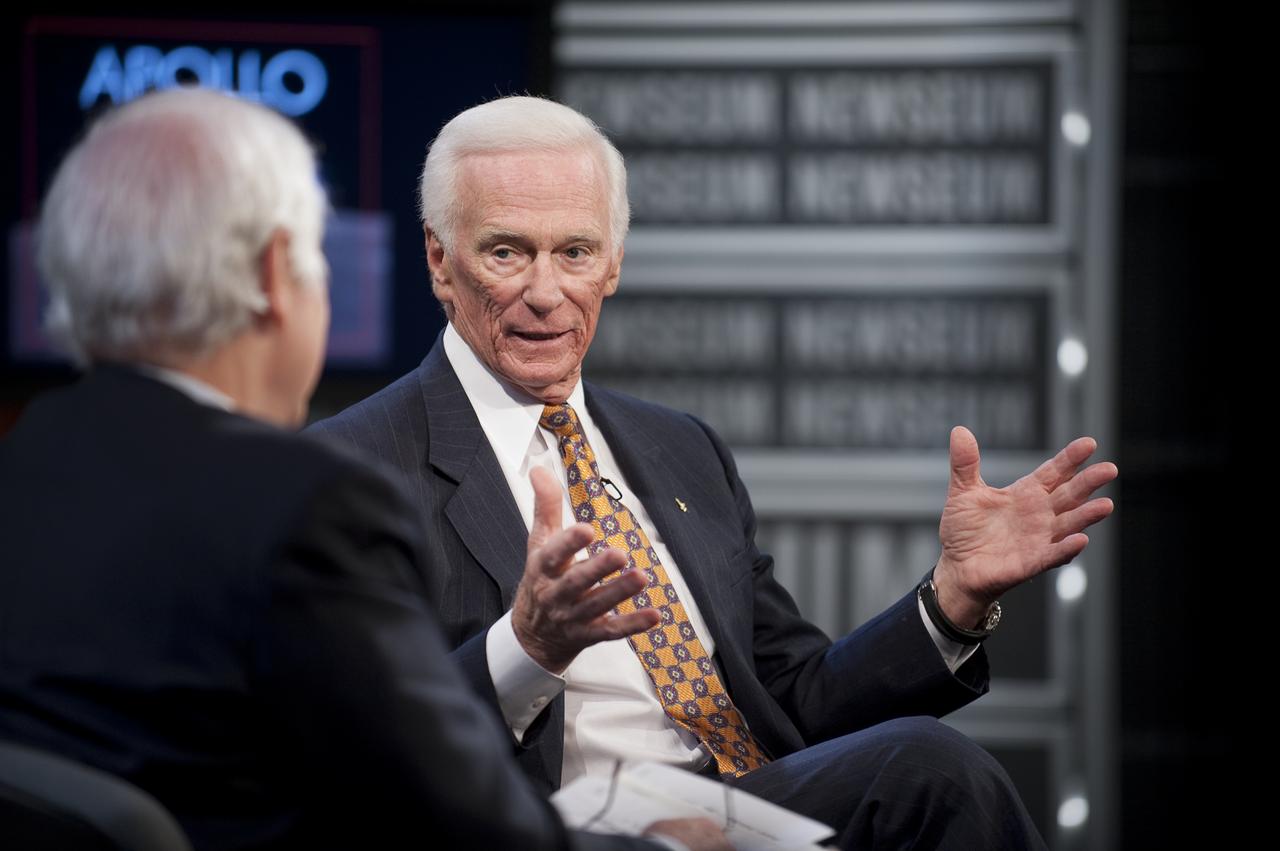
NASA Apollo 10 Astronaut Gene Cernan, right, answers questions from the Newseum's distinguished journalist-in-residence, Nick Clooney during a Newseum TV program celebrating the 40th anniversary of Apollo 10, Monday, May 18, 2009, in Washington. Photo Credit (NASA/Bill Ingalls)
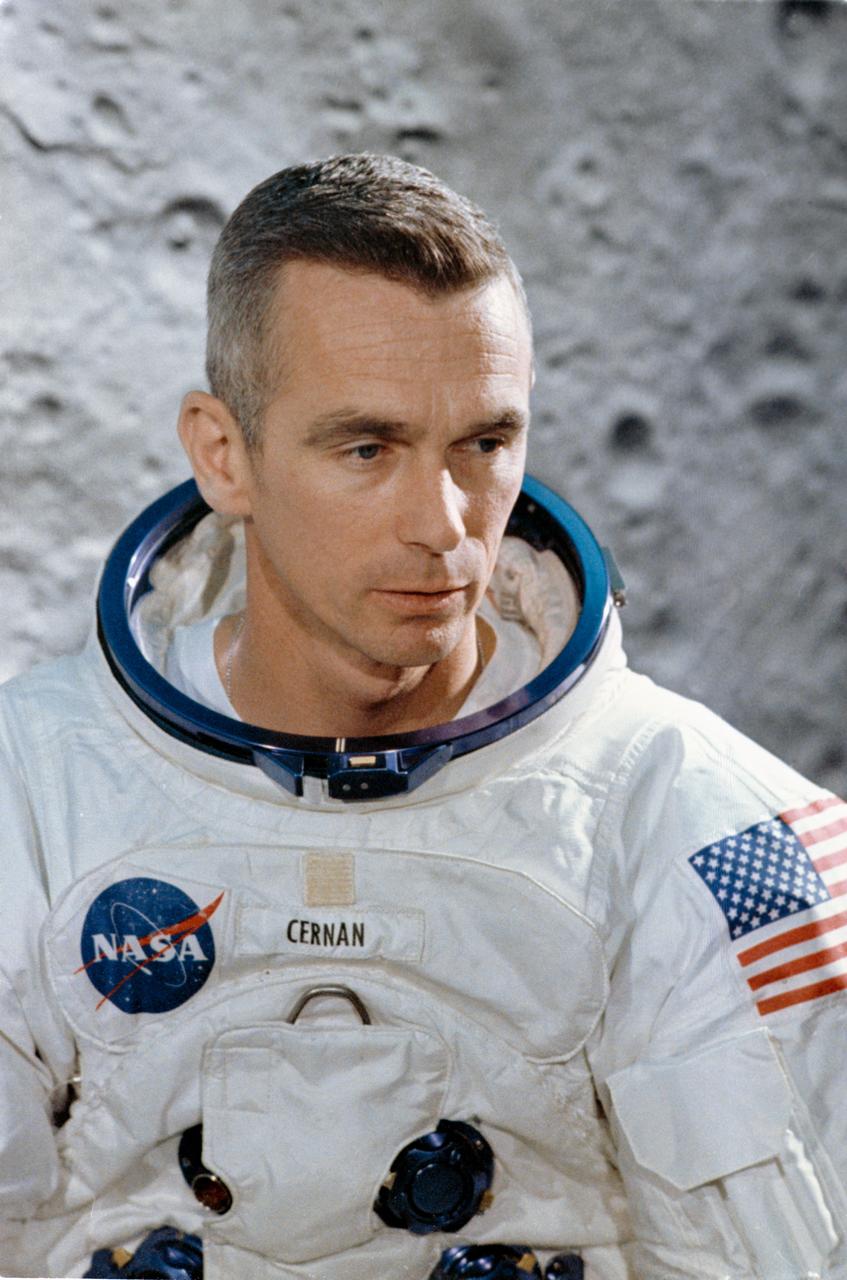
S69-32617 (April 1969) --- Astronaut Eugene A. Cernan, prime crew lunar module pilot of the Apollo 10 lunar orbit mission.
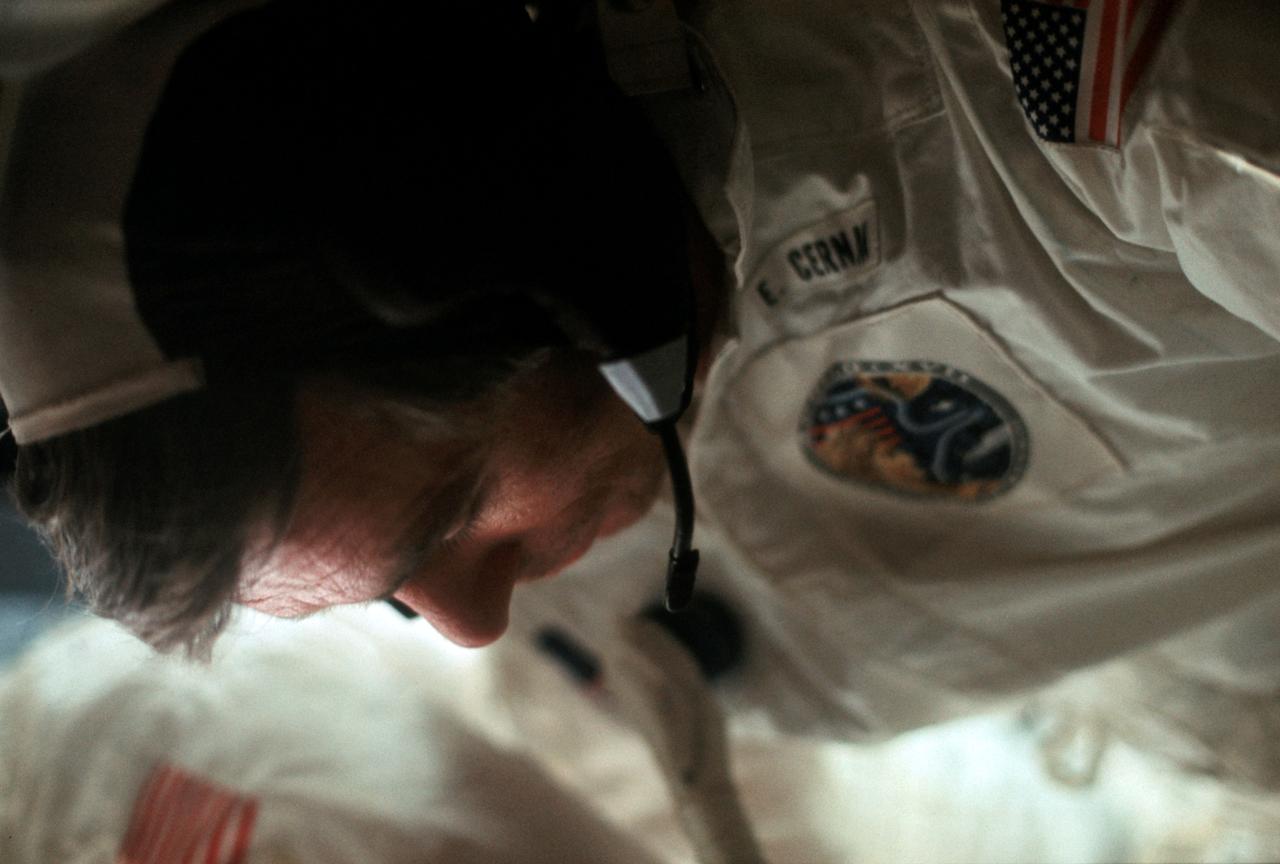
AS17-162-24050 (7-19 Dec. 1972) --- Astronaut Eugene A. Cernan appears to be relaxing in this candid photograph taken by a fellow crewman aboard the Apollo 17 spacecraft during the final lunar landing mission in NASA's Apollo program. Also, aboard Apollo 17 were astronaut Ronald E. Evans, command module pilot, and scientist-astronaut Harrison H. "Jack" Schmitt, lunar module pilot. Cernan was the mission commander.
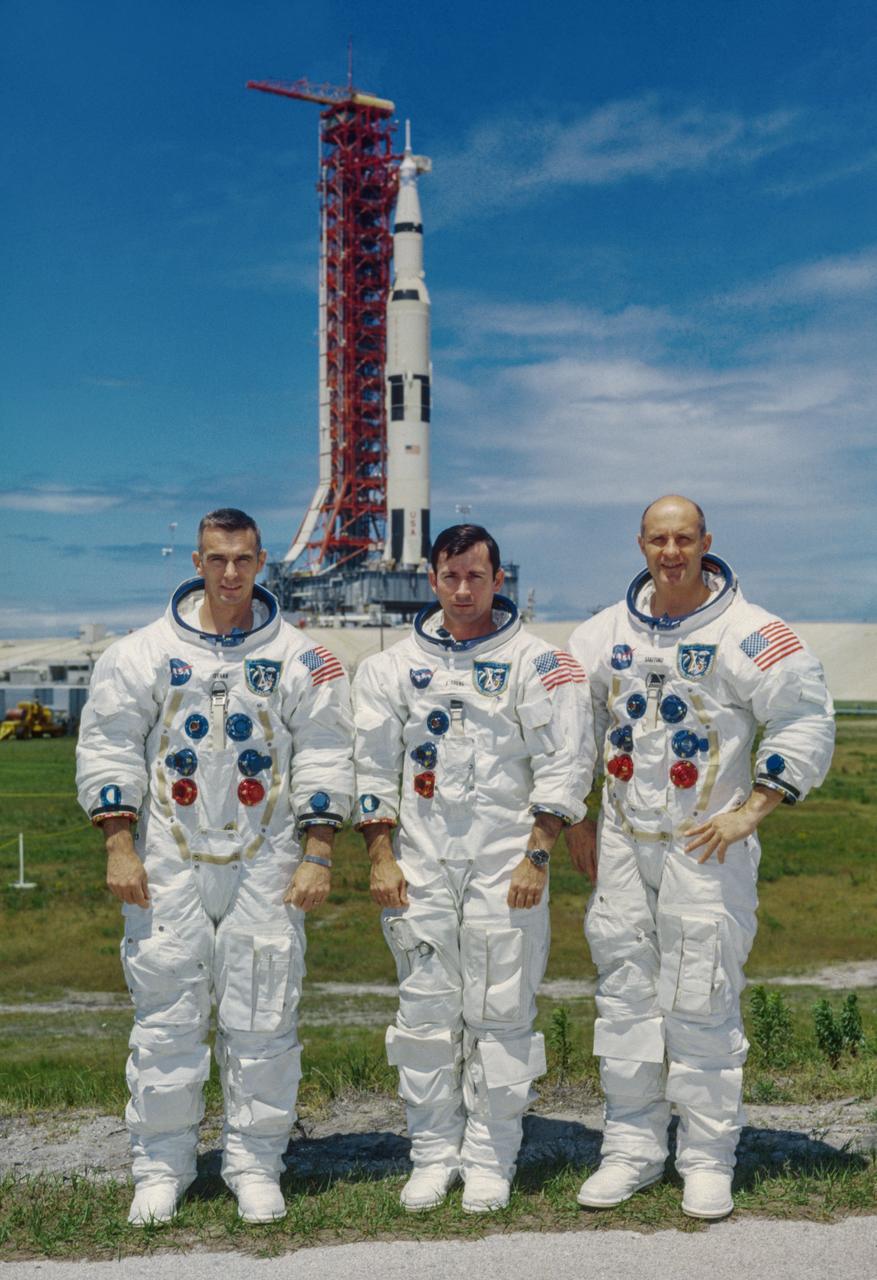
S69-34385 (13 May 1969) --- These three astronauts are the prime crew of the Apollo 10 lunar orbit mission. Left to right, are Eugene A. Cernan, lunar module pilot; John W. Young, command module pilot; and Thomas P. Stafford, commander. In the background is the Apollo 10 space vehicle on Pad B, Launch Complex 39, Kennedy Space Center, Florida.
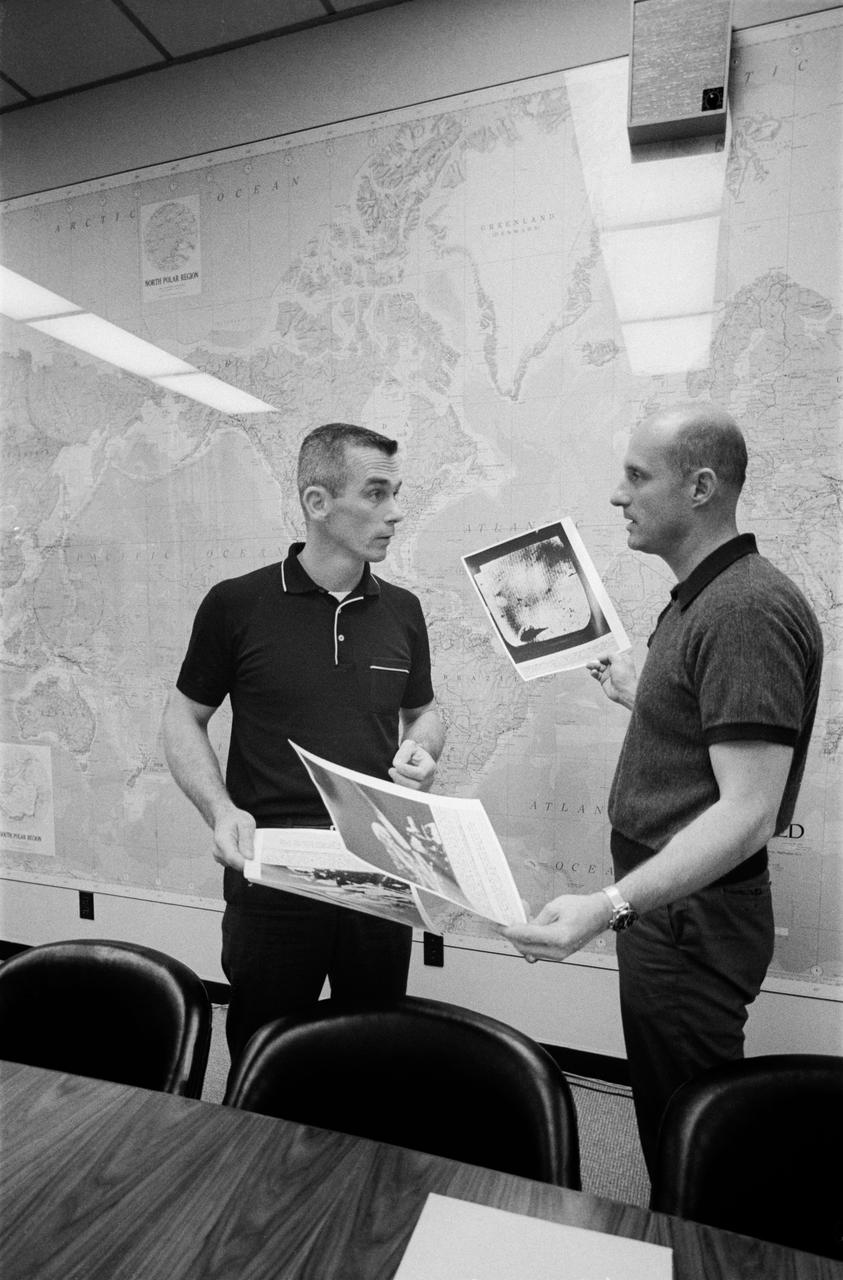
S66-32144 (2 June 1966) --- Astronauts Thomas P. Stafford (right) and Eugene A. Cernan look over pictures of the lunar surface taken by Surveyor I. Photo credit: NASA
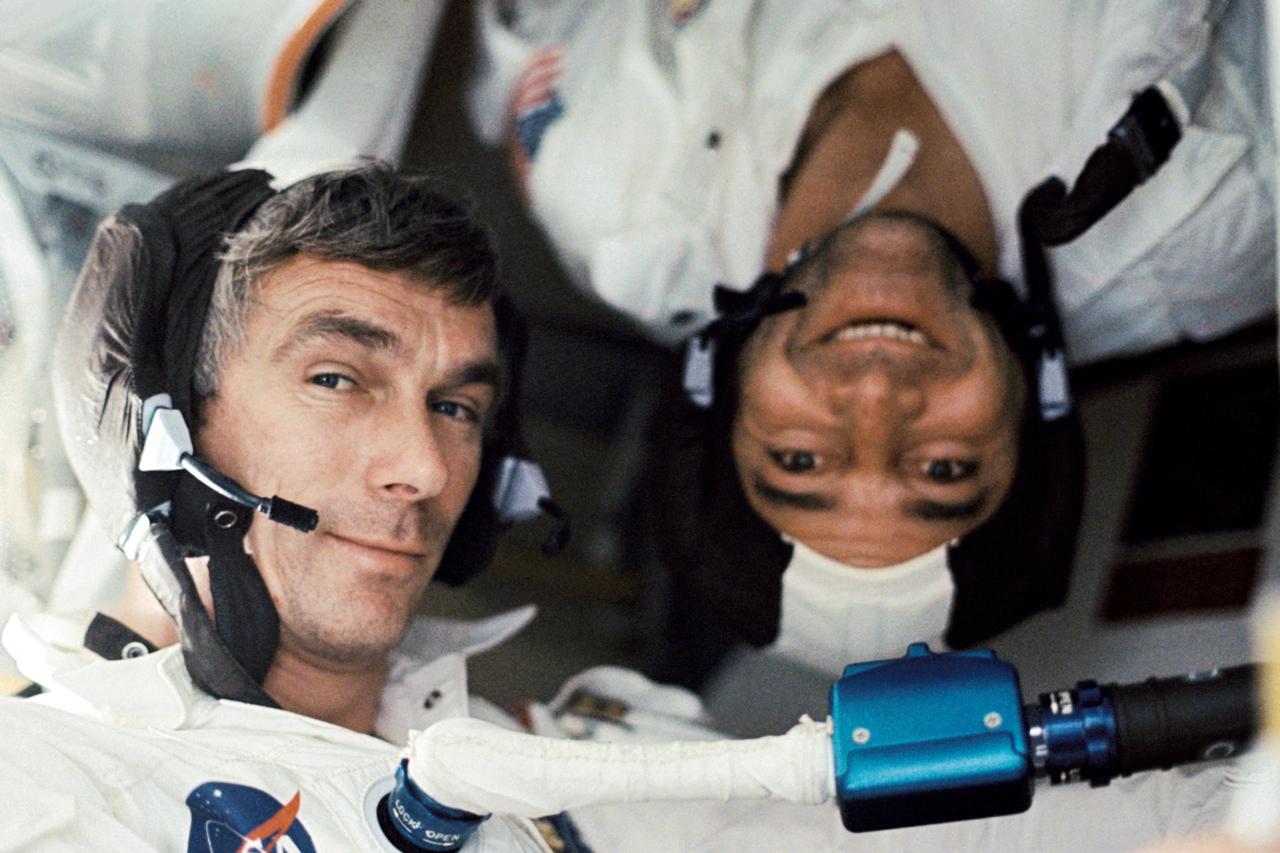
AS17-162-24053 (7-19 Dec. 1972) --- Scientist-astronaut Harrison H. "Jack" Schmitt, lunar module pilot, took this photograph of his two fellow crew men under zero-gravity conditions aboard the Apollo 17 spacecraft during the final lunar landing mission in NASA's Apollo program. That is astronaut Eugene A. Cernan, commander, who is seemingly "right side up." Astronaut Ronald E. Evans, command module pilot, appears to be "upside down." While astronauts Cernan and Schmitt descended in the Lunar Module (LM) "Challenger" to explore the Taurus-Littrow region of the moon, astronaut Evans remained with the Command and Service Modules (CSM) "America" in lunar orbit.
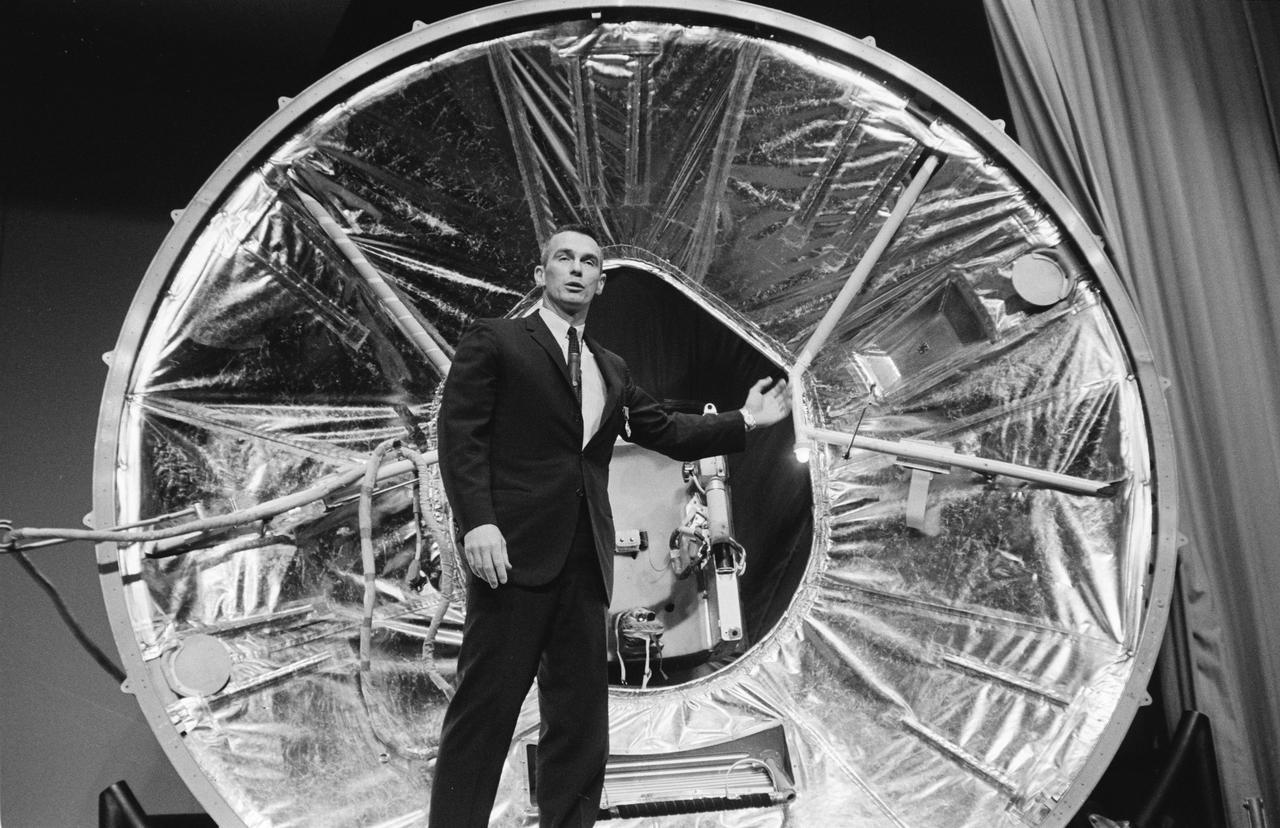
S66-32698 (17 June 1966) --- Astronaut Eugene A. Cernan discusses his Gemini-9A extravehicular activity before a gathering of news media representatives in the MSC auditorium. In the background is an Astronaut Maneuvering Unit (AMU) mock-up mounted in a mock-up of a Gemini spacecraft adapter equipment section. Astronauts Cernan and Thomas P. Stafford completed their three-day mission in space on June 6, 1966. Photo credit: NASA
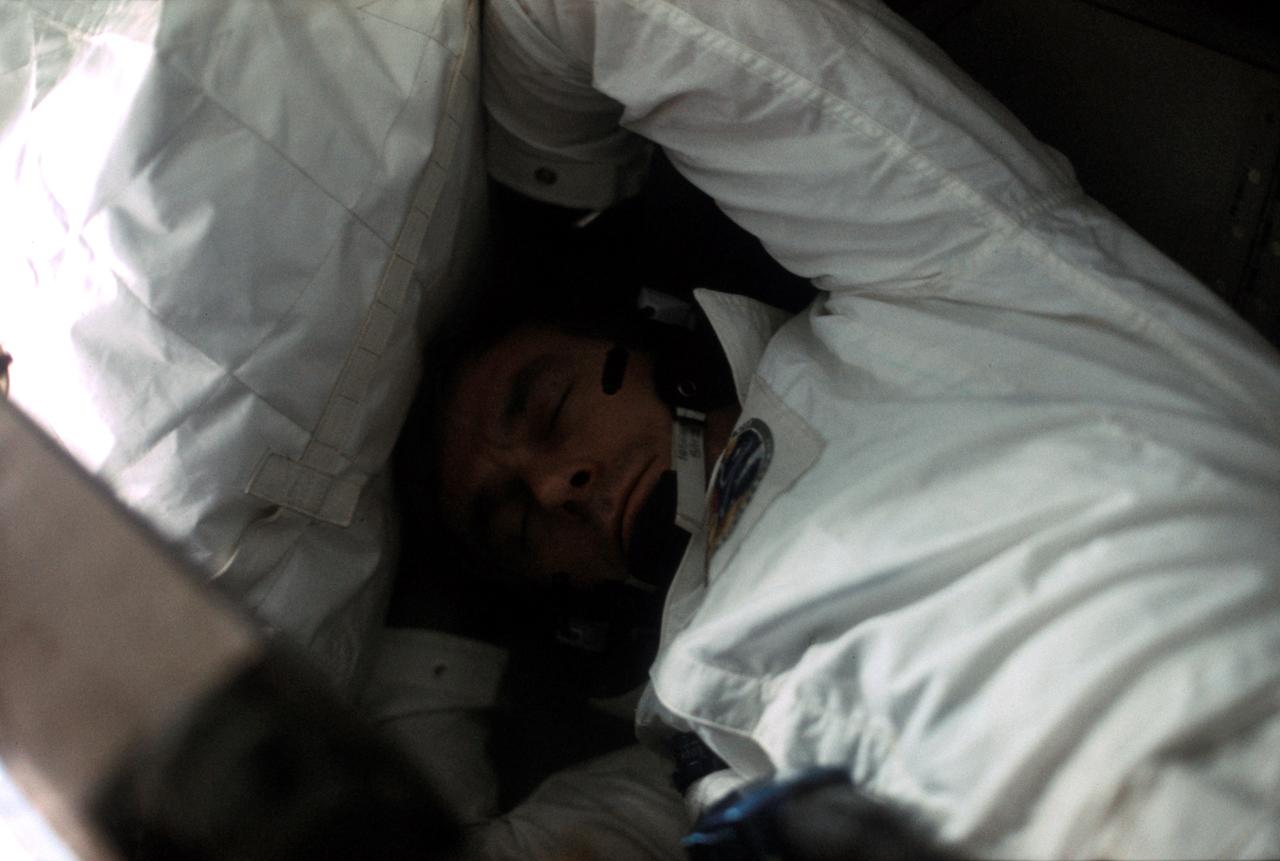
AS17-162-24049 (7-19 Dec. 1972) --- A fellow crewman took this picture of astronaut Eugene A. Cernan dozing aboard the Apollo 17 spacecraft during the final lunar landing mission in NASA's Apollo program. Also, aboard Apollo 17 were astronaut Ronald E. Evans, command module pilot, and scientist-astronaut Harrison H. "Jack" Schmitt, lunar module pilot. Cernan was the mission commander.
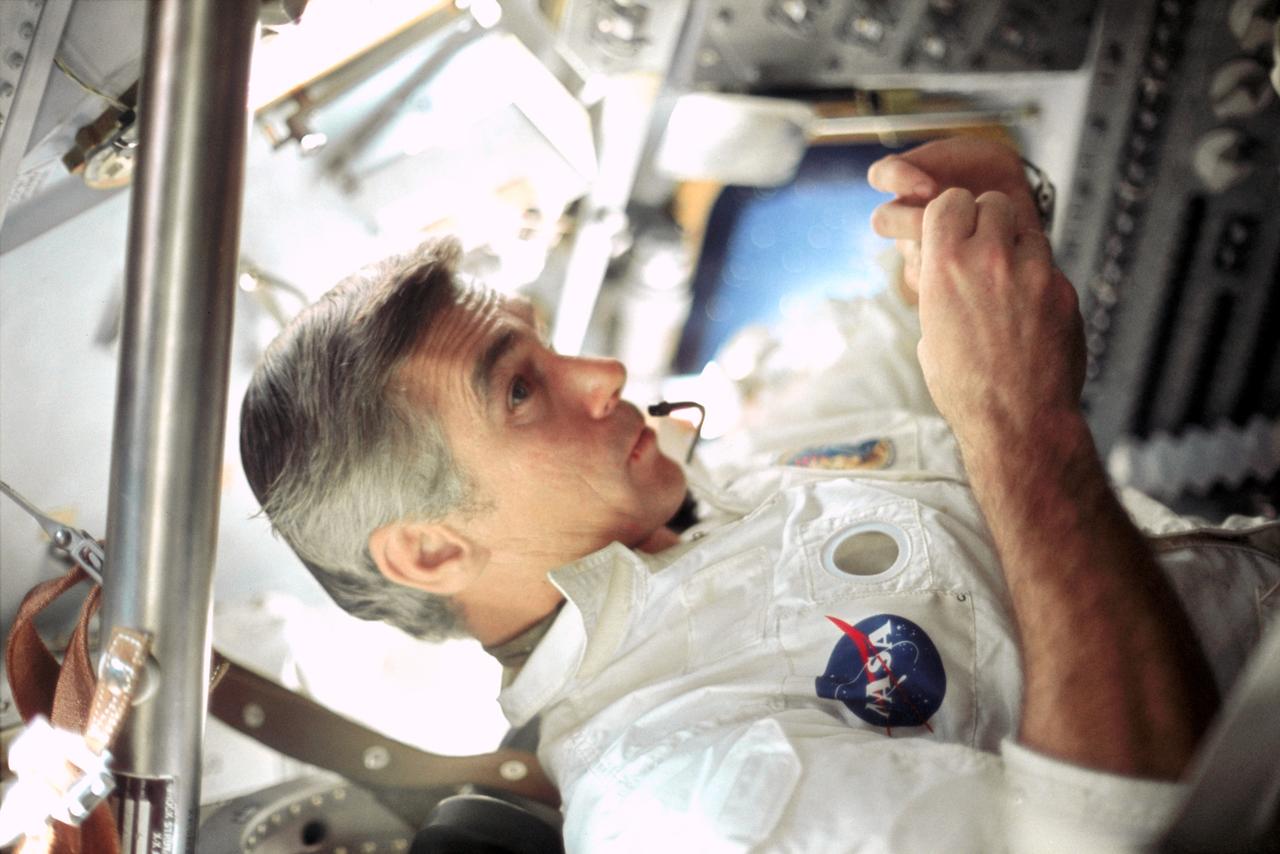
AS17-163-24122 (7-19 Dec. 1972) --- This candid photograph of astronaut Eugene A. Cernan was taken by a fellow crewman aboard the Apollo 17 spacecraft during the final lunar landing mission in NASA's Apollo program. Cernan was the mission commander. Also, aboard Apollo 17 were astronaut Ronald E. Evans, command module pilot, and scientist-astronaut Harrison H. "Jack" Schmitt, lunar module pilot.
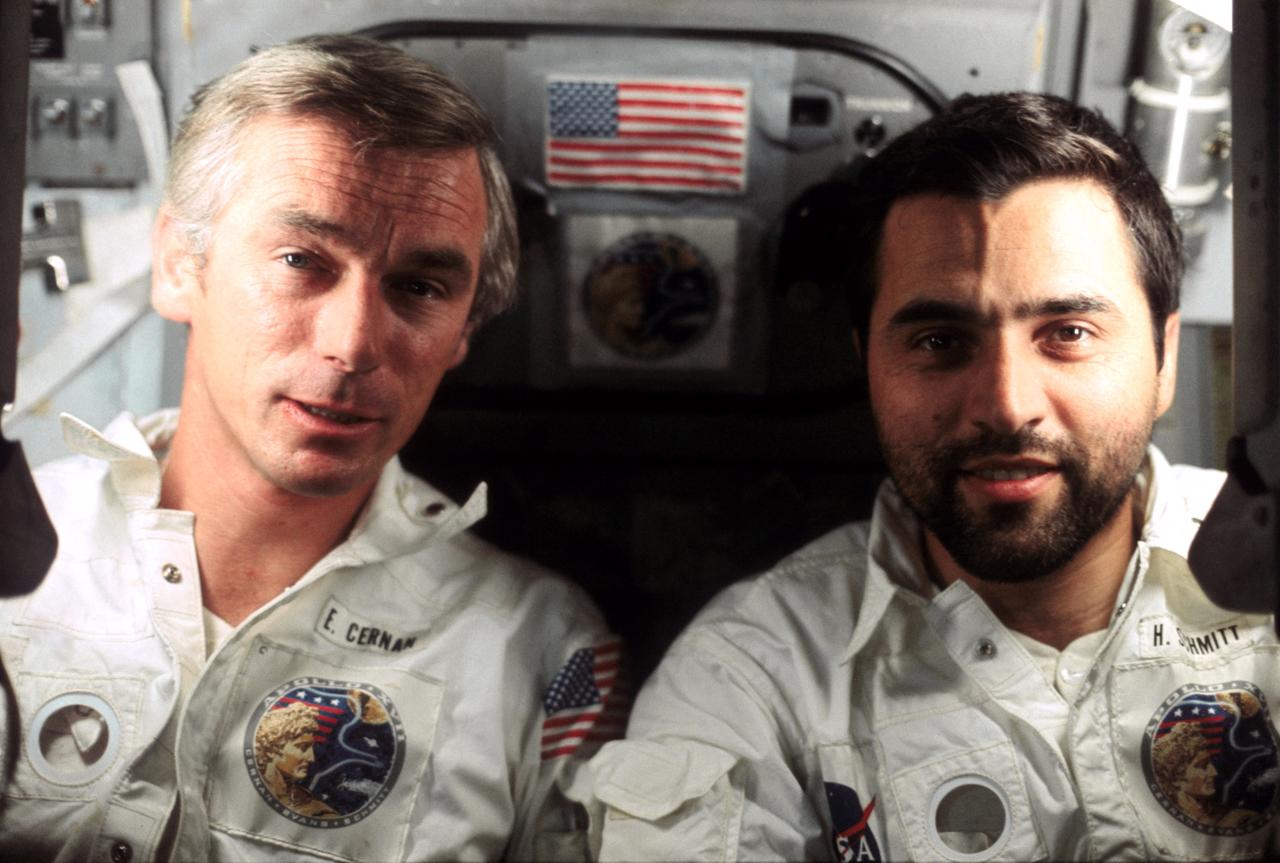
AS17-163-24148 (7-19 Dec. 1972) --- Astronaut Eugene A. Cernan (left) and scientist-astronaut Harrison H. "Jack" Schmitt are photographed by the third crew man aboard the Apollo 17 spacecraft during the final lunar landing mission in NASA's Apollo program. Astronaut Ronald E. Evans, command module pilot, took this picture. Cernan was the mission commander. Schmitt served as the lunar module pilot.
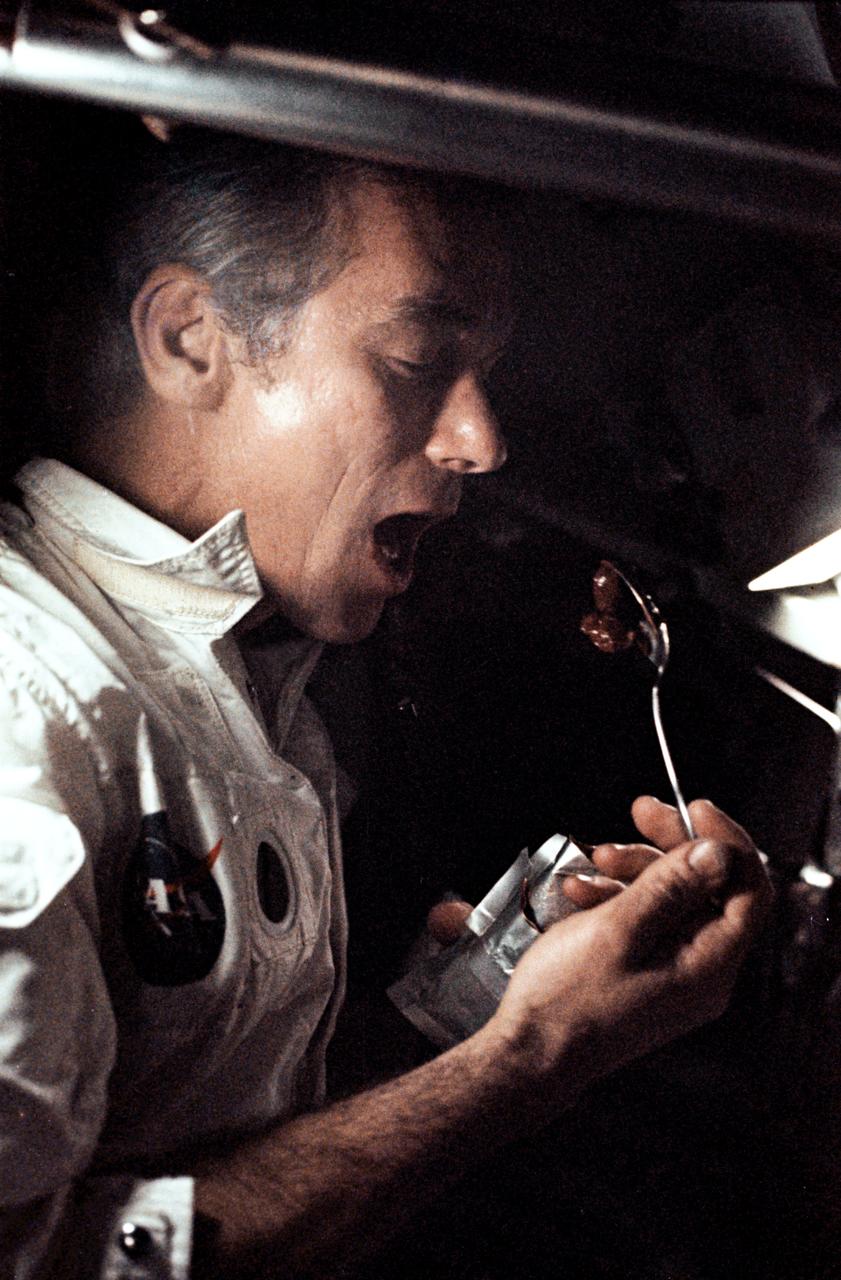
AS17-163-24129 (7-19 Dec. 1972) --- A fellow crewman took this photograph of astronaut Eugene A. Cernan eating a meal under weightlessness conditions of space during the final lunar landing mission in NASA's Apollo program. Also, aboard the Apollo 17 spacecraft were astronaut Ronald E. Evans, command module pilot, and scientist-astronaut Harrison H. "Jack" Schmitt, lunar module pilot. Cernan was the mission commander.
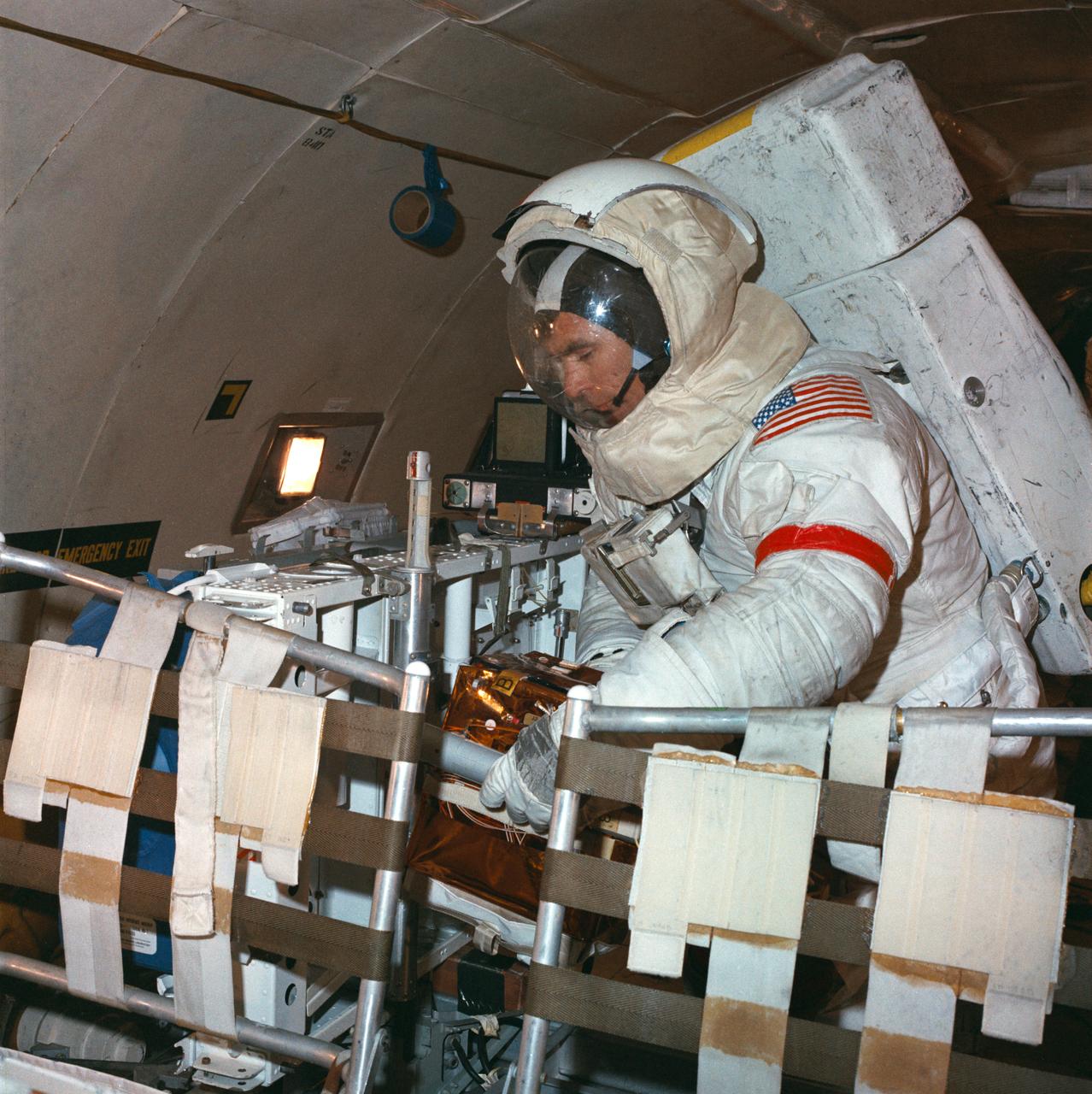
S72-50270 (September 1972) --- Astronaut Eugene A. Cernan, commander of the Apollo 17 lunar landing mission, participates in lunar surface extravehicular activity simulation training under one-sixth gravity conditions aboard a U. S. Air Force KC-135 aircraft. Here, Cernan simulates removing an experiment package from the aft end of a Lunar Roving Vehicle.
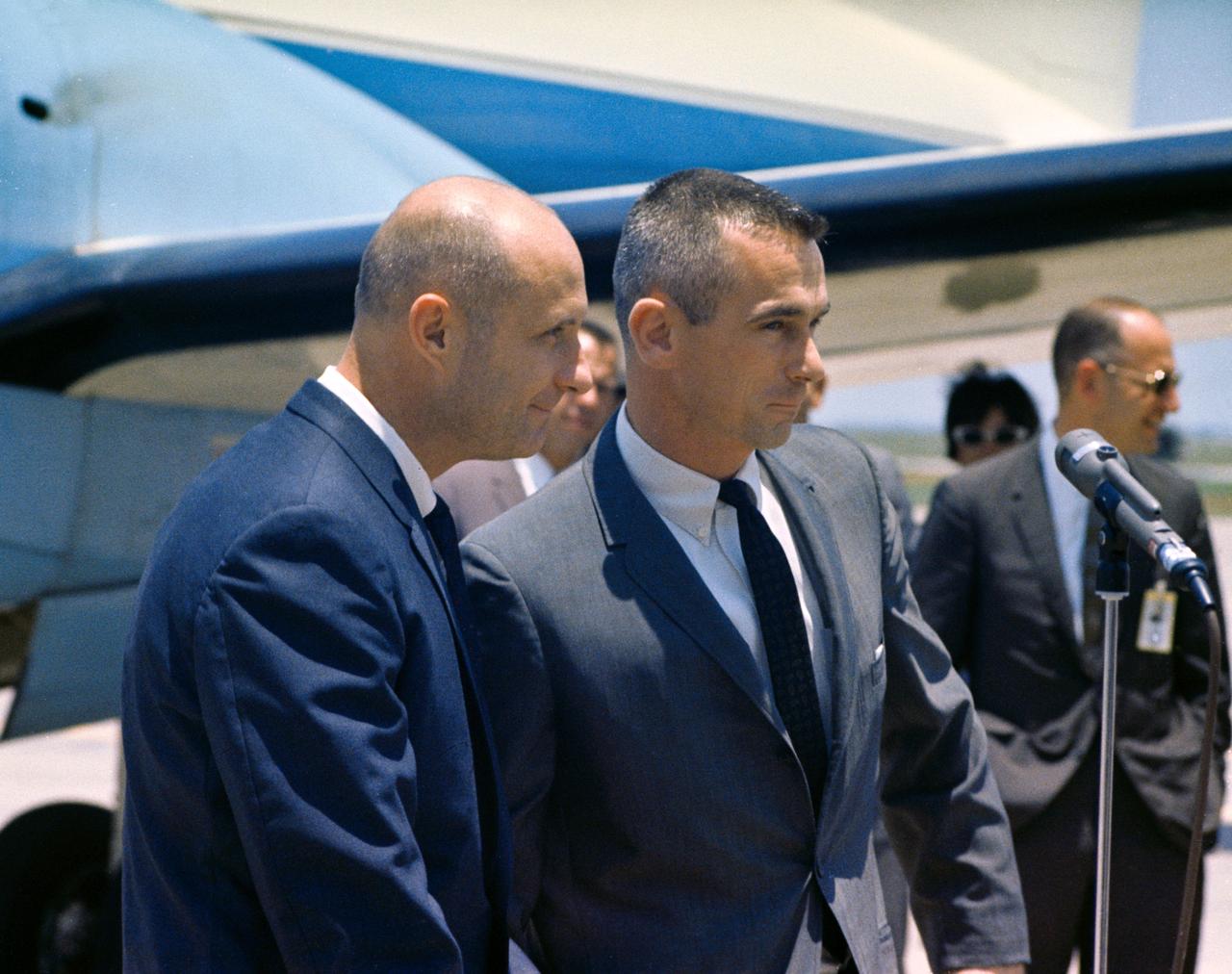
S66-32677 (10 June 1966) --- The Gemini-9A prime crew, astronaut Thomas P. Stafford (left), command pilot, and Eugene A. Cernan (right), pilot, express their feelings about being home to their families, MSC officials, newsmen, and well-wishers gathered at Ellington Air Force Base to welcome the astronauts home. Astronaut Stafford and Cernan completed their three-day mission in space on June 6, 1966. At right is George M. Low, MSC Deputy Director. Photo credit: NASA
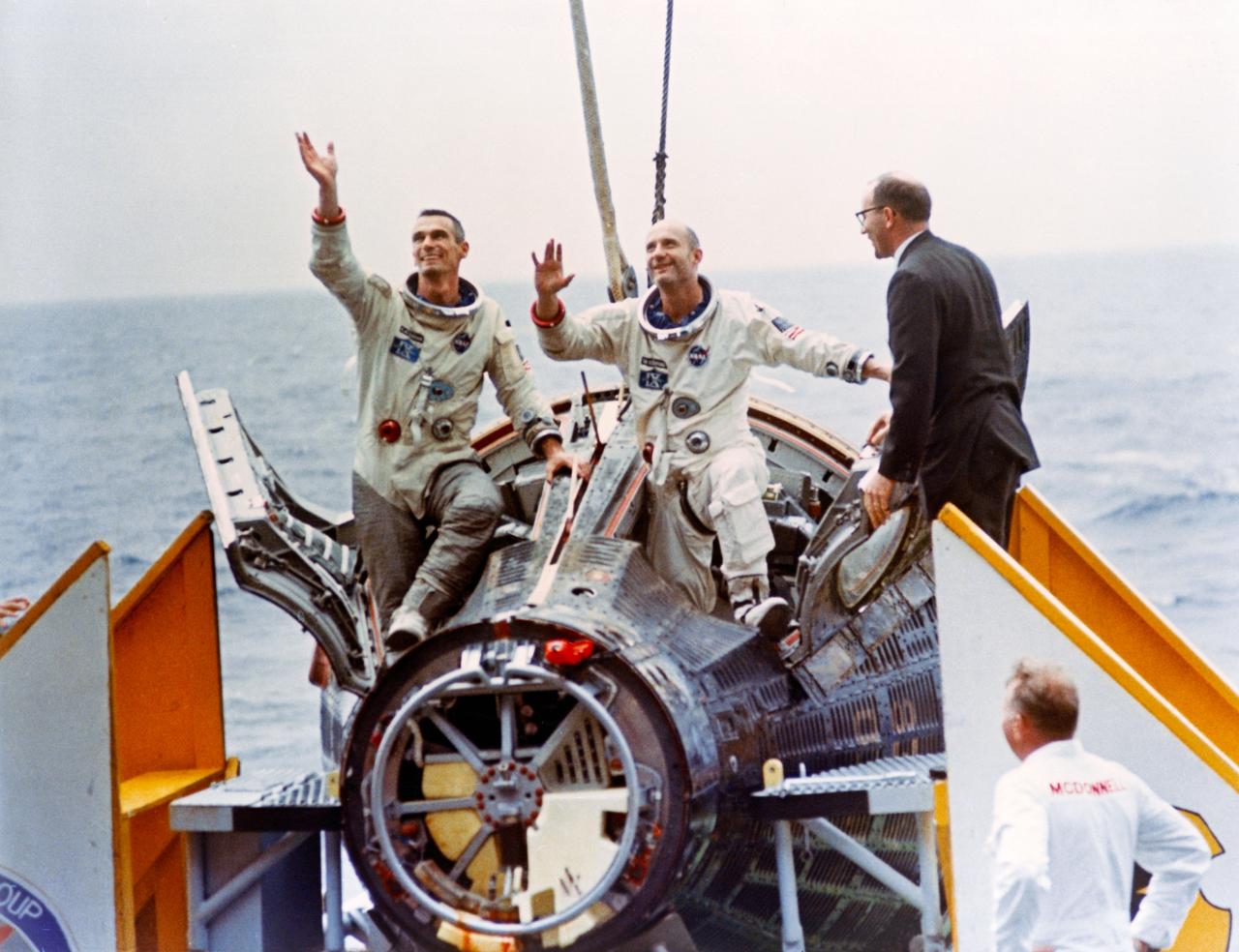
S66-34118 (6 June 1966) --- Astronauts Thomas Stafford (right) and Eugene Cernan wave to the crowd aboard the aircraft carrier USS Wasp as they emerge from their Gemini-9 capsule. John C. Stonesifer (far right), with the Manned Spacecraft Center's Landing and Recovery Division, was onboard to greet the astronauts. Photo credit: NASA
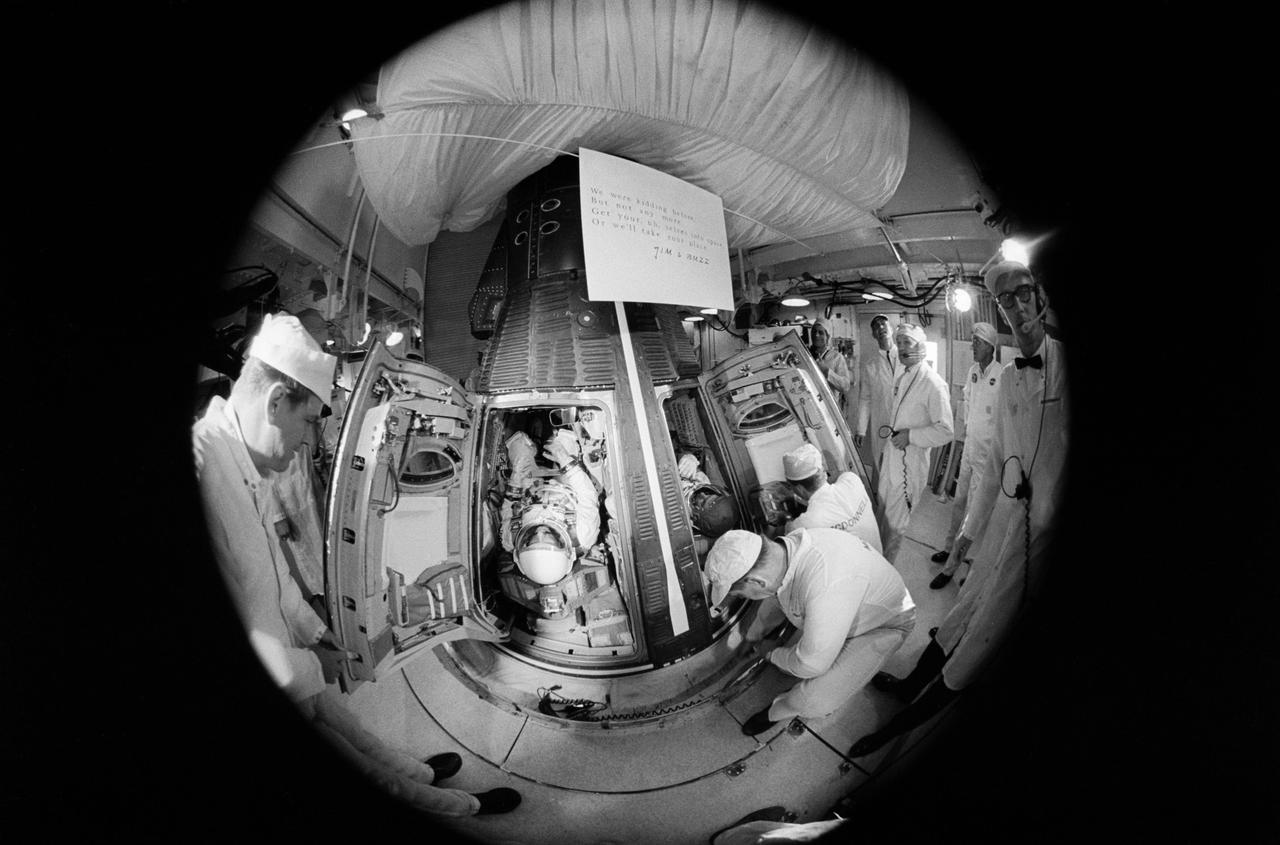
S66-34055 (3 June 1966) --- Fisheye camera lens view of the white room atop Pad 19 during the insertion of astronauts Thomas P. Stafford and Eugene A. Cernan into the Gemini-9A spacecraft. Minutes later the hatches were sealed on the spacecraft in preparation for launch of the proposed three-day mission. Photo credit: NASA
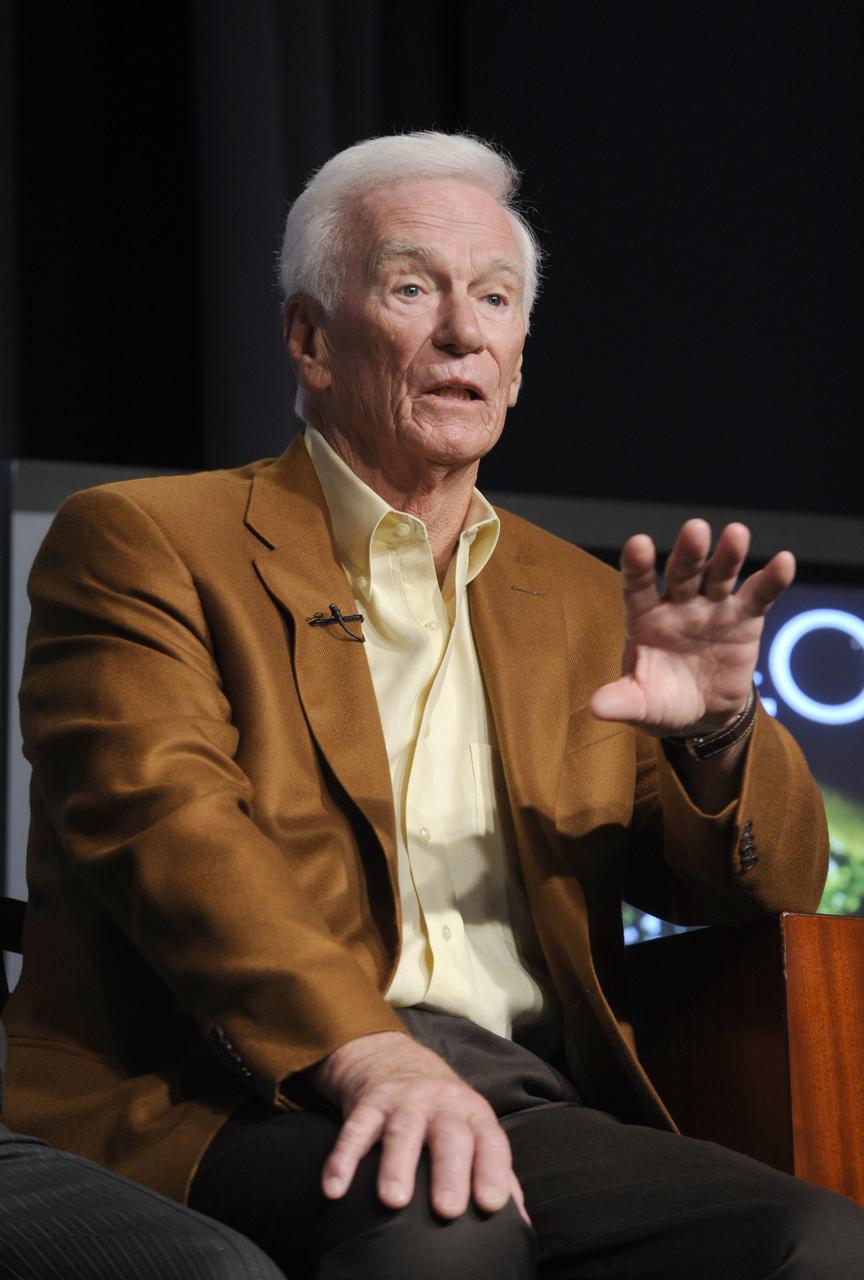
Eugene Cernan (Apollo 17) speaks during the 40th anniversary of the Apollo 11 mission and the walk on the moon press conference, Monday, July 20, 2009, at NASA Headquarters in Washington. Photo Credit: (NASA/Paul E. Alers)
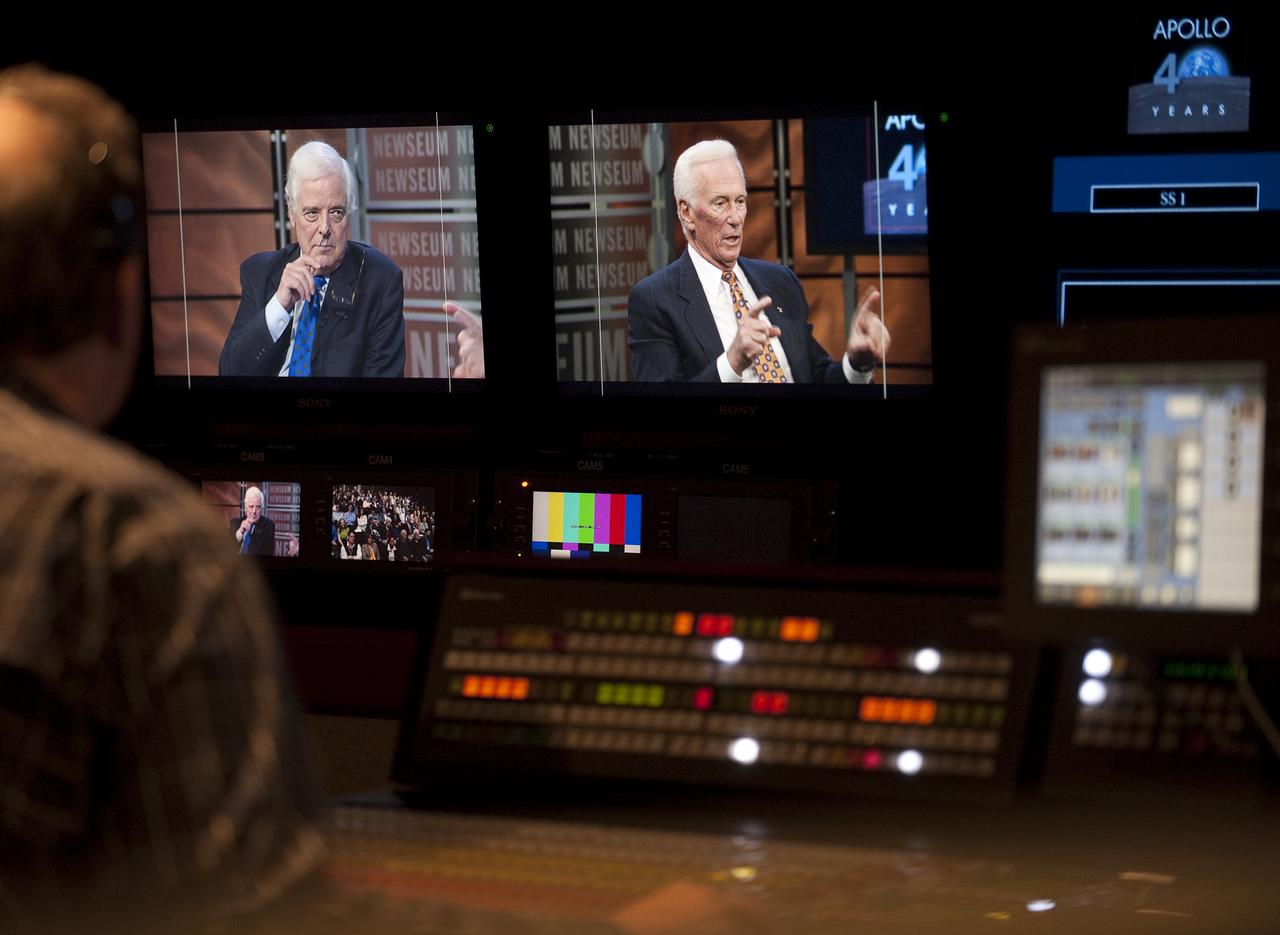
In this image made inside the TV production studio of the Newseum, NASA Apollo 10 Astronaut Gene Cernan, right monitor, answers questions from the Newseum's distinguished journalist-in-residence, Nick Clooney, left monitor, during a Newseum TV program celebrating the 40th anniversary of Apollo 10, Monday, May 18, 2009, in Washington. Photo Credit (NASA/Bill Ingalls)
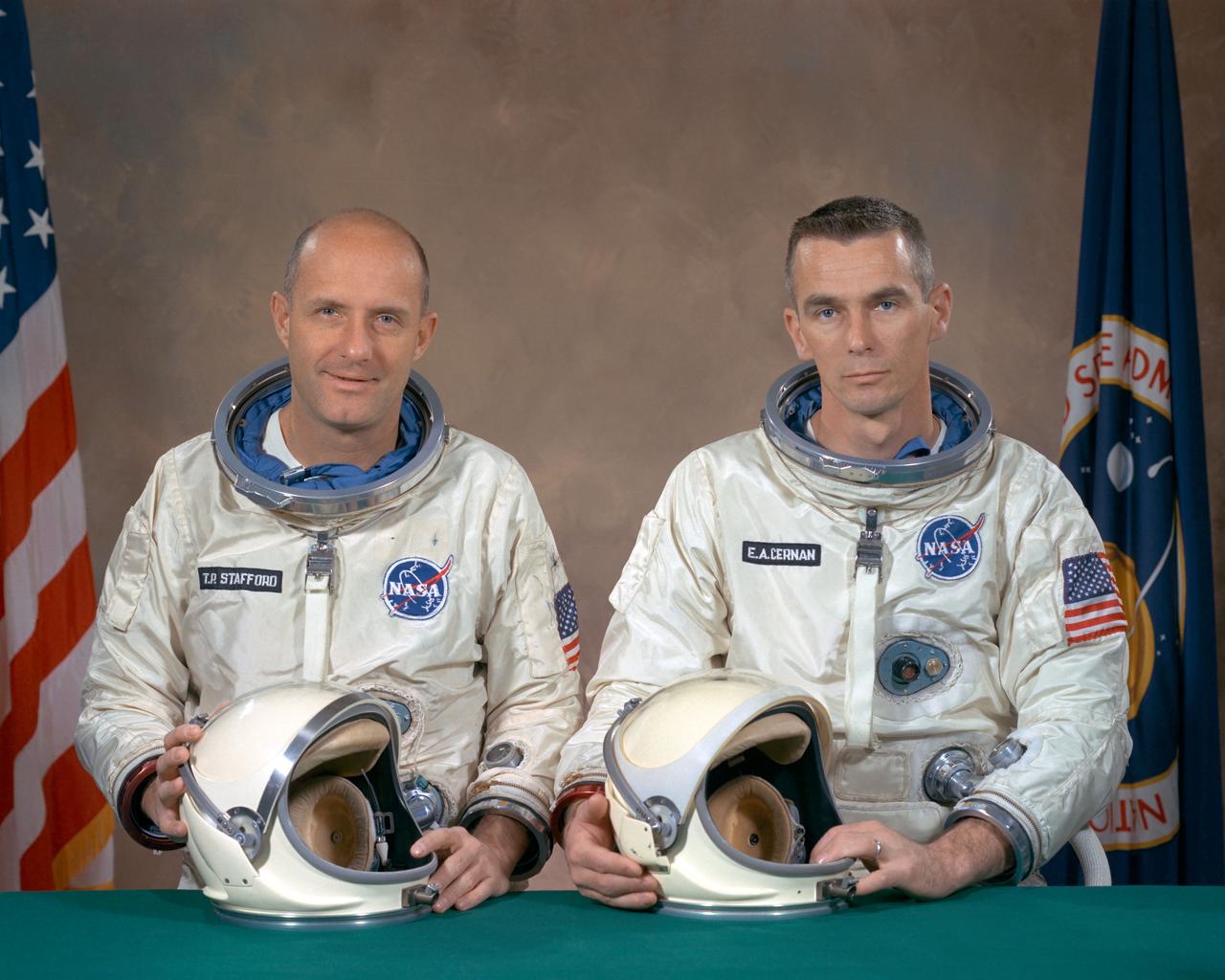
S66-15621 (January 1966) --- Gemini-9 prime crew portrait with astronauts Thomas P. Stafford (left), command pilot, and Eugene A. Cernan, pilot. Photo credit: NASA
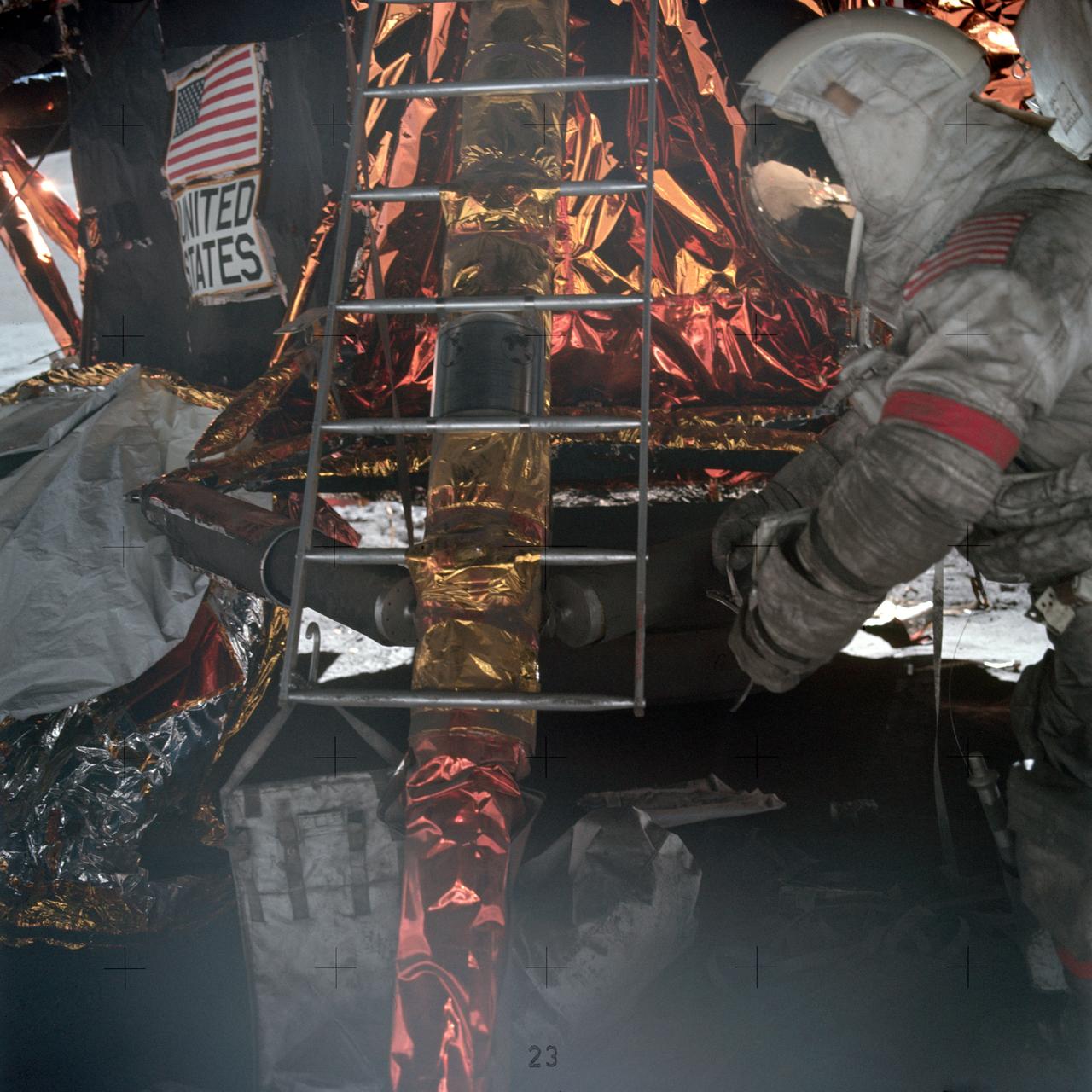
Astronaut Eugene A. Cernan, Apollo 17 commander, prepares to mount ladder to lunar module ascent stage. Note the plaque attached to the ladder which will be left with the descent stage when the mission lifts off from the lunar surface.
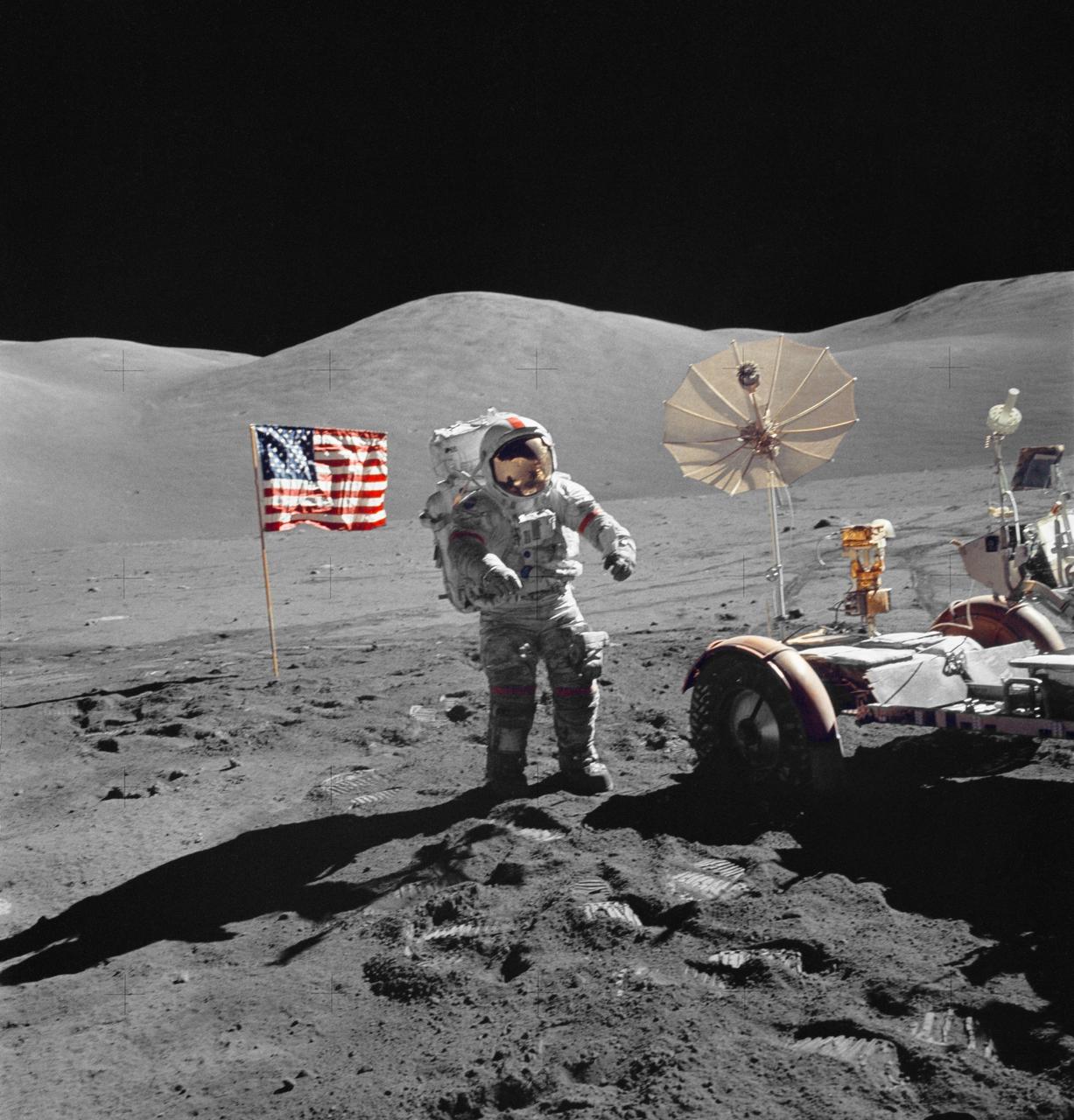
AS17-140-21388 (7-19 Dec. 1972) --- Astronaut Eugene A. Cernan, mission commander, walks toward the Lunar Roving Vehicle (LRV) during extravehicular activity (EVA) at the Taurus-Littrow landing site of NASA's sixth and final Apollo lunar landing mission. The photograph was taken by astronaut Harrison H. Schmitt, lunar module pilot. While astronauts Cernan and Schmitt descended in the Lunar Module (LM) "Challenger" to explore the Taurus-Littrow region of the moon, astronaut Ronald E. Evans, command module pilot, remained with the Command and Service Modules (CSM) "America" in lunar orbit.
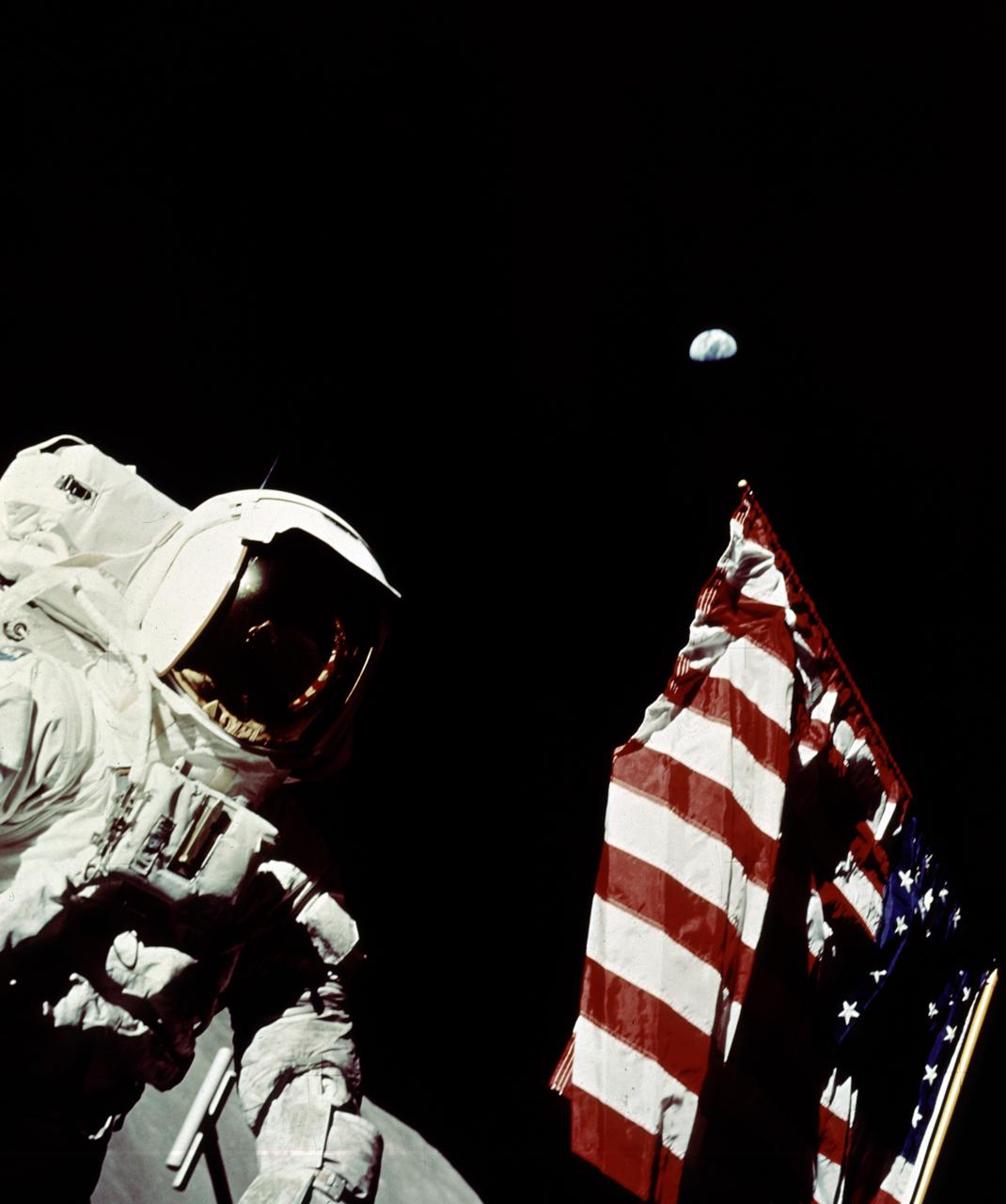
In this Apollo 17 onboard photo, Mission Commander Eugene A. Cernan adjusts the U.S. flag deployed upon the Moon. The seventh and last manned lunar landing and return to Earth mission, the Apollo 17, carrying a crew of three astronauts: Cernan; Lunar Module pilot Harrison H. Schmitt; and Command Module pilot Ronald E. Evans, lifted off on December 7, 1972 from the Kennedy Space Flight Center (KSC). Scientific objectives of the Apollo 17 mission included geological surveying and sampling of materials and surface features in a preselected area of the Taurus-Littrow region, deploying and activating surface experiments, and conducting in-flight experiments and photographic tasks during lunar orbit and transearth coast (TEC). These objectives included: Deployed experiments such as the Apollo lunar surface experiment package (ALSEP) with a Heat Flow experiment, Lunar seismic profiling (LSP), Lunar surface gravimeter (LSG), Lunar atmospheric composition experiment (LACE) and Lunar ejecta and meteorites (LEAM). The mission also included Lunar Sampling and Lunar orbital experiments. Biomedical experiments included the Biostack II Experiment and the BIOCORE experiment. The mission marked the longest Apollo mission, 504 hours, and the longest lunar surface stay time, 75 hours, which allowed the astronauts to conduct an extensive geological investigation. They collected 257 pounds (117 kilograms) of lunar samples with the use of the Marshall Space Flight Center developed LRV. The mission ended on December 19, 1972
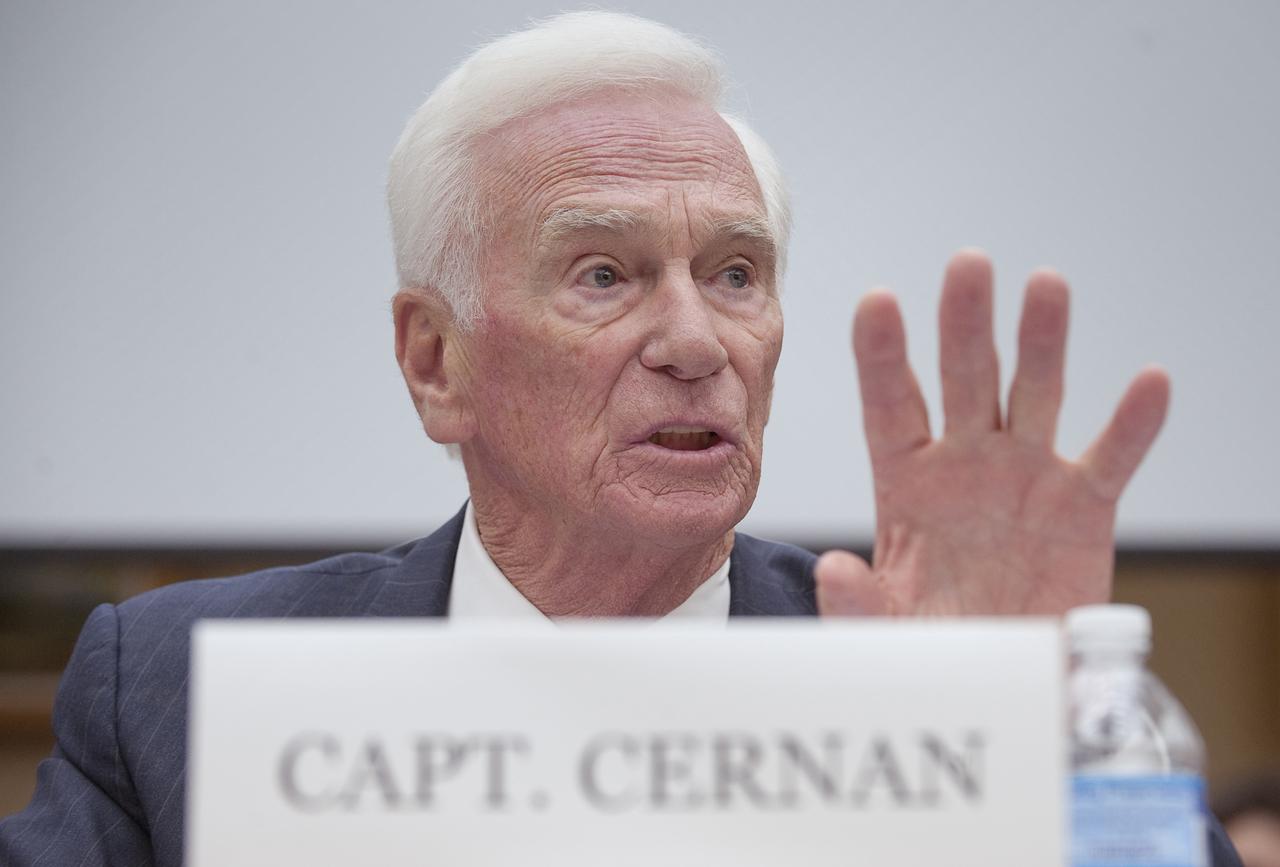
Retired Navy Captain and commander of Apollo 17 Eugene Cernan testifies during a hearing before the House Science and Technology Committee, Tuesday, May 26, 2010, at the Rayburn House office building on Capitol Hill in Washington. The hearing was to review proposed human spaceflight plan by NASA. Photo Credit: (NASA/Paul E. Alers)
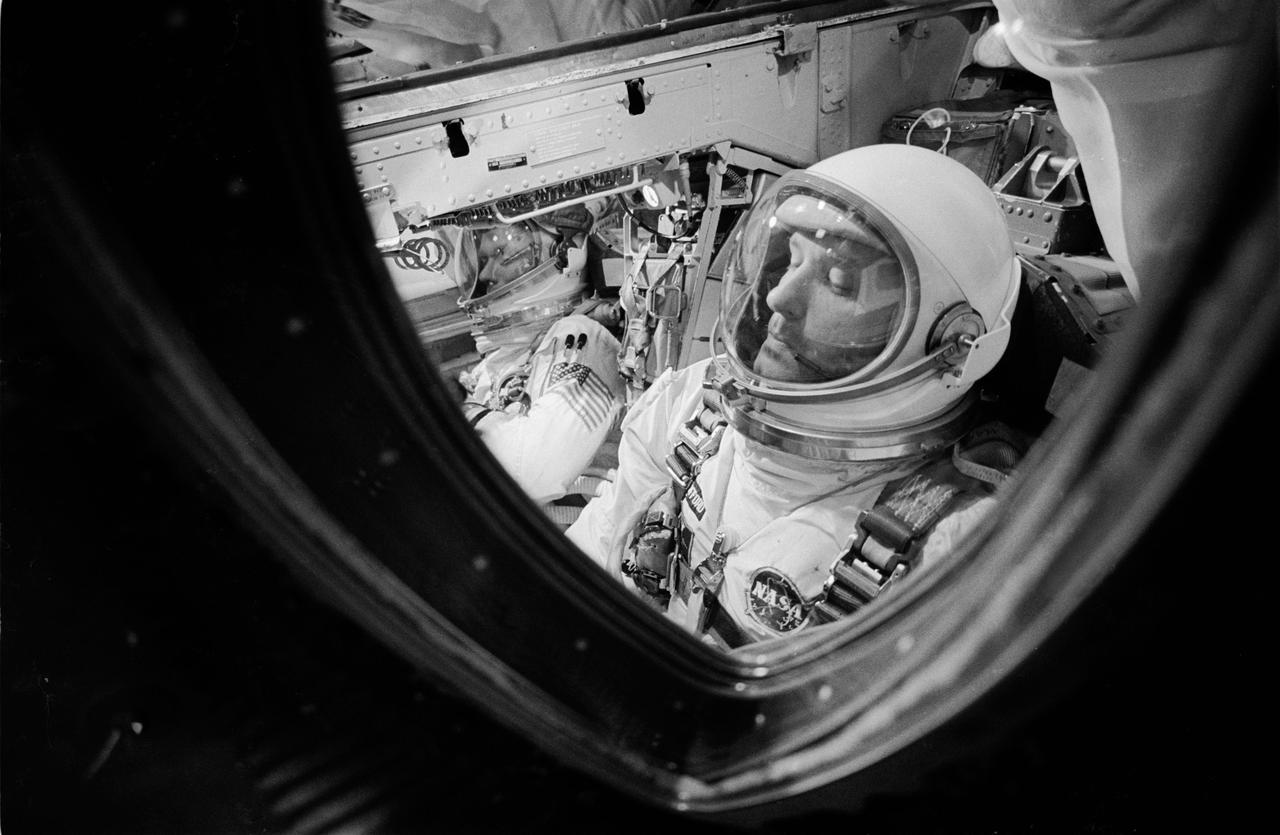
S66-34057 (3 June 1966) --- Fisheye view of astronauts Thomas P. Stafford and Eugene A. Cernan in the Gemini-9 spacecraft while hatches are sealed. They are in the White Room atop Pad 19 at the Kennedy Space Center. Photo credit: NASA
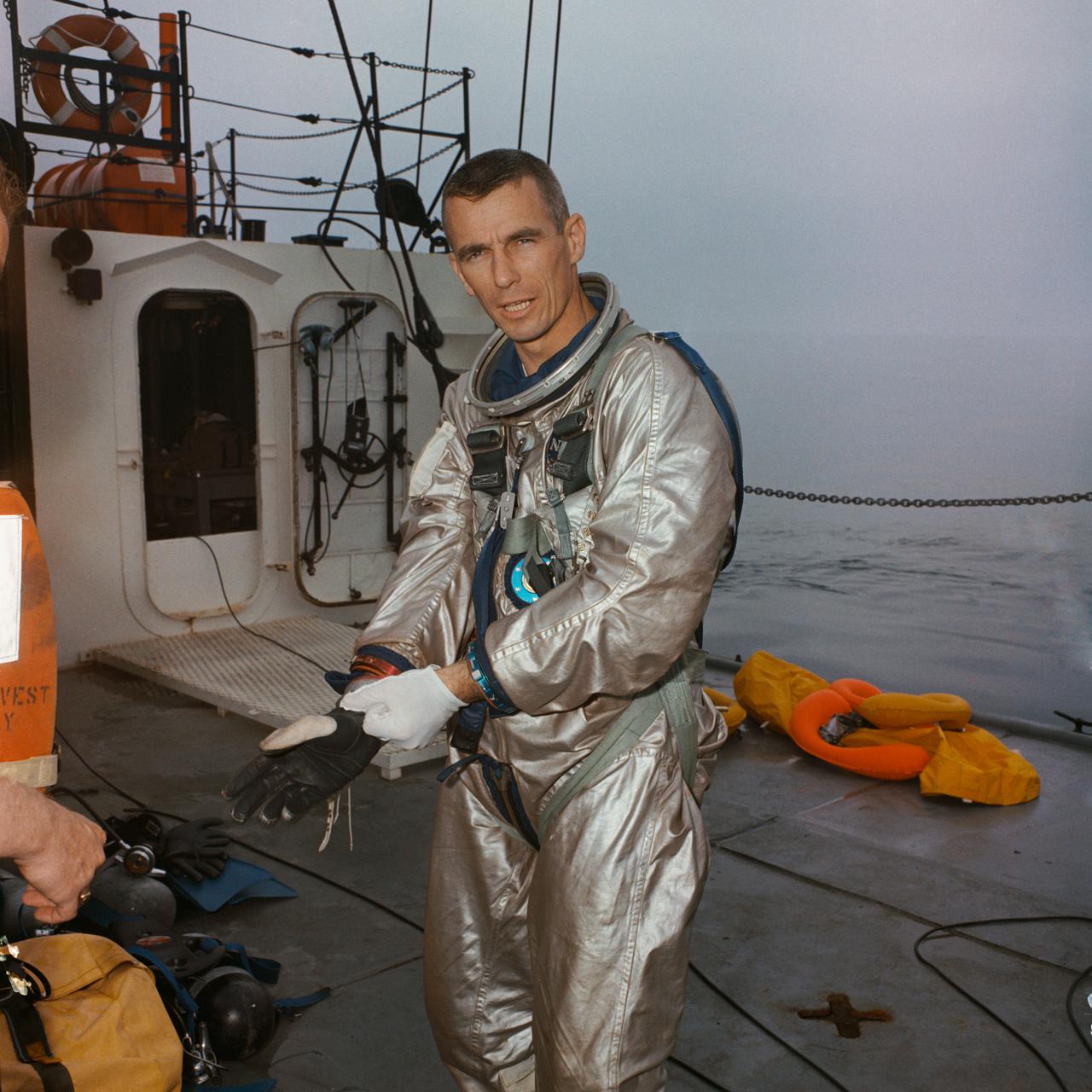
S66-29485 (9 April 1966) --- Astronaut Eugene A. Cernan, prime crew pilot of the National Aeronautics and Space Administration's Gemini-9 spaceflight, stands on deck of the NASA Motor Vessel Retriever after suiting up for water egress training in the Gulf of Mexico. Photo credit: NASA
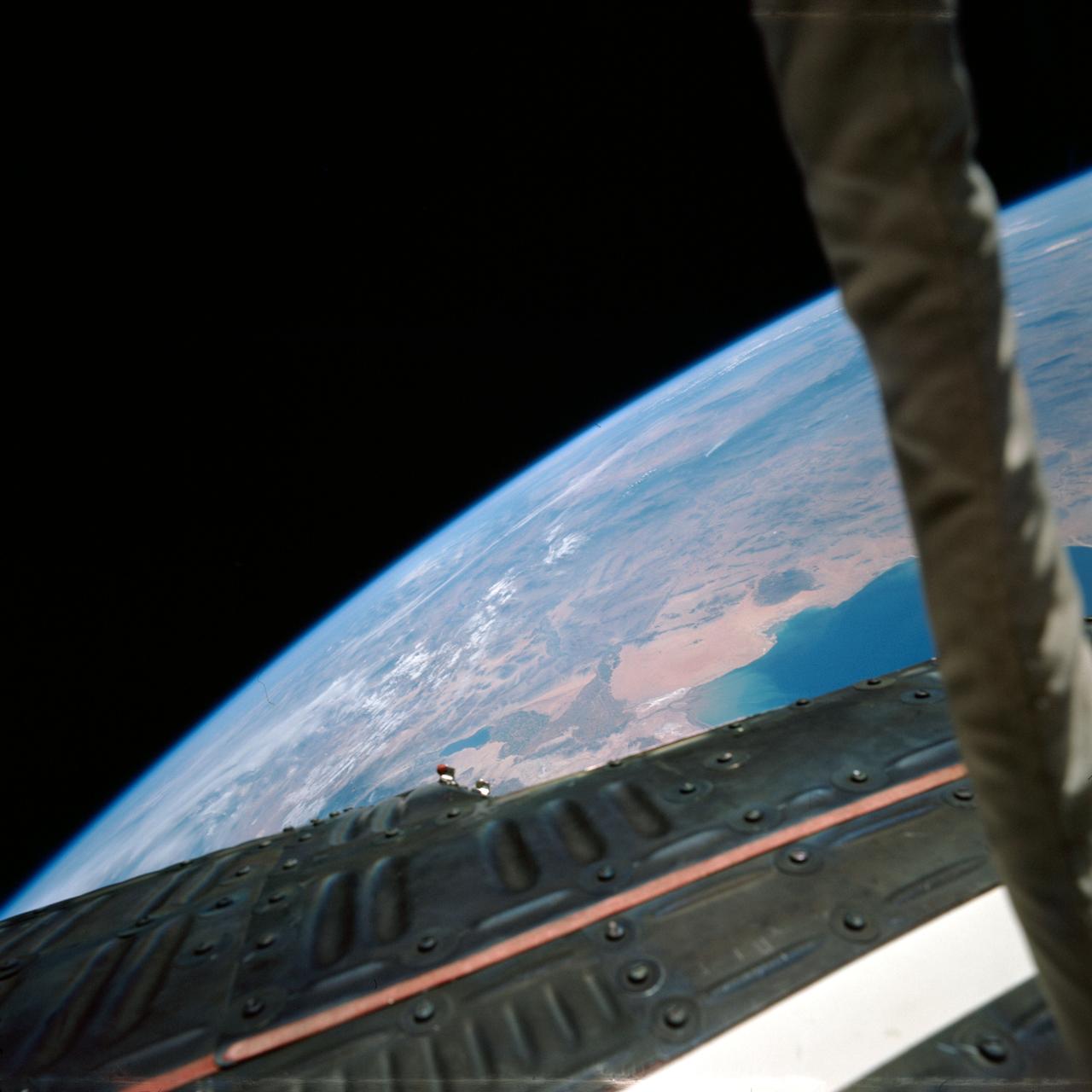
S66-38068 (5 June 1966) --- Astronaut Eugene A. Cernan took this view of the Gemini-9A spacecraft and his umbilical cord (right) over California, Arizona, and Sonora, Mexico, during his extravehicular activity (EVA) on the Gemini-9A mission. Taken during the 32nd revolution of the flight. Photo credit: NASA
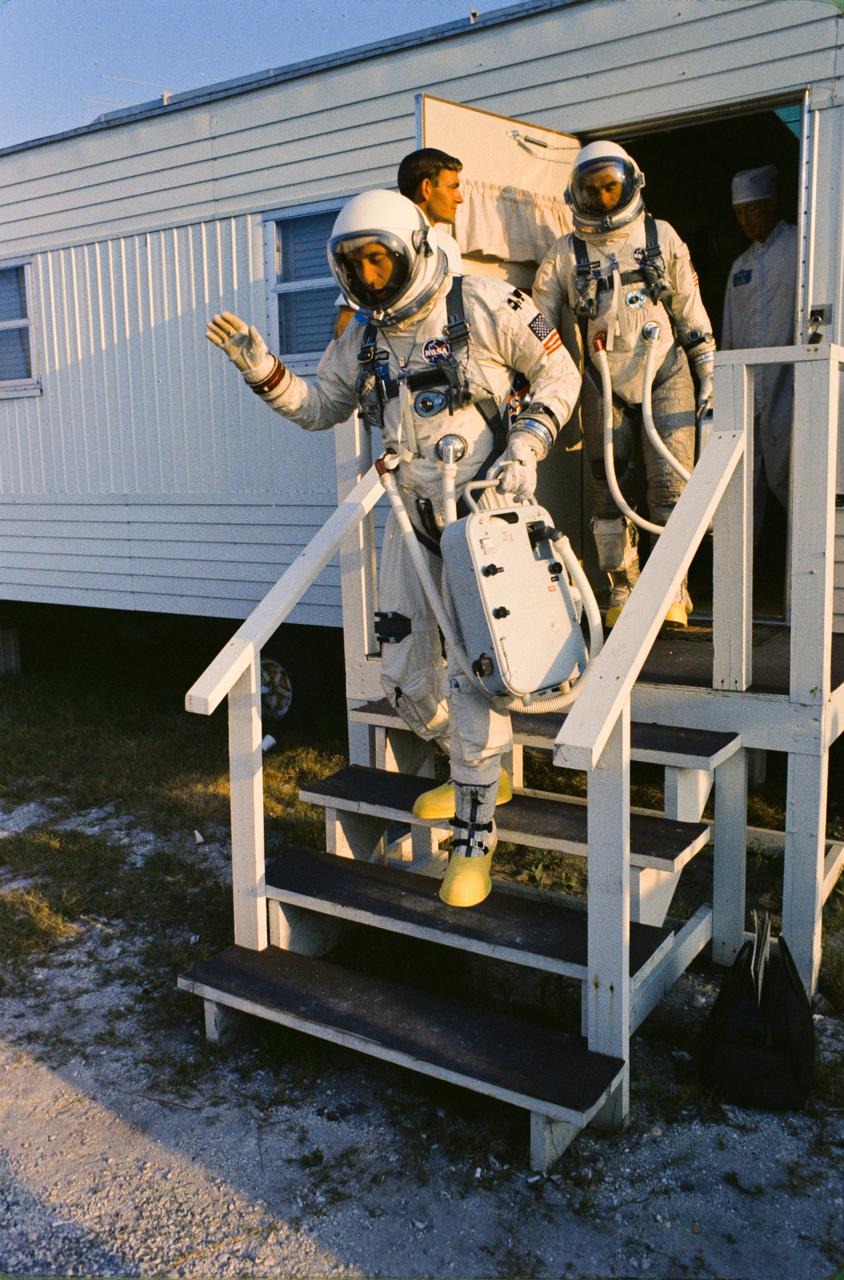
S66-34075 (3 June 1966) --- Prime crew for the Gemini-9A spaceflight, astronauts Thomas P. Stafford (front), command pilot, and Eugene A. Cernan, pilot, leave the suiting trailer at Launch Complex 16 in full spacesuits during prelaunch countdown. Photo credit: NASA
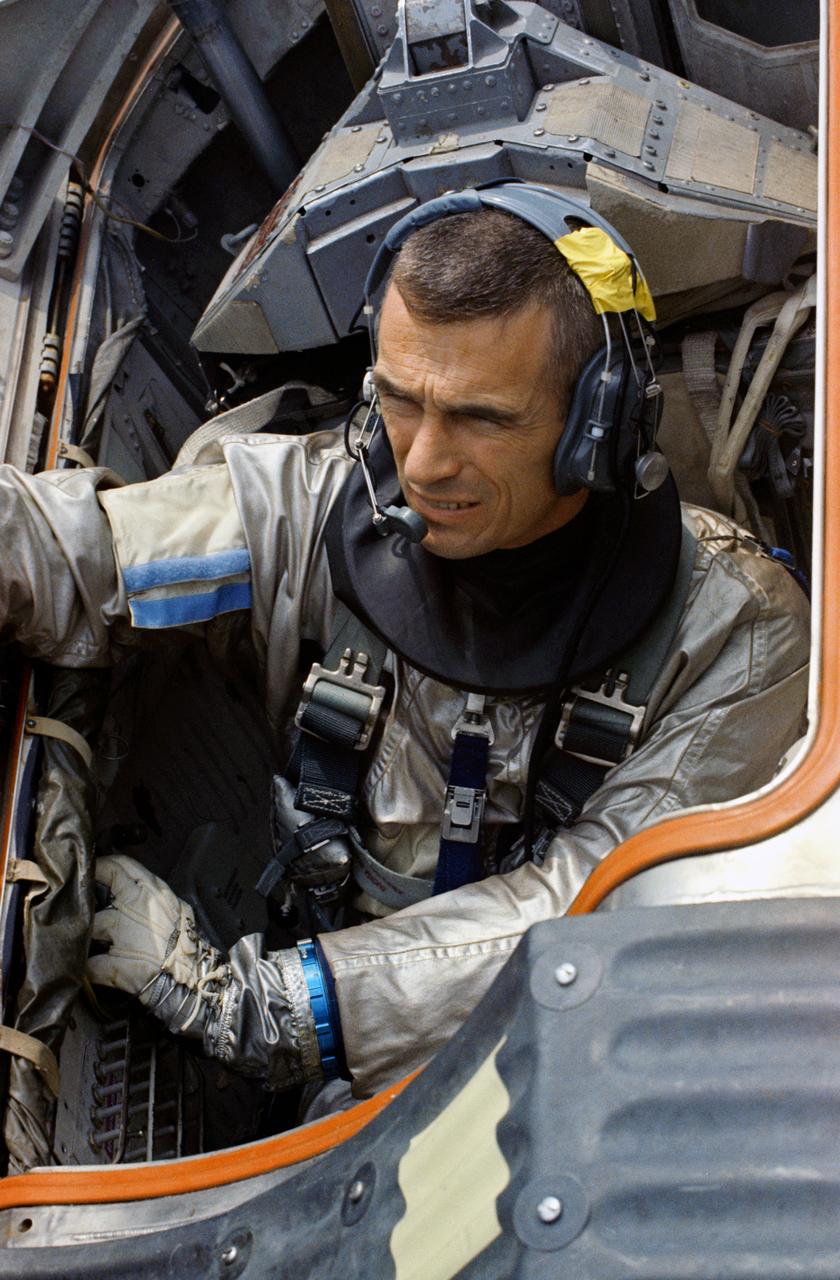
S66-29559 (9 April 1966) --- Astronaut Eugene A. Cernan, prime crew pilot of the National Aeronautics and Space Administration?s Gemini-9 spaceflight, sits in Gemini Boiler-plate during water egress training activity in the Gulf of Mexico. Photo credit: NASA
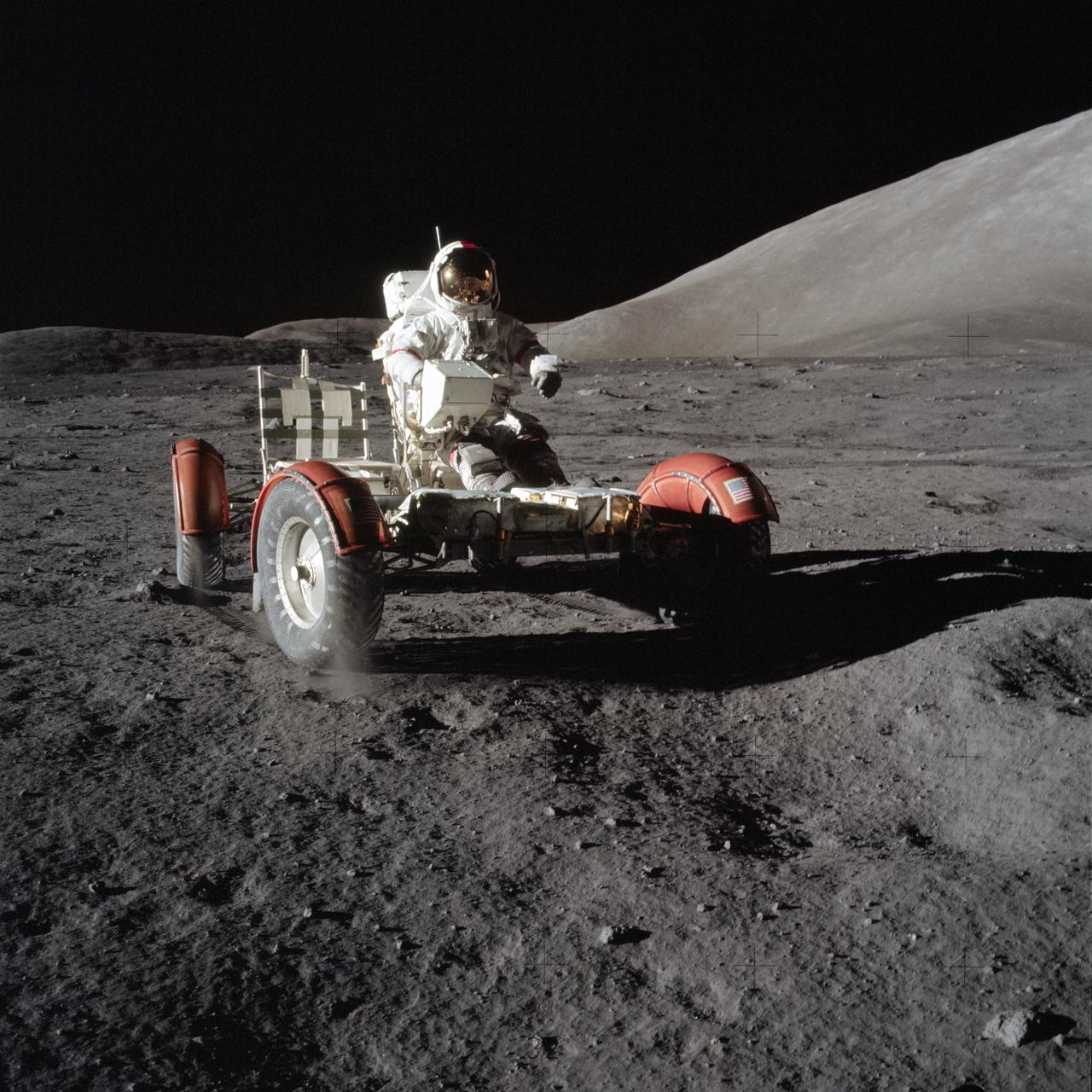
AS17-147-22526 (11 Dec. 1972) --- Astronaut Eugene A. Cernan, commander, makes a short checkout of the Lunar Roving Vehicle (LRV) during the early part of the first Apollo 17 extravehicular activity (EVA) at the Taurus-Littrow landing site. This view of the "stripped down" LRV is prior to loading up. Equipment later loaded onto the LRV included the ground-controlled television assembly, the lunar communications relay unit, hi-gain antenna, low-gain antenna, aft tool pallet, lunar tools and scientific gear. This photograph was taken by scientist-astronaut Harrison H. Schmitt, lunar module pilot. The mountain in the right background is the east end of South Massif. While astronauts Cernan and Schmitt descended in the Lunar Module (LM) "Challenger" to explore the moon, astronaut Ronald E. Evans, command module pilot, remained with the Command and Service Modules (CSM) "America" in lunar orbit.
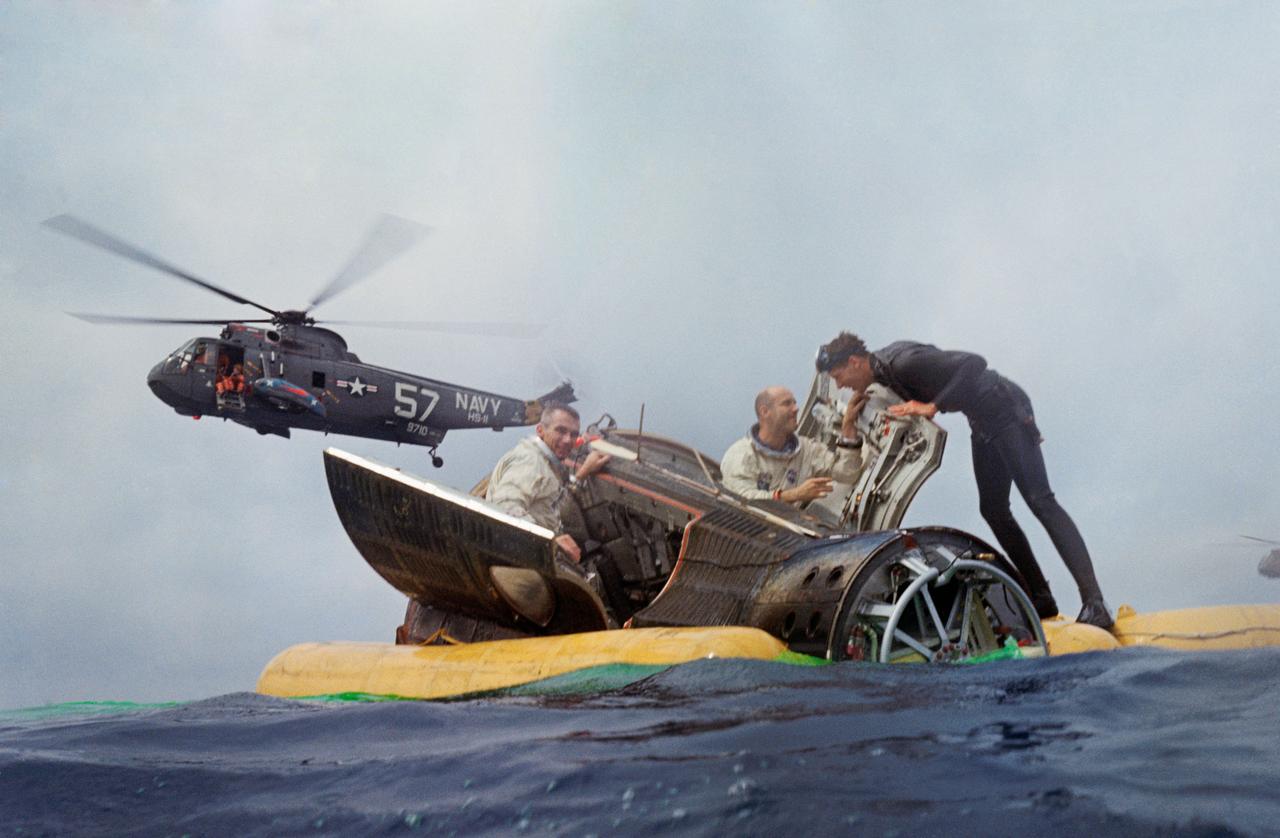
S66-34124 (6 June 1966) --- Astronauts Eugene A. Cernan and Thomas P. Stafford sit with their Gemini 9A spacecraft hatches open while awaiting the arrival of the recovery ship U.S.S. Wasp.
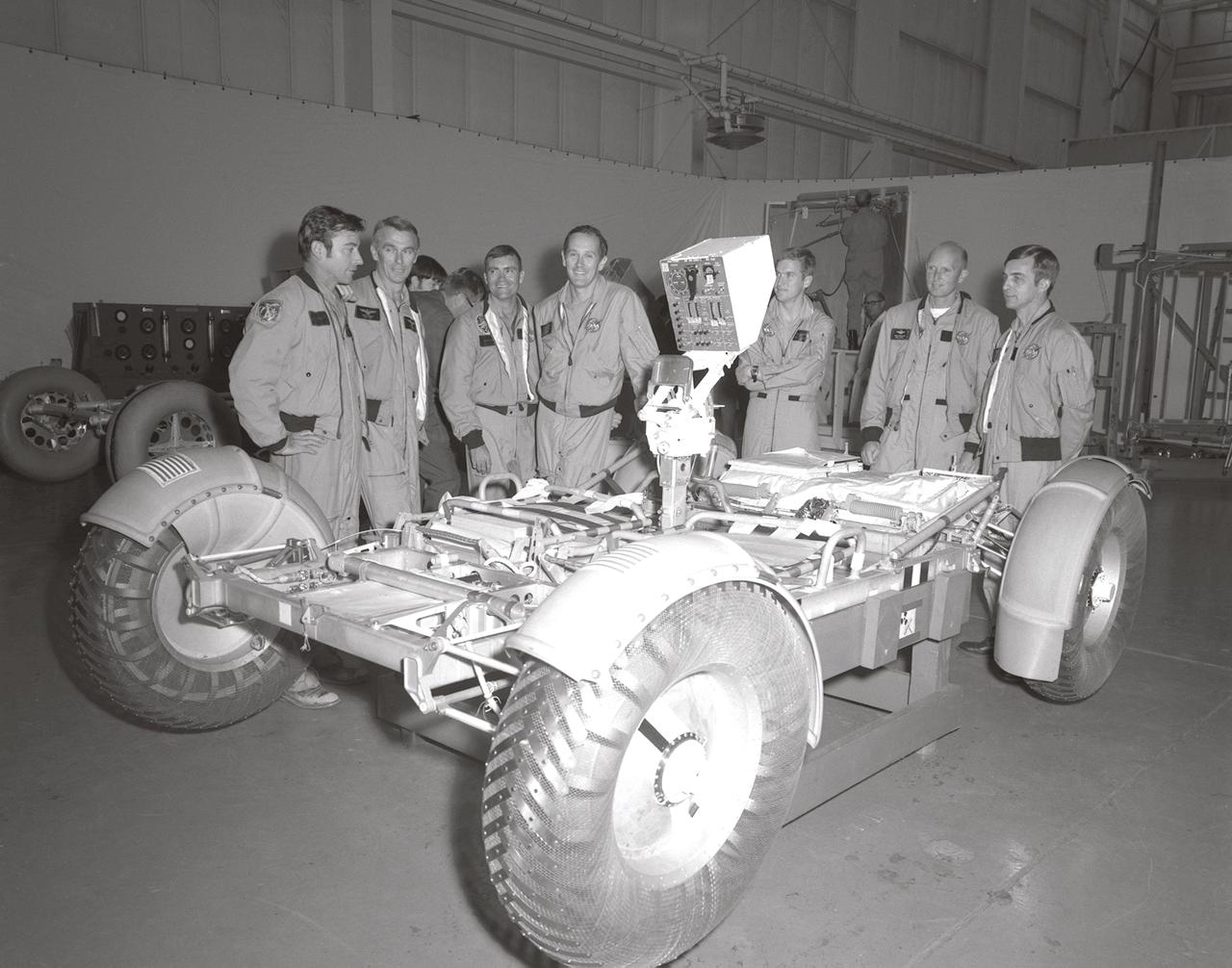
In this November 1971 photograph, (from left to right) Astronauts John Young, Eugene Cernan, Charles Duke, Fred Haise, Anthony England, Charles Fullerton, and Donald Peterson await deployment tests of the Lunar Roving Vehicle (LRV) qualification test unit in building 4649 at the Marshall Space Flight Center (MSFC). The LRV, developed under the direction of the MSFC, was designed to allow Apollo astronauts a greater range of mobility on the lunar surface during the last three lunar exploration missions; Apollo 15, Apollo 16, and Apollo 17.
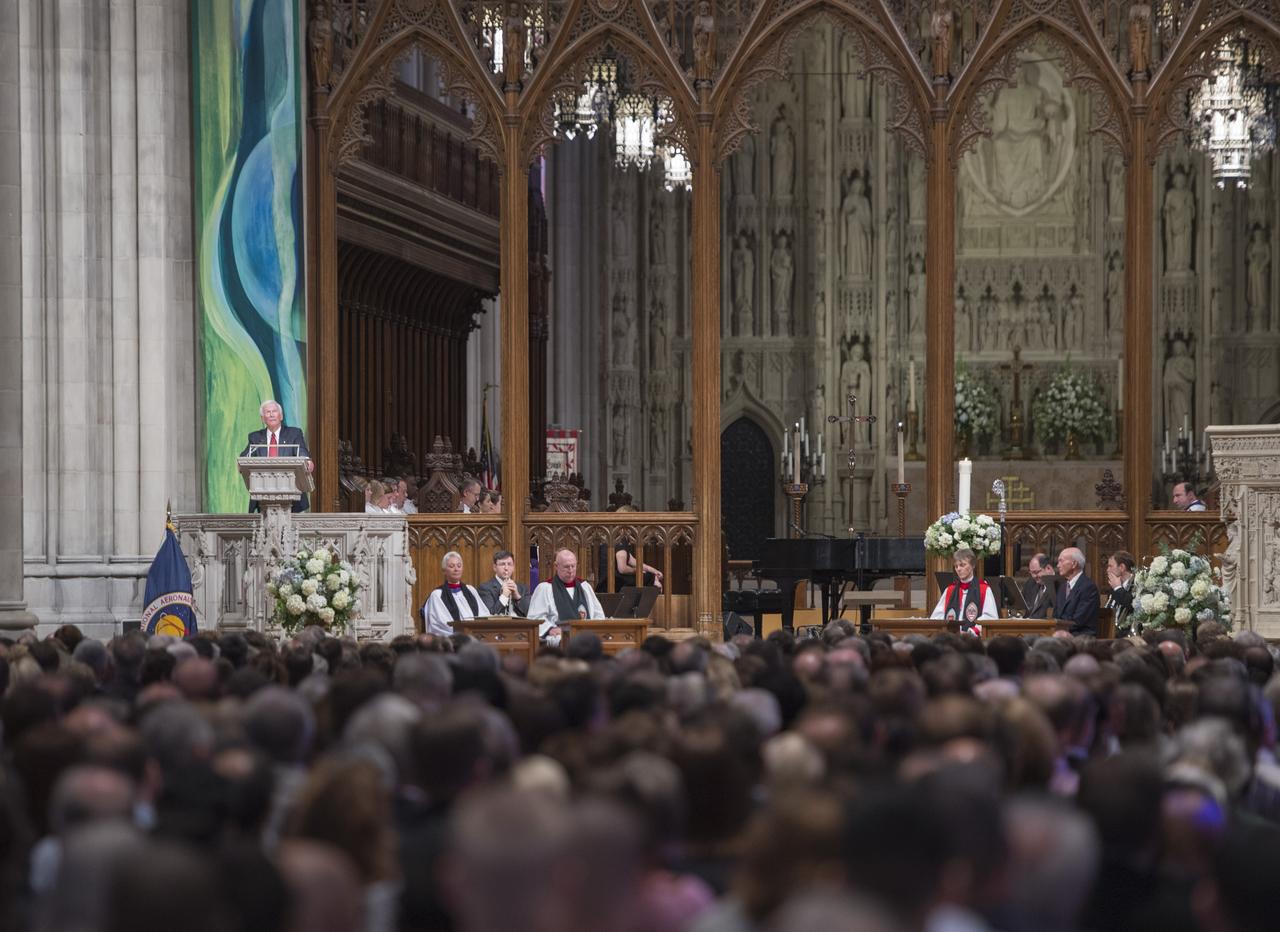
Apollo 17 mission commander Gene Cernan, the last man to walk on the moon, speaks during a memorial service celebrating the life of Neil Armstrong at the Washington National Cathedral, Thursday, Sept. 13, 2012. Armstrong, the first man to walk on the moon during the 1969 Apollo 11 mission, died Saturday, Aug. 25. He was 82. Photo Credit: (NASA/Bill Ingalls)
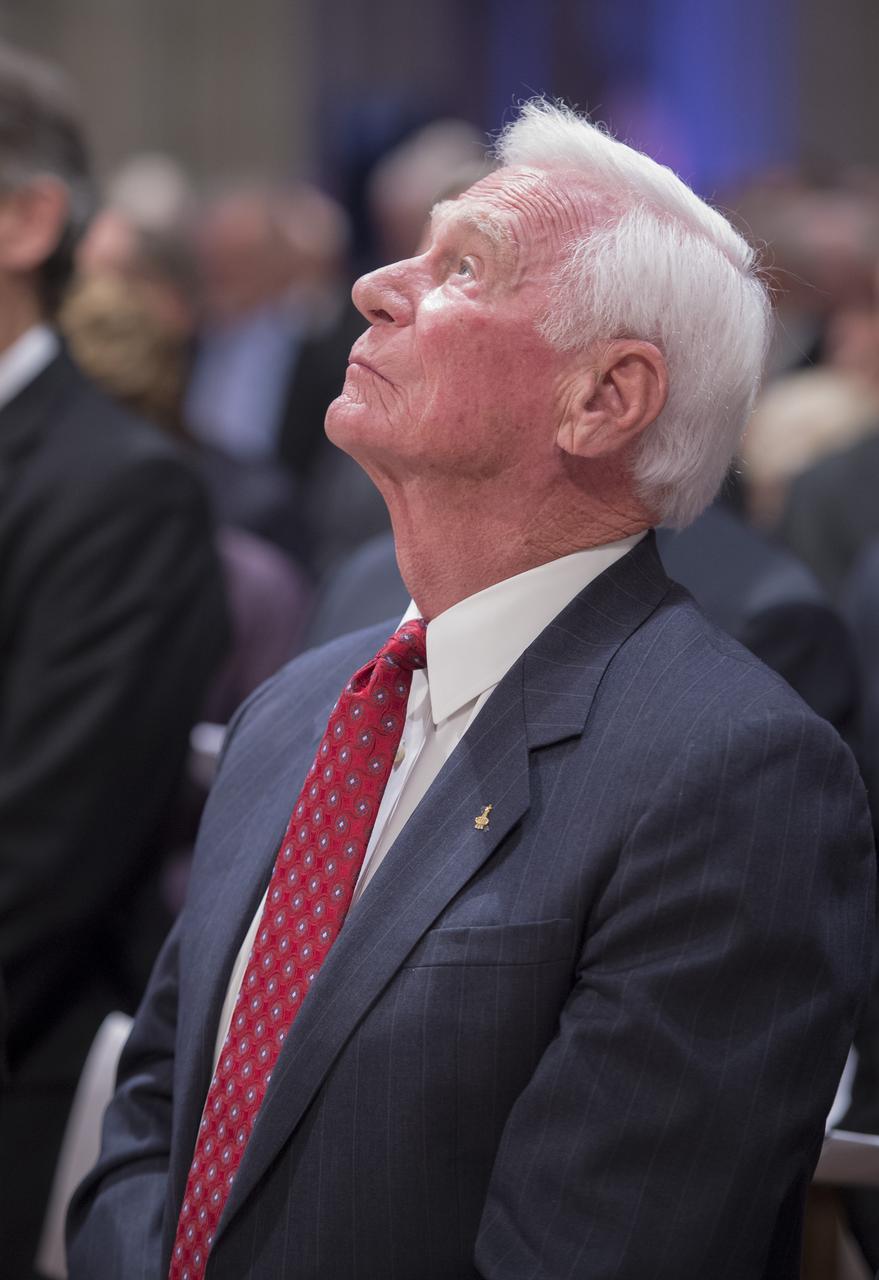
Apollo 17 mission commander Gene Cernan, the last man to walk on the moon, looks skyward during a memorial service celebrating the life of Neil Armstrong at the Washington National Cathedral, Thursday, Sept. 13, 2012. Armstrong, the first man to walk on the moon during the 1969 Apollo 11 mission, died Saturday, Aug. 25. He was 82. Photo Credit: (NASA/Bill Ingalls)
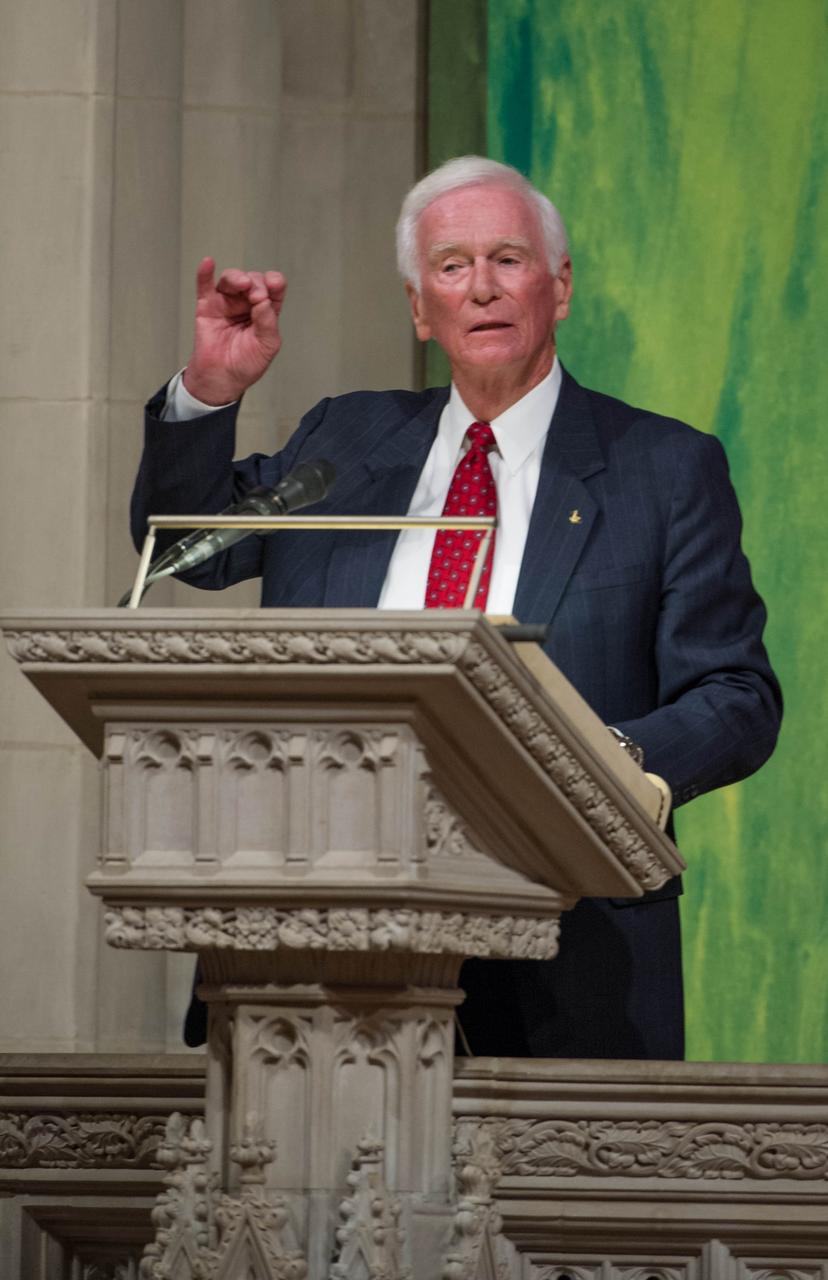
Apollo 17 astronaut Gene Cernan, the last man to walk on the moon, speaks during a memorial service celebrating the life of Neil Armstrong at the Washington National Cathedral, Thursday, Sept. 13, 2012. Armstrong, the first man to walk on the moon during the 1969 Apollo 11 mission, died Saturday, Aug. 25. He was 82. Photo Credit: (NASA/Paul E. Alers)
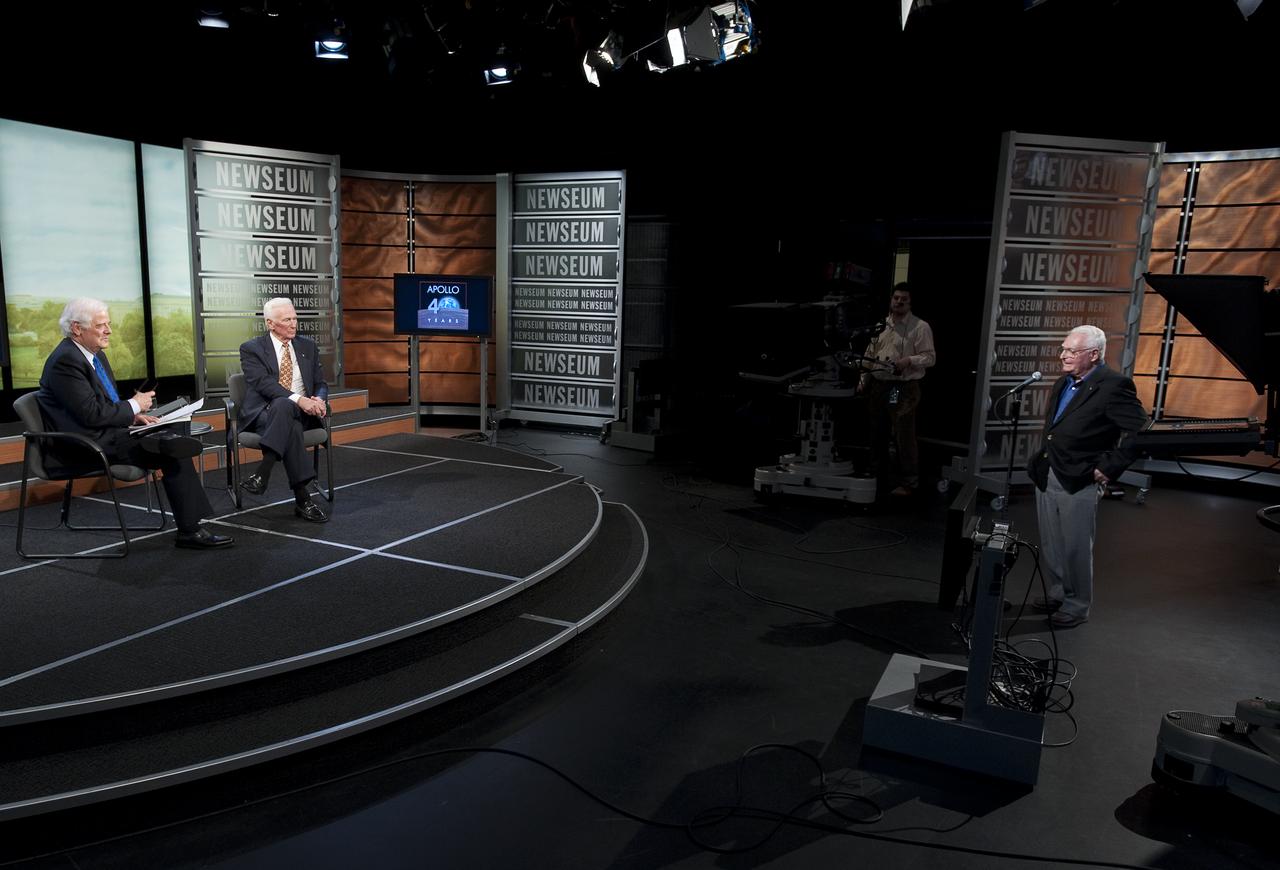
NASA Apollo 10 Astronaut Gene Cernan, on stage, right, and the Newseum's distinguished journalist-in-residence, Nick Clooney, on stage, left, talk with a Stan LeBar, Program Manager of the Apollo TV Lunar Camera who helped see that Apollo 10 was the first mission to broadcast in color from the moon during a Newseum TV program celebrating the 40th anniversary of Apollo 10, Monday, May 18, 2009, in Washington. Photo Credit (NASA/Bill Ingalls)
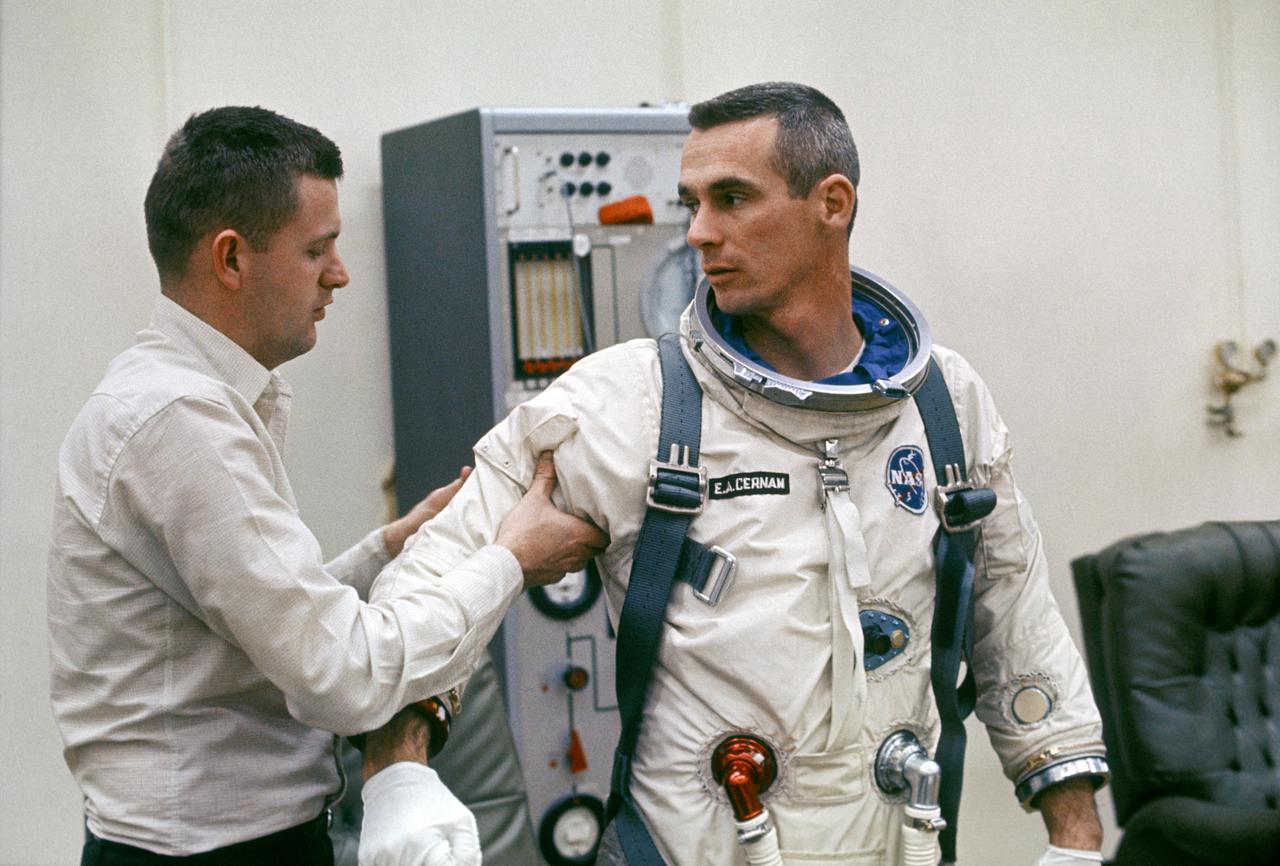
S66-27375 (19 Feb. 1966) --- Astronaut Eugene A. Cernan, pilot of the Gemini-9 spaceflight, has his suit adjusted by NASA suit technician Al Rochford during preparations for tests with the Astronaut Maneuvering Unit (AMU). The tests were conducted in Chamber B, Environmental Test Laboratory, Building 32. The AMU, which consists of a chest pack and backpack, will be used for extravehicular activity (EVA) on the Gemini-9 mission. Photo credit: NASA
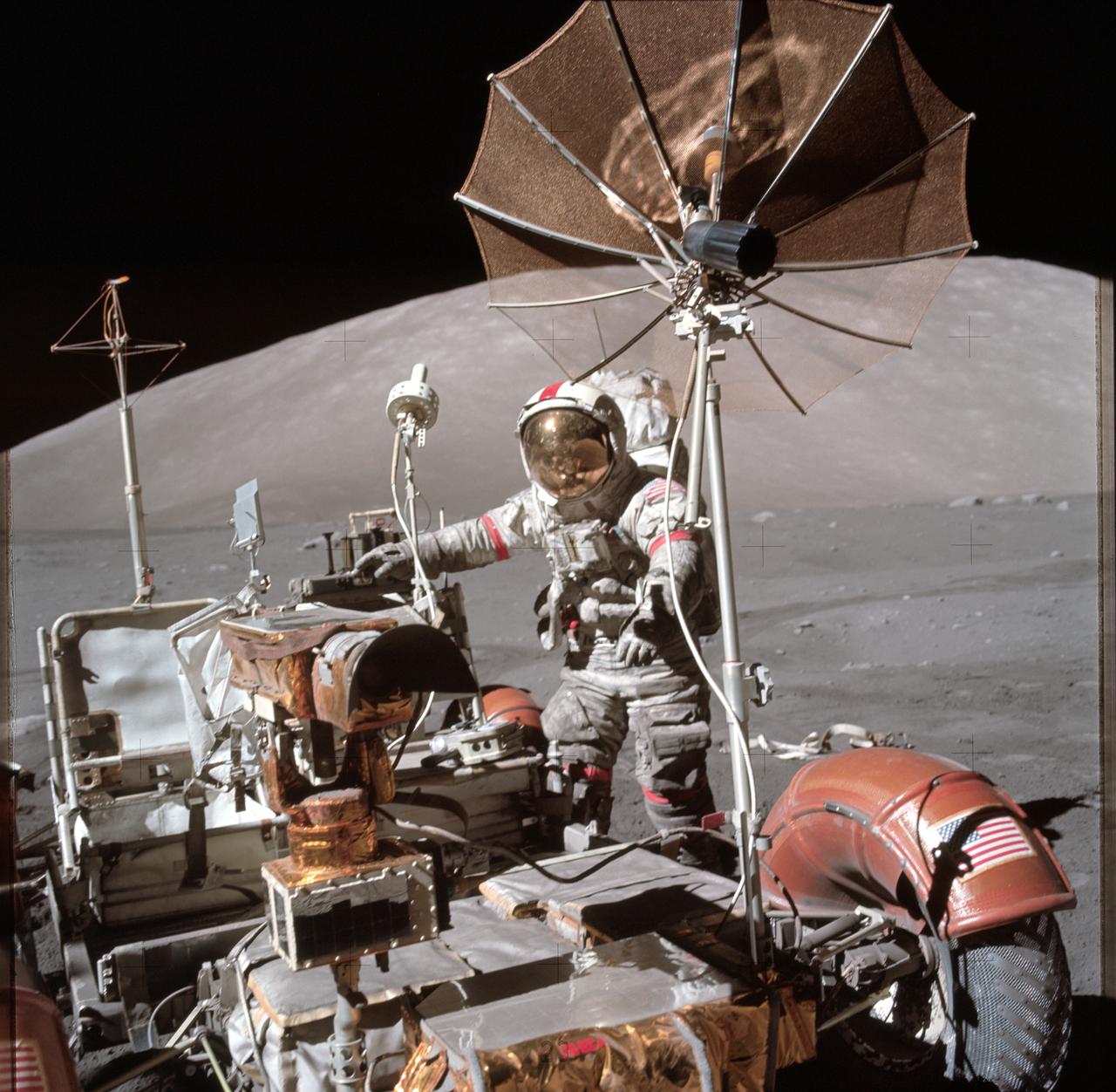
AS17-134-20476 (13 Dec. 1972) --- Astronaut Eugene A. Cernan, Apollo 17 commander, approaches the parked Lunar Roving Vehicle (LRV) on the lunar surface during the flight's third period of extravehicular activity (EVA). South Massif can be seen in the background. The photograph was taken with a hand-held Hasselblad camera by scientist-astronaut Harrison H. Schmitt, lunar module pilot. While the two explored the surface of the moon, astronaut Ronald E. Evans remained with the Command and Service Modules (CSM) in lunar orbit.
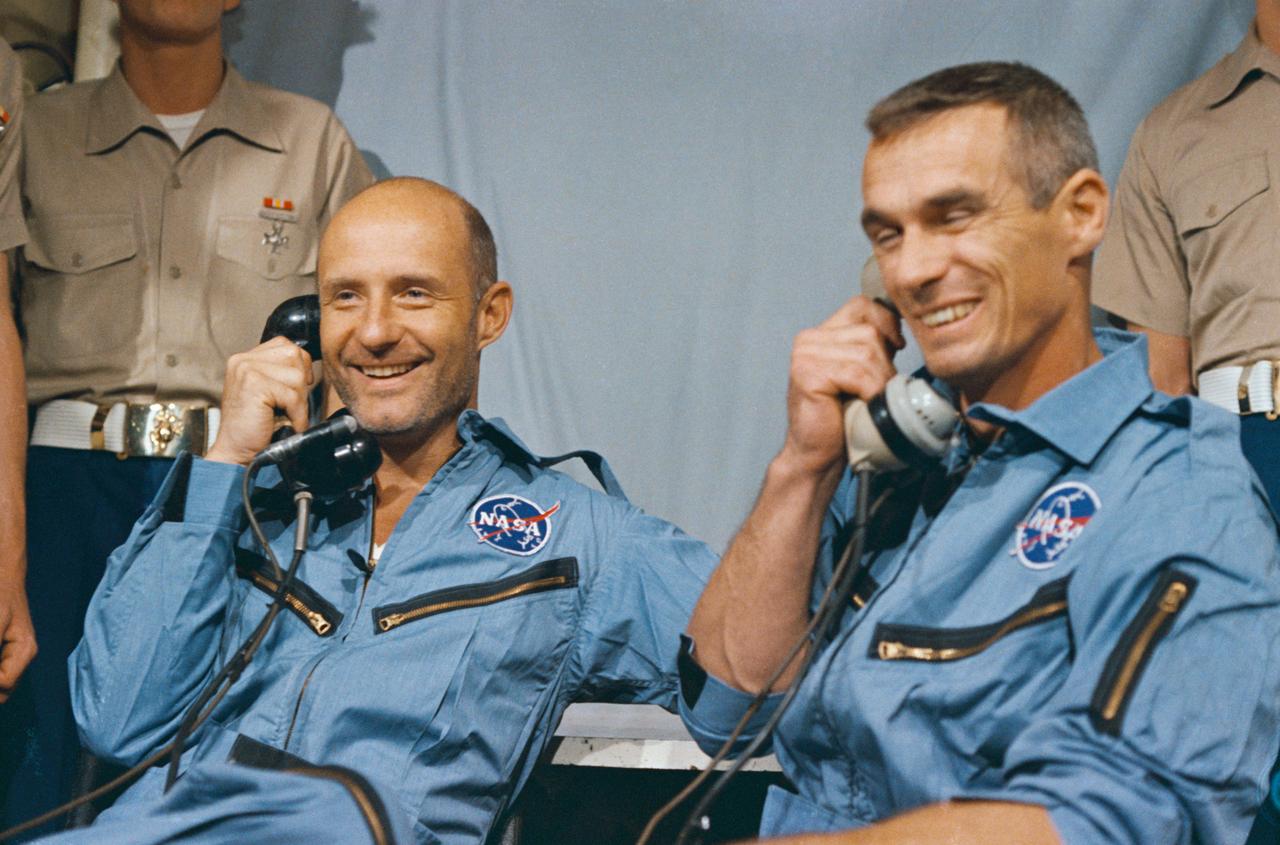
S66-34111 (6 June 1966) --- Astronauts Thomas P. Stafford (left) and Eugene A. Cernan talk to President Lyndon B. Johnson via ship-to-shore telephone from aboard the aircraft carrier USS Wasp. Gemini-9A splashed down only 3.5 miles from the recovery ship at 9 a.m. (EST), June 6, 1966, 345 miles east of Cape Kennedy, to conclude a 72-hour, 21-minute mission in space. Photo credit: NASA
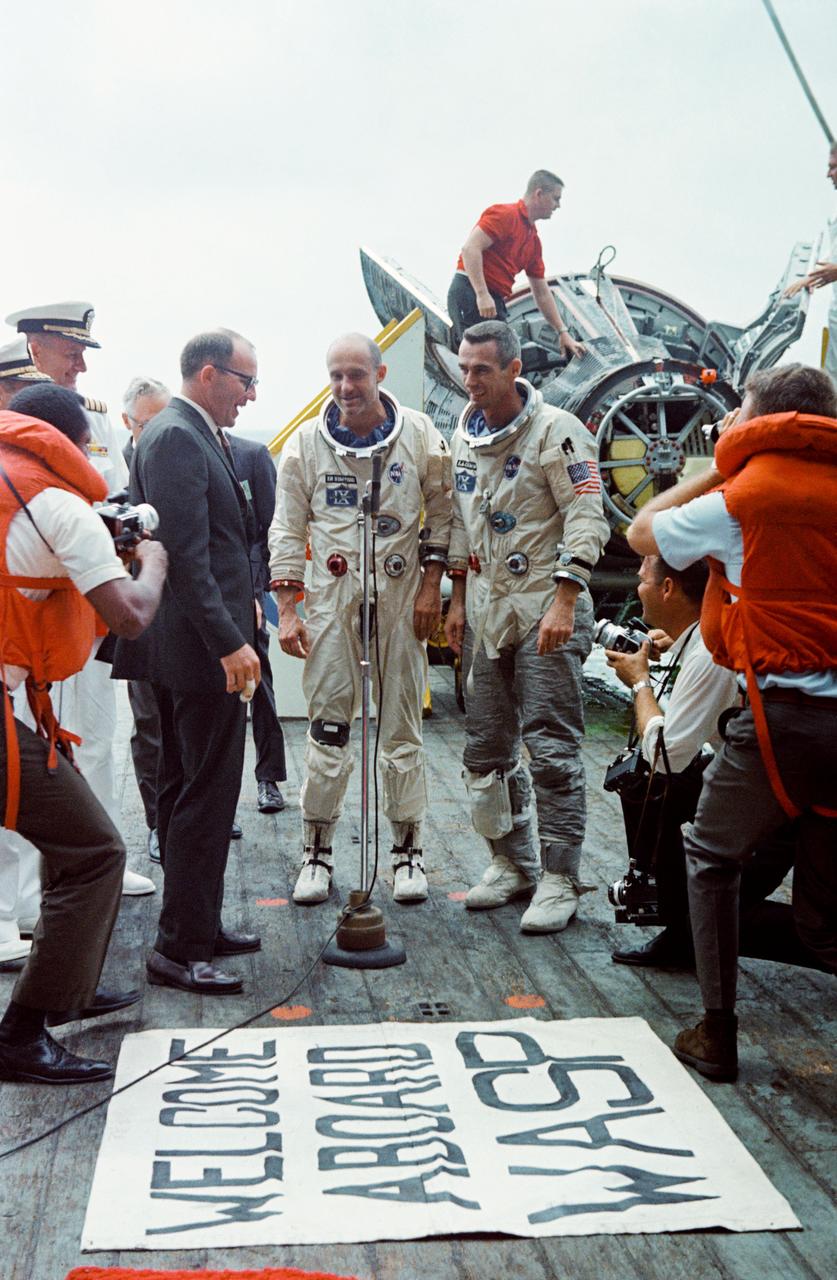
S66-34109 (6 June 1966) --- Astronauts Thomas Stafford and Eugene Cernan (right) receive a warm welcome as they arrive aboard the prime recovery ship, the aircraft carrier USS Wasp. John C. Stonesifer, with the Manned Spacecraft Center's Landing and Recovery Division, stands next to microphone at left. The Gemini-9 spacecraft can be seen in the right background of the view. Photo credit: NASA
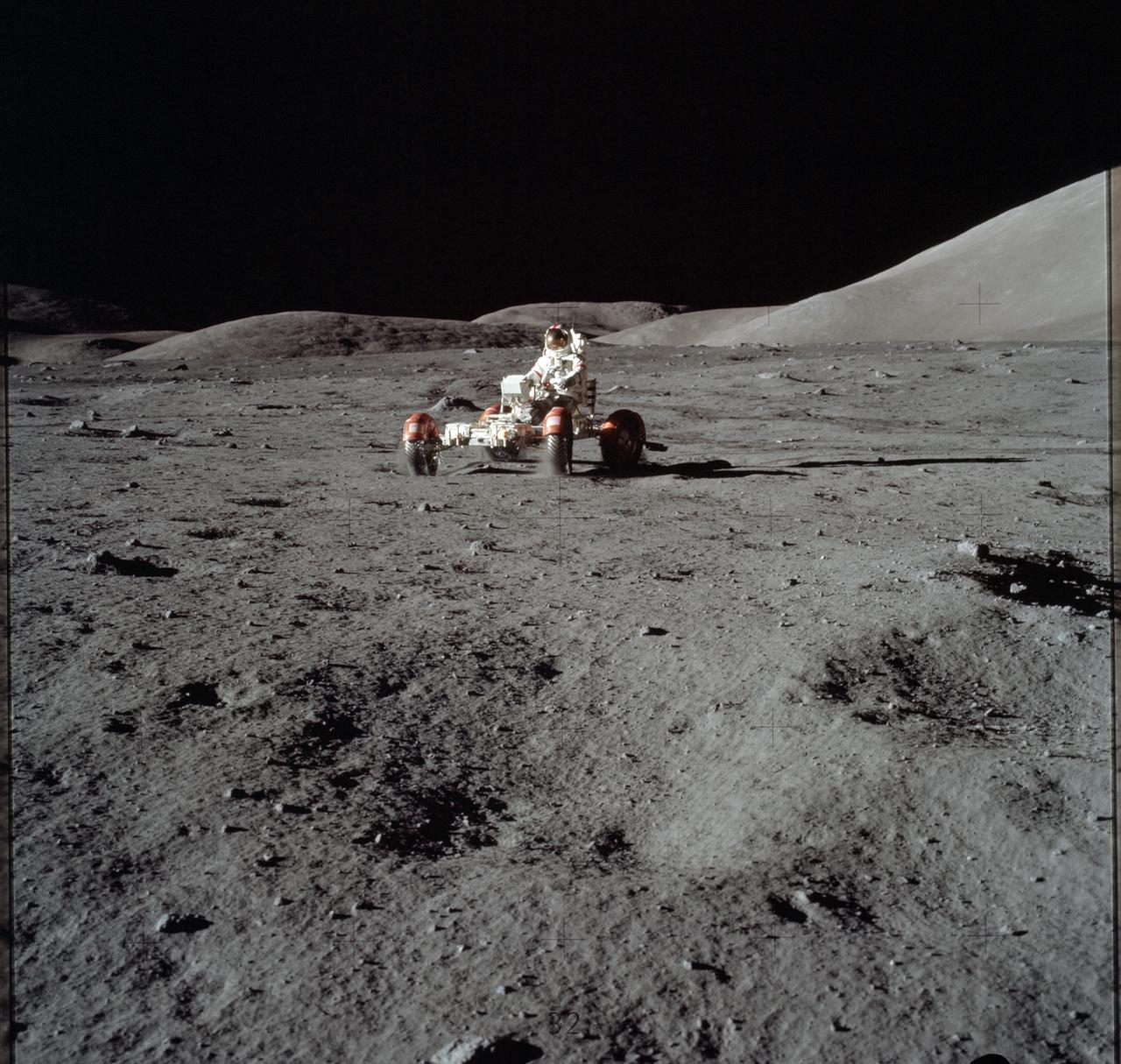
AS17-147-22523 (11 Dec. 1972) --- Astronaut Eugene A. Cernan is seen test driving the "stripped down" Lunar Rover Vehicle (LRV) prior to loading the LRV up. Equipment later loaded onto the LRV included the ground controlled television assembly, the lunar communications relay unit, the hi-gain antenna, the low-gain antenna, aft tool pallet, and lunar tools and scientific gear.
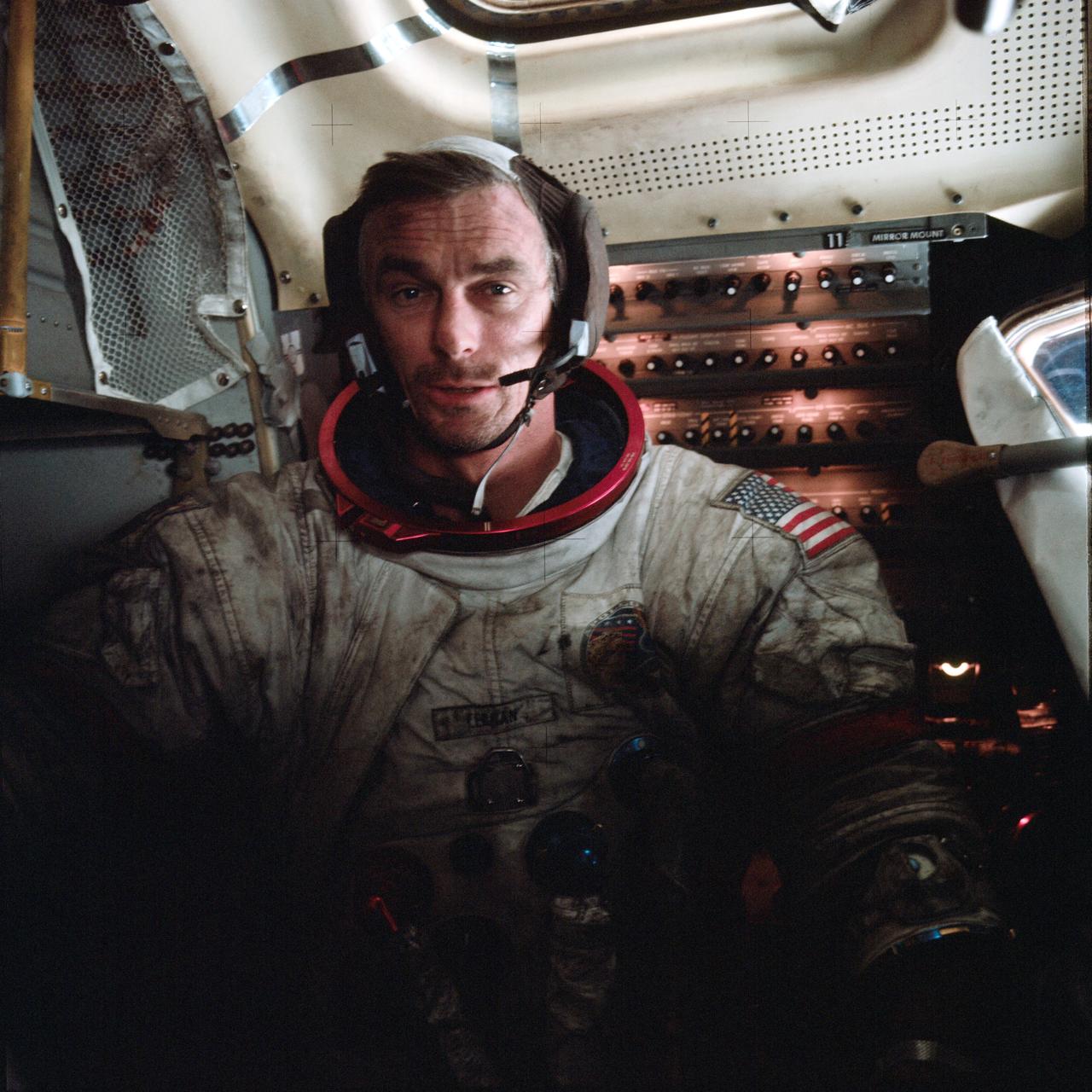
AS17-145-22224 (12 Dec. 1972) --- Astronaut Eugene A. Cernan, Apollo 17 commander, is photographed inside the lunar module on the lunar surface following the second extravehicular activity (EVA) of his mission. Note lunar dust on his suit. The photograph was taken by astronaut Harrison H. Schmitt, lunar module pilot, using a 70mm handheld Hasselblad camera and S0-368 film.
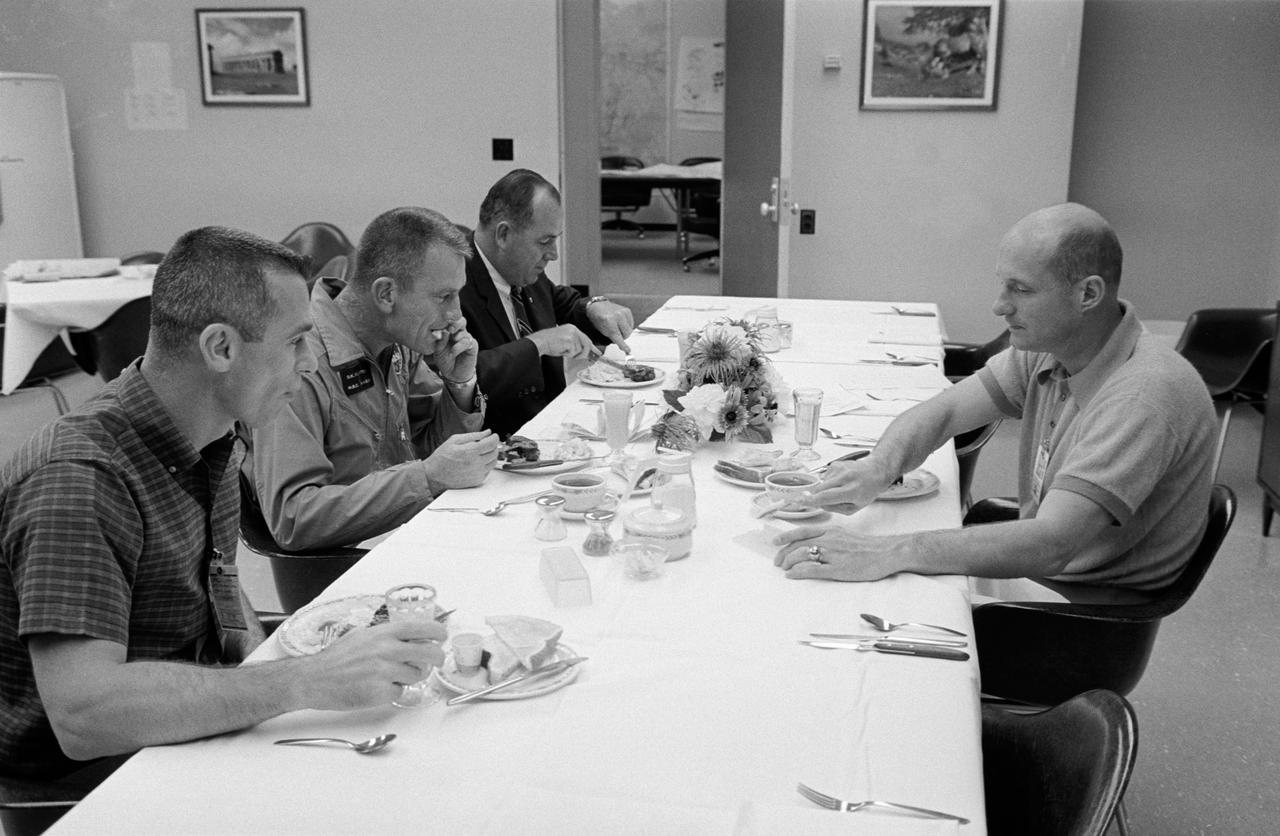
S66-34069 (3 June 1966) --- Gemini-9A prime crew enjoy a breakfast of steak and eggs on the morning of the Gemini-9A launch. Left to right, are astronaut Eugene A. Cernan, pilot; Donald K. Slayton, MSC Director of Flight Crew Operations; Charles Buckley, KSC Security; and astronaut Thomas P. Stafford, command pilot. Photo credit: NASA
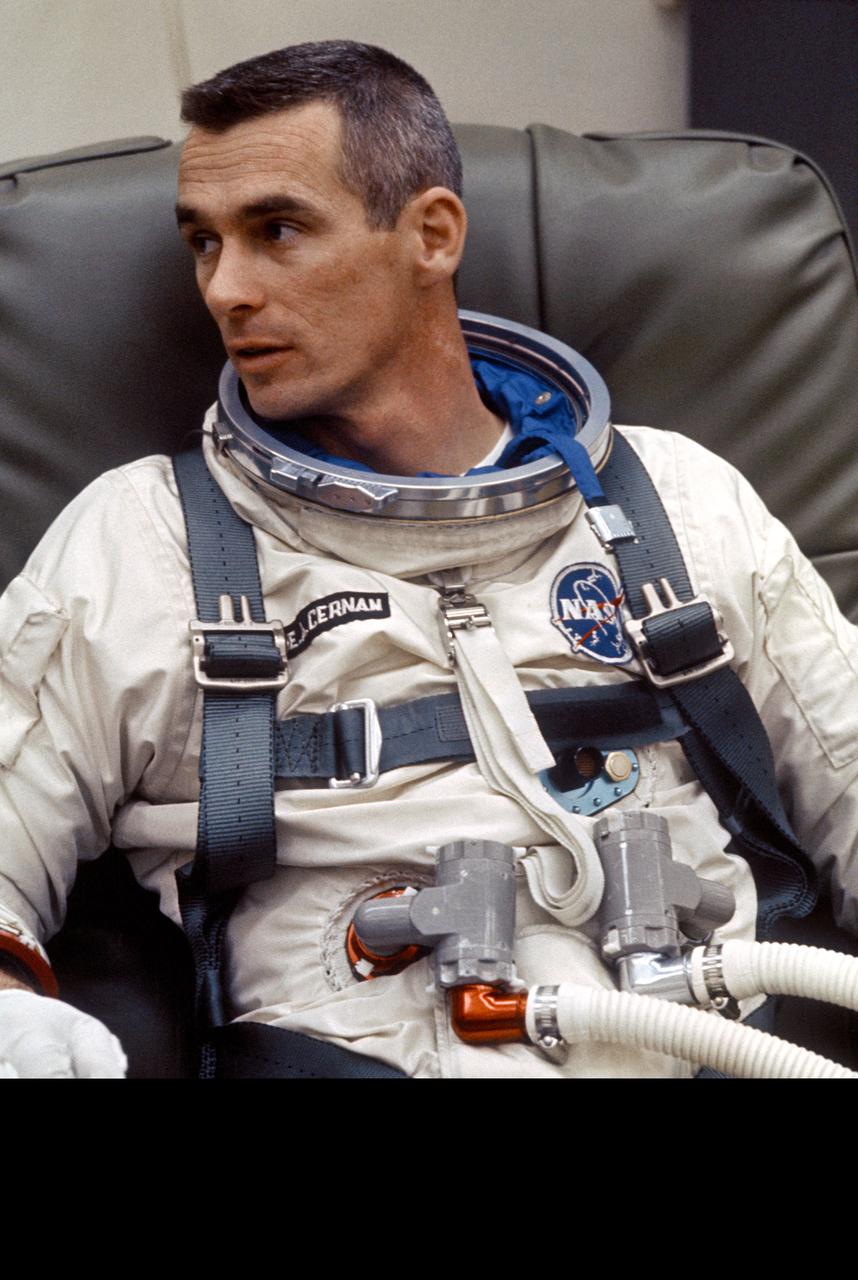
S66-27377 (19 Feb. 1966) --- Astronaut Eugene A. Cernan, pilot of the Gemini-9 spaceflight, is suited up in preparation for tests with the Astronaut Maneuvering Unit (AMU). The tests are conducted in Chamber B, Environmental Test Laboratory, Building 32. The AMU, which consists of a chest pack and a backpack, will be used for extravehicular activity (EVA) on the Gemini-9 mission. Photo credit: NASA
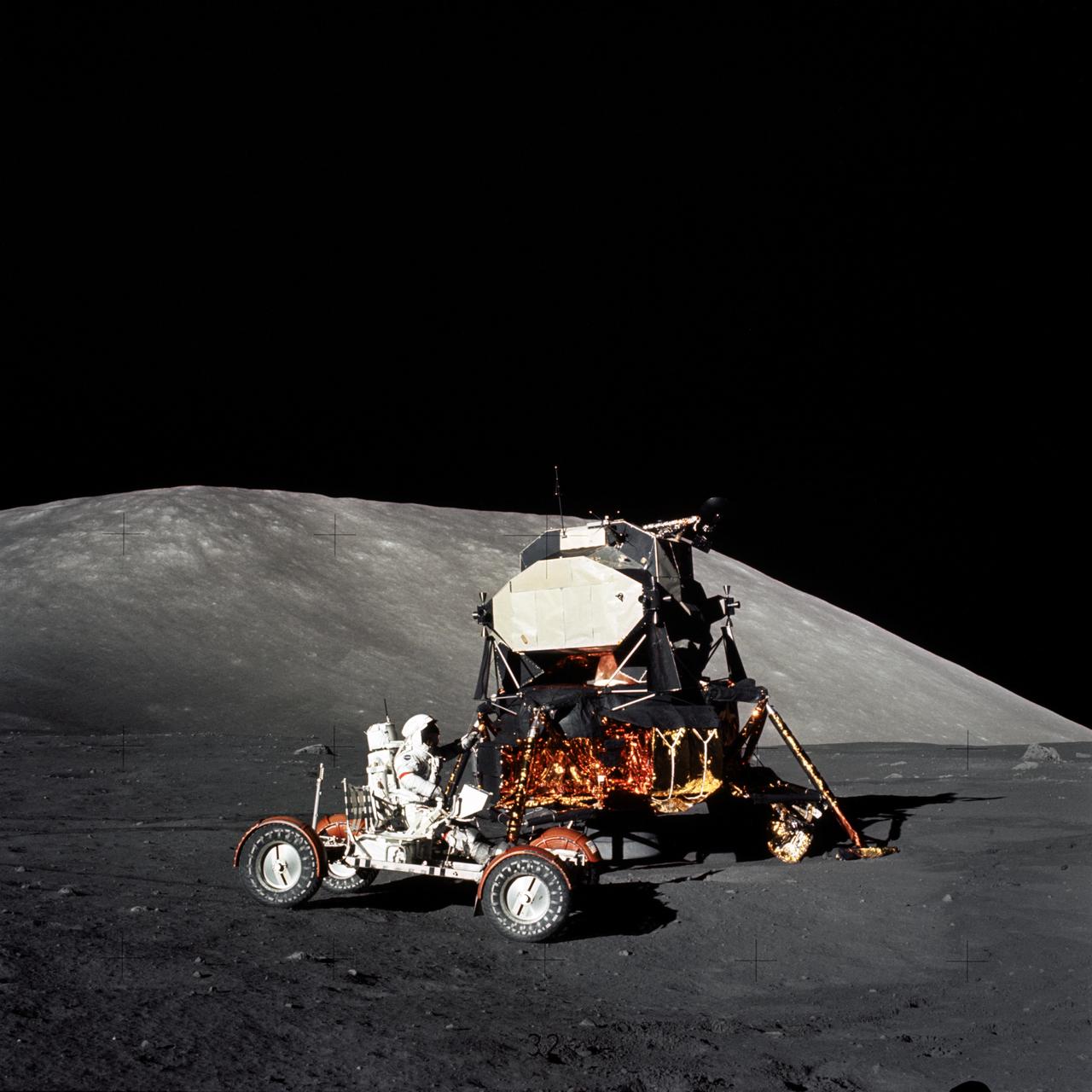
AS17-147-22527 (11 Dec. 1972) --- Astronaut Eugene A. Cernan, Apollo 17 mission commander, makes a short checkout of the Lunar Roving Vehicle during the early part of the first Apollo 17 extravehicular activity (EVA) at the Taurus-Littrow landing site. The Lunar Module is in the background. This photograph was taken by scientist-astronaut Harrison H. Schmitt, lunar module pilot.
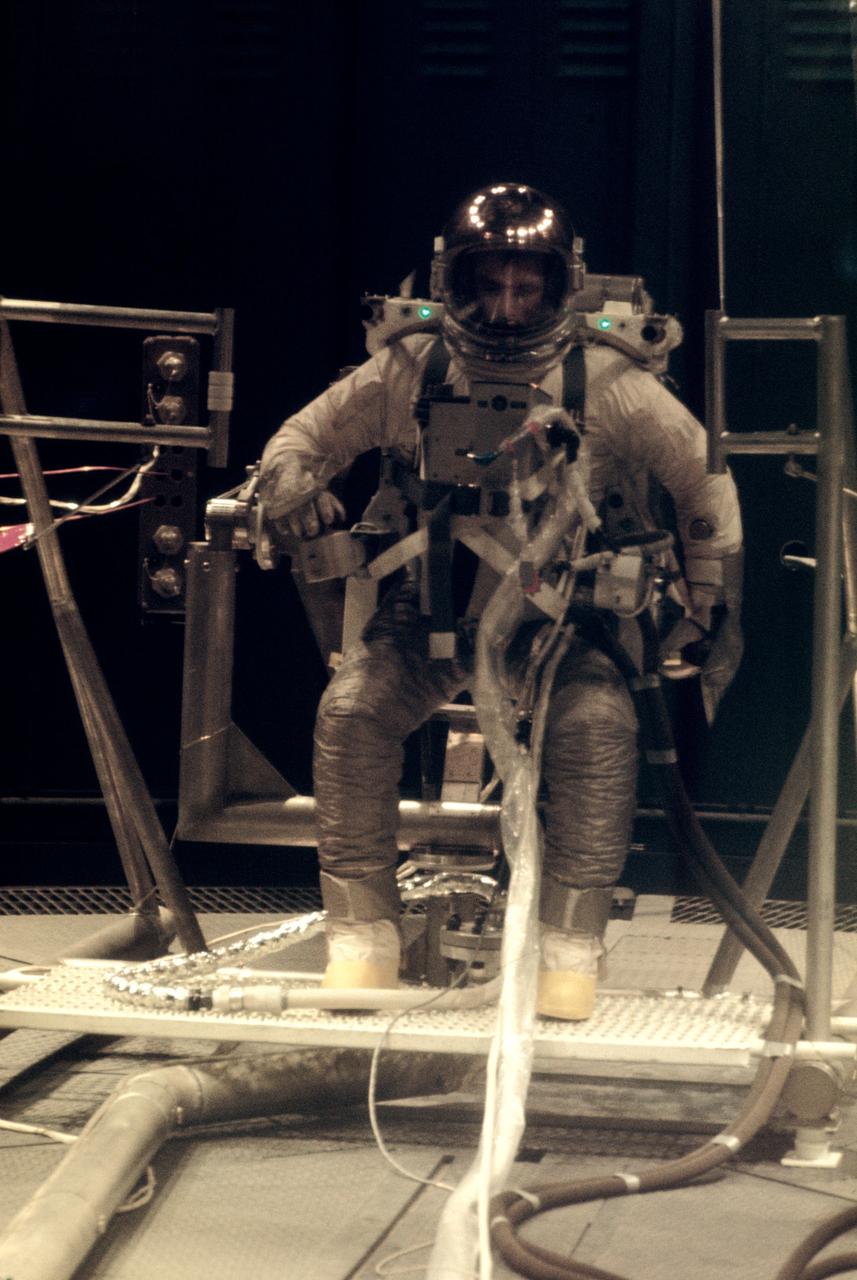
S66-27376 (19 Feb. 1966) --- Astronaut Eugene A. Cernan, pilot of the Gemini-9 spaceflight, practices with the Astronaut Maneuvering Unit during tests in Chamber B, Environmental Test Laboratory, Building 32. The AMU consists of a chest pack and a backpack. It is scheduled for use during Gemini-9 extravehicular activity (EVA). Photo credit: NASA
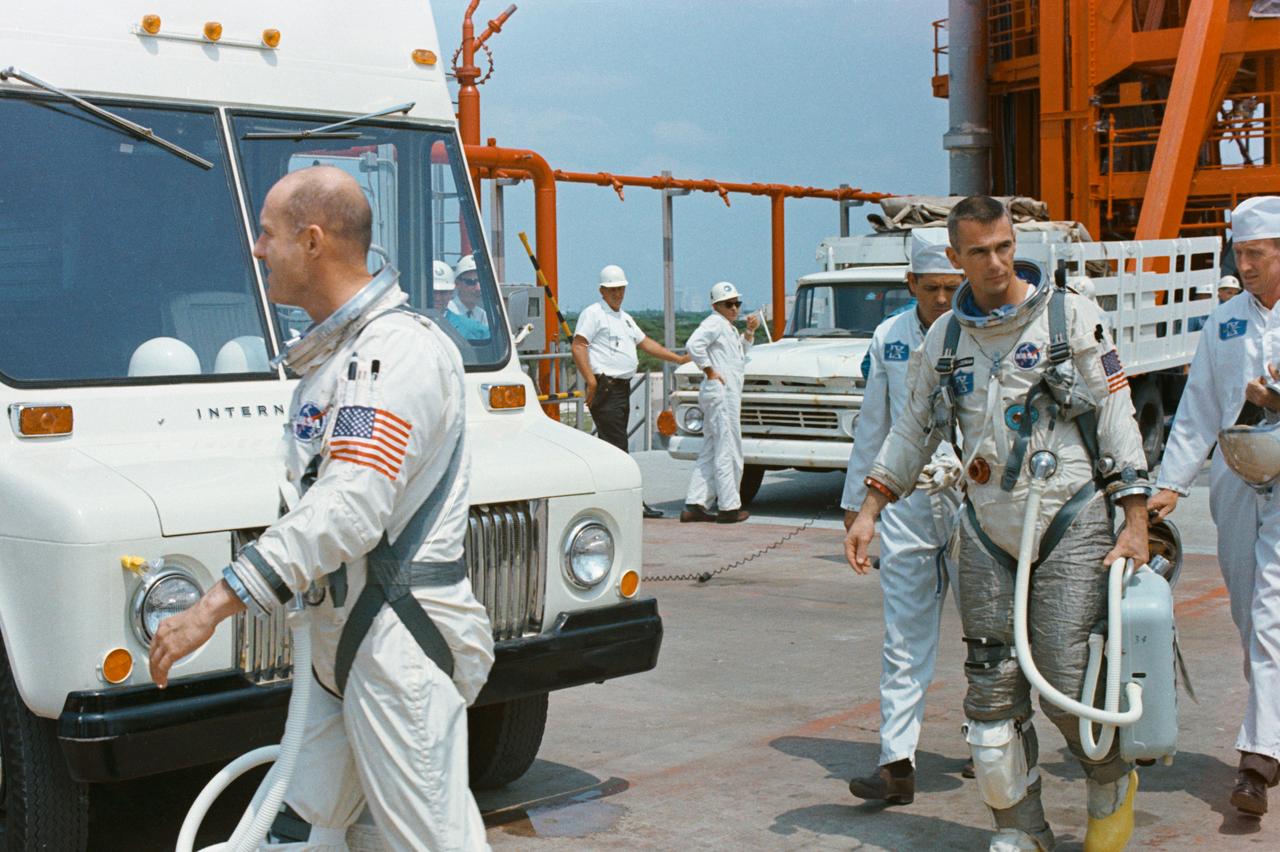
S66-34559 (17 May 1966) --- Astronauts Thomas P. Stafford (left), command pilot, and Eugene A. Cernan, pilot, walk away from Pad 19 after the Gemini-9 mission was postponed. Failure of the Agena Target Vehicle to achieve orbit caused the postponement of the mission. Photo credit: NASA
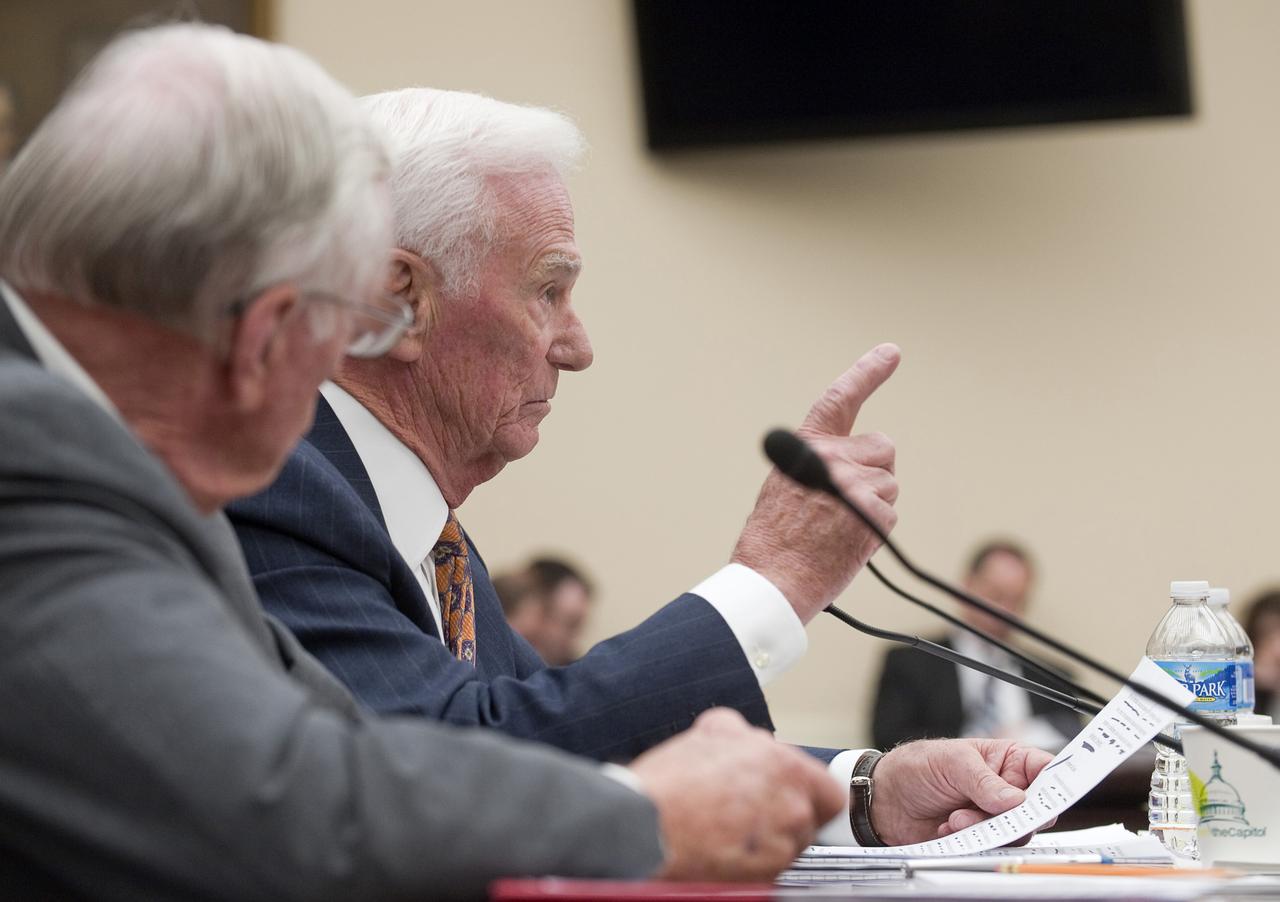
Retired Navy Captain and commander of Apollo 17 Eugene Cernan, center, testifies during a hearing before the House Science and Technology Committee, Tuesday, May 26, 2010, at the Rayburn House office building on Capitol Hill in Washington as Apollo 11 Commander Neil Armstrong, left, looks on. The hearing was to review proposed human spaceflight plan by NASA. Photo Credit: (NASA/Paul E. Alers)
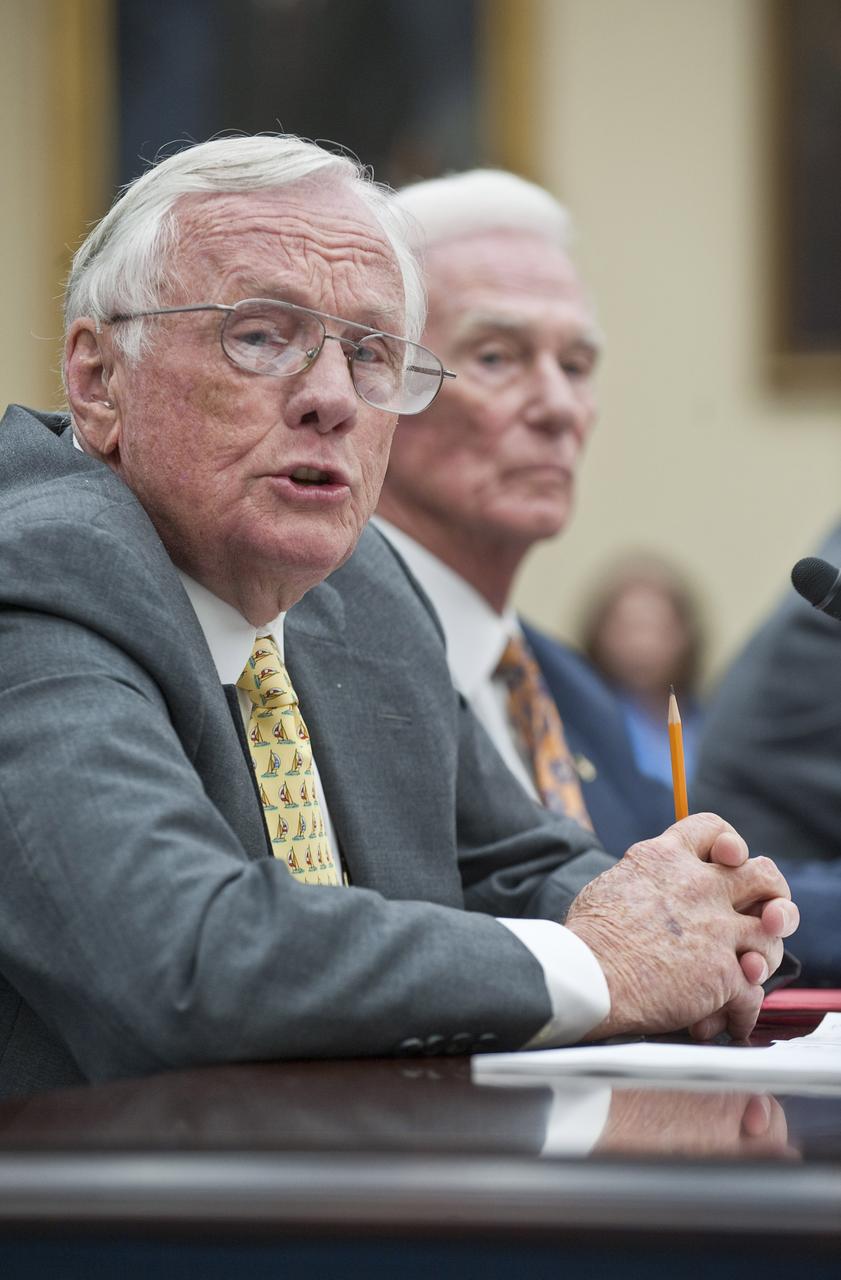
Apollo 11 Commander Neil Armstrong, left, testifies during a hearing before the House Science and Technology Committee, Tuesday, May 26, 2010, at the Rayburn House office building on Capitol Hill in Washington as retired Navy Captain and commander of Apollo 17 Eugene Cernan looks on. The hearing was to review proposed human spaceflight plan by NASA. Photo Credit: (NASA/Paul E. Alers)
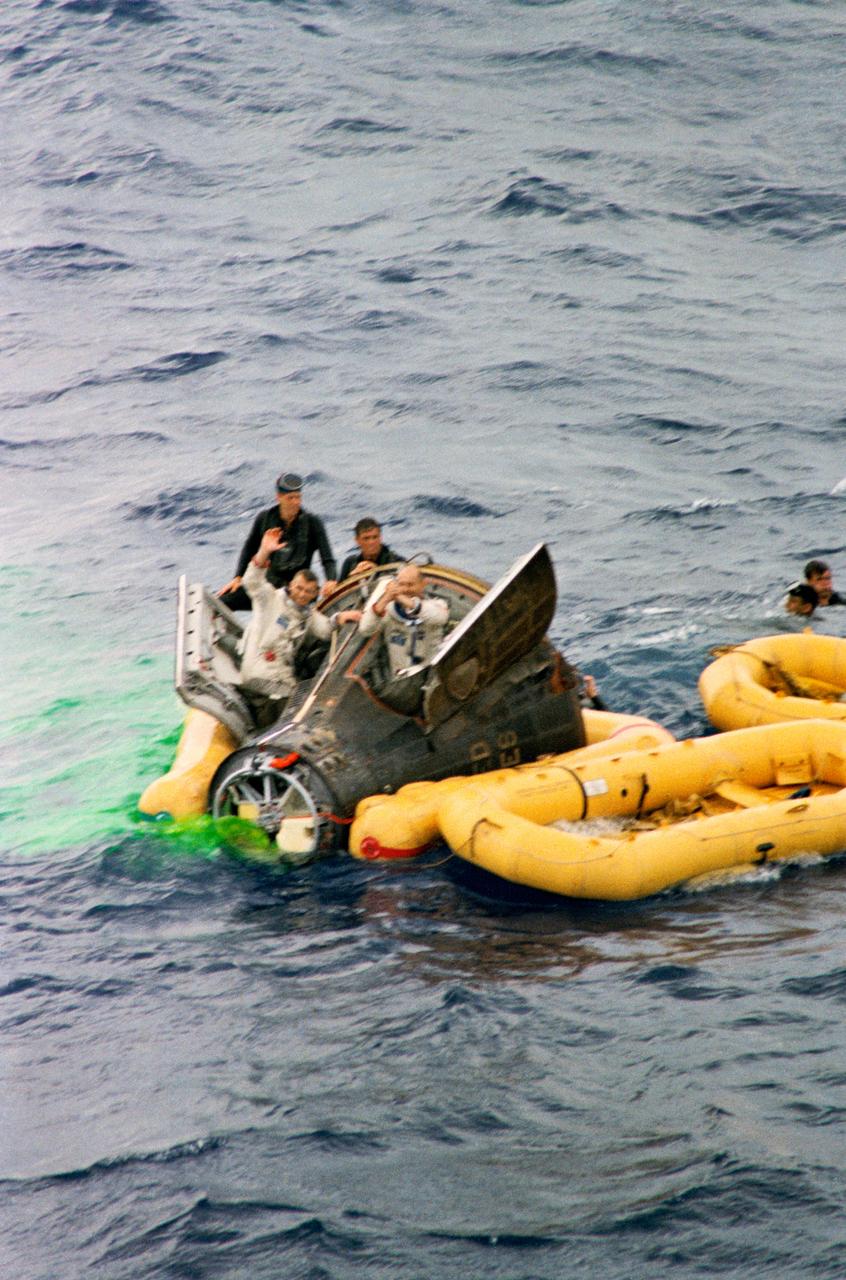
S66-34110 (6 June 1966) --- Astronauts Thomas Stafford (right) and Eugene Cernan wave to those aboard the aircraft carrier USS Wasp as the recovery ship approaches. U.S. Navy frogmen assist in the recovery operations. Gemini-9A splashed down in the Atlantic Ocean only 3.5 miles from the USS Wasp. Gemini-9 splashed down 345 miles east of Cape Kennedy at 9 a.m. (EST), June 6, 1966. Photo credit: NASA
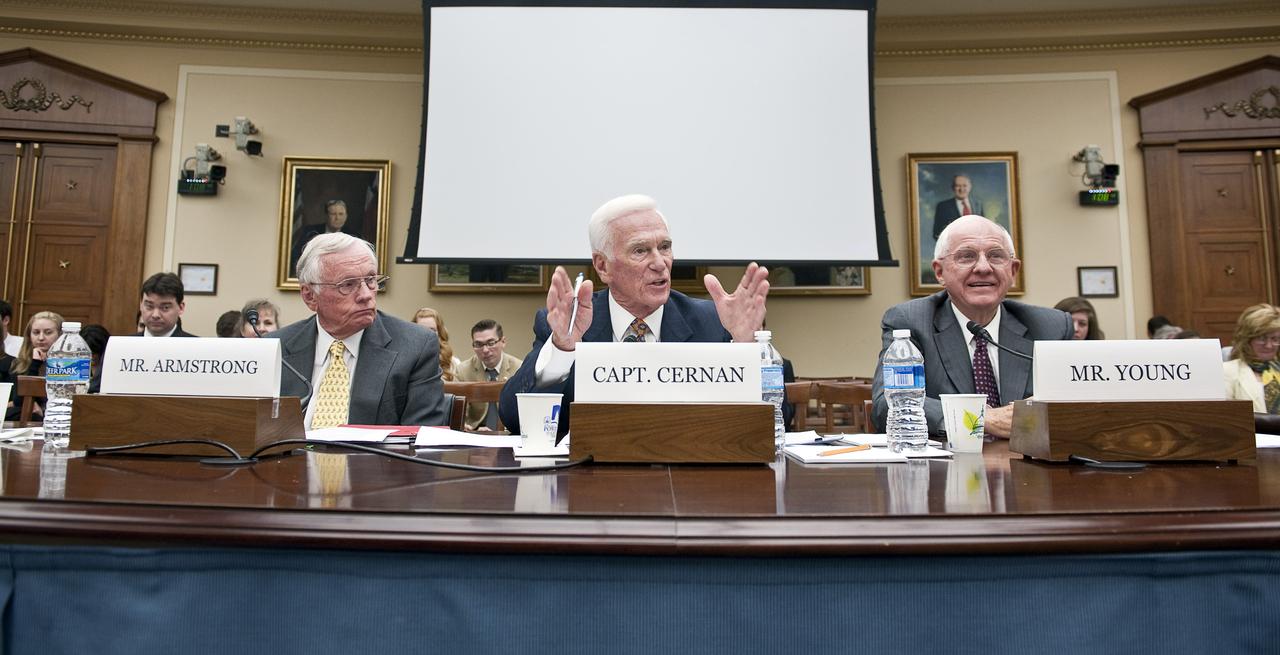
Retired Navy Captain and commander of Apollo 17 Eugene Cernan, center, is flanked by Apollo 11 Commander Neil Armstrong, left, and A. Thomas Young, as he testifies during a hearing before the House Science and Technology Committee, Tuesday, May 26, 2010, at the Rayburn House office building on Capitol Hill in Washington. The hearing was to review proposed human spaceflight plan by NASA. Photo Credit: (NASA/Paul E. Alers)
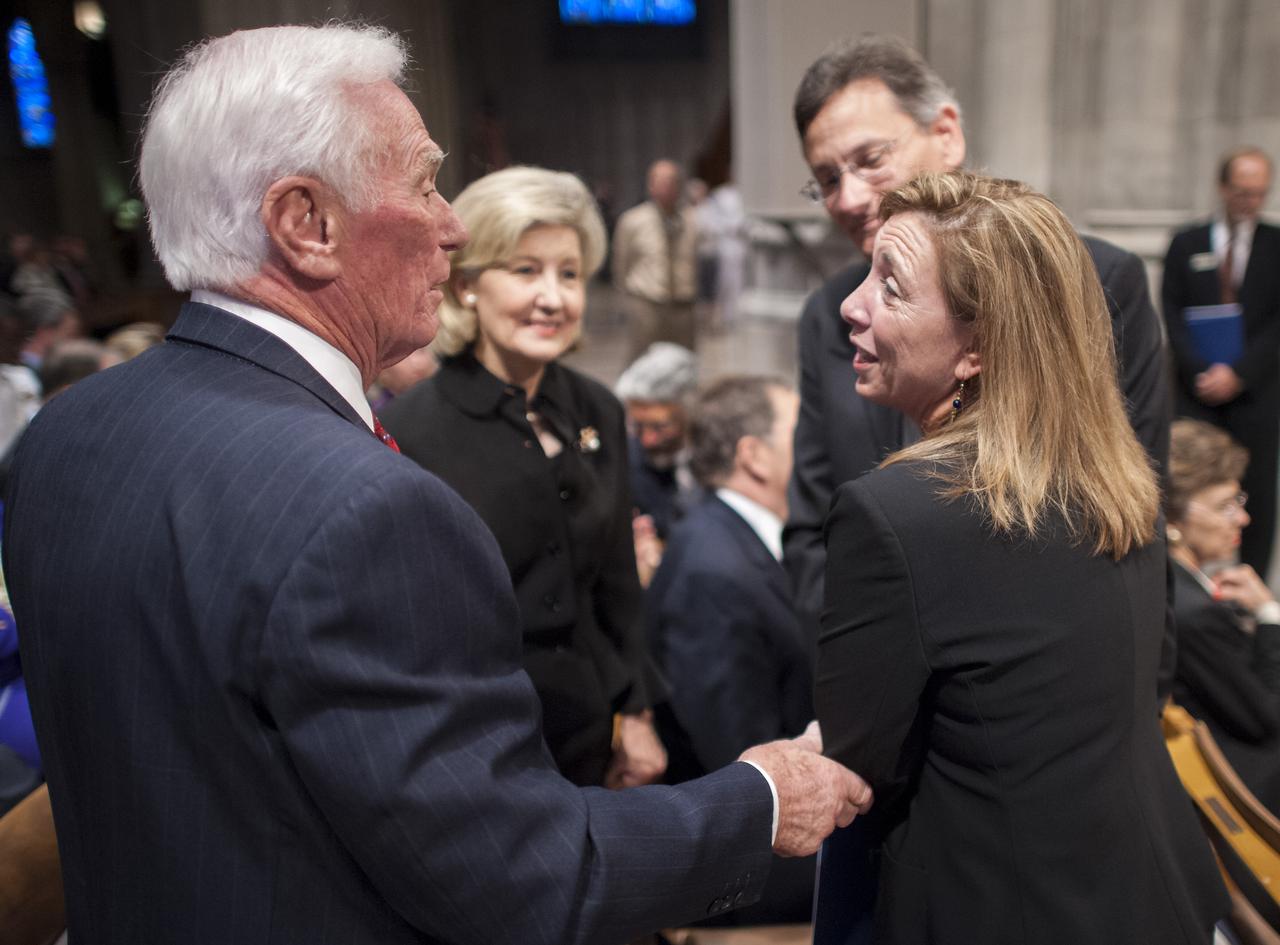
NASA Deputy Administrator Lori Garver, right, shares a moment with Apollo 17 mission commander Gene Cernan, the last man to walk on the moon, left, as U.S. Sen. Kay Bailey Hutchison, R-Texas, center looks on prior to a memorial service celebrating the life of Neil Armstrong, Thursday, Sept. 13, 2012, at the Washington National Cathedral. Armstrong, the first man to walk on the moon during the 1969 Apollo 11 mission, died Saturday, Aug. 25. He was 82. Photo Credit: (NASA/Bill Ingalls)
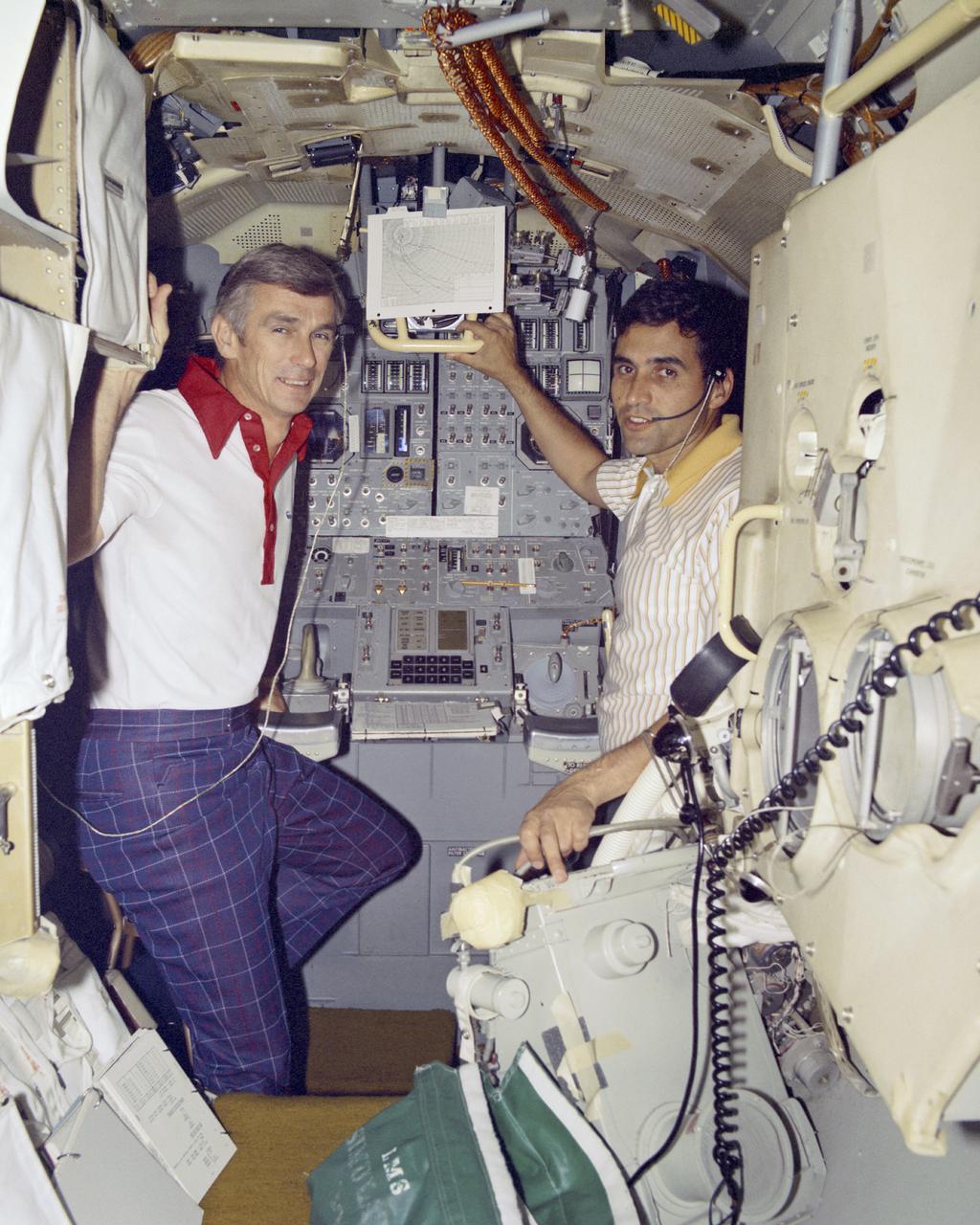
Apollo 17 Mission Commander Eugene A Cernan, a Navy Captain, and Lunar Module Pilot Dr. Harrison H. Schmitt, civilian scientist-astronaut, at right, familiarize themselves with equipment used in the Lunar Module in which they will descend to the lunar surface during December. Cernan and Dr. Schmitt are undergoing pre-launch training in the lunar Module Simulator at the Flight Crew Training Building at the Space Center. Navy Commander Ronald E. Evans, Command Module Pilot, will accompany Cernan and Schmitt on the mission.
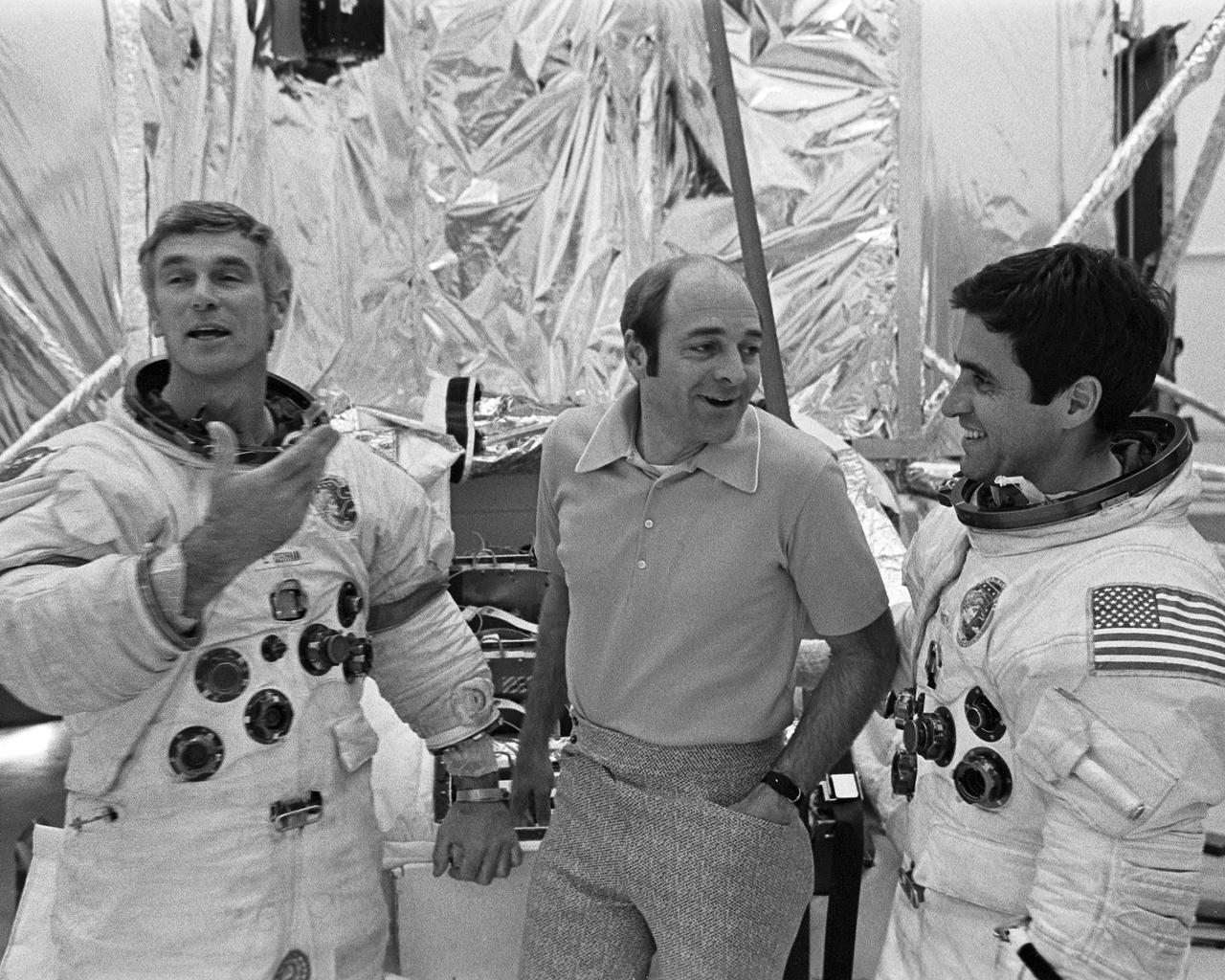
Apollo 17 Mission Commander Eugene A. Cernan, left, jokes with crewmates Ronald E. Evans, center, and Harrison H. Schmitt following training exercises today at the Florida Spaceport. Cernan and Schmitt practiced aspects of their upcoming mission in the full-scale Lunar Module Spacecraft mockup, shown in rear.
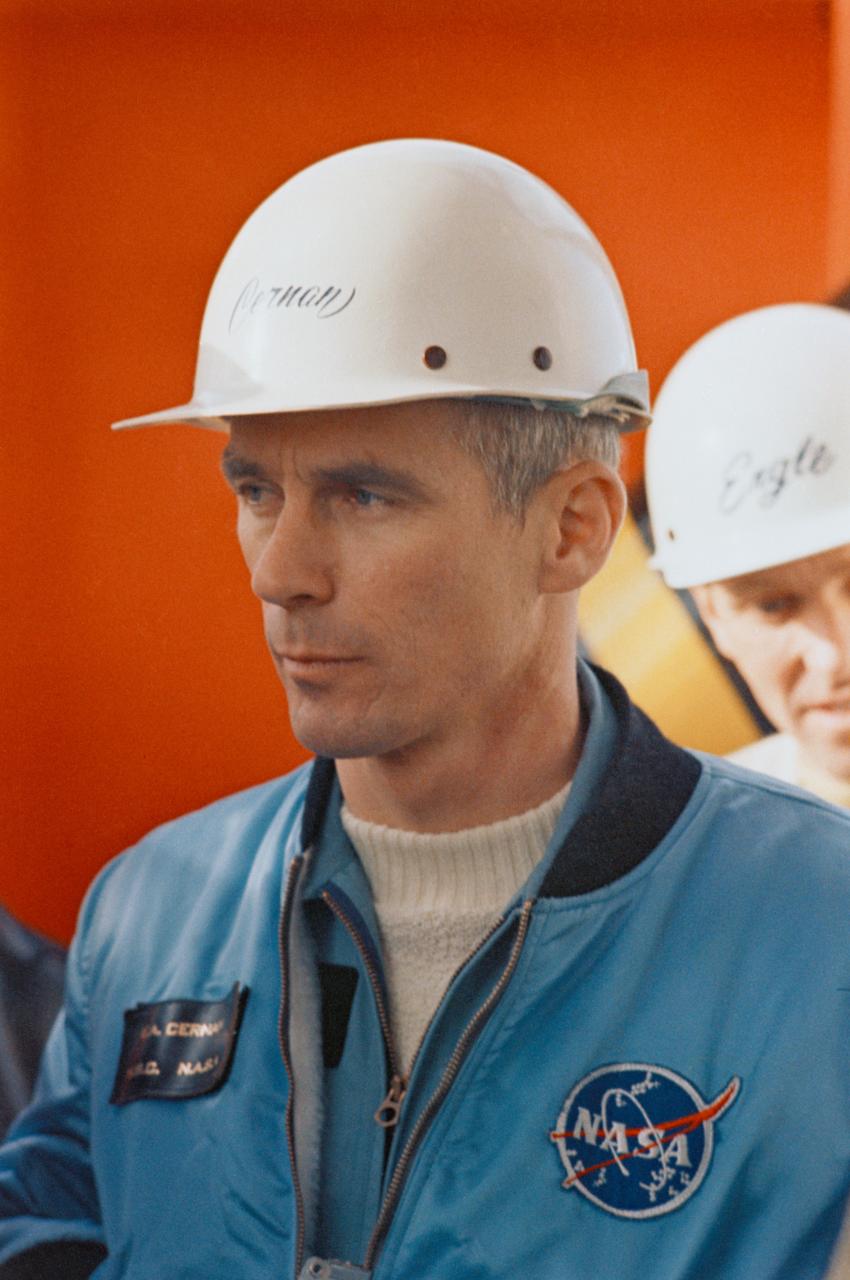
S69-30251 (27 March 1969) --- Astronaut Eugene A. Cernan, wearing a protective hat, participates in pad egress training at the Kennedy Space Center's Pad 39B during preparations for the scheduled Apollo 10 lunar orbit mission. Cernan is the Apollo 10 lunar module pilot.
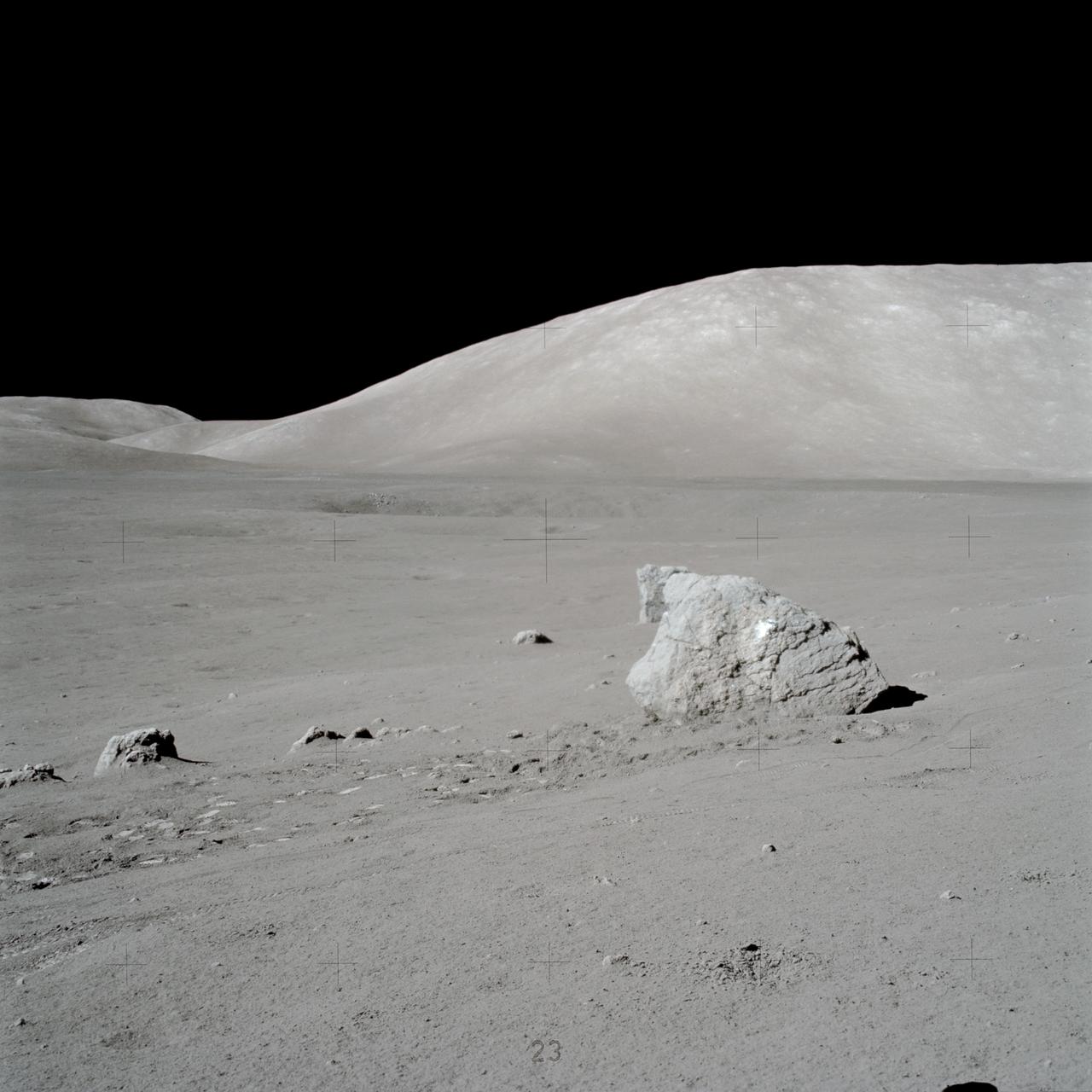
AS17-146-22351 (7-19 Dec. 1972) --- This view, photographed by astronaut Eugene A. Cernan, shows a large boulder which was discovered by astronauts Cernan and Harrison H. Schmitt during one of their space walks. The astronauts later pointed out light clasts on the boulder. South Massif is in the background. Tracks left by the Lunar Roving Vehicle (LRV) can be seen near foreground. While astronauts Cernan, commander, and Schmitt, lunar module pilot, descended in the Lunar Module (LM) "Challenger" to explore the Taurus-Littrow region of the moon, astronaut Ronald E. Evans, command module pilot, remained with the Command and Service Modules (CSM) "America" in lunar orbit.
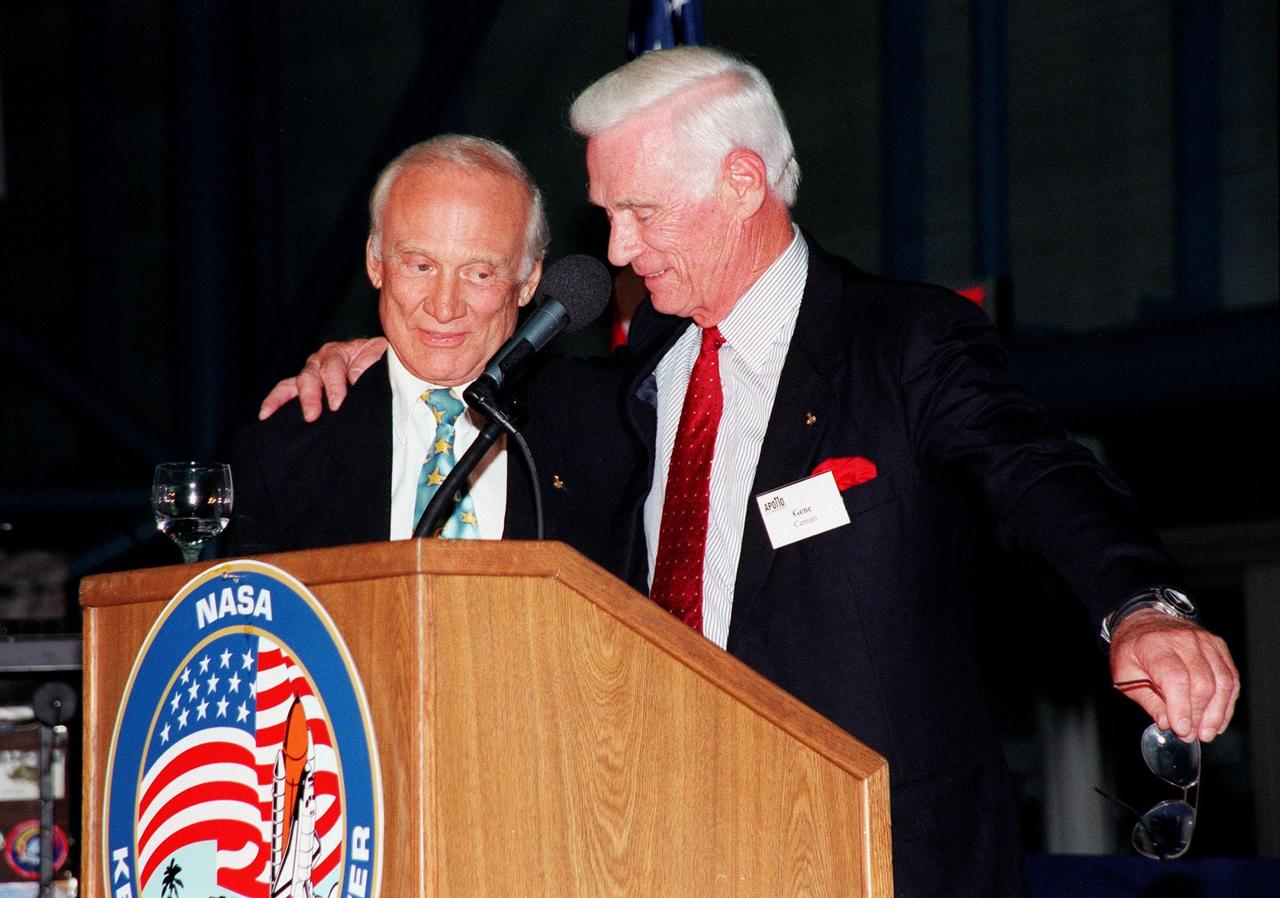
KENNEDY SPACE CENTER, FLA. -- Former Apollo astronauts Edwin "Buzz" Aldrin (left) and Gene Cernan share stories about their missions for an audience attending an anniversary banquet honoring the Apollo program team, the people who made the entire lunar landing program possible. The banquet was held in the Apollo/Saturn V Center, part of the KSC Visitor Complex. This is the 30th anniversary of the Apollo 11 launch and moon landing, July 16 and July 20, 1969. Other guests at the banquet were astronauts Wally Schirra, Gene Cernan and Walt Cunningham. Neil Armstrong was the first man to walk on the moon; Gene Cernan was the last
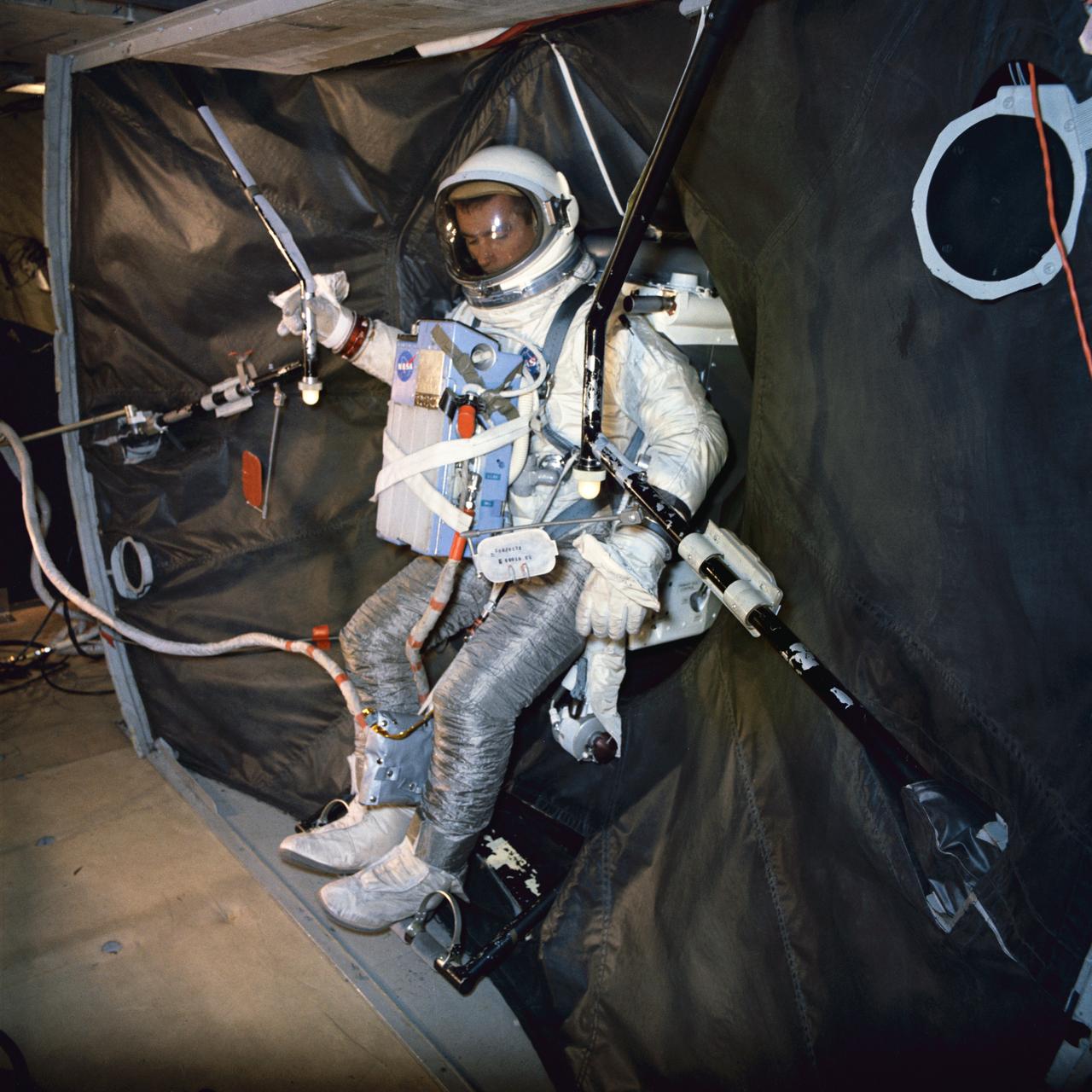
S66-31665 (3 May 1966) --- Astronaut Eugene A. Cernan, pilot of the Gemini-9 spaceflight, participates in extravehicular training under zero-gravity conditions aboard a KC-135 aircraft. Here, he is donning the Astronaut Maneuvering Unit (AMU) backpack after egressing a Gemini mock-up. The AMU backpack is mounted in the adapter equipment section of the mock-up. Cernan wears an extravehicular activity (EVA) life support system chest pack. Cernan will use the AMU during his scheduled EVA on the Gemini-9 mission. The KC-135 flew a parabolic curve to create the weightlessness condition for training purposes. Photo credit: NASA
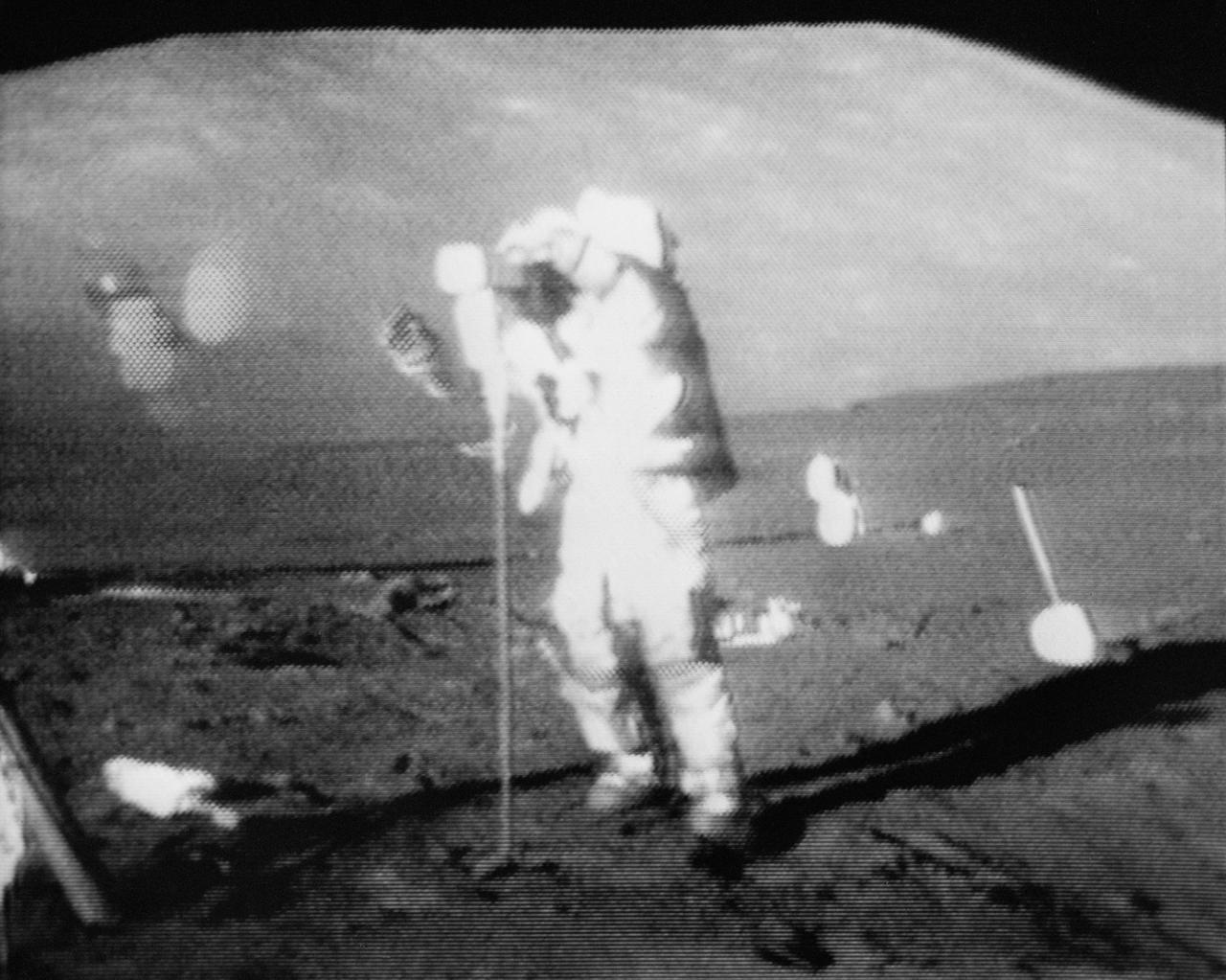
S72-55064 (11 Dec. 1972) --- Astronaut Eugene A. Cernan operates the Apollo Lunar Surface Drill during the first Apollo 17 extravehicular activity (EVA) at the Taurus-Littrow landing site, in this black and white reproduction taken from a color television transmission made by the RCA color TV camera mounted on the Lunar Roving Vehicle. Cernan is the commander of the Apollo 17 lunar landing mission. Astronaut Ronald E. Evans, command module pilot, remained with the Apollo 17 Command and Service Modules in lunar orbit while astronaut Cernan and scientist-astronaut Harrison H. Schmitt, lunar module pilot, descended in the Lunar Module to explore the moon.
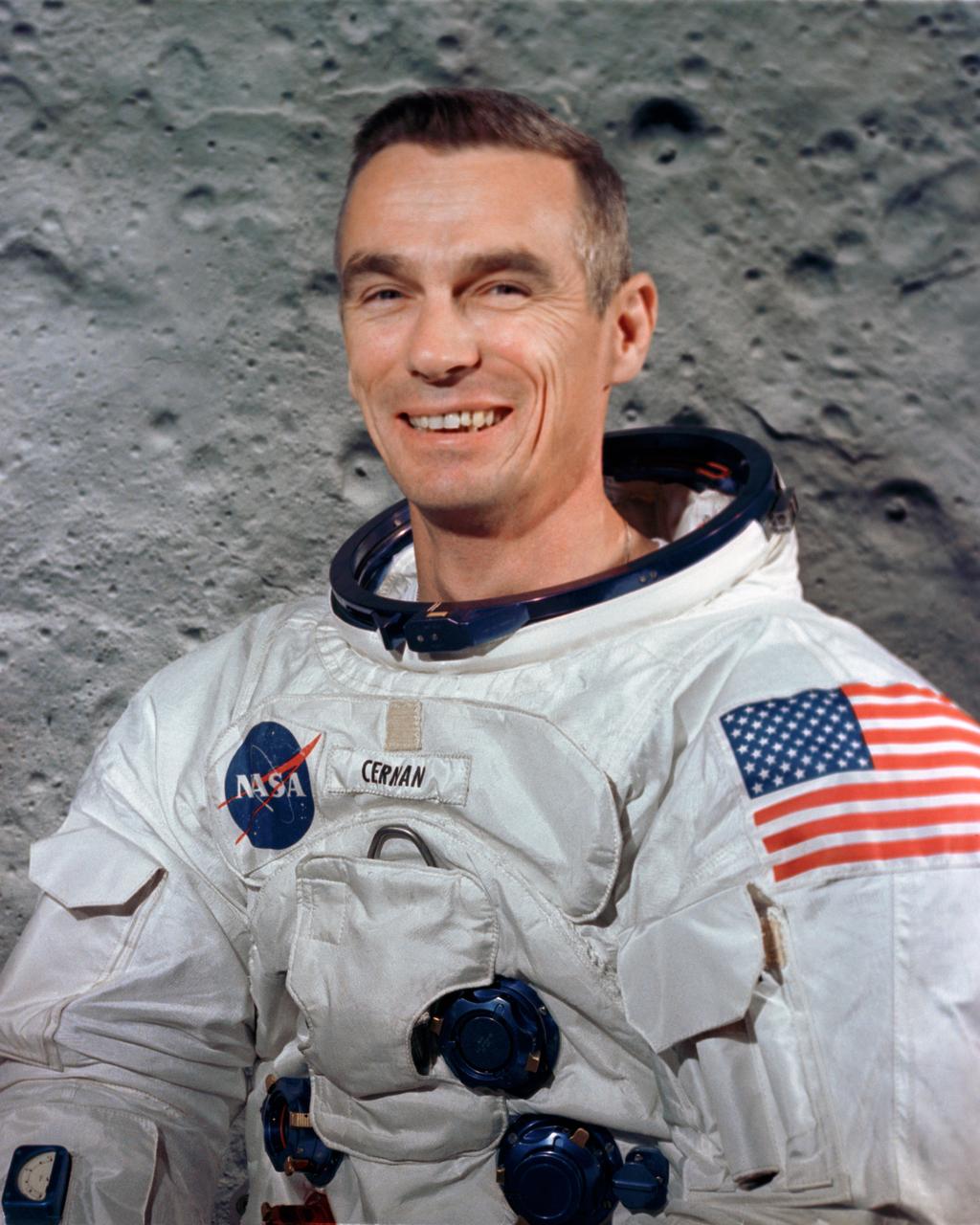
S69-32614 (April 1969) --- Astronaut Eugene A. Cernan, prime crew lunar module pilot of the Apollo 10 lunar orbit mission.
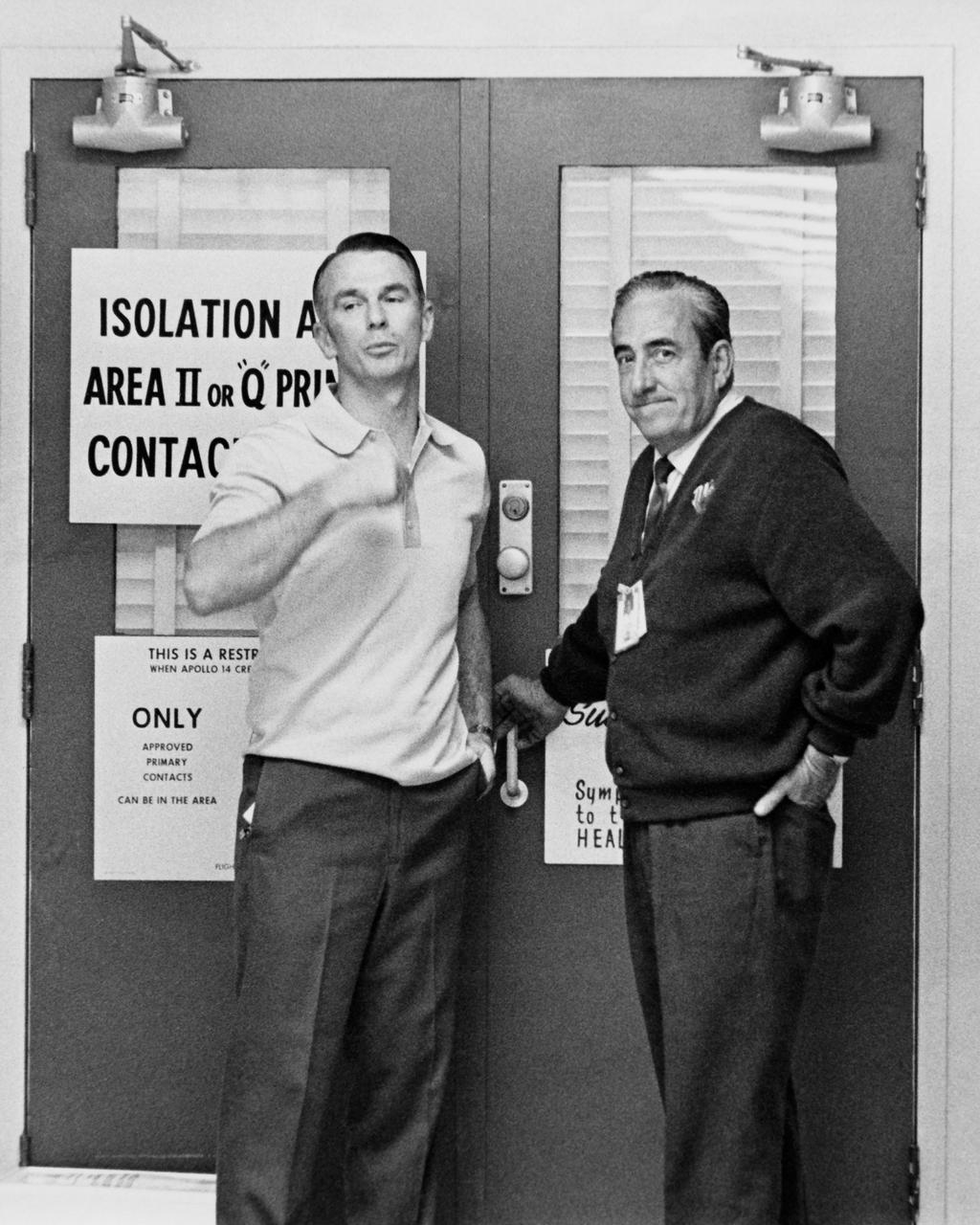
CAPE CANAVERAL, Fla. – Astronaut Gene Cernan, left, stands outside the Astronaut Crew Quarters on Jan. 26, 1971. Photo credit: NASA
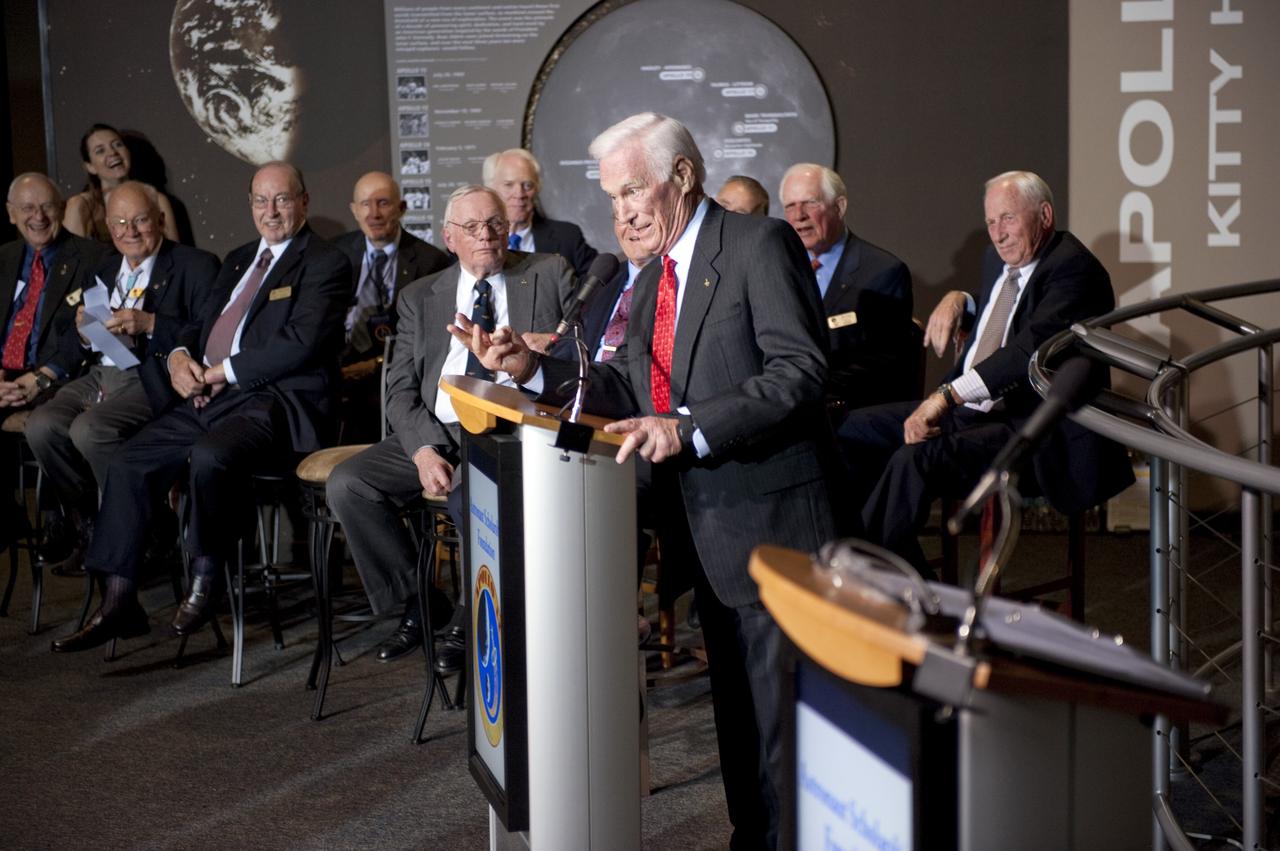
CAPE CANAVERAL, Fla. -- Lunar module pilot of Apollo 10 and commander of Apollo 17 Gene Cernan talks to attendees of the Apollo 14 Anniversary Soirée at the Kennedy Space Center Visitor Complex's Saturn V Center. The celebration was hosted by the Astronaut Scholarship Foundation. Apollo 14 landed on the lunar surface 40 years ago on Feb. 5, 1971. Cernan was the backup commander for the Apollo 14 mission. Photo credit: NASA/Kim Shiflett
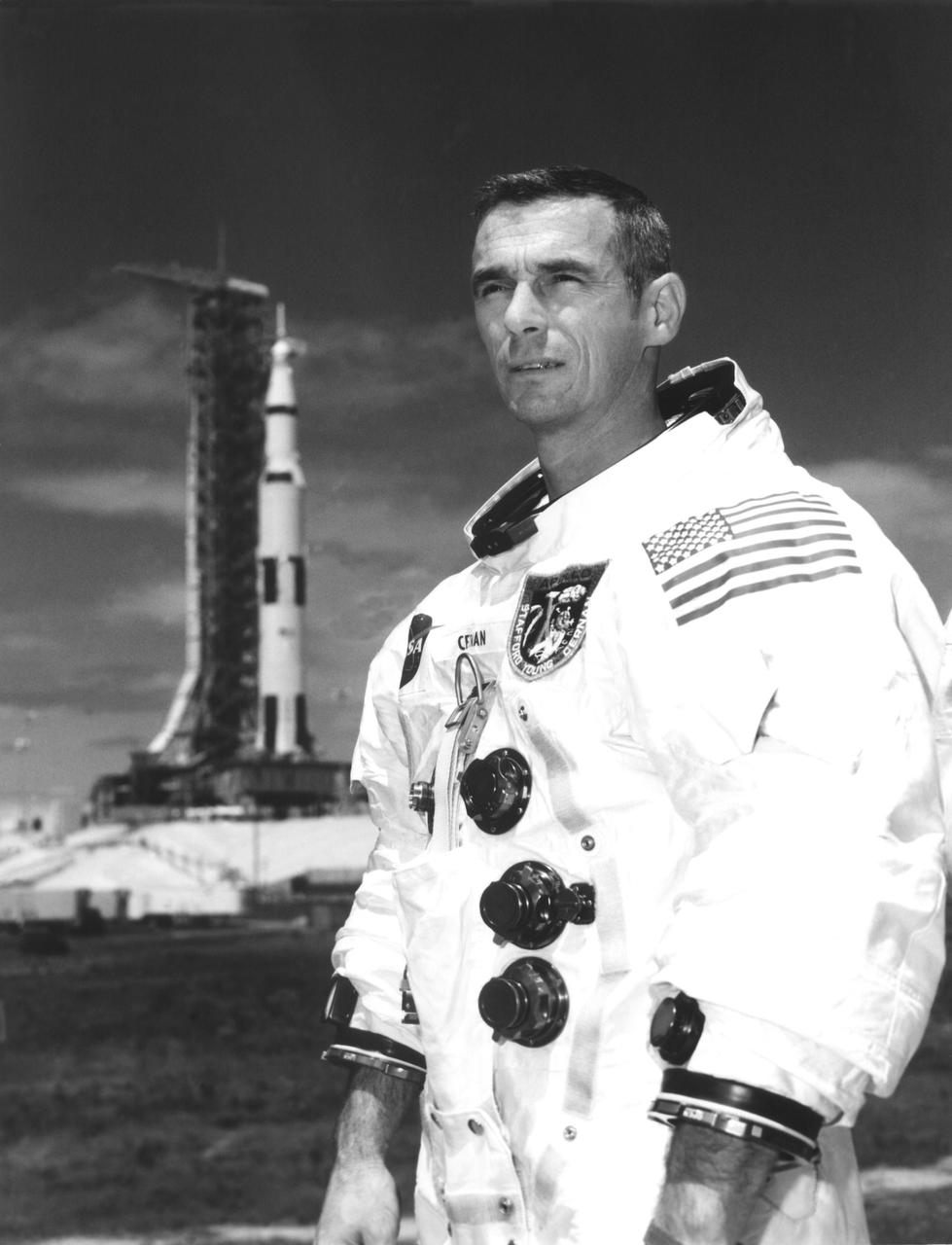
KENNEDY SPACE CENTER, FLA. -- Astronaut Eugene A. Cernan is lunar module pilot for the Apollo 10 lunar orbit mission scheduled for launch from KSC on May 18. Cernan and Apollo 10 commander Thomas P. Stafford will detach the lunar module from the command_service module and drop to within 10 miles of the lunar surface before rejoining John W. Young, command module pilot, in the parent spacecraft.
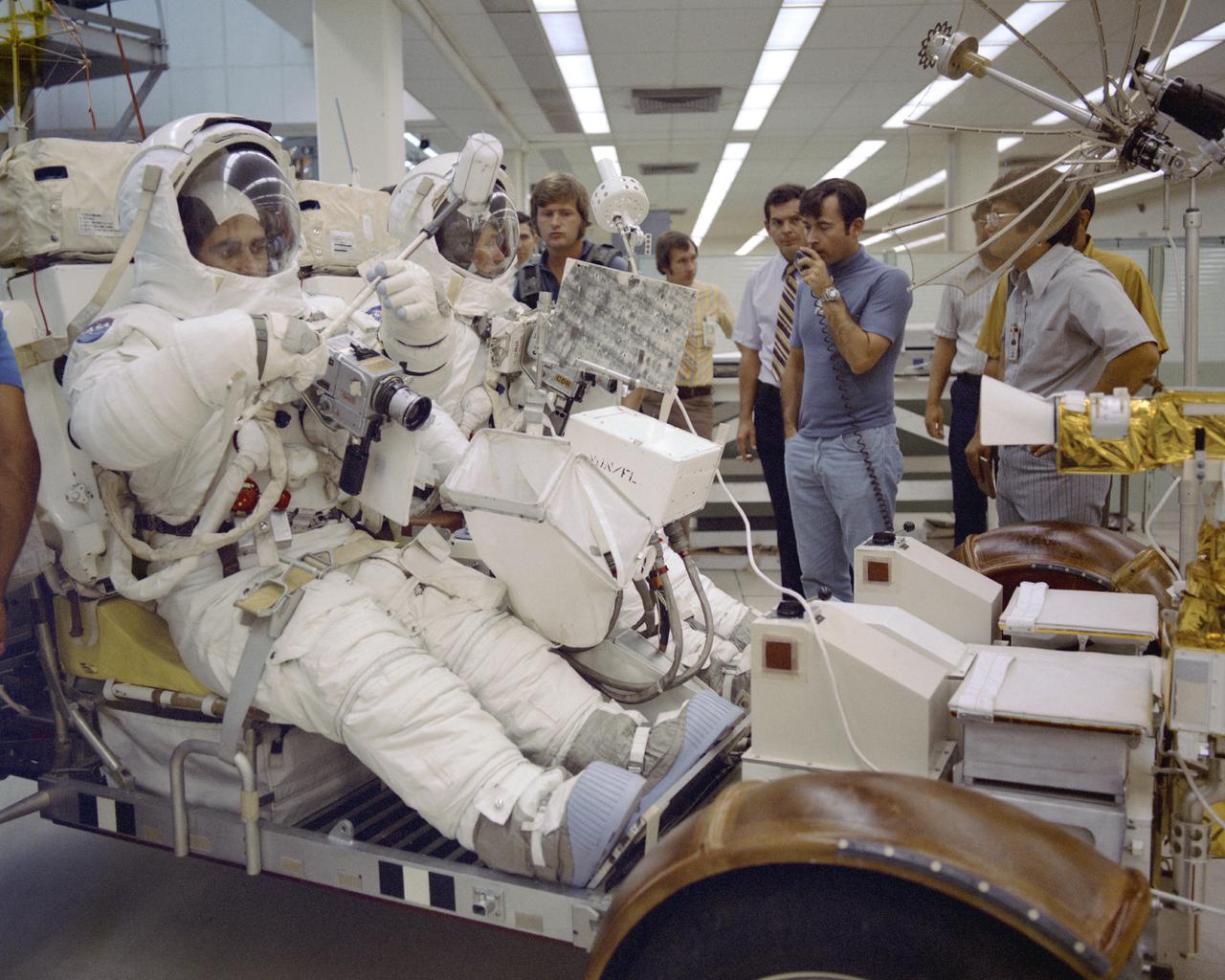
CAPE CANAVERAL, Fla. -- Apollo 17 Backup Mission Commander John W. Young, in dark shirt, speaks to suited prime crew astronauts Harrison H. Schmitt, left, and Eugene A. Cernan, who are seated in the Lunar Rover training vehicle, Cernan and Schmitt will be launched to the Moon with Command Module Pilot Ronald E. Evans no earlier than December 6, 1972. Photo credit: NASA
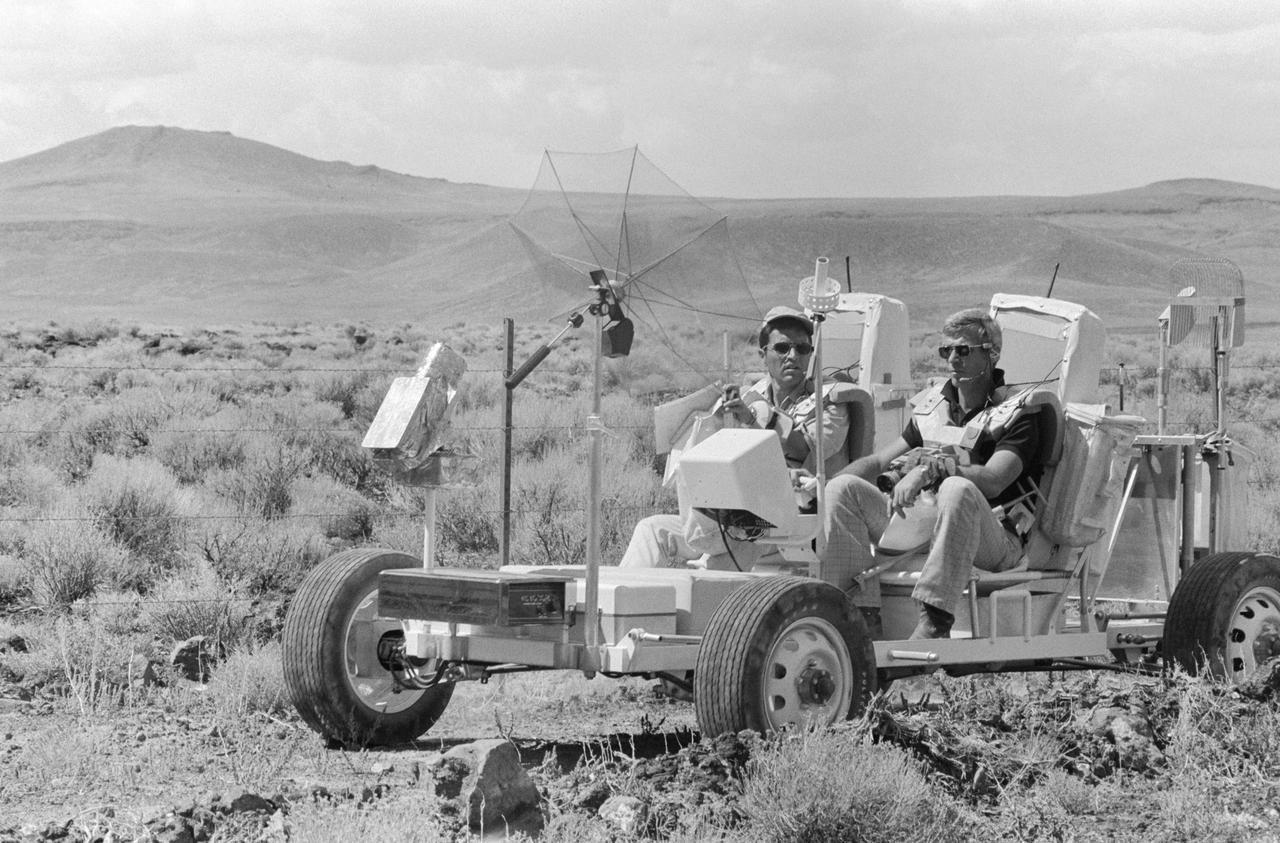
S72-48864 (6 Sept. 1972) --- Two members of the prime crew of the Apollo 17 lunar landing mission ride in a Lunar Roving Vehicle trainer during lunar surface extravehicular activity simulation training in the Pancake Range area of south-central Nevada. They are astronaut Eugene A. Cernan (foreground), commander; and scientist-astronaut Harrison H. Schmitt (on Cernan’s right), lunar module pilot.
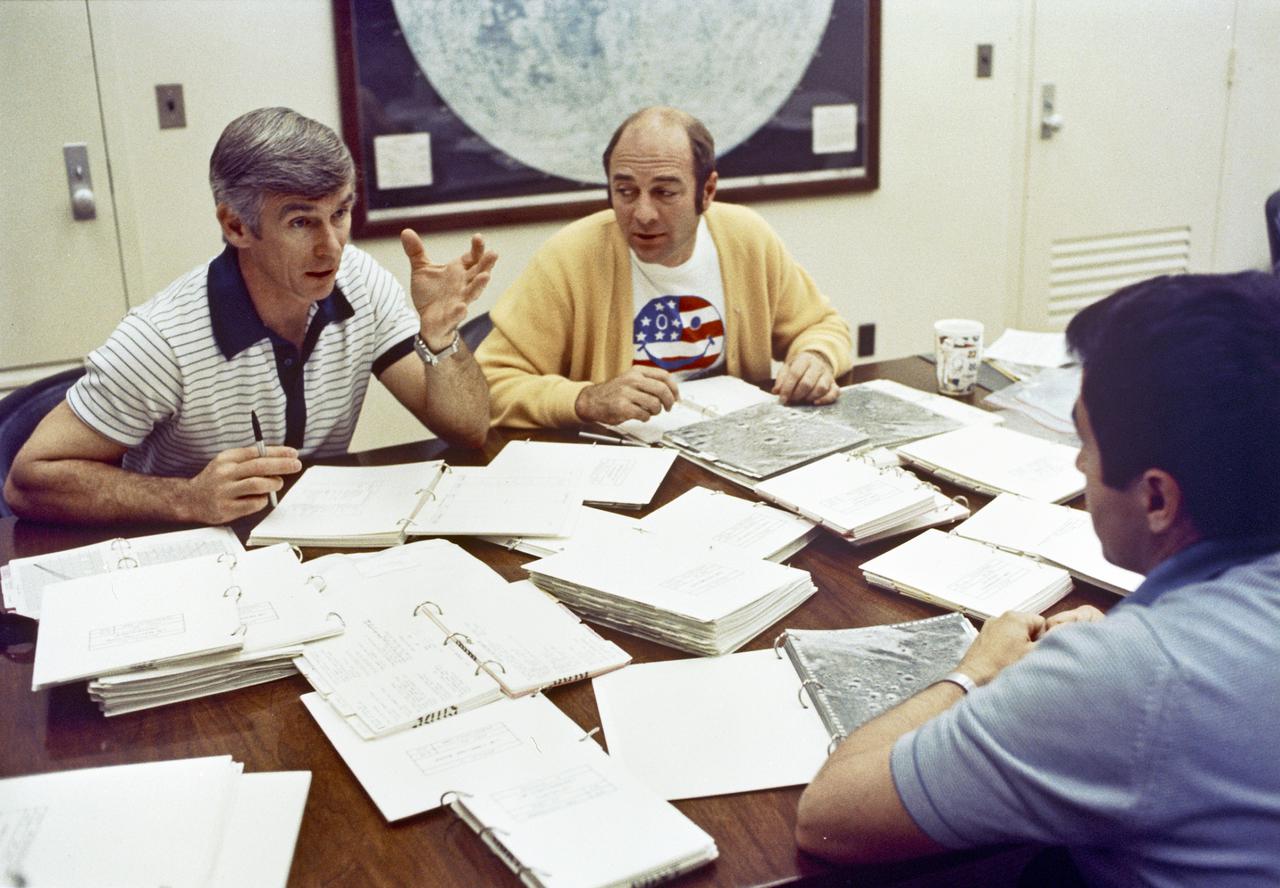
Apollo 17 Mission commander Eugene A. Cernan, left, reviews flight plan with crewmates Ronald E. Evans, center, and Harrison H. Schmitt in the astronaut's quarters. Evans will pilot the command module alone in lunar orbit while Cernan and Lunar Module Pilot Schmitt explore the Taurus-Littrow region of the Moon's surface. The launch of Apollo 17 is scheduled for December 6, 1972 at 9:53 p.m.
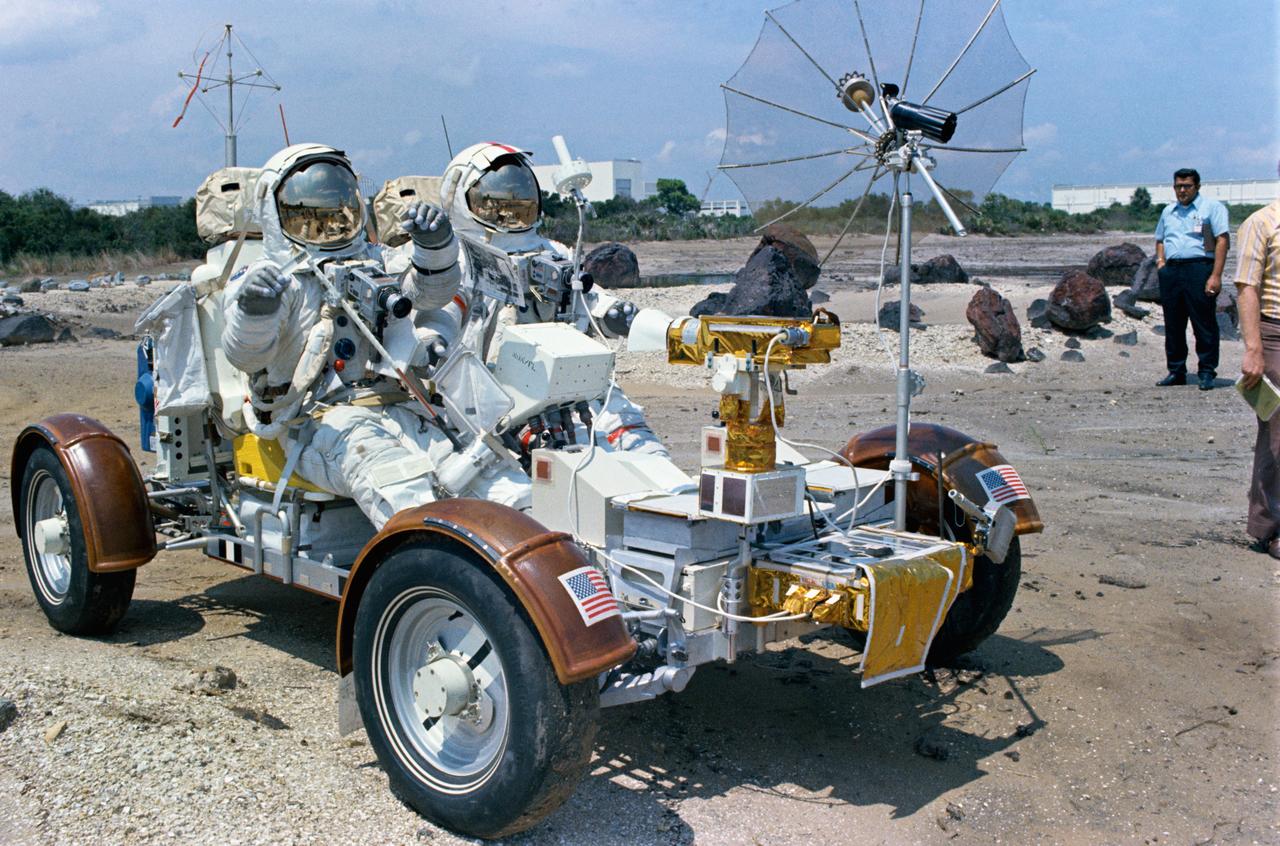
S72-48892 (September 1972) --- Two members of the prime crew of the Apollo 17 lunar landing mission ride in a Lunar Roving Vehicle trainer during lunar surface extravehicular activity simulation training at the Kennedy Space Center (KSC), Florida. Astronaut Eugene A. Cernan, commander, is seated in the left-hand seat. Scientist-astronaut Harrison H. Schmitt, lunar module pilot, is on Cernan's right.
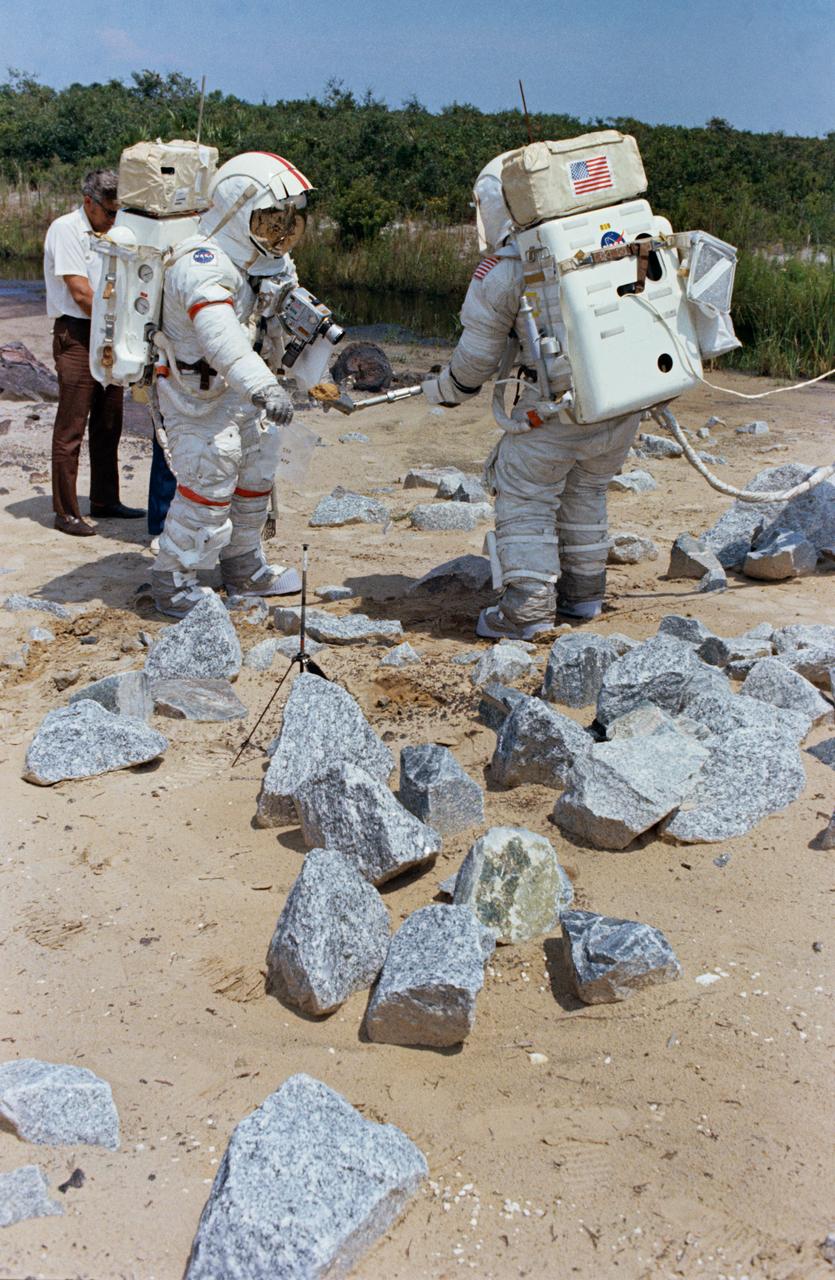
S72-48888 (September 1972) --- Astronaut Eugene A. Cernan (left), commander, and scientist-astronaut Harrison H. Schmitt, lunar module pilot, simulate collecting lunar samples during extravehicular activity training at the Kennedy Space Center, Florida. Astronauts Cernan, Schmitt, and Ronald E. Evans, command module pilot, are the prime crewmen of the Apollo 17 lunar landing mission.
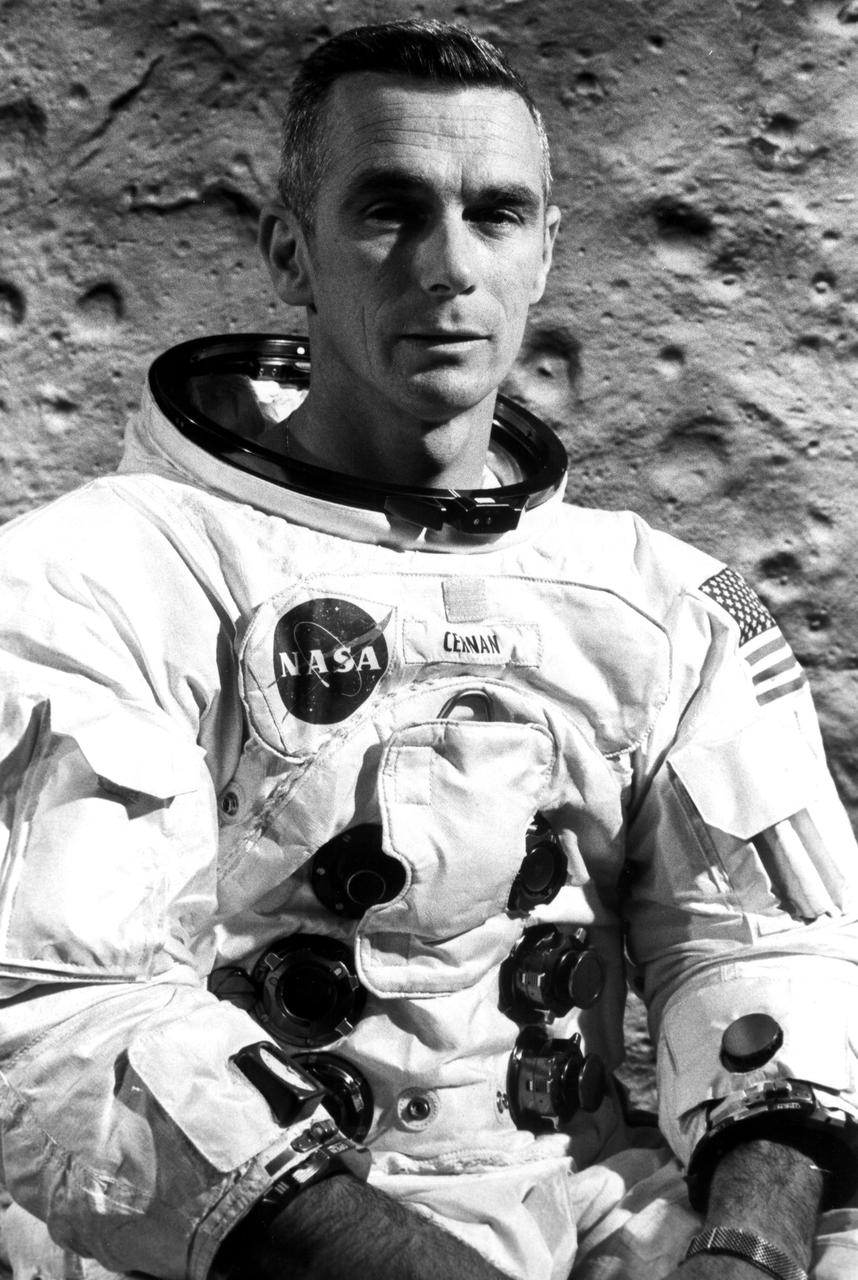
KENNEDY SPACE CENTER, FLA. -- Astronaut Eugene A. Cernan is lunar module pilot for Apollo 10, scheduled for launch from the nation's spaceport on May 18. Cernan and Apollo 10 Commander Thomas P. Stafford are to detach the lunar module after the spacecraft enters lunar orbit and drop down to within 10 miles of the Moon's pockmarked surface before rejoining John W. Young, command module pilot, orbiting the Moon in the command_service module. The Apollo 10 mission is a dress rehearsal for a manned lunar landing later this year.
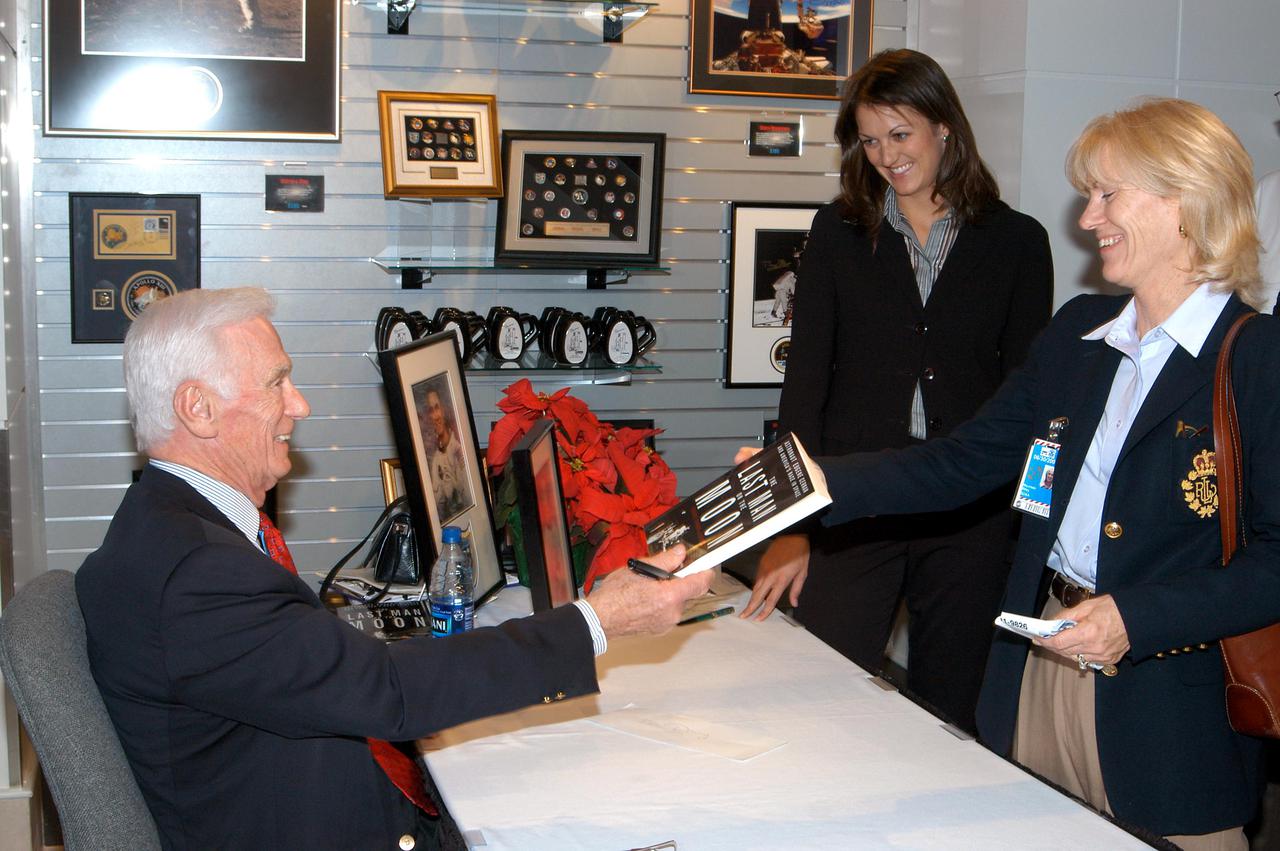
KENNEDY SPACE CENTER, FLA. - Apollo 17 Commander Gene Cernan autographs his book for attendees at the grand opening ceremony of new Kennedy Space Center Store at Orlando International Airport. NASA’s Kennedy Space Center Director Jim Kennedy and Cernan participated in the grand opening ceremony. The store will help educate millions of airport visitors about America’s space program and the Vision for Space Exploration. The store is operated by Kennedy Space Center Visitor Complex concessionaire Delaware North Parks and Resorts.
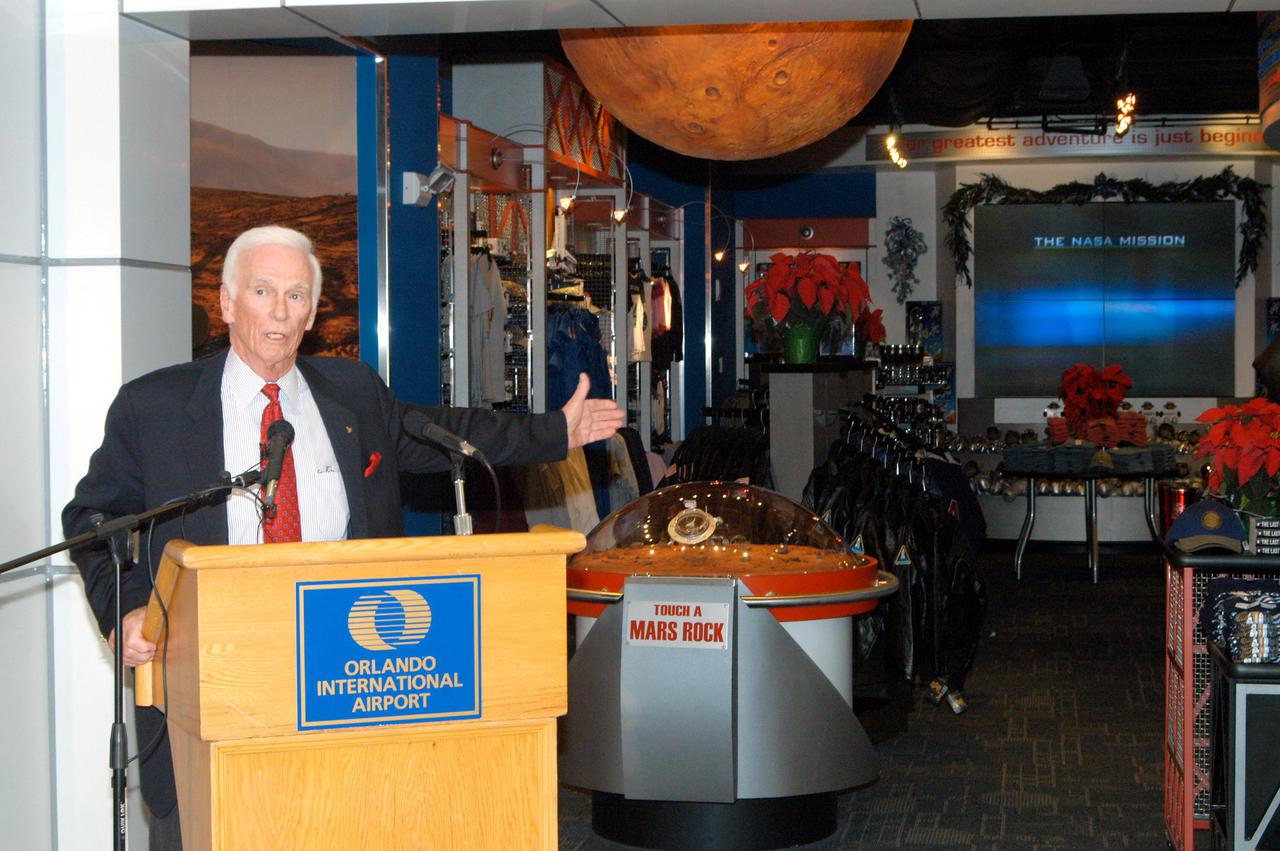
KENNEDY SPACE CENTER, FLA. - Apollo 17 Commander Gene Cernan talks about some of the exhibits in the new Kennedy Space Center Store at Orlando International Airport. NASA’s Kennedy Space Center Director Jim Kennedy and Cernan participated in the grand opening ceremony. The store will help educate millions of airport visitors about America’s space program and the Vision for Space Exploration. The store is operated by Kennedy Space Center Visitor Complex concessionaire Delaware North Parks and Resorts.
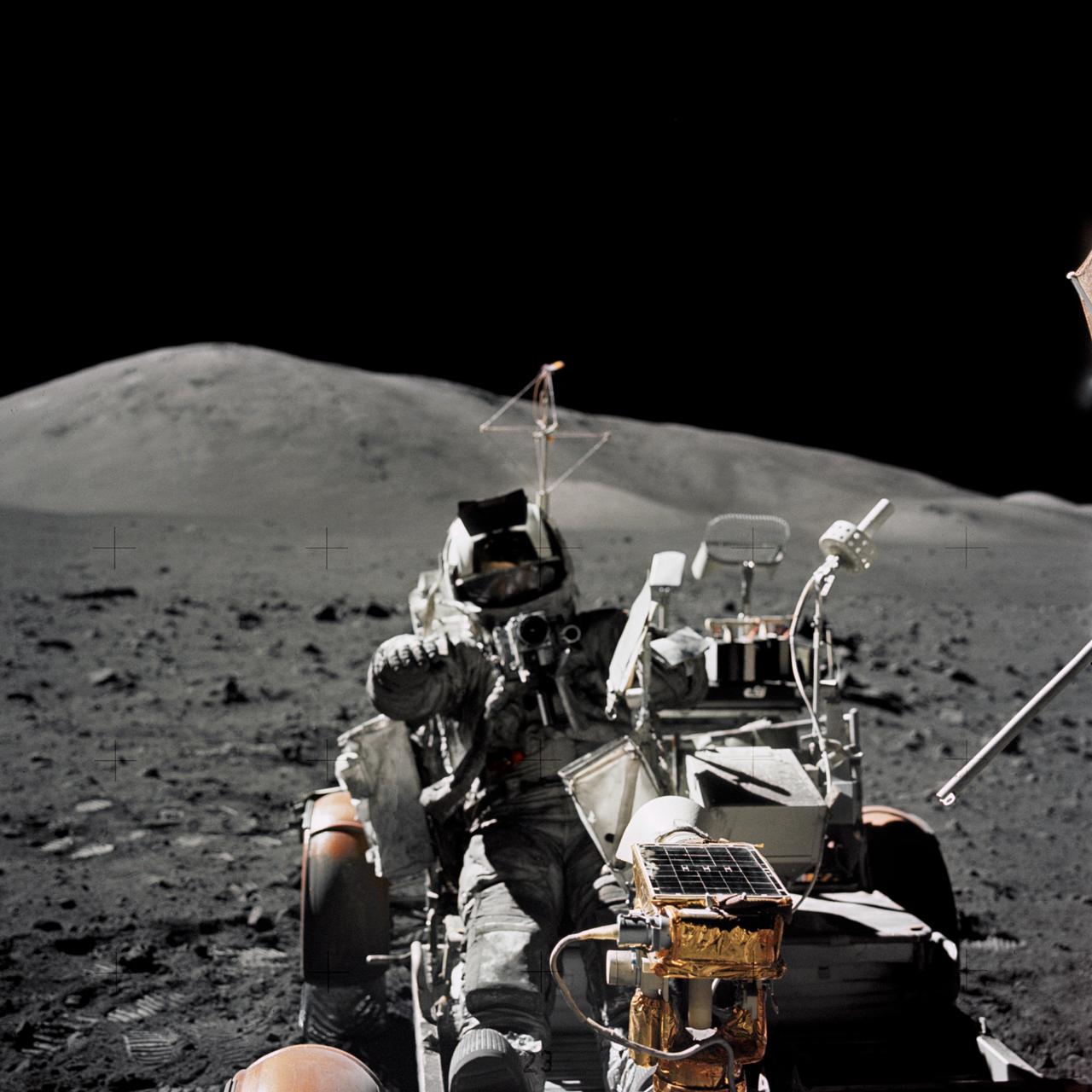
AS17-134-20454 (13 Dec. 1972) --- Scientist-astronaut Harrison H. Schmitt is photographed seated in the Lunar Roving Vehicle (LRV) at Station 9 (Van Serg Crater) during the third Apollo 17 extravehicular activity (EVA) at the Taurus-Littrow landing site. This photograph was taken by astronaut Eugene A. Cernan, commander. Schmitt, lunar module pilot, and Cernan explored the moon while astronaut Ronald E. Evans, command module pilot, remained with the Command and Service Modules in lunar orbit.
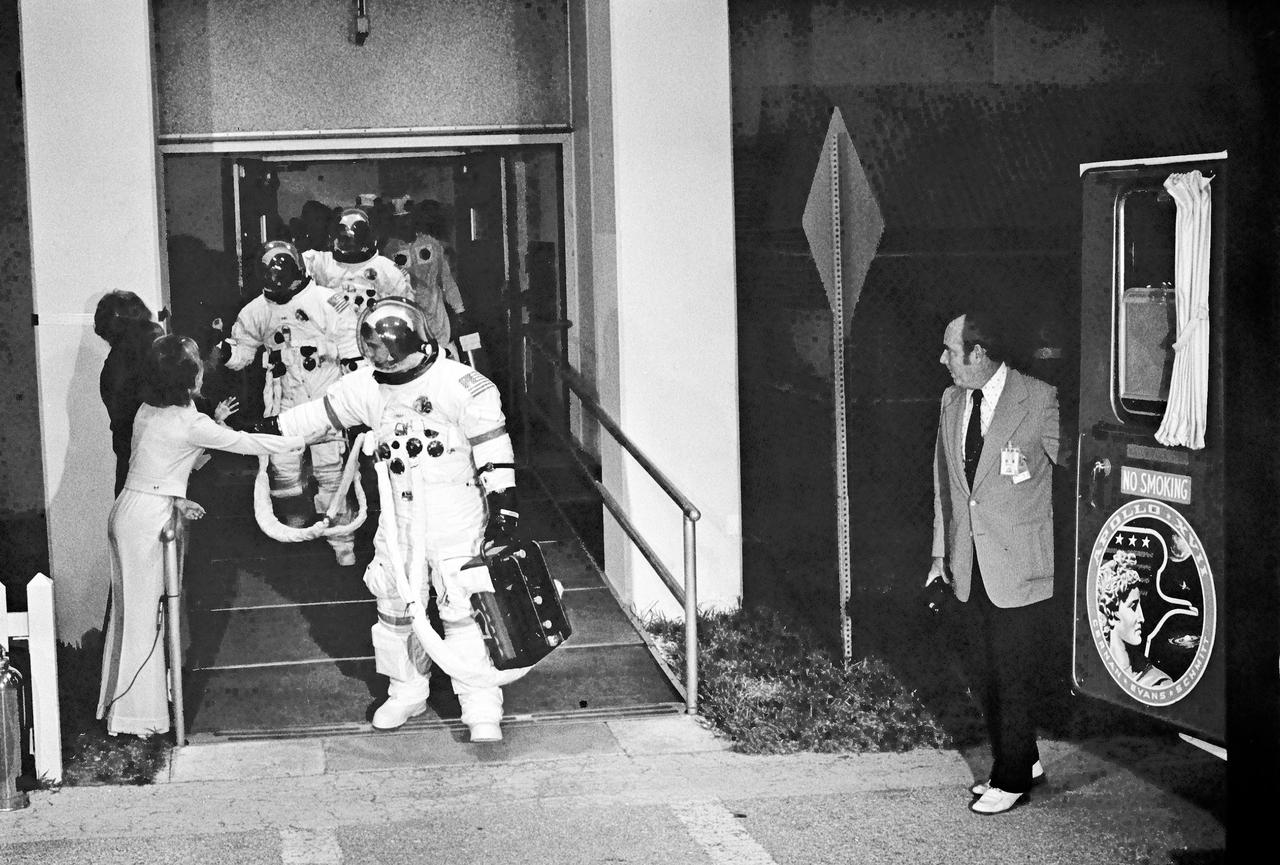
Leaving the Manned Spacecraft Operations Building enroute to the launch pad. Apollo 17 Mission Commander Eugene A. Cernan greets Mrs. Jan Evans, wife of Command module Pilot Ronald E. Evans, shown in background shaking hand with Cernan's wife Barbara. Further in the background is lunar Module Pilot Harrison H. Schmitt. At the right, next to the transfer van is Charles Buckley KSC Security Chief.
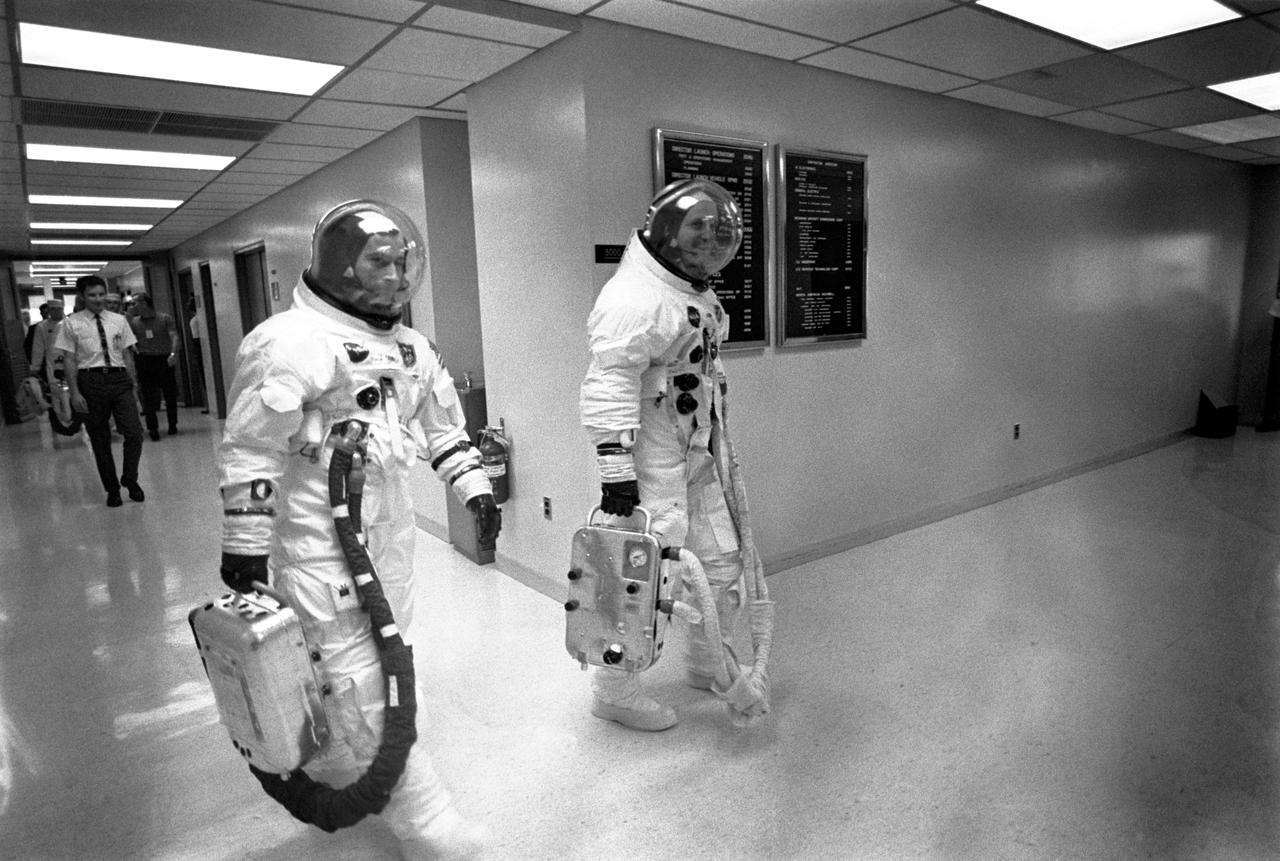
S69-34337 (6 May 1969) --- Apollo 10 astronauts John W. Young (left), command module pilot; and Thomas P. Stafford, commander, leave the Kennedy Space Center's (KSC) Manned Spacecraft Operations Building for Pad B, Launch Complex 39, where they participated in dry portion of Countdown Demonstration Test. Apollo 10, with astronauts Stafford, Young and Eugene A. Cernan aboard, is scheduled for launch on May 13, 1969. Cernan is the lunar module pilot.
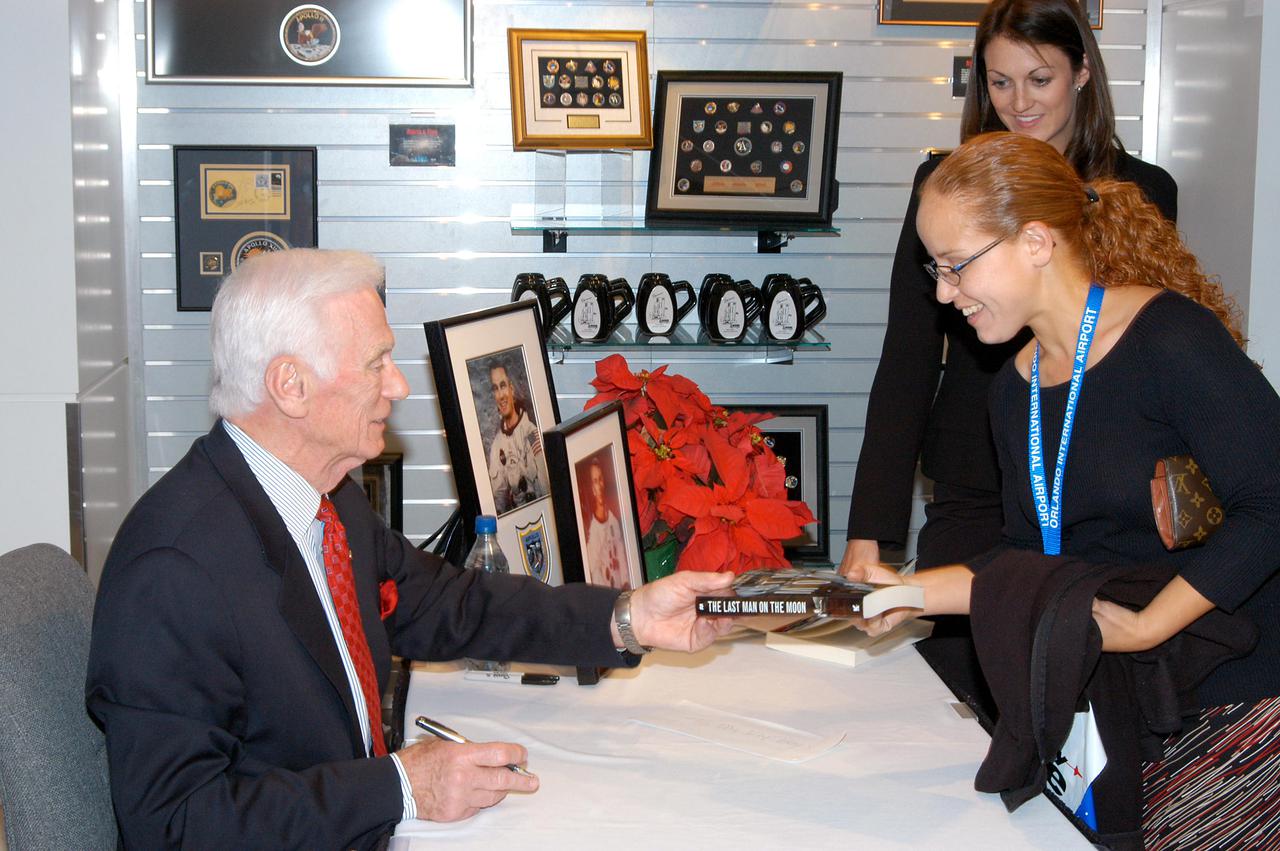
KENNEDY SPACE CENTER, FLA. - Apollo 17 Commander Gene Cernan autographs his book for attendees at the grand opening ceremony of new Kennedy Space Center Store at Orlando International Airport. NASA’s Kennedy Space Center Director Jim Kennedy and Cernan participated in the grand opening ceremony. The store will help educate millions of airport visitors about America’s space program and the Vision for Space Exploration. The store is operated by Kennedy Space Center Visitor Complex concessionaire Delaware North Parks and Resorts.
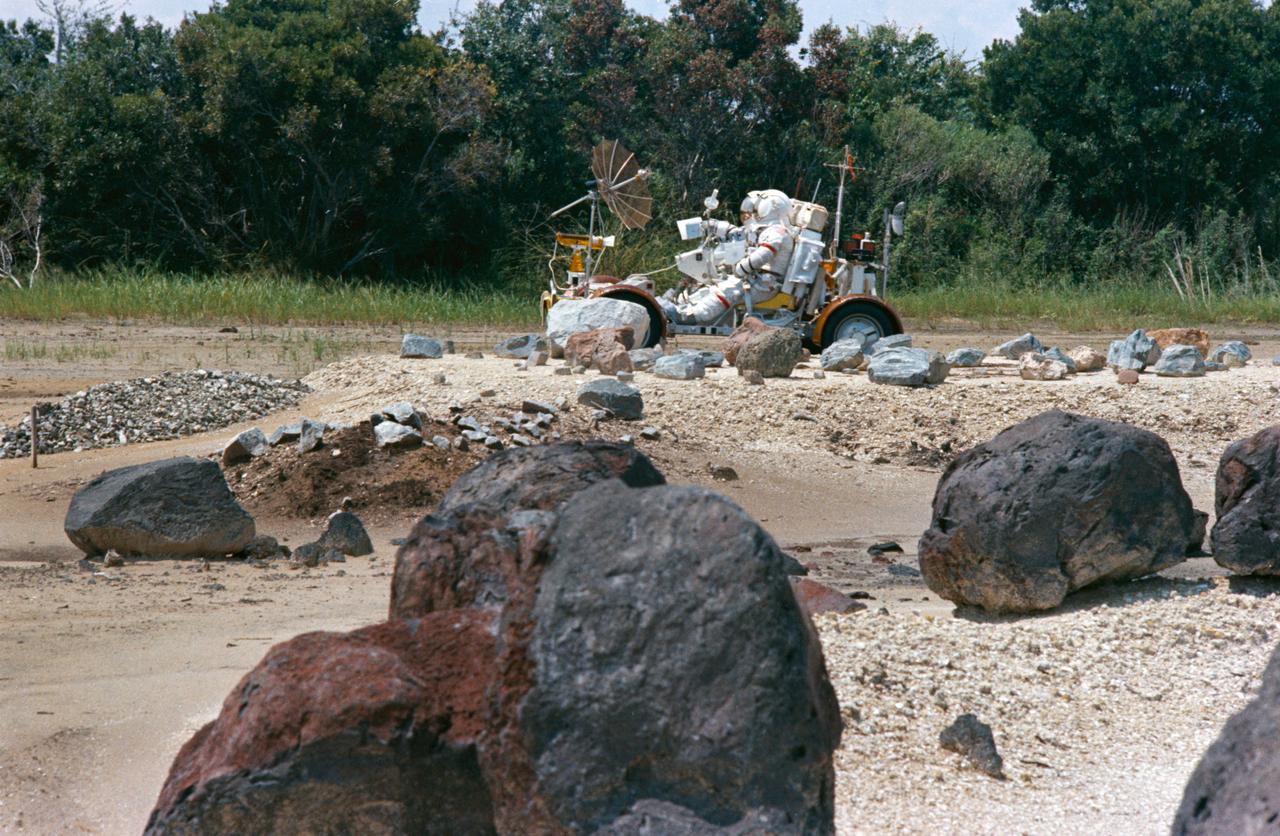
S72-48889 (September 1972) --- Two members of the prime crew of the Apollo 17 lunar landing mission ride in a lunar roving vehicle trainer during lunar surface extravehicular activity simulation training at the Kennedy Space Center, Florida. Astronaut Eugene A. Cernan, commander, is seated in the left-hand seat. Scientist-astronaut Harrison H. Schmitt, lunar module pilot, is on Cernan's right.
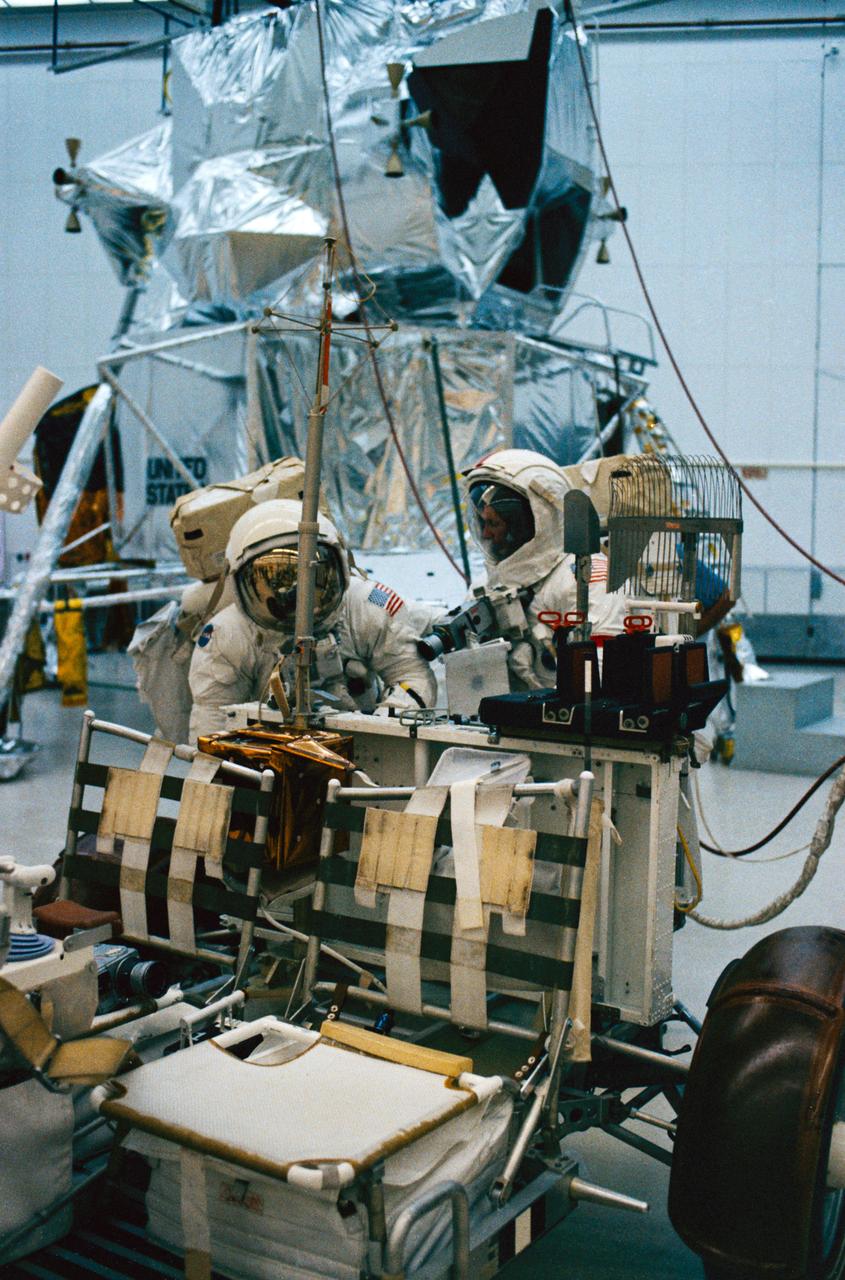
S72-48887 (September 1972) --- Astronaut Eugene A. Cernan (right), commander, and scientist-astronaut Harrison H. Schmitt, lunar module pilot, work at the aft end of a Lunar Roving Vehicle trainer during lunar surface extravehicular activity simulation training at the Kennedy Space Center (KSC), Florida. Astronauts Cernan, Schmitt, and Ronald E. Evans, command module pilot, are the prime crewmen of the Apollo 17 lunar landing mission. A Lunar Module mock-up can be seen in the background.
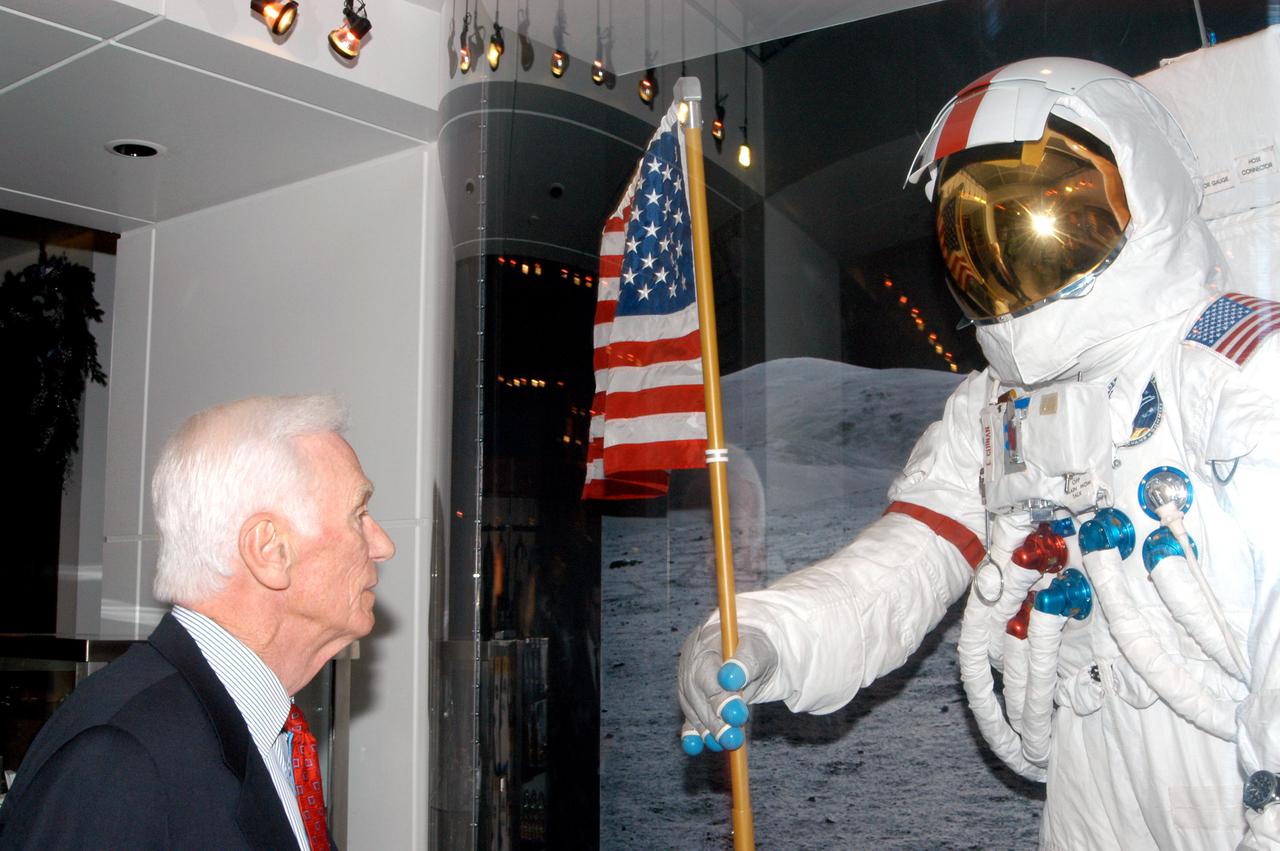
KENNEDY SPACE CENTER, FLA. - Apollo 17 Commander Gene Cernan looks at the Moon landing display in the new Kennedy Space Center Store at Orlando International Airport. NASA’s Kennedy Space Center Director Jim Kennedy and Apollo 17 Commander Gene Cernan participated in the grand opening ceremony. The store will help educate millions of airport visitors about America’s space program and the Vision for Space Exploration. The store is operated by Kennedy Space Center Visitor Complex concessionaire Delaware North Parks and Resorts.
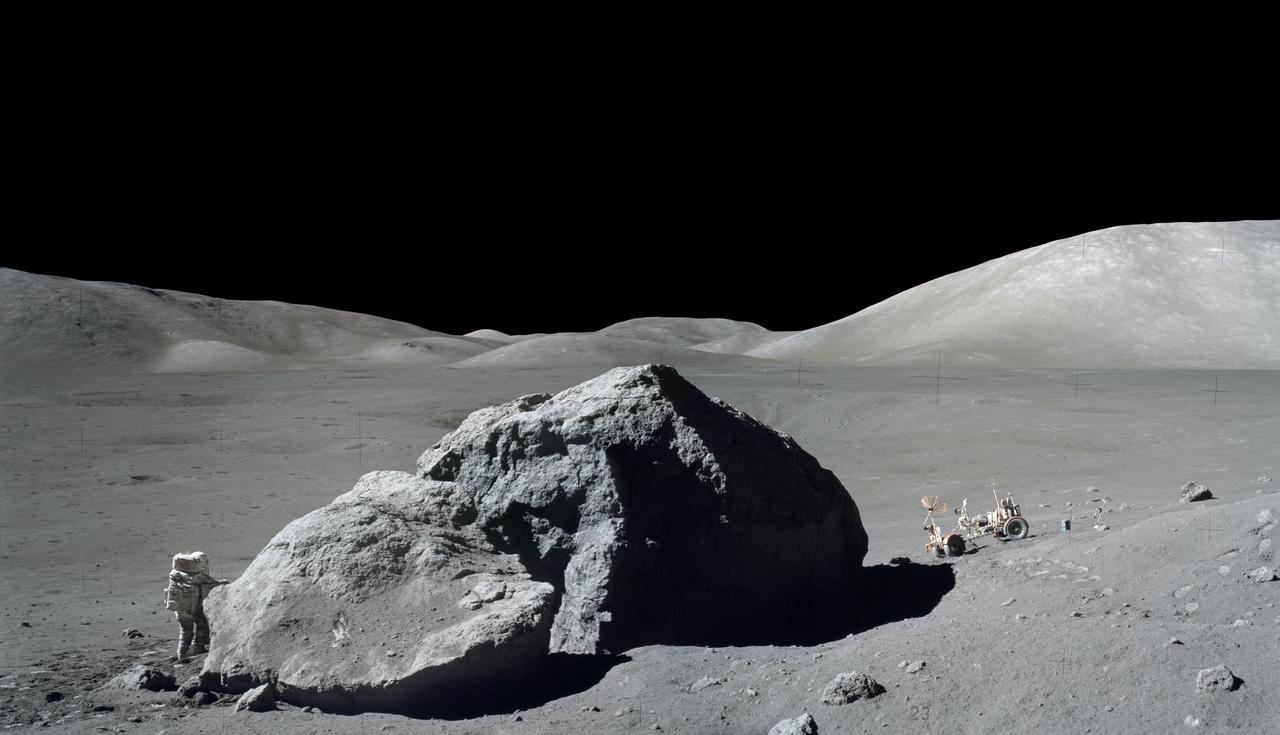
S73-22871 (13 Dec. 1972) --- Scientist-astronaut Harrison H. Schmitt is photographed standing next to a huge, split lunar boulder during the third Apollo 17 extravehicular activity (EVA) at the Taurus-Littrow landing site. The Lunar Roving Vehicle (LRV), which transported Schmitt and Eugene A. Cernan to this extravehicular station from their Lunar Module (LM), is seen in the background. The mosaic is made from two frames from Apollo 17 Hasselblad magazine 140. The two frames were photographed by Cernan.