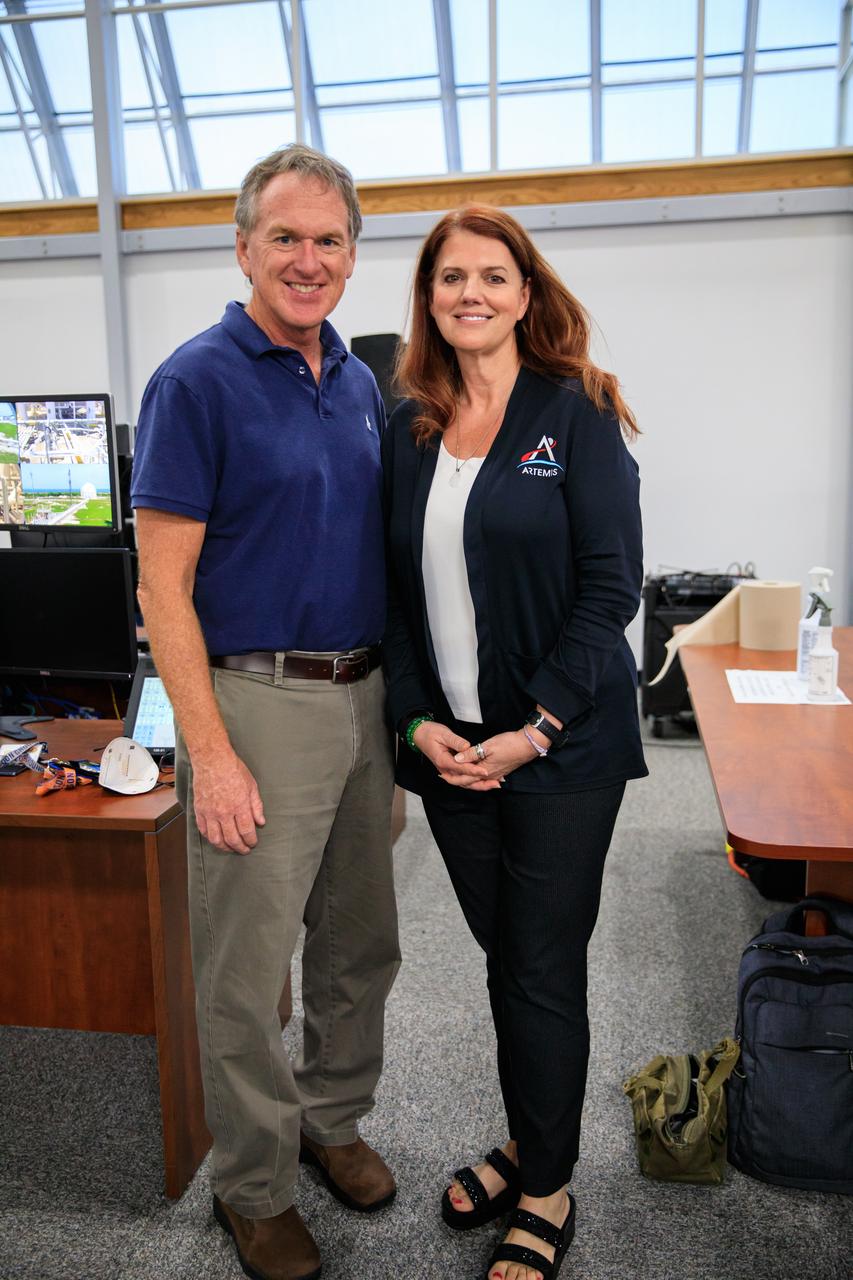
NASA’s Exploration Ground Systems Manager Mike Bolger (left) and Artemis I Launch Director Charlie Blackwell-Thompson are photographed inside Firing Room 2 of the Rocco A. Petrone Launch Control Center at the agency’s Kennedy Space Center in Florida during a certification ceremony on Aug. 12, 2022. The ceremony was held to commemorate the certification of the Artemis I launch team following their launch simulation held in December 2021. During the ceremony, Bolger and Blackwell-Thompson handed out certificates to individual members of the launch team. The first in an increasingly complex series of missions, Artemis I will test NASA’s Space Launch System rocket and Orion spacecraft as an integrated system prior to crewed flights to the Moon. Through Artemis, NASA will land the first woman and the first person of color on the lunar surface, paving the way for long-term lunar presence and using the Moon as a steppingstone before venturing to Mars.
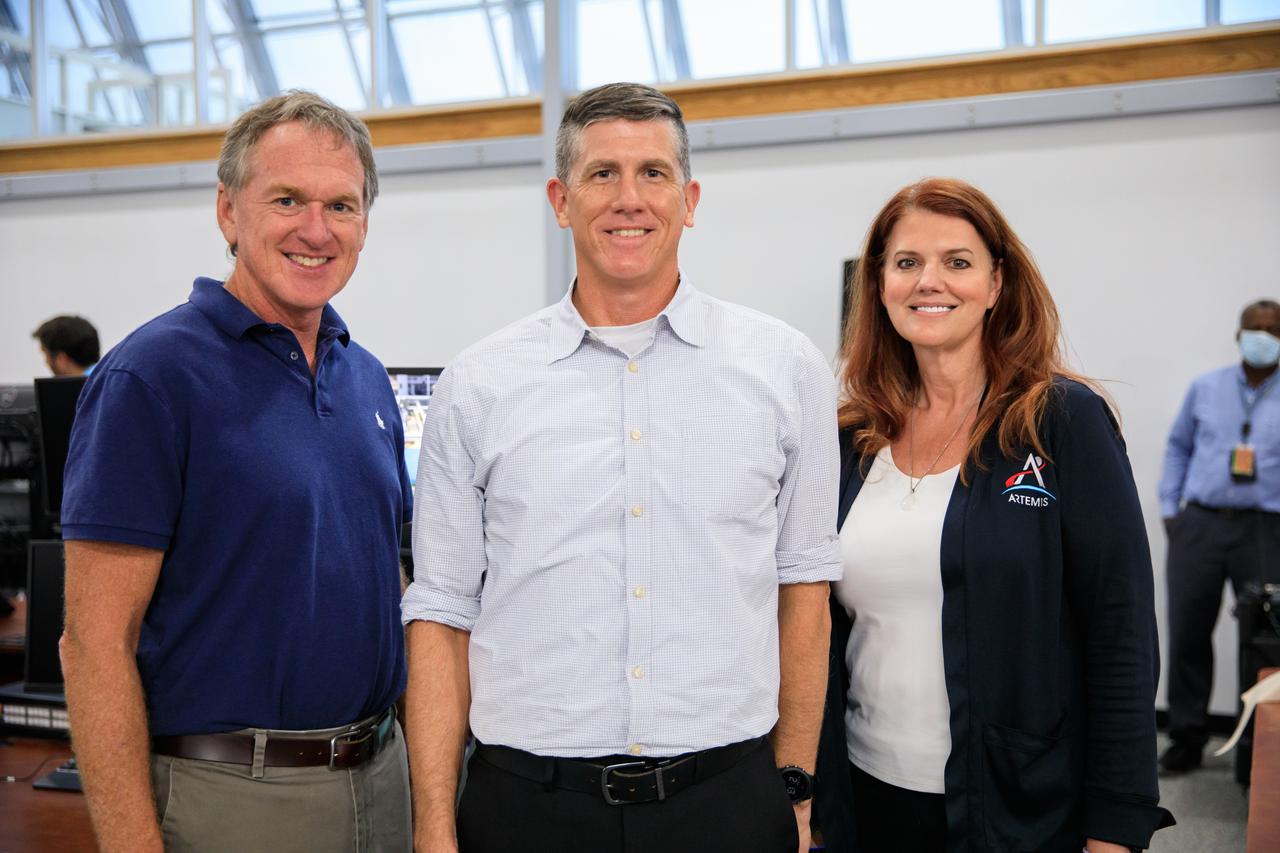
From left, NASA’s Exploration Ground Systems Manager Mike Bolger, Artemis I Assistant Launch Director Jeremy Graeber, and Launch Director Charlie Blackwell-Thompson are photographed inside Firing Room 2 of the Rocco A. Petrone Launch Control Center at the agency’s Kennedy Space Center in Florida during a certification ceremony on Aug. 12, 2022. The ceremony was held to commemorate the certification of the Artemis I launch team following their launch simulation held in December 2021. During the ceremony, Bolger, Graeber, and Blackwell-Thompson handed out certificates to individual members of the launch team. The first in an increasingly complex series of missions, Artemis I will test NASA’s Space Launch System rocket and Orion spacecraft as an integrated system prior to crewed flights to the Moon. Through Artemis, NASA will land the first woman and the first person of color on the lunar surface, paving the way for long-term lunar presence and using the Moon as a steppingstone before venturing to Mars.
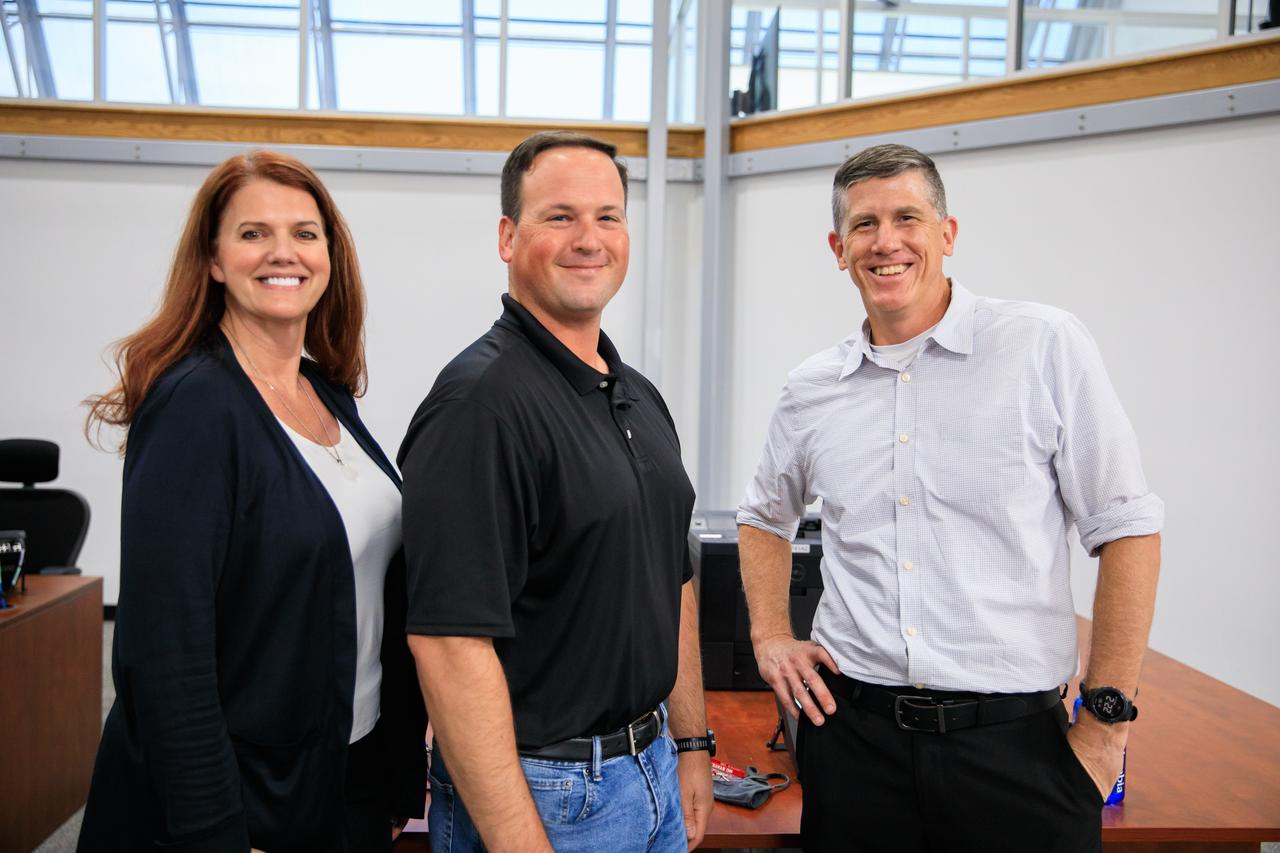
From left, Artemis I Launch Director Charlie Blackwell-Thompson, Technical Assistant to the Launch Director Wes Mosedale, and Assistant Launch Director Jeremy Graeber are photographed inside Firing Room 2 of the Rocco A. Petrone Launch Control Center at the agency’s Kennedy Space Center in Florida during a certification ceremony on Aug. 12, 2022. The ceremony was held to commemorate the certification of the Artemis I launch team following their launch simulation held in December 2021. During the ceremony, management staff handed out certificates to individual team members. The first in an increasingly complex series of missions, Artemis I will test NASA’s Space Launch System rocket and Orion spacecraft as an integrated system prior to crewed flights to the Moon. Through Artemis, NASA will land the first woman and the first person of color on the lunar surface, paving the way for long-term lunar presence and using the Moon as a steppingstone before venturing to Mars.
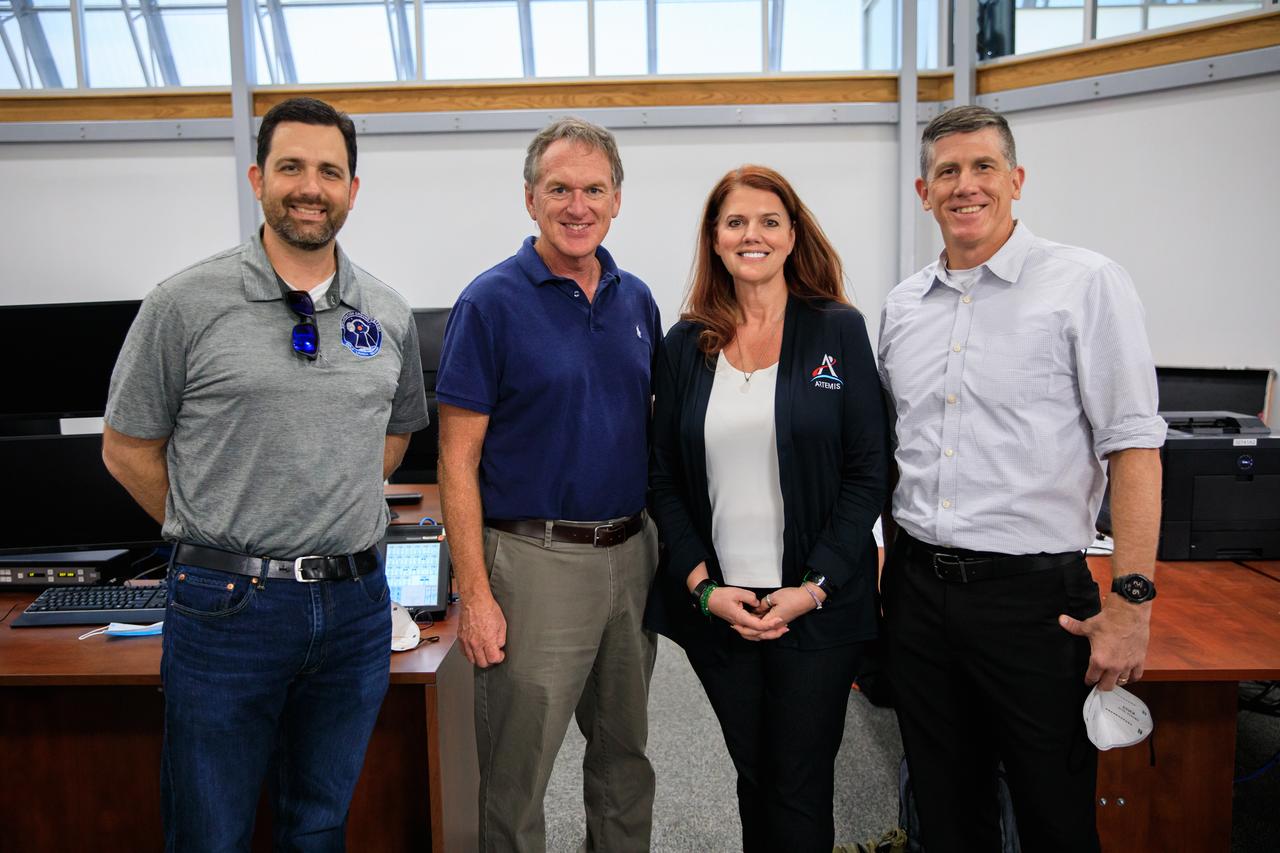
From left, NASA’s Exploration Ground Systems (EGS) Deputy Manager Jeremy Parsons, EGS Manager Mike Bolger, Artemis I Launch Director Charlie Blackwell-Thompson, and Assistant Launch Director Jeremy Graeber are photographed inside Firing Room 2 of the Rocco A. Petrone Launch Control Center at the agency’s Kennedy Space Center in Florida during a certification ceremony on Aug. 12, 2022. The ceremony was held to commemorate the certification of the Artemis I launch team following their launch simulation held in December 2021. During the ceremony, management staff handed out certificates to individual team members. The first in an increasingly complex series of missions, Artemis I will test NASA’s Space Launch System rocket and Orion spacecraft as an integrated system prior to crewed flights to the Moon. Through Artemis, NASA will land the first woman and the first person of color on the lunar surface, paving the way for long-term lunar presence and using the Moon as a steppingstone before venturing to Mars.
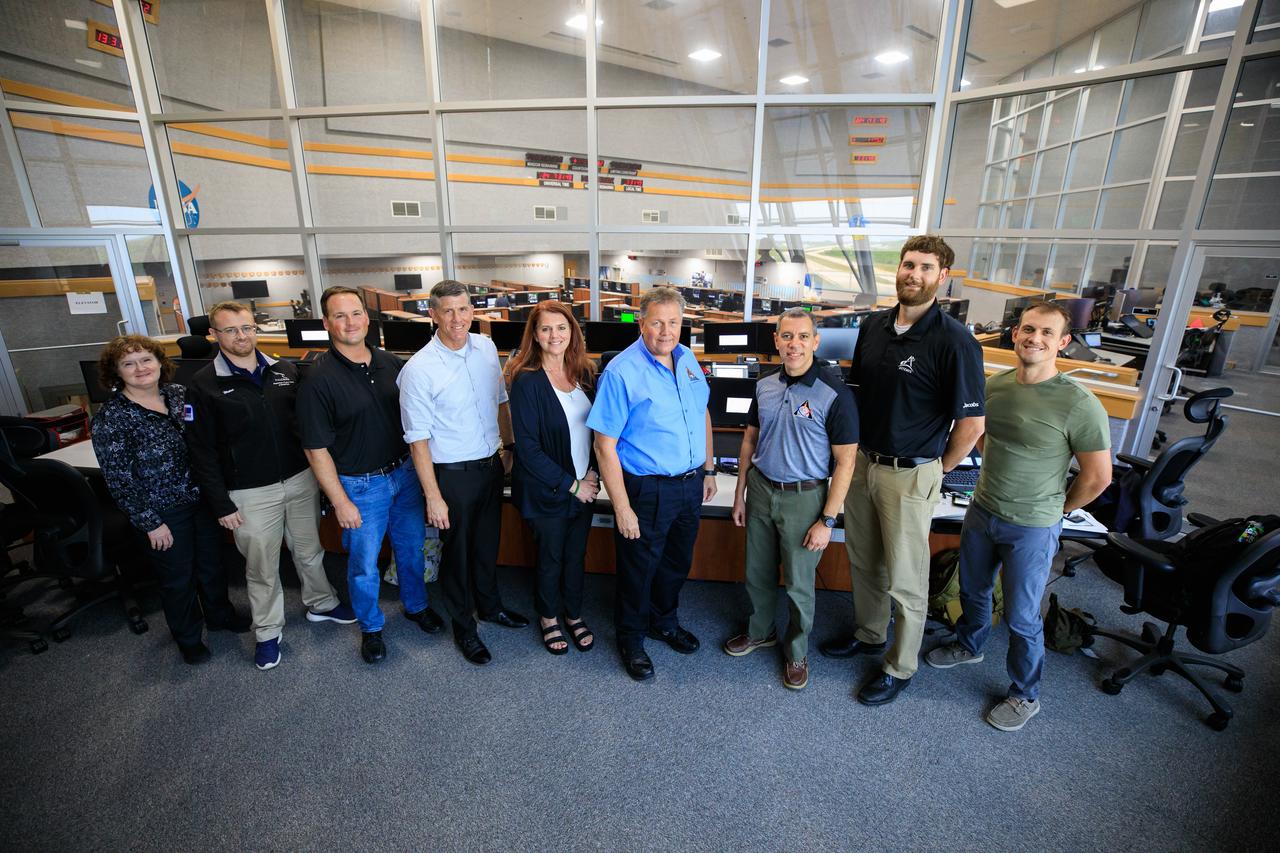
Members of the Artemis I launch team are photographed inside Firing Room 1 of the Rocco A. Petrone Launch Control Center at NASA’s Kennedy Space Center in Florida prior to a certification ceremony on Aug. 12, 2022. From left are Laurie Sally, Space Launch System (SLS) test conductor; Josh Waters, assistant ground test conductor; Wes Mosedale, technical assistant to the launch director; Jeremy Graeber, assistant launch director; Charlie Blackwell-Thompson, launch director; Jeff Spaulding, senior NASA test director; Danny Zeno, NASA test director; Lucas Vojak, assistant Orion test conductor; and Terry Woxberg, Orion test conductor. The ceremony was held to commemorate the certification of the Artemis I launch team following their launch simulation held in December 2021. During the ceremony, senior members of the launch team handed out certificates to individual team members. The first in an increasingly complex series of missions, Artemis I will test the SLS rocket and Orion spacecraft as an integrated system prior to crewed flights to the Moon. Through Artemis, NASA will land the first woman and the first person of color on the lunar surface, paving the way for long-term lunar presence and using the Moon as a steppingstone before venturing to Mars.
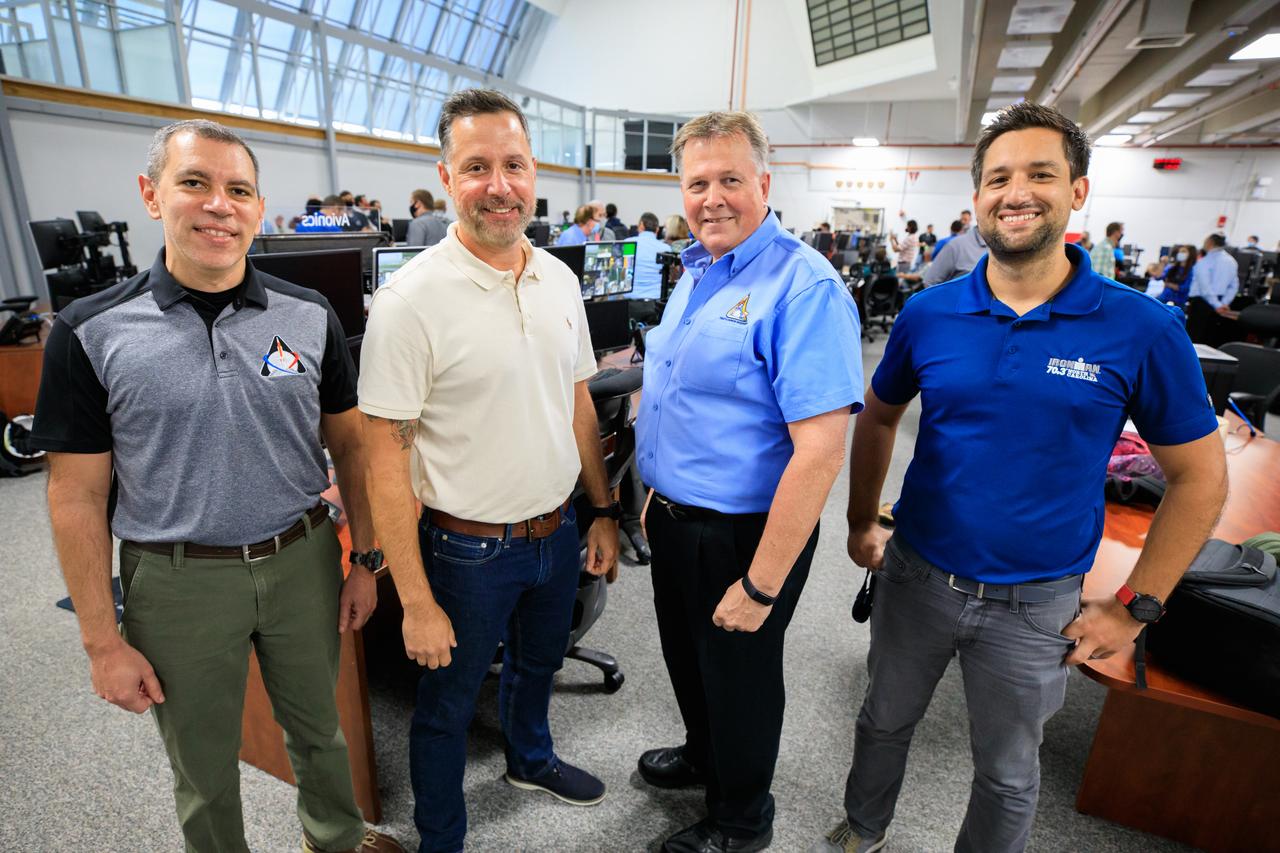
Members of the Artemis I launch team are photographed inside Firing Room 2 of the Rocco A. Petrone Launch Control Center at NASA’s Kennedy Space Center in Florida during a certification ceremony on Aug. 12, 2022. From left are NASA Test Director Danny Zeno, NASA Test Director Carlos Monge, Senior NASA Test Director Jeff Spaulding, and NASA Test Director Dan Florez. The ceremony was held to commemorate the certification of the Artemis I launch team following their launch simulation held in December 2021. During the ceremony, senior members of the launch team handed out certificates to individual team members. The first in an increasingly complex series of missions, Artemis I will test NASA’s Space Launch System rocket and Orion spacecraft as an integrated system prior to crewed flights to the Moon. Through Artemis, NASA will land the first woman and the first person of color on the lunar surface, paving the way for long-term lunar presence and using the Moon as a steppingstone before venturing to Mars.
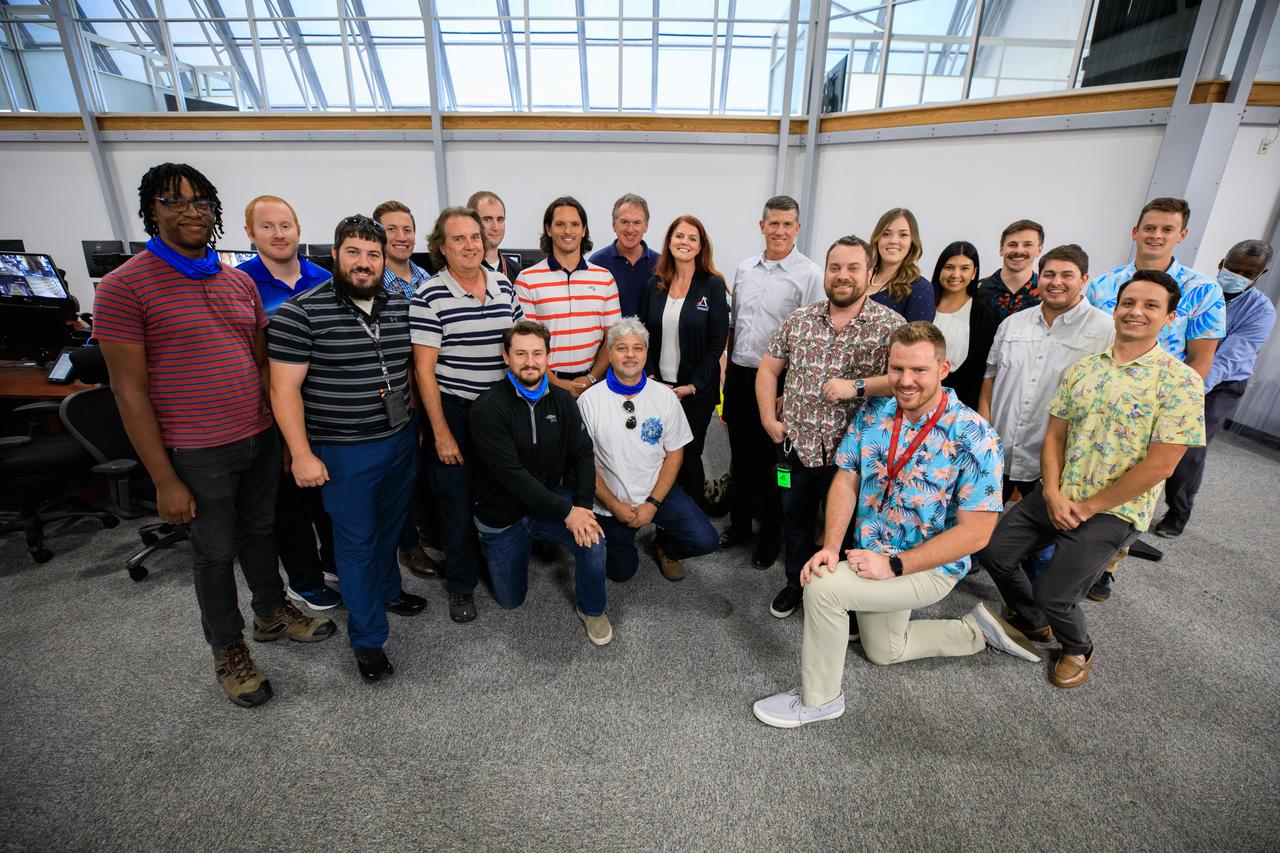
Members of the Artemis I launch team are photographed inside Firing Room 2 of the Rocco A. Petrone Launch Control Center at NASA’s Kennedy Space Center in Florida during a certification ceremony on Aug. 12, 2022. In the middle is Artemis I Launch Director Charlie Blackwell-Thompson. Behind her to the left is Mike Bolger, manager of NASA’s Exploration Ground Systems, and to her right is Jeremy Graeber, assistant launch director. The ceremony was held to commemorate the certification of the Artemis I launch team following their launch simulation held in December 2021. During the ceremony, senior members of the launch team handed out certificates to individual team members. The first in an increasingly complex series of missions, Artemis I will test NASA’s Space Launch System rocket and Orion spacecraft as an integrated system prior to crewed flights to the Moon. Through Artemis, NASA will land the first woman and the first person of color on the lunar surface, paving the way for long-term lunar presence and using the Moon as a steppingstone before venturing to Mars.
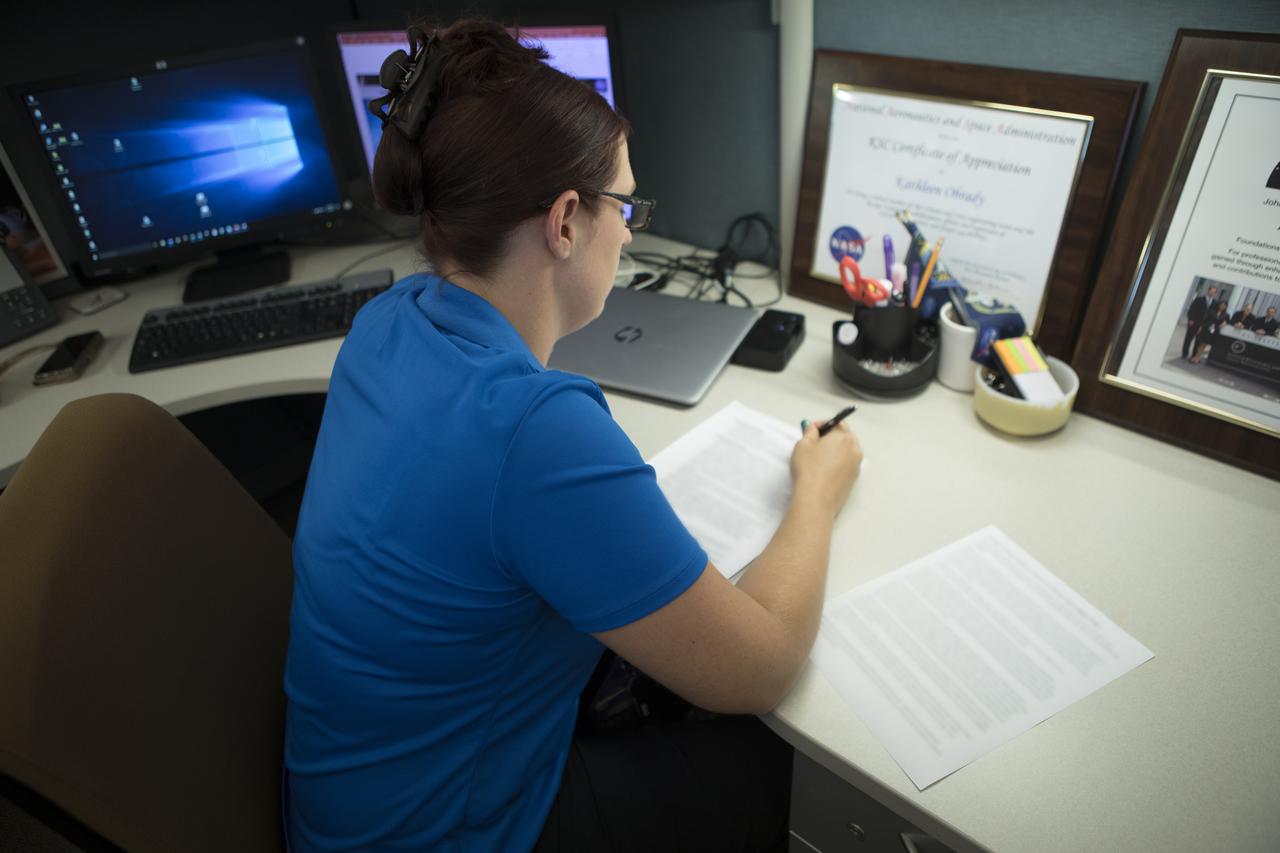
Kathleen O'Brady reviews documents in her office at NASA’s Kennedy Space Center in Florida. As a certification systems engineer in the Commercial Crew Program’s (CCP's) Systems Engineering and Integration Office, she is responsible for defining an integrated plan for certification which is being executed by the agency's CCP partners Boeing and SpaceX. The two companies are developing spacecraft to fly NASA astronauts to the International Space Station and return them safely home.
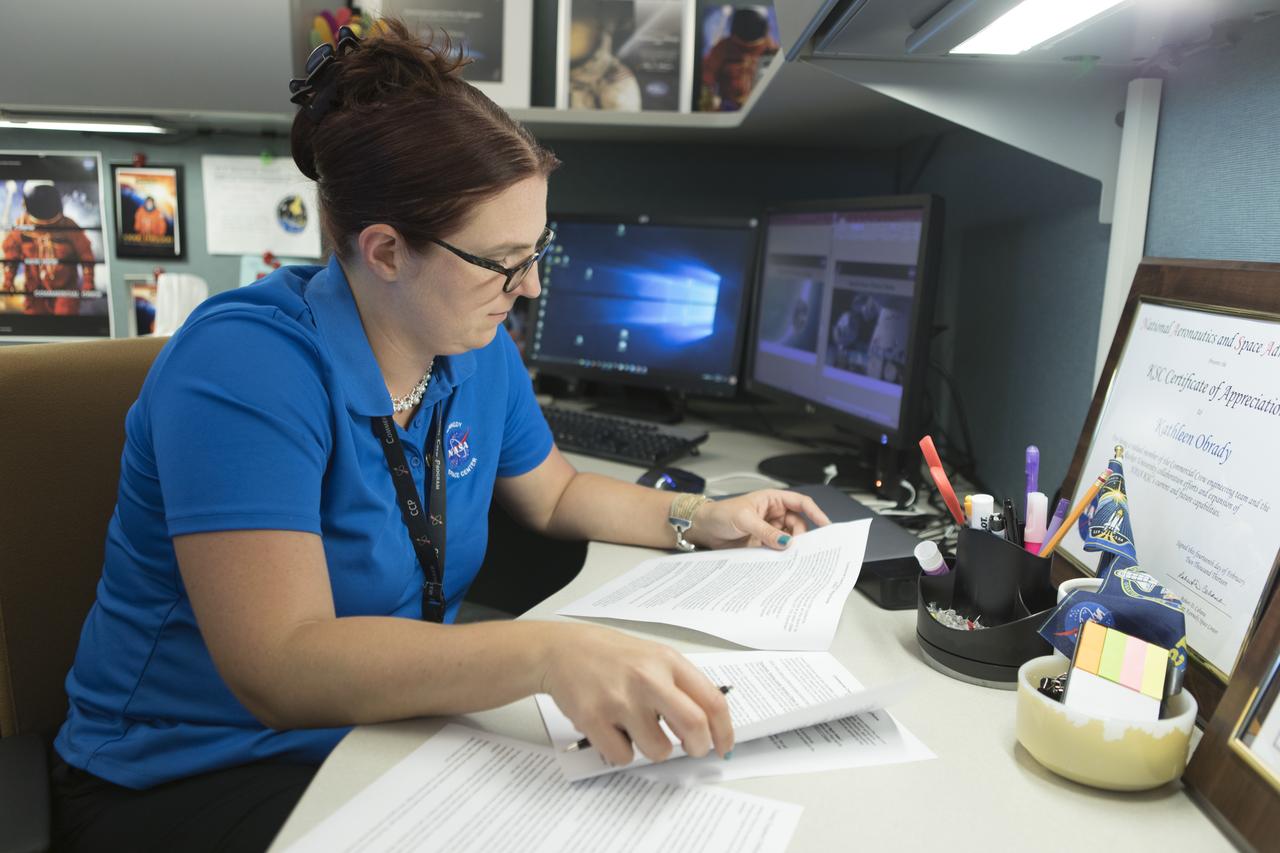
Kathleen O'Brady reviews documents in her office at NASA’s Kennedy Space Center in Florida. As a certification systems engineer in the Commercial Crew Program’s (CCP's) Systems Engineering and Integration Office, she is responsible for defining an integrated plan for certification which is being executed by the agency's CCP partners Boeing and SpaceX. The two companies are developing spacecraft to fly NASA astronauts to the International Space Station and return them safely home.
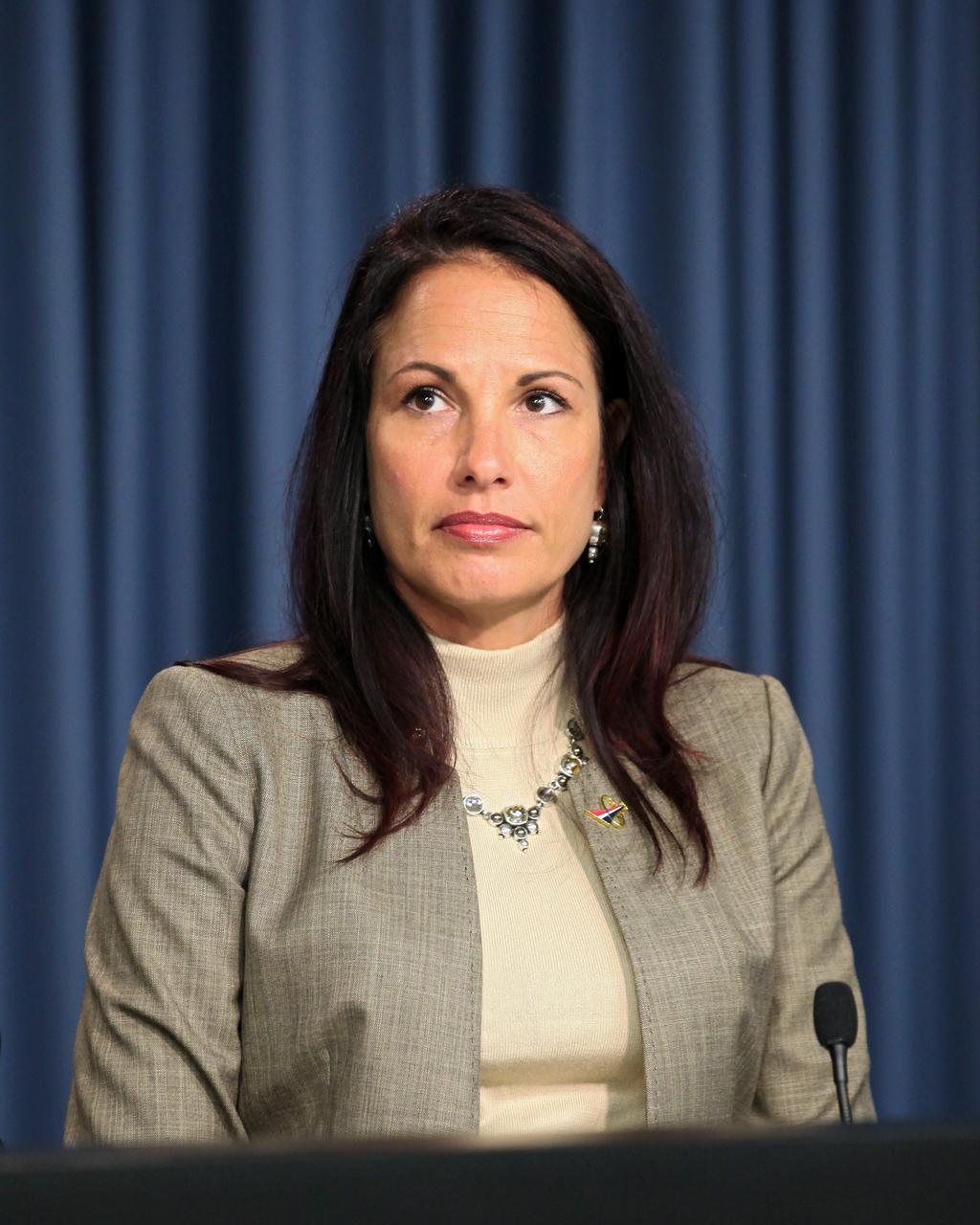
CAPE CANAVERAL, Fla. -- Maria Collura of NASA's Commercial Crew Program, or CCP, talks to aerospace industry representatives during a pre-proposal conference to inform prospective companies about the recently released request for contract proposals and updates to the certification requirements for crewed missions to the International Space Station, or ISS. The two-phase certification process, called Certification Products Contract, or CPC, will enable NASA to eventually purchase service missions to fly astronauts to and from the ISS. Collura serves as a CCP certification manager. To learn more about CCP, visit www.nasa.gov/commercialcrew. Photo credit: Kim Shiflett
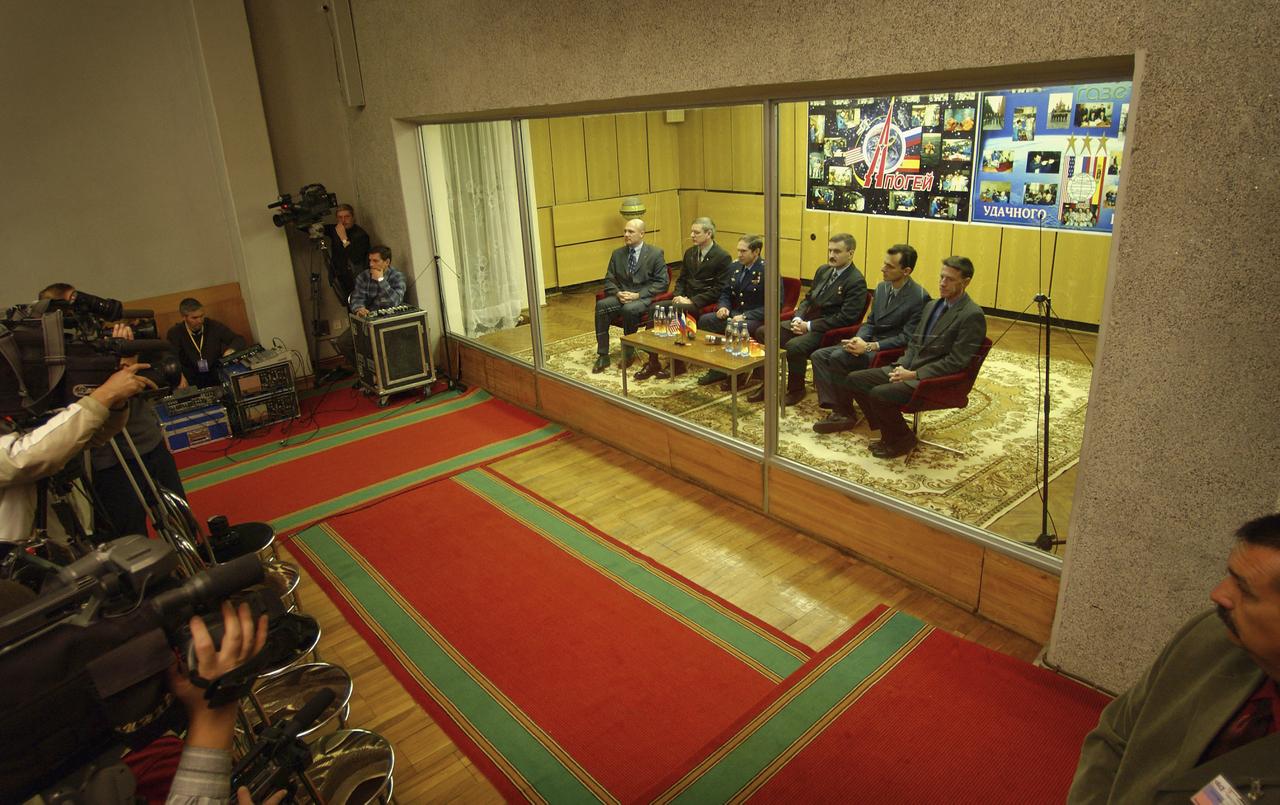
The prime and backups crews for the launch of the Russian Soyuz TMA-3 vehicle to the International Space Station listen to their certification for launch by a panel of Russian space officials in Baikonur, Kazakhstan Friday, Oct. 17, 2003, at the Cosmonaut Hotel. Baikonur, Kazakhstan. Expedition 8 Commander and NASA Science Officer Michael Foale, right, Expedition 8 Soyuz Commander Alexander Kaleri, third from right, and European Space Agency astronaut Pedro Duque of Spain launched Oct. 18, 2003, to the ISS. Photo Credit (NASA/Bill Ingalls)
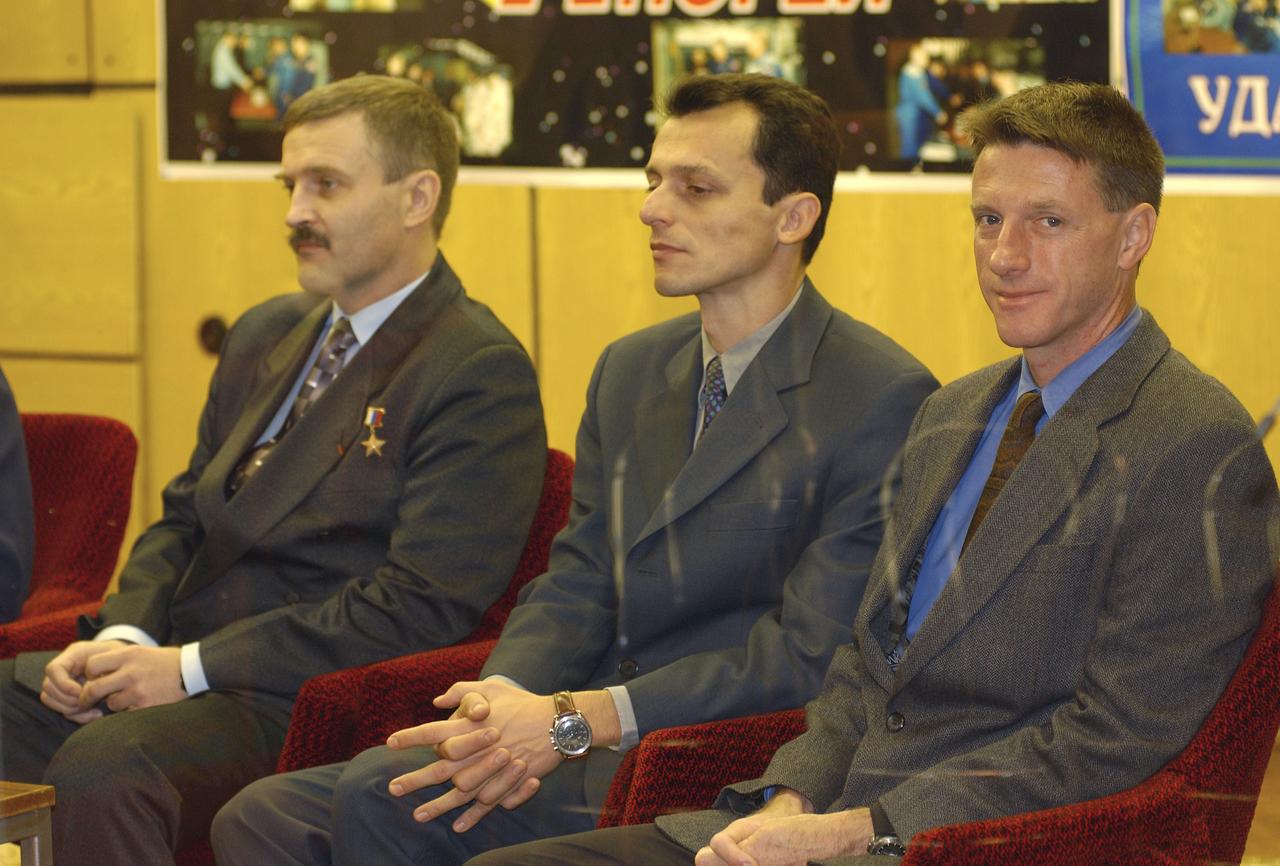
Expedition 8 Commander and NASA Science Officer Michael Foale, right, Expedition 8 Soyuz Commander Alexander Kaleri, left, and European Space Agency astronaut Pedro Duque of Spain, isten to their certification for launch by a panel of Russian space officials in Baikonur, Kazakhstan Friday, Oct. 17, 2003, at the Cosmonaut Hotel. Photo Credit (NASA/Bill Ingalls)
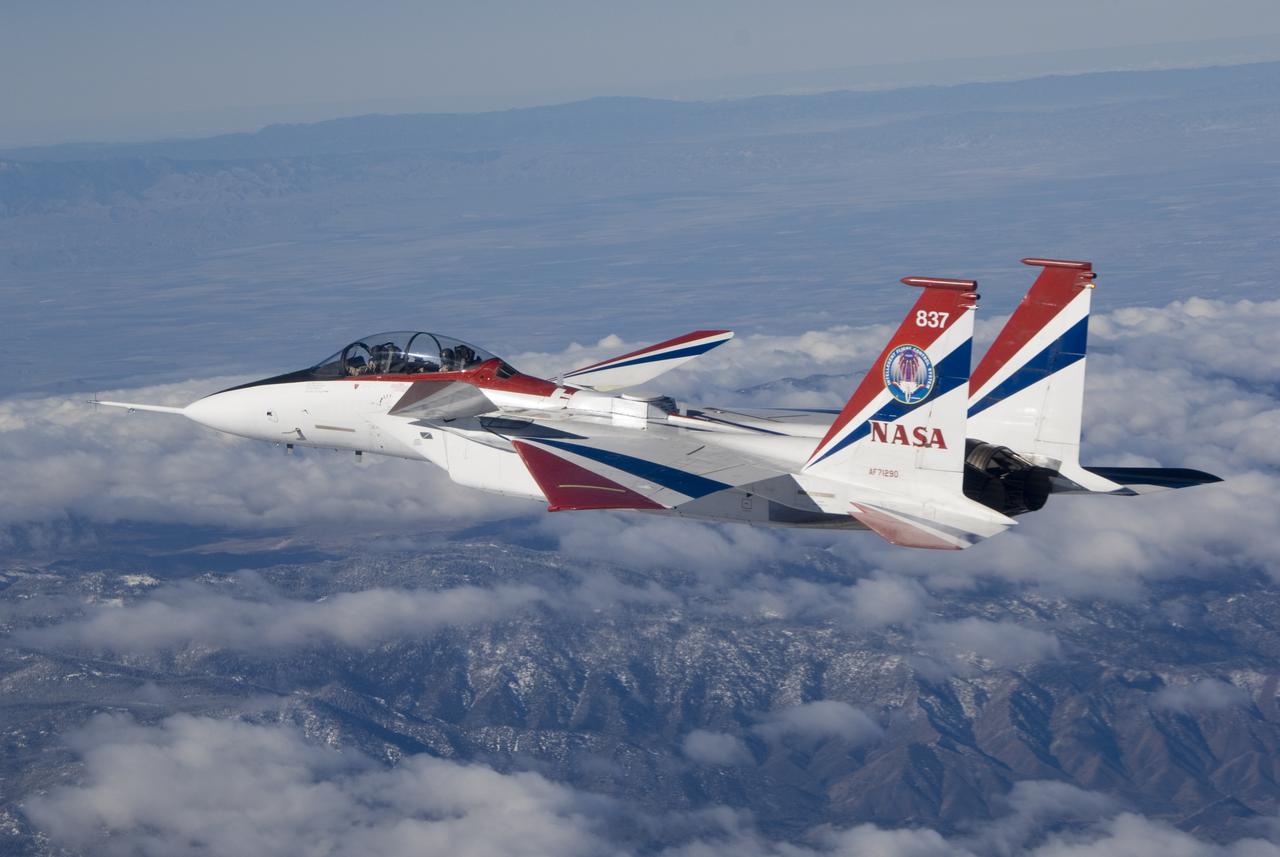
Antennas used for the Space-Based Range Demonstration and Certification project protrude from the top of NASA's NF-15B testbed during a research flight.
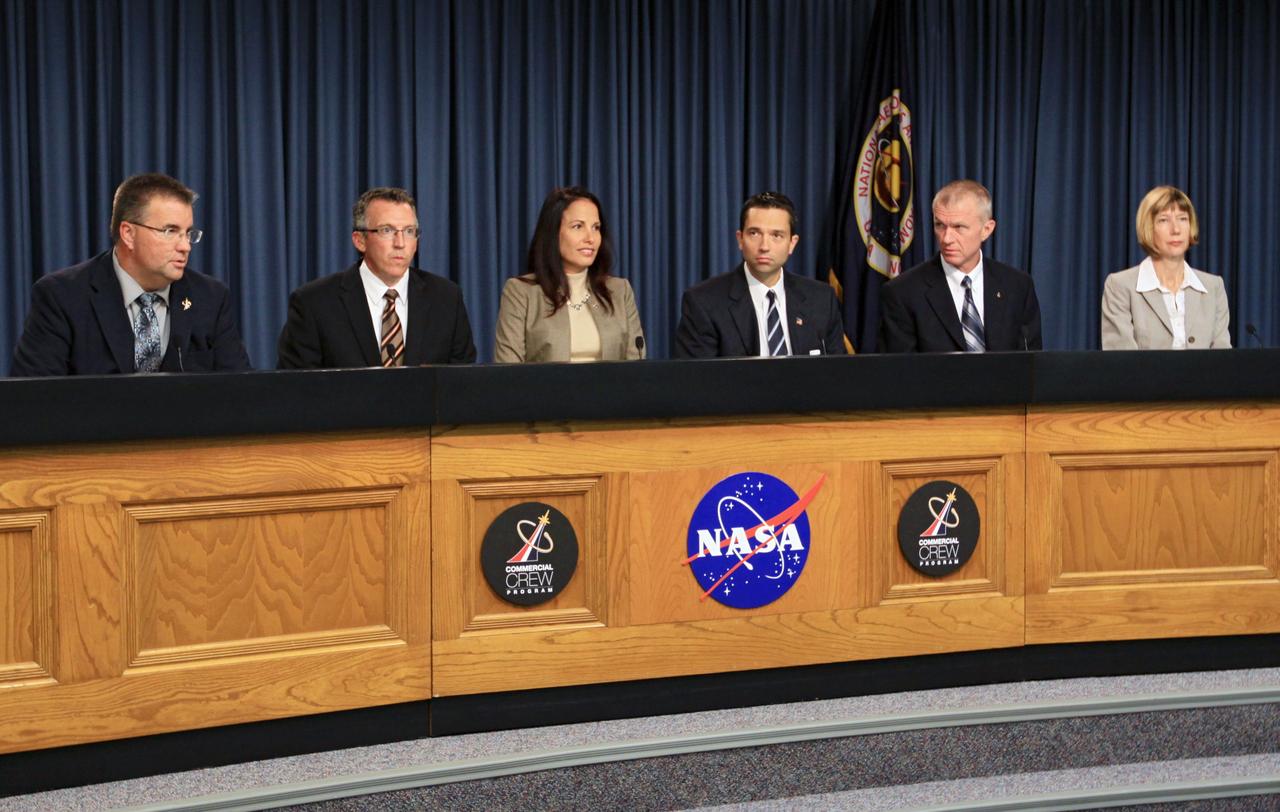
CAPE CANAVERAL, Fla. -- NASA's Commercial Crew Program, or CCP, hosts a pre-proposal conference to inform prospective companies about the recently released request for contract proposals and updates to the certification requirements for crewed missions to the International Space Station, or ISS. The two-phase certification process, called Certification Products Contract, or CPC, will enable NASA to eventually purchase service missions to fly astronauts to and from the ISS. From left, Ed Mango, CCP's program manager Steve Janney, CPC contracting officer Maria Collura, CCP certification manager Tom Simon, CPC Evaluation Team chair Brent Jett, CCP deputy program manager and Kathy Lueders, manager of the ISS Transportation Integration Office. To learn more about CCP, visit www.nasa.gov/commercialcrew. Photo credit: Kim Shiflett
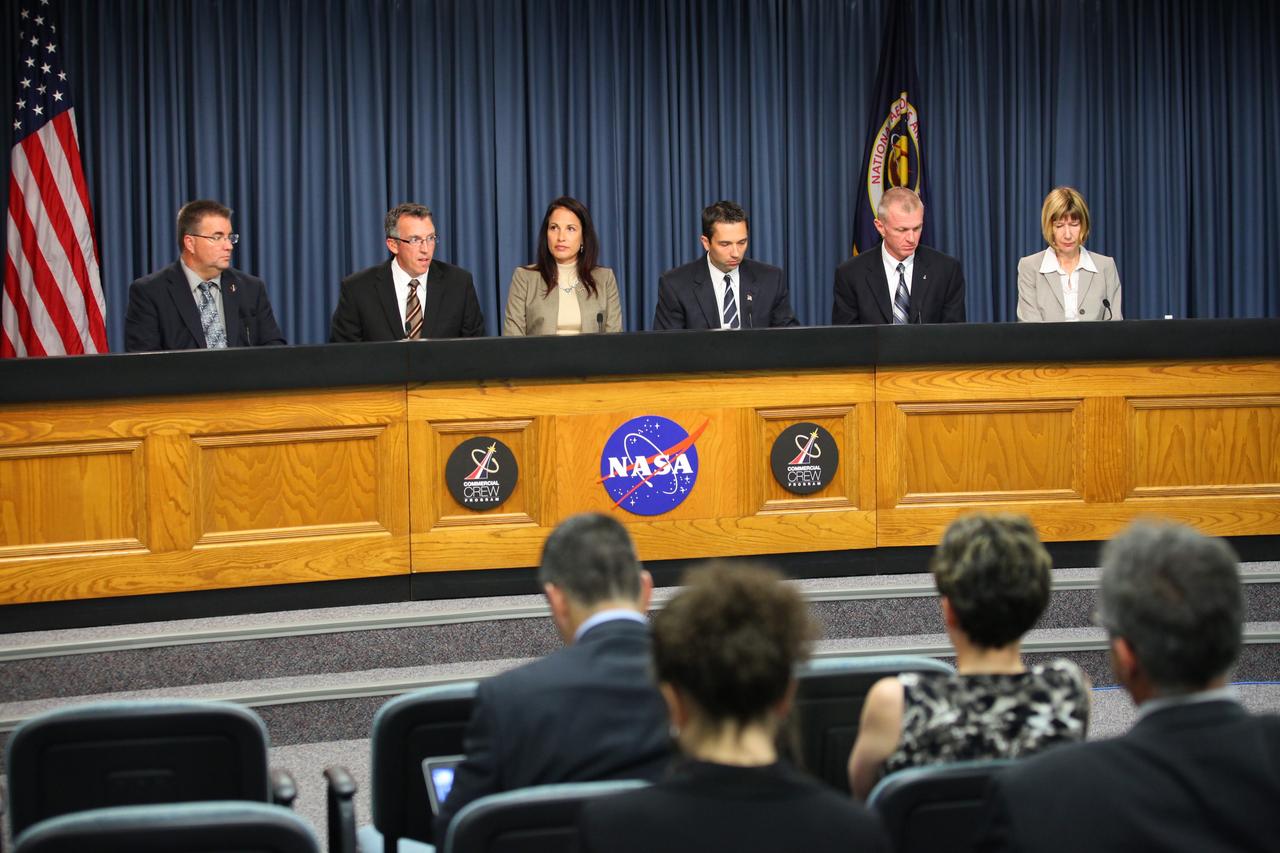
CAPE CANAVERAL, Fla. -- NASA's Commercial Crew Program, or CCP, hosts a pre-proposal conference to inform prospective companies about the recently released request for contract proposals and updates to the certification requirements for crewed missions to the International Space Station, or ISS. The two-phase certification process, called Certification Products Contract, or CPC, will enable NASA to eventually purchase service missions to fly astronauts to and from the ISS. From left, Ed Mango, CCP's program manager Steve Janney, CPC contracting officer Maria Collura, CCP certification manager Tom Simon, CPC Evaluation Team chair Brent Jett, CCP deputy program manager and Kathy Lueders, manager of the ISS Transportation Integration Office. To learn more about CCP, visit www.nasa.gov/commercialcrew. Photo credit: Kim Shiflett
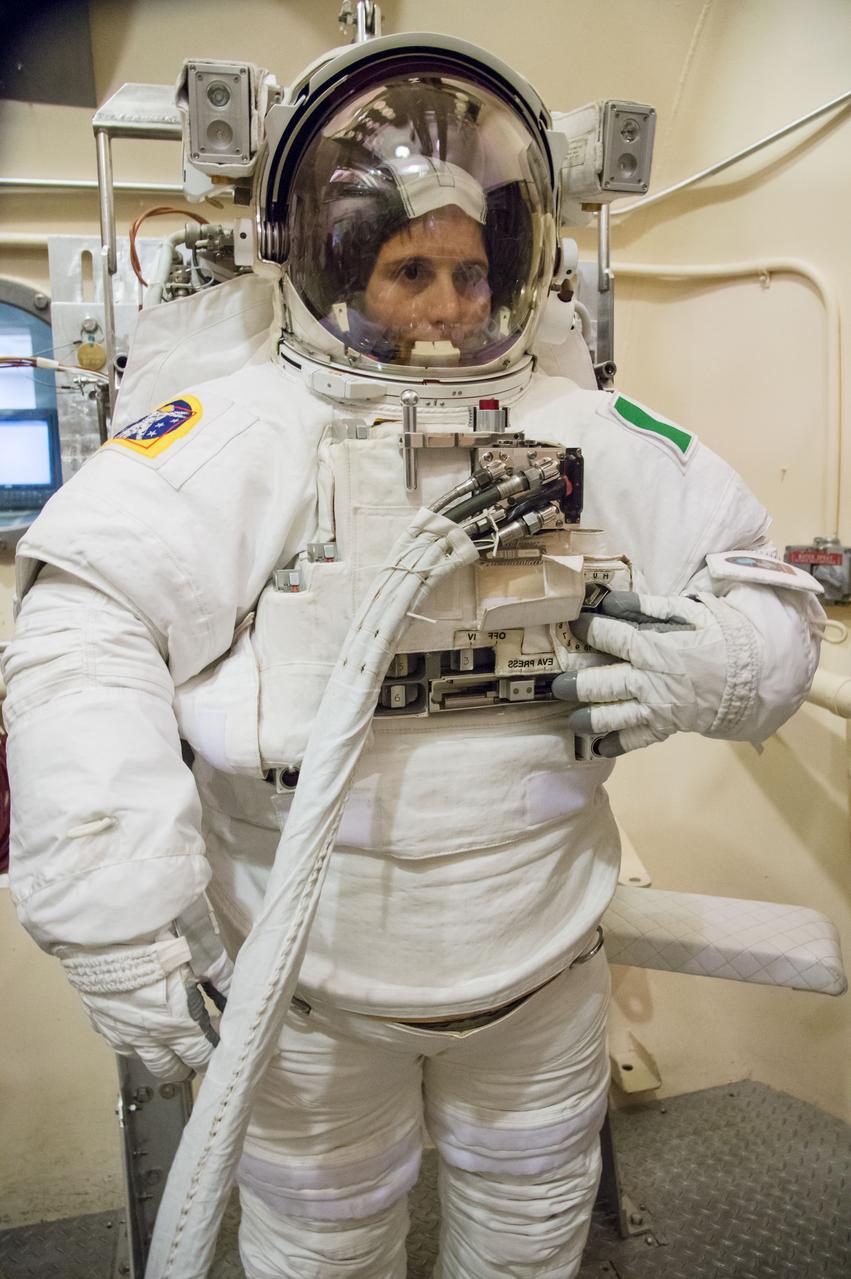
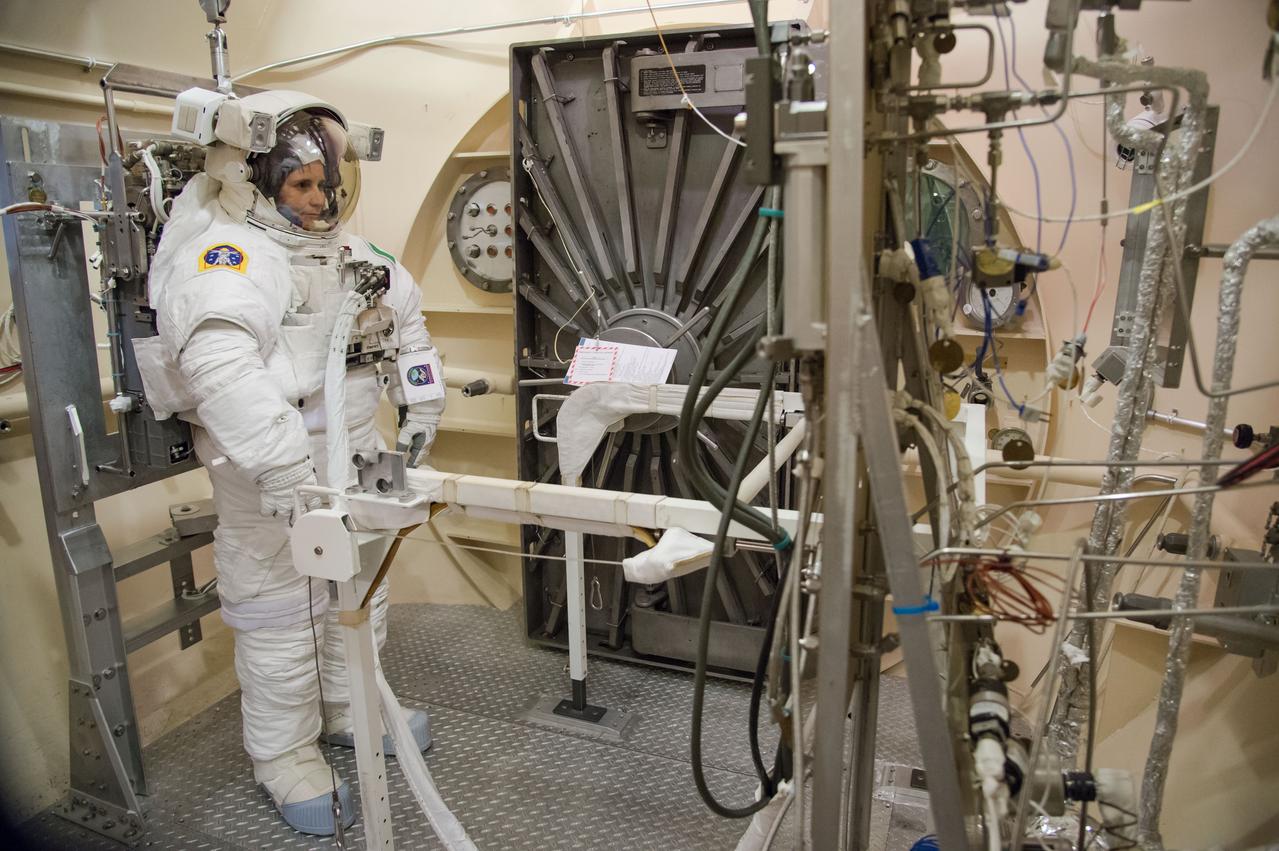
Expedition 42/43 ESA astronaut Samantha Cristoforetti during preparations for EMU Certification Altitude Run. Photo Date: September 22, 2014. Location: Bldg. 7, 11 foot chamber. Photographer: Robert Markowitz
Expedition 42/43 ESA astronaut Samantha Cristoforetti during preparations for EMU Certification Altitude Run. Photo Date: September 22, 2014. Location: Bldg. 7, 11 foot chamber. Photographer: Robert Markowitz
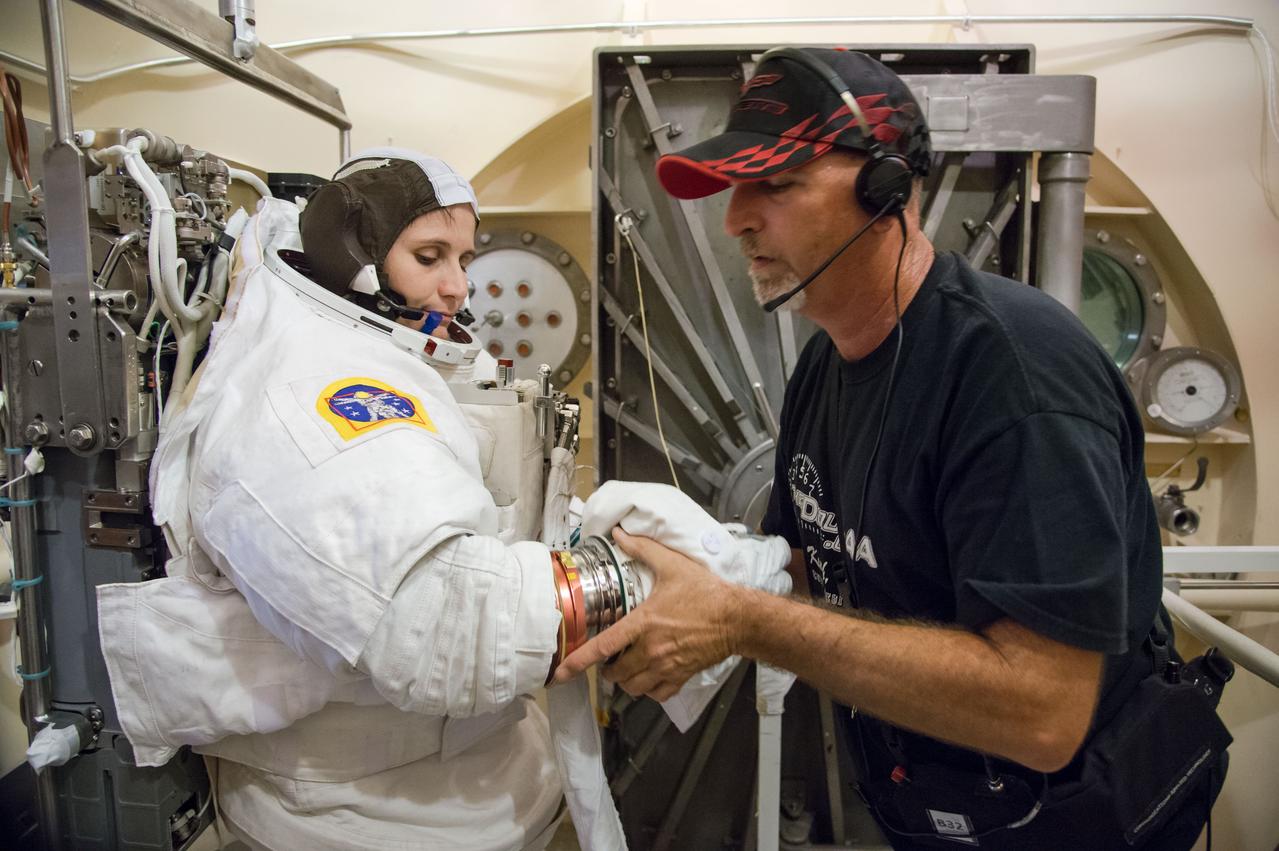
Expedition 42/43 ESA astronaut Samantha Cristoforetti during preparations for EMU Certification Altitude Run. Photo Date: September 22, 2014. Location: Bldg. 7, 11 foot chamber. Photographer: Robert Markowitz
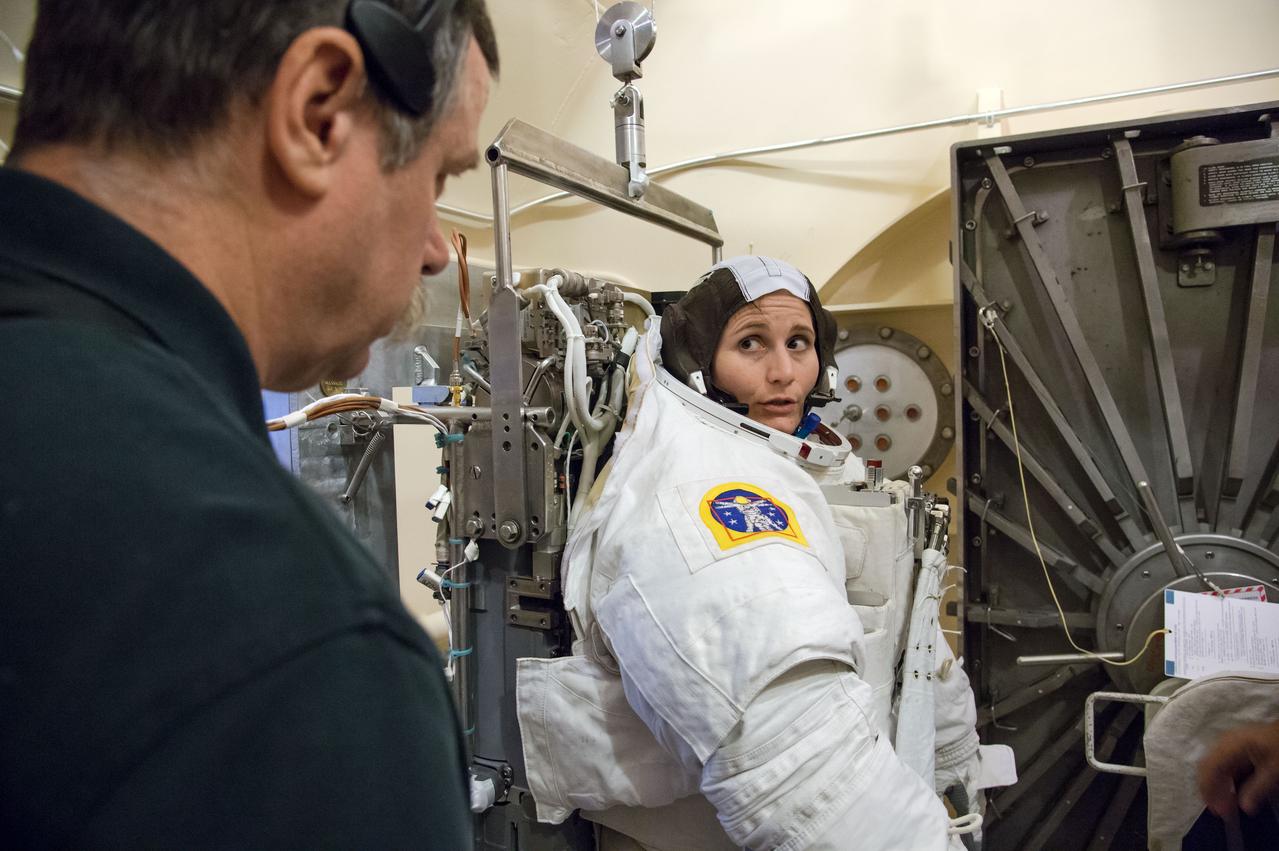
Expedition 42/43 ESA astronaut Samantha Cristoforetti during preparations for EMU Certification Altitude Run. Photo Date: September 22, 2014. Location: Bldg. 7, 11 foot chamber. Photographer: Robert Markowitz
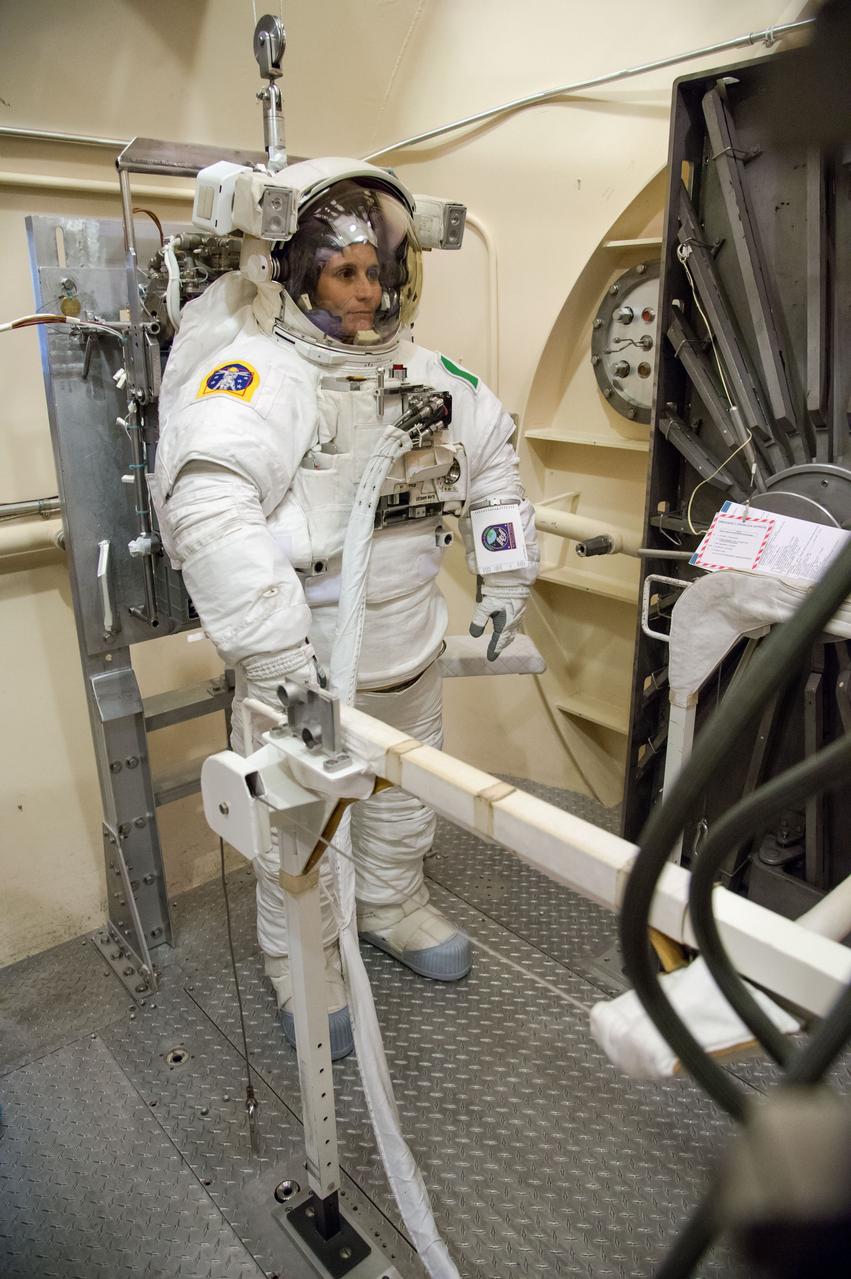
Expedition 42/43 ESA astronaut Samantha Cristoforetti during preparations for EMU Certification Altitude Run. Photo Date: September 22, 2014. Location: Bldg. 7, 11 foot chamber. Photographer: Robert Markowitz
CAPE CANAVERAL, Fla. -- Steve Janney of NASA's Commercial Crew Program, or CCP, talks to aerospace industry representatives during a pre-proposal conference to inform prospective companies about the recently released request for contract proposals and updates to the certification requirements for crewed missions to the International Space Station, or ISS. The two-phase certification process, called Certification Products Contract, or CPC, will enable NASA to eventually purchase service missions to fly astronauts to and from the ISS. Janney serves as the contracting officer during CPC procurement. To learn more about CCP, visit www.nasa.gov/commercialcrew. Photo credit: Kim Shiflett
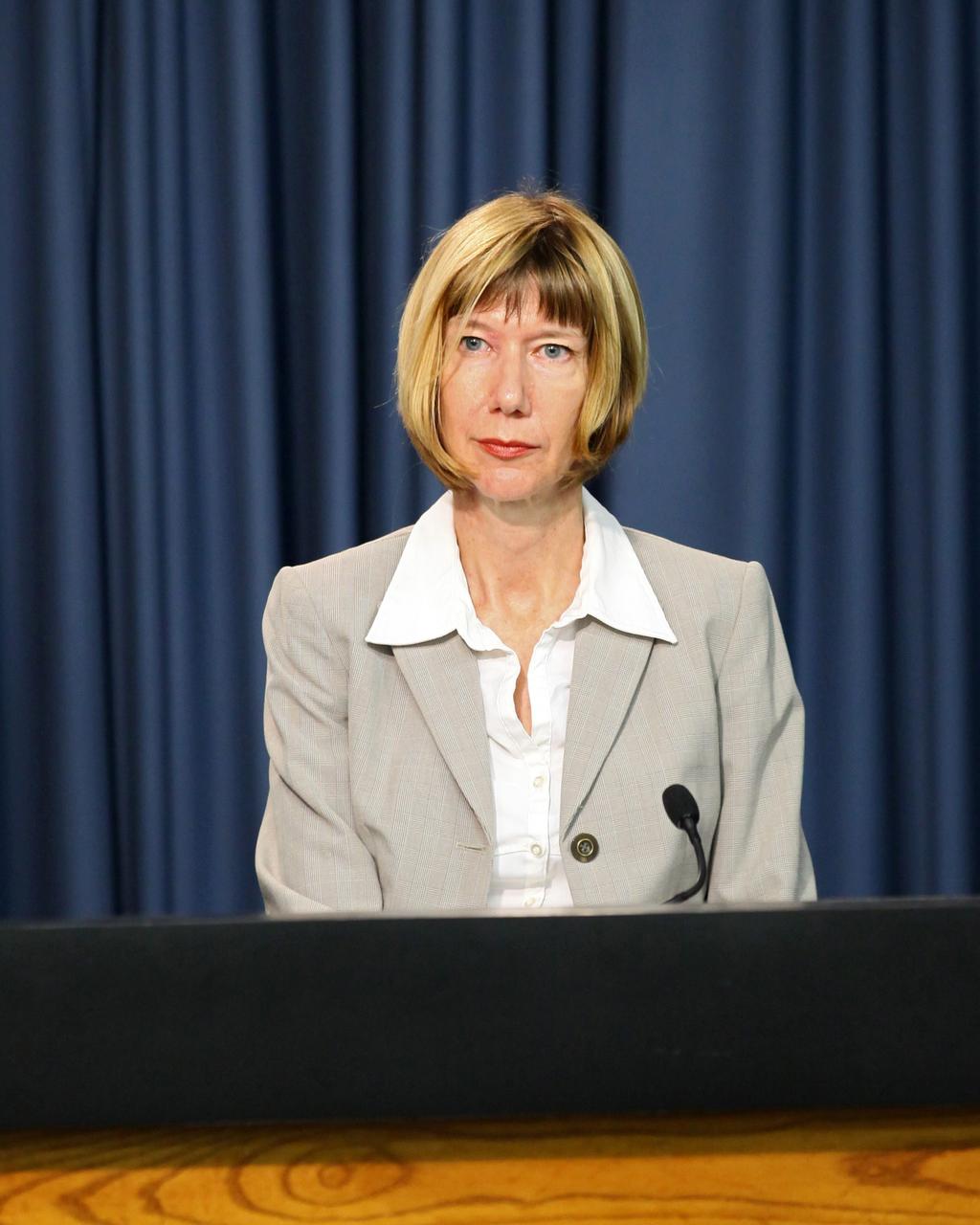
CAPE CANAVERAL, Fla. -- Kathy Lueders, manager of the International Space Station, or ISS, Transportation Integration Office, participates in a NASA Commercial Crew Program, or CCP, pre-proposal conference. The conference informed prospective companies about the recently released request for contract proposals and updates to the certification requirements for crewed missions to ISS. The two-phase certification process, called Certification Products Contract, or CPC, will enable NASA to eventually purchase service missions to fly astronauts to and from the ISS. To learn more about CCP, visit www.nasa.gov/commercialcrew. Photo credit: Kim Shiflett
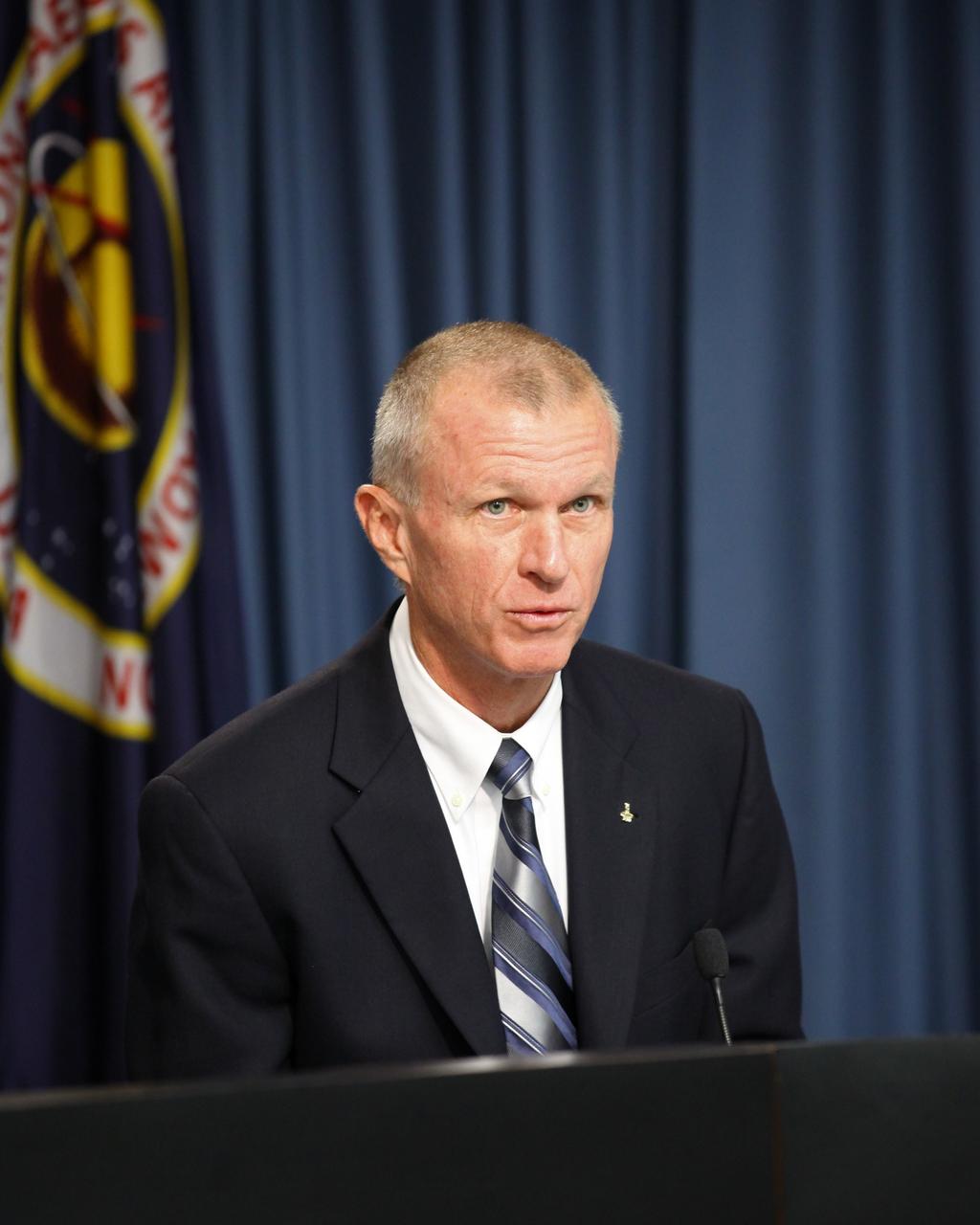
CAPE CANAVERAL, Fla. -- Brent Jett, deputy manager of NASA's Commercial Crew Program, or CCP, talks to aerospace industry representatives during a pre-proposal conference to inform prospective companies about the recently released request for contract proposals and updates to the certification requirements for crewed missions to the International Space Station, or ISS. The two-phase certification process, called Certification Products Contract, or CPC, will enable NASA to eventually purchase service missions to fly astronauts to and from the ISS. To learn more about CCP, visit www.nasa.gov/commercialcrew. Photo credit: Kim Shiflett
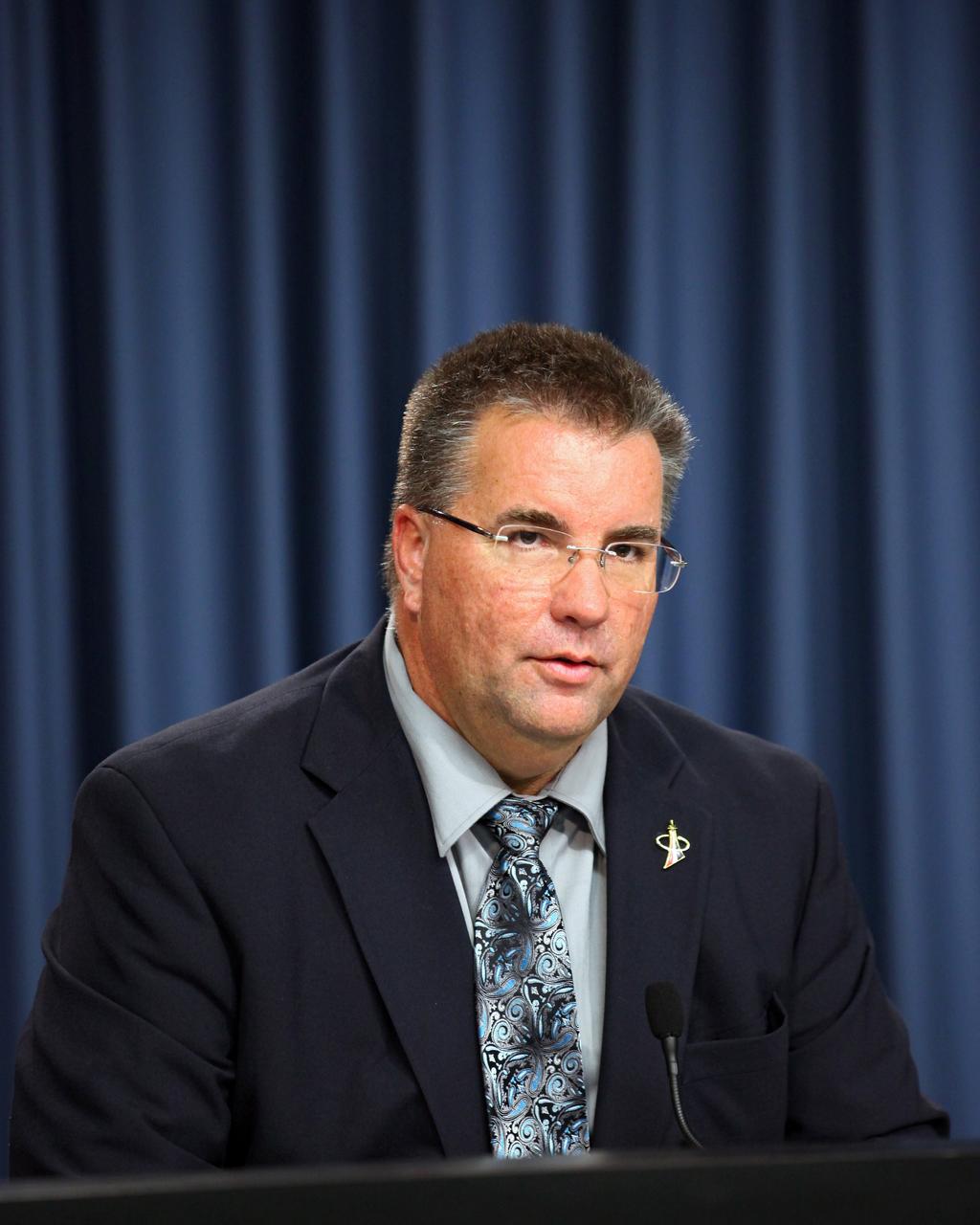
CAPE CANAVERAL, Fla. -- Ed Mango, manager of NASA's Commercial Crew Program, or CCP, talks to aerospace industry representatives during a pre-proposal conference to inform prospective companies about the recently released request for contract proposals and updates to the certification requirements for crewed missions to the International Space Station, or ISS. The two-phase certification process, called Certification Products Contract, or CPC, will enable NASA to eventually purchase service missions to fly astronauts to and from the ISS. To learn more about CCP, visit www.nasa.gov/commercialcrew. Photo credit: Kim Shiflett
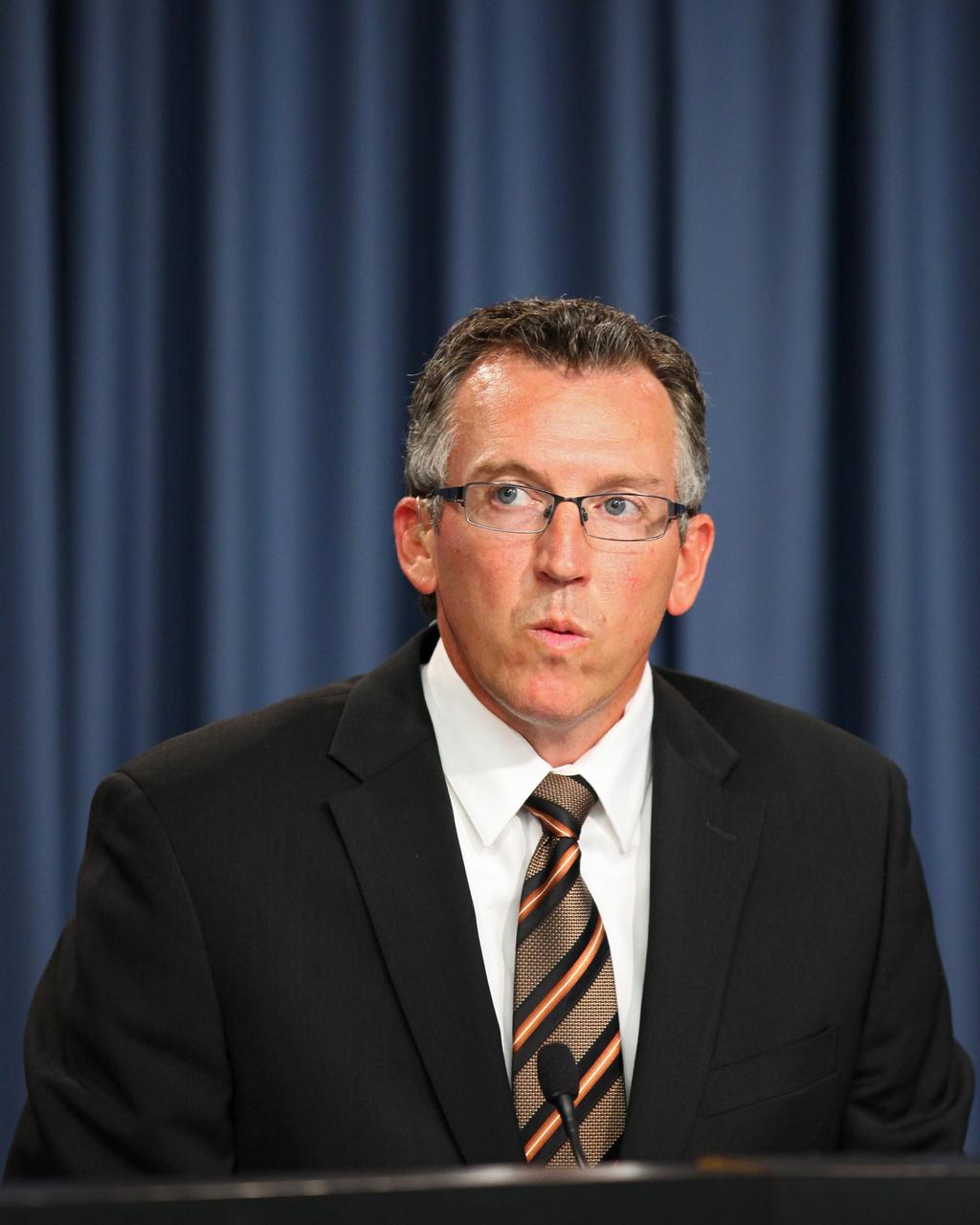
CAPE CANAVERAL, Fla. -- Tom Simon of NASA's Commercial Crew Program, or CCP, talks to aerospace industry representatives during a pre-proposal conference to inform prospective companies about the recently released request for contract proposals and updates to the certification requirements for crewed missions to the International Space Station, or ISS. The two-phase certification process, called Certification Products Contract, or CPC, will enable NASA to eventually purchase service missions to fly astronauts to and from the ISS. Simon will serve as chair of the CPC Evaluation Team that will come together to identify, research and ensure that the selected companies can comply with NASA's contract requirements. To learn more about CCP, visit www.nasa.gov/commercialcrew. Photo credit: Kim Shiflett
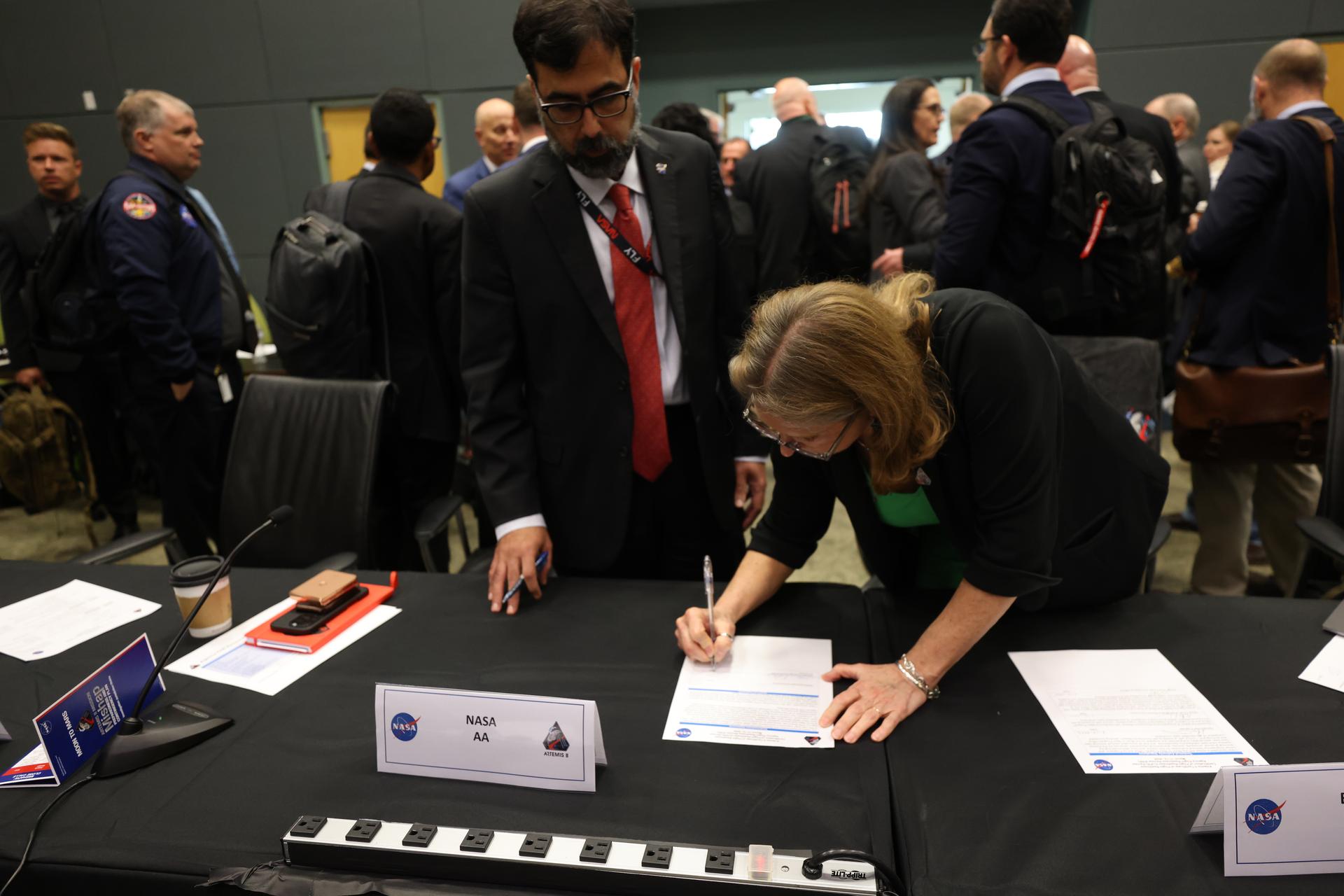
With NASA Associate Administrator Amit Kshatriya looking on, Lori Glaze, acting associate administrator, Exploration Systems Development Mission Directorate, signs the certification for flight readiness following the completion of the Flight Readiness Review for the Artemis II test flight on Thursday, March 12, 2026, at NASA’s Kennedy Space Center in Florida. The review is an assessment of the readiness of NASA’s SLS (Space Launch System) rocket and Orion spacecraft to support the Artemis II test flight as four astronauts journey around the Moon and return to Earth.

NASA Associate Administrator Amit Kshatriya signs the certification for flight readiness following the completion of the Flight Readiness Review for the Artemis II test flight on Thursday, March 12, 2026, at NASA’s Kennedy Space Center in Florida. The review is an assessment of the readiness of NASA’s SLS (Space Launch System) rocket and Orion spacecraft to support the Artemis II test flight as four astronauts journey around the Moon and return to Earth.
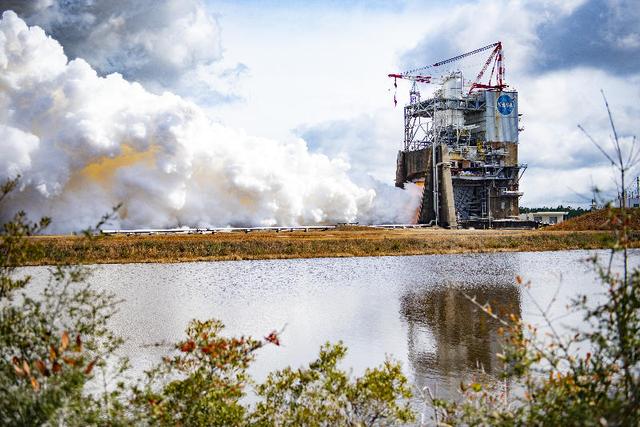
NASA completed a full-duration, 500-second hot fire of an RS-25 certification engine Jan. 27, marking the halfway point in a critical test series to support future SLS (Space Launch System) missions to the Moon and beyond as NASA explores the secrets of the universe for the benefit of all

Having reached the halfway point in a 12-test RS-25 certification series, teams at NASA’s Stennis Space Center will install a second production nozzle (shown) on the engine to gather additional performance data during the remaining scheduled hot fires.
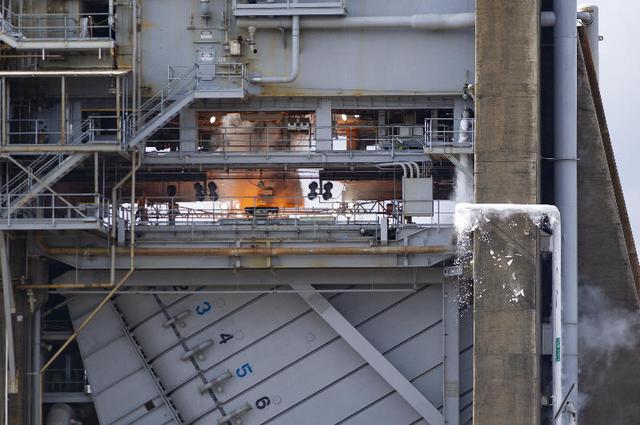
NASA completed a full-duration, 500-second hot fire of an RS-25 certification engine Jan. 27, marking the halfway point in a critical test series to support future SLS (Space Launch System) missions to the Moon and beyond as NASA explores the secrets of the universe for the benefit of all.
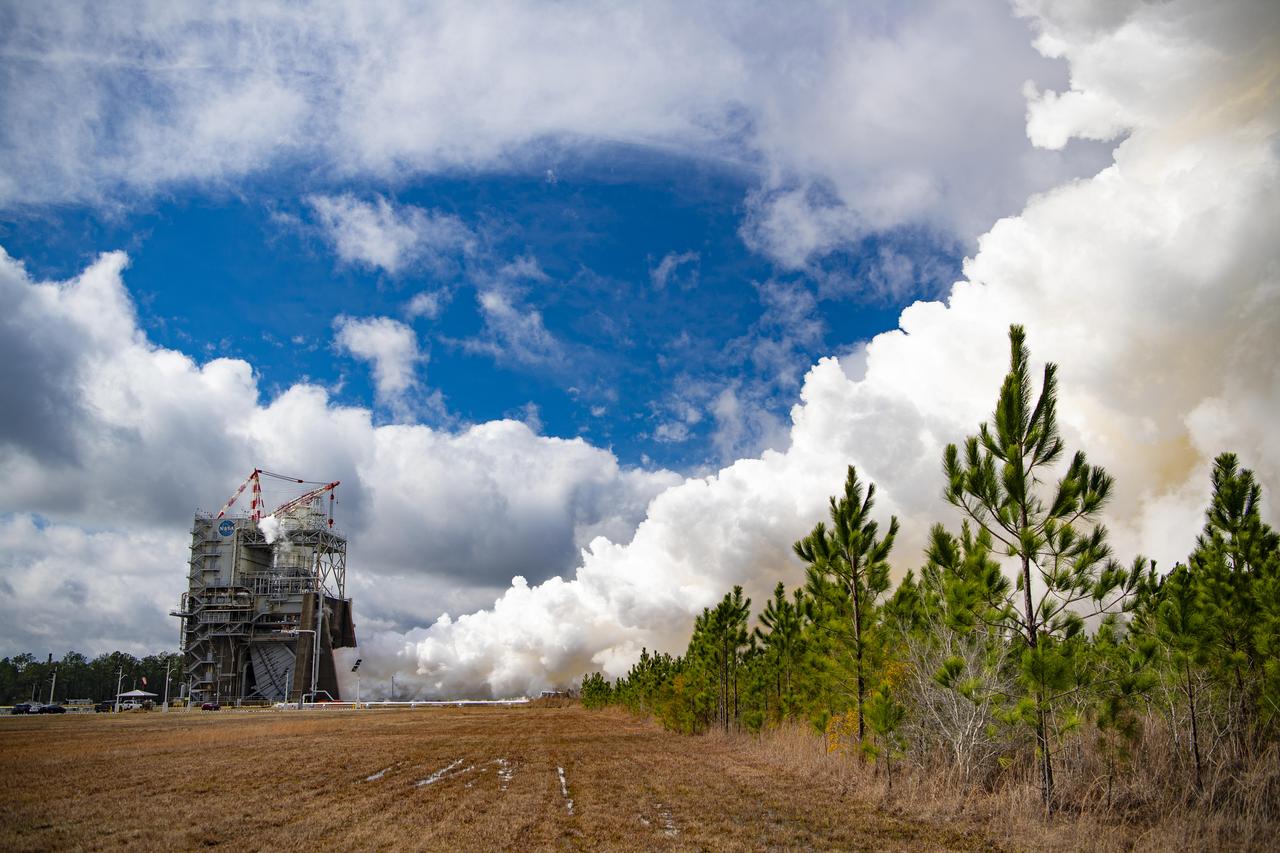
NASA completed a full-duration, 500-second hot fire of an RS-25 certification engine Jan. 27, marking the halfway point in a critical test series to support future SLS (Space Launch System) missions to the Moon and beyond as NASA explores the secrets of the universe for the benefit of all.
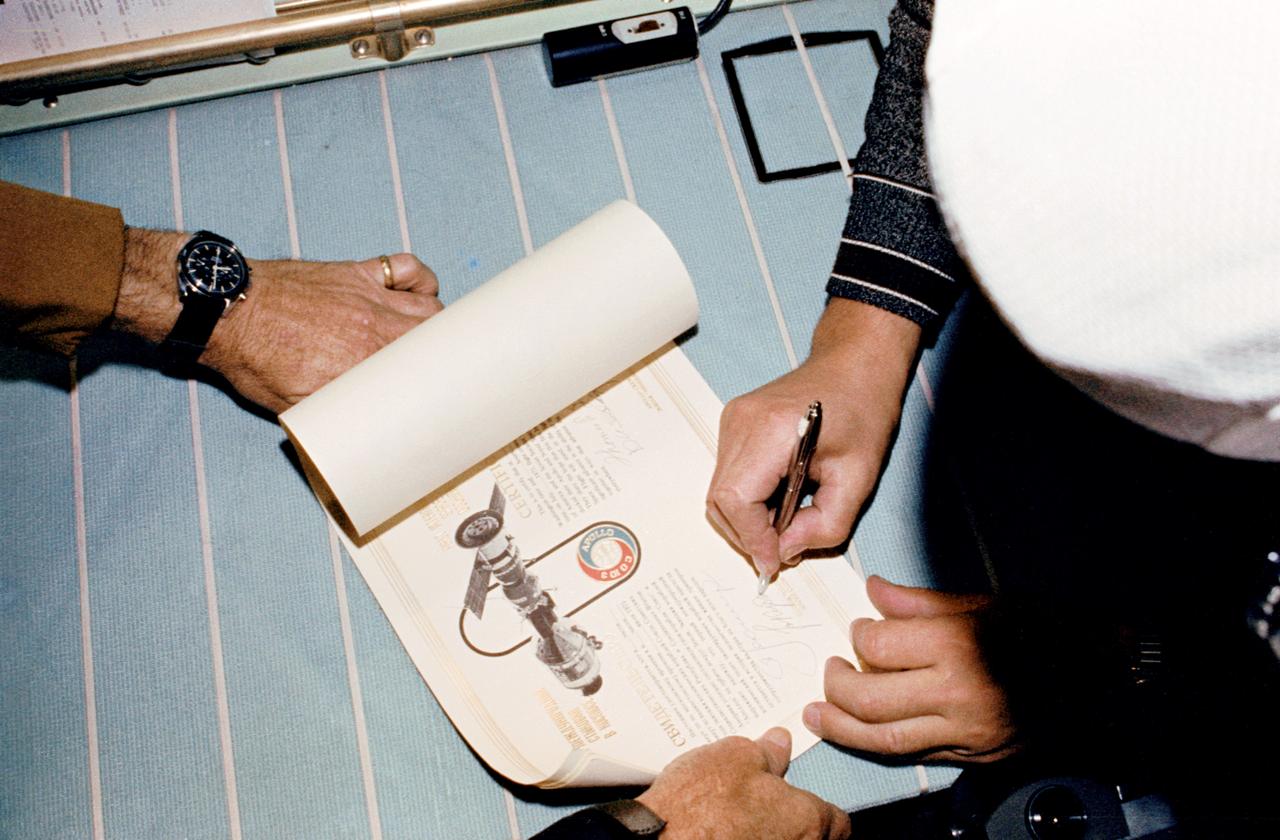
AST-03-171 (17 July 1975) --- The hands of cosmonaut Valerly N. Kubasov are seen as the ASTP engineer adds his name to the signature on the Soviet side of the official joint certificate marking an historical moment during the rendezvous day of the Apollo-Soyuz Test Project. The left hand of astronaut Donald K. Slayton, NASA's docking module pilot, is seen at left. The certificate had earlier been signed by astronauts Thomas P. Stafford, American crew commander; Slayton and cosmonaut Aleksey A. Leonov, Soviet crew commander, and it awaits the signature of astronaut Vance D. Brand, NASA's command module pilot who remained in the CM while the others signed in the Soviet Orbital Module of the Soyuz.

From left, NASA Associate Administrator Amit Kshatriya and Lori Glaze, acting associate administrator, Exploration Systems Development Mission Directorate, shake hands after each signing the certification for flight readiness following the completion of the Flight Readiness Review for the Artemis II test flight on Thursday, March 12, 2026, at NASA’s Kennedy Space Center in Florida. The review is an assessment of the readiness of NASA’s SLS (Space Launch System) rocket and Orion spacecraft to support the Artemis II test flight as four astronauts journey around the Moon and return to Earth.
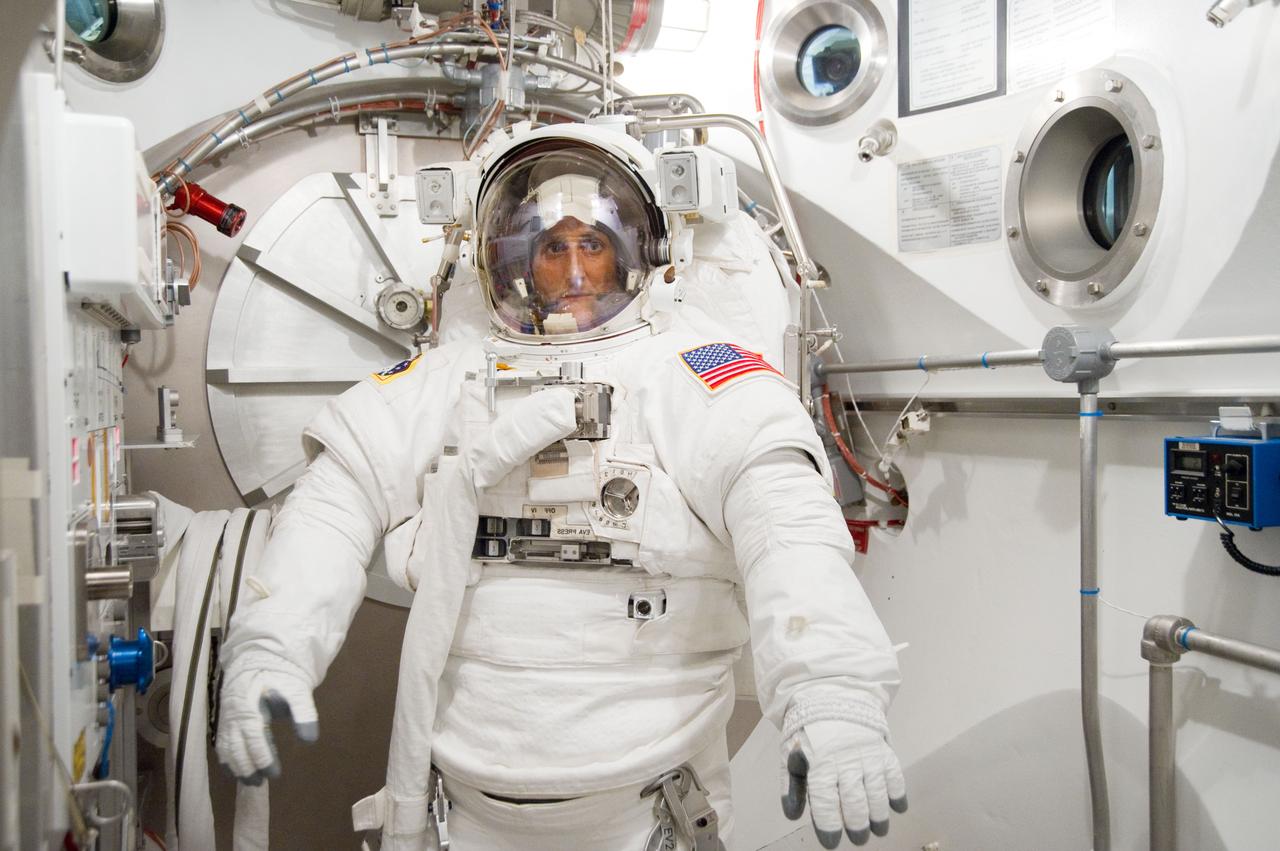
Expedition 32 crew member Sunita Williams during her EMU Training and Certification. Photo Date: September 8, 2011. Location: Building 7 - SSATA Chamber. Photographer: Robert Markowitz
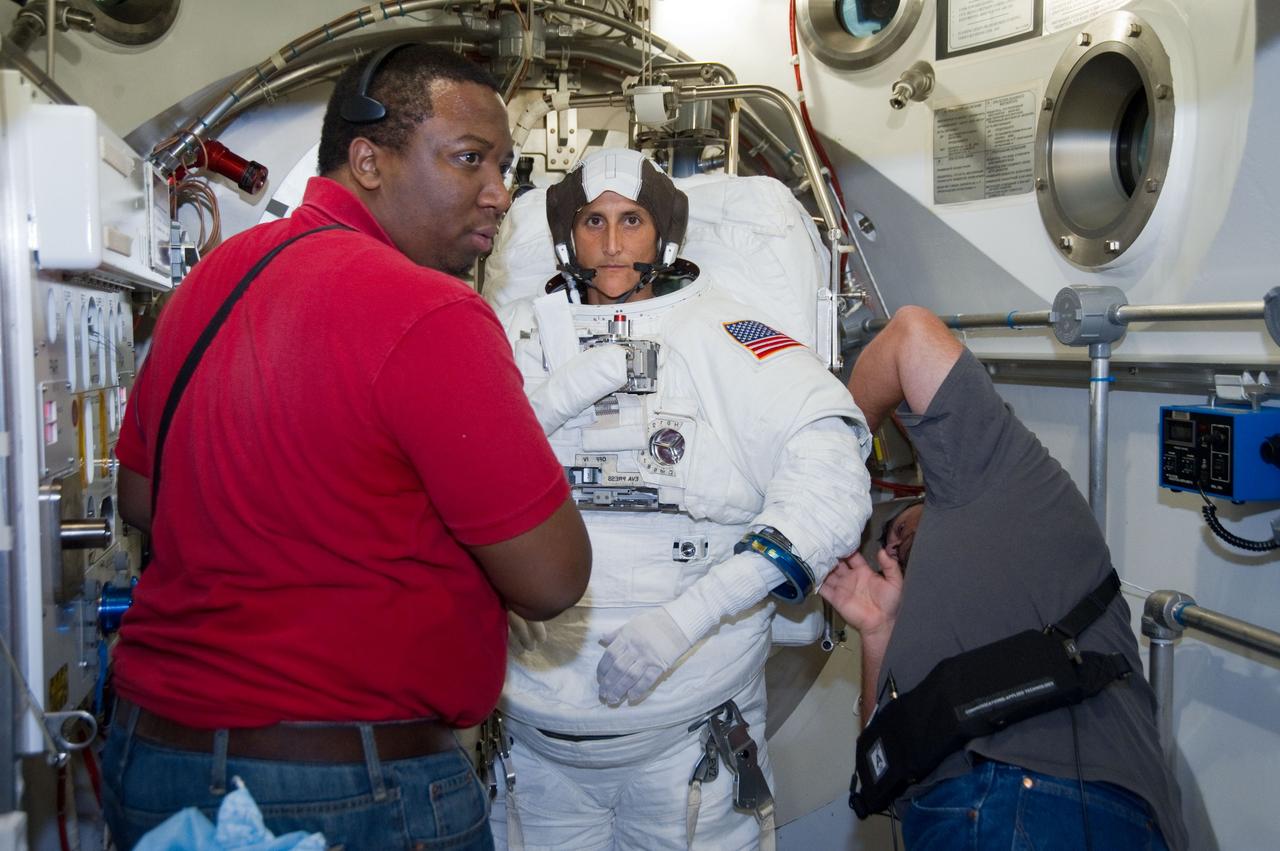
Expedition 32 crew member Sunita Williams during her EMU Training and Certification. Photo Date: September 8, 2011. Location: Building 7 - SSATA Chamber. Photographer: Robert Markowitz
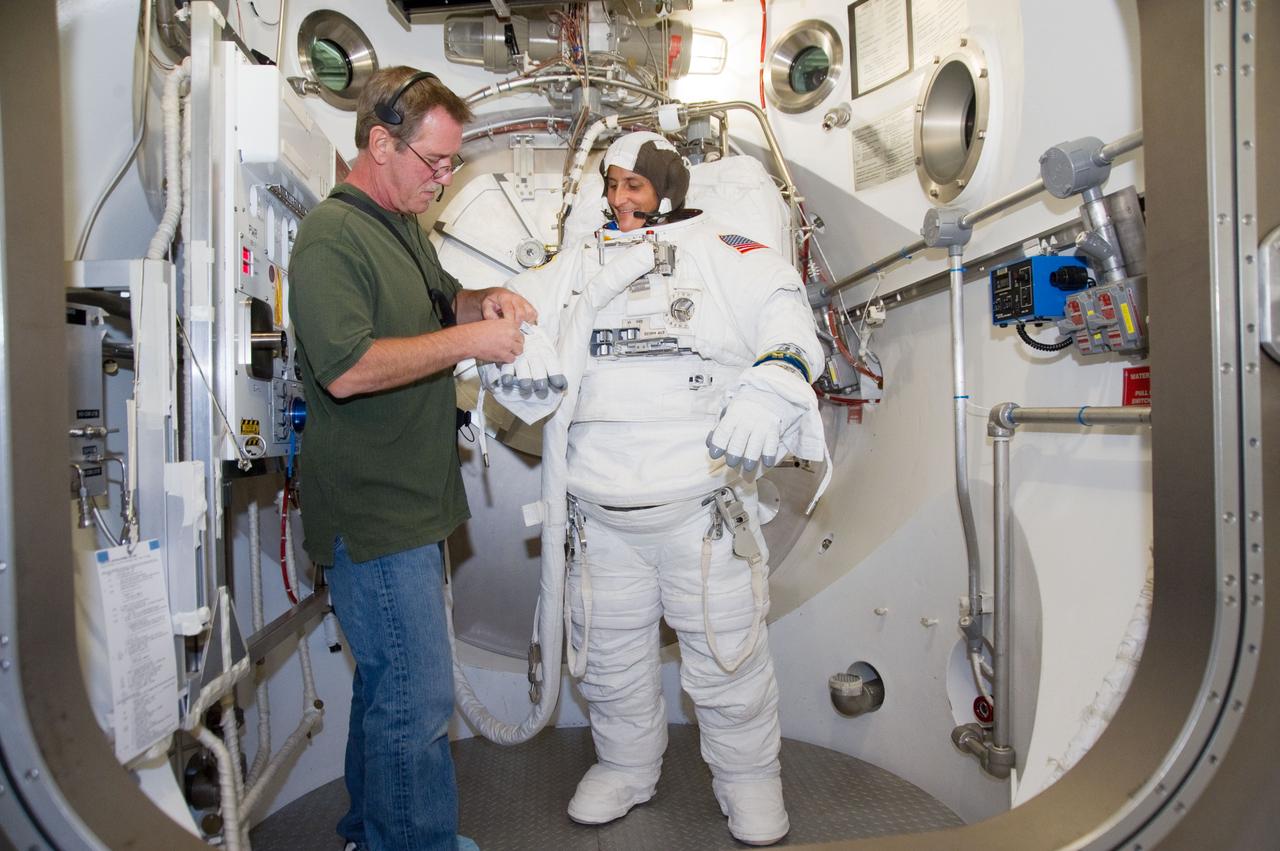
Expedition 32 crew member Sunita Williams during her EMU Training and Certification. Photo Date: September 8, 2011. Location: Building 7 - SSATA Chamber. Photographer: Robert Markowitz
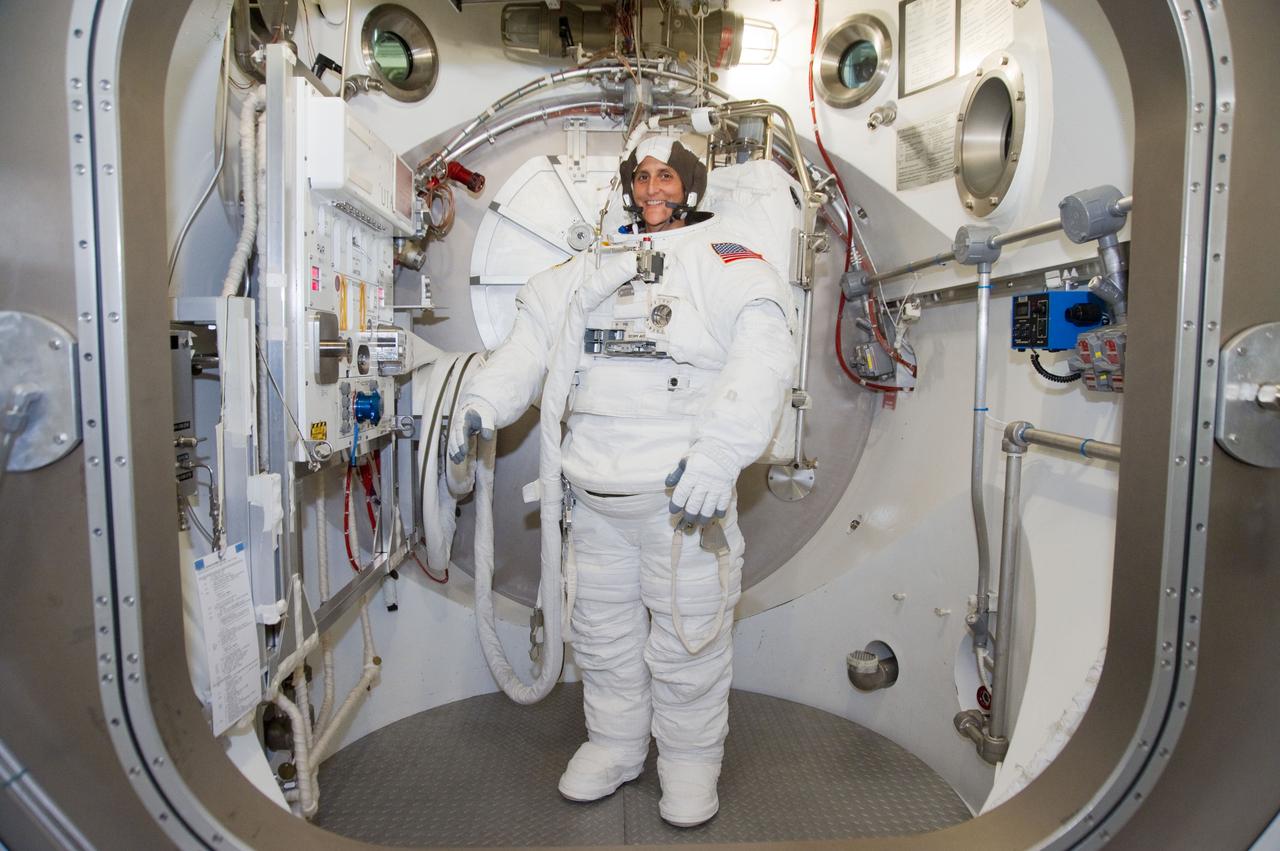
Expedition 32 crew member Sunita Williams during her EMU Training and Certification. Photo Date: September 8, 2011. Location: Building 7 - SSATA Chamber. Photographer: Robert Markowitz
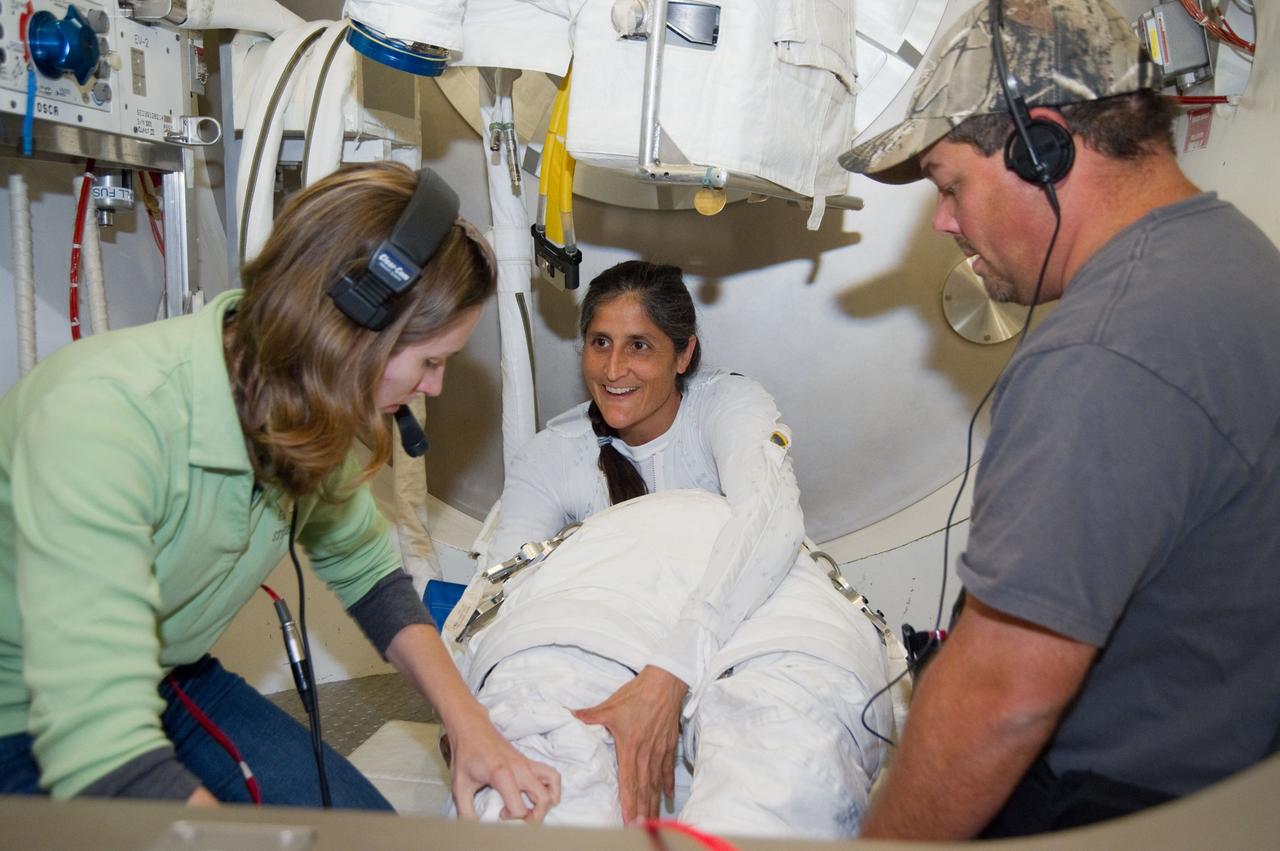
Expedition 32 crew member Sunita Williams during her EMU Training and Certification. Photo Date: September 8, 2011. Location: Building 7 - SSATA Chamber. Photographer: Robert Markowitz
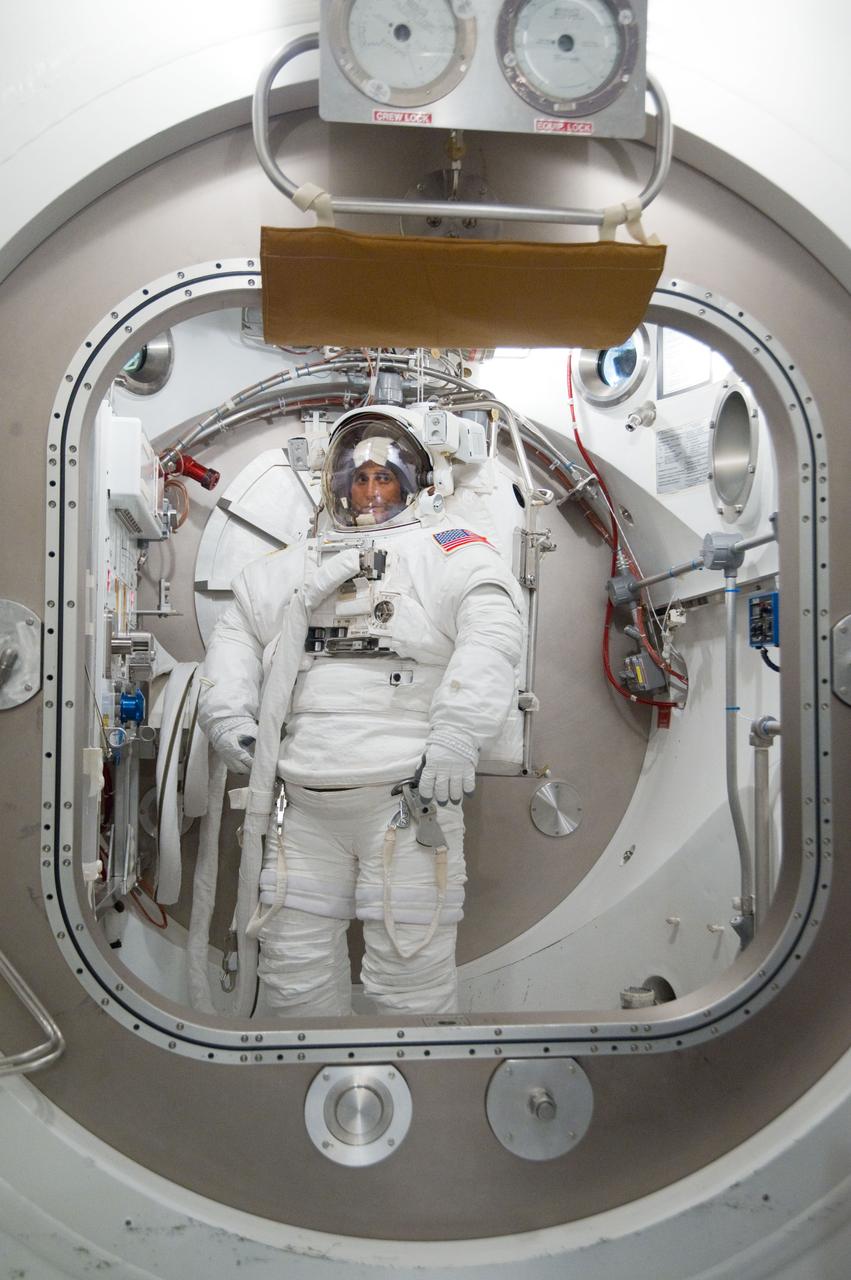
Expedition 32 crew member Sunita Williams during her EMU Training and Certification. Photo Date: September 8, 2011. Location: Building 7 - SSATA Chamber. Photographer: Robert Markowitz
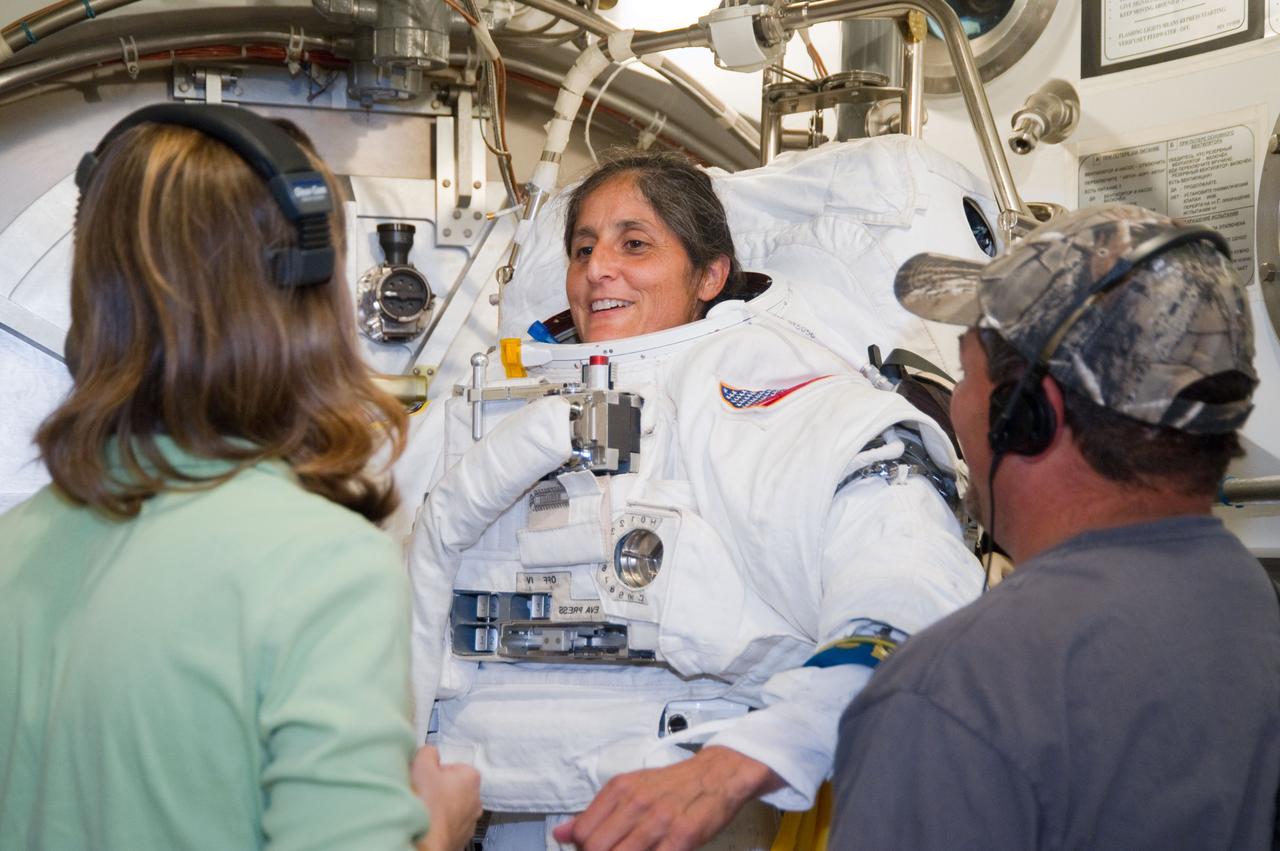
Expedition 32 crew member Sunita Williams during her EMU Training and Certification. Photo Date: September 8, 2011. Location: Building 7 - SSATA Chamber. Photographer: Robert Markowitz
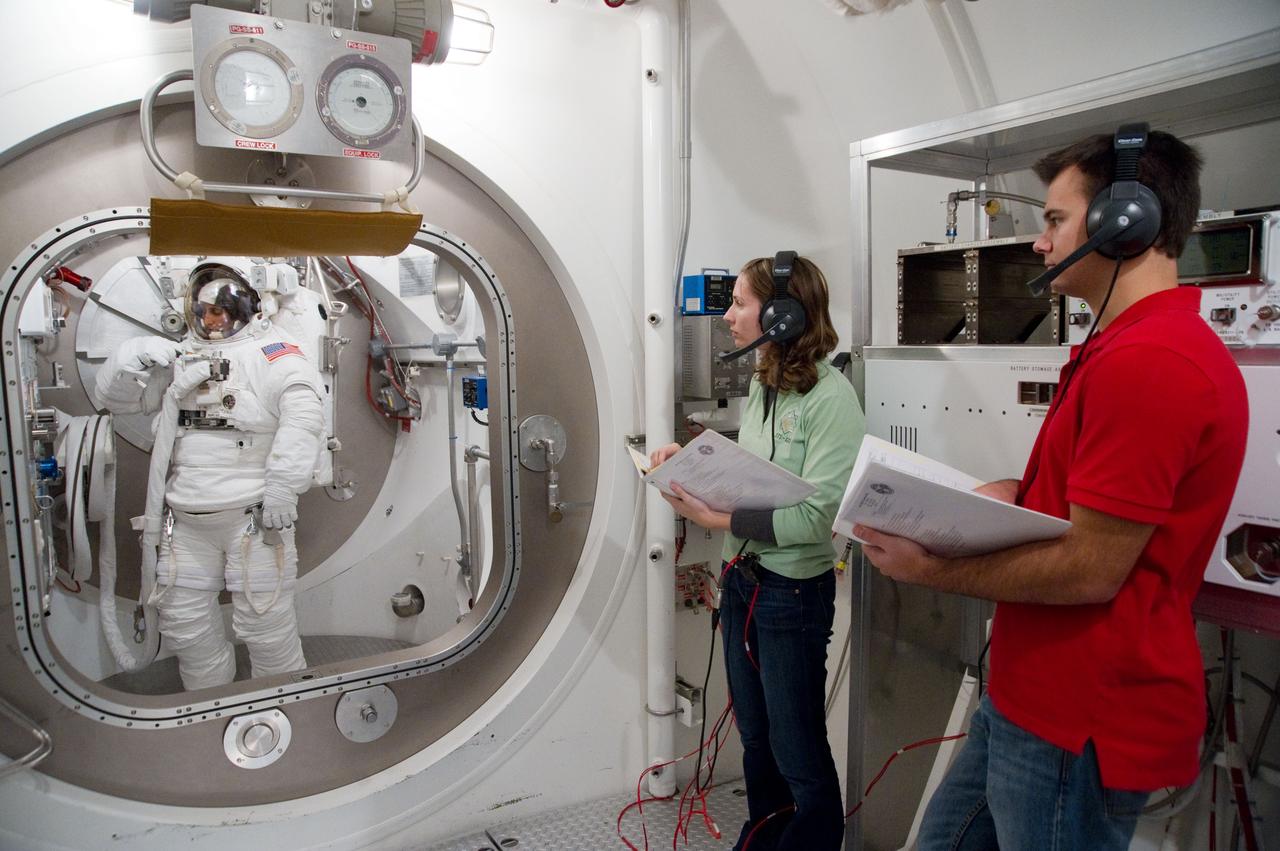
Expedition 32 crew member Sunita Williams during her EMU Training and Certification. Photo Date: September 8, 2011. Location: Building 7 - SSATA Chamber. Photographer: Robert Markowitz
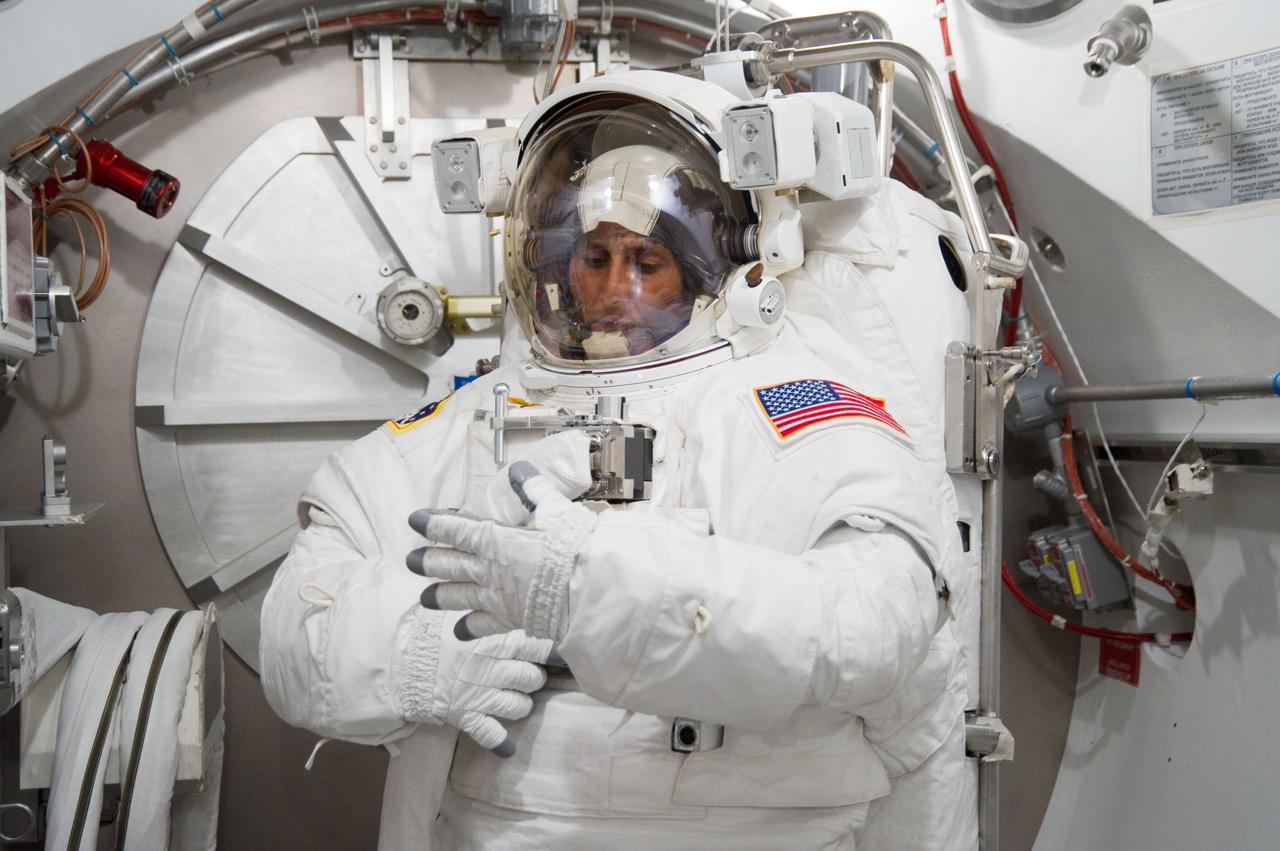
Expedition 32 crew member Sunita Williams during her EMU Training and Certification. Photo Date: September 8, 2011. Location: Building 7 - SSATA Chamber. Photographer: Robert Markowitz

Expedition 32 crew member Sunita Williams during her EMU Training and Certification. Photo Date: September 8, 2011. Location: Building 7 - SSATA Chamber. Photographer: Robert Markowitz
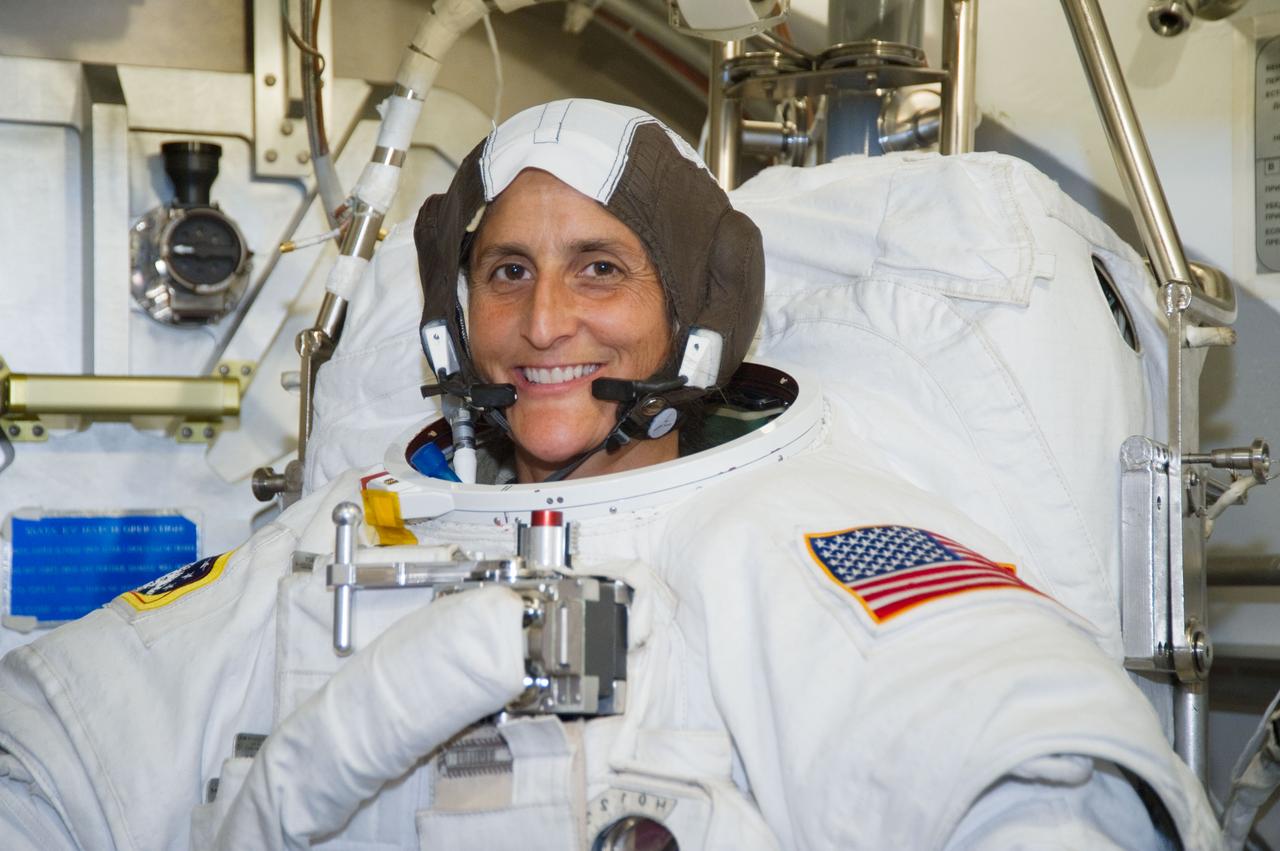
Expedition 32 crew member Sunita Williams during her EMU Training and Certification. Photo Date: September 8, 2011. Location: Building 7 - SSATA Chamber. Photographer: Robert Markowitz
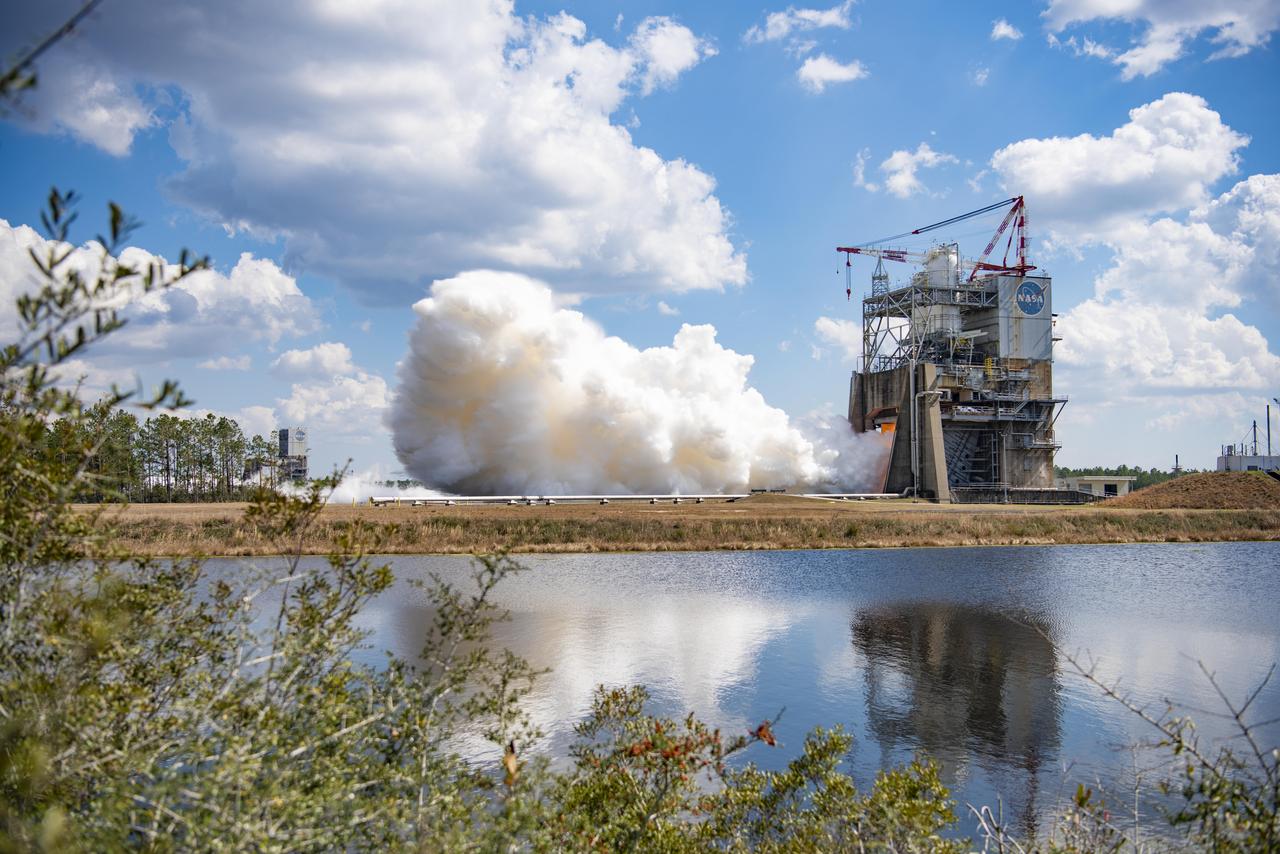
NASA conducts a full-duration RS-25 hot fire Feb. 23 on the Fred Haise Test Stand at NASA’s Stennis Space Center near Bay St. Louis, Mississippi, continuing a key test series for future Artemis flights of NASA’s SLS (Space Launch System) rocket. During the seventh test of the 12-test series, operators fired the certification engine for 550 seconds and up to a 113% power level. The hot fire followed installation of a second production engine nozzle that will provide additional performance data on the upgraded unit. The test series is the second, and final, series to certify restart production of the upgraded engines by lead contractor Aerojet Rocketdyne, an L3Harris Technologies company. New engines will help power NASA’s SLS rocket on Artemis missions to the Moon and beyond, beginning with Artemis V. NASA and Aerojet Rocketdyne modified 16 former space shuttle engines for use on Artemis missions I through IV. NASA completed an initial 12-test certification series with the upgraded components in June 2023. Four RS-25 engines fire simultaneously to help launch each SLS rocket, producing up to 2 million pounds of combined thrust.
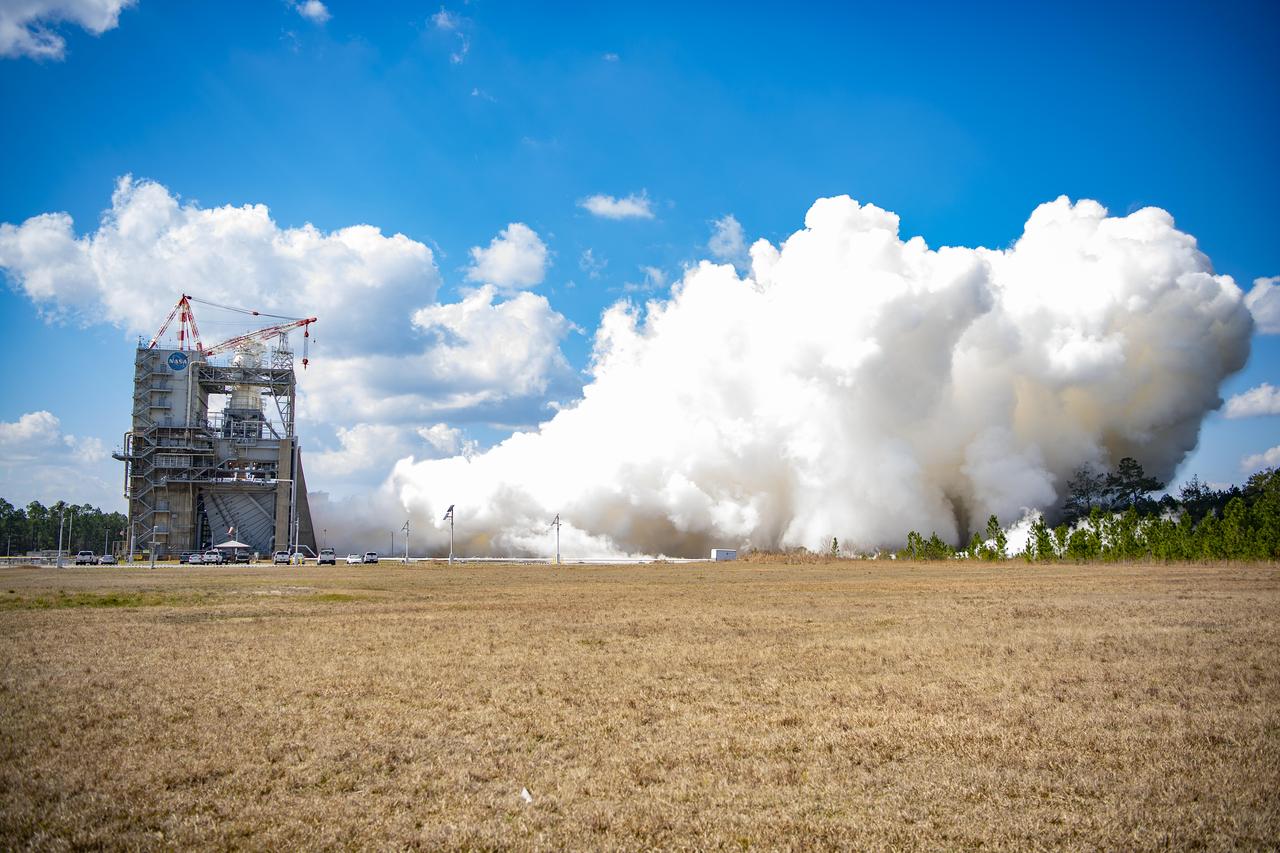
NASA conducts a full-duration RS-25 hot fire Feb. 23 on the Fred Haise Test Stand at NASA’s Stennis Space Center near Bay St. Louis, Mississippi, continuing a key test series for future Artemis flights of NASA’s SLS (Space Launch System) rocket. During the seventh test of the 12-test series, operators fired the certification engine for 550 seconds and up to a 113% power level. The hot fire followed installation of a second production engine nozzle that will provide additional performance data on the upgraded unit. The test series is the second, and final, series to certify restart production of the upgraded engines by lead contractor Aerojet Rocketdyne, an L3Harris Technologies company. New engines will help power NASA’s SLS rocket on Artemis missions to the Moon and beyond, beginning with Artemis V. NASA and Aerojet Rocketdyne modified 16 former space shuttle engines for use on Artemis missions I through IV. NASA completed an initial 12-test certification series with the upgraded components in June 2023. Four RS-25 engines fire simultaneously to help launch each SLS rocket, producing up to 2 million pounds of combined thrust.

NASA conducts a full-duration RS-25 hot fire Feb. 23 on the Fred Haise Test Stand at NASA’s Stennis Space Center near Bay St. Louis, Mississippi, continuing a key test series for future Artemis flights of NASA’s SLS (Space Launch System) rocket. During the seventh test of the 12-test series, operators fired the certification engine for 550 seconds and up to a 113% power level. The hot fire followed installation of a second production engine nozzle that will provide additional performance data on the upgraded unit. The test series is the second, and final, series to certify restart production of the upgraded engines by lead contractor Aerojet Rocketdyne, an L3Harris Technologies company. New engines will help power NASA’s SLS rocket on Artemis missions to the Moon and beyond, beginning with Artemis V. NASA and Aerojet Rocketdyne modified 16 former space shuttle engines for use on Artemis missions I through IV. NASA completed an initial 12-test certification series with the upgraded components in June 2023. Four RS-25 engines fire simultaneously to help launch each SLS rocket, producing up to 2 million pounds of combined thrust.
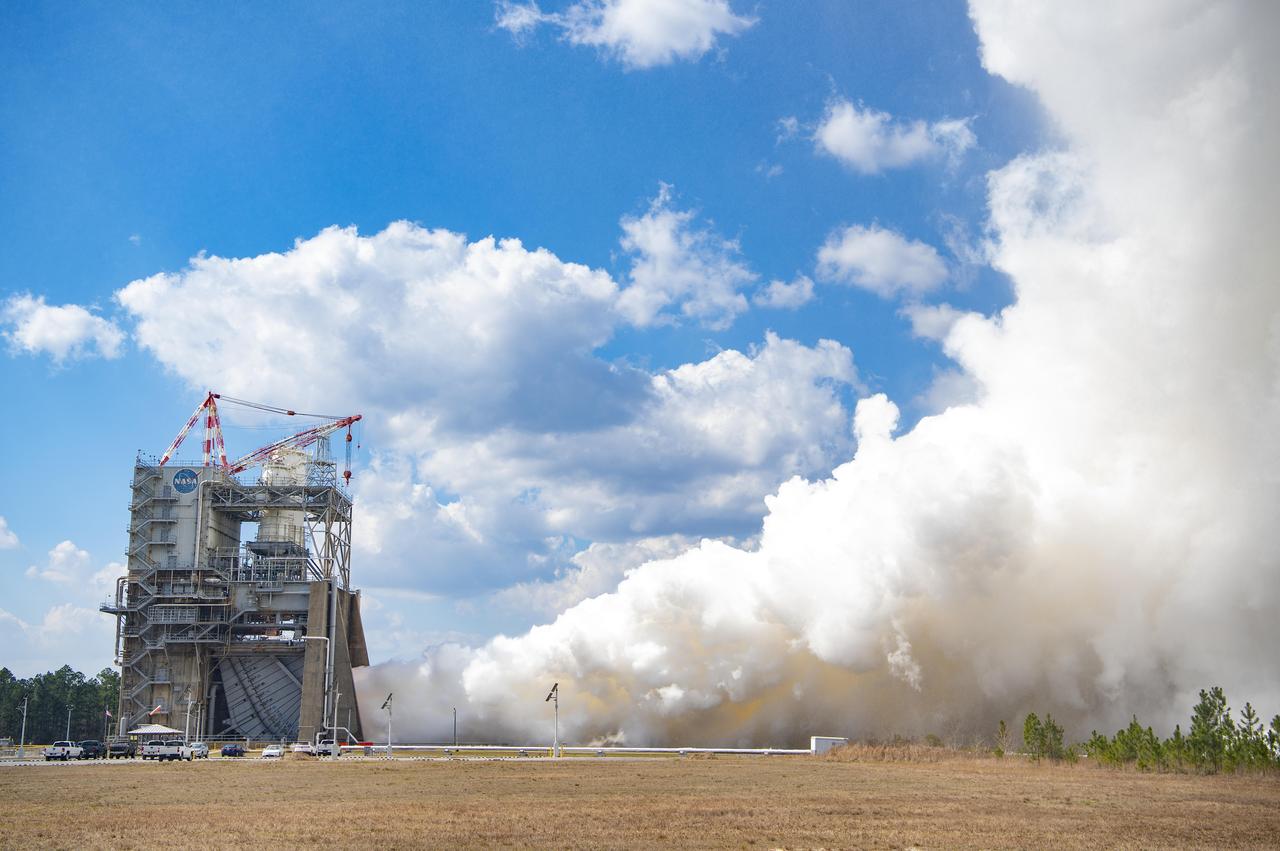
NASA conducts a full-duration RS-25 hot fire Feb. 23 on the Fred Haise Test Stand at NASA’s Stennis Space Center near Bay St. Louis, Mississippi, continuing a key test series for future Artemis flights of NASA’s SLS (Space Launch System) rocket. During the seventh test of the 12-test series, operators fired the certification engine for 550 seconds and up to a 113% power level. The hot fire followed installation of a second production engine nozzle that will provide additional performance data on the upgraded unit. The test series is the second, and final, series to certify restart production of the upgraded engines by lead contractor Aerojet Rocketdyne, an L3Harris Technologies company. New engines will help power NASA’s SLS rocket on Artemis missions to the Moon and beyond, beginning with Artemis V. NASA and Aerojet Rocketdyne modified 16 former space shuttle engines for use on Artemis missions I through IV. NASA completed an initial 12-test certification series with the upgraded components in June 2023. Four RS-25 engines fire simultaneously to help launch each SLS rocket, producing up to 2 million pounds of combined thrust.
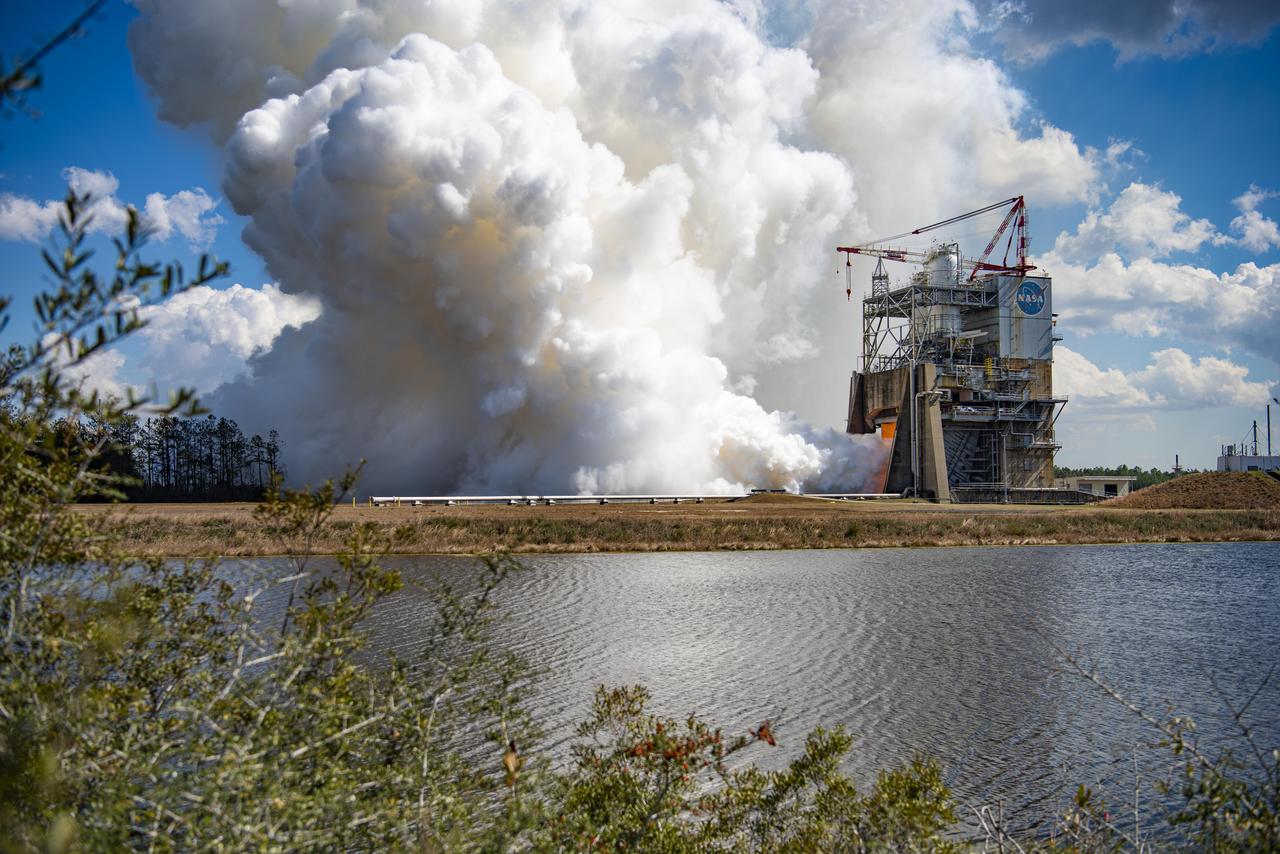
NASA conducts a full-duration RS-25 hot fire Feb. 23 on the Fred Haise Test Stand at NASA’s Stennis Space Center near Bay St. Louis, Mississippi, continuing a key test series for future Artemis flights of NASA’s SLS (Space Launch System) rocket. During the seventh test of the 12-test series, operators fired the certification engine for 550 seconds and up to a 113% power level. The hot fire followed installation of a second production engine nozzle that will provide additional performance data on the upgraded unit. The test series is the second, and final, series to certify restart production of the upgraded engines by lead contractor Aerojet Rocketdyne, an L3Harris Technologies company. New engines will help power NASA’s SLS rocket on Artemis missions to the Moon and beyond, beginning with Artemis V. NASA and Aerojet Rocketdyne modified 16 former space shuttle engines for use on Artemis missions I through IV. NASA completed an initial 12-test certification series with the upgraded components in June 2023. Four RS-25 engines fire simultaneously to help launch each SLS rocket, producing up to 2 million pounds of combined thrust.
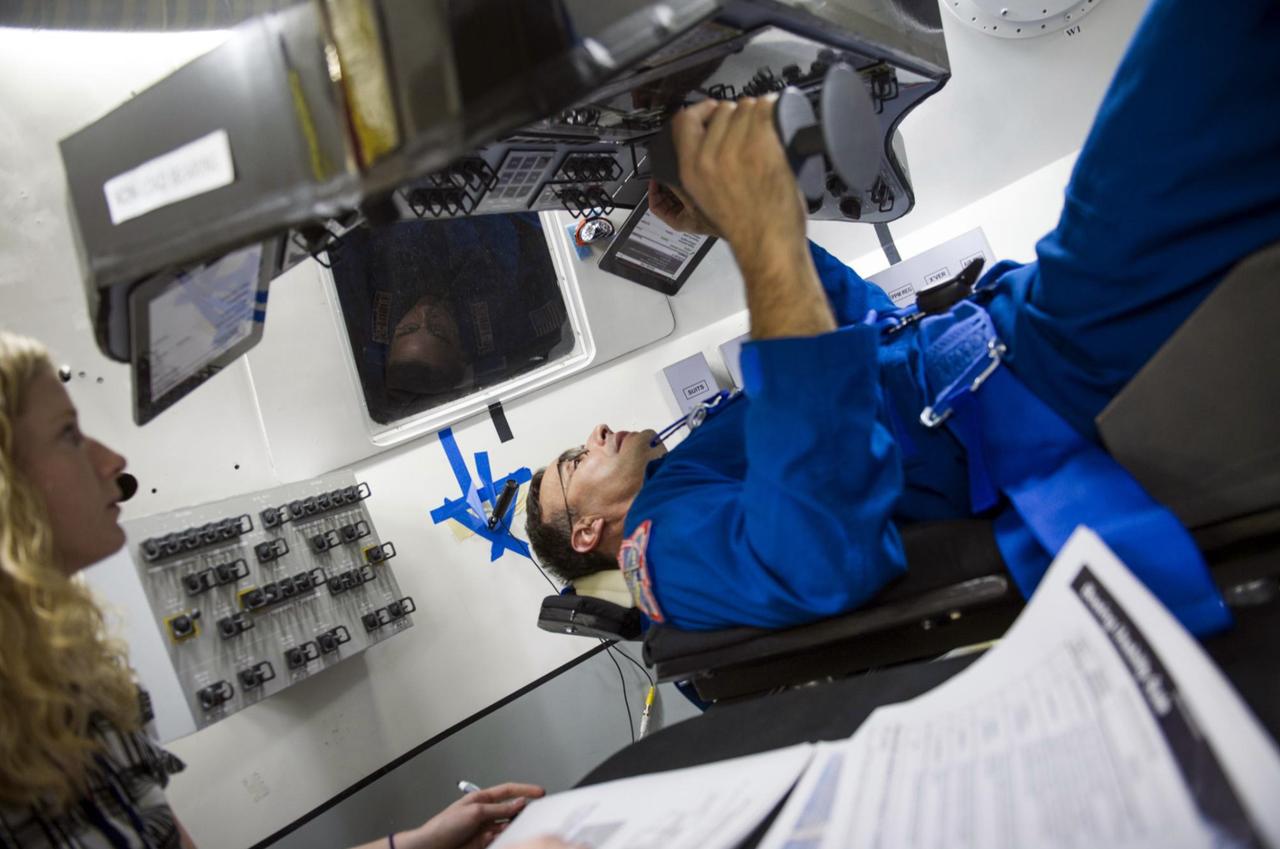
HOUSTON -- NASA Astronaut Lee Archambault performs an evaluation of reach and visibility of controls and displays during an end-of-year interior layout evaluation of The Boeing Company's CST-100 spacecraft. The evaluation at Boeing's Houston Product Support Center in Texas was part of the company's ongoing work supporting its funded Space Act Agreement with NASA's Commercial Crew Program, or CCP, during the Commercial Crew Integrated Capability, or CCiCap, initiative. CCP is intended to lead to the availability of commercial human spaceflight services for government and commercial customers to low-Earth orbit. Future development and certification initiatives eventually will lead to the availability of human spaceflight services for NASA to send its astronauts to the International Space Station, where critical research is taking place daily. For more information about CCP, go to http://www.nasa.gov/commercialcrew. Photo credit: Boeing
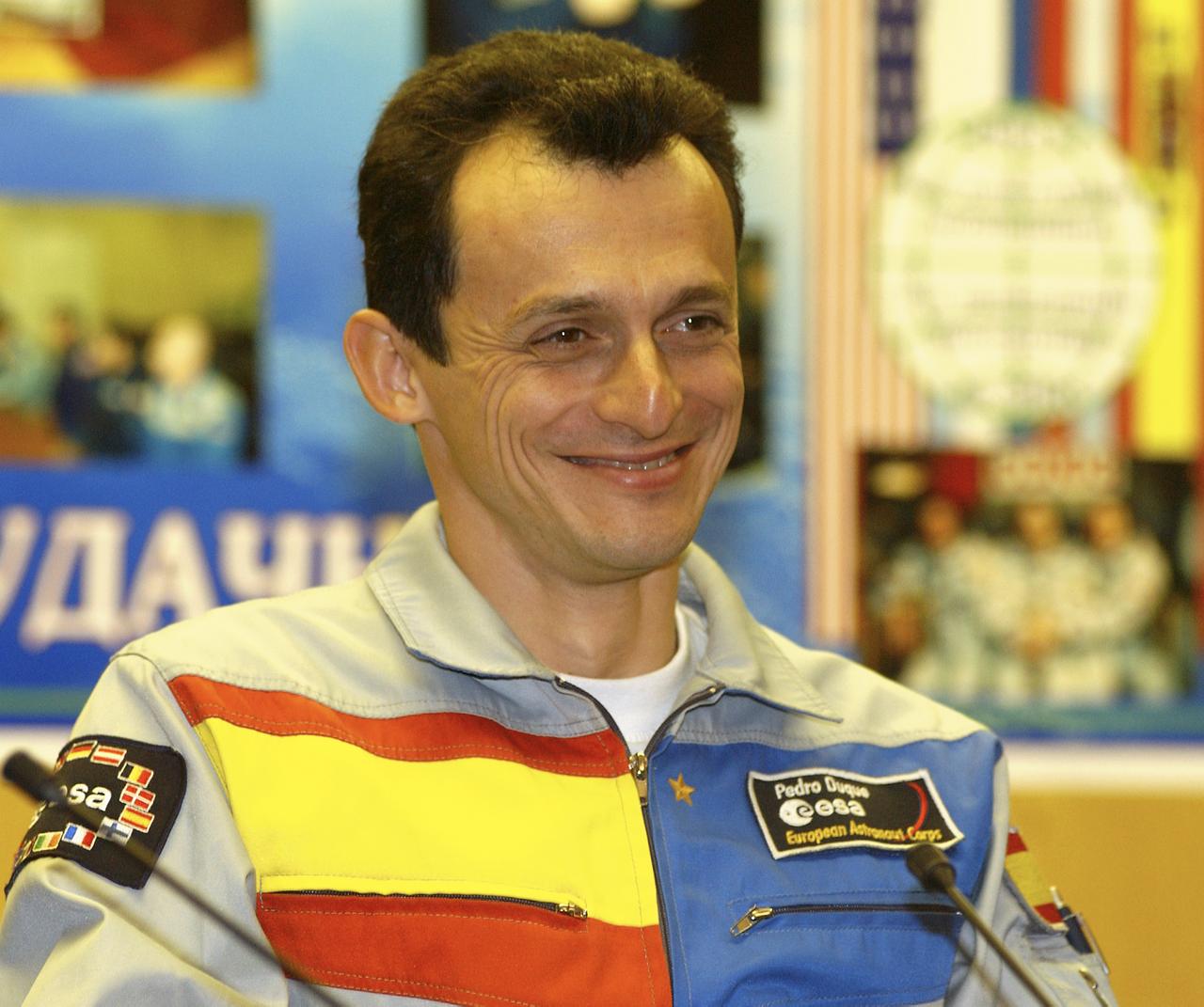
European Space Agency astronaut Pedro Duque of Spain, smiles at a reporter's question during a prelaunch news conference, Friday, Oct. 17, 2003, in Baikonur, Kazakhstan. Photo Credit (NASA/Bill Ingalls)
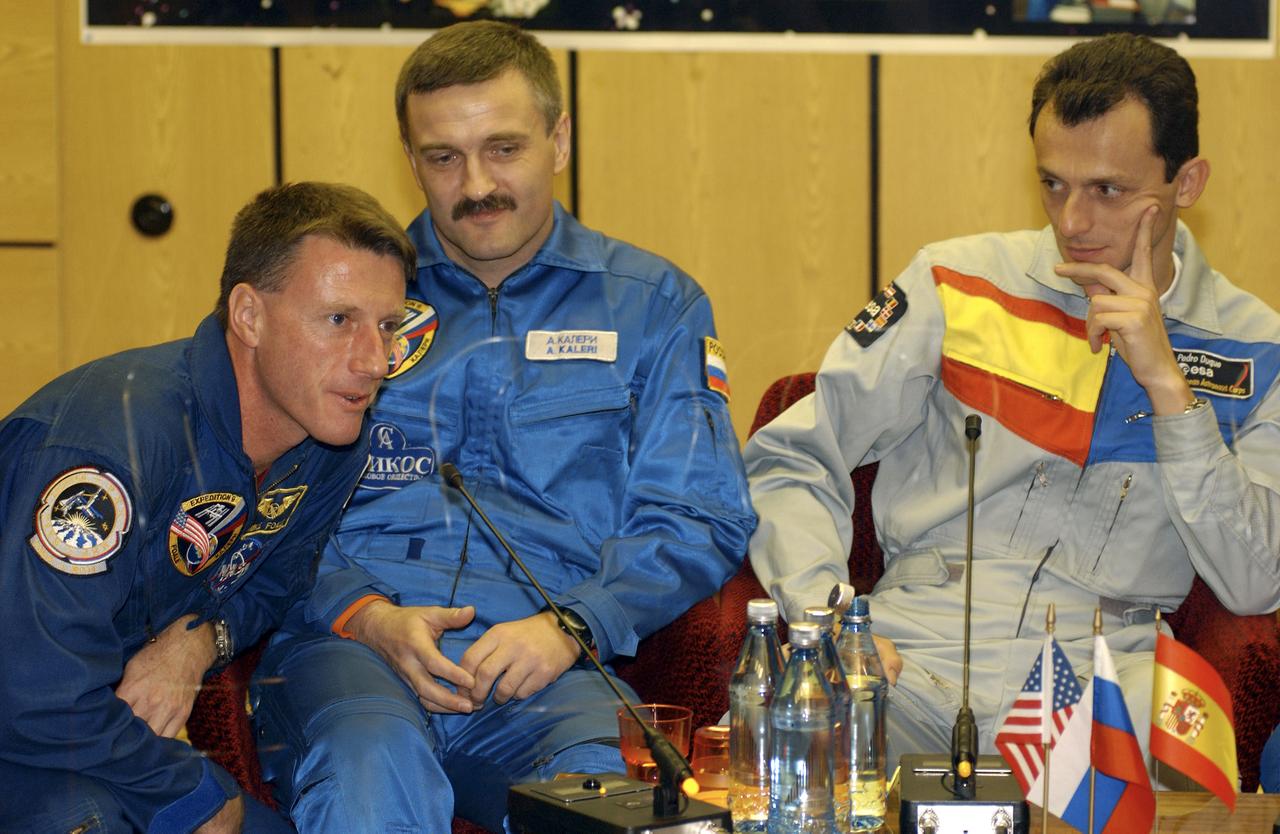
Expedition 8 Commander and NASA Science Officer Michael Foale, left, responds to a reporter's question as Expedition 8 Soyuz Commander Alexander Kaleri and European Space Agency astronaut Pedro Duque of Spain, right, look on during a prelaunch news conference, Friday, Oct. 17, 2003, in Baikonur, Kazakhstan. Photo Credit (NASA/Bill Ingalls)
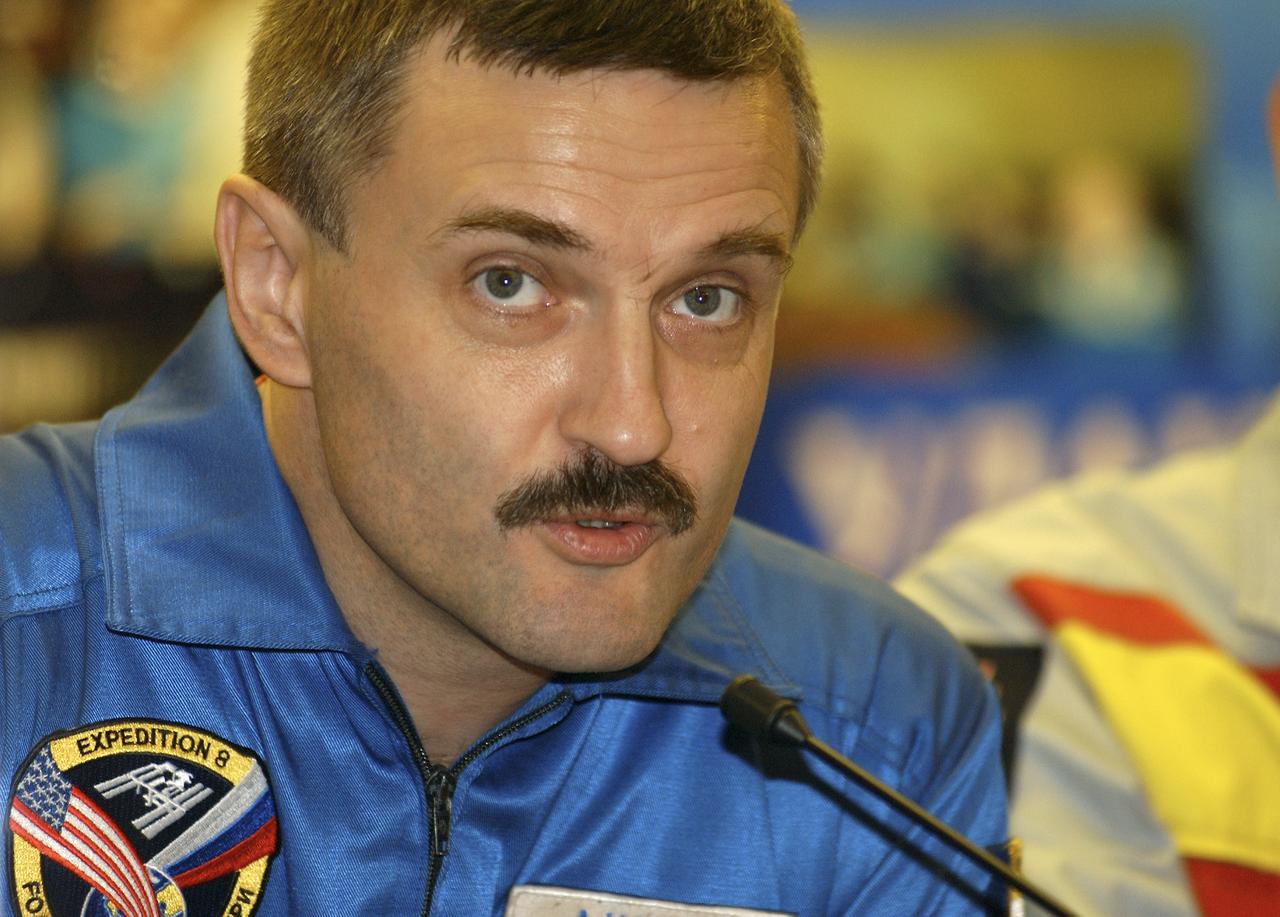
Expedition 8 Soyuz Commander Alexander Kaleri responds to a reporter's question during a prelaunch news conference, Friday, Oct. 17, 2003 in Baikonur, Kazakhstan. Kaleri, Expedition 8 Commander and NASA Science Officer Mike Foale and European Space Agency astronaut Pedro Duque of Spain launched Oct. 18 to the International Space Station. Photo Credit (NASA/Bill Ingalls)
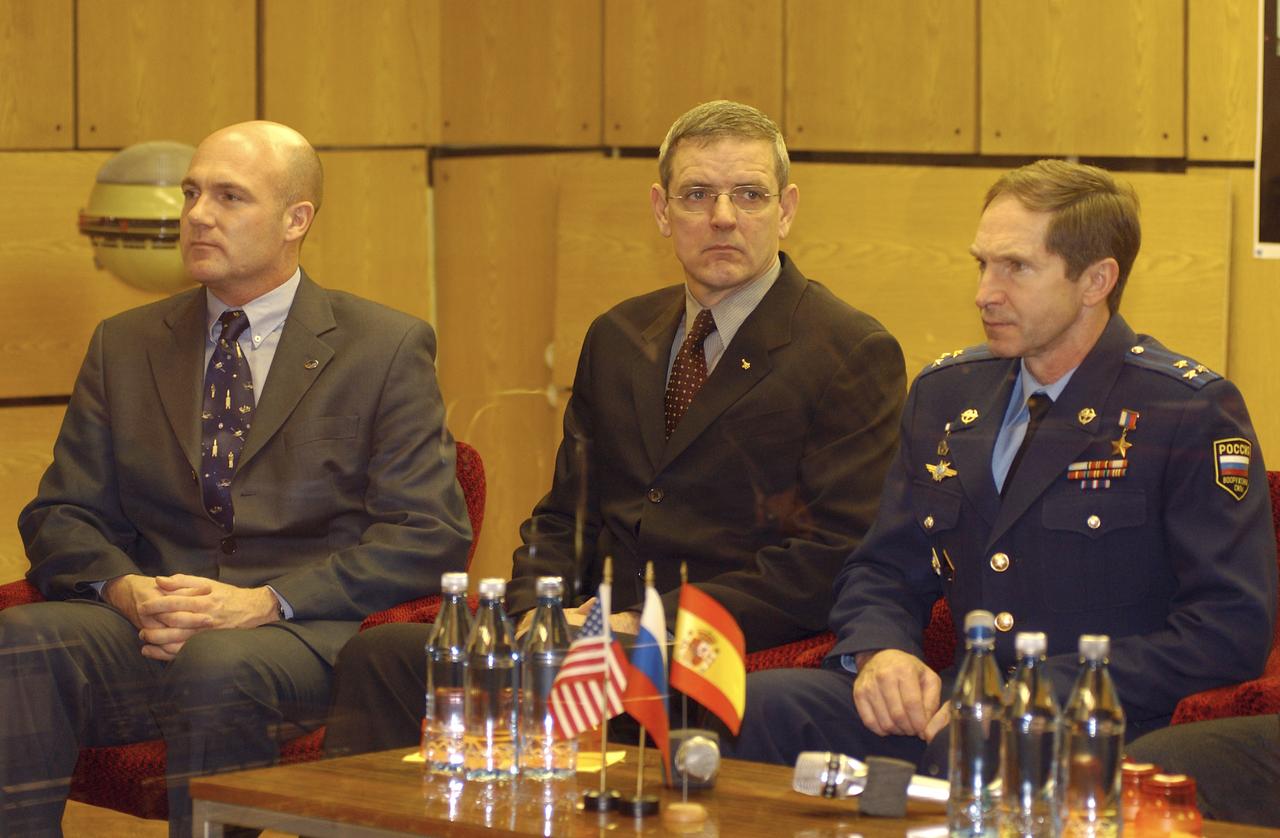
Backup crewmembers Andre Kuipers of the Netherlands of the European Space Agency, center, Bill McArthur of NASA, left, and Valery Tokarev of Russia listen to Russian space officials clear their Expedition 8 and European Space Agency prime crewmembers for launch during a State Commission meeting, Friday, Oct. 17, 2003, at the Cosmonaut Hotel in Baikonur, Kazakhstan. Prime crewmembers Mike Foale, Alexander Kaleri and Pedro Duque launched, Saturday, Oct. 18 to the International Space Station in a Soyuz TMA-3 vehicle.Photo Credit (NASA/Bill Ingalls)
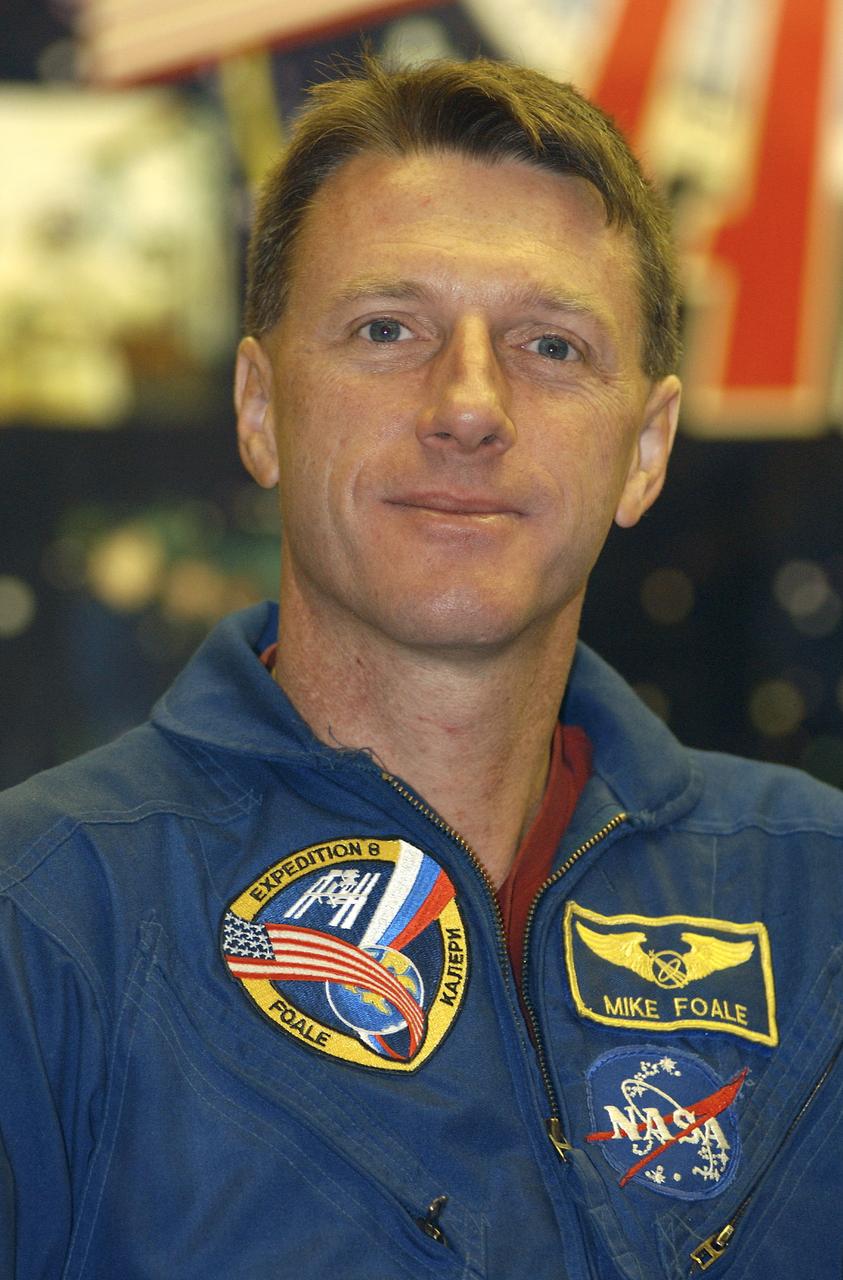
Expedition 8 Commander and NASA Science Officer Michael Foale listens to a reporter's question during a prelaunch news conference, Friday, Oct. 17, 2003, in Baikonur, Kazakhstan. Foale, Expedition 8 Soyuz Commander Alexander Kaleri and European Space Agency Astronaut Pedro Duque of Spain launched in a Soyuz TMA-3 vehicle Oct. 18 to the International Space Station. Photo Credit (NASA/Bill Ingalls)
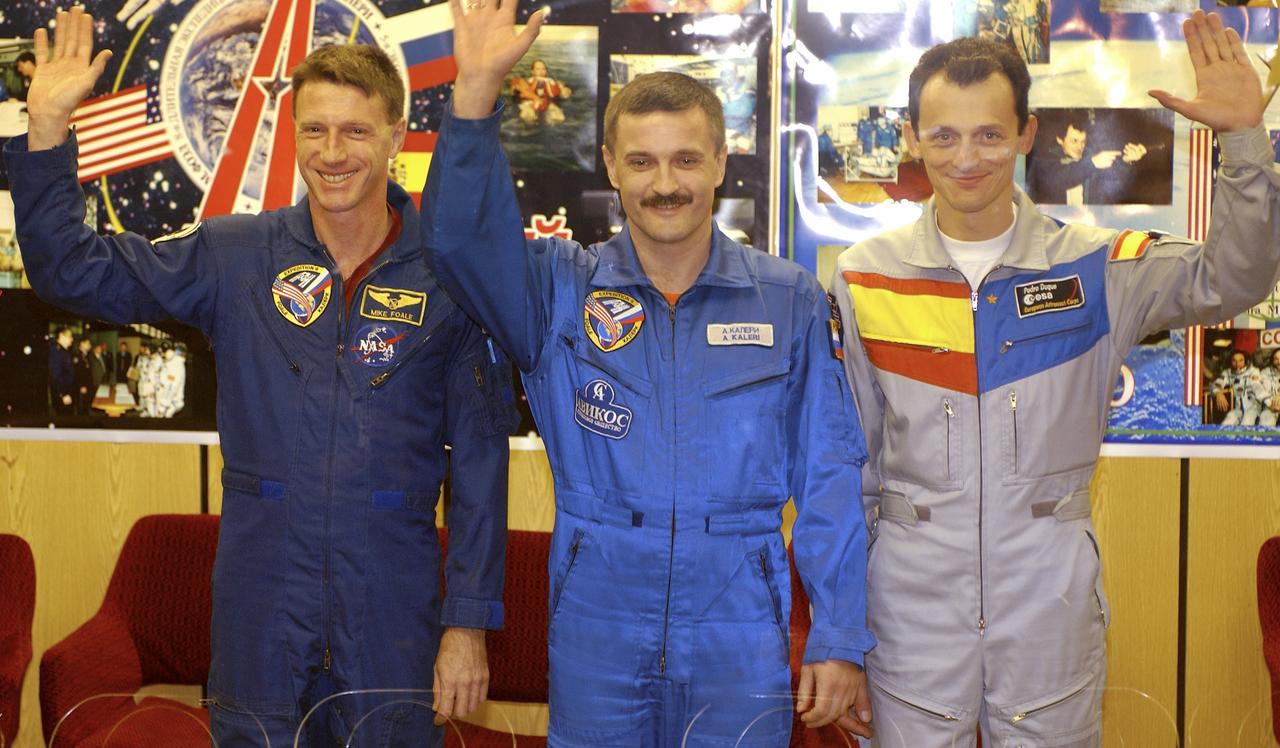
Expedition 8 Commander and NASA Science Officer Michael Foale, left, Expedition 8 Soyuz Commander Alexander Kaleri and European Space Agency astronaut Pedro Duque of Spain, right, wave to reporters at the conclusion of a prelaunch news conference, Friday, Oct. 17, 2003 in Baikonur, Kazakhstan. Photo Credit (NASA/Bill Ingalls)
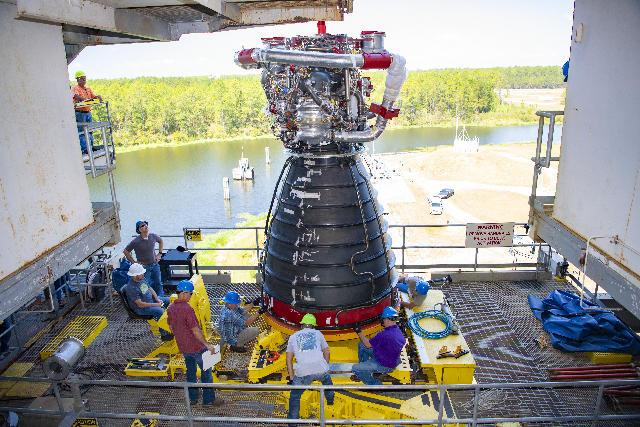
Once crews place the RS-25 engine on the engine vertical installer and it is attached to the Fred Haise Test Stand at NASA’s Stennis Space Center, the installer moves away, and technicians ensure all connections to the test facility are complete for the second certification test series to collect data for the final RS-25 design certification review.
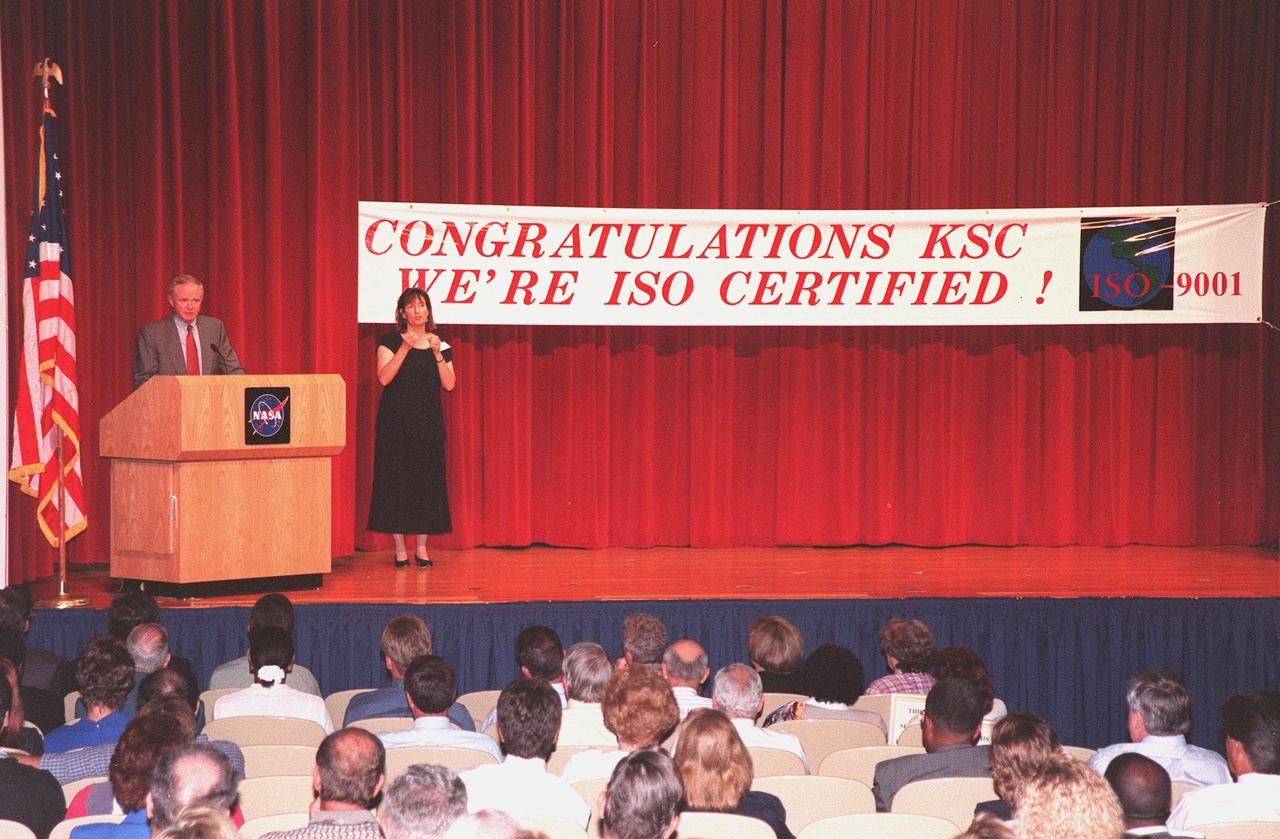
Center Director Roy Bridges speaks to KSC employees at the ISO certification ceremony held at the Training Auditorium. Bridges was presented an ISO 9001 certificate and plaque awarded to KSC by Det Norske Veritas (DNV), Inc., an international ISO certification organization. ISO 9001 comprises the most detailed, comprehensive set of standard requirements for quality programs established by the International Standards Organization. The presentation followed a successful independent audit by DNV of the KSC Management System in May of this year. The third-party auditors examined about 20 elements of KSC's system, including management responsibility, design control, documentation, test and inspection, and corrective action procedures. DNV found that KSC met or exceeded the stringent quality standards in all areas. KSC will use this certification as a tool to improve an already worldclass team. All NASA centers are required by NASA Administrator Daniel S. Goldin to be ISO 9001 registered by September 1999. NASA is the first federal agency to seek the quality certification. Next to Bridges is Heidi Hollingsworth, with the Center for Independent Living, who uses American Sign Language for any hearing-impaired employees in the audience
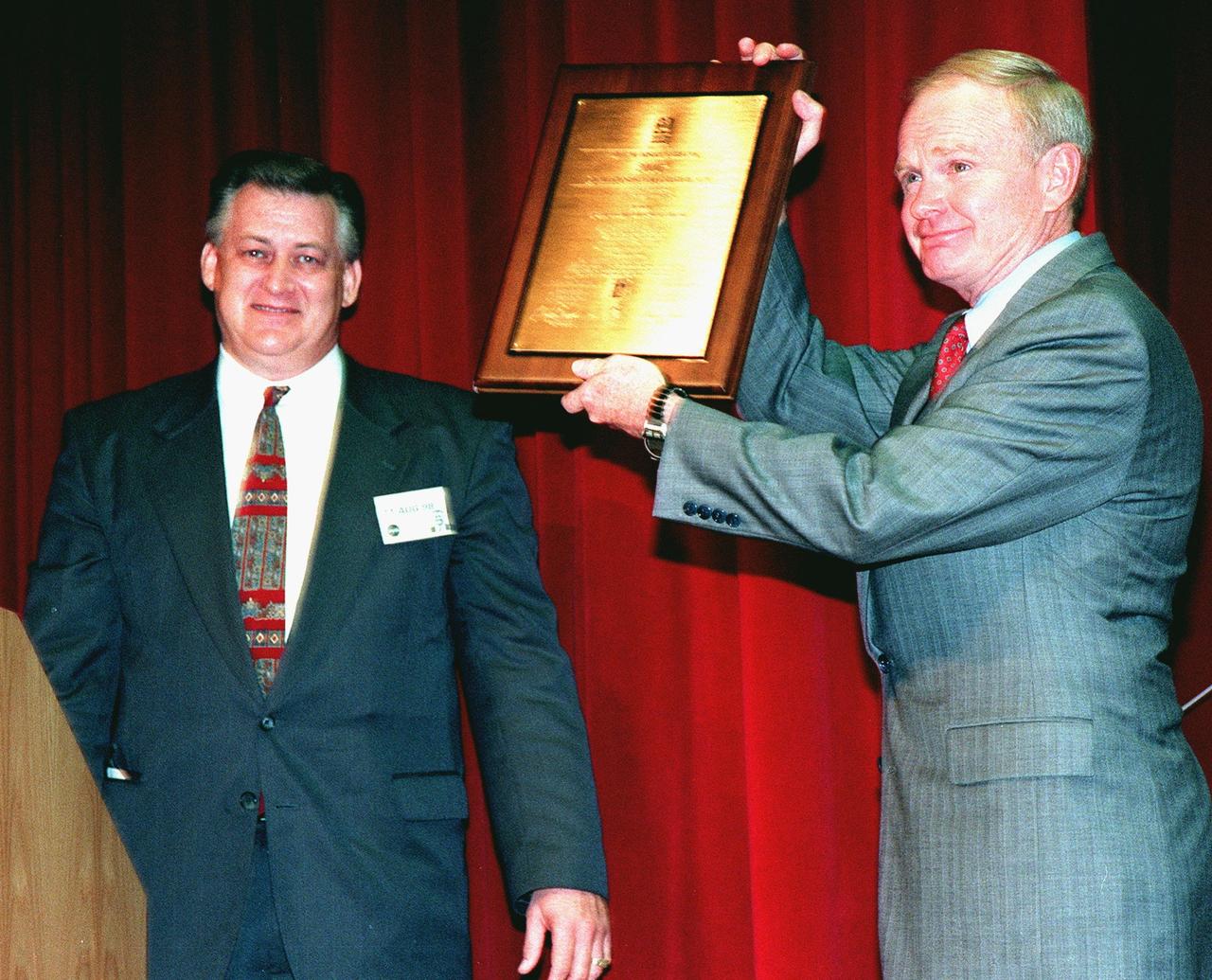
Center Director Roy Bridges (right) displays the 2000th ISO Certificate Plaque he was given by Dalton Lyon (left) of Det Norske Veritas (DNV), Inc., an international ISO certification organization, at a ceremony at KSC. The plaque is a representation of the ISO 9001 certification awarded to KSC by DNV. ISO 9001 comprises the most detailed, comprehensive set of standard requirements for quality programs established by the International Standards Organization. The presentation followed a successful independent audit by DNV of the KSC Management System in May of this year. The third-party auditors examined about 20 elements of KSC's system, including management responsibility, design control, documentation, test and inspection, and corrective action procedures. DNV found that KSC met or exceeded the stringent quality standards in all areas. KSC will use this certification as a tool to improve an already worldclass team. All NASA centers are required by NASA Administrator Daniel S. Goldin to be ISO 9001 registered by September 1999. NASA is the first federal agency to seek the quality certification
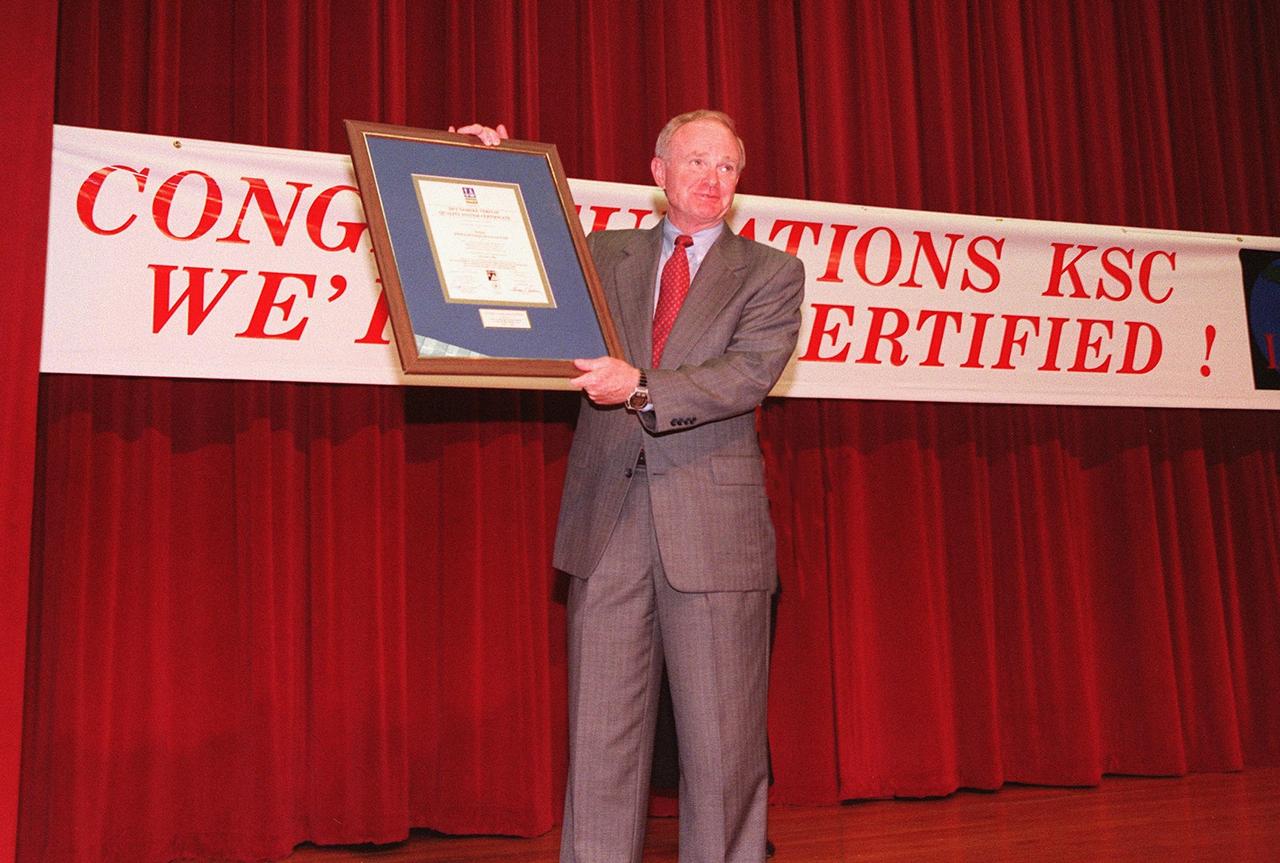
Center Director Roy Bridges displays the ISO 9001 certificate he was awarded by Det Norske Veritas (DNV), Inc., an international ISO certification organization, at a ceremony at KSC. Dalton Lyon of DNV made the presentation, which included a 2000th ISO Certificate Plaque. ISO 9001 comprises the most detailed, comprehensive set of standard requirements for quality programs established by the International Standards Organization. The presentation followed a successful independent audit by DNV of the KSC Management System in May of this year. The third-party auditors examined about 20 elements of KSC's system, including management responsibility, design control, documentation, test and inspection, and corrective action procedures. DNV found that KSC met or exceeded the stringent quality standards in all areas. KSC will use this certification as a tool to improve an already world-class team. All NASA centers are required by NASA Administrator Daniel S. Goldin to be ISO 9001 registered by September 1999. NASA is the first federal agency to seek the quality certification
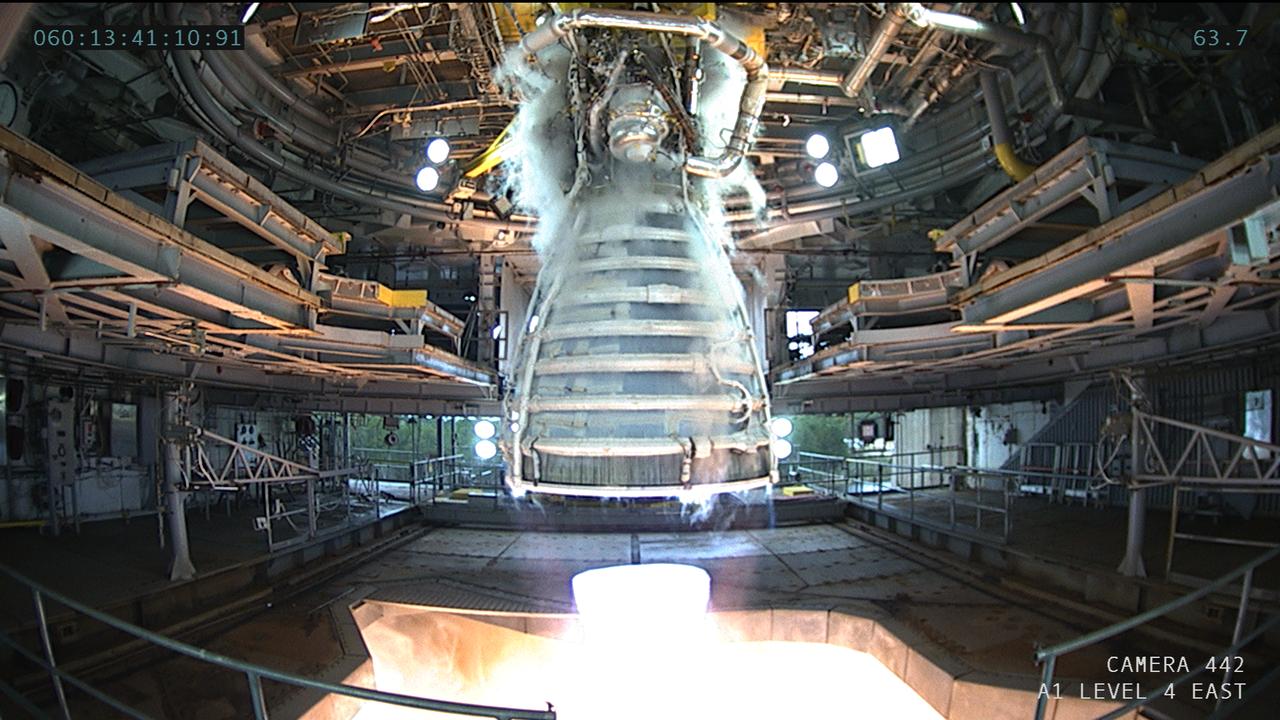
NASA conducted a full-duration RS-25 hot fire Feb. 29 on the Fred Haise Test Stand at NASA’s Stennis Space Center near Bay St. Louis, Mississippi, continuing a key test series for future Artemis flights of NASA’s SLS (Space Launch System) rocket. The hot fire to certify new production RS-25 engines for SLS marked only the second ever Leap Day engine test. Fourty-four years ago on Feb. 29, 1980, before the first space shuttle launch, a test-fire occurred for RS-25 engine #0009. Both tests were conducted on the Fred Haise Test, previously known as the A-1 Test Stand at NASA Stennis. The Feb. 29, 2024, hot fire is the second test following installation of a second production engine nozzle that will provide additional performance data on the upgraded unit. It also marked the eighth in a 12-test series to certify production of new RS-25 engines by lead contractor Aerojet Rocketdyne, an L3Harris Technologies company, to help power NASA’s SLS rocket on Artemis missions to the Moon and beyond, beginning with Artemis V. The current series is the second and final series to certify restart production of the upgraded engines. NASA completed an initial 12-test certification series with the upgraded components in June 2023. Four RS-25 engines fire simultaneously to help launch each SLS rocket, producing up to 2 million pounds of combined thrust.
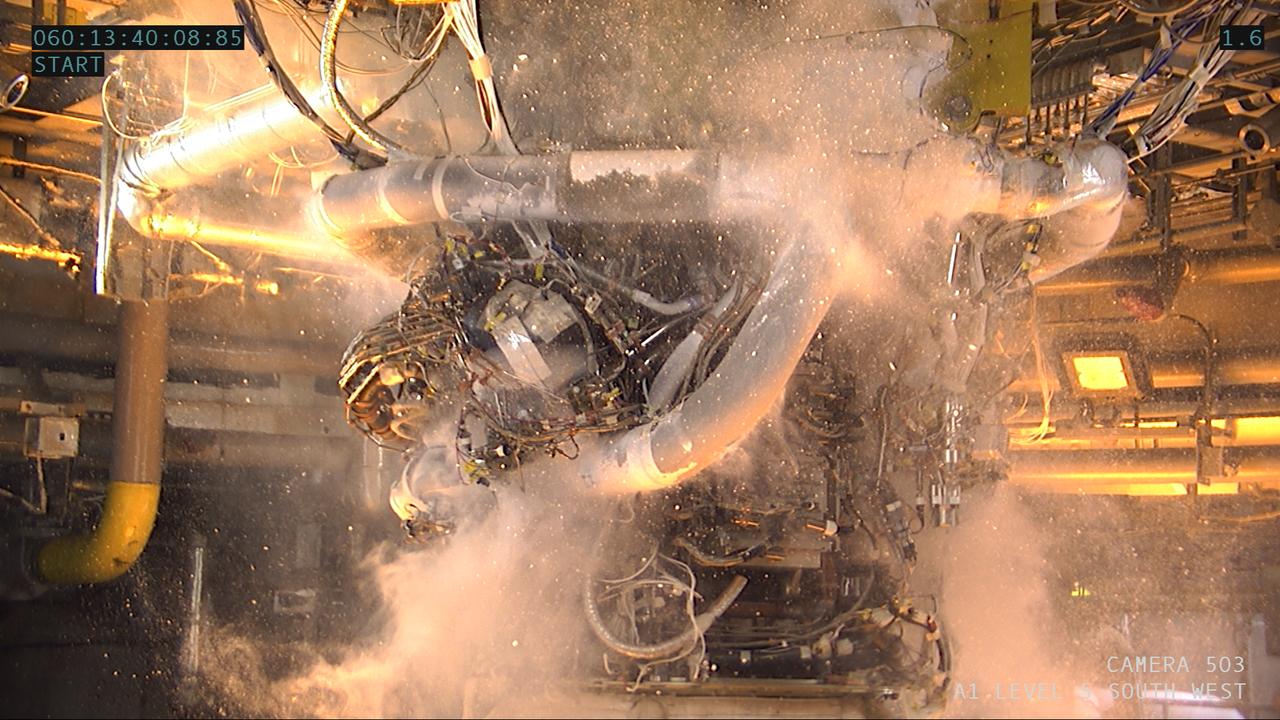
NASA conducted a full-duration RS-25 hot fire Feb. 29 on the Fred Haise Test Stand at NASA’s Stennis Space Center near Bay St. Louis, Mississippi, continuing a key test series for future Artemis flights of NASA’s SLS (Space Launch System) rocket. The hot fire to certify new production RS-25 engines for SLS marked only the second ever Leap Day engine test. Fourty-four years ago on Feb. 29, 1980, before the first space shuttle launch, a test-fire occurred for RS-25 engine #0009. Both tests were conducted on the Fred Haise Test, previously known as the A-1 Test Stand at NASA Stennis. The Feb. 29, 2024, hot fire is the second test following installation of a second production engine nozzle that will provide additional performance data on the upgraded unit. It also marked the eighth in a 12-test series to certify production of new RS-25 engines by lead contractor Aerojet Rocketdyne, an L3Harris Technologies company, to help power NASA’s SLS rocket on Artemis missions to the Moon and beyond, beginning with Artemis V. The current series is the second and final series to certify restart production of the upgraded engines. NASA completed an initial 12-test certification series with the upgraded components in June 2023. Four RS-25 engines fire simultaneously to help launch each SLS rocket, producing up to 2 million pounds of combined thrust.
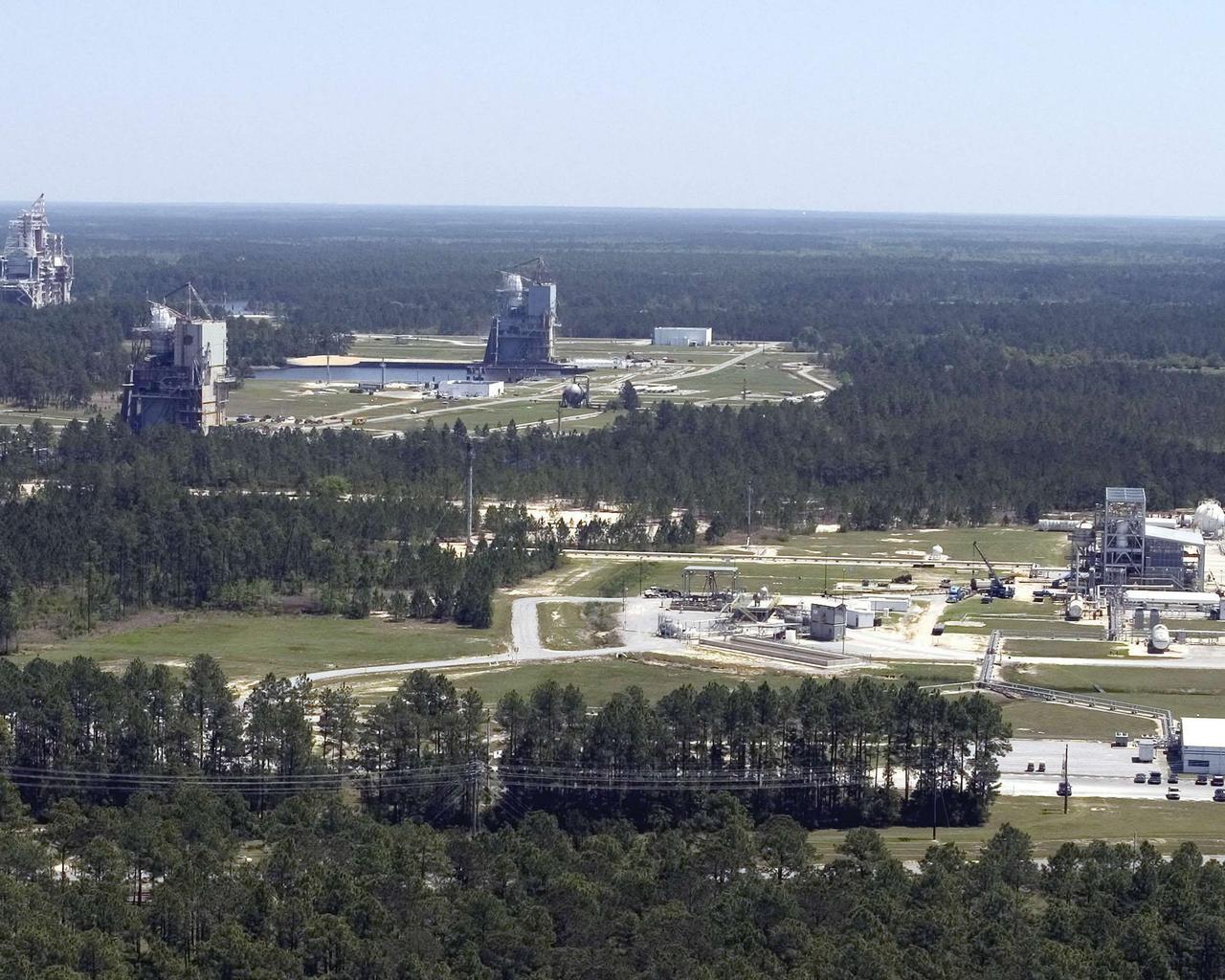
SSC's rocket engine test complex and its four unique test stands provide test operations for the development and certification of propulsion systems, subsystems and components.
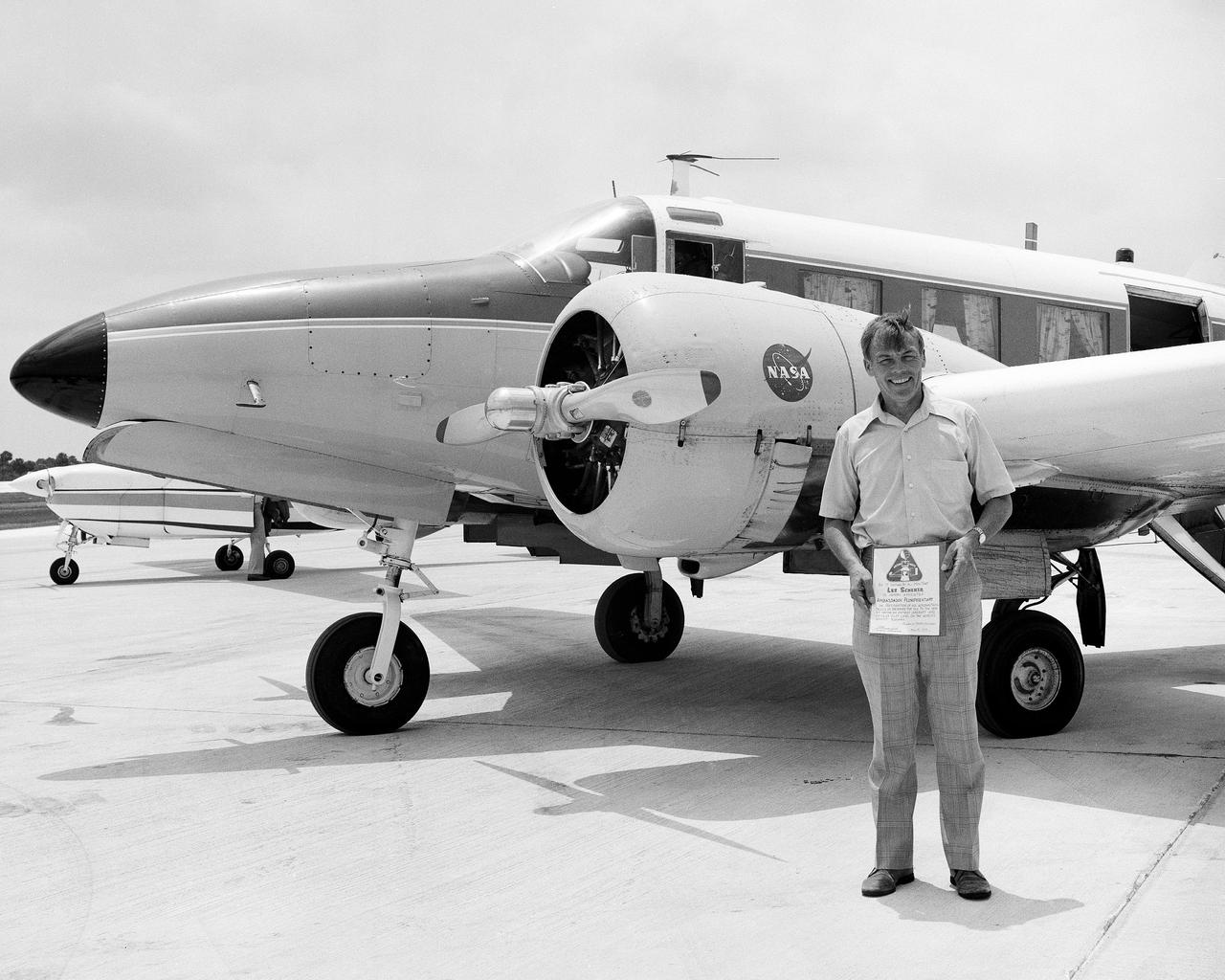
CAPE CANAVERAL, Fla. -- Kennedy Space Center Director Lee Scherer receives an Ambassador Plenipotentary certificate after successfully landing the NASA-6 aircraft on the runway at the Shuttle Landing Facility. This was the first touchdown of an aircraft on Kennedy's Shuttle Landing Facility. The certificate reads: 'Be it known that Lee Scherer is hereby appointed Ambassador Plenipotentary in recognition of his aeronautical skills in bringing the old to the new by having an antique aircraft and an antique pilot land on the world's newest runway. Photo Credit: NASA
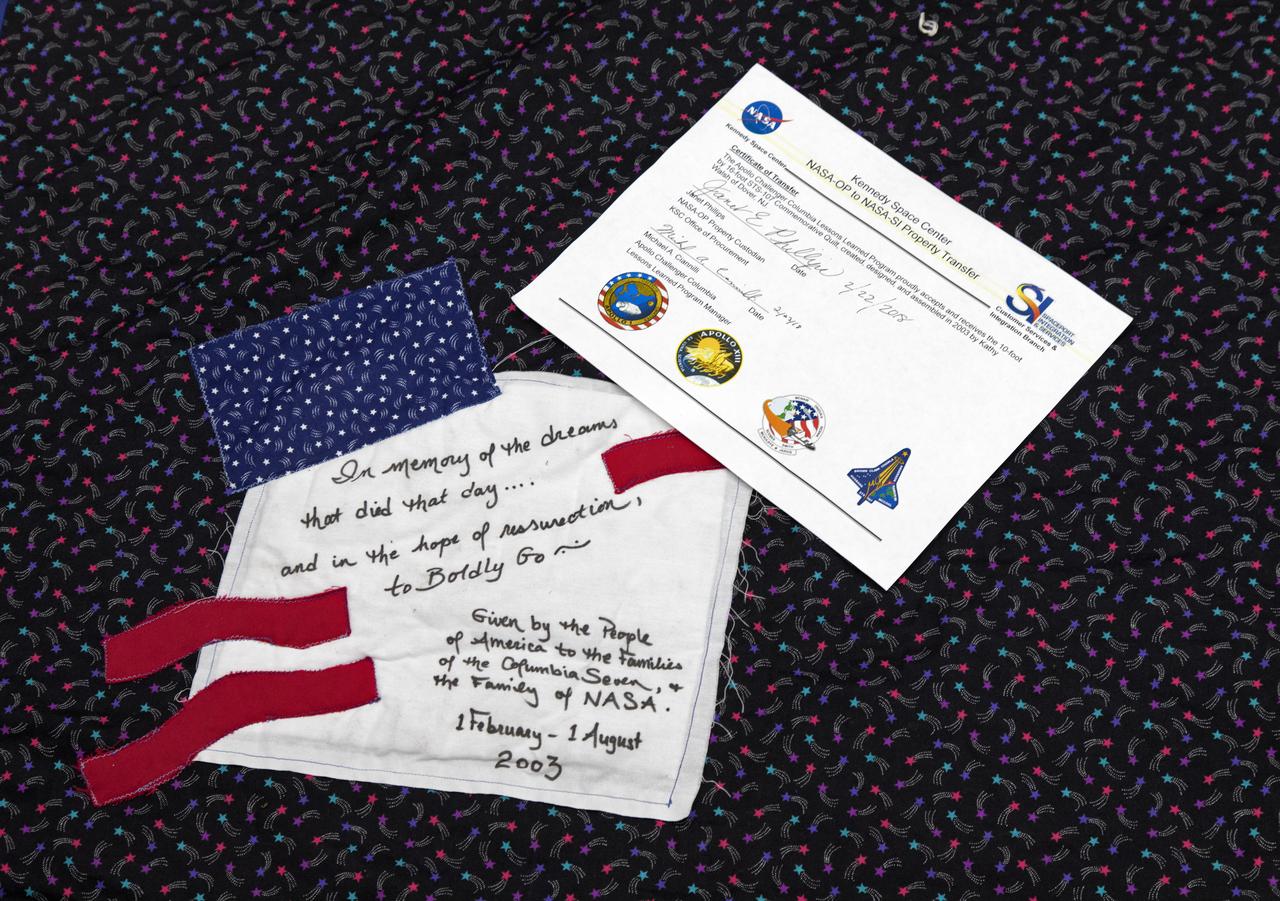
A certificate and quilt square are on display that confirms the transfer of a giant hand-made quilt in honor of space shuttle Columbia and her crew from the Office of Procurement to the Columbia Preservation Room inside the Vehicle Assembly Building at NASA's Kennedy Space Center in Florida. The quilt was made by Katherine Walsh, a lifelong NASA and space program fan originally from Kentucky. The quilt will be displayed in the preservation room with its certificate as part of NASA's Apollo, Challenger, Columbia Lessons Learned Program.
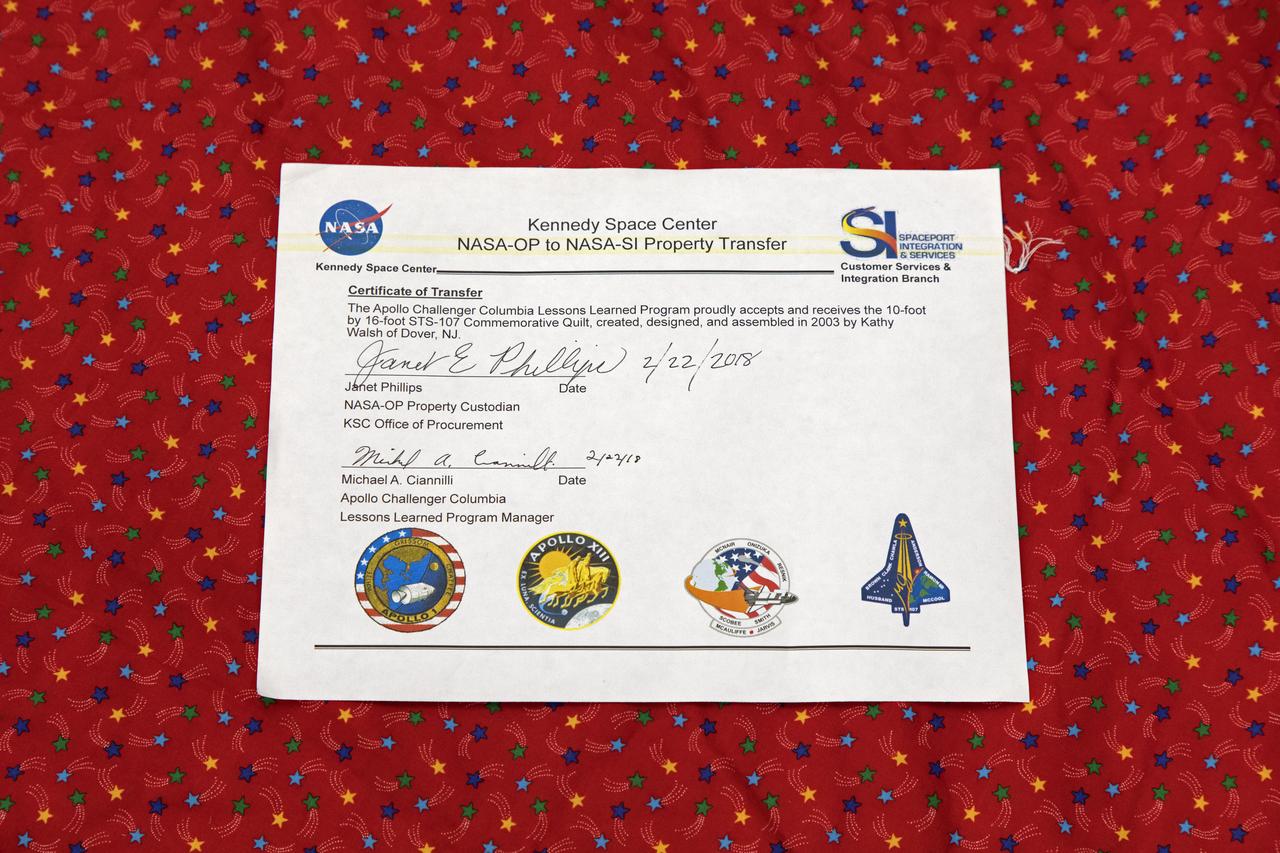
A certificate is on display that confirms the transfer of a giant hand-made quilt in honor of space shuttle Columbia and her crew from the Office of Procurement to the Columbia Preservation Room inside the Vehicle Assembly Building at NASA's Kennedy Space Center in Florida. The quilt was made by Katherine Walsh, a lifelong NASA and space program fan originally from Kentucky. The quilt will be displayed with its certificate in the preservation room as part of NASA's Apollo, Challenger, Columbia Lessons Learned Program.
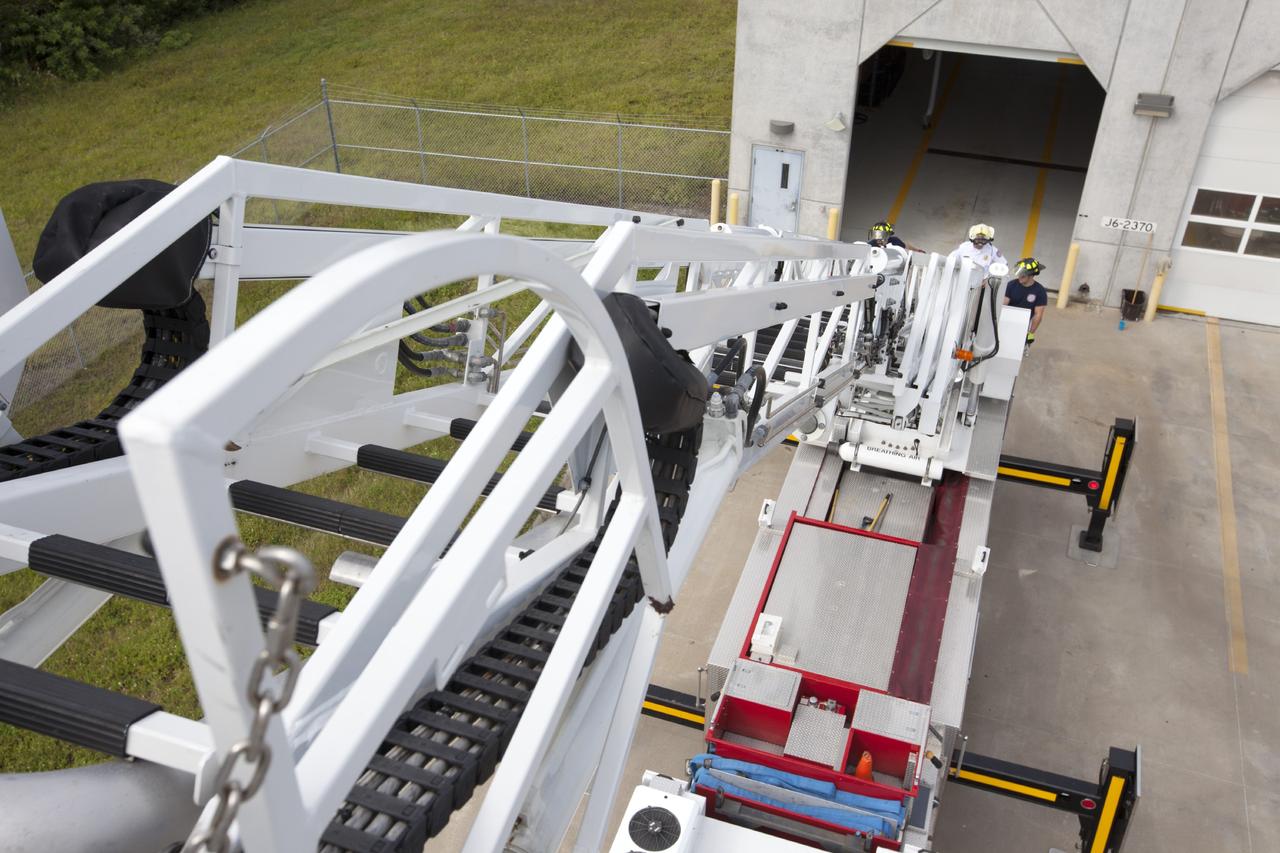
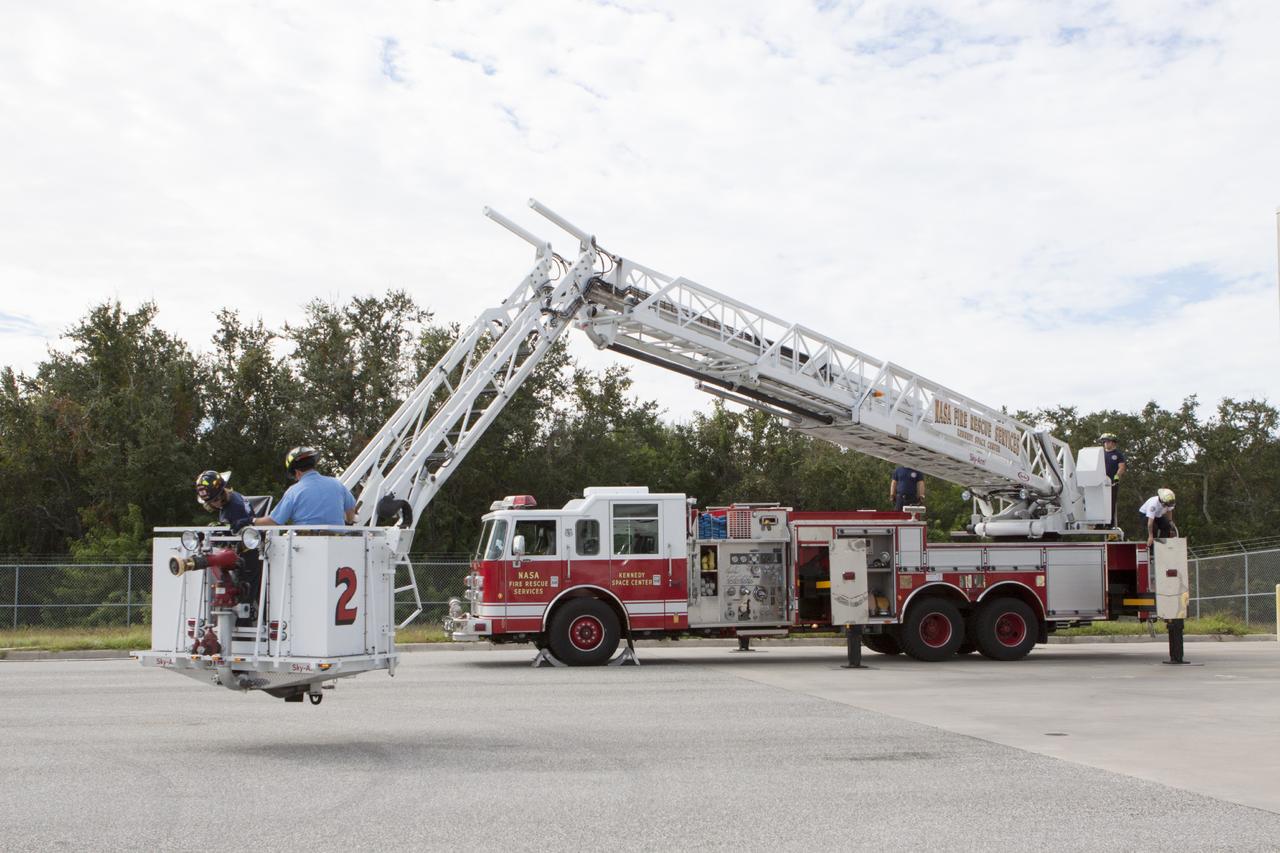
CAPE CANAVERAL, Fla. – At Fire Station No. 2 near the Shuttle Landing Facility at NASA’s Kennedy Space Center in Florida, Fire Rescue Services personnel have deployed and extended the ladder on the aerial fire truck during training in order to be certified in the operation and use of the vehicle. The stabilizers have been deployed on either side of the fire truck. The center’s Fire Rescue Services recently achieved Pro Board Certification in aerial fire truck operations. Pro Board Certification is a globally recognized certification that puts on multiple courses that all fire departments throughout the world recognize and use to train their personnel. The unique aerial truck contains a 100-foot extendable ladder with a bucket at the end of it that can be used for rescues from taller buildings or aircraft rescue firefighting. Photo credit: NASA/Kim Shiflett
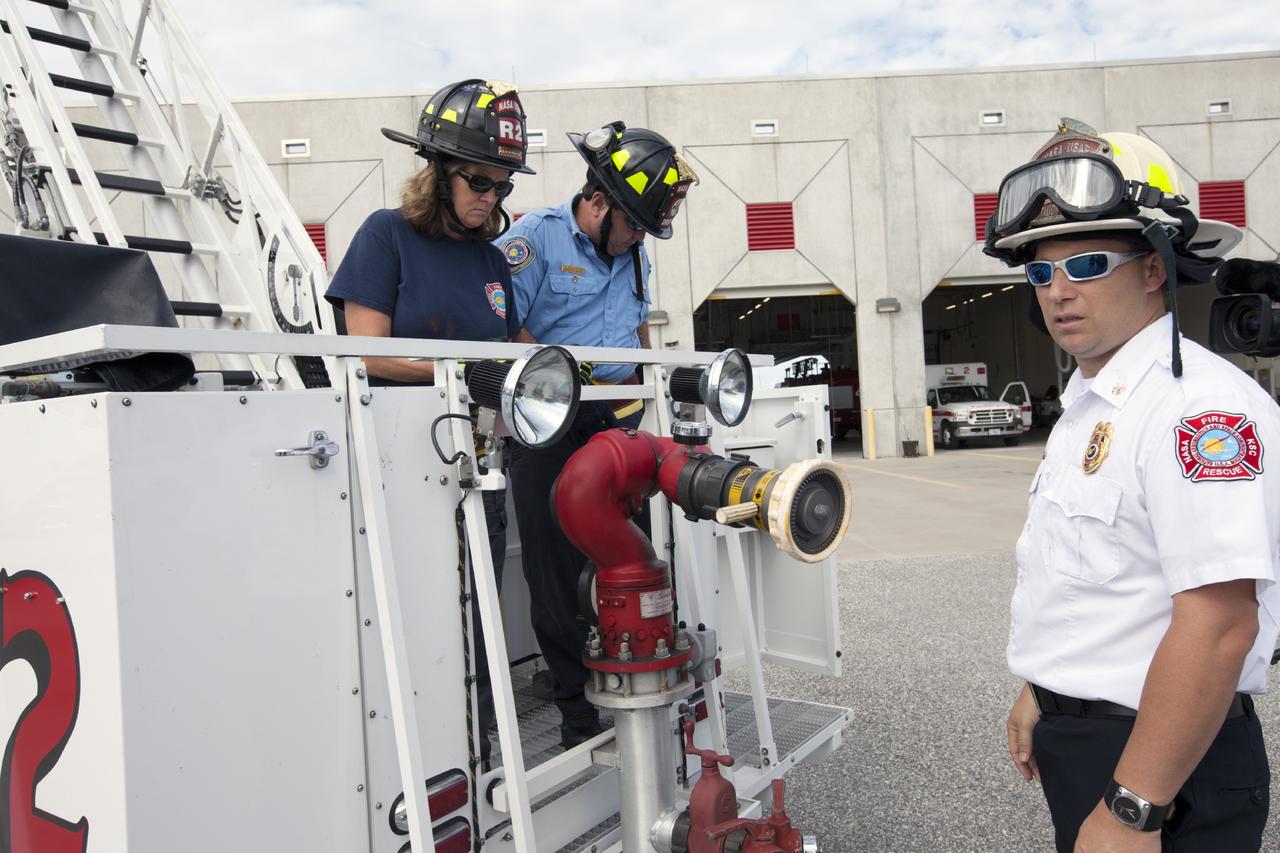
CAPE CANAVERAL, Fla. – At Fire Station No. 2 near the Shuttle Landing Facility at NASA’s Kennedy Space Center in Florida, Mark Huetter, assistant chief of training with the center’s Fire Department, monitors training procedures as two Fire Rescue Services personnel prepare to exit the bucket after training on the aerial fire truck. The center’s Fire Rescue Services recently achieved Pro Board Certification in aerial fire truck operations. Pro Board Certification is a globally recognized certification that puts on multiple courses that all fire departments throughout the world recognize and use to train their personnel. The unique aerial truck contains a 100-foot extendable ladder with a bucket at the end of it that can be used for rescues from taller buildings or aircraft rescue firefighting. Photo credit: NASA/Kim Shiflett
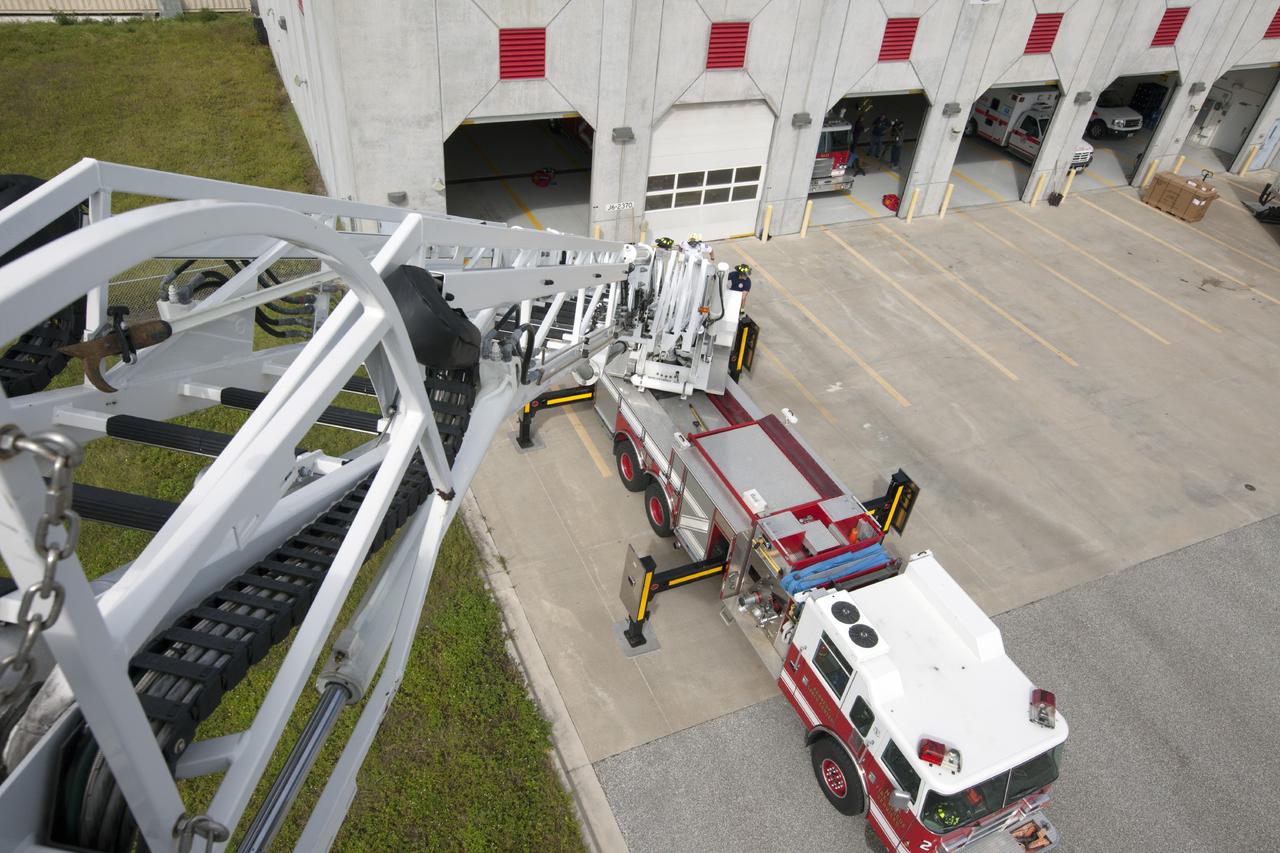
CAPE CANAVERAL, Fla. – At Fire Station No. 2 near the Shuttle Landing Facility at NASA’s Kennedy Space Center in Florida, a bird’s eye view reveals the ladder has been extended on the aerial fire truck during a training exercise. The center’s Fire Rescue Services recently achieved Pro Board Certification in aerial fire truck operations. Pro Board Certification is a globally recognized certification that puts on multiple courses that all fire departments throughout the world recognize and use to train their personnel. The unique aerial truck contains a 100-foot extendable ladder with a bucket at the end of it that can be used for rescues from taller buildings or aircraft rescue firefighting. Photo credit: NASA/Kim Shiflett
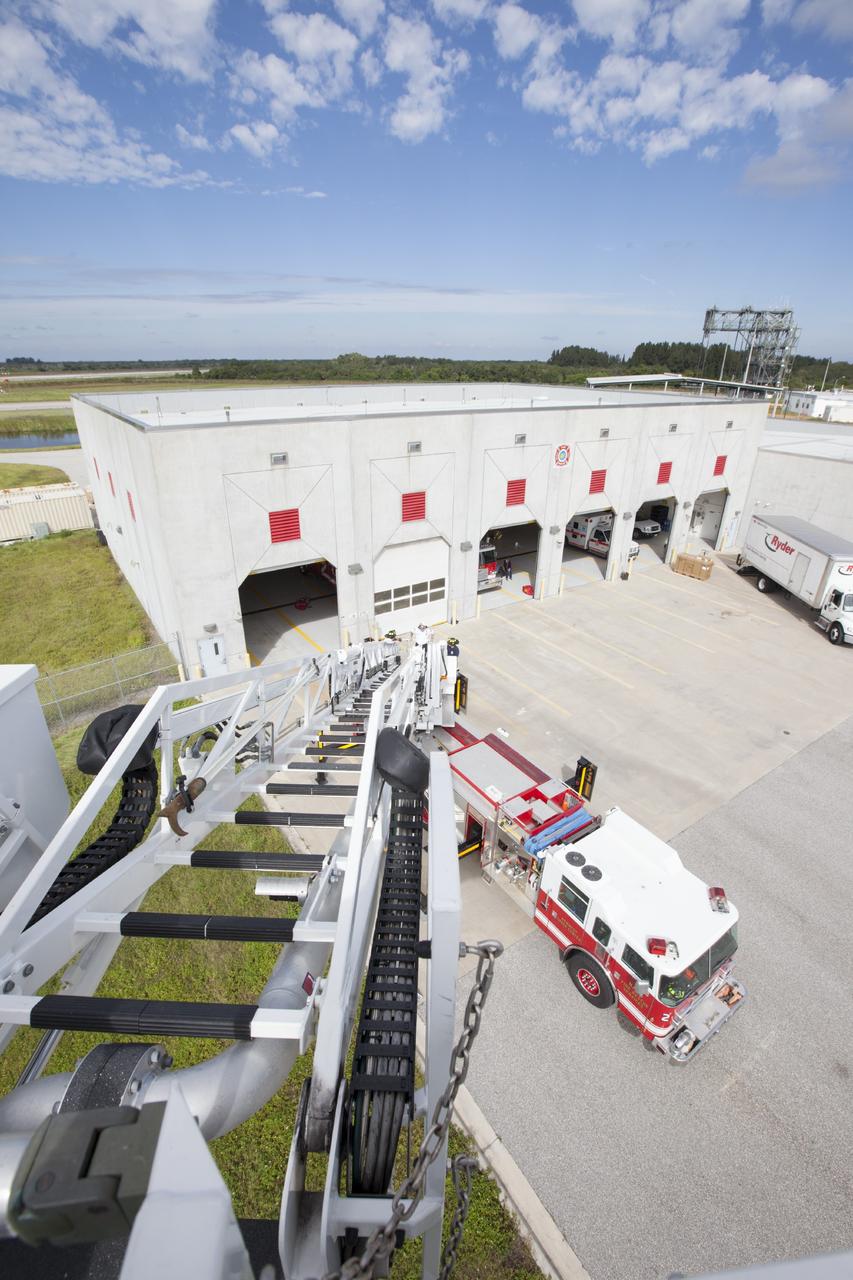
CAPE CANAVERAL, Fla. – At Fire Station No. 2 near the Shuttle Landing Facility at NASA’s Kennedy Space Center in Florida, a bird’s eye view reveals the ladder has been extended on the aerial fire truck during a training exercise. The center’s Fire Rescue Services recently achieved Pro Board Certification in aerial fire truck operations. Pro Board Certification is a globally recognized certification that puts on multiple courses that all fire departments throughout the world recognize and use to train their personnel. The unique aerial truck contains a 100-foot extendable ladder with a bucket at the end of it that can be used for rescues from taller buildings or aircraft rescue firefighting. Photo credit: NASA/Kim Shiflett
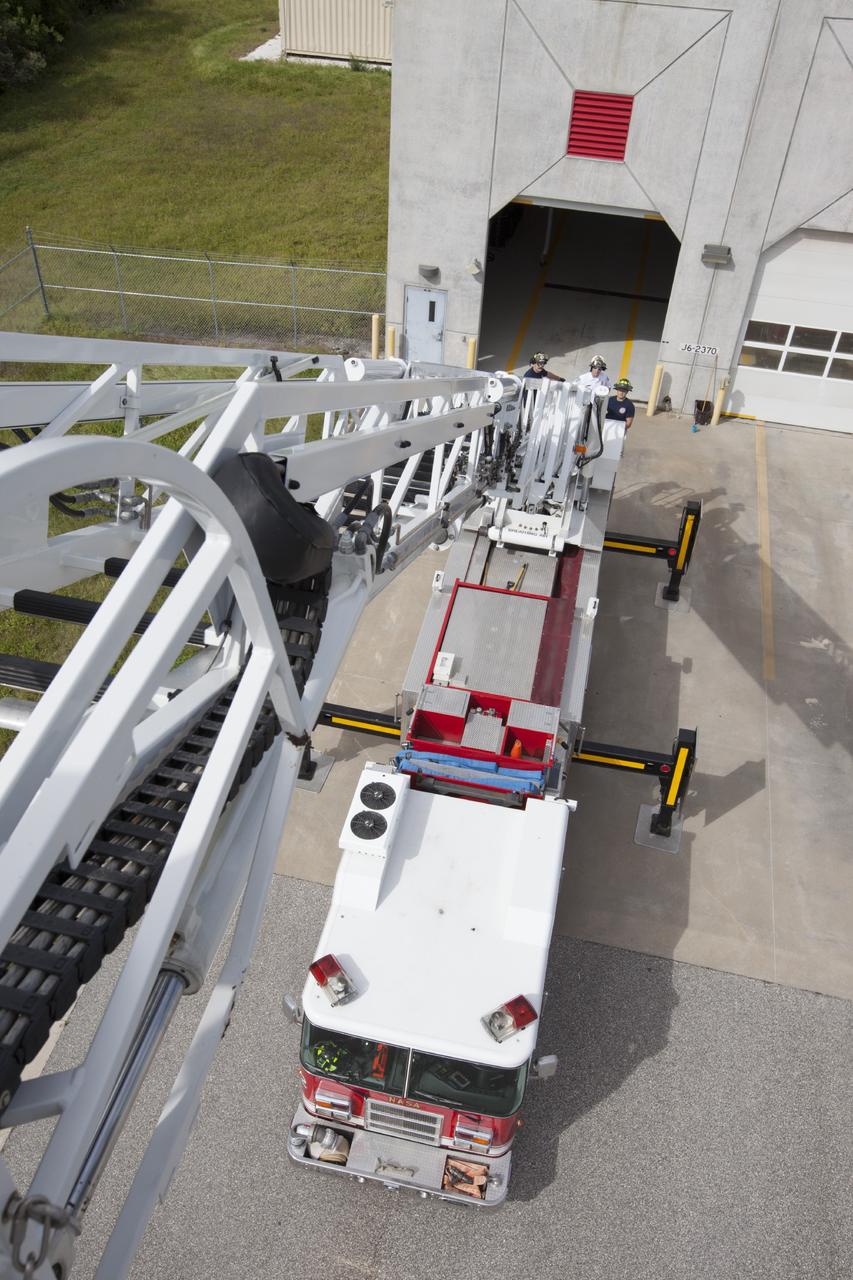
CAPE CANAVERAL, Fla. – At Fire Station No. 2 near the Shuttle Landing Facility at NASA’s Kennedy Space Center in Florida, a bird’s eye view reveals the ladder has been extended on the aerial fire truck during a training exercise. The stabilizers have been deployed on either side of the fire truck. The center’s Fire Rescue Services recently achieved Pro Board Certification in aerial fire truck operations. Pro Board Certification is a globally recognized certification that puts on multiple courses that all fire departments throughout the world recognize and use to train their personnel. The unique aerial truck contains a 100-foot extendable ladder with a bucket at the end of it that can be used for rescues from taller buildings or aircraft rescue firefighting. Photo credit: NASA/Kim Shiflett
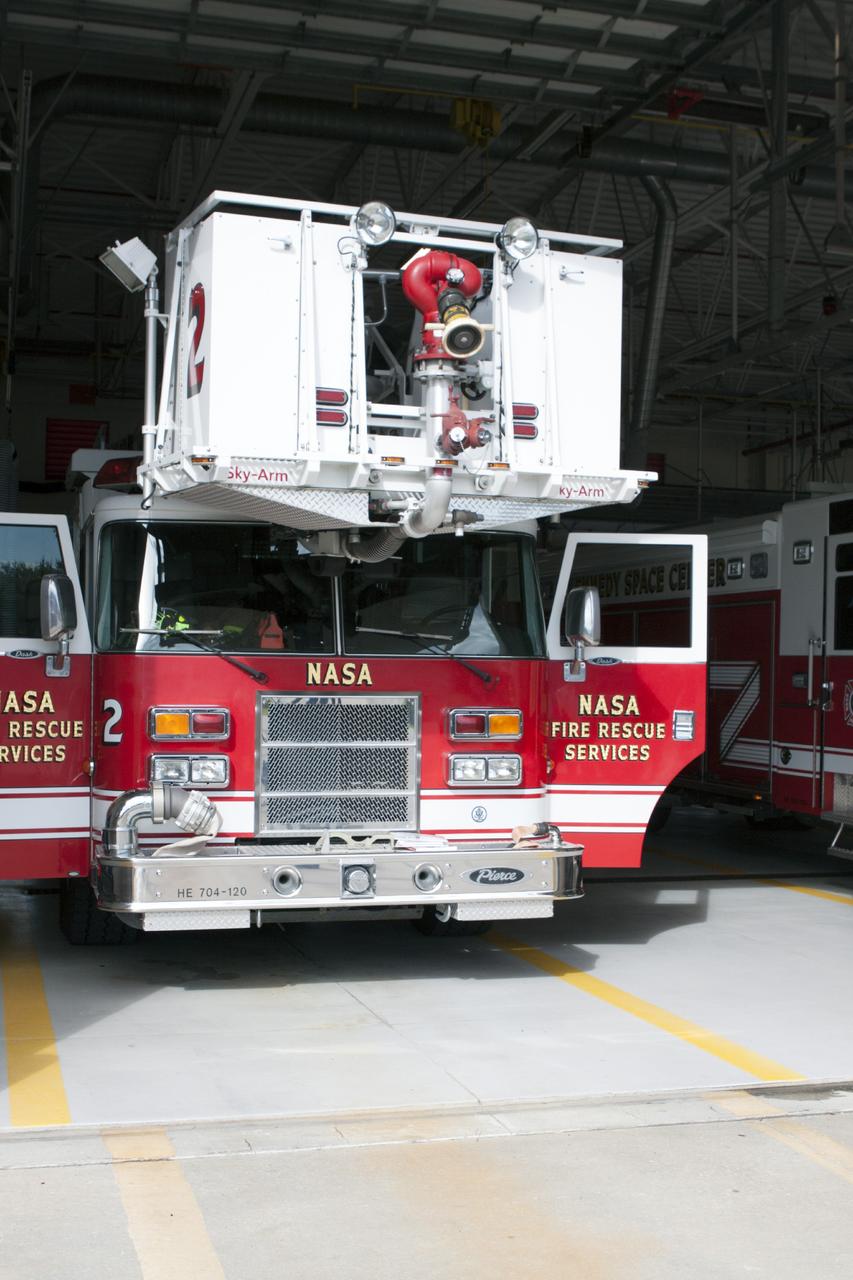
CAPE CANAVERAL, Fla. – At Fire Station No. 2 near the Shuttle Landing Facility at NASA’s Kennedy Space Center in Florida, the aerial fire truck sits in a bay as Fire Rescue Services personnel prepare to drive the fire truck out of the bay and then operate the extendable ladder during training in order to be certified in the operation and use of the vehicle. The center’s Fire Rescue Services recently achieved Pro Board Certification in aerial fire truck operations. Pro Board Certification is a globally recognized certification that puts on multiple courses that all fire departments throughout the world recognize and use to train their personnel. The unique aerial truck contains a 100-foot extendable ladder with a bucket at the end of it that can be used for rescues from taller buildings or aircraft rescue firefighting. Photo credit: NASA/Kim Shiflett
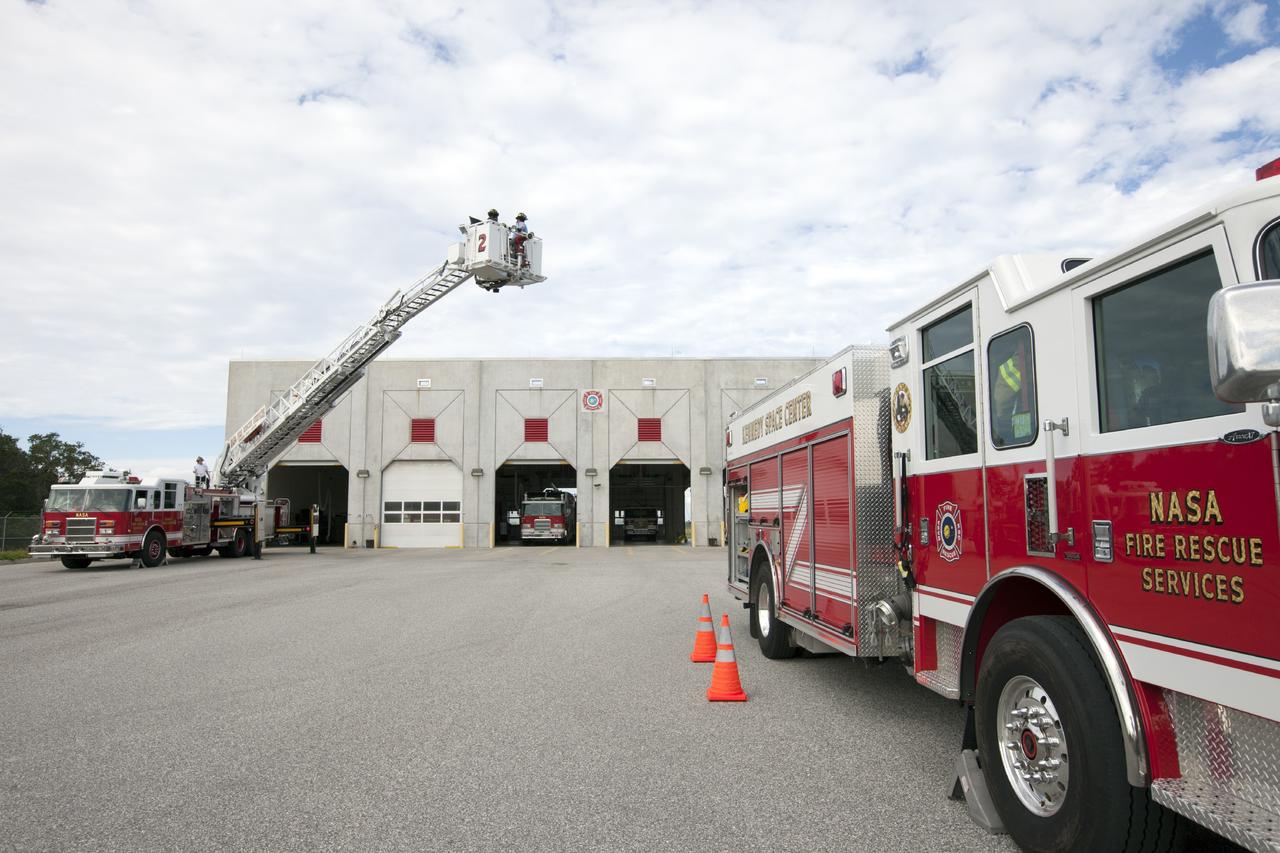
CAPE CANAVERAL, Fla. – At Fire Station No. 2 near the Shuttle Landing Facility at NASA’s Kennedy Space Center in Florida, Fire Rescue Services personnel have deployed and extended the ladder on the aerial fire truck during training in order to be certified in the operation and use of the vehicle. Two fire rescue workers are in the bucket practicing harness procedures. The center’s Fire Rescue Services recently achieved Pro Board Certification in aerial fire truck operations. Pro Board Certification is a globally recognized certification that puts on multiple courses that all fire departments throughout the world recognize and use to train their personnel. The unique aerial truck contains a 100-foot extendable ladder with a bucket at the end of it that can be used for rescues from taller buildings or aircraft rescue firefighting. Photo credit: NASA/Kim Shiflett
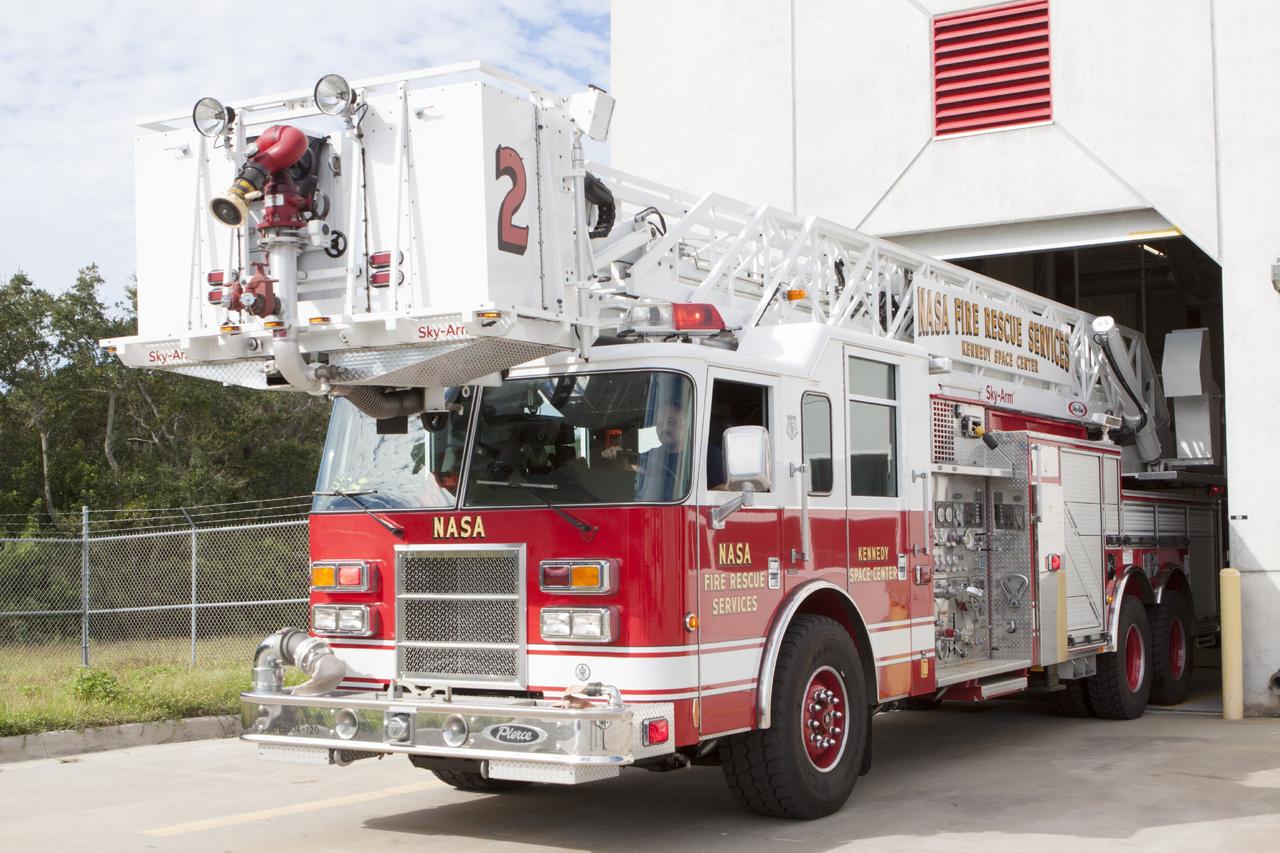
CAPE CANAVERAL, Fla. – At Fire Station No. 2 near the Shuttle Landing Facility at NASA’s Kennedy Space Center in Florida, the aerial fire truck is being driven out of the bay so that Fire Rescue Services personnel can be trained and certified in the operation and use of the vehicle. The center’s Fire Rescue Services recently achieved Pro Board Certification in aerial fire truck operations. Pro Board Certification is a globally recognized certification that puts on multiple courses that all fire departments throughout the world recognize and use to train their personnel. The unique aerial truck contains a 100-foot extendable ladder with a bucket at the end of it that can be used for rescues from taller buildings or aircraft rescue firefighting. Photo credit: NASA/Kim Shiflett
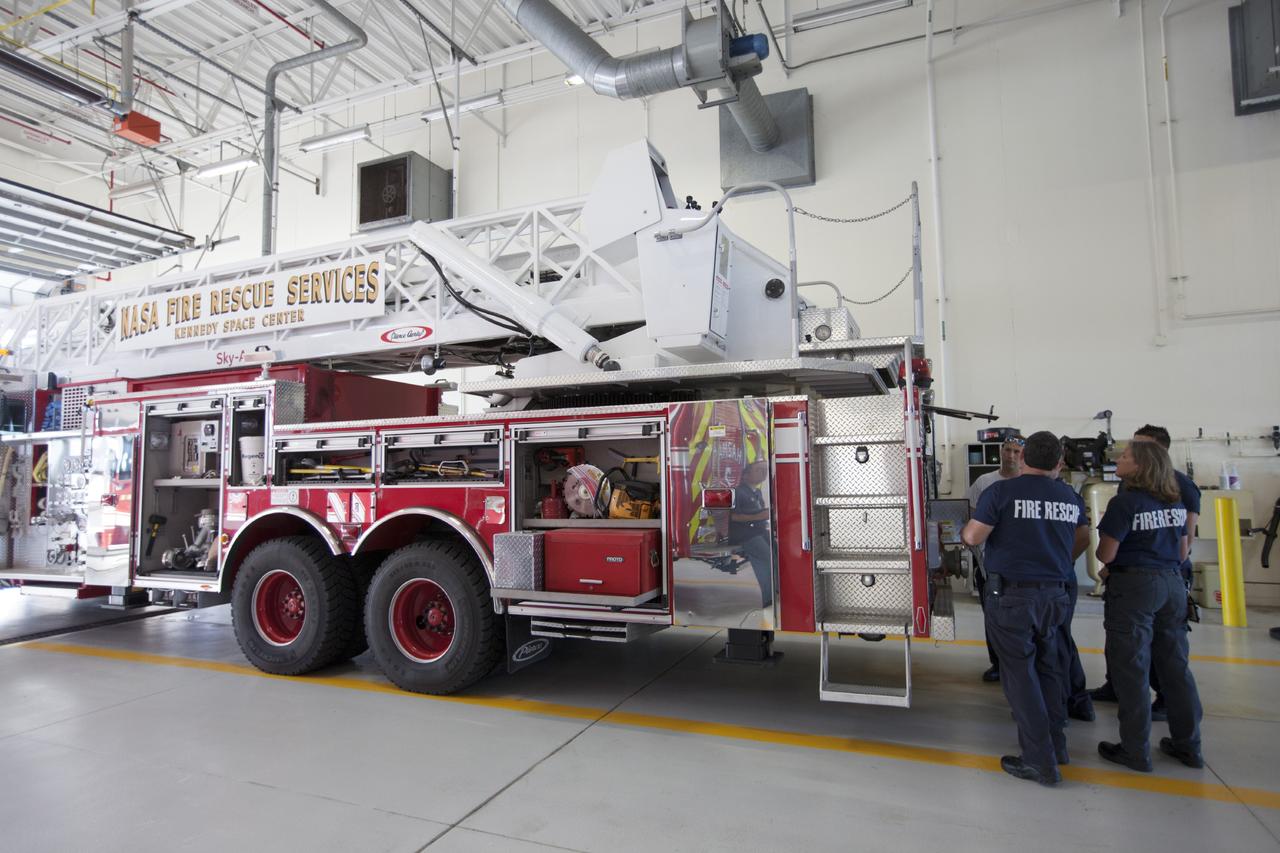
CAPE CANAVERAL, Fla. – At Fire Station No. 2 near the Shuttle Landing Facility at NASA’s Kennedy Space Center in Florida, Fire Rescue Services personnel review procedures and check equipment on the aerial fire truck as part of the training to be certified in the operation and use of the vehicle. The center’s Fire Rescue Services recently achieved Pro Board Certification in aerial fire truck operations. Pro Board Certification is a globally recognized certification that puts on multiple courses that all fire departments throughout the world recognize and use to train their personnel. The unique aerial truck contains a 100-foot extendable ladder with a bucket at the end of it that can be used for rescues from taller buildings or aircraft rescue firefighting. Photo credit: NASA/Kim Shiflett
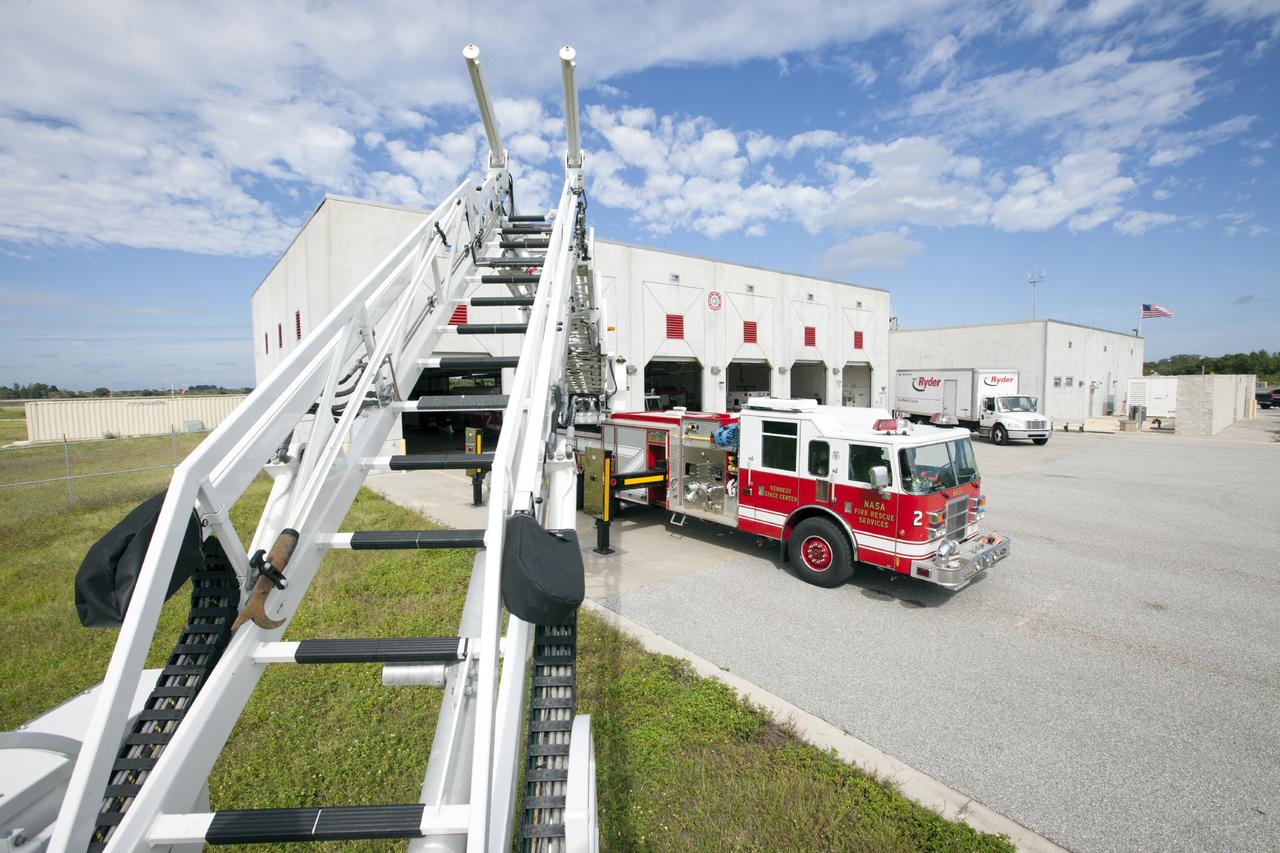
CAPE CANAVERAL, Fla. – At Fire Station No. 2 near the Shuttle Landing Facility at NASA’s Kennedy Space Center in Florida, Fire Rescue Services personnel have deployed and extended the ladder on the aerial fire truck during training in order to be certified in the operation and use of the vehicle. The stabilizers have been deployed on either side of the fire truck. The center’s Fire Rescue Services recently achieved Pro Board Certification in aerial fire truck operations. Pro Board Certification is a globally recognized certification that puts on multiple courses that all fire departments throughout the world recognize and use to train their personnel. The unique aerial truck contains a 100-foot extendable ladder with a bucket at the end of it that can be used for rescues from taller buildings or aircraft rescue firefighting. Photo credit: NASA/Kim Shiflett
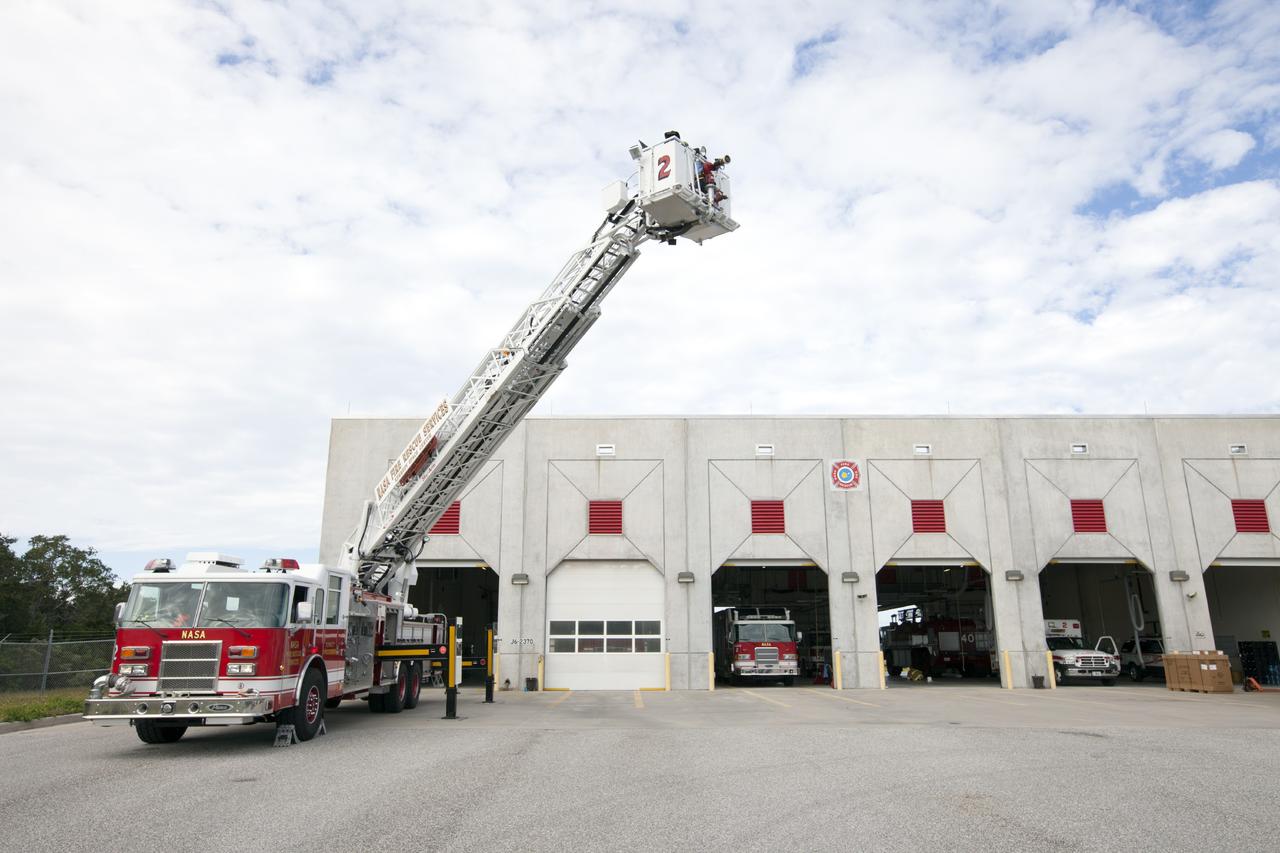
CAPE CANAVERAL, Fla. – At Fire Station No. 2 near the Shuttle Landing Facility at NASA’s Kennedy Space Center in Florida, Fire Rescue Services personnel have deployed the ladder on the aerial fire truck during training in order to be certified in the operation and use of the vehicle. The center’s Fire Rescue Services recently achieved Pro Board Certification in aerial fire truck operations. Pro Board Certification is a globally recognized certification that puts on multiple courses that all fire departments throughout the world recognize and use to train their personnel. The unique aerial truck contains a 100-foot extendable ladder with a bucket at the end of it that can be used for rescues from taller buildings or aircraft rescue firefighting. Photo credit: NASA/Kim Shiflett
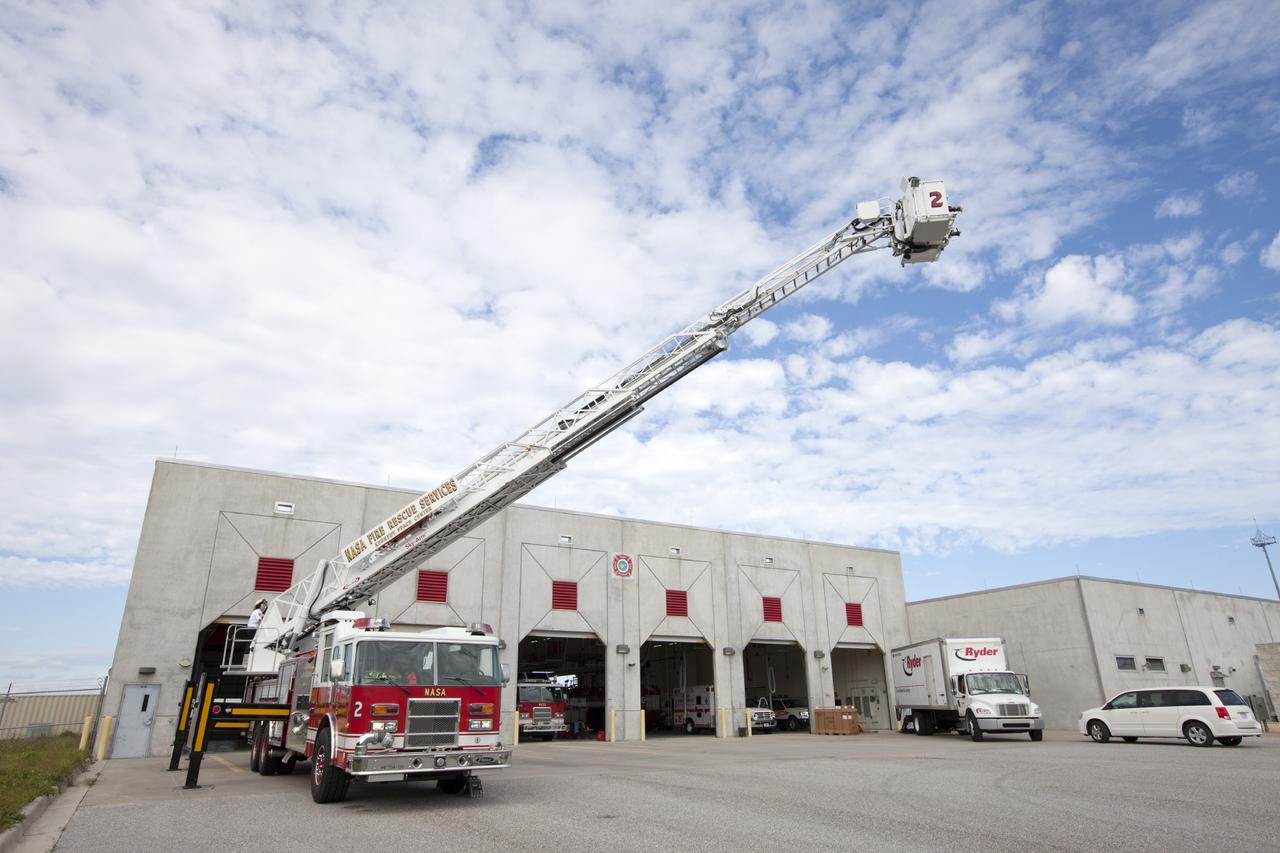
CAPE CANAVERAL, Fla. – At Fire Station No. 2 near the Shuttle Landing Facility at NASA’s Kennedy Space Center in Florida, Fire Rescue Services personnel lower the extendable ladder so that two fire rescue workers can exit the bucket during training to be certified in the operation and use of the vehicle. The center’s Fire Rescue Services recently achieved Pro Board Certification in aerial fire truck operations. Pro Board Certification is a globally recognized certification that puts on multiple courses that all fire departments throughout the world recognize and use to train their personnel. The unique aerial truck contains a 100-foot extendable ladder with a bucket at the end of it that can be used for rescues from taller buildings or aircraft rescue firefighting. Photo credit: NASA/Kim Shiflett
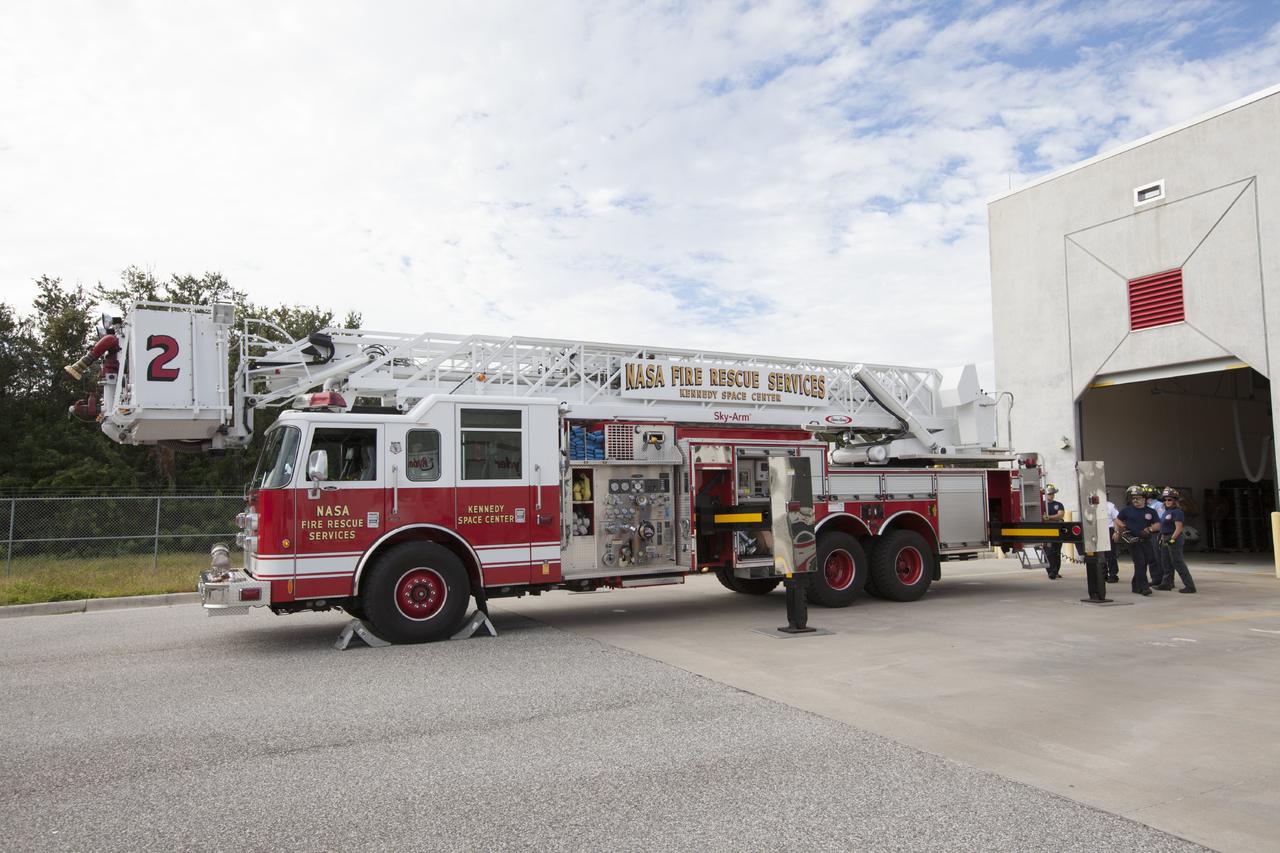
CAPE CANAVERAL, Fla. – At Fire Station No. 2 near the Shuttle Landing Facility at NASA’s Kennedy Space Center in Florida, the aerial fire truck has been moved out of the bay and Fire Rescue Services personnel have deployed the stabilizers on either side of the truck in order to prepare for training to be certified in the operation and use of the vehicle. The center’s Fire Rescue Services recently achieved Pro Board Certification in aerial fire truck operations. Pro Board Certification is a globally recognized certification that puts on multiple courses that all fire departments throughout the world recognize and use to train their personnel. The unique aerial truck contains a 100-foot extendable ladder with a bucket at the end of it that can be used for rescues from taller buildings or aircraft rescue firefighting. Photo credit: NASA/Kim Shiflett
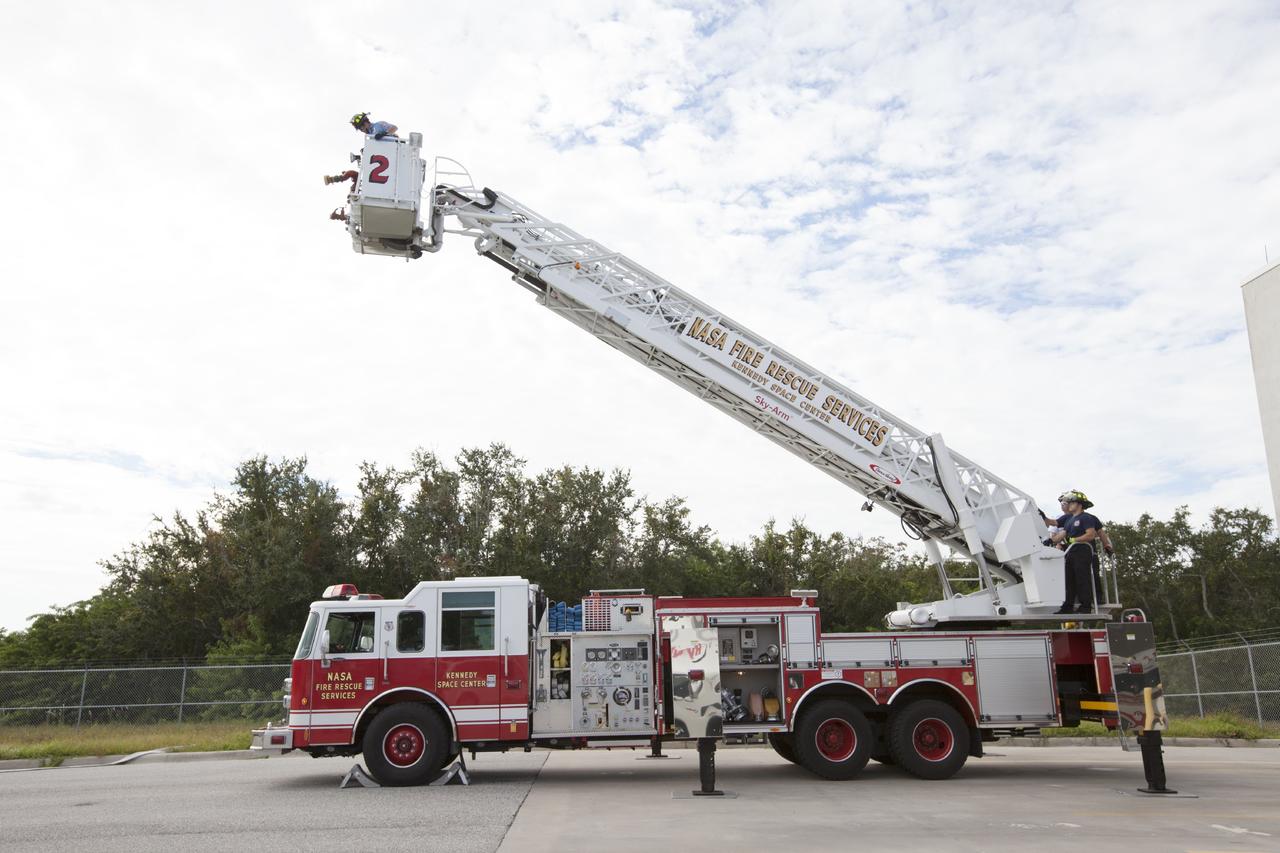
CAPE CANAVERAL, Fla. – At Fire Station No. 2 near the Shuttle Landing Facility at NASA’s Kennedy Space Center in Florida, Fire Rescue Services personnel have deployed the ladder on the aerial fire truck during training in order to be certified in the operation and use of the vehicle. The center’s Fire Rescue Services recently achieved Pro Board Certification in aerial fire truck operations. Pro Board Certification is a globally recognized certification that puts on multiple courses that all fire departments throughout the world recognize and use to train their personnel. The unique aerial truck contains a 100-foot extendable ladder with a bucket at the end of it that can be used for rescues from taller buildings or aircraft rescue firefighting. Photo credit: NASA/Kim Shiflett
CAPE CANAVERAL, Fla. – At Fire Station No. 2 near the Shuttle Landing Facility at NASA’s Kennedy Space Center in Florida, Fire Rescue Services personnel have deployed and extended the ladder on the aerial fire truck during training in order to be certified in the operation and use of the vehicle. The center’s Fire Rescue Services recently achieved Pro Board Certification in aerial fire truck operations. Pro Board Certification is a globally recognized certification that puts on multiple courses that all fire departments throughout the world recognize and use to train their personnel. The unique aerial truck contains a 100-foot extendable ladder with a bucket at the end of it that can be used for rescues from taller buildings or aircraft rescue firefighting. Photo credit: NASA/Kim Shiflett
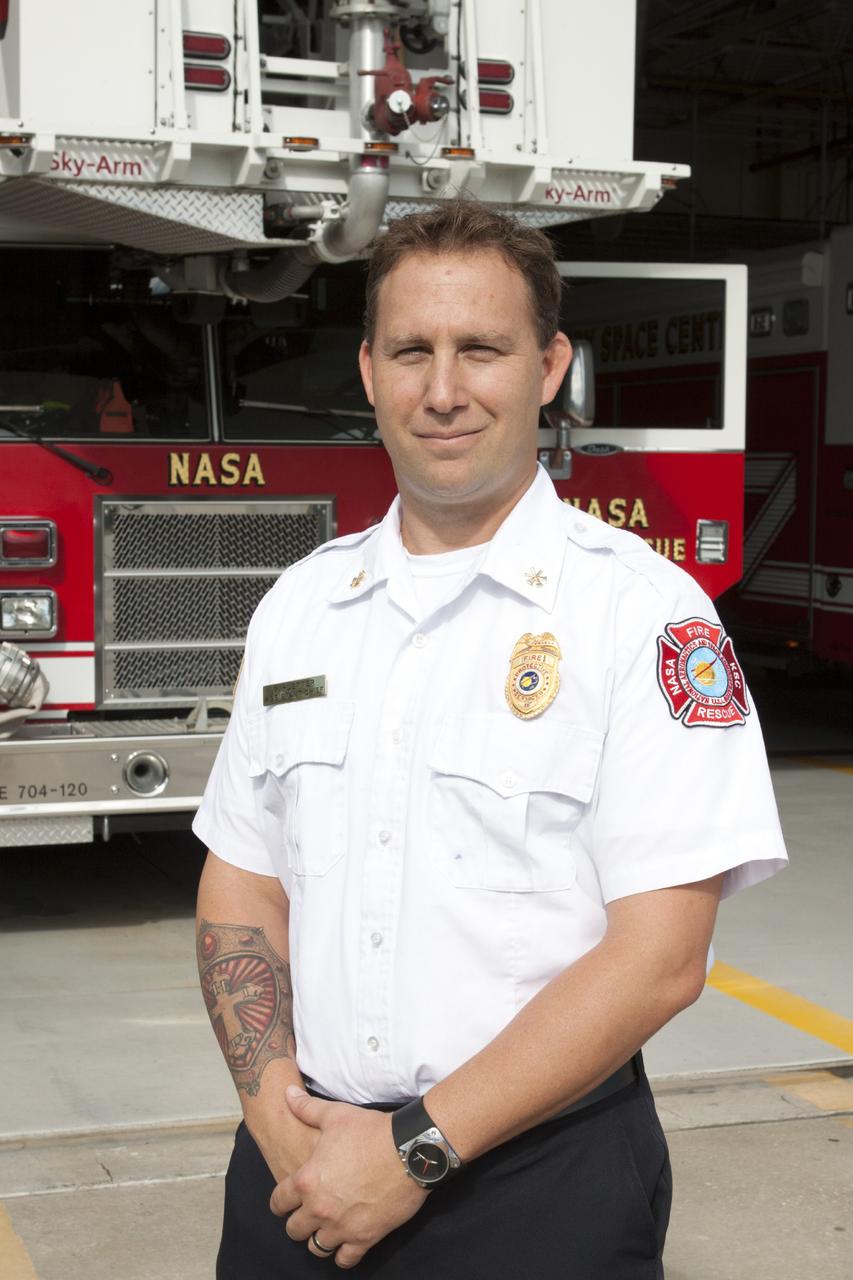
CAPE CANAVERAL, Fla. – At Fire Station No. 2 near the Shuttle Landing Facility at NASA’s Kennedy Space Center in Florida, Mark Huetter, assistant chief of training with the center’s Fire Department, prepares to train Fire Rescue Services personnel in the operation and use of the aerial fire truck. The center’s Fire Rescue Services recently achieved Pro Board Certification in aerial fire truck operations. Pro Board Certification is a globally recognized certification that puts on multiple courses that all fire departments throughout the world recognize and use to train their personnel. The unique aerial truck contains a 100-foot extendable ladder with a bucket at the end of it that can be used for rescues from taller buildings or aircraft rescue firefighting. Photo credit: NASA/Kim Shiflett
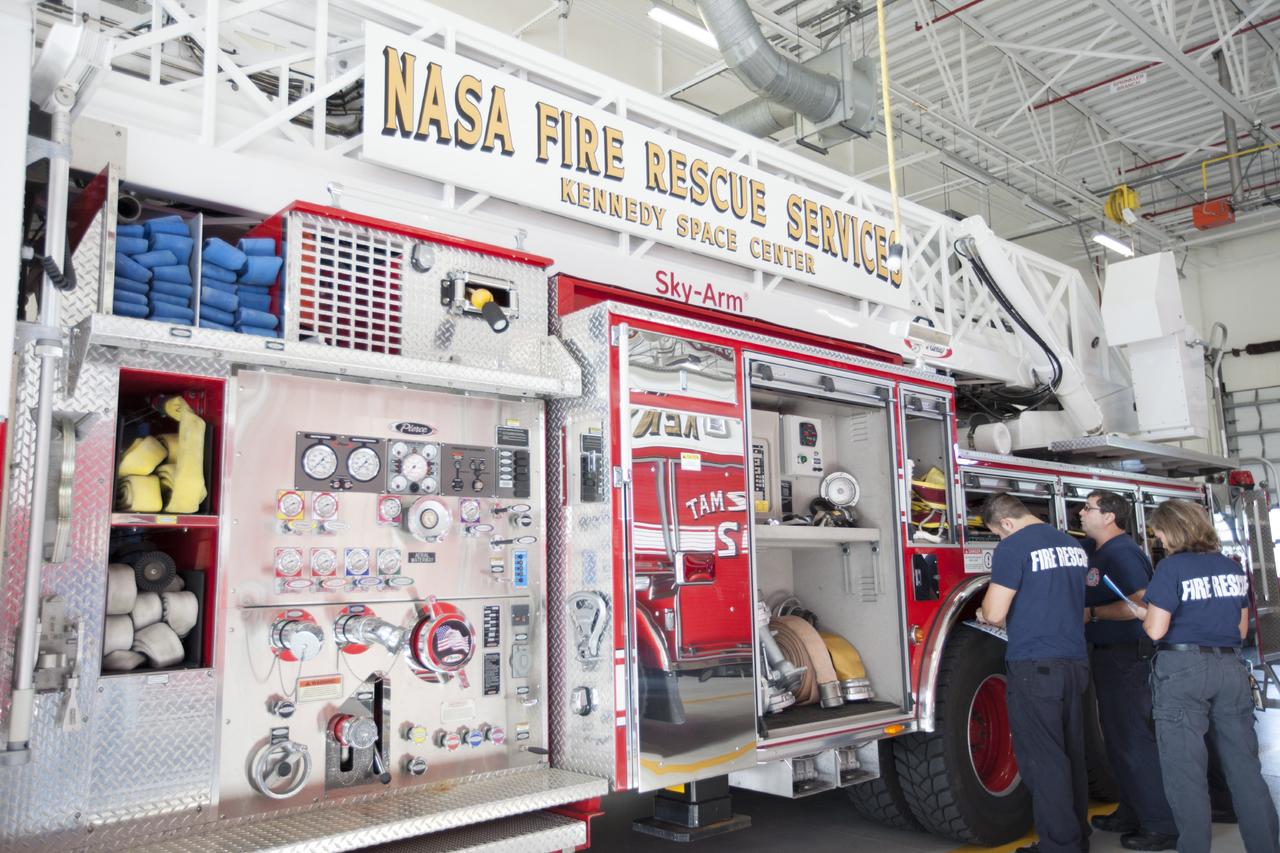
CAPE CANAVERAL, Fla. – At Fire Station No. 2 near the Shuttle Landing Facility at NASA’s Kennedy Space Center in Florida, Fire Rescue Services personnel review procedures and check equipment on the aerial fire truck as part of the training to be certified in the operation and use of the vehicle. The center’s Fire Rescue Services recently achieved Pro Board Certification in aerial fire truck operations. Pro Board Certification is a globally recognized certification that puts on multiple courses that all fire departments throughout the world recognize and use to train their personnel. The unique aerial truck contains a 100-foot extendable ladder with a bucket at the end of it that can be used for rescues from taller buildings or aircraft rescue firefighting. Photo credit: NASA/Kim Shiflett
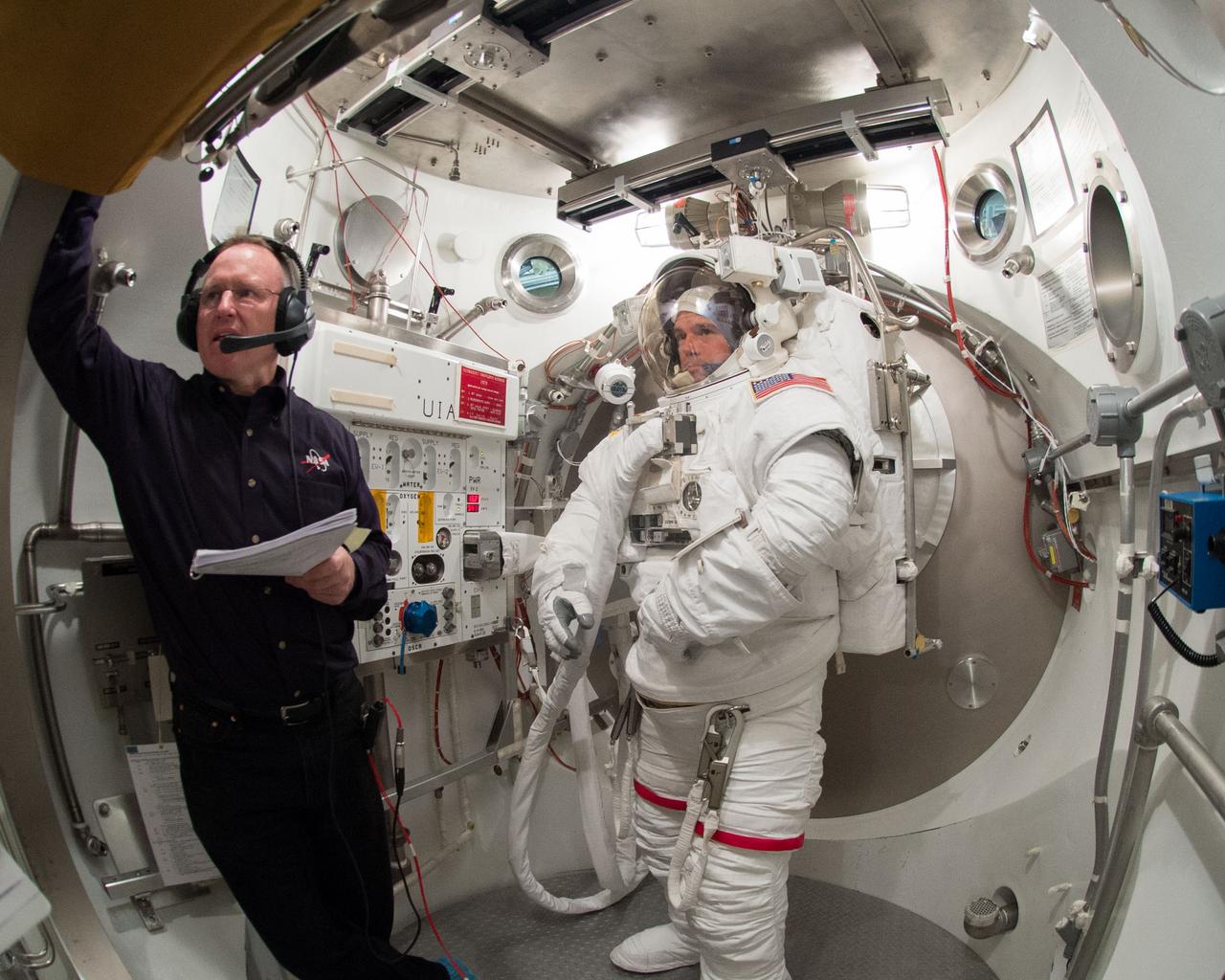
PHOTO DATE: 01-09-14 LOCATION: Bldg. 7 - SSATA Chamber SUBJECT: SSATA crew training and certification for Increment 40 astronaut Greg Wiseman with astronaut Barry Wilmore assisting. PHOTOGRAPHER: BILL STAFFORD
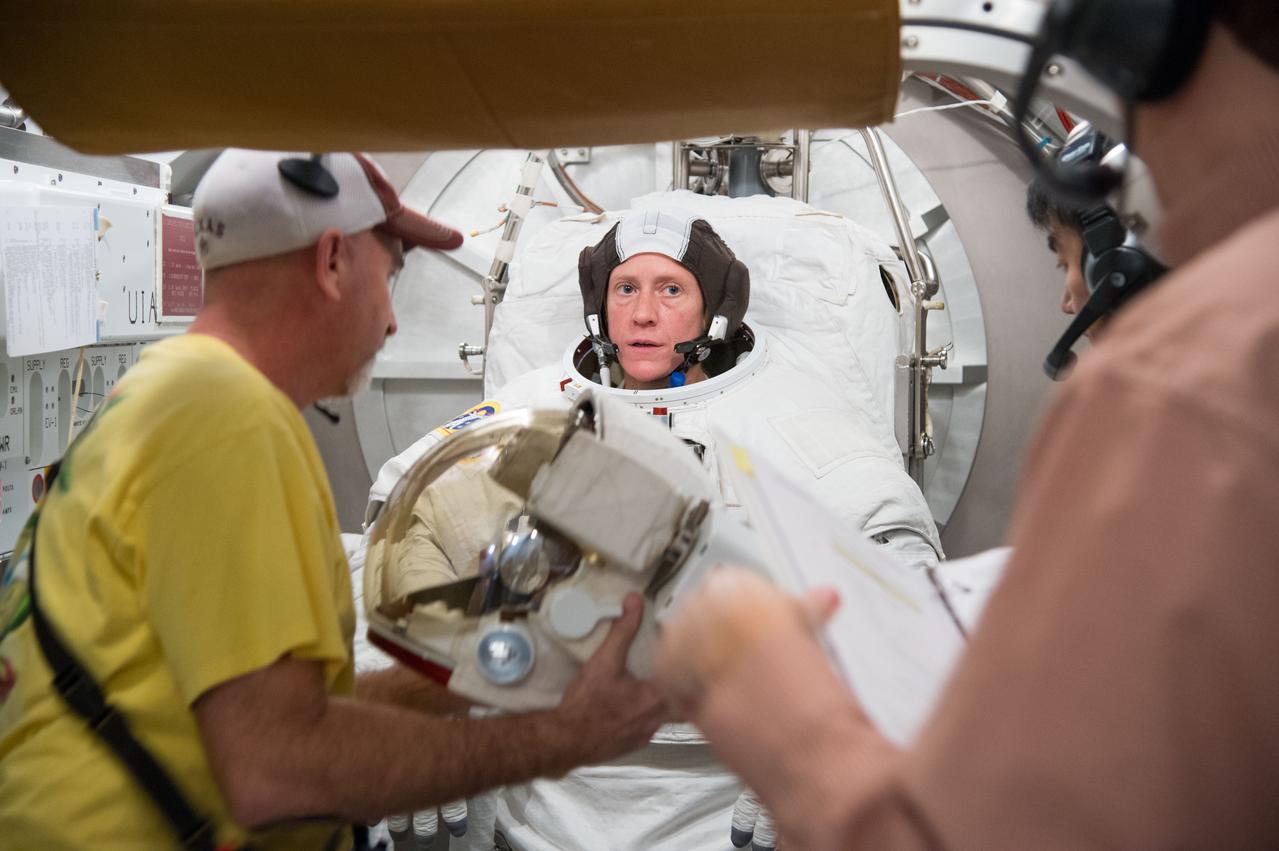
Date: 01-10-13 Location: Bldg 7, SSATA Subject: Expedition 36 astronaut Karen Nyberg during SSATA Chamber - EMU Training & Certification - DRY RUN - STB-ST-989 Photographer: James Blair
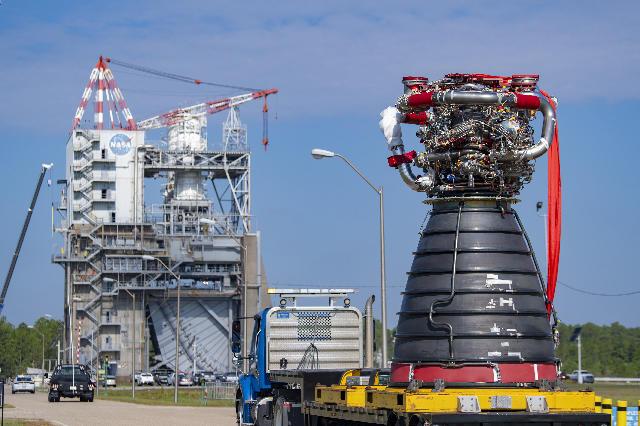
Crews bring RS-25 developmental engine E0525 to the Fred Haise Test Stand at NASA’s Stennis Space Center on Aug. 30 for the second and final certification test series.
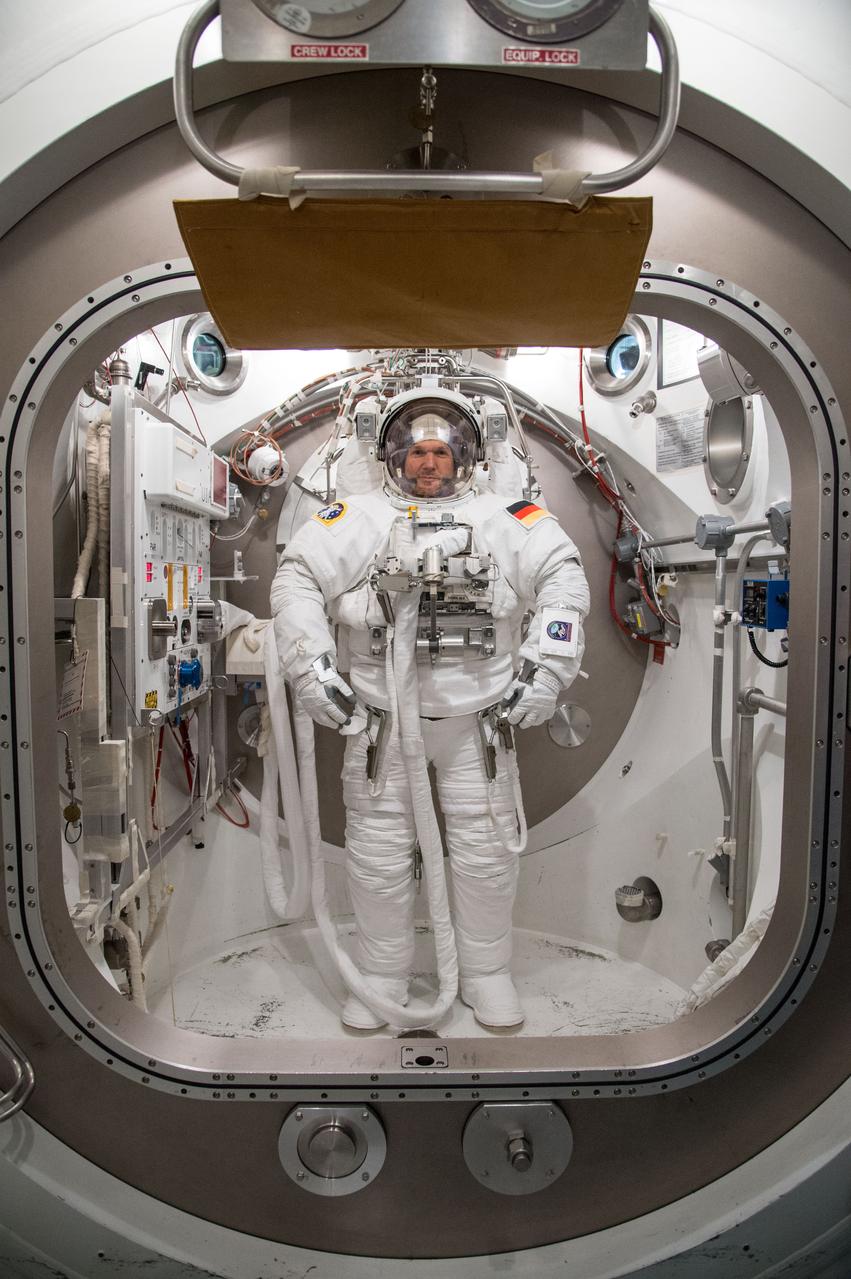
Date: 12-10-13 Location: Bldg7, SSATA Subject: SSATA EMU crew training and certification for Expedition 40/41 ESA astronaut Alexander Gerst - DRY RUN Photographer: James Blair/NASA
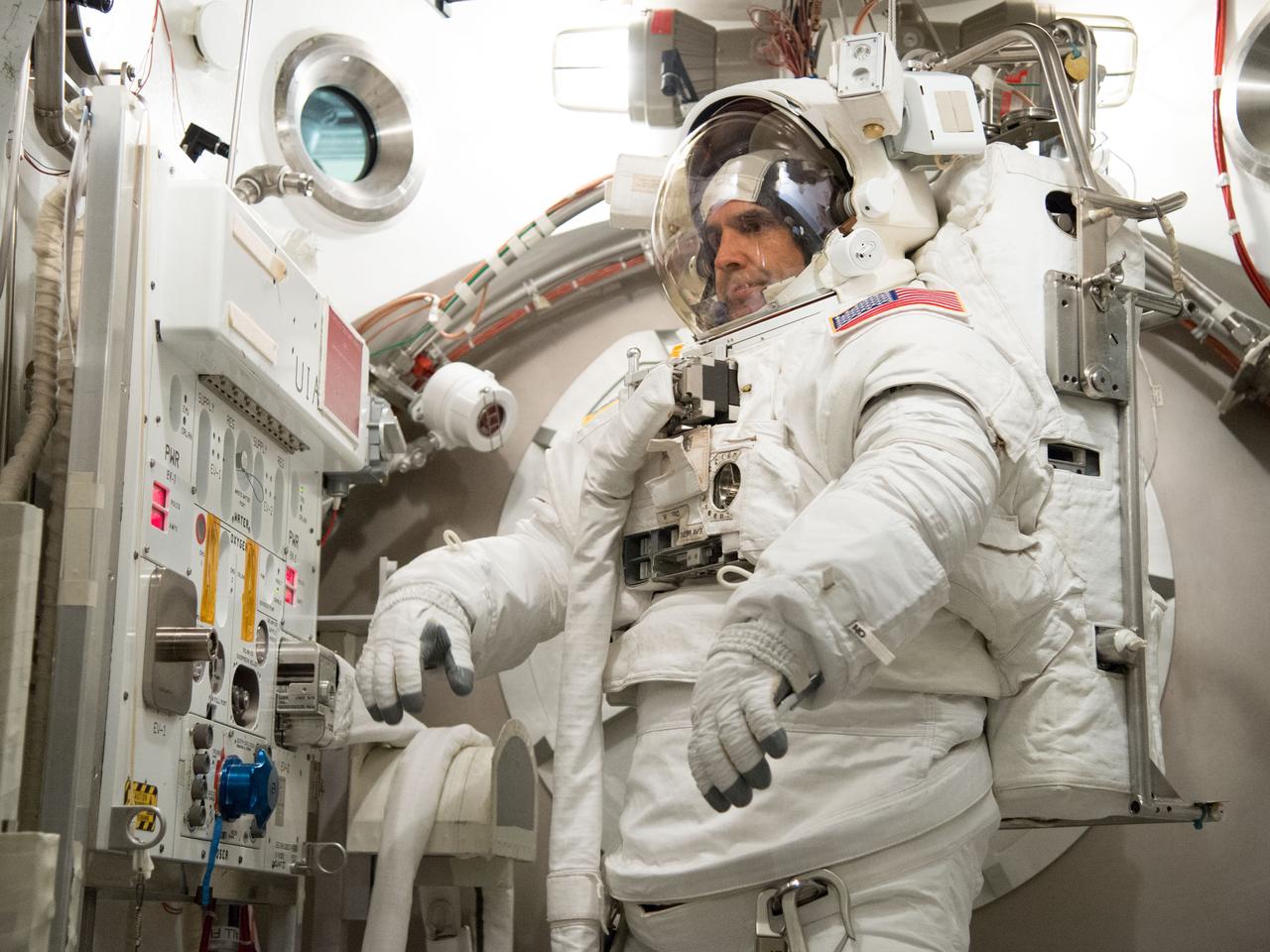
Date: 06-28-13 Location: Bldg 7, SSATA Subject: ISS-038 crew members a Rick Mastracchio and Koichi Wakata during SSATA crew training and EMU certification. Photographer: James Blair/ NASA
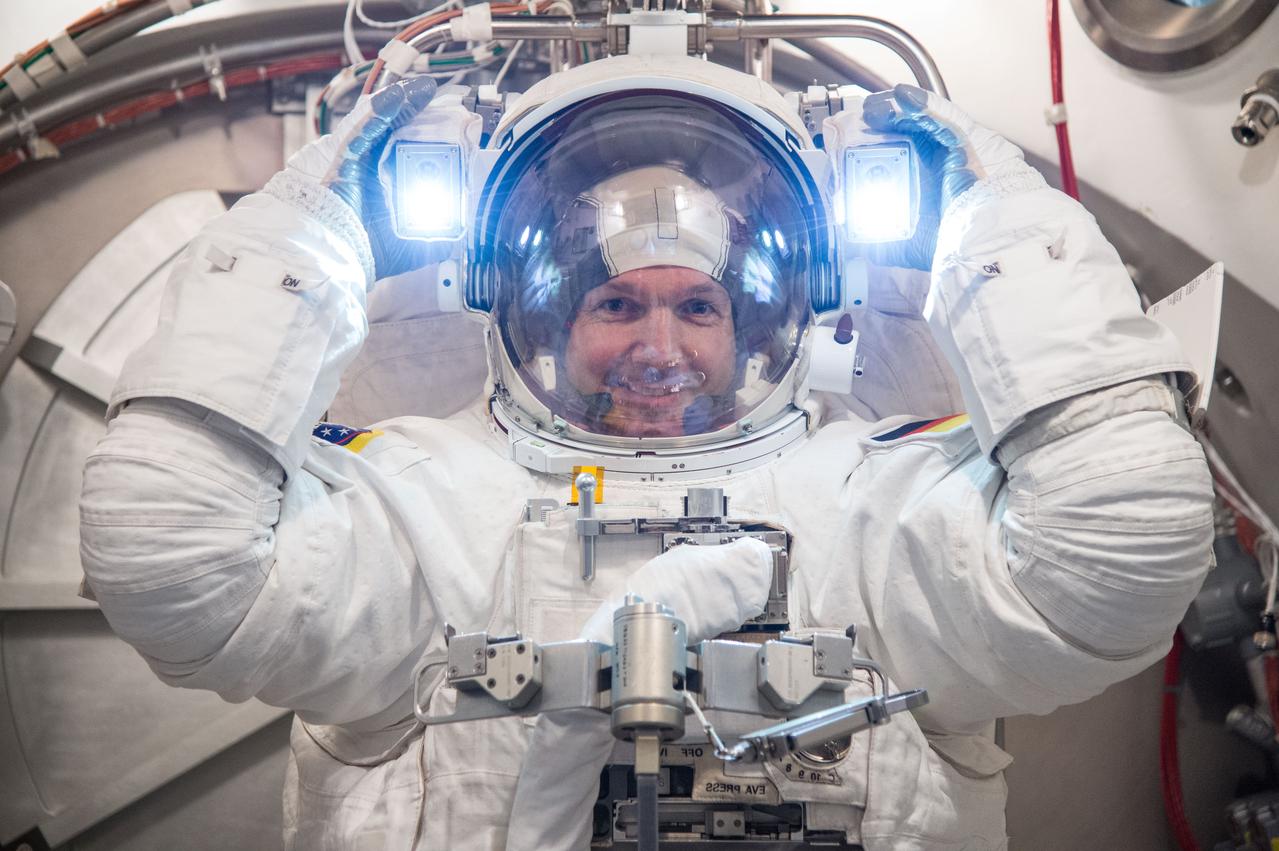
Date: 12-10-13 Location: Bldg7, SSATA Subject: SSATA EMU crew training and certification for Expedition 40/41 ESA astronaut Alexander Gerst - DRY RUN Photographer: James Blair/NASA
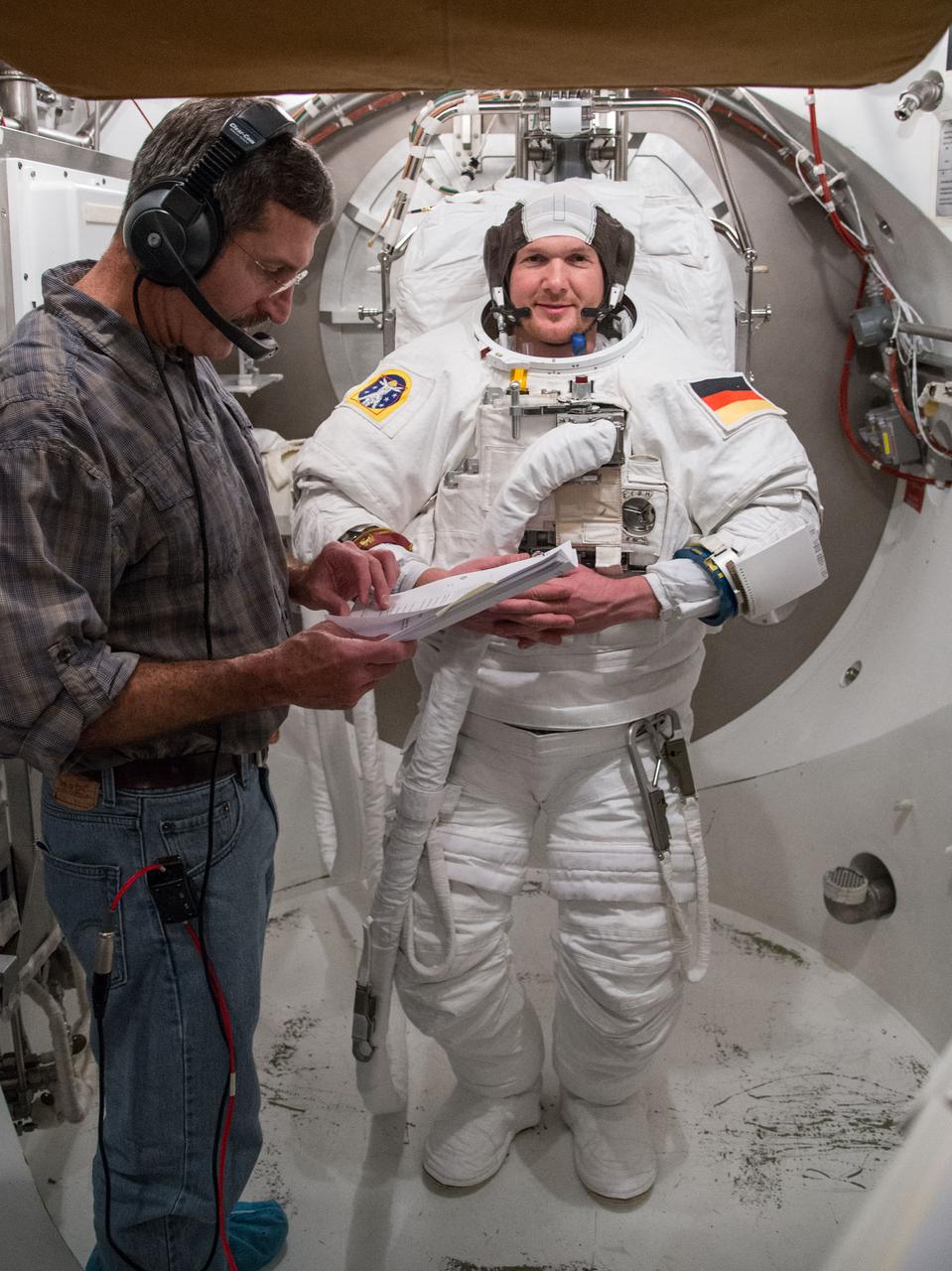
Date: 12-10-13 Location: Bldg7, SSATA Subject: SSATA EMU crew training and certification for Expedition 40/41 ESA astronaut Alexander Gerst - DRY RUN Photographer: James Blair/NASA
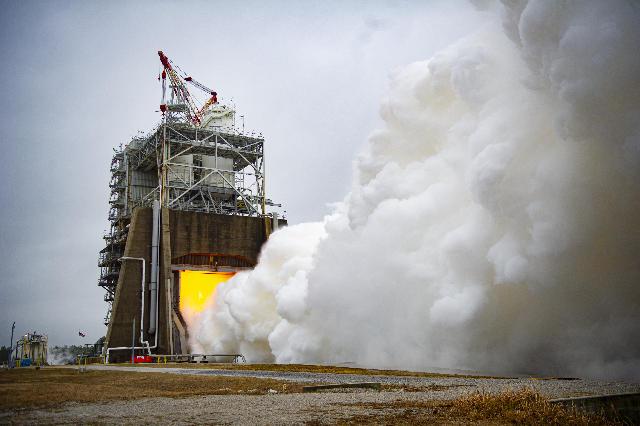
Crews exceed the 111% power level needed to lift the SLS (Space Launch System) rocket when firing the RS-25 certification engine at 113% on Jan. 23 at NASA’s Stennis Space Center.
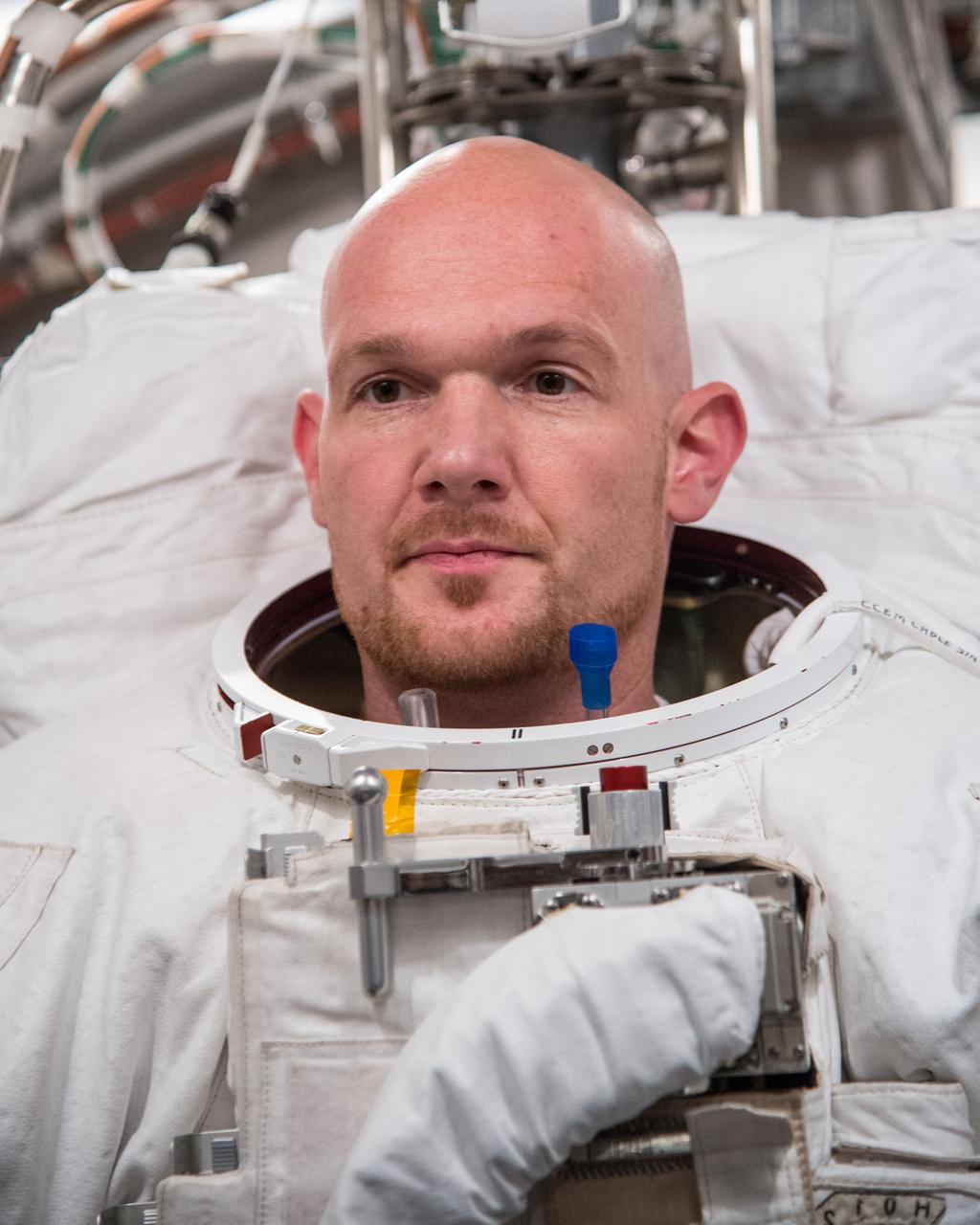
Date: 12-10-13 Location: Bldg7, SSATA Subject: SSATA EMU crew training and certification for Expedition 40/41 ESA astronaut Alexander Gerst - DRY RUN Photographer: James Blair/NASA
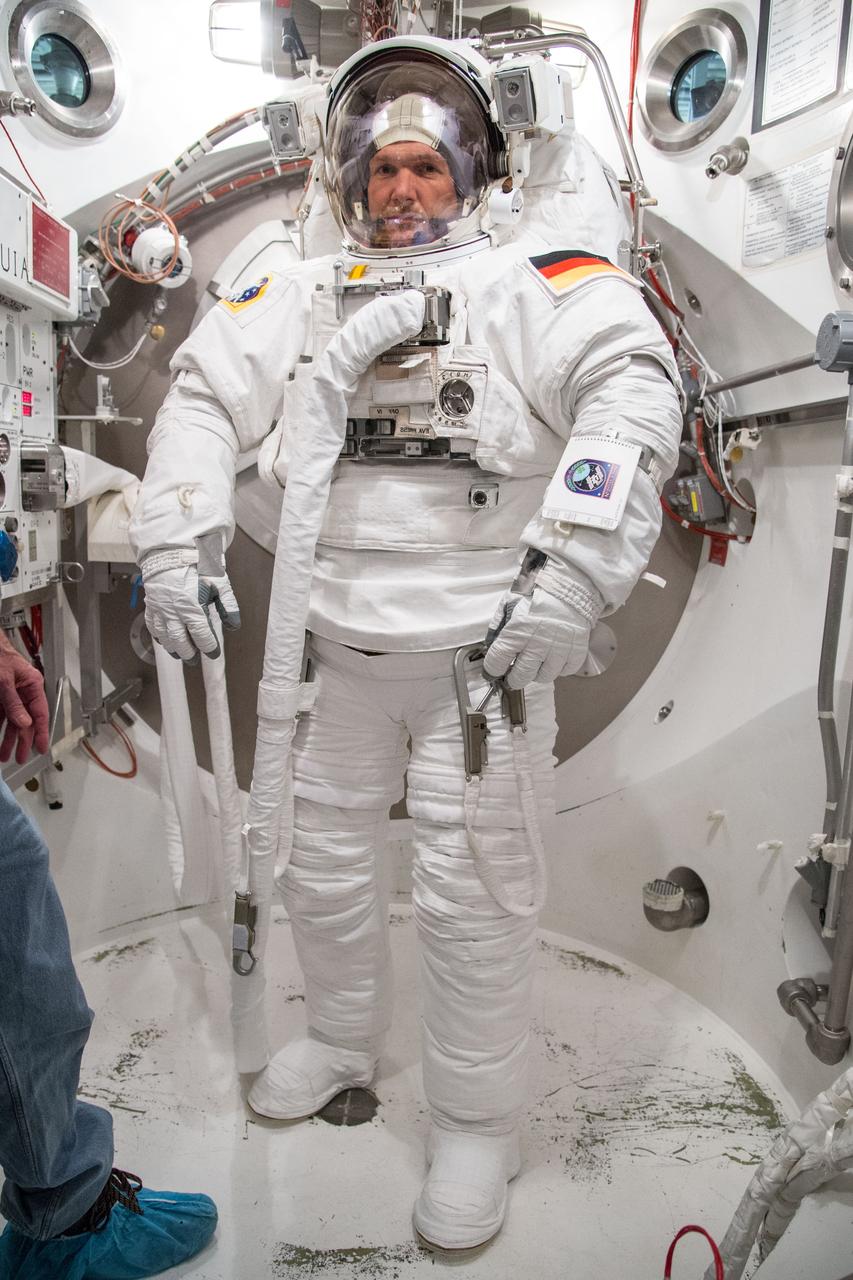
Date: 12-10-13 Location: Bldg7, SSATA Subject: SSATA EMU crew training and certification for Expedition 40/41 ESA astronaut Alexander Gerst - DRY RUN Photographer: James Blair/NASA
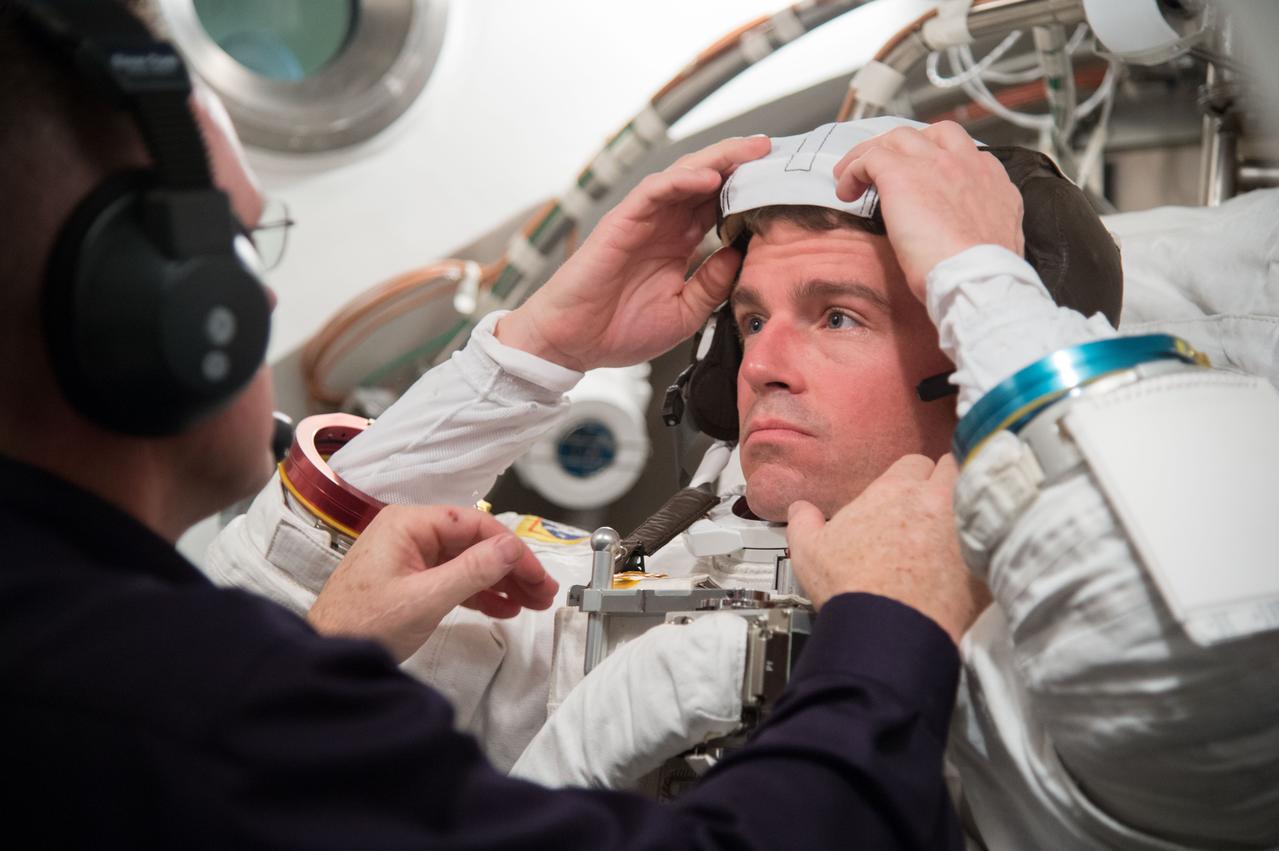
PHOTO DATE: 01-09-14 LOCATION: Bldg. 7 - SSATA Chamber SUBJECT: SSATA crew training and certification for Increment 40 astronaut Greg Wiseman with astronaut Barry Wilmore assisting. PHOTOGRAPHER: BILL STAFFORD
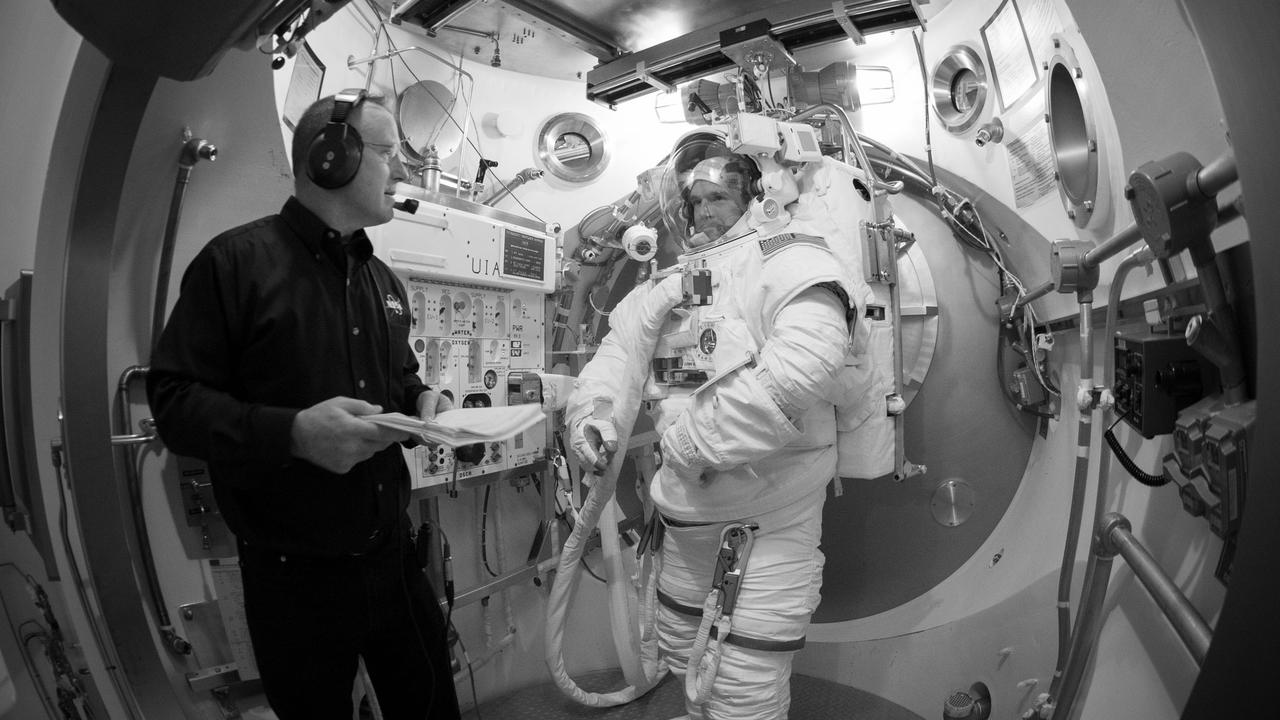
PHOTO DATE: 01-09-14 LOCATION: Bldg. 7 - SSATA Chamber SUBJECT: SSATA crew training and certification for Increment 40 astronaut Greg Wiseman with astronaut Barry Wilmore assisting. PHOTOGRAPHER: BILL STAFFORD
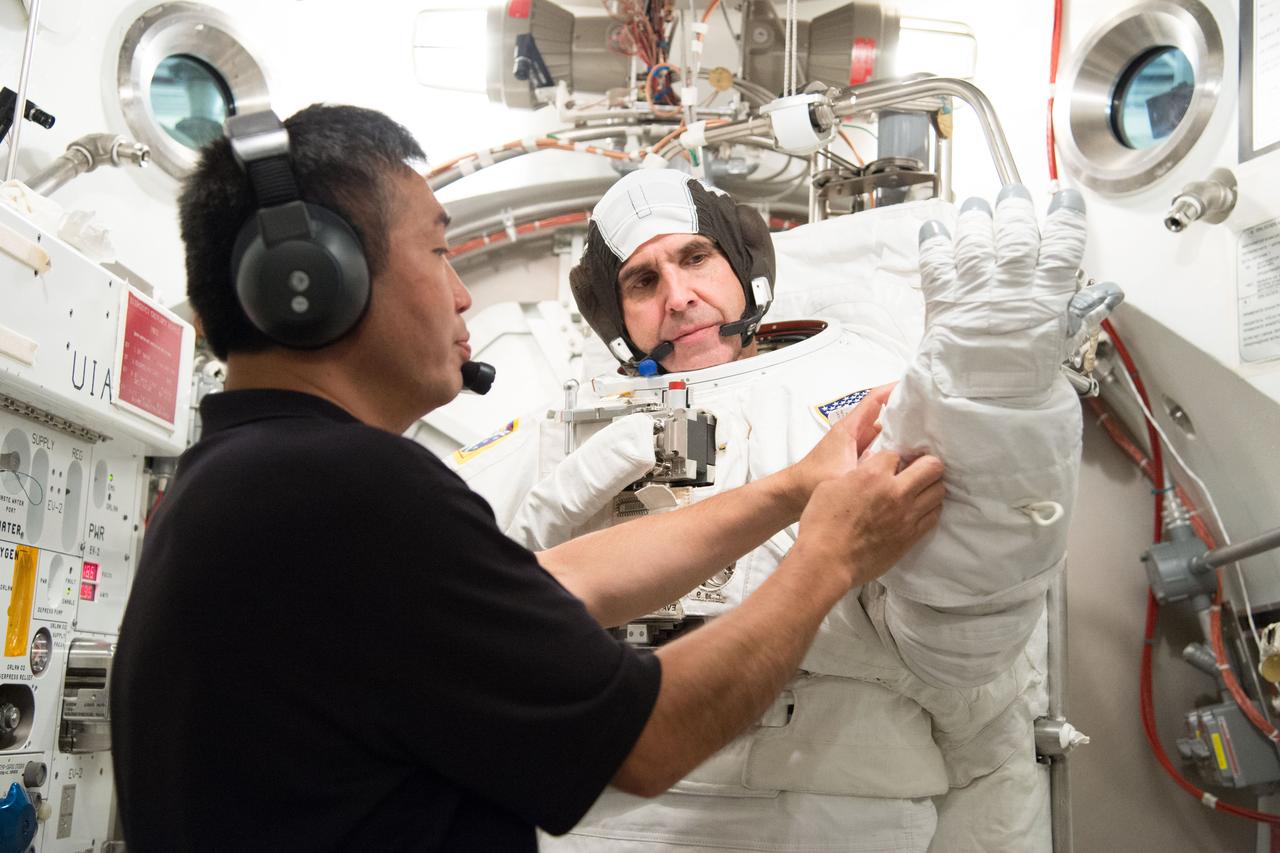
Date: 06-28-13 Location: Bldg 7, SSATA Subject: ISS-038 crew members a Rick Mastracchio and Koichi Wakata during SSATA crew training and EMU certification. Photographer: James Blair/ NASA
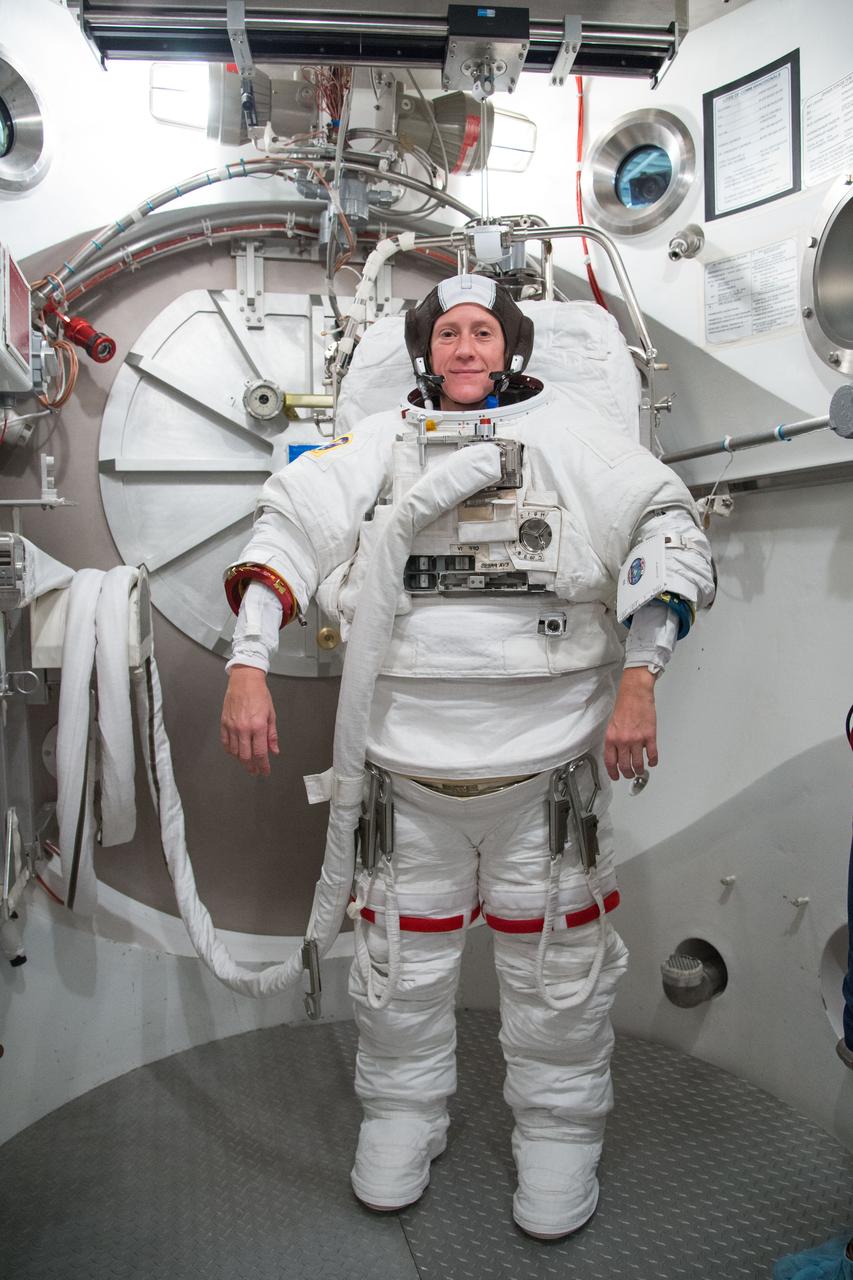
Date: 01-10-13 Location: Bldg 7, SSATA Subject: Expedition 36 astronaut Karen Nyberg during SSATA Chamber - EMU Training & Certification - DRY RUN - STB-ST-989 Photographer: James Blair
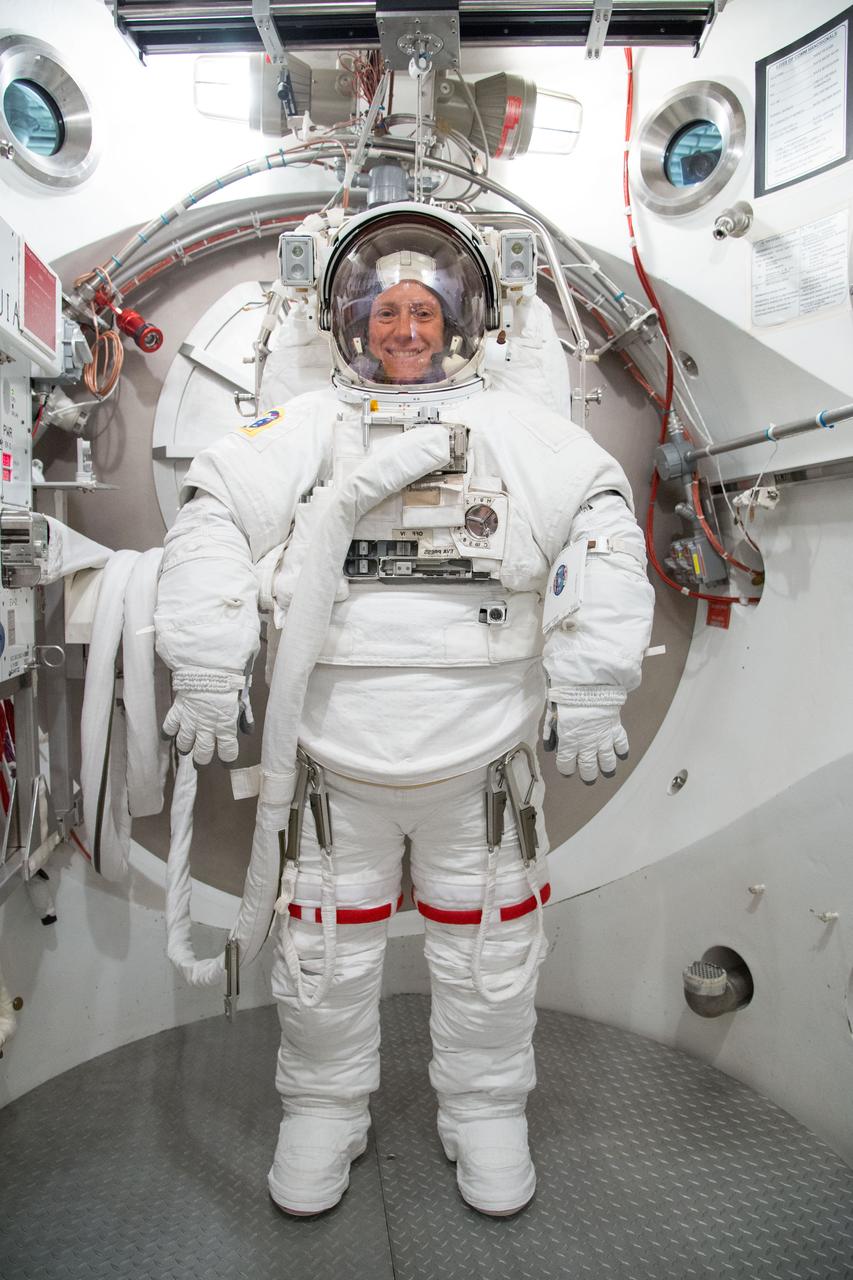
Date: 01-10-13 Location: Bldg 7, SSATA Subject: Expedition 36 astronaut Karen Nyberg during SSATA Chamber - EMU Training & Certification - DRY RUN - STB-ST-989 Photographer: James Blair
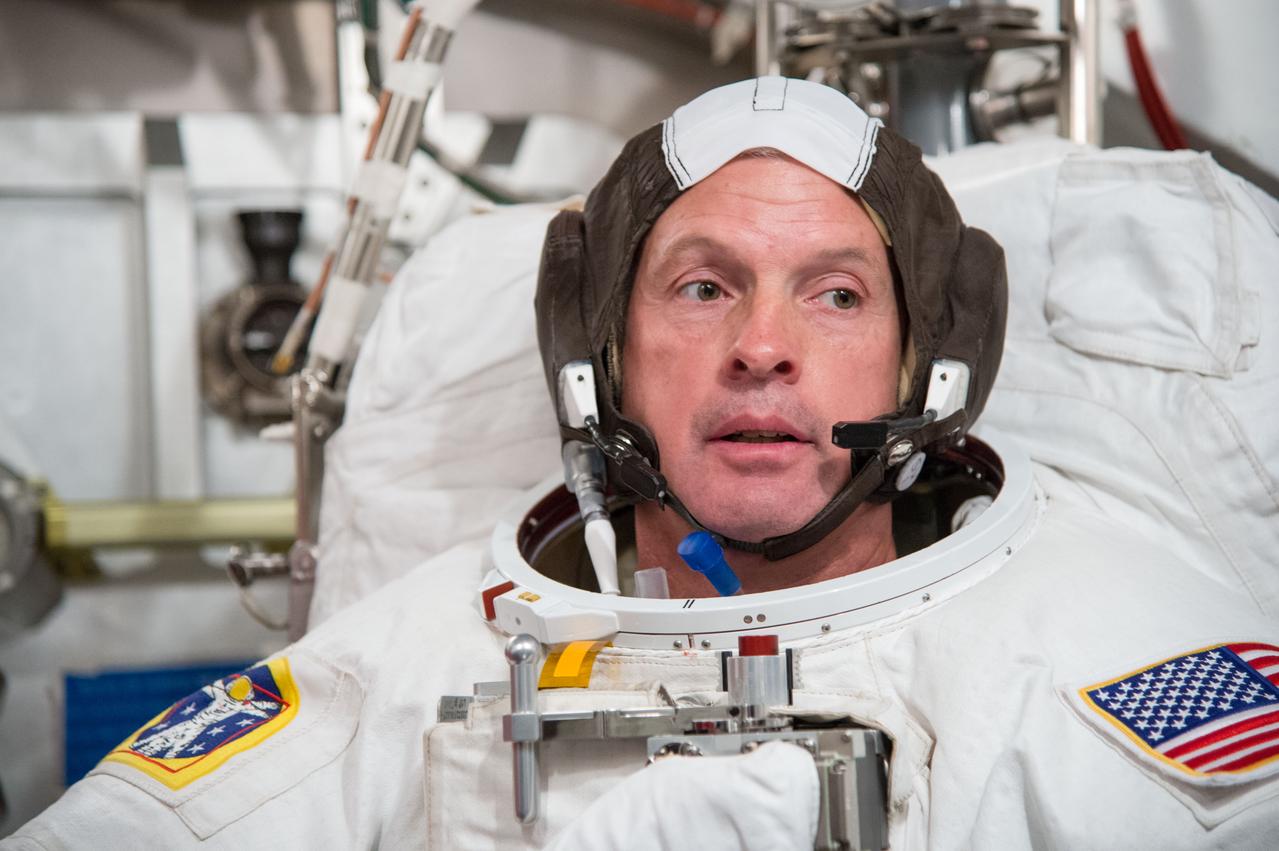
Date: 10-24-13 Location: Bldg 7, SSATA Subject: Support for SSATA Crew Training & Certification - ISS Increment 39 Crew Member Steve Swanson Photograher: James Blair
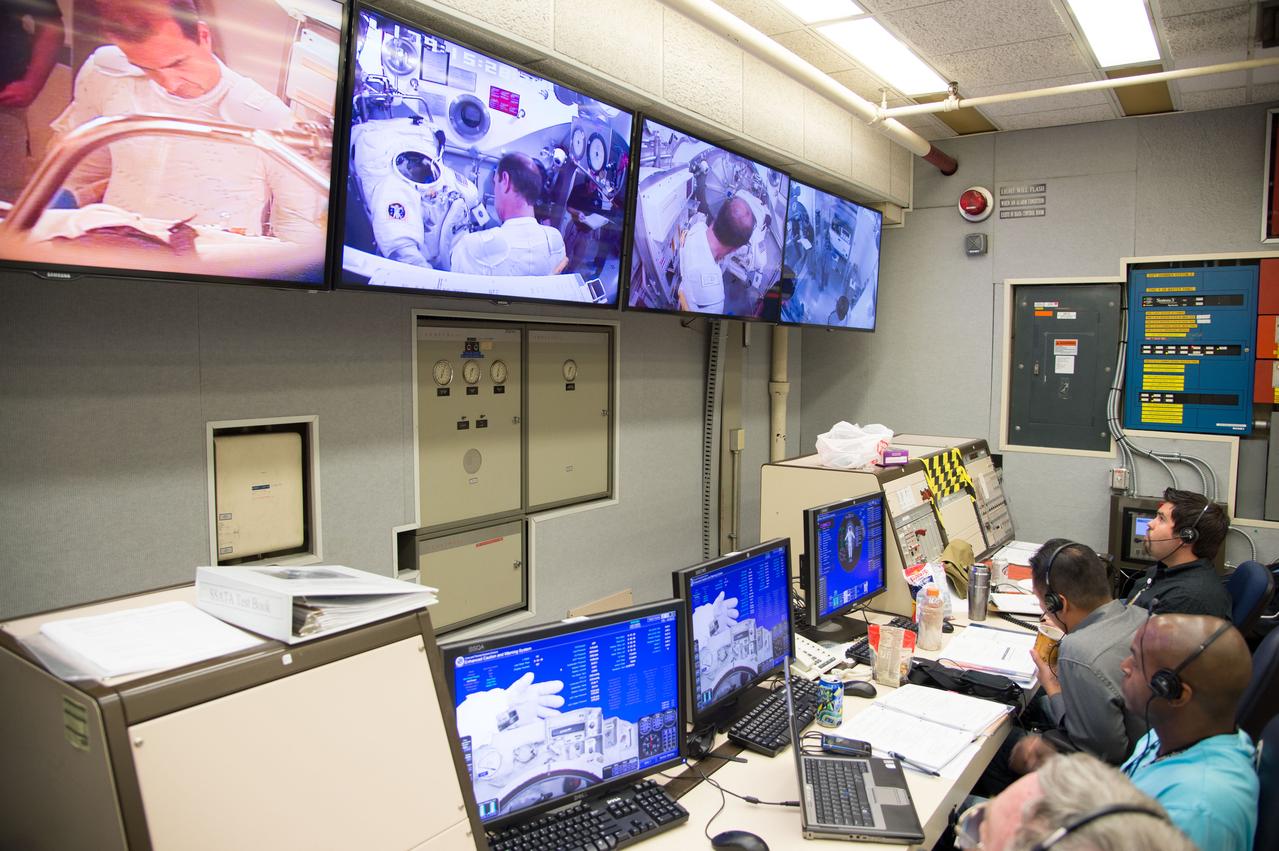
Date: 06-28-13 Location: Bldg 7, SSATA Subject: ISS-038 crew members a Rick Mastracchio and Koichi Wakata during SSATA crew training and EMU certification. Photographer: James Blair/ NASA