
S71-51289 (21 Sept. 1971) --- Astronaut Charles M. Duke Jr.

S72-16658 (January 1972) --- Astronaut Charles M. Duke Jr.

AS16-114-18423 (21 April 1972) --- Astronaut Charles M. Duke Jr., lunar module pilot, is photographed collecting lunar samples at Station No. 1, during the first Apollo 16 extravehicular activity (EVA), at the Descartes landing site. This picture, looking eastward, was taken by astronaut John W. Young, commander. Duke is standing at the rim of Plum Crater. The parked Lunar Roving Vehicle (LRV) can be seen in the left background. While astronauts Young and Duke descended in the Lunar Module (LM) "Orion" to explore the Descartes highlands region of the moon, astronaut Thomas K. Mattingly II, command module pilot, remained with the Command and Service Modules (CSM) "Casper" in lunar orbit.
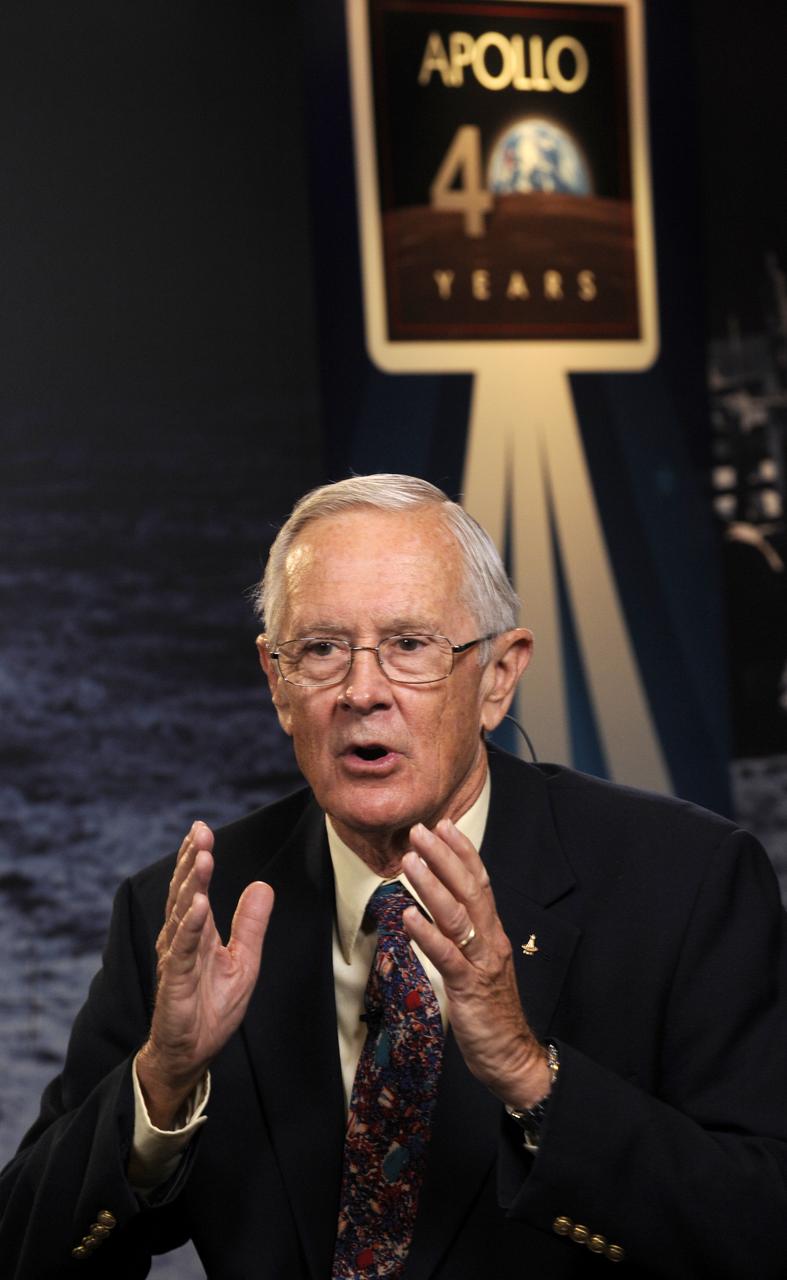
Apollo 16 astronaut Charles Duke responds to a question during a live television interview on Monday, July 20, 2009, at NASA Headquarters in Washington. Photo Credit: (NASA/Paul E. Alers)
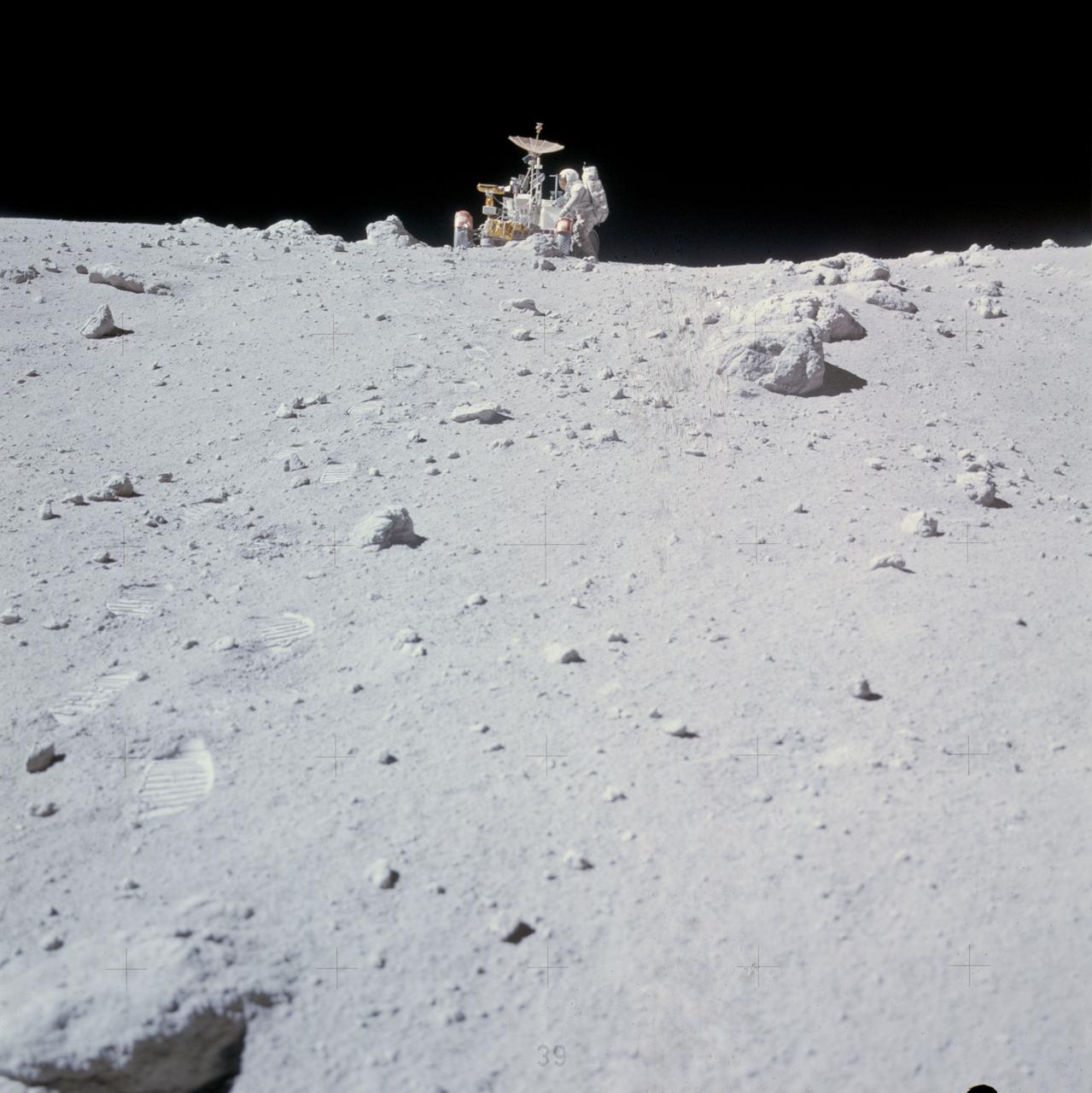
AS16-116-18607 (23 April 1972) --- Astronaut Charles M. Duke Jr. works at the front of the Lunar Roving Vehicle (LRV) parked in this rock field at a North Ray Crater geological site during the mission's third extravehicular activity (EVA) on April 23, 1972. Astronaut John W. Young took this picture with a 70mm Hasselblad camera. While astronauts Young, commander; and Duke, lunar module pilot; descended in the Apollo 16 Lunar Module (LM) "Orion" to explore the Descartes highlands landing site on the moon, astronaut Thomas K. Mattingly II, command module pilot, remained with the Command and Service Modules (CSM) "Casper" in lunar orbit.
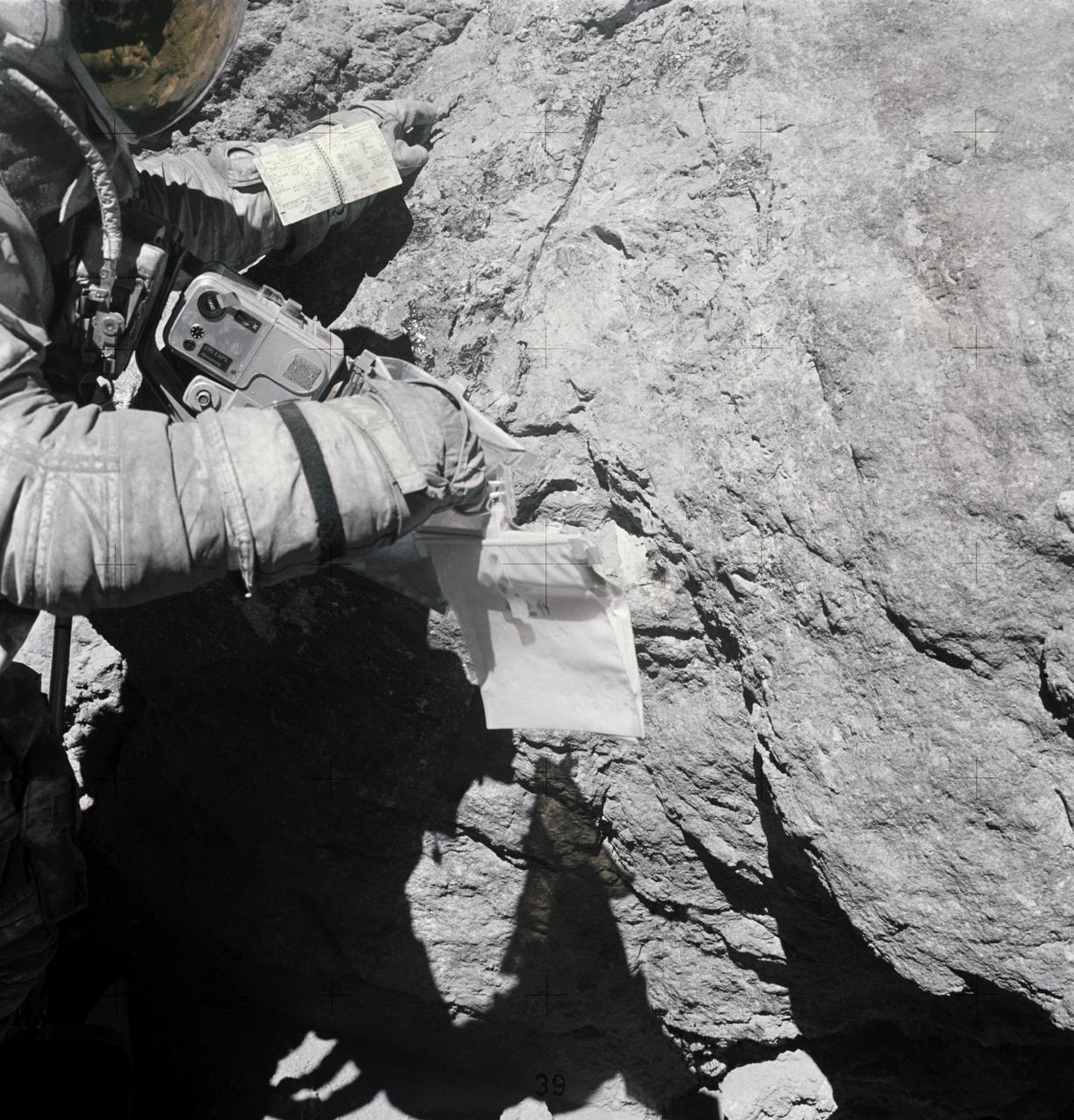
AS16-116-18649 (23 April 1972) --- Astronaut Charles M. Duke Jr., lunar module pilot of the Apollo 16 lunar landing mission, examines closely the surface of a large boulder at North Ray Crater during the third Apollo 16 extravehicular activity (EVA) at the Descartes landing site. This picture was taken by astronaut John W. Young, commander. Note the chest-mounted 70mm Hasselblad camera. While astronauts Young and Duke descended in the Apollo 16 Lunar Module (LM) "Orion" to explore the Descartes highlands landing site on the moon, astronaut Thomas K. Mattingly II, command module pilot, remained with the Command and Service Modules (CSM) "Casper" in lunar orbit.
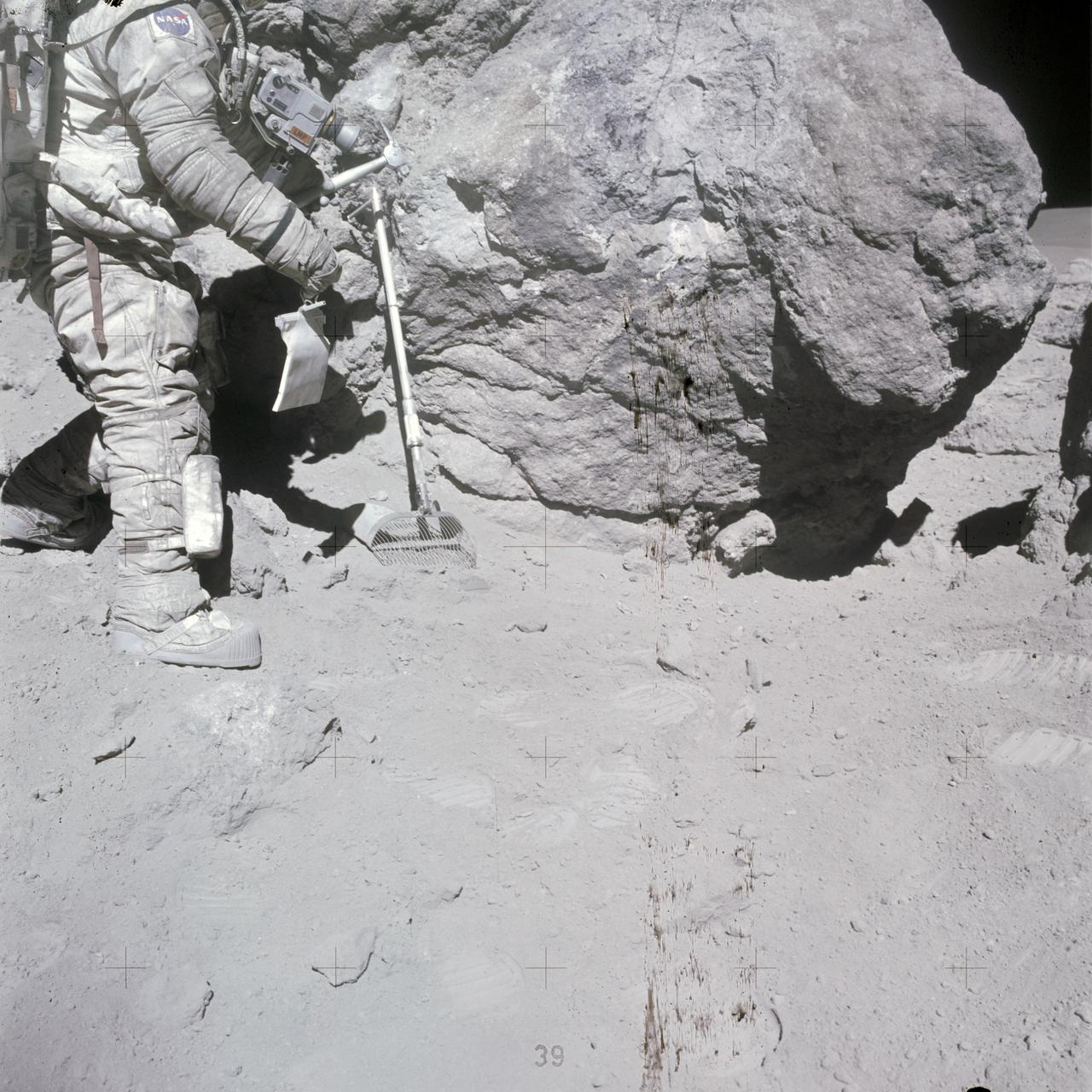
AS16-116-18653 (23 April 1972) --- Astronaut Charles M. Duke Jr., Apollo 16 lunar module pilot, stands at a big rock adjacent (south) to the huge "House Rock" (barely out of view at right edge). Note shadow at extreme right center where the two moon-exploring crew members of the mission sampled what they referred to as the "east-by-west split of House Rock" or the open space between this rock and "House Rock". At their post-mission press conference, the crewmen expressed the opinion that this rock was once a part of "House Rock" which had broken away. The two sampled the big boulder seen here also. Duke has a sample bag in his hand, and a lunar surface rake leans against the large boulder. Astronaut John W. Young, commander, exposed this view with a color magazine in his 70mm Hasselblad camera. While astronauts Young and Duke descended in the Apollo 16 Lunar Module (LM) "Orion" to explore the Descartes highlands landing site on the moon, astronaut Thomas K. Mattingly II, command module pilot, remained with the Command and Service Modules (CSM) "Casper" in lunar orbit.

Apollo astronaut Alan Bean, center, laughs at a comment made by Apollo astronaut Charles Duke, right, as Apollo astronaut Buzz Aldrin, left, looks on during a live television interview on Monday, July 20, 2009, at NASA Headquarters in Washington. Monday marked the 40th Anniversary of the historic landing of Apollo 11 on the Moon. Photo Credit: (NASA/Paul E. Alers)
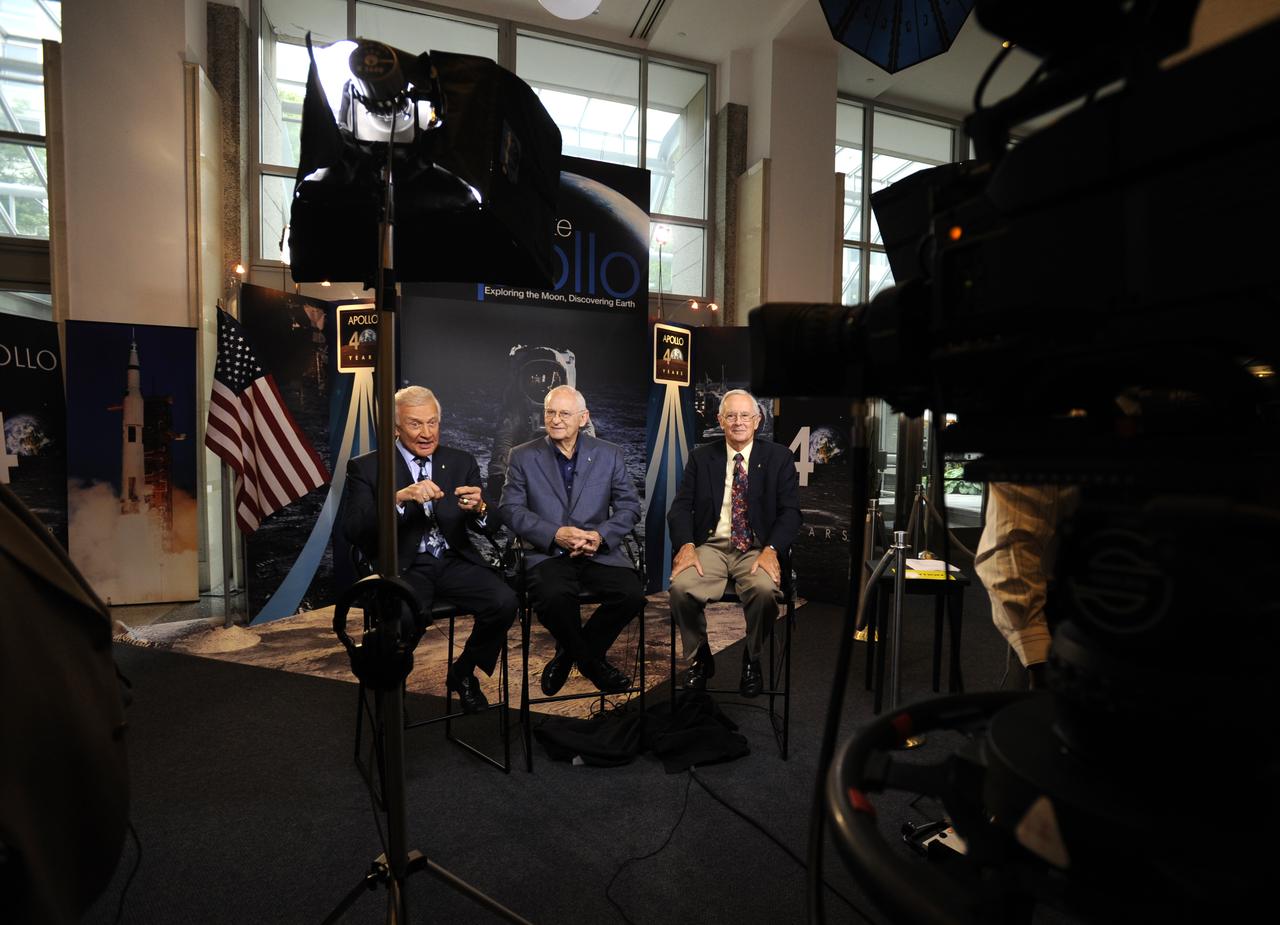
Apollo 11 astronaut Buzz Aldrin, the second man to walk on the Moon, seated left, responds to a question during a live television interview on Monday, July 20, 2009, at NASA Headquarters in Washington as Apollo 12 astronaut Alan Bean and Apollo 16 astronaut Charles Duke, right look on. The three sat in for interviews with morning talks shows covering the 40th Anniversary of the Apollo 11 landing on the Moon. Photo Credit: (NASA/Paul E. Alers)

AS16-113-18342 (21 April 1972) --- Astronaut Charles M. Duke Jr., Apollo 16 lunar module pilot, salutes the United States flag during the mission's first extravehicular activity (EVA), on April 21, 1972. Stone Mountain reaches five-sixths across the photo in background. The Lunar Module (LM) and Lunar Roving Vehicle (LRV) are in the background. While John W. Young, commander and Duke descended in the LM to explore the Descartes region of the moon, Thomas K. Mattingly II, command module pilot, remained with the Command and Service Modules (CSM) in lunar orbit.
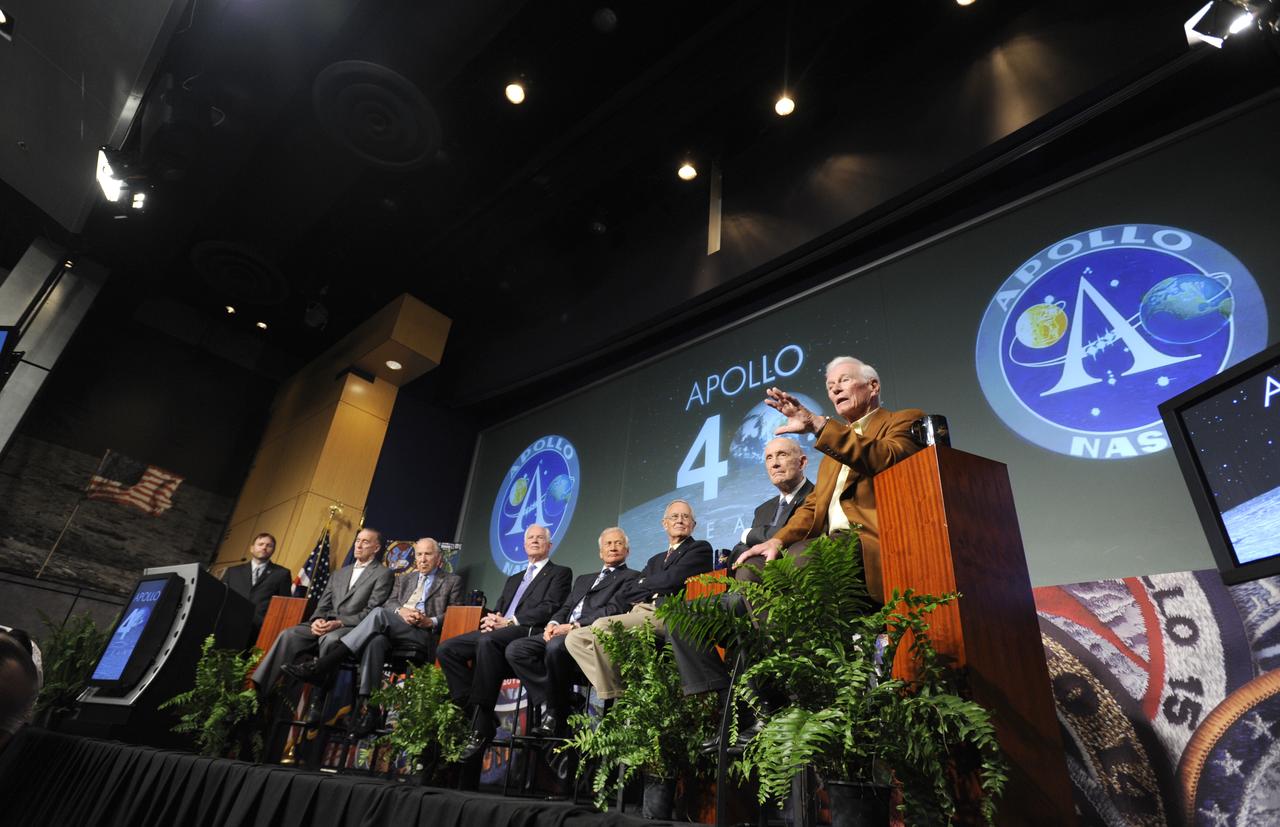
Apollo astronauts from left, Walt Cunningham (Apollo 17), James Lovell (Apollo 8 Apollo 13), David Scott (Apollo 9 Apollo 15), Buzz Aldrin (Apollo 11), Charles Duke (Apollo 16), Thomas Stafford (Apollo 10) and Eugene Cernan (Apollo 17) are seen during the 40th anniversary of the Apollo 11 mission and the walk on the moon press conference, Monday, July 20, 2009, at NASA Headquarters in Washington. Photo Credit: (NASA/Paul E. Alers)
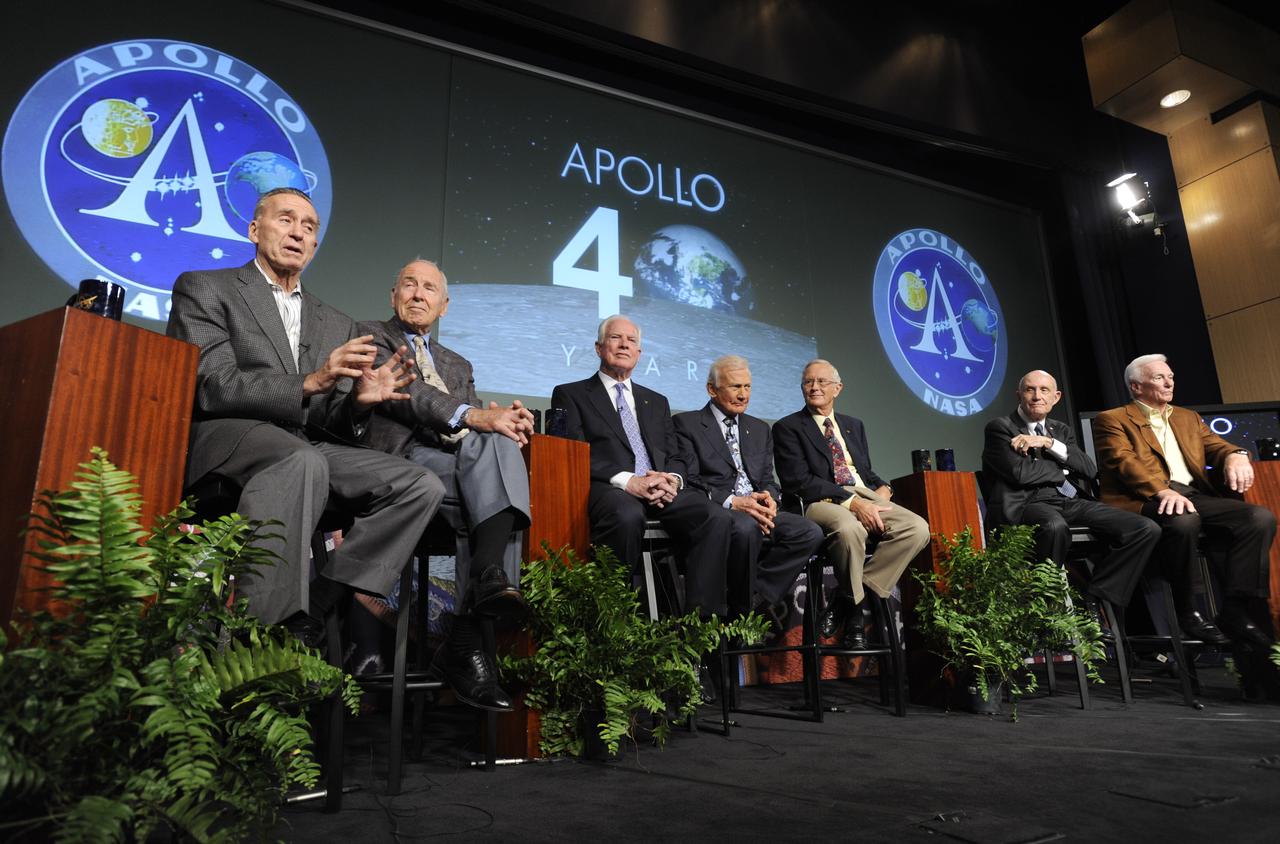
Apollo astronauts from left, Walt Cunningham (Apollo 17), James Lovell (Apollo 8 Apollo 13), David Scott (Apollo 9 Apollo 15), Buzz Aldrin (Apollo 11), Charles Duke (Apollo 16), Thomas Stafford (Apollo 10) and Eugene Cernan (Apollo 17) are seen during the 40th anniversary of the Apollo 11 mission and the walk on the moon press conference, Monday, July 20, 2009, at NASA Headquarters in Washington. Photo Credit: (NASA/Paul E. Alers)

Apollo astronauts from left, Walt Cunningham (Apollo 17), James Lovell (Apollo 8 Apollo 13), David Scott (Apollo 9 Apollo 15), Buzz Aldrin (Apollo 11), Charles Duke (Apollo 16), Thomas Stafford (Apollo 10) and Eugene Cernan (Apollo 17) are seen during the 40th anniversary of the Apollo 11 mission and the walk on the moon press conference, Monday, July 20, 2009, at NASA Headquarters in Washington. Photo Credit: (NASA/Paul E. Alers)

S72-33898 (22 March 1972) --- Astronaut Charles M. Duke Jr., Apollo 16 lunar module pilot, trains on a simulated lunar surface area at Kennedy Space Center (KSC), with a core tube with a hammer. Astronauts Duke and John W. Young, commander, will take part in three extravehicular activities on the moon while astronaut Thomas K. Mattingly II, command module pilot, remains with the Command and Service Modules (CSM) in lunar orbit.

S72-16660 (January 1972) --- These three astronauts have been selected by the National Aeronautics and Space Administration (NASA) as the prime crew men of the Apollo 16 lunar landing mission. They are, left to right, Thomas K. Mattingly II, command module pilot; John W. Young, commander; and Charles M. Duke Jr., lunar module pilot. While astronauts Young and Duke descend in the Lunar Module (LM) to explore the moon, astronaut Mattingly will remain with the Command and Service Modules (CSM) in lunar orbit.

S69-39601 (20 July 1969) --- Spacecraft communicators are pictured as they keep in contact with the Apollo 11 astronauts during their lunar landing mission on July 20, 1969. From left to right are astronauts Charles M. Duke Jr., James A. Lovell Jr. and Fred W. Haise Jr.
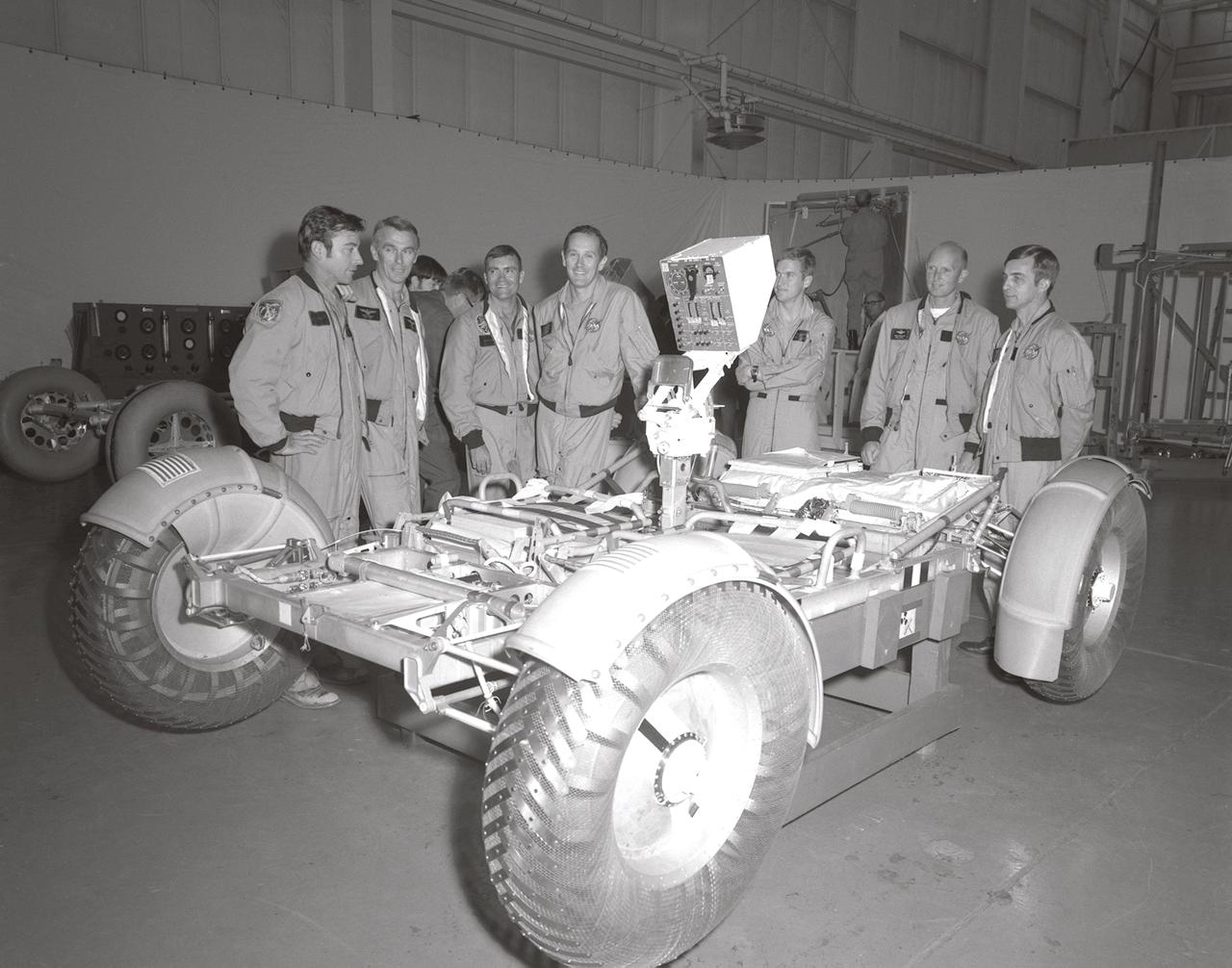
In this November 1971 photograph, (from left to right) Astronauts John Young, Eugene Cernan, Charles Duke, Fred Haise, Anthony England, Charles Fullerton, and Donald Peterson await deployment tests of the Lunar Roving Vehicle (LRV) qualification test unit in building 4649 at the Marshall Space Flight Center (MSFC). The LRV, developed under the direction of the MSFC, was designed to allow Apollo astronauts a greater range of mobility on the lunar surface during the last three lunar exploration missions; Apollo 15, Apollo 16, and Apollo 17.
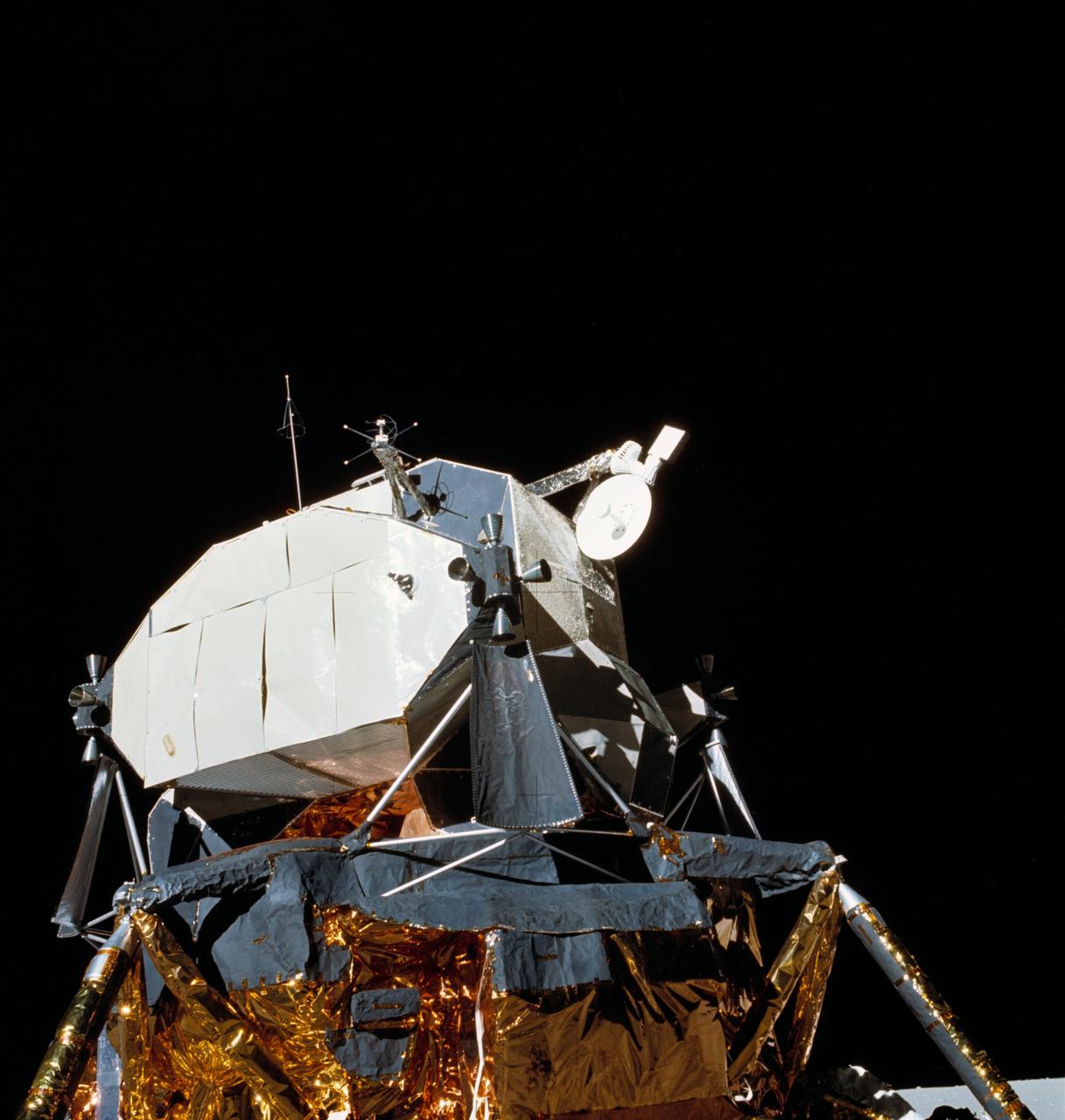
AS16-113-18334 (21 April 1972) --- View of the Lunar Module (LM) "Orion" parked on the lunar surface. During their post mission press conference, the Apollo 16 crewmembers called attention to the steerable S-band antenna, which was "frozen" in a yaw axis during much of the flight. This view of the LM was photographed by astronaut Charles M. Duke Jr., the lunar module pilot, during the mission's first extravehicular activity (EVA). Astronauts John W. Young, commander, and Duke had earlier descended in the LM to explore the Descartes region of the moon, while astronaut Thomas K. Mattingly II, command module pilot, remained with the Command and Service Modules (CSM) "Casper" in lunar orbit.
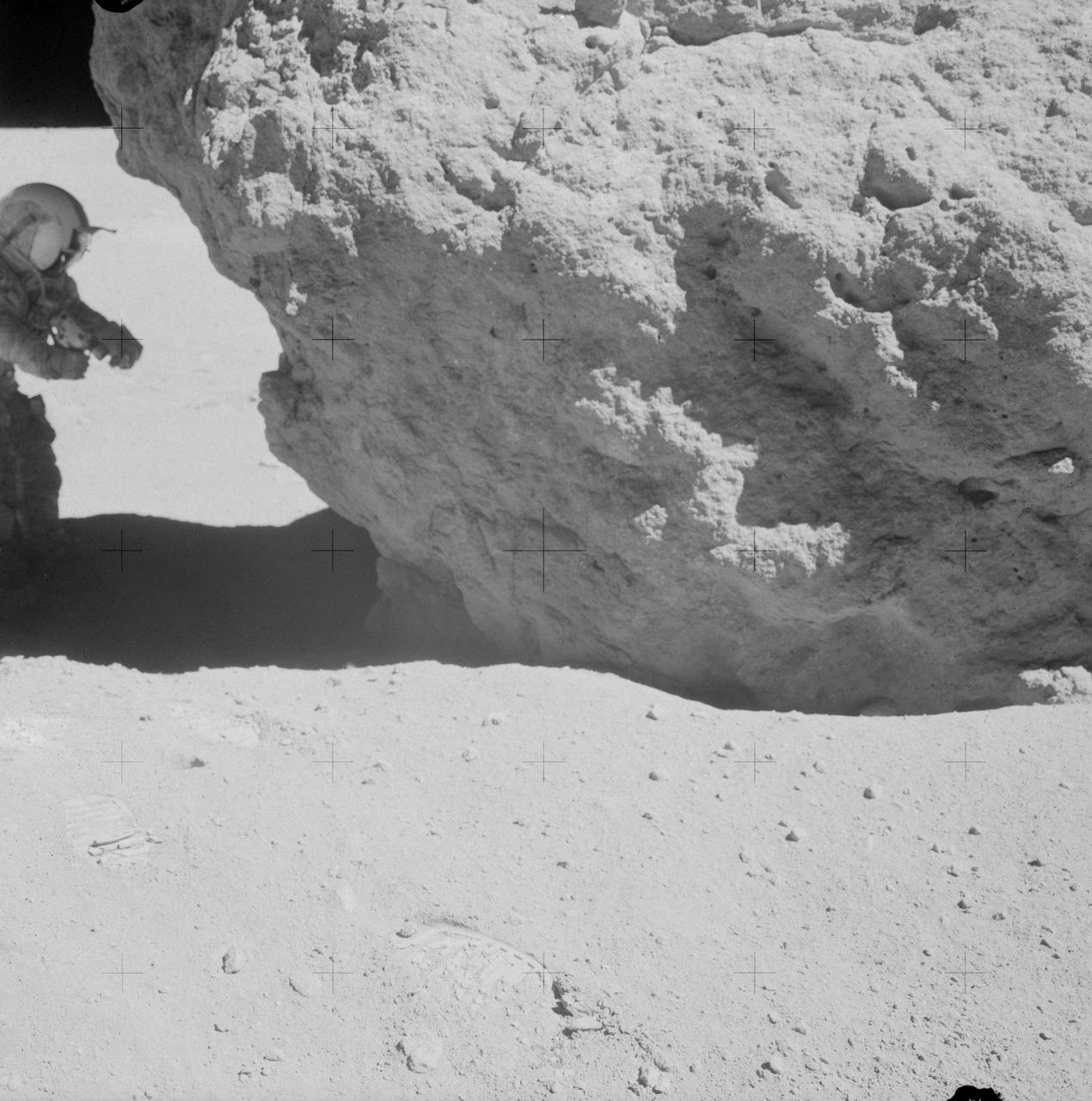
AS16-106-17413 (23 April 1972) --- Astronaut John W. Young, commander of the Apollo 16 lunar landing mission, looks over a large boulder at Station No.13 during the third Apollo 16 extravehicular activity (EVA) at the Descartes landing site. This was the site of the permanently shadowed soil sample which was taken from a hole extending under overhanging rock. Astronaut Charles M. Duke Jr., lunar module pilot, took this photograph. Concerning Young's reaching under the big rock, Duke remarked: "You do that in west Texas and you get a rattlesnake!"

AS16-107-17436 (21 April 1972) --- An excellent view of the Lunar Module (LM) "Orion" and Lunar Roving Vehicle (LRV), as photographed by astronaut Charles M. Duke Jr., lunar module pilot, during the first Apollo 16 extravehicular activity (EVA) at the Descartes landing site. Astronaut John W. Young, commander, can be seen directly behind the LRV. The lunar surface feature in the left background is Stone Mountain. While astronauts Young and Duke descended in the LM to explore the Descartes highlands landing site on the moon, astronaut Thomas K. Mattingly II, command module pilot, remained with the Command and Service Modules (CSM) "Casper" in lunar orbit.
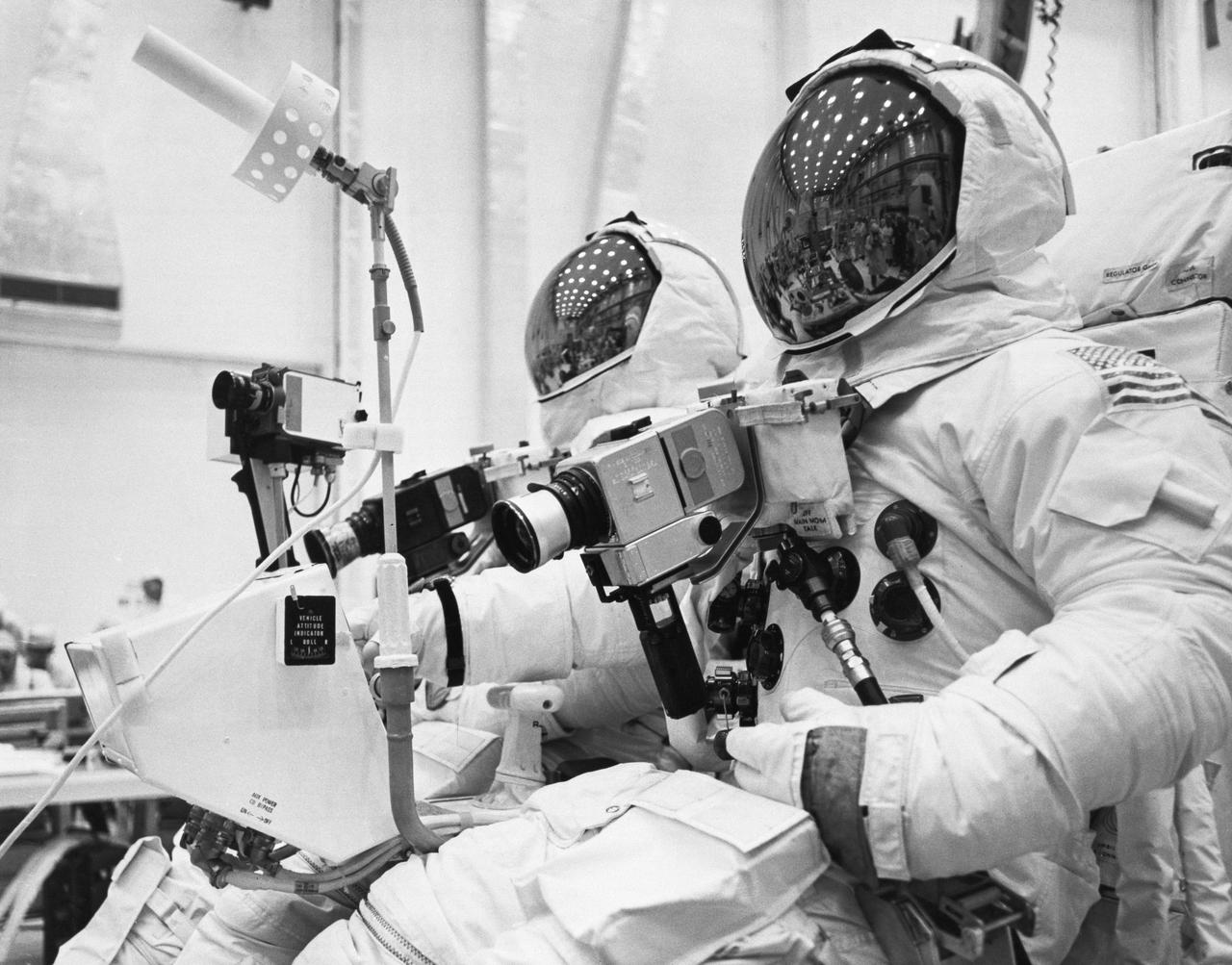
S72-33685 (22 March 1972) --- Astronauts John W. Young, Apollo 16 commander; and Charles M. Duke Jr. (nearest camera), lunar module pilot, rehearse some of the motorized phases of their scheduled extravehicular activity (EVA) assignments on the lunar surface. Young and Duke will take part in three different sessions of EVA on the moon while astronaut Thomas K. (Ken) Mattingly II, command module pilot, remains with the Command and Service Modules (CSM) in lunar orbit. The four-wheeled helper is called the Lunar Roving Vehicle (LRV).
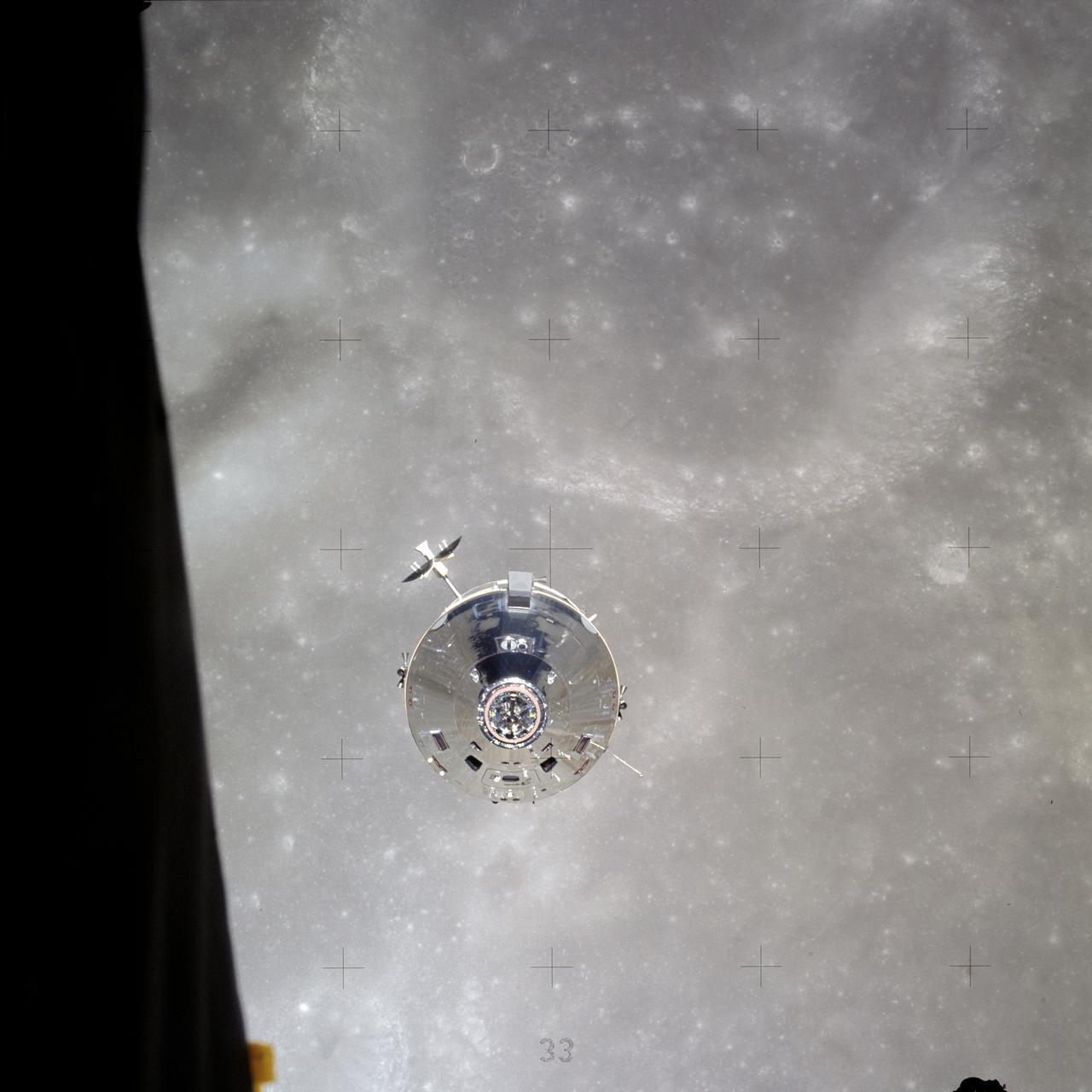
AS16-113-18282 (23 April 1972) --- The Apollo Command and Service Modules (CSM) "Casper" approaches the Lunar Module (LM) "Orion", from which this photograph was made. The two spacecraft are about to make their final rendezvous of the mission, on April 23, 1972. Astronauts John W. Young, commander, and Charles M. Duke Jr., lunar module pilot, aboard the LM, were returning to the CSM, in lunar orbit, after three successful days on the lunar surface. Astronaut Thomas K. (Ken) Mattingly II, command module pilot, remained with the CSM in lunar orbit, while Young and Duke descended in the LM to explore the Descartes region of the moon.
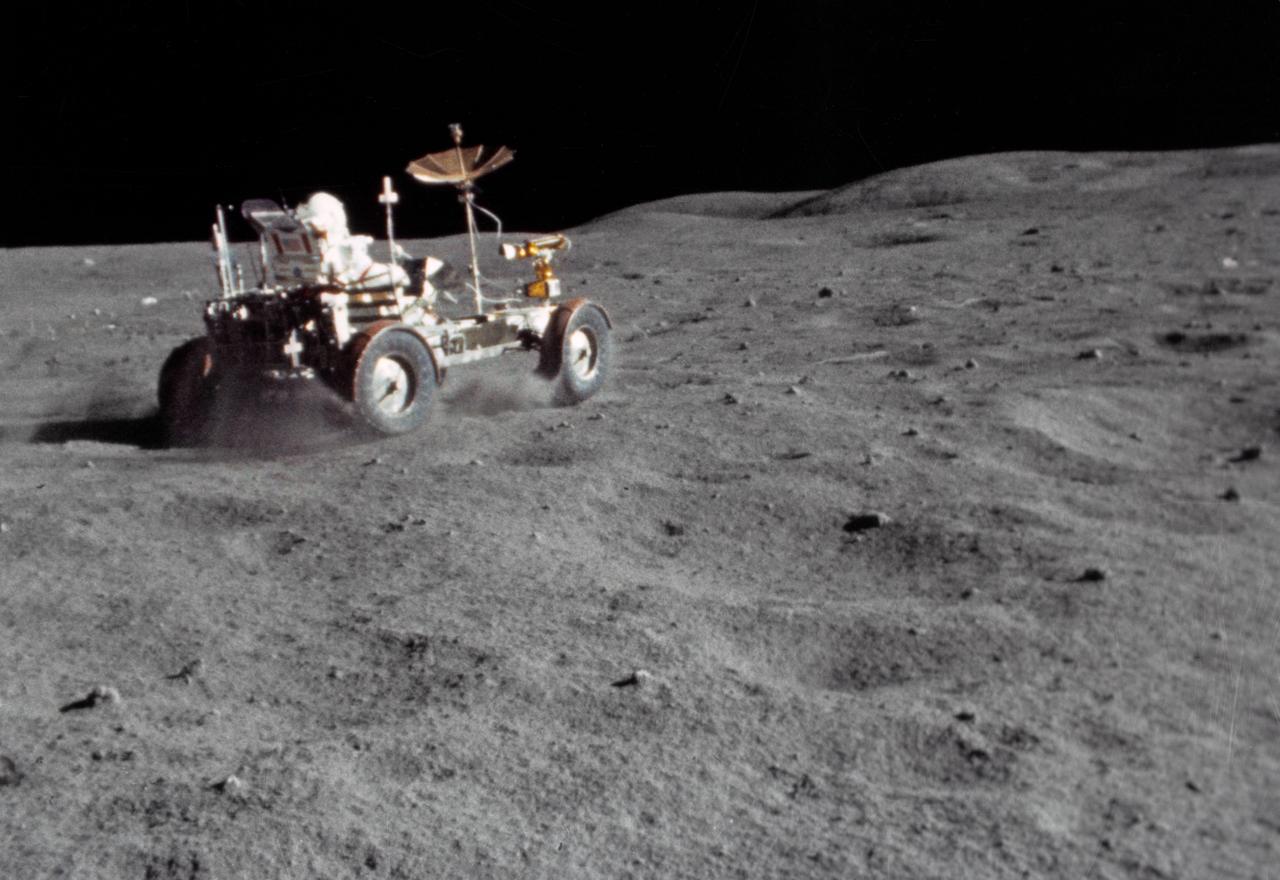
S72-37002 (21 April 1972) --- The Lunar Roving Vehicle (LRV) gets a speed workout by astronaut John W. Young in the "Grand Prix" run during the first Apollo 16 extravehicular activity (EVA) at the Descartes landing site. This view is a frame from motion picture film exposed by a 16mm Maurer camera held by astronaut Charles M. Duke Jr. While astronauts Young, commander, and Duke, lunar module pilot, descended in the Lunar Module (LM) "Orion" to explore the Descartes highlands region of the moon, astronaut Thomas K. Mattingly II, command module pilot, remained with the Command and Service Modules (CSM) "Casper" in lunar orbit.
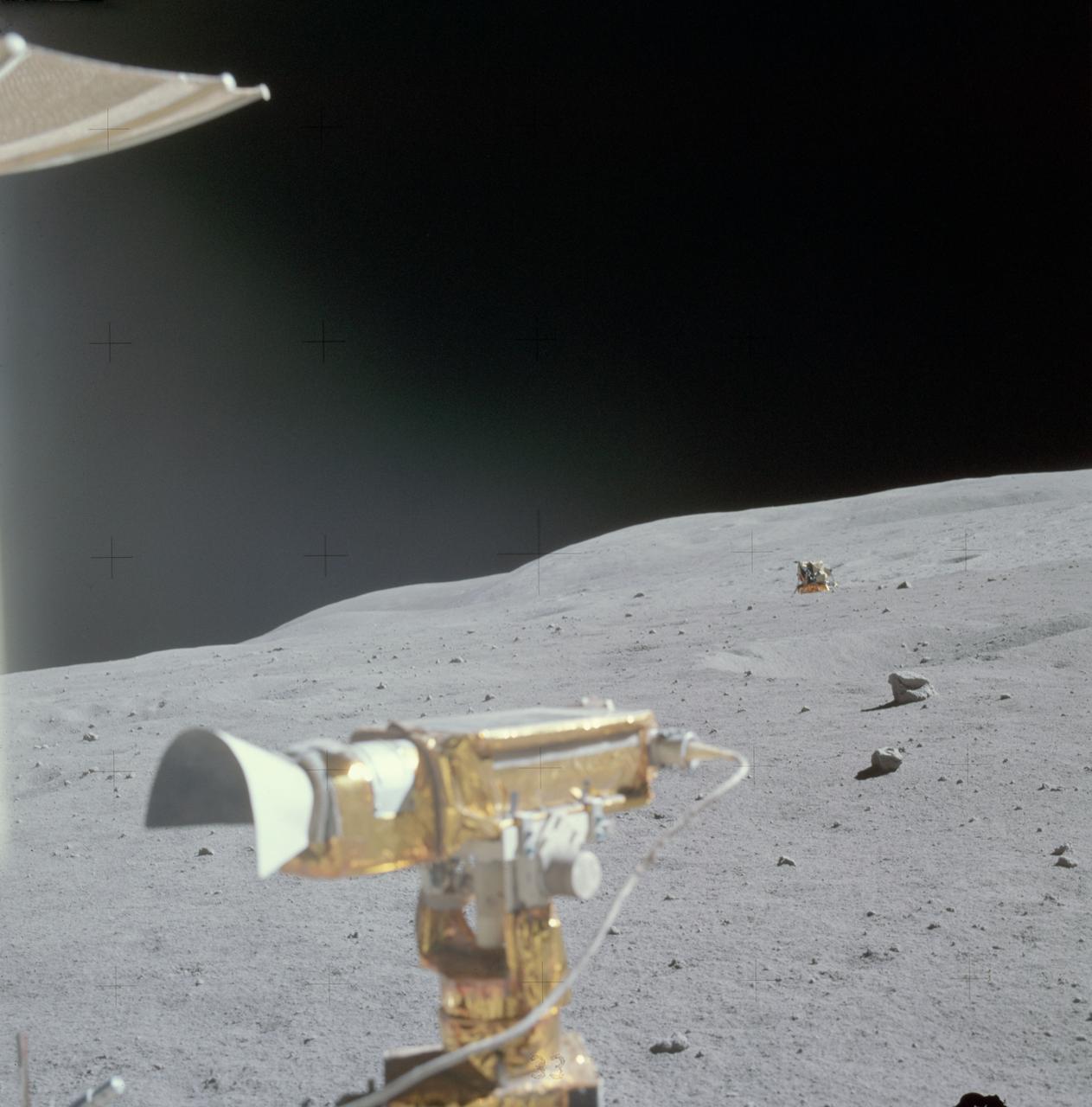
AS16-115-18549 (22 April 1972) --- The Apollo 16 Lunar Module (LM) "Orion" is photographed from a distance by astronaut Charles M. Duke Jr., lunar module pilot, aboard the moving Lunar Roving Vehicle (LRV). Astronauts Duke and John W. Young, commander, were returning from their excursion to Stone Mountain during the second Apollo 16 extravehicular activity (EVA). The RCA color television camera mounted on the LRV is in the foreground. A portion of the LRV's high-gain antenna is at top left. Smoky Mountain rises behind the LM in this north-looking view at the Descartes landing site. While astronauts Young and Duke descended in the "Orion" to explore the Descartes highlands landing site on the moon, astronaut Thomas K. Mattingly II, command module pilot, remained with the Command and Service Modules (CSM) "Casper" in lunar orbit.
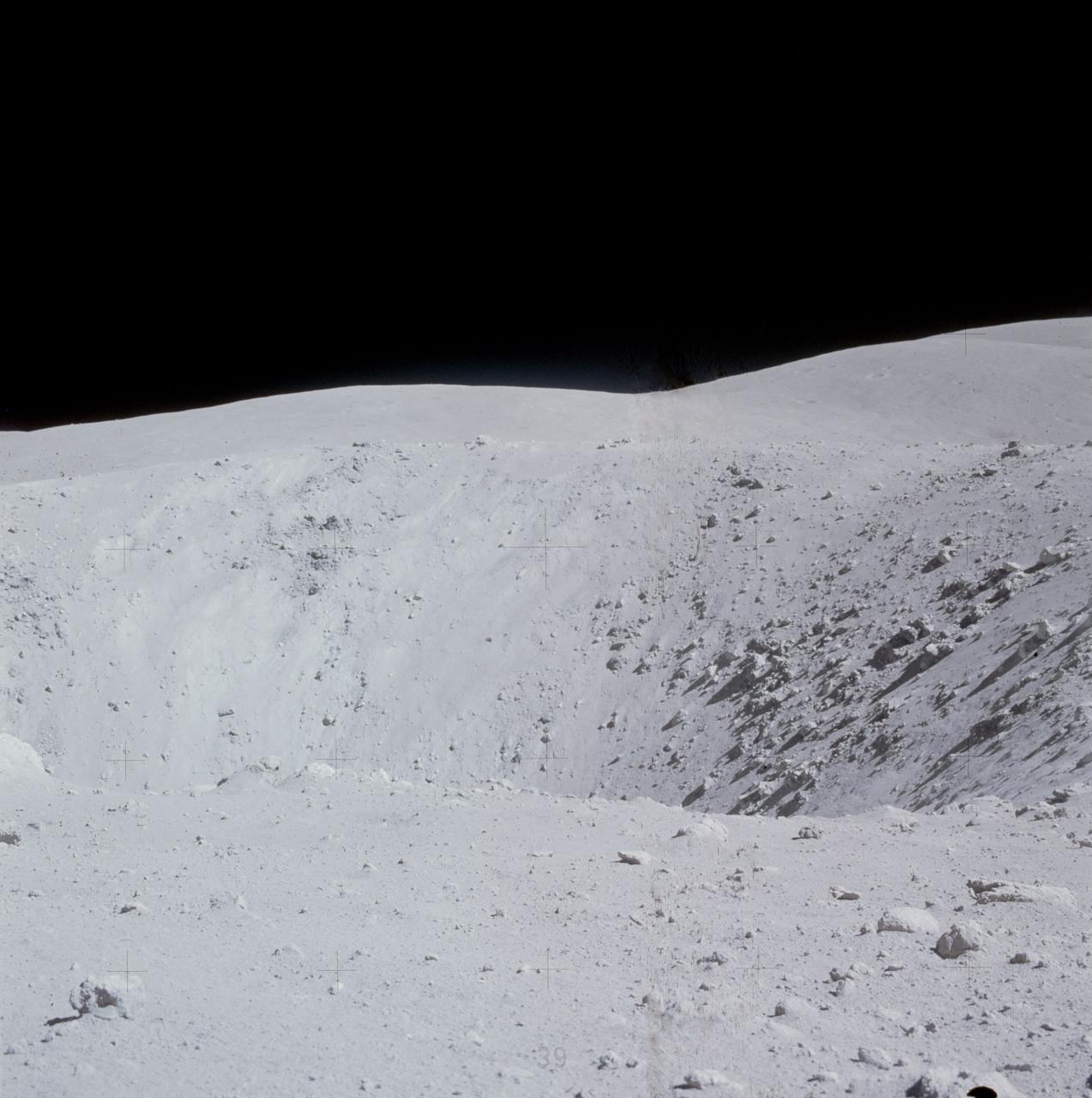
AS16-116-18599 (21 April 1972) --- A close-up view of Buster Crater, which was visited by the two moon-exploring crew men of the Apollo 16 lunar landing mission, during the first extravehicular activity (EVA), April 21, 1972. Astronaut Charles M. Duke Jr. said the crater appeared to be larger than 50 meters, and he called it a very spectacular crater. This was the second stop for astronauts John W. Young and Duke on the mission's first EVA. Young exposed this view with his 70mm Hasselblad camera. While astronauts Young, commander; and Duke, lunar module pilot; descended in the Apollo 16 Lunar Module (LM) "Orion" to explore the Descartes highlands landing site on the moon, astronaut Thomas K. Mattingly II, command module pilot, remained with the Command and Service Modules (CSM) "Casper" in lunar orbit.

This is the Apollo 16 lunar landing mission crew portrait. Pictured from left to right are: Thomas K. Mattingly II, Command Module pilot; John W. Young, Mission Commander; and Charles M. Duke Jr., Lunar Module pilot. Launched from the Kennedy Space Center on April 16, 1972, Apollo 16 spent three days on Earth's Moon. The first study of the highlands area, the landing site for Apollo 16 was the Descartes Highlands. The fifth lunar landing mission out of six, Apollo 16 was famous for deploying and using an ultraviolet telescope as the first lunar observatory. The telescope photographed ultraviolet light emitted by Earth and other celestial objects. The Lunar Roving Vehicle, developed by the Marshall Space Flight Center, was also used for collecting rocks and data on the mysterious lunar highlands. In this photo, astronaut John W. Young photographs Charles M. Duke, Jr. collecting rock samples at the Descartes landing site. Duke stands by Plum Crater while the Lunar Roving Vehicle waits parked in the background. High above, Thomas K. Mattingly orbits in the Command Module. The mission ended April 27, 1972 as the crew splashed down into the Pacific Ocean.
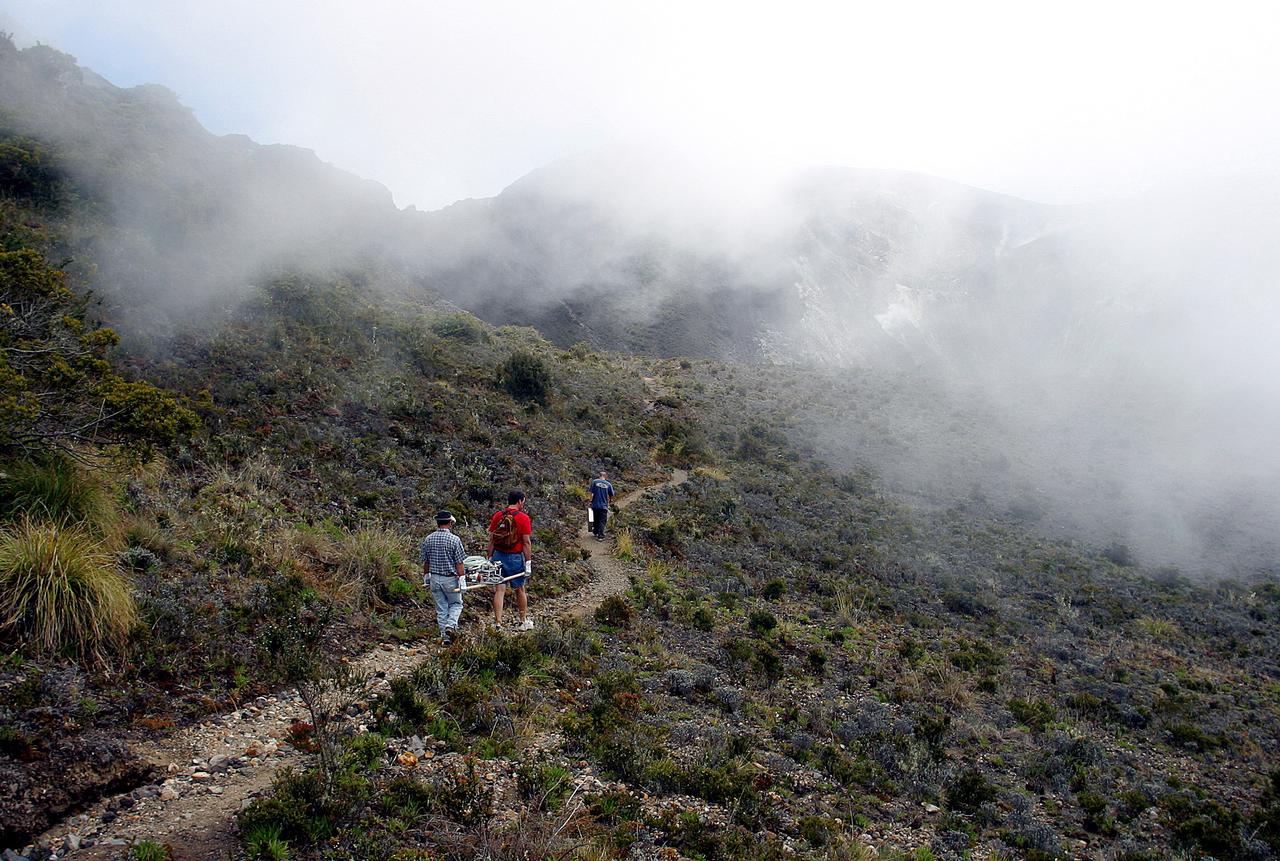
KENNEDY SPACE CENTER, FLA. - Arturo Ramierez, Charles Curley and Duke Follistein, KSC and Costa Rican researchers, carry the hazardous gas detection system AVEMS to the central of the Turrialba volcano. The Aircraft-based Volcanic Emission Mass Spectrometer determines the presence and concentration of various chemicals. It is being tested in flights over the Turrialba volcano and in the crater, sampling and analyzing fresh volcanic gases in their natural chemical state. The AVEMS system has been developed for use in the Space Shuttle program, to detect toxic gas leaks and emissions in the Shuttle’s aft compartment and the crew compartment.
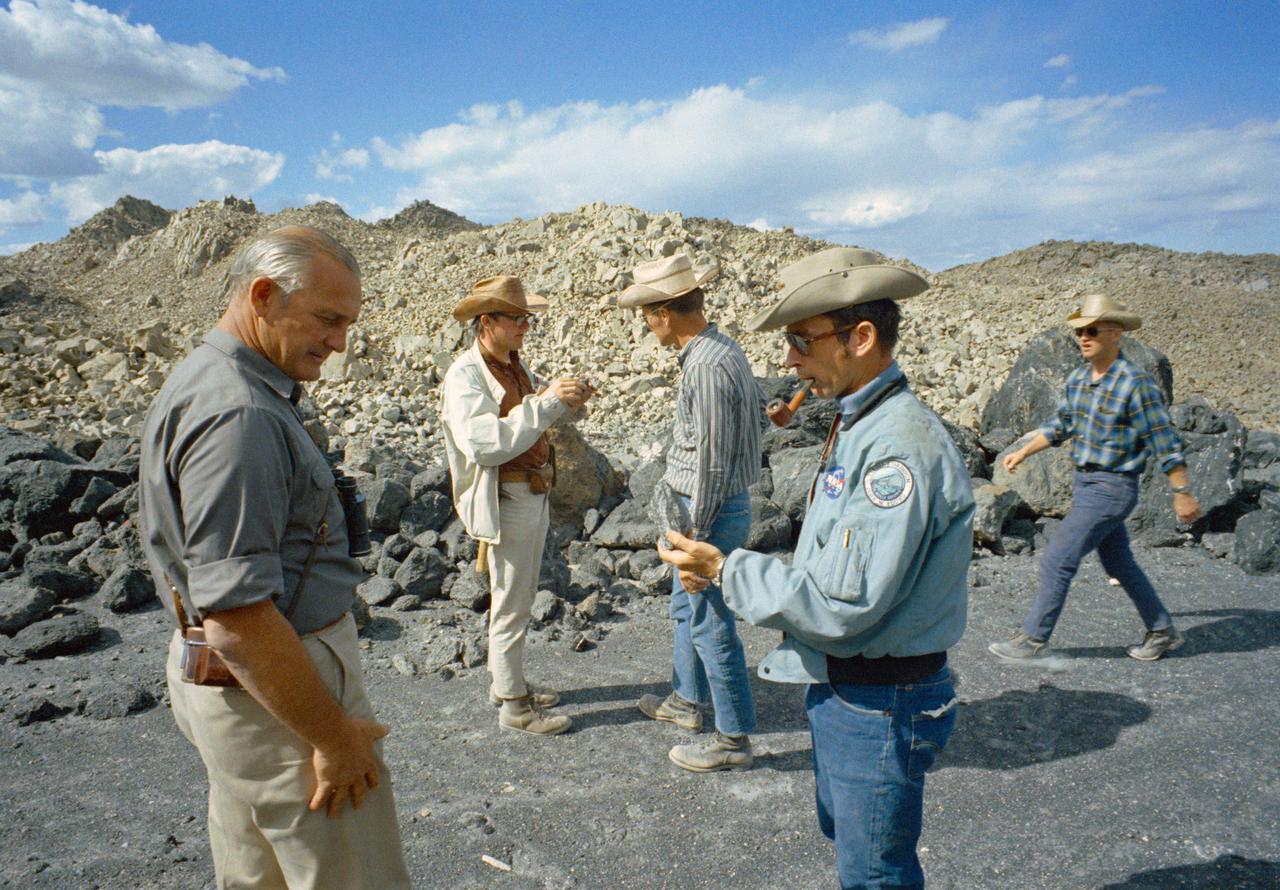
S71-36874 (10 June 1971) --- University of Texas geologist/professor William R. Muelhberger (left) talks with astronaut John W. Young, Apollo 16 commander, during an Apollo 16 geology field trip to Mono Crater, Calif. Astronaut Charles Duke, lunar module pilot, is seen at frame center, talking to geologist David Wones (second left). Astronaut Anthony England, Apollo 16 spacecraft communicator (CAPCOM), is at right. Photo credit: NASA
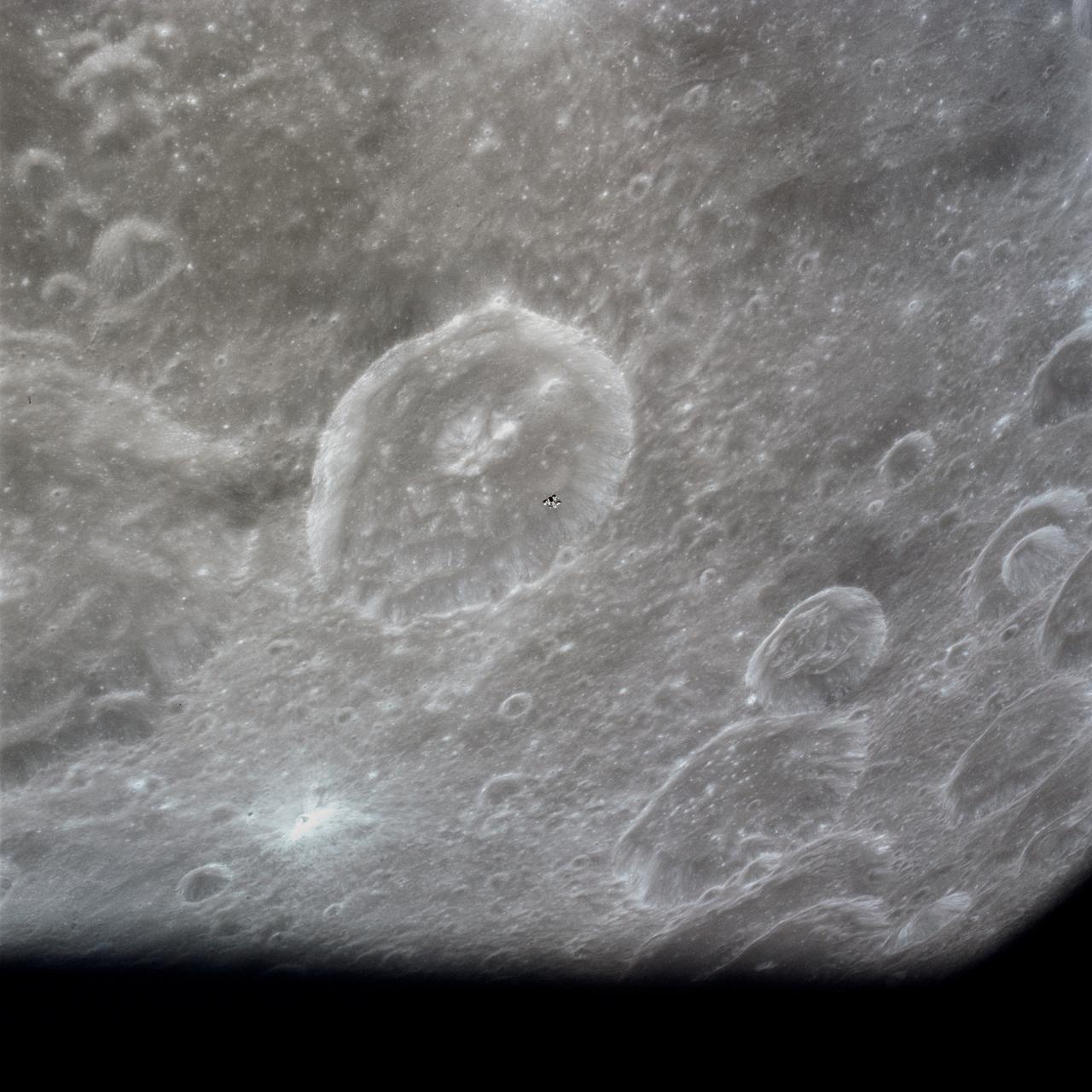
AS16-122-19527 (23 April 1972) --- The Apollo 16 Lunar Module (LM) ascent stage, with astronauts John W. Young and Charles M. Duke Jr. aboard, returns from the lunar surface to rejoin the Command and Service Modules (CSM) in lunar orbit. Astronaut Thomas K. (Ken) Mattingly II took this photograph from the Command Module (CM). The LM is above the Crater Schubert B. The lunar surface area visible in this picture is located at the western edge of Smyth's Sea.
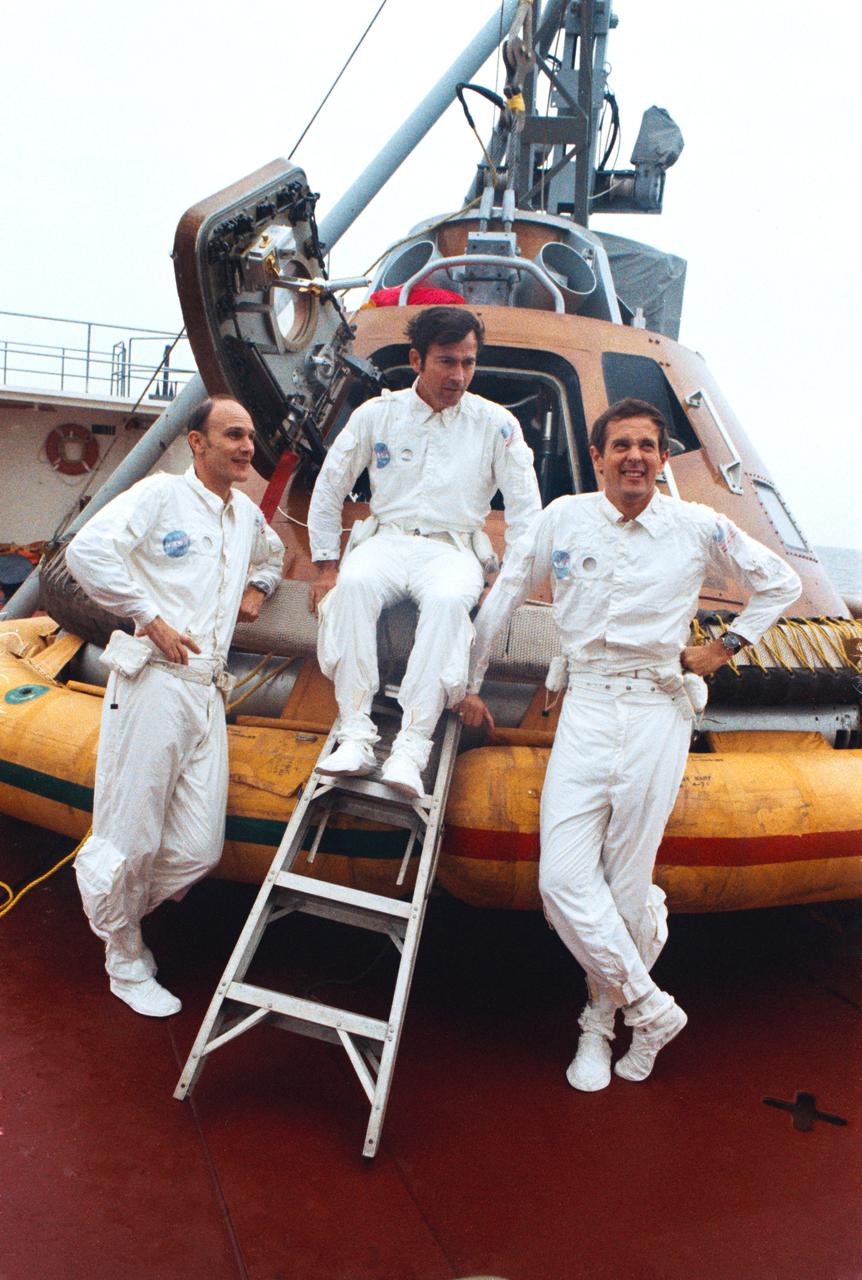
S72-30160 (5 May 1972) --- The Apollo 16 prime crew relax aboard the NASA Motor Vessel Retriever during water egress training activity in the Gulf of Mexico. They are, left to right, astronauts Thomas K. Mattingly II, command module pilot; John W. Young, commander; and Charles M. Duke Jr., lunar module pilot. The Command Module trainer was used in the training exercise.
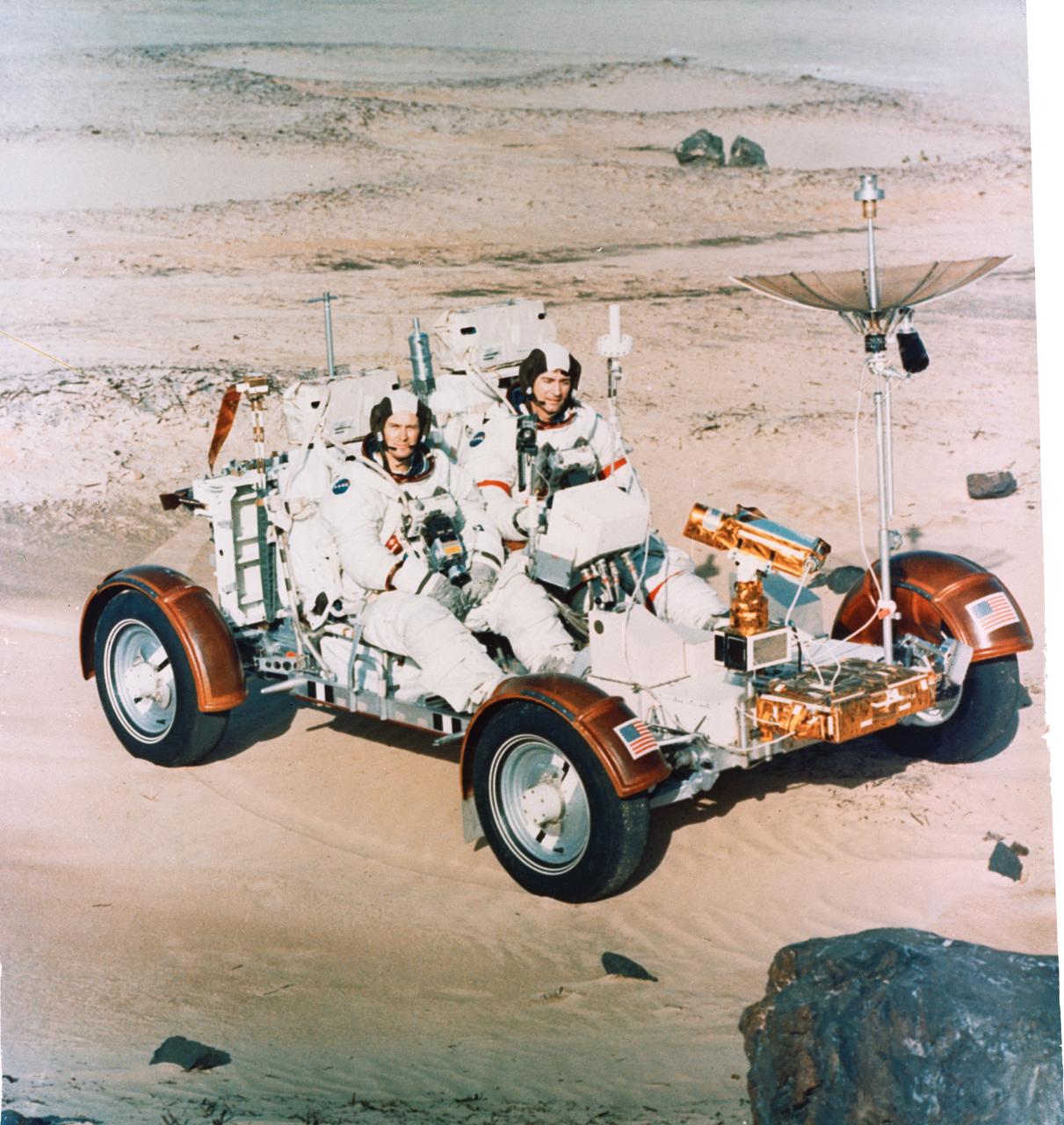
S72-30695 (22 Dec. 1971) --- Astronauts John W. Young, right, Apollo 16 commander, and Charles M. Duke Jr., lunar module pilot, maneuver a training version of the Lunar Roving Vehicle (LRV) about a field at Kennedy Space Center (KSC) simulated to represent the lunar surface. The LRV is planned to transport the two crew men around the Descartes area on the lunar surface while astronaut Thomas K. Mattingly II, command module pilot, orbits the moon in the Command and Service Modules (CSM).
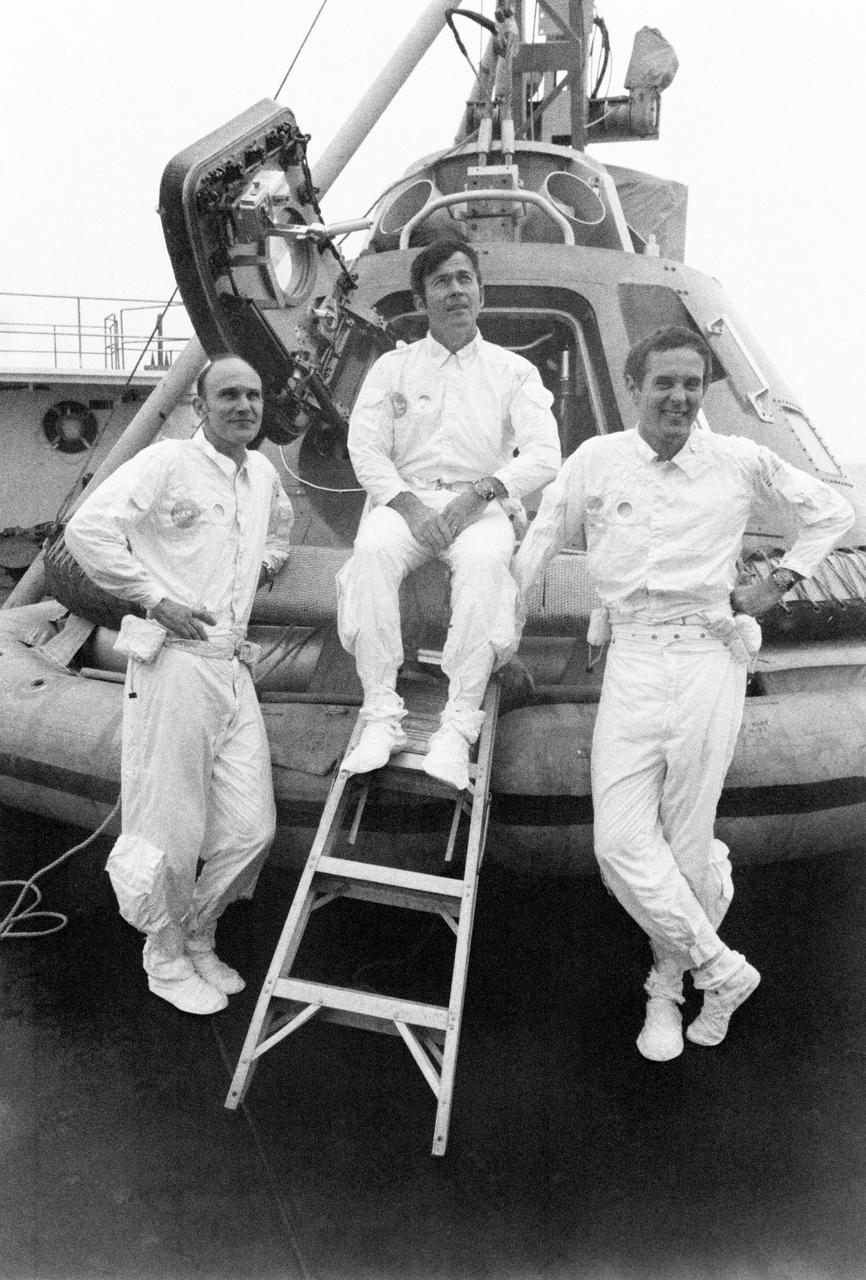
S72-30166 (5 May 1972) --- The Apollo 16 prime crew relax aboard the NASA Motor Vessel Retriever during water egress training activity in the Gulf of Mexico. They are, left to right, astronauts Thomas K. Mattingly II, command module pilot; John W. Young, commander; and Charles M. Duke Jr., lunar module pilot. The Command Module trainer was used in the training exercise.
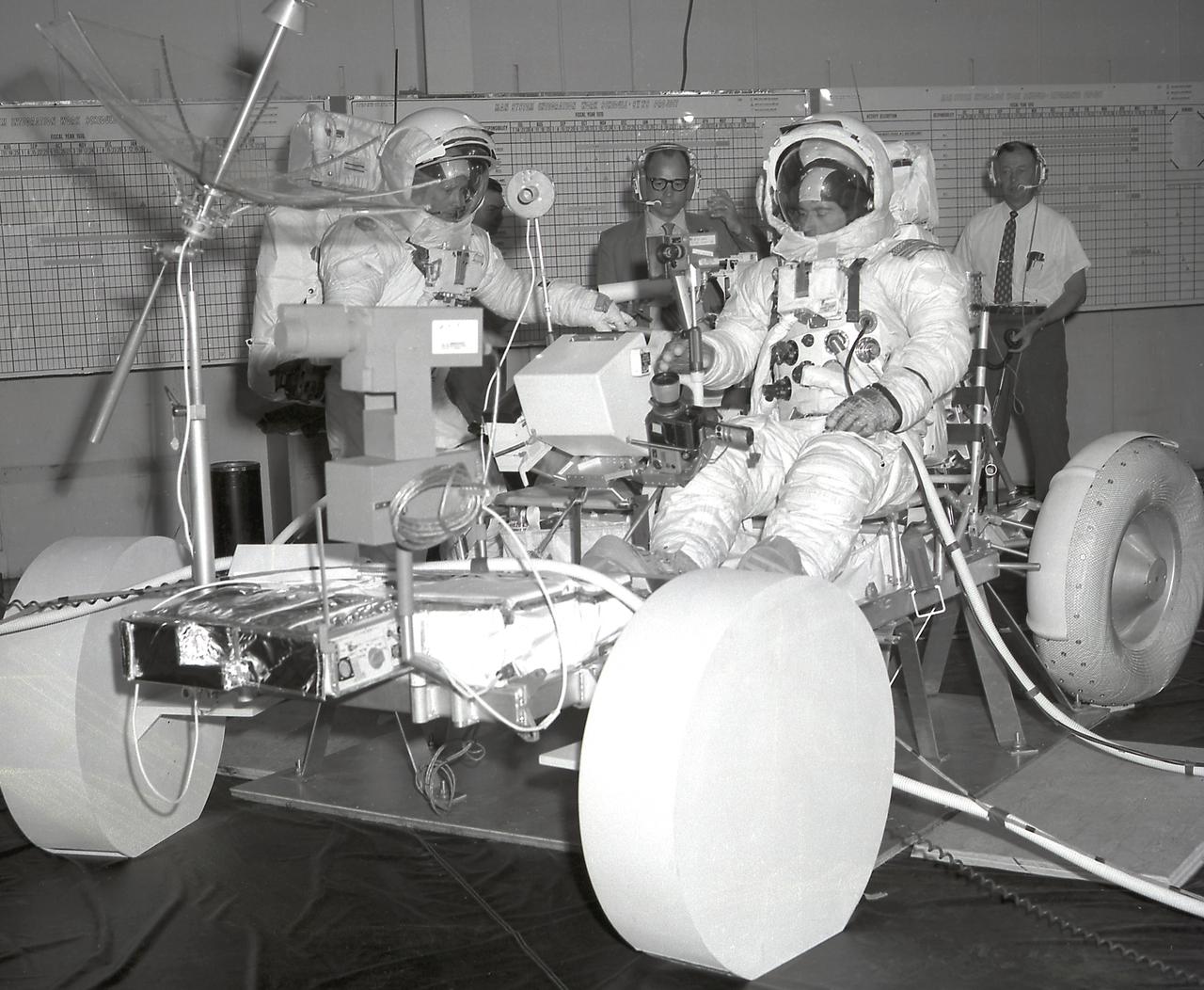
This image depicts the Apollo 16 mission astronauts John Young (right) and Charles Duke (left) in pressure suits during a final crew training on the Lunar Roving Vehicle (LRV) at the Marshall Space Flight Center (MSFC), building 4619. Developed by the MSFC, the LRV was the lightweight electric car designed to increase the range of mobility and productivity of astronauts on the lunar surface. It was used on the last three Apollo missions; Apollo 15, Apollo 16, and Apollo 17.

Dr. Lee Silver (pointing foregroung), California Institute of Technology, calls a geological feature near Taos, New Mexico, to the attention of Apollo 16 prime and backup crewmen during a geological field trip. The crewmen, from left to right, are Astronauts Charles M. Duke Jr., lunar module pilot; Fred W. Haise Jr., backup commander; Edgar D. Mitchell, backup Lunar Module pilot; and John W. Young, commander.
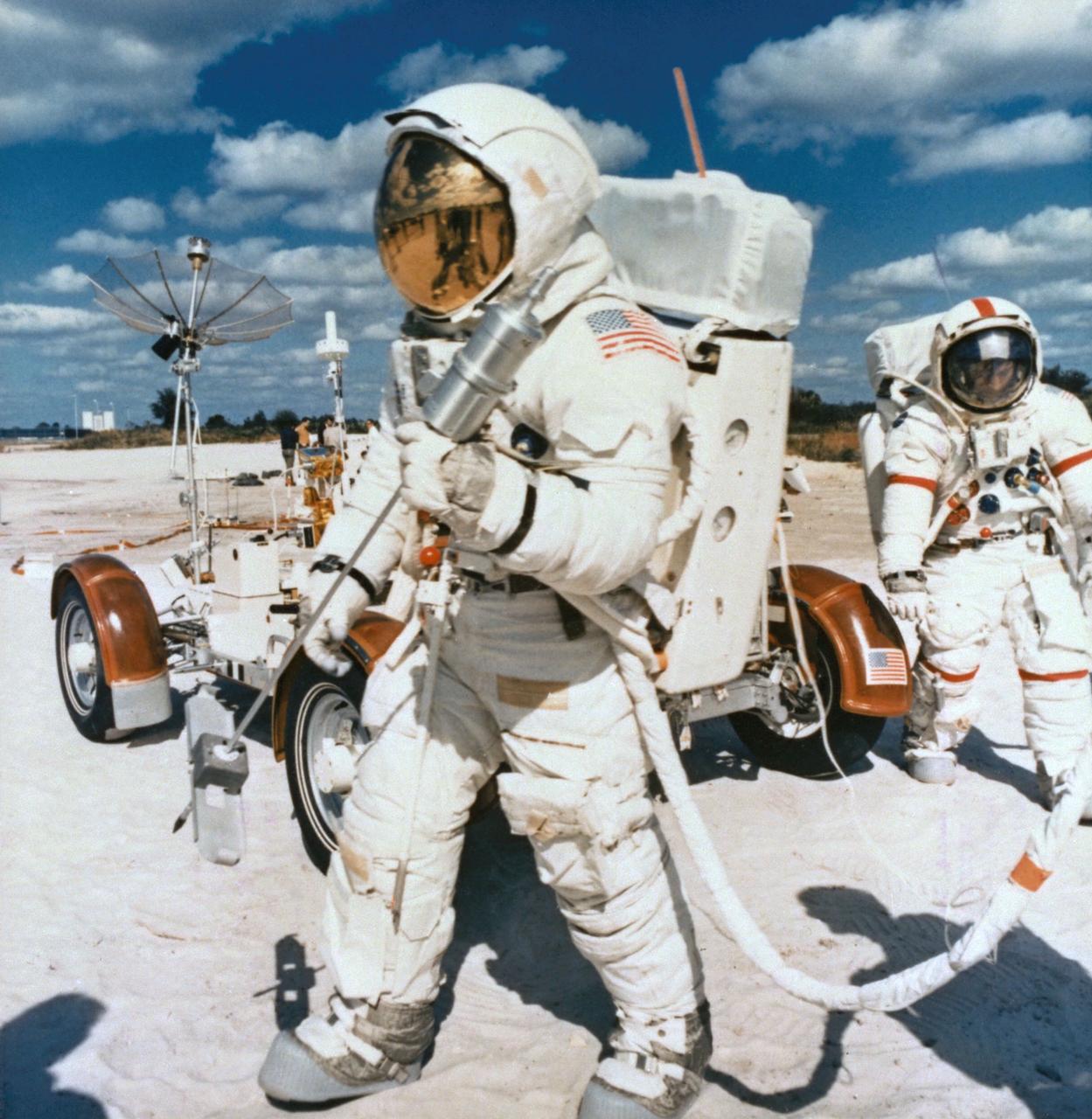
S72-30694 (28 Jan. 1972) --- Astronauts John W. Young, left, Apollo 16 commander, and Charles M. Duke Jr., lunar module pilot, prepare to begin a simulated traverse in a training area at the Kennedy Space Center (KSC). The fifth National Aeronautics and Space Administration (NASA) Apollo lunar landing mission is scheduled to land in the mountainous highlands region near the crater Descartes to explore the area for a three-day period. Among the experiments to fly on Apollo 16 is the soil mechanics (S-200) experiment or self-recording penetrometer, a model of which is held here by Duke. A training model of the Lunar Roving Vehicle (LRV) is parked between the two crew men. Astronaut Thomas K. (Ken) Mattingly II is prime crew command module pilot for the mission.
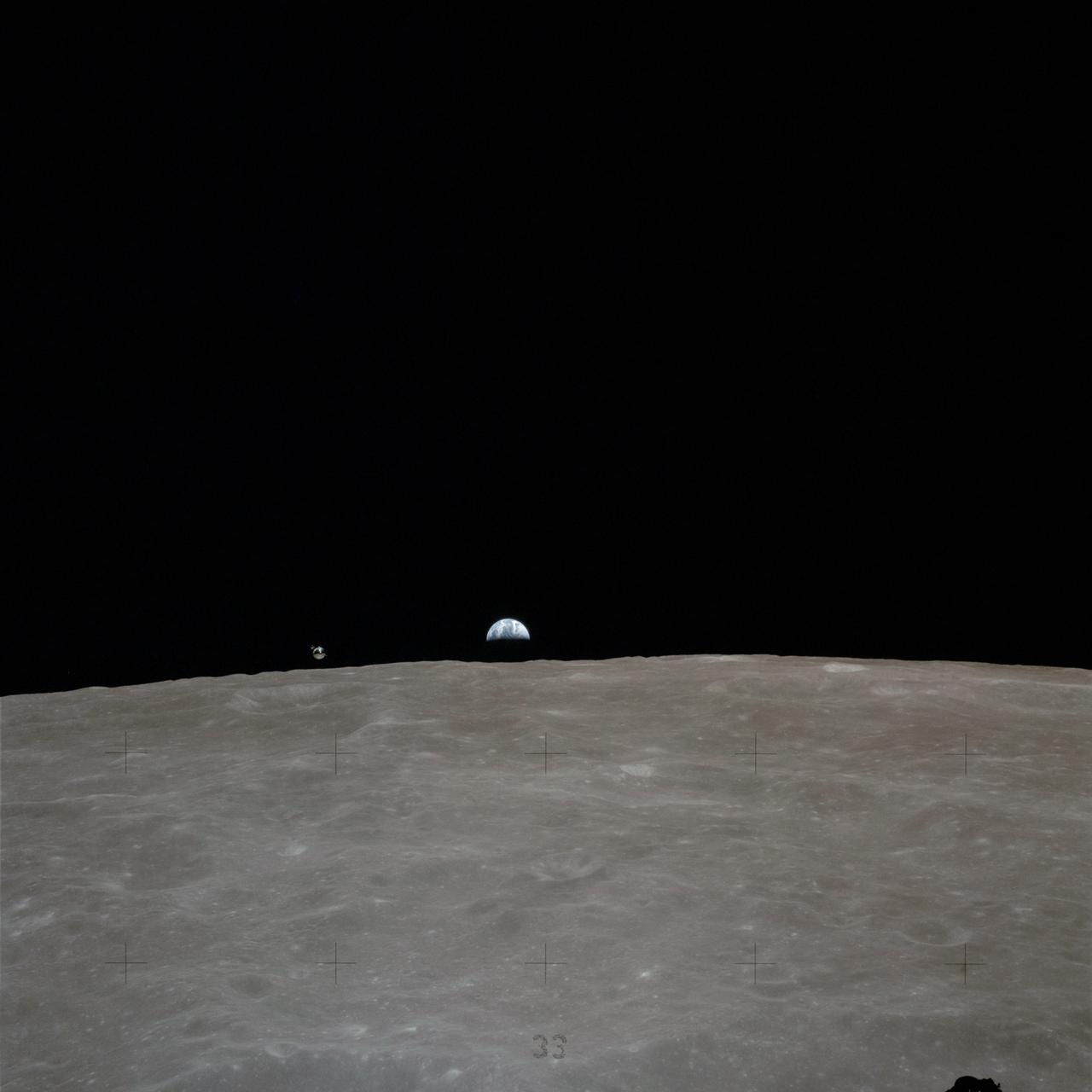
AS16-113-18289 (16-27 April 1972) --- Earth rises over the lunar horizon, with the Apollo 16 Command and Services Modules (CSM) to the left of Earth. This photograph was taken from the Lunar Module (LM) "Orion" before the two Apollo 16 spacecraft re-joined following the CSM's failure to make the circularization burn on April 20, 1972. Astronaut Thomas K. Mattingly II, command module pilot, was inside the CSM "Casper", while astronauts John W. Young, commander, and Charles M. Duke Jr., lunar module pilot, were manning the LM. While astronauts Young and Duke descended in the LM to explore the Descartes region of the moon, astronaut Mattingly remained with the CSM in lunar orbit. Photo credit: NASA
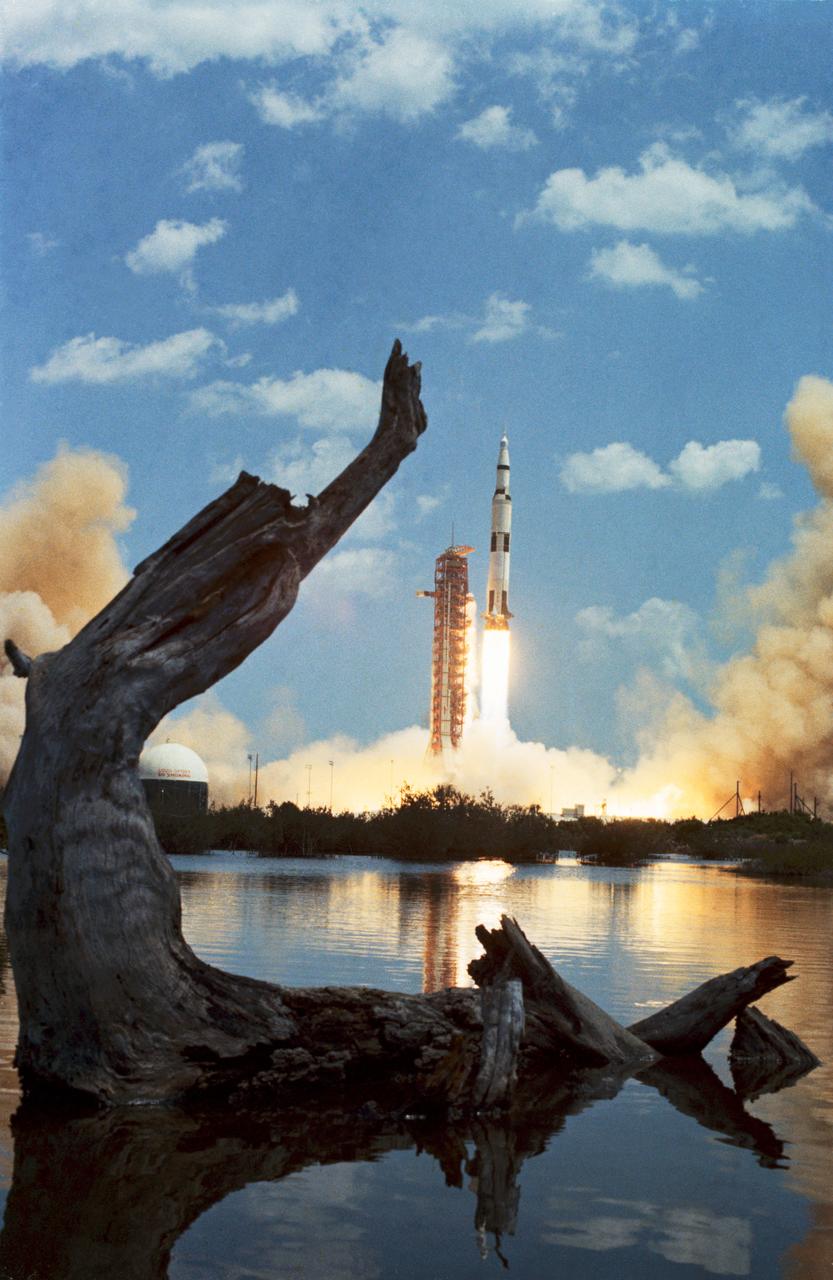
S72-35347 (16 April 1972) --- The huge, 363-feet tall Apollo 16 (Spacecraft 113/Lunar Module 11/ Saturn 511) space vehicle is launched from Pad A, Launch Complex 39, Kennedy Space Center (KSC), Florida, at 12:54:00.569 p.m. (EST), April 16, 1972, on a lunar landing mission. Aboard the Apollo 16 spacecraft were astronauts John W. Young, commander; Thomas K. Mattingly II, command module pilot; and Charles M. Duke Jr., lunar module pilot. While astronauts Young and Duke descended in the Lunar Module (LM) "Orion" to explore the Descartes highlands region of the moon, astronaut Mattingly remained with the Command and Service Modules (CSM) "Casper" in lunar orbit.
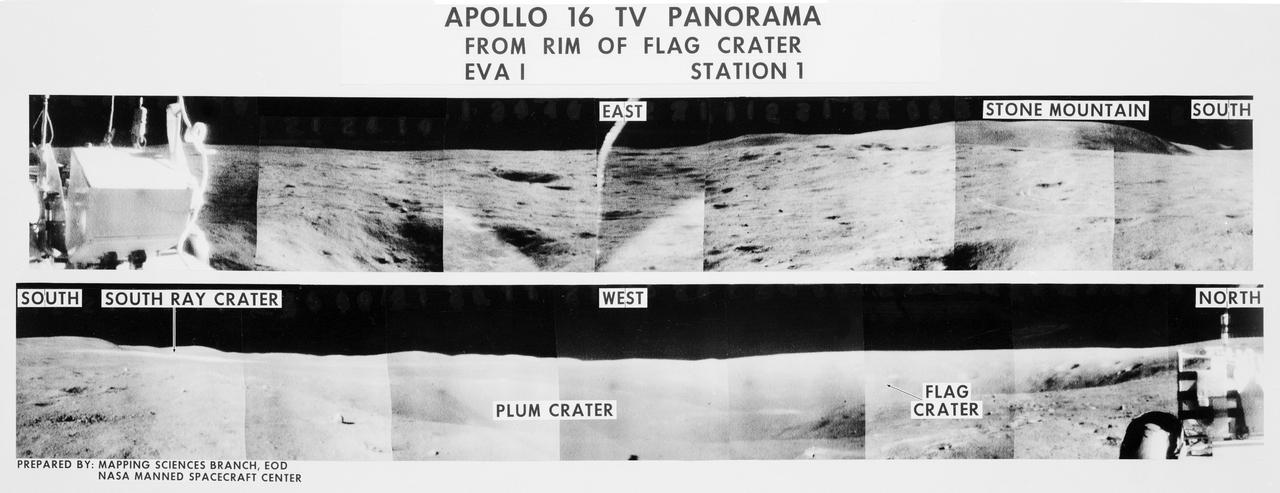
S72-35970 (21 April 1972) --- A 360-degree field of view of the Apollo 16 Descartes landing site area composed of individual scenes taken from color transmission made by the color RCA TV camera mounted on the Lunar Roving Vehicle (LRV). This panorama was made while the LRV was parked at the rim of Flag Crater (Station 1) during the first Apollo 16 lunar surface extravehicular activity (EVA) by astronauts John W. Young and Charles M. Duke Jr. The overlay identifies the directions and the key lunar terrain features. The camera panned across the rear portion of the LRV in its 360-degree sweep. Astronauts Young, commander; and Duke, lunar module pilot; descended in the Apollo 16 Lunar Module (LM) "Orion" to explore the Descartes highlands landing site on the moon. Astronaut Thomas K. Mattingly II, command module pilot, remained with the Command and Service Modules (CSM) "Casper" in lunar orbit.

AS16-113-18339 (21 April 1972) --- Astronaut John W. Young, commander of the Apollo 16 lunar landing mission, leaps from the lunar surface as he salutes the United States flag at the Descartes landing site during the first Apollo 16 extravehicular activity (EVA). Astronaut Charles M. Duke Jr., lunar module pilot, took this picture. The Lunar Module (LM) "Orion" is on the left. The Lunar Roving Vehicle (LRV) is parked beside the LM. The object behind Young (in the shade of the LM) is the Far Ultraviolet Camera/Spectrograph (FUC/S). Stone Mountain dominates the background in this lunar scene. While astronauts Young and Duke descended in the LM to explore the Descartes highlands landing site on the moon, astronaut Thomas K. Mattingly II, command module pilot, remained with the Command and Service Modules (CSM) "Casper" in lunar orbit.
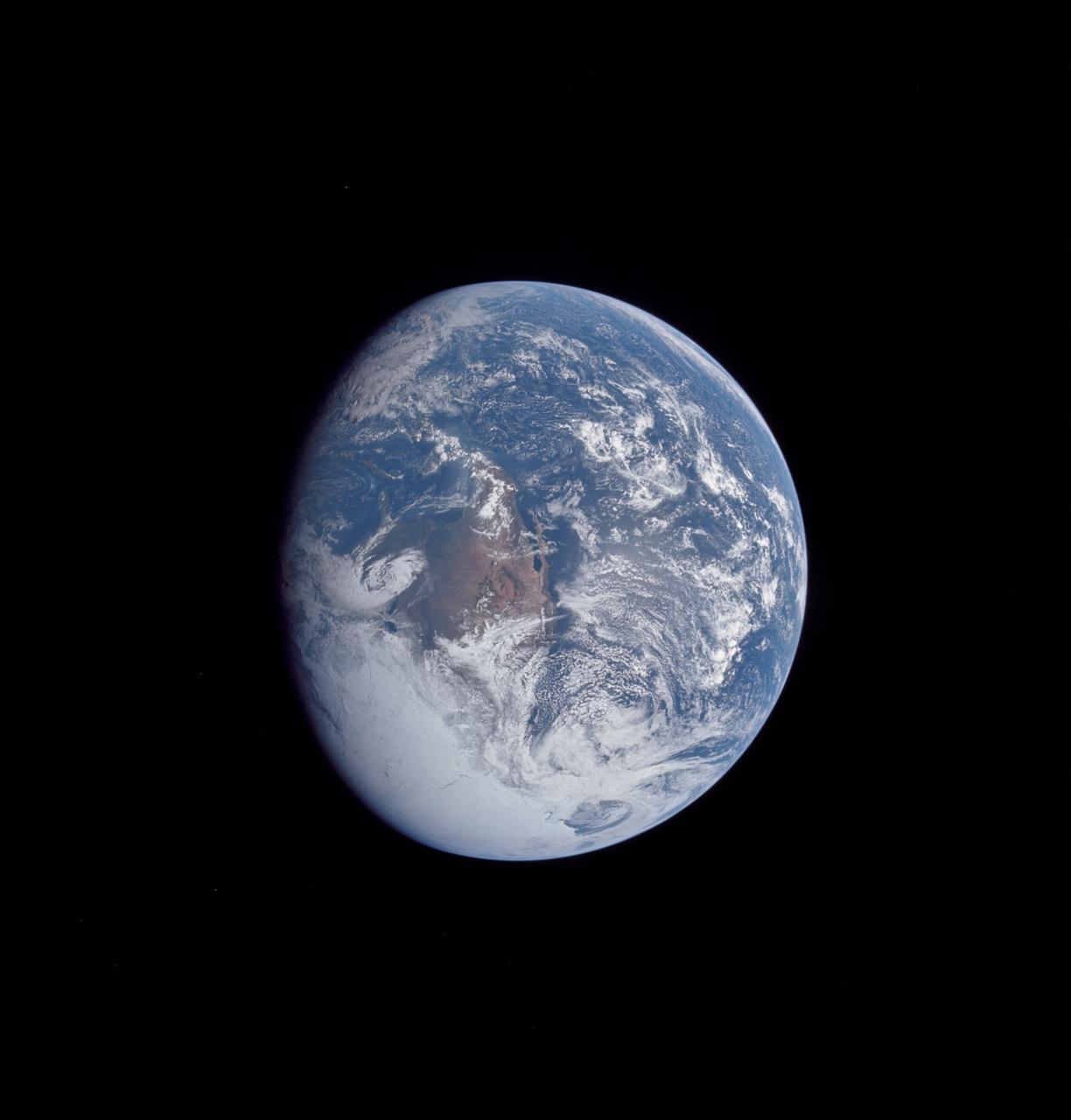
AS16-118-18885 (16 April 1972) --- A good view of Earth photographed about one and one-half hours after trans-lunar injection on April 16, 1972. Although there is much cloud cover, the United States in large part, most of Mexico and some parts of Central America are clearly visible. Note Lake Michigan and Lake Superior and the Bahama Banks (see different shade of blue below Florida). Just beginning man's fifth lunar landing mission were astronauts John W. Young, commander; Thomas K. Mattingly, II, command module pilot and Charles M. Duke Jr., lunar module pilot. While astronauts Young and Duke descended in the Lunar Module (LM) "Orion" to explore the Descartes highlands region of the moon, astronaut Mattingly remained with the Command and Service Modules (CSM) "Casper" in lunar orbit.
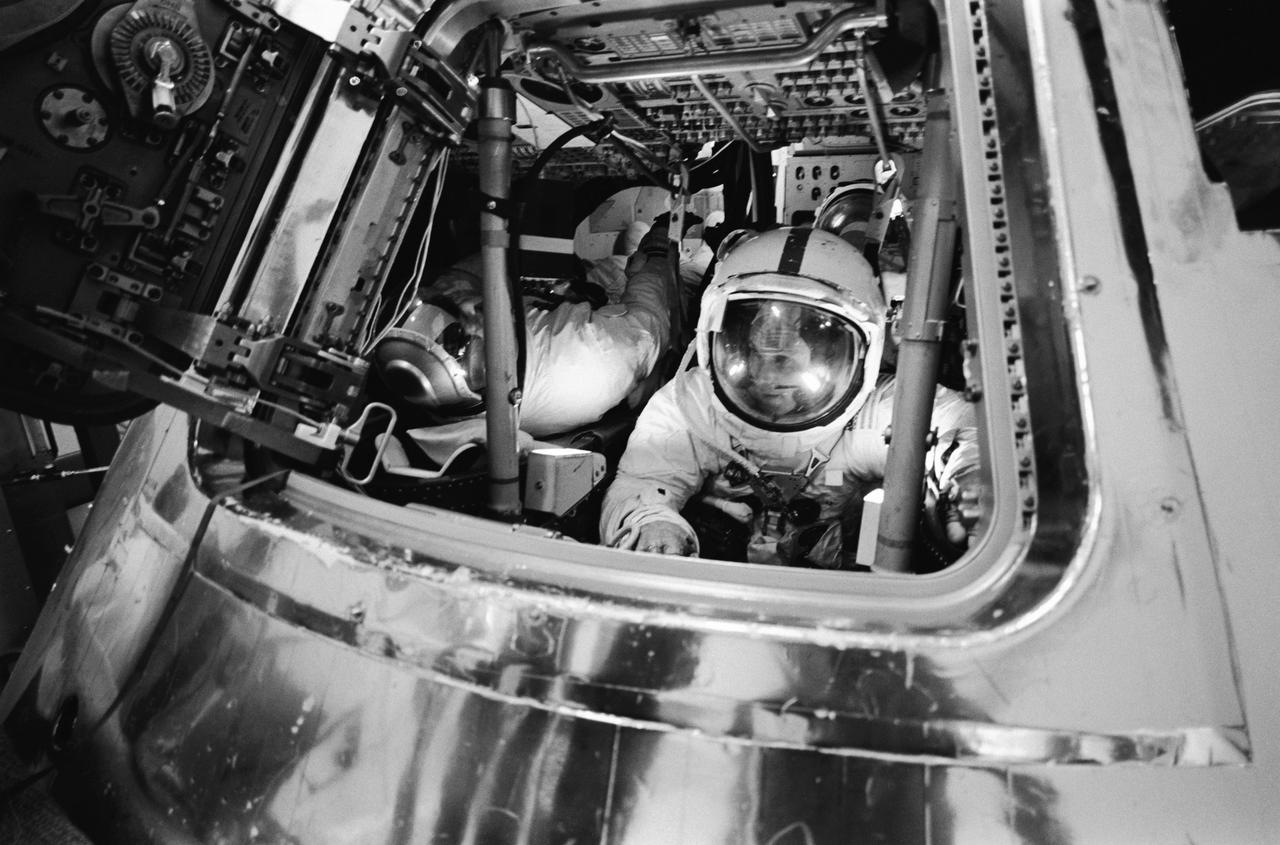
S72-31047 (March 1972) --- Astronaut Thomas K. Mattingly II (right foreground), command module pilot of the Apollo 16 lunar landing mission, participates in extravehicular activity (EVA) training in Building 5 at the Manned Spacecraft Center (MSC). Mattingly is scheduled to perform EVA during the Apollo 16 journey home from the moon. Astronaut John W. Young, commander, can be seen in the left background. In the right background is astronaut Charles M. Duke Jr., lunar module pilot. They are inside the Apollo Command Module Mission Simulator. While Mattingly remains with the Apollo 16 Command and Service Modules (CSM) in lunar orbit, Young and Duke will descend in the Lunar Module (LM) to the moon's Descartes landing site.
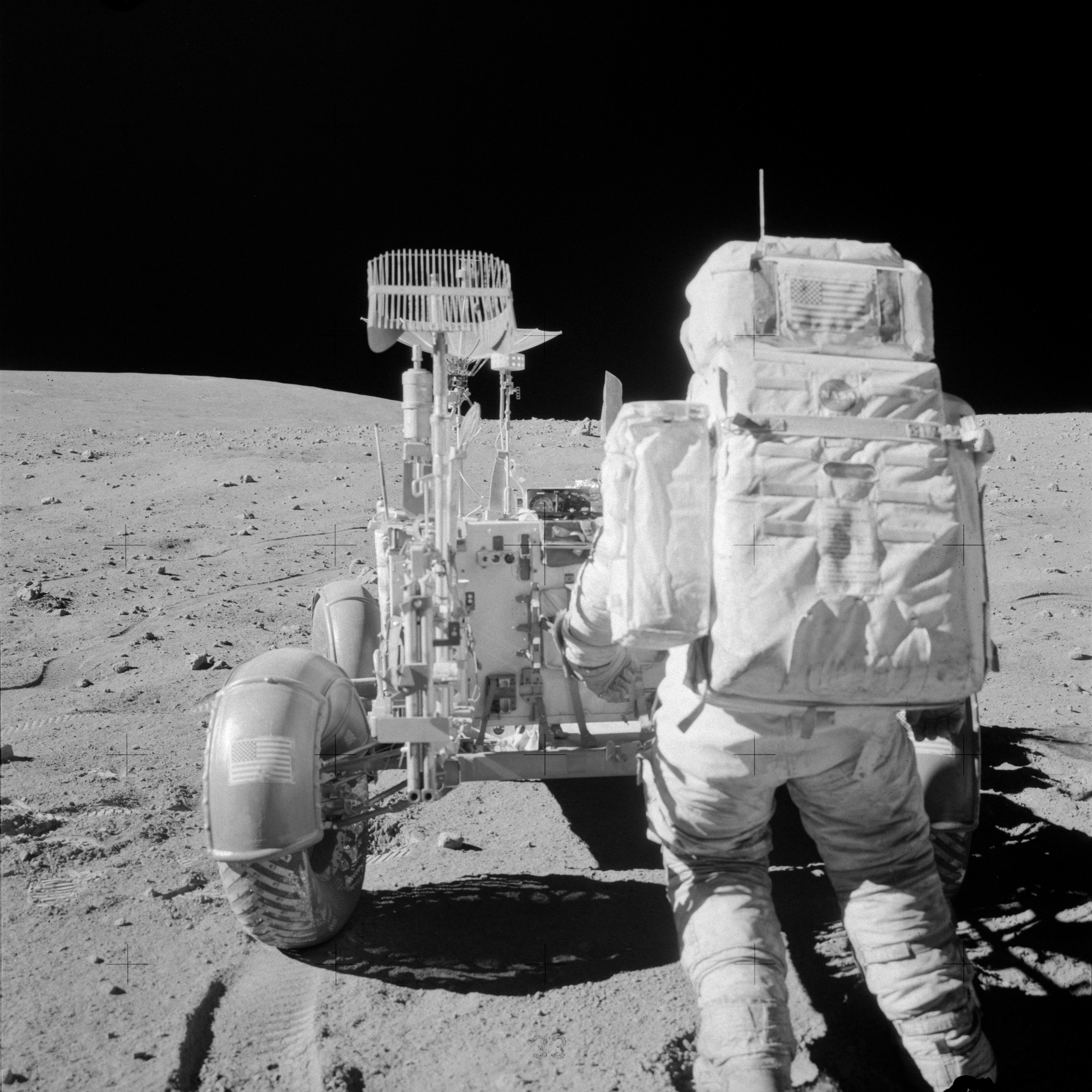
AS16-108-17622 (22 April 1972) --- Astronaut John W. Young, commander of the Apollo 16 lunar landing mission, reaches for tools in the Apollo Lunar Hand Tool Carrier at the aft end of the Lunar Roving Vehicle (LRV) during the second Apollo 16 extravehicular activity (EVA) at the Descartes landing site. This photograph was taken by astronaut Charles M. Duke Jr., lunar module pilot. This view is looking south from the base of Stone Mountain. While astronauts Young and Duke descended in the Lunar Module (LM) "Orion" to explore the Descartes highlands region of the moon, astronaut Thomas K. Mattingly II, command module pilot, remained with the Command and Service Modules (CSM) "Casper" in lunar orbit.
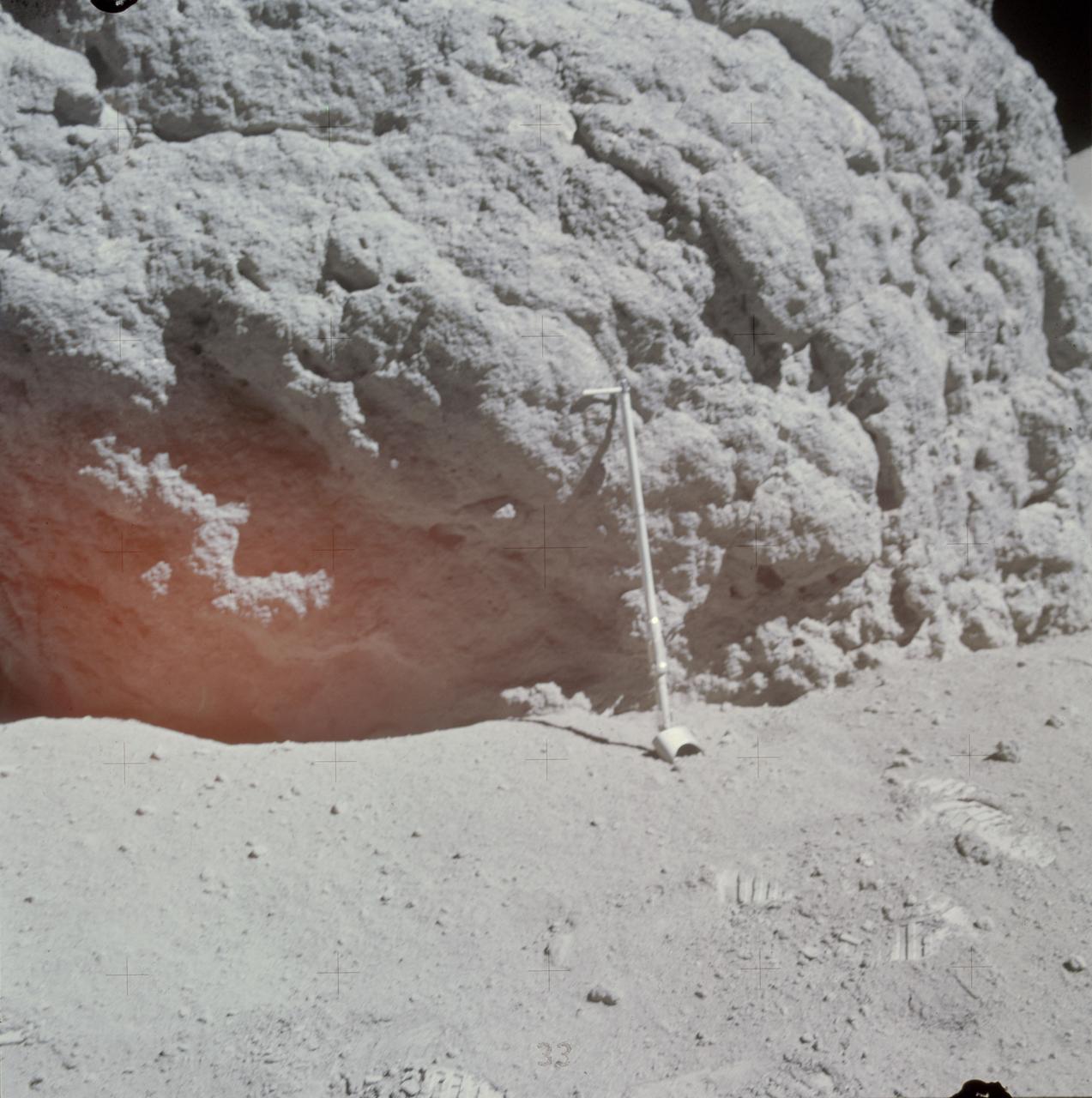
AS16-117-18728 (23 April 1972) --- Astronaut Charles M. Duke Jr., lunar module pilot, exposed this view of the huge "Shadow Rock" with his 70mm Hasselblad camera during the mission's third and final extravehicular activity (EVA), on April 23, 1972. This particular stop was referenced as Station 13. The scoop, a geological hand tool, leans against the rock and helps to give an idea of the size. Station 13 is a little southeast of North Ray Crater at the Descartes area. While astronauts John W. Young, commander; and Duke descended in the Apollo 16 Lunar Module (LM) "Orion" to explore the Descartes highlands landing site on the moon, astronaut Thomas K. Mattingly II, command module pilot, remained with the Command and Service Modules (CSM) "Casper" in lunar orbit.
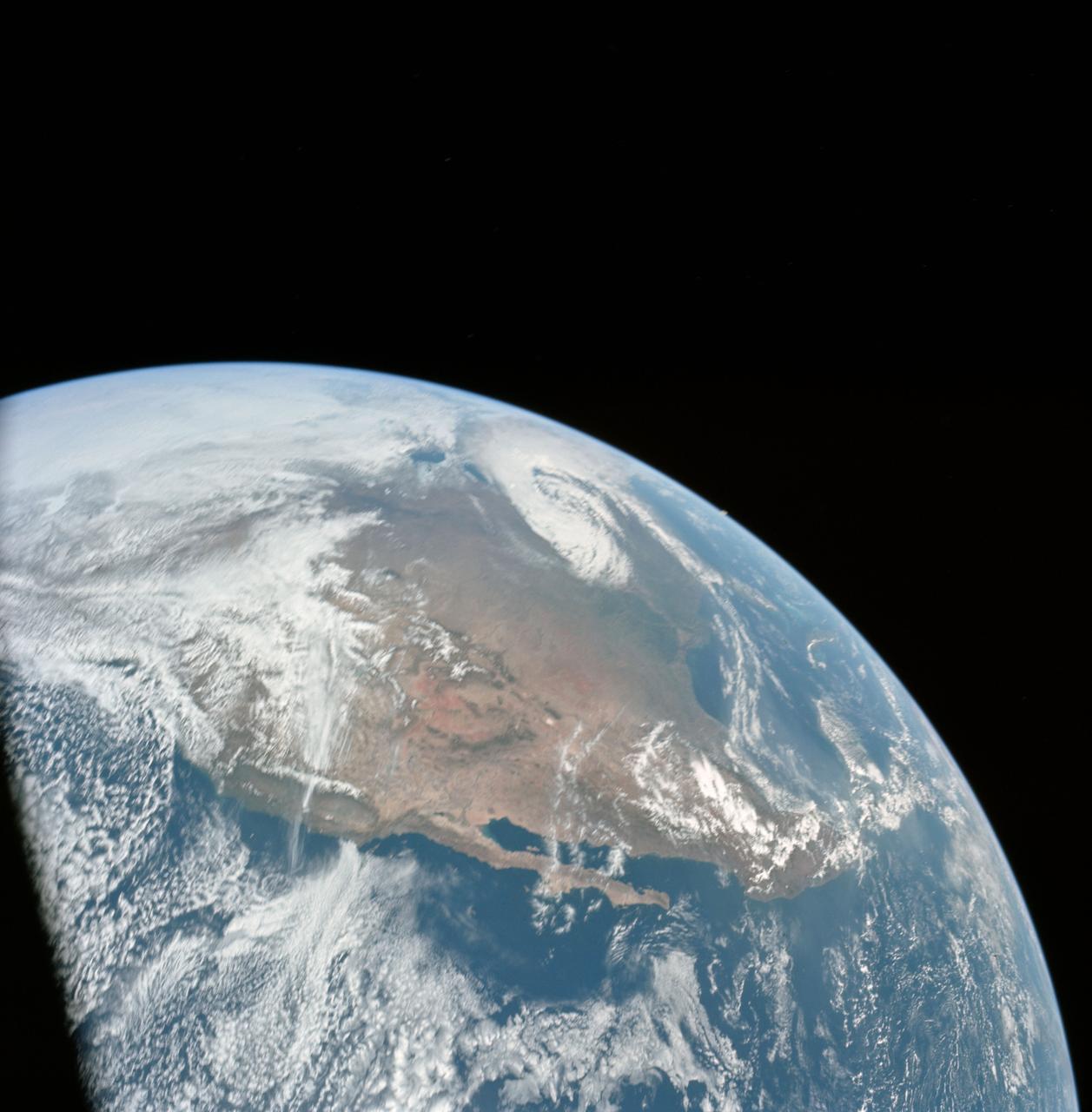
AS16-118-18873 (16 April 1972) --- A good view of Earth photographed shortly after trans-lunar injection of April 16, 1972. Although there is much cloud cover (over Canada and the oceans), the United States in large part, most of Mexico and some parts of Central America are clearly visible. Note Lake Michigan and Lake Superior, also note the Bahama Banks at upper right part of the sphere. A large part of the Rocky Mountain Range is also visible. Just beginning man's fifth lunar landing mission were astronauts John W. Young, commander; Thomas K. Mattingly II, command module pilot; and Charles M. Duke Jr., lunar module pilot. While astronauts Young and Duke descended in the Lunar Module (LM) to explore the moon, astronaut Mattingly remained with the Command and Service Modules (CSM) in lunar orbit.
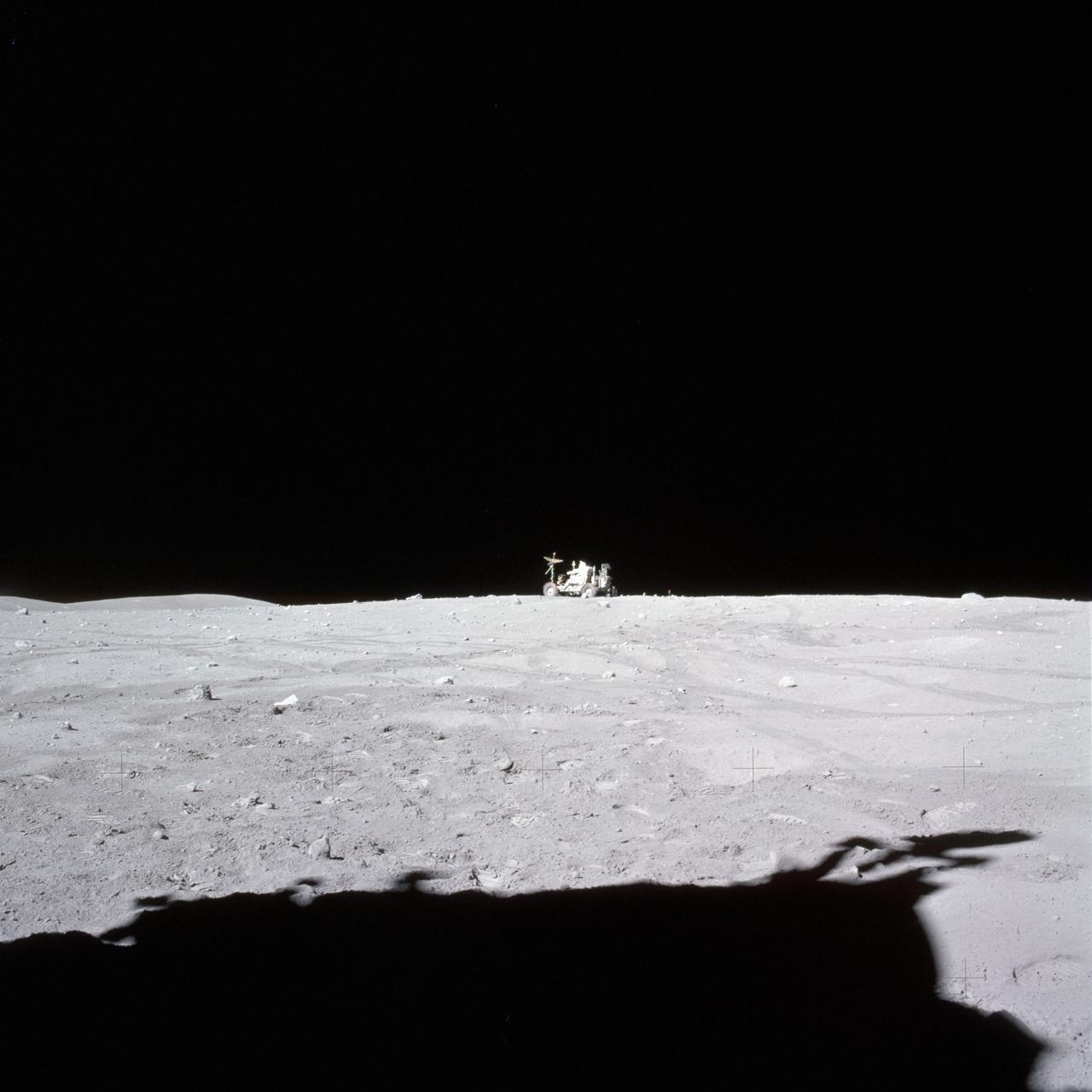
AS16-115-18559 (23 April 1972) --- Astronaut John W. Young, commander of the Apollo 16 lunar landing mission, drives the Lunar Roving Vehicle (LRV) to its final parking place near the end of the third Apollo 16 extravehicular activity (EVA) at the Descartes landing site. Astronaut Charles M. Duke Jr., lunar module pilot, took this photograph looking southward. The flank of Stone Mountain can be seen on the horizon at left. The shadow of the Lunar Module (LM) occupies much of the picture. While astronauts Young and Duke descended in the Apollo 16 LM "Orion" to explore the Descartes highlands landing site on the moon, astronaut Thomas K. Mattingly II, command module pilot, remained with the Command and Service Modules (CSM) "Casper" in lunar orbit.
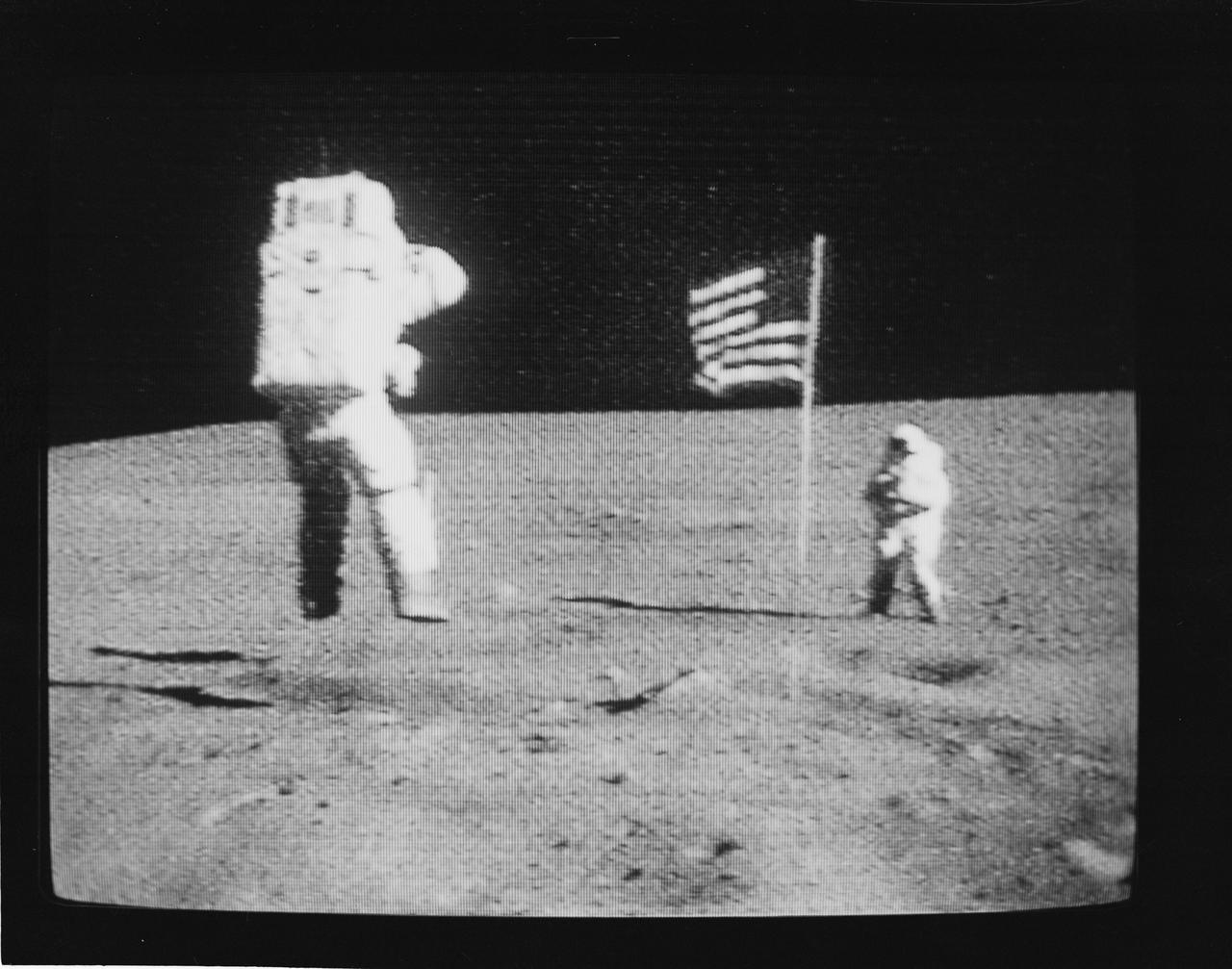
S72-35594 (21 April 1972) --- Astronaut John W. Young, commander of the Apollo 16 lunar landing mission, leaps from the lunar surface as he salutes the United States flag during the first Apollo 16 extravehicular activity (EVA) on the moon, as seen in this black & white reproduction taken from a color television transmission made by the color TV camera mounted on the Lunar Roving Vehicle (LRV). Astronaut Charles M. Duke Jr., lunar module pilot, stands beside the flag. While astronauts Young and Duke descended in the Apollo 16 Lunar Module (LM) "Orion" to explore the Descartes highlands landing site on the moon, astronaut Thomas K. Mattingly II, command module pilot, remained with the Command and Service Modules (CSM) "Casper" in lunar orbit.
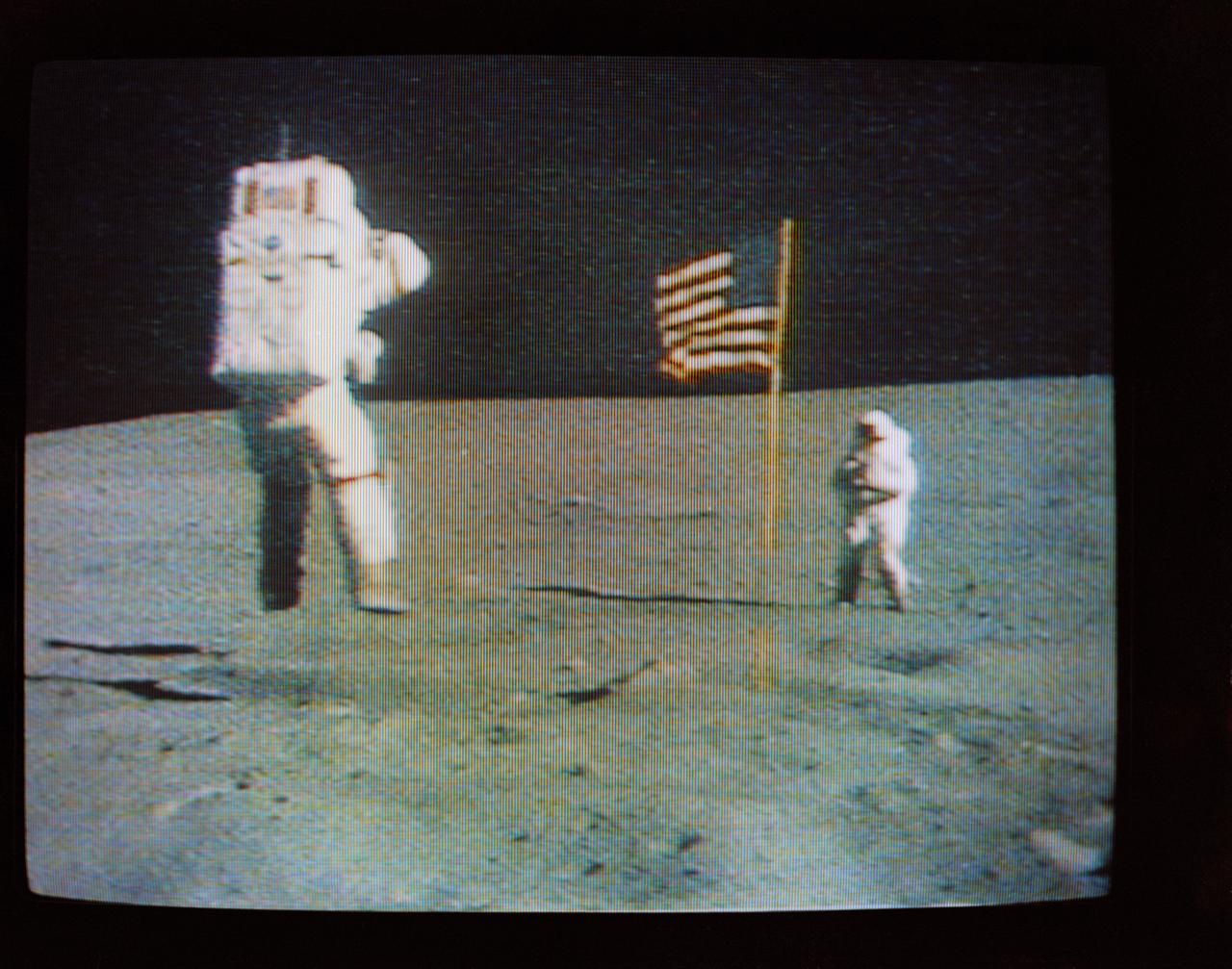
S72-35611 (21 April 1972) --- Astronaut John W. Young, commander of the Apollo 16 lunar landing mission, leaps from the lunar surface as he salutes the U.S. flag, during the first Apollo 16 extravehicular activity (EVA) on the moon, as seen in this reproduction taken from a color television transmission made by the color television camera mounted on the Lunar Roving Vehicle (LRV). Astronaut Charles M. Duke Jr., lunar module pilot, is standing in the background. While astronauts Young and Duke descended in the Apollo 16 Lunar Module (LM) "Orion" to explore the Descartes highlands landing site on the moon, astronaut Thomas K. Mattingly II, command module pilot, remained with the Command and Service Modules (CSM) "Casper" in lunar orbit.
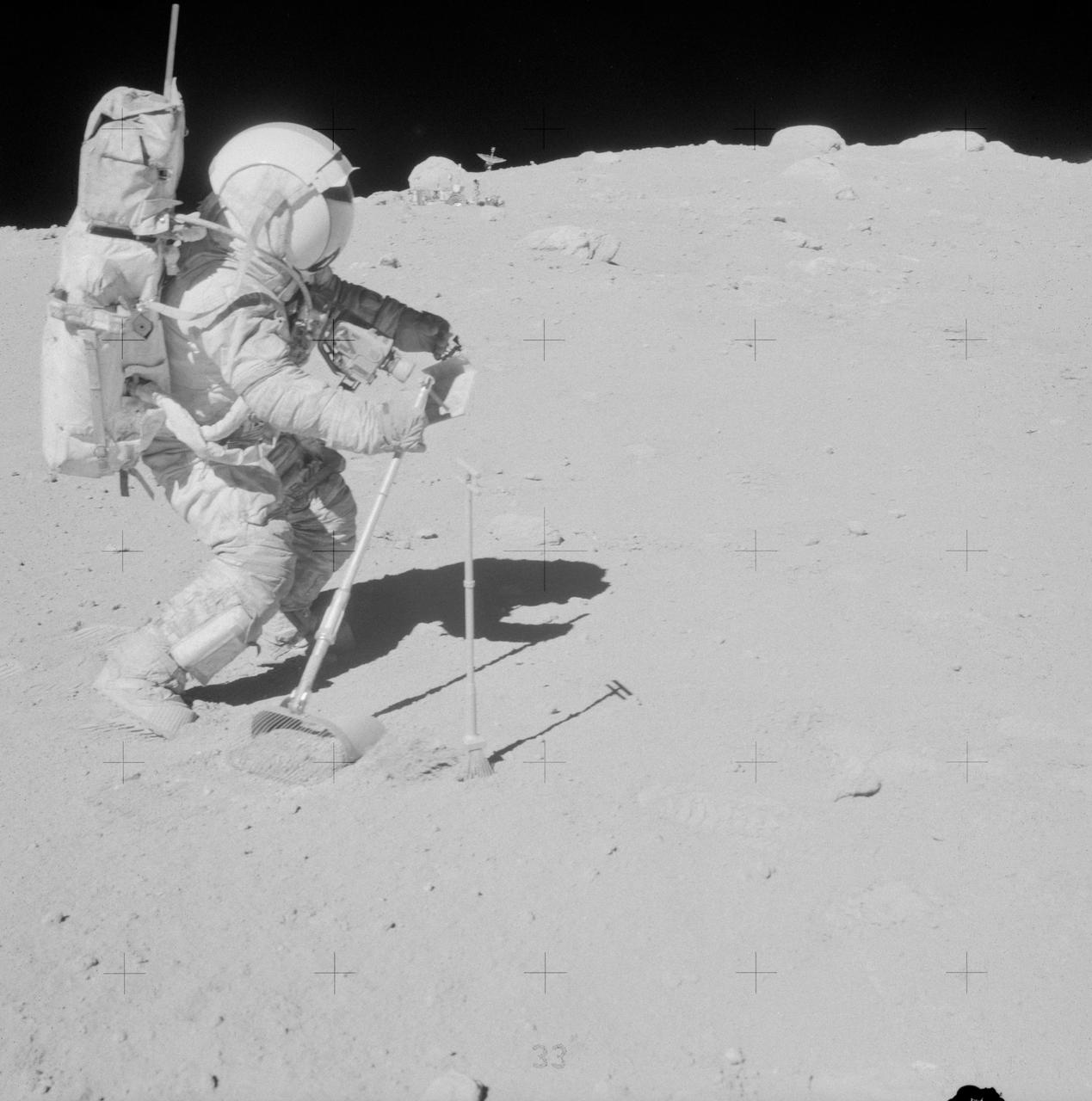
AS16-106-17340 (23 April 1972) --- Astronaut John W. Young, commander of the Apollo 16 lunar landing mission, is photographed collecting lunar samples near North Ray Crater during the third Apollo 16 extravehicular activity (EVA) at the Descartes landing site. This picture was taken by astronaut Charles M. Duke Jr., lunar module pilot. Young is using the lunar surface rake and a set of tongs. The Lunar Roving Vehicle (LRV) is parked in the field of large boulders in the background. While astronauts Young and Duke descended in the Lunar Module (LM) "Orion" to explore the moon, astronaut Thomas K. Mattingly II, command module pilot, remained with the Command and Service Modules (CSM) in lunar orbit.
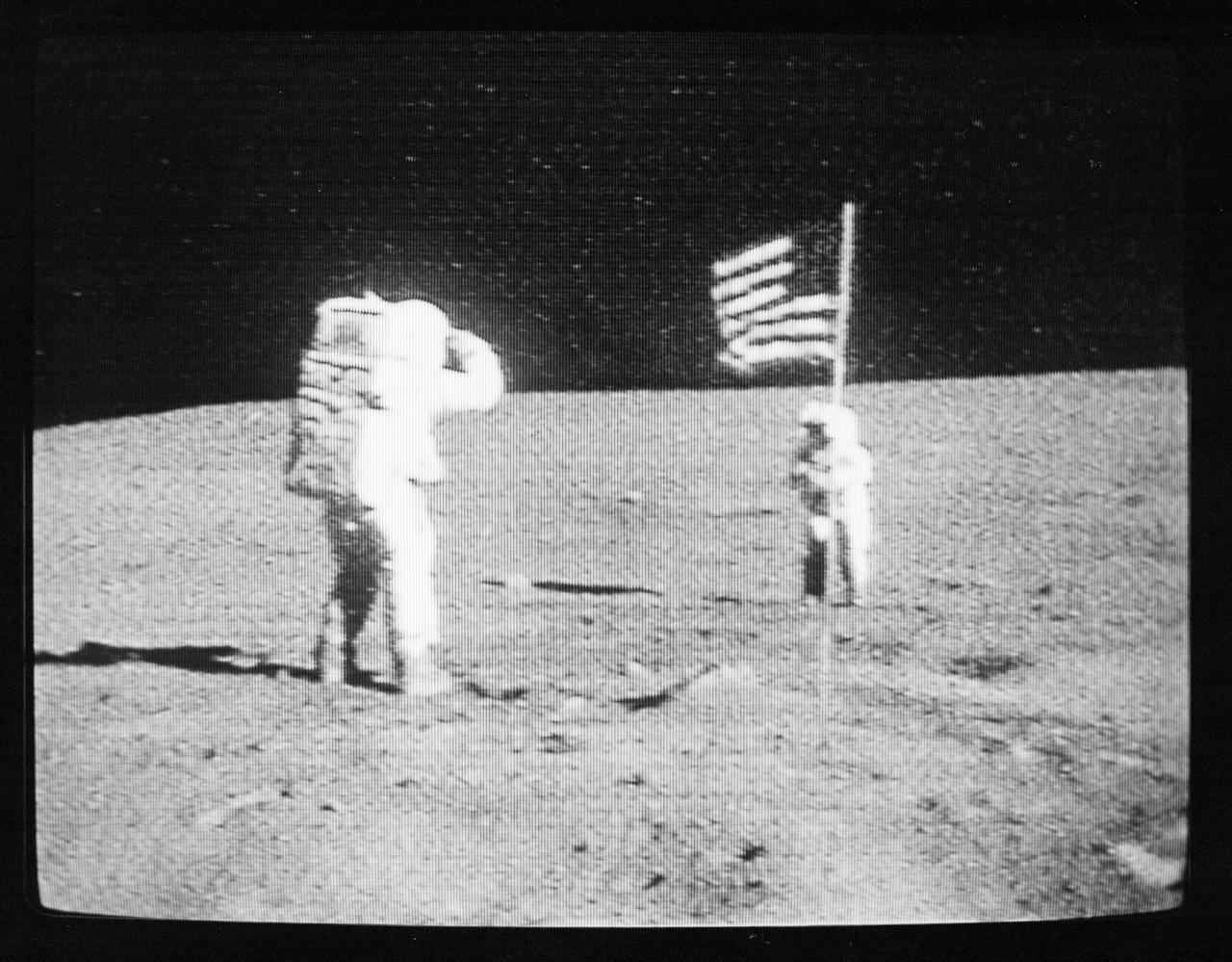
S72-35595 (21 April 1972) --- Astronaut Charles M. Duke Jr., lunar module pilot, salutes the United States flag during the first Apollo 16 extravehicular activity (EVA) on the moon, as seen in this black & white reproduction taken from a color television transmission made by the color TV camera mounted on the Lunar Roving Vehicle (LRV). Astronaut John W. Young, commander of the Apollo 16 lunar landing mission, stands beside the flag. While astronauts Young and Duke descended in the Apollo 16 Lunar Module (LM) "Orion" to explore the Descartes highlands landing site on the moon, astronaut Thomas K. Mattingly II, command module pilot, remained with the Command and Service Modules (CSM) "Casper" in lunar orbit.

AS16-110-17960 (22 April 1972) --- Astronaut John W. Young, commander, replaces tools in the Apollo Lunar Hand Tool (ALHT) carrier at the aft end of the Lunar Roving Vehicle (LRV) during the second Apollo 16 extravehicular activity (EVA) on the high side of Stone Mountain at the Descartes landing site. Astronaut Charles M. Duke Jr., lunar module pilot, took this photograph near the conclusion of Station 4 activities. Smoky Mountain, with the large Ravine Crater on its flank, is in the left background. This view is looking northeast. While astronauts Young and Duke descended in the Apollo 16 Lunar Module (LM) "Orion" to explore the Descartes highlands landing site on the moon, astronaut Thomas K. Mattingly II, command module pilot, remained with the Command and Service Modules (CSM) "Casper" in lunar orbit.
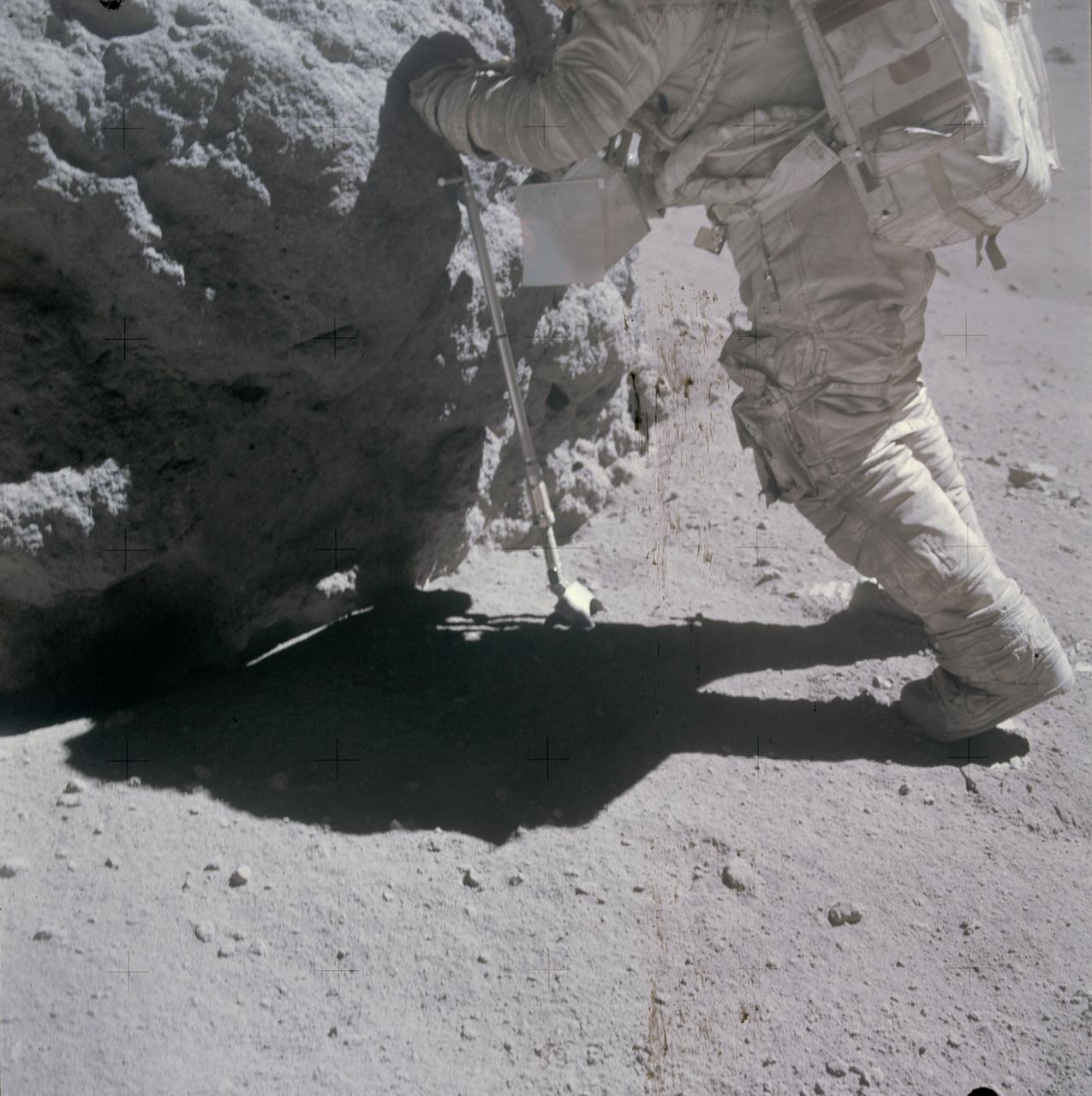
AS16-116-18671 (23 April 1972) --- Astronaut Charles M. Duke Jr., lunar module pilot, works at the "Shadow Rock", discovered during the missions third extravehicular activity (EVA) in the area of North Ray Crater (Station 13), April 23, 1972. The scoop, a geological hand tool, leans against the rock. This view was exposed by astronaut John W. Young, commander. The two moon-exploring crew men sampled this rock, which got its name because of a permanently shadowed area it protected. While astronauts Young and Duke descended in the Apollo 16 Lunar Module (LM) "Orion" to explore the Descartes highlands landing site on the moon, astronaut Thomas K. Mattingly II, command module pilot, remained with the Command and Service Modules (CSM) "Casper" in lunar orbit.
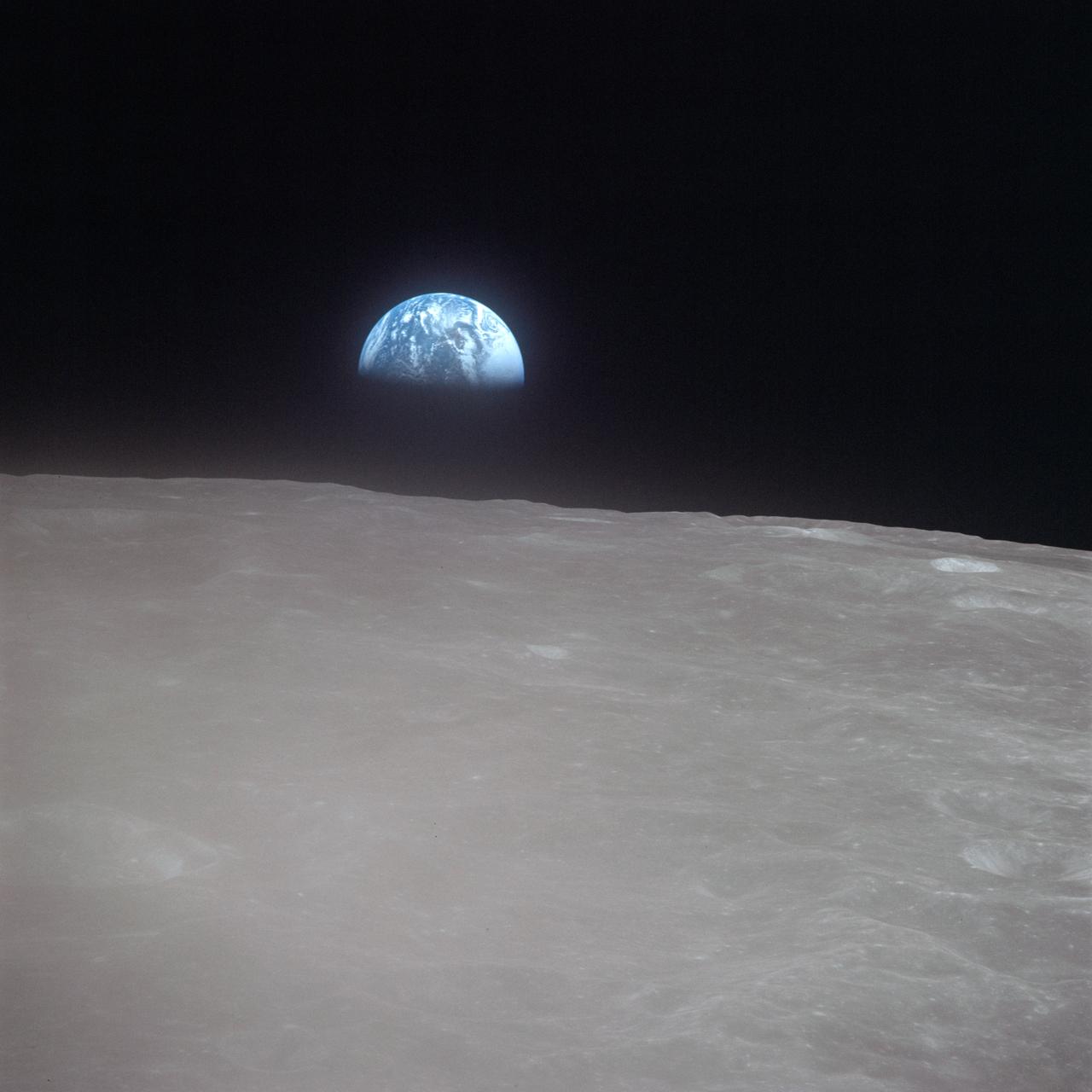
AS16-120-19187 (19 April 1972) --- Apollo 16 astronauts captured this Earth rise scene with a handheld Hasselblad camera during the second revolution of the moon. Identifiable craters seen on the moon include Saha, Wyld, and Saenger. Much of the terrain seen here is never visible from Earth, as the Command Module (CM) was just passing onto what is known as the dark side or far side of the moon. Crewmen aboard the CM at the time the photo was made were astronauts John W. Young, Thomas K. Mattingly II and Charles M. Duke Jr. Mattingly remained later with the CM in lunar orbit while Young and Duke descended in the lunar module (LM) to explore the surface of the moon.

jsc2012e052598 - Panorama view of Apollo 16 lunar surface photos as lunar module pilot Charles M. Duke Jr. is photographed by commander John W. Young collecting lunar samples at Station No. 1 during the first moonwalk of the mission at the Descartes landing site. The panoramas were built by combining Apollo 16 images starting with frame AS16-114-18416 thru end frame AS16-114-18431. The panoramic images received minimal retouching by NASA imagery specialists, including the removal of lens flares that were problematic in stitching together the individual frames and blacking out the sky to the lunar horizon. These adjustments were made based on observations of the Moon walkers who reported that there are no stars visible in the sky due to the bright lunar surface reflection of the Sun. With significant overlap and time delay between frames, it is possible to create two different versions of this panorama with astronaut Charles Duke (Apollo 16) in the center (jsc2012e052598) and both in the center and walking away to the right (jsc2012e052599).

jsc2012e052599 - Panorama view of Apollo 16 lunar surface photos as lunar module pilot Charles M. Duke Jr. is photographed by commander John W. Young collecting lunar samples at Station No. 1 during the first moonwalk of the mission at the Descartes landing site. The panoramas were built by combining Apollo 16 images starting with frame AS16-114-18416 thru end frame AS16-114-18431. The panoramic images received minimal retouching by NASA imagery specialists, including the removal of lens flares that were problematic in stitching together the individual frames and blacking out the sky to the lunar horizon. These adjustments were made based on observations of the Moon walkers who reported that there are no stars visible in the sky due to the bright lunar surface reflection of the Sun. With significant overlap and time delay between frames, it is possible to create two different versions of this panorama with astronaut Charles Duke (Apollo 16) in the center (jsc2012e052598) and both in the center and walking away to the right (jsc2012e052599).
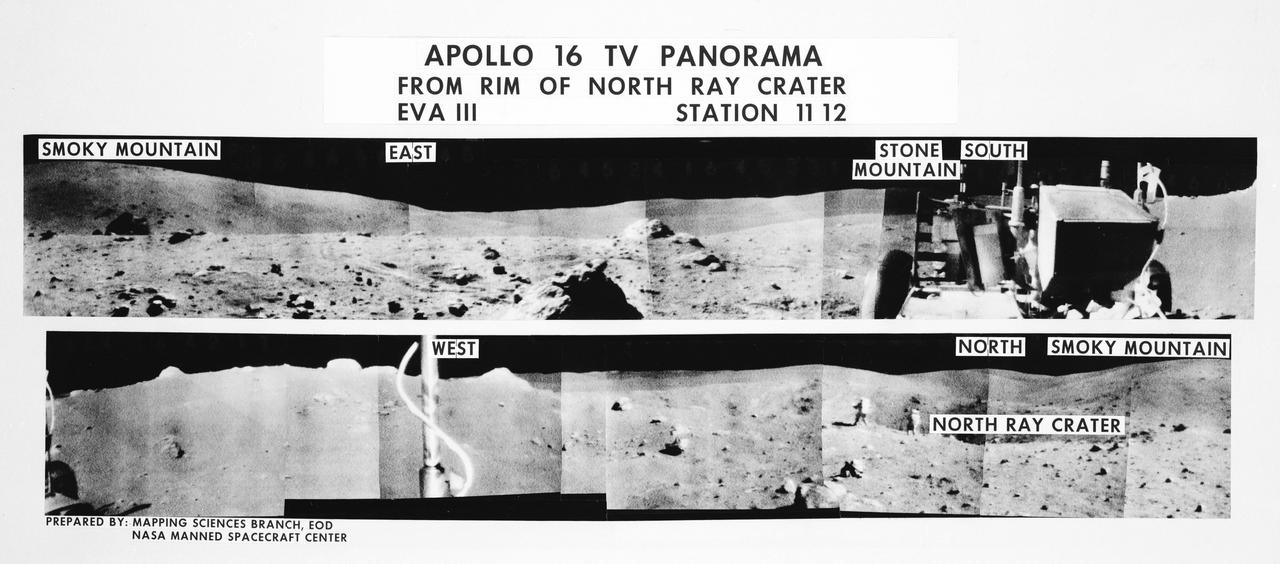
S72-35971 (21 April 1972) --- A 360-degree field of view of the Apollo 16 Descartes landing site area composed of individual scenes taken from color transmission made by the color RCA TV camera mounted on the Lunar Roving Vehicle (LRV). This panorama was made while the LRV was parked at the rim of North Ray Crater (Stations 11 & 12) during the third Apollo 16 lunar surface extravehicular activity (EVA) by astronauts John W. Young and Charles M. Duke Jr. The overlay identifies the directions and the key lunar terrain features. The camera panned across the rear portion of the LRV in its 360-degree sweep. Note Young and Duke walking along the edge of the crater in one of the scenes. The TV camera was remotely controlled from a console in the Mission Control Center (MCC). Astronauts Young, commander; and Duke, lunar module pilot; descended in the Apollo 16 Lunar Module (LM) "Orion" to explore the Descartes highlands landing site on the moon. Astronaut Thomas K. Mattingly II, command module pilot, remained with the Command and Service Modules (CSM) "Casper" in lunar orbit.
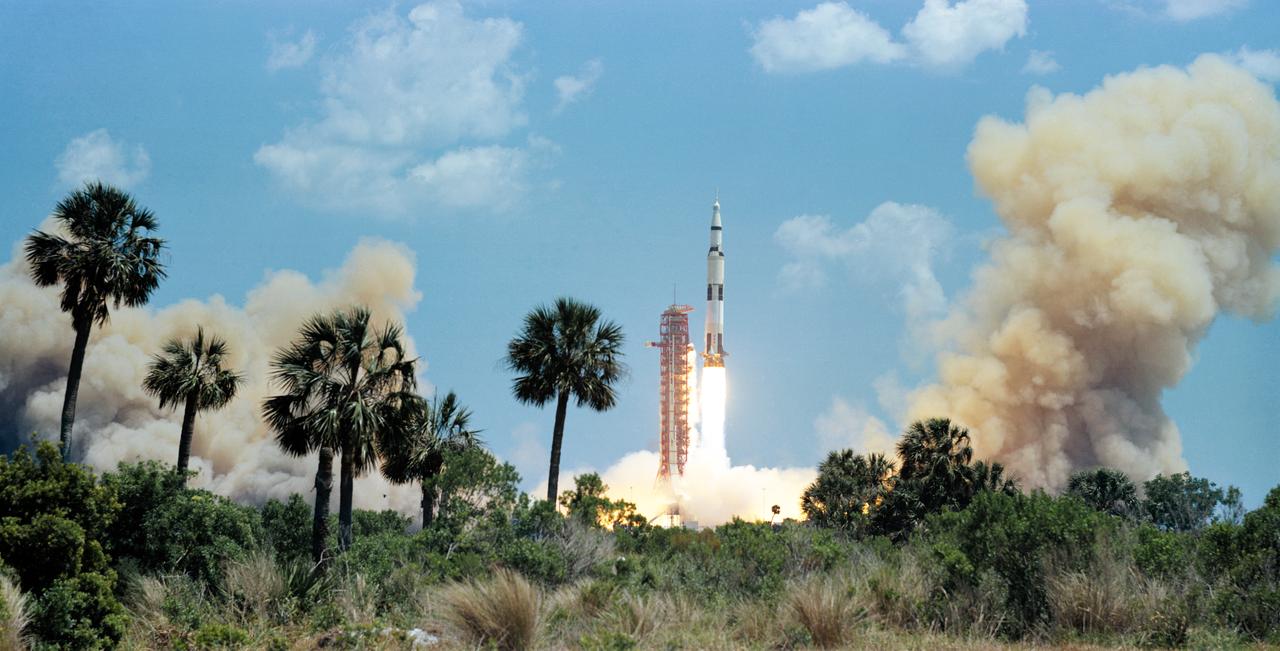
S72-35345 (16 April 1972) --- The huge, 363-feet tall Apollo 16 (Spacecraft 113/Lunar Module 11/Saturn 511) space vehicle is launched from Pad A, Launch Complex 39, Kennedy Space Center (KSC), Florida, at 12:54:00.569 p.m.(EST), April 16, 1972, on a lunar landing mission. Aboard the Apollo 16 spacecraft were astronauts John W. Young, commander; Thomas K. Mattingly II, command module pilot; and Charles M. Duke Jr., lunar module pilot.
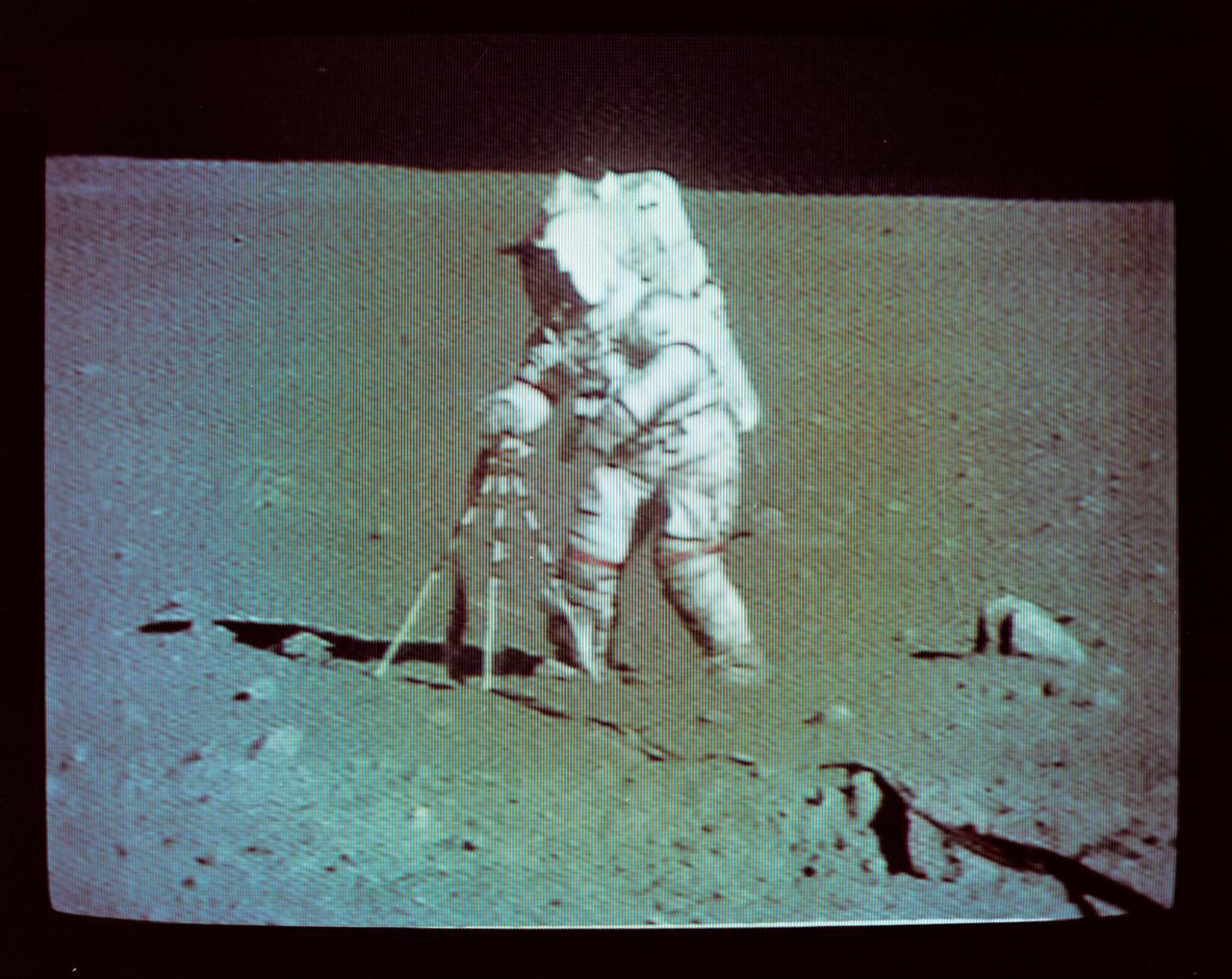
S72-35610 (21 April 1972) --- Astronaut John W. Young, commander of the Apollo 16 lunar landing mission, deploys the lunar Portable Magnetometer during the first Apollo 16 extravehicular activity (EVA) on the moon, as seen in this reproduction taken from a color television transmission made by the color television camera mounted on the Lunar Roving Vehicle (LRV). While astronaut Thomas K. Mattingly II, command module pilot, remained with the Command and Service Modules in lunar orbit, astronauts Young and Charles M. Duke Jr., lunar module pilot, descended in the Lunar Module to explore the Descartes landing site.
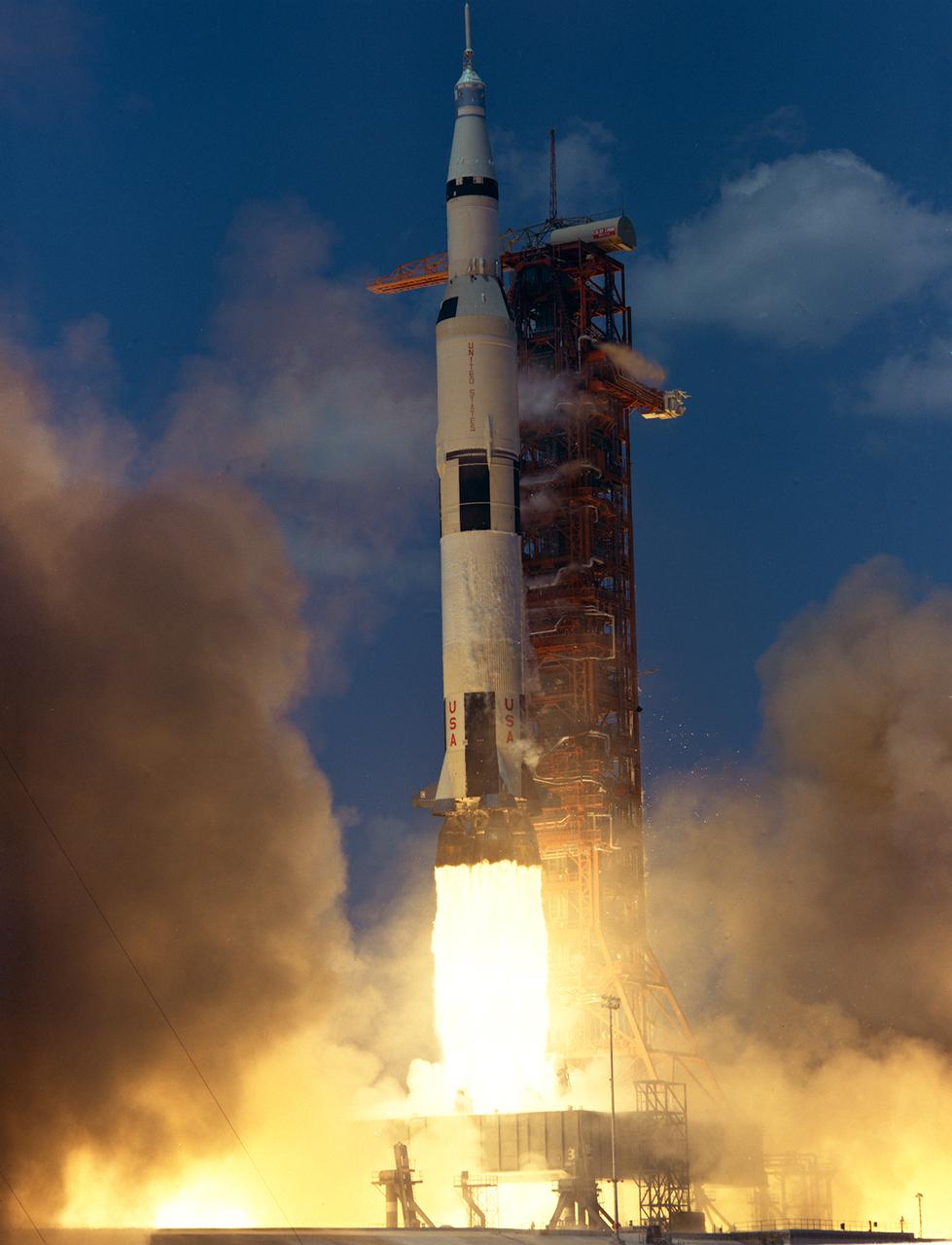
The sixth marned lunar landing mission, the Apollo 16 (SA-511), carrying three astronauts: Mission commander John W. Young, Command Module pilot Thomas K. Mattingly II, and Lunar Module pilot Charles M. Duke, lifted off on April 16, 1972. The Apollo 16 continued the broad-scale geological, geochemical, and geophysical mapping of the Moon's crust, begun by the Apollo 15, from lunar orbit. This mission marked the first use of the Moon as an astronomical observatory by using the ultraviolet camera/spectrograph. It photographed ultraviolet light emitted by Earth and other celestial objects. The Lunar Roving Vehicle was also used. The mission ended on April 27, 1972.
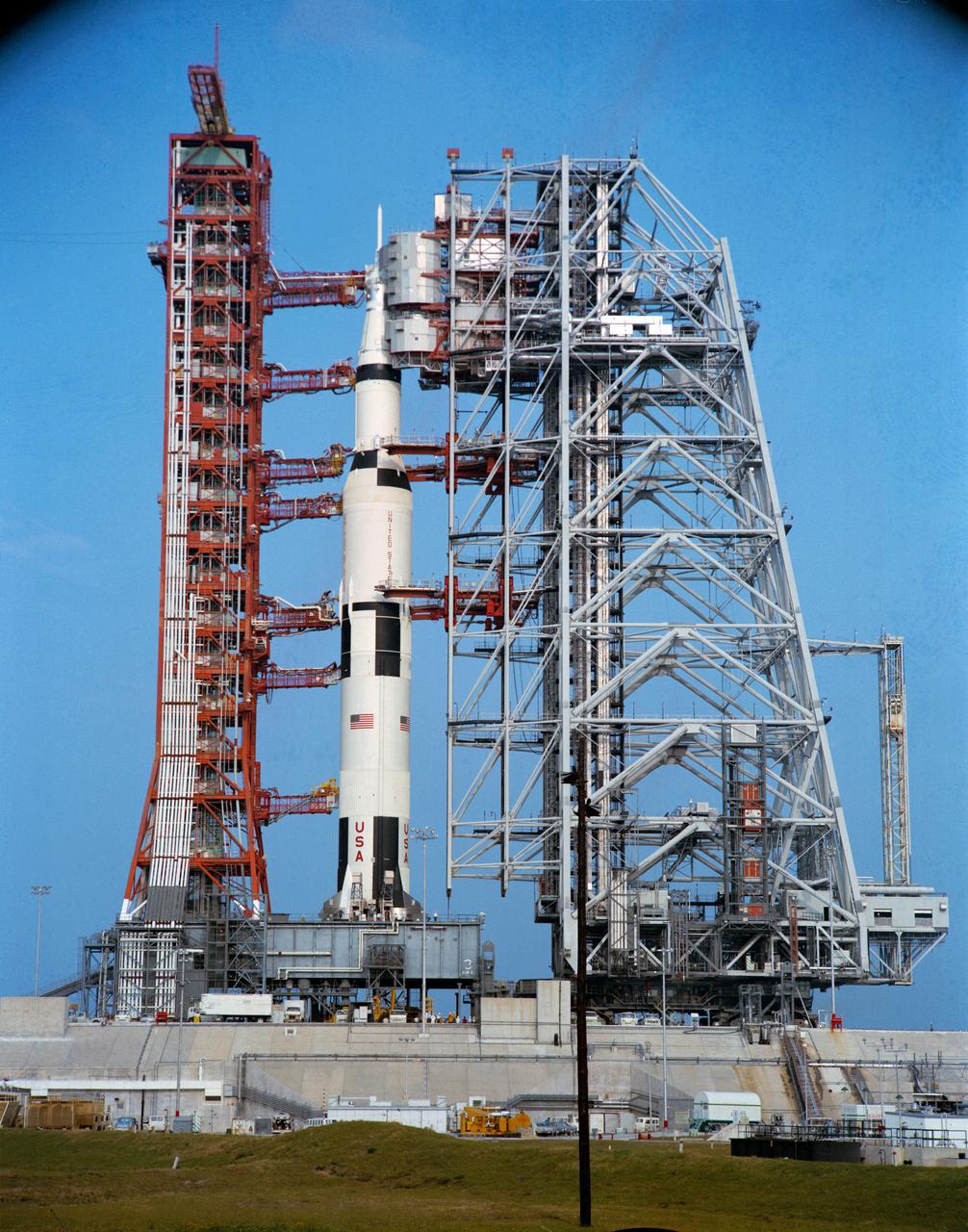
S72-34473 (29 March 1972) --- A ground-level view of Pad A, Launch Complex 39, Kennedy Space Center (KSC), showing the 363-feet tall Apollo 16 (Spacecraft 113/Lunar Module 11/Saturn 511) space vehicle during a Countdown Demonstration Test (CDDT). The CDDT was part of the preflight preparations for the Apollo 16 lunar landing mission. The crew of Apollo 16, scheduled for launch on April 16, 1972, are astronauts John W. Young, commander; Thomas K. (Ken) Mattingly II, command module pilot; and Charles M. Duke Jr., lunar module pilot.
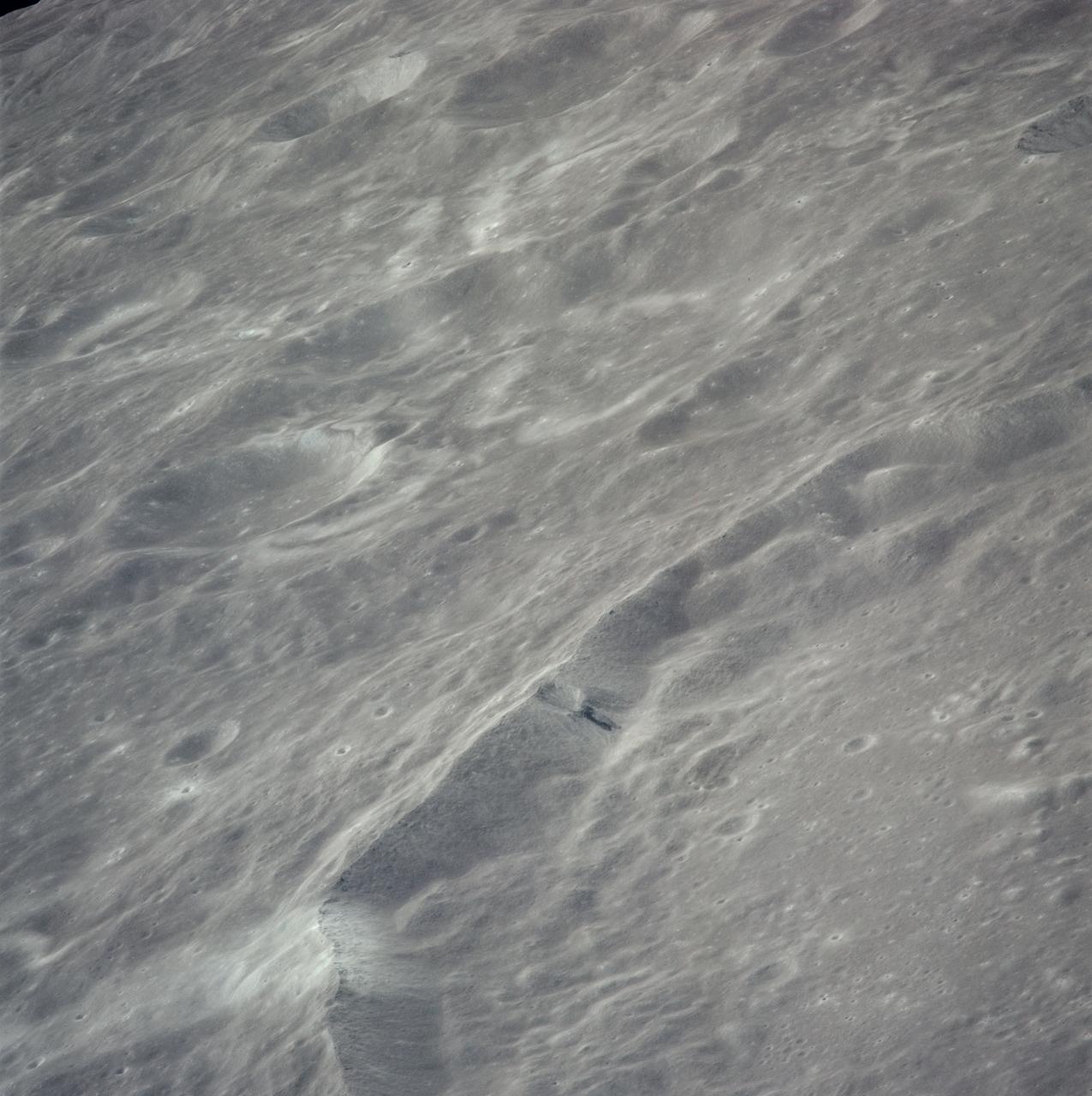
AS16-121-19407 (April 1972) --- An oblique view of a rim of Guyot Crater on the lunar farside, as photographed from the Apollo 16 spacecraft in lunar orbit. The coordinates of the center of Guyot Crater are 116.5 degrees east longitude and 10.5 degrees north latitude. Note the black coloration which appears to be lava flow down the side of the crater rim. While astronauts John W. Young, commander; and Charles M. Duke Jr., lunar module pilot; descended in the Apollo 16 Lunar Module (LM) "Orion" to explore the Descartes highlands site on the moon, astronaut Thomas K. Mattingly II, command module pilot, remained with the Command and Service Modules (CSM) "Casper" in lunar orbit.
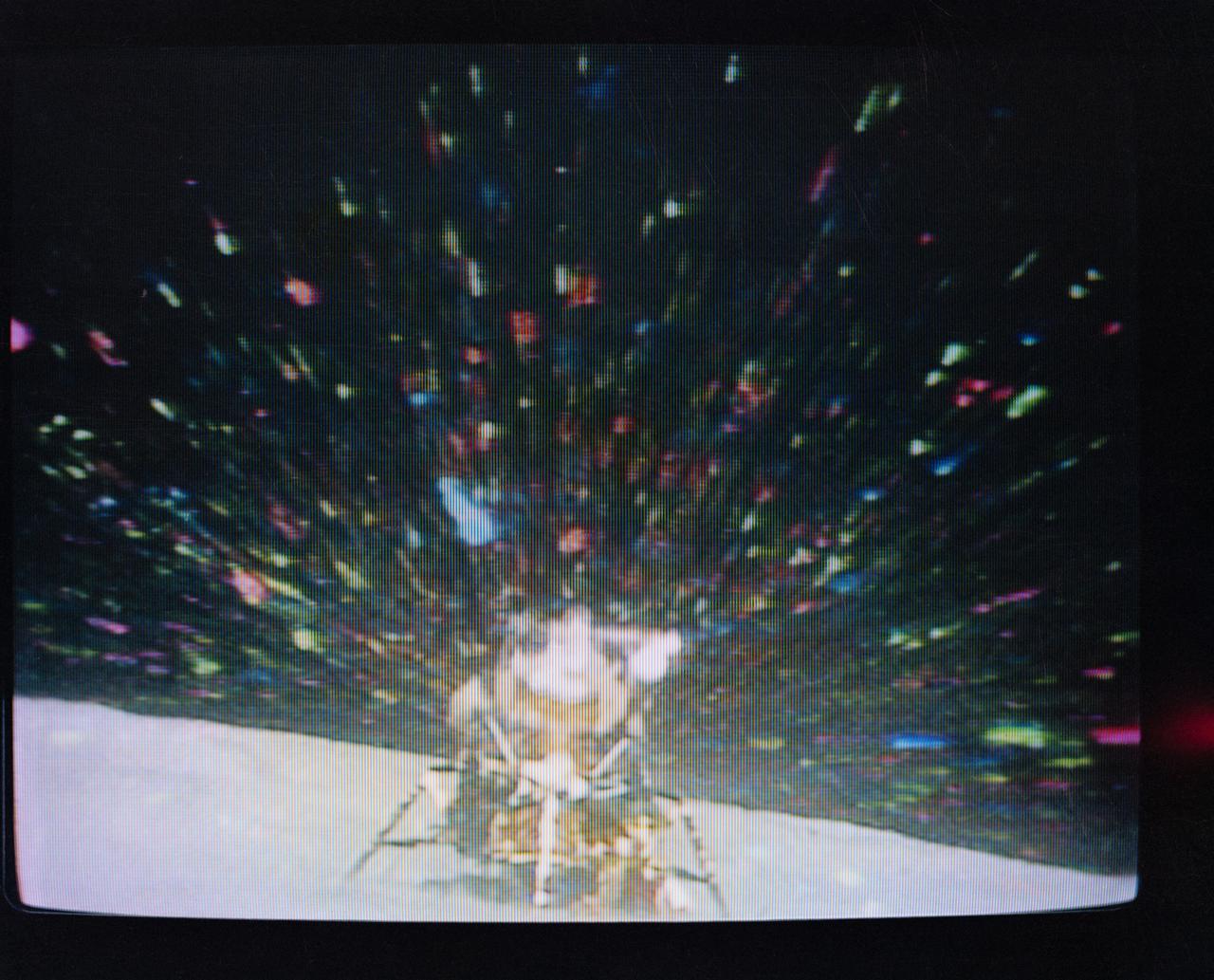
S72-35613 (22 April 1972) --- The Apollo 16 Lunar Module (LM) "Orion" in early lunar liftoff phase is featured in this lunar scene at the Descartes landing site. The still picture is a reproduction taken from a color television transmission made by a TV camera mounted on the Lunar Roving Vehicle (LRV). While astronauts John W. Young, commander; and Charles M. Duke Jr., lunar module pilot; descended in the Apollo 16 LM to explore the Descartes highlands landing site on the moon, astronaut Thomas K. Mattingly II, command module pilot, remained with the Command and Service Modules (CSM) "Casper" in lunar orbit.
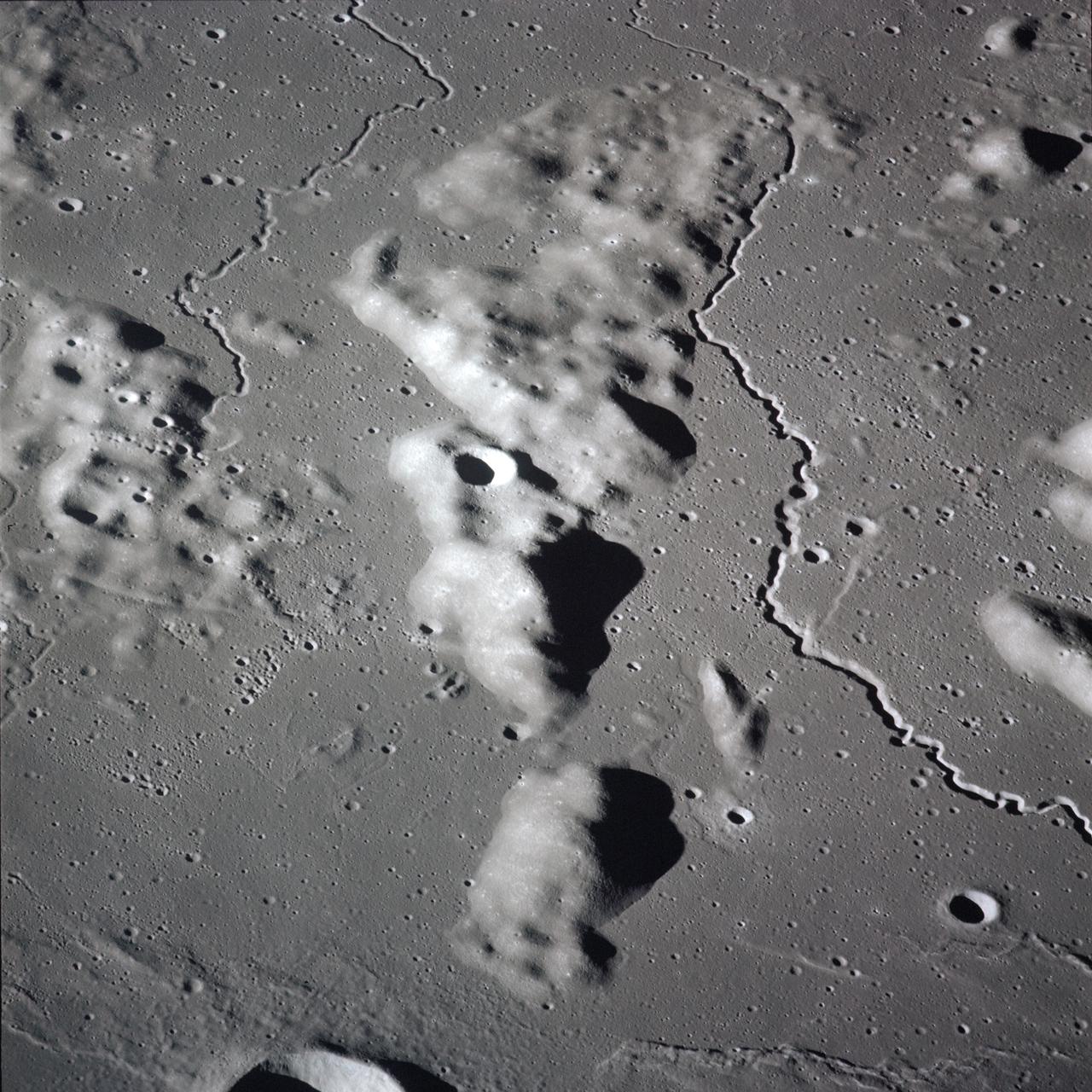
AS16-119-19161 (16-27 April 1972) --- The prominent rille feature running through the area is Herigonius I. The coordinates for the center of the area pictured are 14.7 degrees south latitude and 36.4 degrees west longitude. The photo was taken by the Apollo 16 astronauts from the Command and Service Modules (CSM) in lunar orbit. While astronauts John W. Young and Charles M. Duke Jr. descended in the Lunar Module (LM) "Orion" to explore the Descartes highlands region of the moon, astronaut Thomas K. (Ken) Mattingly II, remained with the CSM "Casper" in lunar orbit.
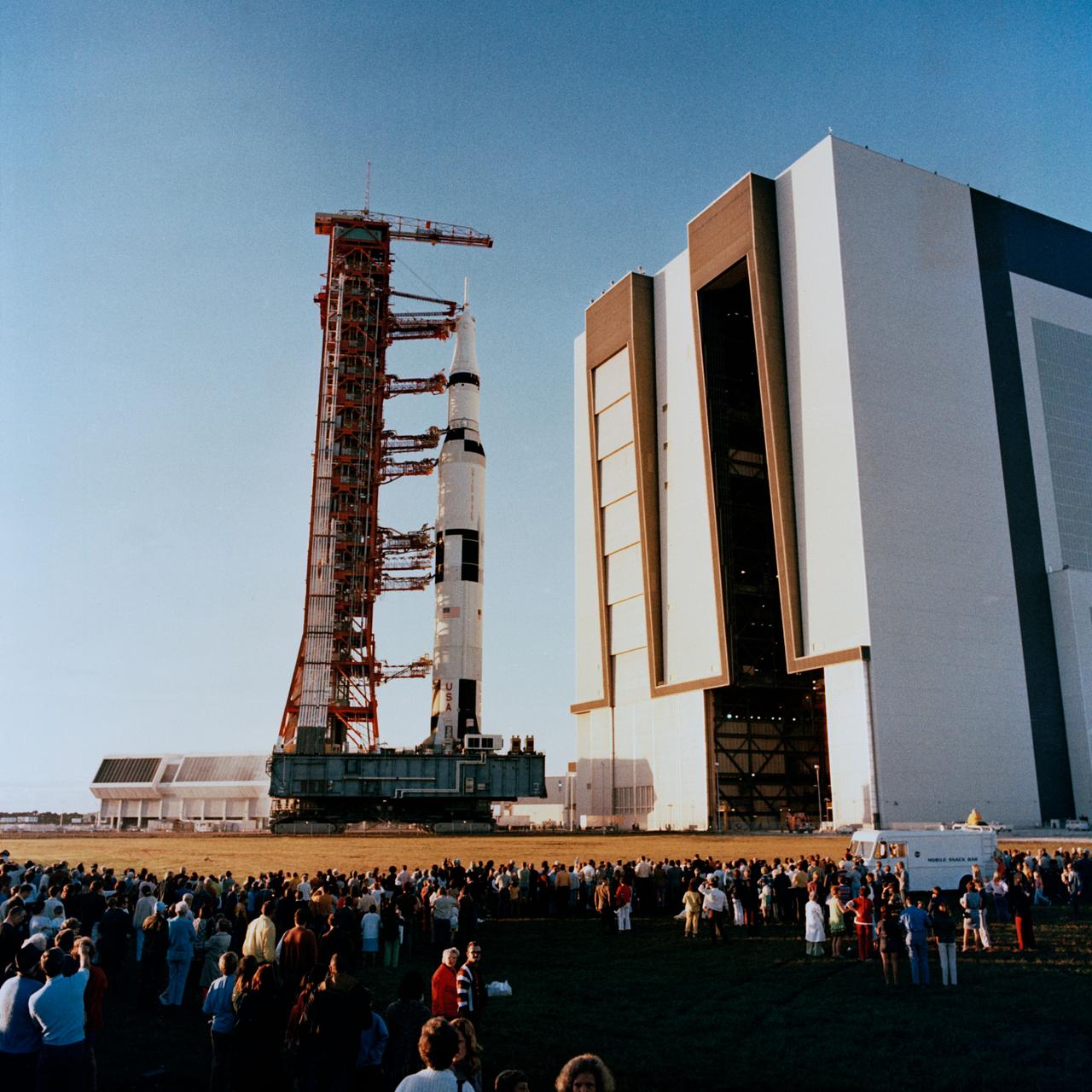
S72-19795 (13 Dec. 1971) --- A large crowd of spectators look on as the 363-feet tall Apollo 16 (Spacecraft 113/Lunar Module 11/Saturn 511) space vehicle moves out of the Vehicle Assembly Building (VAB) at the Kennedy Space Center's (KSC) Launch Complex 39 toward Pad A. The Saturn V stack and its mobile launch tower are atop a huge crawler-transporter. The prime crew men of the scheduled Apollo 16 lunar landing mission are astronauts John W. Young, commander; Thomas K. Mattingly, command module pilot; and Charles M. Duke Jr., lunar module pilot.
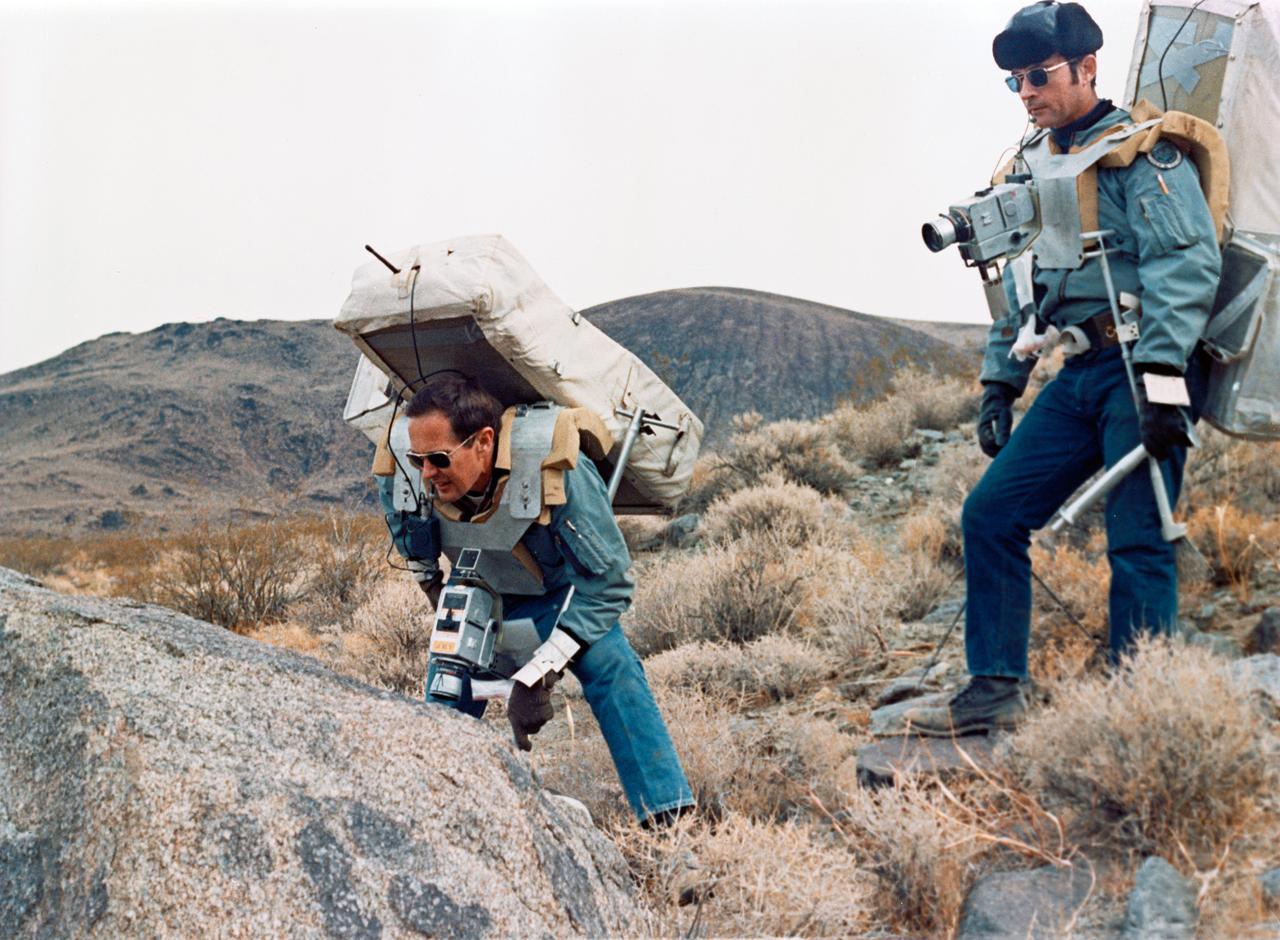
S71-59355 (17-18 Nov. 1971) --- Astronauts John W. Young, right, prime crew commander for Apollo 16, and Charles M. Duke Jr., lunar module pilot, study rock formations along their simulated lunar traverse route. The prime and backup commanders and lunar module pilots for Apollo 16 took part in the two-day geology field trip and simulations in the Coso Range, near Ridgecrest, California, about 160 miles north by northeast of Los Angeles. The training and simulations were conducted Nov. 17 and 18, 1971, at the U.S. Naval Ordnance Test Station.
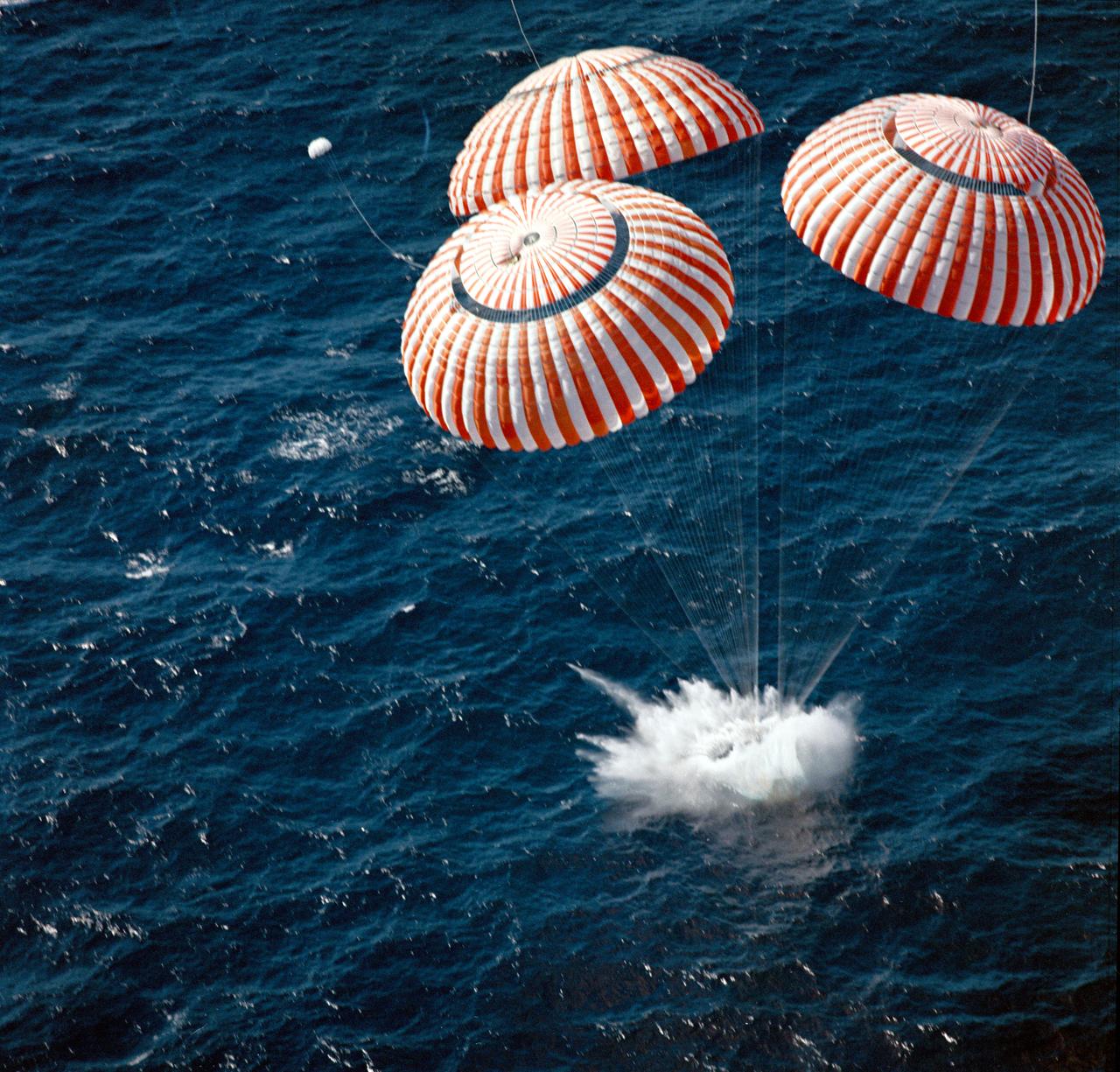
S72-36293 (27 April 1972) --- The Apollo 16 Command Module (CM), with astronauts John W. Young, Thomas K. Mattingly II, and Charles M. Duke Jr. aboard, splashed down in the central Pacific Ocean to successfully conclude their lunar landing mission. The splashdown occurred at 290:37:06 ground elapsed time, 1:45:06 p.m. (CST) Thursday, April 27, 1972, at coordinates of 00:43.2 degrees south latitude and 156:11.4 degrees west longitude. A point approximately 215 miles southeast of Christmas Island. Later the three crewmen were picked up by a helicopter from the prime recovery ship USS Ticonderoga.
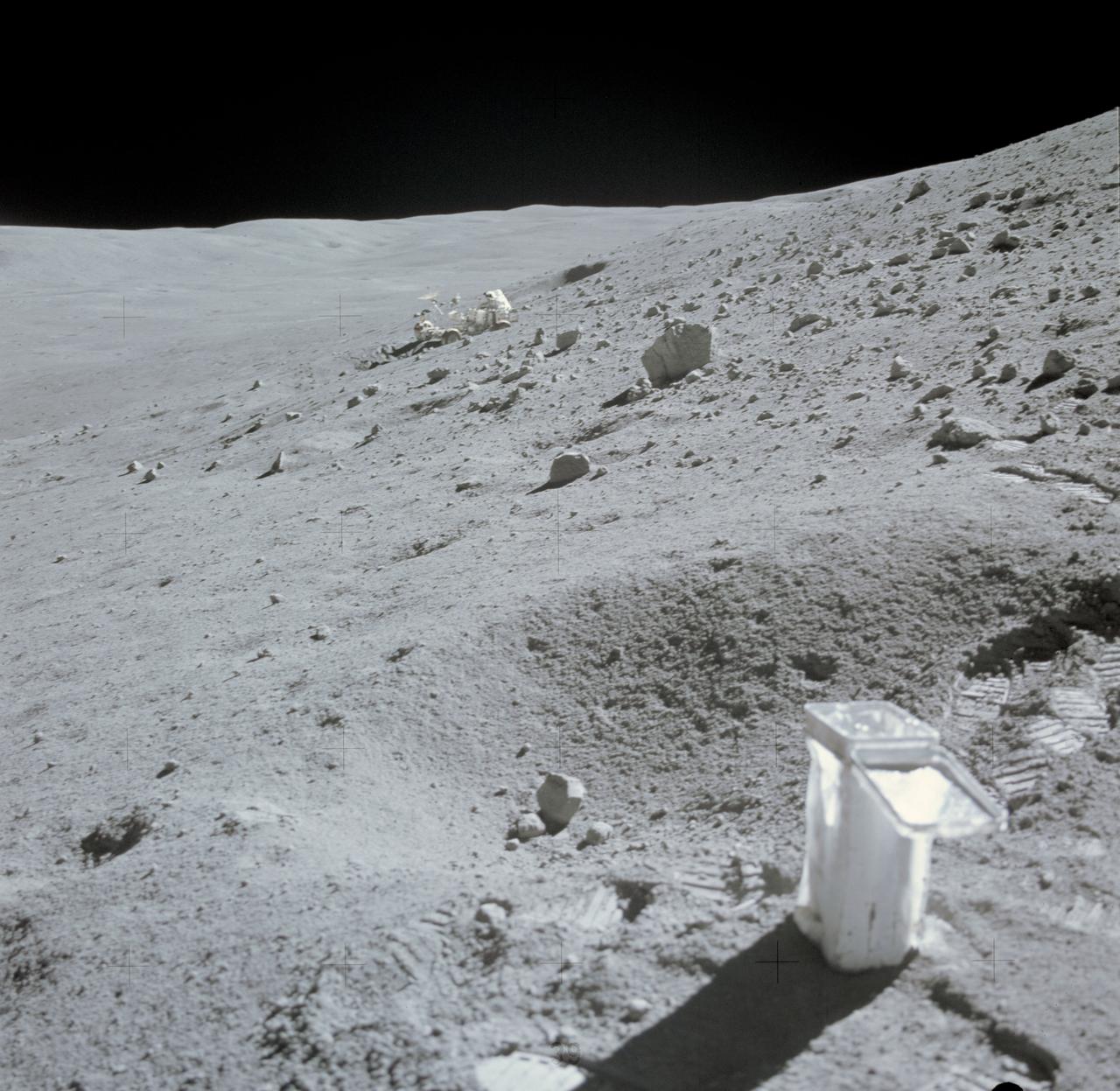
AS16-107-17473 (22 April 1972) --- The Lunar Roving Vehicle (LRV) appears to be parked in a deep lunar depression, on the slope of Stone Mountain. This photograph of the lunar scene at Station No. 4 was taken during the second Apollo 16 extravehicular activity (EVA) at the Descartes landing site. A sample collection bag is in the right foreground. Note field of small boulders at upper right. While astronauts John W. Young, commander, and Charles M. Duke Jr., lunar module pilot, descended in the Lunar Module (LM) "Orion" to explore the moon, astronaut Thomas K. Mattingly II, command module pilot, remained with the Command and Service Modules (CSM) in lunar orbit.
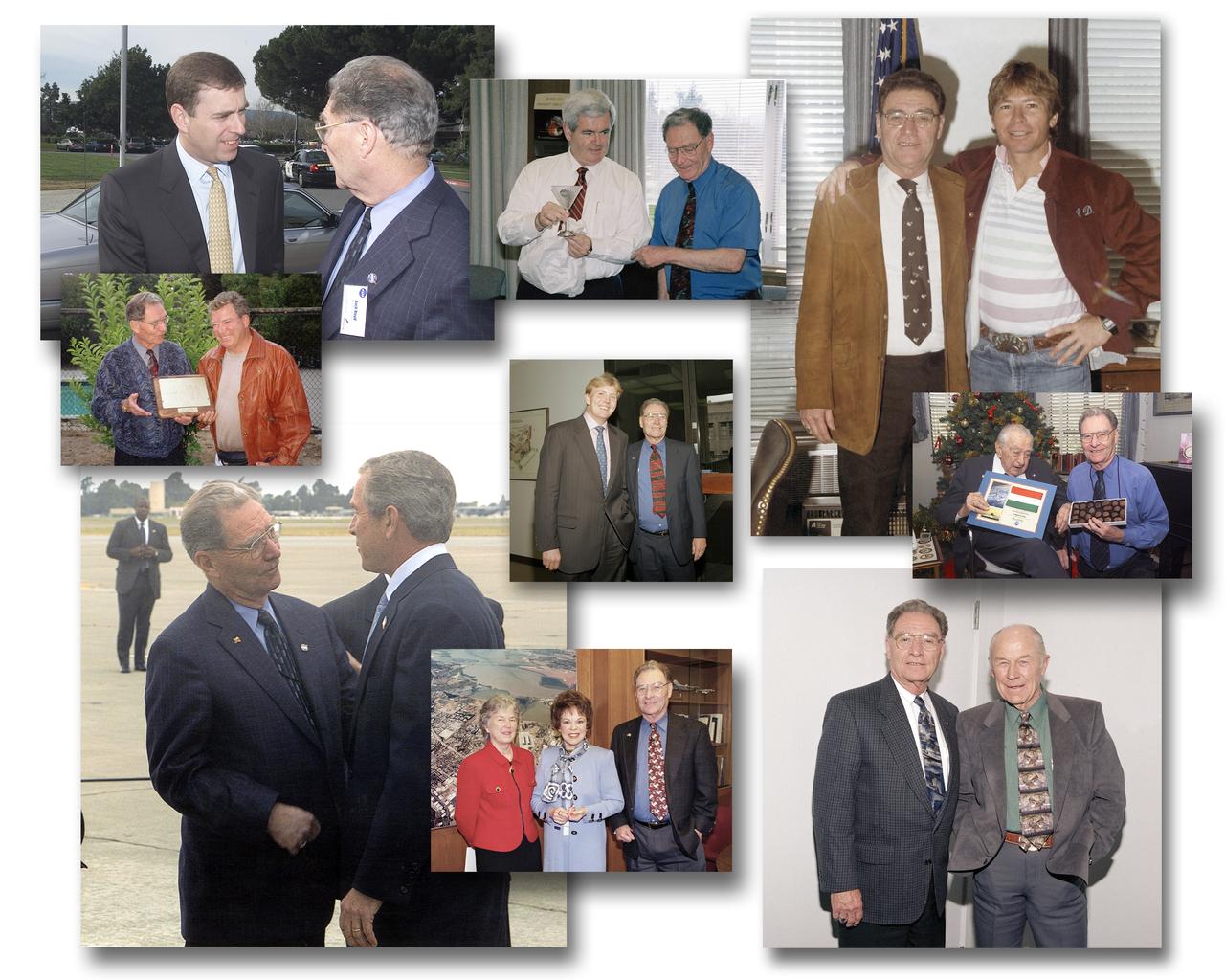
Jack Boyd greeting VIP visitors to NASA Ames Research Center Top left to right; His Royal Highness (HRH) Prince Andrew, Duke of York (AC02-0028 series) Senator Newt Gingrich (AC00-0032 series) Singer John Denver (AC85-0686 series) Middle; Prince Willem Alexander, Crown Prince of the Netherlands (AC99-0013 series) Bottom left to right; United States President George G.W. Bush (ACD02-0082 series), Actor and Diplomat Shirley Temple Black (AC99-0071 series). Air Force Test Pilot Charles 'Chuck' Yeager AC98-0204 series).
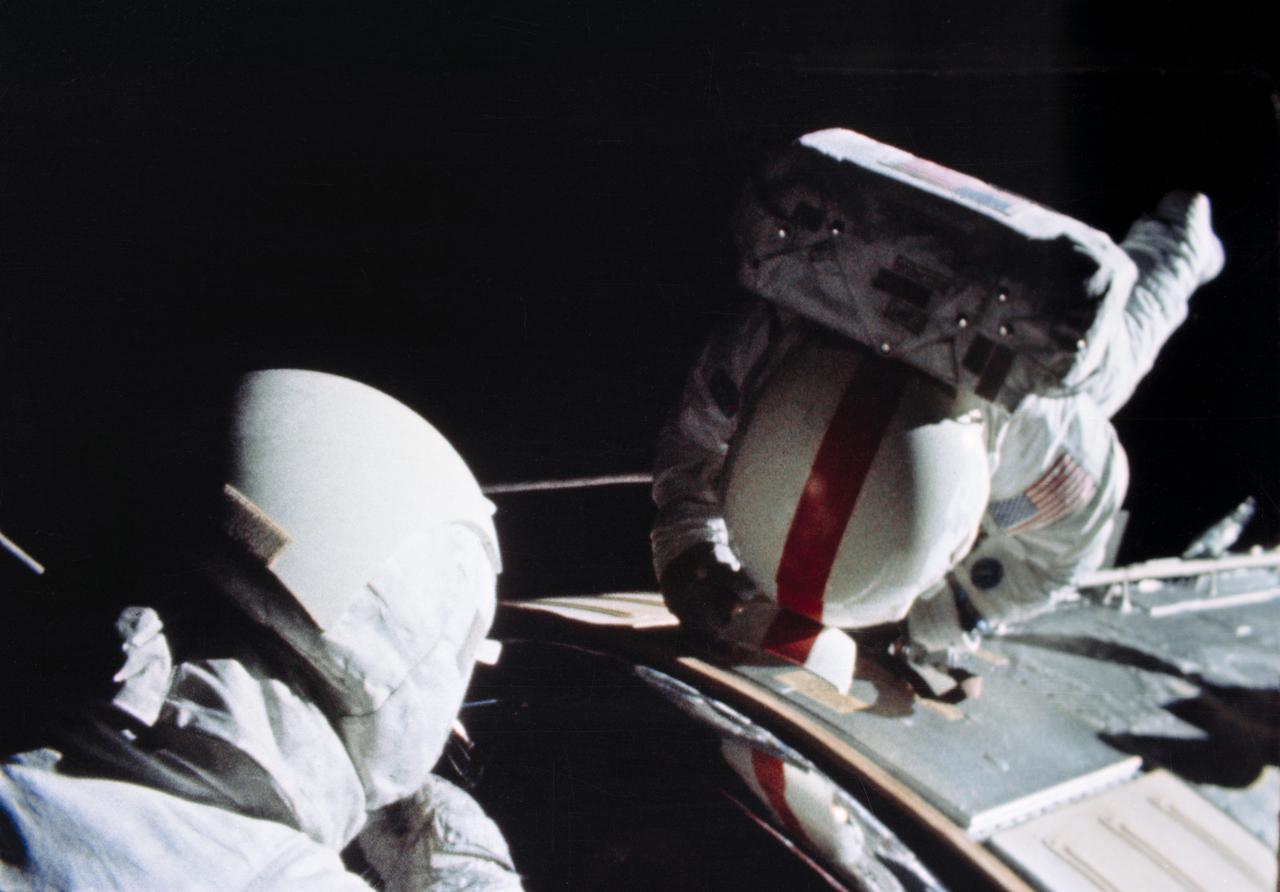
S72-37001 (25 April 1972) --- Astronaut Thomas K. Mattingly II, command module pilot, performs an extravehicular activity (EVA) during the Apollo 16 trans-Earth coast. Mattingly is assisted by astronaut Charles M. Duke Jr., lunar module pilot. Mattingly inspected the SIM Bay or Service Module (SM), and retrieved film from the Mapping and Panoramic Cameras. Mattingly is wearing the helmet of astronaut John W. Young, commander. The helmet's lunar EVA visor assembly helped protect Mattingly's eyes from the bright sun. This view is a frame from motion picture film exposed by a 16mm Maurer camera.
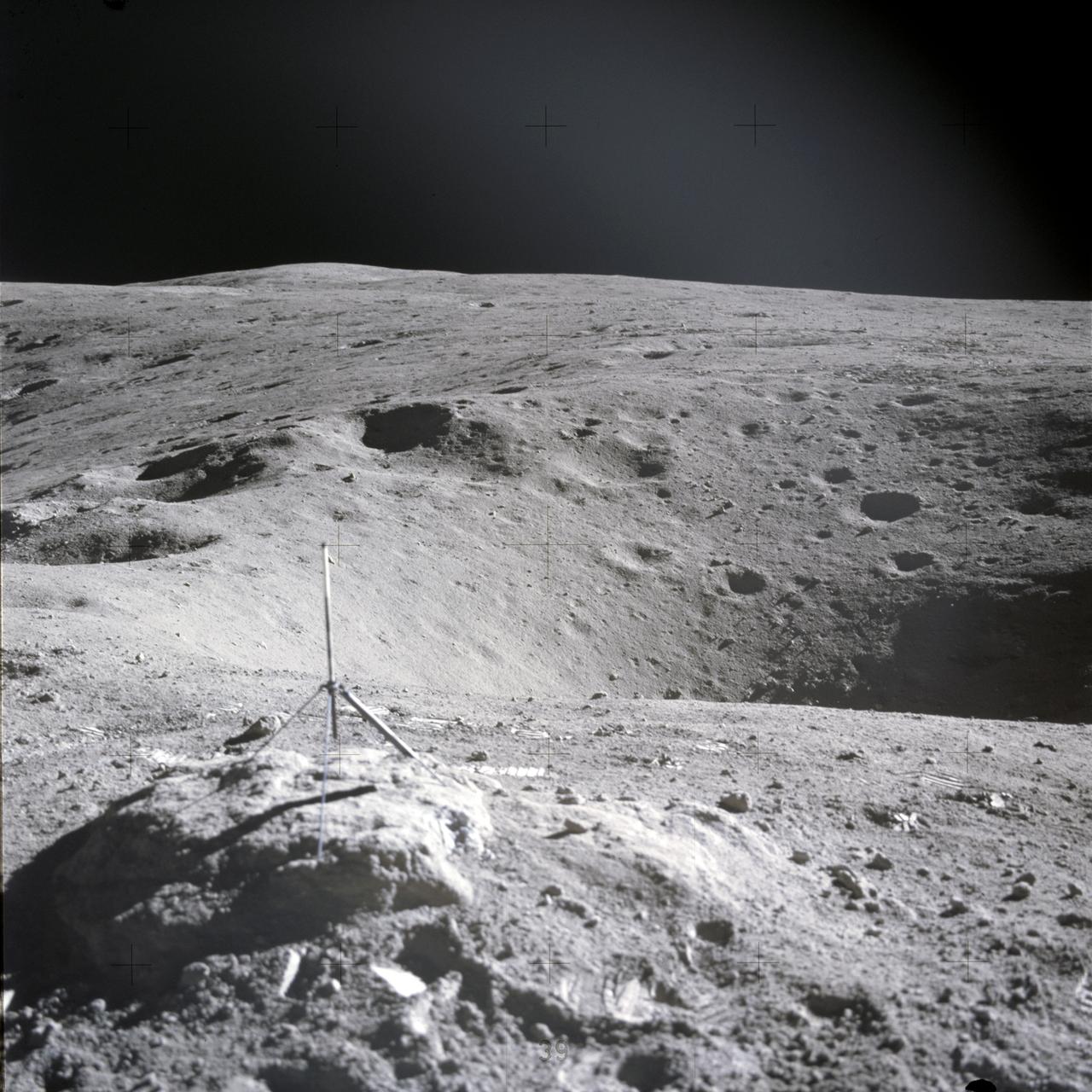
AS16-114-18421 (16-27 April 1972) --- This picture of the lunar surface was photographed by astronaut John W. Young during Apollo 16's first extravehicular activity (EVA) at EVA Station No 1. The instrument near the small crater's edge (foreground) is a gnomon. While astronauts Young, commander; and Charles M. Duke Jr., lunar module pilot; descended in the Apollo 16 Lunar Module (LM) "Orion" to explore the Descartes highlands landing site on the moon, astronaut Thomas K. Mattingly II, command module pilot, remained with the Command and Service Modules (CSM) "Casper" in lunar orbit.
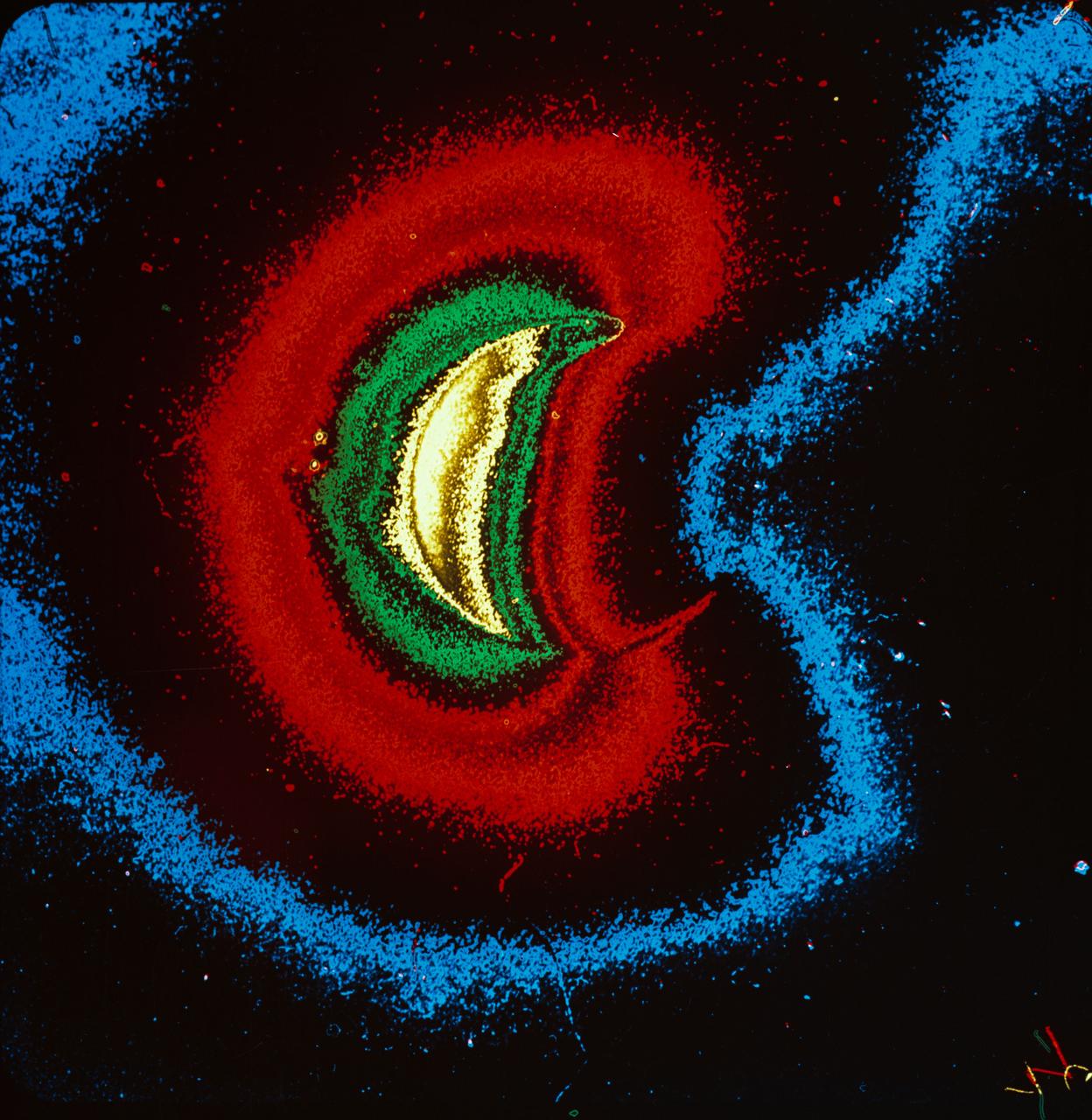
S72-40818 (21 April 1972) --- A color enhancement of an ultra-violet photograph of the geocorona, a halo of low density hydrogen around Earth. Sunlight is shining from the left, and the geocorona is brighter on that side. The UV camera was operated by astronaut John W. Young on the Apollo 16 lunar landing mission. It was designed and built at the Naval Research Laboratory, Washington, D.C. While astronauts Young, commander, and Charles M. Duke Jr., lunar module pilot, descended in the Lunar Module (LM) "Orion" to explore the Descartes highlands region of the moon, astronaut Thomas K. Mattingly II, command module pilot, remained with the Command and Service Modules (CSM) "Casper" in lunar orbit.
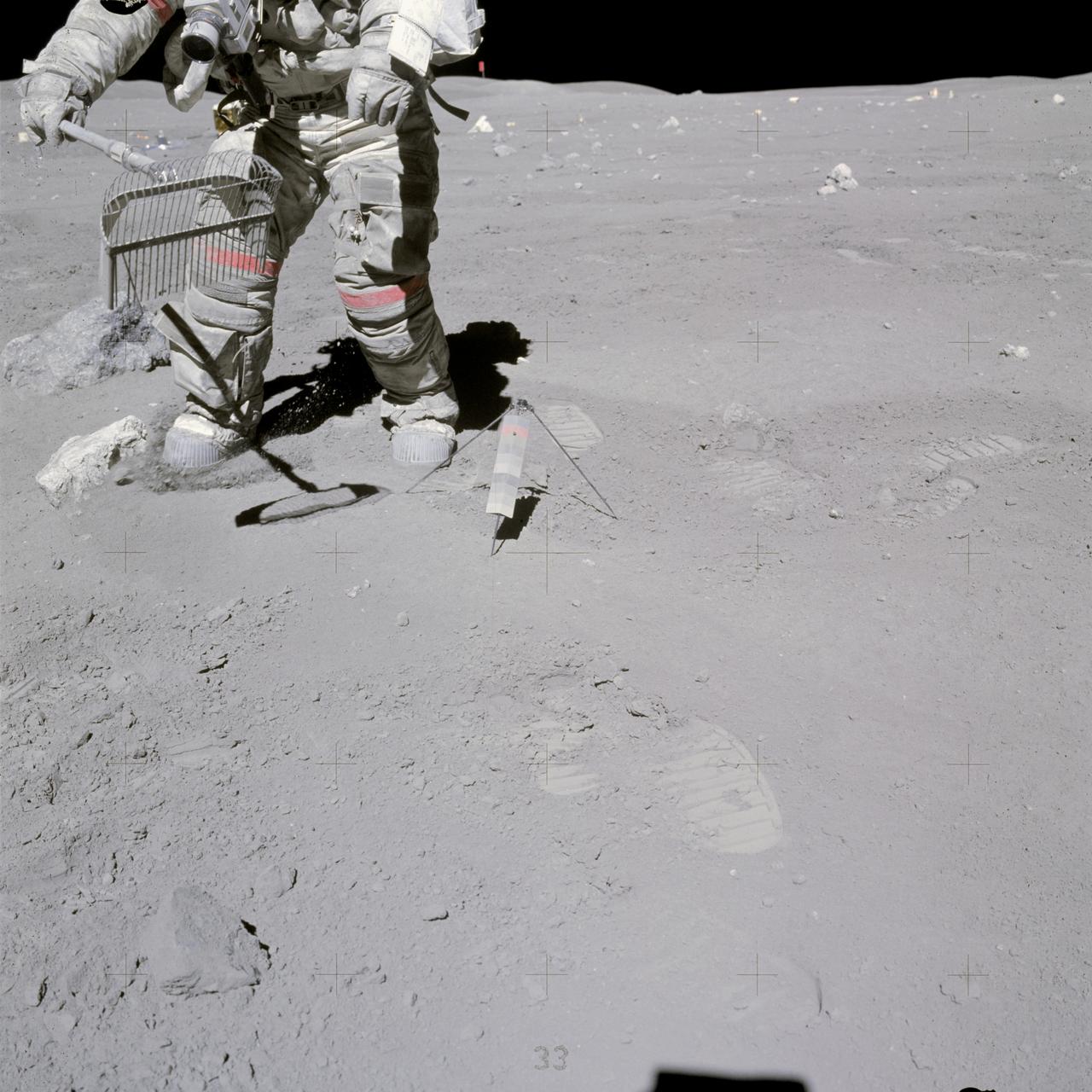
AS16-117-18826 (23 April 1972) --- Astronaut John W. Young collects samples at the North Ray Crater geological site during the mission's third and final Apollo 16 extravehicular activity (EVA). He has a rake in his hand, and the gnomon is near his foot. Note how soiled Young's Extravehicular Mobility Unit (EMU) is. While astronauts Young, commander; and Charles M. Duke Jr., lunar module pilot; descended in the Apollo 16 Lunar Module (LM) "Orion" to explore the Descartes highlands landing site on the moon, astronaut Thomas K. Mattingly II, command module pilot, remained with the Command and Service Modules (CSM) "Casper" in lunar orbit.
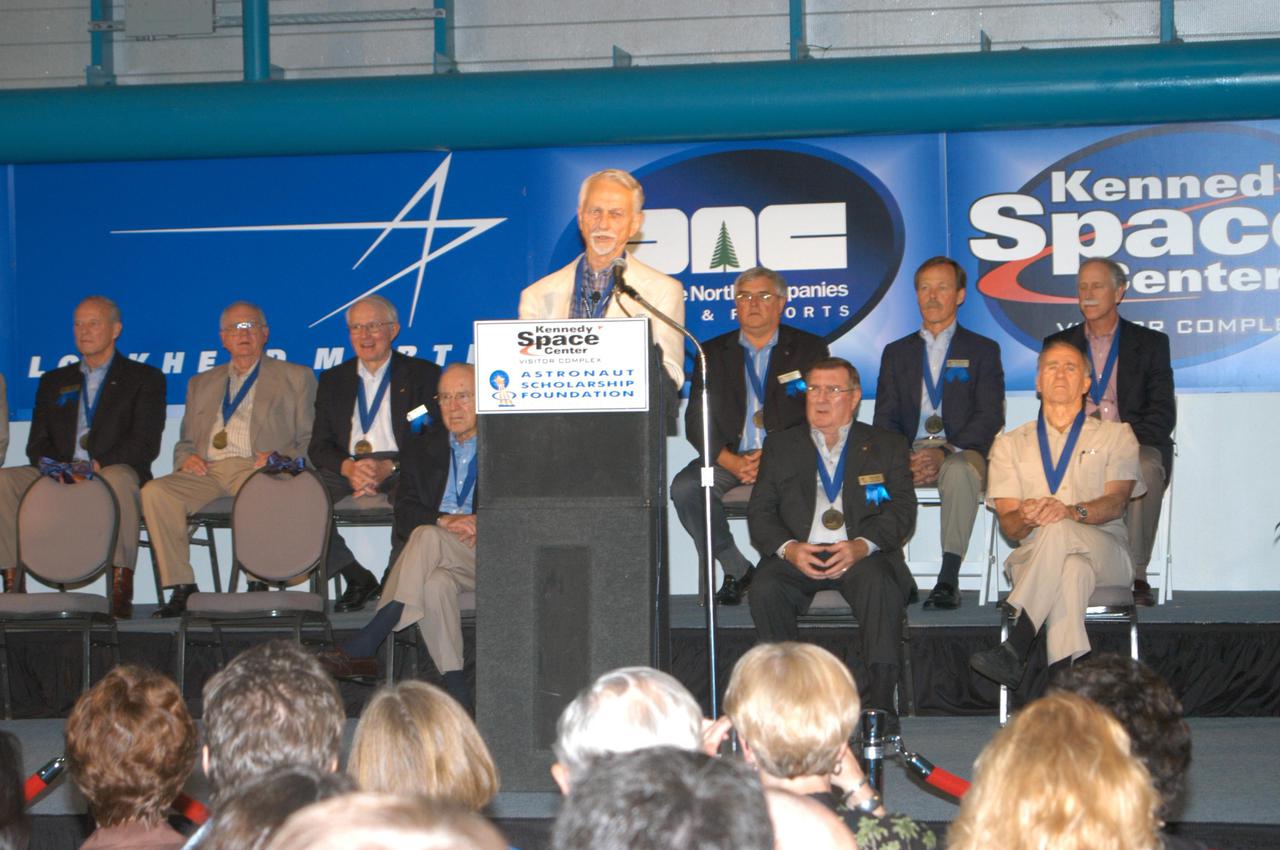
KENNEDY SPACE CENTER, FLA. - Owen Garriott, chairman of the Astronaut Hall of Fame, speaks to guests at the Induction Ceremony of three new additions to the Hall of Fame: Gordon Fullerton, Bruce McCandless and Joe Allen. Seated on stage are current Hall of Famers, from left in the back row, Charles Duke, Jack Lousma, Bill Pogue, Dan Brandenstein, Robert “Hoot” Gibson and Stephen Covey; in front row, Jim Lovell, Fred Haise and Vance Brand. Recognized for their individual flight accomplishments and contributions to the success and future success of the U.S. space program, this elite group of inductees is among only 60 astronauts to be honored in the Hall of Fame and the fourth group of Space Shuttle astronauts named.
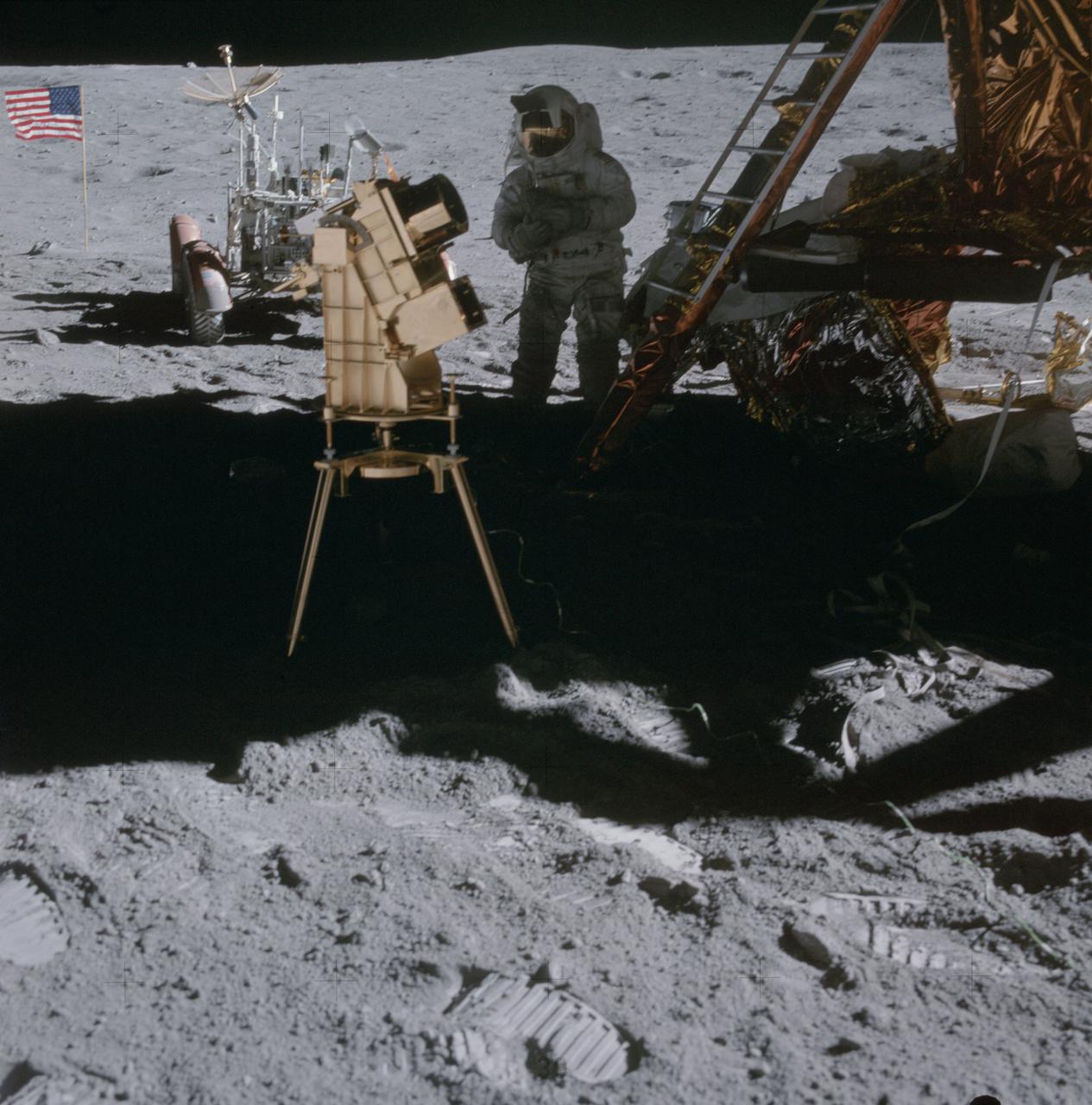
AS16-114-18439 (22 April 1972) --- Astronaut Charles M. Duke Jr., lunar module pilot, stands in the shadow of the Lunar Module (LM) behind the ultraviolet (UV) camera which is in operation. This photograph was taken by astronaut John W. Young, commander, during the mission's second extravehicular activity (EVA). The UV camera's gold surface is designed to maintain the correct temperature. The astronauts set the prescribed angles of azimuth and elevation (here 14 degrees for photography of the large Magellanic Cloud) and pointed the camera. Over 180 photographs and spectra in far-ultraviolet light were obtained showing clouds of hydrogen and other gases and several thousand stars. The United States flag and Lunar Roving Vehicle (LRV) are in the left background. While astronauts Young and Duke descended in the Apollo 16 Lunar Module (LM) "Orion" to explore the Descartes highlands landing site on the moon, astronaut Thomas K. Mattingly II, command module pilot, remained with the Command and Service Modules (CSM) "Casper" in lunar orbit.
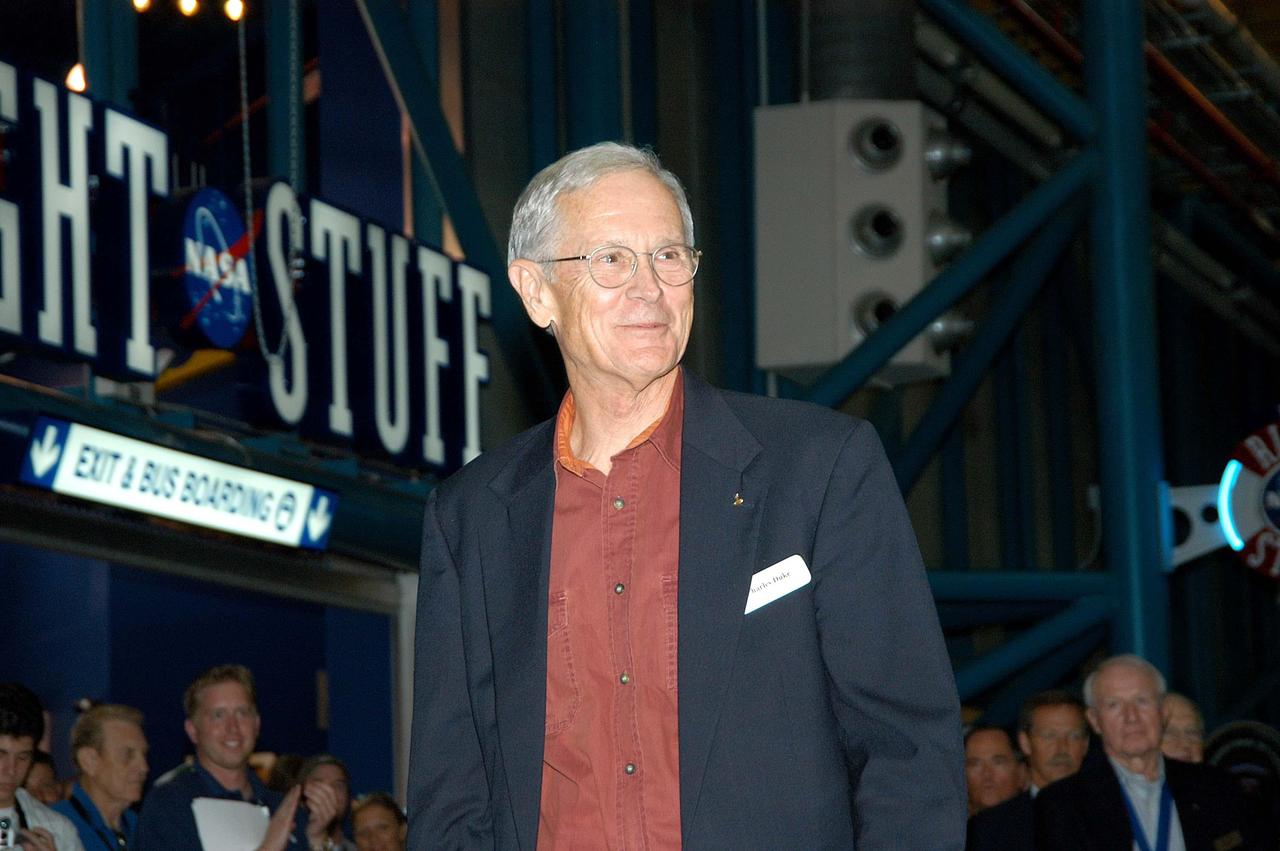
KENNEDY SPACE CENTER, FLA. -- Former astronaut Charles Duke receives a warm welcome as he is introduced as a previous inductee into the U.S. Astronaut Hall of Fame. He and other Hall of Fame members were present for the induction of five new space program heroes into the U.S. Astronaut Hall of Fame: Richard O. Covey, commander of the Hubble Space Telescope repair mission; Norman E. Thagard, the first American to occupy Russia’s Mir space station; the late Francis R. "Dick" Scobee, commander of the ill-fated 1986 Challenger mission; Kathryn D. Sullivan, the first American woman to walk in space; and Frederick D. Gregory, the first African-American to command a space mission and the current NASA deputy administrator. Duke explored the rugged highlands of the Moon’s Descartes region with John Young during the Apollo 16 mission in April 1972. The induction ceremony was held at the Apollo/Saturn V Center at KSC. The U.S. Astronaut Hall of Fame opened in 1990 to provide a place where space travelers could be remembered for their participation and accomplishments in the U.S. space program. The five inductees join 52 previously honored astronauts from the ranks of the Gemini, Apollo, Skylab, Apollo-Soyuz, and Space Shuttle programs.
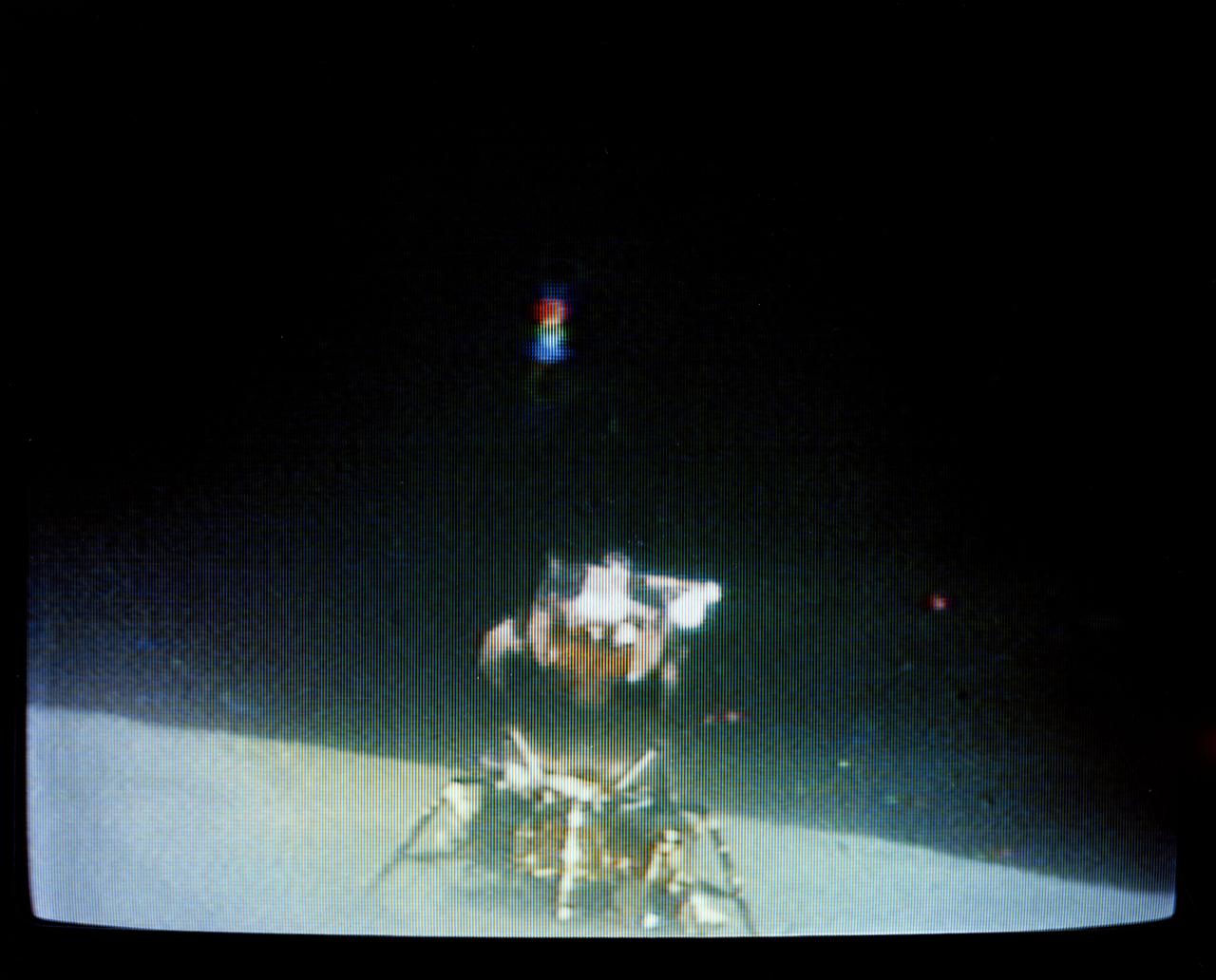
S72-35614 (23 April 1972) --- The Apollo 16 Lunar Module "Orion" ascent stage makes its liftoff from the lunar surface in this reproduction taken from a color television transmission made by the RCA color TV camera mounted on the Lunar Roving Vehicle (LRV). Remotely controlled from NASA's Mission Control Center (MCC) in Houston, the LRV-mounted camera made it possible for persons on Earth to watch the LM's launch from the moon. Liftoff occurred at 175:44 ground elapsed time, 7:26 p.m. (CST), April 23, 1972. The "Orion" ascent stage, with astronauts John W. Young and Charles M. Duke Jr. aboard, returned from the lunar surface to rejoin the Command and Service Modules (CSM) orbiting the moon. Astronaut Thomas K. (Ken) Mattingly II remained with the CSM in lunar orbit while Young and Duke descended in the LM to explore the Descartes landing site. The LM descent stage is used as a launching platform and remains behind on the moon.
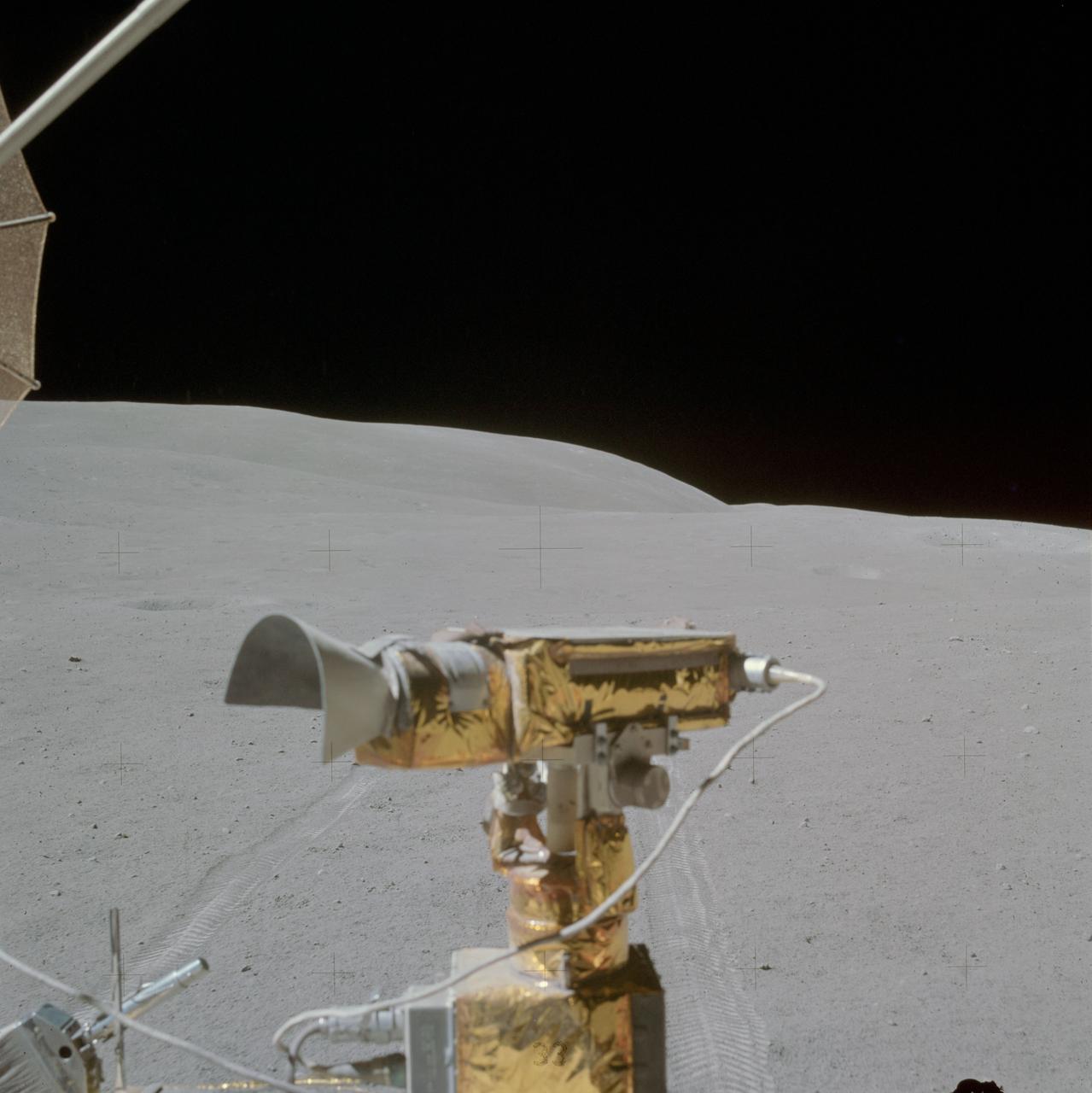
AS16-117-18754 (23 April 1972) --- A view of the smooth terrain in the general area of the North Ray Crater geological site, photographed by the Apollo 16 crew from the Lunar Roving Vehicle (LRV) shortly after leaving the immediate area of the geology site. The RCA color television camera is mounted on the front of the LRV and can be seen in the foreground, along with a small part of the high gain antenna, upper left. The tracks were made on the earlier trip to the North Ray Crater site. Astronaut Charles M. Duke Jr., lunar module pilot, exposed this view with his 70mm Hasselblad camera. Astronaut John W. Young, commander, said that this area was much smoother than the region around South Ray Crater. While astronauts Young and Duke descended in the Apollo 16 Lunar Module (LM) "Orion" to explore the Descartes highlands landing site on the moon, astronaut Thomas K. Mattingly II, command module pilot, remained with the Command and Service Modules (CSM) "Casper" in lunar orbit.

This view of a small, relatively fresh crater on Mars combines images from the left eye and right eye of the Panoramic Camera (Pancam) on NASA's Opportunity Mars rover, to appear three-dimensional when seen through blue-red glasses with the red lens on the left. The rover paused beside the crater in April 2017, during the 45th anniversary of the Apollo 16 mission to the moon. The rover team chose to call it "Orion Crater," after the Apollo 16 lunar module. The crater's diameter is about 90 feet (27 meters). From the small amount of erosion or filling that Orion Crater has experienced, its age is estimated at no more than 10 million years. It lies on the western rim of Endeavour Crater. For comparison, Endeavor is about 14 miles (22 kilometers) in diameter and more than 3.6 billion years old. The component images were taken on April 26, 2017, during the 4,712th Martian day, or sol, of Opportunity's work on Mars. Apollo 16 astronauts John Young and Charles Duke flew in the Orion lunar module to and from the first human landing in the lunar highlands while Ken Mattingly orbited the moon in the command module, Casper. On the moon, Young and Duke investigated Plum Crater, which is approximately the same size as Mars' Orion Crater. https://photojournal.jpl.nasa.gov/catalog/PIA21706
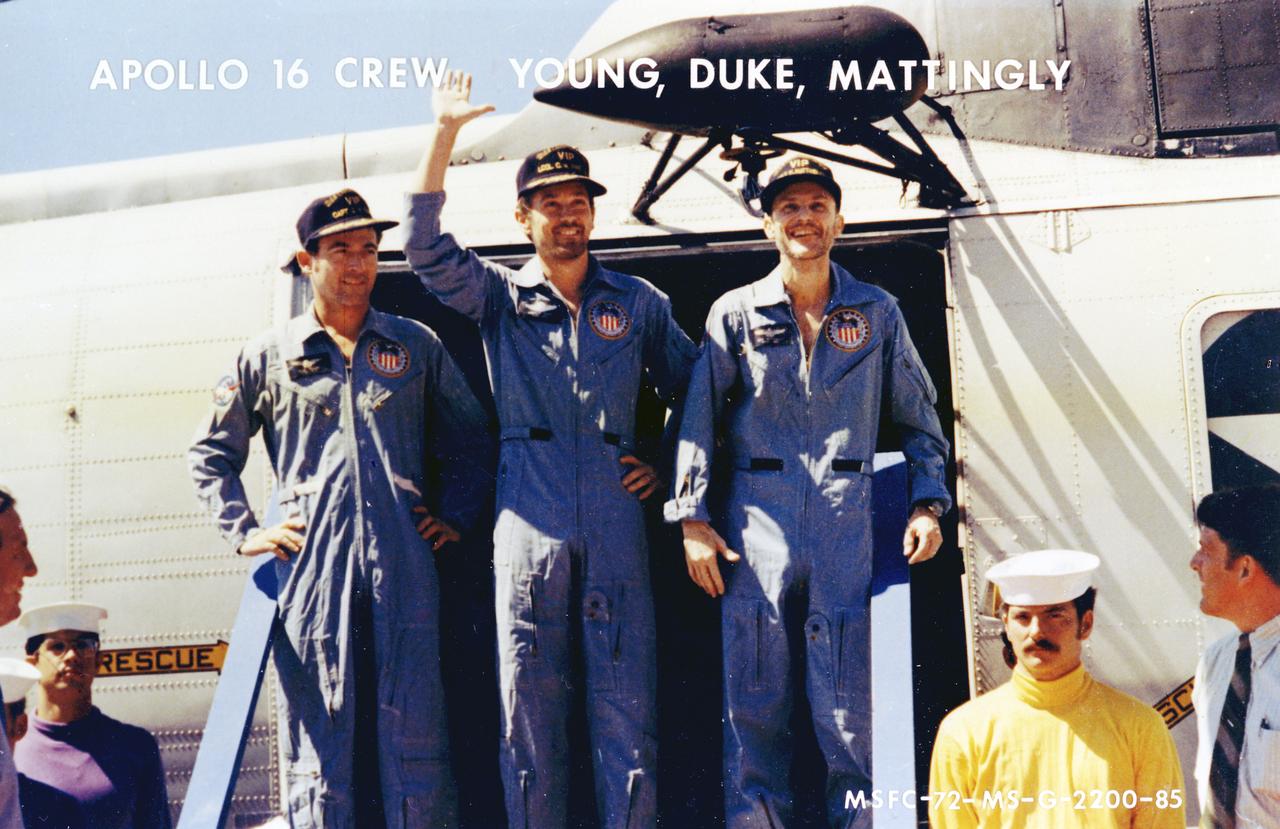
The Apollo 16 Command Module splashed down in the Pacific Ocean on April 27, 1972 after an 11-day moon exploration mission. The 3-man crew is shown here aboard the rescue ship, USS Horton. From left to right are: Mission Commander John W. Young, Lunar Module pilot Charles M. Duke, and Command Module pilot Thomas K. Mattingly II. The sixth manned lunar landing mission, the Apollo 16 (SA-511) lifted off on April 16, 1972. The Apollo 16 mission continued the broad-scale geological, geochemical, and geophysical mapping of the Moon’s crust, begun by the Apollo 15, from lunar orbit. This mission marked the first use of the Moon as an astronomical observatory by using the ultraviolet camera/spectrograph which photographed ultraviolet light emitted by Earth and other celestial objects. The Lunar Roving Vehicle, developed by the Marshall Space Flight Center, was also used.
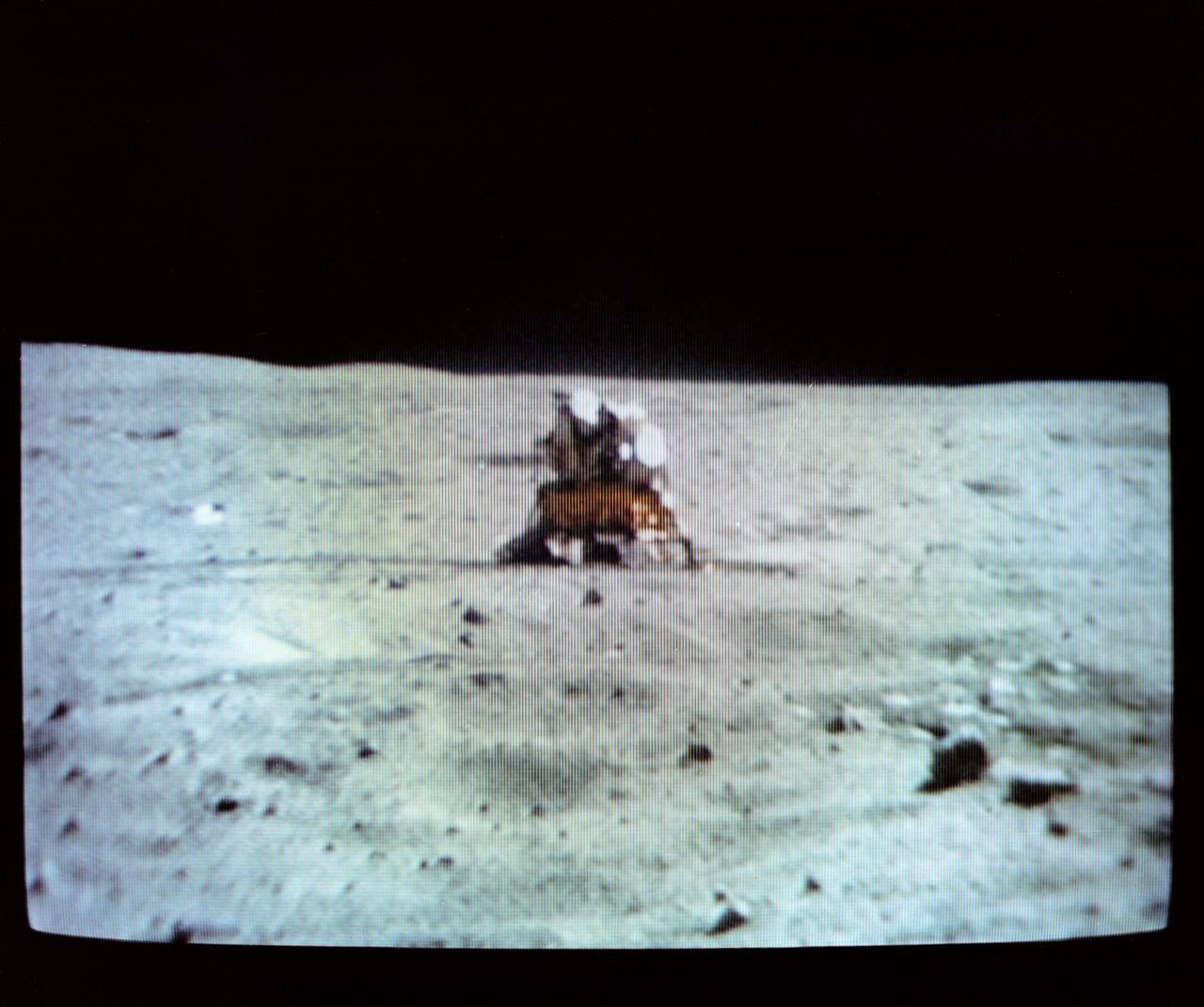
S72-35612 (22 April 1972) --- The Apollo 16 Lunar Module (LM) "Orion" dominates the lunar scene at the Descartes landing site, as seen in the reproduction taken from a color television transmission made by the TV camera mounted on the Lunar Roving Vehicle (LRV). Astronauts John W. Young, commander; and Charles M. Duke Jr., lunar module pilot; descended in the Apollo 16 LM to explore the Descartes highlands landing site on the moon. Astronaut Thomas K. Mattingly II, command module pilot, remained with the Command and Service Modules (CSM) "Casper" in lunar orbit. Note U.S. flag deployed on the left. This picture was made during the second Apollo 16 extravehicular activity (EVA).
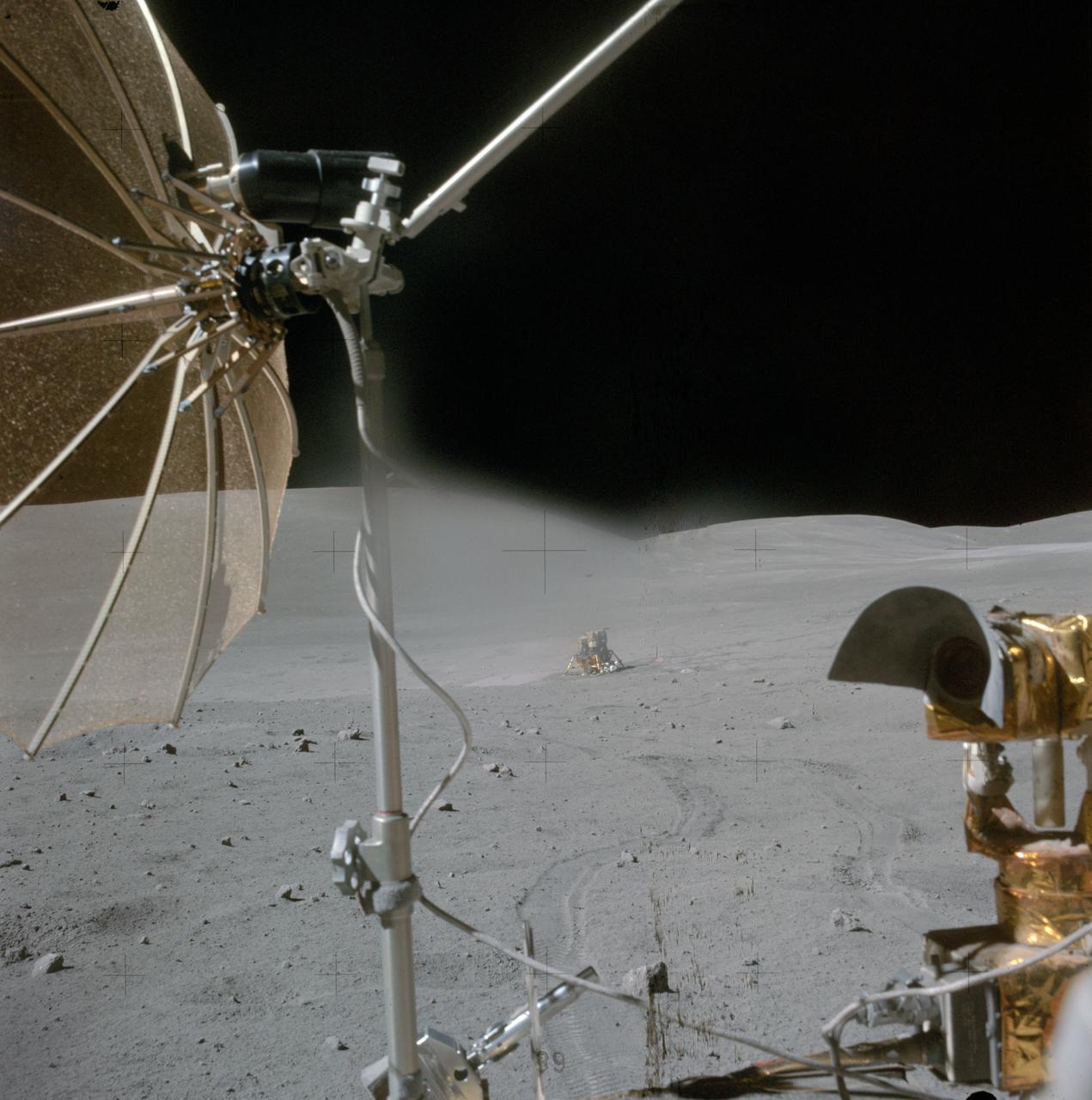
AS16-116-18678 (23 April 1972) --- A view from the moving Apollo 16 Lunar Roving Vehicle (LRV) as the crew men headed "home" at the end of the mission's third and final extravehicular activity (EVA). Astronaut John W. Young called attention to the series of block fields between the Lunar Module (LM) and LRV. Young also noted that, "The LM was obviously sitting in the only flat place around." Stone Mountain stretches about half way across the background. The high gain antenna and the RCA television camera on the LRV are in the foreground. While astronauts Young, commander; and Charles M. Duke Jr., lunar module pilot; descended in the Apollo 16 LM "Orion" to explore the Descartes highlands landing site on the moon, astronaut Thomas K. Mattingly II, command module pilot, remained with the Command and Service Modules (CSM) "Casper" in lunar orbit.
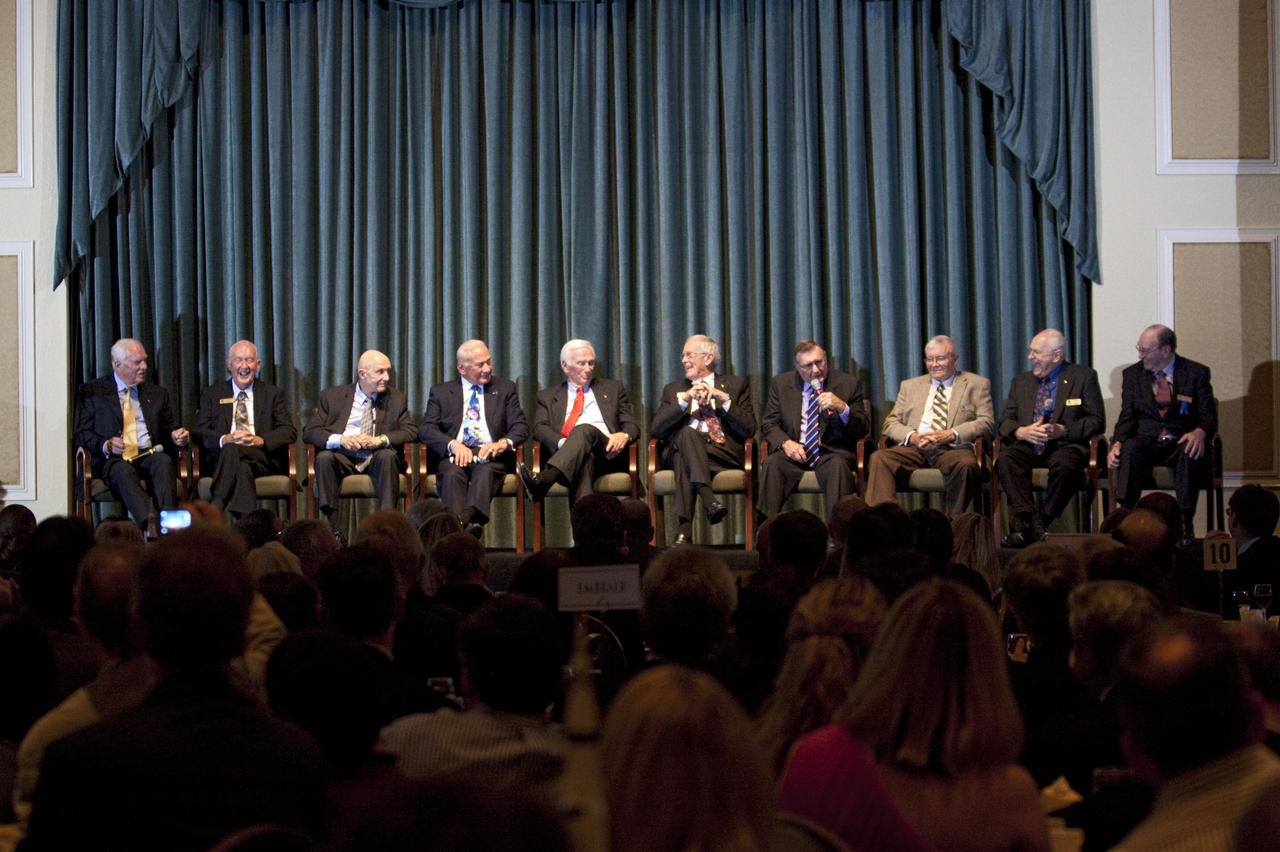
CAPE CANAVERAL, Fla. – Apollo astronauts, from the left, David Scott, James McDivitt, Thomas Stafford, Buzz Aldrin, Eugene Cernan, Charles Duke, Richard Gordon, Fred Haise, Alan Bean and Edgar Mitchell speak to guests gathered for the Astronaut Scholarship Foundation's dinner at the Radisson Resort at the Port in Cape Canaveral celebrating the 40th anniversary of Apollo 17. The gala commemorating the anniversary of Apollo 17 included mission commander Eugene Cernan and other astronauts who flew Apollo missions. Launched Dec. 7, 1972, Cernan and lunar module pilot Harrison Schmitt landed in the moon's Taurus-Littrow highlands while command module pilot Ronald Evans remained in lunar orbit operating a scientific instrument module. For more information, visit http://www-pao.ksc.nasa.gov/history/apollo/apollo-17/apollo-17.htm Photo credit: NASA/Kim Shiflett
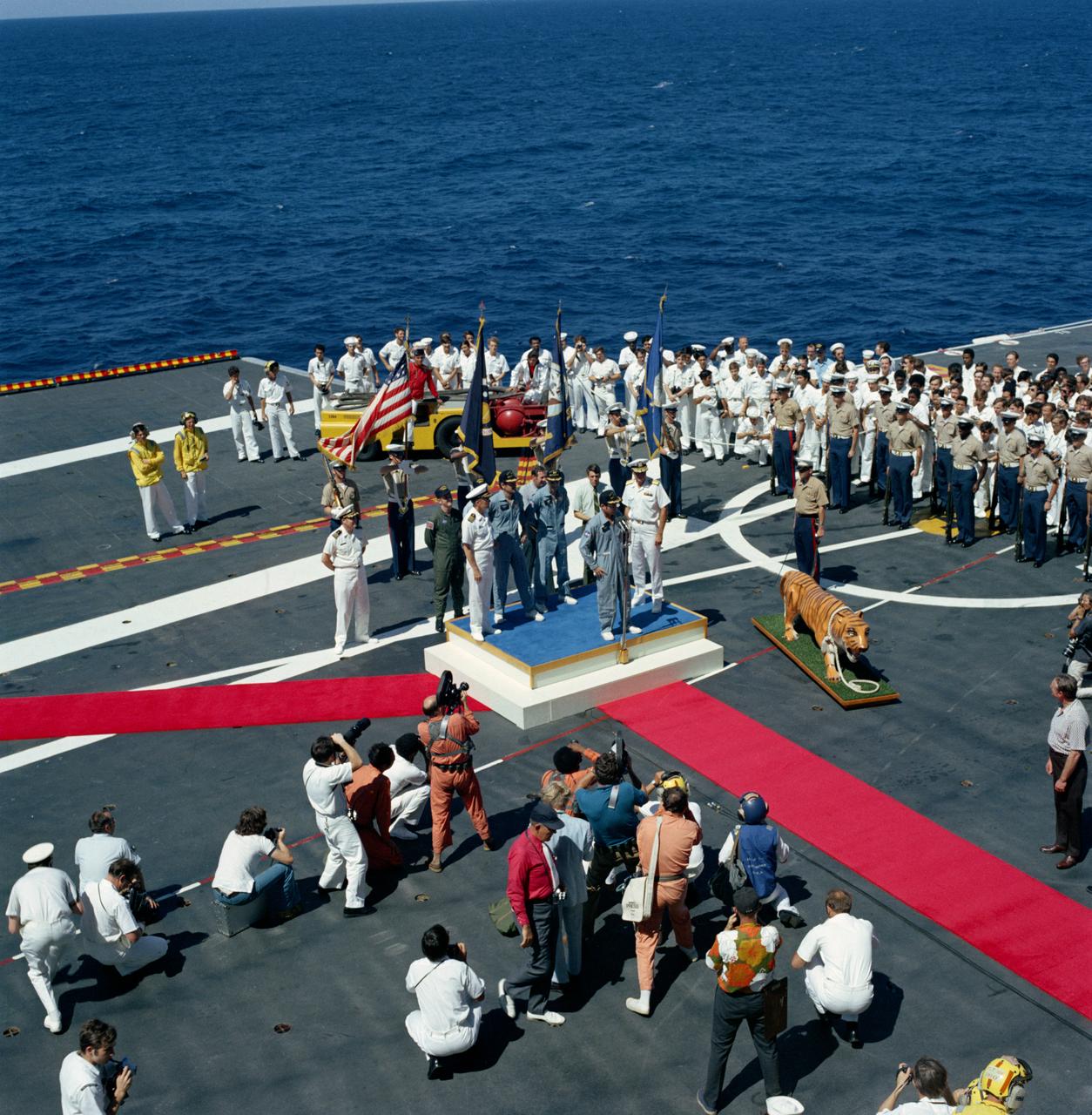
S72-36262 (27 April 1972) --- A high-angle view of the Apollo 16 welcoming aboard ceremonies on the deck of the prime recovery ship, USS Ticonderoga. It was soon after the splashdown of the Apollo 16 Command Module (CM) in the central Pacific Ocean approximately 215 miles southeast of Christmas Island. Astronaut John W. Young, commander, is standing at the microphone. Standing behind Young are astronaut Charles M. Duke Jr. (Left), lunar module pilot; and astronaut Thomas K. Mattingly II, command module pilot. The splashdown occurred at 290:37:06 ground elapsed time, 1:45:06 p.m. (CST), Thursday, April 27, 1972. The coordinates were 00:43.2 degrees south latitude and 156:11.4 degrees west longitude. The three crew members were picked up by helicopter and flown to the deck of the USS Ticonderoga.
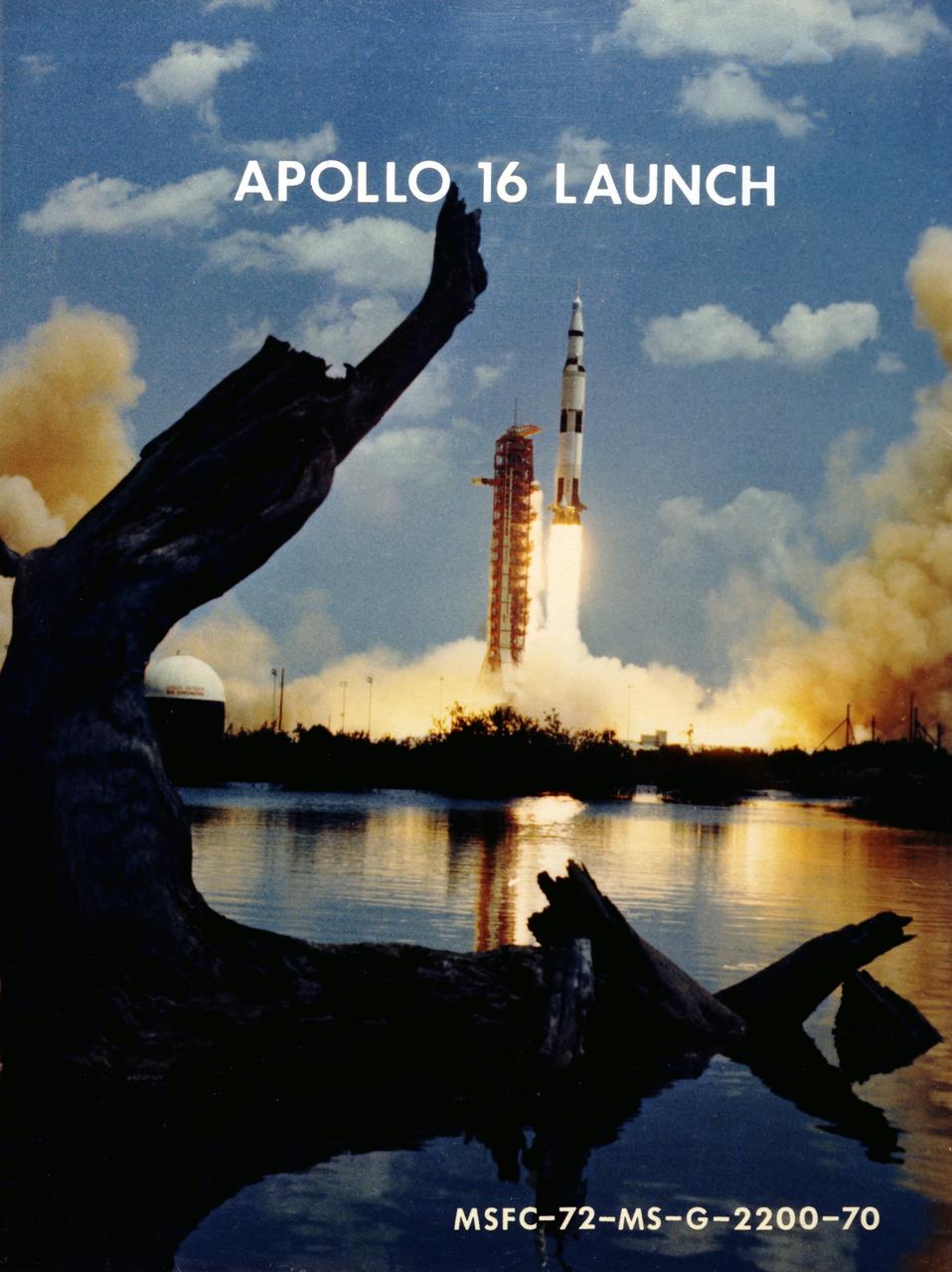
The sixth manned lunar landing mission, the Apollo 16 (SA-511), carrying three astronauts: Mission Commander John W. Young, Command Module pilot Thomas K. Mattingly II, and Lunar Module pilot Charles M. Duke, lifted off on April 16, 1972. The Apollo 16 mission continued the broad-scale geological, geochemical, and geophysical mapping of the Moon’s crust, begun by the Apollo 15, from lunar orbit. This mission marked the first use of the Moon as an astronomical observatory by using the ultraviolet camera/spectrograph which photographed ultraviolet light emitted by Earth and other celestial objects. The Lunar Roving Vehicle, developed by the Marshall Space Flight Center, was also used. The mission ended on April 27, 1972.
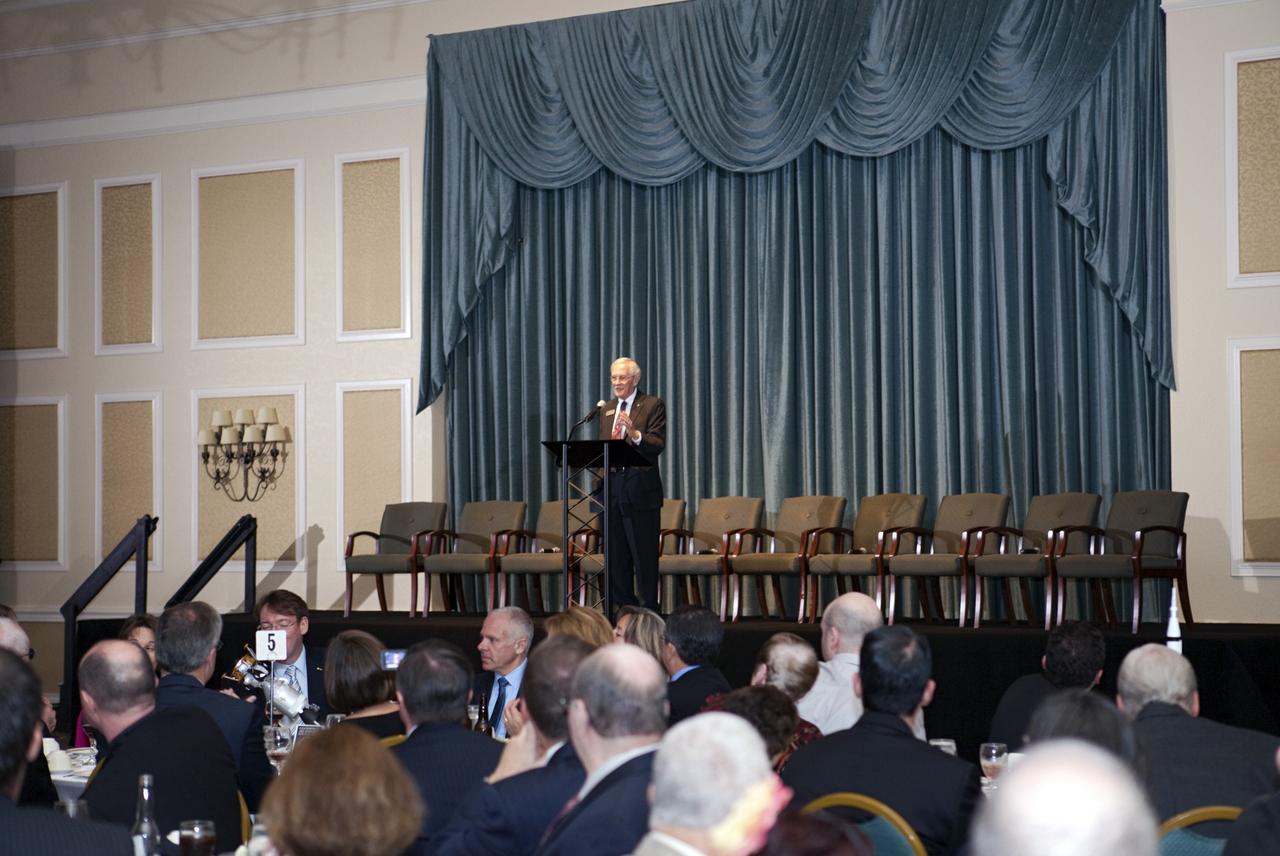
CAPE CANAVERAL, Fla. – Charles Duke, chairman of the board of directors for the Astronaut Scholarship Foundation welcomes guests who have gathered for the organization's dinner at the Radisson Resort at the Port in Cape Canaveral celebrating the 40th anniversary of Apollo 17. The gala commemorating the anniversary of Apollo 17 included mission commander Eugene Cernan and other astronauts who flew Apollo missions. Launched Dec. 7, 1972, Cernan and lunar module pilot Harrison Schmitt landed in the moon's Taurus-Littrow highlands while command module pilot Ronald Evans remained in lunar orbit operating a scientific instrument module. For more information, visit http://www-pao.ksc.nasa.gov/history/apollo/apollo-17/apollo-17.htm Photo credit: NASA/Kim Shiflett
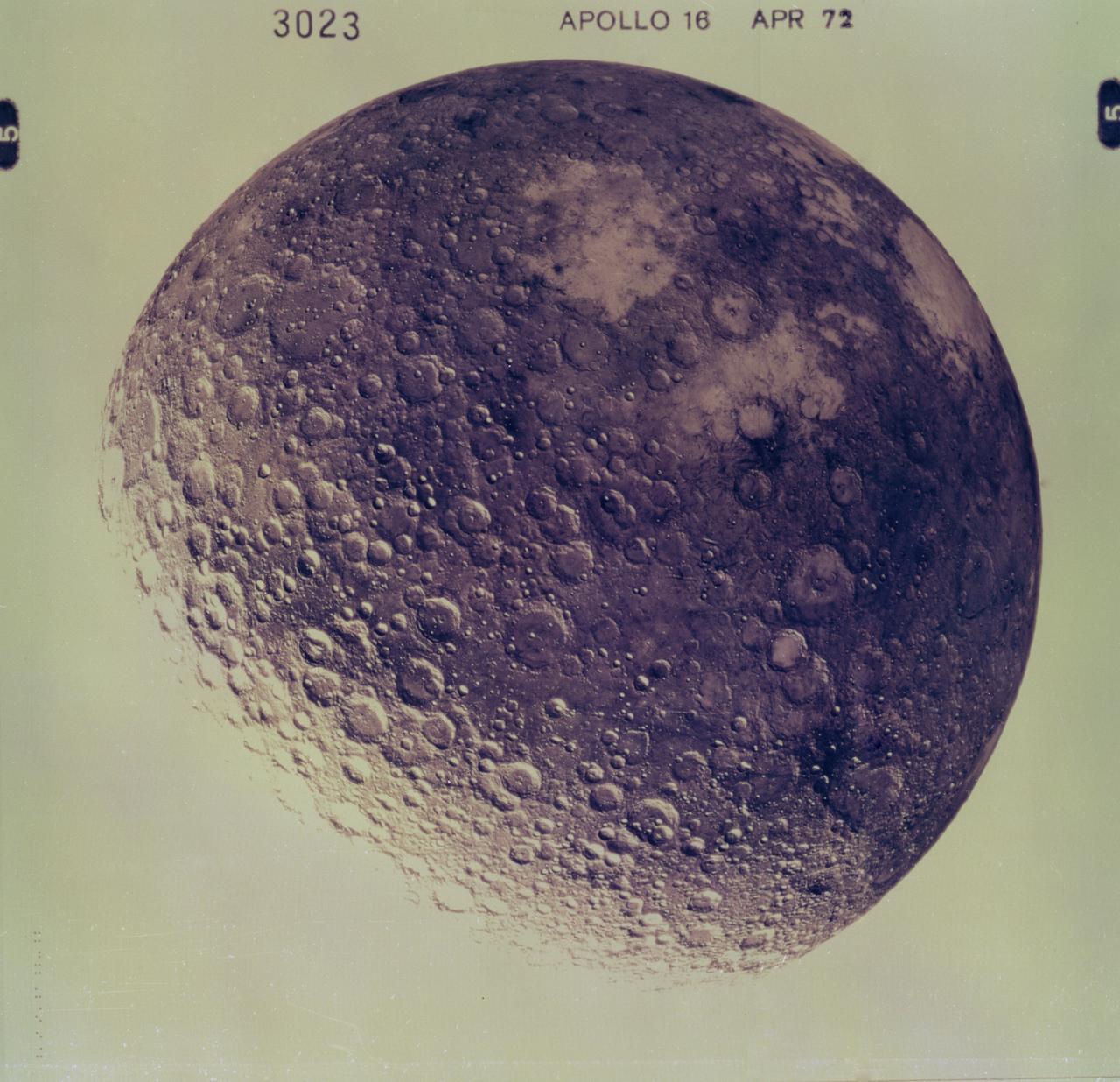
This view of the back side of the Moon was captured by the Apollo 16 mission crew. The sixth manned lunar landing mission, the Apollo 16 (SA-511), carrying three astronauts: Mission Commander John W. Young, Command Module pilot Thomas K. Mattingly II, and Lunar Module pilot Charles M. Duke, lifted off on April 16, 1972. The Apollo 16 continued the broad-scale geological, geochemical, and geophysical mapping of the Moon’s crust, begun by the Apollo 15, from lunar orbit. This mission marked the first use of the Moon as an astronomical observatory by using the ultraviolet camera/spectrograph which photographed ultraviolet light emitted by Earth and other celestial objects. The Lunar Roving Vehicle, developed by the Marshall Space Flight Center, was also used. The mission ended on April 27, 1972.
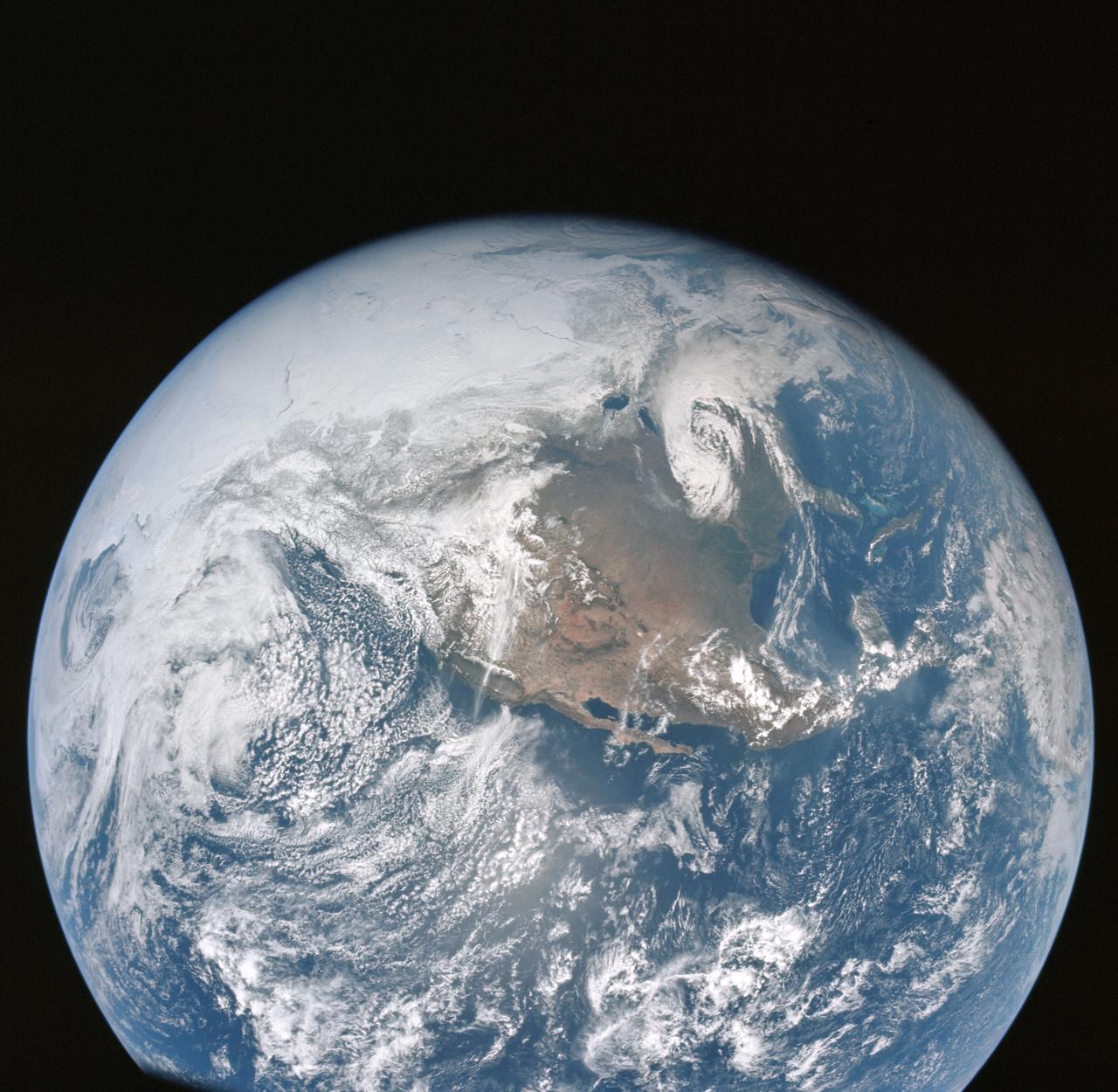
AS16-118-18880 (16 April 1972) --- A good view of Earth photographed about one hour after trans-lunar injection on April 16, 1972. Although there is much cloud cover, the United States in large part, most of Mexico and some of Central America are clearly visible. Note the Great Lakes (Michigan and Superior) and the Bahama Banks (note different shade of blue below Florida). While astronauts John W. Young, commander, and Charles M. Duke Jr., lunar module pilot, descended in the Lunar Module (LM) "Orion" to explore the Descartes highlands region of the moon, astronaut Thomas K. (Ken) Mattingly II, command module pilot, remained with the Command and Service Modules (CSM) "Casper" in lunar orbit.
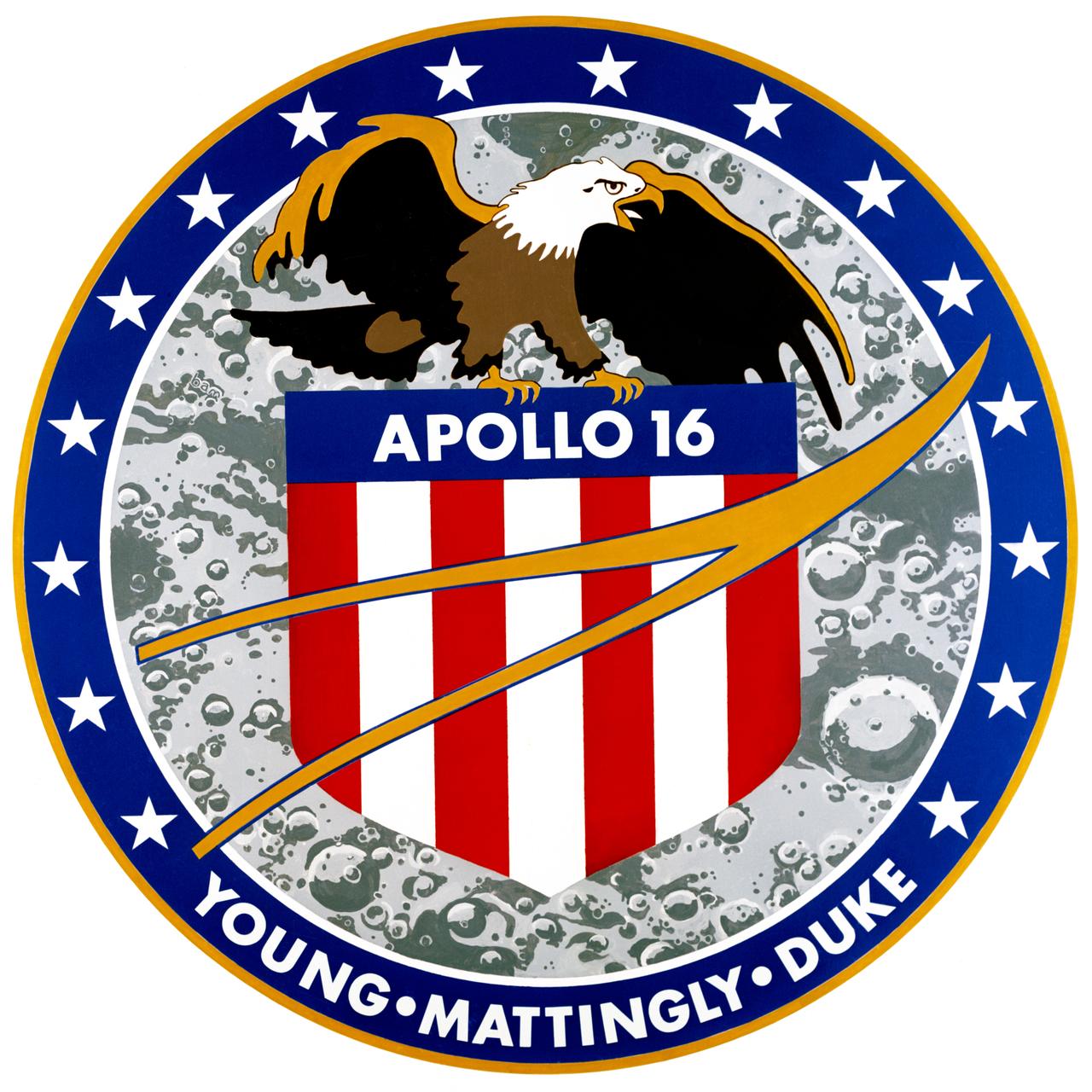
S71-56246 (November 1971) --- The Apollo 16 crew patch is dominated by an eagle perched atop a red, white and blue shield a superimposed on a lunar scene, surrounded by a blue circle of 16 stars with the crew's surnames completing the bottom are of the circle. Across the face of the shield is a gold symbol of flight outlined in blue, similar to that on the National Aeronautics and Space Administration (NASA) agency seal and insignia. The design was created by a NASA artist from ideas submitted by the three crew men: astronauts John W. Young, commander; Thomas K. Mattingly II, command module pilot; and Charles M. Duke Jr., lunar module pilot. This is the official Apollo 16 emblem, a property of the government of the United States. It has been authorized only for use by the astronauts. Its reproduction in any form other than in news, information and education media is not authorized without approval. Unauthorized use is subject to the provisions of Title 18, U.S. Code, Section 701.
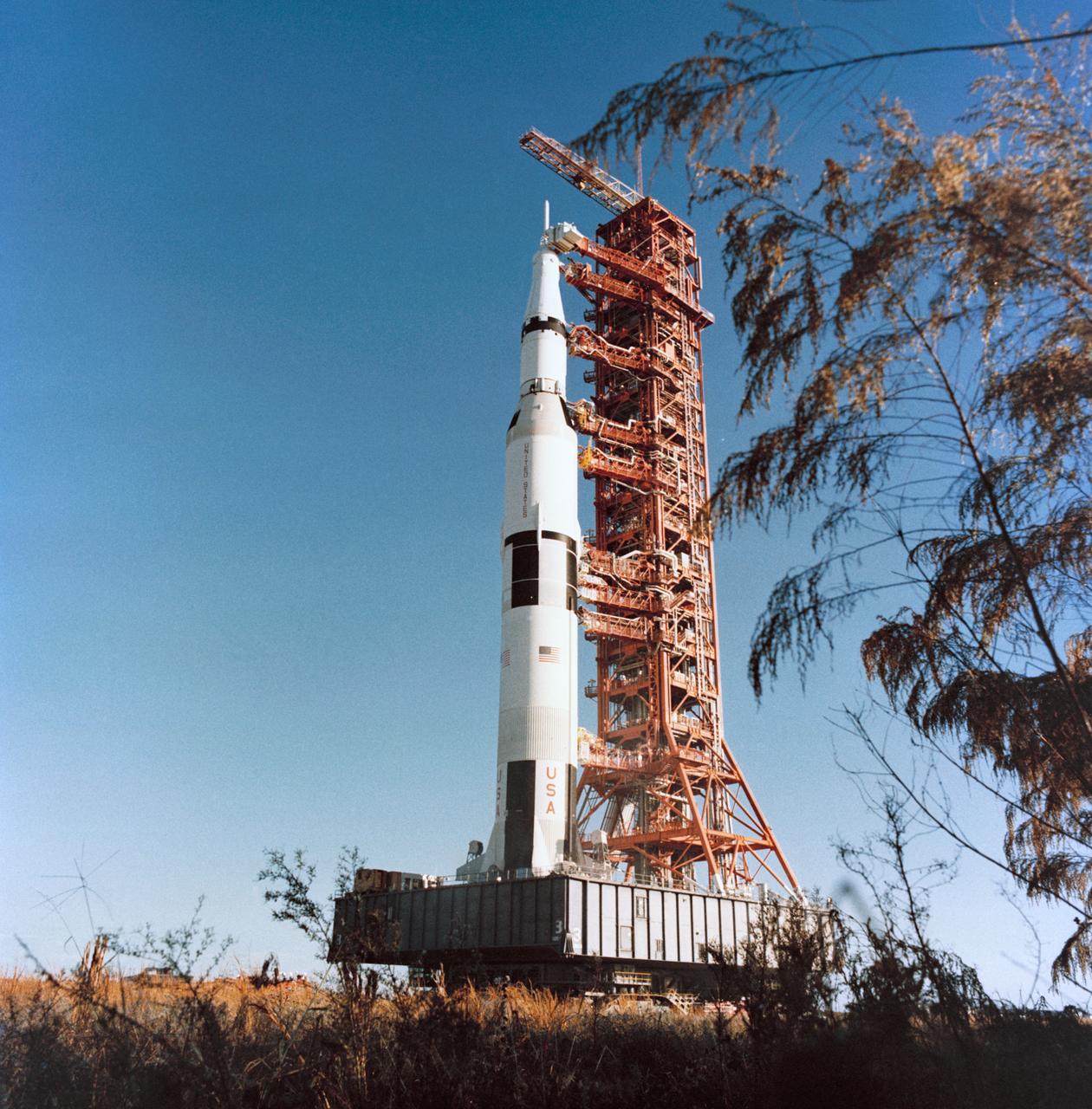
S72-19794 (13 Dec. 1971) --- A ground-level view showing the tall Apollo 16 (Spacecraft 113/Lunar Module 11/Saturn 511) space vehicle at the Kennedy Space Center's (KSC) Launch Complex 39 being moved from the Vehicle Assembly Building (VAB) toward Pad A. The Saturn V stack and its mobile launch tower are atop a huge crawler-transporter. The prime crew men of the scheduled Apollo 16 lunar landing mission are astronauts John W. Young, Apollo 16 lunar landing mission are astronauts John W. Young, commander; Thomas K. Mattingly II, command module pilot; and Charles M. Duke Jr., lunar module pilot.
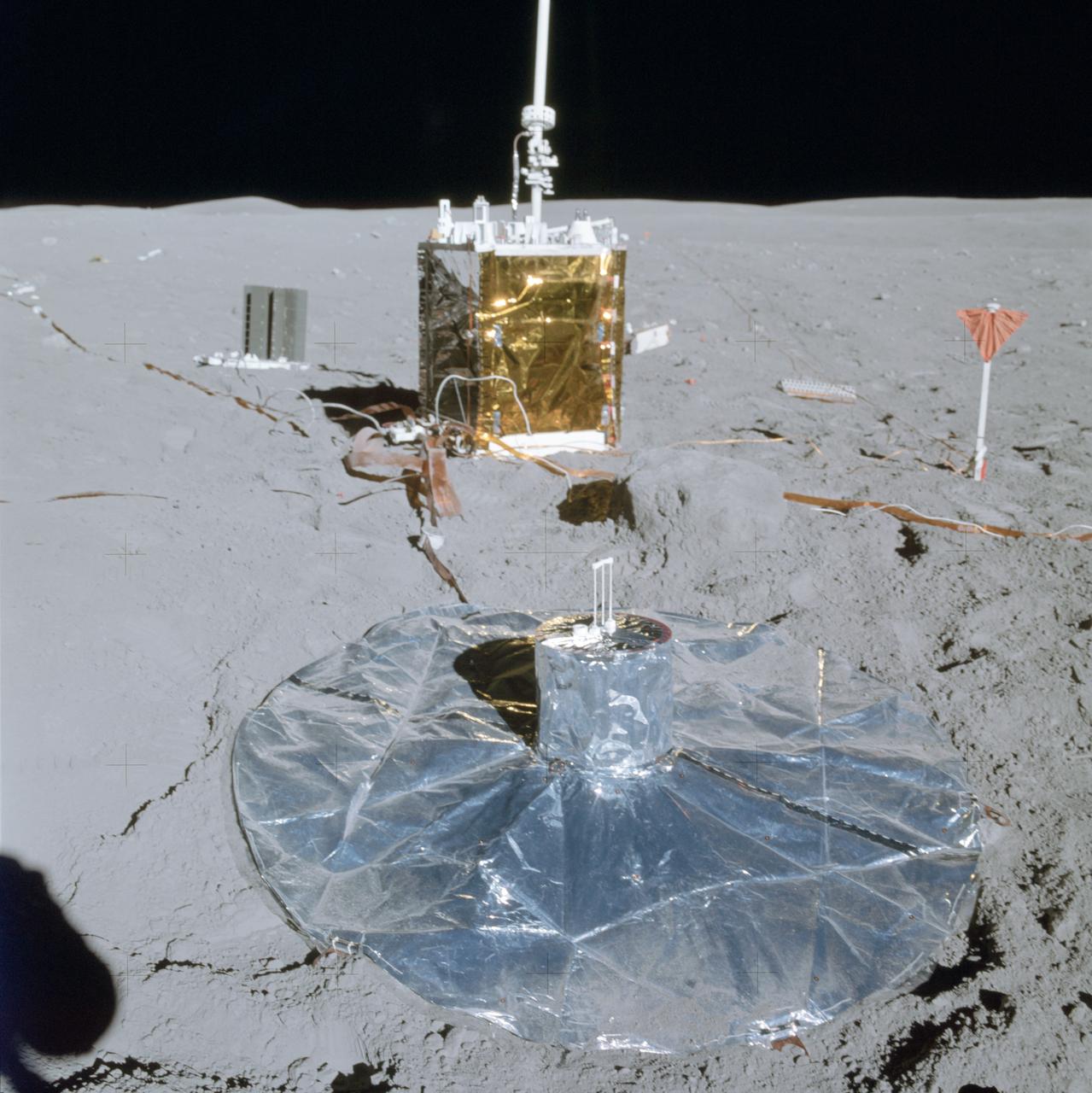
AS16-113-18347 (21 April 1972) --- A partial view of the Apollo 16 Apollo Lunar Surface Experiments Package (ALSEP) in deployed configuration on the lunar surface as photographed during the mission's first extravehicular activity (EVA), on April 21, 1972. The Passive Seismic Experiment (PSE) is in the foreground center; Central Station (C/S) is in center background, with the Radioisotope Thermoelectric Generator (RTG) to the left. One of the anchor flags for the Active Seismic Experiment (ASE) is at right. While astronauts John W. Young, commander; and Charles M. Duke Jr., lunar module pilot; descended in the Apollo 16 Lunar Module (LM) "Orion" to explore the Descartes highlands landing site on the moon, astronaut Thomas K. Mattingly II, command module pilot, remained with the Command and Service Modules (CSM) "Casper" in lunar orbit.
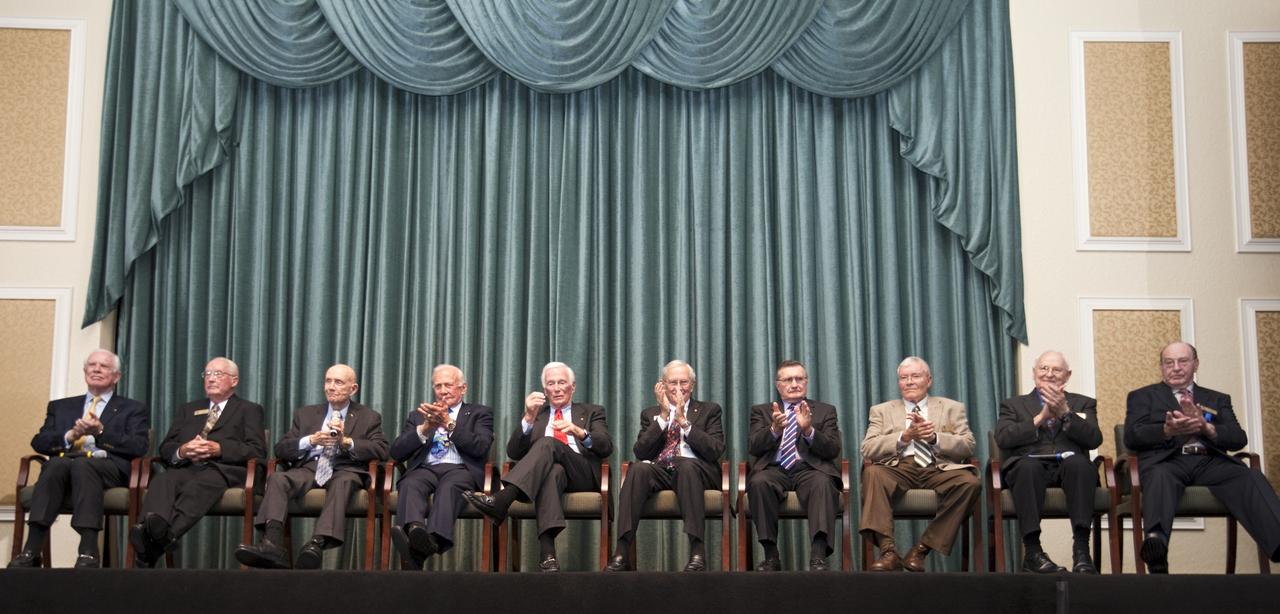
CAPE CANAVERAL, Fla. – Apollo astronauts, from the left, David Scott, James McDivitt, Thomas Stafford, Buzz Aldrin, Eugene Cernan, Charles Duke, Richard Gordon, Fred Haise, Alan Bean and Edgar Mitchell speak to guests gathered for the Astronaut Scholarship Foundation's dinner at the Radisson Resort at the Port in Cape Canaveral celebrating the 40th anniversary of Apollo 17. The gala commemorating the anniversary of Apollo 17 included mission commander Eugene Cernan and other astronauts who flew Apollo missions. Launched Dec. 7, 1972, Cernan and lunar module pilot Harrison Schmitt landed in the moon's Taurus-Littrow highlands while command module pilot Ronald Evans remained in lunar orbit operating a scientific instrument module. For more information, visit http://www-pao.ksc.nasa.gov/history/apollo/apollo-17/apollo-17.htm Photo credit: NASA/Kim Shiflett
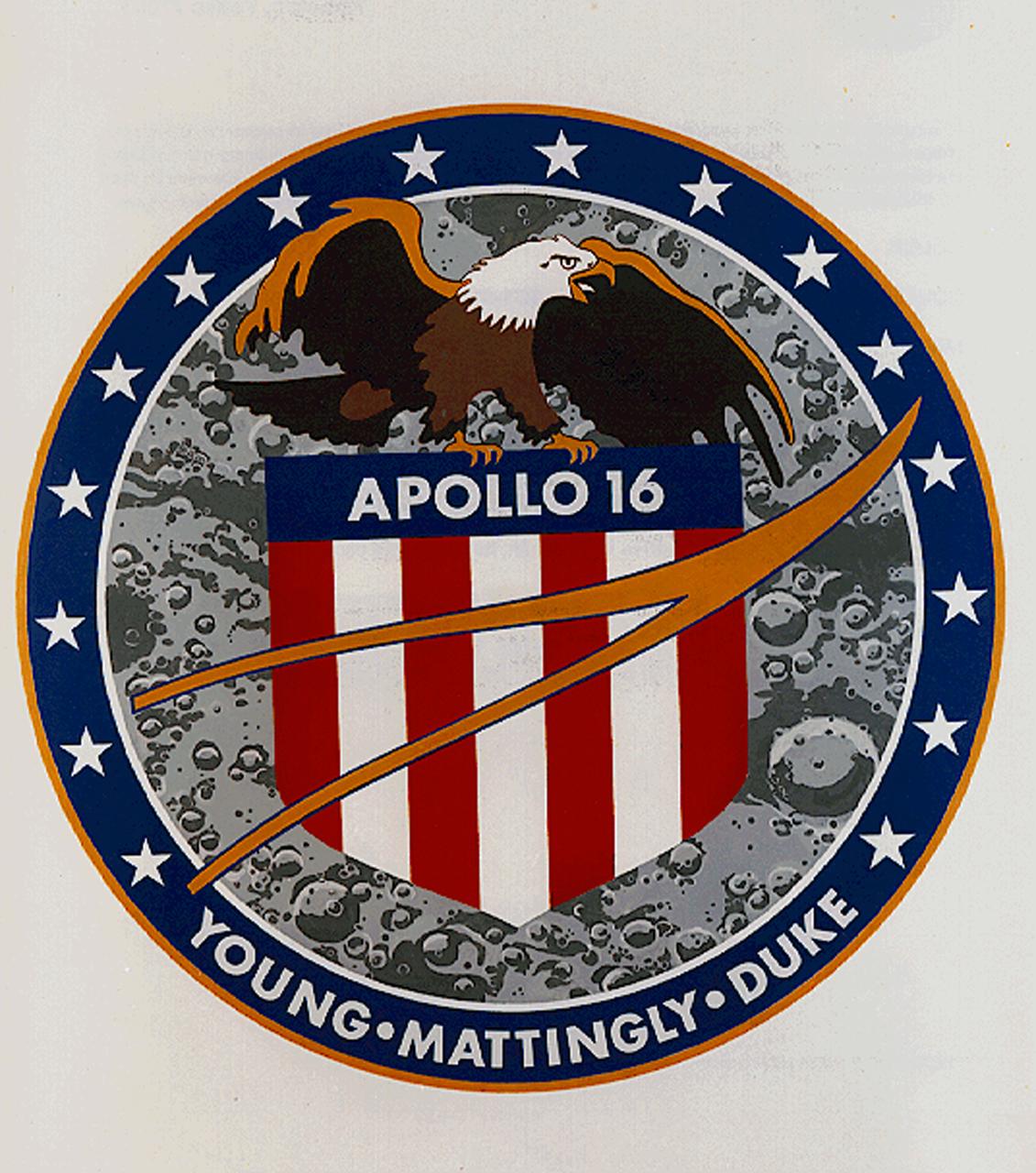
The Apollo 16 crew patch is dominated by an eagle perched atop a red, white, and blue shield superimposed on a lunar surface scene. Similar to that on the NASA agency shield and insignia, there is a gold symbol of flight outlined in blue across the face of the shield. The border surrounding the shield is a circle of 16 stars completed by the the crew’s surnames at the bottom. The patch was designed from ideas submitted by the Apollo 16 3-man crew: John W. Young, Mission Commander: Thomas K. Mattingly, Command Module pilot; and Charles M. Duke, Lunar Module pilot. (Note: This is the official Apollo 16 emblem, a property of the United States government. Its reproduction in any form other than in news, information, and education media is not authorized without approval. Unauthorized use is subject to the provisions of Title 18, U.S. Code, Section 701.)
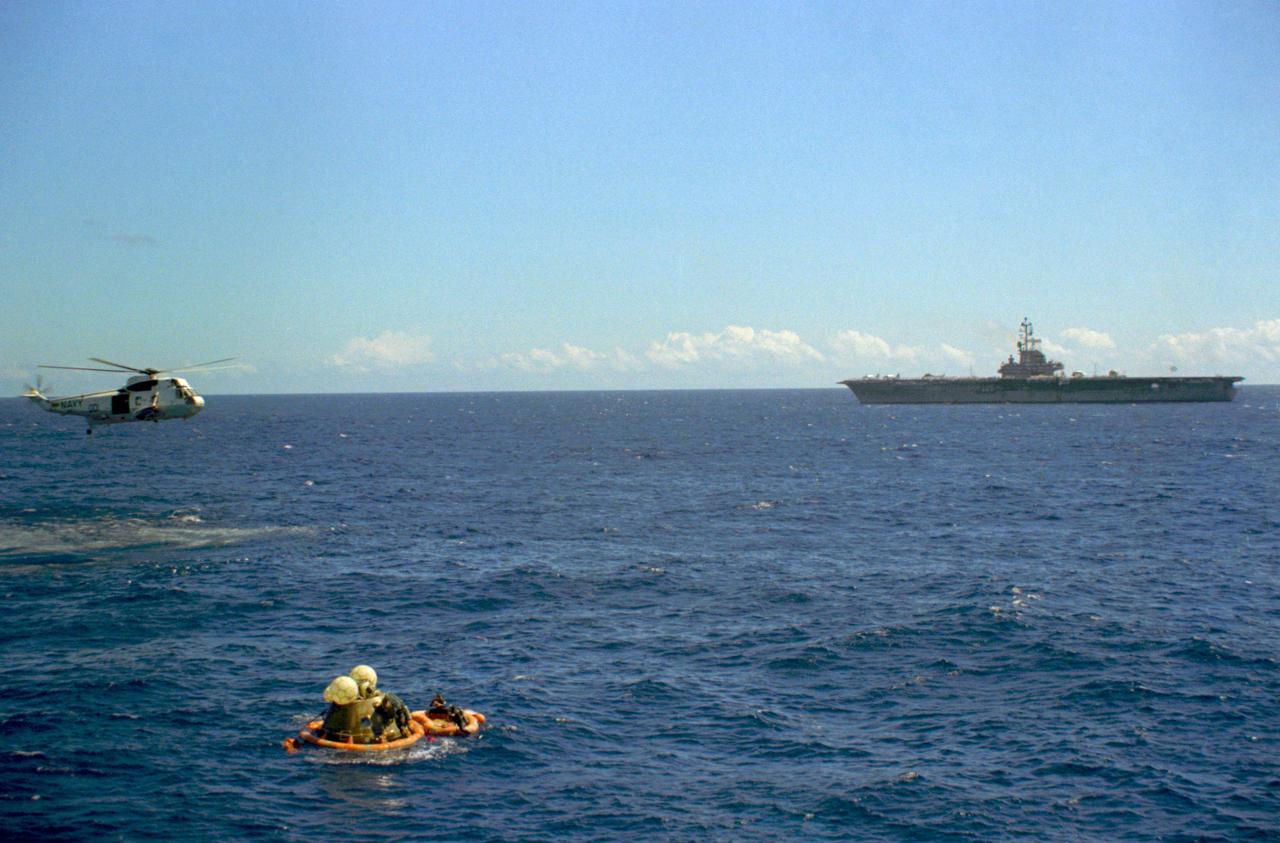
S72-36602 (27 April 1972) --- The Apollo 16 Command Module bobbles photographed in the waters of the central Pacific Ocean during recovery operations. The prime recovery ship, USS Ticonderoga, is in the background. A recovery helicopter hovers overhead. The Apollo 16 crew, astronauts John W. Young, Thomas K. Mattingly II, and Charles M. Duke Jr., were picked up by helicopter and flown to the deck of the ship. The splashdown occurred at 290:37:06 ground elapsed time, 1:45:06 p.m. (CST), Thursday, April 27, 1972, at coordinates of 00:45.2 degrees south latitude and 156:11.4 degrees west longitude, a point approximately 215 miles southeast of Christmas Island. A team of Earth Landing System swimmers assisted with the recovery operations.
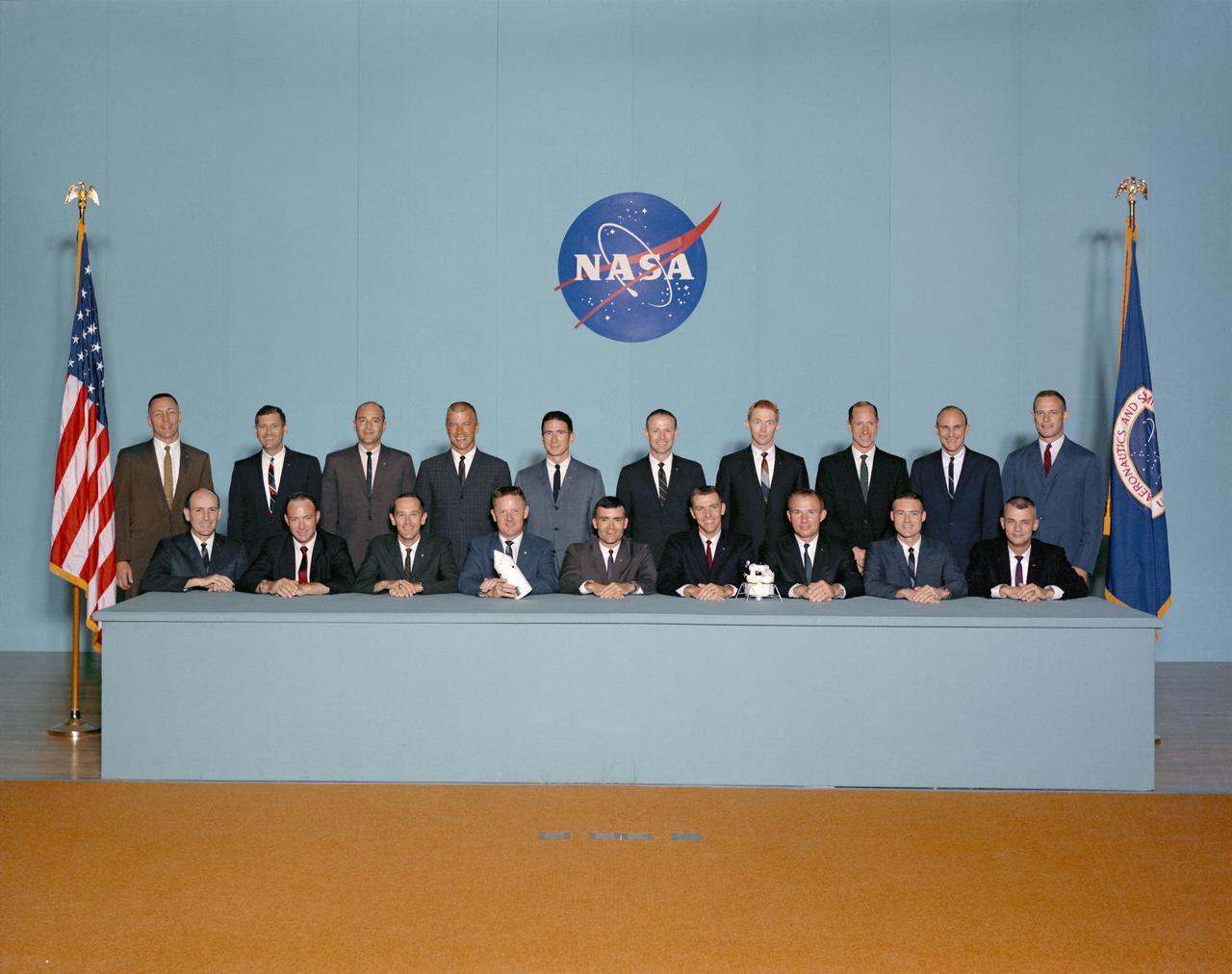
S67-30404 (May 1967) --- Portrait of astronaut group selected April 4, 1966. Seated, left to right, are Edward G. Givens Jr., Edgar D. Mitchell, Charles M. Duke Jr., Don L. Lind, Fred W. Haise Jr., Joe H. Engle, Vance D. Brand, John S. Bull and Bruce McCandless II. Standing, left to right, are John L. Swigert Jr., William R. Pogue, Ronald E. Evans, Paul J. Weitz, James B. Irwin, Gerald P. Carr, Stuart A. Roosa, Alfred M. Worden, Thomas K. Mattingly and Jack R. Lousma. Photo credit: NASA or National Aeronautics and Space Administration
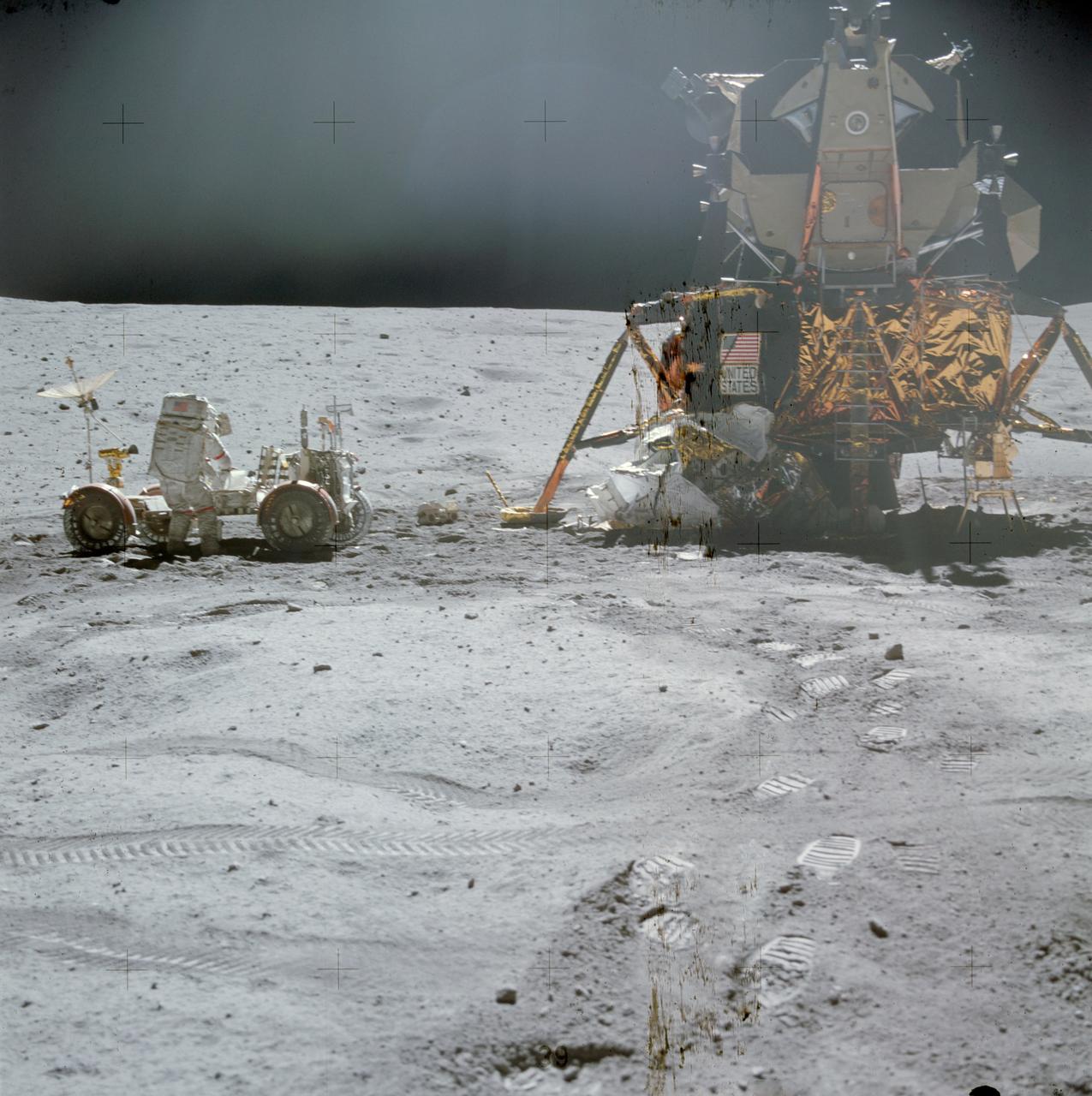
AS16-116-18578 (21 April 1972) --- Astronaut John W. Young, commander of the Apollo 16 lunar landing mission, works at the Lunar Roving Vehicle (LRV) just prior to deployment of the Apollo Lunar Surface Experiments Package (ALSEP) during the first extravehicular activity (EVA) on April 21, 1972. Note the Ultraviolet (UV) Camera/Spectrometer to the right of the Lunar Module (LM) ladder. Also, note the pile of protective/thermal foil under the U.S. flag on the LM which the astronauts pulled away to get to the Modular Equipment Storage Assembly (MESA) bay. While astronauts Young and Charles M. Duke Jr., lunar module pilot; descended in the Apollo 16 LM "Orion" to explore the Descartes highlands landing site on the moon, astronaut Thomas K. Mattingly II, command module pilot, remained with the Command and Service Modules (CSM) "Casper" in lunar orbit.
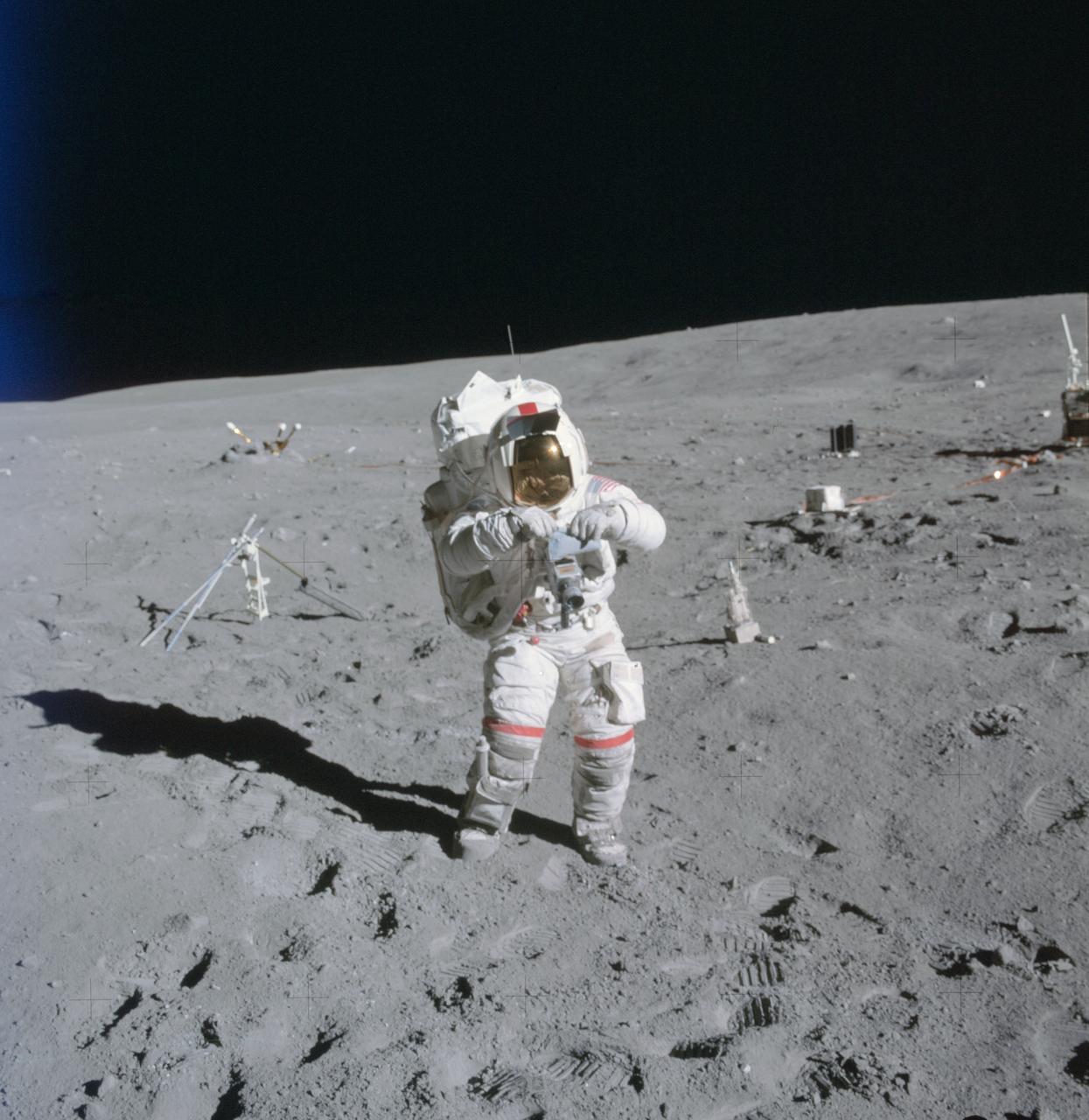
AS16-114-18388 (21 April 1972) --- Astronaut John W. Young, commander of the Apollo 16 lunar landing mission, stands at the Apollo Lunar Surface Experiments Package (ALSEP) deployment site during the first Apollo 16 extravehicular activity (EVA) at the Descartes landing site. The components of the ALSEP are in the background. The lunar surface drill is just behind and to the right of astronaut Young. The drill's rack and bore stems are to the left. The three-sensor Lunar Surface Magnetometer is beyond the rack. The dark object in the right background is the Radioisotope Thermoelectric Generator (RTG). Between the RTG and the drill is the Heat Flow Experiment. A part of the Central Station is at the right center edge of the picture. This photograph was taken by astronaut Charles M. Duke Jr., lunar module pilot.
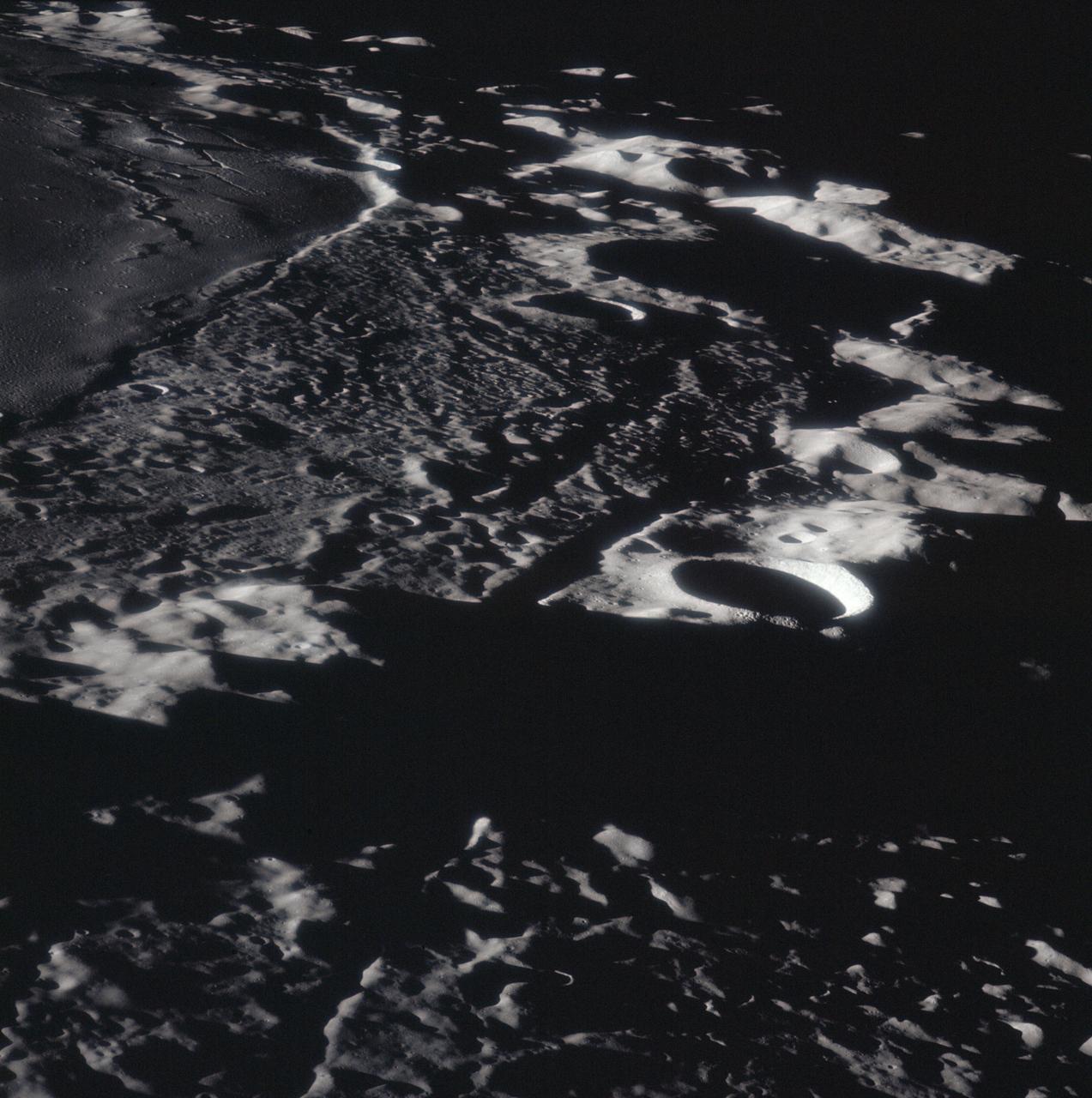
AS16-120-19332 (April 1972) --- This picture of the lunar surface was photographed from lunar orbit during the Apollo 16 lunar landing mission. Mersenius C Crater, dozens of smaller craters and several small rille features can be seen in the frame. Center point coordinates are located at 19.5 degrees south latitude and 45 degrees west longitude. While astronauts John W. Young, commander; and Charles M. Duke Jr., lunar module pilot; descended in the Apollo 16 Lunar Module (LM) "Orion" to explore the Descartes highlands landing site on the moon, astronaut Thomas K. Mattingly II, command module pilot, remained with the Command and Service Modules (CSM) "Casper" in lunar orbit.
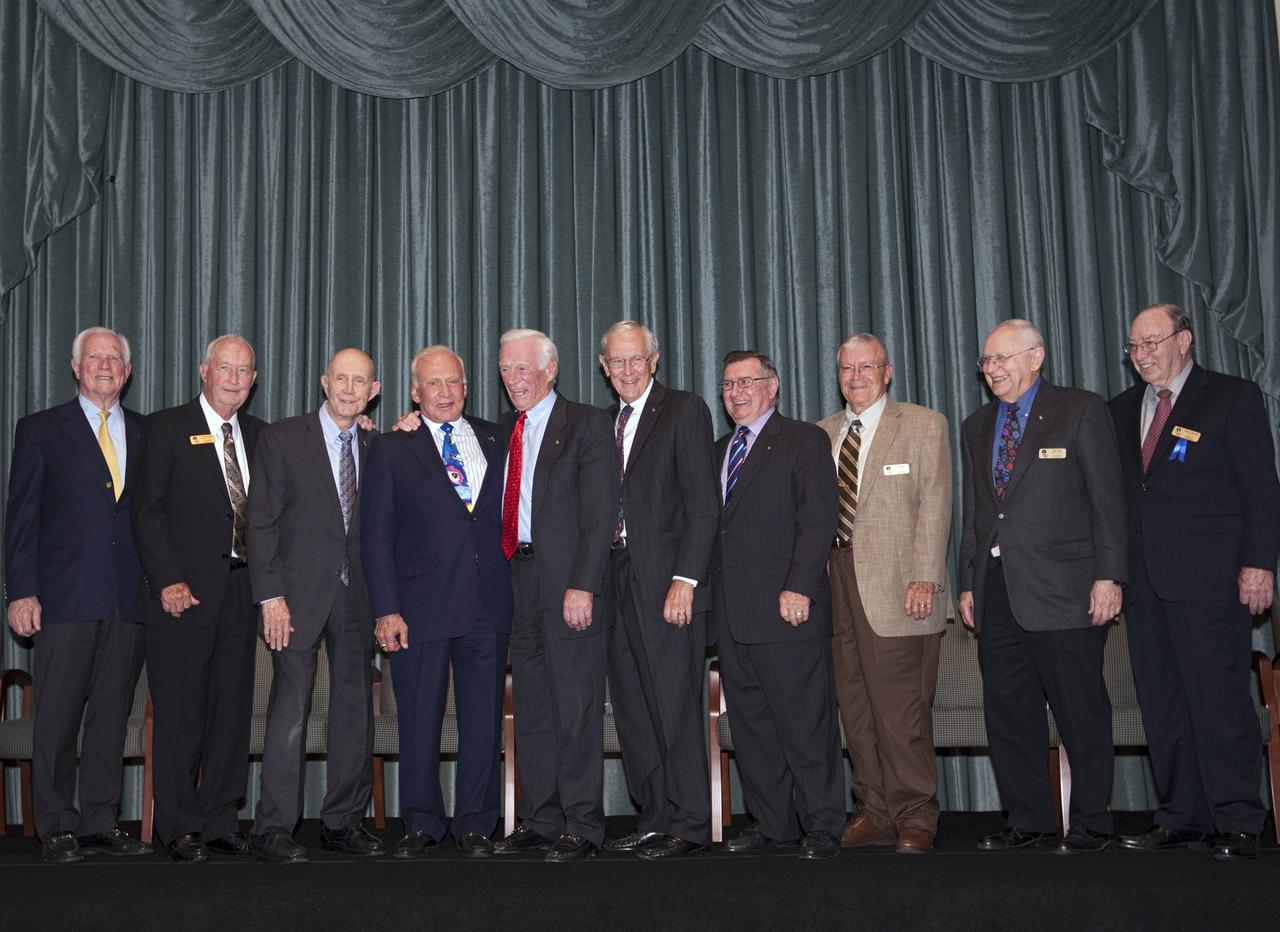
CAPE CANAVERAL, Fla. – Apollo astronauts, from the left, David Scott, James McDivitt, Thomas Stafford, Buzz Aldrin, Eugene Cernan, Charles Duke, Richard Gordon, Fred Haise, Alan Bean and Edgar Mitchell participated in the Astronaut Scholarship Foundation's dinner at the Radisson Resort at the Port in Cape Canaveral celebrating the 40th anniversary of Apollo 17. The gala commemorating the anniversary of Apollo 17 included mission commander Eugene Cernan and other astronauts who flew Apollo missions. Launched Dec. 7, 1972, Cernan and lunar module pilot Harrison Schmitt landed in the moon's Taurus-Littrow highlands while command module pilot Ronald Evans remained in lunar orbit operating a scientific instrument module. For more information, visit http://www-pao.ksc.nasa.gov/history/apollo/apollo-17/apollo-17.htm Photo credit: NASA/Kim Shiflett
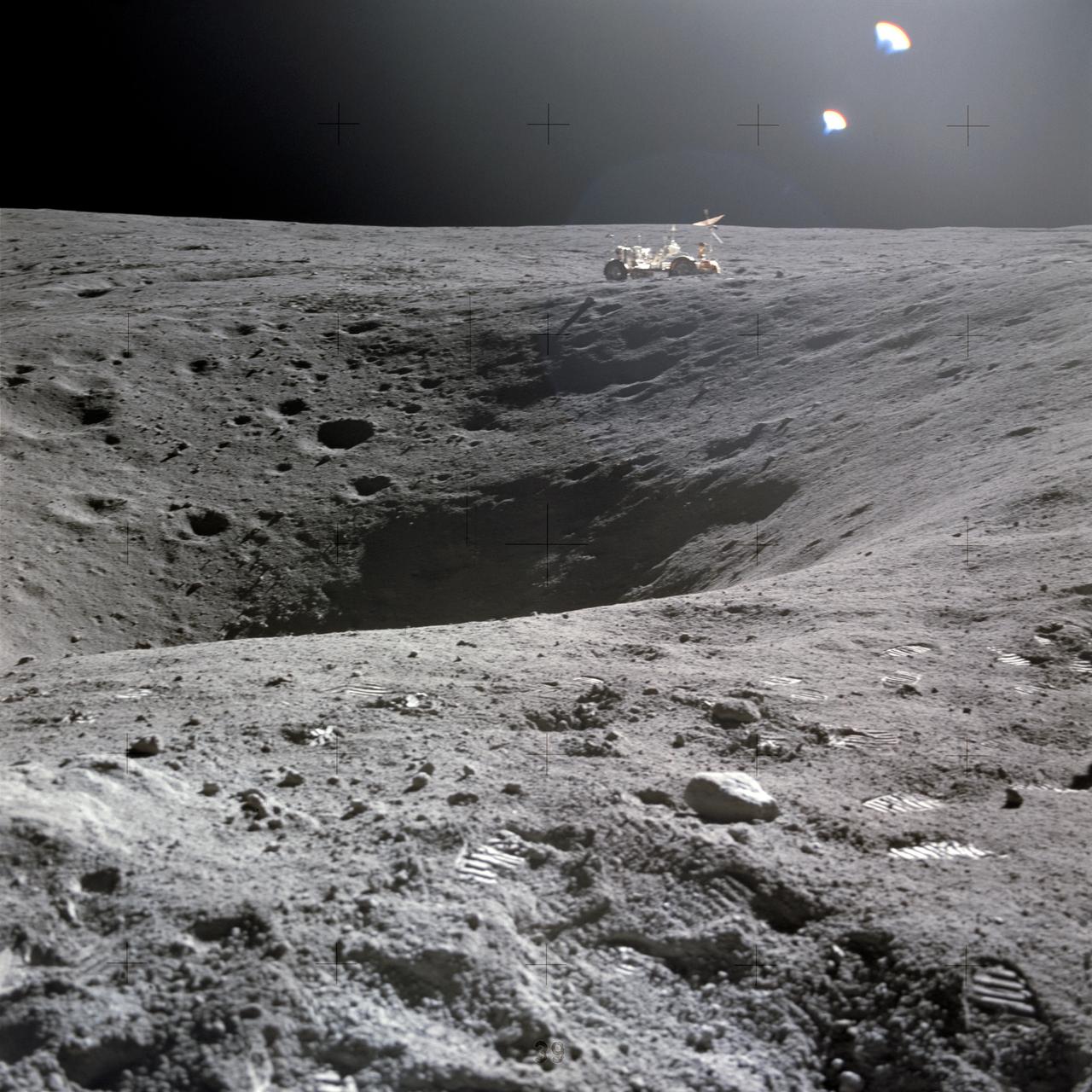
AS16-114-18422 (21 April 1972) --- A view of Plum Crater, which was visited by the two moon-exploring crewmen of the Apollo 16 lunar landing mission, on their first extravehicular activity (EVA) traverse, April 21, 1972. The Lunar Roving Vehicle (LRV) is parked on the far side of the crater, which measures approximately 40 meters in diameter. While astronauts John W. Young, commander; and Charles M. Duke Jr., lunar module pilot; descended in the Apollo 16 Lunar Module (LM) "Orion" to explore the Descartes highlands landing site on the moon, astronaut Thomas K. Mattingly II, command module pilot, remained with the Command and Service Modules (CSM) "Casper" in lunar orbit.
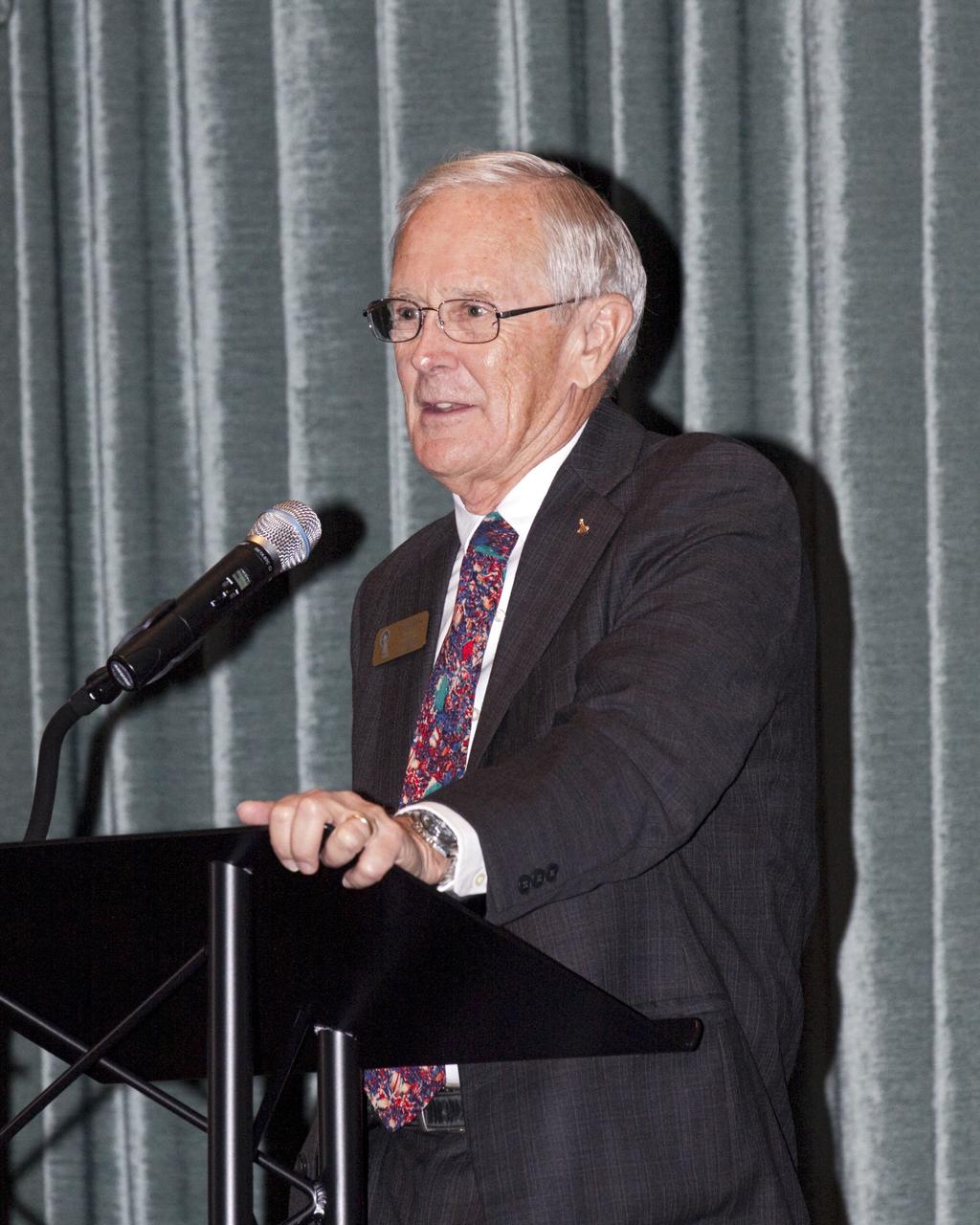
CAPE CANAVERAL, Fla. – Charles Duke, chairman of the board of directors for the Astronaut Scholarship Foundation welcomes guests who have gathered for the organization's dinner at the Radisson Resort at the Port in Cape Canaveral celebrating the 40th anniversary of Apollo 17. The gala commemorating the anniversary of Apollo 17 included mission commander Eugene Cernan and other astronauts who flew Apollo missions. Launched Dec. 7, 1972, Cernan and lunar module pilot Harrison Schmitt landed in the moon's Taurus-Littrow highlands while command module pilot Ronald Evans remained in lunar orbit operating a scientific instrument module. For more information, visit http://www-pao.ksc.nasa.gov/history/apollo/apollo-17/apollo-17.htm Photo credit: NASA/Kim Shiflett
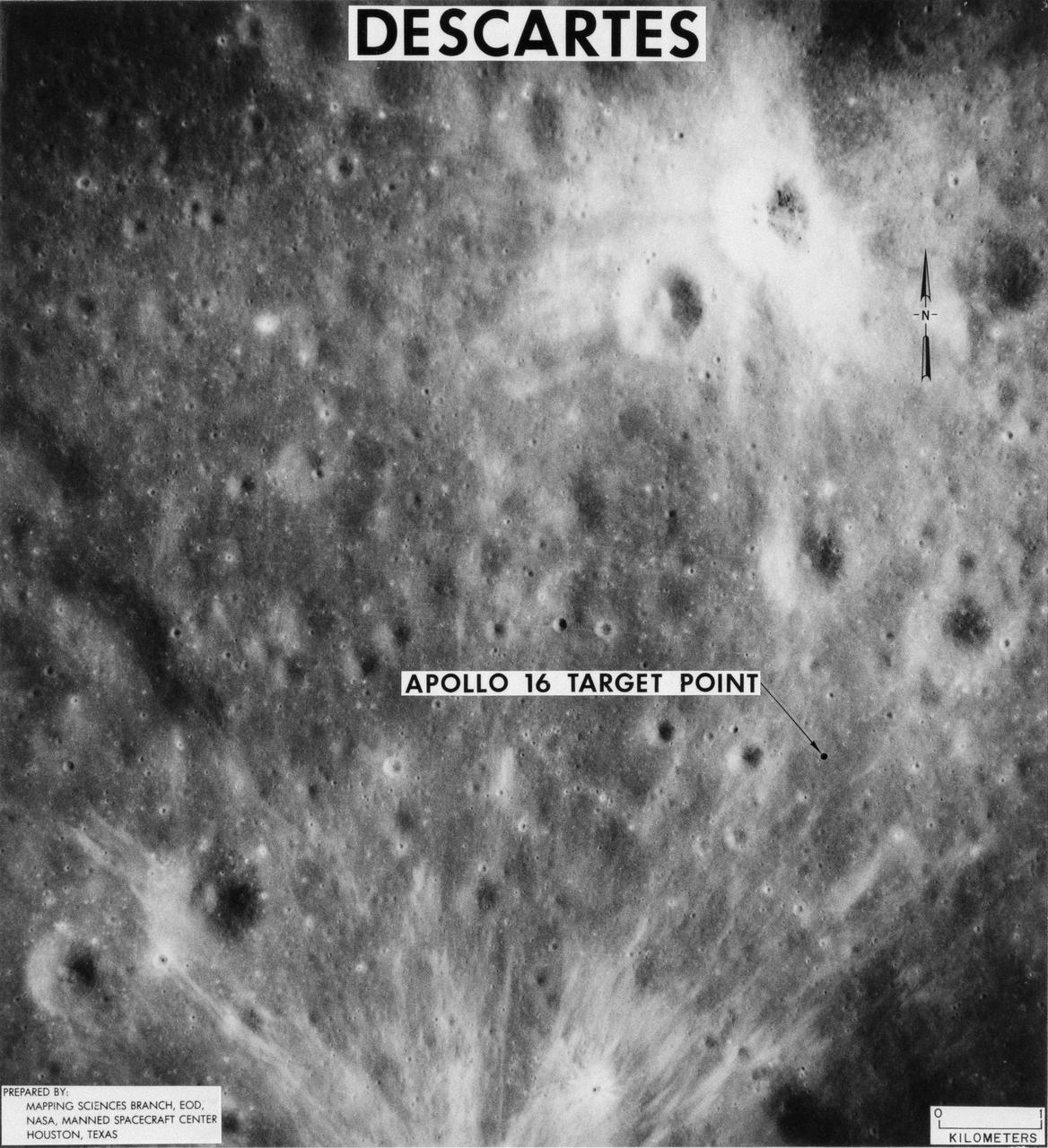
S71-44150 (February 1971) --- A vertical view of the Apollo 16 landing site located in the Descartes area on the lunar nearside. The overlay indicates the location of the proposed touchdown point for the Apollo 16 Lunar Module (LM). Descartes is located west of the Sea of Nectar and southwest of the Sea of Tranquility. This photograph was taken with a 500mm lens camera from lunar orbit by the Apollo 16 crew. Astronauts John W. Young, commander; and Charles M. Duke Jr., lunar module pilot; descended in the Apollo 16 LM "Orion" to explore the Descartes highlands landing site on the moon. Astronaut Thomas K. Mattingly II, command module pilot, remained with the Command and Service Modules (CSM) "Casper" in lunar orbit.