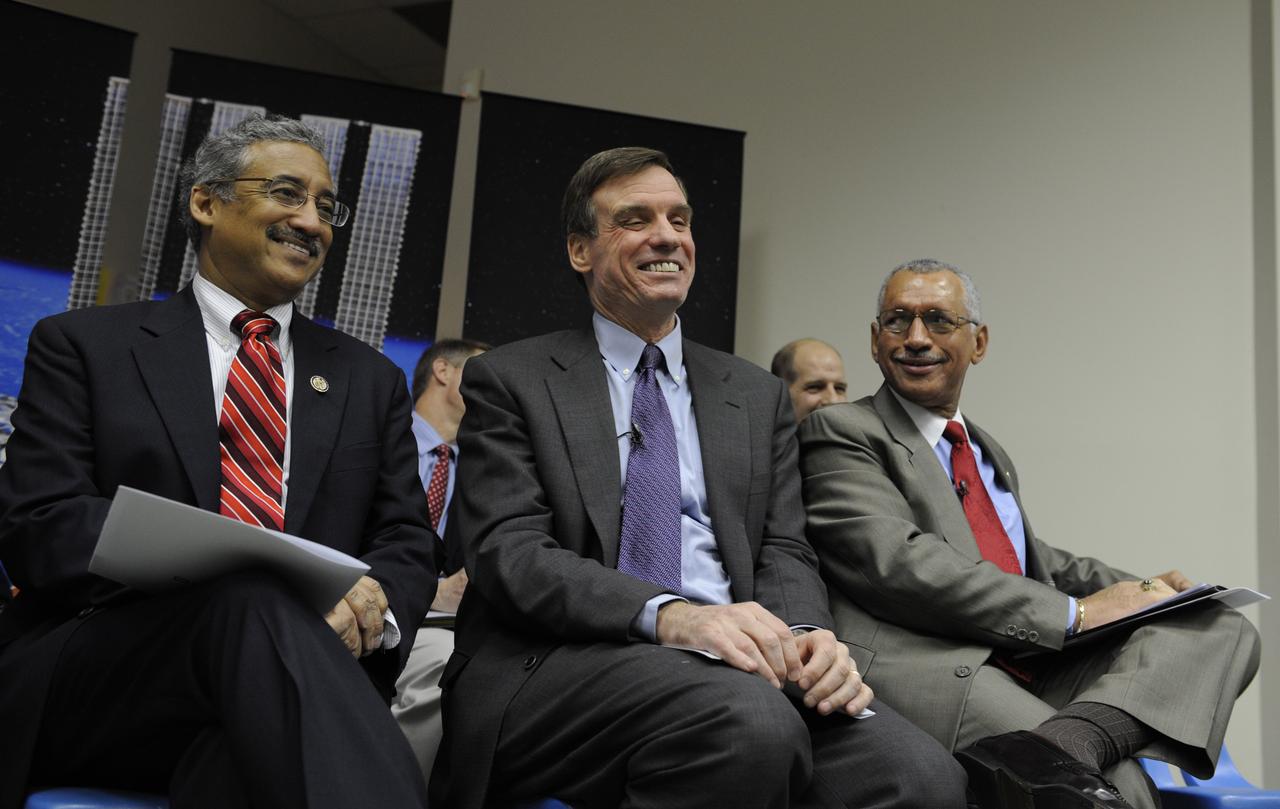
NASA Administrator Charles Bolden, right, shares a laugh with U.S. Sen. Mark Warner, D-Va., center and U.S. Rep. Bobby Scott, D-Va., prior to an event at the MathScience Innovation Center, Friday, Jan. 28, 2011, in Richmond, Va. Bolden later spoke to students from Albert Hill Middle School highlighting the importance of science, technology, engineering and math, or STEM, as he shared his life experiences with the students. (Photo Credit:NASA/Paul E. Alers)
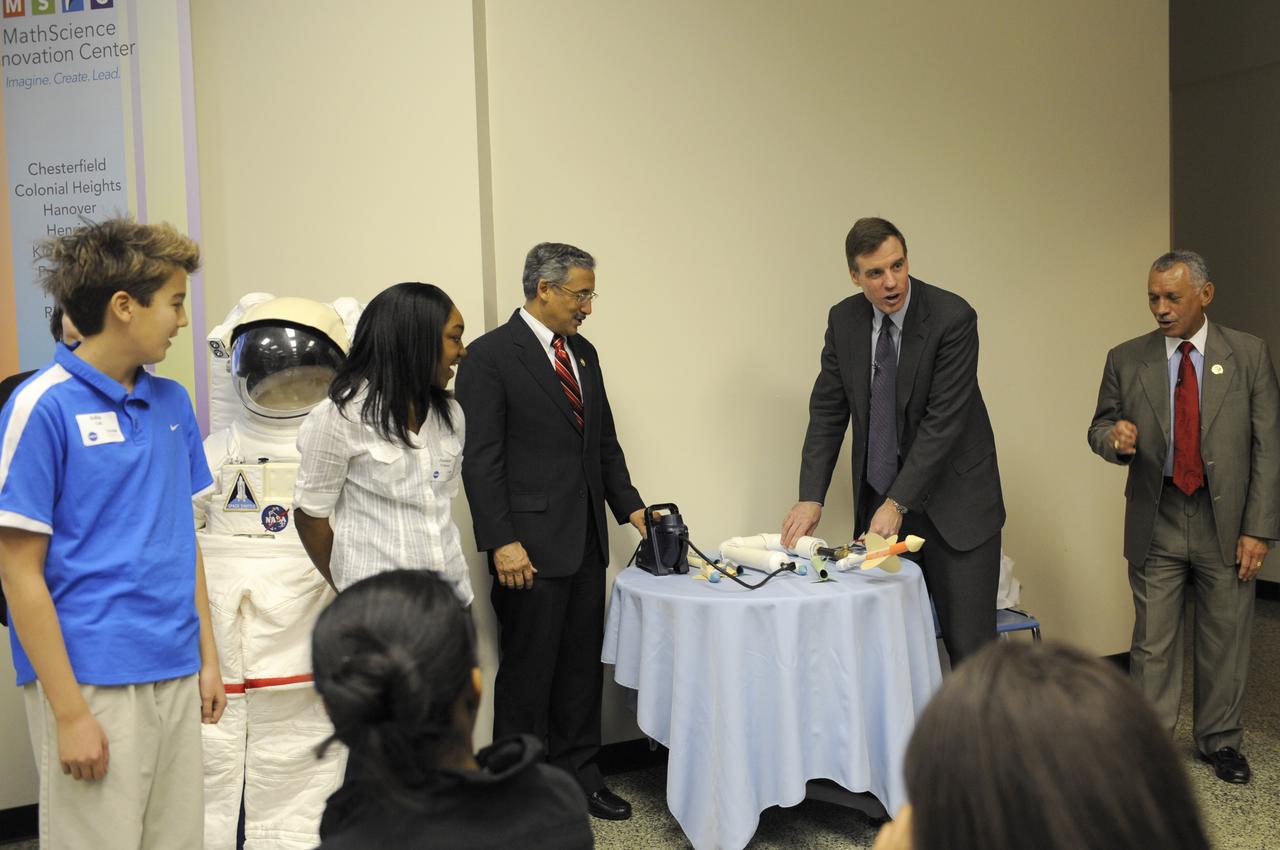
NASA Administrator Charles Bolden, right, counts down along with others as U.S. Sen. Mark Warner, D-Va., readies to launch a paper rocket as U.S. Rep. Bobby Scott, D-Va., third right, looks on, Friday, Jan. 28, 2011, at the MathScience Innovation Center in Richmond, Va. Earlier, Bolden, spoke to students from Albert Hill Middle School where he highlighted the importance of science, technology, engineering and math, or STEM, as he shared his life experiences with the students. (Photo Credit:NASA/Paul E. Alers)
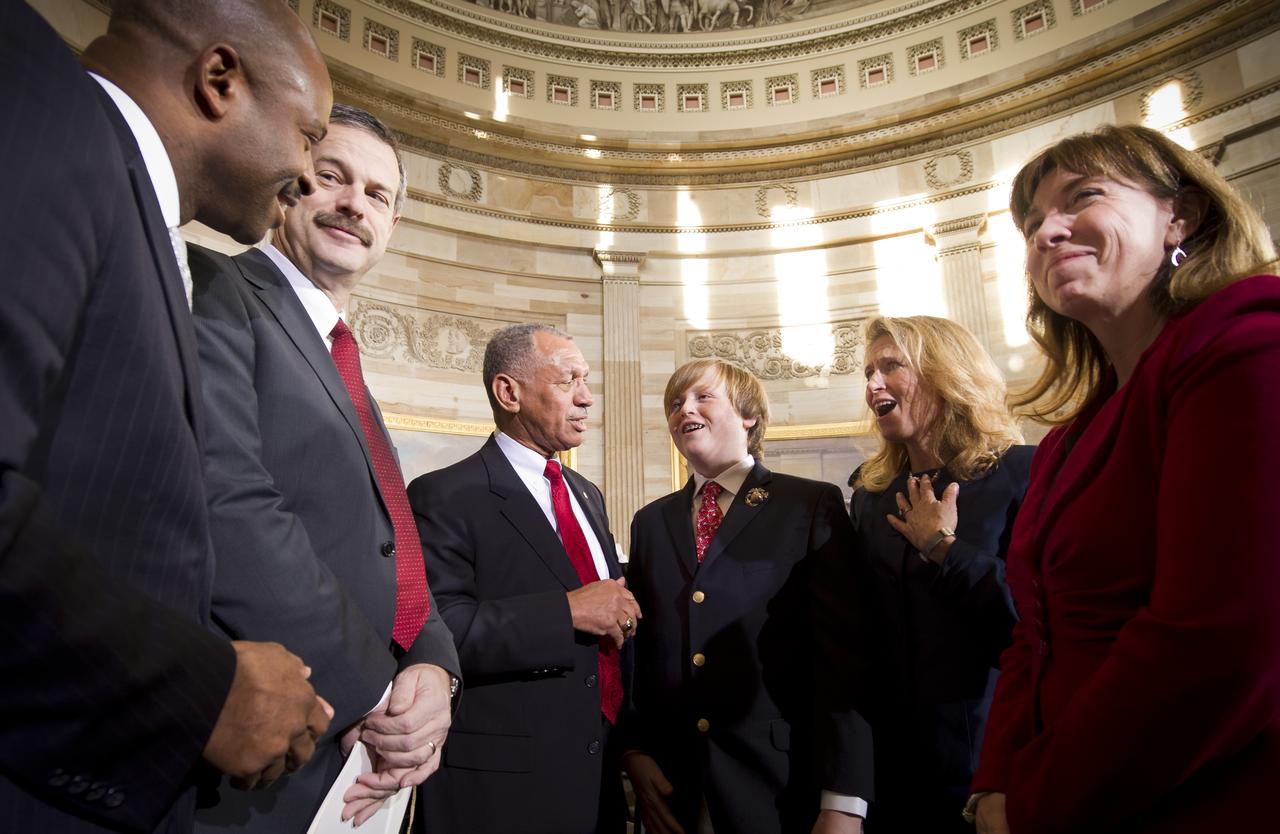
NASA Administrator Charles Bolden. 3rd from left, introduces Edward Moore Kennedy III, 4th from left, to NASA Astronaut Leland Melvin, left, and former NASA Astronaut Scott Altman, 2nd from left, as Edward's mother Kiki Kennedy, wife of Edward M Kennedy Jr. and NASA Deputy Administrator Lori Garver, right, look on at an event recognizing the 50th anniversary of the inauguration of John F. Kennedy as president of the United States, Thursday, Jan. 20, 2001 at the U.S. Capitol rotunda. Photo Credit: (NASA/Bill Ingalls)
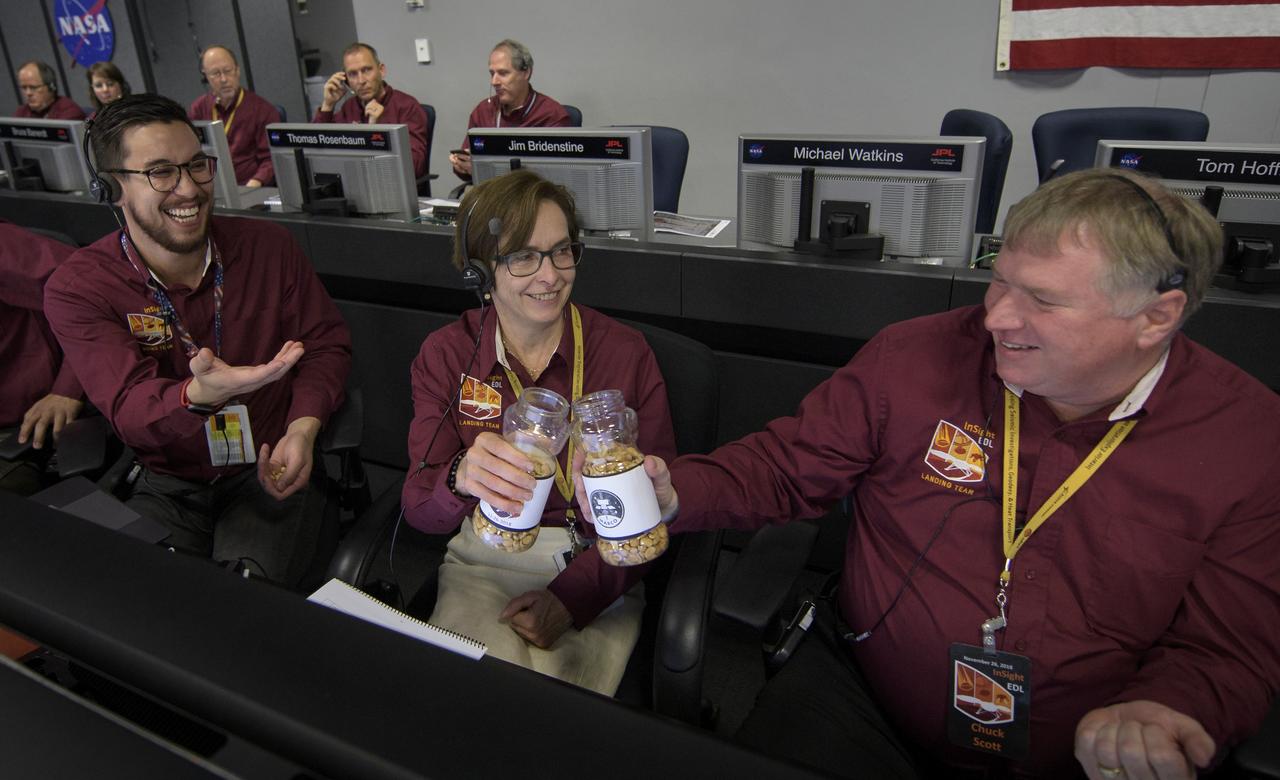
Sue Smrekar, InSight deputy principal investigator, NASA JPL, center, and Charles Scott, InSight Deputy Project Manager, NASA JPL, say cheers with two jars of good-luck peanuts as Thomas Thammasuckdi, Software Systems Engineer, NASA JPL, left, looks on, Monday, Nov. 26, 2018 inside the Mission Support Area at NASA's Jet Propulsion Laboratory in Pasadena, California. InSight, short for Interior Exploration using Seismic Investigations, Geodesy and Heat Transport, is a Mars lander designed to study the "inner space" of Mars: its crust, mantle, and core. Photo Credit: (NASA/Bill Ingalls)
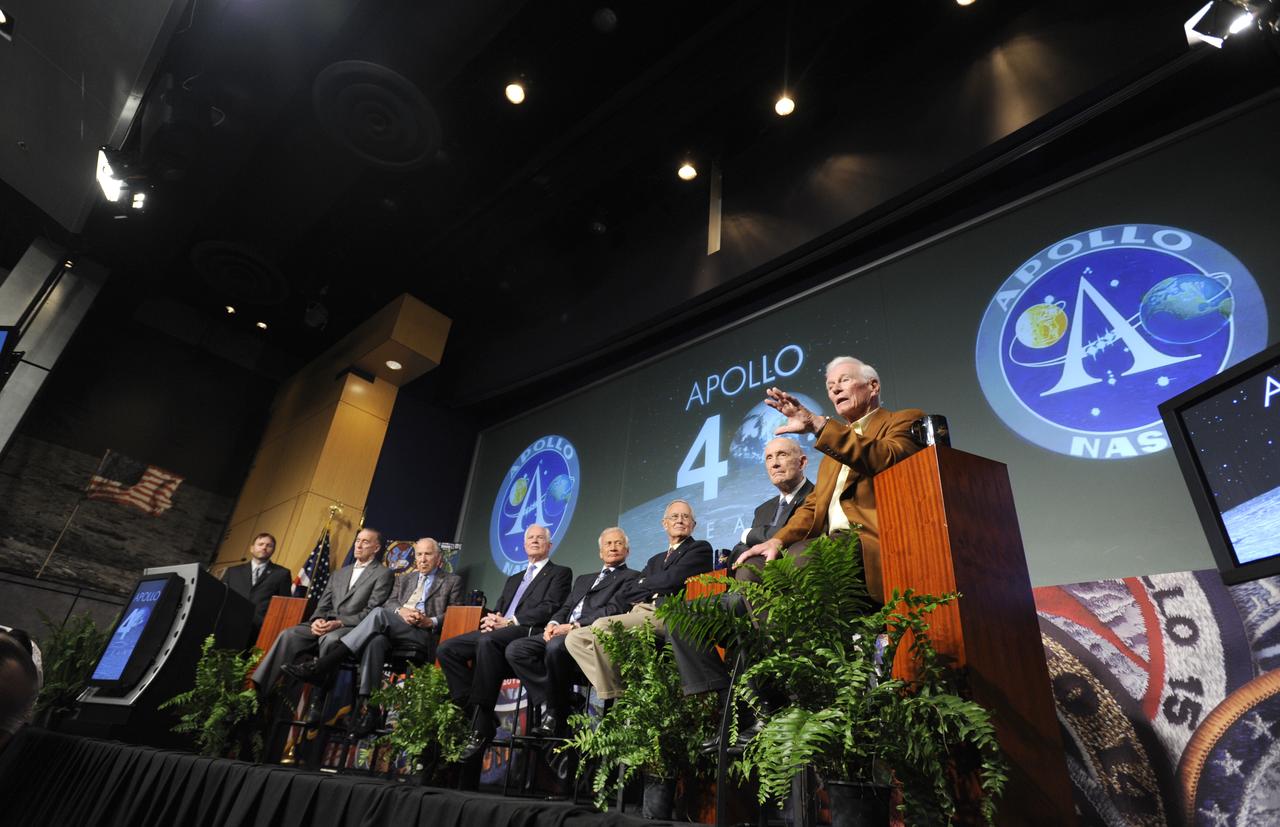
Apollo astronauts from left, Walt Cunningham (Apollo 17), James Lovell (Apollo 8 Apollo 13), David Scott (Apollo 9 Apollo 15), Buzz Aldrin (Apollo 11), Charles Duke (Apollo 16), Thomas Stafford (Apollo 10) and Eugene Cernan (Apollo 17) are seen during the 40th anniversary of the Apollo 11 mission and the walk on the moon press conference, Monday, July 20, 2009, at NASA Headquarters in Washington. Photo Credit: (NASA/Paul E. Alers)
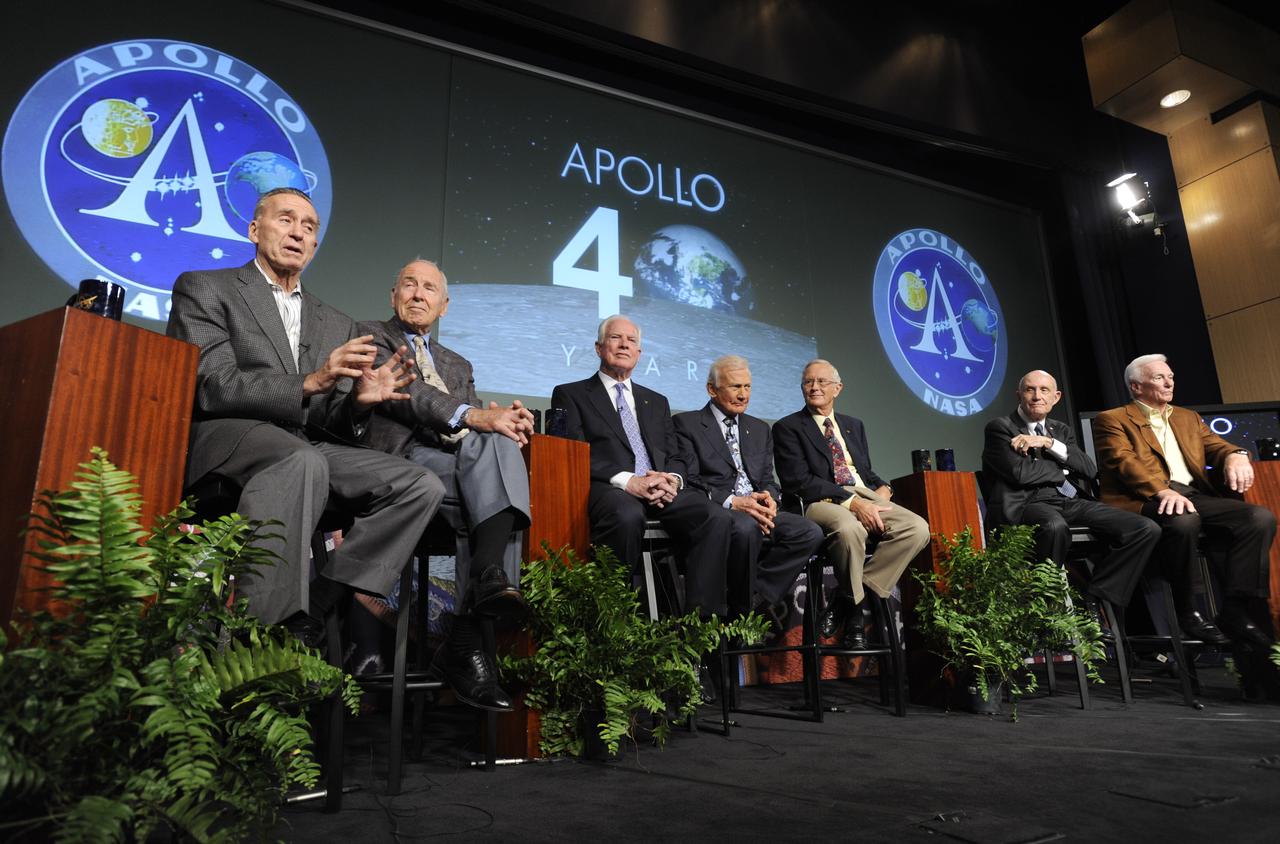
Apollo astronauts from left, Walt Cunningham (Apollo 17), James Lovell (Apollo 8 Apollo 13), David Scott (Apollo 9 Apollo 15), Buzz Aldrin (Apollo 11), Charles Duke (Apollo 16), Thomas Stafford (Apollo 10) and Eugene Cernan (Apollo 17) are seen during the 40th anniversary of the Apollo 11 mission and the walk on the moon press conference, Monday, July 20, 2009, at NASA Headquarters in Washington. Photo Credit: (NASA/Paul E. Alers)

Apollo astronauts from left, Walt Cunningham (Apollo 17), James Lovell (Apollo 8 Apollo 13), David Scott (Apollo 9 Apollo 15), Buzz Aldrin (Apollo 11), Charles Duke (Apollo 16), Thomas Stafford (Apollo 10) and Eugene Cernan (Apollo 17) are seen during the 40th anniversary of the Apollo 11 mission and the walk on the moon press conference, Monday, July 20, 2009, at NASA Headquarters in Washington. Photo Credit: (NASA/Paul E. Alers)
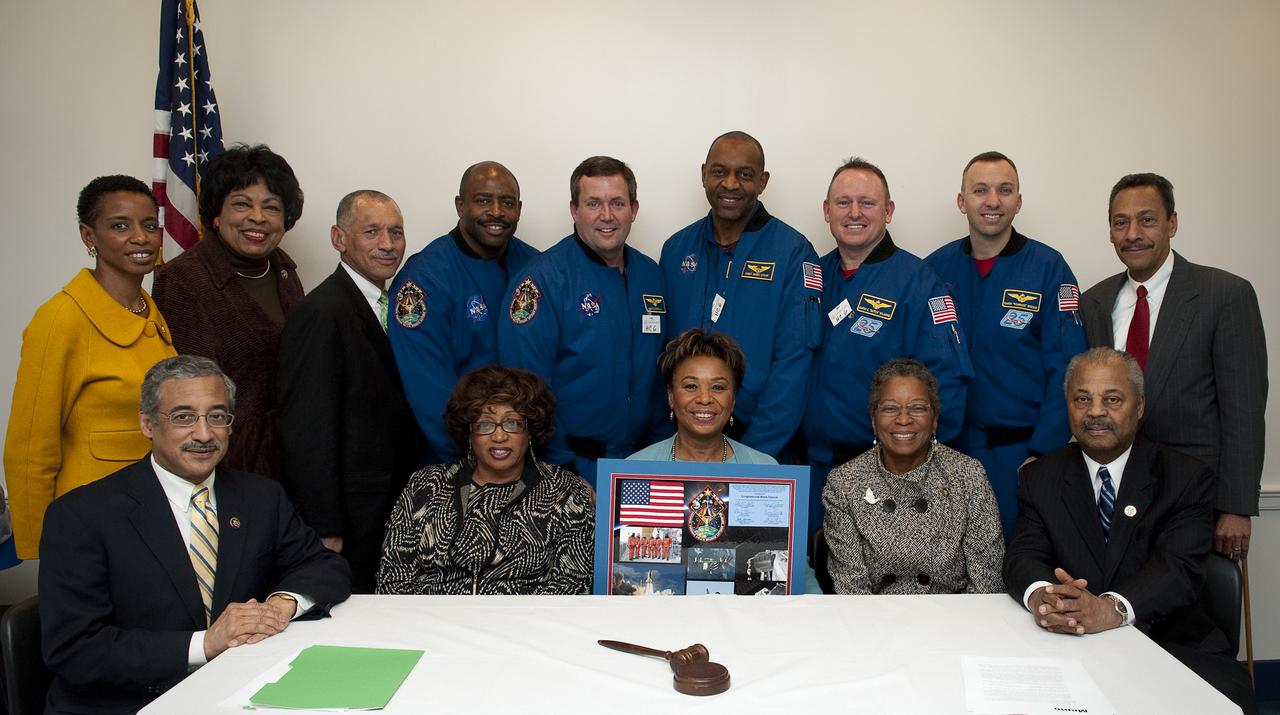
NASA Administrator Charles Bolden, space shuttle crew STS-129 and members of the Congressional Black Caucus pose for a group photo at the Capitol Building, Wednesday, Jan. 13, 2010, in Washington. Back row from left to right: U.S. Rep Donna Edwards (D-MD), U.S. Rep Diane Watson (D-CA), NASA Administrator Charles Bolden, astronauts Leland Melvin, Mike Foreman, Robert Satcher, Barry Wilmore, Randy Breznik, and U.S. Rep Mel Watt (D-NC). Front row from left to right: U.S. Rep Robert Scott (D-VA), U.S. Rep. Corrine Brown (D-Fla), U.S. Rep. Barbara Lee (D-CA), U.S. Rep. Donna Christensen (D-VI) and U.S. Rep. Donald Payne (D-NJ). The crew of STS-129 presented the CBC with a montage commemorating their mission. Photo Credit: (NASA/Paul E. Alers)
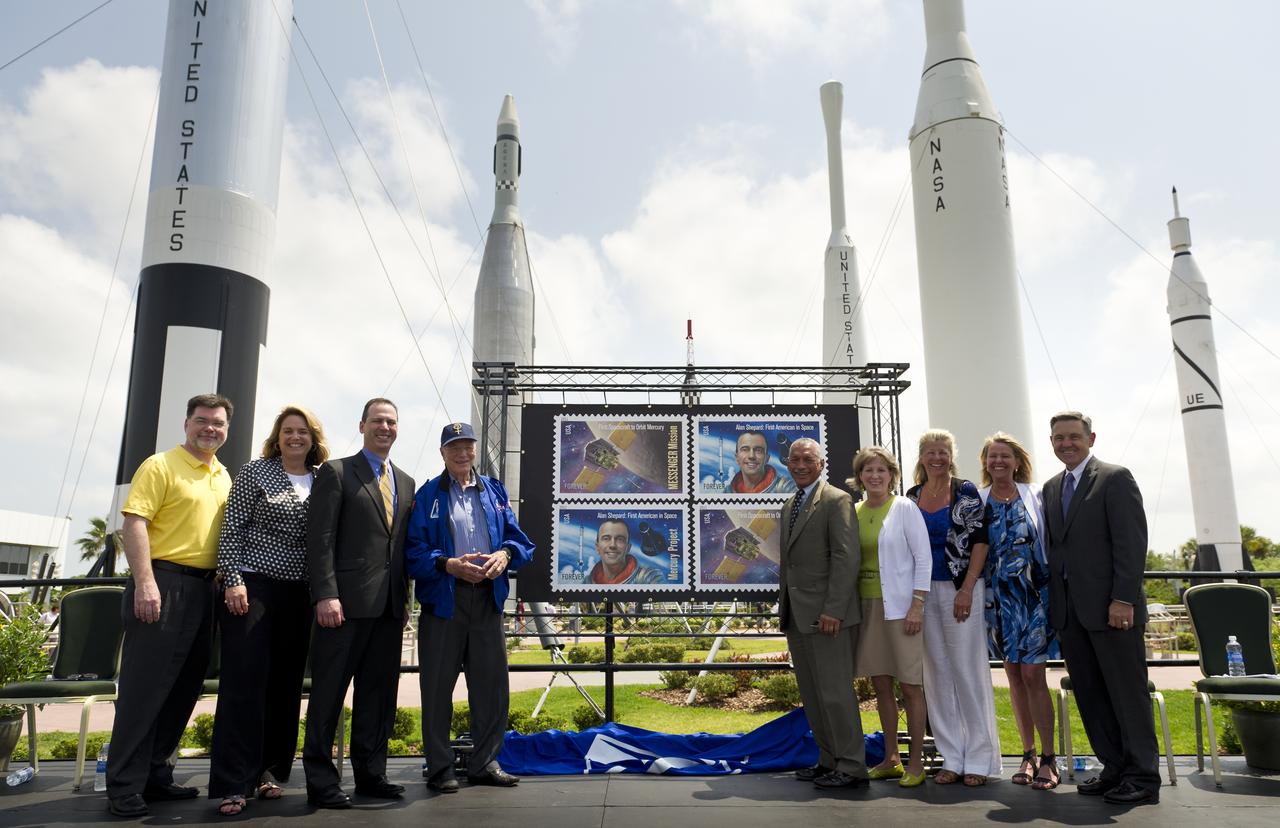
From left, NASA Deputy Director, Planetary Science Division, Science Mission Directorate, Jim Adams, NASA Kennedy Space Center Director of Education and External Relations Cheryl Hurst, United States Postal Service Vice President of Finance Steve Masse, NASA Mercury Astronaut Scott Carpenter, NASA Administrator Charles Boldin, Daughters of NASA astronaut Alan Shepard, Alice Wackermann, Laura Shepard Churchley, and Julie Jenkins, and NASA Kennedy Space Center Director Robert Cabana pose for a photograph during an unveiling ceremony of two USPS stamps that commemorate and celebrate 50 years of US Spaceflight and the MESSENGER program during an event, Wednesday, May 4, 2011 at the NASA Kennedy Space Center in Cape Canaveral, Fla. One stamp commemorates NASA’s Project Mercury, America’s first manned spaceflight program, and NASA astronaut Alan Shepard’s historic flight on May 5, 1961, aboard spacecraft Freedom 7. The other stamp draws attention to NASA’s unmanned MESSENGER mission, a scientific investigation of the planet Mercury. On March 17, 2011, MESSENGER became the first spacecraft to enter into orbit around Mercury. Photo Credit: (NASA/Bill Ingalls)
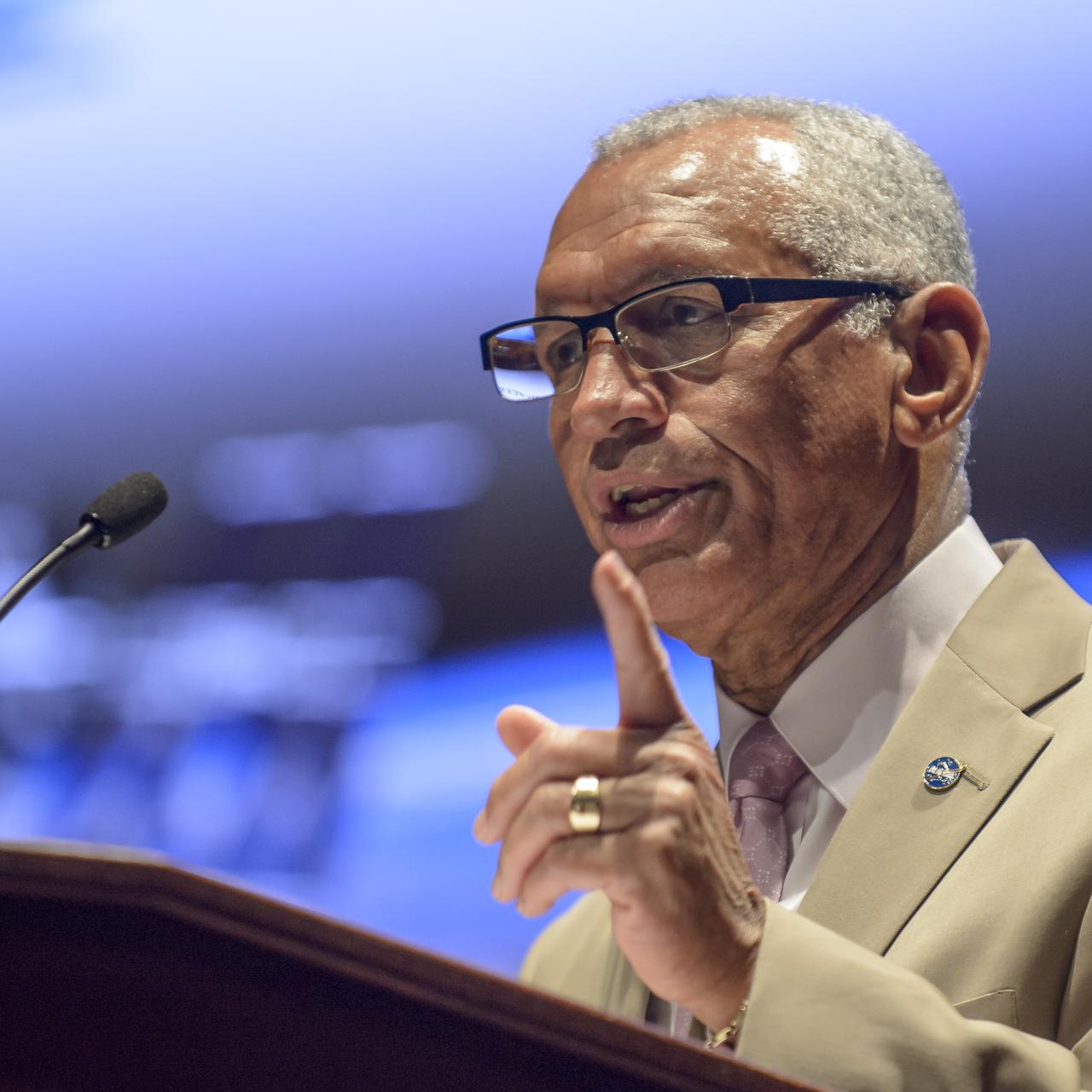
NASA Administrator Charles Bolden introduces former NASA astronaut Scott Kelly during an event at the United States Capitol Visitor Center, Wednesday, May 25, 2016, in Washington. Photo Credit: (NASA/Bill Ingalls)
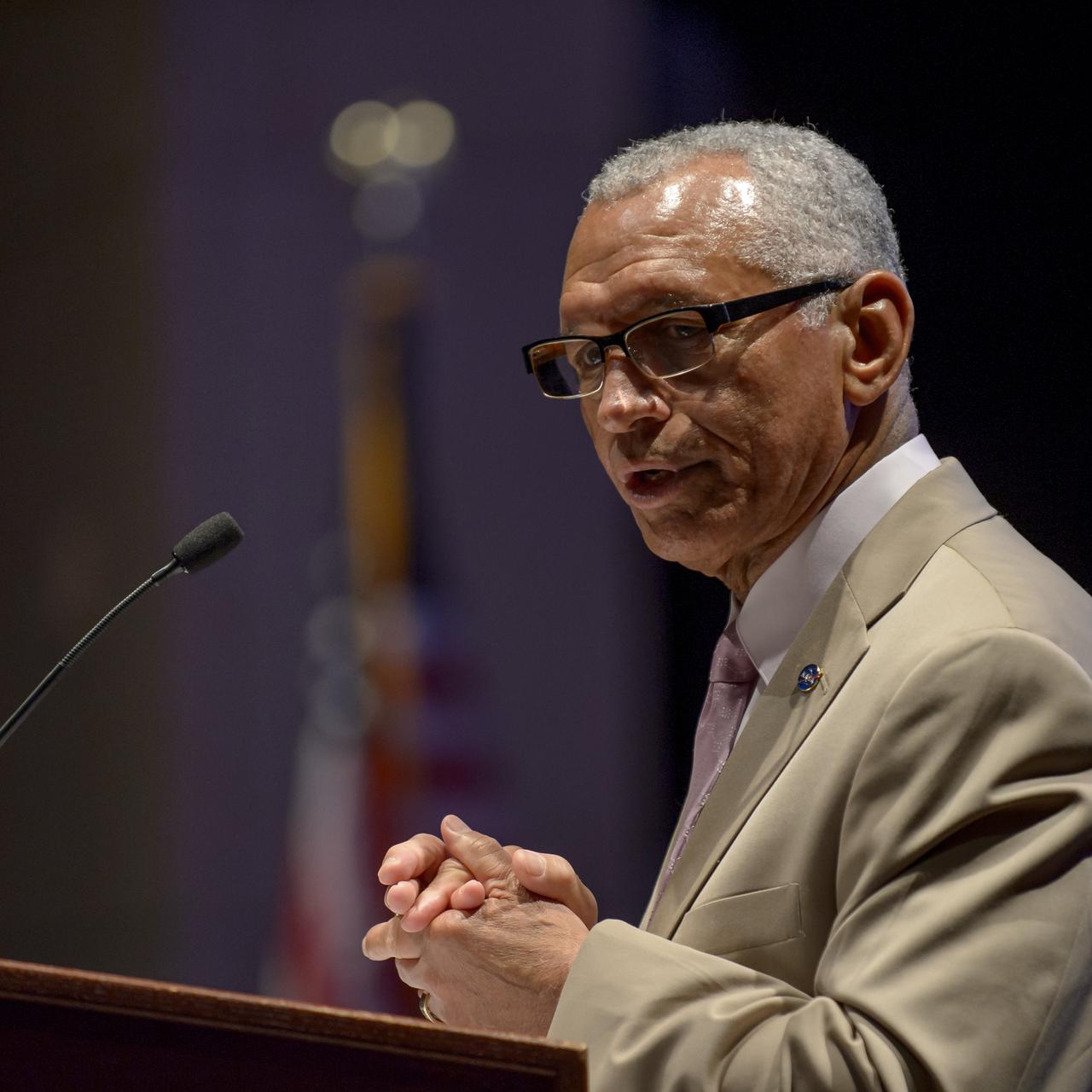
NASA Administrator Charles Bolden introduces former NASA astronaut Scott Kelly during an event at the United States Capitol Visitor Center, Wednesday, May 25, 2016, in Washington. Photo Credit: (NASA/Bill Ingalls)

Expedition 43 NASA Astronaut Scott Kelly, Russian Cosmonauts Gennady Padalka, and Mikhail Kornienko of the Russian Federal Space Agency (Roscosmos) talk to NASA Administrator Charles Bolden, center, and Head of Russian Federal Space Agency (Roscosmos) Igor Komarov, right, from behind glass before departing for their launch onboard the Soyuz TMA-16M spacecraft to the International Space Station Friday, March 27, 2015 in Baikonor, Kazakhstan. Kelly, Padalka, and Kornienko launched to the ISS from the Baikonur Cosmodrome in Kazakhstan March 28, Kazakh time (March 27 Eastern time.) As the one-year crew, Kelly and Kornienko will return to Earth on Soyuz TMA-18M in March 2016. Photo Credit: (NASA/GCTC/Andrey Shelepin)
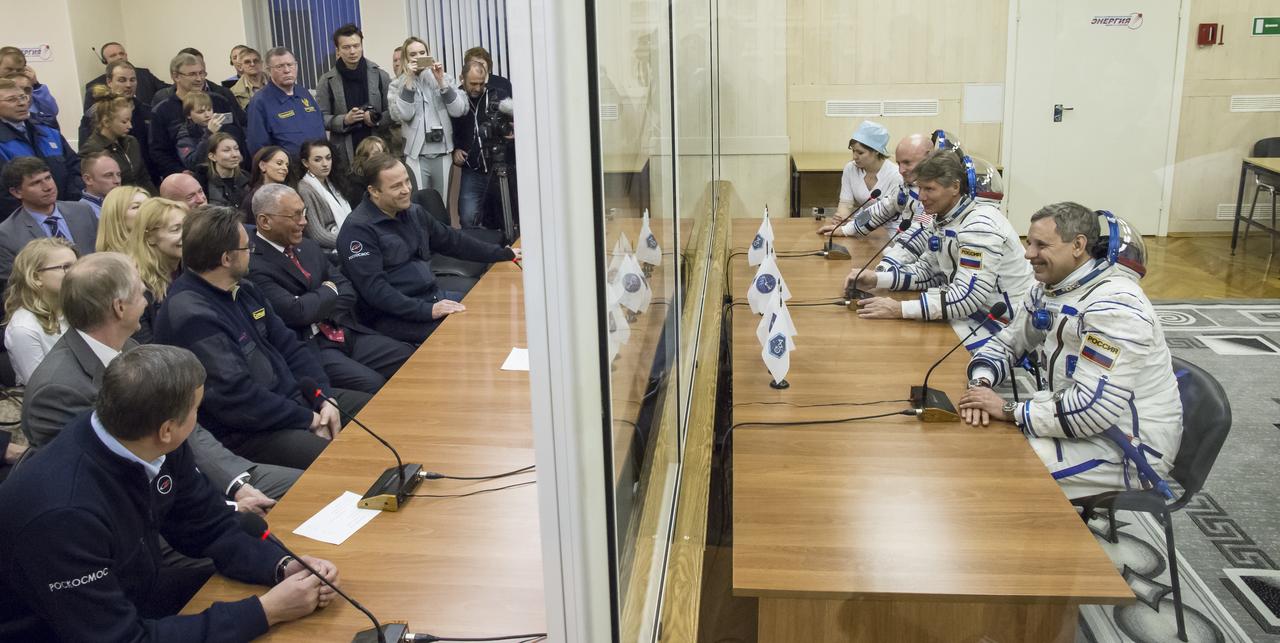
Expedition 43 NASA Astronaut Scott Kelly, Russian Cosmonauts Gennady Padalka, and Mikhail Kornienko of the Russian Federal Space Agency (Roscosmos) talk to NASA Administrator Charles Bolden, left center, and Head of Russian Federal Space Agency (Roscosmos) Igor Komarov, right, from behind glass before departing for their launch onboard the Soyuz TMA-16M spacecraft to the International Space Station Friday, March 27, 2015 in Baikonor, Kazakhstan. Kelly, Padalka, and Kornienko launched to the ISS from the Baikonur Cosmodrome in Kazakhstan March 28, Kazakh time (March 27 Eastern time.) As the one-year crew, Kelly and Kornienko will return to Earth on Soyuz TMA-18M in March 2016. Photo Credit: (NASA/Victor Zelentsov)
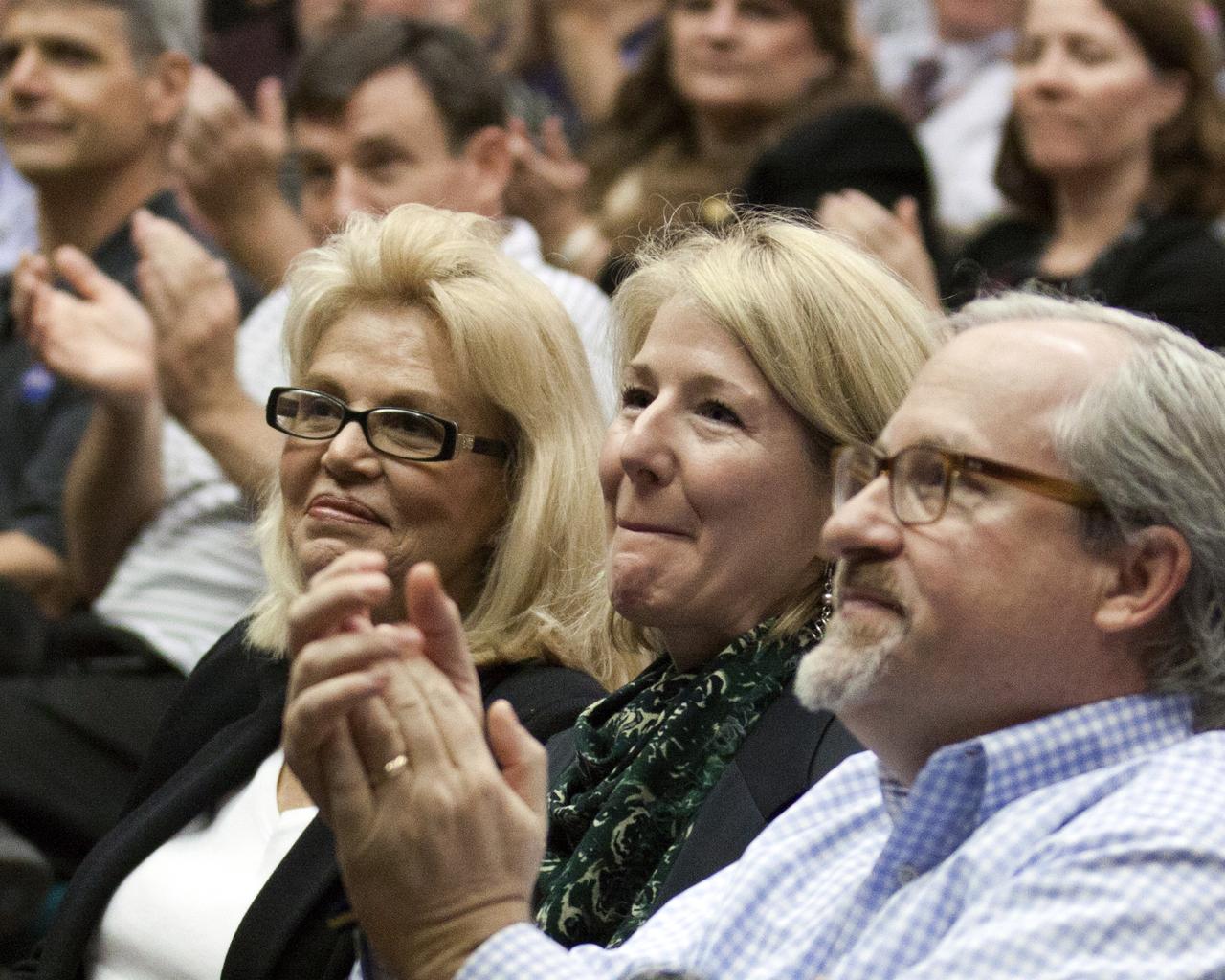
CAPE CANAVERAL, Fla. -- Mercury astronaut Scott Carpenter's wife, Patricia Carpenter, left, and children listen during the "50 Years of Americans in Orbit" presentation for employees at NASA's Kennedy Space Center in Florida. John Glenn and fellow Mercury astronaut Scott Carpenter were joined by NASA Administrator Charles Bolden and Center Director Bob Cabana on stage in Kennedy's training auditorium. This year marks 50 years since Glenn and Carpenter became the first two Americans to orbit Earth. Photo credit: NASA/Kim Shiflett
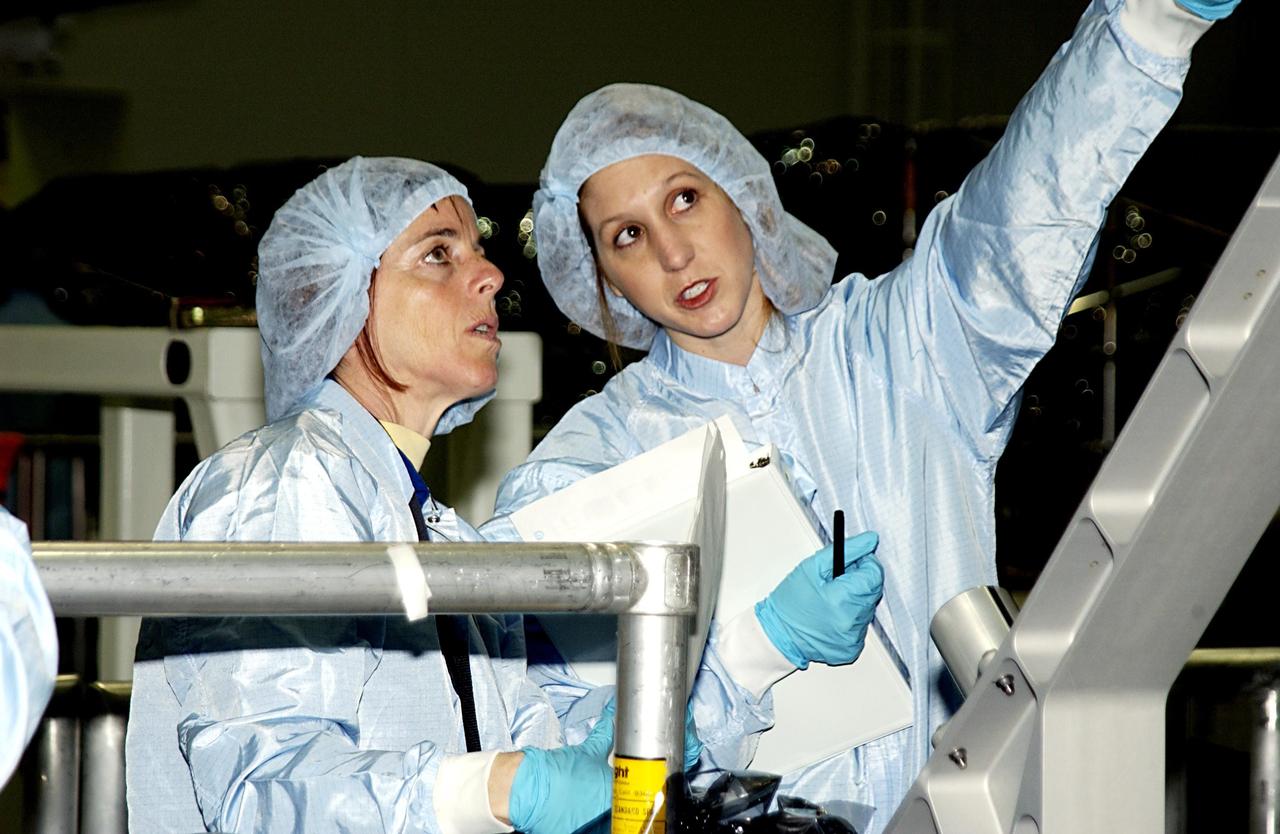
KENNEDY SPACE CENTER, FLA. - The STS-118 crew look over parts of the mission payload in the Space Station Processing Facility. The crew comprises Commander Scott Kelly, Pilot Charles Hobaugh, and Mission Specialists Scott Parazynski, Dafydd Williams, Barbara Morgan and Lisa Nowak. Williams is with the Canadian Space Agency. Morgan was selected by NASA in January 1998 as the first Educator Astronaut. The mission will be delivering the third starboard truss segment, the ITS S5, to the International Space Station, and a SPACEHAB Single Cargo Module with supplies and equipment. Launch aboard Space Shuttle Columbia is scheduled for Nov. 13, 2003.
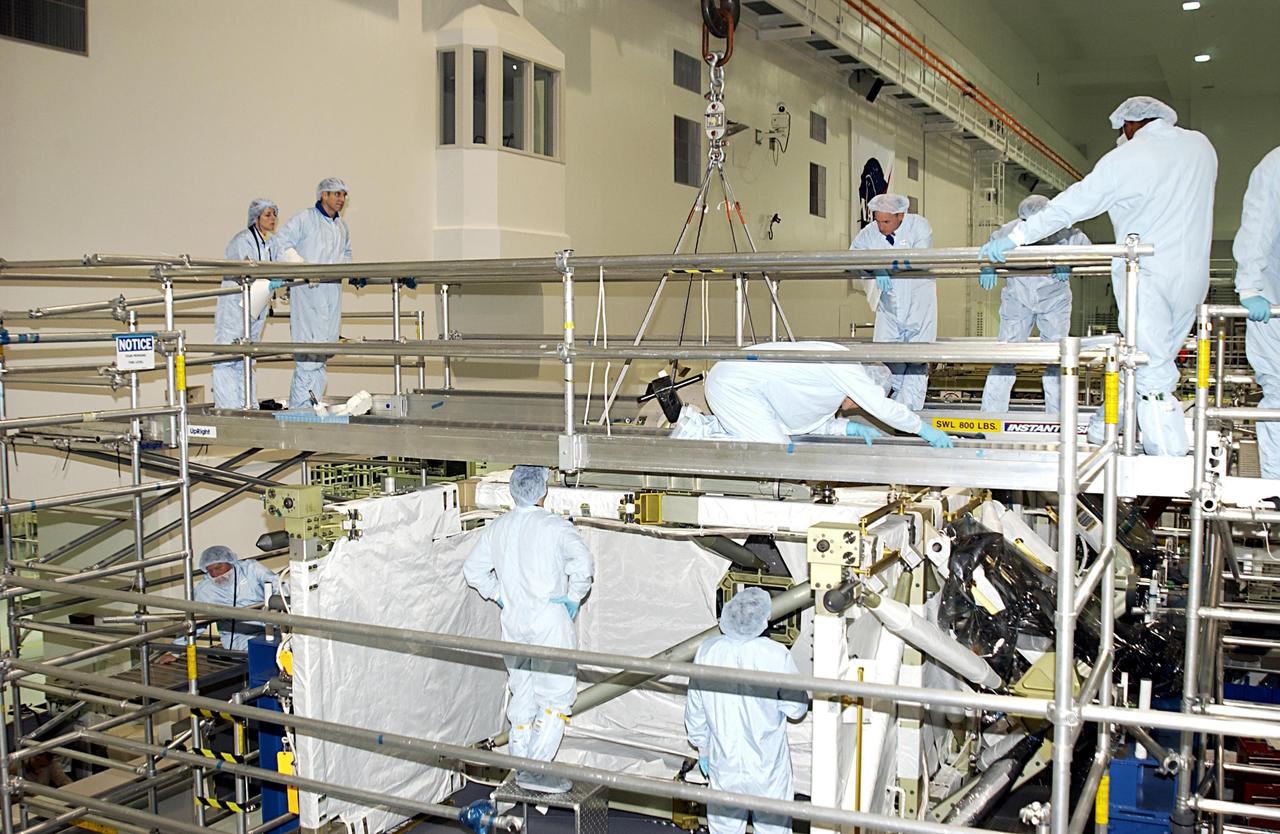
KENNEDY SPACE CENTER, FLA. - The STS-118 crew look over parts of the mission payload in the Space Station Processing Facility. The crew comprises Commander Scott Kelly, Pilot Charles Hobaugh, and Mission Specialists Scott Parazynski, Dafydd Williams, Barbara Morgan and Lisa Nowak. Williams is with the Canadian Space Agency. Morgan was selected by NASA in January 1998 as the first Educator Astronaut. The mission will be delivering the third starboard truss segment, the ITS S5, to the International Space Station, and a SPACEHAB Single Cargo Module with supplies and equipment. Launch aboard Space Shuttle Columbia is scheduled for Nov. 13, 2003.
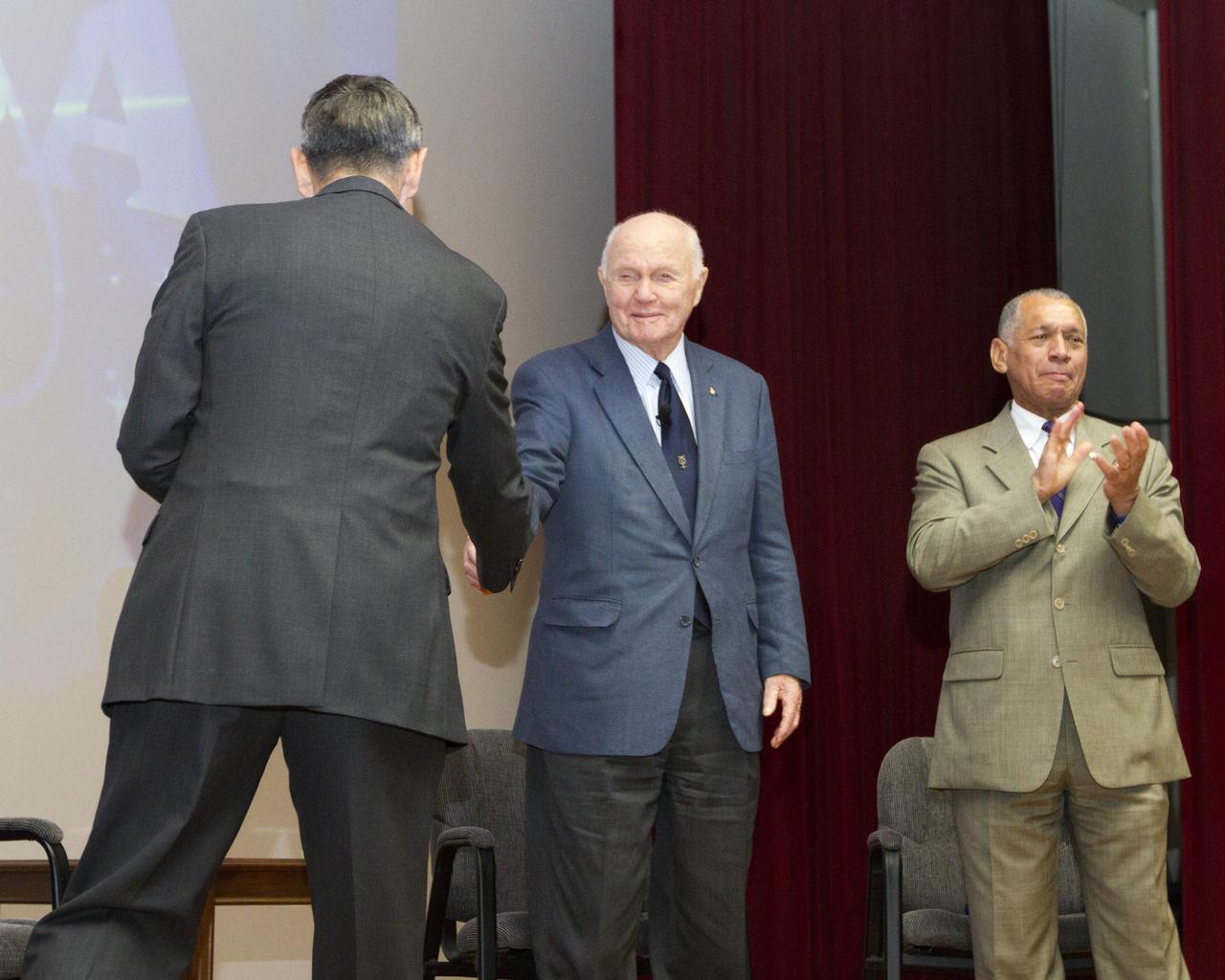
CAPE CANAVERAL, Fla. -- Bob Cabana, director of NASA's Kennedy Space Center in Florida, shakes the hand of Mercury astronaut John Glenn as NASA Administrator Charles Bolden applauds at the "50 Years of Americans in Orbit" presentation for Kennedy employees. Mercury astronaut Scott Carpenter joined Glenn, Bolden and Cabana for the event. This year marks 50 years since Glenn and Carpenter became the first two Americans to orbit Earth. Photo credit: NASA/Kim Shiflett
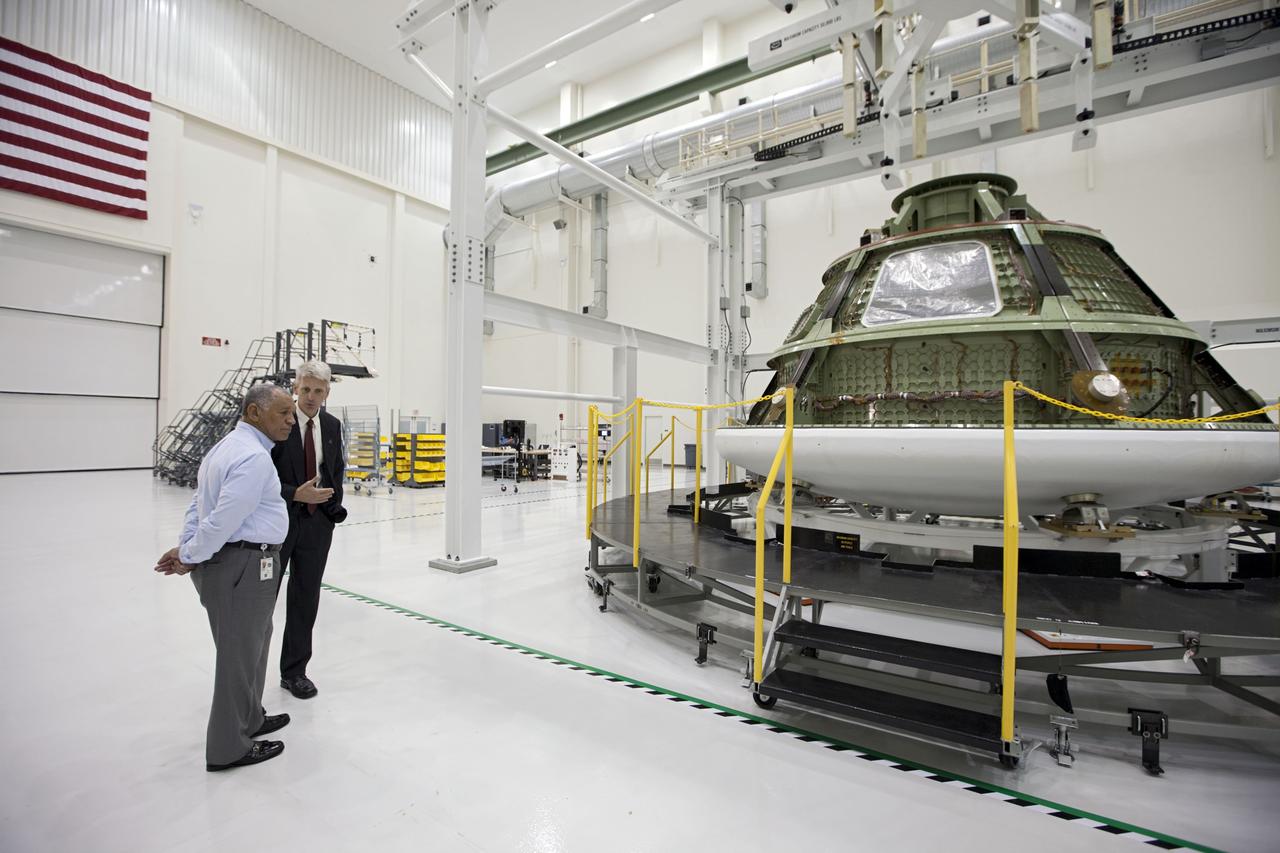
CAPE CANAVERAL, Fla. – NASA's Scott Wilson, right, shows the Orion ground test article to Charles Bolden, NASA administrator, left. The test article is used to perfect processing and equipment steps before they are performed on the flight version of the capsule. The spacecraft is in the high bay at the Operations and Checkout Building at NASA's Kennedy Space Center in Florida. Photo credit: NASA/Kim Shifflett

CAPE CANAVERAL, Fla. -- Former U.S. Senator and Mercury astronaut John Glenn awaits the start of the "50 Years of Americans in Orbit" presentation for employees at NASA's Kennedy Space Center in Florida. The event also featured Mercury astronaut Scott Carpenter, NASA Administrator Charles Bolden and Kennedy Space Center Director Bob Cabana. This year marks 50 years since Glenn and Carpenter became the first two Americans to orbit Earth. Photo credit: NASA/Kim Shiflett
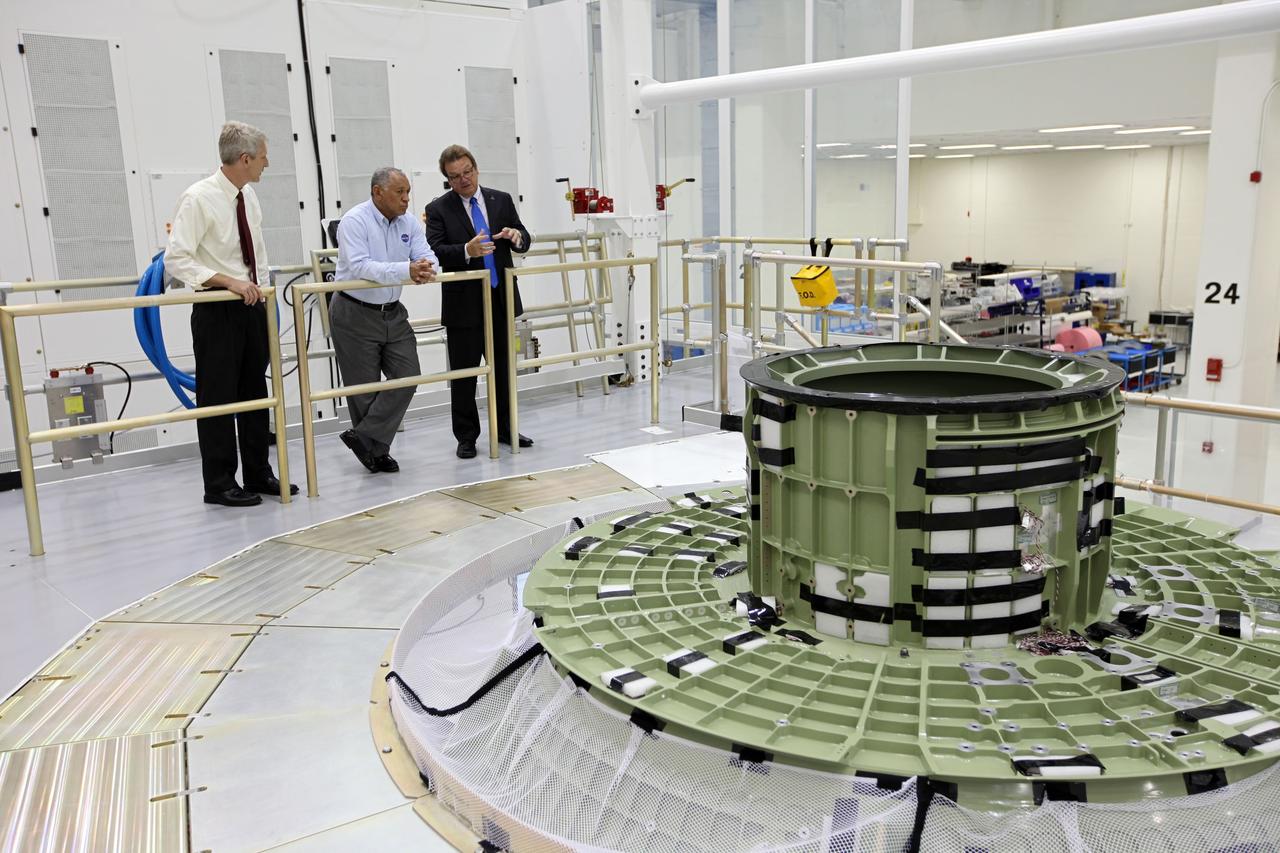
CAPE CANAVERAL, Fla. – Lockheed Martin's Jules Schneider, right, shows the upper portion of the Orion capsule to Charles Bolden, NASA administrator, center, as NASA's Scott Wilson looks on. The Orion capsule will make an uncrewed flight test in 2014. The spacecraft is in the high bay at the Operations and Checkout Building at NASA's Kennedy Space Center in Florida. Photo credit: NASA/Kim Shifflett

CAPE CANAVERAL, Fla. -- The training auditorium is filled to capacity at NASA's Kennedy Space Center in Florida, where Mercury astronauts John Glenn and Scott Carpenter were joined by NASA Administrator Charles Bolden and Center Director Bob Cabana for the "50 Years of Americans in Orbit" presentation. This year marks 50 years since Glenn and Carpenter became the first two Americans to orbit Earth. Photo credit: NASA/Kim Shiflett
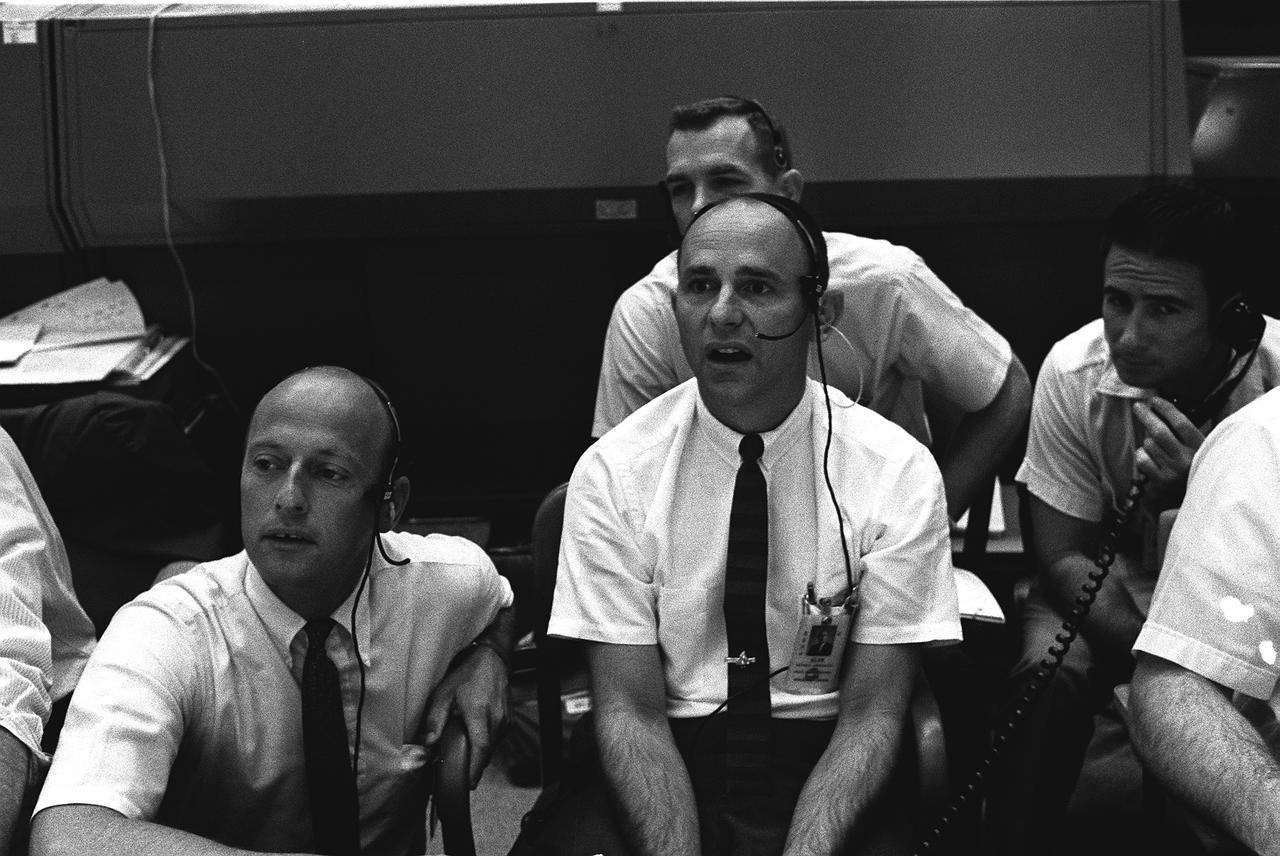
S69-39600 (20 July 1969) --- Four members of the prime and backup crews for Apollo 12 monitor activity of the first moon landing mission from consoles in the Mission Control Center in Houston. Left to right are astronauts Charles Conrad Jr., Alan L. Bean, David R. Scott and James B. Irwin. Astronauts Armstrong and Aldrin had already landed on the moon when the photo was taken.
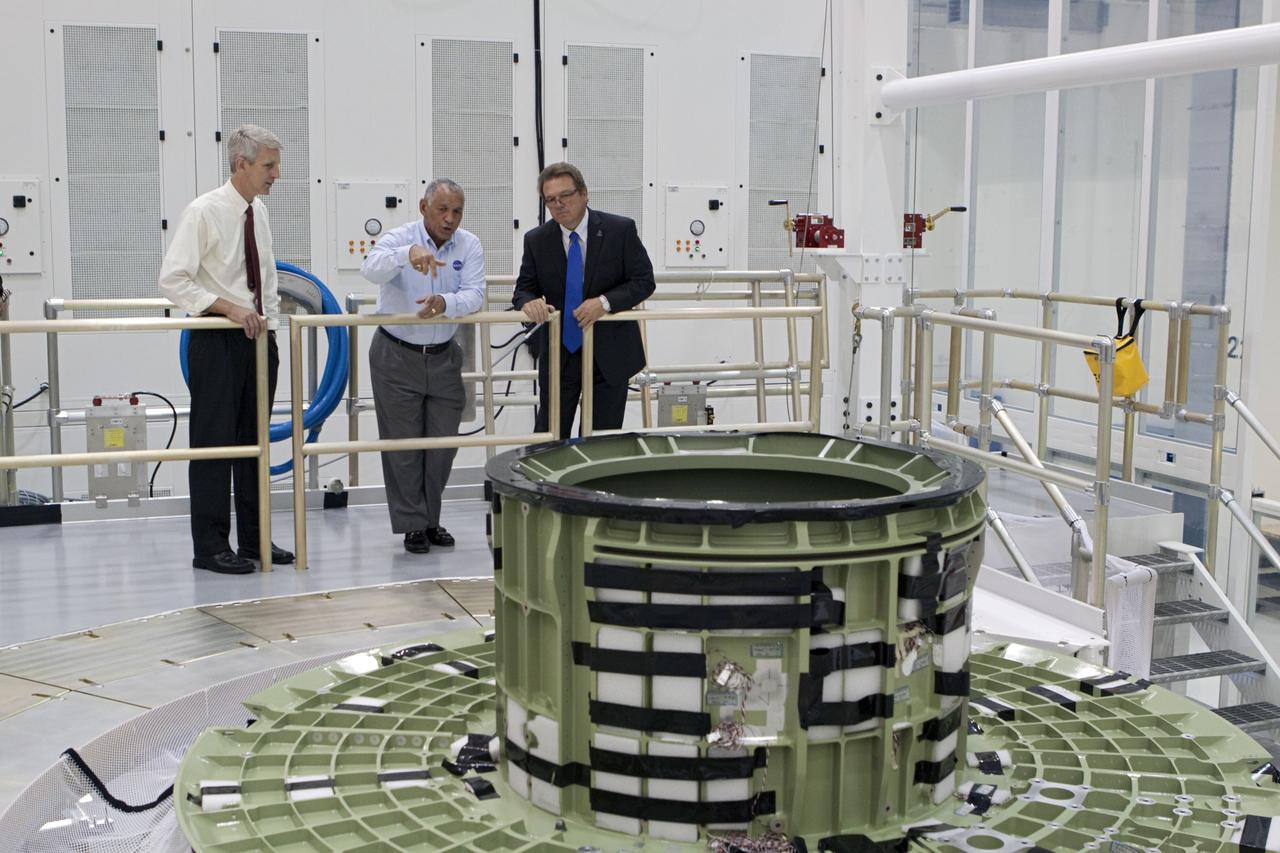
CAPE CANAVERAL, Fla. – Lockheed Martin's Jules Schneider, right, shows the upper portion of the Orion capsule to Charles Bolden, NASA administrator, center, as NASA's Scott Wilson looks on. The Orion capsule will make an uncrewed flight test in 2014. The spacecraft is in the high bay at the Operations and Checkout Building at NASA's Kennedy Space Center in Florida. Photo credit: NASA/Kim Shifflett

CAPE CANAVERAL, Fla. -- Annie Glenn, right, wife of Mercury astronaut John Glenn, and their children listen during the "50 Years of Americans in Orbit" presentation for employees at NASA's Kennedy Space Center in Florida. John Glenn and fellow Mercury astronaut Scott Carpenter were joined by NASA Administrator Charles Bolden and Center Director Bob Cabana on stage in Kennedy's training auditorium. This year marks 50 years since Glenn and Carpenter became the first two Americans to orbit Earth. Photo credit: NASA/Kim Shiflett
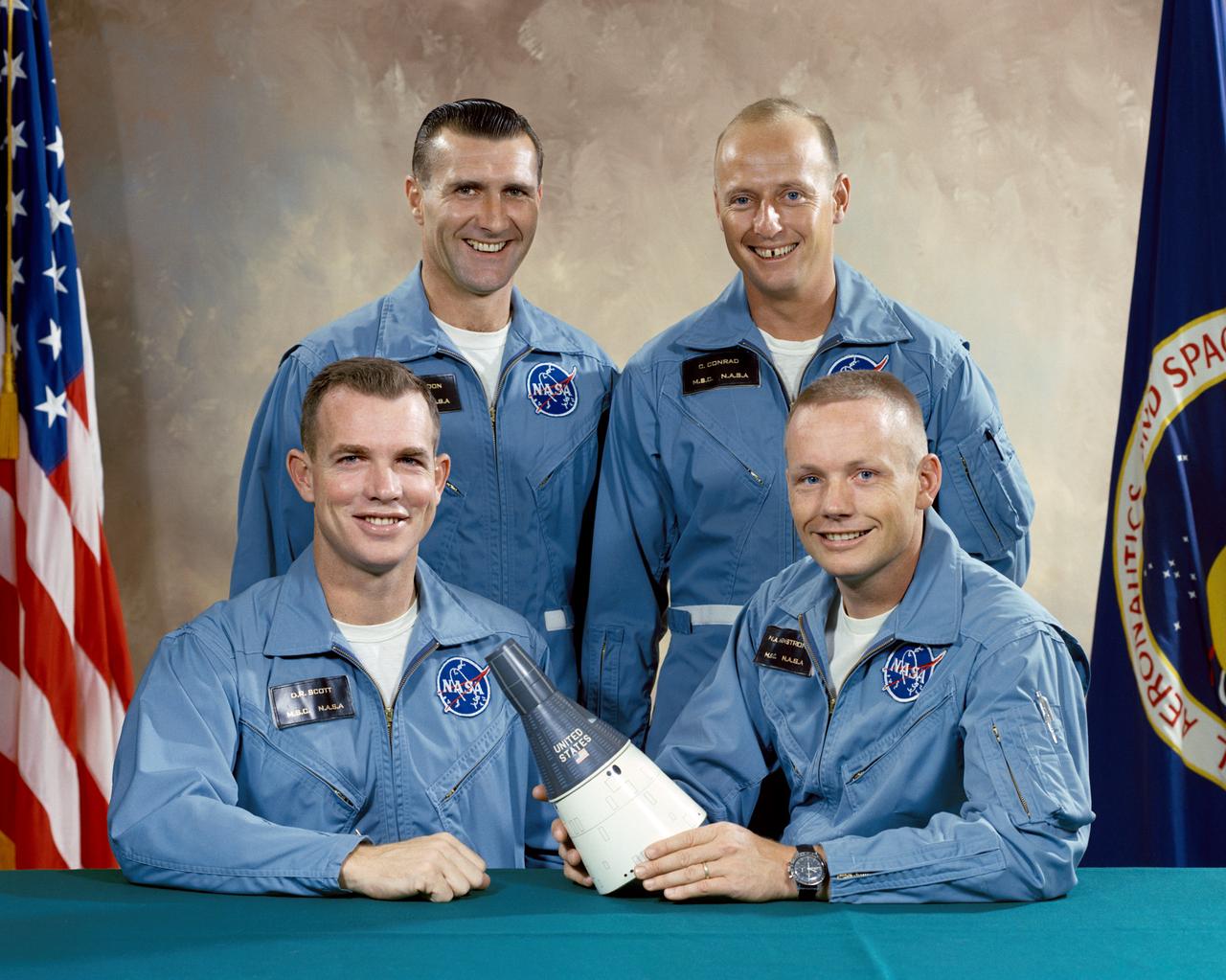
S65-58502 (4 Nov. 1965) --- This is the portrait of the prime and backup crew members of the Gemini-Titan 8 (GT-8) mission. Astronauts David R. Scott (left), pilot; and astronaut Neil A. Armstrong, command pilot, are the prime crew of the Gemini-8 mission. Backup crew (left to right, standing) are astronauts Richard F. Gordon Jr., pilot; and Charles Conrad Jr., command pilot. Photo credit: NASA
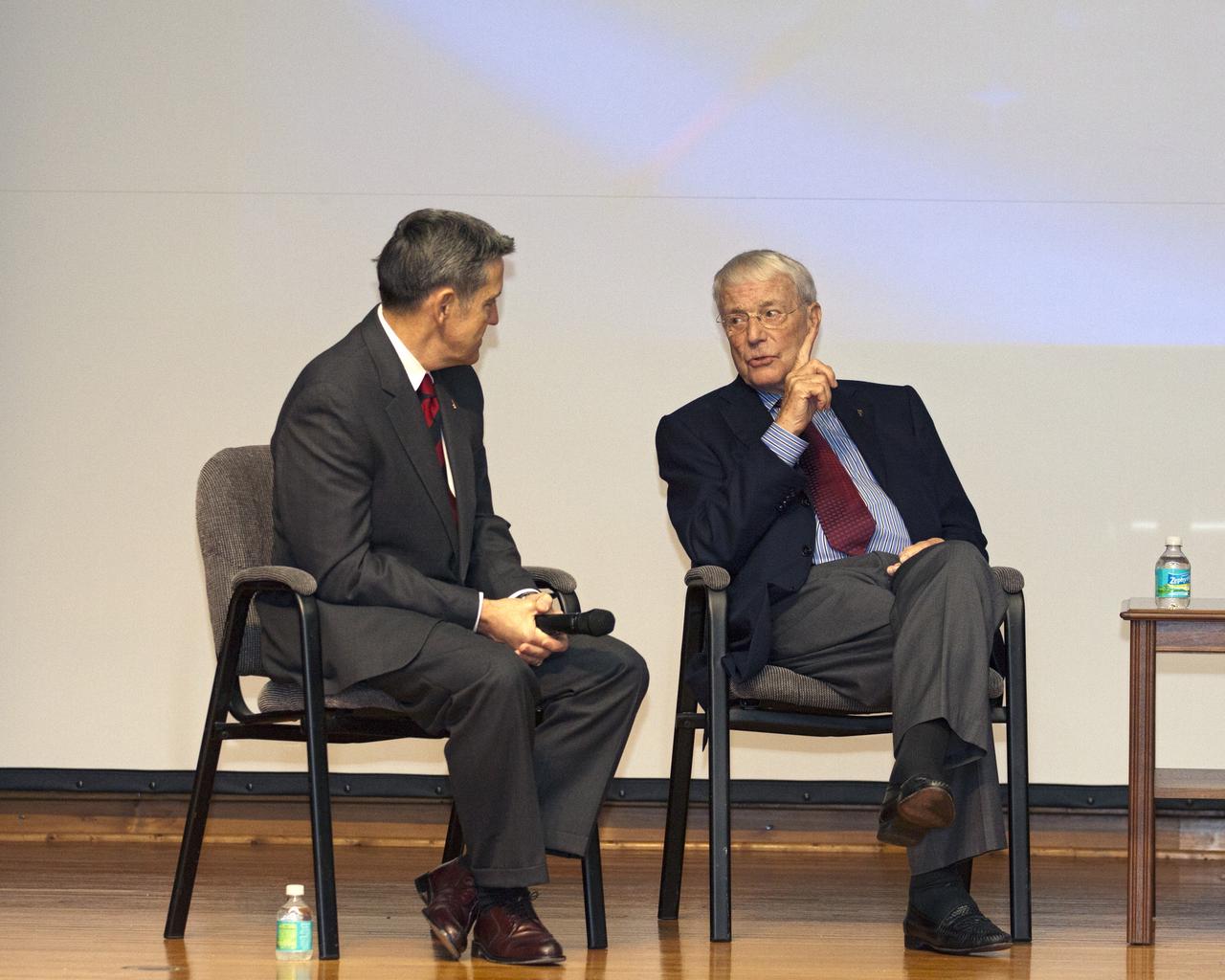
CAPE CANAVERAL, Fla. -- Mercury astronaut Scott Carpenter talks to Bob Cabana, director of NASA's Kennedy Space Center in Florida, during the "50 Years of Americans in Orbit" presentation for employees at NASA's Kennedy Space Center in Florida. Mercury astronaut John Glenn and NASA Administrator Charles Bolden joined Carpenter and Cabana for the event. This year marks 50 years since Glenn and Carpenter became the first two Americans to orbit Earth. Photo credit: NASA/Kim Shiflett
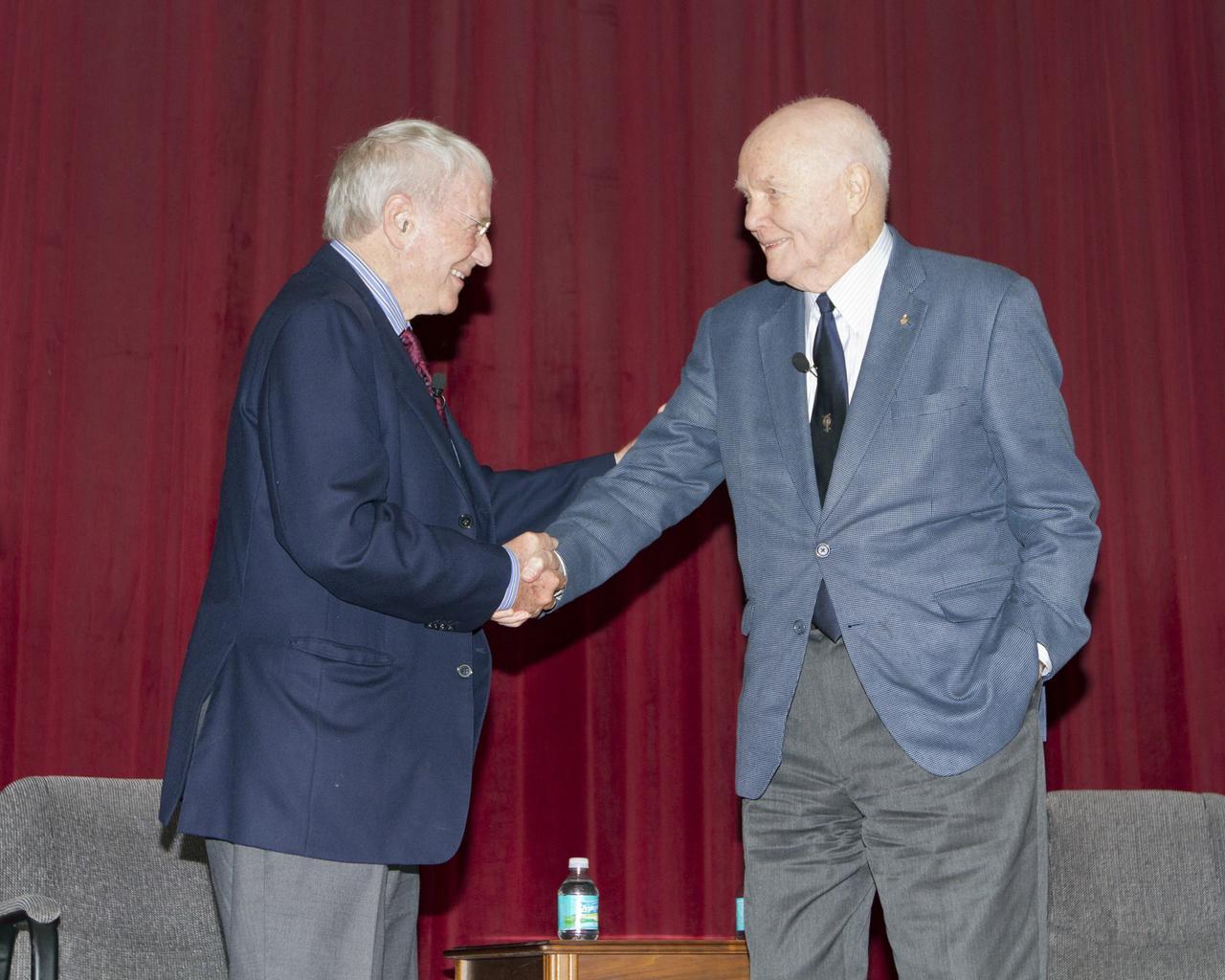
CAPE CANAVERAL, Fla. -- Mercury astronauts Scott Carpenter and John Glenn pause for a handshake at the conclusion of the "50 Years of Americans in Orbit" presentation for employees at NASA's Kennedy Space Center in Florida. NASA Administrator Charles Bolden and Center Director Bob Cabana joined Carpenter and Glenn for the event. This year marks 50 years since Glenn and Carpenter became the first two Americans to orbit Earth. Photo credit: NASA/Kim Shiflett
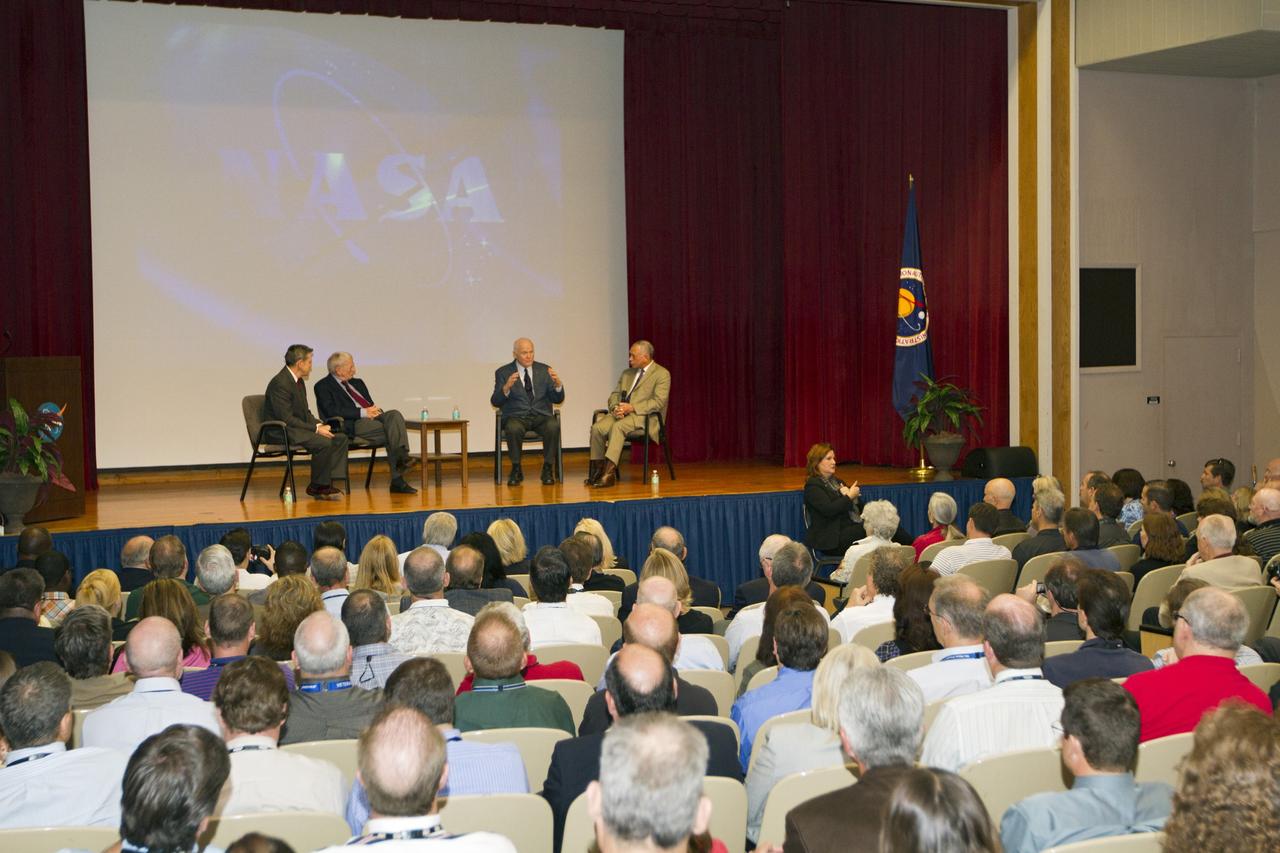
CAPE CANAVERAL, Fla. -- Employees at NASA's Kennedy Space Center in Florida listen as Center Director Bob Cabana, Mercury astronauts Scott Carpenter and John Glenn, and NASA Administrator Charles Bolden share their spaceflight memories during the "50 Years of Americans in Orbit" presentation for employees. This year marks 50 years since Glenn and Carpenter became the first two Americans to orbit Earth. Photo credit: NASA/Kim Shiflett
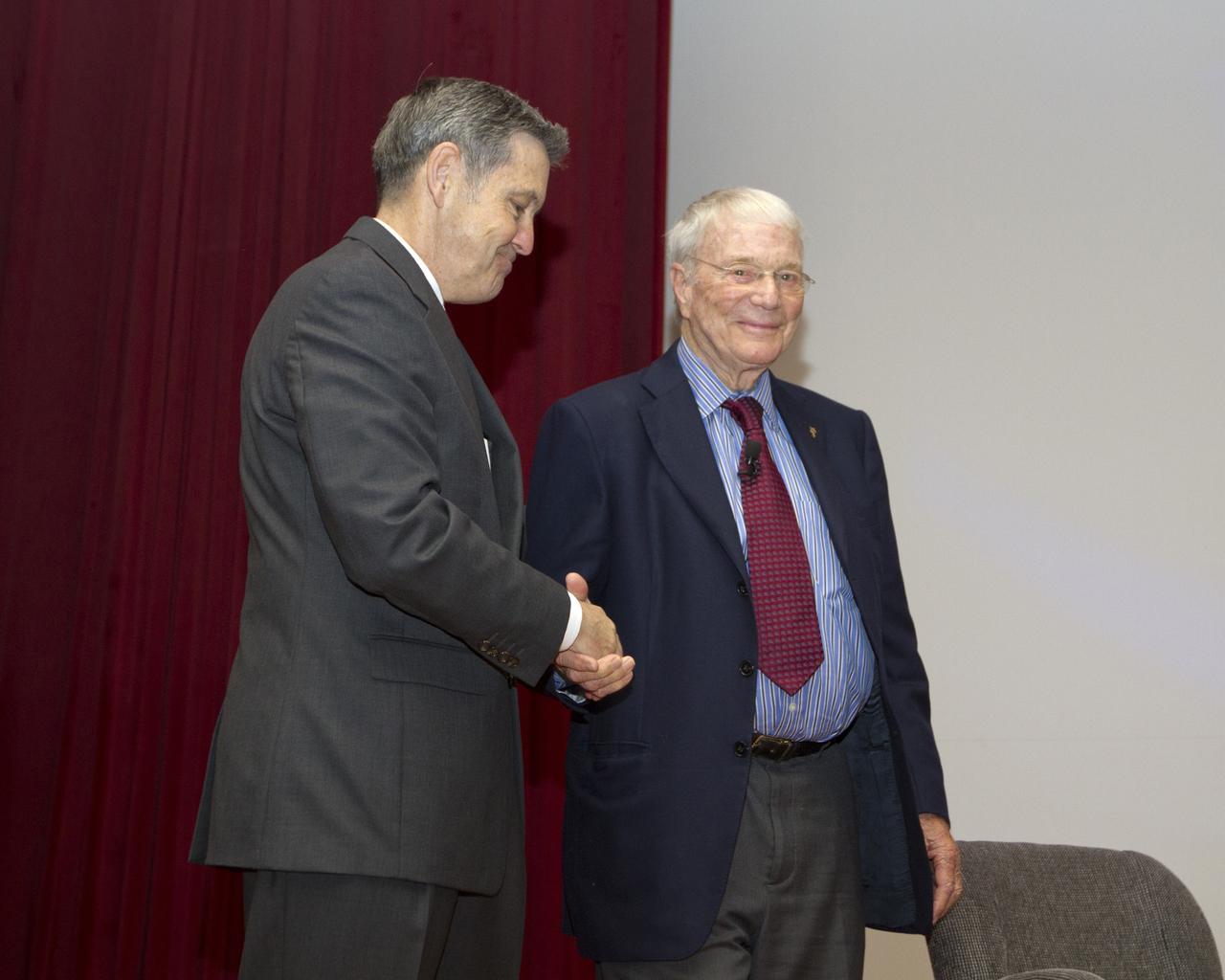
CAPE CANAVERAL, Fla. -- Bob Cabana, director of NASA's Kennedy Space Center in Florida, shakes the hand of Mercury astronaut Scott Carpenter at the "50 Years of Americans in Orbit" presentation for Kennedy employees. Mercury astronaut John Glenn and NASA Administrator Charles Bolden joined Carpenter and Cabana for the event. This year marks 50 years since Glenn and Carpenter became the first two Americans to orbit Earth. Photo credit: NASA/Kim Shiflett

CAPE CANAVERAL, Fla. -- Mercury astronauts Scott Carpenter and John Glenn shake hands with NASA Administrator Charles Bolden right and Bob Cabana, director of NASA's Kennedy Space Center in Florida left at the conclusion of the "50 Years of Americans in Orbit" presentation for Kennedy employees. This year marks 50 years since Glenn and Carpenter became the first two Americans to orbit Earth. Photo credit: NASA/Kim Shiflett
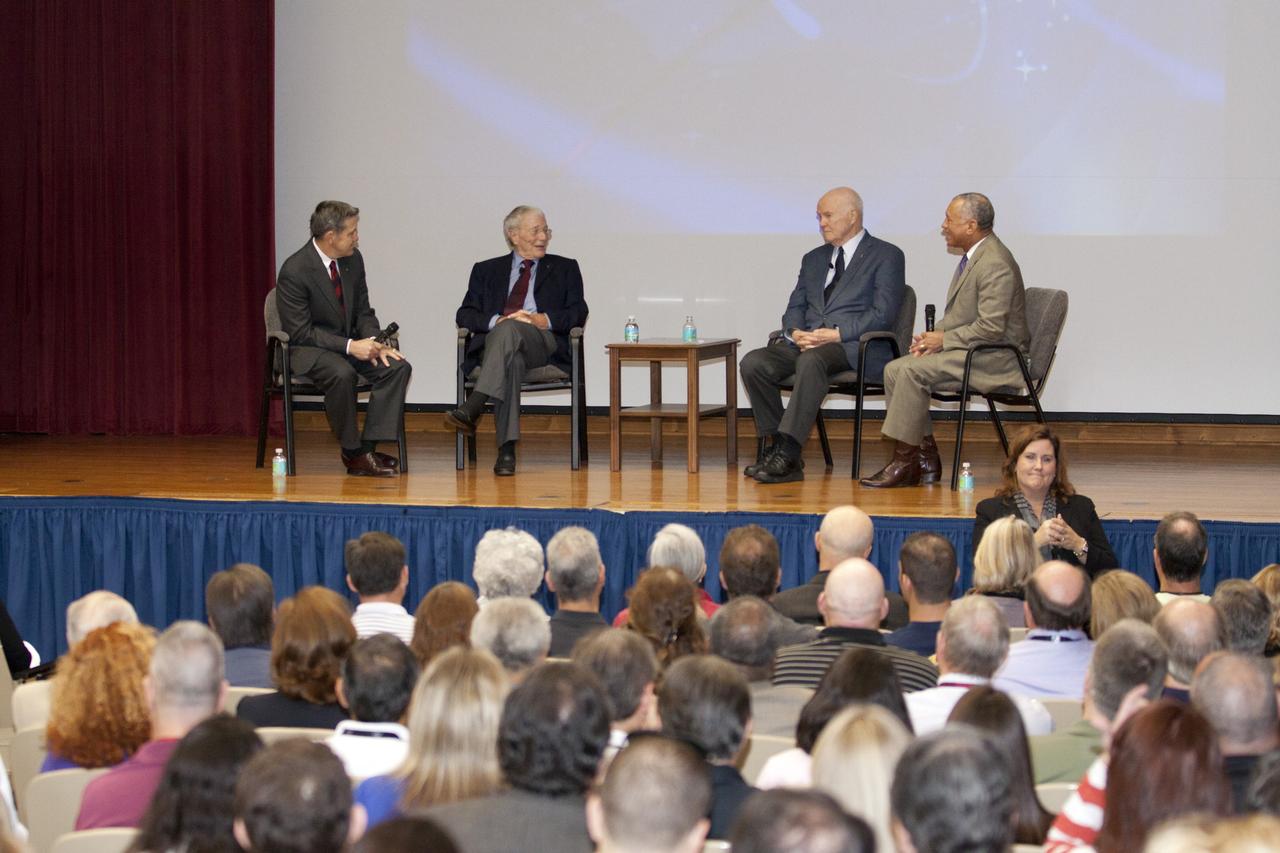
CAPE CANAVERAL, Fla. -- Employees at NASA's Kennedy Space Center in Florida listen as Center Director Bob Cabana, Mercury astronauts Scott Carpenter and John Glenn, and NASA Administrator Charles Bolden share their spaceflight memories during the "50 Years of Americans in Orbit" presentation for employees. This year marks 50 years since Glenn and Carpenter became the first two Americans to orbit Earth. Photo credit: NASA/Kim Shiflett
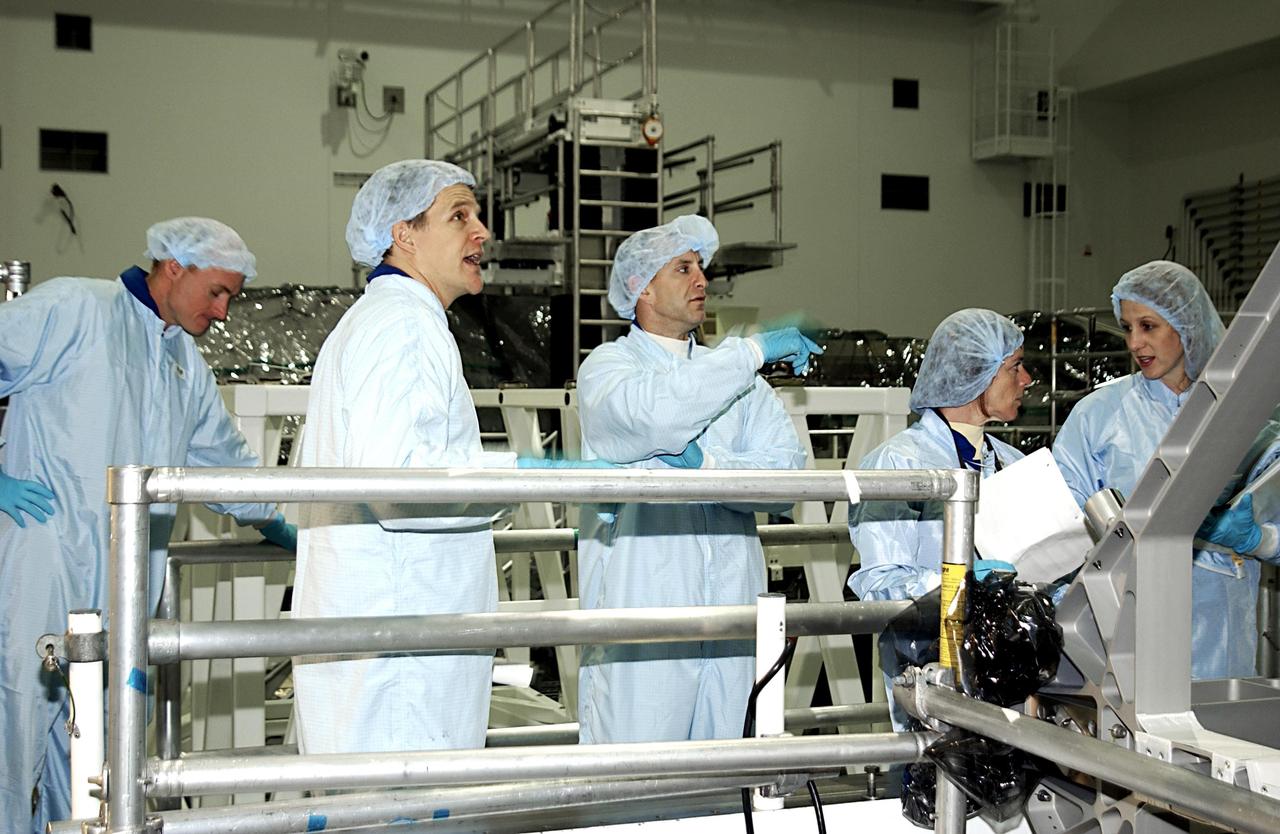
KENNEDY SPACE CENTER, FLA. - Members of the STS-118 crew look over equipment in the Space Station Processing Facility. Second from left is Mission Specialist Scott Parazynski, next is Pilot Charles Hobaugh and Mission Specialist Barbara Morgan. The mission will be delivering the third starboard truss segment, the ITS S5, to the International Space Station, and a SPACEHAB Single Cargo Module with supplies and equipment. Launch aboard Space Shuttle Columbia is scheduled for Nov. 13, 2003.
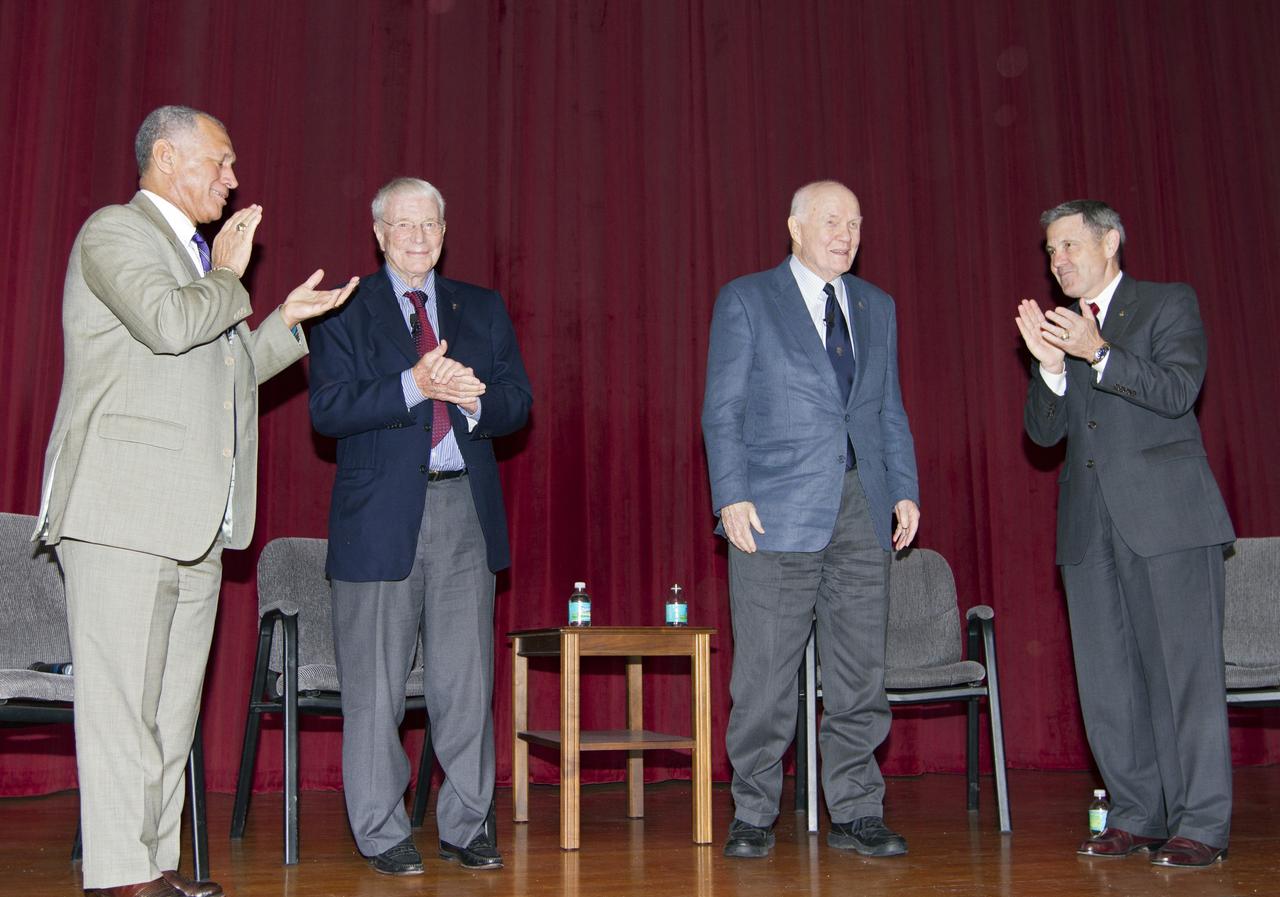
CAPE CANAVERAL, Fla. -- NASA Administrator Charles Bolden, Mercury astronauts Scott Carpenter and John Glenn, and Bob Cabana, director of NASA's Kennedy Space Center in Florida, stand for applause at the conclusion of the "50 Years of Americans in Orbit" presentation for Kennedy employees. This year marks 50 years since Glenn and Carpenter became the first two Americans to orbit Earth. Photo credit: NASA/Kim Shiflett
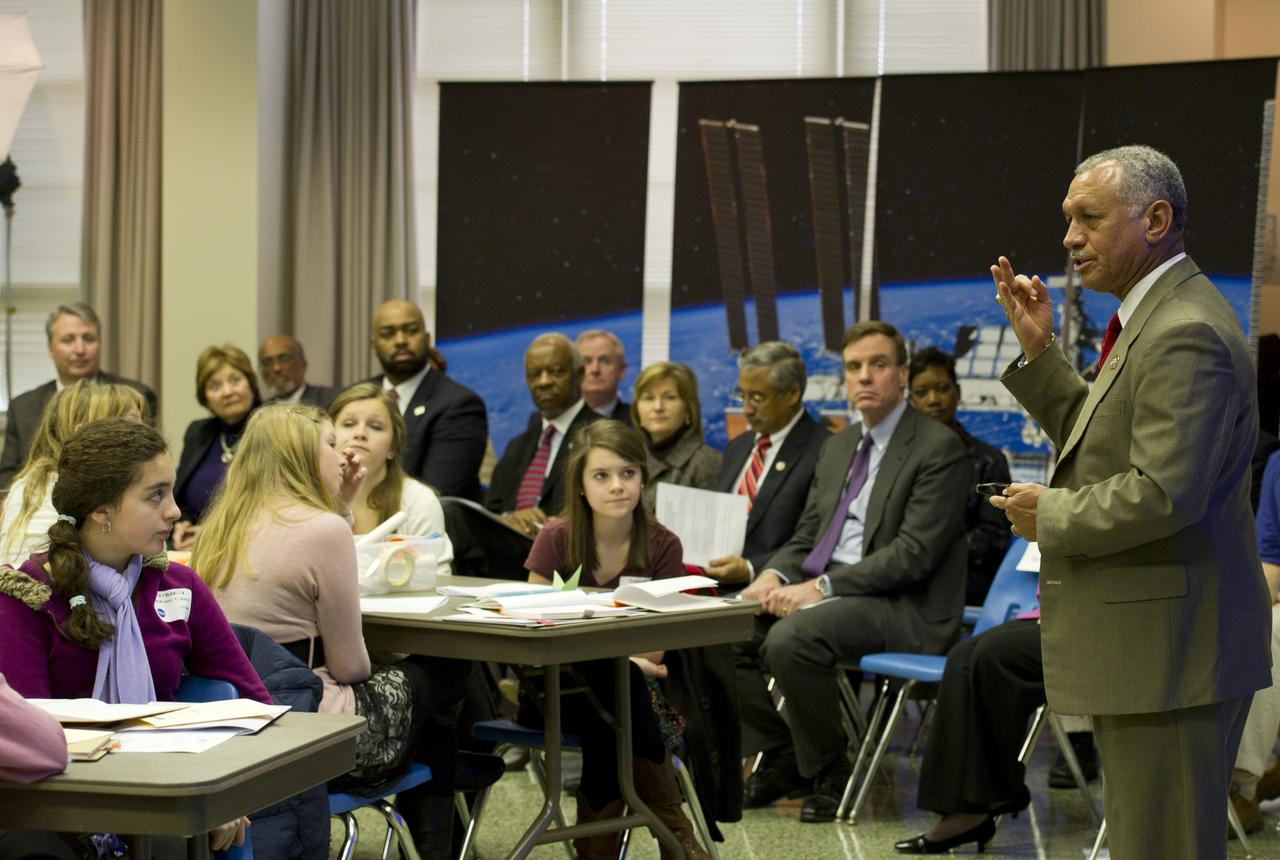
NASA Administrator Charles Bolden speaks to students from Albert Hill Middle School during a visit to the MathScience Innovation Center, Friday, Jan. 28, 2011, in Richmond, Va., as U.S. Sen. Mark Warner, D-Va., U.S. Rep. Bobby Scott, D-Va., seated, look on. During his talk, Administrator Bolden highlighted the importance of science, technology, engineering and math, or STEM, as he shared his life experiences with the students. (Photo Credit:NASA/Paul E. Alers)
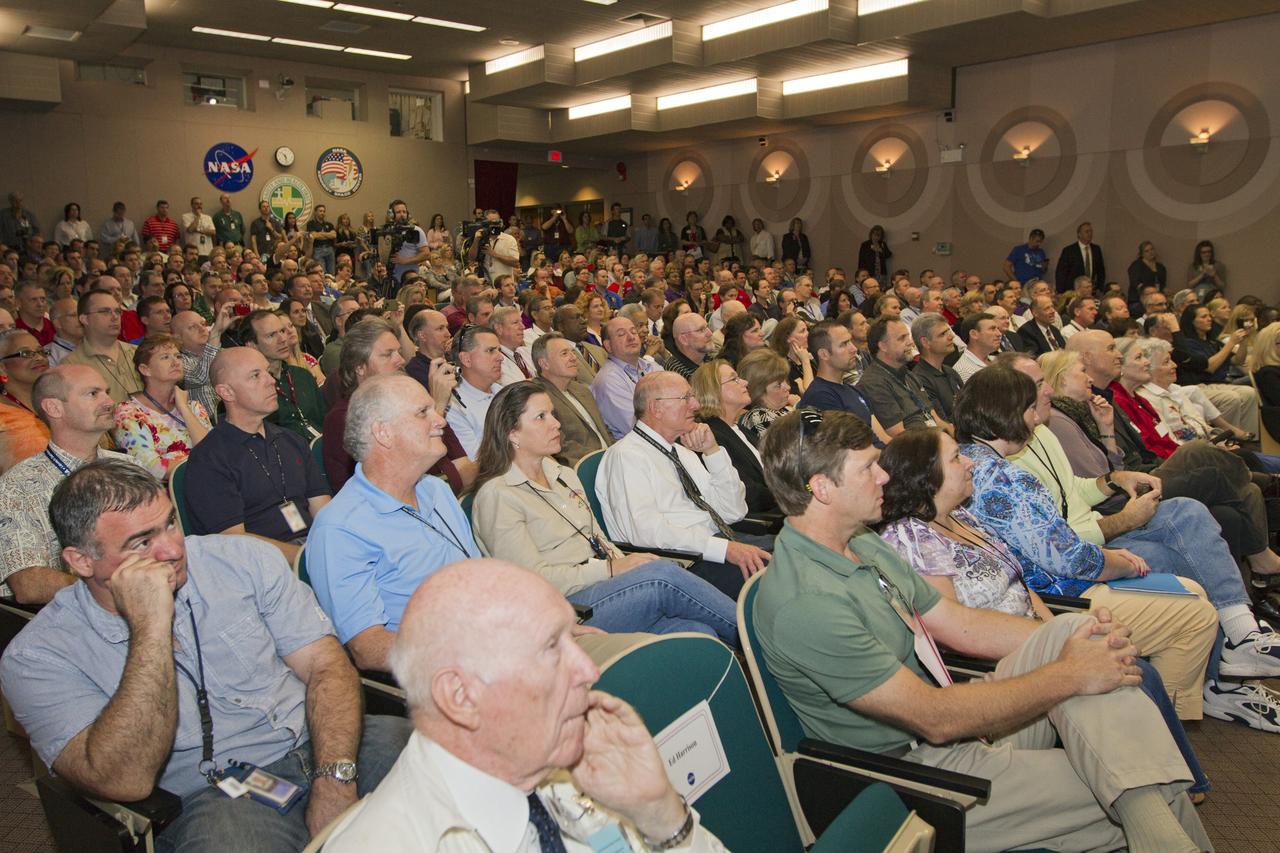
CAPE CANAVERAL, Fla. -- It's "standing room only" in the training auditorium at NASA's Kennedy Space Center in Florida, where Mercury astronauts John Glenn and Scott Carpenter were joined by NASA Administrator Charles Bolden and Center Director Bob Cabana for the "50 Years of Americans in Orbit" presentation for employees. This year marks 50 years since Glenn and Carpenter became the first two Americans to orbit Earth. Photo credit: NASA/Kim Shiflett
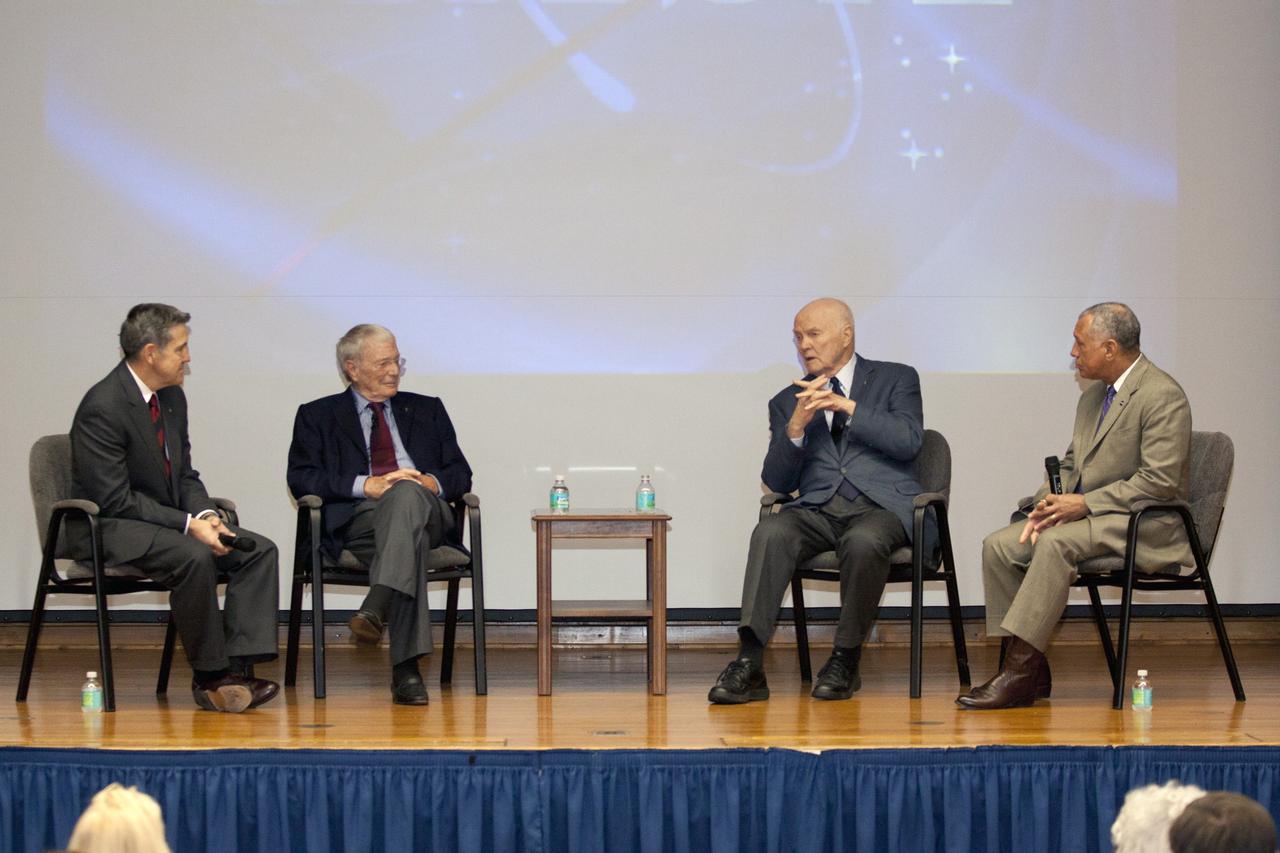
CAPE CANAVERAL, Fla. -- From left to right, Center Director Bob Cabana, Mercury astronauts Scott Carpenter and John Glenn, and NASA Administrator Charles Bolden share the stage during the "50 Years of Americans in Orbit" presentation for employees at NASA's Kennedy Space Center in Florida. This year marks 50 years since Glenn and Carpenter became the first two Americans to orbit Earth. Photo credit: NASA/Kim Shiflett

CAPE CANAVERAL, Fla. -- Mercury astronaut John Glenn is greeted by NASA Administrator Charles Bolden at the "50 Years of Americans in Orbit" presentation for employees at NASA's Kennedy Space Center in Florida. Mercury astronaut Scott Carpenter and Kennedy Space Center Director Bob Cabana joined Glenn and Bolden for the event. This year marks 50 years since Glenn and Carpenter became the first two Americans to orbit Earth. Photo credit: NASA/Kim Shiflett
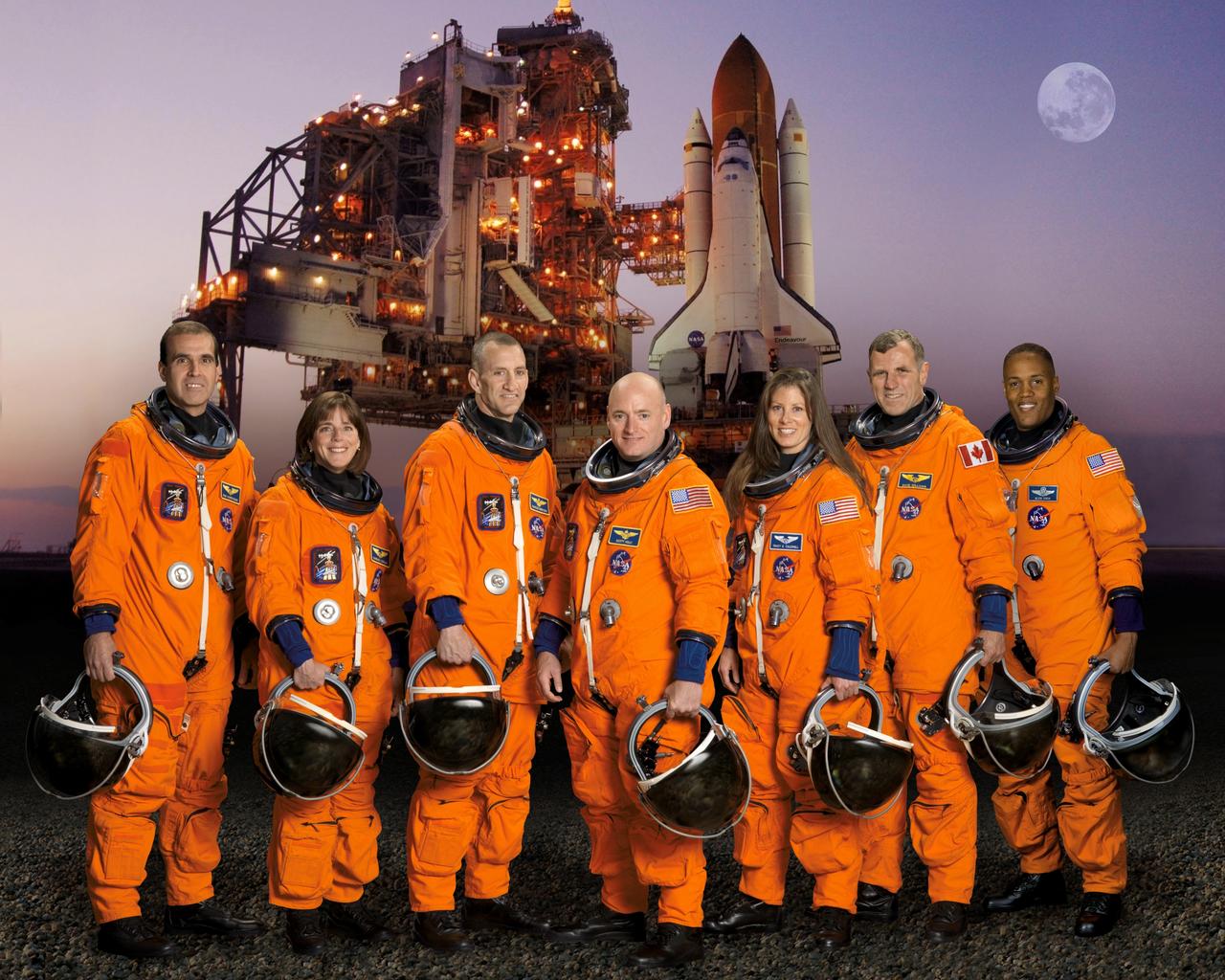
STS118-S-002 (May 2007) --- These seven astronauts take a break from training to pose for the STS-118 crew portrait. Pictured from the left are astronauts Richard A. (Rick) Mastracchio, mission specialist; Barbara R. Morgan, mission specialist; Charles O. Hobaugh, pilot; Scott J. Kelly, commander; Tracy E. Caldwell, Canadian Space Agency's Dafydd R. (Dave) Williams, and Alvin Drew Jr., all mission specialists. The crewmembers are attired in training versions of their shuttle launch and entry suits.
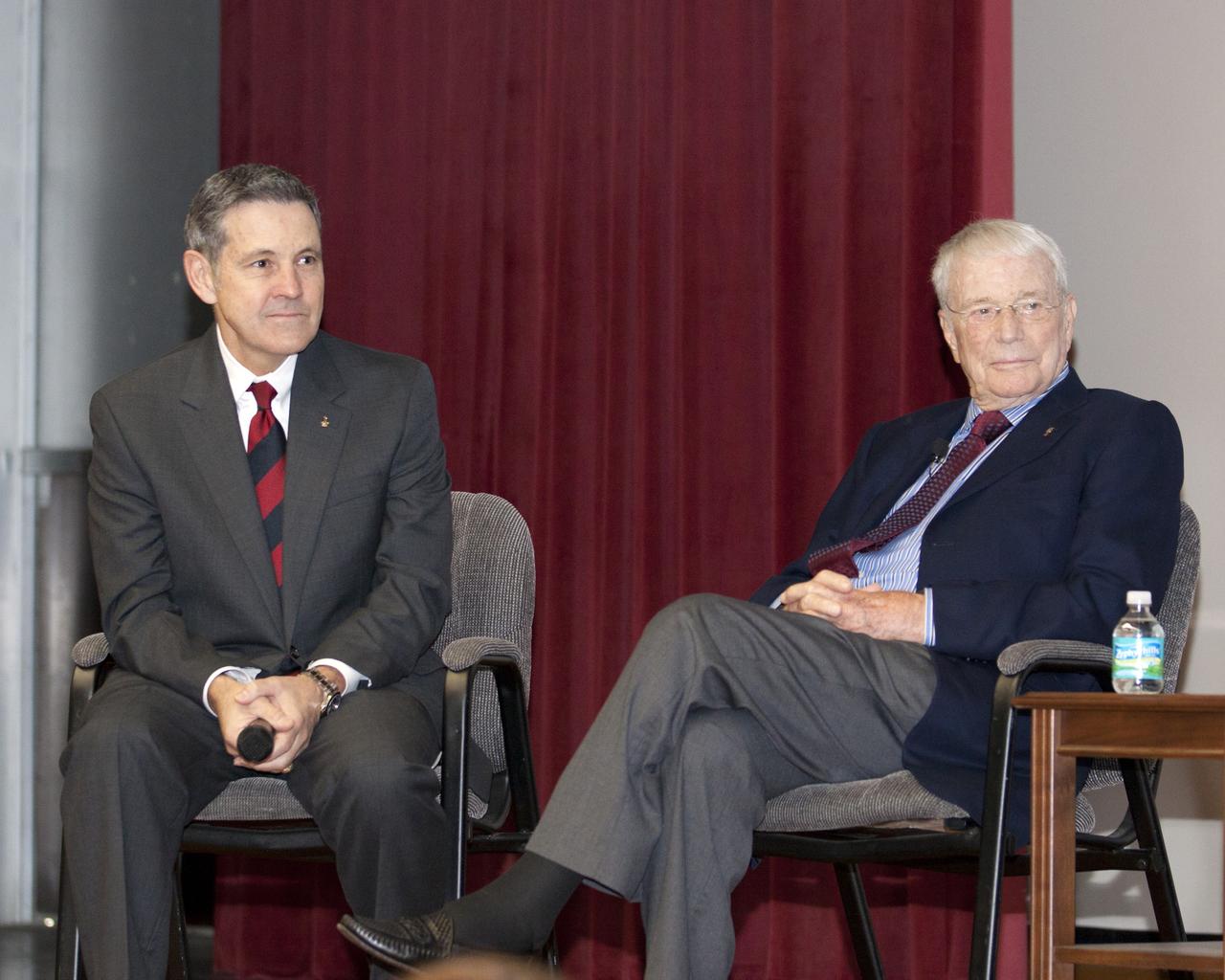
CAPE CANAVERAL, Fla. -- Bob Cabana, director of NASA's Kennedy Space Center in Florida, and Mercury astronaut Scott Carpenter share the stage during the "50 Years of Americans in Orbit" presentation for employees at NASA's Kennedy Space Center in Florida. Mercury astronaut John Glenn and NASA Administrator Charles Bolden joined Carpenter and Cabana for the event. This year marks 50 years since Glenn and Carpenter became the first two Americans to orbit Earth. Photo credit: NASA/Kim Shiflett
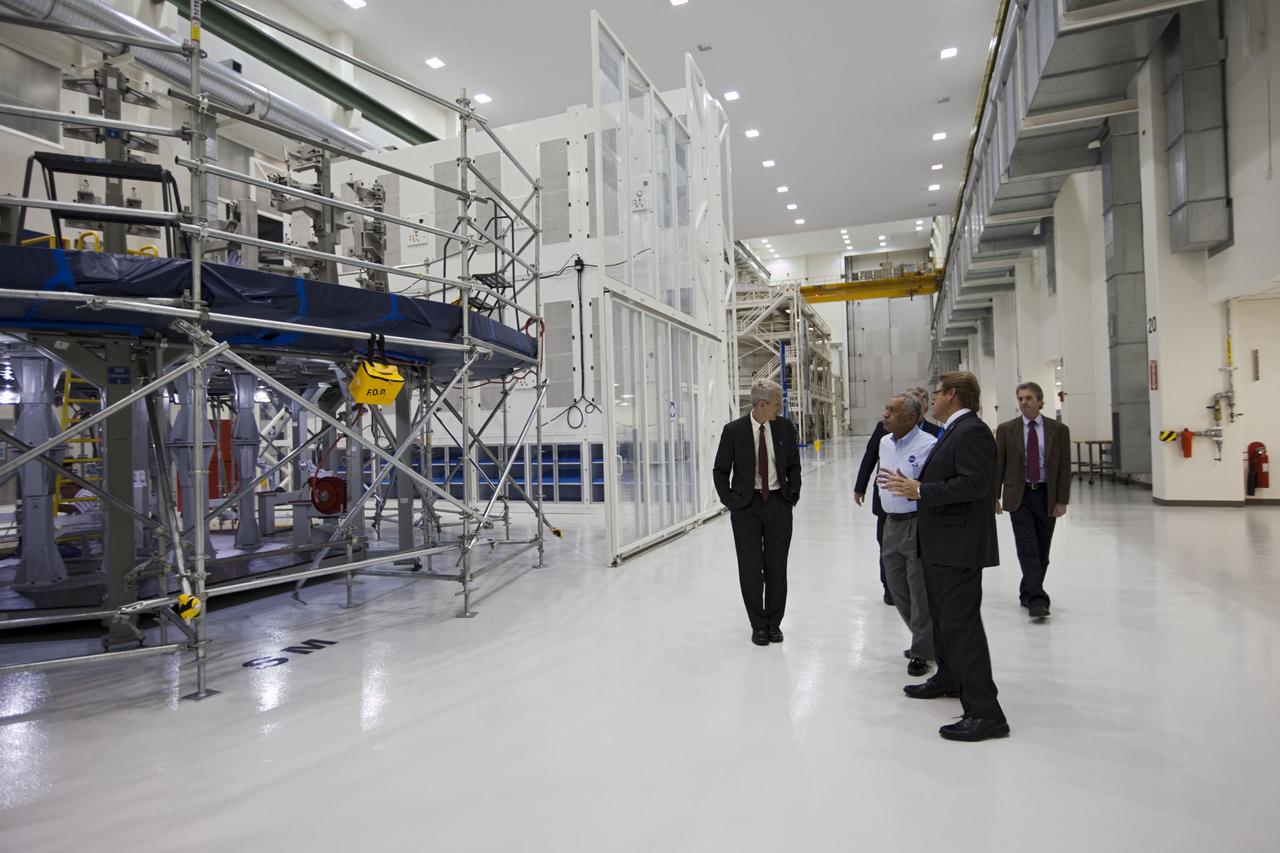
CAPE CANAVERAL, Fla. – Charles Bolden, NASA administrator, center, is shown the high bay at the Operations and Checkout Building at NASA's Kennedy Space Center in Florida by NASA's Scott Wilson, left, and Lockheed Martin's Jules Schneider, foreground. Lockheed Martin is processing an Orion spacecraft that will make an uncrewed flight test in 2014. Photo credit: NASA/Kim Shifflett

CAPE CANAVERAL, Fla. – Charles Bolden, NASA administrator, center, is shown the high bay at the Operations and Checkout Building at NASA's Kennedy Space Center in Florida by NASA's Scott Wilson, left, and Lockheed Martin's Jules Schneider, right. Lockheed Martin is processing an Orion spacecraft that will make an uncrewed flight test in 2014. Photo credit: NASA/Kim Shifflett
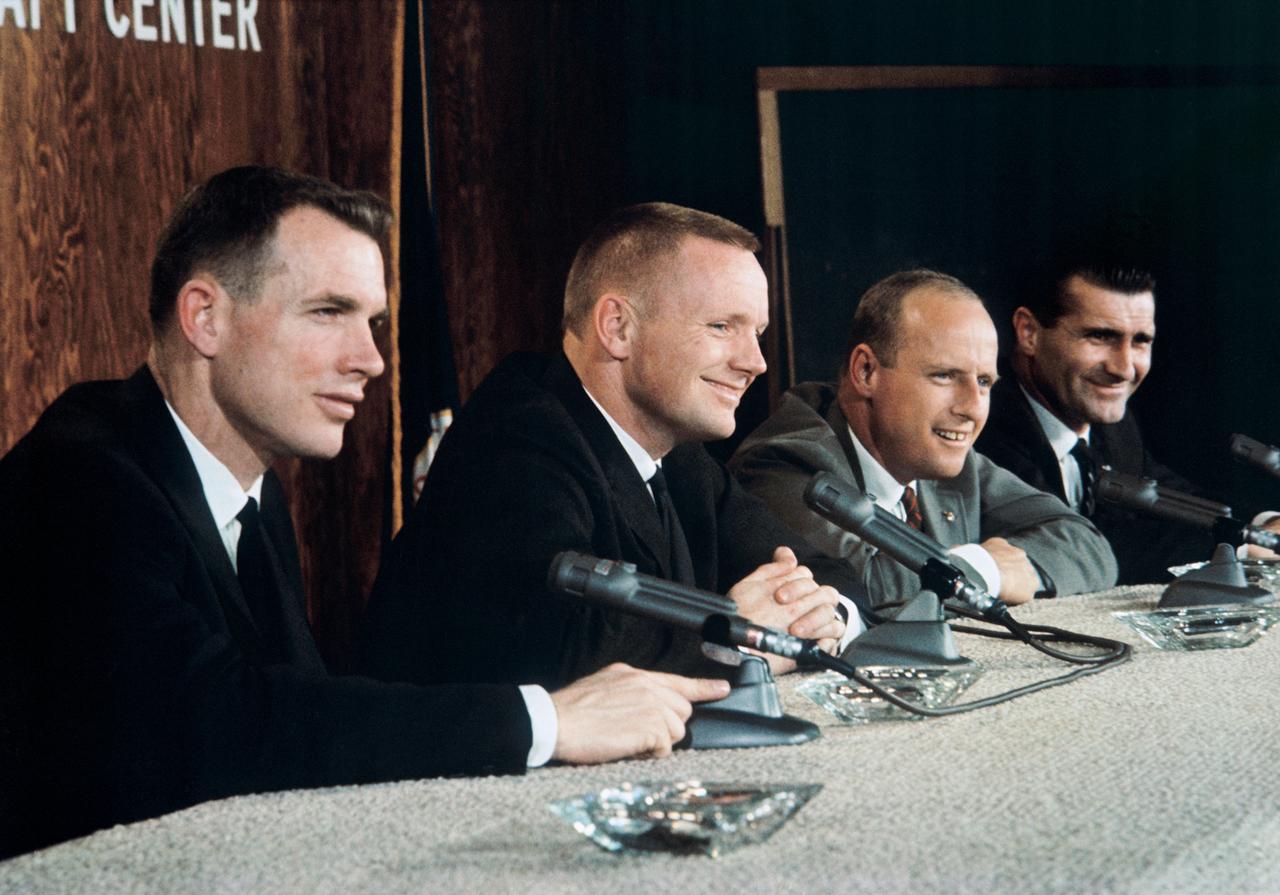
S66-24380 (26 Feb. 1966) --- Gemini-8 prime and backup crews during press conference. Left to right are astronauts David R. Scott, prime crew pilot; Neil A. Armstrong, prime crew command pilot; Charles Conrad Jr., backup crew command pilot; and Richard F. Gordon Jr., backup crew pilot. Photo credit: NASA

CAPE CANAVERAL, Fla. -- Mercury astronaut Scott Carpenter takes his seat on stage in the training auditorium at NASA's Kennedy Space Center in Florida for the "50 Years of Americans in Orbit" presentation for employees. Joining Carpenter for the event were fellow Mercury astronaut John Glenn, NASA Administrator Charles Bolden and Kennedy Space Center Director Bob Cabana. This year marks 50 years since Glenn and Carpenter became the first two Americans to orbit Earth. Photo credit: NASA/Kim Shiflett
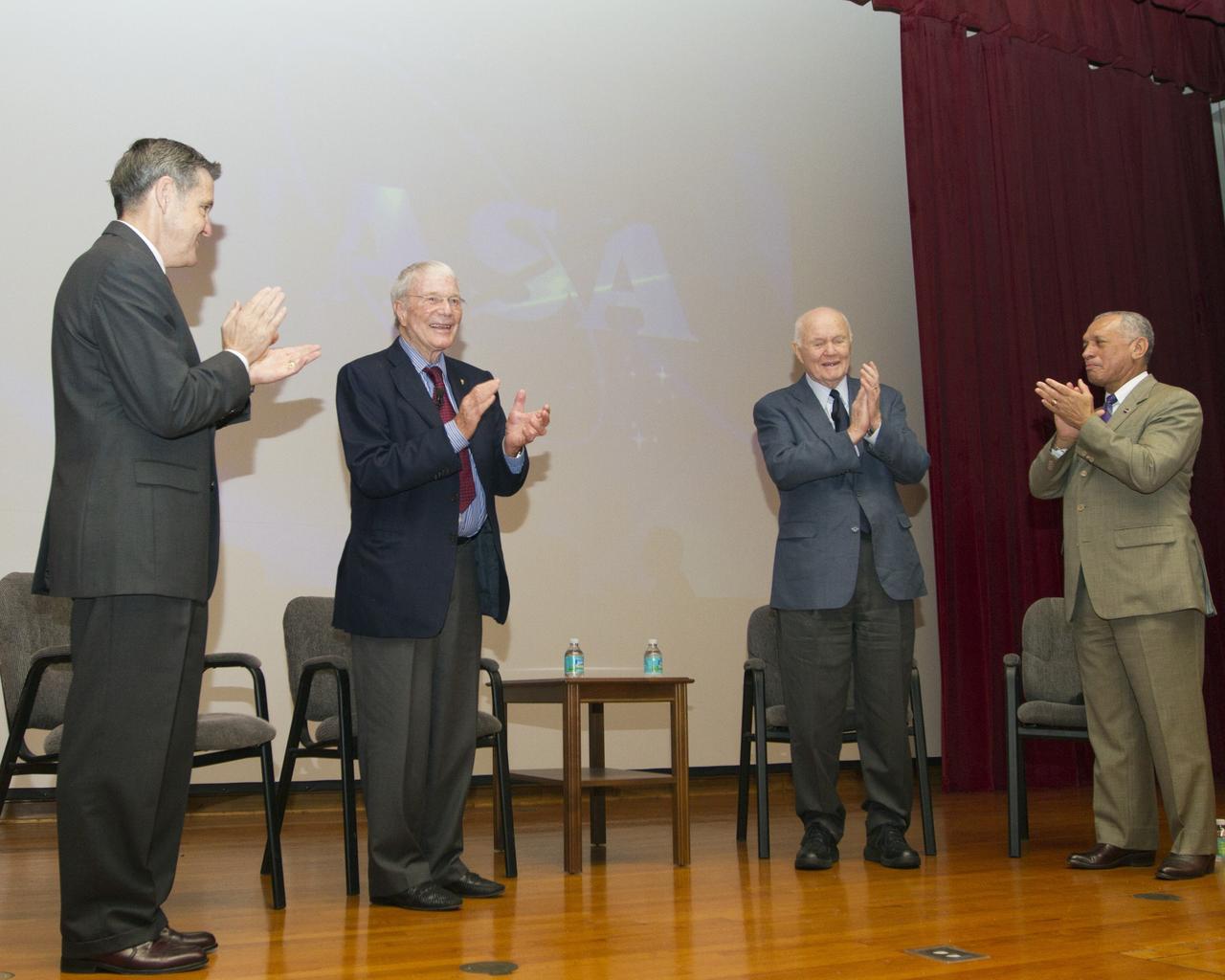
CAPE CANAVERAL, Fla. -- At NASA's Kennedy Space Center in Florida, Center Director Bob Cabana, left, Mercury astronauts Scott Carpenter and John Glenn, and NASA Administrator Charles Bolden applaud during the "50 Years of Americans in Orbit" presentation for Kennedy employees. This year marks 50 years since Glenn and Carpenter became the first two Americans to orbit Earth. Photo credit: NASA/Kim Shiflett
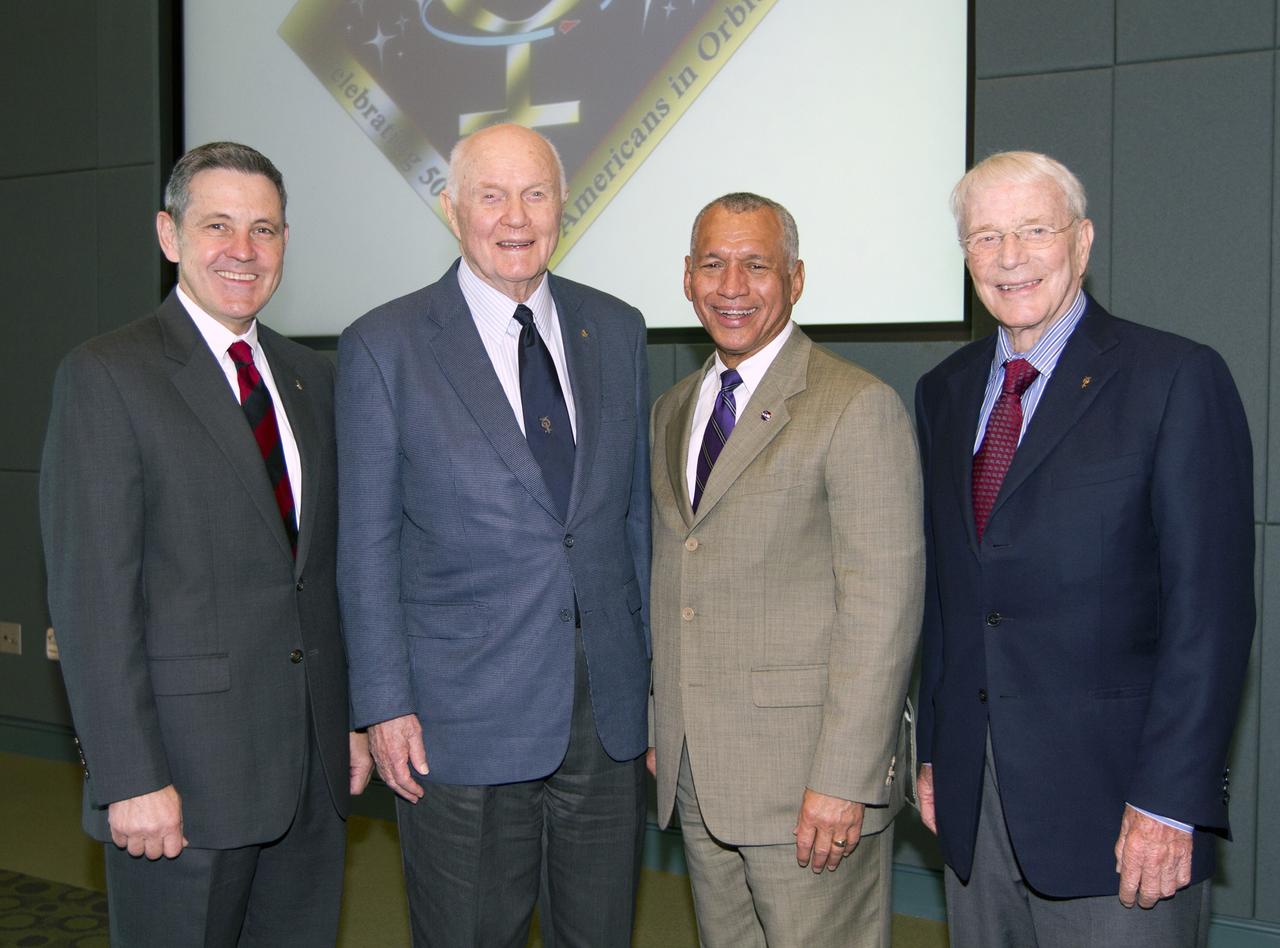
CAPE CANAVERAL, Fla. - Kennedy Space Center Director Bob Cabana, from left, Mercury astronaut John Glenn, NASA Administrator Charles Bolden and Mercury astronaut Scott Carpenter pose during a luncheon Feb. 17, 2012, celebrating 50 years of Americans in orbit, an era which began with Glenn's Mercury mission MA-6, on Feb. 20, 1962. Glenn's launch aboard an Atlas rocket took with it the hopes of an entire nation and ushered in a new era of space travel that eventually led to Americans walking on the moon by the end of the 1960s. Glenn soon was followed into orbit by Scott Carpenter, Walter Schirra and Gordon Cooper. Their fellow Mercury astronauts Alan Shepard and Virgil "Gus" Grissom flew earlier suborbital flights. Deke Slayton, a member of NASA's original Mercury 7 astronauts, was grounded by a medical condition until the Apollo-Soyuz Test Project in 1975. Photo credit: NASA/Kim Shiflett

KENNEDY SPACE CENTER, FLA. -- In the Orbiter Processing Facility bay 2, Endeavour's payload bay doors are ready to be closed. The payload will be installed on the launch pad after rollout. The orbiter is designated for mission STS-118, targeted for launch on Aug. 9. The mission will continue space station construction by delivering a third starboard truss segment, S5, as well as carrying the External Stowage Platform 3. The crew comprises seven astronauts: Commander Scott Kelly, Pilot Charles Hobaugh and Mission Specialists Dr. Dafydd (Dave) Williams, Barbara Morgan, Richard Mastracchio, Tracy Caldwell and Benjamin Drew. Williams represents the Canadian Space Agency. Photo credit: NASA/Cory Huston
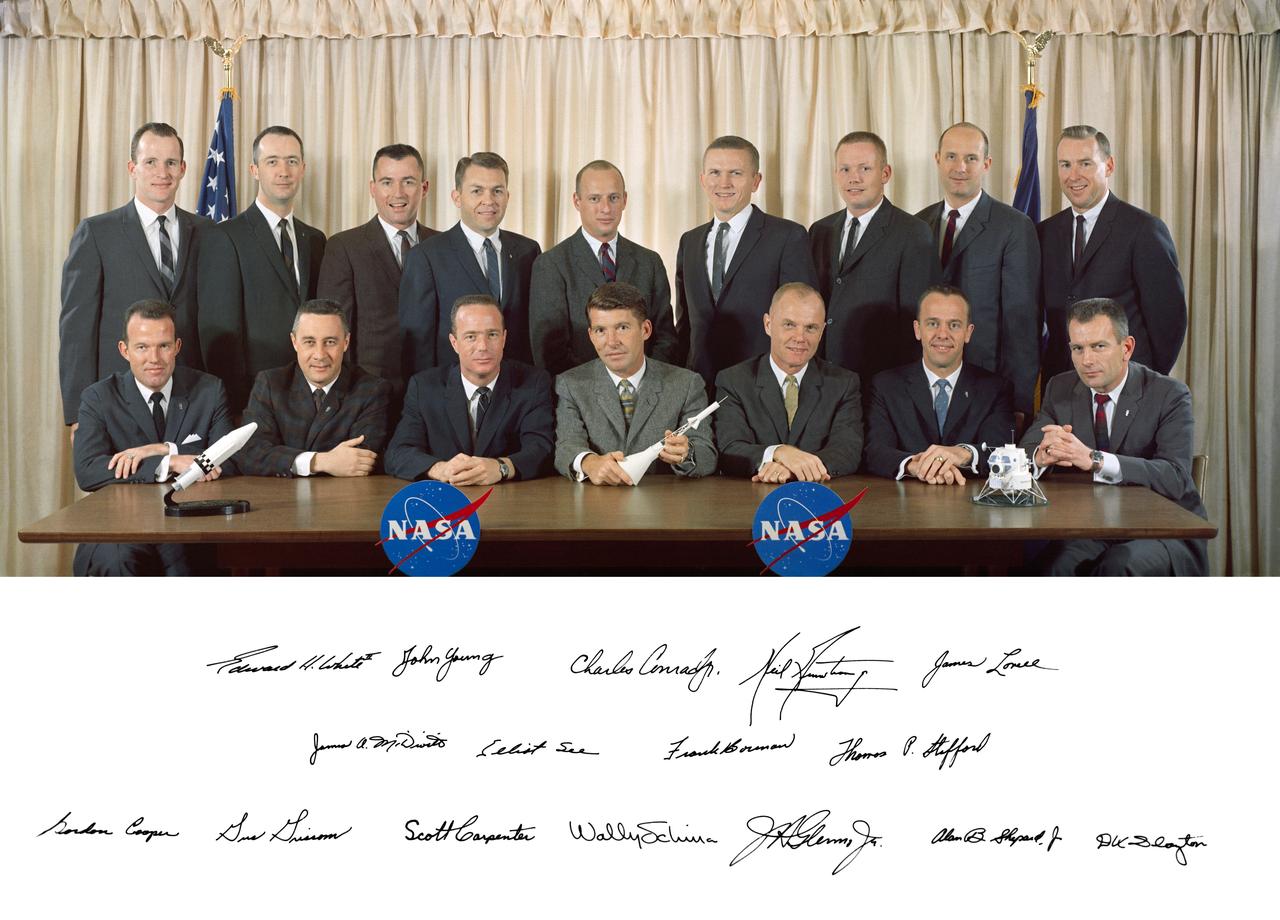
S63-01419A (1963) --- Portrait of the first two groups of astronauts. The seven original Mercury astronauts plus new members of the astronaut corps. Seated from left to right are: Gordon Cooper, Gus Grissom, Scott Carpenter, Wally Schirra, John Glenn, Alan Shepard and Deke Slayton. Standing from left to right are: Edward White, James McDivitt, John Young, Elliot See, Charles Conrad, Frank Borman, Neil Armstrong, Thomas Stafford, and James Lovell. Signatures are also visible at the bottom of the frame. Photo credit: NASA
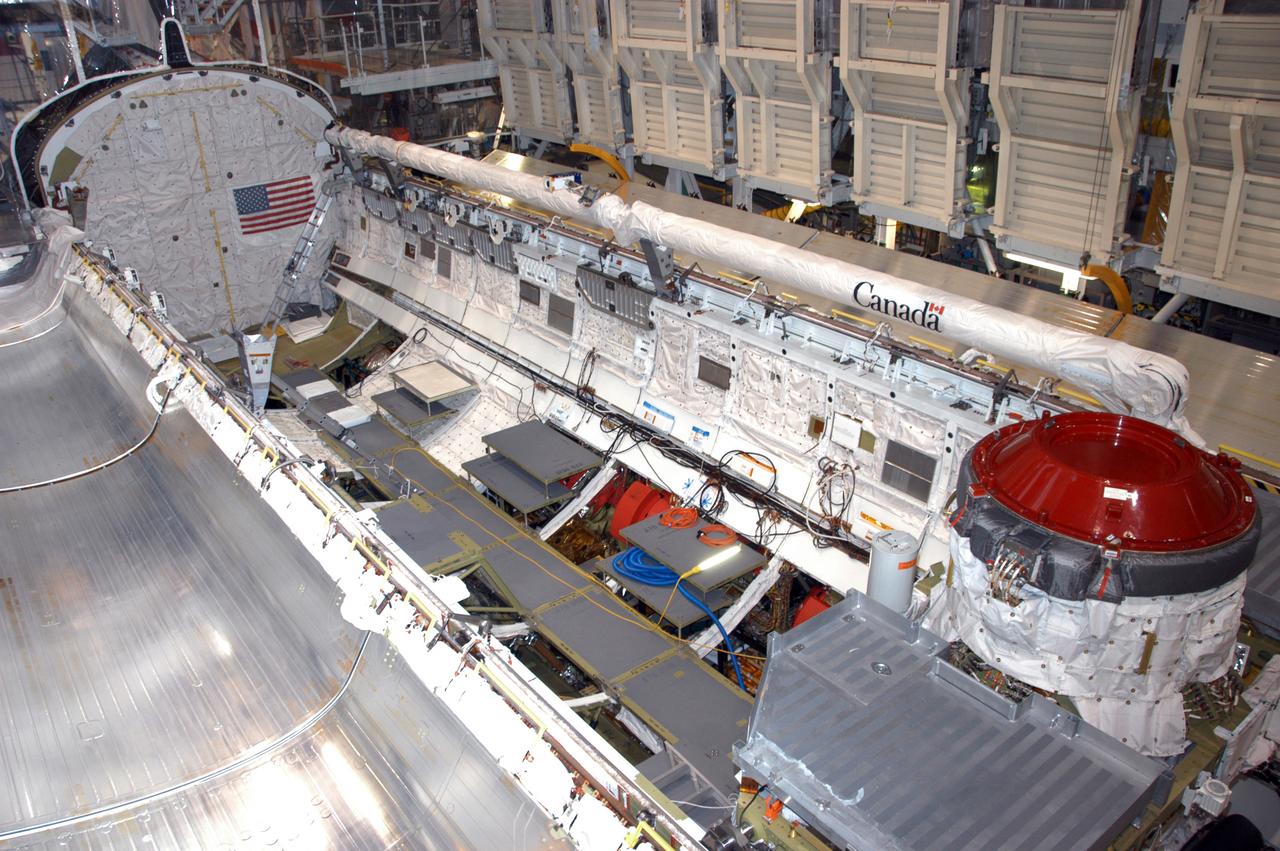
Endeavour's payload bay is open for payload configuration work in Orbiter Processing Facility bay 2. The orbiter is the vehicle designated for mission STS-118, scheduled to launch in late June. The mission will continue space station construction by delivering a third starboard truss segment, S5, as well as carrying the External Stowage Platform 3. The crew comprises six astronauts: Commander Scott Kelly, Pilot Charles Hobaugh and Mission Specialists Dr. Dafydd (Dave) Williams, Barbara Morgan, Richard Mastracchio and Tracy Caldwell. Williams represents the Canadian Space Agency.
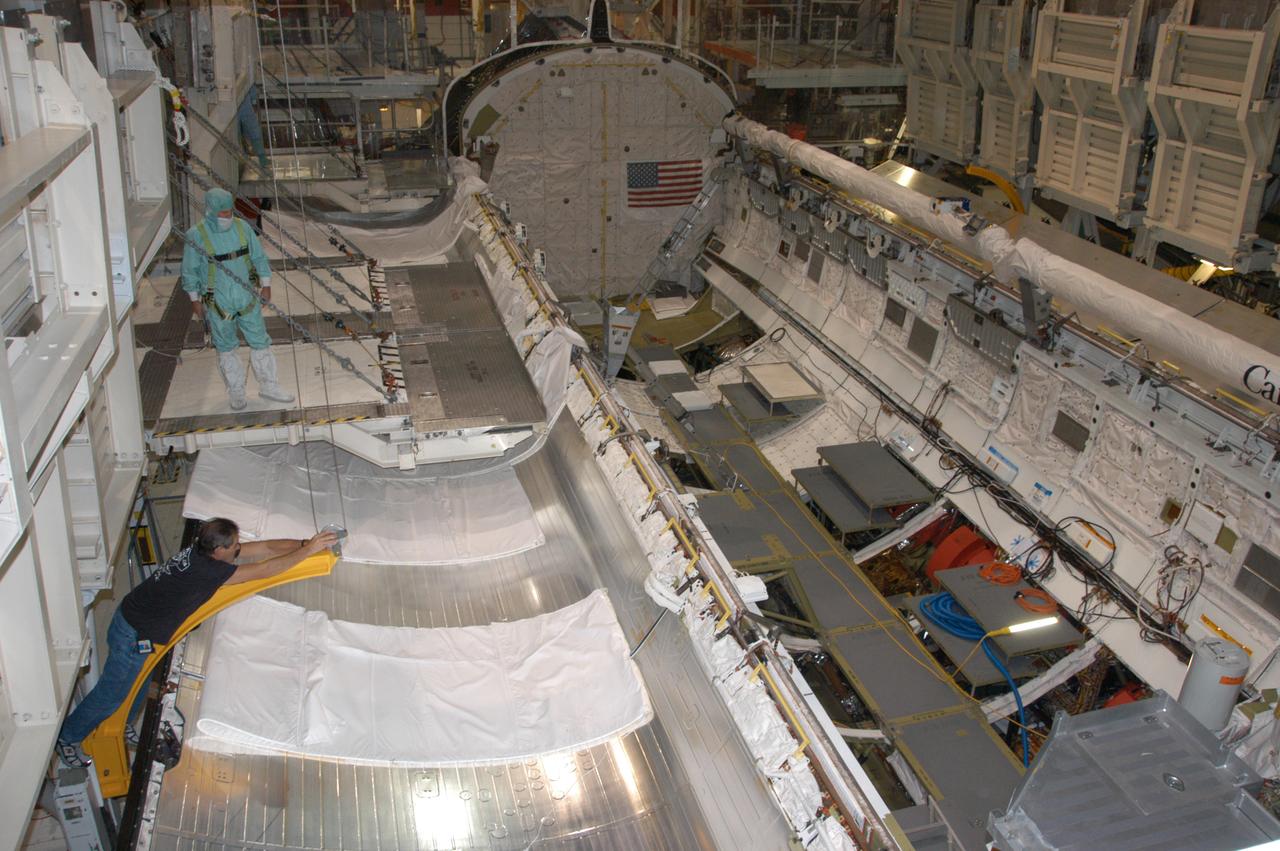
Endeavour's payload bay is open for payload configuration work in Orbiter Processing Facility bay 2. The orbiter is the vehicle designated for mission STS-118, scheduled to launch in late June. The mission will continue space station construction by delivering a third starboard truss segment, S5, as well as carrying the External Stowage Platform 3. The crew comprises six astronauts: Commander Scott Kelly, Pilot Charles Hobaugh and Mission Specialists Dr. Dafydd (Dave) Williams, Barbara Morgan, Richard Mastracchio and Tracy Caldwell. Williams represents the Canadian Space Agency.
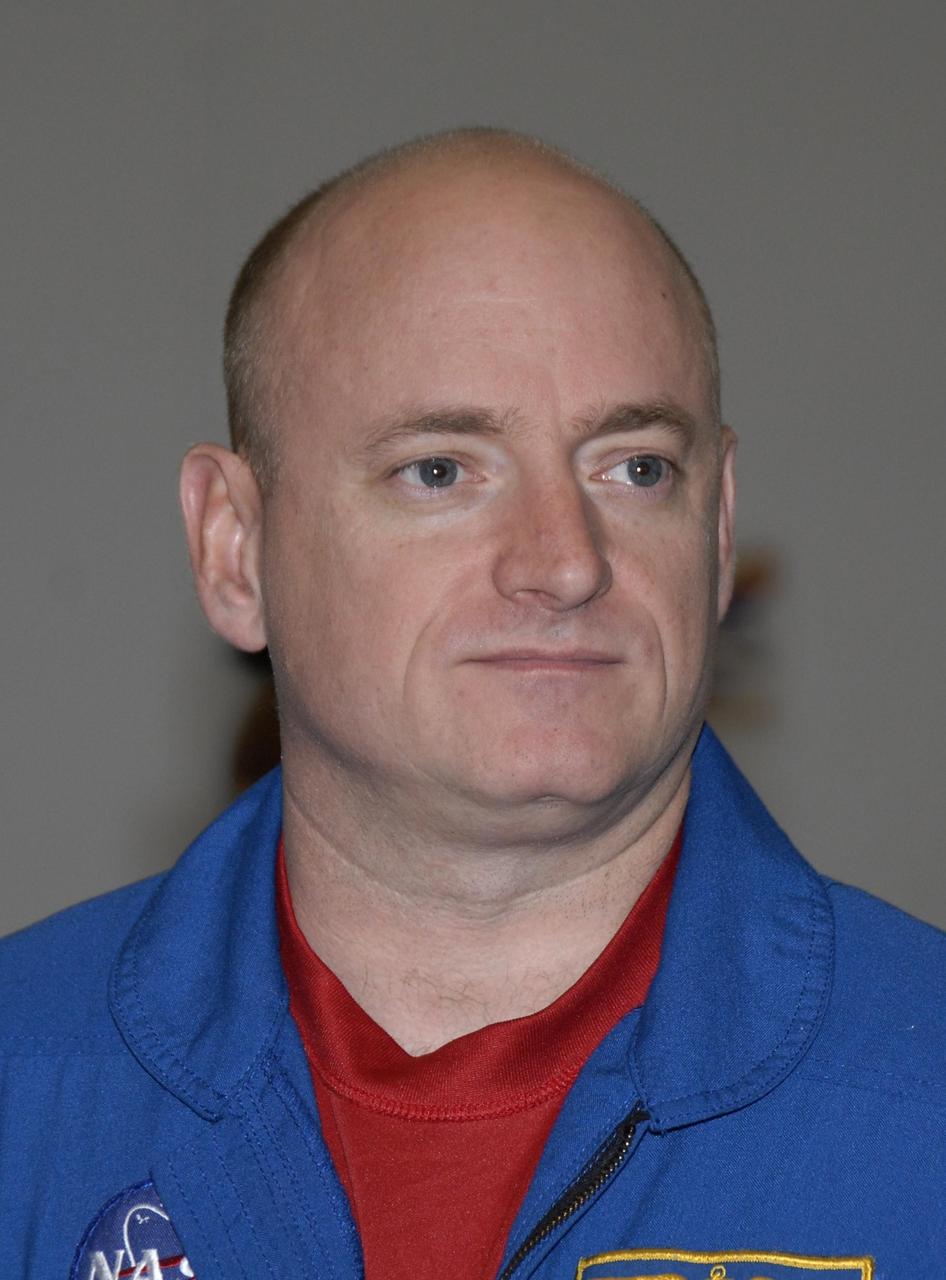
KENNEDY SPACE CENTER, FLA. -- STS-118 Commander Scott Kelly, seen here in the Space Station Processing Facility, is at KSC to take part in crew equipment interface test activities. The crew comprises Kelly, Pilot Charles Hobaugh, and Mission Specialists Dr. Dafydd Williams, Barbara Morgan, Richard Mastracchio, Tracy Caldwell and Benjamin Drew. Williams is with the Canadian Space Agency. The STS-118 mission will be delivering the third starboard truss segment, the ITS S5, to the International Space Station, and a SPACEHAB Single Cargo module with supplies and equipment. Launch aboard Space Shuttle Endeavour is targeted for August. Photo credit: NASA/Kim Shiflett
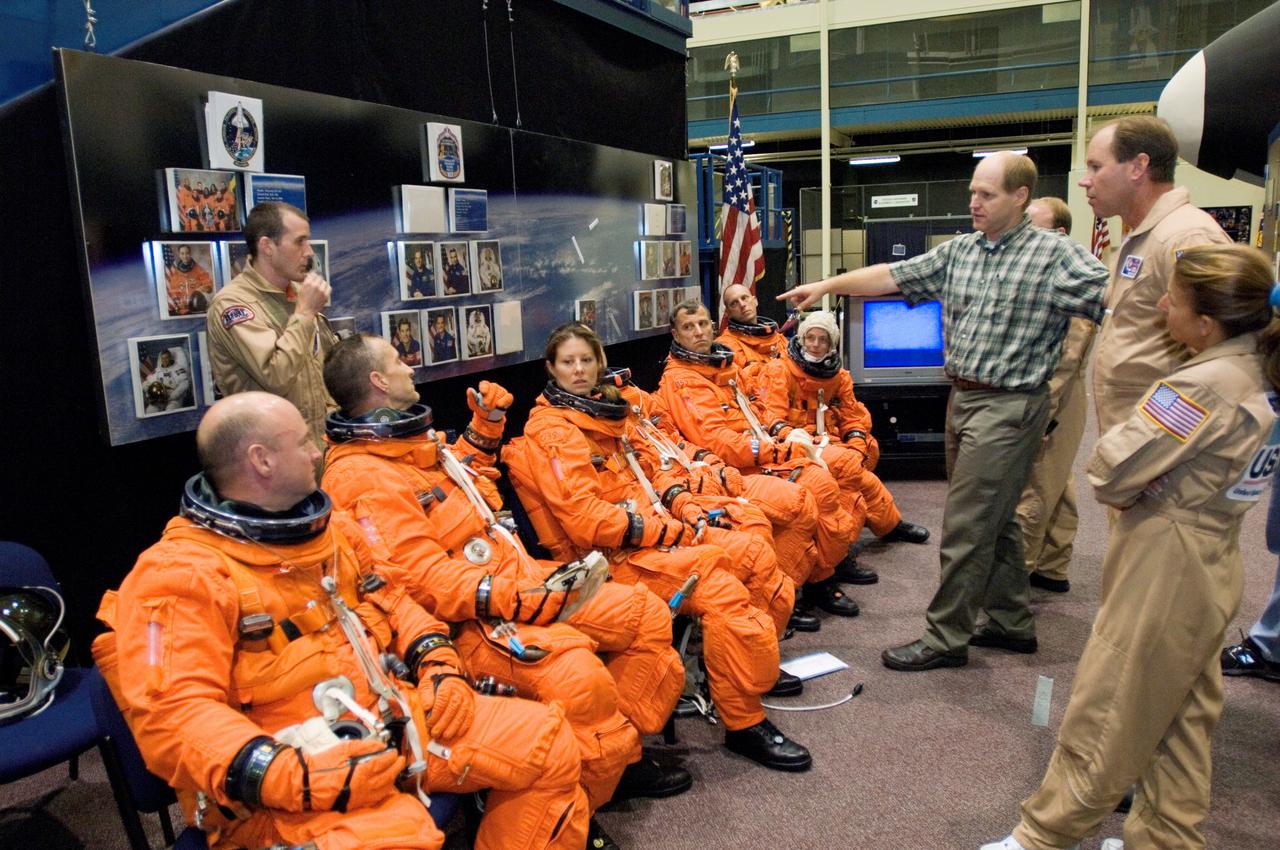
JSC2006-E-43734 (4 Oct. 2006) --- Crew trainer Bob Behrendsen (standing, right background) briefs astronauts Scott J. Kelly (seated left), STS-118 commander; Charles O. Hobaugh, pilot; Tracy E. Caldwell and Richard A. (Rick) Mastracchio, mission specialists; Dafydd R. (Dave) Williams, mission specialist representing the Canadian Space Agency; Barbara R. Morgan, mission specialist; and Clayton C. Anderson, Expedition 15 NASA space station science officer and flight engineer; during a training session in the Space Vehicle Mockup Facility at the Johnson Space Center. The crewmembers are attired in training versions of their shuttle launch and entry suits.
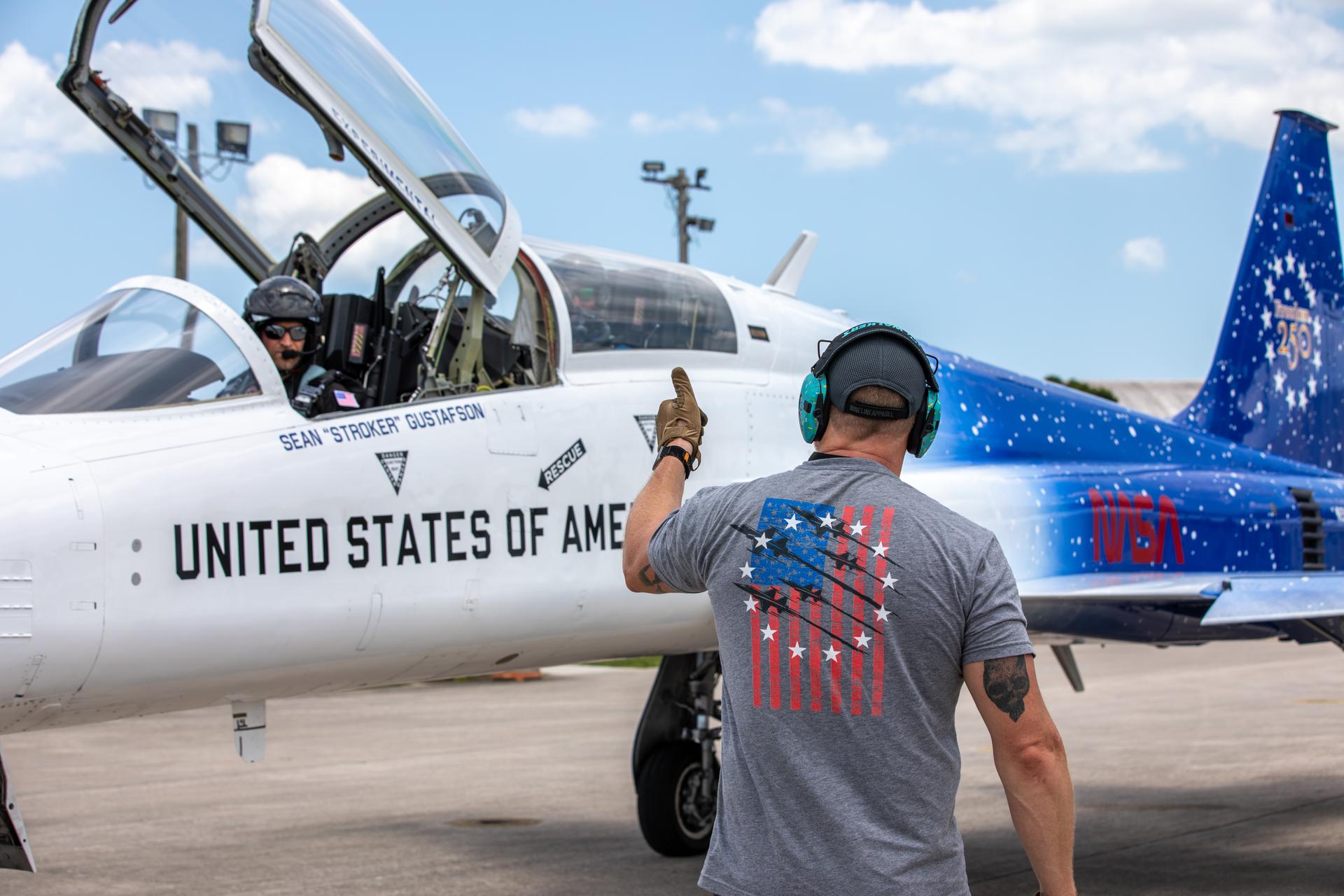
Piloting one of NASA Administrator Jared Isaacman’s personal F-5 aircraft, Pilot Scott Glaser is given the go-ahead to taxi for liftoff at the Launch and Landing Facility at the agency’s Kennedy Space Center in Florida, on Wednesday, June 17, 2026. As part of the administrator’s Flight Experience Award program, NASA employees Matthew Kufner, Charles Meilbye, and Aaron Smith donned NASA flight suits, completed preflight briefings, and experienced a unique flight. The ride-along flight experience award program highlights NASA’s commitment to celebrating excellence across the workforce.
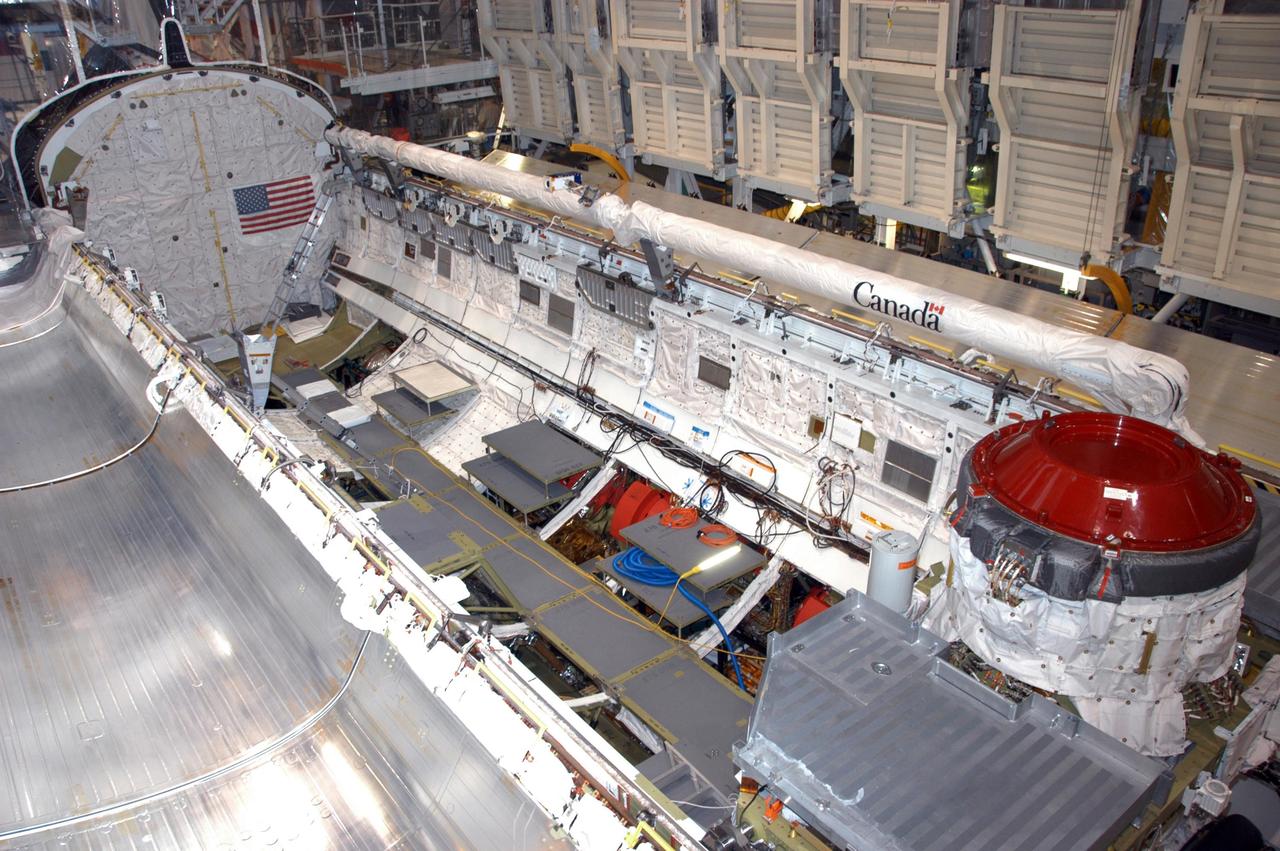
KENNEDY SPACE CENTER, FLA. -- Endeavour's payload bay is open for payload configuration work in Orbiter Processing Facility bay 2. The orbiter is the vehicle designated for mission STS-118, scheduled to launch in late June. The mission will continue space station construction by delivering a third starboard truss segment, S5, as well as carrying the External Stowage Platform 3. The crew comprises six astronauts: Commander Scott Kelly, Pilot Charles Hobaugh and Mission Specialists Dr. Dafydd (Dave) Williams, Barbara Morgan, Richard Mastracchio and Tracy Caldwell. Williams represents the Canadian Space Agency. Photo credit: NASA/George Shelton
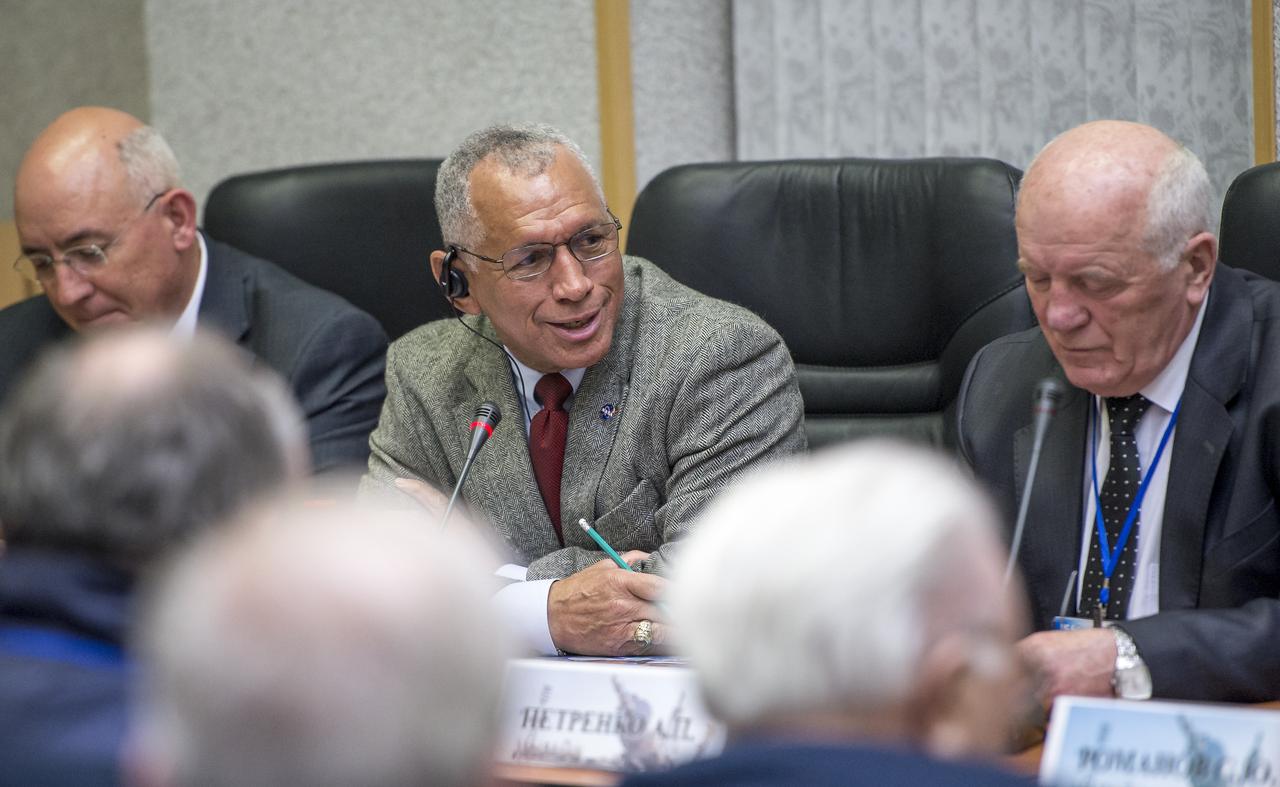
NASA Administrator Charles Bolden is seen during the State Commission meeting to approve the Soyuz launch of Expedition 43 to the International Space Station, Thursday, March 26, 2015, at the Cosmonaut Hotel in Baikonur, Kazakhstan. NASA Astronaut Scott Kelly, and Russian Cosmonauts Mikhail Kornienko, and Gennady Padalka of the Russian Federal Space Agency (Roscosmos) launched to the International Space Station in the Soyuz TMA-16M spacecraft from the Baikonur Cosmodrome in Kazakhstan March 28, Kazakh time (March 27 Eastern time.) As the one-year crew, Kelly and Kornienko will return to Earth on Soyuz TMA-18M in March 2016. Photo Credit (NASA/Bill Ingalls)

These seven astronauts take a break from training to pose for the STS-118 crew portrait. Pictured from the left are astronauts Richard A. “Rick” Mastracchio, mission specialist; Barbara R. Morgan, mission specialist; Charles O. Hobaugh, pilot; Scott J. Kelly, commander; Tracy E. Caldwell, Canadian Space Agency's Dafydd R. “Dave” Williams, and Alvin Drew Jr., all mission specialists. The crew members are attired in training versions of their shuttle launch and entry suits. The main objective of the STS-118 mission was to install the fifth Starboard (S5) truss segment on the International Space Station (ISS).
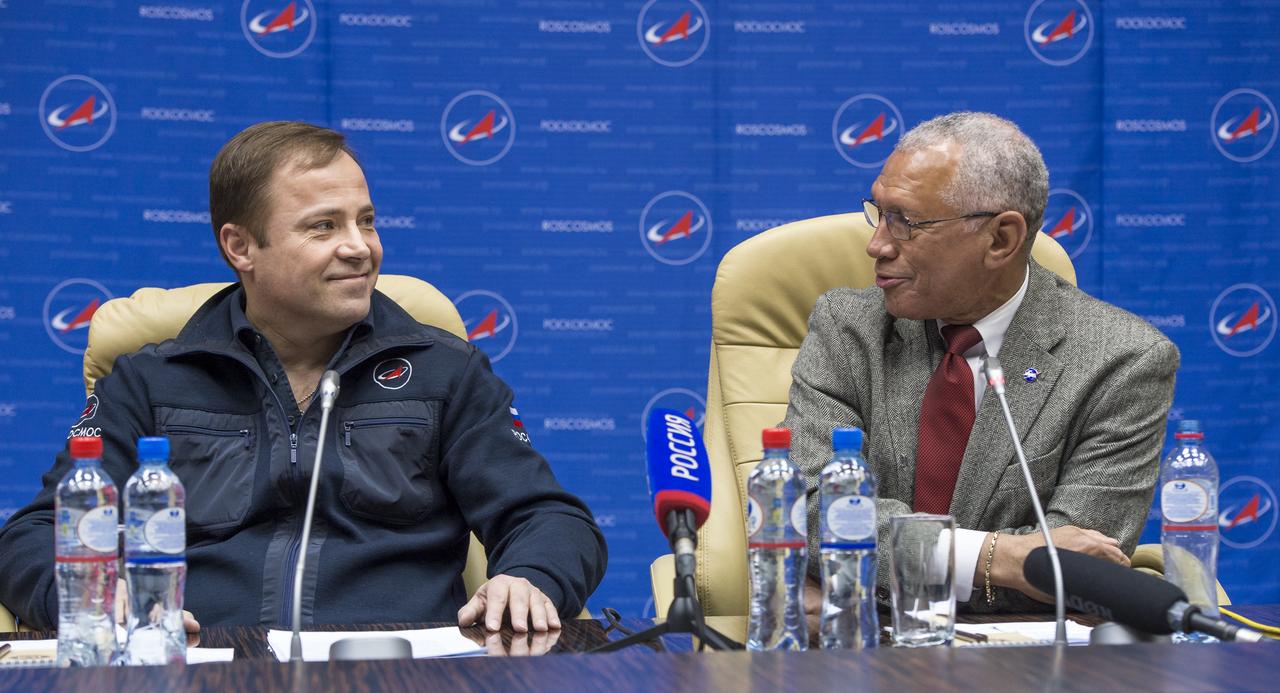
Head of Russian Federal Space Agency (Roscosmos) Igor Komarov, left, and NASA Administrator Charles Bolden are seen during an Expedition 43 post launch briefing, Saturday, March 28, 2015 at the Baikonur Hotel in Baikonur, Kazakhstan. Earlier in the morning the Soyuz TMA-16M launched to the International Space Station with Expedition 43 NASA Astronaut Scott Kelly, Russian Cosmonauts Mikhail Kornienko, and Gennady Padalka of the Russian Federal Space Agency (Roscosmos) onboard from the Baikonur Cosmodrome in Kazakhstan. As the one-year crew, Kelly and Kornienko will return to Earth on Soyuz TMA-18M in March 2016. Photo Credit (NASA/Bill Ingalls)
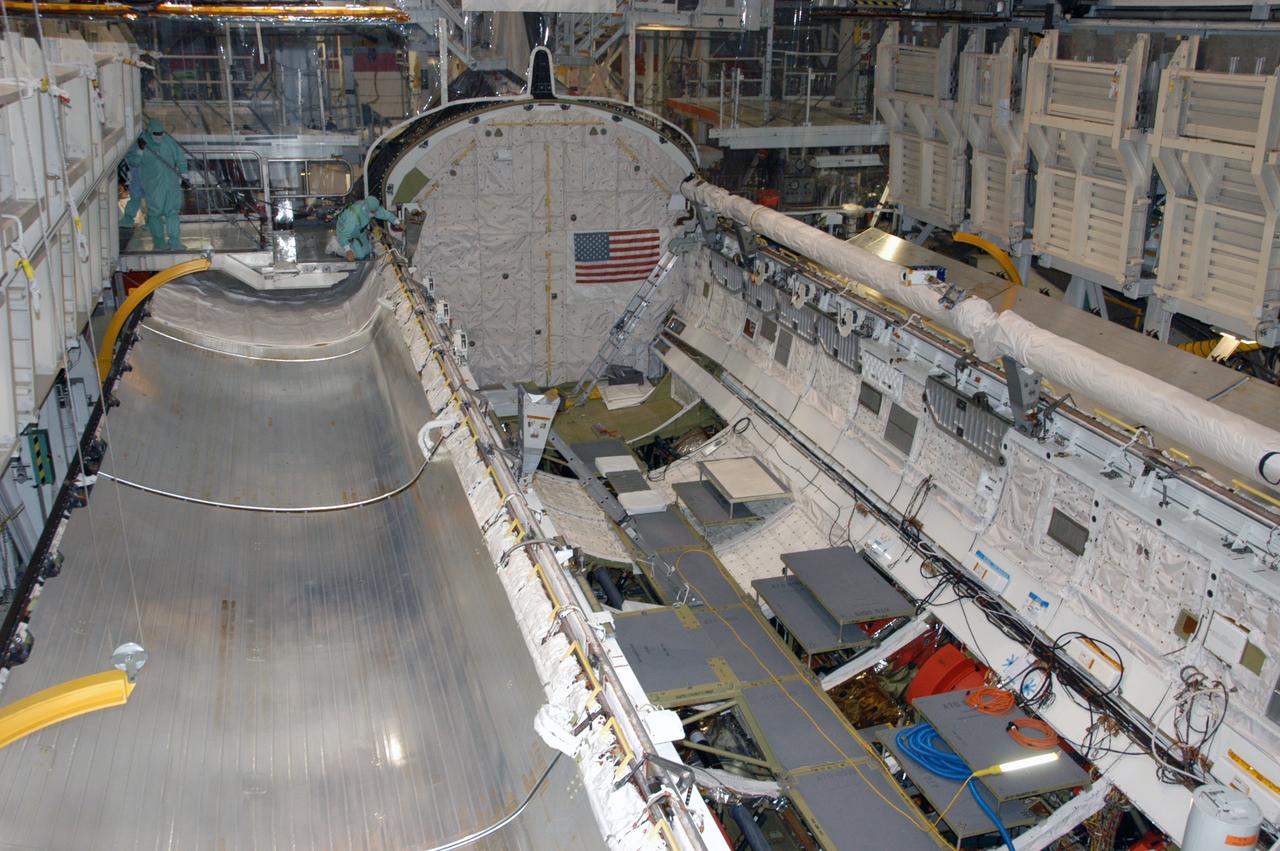
Endeavour's payload bay is open for payload configuration work in Orbiter Processing Facility bay 2. The orbiter is the vehicle designated for mission STS-118, scheduled to launch in late June. The mission will continue space station construction by delivering a third starboard truss segment, S5, as well as carrying the External Stowage Platform 3. The crew comprises six astronauts: Commander Scott Kelly, Pilot Charles Hobaugh and Mission Specialists Dr. Dafydd (Dave) Williams, Barbara Morgan, Richard Mastracchio and Tracy Caldwell. Williams represents the Canadian Space Agency.
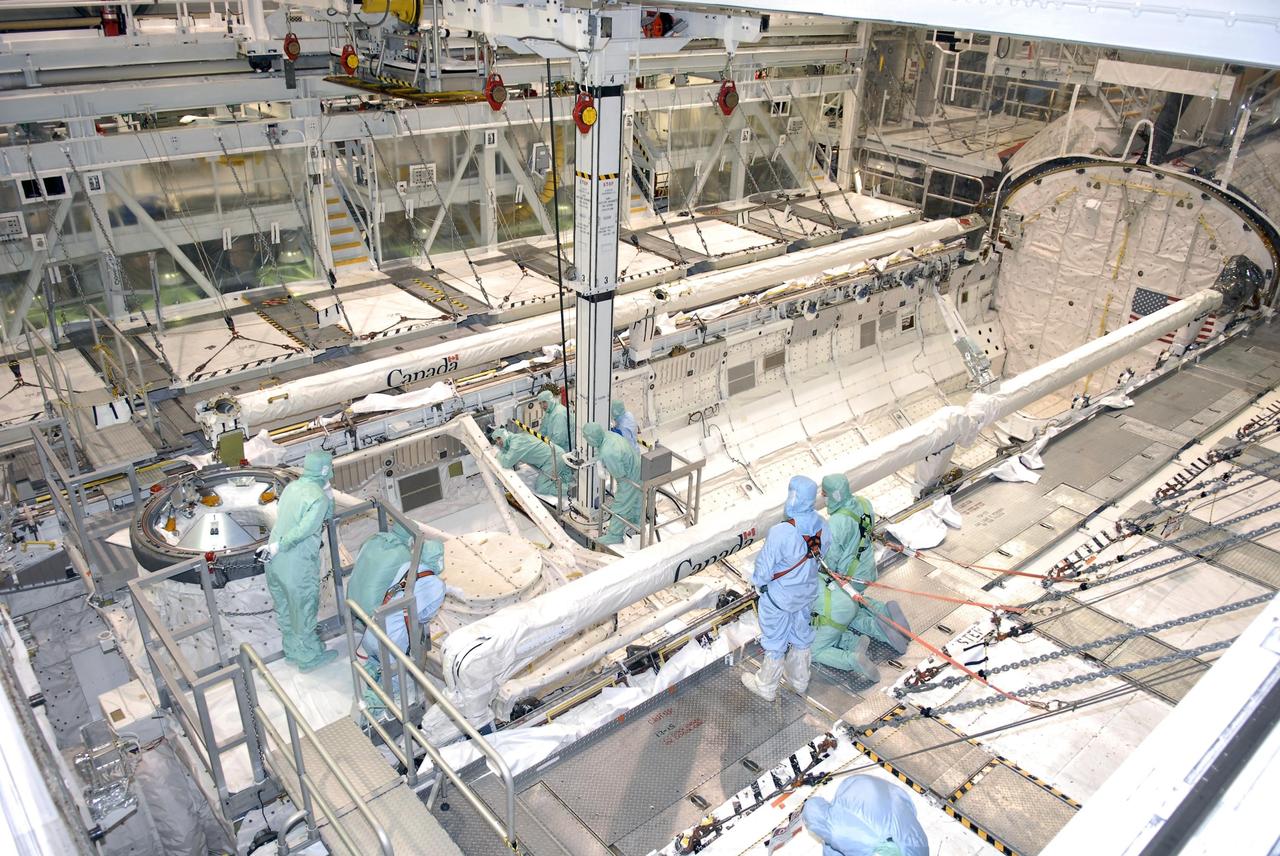
KENNEDY SPACE CENTER, FLA. -- During crew equipment interface test activities at KSC, STS-118 crew members get a close look at equipment inside Endeavour's payload bay. The crew comprises Commander Scott Kelly, Pilot Charles Hobaugh, and Mission Specialists Dr. Dafydd Williams, Barbara Morgan, Richard Mastracchio, Tracy Caldwell and Benjamin Drew. The STS-118 mission will be delivering the third starboard truss segment, the ITS S5, to the International Space Station, as well as the SPACEHAB single cargo module filled with supplies and equipment. Launch aboard Space Shuttle Endeavour is targeted for Aug. 9. Photo credit: NASA/Kim Shiflett
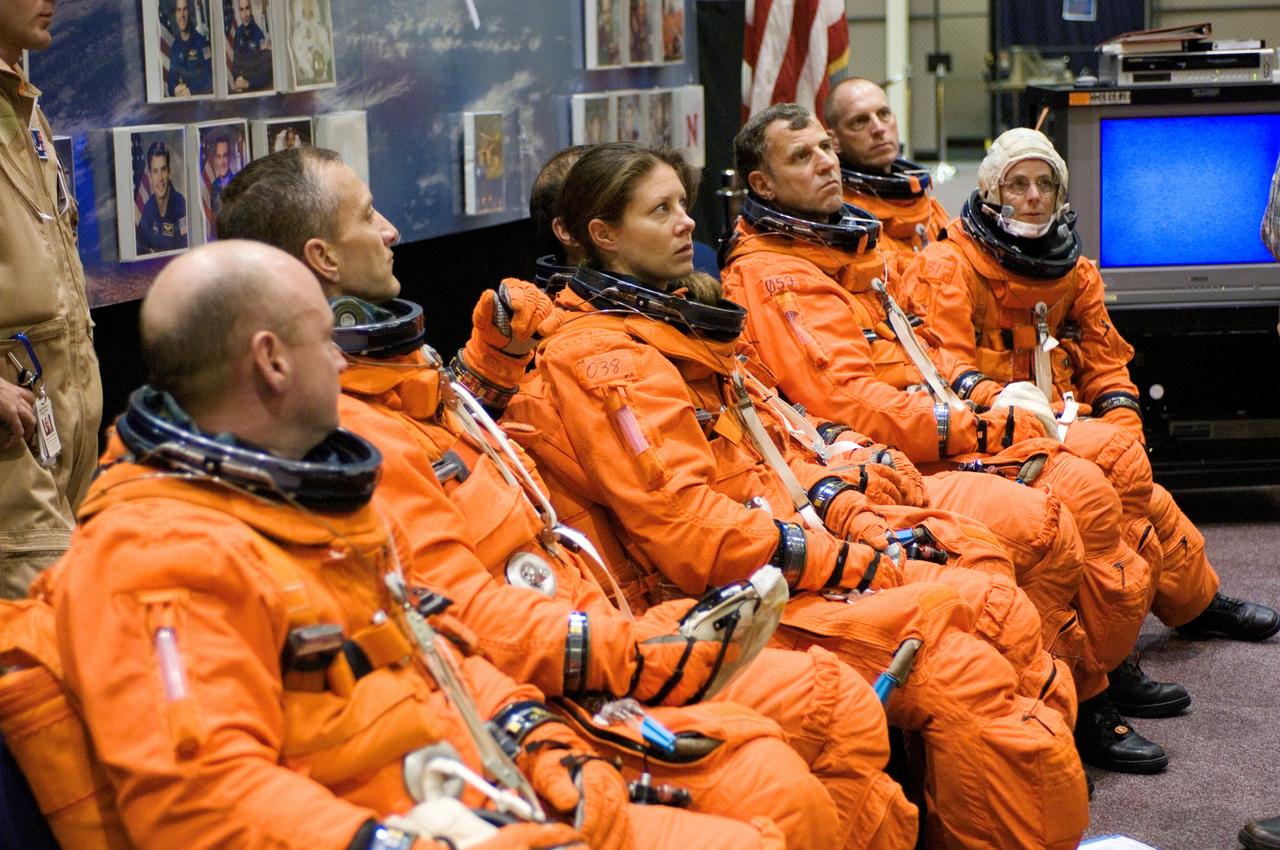
JSC2006-E-43768 (4 Oct. 2006) --- Attired in training versions of their shuttle launch and entry suits, astronauts Scott J. Kelly (left), STS-118 commander; Charles O. Hobaugh, pilot; Tracy E. Caldwell and Richard A. (Rick) Mastracchio, mission specialists; Dafydd R. (Dave) Williams, mission specialist representing the Canadian Space Agency; Barbara R. Morgan, mission specialist; and Clayton C. Anderson, Expedition 15 NASA space station science officer and flight engineer; await the start of a training session in the Space Vehicle Mockup Facility at Johnson Space Center.
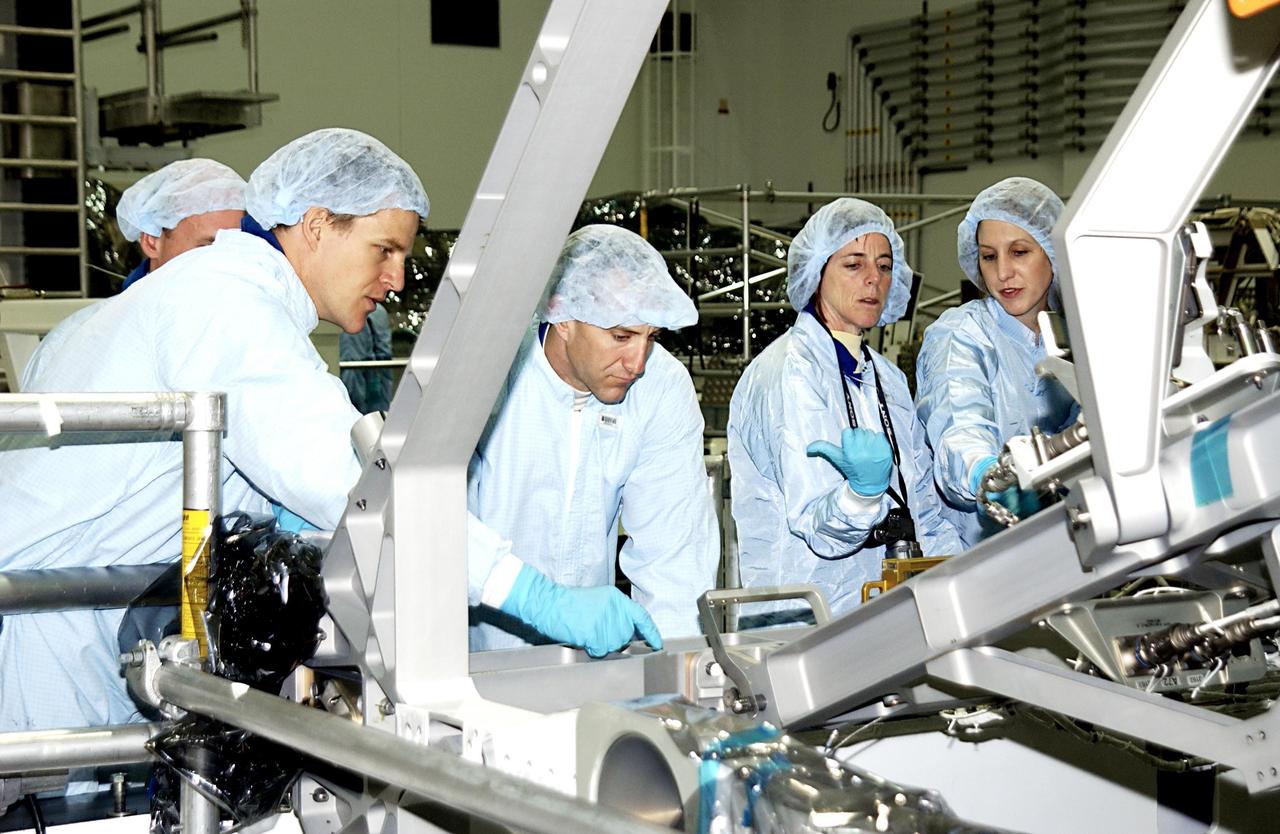
KENNEDY SPACE CENTER, FLA. -- In the Space Station Processing Facility, members of the STS-118 crew look over part of the mission payload. From left are Mission Specialist Scott Parazynski, Pilot Charles Hobaugh and Mission Specialist Barbara Morgan. At right is a technician. Morgan was selected by NASA in January 1998 as the first Educator Astronaut. The mission will be delivering the third starboard truss segment, the ITS S5, to the International Space Station, and a SPACEHAB Single Cargo Module with supplies and equipment. Launch aboard Space Shuttle Columbia is scheduled for Nov. 13, 2003.
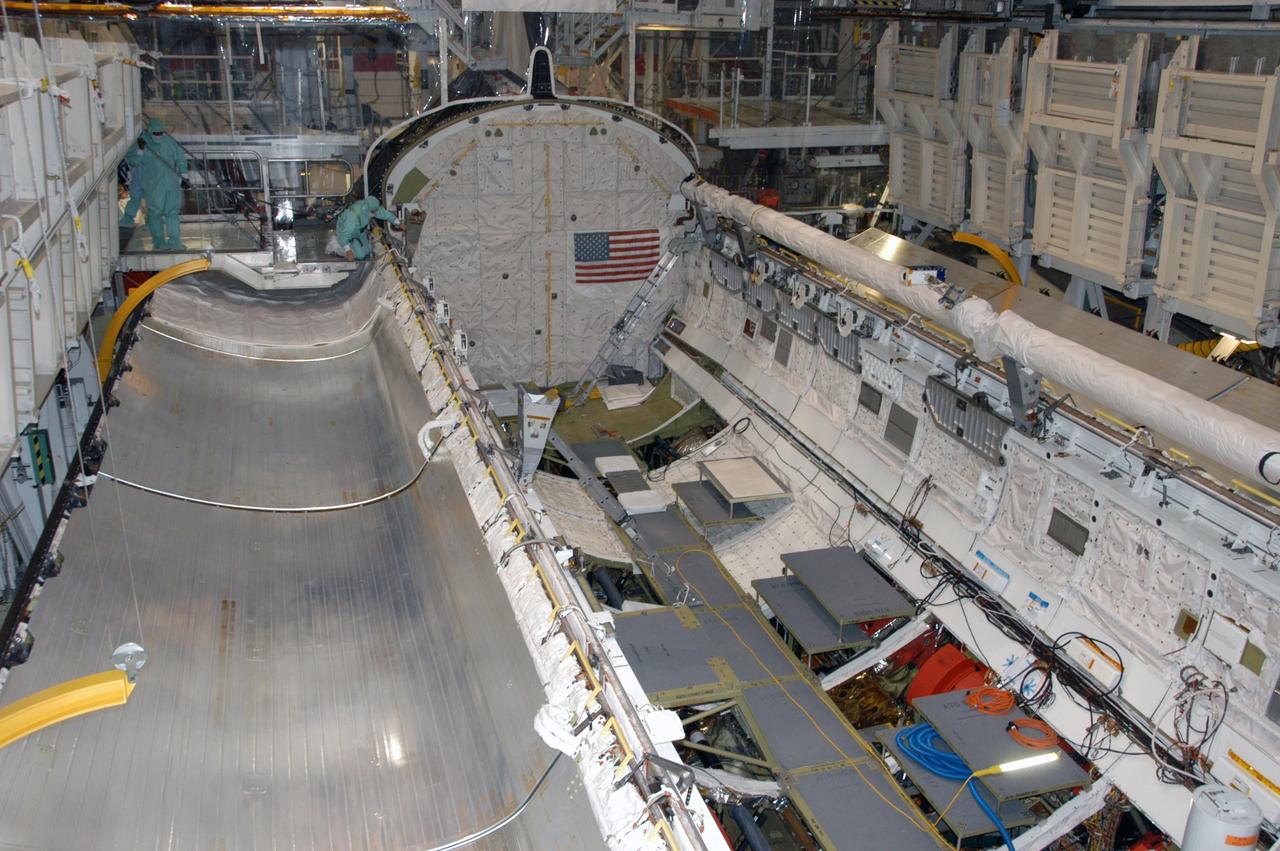
KENNEDY SPACE CENTER, FLA. -- Endeavour's payload bay is open for payload configuration work in Orbiter Processing Facility bay 2. The orbiter is the vehicle designated for mission STS-118, scheduled to launch in late June. The mission will continue space station construction by delivering a third starboard truss segment, S5, as well as carrying the External Stowage Platform 3. The crew comprises six astronauts: Commander Scott Kelly, Pilot Charles Hobaugh and Mission Specialists Dr. Dafydd (Dave) Williams, Barbara Morgan, Richard Mastracchio and Tracy Caldwell. Williams represents the Canadian Space Agency. Photo credit: NASA/George Shelton
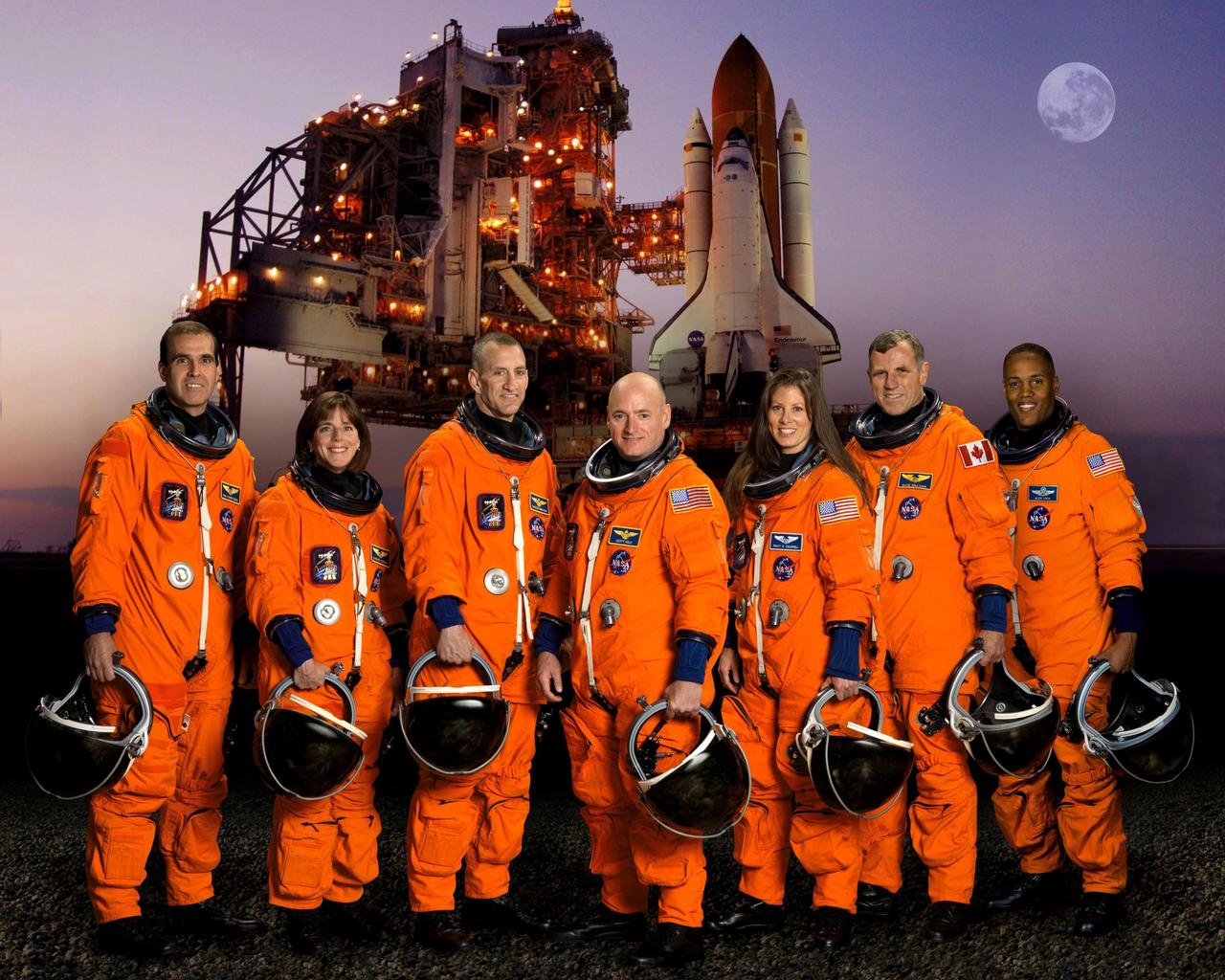
JOHNSON SPACE CENTER, Houston -- STS118-S-002 -- These seven astronauts take a break from training to pose for the STS-118 crew portrait. Pictured from the left are astronauts Richard A. (Rick) Mastracchio, mission specialist; Barbara R. Morgan, a mission specialist and NASA's first educator astronaut; Charles O. Hobaugh, pilot; Scott J. Kelly, commander; Tracy E. Caldwell, Canadian Space Agency's Dafydd R. (Dave) Williams and Alvin Drew Jr., all mission specialists. The crewmembers are attired in training versions of their shuttle launch and entry suits.
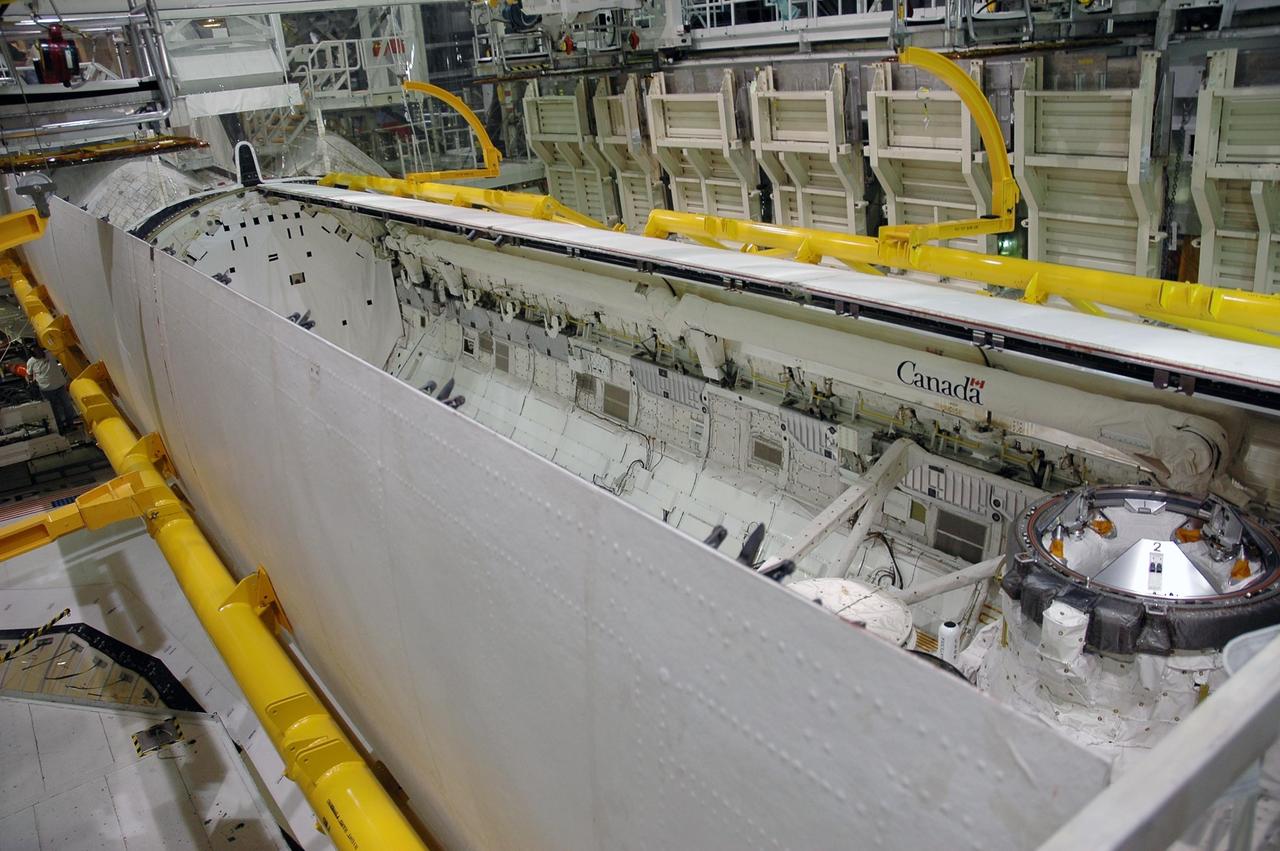
KENNEDY SPACE CENTER, FLA. -- In the Orbiter Processing Facility bay 2, Endeavour's payload bay doors are being closed. The payload will be installed on the launch pad after rollout. The orbiter is designated for mission STS-118, targeted for launch on Aug. 9. The mission will continue space station construction by delivering a third starboard truss segment, S5, as well as carrying the External Stowage Platform 3. The crew comprises seven astronauts: Commander Scott Kelly, Pilot Charles Hobaugh and Mission Specialists Dr. Dafydd (Dave) Williams, Barbara Morgan, Richard Mastracchio, Tracy Caldwell and Benjamin Drew. Williams represents the Canadian Space Agency. Photo credit: NASA/Cory Huston
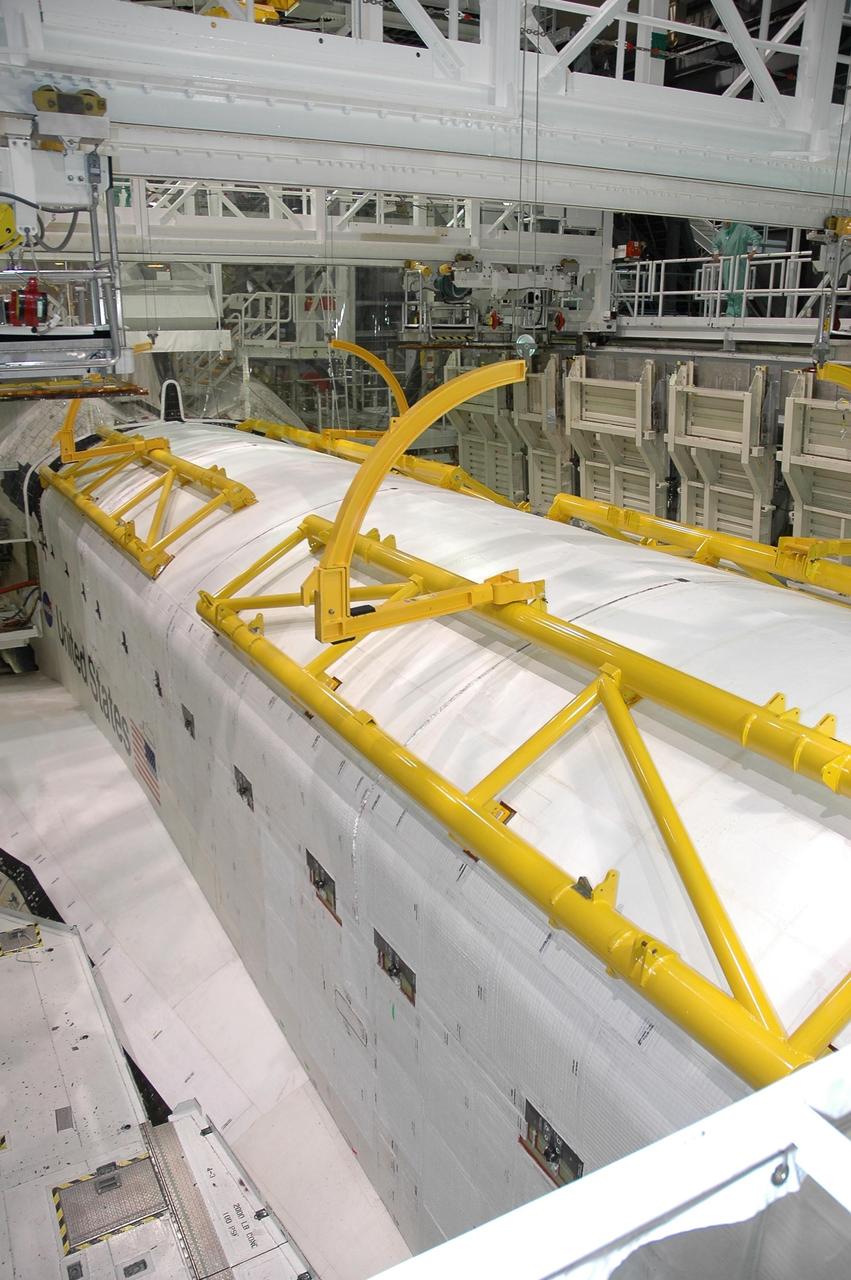
KENNEDY SPACE CENTER, FLA. -- In the Orbiter Processing Facility bay 2, Endeavour's payload bay doors are closed. The payload will be installed on the launch pad after rollout. The orbiter is designated for mission STS-118, targeted for launch on Aug. 9. The mission will continue space station construction by delivering a third starboard truss segment, S5, as well as carrying the External Stowage Platform 3. The crew comprises seven astronauts: Commander Scott Kelly, Pilot Charles Hobaugh and Mission Specialists Dr. Dafydd (Dave) Williams, Barbara Morgan, Richard Mastracchio, Tracy Caldwell and Benjamin Drew. Williams represents the Canadian Space Agency. Photo credit: NASA/Cory Huston
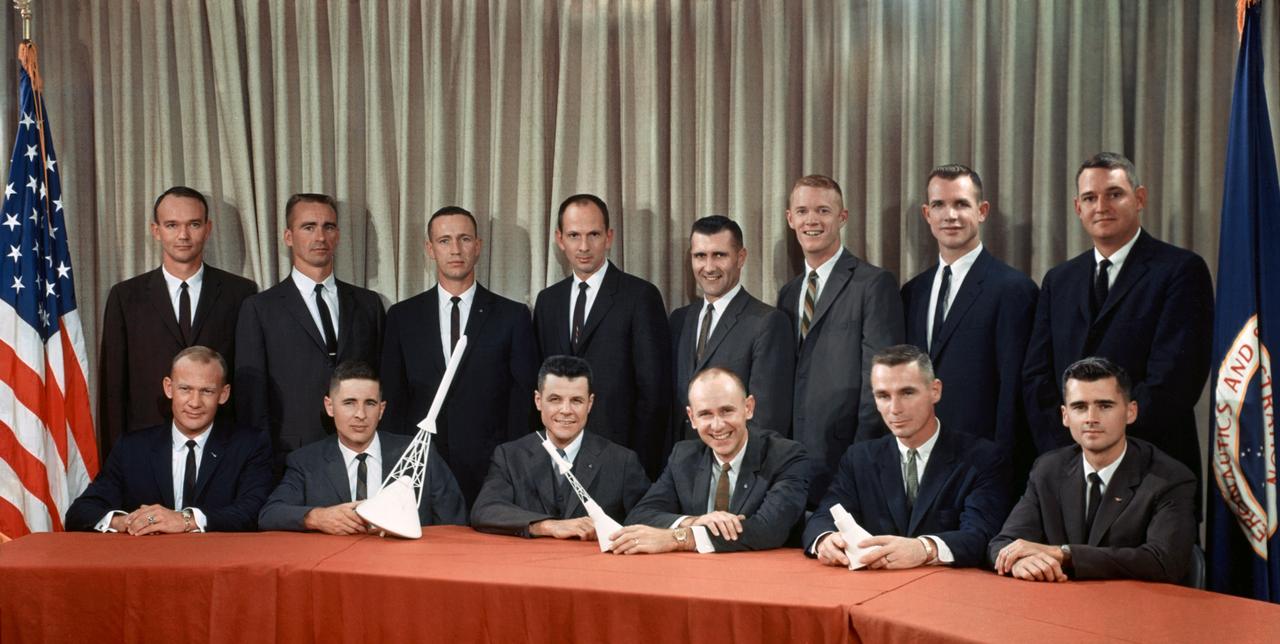
S63-18765 (October 1963) --- These fourteen pilots have been assigned to begin training for astronaut positions with the National Aeronautics and Space Administration (NASA). Front row, from the left, Edwin E. Aldrin Jr., William A. Anders, Charles A. Bassett II, Alan L. Bean, Eugene A. Cernan and Roger B. Chaffee. Back row, from the left, Michael Collins, Walter Cunningham, Donn F. Eisele, Theodore C. Freeman, Richard F. Gordon Jr., Russell L. Scweickart, David R. Scott and Clifton C. Williams Jr. Photo credit: NASA or National Aeronautics and Space Administration
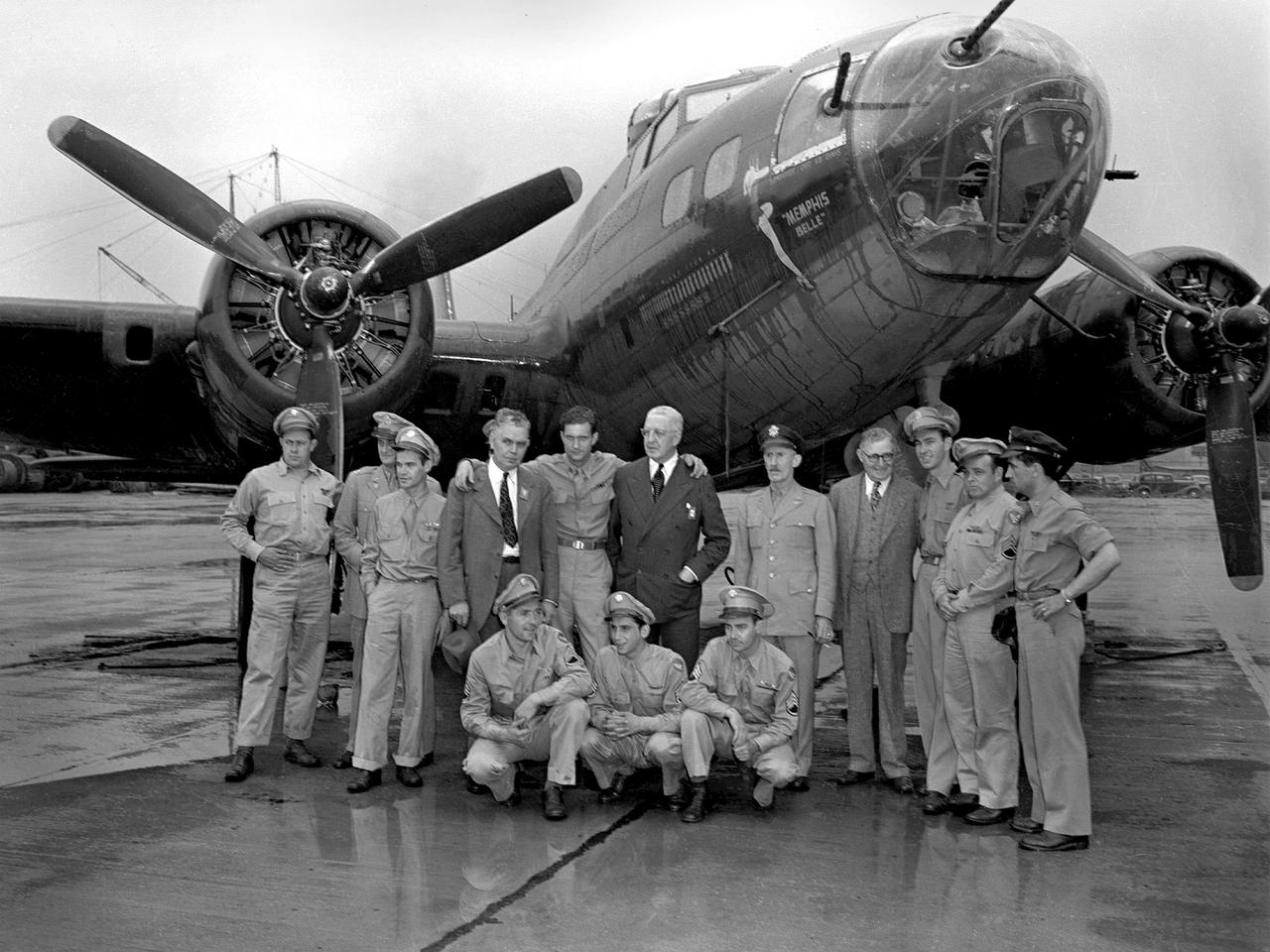
Captain Robert Morgan and the rest of the Memphis Belle crew arrive in Cleveland on a rainy July 7, 1943, for three-day publicity visit. This B–17 Flying Fortress had recently become the first U.S. bomber to complete 25 missions over Germany and France. The lack of long distance escort fighters made the feat even more remarkable. The Memphis Belle and its crew returned to the United States in June and were immediately thrown into a three-month-long war bond tour. While in Cleveland the crew toured the National Advisory Committee for Aeronautics (NACA) Aircraft Engine Research Laboratory, the Cleveland Bomber Plant, and Thompson Products. In the evenings they were feted downtown by the Chamber of Commerce at the Hotel Cleveland. A local company brought Morgan’s family and his fiancé—the Memphis Belle’s inspiration—to Cleveland to participate in the activities. The bomber was on display to the public near the airport’s fenceline and stored in the NACA’s hangar overnight. Pictured in this photograph from left to right: Robert Hanson, Vincent Evans, Charles Leighton, NACA Manager Raymond Sharp, Robert Morgan, William Holliday of the Chamber of Commerce, Army Liaison Officer Colonel Edwin Page, Airport Commissioner Jack Berry, Cecil Scott, John Quinlan and James Verinis. Kneeling are Harold Loch, Casimer Nastal and Charles Wichell.
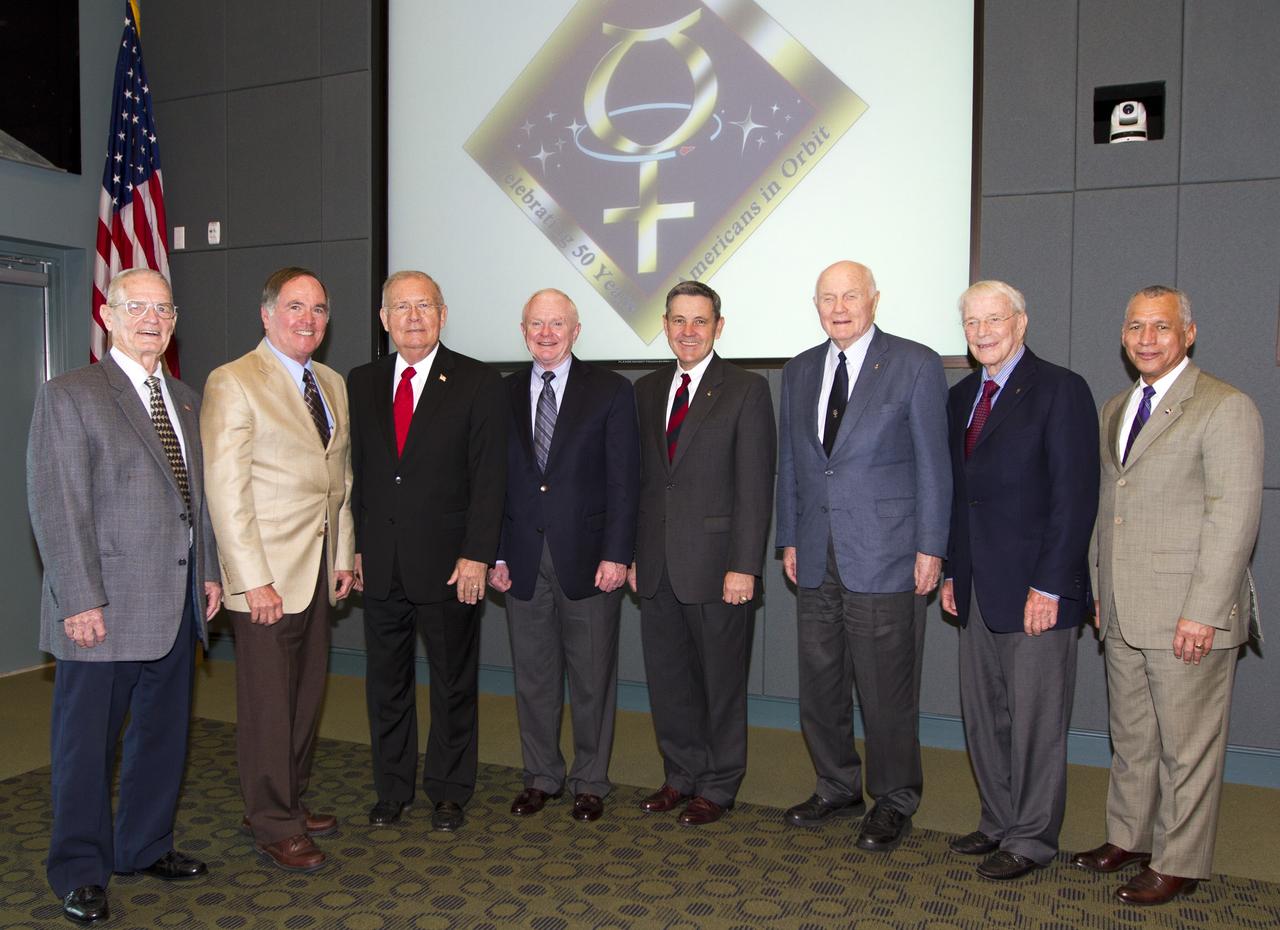
CAPE CANAVERAL, Fla. - Former Kennedy Space Center directors Forrest McCartney, from left, Bob Crippen, Jay Honeycutt and Roy Bridges stand with current Kennedy director Bob Cabana, Mercury astronauts John Glenn and Scott Carpenter and NASA Administrator Charles Bolden during a luncheon Feb. 17, 2012, celebrating 50 years of Americans in orbit, an era which began with Glenn's Mercury mission MA-6, on Feb. 20, 1962. Glenn's launch aboard an Atlas rocket took with it the hopes of an entire nation and ushered in a new era of space travel that eventually led to Americans walking on the moon by the end of the 1960s. Glenn soon was followed into orbit by Scott Carpenter, Walter Schirra and Gordon Cooper. Their fellow Mercury astronauts Alan Shepard and Virgil "Gus" Grissom flew earlier suborbital flights. Deke Slayton, a member of NASA's original Mercury 7 astronauts, was grounded by a medical condition until the Apollo-Soyuz Test Project in 1975. Photo credit: NASA/Kim Shiflett
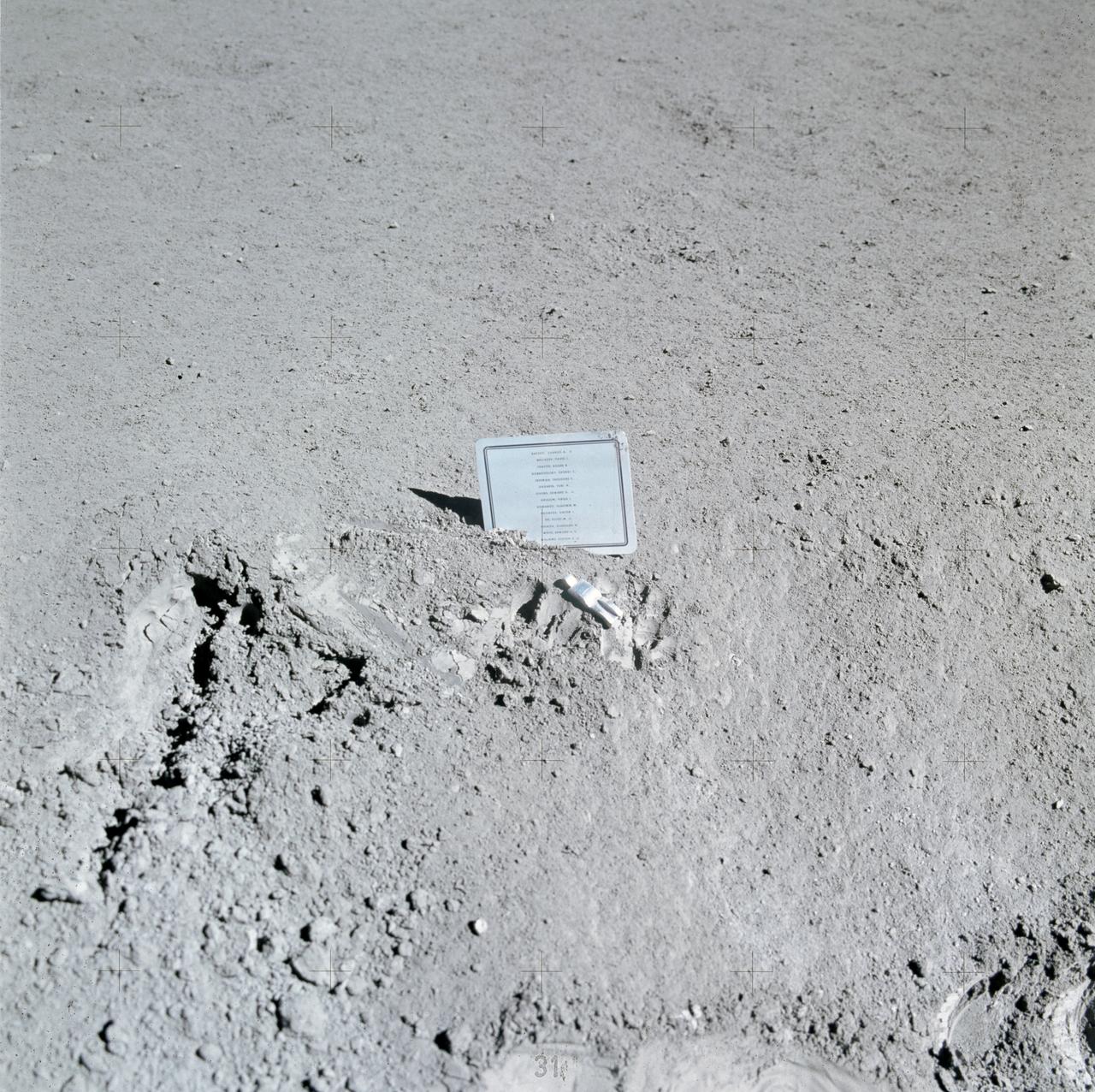
AS15-88-11894 (31 July-2 Aug. 1971) --- A close-up view of a commemorative plaque left on the moon at the Hadley-Apennine landing site in memory of 14 NASA astronauts and USSR cosmonauts, now deceased. Their names are inscribed in alphabetical order on the plaque. The plaque was stuck in the lunar soil by astronauts David R. Scott, commander, and James B. Irwin, lunar module pilot, during their Apollo 15 lunar surface extravehicular activity (EVA). The names on the plaque are Charles A. Bassett II, Pavel I. Belyayev, Roger B. Chaffee, Georgi Dobrovolsky, Theodore C. Freeman, Yuri A. Gagarin, Edward G. Givens Jr., Virgil I. Grissom, Vladimir Komarov, Viktor Patsayev, Elliot M. See Jr., Vladislav Volkov, Edward H. White II, and Clifton C. Williams Jr. The tiny, man-like object represents the figure of a fallen astronaut/cosmonaut. While astronauts Scott and Irwin descended in the Lunar Module (LM) "Falcon" to explore the Hadley-Apennine area of the moon, astronaut Alfred M. Worden, command module pilot, remained with the Command and Service Modules (CSM) in lunar orbit.
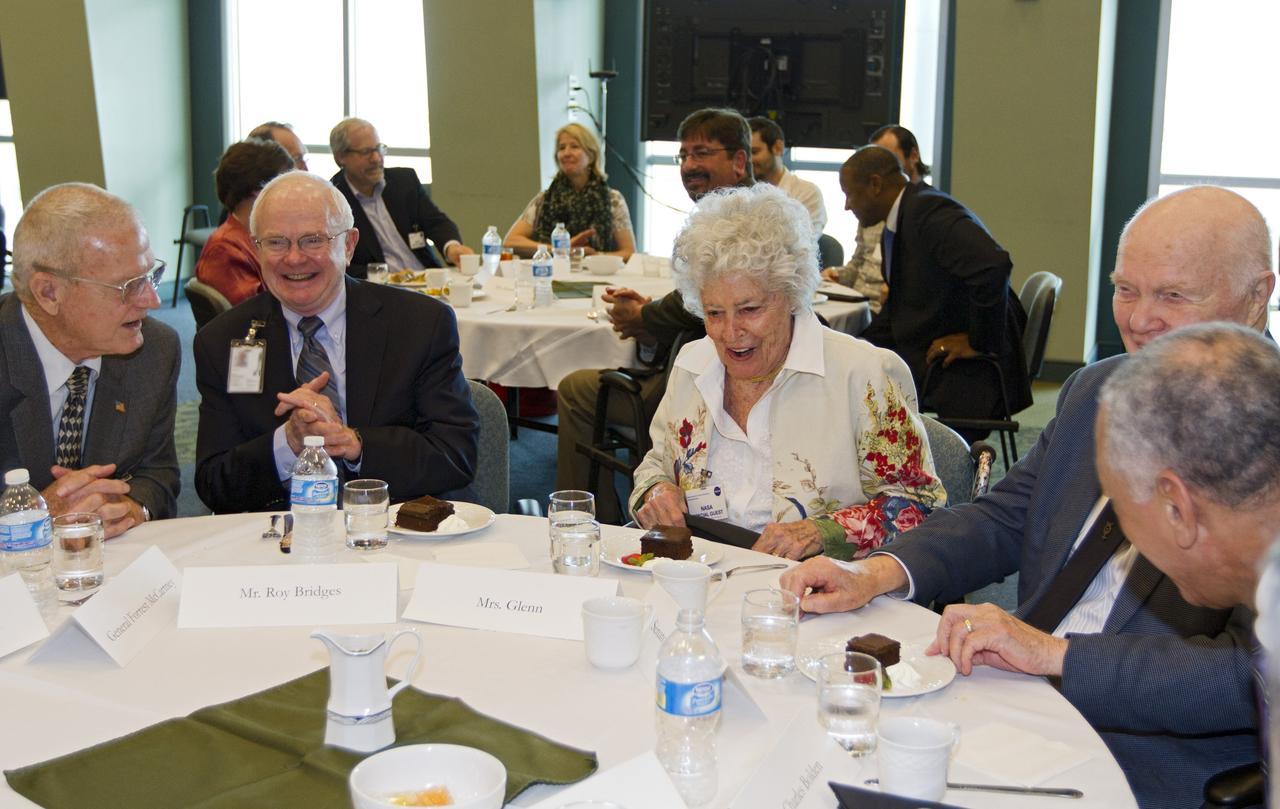
CAPE CANAVERAL, Fla. - Former Kennedy Space Center directors Forrest McCartney and Roy Bridges join Annie Glenn, astronaut John Glenn and NASA Administrator Charles Bolden during a luncheon Feb. 17, 2012, celebrating 50 years of Americans in orbit, an era which began with Glenn's Mercury mission MA-6, on Feb. 20, 1962. Glenn's launch aboard an Atlas rocket took with it the hopes of an entire nation and ushered in a new era of space travel that eventually led to Americans walking on the moon by the end of the 1960s. Glenn soon was followed into orbit by Scott Carpenter, Walter Schirra and Gordon Cooper. Their fellow Mercury astronauts Alan Shepard and Virgil "Gus" Grissom flew earlier suborbital flights. Deke Slayton, a member of NASA's original Mercury 7 astronauts, was grounded by a medical condition until the Apollo-Soyuz Test Project in 1975. Photo credit: NASA/Kim Shiflett
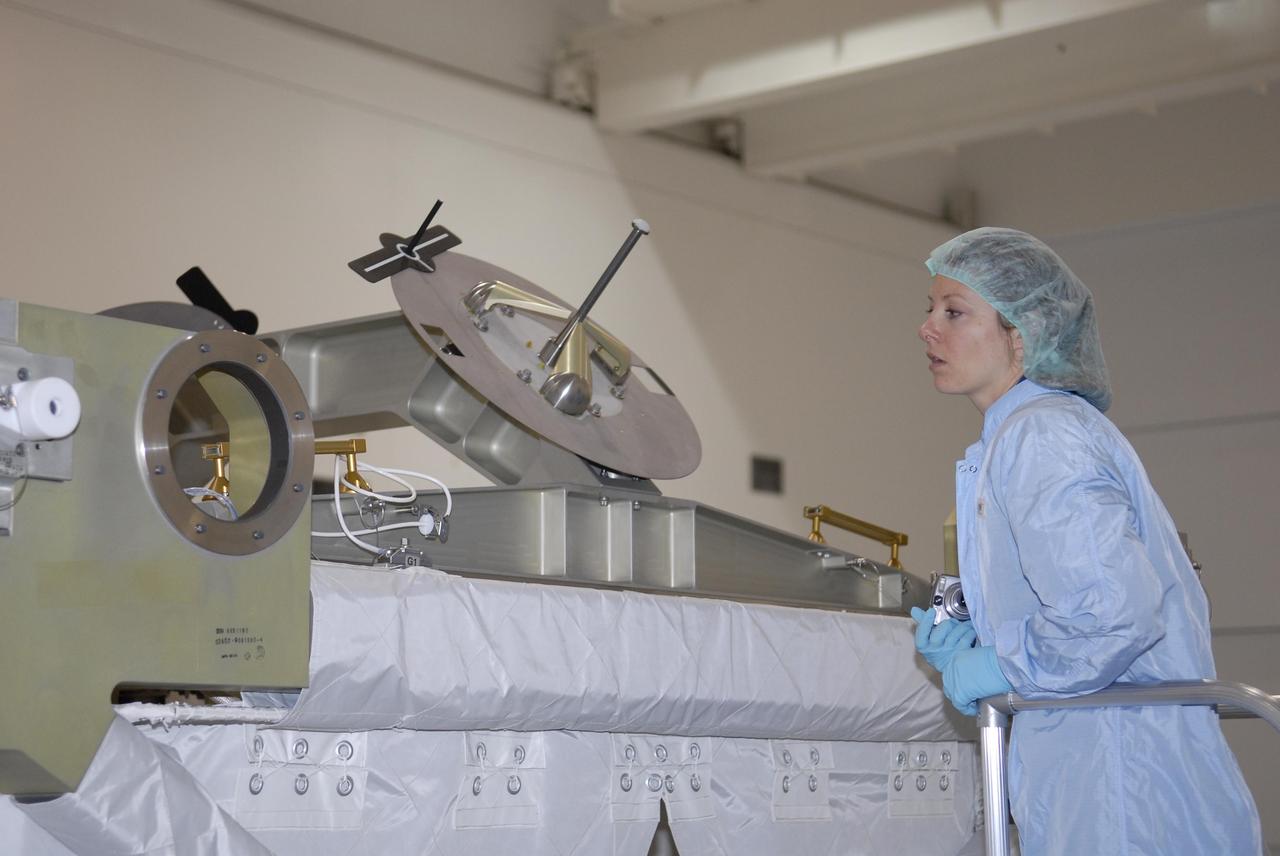
KENNEDY SPACE CENTER, FLA. -- The STS-118 crew members look over parts of the mission payload, the S5 integrated truss, in the Space Station Processing Facility during crew equipment interface test activities. Seen here is Mission Specialist Tracy Caldwell, who will be making her first space shuttle flight. The crew comprises Commander Scott Kelly, Pilot Charles Hobaugh, and Mission Specialists Dr. Dafydd Williams, Barbara Morgan, Richard Mastracchio, Caldwell and Benjamin Drew. Williams is with the Canadian Space Agency. The STS-118 mission will be delivering the third starboard truss segment, the ITS S5, to the International Space Station, and a SPACEHAB Single Cargo module with supplies and equipment. Launch aboard Space Shuttle Endeavour is targeted for August. Photo credit: NASA/Kim Shiflett
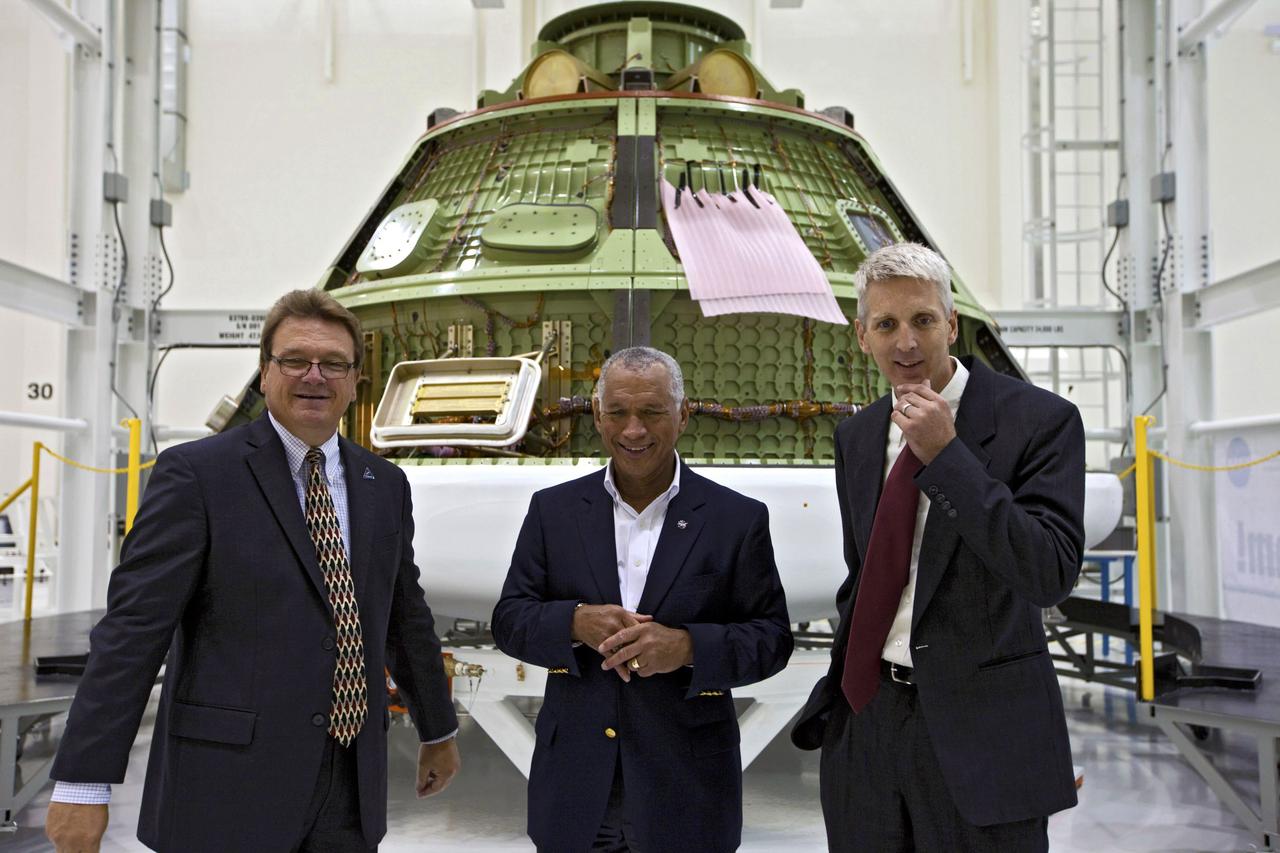
CAPE CANAVERAL, Fla. - In the Operations and Checkout Building at the Kennedy Space Center in Florida, NASA Administrator Charles Bolden, center, addresses news media in front of the Orion EFT-1 spacecraft. Also participating are Jules Schneider, senior manager of Project Engineering for the Lockheed Martin Orion Program at Kennedy, left, and Scott Wilson, NASA's manager of Production Operations for the Orion Program. Bolden took a few dozen members of the news media on a tour of the space agency's Kennedy Space Center and adjacent Cape Canaveral Air Force Station on Aug. 23, 2012 to show the progress being made for future government and commercial space endeavors that will begin from Florida's Space Coast. For more information, visit: http://www.nasa.gov/centers/kennedy/news/kennedy-bolden-tour.html Photo credit: NASA/Kim Shiflett
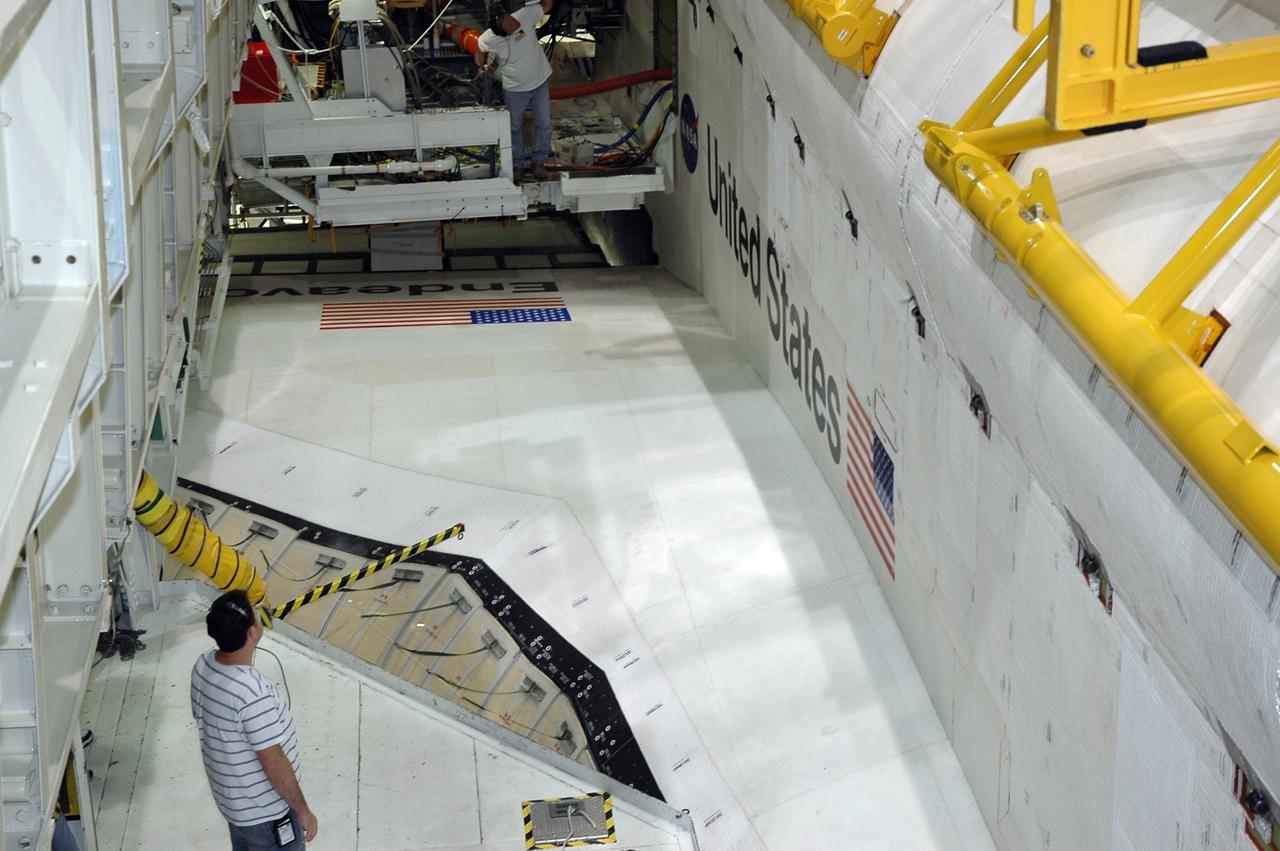
KENNEDY SPACE CENTER, FLA. -- In the Orbiter Processing Facility bay 2, workers are on the wing of Endeavour, checking the progress as the payload bay doors close. The payload will be installed on the launch pad after rollout. The orbiter is designated for mission STS-118, targeted for launch on Aug. 9. The mission will continue space station construction by delivering a third starboard truss segment, S5, as well as carrying the External Stowage Platform 3. The crew comprises seven astronauts: Commander Scott Kelly, Pilot Charles Hobaugh and Mission Specialists Dr. Dafydd (Dave) Williams, Barbara Morgan, Richard Mastracchio, Tracy Caldwell and Benjamin Drew. Williams represents the Canadian Space Agency. Photo credit: NASA/Cory Huston
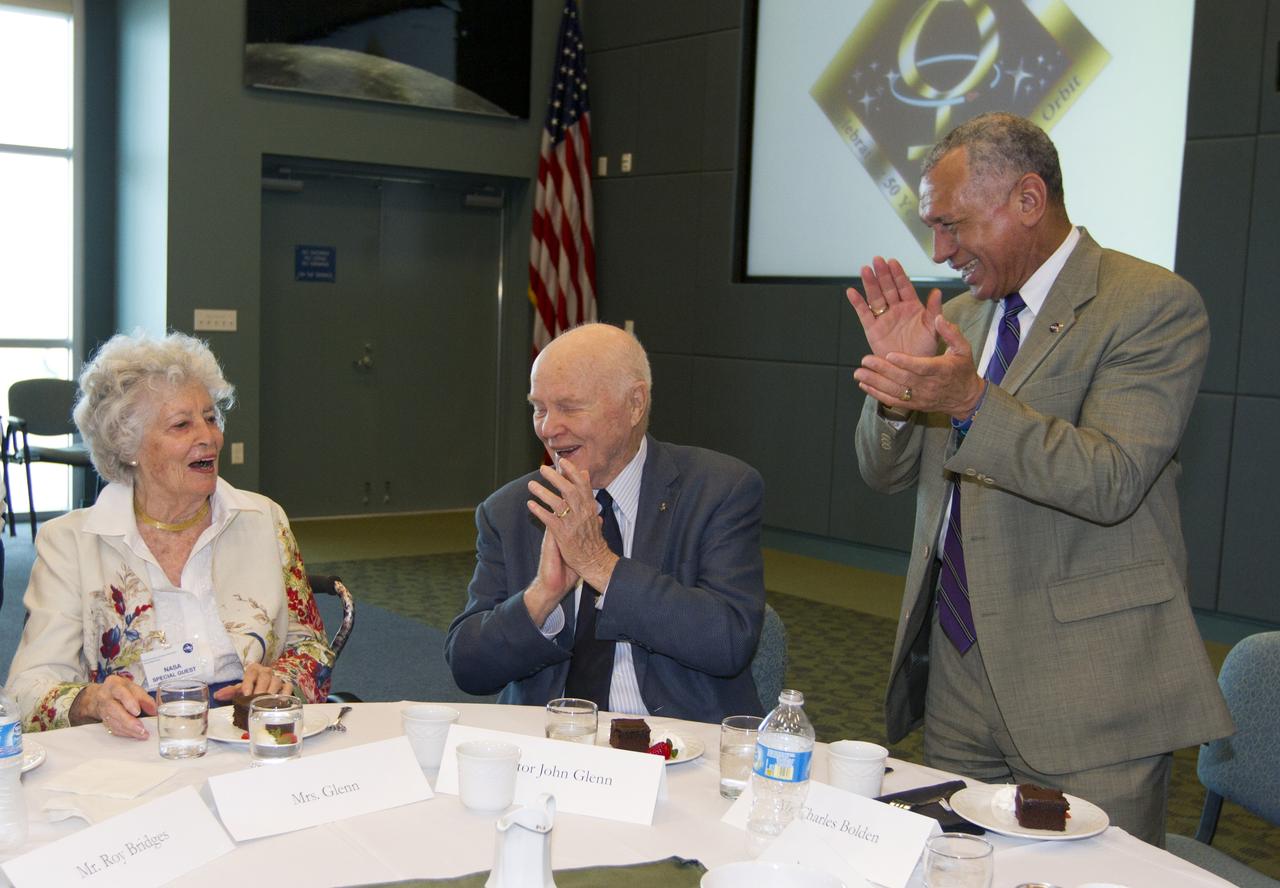
CAPE CANAVERAL, Fla. -Annie Glenn, left, astronaut John Glenn and NASA Administrator Charles Bolden take part in a luncheon Feb. 17, 2012, celebrating 50 years of Americans in orbit, an era which began with Glenn's Mercury mission MA-6, on Feb. 20, 1962. Glenn's launch aboard an Atlas rocket took with it the hopes of an entire nation and ushered in a new era of space travel that eventually led to Americans walking on the moon by the end of the 1960s. Glenn soon was followed into orbit by Scott Carpenter, Walter Schirra and Gordon Cooper. Their fellow Mercury astronauts Alan Shepard and Virgil "Gus" Grissom flew earlier suborbital flights. Deke Slayton, a member of NASA's original Mercury 7 astronauts, was grounded by a medical condition until the Apollo-Soyuz Test Project in 1975. Photo credit: NASA/Kim Shiflett
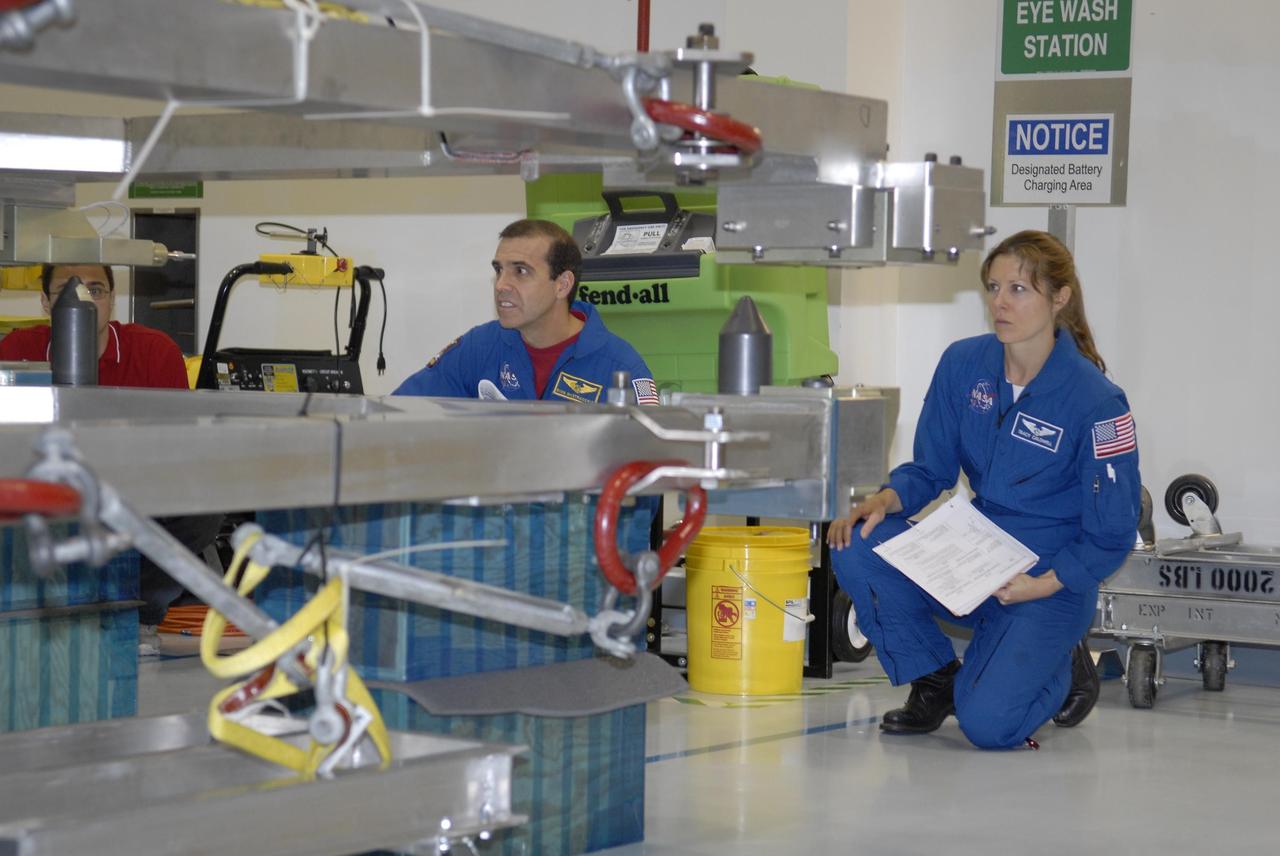
KENNEDY SPACE CENTER, FLA. -- The STS-118 crew members look over parts of the mission payload, the S5 integrated truss, in the Space Station Processing Facility during crew equipment interface test activities. Seen here are Mission Specialists Richard Mastracchio (left) and Tracy Caldwell. The crew comprises Commander Scott Kelly, Pilot Charles Hobaugh, and Mission Specialists Dr. Dafydd Williams, Barbara Morgan, Mastracchio, Caldwell and Benjamin Drew. Williams is with the Canadian Space Agency. The STS-118 mission will be delivering the third starboard truss segment, the ITS S5, to the International Space Station, and a SPACEHAB Single Cargo module with supplies and equipment. Launch aboard Space Shuttle Endeavour is targeted for August. Photo credit: NASA/Kim Shiflett
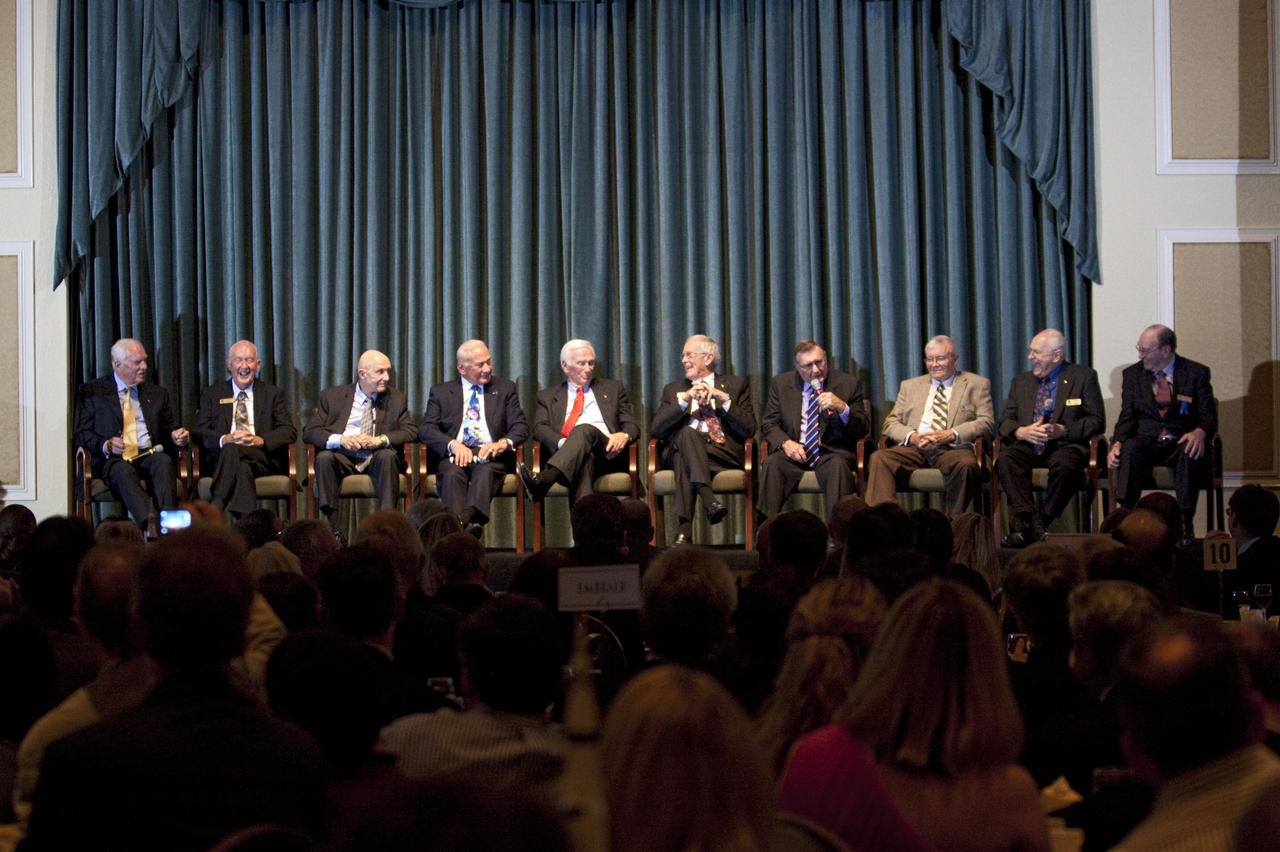
CAPE CANAVERAL, Fla. – Apollo astronauts, from the left, David Scott, James McDivitt, Thomas Stafford, Buzz Aldrin, Eugene Cernan, Charles Duke, Richard Gordon, Fred Haise, Alan Bean and Edgar Mitchell speak to guests gathered for the Astronaut Scholarship Foundation's dinner at the Radisson Resort at the Port in Cape Canaveral celebrating the 40th anniversary of Apollo 17. The gala commemorating the anniversary of Apollo 17 included mission commander Eugene Cernan and other astronauts who flew Apollo missions. Launched Dec. 7, 1972, Cernan and lunar module pilot Harrison Schmitt landed in the moon's Taurus-Littrow highlands while command module pilot Ronald Evans remained in lunar orbit operating a scientific instrument module. For more information, visit http://www-pao.ksc.nasa.gov/history/apollo/apollo-17/apollo-17.htm Photo credit: NASA/Kim Shiflett
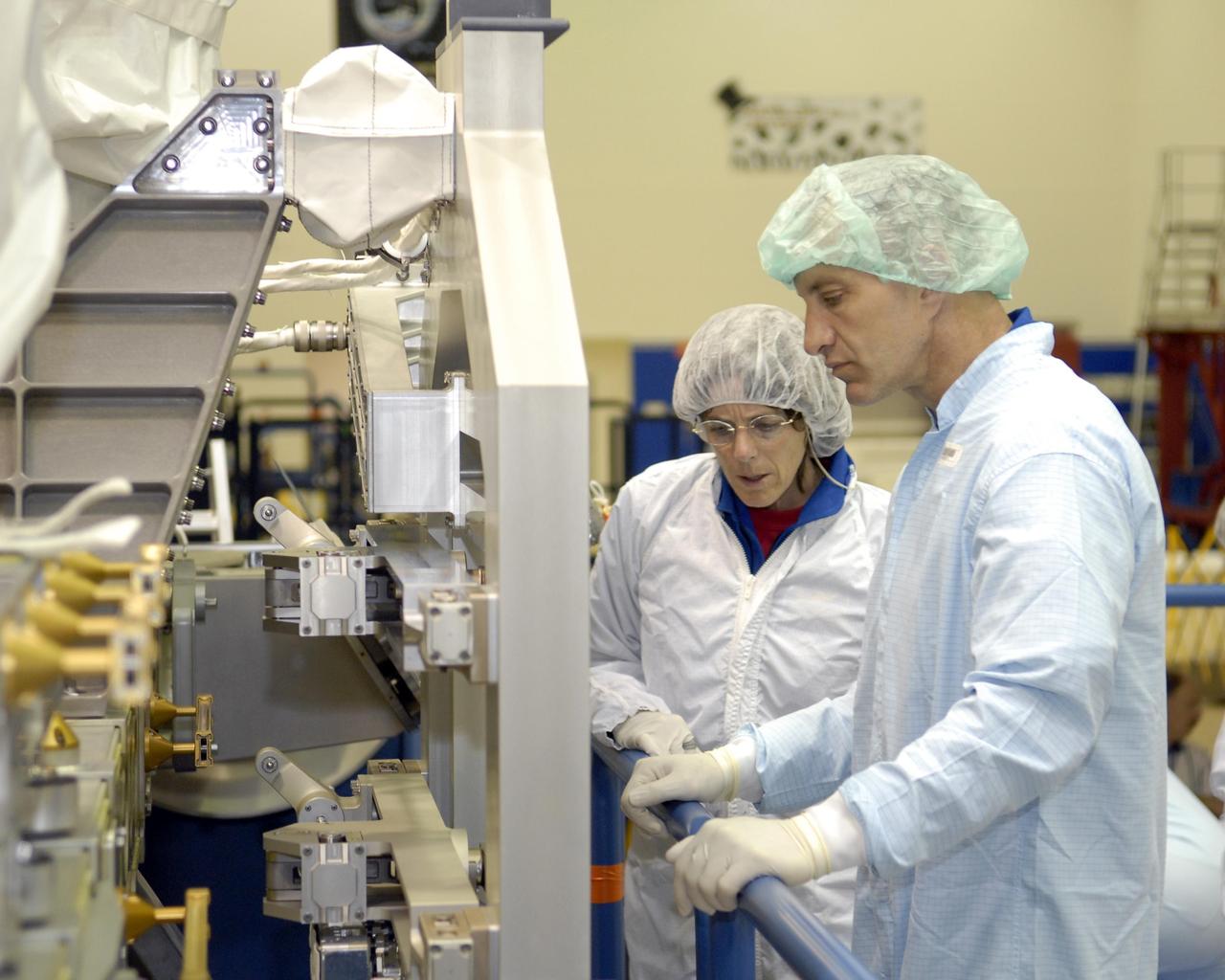
KENNEDY SPACE CENTER, FLA. -- The STS-118 crew members look over parts of the mission payload, the S5 integrated truss, in the Space Station Processing Facility during crew equipment interface test activities. Seen here are Mission Specialists Tracy Caldwell and Dr. Dafydd Williams. The crew comprises Commander Scott Kelly, Pilot Charles Hobaugh, and Mission Specialists Williams, Barbara Morgan, Richard Mastracchio, Caldwell and Benjamin Drew. Williams is with the Canadian Space Agency. The STS-118 mission will be delivering the third starboard truss segment, the ITS S5, to the International Space Station, and a SPACEHAB Single Cargo module with supplies and equipment. Launch aboard Space Shuttle Endeavour is targeted for August. Photo credit: NASA/Kim Shiflett
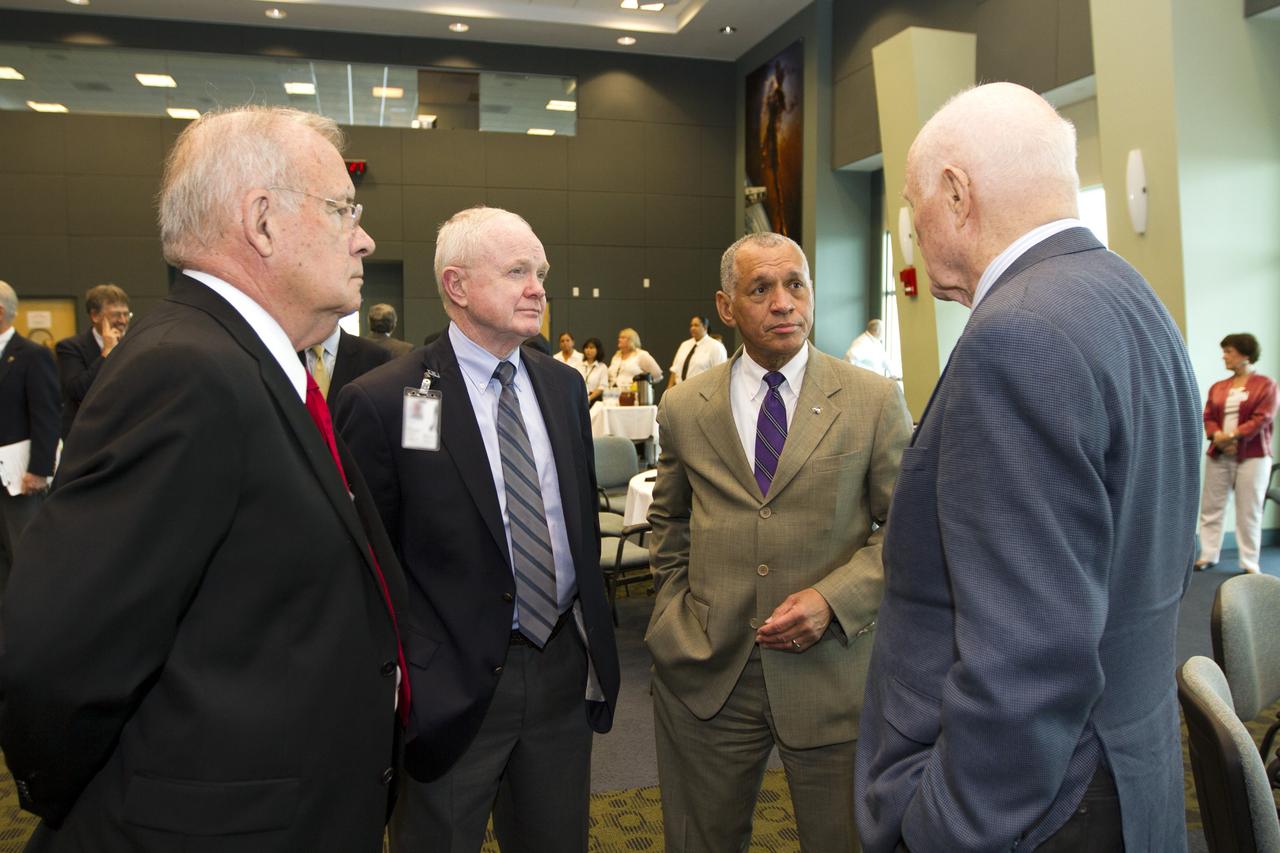
CAPE CANAVERAL, Fla. - Former Kennedy Space Center directors Jay Honeycutt, left, Roy Bridges and NASA Administrator Charles Bolden talk with astronaut John Glenn before a luncheon Feb. 17, 2012 celebrating 50 years of Americans in orbit, an era which began with Glenn's Mercury mission MA-6, on Feb. 20, 1962. Glenn's launch aboard an Atlas rocket took with it the hopes of an entire nation and ushered in a new era of space travel that eventually led to Americans walking on the moon by the end of the 1960s. Glenn soon was followed into orbit by Scott Carpenter, Walter Schirra and Gordon Cooper. Their fellow Mercury astronauts Alan Shepard and Virgil "Gus" Grissom flew earlier suborbital flights. Deke Slayton, a member of NASA's original Mercury 7 astronauts, was grounded by a medical condition until the Apollo-Soyuz Test Project in 1975. Photo credit: NASA/Kim Shiflett
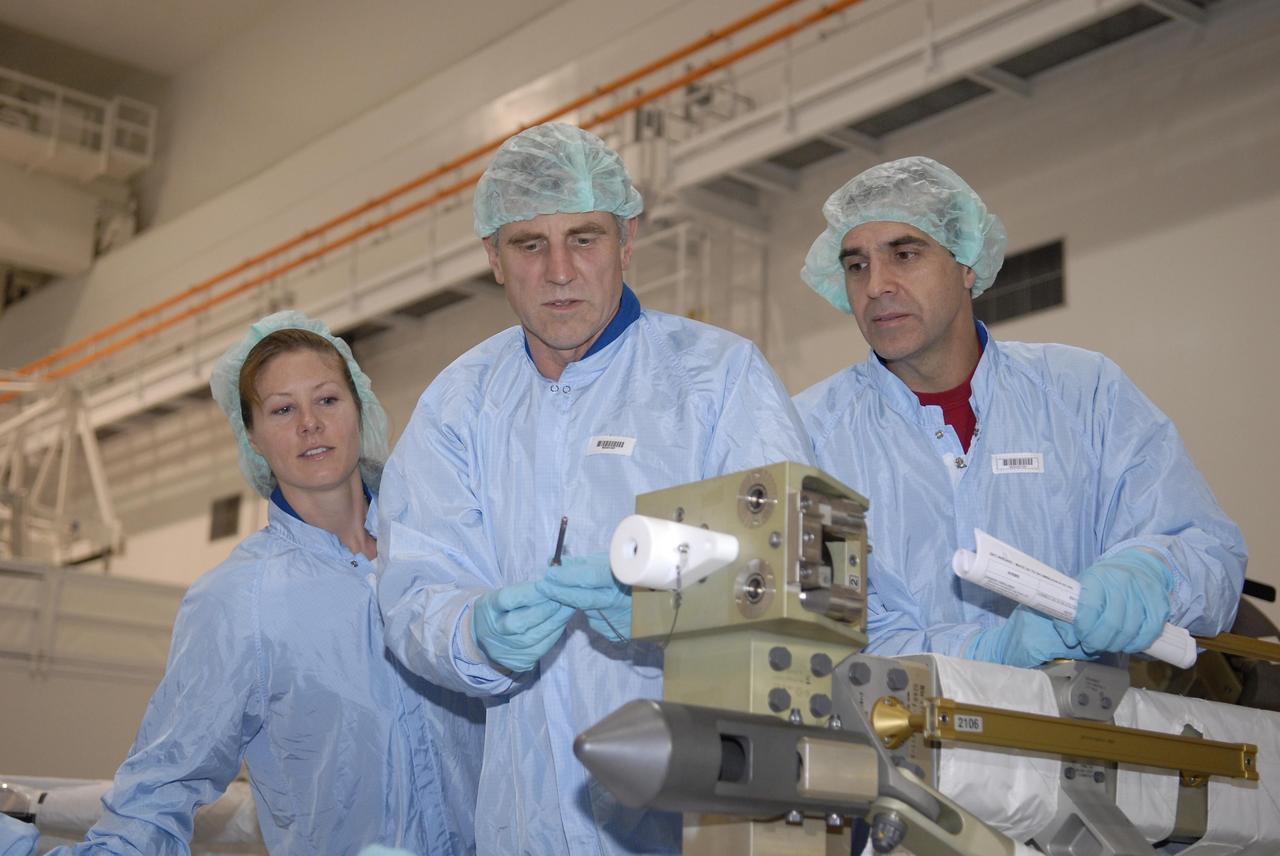
KENNEDY SPACE CENTER, FLA. -- The STS-118 crew members look over parts of the mission payload, the control moment gyroscope, at SPACEHAB during crew equipment interface test activities. Seen here are Mission Specialist Barbara Morgan and Pilot Charles Hobaugh. The crew comprises Commander Scott Kelly, Hobaugh, and Mission Specialists Dr. Dafydd Williams, Morgan, Richard Mastracchio, Tracy Caldwell and Benjamin Drew. Williams is with the Canadian Space Agency. The STS-118 mission will be delivering the third starboard truss segment, the ITS S5, to the International Space Station, and a SPACEHAB Single Cargo module with supplies and equipment. Launch aboard Space Shuttle Endeavour is targeted for August. Photo credit: NASA/Kim Shiflett
KENNEDY SPACE CENTER, FLA. -- The STS-118 crew members look over parts of the mission payload, the S5 integrated truss, in the Space Station Processing Facility during crew equipment interface test activities. Seen here are Mission Specialists Tracy Caldwell, Dr. Dafydd Williams and Richard Mastracchio. The crew comprises Commander Scott Kelly, Pilot Charles Hobaugh, and Mission Specialists Williams, Barbara Morgan, Mastracchio, Caldwell and Benjamin Drew. Williams is with the Canadian Space Agency. The STS-118 mission will be delivering the third starboard truss segment, the ITS S5, to the International Space Station, and a SPACEHAB Single Cargo module with supplies and equipment. Launch aboard Space Shuttle Endeavour is targeted for August. Photo credit: NASA/Kim Shiflett
KENNEDY SPACE CENTER, FLA. -- The STS-118 crew members look over parts of the mission payload, the S5 integrated truss, in the Space Station Processing Facility during crew equipment interface test activities. Seen here is Mission Specialist Benjamin Drew, who will be making his first space shuttle flight. The crew comprises Commander Scott Kelly, Pilot Charles Hobaugh, and Mission Specialists Dr. Dafydd Williams, Barbara Morgan, Richard Mastracchio, Tracy Caldwell and Drew. Williams is with the Canadian Space Agency. The STS-118 mission will be delivering the third starboard truss segment, the ITS S5, to the International Space Station, and a SPACEHAB Single Cargo module with supplies and equipment. Launch aboard Space Shuttle Endeavour is targeted for August. Photo credit: NASA/Kim Shiflett
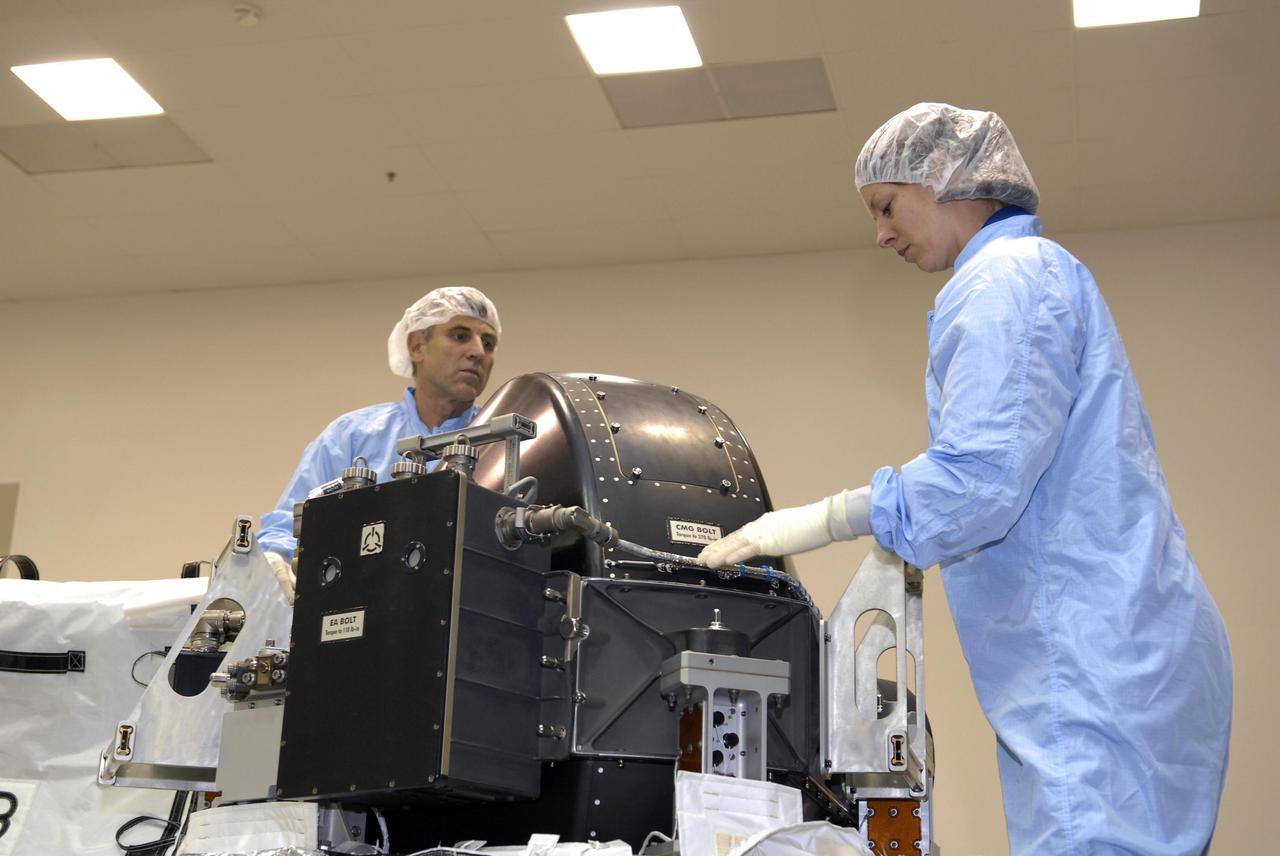
KENNEDY SPACE CENTER, FLA. -- The STS-118 crew members look over parts of the mission payload, the control moment gyroscope, at SPACEHAB during crew equipment interface test activities. Seen here are Mission Specialists Dr. Dafydd Williams and Tracy Caldwell. The crew comprises Commander Scott Kelly, Pilot Charles Hobaugh, and Mission Specialists Williams, Barbara Morgan, Richard Mastracchio, Caldwell and Benjamin Drew. Williams is with the Canadian Space Agency. The STS-118 mission will be delivering the third starboard truss segment, the ITS S5, to the International Space Station, and a SPACEHAB Single Cargo module with supplies and equipment. Launch aboard Space Shuttle Endeavour is targeted for August. Photo credit: NASA/Kim Shiflett
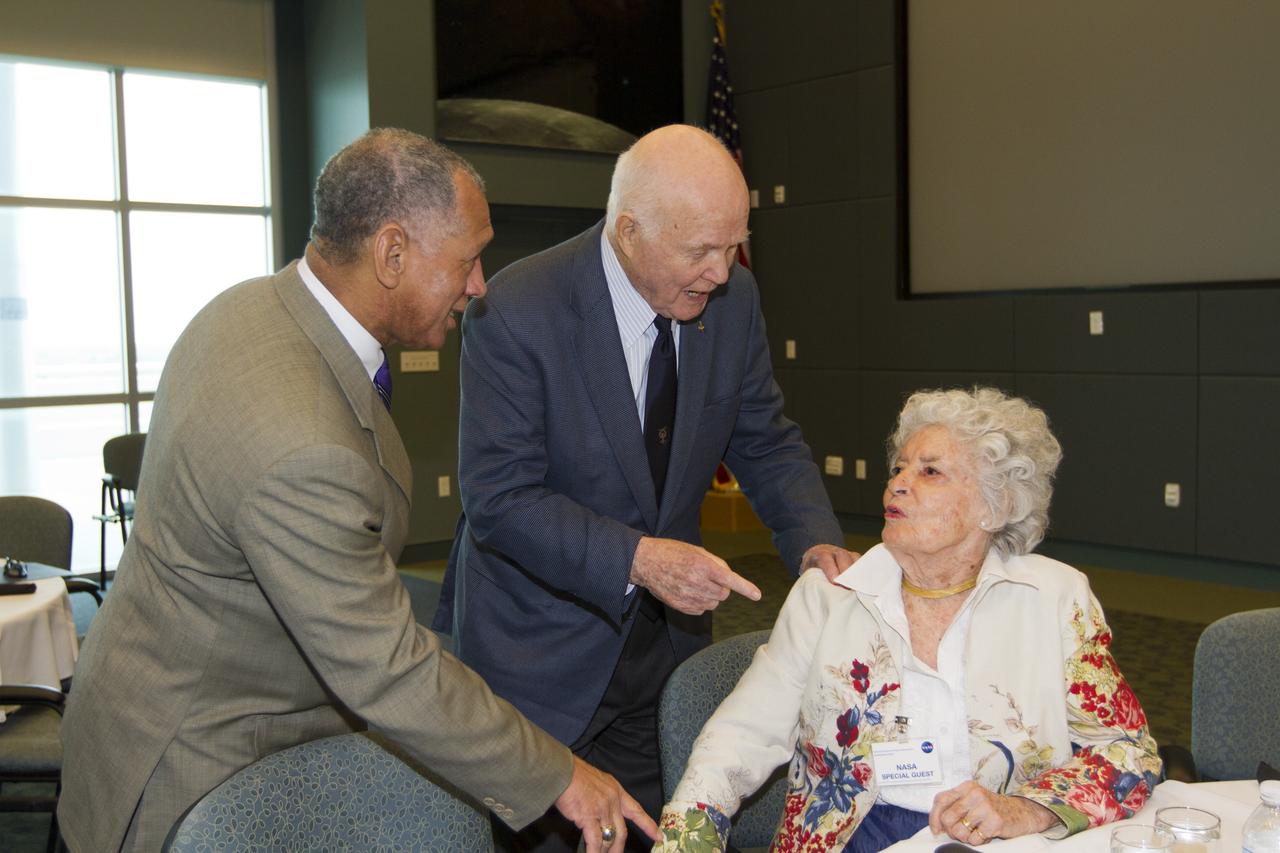
CAPE CANAVERAL, Fla. - NASA Administrator Charles Bolden, left, talks with astronaut John Glenn and his wife, Annie Glenn, before a luncheon Feb. 17, 2012, celebrating 50 years of Americans in orbit, an era which began with Glenn's Mercury mission MA-6, on Feb. 20, 1962. Glenn's launch aboard an Atlas rocket took with it the hopes of an entire nation and ushered in a new era of space travel that eventually led to Americans walking on the moon by the end of the 1960s. Glenn soon was followed into orbit by Scott Carpenter, Walter Schirra and Gordon Cooper. Their fellow Mercury astronauts Alan Shepard and Virgil "Gus" Grissom flew earlier suborbital flights. Deke Slayton, a member of NASA's original Mercury 7 astronauts, was grounded by a medical condition until the Apollo-Soyuz Test Project in 1975. Photo credit: NASA/Kim Shiflett

S63-00562 (February 1963) --- Portrait of astronaut groups 1 and 2. The original seven Mercury astronauts selected by NASA in April 1959, are seated (left to right): L. Gordon Cooper Jr., Virgil I. Grissom, M. Scott Carpenter, Water M. Schirra Jr., John H. Glenn Jr., Alan B. Shepard Jr., and Donald K. Slayton. The second group of NASA astronauts, which were named in September 1962, are standing (left to right): Edward H. White II, James A. McDivitt, John W. Young, Elliot M. See Jr., Charles Conrad Jr., Frank Borman, Neil A. Armstrong, Thomas P. Stafford, and James A. Lovell Jr. Photo credit: NASA or National Aeronautics and Space Administration
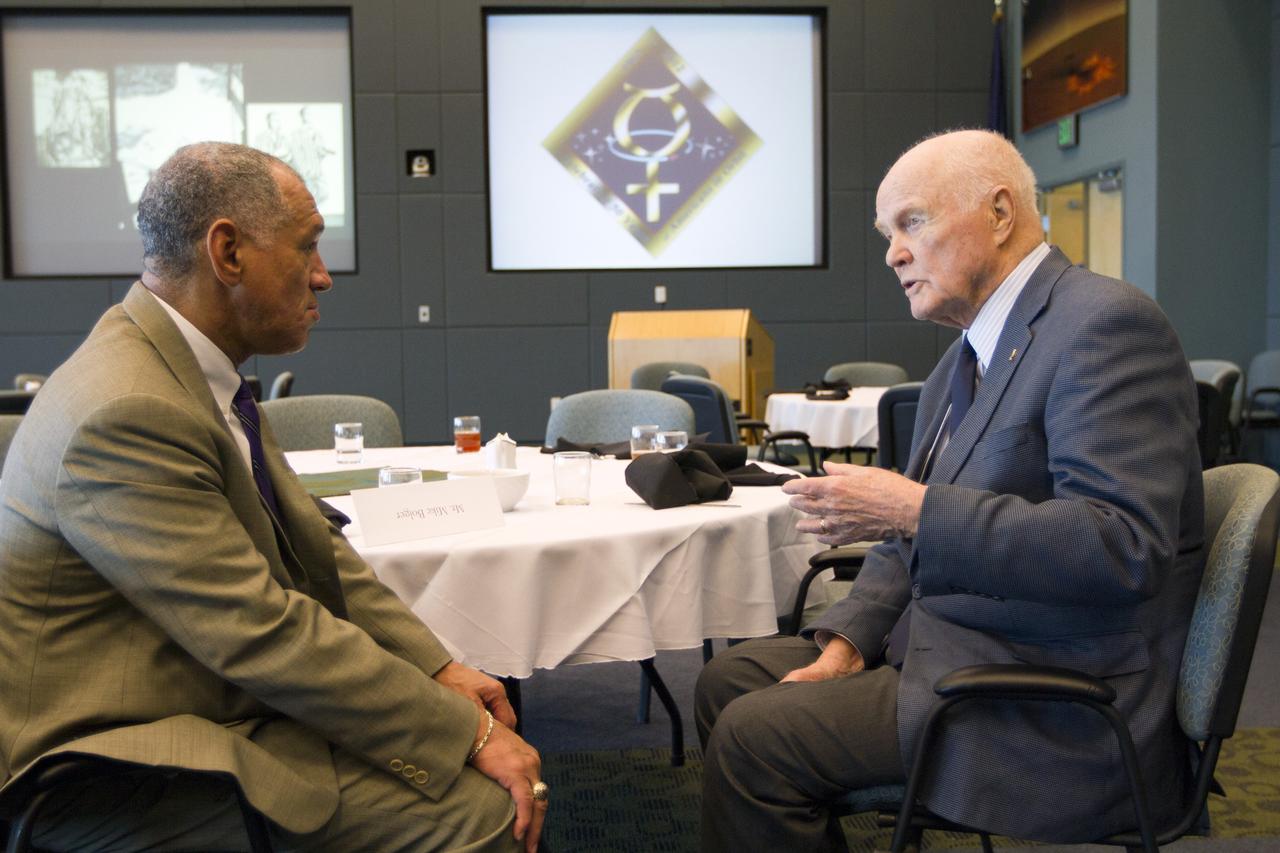
CAPE CANAVERAL, Fla. -NASA Administrator Charles Bolden, left, talks with astronaut John Glenn following a luncheon Feb. 17, 2012, celebrating 50 years of Americans in orbit, an era which began with Glenn's Mercury mission MA-6, on Feb. 20, 1962. Glenn's launch aboard an Atlas rocket took with it the hopes of an entire nation and ushered in a new era of space travel that eventually led to Americans walking on the moon by the end of the 1960s. Glenn soon was followed into orbit by Scott Carpenter, Walter Schirra and Gordon Cooper. Their fellow Mercury astronauts Alan Shepard and Virgil "Gus" Grissom flew earlier suborbital flights. Deke Slayton, a member of NASA's original Mercury 7 astronauts, was grounded by a medical condition until the Apollo-Soyuz Test Project in 1975. Photo credit: NASA/Kim Shiflett
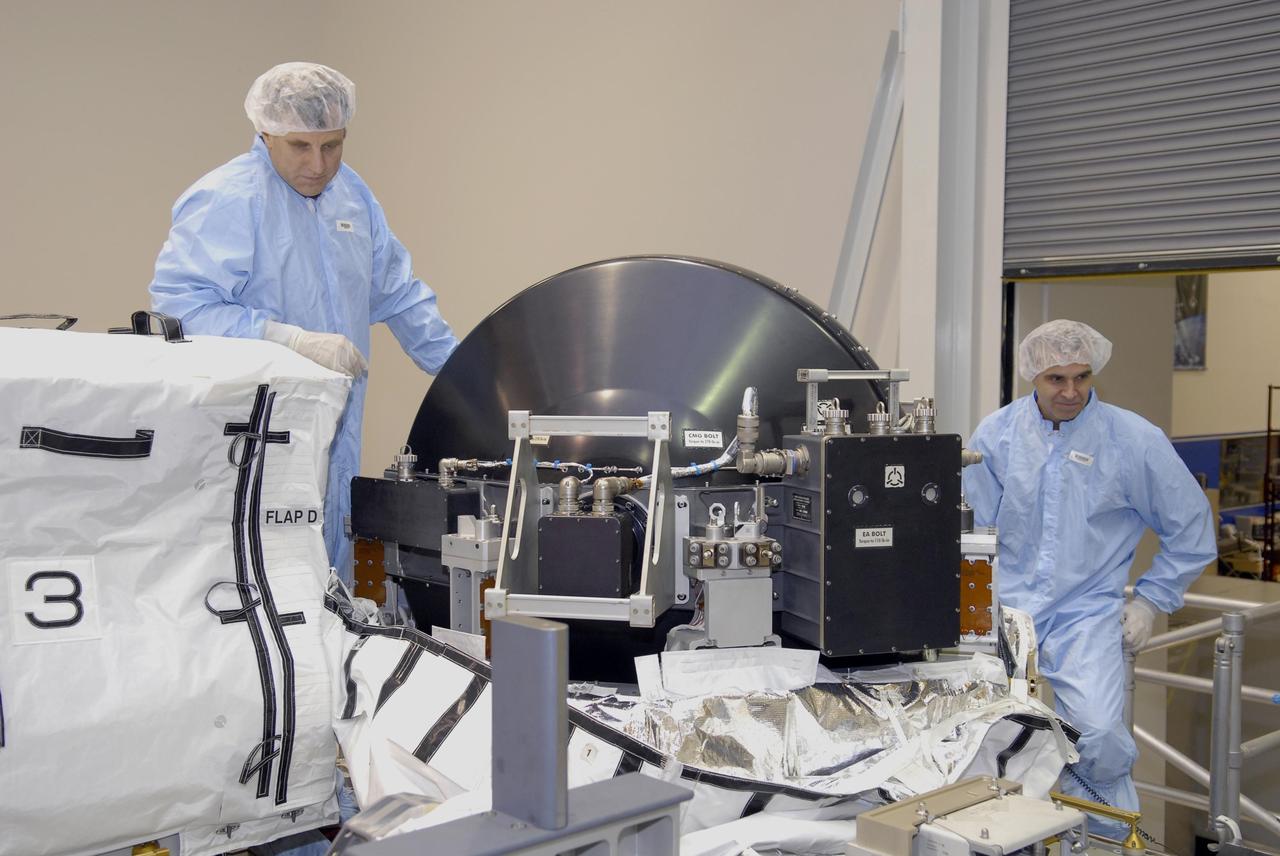
KENNEDY SPACE CENTER, FLA. -- The STS-118 crew members look over parts of the mission payload, the control moment gyroscope, at SPACEHAB during crew equipment interface test activities. Seen here are Mission Specialists Dr. Dafydd Williams (left) and Richard Mastracchio. The crew comprises Commander Scott Kelly, Pilot Charles Hobaugh, and Mission Specialists Williams, Barbara Morgan, Richard Mastracchio, Tracy Caldwell and Benjamin Drew. Williams is with the Canadian Space Agency. The STS-118 mission will be delivering the third starboard truss segment, the ITS S5, to the International Space Station, and a SPACEHAB Single Cargo module with supplies and equipment. Launch aboard Space Shuttle Endeavour is targeted for August. Photo credit: NASA/Kim Shiflett
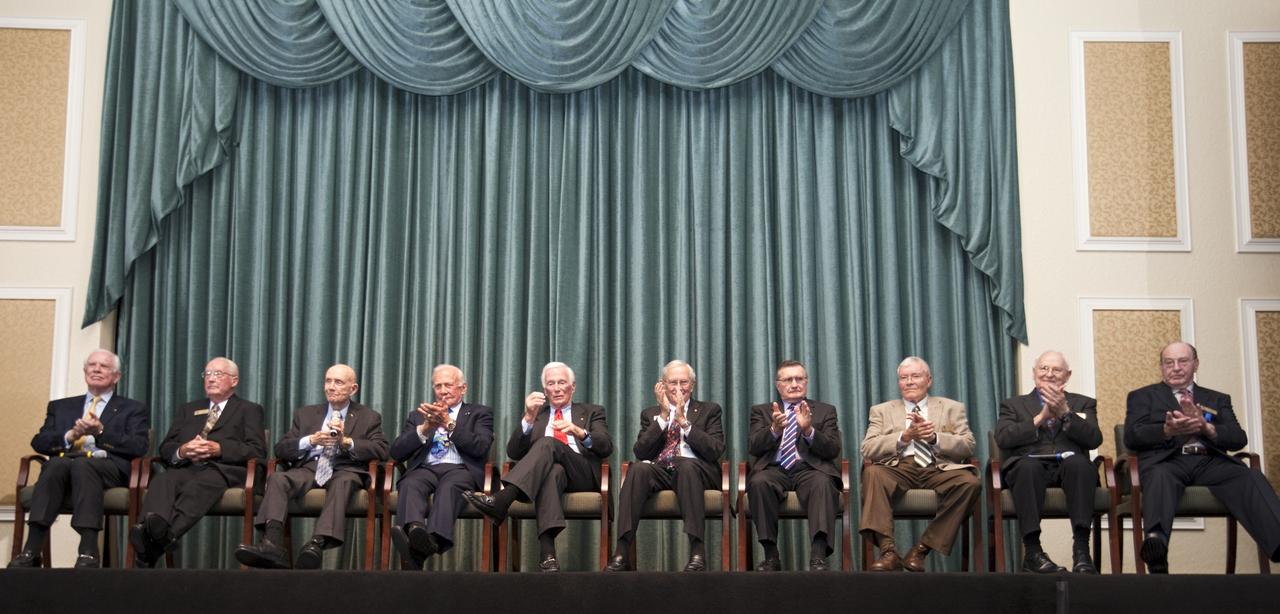
CAPE CANAVERAL, Fla. – Apollo astronauts, from the left, David Scott, James McDivitt, Thomas Stafford, Buzz Aldrin, Eugene Cernan, Charles Duke, Richard Gordon, Fred Haise, Alan Bean and Edgar Mitchell speak to guests gathered for the Astronaut Scholarship Foundation's dinner at the Radisson Resort at the Port in Cape Canaveral celebrating the 40th anniversary of Apollo 17. The gala commemorating the anniversary of Apollo 17 included mission commander Eugene Cernan and other astronauts who flew Apollo missions. Launched Dec. 7, 1972, Cernan and lunar module pilot Harrison Schmitt landed in the moon's Taurus-Littrow highlands while command module pilot Ronald Evans remained in lunar orbit operating a scientific instrument module. For more information, visit http://www-pao.ksc.nasa.gov/history/apollo/apollo-17/apollo-17.htm Photo credit: NASA/Kim Shiflett
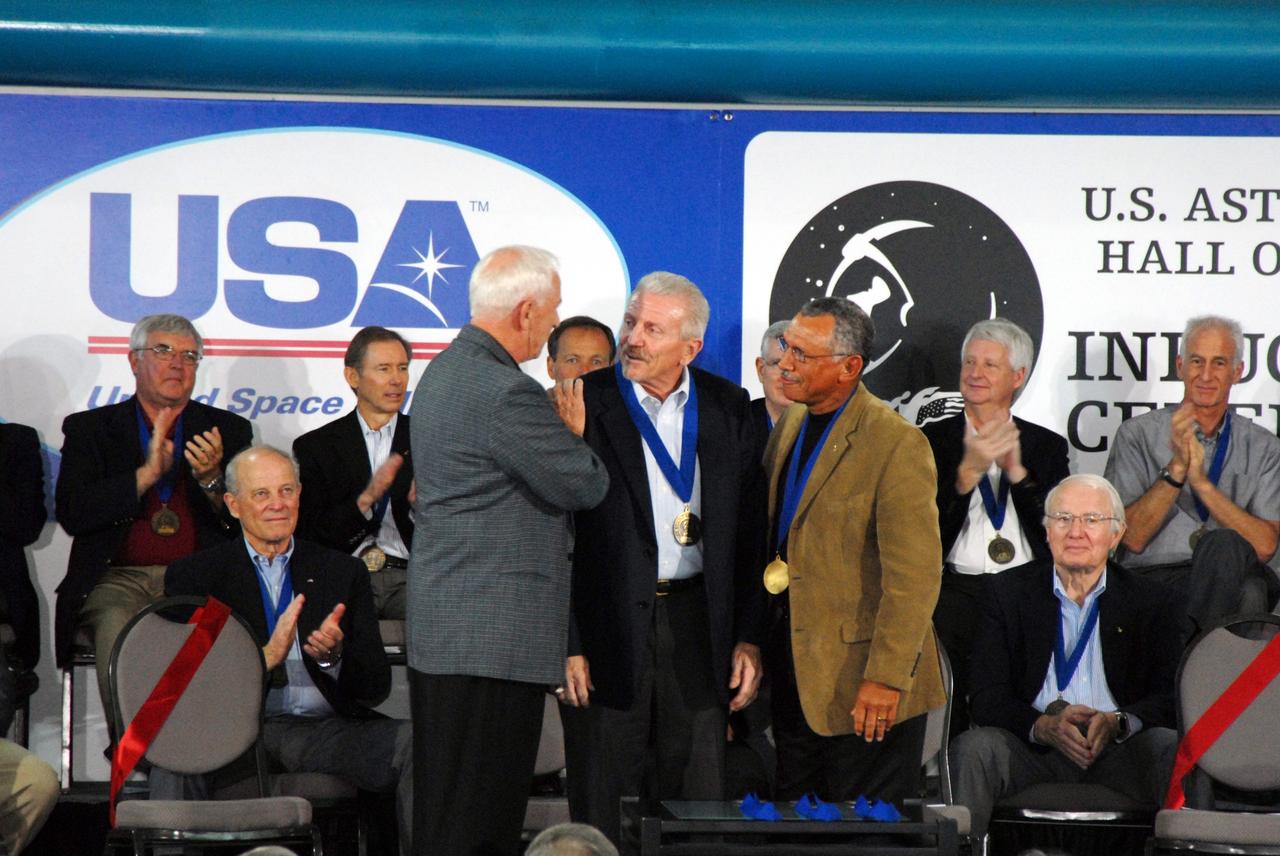
CAPE CANAVERAL, Fla. -- Former astronaut Loren Shriver (center) is inducted into the U.S. Astronaut Hall of Fame May 3 at NASA's Kennedy Space Center. Presenting the medal are former inductees Al Worden (left) and Charles Bolden (right). Other inductees were John Blaha; Bryan O'Connor, NASA's chief of Safety and Mission Assurance at NASA Headquarters in Washington; and Bob Cabana, center director of NASA's Stennis Space Center in Mississippi. Other former astronauts attending included Scott Carpenter, John Young, Bob Crippen, and Walt Cunningham. The U.S. Astronaut Hall of Fame is operated by Kennedy Space Center Visitor Complex on behalf of NASA. CNN correspondent John Zarrella hosted the event.

KENNEDY SPACE CENTER, FLA. -- The STS-118 crew members look over parts of the mission payload, the S5 integrated truss, in the Space Station Processing Facility during crew equipment interface test activities. Seen here is Mission Specialist Richard Mastracchio. The crew comprises Commander Scott Kelly, Pilot Charles Hobaugh, and Mission Specialists Dr. Dafydd Williams, Barbara Morgan, Mastracchio, Tracy Caldwell and Benjamin Drew. Williams is with the Canadian Space Agency. The STS-118 mission will be delivering the third starboard truss segment, the ITS S5, to the International Space Station, and a SPACEHAB Single Cargo module with supplies and equipment. Launch aboard Space Shuttle Endeavour is targeted for August. Photo credit: NASA/Kim Shiflett
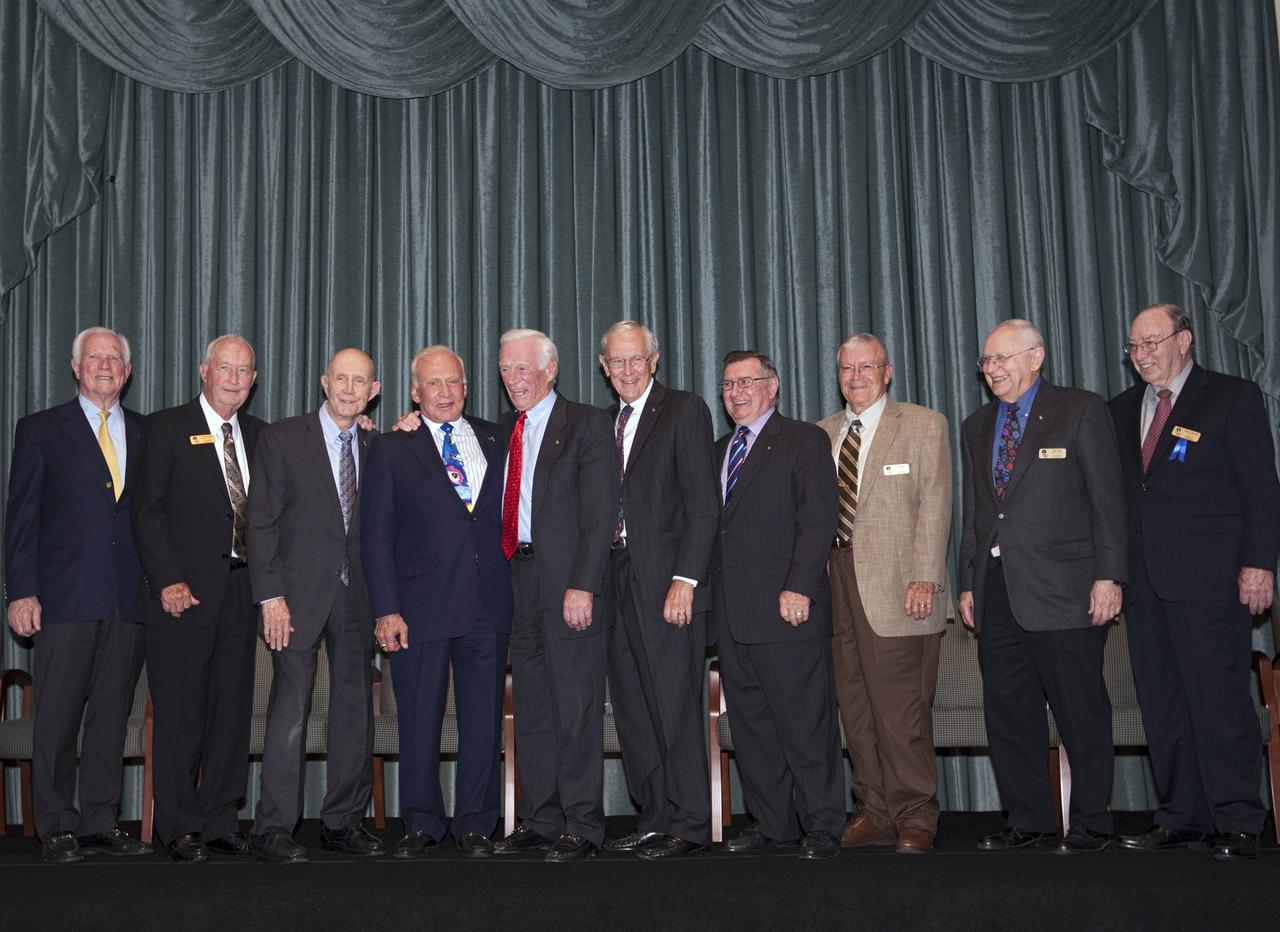
CAPE CANAVERAL, Fla. – Apollo astronauts, from the left, David Scott, James McDivitt, Thomas Stafford, Buzz Aldrin, Eugene Cernan, Charles Duke, Richard Gordon, Fred Haise, Alan Bean and Edgar Mitchell participated in the Astronaut Scholarship Foundation's dinner at the Radisson Resort at the Port in Cape Canaveral celebrating the 40th anniversary of Apollo 17. The gala commemorating the anniversary of Apollo 17 included mission commander Eugene Cernan and other astronauts who flew Apollo missions. Launched Dec. 7, 1972, Cernan and lunar module pilot Harrison Schmitt landed in the moon's Taurus-Littrow highlands while command module pilot Ronald Evans remained in lunar orbit operating a scientific instrument module. For more information, visit http://www-pao.ksc.nasa.gov/history/apollo/apollo-17/apollo-17.htm Photo credit: NASA/Kim Shiflett
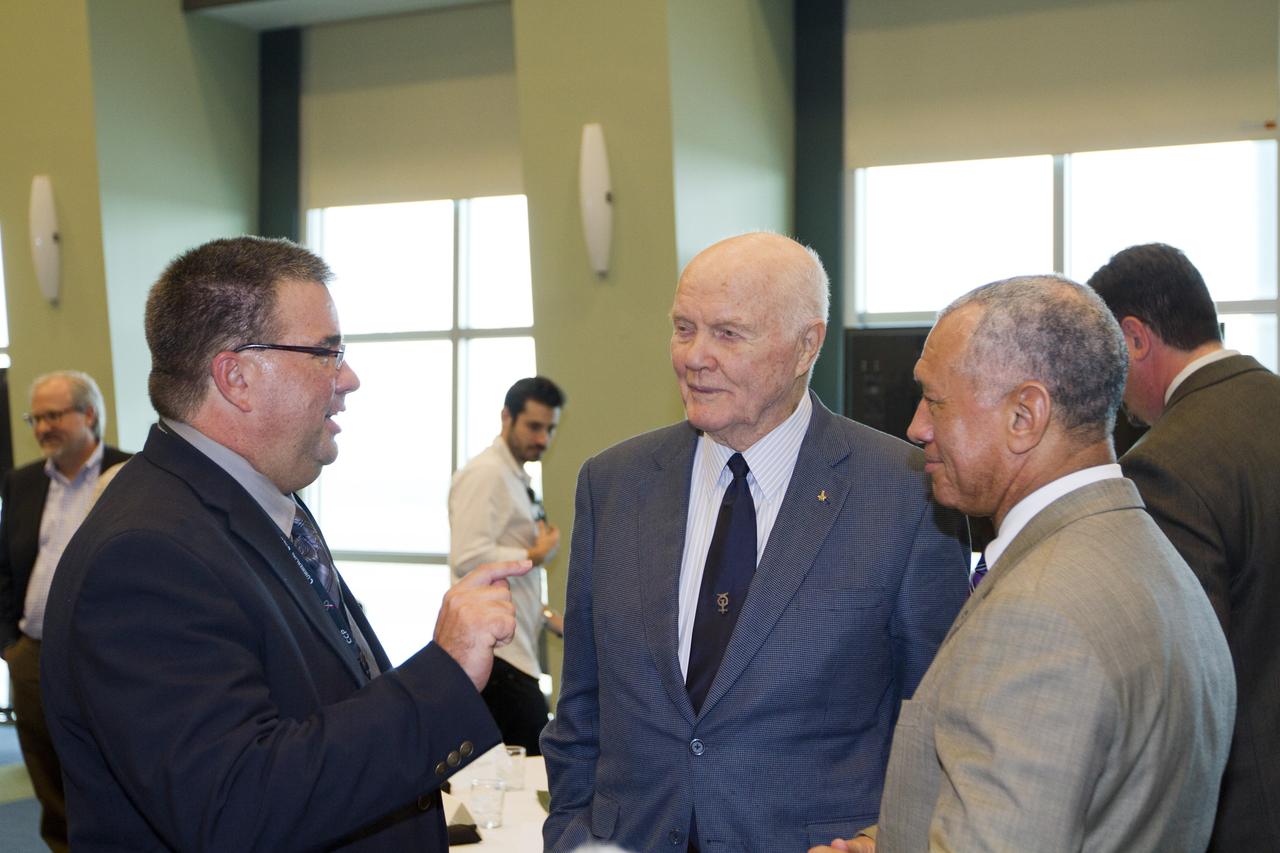
CAPE CANAVERAL, Fla. - Ed Mango, program manager of NASA's Commercial Crew Program, left, talks with astronaut John Glenn, center and NASA Administrator Charles Bolden before a luncheon Feb. 17, 2012, celebrating 50 years of Americans in orbit, an era which began with Glenn's Mercury mission MA-6, on Feb. 20, 1962. Glenn's launch aboard an Atlas rocket took with it the hopes of an entire nation and ushered in a new era of space travel that eventually led to Americans walking on the moon by the end of the 1960s. Glenn soon was followed into orbit by Scott Carpenter, Walter Schirra and Gordon Cooper. Their fellow Mercury astronauts Alan Shepard and Virgil "Gus" Grissom flew earlier suborbital flights. Deke Slayton, a member of NASA's original Mercury 7 astronauts, was grounded by a medical condition until the Apollo-Soyuz Test Project in 1975. Photo credit: NASA/Kim Shiflett
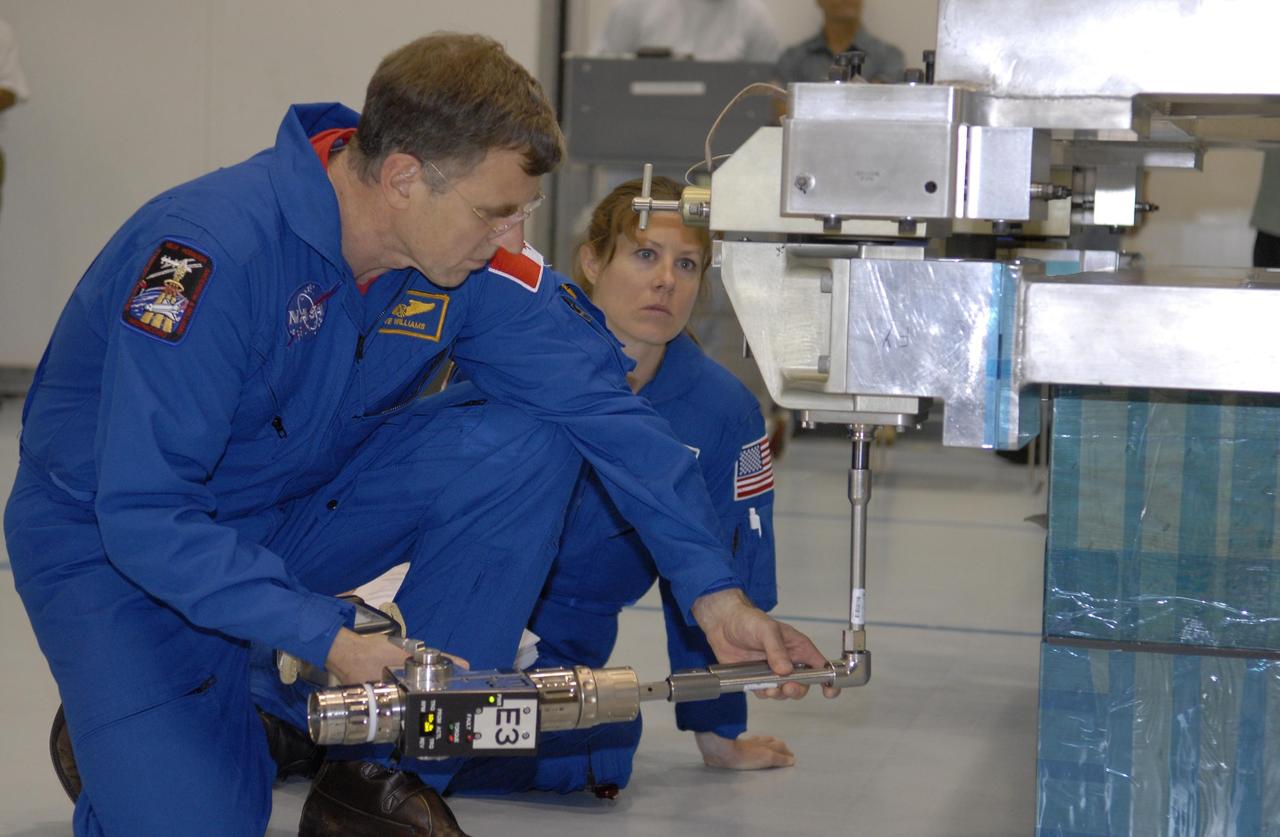
KENNEDY SPACE CENTER, FLA. --The STS-118 crew members look over parts of the mission payload, the S5 integrated truss, in the Space Station Processing Facility during crew equipment interface test activities. Seen here are Mission Specialists Dr. Dafydd Williams and Tracy Caldwell. The crew comprises Commander Scott Kelly, Pilot Charles Hobaugh, and Mission Specialists Williams, Barbara Morgan, Richard Mastracchio, Caldwell and Benjamin Drew. Williams is with the Canadian Space Agency. The STS-118 mission will be delivering the third starboard truss segment, the ITS S5, to the International Space Station, and a SPACEHAB Single Cargo module with supplies and equipment. Launch aboard Space Shuttle Endeavour is targeted for August. Photo credit: NASA/Kim Shiflett
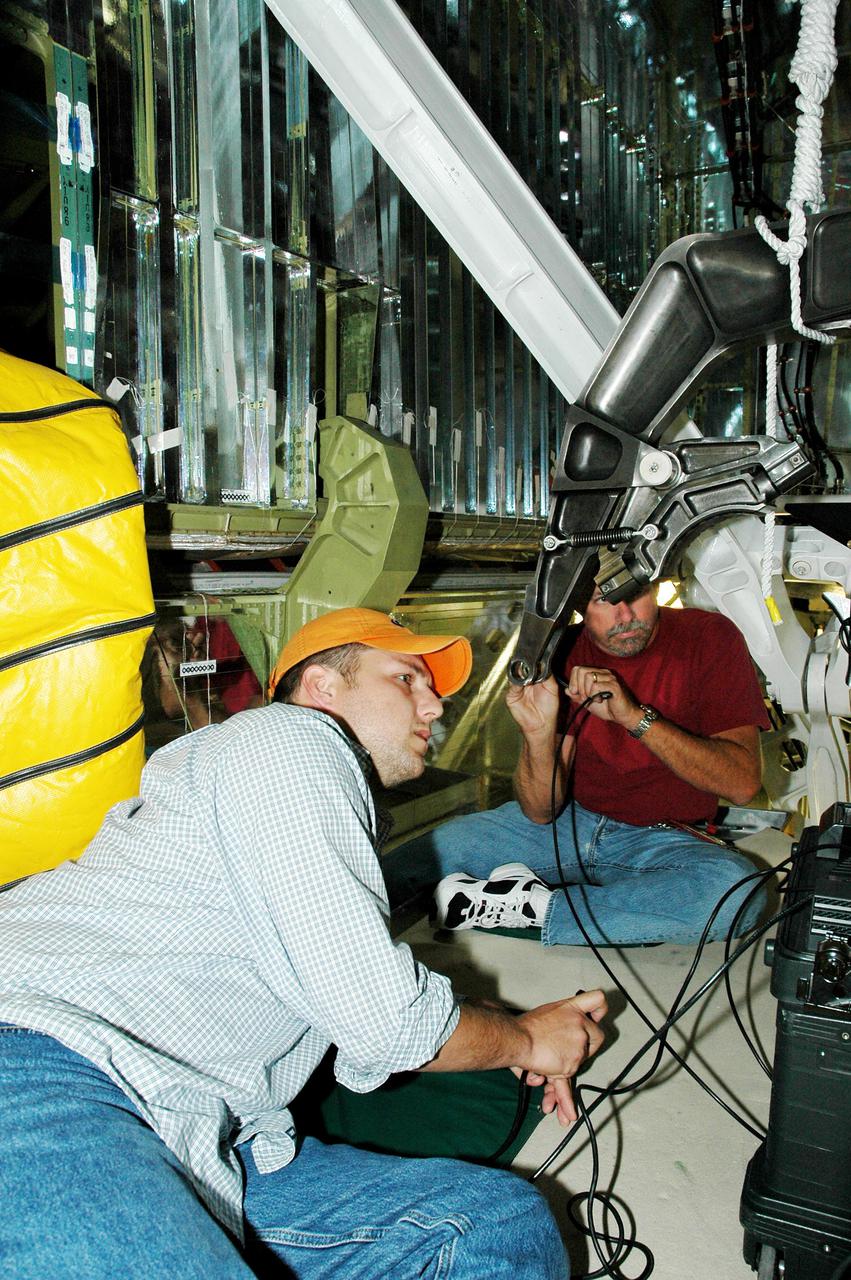
KENNEDY SPACE CENTER, FLA. - On Orbiter Atlantis in NASA’s Orbiter Processing Facility, bay 1, the retract link assembly on the right-hand main landing gear has been removed and will be replaced. Performing boroscope inspection are Charles Wassen, orbiter inspector, and Scott Minnick, lead inspector for micro inspection team. Last week a small crack was found on the right-hand assembly. To lower the main landing gear, a mechanical linkage released by each gear actuates the doors to the open position. The landing gear reach the full-down and extended position with 10 seconds and are locked in the down position by spring-loaded downlock bungees Atlantis is scheduled to launch in September 2005 on the second Return to Flight mission, STS-121.
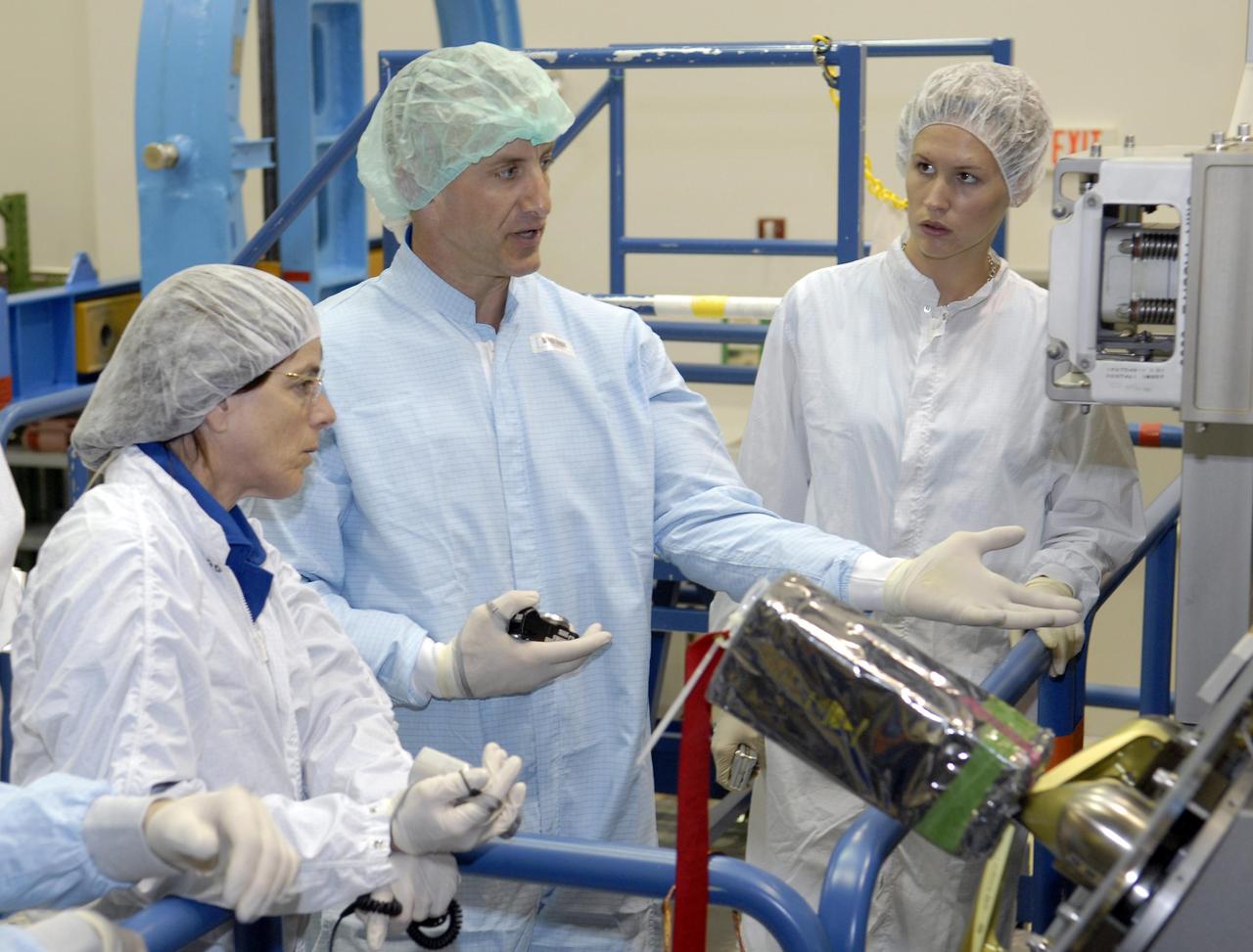
KENNEDY SPACE CENTER, FLA. -- The STS-118 crew members look over parts of the mission payload, the control moment gyroscope, at SPACEHAB during crew equipment interface test activities. Seen here are Mission Specialist Barbara Morgan (left) and Pilot Charles Hobaugh (center). The crew comprises Commander Scott Kelly, Hobaugh, and Mission Specialists Dr. Dafydd Williams, Morgan, Richard Mastracchio, Tracy Caldwell and Benjamin Drew. Williams is with the Canadian Space Agency. The STS-118 mission will be delivering the third starboard truss segment, the ITS S5, to the International Space Station, and a SPACEHAB Single Cargo module with supplies and equipment. Launch aboard Space Shuttle Endeavour is targeted for August. Photo credit: NASA/Kim Shiflett
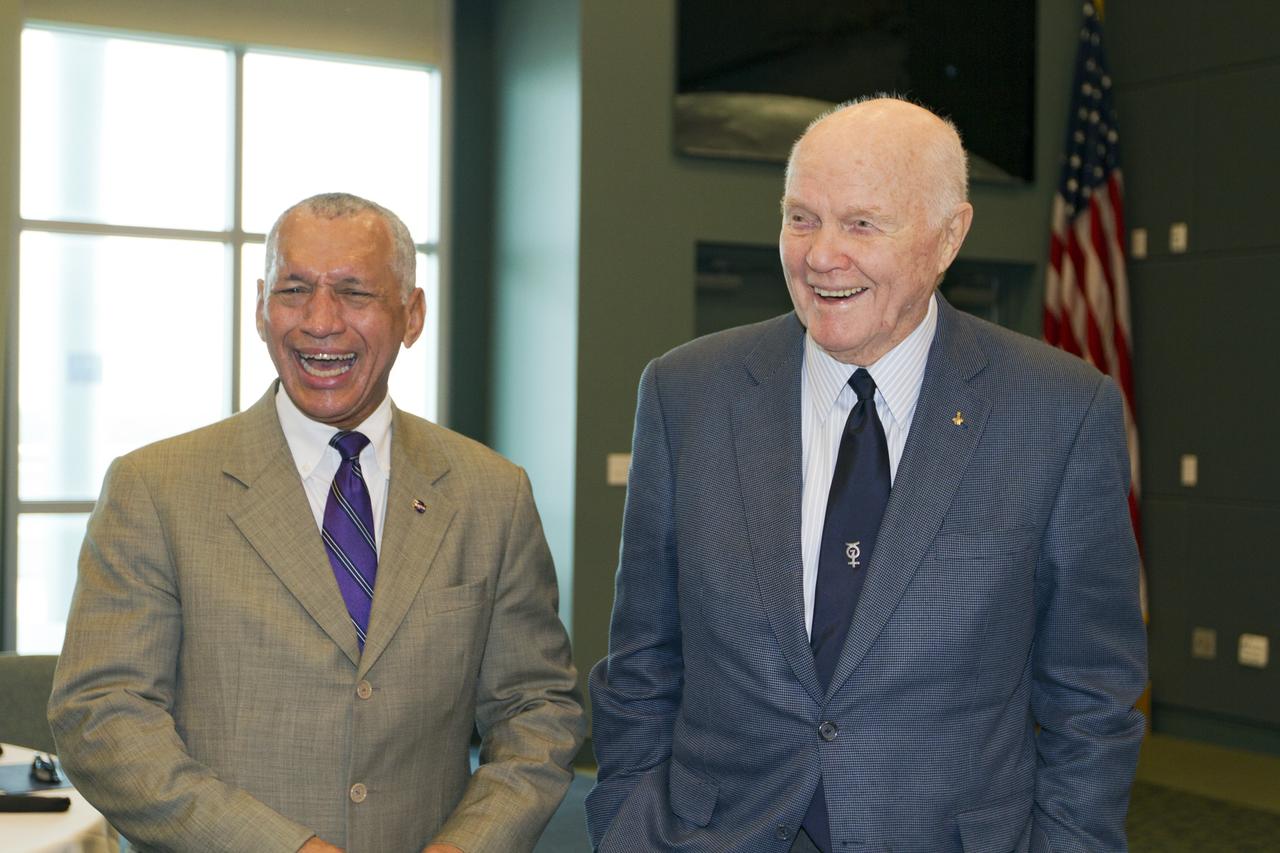
CAPE CANAVERAL, Fla. - NASA Administrator Charles Bolden, left, shares a laugh with astronaut John Glenn before a luncheon Feb. 17, 2012, celebrating 50 years of Americans in orbit, an era which began with Glenn's Mercury mission MA-6, on Feb. 20, 1962. Glenn's launch aboard an Atlas rocket took with it the hopes of an entire nation and ushered in a new era of space travel that eventually led to Americans walking on the moon by the end of the 1960s. Glenn soon was followed into orbit by Scott Carpenter, Walter Schirra and Gordon Cooper. Their fellow Mercury astronauts Alan Shepard and Virgil "Gus" Grissom flew earlier suborbital flights. Deke Slayton, a member of NASA's original Mercury 7 astronauts, was grounded by a medical condition until the Apollo-Soyuz Test Project in 1975. Photo credit: NASA/Kim Shiflett
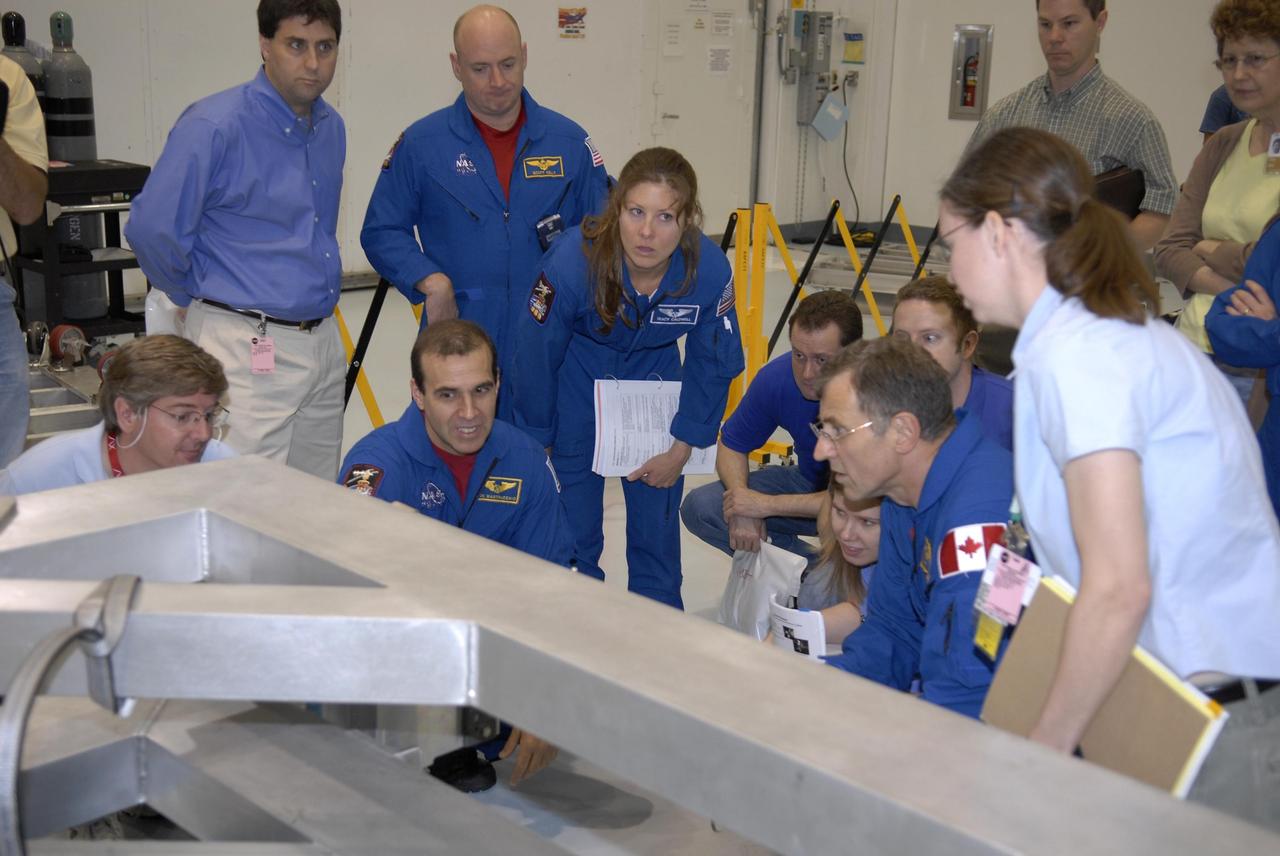
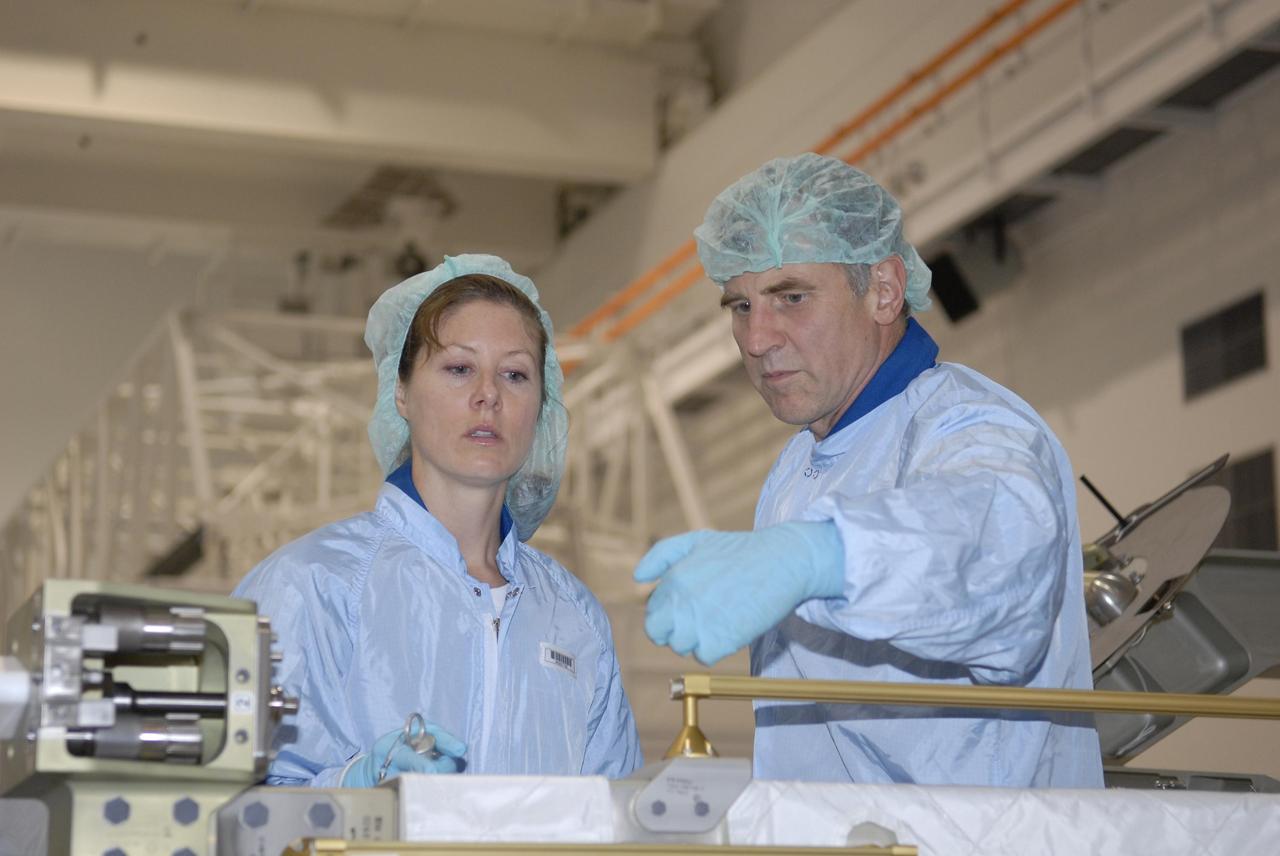
KENNEDY SPACE CENTER, FLA. --The STS-118 crew members look over parts of the mission payload, the S5 integrated truss, in the Space Station Processing Facility during crew equipment interface test activities. Seen here are (standing) Commander Scott Kelly and Mission Specialist Tracy Caldwell, and (foreground) Mission Specialists Richard Mastracchio and Dr. Dafydd Williams. Other crew members are Pilot Charles Hobaugh and Mission Specialists Barbara Morgan and Benjamin Drew. Williams is with the Canadian Space Agency. The STS-118 mission will be delivering the third starboard truss segment, the ITS S5, to the International Space Station, and a SPACEHAB Single Cargo module with supplies and equipment. Launch aboard Space Shuttle Endeavour is targeted for August. Photo credit: NASA/Kim Shiflett
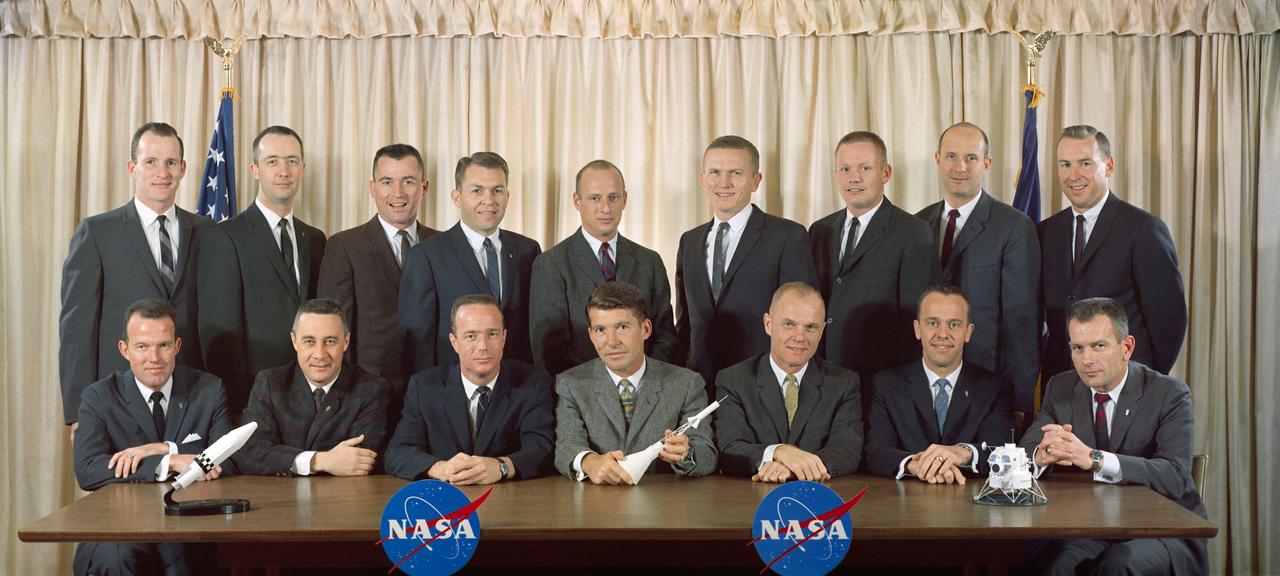
S63-01419 (1963) --- The first two groups of astronauts selected by the National Aeronautics and Space Administration (NASA). The original seven Mercury astronauts, selected in April 1959, are seated left to right, L. Gordon Cooper Jr., Virgil I. Grissom, M. Scott Carpenter, Walter M. Schirra Jr., John H. Glenn Jr., Alan B. Shepard Jr. and Donald K. Slayton. The second group of NASA astronauts, named in September 1962 are, standing left to right, Edward H. White II, James A. McDivitt, John W. Young, Elliot M. See Jr., Charles Conrad Jr., Frank Borman, Neil A. Armstrong, Thomas P. Stafford and James A. Lovell Jr. Photo credit: NASA
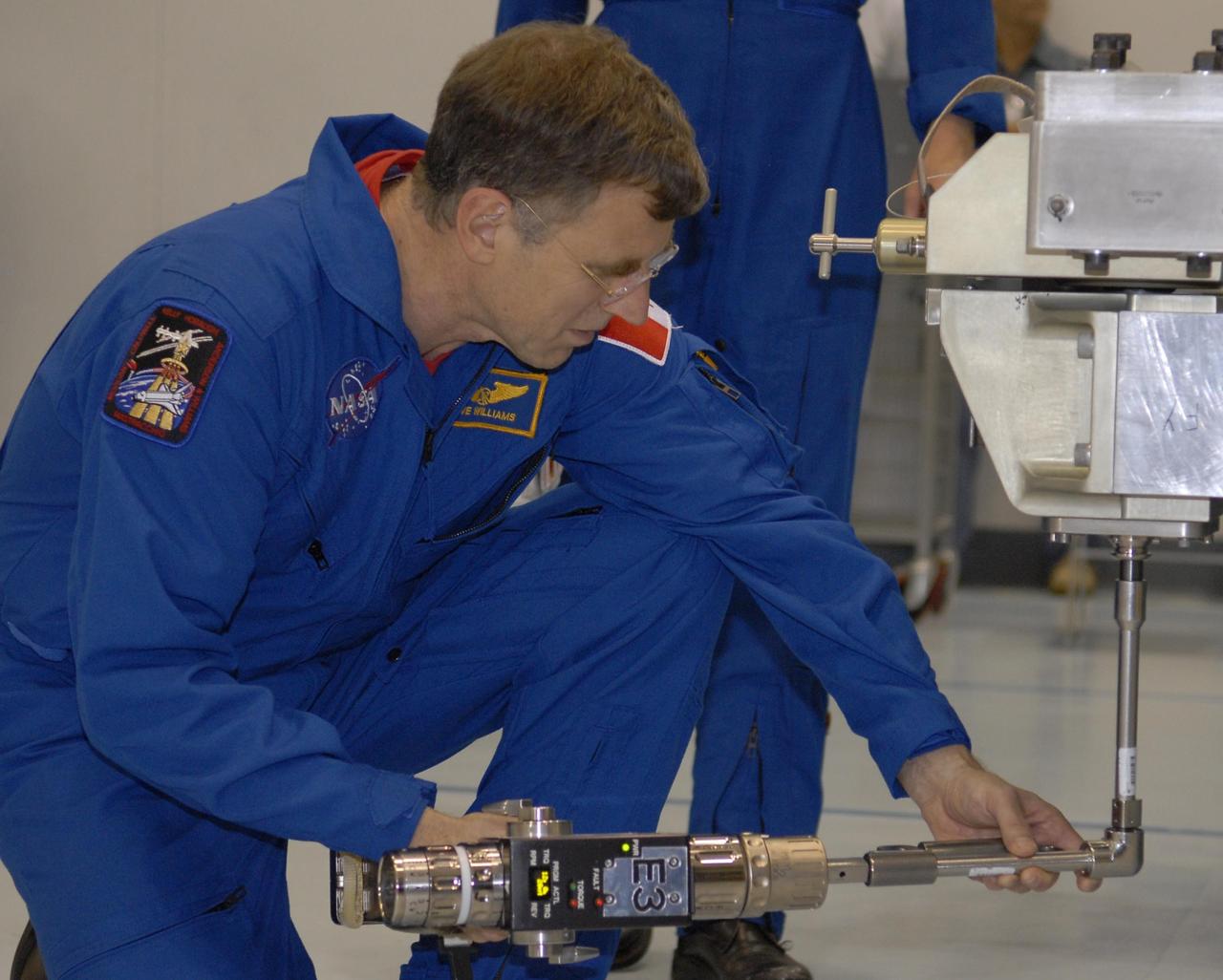
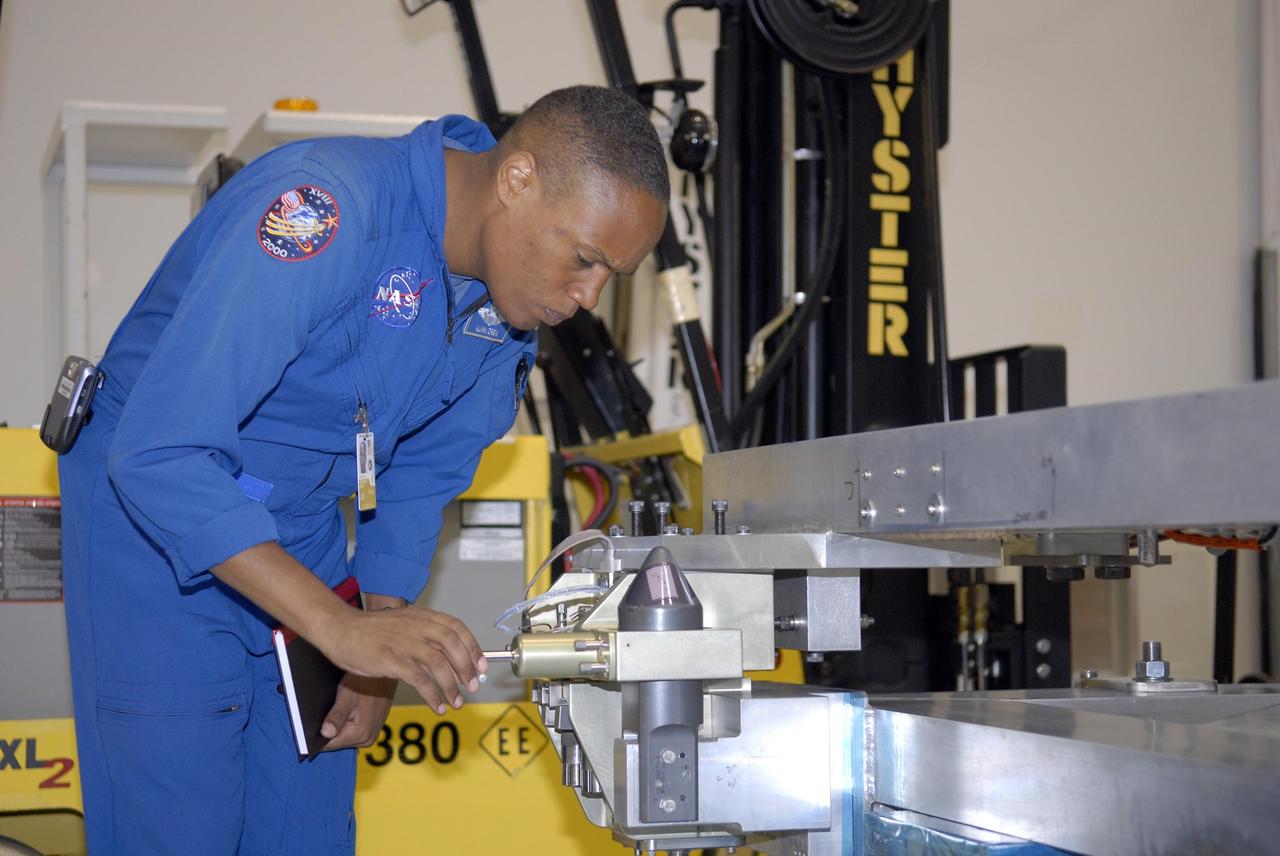
KENNEDY SPACE CENTER, FLA. --The STS-118 crew members look over parts of the mission payload, the S5 integrated truss, in the Space Station Processing Facility during crew equipment interface test activities. Seen here is Mission Specialist Dr. Dafydd Williams, getting hands-on experience. The crew comprises Commander Scott Kelly, Pilot Charles Hobaugh, and Mission Specialists Williams, Barbara Morgan, Richard Mastracchio, Tracy Caldwell and Benjamin Drew. Williams is with the Canadian Space Agency. The STS-118 mission will be delivering the third starboard truss segment, the ITS S5, to the International Space Station, and a SPACEHAB Single Cargo module with supplies and equipment. Launch aboard Space Shuttle Endeavour is targeted for August. Photo credit: NASA/Kim Shiflett
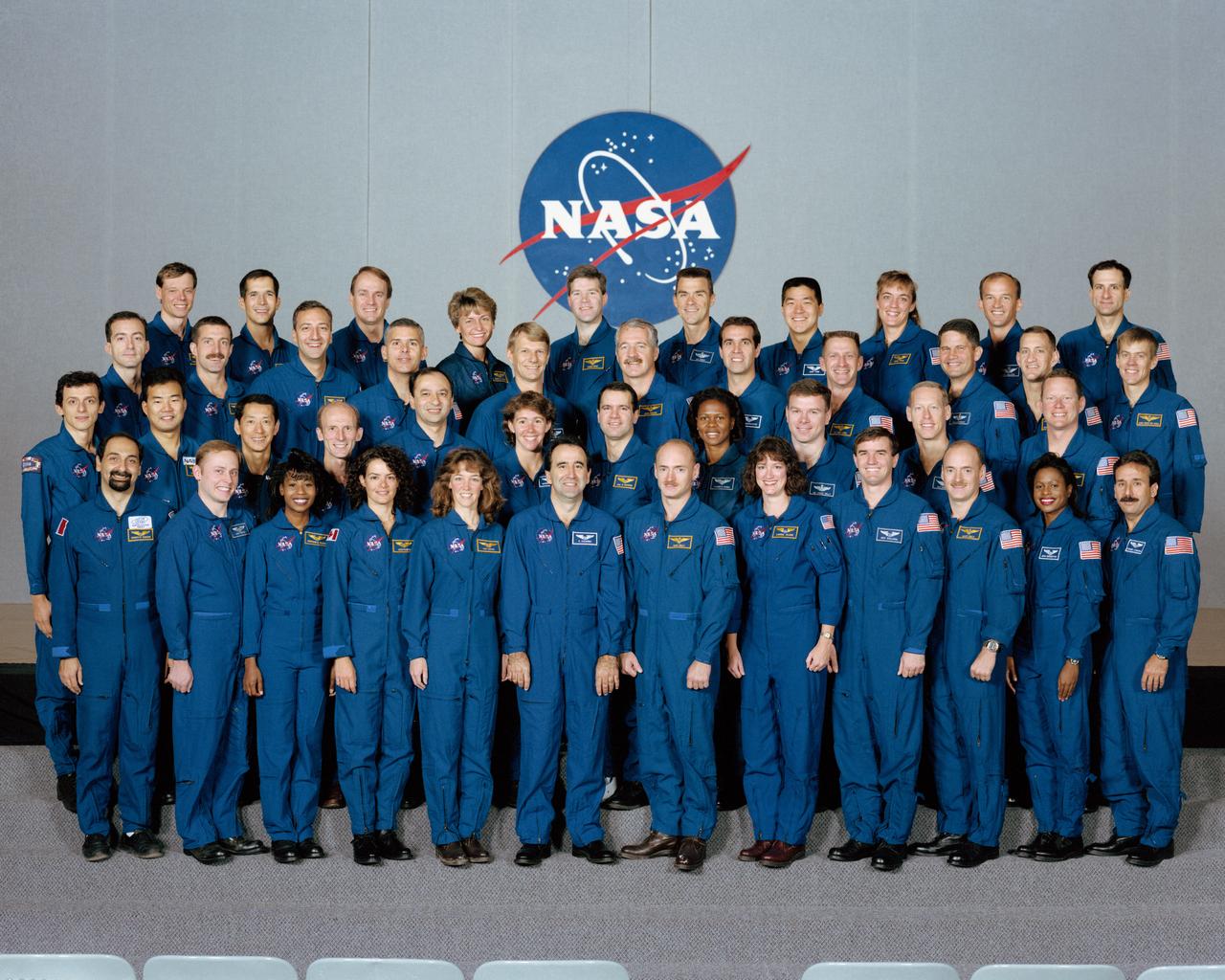
S96-18546 (5 Nov. 1996) --- Following their selection from among 2,400 applicants, the 44 astronaut candidates begin a lengthy period of training and evaluation at NASA's Johnson Space Center as they gather for their group portrait. This year?s class is the largest in the history of space shuttle astronauts and their early program predecessors. Ten pilots and 25 mission specialists make up the internationally diverse class. The international trainees represent the Canadian, Japanese, Italian, French, German and European space agencies. Back row ? from the left, Christer Fuglesang, John Herrington, Steve MacLean, Peggy Whitson, Stephen Frick, Duane Carey, Daniel Tani, Heidemarie Stefanyshyn-Piper, Jeffrey Williams and Donald Pettit. Second to back row ? from the left, Philippe Perrin, Daniel Burbank, Michael Massimino, Lee Morin, Piers Sellers, John Phillips, Richard Mastraccio, Christopher Loria, Paul Lockhart, Charles Hobaugh and William McCool. Second to front row ? from the left, Pedro Duque, Soichi Noguchi, Mamoru Mohri, Gerhard Thiele, Mark Polansky, Sandra Magnus, Paul Richards, Yvonne Cagle, James Kelly, Patrick Forrester and David Brown. Front row ? from the left, Umberto Guidoni, Edward Fincke, Stephanie Wilson, Julie Payette, Lisa Nowak, Fernando Caldeiro, Mark Kelly, Laurel Clark, Rex Walheim, Scott Kelly, Joan Higginbotham and Charles Camarda. Guidoni represents the Italian Space Agency (ASI). Fuglesang and Duque represent the European Space Agency (ESA). Mohri and Noguchi represent the Japanese Space Agency (NASDA). MacLean and Payette are with the Canadian Space Agency. Perrin is associated with the French Space Agency (CNES) and Thiele represents the German Space Agency (DARA). Photo credit: NASA or National Aeronautics and Space Administration
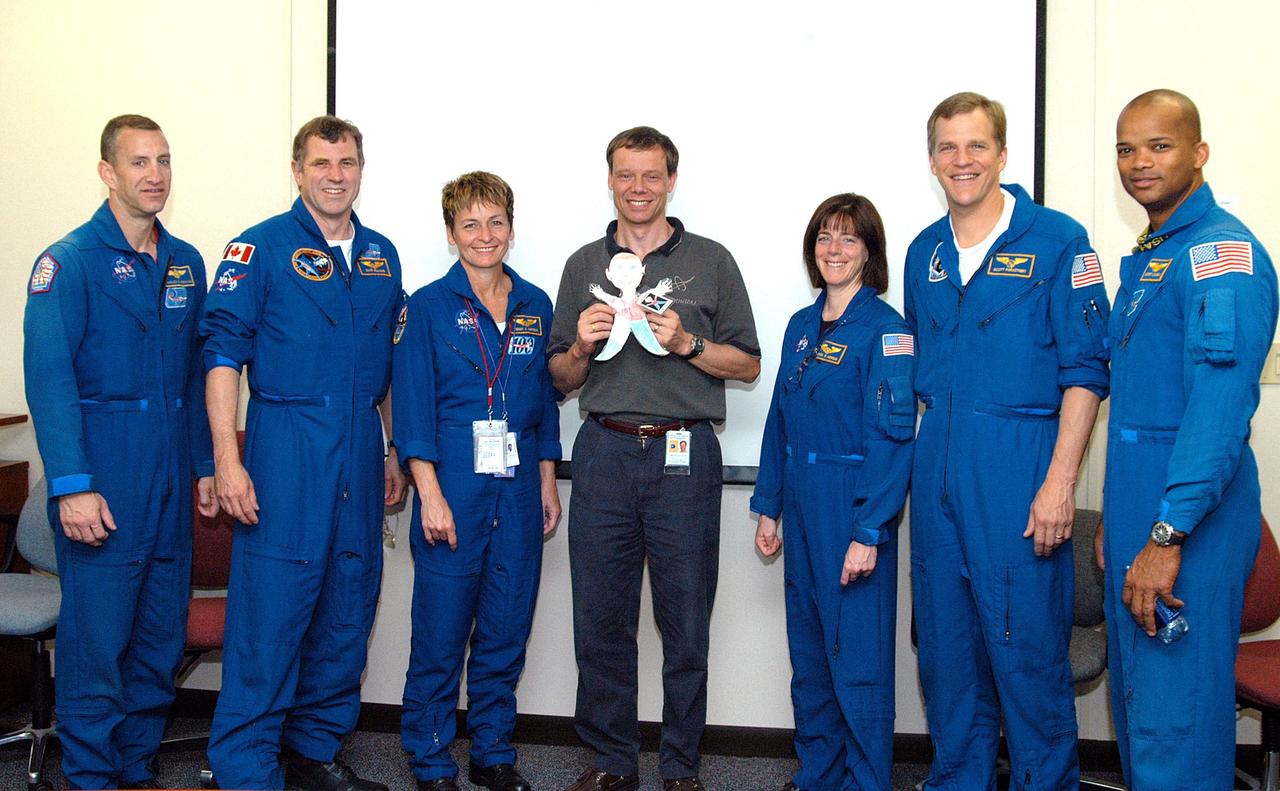
KENNEDY SPACE CENTER, FLA. - Members of the STS-116 and STS-118 crews pause during their visit to KSC for a photo. From left are STS-118 Pilot Charles Hobaugh and Mission Specialist Dafydd Williams (Canadian Space Agency); astronaut Peggy Whitson; STS-116 Mission Specialist Christer Fugelsang (European Space Agency), holding the paper figure of “Flat Stanley,” an education tool; STS-118 Mission Specialists Barbara Morgan and Scott Parazynski; and STS-116 Mission Specialist Robert Curbeam. The crews are taking part in equipment familiarization in the Space Station Processing Facility. The STS-116 mission will deliver the third port truss segment, the P5 Truss, to attach to the second port truss segment, the P3/P4 Truss. The STS-118 mission will be delivering and installing the third starboard truss segment, the ITS S5, to the International Space Station, and carry a SPACEHAB Single Cargo Module with supplies and equipment. Launch dates for both missions are under review.

KENNEDY SPACE CENTER, FLA. - Owen Garriott, chairman of the Astronaut Hall of Fame, speaks to guests at the Induction Ceremony of three new additions to the Hall of Fame: Gordon Fullerton, Bruce McCandless and Joe Allen. Seated on stage are current Hall of Famers, from left in the back row, Dick Gordon, Walt Cunningham, Bill Anders, Ed Mitchell, Al Worden, Charles Duke, Jack Lousma, Bill Pogue, Robert Crippen, Dan Brandenstein, Robert “Hoot” Gibson and Stephen Covey. In front, from left, are Master of Ceremonies LeVar Burton, who starred in the television series “Star Trek: The Next Generation,” and Hall of Famers Scott Carpenter and John Young, and at right, Jim Lovell and Fred Haise. The ceremony is being held in the Kennedy Space Center Visitor Complex’s Apollo_Saturn V Center. Recognized for their individual flight accomplishments and contributions to the success and future success of the U.S. space program, this elite group of inductees is among only 60 astronauts to be honored in the Hall of Fame and the fourth group of Space Shuttle astronauts named.