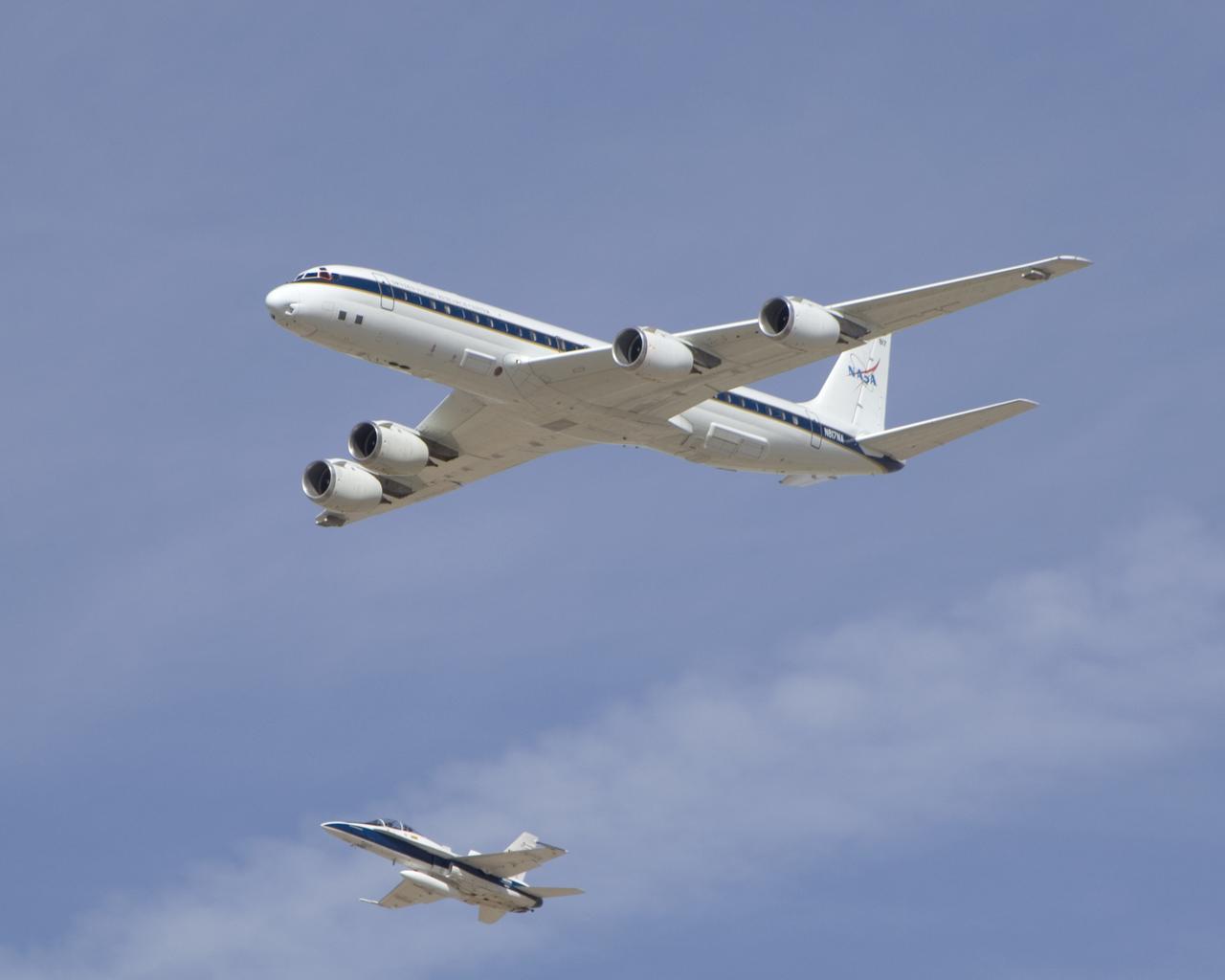
NASA's DC-8 airborne science laboratory is shadowed by a NASA F/A-18 chase plane during a flyover of the Dryden Aircraft Operations Facility in Palmdale, Calif.
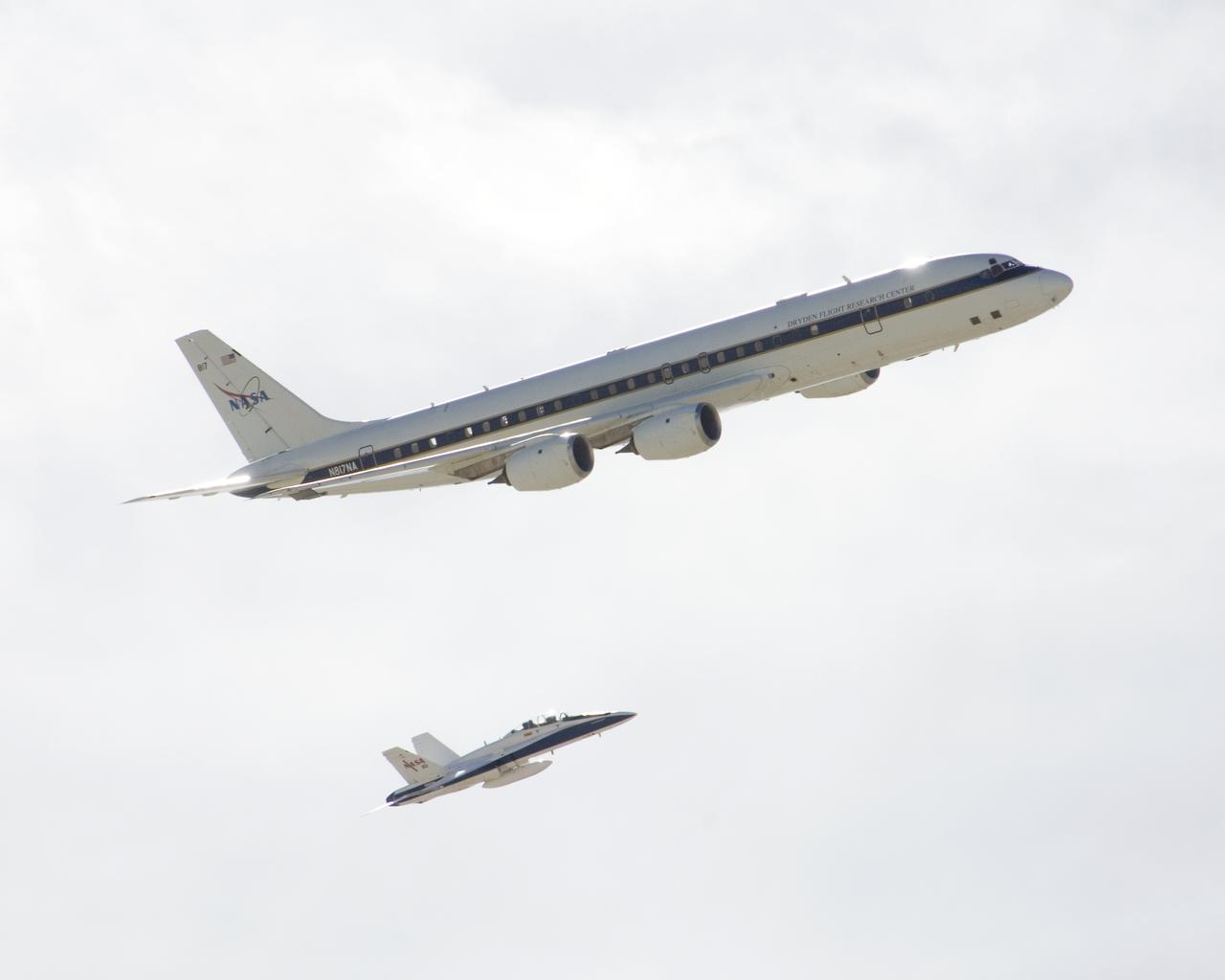
NASA's DC-8 airborne science laboratory is shadowed by a NASA F/A-18 chase plane during a flyover of the Dryden Aircraft Operations Facility in Palmdale, Calif.
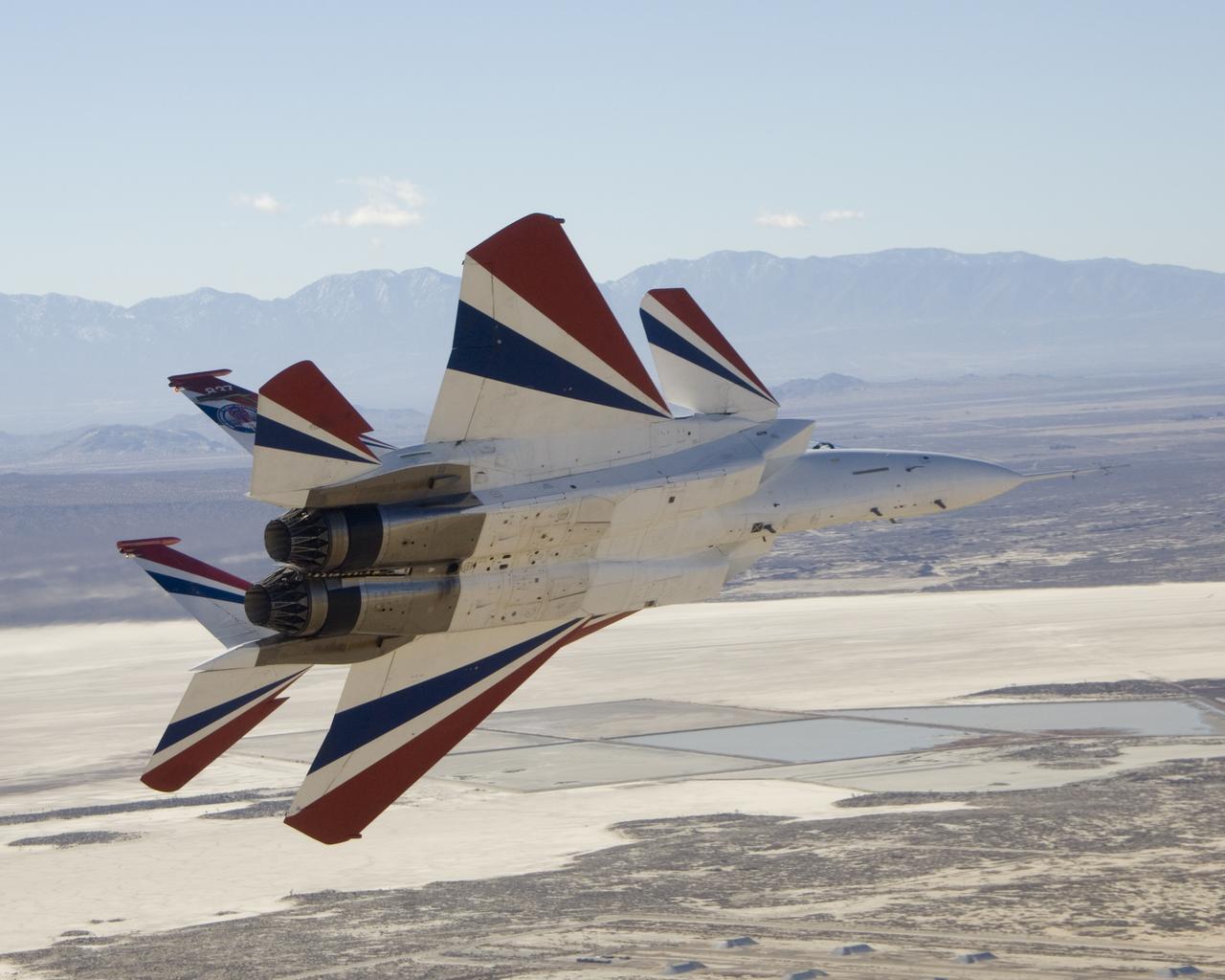
Two small Range Safety System antennas are located just behind the engine inlets of NASA's NF-15B research aircraft as it banks away from the chase plane.
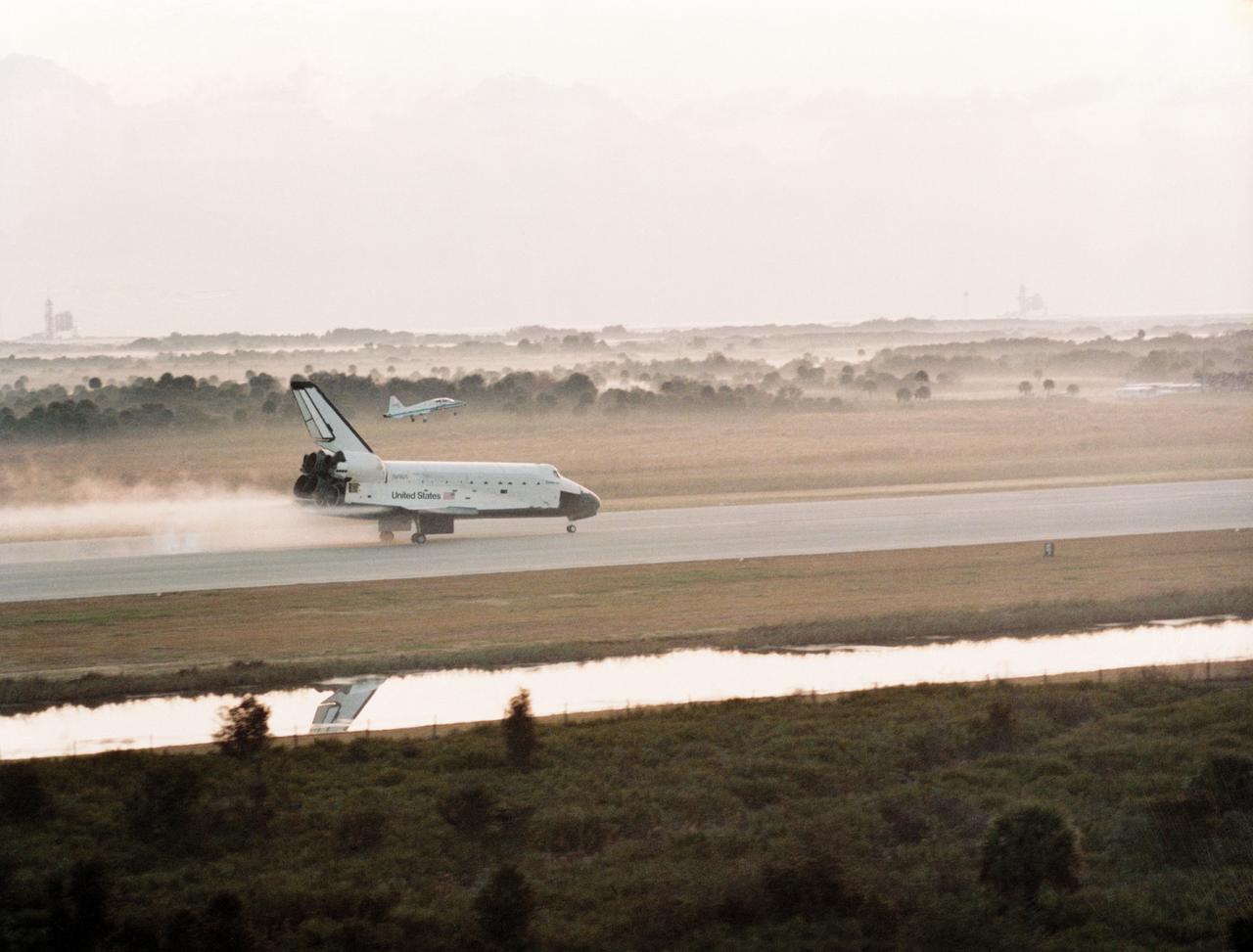
S84-27717 (11 Feb 1984) --- A chase plane gets a "front row" position to view the touchdown of the total landing gear of the Space Shuttle Challenger as the reusable spacecraft makes NASA's first landing on the runway at the Kennedy Space Center's (KSC) landing facility. This photograph was taken from another T-38 chase plane.
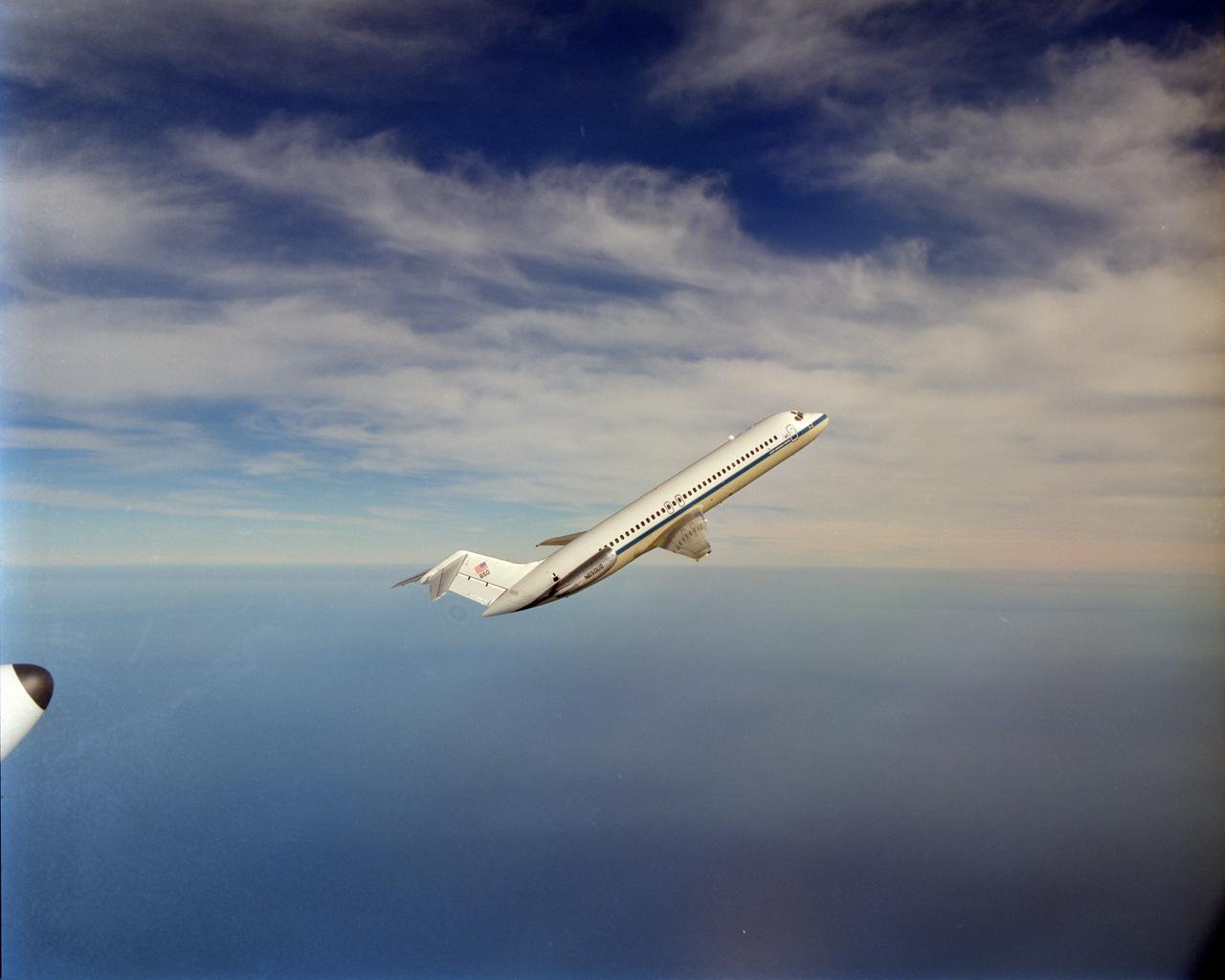
NASA aircraft DC-9 microgravity plane performs it's first test parabolas over Lake Erie. This was photographed by the NASA Glenn Lear Jet in a chase plane configuration.
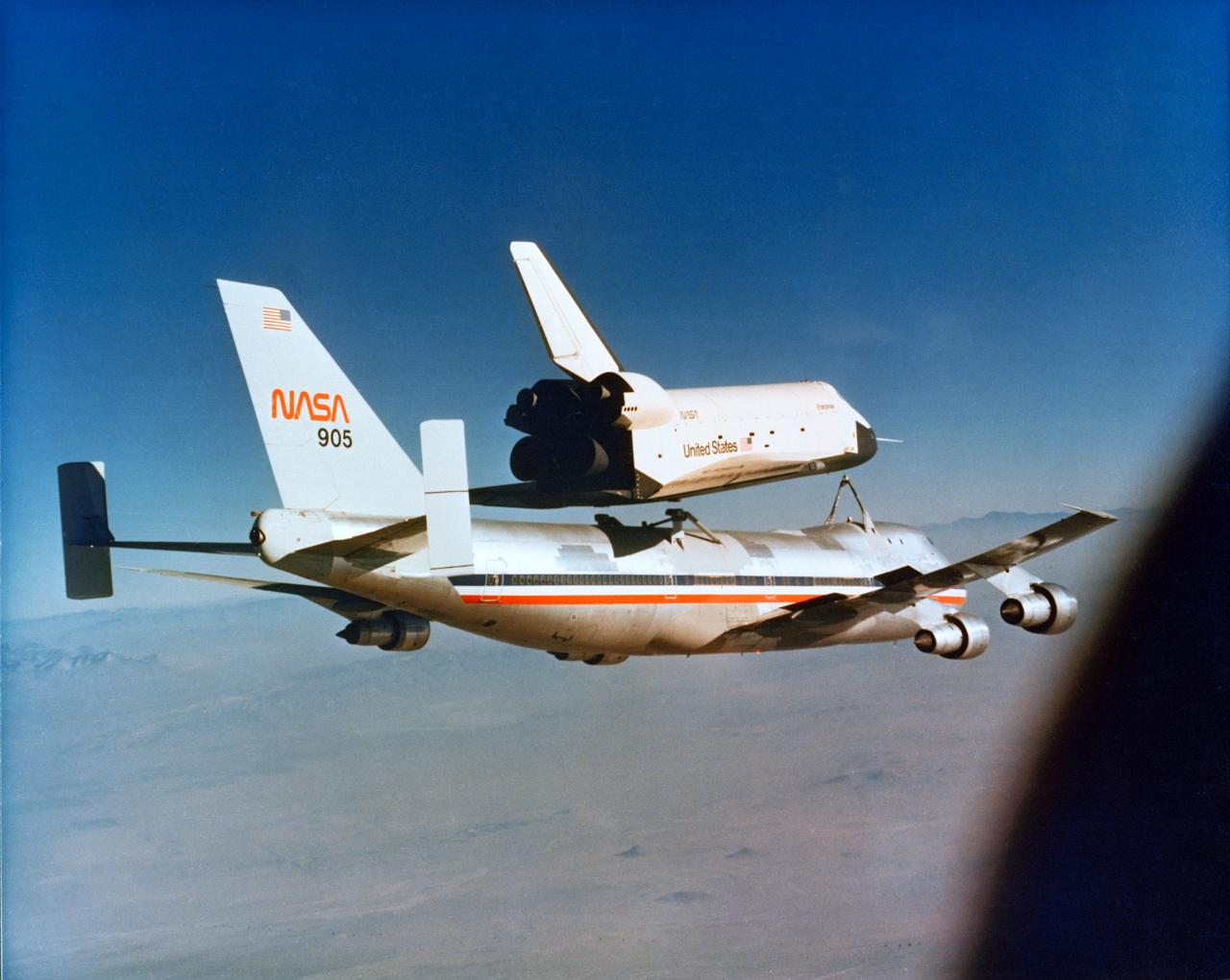
PAO news release material for the 5th and final FF of the ALT series. Precise moment of separation captured by camera from a T-38 chase plane.

The back seat instrument panel on the NASA T-34C chase plane. In its role as a military trainer, the instructor pilot would ride in the back seat, while the student would be in the front seat. As a chase plane, the back seat would be occupied by a photographer. The aircraft was previously used at the Lewis Research Center in propulsion experiments involving turboprop engines, and was used as a chase aircraft at Dryden for smaller and slower research projects. Chase aircraft accompany research flights for photography and video purposes, and also as support for safety and research. At Dryden, the T-34 is used mainly for smaller remotely piloted vehicles which fly slower than NASA's F-18's, used for larger scale projects. This aircraft was returned to the U.S. Navy in May of 2002. The T-34C, built by Beech, carries a crew of 2 and is nicknamed the Mentor.
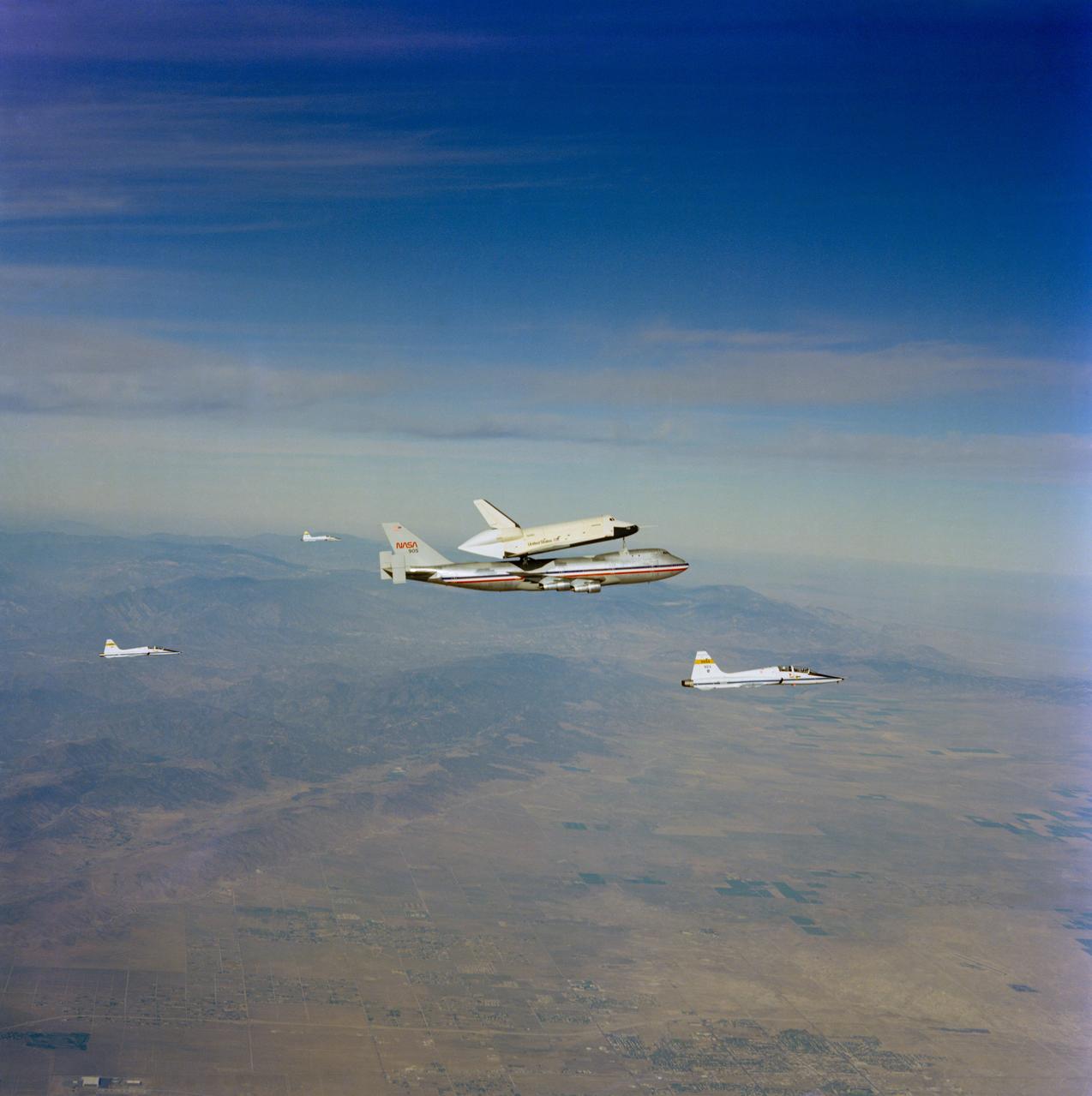
S77-28649 (23 Sept 1977) --- The shuttle Orbiter 101 "Enterprise" sits atop the NASA 747 carrier aircraft in a piggy-back configuration prior to separation for the third free flight of the Shuttle Approach and Landing Tests (ALT) conducted on September 23, 1977, at the Dryden Flight Research Center (DFRC) in Southern California. The crew of the "enterprise" consisted of astronauts Fred W. Haise Jr., commander, and C. Gordon Fullerton, pilot. This photo was shot from one of the T-38 chase planes accompanying the ALT craft. Three other T-38 chase planes are pictured.
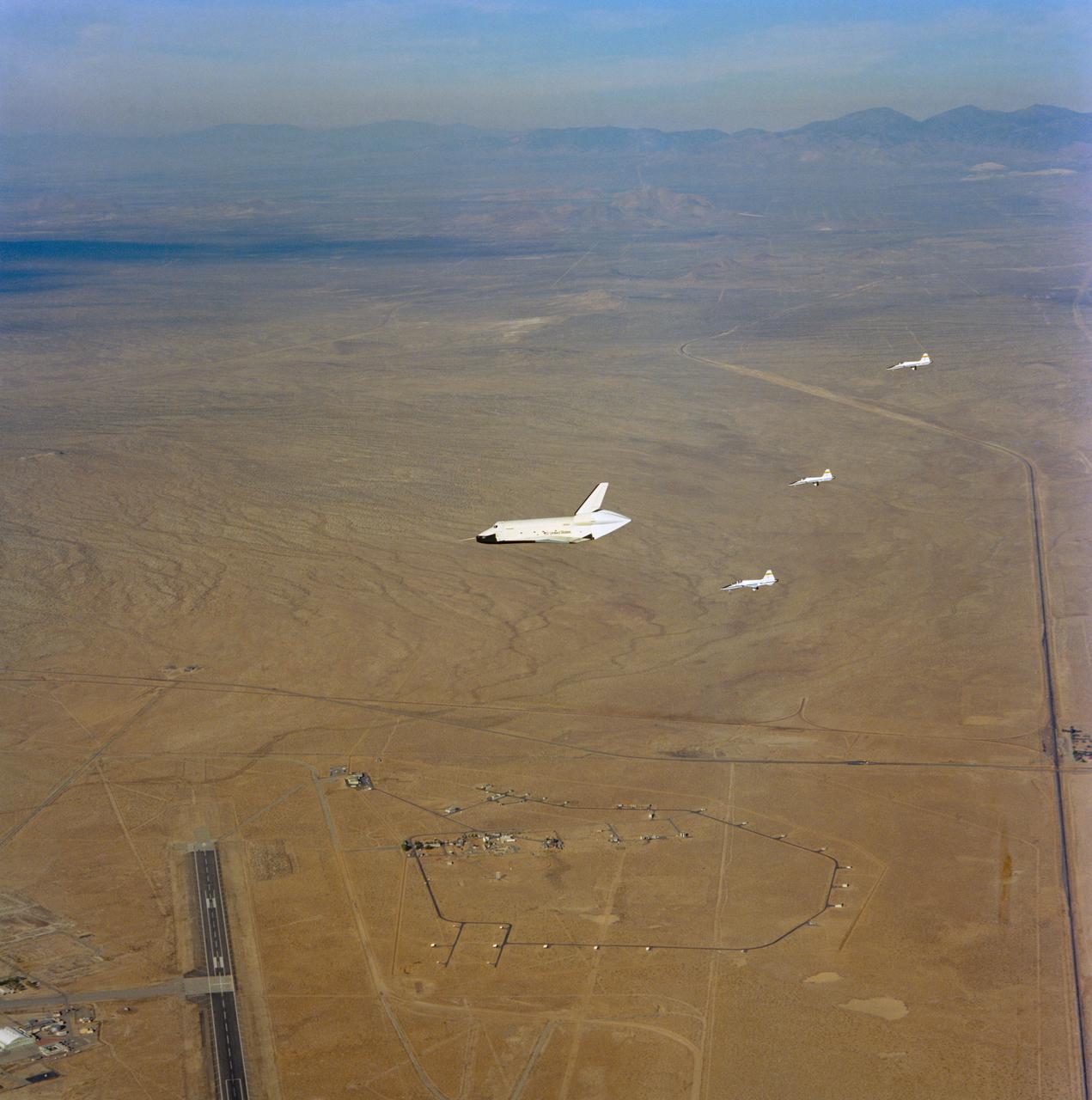
S77-28667 (23 Sept 1977) --- The shuttle Orbiter 101 "Enterprise" soars above the North Base area of Edwards Air Force Base during its five-minute, 34-second unpowered flight, the third of a series of manned Shuttle Approach and Landing Tests (ALT). Moments earlier the "Enterprise" had separated from its 747 carrier aircraft, atop which it sat upon takeoff from the Dryden Flight Research Center (DFRC), with its crew of astronauts Fred W. Haise Jr., commander, and C. Gordon Fullerton, pilot. Three T-38 chase planes follow. This photograph was taken from a fourth T-38 chase plane.
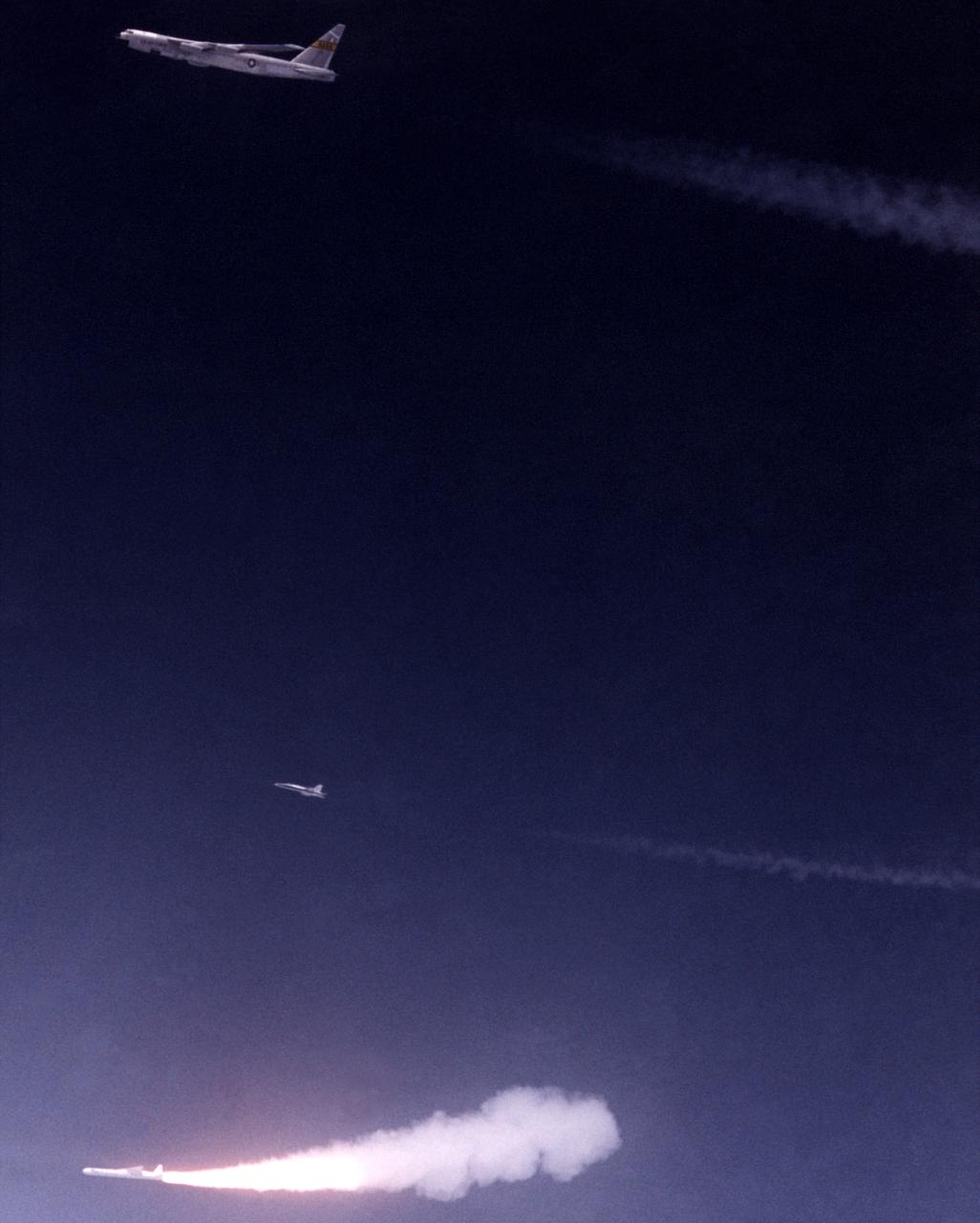
Against the midnight blue of a high-altitude sky, Orbital Sciences’ Pegasus winged rocket booster ignites after being dropped from NASA’s B-52 mothership on a July 1991 flight. A NASA chase plane for the flight is also visible above the rocket and below the B-52.
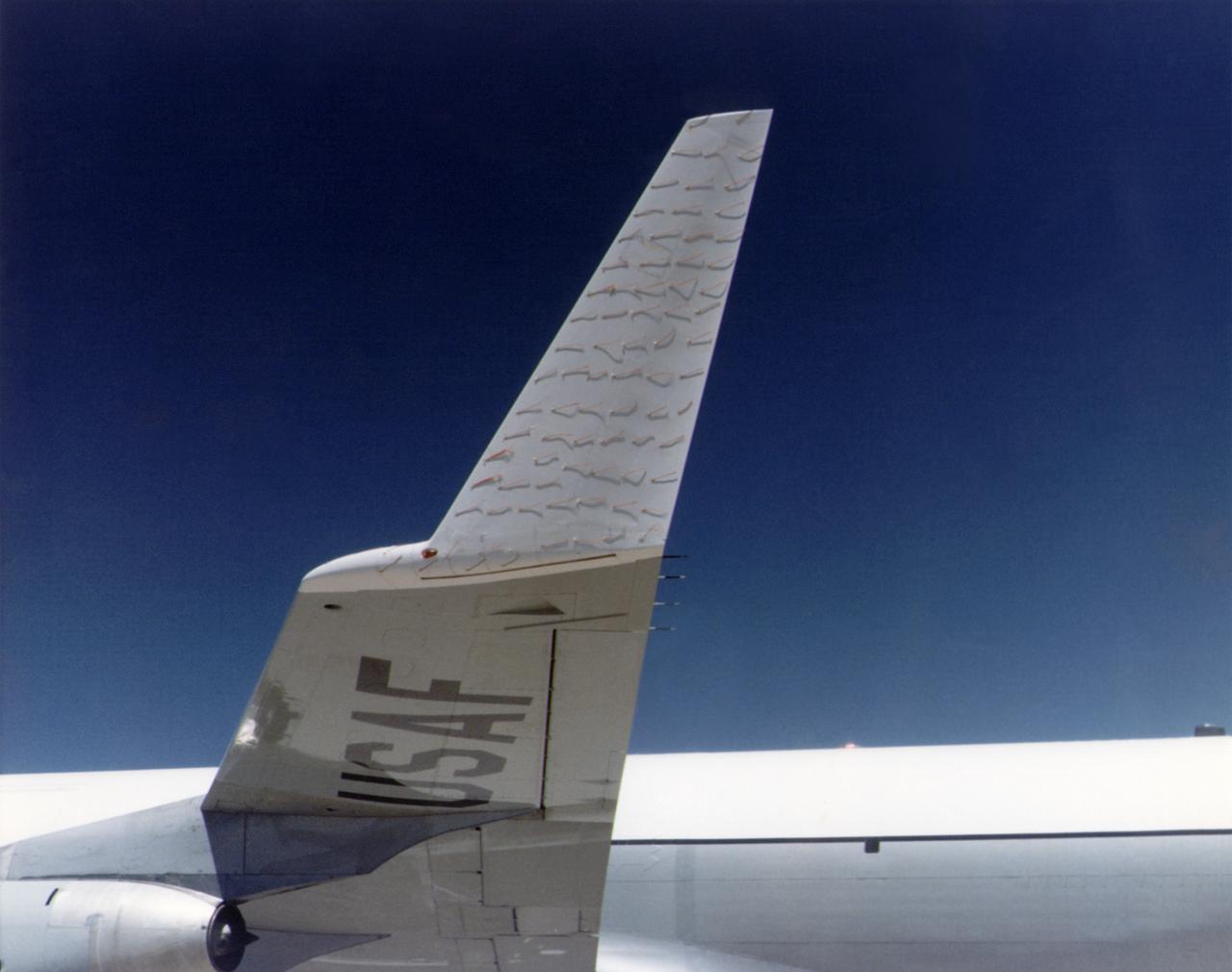
A chase plane view of the tufts on the KC-135 winglet. The use of tufts in flight research dates back to the early days of the NACA, and remains an effective means of observing airflow even today. In this procedure, rows of strings are attached to an airplane's surface, with one end of each string taped to the airplane and the other end free to swing about in the airflow. The movements of the tufts are photographed by on-board cameras or a chase plane. If the tufts are arrayed in neat rows, as seen here, then the airflow is smooth over the airplane's surface. If, however, they are moving about violently, it suggests turbulent airflow. Such motions may indicate high drag, flow separation (such as in a stall), or buffeting. In some cases, tufts will actually point forward, indicating the airflow has reversed direction.
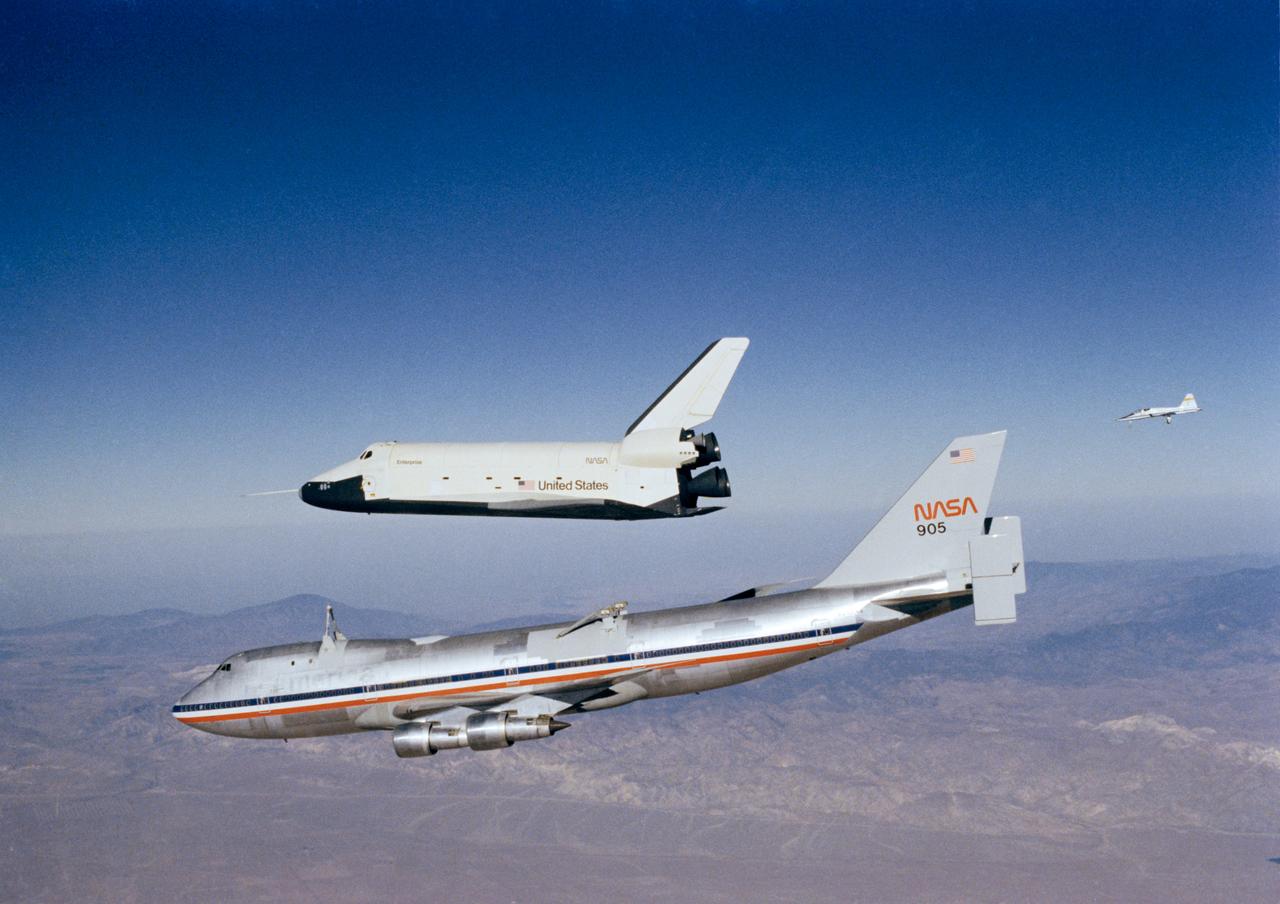
S77-28931 (12 Oct. 1977) --- The Orbiter 101 "Enterprise" separates from the NASA 747 carrier aircraft to begin its first "tailcone-off" unpowered flight over desert and mountains of Southern California. A T-38 chase plane follows in right background. This was the fourth in a series of five piloted free flights. Photo credit: NASA
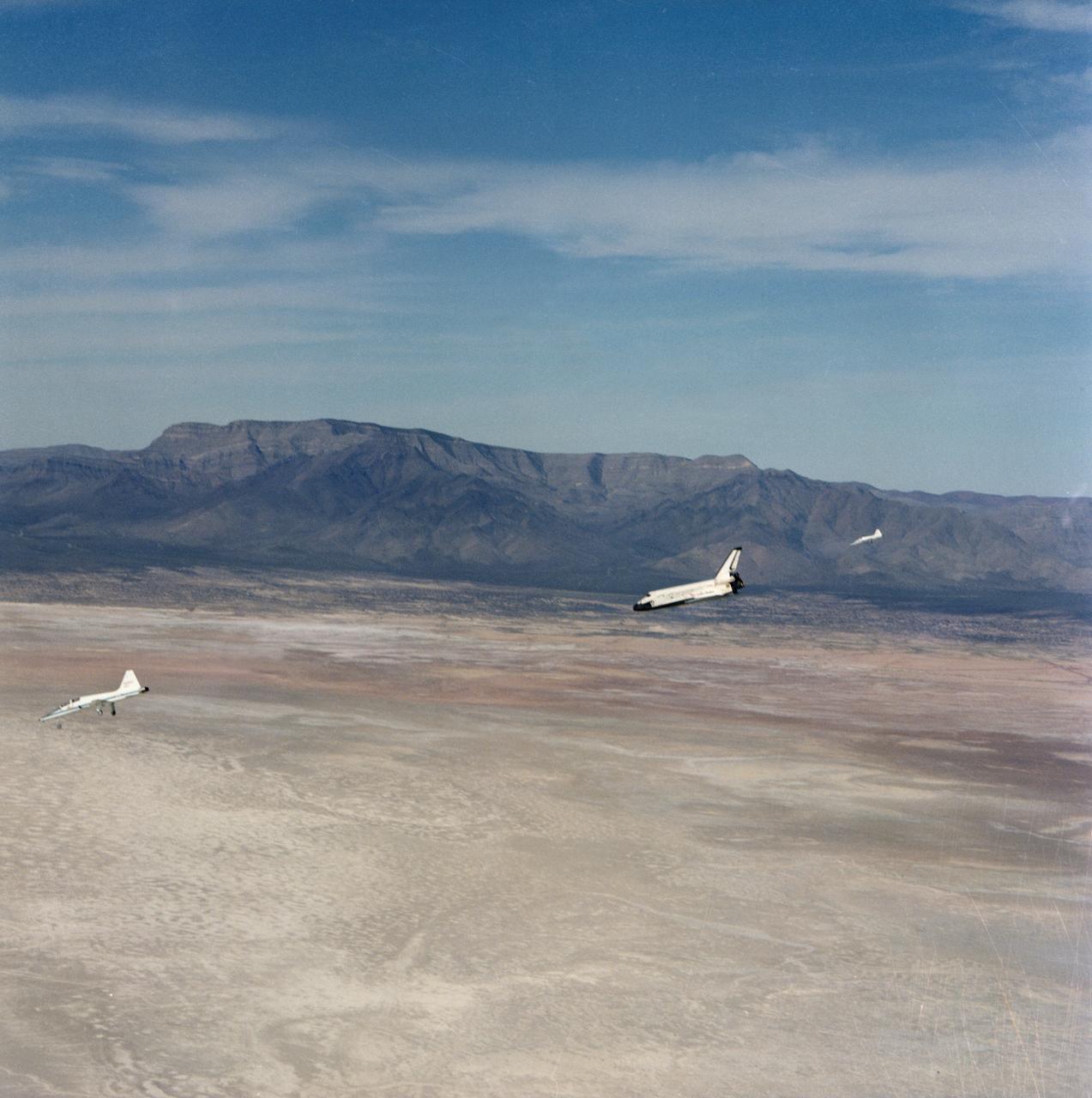
S82-28840 (30 March 1982) --- T-38 chase planes remain relatively close to the NASA reusable space shuttle Columbia (STS-3) as it heads for a completion of an eight-day mission on the White Sands Missile Range's Northrup strip. Astronauts Jack R. Lousma and C. Gordon Fullerton were aboard the craft. This view was photographed from another T-38. Photo credit: NASA
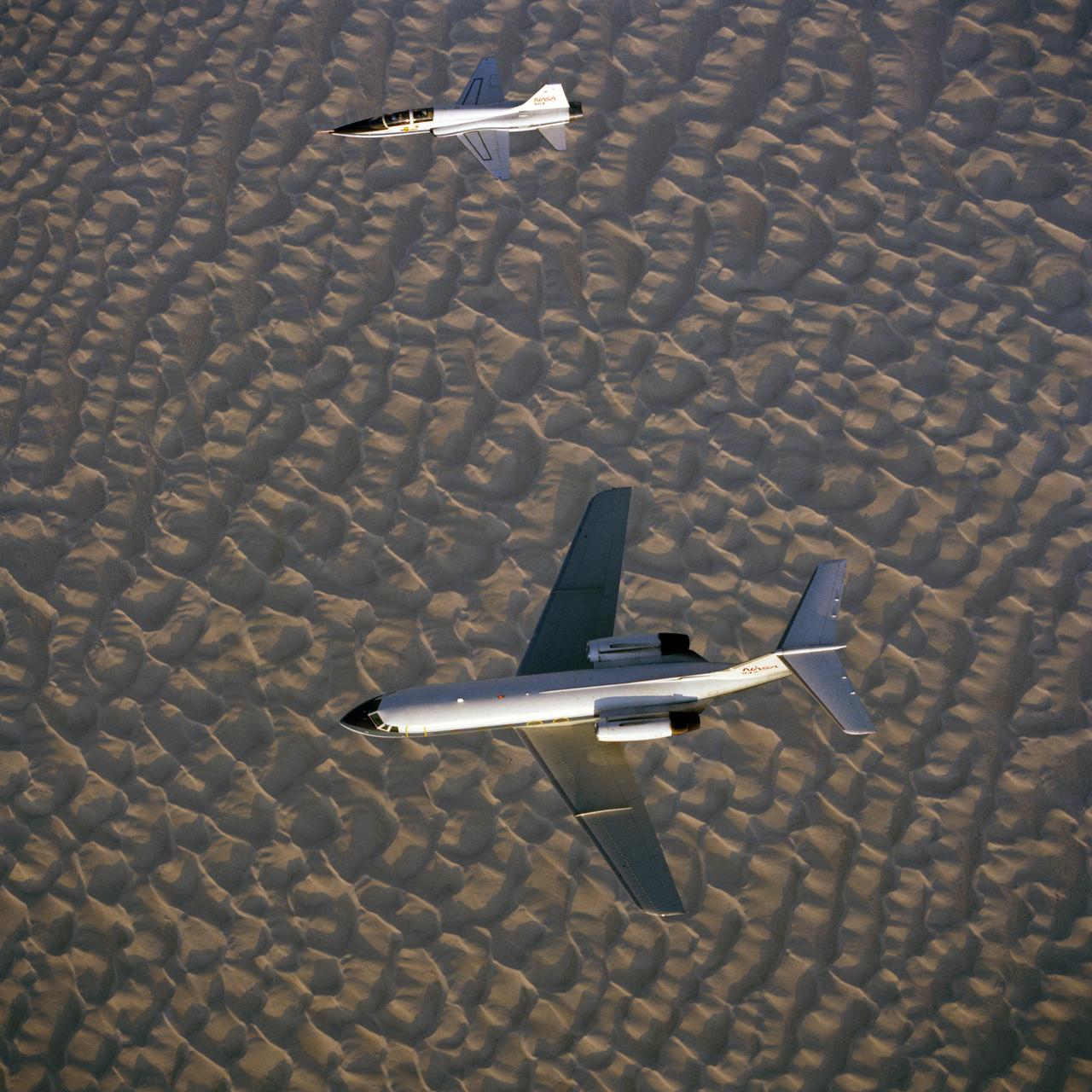
S82-32204 (October 1982) --- NASA 947 and NASA 904, two aircraft stationed at Ellington Air Base for the Johnson Space Center (JSC), are captured during a training and familiarization flight over White Sands, New Mexico. The Gulfstream aircraft (bottom) is NASA?s Space Shuttle Training Aircraft (STA) and the T-38 jet serves as a chase plane. Photo credit: NASA
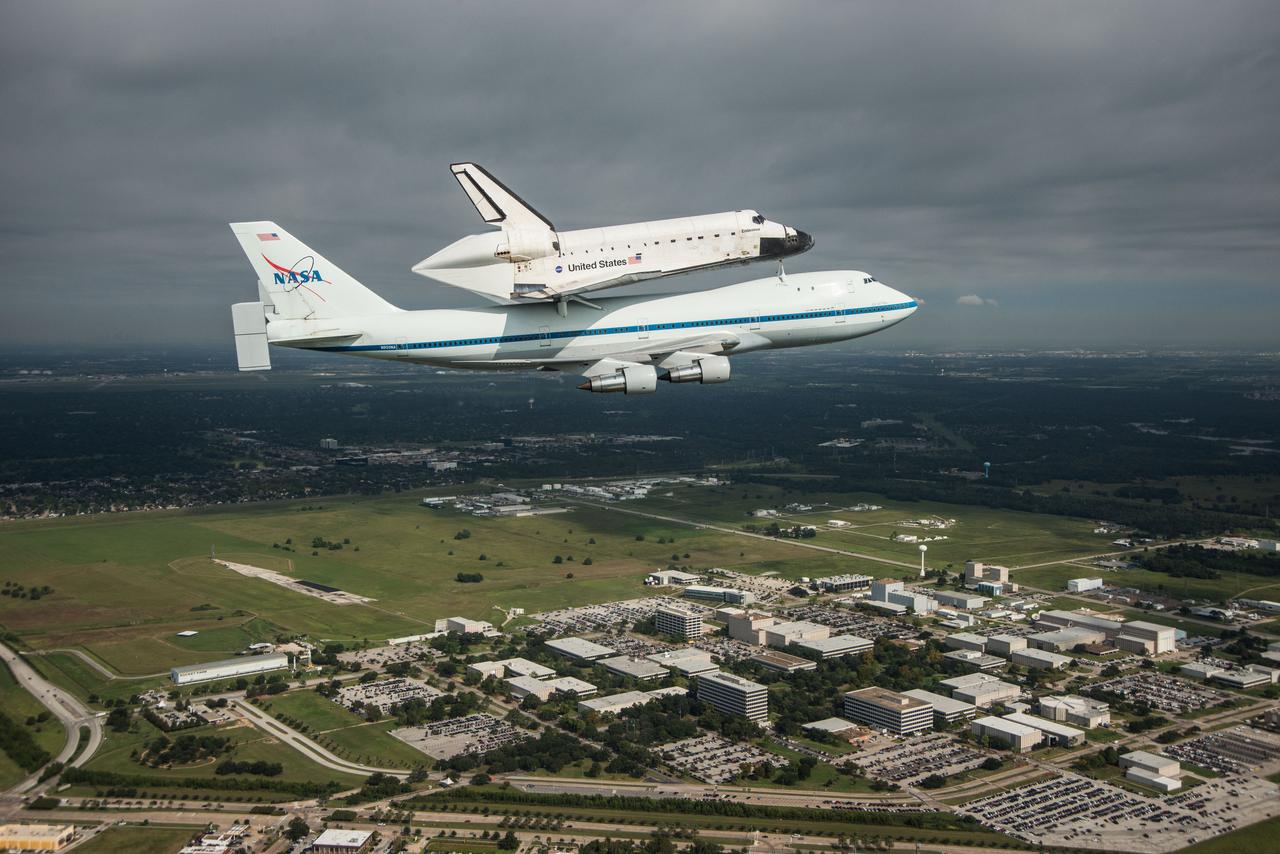
Space Shuttle Endeavour is ferried by NASA's Shuttle Carrier Aircraft (SCA) over the Johnson Space Center in Houston, Texas on September 19, 2012. NASA pilots Jeff Moultrie and Bill Rieke are at the controls of the Shuttle Carrier Aircraft. Photo taken by NASA photographer Sheri Locke in the backseat of a NASA T-38 chase plane with NASA pilot Thomas E. Parent at the controls. Photo Credit: NASA/ Sheri Locke
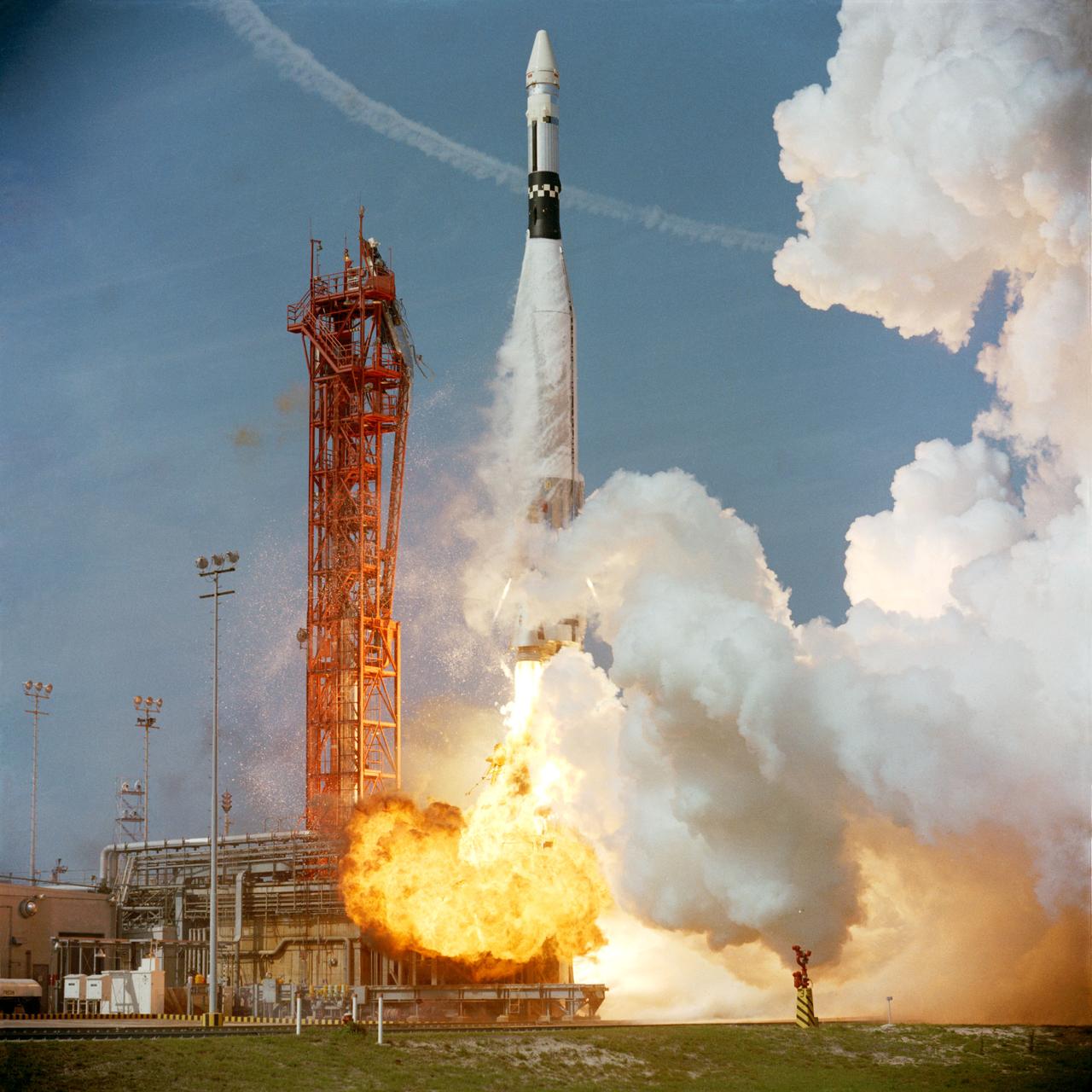
S66-24482 (16 March 1966) --- An Agena Target Docking Vehicle atop an Atlas rocket lifts off from Launch Complex 14 at Cape Kennedy at 10 a.m., March 16, 1966 just prior to the Gemini-8 liftoff at nearby Launch Complex 19. The Agena served as a rendezvous and docking vehicle for the Gemini-8 spacecraft. A chase plane leaves a contrail in the background. Photo credit: NASA
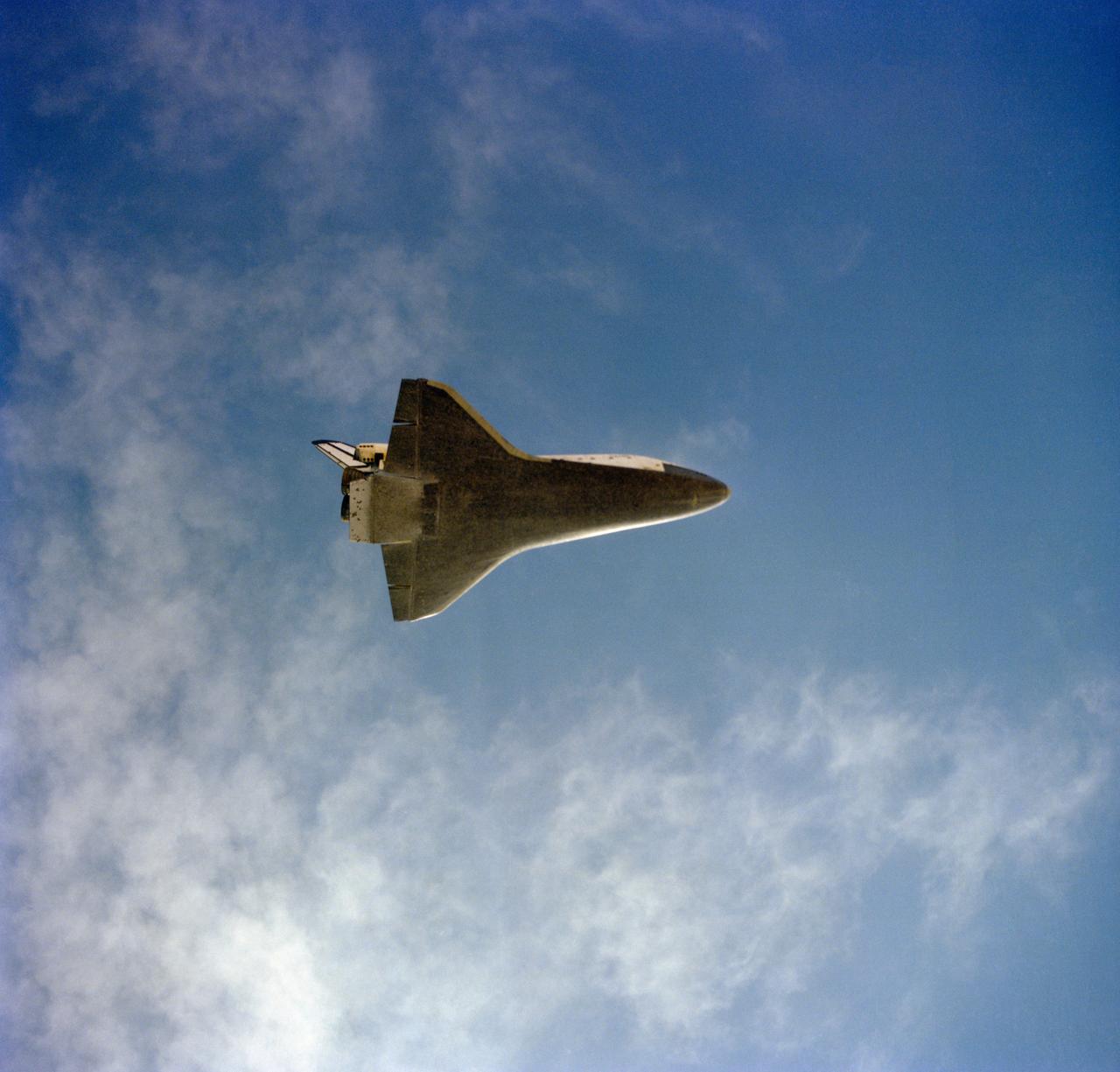
S82-28835 (30 March 1982) --- This unique view of the underside of the space shuttle orbiter Columbia was taken with a handheld camera aboard a T-38 chase plane over the White Sands Missile Range in New Mexico. Bad weather here yesterday vanished and the STS-3 crew of astronaut Jack R. Lousma and C. Gordon Fullerton greeted a pleasant climate along with a large crowd of spectators upon their landing. The successful landing was the first attempted in the actual orbiter on New Mexico soil. Photo credit: NASA
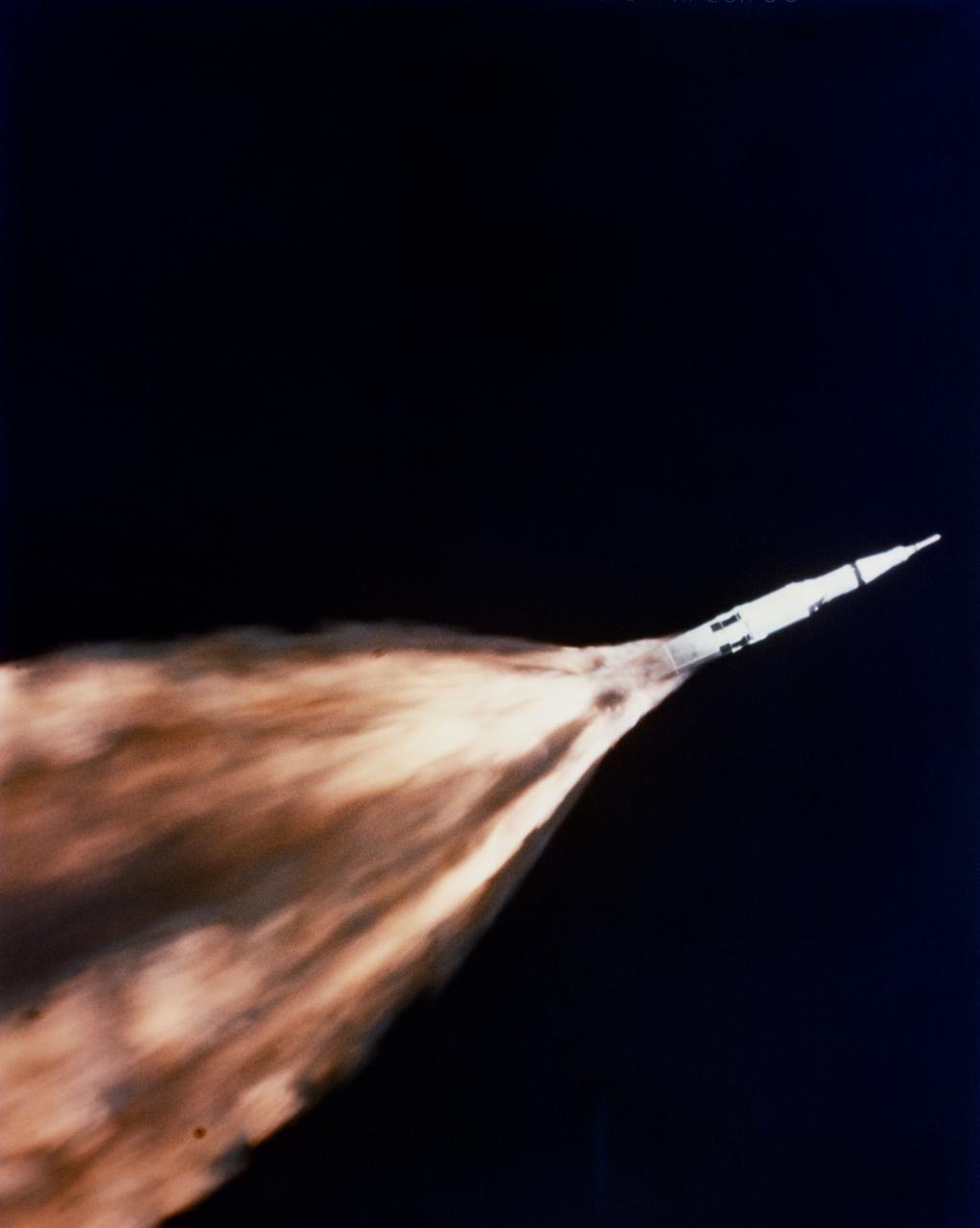
S68-27365 (4 April 1968) --- The five F-1 engines of the huge Apollo/Saturn V space vehicle's first (S-IC) stage leave a gigantic trail of flame in the sky above the Kennedy Space Center seconds after liftoff. The launch of the Apollo 6 (Spacecraft 020/Saturn 502) unmanned space mission occurred at 07:00:01.5 (EST), April 4, 1968. This view of the Apollo 6 launch was taken from a chase plane.
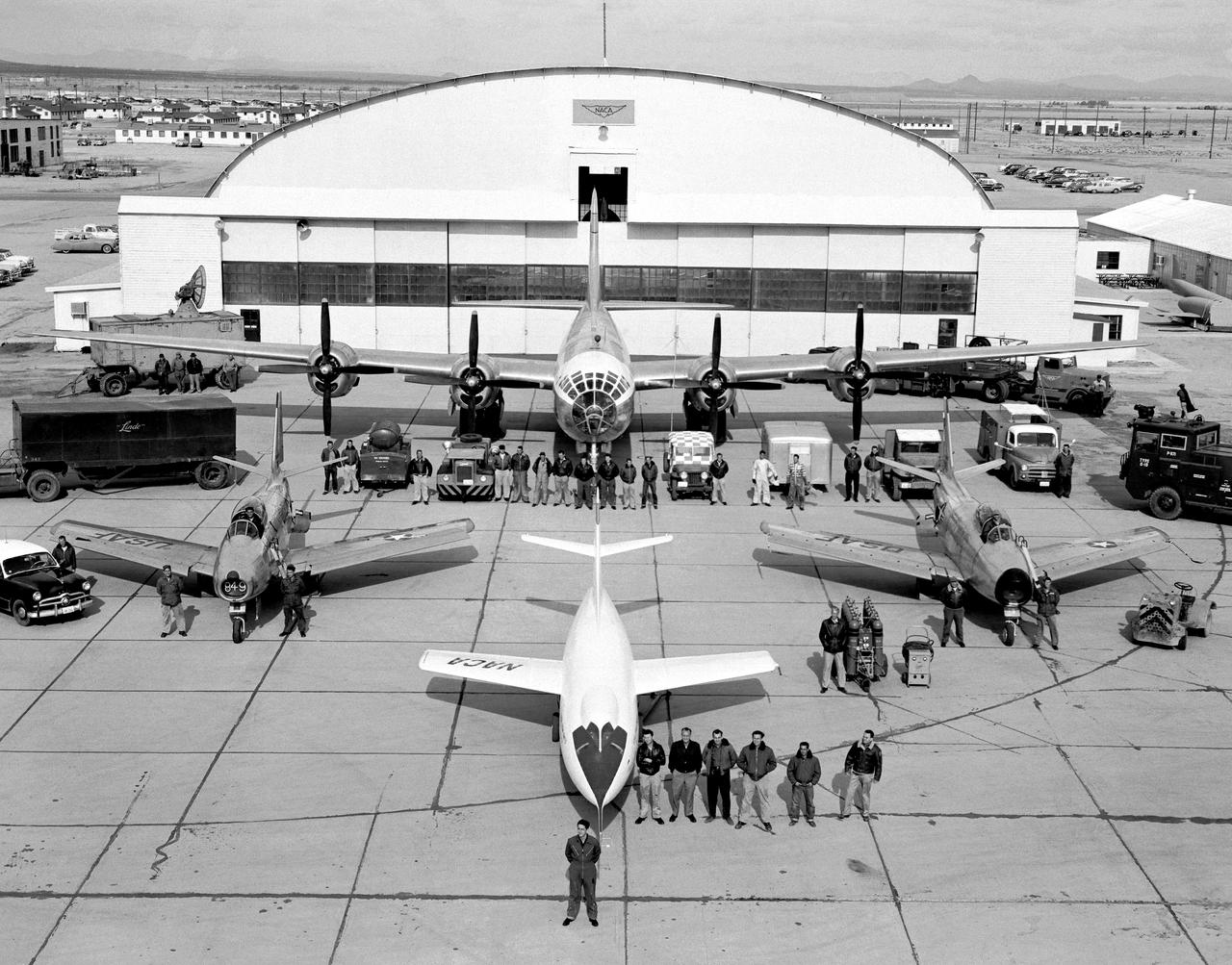
These people and this equipment supported the flight of the NACA D-558-2 Skyrocket at the High-Speed Flight Station at South Base, Edwards AFB. Note the two Sabre chase planes, the P2B-1S launch aircraft, and the profusion of ground support equipment, including communications, tracking, maintenance, and rescue vehicles. Research pilot A. Scott Crossfield stands in front of the Skyrocket.
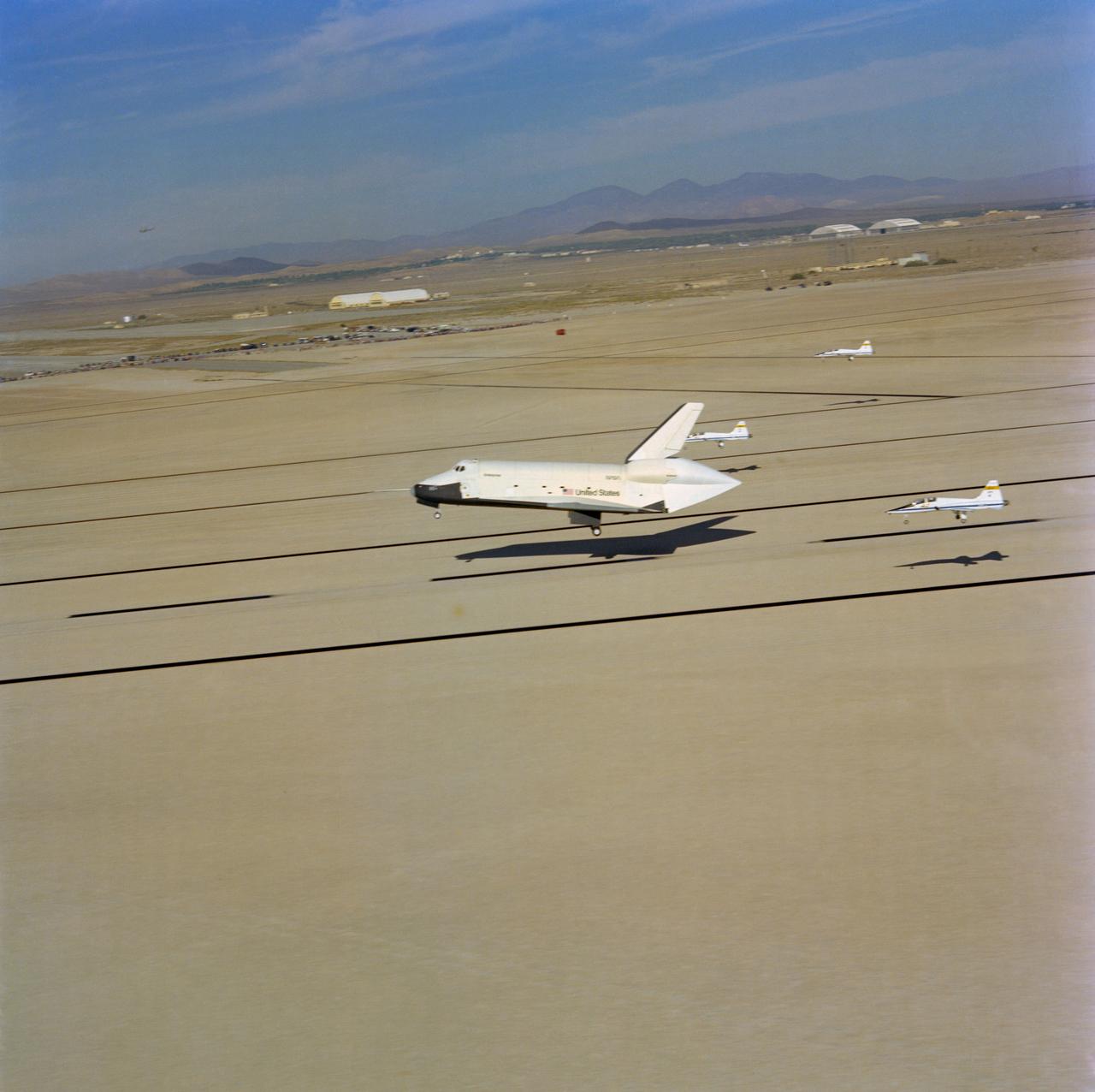
S77-28540 (23 Sept 1977) --- The shuttle Orbiter 101 "Enterprise" approaches touchdown on the runway at Edwards Air Force Base to conclude a five-minute, 34-second unpowered flight, the third of Shuttle Approach and Landing Tests (ALT) series, on September 23, 1977. Thress T-38 chase planes follow close by. Astronauts Fred W. Haise Jr., commander, and C. Gordon Fullerton, pilot, were the crew aboard the "Enterprise" for this flight.
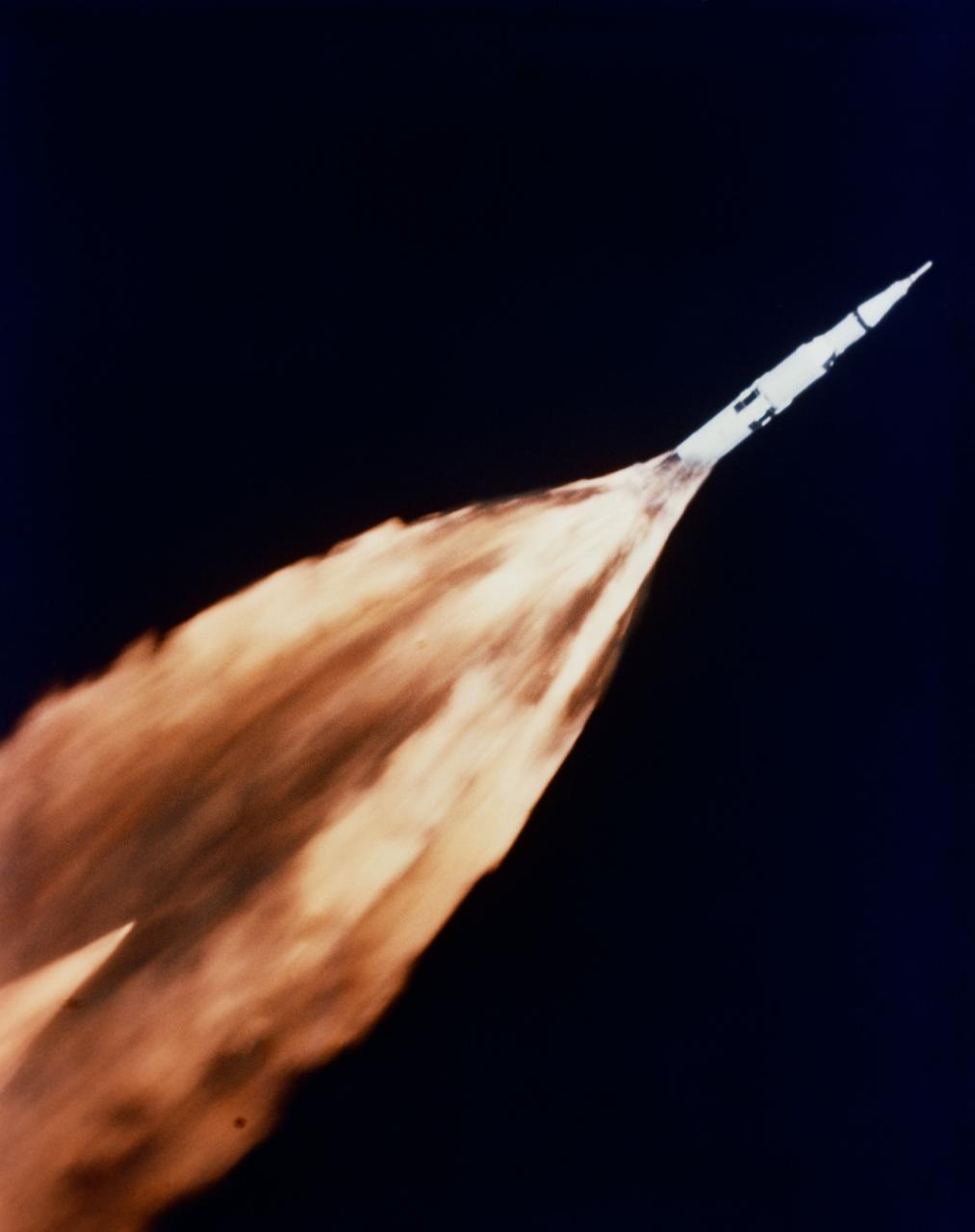
S68-27366 (4 April 1968) --- The five F-1 engines of the huge Apollo/Saturn V space vehicle's first (S-IC) stage leave a gigantic trail of flame in the sky above the Kennedy Space Center seconds after liftoff. The launch of the Apollo 6 (Spacecraft 020/Saturn 502) unmanned space mission occurred at 07:00:01.5 (EST), April 4, 1968. This view of the Apollo 6 launch was taken from a chase plane.
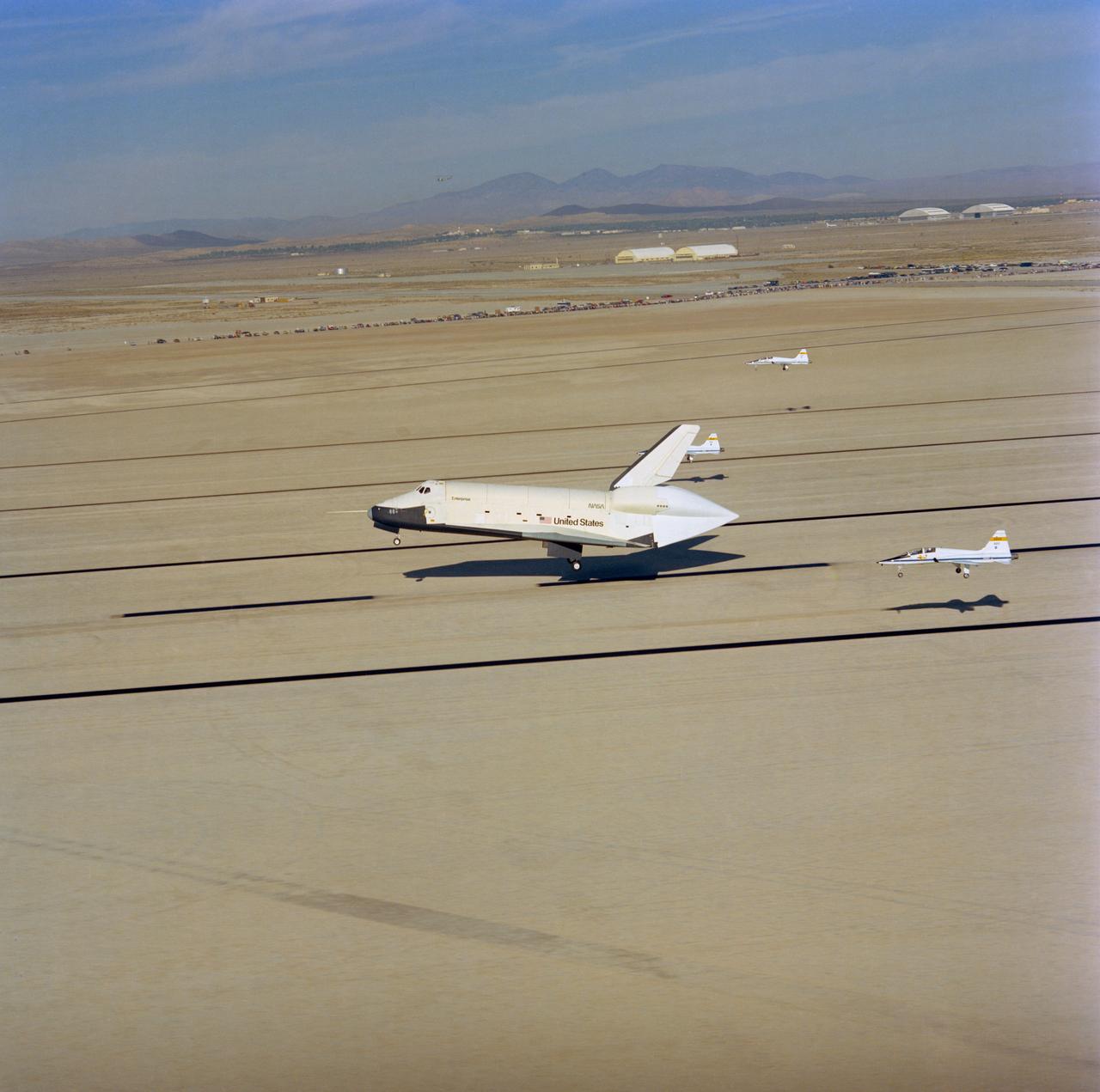
S77-28668 (23 Sept 1977) --- The shuttle Orbiter 101 "Enterprise" approaches touchdown on the runway at Edwards Air Force Base to conclude a five-minute, 34-second unpowered flight, the third of Shuttle Approach and Landing Tests (ALT) series, on September 23, 1977. Thress T-38 chase planes follow close by. Astronauts Fred W. Haise Jr., commander, and C. Gordon Fullerton, pilot, were the crew aboard the "Enterprise" for this flight.
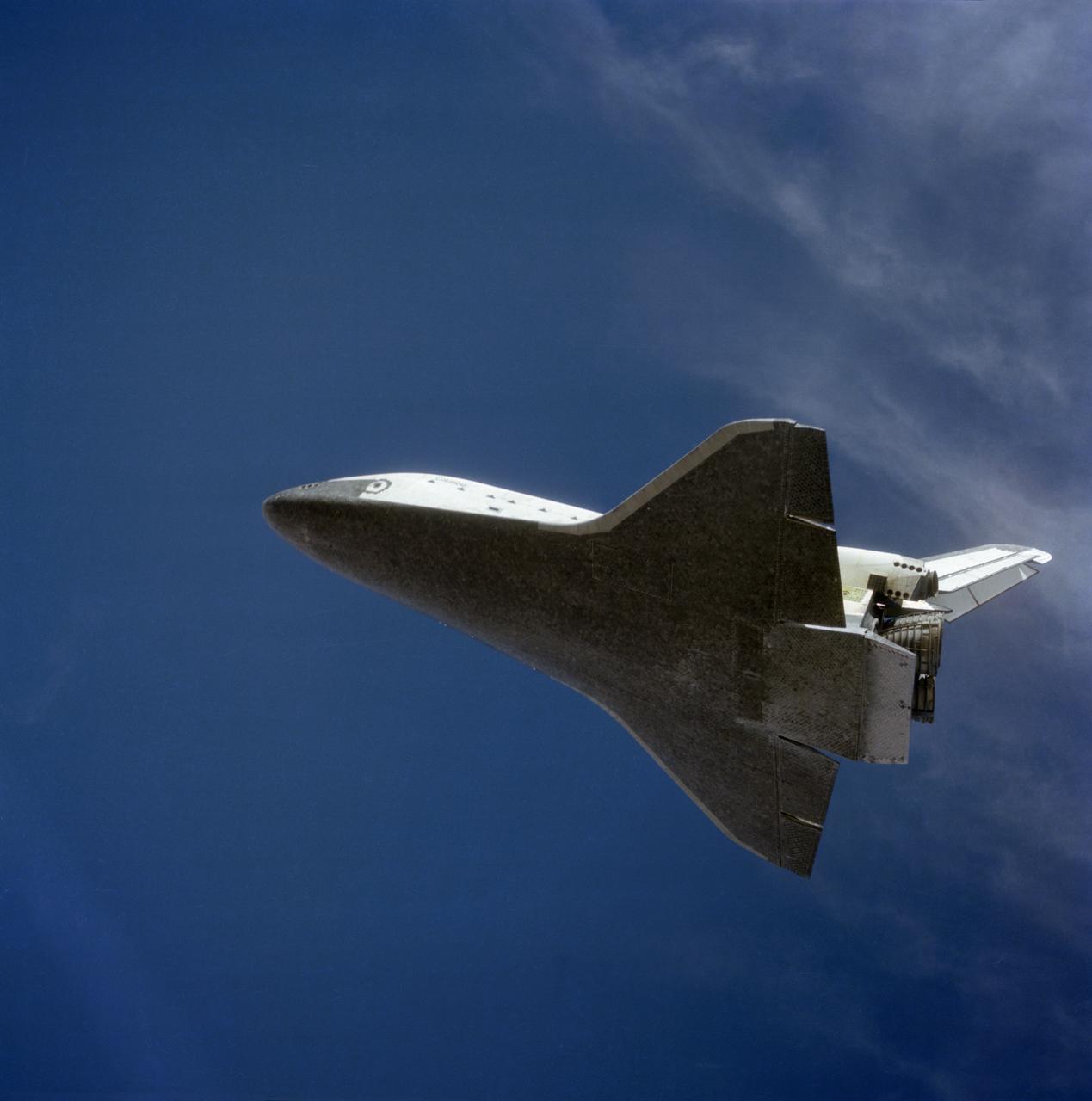
S81-39564 (14 Nov. 1981) --- This view of the space shuttle Columbia (STS-2) was made with a hand-held 70mm camera in the rear station of the T-38 chase plane. Mission specialist/astronaut Kathryn D. Sullivan exposed the frame as astronauts Joe N. Engle and Richard H. Truly aboard the Columbia guided the vehicle to an unpowered but smooth landing on the desert area of Edwards Air Force base in California. The picture provides a good view of the underside of the returning spacecraft. Photo credit: NASA
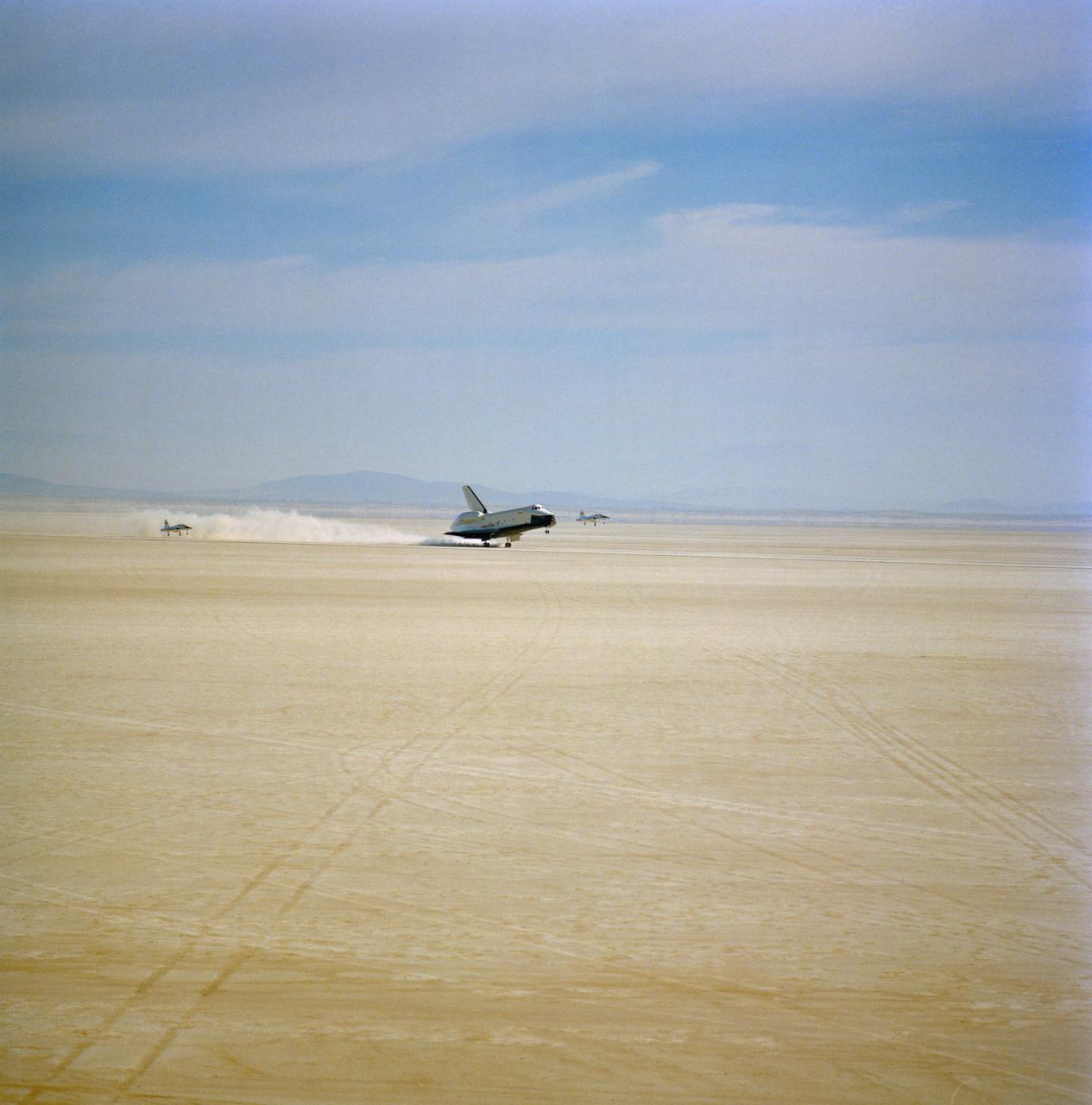
S77-28209 (13 Sept 1977) --- The shuttle orbiter 101 "Enterprise" lands on the desert at Edwards Air Force Base to conclude a five-minute, 31-second unpowered flight during the second free-flight of the Shuttle Approach and Landing Test (ALT) series, on September 13, 1977. Two T-38 chase planes remain with the "Enterprise" for the landing. Asstronauts Joe H. Engle, commander, and Richard H. Truly, pilot, were the crewmen for the flight.
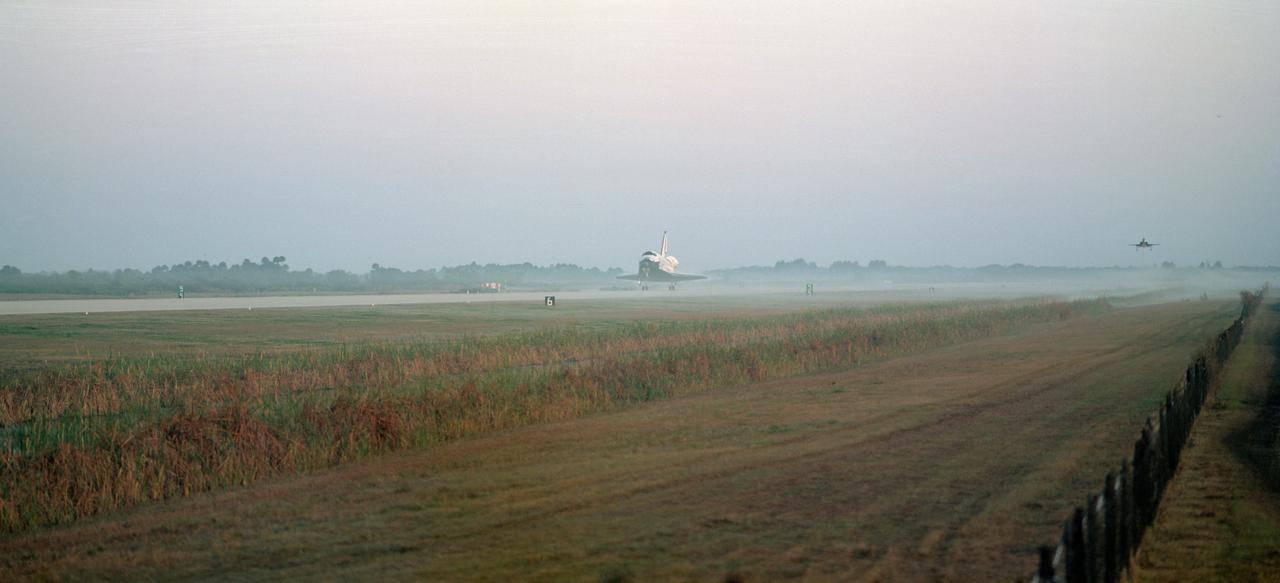
S84-27154 (11 Feb 1984) --- The first Space Shuttle landing on the Kennedy Space Center?s landing facility was recorded by a ground camera on February 11, 1984. A T-38 chase plane trails the Challenger. The nose gear has not yet touched down in this scene. Aboard the spacecraft were Astronauts Vance D. Brand, commander; Robert L. Gibson, pilot; and Bruce McCandless II, Ronald R. McNair and Robert L. Stewart, all mission specialists.
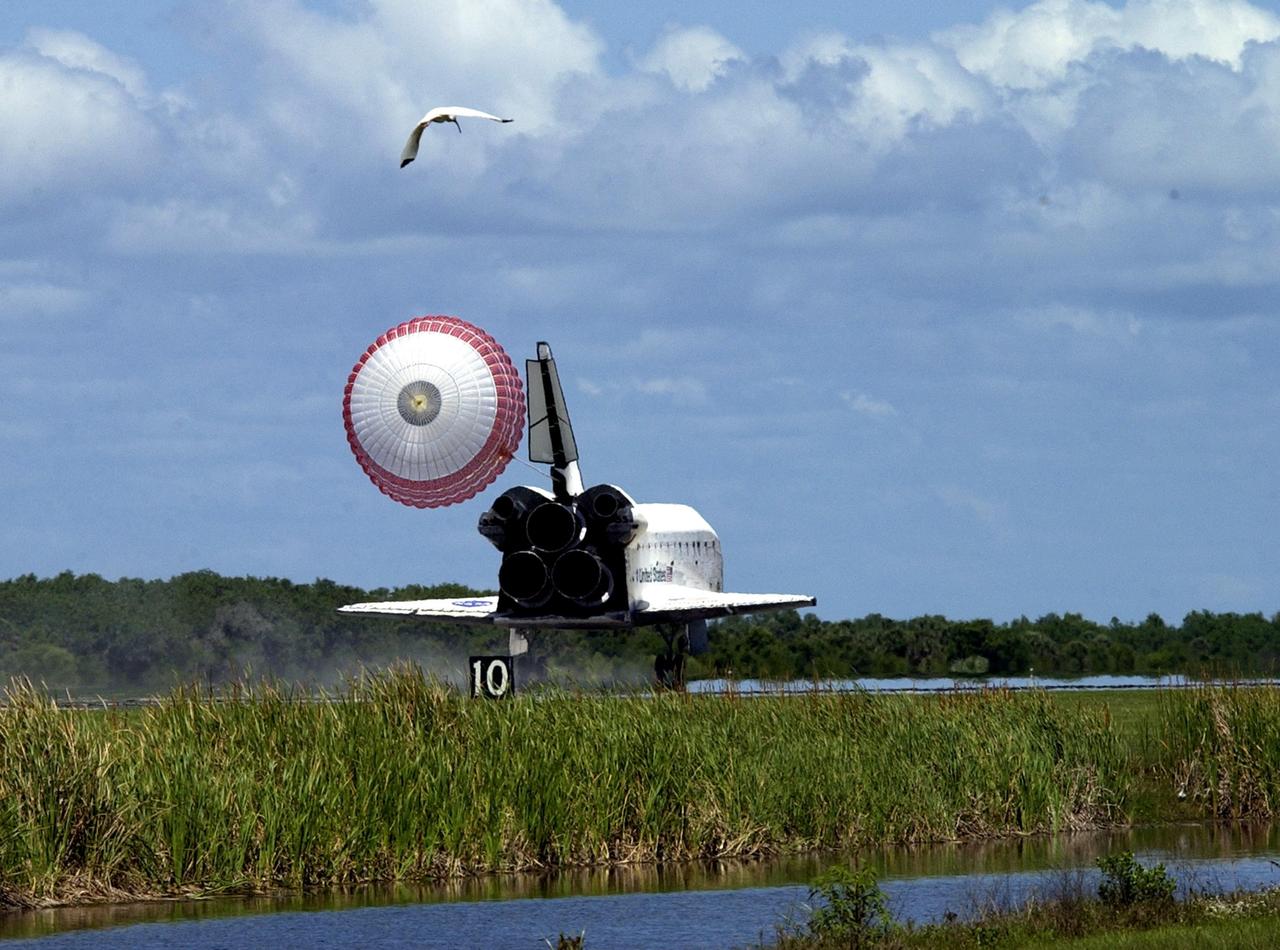
KENNEDY SPACE CENTER, FLA. -- A wood stork appears to chase Atlantis as it lands on runway 33 with its drag chute deployed. The landing completes the 10-day, 19-hour, 4.5-million mile mission STS-110 to the International Space Station. In the upper right corner is the chase plane following Atlantis' path. The orbiter carries the returning crew Commander Michael Bloomfield, Pilot Stephen Frick and Mission Specialists Jerry Ross, Steven Smith, Ellen Ochoa, Lee Morin and Rex Walheim. Main gear touchdown was 12:26:57 p.m. EDT, nose gear touchdown was 12:27:09 p.m. and wheel stop was 12:28:07 p.m. The crew delivered and installed the S0 truss, which will support cooling and power systems essential for the addition of future international laboratories, on the Station
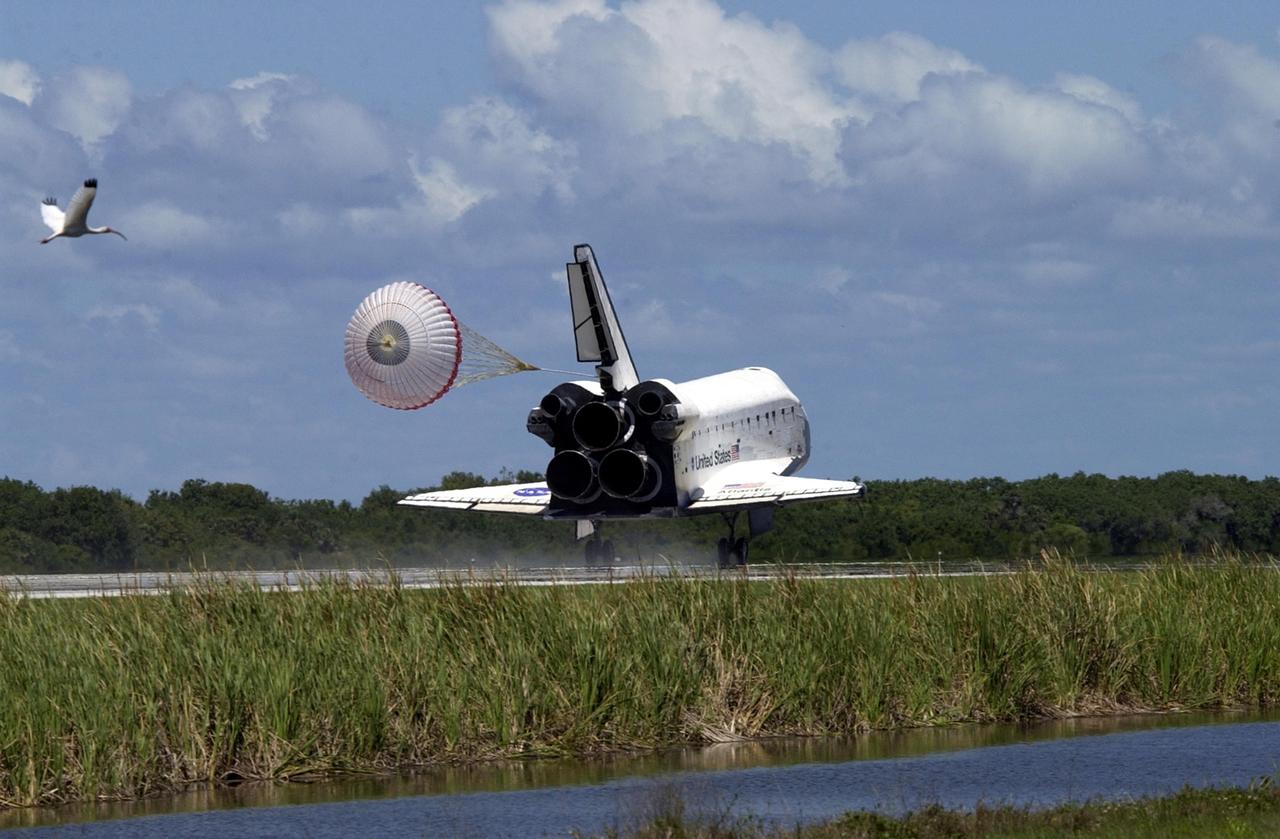
KENNEDY SPACE CENTER, FLA. - A wood stork appears to chase Atlantis as it lands on runway 33 with its drag chute deployed. The landing completes the 10-day, 19-hour, 4.5-million mile mission STS-110 to the International Space Station. In the upper right corner is the chase plane following Atlantis' path. The orbiter carries the returning crew Commander Michael Bloomfield, Pilot Stephen Frick and Mission Specialists Jerry Ross, Steven Smith, Ellen Ochoa, Lee Morin and Rex Walheim. Main gear touchdown was 12:26:57 p.m. EDT, nose gear touchdown was 12:27:09 p.m. and wheel stop was 12:28:07 p.m. The crew delivered and installed the S0 truss, which will support cooling and power systems essential for the addition of future international laboratories, on the Station.
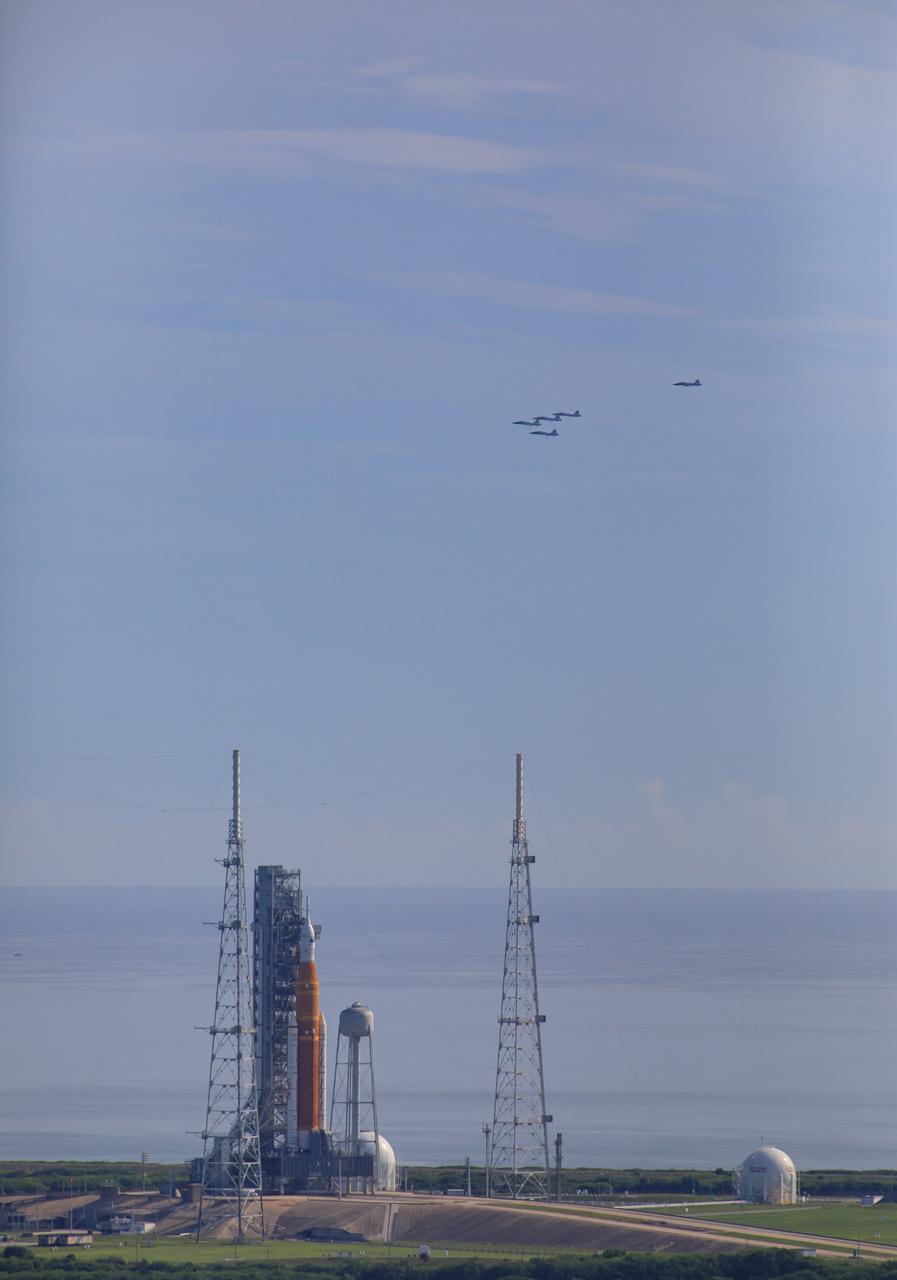
Ahead of NASA’s Artemis I launch, a flight of T-38 supersonic trainer aircraft from the Johnson Space Center Aircraft Operations Division flies in formation over the agency’s Space Launch System and Orion spacecraft on the pad at Launch Complex 39B at Kennedy Space Center in Florida, on Aug. 23, 2022. Pilots and passengers of the five aircraft include NASA Research Pilot Chris Condon and NASA Astronaut Zena Cardman in the lead plane, followed by NASA astronaut candidate Nicole Ayers and NASA astronaut Christina Koch in the second plane, Canadian Space Agency astronaut Jeremy Hansen and NASA astronaut Drew Morgan in the third plane, NASA astronaut Reid Wiseman and NASA astronaut Joe Acaba in the fourth plane, and NASA astronaut candidate Jack Hathaway and Josh Valcarcel, NASA photographer, in the chase plane. Artemis I is scheduled to launch at 8:33 a.m. EDT on Aug. 29, 2022. The first in a series of increasingly complex missions, Artemis I will provide a foundation for human deep space exploration and demonstrate our commitment and capability to extend human presence to the Moon and beyond. The primary goal of Artemis I is to thoroughly test the integrated systems before crewed missions by operating the spacecraft in a deep space environment, testing Orion’s heat shield, and recovering the crew module after reentry, descent, and splashdown.
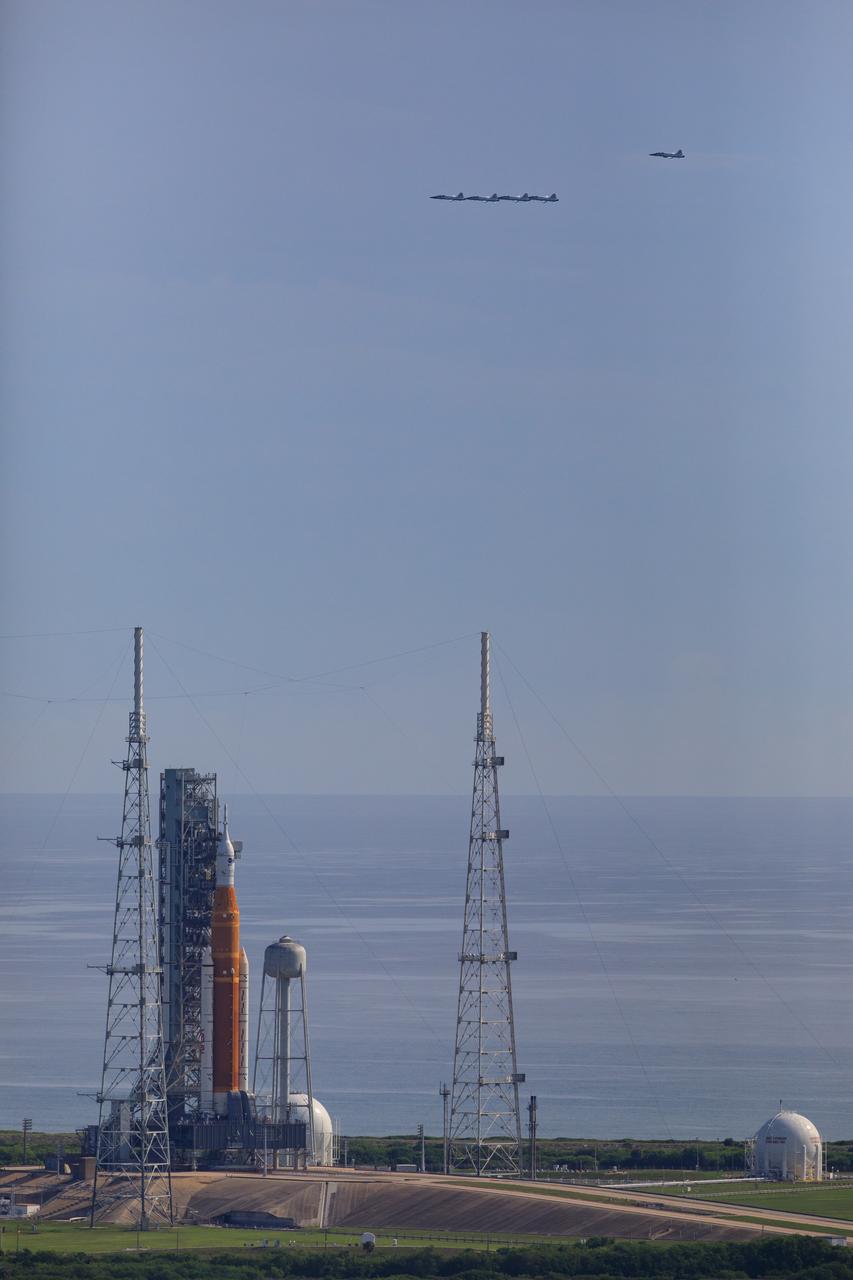
Ahead of NASA’s Artemis I launch, a flight of T-38 supersonic trainer aircraft from the Johnson Space Center Aircraft Operations Division flies in formation over the agency’s Space Launch System and Orion spacecraft on the pad at Launch Complex 39B at Kennedy Space Center in Florida, on Aug. 23, 2022. Pilots and passengers of the five aircraft include NASA Research Pilot Chris Condon and NASA Astronaut Zena Cardman in the lead plane, followed by NASA astronaut candidate Nicole Ayers and NASA astronaut Christina Koch in the second plane, Canadian Space Agency astronaut Jeremy Hansen and NASA astronaut Drew Morgan in the third plane, NASA astronaut Reid Wiseman and NASA astronaut Joe Acaba in the fourth plane, and NASA astronaut candidate Jack Hathaway and Josh Valcarcel, NASA photographer, in the chase plane. Artemis I is scheduled to launch at 8:33 a.m. EDT on Aug. 29, 2022. The first in a series of increasingly complex missions, Artemis I will provide a foundation for human deep space exploration and demonstrate our commitment and capability to extend human presence to the Moon and beyond. The primary goal of Artemis I is to thoroughly test the integrated systems before crewed missions by operating the spacecraft in a deep space environment, testing Orion’s heat shield, and recovering the crew module after reentry, descent, and splashdown.
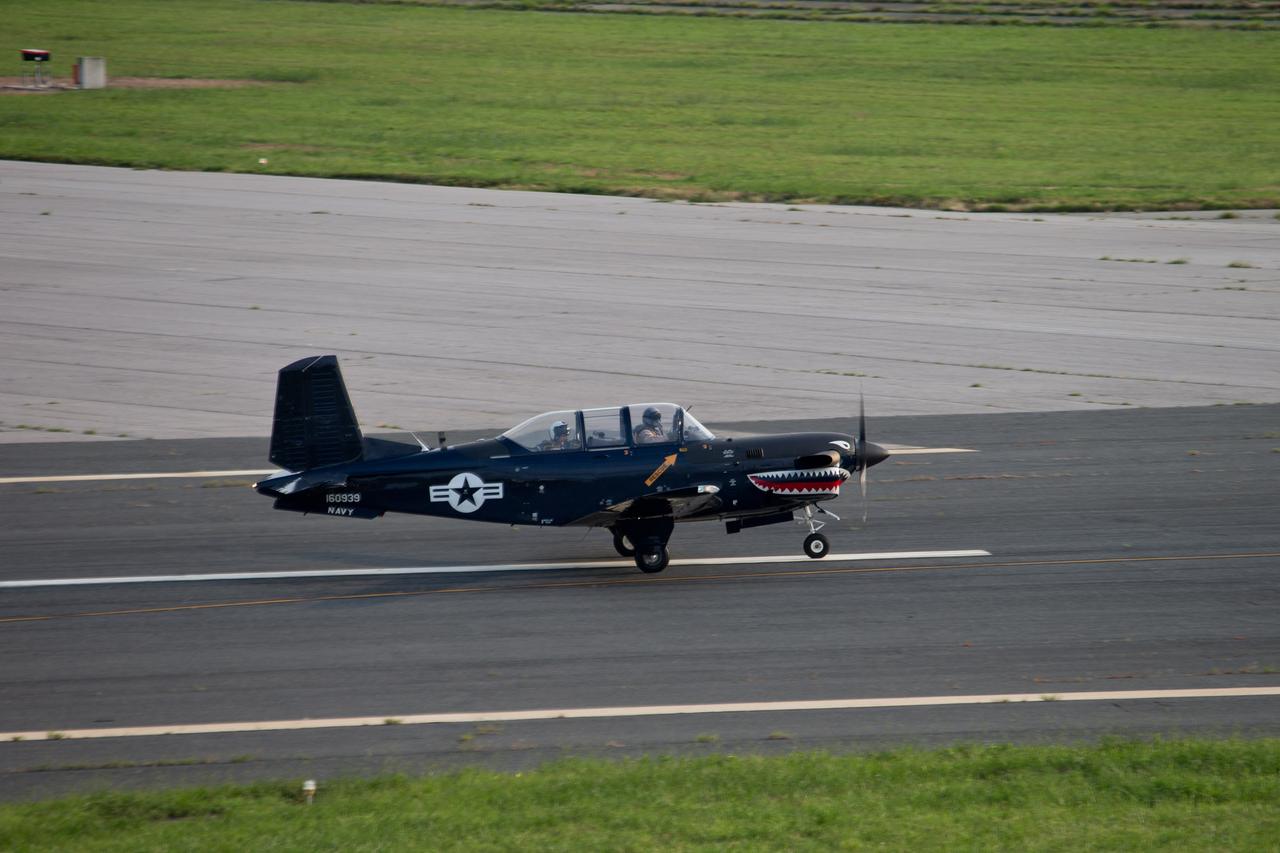
Photo of the chase plane landing at NASA's Wallops Flight Facility, Wallops Island, Va. at 7:39 a.m. today, Aug. 14, 2013. The chase plane was used during the landing of NASA's Global Hawk unmanned aerial vehicle. The Global Hawk will be used during the Hurricane Severe Storms Sentinel (HS3) mission. For more information, visit: <a href="http://www.nasa.gov/HS3. " rel="nofollow">www.nasa.gov/HS3. </a> Photo Credit: NASA Wallops Text: Keith Koehler/NASA Wallops Flight Facility <b><a href="http://www.nasa.gov/audience/formedia/features/MP_Photo_Guidelines.html" rel="nofollow">NASA image use policy.</a></b> <b><a href="http://www.nasa.gov/centers/goddard/home/index.html" rel="nofollow">NASA Goddard Space Flight Center</a></b> enables NASA’s mission through four scientific endeavors: Earth Science, Heliophysics, Solar System Exploration, and Astrophysics. Goddard plays a leading role in NASA’s accomplishments by contributing compelling scientific knowledge to advance the Agency’s mission. <b>Follow us on <a href="http://twitter.com/NASA_GoddardPix" rel="nofollow">Twitter</a></b> <b>Like us on <a href="http://www.facebook.com/pages/Greenbelt-MD/NASA-Goddard/395013845897?ref=tsd" rel="nofollow">Facebook</a></b> <b>Find us on <a href="http://instagram.com/nasagoddard?vm=grid" rel="nofollow">Instagram</a></b>
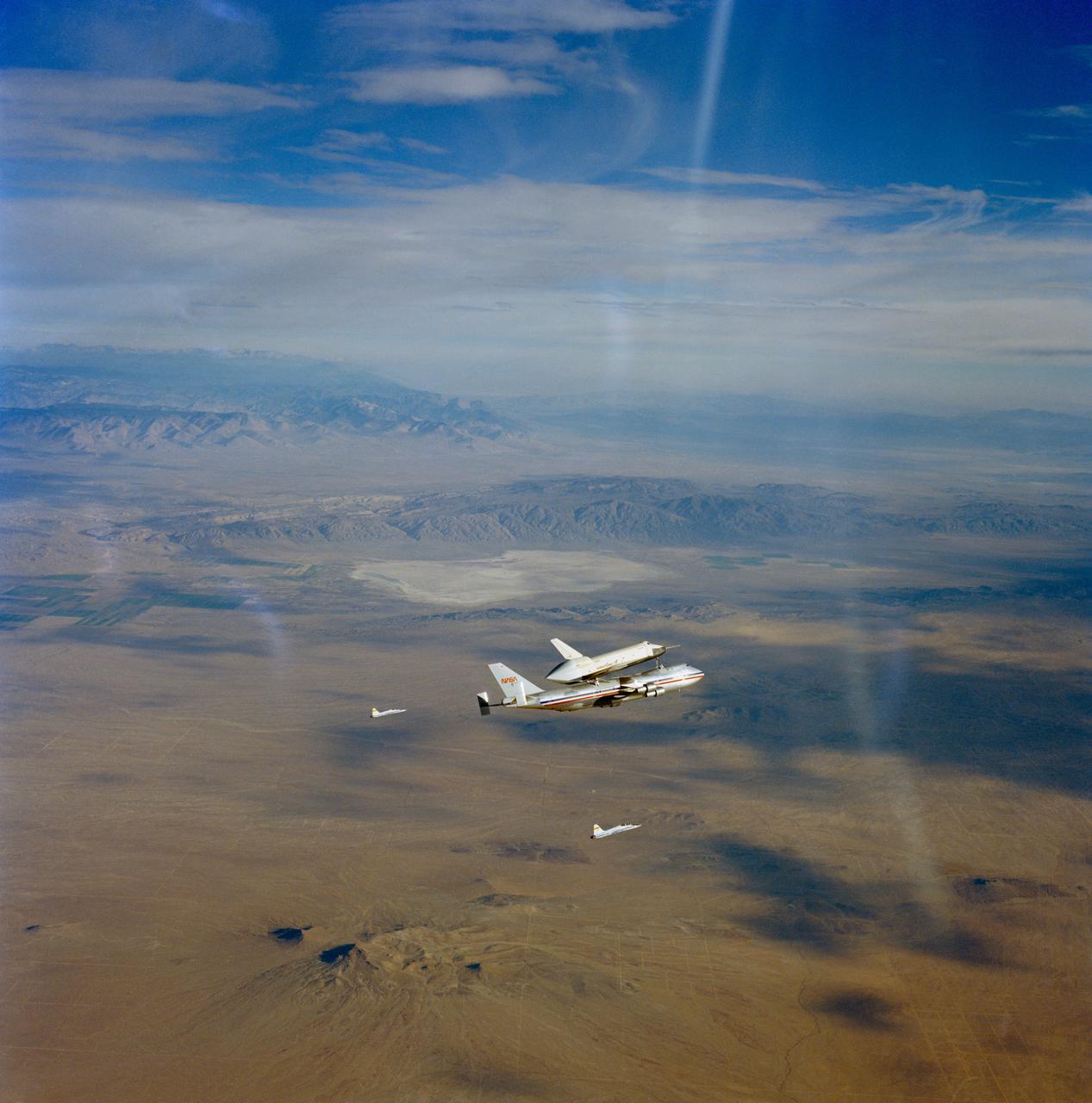
S77-28139 (13 Sept 1977) --- The Orbiter 101 "Enterprise" is seen riding "piggy-back" atope the NASA 747 carrier aircraft during the second free flight of the Shuttle Approach and Landing Tests (ALT) conducted on September 13, 1977, at the Dryden Flight Research Center in Southern California. Moments later the Orbiter 101 separated from the 747 and made a five-minute, 28-second unpowered flight before landing. Astronauts Joe H. Engle, commander, and Richard H. Truly, pilot, were the crew of the "Enterprise." two T-38 chase planes are seen in the background. The ALT free flights are designed to verify orbiter subsonic airworthiness, integrated systems operations and pilot-guided approach andlanding capability and satisfy prerequisites to automatic flight control and navigation mode. Astronaut Vance D. Brand took this picture while riding in T-38 chase plane number five. He used a 70mm Hasselblad camera with an 80mm lens.
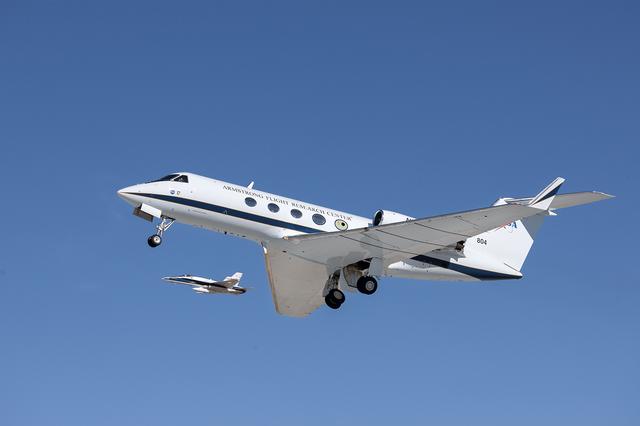
Initial flight-testing of the ACTE followed extensive wind tunnel experiments. For the first phase of ACTE flights, the experimental control surfaces were locked at a specified setting. Varied flap settings on subsequent tests are now demonstrating the capability of the flexible surfaces under actual flight conditions.
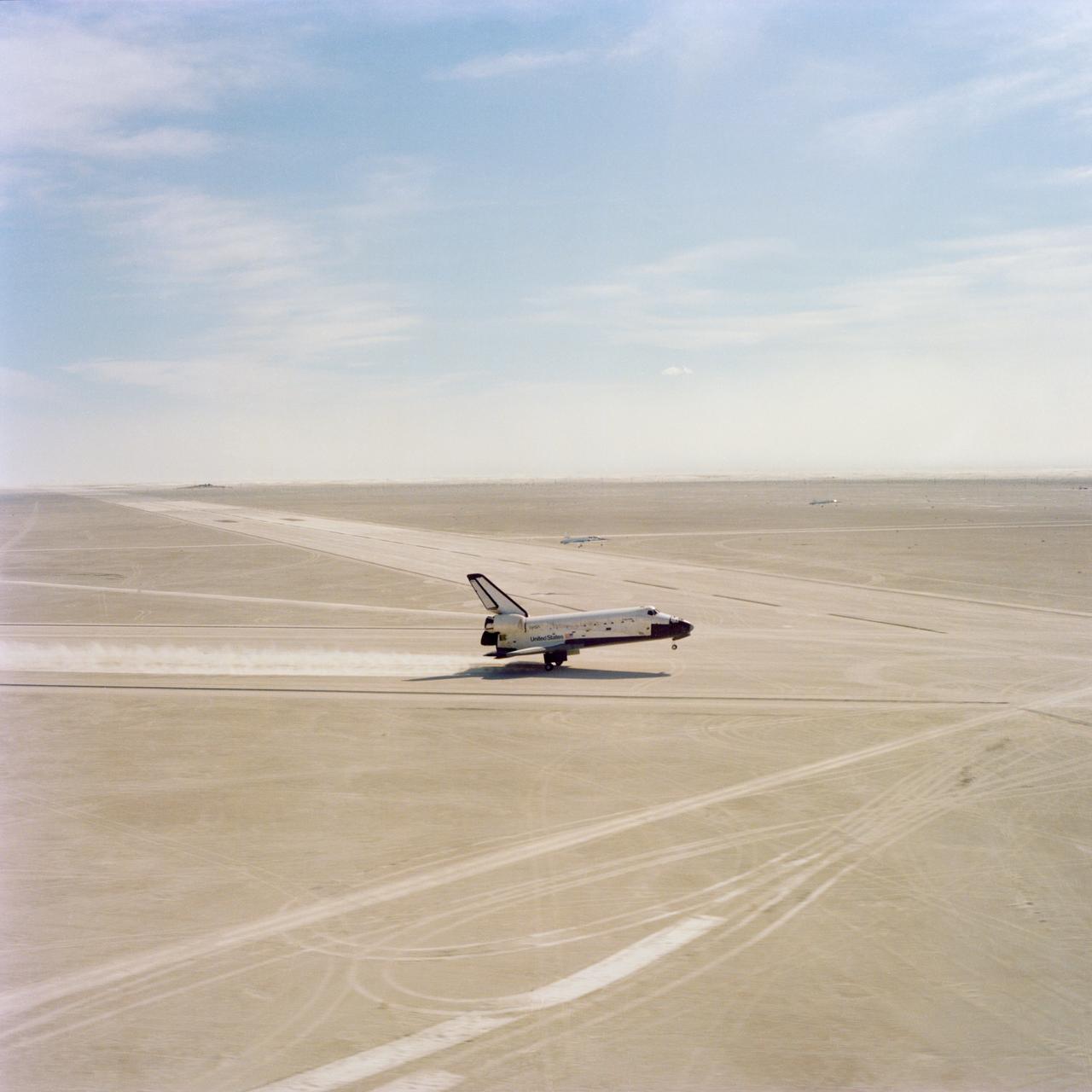
S82-28838 (30 March 1982) --- The space shuttle Columbia (STS-3) touches down on the Northrup Strip at White Sands Missile Range, New Mexico, marking the first time in its three-flight history that it has touched New Mexico soil. T-38 chase plane passenger, Mission Specialist-Astronaut Ronald E. McNair, who also shot some launch photography this flight, recorded a number of frames on 70mm film. Touchdown was shortly after 9 a.m. Mountain Standard Time, March 30, 1982. Photo credit: NASA
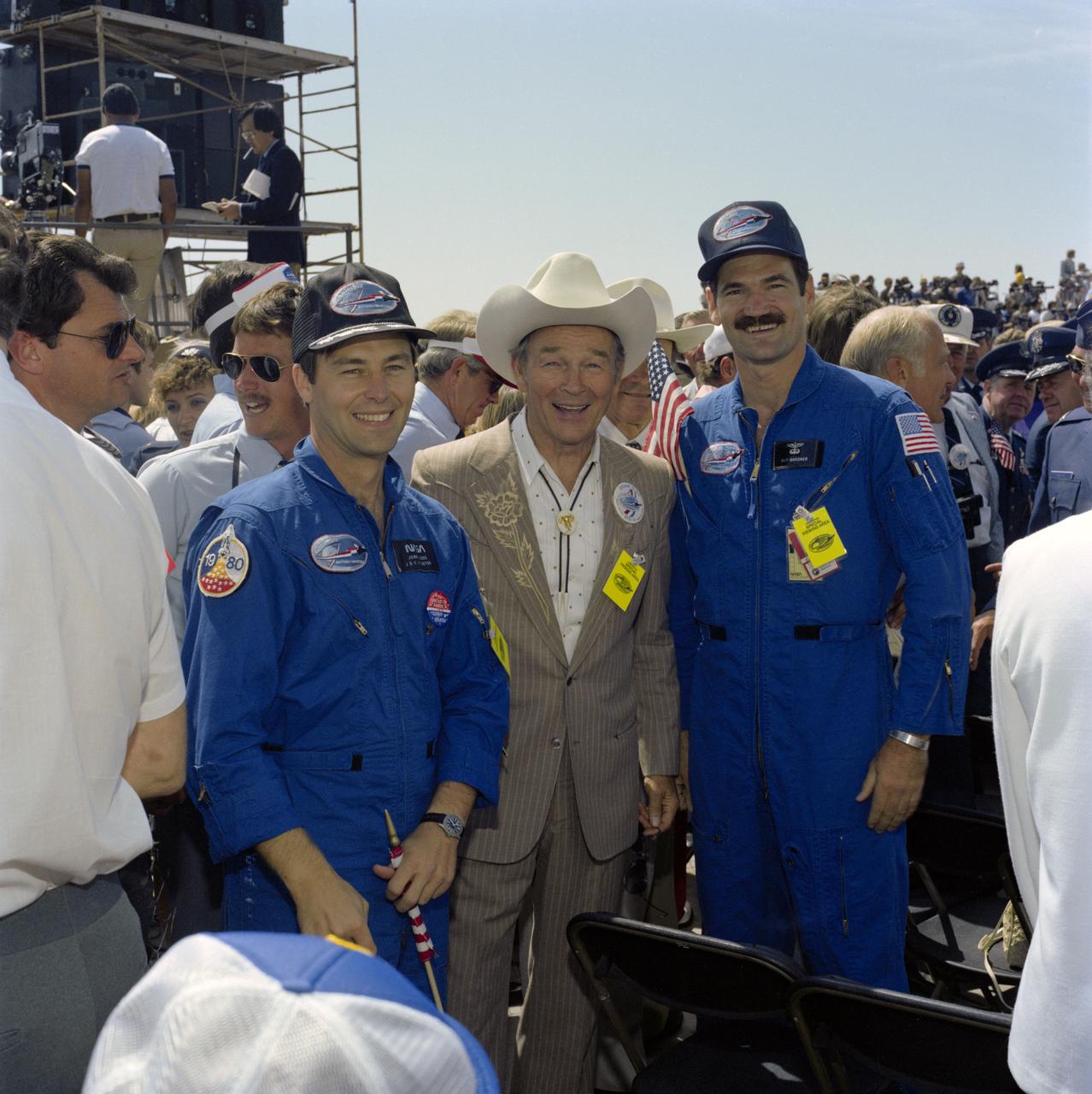
S82-33226 (4 July 1982) --- Inveterate space fan Roy Rogers with astronauts Jerry L. Ross, left, and Guy S. Gardner at Edwards Air Force Base for the landing of the space shuttle Columbia at the conclusion of the STS-4 mission on July 4, 1982. Ross and Gardner piloted chase planes involved in the approach and landing operations for the flight?s conclusion. Also present at the landing was (near far right) former astronaut Edwin E. Aldrin Jr., lunar module pilot for the historic first moon landing of almost 13 years ago. Photo credit: NASA
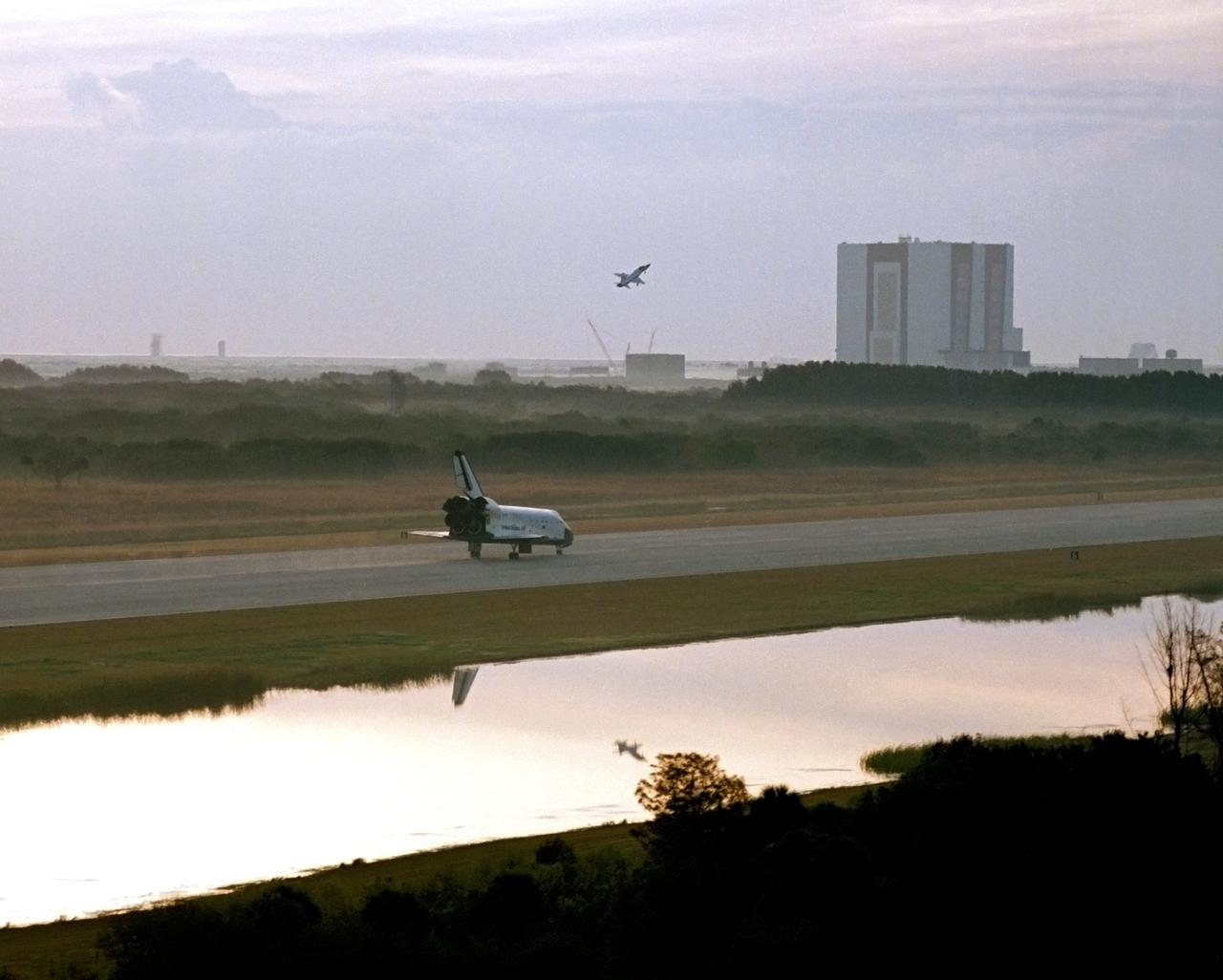
CAPE CANAVERAL, Fla. -- Shortly after sunrise the space shuttle orbiter Challenger touches down on the KSC runway at 7:16 a.m. The T-38 escort chase plane is seen just above the orbiter. The historic first landing at KSC brought to a conclusion an eight-day mission that started at 8:00 a.m. Feb. 3, 1984. The STS 41-B mission had several other firsts including an un-tethered spacewalk made by two of the astronauts. The Vehicle Assembly Building can be seen in the right side of the photograph. Photo credit: NASA
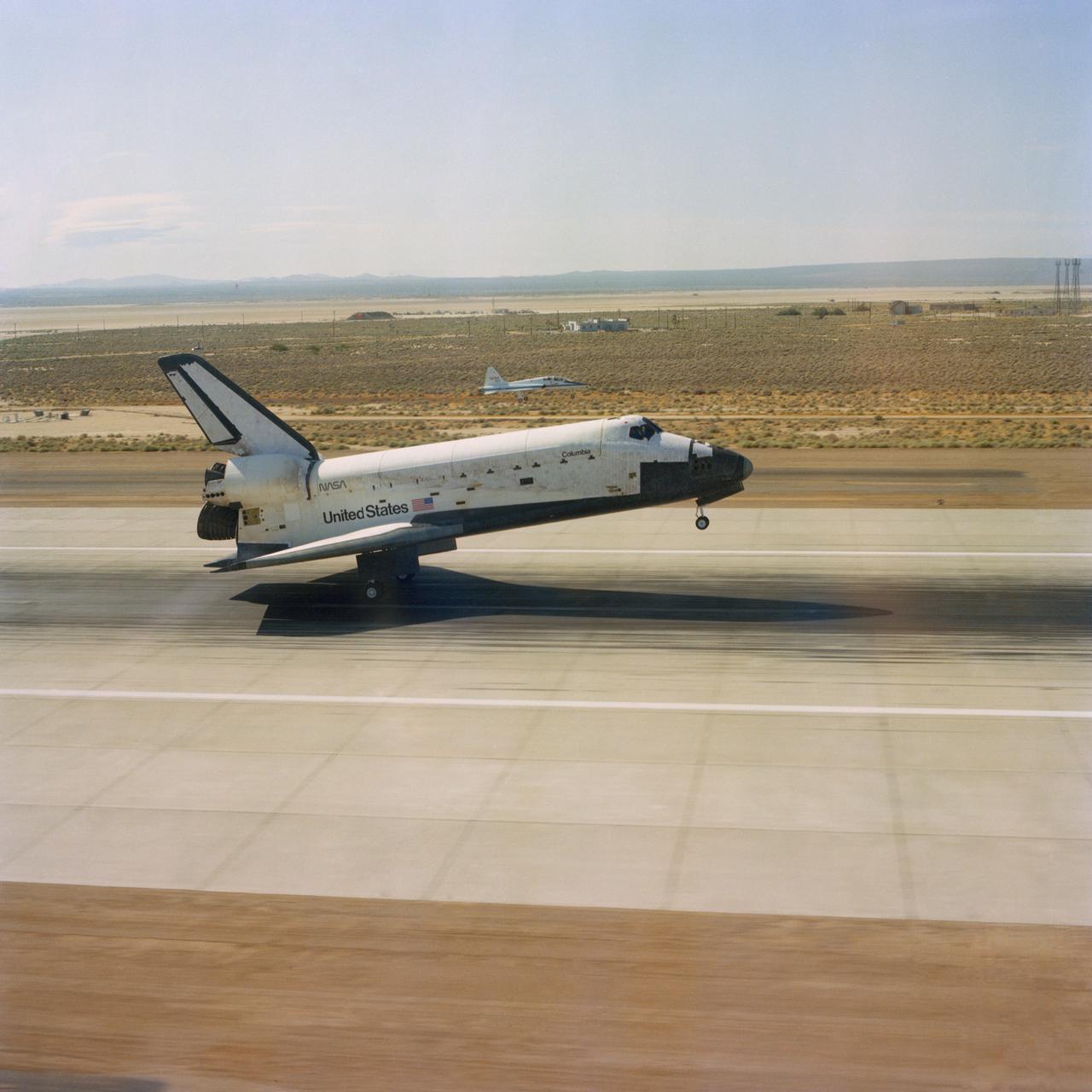
S82-33420 (4 July 1982) --- The aft wheels of the space shuttle Columbia ease down on the runway at Edwards Air Force Base (AFB) today to successfully complete a week-long spaceflight for astronauts Thomas K. Mattingly II, and Henry W. Hartsfield Jr. A T-38 aircraft serves as a chase plane (just above center of photo) in the background. Not long after this photograph was made and the crew had egressed their craft, President Ronald Reagan addressed a giant crowd on hand at Edwards AFB for a special kind of July 4 celebration. Photo credit: NASA
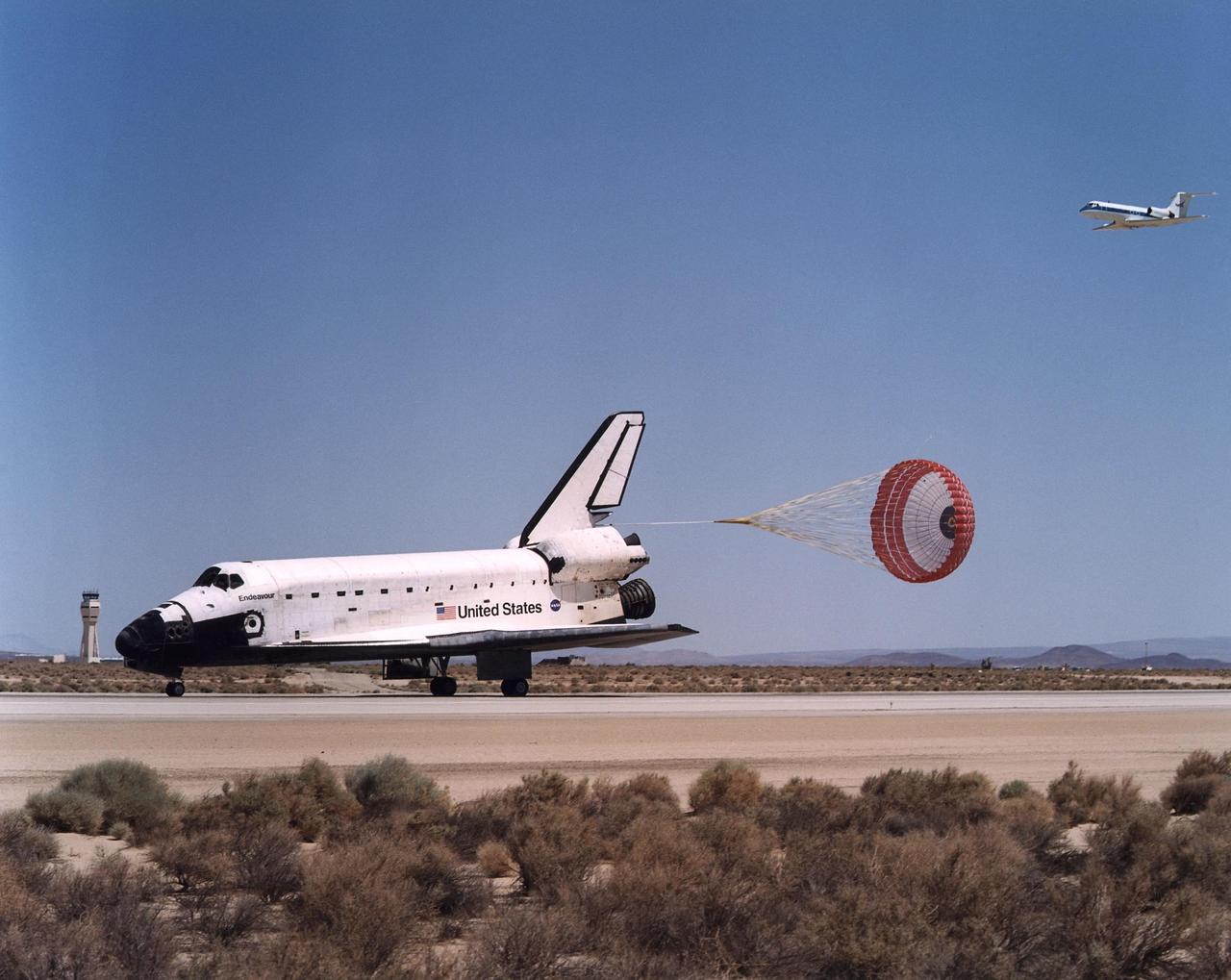
EDWARDS AFB, CALIF. -- A chase plane follows behind Endeavour as it lands on concrete runway 22 at Dryden Flight Research Center, Edwards Air Force Base, Calif., completing mission STS-111. Endeavour traveled 5.8 million miles in space during 217 orbits. Three days of unfavorable weather conditions at KSC prompted the decision to land at Edwards, which enjoyed pristine, dry conditions.. Main gear touchdown occurred at 1:57:41 p.m EDT, nose gear touchdown at 1:57:53 p.m. EDT and wheel stop at 1:58:45 p.m. EDT. [Photo by Jim Ross
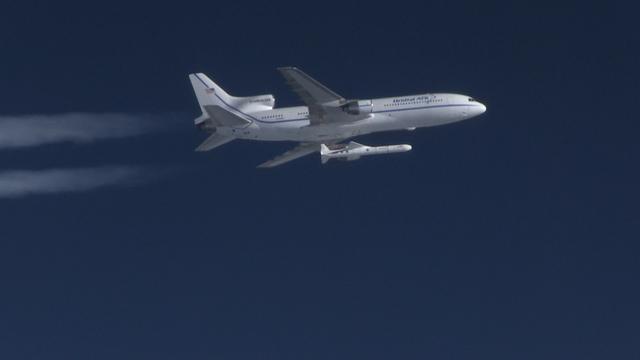
The Orbital ATK Pegasus XL rocket carrying NASA's Cyclone Global Navigation Satellite System, or CYGNSS, spacecraft is released and the first stage ignites at 8:37 a.m. EST. The rocket was released from the Orbital ATK L-1011 Stargazer aircraft flying over the Atlantic Ocean offshore from Daytona Beach, Florida following takeoff from the Skid Strip at Cape Canaveral Air Force Station. This image was taken from a NASA F-18 chase plane provided by Armstrong Flight Research Center in California. The CYGNSS satellites will make frequent and accurate measurements of ocean surface winds throughout the life cycle of tropical storms and hurricanes.
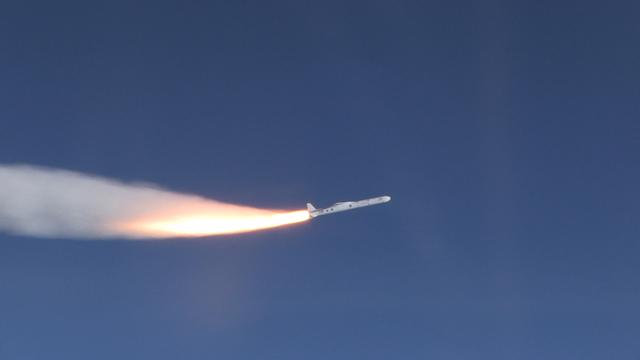
The Orbital ATK Pegasus XL rocket carrying NASA's Cyclone Global Navigation Satellite System, or CYGNSS, spacecraft is released and the first stage ignites at 8:37 a.m. EST. The rocket was released from the Orbital ATK L-1011 Stargazer aircraft flying over the Atlantic Ocean offshore from Daytona Beach, Florida following takeoff from the Skid Strip at Cape Canaveral Air Force Station. This image was taken from a NASA F-18 chase plane provided by Armstrong Flight Research Center in California. The CYGNSS satellites will make frequent and accurate measurements of ocean surface winds throughout the life cycle of tropical storms and hurricanes.
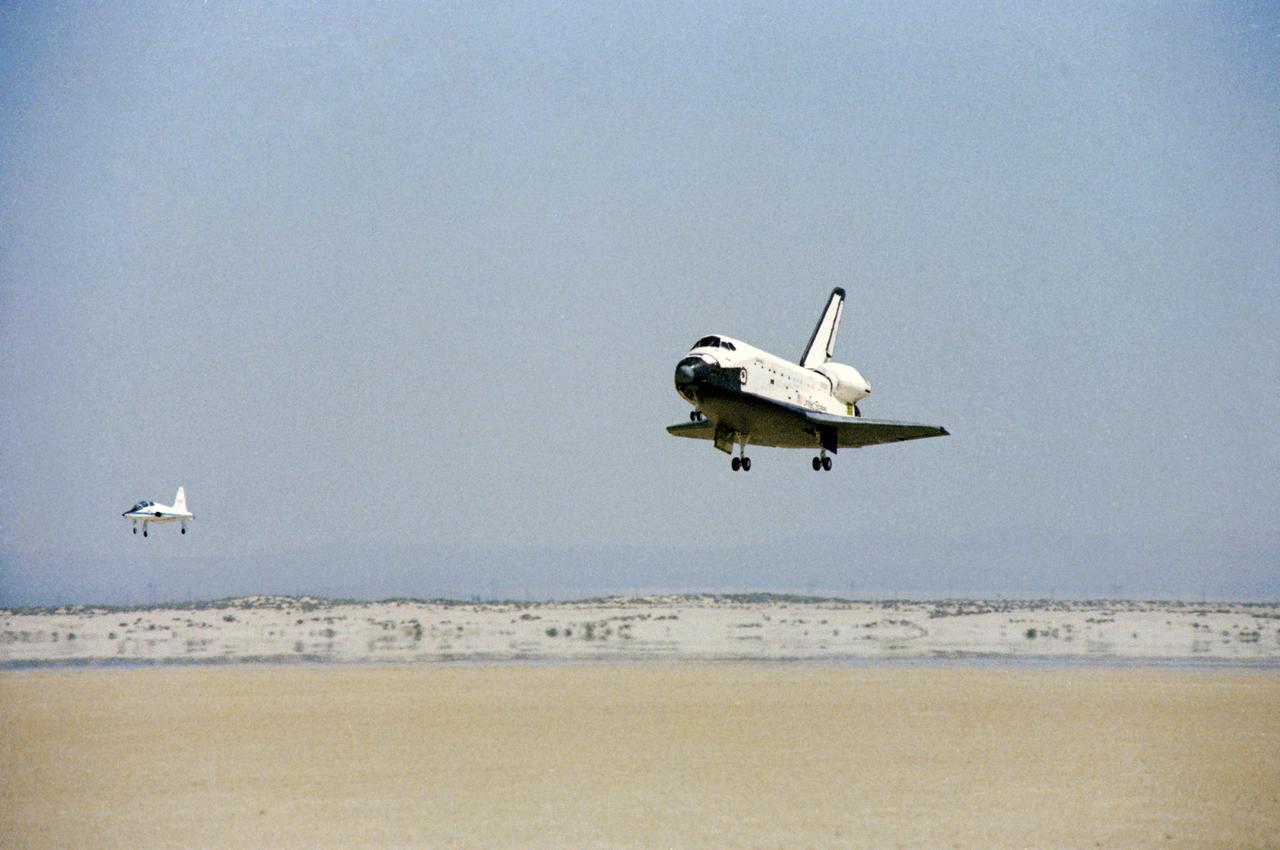
S81-30425 (14 April 1981) --- The space shuttle orbiter Columbia is seen from the front as it heads for a touchdown atop a dry lake bed at Edwards Air Force Base in southern California. A T-38 chase plane follows it in at left. Aboard Columbia were astronauts John W. Young, STS-1 commander, and Robert L. Crippen, pilot. Their landing marked the completion of a successful two-and-a-third day flight in space and the beginning of a new era of space transportation. A series of additional test flights will follow before the Space Shuttle Program becomes fully operational later in this decade. Photo credit: NASA
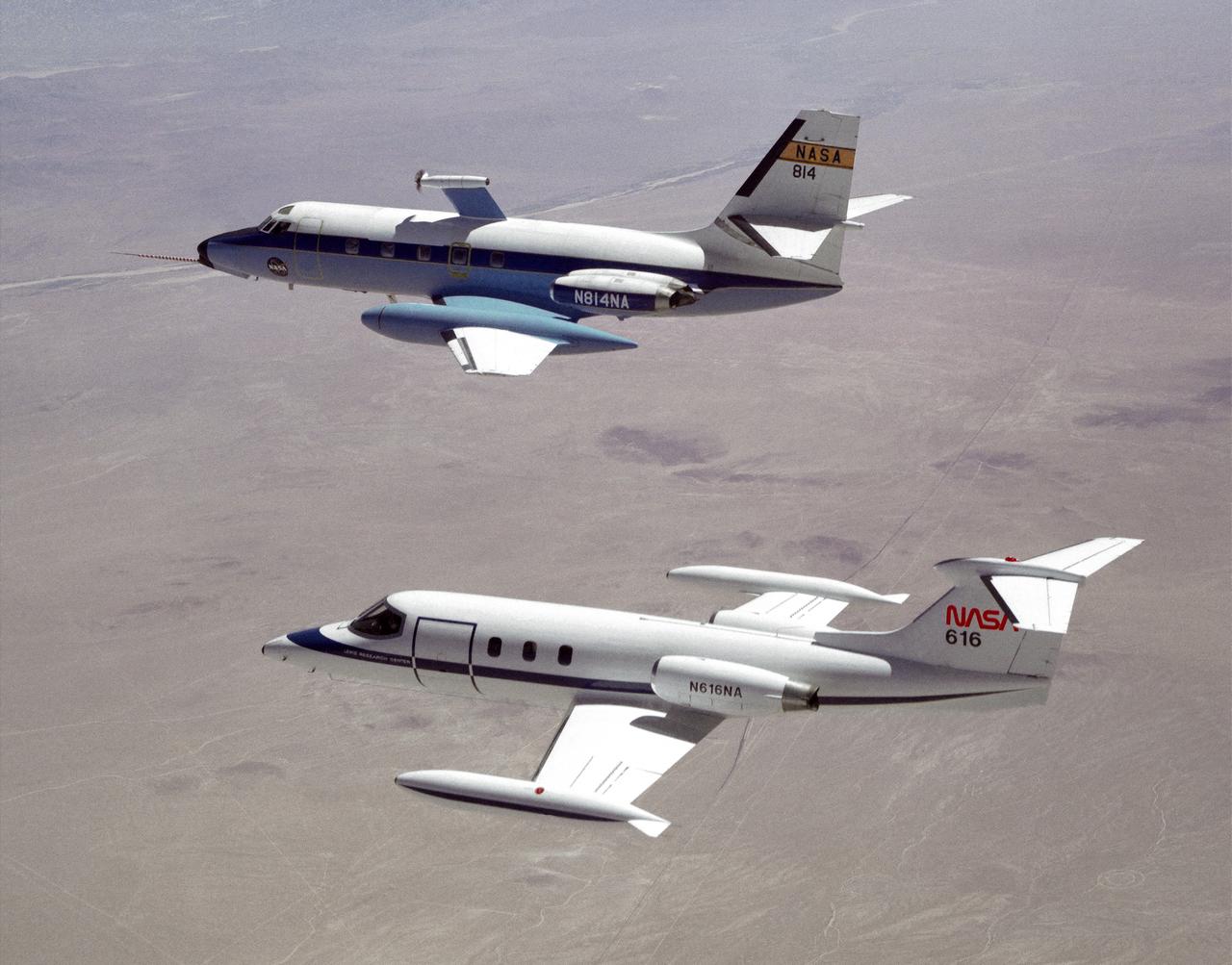
The NASA C-140 JetStar research aircraft (top) is followed by a NASA Learjet equipped with acoustic sensors during one of several tests of advanced propellors mounted on the vertical pylon atop the JetStar's fuselage. Several advanced prop designs were tested on the JetStar in 1982 by NASA's Dryden Flight Research Facility (DFRF), Edwards, California, to study the effects of noise created by propellors on aircraft structures and cabin interiors. To assess possible noise problems with the subscale turbofan, DFRF technicians mounted microphones on both the JetStar and the Learjet chase plane. DFRF then made measurements at close range and at longer distances. The data enabled structural changes and flightpath modifications.
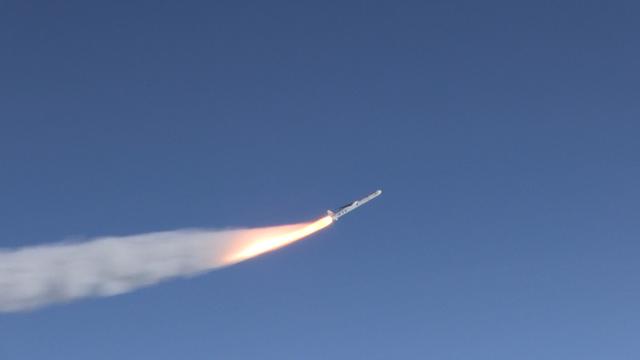
The Orbital ATK Pegasus XL rocket carrying NASA's Cyclone Global Navigation Satellite System, or CYGNSS, spacecraft is released and the first stage ignites at 8:37 a.m. EST. The rocket was released from the Orbital ATK L-1011 Stargazer aircraft flying over the Atlantic Ocean offshore from Daytona Beach, Florida following takeoff from the Skid Strip at Cape Canaveral Air Force Station. This image was taken from a NASA F-18 chase plane provided by Armstrong Flight Research Center in California. The CYGNSS satellites will make frequent and accurate measurements of ocean surface winds throughout the life cycle of tropical storms and hurricanes.
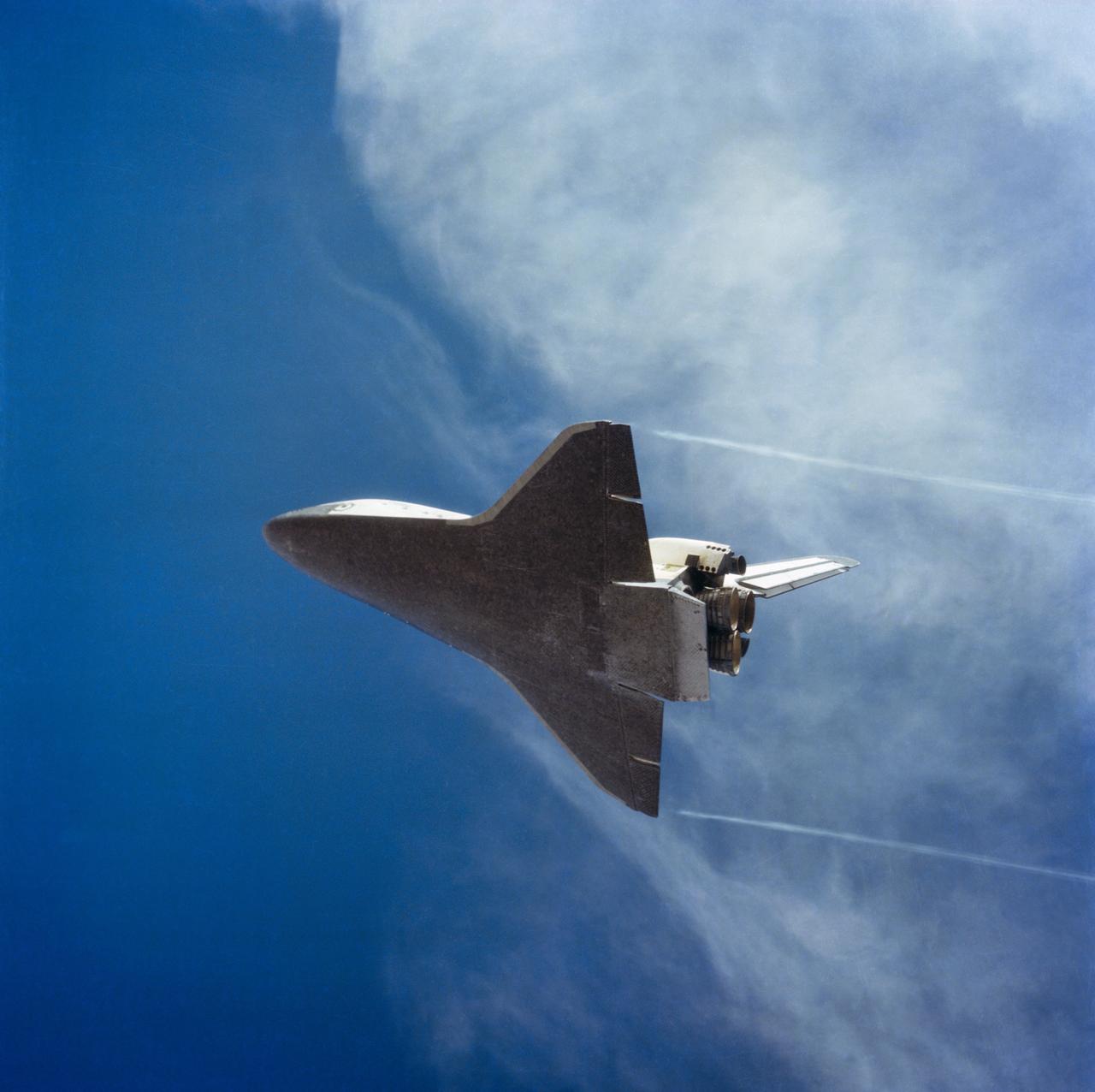
S81-39563 (14 Nov. 1981) --- This view of the space shuttle Columbia (STS-2) was made with a hand-held 70mm camera in the rear station of the T-38 chase plane. Mission specialist/astronaut Kathryn D. Sullivan exposed the frame as astronauts Joe N. Engle and Richard H. Truly aboard the Columbia guided the vehicle to an unpowered but smooth landing on the desert area of Edwards Air Force base in California. The view provides a good study of the high temperature protection material on the underside of the spacecraft which is exposed to the friction on the atmospheric entry on the return to Earth. Also note trails from the wing tips. Photo credit: NASA
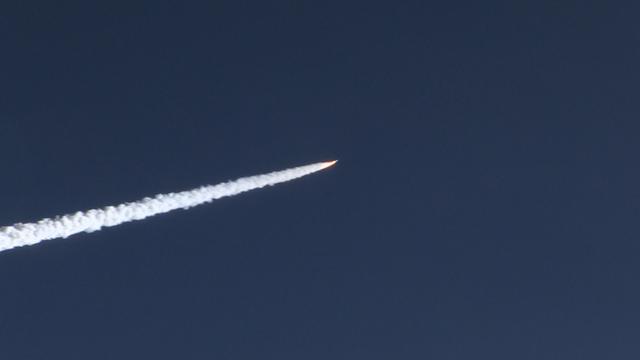
The Orbital ATK Pegasus XL rocket carrying NASA's Cyclone Global Navigation Satellite System, or CYGNSS, spacecraft is released and the first stage ignites at 8:37 a.m. EST. The rocket was released from the Orbital ATK L-1011 Stargazer aircraft flying over the Atlantic Ocean offshore from Daytona Beach, Florida following takeoff from the Skid Strip at Cape Canaveral Air Force Station. This image was taken from a NASA F-18 chase plane provided by Armstrong Flight Research Center in California. The CYGNSS satellites will make frequent and accurate measurements of ocean surface winds throughout the life cycle of tropical storms and hurricanes.
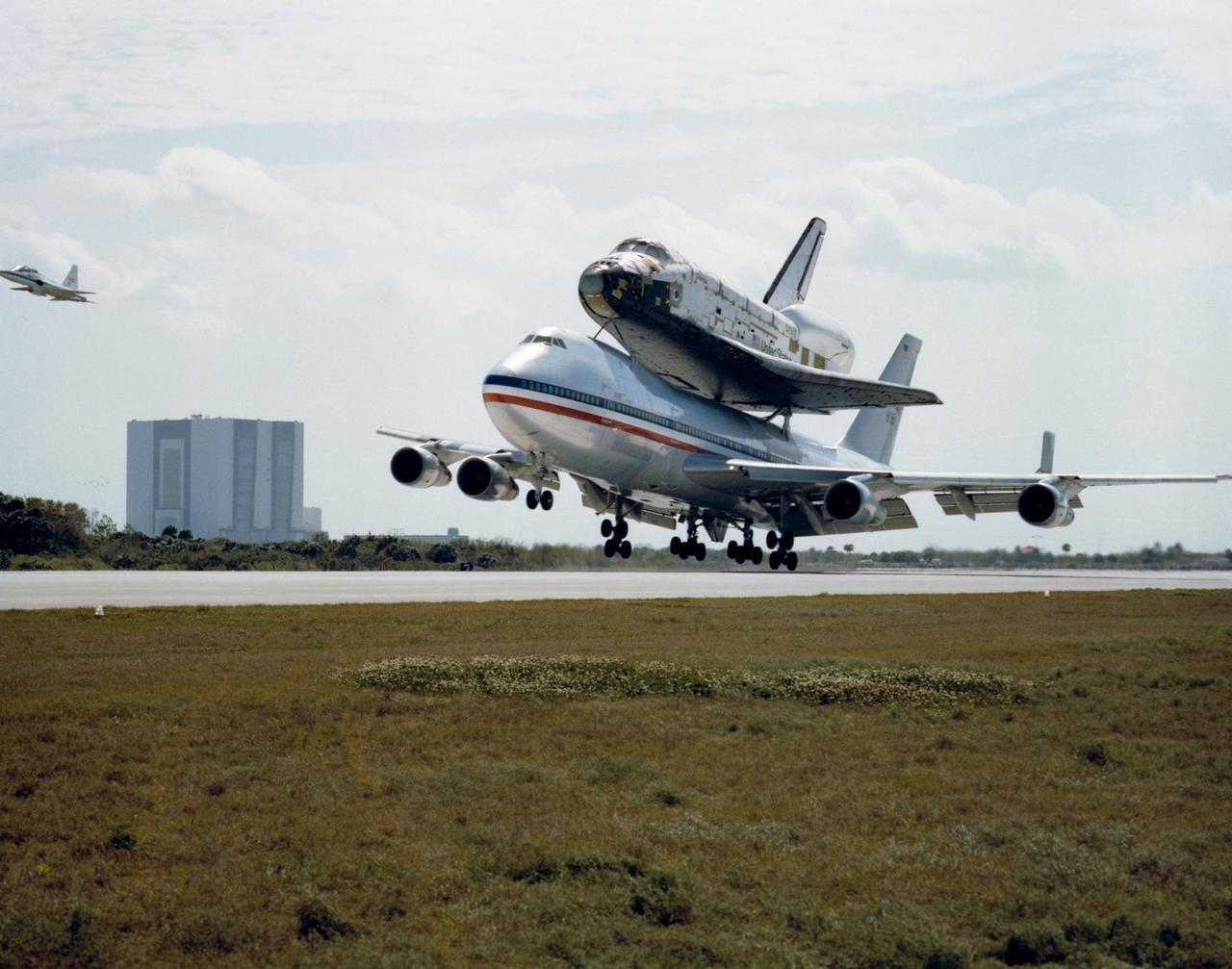
S79-30819 (24 March 1979) --- The space shuttle orbiter 102 Columbia riding ?piggyback? on NASA 905, a 747 carrier aircraft, is only seconds away from landing on Kennedy Space Center?s Shuttle landing facility, ending a 2,400-mile ferry flight from California. The T-38 chase plane at left is flown by Donald K. Slayton, manager for the orbital fight test (OFT) program. Columbia will be used for the OFT program, and it will be manned by astronauts John W. Young and Robert L. Crippen the first time it flies in space. The vehicle assembly building (VAB) is in right background. Photo credit: NASA
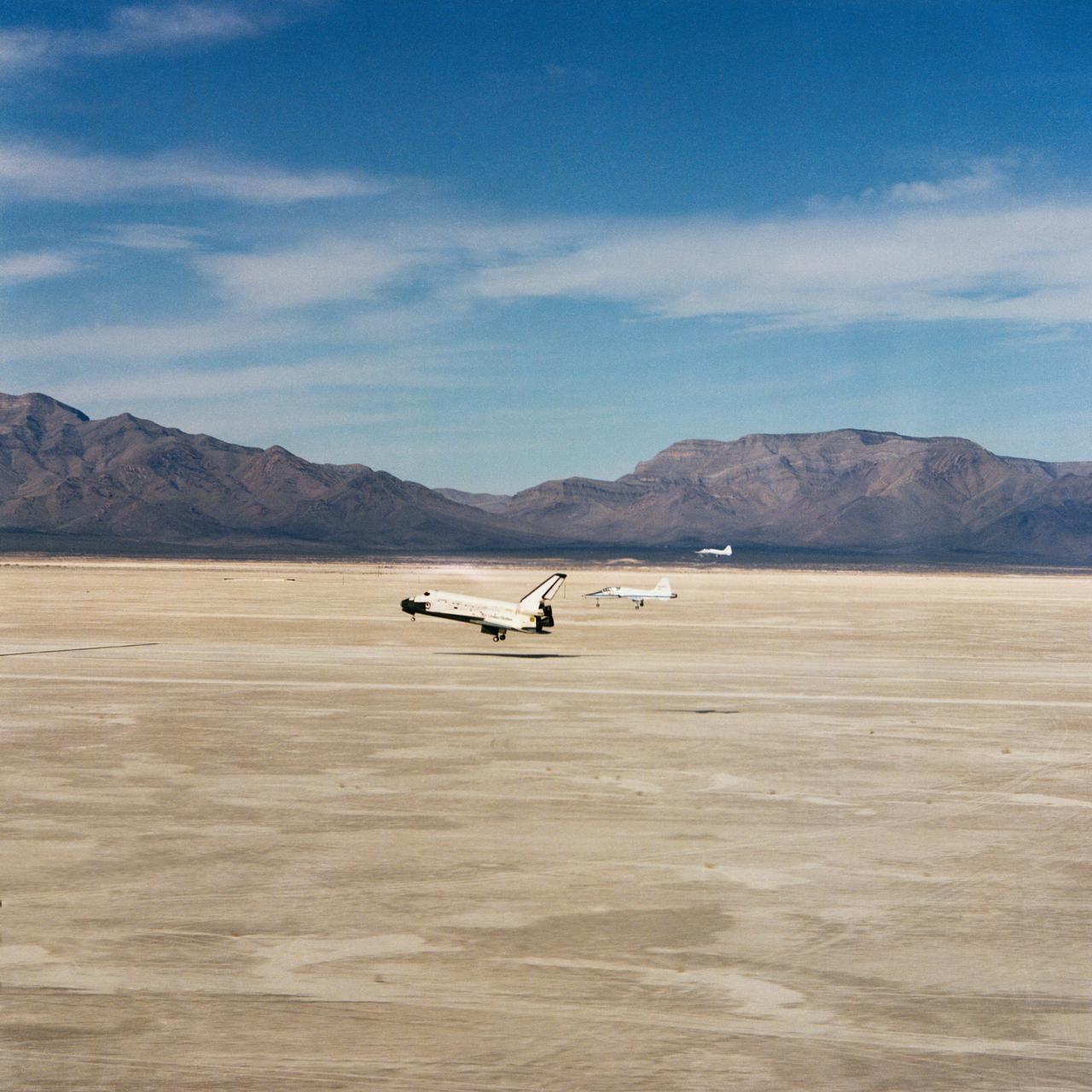
S82-28839 (30 March 1982) --- Seconds from touchdown, the space shuttle Columbia (STS-3), with astronauts Jack R. Lousma and C. Gordon Fullerton aboard, comes into view of a large crowd on hand to greet it at the Northrup strip on White Sands Missile Range in New Mexico. The successful eight-day mission was the first to end on New Mexico soil. Two T-38 chase planes can be seen in the photograph, while a third (out of view) was carrying the photographer that took this frame with a hand-held camera. Photo credit: NASA
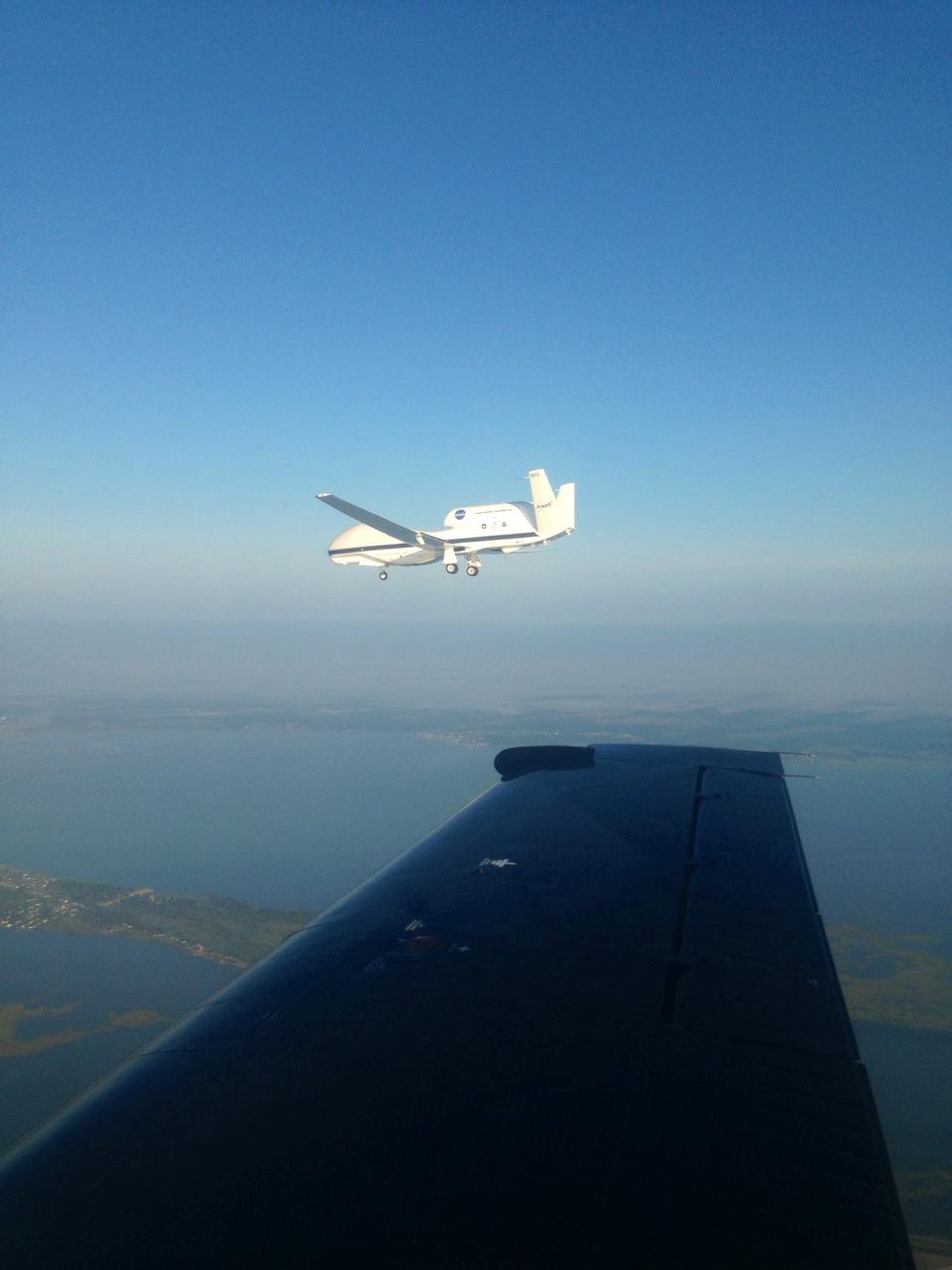
The NASA Wallops T-34 chase aircraft intercepted Global Hawk 872 on its descent to runway 28 at NASA's Wallops Flight Facility in Wallops Island, Va. This photo of the Global Hawk was taken from the chase plane after finishing its third science flight. For more information about NASA's HS3 mission, visit: <a href="http://www.nasa.gov/HS3" rel="nofollow">www.nasa.gov/HS3</a> Credit: NASA/ Brea Reeves <b><a href="http://www.nasa.gov/audience/formedia/features/MP_Photo_Guidelines.html" rel="nofollow">NASA image use policy.</a></b> <b><a href="http://www.nasa.gov/centers/goddard/home/index.html" rel="nofollow">NASA Goddard Space Flight Center</a></b> enables NASA’s mission through four scientific endeavors: Earth Science, Heliophysics, Solar System Exploration, and Astrophysics. Goddard plays a leading role in NASA’s accomplishments by contributing compelling scientific knowledge to advance the Agency’s mission. <b>Follow us on <a href="http://twitter.com/NASA_GoddardPix" rel="nofollow">Twitter</a></b> <b>Like us on <a href="http://www.facebook.com/pages/Greenbelt-MD/NASA-Goddard/395013845897?ref=tsd" rel="nofollow">Facebook</a></b> <b>Find us on <a href="http://instagram.com/nasagoddard?vm=grid" rel="nofollow">Instagram</a></b>
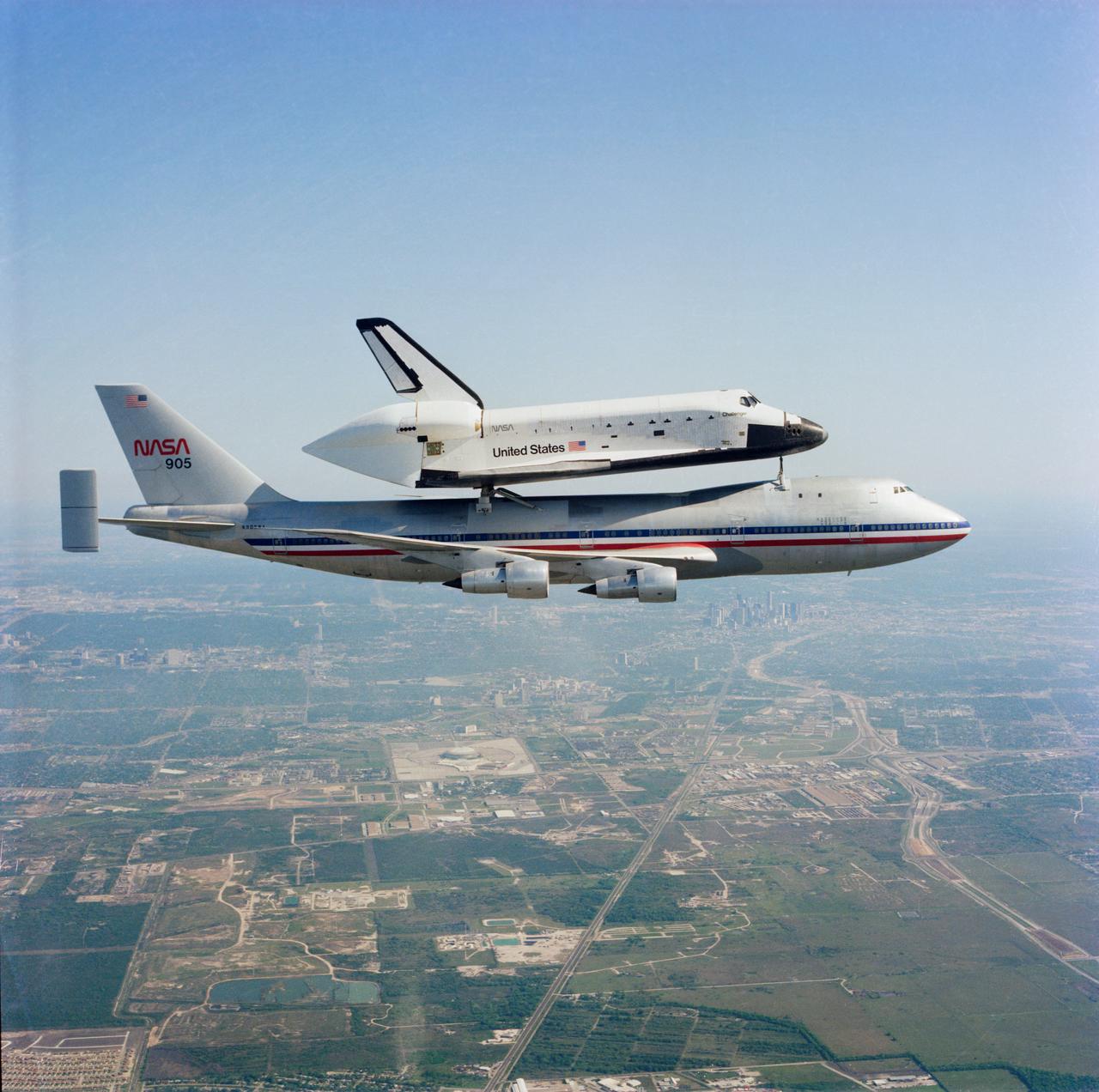
S83-30237 (16 April 1983) --- Downtown Houston and southern portions of that city form the backdrop for this picture of the Space Transportation System?s Challenger flying to the Kennedy Space Center in Florida from its California landing site. It is ferried by NASA 905, a modified 747 aircraft. The crew inside the 747 was as follows: Pilot Joseph S. Algranti; Co-pilot Francis R. (Dick) Scobee; Flight Engineers Louis E. (Skip) Guidry Jr. and Glen O. Pingry. The frame was exposed by Bob Gray from the rear station of a nearby T-38 chase plane piloted by David L. Mumme. The Harris County Domed Stadium (Astrodome) can be seen near center. Photo credit: NASA
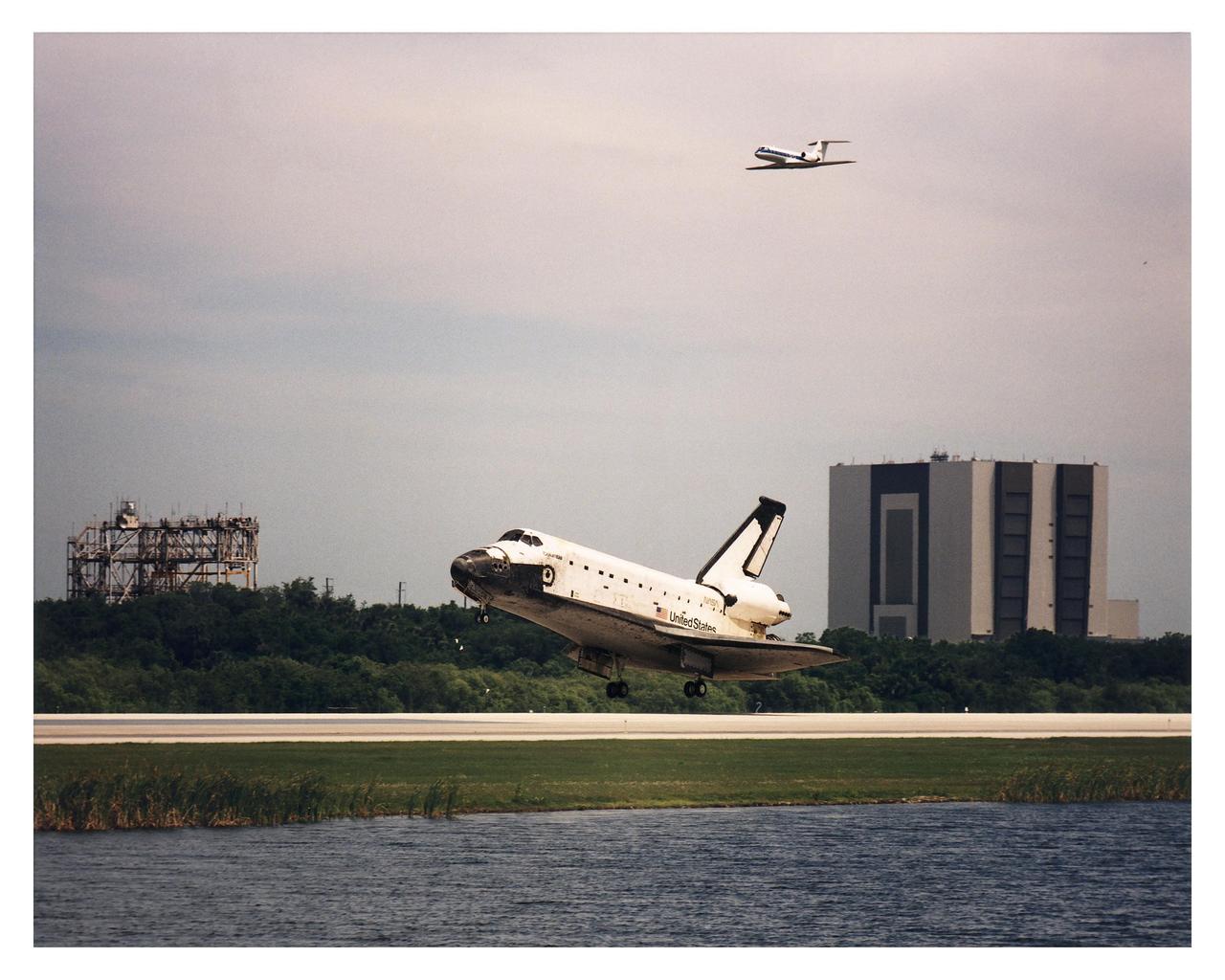
KENNEDY SPACE CENTER, FLA. -- The Space Shuttle Orbiter Columbia glides in for a touchdown on Runway 33 at KSC’s Shuttle Landing Facility that will conclude the Microgravity Science Laboratory-1 (MSL-1) mission. Columbia was scheduled to touch down at 2:33 p.m. EDT, April 8. The Vehicle Assembly Building (VAB) is to the right, while the Mate/Demate Device (MDD) is to the left. A NASA Shuttle Training Aircraft (STA) that acts as a chase plane during landings passes by overhead. With Columbia’s on-time main gear touchdown, the STS-83 mission duration will be 3 days, 23 hours, 12 minutes. The planned 16-day mission was cut short by a faulty fuel cell. This is only the third time in Shuttle program history that an orbiter was brought home early due to mechanical problems. This was also the 36th KSC landing since the program began in 1981
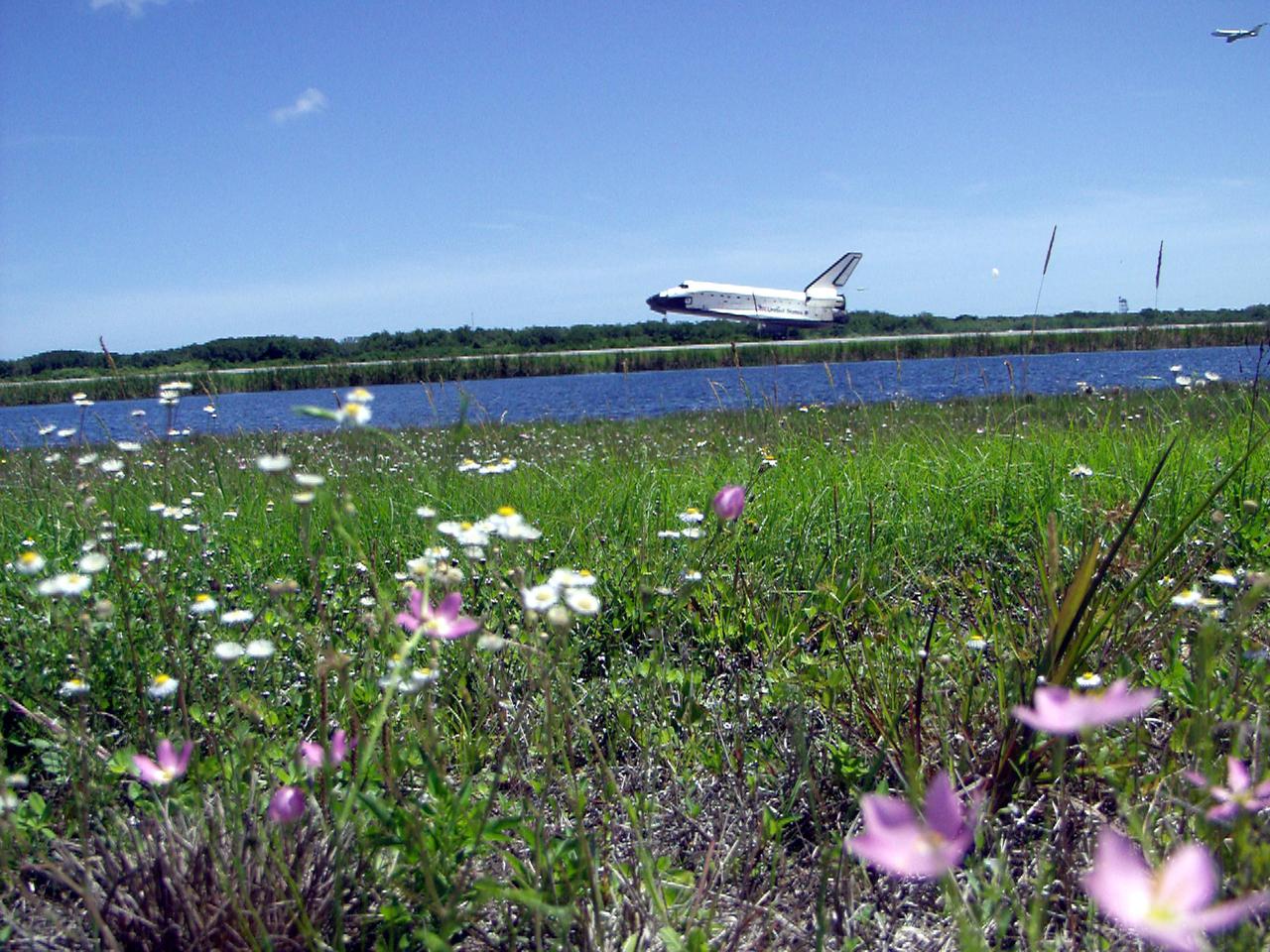
KENNEDY SPACE CENTER, FLA. - A field of wild flowers greets Atlantis as it touches down on runway 33 at KSC, the drag chute just deployed. The landing completes the 10-day, 19-hour, 4.5-million mile mission STS-110 to the International Space Station. In the upper right corner is the chase plane following Atlantis' path. The orbiter carries the returning crew Commander Michael Bloomfield, Pilot Stephen Frick and Mission Specialists Jerry Ross, Steven Smith, Ellen Ochoa, Lee Morin and Rex Walheim. Main gear touchdown was 12:26:57 p.m. EDT, nose gear touchdown was 12:27:09 p.m. and wheel stop was 12:28:07 p.m. The crew delivered and installed the S0 truss, which will support cooling and power systems essential for the addition of future international laboratories, on the Station.
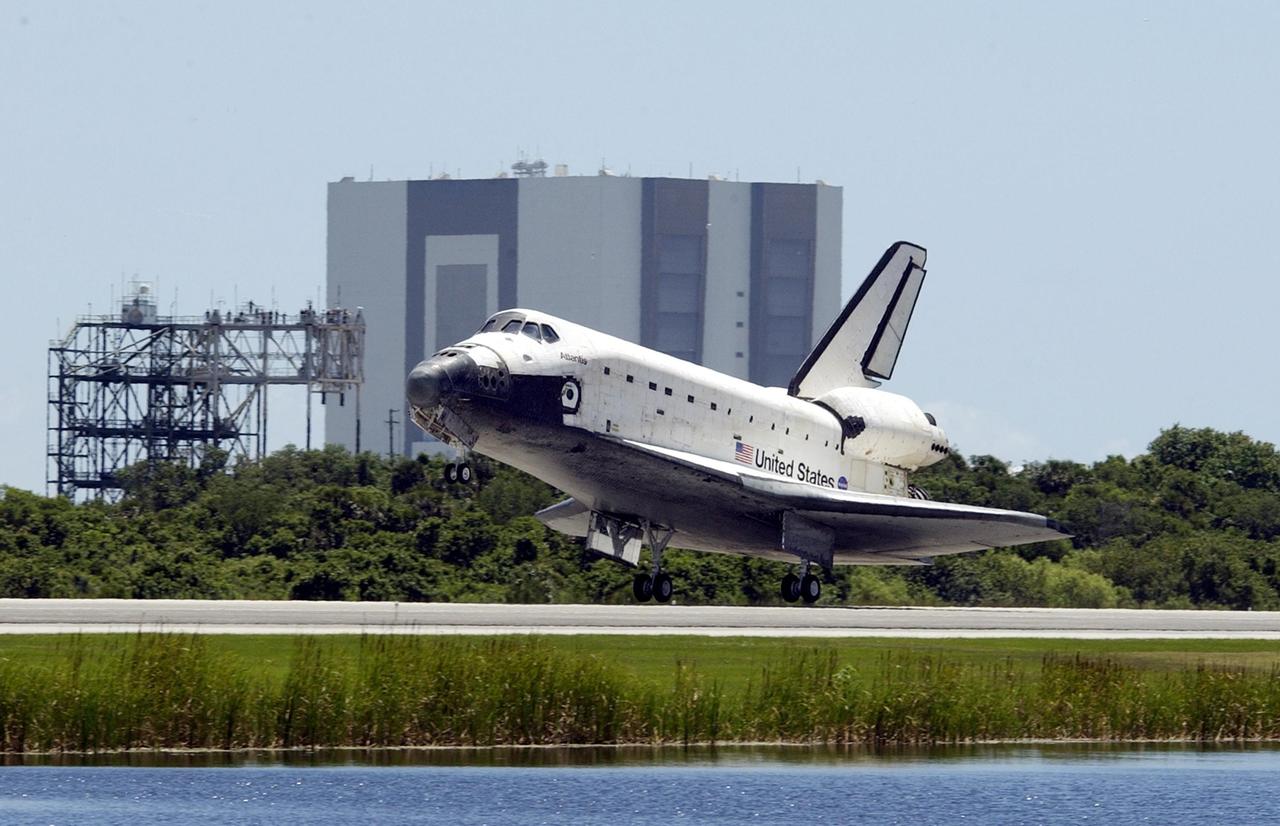
KENNEDY SPACE CENTER, FLA. -- Atlantis approaches touchdown on runway 33 at KSC's Shuttle Landing Facility. The landing completes the 10-day, 19-hour, 4.5-million mile mission STS-110 to the International Space Station. In the upper right corner is the chase plane following Atlantis' path. The orbiter carries the returning crew Commander Michael Bloomfield, Pilot Stephen Frick and Mission Specialists Jerry Ross, Steven Smith, Ellen Ochoa, Lee Morin and Rex Walheim. Main gear touchdown was 12:26:57 p.m. EDT, nose gear touchdown was 12:27:09 p.m. and wheel stop was 12:28:07 p.m. The crew delivered and installed the S0 truss, which will support cooling and power systems essential for the addition of future international laboratories, on the Station
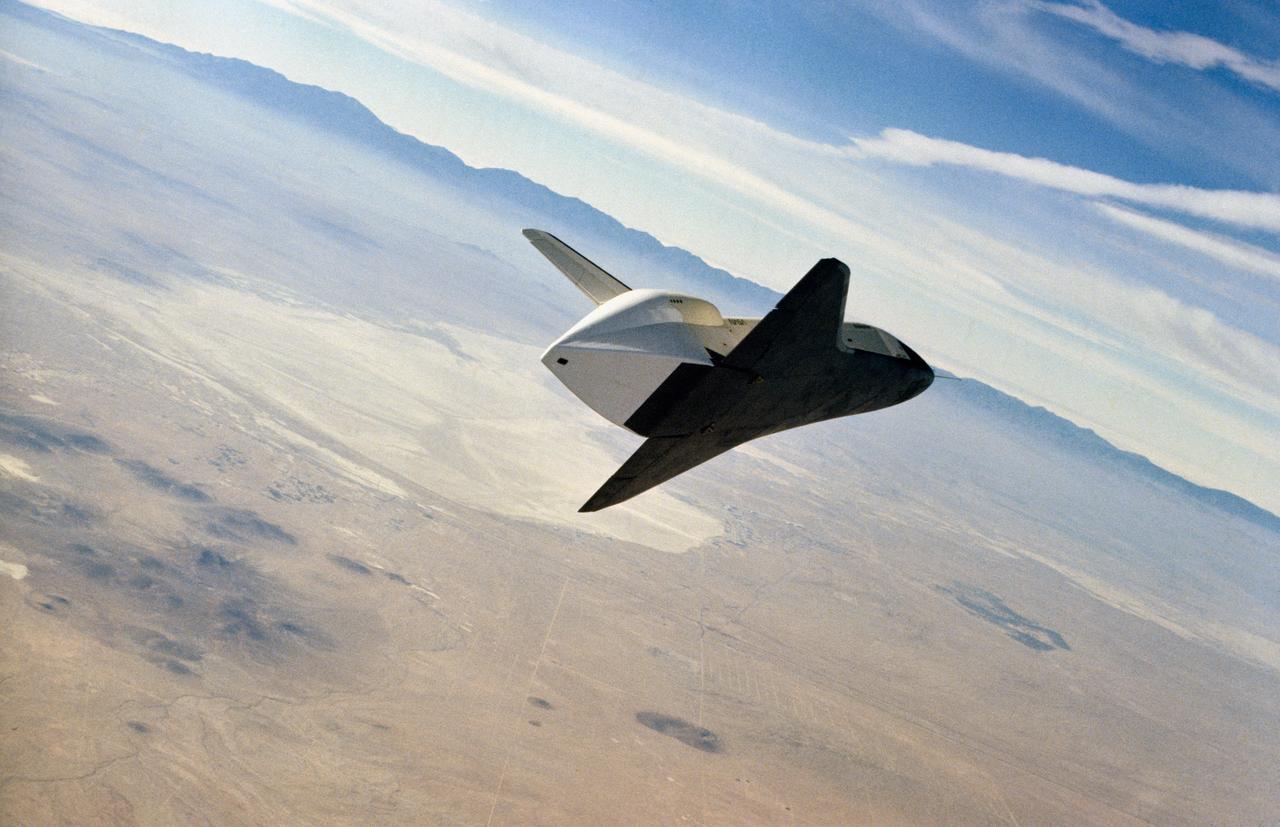
S77-28138 (13 Sept 1977) --- The shuttle Orbiter 101 "Enterprise" makes a slight turn and bank maneuver during the second free flight of the Shuttle Approach and Landing Tests (ALT) conducted on September 13, 1977, at the Dryden Flight Research Center in Southern California. The "Enterprise" separated from the NASA 747 carrier aircraft and landed following a five-minute, 28-second unpowered flight. The Orbiter 101 crew was astronauts Joe H. Engle, commander, and Richard H. Truly, pilot. The ALT free flights are designed to verify orbiter subsonic airworthiness, integrated systems operations and pilot-guided approach and landing capability and satisfy prerequisites to automatic flight control and navigation mode. The orbiter soars above the dry California desert in this post-separation view. Astronaut C. Gordon Fullerton took this picture while riding in T-38 chase plane number one. He used a 35mm Nikon camera with a 50mm lens.
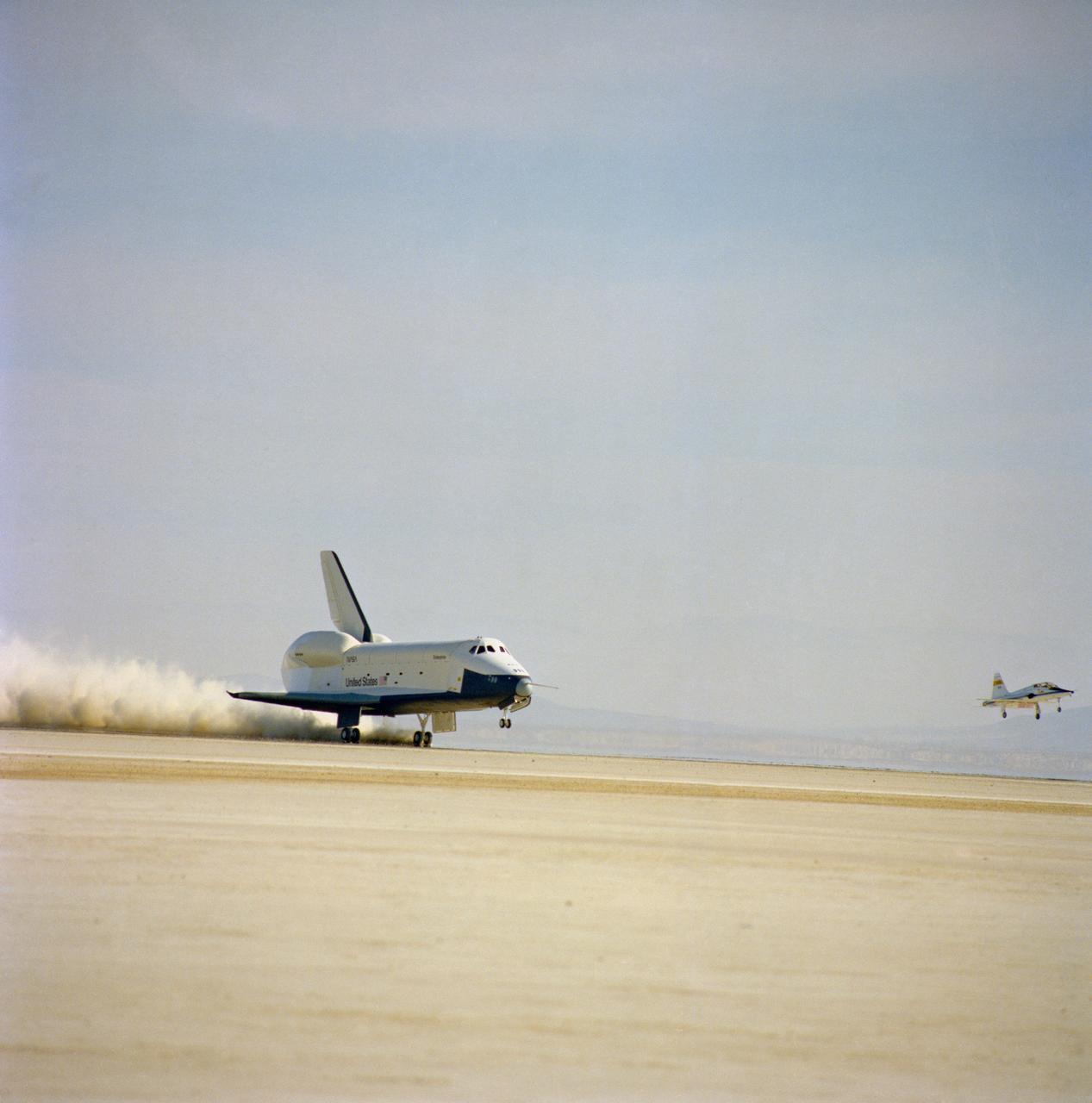
S77-28144 (13 Sept 1977) --- The shuttle orbiter 101 "Enterprise" stirs up a cloud of desert sand and dust as it lands to conclude a five-minute, 28-second unpowered flight during the second free flight of the Shuttle Approach and Landing Tests (ALT) conduced on September 13, 1977 at the Dryden Flight Research Center in Southern California. The Orbiter 101 crew astronauts Joe H. Engle, commander, and Richard H. Truly, pilot. The ALT free flights are designed to verify orbiter subsonic airworthiness, integrated systems operations and pilot-guided approach and landing capability and satisfy prerequisites to automatic flight control and navigation mode. On the right a T-38 chase plane comes in for a landing, also. This picture was taken with an Air Force Test Center 70mm Hasselblad camera installed on a tracking mount parked on the lake bed.
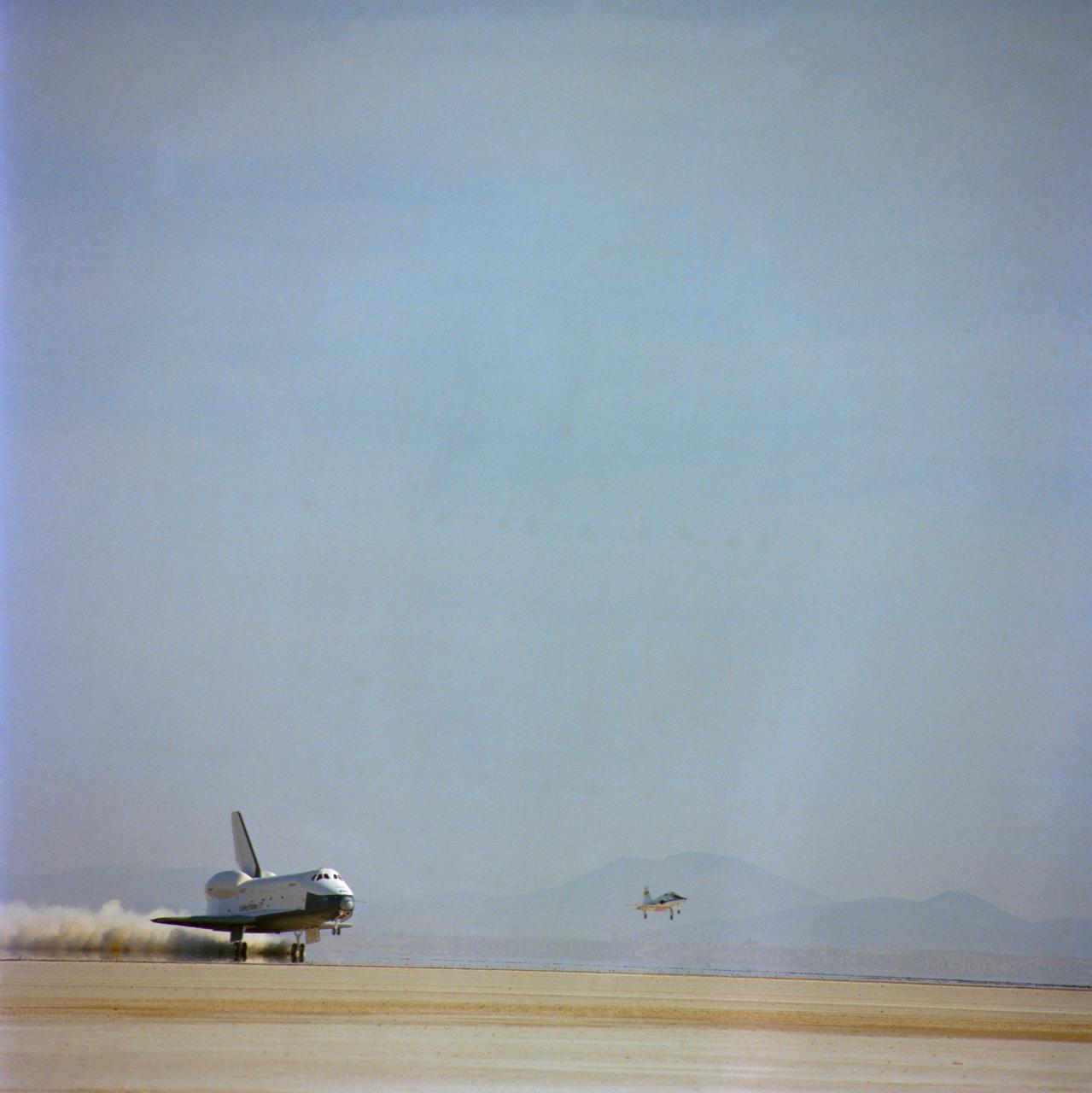
S77-28327 (13 Sept 1977) --- The shuttle orbiter 101 "Enterprise" stirs up a cloud of desert sand and dust as it lands to conclude a five-minute, 28-second unpowered flight during the second free flight of the Shuttle Approach and Landing Tests (ALT) conduced on September 13, 1977 at the Dryden Flight Research Center in Southern California. The Orbiter 101 crew astronauts Joe H. Engle, commander, and Richard H. Truly, pilot. The ALT free flights are designed to verify orbiter subsonic airworthiness, integrated systems operations and pilot-guided approach and landing capability and satisfy prerequisites to automatic flight control and navigation mode. On the right a T-38 chase plane comes in for a landing, also. This picture was taken with an Air Force Test Center 70mm Hasselblad camera installed on a tracking mount parked on the lake bed.
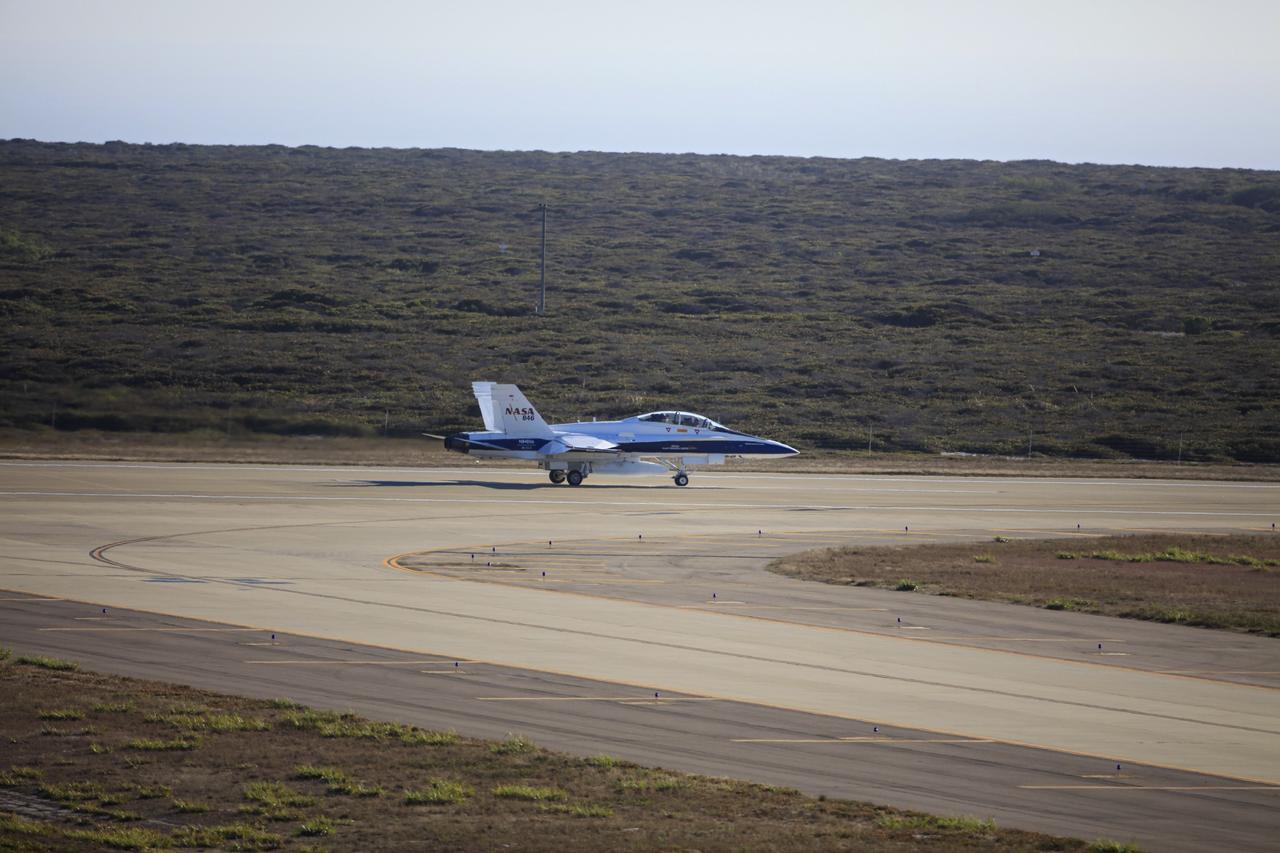
VANDENBERG AIR FORCE BASE, Calif. – An F-18 aircraft departs from Vandenberg Air Force Base in California. The plane will serve as the "chase plane" accompanying the Orbital Sciences L-1011 aircraft as it transports the Pegasus XL rocket carrying NASA's Interface Region Imaging Spectrograph, or IRIS, solar observatory over the Pacific Ocean. Release of the rocket from under the wing of the L-1011 is scheduled for 10:27 p.m. EDT. IRIS will open a new window of discovery using spectrometry and imaging to trace the flow of energy and plasma through the chromospheres and transition region into the sun’s corona. The spacecraft will observe how solar material moves, gathers energy and heats up as it travels through a largely unexplored region of the solar atmosphere. This interface region, located between the sun's visible surface and its upper atmosphere, is where most of its ultraviolet emission is generated. These emissions impact the near-Earth space environment and Earth's climate. NASA's Launch Services Program at the agency's Kennedy Space Center in Florida is managing the countdown and launch. For more information, visit http://www.nasa.gov/iris. Photo credit: NASA/Daniel Casper
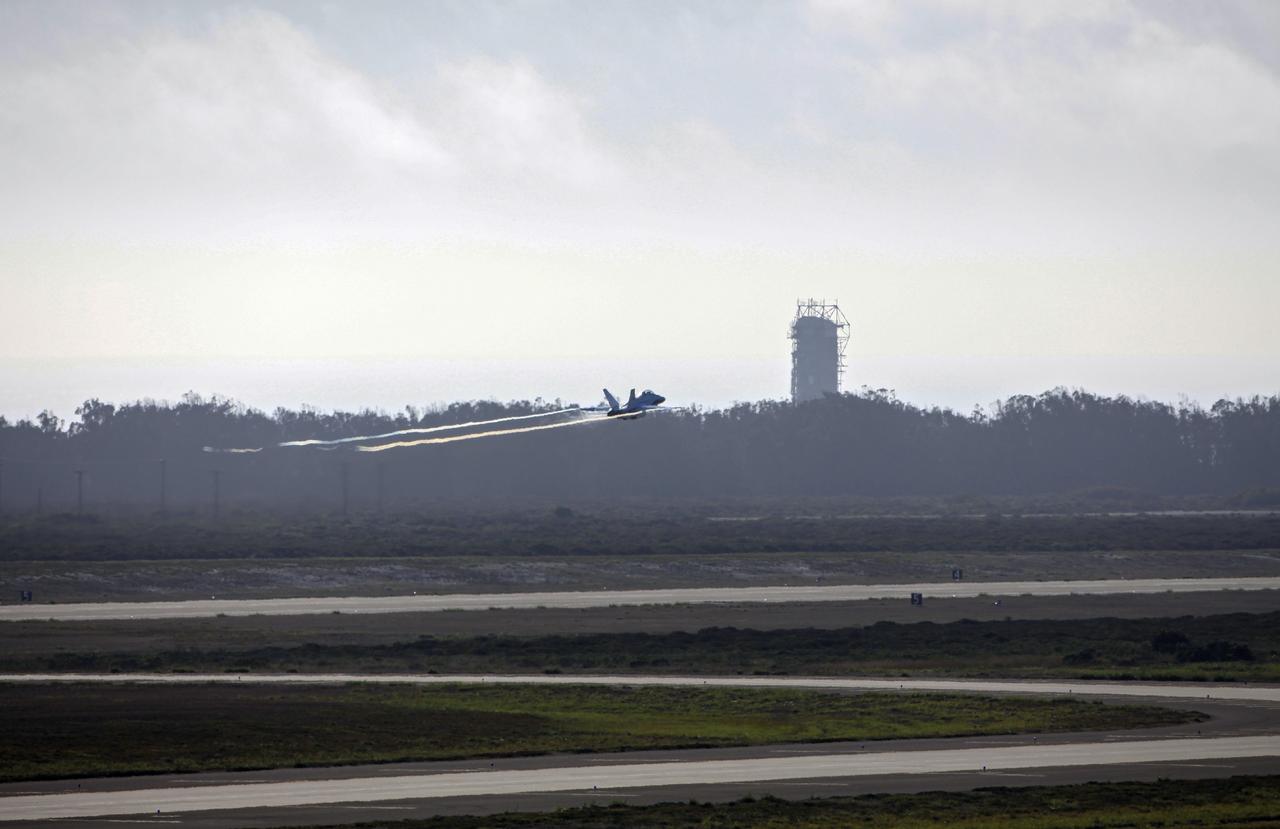
VANDENBERG AIR FORCE BASE, Calif. – An F-18 aircraft flies by a launch pad as it departs from Vandenberg Air Force Base in California. The plane will serve as the "chase plane" accompanying the Orbital Sciences L-1011 aircraft as it transports the Pegasus XL rocket carrying NASA's Interface Region Imaging Spectrograph, or IRIS, solar observatory over the Pacific Ocean. Release of the rocket from under the wing of the L-1011 is scheduled for 10:27 p.m. EDT. IRIS will open a new window of discovery using spectrometry and imaging to trace the flow of energy and plasma through the chromospheres and transition region into the sun’s corona. The spacecraft will observe how solar material moves, gathers energy and heats up as it travels through a largely unexplored region of the solar atmosphere. This interface region, located between the sun's visible surface and its upper atmosphere, is where most of its ultraviolet emission is generated. These emissions impact the near-Earth space environment and Earth's climate. NASA's Launch Services Program at the agency's Kennedy Space Center in Florida is managing the countdown and launch. For more information, visit http://www.nasa.gov/iris. Photo credit: NASA/Daniel Casper
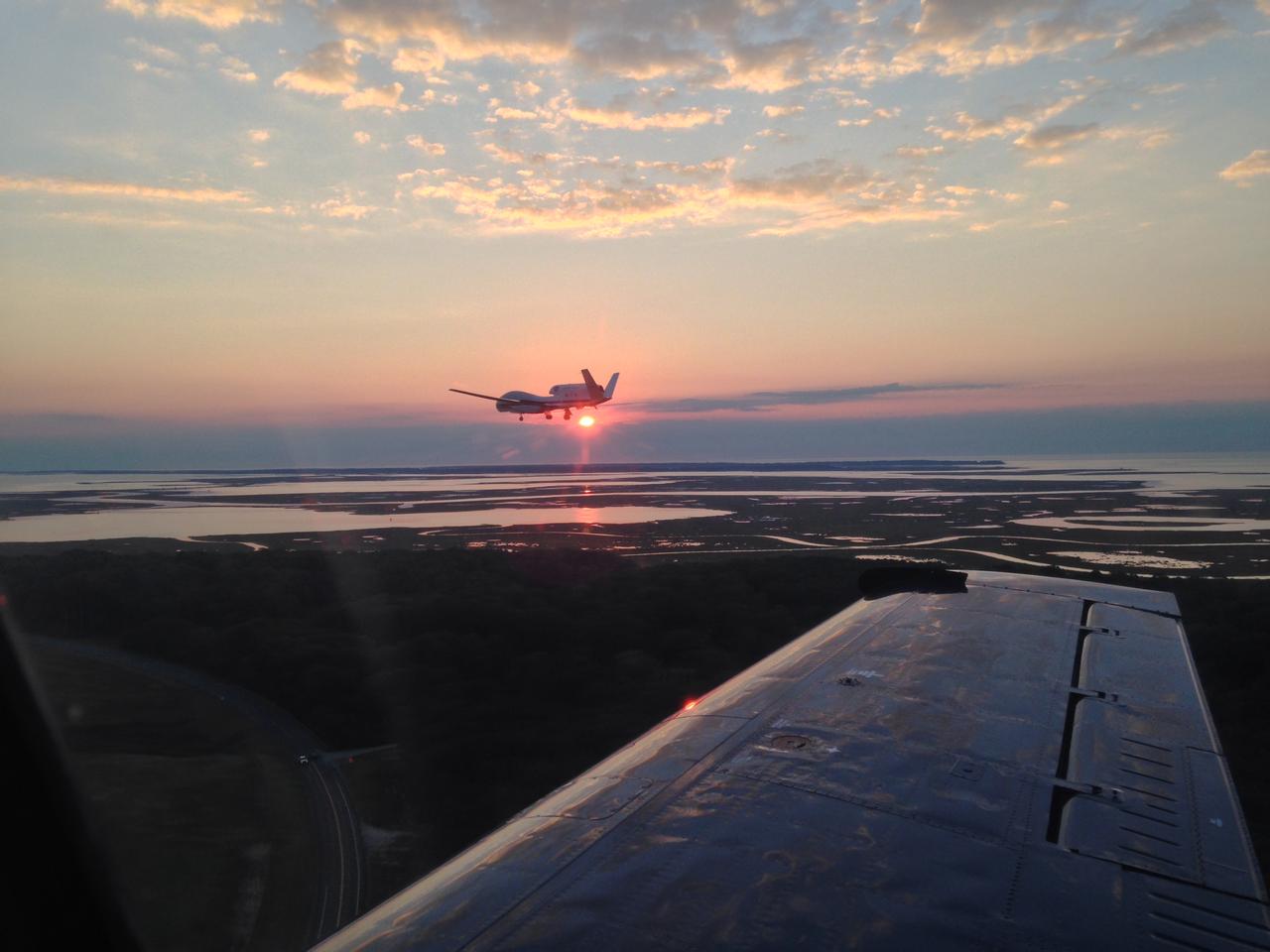
View from a Chase Plane; HS3 Science Flight 8 Wraps Up The chase plane accompanying NASA's Global Hawk No. 872 captured this picture on Sept. 19 after the Global Hawk completed science flight #8 where it gathered data from a weakening Tropical Storm Edouard over the North Atlantic Ocean. Credit: NASA -- The Hurricane and Severe Storm Sentinel (HS3) is a five-year mission specifically targeted to investigate the processes that underlie hurricane formation and intensity change in the Atlantic Ocean basin. HS3 is motivated by hypotheses related to the relative roles of the large-scale environment and storm-scale internal processes. Read more: espo.nasa.gov/missions/hs3/mission-gallery <b><a href="http://www.nasa.gov/audience/formedia/features/MP_Photo_Guidelines.html" rel="nofollow">NASA image use policy.</a></b> <b><a href="http://www.nasa.gov/centers/goddard/home/index.html" rel="nofollow">NASA Goddard Space Flight Center</a></b> enables NASA’s mission through four scientific endeavors: Earth Science, Heliophysics, Solar System Exploration, and Astrophysics. Goddard plays a leading role in NASA’s accomplishments by contributing compelling scientific knowledge to advance the Agency’s mission. <b>Follow us on <a href="http://twitter.com/NASAGoddardPix" rel="nofollow">Twitter</a></b> <b>Like us on <a href="http://www.facebook.com/pages/Greenbelt-MD/NASA-Goddard/395013845897?ref=tsd" rel="nofollow">Facebook</a></b> <b>Find us on <a href="http://instagram.com/nasagoddard?vm=grid" rel="nofollow">Instagram</a></b>
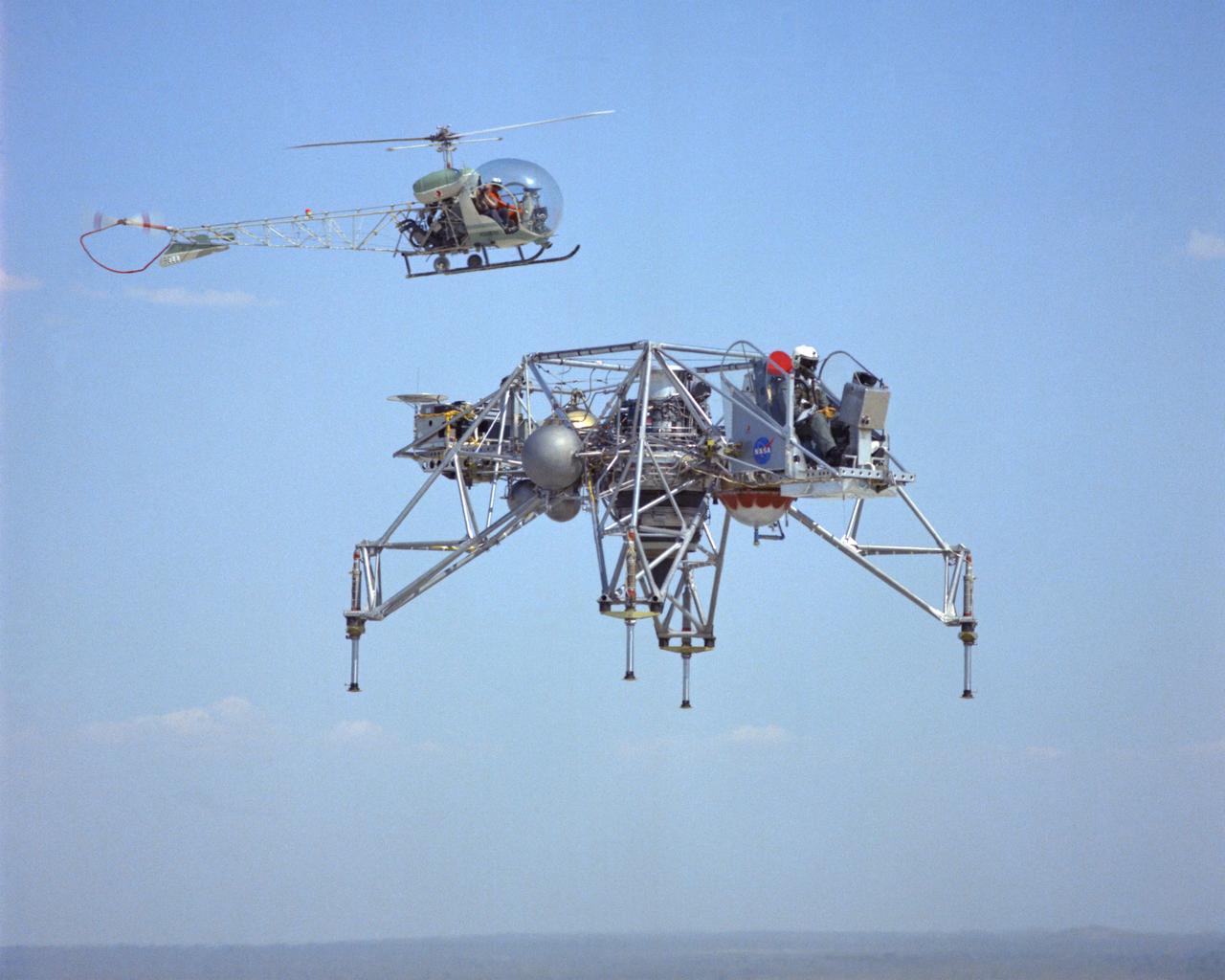
LLRV flight #1-16-61F with Bell 47 Helicopter providing chase support. The use of chase planes was a critical part of flight research well before the establishment of what was then called the NACA Muroc Flight Test Unit in September 1947 (now the NASA Dryden Flight Research Center). They act as a second set of eyes for the research pilot, warning him of any problems. When test flights of the LLRV began in October 1964, chase support for the vehicle was supplied by a Bell 47 helicopter. It could hover close by, providing information such as altitude and descent rate. LLRV test operations were phased out in late 1966 and early 1967. When Apollo planning was underway in 1960, NASA was looking for a simulator to profile the descent to the Moon's surface. Three concepts surfaced: an electronic simulator, a tethered device, and the ambitious Dryden contribution, a free-flying vehicle. All three became serious projects, but eventually the NASA Flight Research Center’s (FRC) Lunar Landing Research Vehicle (LLRV) became the most significant one. After conceptual planning and meetings with engineers from Bell Aerosystems Company, Buffalo, N.Y., NASA FRC issued a $3.6 million production contract awarded in 1963, for delivery of the first of two vehicles for flight studies. Built of tubular aluminum alloy like a giant four-legged bedstead, the vehicle was to simulate a lunar landing profile from around 1500 feet to the Moon’s surface. The LLRV had a turbofan engine mounted vertically in a gimbal, with 4200 pounds of thrust. The engine, lifted the vehicle up to the test altitude and was then throttled back to support five-sixths of the vehicle's weight, thus simulating the reduced gravity of the Moon. Two lift rockets with thrust that could be varied from 100 to 500 pounds handled the LLRV's rate of descent and horizontal translations. Sixteen smaller rockets, mounted in pairs, gave the pilot control in pitch, yaw, and roll. The pilot’s platform extended forward between t

On June 12, 2018, NASA’s remotely-piloted Ikhana aircraft, lifted off from Edwards Air Force Base for its first mission in the National Airspace System without a safety chase aircraft. The June 12 flight successfully demonstrated the first remotely-piloted aircraft to use airborne detect and avoid technology to meet the intent of the FAA’s “see and avoid” rules.

On June 12, 2018, NASA’s remotely-piloted Ikhana aircraft, based at the agency’s Armstrong Flight Research Center in Edwards, California, lifted off for its first mission in the National Airspace System without a safety chase aircraft. The June 12 flight successfully demonstrated the first remotely-piloted aircraft to use airborne detect and avoid technology to meet the intent of the FAA’s “see and avoid” rules.
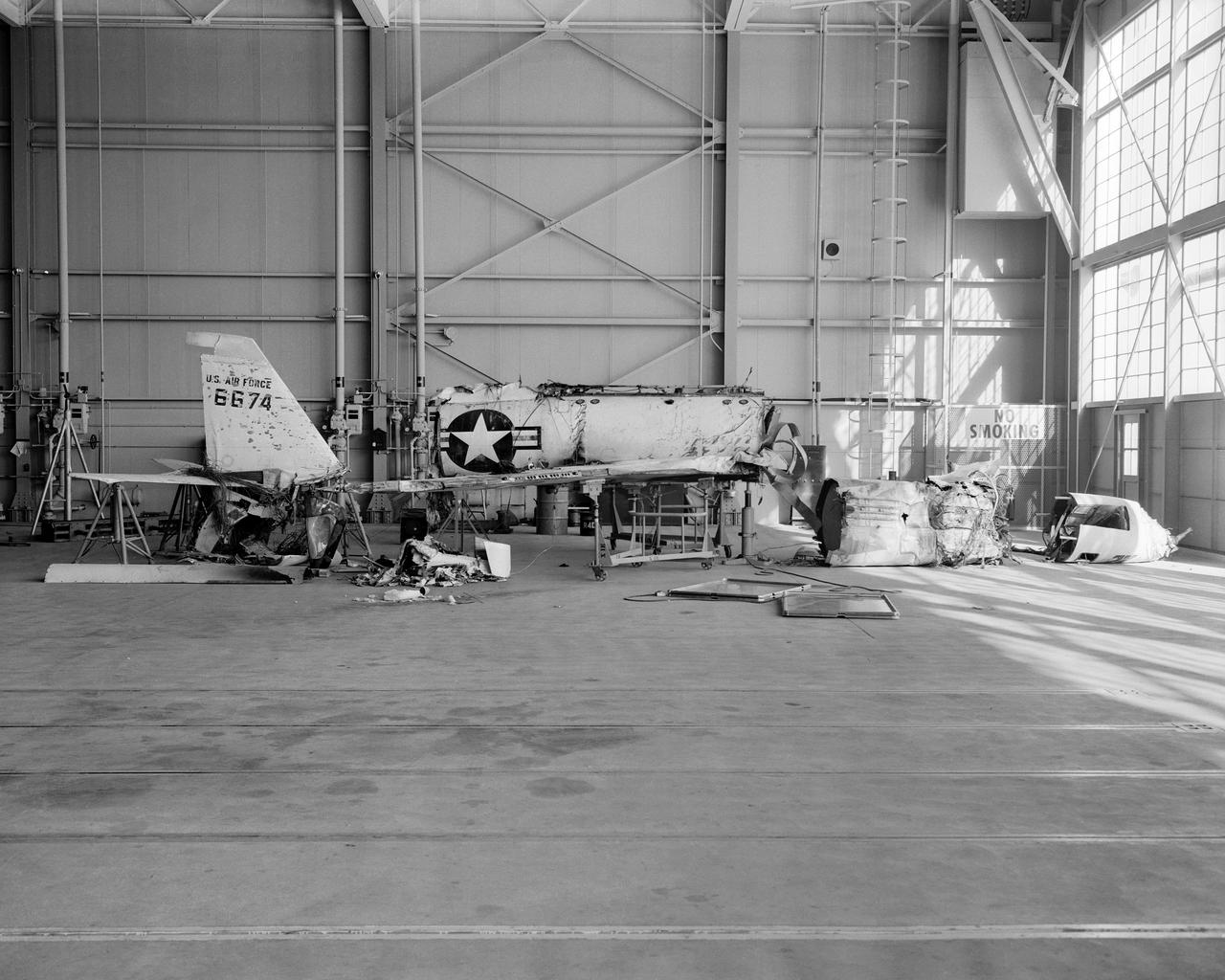
The X-2, initially an Air Force program, was scheduled to be transferred to the civilian National Advisory Committee for Aeronautics (NACA) for scientific research. The Air Force delayed turning the aircraft over to the NACA in the hope of attaining Mach 3 in the airplane. The service requested and received a two-month extension to qualify another Air Force test pilot, Capt. Miburn "Mel" Apt, in the X-2 and attempt to exceed Mach 3. After several ground briefings in the simulator, Apt (with no previous rocket plane experience) made his flight on 27 September 1956. Apt raced away from the B-50 under full power, quickly outdistancing the F-100 chase planes. At high altitude, he nosed over, accelerating rapidly. The X-2 reached Mach 3.2 (2,094 mph) at 65,000 feet. Apt became the first man to fly more than three times the speed of sound. Still above Mach 3, he began an abrupt turn back to Edwards. This maneuver proved fatal as the X-2 began a series of diverging rolls and tumbled out of control. Apt tried to regain control of the aircraft. Unable to do so, Apt separated the escape capsule. Too late, he attempted to bail out and was killed when the capsule impacted on the Edwards bombing range. The rest of the X-2 crashed five miles away. The wreckage of the X-2 rocket plane was later taken to NACA's High Speed Flight Station for analysis following the crash.
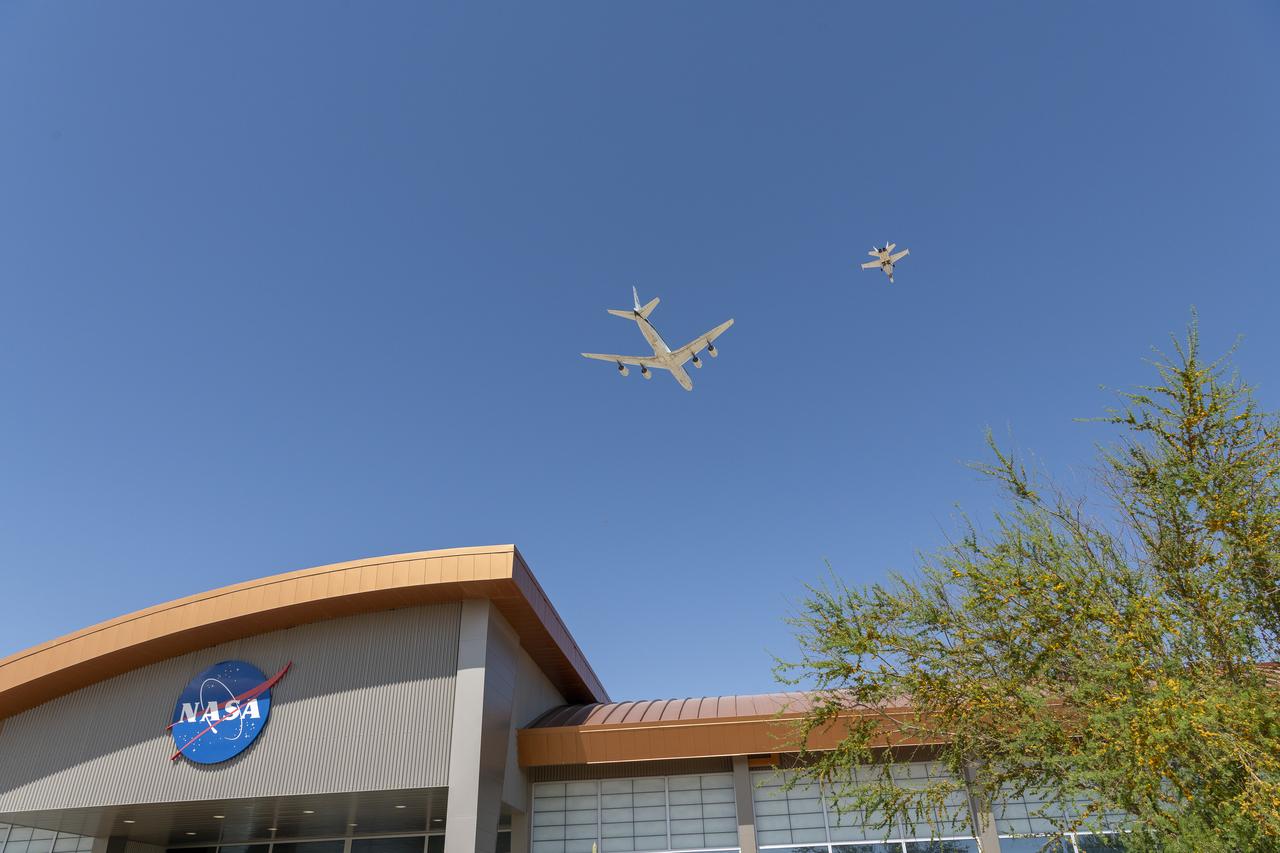
The DC-8 flies low for the last time over NASA’s Armstrong Flight Research Center in Edwards, California, before it retires to Idaho State University in Pocatello, Idaho. The DC-8 will provide real-world experience to train future aircraft technicians at the college’s Aircraft Maintenance Technology Program.
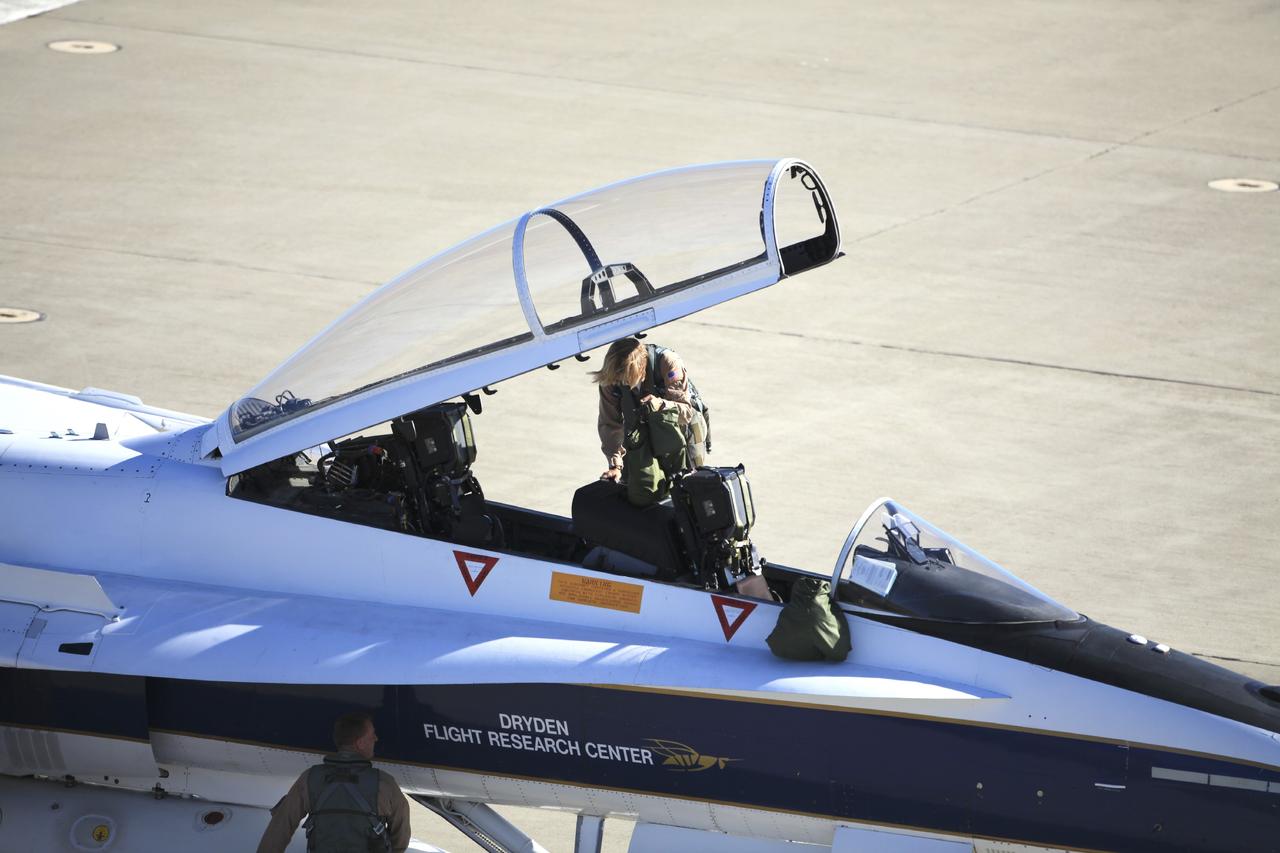
VANDENBERG AIR FORCE BASE, Calif. – Videographer Lori Losey boards an F-18 aircraft at Vandenberg Air Force Base in California. The F-18 "chase plane" will accompany the Orbital Sciences L-1011 aircraft as it transports the Pegasus XL rocket carrying NASA's Interface Region Imaging Spectrograph, or IRIS, solar observatory over the Pacific Ocean. Release of the rocket from under the wing of the L-1011 is scheduled for 10:27 p.m. EDT. IRIS will open a new window of discovery using spectrometry and imaging to trace the flow of energy and plasma through the chromospheres and transition region into the sun’s corona. The spacecraft will observe how solar material moves, gathers energy and heats up as it travels through a largely unexplored region of the solar atmosphere. This interface region, located between the sun's visible surface and its upper atmosphere, is where most of its ultraviolet emission is generated. These emissions impact the near-Earth space environment and Earth's climate. NASA's Launch Services Program at the agency's Kennedy Space Center in Florida is managing the countdown and launch. For more information, visit http://www.nasa.gov/iris. Photo credit: NASA/Daniel Casper
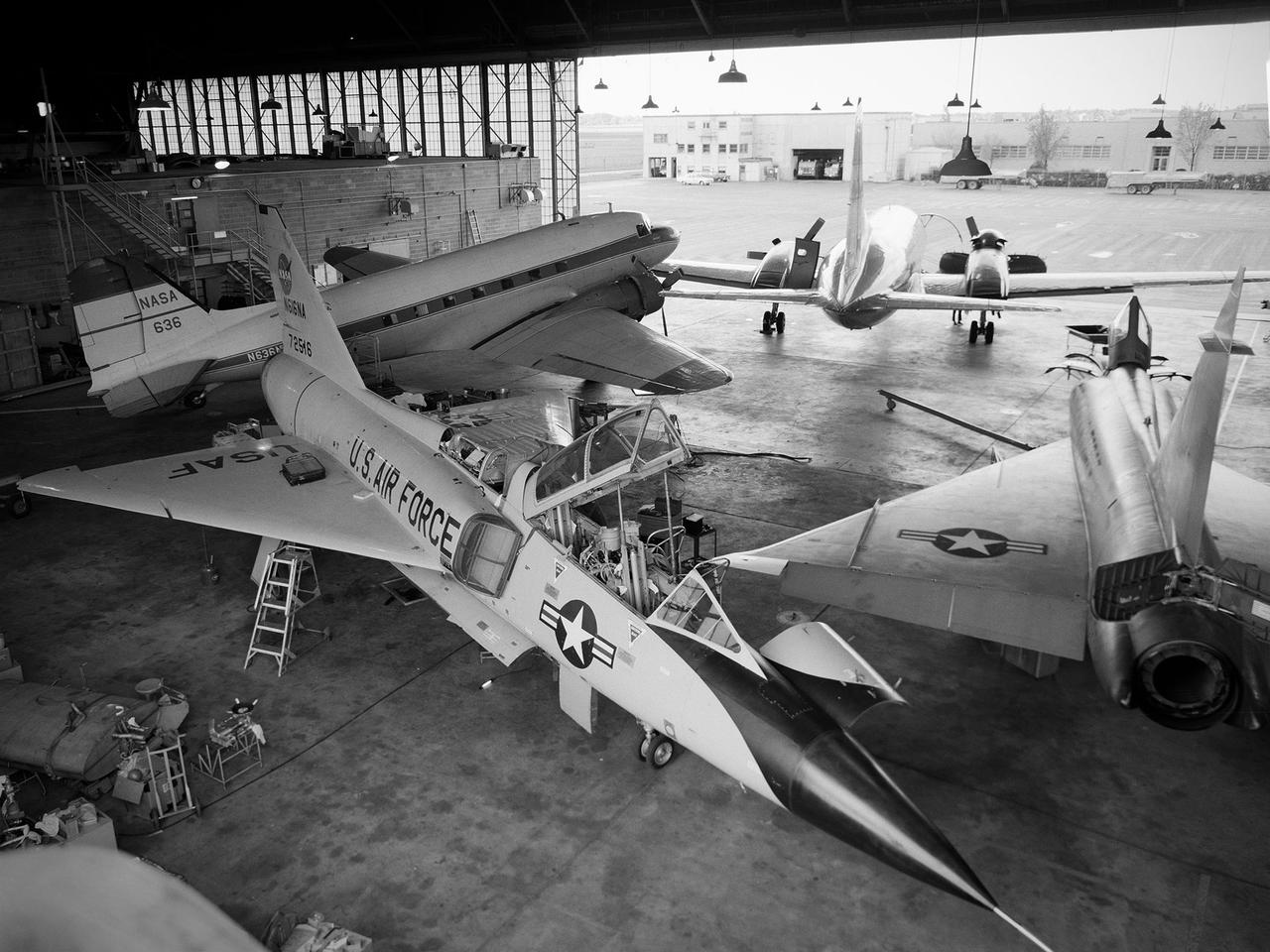
Several aircraft parked inside the Flight Research Building, or hangar, at the National Aeronautics and Space Administration (NASA) Lewis Research Center in Cleveland, Ohio. A Convair F-106B Delta Dart is in the foreground, a Convair F-102A Delta Dagger is to the right, a Douglas DC-3 is in the back to left, and a Convair T-29 is in background. Lewis’ Martin B-57B Canberra is not seen in this photograph. The F-102A had just been acquired by Lewis to serve as a chase plane for the F-106B. The Lewis team removed the weapons system and 700 pounds of wire from the F-106B when it was acquired on October 20, 1966. The staff cut holes in the wings and modified the elevons to mount the test nacelles. A 228-gallon fuel tank was installed in the missile bay, and the existing wing tanks were used for instrumentation. This photograph contains a rare view of the Block House, seen to the left of the aircraft. Lewis acquired three large developmental programs in 1962—the Centaur and Agena rockets and the M-1 engine. The center was short on office space at the time, and its flight research program was temporarily on the wane. Lewis management decided to construct a large cinderblock structure inside one half of the hangar to house the new personnel. This structure was used until 1965 when the new Developmental Engineering Building was built. The Block House was eventually torn down in 1973.
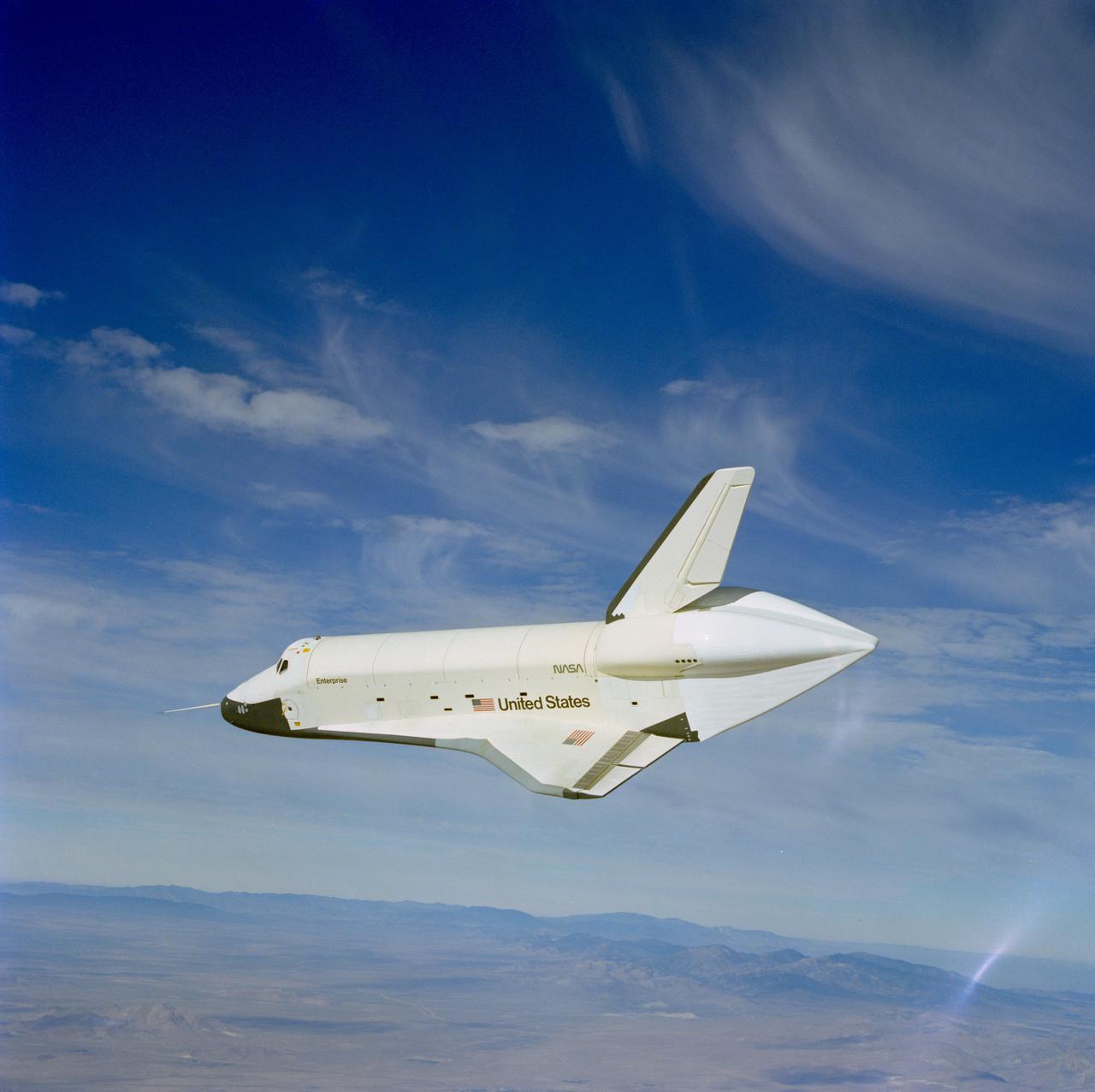
S77-28141 (13 Sept 1977) --- The shuttle Orbiter 101 "Enterprise" makes a slight turn and bank maneuver during the second free flight of the Shuttle Approach and Landing Tests (ALT) conducted on September 13, 1977, at the Dryden Flight Research Center in Southern California. The "Enterprise" separated from the NASA 747 carrier aircraft and landed following a five-minute, 28-second unpowered flight. The Orbiter 101 crew was astronauts Joe H. Engle, commander, and Richard H. Truly, pilot. The ALT free flights are designed to verify orbiter subsonic airworthiness, integrated systems operations and pilot-guided approach and landing capability and satisfy prerequisites to automatic flight control and navigation mode. The orbiter soars above the dry California desert in this post-separation view. Photographer Bill Blunck of JSC's Photographic Technology Laboratory took this picture while riding in T-38 chase plane number two. He used a 70mm Hasselblad camera with an 80mm lens.
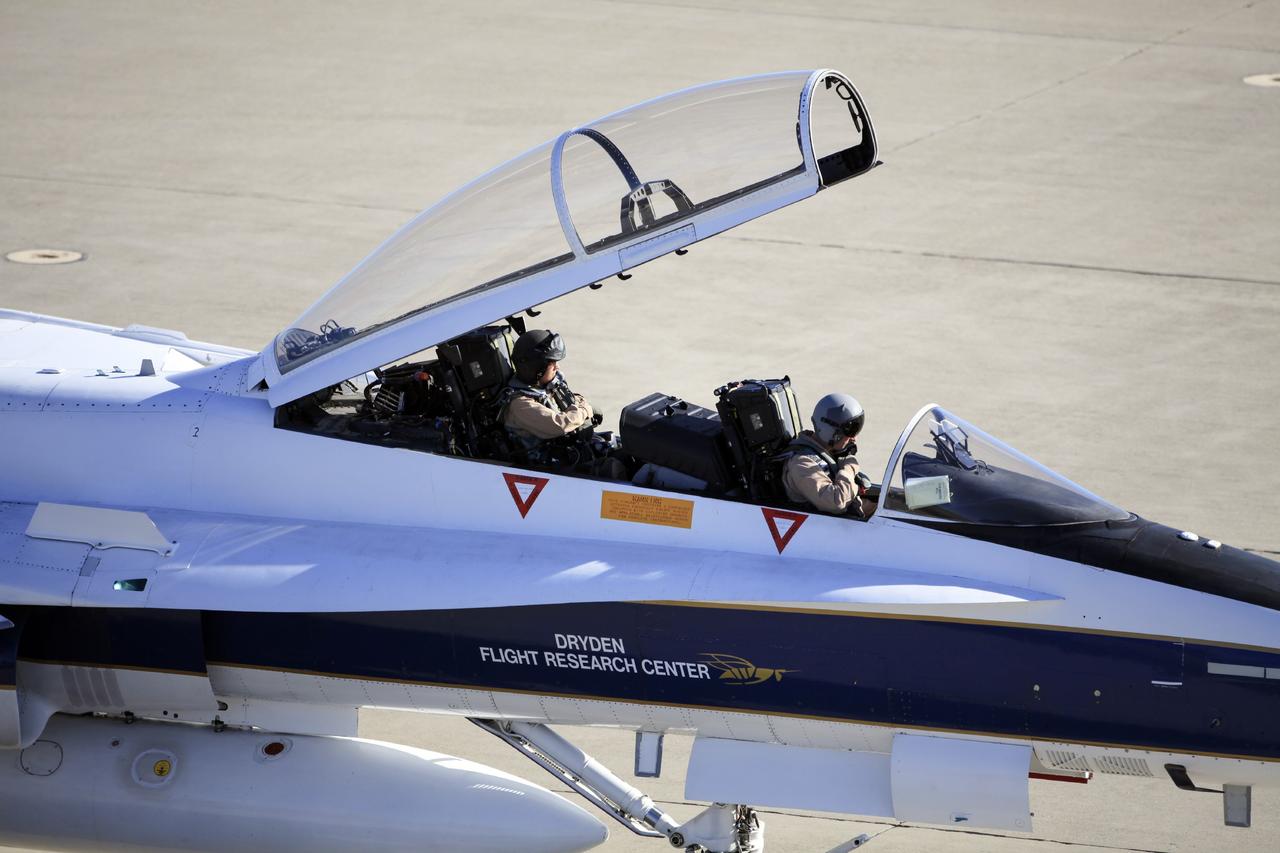
VANDENBERG AIR FORCE BASE, Calif. – Videographer Lori Losey, back seat, and pilot Jim Less board an F-18 aircraft at Vandenberg Air Force Base in California. The F-18 will be the "chase plane" for the Orbital Sciences L-1011 aircraft transporting the Pegasus XL rocket that will launch NASA's Interface Region Imaging Spectrograph, or IRIS, solar observatory to orbit. Release of the rocket from under the wing of the L-1011 is scheduled for 10:27 p.m. EDT. IRIS will open a new window of discovery using spectrometry and imaging to trace the flow of energy and plasma through the chromospheres and transition region into the sun’s corona. The spacecraft will observe how solar material moves, gathers energy and heats up as it travels through a largely unexplored region of the solar atmosphere. This interface region, located between the sun's visible surface and its upper atmosphere, is where most of its ultraviolet emission is generated. These emissions impact the near-Earth space environment and Earth's climate. NASA's Launch Services Program at the agency's Kennedy Space Center in Florida is managing the countdown and launch. For more information, visit http://www.nasa.gov/iris. Photo credit: NASA/Daniel Casper
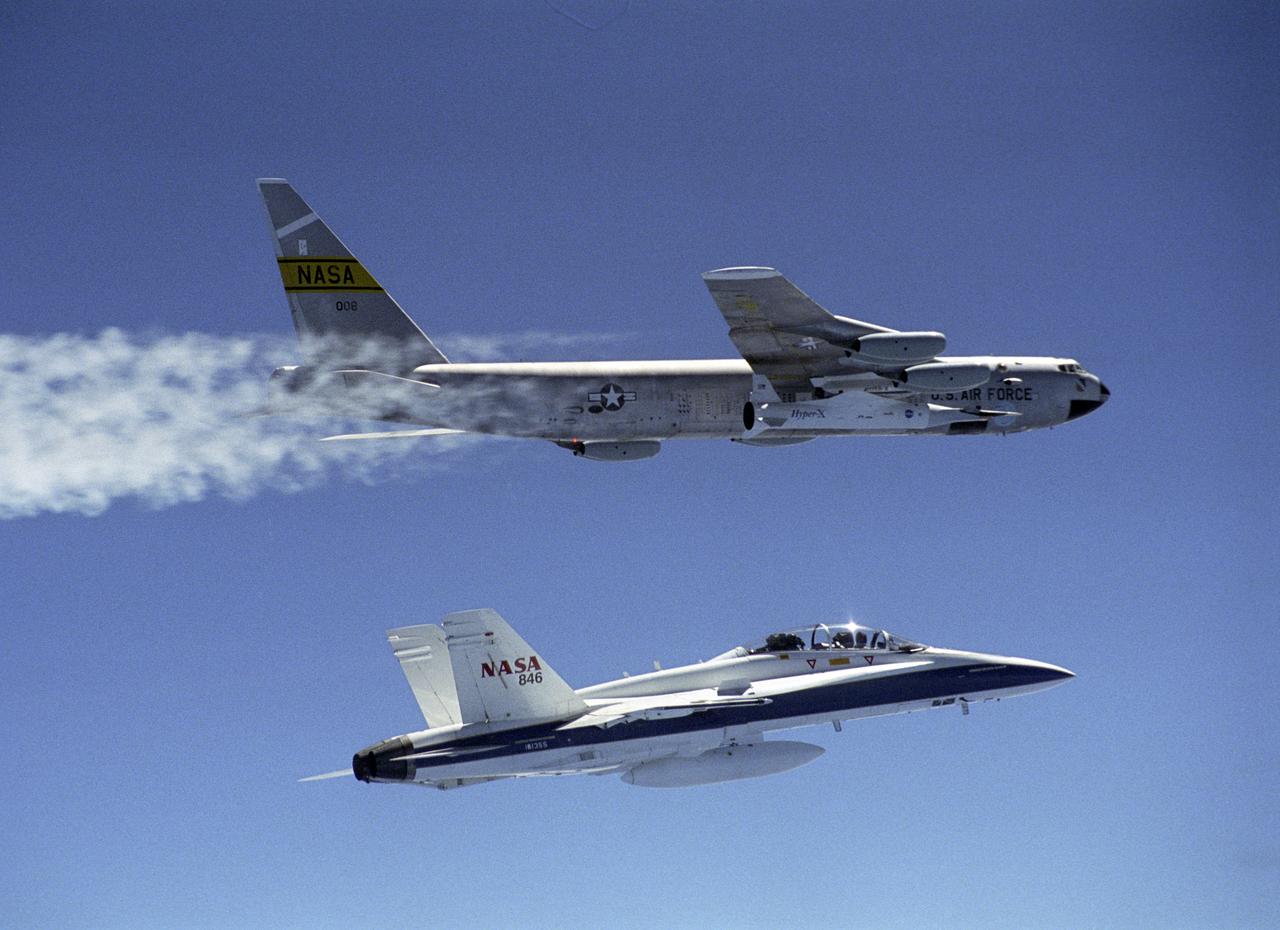
The second X-43A hypersonic research aircraft, attached to a modified Pegasus booster rocket and followed by a chase F-18, was taken to launch altitude by NASA's B-52B launch aircraft from the NASA Dryden Flight Research Center at Edwards Air Force Base, Calif., on March 27, 2004. About an hour later the Pegasus booster was released from the B-52 to accelerate the X-43A to its intended speed of Mach 7. In a combined research effort involving Dryden, Langley, and several industry partners, NASA demonstrated the value of its X-43A hypersonic research aircraft, as it became the first air-breathing, unpiloted, scramjet-powered plane to fly freely by itself. The March 27 flight, originating from NASA's Dryden Flight Research Center, began with the Agency's B-52B launch aircraft carrying the X-43A out to the test range over the Pacific Ocean off the California coast. The X-43A was boosted up to its test altitude of about 95,000 feet, where it separated from its modified Pegasus booster and flew freely under its own power. Two very significant aviation milestones occurred during this test flight: first, controlled accelerating flight at Mach 7 under scramjet power, and second, the successful stage separation at high dynamic pressure of two non-axisymmetric vehicles. To top it all off, the flight resulted in the setting of a new aeronautical speed record. The X-43A reached a speed of over Mach 7, or about 5,000 miles per hour faster than any known aircraft powered by an air-breathing engine has ever flown.
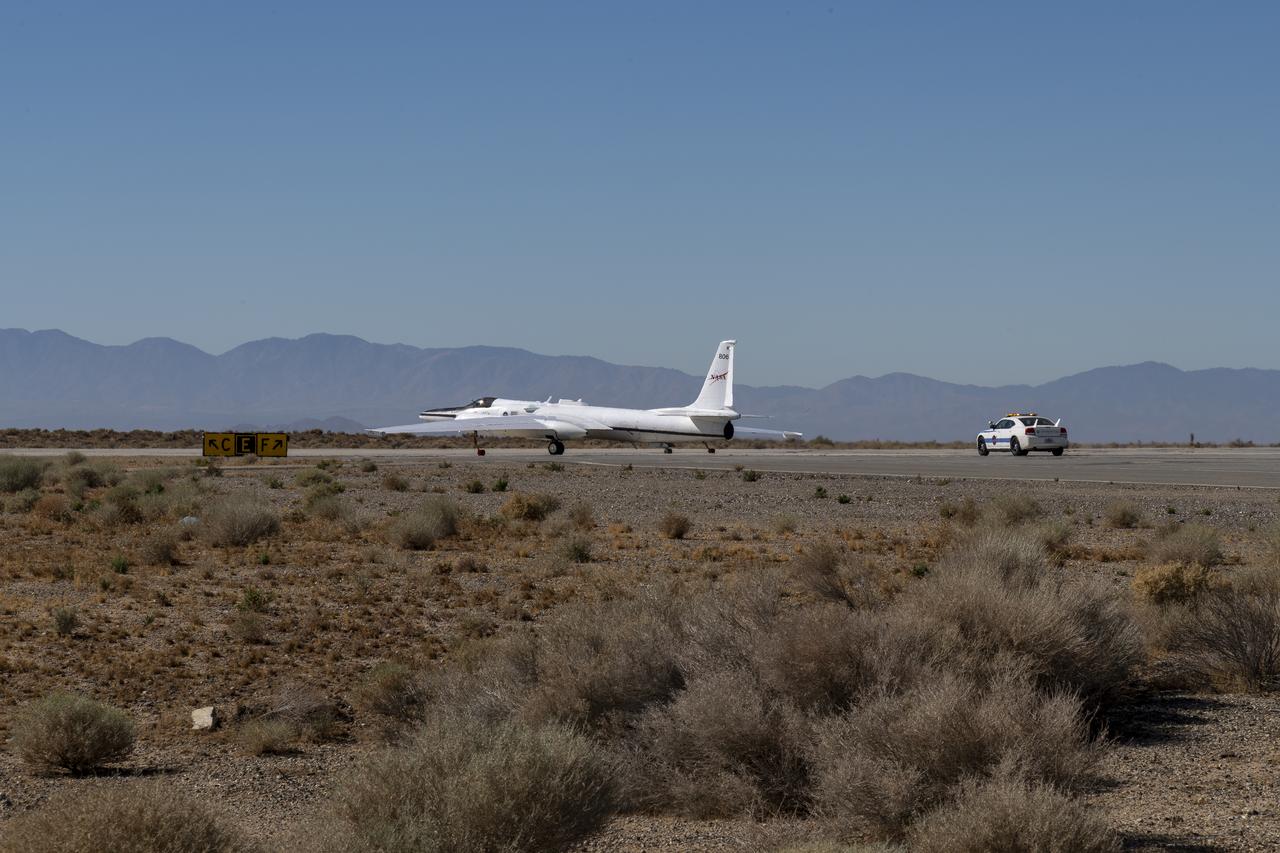
The ER-2 conducted over 80 flight hours in service of the Plankton, Aerosol, Cloud, ocean Ecosystem Postlaunch Airborne eXperiment (PACE-PAX) mission. The ER-2 is uniquely qualified to conduct the high-altitude scientific flights that this project required, and is based at NASA’s Armstrong Flight Research Center in Edwards, California.
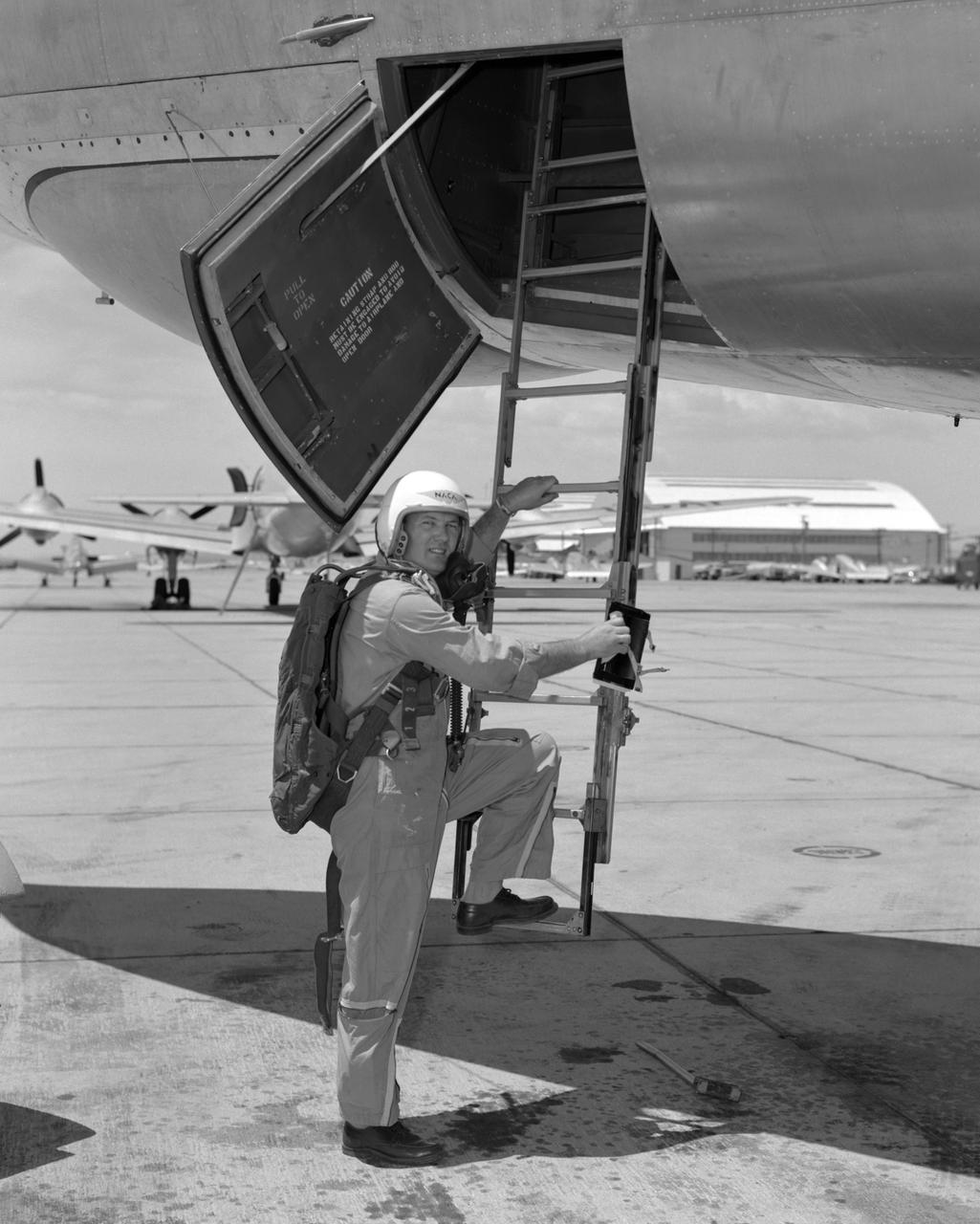
From December 10, 1966, until his retirement on February 27, 1976, Stanley P. Butchart served as Chief (later, Director) of Flight Operations at NASA's Flight Research Center (renamed on March 26, 1976, the Hugh L. Dryden Flight Research Center). Initially, his responsibilities in this position included the Research Pilots Branch, a Maintenance and Manufacturing Branch, and an Operations Engineering Branch, the last of which not only included propulsion and electrical/electronic sections but project engineers for the X-15 and lifting bodies. During his tenure, however, the responsibilities of his directorate came to include not only Flight Test Engineering Support but Flight Systems and Loads laboratories. Before becoming Chief of Flight Operations, Butchart had served since June of 1966 as head of the Research Pilots Branch (Chief Pilot) and then as acting chief of Flight Operations. He had joined the Center (then known as the National Advisory Committee for Aeronautics' High-Speed Flight Research Station) as a research pilot on May 10, 1951. During his career as a research pilot, he flew a great variety of research and air-launch aircraft including the D-558-I, D-558-II, B-29 (plus its Navy version, the P2B), X-4, X-5, KC-135, CV-880, CV-990, B-47, B-52, B-747, F-100A, F-101, F-102, F-104, PA-30 Twin Comanche, JetStar, F-111, R4D, B-720, and B-47. Although previously a single-engine pilot, he became the Center's principal multi-engine pilot during a period of air-launches in which the pilot of the air-launch aircraft (B-29 or P2B) basically directed the operations. It was he who called for the chase planes before each drop, directed the positioning of fire rescue vehicles, and released the experimental aircraft after ensuring that all was ready for the drop. As pilot of the B-29 and P2B, Butchart launched the X-1A once, the X-1B 13 times, the X-1E 22 times, and the D-558-II 102 times. In addition, he towed the M2-F1 lightweight lifting body 14 times behind an R4
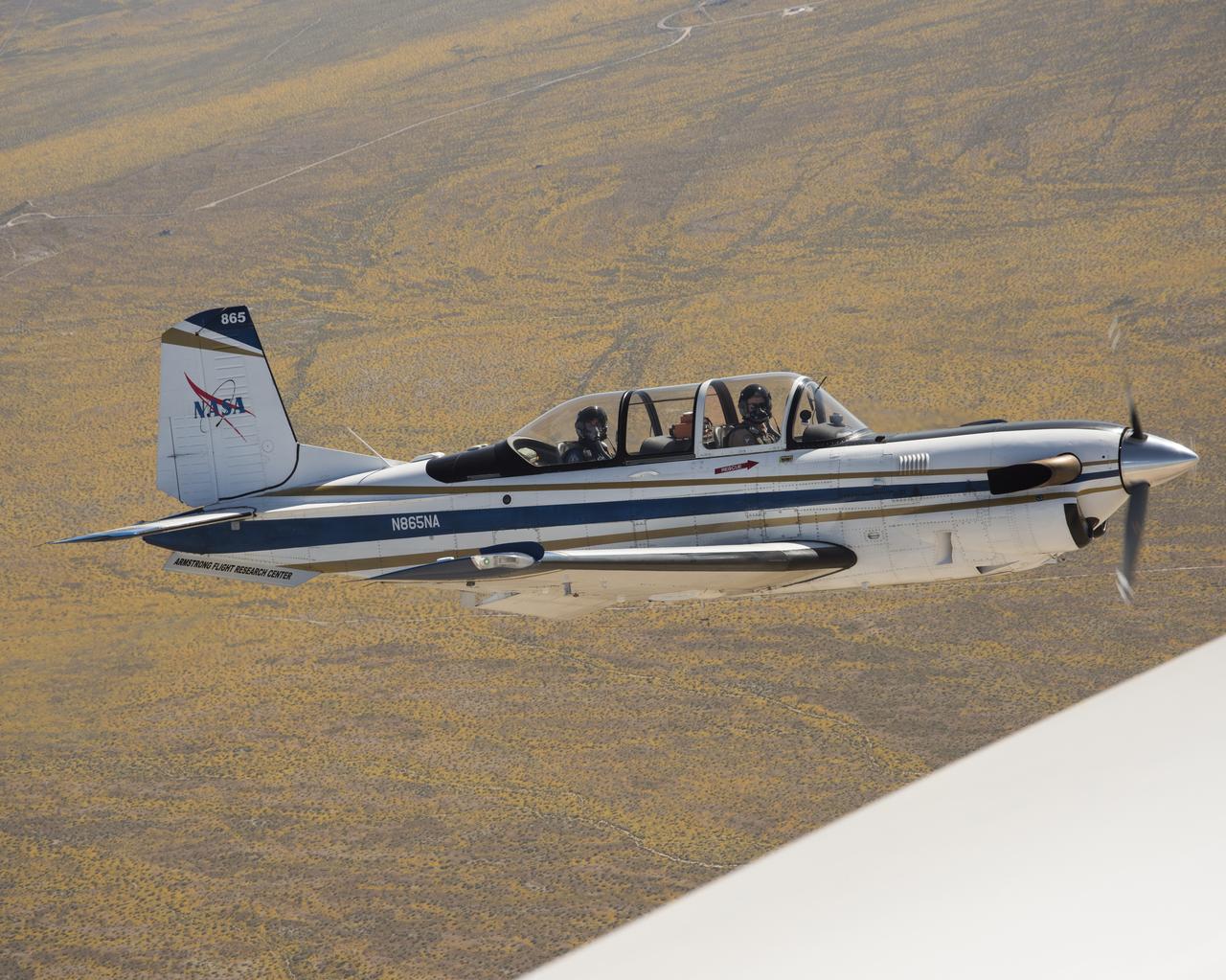
NASA’s T-34 aircraft flown from the agency’s Armstrong Flight Research Center aims the plane toward Southern California’s Antelope Valley Poppy Reserve flying over yellow wildflowers. The aircraft was flown from the agency’s Armstrong Flight Research Center.
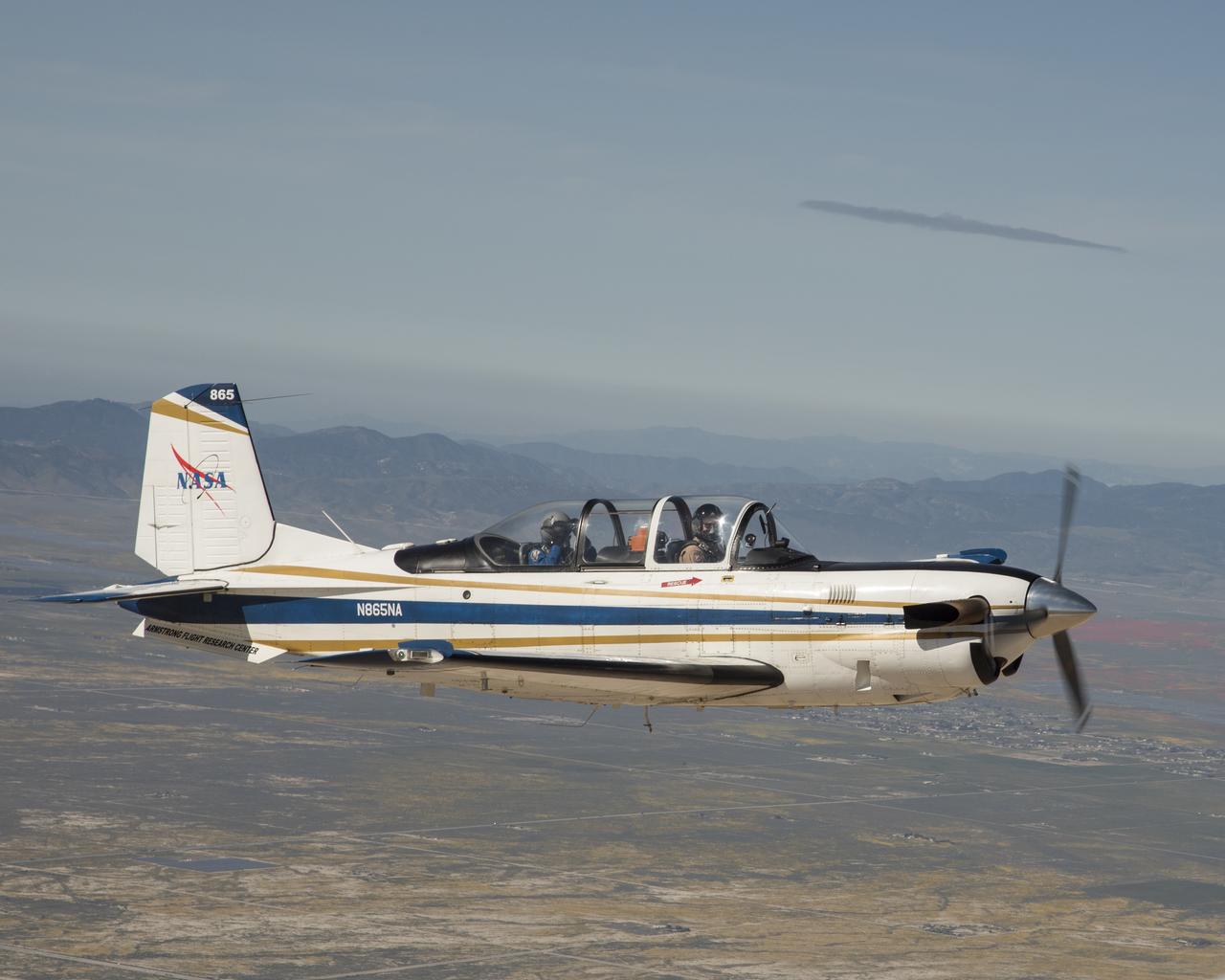
NASA’s T-34 aircraft flown from the agency’s Armstrong Flight Research Center heading toward Southern California’s Antelope Valley Poppy Reserve. The aircraft was flown from the agency’s Armstrong Flight Research Center.
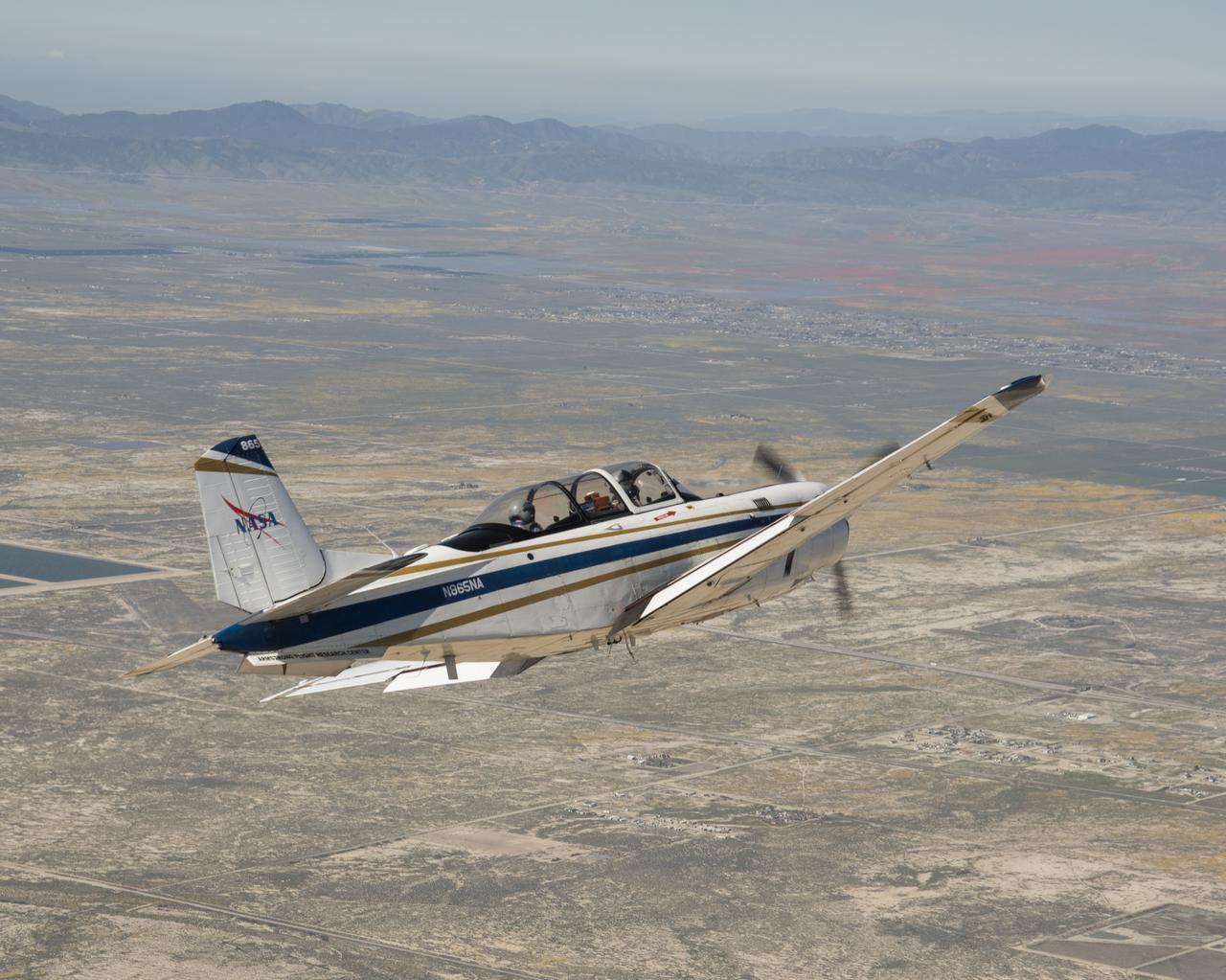
NASA's T-34 aircraft flown from the agency's Armstrong Flight Research Center aims the plane toward Southern California's Antelope Valley Poppy Reserve. The aircraft was flown from the agency's Armstrong Flight Research Center.