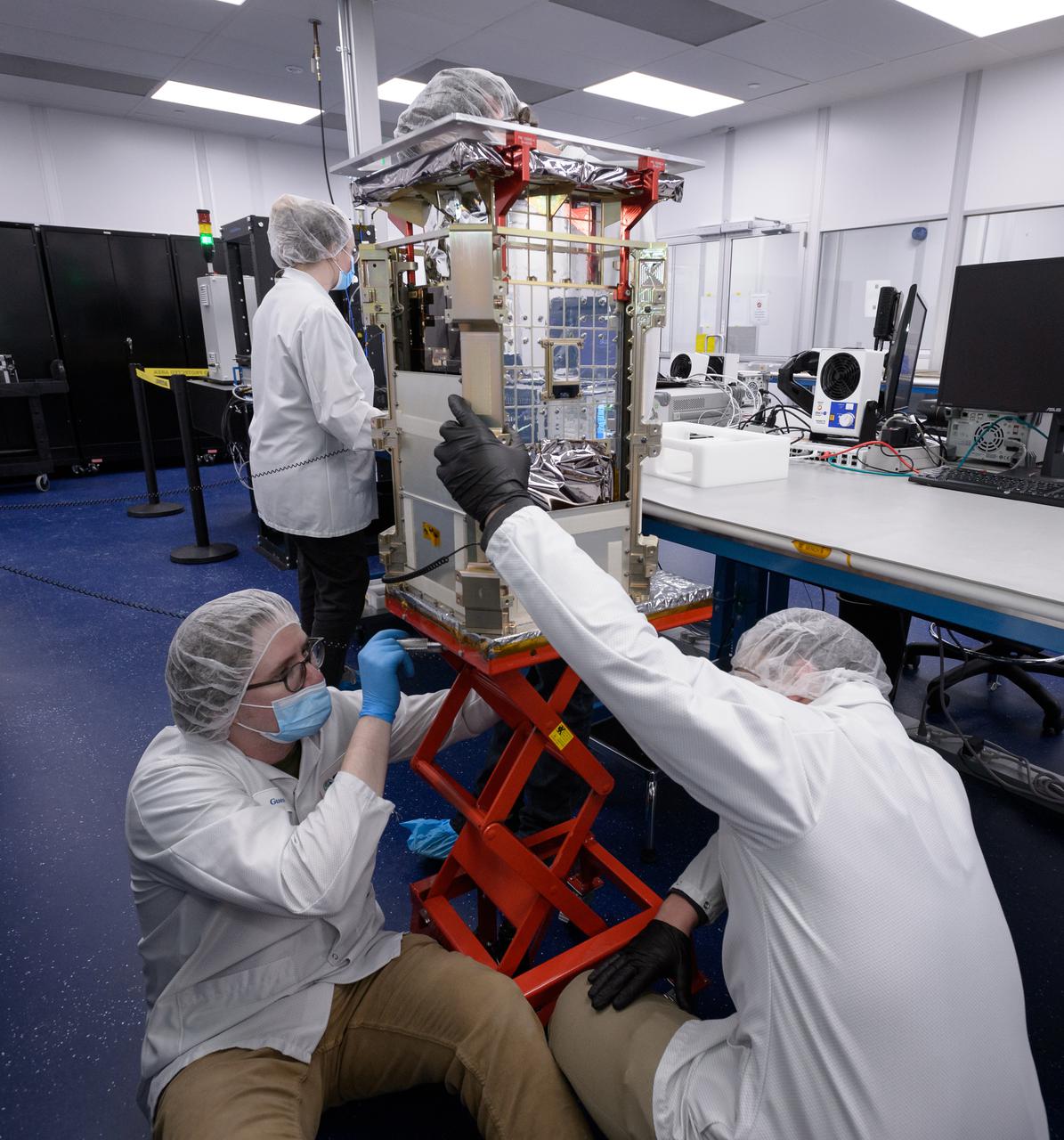
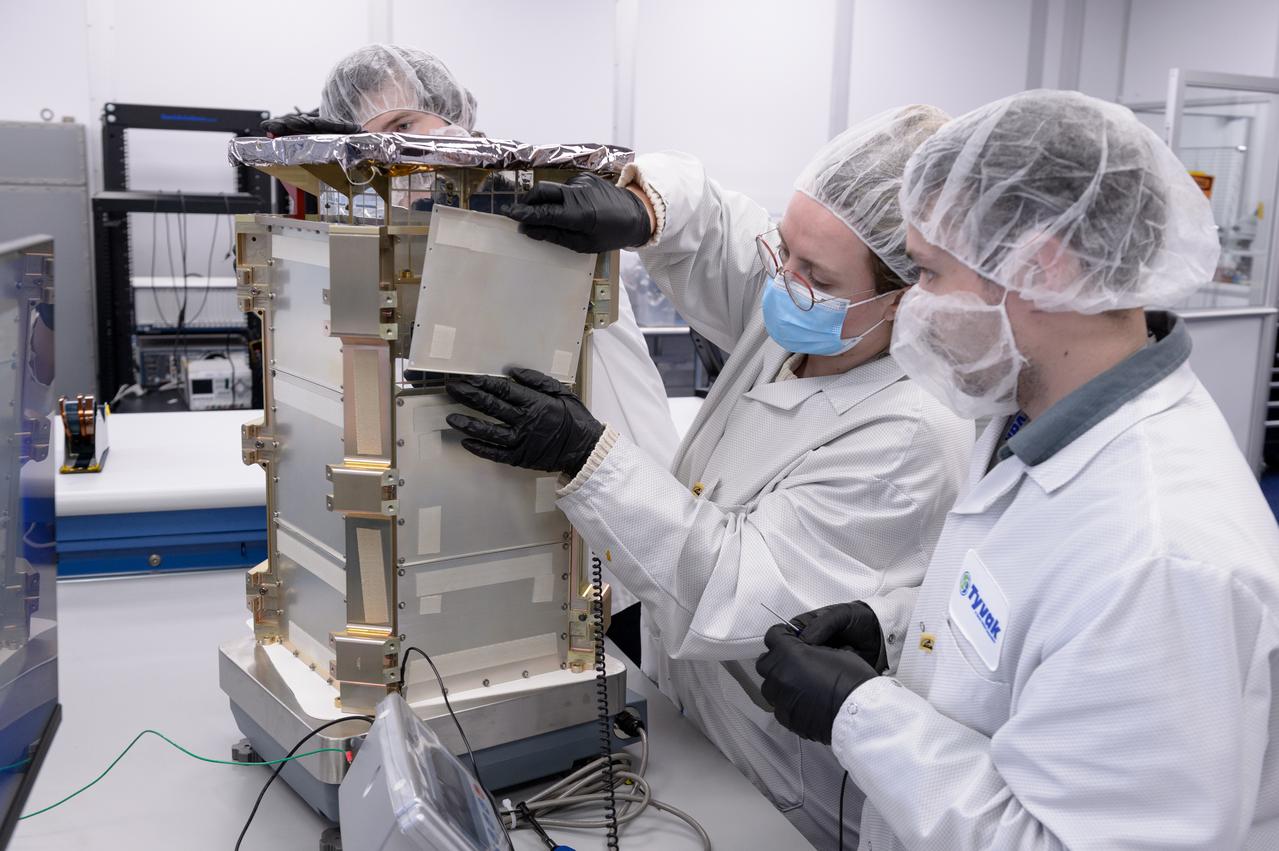
Rebecca Rogers, systems engineer, left, and Dustin Holta, launch engineer, right, mount a cover plate to the CAPSTONE spacecraft dispenser with the spacecraft stowed inside at Tyvak Nano-Satellite Systems, Inc., in Irvine, California.
Cislunar Autonomous Positioning System Technology Operations and
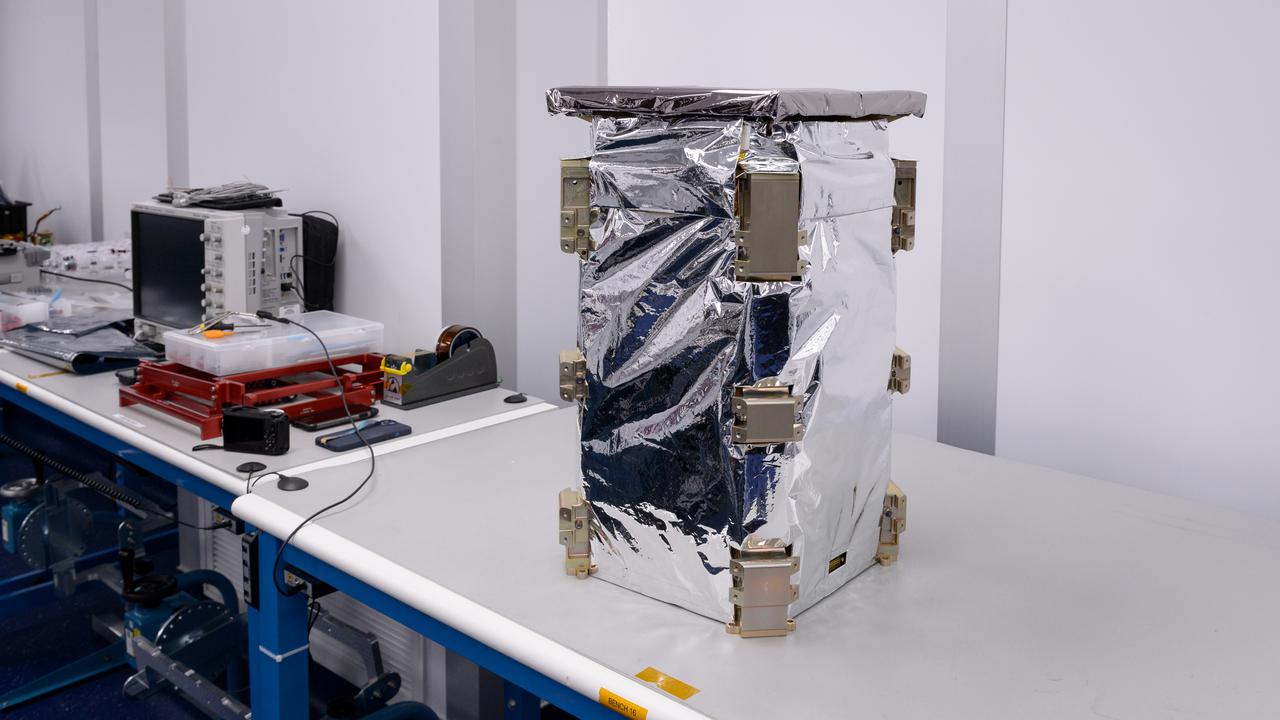
The CAPSTONE spacecraft dispenser in a thermal blanket with the spacecraft stowed inside at Tyvak Nano-Satellite Systems, Inc., in Irvine, California.
Cislunar Autonomous Positioning System Technology Operations and
Matt Johnson, CAPSTONE lead systems engineer, bottom, Dustin Holta, launch engineer, right, and Rebecca Rogers, systems engineer, background, with the CAPSTONE spacecraft stowed in its dispenser at Tyvak Nano-Satellite Systems, Inc., in Irvine, California.
Cislunar Autonomous Positioning System Technology Operations and
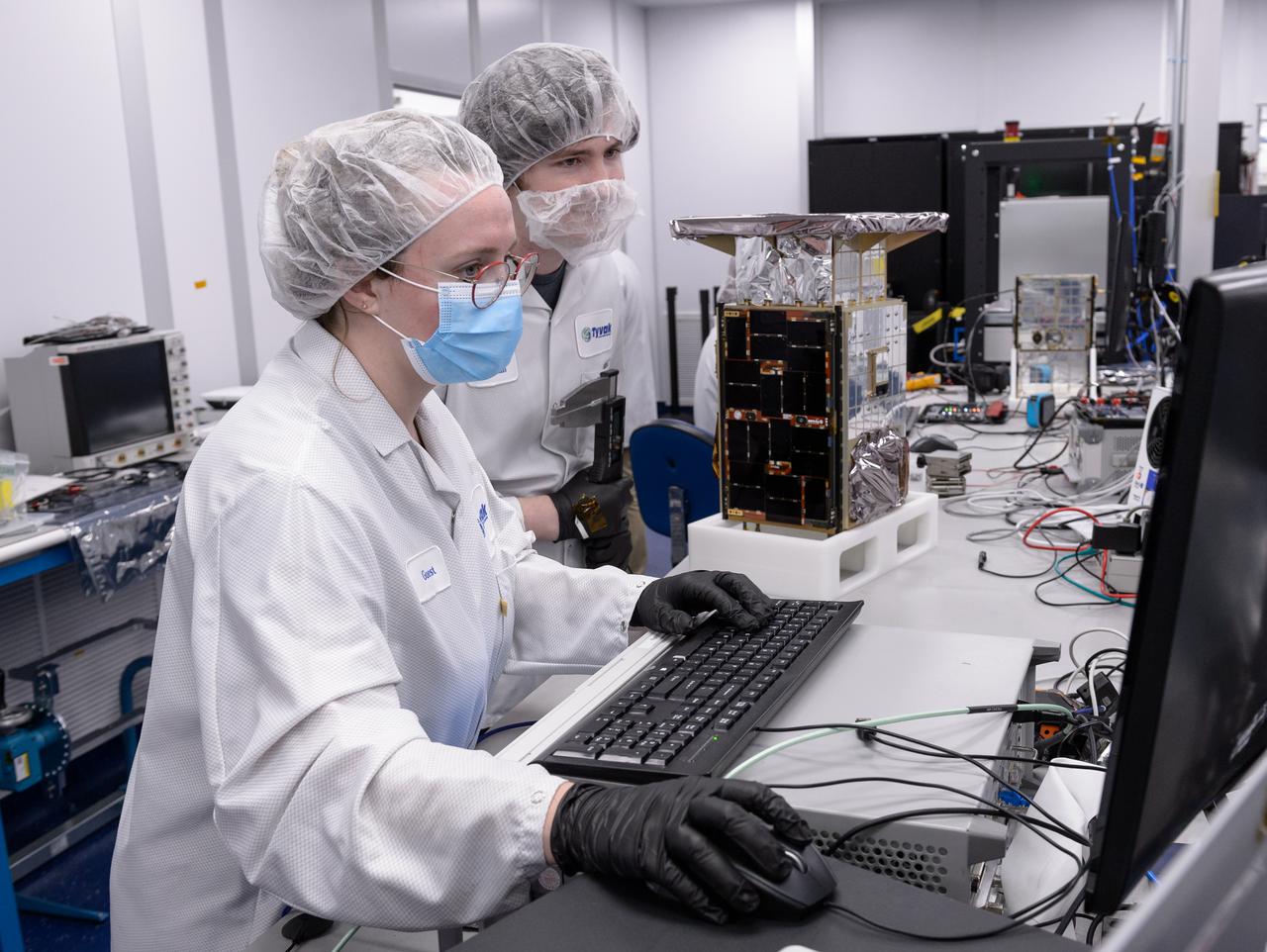
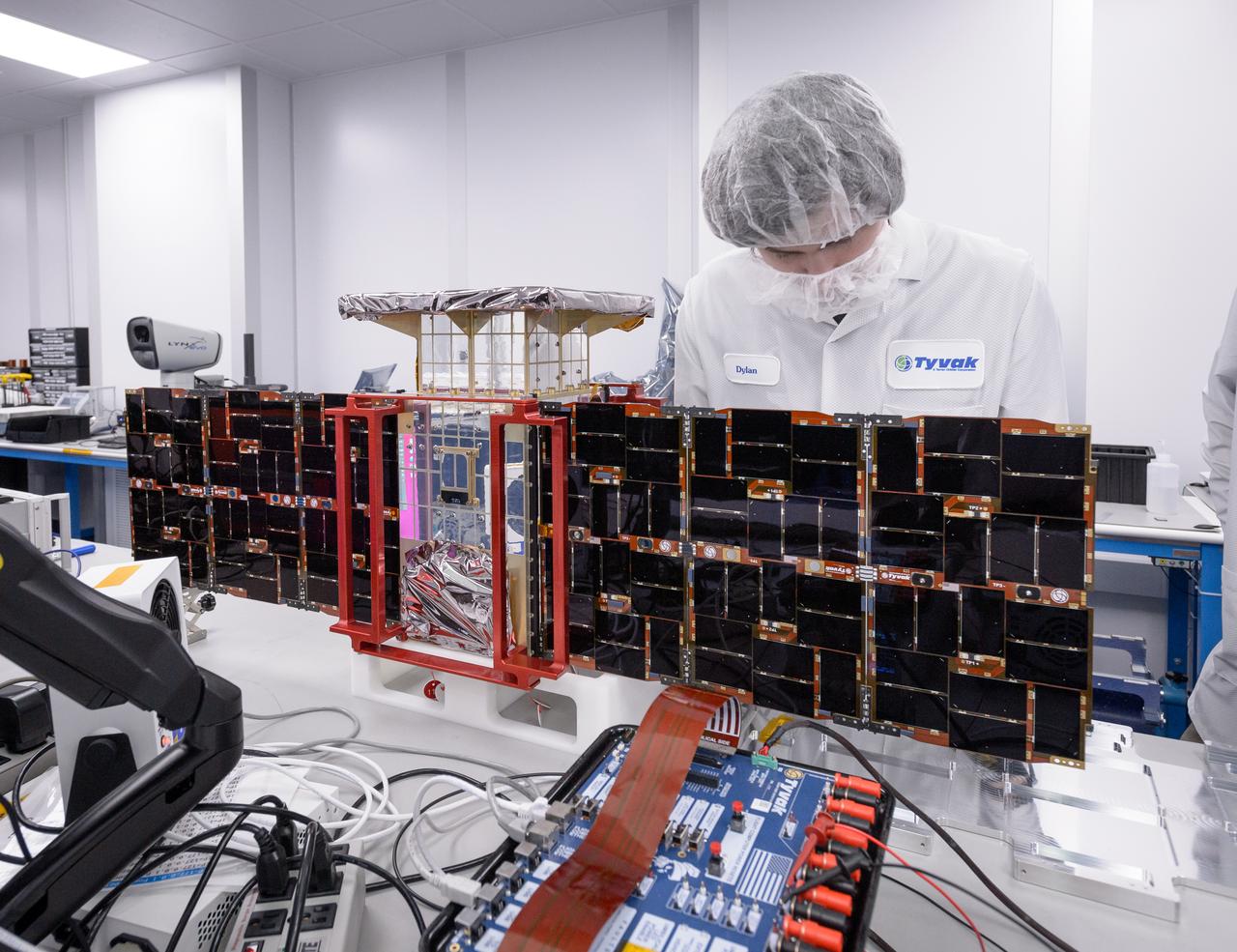
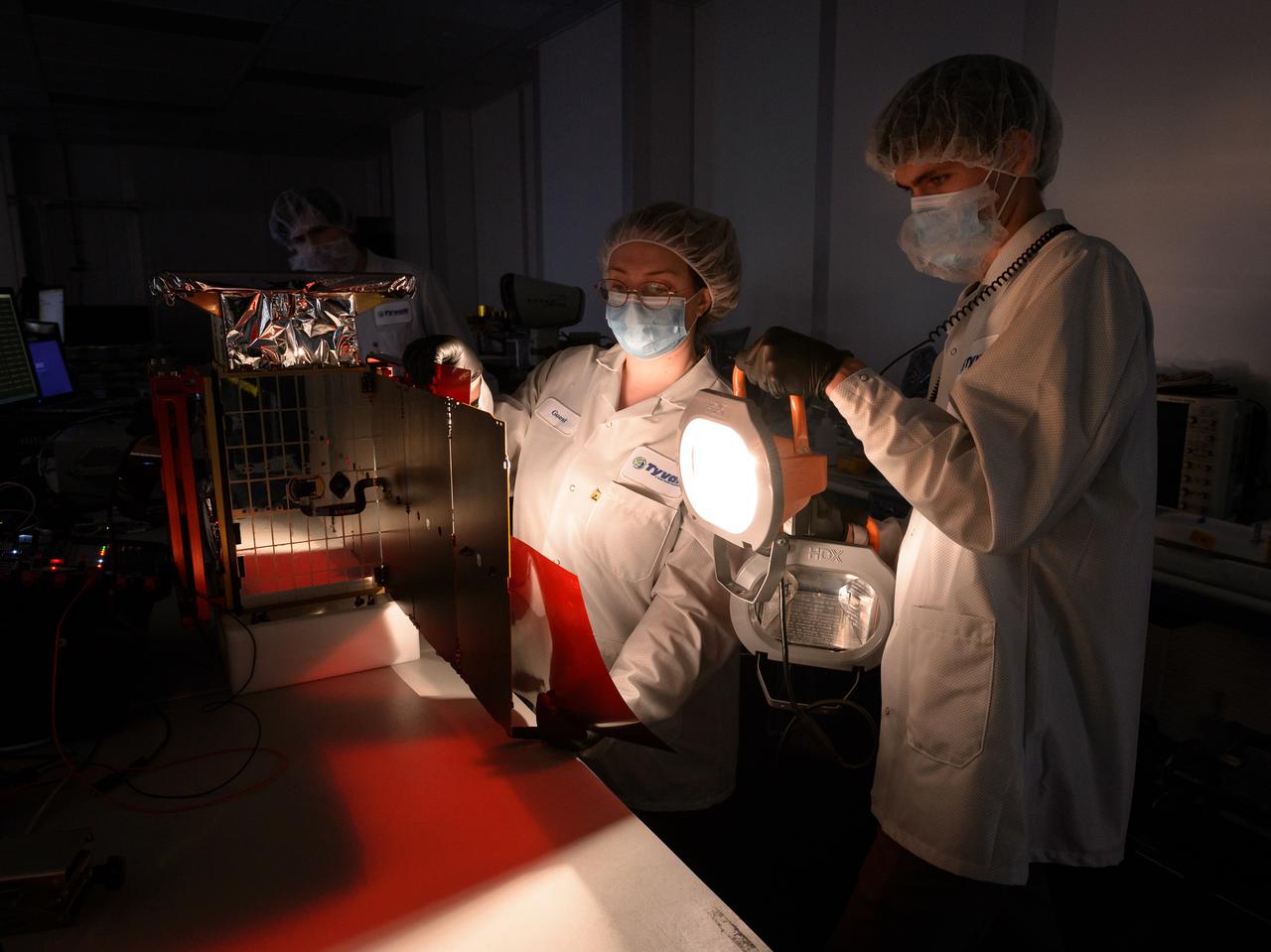
Rebecca Rogers, systems engineer, center, Lachlan Moore, systems integration engineer, right, and Dylan Schmidt, CAPSTONE assembly integration and test lead, background, perform a solar panel string voltage test of the CAPSTONE spacecraft at Tyvak Nano-Satellite Systems, Inc., in Irvine, California.
Cislunar Autonomous Positioning System Technology Operations and
Dylan Schmidt, CAPSTONE assembly integration and test lead, installs solar panels onto the CAPSTONE spacecraft at Tyvak Nano-Satellite Systems, Inc., in Irvine, California.
Cislunar Autonomous Positioning System Technology Operations and
Matt Johnson, CAPSTONE lead systems engineer, left, and Dylan Schmidt, CAPSTONE assembly integration and test lead, right, with the CAPSTONE spacecraft stowed in its dispenser at Tyvak Nano-Satellite Systems, Inc., in Irvine, California.
Cislunar Autonomous Positioning System Technology Operations and
Dylan Schmidt, CAPSTONE assembly integration and test lead, right, and Rebecca Rogers, systems engineer, left, take dimension measurements of the CAPSTONE spacecraft at Tyvak Nano-Satellite Systems, Inc., in Irvine, California.
Cislunar Autonomous Positioning System Technology Operations and
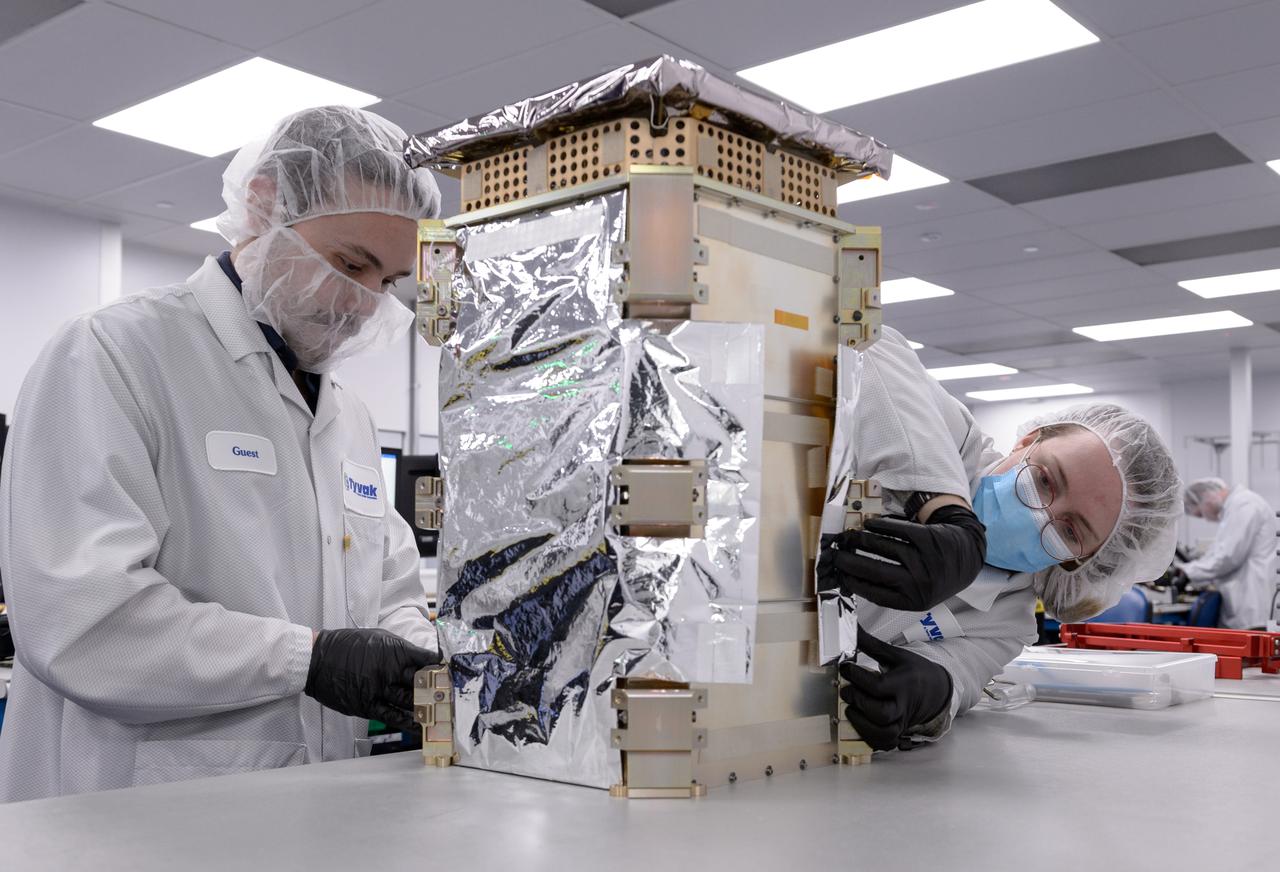
Dustin Holta, launch engineer, left, and Rebecca Rogers, systems engineer, right, wrap the CAPSTONE spacecraft dispenser in a thermal blanket with the spacecraft stowed inside at Tyvak Nano-Satellite Systems, Inc., in Irvine, California.
Cislunar Autonomous Positioning System Technology Operations and
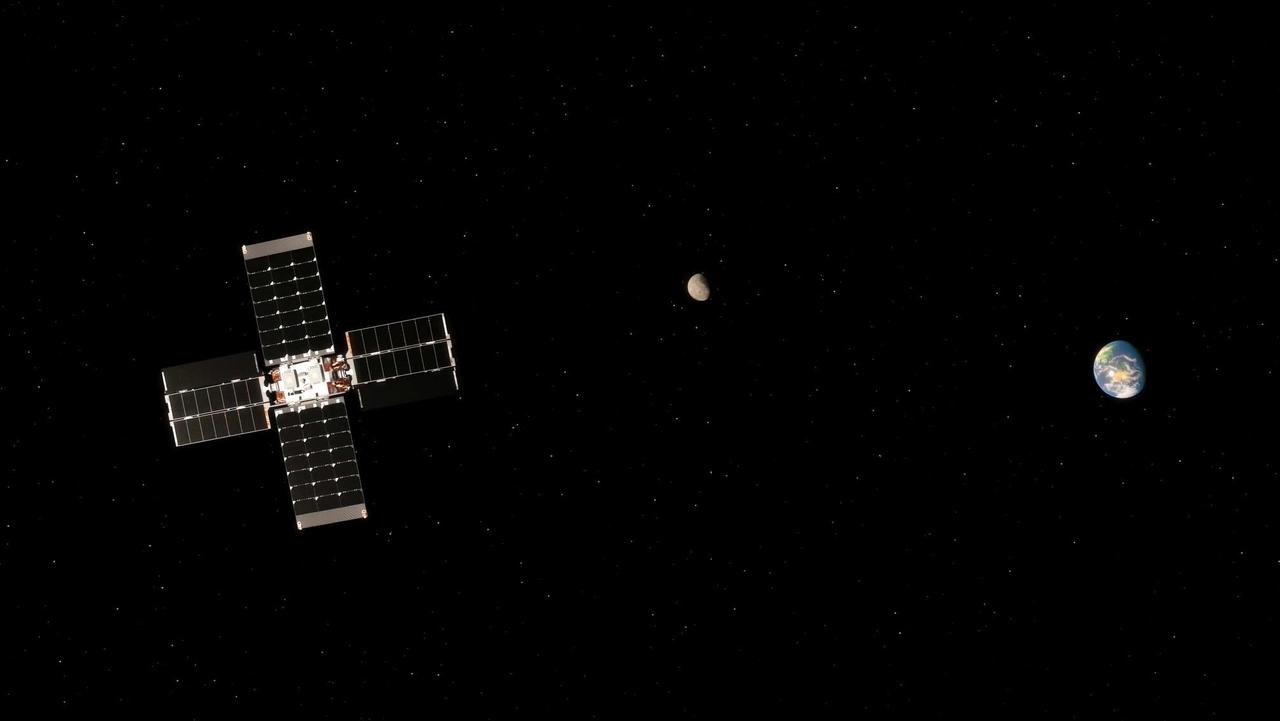
This illustration shows NASA's Lunar Flashlight carrying out a trajectory correction maneuver with the Moon and Earth in the background. Powered by the small satellite's four thrusters, the maneuver is needed to reach lunar orbit.  Lunar Flashlight launched Nov. 30, 2022, and will take about four months to reach its science orbit to seek out surface water ice in the darkest craters of the Moon's South Pole. A technology demonstration, the small satellite, or SmallSat, will use a reflectometer equipped with four lasers that emit near-infrared light in wavelengths readily absorbed by surface water ice.  To achieve the mission's goals with the satellite's limited amount of propellent, Lunar Flashlight will employ an energy-efficient near-rectilinear halo orbit, taking it within 9 miles (15 kilometers) of the lunar South Pole and 43,000 miles (70,000 kilometers) away at its farthest point. Only one other spacecraft has employed this type of orbit: NASA's Cislunar Autonomous Positioning System Technology Operations and Navigation Experiment (CAPSTONE) mission, which launched in June 2022.  https://photojournal.jpl.nasa.gov/catalog/PIA25258
Lunar Flashlight's Trajectory Correction Maneuver (Illustration)