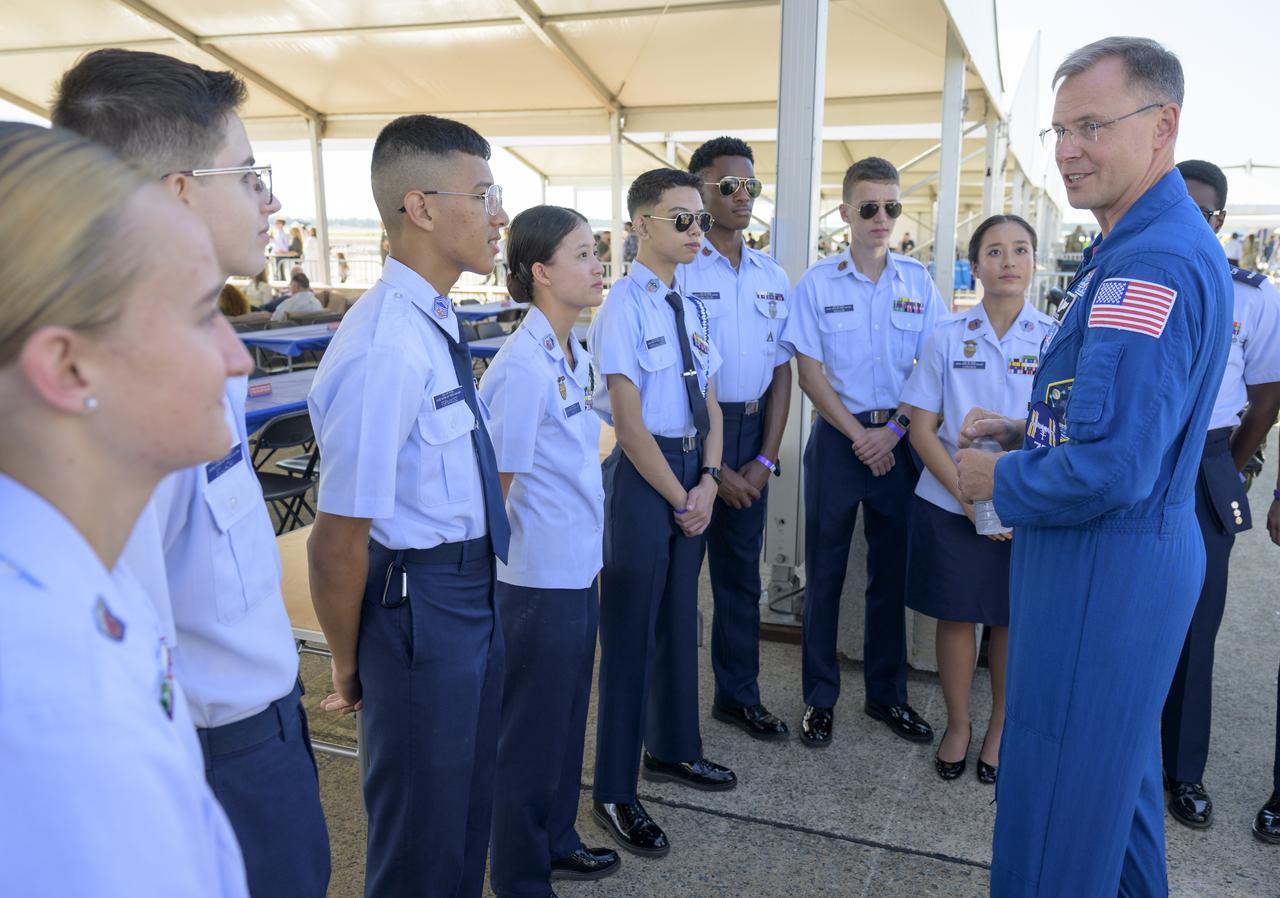
NASA astronaut Nick Hague talks with members of the Civil Air Patrol, Friday, Sept. 12, 2025, during the Joint Base Andrews Air Show at Joint Base Andrews in Prince George's County, Maryland. Hague spent 171 days onboard the International Space Station as part of Expedition 72. Photo Credit: (NASA/Bill Ingalls)

Civil Air Patrol cadets (L to R) Gabrielle Griffith, Ronald Ecklund, and Alongkorn Lafargue of the Alvin Callander Composite Squadron record weather data and track the impact of Solar Eclipses on VHF Radio Operations as they participate in the CAP Solar Eclipse Mission, a continent-wide project collecting solar eclipse data in partnership with NASA. The cadets spent over six hours taking measurements at their base of operations at Lakefront Airport in New Orleans on Monday, April 8, 2024. New Orleans is home to NASA’s Michoud Assembly Facility. A total solar eclipse tracked along a narrow strip of the North American continent from Mexico’s Pacific coast to the Atlantic coast of Newfoundland, Canada. A partial solar eclipse was visible across the entire North American continent as well as parts of Europe and Central America. Image credit: NASA/Michael DeMocker

Civil Air Patrol cadets (L to R) Benjamin Errington, Caden Thomas, and Isabelle Cooper of the Alvin Callander Composite Squadron record weather data and track the impact of Solar Eclipses on VHF Radio Operations as they participate in the CAP Solar Eclipse Mission, a continent-wide project collecting solar eclipse data in partnership with NASA. The cadets spent over six hours taking measurements at their base of operations at Lakefront Airport in New Orleans on Monday, April 8, 2024. New Orleans is home to NASA’s Michoud Assembly Facility. A total solar eclipse tracked along a narrow strip of the North American continent from Mexico’s Pacific coast to the Atlantic coast of Newfoundland, Canada. A partial solar eclipse was visible across the entire North American continent as well as parts of Europe and Central America. Image credit: NASA/Michael DeMocker

Civil Air Patrol cadets (L to R) Benjamin Errington, Caden Thomas, and Isabelle Cooper of the Alvin Callander Composite Squadron record weather data and track the impact of Solar Eclipses on VHF Radio Operations as they participate in the CAP Solar Eclipse Mission, a continent-wide project collecting solar eclipse data in partnership with NASA. The cadets spent over six hours taking measurements at their base of operations at Lakefront Airport in New Orleans on Monday, April 8, 2024. New Orleans is home to NASA’s Michoud Assembly Facility. A total solar eclipse tracked along a narrow strip of the North American continent from Mexico’s Pacific coast to the Atlantic coast of Newfoundland, Canada. A partial solar eclipse was visible across the entire North American continent as well as parts of Europe and Central America. Image credit: NASA/Michael DeMocker
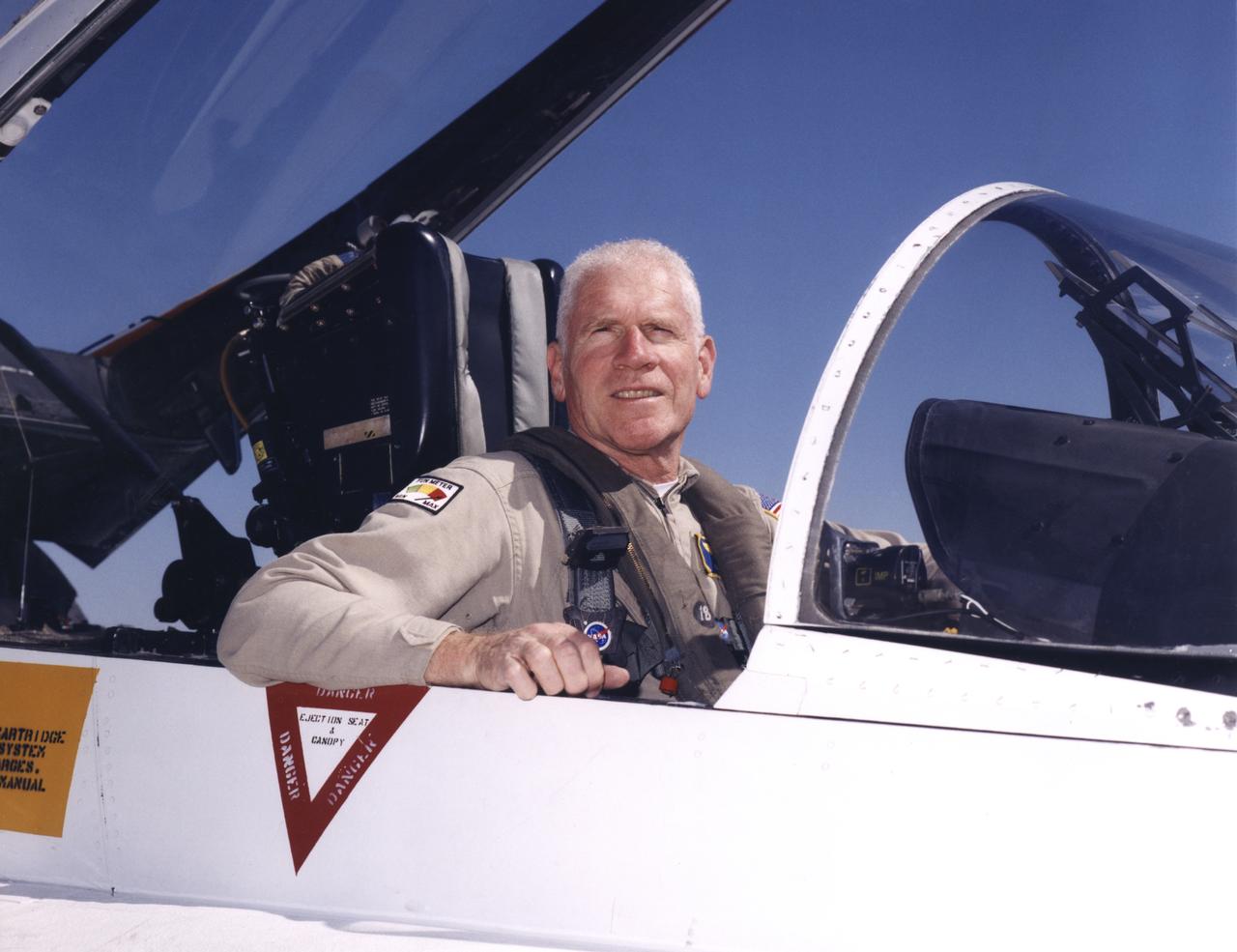
Edwin W. Lewis Jr. is a research pilot in the Airborne Science program, Flight Crew Branch, Dryden Flight Research Center, Edwards, California. He currently flies the DC-8, F/A-18, Lear Jet 24, King Air, and T-34C in support of Dryden's flight operations and is mentor pilot for the King Air and the Lear Jet. Prior to accepting this assignment Lewis was a pilot for eight years at NASA's Ames Research Center, Moffett Field, California, flying 10 different aircraft C-130B, DC-8-72, UH-1, SH-3, King Air, Lear 24, T-38A, T-39G and YO-3A in support of NASA flight missions. Lewis also flew the Kuiper Airborne Observatory (a modified civilian version of the Lockheed C-141 Starlifter). He was project pilot for Ames' 747 and T-38 programs. Lewis was born in New York City on May 19, 1936, and began flight training as a Civil Air Patrol cadet in 1951, ultimately earning his commercial pilot's certificate in 1958. He received a bachelor of arts degree in biology from Hobart College, Geneva, N.Y., and entered the U.S. Air Force through the Reserve Officer Training Corps. Following pilot training he was assigned to Moody Air Force Base, Ga., as an instructor pilot, for both the T-33 and T-37 aircraft. He served in Vietnam in 1965 and 1966, where he was a forward air controller, instructor and standardization/evaluation pilot, flying more than 1,000 hours in the O-1 "Bird Dog." Lewis separated from the regular Air Force and joined Pan American World Airways and the 129th Air Commando Group, California Air National Guard (ANG) based in Hayward, California. During his 18-year career with the California ANG he flew the U-6, U-10, C-119, HC-130 aircraft and the HH-3 helicopter. He retired as commander, 129th Air Rescue and Recovery Group, a composite combat rescue group, in the grade of colonel. During his 22 years as an airline pilot, he flew the Boeing 707, 727 and 747. He took early retirement from Pan American in 1989 to become a pilot with NASA.