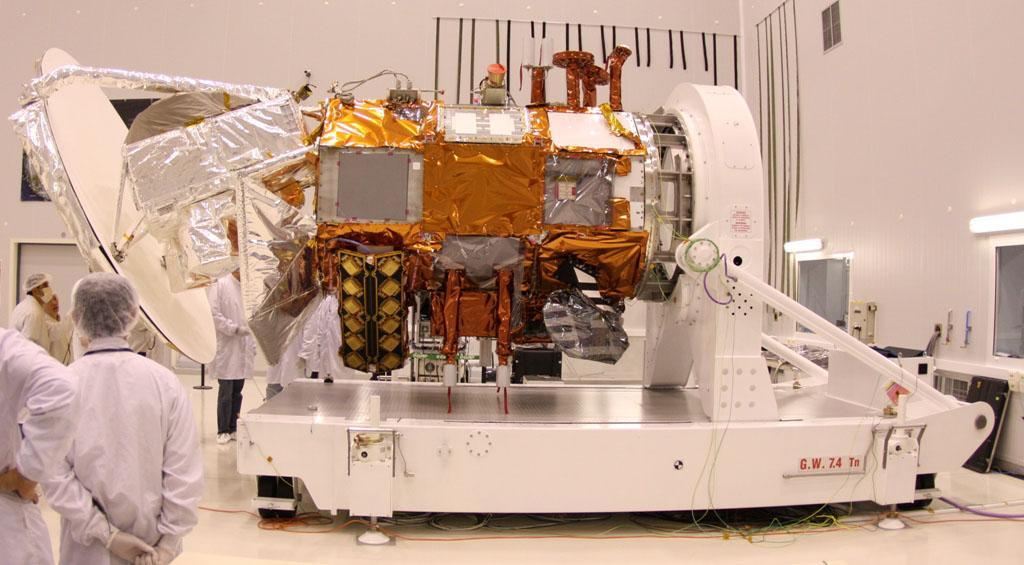
A fit check of half the sunshade is completed to verify the clearance of NASA Aquarius ground lug as well as the blanket interface with the service platform top deck.
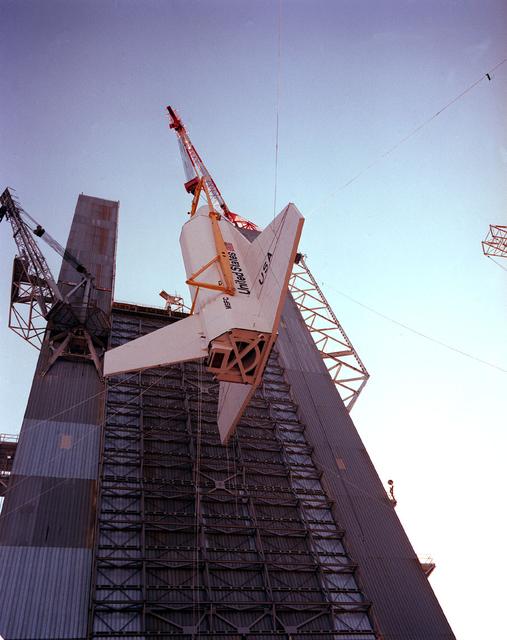
MSFC, Ala. -- The Space Shuttle Orbiter simulator is hoisted into the giant dynamics test stand at NASA's Marshall Space Flight Center, Huntsville, Ala. The simulator was built at the Marshall Center for use in pathfinder activities, such as checking roadway clearances, crane capabilities and fits within structures. It is the same size, shape and weight of an actual Orbiter.
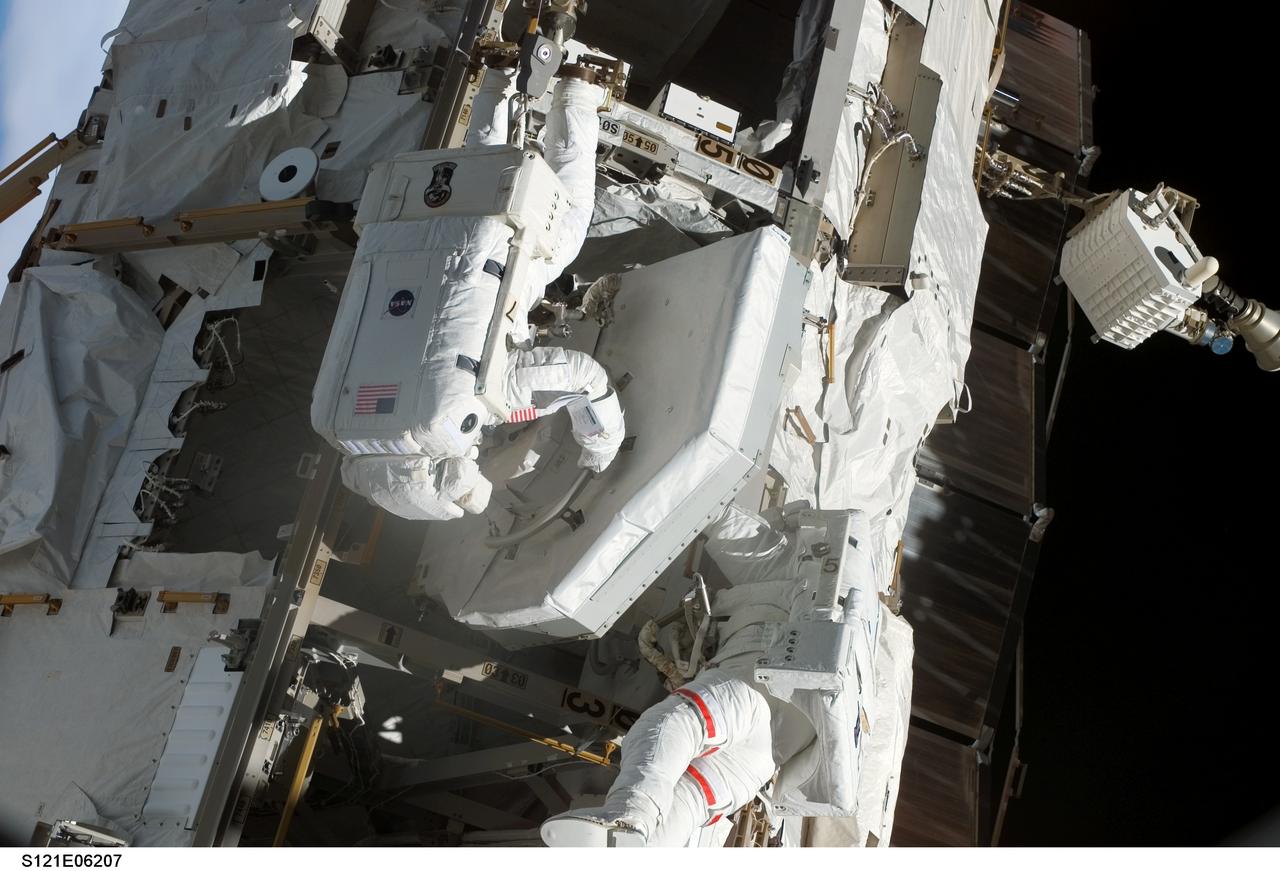
S121-E-06207 (10 July 2006) --- While anchored on the mobile foot restraint on the Canadarm2, astronaut Michael E. Fossum (left), STS-121 mission specialist, removes the trailing umbilical system-reel assembly (TUS-RA) from the S0 truss on the International Space Station during the mission's second session of extravehicular activity (EVA). Astronaut Piers J. Sellers, mission specialist, assisted Fossum by checking the clearance of the TUS-RA as it was lifted from the bay.
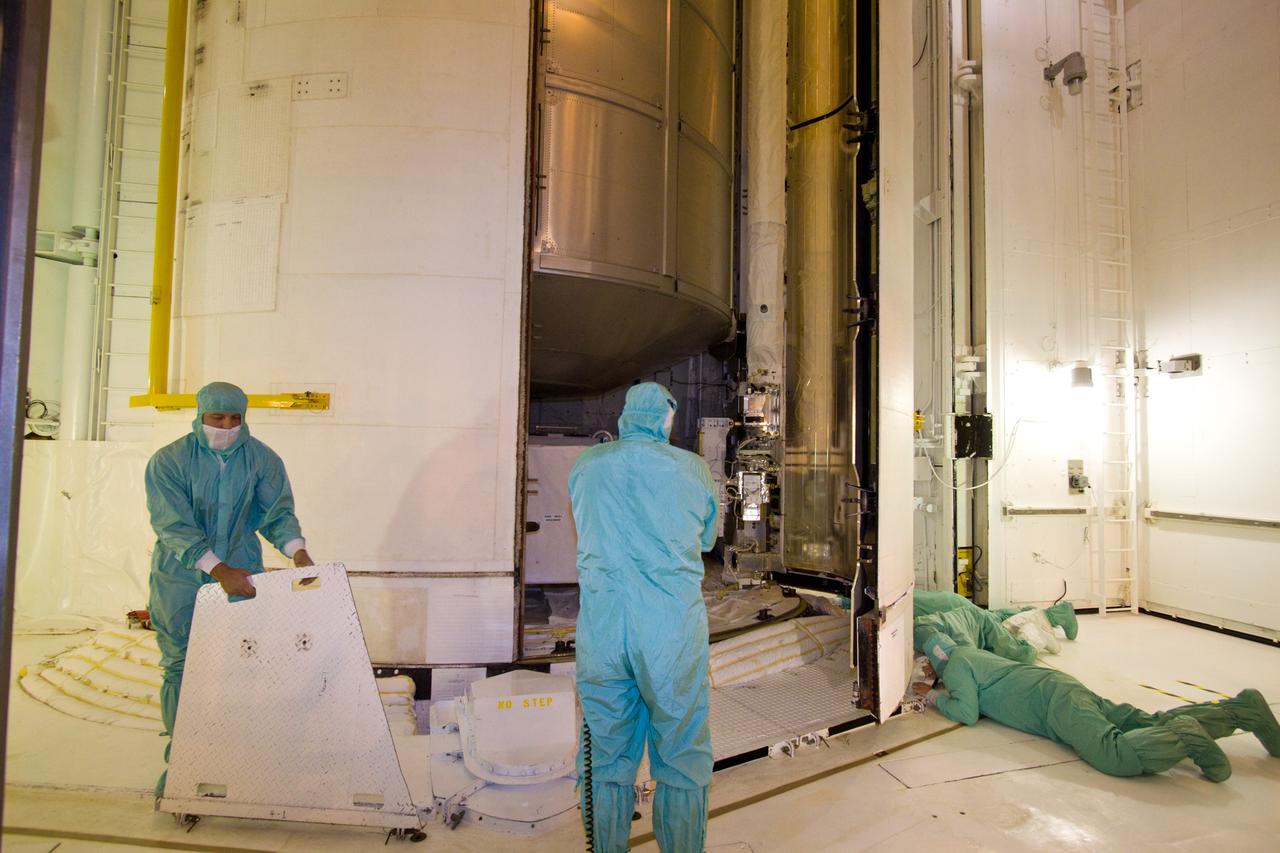
CAPE CANAVERAL, Fla. – On Launch Pad 39A, technicians check the clearance of the payload bay door as it closes around the multi-purpose logistics module Leonardo and the lightweight multi-purpose experiment support structure carrier inside space shuttle Discovery's payload bay. Discovery will deliver 33,000 pounds of equipment to the station, including science and storage racks, a freezer to store research samples, a new sleeping compartment and the COLBERT treadmill. Launch is targeted for late August. Photo credit: NASA/Jack Pfaller
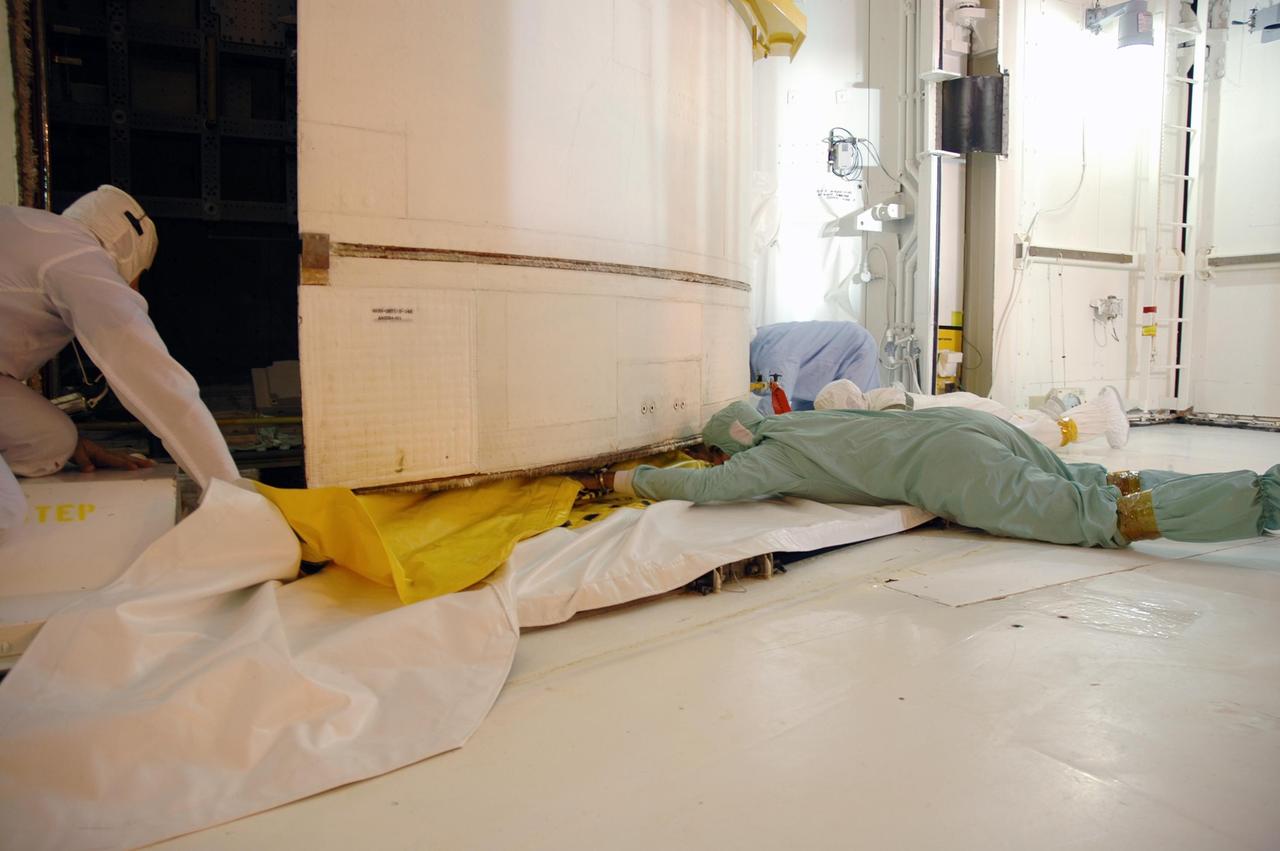
KENNEDY SPACE CENTER, FLA. -- On Launch Pad 39B, technicians check the clearance under the payload door on Space Shuttle Discovery as the door closes. The payload includes the SPACEHAB module, the P5 integrated truss structure and other key components. Launch of Space Shuttle Discovery on mission STS-116 is scheduled no earlier than Dec. 7. Photo credit: NASA/Dimitri Gerondidakis
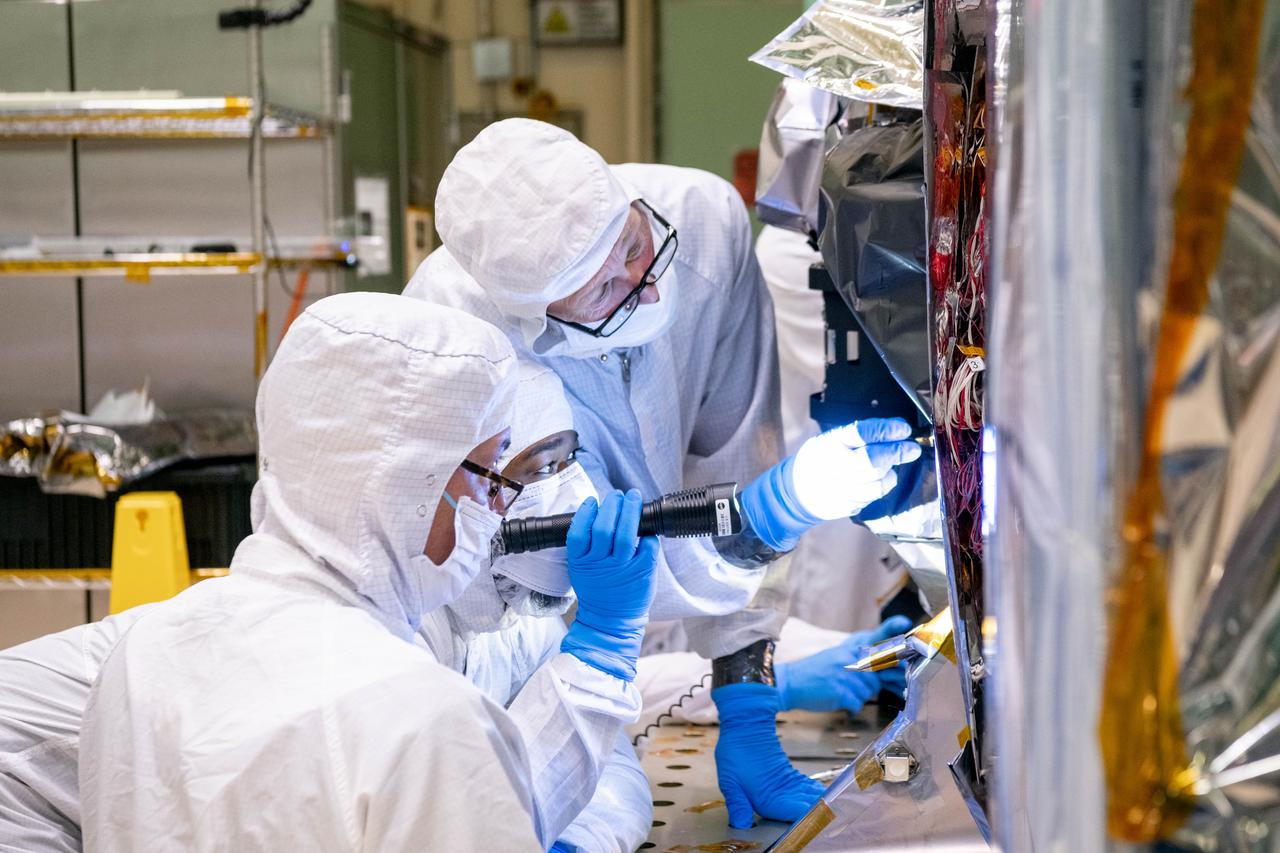
Mechanical technicians, Nicholas Kwaitkowski, Tyere Garner, and Gary Sheridon, use a flashlight to check for clearances between the Tilt Mechanism and the Ocean Color Instrument (OCI). OCI is a highly advanced optical spectrometer that will be used to measure properties of light over portions of the electromagnetic spectrum. It will enable continuous measurement of light at finer wavelength resolution than previous NASA satellite sensors, extending key system ocean color data records for climate studies. OCI is PACE's (Plankton, Aerosol, Cloud, ocean Ecosystem) primary sensor built at Goddard Space Flight Center in Greenbelt, MD.
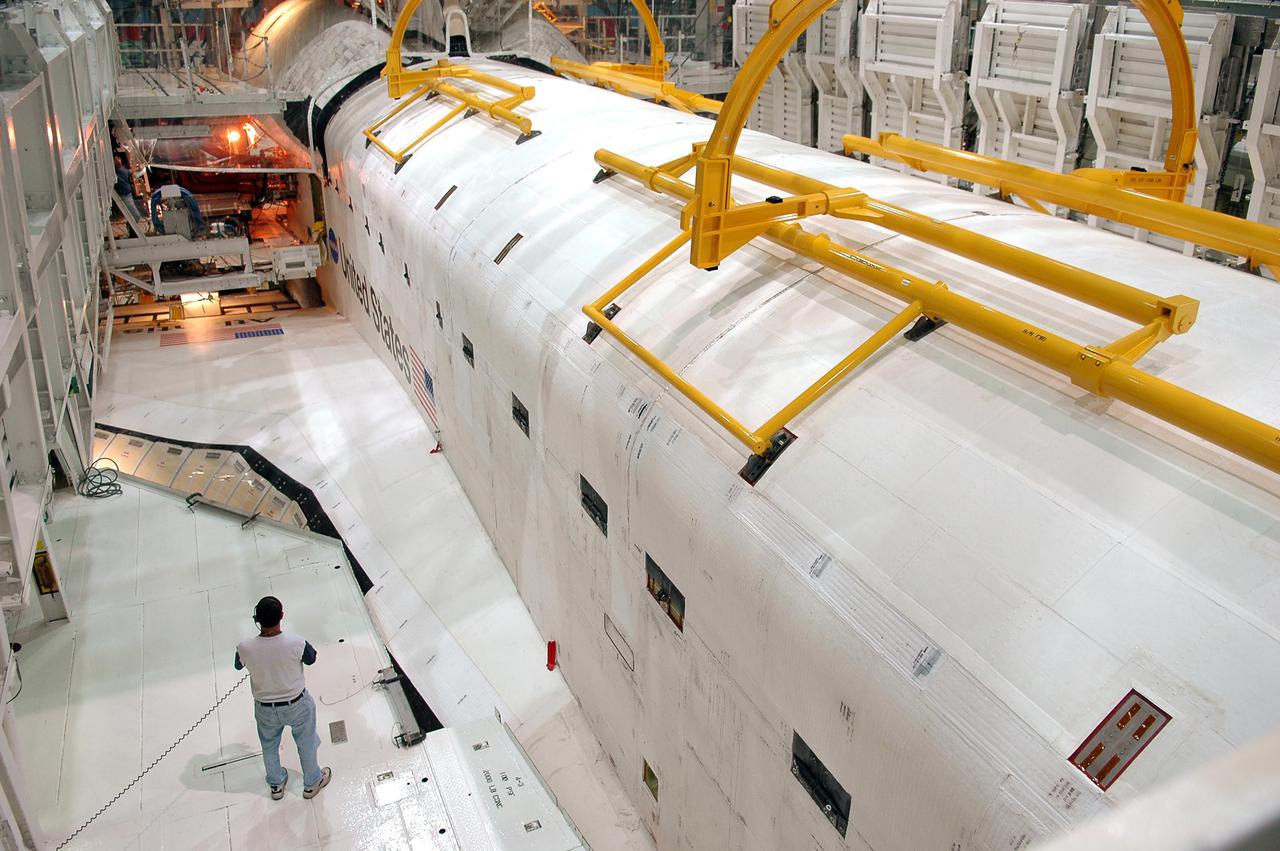
KENNEDY SPACE CENTER, FLA. - In Orbiter Processing Facility bay 1 at NASA’s Kennedy Space Center, Atlantis’ payload bay doors are being opened. The payload bay doors were closed for a clearance check on the Orbiter Boom Sensor System (OBSS), built in Canada. The 50-foot-long OBSS attaches to the Remote Manipulator System, or Shuttle arm, and is one of the new safety measures for Return to Flight. It equips the orbiter with cameras and laser systems to inspect the Shuttle’s Thermal Protection System while in space. Mission STS-121 is targeted for launch in September. Once the bay doors are open again, further work will be done in the bay.
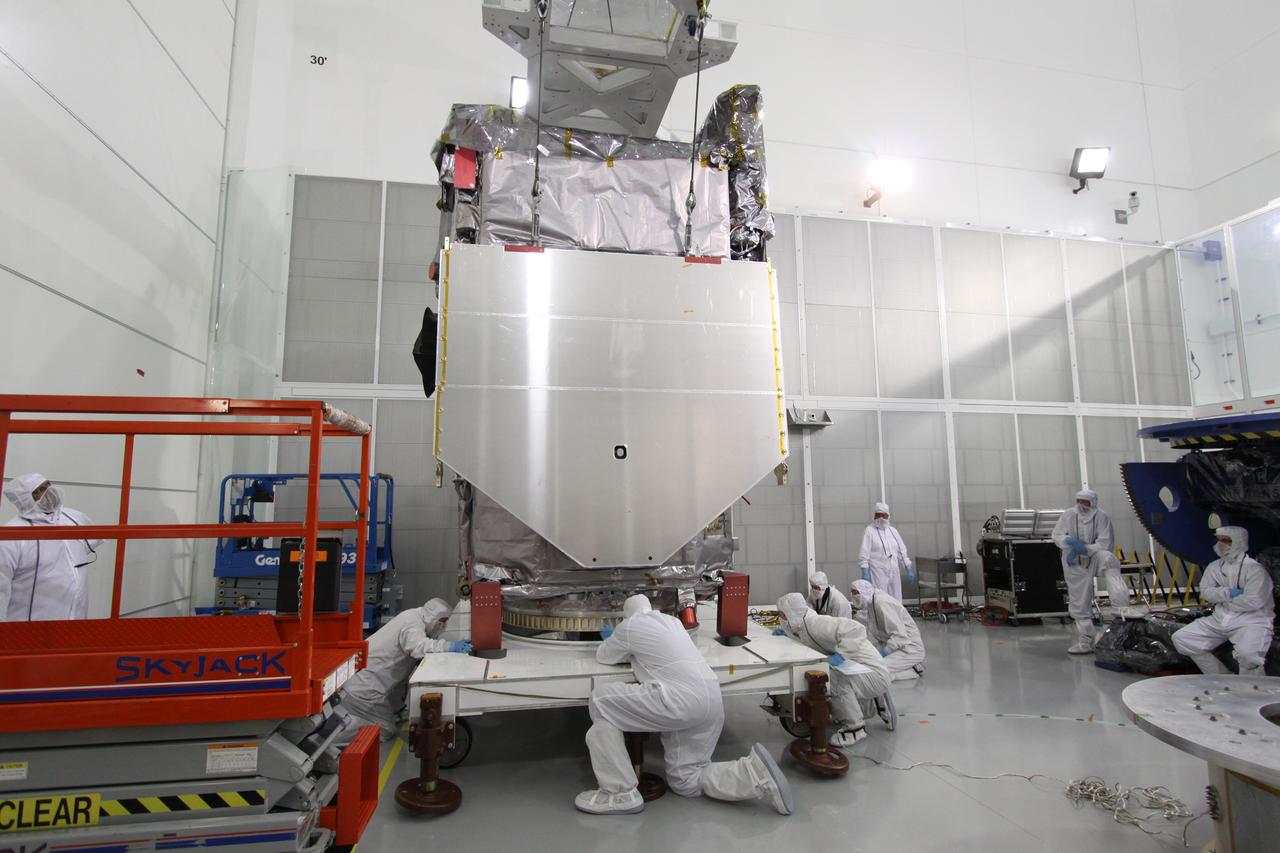
CAPE CANAVERAL, Fla. – At the Astrotech Payload Processing Facility in Titusville, Fla., technicians check the clearance as the Solar Dynamics Observatory is lifted from the stand. The spacecraft is being moved onto a Ransome table that will allow it to be rotated in various directions for access to different areas of the spacecraft. SDO is the first space weather research network mission in NASA's Living With a Star Program. The spacecraft's long-term measurements will give solar scientists in-depth information about changes in the sun's magnetic field and insight into how they affect Earth. In preparation for its anticipated November launch, engineers will perform a battery of comprehensive tests to ensure SDO can withstand the stresses and vibrations of the launch itself, as well as what it will encounter in the space environment after launch. Photo credit: NASA/Jack Pfaller
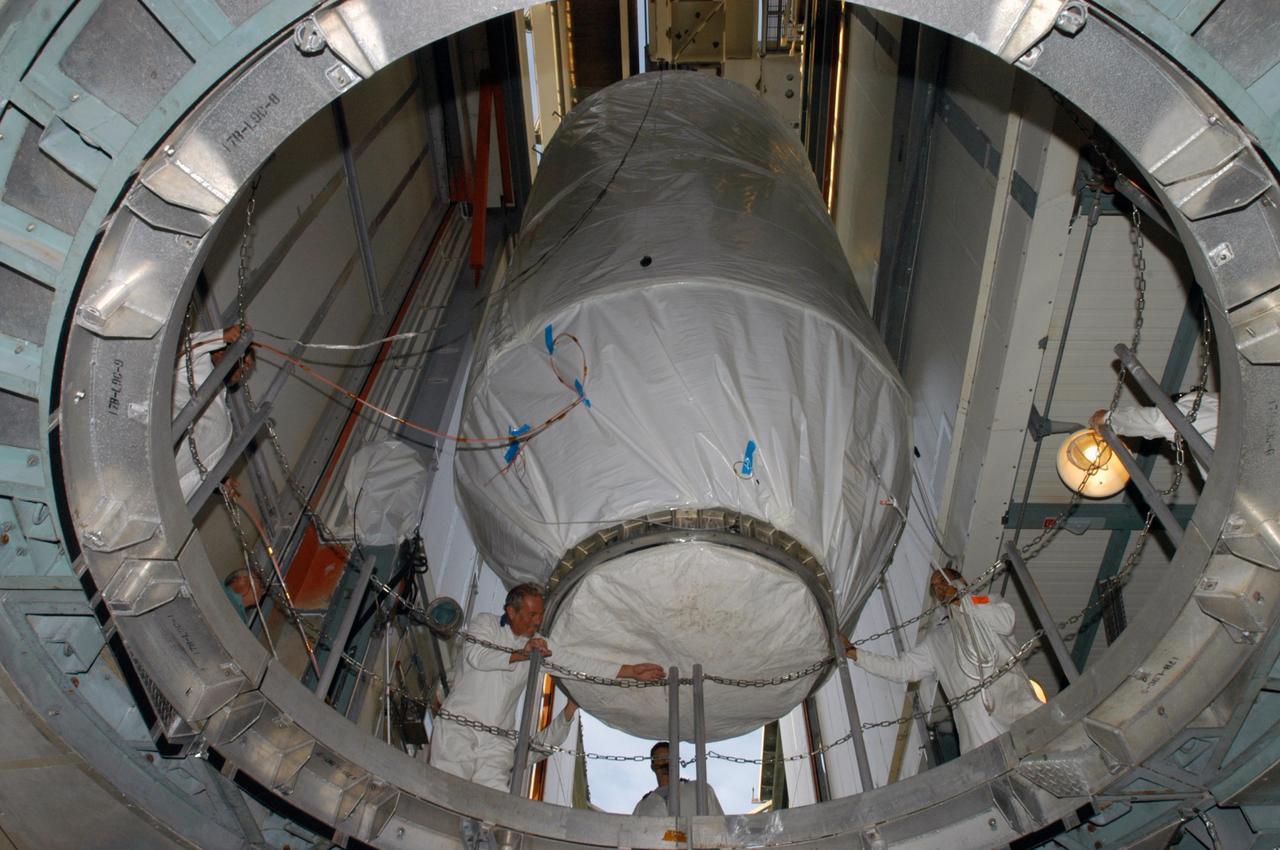
KENNEDY SPACE CENTER, FLA. - Inside the mobile service tower on Launch Pad 17-B at Cape Canaveral Air Force Station, workers check the clearance of the STEREO spacecraft as it is moved away from the opening. In the tower, STEREO will be mated with its launch vehicle, a Boeing Delta II rocket. STEREO stands for Solar Terrestrial Relations Observatory and comprises two spacecraft. The STEREO mission is the first to take measurements of the sun and solar wind in 3-dimension. This new view will improve our understanding of space weather and its impact on the Earth. The STEREO mission is managed by Goddard Space Flight Center. The Applied Physics Laboratory designed and built the spacecraft. The laboratory will maintain command and control of the observatories throughout the mission, while NASA tracks and receives the data, determines the orbit of the satellites, and coordinates the science results. STEREO is expected to lift off Oct. 25. Photo credit: NASA/George Shelton

This computer animation shows a replay of telemetry from NASA's Perseverance Mars rover as it carried out its first drive using AutoNav, it's auto-navigation feature, which allows it to avoid rocks and other hazards without input from engineers back on Earth. The rover's progress here has been sped up by 50 times. The entire drive was roughly 102 feet (31 meters) and took 45 minutes. The terrain is created from height maps, which is how the rover navigates surrounding terrain. The map is created incrementally from stereo imagery taken from the rover's navigation cameras. Auto-navigation software uses a height map to evaluate possible drive paths for safety. The paths are represented by arcs emanating from the front of the rover. Different-colored arcs denote different results of the hazard evaluation. Blue arcs represent arcs that failed due to "wheel drop," where the terrain could allow for a wheel to fall more than a certain height. Pink arcs fail the belly-pan clearance check, where the terrain is at risk of high-centering the rover. Yellow arcs fail by driving onto unknown terrain. Gray arcs are safe. The white arc is the actual path selected by auto-navigation. A key objective for Perseverance's mission on Mars is astrobiology, including the search for signs of ancient microbial life. The rover will characterize the planet's geology and past climate, pave the way for human exploration of the Red Planet, and be the first mission to collect and cache Martian rock and regolith (broken rock and dust). Subsequent NASA missions, in cooperation with ESA (European Space Agency), would send spacecraft to Mars to collect these sealed samples from the surface and return them to Earth for in-depth analysis. The Mars 2020 Perseverance mission is part of NASA's Moon to Mars exploration approach, which includes Artemis missions to the Moon that will help prepare for human exploration of the Red Planet. Animation available at https://photojournal.jpl.nasa.gov/catalog/PIA24723
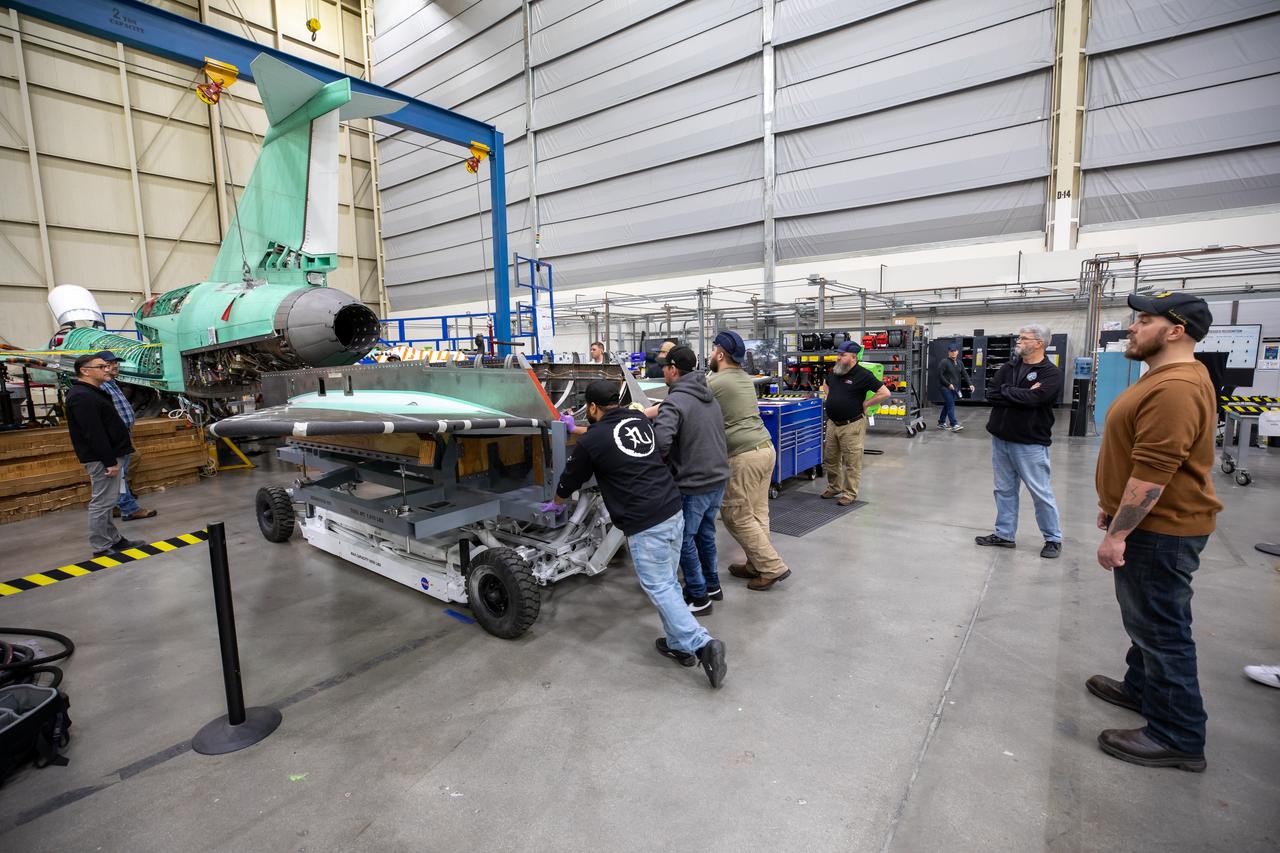
The X-59 team at Lockheed Martin Skunk Works in Palmdale, California, load the lower empennage - the tail section - into place. The surfaces used to control the tilt of the airplane are called stabilators and are connected to the lower empennage. The X-59 is the centerpiece of NASA’s Quesst mission, which could help enable commercial supersonic air travel over land.
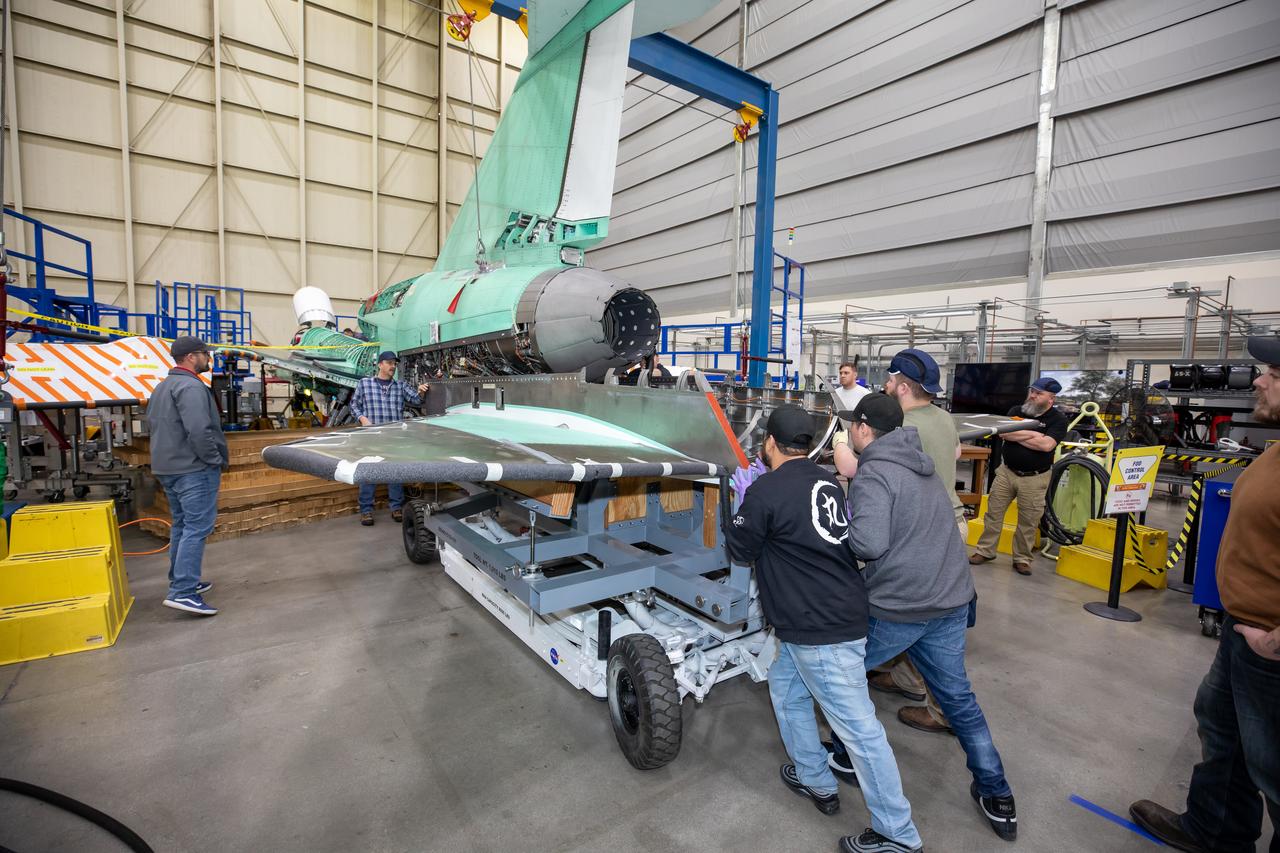
The X-59 team at Lockheed Martin Skunk Works in Palmdale, California, load the lower empennage - the tail section - into place. The surfaces used to control the tilt of the airplane are called stabilators and are connected to the lower empennage. The X-59 is the centerpiece of NASA’s Quesst mission, which could help enable commercial supersonic air travel over land.
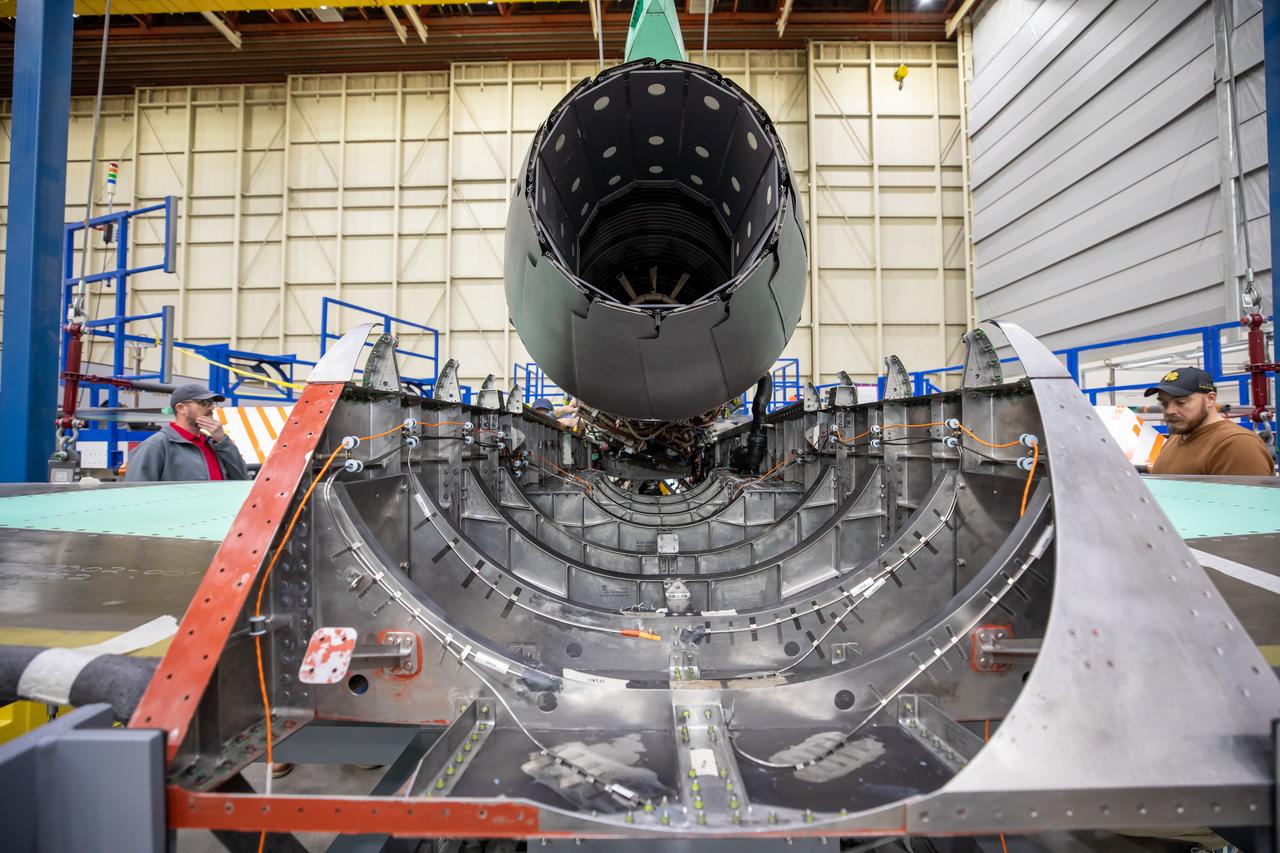
Here is a close-up of the GE F414 engine, from the aft deck or rear, before the tail section of the X-59 is lifted into place and attached to the aircraft. The aft deck helps control the shockwaves at the end of the aircraft and reduce the noise of a sonic boom to more of a sonic thump.