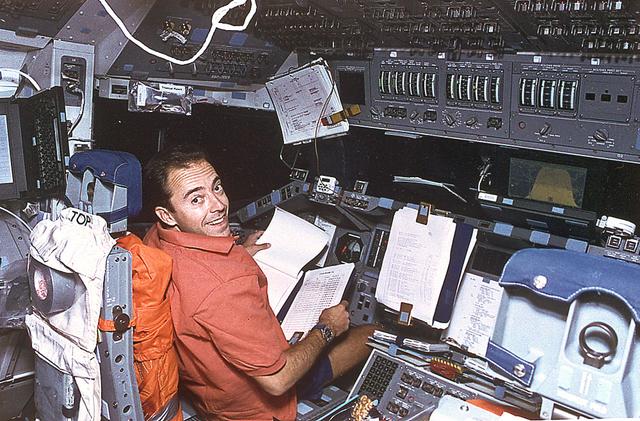
This is an onboard photo of space shuttle Atlantis (STS-66) crew member, French scientist Jean-Francois Clervoy working on the Atmospheric Laboratory for Applied Sciences (ATLAS-3) project. The ATLAS-3 measures the variances of the sun's solar radiation and the variability in the solar spectrum.
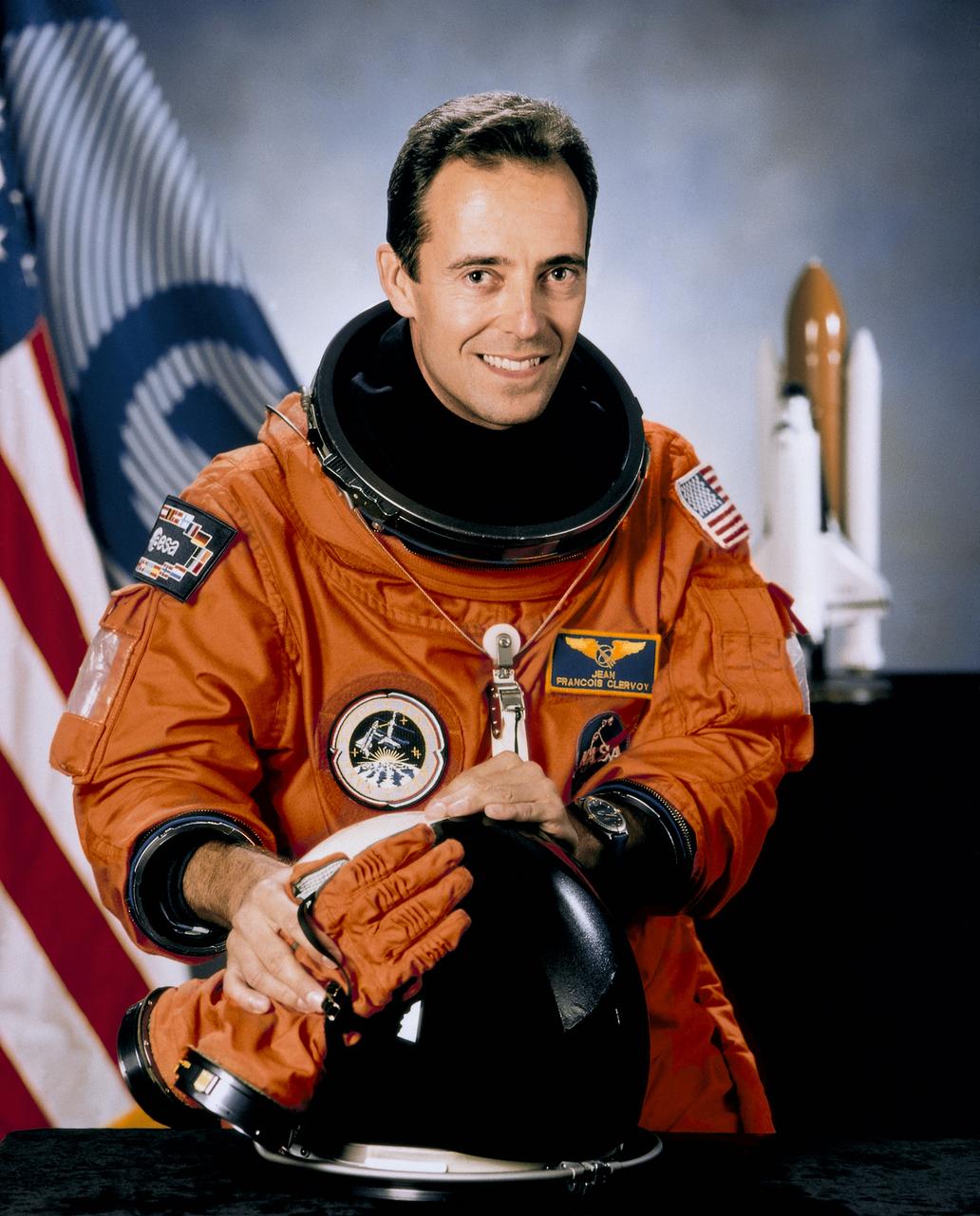
S97-02547 (February 1997) --- Astronaut Jean-Francois Clervoy, mission specialist.
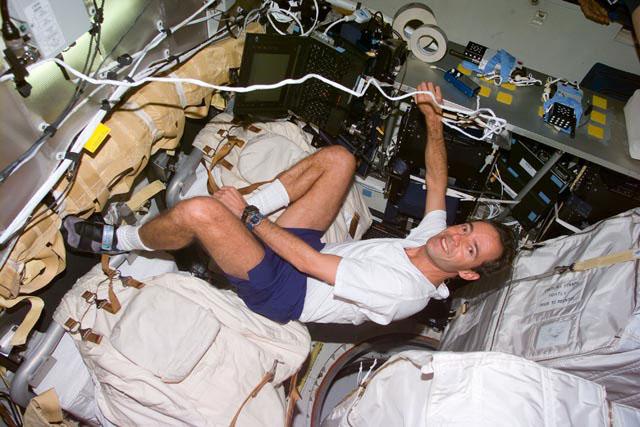
S103-E-5188 (21 December 1999) --- Astronaut Jean-Francois Clervoy, mission specialist representing the European Space Agency (ESA), has established a computer workstation on Discovery's mid deck. This photo was taken with an electronic still camera (ESC) at 10:43:07 GMT, Dec. 21, 1999.
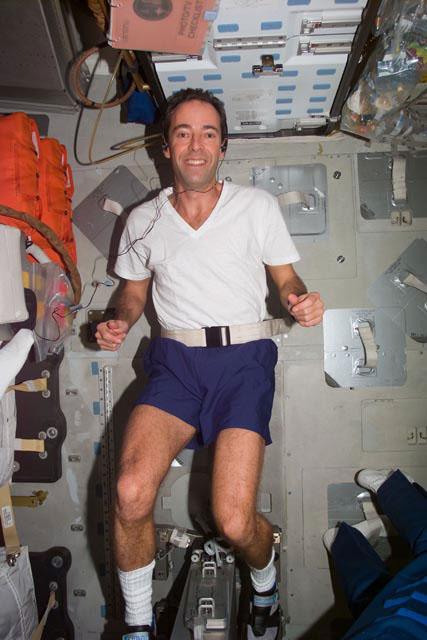
S103-E-5190 (21 December 1999) --- Astronaut Jean-Francois Clervoy, mission specialist representing the European Space Agency (ESA), works out on an ergometer on Discovery's mid deck. This photo was taken with an electronic still camera (ESC) at 11:02:27 GMT, Dec. 21, 1999.
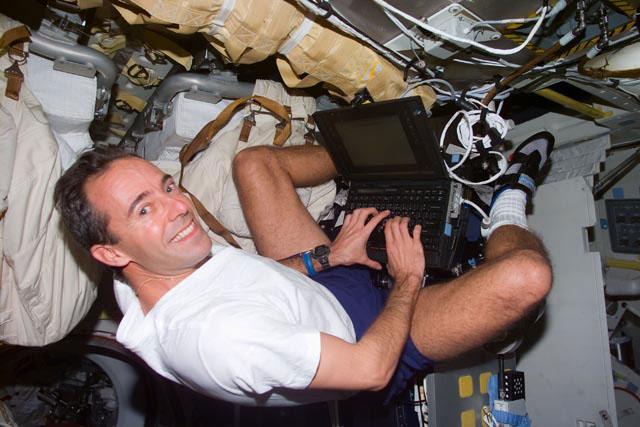
S103-E-5189 (21 December 1999) --- Astronaut Jean-Francois Clervoy, mission specialist representing the European Space Agency (ESA), uses a general purpose computer on Discovery's mid deck. This photo was taken with an electronic still camera (ESC) at 10:43:55 GMT, Dec. 21, 1999.
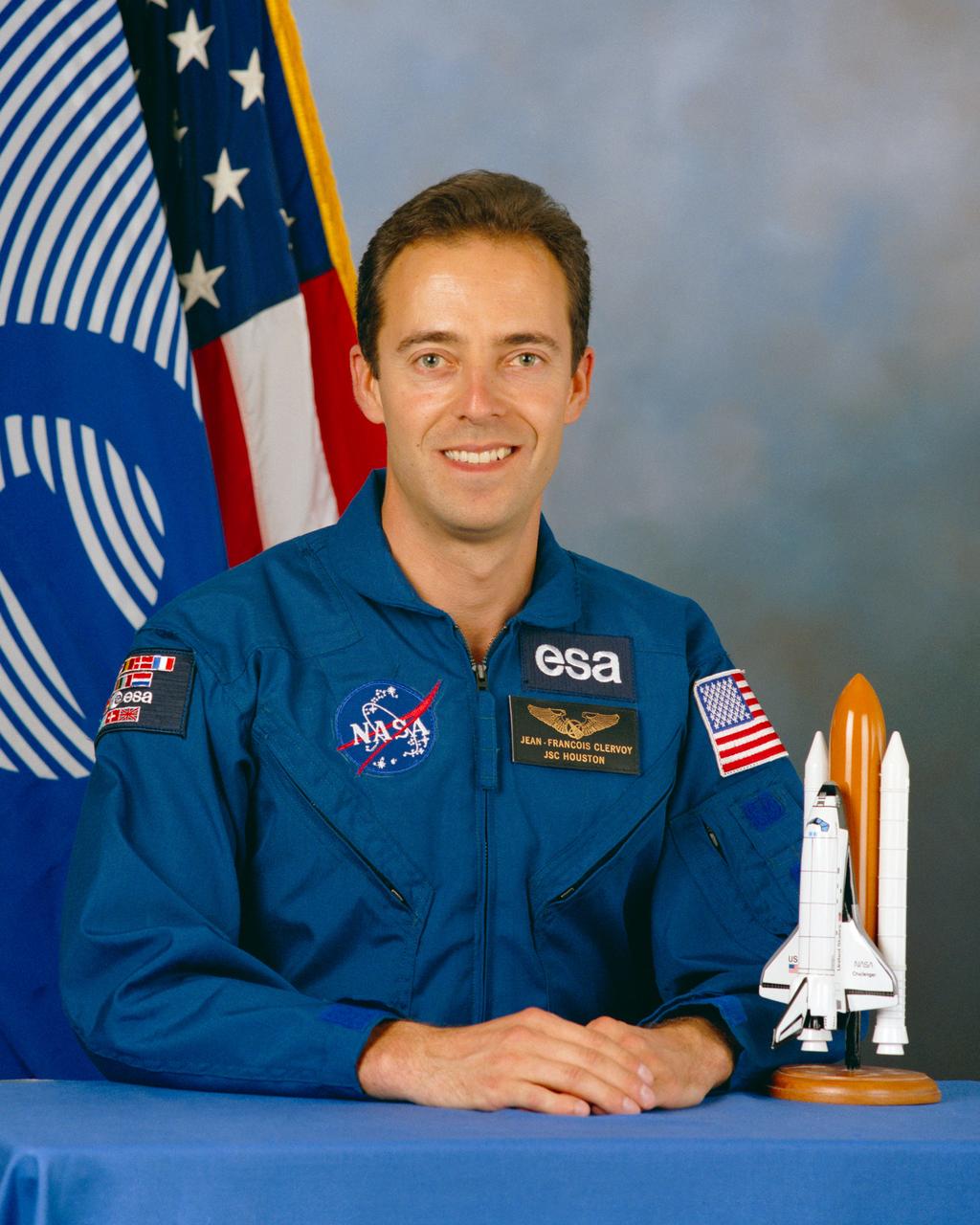
S92-44931 (October 1992) --- Astronaut Jean-Francois Clervoy, Centre d'Etudes National Spatial (CNES), France mission specialist.
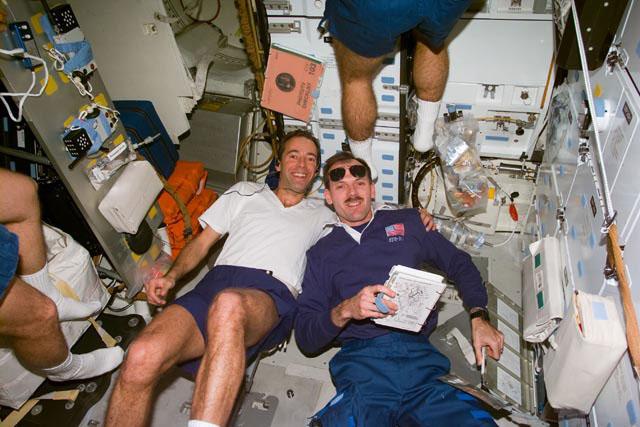
S103-E-5194 (21 December 1999) --- Astronaut Jean-Francois Clervoy (left), mission specialist representing the European Space Agency (ESA), works out on an ergometer device; and astronaut Steven L. Smith, payload commander, fetches a reference manual. Two unidentified STS-103 crew mates are busy at various tasks, partially out of the frame. This photo was taken with an electronic still camera (ESC) at 11:08:38 GMT, Dec. 21, 1999.
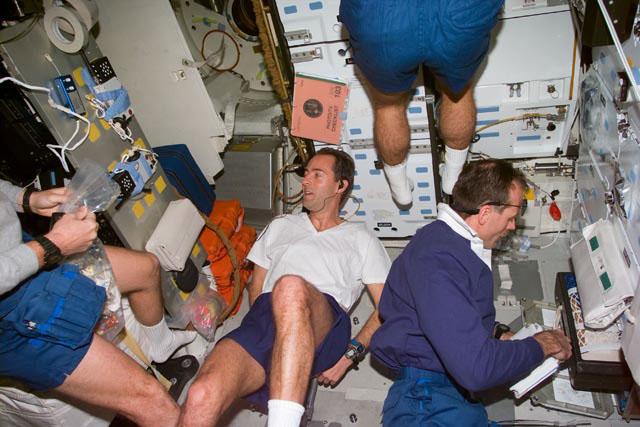
S103-E-5193 (21 December 1999) --- Astronaut Jean-Francois Clervoy (center frame), mission specialist representing the European Space Agency (ESA), works out on an ergometer device on Discovery's mid deck while nearby astronaut Steven L. Smith, payload commander, looks over a reference manual. This photo was taken with an electronic still camera (ESC) at 11:08:09 GMT, Dec. 21, 1999.
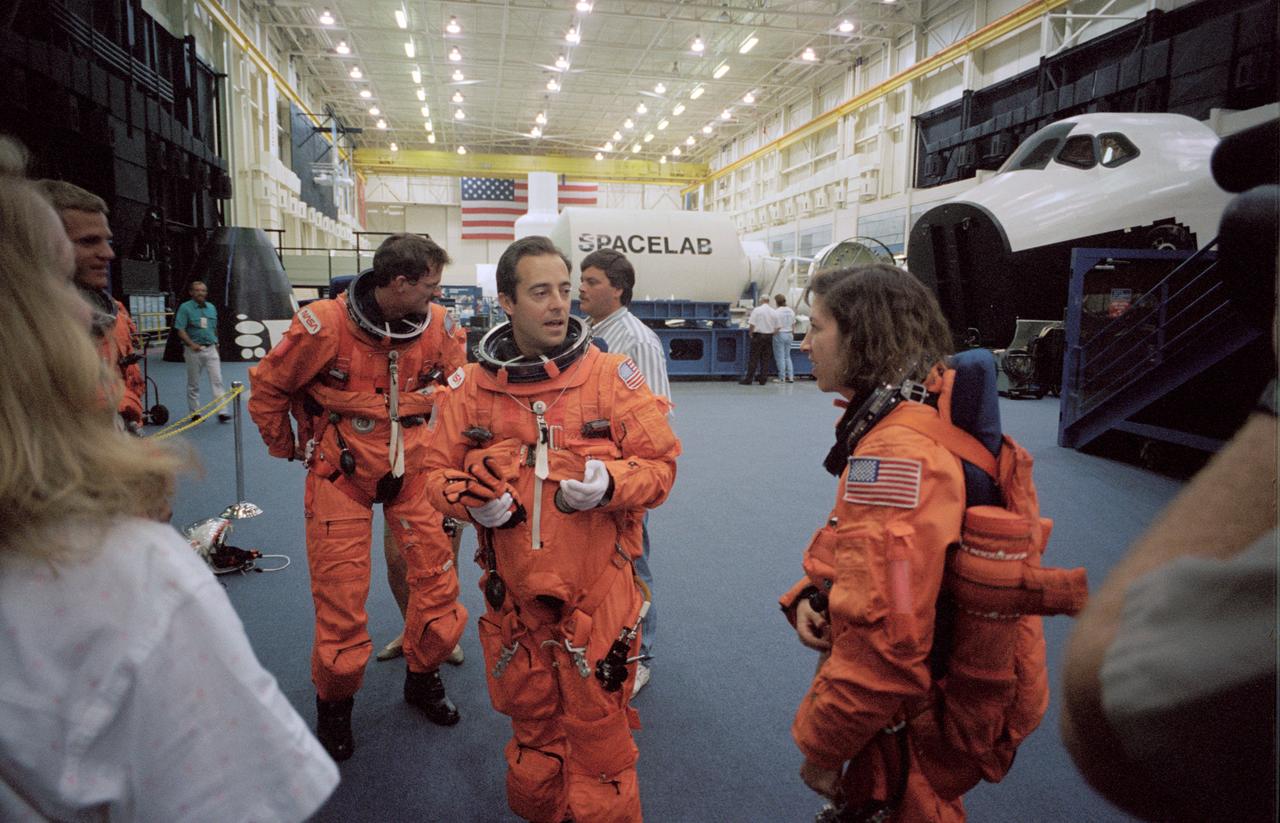
S94-40095 (23 June 1994) --- Jean-Francois Clervoy (center), STS-66 international mission specialist, chats with payload crew mates during a training session on emergency egress procedures. Wearing training versions of the launch and entry suits (LES), the crew members are, left to right, Scott E. Parazynski, Joseph P. Tanner, Clervoy and Ellen Ochoa. Ochoa is payload commander; Tanner and Parazynski are NASA mission specialists and Clervoy represents the European Space Agency (ESA) as a mission specialist. Six astronauts will spend a week and a half aboard the Space Shuttle Atlantis in Earth-orbit in support of the Atmospheric Laboratory for Applications and Science (ATLAS-3).
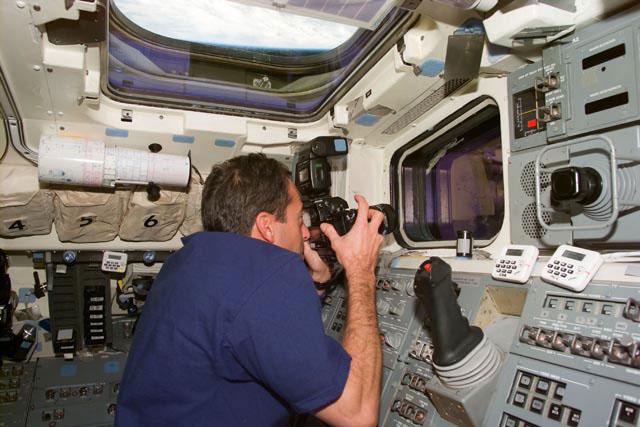
S103-E-5247 (22 December 1999) --- Astronaut Jean-Francois Clervoy, mission specialist representing the European Space Agency (ESA), takes out-the-window pictures during the first space walk on this third visit by NASA astronauts to service the Hubble Space Telescope (HST).
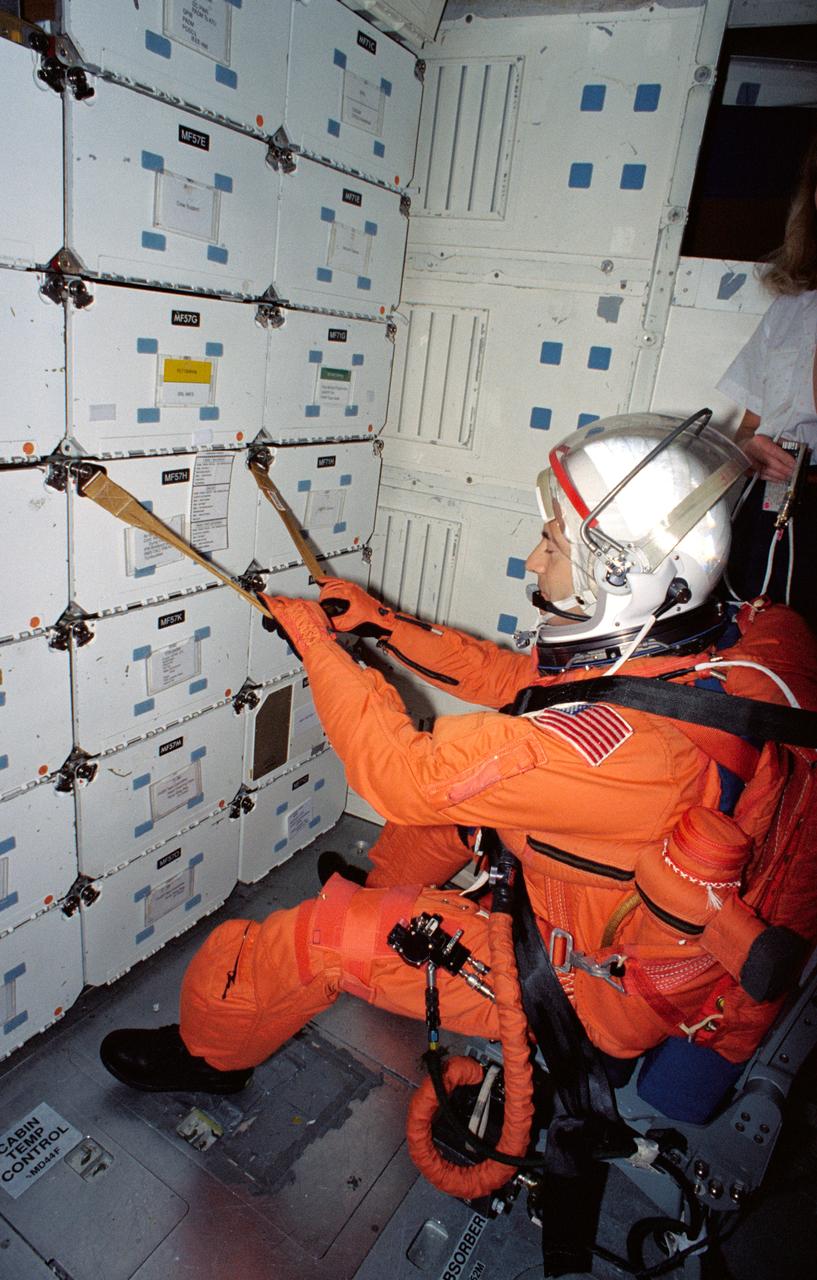
S94-40074 (23 June 1994) --- Astronaut Jean-Francois Clervoy, STS-66 international mission specialist, sits securely on a collapsible seat on the middeck of a Shuttle trainer during a rehearsal of procedures to be followed during launch and entry phases of his scheduled November flight. This rehearsal, held in the crew compartment trainer of the Johnson Space Center's (JSC) Shuttle Mockup and Integration Laboratory, was followed by a training session on emergency egress procedures. Clervoy, a European astronaut, will join five NASA astronauts for a week and a half aboard the Space Shuttle Atlantis in Earth-orbit in support of the Atmospheric Laboratory for Applications and Science (ATLAS-3).
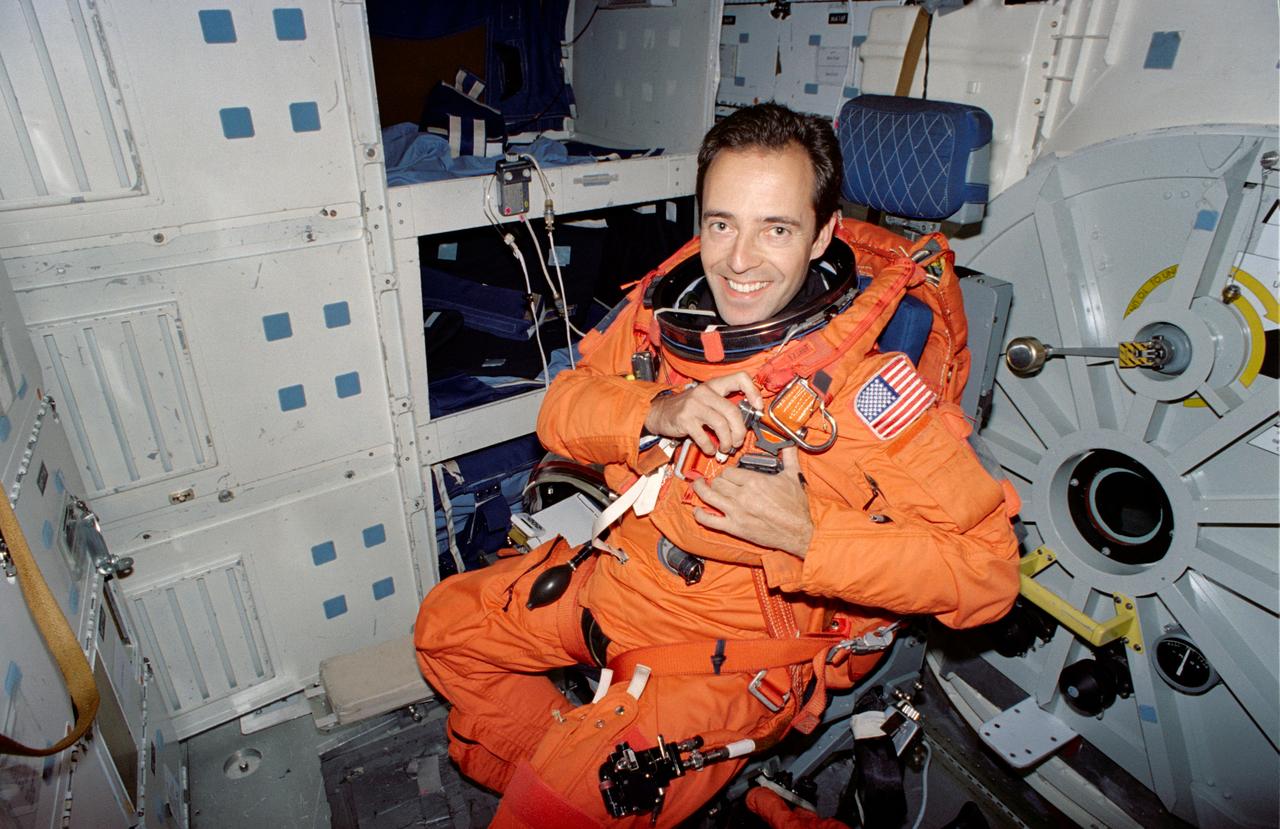
S94-40081 (23 June 1994) --- Wearing a training version of a partial pressure suit, Jean-Francois Clervoy, STS-66 international mission specialist, secures himself on a collapsible seat on the middeck of a Shuttle trainer during a rehearsal of procedures to be followed during launch and entry phases of his scheduled November flight. This rehearsal, held in the Crew Compartment Trainer (CCT) of the Johnson Space Center's (JSC) Shuttle Mockup and Integration Laboratory, was followed by a training session on emergency egress procedures. Clervoy, a European astronaut, will join five NASA astronauts for a week and a half aboard the Space Shuttle Atlantis in Earth-orbit in support of the Atmospheric Laboratory for Applications and Science (ATLAS-3).
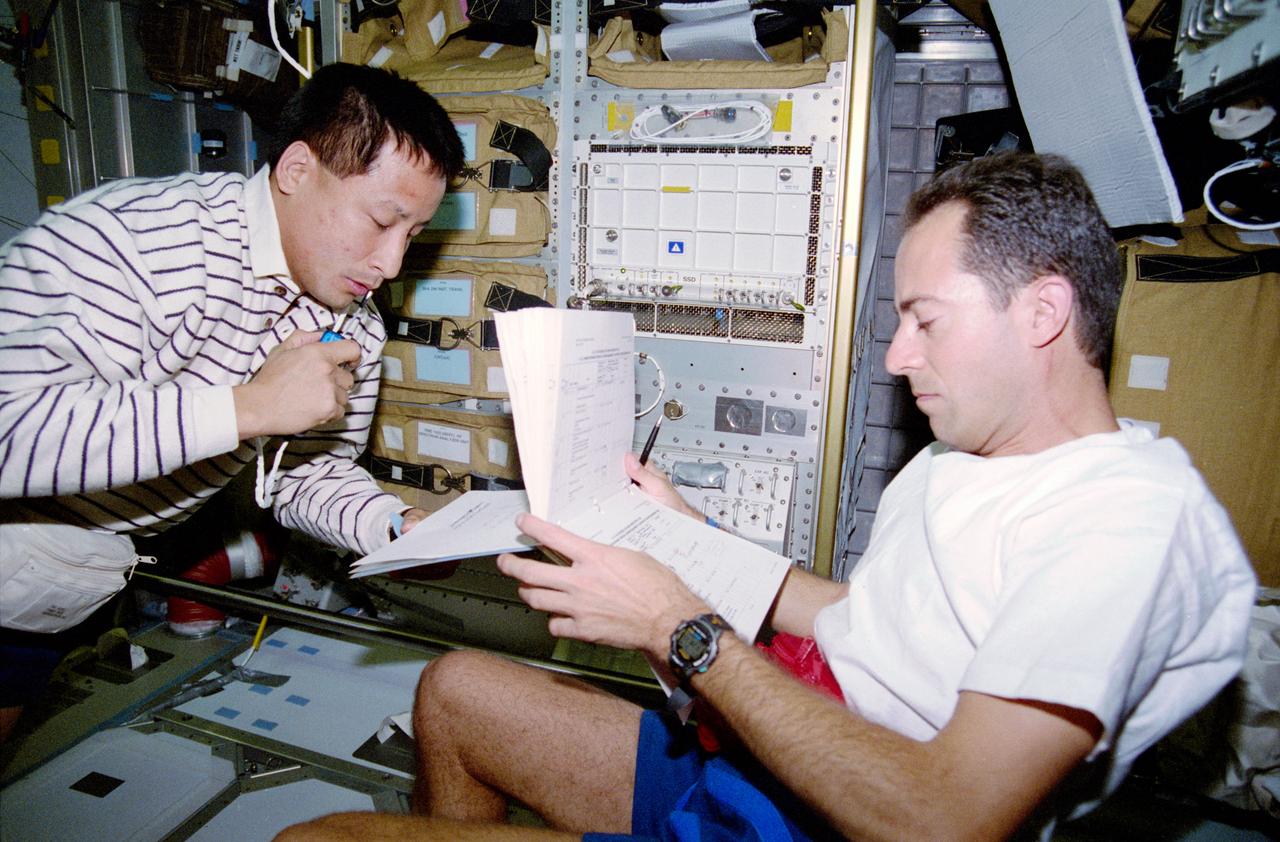
STS084-304-004 (15-24 May 1997) --- Astronaut Edward T. Lu (left) gets an early start on transfer operations in the Spacehab Double Module as he goes over an inventory checklist with astronaut Jean-Fran?ois Clervoy, payload commander. Later, almost three tons of supplies were transferred between the Space Shuttle Atlantis and Russia's Mir Space Station.
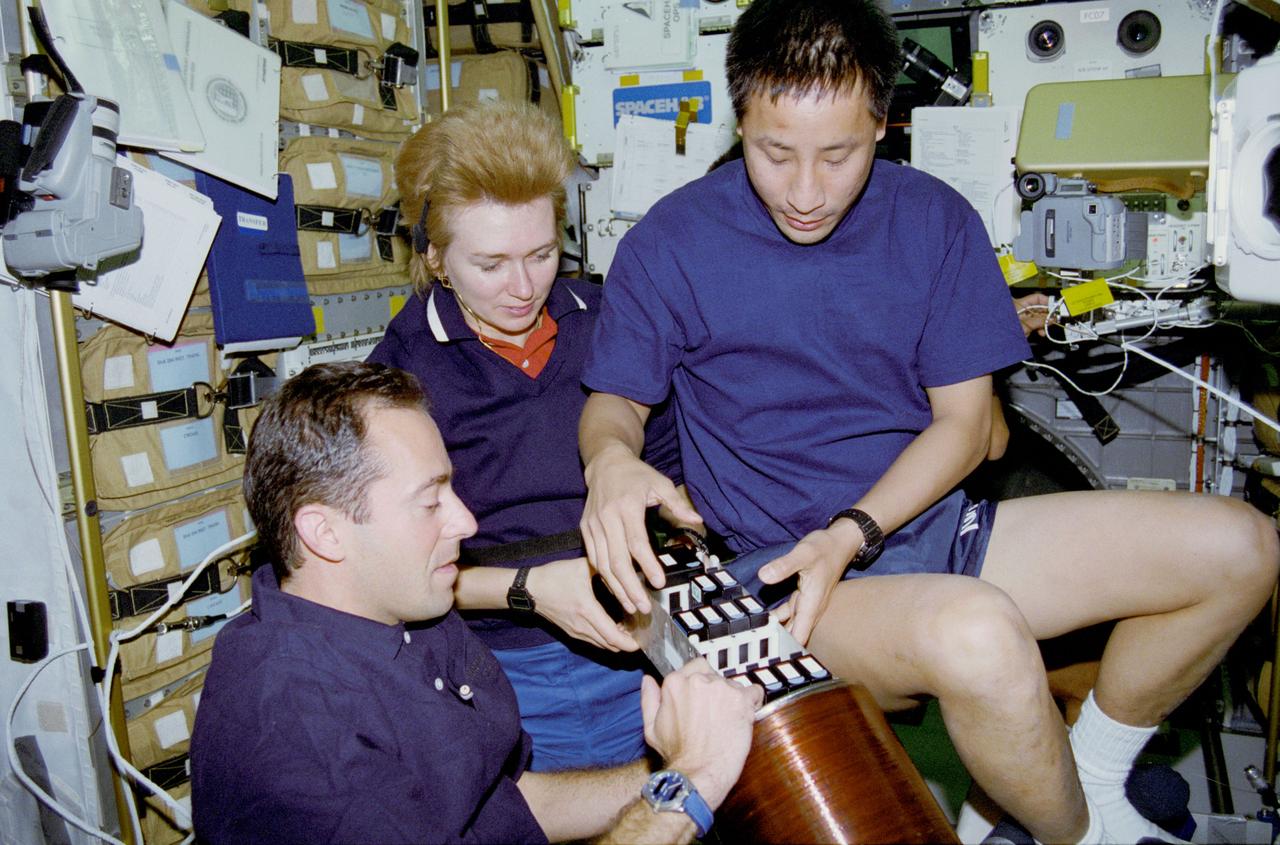
STS084-311-033 (15-24 May 1997) --- Biorack operations on Spacehab, aboard the Space Shuttle Atlantis, draw the collective attention of (from the left) Jean-Francois Clervoy, STS-84 payload commander; and Elena V. Kondakova and Edward T. Lu, both mission specialists.
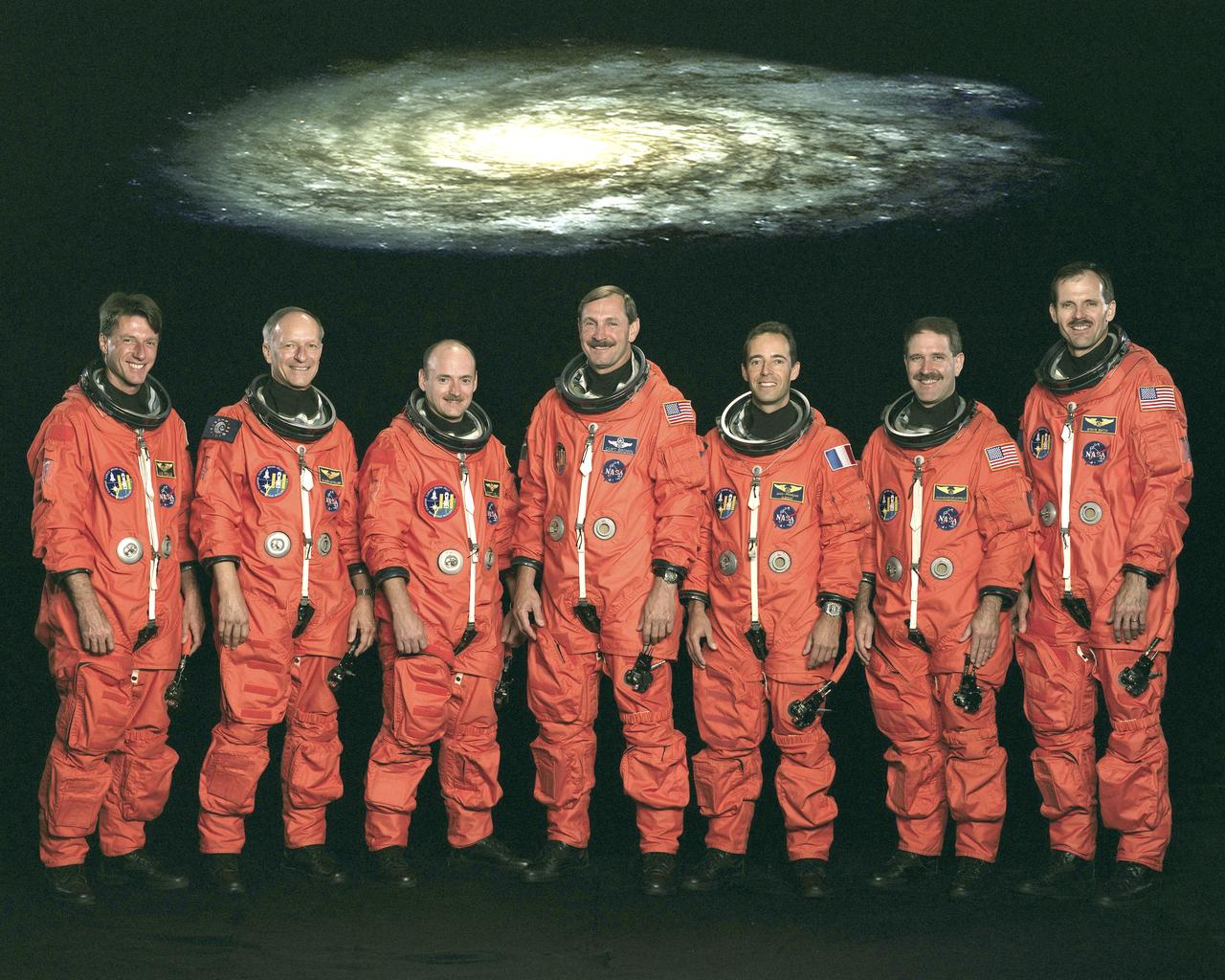
The STS-103 crew portrait includes (from left) C. Michael Foale, mission specialist; Claude Nicollier, mission specialist representing the European Space Agency (ESA) ; Scott J. Kelly, pilot; Curtis L. Brown, commander; and mission specialists Jean-Francois Clervoy (ESA), John M. Grunsfeld, and Steven L. Smith. Launched aboard the Space Shuttle Discovery on December 19, 1999 at 6:50 p.m. (CST), the STS-103 mission served as the third Hubble Space Telescope (HST) servicing mission.
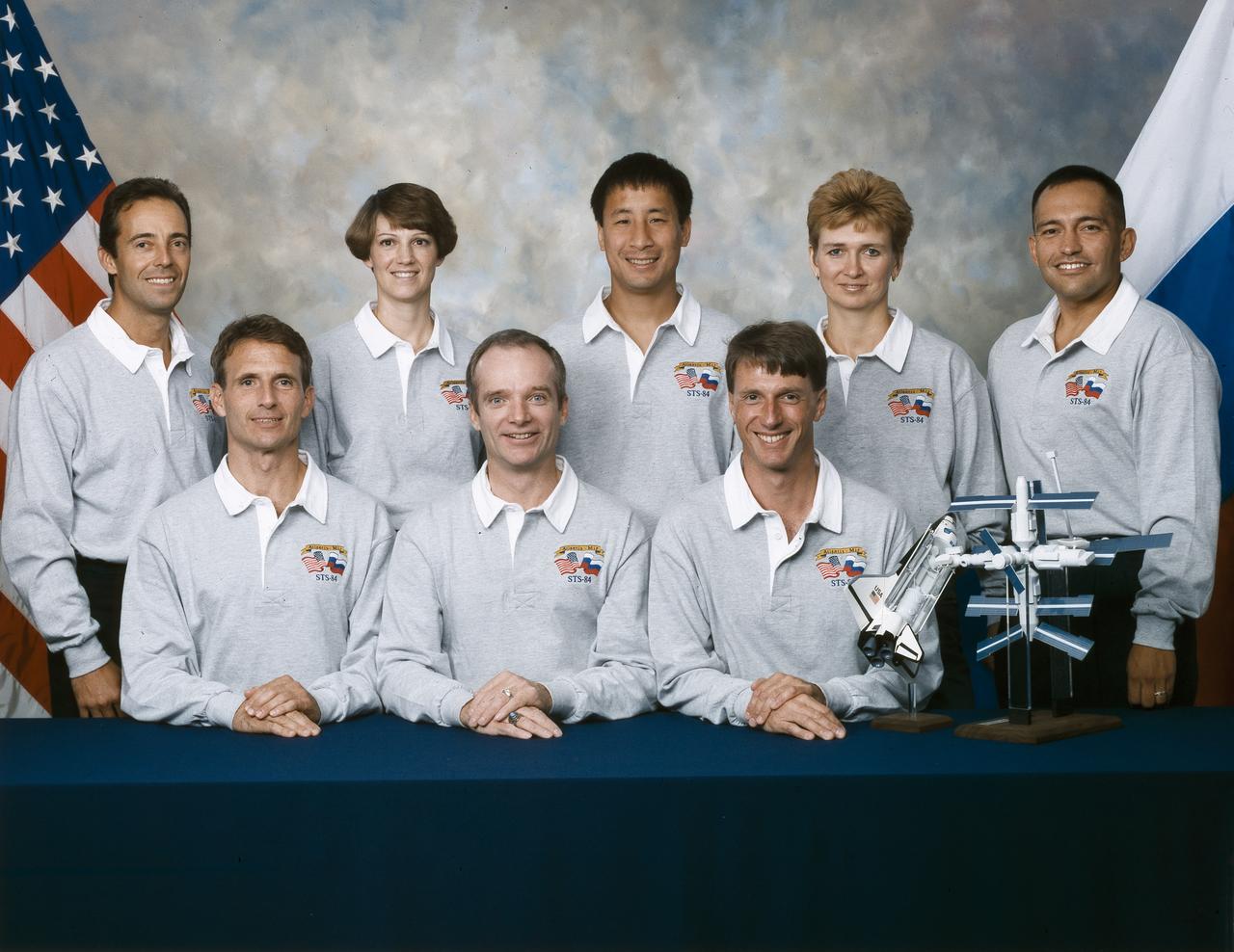
The crew assigned to the STS-84 mission included (seated front left to right) Jerry M Linenger, mission specialist; Charles J. Precourt, commander; and C. Michael Foale, mission specialist. On the back row (left to right) are Jean-Francois Clervoy (ESA), mission specialist; Eileen M. Collins, pilot; Edward T. Lu, mission specialist; Elena V. Kondakova (RSA), mission specialist; and Carlos I. Noriega, mission specialist. Launched aboard the Space Shuttle Atlantis on May 15, 1997 at 4:07:48 am (EDT), the STS-84 mission served as the sixth U.S. Space Shuttle-Russian Space Station Mir docking.
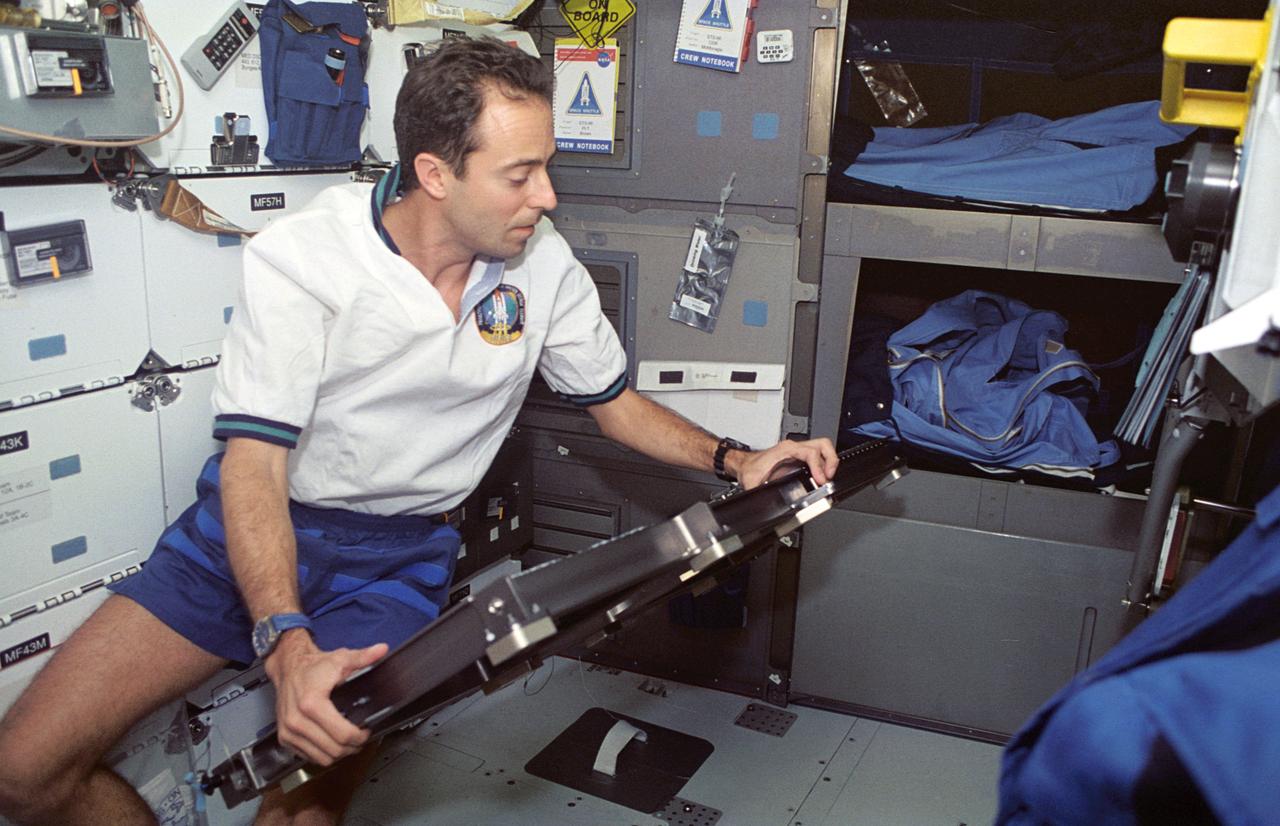
STS066-66-005 (3-14 Nov 1994) --- On the Space Shuttle Atlantis' flight deck, Jean-François Clervoy, mission specialist representing the European Space Agency (ESA), moves a platform for the recumbent seat device which was being evaluated for a future Space Shuttle flight. The platform is just part of the mid-deck arrangement designed to accommodate crew members when the Space Shuttle docks with Russia's Mir Space Station next year. Other crew members onboard Atlantis for the 11-day day Atmospheric Laboratory for Applications and Science (ATLAS-3) mission were astronauts Donald R. McMonagle, Curtis L. Brown, Jr., Ellen Ochoa, Scott E. Parazynski and Joseph R. Tanner.
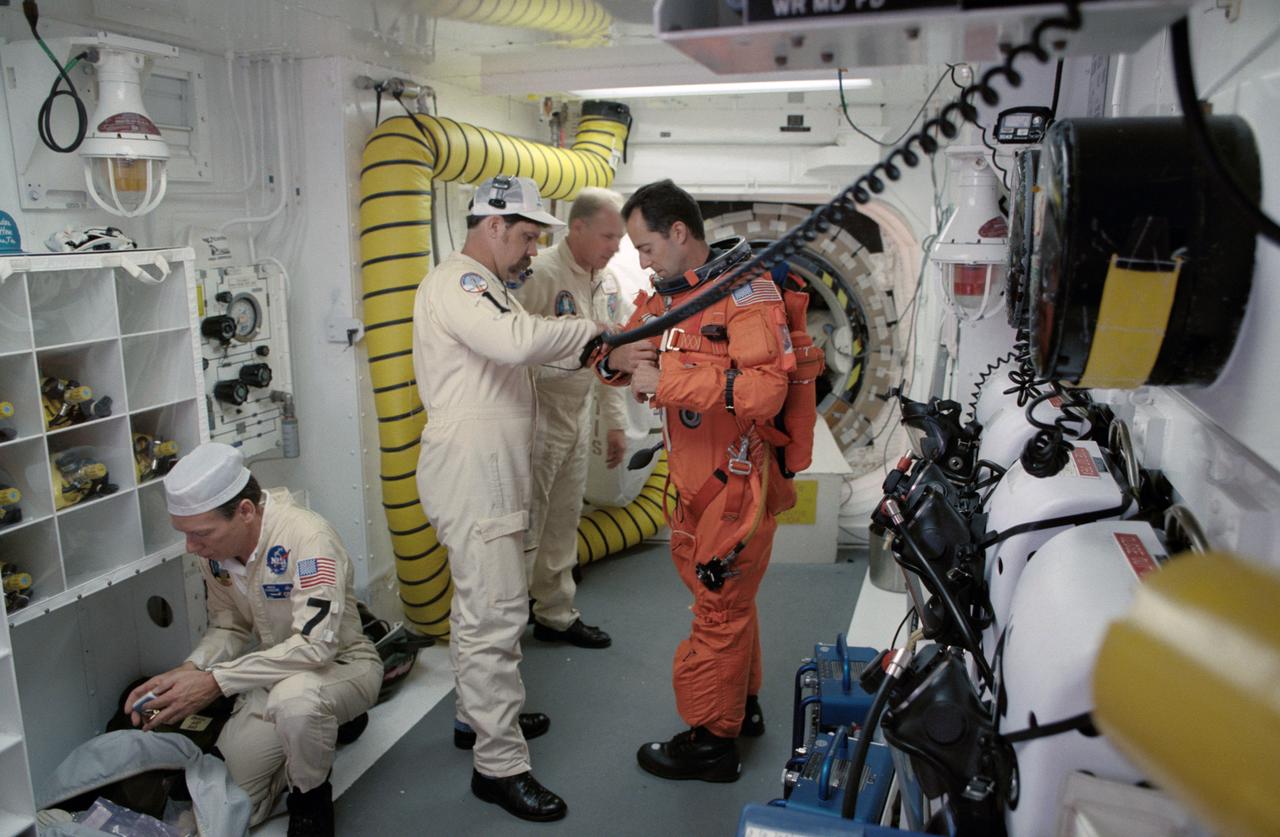
STS066-S-003 (3 November 1994) --- In the white room at Launch Pad 39B, Jean-Francois Clervoy, mission specialist representing European Space Agency (ESA), is assisted with his partial pressure launch/entry suit (LES) by close-out crew members Travis Thompson and Danny Wyatt (background). At noon on November 3, 1994, the ESA astronaut joined five NASA astronauts for launch aboard the Space Shuttle Atlantis. The six astronauts went on to spend 11-days in Earth-orbit in support of the Atmospheric Laboratory for Applications and Science (ATLAS-3) mission.
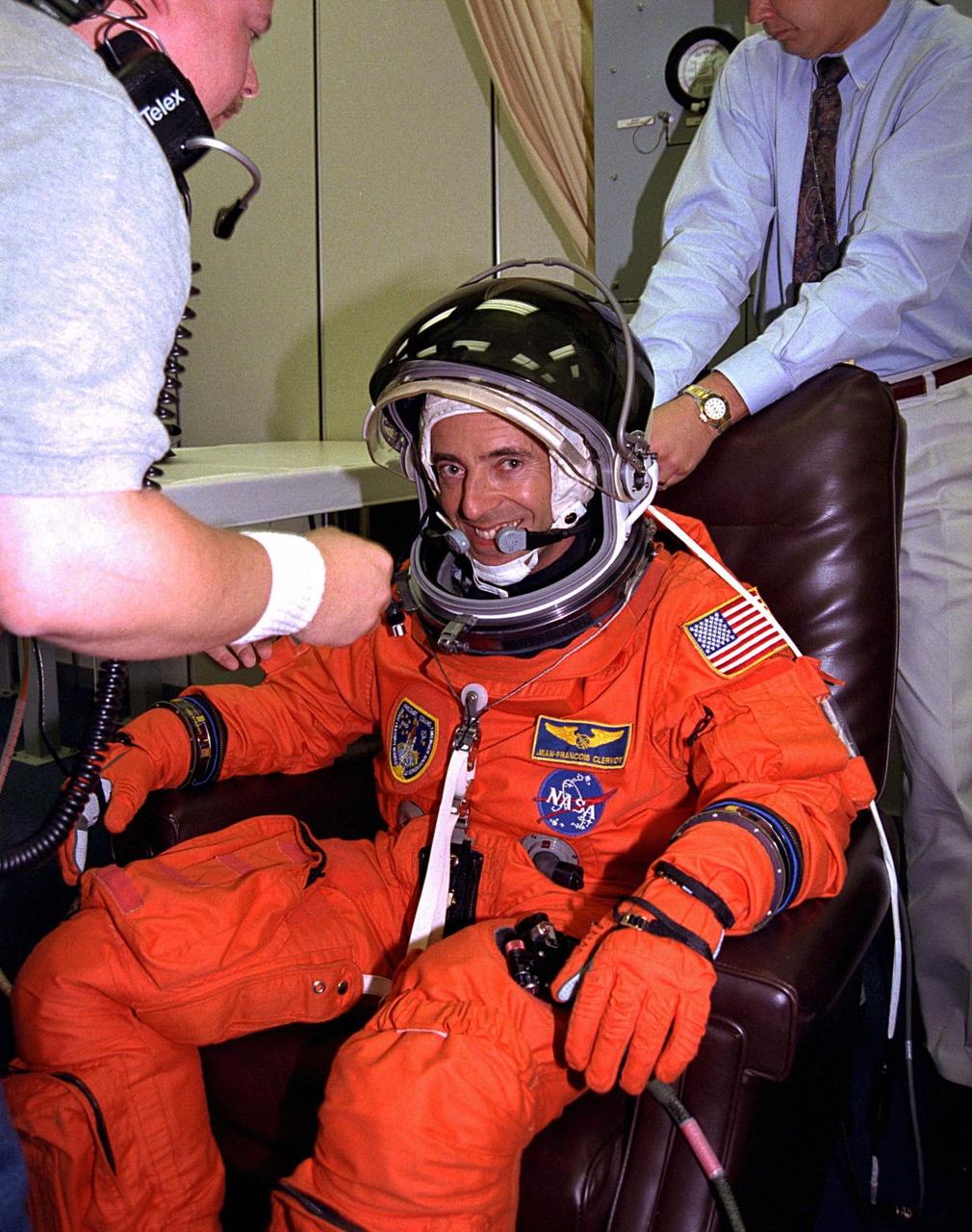
Assisted by suit technicians and others in the Operations and Checkout Building, STS-84 Mission Specialist Jean-Francois Clervoy dons his launch and entry suit during final prelaunch preparations. Clervoy is an astronaut with the European Space Agency. This will his second Space Shuttle flight. Clervoy and six other crew members will depart shortly for Launch Pad 39A, where the Space Shuttle Atlantis awaits liftoff on a mission to dock with the Russian Space Station Mir
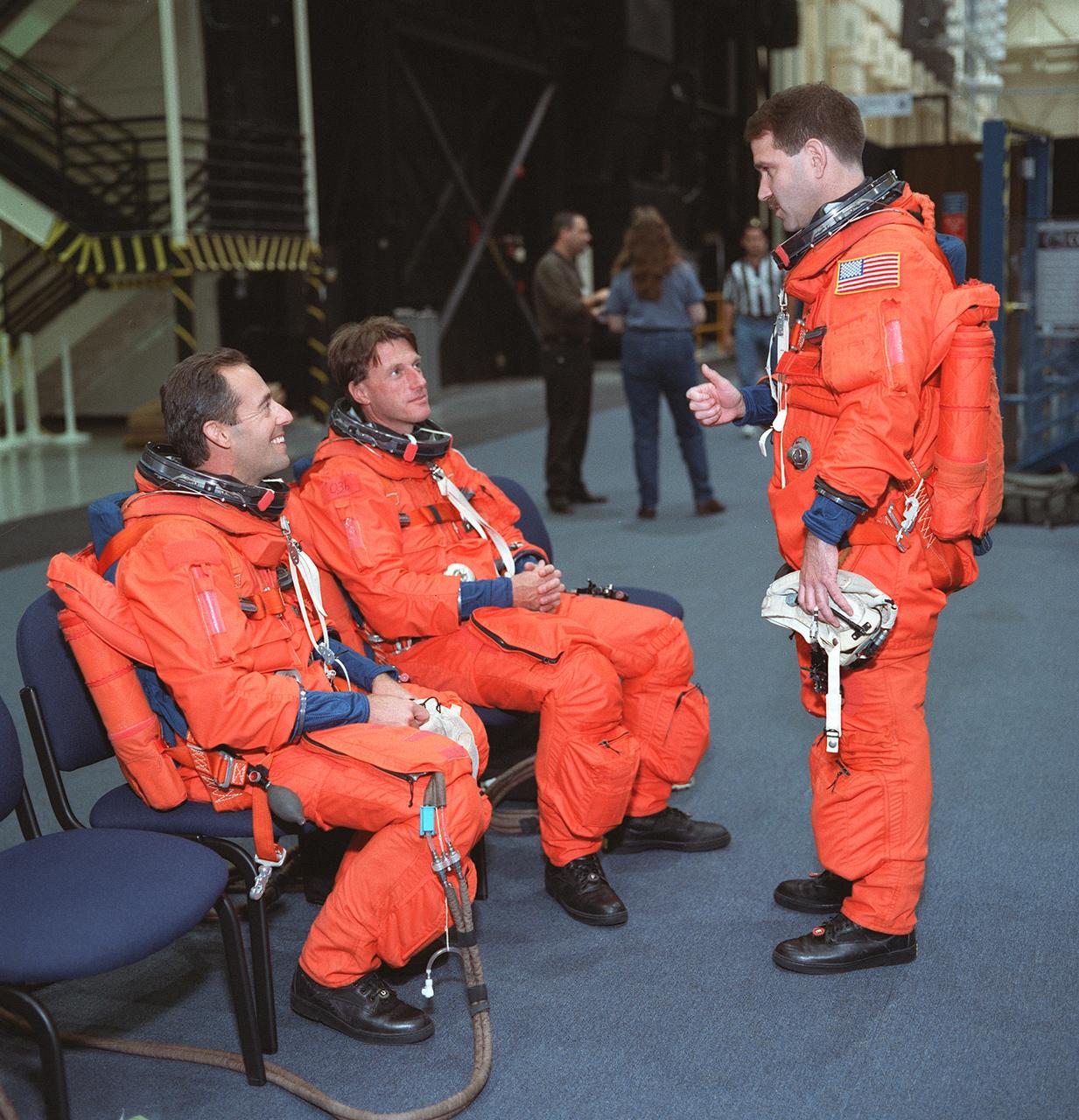
S99-08662 (24 May 1999) --- Prior to a training session on emergency bailout, three STS-103 mission specialists discuss contingencies. From the left, they are astronauts Jean-Francois Clervoy, C. Michael Foale and John M. Grunsfeld. Clervoy is one of two STS-103 crew members who represent the European Space Agency (ESA). This training took place in the Johnson Space Center's Systems Integration Facility.
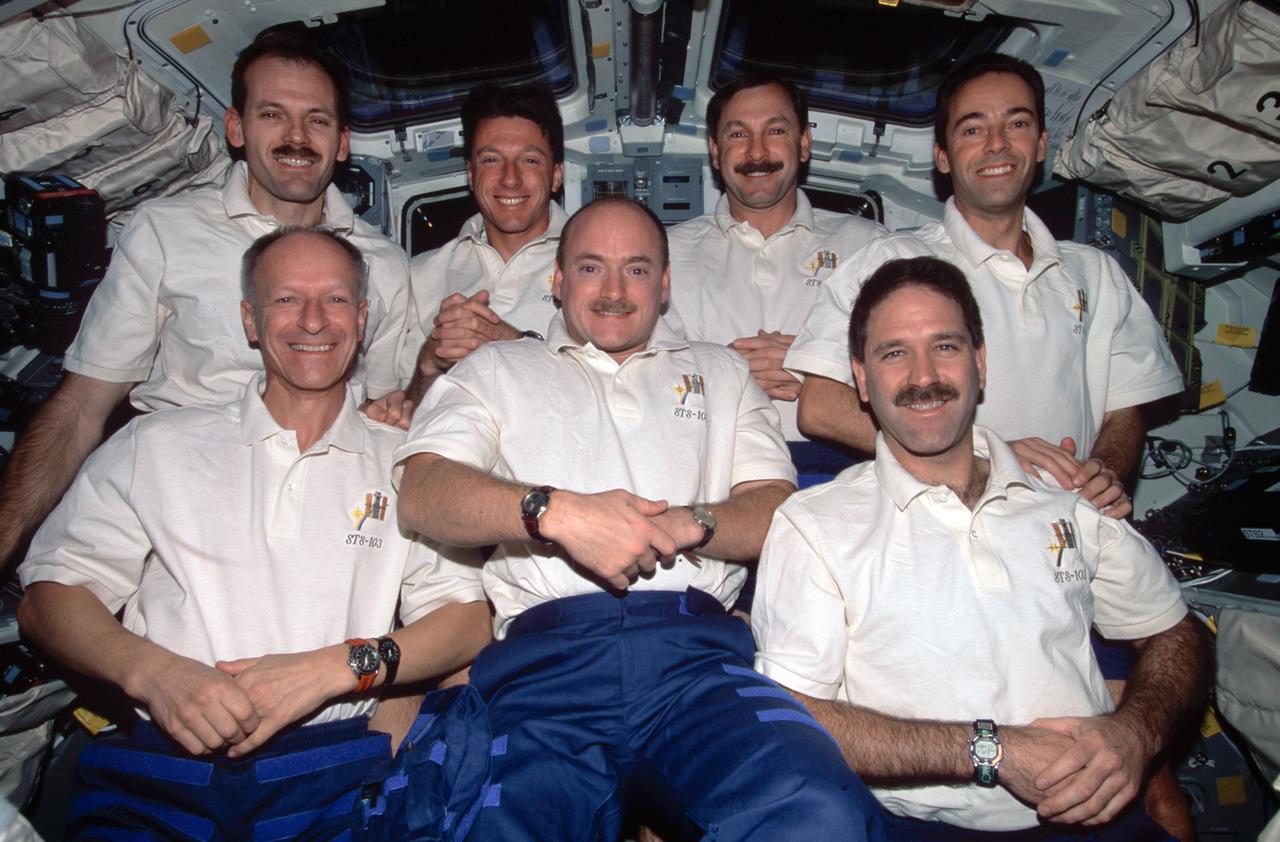
STS103-397-035 (19 - 27 December 1999) --- The seven astronauts aboard the Space Shuttle Discovery for NASA's third servicing visit to the Hubble Space Telescope (HST) pose for the traditional inflight crew portrait..In front are, from left, astronauts Claude Nicollier, Scott J. Kelly and John M. Grunsfeld. Behind them are.astronauts Steven L. Smith, C. Michael Foale, Curtis L. Brown, Jr., and Jean-Francois Clervoy. Nicollier and Clervoy are astronauts from the European Space Agency (ESA).
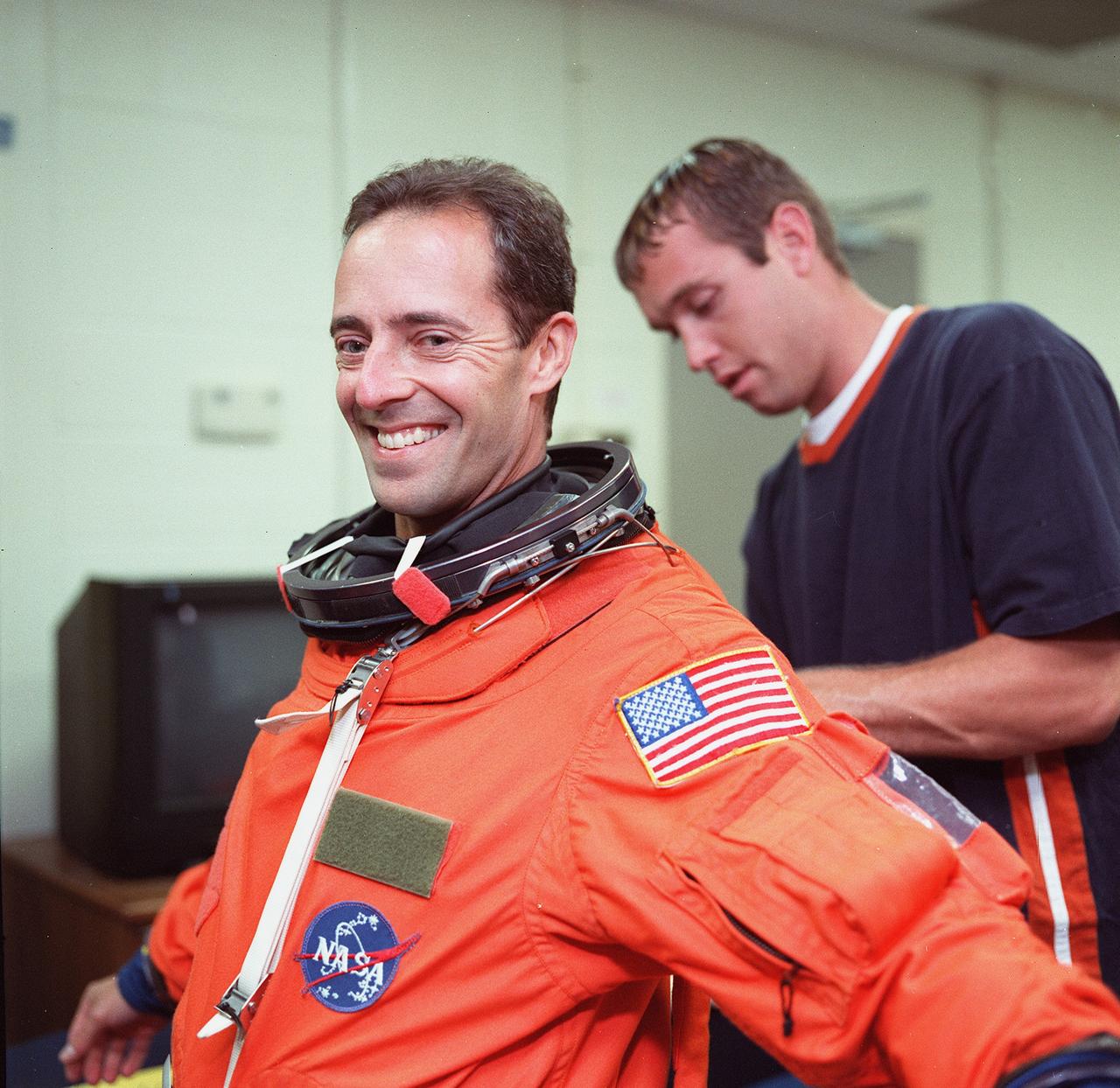
S99-08650 (24 May 1999) --- A suit technician assists astronaut Jean-Francois Clervoy, mission specialist representing the European Space Agency (ESA), in readying for a session of emergency bailout training in the Systems Integration Facility at the Johnson Space Center (JSC). Clervoy, wearing a training version of the partial-pressure launch and entry garment, and his six STS-103 crew mates are currently in training for the third visit to the Hubble Space Telescope (HST) since its 1990 deployment.
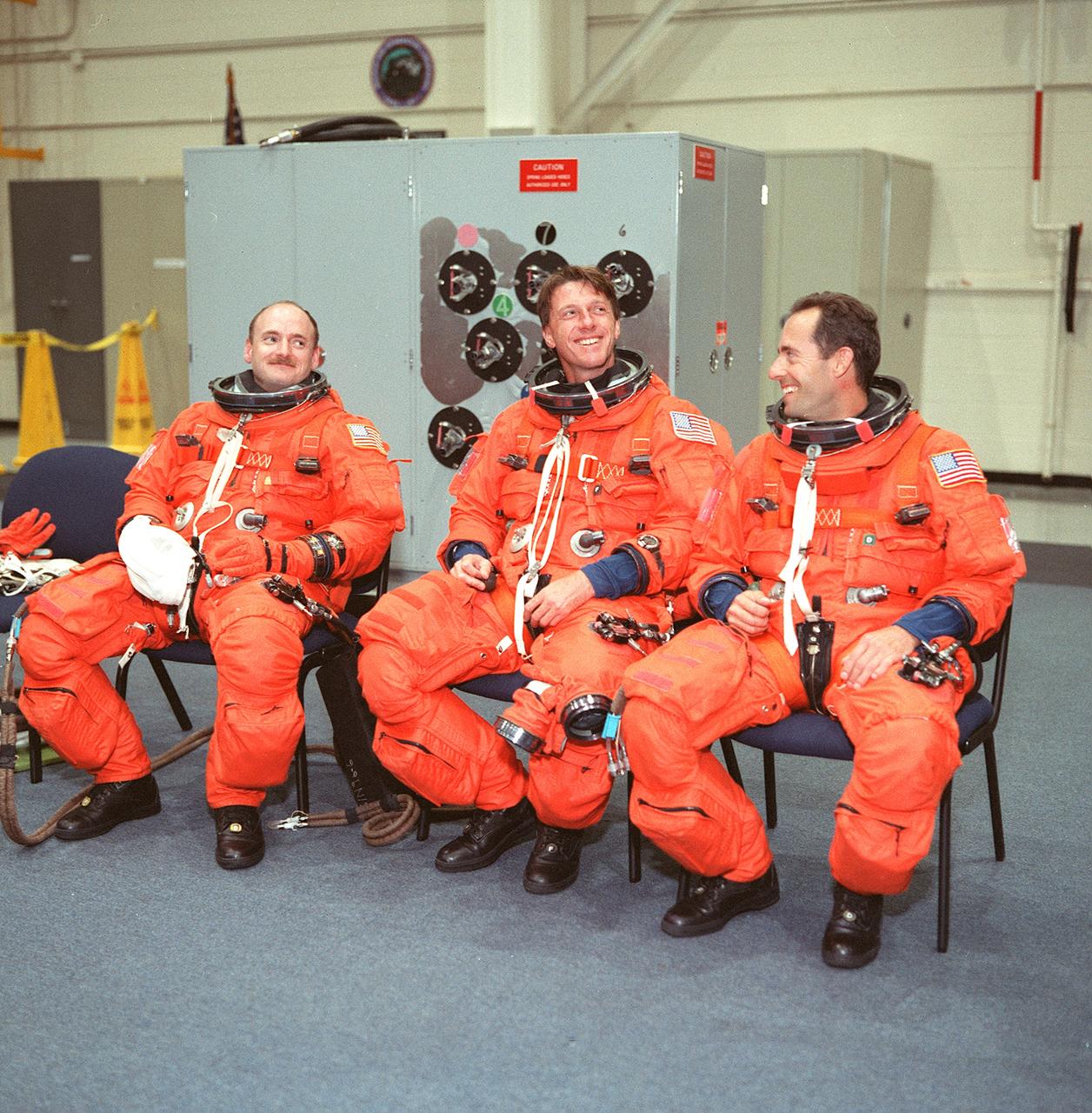
S99-08674 (24 May 1999) --- Three members of the third HST servicing mission's crew share a light moment while waiting to participate in emergency bailout training in the Johnson Space Center's Systems Integration Facility. From the left are astronauts Scott J. Kelly, C. Michael Foale and Jean-Francois Clervoy. Clervoy is a mission specialist representing the European Space Agency (ESA); Foale is a mission specialist; and Kelly, the STS-103 pilot.
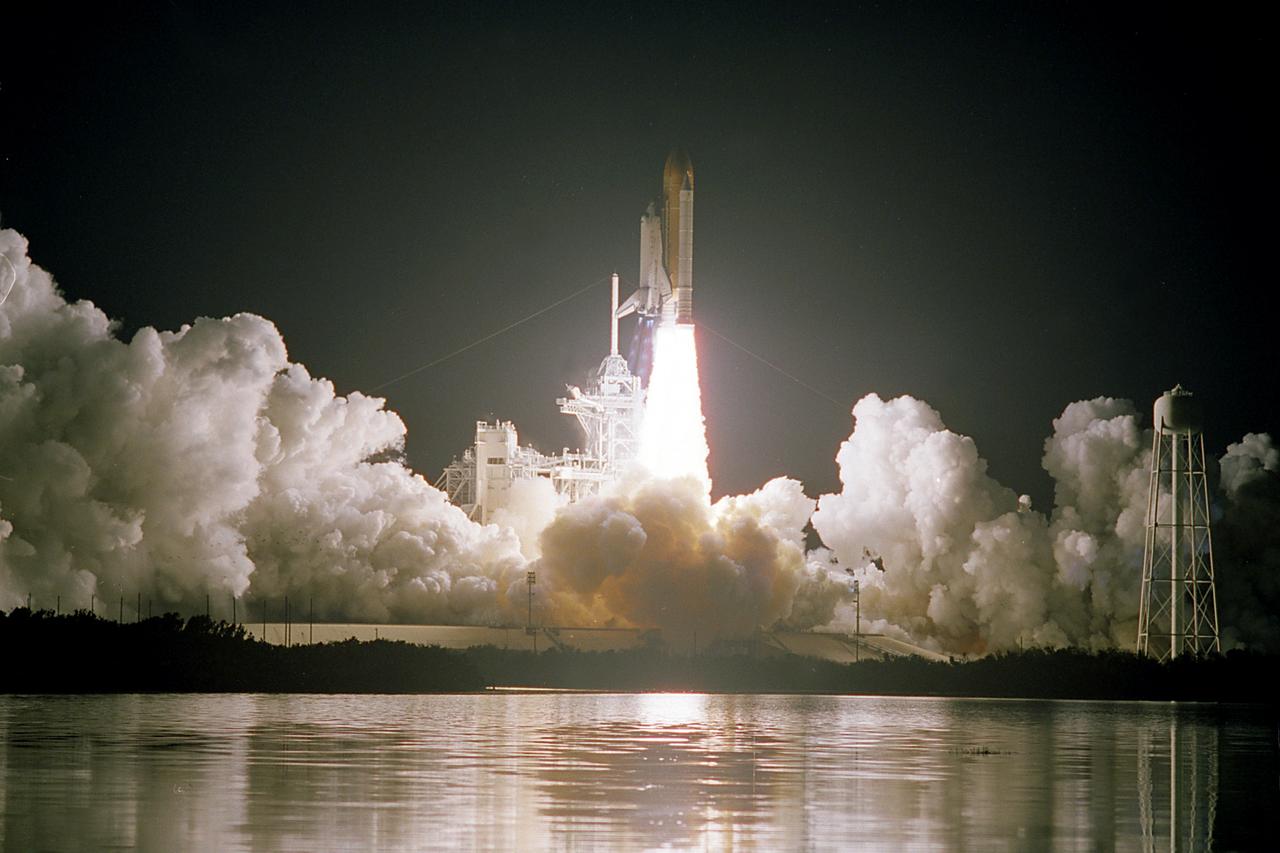
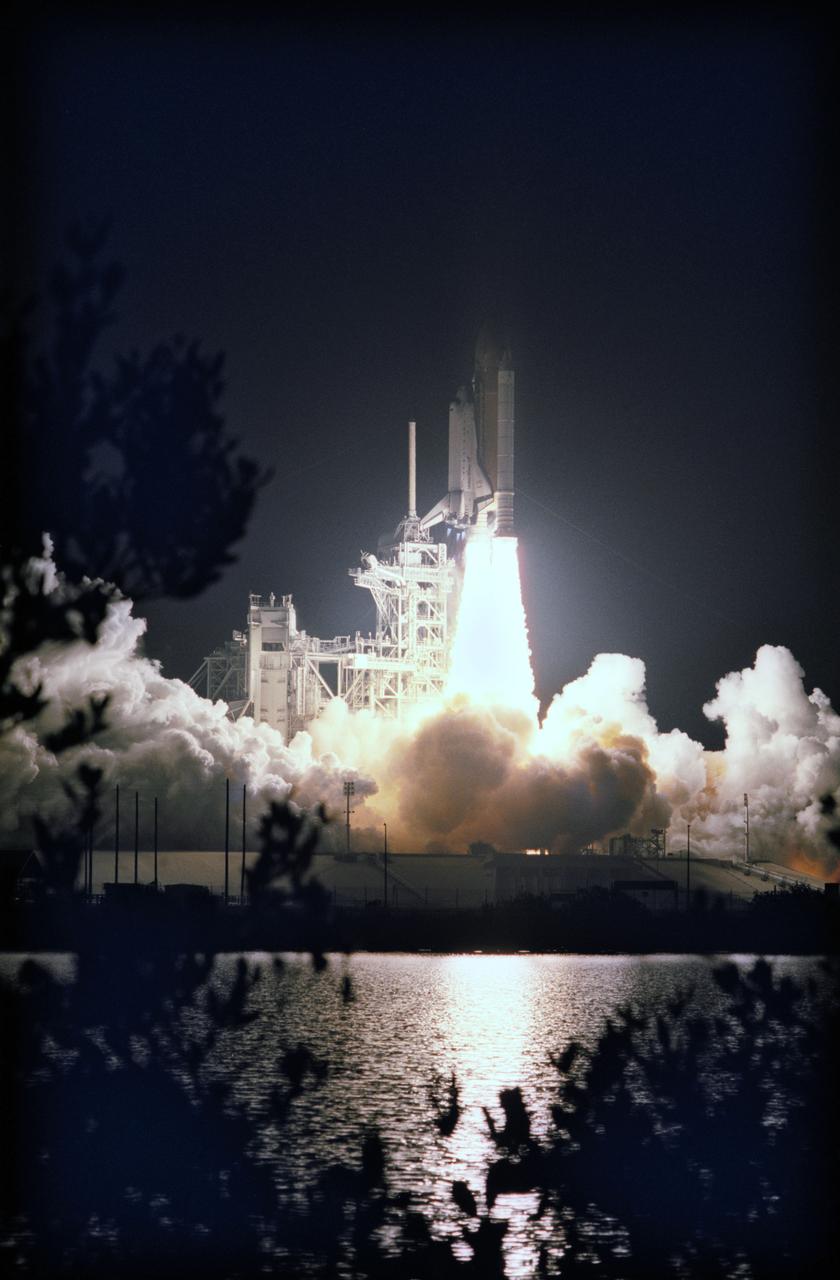
STS103-S-005 (19 December 1999) --- The Space Shuttle Discovery rises into the clear night sky to begin the 96th mission in the STS program. Liftoff occurred at 7:50 p.m. (EST), December 19, 1999, from Launch Pad 39B. Onboard were astronauts Curtis L. Brown, Jr., Scott J. Kelly, Steven L. Smith, C. Michael Foale, John M. Grunsfeld, Claude Nicollier and Jean-Francois Clervoy. Switzerland's Nicollier and France's Clervoy represent the European Space Agency (ESA).
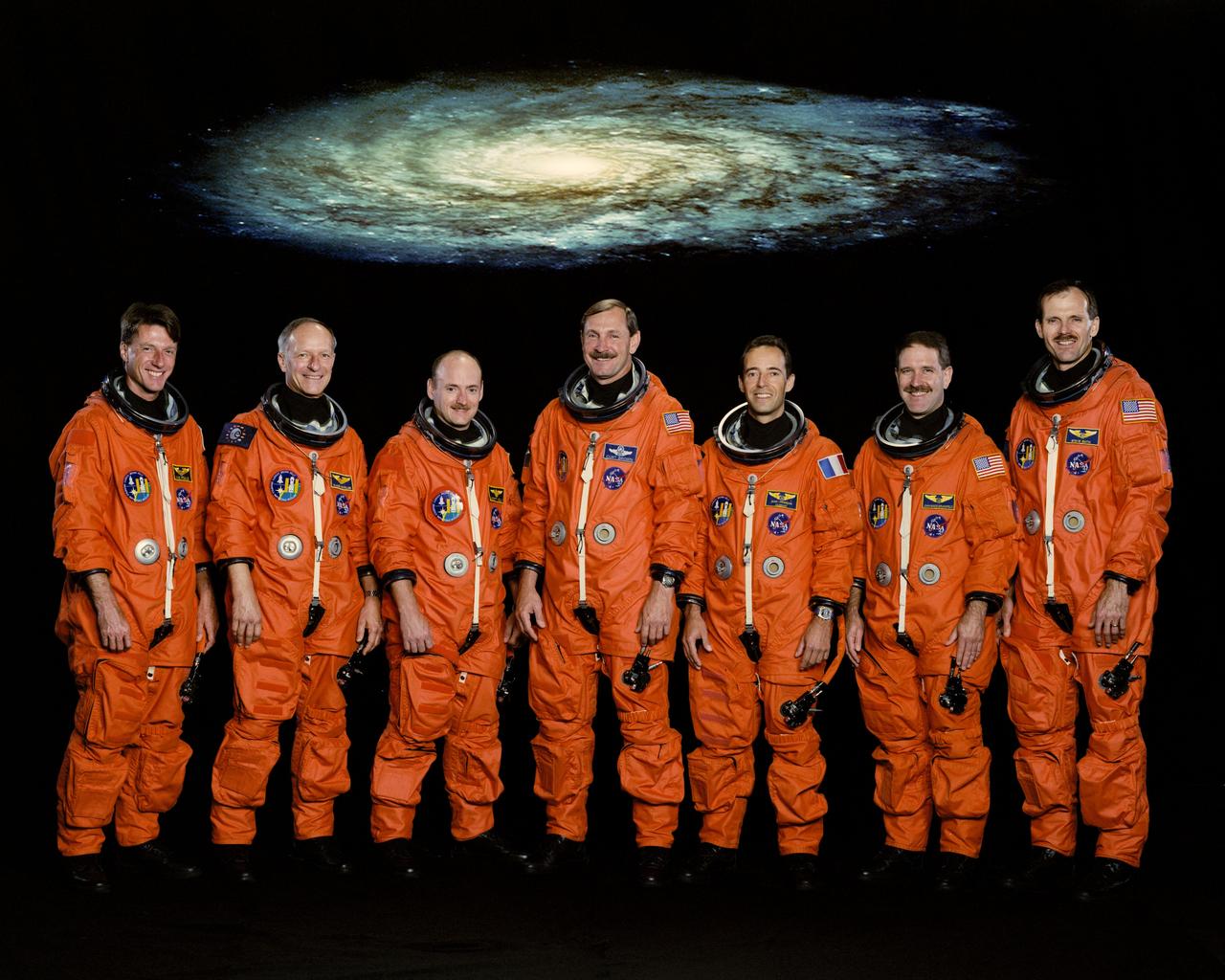
STS103-S-002 (August 1999) --- These seven astronauts have been assigned as crew members for NASA's third servicing mission to the Hubble Space Telescope (HST). They are, from the left, astronauts C. Michael Foale, Claude Nicollier, Scott J. Kelly, Curtis L. Brown, Jr., Jean-Francois Clervoy, John M. Grunsfeld and Steven L. Smith. Brown and Kelly are commander and pilot, respectively. All the others are mission specialists (MS), with international MS Nicollier and Clervoy representing the European Space Agency (ESA).
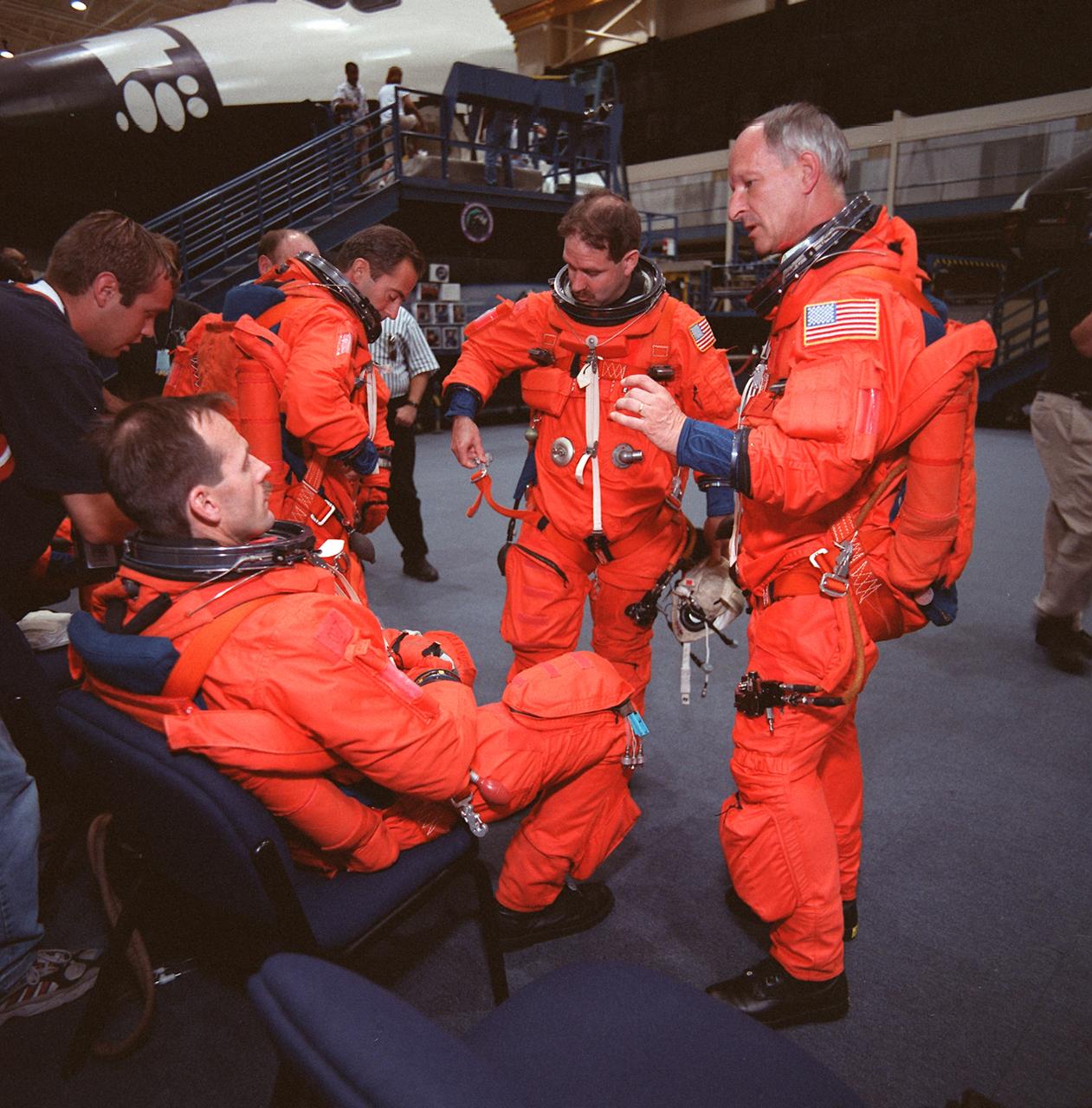
S99-08668 --- Four members of the STS-103 crew prepare their launch and entry suits for a training session on emergency bailout procedures in the Johnson Space Center's Systems Integration Facility. Astronaut Steven L. Smith is seated in the foreground. Others pictured are astronauts Jean-Francois Clervoy, John M. Grunsfeld and Claude Nicollier, all mission specialists. Nicollier and Clervoy are with the European Space Agency (ESA). One of two Crew Compartment Trainers (CCT) is in the background.

STS103-334-002 (19-27 December 1999) ---.Astronauts Jean-Francois Clervoy (left).and Curtis L. Brown, Jr. communicate with ground controllers on Discovery's flight deck. Brown is mission commander for NASA's third servicing mission to the Hubble Space Telescope (HST) and.Clervoy is a mission specialist representing the European Space Agency (ESA). Clervoy was the prime operator of the remote manipulator system (RMS), the robotic arm on the Space Shuttle.
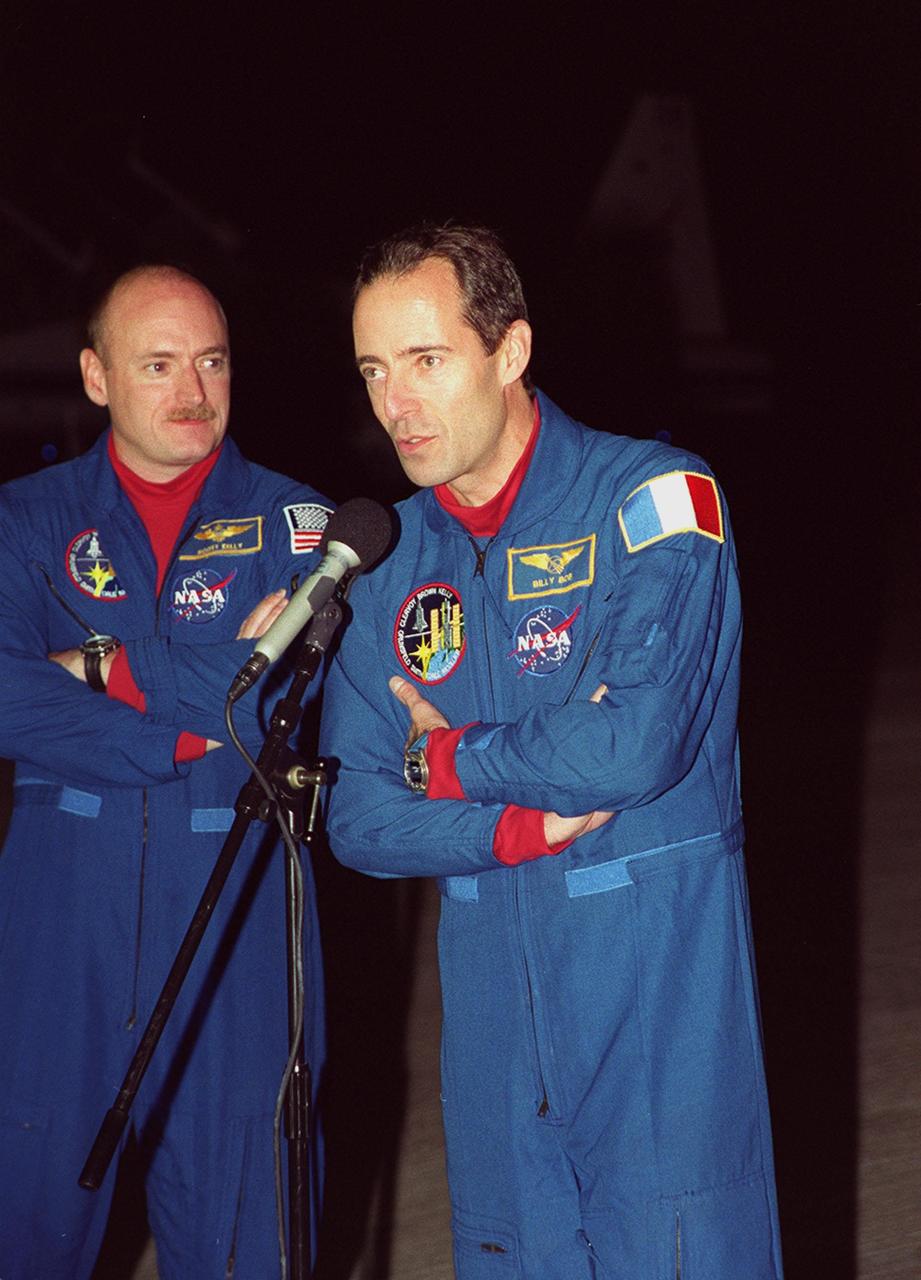
STS-103 Mission Specialist Jean-François Clervoy of France (at microphone) greets the media at the Shuttle Landing Facility as Pilot Scott J. Kelly looks on. The crew arrived at KSC aboard T-38 jets to make final preparations for their launch. The other STS-103 crew members are Commander Curtis L. Brown Jr. and Mission Specialists Steven L. Smith, C. Michael Foale (Ph.D.), John M. Grunsfeld (Ph.D.), and Claude Nicollier of Switzerland. Nicollier and Clervoy are with the European Space Agency. The mission, to service the Hubble Space Telescope a third time, is scheduled for launch Dec. 11 at 12:13 a.m. EST from Launch Pad 39B
STS084-S-009 (15 May 1997) --- The Space Shuttle Atlantis brightens up the early morning sky at Kennedy Space Center's (KSC) Launch Complex 39 as it lifts off from Pad A at 4:07:48 a.m. (EDT), May 15, 1997. Onboard were astronauts Charles J. Precourt, Eileen M. Collins, Jean-Fran?ois Clervoy, C. Michael Foale, Carlos I. Noriega, Edward T. Lu and cosmonaut Elena V. Kondakova. Clervoy represents the European Space Agency (ESA) and Kondakova is with the Russian Space Agency (RSA).
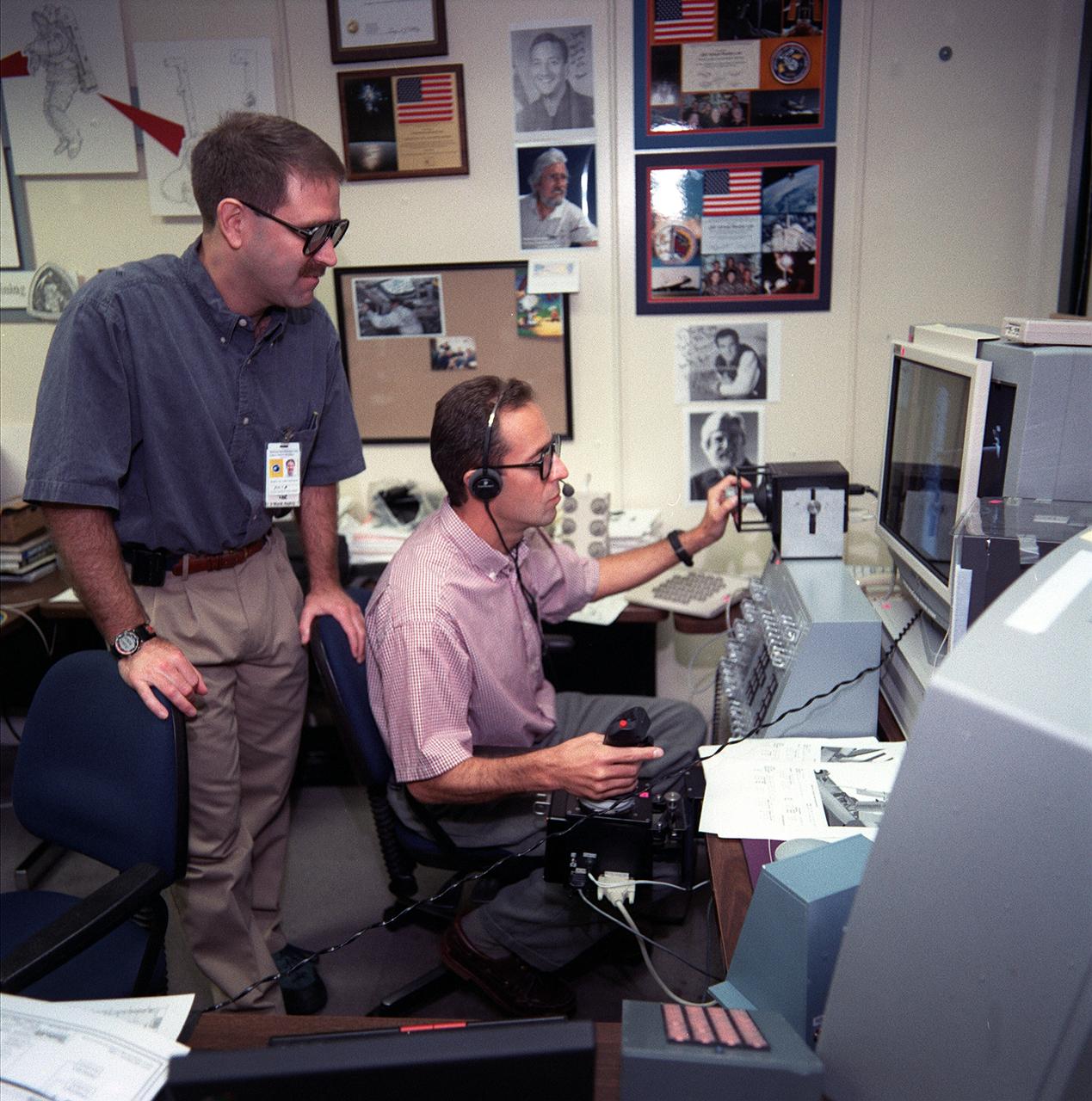
S99-05678 (24 May 1999)--- Astronaut Jean-Francois Clervoy (right), STS-103 mission specialist representing the European Space Agency (ESA), "controls" the shuttle's remote manipulator system (RMS) during a simulation using virtual reality type hardware at the Johnson Space Center (JSC). Looking on is astronaut John M. Grunsfeld, mission specialist. Both astronauts are assigned to separate duties supporting NASA's third Hubble Space Telescope (HST) servicing mission. Clervoy will be controlling Discovery's RMS and Grunsfeld is one of four astronauts that will be paired off for a total of three spacewalks on the mission.
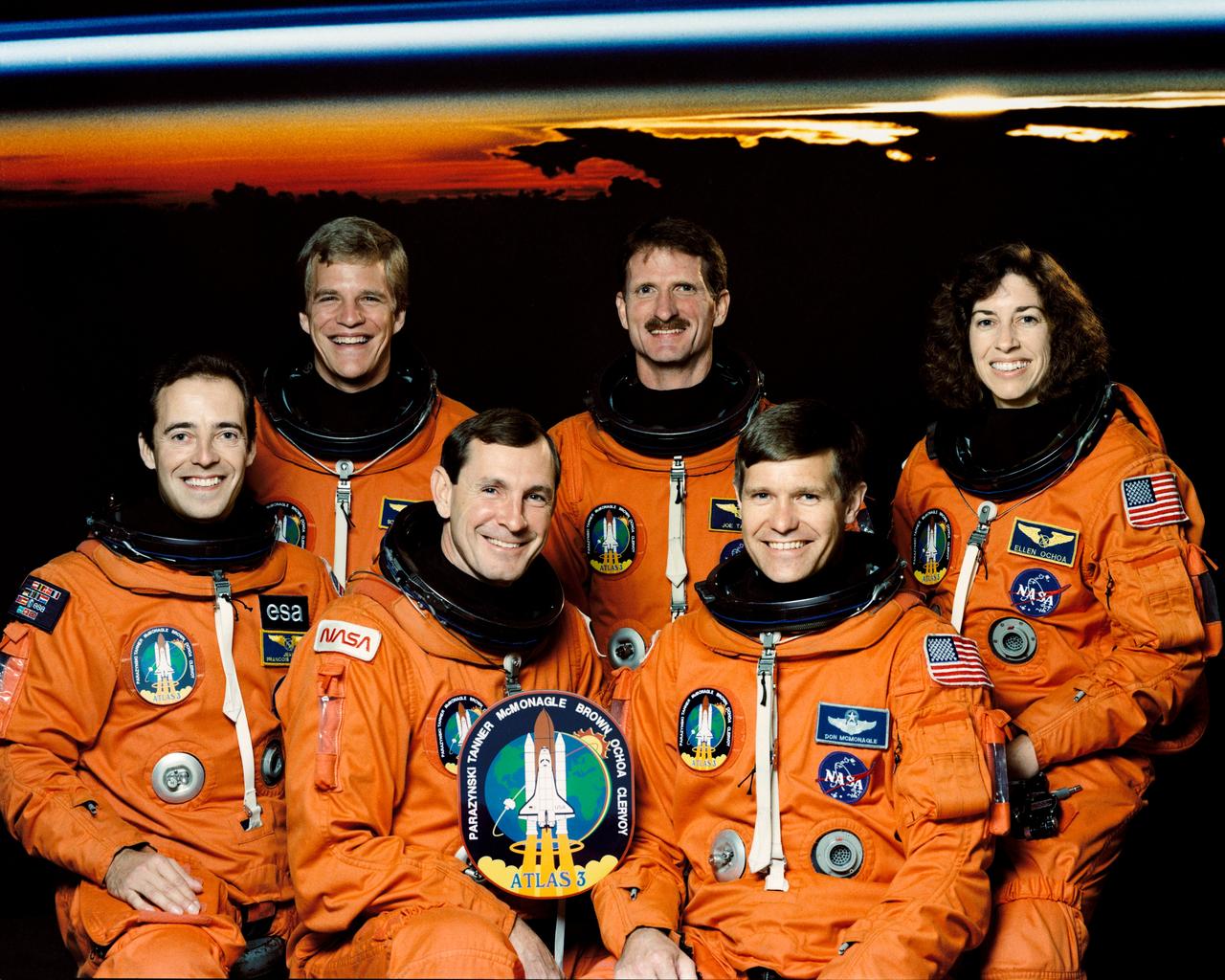
STS066-S-002 (September 1994) --- These five NASA astronauts and one European Space Agency (ESA) crew member are in training for the 13th flight of the Space Shuttle Atlantis. Donald R. McMonagle (front right) is mission commander, and Curtis L. Brown, Jr. (front center) is pilot. The other crew members are Ellen S. Ochoa, payload commander; Scott E. Parazynski, (rear left) and Joseph R. Tanner (rear center), mission specialists, along with ESA astronaut Jean-François Clervoy (front left), mission specialist. Clervoy, Parazynski and Tanner, members of the 1992 astronaut class, are making their initial flights in space.
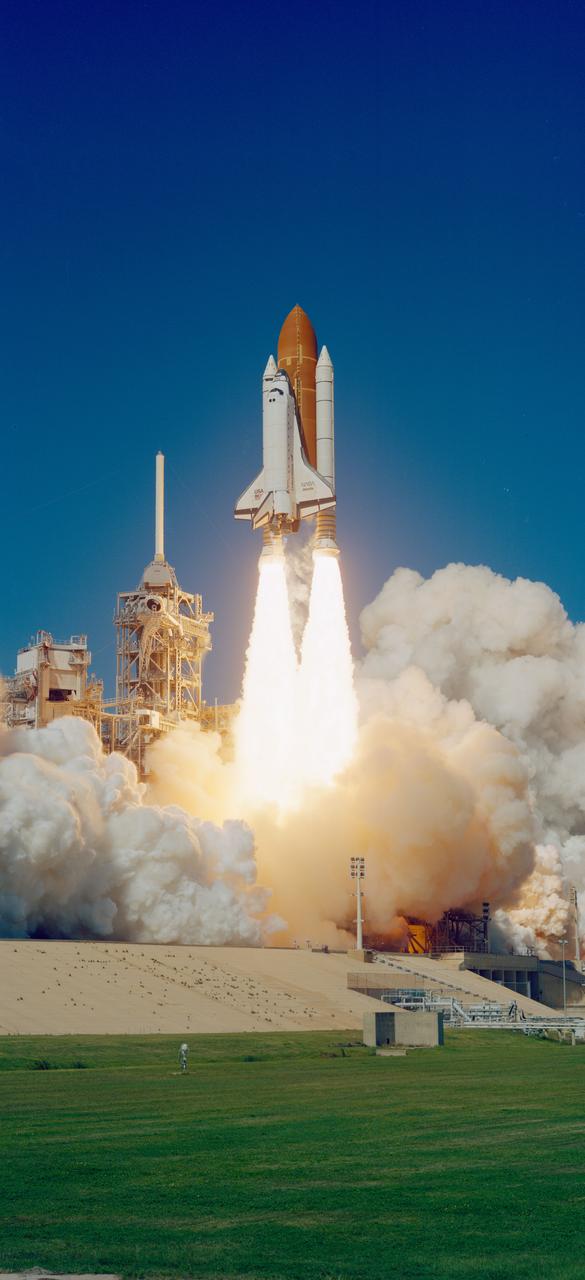
STS066-S-013 (3 November 1994) --- The Space Shuttle Atlantis returns to work after a refurbishing and a two-year layoff, as liftoff for the mission occurs at noon (EDT), November 3, 1994. Five NASA astronauts and a European mission specialist are onboard for the Atmospheric Laboratory for Applications and Science (ATLAS-3) mission. A 35mm camera was used to record the image. Onboard were astronauts Donald R. McMonagle, mission commander; Curtis L. Brown, Jr., pilot; Ellen Ochoa, payload commander; and Scott E. Parazynski, Joseph R. Tanner and Jean-Francois-Clervoy, all mission specialists. Clervoy represents the European Space Agency (ESA).
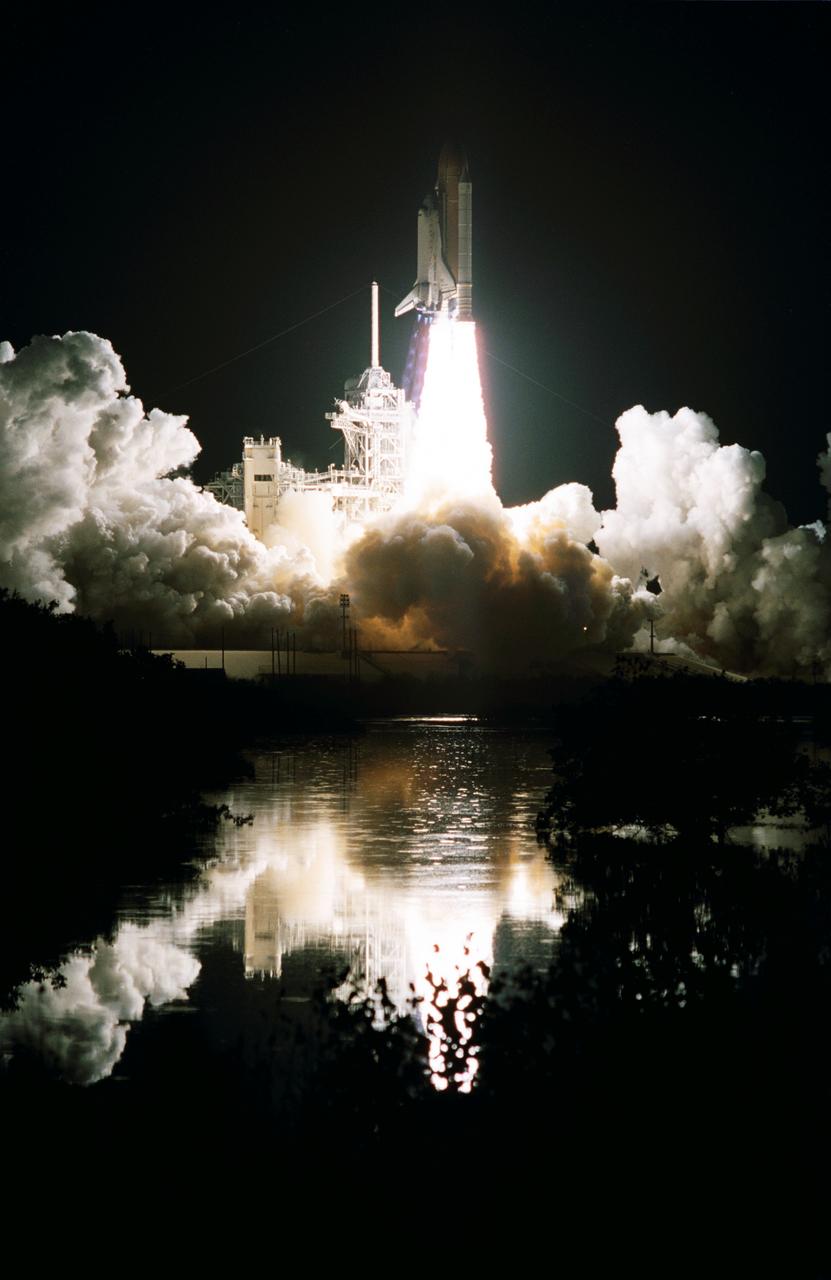
STS103-S-006 (19 December 1999) --- The Space Shuttle Discovery, reflected in nearby water, lifts off into the clear night sky to begin the 96th mission in the STS program. Liftoff occurred at 7:50 p.m. (EST), December 19, 1999, from Launch Pad 39B. Onboard were astronauts Curtis L. Brown, Jr., Scott J. Kelly, Steven L. Smith, C. Michael Foale, John M. Grunsfeld, Claude Nicollier and Jean-Francois Clervoy. Switzerland's Nicollier and France's Clervoy represent the European Space Agency (ESA).
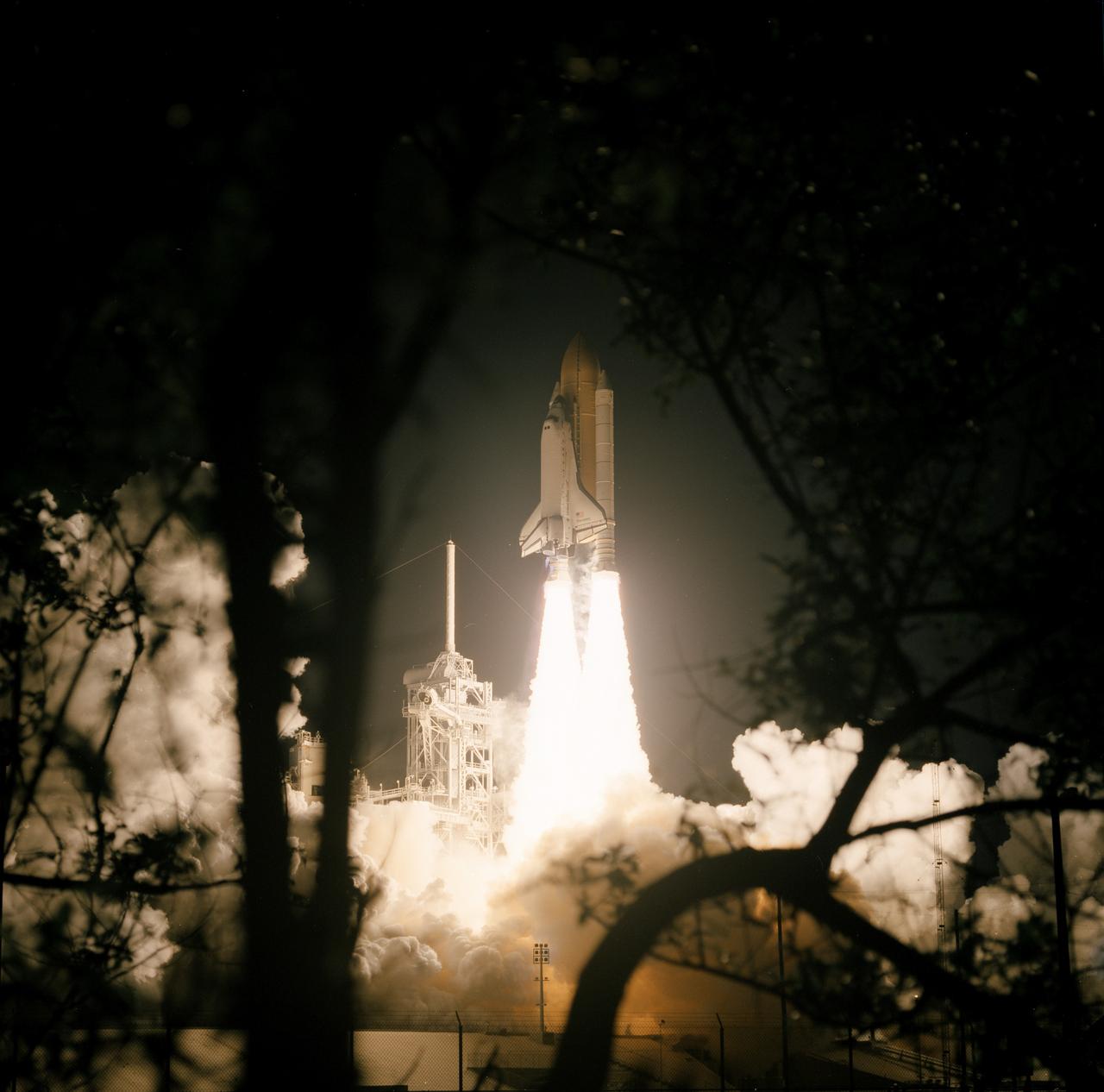
STS103-S-008 (19 December 1999) --- The Space Shuttle Discovery, framed by Florida foliage, clears the launch structure and heads toward the clear night sky to begin the 96th mission in the STS program. Liftoff occurred at 7:50 p.m. (EST), December 19, 1999, from Launch Pad 39B. Onboard were astronauts Curtis L. Brown, Jr., Scott J. Kelly, Steven L. Smith, C. Michael Foale, John M. Grunsfeld, Claude Nicollier and Jean-Francois Clervoy. Switzerland's Nicollier and France's Clervoy represent the European Space Agency (ESA).
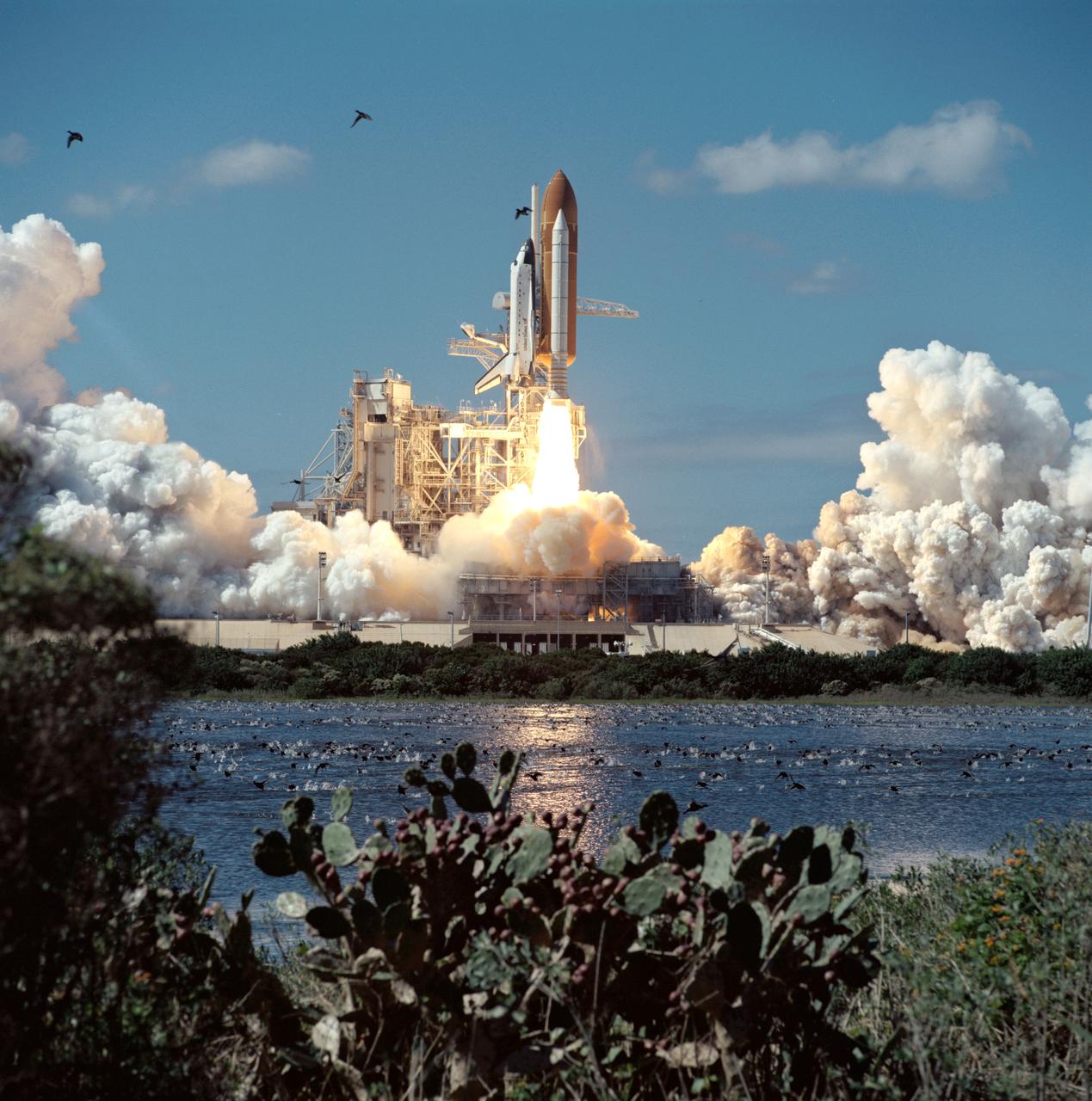
STS066-S-011 (3 November 1994) --- The Space Shuttle Atlantis returns to work after a refurbishing and a two-year layoff, as liftoff for the mission occurs at noon (EDT), November 3, 1994. Five NASA astronauts and a European mission specialist are onboard for the Atmospheric Laboratory for Applications and Science (ATLAS-3) mission. A 70mm camera was used to record this image. Onboard were astronauts Donald R. McMonagle, mission commander; Curtis L. Brown, Jr., pilot; Ellen S. Ochoa, payload commander; and Scott E. Parazynski, Joseph R. Tanner and Jean-Francois-Clervoy, all mission specialists. Clervoy represents the European Space Agency (ESA).
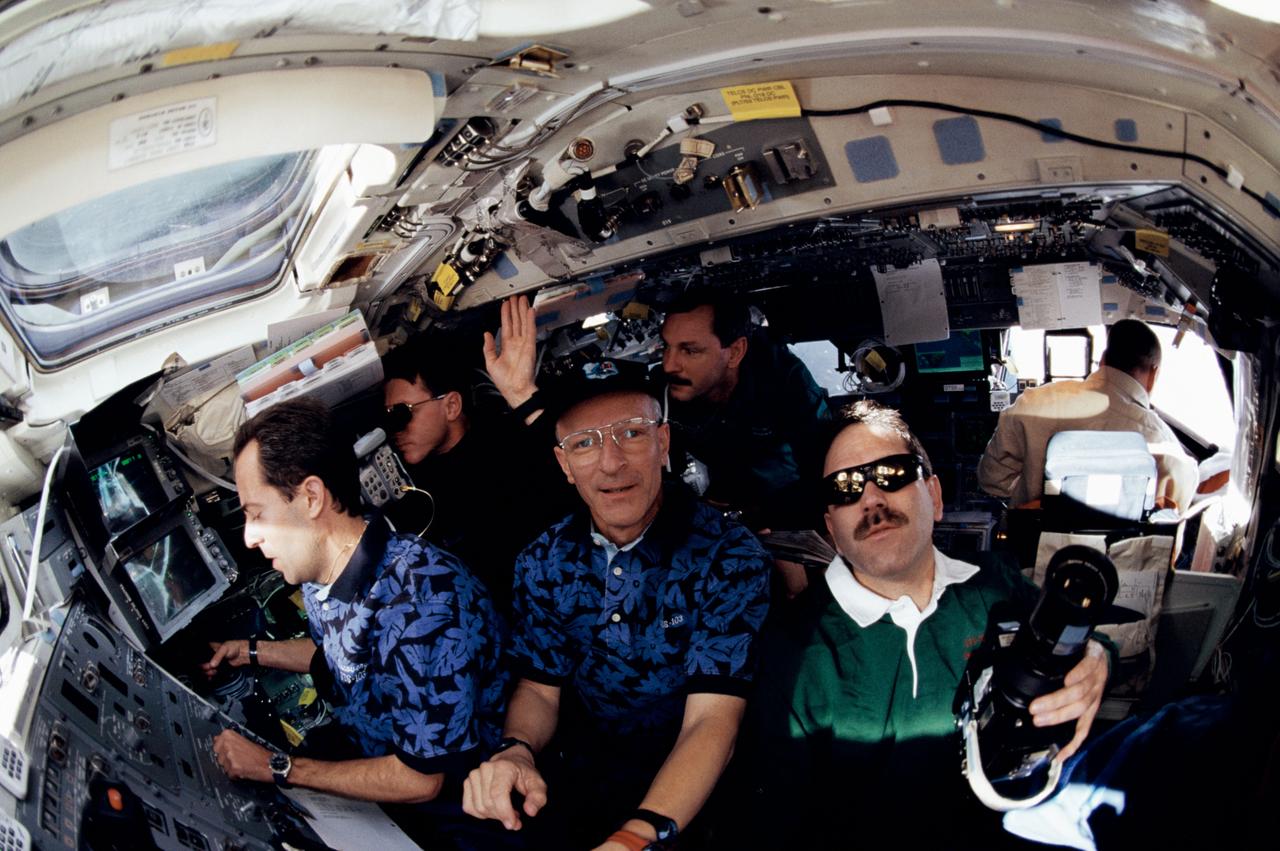
STS103-375-019 (19-27 December 1999) ---.Six members of the STS-103 crew are seen in this "fish-eye" lens scene taken on Discovery's flight deck during the deployment of the Hubble Space Telescope (HST). From left are astronauts Jean-Francois Clervoy, C. Michael Foale, Claude Nicollier, Curtis L. Brown, Jr., John M. Grunsfeld and Scott J. Kelly. Brown and Kelly are commander and pilot, respectively. All the others are mission specialists, with international MS Nicollier and Clervoy representing the European Space Agency (ESA). Astronaut Steven L. Smith, payload commander, took the photo.
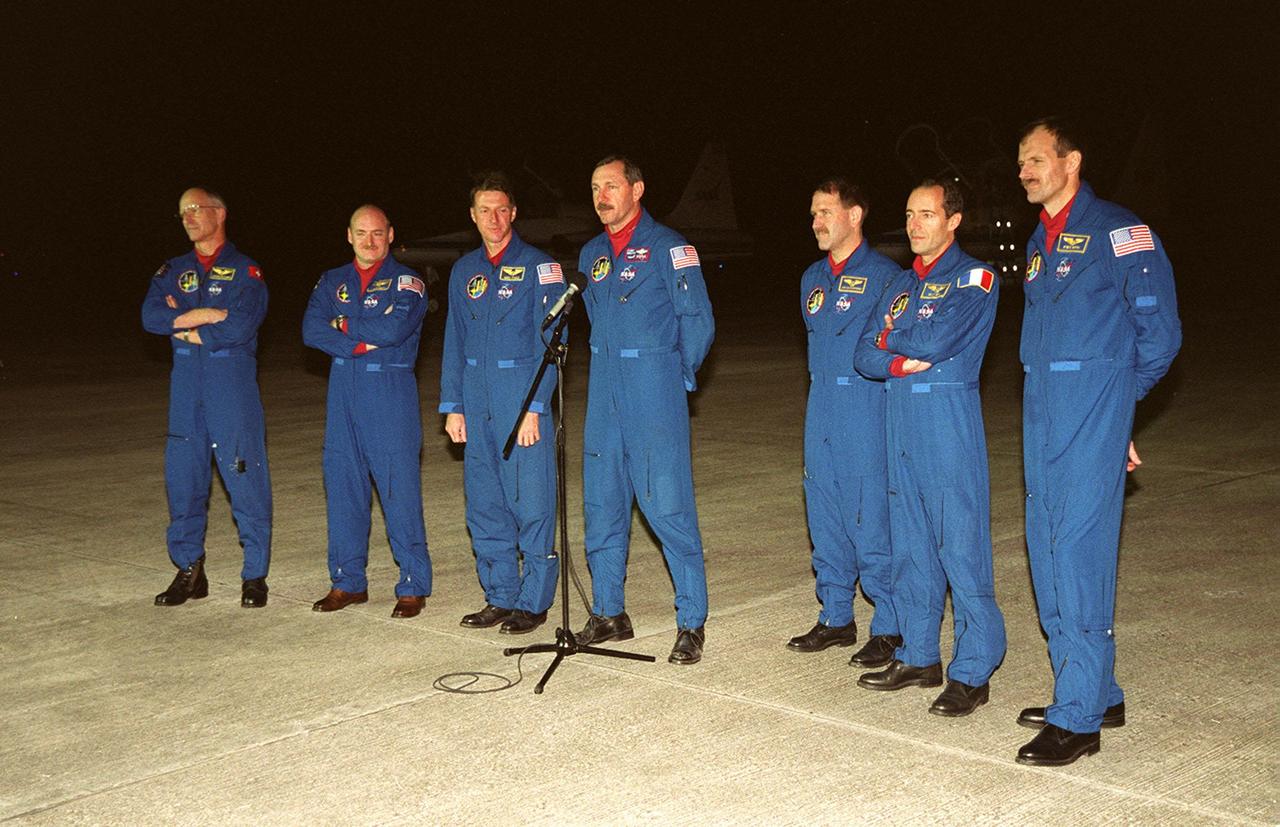
The STS-103 crew greets the media at the Shuttle Landing Facility after arriving aboard T-38 jets to make final preparations for their launch. From left, they are Mission Specialist Claude Nicollier of Switzerland, Pilot Scott J. Kelly, Mission Specialist C. Michael Foale (Ph.D.), Commander Curtis L. Brown Jr. (at microphone), and Mission Specialists John M. Grunsfeld (Ph.D.), Jean-François Clervoy of France, and Steven L. Smith. Nicollier and Clervoy both represent the European Space Agency. The STS-103 mission, to service the Hubble Space Telescope a third time, is scheduled for launch Dec. 11 at 12:13 a.m. EST from Launch Pad 39B
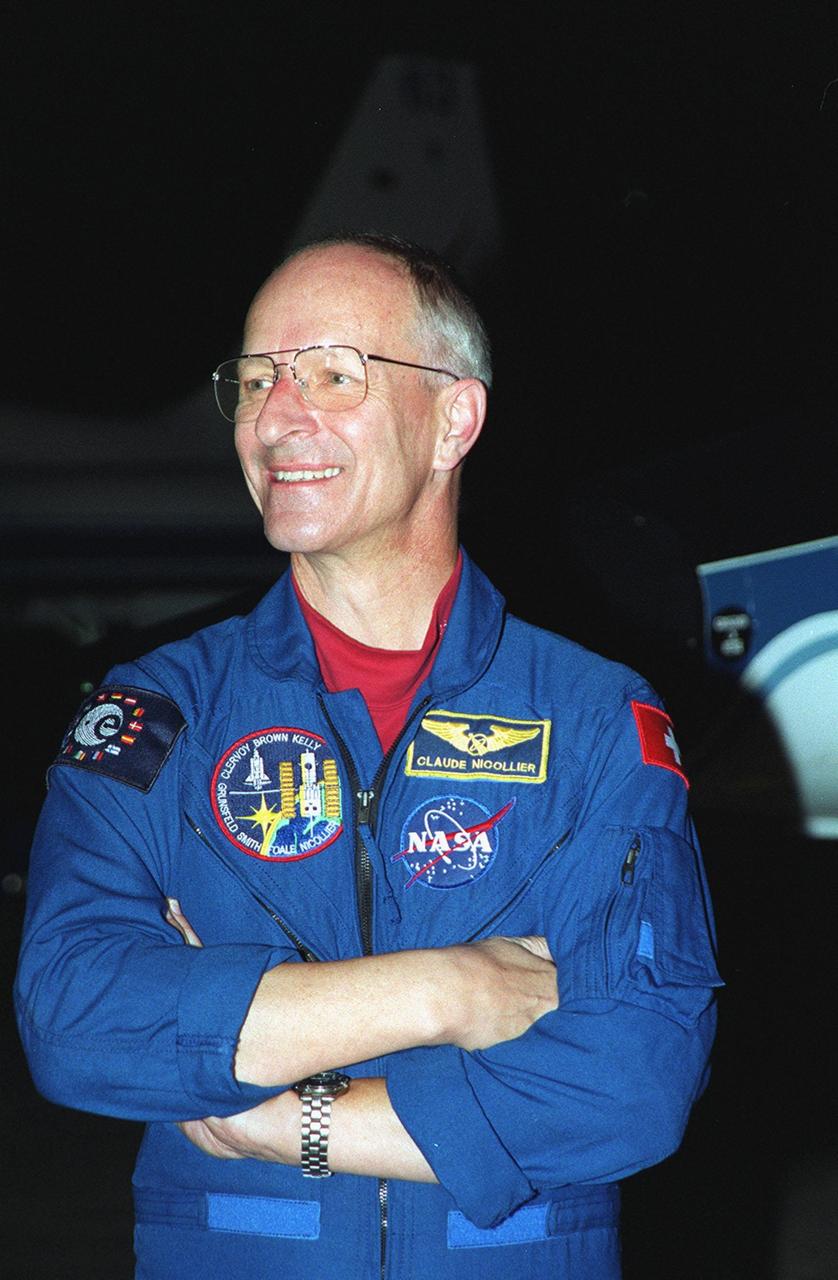
At the Shuttle Landing Facility, STS-103 Mission Specialist Claude Nicollier of Switzerland shows his pleasure at being at Kennedy Space Center to make final preparations for his launch. He is accompanied by the other STS-103 crew members: Commander Curtis L. Brown Jr., Pilot Scott J. Kelly and Mission Specialists Steven L. Smith, C. Michael Foale (Ph.D.), John M. Grunsfeld (Ph.D.), and Jean-François Clervoy of France. Nicollier and Clervoy both represent the European Space Agency. The STS-103 mission, to service the Hubble Space Telescope a third time, is scheduled for launch Dec. 11 at 12:13 a.m. EST from Launch Pad 39B
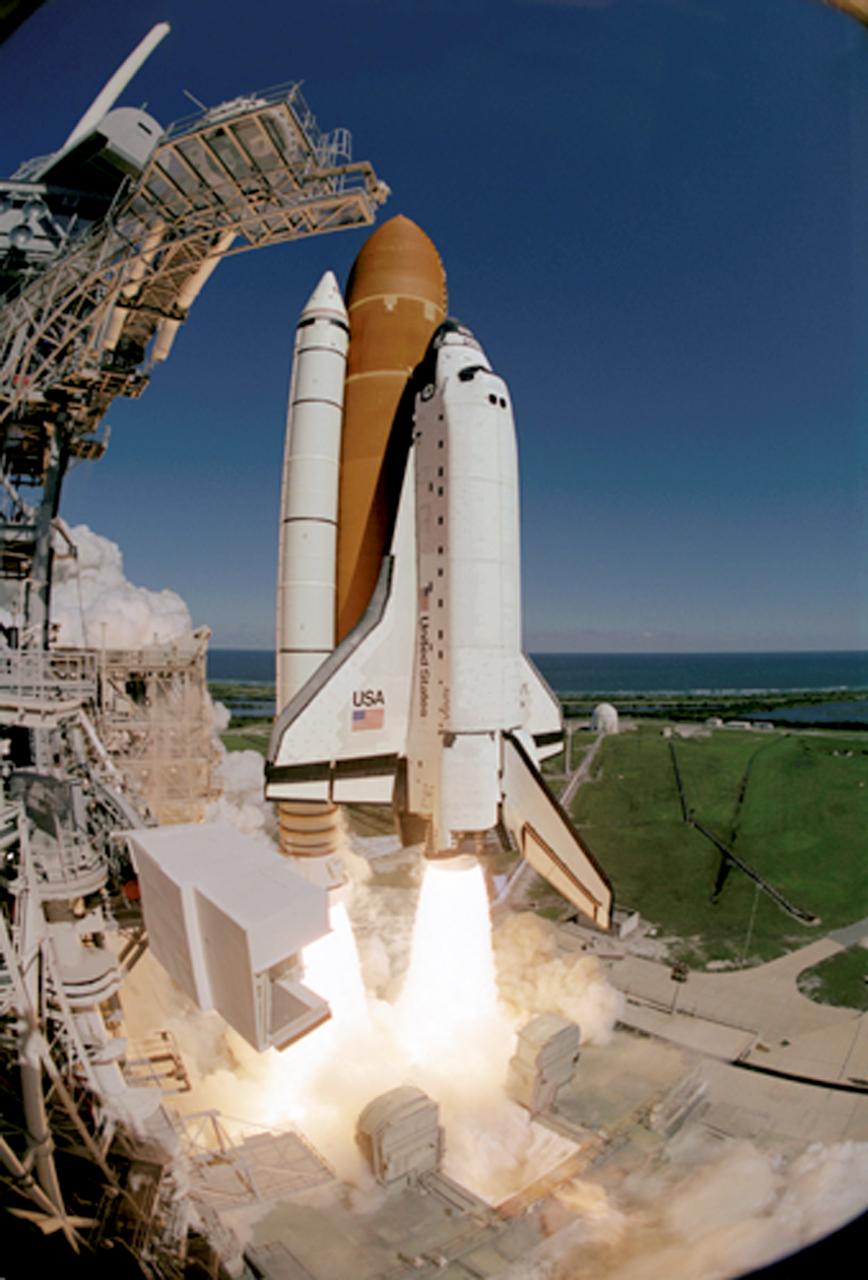
STS066-S-009 (3 Nov. 1994) --- The Space Shuttle Atlantis returns to work after a refurbishing and a two-year layoff, as liftoff for the mission occurs at noon (EDT), November 3, 1994. Five NASA astronauts and a European mission specialist are onboard for the Atmospheric Laboratory for Applications and Science (ATLAS-3) mission. A "fish-eye" lens was used to record the image. Onboard were astronauts Donald R. McMonagle, mission commander; Curtis L. Brown, Jr., pilot; Ellen Ochoa, payload commander; and Scott E. Parazynski, Joseph R. Tanner and Jean-François-Clervoy, all mission specialists. Clervoy represents the European Space Agency (ESA).
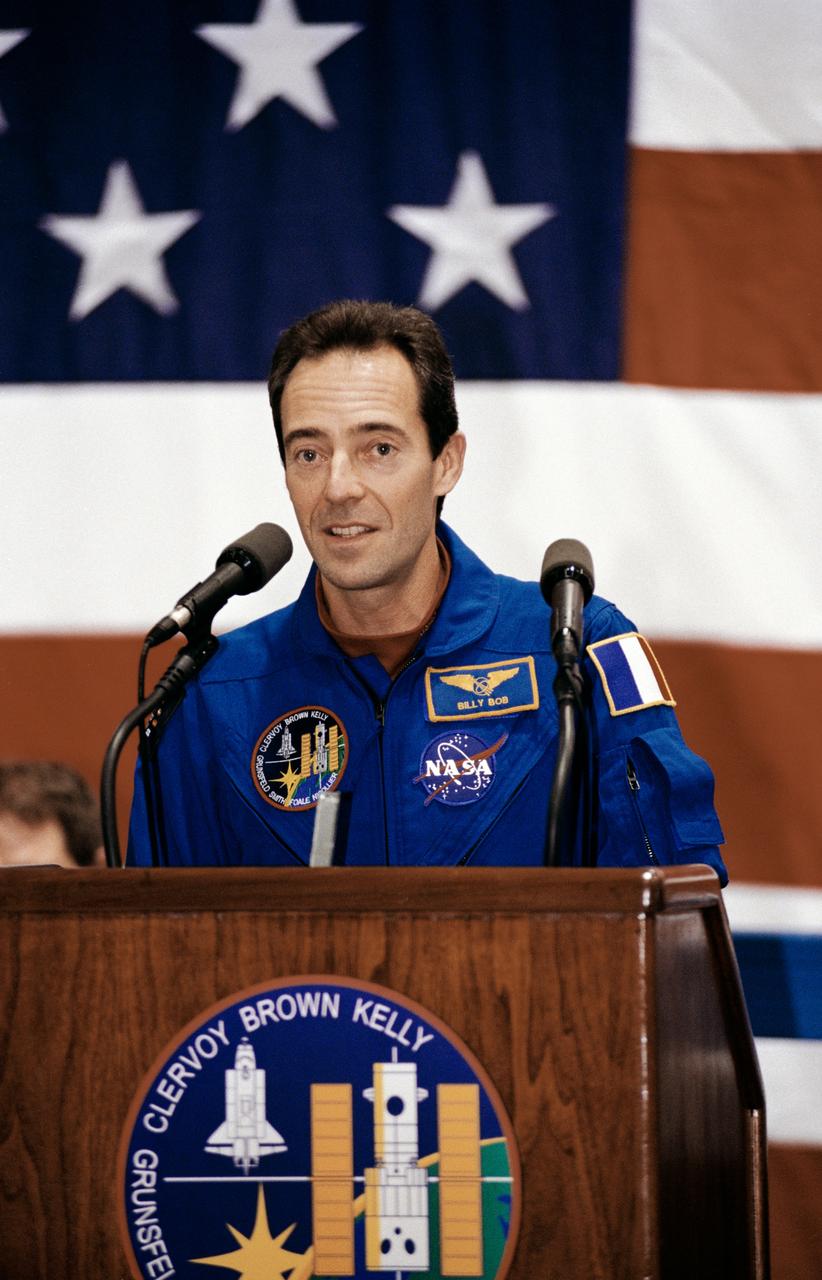
Photographic documentation showing STS-103 crew return at bldg. 990, Ellington Field. Views include: Mission Specialist (MS) John M. Grunsfeld at podium (16048); MS Jean-Francois Clervoy at podium (16049); Grunsfeld signs autographs (16050); woman and child (16051); MS Claude Nicollier meets his Swiss-American fan club (16052); Clervoy holds child (16053); mission commander Curtis L. Brown signs autographs (16054, 16057); MS E. Michael Foale signs autographs (16055); MS and Payload Commander (PLC) Steven L. Smith kneels and holds child (16056); overall view of stage showing Brown at podium with crew seated behind him; from left to right: Nicollier, pilot Scott J. Kelly, Clervoy, Grunsfeld, Mr. George Abbey (JSC director), Foale and Smith (16058); Nicollier at podium (16059); Mr. George Abbey at the podium (16060): Foale ath the podium (16061); Kelly signs autographs (16062).
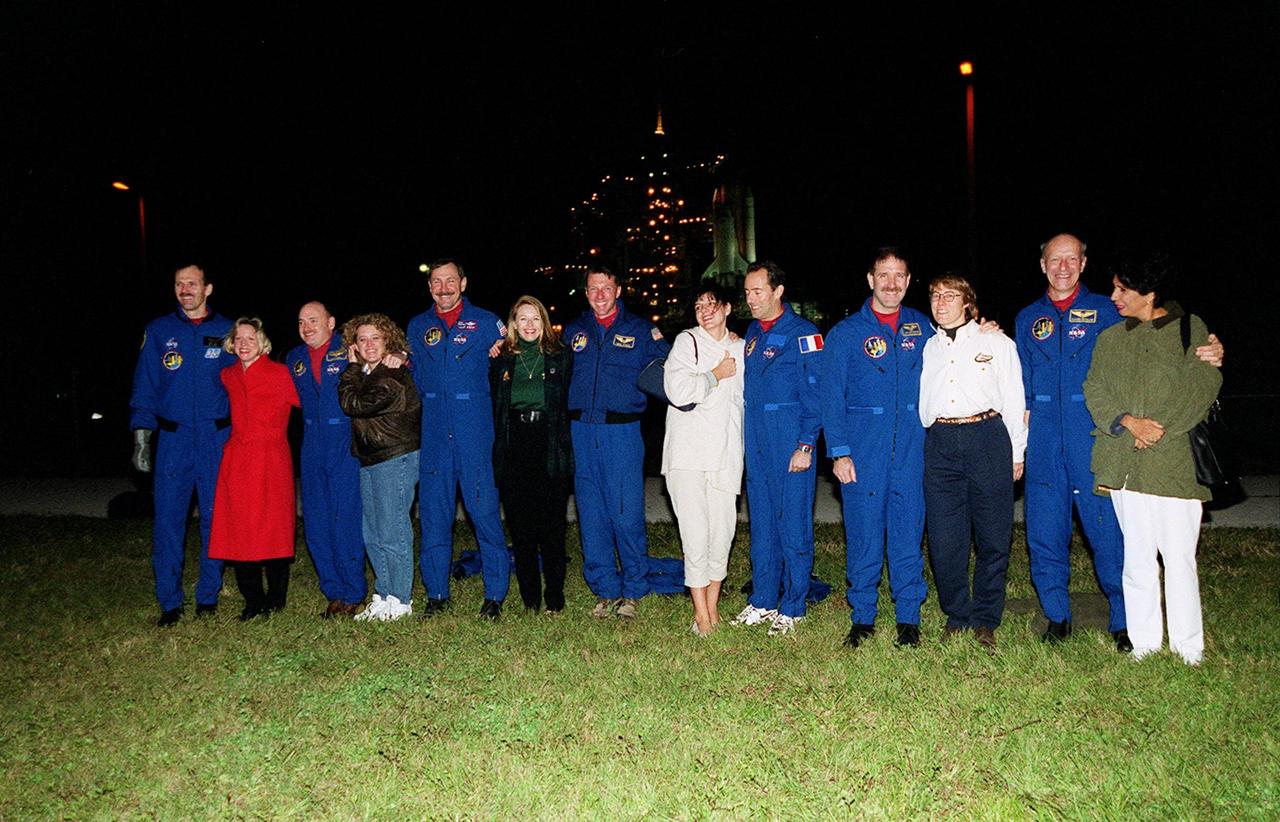
The STS-103 crew pose for photographers with their loved ones at Launch Pad 39B. Space Shuttle Discovery is in the background, next to the Fixed Service Structure lit up like a Christmas tree. Viewed left to right are Mission Specialist Steven L. Smith and his wife, Peggy; Pilot Scott J. Kelly and his wife, Leslie; Commander Curtis L. Brown Jr. and his fiancee, Ann Brickert; Mission Specialist C. Michael Foale; Laurence Clervoy and her husband, Mission Specialist Jean-François Clervoy; Mission Specialist John M. Grunsfeld and his wife, Carol; Mission Specialist Claude Nicollier and his wife, Susana. Nicollier and Clervoy are with the European Space Agency. The mission, to service the Hubble Space Telescope, is scheduled for launch Dec. 17 at 8:47 p.m. EST from Launch Pad 39B. Mission objectives include replacing gyroscopes and an old computer, installing another solid state recorder, and replacing damaged insulation in the telescope. The mission is expected to last about 8 days and 21 hours. Discovery is expected to land at KSC Sunday, Dec. 26, at about 6:25 p.m. EST
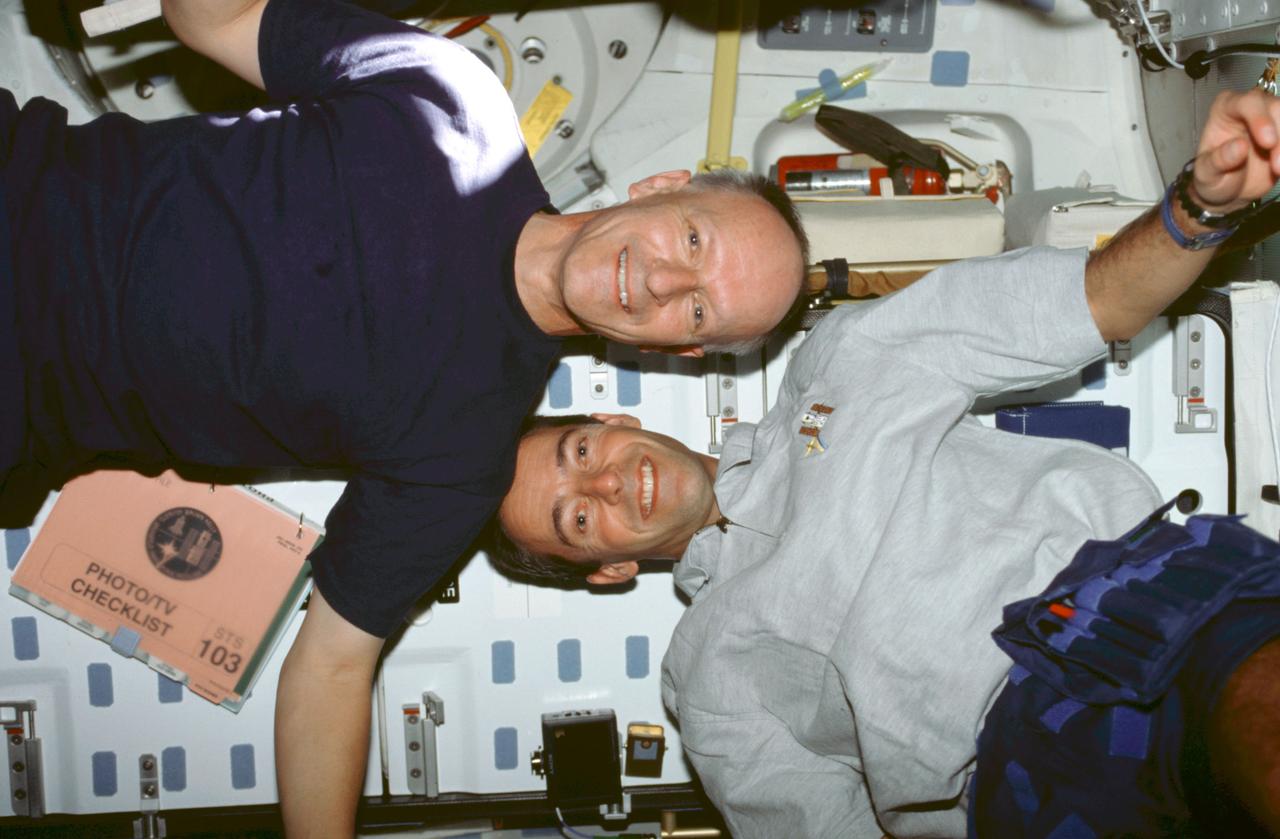
STS103-378-005 (19-27 December 1999) ---.Astronauts Claude Nicollier (left) and.Jean-Francois Clervoy, mission specialists representing the European Space Agency (ESA), move about on Discovery's mid deck in a manner they could not duplicate in Earth-bound training. A photography/television checklist floats nearby.
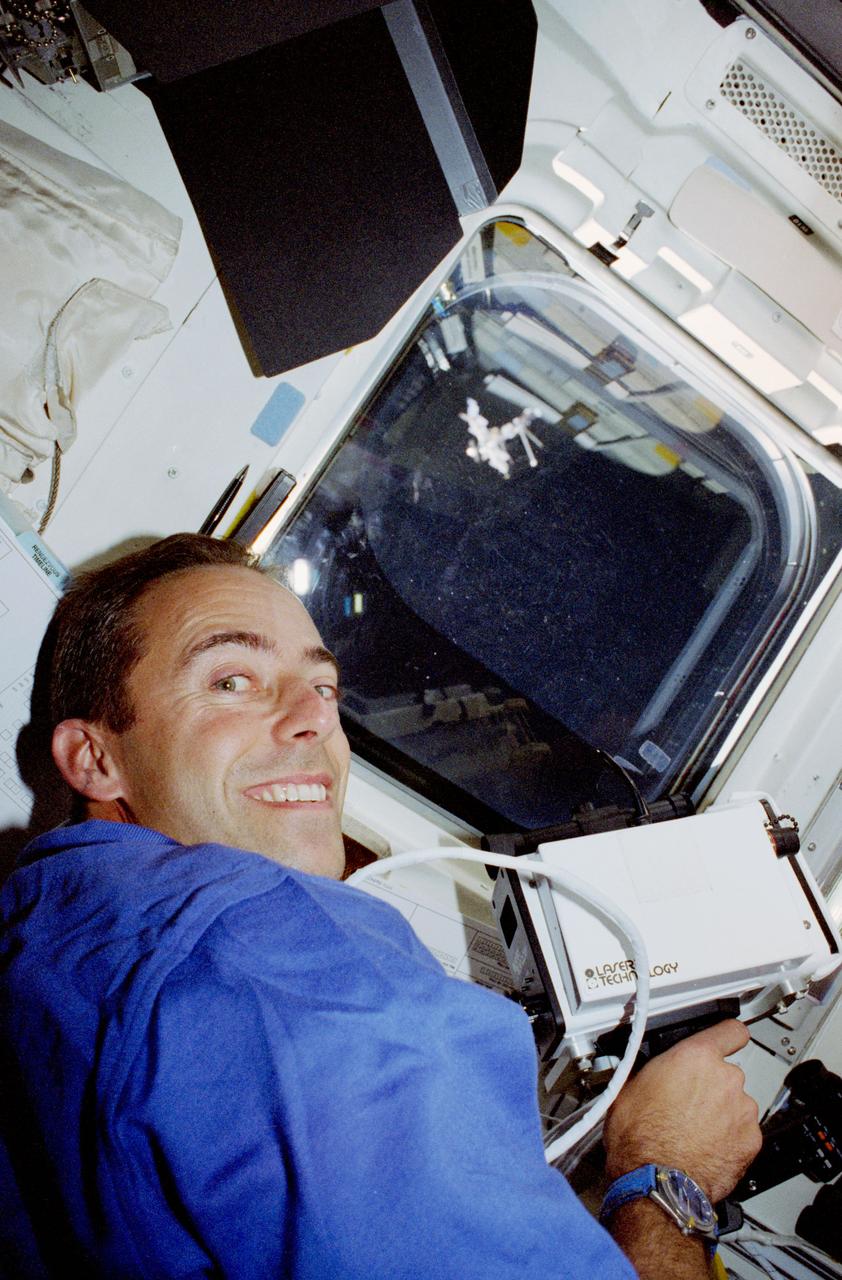
STS084-357-009 (15-24 May 1997) --- Astronaut Jean-Fran?ois Clervoy, STS-84 payload commander, uses a hand held laser range finder during rendezvous operations with Russia's Mir Space Station (seen just above center through the Space Shuttle Atlantis' overhead window).
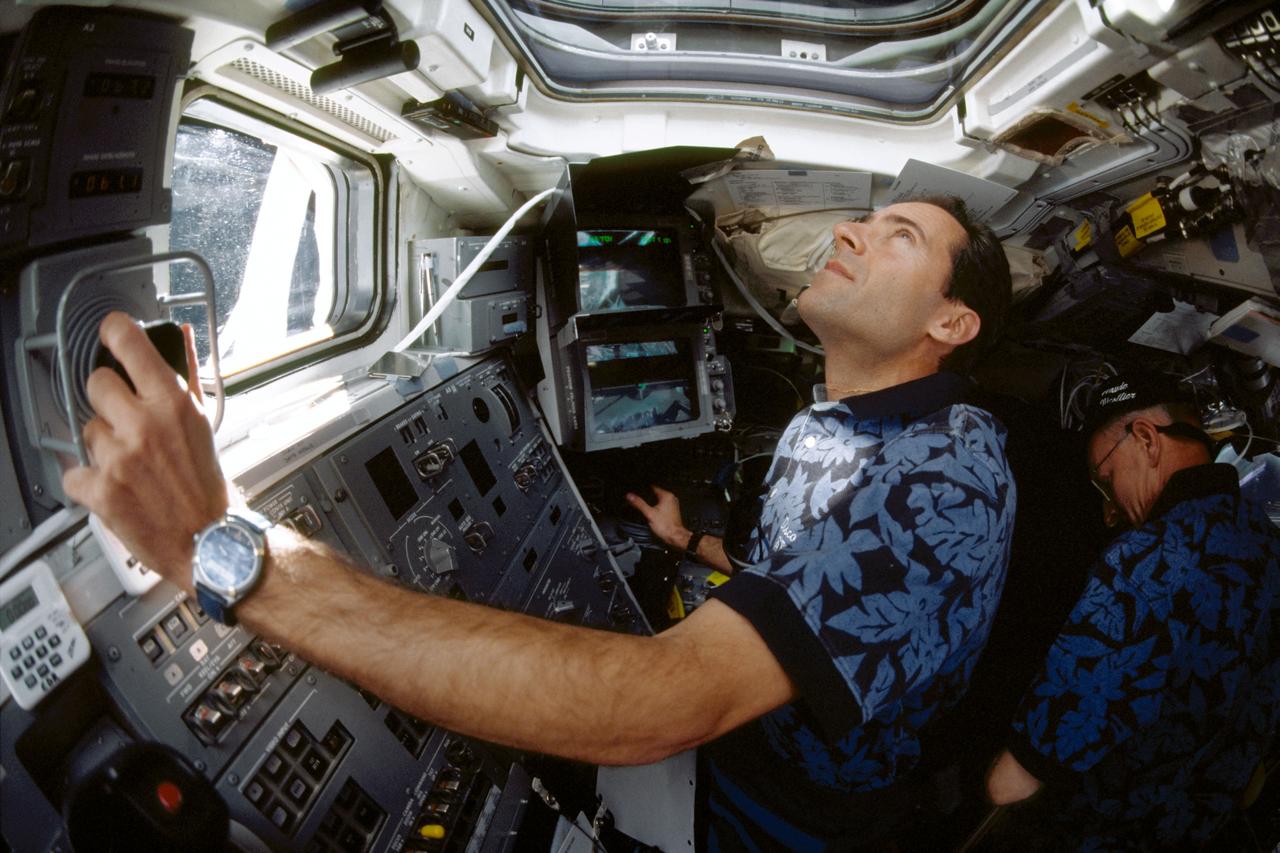
STS103-375-027 (19 - 27 December 1999).--- Astronaut Jean-Francois Clervoy, mission specialist representing the European Space Agency (ESA), controls Discovery's remote manipulator system (RMS) robot arm during operations.with the Hubble Space Telescope (HST).
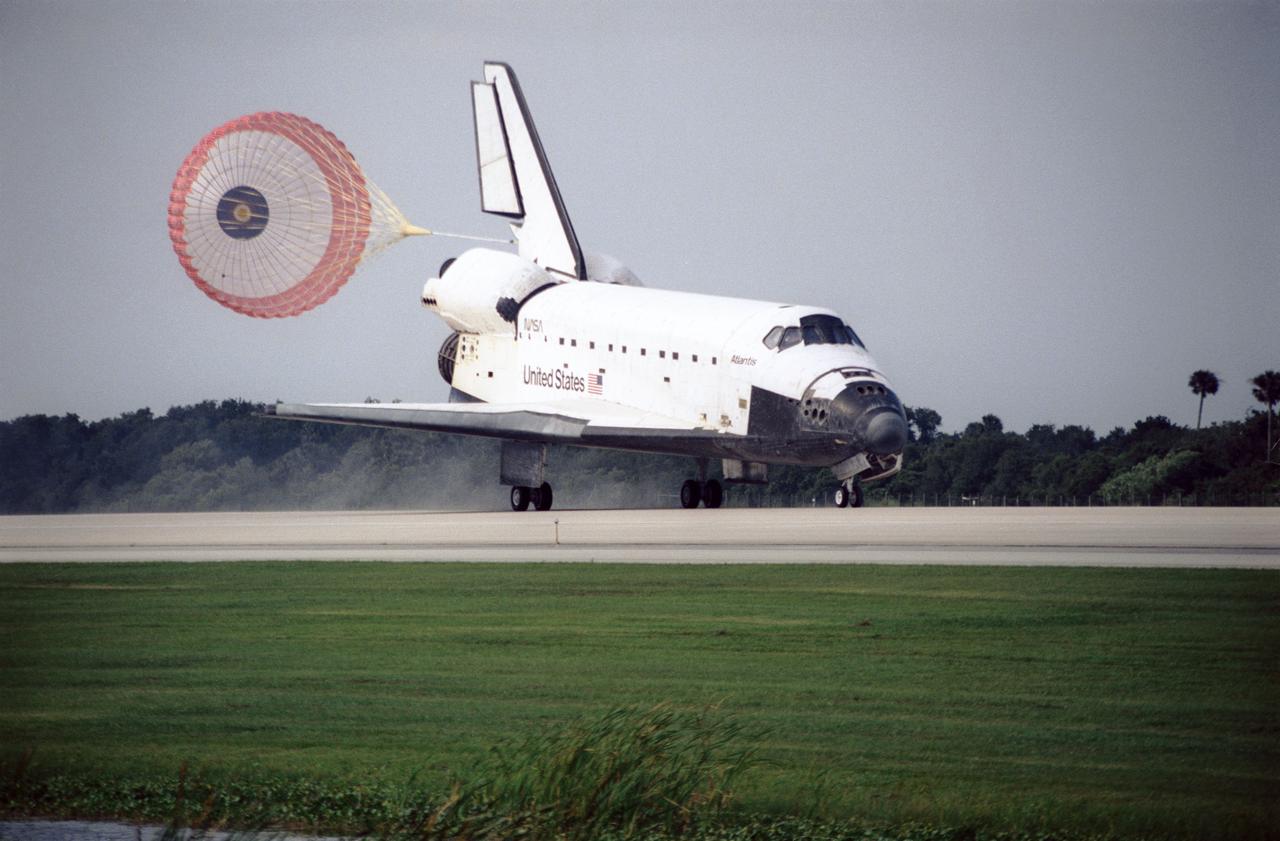
STS084-S-010 (24 May 1997) --- The drag chute on the Space Shuttle Atlantis is deployed as the Space Shuttle touches down on Runway 33 of the Kennedy Space Center (KSC) Shuttle Landing Facility (SLF). The landing, at 9:27:44 a.m. (EDT), May 24, 1997, brought to a completion the nine-day mission. This touchdown marked the 37th landing at KSC in the 16-year history of the Space Transportation System (STS) and it also marked the return of astronaut Jerry M. Linenger to Earth following almost four months aboard Russia's Mir Space Station. Onboard for the landing were astronauts Charles J. Precourt, Eileen M. Collins, Jean-Fran?ois Clervoy, Carlos I. Noriega, Edward T. Lu, Linenger and Elena V. Kondakova. Clervoy is with the European Space Agency (ESA) and Kondakova represents the Russian Space Agency (RSA).
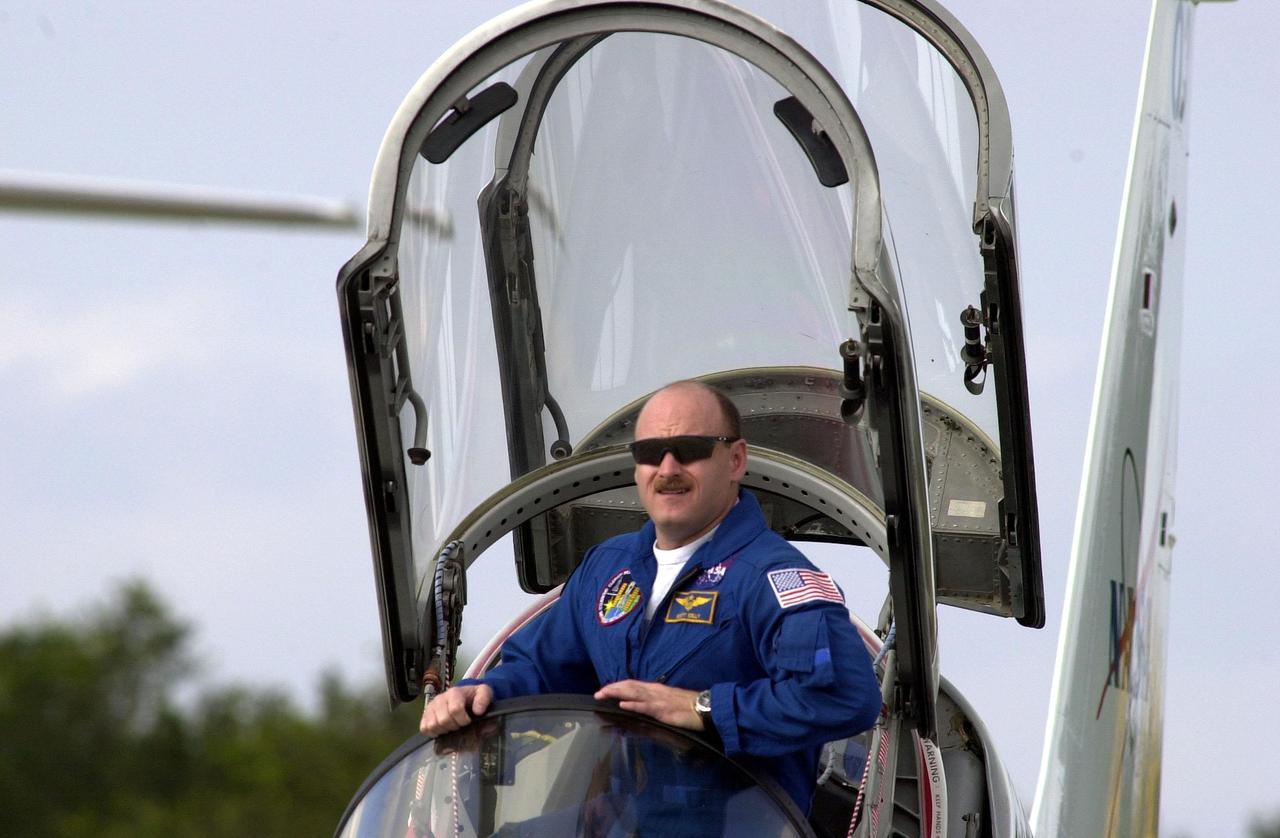
STS-103 Pilot Scott J. Kelly settles into the cockpit of a T-38 training jet for practice flights. He joins other crew members Commander Curtis L. Brown Jr. and Mission Specialists Steven L. Smith, C. Michael Foale (Ph.D.), John M. Grunsfeld (Ph.D.), Claude Nicollier of Switzerland and Jean-François Clervoy of France, for pre-launch preparations on mission STS-103 aboard Space Shuttle Discovery. Nicollier and Clervoy are with the European Space Agency. The mission, to service the Hubble Space Telescope, is scheduled for launch Dec. 16 at 9:18 p.m. EST from Launch Pad 39B. The mission is expected to last about 9 days and 21 hours. Discovery is expected to land at KSC Sunday, Dec. 26, at 6:56 p.m. EST
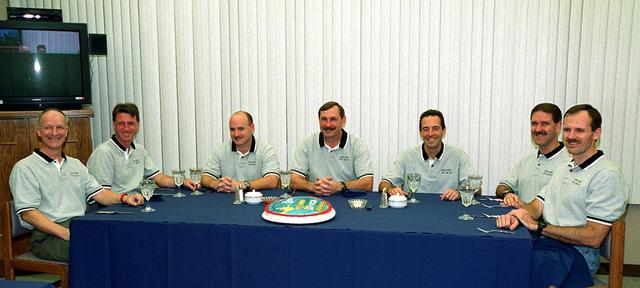
In the Operations and Checkout Building, the STS-103 crew are all smiles as they gather for breakfast before suiting up for launch. From left are Mission Specialists Claude Nicollier of Switzerland and C. Michael Foale (Ph.D.), Pilot Scott J. Kelly, Commander Curtis L. Brown Jr., and Mission Specialists Jean-Francois Clervoy of France, John M. Grunsfeld (Ph.D.) and Steven L. Smith. Nicollier and Clervoy are with the European Space Agency. The STS-103 mission, to service the Hubble Space Telescope, is scheduled for launch Dec. 17 at 8:47 p.m. EST from Launch Pad 39B. Mission objectives include replacing gyroscopes and an old computer, installing another solid state recorder, and replacing damaged insulation in the telescope. The mission is expected to last about 8 days and 21 hours. Discovery is expected to land at KSC Sunday, Dec. 26, at about 6:30 p.m. EST
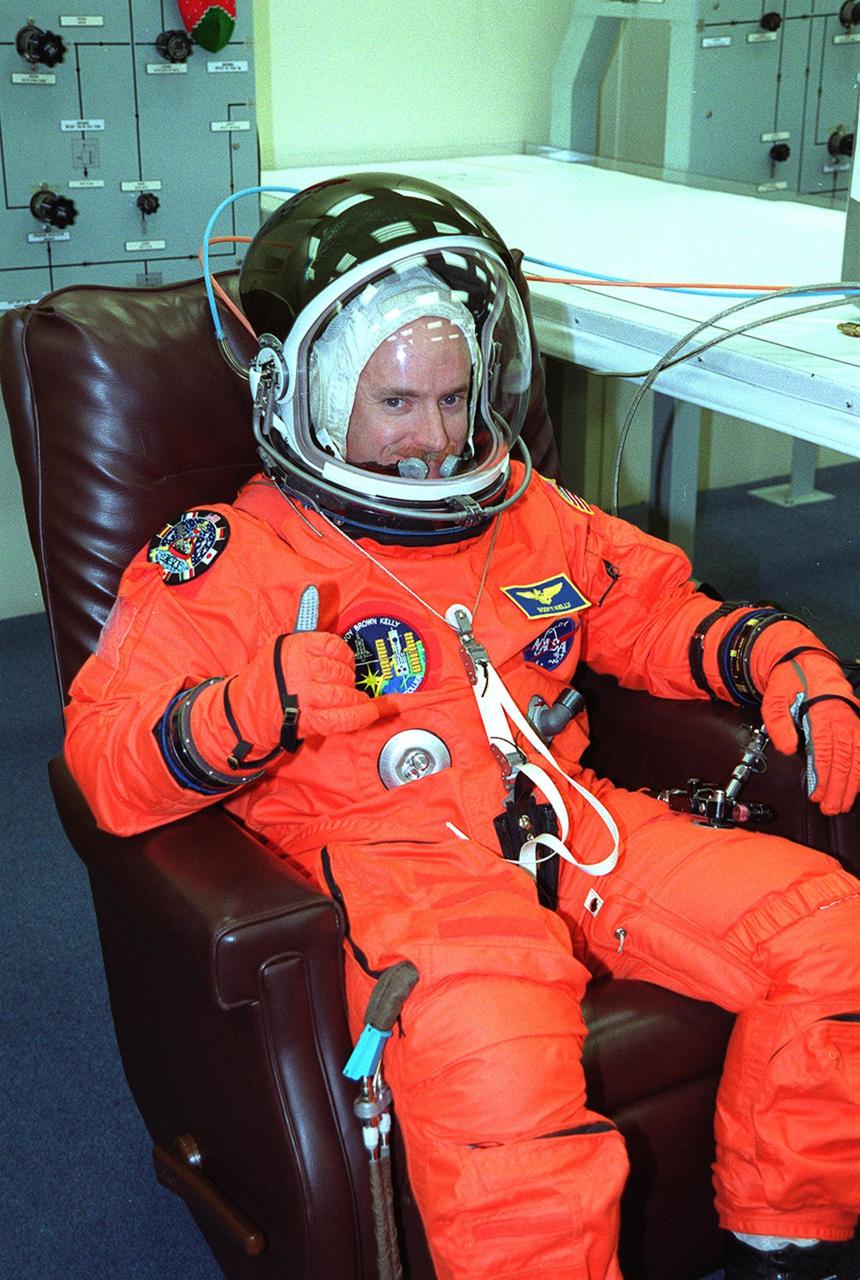
STS-103 Pilot Scott J. Kelly signals he is ready for launch after suiting up in the Operations and Checkout Building. Other crew members are Commander Curtis L. Brown Jr. and Mission Specialists Steven L. Smith, C. Michel Foale (Ph.D.), John M. Grunsfeld (Ph.D.), Jean-François Clervoy of France and Claude Nicollier of Switzerland. Clervoy and Nicollier are with the European Space Agency. The STS-103 mission, to service the Hubble Space Telescope, is scheduled for launch Dec. 17 at 8:47 p.m. EST from Launch Pad 39B. Mission objectives include replacing gyroscopes and an old computer, installing another solid state recorder, and replacing damaged insulation in the telescope. After the 8-day, 21-hour mission, Discovery is expected to land at KSC Sunday, Dec. 26, at about 6:30 p.m. EST
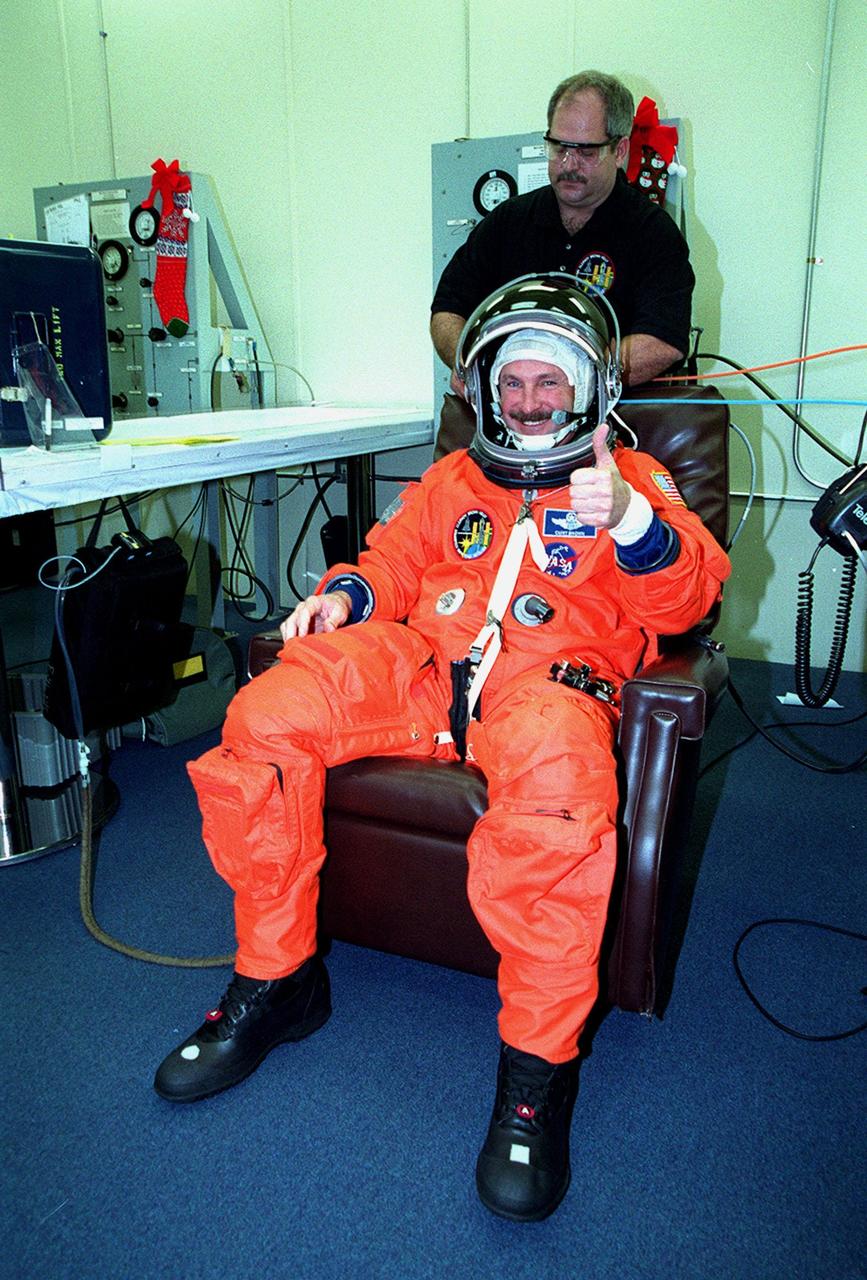
In the Operations and Checkout Building, STS-103 Commander Curtis L. Brown Jr. signals he's ready for launch while having his launch and entry suit checked by a suit technician. Other crew members are Pilot Scott J. Kelly and Mission Specialists Steven L. Smith, C. Michel Foale (Ph.D.), John M. Grunsfeld (Ph.D.), Claude Nicollier of Switzerland and Jean-François Clervoy of France. Nicollier and Clervoy are with the European Space Agency. The STS-103 mission, to service the Hubble Space Telescope, is scheduled for launch Dec. 17 at 8:47 p.m. EST from Launch Pad 39B. Mission objectives include replacing gyroscopes and an old computer, installing another solid state recorder, and replacing damaged insulation in the telescope. After the 8-day, 21-hour mission, Discovery is expected to land at KSC Sunday, Dec. 26, at about 6:30 p.m. EST
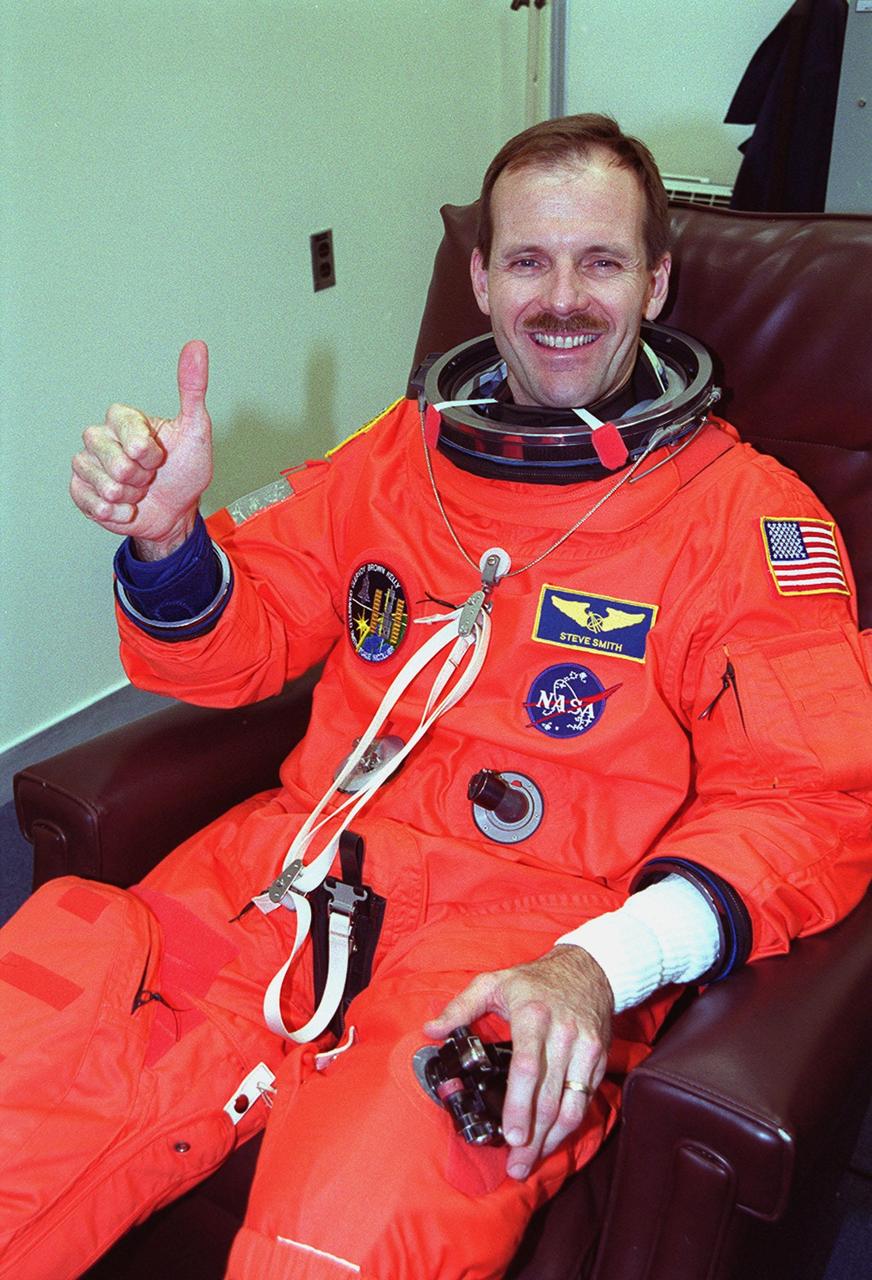
In the Operations and Checkout Building, STS-103 Mission Specialist Steven L. Smith signals he is suited up and ready for launch. Other crew members are Commander Curtis L. Brown Jr., Pilot Scott J. Kelly and Mission Specialists C. Michel Foale (Ph.D.), John M. Grunsfeld (Ph.D.), Jean-François Clervoy of France and Claude Nicollier of Switzerland. Clervoy and Nicollier are with the European Space Agency. The STS-103 mission, to service the Hubble Space Telescope, is scheduled for launch Dec. 17 at 8:47 p.m. EST from Launch Pad 39B. Mission objectives include replacing gyroscopes and an old computer, installing another solid state recorder, and replacing damaged insulation in the telescope. After the 8-day, 21-hour mission, Discovery is expected to land at KSC Sunday, Dec. 26, at about 6:30 p.m. EST
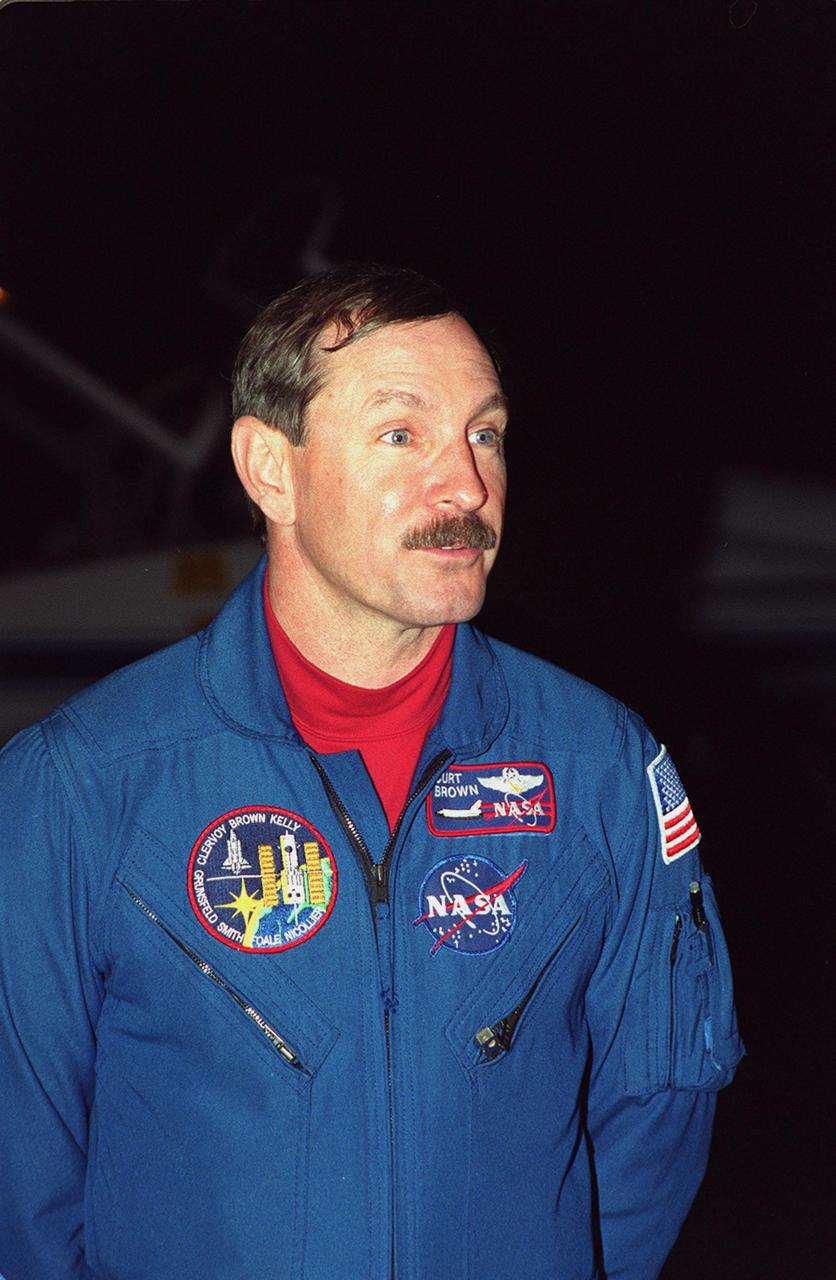
Commander Curtis L. Brown Jr. smiles on his arrival at the Shuttle Landing Facility aboard a T-38 jet aircraft. He joins other crew members Pilot Scott J. Kelly and Mission Specialists Steven L. Smith, C. Michael Foale (Ph.D.), John M. Grunsfeld (Ph.D.), Claude Nicollier of Switzerland and Jean-François Clervoy of France, for pre-launch preparations on mission STS-103 aboard Space Shuttle Discovery. Nicollier and Clervoy are with the European Space Agency. The mission, to service the Hubble Space Telescope, is scheduled for launch Dec. 11 at 12:13 a.m. EST from Launch Pad 39B. Discovery is expected to land at KSC Monday, Dec. 20, at 9:21 p.m. EST
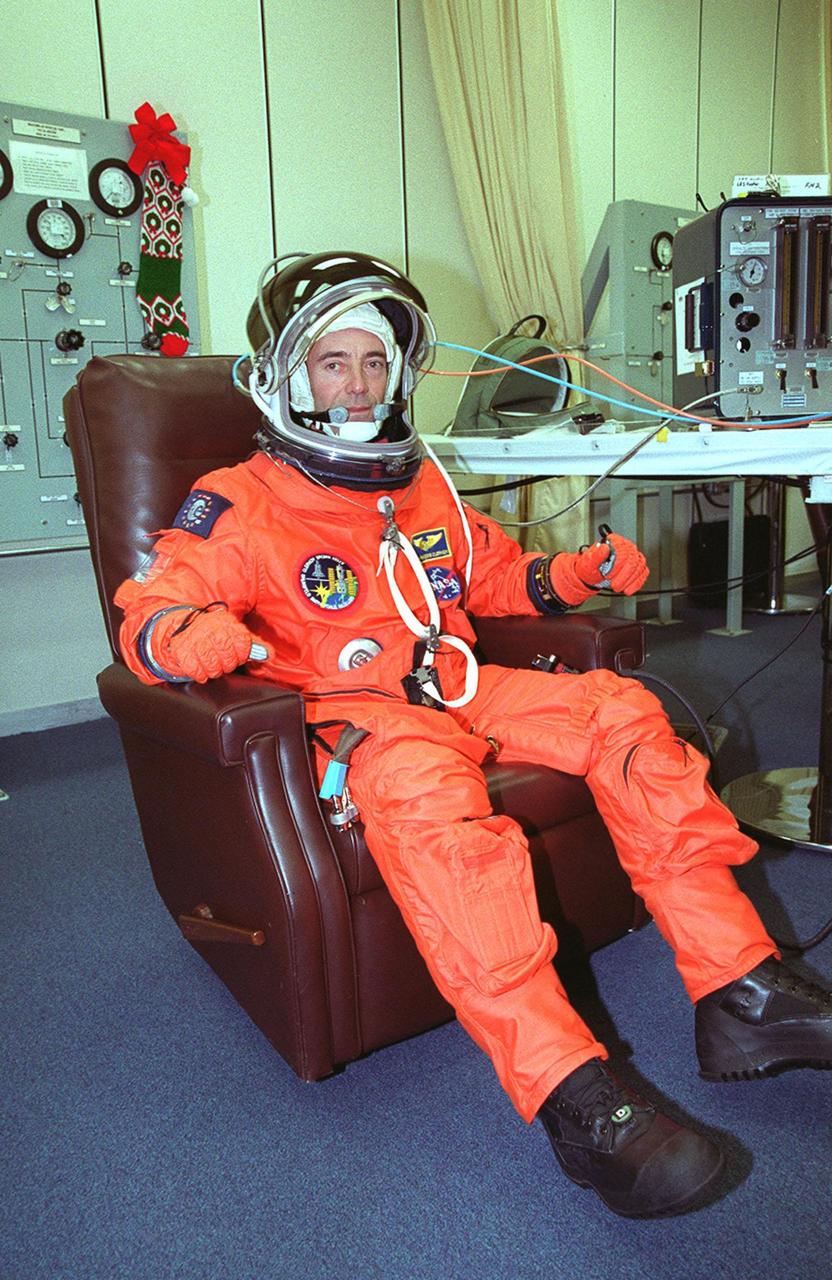
In the Operations and Checkout Building, STS-103 Mission Specialist Jean-François Clervoy of France has donned his launch and entry suit and is ready for launch. Other crew members are Commander Curtis L. Brown Jr., Pilot Scott J. Kelly and Mission Specialists Steven L. Smith, C. Michel Foale (Ph.D.), John M. Grunsfeld (Ph.D.), and Claude Nicollier of Switzerland. Nicollier and Clervoy are with the European Space Agency. The STS-103 mission, to service the Hubble Space Telescope, is scheduled for launch Dec. 17 at 8:47 p.m. EST from Launch Pad 39B. Mission objectives include replacing gyroscopes and an old computer, installing another solid state recorder, and replacing damaged insulation in the telescope. After the 8-day, 21-hour mission, Discovery is expected to land at KSC Sunday, Dec. 26, at about 6:30 p.m. EST
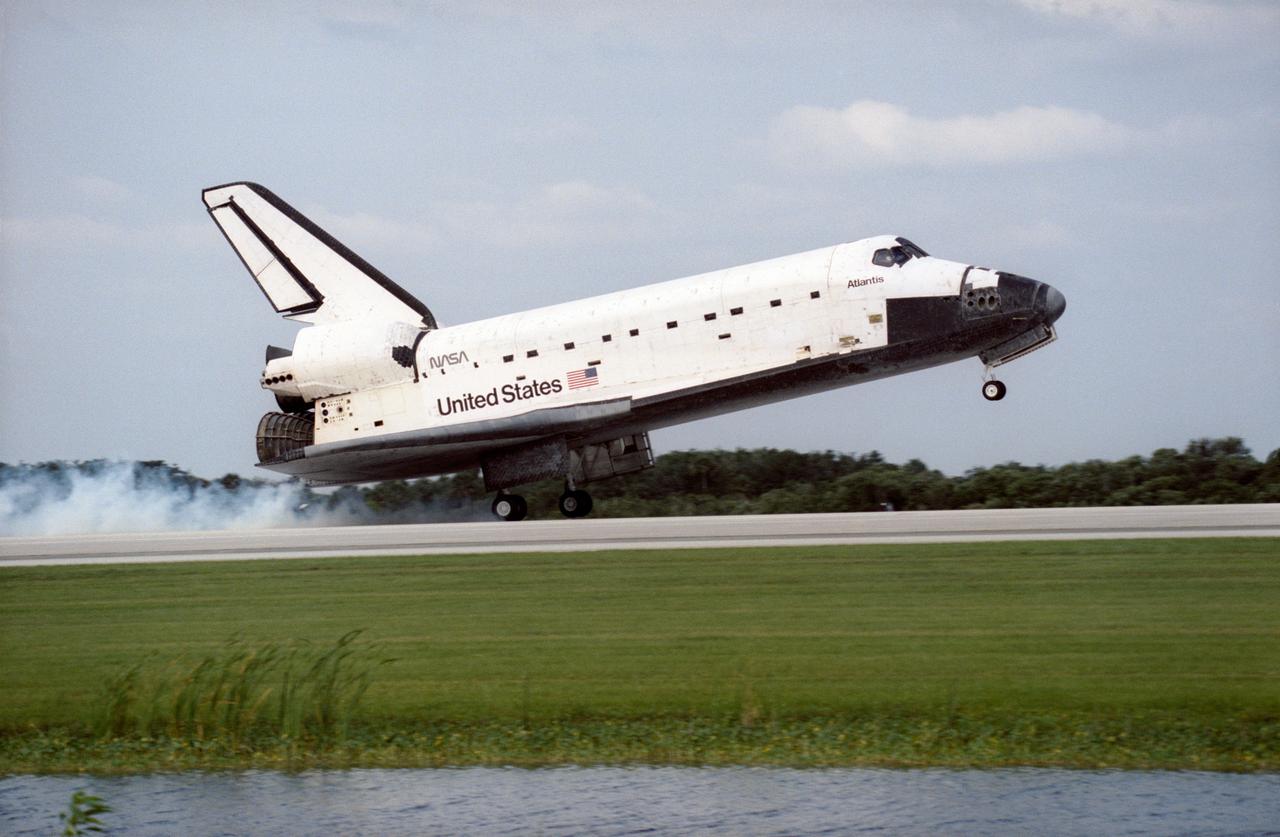
STS084-S-012 (24 May 1997) --- The Space Shuttle Atlantis touches down on Runway 33 of the Kennedy Space Center (KSC) Shuttle Landing Facility (SLF), bringing to a completion the nine-day mission. Main gear touchdown was at 9:27:44 a.m. (EDT), May 24, 1997. This touchdown marked the 37th landing at KSC in the 16-year history of the Space Transportation System (STS) and it also marked the return of astronaut Jerry M. Linenger to Earth following almost four months aboard Russia's Mir Space Station. Onboard for the landing were astronauts Charles J. Precourt, Eileen M. Collins, Jean-Fran?ois Clervoy, Carlos I. Noriega, Edward T. Lu, Linenger and Elena V. Kondakova. Clervoy is with the European Space Agency (ESA) and Kondakova represents the Russian Space Agency (RSA).
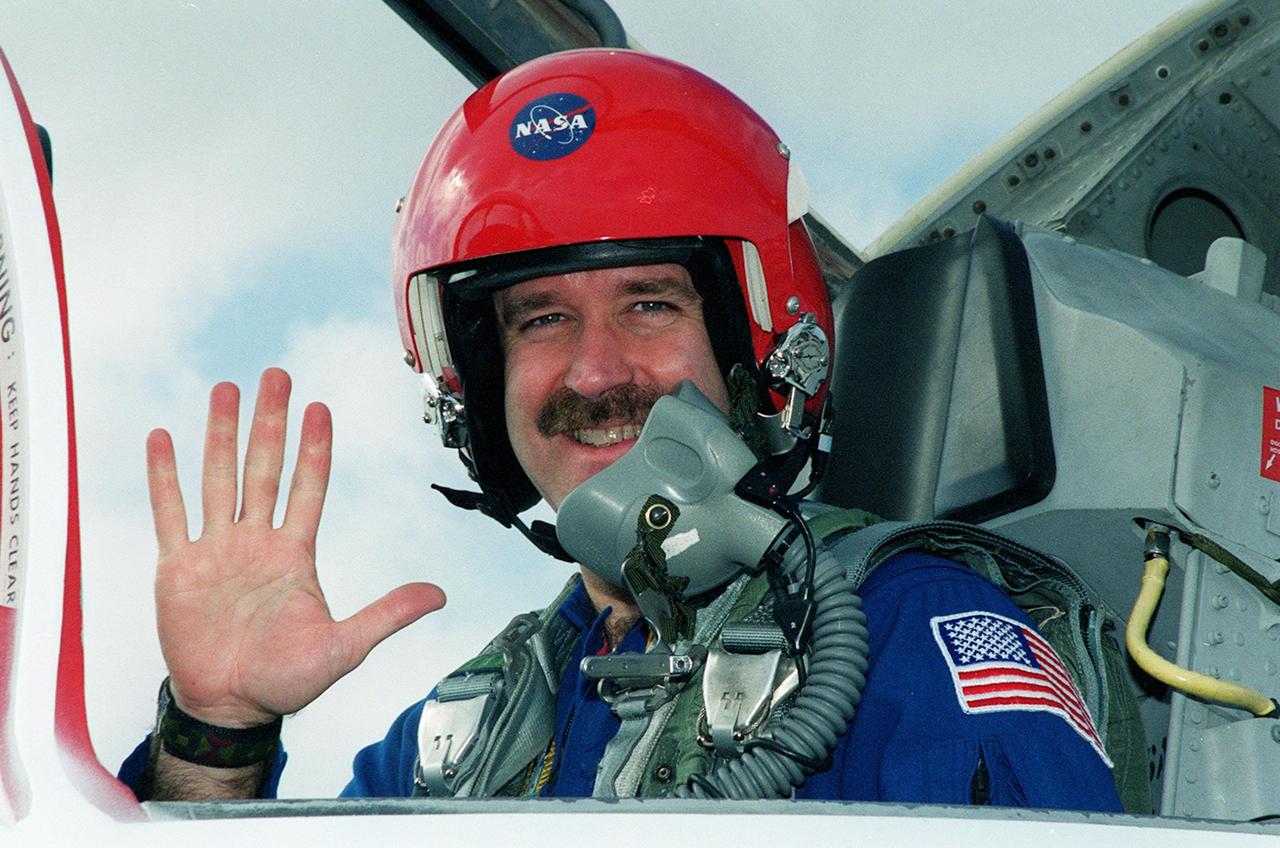
STS-103 Mission Specialist John M. Grunsfeld (Ph.D.) waves from the rear seat of a T-38 training jet before beginning practice flights. He joins other crew members Commander Curtis L. Brown Jr., Pilot Scott J. Kelly and Mission Specialists Steven L. Smith, C. Michael Foale (Ph.D.), Claude Nicollier of Switzerland and Jean-François Clervoy of France, for pre-launch preparations on mission STS-103 aboard Space Shuttle Discovery. Nicollier and Clervoy are with the European Space Agency. The mission, to service the Hubble Space Telescope, is scheduled for launch Dec. 16 at 9:18 p.m. EST from Launch Pad 39B. The mission is expected to last about 9 days and 21 hours. Discovery is expected to land at KSC Sunday, Dec. 26, at 6:56 p.m. EST

STS-103 Mission Specialist Jean-François Clervoy of France poses for a photograph at Launch Pad 39B during a meeting of STS-103 astronauts with family and friends. Clervoy is with the European Space Agency. The lights in the background are on the Fixed Service Structure next to Space Shuttle Discovery. The STS-103 mission, to service the Hubble Space Telescope, is scheduled for launch Dec. 17 at 8:47 p.m. EST from Launch Pad 39B. Mission objectives include replacing gyroscopes and an old computer, installing another solid state recorder, and replacing damaged insulation in the telescope. The mission is expected to last about 8 days and 21 hours. Discovery is expected to land at KSC Sunday, Dec. 26, at about 6:25 p.m. EST
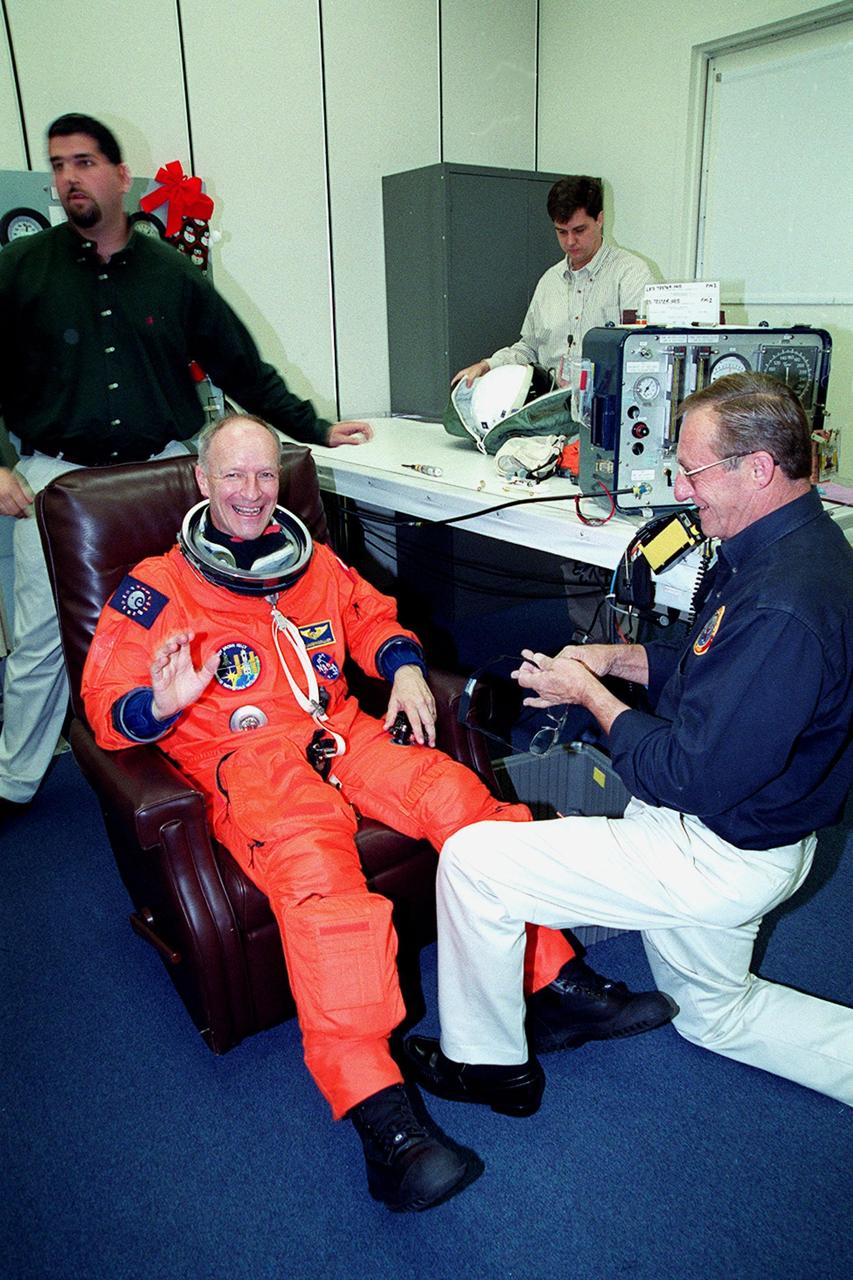
In the Operations and Checkout Building, STS-103 Mission Specialist Claude Nicollier of Switzerland waves while having his launch and entry suit checked by a suit techician during final launch preparations. Other crew members are Commander Curtis L. Brown Jr., Pilot Scott J. Kelly and Mission Specialists Steven L. Smith, C. Michael Foale (Ph.D.), John M. Grunsfeld (Ph.D.) and Jean-François Clervoy of France. Nicollier and Clervoy are with the European Space Agency. The STS-103 mission, to service the Hubble Space Telescope, is scheduled for launch Dec. 17 at 8:47 p.m. EST from Launch Pad 39B. Mission objectives include replacing gyroscopes and an old computer, installing another solid state recorder, and replacing damaged insulation in the telescope. After the 8-day, 21-hour mission, Discovery is expected to land at KSC Sunday, Dec. 26, at about 6:30 p.m. EST
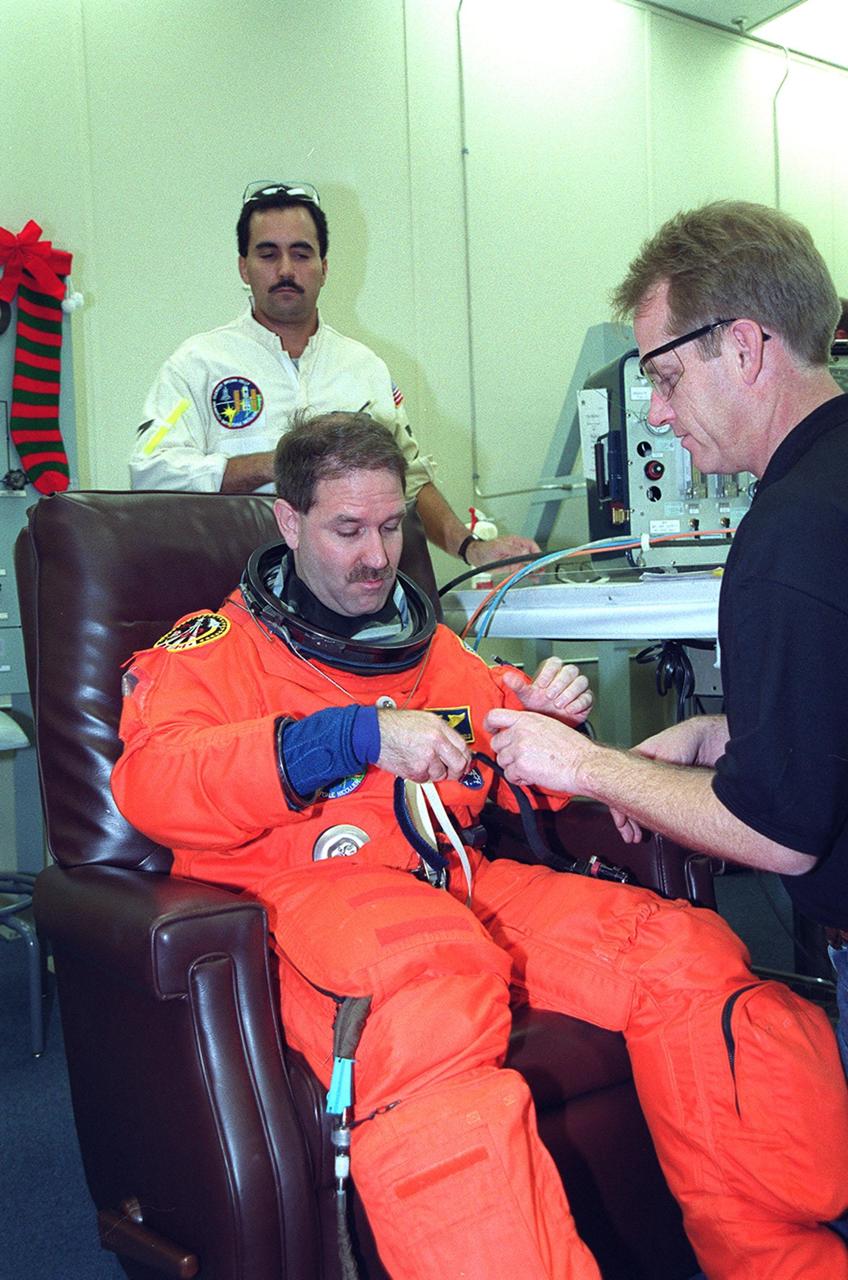
In the Operations and Checkout Building, STS-103 Mission Specialist John M. Grunsfeld (Ph.D.) is assisted by a suit technician in donning his launch and entry suit during final launch preparations. Other crew members are Commander Curtis L. Brown Jr., Pilot Scott J. Kelly and Mission Specialists Steven L. Smith, C. Michael Foale (Ph.D.), Claude Nicollier of Switzerland and Jean-François Clervoy of France. Nicollier and Clervoy are with the European Space Agency. The STS-103 mission, to service the Hubble Space Telescope, is scheduled for launch Dec. 17 at 8:47 p.m. EST from Launch Pad 39B. Mission objectives include replacing gyroscopes and an old computer, installing another solid state recorder, and replacing damaged insulation in the telescope. After the 8-day, 21-hour mission, Discovery is expected to land at KSC Sunday, Dec. 26, at about 6:30 p.m. EST
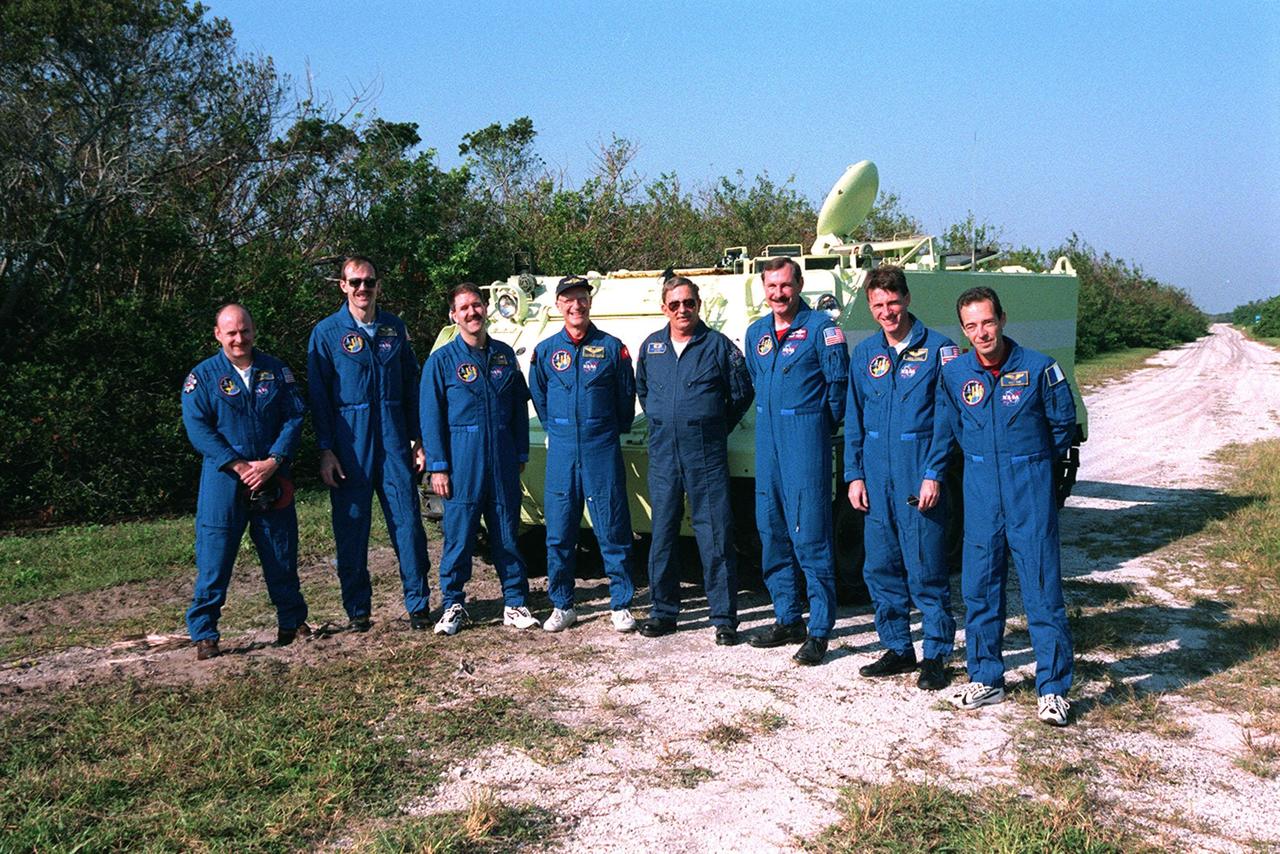
The STS-103 crew pose for photographers following Terminal Countdown Demonstration Test (TCDT) emergency egress training on the small armored personnel carrier behind them. Standing left to right are Pilot Scott J. Kelly, Mission Specialists Steven L. Smith, John M. Grunsfeld (Ph.D.), Claude Nicollier of Switzerland, their trainer on the carrier Capt. George Hoggard of the KSC/CCAS Fire Department, Commander Curtis L. Brown Jr., and Mission Specialists C. Michael Foale (Ph.D.) and Jean-Francois Clervoy of France. Nicollier and Clervoy are with the European Space Agency. The TCDT also provides simulated countdown exercises and opportunities to inspect the mission payloads in the orbiter's payload bay. STS-103 is a "call-up" mission due to the need to replace and repair portions of the Hubble Space Telescope. Four EVA's are planned to make the necessary repairs and replacements on the telescope. The mission is targeted for launch Dec. 6 at 2:37 a.m. EST
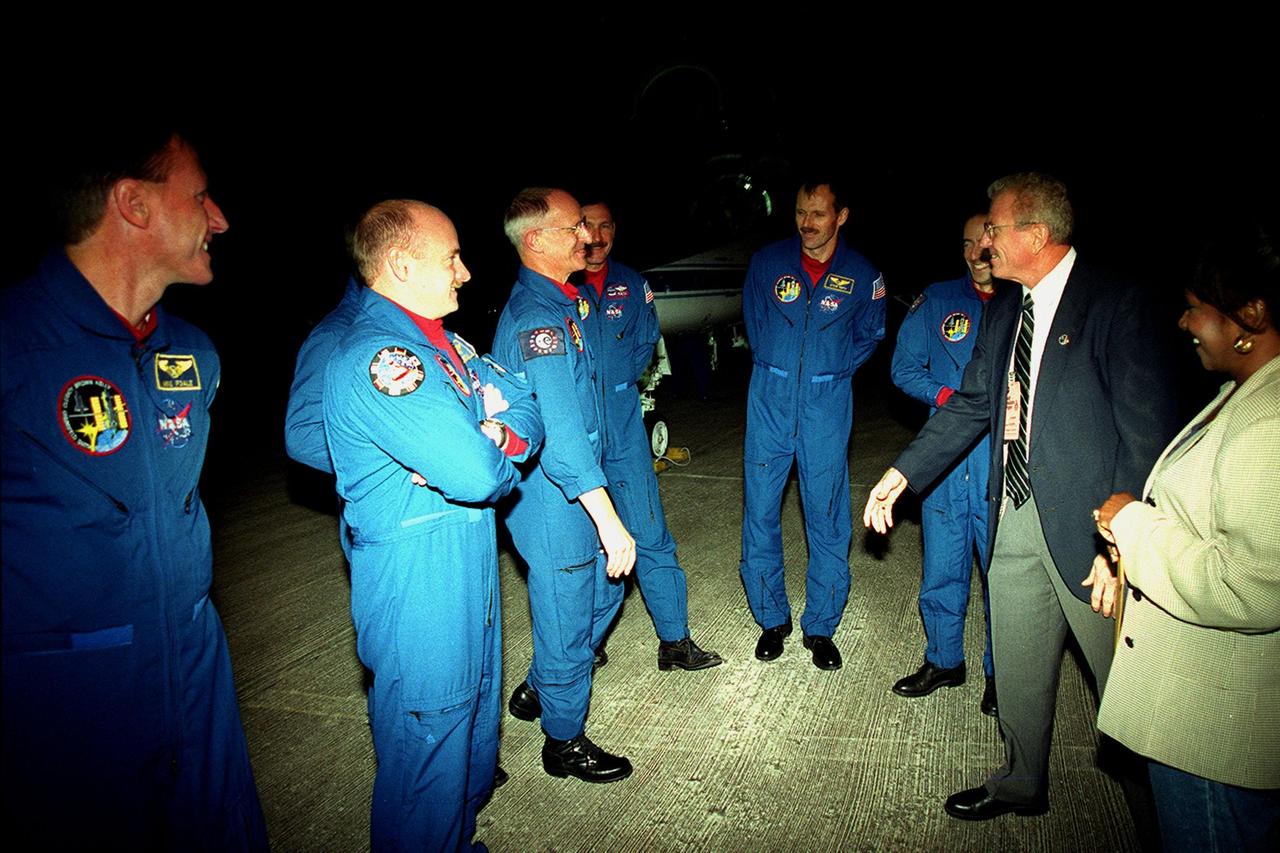
At the Shuttle Landing Facility, the STS-103 crew is greeted by Loren Shriver, Deputy Director for Launch and Payload Processing, upon their arrival aboard T-38 jets to make final preparations for launch. From left are Mission Specialist C. Michael Foale (Ph.D.), Pilot Scott J. Kelly, Mission Specialist John M. Grunsfeld (Ph.D.) (hidden behind Kelly), Mission Specialist Claude Nicollier of Switzerland, Commander Curtis L. Brown Jr., Mission Specialist Steven L. Smith, Mission Specialist Jean-François Clervoy of France, Loren Shriver, and Delores Green with KSC's Astronaut Office. Nicollier and Clervoy are with the European Space Agency. Shriver was the commander of the STS-31 crew which originally deployed the telescope in April of 1990. The STS-103 mission, to service the Hubble Space Telescope a third time, is scheduled for launch Dec. 11 at 12:13 a.m. EST from Launch Pad 39B
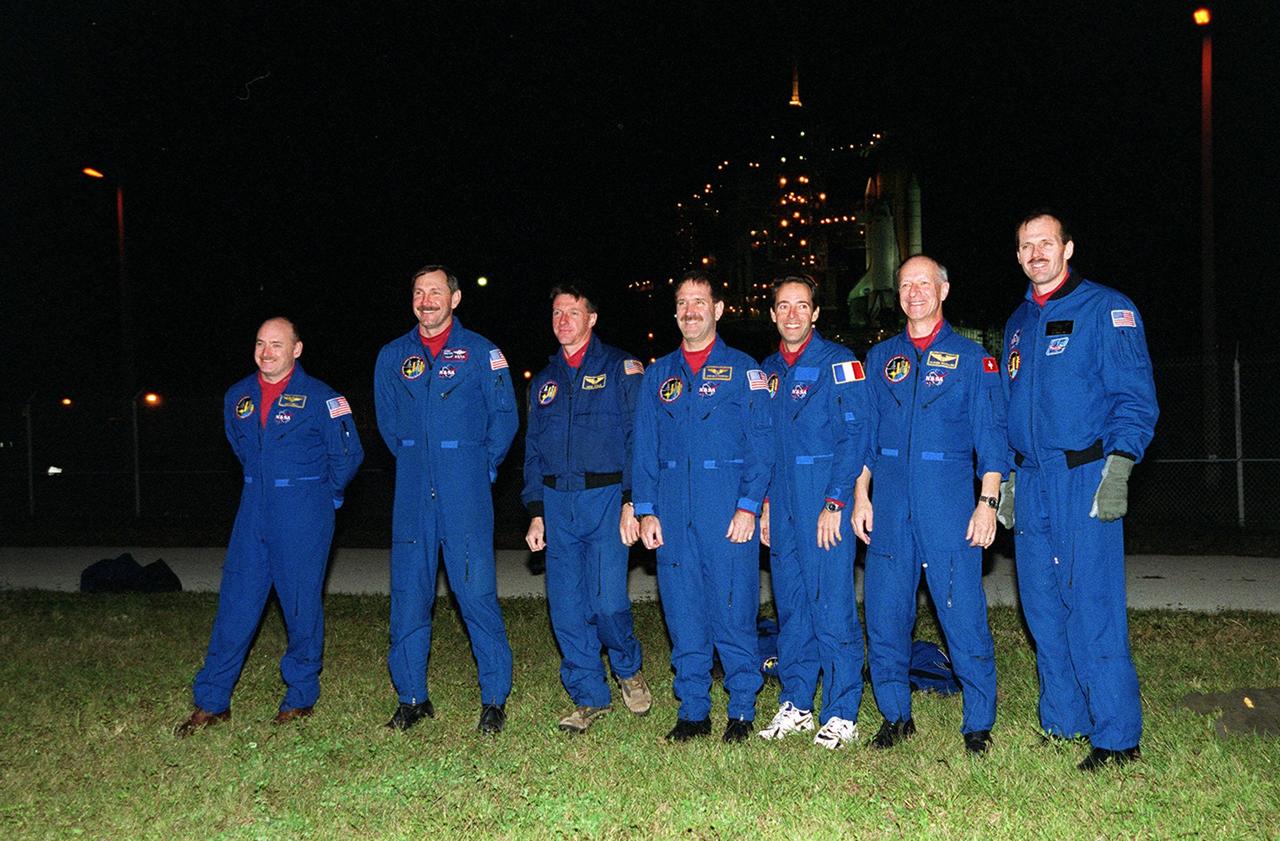
The STS-103 crew address family and friends at Launch Pad 39B. From left to right are Pilot Scott J. Kelly, Commander Curtis L. Brown Jr., and Mission Specialists C. Michael Foale (Ph.D.), John M. Grunsfeld (Ph.D.), Jean-François Clervoy of France , Claude Nicollier of Switzerland and Steven L. Smith. Nicollier and Clervoy are with the European Space Agency. In the background is Space Shuttle Discovery, alongside the lighted Fixed Service Structure. The STS-103 mission, to service the Hubble Space Telescope, is scheduled for launch Dec. 17 at 8:47 p.m. EST from Launch Pad 39B. Mission objectives include replacing gyroscopes and an old computer, installing another solid state recorder, and replacing damaged insulation in the telescope. The mission is expected to last about 8 days and 21 hours. Discovery is expected to land at KSC Sunday, Dec. 26, at about 6:25 p.m. EST
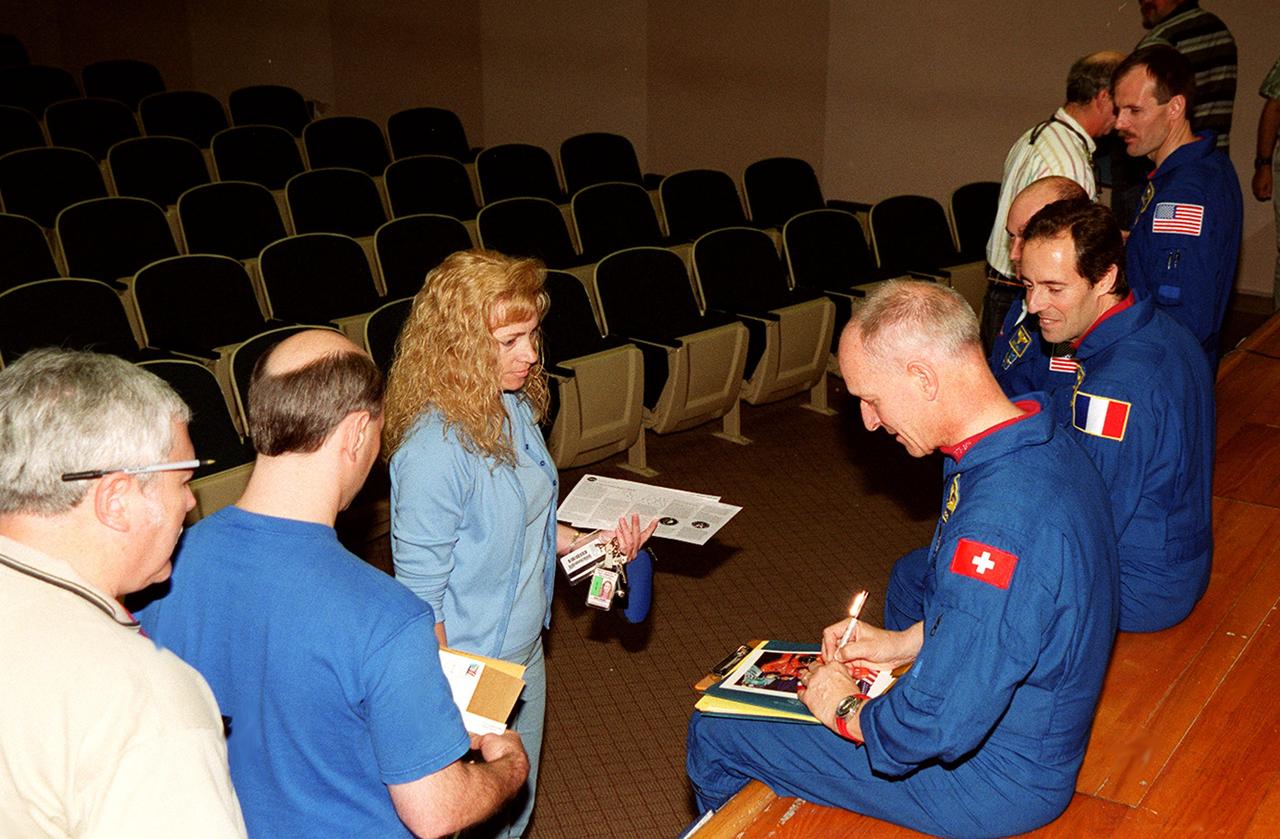
KENNEDY SPACE CENTER, FLA. -- After a presentation at KSC for employees and VIPs about their mission, STS-103 crew members sign autographs. From left are Mission Specialists Claude Nicollier and Jean-Francois Clervoy, Pilot Scott Kelly and Mission Specialist Steven Smith. The STS-103 mission, servicing the Hubble Space Telescope, included three spacewalks. STS-103 launched Dec. 19, 1999, and landed Dec. 27, 1999.
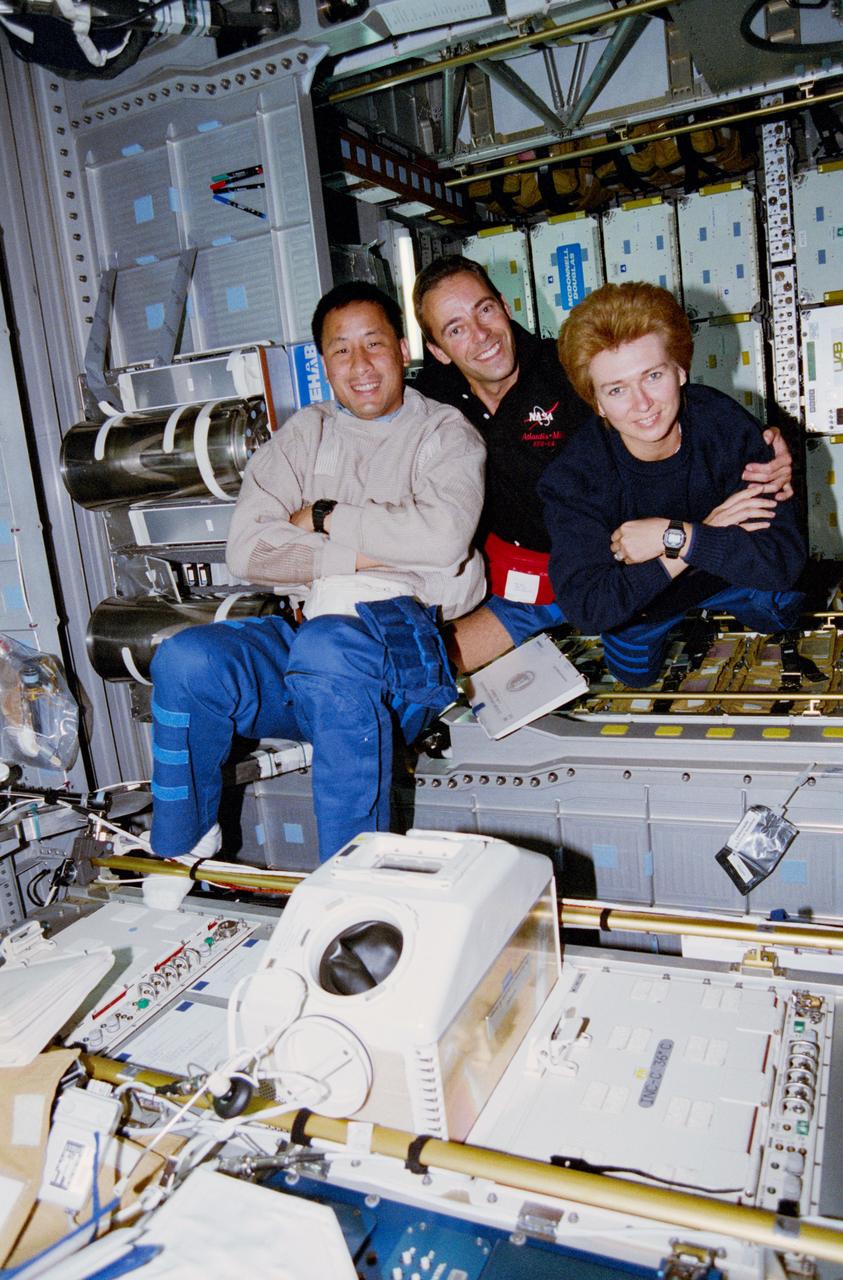
STS084-301-014 (15-24 May 1997) --- Zero-gravity adds a flavor of confusion to this 35mm frame, photographed onboard the Spacehab Double Module during a break in transfer operations of supplies for the STS-84 mission. For orientation purposes, the picture should be held with the glovebox positioned vertically on the right side of the frame. The crew members pictured, from top to bottom, are Elena V. Kondakova, Jean-Francois Clervoy and Edward T. Lu.
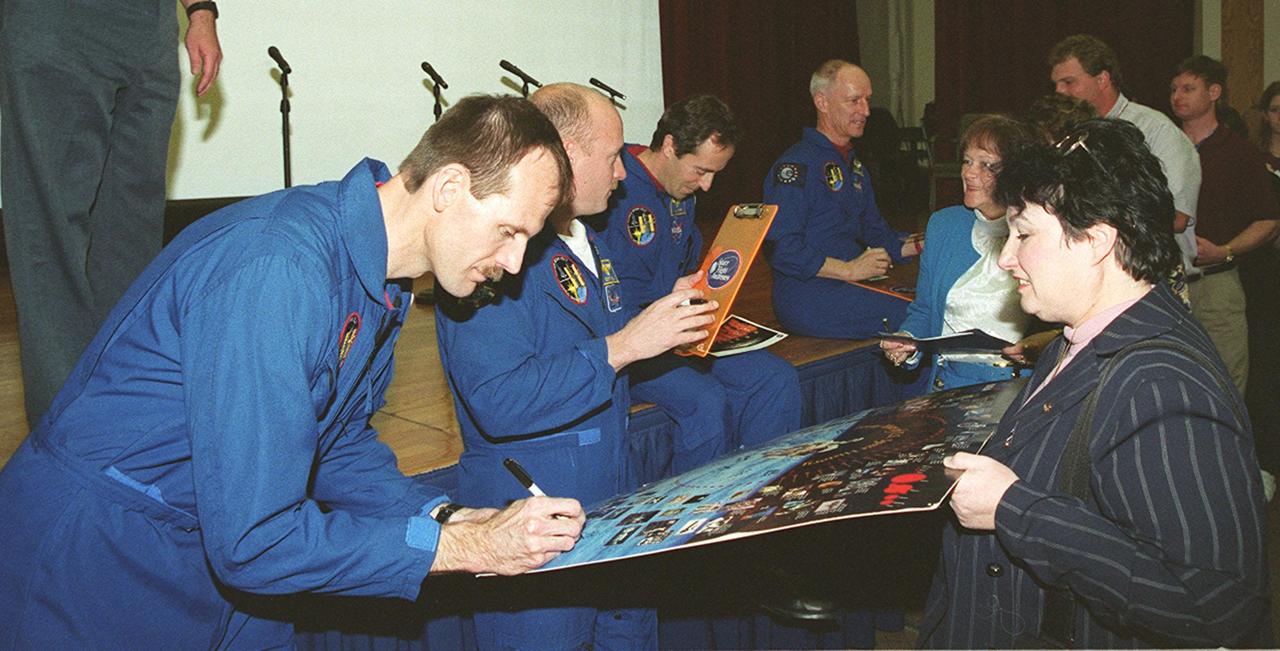
After a presentation at KSC for employees and VIPs about their mission, STS-103 crew members sign autographs. From left are Mission Specialist Steven Smith, Pilot Scott Kelly, and Mission Specialists Jean-Francois Clervoy and Claude Nicollier. The STS-103 mission, servicing the Hubble Space Telescope, included three space walks. STS-103 launched Dec. 19, 1999, and landed Dec. 27, 1999
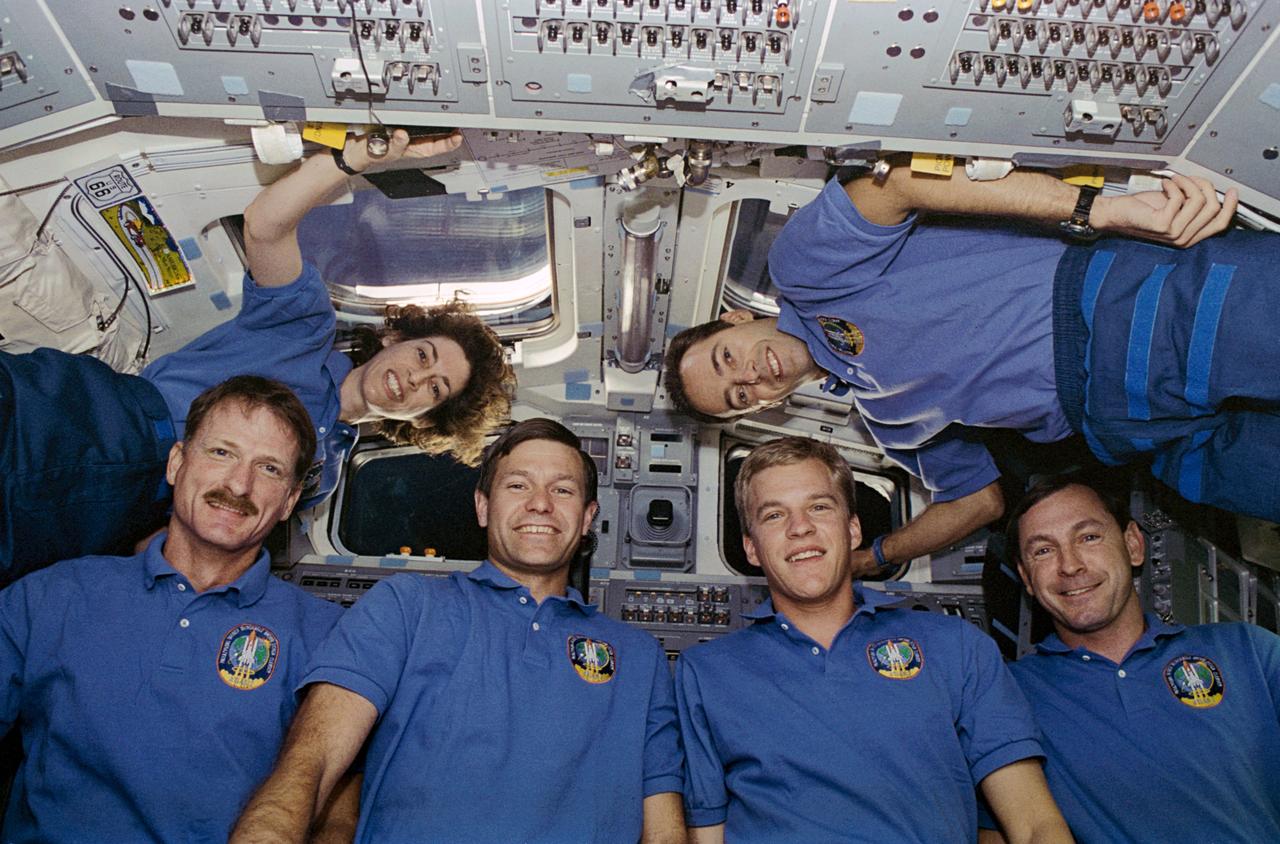
STS066-56-015 (3-14 Nov 1994) --- On the Space Shuttle Atlantis' flight deck, the six crew members pose for the traditional in-flight crew portrait. They include, left to right in lower frame, astronauts Joseph R. Tanner, mission specialist; Donald R. McMonagle, mission commander; Scott E. Parazynski, mission specialist; and Curtis L. Brown, pilot. Floating at top frame are Ellen Ochoa, payload commander; and Jean-François Clervoy, mission specialist, representing the European Space Agency (ESA).
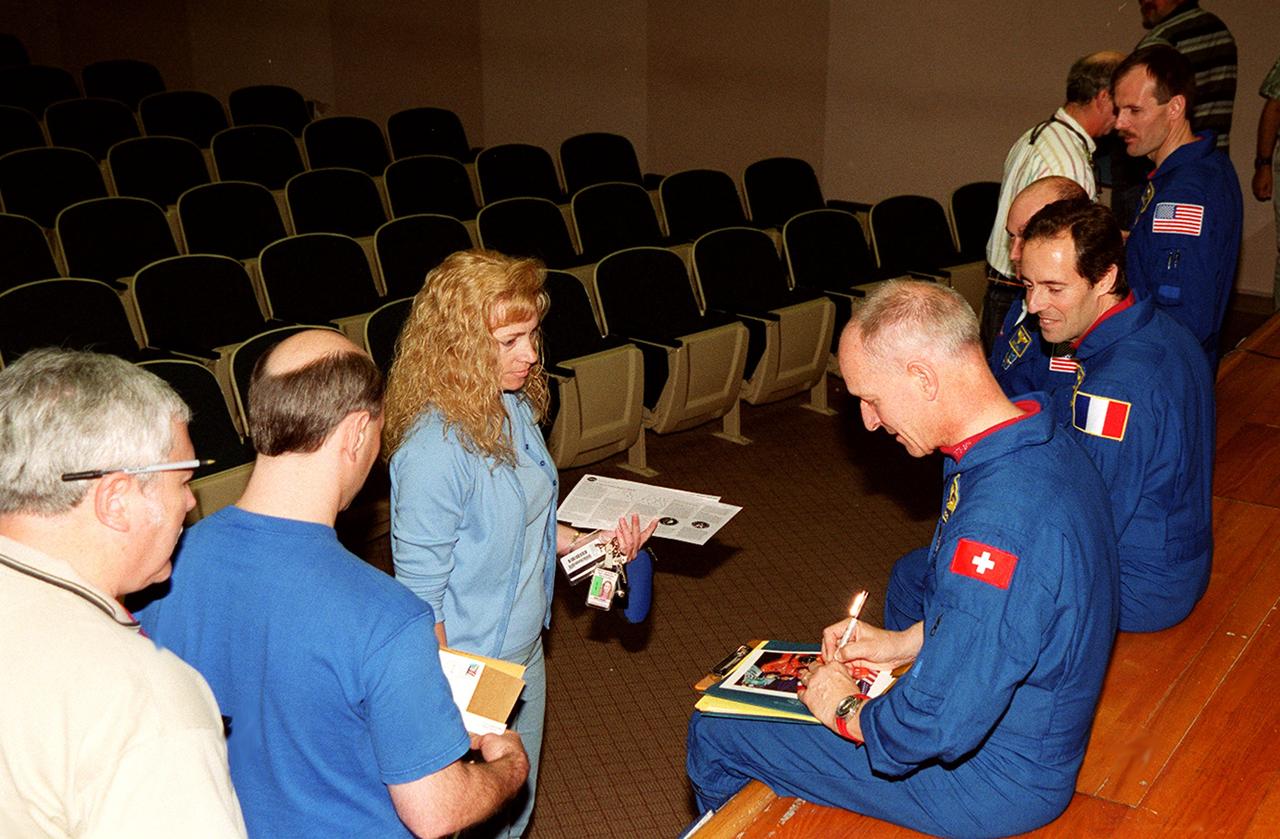
KENNEDY SPACE CENTER, FLA. -- After a presentation at KSC for employees and VIPs about their mission, STS-103 crew members sign autographs. From left are Mission Specialists Claude Nicollier and Jean-Francois Clervoy, Pilot Scott Kelly and Mission Specialist Steven Smith. The STS-103 mission, servicing the Hubble Space Telescope, included three spacewalks. STS-103 launched Dec. 19, 1999, and landed Dec. 27, 1999.
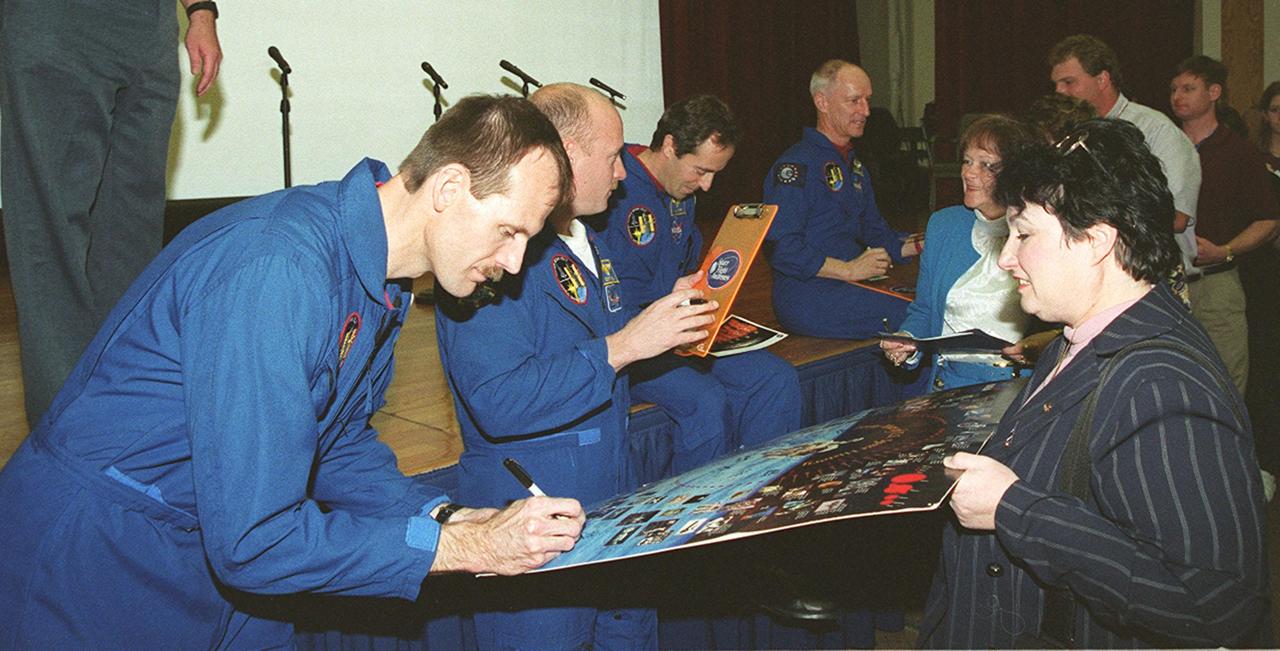
After a presentation at KSC for employees and VIPs about their mission, STS-103 crew members sign autographs. From left are Mission Specialist Steven Smith, Pilot Scott Kelly, and Mission Specialists Jean-Francois Clervoy and Claude Nicollier. The STS-103 mission, servicing the Hubble Space Telescope, included three space walks. STS-103 launched Dec. 19, 1999, and landed Dec. 27, 1999
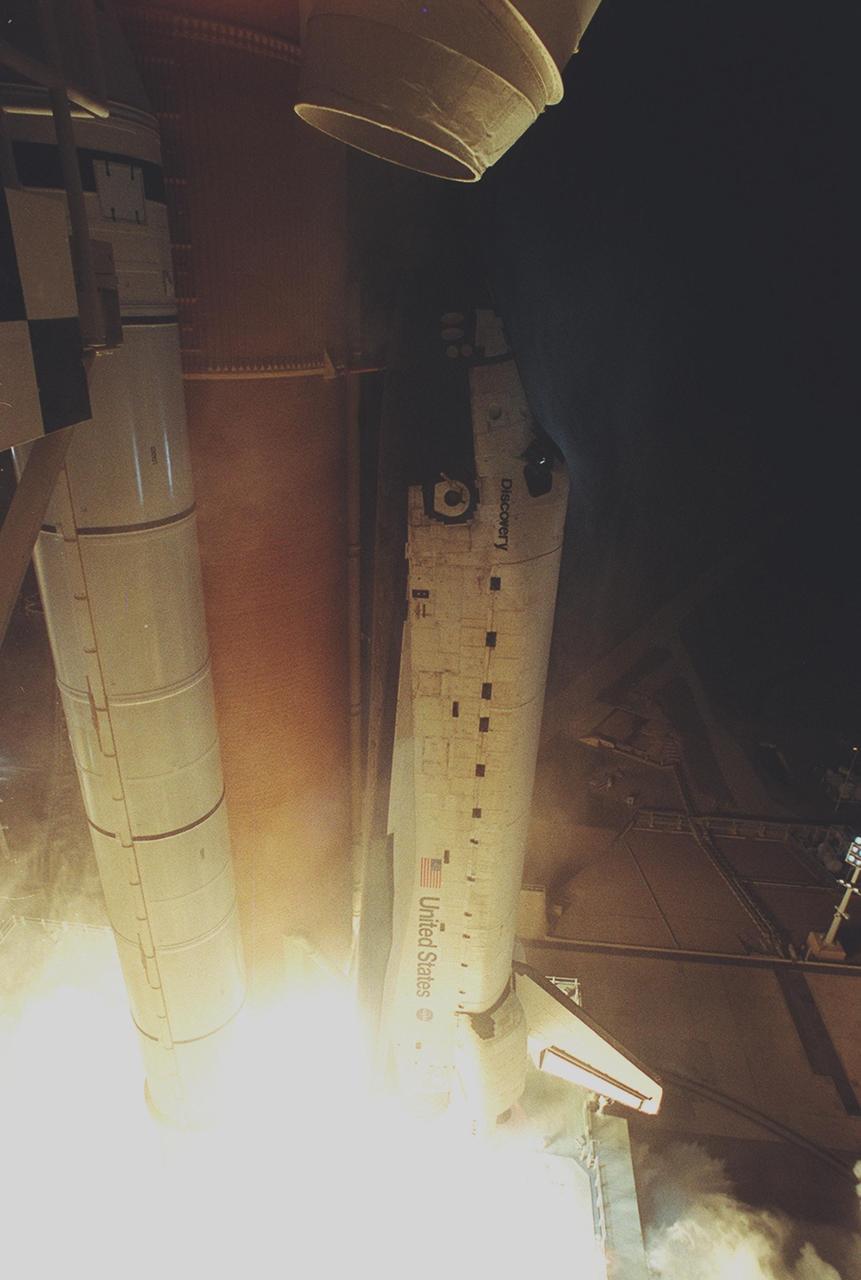
Liftoff of Space Shuttle Discovery leaves Launch Pad 39B (seen at right) and Earth behind, lighted by the brilliant exhaust of the solid rocket boosters and external tank. Liftoff occurred at 7:50 p.m. EST from Launch Pad 39B. On board are Commander Curtis L. Brown Jr., Pilot Scott J. Kelly and Mission Specialists Steven L. Smith, C. Michael Foale (Ph.D.), John M. Grunsfeld (Ph.D.), Claude Nicollier of Switzerland and Jean-François Clervoy of France. Nicollier and Clervoy are with the European Space Agency. STS-103 is a Hubble Servicing Mission, with three planned space walks designed to install new equipment and replace old. The primary objective is to replace the gyroscopes that make up the three Rate Sensor Units. Extravehicular activities include installing a new computer, changing out one of the Fine Guidance Sensors, replacing a tape recorder with a new solid state recorder, and installing a voltage/temperature improvement kit, and begin repairing the insulation on the telescope's outer surface. After the 7-day, 21-hour mission, Discovery is expected to land at KSC Monday, Dec. 27, at about 5:24 p.m. EST. This is the 27th flight of Discovery and the 96th mission in the Space Shuttle Program. It is the third launch at Kennedy Space Center in 1999

In the Operations and Checkout Building, STS-103 Mission Specialist C. Michel Foale (Ph.D.) smiles as a suit technician helps him don his launch and entry suit during final launch preparations. Other crew members are Commander Curtis L. Brown Jr., Pilot Scott J. Kelly and Mission Specialists Steven L. Smith, John M. Grunsfeld (Ph.D.), Claude Nicollier of Switzerland and Jean-François Clervoy of France. Nicollier and Clervoy are with the European Space Agency. The STS-103 mission, to service the Hubble Space Telescope, is scheduled for launch Dec. 17 at 8:47 p.m. EST from Launch Pad 39B. Mission objectives include replacing gyroscopes and an old computer, installing another solid state recorder, and replacing damaged insulation in the telescope. After the 8-day, 21-hour mission, Discovery is expected to land at KSC Sunday, Dec. 26, at about 6:30 p.m. EST.is expected to land at KSC Sunday, Dec. 26, at about 6:30 p.m. EST

(Nikon camera D1 test)With smoke and steam billowing around it, Space Shuttle Discovery hurtles into the clear night sky in a blaze of light. The successful liftoff occurred on time at 7:50:00.069 EST from Launch Pad 39B on mission STS-103. On board are Commander Curtis L. Brown Jr., Pilot Scott J. Kelly and Mission Specialists Steven L. Smith, C. Michael Foale (Ph.D.), John M. Grunsfeld (Ph.D.), Claude Nicollier of Switzerland and Jean-François Clervoy of France. Nicollier and Clervoy are with the European Space Agency. STS-103 is a Hubble Servicing Mission, with three planned space walks designed to install new equipment and replace old. The primary objective is to replace the gyroscopes that make up the three Rate Sensor Units. Extravehicular activities include installing a new computer, changing out one of the Fine Guidance Sensors, replacing a tape recorder with a new solid state recorder, and installing a voltage/temperature improvement kit, and begin repairing the insulation on the telescope's outer surface. After the 7-day, 21-hour mission, Discovery is expected to land at KSC Monday, Dec. 27, at about 5:24 p.m. EST. This is the 27th flight of Discovery and the 96th mission in the Space Shuttle Program. It is the third launch at Kennedy Space Center in 1999
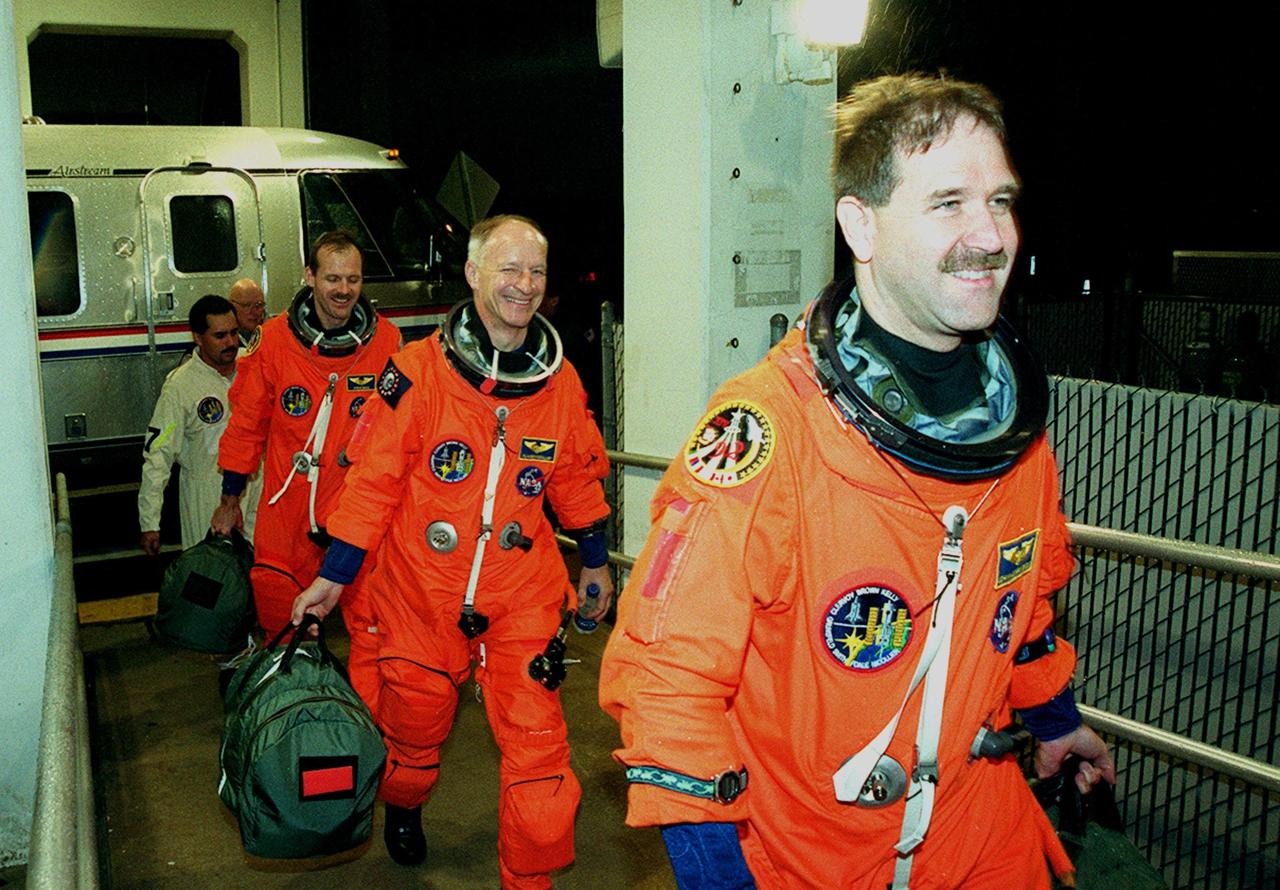
STS-103 crew members head back to the Operations and Checkout Building after the launch of Space Shuttle Discovery was scrubbed due to unfavorable weather conditions. In the lead (right) is Mission Specialist John M. Grunsfeld (Ph.D.), followed by Mission Specialists Claude Nicollier of Switzerland and Steven L. Smith. . Other crew members are Commander Curtis L. Brown Jr., Pilot Scott J. Kelly, and Mission Specialists C. Michael Foale (Ph.D.) and Jean-Francois Clervoy of France. Nicollier and Clervoy are with the European Space Agency. The STS-103 mission, to service the Hubble Space Telescope, is rescheduled for launch Dec. 18 at 8:21 p.m. EST from Launch Pad 39B. Mission objectives include replacing gyroscopes and an old computer, installing another solid state recorder, and replacing damaged insulation in the telescope. After the 7-day, 21-hour mission, Discovery is expected to land at KSC Sunday, Dec. 26, at about 6:00 p.m. EST
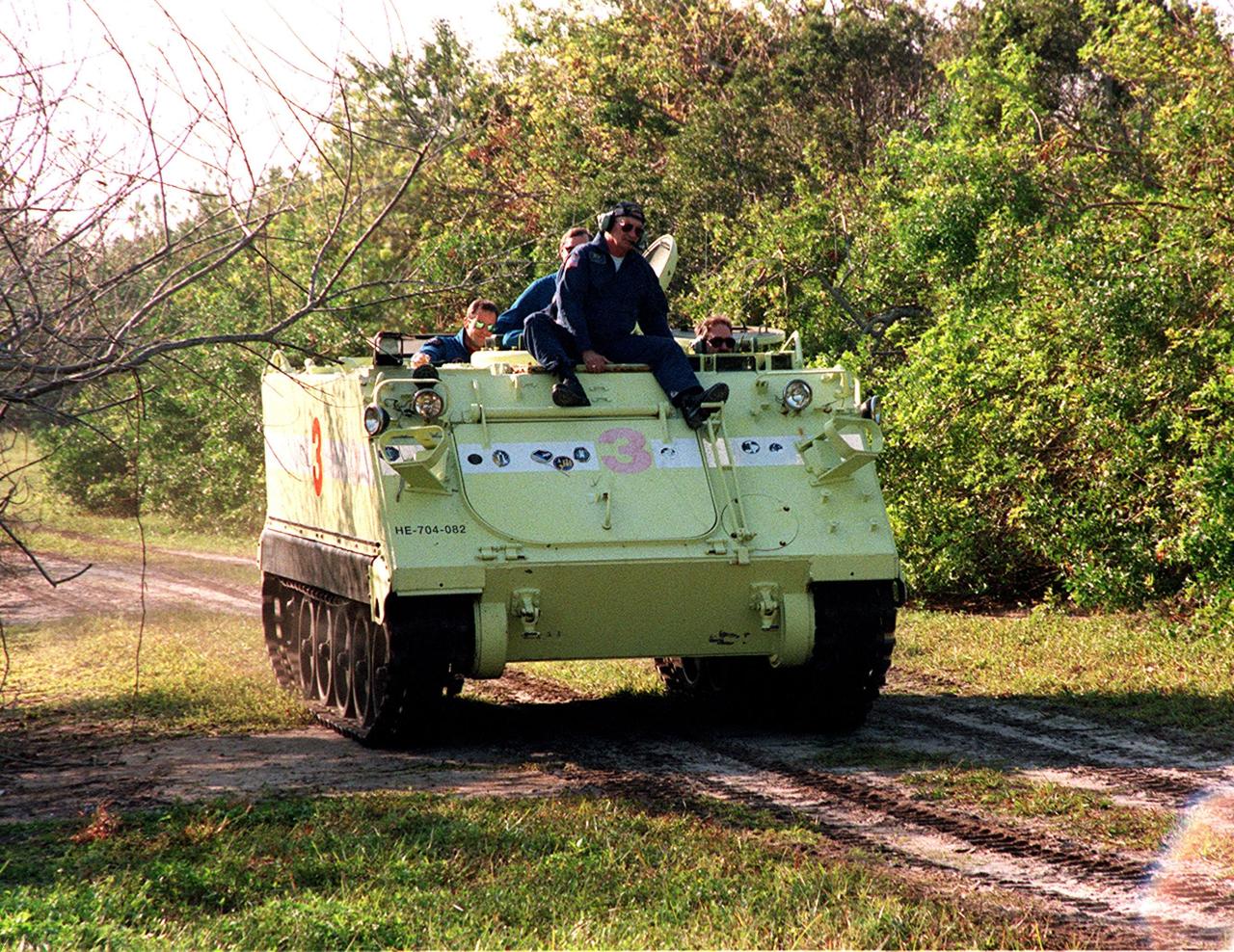
STS-103 Mission Specialist John M. Grunsfeld (Ph.D.) (far right) practices driving a small armored personnel carrier that is part of emergency egress training during Terminal Countdown Demonstration Test (TCDT) activities. In front is Capt. George Hoggard, trainer with the KSC Fire Department. At far left is Mission Specialist Jean-François Clervoy of France, who is with the European Space Agency. The tracked vehicle could be used by the crew in the event of an emergency at the pad during which the crew must make a quick exit from the area. The TCDT also provides simulated countdown exercises and opportunities to inspect the mission payloads in the orbiter's payload bay. STS-103 is a "call-up" mission due to the need to replace and repair portions of the Hubble Space Telescope. Four EVA's are planned to make the necessary repairs and replacements on the telescope. The other STS-103 crew members are Commander Curtis L. Brown Jr., Pilot Scott J. Kelly, and Mission Specialists Steven L. Smith, C. Michael Foale (Ph.D.), (Ph.D.), plus Claude Nicollier of Switzerland and Jean-François Clervoy of France, who are with the European Space Agency. The mission is targeted for launch Dec. 6 at 2:37 a.m. EST
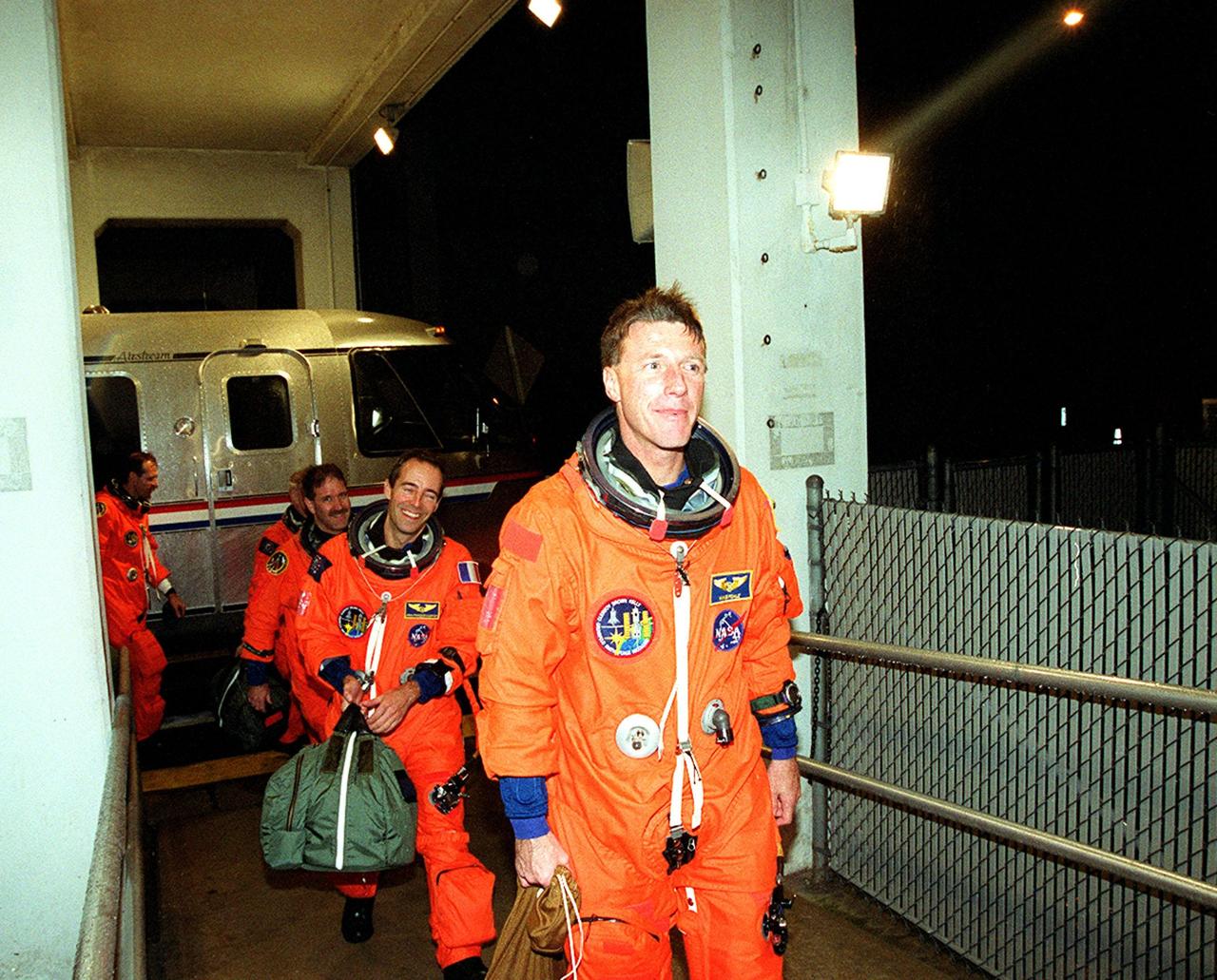
STS-103 crew members head back to the Operations and Checkout Building after the launch of Space Shuttle Discovery was scrubbed due to unfavorable weather conditions. In the lead (right) is Mission Specialist C. Michael Foale (Ph.D.), followed by Mission Specialists Jean-Francois Clervoy of France, John M. Grunsfeld (Ph.D.), Claude Nicollier of Switzerland and Steven L. Smith. Other crew members are Commander Curtis L. Brown Jr. and Pilot Scott J. Kelly. Nicollier and Clervoy are with the European Space Agency. The STS-103 mission, to service the Hubble Space Telescope, is rescheduled for launch Dec. 18 at 8:21 p.m. EST from Launch Pad 39B. Mission objectives include replacing gyroscopes and an old computer, installing another solid state recorder, and replacing damaged insulation in the telescope. After the 7-day, 21-hour mission, Discovery is expected to land at KSC Sunday, Dec. 26, at about 6:00 p.m. EST

During a Crew Equipment Interface Test (CEIT), members of the STS-103 crew check out a portable foot restraint on the Flight Support System that will be used on the mission, repairing the Hubble Space Telescope. The seven-member crew comprises Commander Curtis L. Brown Jr., Pilot Scott J. Kelly, and Mission Specialists Steven L. Smith, C. Michael Foale (Ph.D.), John M. Grunsfeld (Ph.D), Claude Nicollier of Switzerland, and Jean-François Clervoy of France. Nicollier and Clervoy are with the European Space Agency. Mission STS-103 is a "call-up" due to the need to replace portions of the pointing system, the gyros, which have begun to fail on the Hubble Space Telescope. Although Hubble is operating normally and conducting its scientific observations, only three of its six gyroscopes are working properly. The gyroscopes allow the telescope to point at stars, galaxies and planets. The STS-103 crew will not only replace gyroscopes, it will also replace a Fine Guidance Sensor and an older computer with a new enhanced model, an older data tape recorder with a solid-state digital recorder, a failed spare transmitter with a new one, and degraded insulation on the telescope with new thermal insulation. The crew will also install a Battery Voltage/Temperature Improvement Kit to protect the spacecraft batteries from overcharging and overheating when the telescope goes into a safe mode. The scheduled launch date in October is under review
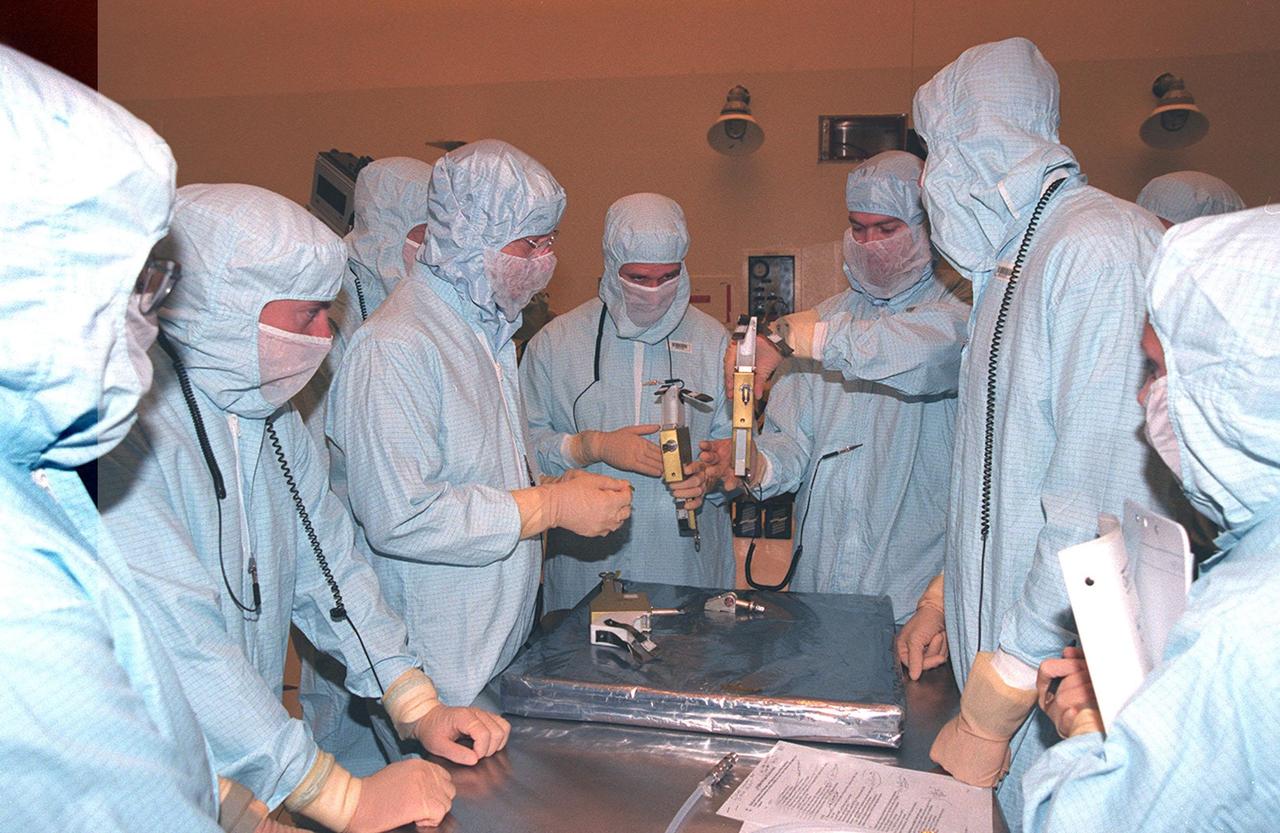
In the Payload Hazardous Servicing Facility, the STS-103 crew look over equipment to be used during their mission. The seven-member crew, taking part in a Crew Equipment Interface Test, are Commander Curtis L. Brown Jr., Pilot Scott J. Kelly, and Mission Specialists Steven L. Smith, C. Michael Foale (Ph.D.), John M. Grunsfeld (Ph.D.), Claude Nicollier of Switzerland, and Jean-François Clervoy of France. Nicollier and Clervoy are with the European Space Agency. Mission STS-103 is a "call-up" due to the need to replace portions of the pointing system, the gyros, which have begun to fail on the Hubble Space Telescope. Although Hubble is operating normally and conducting its scientific observations, only three of its six gyroscopes are working properly. The gyroscopes allow the telescope to point at stars, galaxies and planets. The STS-103 crew will not only replace gyroscopes, it will also replace a Fine Guidance Sensor and an older computer with a new enhanced model, an older data tape recorder with a solid state digital recorder, a failed spare transmitter with a new one, and degraded insulation on the telescope with new thermal insulation. The crew will also install a Battery Voltage/Temperature Improvement Kit to protect the spacecraft batteries from overcharging and overheating when the telescope goes into a safe mode. The scheduled launch date in October is under review

In the Payload Hazardous Servicing Facility, some of the STS-103 crew look over lubrication devices to be used during their mission. The seven-member crew are Commander Curtis L. Brown Jr., Pilot Scott J. Kelly, and Mission Specialists Steven L. Smith, C. Michael Foale (Ph.D.), John M. Grunsfeld (Ph.D.), Claude Nicollier of Switzerland, and Jean-François Clervoy of France. Nicollier and Clervoy are with the European Space Agency. Mission STS-103 is a "call-up" due to the need to replace portions of the pointing system, the gyros, which have begun to fail on the Hubble Space Telescope. Although Hubble is operating normally and conducting its scientific observations, only three of its six gyroscopes are working properly. The gyroscopes allow the telescope to point at stars, galaxies and planets. The STS-103 crew will not only replace gyroscopes, it will also replace a Fine Guidance Sensor and an older computer with a new enhanced model, an older data tape recorder with a solid state digital recorder, a failed spare transmitter with a new one, and degraded insulation on the telescope with new thermal insulation. The crew will also install a Battery Voltage/Temperature Improvement Kit to protect the spacecraft batteries from overcharging and overheating when the telescope goes into a safe mode. The scheduled launch date in October is under review
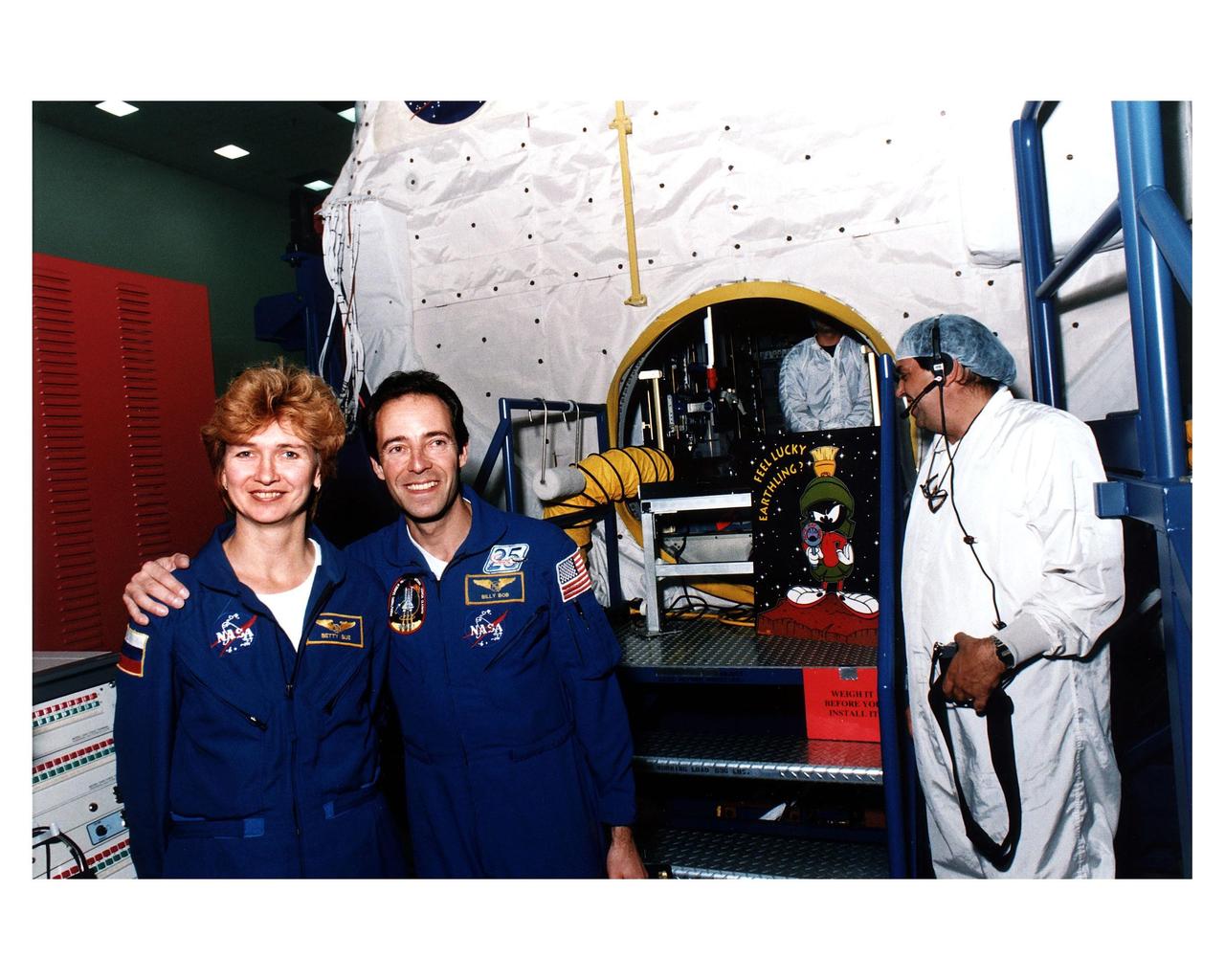
STS-84 Mission Specialists Elena V. Kondakova, at left, and Jean-Francois Clervoy pose for photos outside the SPACEHAB Double Module, which will carry more than 6,000 pounds of scientific experiments and logistics to the Russian Space Station Mir. Kondakova, a cosmonaut with the Russian Space Agency, has the nickname of Betty Sue for this mission. Clervoy, an astronaut with the European Space Agency, is wearing a name tag with his mission nickname, Billie Bob. They are participating in the Crew Equipment Integration Test (CEIT) at the SPACEHAB Payload Processing Facility in Cape Canaveral. STS-84 will be the sixth docking of the Space Shuttle with Mir. It also will be the third consecutive crew member exchange of U.S. astronauts aboard Mir. STS-84 Mission Specialist C. Michael Foale will replace astronaut Jerry M. Linenger on Mir. Linenger has been on Mir since the STS-81 mission in January. Foale is scheduled to remain on Mir about four months. STS-84 is targeted for a May 15 liftoff

(Nikon camera D1 test)Amid billows of smoke and steam, Space Shuttle Discovery lights up the clear night sky as it lifts off on time at 7:50:00.069 EST from Launch Pad 39B on mission STS-103. On board are Commander Curtis L. Brown Jr., Pilot Scott J. Kelly and Mission Specialists Steven L. Smith, C. Michael Foale (Ph.D.), John M. Grunsfeld (Ph.D.), Claude Nicollier of Switzerland and Jean-François Clervoy of France. Nicollier and Clervoy are with the European Space Agency. STS-103 is a Hubble Servicing Mission, with three planned space walks designed to install new equipment and replace old. The primary objective is to replace the gyroscopes that make up the three Rate Sensor Units. Extravehicular activities include installing a new computer, changing out one of the Fine Guidance Sensors, replacing a tape recorder with a new solid state recorder, and installing a voltage/temperature improvement kit, and begin repairing the insulation on the telescope's outer surface. After the 7-day, 21-hour mission, Discovery is expected to land at KSC Monday, Dec. 27, at about 5:24 p.m. EST. This is the 27th flight of Discovery and the 96th mission in the Space Shuttle Program. It is the third launch at Kennedy Space Center in 1999
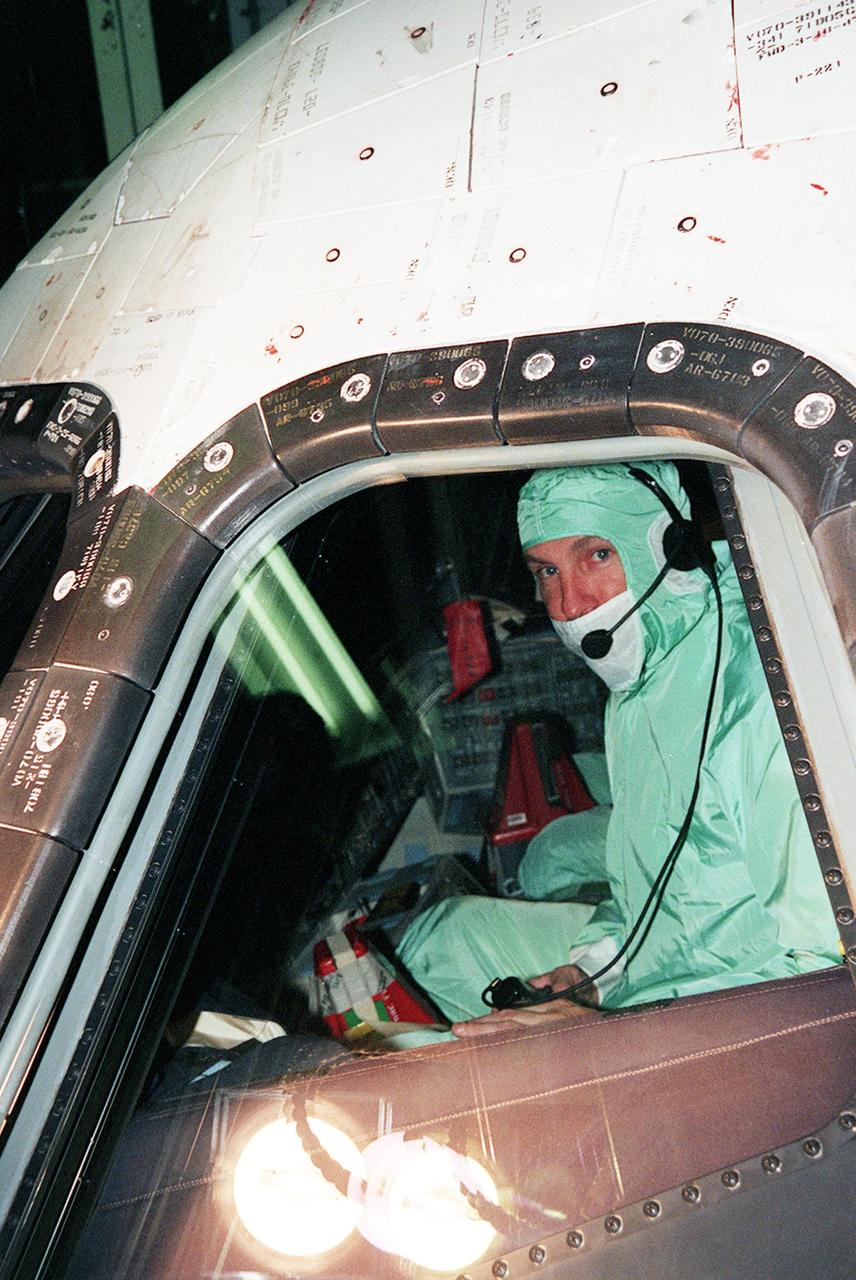
In the Orbiter Processing Facility (OPF) bay 1, STS-103 Commander Curtis L. Brown Jr. sits in the command seat of the orbiter Discovery, inspecting the window. Brown and other crew members are at KSC to take part in a Crew Equipment Interface Test. The rest of the crew are Pilot Scott J. Kelly, and Mission Specialists Steven L. Smith, C. Michael Foale (Ph.D.), John M. Grunsfeld (Ph.D.), Claude Nicollier of Switzerland, and Jean-François Clervoy of France. Nicollier and Clervoy are with the European Space Agency. Mission STS-103 is a "call-up" due to the need to replace portions of the pointing system, the gyros, which have begun to fail on the Hubble Space Telescope. Although Hubble is operating normally and conducting its scientific observations, only three of its six gyroscopes are working properly. The gyroscopes allow the telescope to point at stars, galaxies and planets. The STS-103 crew will not only replace gyroscopes, it will also replace a Fine Guidance Sensor and an older computer with a new enhanced model, an older data tape recorder with a solid-state digital recorder, a failed spare transmitter with a new one, and degraded insulation on the telescope with new thermal insulation. The crew will also install a Battery Voltage/Temperature Improvement Kit to protect the spacecraft batteries from overcharging and overheating when the telescope goes into a safe mode. The scheduled launch date in October is under review
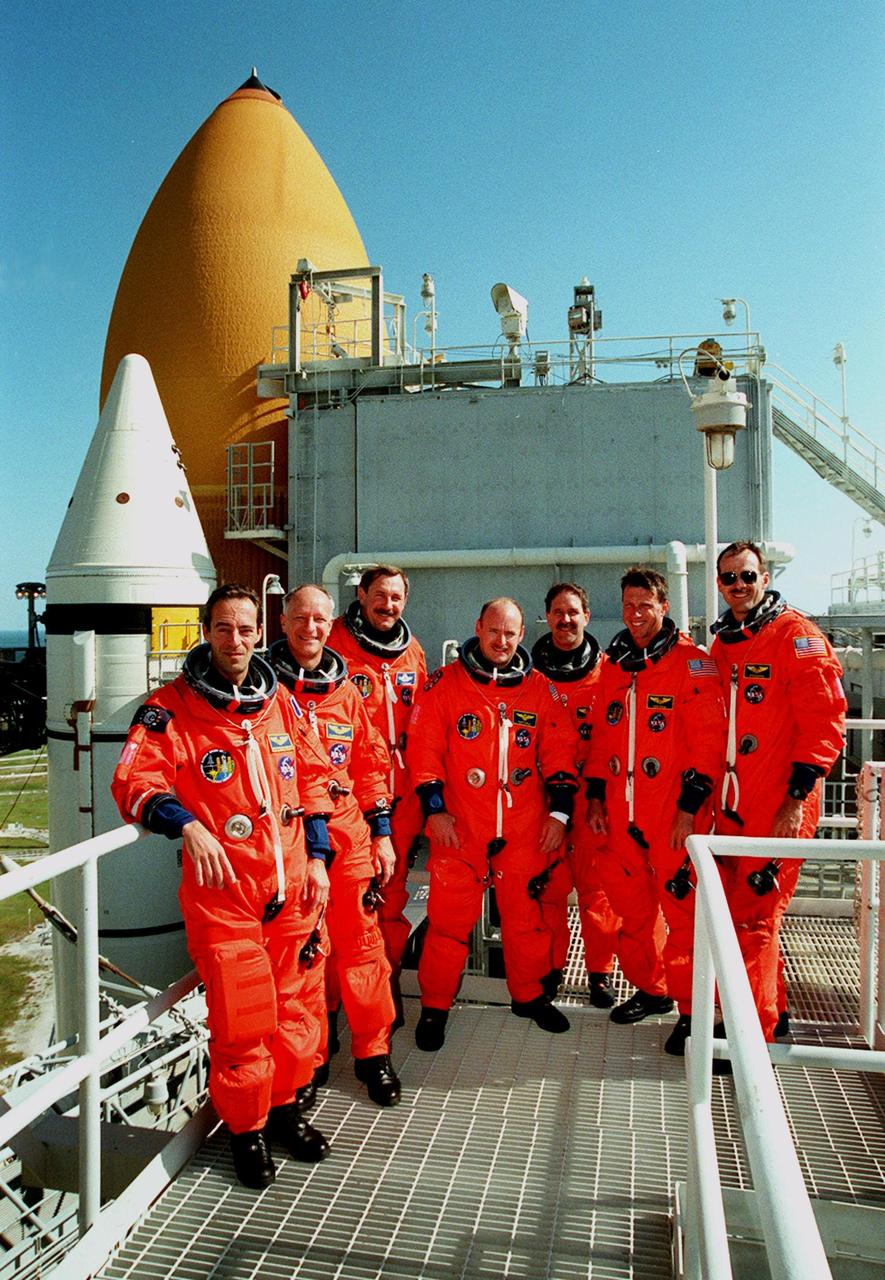
Taking a break during emergency egress training at Launch Pad 39B are (left to right) STS-103 Mission Specialists Jean-François Clervoy of France, Claude Nicollier of Switzerland, Commander Curtis L. Brown Jr., Pilot Scott J. Kelly, and Mission Specialists John M. Grunsfeld (Ph.D.), C. Michael Foale (Ph.D.) and Steven L. Smith. Clervoy and Nicollier are with the European Space Agency. The training is part of Terminal Countdown Demonstration Test (TCDT) activities that also include opportunities to inspect the mission payloads in the orbiter's payload bay and simulated countdown exercises. STS-103 is a "call-up" mission due to the need to replace and repair portions of the Hubble Space Telescope, including the gyroscopes that allow the telescope to point at stars, galaxies and planets. The STS-103 crew will be replacing a Fine Guidance Sensor, an older computer with a new enhanced model, an older data tape recorder with a solid-state digital recorder, a failed spare transmitter with a new one, and degraded insulation on the telescope with new thermal insulation. The crew will also install a Battery Voltage/Temperature Improvement Kit to protect the spacecraft batteries from overcharging and overheating when the telescope goes into a safe mode. Four EVA's are planned to make the necessary repairs and replacements on the telescope. The mission is targeted for launch Dec. 6 at 2:37 a.m. EST
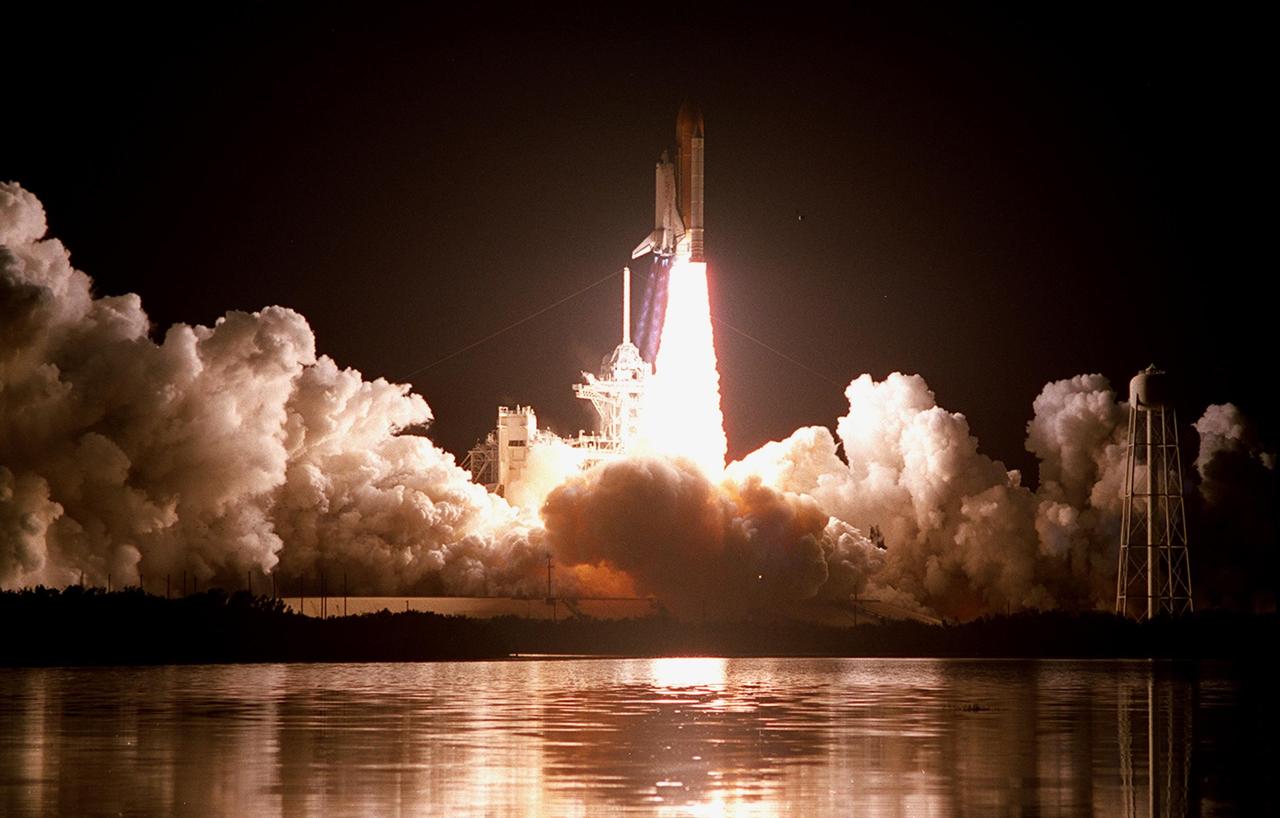
KENNEDY SPACE CENTER, FLA. -- As if spawned by the clouds of smoke and steam below, the Space Shuttle Discovery shoots into the night sky on mission STS-103. The brilliant light creates a reflection of the launch in the water nearby. Liftoff occurred at 7:50 p.m. EST from Launch Pad 39B. On board are Commander Curtis L. Brown Jr., Pilot Scott J. Kelly and Mission Specialists Steven L. Smith, C. Michael Foale (Ph.D.), John M. Grunsfeld (Ph.D.), Claude Nicollier of Switzerland and Jean-François Clervoy of France. Nicollier and Clervoy are with the European Space Agency. STS-103 is a Hubble Servicing Mission, with three planned space walks designed to install new equipment and replace old. The primary objective is to replace the gyroscopes that make up the three Rate Sensor Units. Extravehicular activities include installing a new computer, changing out one of the Fine Guidance Sensors, replacing a tape recorder with a new solid state recorder, and installing a voltage/temperature improvement kit, and begin repairing the insulation on the telescope's outer surface. After the 7-day, 21-hour mission, Discovery is expected to land at KSC Monday, Dec. 27, at about 5:24 p.m. EST. This is the 27th flight of Discovery and the 96th mission in the Space Shuttle Program. It is the third launch at Kennedy Space Center in 1999
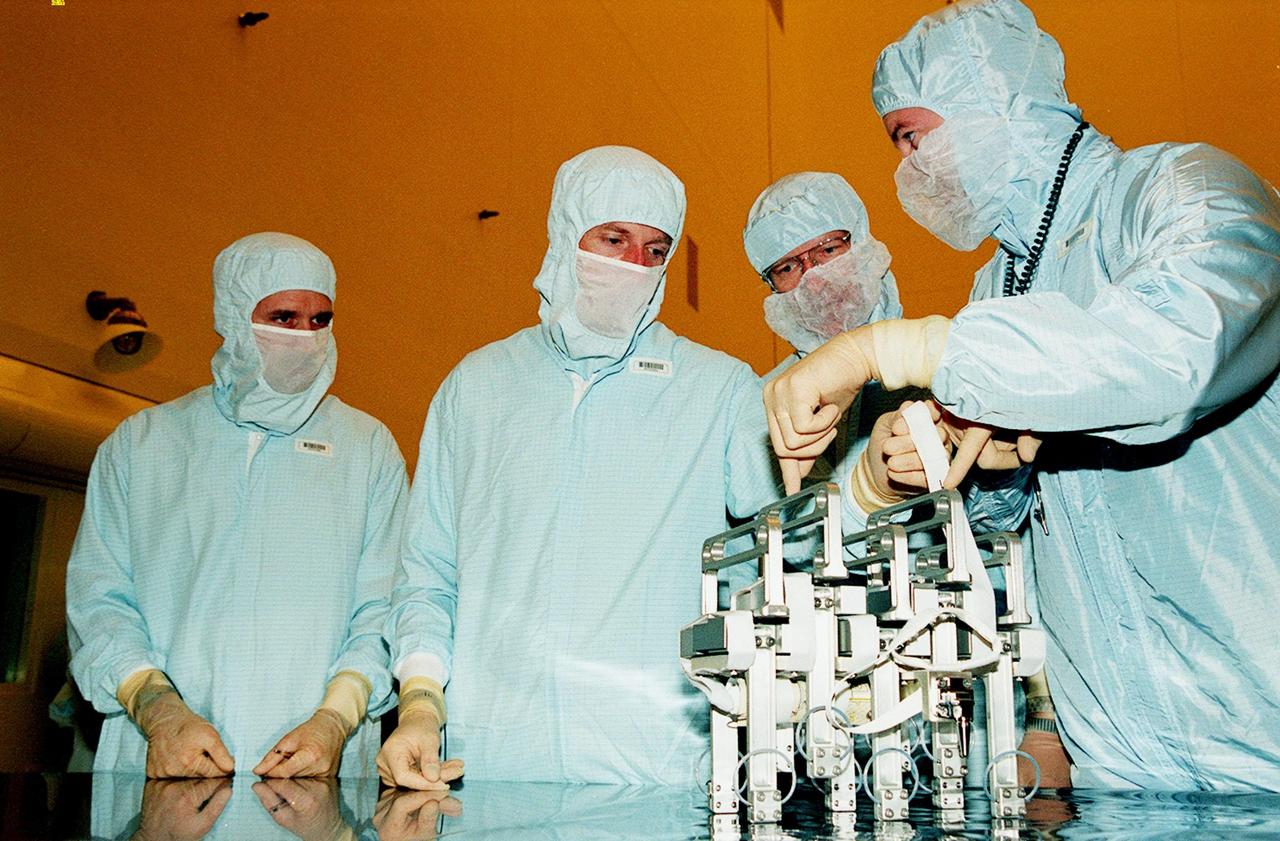
In the Payload Hazardous Servicing Facility, members of the STS-103 crew get instructions on use of rib clamps for the Shield Shell Replacement Fabric (SSRF) task on repair of the Hubble Space Telescope. The seven-member crew are Commander Curtis L. Brown Jr., Pilot Scott J. Kelly, and Mission Specialists Steven L. Smith, C. Michael Foale (Ph.D.), John M. Grunsfeld (Ph.D.), Claude Nicollier of Switzerland, and Jean-François Clervoy of France. Nicollier and Clervoy are with the European Space Agency. Mission STS-103 is a "call-up" due to the need to replace portions of the pointing system, the gyros, which have begun to fail on the Hubble Space Telescope. Although Hubble is operating normally and conducting its scientific observations, only three of its six gyroscopes are working properly. The gyroscopes allow the telescope to point at stars, galaxies and planets. The STS-103 crew will not only replace gyroscopes, it will also replace a Fine Guidance Sensor, an older computer with a new enhanced model, an older data tape recorder with a solid state digital recorder, a failed spare transmitter with a new one, and degraded insulation on the telescope with new thermal insulation. The crew will also install a Battery Voltage/Temperature Improvement Kit to protect the spacecraft batteries from overcharging and overheating when the telescope goes into a safe mode. The scheduled launch date in October is under review
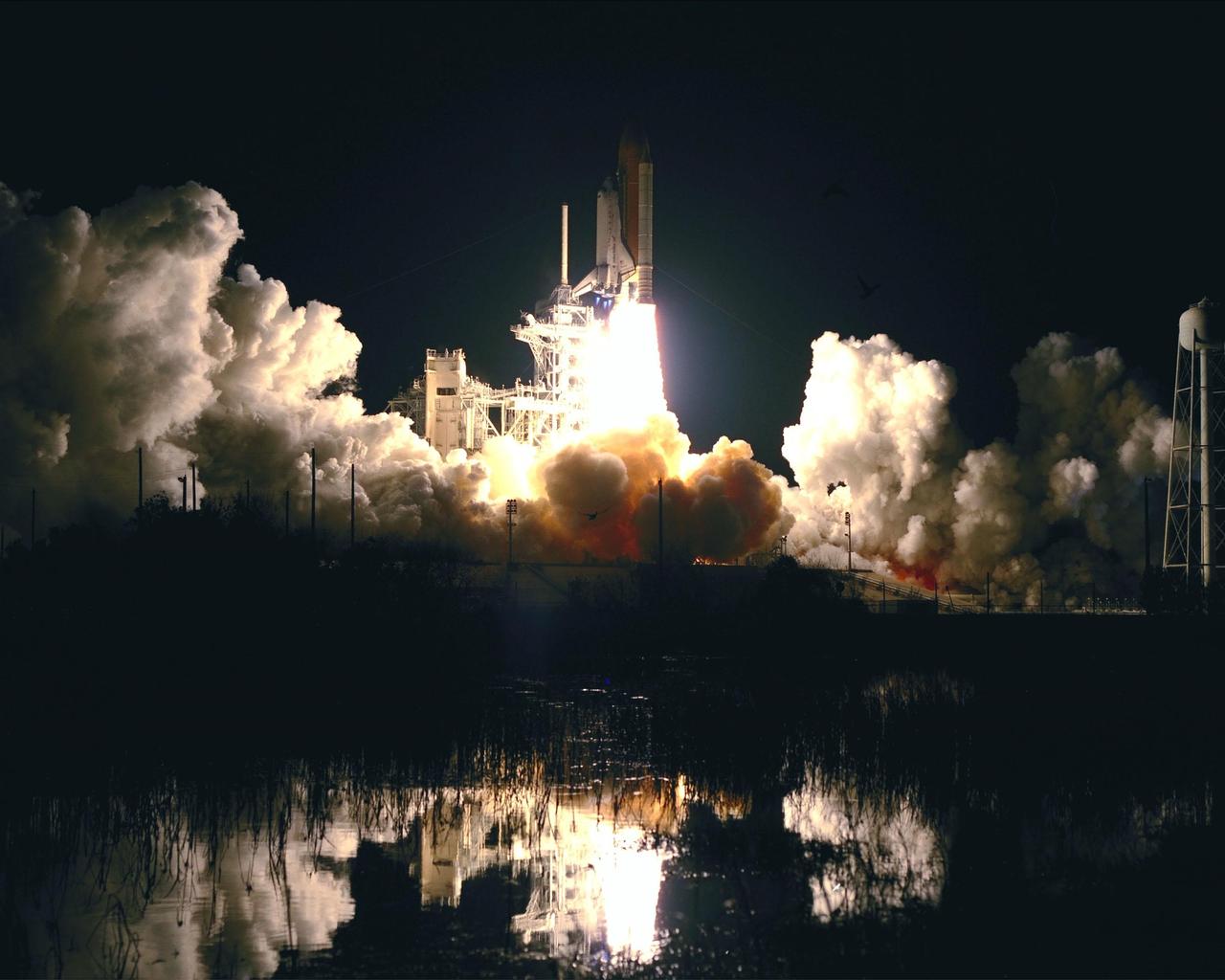
Brilliant light from the successful liftoff of Space Shuttle Discovery on mission STS-103 illuminates the night sky and the nearby waters. Liftoff occurred at 7:50 p.m. EST from Launch Pad 39B. On board are Commander Curtis L. Brown Jr., Pilot Scott J. Kelly and Mission Specialists Steven L. Smith, C. Michael Foale (Ph.D.), John M. Grunsfeld (Ph.D.), Claude Nicollier of Switzerland and Jean-François Clervoy of France. Nicollier and Clervoy are with the European Space Agency. STS-103 is a Hubble Servicing Mission, with three planned space walks designed to install new equipment and replace old. The primary objective is to replace the gyroscopes that make up the three Rate Sensor Units. Extravehicular activities include installing a new computer, changing out one of the Fine Guidance Sensors, replacing a tape recorder with a new solid state recorder, and installing a voltage/temperature improvement kit, and begin repairing the insulation on the telescope's outer surface. After the 7-day, 21-hour mission, Discovery is expected to land at KSC Monday, Dec. 27, at about 5:24 p.m. EST. This is the 27th flight of Discovery and the 96th mission in the Space Shuttle Program. It is the third launch at Kennedy Space Center in 1999
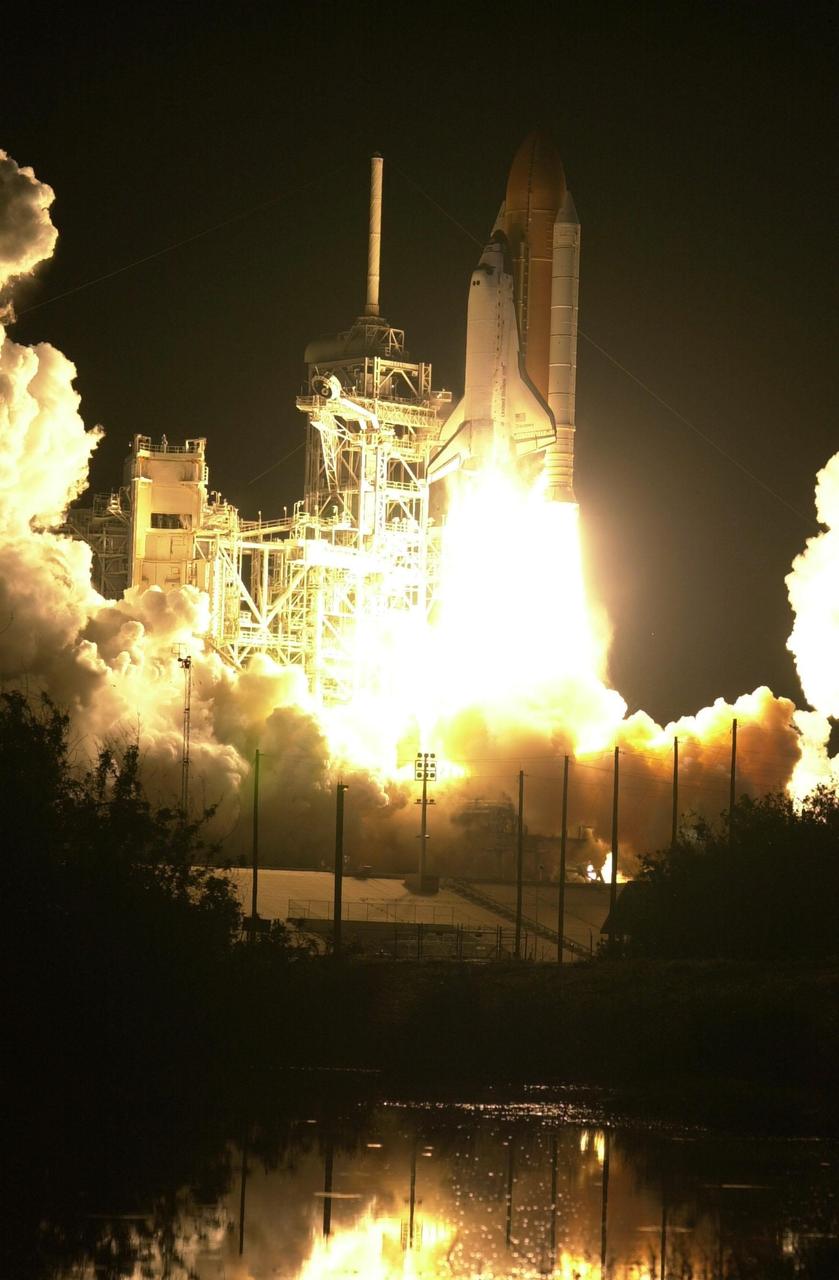
(Nikon camera D1 test)The blazing light of Space Shuttle Discovery's launch turns night into day at Launch Pad 39B. The successful liftoff occurred on time at 7:50:00.069 EST from Launch Pad 39B on mission STS-103. On board are Commander Curtis L. Brown Jr., Pilot Scott J. Kelly and Mission Specialists Steven L. Smith, C. Michael Foale (Ph.D.), John M. Grunsfeld (Ph.D.), Claude Nicollier of Switzerland and Jean-François Clervoy of France. Nicollier and Clervoy are with the European Space Agency. STS-103 is a Hubble Servicing Mission, with three planned space walks designed to install new equipment and replace old. The primary objective is to replace the gyroscopes that make up the three Rate Sensor Units. Extravehicular activities include installing a new computer, changing out one of the Fine Guidance Sensors, replacing a tape recorder with a new solid state recorder, and installing a voltage/temperature improvement kit, and begin repairing the insulation on the telescope's outer surface. After the 7-day, 21-hour mission, Discovery is expected to land at KSC Monday, Dec. 27, at about 5:24 p.m. EST. This is the 27th flight of Discovery and the 96th mission in the Space Shuttle Program. It is the third launch at Kennedy Space Center in 1999

During a Crew Equipment Interface Test, STS-103 Commander Curtis L. Brown Jr. (left) and Pilot Scott J. Kelly look at a replacement computer for the Hubble Space Telescope. The payload hardware is in the Payload Hazardous Servicing Facility. Other members of the crew are Mission Specialists Steven L. Smith, C. Michael Foale (Ph.D.), John M. Grunsfeld (Ph.D.), Claude Nicollier of Switzerland, and Jean-François Clervoy of France. Nicollier and Clervoy are with the European Space Agency. Mission STS-103 is a "call-up" due to the need to replace portions of the pointing system, the gyros, which have begun to fail on the Hubble Space Telescope. Although Hubble is operating normally and conducting its scientific observations, only three of its six gyroscopes are working properly. The gyroscopes allow the telescope to point at stars, galaxies and planets. The STS-103 crew will not only replace gyroscopes, it will also replace a Fine Guidance Sensor and an older computer with the new enhanced model, an older data tape recorder with a solid state digital recorder, a failed spare transmitter with a new one, and degraded insulation on the telescope with new thermal insulation. The crew will also install a Battery Voltage/Temperature Improvement Kit to protect the spacecraft batteries from overcharging and overheating when the telescope goes into a safe mode. The scheduled launch date in October is under review
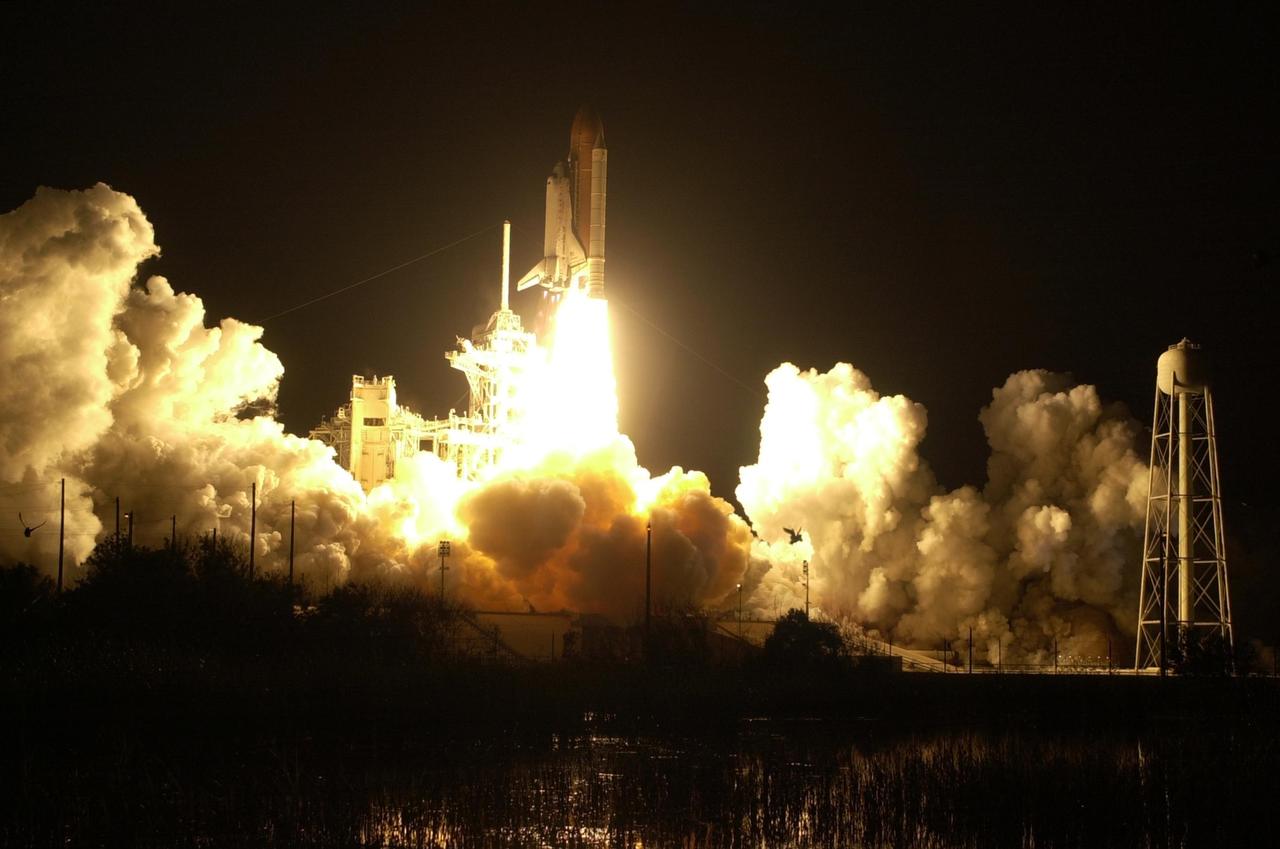
(Nikon camera D1 test)The blazing light of Space Shuttle Discovery's launch turns night into day at Launch Pad 39B as billows of smoke and steam rise behind it. The successful liftoff occurred on time at 7:50:00.069 EST from Launch Pad 39B on mission STS-103. On board are Commander Curtis L. Brown Jr., Pilot Scott J. Kelly and Mission Specialists Steven L. Smith, C. Michael Foale (Ph.D.), John M. Grunsfeld (Ph.D.), Claude Nicollier of Switzerland and Jean-François Clervoy of France. Nicollier and Clervoy are with the European Space Agency. STS-103 is a Hubble Servicing Mission, with three planned space walks designed to install new equipment and replace old. The primary objective is to replace the gyroscopes that make up the three Rate Sensor Units. Extravehicular activities include installing a new computer, changing out one of the Fine Guidance Sensors, replacing a tape recorder with a new solid state recorder, and installing a voltage/temperature improvement kit, and begin repairing the insulation on the telescope's outer surface. After the 7-day, 21-hour mission, Discovery is expected to land at KSC Monday, Dec. 27, at about 5:24 p.m. EST. This is the 27th flight of Discovery and the 96th mission in the Space Shuttle Program. It is the third launch at Kennedy Space Center in 1999
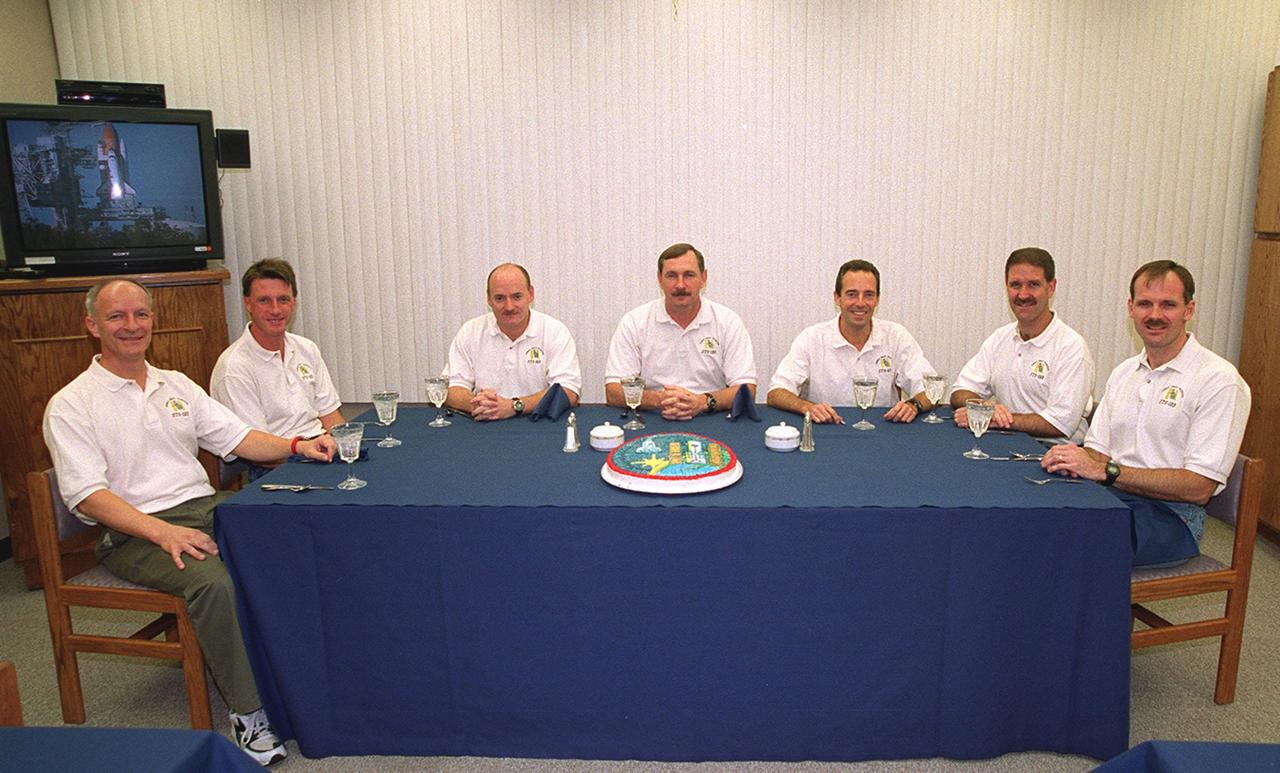
For the second time in two days, the STS-103 crew have breakfast before suiting up for launch. From left are Mission Specialists Claude Nicollier of Switzerland and C. Michael Foale (Ph.D.), Pilot Scott J. Kelly, Commander Curtis L. Brown Jr., and Mission Specialists Jean-Francois Clervoy of France, John M. Grunsfeld (Ph.D.) and Steven L. Smith. Nicollier and Clervoy are with the European Space Agency. The previous launch attempt on Dec. 17 was scrubbed about 8:52 p.m. due to numerous violations of weather launch commit criteria at KSC. The mission, to service the Hubble Space Telescope, is now scheduled for launch Dec. 19 at 7:50 p.m. EST from Launch Pad 39B. Mission objectives include replacing gyroscopes and an old computer, installing another solid state recorder, and replacing damaged insulation in the telescope. After the 7-day, 21-hour mission, Discovery is expected to land at KSC Monday, Dec. 27, at about 5:24 p.m. EST

STS-103 Commander Curtis L. Brown Jr. (right) leads the way back to the Operations and Checkout Building after the launch of Space Shuttle Discovery was scrubbed due to unfavorable weather conditions. Behind him (left to right) are Mission Specialist C. Michael Foale (Ph.D.) and Pilot Scott J. Kelly. Other crew members are Mission Specialists Steven L. Smith, John M. Grunsfeld (Ph.D.), Claude Nicollier of Switzerland and Jean-Francois Clervoy of France. Nicollier and Clervoy are with the European Space Agency. The STS-103 mission, to service the Hubble Space Telescope, is rescheduled for launch Dec. 18 at 8:21 p.m. EST from Launch Pad 39B. Mission objectives include replacing gyroscopes and an old computer, installing another solid state recorder, and replacing damaged insulation in the telescope. After the 7-day, 21-hour mission, Discovery is expected to land at KSC Sunday, Dec. 26, at about 6:00 p.m. EST
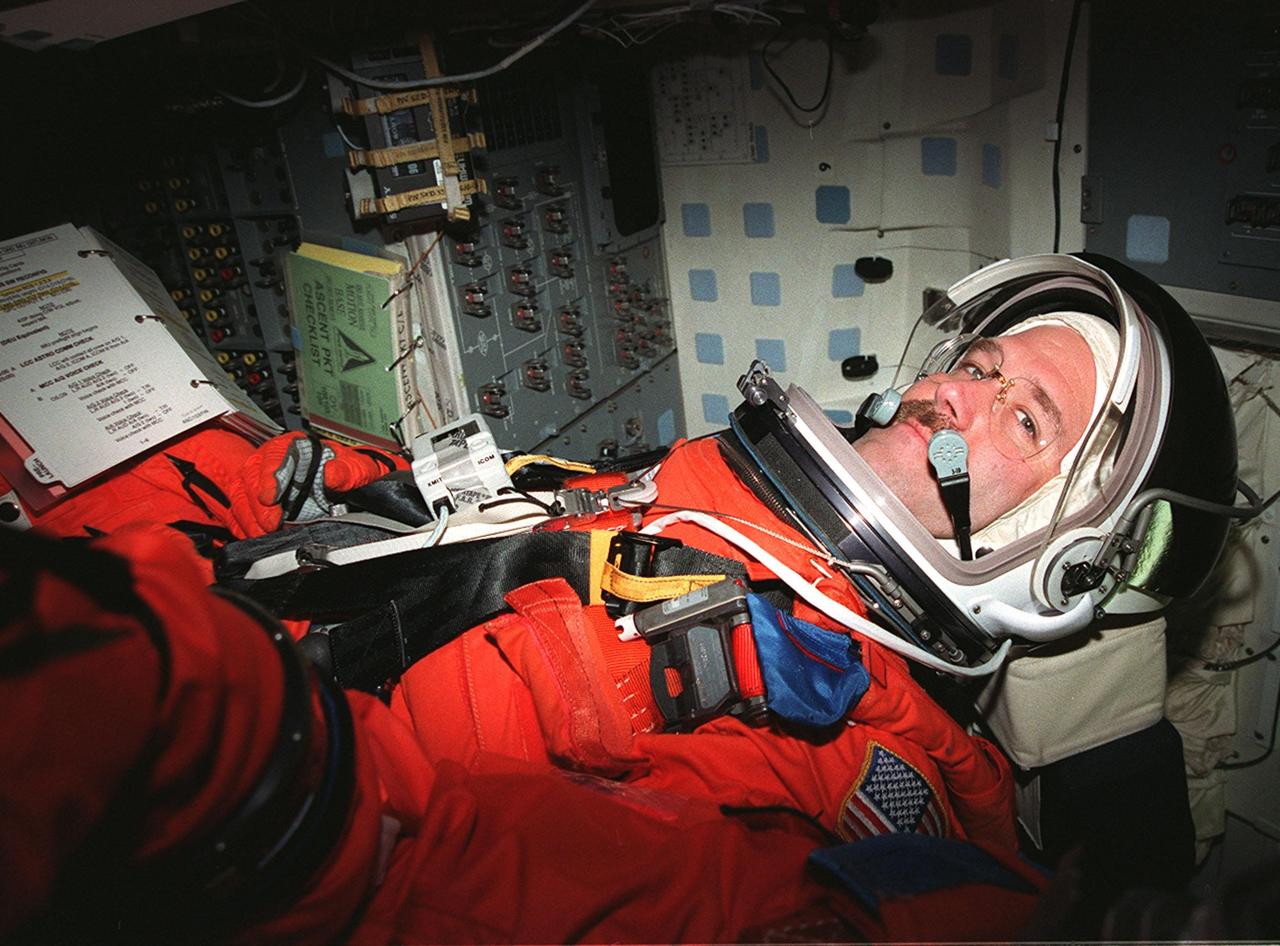
STS-103 Mission Specialist John M. Grunsfeld (Ph.D.) sits inside orbiter Discovery waiting for the start of a simulated countdown exercise. The simulation is part of Terminal Countdown Demonstration Test (TCDT) activities. The TCDT also provides the crew with emergency egress training and opportunities to inspect their mission payload in the orbiter's payload bay. Other crew members taking part in the TCDT are Commander Curtis L. Brown Jr., Pilot Scott J. Kelly, and Mission Specialists Steven L. Smith, C. Michael Foale (Ph.D.), Jean-François Clervoy of France, and Claude Nicollier of Switzerland. Clervoy and Nicollier are with the European Space Agency. STS-103 is a "call-up" mission due to the need to replace and repair portions of the Hubble Space Telescope, including the gyroscopes that allow the telescope to point at stars, galaxies and planets. The STS-103 crew will be replacing a Fine Guidance Sensor, an older computer with a new enhanced model, an older data tape recorder with a solid-state digital recorder, a failed spare transmitter with a new one, and degraded insulation on the telescope with new thermal insulation. The crew will also install a Battery Voltage/Temperature Improvement Kit to protect the spacecraft batteries from overcharging and overheating when the telescope goes into a safe mode. Four EVA's are planned to make the necessary repairs and replacements on the telescope. The mission is targeted for launch Dec. 6 at 2:37 a.m. EST
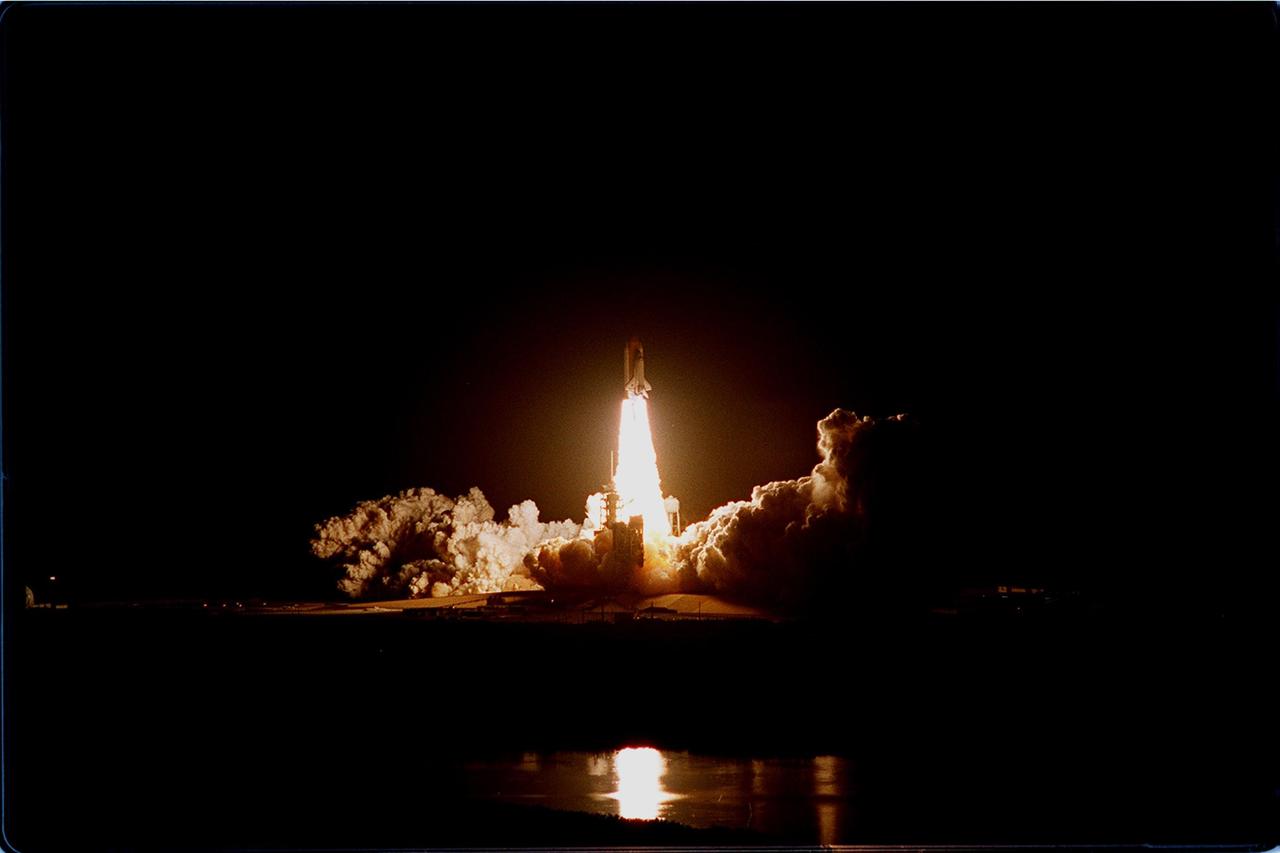
Viewed from the roof of the Vehicle Assembly Building more than 3 miles away, the launch of Space Shuttle Discovery on mission STS-103 emblazes the night sky. Liftoff occurred at 7:50 p.m. EST from Launch Pad 39B. On board are Commander Curtis L. Brown Jr., Pilot Scott J. Kelly and Mission Specialists Steven L. Smith, C. Michael Foale (Ph.D.), John M. Grunsfeld (Ph.D.), Claude Nicollier of Switzerland and Jean-François Clervoy of France. Nicollier and Clervoy are with the European Space Agency. STS-103 is a Hubble Servicing Mission, with three planned space walks designed to install new equipment and replace old. The primary objective is to replace the gyroscopes that make up the three Rate Sensor Units. Extravehicular activities include installing a new computer, changing out one of the Fine Guidance Sensors, replacing a tape recorder with a new solid state recorder, and installing a voltage/temperature improvement kit, and begin repairing the insulation on the telescope's outer surface. After the 7-day, 21-hour mission, Discovery is targeted to land at KSC Monday, Dec. 27, at about 5:24 p.m. EST. This is the 27th flight of Discovery and the 96th mission in the Space Shuttle Program. It is the third launch at Kennedy Space Center in 1999
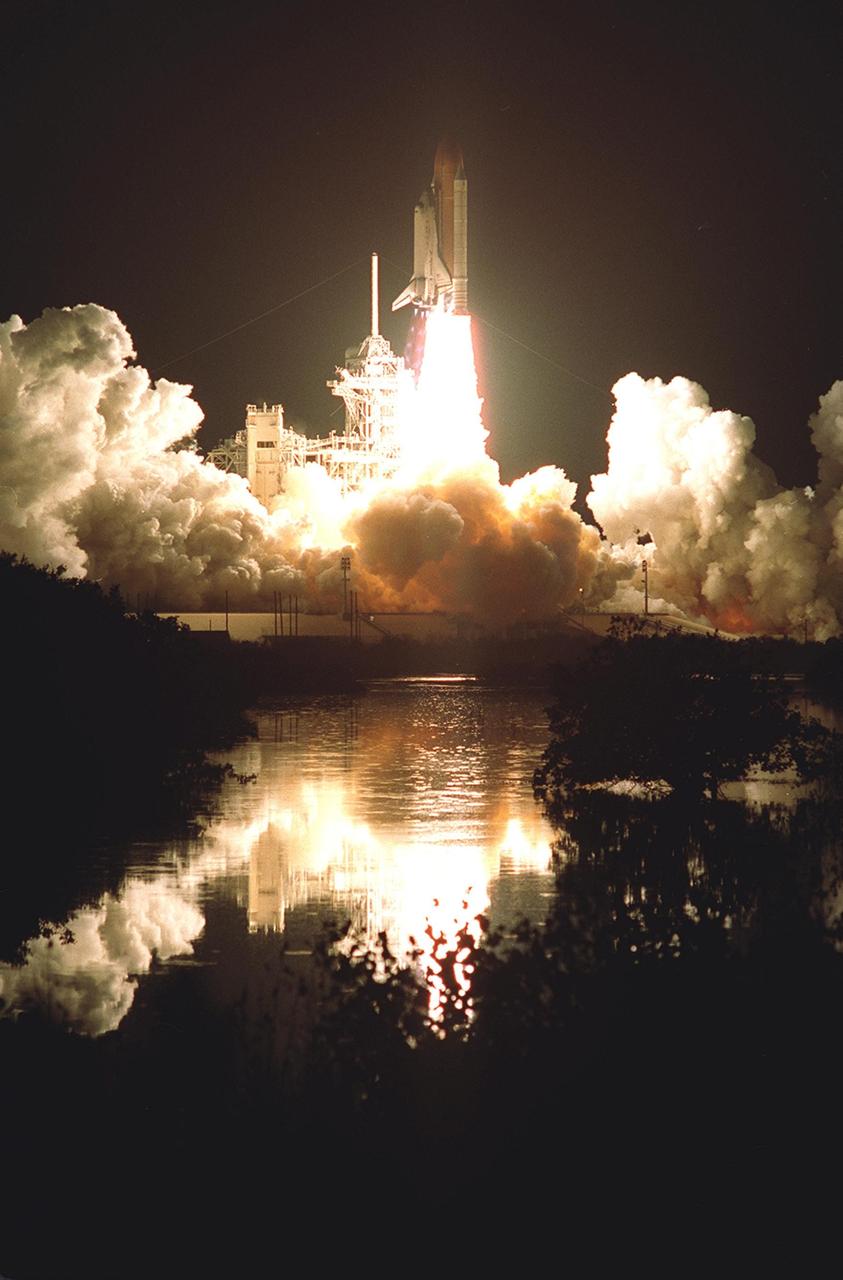
Turning night into day, the brilliance of Space Shuttle Discovery's launch is reflected in the waters nearby. Liftoff occurred at 7:50 p.m. EST from Launch Pad 39B. On board are Commander Curtis L. Brown Jr., Pilot Scott J. Kelly and Mission Specialists Steven L. Smith, C. Michael Foale (Ph.D.), John M. Grunsfeld (Ph.D.), Claude Nicollier of Switzerland and Jean-François Clervoy of France. Nicollier and Clervoy are with the European Space Agency. STS-103 is a Hubble Servicing Mission, with three planned space walks designed to install new equipment and replace old. The primary objective is to replace the gyroscopes that make up the three Rate Sensor Units. Extravehicular activities include installing a new computer, changing out one of the Fine Guidance Sensors, replacing a tape recorder with a new solid state recorder, and installing a voltage/temperature improvement kit, and begin repairing the insulation on the telescope's outer surface. After the 7-day, 21-hour mission, Discovery is expected to land at KSC Monday, Dec. 27, at about 5:24 p.m. EST. This is the 27th flight of Discovery and the 96th mission in the Space Shuttle Program. It is the third launch at Kennedy Space Center in 1999
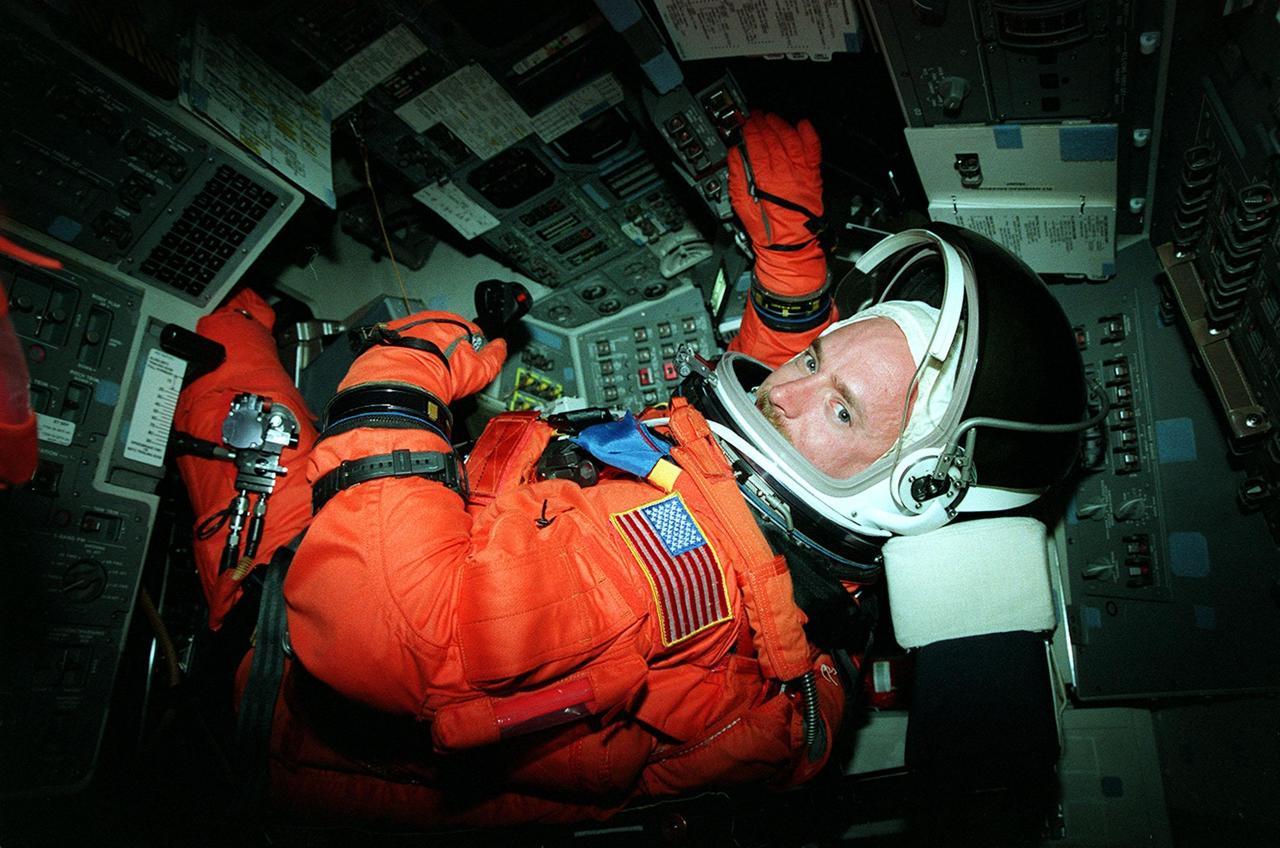
Seated in the orbiter Discovery for a simulated countdown exercise is STS-103 Pilot Scott J. Kelly. The simulation is part of Terminal Countdown Demonstration Test (TCDT) activities. The TCDT also provides the crew with emergency egress training and opportunities to inspect their mission payload in the orbiter's payload bay. Other crew members taking part in the TCDT are Commander Curtis L. Brown Jr., and Mission Specialists Steven L. Smith, C. Michael Foale (Ph.D.), John M. Grunsfeld (Ph.D.), Jean-François Clervoy of France, and Claude Nicollier of Switzerland. Clervoy and Nicollier are with the European Space Agency. STS-103 is a "call-up" mission due to the need to replace and repair portions of the Hubble Space Telescope, including the gyroscopes that allow the telescope to point at stars, galaxies and planets. The STS-103 crew will be replacing a Fine Guidance Sensor, an older computer with a new enhanced model, an older data tape recorder with a solid-state digital recorder, a failed spare transmitter with a new one, and degraded insulation on the telescope with new thermal insulation. The crew will also install a Battery Voltage/Temperature Improvement Kit to protect the spacecraft batteries from overcharging and overheating when the telescope goes into a safe mode. Four EVA's are planned to make the necessary repairs and replacements on the telescope. The mission is targeted for launch Dec. 6 at 2:37 a.m. EST
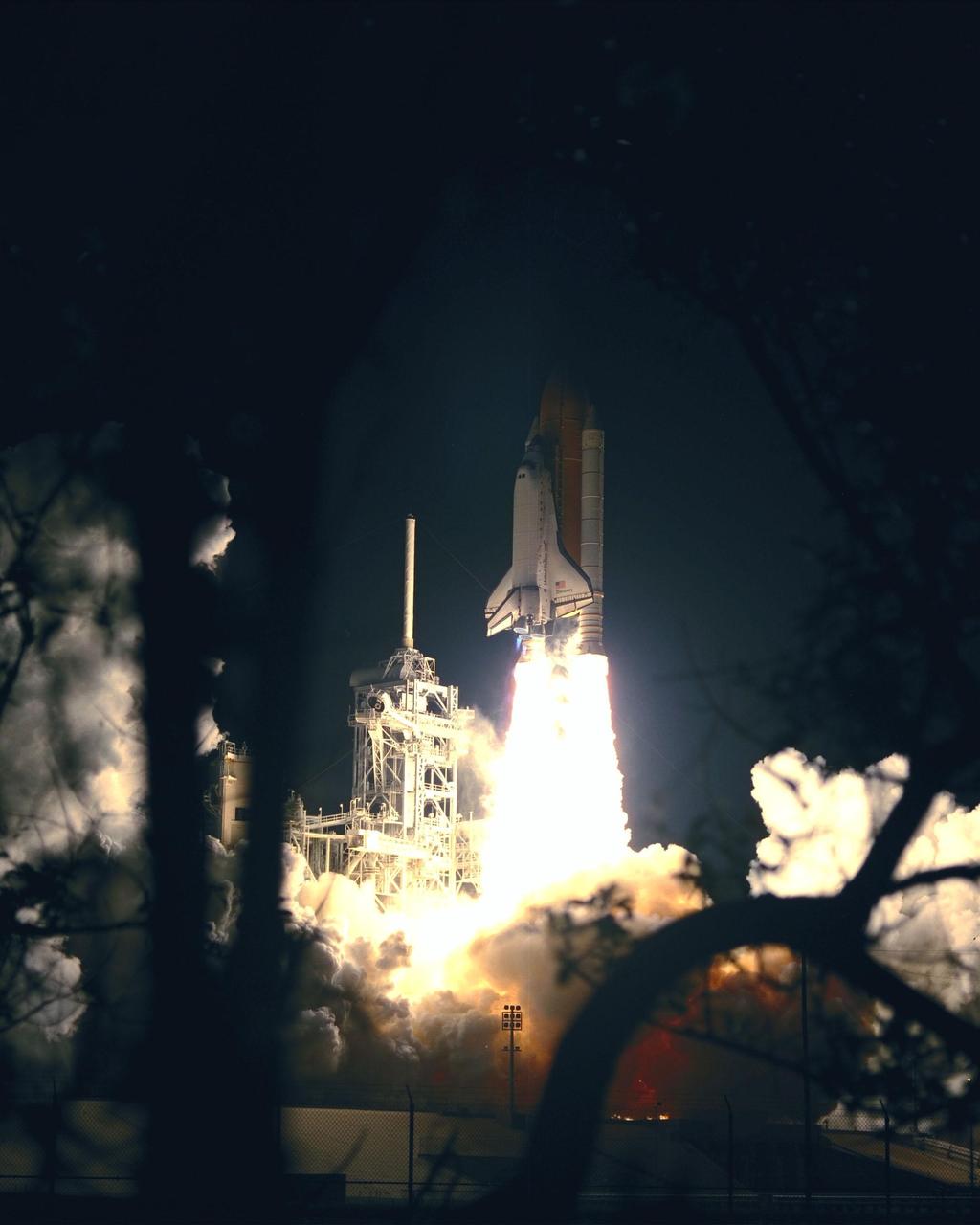
The successful liftoff of Space Shuttle Discovery on mission STS-103 illuminates the night sky. Liftoff occurred at 7:50 p.m. EST from Launch Pad 39B. On board are Commander Curtis L. Brown Jr., Pilot Scott J. Kelly and Mission Specialists Steven L. Smith, C. Michael Foale (Ph.D.), John M. Grunsfeld (Ph.D.), Claude Nicollier of Switzerland and Jean-François Clervoy of France. Nicollier and Clervoy are with the European Space Agency. STS-103 is a Hubble Servicing Mission, with three planned space walks designed to install new equipment and replace old. The primary objective is to replace the gyroscopes that make up the three Rate Sensor Units. Extravehicular activities include installing a new computer, changing out one of the Fine Guidance Sensors, replacing a tape recorder with a new solid state recorder, and installing a voltage/temperature improvement kit, and begin repairing the insulation on the telescope's outer surface. After the 7-day, 21-hour mission, Discovery is expected to land at KSC Monday, Dec. 27, at about 5:24 p.m. EST. This is the 27th flight of Discovery and the 96th mission in the Space Shuttle Program. It is the third launch at Kennedy Space Center in 1999
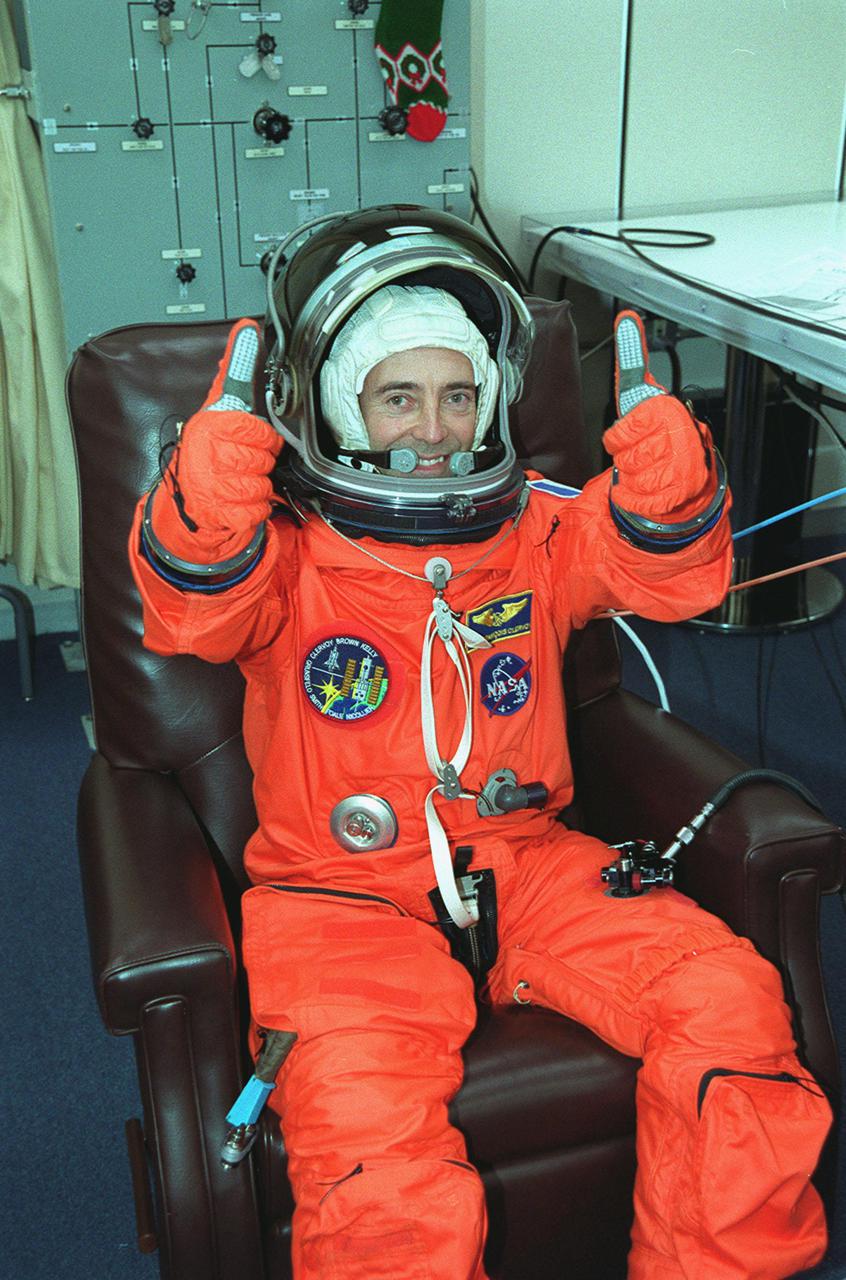
After donning his launch and entry suit, STS-103 Mission Specialist Jean-Francois Clervoy of France gives two thumbs up to show he is ready for the second launch attempt of Space Shuttle Discovery. The previous launch attempt on Dec. 17 was scrubbed about 8:52 p.m. due to numerous violations of weather launch commit criteria at KSC. Clervoy and fellow crew members Commander Curtis L. Brown Jr., Pilot Scott J. Kelly and Mission Specialists Steven L. Smith, C. Michael Foale (Ph.D.), John M. Grunsfeld (Ph.D.) and Claude Nicollier of Switzerland are scheduled to lift off at 7:50 p.m. EST Dec. 19 on mission STS-103, servicing the Hubble Space Telescope. Objectives for the nearly eight-day mission include replacing gyroscopes and an old computer, installing another solid state recorder, and replacing damaged insulation in the telescope. Discovery is expected to land at KSC Monday, Dec. 27, at about 5:24 p.m. EST
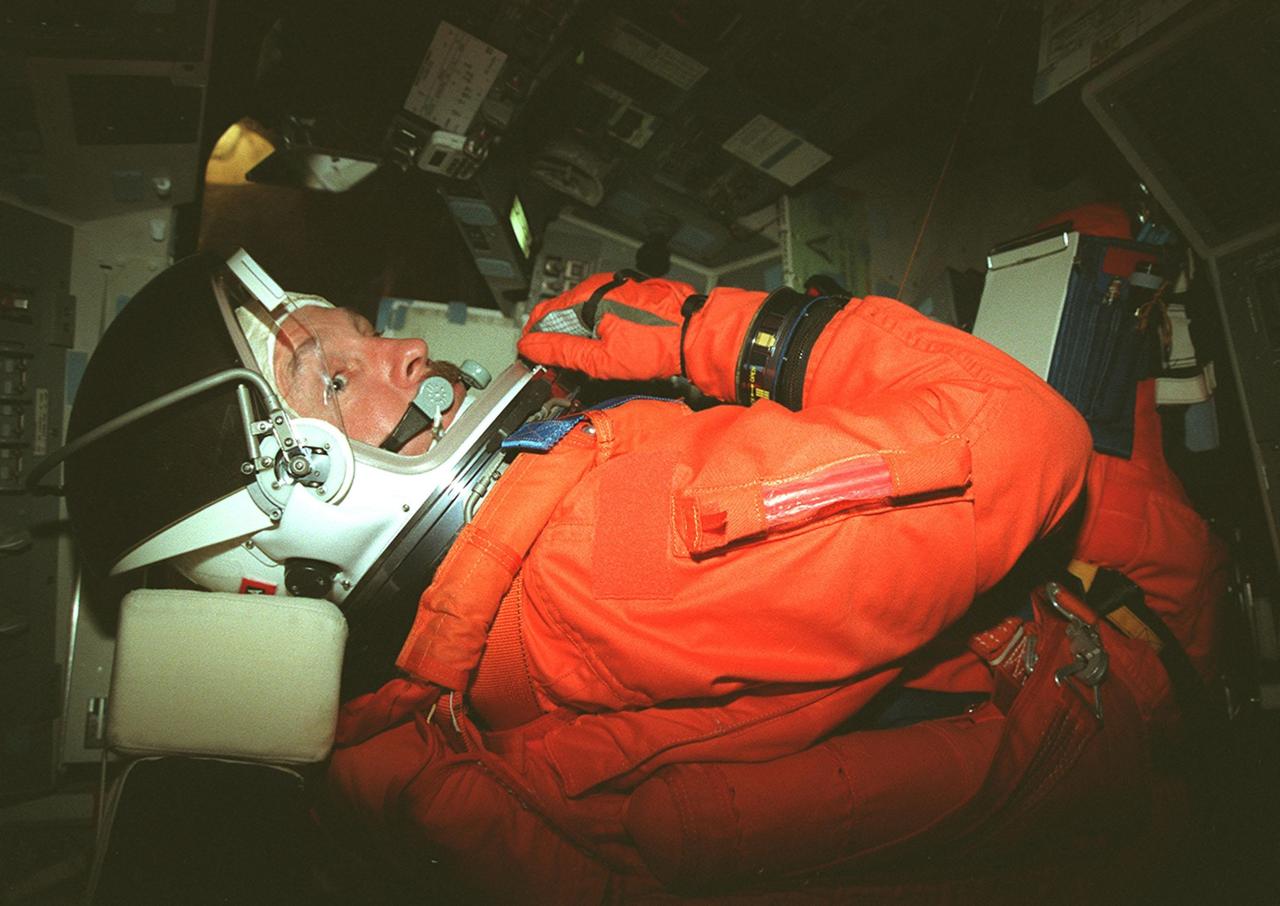
STS-103 Mission Commander Curtis L. Brown Jr. sits inside orbiter Discovery waiting for the start of a simulated countdown exercise. The simulation is part of Terminal Countdown Demonstration Test (TCDT) activities. The TCDT also provides the crew with emergency egress training and opportunities to inspect their mission payload in the orbiter's payload bay. Other crew members taking part in the TCDT are Pilot Scott J. Kelly, and Mission Specialists Steven L. Smith, C. Michael Foale (Ph.D.), John M. Grunsfeld (Ph.D.), Jean-François Clervoy of France, and Claude Nicollier of Switzerland. Clervoy and Nicollier are with the European Space Agency. STS-103 is a "call-up" mission due to the need to replace and repair portions of the Hubble Space Telescope, including the gyroscopes that allow the telescope to point at stars, galaxies and planets. The STS-103 crew will be replacing a Fine Guidance Sensor, an older computer with a new enhanced model, an older data tape recorder with a solid-state digital recorder, a failed spare transmitter with a new one, and degraded insulation on the telescope with new thermal insulation. The crew will also install a Battery Voltage/Temperature Improvement Kit to protect the spacecraft batteries from overcharging and overheating when the telescope goes into a safe mode. Four EVA's are planned to make the necessary repairs and replacements on the telescope. The mission is targeted for launch Dec. 6 at 2:37 a.m. EST

Turning night into day for a few moments while belching clouds of smoke and steam, Space Shuttle Discovery hurtles into the black sky on mission STS-103. The successful liftoff occurred at 7:50 p.m. EST from Launch Pad 39B. On board are Commander Curtis L. Brown Jr., Pilot Scott J. Kelly and Mission Specialists Steven L. Smith, C. Michael Foale (Ph.D.), John M. Grunsfeld (Ph.D.), Claude Nicollier of Switzerland and Jean-François Clervoy of France. Nicollier and Clervoy are with the European Space Agency. STS-103 is a Hubble Servicing Mission, with three planned space walks designed to install new equipment and replace old. The primary objective is to replace the gyroscopes that make up the three Rate Sensor Units. Extravehicular activities include installing a new computer, changing out one of the Fine Guidance Sensors, replacing a tape recorder with a new solid state recorder, and installing a voltage/temperature improvement kit, and begin repairing the insulation on the telescope's outer surface. After the 7-day, 21-hour mission, Discovery is targeted to land at KSC Monday, Dec. 27, at about 5:24 p.m. EST. This is the 27th flight of Discovery and the 96th mission in the Space Shuttle Program. It is the third launch at Kennedy Space Center in 1999
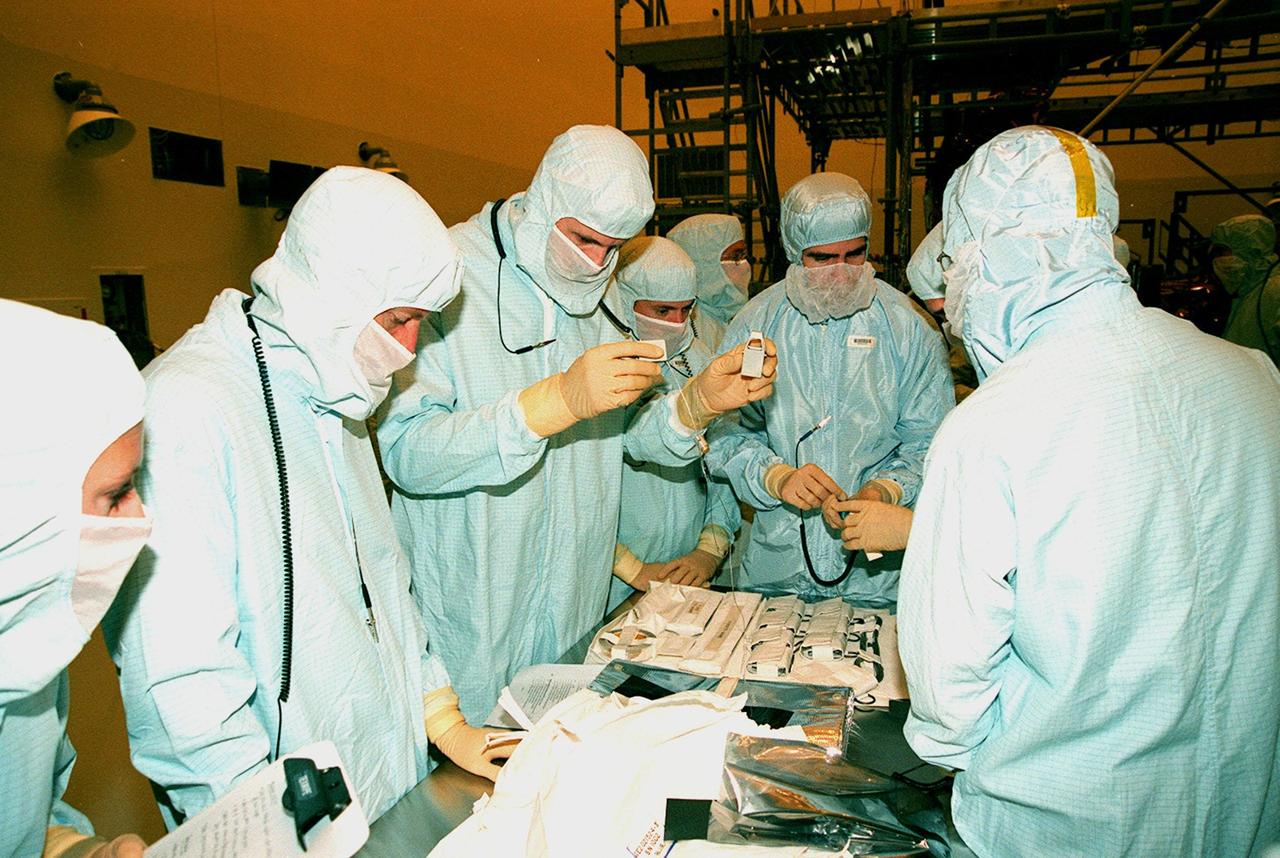
In the Payload Hazardous Servicing Facility, members of the STS-103 crew look at some of the equipment to be used during their mission. The seven-member crew are Commander Curtis L. Brown Jr., Pilot Scott J. Kelly, and Mission Specialists Steven L. Smith, C. Michael Foale (Ph.D.), John M. Grunsfeld (Ph.D.), Claude Nicollier of Switzerland, and Jean-François Clervoy of France. Nicollier and Clervoy are with the European Space Agency. Mission STS-103 is a "call-up" due to the need to replace portions of the pointing system, the gyros, which have begun to fail on the Hubble Space Telescope. Although Hubble is operating normally and conducting its scientific observations, only three of its six gyroscopes are working properly. The gyroscopes allow the telescope to point at stars, galaxies and planets. The STS-103 crew will not only replace gyroscopes, it will also replace a Fine Guidance Sensor and an older computer with a new enhanced model, an older data tape recorder with a solid state digital recorder, a failed spare transmitter with a new one, and degraded insulation on the telescope with new thermal insulation. The crew will also install a Battery Voltage/Temperature Improvement Kit to protect the spacecraft batteries from overcharging and overheating when the telescope goes into a safe mode. The scheduled launch date in October is under review
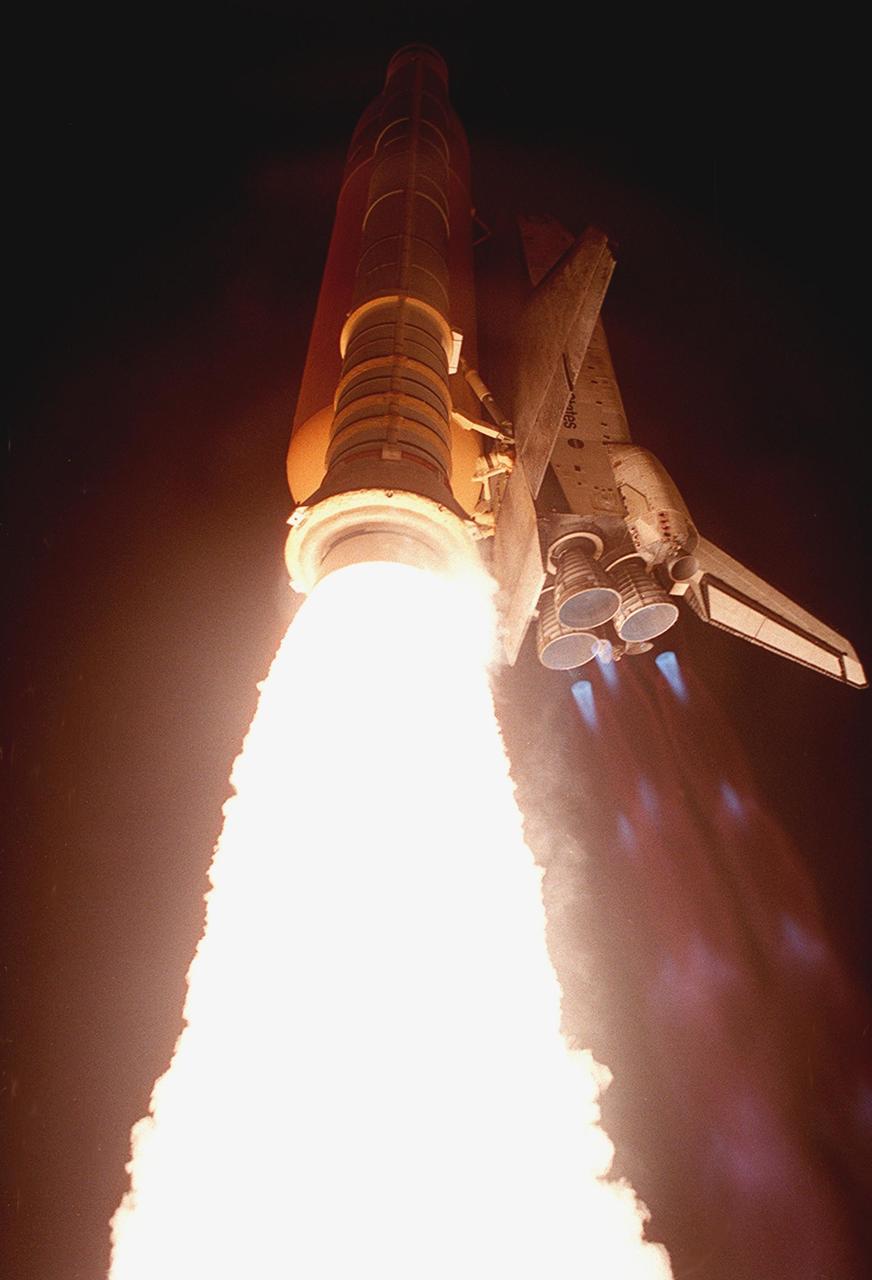
Like a roman candle, Space Shuttle Discovery roars into the clear night sky trailing brilliant exhaust from the solid rocket boosters (center) and blue mach diamonds from the main engine nozzles. Liftoff occurred at 7:50 p.m. EST from Launch Pad 39B. On board are Commander Curtis L. Brown Jr., Pilot Scott J. Kelly and Mission Specialists Steven L. Smith, C. Michael Foale (Ph.D.), John M. Grunsfeld (Ph.D.), Claude Nicollier of Switzerland and Jean-François Clervoy of France. Nicollier and Clervoy are with the European Space Agency. STS-103 is a Hubble Servicing Mission, with three planned space walks designed to install new equipment and replace old. The primary objective is to replace the gyroscopes that make up the three Rate Sensor Units. Extravehicular activities include installing a new computer, changing out one of the Fine Guidance Sensors, replacing a tape recorder with a new solid state recorder, and installing a voltage/temperature improvement kit, and begin repairing the insulation on the telescope's outer surface. After the 7-day, 21-hour mission, Discovery is expected to land at KSC Monday, Dec. 27, at about 5:24 p.m. EST. This is the 27th flight of Discovery and the 96th mission in the Space Shuttle Program. It is the third launch at Kennedy Space Center in 1999

Space Shuttle Discovery hurtles through clouds of smoke and steam in its successful launch on mission STS-103. Liftoff occurred at 7:50 p.m. EST from Launch Pad 39B. On board are Commander Curtis L. Brown Jr., Pilot Scott J. Kelly and Mission Specialists Steven L. Smith, C. Michael Foale (Ph.D.), John M. Grunsfeld (Ph.D.), Claude Nicollier of Switzerland and Jean-François Clervoy of France. Nicollier and Clervoy are with the European Space Agency. STS-103 is a Hubble Servicing Mission, with three planned space walks designed to install new equipment and replace old. The primary objective is to replace the gyroscopes that make up the three Rate Sensor Units. Extravehicular activities include installing a new computer, changing out one of the Fine Guidance Sensors, replacing a tape recorder with a new solid state recorder, and installing a voltage/temperature improvement kit, and begin repairing the insulation on the telescope's outer surface. After the 7-day, 21-hour mission, Discovery is targeted to land at KSC Monday, Dec. 27, at about 5:24 p.m. EST. This is the 27th flight of Discovery and the 96th mission in the Space Shuttle Program. It is the third launch at Kennedy Space Center in 1999
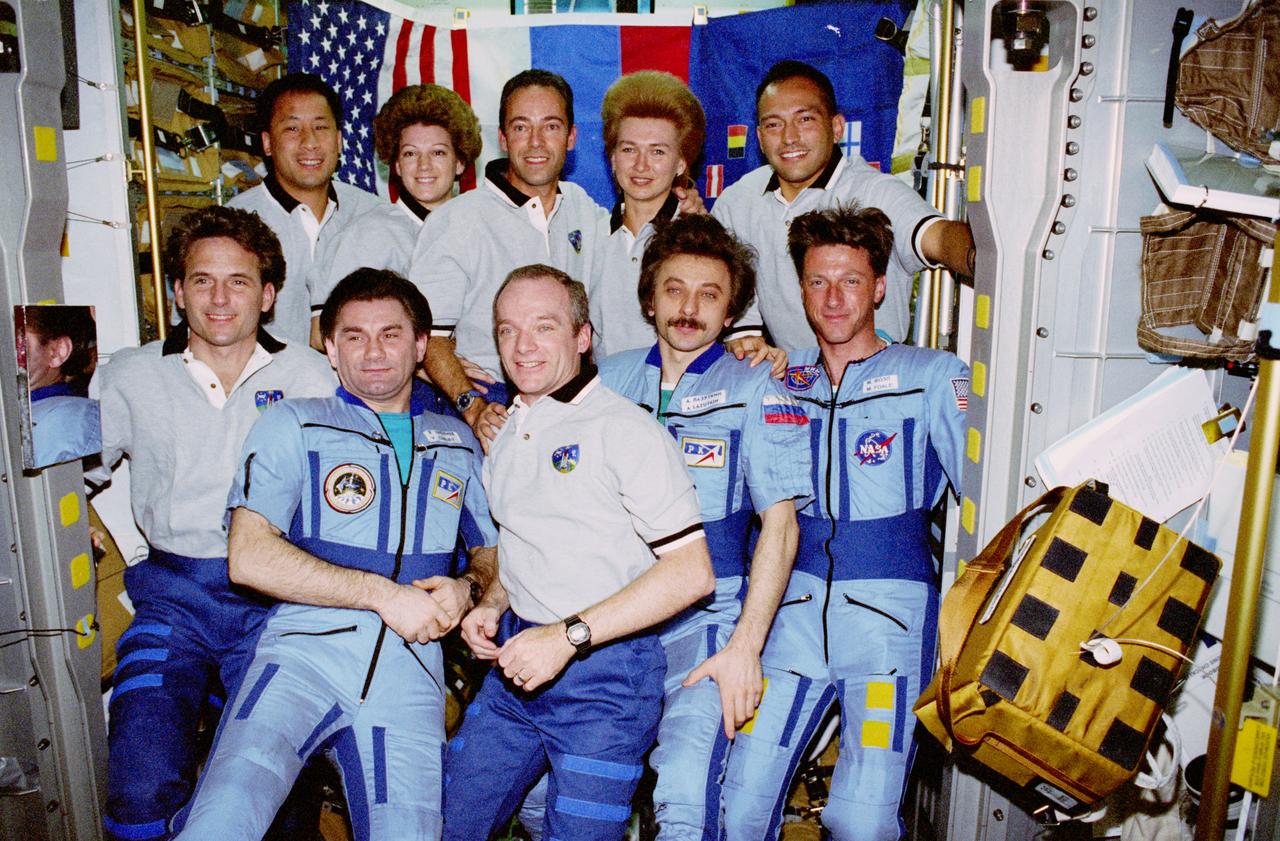
STS084-366-015 (15-24 May 1997) --- Crewmembers from Mir-23 and STS-84 assemble for a group portrait onboard the Spacehab Double Module, as they tie a record (ten) for number of persons aboard a single orbiting spacecraft at one time. They are (from the left, front) Jerry M. Linenger, Vasili V. Tsibliyev, Charles J. Precourt, Aleksandr I. Lazutkin and C. Michael Foale. On the back row, from the left, are Edward T. Lu, Eileen M. Collins, Jean-Francois Clervoy, Elena V. Kondakova and Carlos I. Noriega.
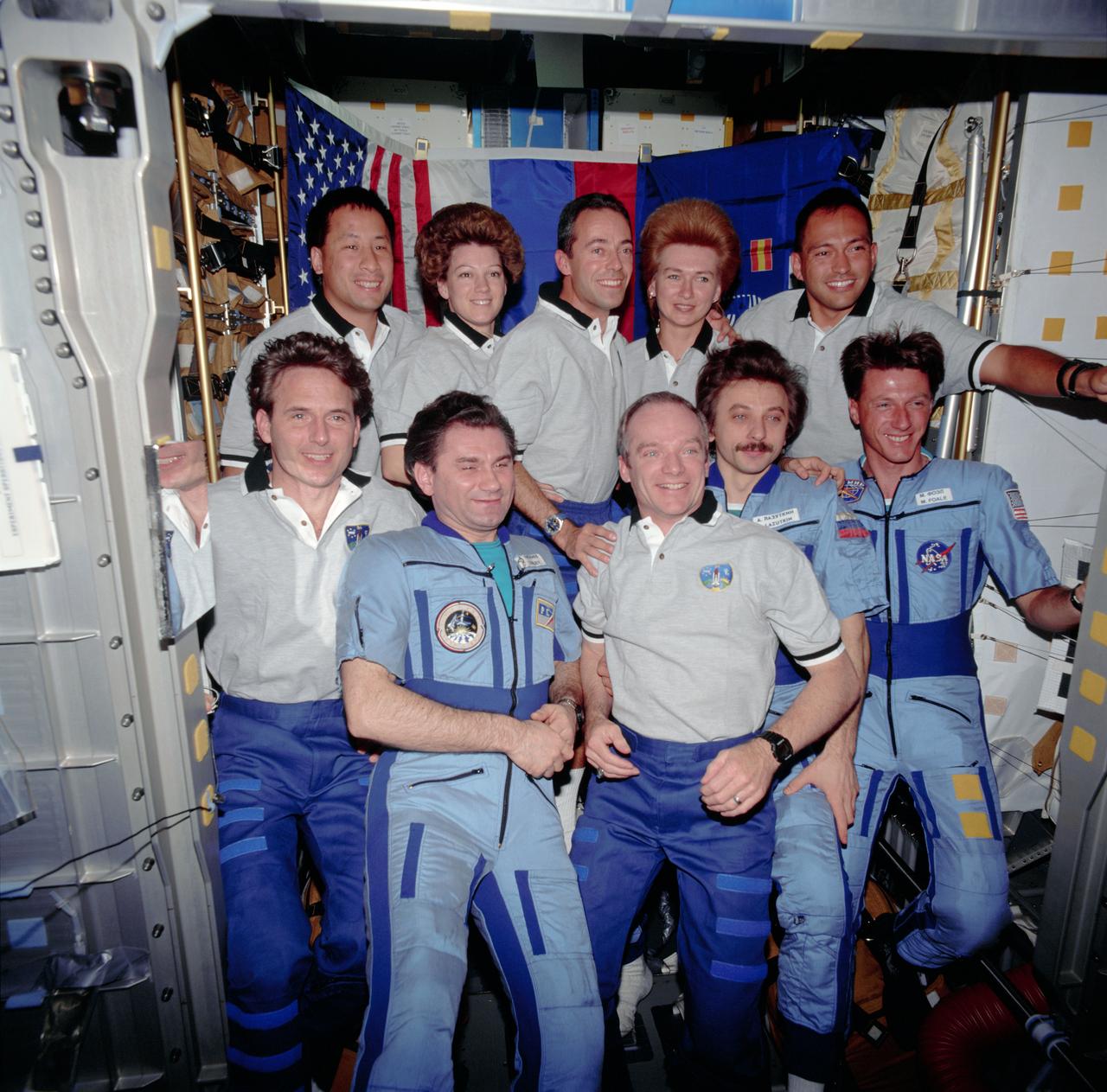
STS084-704-015 (15-24 May 1997) --- Crewmembers from Mir-23 and STS-84 assemble for a group portrait onboard the Spacehab Double Module, as they tie a record (ten) for number of persons aboard a single orbiting spacecraft at one time. They are (from the left, front) Jerry M. Linenger, Vasili V. Tsibliyev, Charles J. Precourt, Aleksandr I. Lazutkin and C. Michael Foale. On the back row, from the left, are Edward T. Lu, Eileen M. Collins, Jean-Francois Clervoy, Elena V. Kondakova and Carlos I. Noriega.