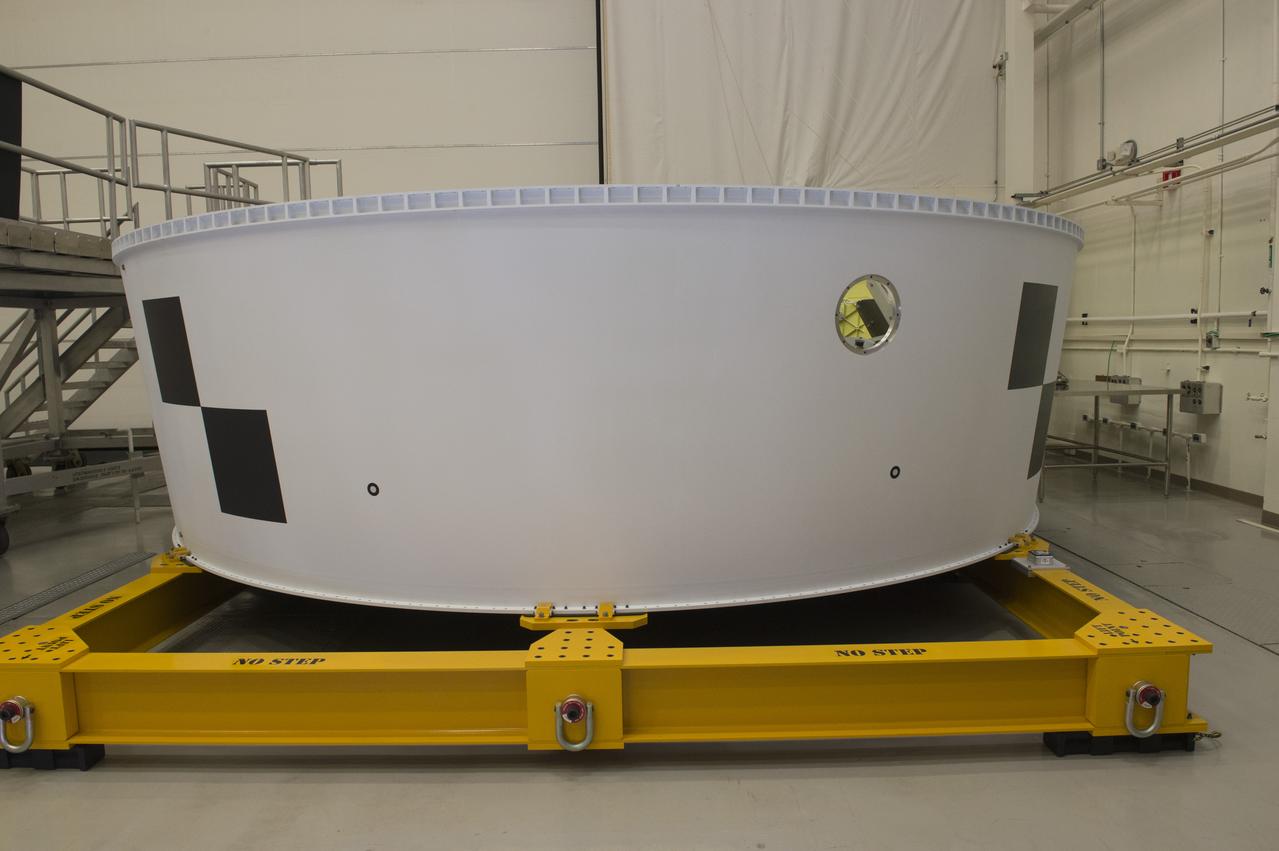
General overview and detail, Close-Out, photos of the SLS Orion Stage Adapter EM-1...exterior overall views (5)
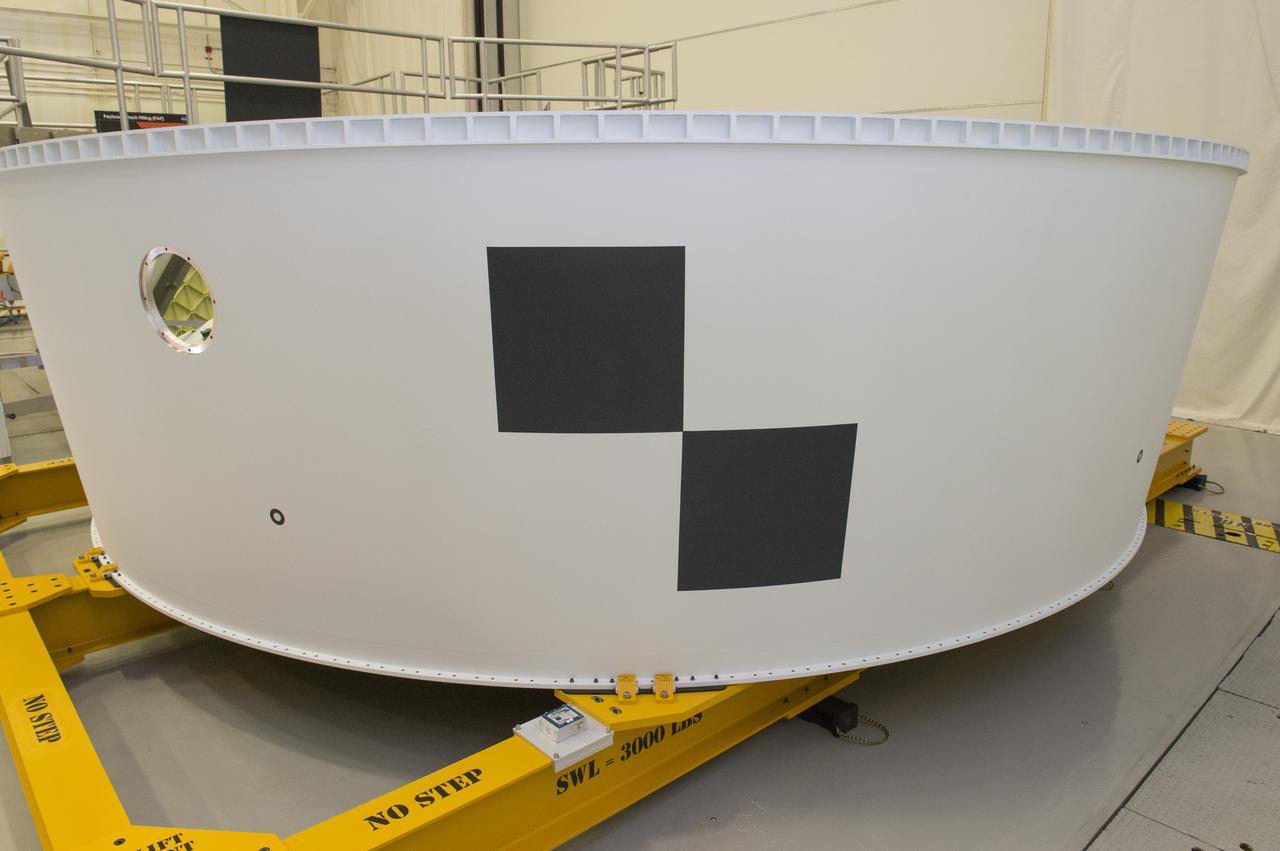
General overview and detail, Close-Out, photos of the SLS Orion Stage Adapter EM-1...exterior overall views (5)
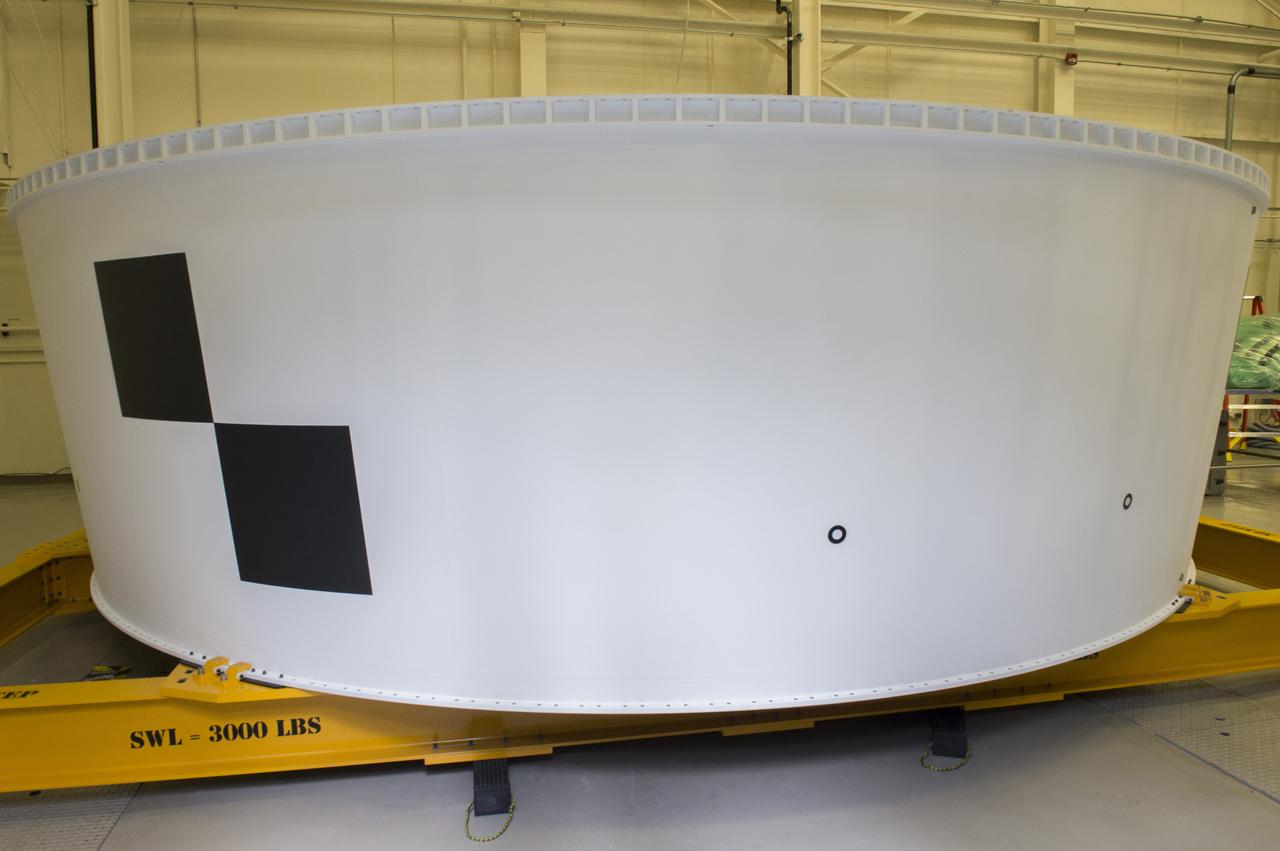
General overview and detail, Close-Out, photos of the SLS Orion Stage Adapter EM-1...exterior overall views (5)
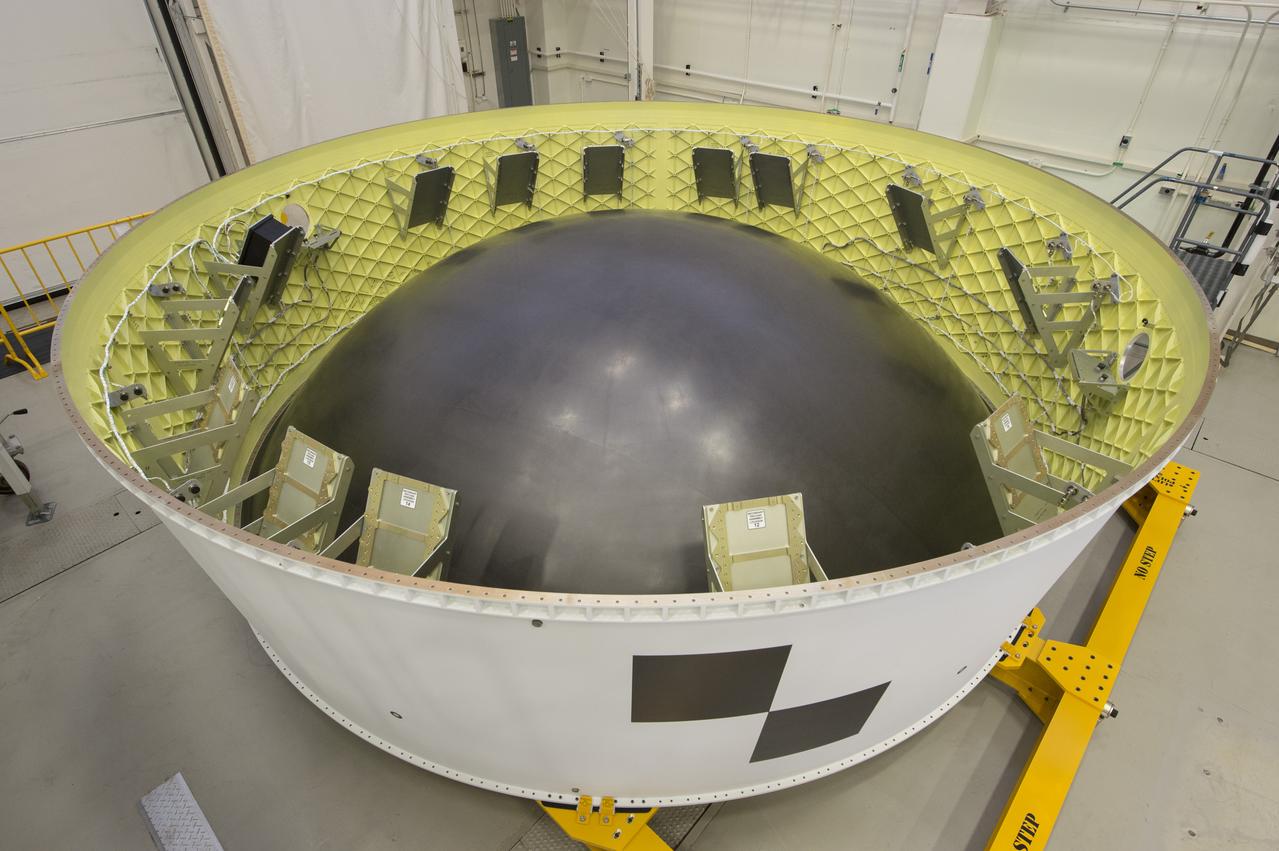
General overview and detail, Close-Out, photos of the SLS Orion Stage Adapter EM-1...exterior overall views (5)
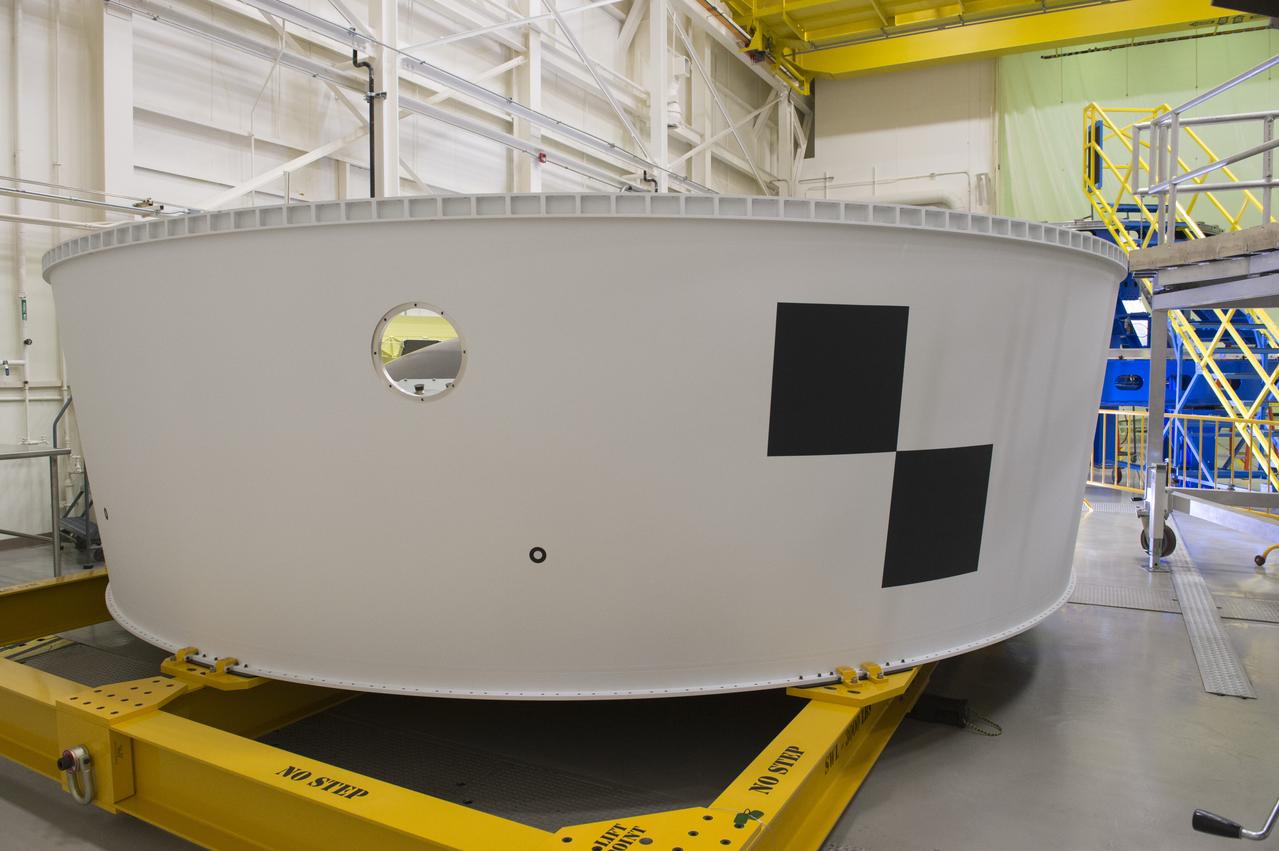
General overview and detail, Close-Out, photos of the SLS Orion Stage Adapter EM-1...exterior overall views (5)
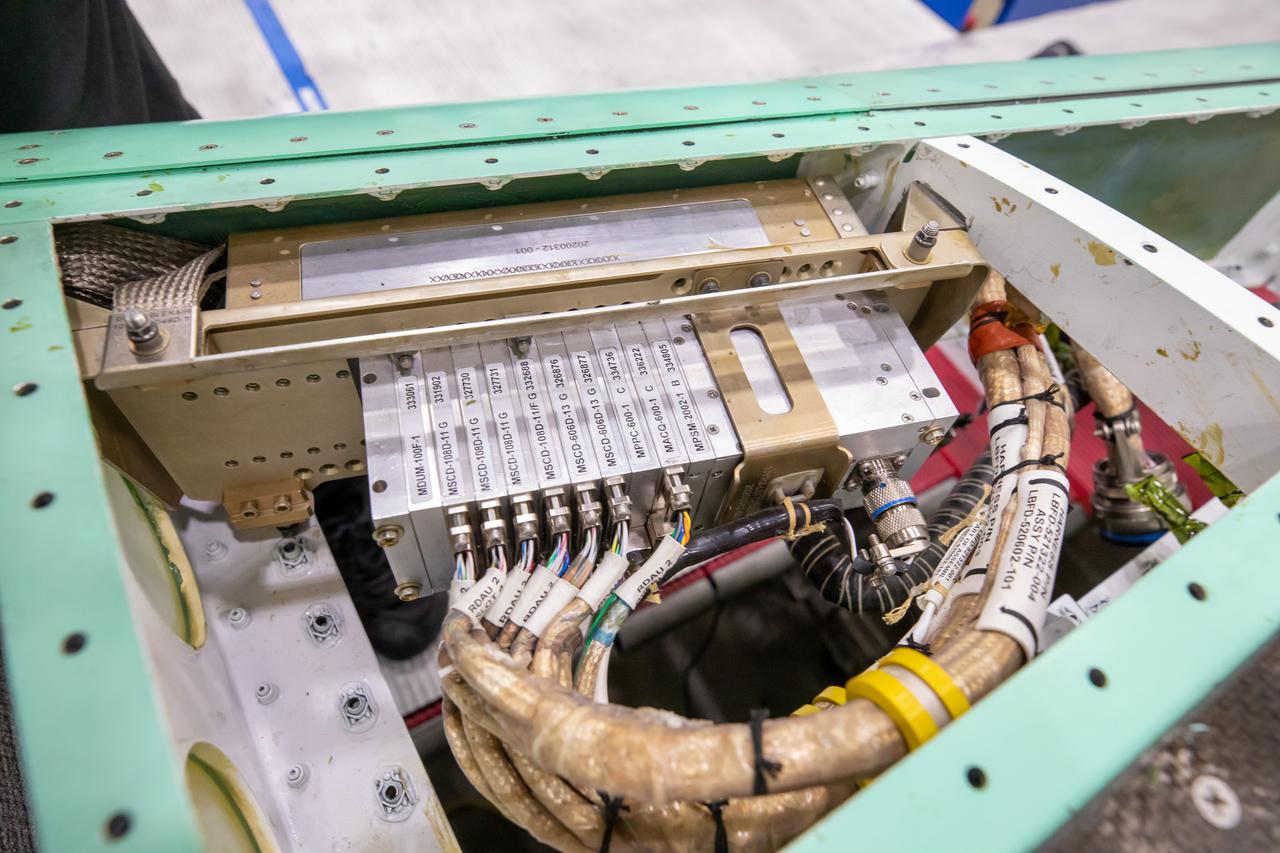
Here is a closeup of some of the X-59’s wiring and instrumentation system. Displayed here is the remote instrumentation encoder, which can be found in the wing of the aircraft. This encoder communicates with the plane’s other instrumentation systems like pressure and temperature sensors within the X-59.
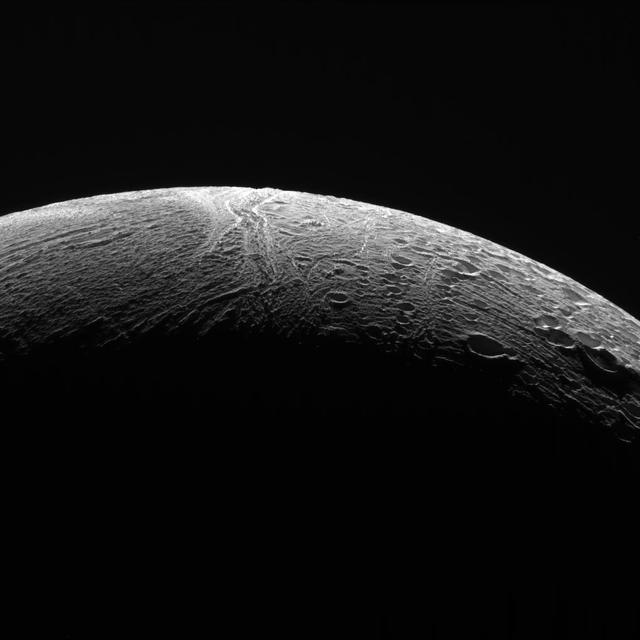
NASA Cassini orbiter peered out over the northern territory on Saturn moon Enceladus, during its final close flyby of Enceladus, on Dec. 19, 2015.
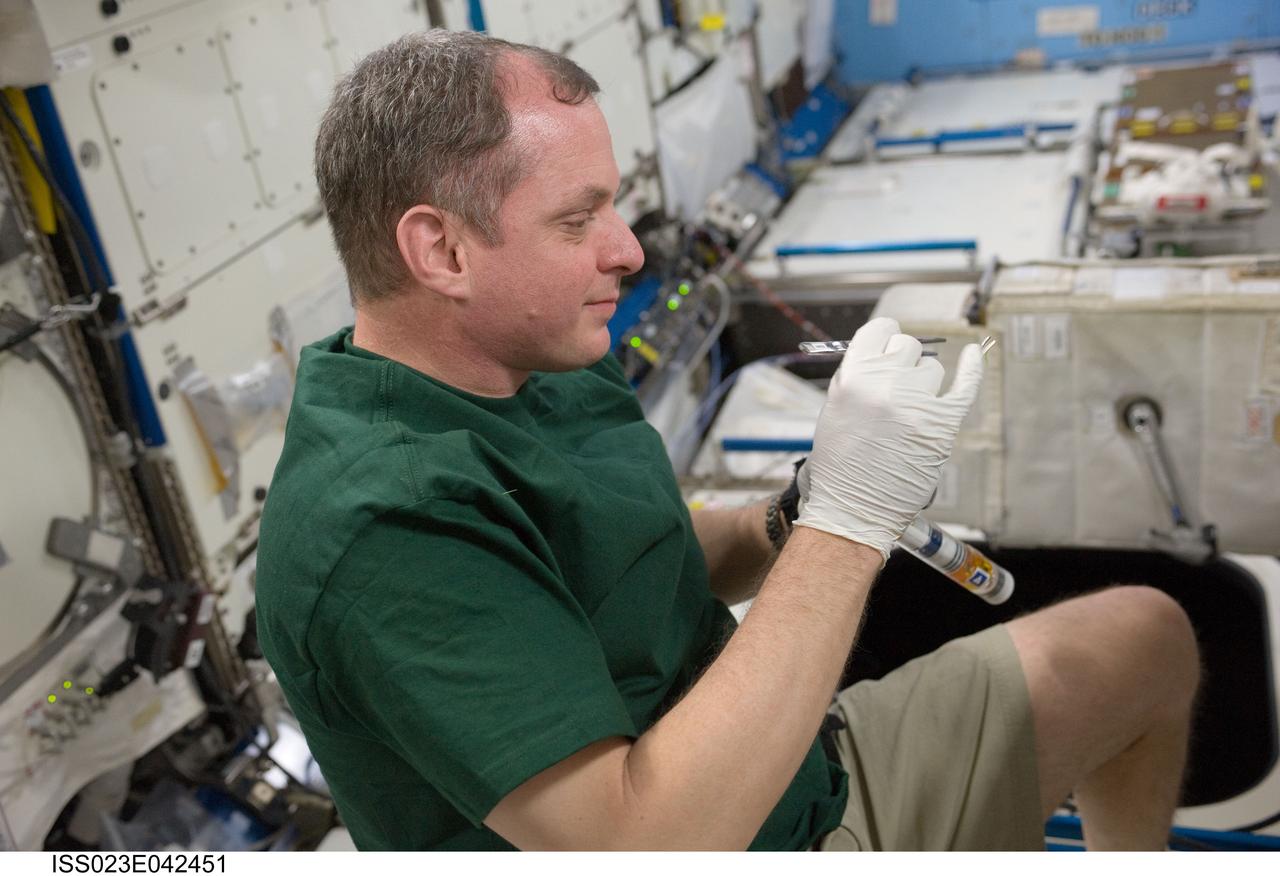
ISS023-E-042451 (10 May 2010) --- NASA astronaut T.J. Creamer, Expedition 23 flight engineer, services the Advanced Plant Experiments on Orbit-Cambium (APEX-Cambium) experiment in the Destiny laboratory of the International Space Station.
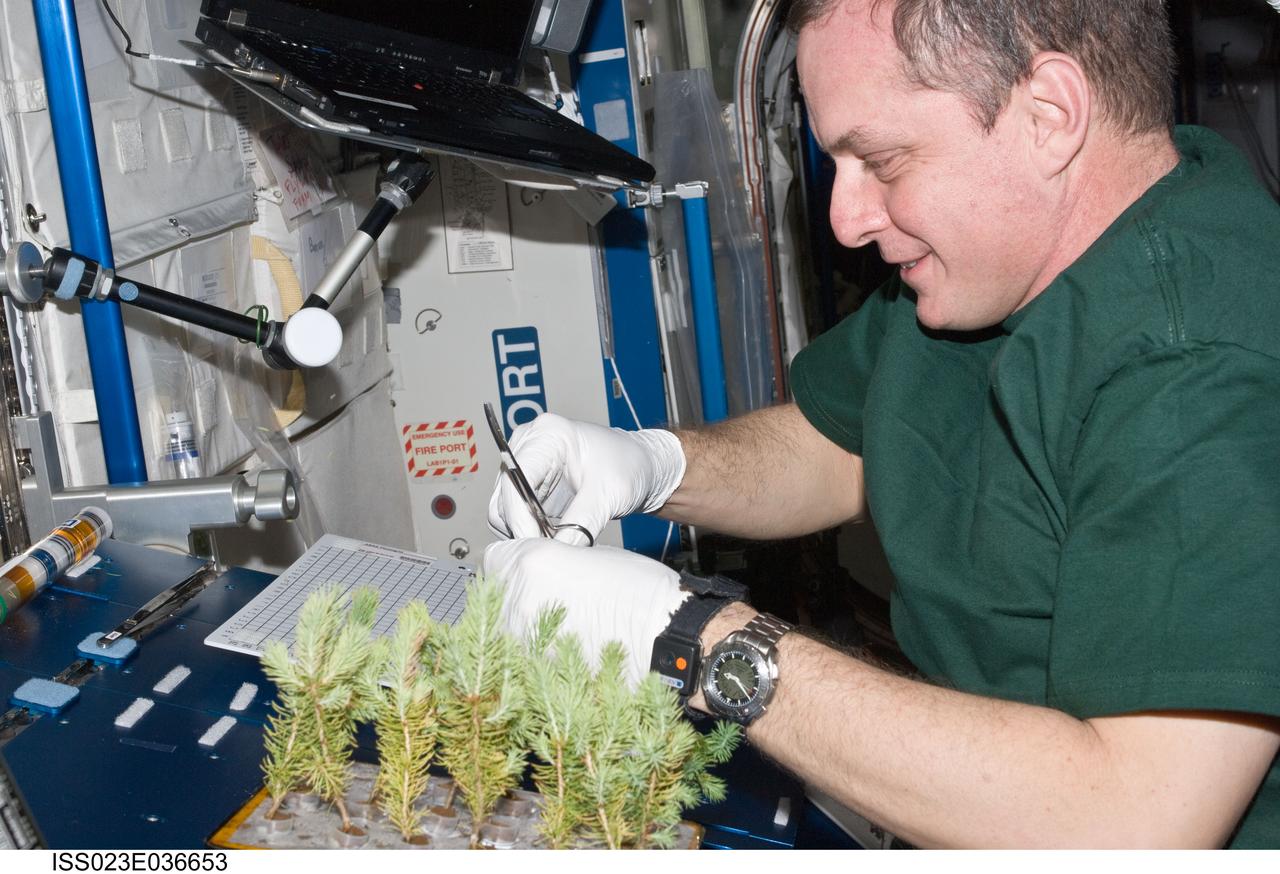
ISS023-E-036653 (10 May 2010) --- NASA astronaut T.J. Creamer, Expedition 23 flight engineer, services the Advanced Plant Experiments on Orbit-Cambium (APEX-Cambium) experiment in the Destiny laboratory of the International Space Station.
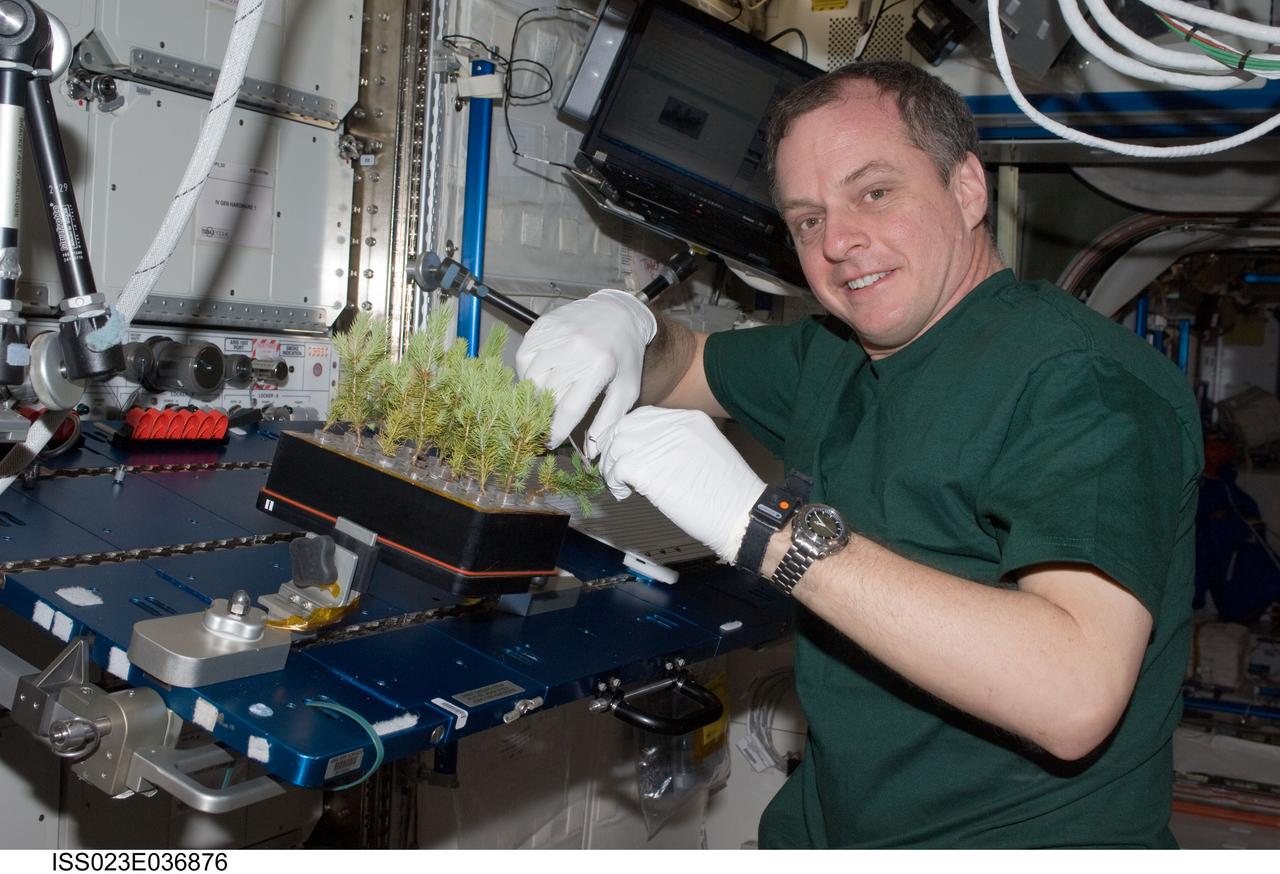
ISS023-E-036876 (10 May 2010) --- NASA astronaut T.J. Creamer, Expedition 23 flight engineer, services the Advanced Plant Experiments on Orbit-Cambium (APEX-Cambium) experiment in the Destiny laboratory of the International Space Station.
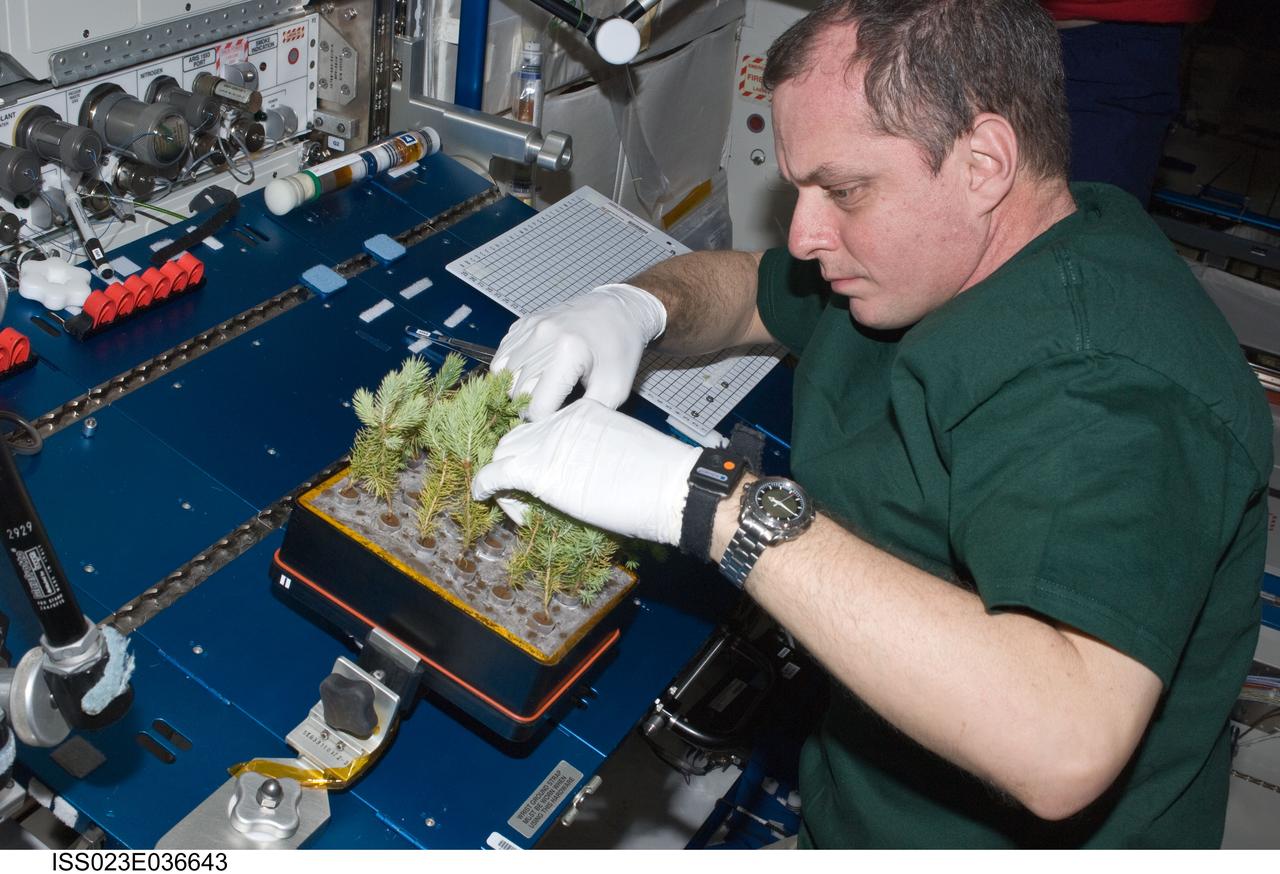
ISS023-E-036643 (10 May 2010) --- NASA astronaut T.J. Creamer, Expedition 23 flight engineer, services the Advanced Plant Experiments on Orbit-Cambium (APEX-Cambium) experiment in the Destiny laboratory of the International Space Station.
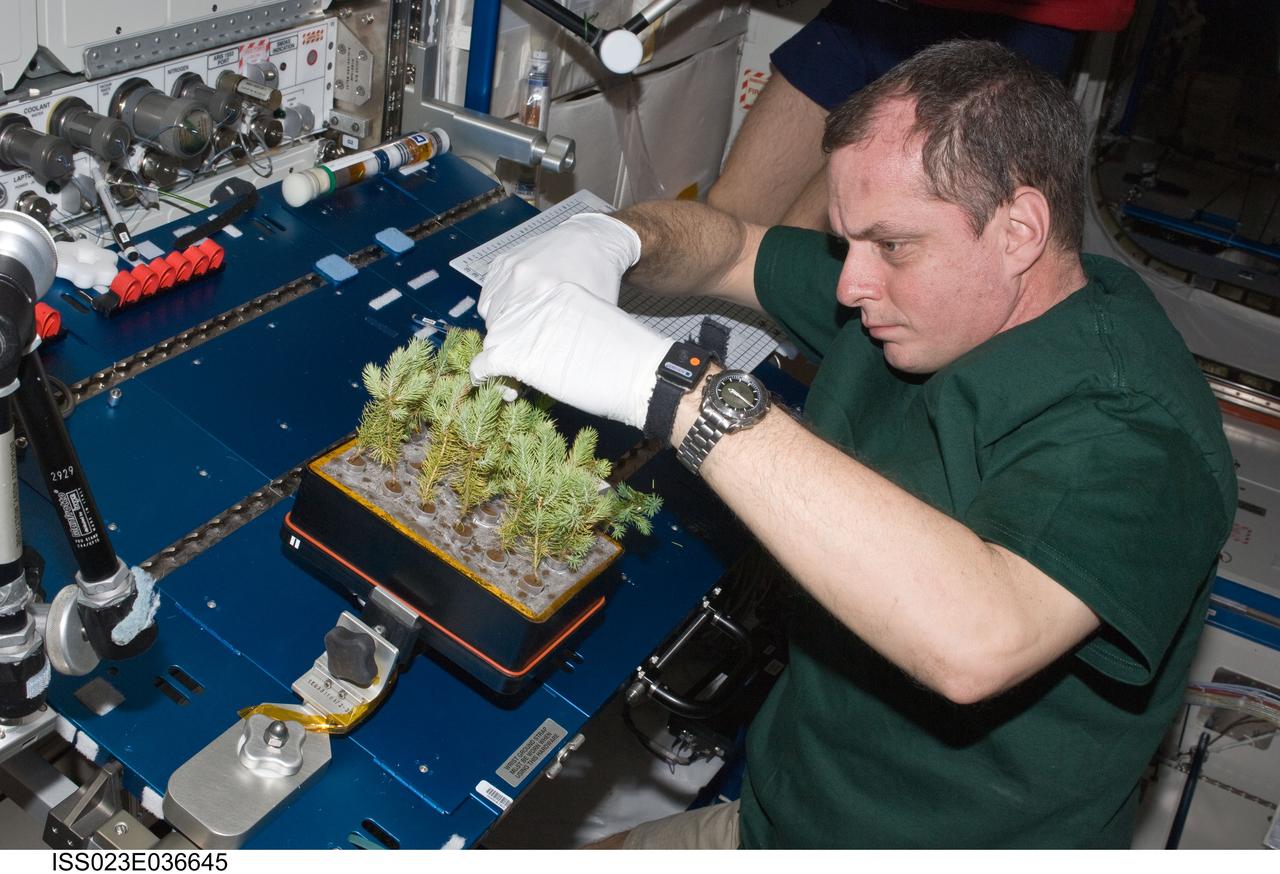
ISS023-E-036645 (10 May 2010) --- NASA astronaut T.J. Creamer, Expedition 23 flight engineer, services the Advanced Plant Experiments on Orbit-Cambium (APEX-Cambium) experiment in the Destiny laboratory of the International Space Station.
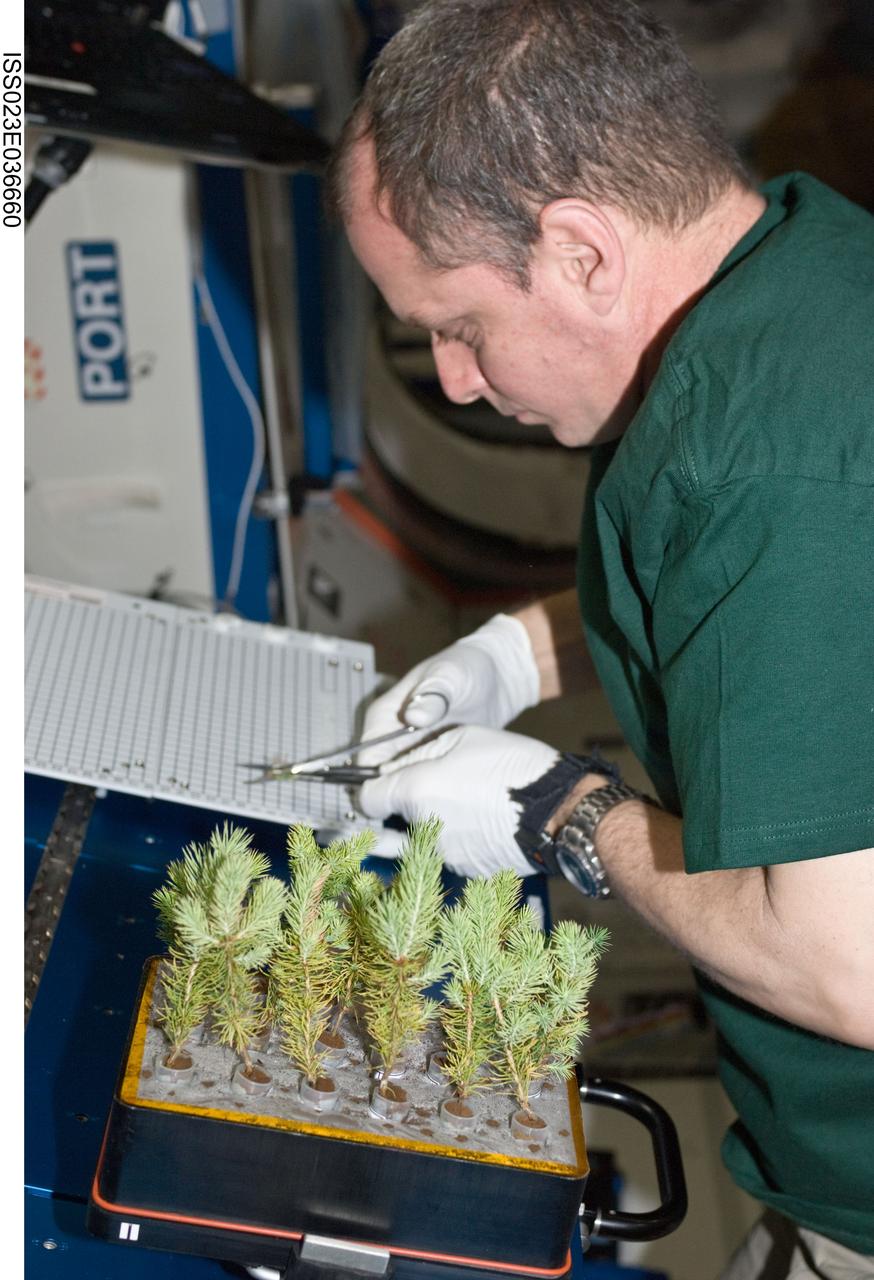
ISS023-E-036660 (10 May 2010) --- NASA astronaut T.J. Creamer, Expedition 23 flight engineer, services the Advanced Plant Experiments on Orbit-Cambium (APEX-Cambium) experiment in the Destiny laboratory of the International Space Station.
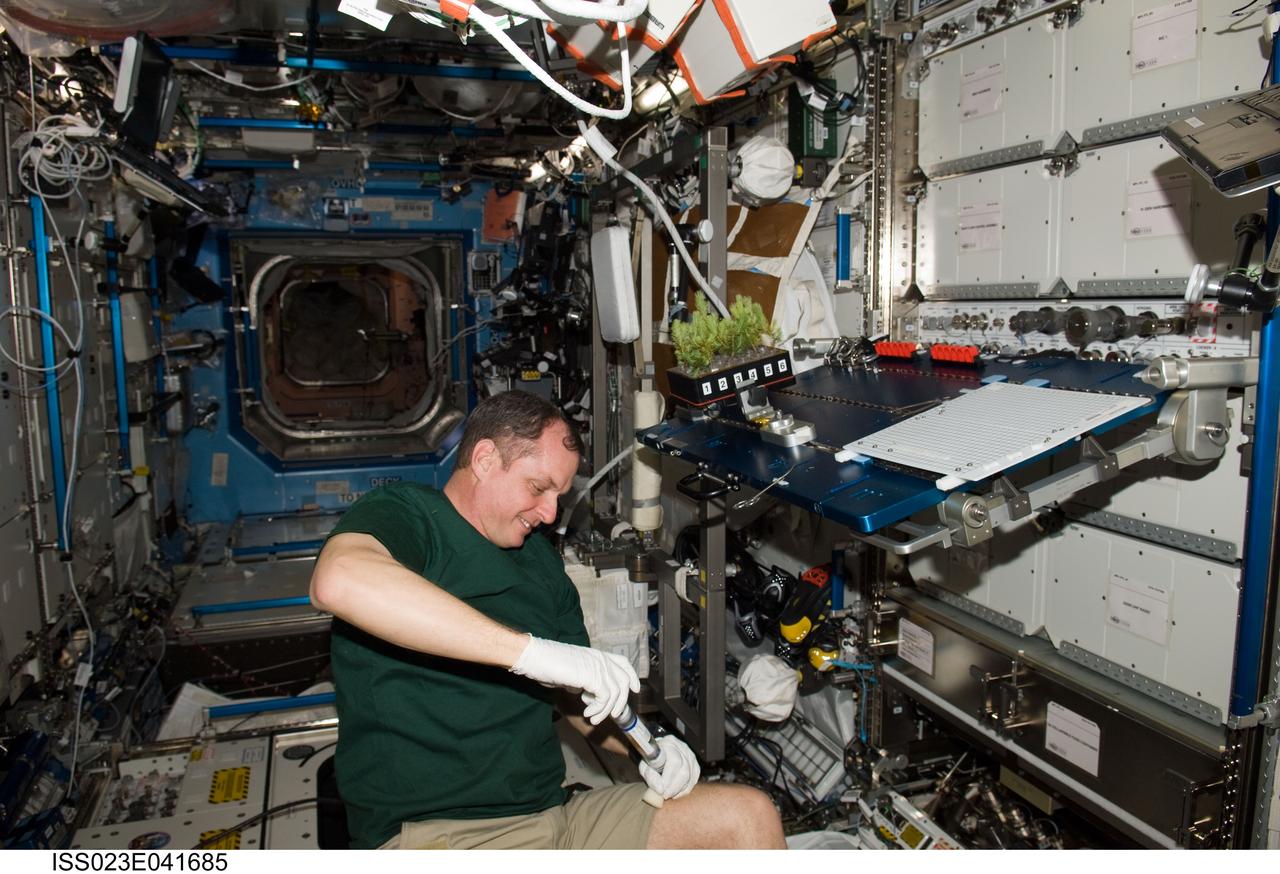
ISS023-E-041685 (10 May 2010) --- NASA astronaut T.J. Creamer, Expedition 23 flight engineer, services the Advanced Plant Experiments on Orbit-Cambium (APEX-Cambium) experiment in the Destiny laboratory of the International Space Station.
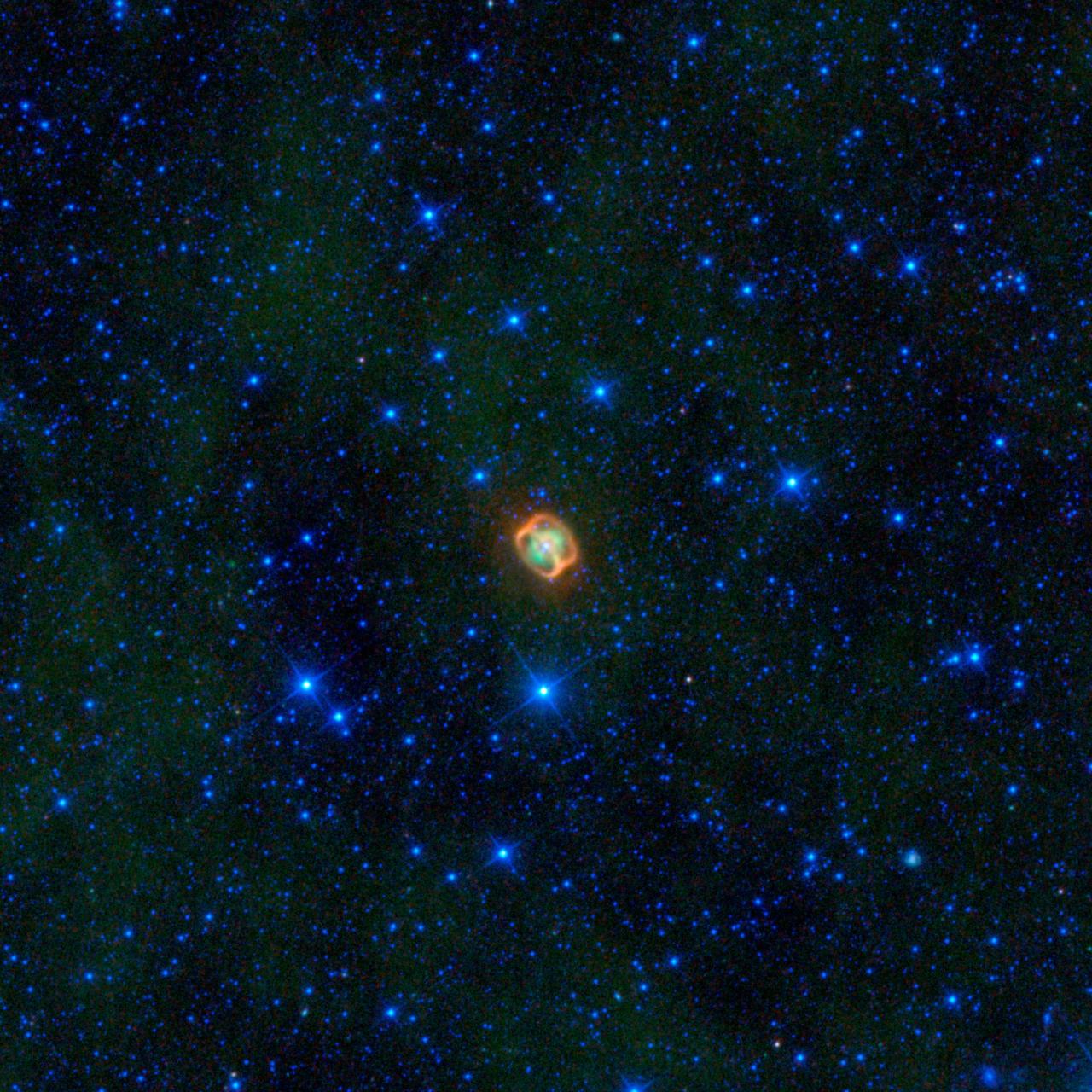
A colorful creature in a starry sea stands out in this image from NASA Wide-field Infrared Explorer; infrared light that has been assigned visible colors we see with our eyes. The jellyfish-looking object is actually a very close pair of dying stars.
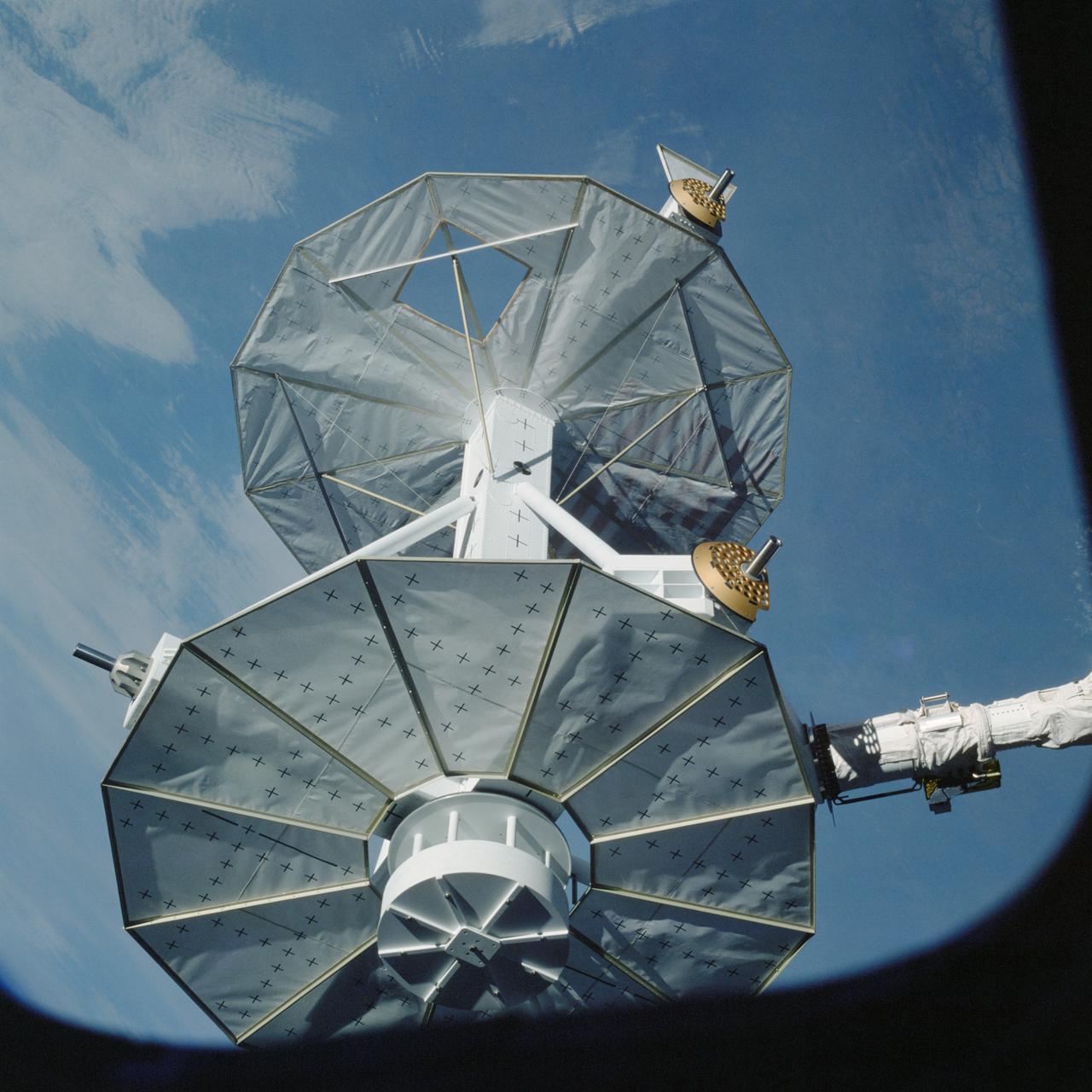
STS008-35-1239 (30 Aug.-5 Sept. 1983) --- The space shuttle Challenger?s payload flight test article (PFTA) is lifted from the cargo bay and held over clouds and water on Earth. The 70mm frame was photographed by one of the five STS-8 crew members with a free hand during the busy RMS/PFTA agenda. Photo credit: NASA
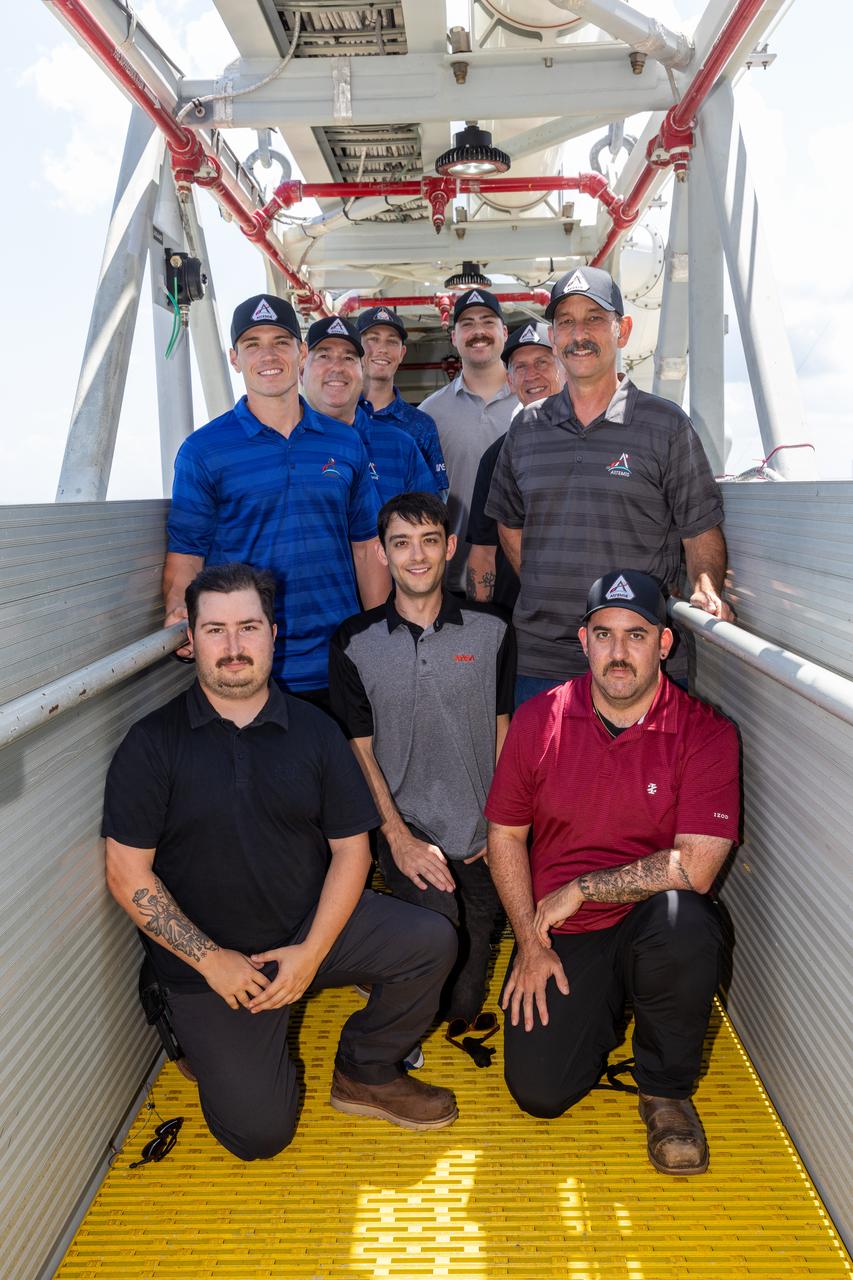
Some of the team members who make up the Artemis closeout team pose for a picture at Launch Complex 39B at NASA’s Kennedy Space Center in Florida on Tuesday, Aug. 13, 2024. Members of the closeout crew, pad rescue team, and the Exploration Ground Systems Program practiced the process of getting inside and out of the emergency egress baskets. While the crew and other personnel will ride the emergency egress baskets to the terminus area in a real emergency, no one rode the baskets for this test. Instead, teams tested the baskets during separate occasions by using water tanks filled to different levels to replicate simulate the weight of passengers.

Mission Specialist Jerry Linenger prepares to enter the Space Shuttle Atlantis at Launch Pad 39B with help from white room close out members Jim Mangione(left foreground),Danny Wyatt and Jim Martin
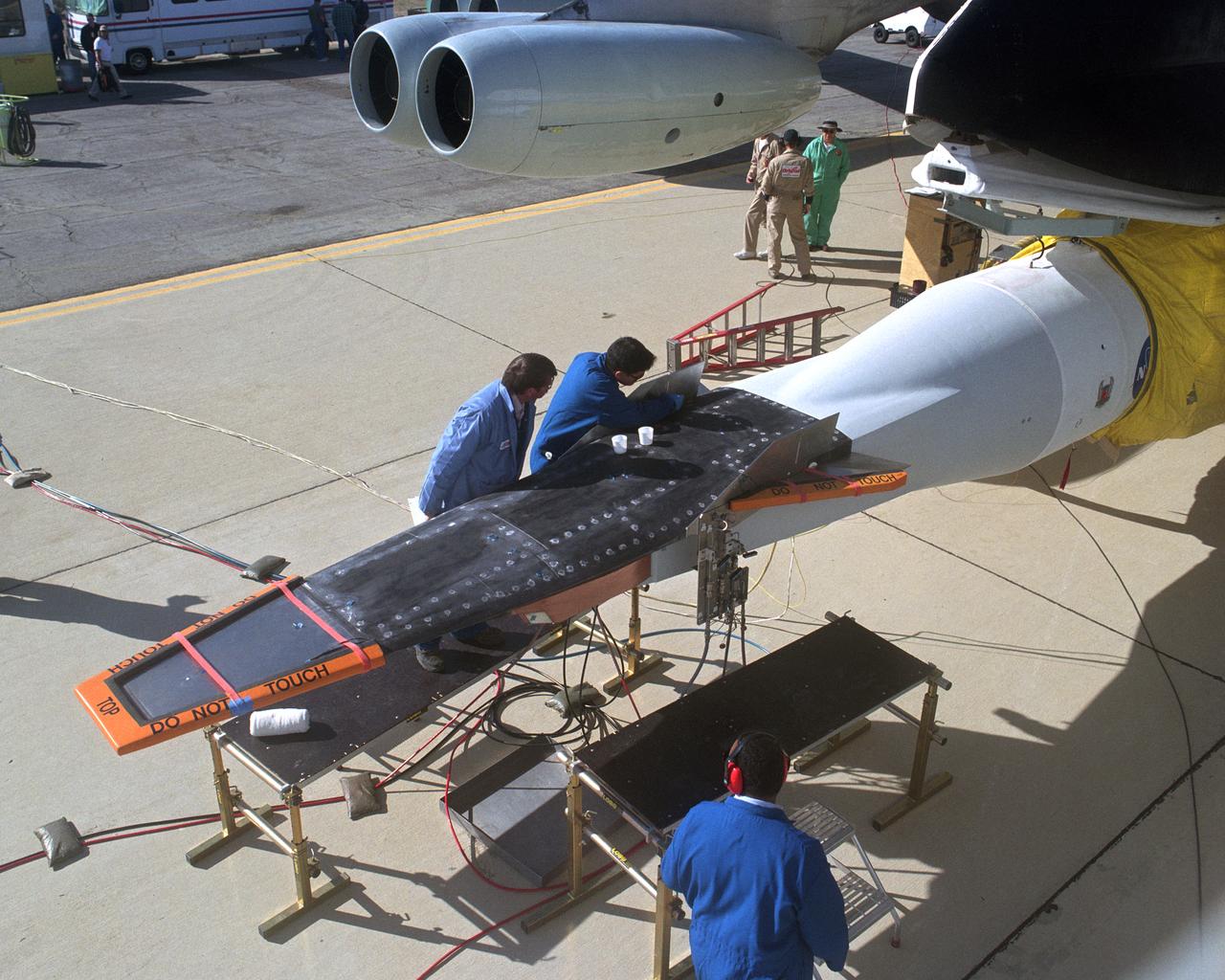
The second X-43A hypersonic research vehicle, mounted under the right wing of the B-52B launch aircraft, viewed from the B-52 cockpit. The crew is working on closing out the research vehicle, preparing it for flight.
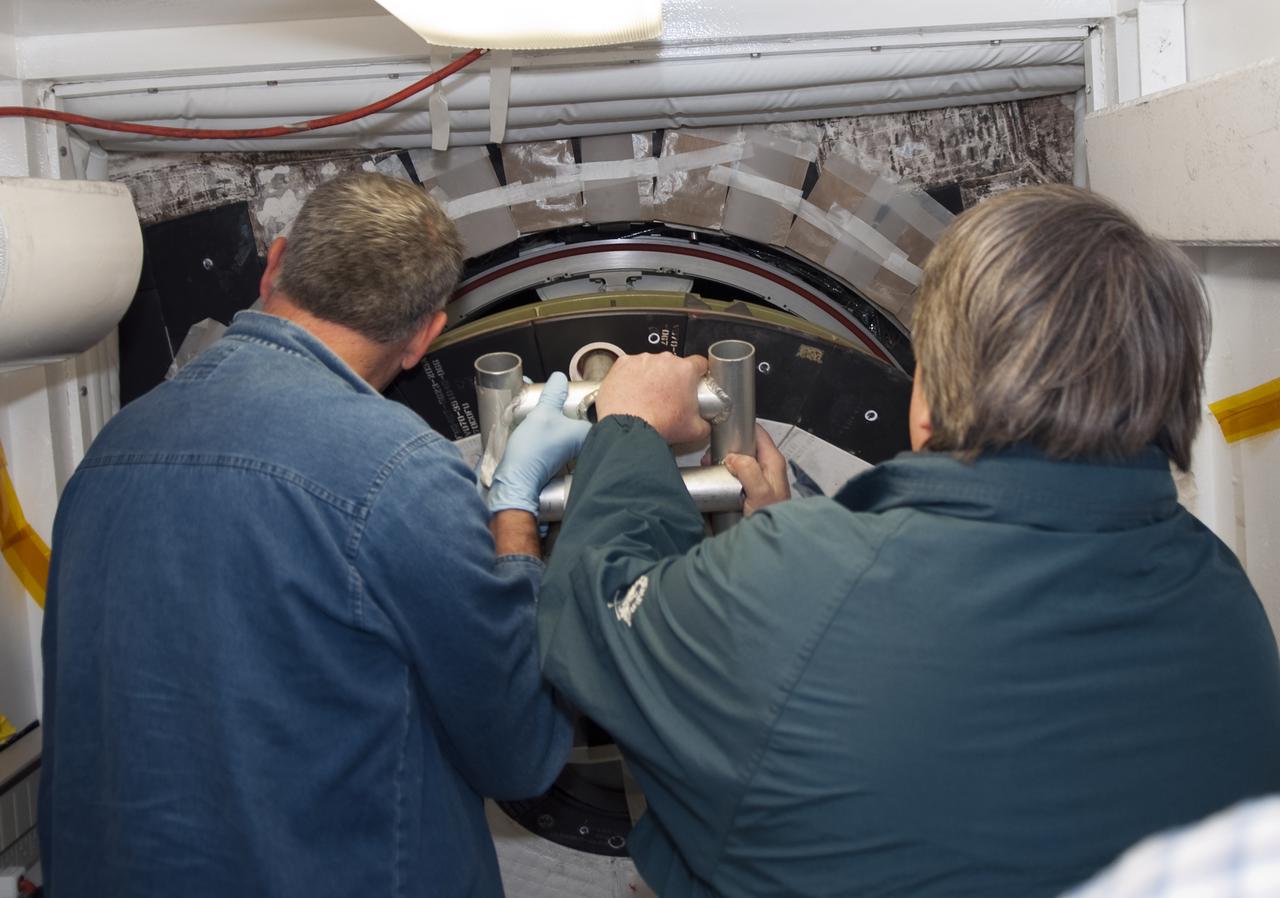
CAPE CANAVERAL, Fla. - Inside Orbiter Processing Facility-1 at Kennedy Space Center in Florida, technicians close shuttle Atlantis’ hatch in preparation for the Mylar Pull Test. During the test, the hatch is closed and a scale is used to measure the force required to pull a piece of Mylar paper out from between the door and structural wall thermal barriers. The pull test is performed to ensure the integrity of the hatch and that it has closed properly. Atlantis is being processed for the STS-132 mission targeted for launch May 14. The six-member crew will deliver an Integrated Cargo Carrier and a Russian-built Mini Research Module to the International Space Station. Photo credit: NASA_Jim Grossmann
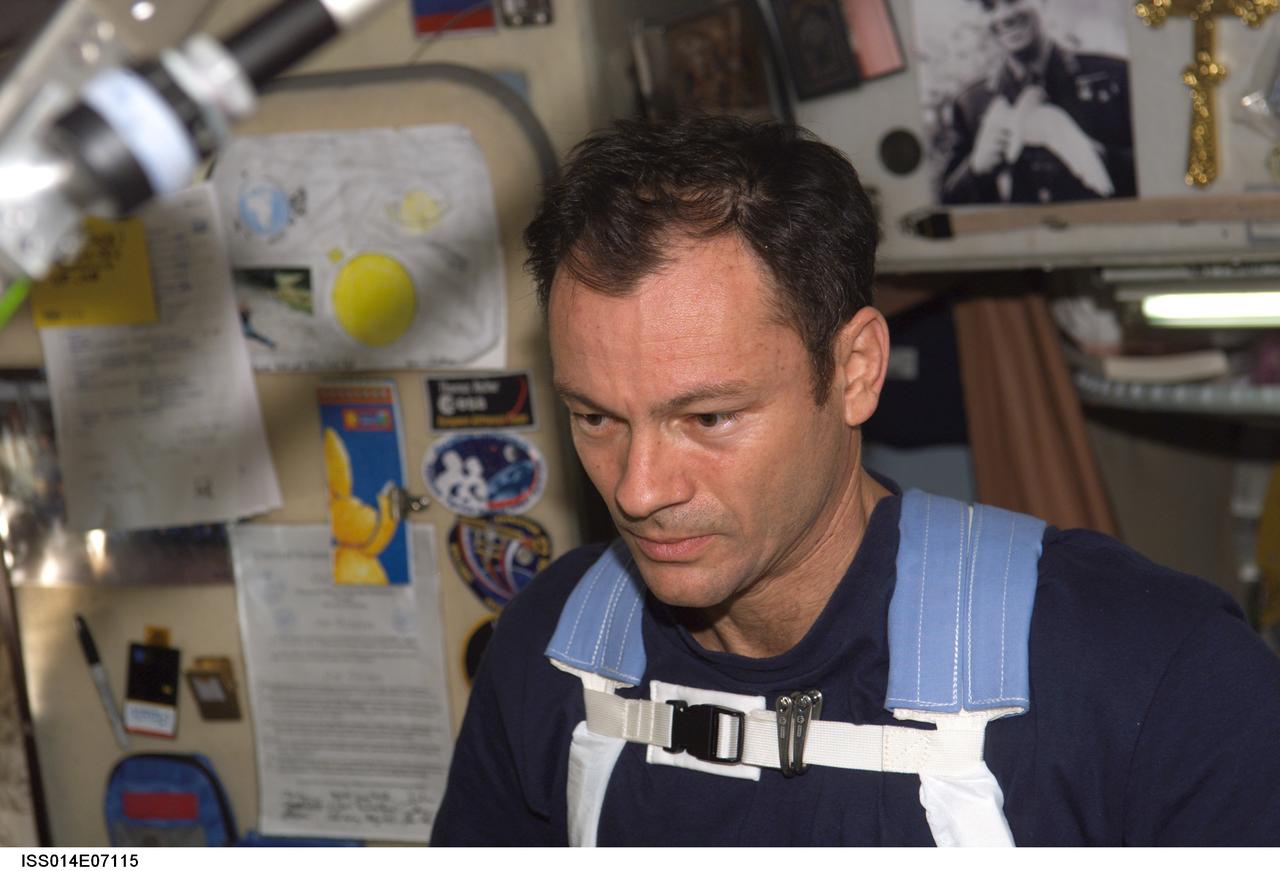
ISS014-E-07115 (2 Nov. 2006) --- Astronaut Michael E. Lopez-Alegria, Expedition 14 commander and NASA space station science officer, equipped with a bungee harness, exercises on the Treadmill Vibration Isolation System (TVIS) in the Zvezda Service Module of the International Space Station. In this close-up view, the TVIS is out of frame.
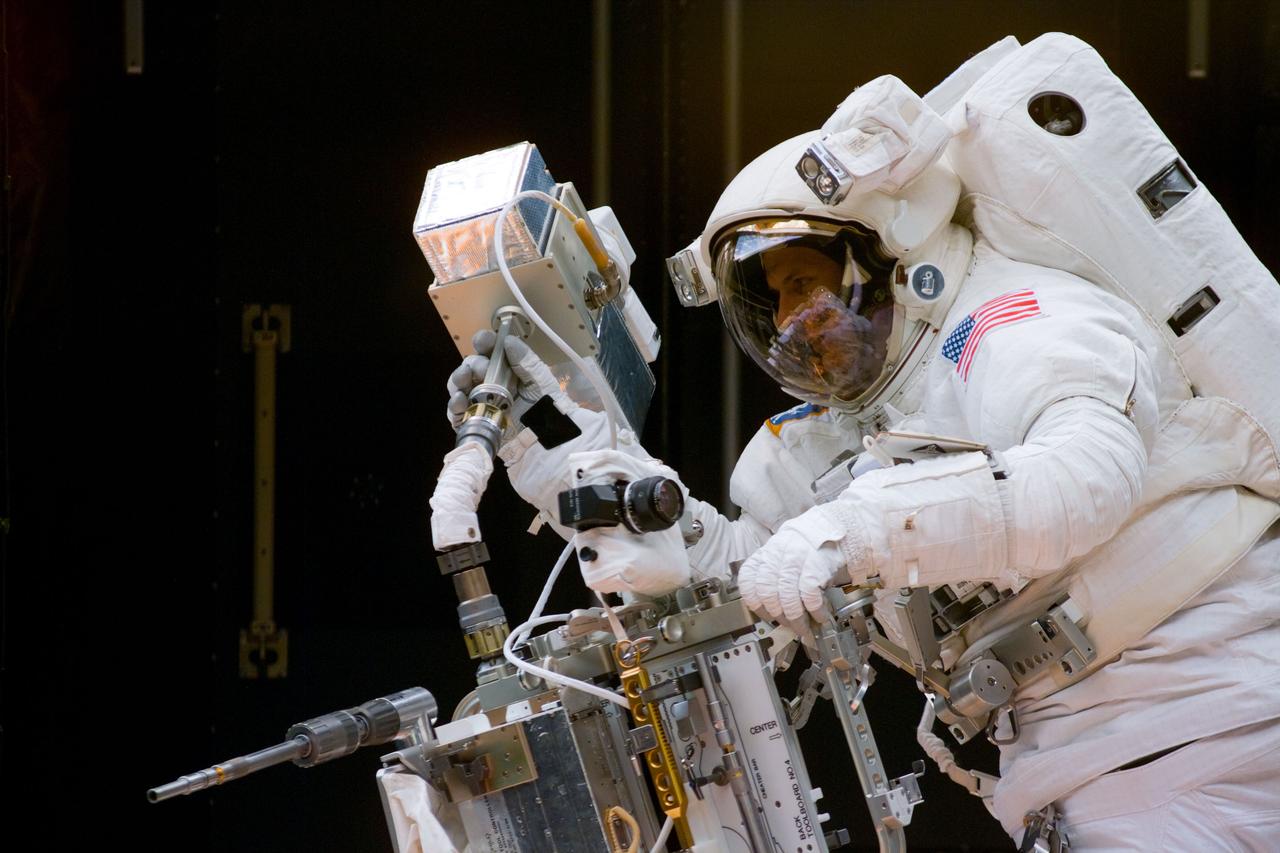
S82-E-5320 (14 Feb. 1997) --- Astronaut Steven L. Smith, STS-82 mission specialist, works with close-out camera in the Space Shuttle Discovery's payload bay. This view was taken with an Electronic Still Camera (ESC).
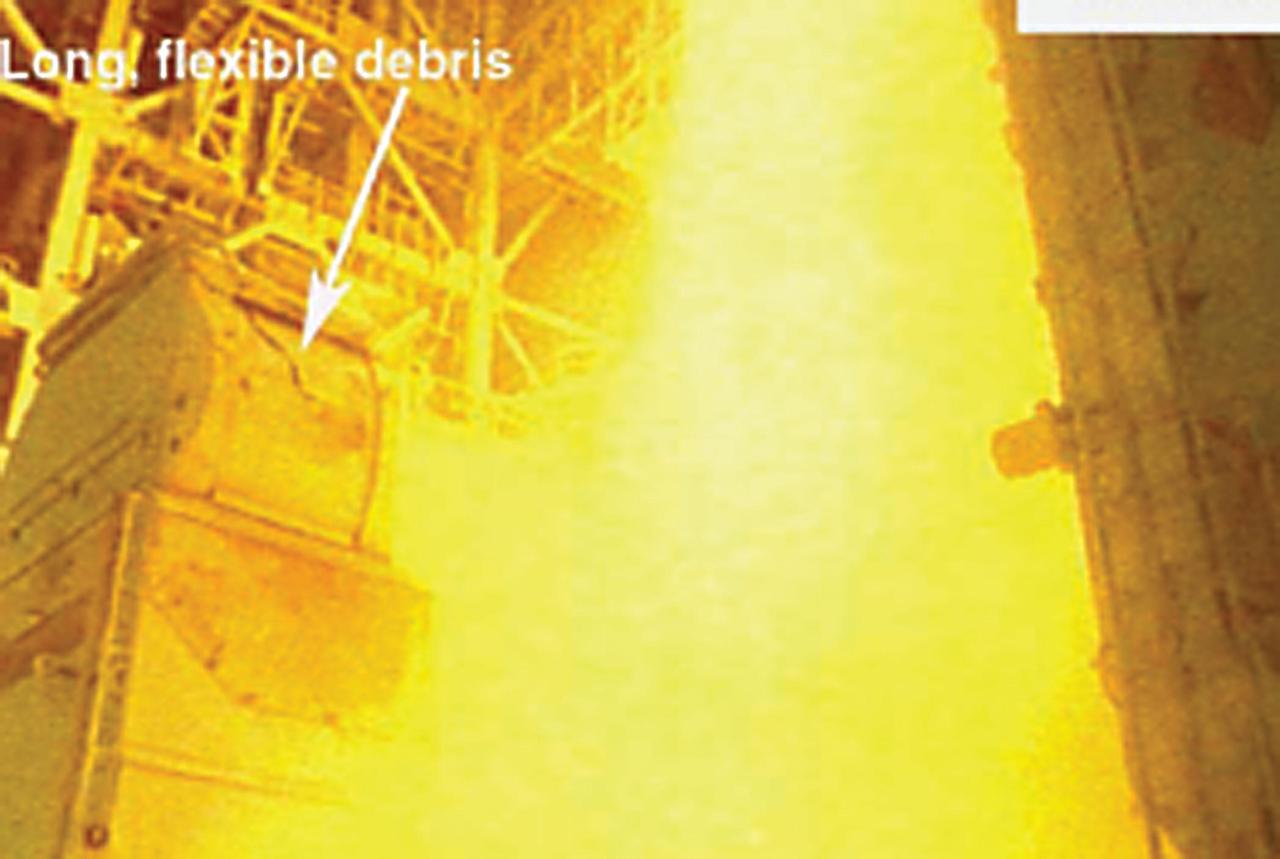
KENNEDY SPACE CENTER, FLA. - At the launch of Space Shuttle Columbia on mission STS-107, long, flexible debris comes out of the liquid helium 2 Tail Service Mast after the door closes. Columbia and crew were lost in a tragic accident over Texas as they made their approach to landing at KSC.
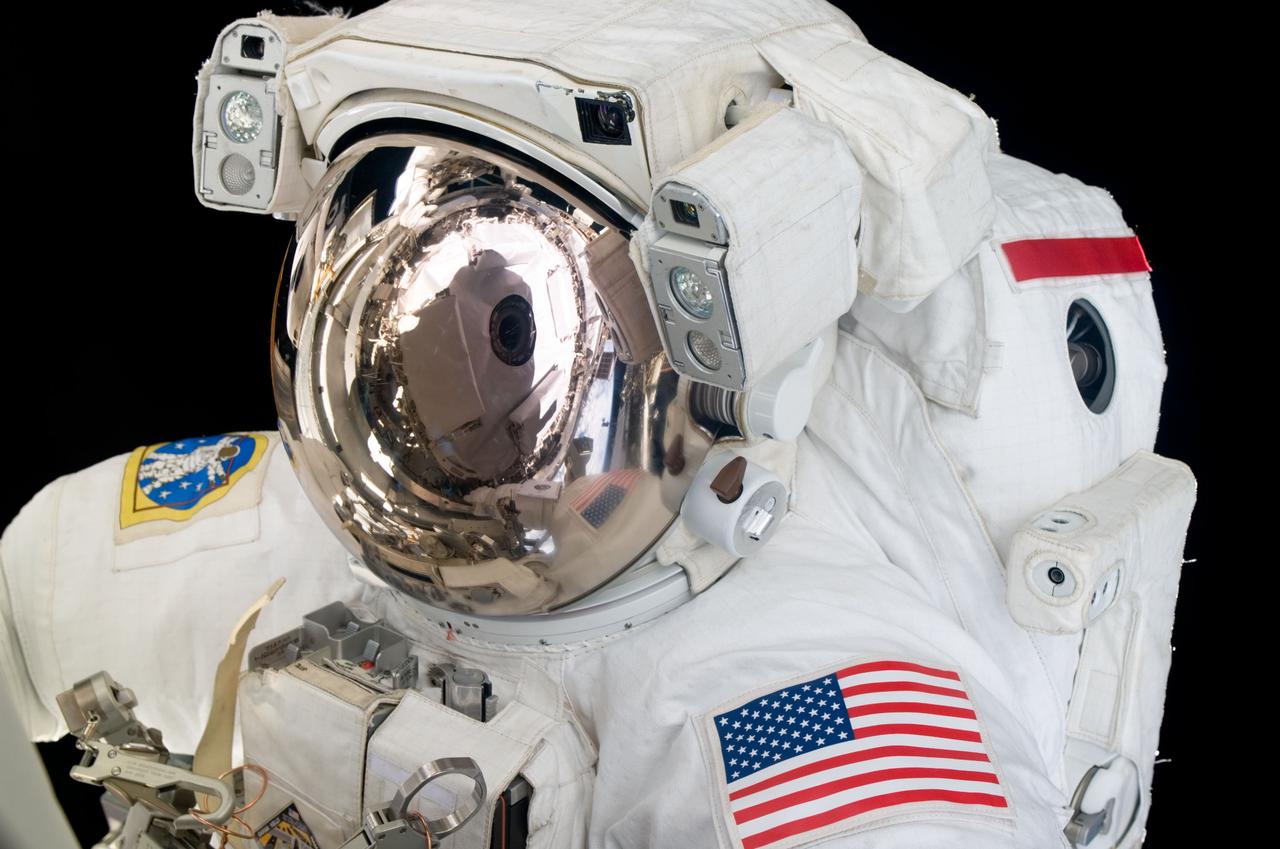
S124-E-006586 (5 June 2008) --- Astronaut Mike Fossum's "busy" helmet visor was photographed in this very close-up image during the second of three scheduled spacewalks shared by him and astronaut Ron Garan (out of frame), his STS-124 mission specialist crewmate.
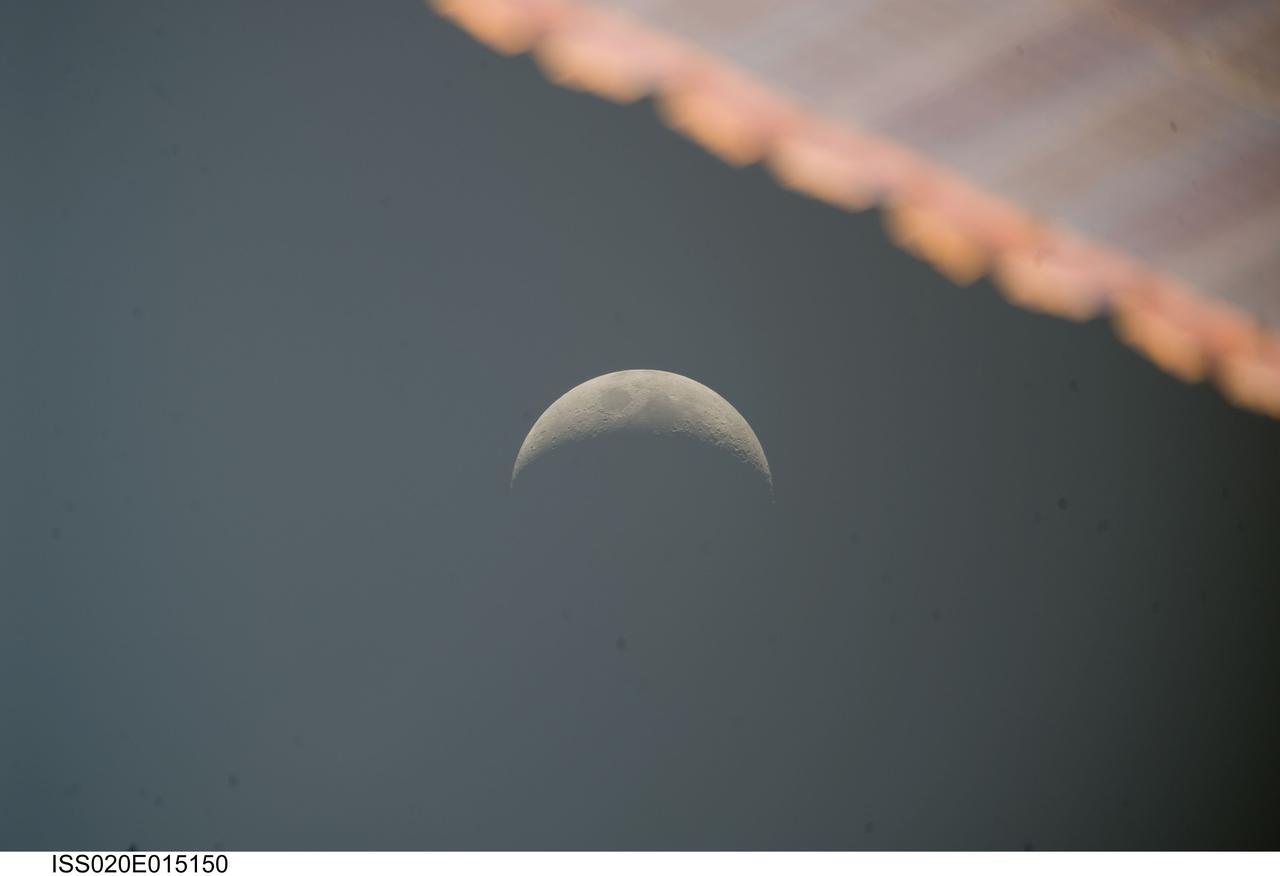
ISS020-E-015150 (26 June 2009) --- One of the Expedition 20 crew members aboard the International Space Station photographed this image of a crescent moon on June 26, 2009. Part of a solar panel on the orbital outpost in the foregrund appears out of focus due to its close range to the camera.

S66-24406 (16 March 1966) --- Close-up view of astronaut David R. Scott, pilot of the Gemini-8 spaceflight, making final adjustments and checks in the spacecraft during the Gemini-8 prelaunch countdown. In the background almost out of view is astronaut Neil A. Armstrong, command pilot. Photo credit: NASA
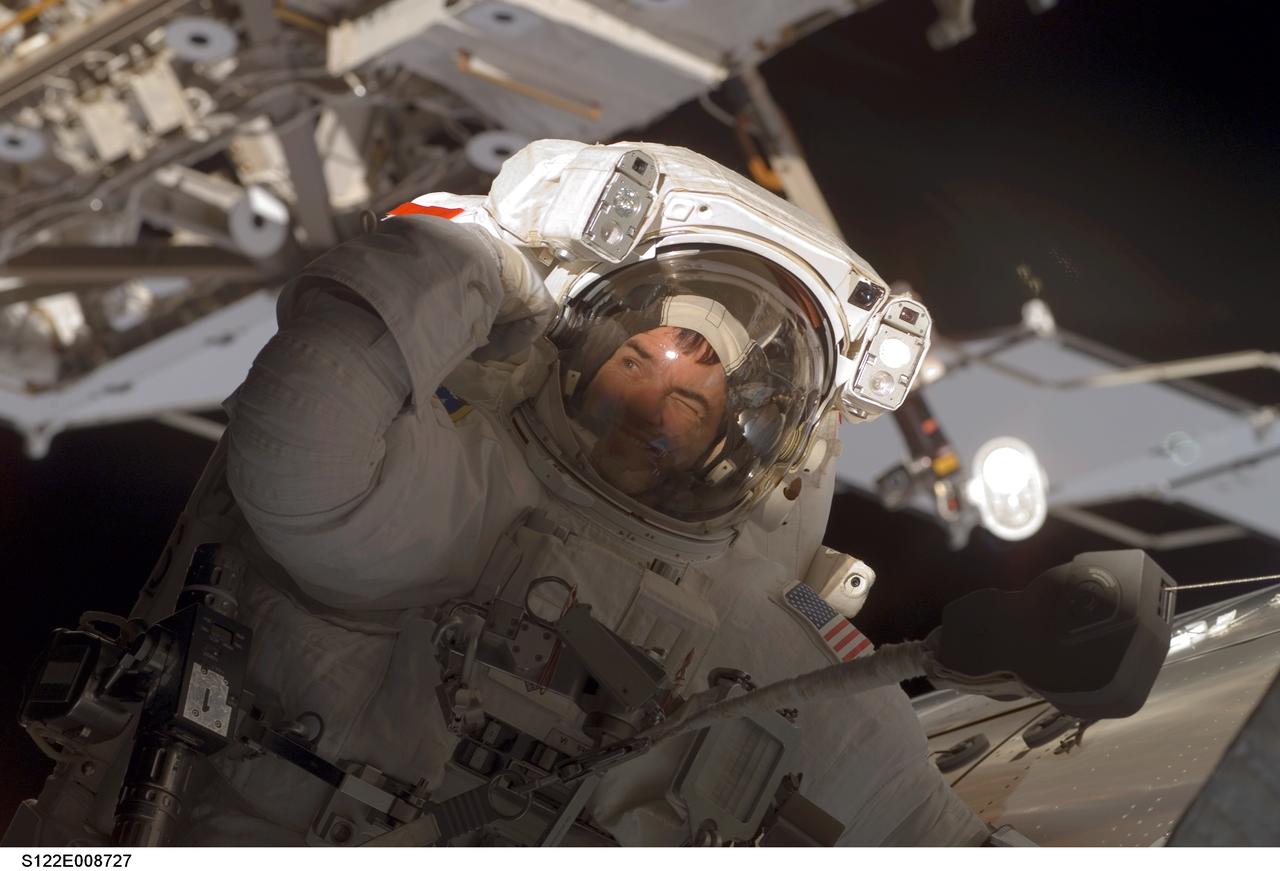
S122-E-008727 (15 Feb. 2008) --- Astronaut Rex Walheim, mission specialist, closes one eye while focusing on an extravehicular activity task with the other. Astronaut Stanley Love (out of frame), mission specialist, shared this final spacewalk for the STS-122 Atlantis crew with Walheim.
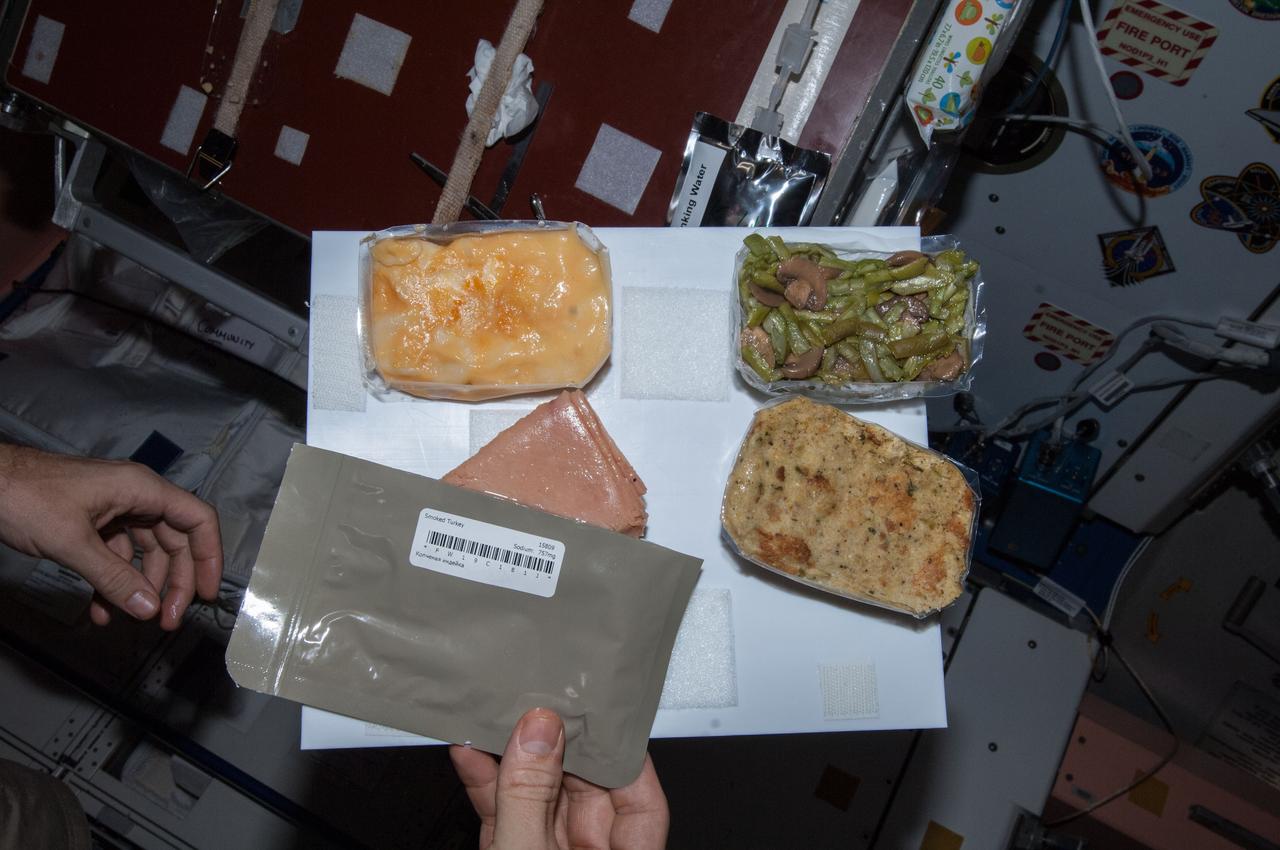
ISS038-E-009304 (28 Nov. 2013) --- NASA astronaut Michael Hopkins (mostly out of frame), Expedition 38 flight engineer, offers a close-up view of his Thanksgiving meal in the Unity node of the International Space Station.
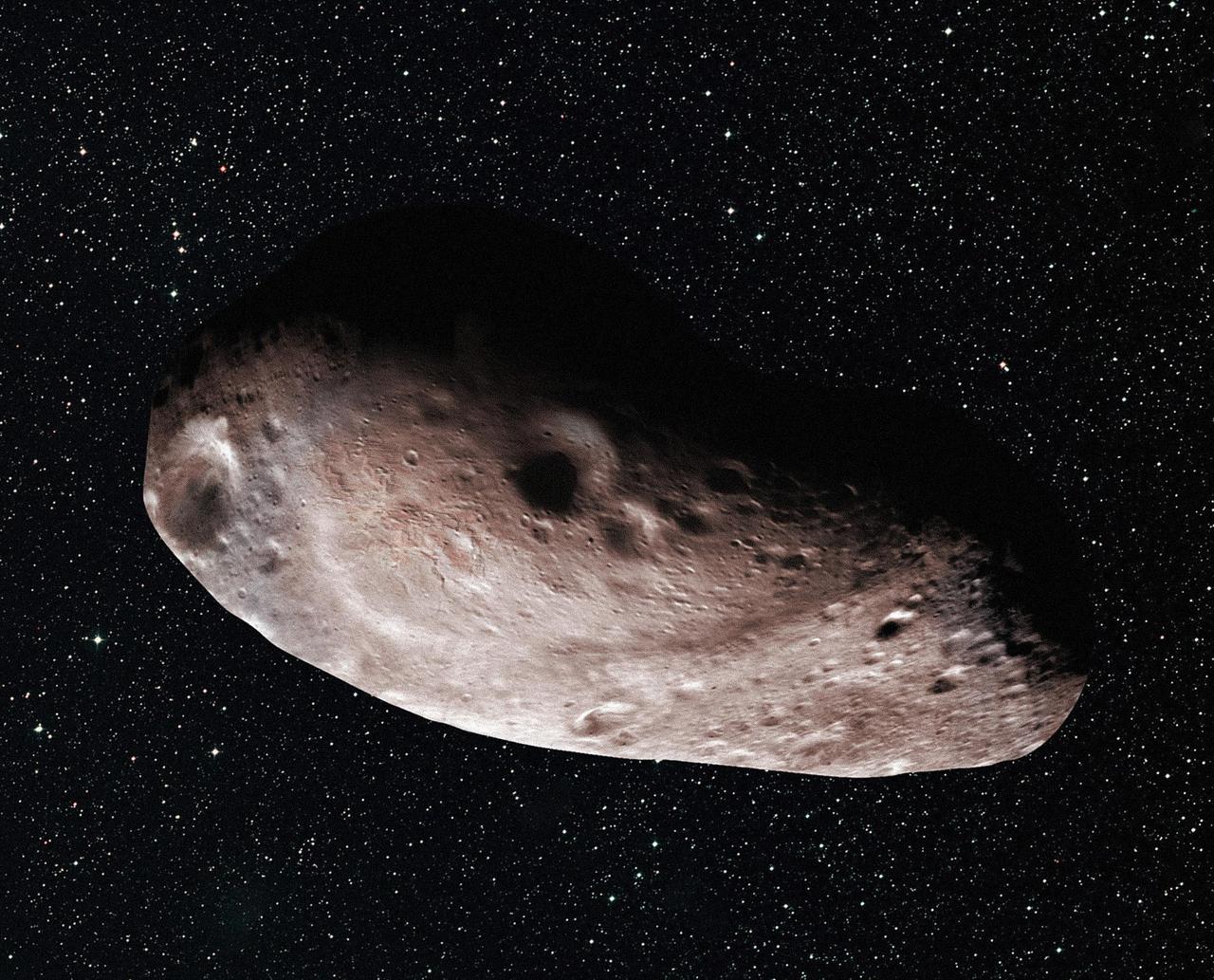
Artist's concept of Kuiper Belt object 2014 MU69, which is the next flyby target for NASA's New Horizons mission. Scientists speculate that the Kuiper Belt object could be a single body (above) with a large chunk taken out of it, or two bodies that are close together or even touching. https://photojournal.jpl.nasa.gov/catalog/PIA21868

STS039-11-027 (28 April-6 May 1991) --- Astronaut Michael L. Coats, STS-39 mission commander, is seen in a close-up 35mm frame on the aft flight deck of the Earth-orbiting space shuttle Discovery. Out the overhead window, the SPAS-II hovers on the end of the remote manipulator system (RMS, out of frame). Inside the window, just above Coats' head is the Crewman Optical Alignment Sight (COAS), an optical device that aids in navigation. Photo credit: NASA

Space shuttle Atlantis is seen as it rolls out of the Vehicle Assembly Building to start its trip to its new home at the Kennedy Space Center Visitor Complex, Friday, Nov. 2, 2012, in Cape Canaveral, Fla. The spacecraft traveled 125,935,769 miles during 33 spaceflights, including 12 missions to the International Space Station. Its final flight, STS-135, closed out the Space Shuttle Program era with a landing on July 21, 2011. Photo Credit: (NASA/Bill Ingalls)

KENNEDY SPACE CENTER, FLA. - In the Orbiter Processing Facility, a worker checks out part of the equipment in the airlock, at one end of Discovery’s payload bay. The airlock is sized to accommodate two fully suited flight crew members simultaneously. Support functions include airlock depressurization and repressurization, extravehicular activity equipment recharge, liquid-cooled garment water cooling, EVA equipment checkout, donning and communications. The outer hatch isolates the airlock from the unpressurized payload bay when closed and permits the EVA crew members to exit from the airlock to the payload bay when open.
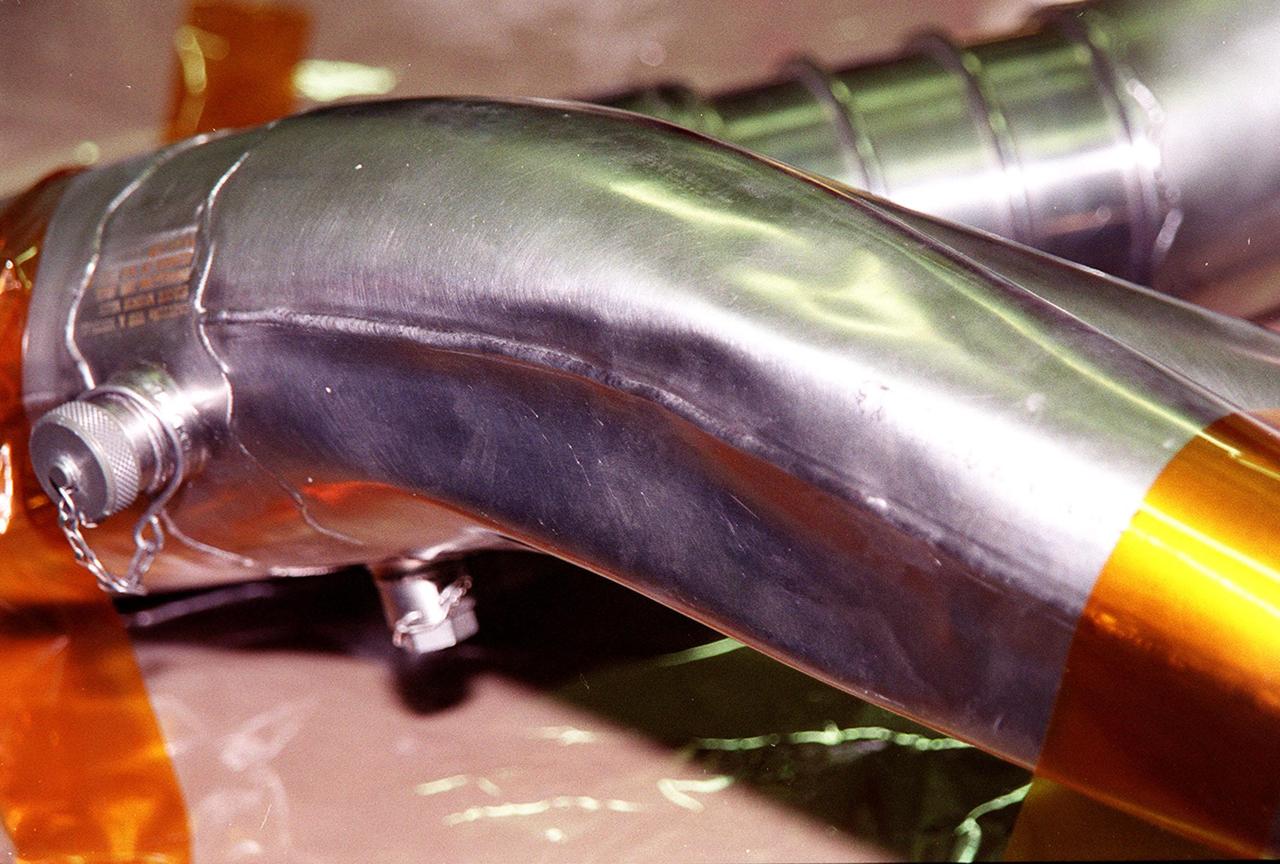
This close-up shows the 12-inch-long dent on Shuttle Discovery's main propulsion system liquid hydrogen recirculation line that was discovered during routine aft compartment inspections Tuesday, Dec. 7. The line recirculates hydrogen from the Shuttle main engines back to the external tank during prelaunch engine conditioning. The line is being replaced and managers expect the replacement work to take about 3 days, followed by system retests and final aft compartment close-outs. Preliminary assessments reflect a launch date of Space Shuttle Discovery on mission STS-103 no earlier than Dec. 16. STS-103 is the third servicing mission for the Hubble Space Telescope
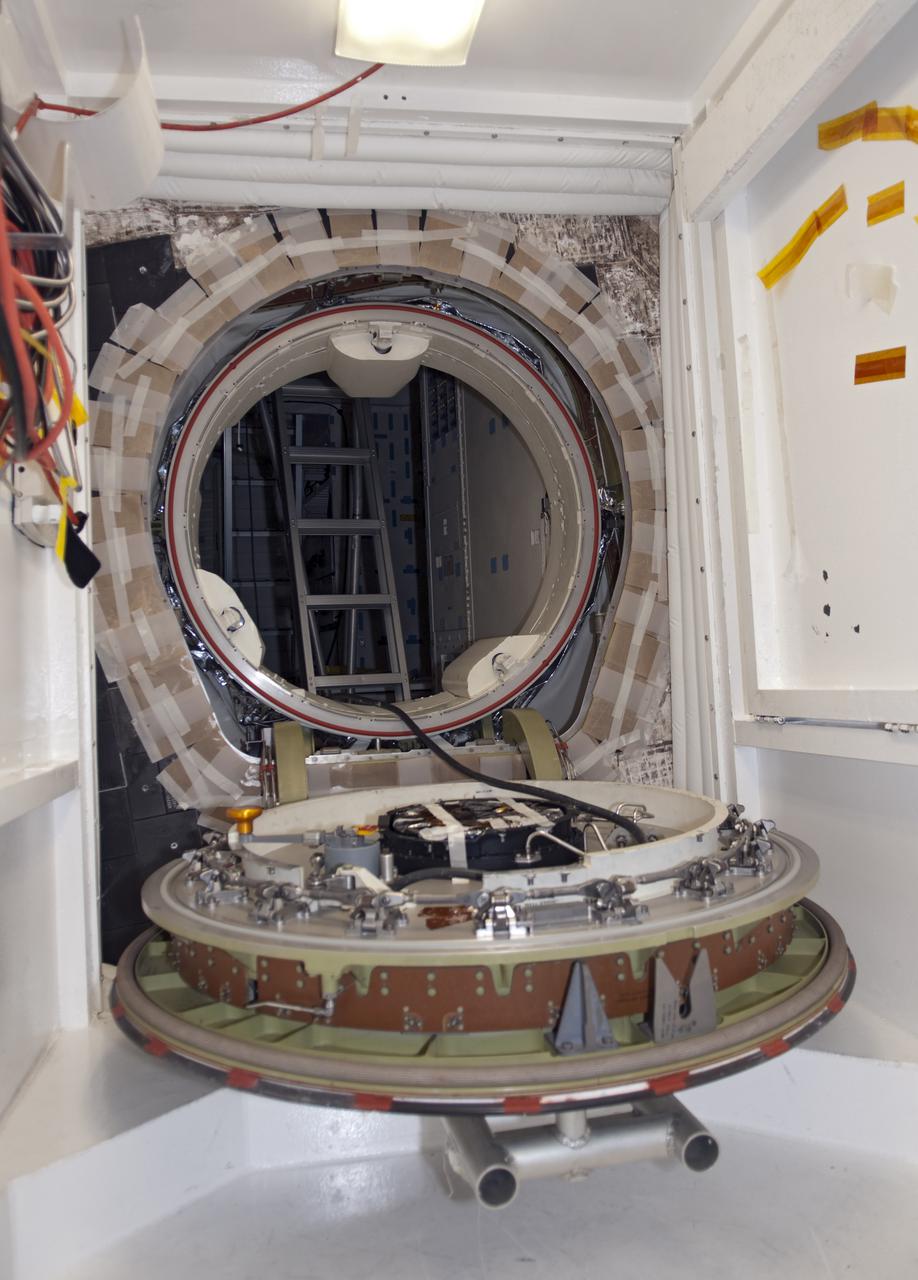
CAPE CANAVERAL, Fla. - Inside Orbiter Processing Facility-1 at Kennedy Space Center in Florida, shuttle Atlantis’ hatch closure is in the open position in preparation for the Mylar Pull Test. During the test, the hatch is closed and a scale is used to measure the force required to pull a piece of Mylar paper out from between the door and structural wall thermal barriers. The pull test is performed to ensure the integrity of the hatch and that it has closed properly. Atlantis is being processed for the STS-132 mission targeted for launch May 14. The six-member crew will deliver an Integrated Cargo Carrier and a Russian-built Mini Research Module to the International Space Station. Photo credit: NASA_Jim Grossmann
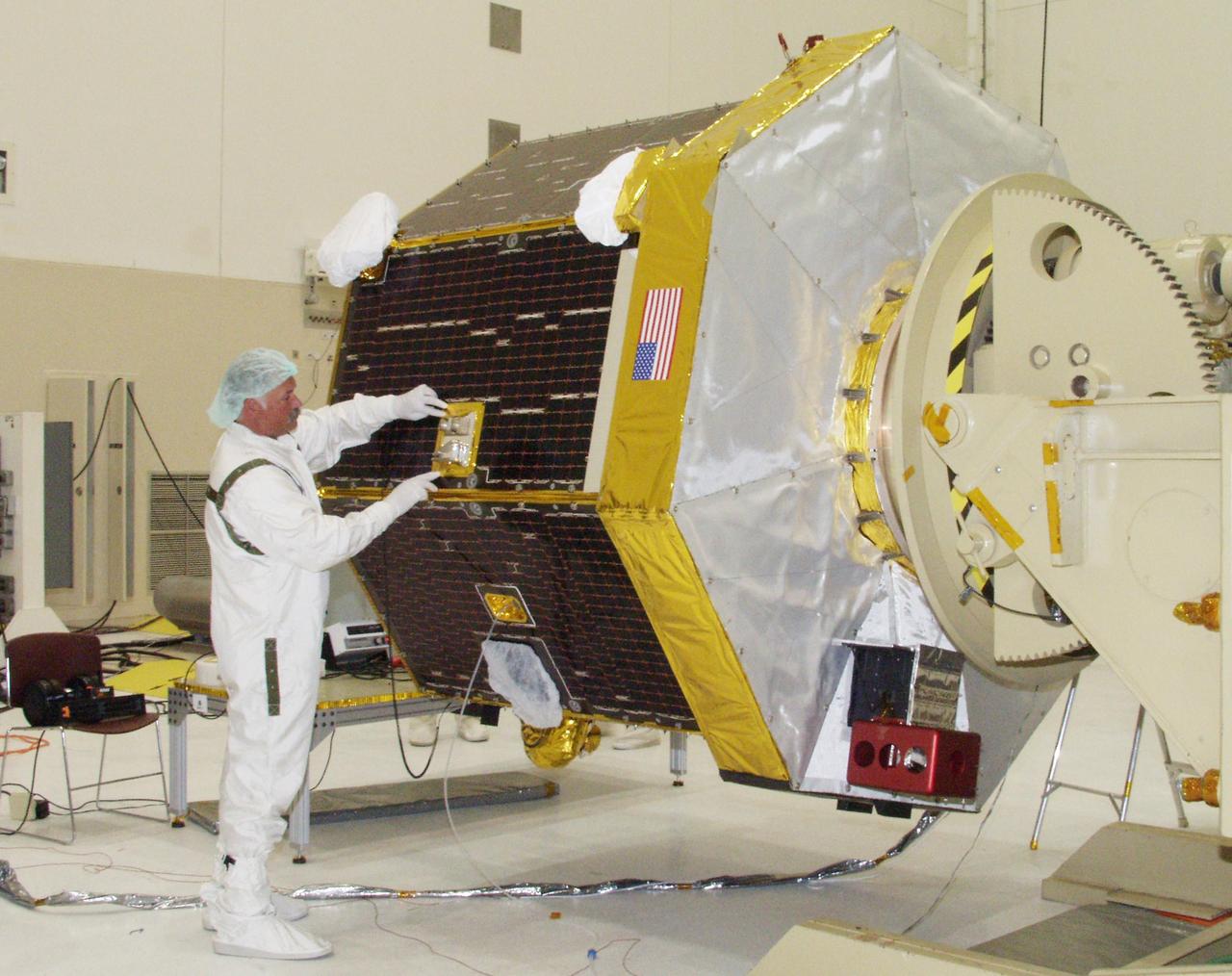
KENNEDY SPACE CENTER, FLA. -- A thermal technician with Johns Hopkins University Applied Physics Laboratory closes out the blanket around CONTOUR'S Earth-Sun Sensor. The spacecraft will provide the first detailed look into the heart of a comet -- the nucleus. Flying as close as 60 miles (100 kilometers) to at least two comets, the spacecraft will take the sharpest pictures yet of a nucleus while analyzing the gas and dust that surround these rocky, icy building blocks of the solar system. Launch of CONTOUR aboard a Boeing Delta II rocket is scheduled for July 1 from Launch Pad 17-A, Cape Canaveral Air Force Station
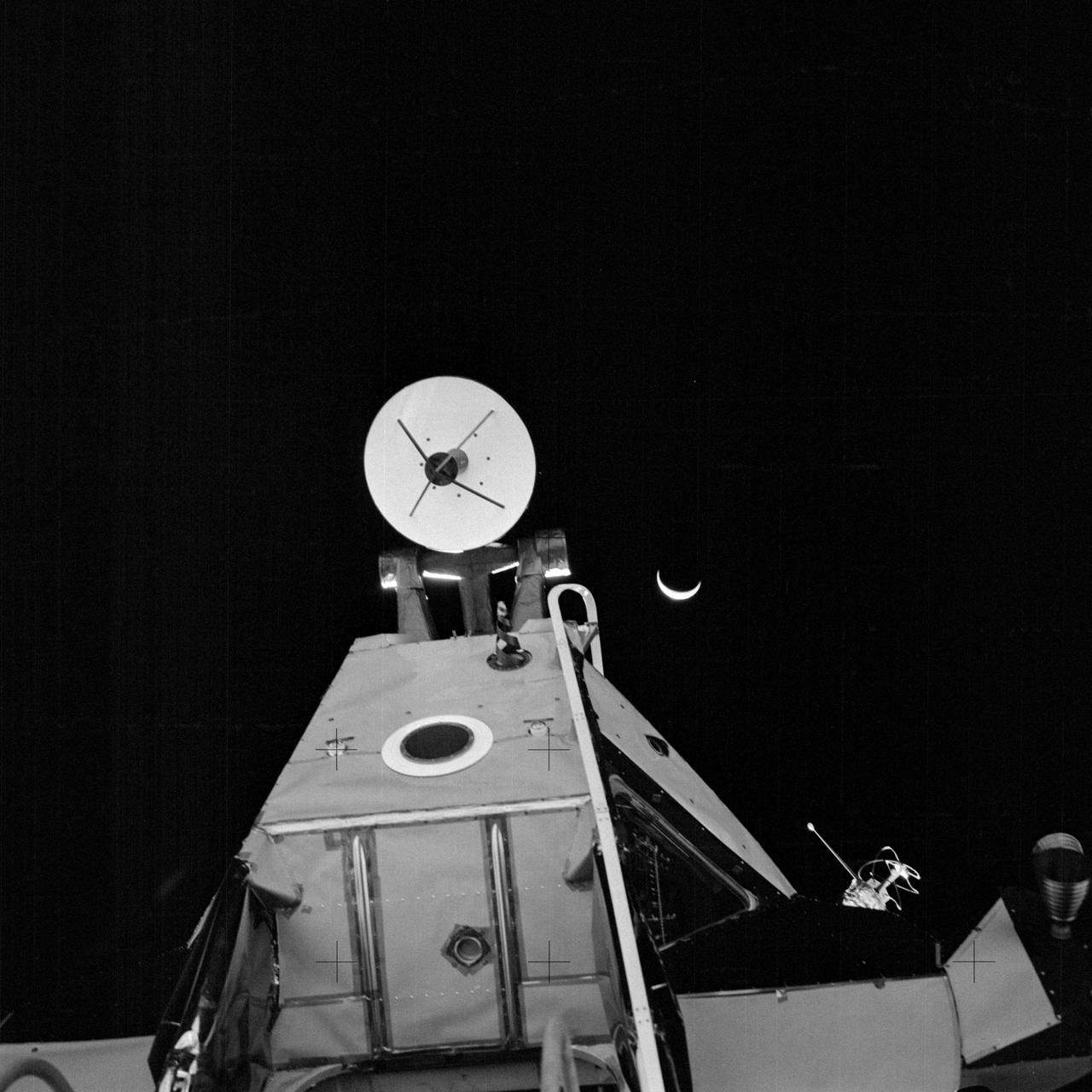
AS14-64-9193 (5 Feb. 1971) --- A close-up view of the forward section of the Apollo 14 Lunar Module (LM) ascent stage, looking upward from the LM ladder. This photograph was taken by one of the Apollo 14 astronauts at the close of their first extravehicular activity (EVA). The LM's ingress/egress hatch is just out of view at the bottom, near center. At the top center is the rendezvous radar antenna. An RCS thruster is visible at the far right. One of the two VHF antennas is on the right. The LM's optical alignment telescope is located at the black circle which has a wide, white ring around it. The crescent Earth can be seen in the far distant background.
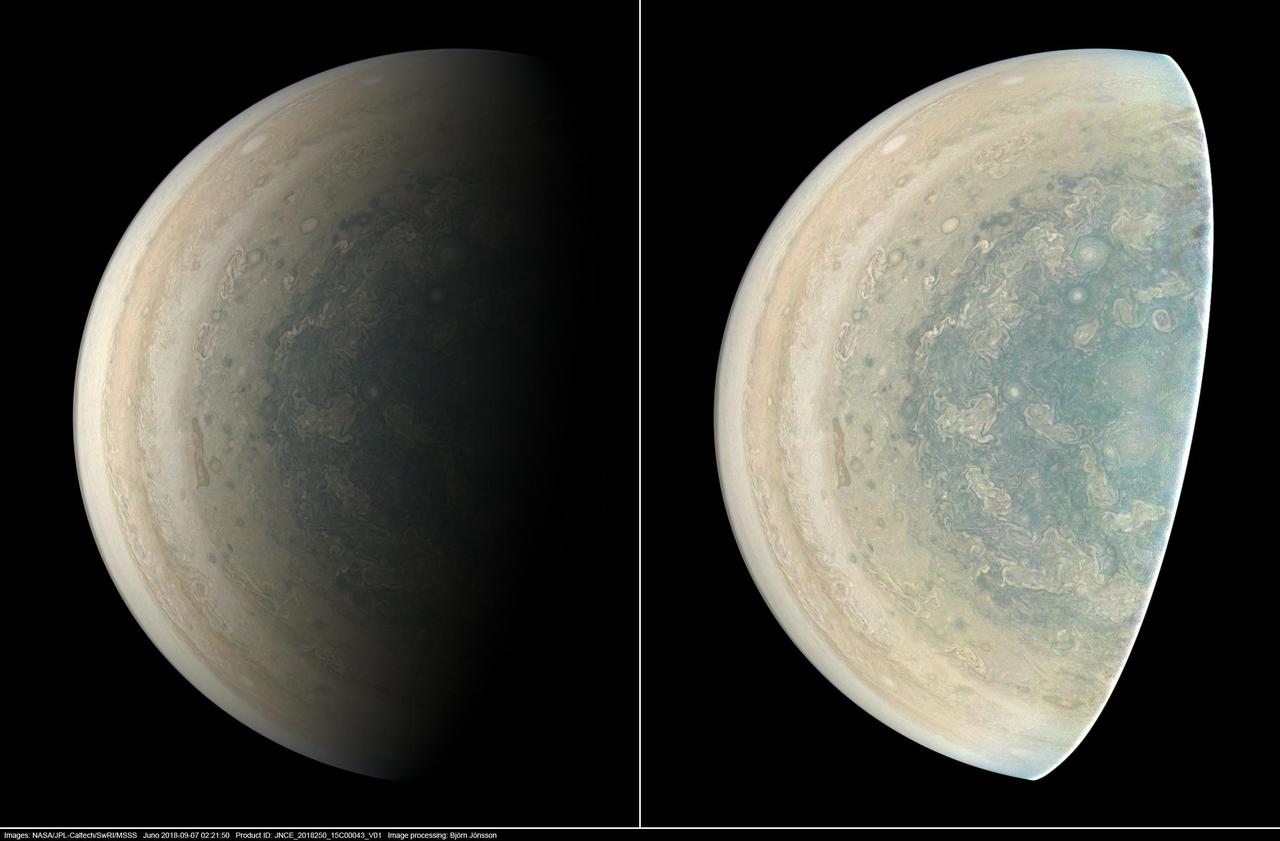
This image was taken at 7:21 p.m. PDT (10:21 p.m. EDT) on Sept. 6, 2018, as the spacecraft performed its 15th close flyby of Jupiter. The version of the image on the left side shows Jupiter in approximate true color, while the same image on the right has been processed to bring out detail close to the terminator and reveals four of the five southern circumpolar cyclones plus the cyclone in the center. Citizen scientist Björn Jónsson created this image using data from the spacecraft's JunoCam imager. https://photojournal.jpl.nasa.gov/catalog/PIA22933. - Enhanced image by Björn Jónsson (CC-NC-SA) based on images provided courtesy of NASA/JPL-Caltech/SwRI/MSSS
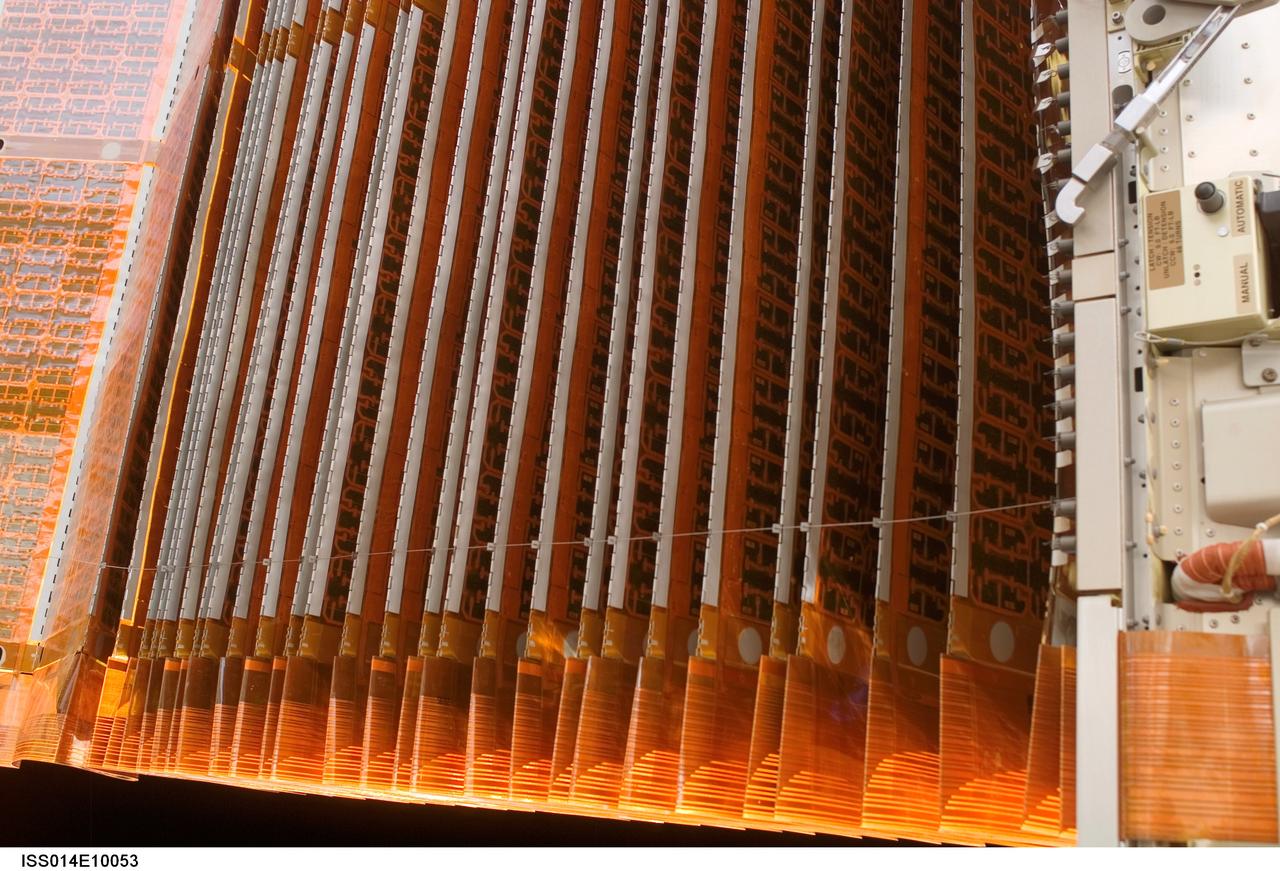
ISS014-E-10053 (18 Dec. 2006) --- A close-up view of the port overhead solar array wing on the International Space Station's P6 truss is featured in this image photographed by a STS-116 crewmember during the mission's fourth session of extravehicular activity (EVA). Astronaut Robert L. Curbeam Jr. (out of frame) and European Space Agency (ESA) astronaut Christer Fuglesang (out of frame), both mission specialists, using specially prepared, tape-insulated tools, guided the array wing neatly inside its blanket box during the 6-hour, 38-minute spacewalk.
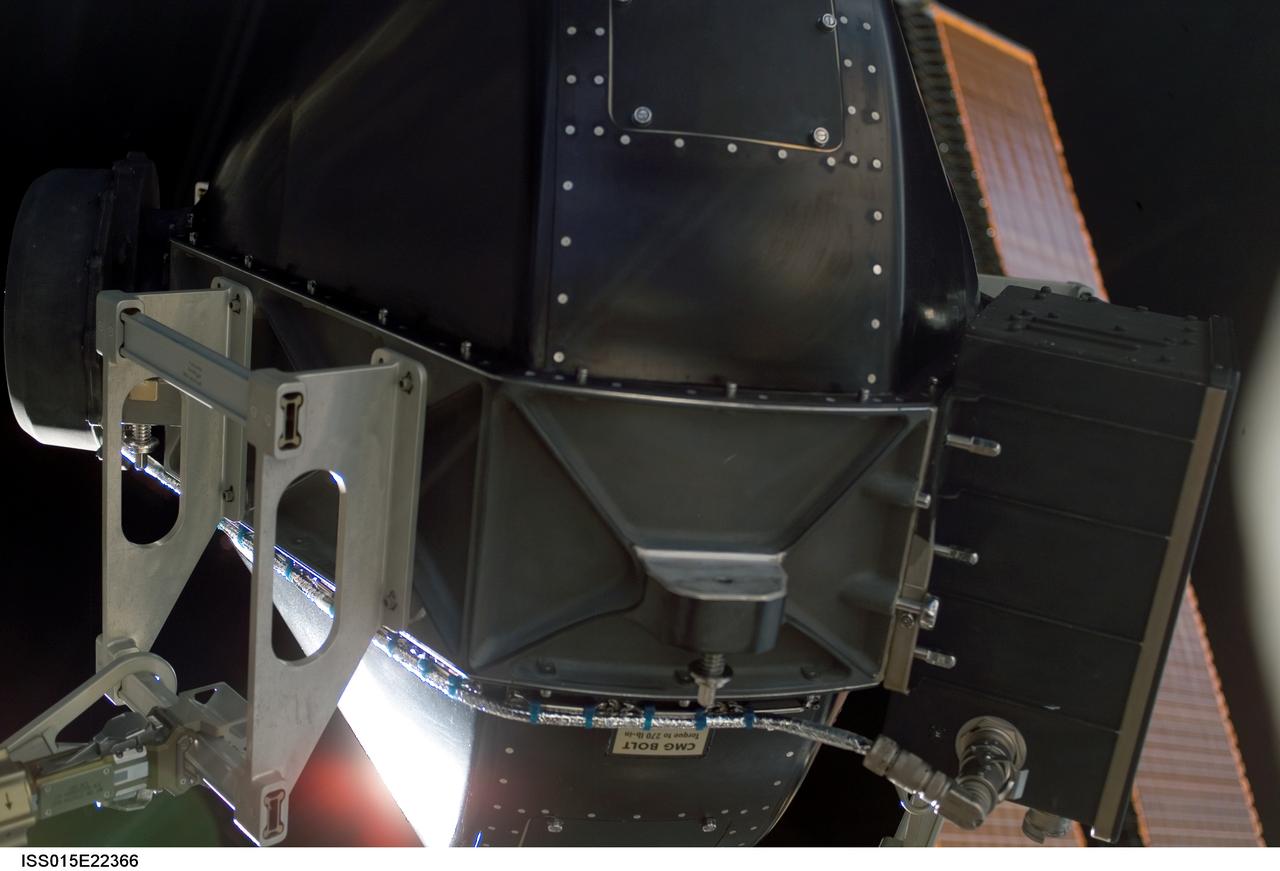
ISS015-E-22366 (13 Aug. 2007) --- A close-up view of the new control moment gyroscope (CMG) photographed by a crewmember during the mission's second planned session of extravehicular activity (EVA). During the spacewalk, Canadian Space Agency's astronaut Dave Williams (out of frame) and astronaut Rick Mastracchio (out of frame), both STS-118 mission specialists, removed a faulty control moment gyroscope (CMG-3) and installed a new CMG into the station's Z1 truss. The failed CMG will remain at its temporary stowage location on the station's exterior before it is returned to Earth on a later shuttle mission. The new gyroscope is one of four CMGs that are used to control the station's attitude in orbit.
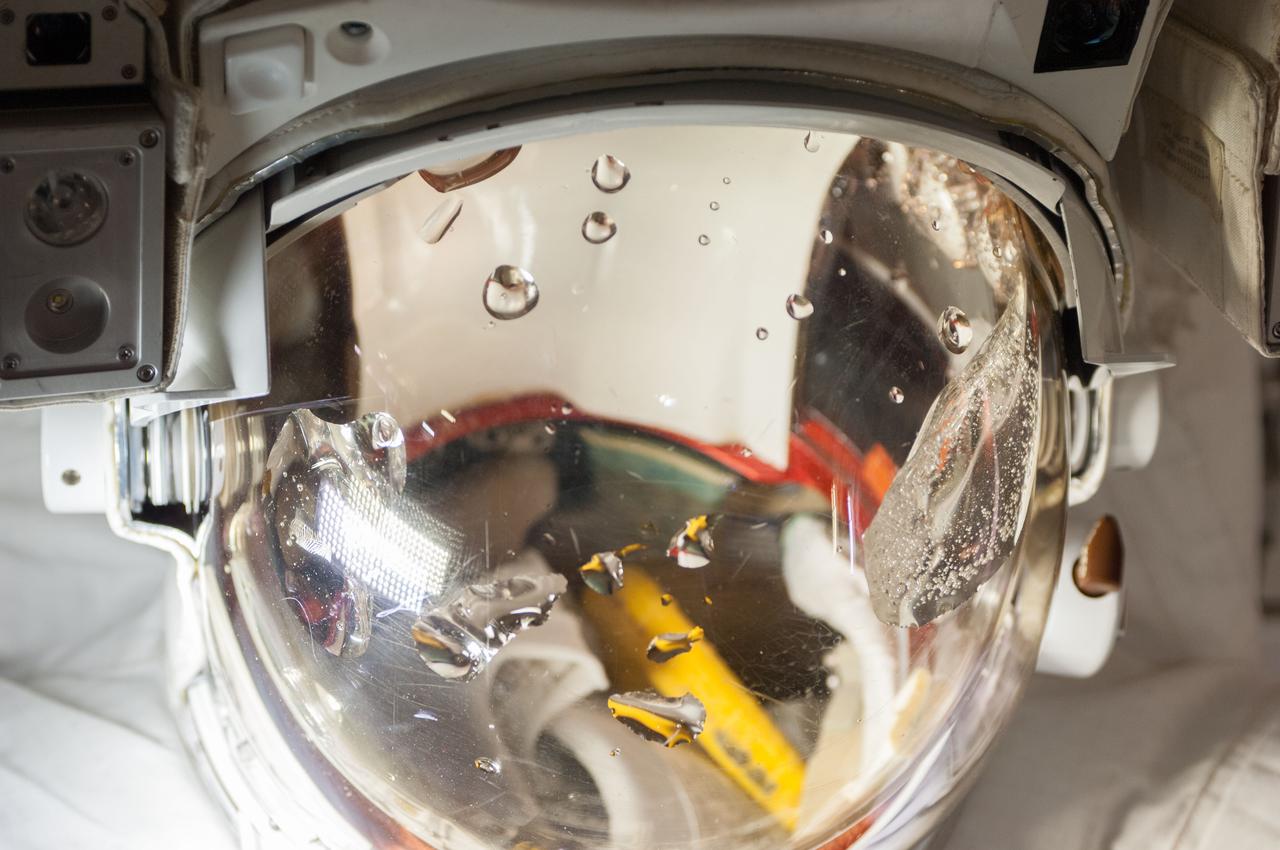
ISS036-E-037249 (27 Aug. 2013) --- The Extravehicular Mobility Unit (EMU) spacesuit helmet ? worn by European Space Agency astronaut Luca Parmitano during a July 16 spacewalk that was cut short when the helmet began to fill with water ? is captured in a close-up image in the Quest airlock of the International Space Station. After assembling and powering up the empty suit as if it were about to go out on another spacewalk, Parmitano and NASA astronaut Chris Cassidy (both out of frame), both Expedition 36 flight engineers, observed water once again leaking into the helmet. With the issue reproduced, NASA now has a baseline configuration for the crew to begin swapping out parts for additional tests to pinpoint the problem. There are also opportunities to either launch replacement parts on upcoming cargo flights or return parts to Earth for further study once more is known about the cause of the issue.
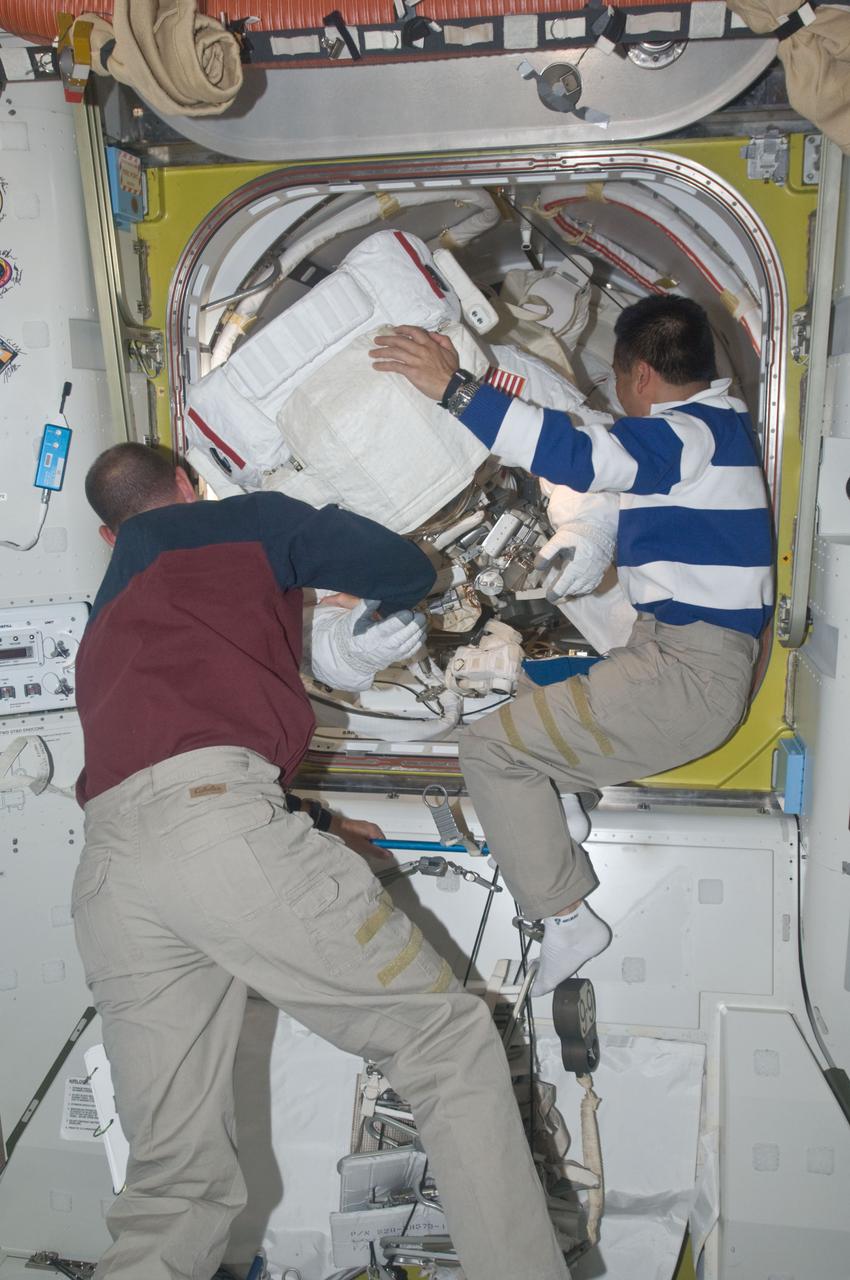
ISS018-E-041411 (21 March 2009) --- Astronaut Tony Antonelli (left), STS-119 pilot; and Japan Aerospace Exploration Agency (JAXA) astronaut Koichi Wakata, Expedition 18 flight engineer, assist astronaut Steve Swanson and Joseph Acaba (out of frame), both STS-119 mission specialists, as they return to the Quest Airlock of the International Space Station as the mission?s second session of extravehicular activity (EVA) draws to a close.
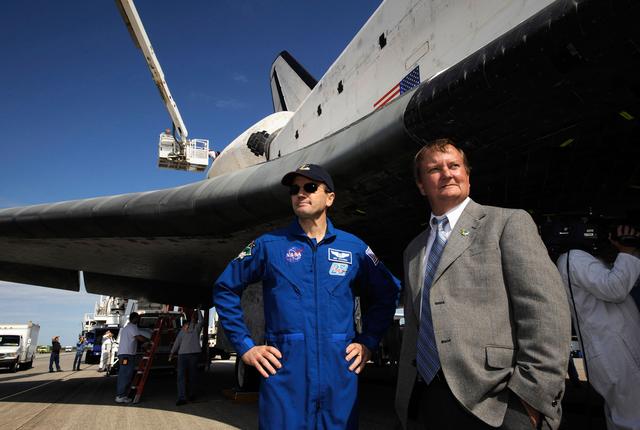
STS-122 Mission Specialist, Rex Walheim, left, and Shuttle Launch Director, Michael D. Leinbach take a moment to watch the close out crew work on the space shuttle Atlantis. Atlantis landed at the Shuttle Landing Facility, 9:07a.m., Wednesday, Feb. 20, 2008 at Kennedy Space Center, Fla. completing delivery of the European Space Agency’s (ESA) Columbus laboratory to the International Space Station. Photo Credit: (NASA/Bill Ingalls)
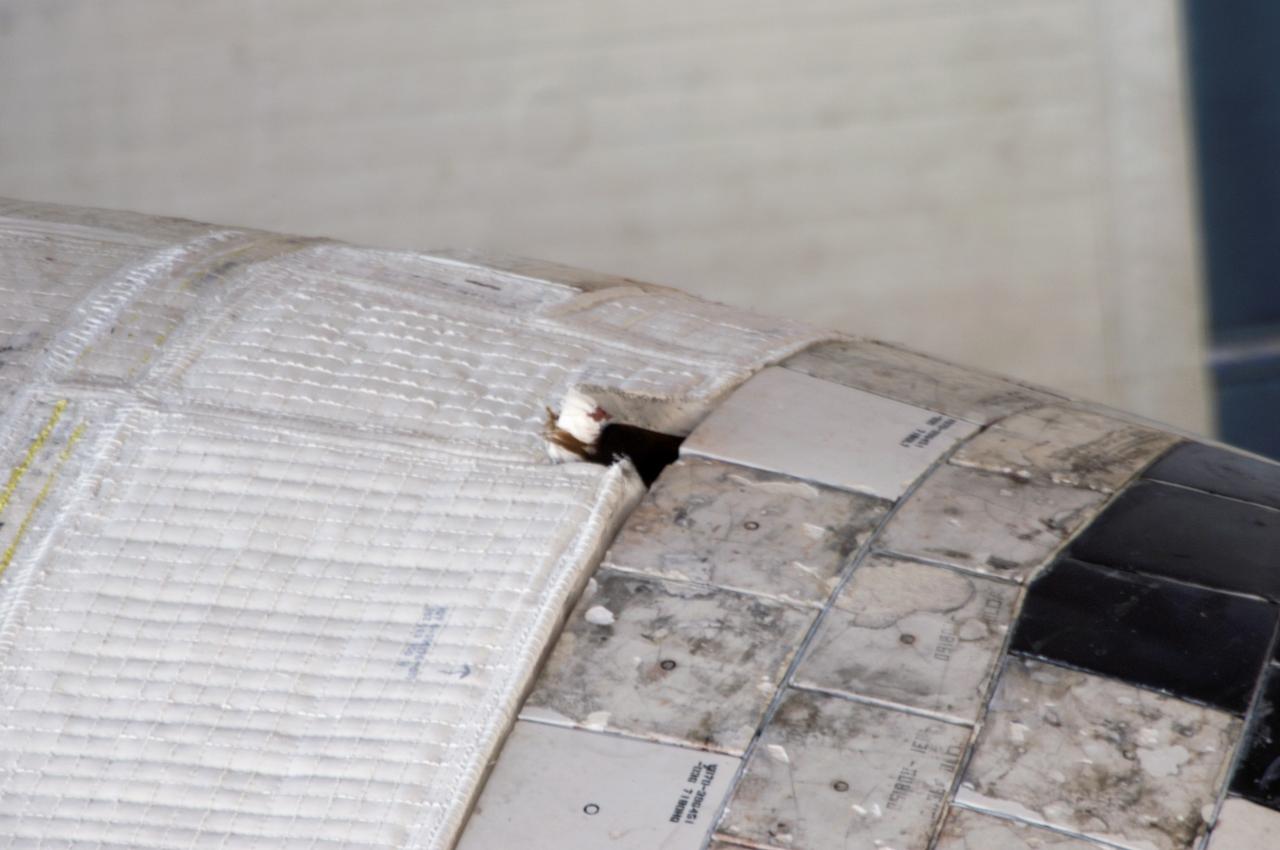
S117-E-08982 (15 June 2007) --- Medium close-up scene of Atlantis' port side orbital maneuvering system pod prior to repair work performed by astronaut John (Danny) Olivas, STS-117 mission specialist (out of frame). Olivas later spent two hours stapling and pinning down this piece of thermal blanket on the pod. The 4-by-6-inch corner of the blanket peeled up during the shuttle's launch last week.
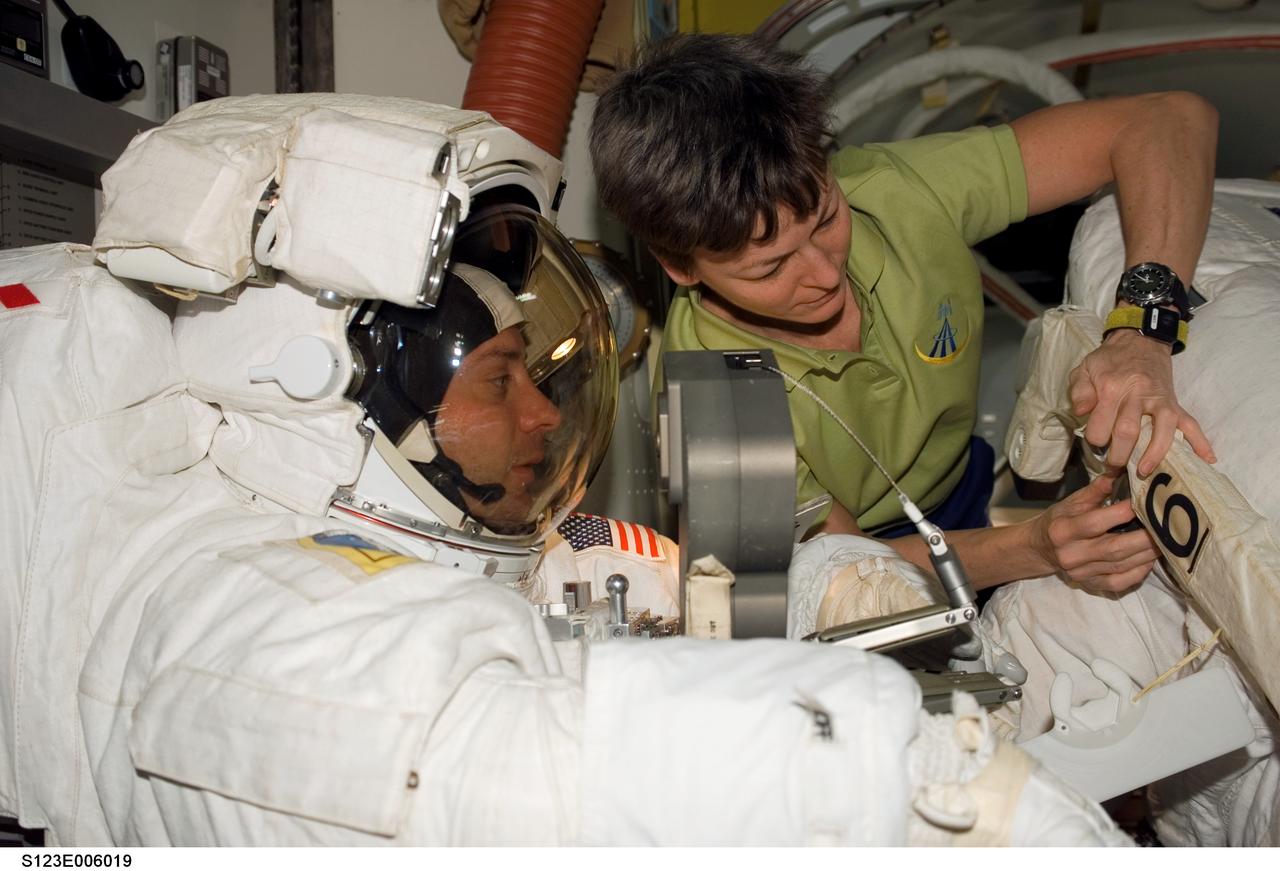
S123-E-006019 (14 March 2008) --- Astronaut Peggy Whitson, Expedition 16 commander, assists astronauts Garrett Reisman, Expedition 16 flight engineer, and Rick Linnehan (partially out of frame), STS-123 mission specialist, in doffing their Extravehicular Mobility Unit (EMU) spacesuits in the Quest Airlock of the International Space Station as the mission's first session of extravehicular activity (EVA) draws to a close.
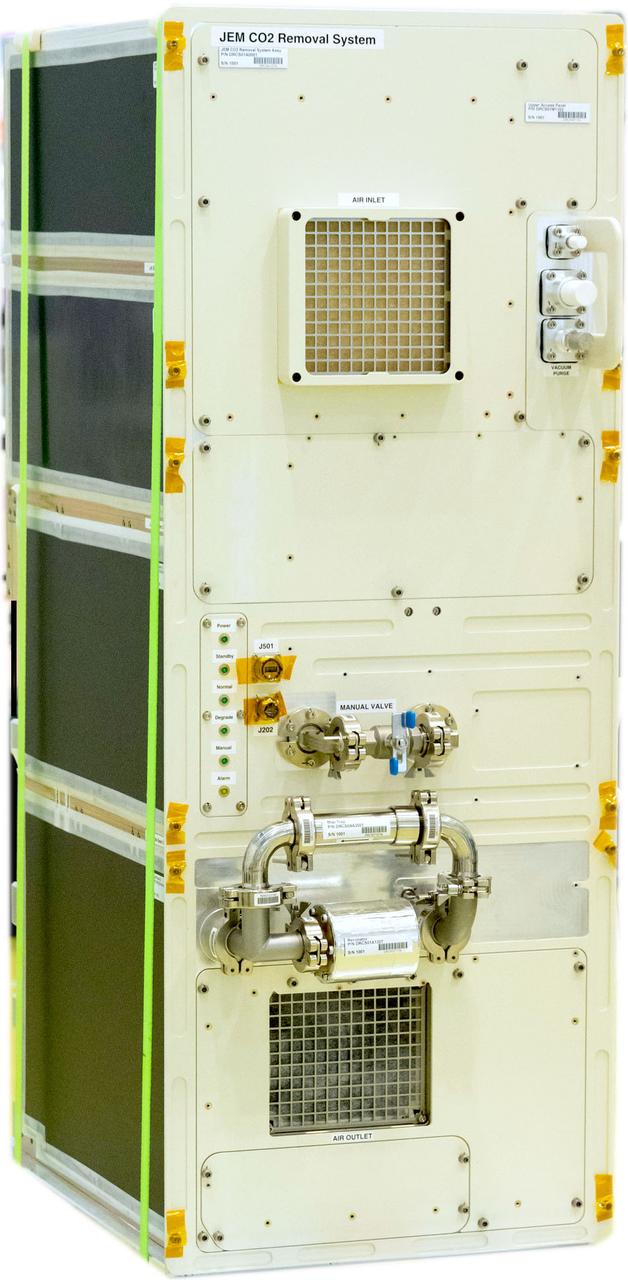
jsc2025e076916 (September 25, 2025) -- A close-up view of the JEM Demonstration of CO? Removal System (JEM DRCS) hardware. JEM DRCS will operate on the space station by filtering carbon dioxide out of the cabin air. The experiment will help guide future spacecraft life support systems and could also support technologies that reduce carbon dioxide emissions on Earth. Image courtesy of JAXA.

Space shuttle Atlantis is seen as it rolls down Kennedy Parkway on its way to its new home at the Kennedy Space Center Visitor Complex, Friday, Nov. 2, 2012, in Cape Canaveral, Fla. The spacecraft traveled 125,935,769 miles during 33 spaceflights, including 12 missions to the International Space Station. Its final flight, STS-135, closed out the Space Shuttle Program era with a landing on July 21, 2011. Photo Credit: (NASA/Bill Ingalls)

Space shuttle Atlantis is seen near the Orbiter Processing Facility during its trip to its new home at the Kennedy Space Center Visitor Complex, early Friday, Nov. 2, 2012, in Cape Canaveral, Fla. The spacecraft traveled 125,935,769 miles during 33 spaceflights, including 12 missions to the International Space Station. Its final flight, STS-135, closed out the Space Shuttle Program era with a landing on July 21, 2011. Photo Credit: (NASA/Bill Ingalls)
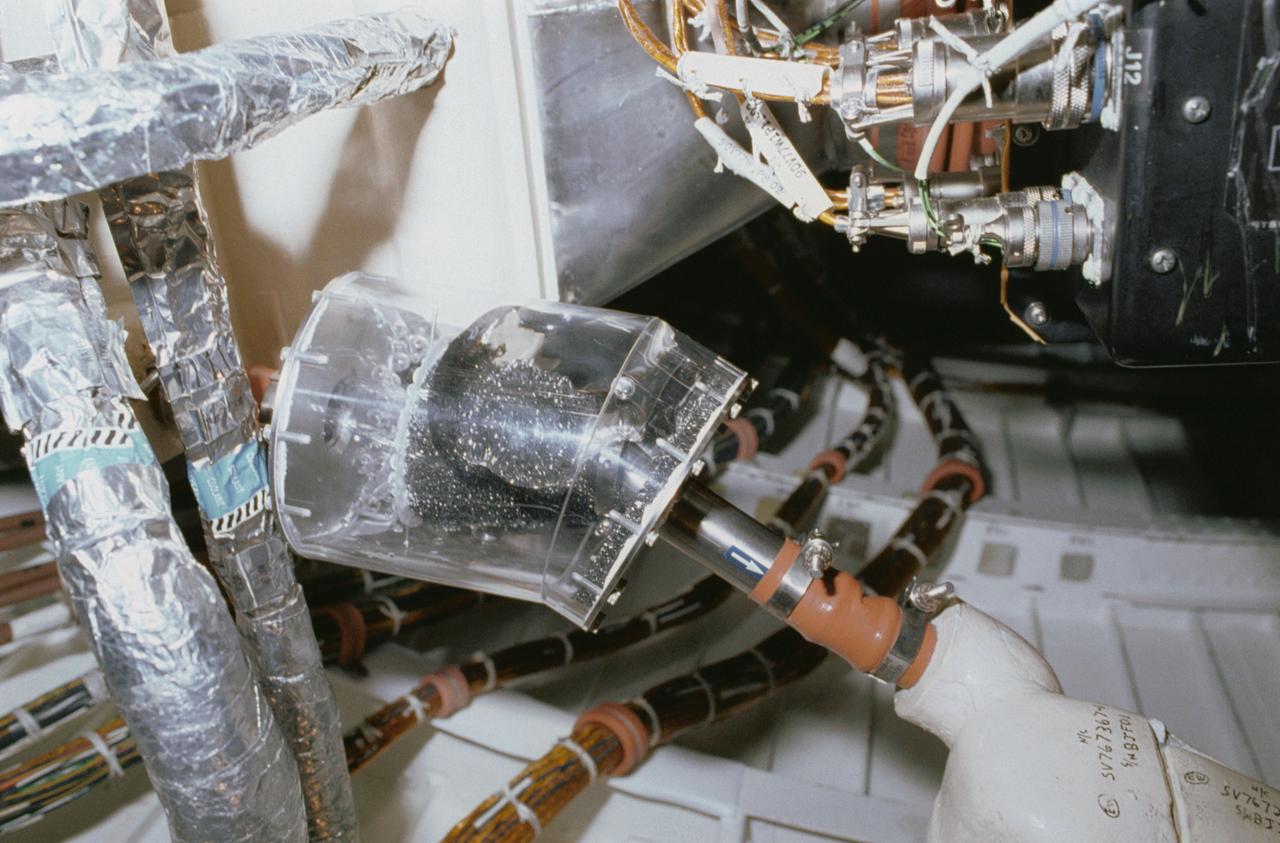
STS040-34-001 (5-14 June 1991) --- This 35mm scene shows a close-up of a prototype filter designed to remove contamination from air and water, before it flows into the Orbiter's humidity separators. This experiment is part of Development Test Objective (DTO) 647, Water Separator Filter Performance Evaluation. Astronauts Bryan D. O'Connor, mission commander, and Sidney M. Gutierrez, pilot, carried out the test and down linked television to the ground for engineering analysis.
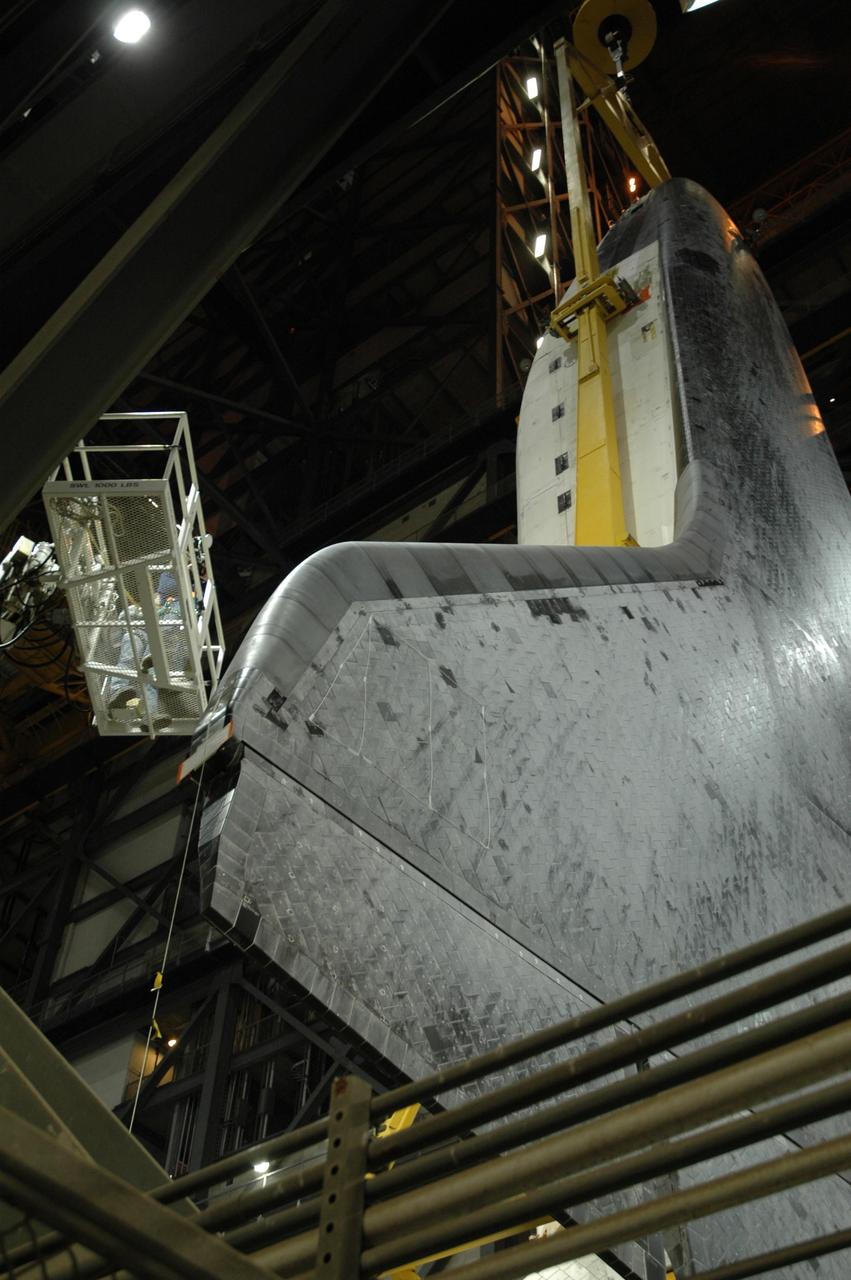
KENNEDY SPACE CENTER, FLA. -- In the transfer aisle of the Vehicle Assembly Building, workers take a close look at the orbiter Atlantis before it is lifted up into high bay 1. After the lift, it will be lowered onto the mobile launcher platform where the external tank and solid rocket boosters are already stacked. Space Shuttle Atlantis is targeted to roll out to Launch Pad 39A on February 14 for mission STS-117. The mission is No. 21 to the International Space Station and construction flight 13A. Photo credit: NASA/Amanda Diller

CAPE CANAVERAL, Fla. – In the Vehicle Assembly Building at NASA's Kennedy Space Center, a technician closely watches the progress of space shuttle Atlantis as it is lowered alongside the external fuel tank in high bay 3. Atlantis will be mated to the tank and twin solid rocket boosters stacked on the mobile launcher platform. After additional preparations are made, the shuttle will be rolled out to Launch Pad 39A to prepare for launch on the STS-125 mission targeted for 1:34 a.m. EDT Oct. 8. Photo credit: NASA/Dimitri Gerondidakis
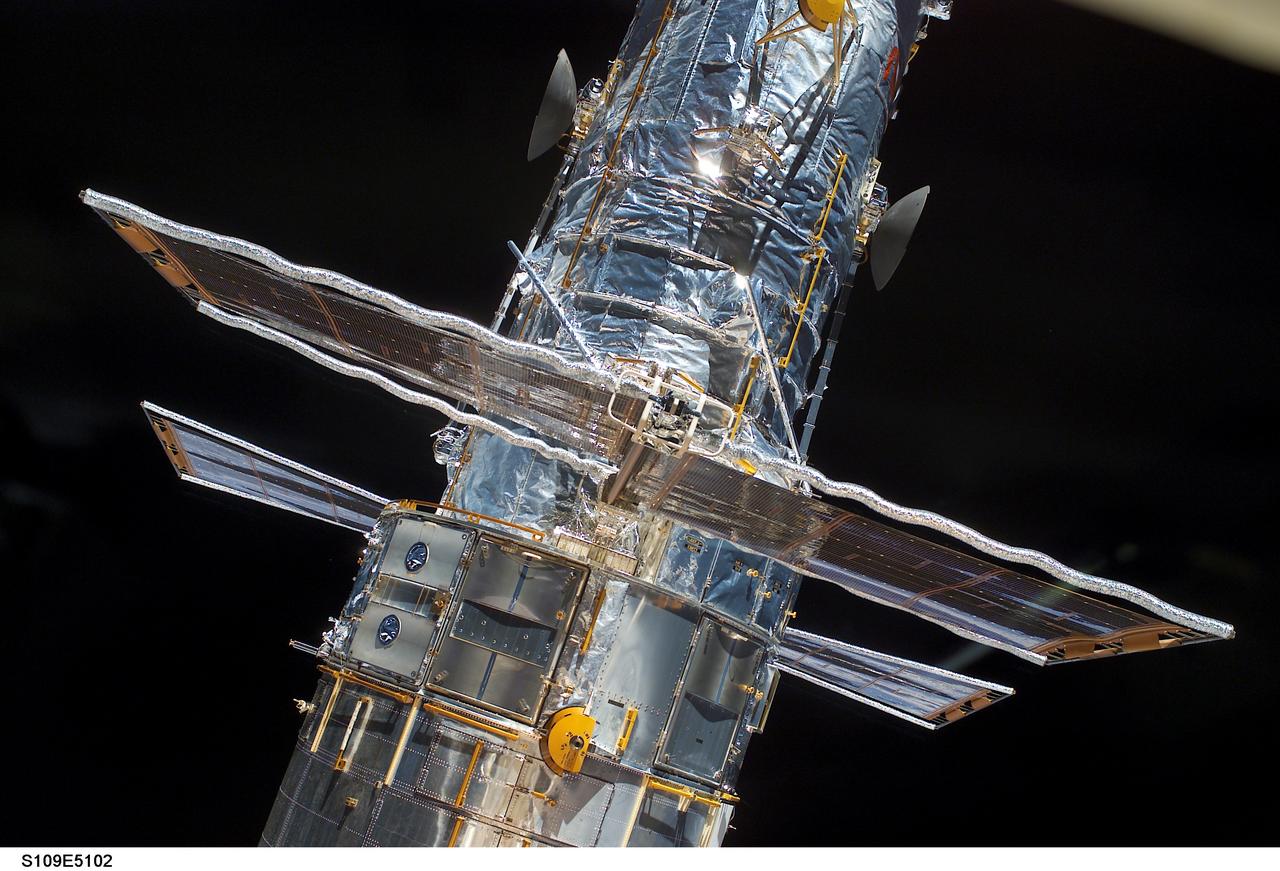
STS109-E-5102 (3 March 2002) --- The Hubble Space Telescope is seen in the cargo bay of the Space Shuttle Columbia. Each present set of solar array panels will be replaced during one of the space walks planned for the coming week. The crew aimed various cameras, including the digital still camera used for this frame, out the shuttle's aft flight deck windows to take a series of survey type photos, the first close-up images of the telescope since December of 1999.
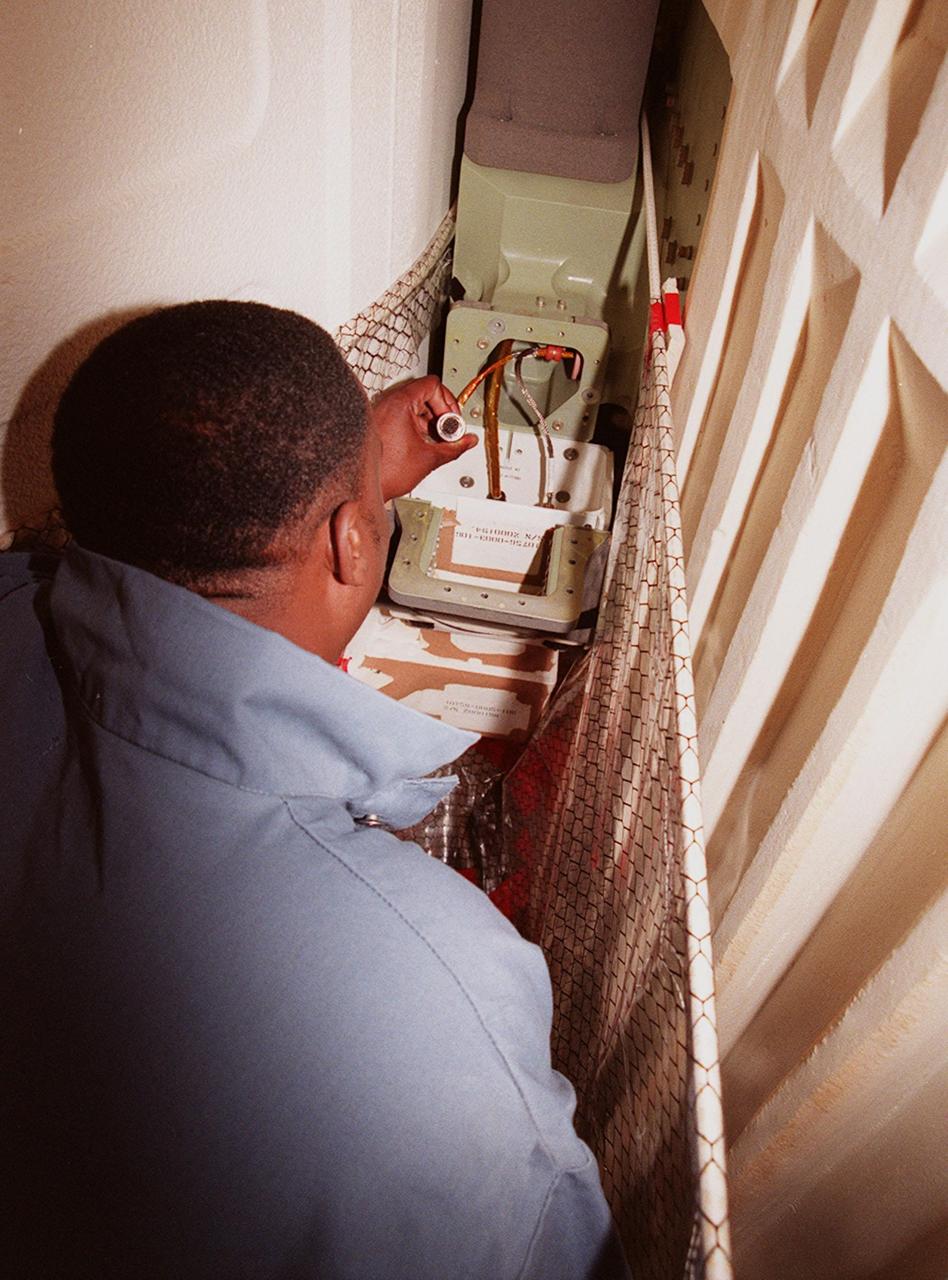
KENNEDY SPACE CENTER, FLA. -- Rodney Wilson, with United Space Alliance, inspects the range safety cable between the external tank and solid rocket boosters (SRB) on Space Shuttle Discovery. The cable, which relays a redundant emergency destruction signal between the SRBs in the unlikely event of a contingency, was damaged during close-out operations and is being replaced. Discovery's processing schedule leads to a target launch date of Dec. 6

Onlookers watch as space shuttle Atlantis rolls to its new home at the Kennedy Space Center Visitor Complex, early Friday, Nov. 2, 2012, in Cape Canaveral, Fla. The spacecraft traveled 125,935,769 miles during 33 spaceflights, including 12 missions to the International Space Station. Its final flight, STS-135, closed out the Space Shuttle Program era with a landing on July 21, 2011. Photo Credit: (NASA/Bill Ingalls)
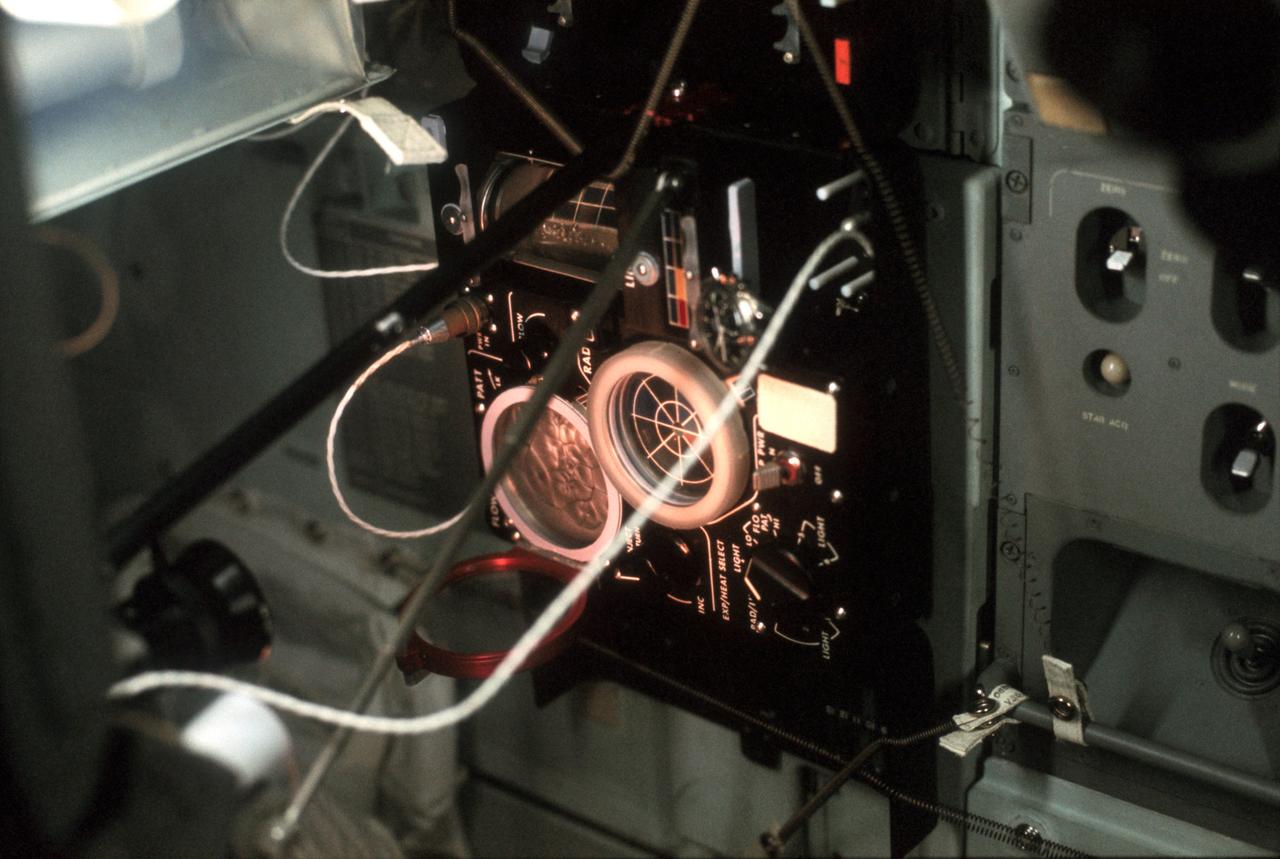
AS17-162-24063 (7-19 Dec. 1972) --- A close-up view of the equipment used for the Heat Flow and Convection Experiment, an engineering and operational test and demonstration carried out aboard the Apollo 17 command module during the final lunar landing mission in NASA's Apollo program. Three test cells were used in the demonstration for measuring and observing fluid flow behavior in the absence of gravity in space flight. Data obtained from such demonstrations will be valuable in the design of future science experiments and for manufacturing processes in space.
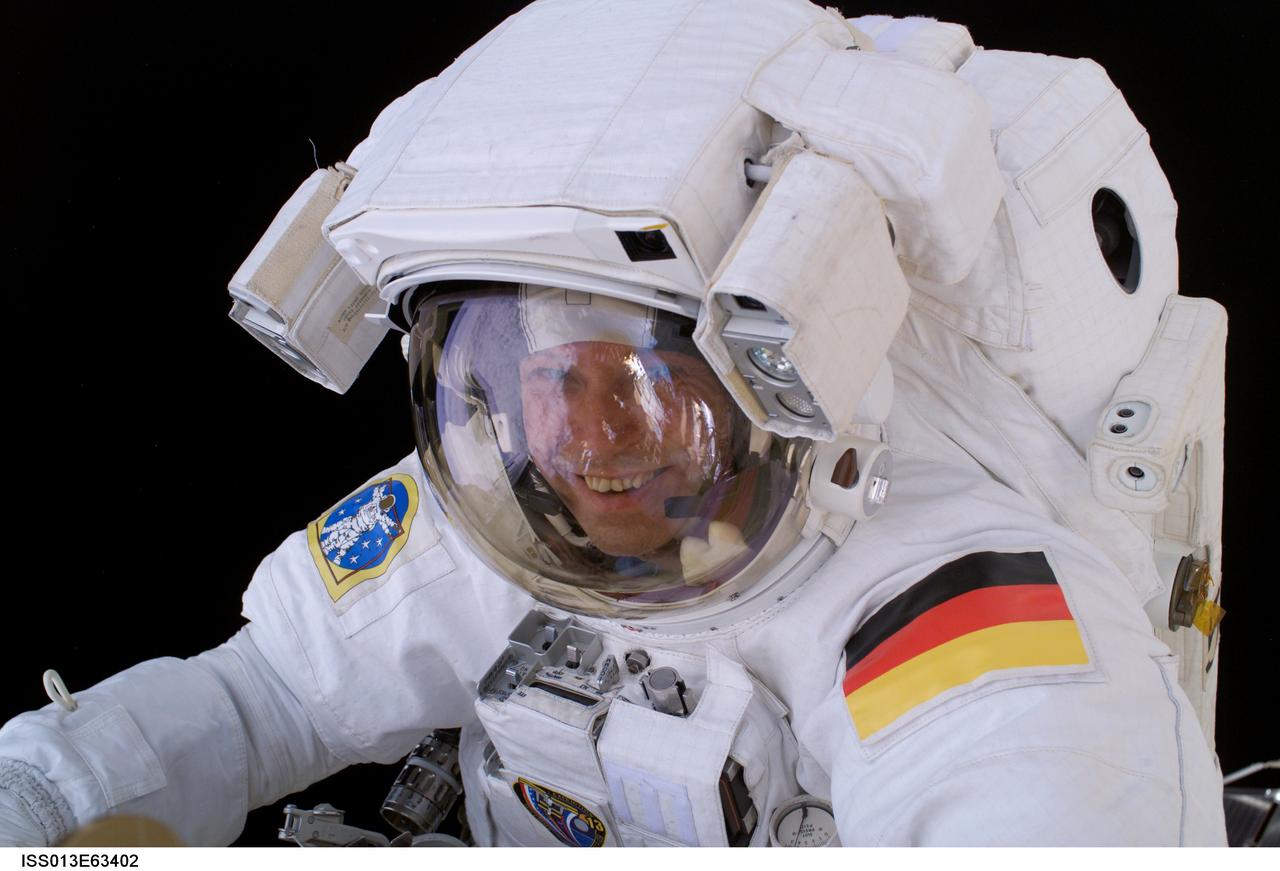
ISS013-E-63402 (3 August 2006) --- Astronaut Thomas Reiter, who represents the European Space Agency on the Expedition 13 crew, is photographed during a 5-hour, 54-minute excursion which he shared with astronaut Jeffrey N. Williams (out of frame). For part of the spacewalk, the pair worked closely in tandem, and then worked separately, getting ahead of their timeline, thus enabling the two to tack on extra tasks.

Space shuttle Atlantis, (OV-104), is seen as it begins its trip to its new home at the Kennedy Space Center Visitor Complex, early Friday, Nov. 2, 2012, in Cape Canaveral, Fla. The spacecraft traveled 125,935,769 miles during 33 spaceflights, including 12 missions to the International Space Station. Its final flight, STS-135, closed out the Space Shuttle Program era with a landing on July 21, 2011. Photo Credit: (NASA/Bill Ingalls)
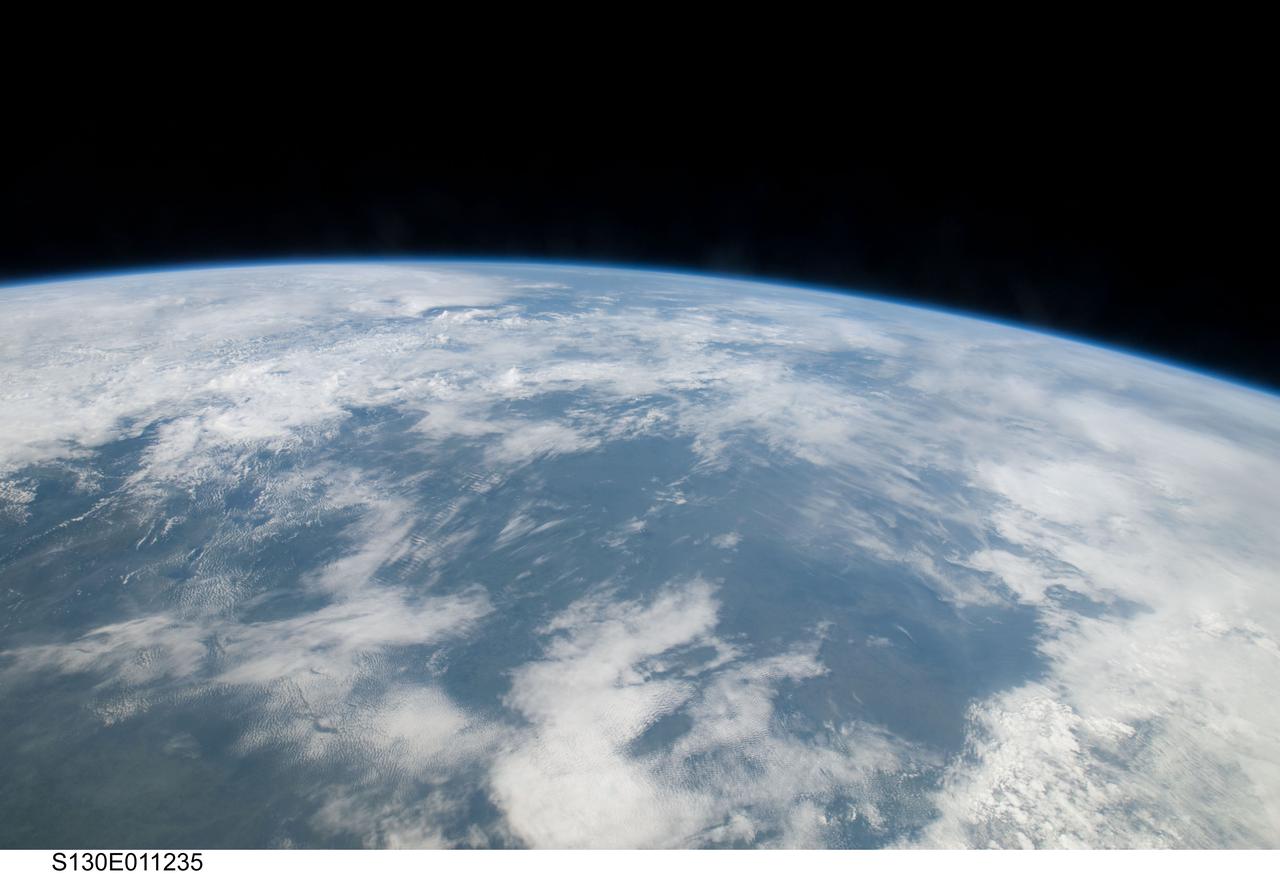
S130-E-011235 (20 Feb. 2010) --- After several days of seeing out-the-window close-up views of the various elements of the International Space Station, the STS-130 crewmembers aboard the space shuttle Endeavour got a fresh look at the home planet after separating from the orbital outpost. Eleven astronauts and cosmonauts worked together to continue construction on the orbital outpost and perform other tasks in tandem.

This high-resolution image of Jupiter's main dust ring was collected by the Stellar Reference Unit (SRU) navigation camera aboard NASA's Juno spacecraft. The image was taken from inside the ring looking out as Juno flew between Jupiter and the radiation belts during the spacecraft's 36th close flyby on Sept. 2, 2021. The brightest thin dust bands are associated with the orbits of Jupiter's small moons, Metis and Adrastea. The image is at a resolution of nearly 20 miles (32 kilometers) per pixel. https://photojournal.jpl.nasa.gov/catalog/PIA25038

Kennedy Space Center Director Robert Cabana speaks at the signing ceremony for space shuttle Atlantis, background, Friday, Nov. 2, 2012, in Cape Canaveral, Fla. The spacecraft traveled 125,935,769 miles during 33 spaceflights, including 12 missions to the International Space Station. Its final flight, STS-135, closed out the Space Shuttle Program era with a landing on July 21, 2011. Photo Credit: (NASA/Bill Ingalls)

Military personnel salute as Searra Weeks, from Kennedy Middle School, sings the National Anthem, at the signing ceremony for space shuttle Atlantis, background, Friday, Nov. 2, 2012, in Cape Canaveral, Fla. The spacecraft traveled 125,935,769 miles during 33 spaceflights, including 12 missions to the International Space Station. Its final flight, STS-135, closed out the Space Shuttle Program era with a landing on July 21, 2011. Photo Credit: (NASA/Bill Ingalls)
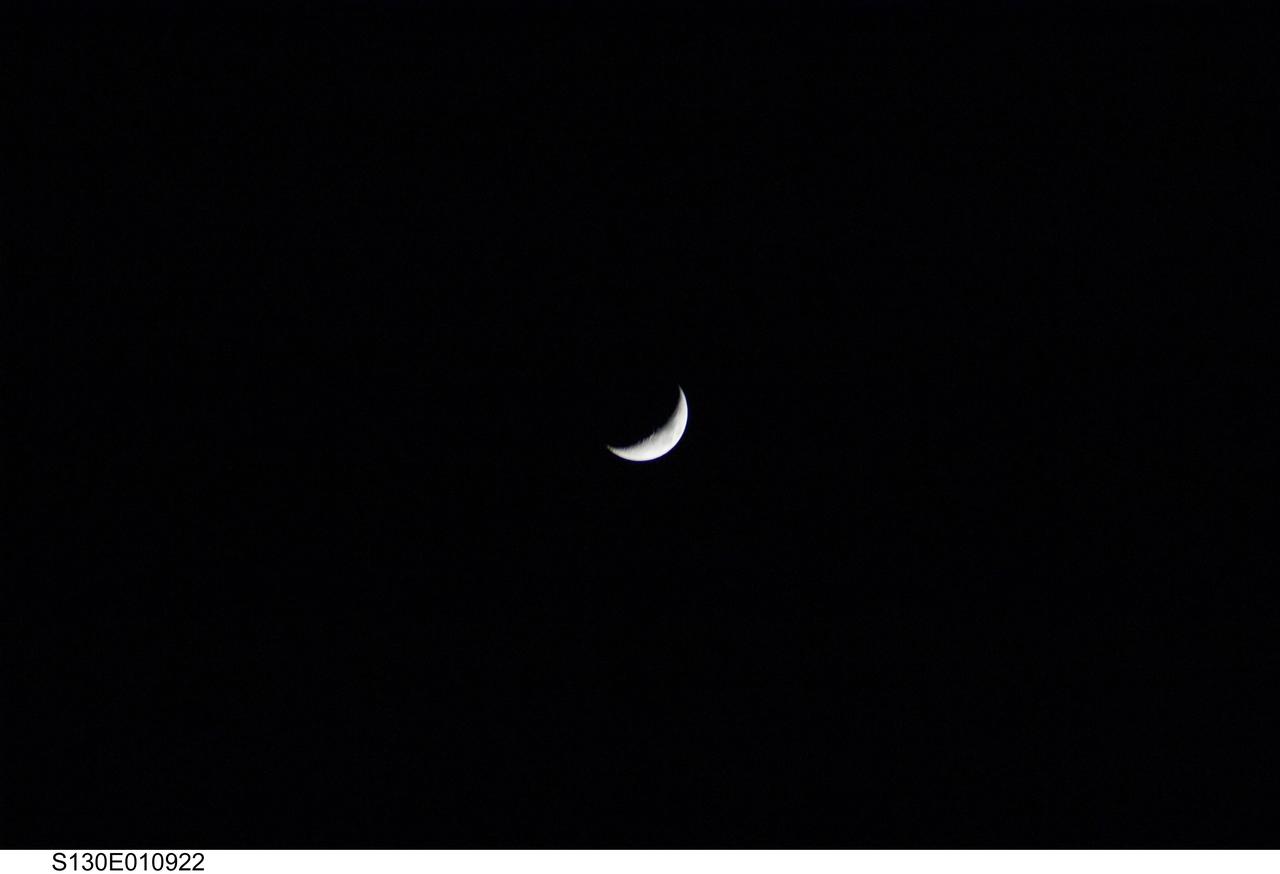
S130-E-010922 (20 Feb. 2010) --- After several days of seeing out-the-window close-up views of the various elements of the International Space Station, the STS-130 crewmembers aboard the space shuttle Endeavour aimed one of their cameras at the waxing crescent moon following separation from the orbital outpost. Eleven astronauts and cosmonauts worked together to continue construction on the orbital outpost and perform other tasks in tandem.

ISS040-E-099392 (18 Aug. 2014) --- Russian cosmonaut Alexander Skvortsov, Expedition 40 flight engineer, attired in a Russian Orlan spacesuit, is pictured in this close-up view during a session of extravehicular activity (EVA) in support of science and maintenance on the International Space Station. During the five-hour, 11-minute spacewalk, Skvortsov and cosmonaut Oleg Artemyev (out of frame) deployed a small science satellite, retrieved and installed experiment packages and inspected components on the exterior of the orbital laboratory.
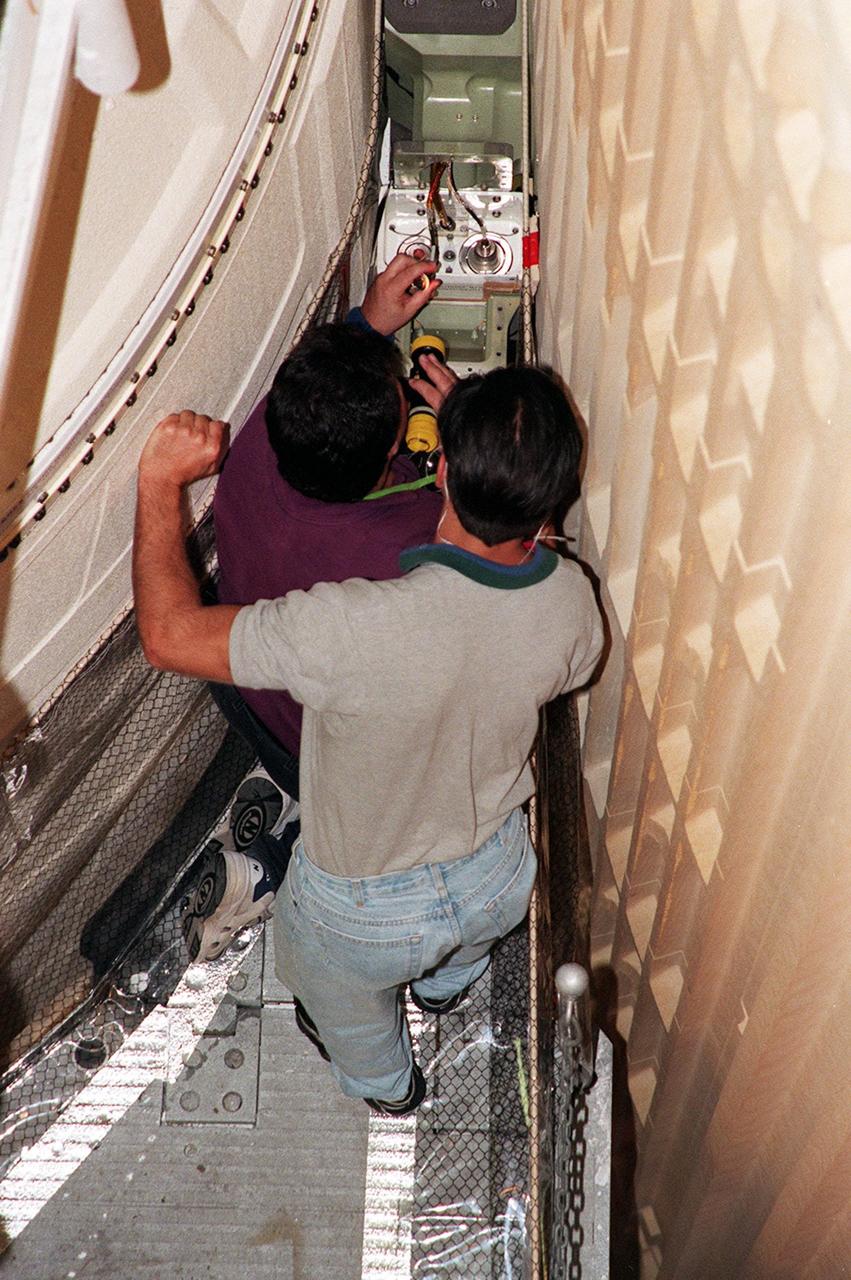
KENNEDY SPACE CENTER, FLA. -- Terry Kent (left), United Space Alliance, and James Silviano (right), NASA, inspect the range safety cable between the external tank and solid rocket boosters (SRB) on Space Shuttle Discovery. The cable, which relays a redundant emergency destruction signal between the SRBs in the unlikely event of a contingency, was damaged during close-out operations and is being replaced. Discovery's processing schedule leads to a target launch date of Dec. 6
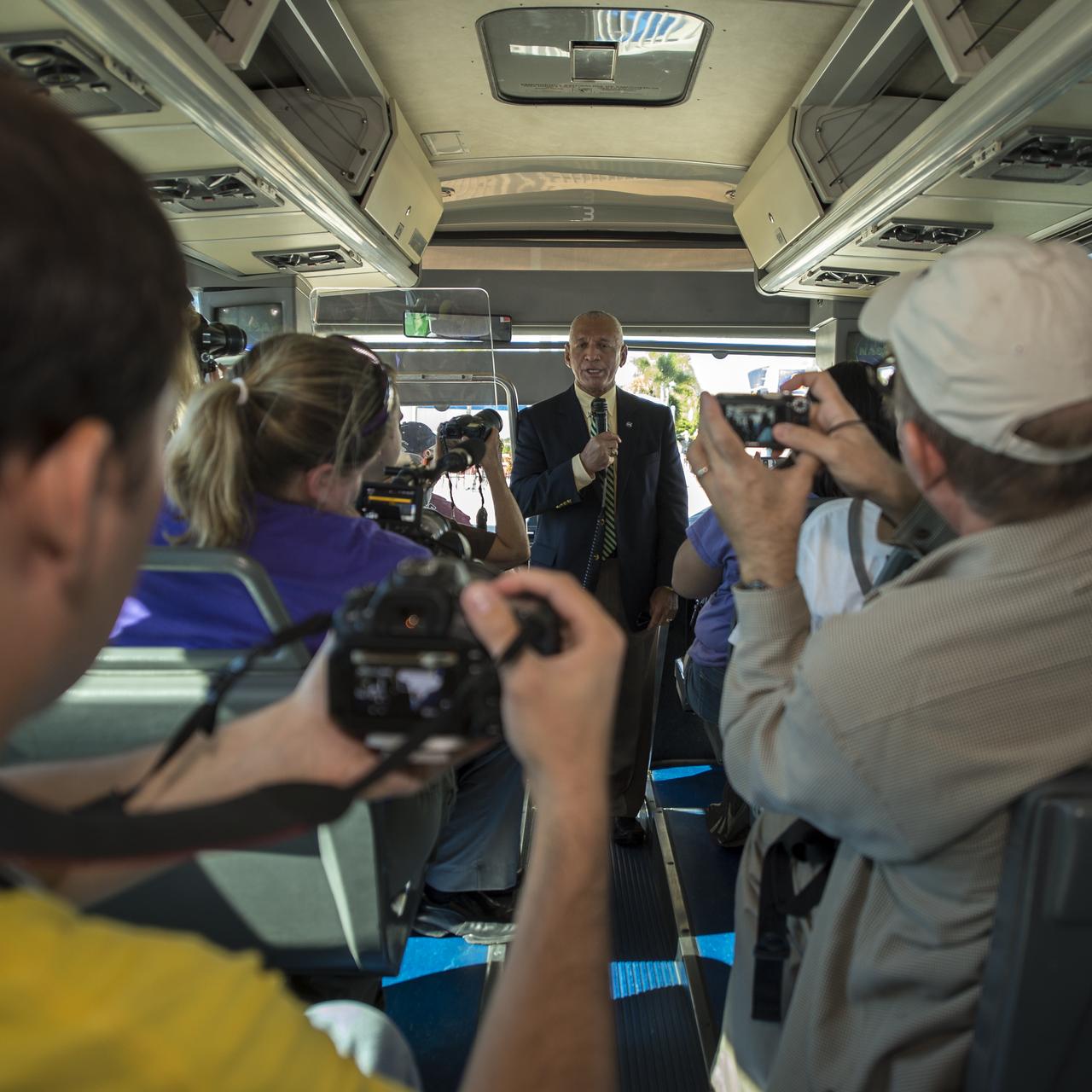
NASA Administrator Charles Bolden speaks with NASA Social attendees during the move of space shuttle Atlantis, Friday, Nov. 2, 2012, at Kennedy Space Center in Cape Canaveral, Fla. The spacecraft traveled 125,935,769 miles during 33 spaceflights, including 12 missions to the International Space Station. Its final flight, STS-135, closed out the Space Shuttle Program era with a landing on July 21, 2011. Photo Credit: (NASA/Bill Ingalls)

Onlookers wearing commemorative t-shirts watch as space shuttle Atlantis rolls to ts new home at the Kennedy Space Center Visitor Complex, early Friday, Nov. 2, 2012, in Cape Canaveral, Fla. The spacecraft traveled 125,935,769 miles during 33 spaceflights, including 12 missions to the International Space Station. Its final flight, STS-135, closed out the Space Shuttle Program era with a landing on July 21, 2011. Photo Credit: (NASA/Bill Ingalls)

Kennedy Space Center Director Robert Cabana, left, and NASA Administrator Charles Bolden talk about space shuttle Atlantis, Friday, Nov. 2, 2012, in Cape Canaveral, Fla. The spacecraft traveled 125,935,769 miles during 33 spaceflights, including 12 missions to the International Space Station. Its final flight, STS-135, closed out the Space Shuttle Program era with a landing on July 21, 2011. Photo Credit: (NASA/Bill Ingalls)

ISS040-E-100022 (18 Aug. 2014) --- Russian cosmonaut Oleg Artemyev, Expedition 40 flight engineer, attired in a Russian Orlan spacesuit, is pictured in this close-up view during a session of extravehicular activity (EVA) in support of science and maintenance on the International Space Station. During the five-hour, 11-minute spacewalk, Artemyev and cosmonaut Alexander Skvortsov (out of frame), flight engineer, deployed a small science satellite, retrieved and installed experiment packages and inspected components on the exterior of the orbital laboratory.
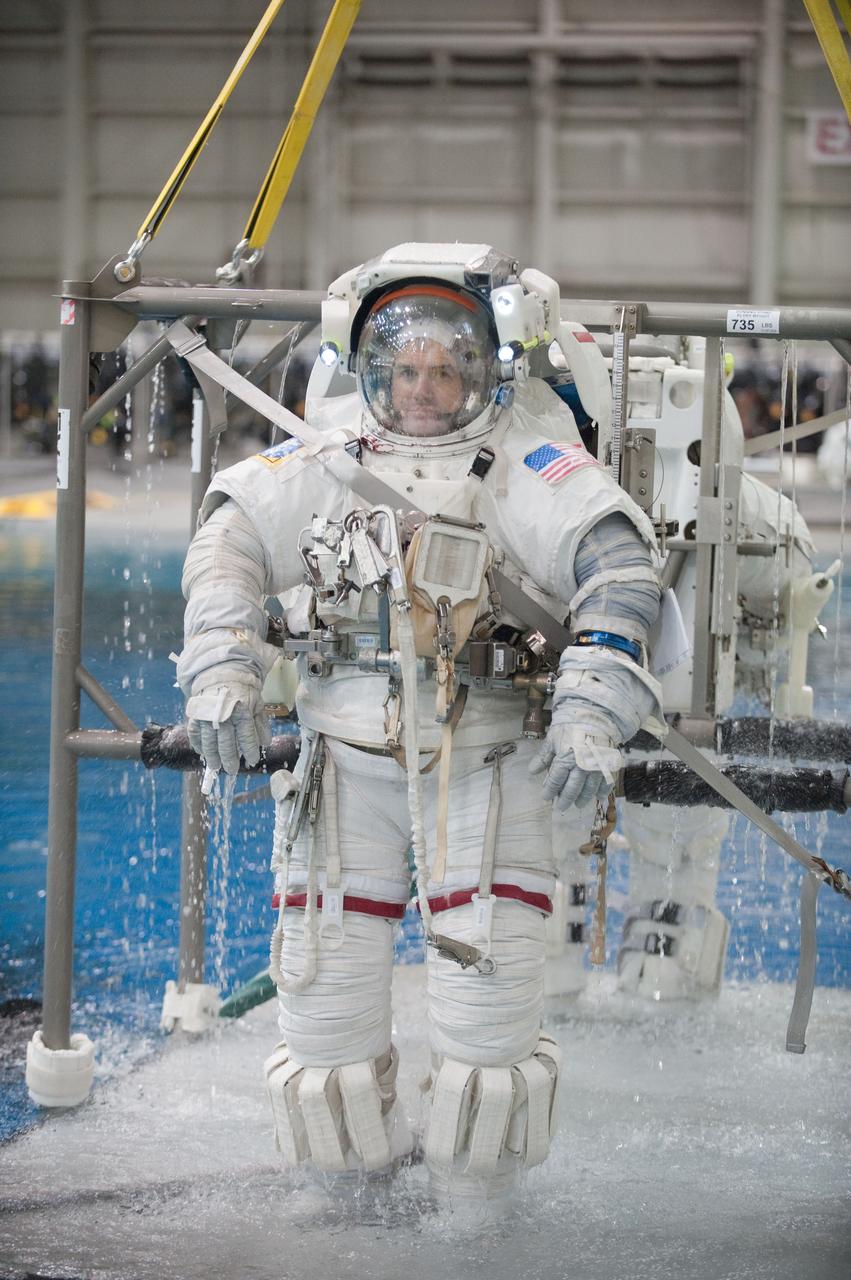
JSC2011-E-054092 (13 June 2011) --- NASA astronauts Rex Walheim and Sandy Magnus (mostly obscured), both STS-135 mission specialists, attired in training versions of their Extravehicular Mobility Unit (EMU) spacesuits, are raised from the waters of the Neutral Buoyancy Laboratory (NBL) near NASA's Johnson Space Center as a spacewalk training session comes to a close. Divers (out of frame) were in the water to assist Magnus and Walheim in their rehearsal. Photo credit: NASA
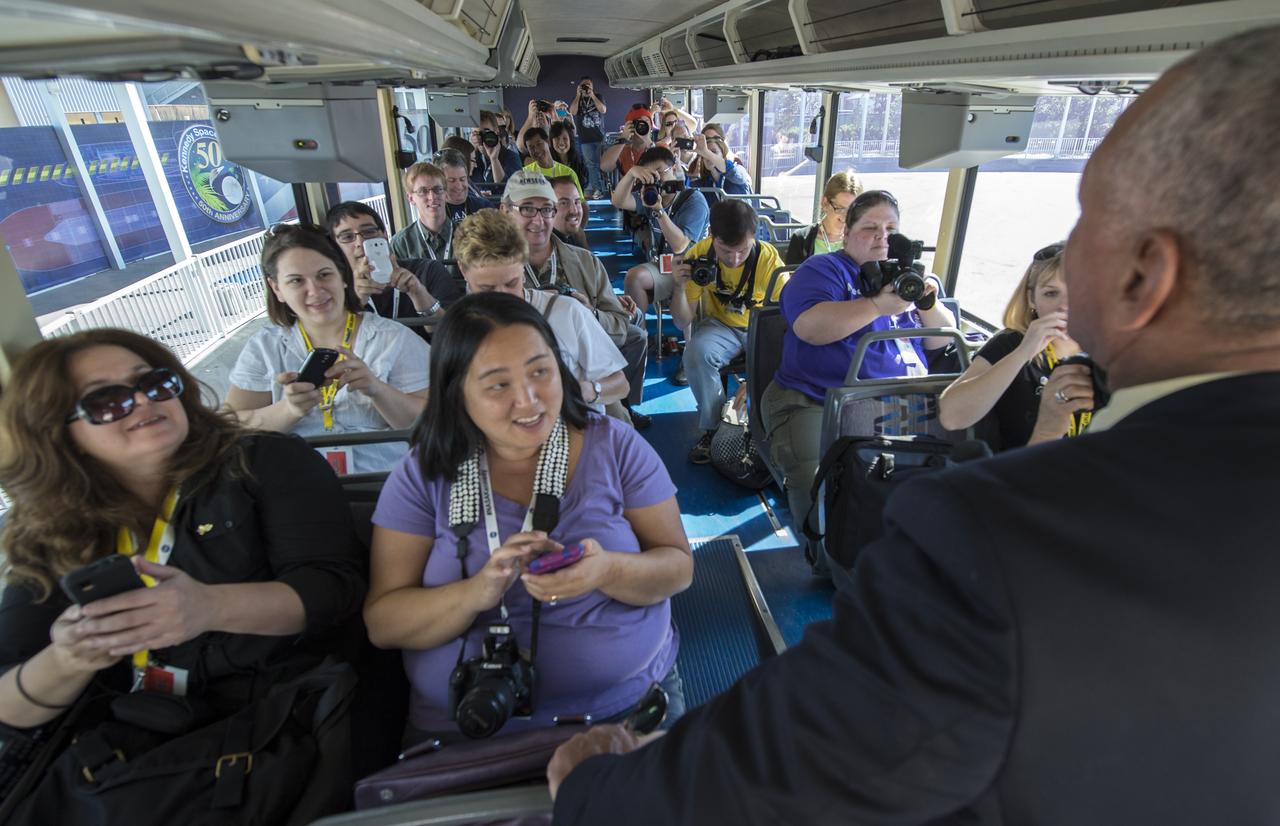
NASA Administrator Charles Bolden speaks with NASA Social attendees during the move of space shuttle Atlantis, Friday, Nov. 2, 2012, at Kennedy Space Center in Cape Canaveral, Fla. The spacecraft traveled 125,935,769 miles during 33 spaceflights, including 12 missions to the International Space Station. Its final flight, STS-135, closed out the Space Shuttle Program era with a landing on July 21, 2011. Photo Credit: (NASA/Bill Ingalls)
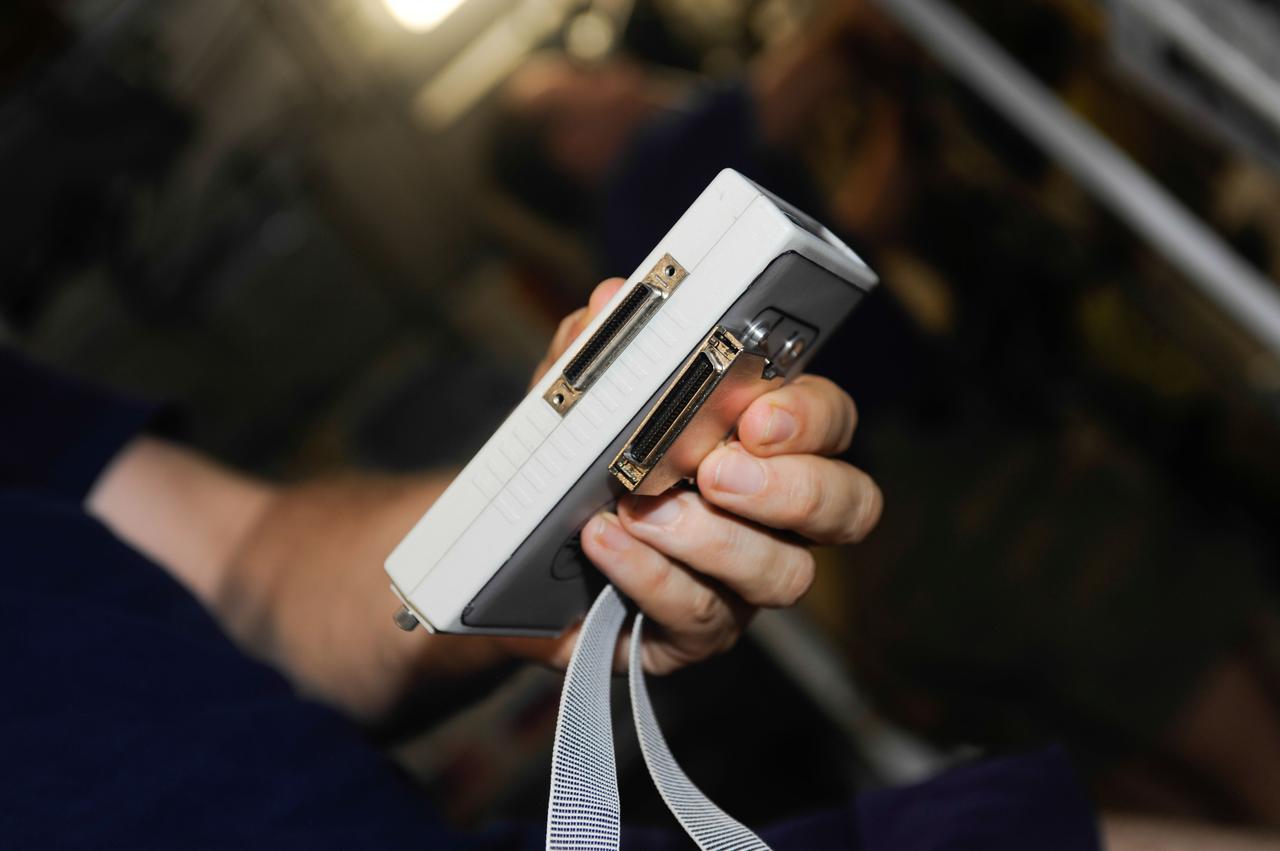
iss038e003689 (11/19/2013) --- A close-up view of the Motocard hardware. The Mechanisms of Sensory-Motor Coordination in Weightlessness (Motocard) investigation is carried out on the treadmill and involves locomotion in various modes of running and walking during various modes of operation of the treadmill. During the test, electromyography of the thigh and calf muscles, support structure response, heart rate, and treadmill load parameters (actual speed, time elapsed, distance, integrated indicators for support structure response) are recorded.

Space shuttle Atlantis is seen during its trip to its new home at the Kennedy Space Center Visitor Complex, early Friday, Nov. 2, 2012, in Cape Canaveral, Fla. The spacecraft traveled 125,935,769 miles during 33 spaceflights, including 12 missions to the International Space Station. Its final flight, STS-135, closed out the Space Shuttle Program era with a landing on July 21, 2011. Photo Credit: (NASA/Bill Ingalls)
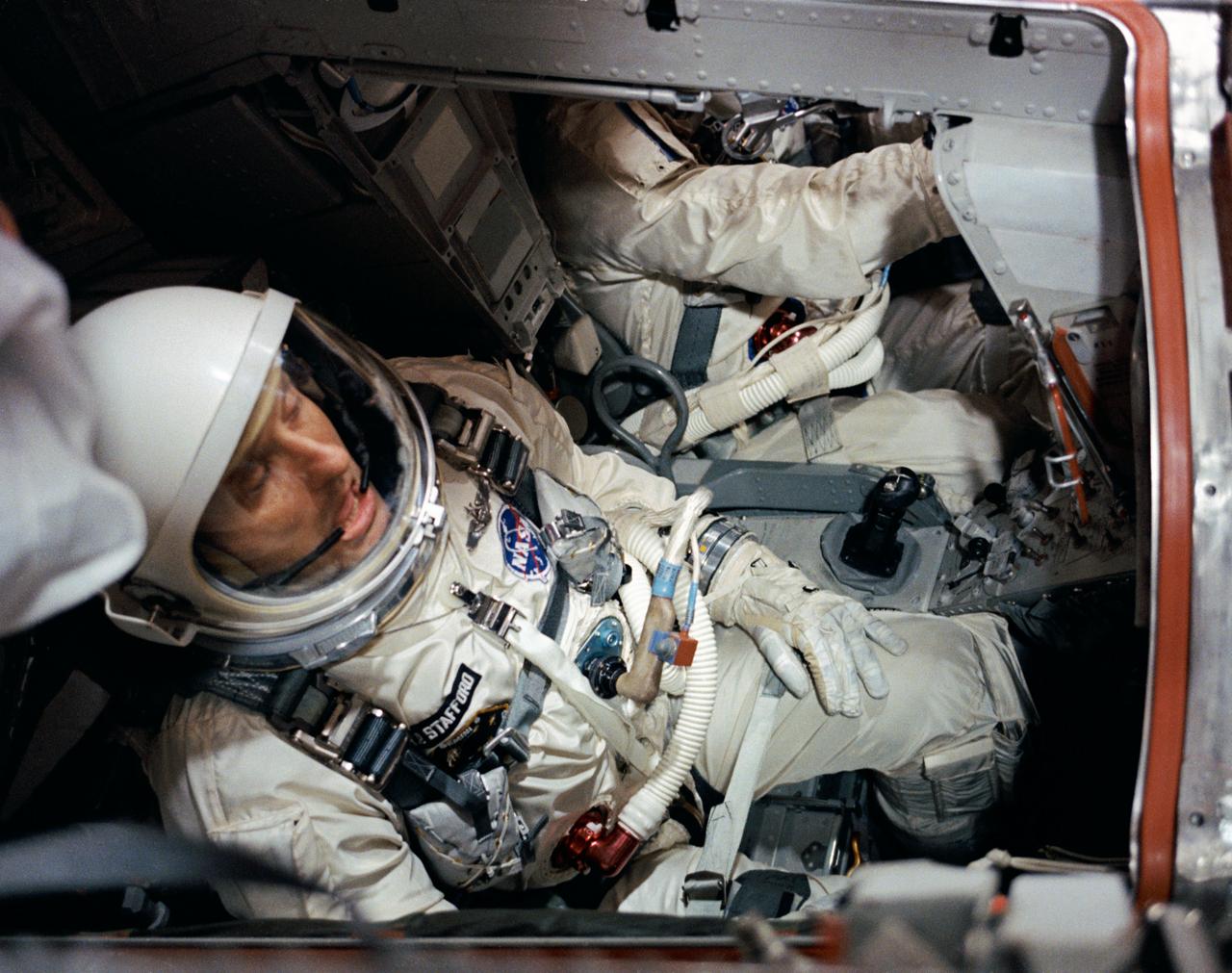
S65-59961 (15 Dec. 1965) --- Astronaut Thomas P. Stafford, pilot, is pictured in the Gemini-6 spacecraft in the White Room atop Pad 19 prior to the closing of the hatches during the Gemini-6 prelaunch countdown. In the background (partially out of view) is astronaut Walter M. Schirra Jr., command pilot. Photo credit: NASA or National Aeronautics and Space Administration

Space shuttle Atlantis is seen during its trip to its new home at the Kennedy Space Center Visitor Complex, early Friday, Nov. 2, 2012, in Cape Canaveral, Fla. The spacecraft traveled 125,935,769 miles during 33 spaceflights, including 12 missions to the International Space Station. Its final flight, STS-135, closed out the Space Shuttle Program era with a landing on July 21, 2011. Photo Credit: (NASA/Bill Ingalls)

Space shuttle Atlantis is seen during its trip to its new home at the Kennedy Space Center Visitor Complex, early Friday, Nov. 2, 2012, in Cape Canaveral, Fla. The spacecraft traveled 125,935,769 miles during 33 spaceflights, including 12 missions to the International Space Station. Its final flight, STS-135, closed out the Space Shuttle Program era with a landing on July 21, 2011. Photo Credit: (NASA/Bill Ingalls)
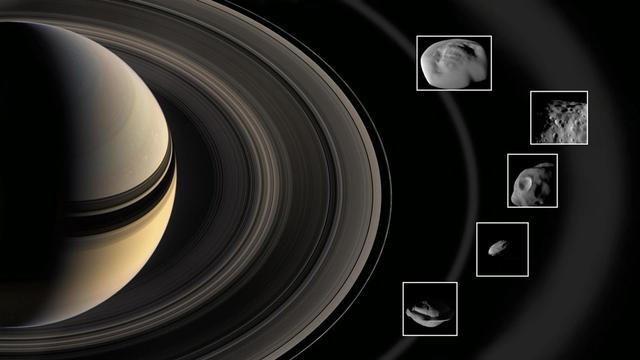
During super-close flybys of Saturn's rings, NASA's Cassini spacecraft inspected the mini-moons Pan and Daphnis in the A ring; Atlas at the edge of the A ring; Pandora at the edge of the F ring; and Epimetheus, which is bathed in material that fans out from the moon Enceladus. The mini-moons' diameter ranges from 5 miles (8 kilometers) for Daphnis to 72 miles (116 kilometers) for Epimetheus. The rings and the moons depicted in this illustration are not to scale. https://photojournal.jpl.nasa.gov/catalog/PIA22772

William Moore, COO, KSC VC, DNC Parks & Recreation, speaks at the signing ceremony, for space shuttle Atlantis, background, Friday, Nov. 2, 2012, in Cape Canaveral, Fla. The spacecraft traveled 125,935,769 miles during 33 spaceflights, including 12 missions to the International Space Station. Its final flight, STS-135, closed out the Space Shuttle Program era with a landing on July 21, 2011. Photo Credit: (NASA/Bill Ingalls)
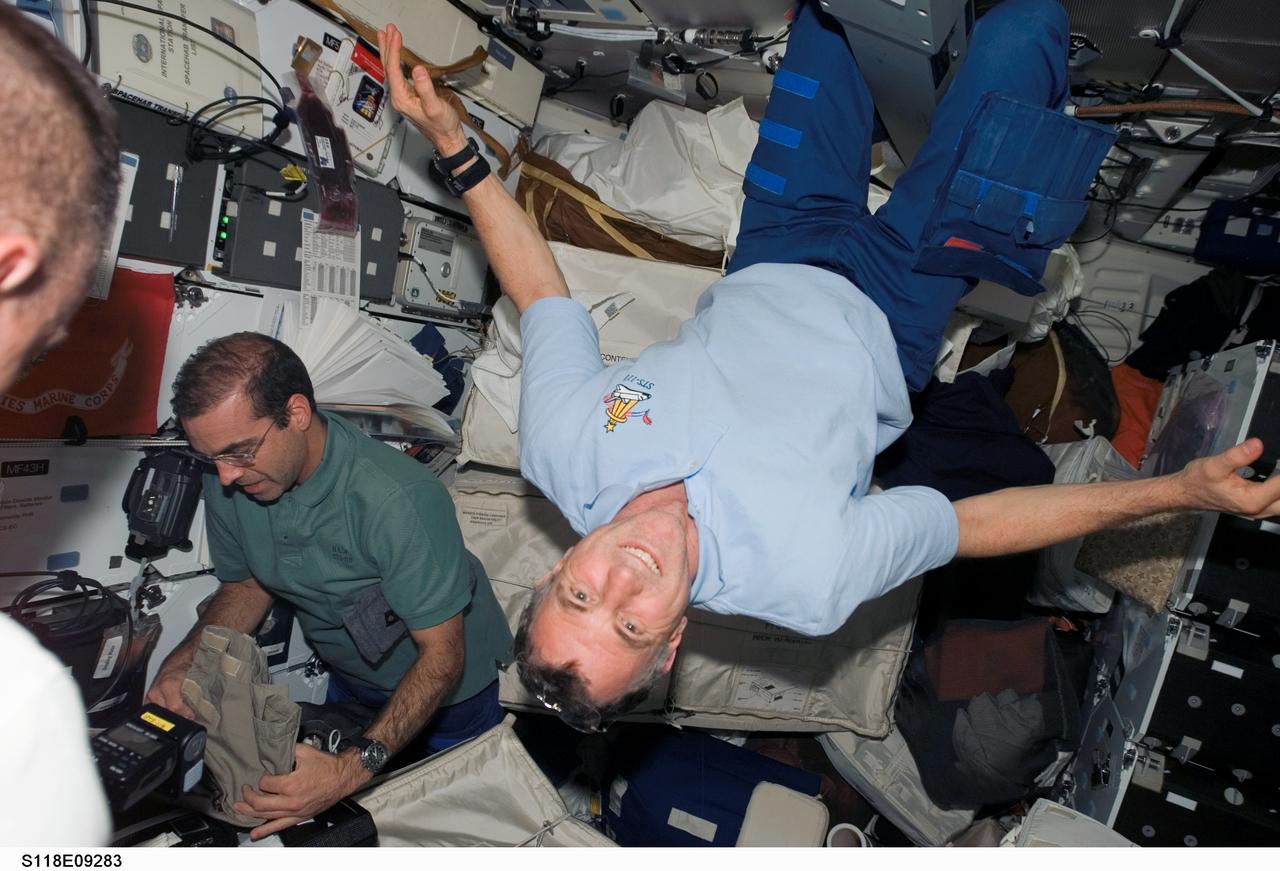
S118-E-09283 (18 Aug. 2007) --- Canadian Space Agency's astronaut Dave Williams (right), and astronaut Rick Mastracchio (left), both STS-118 mission specialists, along with Charlie Hobaugh (left, partially out of frame), pilot, work on the middeck of Space Shuttle Endeavour as the crew prepares for their return home. Hatches were closed between the International Space Station and Endeavour at 4:10 p.m. on Aug. 18.

ISS040-E-099390 (18 Aug. 2014) --- Russian cosmonaut Alexander Skvortsov, Expedition 40 flight engineer, attired in a Russian Orlan spacesuit, is pictured in this close-up view during a session of extravehicular activity (EVA) in support of science and maintenance on the International Space Station. During the five-hour, 11-minute spacewalk, Skvortsov and cosmonaut Oleg Artemyev (out of frame) deployed a small science satellite, retrieved and installed experiment packages and inspected components on the exterior of the orbital laboratory.

Cheryl Hurst, Director of Education and External Relations at Kennedy Space Center, speaks at the signing ceremony for space shuttle Atlantis, background, Friday, Nov. 2, 2012, in Cape Canaveral, Fla. The spacecraft traveled 125,935,769 miles during 33 spaceflights, including 12 missions to the International Space Station. Its final flight, STS-135, closed out the Space Shuttle Program era with a landing on July 21, 2011. Photo Credit: (NASA/Bill Ingalls)

The Titusville High School band parades ahead of space shuttle Atlantis as it makes its way to its new home at the Kennedy Space Center Visitor Complex, early Friday, Nov. 2, 2012, in Cape Canaveral, Fla. The spacecraft traveled 125,935,769 miles during 33 spaceflights, including 12 missions to the International Space Station. Its final flight, STS-135, closed out the Space Shuttle Program era with a landing on July 21, 2011. Photo Credit: (NASA/Bill Ingalls)

Karol Bobko, who commanded STS-51, the first flight of space shuttle Atlantis, background, speaks at the signing ceremony, Friday, Nov. 2, 2012, in Cape Canaveral, Fla. The spacecraft traveled 125,935,769 miles during 33 spaceflights, including 12 missions to the International Space Station. Its final flight, STS-135, closed out the Space Shuttle Program era with a landing on July 21, 2011. Photo Credit: (NASA/Bill Ingalls)
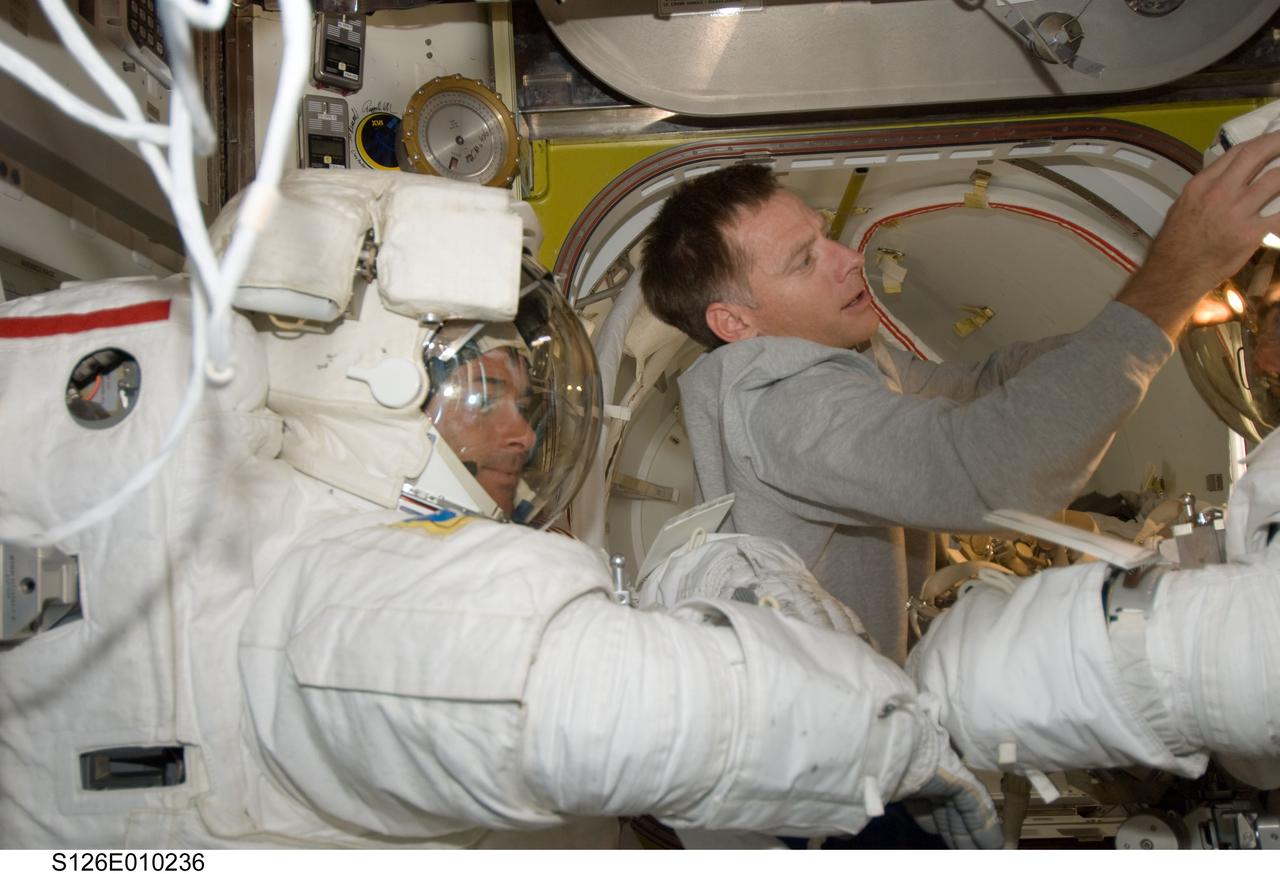
S126-E-010236 (24 Nov. 2008) --- Astronauts Shane Kimbrough and Steve Bowen (right, mostly out of frame), both STS-126 mission specialists, attired in their Extravehicular Mobility Unit (EMU) spacesuits, are pictured in the Quest Airlock of the International Space Station as the mission's fourth session of extravehicular activity (EVA) draws to a close. Astronaut Chris Ferguson, commander, assists with the doffing of the spacesuits.
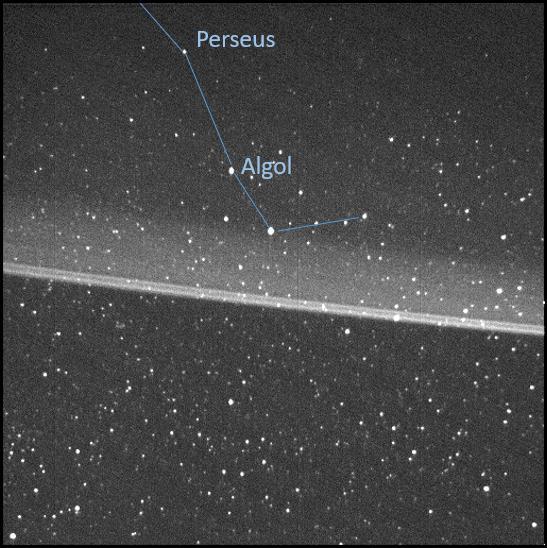
This annotated, high-resolution image of Jupiter's main dust ring was collected by the Stellar Reference Unit (SRU) navigation camera aboard NASA's Juno spacecraft. The image was taken from inside the ring looking out as Juno flew between Jupiter and the radiation belts during the spacecraft's 36th close flyby on Sept. 2, 2021. The brightest thin dust bands are associated with the orbits of Jupiter's small moons, Metis and Adrastea. The image also captured an arm of the Perseus constellation, as shown in the annotation. https://photojournal.jpl.nasa.gov/catalog/PIA25039

Space shuttle Atlantis is seen during its trip to its new home at the Kennedy Space Center Visitor Complex, early Friday, Nov. 2, 2012, in Cape Canaveral, Fla. The spacecraft traveled 125,935,769 miles during 33 spaceflights, including 12 missions to the International Space Station. Its final flight, STS-135, closed out the Space Shuttle Program era with a landing on July 21, 2011. Photo Credit: (NASA/Bill Ingalls)

Workers carry a banner full of signatures while following behind space shuttle Atlantis as it begins its trek to its new home at the Kennedy Space Center Visitor Complex, early Friday, Nov. 2, 2012, in Cape Canaveral, Fla. The spacecraft traveled 125,935,769 miles during 33 spaceflights, including 12 missions to the International Space Station. Its final flight, STS-135, closed out the Space Shuttle Program era with a landing on July 21, 2011. Photo Credit: (NASA/Bill Ingalls)

An onlooker holds up a mobile device to record space shuttle Atlantis as it rolls to ts new home at the Kennedy Space Center Visitor Complex, early Friday, Nov. 2, 2012, in Cape Canaveral, Fla. The spacecraft traveled 125,935,769 miles during 33 spaceflights, including 12 missions to the International Space Station. Its final flight, STS-135, closed out the Space Shuttle Program era with a landing on July 21, 2011. Photo Credit: (NASA/Bill Ingalls)
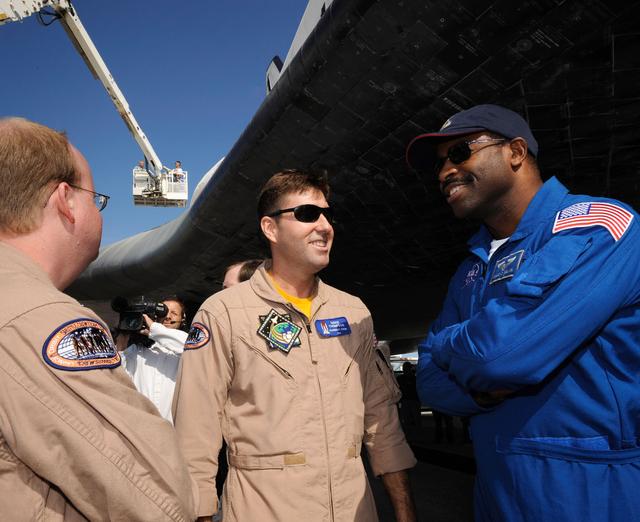
STS-122 Mission Specialist Leland Melvin, right, talks with members of the space shuttle close out crew underneath the wing of the space shuttle Atlantis. Atlantis landed at the Shuttle Landing Facility, 9:07a.m., Wednesday, Feb. 20, 2008 at Kennedy Space Center, Fla. completing delivery of the European Space Agency’s (ESA) Columbus laboratory to the International Space Station. Photo Credit: (NASA/Bill Ingalls)
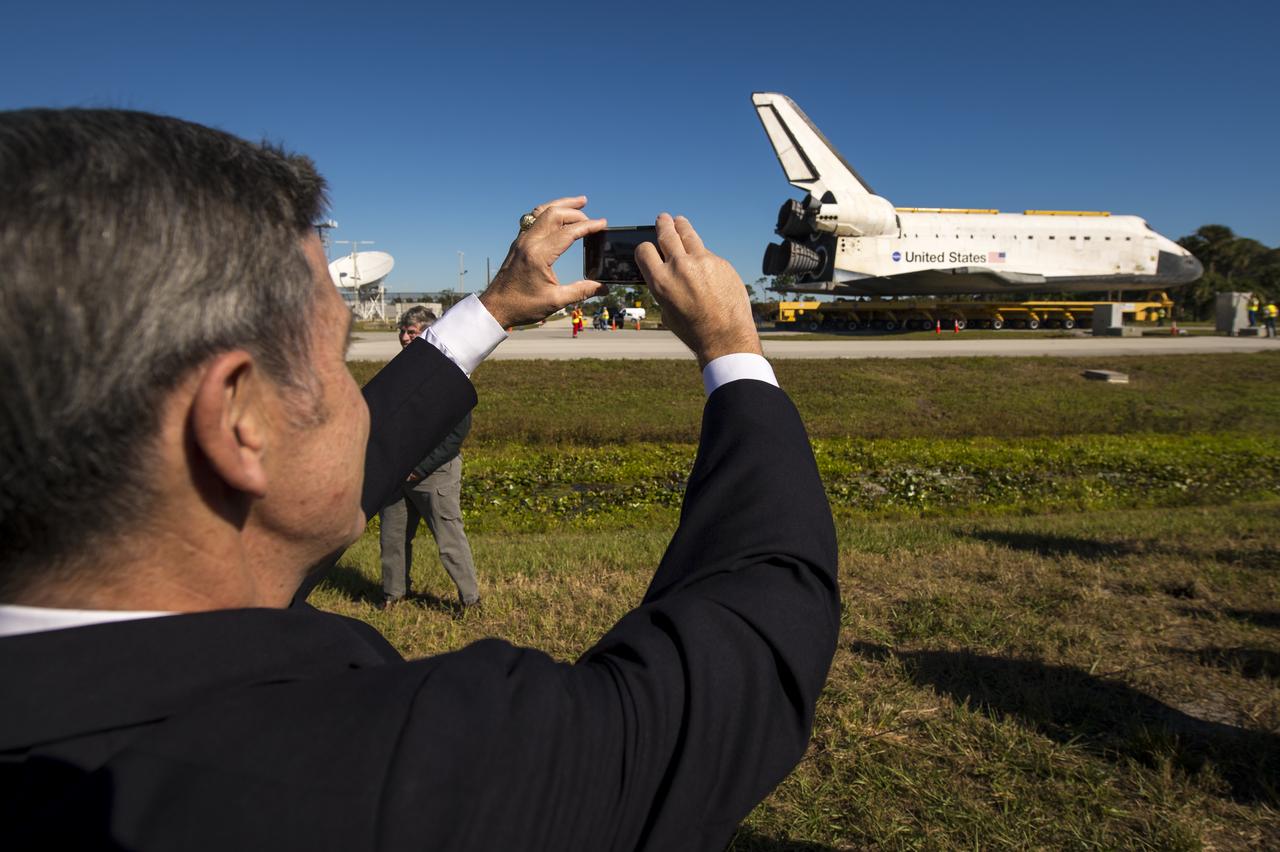
Kennedy Space Center Director Robert Cabana takes a picture of space shuttle Atlantis, Friday, Nov. 2, 2012, in Cape Canaveral, Fla. The spacecraft traveled 125,935,769 miles during 33 spaceflights, including 12 missions to the International Space Station. Its final flight, STS-135, closed out the Space Shuttle Program era with a landing on July 21, 2011. Photo Credit: (NASA/Bill Ingalls)
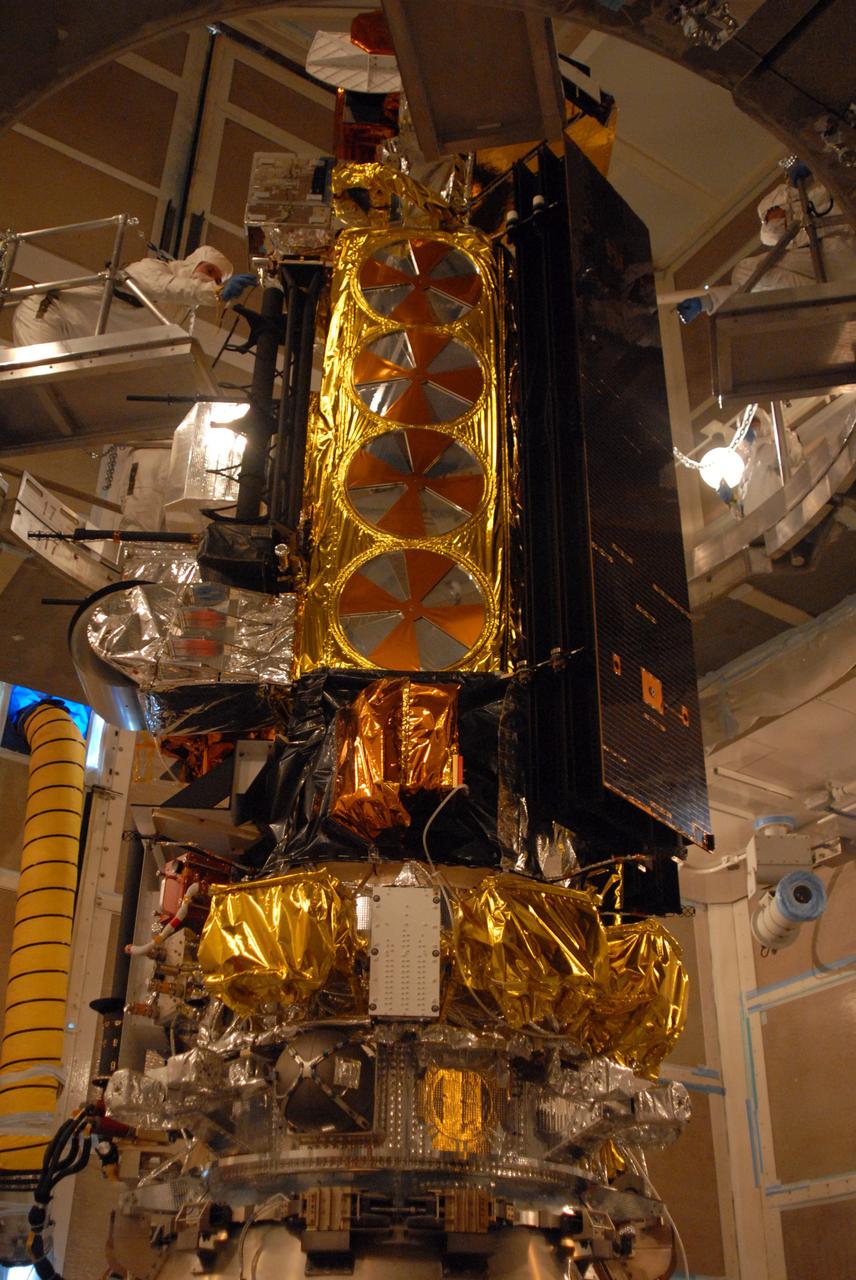
VANDENBERG AIR FORCE BASE, Calif. -- In the mobile service tower on Space Launch Complex 2 at Vandenberg Air Force Base in California, the NOAA-N Prime spacecraft is closed out for encapsulation and installation on the launch vehicle, a Delta II rocket. NOAA-N Prime is the latest polar-orbiting operational environmental weather satellite developed by NASA for the National Oceanic and Atmospheric Administration. The satellite is scheduled to launch Feb. 4 aboard the Delta II from Vandenberg Air Force Base. Photo credit: NASA/VAFB

Space shuttle Atlantis is seen during its trip to its new home at the Kennedy Space Center Visitor Complex, early Friday, Nov. 2, 2012, in Cape Canaveral, Fla. The spacecraft traveled 125,935,769 miles during 33 spaceflights, including 12 missions to the International Space Station. Its final flight, STS-135, closed out the Space Shuttle Program era with a landing on July 21, 2011. Photo Credit: (NASA/Bill Ingalls)
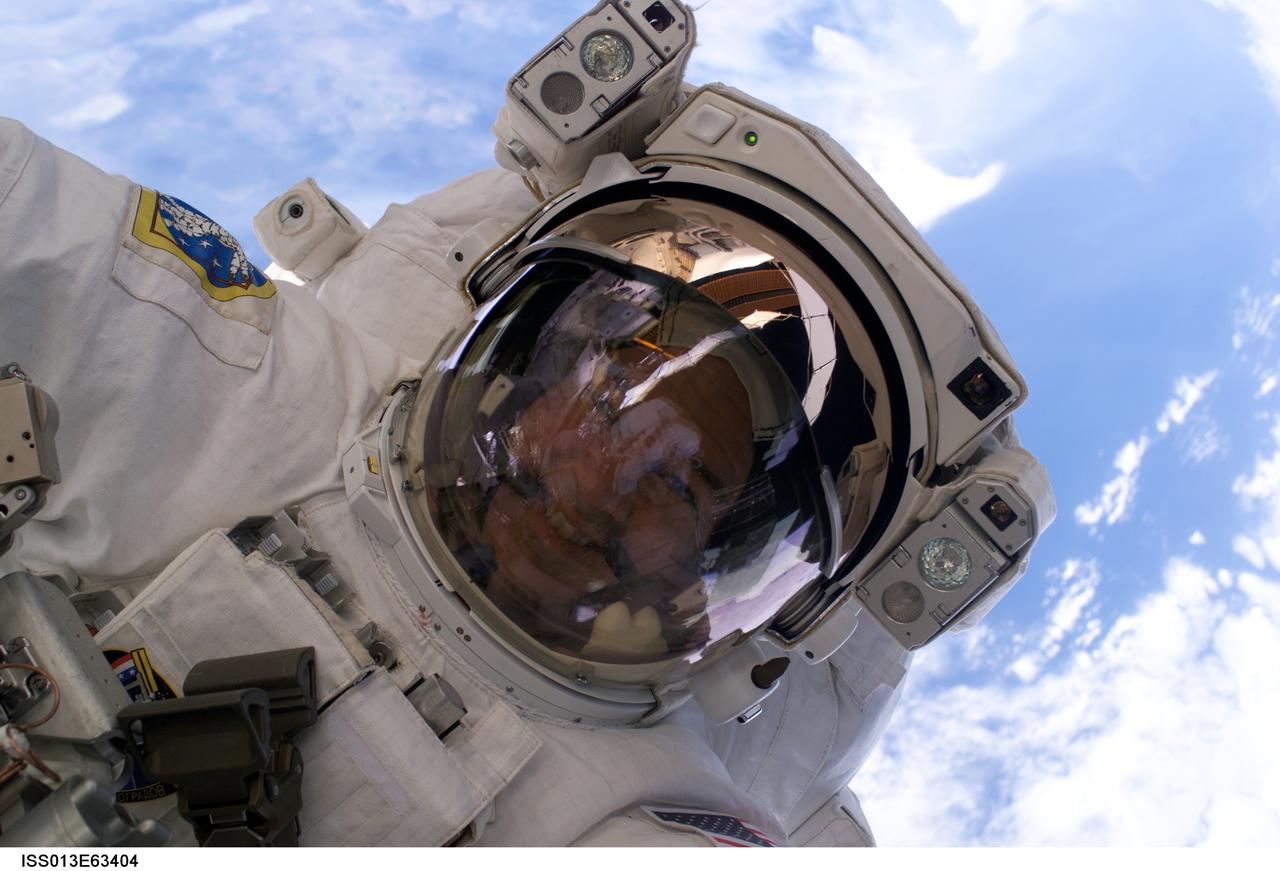
ISS013-E-63404 (3 August 2006) --- Astronaut Jeffrey N. Williams, Expedition 13 NASA space station science officer and flight engineer, is photographed during a 5-hour, 54-minute excursion which he shared with European Space Agency astronaut Thomas Reiter (out of frame). For part of the spacewalk, the pair worked closely in tandem, and then worked separately, getting ahead of their timeline, thus enabling the two to tack on extra tasks.
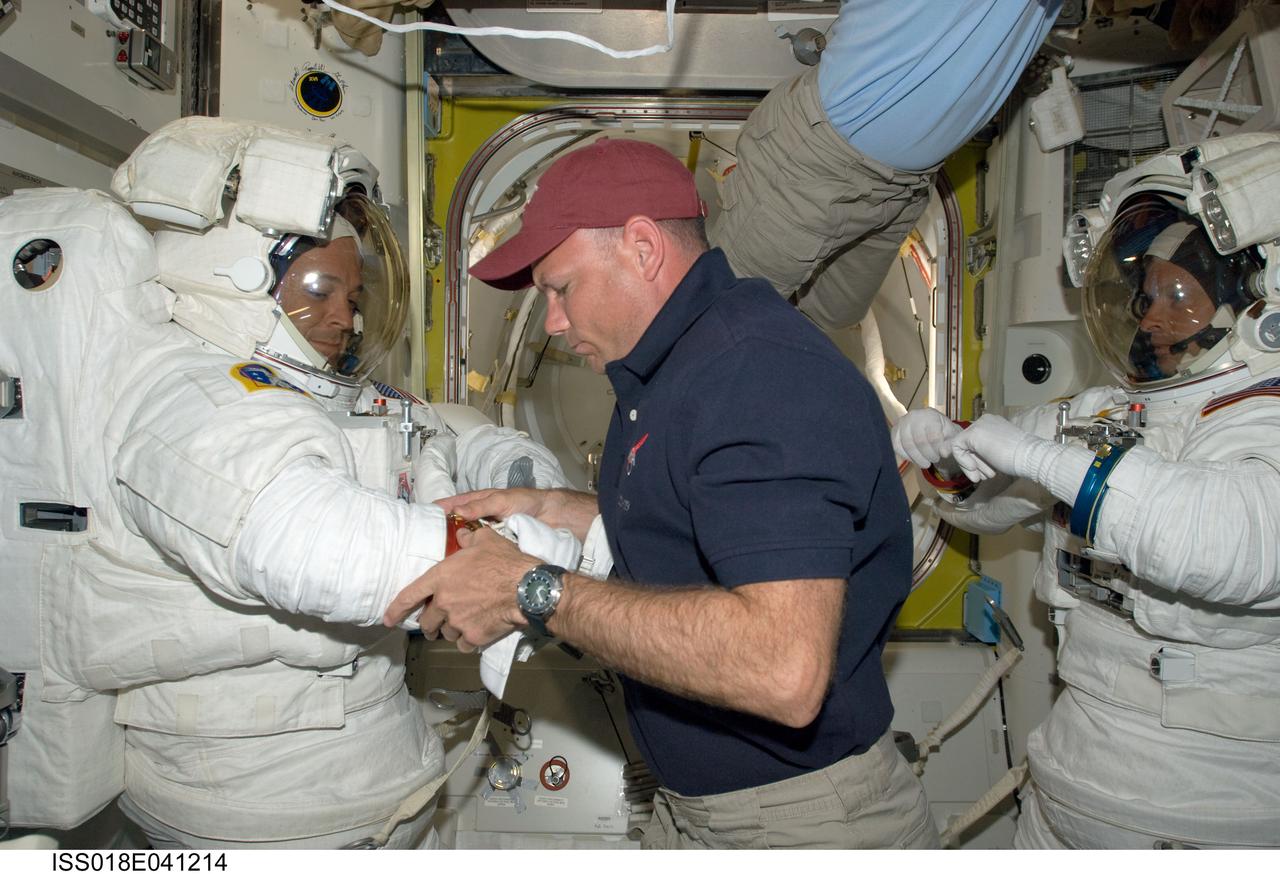
ISS018-E-041214 (19 March 2009) --- Astronauts Steve Swanson (right) and Richard Arnold, both STS-119 mission specialists, attired in their Extravehicular Mobility Unit (EMU) spacesuits, are pictured in the Quest Airlock of the International Space Station as the mission's first scheduled session of extravehicular activity (EVA) draws to a close. Astronauts Michael Fincke (partially out of frame), Expedition 18 commander; and Tony Antonelli, STS-119 pilot, assist with the doffing of the spacesuits.
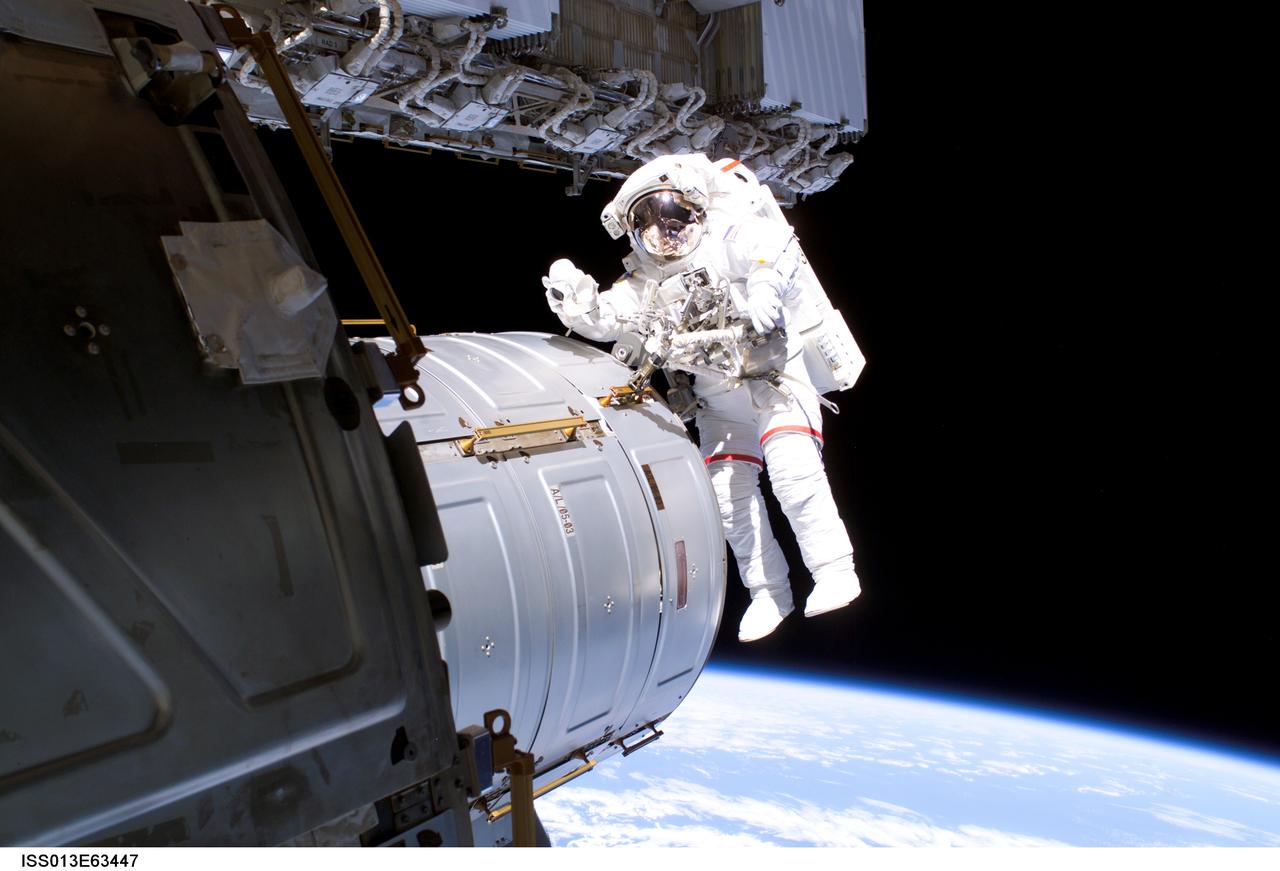
ISS013-E-63447 (3 August 2006) --- Astronaut Jeffrey N. Williams, Expedition 13 NASA space station science officer and flight engineer, is photographed during an individualized portion of a 5-hour, 54-minute excursion which he shared with European Space Agency astronaut Thomas Reiter (out of frame). For part of the spacewalk, the pair worked closely in tandem, and then worked separately, getting ahead of their timeline, thus enabling the two to tack on extra tasks.
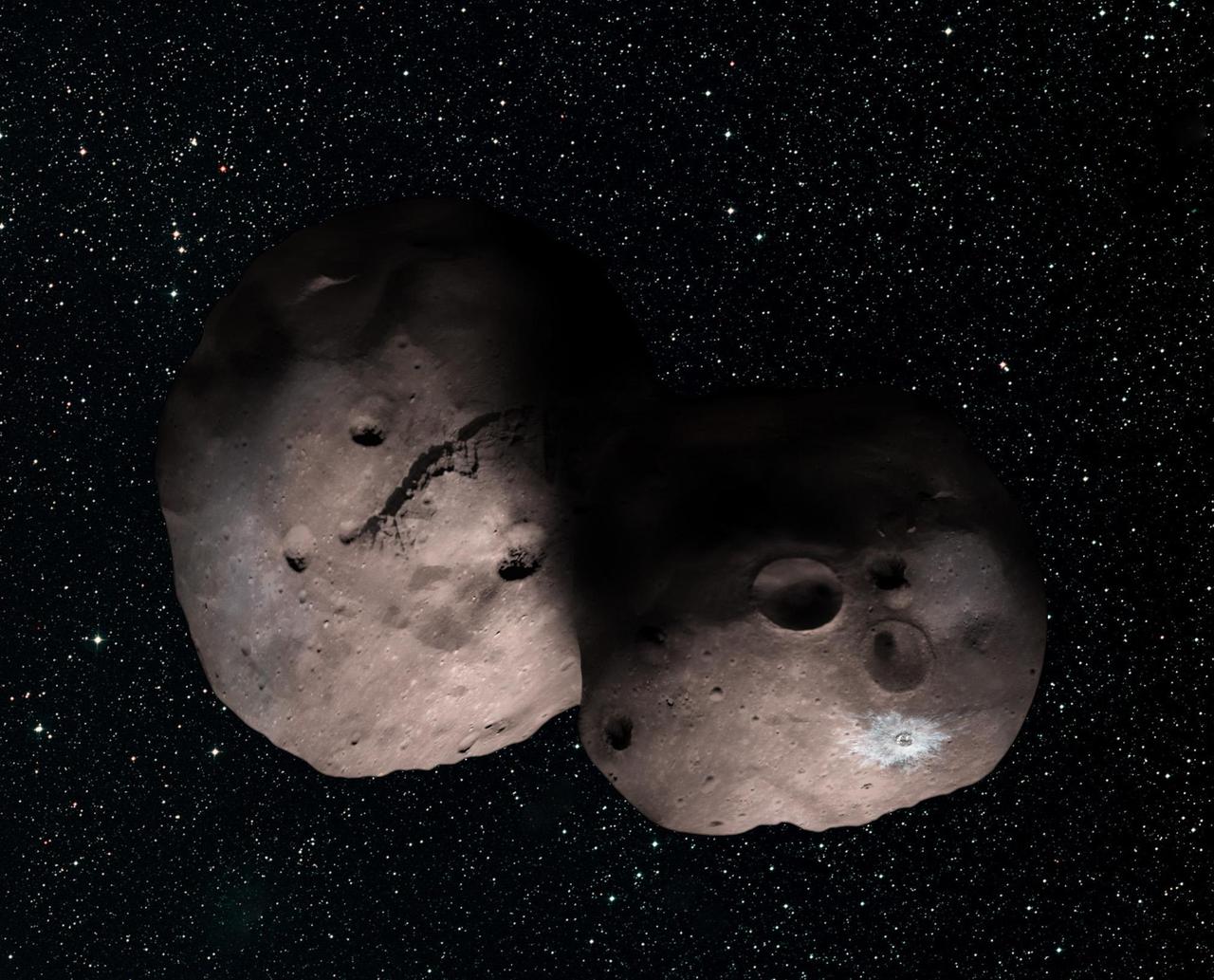
This is one artist's concept of Kuiper Belt object 2014 MU69, the next flyby target for NASA's New Horizons mission. This binary concept is based on telescope observations made at Patagonia, Argentina, on July 17, 2017, when MU69 passed in front of a star. New Horizons scientists theorize that it could be a single body with a large chunk taken out of it, or two bodies that are close together or even touching. https://photojournal.jpl.nasa.gov/catalog/PIA21867

Space shuttle Atlantis rolls away from the Vehicle Assembly Building as it begins its trip to its new home at the Kennedy Space Center Visitor Complex, early Friday, Nov. 2, 2012, in Cape Canaveral, Fla. The spacecraft traveled 125,935,769 miles during 33 spaceflights, including 12 missions to the International Space Station. Its final flight, STS-135, closed out the Space Shuttle Program era with a landing on July 21, 2011. Photo Credit: (NASA/Bill Ingalls)
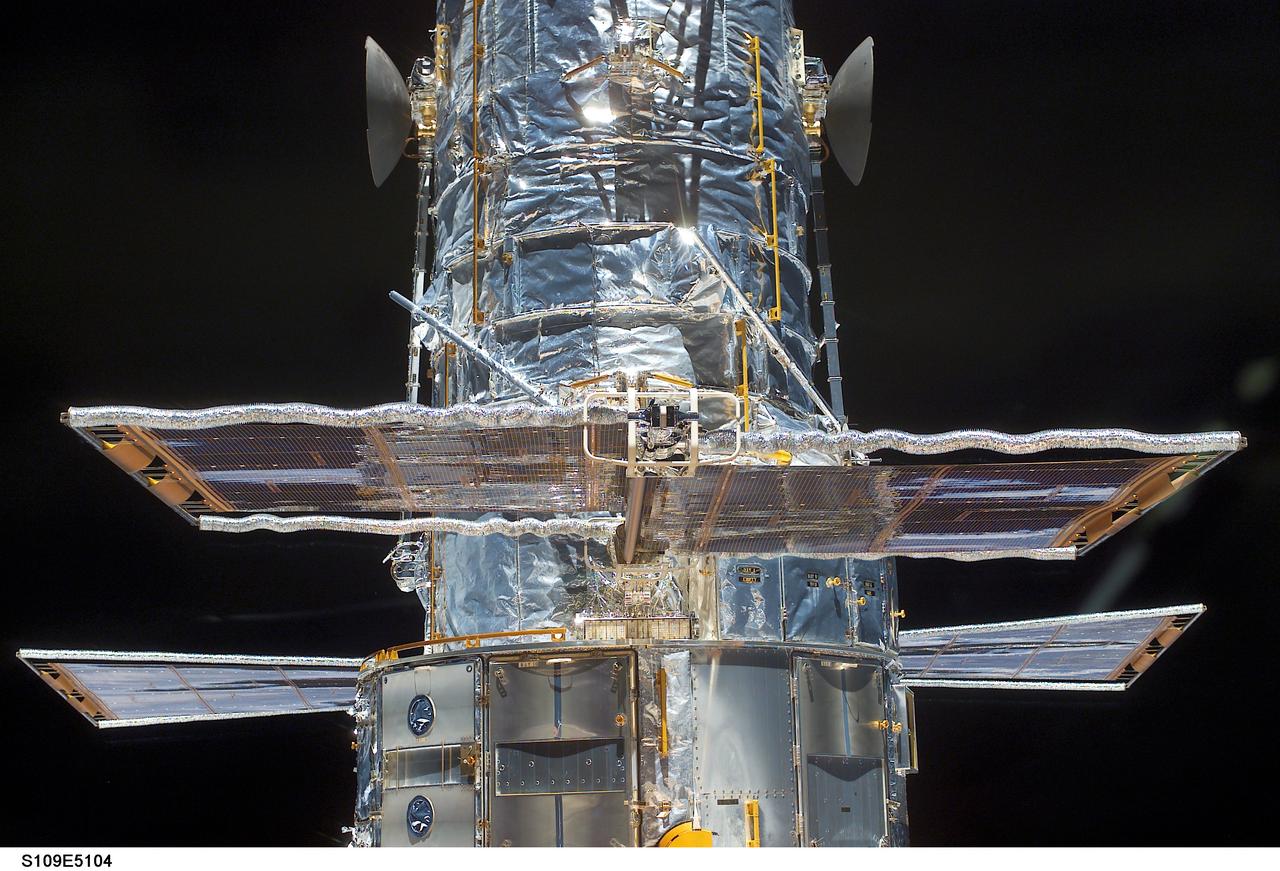
STS109-E-5104 (3 March 2002) --- The Hubble Space Telescope is seen in the cargo bay of the Space Shuttle Columbia. Each present set of solar array panels will be replaced during one of the space walks planned for the coming week. The crew aimed various cameras, including the digital still camera used for this frame, out the shuttle's aft flight deck windows to take a series of survey type photos, the first close-up images of the telescope since December of 1999.

Space shuttle Atlantis, (OV-104), is seen as it begins its trip to its new home at the Kennedy Space Center Visitor Complex, early Friday, Nov. 2, 2012, in Cape Canaveral, Fla. The spacecraft traveled 125,935,769 miles during 33 spaceflights, including 12 missions to the International Space Station. Its final flight, STS-135, closed out the Space Shuttle Program era with a landing on July 21, 2011. Photo Credit: (NASA/Bill Ingalls)
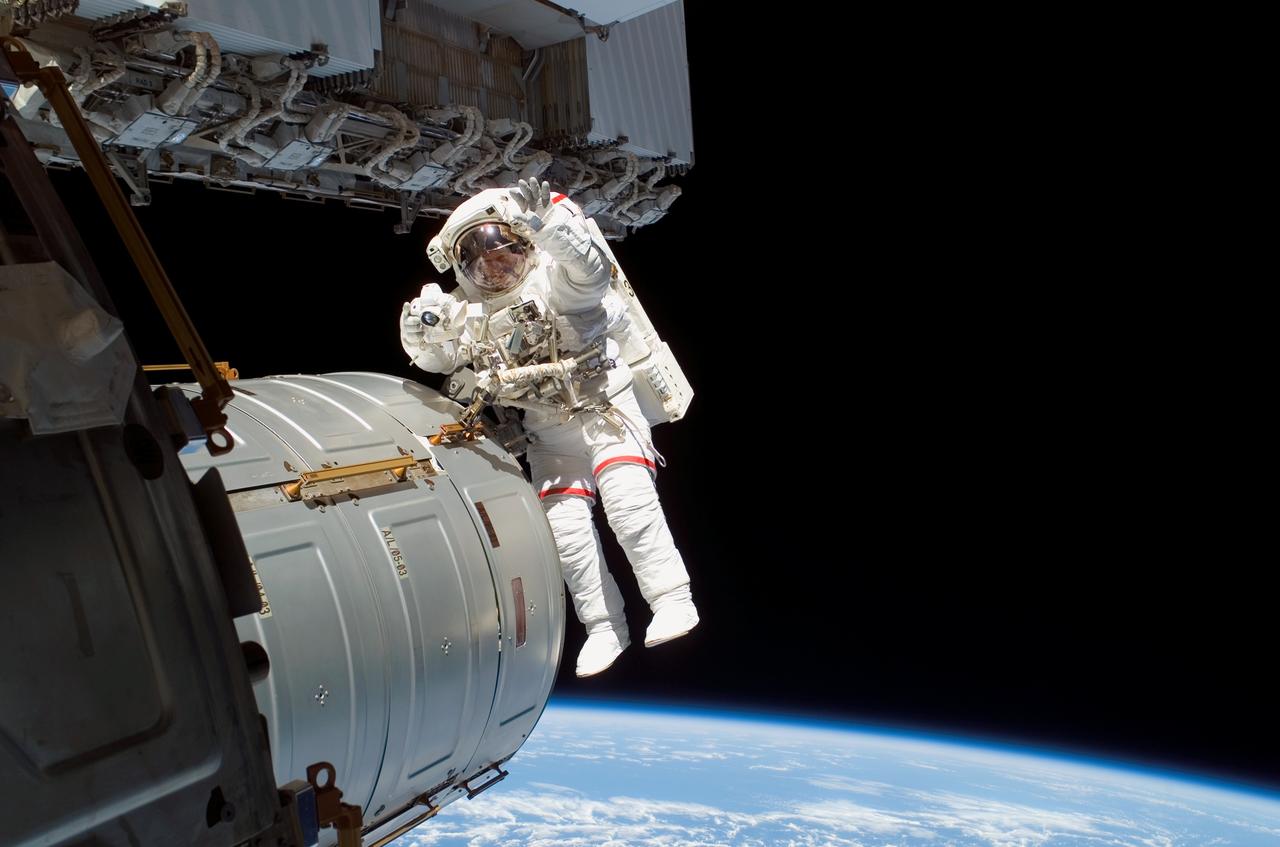
ISS013-E-63440 (3 Aug. 2006) --- Astronaut Jeffrey N. Williams, Expedition 13 NASA space station science officer and flight engineer, is photographed during an individualized portion of a productive 5-hour, 54-minute excursion which he shared with European Space Agency astronaut Thomas Reiter (out of frame). For part of the spacewalk, the pair worked closely in tandem, and then worked separately, getting ahead of their timeline, thus enabling the two to tack on extra tasks.
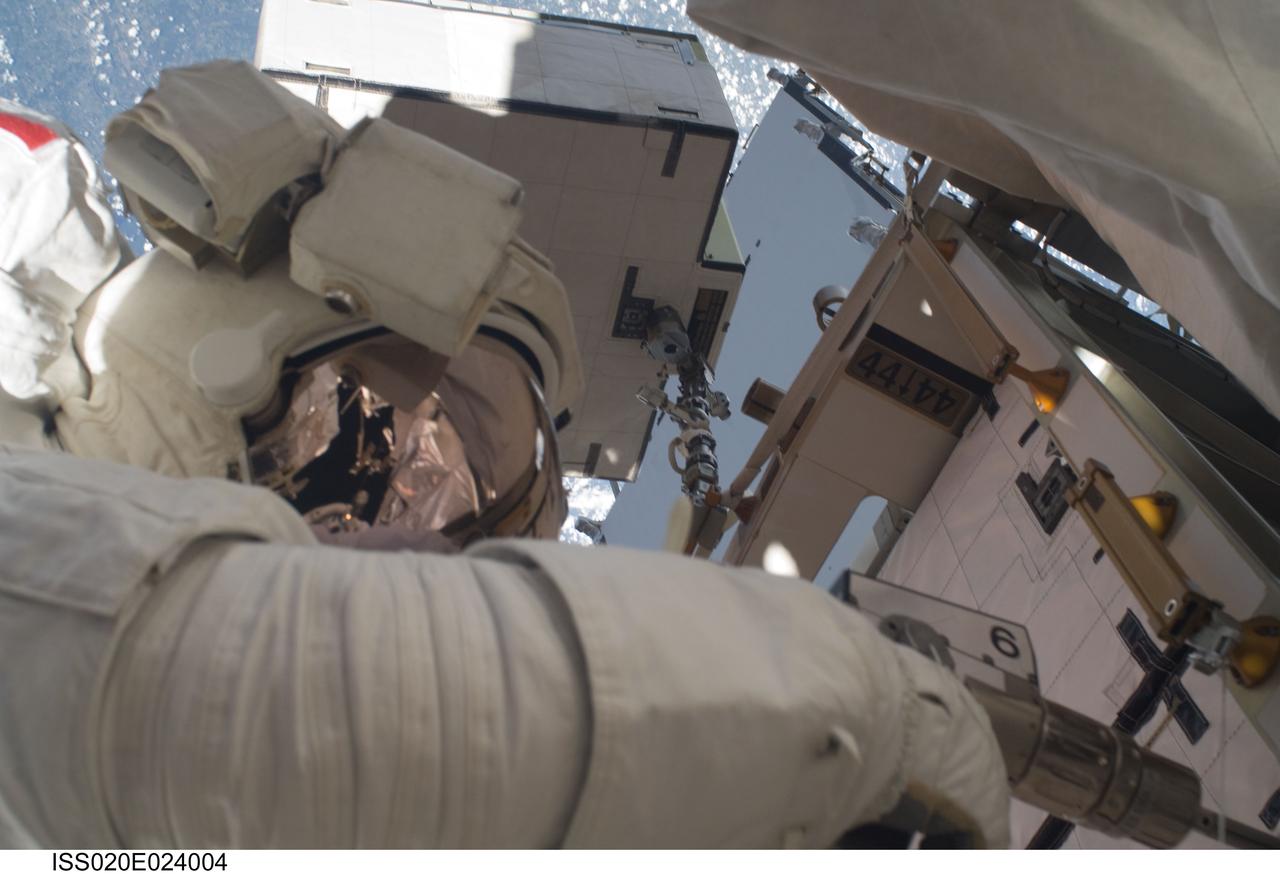
ISS020-E-024004 (24 July 2009) --- This is a close-up view of astronaut Tom Marshburn using a power tool during his second spacewalk on July 24. Out of frame is astronaut Christopher Cassidy with whom he'll team again on July 27 for the STS-127 crew's fifth and final session of extravehicular activity. Eleven astronauts and cosmonauts remained inside the International Space Station and the shuttle to which it was docked, while the two suited astronauts continued work on the orbital outpost.

Searra Weeks, from Kennedy Middle School, sings the National Anthem, at the signing ceremony for space shuttle Atlantis, background, Friday, Nov. 2, 2012, in Cape Canaveral, Fla. The spacecraft traveled 125,935,769 miles during 33 spaceflights, including 12 missions to the International Space Station. Its final flight, STS-135, closed out the Space Shuttle Program era with a landing on July 21, 2011. Photo Credit: (NASA/Bill Ingalls)