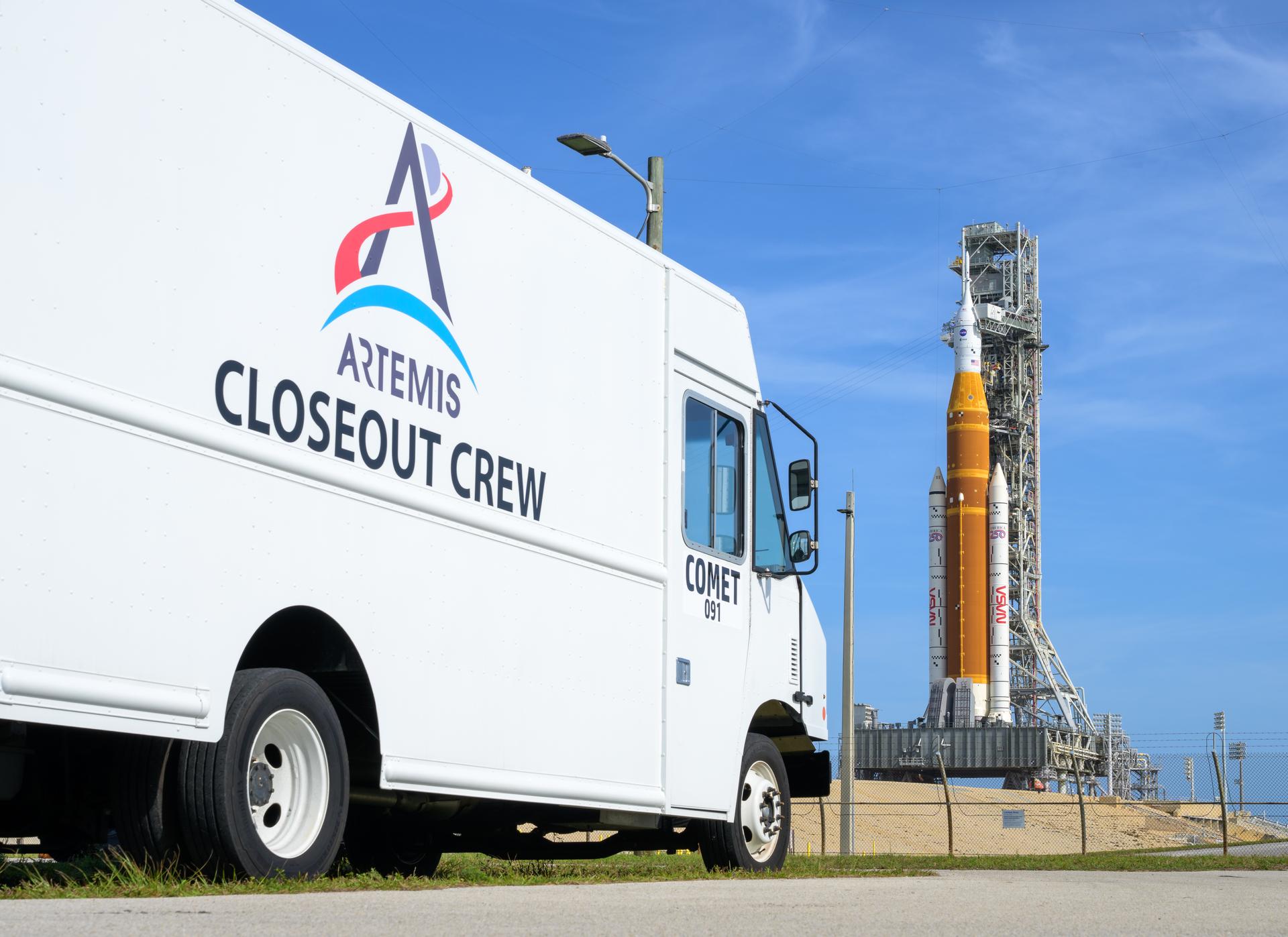
The Artemis Closeout Crew van is seen with NASA’s Artemis II Space Launch System (SLS) rocket, Orion spacecraft, atop a mobile launcher at Launch Complex 39B, Tuesday, March 31, 2026, at NASA’s Kennedy Space Center in Florida. NASA’s Artemis II test flight will take Commander Reid Wiseman, Pilot Victor Glover, and Mission Specialist Christina Koch from NASA, and Mission Specialist Jeremy Hansen from the CSA (Canadian Space Agency), around the Moon and back to Earth with launch opportunities beginning in April 2026. Photo Credit: (NASA/Bill Ingalls)
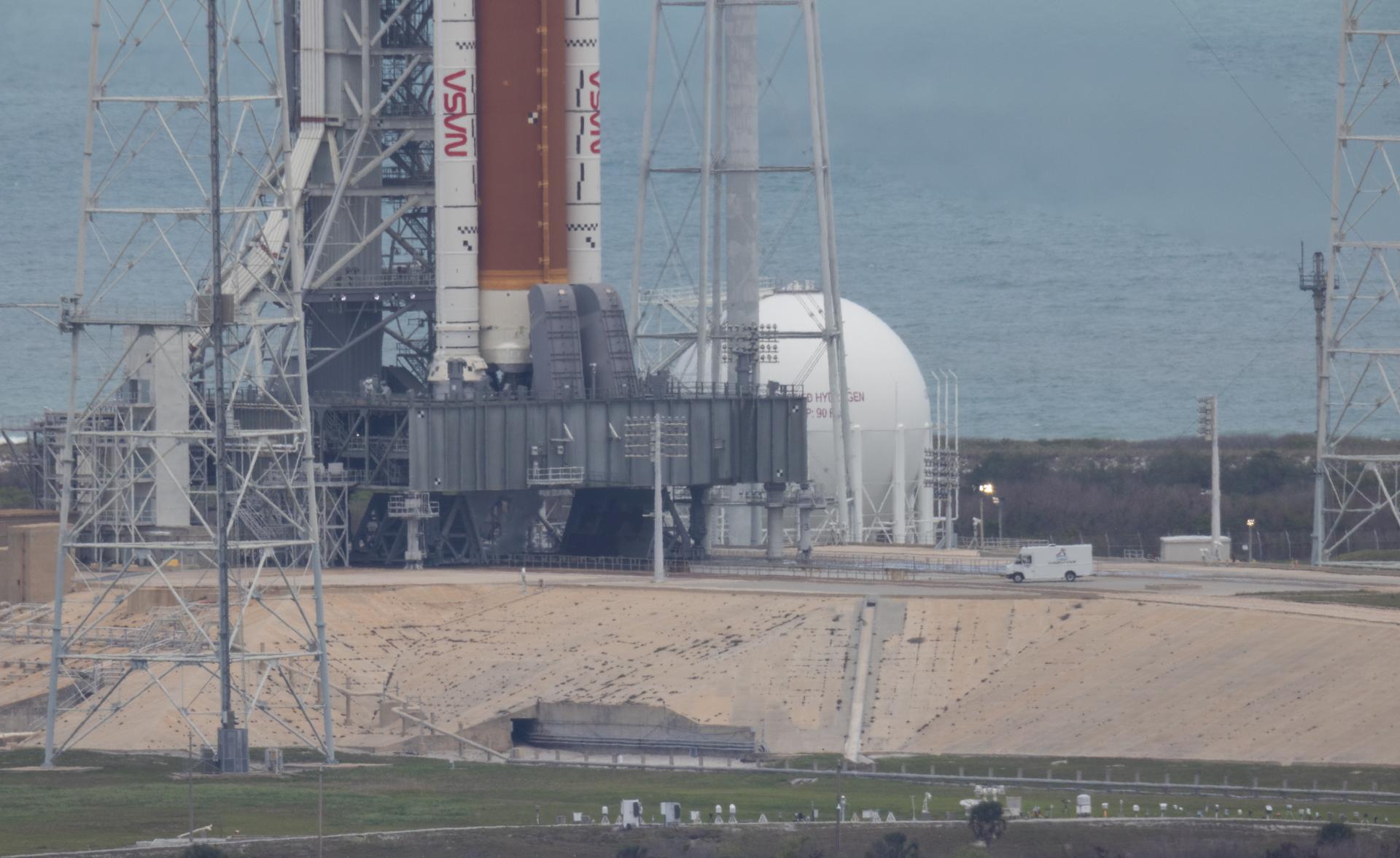
The van carrying the closeout crew arrives at Launch Complex 39B to complete final preparations for the arrival of the crew and to assist them in boarding their Orion spacecraft aboard NASA’s Space Launch System (SLS) rocket, Wednesday, April 1, 2026, as the launch countdown progresses at NASA’s Kennedy Space Center in Florida. NASA’s Artemis II mission will take NASA astronauts Reid Wiseman, commander; Victor Glover, pilot; Christina Koch, mission specialist; and CSA (Canadian Space Agency) astronaut Jeremy Hansen, mission specialist on a 10-day journey around the Moon and back aboard SLS rocket and Orion spacecraft from Launch Complex 39B, with a two hour launch window opening at 6:24 p.m. EDT. Photo Credit: (NASA/Joel Kowsky)
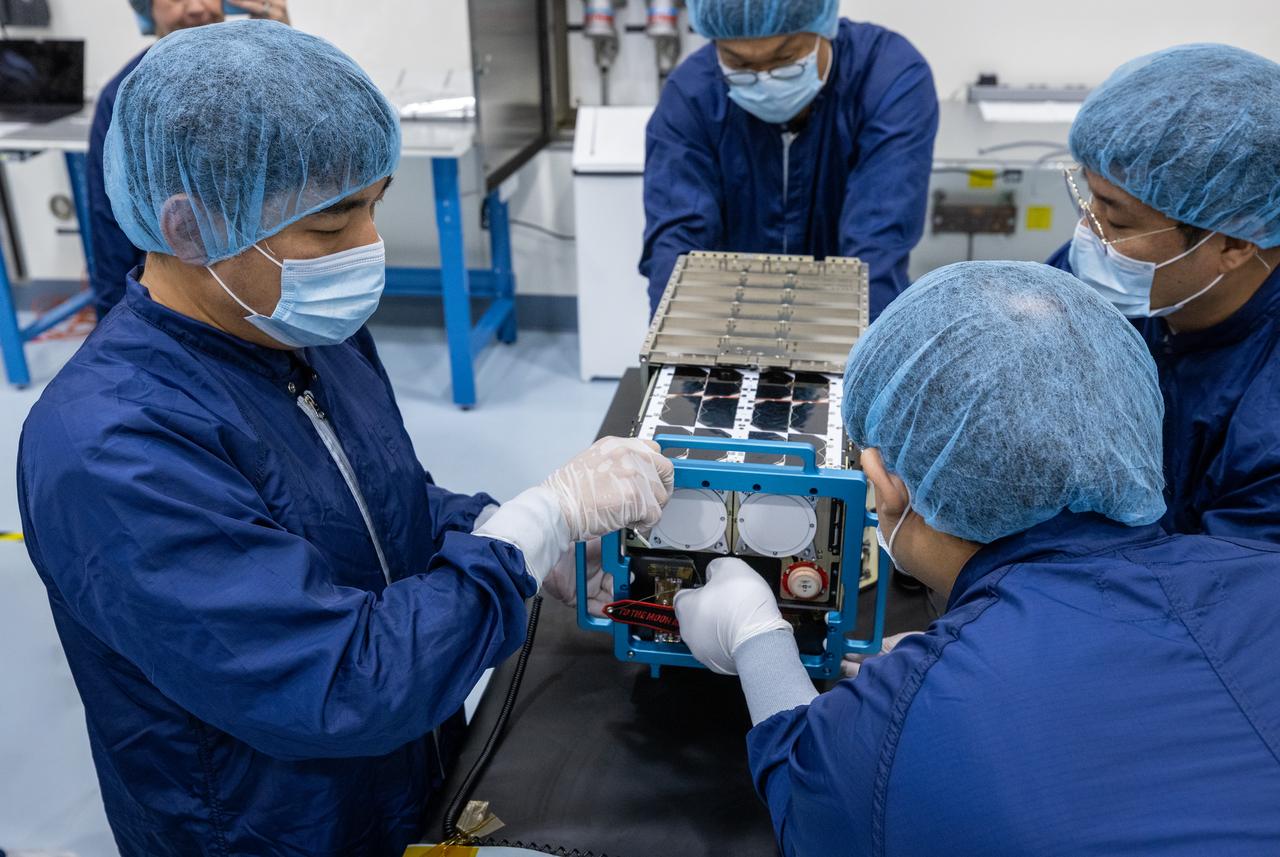
Inside the Multi-Payload Processing Facility at NASA’s Kennedy Space Center in Florida, on Wednesday, Aug. 27, 2025, technicians with the Korea AeroSpace Administration (KASA) complete closeouts on the K-Rad Cube, one of several international CubeSats slated to fly on NASA’s Artemis II test flight in 2026. Deploying in high Earth orbit from a spacecraft adapter on NASA’s SLS (Space Launch System) rocket after Orion is safely flying on its own with its crew of four astronauts, K-Rad Cube will use a dosimeter made of material designed to mimic human tissue to measure space radiation and assess biological effects at various altitudes across the Van Allen radiation belts, a critical area of research for human presence at the Moon and Mars.

Inside the Multi-Payload Processing Facility at NASA’s Kennedy Space Center in Florida, on Wednesday, Aug. 27, 2025, technicians with the Korea AeroSpace Administration (KASA) complete closeouts on the K-Rad Cube, one of several international CubeSats slated to fly on NASA’s Artemis II test flight in 2026. Deploying in high Earth orbit from a spacecraft adapter on NASA’s SLS (Space Launch System) rocket after Orion is safely flying on its own with its crew of four astronauts, K-Rad Cube will use a dosimeter made of material designed to mimic human tissue to measure space radiation and assess biological effects at various altitudes across the Van Allen radiation belts, a critical area of research for human presence at the Moon and Mars.
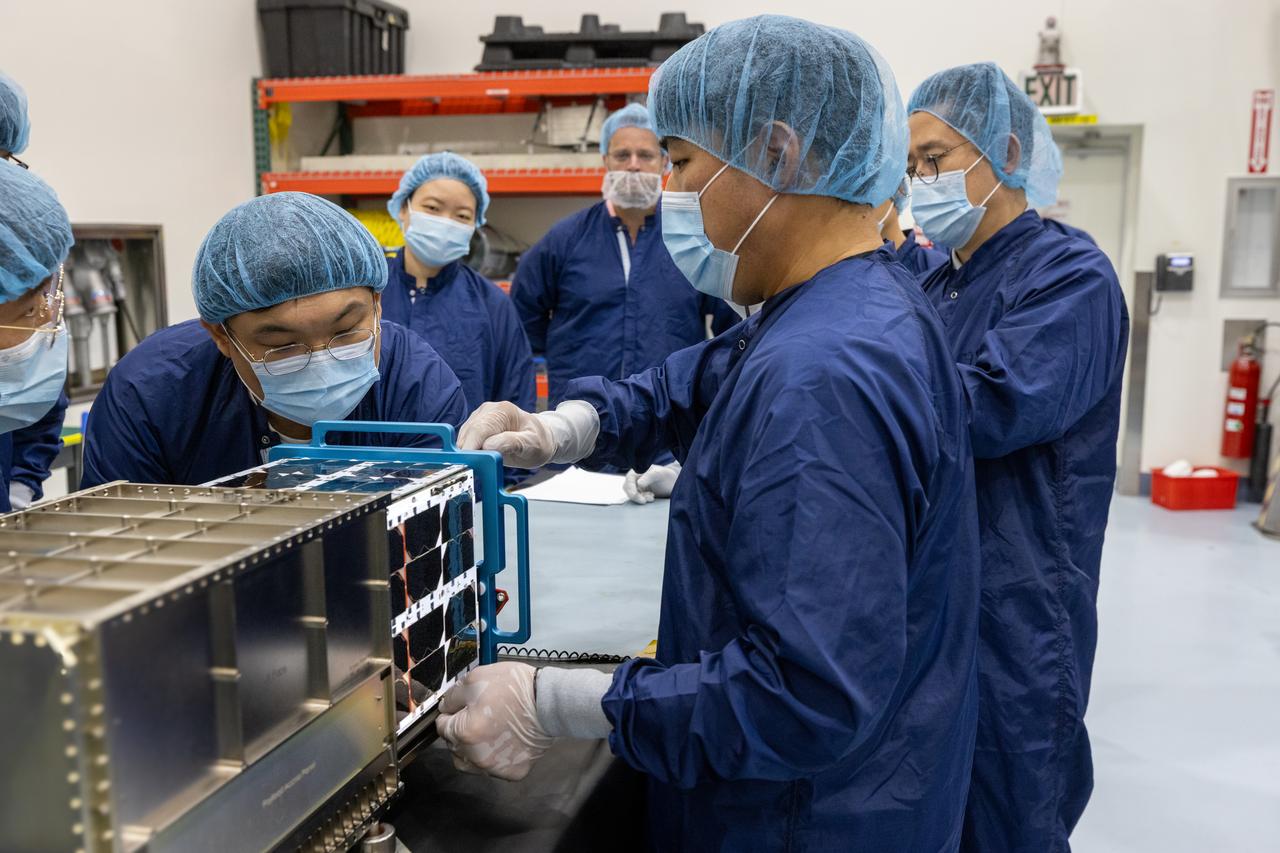
Inside the Multi-Payload Processing Facility at NASA’s Kennedy Space Center in Florida, on Wednesday, Aug. 27, 2025, technicians with the Korea AeroSpace Administration (KASA) complete closeouts on the K-Rad Cube, one of several international CubeSats slated to fly on NASA’s Artemis II test flight in 2026. Deploying in high Earth orbit from a spacecraft adapter on NASA’s SLS (Space Launch System) rocket after Orion is safely flying on its own with its crew of four astronauts, K-Rad Cube will use a dosimeter made of material designed to mimic human tissue to measure space radiation and assess biological effects at various altitudes across the Van Allen radiation belts, a critical area of research for human presence at the Moon and Mars.