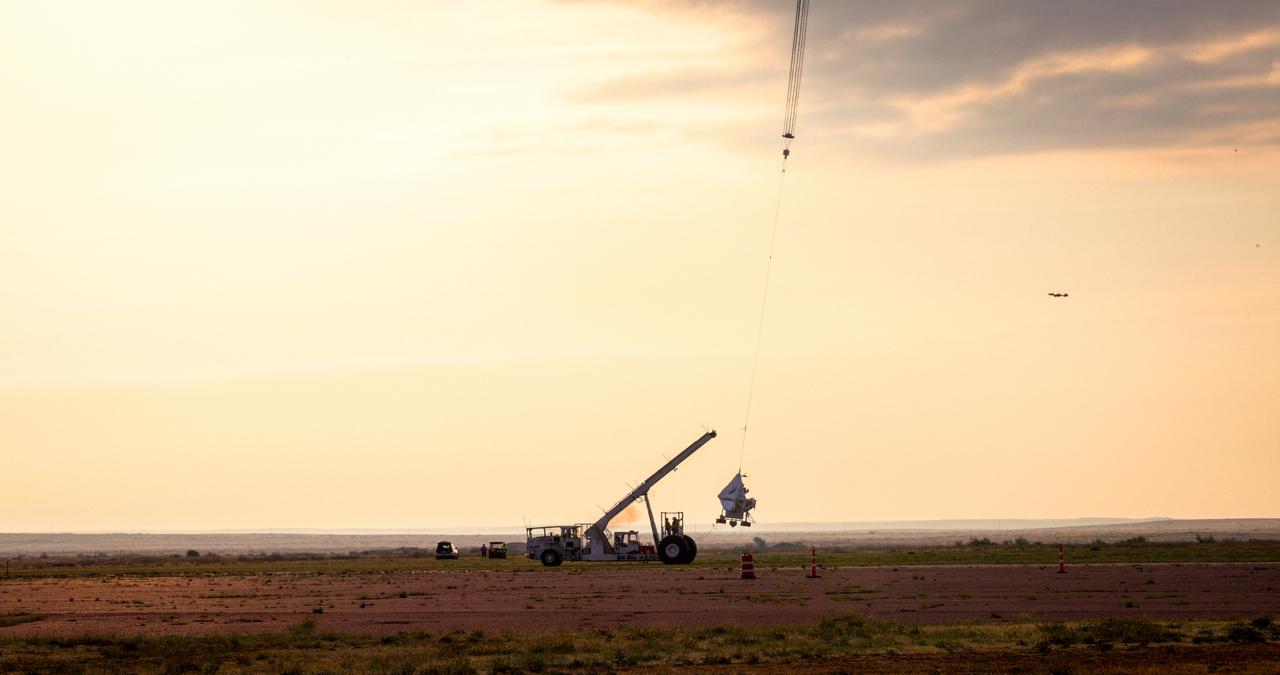
This is EXCITE’s moment of release. On August 31, 2024, the EXCITE (EXoplanet Climate Infrared TElescope) team conducted a test flight of their telescope from NASA’s Columbia Scientific Balloon Facility in Fort Sumner, New Mexico. This photo was taken moments after the telescope was released from the tractor vehicle (called Big Bill). Unseen above is the helium-filled scientific balloon that carried the telescope to the edge of space.
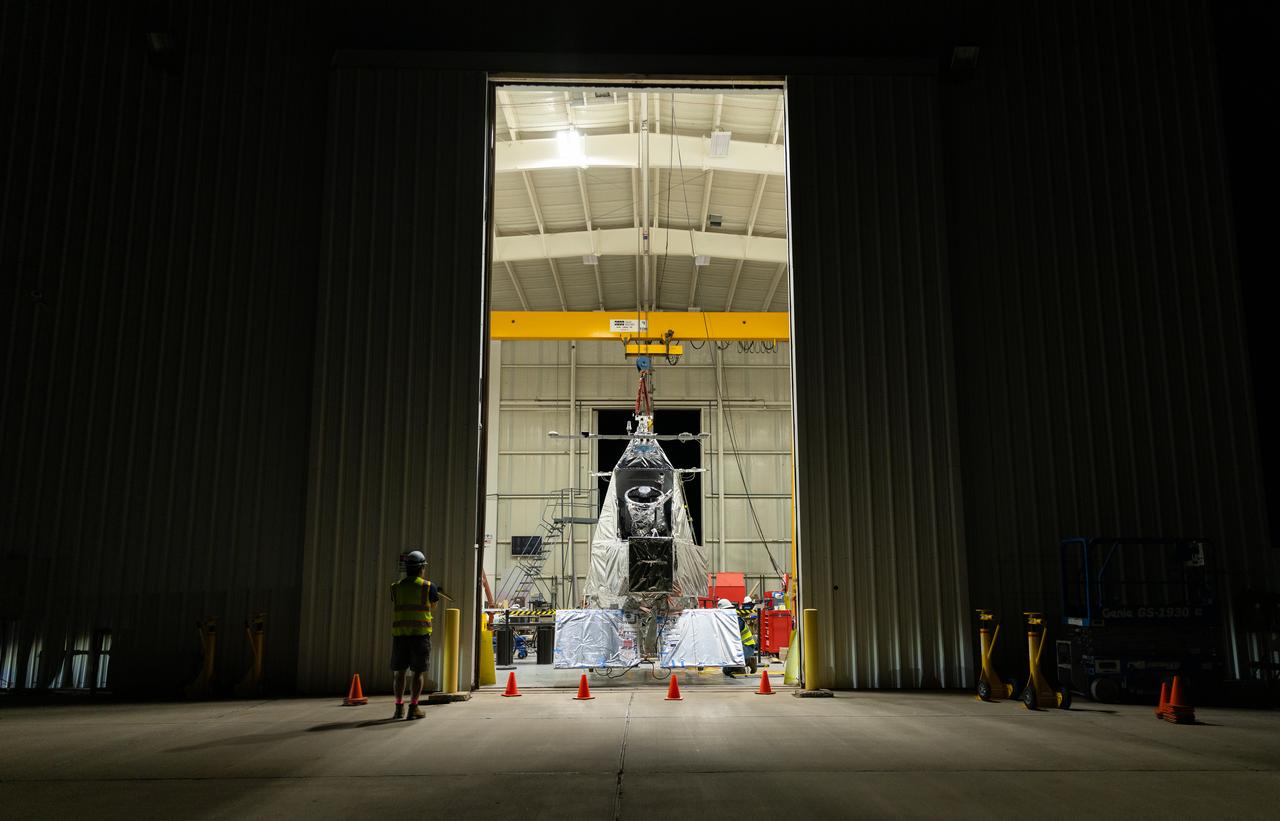
NASA Goddard astrophysicist Kyle Helson looks at EXCITE (EXoplanet Climate Infrared TElescope) as it dangles from the ceiling of a hangar at NASA’s Columbia Scientific Balloon Facility in Fort Sumner, New Mexico.
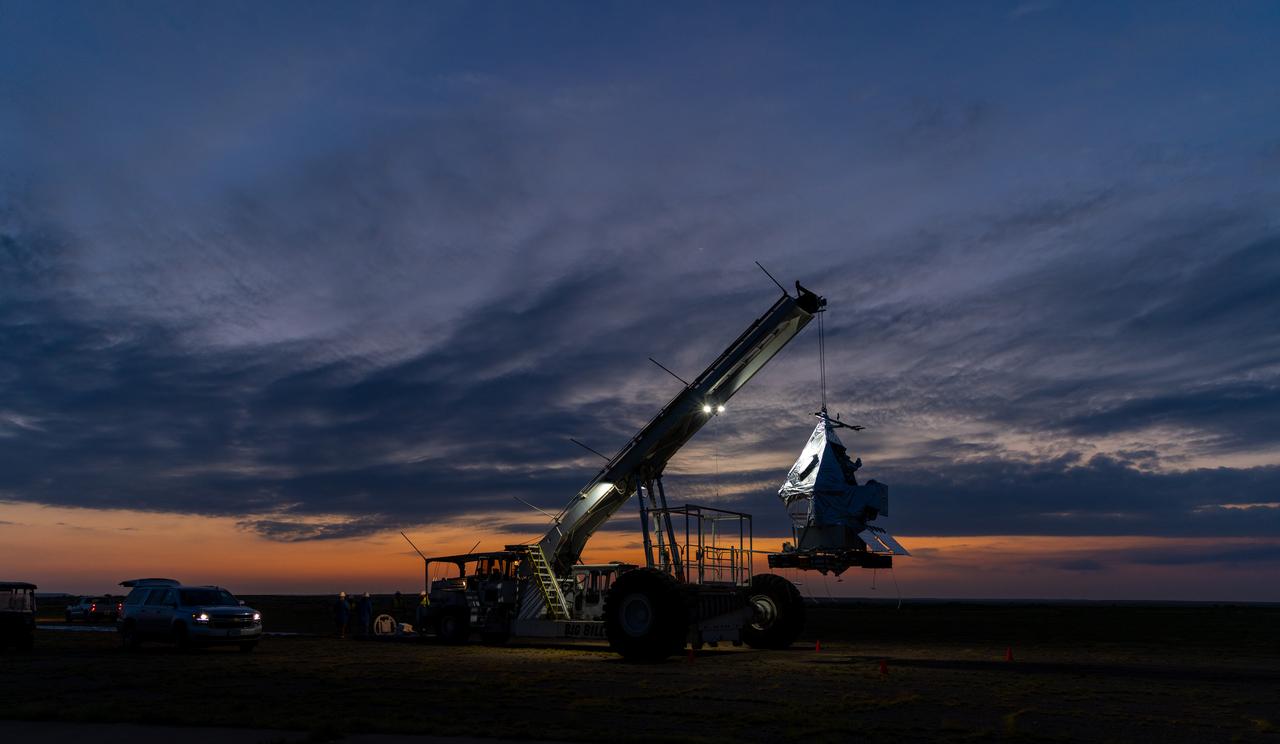
NASA Goddard astrophysicist Kyle Helson looks at EXCITE (EXoplanet Climate Infrared TElescope) as it dangles from the ceiling of a hangar at NASA’s Columbia Scientific Balloon Facility in Fort Sumner, New Mexico.
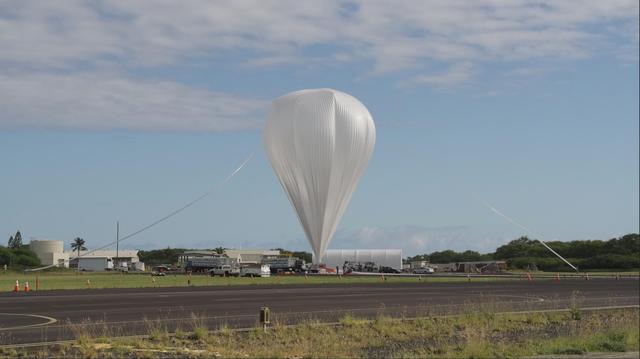
Crews from the Columbia Scientific Balloon Facility prepare the balloon for flight for the 2014 NASA Low-Density Supersonic Decelerator test from the U.S. Navy Pacific Missile Range Facility on Kauai, Hawaii.
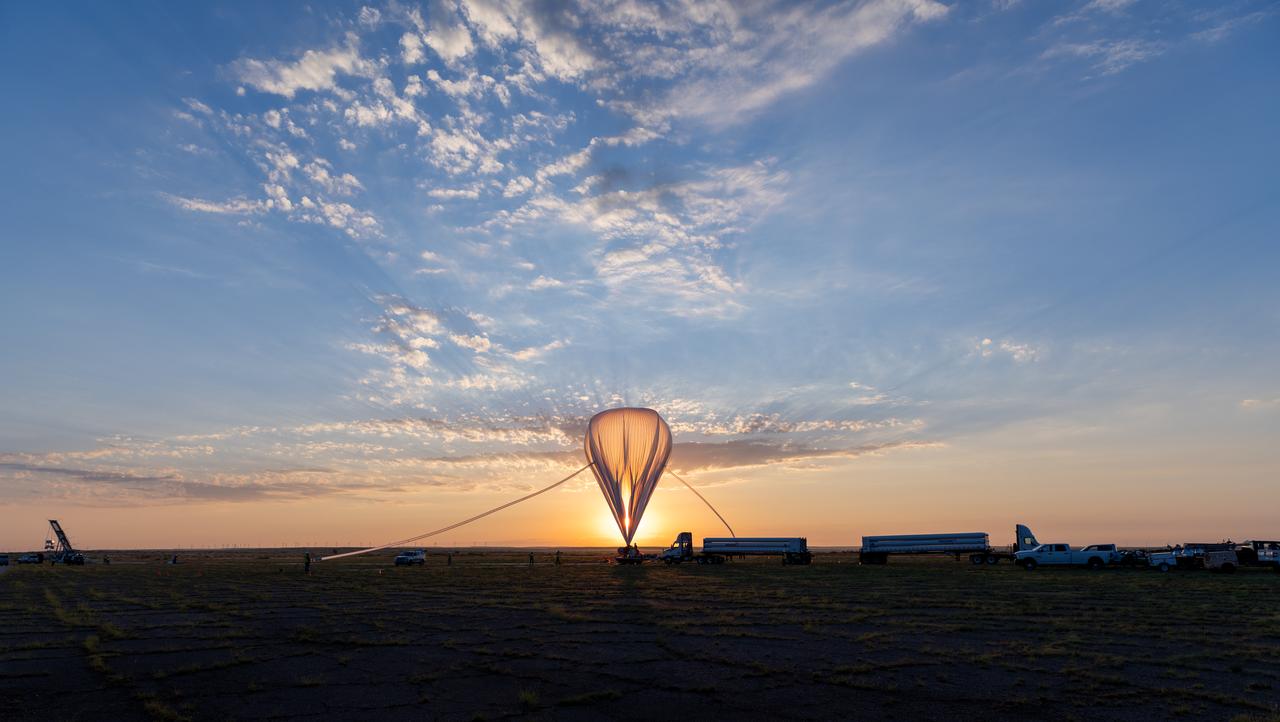
The Scientific balloon eclipses the sun as it fills with helium, and the High Altitude Student Platform awaits launch. On August 28, 2024, the student-run mission launched from a 4-million-cubic-foot balloon for its second flight.
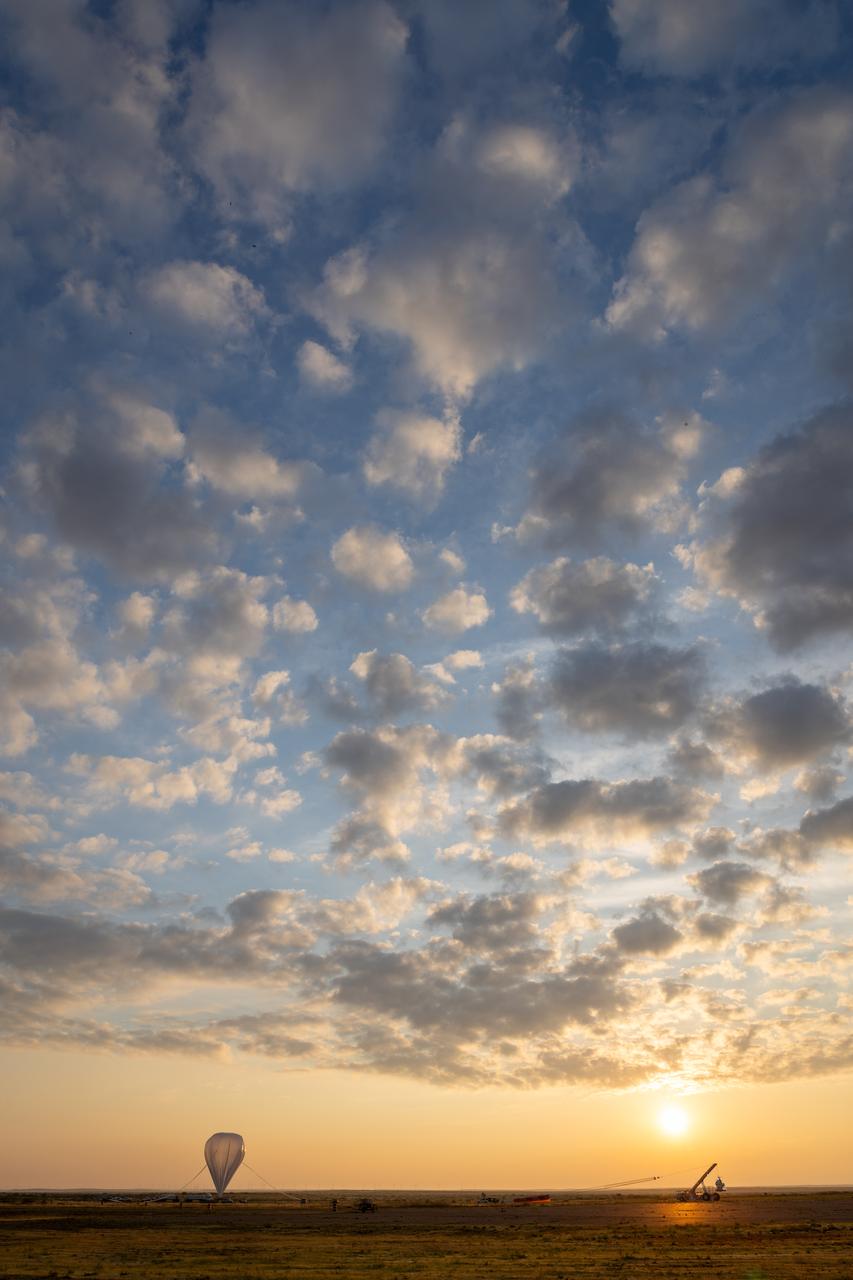
It takes around an hour to fill a 39-million-cubic-foot scientific balloon with helium. The EXCITE telescope is poised for launch as the day breaks on August 31st, 2024.
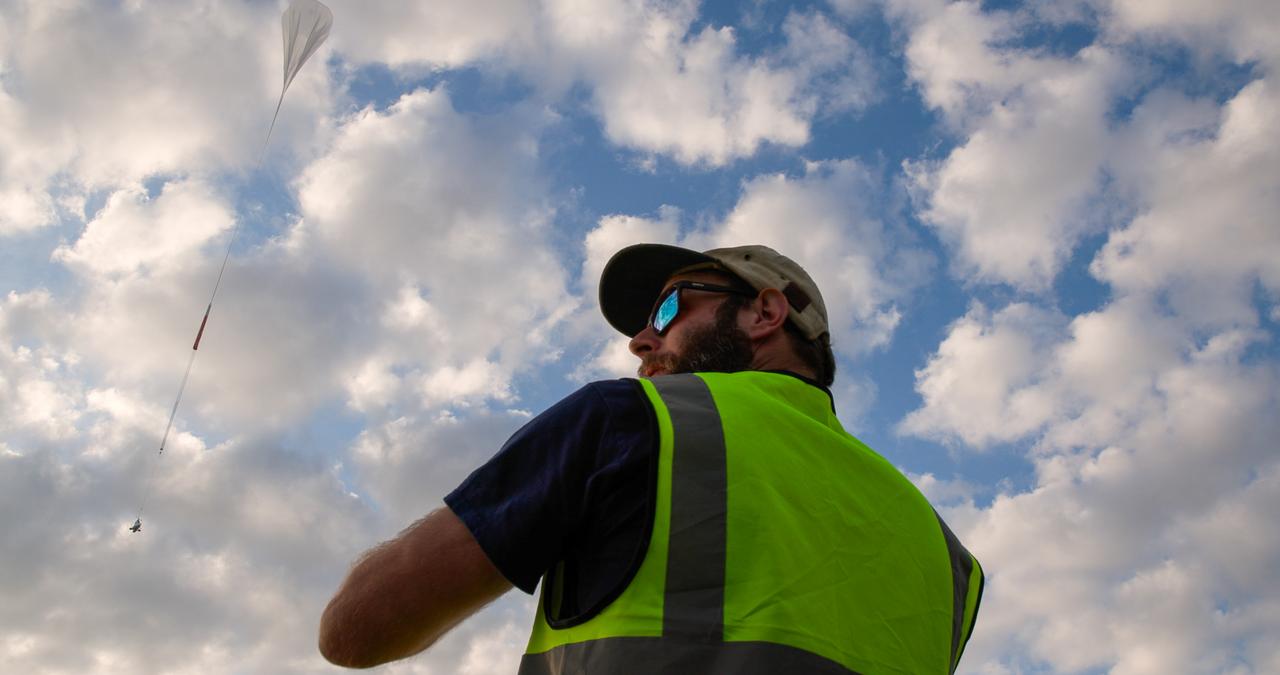
On August 31, 2024, the EXCITE (EXoplanet Climate Infrared TElescope) team conducted a test flight of their telescope from NASA’s Columbia Scientific Balloon Facility in Fort Sumner, New Mexico. Here, EXCITE’s Principal Investigator, Peter Nagler, watches his mission take flight.

Matthew Mullin and Bobby Meazell, Orbital ATK/Columbia Scientific Balloon Facility technicians, conduct compatibility testing on NASA Langley Research Center’s Radiation Dosimetry Experiment payload Wednesday, Sept. 9, at Fort Sumner, N.M. The successful compatibility test was a key milestone in ensuring the flight readiness of RaD-X, which is scheduled to launch on an 11-million-cubic-foot NASA scientific balloon no earlier than Friday, Sept. 11, from the agency’s balloon launching facility in Fort Sumner. RaD-X will measure cosmic ray energy at two separate altitude regions in the stratosphere—above 110,000 feet and between 69,000 to 88,500 feet. The data is key to confirming Langley’s Nowcast of Atmospheric Ionizing Radiation for Aviation Safety (NAIRAS) model, which is a physics-based model that determines solar radiation and galactic cosmic ray exposure globally in real-time. The NAIRAS modeling tool will be used to help enhance aircraft safety as well as safety procedures for the International Space Station. In addition to the primary payload, 100 small student experiments will fly on the RaD-X mission as part of the Cubes in Space program. The program provides 11- to 18-year-old middle and high school students a no-cost opportunity to design and compete to launch an experiment into space or into the near-space environment. The cubes measure just 4 centimeters by 4 centimeters. NASA’s scientific balloons offer low-cost, near-space access for scientific payloads weighing up to 8,000 pounds for conducting scientific investigations in fields such as astrophysics, heliophysics and atmospheric research. NASA’s Wallops Flight Facility in Virginia manages the agency’s scientific balloon program with 10 to 15 flights each year from launch sites worldwide. Orbital ATK provides program management, mission planning, engineering services and field operations for NASA’s scientific balloon program. The program is executed from the Columbia Scientific Balloon Facility in Palestine, Texas. The Columbia team has launched more than 1,700 scientific balloons in over 35 years of operation. Anyone may track the progress of the Fort Sumner flights, which includes a map showing the balloon’s real-time location, at: <a href="http://towerfts.csbf.nasa.gov/" rel="nofollow">towerfts.csbf.nasa.gov/</a> For more information on the balloon program, see: <a href="http://www.nasa.gov/scientificballoons" rel="nofollow">www.nasa.gov/scientificballoons</a> <b><a href="http://www.nasa.gov/audience/formedia/features/MP_Photo_Guidelines.html" rel="nofollow">NASA image use policy.</a></b> <b><a href="http://www.nasa.gov/centers/goddard/home/index.html" rel="nofollow">NASA Goddard Space Flight Center</a></b> enables NASA’s mission through four scientific endeavors: Earth Science, Heliophysics, Solar System Exploration, and Astrophysics. Goddard plays a leading role in NASA’s accomplishments by contributing compelling scientific knowledge to advance the Agency’s mission. <b>Follow us on <a href="http://twitter.com/NASAGoddardPix" rel="nofollow">Twitter</a></b> <b>Like us on <a href="http://www.facebook.com/pages/Greenbelt-MD/NASA-Goddard/395013845897?ref=tsd" rel="nofollow">Facebook</a></b> <b>Find us on <a href="http://instagrid.me/nasagoddard/?vm=grid" rel="nofollow">Instagram</a></b>
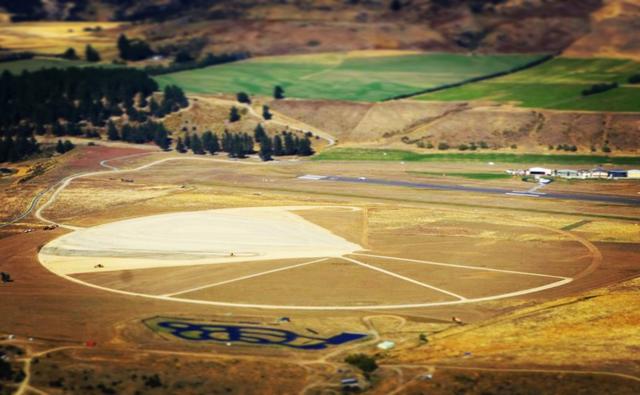
Aviators, skydivers and other altitude-seeking enthusiasts flying out of Wanaka Airport, New Zealand, are double taking at a new topographical feature reminiscent of an alien crop circle. Rest assured, the nearly 2,000-foot (600-meter) diameter circle with a pie-shaped wedge on one side and spokes on the other is no extraterrestrial footprint and it’s definitely no hoax. It’s NASA’s newest launch pad for launching the agency’s most advanced high-altitude, heavy-lift scientific balloon: the super pressure balloon. The four spokes emanating from the center and toward the west, each nearly 1,000 feet (300 meters) long, align with magnetic compass directions at 240, 260, 290 and 320 degrees. On launch day, balloon flight experts from NASA’s Columbia Scientific Balloon Facility will assess meteorological data and determine if the conditions are suitable to support a launch opportunity. The new pad is the first major project in developing a long-term super pressure balloon launch site in Wanaka. Earlier in 2017, NASA signed a 10-year lease with the Queenstown Airport Corporation to conduct balloon operations from a newly acquired piece of land adjacent to the Wanaka Airport. Credit: NASA/Dave Webb <b><a href="http://www.nasa.gov/audience/formedia/features/MP_Photo_Guidelines.html" rel="nofollow">NASA image use policy.</a></b> <b><a href="http://www.nasa.gov/centers/goddard/home/index.html" rel="nofollow">NASA Goddard Space Flight Center</a></b> enables NASA’s mission through four scientific endeavors: Earth Science, Heliophysics, Solar System Exploration, and Astrophysics. Goddard plays a leading role in NASA’s accomplishments by contributing compelling scientific knowledge to advance the Agency’s mission. <b>Follow us on <a href="http://twitter.com/NASAGoddardPix" rel="nofollow">Twitter</a></b> <b>Like us on <a href="http://www.facebook.com/pages/Greenbelt-MD/NASA-Goddard/395013845897?ref=tsd" rel="nofollow">Facebook</a></b> <b>Find us on <a href="http://instagrid.me/nasagoddard/?vm=grid" rel="nofollow">Instagram</a></b>

NASA image captured December 25, 2011 A NASA scientific balloon awaits launch in McMurdo, Antarctica. The balloon, carrying Indiana University's Cosmic Ray Electron Synchrotron Telescope (CREST), was launched on December 25. After a circum-navigational flight around the South Pole, the payload landed on January 5. The CREST payload is one of two scheduled as part of this seasons' annual NASA Antarctic balloon Campaign which is conducted in cooperation with the National Science Foundation's Office of Polar Programs. The campaign's second payload is the University of Arizona's Stratospheric Terahertz Observatory (STO). You can follow the flights at the Columbia Scientific Balloon Facility's web site at <a href="http://www.csbf.nasa.gov/antarctica/ice.htm" rel="nofollow">www.csbf.nasa.gov/antarctica/ice.htm</a> Credit: NASA <b><a href="http://www.nasa.gov/audience/formedia/features/MP_Photo_Guidelines.html" rel="nofollow">NASA image use policy.</a></b> <b><a href="http://www.nasa.gov/centers/goddard/home/index.html" rel="nofollow">NASA Goddard Space Flight Center</a></b> enables NASA’s mission through four scientific endeavors: Earth Science, Heliophysics, Solar System Exploration, and Astrophysics. Goddard plays a leading role in NASA’s accomplishments by contributing compelling scientific knowledge to advance the Agency’s mission. <b>Follow us on <a href="http://twitter.com/NASA_GoddardPix" rel="nofollow">Twitter</a></b> <b>Like us on <a href="http://www.facebook.com/pages/Greenbelt-MD/NASA-Goddard/395013845897?ref=tsd" rel="nofollow">Facebook</a></b> <b>Find us on <a href="http://instagrid.me/nasagoddard/?vm=grid" rel="nofollow">Instagram</a></b>

NASA image captured December 25, 2011 A NASA scientific balloon awaits launch in McMurdo, Antarctica. The balloon, carrying Indiana University's Cosmic Ray Electron Synchrotron Telescope (CREST), was launched on December 25. After a circum-navigational flight around the South Pole, the payload landed on January 5. The CREST payload is one of two scheduled as part of this seasons' annual NASA Antarctic balloon Campaign which is conducted in cooperation with the National Science Foundation's Office of Polar Programs. The campaign's second payload is the University of Arizona's Stratospheric Terahertz Observatory (STO). You can follow the flights at the Columbia Scientific Balloon Facility's web site at <a href="http://www.csbf.nasa.gov/antarctica/ice.htm" rel="nofollow">www.csbf.nasa.gov/antarctica/ice.htm</a> Credit: NASA <b><a href="http://www.nasa.gov/audience/formedia/features/MP_Photo_Guidelines.html" rel="nofollow">NASA image use policy.</a></b> <b><a href="http://www.nasa.gov/centers/goddard/home/index.html" rel="nofollow">NASA Goddard Space Flight Center</a></b> enables NASA’s mission through four scientific endeavors: Earth Science, Heliophysics, Solar System Exploration, and Astrophysics. Goddard plays a leading role in NASA’s accomplishments by contributing compelling scientific knowledge to advance the Agency’s mission. <b>Follow us on <a href="http://twitter.com/NASA_GoddardPix" rel="nofollow">Twitter</a></b> <b>Like us on <a href="http://www.facebook.com/pages/Greenbelt-MD/NASA-Goddard/395013845897?ref=tsd" rel="nofollow">Facebook</a></b> <b>Find us on <a href="http://instagrid.me/nasagoddard/?vm=grid" rel="nofollow">Instagram</a></b>