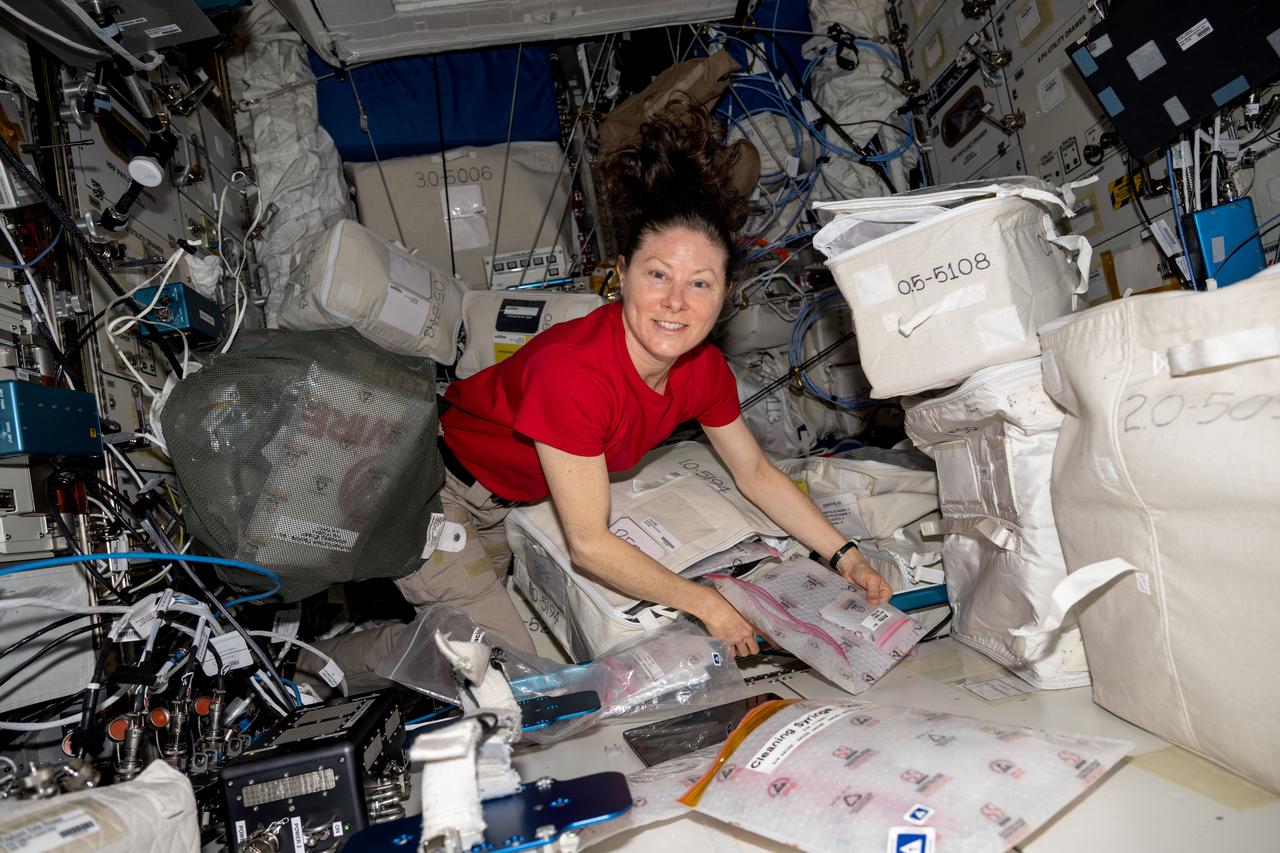
iss071e403579 (July 23, 2024) --- NASA astronaut and Expedition 71 Flight Engineer Tracy C. Dyson unpacks and examines research gear that is part of the BioFabrication Facility (BFF) located inside the International Space Station's Columbus laboratory module. The BFF is a research device being tested for its ability to print organ-like tissues in microgravity.
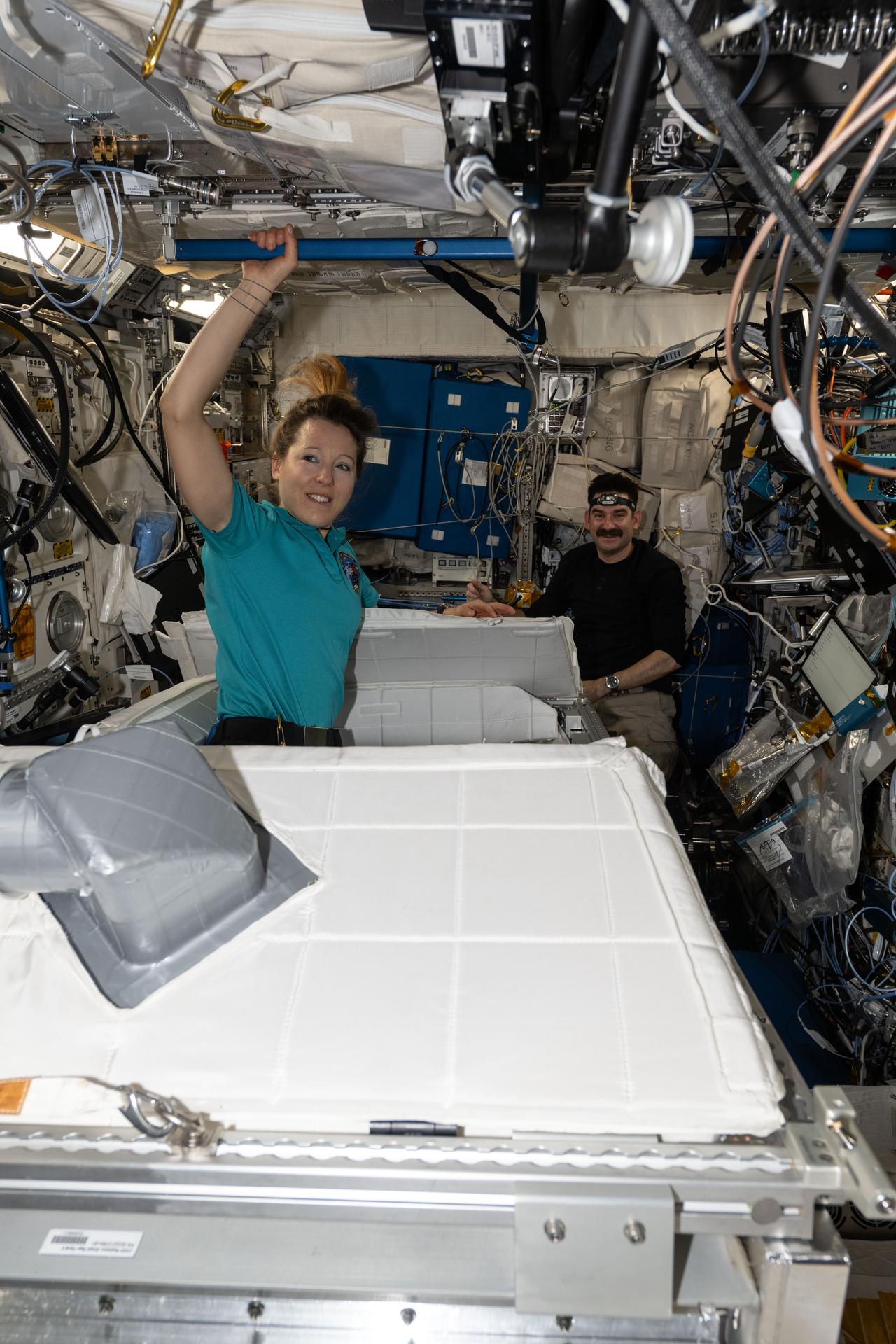
iss074e0792341 (June 7 ,2026) --- Expedition 74 flight engineers Sophie Adenot of ESA (European Space Agency) and Jack Hathaway of NASA (background) are pictured inside the International Space Station's Columbus laboratory module. The astronauts were upgrading a temporary sleep station, also called the Crew Alternate Sleep Accommodation (CASA), aboard Columbus. CASA modifications include a better fit for crew members, improved airflow velocity, an updated lighting configuration, and upgraded side panels and interior liners. Credit: NASA/Jessica Meir
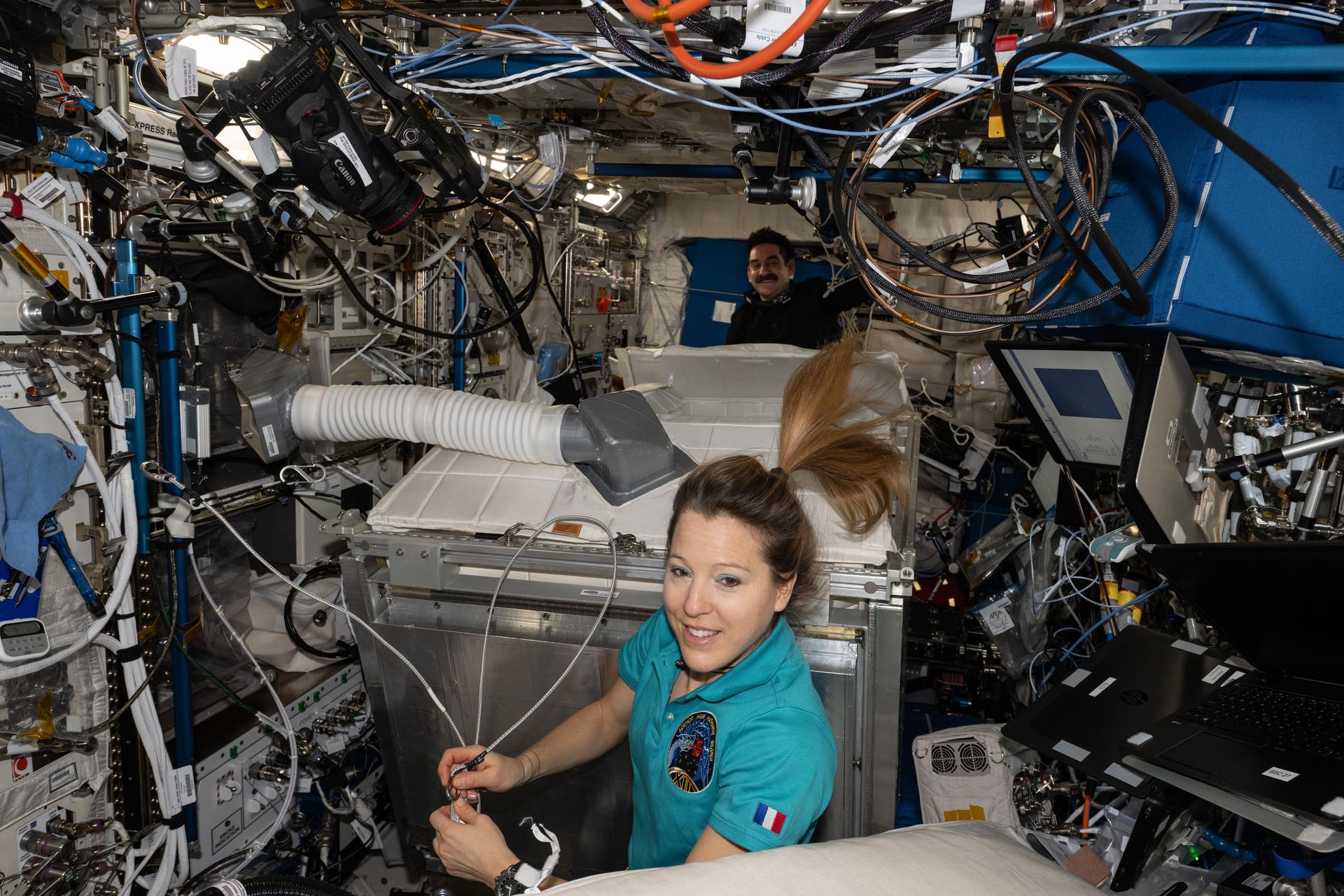
iss074e0792345 (June 7, 2026) --- Expedition 74 flight engineers Sophie Adenot of ESA (European Space Agency) and Jack Hathaway of NASA (background) are pictured inside the International Space Station's Columbus laboratory module. The astronauts were upgrading a temporary sleep station, also called the Crew Alternate Sleep Accommodation (CASA), aboard Columbus. CASA modifications include a better fit for crew members, improved airflow velocity, an updated lighting configuration, and upgraded side panels and interior liners. Credit: NASA/Jessica Meir
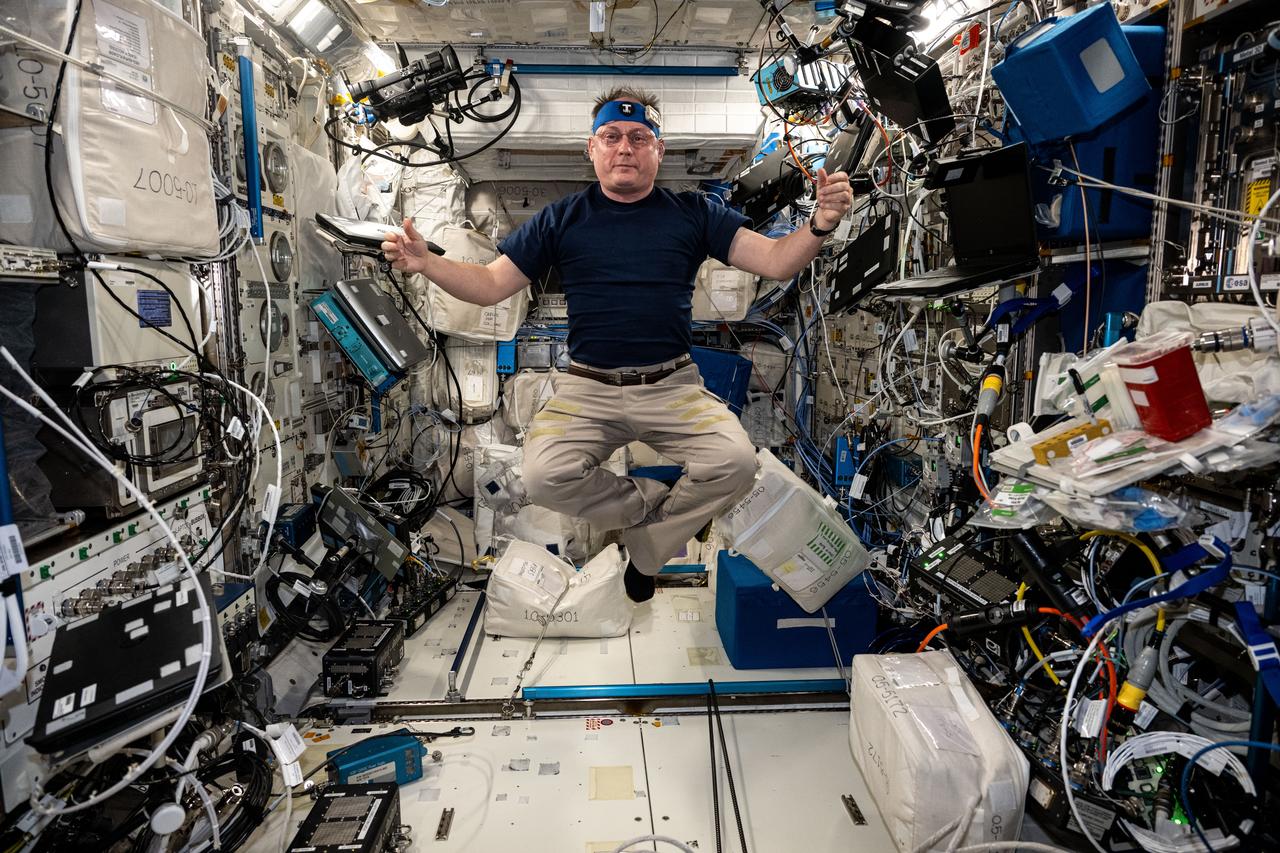
iss073e0420910 (Aug. 3, 2025) --- NASA astronaut and Expedition 73 Flight Engineer Mike Fincke poses for a portrait inside the International Space Station's Columbus laboratory module during research operations to learn how the body maintains its core temperature in microgravity.

iss058e013244 (Feb. 13, 2019) --- The forward end of the International Space Station is pictured showing portions of five modules. From right to left is a portion of the U.S. Destiny laboratory module linking forward to the Harmony module. Attached to the port side of Harmony (left foreground) is the Kibo laboratory module from the Japan Aerospace Exploration Agency (JAXA) with its logistics module berthed on top. On Harmony's starboard side (center background) is the Columbus laboratory module from ESA (European Space Agency).
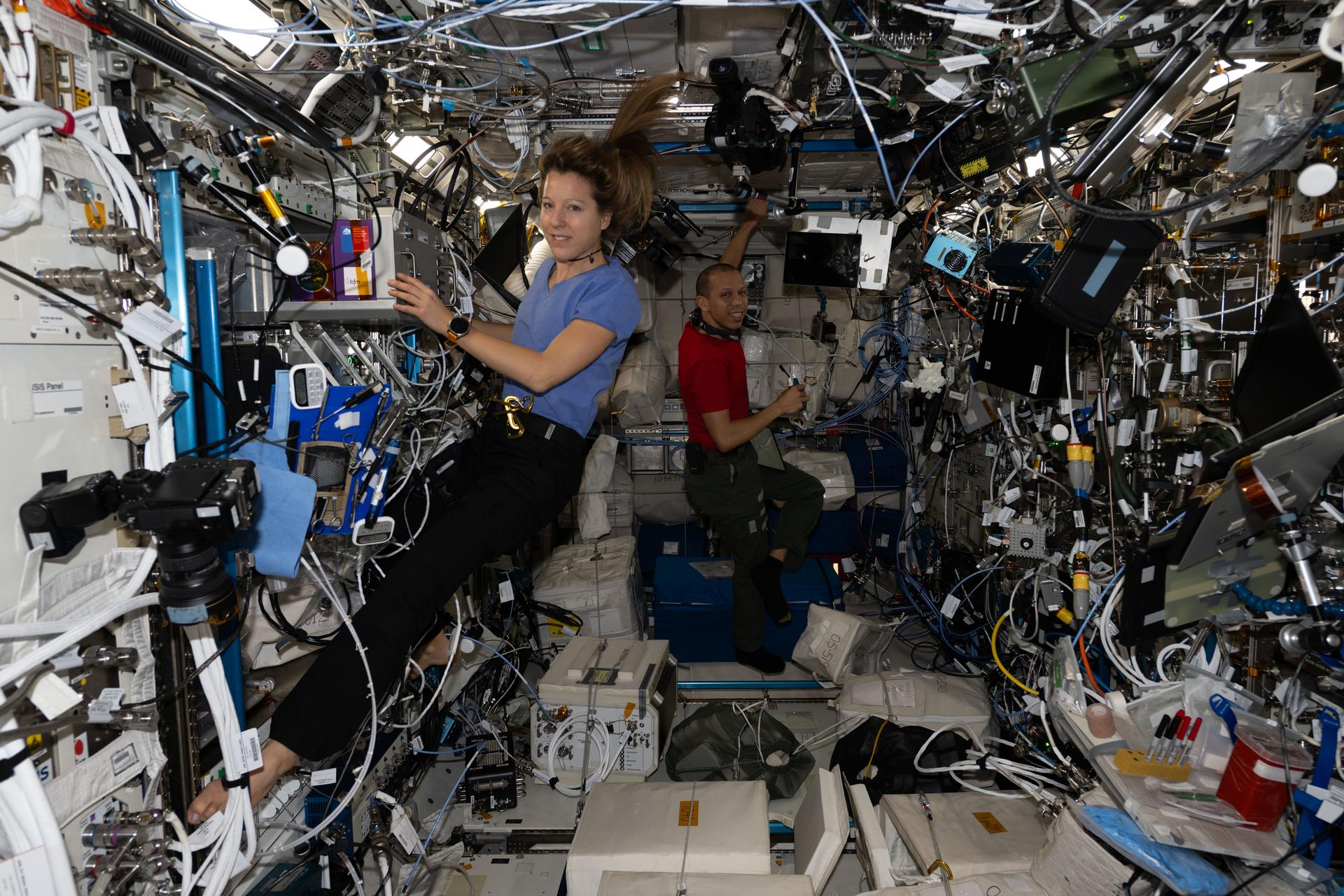
iss074e0490810 (April 15, 2026) --- Expedition 74 flight engineers Sophie Adenot of ESA (European Space Agency) and Chris Williams of NASA work together inside the International Space Station’s Columbus laboratory module to install and activate new research gear delivered on Northrop Grumman’s second Cygnus XL cargo mission. Williams was configuring the new European Enhanced Exploration Exercise Device, while Adenot was installing advanced biotechnology experiment hardware. Credit: NASA/Jessica Meir
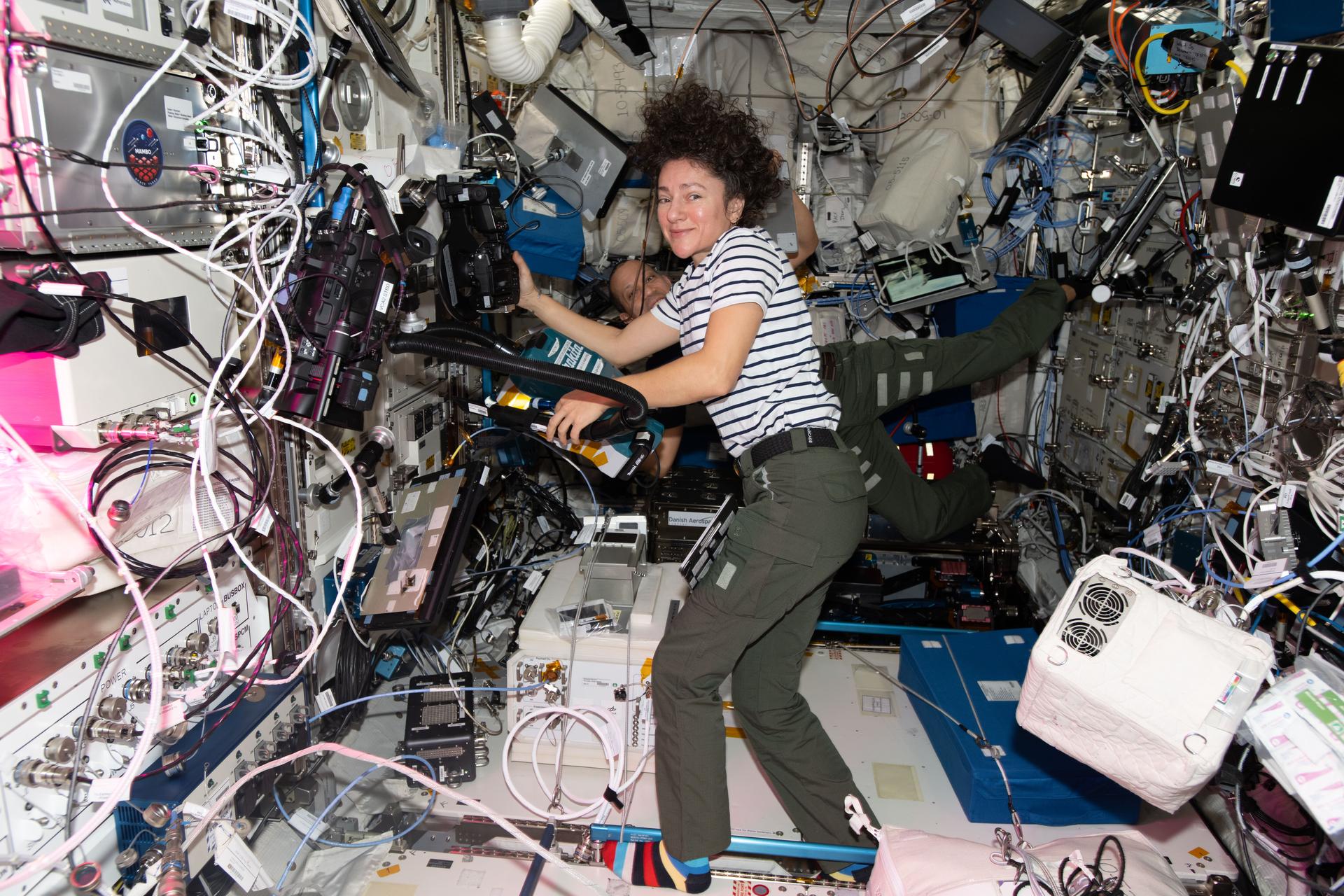
iss074e0503707 (April 22, 2026) --- NASA astronauts Jessica Meir and Chris Williams (in the background) work on separate tasks inside the International Space Station’s Columbus laboratory module. Meir swapped scientific hardware inside the BioLab research incubator to study how DNA damaged by space radiation repairs itself. Williams installed new laptop software and checked computer connections to the station’s Wi‑Fi system. Credit: NASA/Jack Hathaway
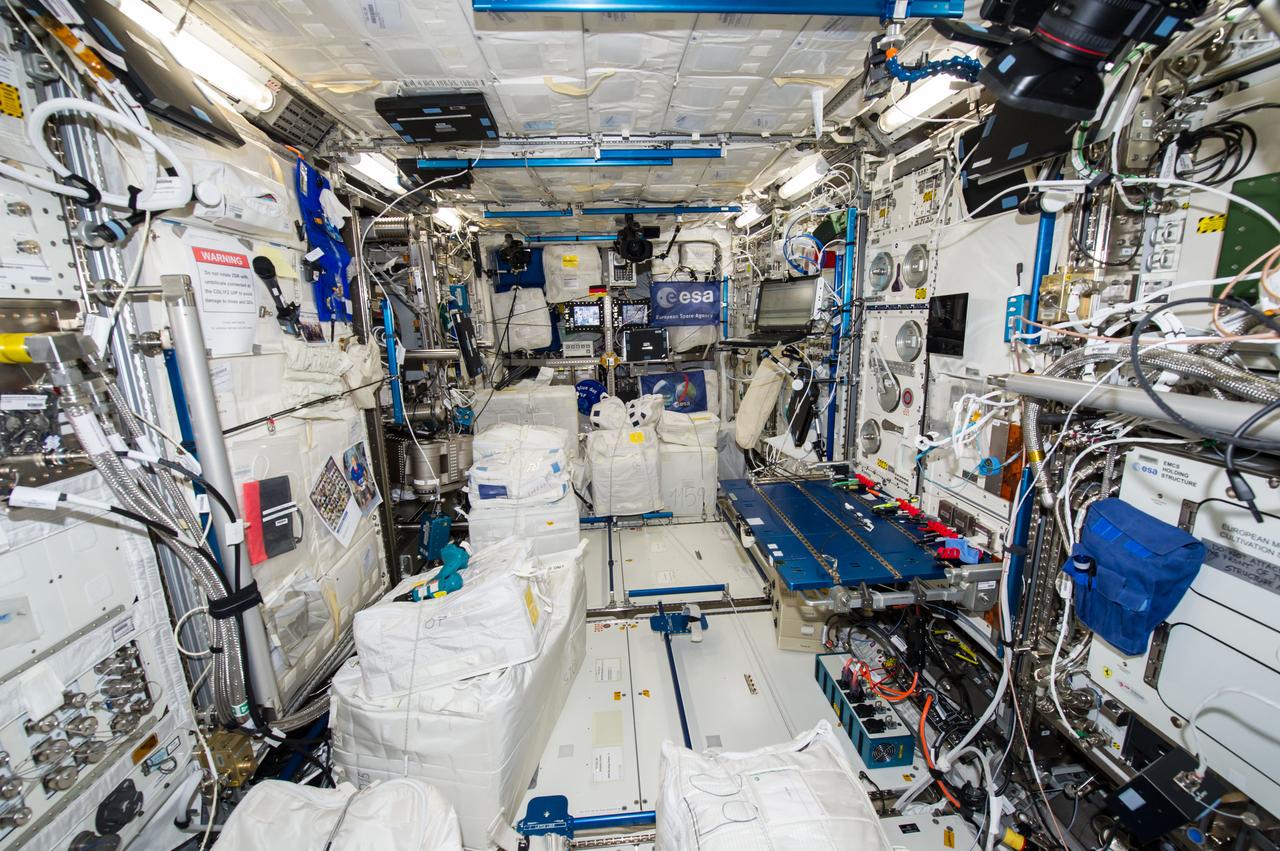
iss041e000170 (9/11/2020) --- A view of the Columbus Module aboard the International Space Stations (ISS). The Columbus laboratory is Europe’s largest contribution to the International Space Station. Columbus is a multifunctional pressurized laboratory permanently attached to the Harmony Module. The lab allows researchers on the ground, aided by the station’s crew, to conduct a wide variety of research in a weightless environment. In addition, experiments and applications can be conducted outside the module in the vacuum of space, thanks to four exterior mounting platforms that can accommodate external payloads in space science, Earth observation and technology.
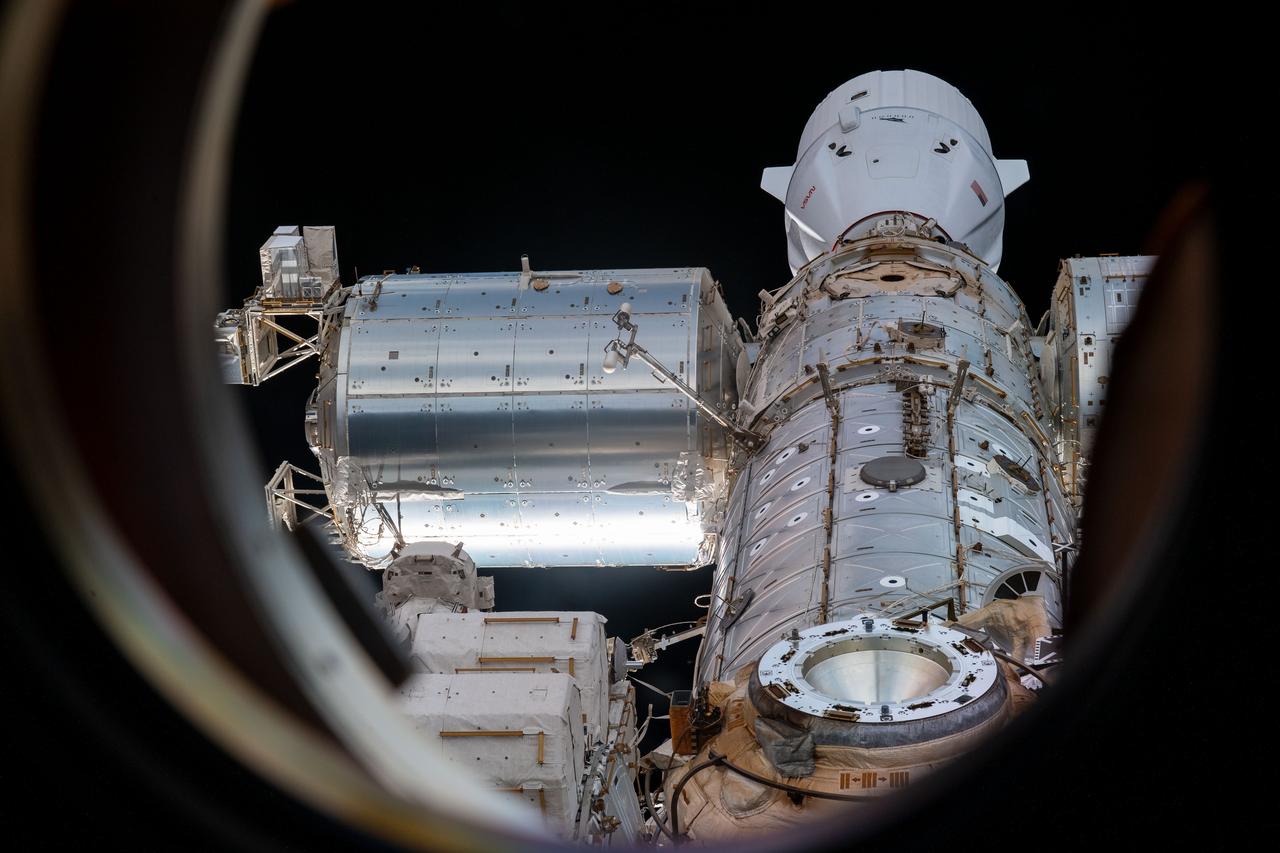
iss067e214074 (Aug. 2, 2022) --- This view of the International Space Station from a window on the orbiting lab's Russian segment shows portions of the Rassvet module's docking port, the U.S. Destiny laboratory module, the Harmony module, Columbus laboratory module, and the Kibo laboratory module. Docked to Harmony at top, is the SpaceX Dragon resupply ship.
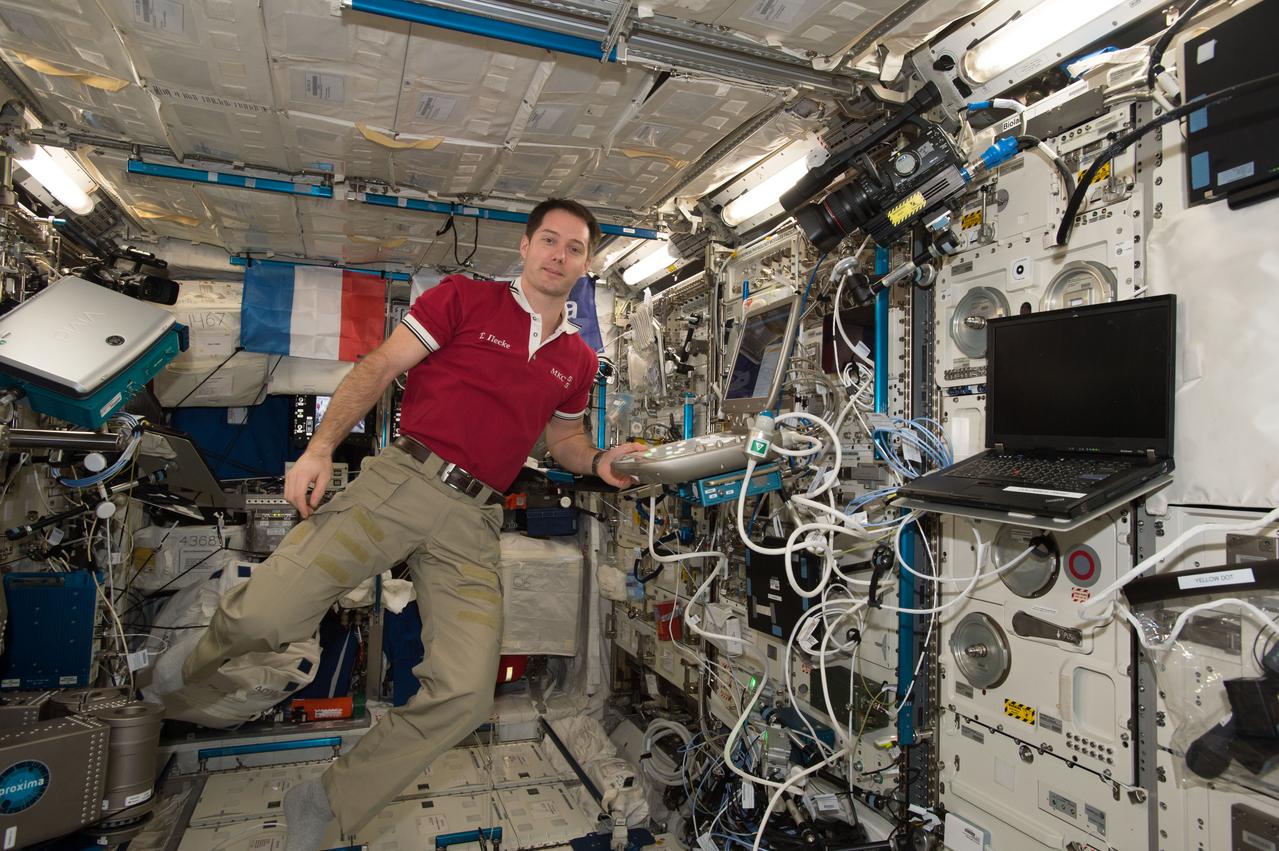
iss051e019007 (April 18, 2017) --- European Space Agency astronaut Thomas Pesquet works inside the Columbus laboratory module.
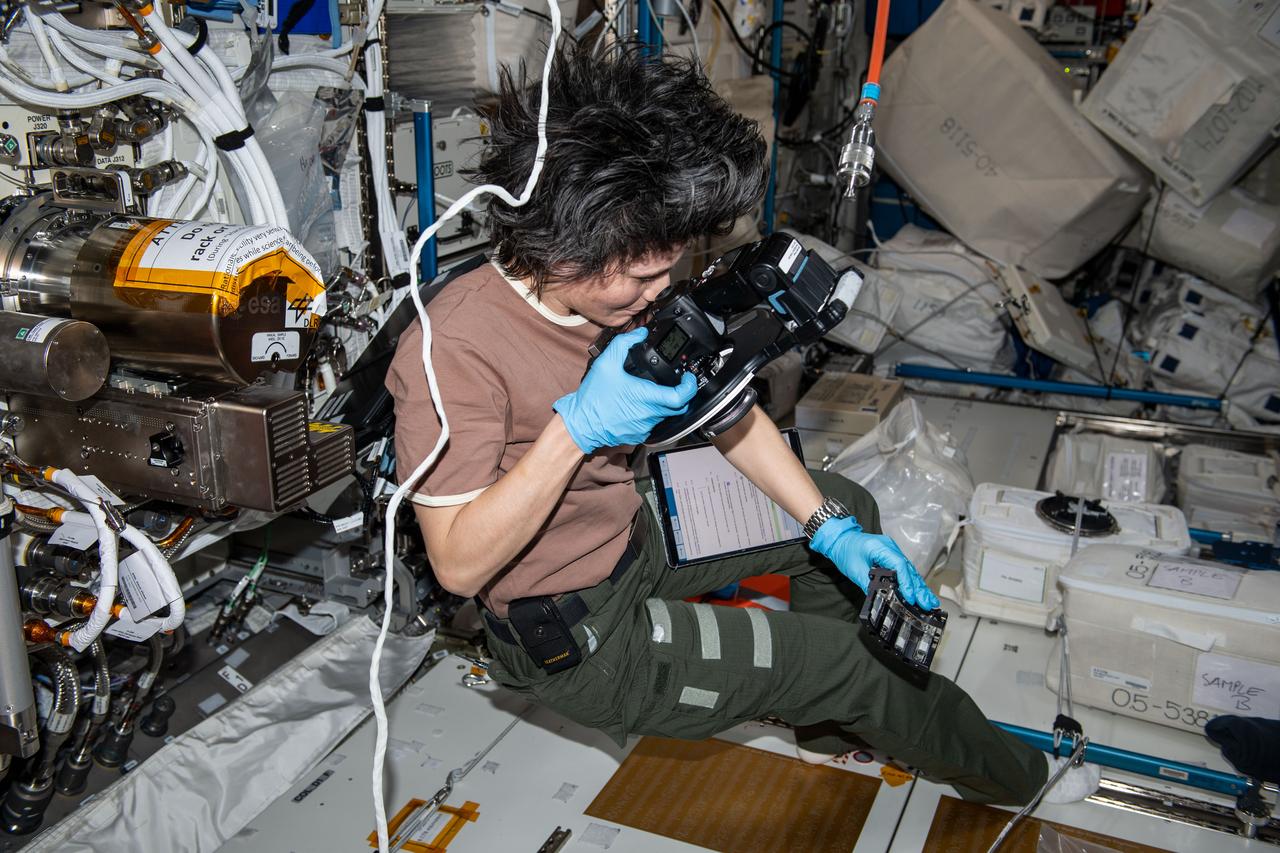
iss067e253397 (Dec. 2, 2024) --- ESA (European Space Agency) astronaut and Expedition 67 Flight Engineer Samantha Cristoforetti photographs and exchanges samples for the Fluids Science Laboratory Soft Matter Dynamics space physics experiment aboard the Intenational Space Station's Columbus laboratory module. The microgravity environment enables the observation of "wet" foams and the study of rearrangement phenomena, such as coarsening and coalescence, disentangled from drainage issues caused by Earth's gravity. Results may benefit Earth and space industries.
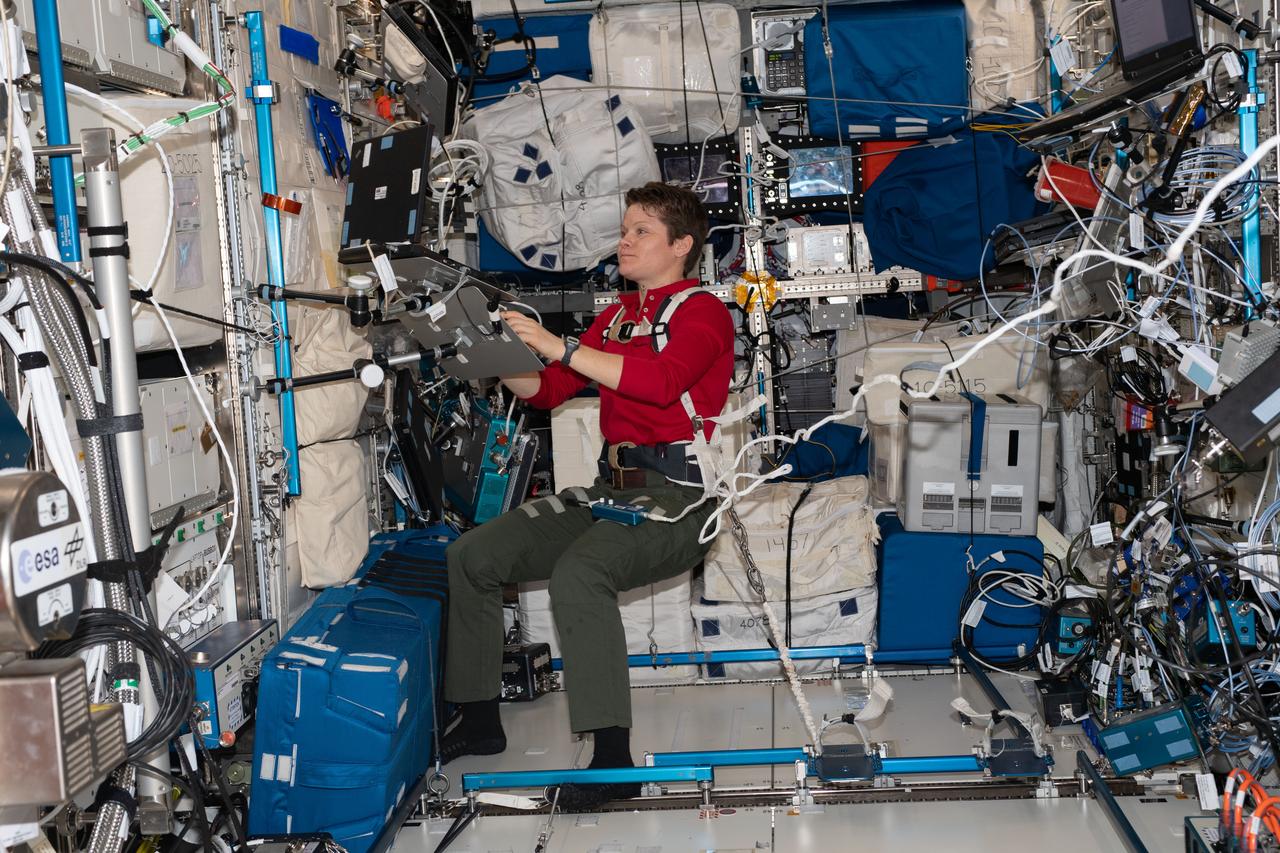
iss058e001965 (Jan. 4, 2019) --- NASA astronaut and Expedition 58 Flight Engineer Anne McClain is inside the European Columbus laboratory module participating in the NeuroMapping experiment. The long-running experiment studies whether long-duration spaceflight causes any changes to the brain, including brain structure and function, motor control, and multi-tasking abilities.
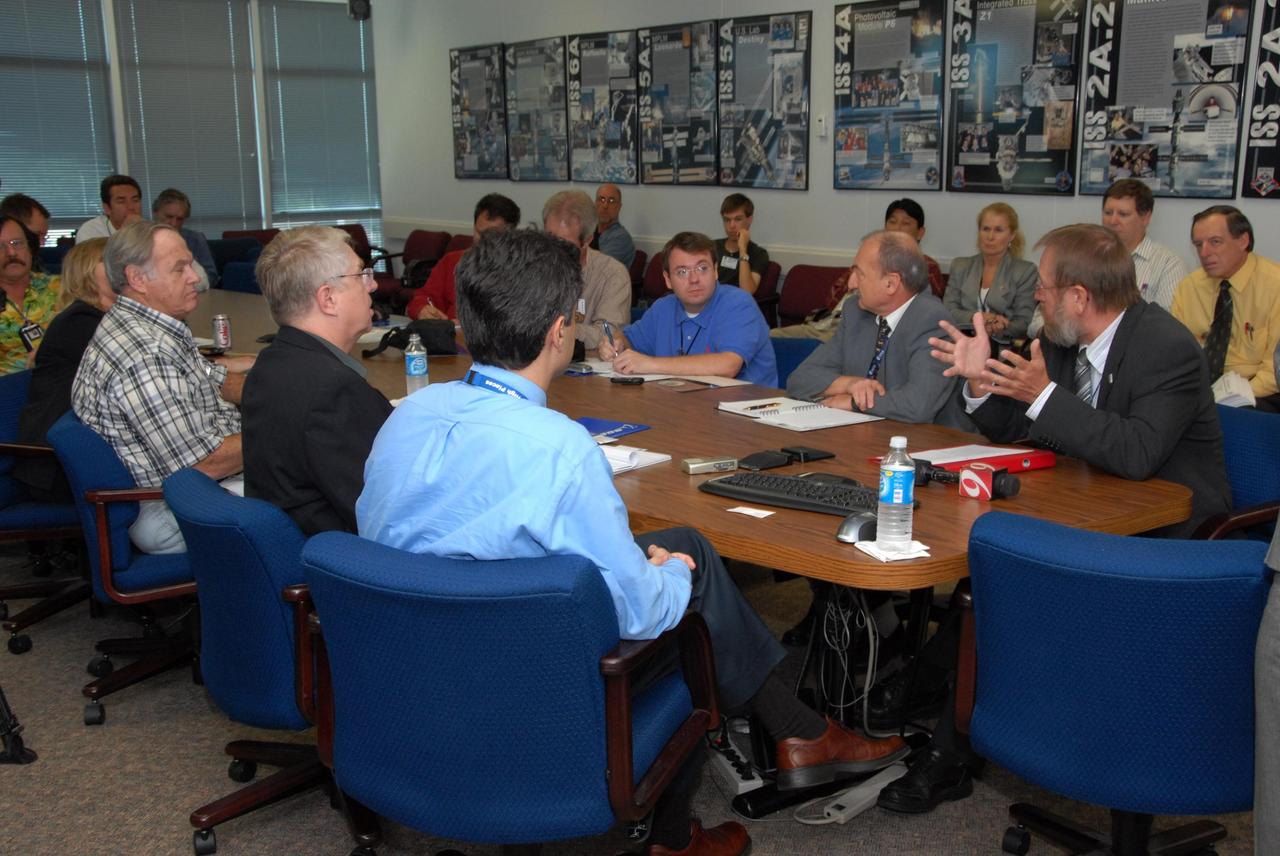
KENNEDY SPACE CENTER, FLA. -- Prior to a showing of the European Space Agency's Columbus Laboratory module, Gregor Woop (seated at right) talks to the media about the module. Woop is the European Space Agency's product assurance and safety manager. Columbus is the European Space Agency 's largest single contribution to the International Space Station. The laboratory module will expand the research facilities of the station, providing crew members and scientists around the world the ability to conduct a variety of life, physical and materials science experiments. The module is approximately 23 feet long and 15 feet wide, allowing it to hold 10 large racks of experiments. Columbus is scheduled to be transferred to Launch Pad 39A in early November, in preparation for its journey to the station. Columbus will fly aboard space shuttle Atlantis on the STS-122 mission, targeted for launch Dec. 6. Photo credit: NASA/George Shelton
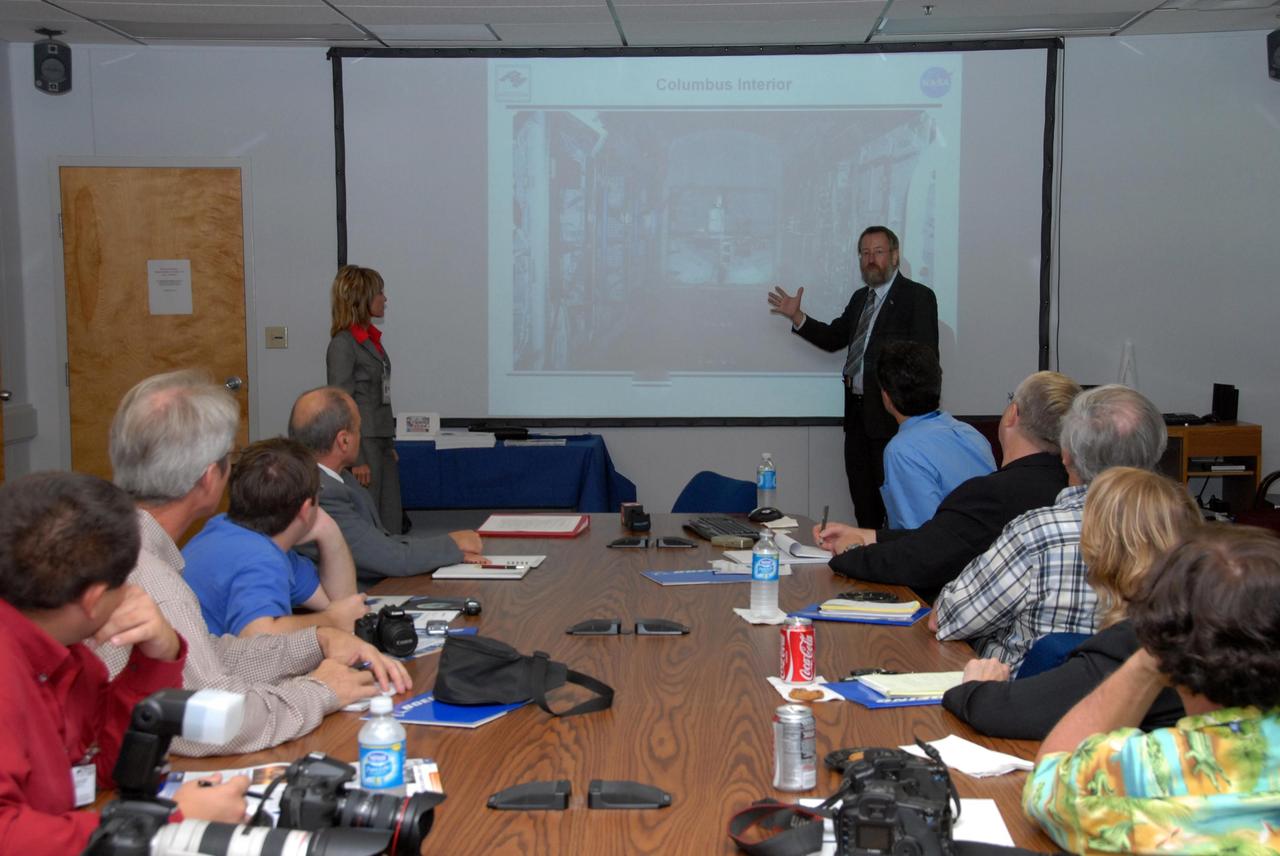
KENNEDY SPACE CENTER, FLA. -- Prior to a showing of the European Space Agency's Columbus Laboratory module, Gregor Woop, in front of the screen, provides information about the module for the media gathered at the table. Woop is the European Space Agency's product assurance and safety manager. Standing at left is Debbie Hahn, NASA mission manager. Columbus is the European Space Agency 's largest single contribution to the International Space Station. The laboratory module will expand the research facilities of the station, providing crew members and scientists around the world the ability to conduct a variety of life, physical and materials science experiments. The module is approximately 23 feet long and 15 feet wide, allowing it to hold 10 large racks of experiments. Columbus is scheduled to be transferred to Launch Pad 39A in early November, in preparation for its journey to the station. Columbus will fly aboard space shuttle Atlantis on the STS-122 mission, targeted for launch Dec. 6. Photo credit: NASA/George Shelton
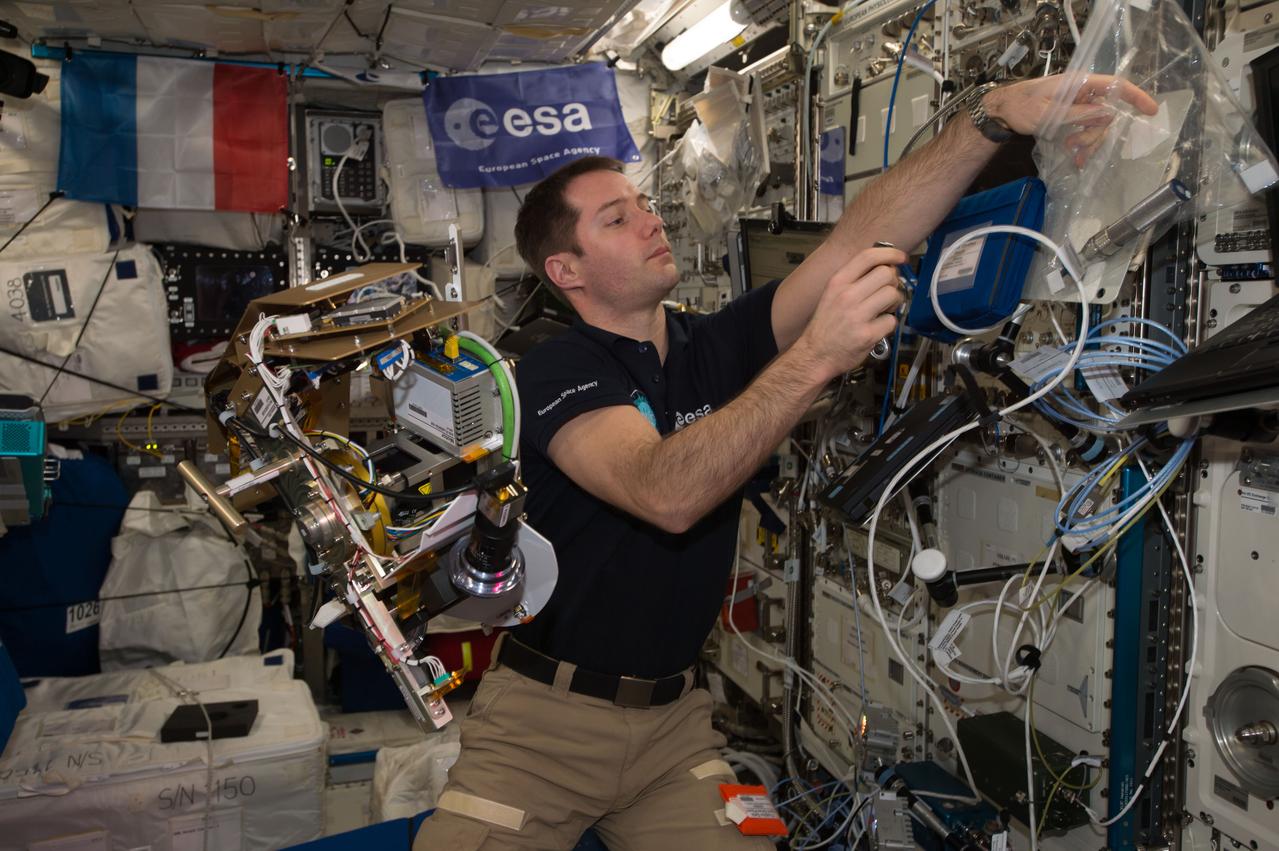
iss051e033992 (May 2, 2017) --- Astronaut Thomas Pesquet, of the European Space Agency (ESA), is at work inside the Columbus laboratory module developed by ESA.
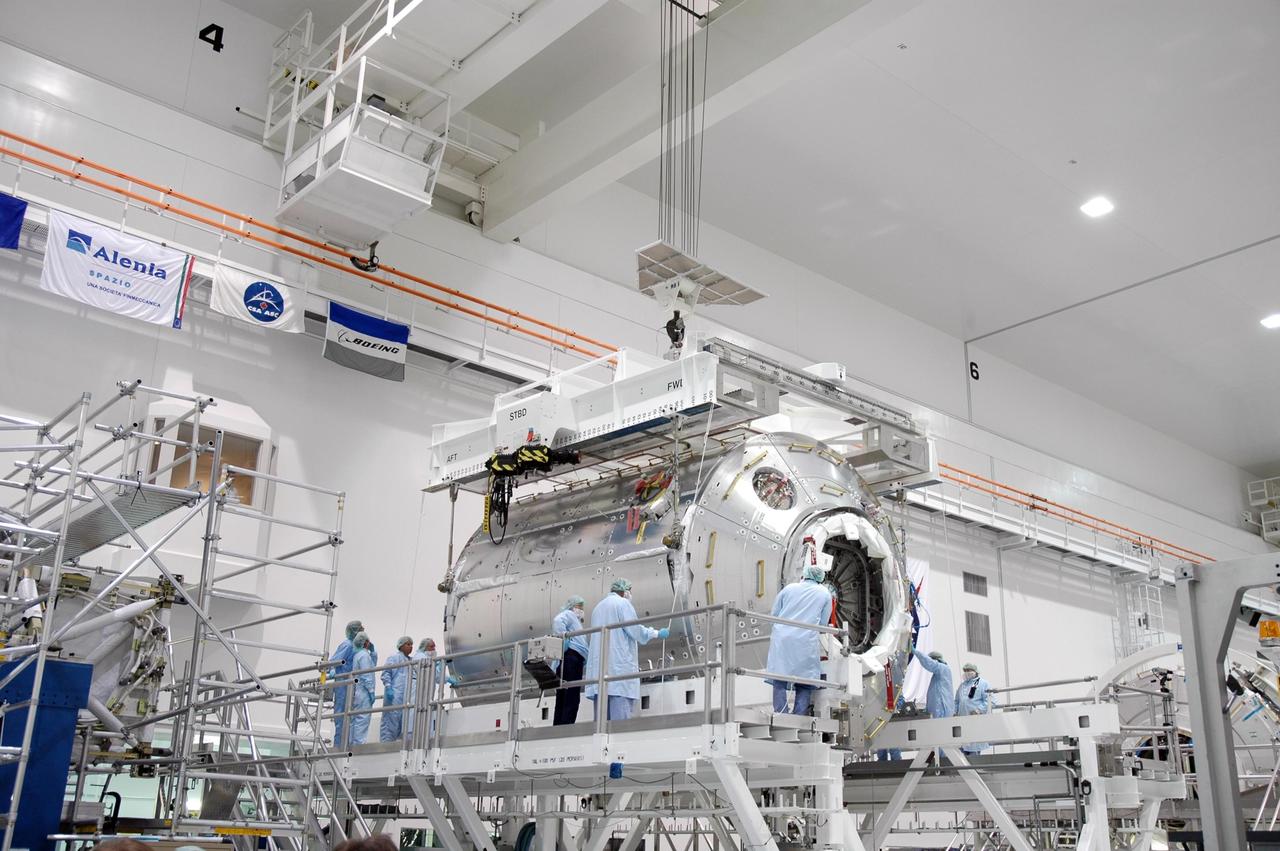
KENNEDY SPACE CENTER, FLA. - Inside the Space Station Processing Facility at NASA's Kennedy Space Center, an overhead crane settles the Columbus module onto a work stand. Columbus is the European Space Agency's research laboratory for the International Space Station. The module will be prepared for delivery to the space station on a future space shuttle mission. Columbus will expand the research facilities of the station and provide researchers with the ability to conduct numerous experiments in the area of life, physical and materials sciences. Photo credit: NASA/Jim Grossmann

KENNEDY SPACE CENTER, FLA. - Jim Kennedy, director of NASA's Kennedy Space Center, addresses the audience attending a ceremony in the Space Station Processing Facility to welcome the European Space Agency's Columbus module. Columbus is the European Space Agency's research laboratory for the International Space Station. The module will be prepared in the SSPF for delivery to the space station on a future space shuttle mission. Columbus will expand the research facilities of the station and provide researchers with the ability to conduct numerous experiments in the life, physical and materials sciences. Photo credit: NASA/Amanda Diller
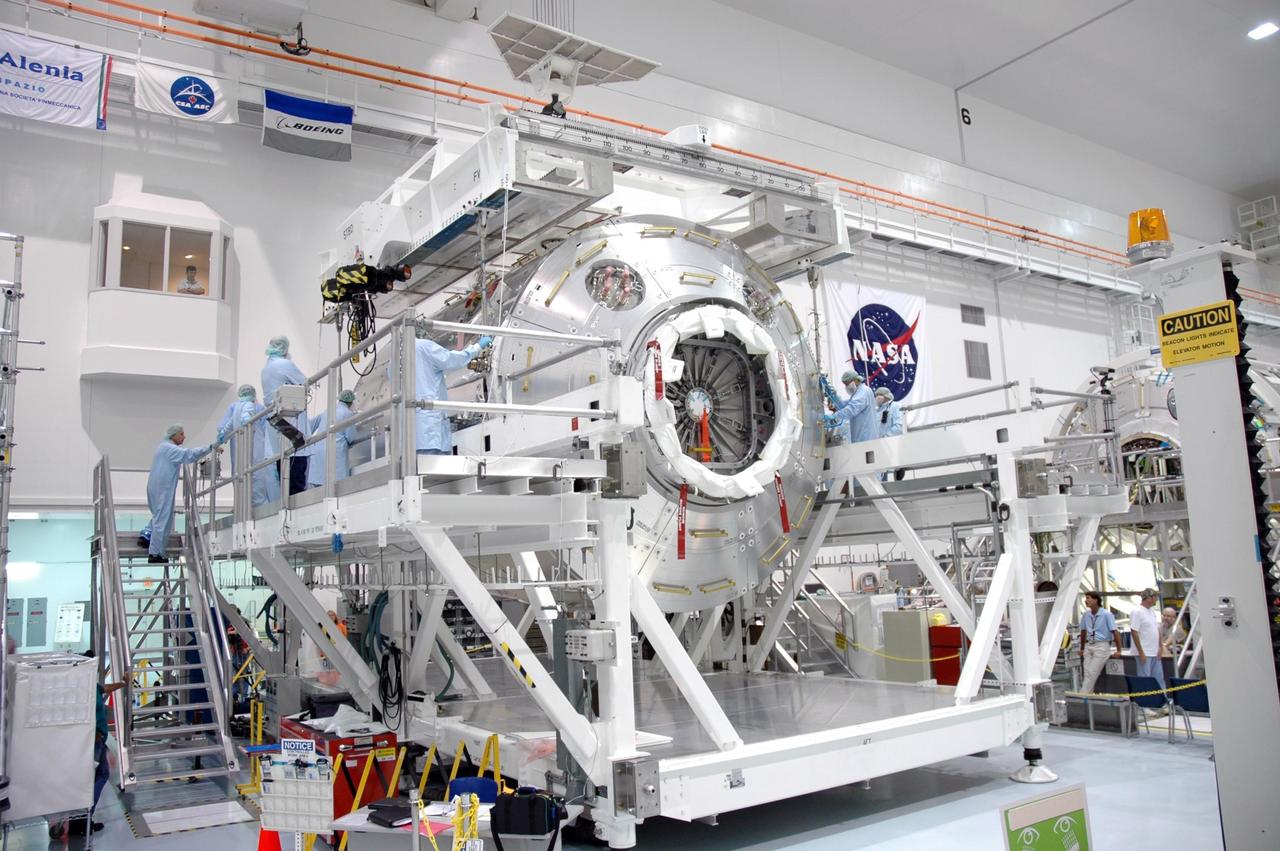
KENNEDY SPACE CENTER, FLA. - Inside the Space Station Processing Facility at NASA's Kennedy Space Center, workers release the cables around the Columbus module from the overhead crane. Columbus is the European Space Agency's research laboratory for the International Space Station. The module will be prepared for delivery to the space station on a future space shuttle mission. Columbus will expand the research facilities of the station and provide researchers with the ability to conduct numerous experiments in the area of life, physical and materials sciences. Photo credit: NASA/Jim Grossmann
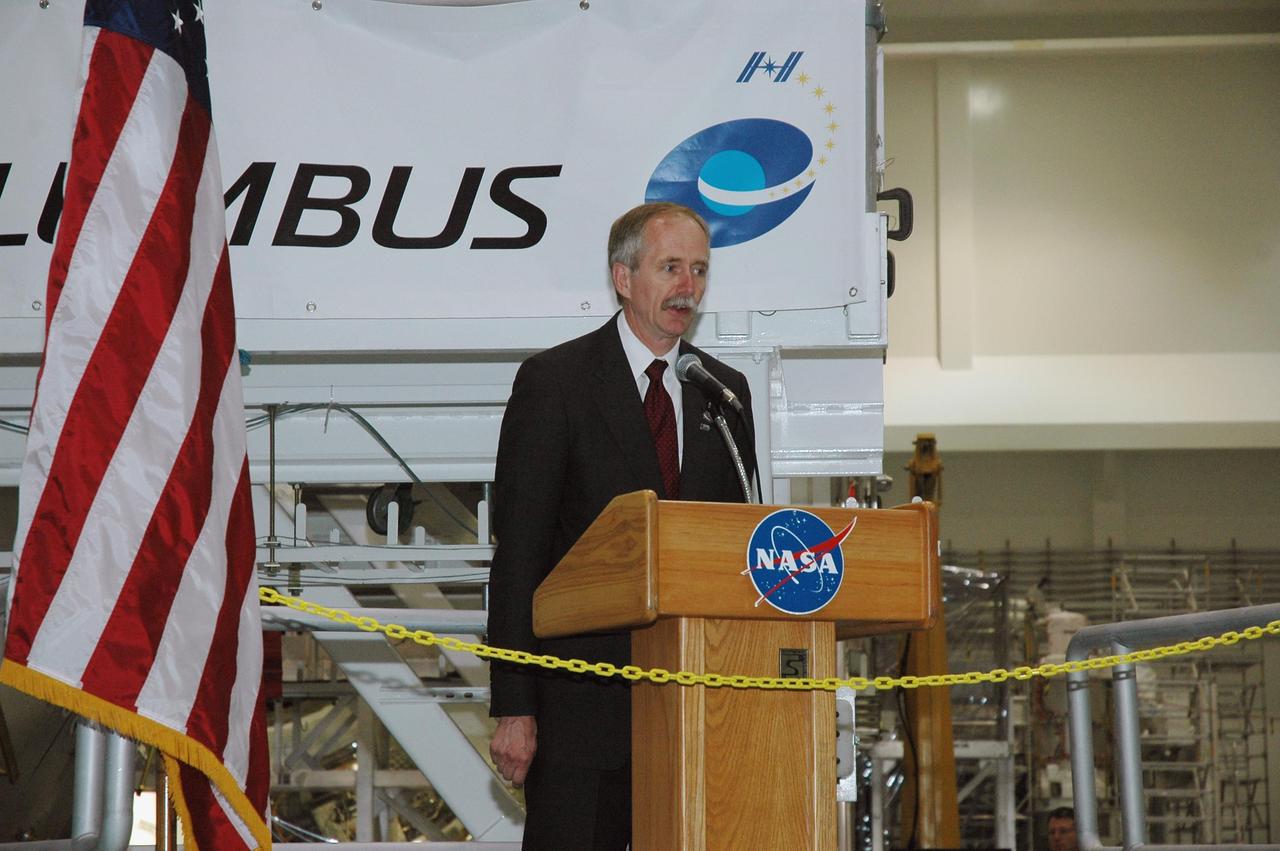
KENNEDY SPACE CENTER, FLA. - William Gerstenmaier, NASA associate administrator for Space Operations, welcomes the delivery of the European Space Agency's Columbus module at a ceremony in the Space Station Processing Facility. Columbus is the European Space Agency's research laboratory for the International Space Station. The module will be prepared in the SSPF for delivery to the space station on a future space shuttle mission. Columbus will expand the research facilities of the station and provide researchers with the ability to conduct numerous experiments in the life, physical and materials sciences. Photo credit: NASA/Amanda Diller
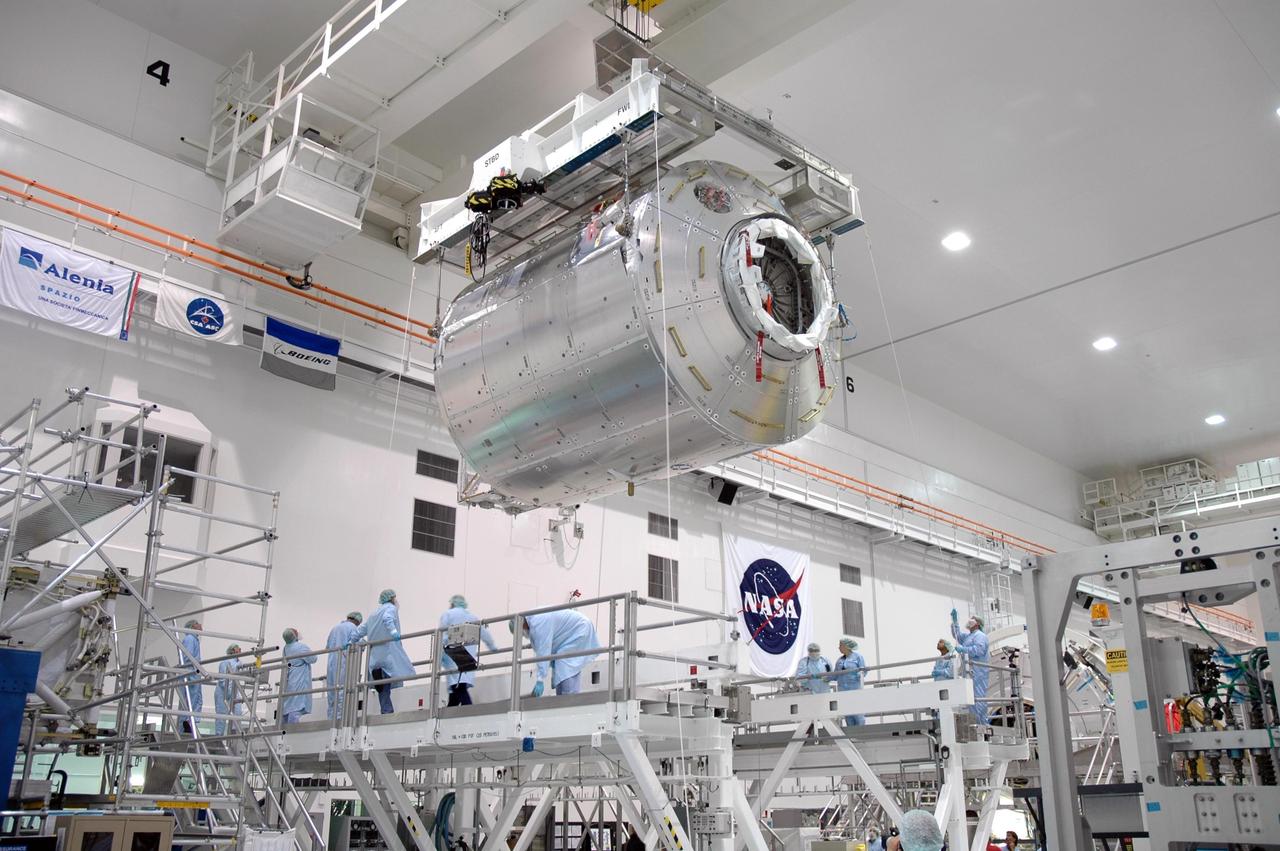
KENNEDY SPACE CENTER, FLA. - Inside the Space Station Processing Facility at NASA's Kennedy Space Center, an overhead crane lowers the Columbus module toward a work stand. Columbus is the European Space Agency's research laboratory for the International Space Station. The module will be prepared for delivery to the space station on a future space shuttle mission. Columbus will expand the research facilities of the station and provide researchers with the ability to conduct numerous experiments in the area of life, physical and materials sciences. Photo credit: NASA/Jim Grossmann
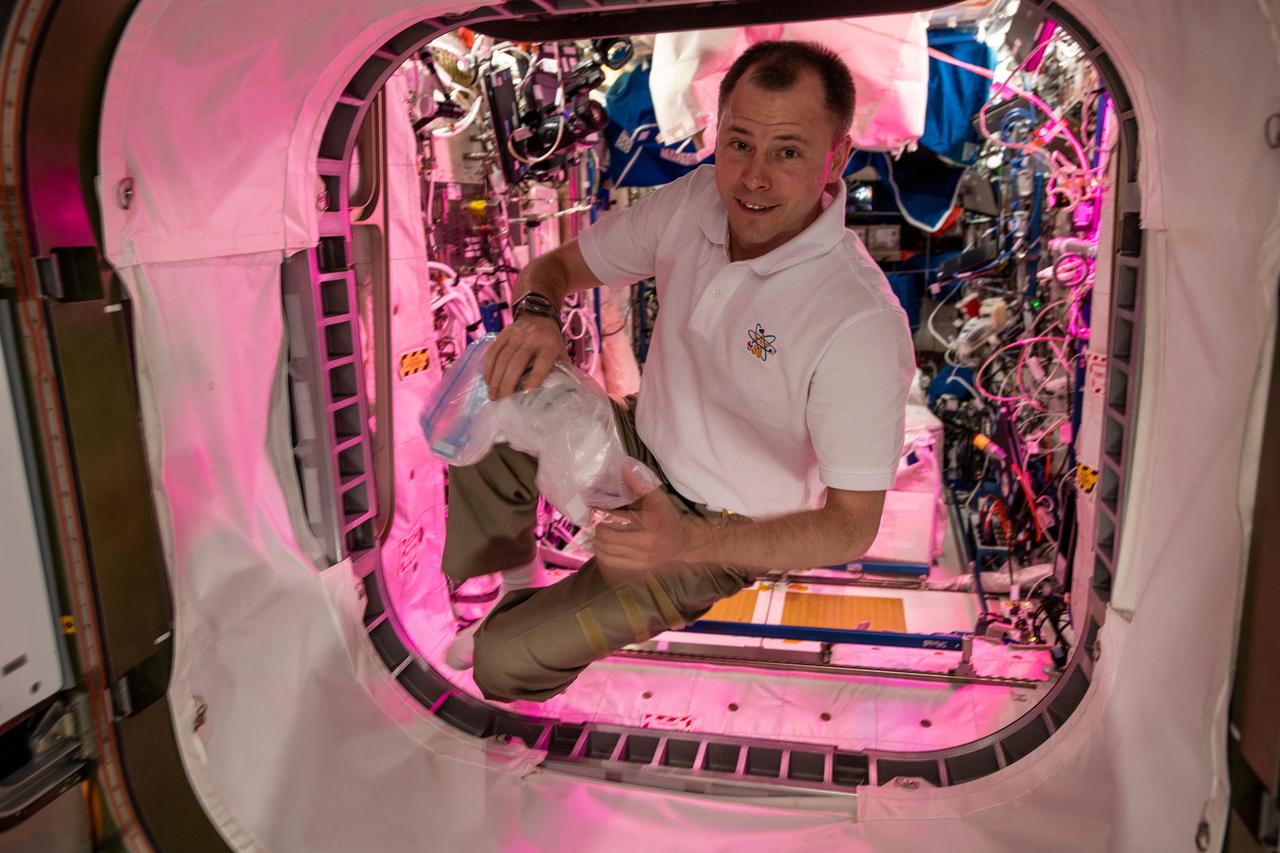
iss059e078446 (May 28, 2019) --- NASA astronaut Nick Hague floats inside the vestibule that connects the European Space Agency's Columbus laboratory module with NASA's Harmony module.
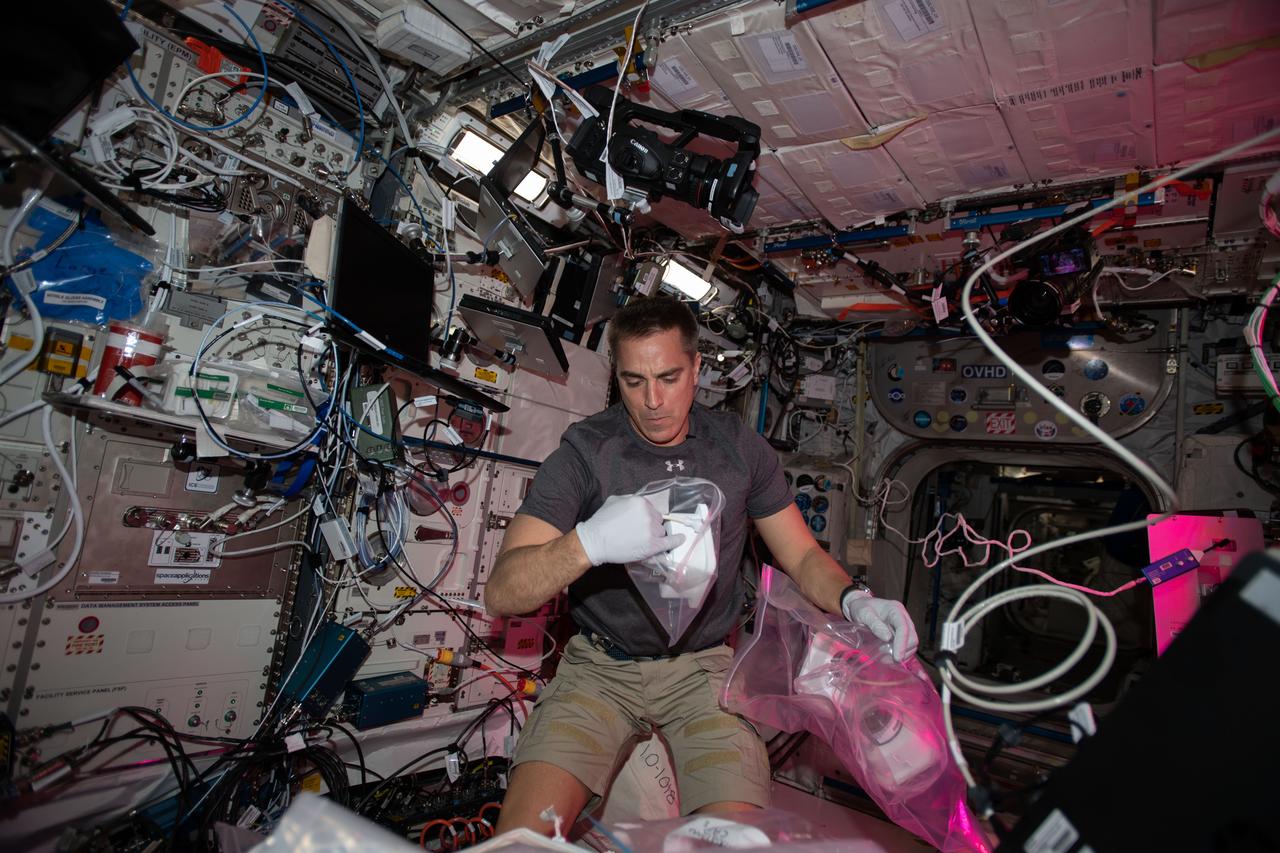
iss063e001883 (April 22, 2020) --- NASA astronaut and Expedition 63 Commander Chris Cassidy services botany research hardware inside the European Space Agency's Columbus laboratory module. The Veggie PONDS research facility in Columbus supports the growing and harvesting of lettuce and mizuna greens to demonstrate reliable vegetable growth during spaceflight.

iss063e001873 (April 22, 2020) --- NASA astronaut and Expedition 63 Commander Chris Cassidy services botany research hardware inside the European Space Agency's Columbus laboratory module. The Veggie PONDS research facility in Columbus supports the growing and harvesting of lettuce and mizuna greens to demonstrate reliable vegetable growth during spaceflight.
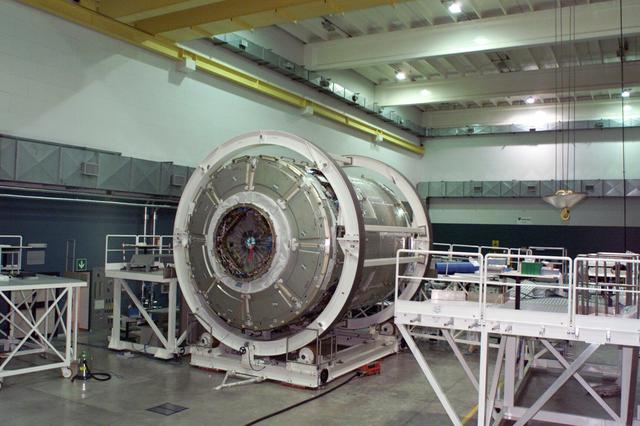
JSC2003-E-40244 (28 May 2003) --- The International Space Station Node 2 module is shown in a processing facility. Under contract of the Italian Space Agency (ASI), Alenia Spazio in Turin, Italy led a consortium of European sub-contractors to build Node 2. The module was built for NASA under a barter agreement with the European Space Agency (ESA) in exchange for the launch of the European Columbus Laboratory by the space shuttle to the International Space Station. Node 2 will provide a passageway between four International Space Station science experiment modules: the U.S. Destiny Laboratory, the Kibo Japanese Experiment Module, the European Columbus Laboratory and the Centrifuge Accommodation Module. The addition of Node 2 to the station will signify the U.S. Core Complete stage of assembly, at which time the station can support the addition of international laboratories from Europe and Japan. Photo Credit: NASA
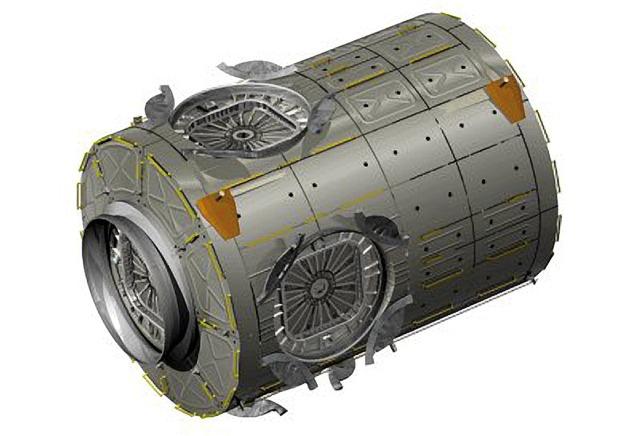
JSC2003-E-39020 (May 2003) --- This graphic shows the International Space Station Node 2 module. The installment of Node 2 to the station will signify the U.S. Core Complete stage of assembly, at which time the station can support the addition of international laboratories from Europe and Japan. Node 2 will provide a passageway between four International Space Station science experiment modules: the U.S. Destiny Laboratory, the Kibo Japanese Experiment Module, the European Columbus Laboratory and the Centrifuge Accommodation Module. Under contract of the Italian Space Agency (ASI), Alenia Spazio in Turin, Italy led a consortium of European sub-contractors to build Node 2. The module was built for NASA under a barter agreement with the European Space Agency (ESA) in exchange for the launch of the European Columbus Laboratory by the space shuttle to the International Space Station. Photo Credit: Italian Space Agency (ASI).
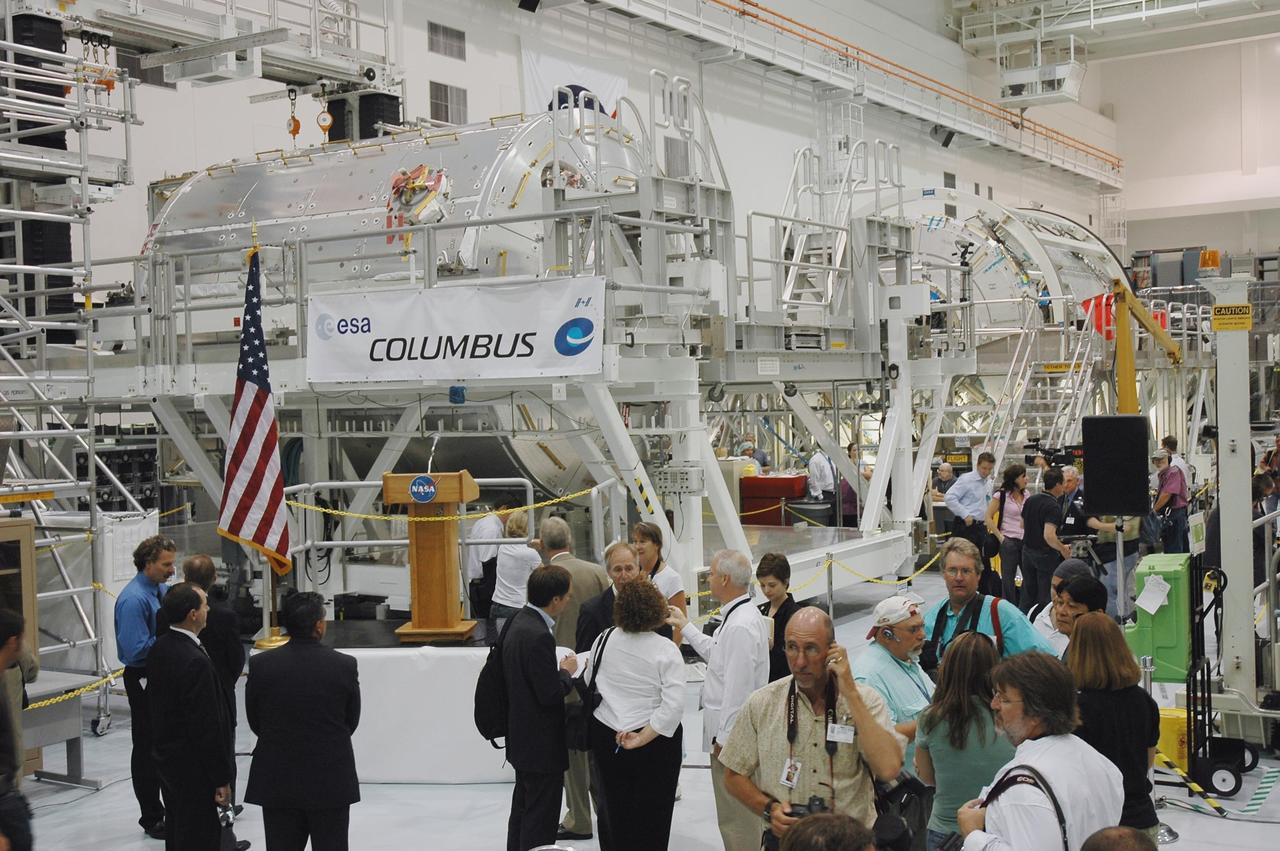
KENNEDY SPACE CENTER, FLA. - The European Space Agency's Columbus module rests on a work stand in view of media representatives and invited guests following a ceremony to welcome the module into the Space Station Processing Facility (SSPF). Columbus is the European Space Agency's research laboratory for the International Space Station. The module will be prepared in the SSPF for delivery to the space station on a future space shuttle mission. Columbus will expand the research facilities of the station and provide researchers with the ability to conduct numerous experiments in the life, physical and materials sciences. Photo credit: NASA/Amanda Diller
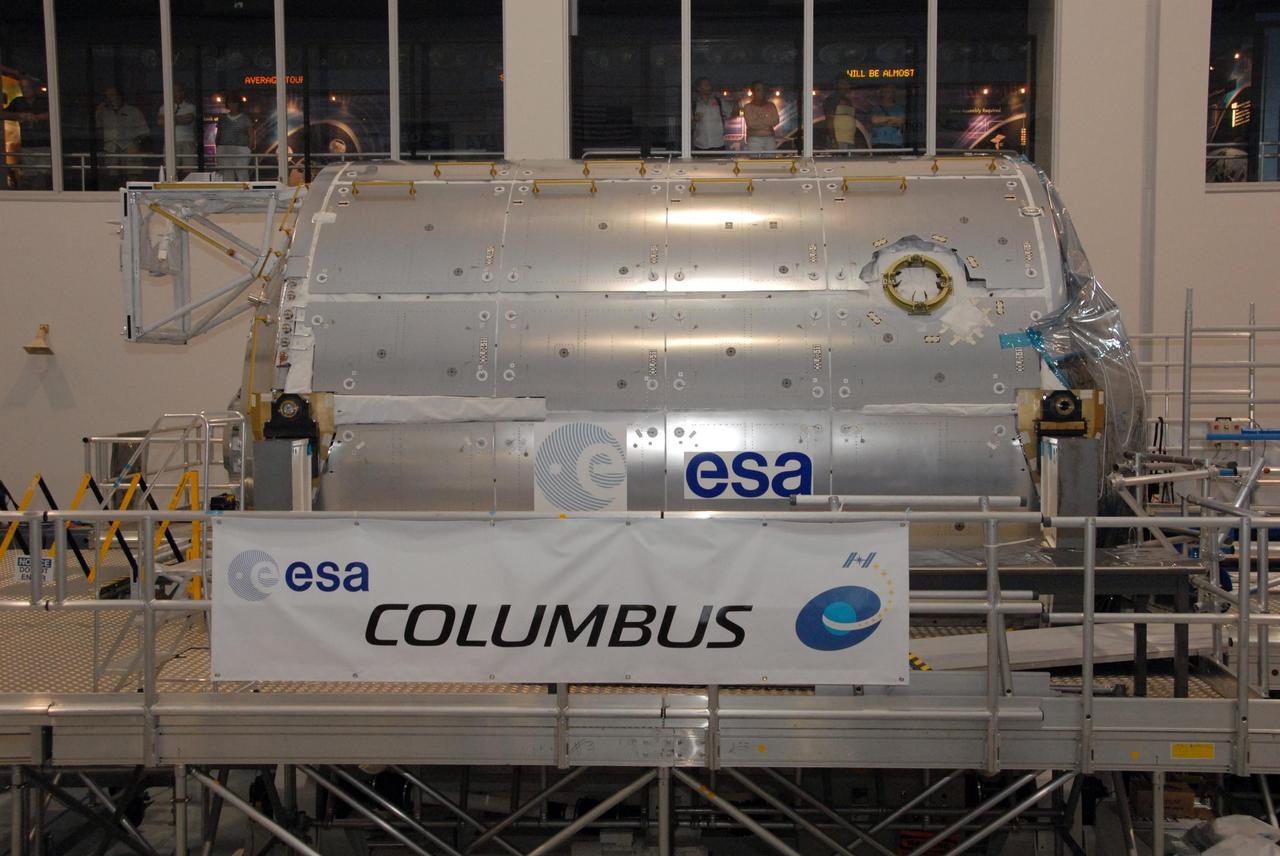
KENNEDY SPACE CENTER, FLA. -- In the Space Station Processing Facility at NASA's Kennedy Space Center, the Columbus Laboratory is positioned on a stand where it is being displayed to the media at a special showing. Columbus is the European Space Agency 's largest single contribution to the International Space Station. The laboratory module will expand the research facilities of the station, providing crew members and scientists around the world the ability to conduct a variety of life, physical and materials science experiments. The module is approximately 23 feet long and 15 feet wide, allowing it to hold 10 large racks of experiments. Columbus is scheduled to be transferred to Launch Pad 39A in early November, in preparation for its journey to the station. Columbus will fly aboard space shuttle Atlantis on the STS-122 mission, targeted for launch Dec. 6. Photo credit: NASA/George Shelton

KENNEDY SPACE CENTER, FLA. -- In the Space Station Processing Facility at NASA's Kennedy Space Center, Jose Nunez (center), NASA mission project engineer, points to the Columbus Laboratory above, being displayed to the media at a special showing. Columbus is the European Space Agency 's largest single contribution to the International Space Station. The laboratory module will expand the research facilities of the station, providing crew members and scientists around the world the ability to conduct a variety of life, physical and materials science experiments. The module is approximately 23 feet long and 15 feet wide, allowing it to hold 10 large racks of experiments. Columbus is scheduled to be transferred to Launch Pad 39A in early November, in preparation for its journey to the station. Columbus will fly aboard space shuttle Atlantis on the STS-122 mission, targeted for launch Dec. 6. Photo credit: NASA/George Shelton

KENNEDY SPACE CENTER, FLA. -- In the Space Station Processing Facility at NASA's Kennedy Space Center, the Columbus Laboratory is positioned on a stand where it will be displayed to the media at a special showing. Columbus is the European Space Agency 's largest single contribution to the International Space Station. The laboratory module will expand the research facilities of the station, providing crew members and scientists around the world the ability to conduct a variety of life, physical and materials science experiments. The module is approximately 23 feet long and 15 feet wide, allowing it to hold 10 large racks of experiments. Columbus is scheduled to be transferred to Launch Pad 39A in early November, in preparation for its journey to the station. Columbus will fly aboard space shuttle Atlantis on the STS-122 mission, targeted for launch Dec. 6. Photo credit: NASA/George Shelton
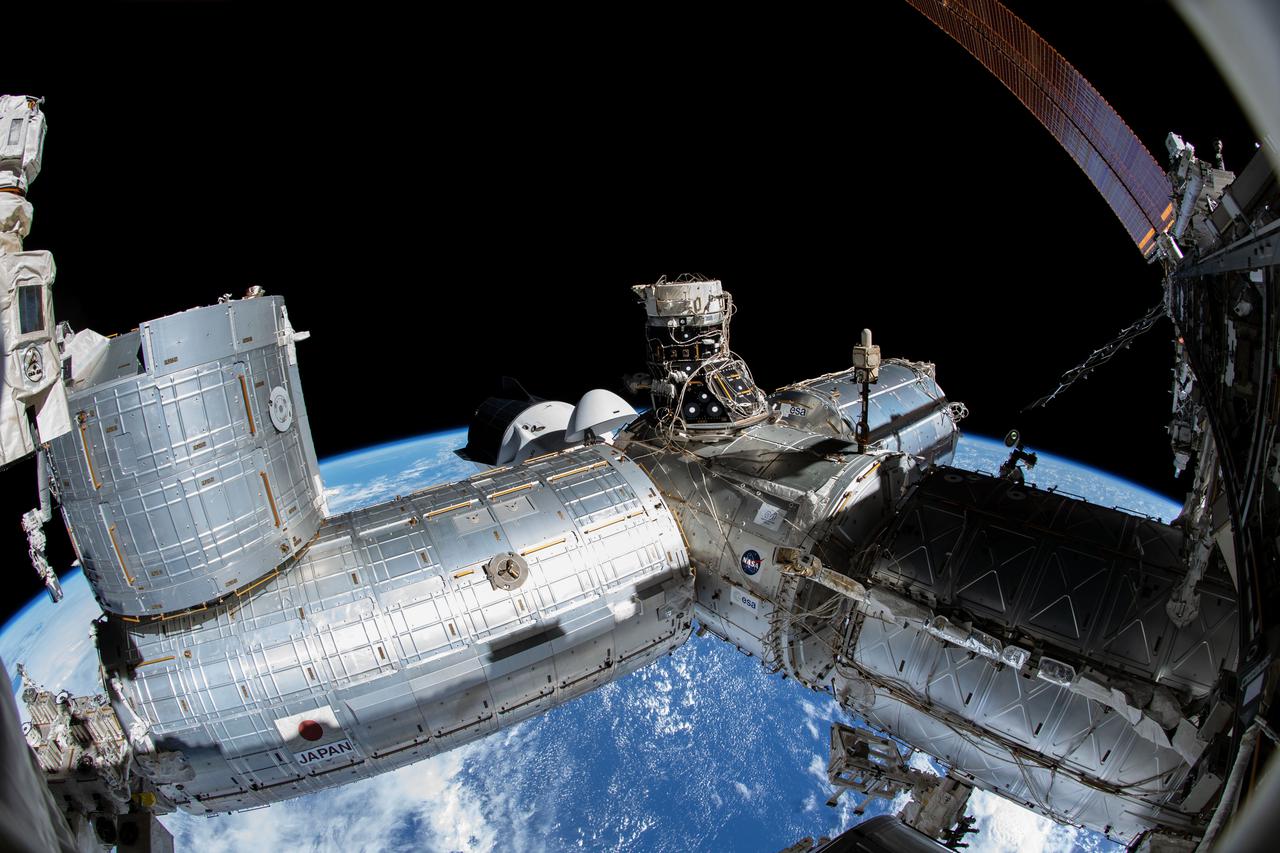
iss066e085978 (Dec. 2, 2021) --- A portion of the International Space Station's U.S. segment is pictured from NASA spacewalker Thomas Marshburn's camera. From left, are the Kibo laboratory module; the Harmony module, to which the SpaceX Crew Dragon Endurance is docked, and the space-facing international docking adapter; the Columbus laboratory module; and the U.S. Destiny laboratory module.
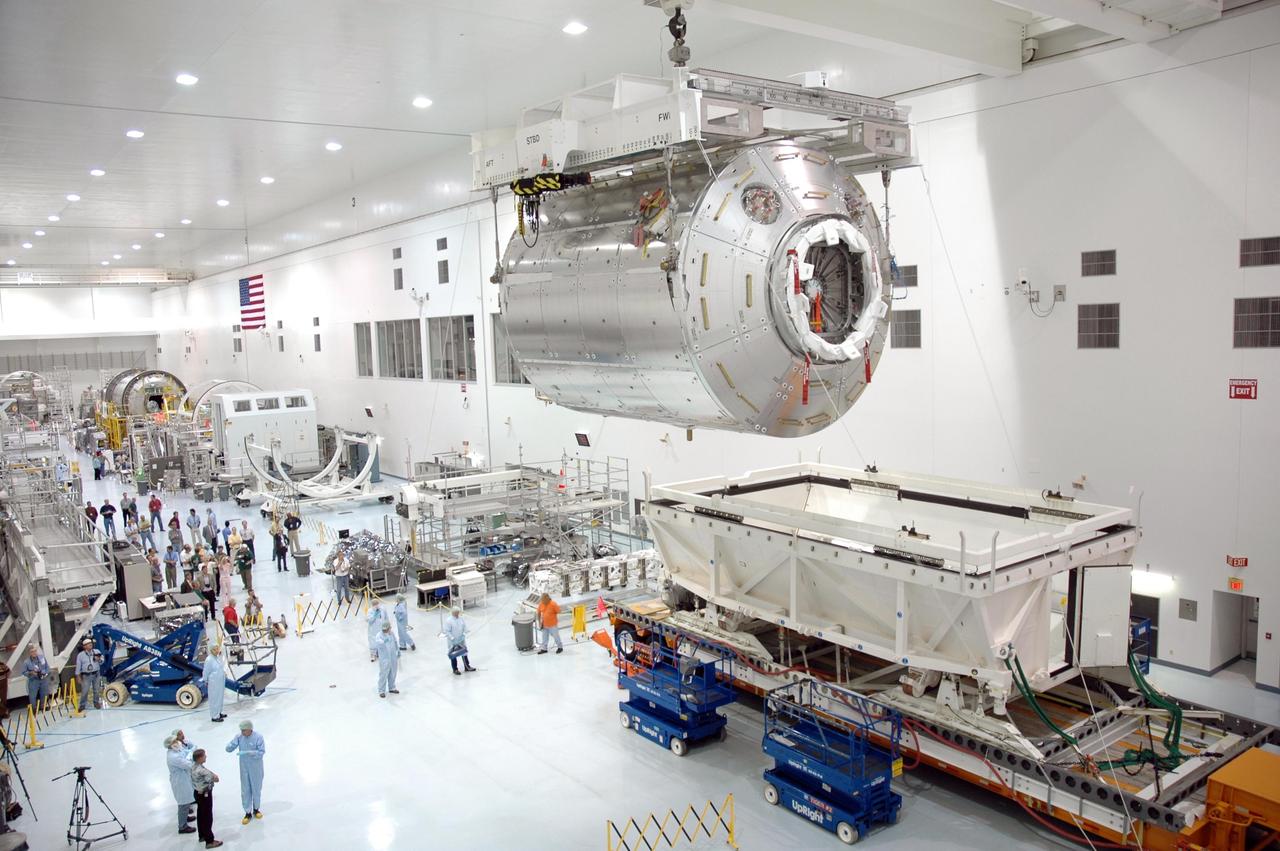
KENNEDY SPACE CENTER, FLA. - Inside the Space Station Processing Facility at NASA's Kennedy Space Center, an overhead crane carries the Columbus module toward a work stand. Columbus is the European Space Agency's research laboratory for the International Space Station. Once on the work stand , it will be prepared for delivery to the space station on a future space shuttle mission. Columbus will expand the research facilities of the station and provide researchers with the ability to conduct numerous experiments in the area of life, physical and materials sciences. Photo credit: NASA/Jim Grossmann
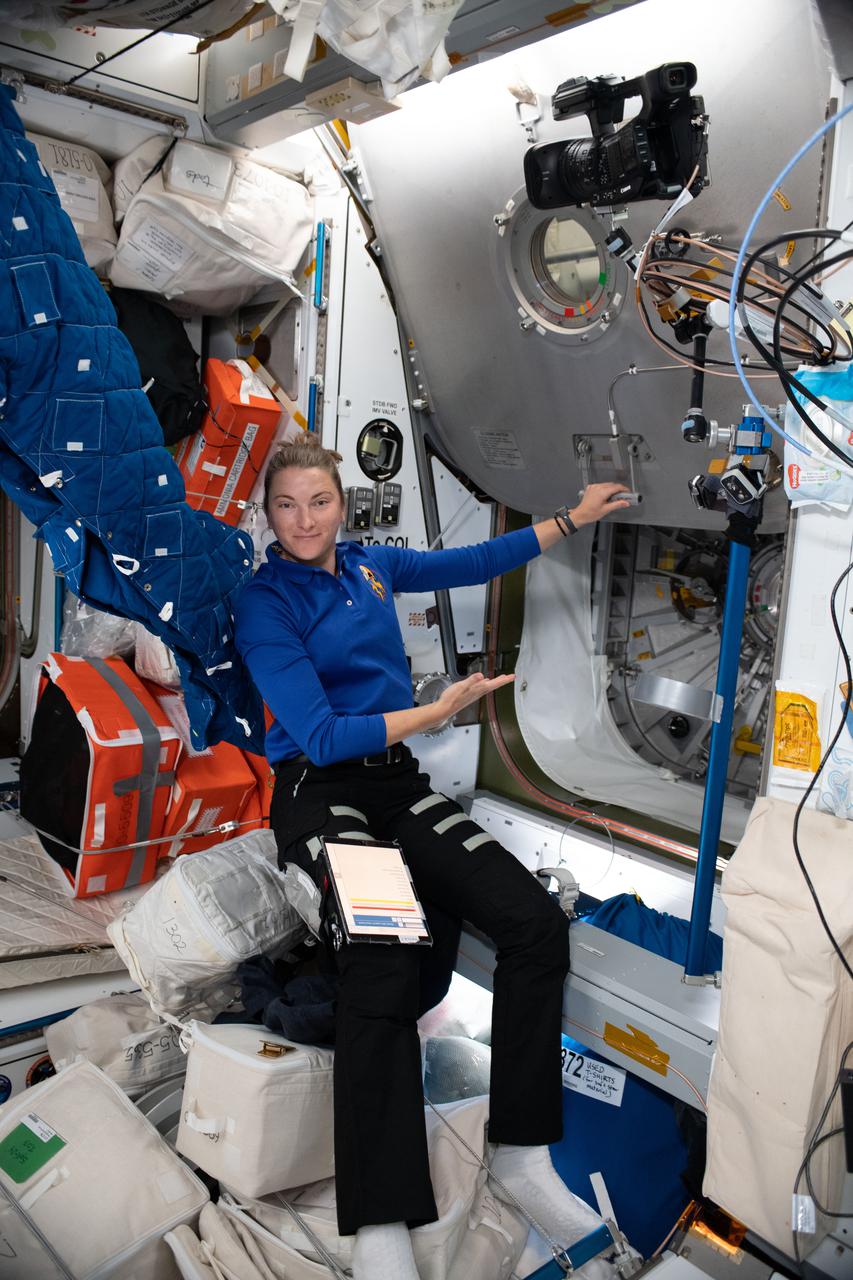
iss066e078289 (Nov. 17, 2021) --- NASA astronaut and Expedition 66 Flight Engineer Kayla Barron opens the hatch to the Columbus laboratory module aboard the International Space Station.
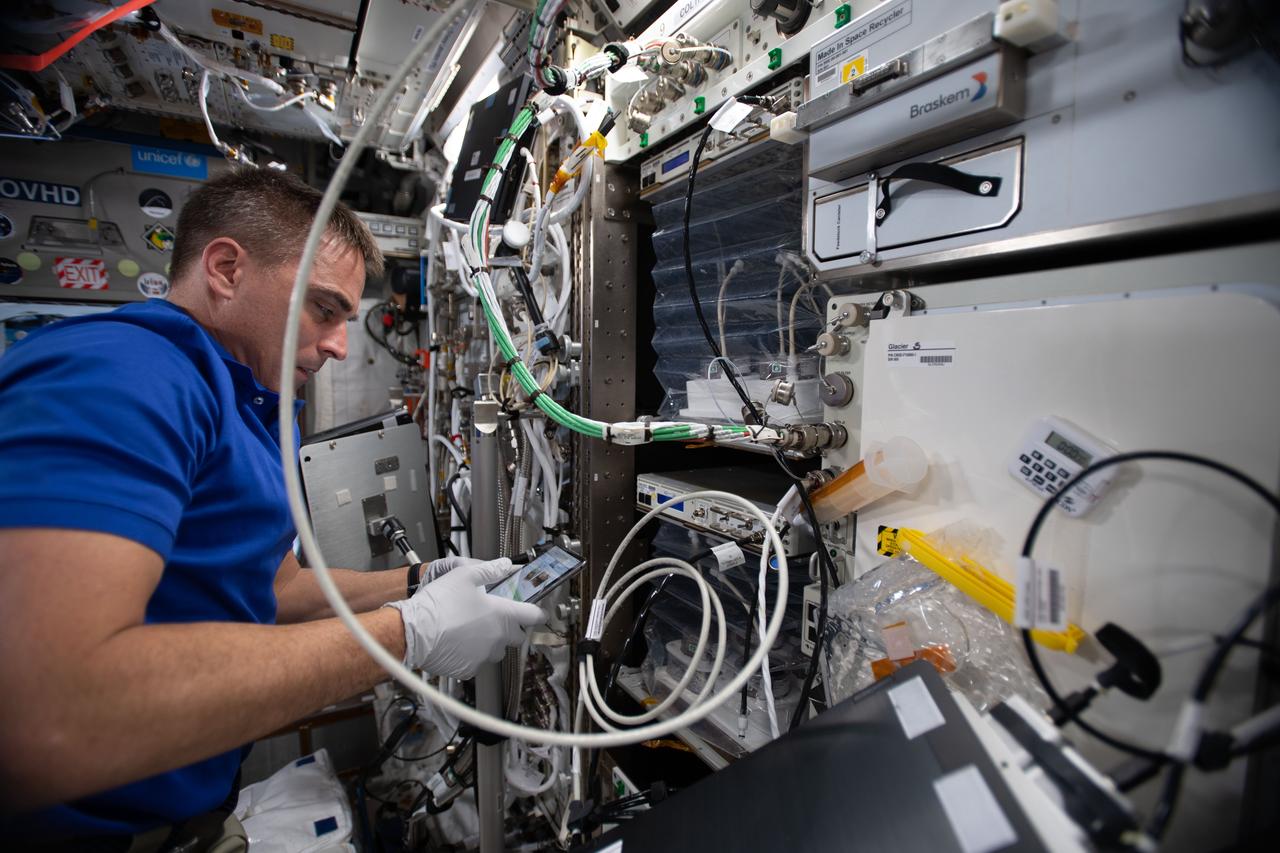
iss063e000050 (April 20, 2020) --- NASA astronaut and Expedition 63 Commander Chris Cassidy services the Veggie botanical research facility inside the Columbus laboratory module from the European Space Agency.
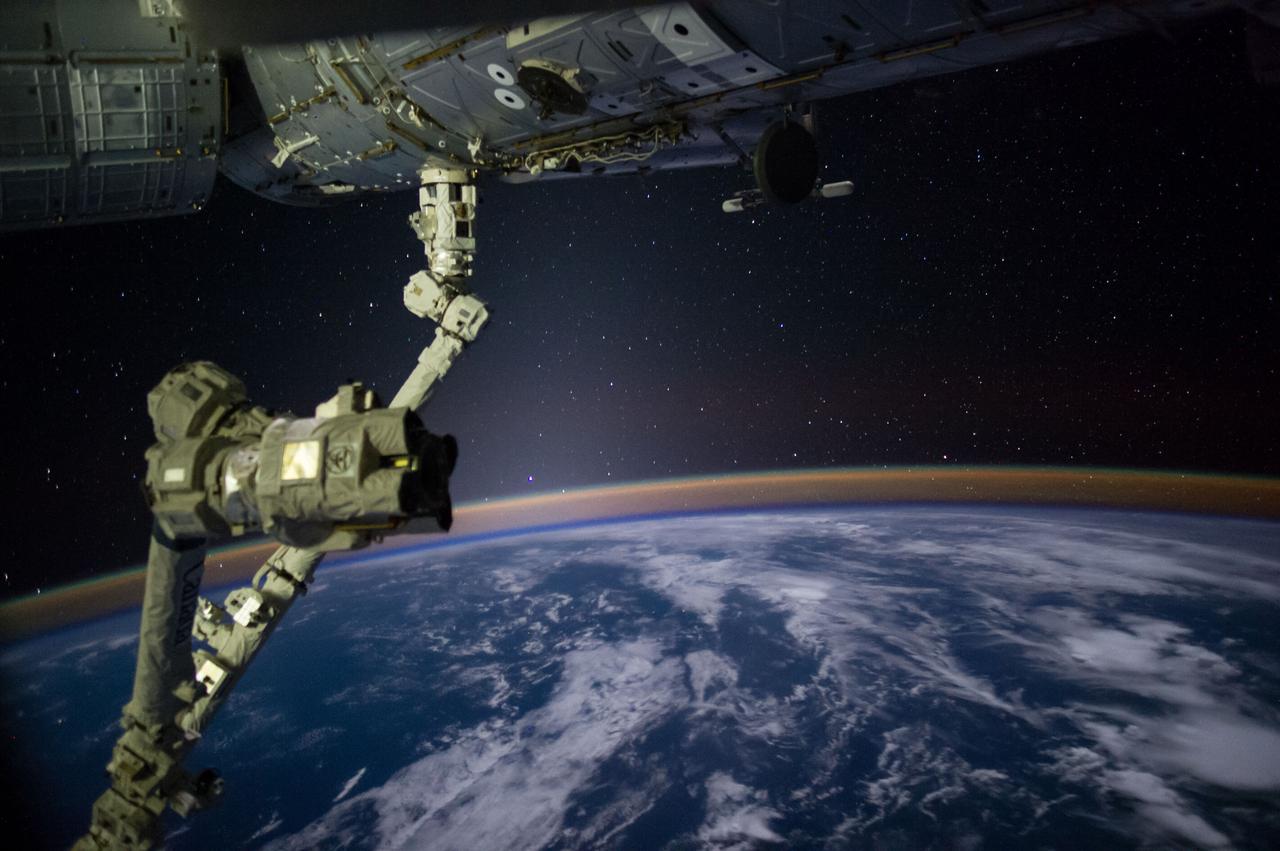
Earth Observations taken by Expedition 41 crewmember. Columbus Module, Node 2, U.S. Laboratory, and Remote Manipulator System (RMS) are visible. One of a series of time lapse photos.
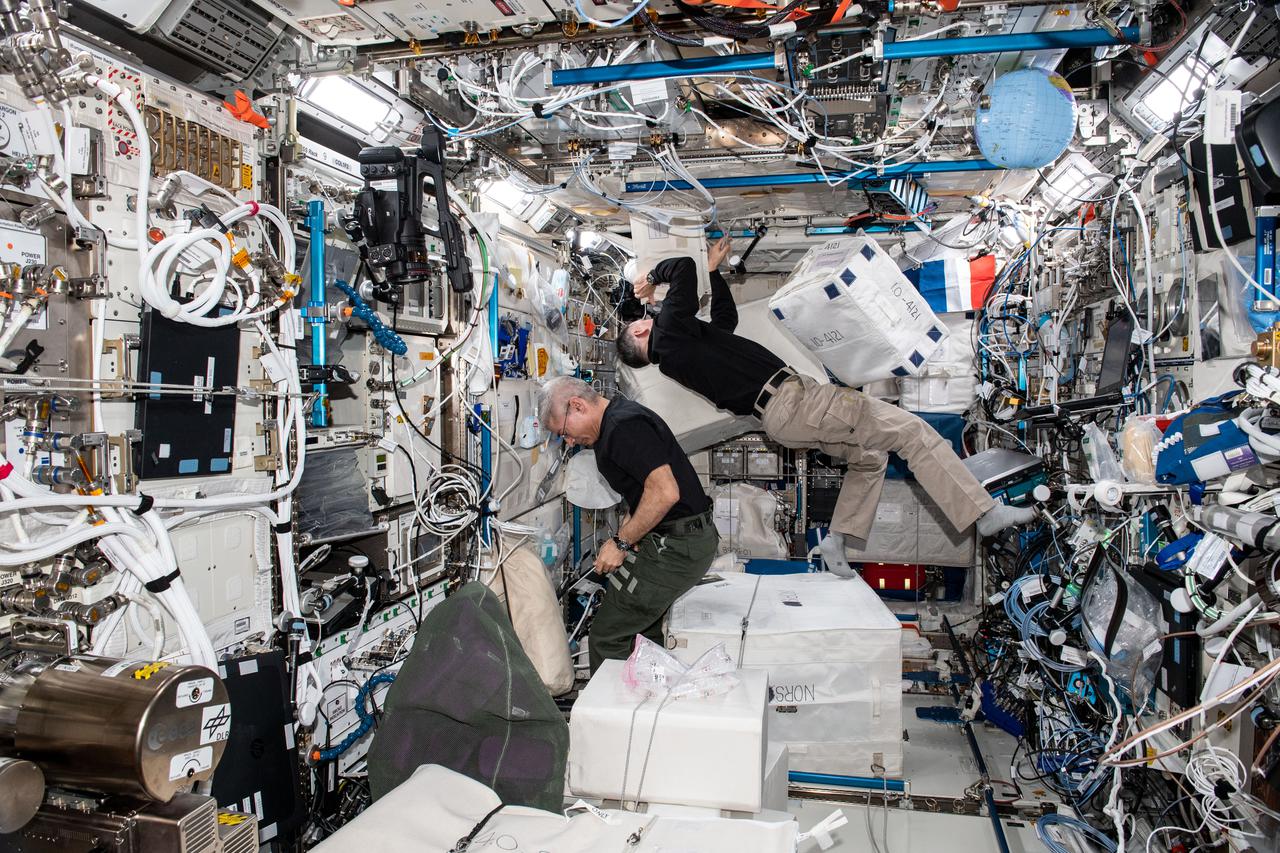
iss065e248588 (Aug. 16, 2021) --- NASA astronauts and Expedition 65 Flight Engineers (from left) Mark Vande Hei and Shane Kimbrough unpack cargo bags inside the International Space Station's Columbus laboratory module.
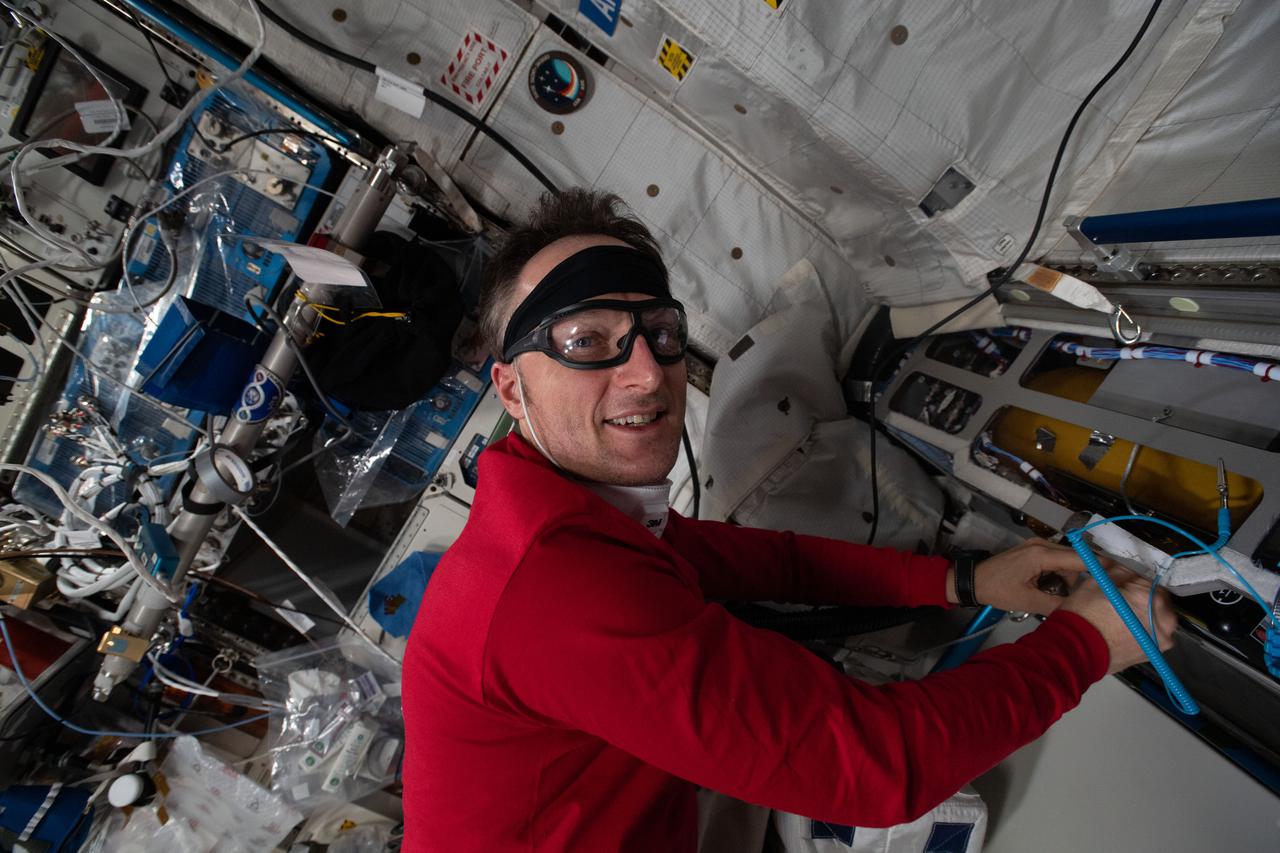
iss066e090268 (Dec. 13, 2021) --- Astronaut and Expedition 66 Flight Engineer Matthias Maurer of ESA (European Space Agency) inspects and cleans smoke detectors inside Columbus laboratory module.
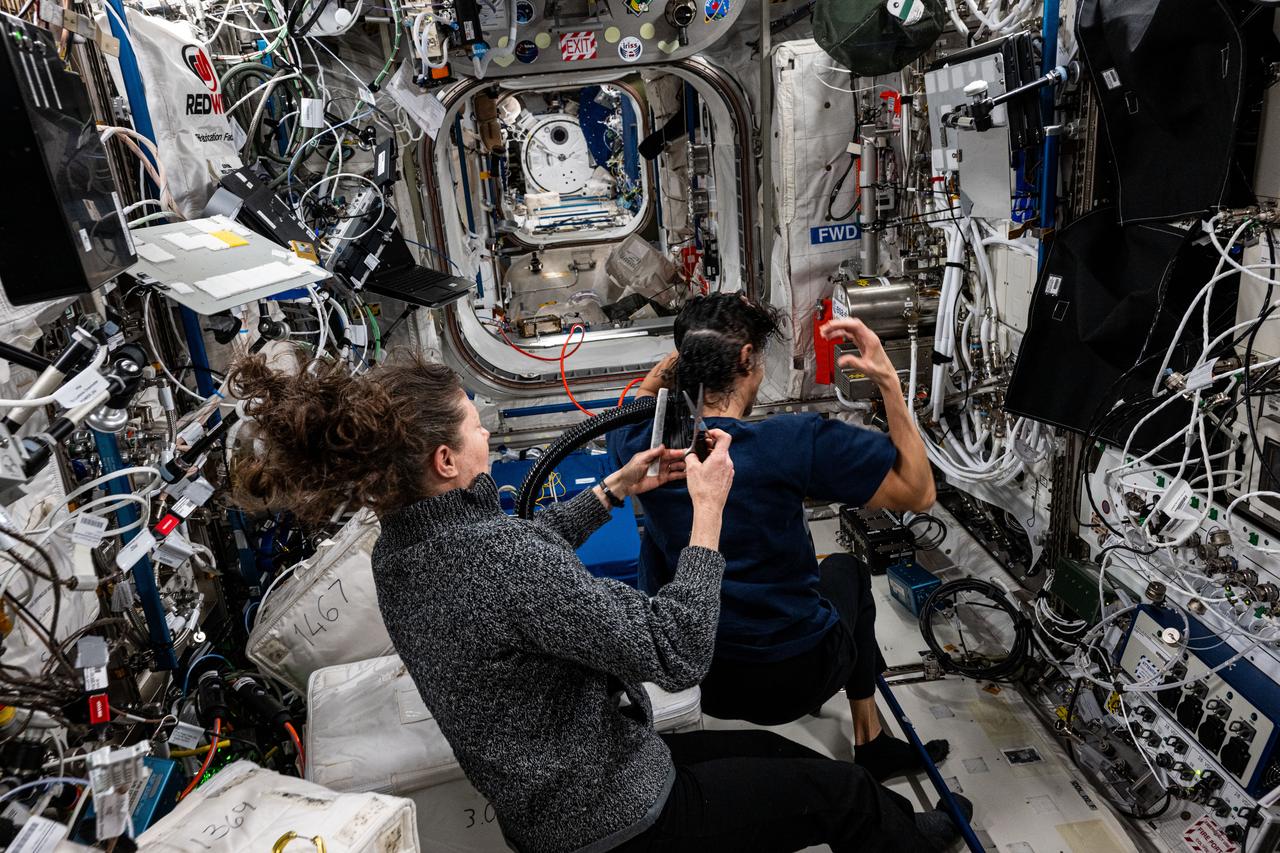
iss071e665837 (Sept. 15, 2024) --- NASA astronaut Tracy C. Dyson trims NASA astronaut Suni Williams hair aboard the International Space Station's Columbus laboratory module.
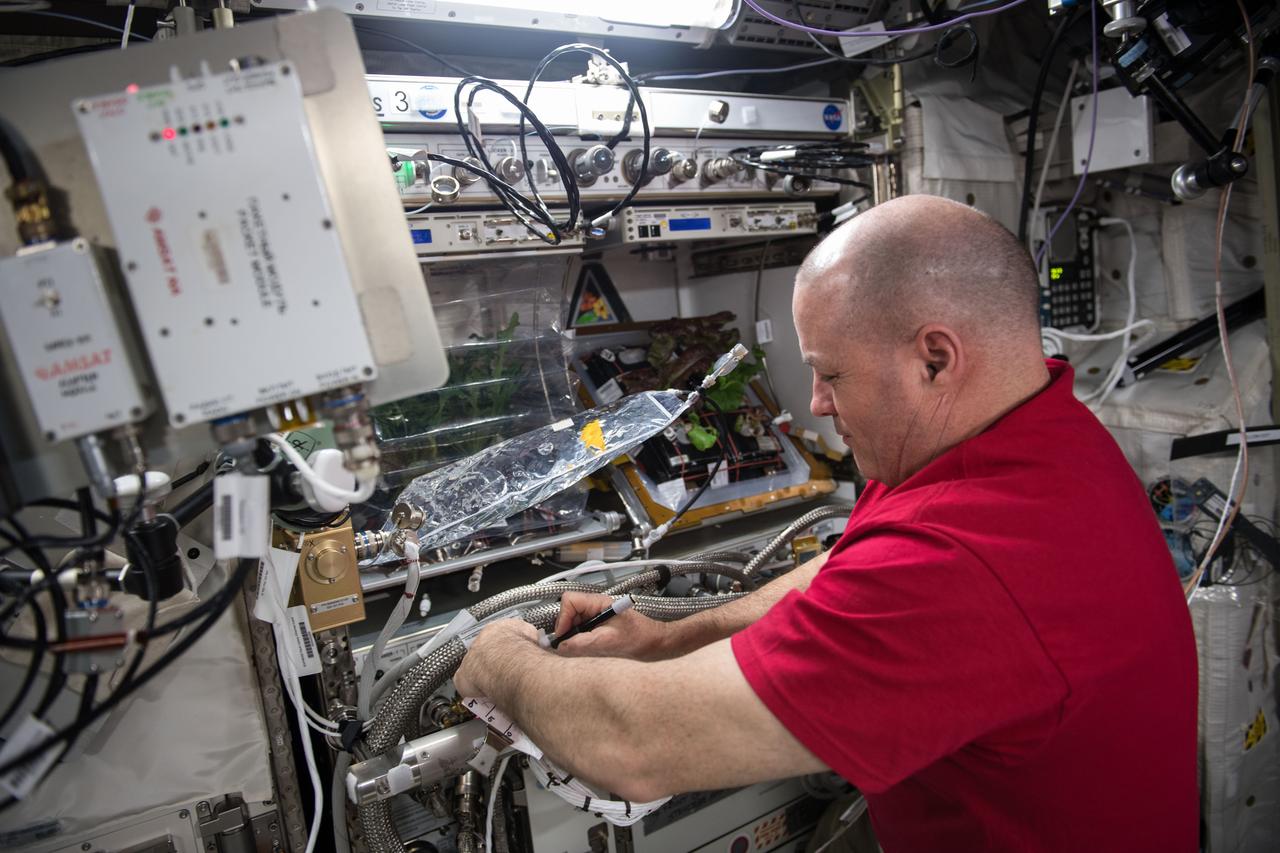
iss055e000821 (March 3, 2018) --- NASA astronaut Scott Tingle checks on red lettuce growing inside the Columbus laboratory module's Veggie facility for the Veg-03 experiment.
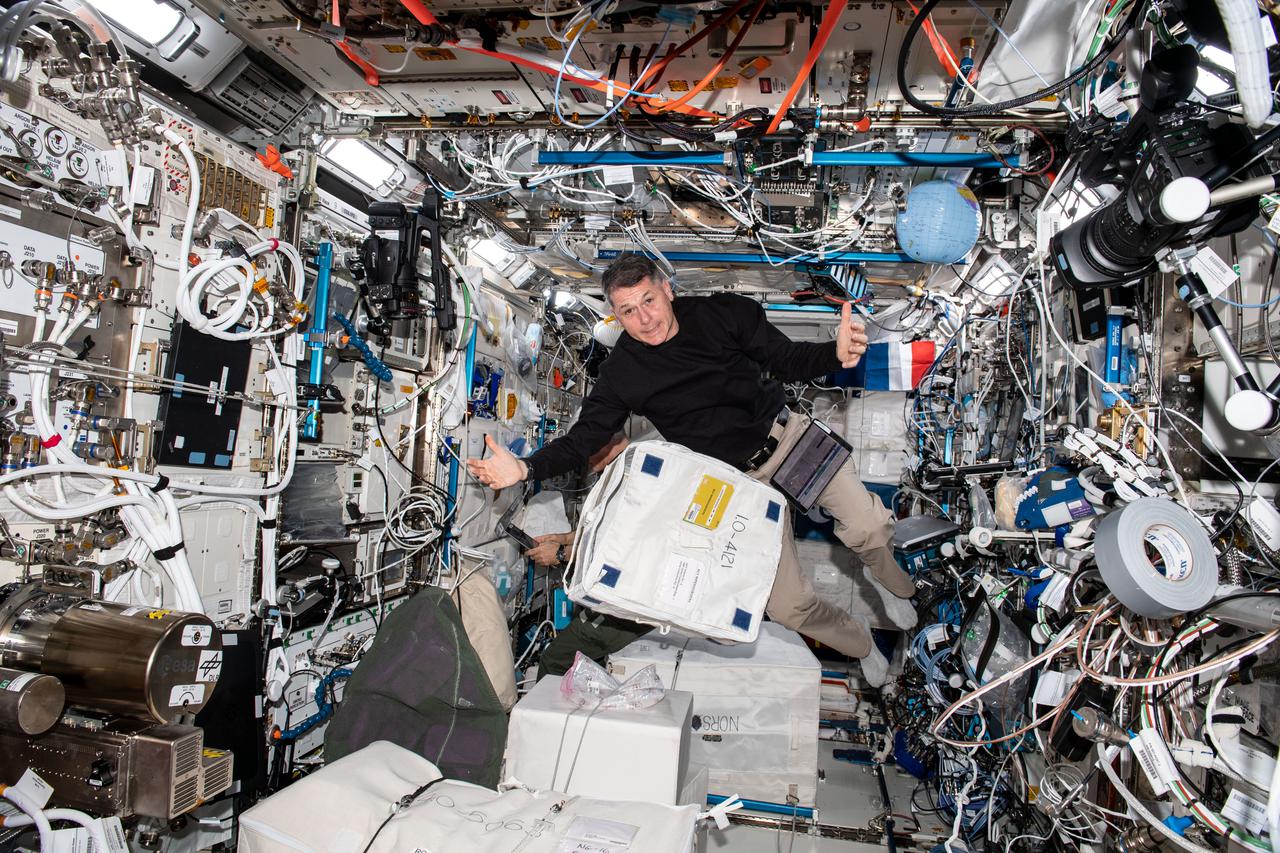
iss065e248590 (Aug. 16, 2021) --- NASA astronaut and Expedition 65 Flight Engineer Shane Kimbrough unpacks cargo bags inside the International Space Station's Columbus laboratory module.
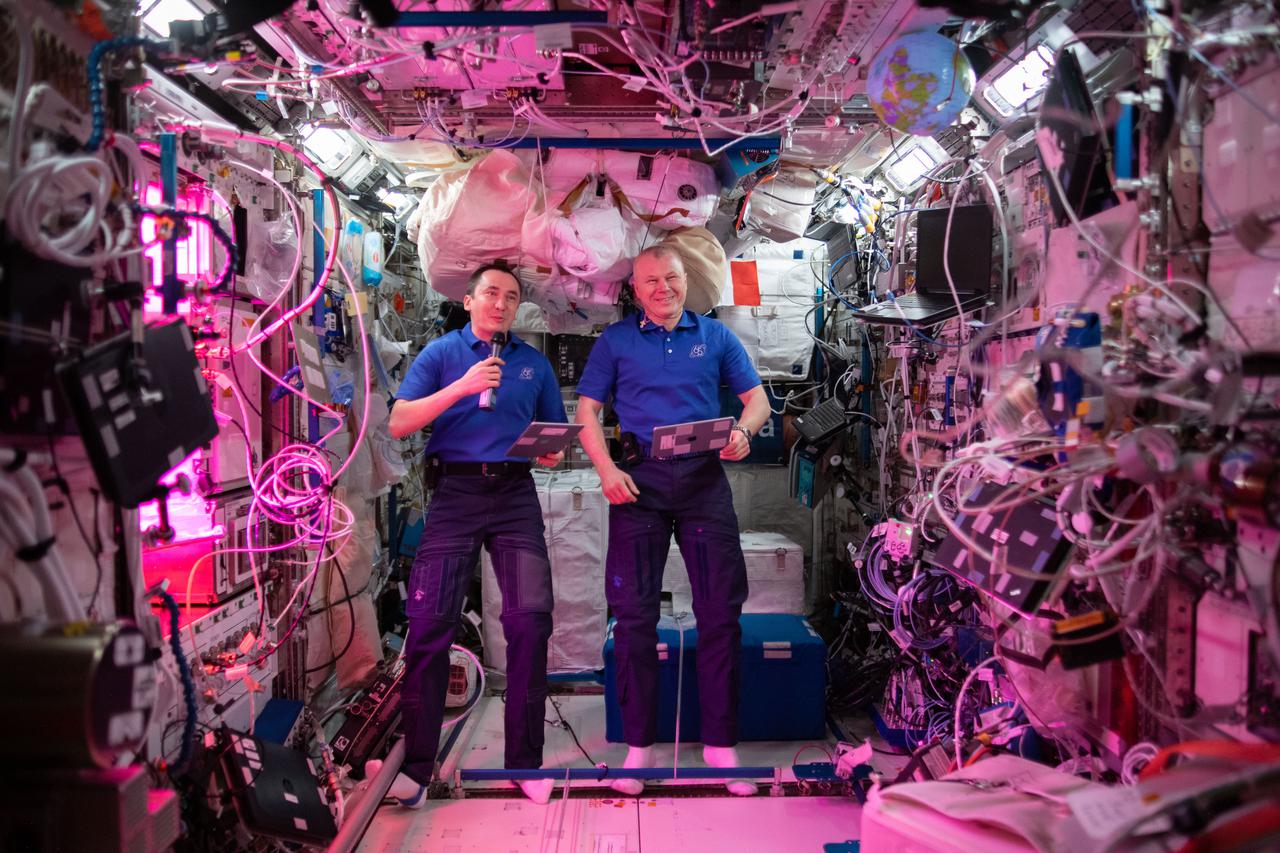
iss065e154540 (June 30, 2021) --- Roscosmos cosmonauts and Expedition 65 Flight Engineers (from left) Pyotr Dubrov and Oleg Novitskiy participate in a Russian public affairs event inside the International Space Station's Columbus laboratory module.
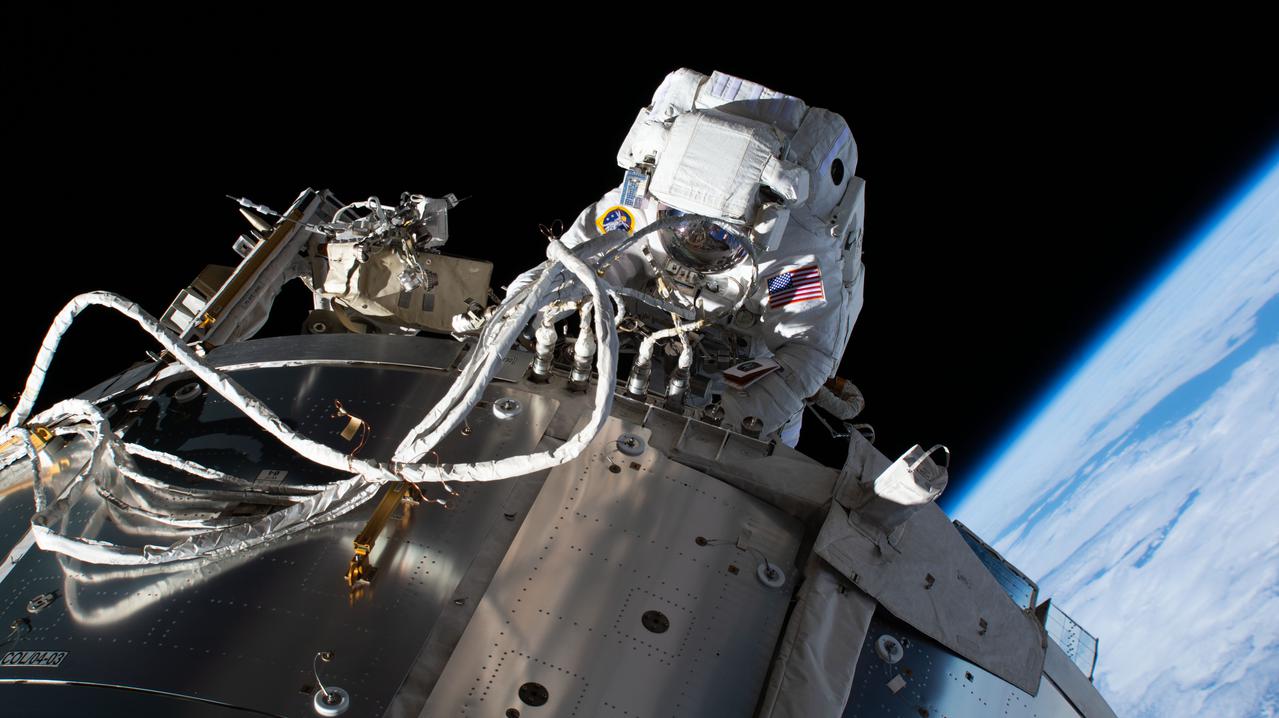
iss064e042059 (March 13, 2021) --- NASA astronaut and Expedition 64 Flight Engineer Michael Hopkins is pictured during a spacewalk servicing communications gear on the outside of the International Space Station's Columbus laboratory module.
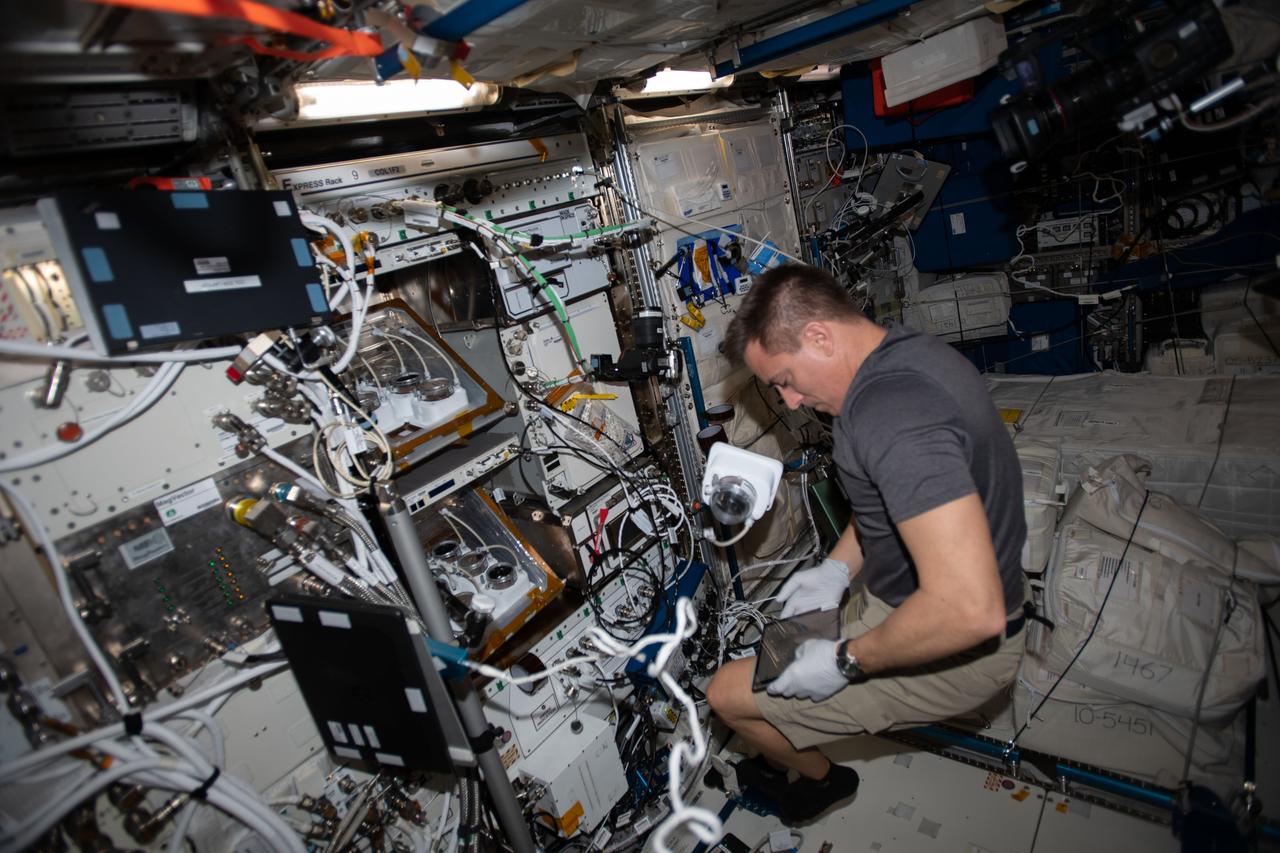
iss063e001867 (April 22, 2020) --- NASA astronaut and Expedition 63 Commander Chris Cassidy works inside the Columbus Laboratory module servicing the Veggie PONDS botany research hardware.
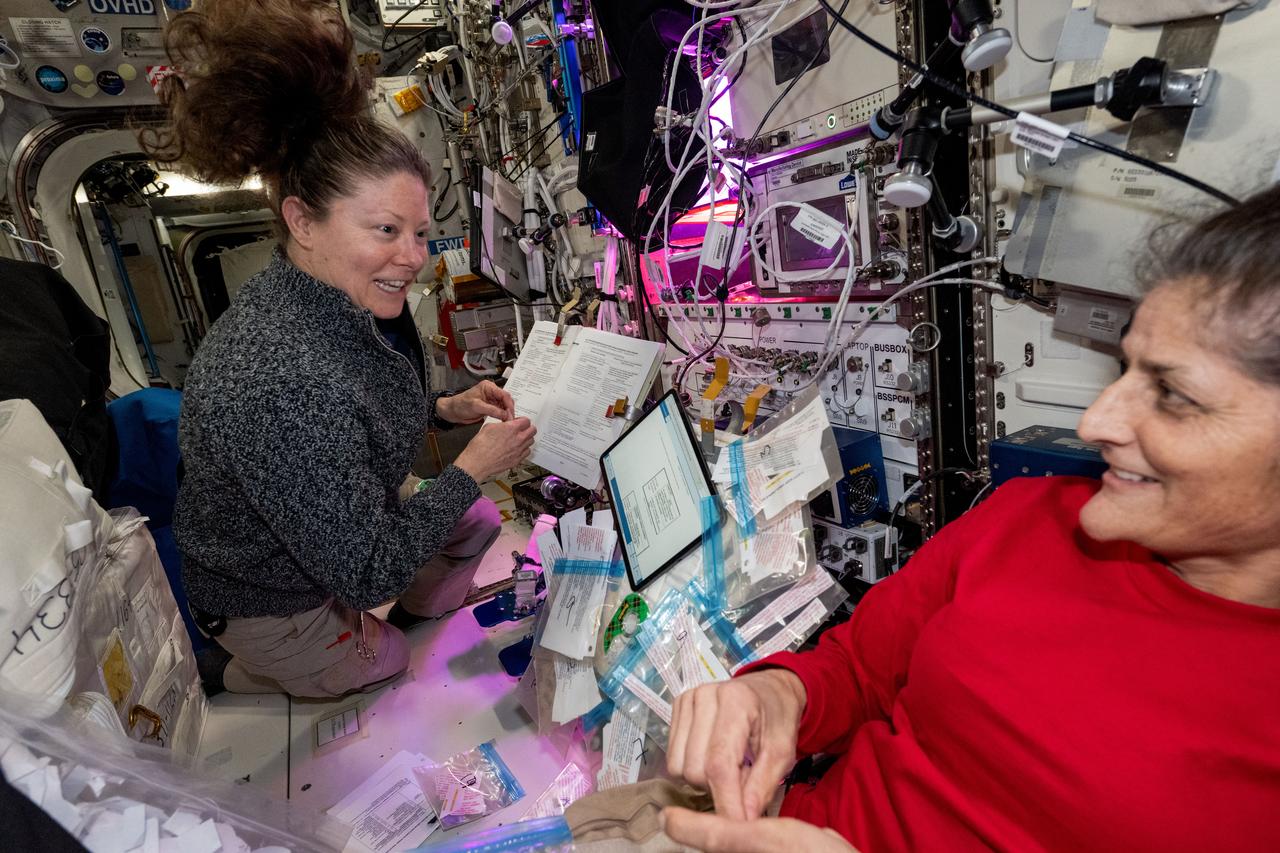
iss071e580038 (Aug. 28, 2024) --- NASA astronauts (from left) Tracy C. Dyson and Suni Williams update emergency procedure manuals aboard the International Space Station's Columbus laboratory module.
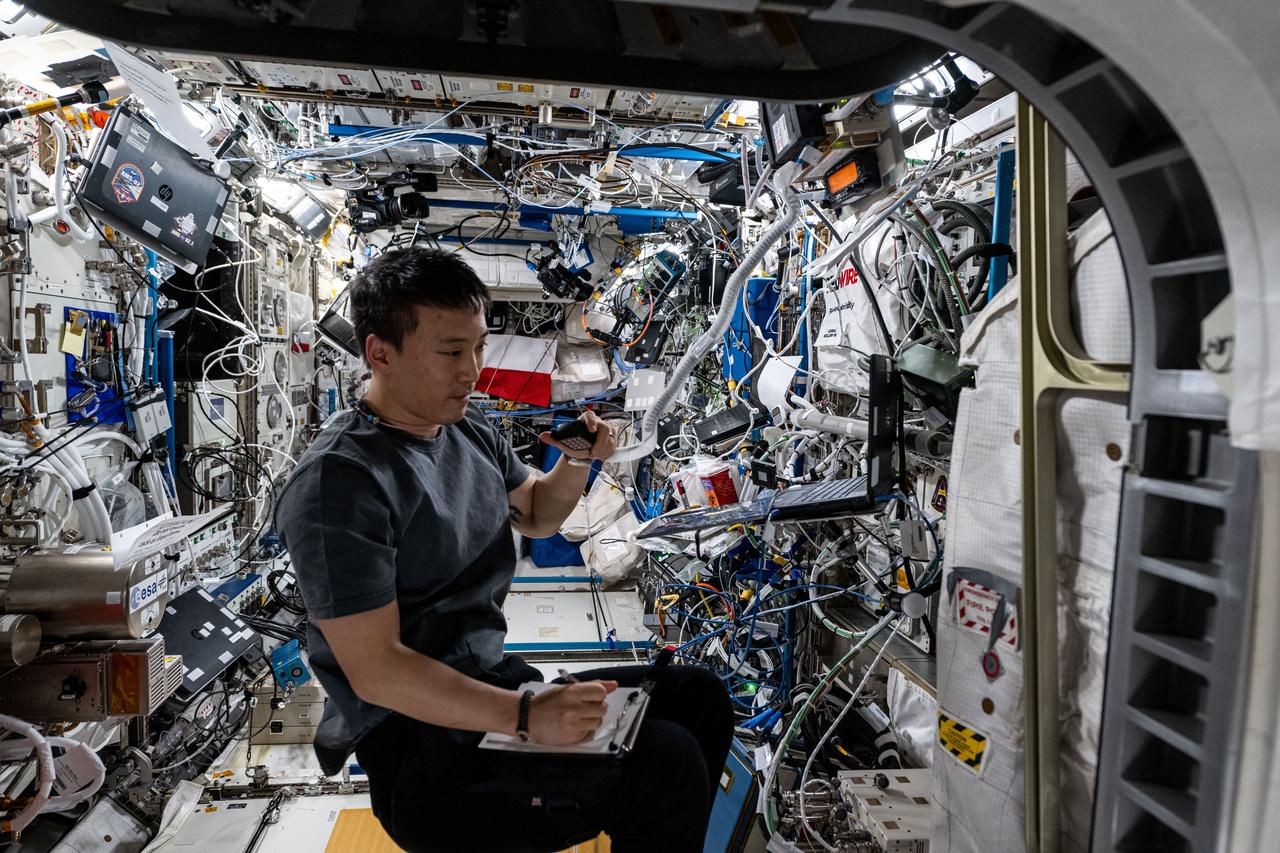
iss073e0252501 (June 29, 2025) --- NASA astronaut and Expedition 73 Flight Engineer Jonny Kim conducts a ham radio session and takes notes inside the International Space Station's Columbus laboratory module.
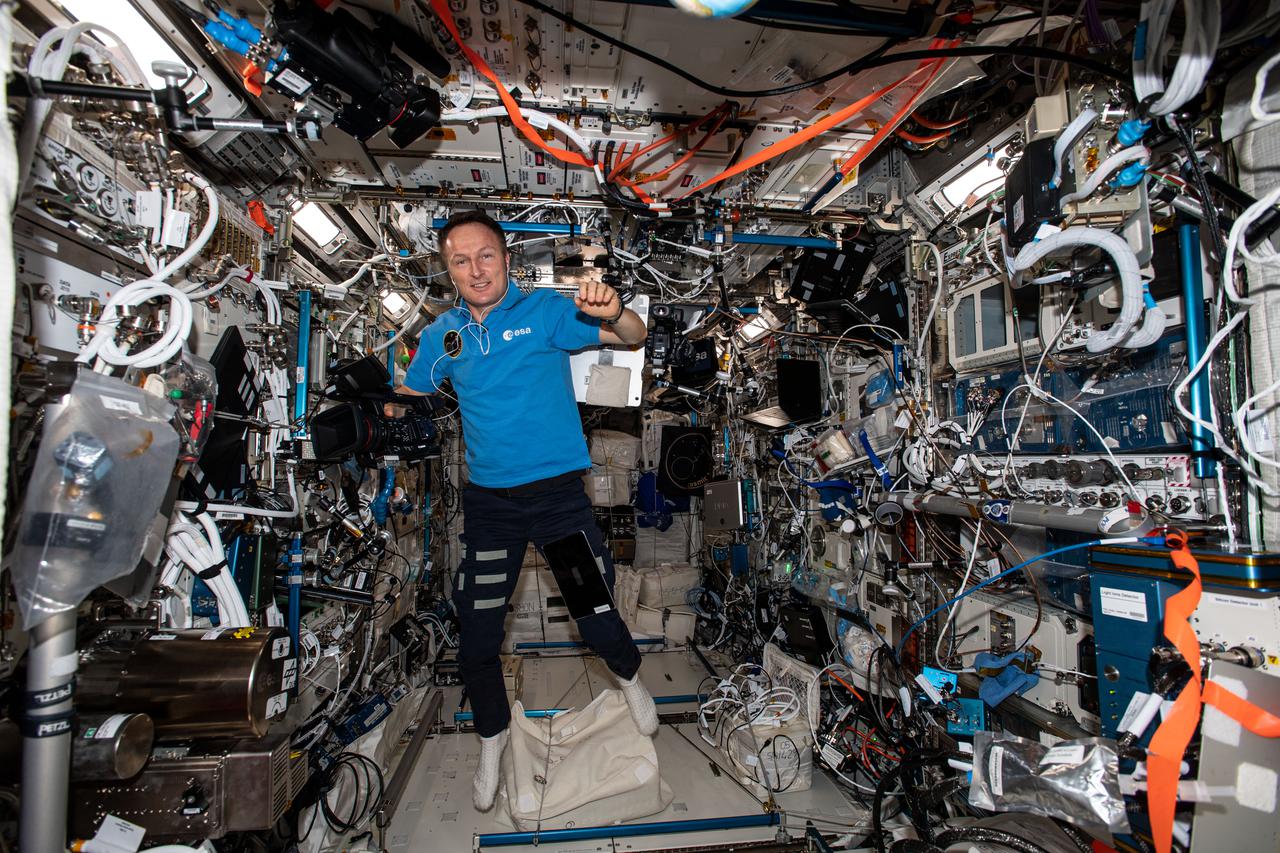
iss066e084506 (Nov. 30, 2021) --- ESA (European Space Agency) astronaut and Expedition 66 Flight Engineer Matthias Maurer is pictured inside the International Space Station's Columbus laboratory module.
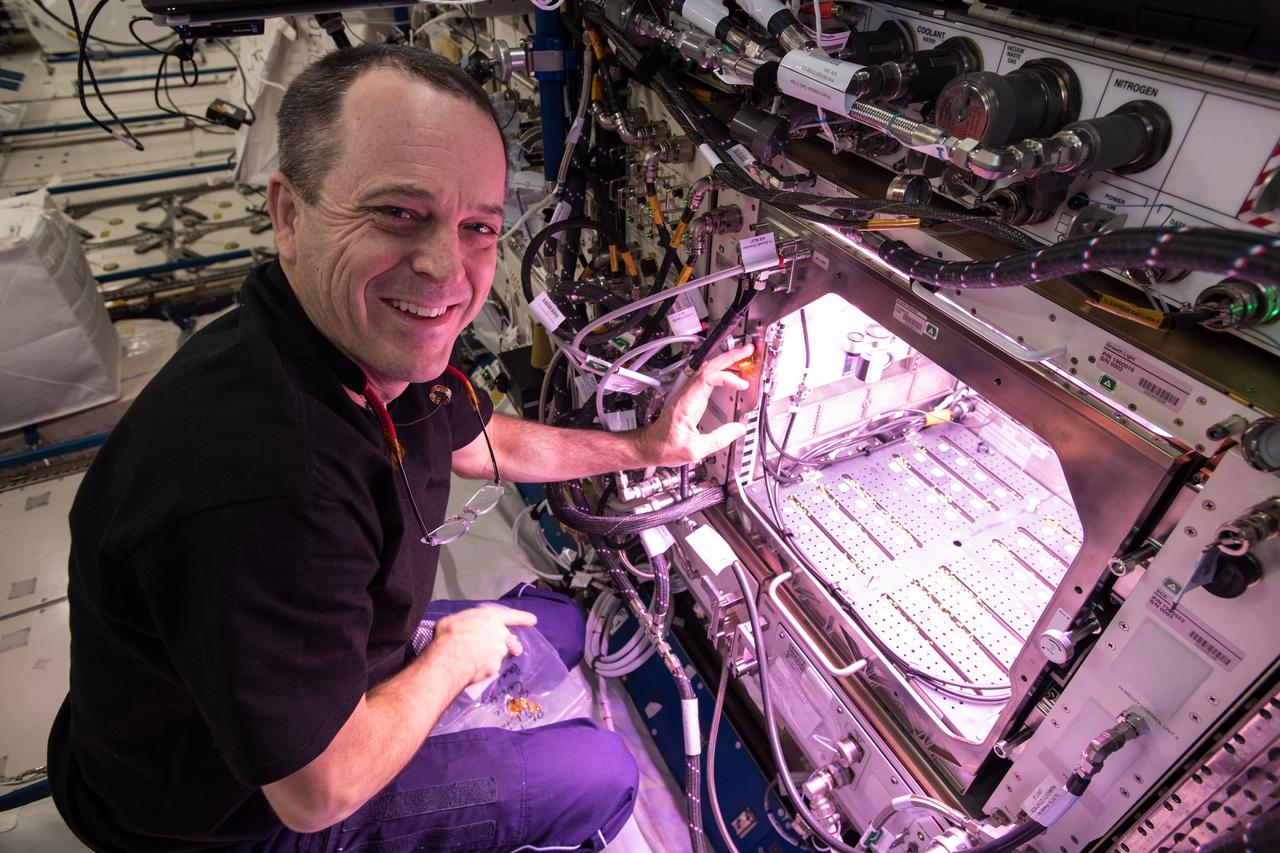
iss056e032034 (June 22, 2018) --- NASA astronaut Ricky Arnold is inside the Columbus laboratory module thinning plants for the Plant Habitat-1 experiment that is comparing plants grown in microgravity to those grown on Earth.
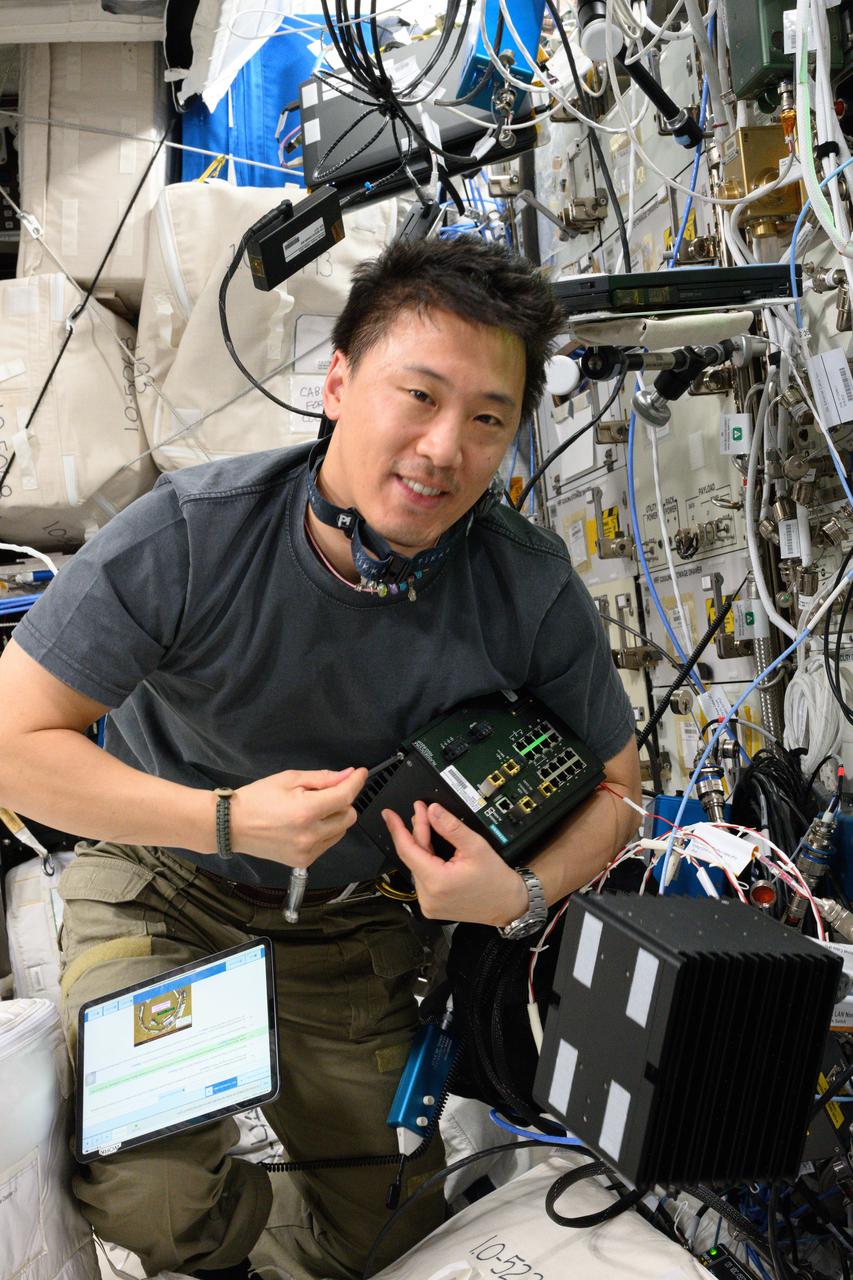
iss073e0033632 (May 16, 2025) --- NASA astronaut and Expedition 73 Flight Engineer Jonny Kim works on computer networking maintenance inside the International Space Station's Columbus laboratory module.
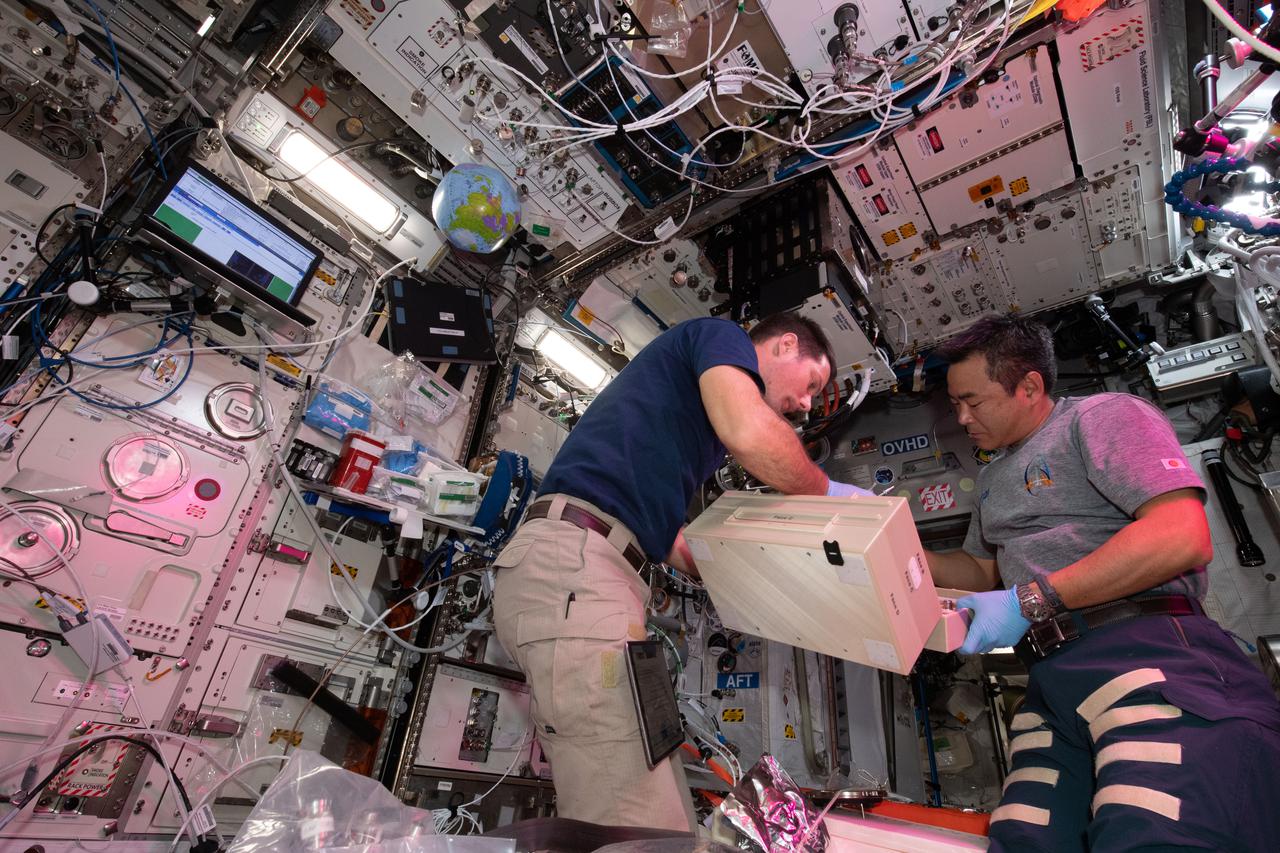
iss065e104876 (June 11, 2021) --- Expedition 65 Flight Engineer Thomas Pesquet and Commander Akihiko Hoshide check out research hardware inside the International Space Station's Columbus laboratory module.
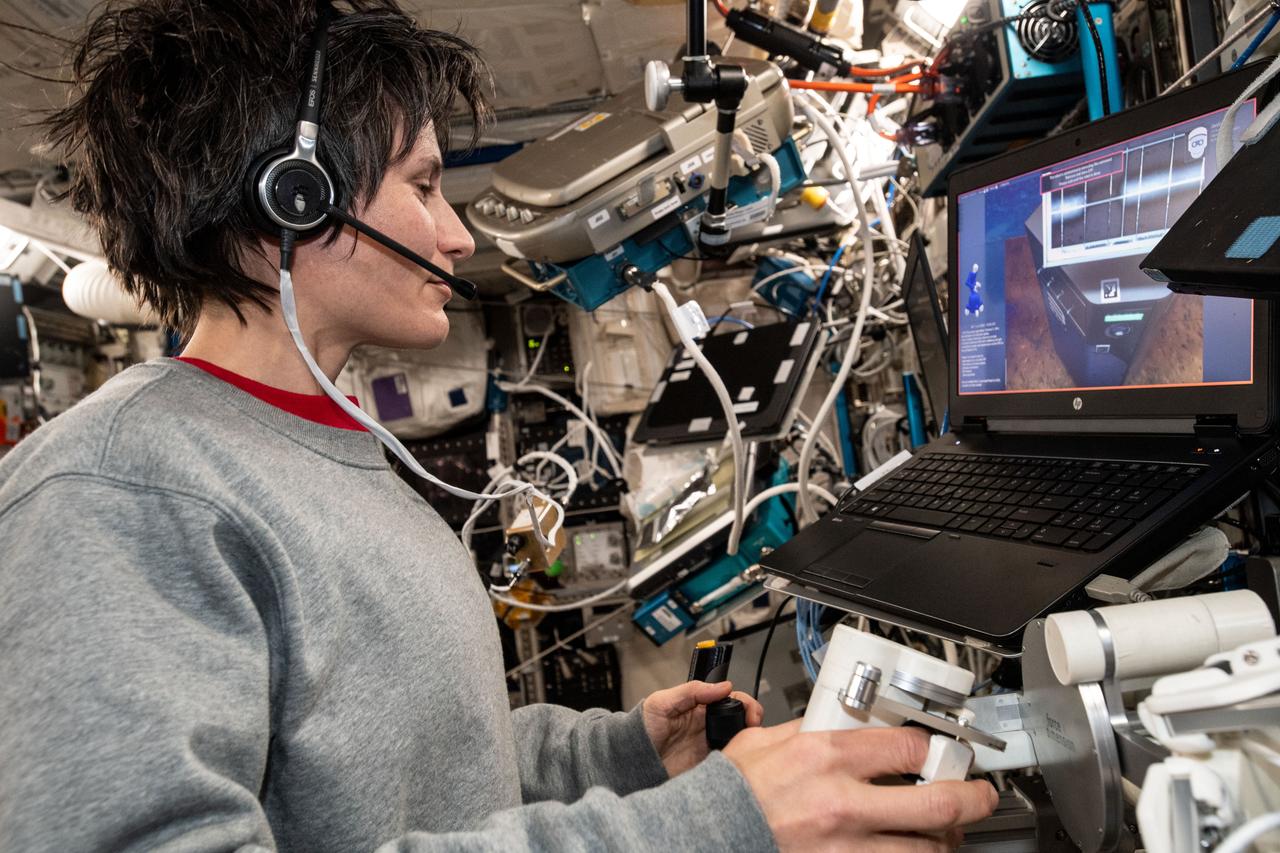
iss067e107123 (May 31, 2022) --- ESA (European Space Agency) astronaut and Expedition 67 Flight Engineer Samantha Cristoforetti practices robotics maneuvers on a laptop computer inside the International Space Station's Columbus laboratory module.
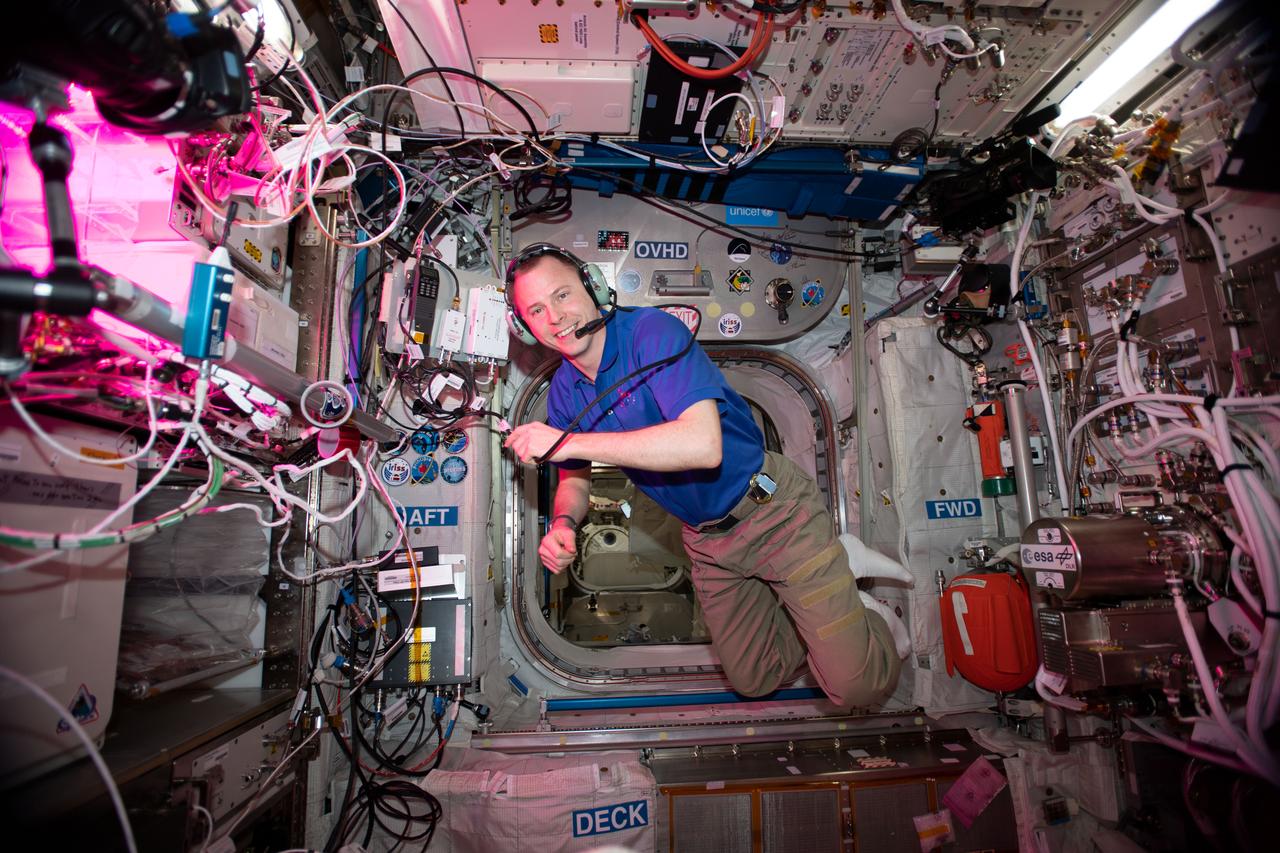
iss059e085130 (May 30, 2019) --- NASA astronaut Nick Hague floats inside Europe's Columbus laboratory module during a HAM radio session using the International Space Station's call sign NA1SS.
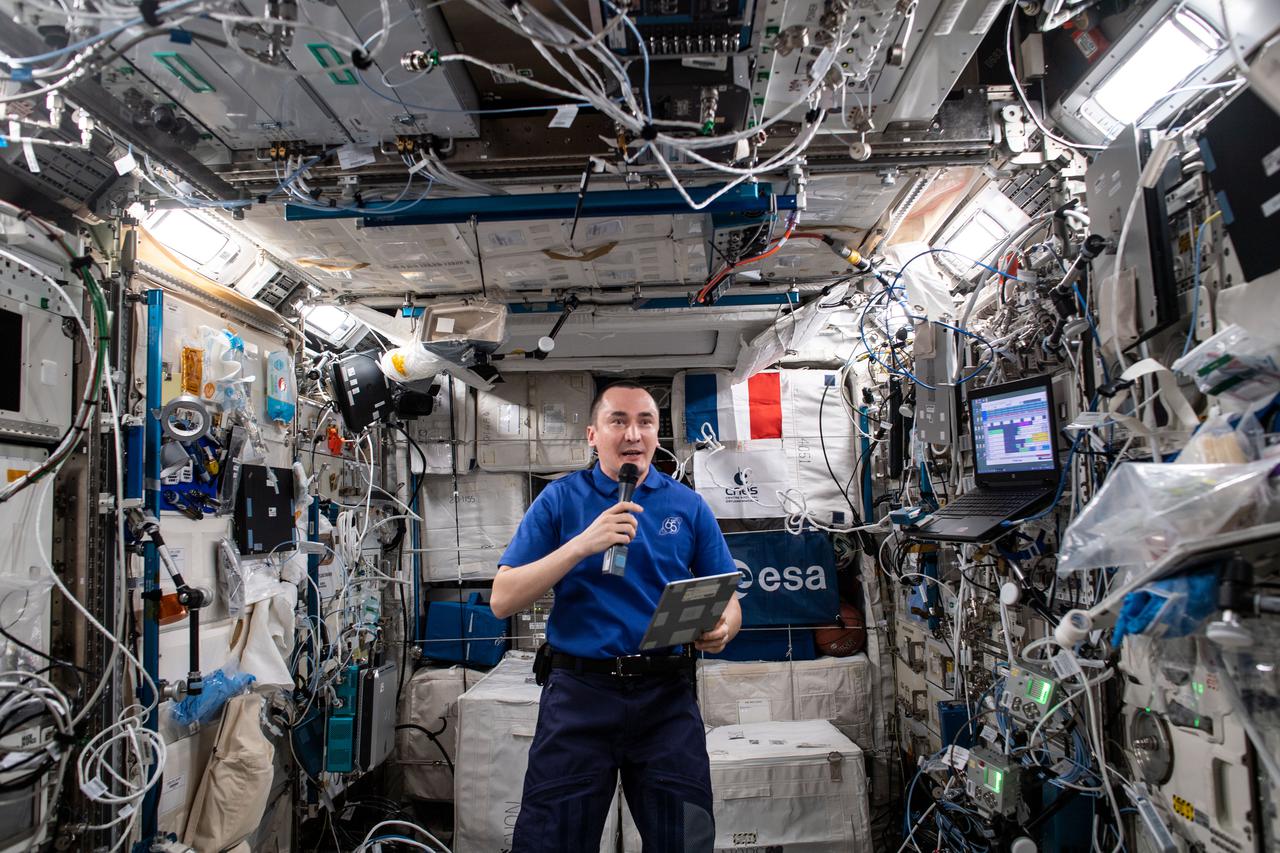
iss065e061126 (May 24, 2021) --- Roscosmos cosmonaut and Expedition 65 Flight Engineer Pyotr Dubrov is pictured inside the Columbus laboratory module taking part in a Russian public affairs event.
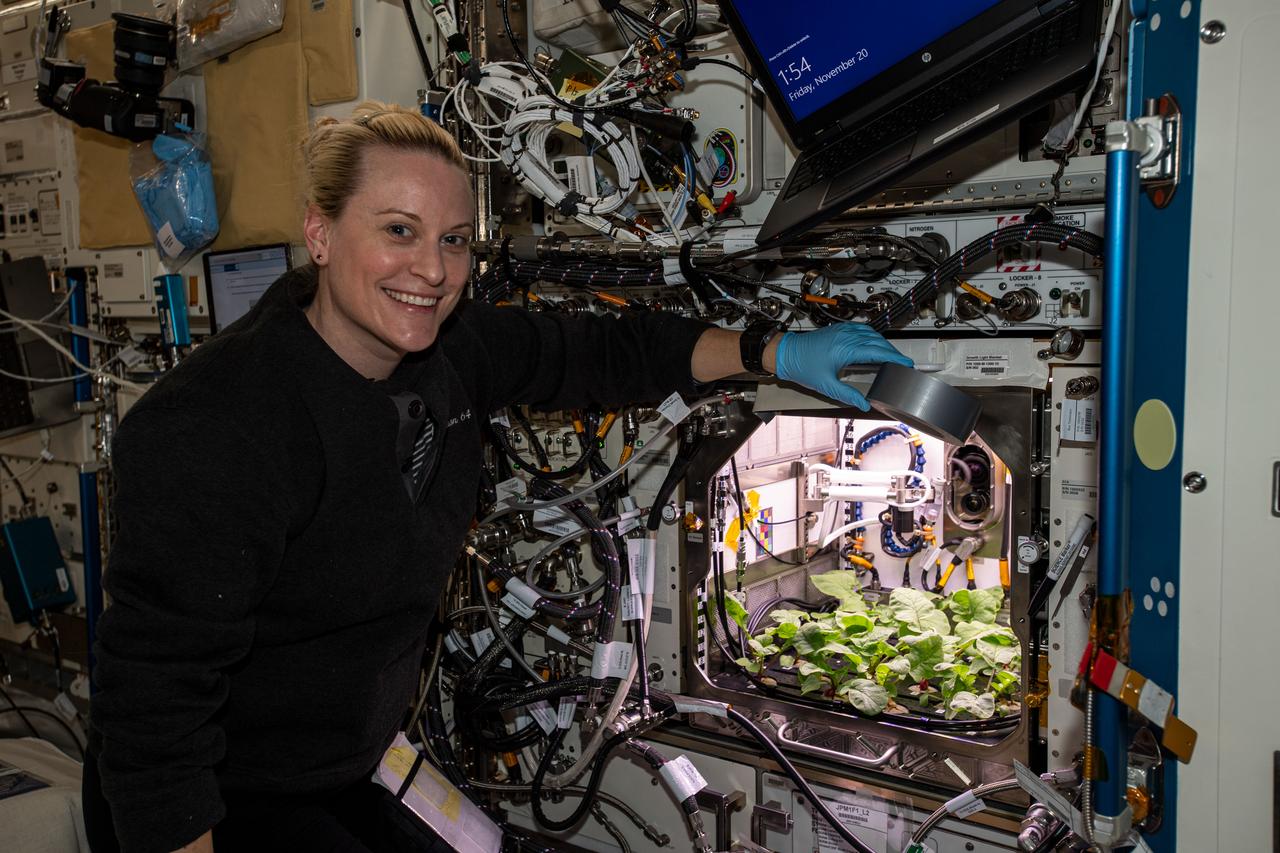
iss064e004997 (Nov. 20, 2020) --- Expedition 64 Flight Engineer Kate Rubins of NASA shows off radish plants growing inside the Columbus laboratory module's Advanced Plant Habitat before collecting leaf samples for analysis.
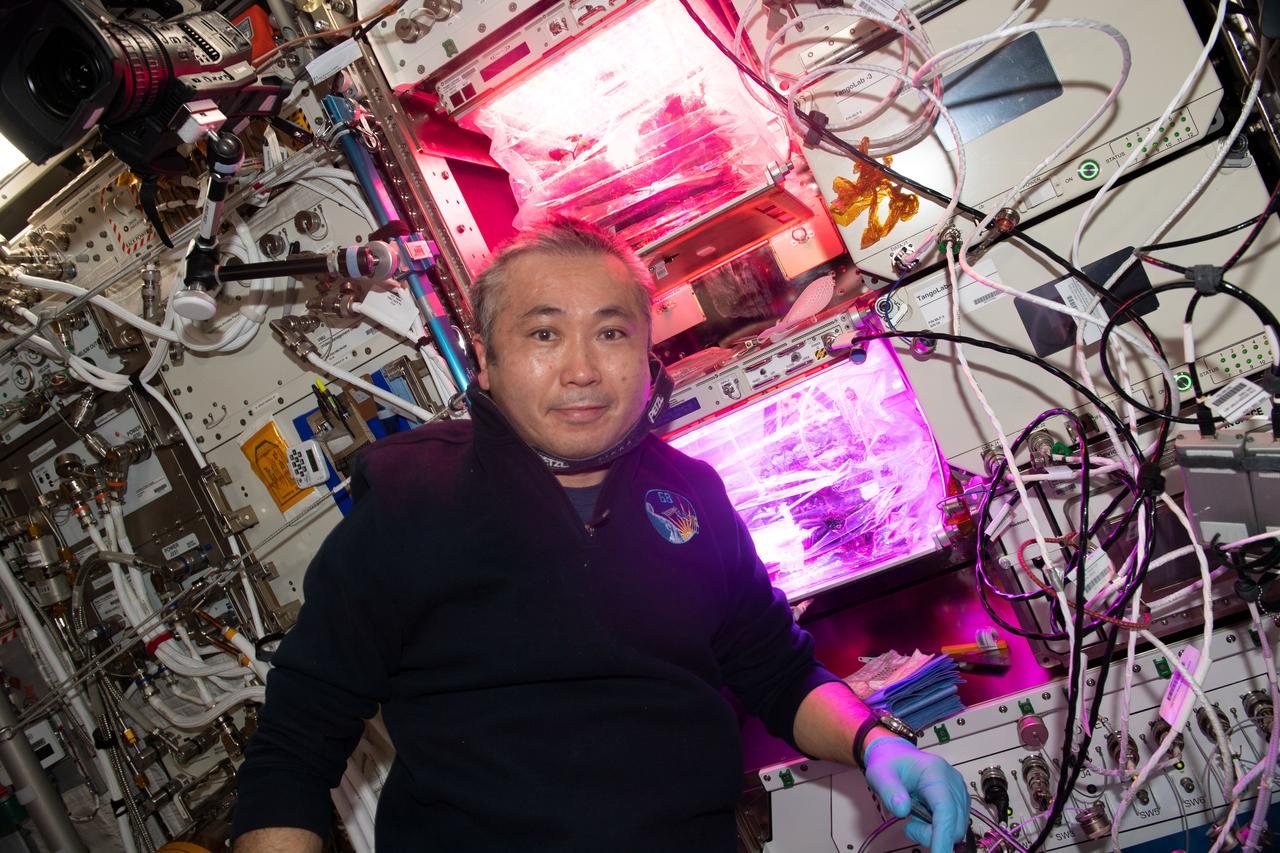
iss068e051275 (Feb. 11, 2023) --- Expedition 68 Flight Engineer Koichi Wakata of the Japan Aerospace Exploration Agency (JAXA) tends to tomato plants growing inside the Columbus laboratory module's Veggie space botany facility.
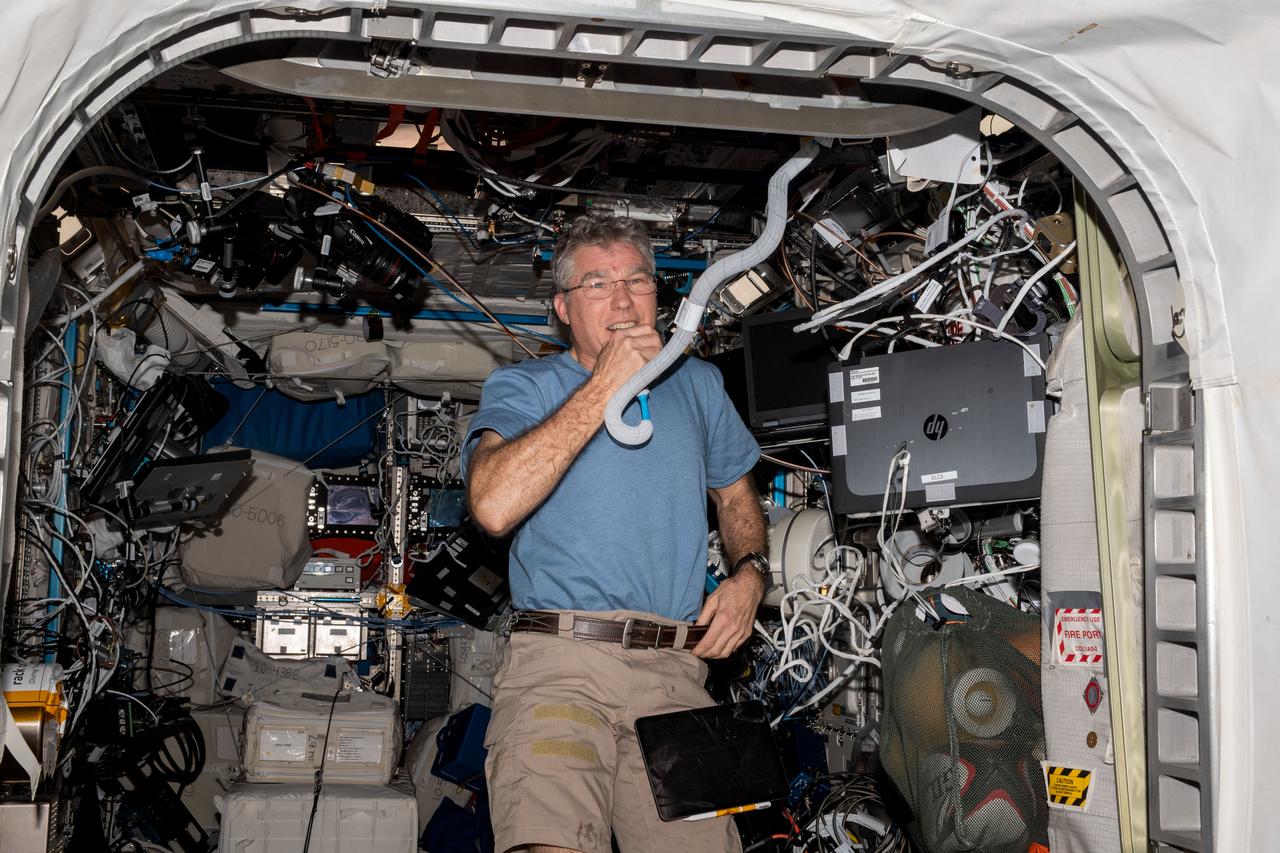
iss069e033736 (July 18, 2023) --- NASA astronaut and Expedition 69 Flight Engineer Stephen Bowen is pictured in the Columbus laboratory module conducting a HAM radio session with students from Carleton University in Ottawa, Ontario, in Canada.
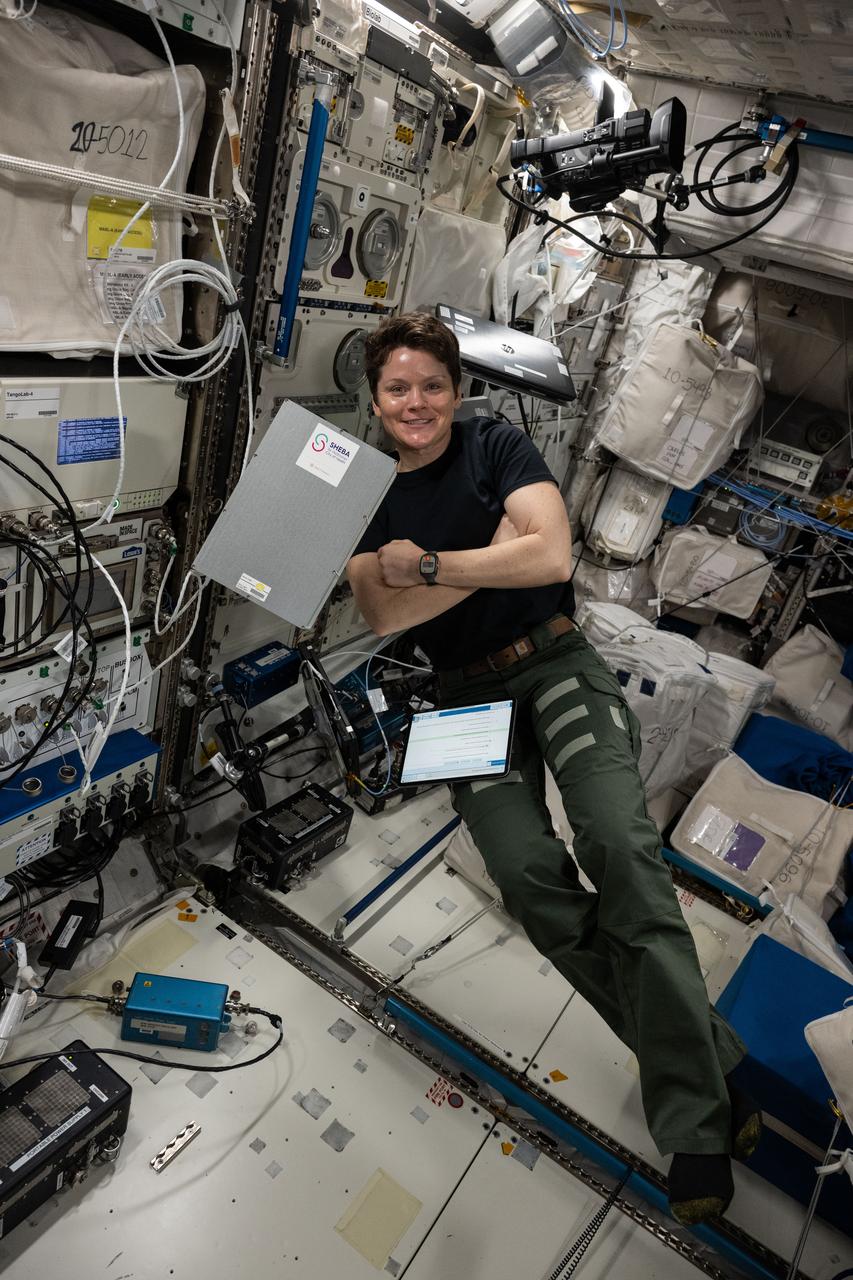
iss073e0420808 (Aug. 3, 2025) --- NASA astronaut and Expedition 73 Flight Engineer Anne McClain smiles for a portrait during scientific operations inside the International Space Station's Columbus laboratory module.
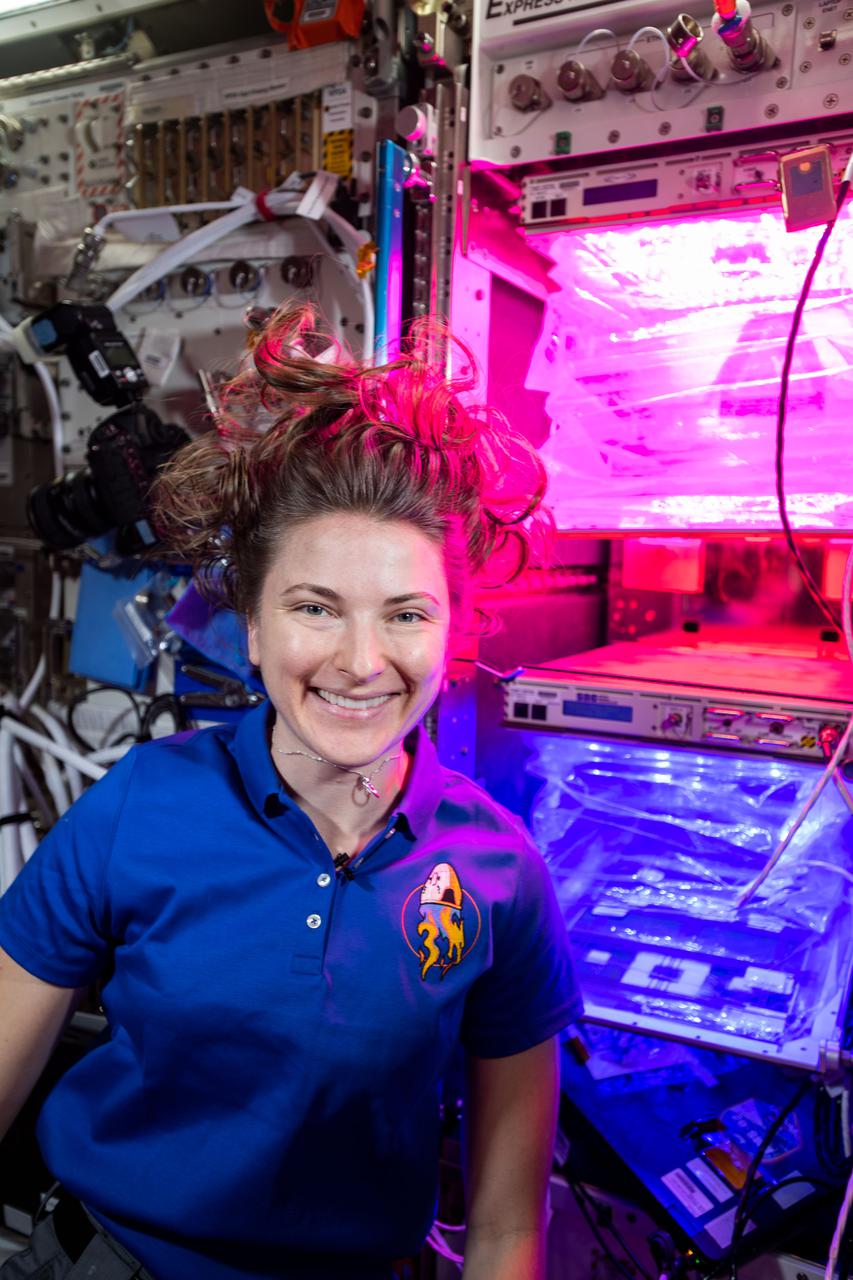
iss066e155817 (March 1, 2022) --- NASA astronaut and Expedition 66 Flight Engineer Kayla Barron poses for a portrait in front of the VEGGIE space botany facility inside the International Space Station's Columbus laboratory module.
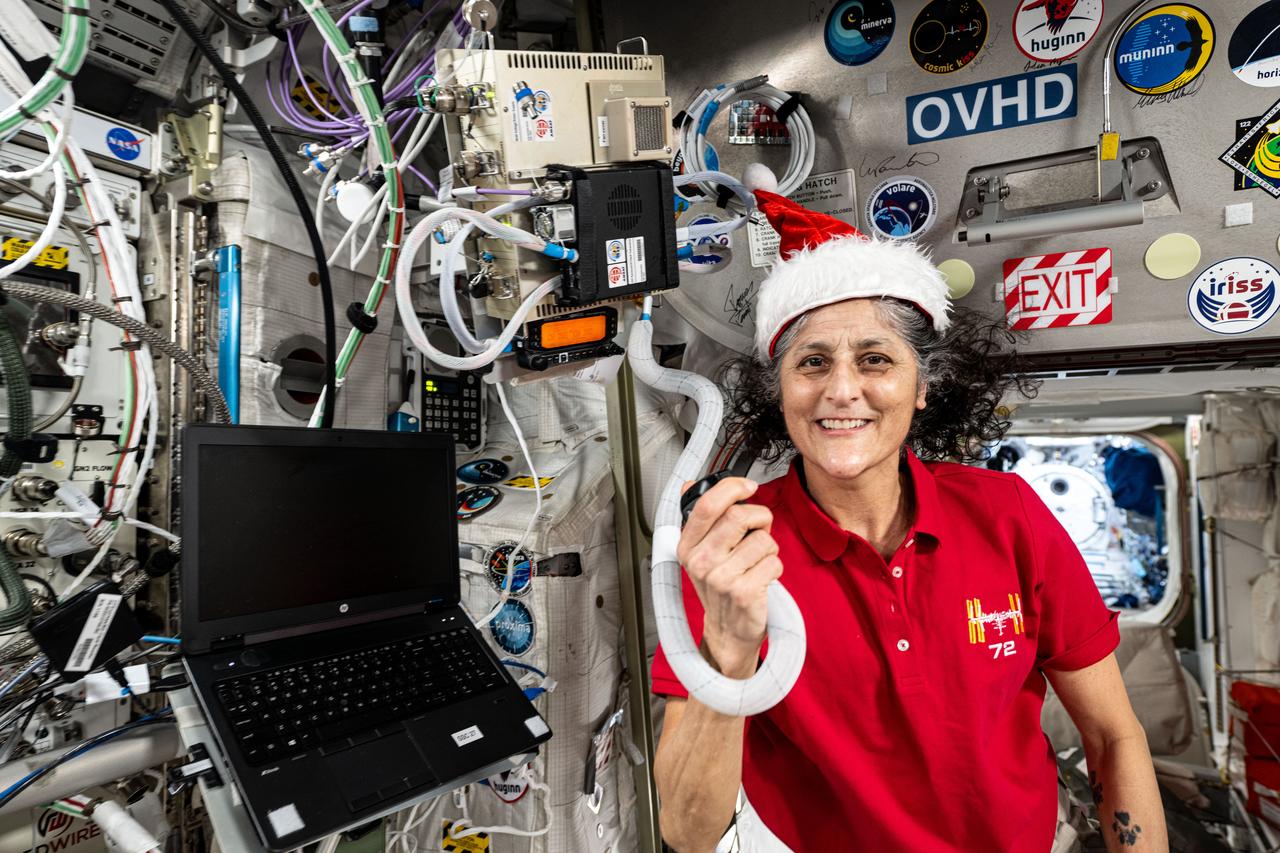
iss072e280674 (Nov. 24, 2024) --- NASA astronaut and Expedition 72 Commander Suni Williams poses for a fun holiday season portrait while speaking on a ham radio inside the International Space Station's Columbus laboratory module.
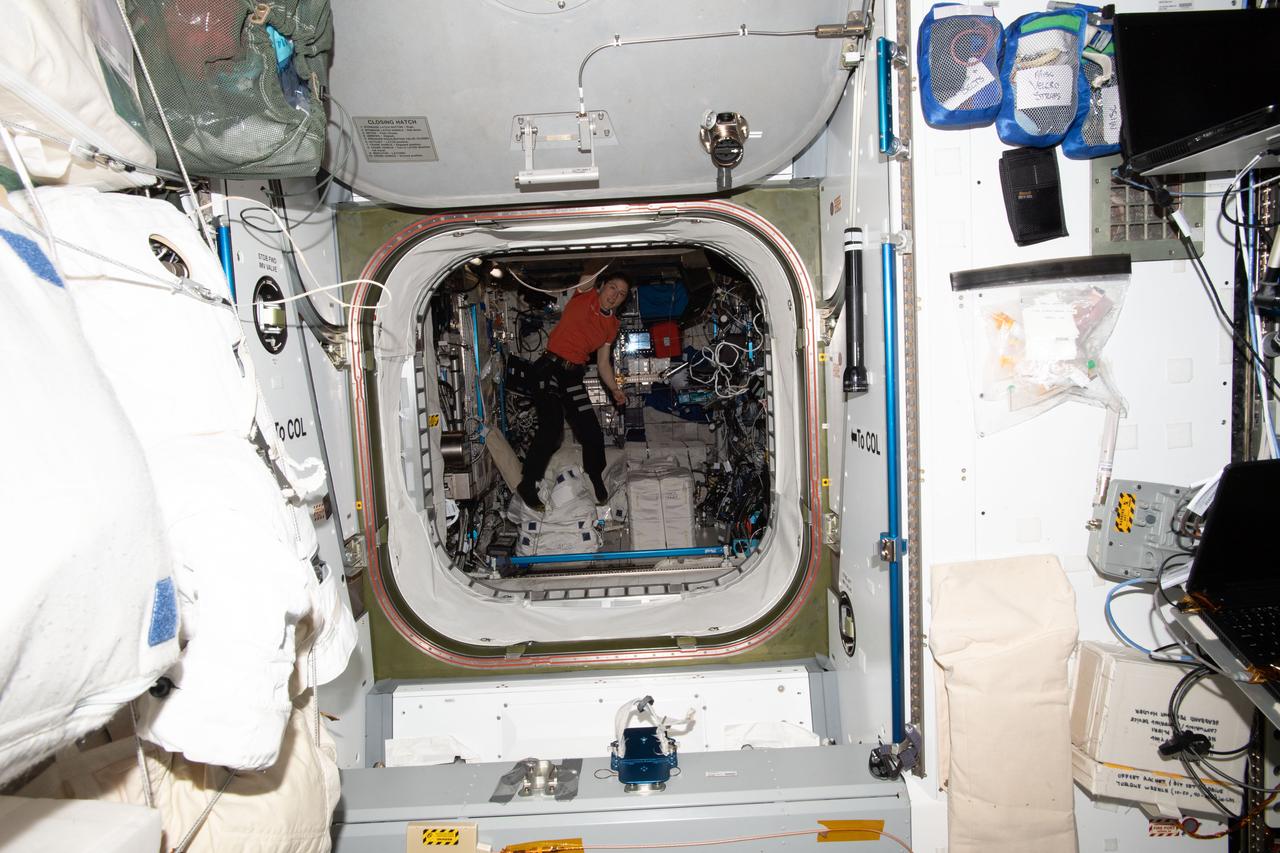
iss059e018827 (April 10, 2019) --- NASA astronaut and Expedition 59 Flight Engineer Christina Koch works inside the Columbus laboratory module from ESA (European Space Agency).

iss061e038294 (Nov. 13, 2019) --- NASA astronaut Jessica Meir trims leaves and harvests a crop of Mizuna mustard greens grown inside the International Space Station's Veggie botany facility located in the Columbus laboratory module..
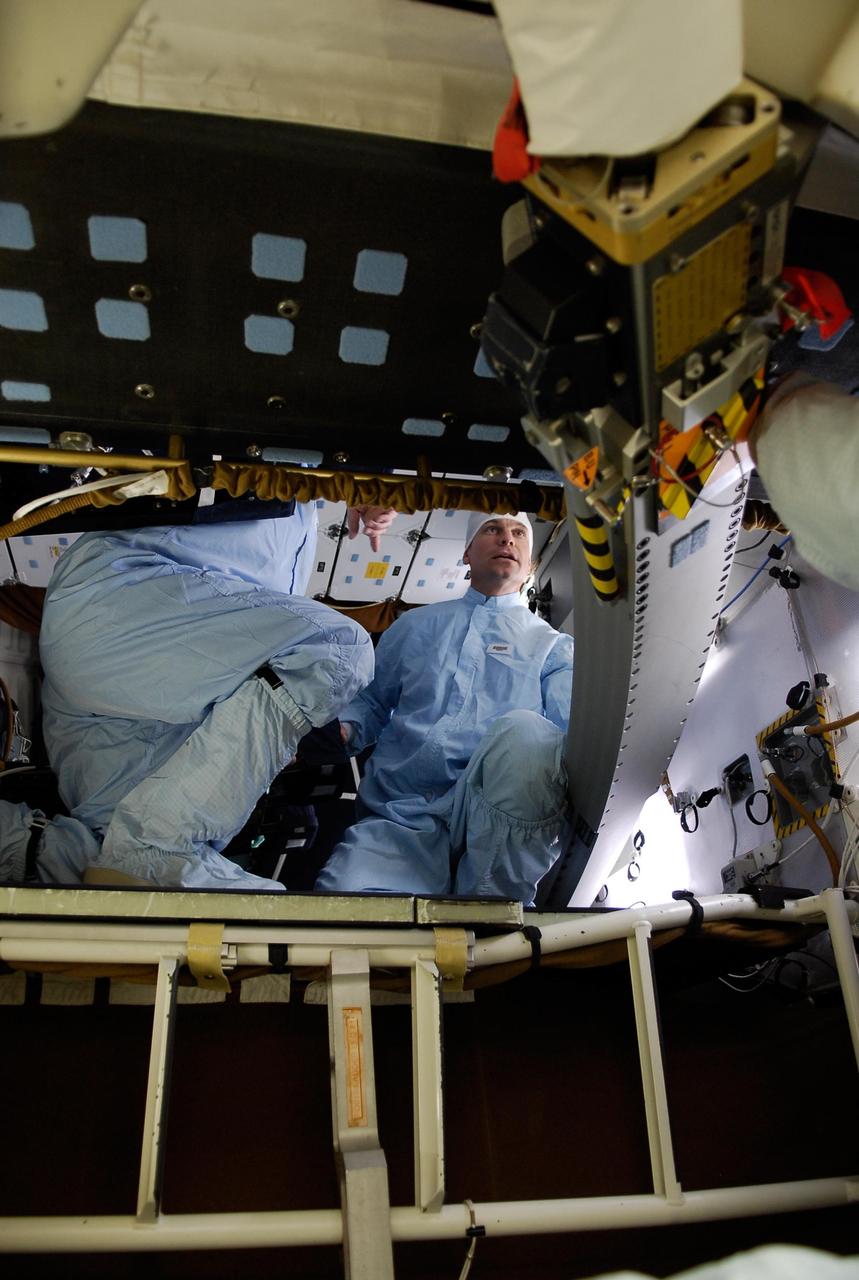
KENNEDY SPACE CENTER, FLA. -- On the flight deck of space shuttle Atlantis, STS-122 Mission Specialist Stanley Love looks at cables and controls. The STS-122 mission to the International Space Station is scheduled to launch at 2:45 p.m. Feb. 7 with a crew of seven. Atlantis will carry the Columbus Laboratory, Europe's largest contribution to the construction of the station. Columbus will support scientific and technological research in a microgravity environment. Columbus is a multifunctional, pressurized laboratory that will be permanently attached to the Harmony module to carry out experiments in materials science, fluid physics and biosciences, as well as to perform a number of technological applications. Photo credit: NASA/Kim Shiflett
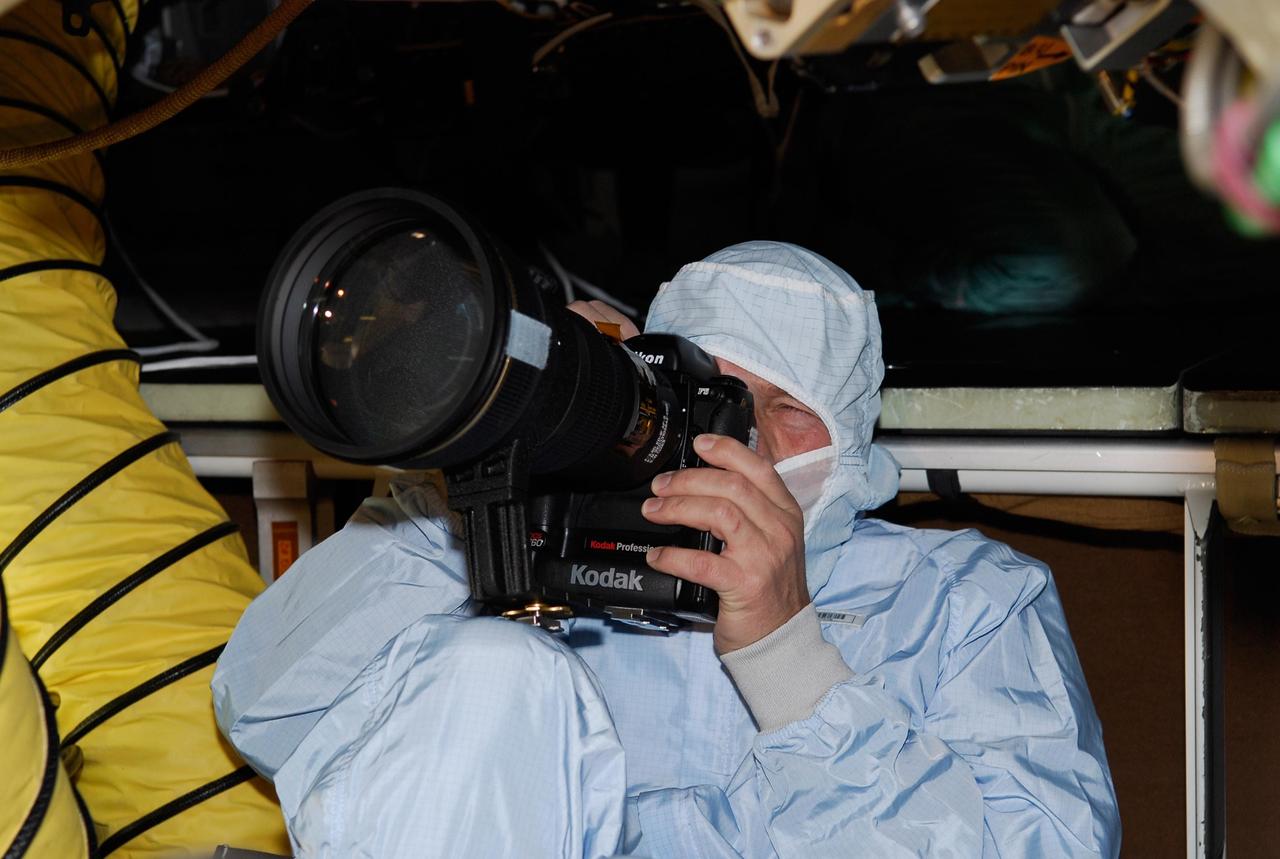
KENNEDY SPACE CENTER, FLA. -- On the flight deck of space shuttle Atlantis, STS-122 Mission Specialist Hans Schlegel handles the camera to be used during the mission. Schlegel represents the European Space Agency. The STS-122 mission to the International Space Station is scheduled to launch at 2:45 p.m. Feb. 7 with a crew of seven. Atlantis will carry the Columbus Laboratory, Europe's largest contribution to the construction of the station. Columbus will support scientific and technological research in a microgravity environment. Columbus is a multifunctional, pressurized laboratory that will be permanently attached to the Harmony module to carry out experiments in materials science, fluid physics and biosciences, as well as to perform a number of technological applications. Photo credit: NASA/Kim Shiflett

KENNEDY SPACE CENTER, FLA. -- On the flight deck of space shuttle Atlantis, STS-122 Mission Specialist Hans Schlegel handles the camera to be used during the mission. Schlegel represents the European Space Agency. The STS-122 mission to the International Space Station is scheduled to launch at 2:45 p.m. Feb. 7 with a crew of seven. Atlantis will carry the Columbus Laboratory, Europe's largest contribution to the construction of the station. Columbus will support scientific and technological research in a microgravity environment. Columbus is a multifunctional, pressurized laboratory that will be permanently attached to the Harmony module to carry out experiments in materials science, fluid physics and biosciences, as well as to perform a number of technological applications. Photo credit: NASA/Kim Shiflett

iss062e087414 (March 9, 2020) --- The SpaceX Dragon resupply ship is pictured attached to the Earth-facing port on the International Space Station's Harmony module. In the right foreground is the European Space Agency's (ESA) Columbus laboratory module which is attached to the Harmony module's starboard port.
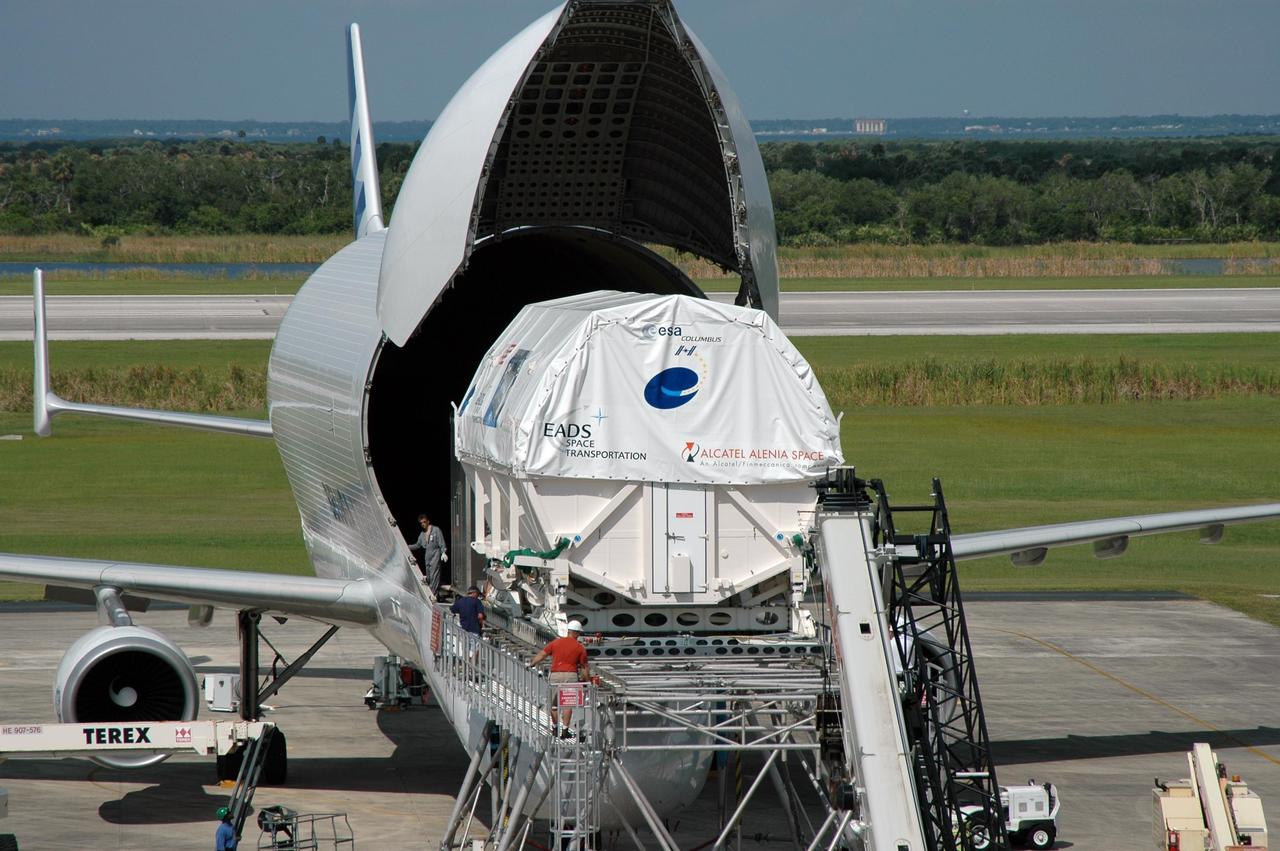
KENNEDY SPACE CENTER, FLA. - At the Shuttle Landing Facility, the European Space Agency's research laboratory, designated Columbus, slides out onto an Airbus Transport International platform. The module will be lifted onto a flat bed truck and transported to the Space Station Processing Facility. In the SSPF, the module will be prepared for delivery to the International Space Station on a future space shuttle mission. Columbus will expand the research facilities of the station and provide researchers with the ability to conduct numerous experiments in the area of life, physical and materials sciences. Photo credit: NASA/Jim Grossmann
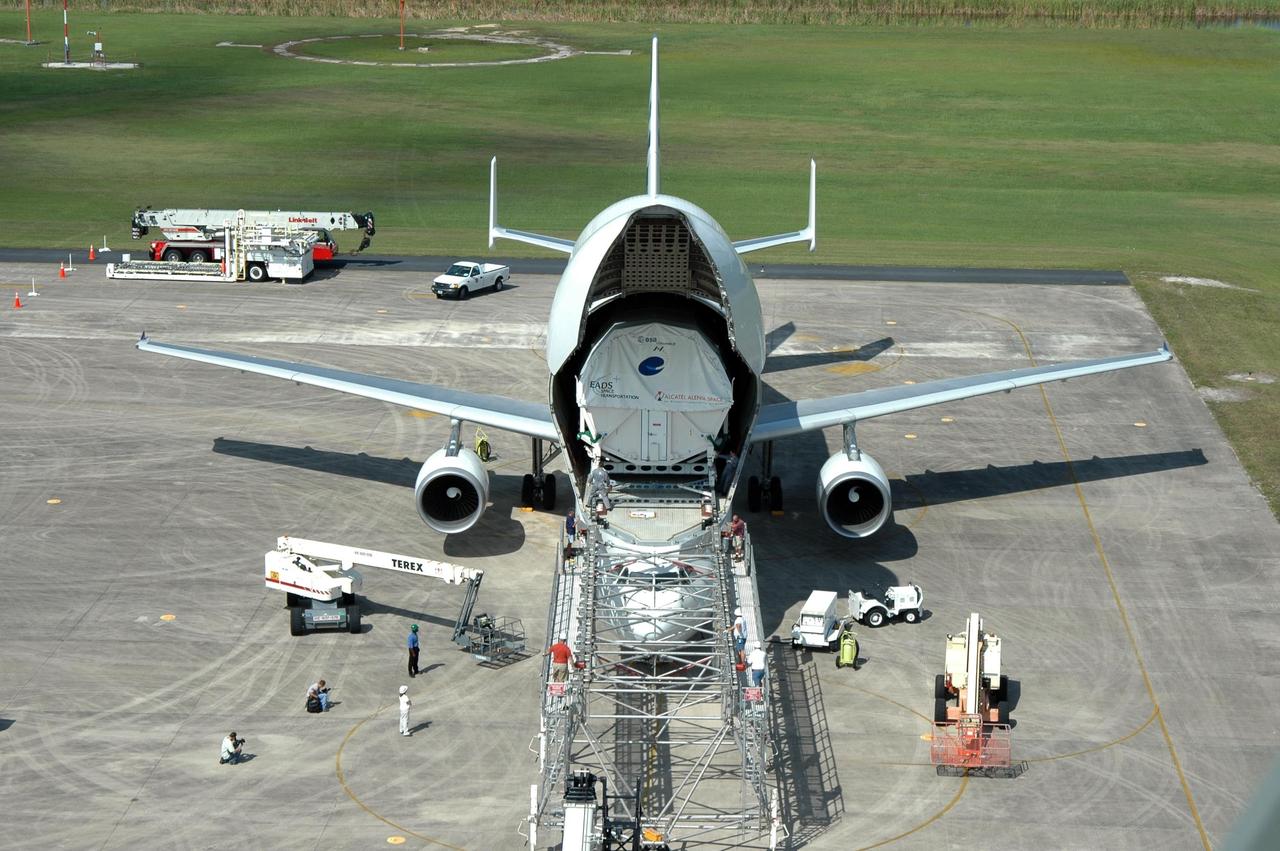
KENNEDY SPACE CENTER, FLA. - At the Shuttle Landing Facility, the European Space Agency's research laboratory, designated Columbus, is being offloaded onto an Airbus Transport International platform. The module will be lifted onto a flat bed truck and transported to the Space Station Processing Facility. There the module will be prepared for delivery to the International Space Station on a future space shuttle mission. Columbus will expand the research facilities of the station and provide researchers with the ability to conduct numerous experiments in the area of life, physical and materials sciences. Photo credit: NASA/Jim Grossmann
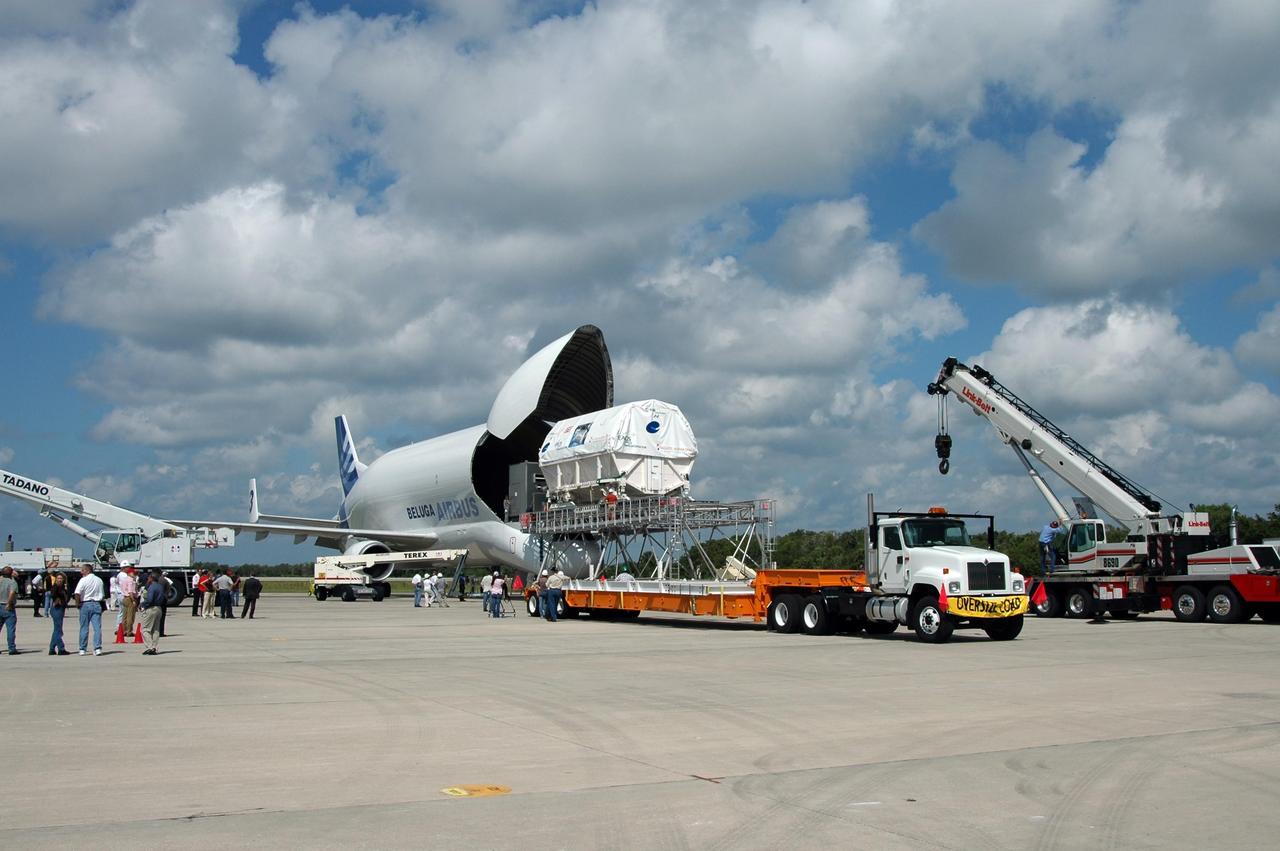
KENNEDY SPACE CENTER, FLA. - At the Shuttle Landing Facility, the European Space Agency's research laboratory, designated Columbus, slides out onto an Airbus Transport International platform. The module will be lifted onto a flat bed truck and transported to the Space Station Processing Facility. There the module will be prepared for delivery to the International Space Station on a future space shuttle mission. Columbus will expand the research facilities of the station and provide researchers with the ability to conduct numerous experiments in the area of life, physical and materials sciences. Photo credit: NASA/Jim Grossmann
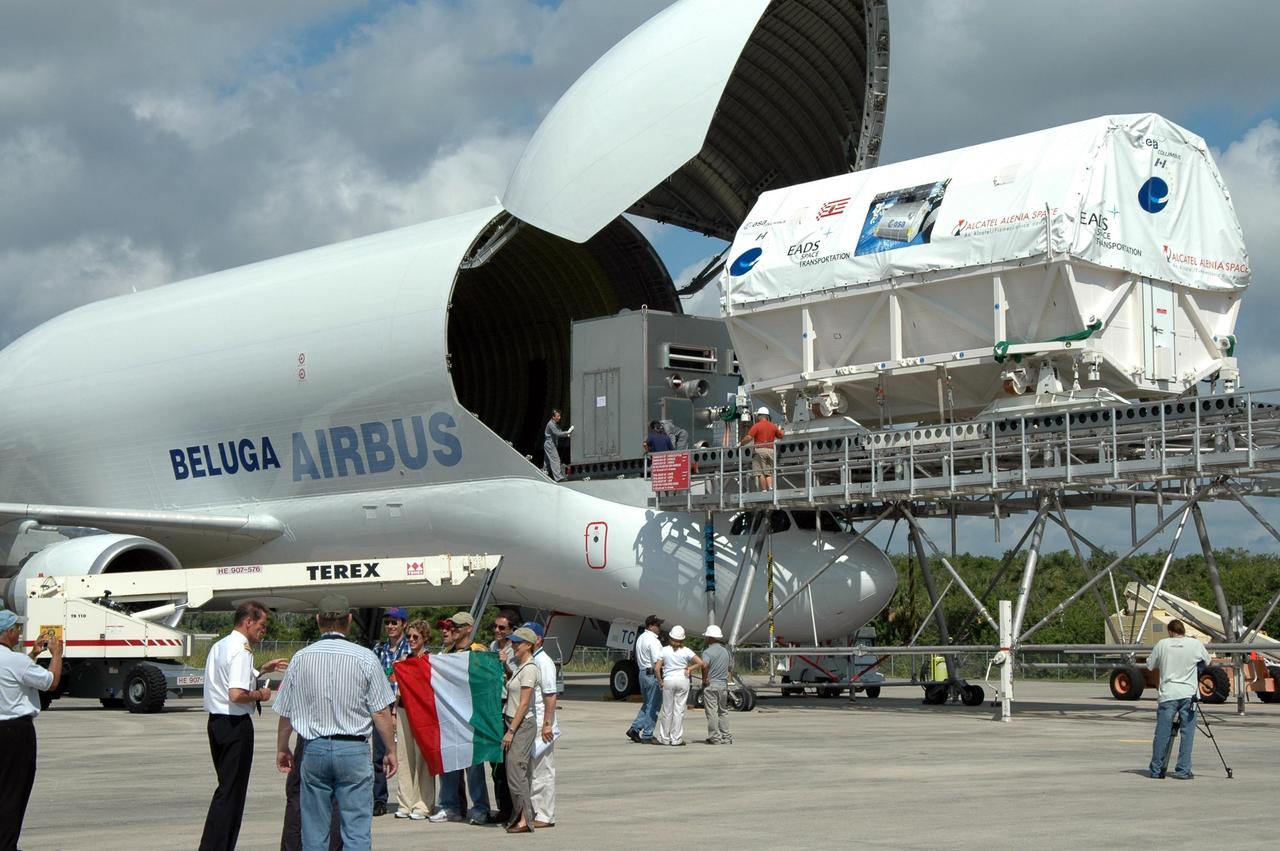
KENNEDY SPACE CENTER, FLA. - At the Shuttle Landing Facility, the European Space Agency's research laboratory, designated Columbus, has been offloaded onto an Airbus Transport International platform. The module will be lifted onto a flat bed truck and transported to the Space Station Processing Facility. There the module will be prepared for delivery to the International Space Station on a future space shuttle mission. Columbus will expand the research facilities of the station and provide researchers with the ability to conduct numerous experiments in the area of life, physical and materials sciences. Photo credit: NASA/Jim Grossmann
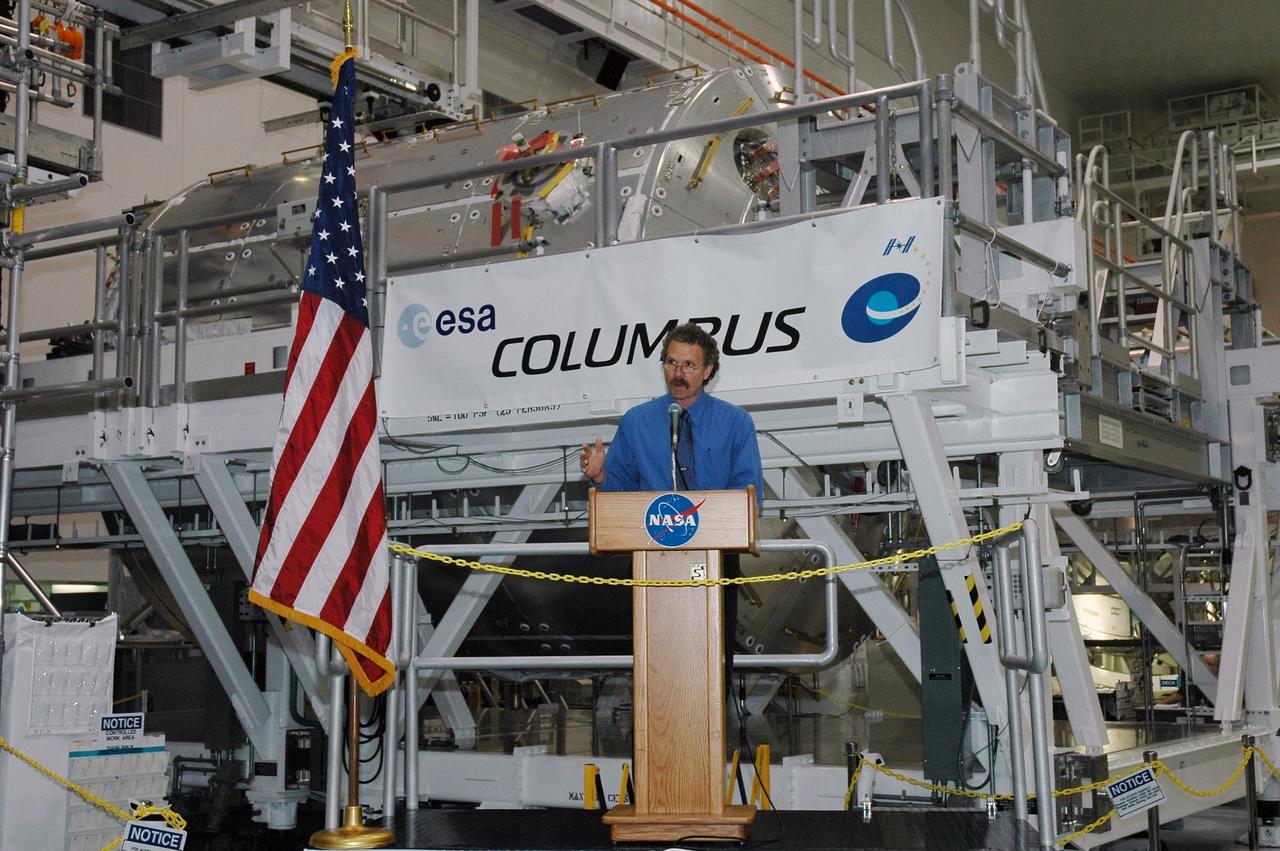
KENNEDY SPACE CENTER, FLA. - At ceremony in the Space Station Processing Facility, Russell Romanella, director of International Space Station and Payloads Processing at Kennedy Space Center, relays his team's readiness to prepare the European Space Agency's Columbus module (seen behind him) for flight. Columbus is the European Space Agency's research laboratory for the International Space Station. The module will be prepared in the SSPF for delivery to the space station on a future space shuttle mission. Columbus will expand the research facilities of the station and provide researchers with the ability to conduct numerous experiments in the life, physical and materials sciences. Photo credit: NASA/Amanda Diller
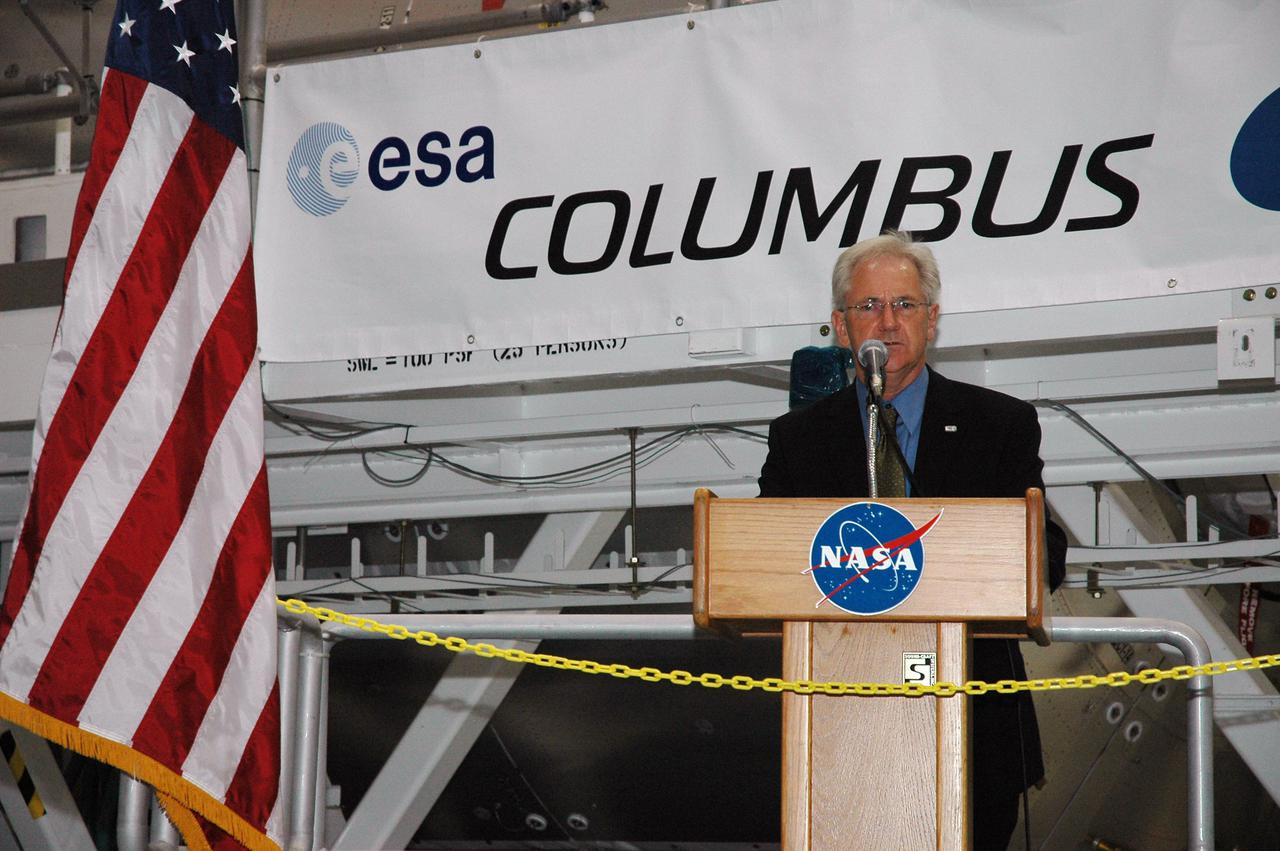
KENNEDY SPACE CENTER, FLA. - Alan Thirkettle, International Space Station program manager for the European Space Agency (ESA), speaks at a ceremony in the Space Station Processing Facility following the delivery of ESA's Columbus module to Kennedy Space Center. Columbus is the European Space Agency's research laboratory for the International Space Station. The module will be prepared in the SSPF for delivery to the space station on a future space shuttle mission. Columbus will expand the research facilities of the station and provide researchers with the ability to conduct numerous experiments in the life, physical and materials sciences. Photo credit: NASA_Amanda Diller
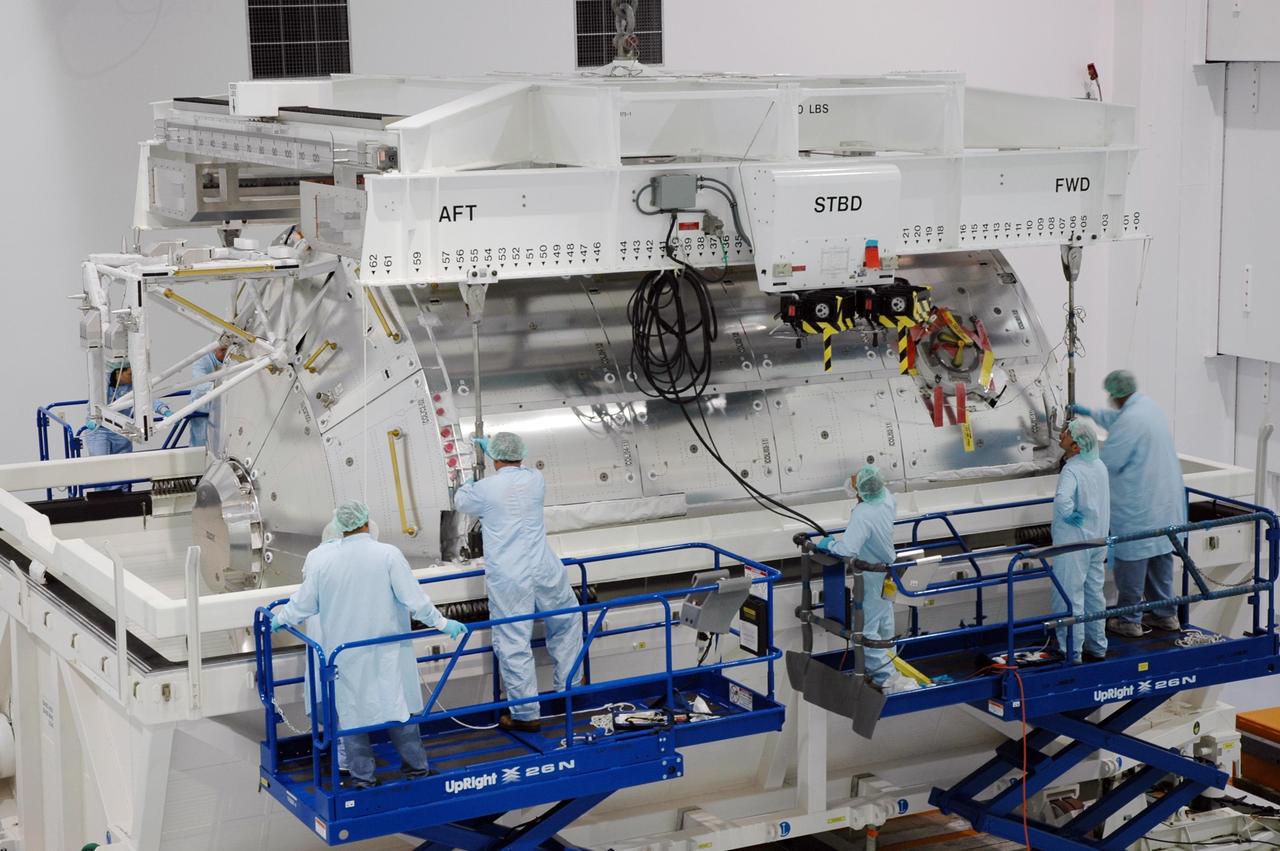
KENNEDY SPACE CENTER, FLA. - Inside the Space Station Processing Facility at NASA's Kennedy Space Center, an overhead crane is lowered onto the Columbus module to lift it out of its transportation canister. Columbus is the European Space Agency's research laboratory for the International Space Station. The module will be moved to a work stand and prepared for delivery to the space station on a future space shuttle mission. Columbus will expand the research facilities of the station and provide researchers with the ability to conduct numerous experiments in the area of life, physical and materials sciences. Photo credit: NASA/Jim Grossmann
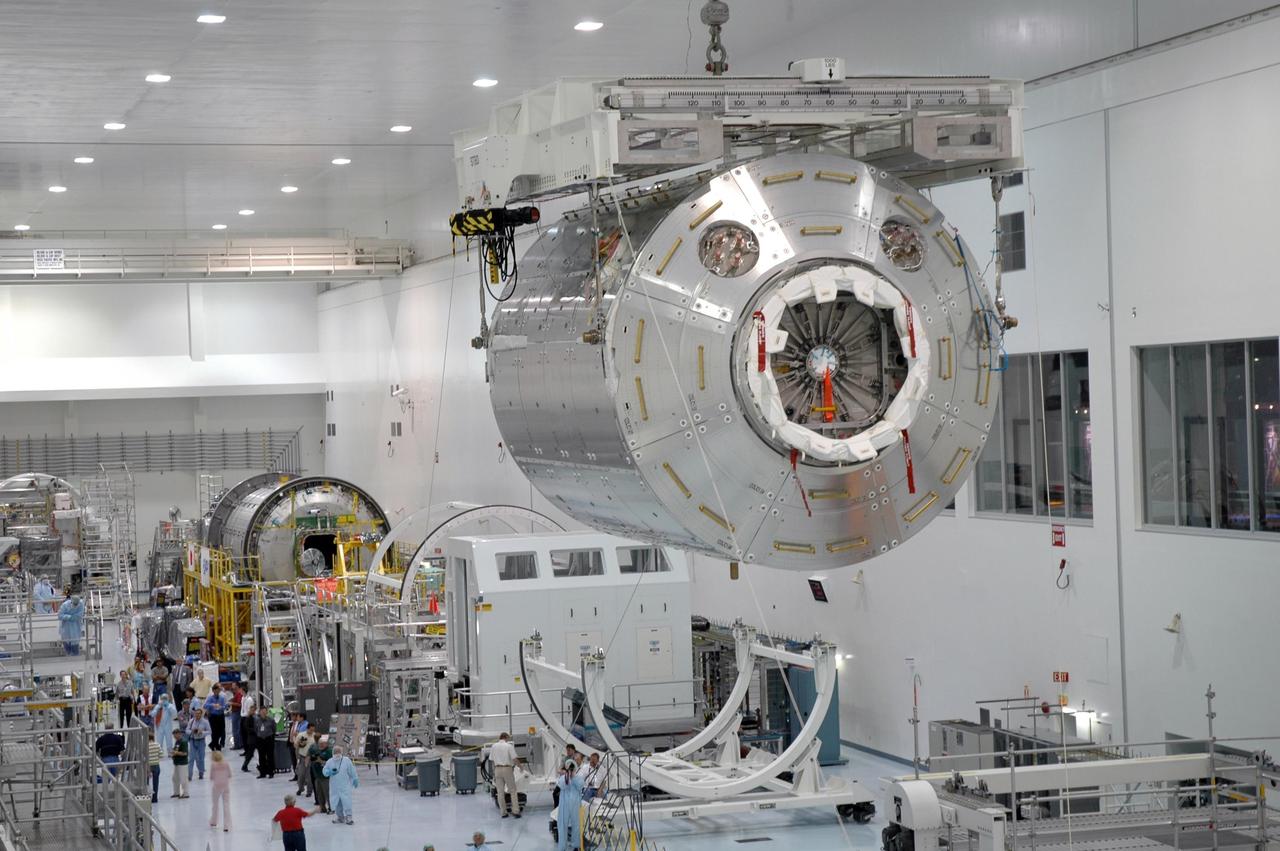
KENNEDY SPACE CENTER, FLA. - Inside the Space Station Processing Facility at NASA's Kennedy Space Center, an overhead crane carries the Columbus module away from its transportation canister. Columbus is the European Space Agency's research laboratory for the International Space Station. The module is being moved to a work stand to prepare it for delivery to the space station on a future space shuttle mission. Columbus will expand the research facilities of the station and provide researchers with the ability to conduct numerous experiments in the area of life, physical and materials sciences. Photo credit: NASA/Jim Grossmann

iss067e009250 (April 9, 2022) --- This unique orientation of the Northrop Grumman Cygnus space freighter attached to the Unity module is pictured from the Russian segment of the International Space Station. At lower center, in front of Cygnus is the Rassvet module's docking port. Behind Cygnus, at left, is the Columbus laboratory module, and at right, is the Kibo laboratory module. In front of Kibo, is the Leonardo Permanent Multipurpose Module.
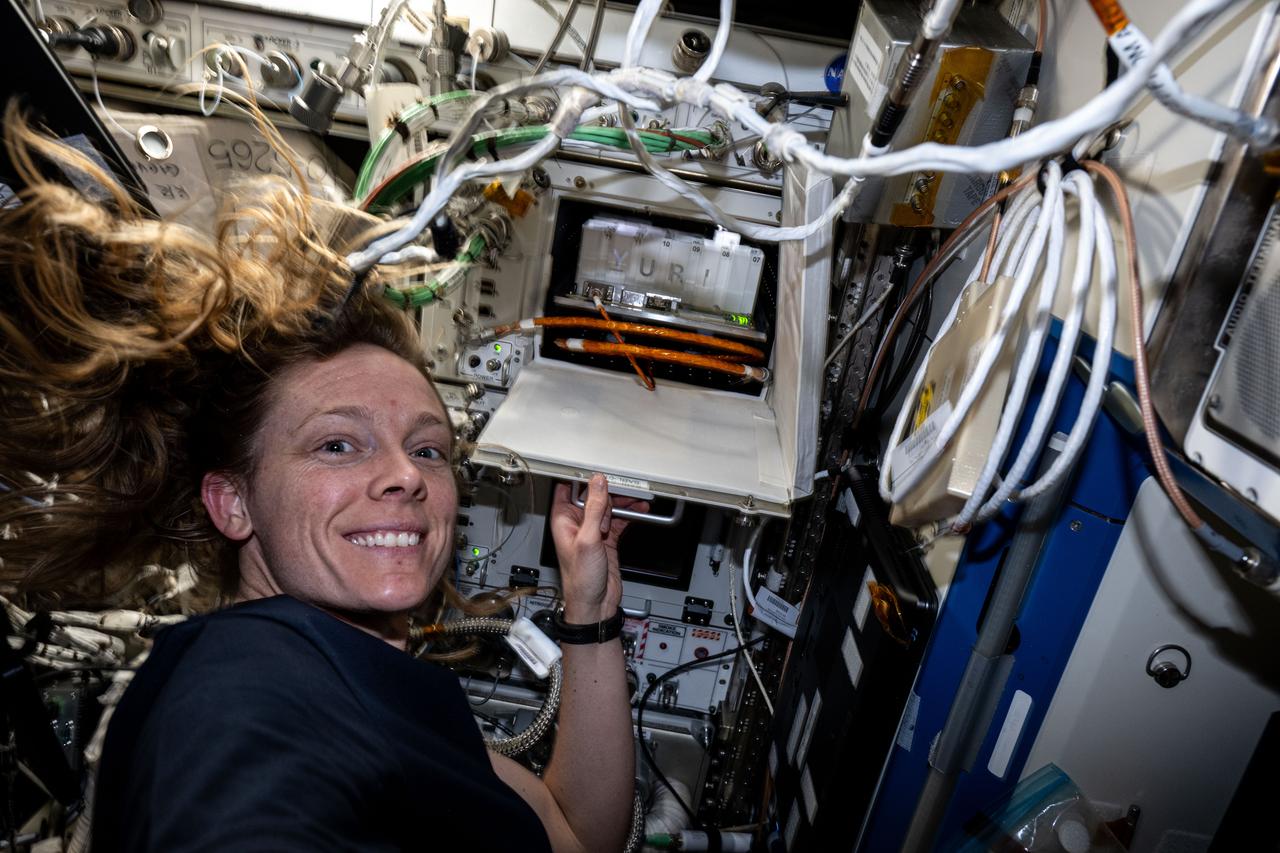
iss073e0002614 (April 28, 2025) --- NASA astronaut and Expedition 73 Flight Engineer Nichole Ayers shows off research hardware inside the International Space Station's Columbus laboratory module. The Space Automated Bioproduct Laboratory is a research incubator that enables biology investigations into the effects of microgravity on cells, microbes, plants, and more.
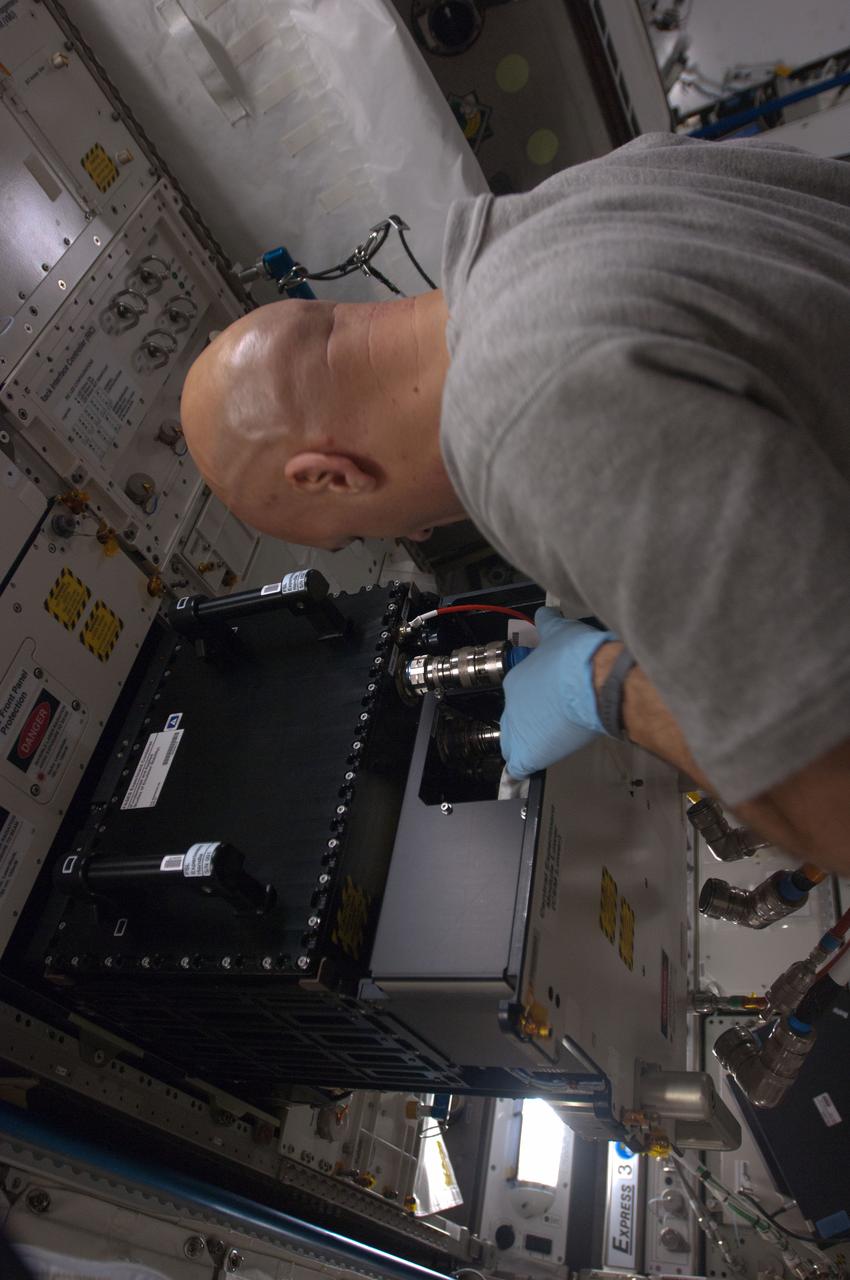
ISS036-E-009550 (19 June 2013) --- European Space Agency astronaut Luca Parmitano, Expedition 36 flight engineer, installs the Fundamental and Applied Studies of Emulsion Stability (FASES) experiment container into the Central Experiment Module (CEM) Lower of Fluid Science Laboratory (FSL) in the Columbus laboratory of the International Space Station.
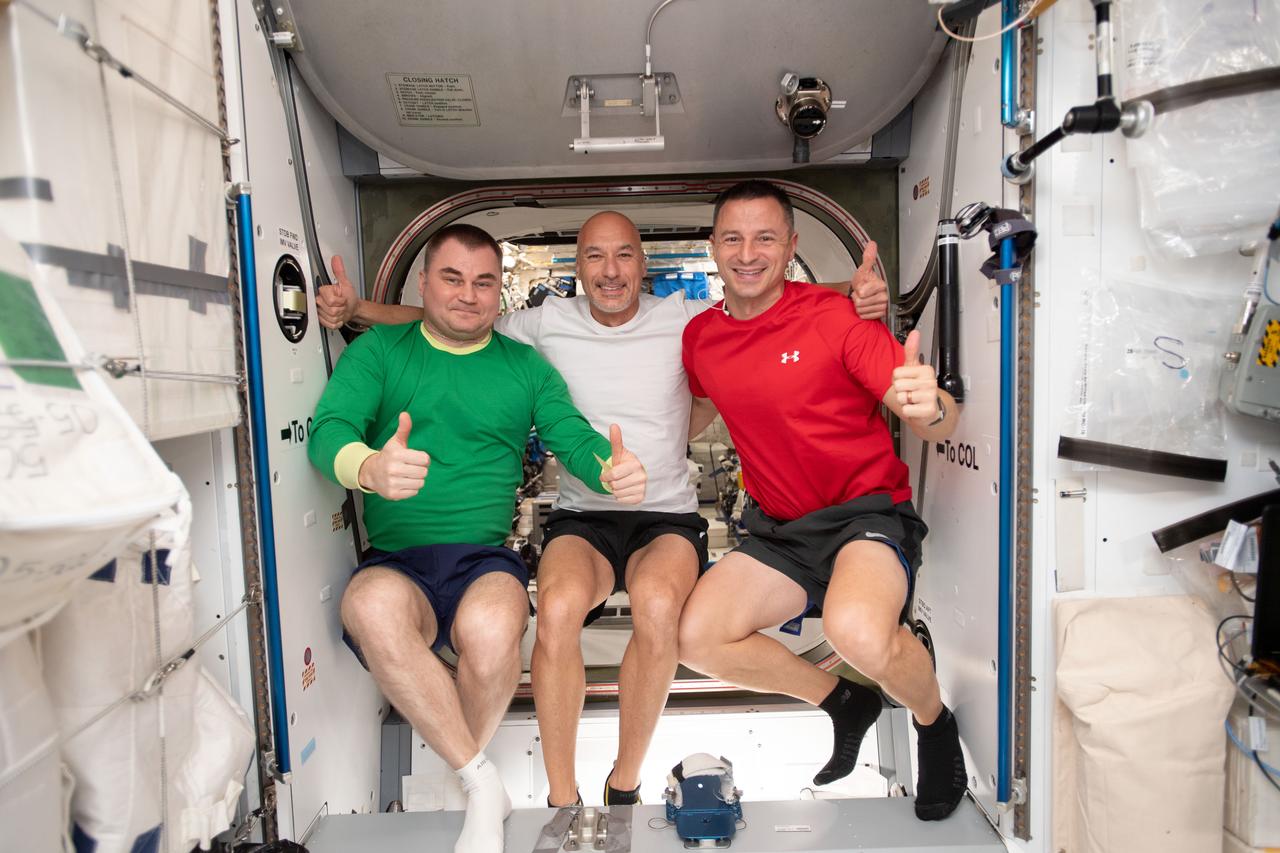
iss060e013847 (July 22, 2019) -- Three Expedition 60 crewmembers pose for a portrait inside the vestibule between the Columbus laboratory module and the Harmony module. From left are Alexey Ovchinin of Roscosmos; Luca Parmitano of the European Space Agency; and Drew Morgan of NASA.
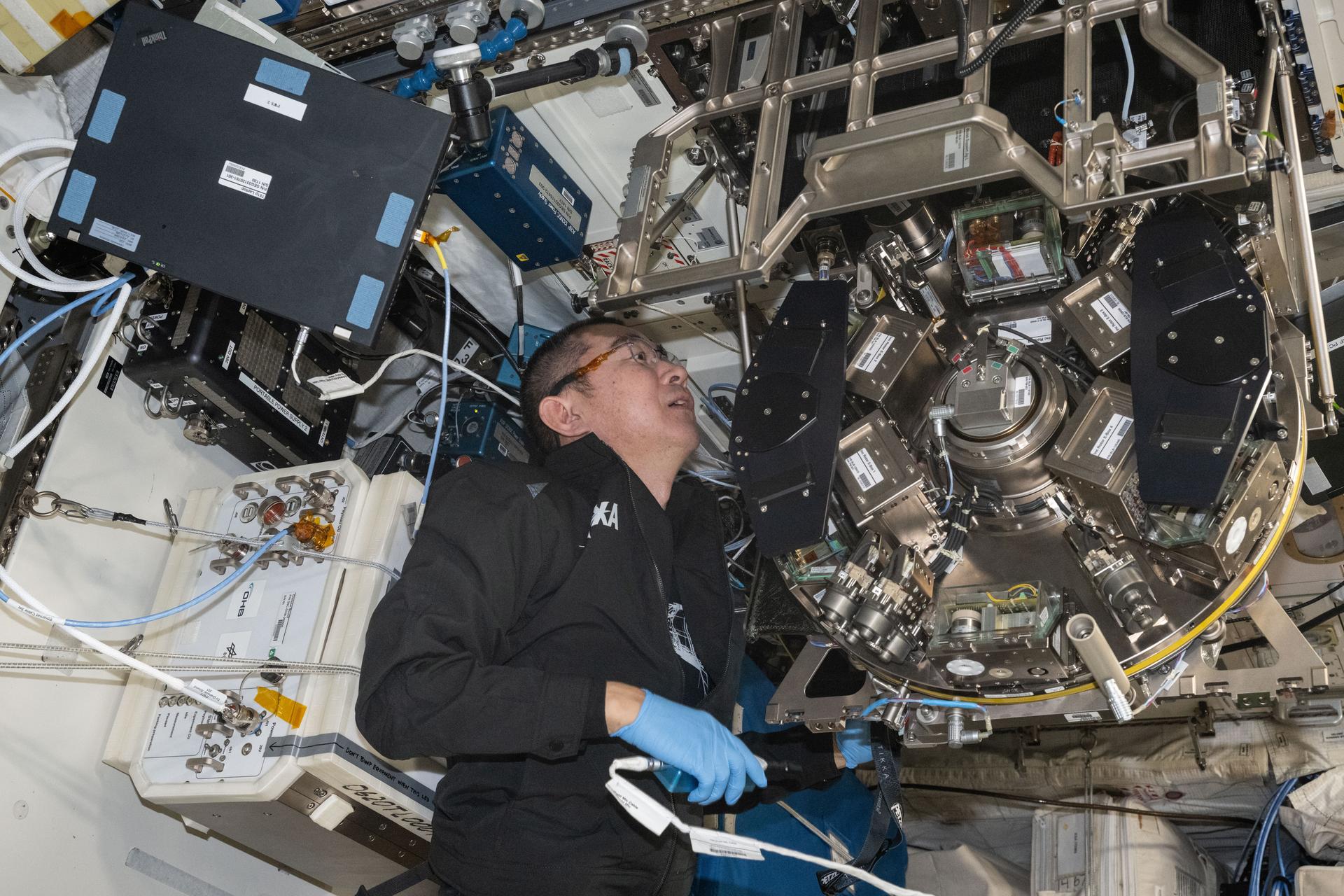
iss073e1043652 (Oct. 29, 2025) --- JAXA (Japan Aerospace Exploration Agency) astronaut and Expedition 73 Flight Engineer Kimiya Yui inspects and cleans hardware inside the Life Support Module aboard the International Space Station's Columbus laboratory module.
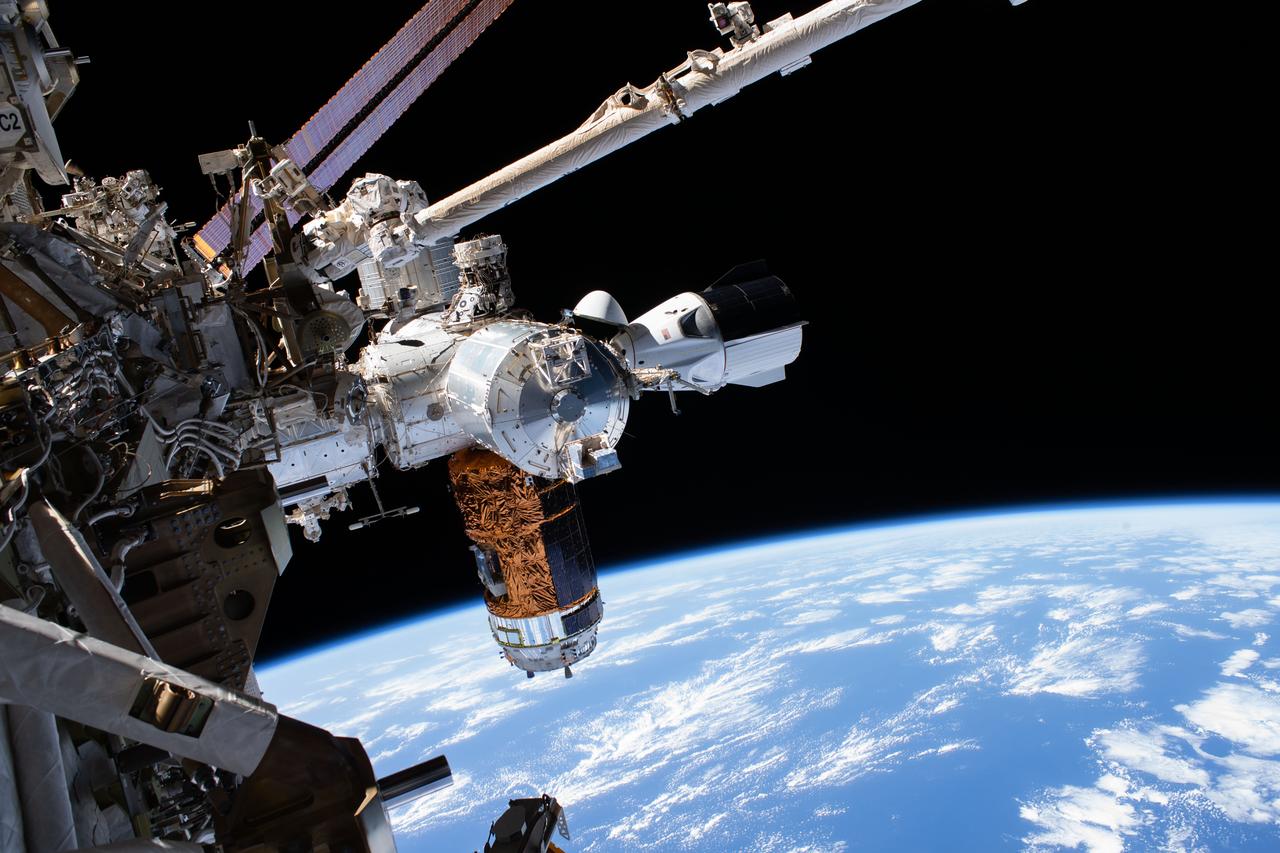
iss063e034054 (July 1, 2020) --- The SpaceX Crew Dragon, the Japanese H-II Transfer Vehicle-9 resupply ship and Europe's Columbus laboratory module figure prominently in this photograph taken during a spacewalk with astronauts Bob Behnken and Chris Cassidy. All three are attached to the U.S. Harmony module with the International Docking Adapter on top.
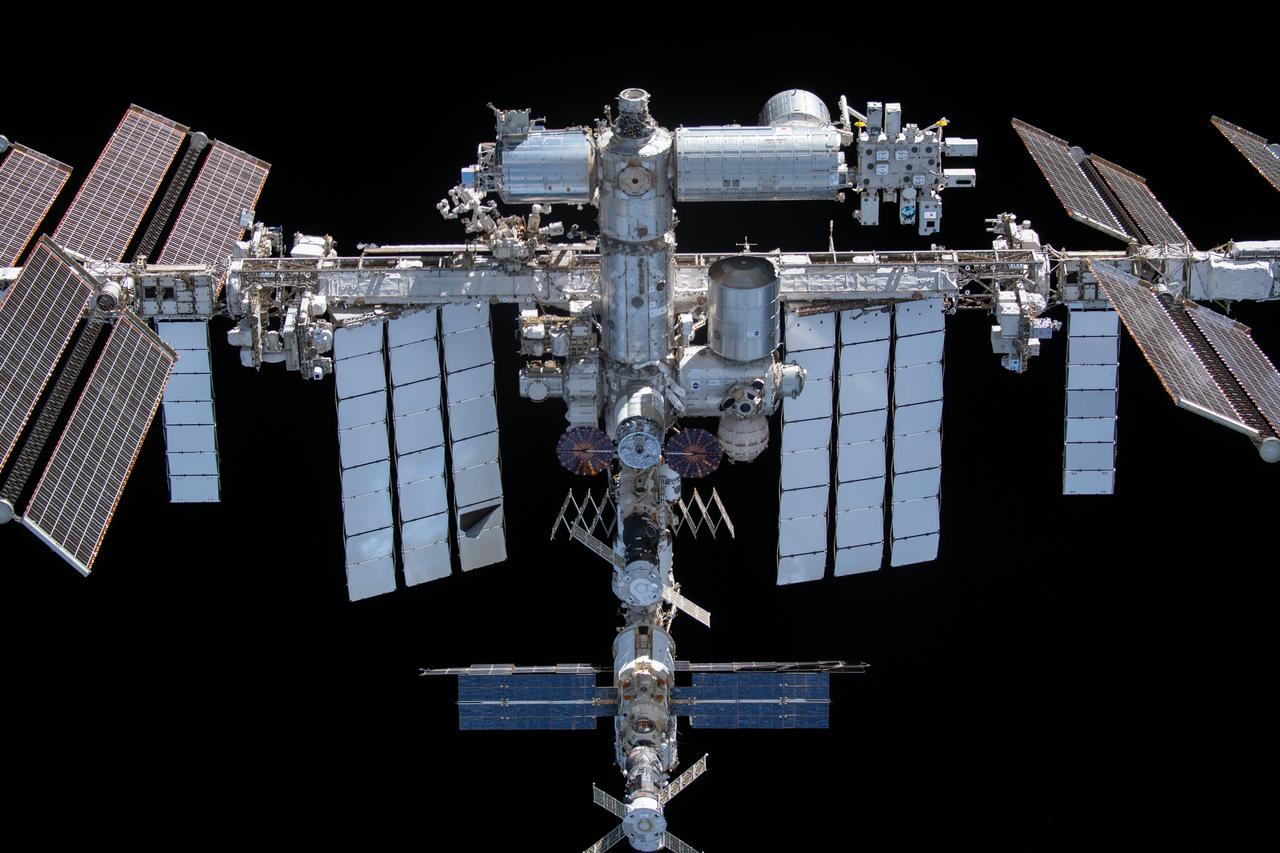
iss066e080453 (Nov. 8, 2021) --- The International Space Station's U.S. segment and portions of the Russian segment are pictured from the SpaceX Crew Dragon Endeavour during a fly around of the orbiting lab that took place following its undocking from the Harmony module’s space-facing port on Nov. 8, 2021. Prominent at the top in this view, are the Columbus laboratory module, the Harmony module and its space-facing docking port, and the Kibo laboratory module with its external pallet.
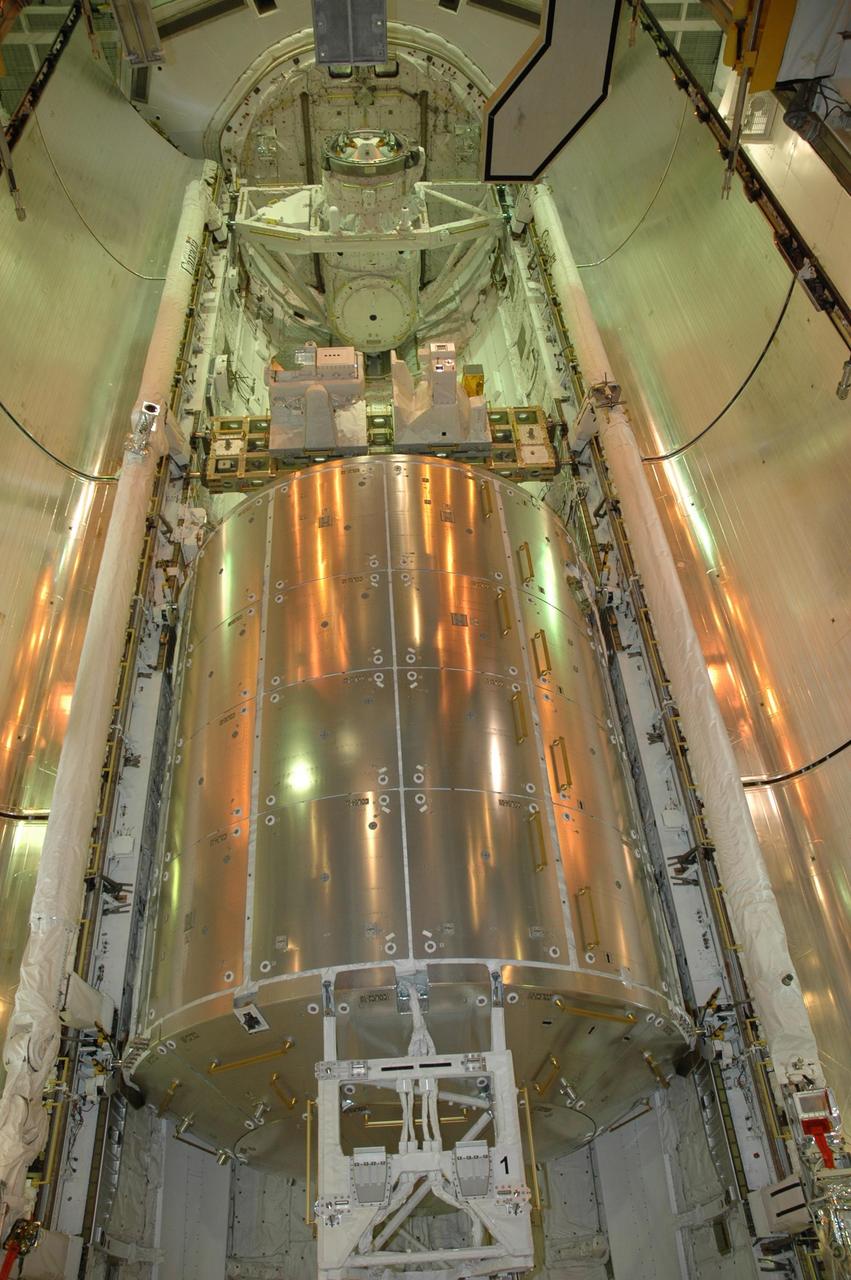
KENNEDY SPACE CENTER, FLA. -- With the Columbus Laboratory secure in space shuttle Atlantis' payload bay on Launch Pad 39A at NASA's Kennedy Space Center, the bay doors are ready for closure. Located above the laboratory are the integrated cargo carrier - lite and the orbital docking system (at top). STS-122 is the 121st space shuttle flight, the 29th flight for Atlantis and the 24th flight to the International Space Station. The Columbus laboratory module, built by the European Space Agency, is approximately 23 feet long and 15 feet wide, allowing it to hold 10 large racks of experiments. Atlantis is scheduled to launch at 2:45 p.m. Feb. 7. Photo credit: NASA/Jack Pfaller

KENNEDY SPACE CENTER, FLA. -- In the Space Station Processing Facility at NASA's Kennedy Space Center, the Columbus Laboratory module is lowered into the waiting payload canister. The canister will transport the module and other payloads to Launch Pad 39A in preparation for its journey to the International Space Station. The European Space Agency 's largest single contribution to the International Space Station, Columbus will expand the research facilities of the station, providing crew members and scientists around the world the ability to conduct a variety of life, physical and materials science experiments. The module is approximately 23 feet long and 15 feet wide, allowing it to hold 10 large racks of experiments. The module is scheduled to be transferred to Launch Pad 39A in early November, in preparation for its journey to the station. Columbus will fly aboard space shuttle Atlantis on the STS-122 mission, targeted for launch Dec. 6. Photo credit: NASA/George Shelton

KENNEDY SPACE CENTER, FLA. -- In the Space Station Processing Facility at NASA's Kennedy Space Center, the Columbus Laboratory module is moved toward a weigh station. After being weighed, the module will be transferred to the payload canister. The European Space Agency 's largest single contribution to the International Space Station, Columbus will expand the research facilities of the station, providing crew members and scientists around the world the ability to conduct a variety of life, physical and materials science experiments. The module is approximately 23 feet long and 15 feet wide, allowing it to hold 10 large racks of experiments. The module is scheduled to be transferred to Launch Pad 39A in early November, in preparation for its journey to the station. Columbus will fly aboard space shuttle Atlantis on the STS-122 mission, targeted for launch Dec. 6. Photo credit: NASA/George Shelton
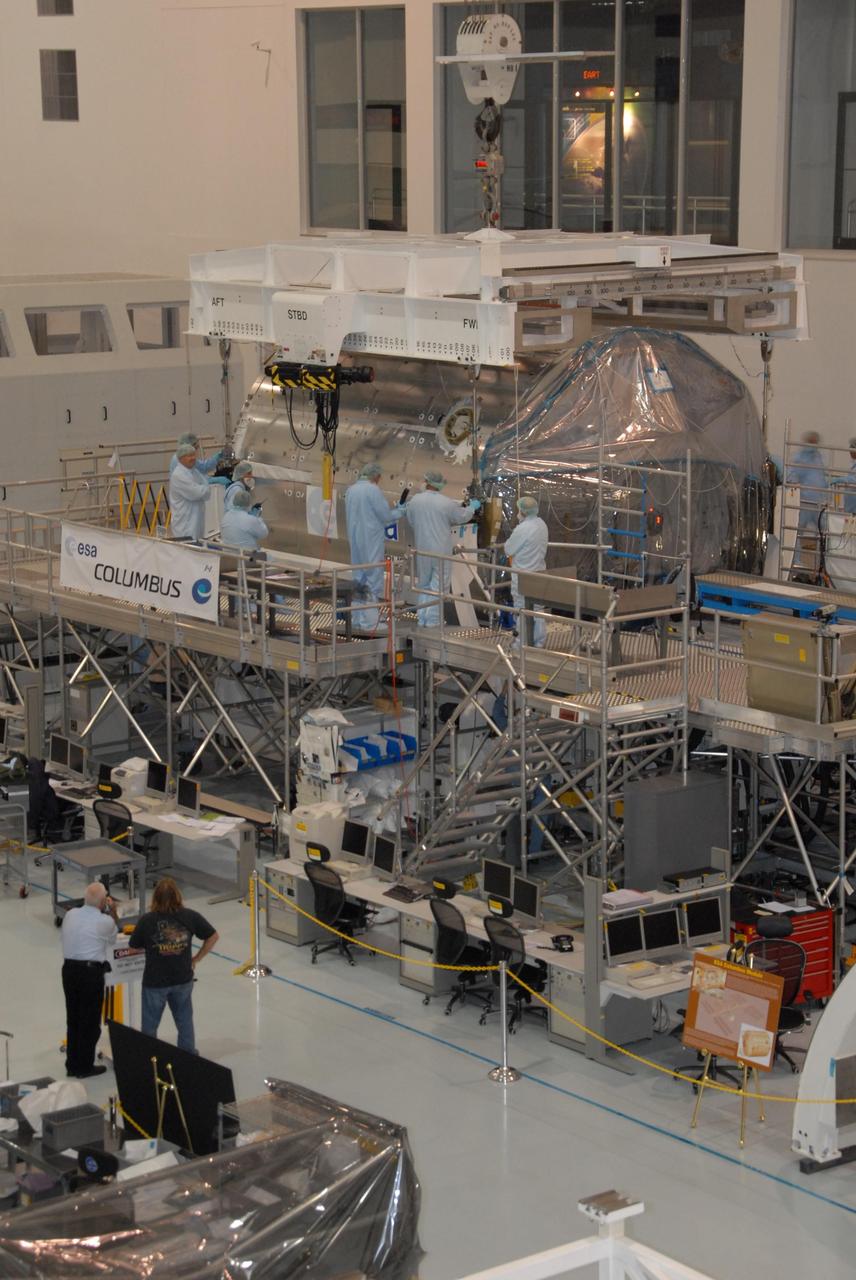
KENNEDY SPACE CENTER, FLA. -- In the Space Station Processing Facility at NASA's Kennedy Space Center, workers attach an overhead crane to the Columbus Laboratory module. The module will be moved to a weigh station before transfer to the payload canister. The European Space Agency 's largest single contribution to the International Space Station, Columbus will expand the research facilities of the station, providing crew members and scientists around the world the ability to conduct a variety of life, physical and materials science experiments. The module is approximately 23 feet long and 15 feet wide, allowing it to hold 10 large racks of experiments. The module is scheduled to be transferred to Launch Pad 39A in early November, in preparation for its journey to the station. Columbus will fly aboard space shuttle Atlantis on the STS-122 mission, targeted for launch Dec. 6. Photo credit: NASA/George Shelton
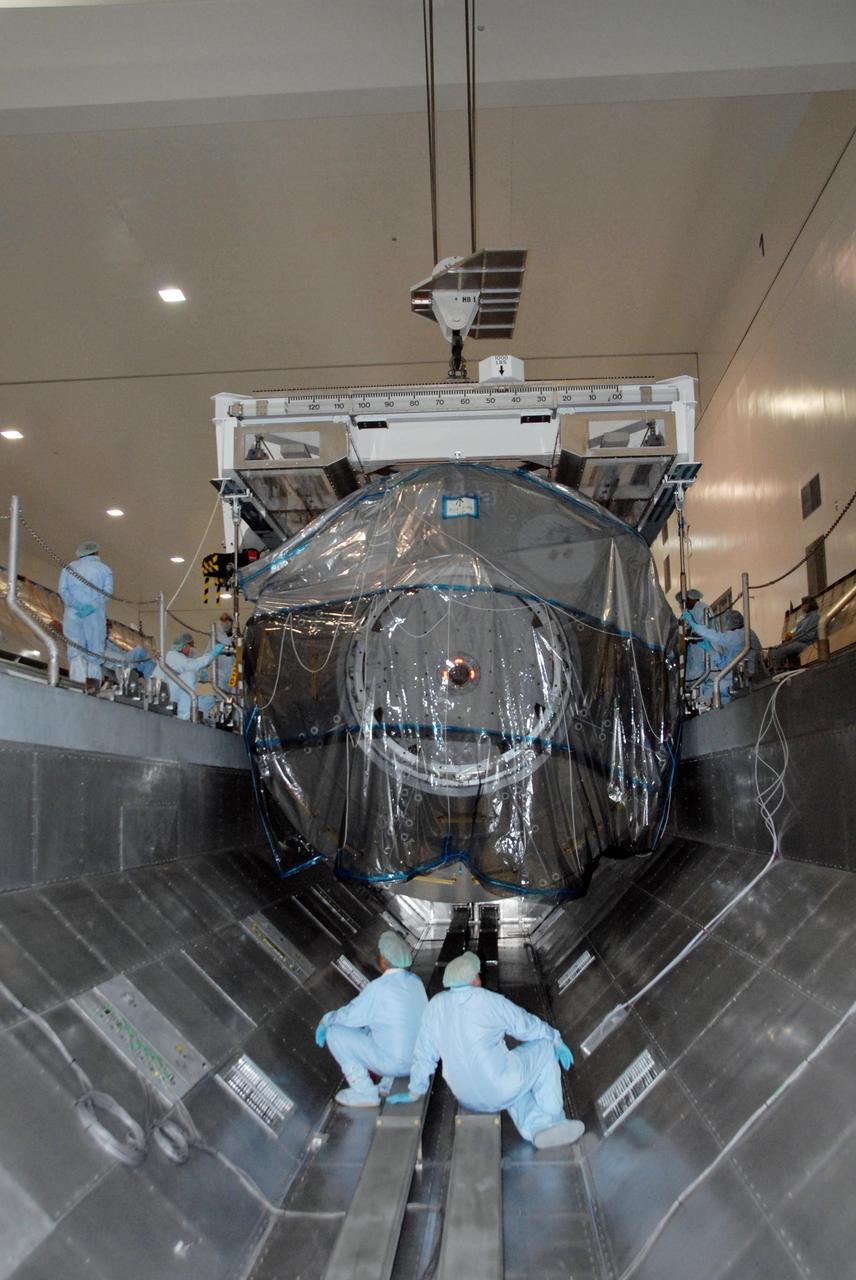
KENNEDY SPACE CENTER, FLA. -- In the Space Station Processing Facility at NASA's Kennedy Space Center, technicians inside the payload canister monitor movement of the Columbus Laboratory module as it is lowered into the canister. The canister will transport the module and other payloads to Launch Pad 39A in preparation for its journey to the International Space Station. The European Space Agency 's largest single contribution to the International Space Station, Columbus will expand the research facilities of the station, providing crew members and scientists around the world the ability to conduct a variety of life, physical and materials science experiments. The module is approximately 23 feet long and 15 feet wide, allowing it to hold 10 large racks of experiments. The module is scheduled to be transferred to Launch Pad 39A in early November, in preparation for its journey to the station. Columbus will fly aboard space shuttle Atlantis on the STS-122 mission, targeted for launch Dec. 6. Photo credit: NASA/George Shelton
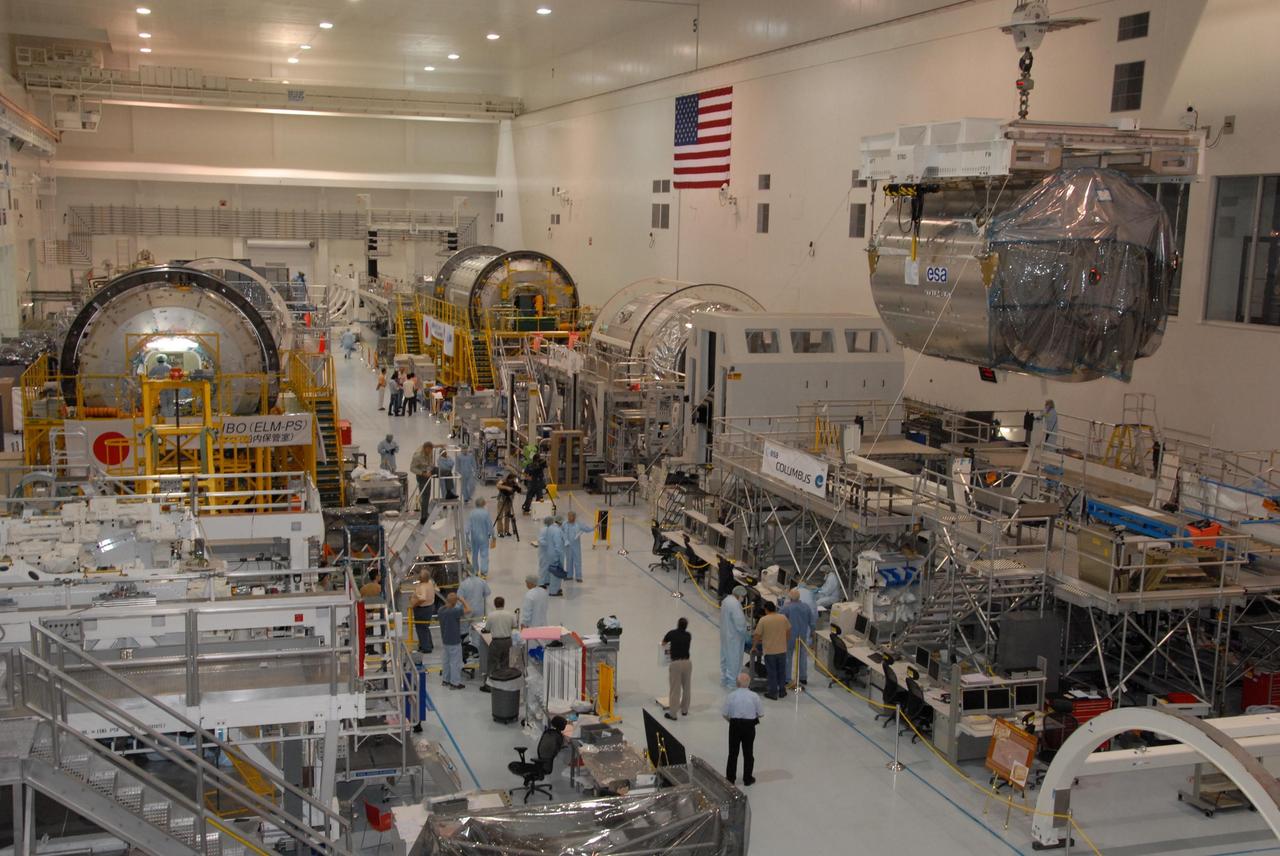
KENNEDY SPACE CENTER, FLA. -- In the Space Station Processing Facility at NASA's Kennedy Space Center, an overhead crane lifts the Columbus Laboratory module away from its stand. The module is being moved to a weigh station before transfer to the payload canister. The European Space Agency 's largest single contribution to the International Space Station, Columbus will expand the research facilities of the station, providing crew members and scientists around the world the ability to conduct a variety of life, physical and materials science experiments. The module is approximately 23 feet long and 15 feet wide, allowing it to hold 10 large racks of experiments. The module is scheduled to be transferred to Launch Pad 39A in early November, in preparation for its journey to the station. Columbus will fly aboard space shuttle Atlantis on the STS-122 mission, targeted for launch Dec. 6. Photo credit: NASA/George Shelton
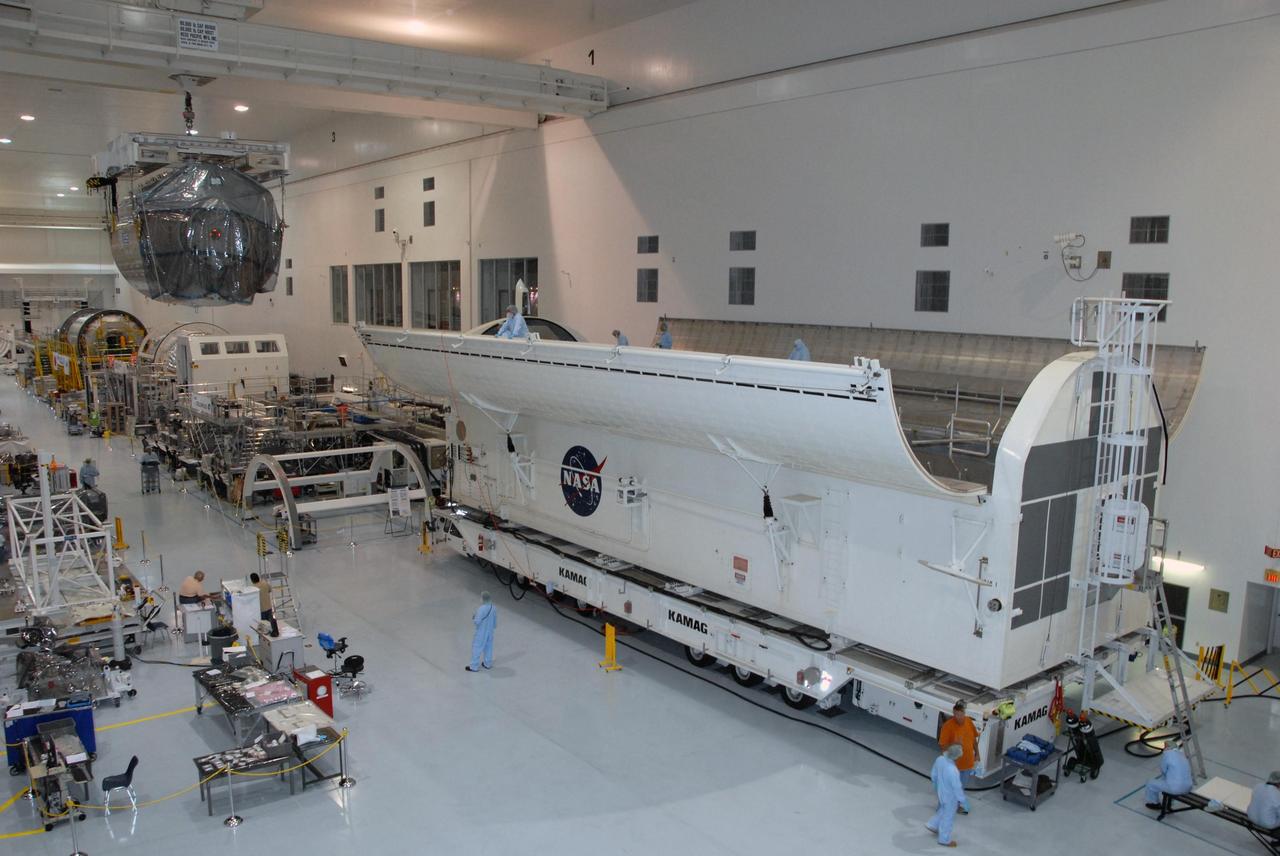
KENNEDY SPACE CENTER, FLA. -- In the Space Station Processing Facility at NASA's Kennedy Space Center, the Columbus Laboratory module moves across the facility to the waiting payload canister at right. The canister will transport the module and other payloads to Launch Pad 39A in preparation for its journey to the International Space Station. The European Space Agency 's largest single contribution to the International Space Station, Columbus will expand the research facilities of the station, providing crew members and scientists around the world the ability to conduct a variety of life, physical and materials science experiments. The module is approximately 23 feet long and 15 feet wide, allowing it to hold 10 large racks of experiments. The module is scheduled to be transferred to Launch Pad 39A in early November, in preparation for its journey to the station. Columbus will fly aboard space shuttle Atlantis on the STS-122 mission, targeted for launch Dec. 6. Photo credit: NASA/George Shelton
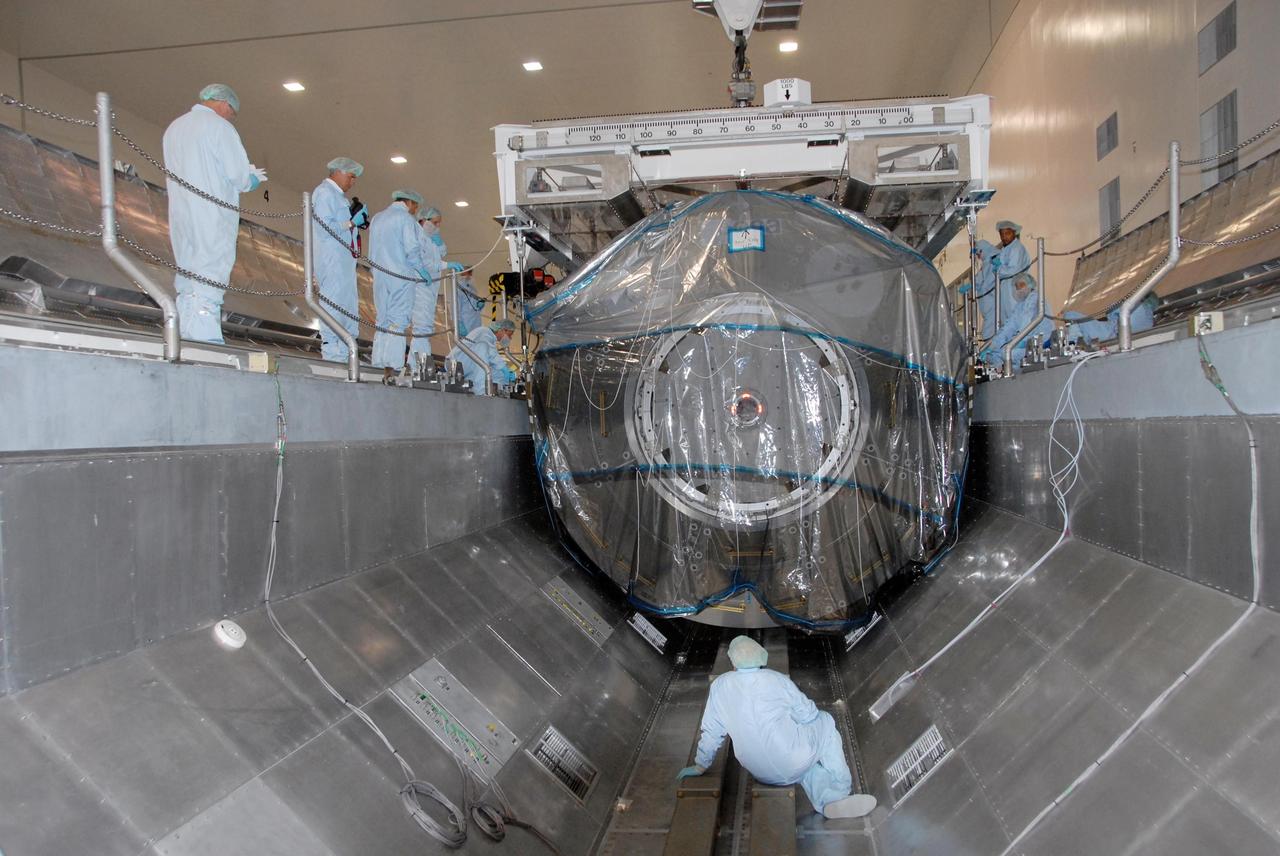
KENNEDY SPACE CENTER, FLA. -- In the Space Station Processing Facility at NASA's Kennedy Space Center, technicians inside and around the payload canister monitor movement of the Columbus Laboratory module as it is lowered into the canister. The canister will transport the module and other payloads to Launch Pad 39A in preparation for its journey to the International Space Station. The European Space Agency 's largest single contribution to the International Space Station, Columbus will expand the research facilities of the station, providing crew members and scientists around the world the ability to conduct a variety of life, physical and materials science experiments. The module is approximately 23 feet long and 15 feet wide, allowing it to hold 10 large racks of experiments. The module is scheduled to be transferred to Launch Pad 39A in early November, in preparation for its journey to the station. Columbus will fly aboard space shuttle Atlantis on the STS-122 mission, targeted for launch Dec. 6. Photo credit: NASA/George Shelton
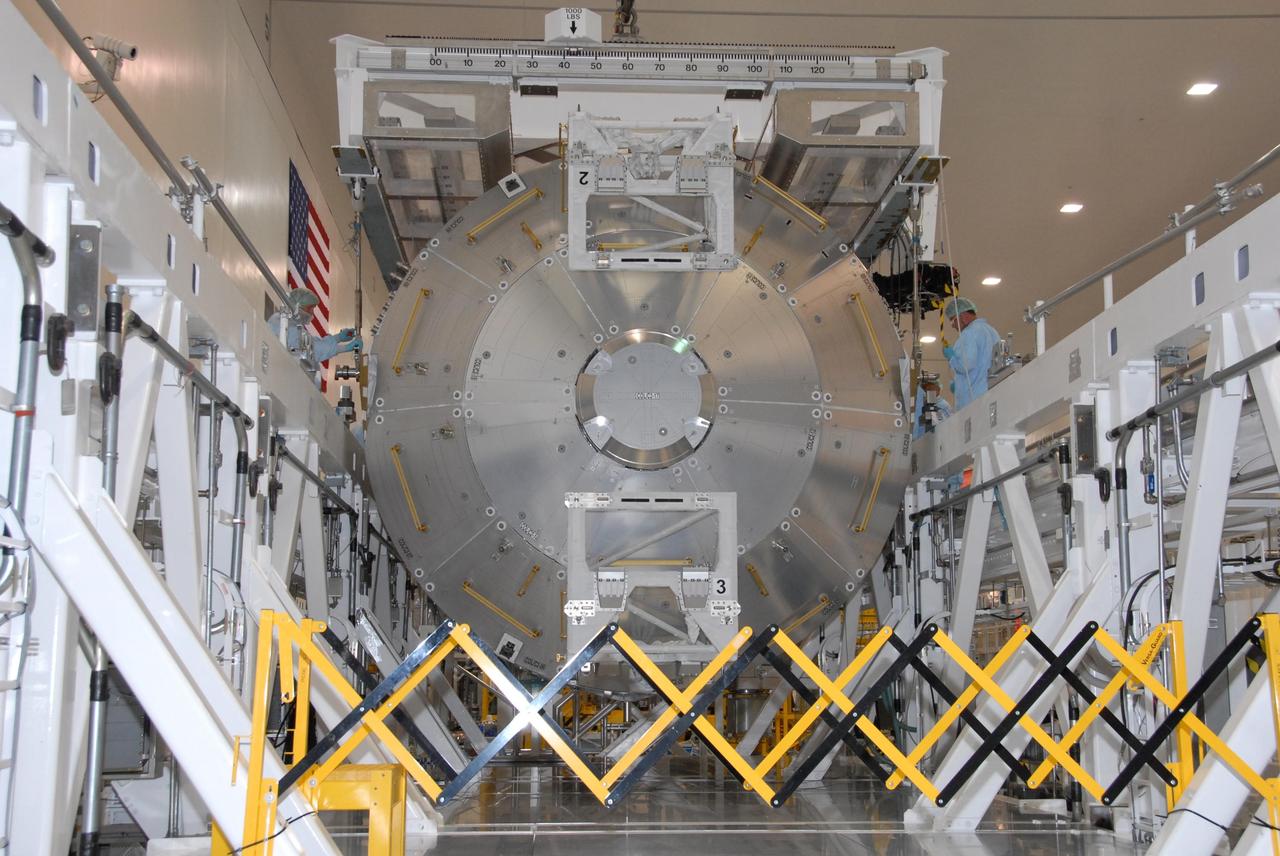
KENNEDY SPACE CENTER, FLA. -- In the Space Station Processing Facility at NASA's Kennedy Space Center, the Columbus Laboratory module is lowered onto a weigh station. After being weighed, the module will be transferred to the payload canister. The European Space Agency 's largest single contribution to the International Space Station, Columbus will expand the research facilities of the station, providing crew members and scientists around the world the ability to conduct a variety of life, physical and materials science experiments. The module is approximately 23 feet long and 15 feet wide, allowing it to hold 10 large racks of experiments. The module is scheduled to be transferred to Launch Pad 39A in early November, in preparation for its journey to the station. Columbus will fly aboard space shuttle Atlantis on the STS-122 mission, targeted for launch Dec. 6. Photo credit: NASA/George Shelton

KENNEDY SPACE CENTER, FLA. -- In the Space Station Processing Facility at NASA's Kennedy Space Center, workers attach an overhead crane to the Columbus Laboratory module, situated underneath the windows at right. The module will be moved to a weigh station before transfer to the payload canister. The European Space Agency 's largest single contribution to the International Space Station, Columbus will expand the research facilities of the station, providing crew members and scientists around the world the ability to conduct a variety of life, physical and materials science experiments. The module is approximately 23 feet long and 15 feet wide, allowing it to hold 10 large racks of experiments. The module is scheduled to be transferred to Launch Pad 39A in early November, in preparation for its journey to the station. Columbus will fly aboard space shuttle Atlantis on the STS-122 mission, targeted for launch Dec. 6. Photo credit: NASA/George Shelton
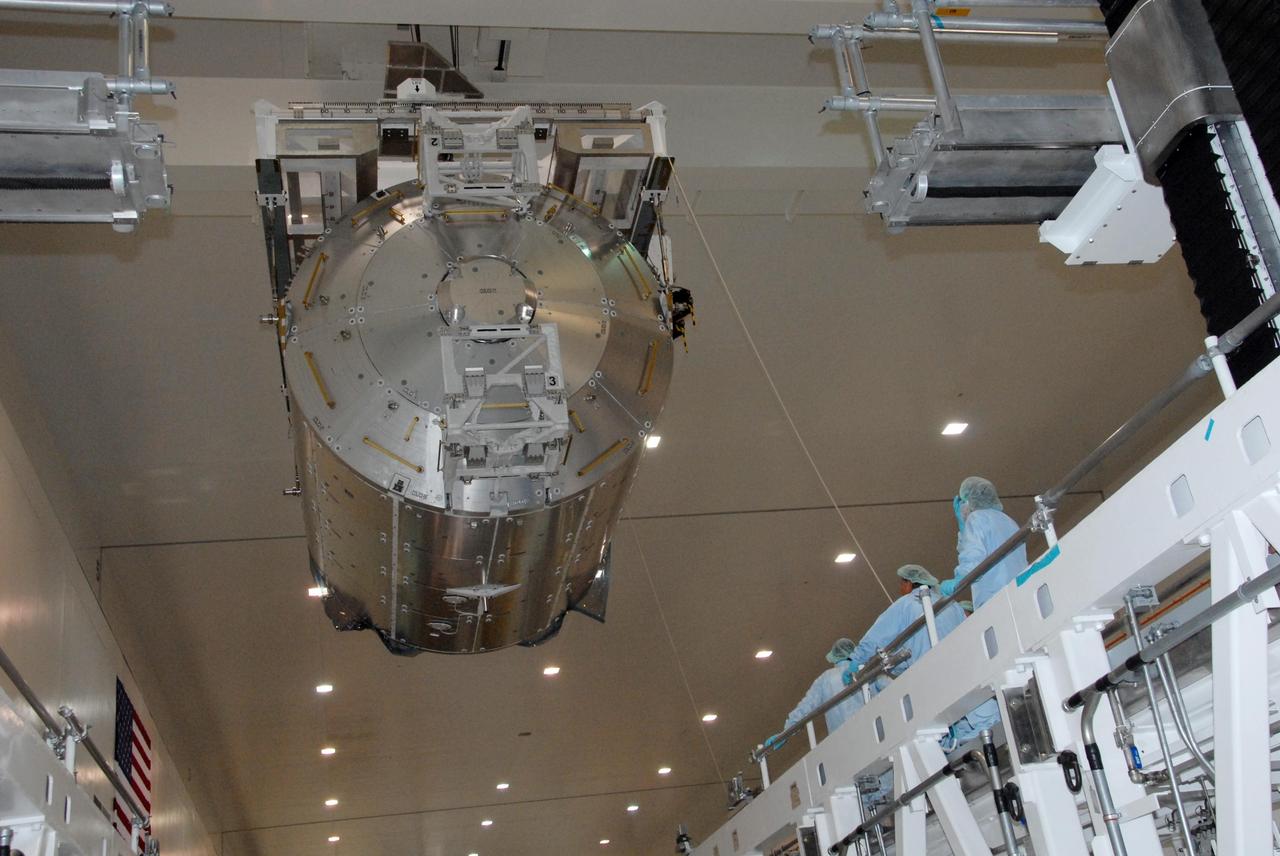
KENNEDY SPACE CENTER, FLA. -- In the Space Station Processing Facility at NASA's Kennedy Space Center, the Columbus Laboratory module is lowered toward a weigh station. After being weighed, the module will be transferred to the payload canister. The European Space Agency 's largest single contribution to the International Space Station, Columbus will expand the research facilities of the station, providing crew members and scientists around the world the ability to conduct a variety of life, physical and materials science experiments. The module is approximately 23 feet long and 15 feet wide, allowing it to hold 10 large racks of experiments. The module is scheduled to be transferred to Launch Pad 39A in early November, in preparation for its journey to the station. Columbus will fly aboard space shuttle Atlantis on the STS-122 mission, targeted for launch Dec. 6. Photo credit: NASA/George Shelton
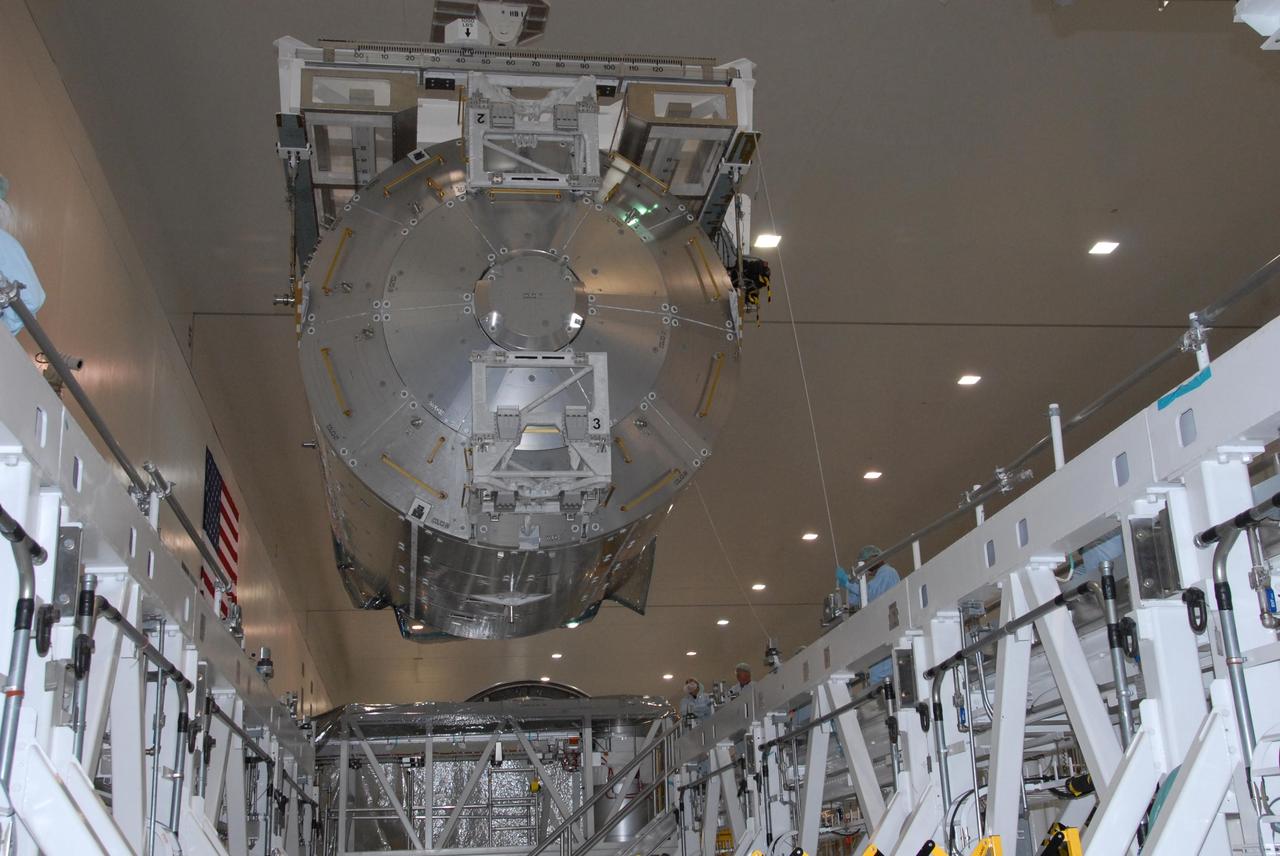
KENNEDY SPACE CENTER, FLA. -- In the Space Station Processing Facility at NASA's Kennedy Space Center, the Columbus Laboratory module is lowered toward a weigh station. After being weighed, the module will be transferred to the payload canister. The European Space Agency 's largest single contribution to the International Space Station, Columbus will expand the research facilities of the station, providing crew members and scientists around the world the ability to conduct a variety of life, physical and materials science experiments. The module is approximately 23 feet long and 15 feet wide, allowing it to hold 10 large racks of experiments. The module is scheduled to be transferred to Launch Pad 39A in early November, in preparation for its journey to the station. Columbus will fly aboard space shuttle Atlantis on the STS-122 mission, targeted for launch Dec. 6. Photo credit: NASA/George Shelton
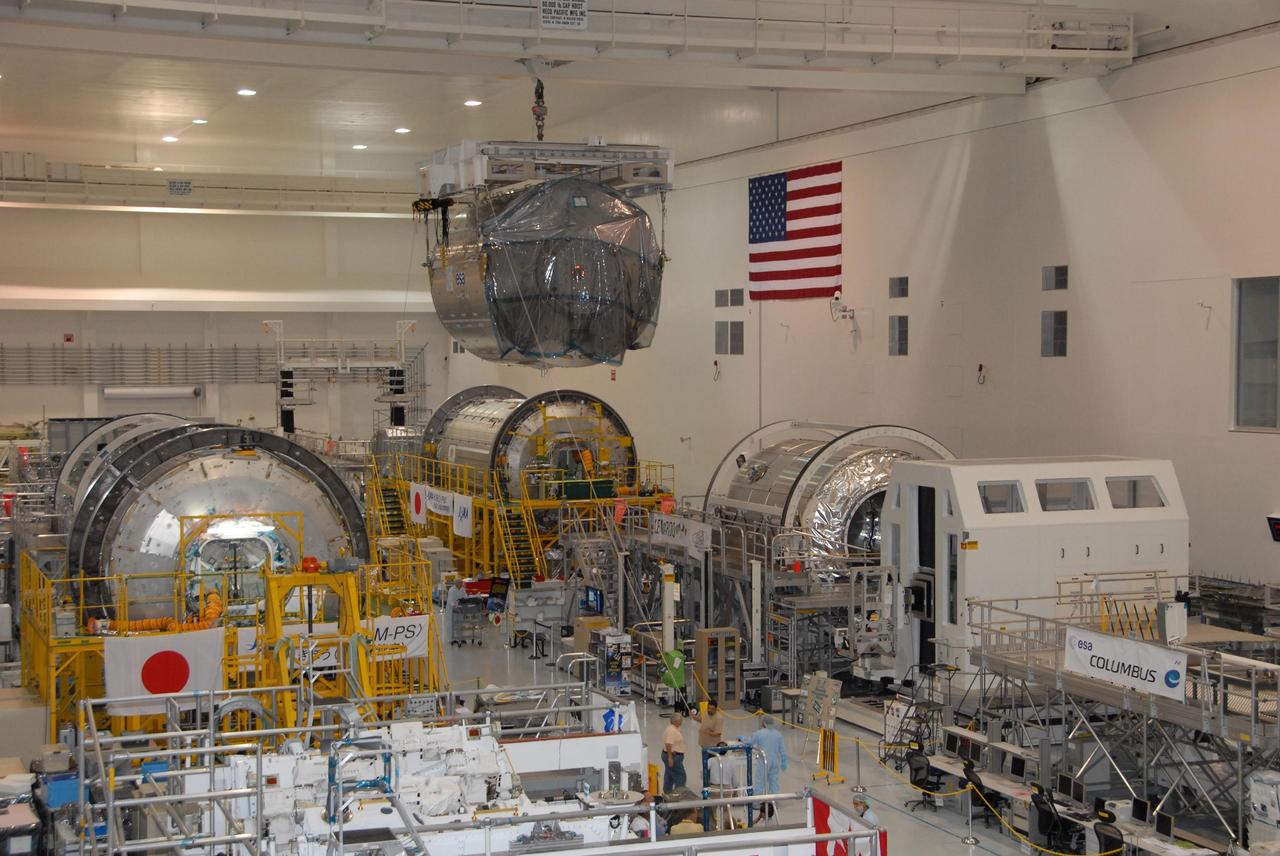
KENNEDY SPACE CENTER, FLA. -- In the Space Station Processing Facility at NASA's Kennedy Space Center, the Columbus Laboratory module moves across the facility to a payload canister. The canister will transport the module and other payloads to Launch Pad 39A in preparation for its journey to the International Space Station. The European Space Agency 's largest single contribution to the International Space Station, Columbus will expand the research facilities of the station, providing crew members and scientists around the world the ability to conduct a variety of life, physical and materials science experiments. The module is approximately 23 feet long and 15 feet wide, allowing it to hold 10 large racks of experiments. The module is scheduled to be transferred to Launch Pad 39A in early November, in preparation for its journey to the station. Columbus will fly aboard space shuttle Atlantis on the STS-122 mission, targeted for launch Dec. 6. Photo credit: NASA/George Shelton
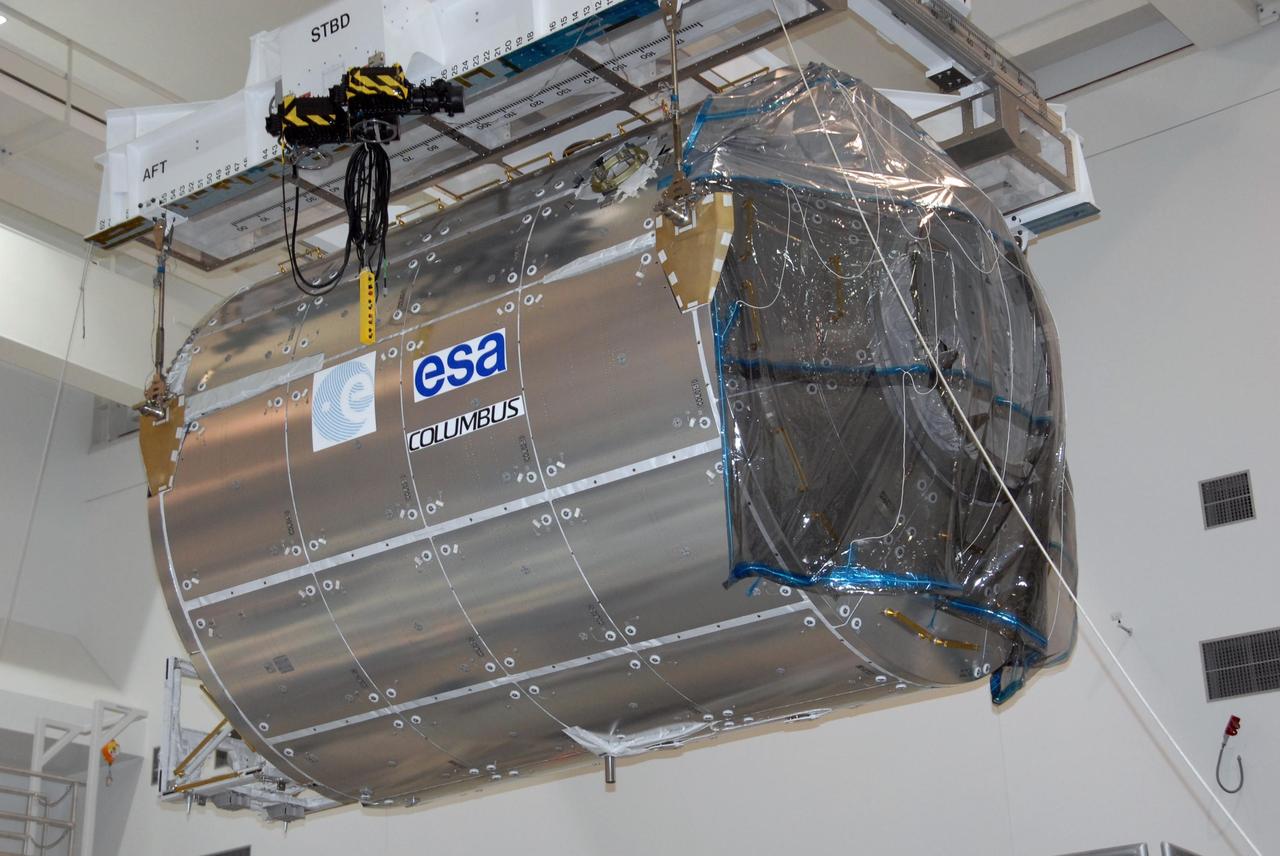
KENNEDY SPACE CENTER, FLA. -- In the Space Station Processing Facility at NASA's Kennedy Space Center, the Columbus Laboratory module is being moved across the facility for its transfer to a payload canister. The canister will transport the module and other payloads to Launch Pad 39A in preparation for its journey to the International Space Station. The European Space Agency 's largest single contribution to the International Space Station, Columbus will expand the research facilities of the station, providing crew members and scientists around the world the ability to conduct a variety of life, physical and materials science experiments. The module is approximately 23 feet long and 15 feet wide, allowing it to hold 10 large racks of experiments. The module is scheduled to be transferred to Launch Pad 39A in early November, in preparation for its journey to the station. Columbus will fly aboard space shuttle Atlantis on the STS-122 mission, targeted for launch Dec. 6. Photo credit: NASA/George Shelton
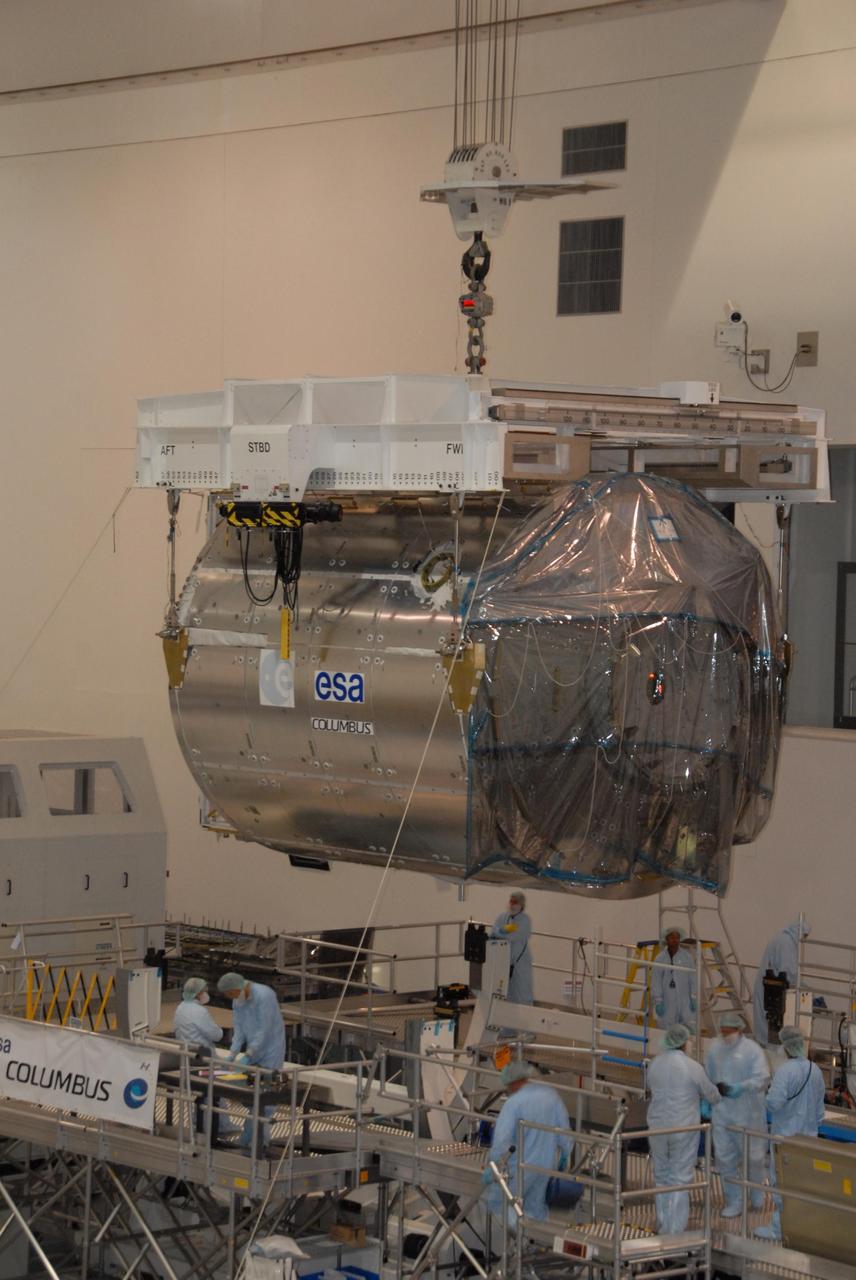
KENNEDY SPACE CENTER, FLA. -- In the Space Station Processing Facility at NASA's Kennedy Space Center, an overhead crane lifts the Columbus Laboratory module from its stand. The module is being moved to a weigh station before transfer to the payload canister. The European Space Agency 's largest single contribution to the International Space Station, Columbus will expand the research facilities of the station, providing crew members and scientists around the world the ability to conduct a variety of life, physical and materials science experiments. The module is approximately 23 feet long and 15 feet wide, allowing it to hold 10 large racks of experiments. The module is scheduled to be transferred to Launch Pad 39A in early November, in preparation for its journey to the station. Columbus will fly aboard space shuttle Atlantis on the STS-122 mission, targeted for launch Dec. 6. Photo credit: NASA/George Shelton
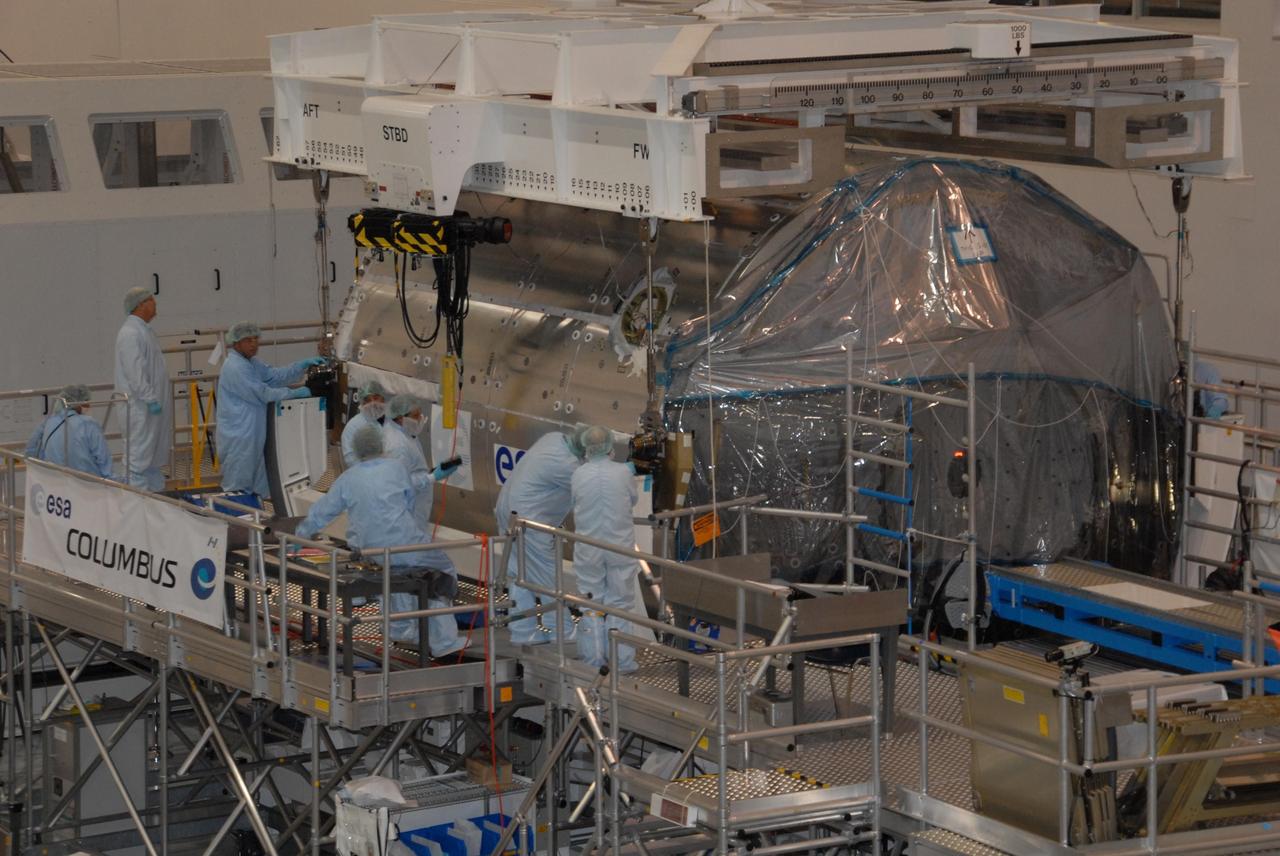
KENNEDY SPACE CENTER, FLA. -- In the Space Station Processing Facility at NASA's Kennedy Space Center, workers attach an overhead crane to the Columbus Laboratory module. The module will be moved to a weigh station before transfer to the payload canister. The European Space Agency 's largest single contribution to the International Space Station, Columbus will expand the research facilities of the station, providing crew members and scientists around the world the ability to conduct a variety of life, physical and materials science experiments. The module is approximately 23 feet long and 15 feet wide, allowing it to hold 10 large racks of experiments. The module is scheduled to be transferred to Launch Pad 39A in early November, in preparation for its journey to the station. Columbus will fly aboard space shuttle Atlantis on the STS-122 mission, targeted for launch Dec. 6. Photo credit: NASA/George Shelton
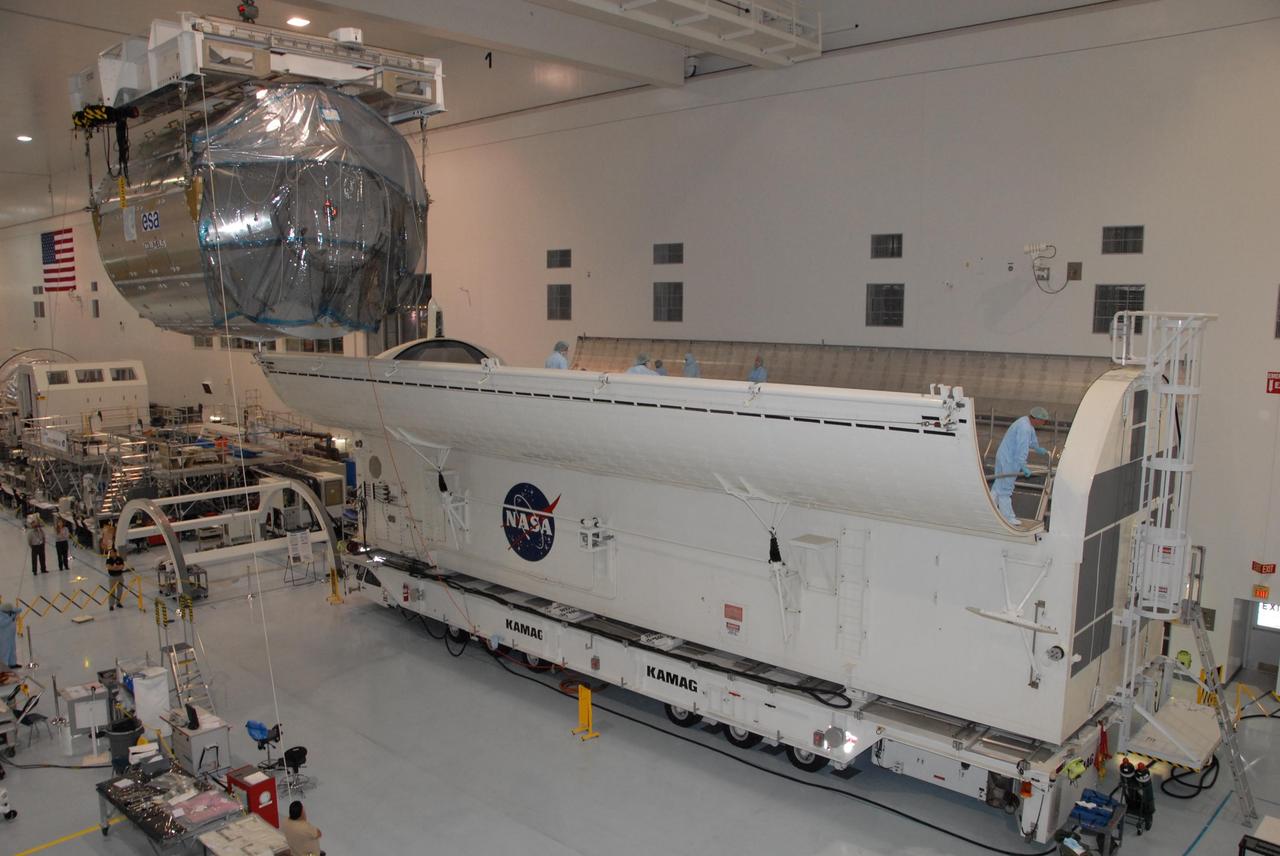
KENNEDY SPACE CENTER, FLA. -- In the Space Station Processing Facility at NASA's Kennedy Space Center, the Columbus Laboratory module moves toward the waiting payload canister at right. The canister will transport the module and other payloads to Launch Pad 39A in preparation for its journey to the International Space Station. The European Space Agency 's largest single contribution to the International Space Station, Columbus will expand the research facilities of the station, providing crew members and scientists around the world the ability to conduct a variety of life, physical and materials science experiments. The module is approximately 23 feet long and 15 feet wide, allowing it to hold 10 large racks of experiments. The module is scheduled to be transferred to Launch Pad 39A in early November, in preparation for its journey to the station. Columbus will fly aboard space shuttle Atlantis on the STS-122 mission, targeted for launch Dec. 6. Photo credit: NASA/George Shelton
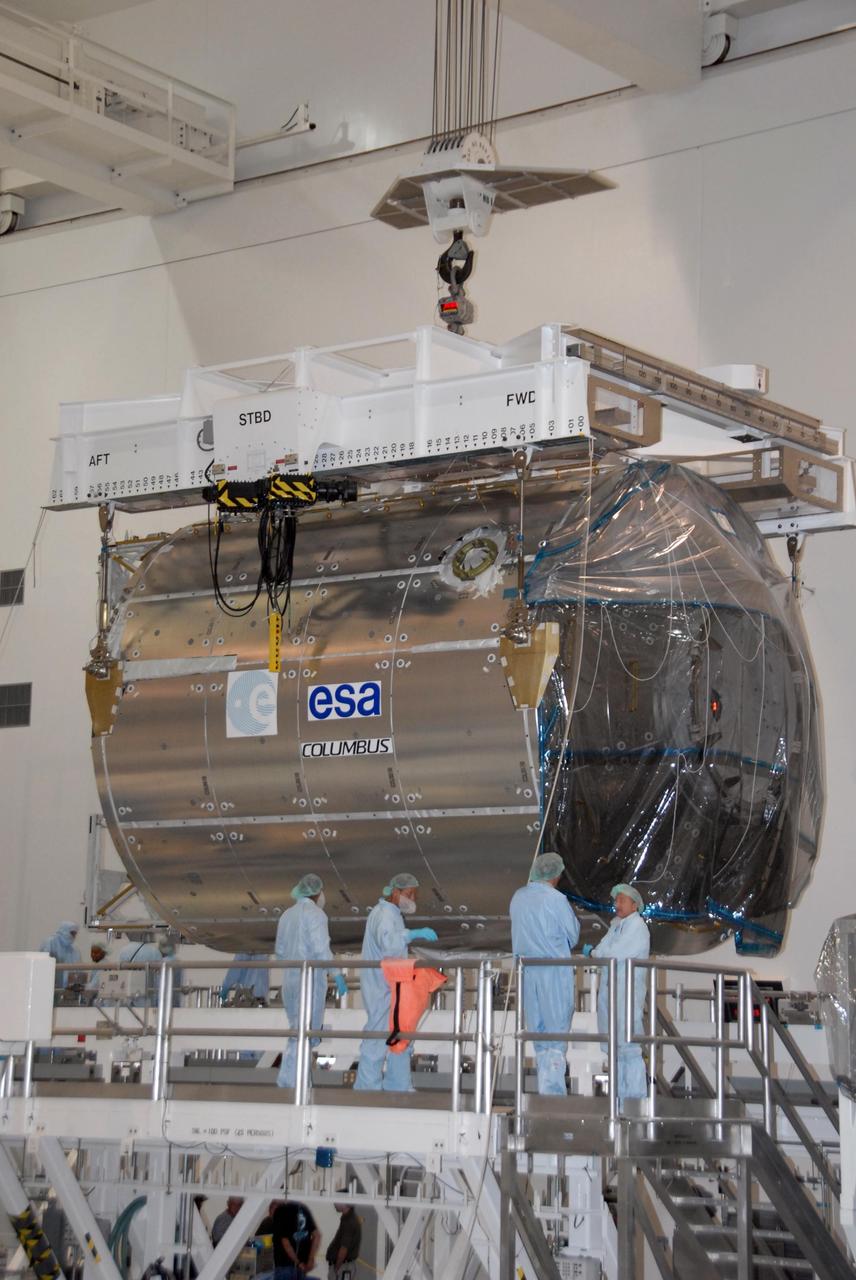
KENNEDY SPACE CENTER, FLA. -- In the Space Station Processing Facility at NASA's Kennedy Space Center, the Columbus Laboratory module is lifted for its transfer to a payload canister. The canister will transport the module and other payloads to Launch Pad 39A in preparation for its journey to the International Space Station. The European Space Agency 's largest single contribution to the International Space Station, Columbus will expand the research facilities of the station, providing crew members and scientists around the world the ability to conduct a variety of life, physical and materials science experiments. The module is approximately 23 feet long and 15 feet wide, allowing it to hold 10 large racks of experiments. The module is scheduled to be transferred to Launch Pad 39A in early November, in preparation for its journey to the station. Columbus will fly aboard space shuttle Atlantis on the STS-122 mission, targeted for launch Dec. 6. Photo credit: NASA/George Shelton
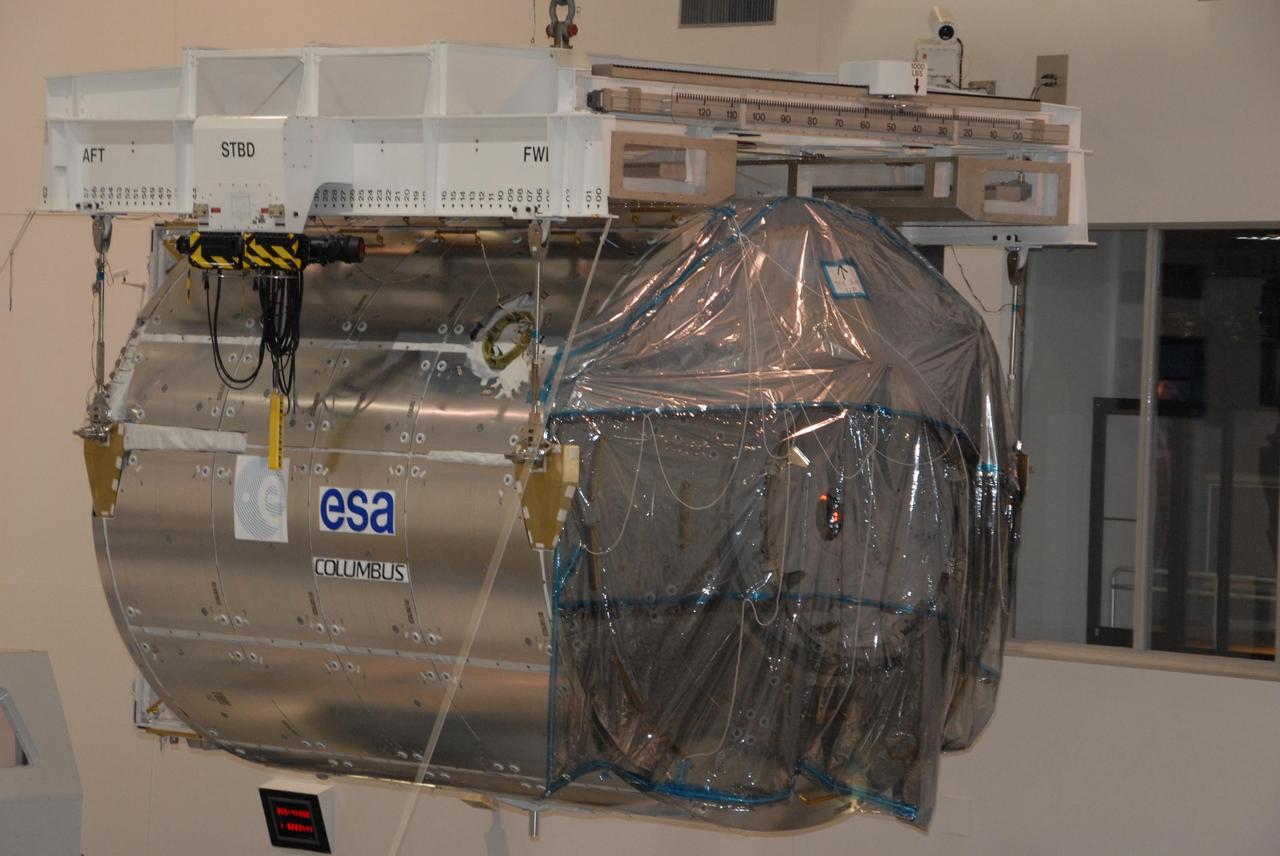
KENNEDY SPACE CENTER, FLA. -- In the Space Station Processing Facility at NASA's Kennedy Space Center, an overhead crane lifts the Columbus Laboratory module from its stand. The module is being moved to a weigh station before transfer to the payload canister. The European Space Agency 's largest single contribution to the International Space Station, Columbus will expand the research facilities of the station, providing crew members and scientists around the world the ability to conduct a variety of life, physical and materials science experiments. The module is approximately 23 feet long and 15 feet wide, allowing it to hold 10 large racks of experiments. The module is scheduled to be transferred to Launch Pad 39A in early November, in preparation for its journey to the station. Columbus will fly aboard space shuttle Atlantis on the STS-122 mission, targeted for launch Dec. 6. Photo credit: NASA/George Shelton
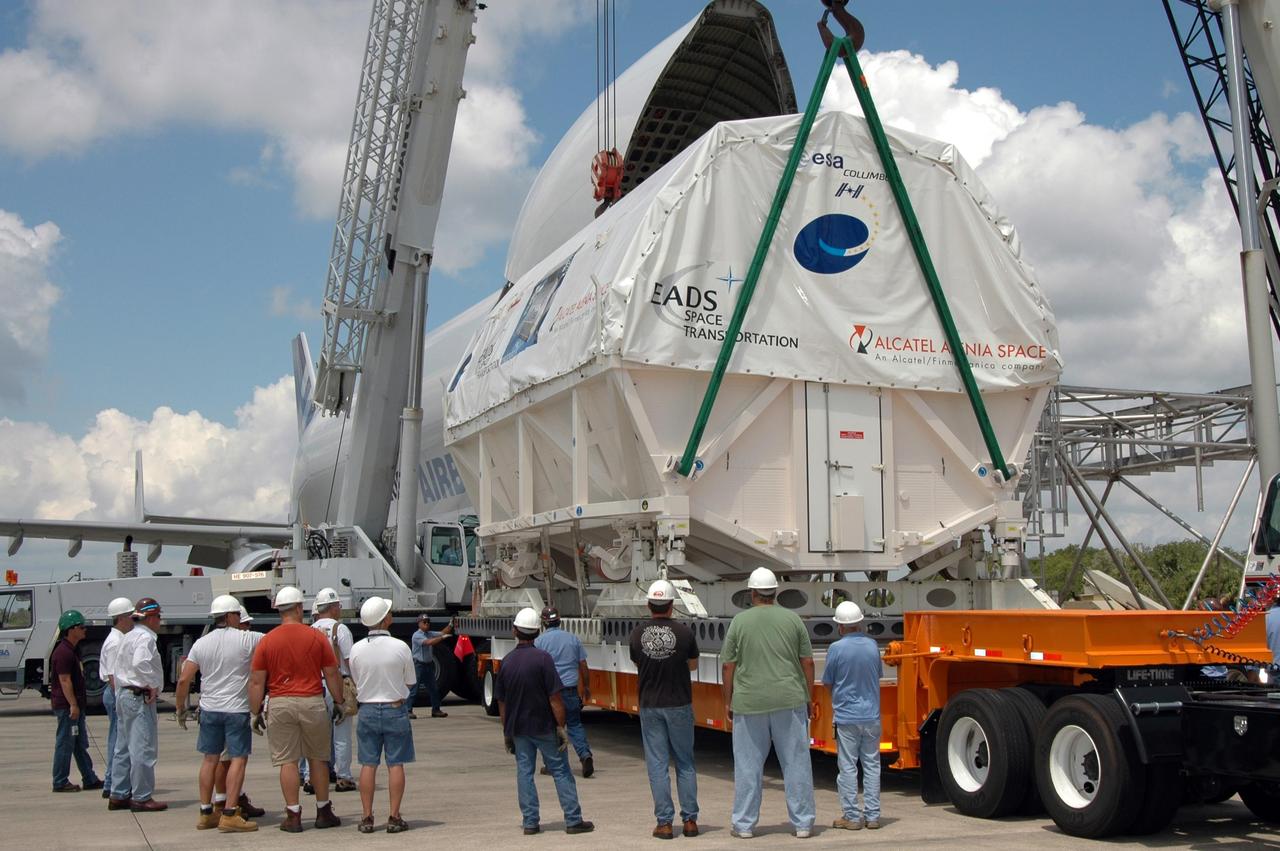
KENNEDY SPACE CENTER, FLA. - At the Shuttle Landing Facility, a crane settles Columbus, the European Space Agency's research laboratory, onto a flat bed truck. The truck will transport the module to the Space Station Processing Facility at NASA's Kennedy Space Center. The module arrived on a Beluga Airbus May 30 at NASA's Kennedy Space Center from the manufacturer in Germany. In the SSPF, the module will be prepared for delivery to the International Space Station on a future space shuttle mission. Columbus will expand the research facilities of the station and provide researchers with the ability to conduct numerous experiments in the area of life, physical and materials sciences. Photo credit: NASA/Jim Grossmann
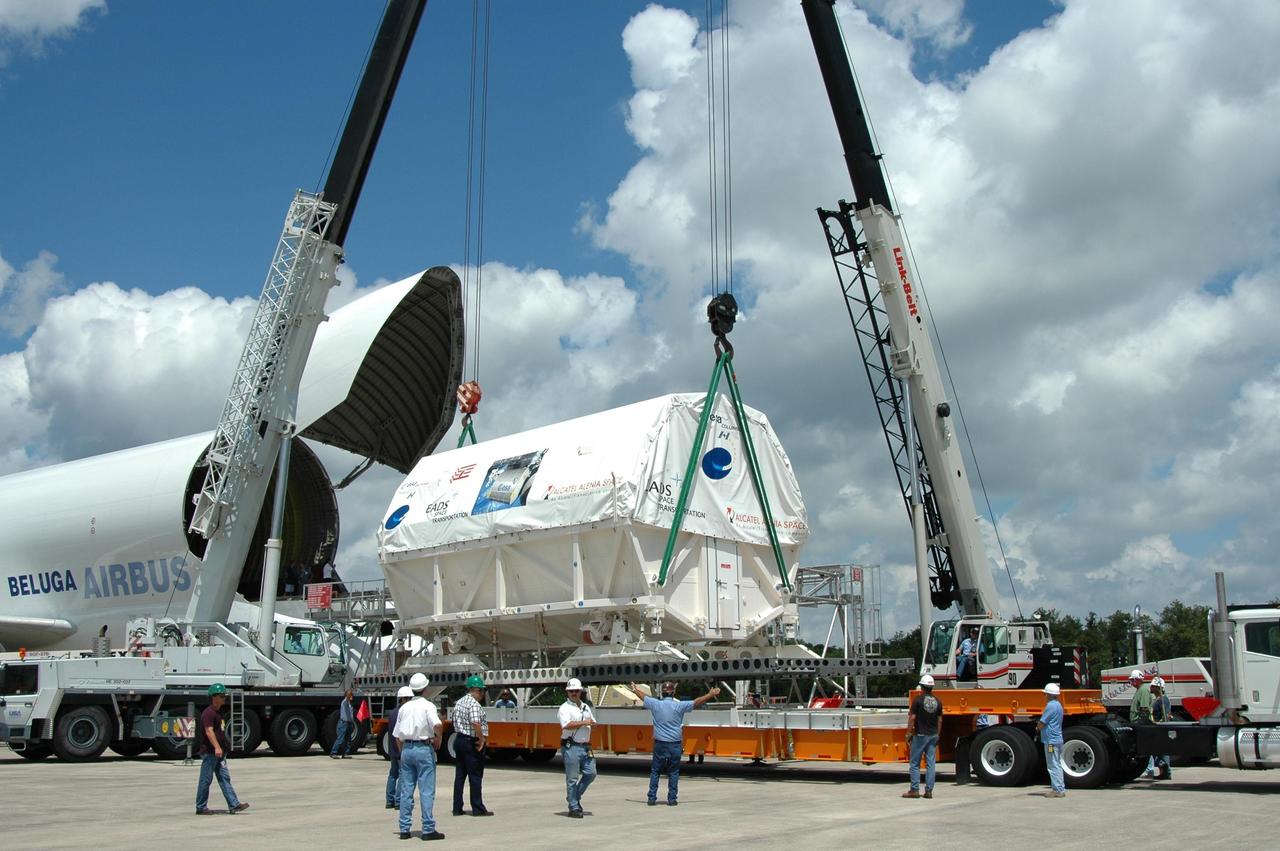
KENNEDY SPACE CENTER, FLA. - At the Shuttle Landing Facility, a crane lowers Columbus, the European Space Agency's research laboratory, toward a flat bed truck. The truck will transport the module to the Space Station Processing Facility at NASA's Kennedy Space Center. The module arrived on a Beluga Airbus May 30 at NASA's Kennedy Space Center from the manufacturer in Germany. In the SSPF, the module will be prepared for delivery to the International Space Station on a future space shuttle mission. Columbus will expand the research facilities of the station and provide researchers with the ability to conduct numerous experiments in the area of life, physical and materials sciences. Photo credit: NASA/Jim Grossmann
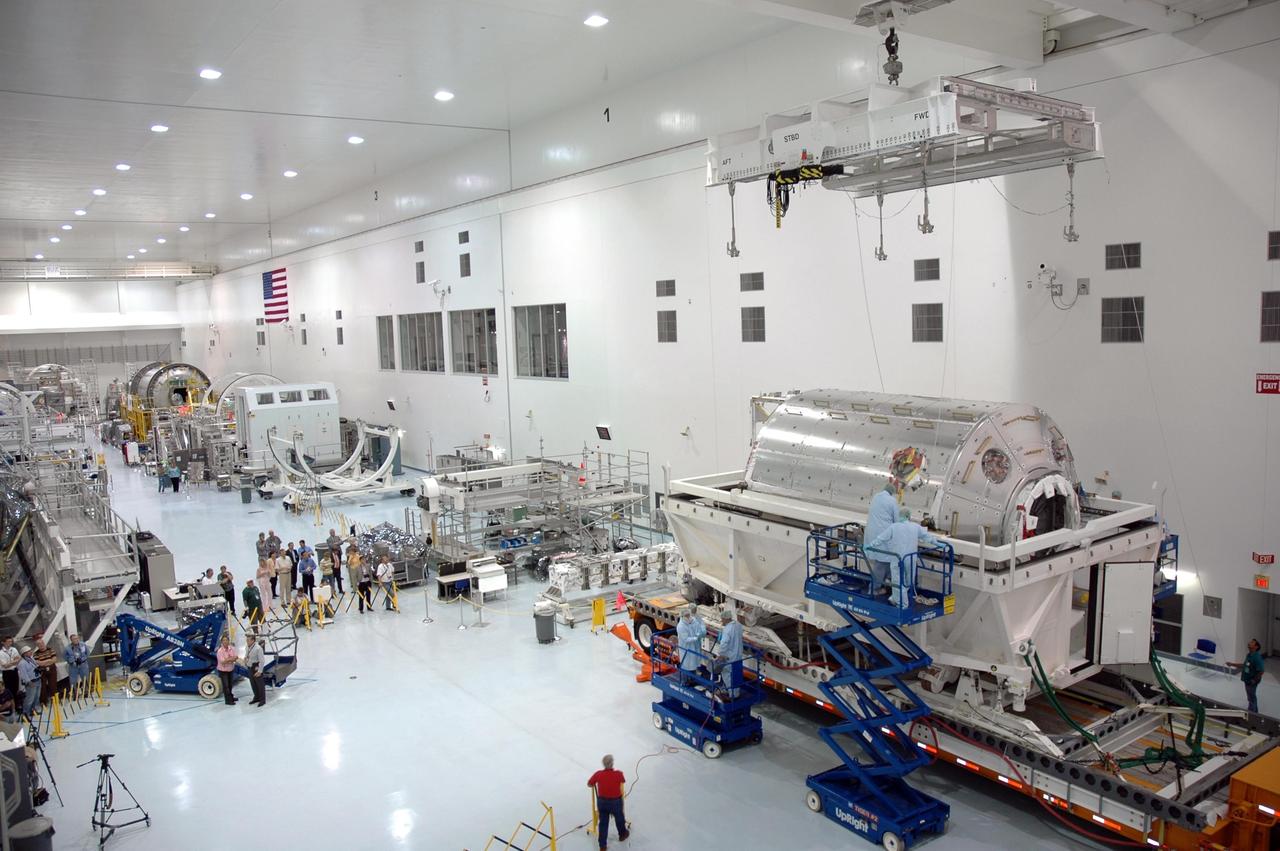
KENNEDY SPACE CENTER, FLA. - Inside the Space Station Processing Facility at NASA's Kennedy Space Center, the Columbus module waits to be lifted out of its transportation canister. An overhead crane is being lowered toward the module, which is the European Space Agency's research laboratory for the International Space Station. The module will be moved to a work stand and prepared for delivery to the space station on a future space shuttle mission. Columbus will expand the research facilities of the station and provide researchers with the ability to conduct numerous experiments in the area of life, physical and materials sciences. Photo credit: NASA/Jim Grossmann