
Atlas Image mosaic, covering 34 x 34 on the sky, of the Coma cluster, aka Abell 1656. This is a particularly rich cluster of individual galaxies over 1000 members, most prominently the two giant ellipticals, NGC 4874 right and NGC 4889 left.
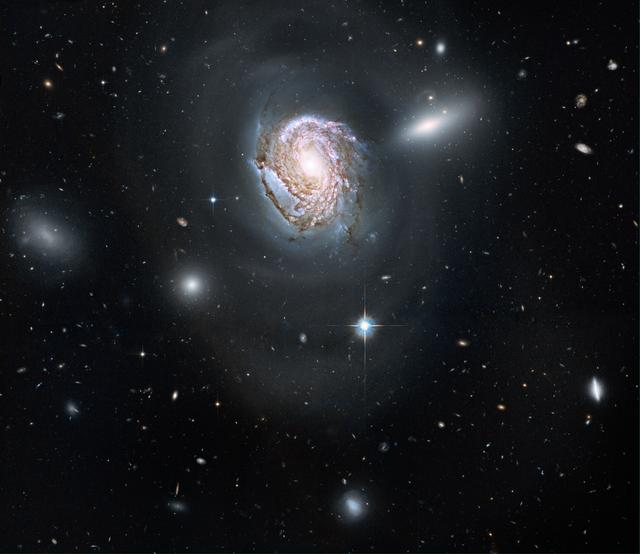
NASA image release August 10, 2010 A long-exposure Hubble Space Telescope image shows a majestic face-on spiral galaxy located deep within the Coma Cluster of galaxies, which lies 320 million light-years away in the northern constellation Coma Berenices. The galaxy, known as NGC 4911, contains rich lanes of dust and gas near its center. These are silhouetted against glowing newborn star clusters and iridescent pink clouds of hydrogen, the existence of which indicates ongoing star formation. Hubble has also captured the outer spiral arms of NGC 4911, along with thousands of other galaxies of varying sizes. The high resolution of Hubble's cameras, paired with considerably long exposures, made it possible to observe these faint details. NGC 4911 and other spirals near the center of the cluster are being transformed by the gravitational tug of their neighbors. In the case of NGC 4911, wispy arcs of the galaxy's outer spiral arms are being pulled and distorted by forces from a companion galaxy (NGC 4911A), to the upper right. The resultant stripped material will eventually be dispersed throughout the core of the Coma Cluster, where it will fuel the intergalactic populations of stars and star clusters. The Coma Cluster is home to almost 1,000 galaxies, making it one of the densest collections of galaxies in the nearby universe. It continues to transform galaxies at the present epoch, due to the interactions of close-proximity galaxy systems within the dense cluster. Vigorous star formation is triggered in such collisions. Galaxies in this cluster are so densely packed that they undergo frequent interactions and collisions. When galaxies of nearly equal masses merge, they form elliptical galaxies. Merging is more likely to occur in the center of the cluster where the density of galaxies is higher, giving rise to more elliptical galaxies. This natural-color Hubble image, which combines data obtained in 2006, 2007, and 2009 from the Wide Field Planetary Camera 2 and the Advanced Camera for Surveys, required 28 hours of exposure time. The Hubble Space Telescope is a project of international cooperation between NASA and the European Space Agency. NASA's Goddard Space Flight Center manages the telescope. The Space Telescope Science Institute (STScI) conducts Hubble science operations. STScI is operated for NASA by the Association of Universities for Research in Astronomy, Inc. in Washington, D.C. Credit: NASA, ESA, and the Hubble Heritage Team (STScI/AURA) Acknowledgment: K. Cook (Lawrence Livermore National Laboratory) To learn more about Hubble go to: <a href="http://www.nasa.gov/mission_pages/hubble/main/index.html" rel="nofollow">www.nasa.gov/mission_pages/hubble/main/index.html</a> <b><a href="http://www.nasa.gov/centers/goddard/home/index.html" rel="nofollow">NASA Goddard Space Flight Center</a></b> is home to the nation's largest organization of combined scientists, engineers and technologists that build spacecraft, instruments and new technology to study the Earth, the sun, our solar system, and the universe. <b>Follow us on <a href="http://twitter.com/NASA_GoddardPix" rel="nofollow">Twitter</a></b> <b>Join us on <a href="http://www.facebook.com/pages/Greenbelt-MD/NASA-Goddard/395013845897?ref=tsd" rel="nofollow">Facebook</a><b></b></b>

ISS006-E-40537 (March 2003) --- The Coma Cluster, a collection of stars which are visible to the naked eye in the constellation Coma Berenices, is visible in this view photographed by astronaut Donald R. Pettit, Expedition Six NASA ISS science officer, on board the International Space Station (ISS). The Coma Cluster is visible as a faint fuzzy patch between the constellations Leo and Virgo. The naked eye cannot resolve the individual stars, but collectively, they merge into a fuzzy flow in this part of the sky.

Two large elliptical galaxies, NGC 4889 and NGC 4874 are shown in this image from NASA Spitzer Space Telescope.

This image from NASA Hubble Space Telescope of the sunward plunging comet ISON suggests that the comet is intact despite some predictions that the fragile icy nucleus might disintegrate as the sun warms it. In this NASA Hubble Space Telescope image taken on October 9, 2013 the comet's solid nucleus is unresolved because it is so small. If the nucleus broke apart then Hubble would have likely seen evidence for multiple fragments. Moreover, the coma or head surrounding the comet's nucleus is symmetric and smooth. This would probably not be the case if clusters of smaller fragments were flying along. What's more, a polar jet of dust first seen in Hubble images taken in April is no longer visible and may have turned off. This color composite image was assembled using two filters. The comet's coma appears cyan, a greenish-blue color due to gas, while the tail is reddish due to dust streaming off the nucleus. The tail forms as dust particles are pushed away from the nucleus by the pressure of sunlight. The comet was inside Mars' orbit and 177 million miles from Earth when photographed. Comet ISON is predicted to make its closest approach to Earth on 26 December, at a distance of 39.9 million miles. http://photojournal.jpl.nasa.gov/catalog/PIA18153
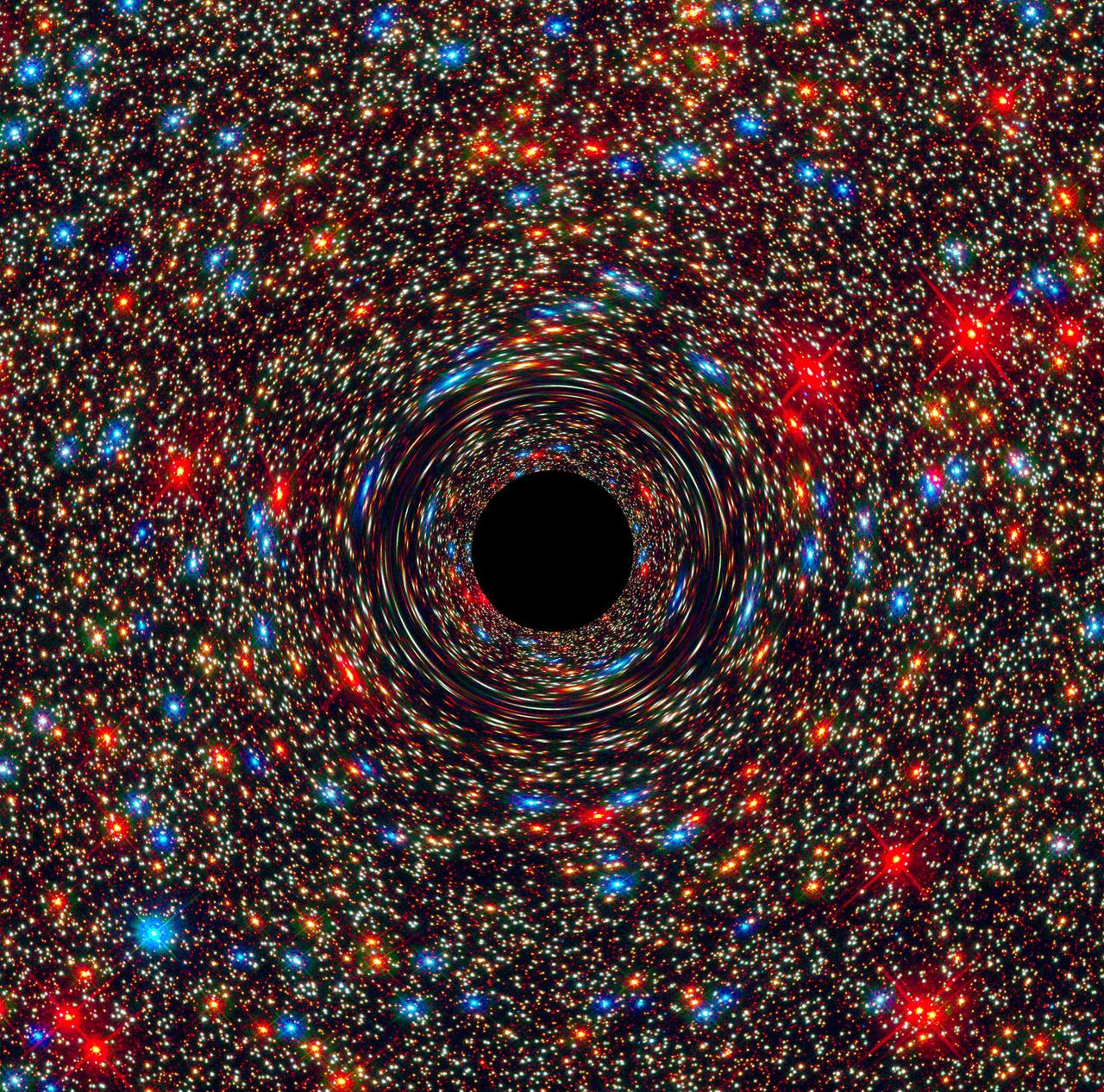
This computer-simulated image shows a supermassive black hole at the core of a galaxy. The black region in the center represents the black hole’s event horizon, where no light can escape the massive object’s gravitational grip. The black hole’s powerful gravity distorts space around it like a funhouse mirror. Light from background stars is stretched and smeared as the stars skim by the black hole. Credits: NASA, ESA, and D. Coe, J. Anderson, and R. van der Marel (STScI) More info: Astronomers have uncovered a near-record breaking supermassive black hole, weighing 17 billion suns, in an unlikely place: in the center of a galaxy in a sparsely populated area of the universe. The observations, made by NASA’s Hubble Space Telescope and the Gemini Telescope in Hawaii, may indicate that these monster objects may be more common than once thought. Until now, the biggest supermassive black holes – those roughly 10 billion times the mass of our sun – have been found at the cores of very large galaxies in regions of the universe packed with other large galaxies. In fact, the current record holder tips the scale at 21 billion suns and resides in the crowded Coma galaxy cluster that consists of over 1,000 galaxies.
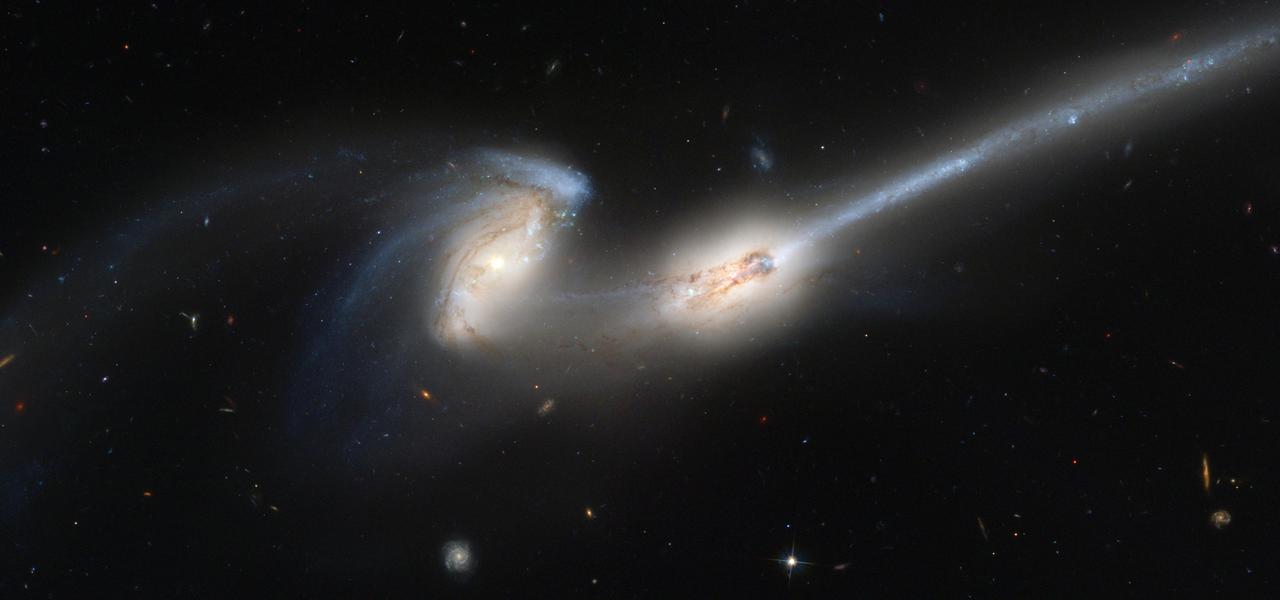
The Advanced Camera for Surveys (ACS), the newest camera on the Hubble Space Telescope, has captured a spectacular pair of galaxies. Located 300 million light-years away in the constellation Coma Berenices, the colliding galaxies have been nicknamed "The Mice" because of the long tails of stars and gas emanating from each galaxy. Otherwise known as NGC 4676, the pair will eventually merge into a single giant galaxy. In the galaxy at left, the bright blue patch is resolved into a vigorous cascade of clusters and associations of young, hot blue stars, whose formation has been triggered by the tidal forces of the gravitational interaction. The clumps of young stars in the long, straight tidal tail (upper right) are separated by fainter regions of material. These dim regions suggest that the clumps of stars have formed from the gravitational collapse of the gas and dust that once occupied those areas. Some of the clumps have luminous masses comparable to dwarf galaxies that orbit the halo of our own Milky Way Galaxy. Computer simulations by astronomers show that we are seeing two near identical spiral galaxies approximately 160 million years after their closest encounter. The simulations also show that the pair will eventually merge, forming a large, nearly spherical galaxy (known as an elliptical galaxy). The Mice presage what may happen to our own Milky Way several billion years from now when it collides with our nearest large neighbor, the Andromeda Galaxy (M31). This picture is assembled from three sets of images taken on April 7, 2002, in blue, orange, and near-infrared filters. Credit: NASA, H. Fort (JHU), G. Illingworth (USCS/LO), M. Clampin (STScI), G. Hartig (STScI), the ACS Science Team, and ESA.

This computer-simulated image shows a supermassive black hole at the core of a galaxy. The black region in the center represents the black hole’s event horizon, where no light can escape the massive object’s gravitational grip. The black hole’s powerful gravity distorts space around it like a funhouse mirror. Light from background stars is stretched and smeared as the stars skim by the black hole. Credits: NASA, ESA, and D. Coe, J. Anderson, and R. van der Marel (STScI) More info: Astronomers have uncovered a near-record breaking supermassive black hole, weighing 17 billion suns, in an unlikely place: in the center of a galaxy in a sparsely populated area of the universe. The observations, made by NASA’s Hubble Space Telescope and the Gemini Telescope in Hawaii, may indicate that these monster objects may be more common than once thought. Until now, the biggest supermassive black holes – those roughly 10 billion times the mass of our sun – have been found at the cores of very large galaxies in regions of the universe packed with other large galaxies. In fact, the current record holder tips the scale at 21 billion suns and resides in the crowded Coma galaxy cluster that consists of over 1,000 galaxies. More: <a href="http://www.nasa.gov/feature/goddard/2016/behemoth-black-hole-found-in-an-unlikely-place" rel="nofollow">www.nasa.gov/feature/goddard/2016/behemoth-black-hole-fou...</a> <b><a href="http://www.nasa.gov/audience/formedia/features/MP_Photo_Guidelines.html" rel="nofollow">NASA image use policy.</a></b> <b><a href="http://www.nasa.gov/centers/goddard/home/index.html" rel="nofollow">NASA Goddard Space Flight Center</a></b> enables NASA’s mission through four scientific endeavors: Earth Science, Heliophysics, Solar System Exploration, and Astrophysics. Goddard plays a leading role in NASA’s accomplishments by contributing compelling scientific knowledge to advance the Agency’s mission. <b>Follow us on <a href="http://twitter.com/NASAGoddardPix" rel="nofollow">Twitter</a></b> <b>Like us on <a href="http://www.facebook.com/pages/Greenbelt-MD/NASA-Goddard/395013845897?ref=tsd" rel="nofollow">Facebook</a></b> <b>Find us on <a href="http://instagrid.me/nasagoddard/?vm=grid" rel="nofollow">Instagram</a></b>
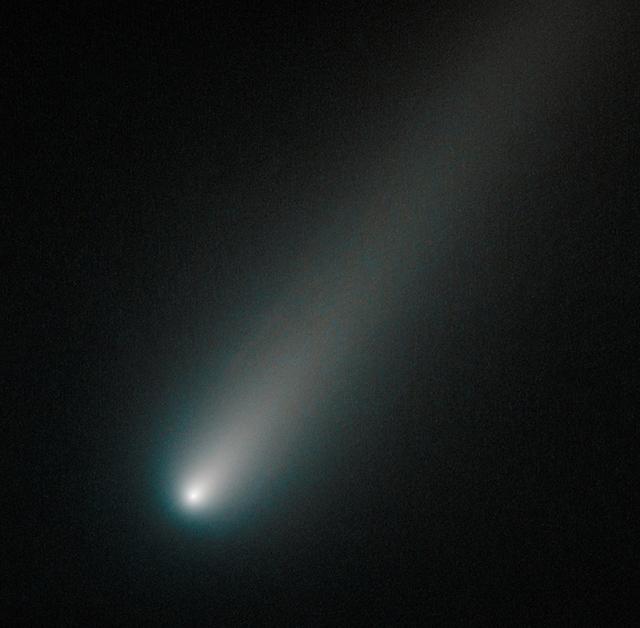
On Oct. 9, 2013, Hubble observed comet ISON once again, when it was inside the orbit of Mars, about 177 million miles from Earth. This image shows that the comet was still intact despite some predictions that the fragile icy nucleus might disintegrate closer to the sun. The comet will pass closest to the sun on Nov. 28, 2013. If the nucleus had broke apart then Hubble would have likely seen evidence of multiple fragments. Moreover, the coma, or head, surrounding the comet's nucleus is symmetric and smooth. This would probably not be the case if clusters of smaller fragments were flying along. This color composite image was assembled using two filters. The comet's coma appears cyan, a greenish-blue color due to gas, while the tail is reddish due to dust streaming off the nucleus. The tail forms as dust particles are pushed away from the nucleus by the pressure of sunlight. Credit: NASA -------- More details on Comet ISON: Comet ISON began its trip from the Oort cloud region of our solar system and is now travelling toward the sun. The comet will reach its closest approach to the sun on Thanksgiving Day -- 28 Nov 2013 -- skimming just 730,000 miles above the sun's surface. If it comes around the sun without breaking up, the comet will be visible in the Northern Hemisphere with the naked eye, and from what we see now, ISON is predicted to be a particularly bright and beautiful comet. Catalogued as C/2012 S1, Comet ISON was first spotted 585 million miles away in September 2012. This is ISON's very first trip around the sun, which means it is still made of pristine matter from the earliest days of the solar system’s formation, its top layers never having been lost by a trip near the sun. Comet ISON is, like all comets, a dirty snowball made up of dust and frozen gases like water, ammonia, methane and carbon dioxide -- some of the fundamental building blocks that scientists believe led to the formation of the planets 4.5 billion years ago. NASA has been using a vast fleet of spacecraft, instruments, and space- and Earth-based telescope, in order to learn more about this time capsule from when the solar system first formed. The journey along the way for such a sun-grazing comet can be dangerous. A giant ejection of solar material from the sun could rip its tail off. Before it reaches Mars -- at some 230 million miles away from the sun -- the radiation of the sun begins to boil its water, the first step toward breaking apart. And, if it survives all this, the intense radiation and pressure as it flies near the surface of the sun could destroy it altogether. This collection of images show ISON throughout that journey, as scientists watched to see whether the comet would break up or remain intact. The comet reaches its closest approach to the sun on Thanksgiving Day -- Nov. 28, 2013 -- skimming just 730,000 miles above the sun’s surface. If it comes around the sun without breaking up, the comet will be visible in the Northern Hemisphere with the naked eye, and from what we see now, ISON is predicted to be a particularly bright and beautiful comet. ISON stands for International Scientific Optical Network, a group of observatories in ten countries who have organized to detect, monitor, and track objects in space. ISON is managed by the Keldysh Institute of Applied Mathematics, part of the Russian Academy of Sciences. <b><a href="http://www.nasa.gov/audience/formedia/features/MP_Photo_Guidelines.html" rel="nofollow">NASA image use policy.</a></b> <b><a href="http://www.nasa.gov/centers/goddard/home/index.html" rel="nofollow">NASA Goddard Space Flight Center</a></b> enables NASA’s mission through four scientific endeavors: Earth Science, Heliophysics, Solar System Exploration, and Astrophysics. Goddard plays a leading role in NASA’s accomplishments by contributing compelling scientific knowledge to advance the Agency’s mission. <b>Follow us on <a href="http://twitter.com/NASA_GoddardPix" rel="nofollow">Twitter</a></b> <b>Like us on <a href="http://www.facebook.com/pages/Greenbelt-MD/NASA-Goddard/39501</b>