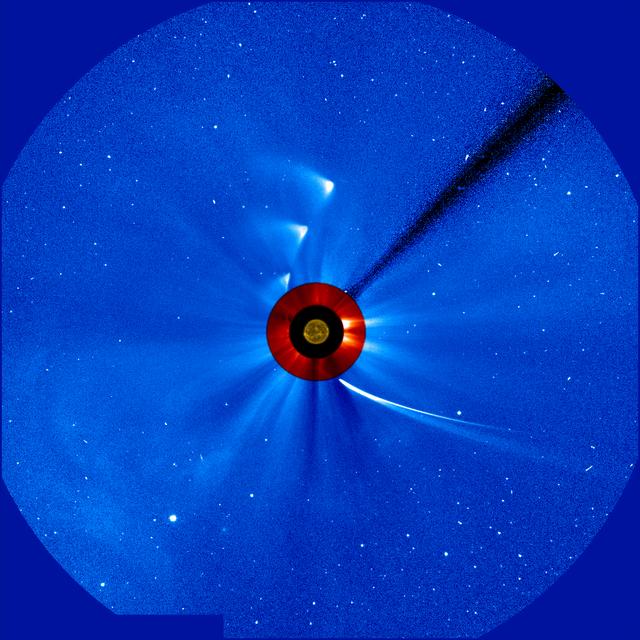
"Timelapse" series of images of comet ISON as viewed by ESA/NASA's Solar and Heliospheric Observatory, or SOHO. This image is a composite, with the sun imaged by NASA's Solar Dynamics Observatory in the center, and SOHO's two coronagraphs showing the solar atmosphere, the corona. The most recent image in this is from 5:30 p.m. EST on Nov. 29, 2013. Continuing a history of surprising behavior, material from Comet ISON appeared on the other side of the sun on the evening on Nov. 28, 2013, despite not having been seen in observations during its closest approach to the sun. The question remains whether it is merely debris from the comet, or if some portion of the comet's nucleus survived, but late-night analysis from scientists with NASA's Comet ISON Observing Campaign suggest that there is at least a small nucleus intact. Image Credit:ESA&NASA/SOHO/SDO <b><a href="http://www.nasa.gov/audience/formedia/features/MP_Photo_Guidelines.html" rel="nofollow">NASA image use policy.</a></b> <b><a href="http://www.nasa.gov/centers/goddard/home/index.html" rel="nofollow">NASA Goddard Space Flight Center</a></b> enables NASA’s mission through four scientific endeavors: Earth Science, Heliophysics, Solar System Exploration, and Astrophysics. Goddard plays a leading role in NASA’s accomplishments by contributing compelling scientific knowledge to advance the Agency’s mission. <b>Follow us on <a href="http://twitter.com/NASA_GoddardPix" rel="nofollow">Twitter</a></b> <b>Like us on <a href="http://www.facebook.com/pages/Greenbelt-MD/NASA-Goddard/395013845897?ref=tsd" rel="nofollow">Facebook</a></b> <b>Find us on <a href="http://instagram.com/nasagoddard?vm=grid" rel="nofollow">Instagram</a></b>
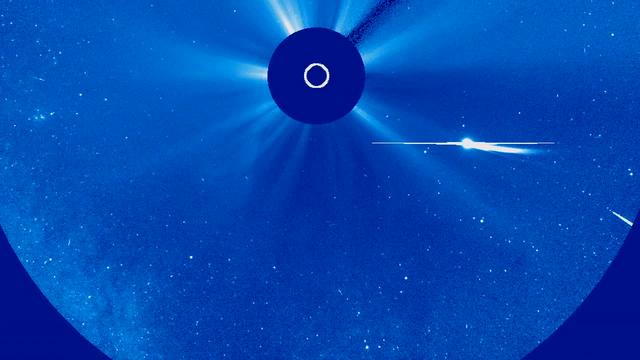
Sungrazing comets are a special class of comets that come very close to the sun at their nearest approach, a point called perihelion. To be considered a sungrazer, a comet needs to get within about 850,000 miles from the sun at perihelion. Many come even closer, even to within a few thousand miles. Being so close to the sun is very hard on comets for many reasons. They are subjected to a lot of solar radiation which boils off their water or other volatiles. The physical push of the radiation and the solar wind also helps form the tails. And as they get closer to the sun, the comets experience extremely strong tidal forces, or gravitational stress. In this hostile environment, many sungrazers do not survive their trip around the sun. Although they don't actually crash into the solar surface, the sun is able to destroy them anyway. Many sungrazing comets follow a similar orbit, called the Kreutz Path, and collectively belong to a population called the Kreutz Group. In fact, close to 85% of the sungrazers seen by the SOHO satellite are on this orbital highway. Scientists think one extremely large sungrazing comet broke up hundreds, or even thousands, of years ago, and the current comets on the Kreutz Path are the leftover fragments of it. As clumps of remnants make their way back around the sun, we experience a sharp increase in sungrazing comets, which appears to be going on now. Comet Lovejoy, which reached perihelion on December 15, 2011 is the best known recent Kreutz-group sungrazer. And so far, it is the only one that NASA's solar-observing fleet has seen survive its trip around the sun. Comet ISON, an upcoming sungrazer with a perihelion of 730,000 miles on November 28, 2013, is not on the Kreutz Path. In fact, ISON's orbit suggests that it may gain enough momentum to escape the solar system entirely, and never return. Before it does so, it will pass within about 40 million miles from Earth on December 26th. More information on this topic available at: <a href="http://www.nasa.gov/content/goddard/timeline-of-comet-ison-s-dangerous-journey/" rel="nofollow">www.nasa.gov/content/goddard/timeline-of-comet-ison-s-dan...</a> Credit: NASA's Goddard Space Flight Center <b><a href="http://www.nasa.gov/audience/formedia/features/MP_Photo_Guidelines.html" rel="nofollow">NASA image use policy.</a></b> <b><a href="http://www.nasa.gov/centers/goddard/home/index.html" rel="nofollow">NASA Goddard Space Flight Center</a></b> enables NASA’s mission through four scientific endeavors: Earth Science, Heliophysics, Solar System Exploration, and Astrophysics. Goddard plays a leading role in NASA’s accomplishments by contributing compelling scientific knowledge to advance the Agency’s mission. <b>Follow us on <a href="http://twitter.com/NASA_GoddardPix" rel="nofollow">Twitter</a></b> <b>Like us on <a href="http://www.facebook.com/pages/Greenbelt-MD/NASA-Goddard/395013845897?ref=tsd" rel="nofollow">Facebook</a></b> <b>Find us on <a href="http://instagram.com/nasagoddard?vm=grid" rel="nofollow">Instagram</a></b>