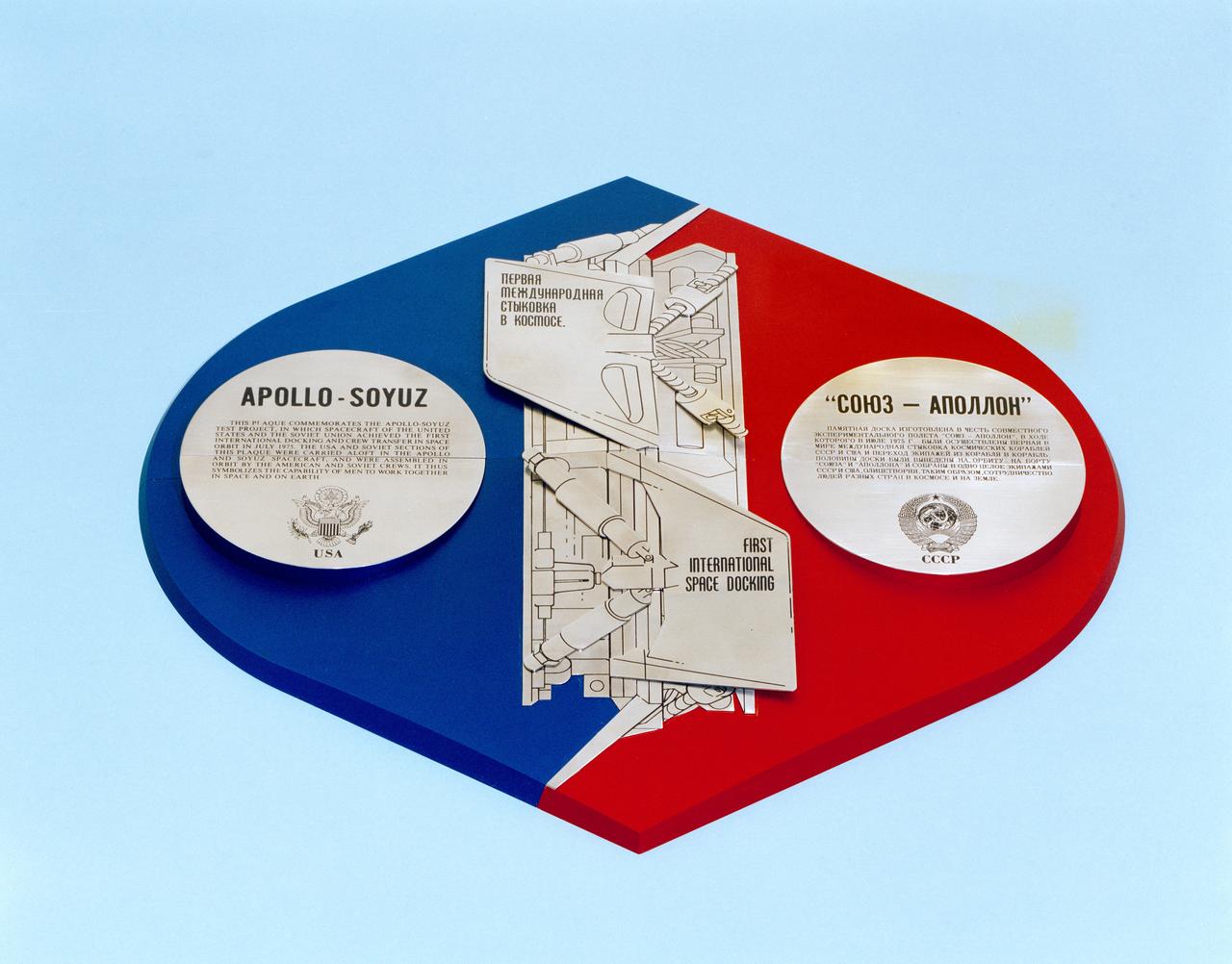
S75-26927 (July 1975) --- A close-up view of the Commemorative Plaque for the Apollo-Soyuz Test Project. Two plaques divided into four quarters each will be flown on the ASTP mission. A four-part plaque is completely assembled here. The American ASTP crew will carry the four U.S. quarter pieces aboard Apollo; and the Soviet ASTP crew will carry the four USSR quarter sections aboard Soyuz. The eight quarter pieces will be joined together to form two complete commemorative plaques after the two spacecraft rendezvous and dock in Earth orbit. One complete plaque then will be returned to Earth by the astronauts; and the other complete plaque will be brought back by the cosmonauts. The plaque is written in both English and Russian.

AST-05-263 (17-18 July 1975) --- The Apollo-Soyuz Test Project (ASTP) Commemorative Plaque is assembled in the Soviet Soyuz Orbital Module during the joint U.S.-USSR Apollo-Soyuz Test Project docking mission in Earth orbit. The plaque is written both in English and Russian.
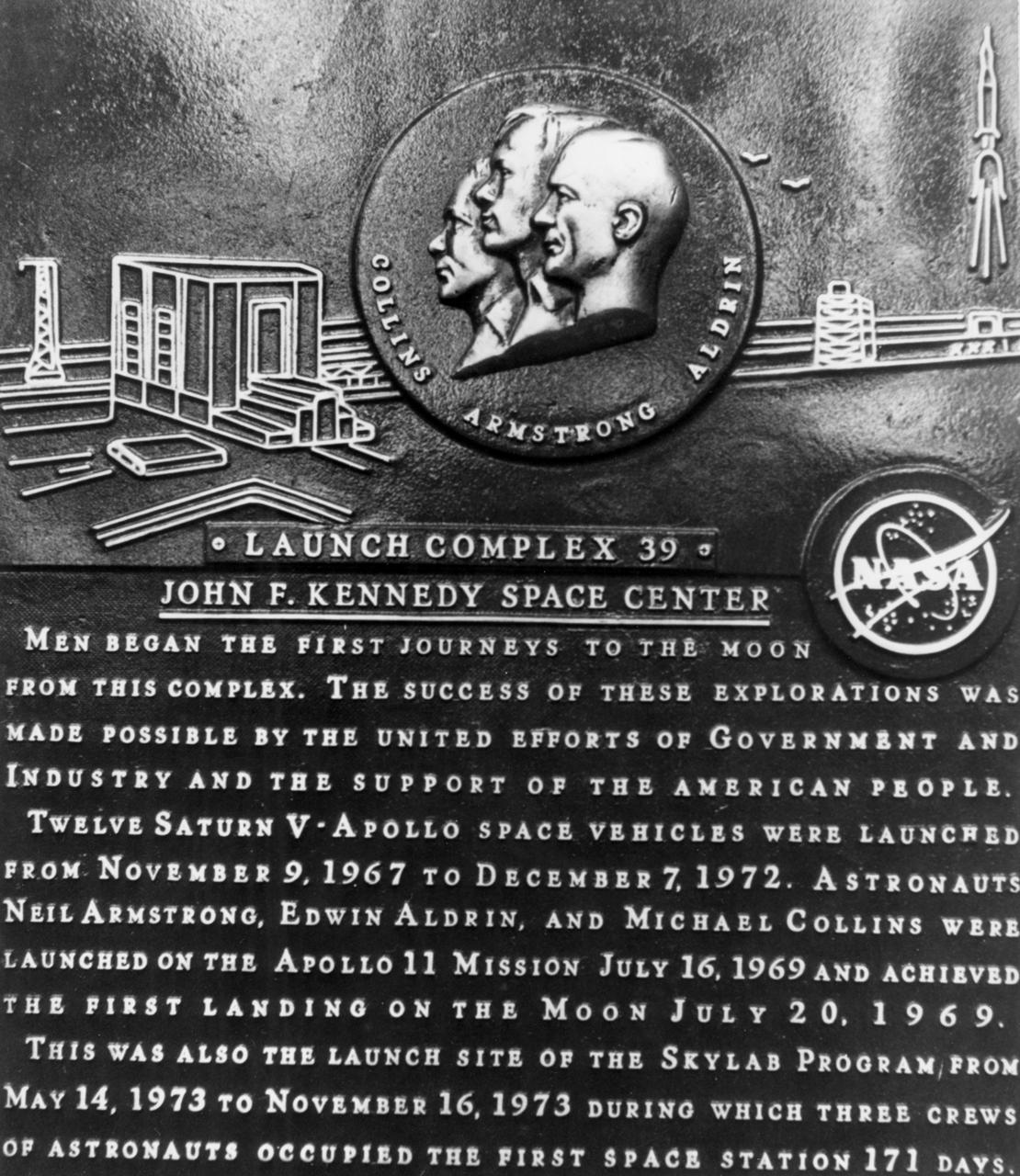
On July 3, 1974 NASA commemorated the 5th anniversary of the Apollo 11, first lunar landing mission, at the Kennedy Space Center (KSC). Launch Pad 39, from which astronauts Neil Armstrong, Edwin Aldrin, and Michael Collins first embarked on their historic journey to the Moon, was dedicated as a national landmark. Apollo 11 was launched at 9:32 am on July 16, 1969 and made the first successful lunar landing July 20th. During the 45 minute ceremony, the three Apollo 11 astronauts unveiled this plaque which was placed at the launch site. Other participating dignitaries included Dr. James Fletcher and Dr. George H. Low, NASA Administrator and Deputy Administrator respectively; Florida Governor Rubin Askew; Senator frank E. Moss; Congressman Olin E. Teague, and Kurt Debus, KSC Director. Apollo 11 launched from the Kennedy Space Center, Florida via a Saturn V launch which was developed by the Marshall Space Flight Center (MSFC) under the direction of Dr. Wernher von Braun.
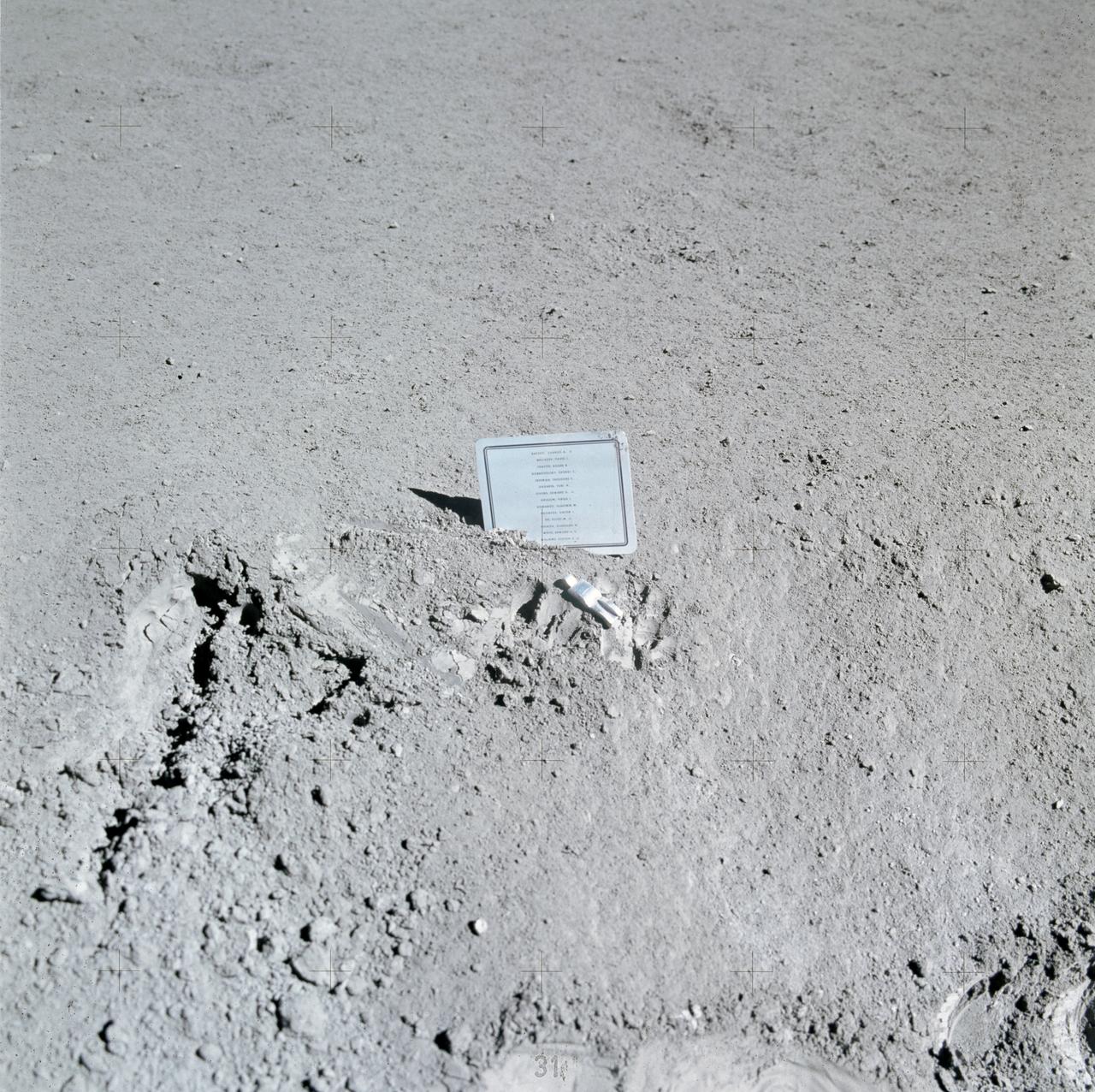
AS15-88-11894 (31 July-2 Aug. 1971) --- A close-up view of a commemorative plaque left on the moon at the Hadley-Apennine landing site in memory of 14 NASA astronauts and USSR cosmonauts, now deceased. Their names are inscribed in alphabetical order on the plaque. The plaque was stuck in the lunar soil by astronauts David R. Scott, commander, and James B. Irwin, lunar module pilot, during their Apollo 15 lunar surface extravehicular activity (EVA). The names on the plaque are Charles A. Bassett II, Pavel I. Belyayev, Roger B. Chaffee, Georgi Dobrovolsky, Theodore C. Freeman, Yuri A. Gagarin, Edward G. Givens Jr., Virgil I. Grissom, Vladimir Komarov, Viktor Patsayev, Elliot M. See Jr., Vladislav Volkov, Edward H. White II, and Clifton C. Williams Jr. The tiny, man-like object represents the figure of a fallen astronaut/cosmonaut. While astronauts Scott and Irwin descended in the Lunar Module (LM) "Falcon" to explore the Hadley-Apennine area of the moon, astronaut Alfred M. Worden, command module pilot, remained with the Command and Service Modules (CSM) in lunar orbit.
Millions of people on Earth watched via television as a message for all mankind was delivered to the Mare Tranquilitatis (Sea of Tranquility) region of the Moon during the historic Apollo 11 mission, where it still remains today. A commemorative plaque was attached to the leg of the Lunar Module (LM), Eagle, engraved with the following words: “Here men from the planet Earth first set foot upon the Moon July, 1969 A.D. We came in peace for all of mankind.” It bears the signatures of the Apollo 11 astronauts Neil A. Armstrong, commander; Michael Collins, Command Module (CM) pilot; and Edwin E. Aldrin, Jr., Lunar Module (LM) pilot along with the signature of the U.S. President Richard M. Nixon. The plaque, as shown here, covered with protective steel for the launch and journey to the moon, was uncovered by crew members after landing. The Apollo 11 mission launched from the Kennedy Space Center (KSC) in Florida via the Marshall Space Flight Center (MSFC) developed Saturn V launch vehicle on July 16, 1969 and safely returned to Earth on July 24, 1969. The CM, “Columbia”, piloted by Collins, remained in a parking orbit around the Moon while the LM, “Eagle’’, carrying astronauts Armstrong and Aldrin, landed on the Moon. On July 20, 1969, Armstrong was the first human to ever stand on the lunar surface, followed by Aldrin. During 2½ hours of surface exploration, the crew collected 47 pounds of lunar surface material for analysis back on Earth. With the success of Apollo 11, the national objective to land men on the Moon and return them safely to Earth had been accomplished.

Millions of people on Earth watched via television as a message for all mankind was delivered to the Mare Tranquilitatis (Sea of Tranquility) region of the Moon during the historic Apollo 11 mission, where it still remains today. This photograph is a reproduction of the commemorative plaque that was attached to the leg of the Lunar Module (LM), Eagle, engraved with the following words: “Here men from the planet Earth first set foot upon the Moon July, 1969 A.D. We came in peace for all of mankind.” It bears the signatures of the Apollo 11 astronauts Neil A. Armstrong, commander; Michael Collins, Command Module (CM) pilot; and Edwin E. Aldrin, Jr., Lunar Module (LM) pilot along with the signature of the U.S. President Richard M. Nixon. The Apollo 11 mission launched from the Kennedy Space Center (KSC) in Florida via the Marshall Space Flight Center (MSFC) developed Saturn V launch vehicle on July 16, 1969 and safely returned to Earth on July 24, 1969. The CM, “Columbia”, piloted by Collins, remained in a parking orbit around the Moon while the LM, “Eagle’’, carrying astronauts Armstrong and Aldrin, landed on the Moon. On July 20, 1969, Armstrong was the first human to ever stand on the lunar surface, followed by Aldrin. During 2½ hours of surface exploration, the crew collected 47 pounds of lunar surface material for analysis back on Earth. With the success of Apollo 11, the national objective to land men on the Moon and return them safely to Earth had been accomplished.
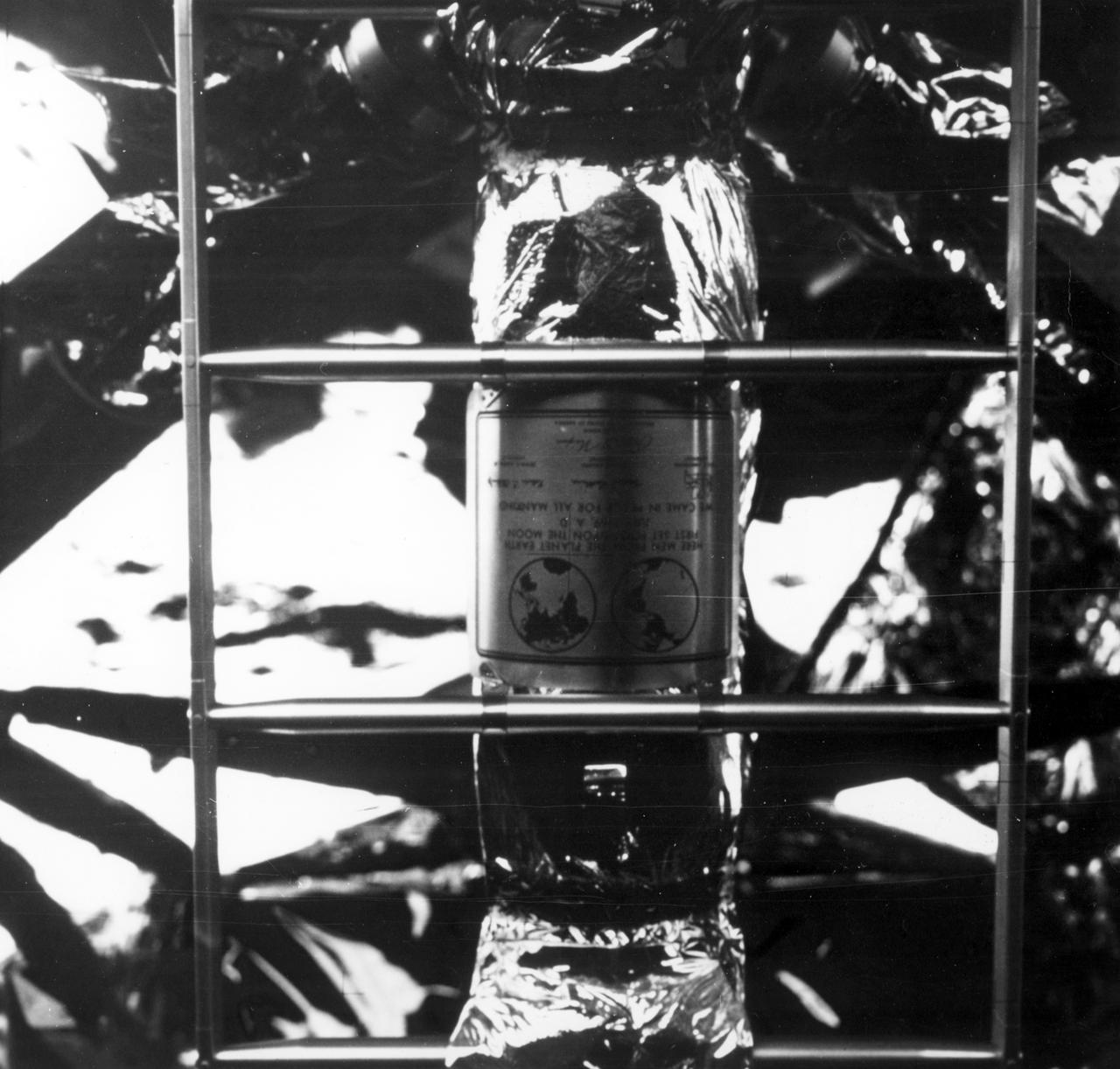
Millions of people on Earth watched via television as a message for all mankind was delivered to the Mare Tranquilitatis (Sea of Tranquility) region of the Moon during the historic Apollo 11 mission, where it still remains today. This commemorative plaque, attached to the leg of the Lunar Module (LM), Eagle, is engraved with the following words: “Here men from the planet Earth first set foot upon the Moon July, 1969 A.D. We came in peace for all of mankind.” It bears the signatures of the Apollo 11 astronauts Neil A. Armstrong, commander; Michael Collins, Command Module (CM) pilot; and Edwin E. Aldrin, Jr., Lunar Module (LM) pilot along with the signature of the U.S. President Richard M. Nixon. The Apollo 11 mission launched from the Kennedy Space Center (KSC) in Florida via the Marshall Space Flight Center (MSFC) developed Saturn V launch vehicle on July 16, 1969 and safely returned to Earth on July 24, 1969. The CM, “Columbia”, piloted by Collins, remained in a parking orbit around the Moon while the LM, “Eagle’’, carrying astronauts Armstrong and Aldrin, landed on the Moon. On July 20, 1969, Armstrong was the first human to ever stand on the lunar surface, followed by Aldrin. During 2½ hours of surface exploration, the crew collected 47 pounds of lunar surface material for analysis back on Earth. With the success of Apollo 11, the national objective to land men on the Moon and return them safely to Earth had been accomplished.
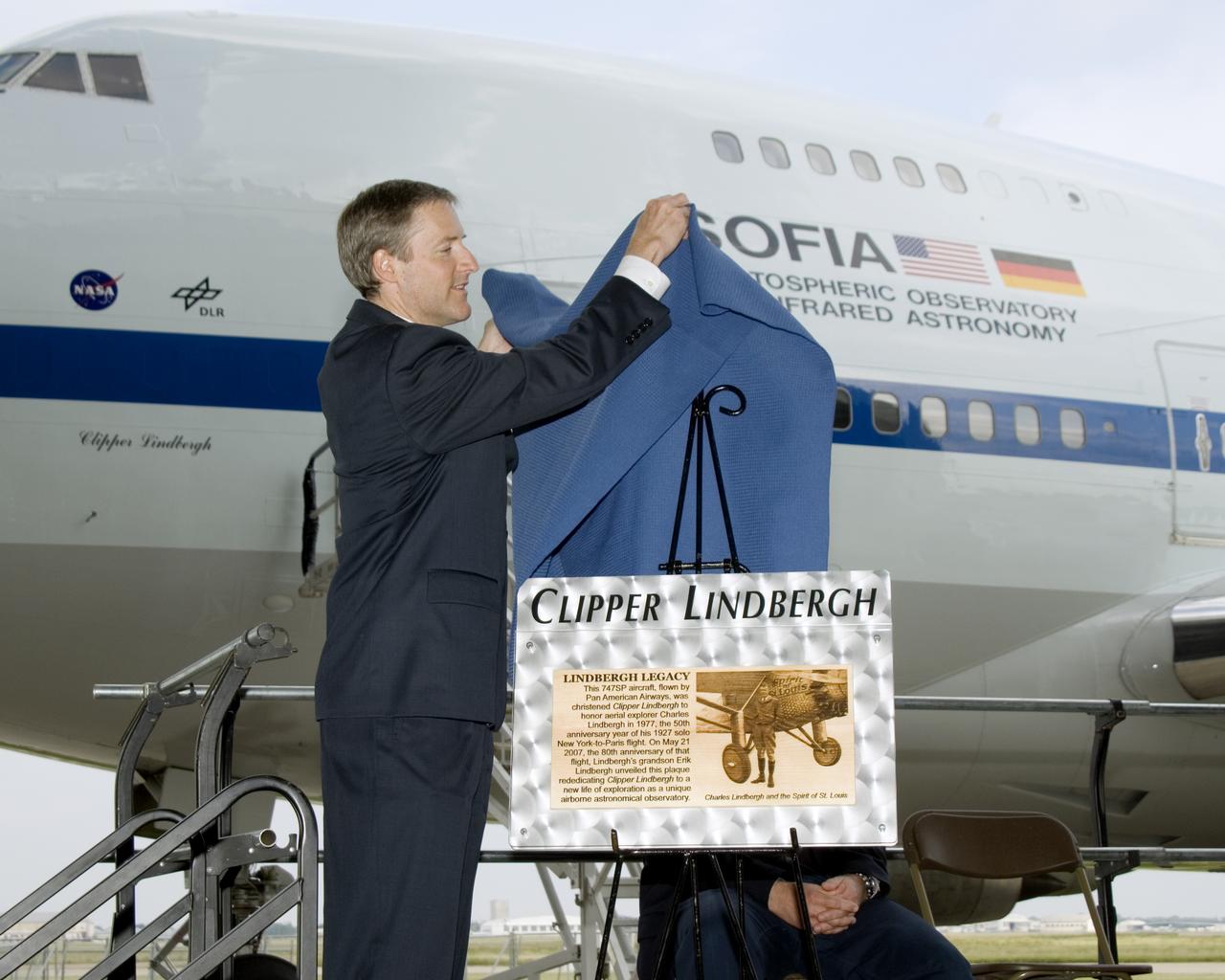
Erik Lindbergh, grandson of aviator Charles Lindbergh, unveiled a plaque commemorating his grandfather on the 80th anniversary of Charles Lindbergh's transatlantic flight. The event was a dedication of the 747 Clipper Lindbergh, a NASA airborne infrared observatory that is beginning test flights in preparation for conducting world-class airborne astronomy. The project is known as the Stratospheric Observatory for Infrared Astronomy, or SOFIA.
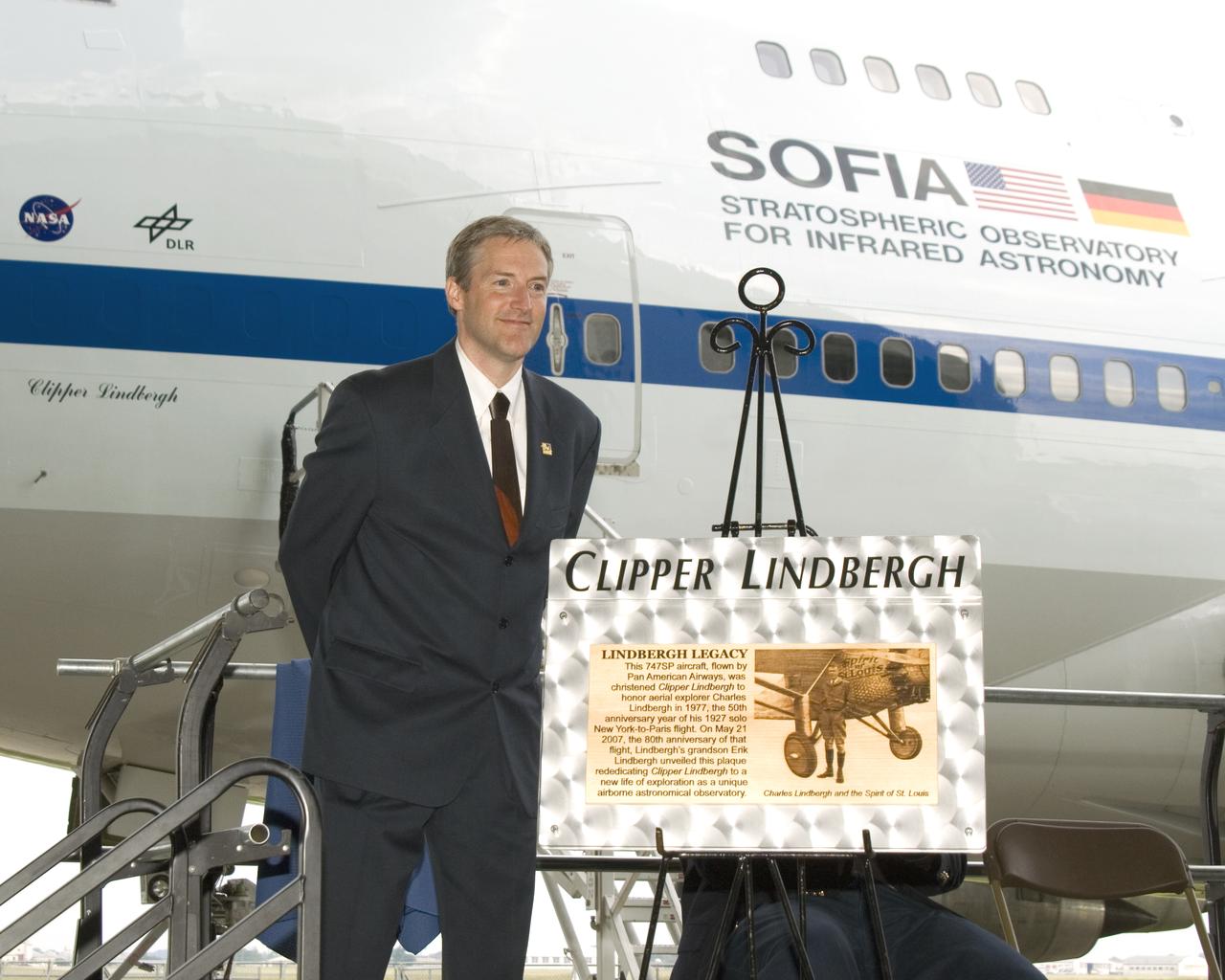
Erik Lindbergh, grandson of aviator Charles Lindbergh, unveiled a plaque commemorating his grandfather on the 80th anniversary of Charles Lindbergh's transatlantic flight. The event was a dedication of the 747 Clipper Lindbergh, a NASA airborne infrared observatory that is beginning test flights in preparation for conducting world-class airborne astronomy. The project is known as the Stratospheric Observatory for Infrared Astronomy, or SOFIA.
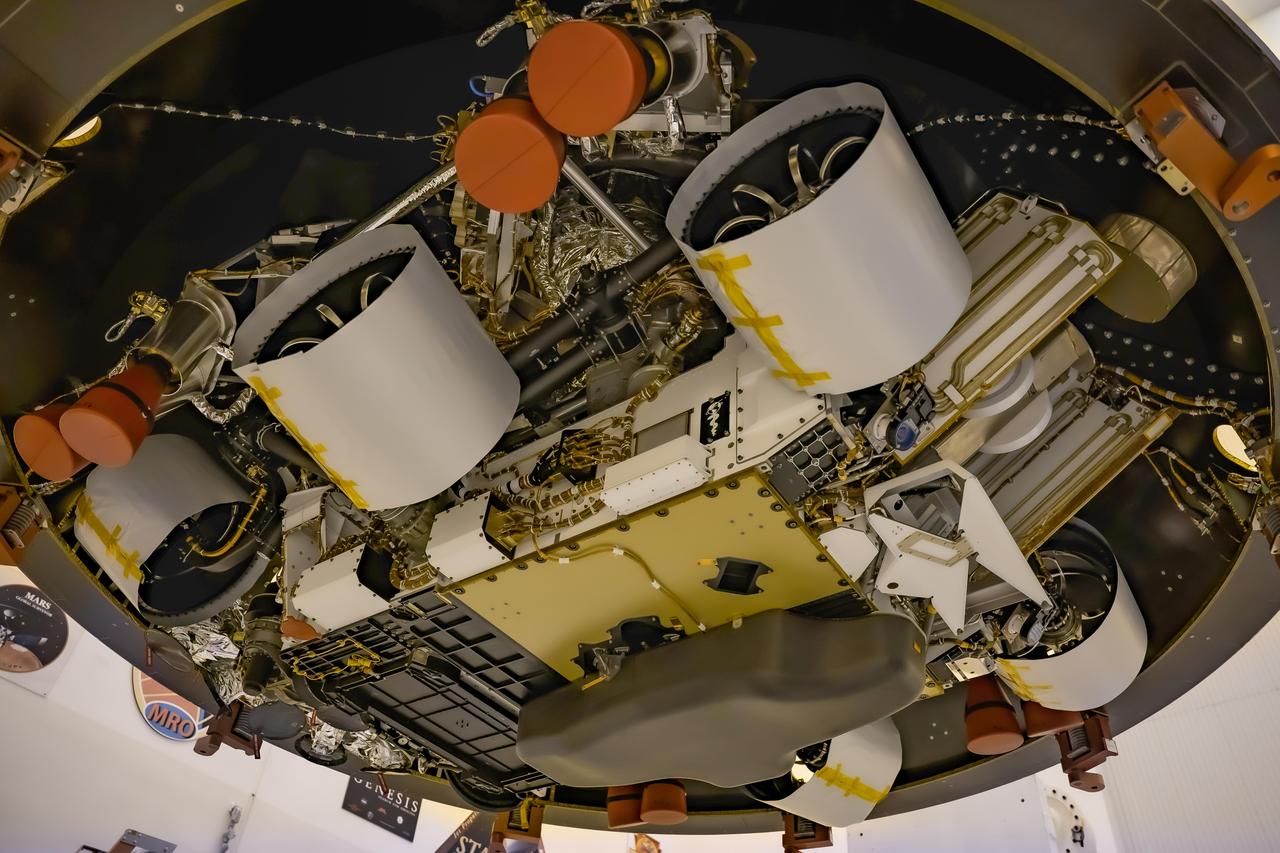
Seen from below, NASA's Mars 2020 Perseverance rover is in position in the aeroshell that will protect the rover on its way to the Red Planet. To the right of the middle wheel is the plaque that commemorates the impact of the COVID-19 pandemic and pays tribute to the perseverance of healthcare workers around the world. Featuring a snake-entwined rod to symbolize healing and medicine, the plaque was attached to the rover in May 2020 at Kennedy Space Center in Florida. https://photojournal.jpl.nasa.gov/catalog/PIA23924
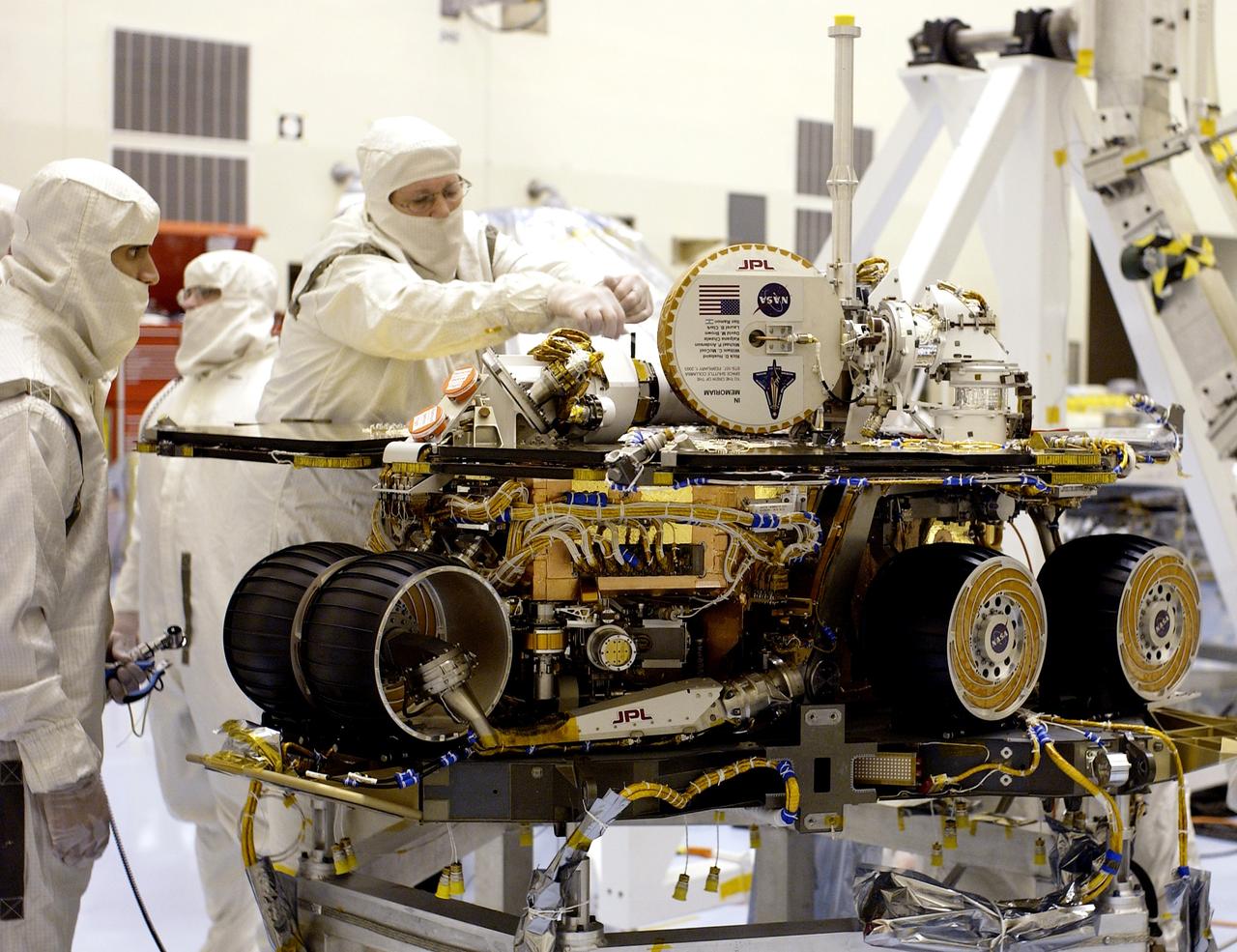
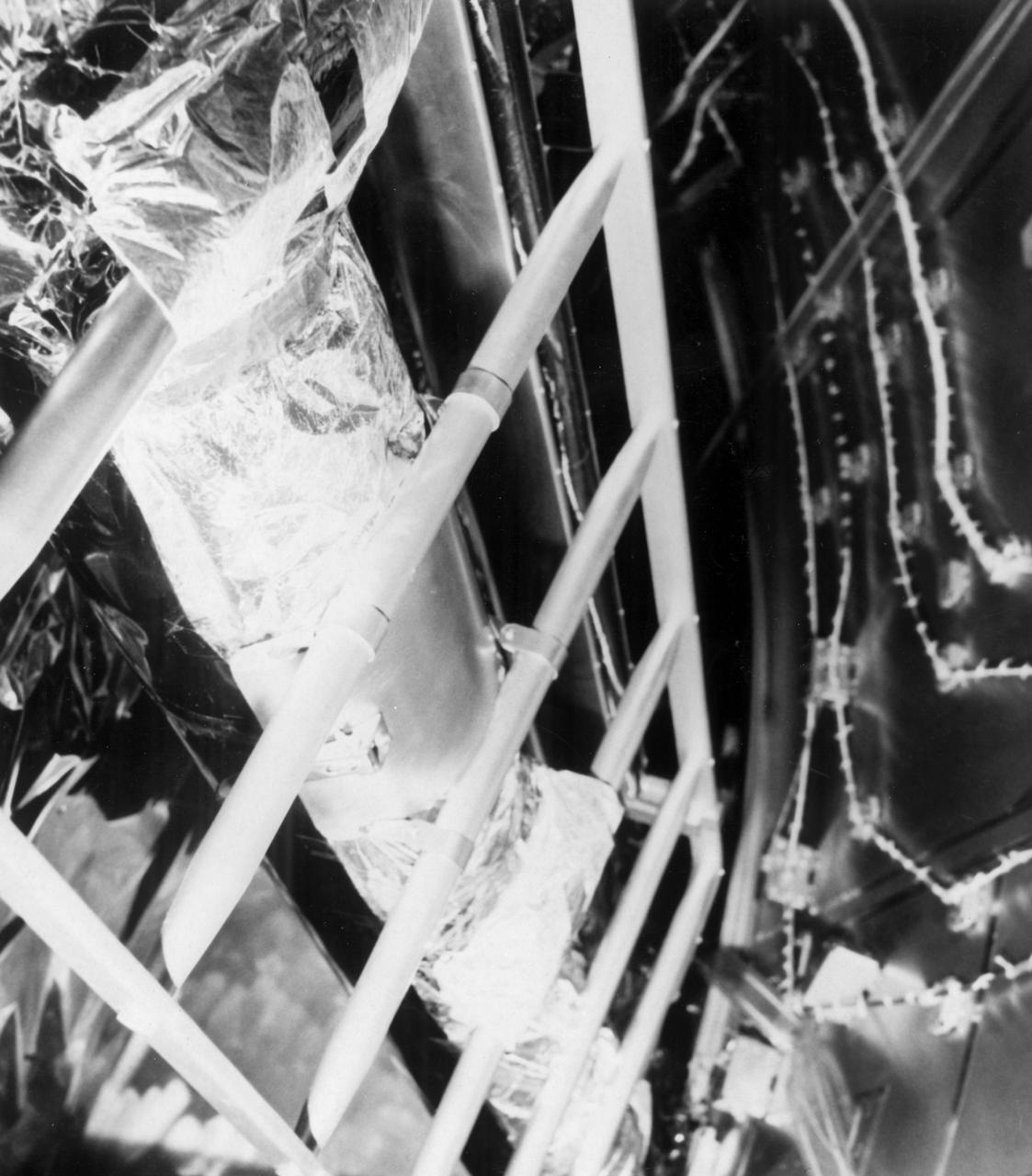
KENNEDY SPACE CENTER, FLA. -- This plaque commemorating the STS-107 Space Shuttle Columbia crew now looks over the Mars landscape after the successful landing and deployment of the Mars Exploration Rover “Spirit” Jan. 4 onto the red planet. The plaque, mounted on the high-gain antenna, is shown while the rover underwent final checkout March 28, 2003, in the Payload Hazardous Servicing Facility at KSC.
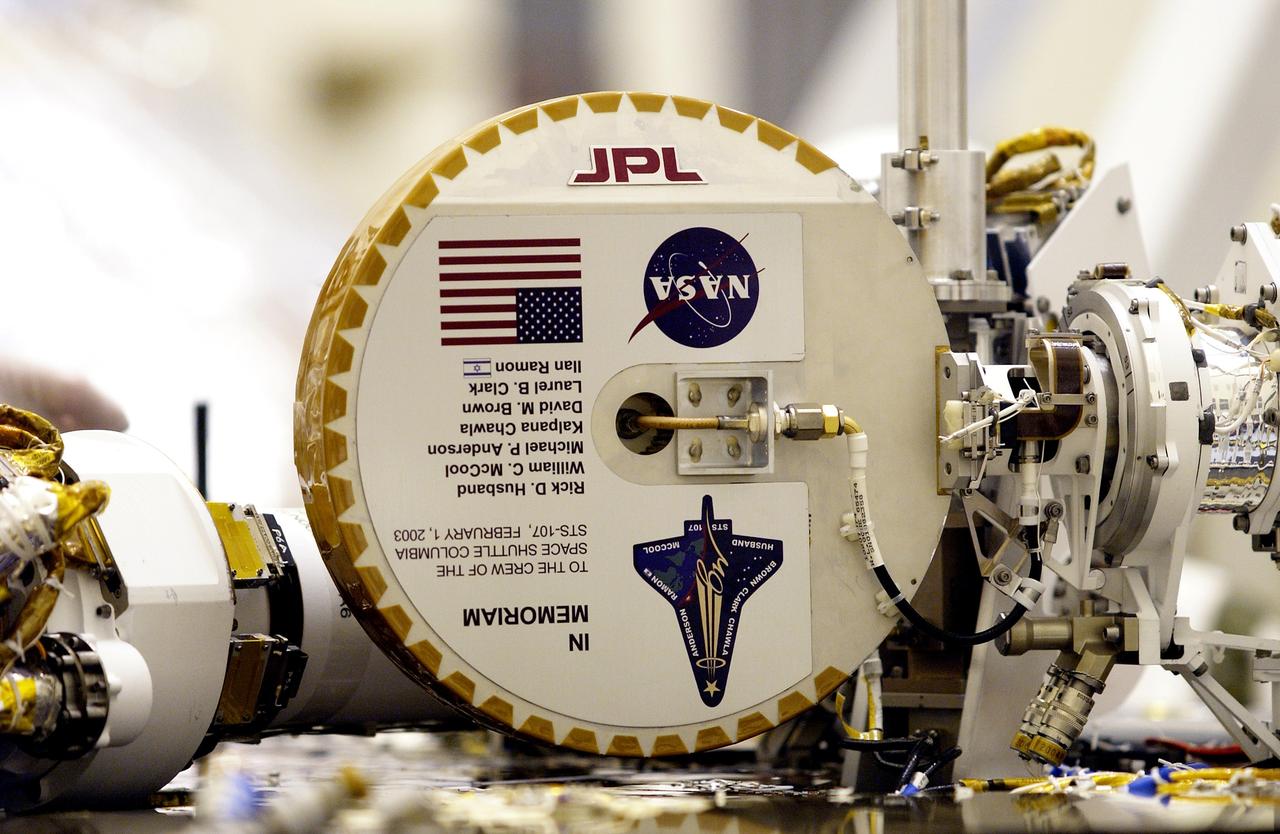
KENNEDY SPACE CENTER, FLA. -- This plaque commemorating the STS-107 Space Shuttle Columbia crew now looks over the Mars landscape after the successful landing and deployment of the Mars Exploration Rover “Spirit” Jan. 4 onto the red planet. The plaque, mounted on the high-gain antenna, is shown while the rover underwent final checkout March 28, 2003, in the Payload Hazardous Servicing Facility at KSC.
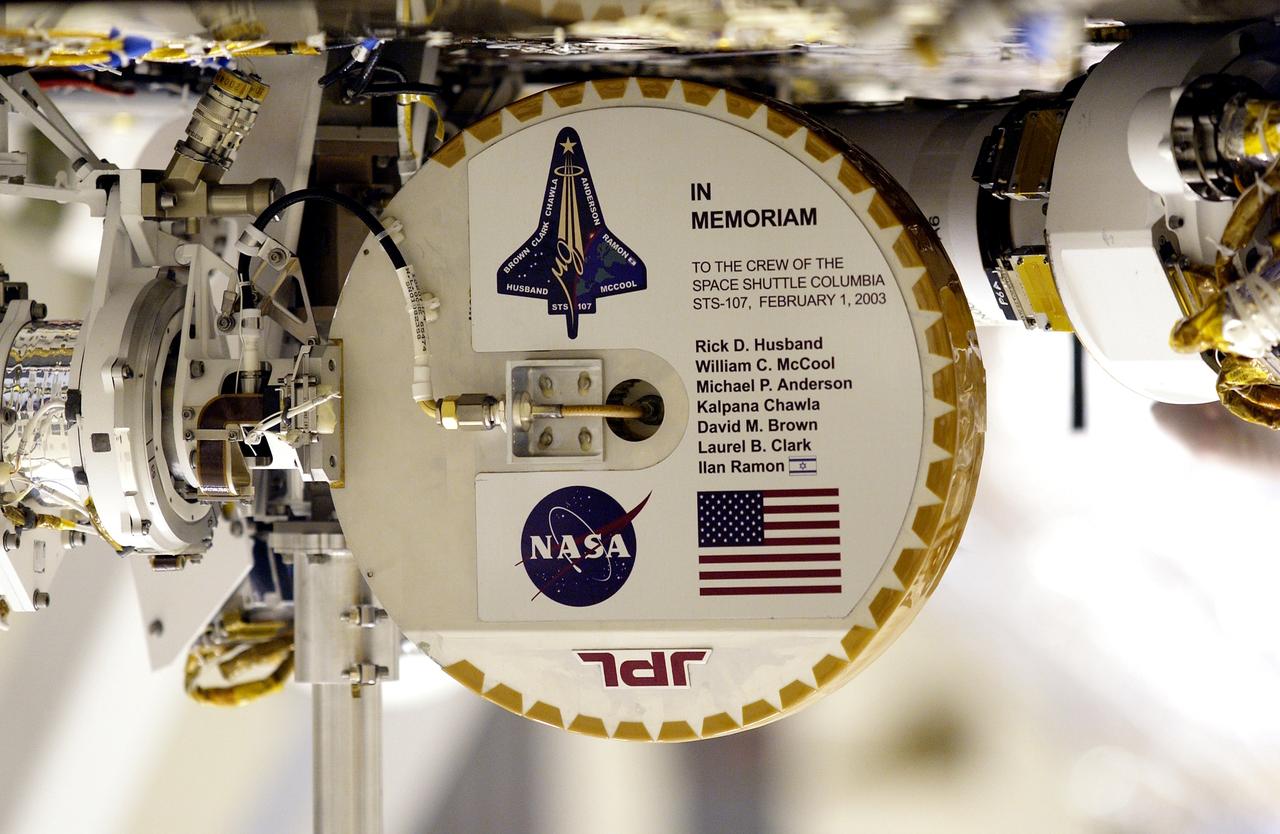
KENNEDY SPACE CENTER, FLA. --Shown upside down to read the names, this plaque commemorating the STS-107 Space Shuttle Columbia crew now looks over the Mars landscape after the successful landing and deployment of the Mars Exploration Rover “Spirit” Jan. 4 onto the red planet. The plaque, mounted on the high-gain antenna, is shown while the rover underwent final checkout March 28, 2003, in the Payload Hazardous Servicing Facility at KSC.
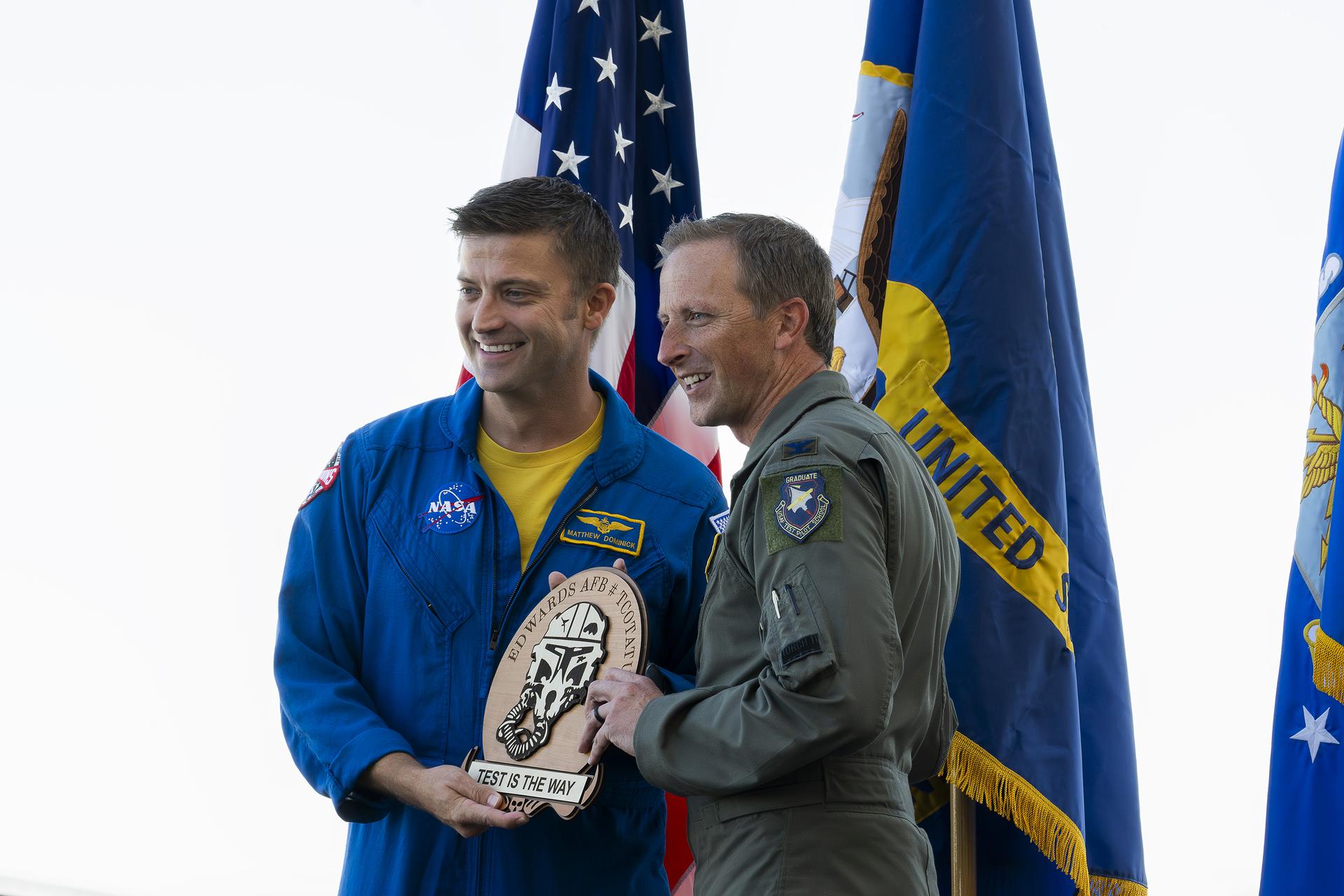
NASA astronaut Matthew Dominick receives a commemorative plaque from Col. Daniel Fredberg, Deputy Commander of the 412th Test Wing at Edwards Air Force Base, California, during Red, White, and Boom, the U.S. Air Force Test Center’s celebration of America’s 250th anniversary and NASA Armstrong’s commemoration of its 80th year on Friday, Sept. 18, 2026. The event brought together the workforce, families, and the Edwards community for a high‑energy day featuring a Flightline 5K, Ramp Fest and STEM Expo, static aircraft displays, hands‑on STEM activities, and a NASA flyover with a sonic boom.
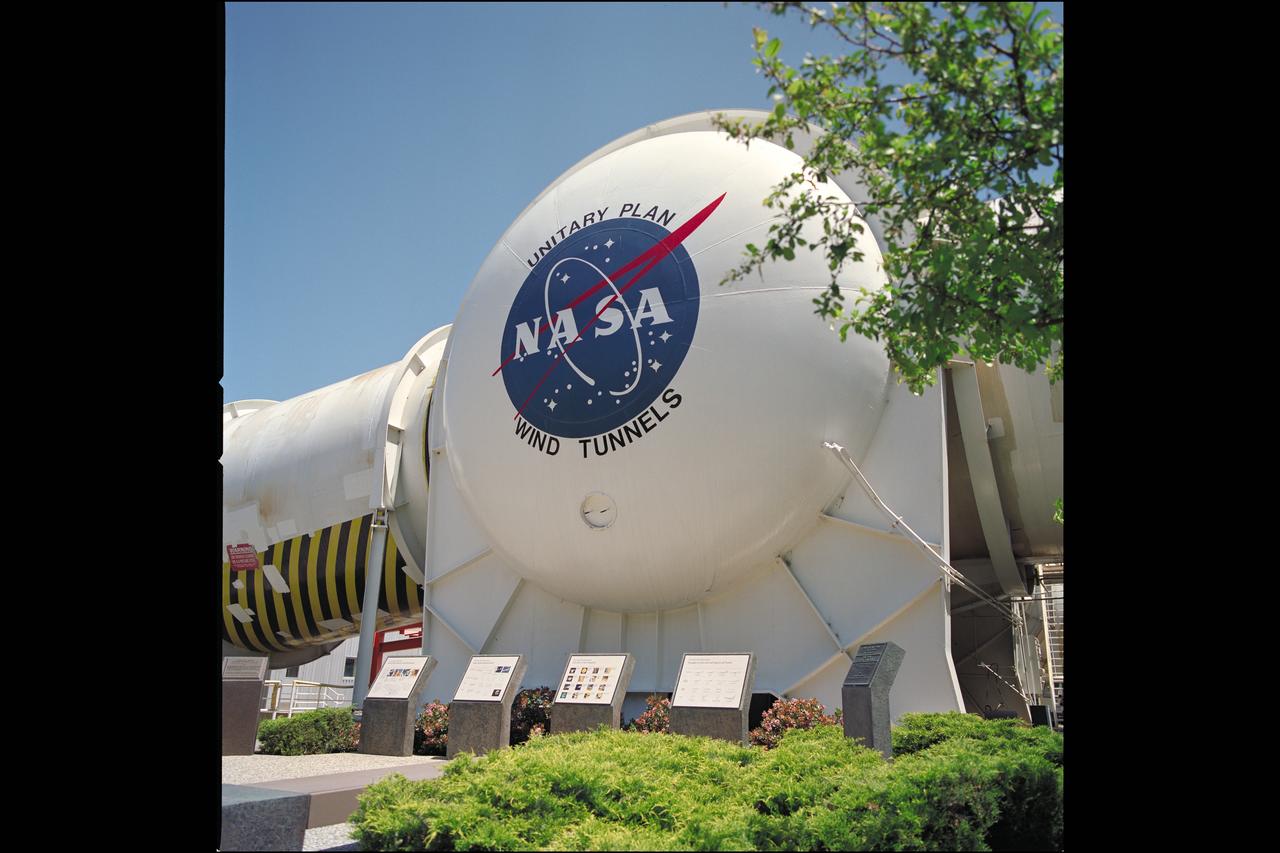
N-227 Unitary Plan Wind Tunnel with NASA 'Meatball' insignia over looking the National Historical Landmark sites' commemorative plaques
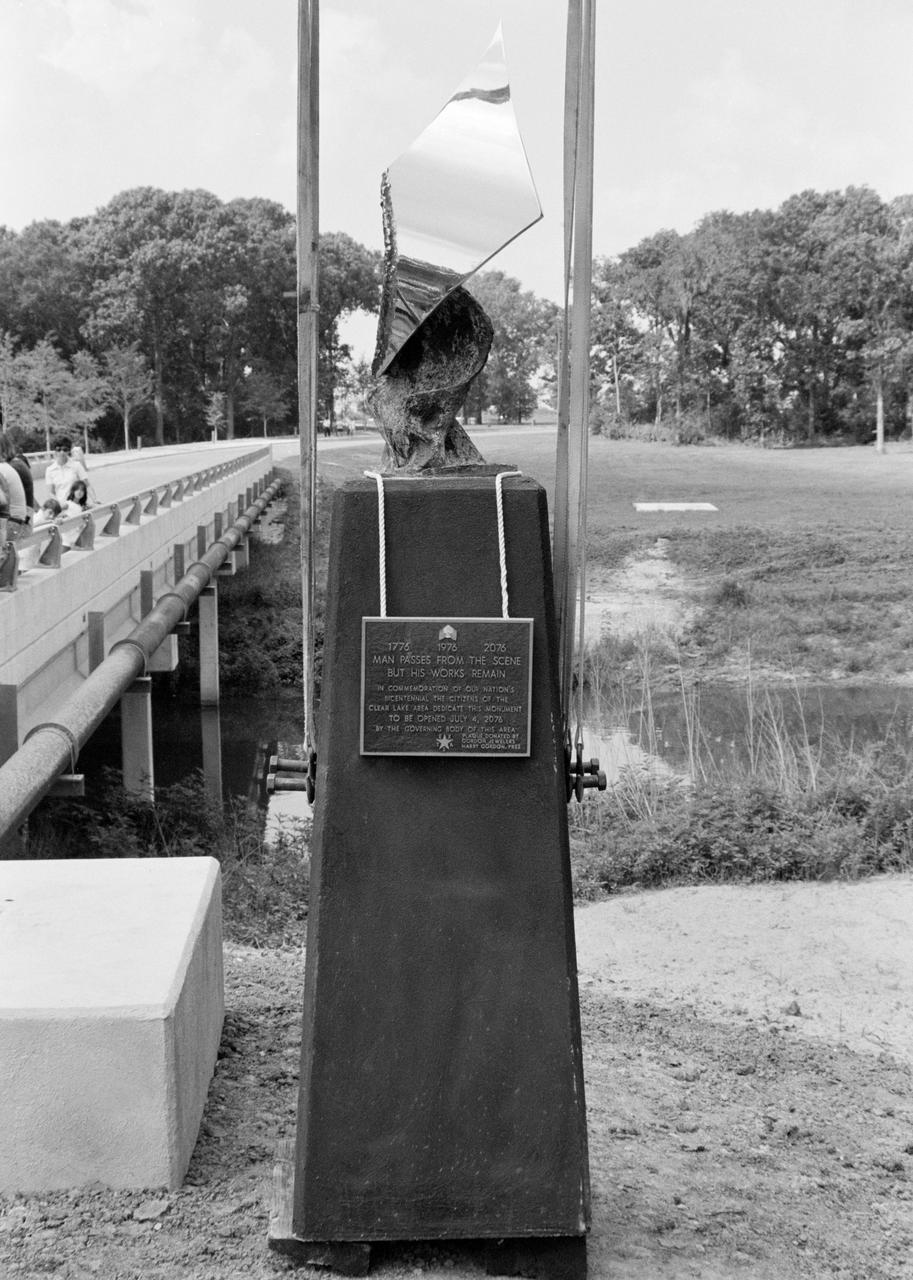
View taken during dedication of University of Houston, Clear Lake campus.Image is of plaque commemorating the bicentennial put in place by the citizens of the Clear Lake area.
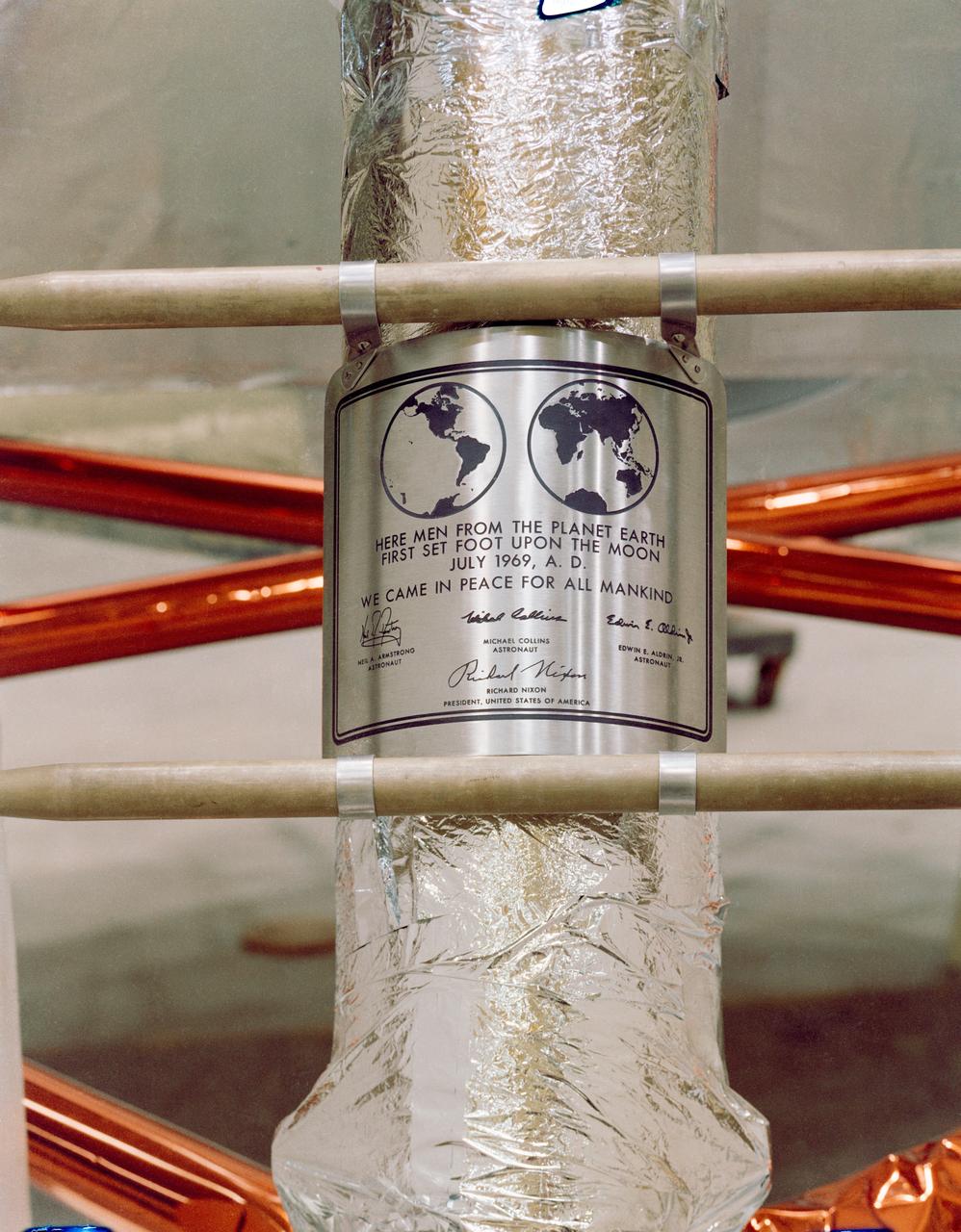
S69-38749 (July 1969) --- Close-up view of the plaque which the Apollo 11 astronauts will leave behind on the moon in commemoration of the historic event. The plaque is made of stainless steel measuring nine by seven and five-eighths inches, and one-sixteenth inch thick. The plaque will be attached to the ladder on the landing gear strut on the descent stage of the Apollo 11 Lunar Module (LM). Covering the plaque during flight will be a thin sheet of stainless steel which will be removed on the lunar surface.
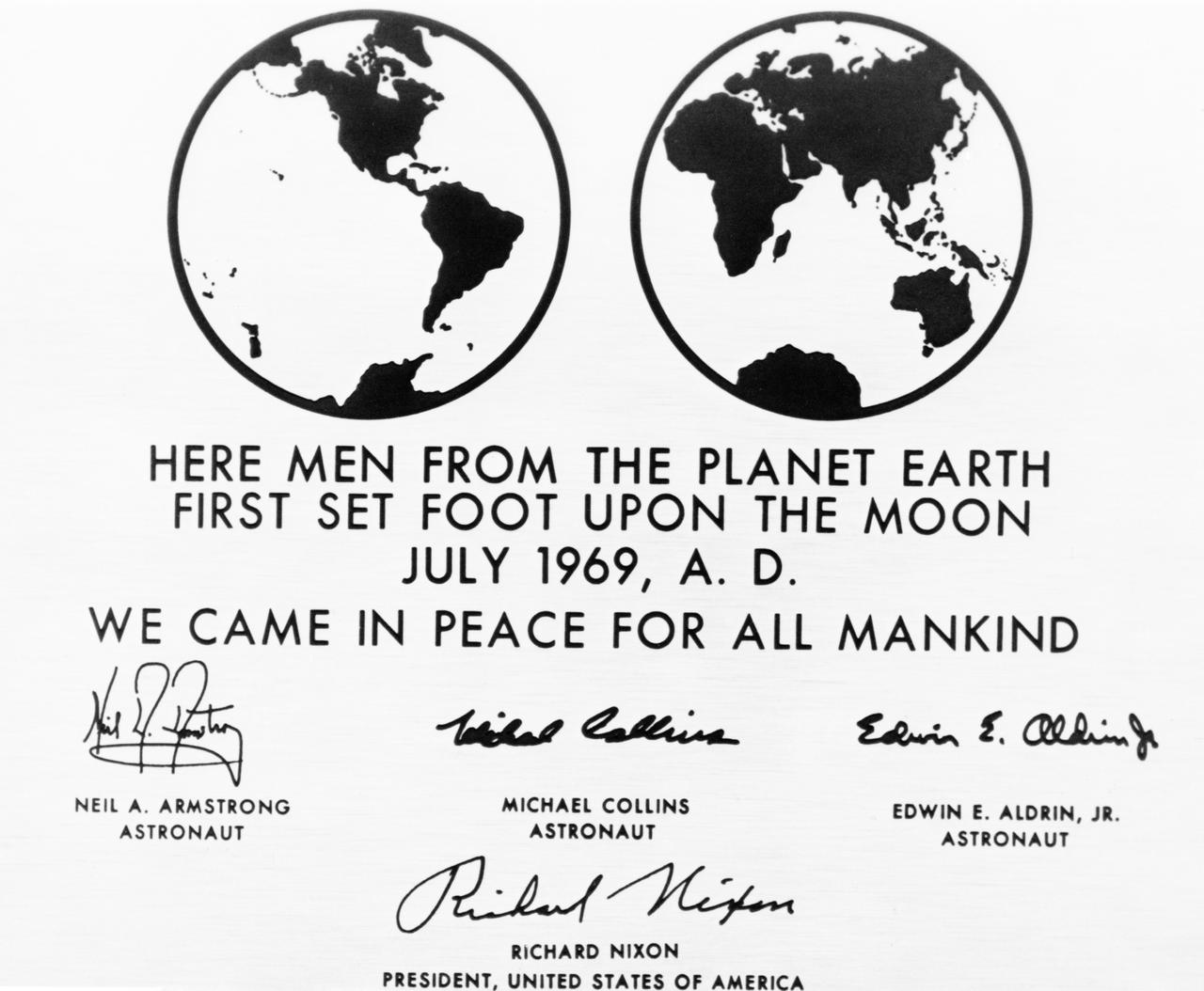
S69-39334 (July 1969) --- This is a replica of the plaque which the Apollo 11 astronauts will leave behind on the moon in commemoration of the historic event. The plaque is made of stainless steel, measuring nine by seven and five-eighths inches, and one-sixteenth inch thick. The plaque will be attached to the ladder on the landing gear strut on the descent stage of the Apollo 11 Lunar Module (LM). Covering the plaque during the flight will be a thin sheet of stainless steel which will be removed on the lunar surface.
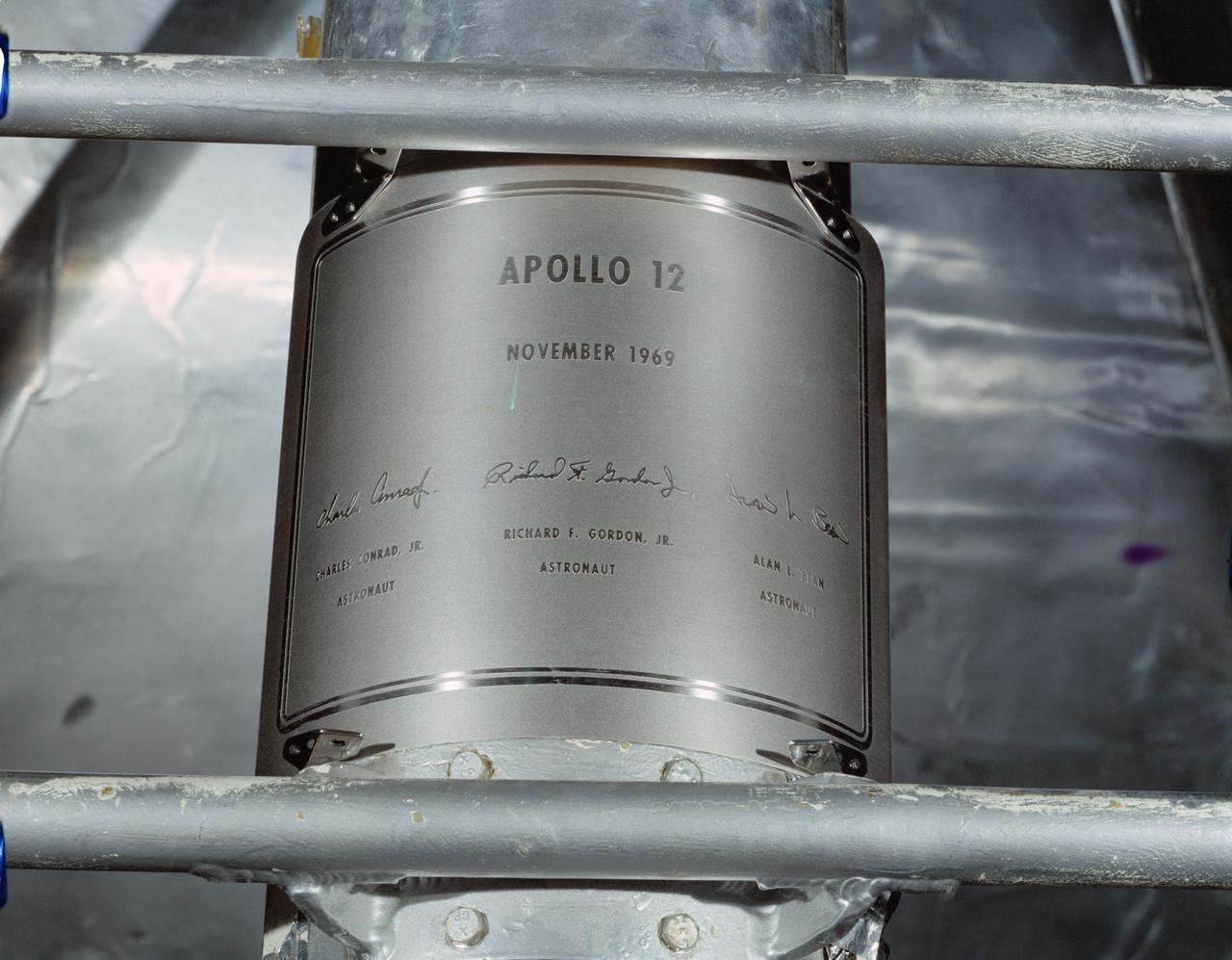
S69-53326 (November 1969) --- Close-up view of a replica of the plaque which the Apollo 12 astronauts will leave on the moon in commemoration of their flight. The plaque will be attached to the ladder on the landing gear strut on the descent stage of the Apollo 12 Lunar Module (LM). Apollo 12 will be the United States' second lunar landing mission.

On June 4, 1974, 5 years after the successful Apollo 11 lunar landing mission, commander Neil Armstrong (right) presented a plaque to U.S. President Richard Milhous Nixon (left) on behalf of all people who had taken part in the space program. In making the presentation, Armstrong said “Mr. President, you have proclaimed this week to be United States Space week in conjunction with the fifth anniversary of our first successful landing on the Moon. It is my privilege to represent my colleagues, the crewmen of projects Mercury, Gemini, Apollo, and Skylab, and the men and women of NASA, and the hundreds of thousands of Americans from across the land who contributed so mightily to the success of our efforts in space in presenting this plaque which bears the names of each individual who has had the privilege of representing this country” in a space flight. The presentation was made at the California white house in San Clemente.
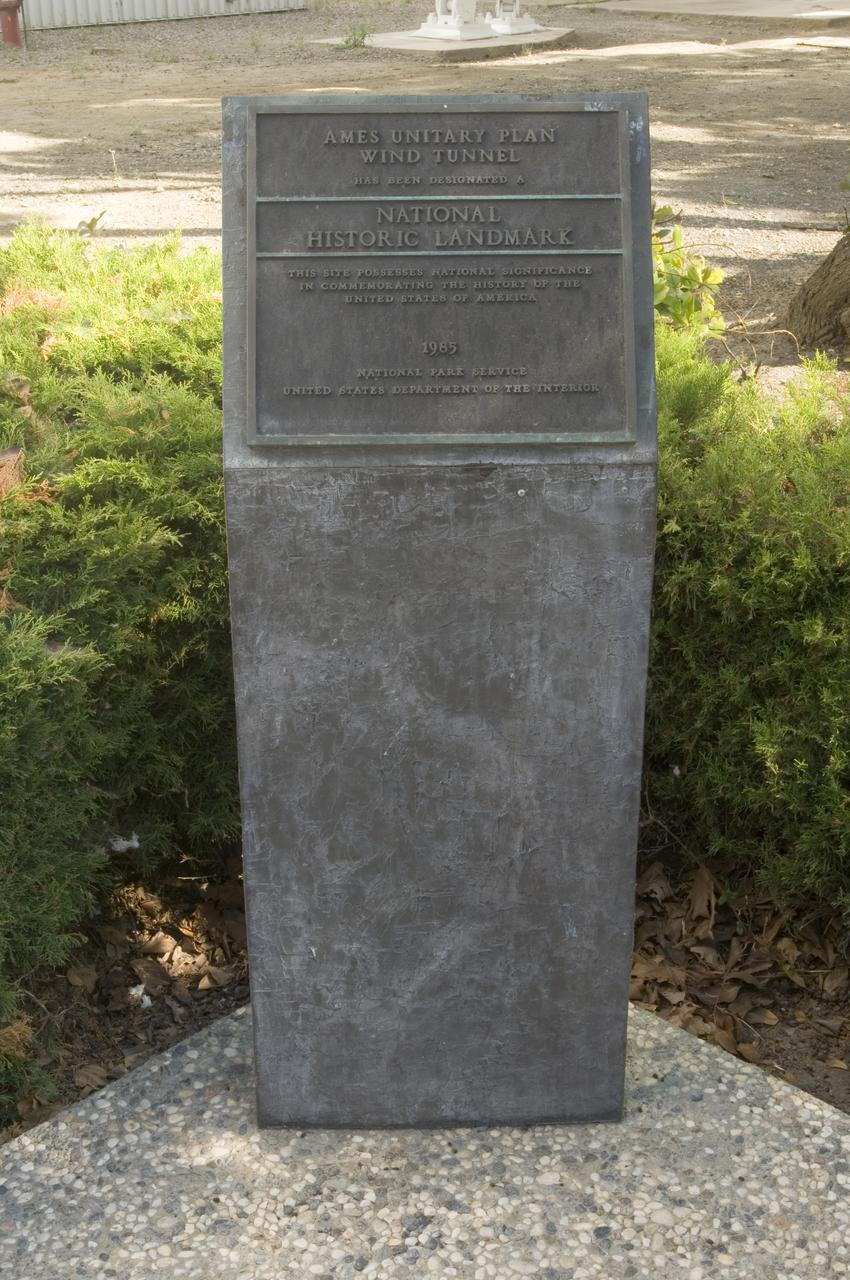
Ames and Moffett Field (MFA) historical sites and memorials Unitary Plan Wind Tunned plaza; display and historical site plaques with the NASA logo on the Wind Tunnel valve as a backdrop. Plaque depicts that Ames Unitary Plan Wind Tunnel has been designated a National Historic Landmark by the National Park Service, United States Department of the Interior 1985 The plaque reads; This site possesses national significance in commemorating the history of the United States of America. That ceremony took place on September 12, 1990
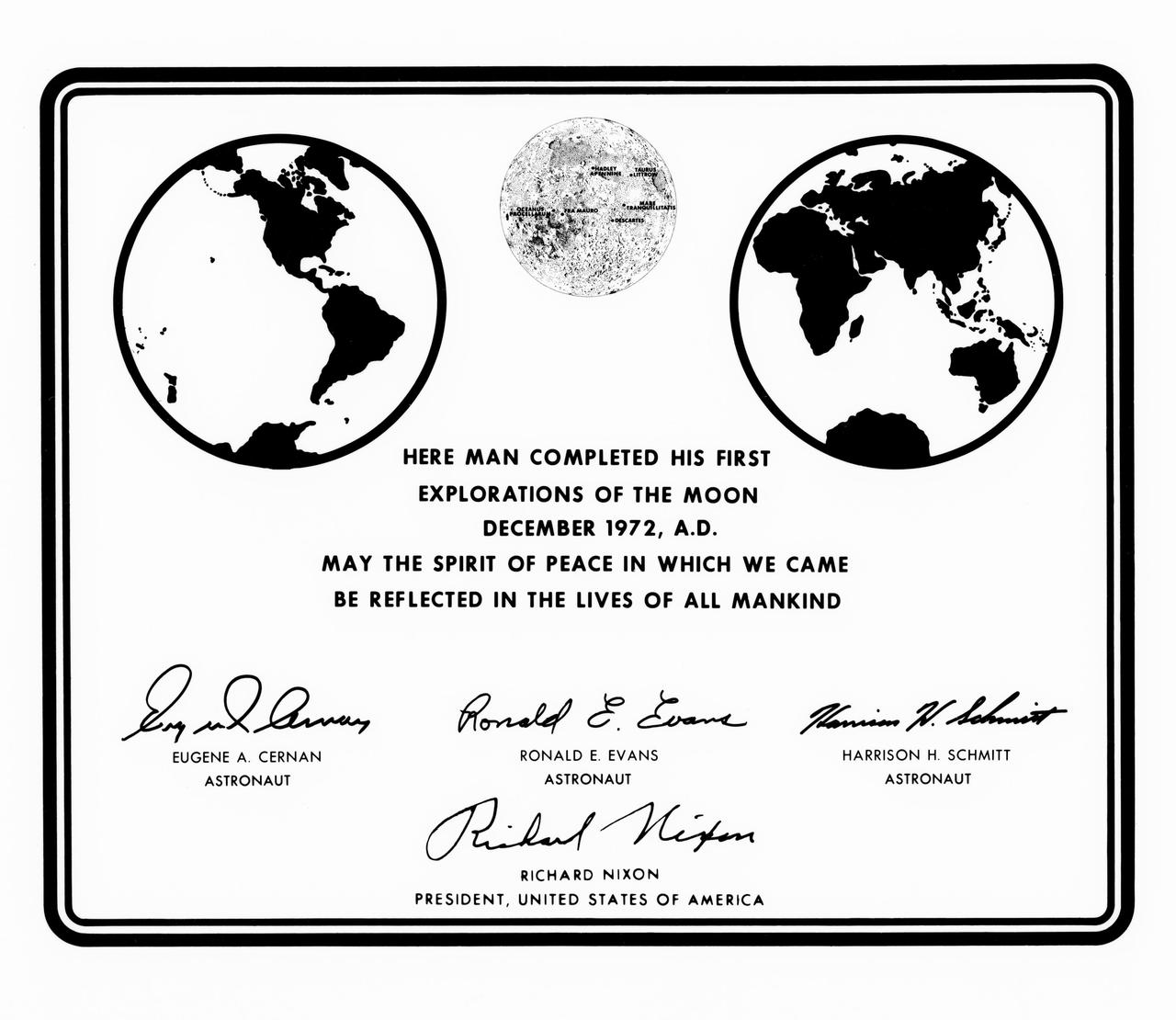
S72-55169 (14 Dec. 1972) --- A photographic replica of the plaque which the Apollo 17 astronauts left behind at the Taurus-Littrow landing site. Apollo 17 is the final lunar landing mission in NASA's Apollo program. The commemorative plaque was unveiled at the close of the third extravehicular activity (EVA). The plaque is made of stainless steel measuring nine by seven and five-eighths inches, and one-sixteenth inch thick. It is attached to the ladder on the landing gear strut on the descent stage of Apollo 17 Lunar Module (LM) "Challenger".
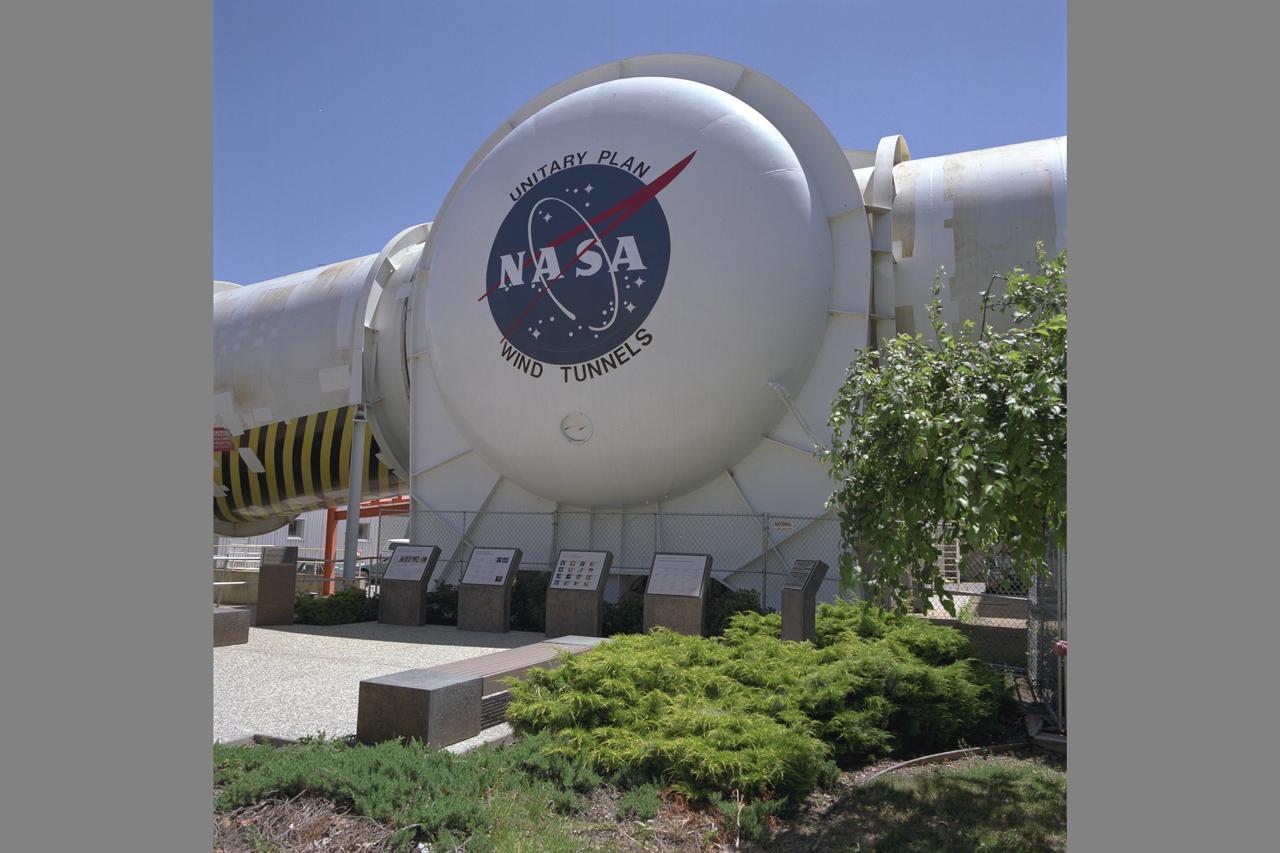
Unitary Plan Wind Tunnel N-227 (new) NASA Logo with Unitary International Historic Mechanical Engineering Landmark commemorative plaques in front. Date: June 16, 1998 Photographer: Tom Trower
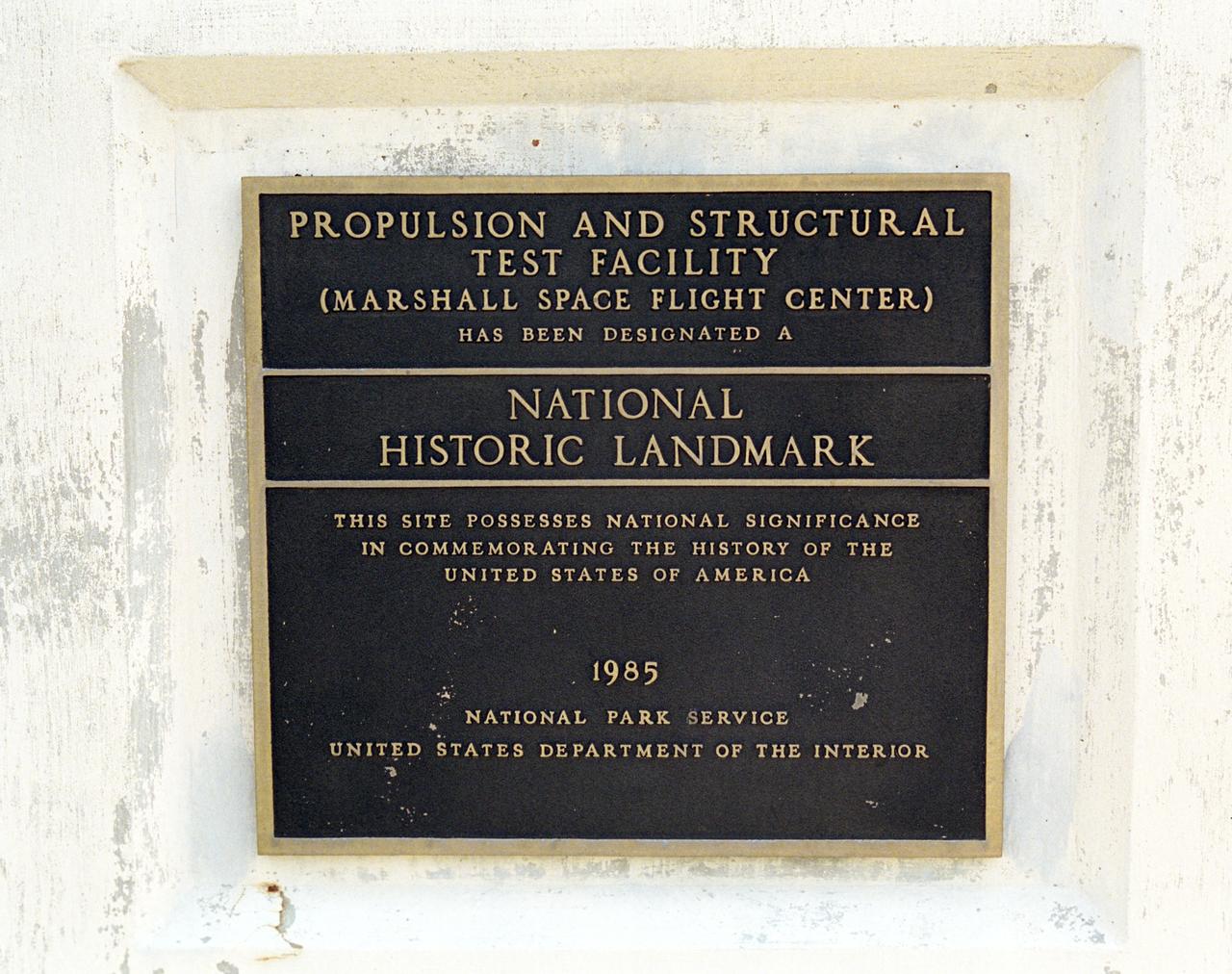
This plaque, displayed on the grounds of Marshall Space Flight Center in Huntsville, Alabama, commemorates the designation of the Propulsion and Structural Test Facility as a National Historic Landmark by the National Park Service of the United States Interior. The site was designated as a landmark in 1985.
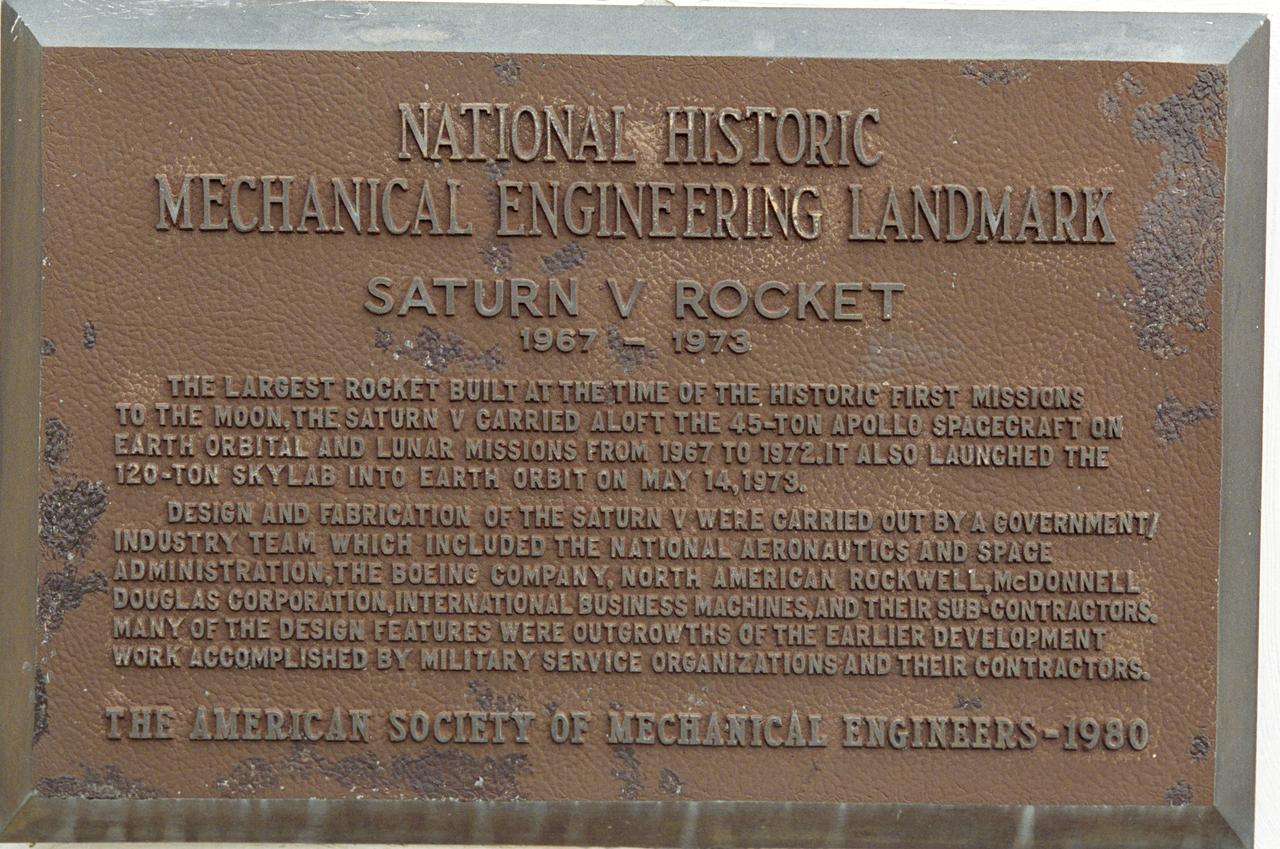
This plaque, located on the grounds of Marshall Space Flight Center in Huntsville, Alabama,commemorates the designation of the Saturn V Rocket as a National Historic Mechanical Engineering Landmark by the American Society of Mechanical Engineers in 1980.
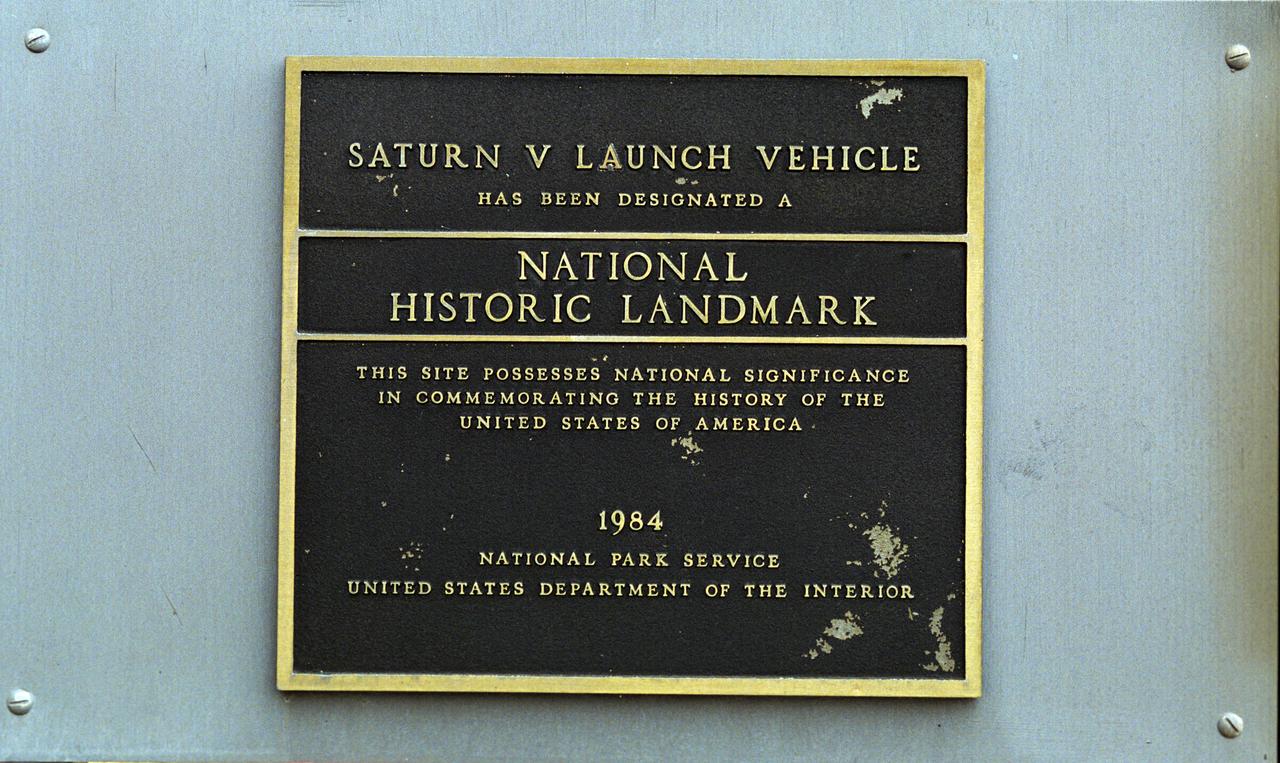
This plaque, displayed on the grounds of Marshall Space Flight Center in Huntsville, Alabama, commemorates the Saturn V Launch Vehicle as a National Historic Landmark. The site was designated as such in 1984 by the National Park Service of the United States Department of the Interior.
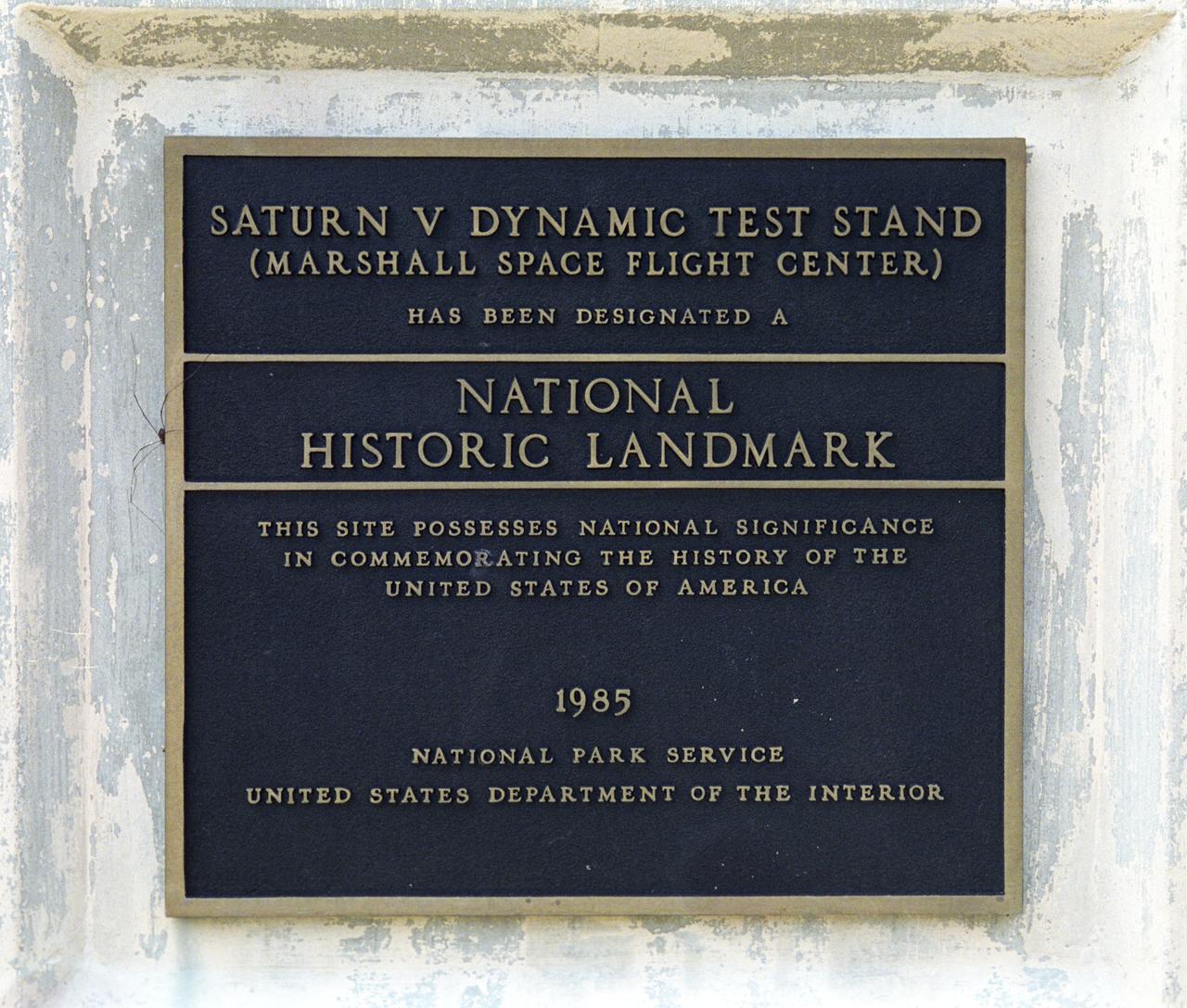
This plaque, displayed on the grounds of Marshall Space Flight Center in Huntsville, Alabama, commemorates the Saturn V Dynamic Test Stand as a National Historic Landmark. The site was designated as such in 1985 by the National Park Service of the United States Department of the Interior.
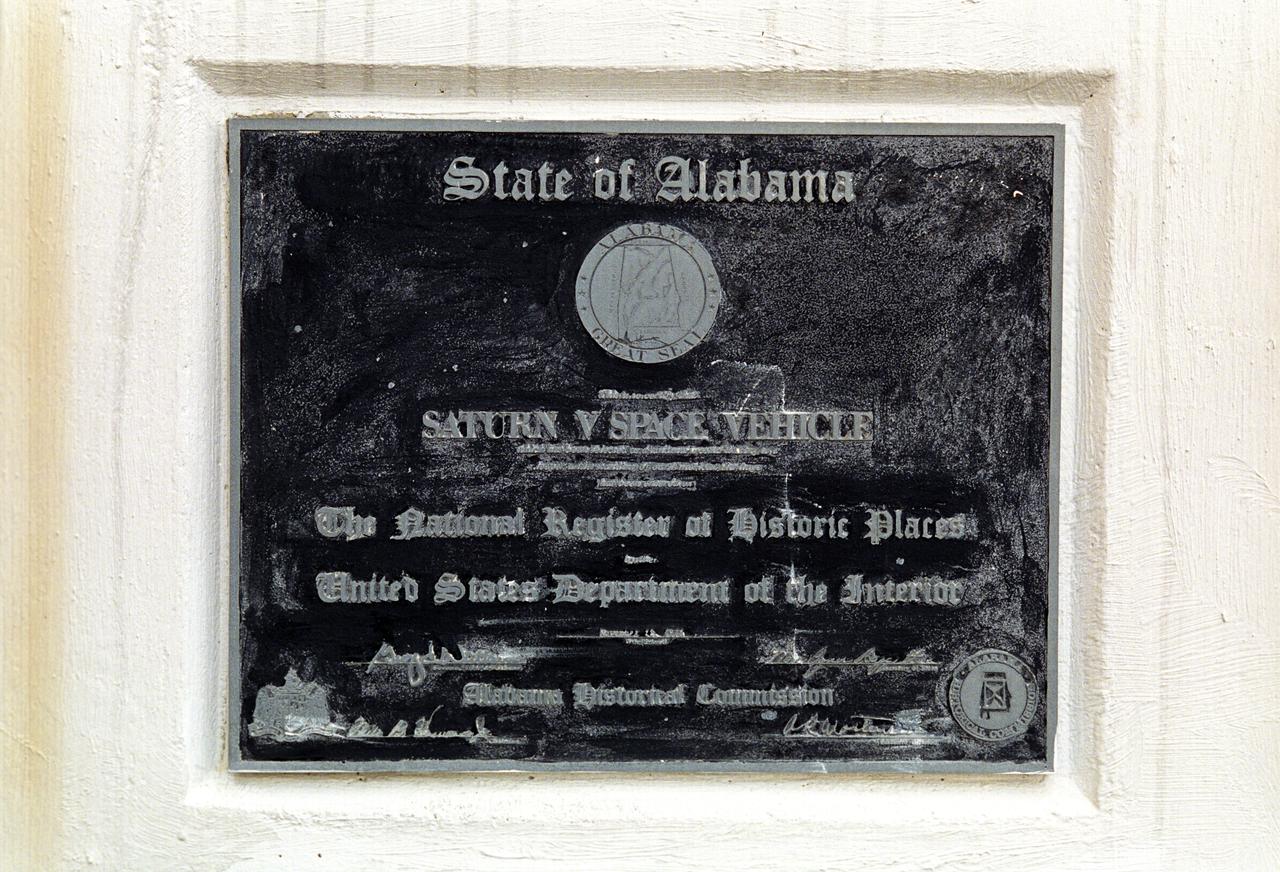
This plaque, displayed on the grounds of Marshall Space Flight Center in Huntsville, Alabama, commemorates the Saturn V Space Vehicle’s induction into the National Register of Historic Places by the United States Department of the Interior.
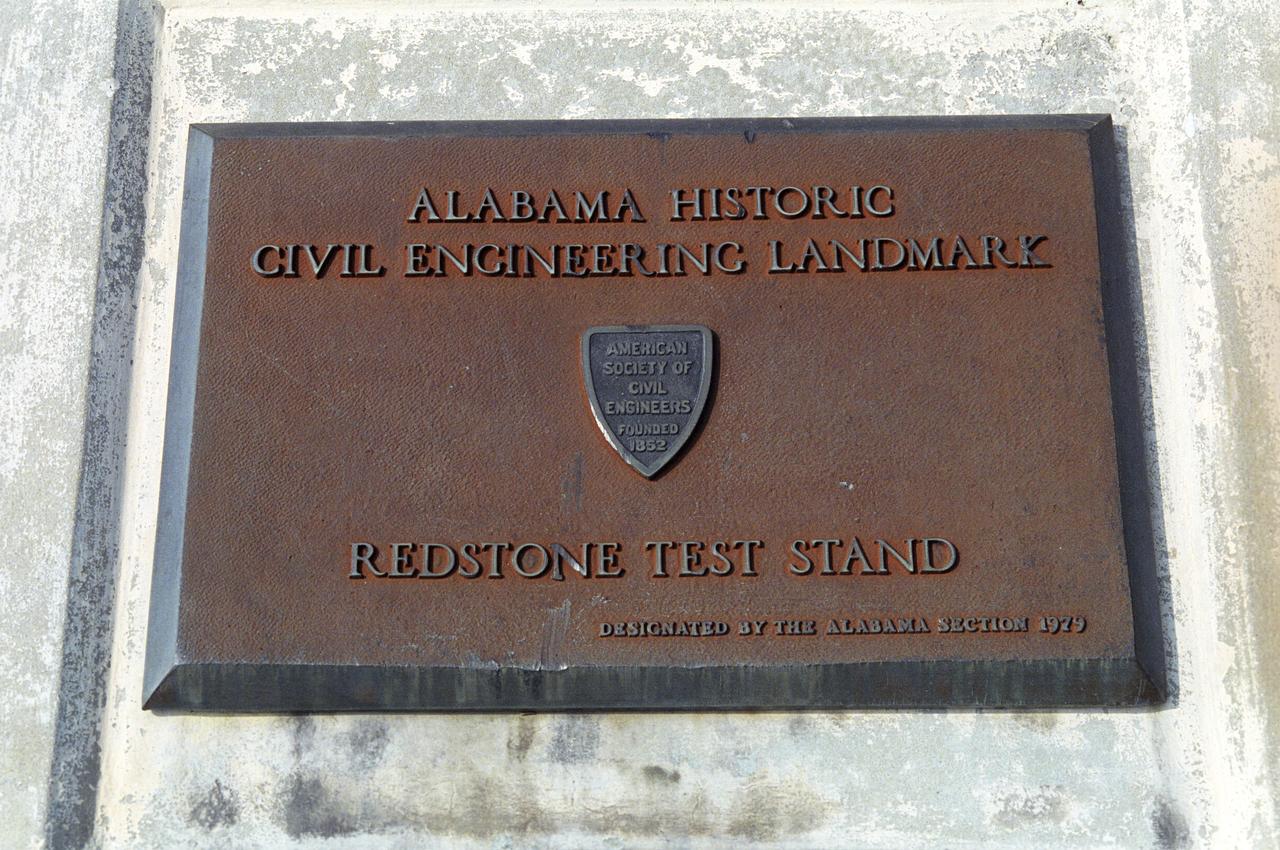
This plaque, displayed on the grounds of Marshall Space Flight Center in Huntsville, Alabama, commemorates the Redstone Test Stand as an Alabama Historic Civil Engineering Landmark. The site was desinated as such in 1979.
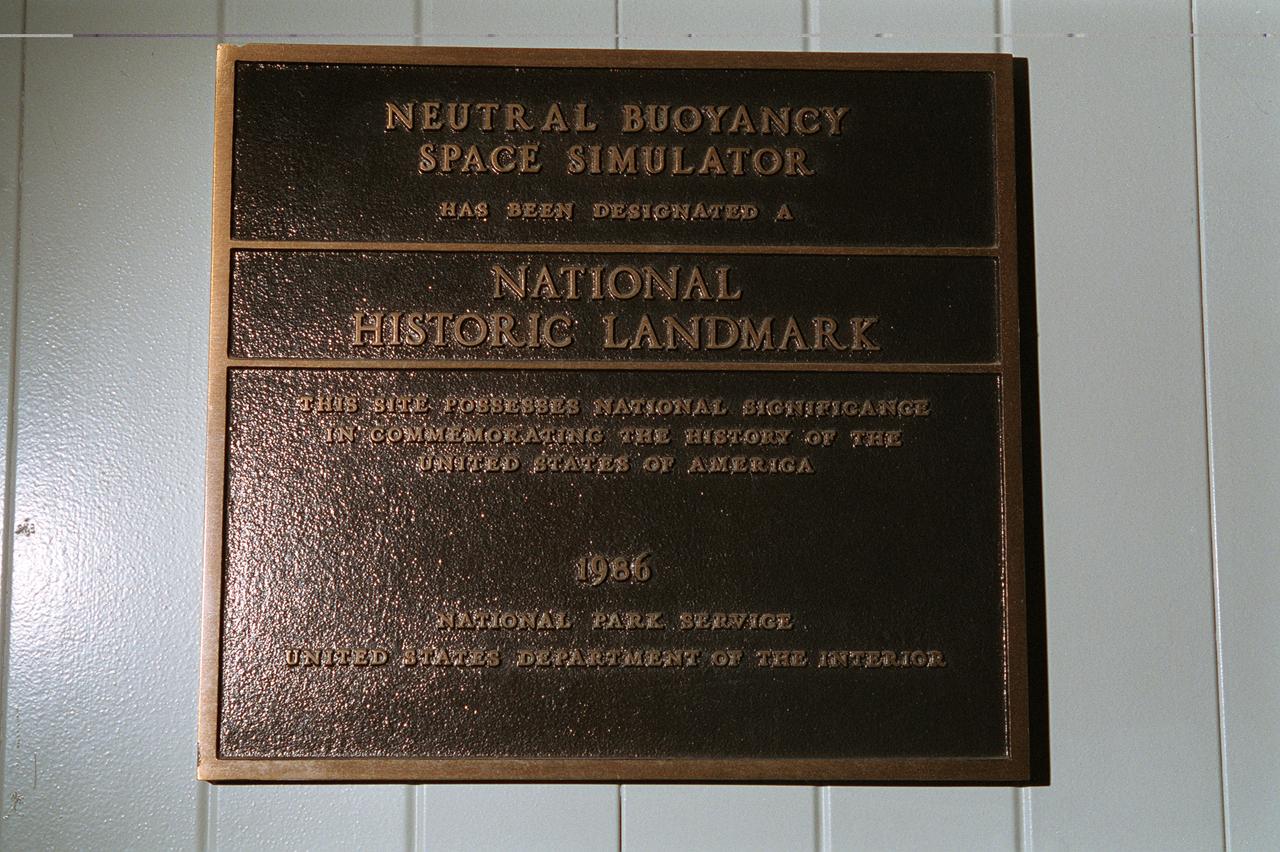
This plaque, displayed on the grounds of Marshall Space Flight Center in Huntsville, Alabama commemorates the Neutral Buoyancy Space Simulator as a National Historic Landmark. The site was designated as such in 1986 by the National Park Service of the United States Department of the Interior.
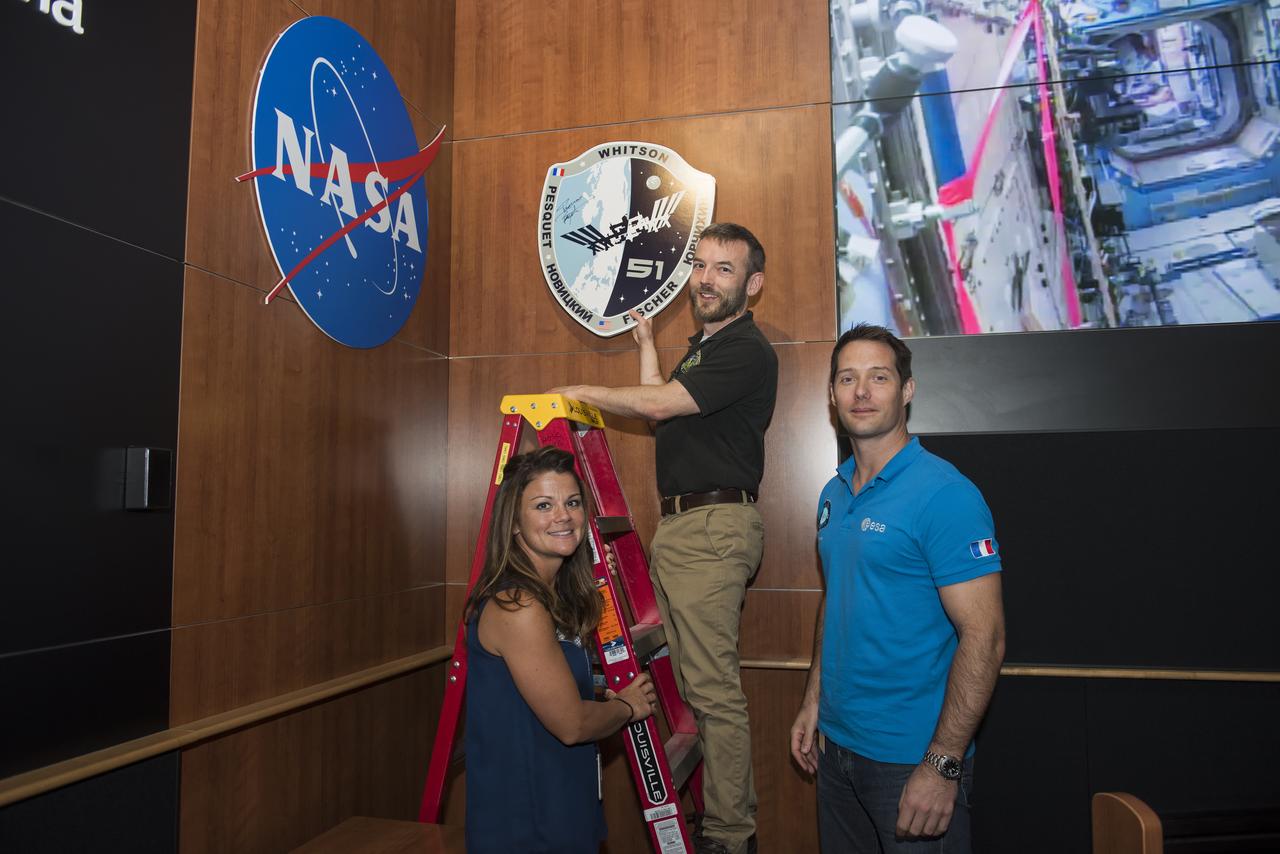
Space Station expedition 50/51 crew member Thomas Pesquet hangs a commemorative plaque in the Payload Operation Integration Center at NASA's Marshall Space Flight Center.
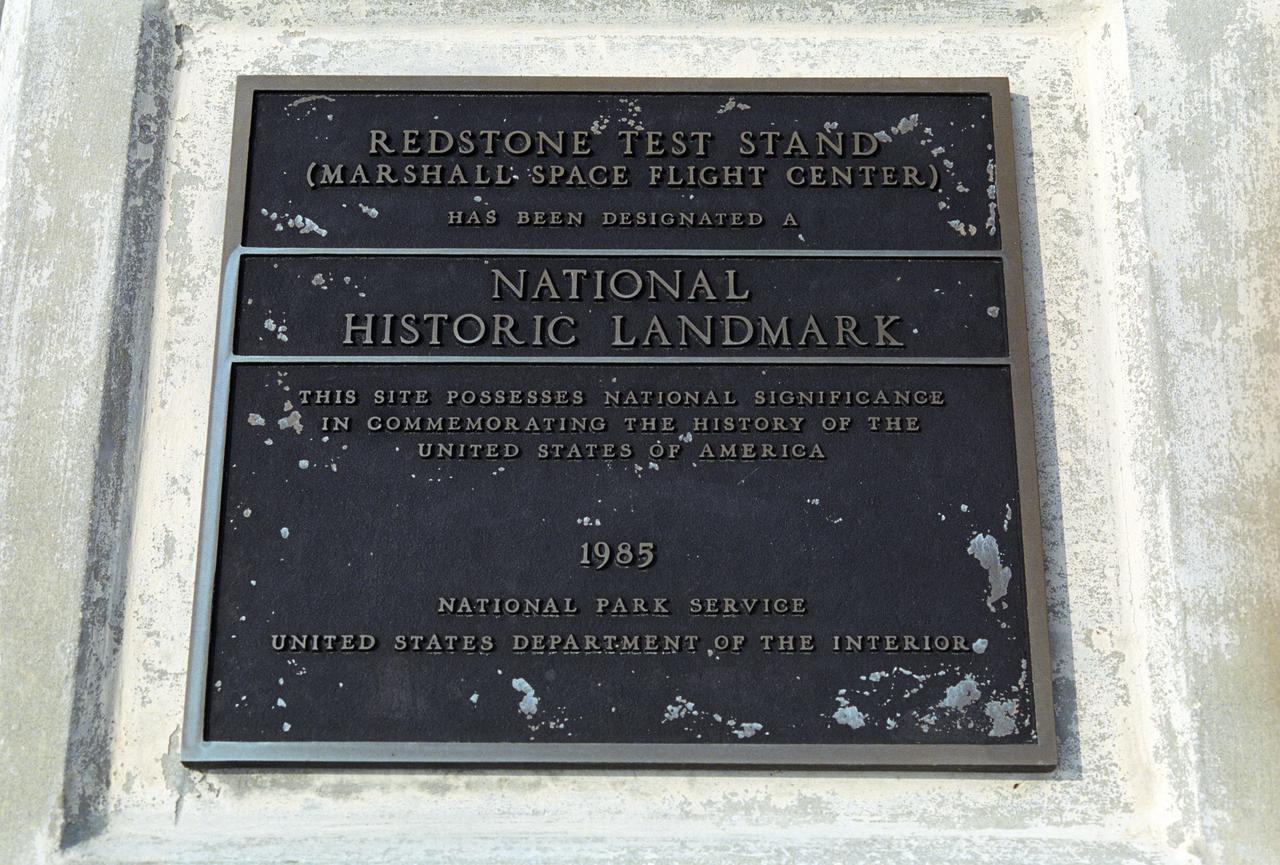
This plaque, displayed on the grounds of Marshall Space Flight Center in Huntsville, Alabama, commemorates the Redstone Test Stand as a National Historic Landmark. The site was designated as such in 1985 by the National Park Service of the United States Department of the Interior.
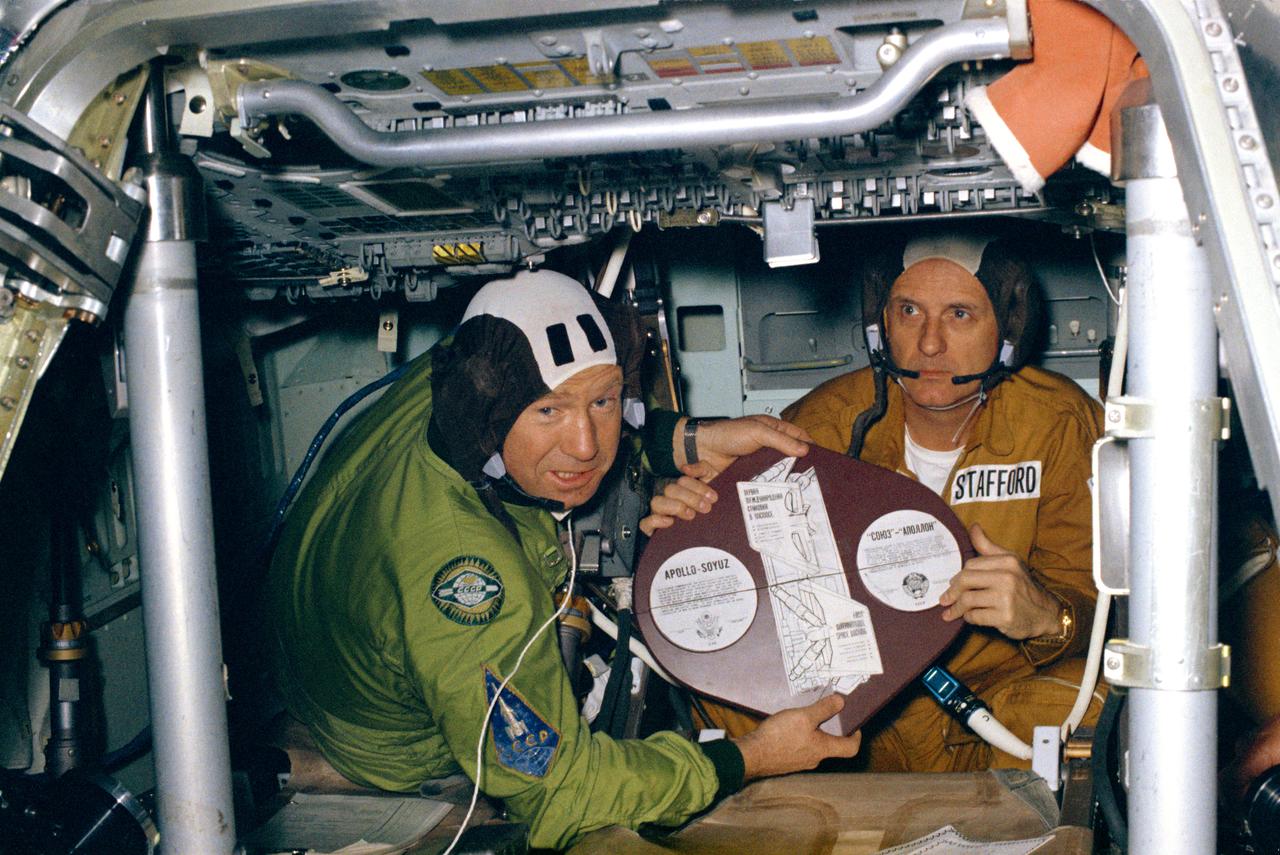
S75-25823 (February 1975) --- Cosmonaut Aleksei A. Leonov (left) and astronaut Thomas P. Stafford display the Apollo Soyuz Test Project (ASTP) commemorative plaque. The two commanders, of their respective crews, are in the Apollo Command Module (CM) trainer at Building 35 at NASA's Johnson Space Center (JSC). Two plaques divided into four quarters each will be flown on the ASTP mission. The American ASTP Apollo crew will carry the four United States quarter pieces aboard Apollo; and the Soviet ASTP Soyuz 19 crew will carry the four USSR quarter sections aboard Soyuz. The eight quarter pieces will be joined together to form two complete commemorative plaques after the two spacecraft rendezvous and dock in Earth orbit. One complete plaque then will be returned to Earth by the astronauts; and the other complete plaque will be brought back by the cosmonauts. The plaque is written in both English and Russian. The Apollo crew will consist of astronauts Thomas P. Stafford, commander; Donald K. "Deke" Slayton, docking module pilot; Vance D. Brand, command module pilot. The Soyuz 19 crew will consist of cosmonauts Aleksei A. Leonov, command pilot; and Valeri N. Kubasov, flight engineer.
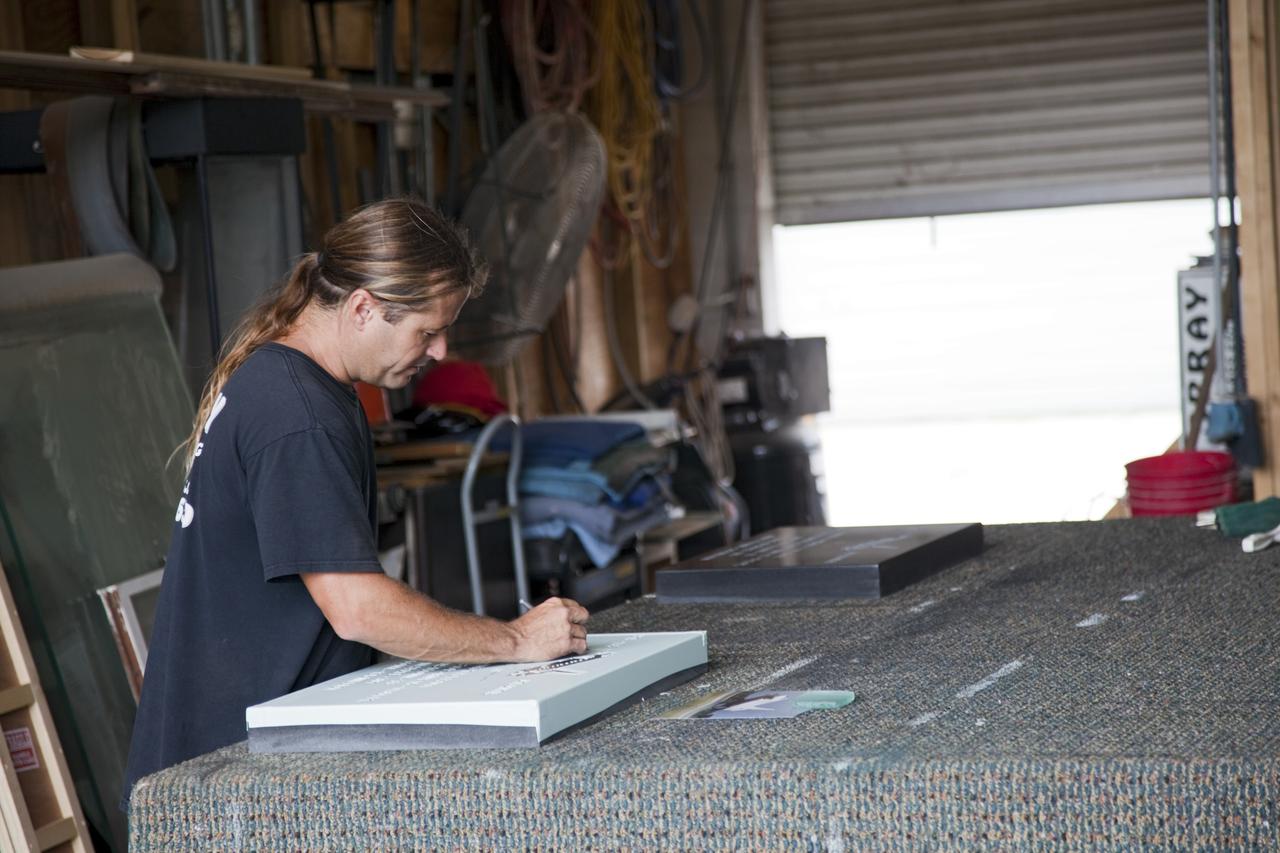
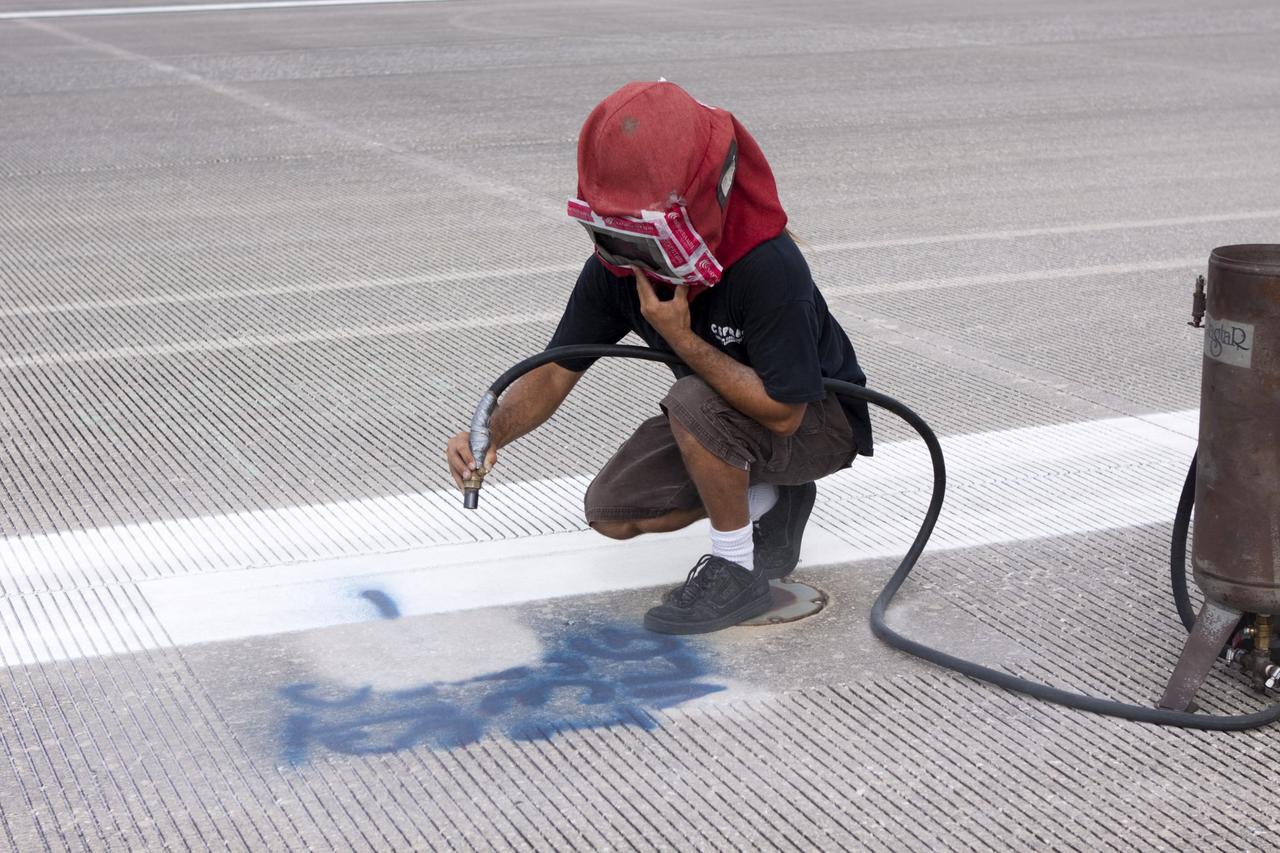
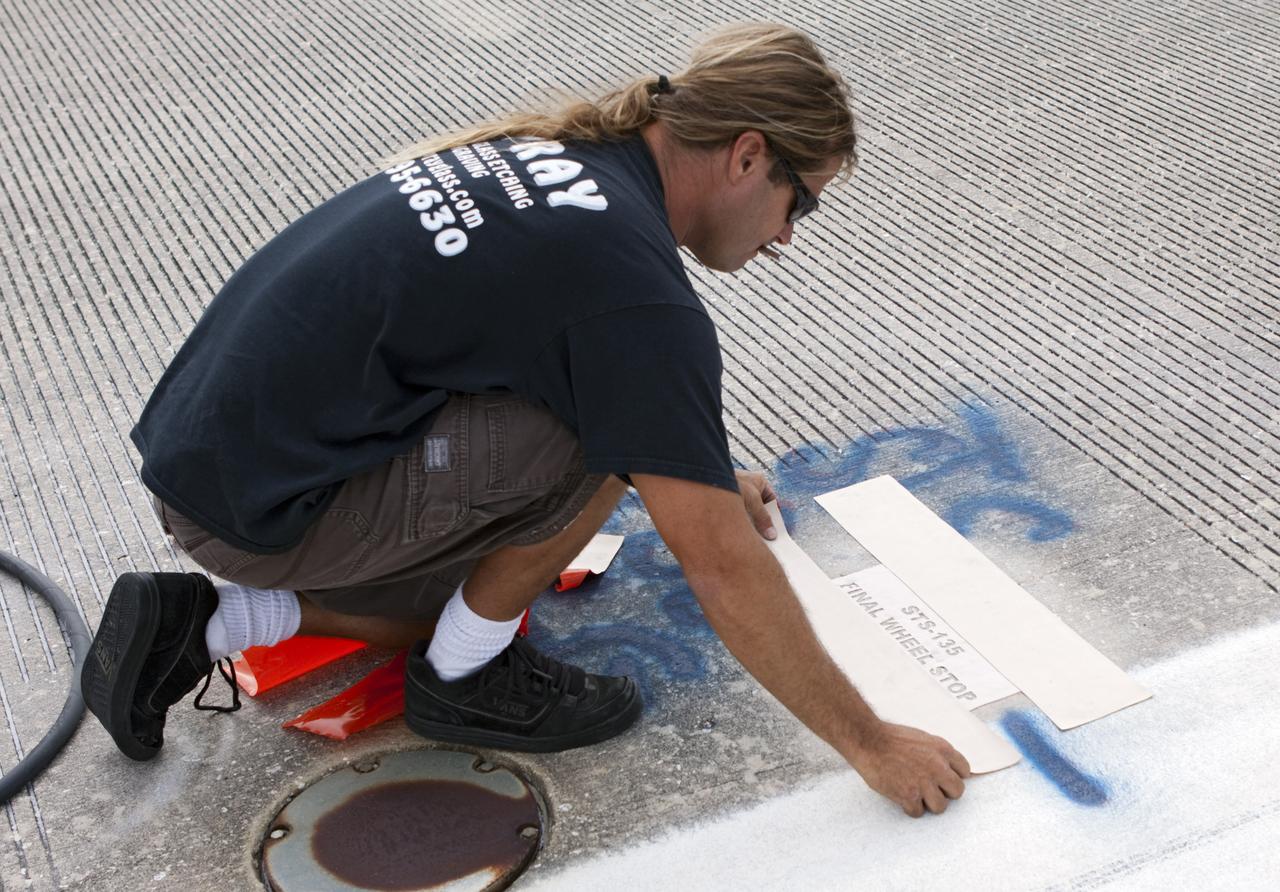
CAPE CANAVERAL, Fla. – At C Spray Glass Blasting of Cocoa Beach, Fla., a worker completes the commemorative plaque to mark space shuttle Atlantis’ wheel stop location. The special plaque will be permanently mounted at the Shuttle Landing Facility, or SLF, runway edge at NASA’s Kennedy Space Center in Florida to commemorate the final space shuttle landing. Atlantis completed the STS-135 mission by landing at the SLF on July 21, 2011, at 5:57 a.m. EDT. Atlantis flew 33 missions, completed 4,848 orbits of the Earth, traveled nearly 126 million miles and spent 307 days in space. Atlantis carried 207 astronauts to space. Photo credit: NASA/Lorne Mathre
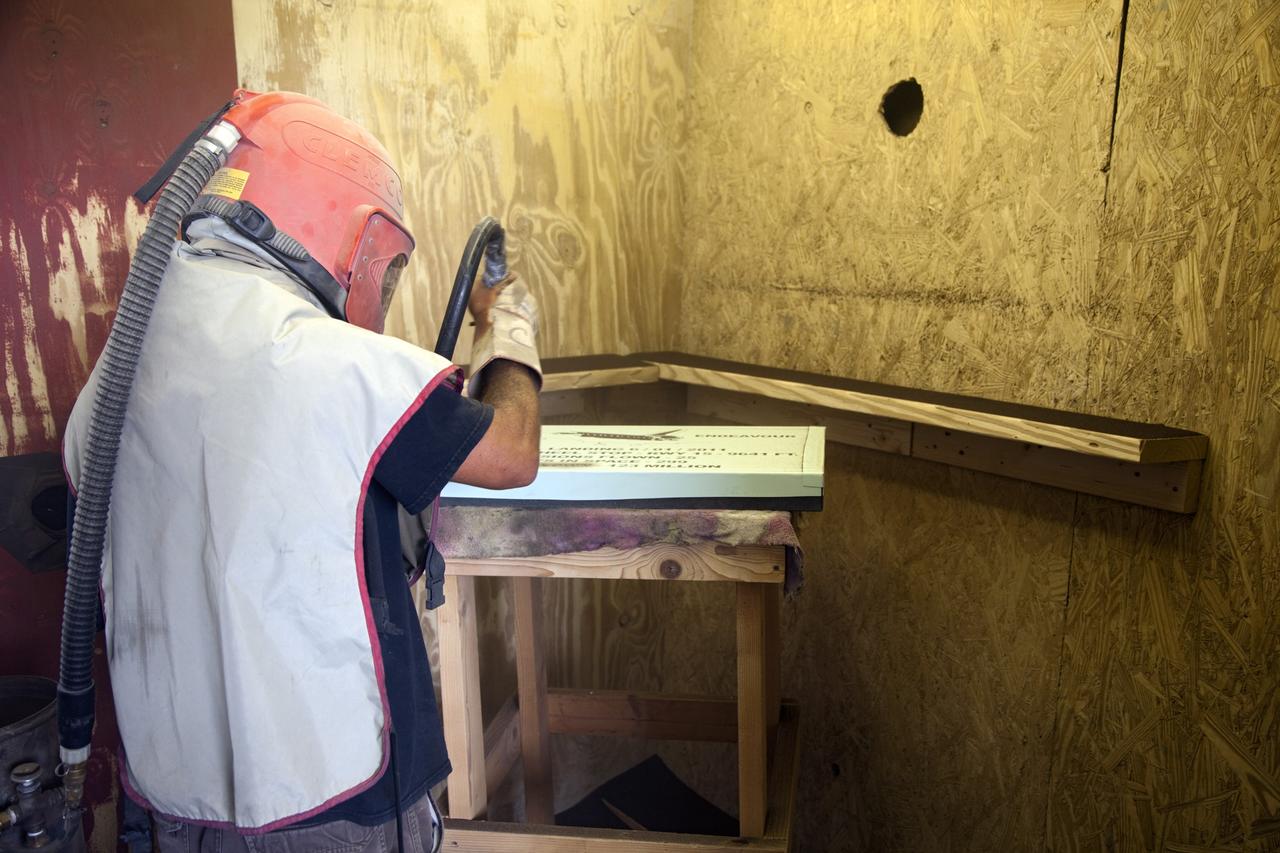
CAPE CANAVERAL, Fla. – At C Spray Glass Blasting of Cocoa Beach, Fla., a worker completes the commemorative plaque to mark space shuttle Atlantis’ wheel stop location. The special plaque will be permanently mounted at the Shuttle Landing Facility, or SLF, runway edge at NASA’s Kennedy Space Center in Florida to commemorate the final space shuttle landing. Atlantis completed the STS-135 mission by landing at the SLF on July 21, 2011, at 5:57 a.m. EDT. Atlantis flew 33 missions, completed 4,848 orbits of the Earth, traveled nearly 126 million miles and spent 307 days in space. Atlantis carried 207 astronauts to space. Photo credit: NASA/Lorne Mathre
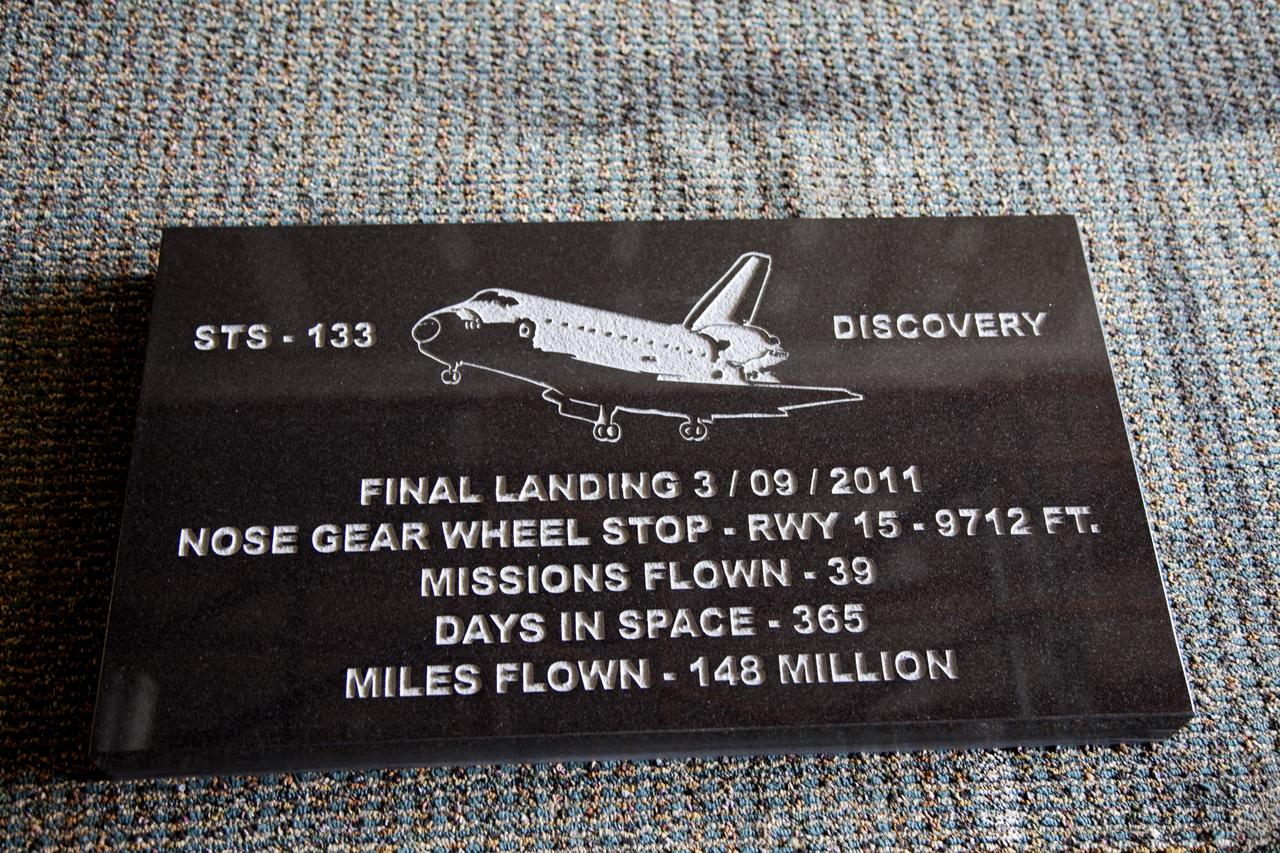
CAPE CANAVERAL, Fla. – At C Spray Glass Blasting of Cocoa Beach, Fla., the commemorative plaque to mark space shuttle Discovery’s wheel stop location has been completed. The special plaque will be permanently mounted at the Shuttle Landing Facility, or SLF, runway edge at NASA’s Kennedy Space Center in Florida to commemorate Discovery’s final landing. Discovery completed the STS-133 mission by landing at the SLF on March 9, 2011, at 11:57 a.m. EST. Discovery flew 39 missions, completed 5,830 orbits of the Earth, traveled 148 million miles and spent 365 days in space. Atlantis carried 252 astronauts to space. Photo credit: NASA/Lorne Mathre
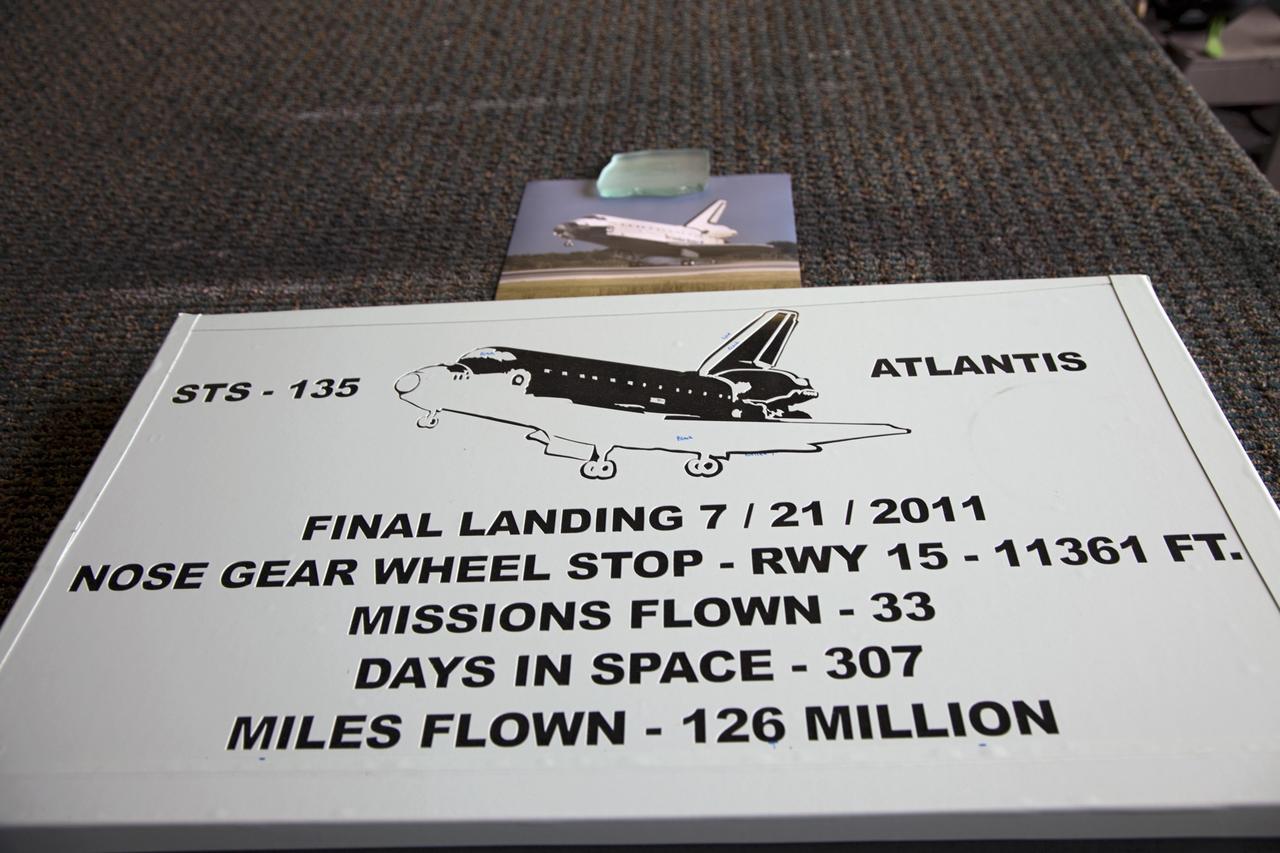
CAPE CANAVERAL, Fla. – At C Spray Glass Blasting of Cocoa Beach, Fla., the commemorative plaque to mark space shuttle Atlantis’ wheel stop location has been completed. The special plaque will be permanently mounted at the Shuttle Landing Facility, or SLF, runway edge at NASA’s Kennedy Space Center in Florida to commemorate the final space shuttle landing. Atlantis completed the STS-135 mission by landing at the SLF on July 21, 2011, at 5:57 a.m. EDT. Atlantis flew 33 missions, completed 4,848 orbits of the Earth, traveled nearly 126 million miles and spent 307 days in space. Atlantis carried 207 astronauts to space. Photo credit: NASA/Lorne Mathre
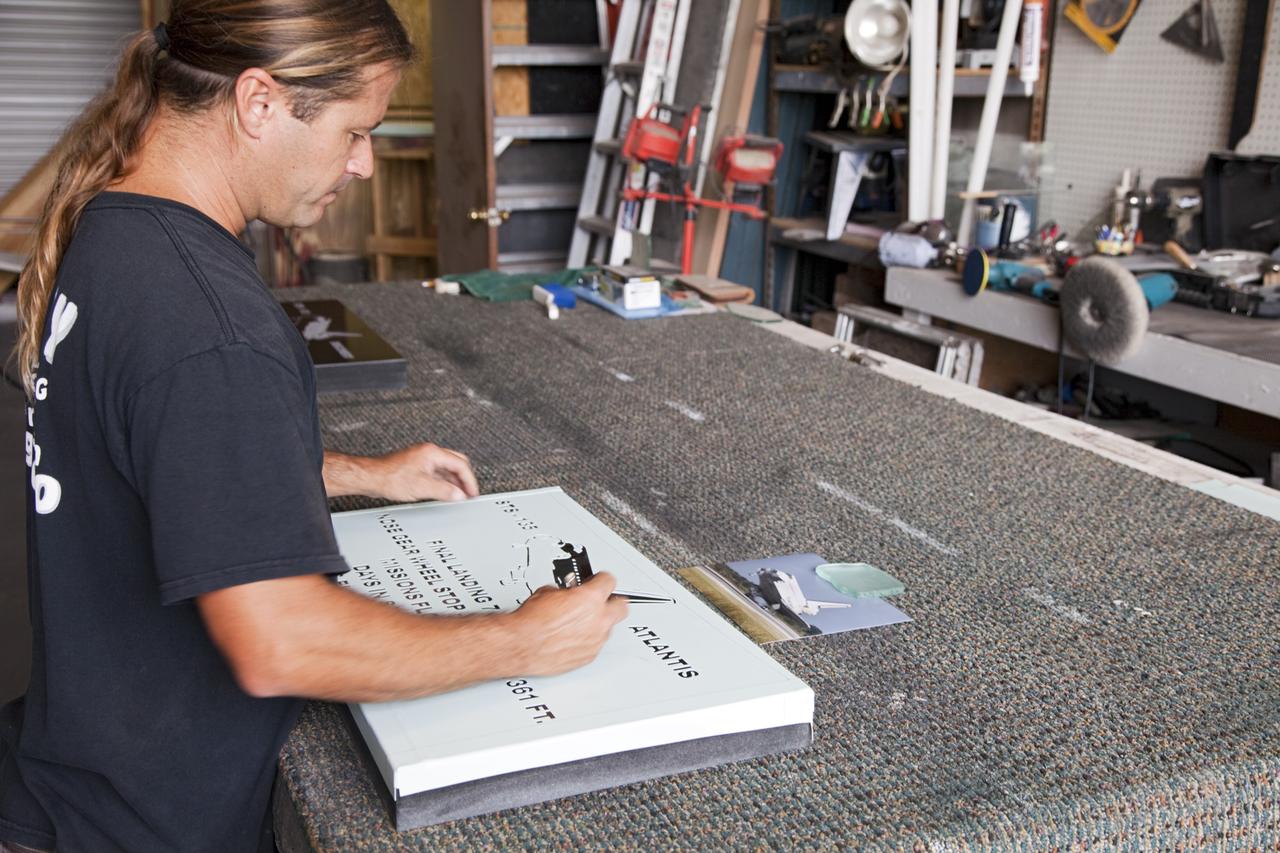
CAPE CANAVERAL, Fla. – At C Spray Glass Blasting of Cocoa Beach, Fla., a worker completes the commemorative plaque to mark space shuttle Atlantis’ wheel stop location. The special plaque will be permanently mounted at the Shuttle Landing Facility, or SLF, runway edge at NASA’s Kennedy Space Center in Florida to commemorate the final space shuttle landing. Atlantis completed the STS-135 mission by landing at the SLF on July 21, 2011, at 5:57 a.m. EDT. Atlantis flew 33 missions, completed 4,848 orbits of the Earth, traveled nearly 126 million miles and spent 307 days in space. Atlantis carried 207 astronauts to space. Photo credit: NASA/Lorne Mathre
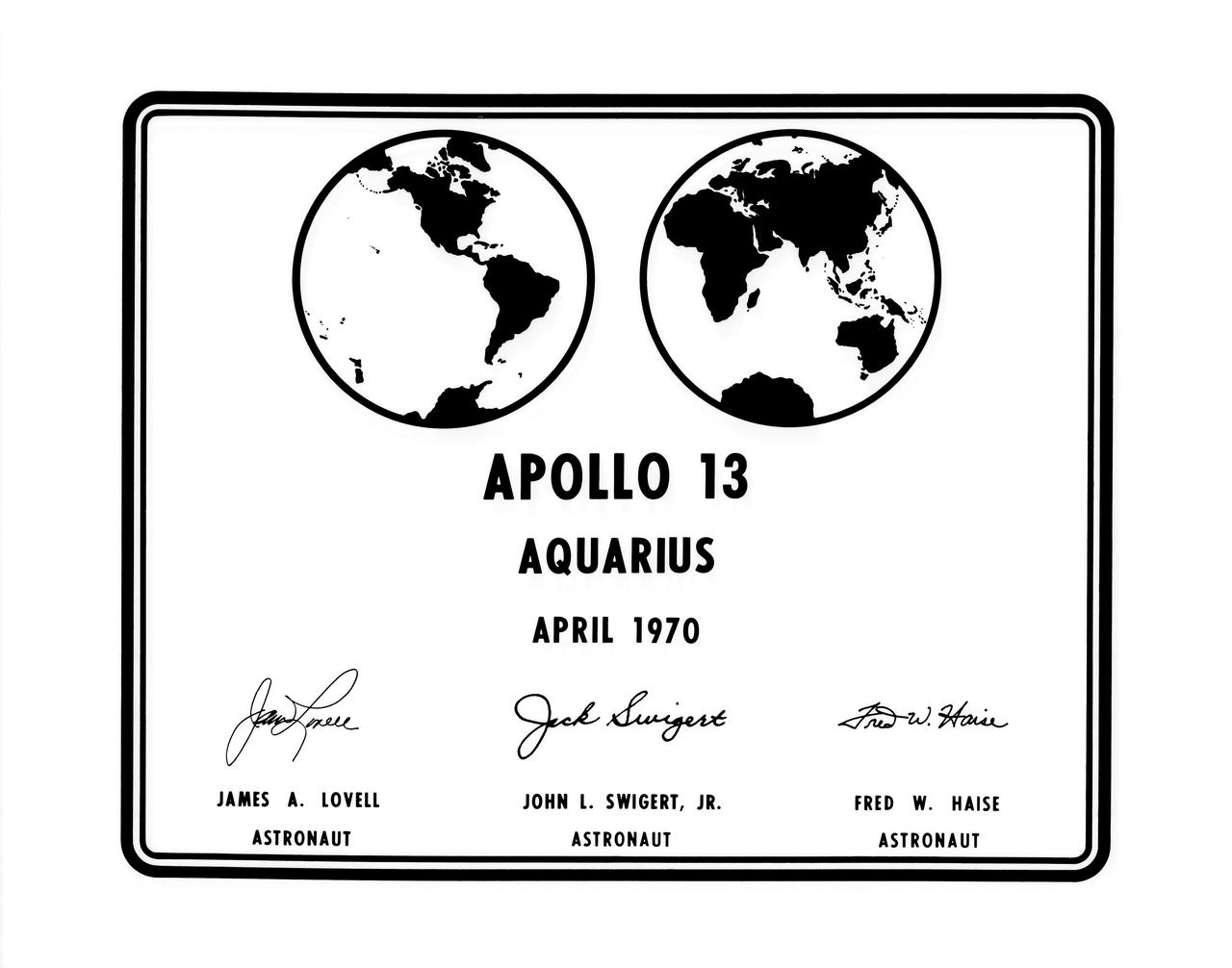
S70-34685 (April 1970) --- A photographic replica of the plaque which the Apollo 13 astronauts will leave behind on the moon during their lunar landing mission. Astronauts James A. Lovell Jr., commander; and Fred W. Haise Jr., lunar module pilot, will descend to the lunar surface in the Lunar Module (LM) "Aquarius". Astronaut John L. Swigert Jr., command module pilot, will remain with the Command and Service Modules (CSM) in lunar orbit. The plaque will be attached to the ladder of the landing gear strut on the LM?s descent stage. Commemorative plaques were also left on the moon by the Apollo 11 and Apollo 12 astronauts.
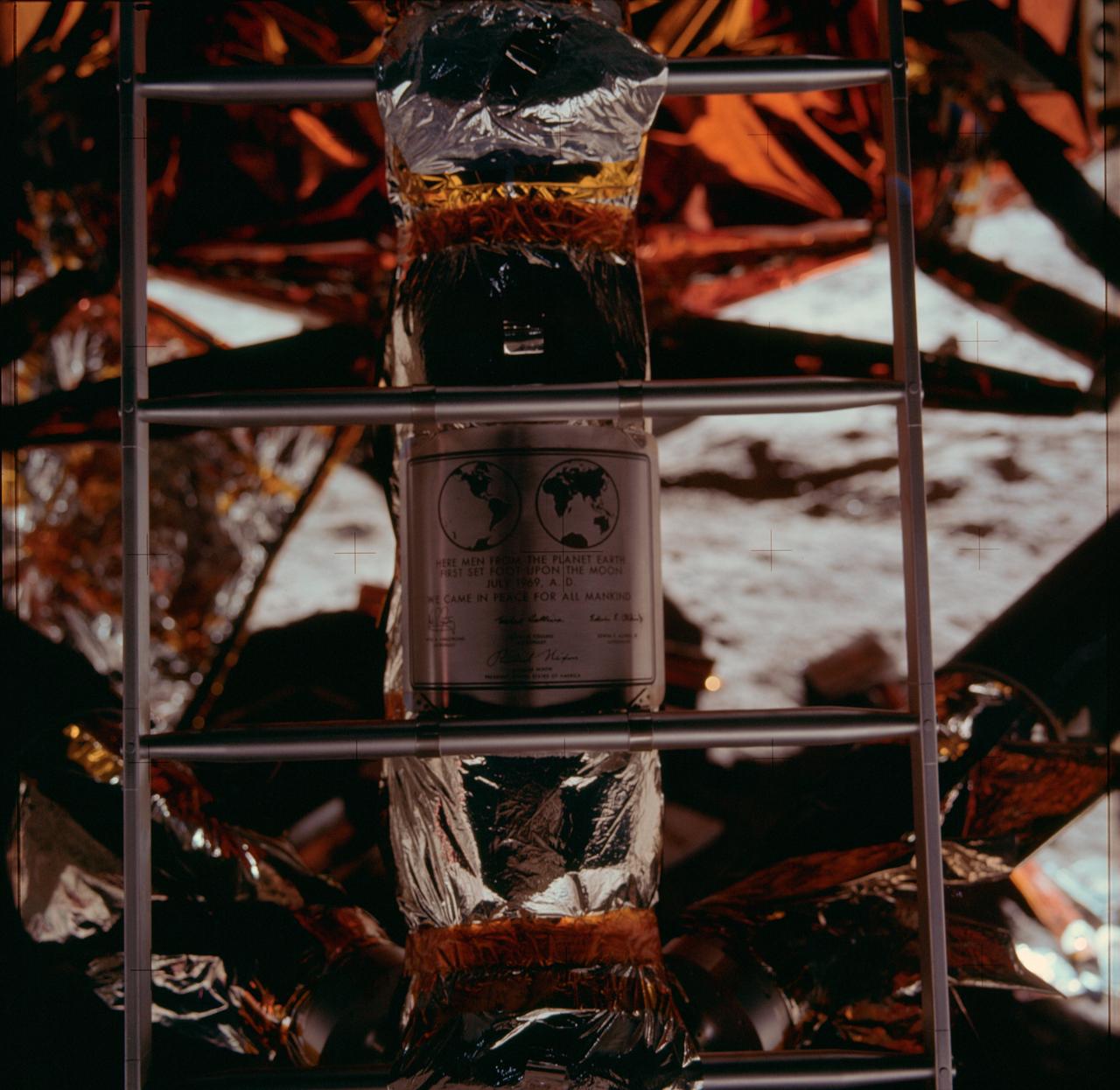
AS11-40-5899 (20 July 1969) --- Close-up view of the plaque which the Apollo 11 astronauts left on the moon in commemoration of the historic lunar landing mission. The plaque was attached to the ladder on the landing gear strut on the descent stage of the Apollo 11 Lunar Module (LM). The plaque was covered with a thin sheet of stainless steel during flight. Astronaut Michael Collins, command module pilot, remained with the Command and Service Modules (CSM) in lunar orbit while astronauts Neil A. Armstrong, commander, and Edwin E. Aldrin Jr., lunar module pilot, explored the moon.
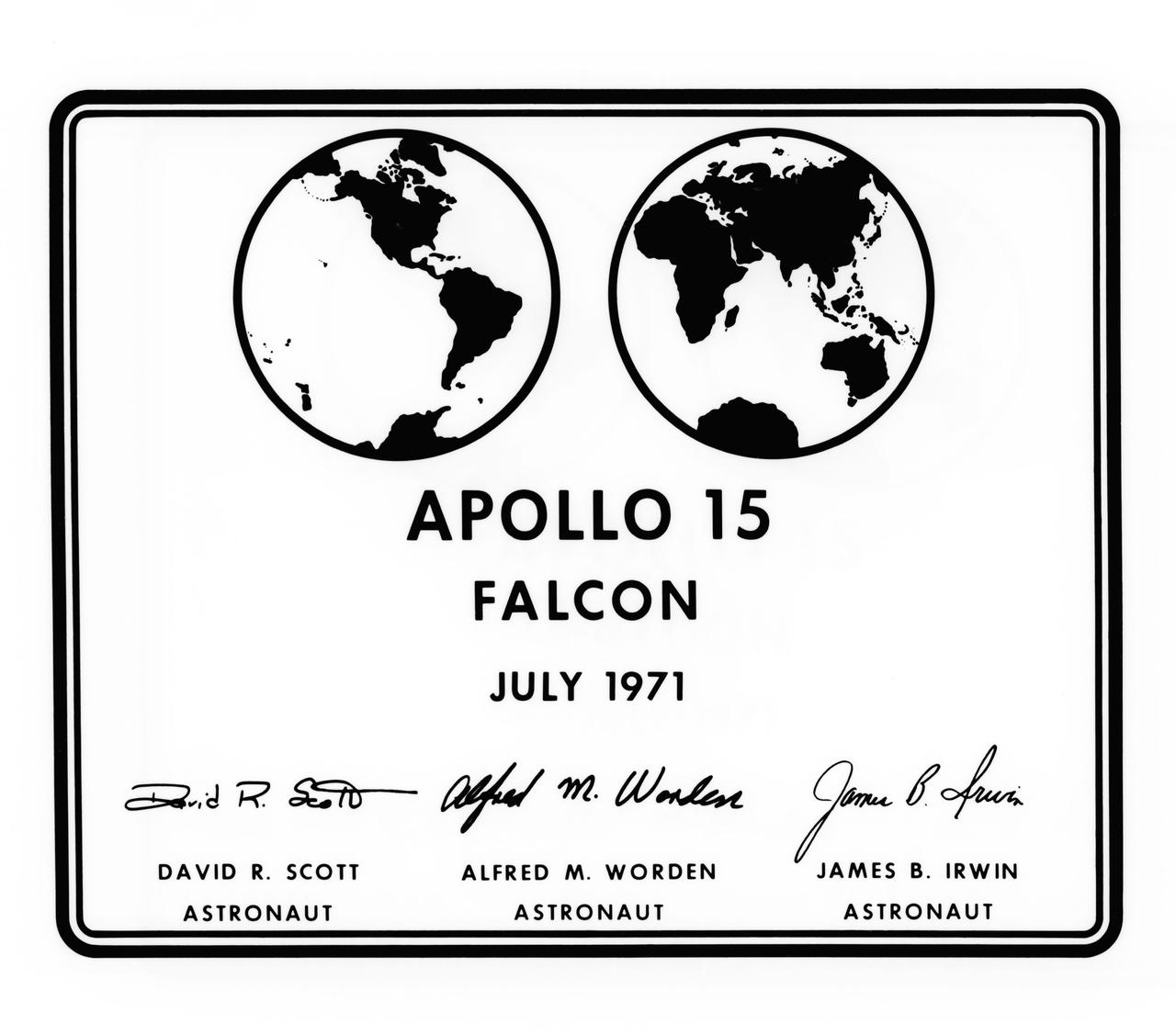
S71-39357 (July 1971) --- A photographic replica of the plaque which the Apollo 15 astronauts will leave behind on the moon during their lunar landing mission. Astronauts David R. Scott, commander; and James B. Irwin, lunar module pilot; will descend to the lunar surface in the Lunar Module (LM) "Falcon". Astronaut Alfred M. Worden, command module pilot, will remain with the Command and Service Modules (CSM) in lunar orbit. The seven by nine inch stainless steel plaque will be attached to the ladder on the landing gear strut on the LM's descent stage. Commemorative plaques were also left on the moon by the Apollo 11, Apollo 12 and Apollo 14 astronauts.
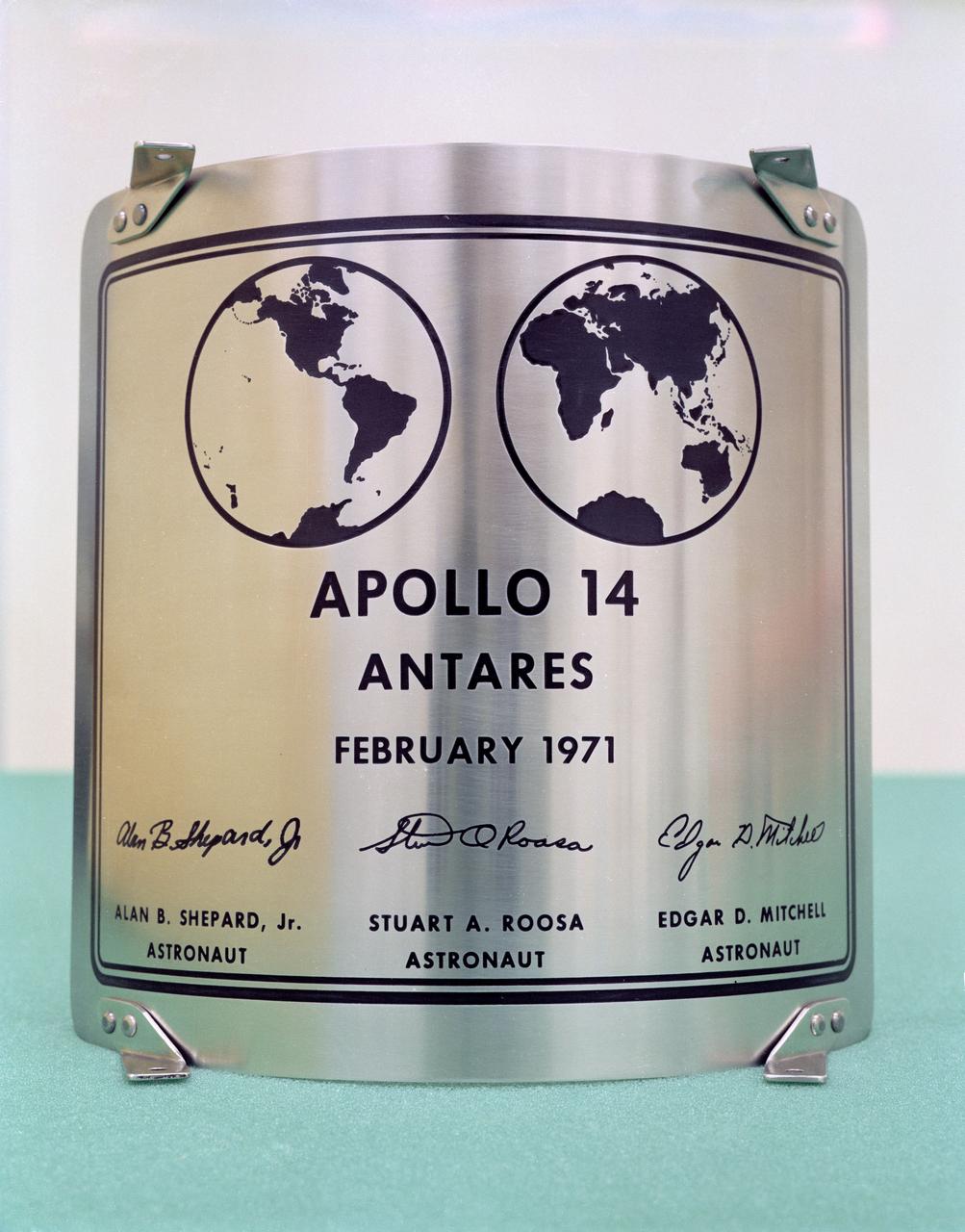
S71-16637 (January 1971) --- A close-up view of the plaque which the Apollo 14 astronauts will leave behind on the moon during their lunar landing mission. Astronauts Alan B. Shepard Jr., commander, and Edgar D. Mitchell, lunar module pilot, will descend to the lunar surface in the Lunar Module (LM) "Antares". Astronaut Stuart A. Roosa, command module pilot, will remain with the Command and Service Modules (CSM) in lunar orbit. The seven by nine inch stainless steel plaque will be attached to the ladder on the landing gear strut on the LM's descent stage. Commemorative plaques were also left on the moon by the Apollo 11 and Apollo 12 astronauts.
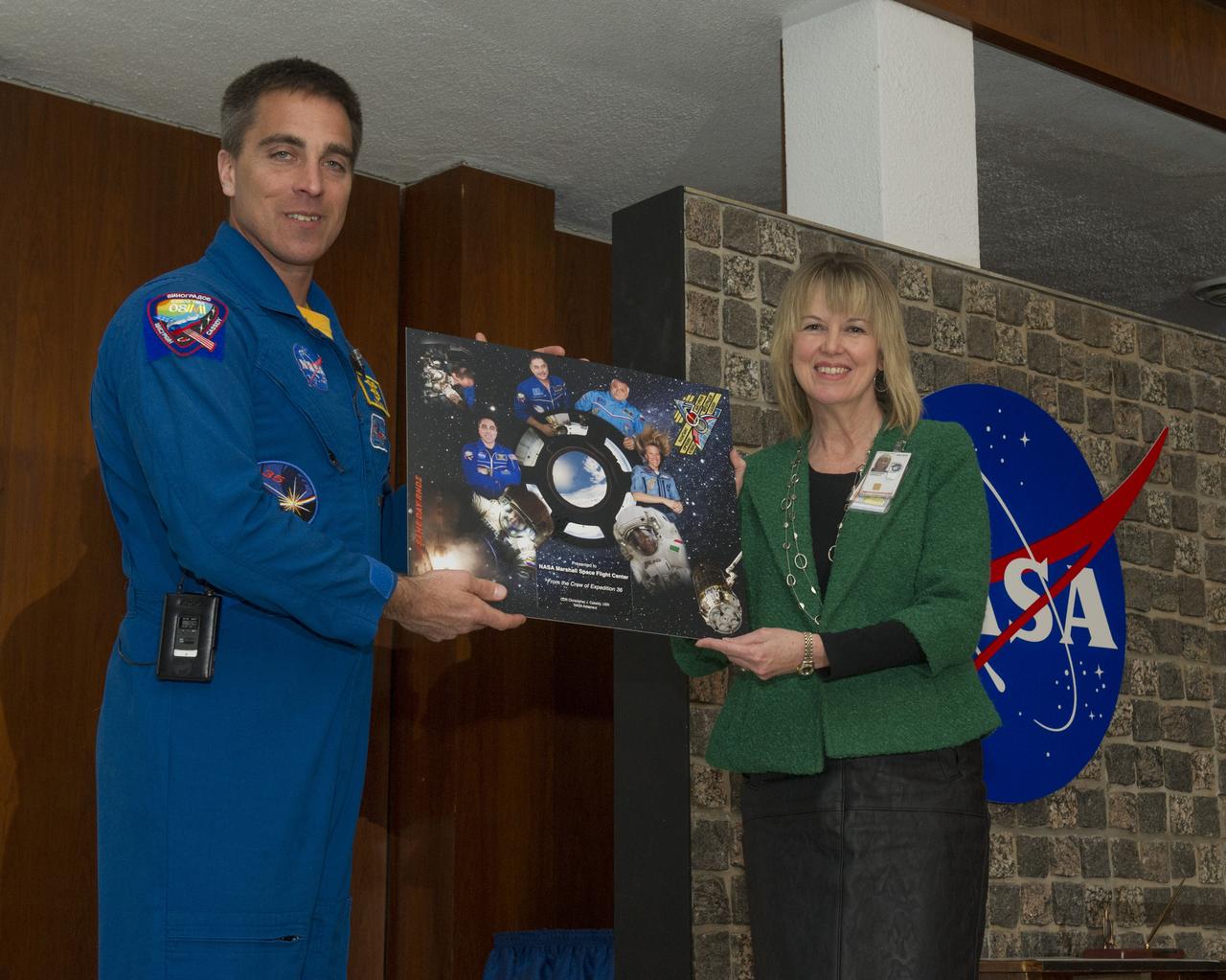
NASA ASTRONAUT CHRIS CASSIDY, LEFT, A FLIGHT ENGINEER FOR INTERNATIONAL SPACE STATION EXPEDITION 36, RECEIVES A COMMEMORATIVE PLAQUE FROM TERESA VANHOOSER, DEPUTY DIRECTOR OF THE MARSHALL SPACE FLIGHT CENTER, DURING HIS JAN. 22 VISIT TO MARSHALL.
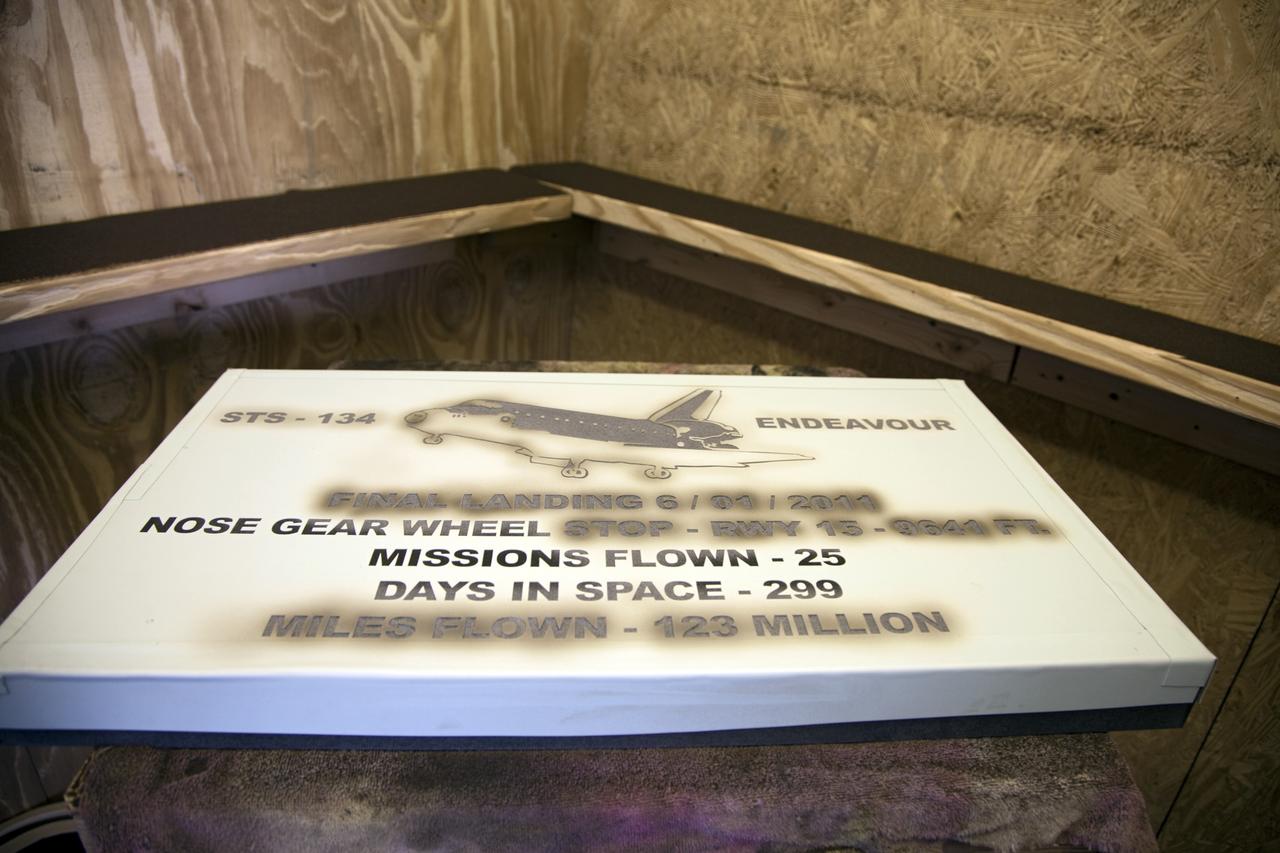
CAPE CANAVERAL, Fla. – At C Spray Glass Blasting of Cocoa Beach, Fla., a worker completes the commemorative plaque to mark space shuttle Endeavour’s wheel stop location. The special plaque will be permanently mounted at the Shuttle Landing Facility, or SLF, runway edge at NASA’s Kennedy Space Center in Florida to commemorate Endeavour’s final space shuttle landing. Endeavour completed the STS-134 mission by landing at the SLF on June 1, 2011, at 2:35 a.m. EDT. Endeavour flew 25 missions, completed 4,671 orbits of the Earth, traveled more than 122 million miles and spent 299 days in space. Endeavour carried 173 astronauts to space. Photo credit: NASA/Lorne Mathre
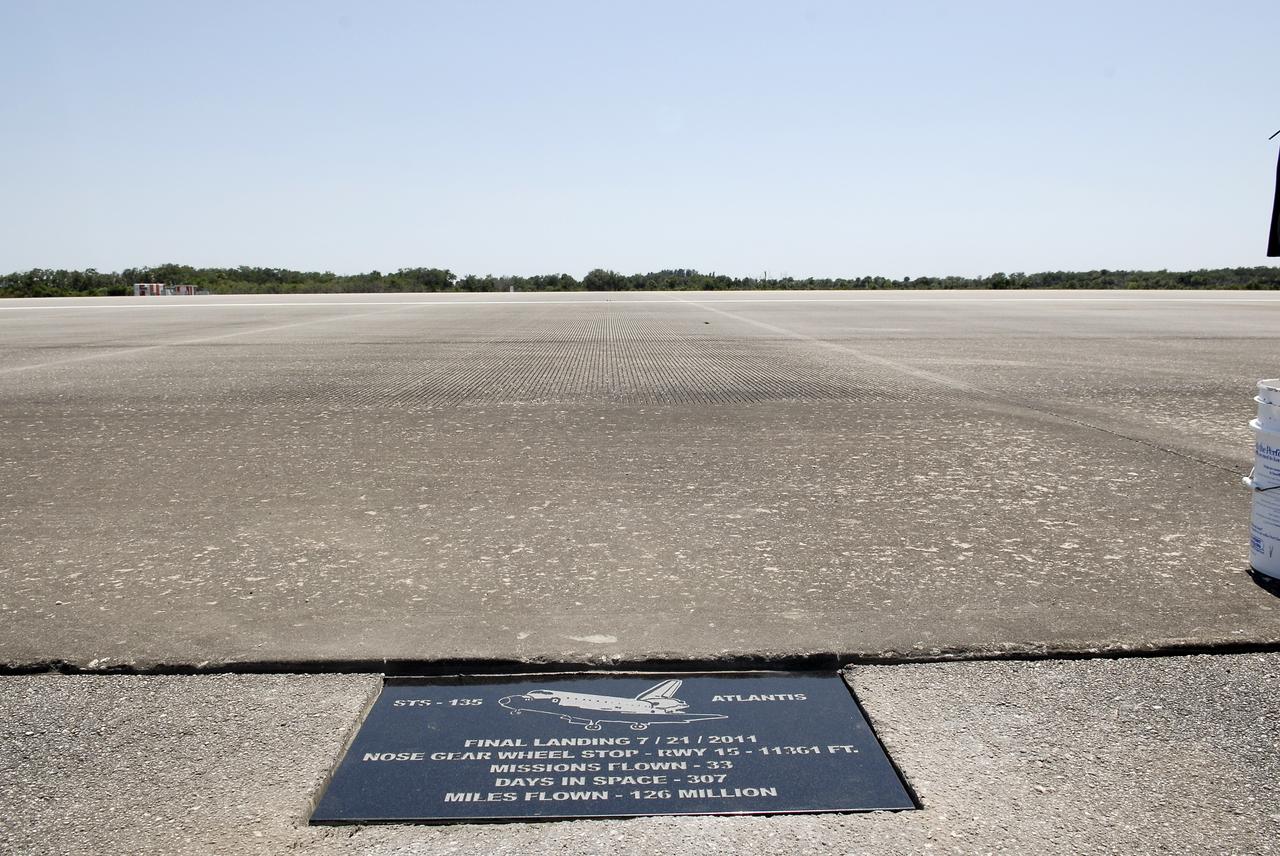
CAPE CANAVERAL, Fla. - At the Shuttle Landing Facility SLF at NASA’s Kennedy Space Center in Florida, a special plaque marks the nose gear wheel stop of space shuttle Atlantis. The 16-by-28-inch black granite plaque is the third to be permanently mounted, commemorating the final landings of each of the three orbiters. Atlantis completed the STS-135 mission by landing at the SLF on July 21, 2011, at 5:57 a.m. Atlantis flew 33 missions, completed 4,848 orbits of the Earth, traveled nearly 126 million miles and spent 307 days in space. Atlantis carried 207 astronauts to space. Photo credit: NASA/Charisse Nahser
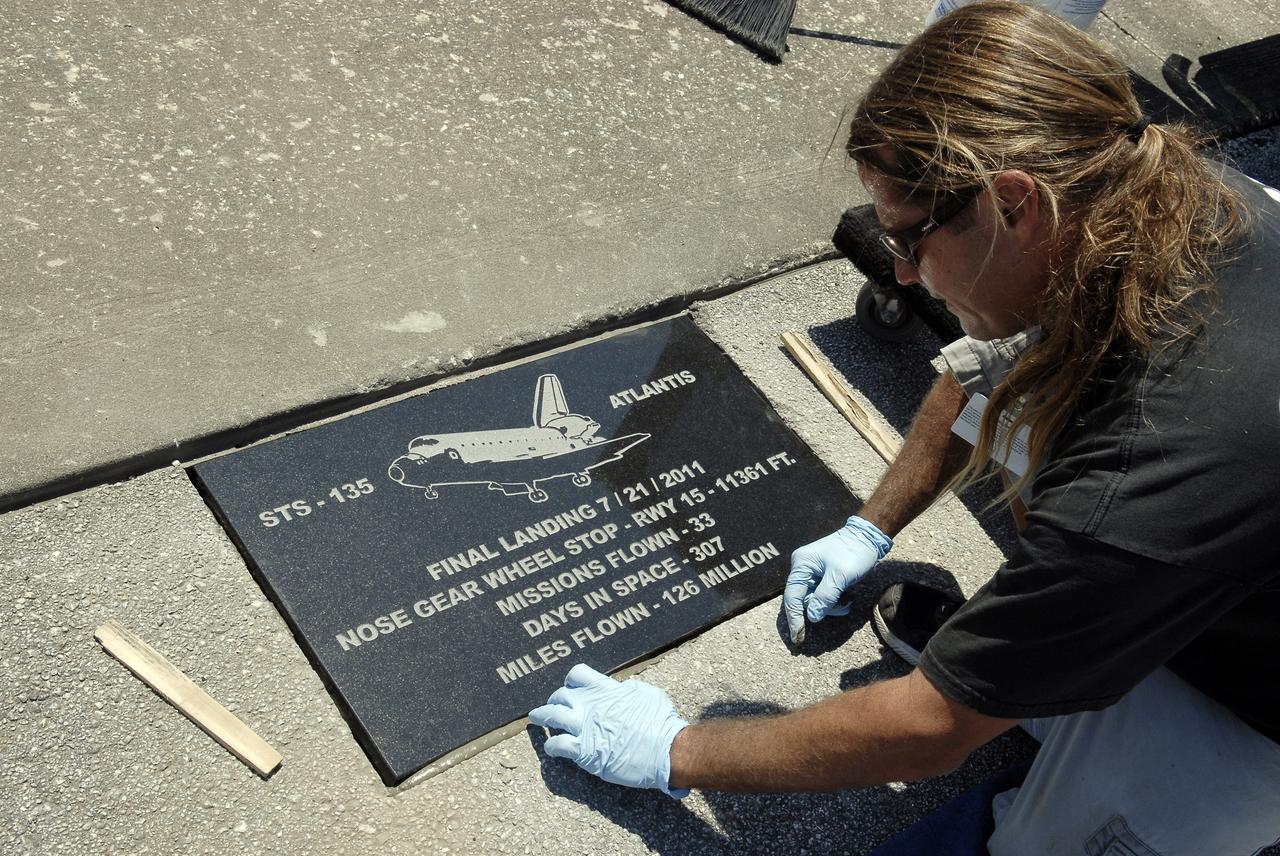
CAPE CANAVERAL, Fla. - At the Shuttle Landing Facility SLF at NASA’s Kennedy Space Center in Florida, Chad Stout with C Spray Glass Blasting in Cocoa, Fla., installs a special plaque to mark the nose gear wheel stop of space shuttle Atlantis. The plaque, which is 16 by 28 inches, is the third black granite plaque permanently mounted to commemorate the final landing of each of the three orbiters. Atlantis completed the STS-135 mission by landing at the SLF on July 21, 2011, at 5:57 a.m. Atlantis flew 33 missions, completed 4,848 orbits of the Earth, traveled nearly 126 million miles and spent 307 days in space. Atlantis carried 207 astronauts to space. Photo credit: NASA/Charisse Nahser
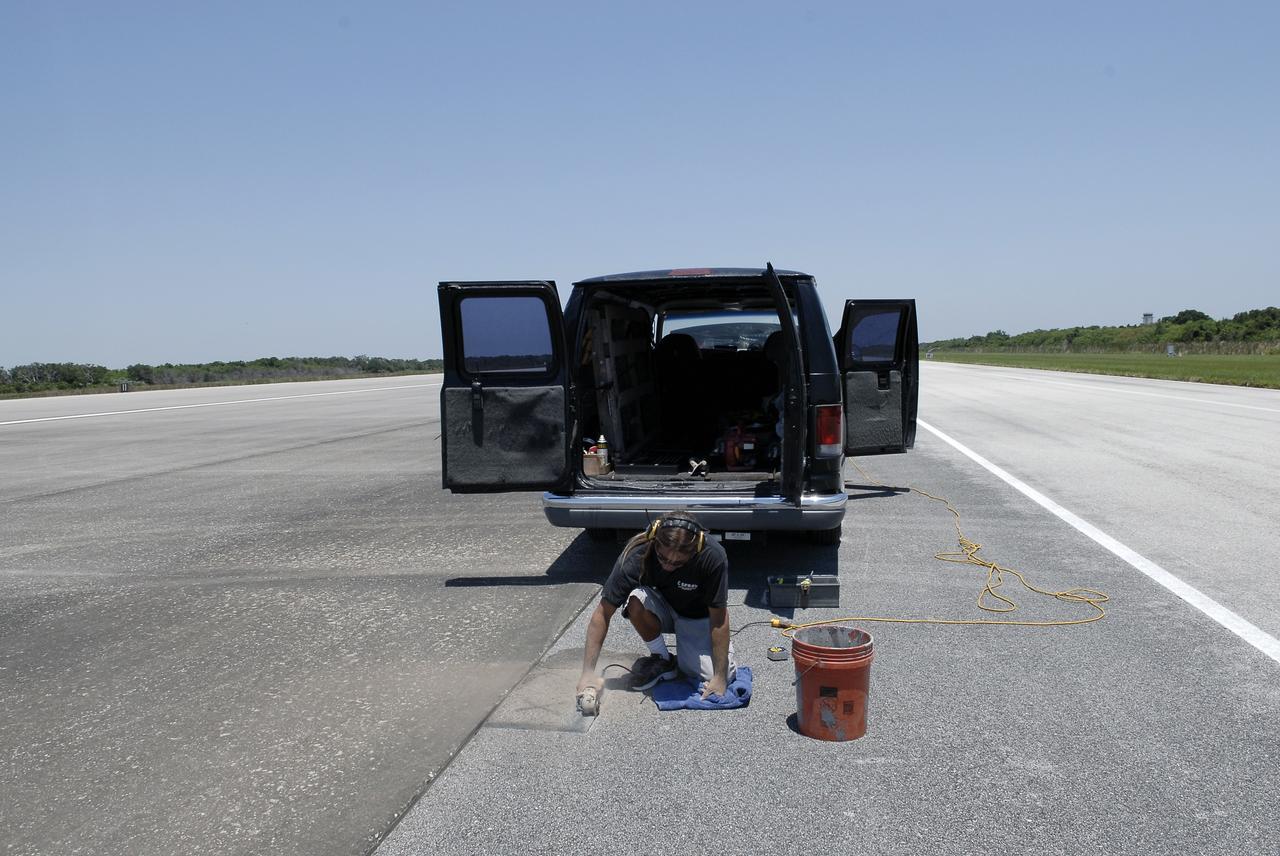
CAPE CANAVERAL, Fla. - At the Shuttle Landing Facility SLF at NASA’s Kennedy Space Center in Florida, Chad Stout with C Spray Glass Blasting in Cocoa, Fla., prepares to install a special plaque to mark the nose gear wheel stop of space shuttle Atlantis. Stout is cutting the 15,000 by 1,000-foot-long concrete runway to accommodate the black granite plaque, which is 16 by 28 inches. It is the third plaque permanently mounted to commemorate the final landing of each of the three orbiters. Atlantis completed the STS-135 mission by landing at the SLF on July 21, 2011, at 5:57 a.m. Atlantis flew 33 missions, completed 4,848 orbits of the Earth, traveled nearly 126 million miles and spent 307 days in space. Atlantis carried 207 astronauts to space. Photo credit: NASA/Charisse Nahser
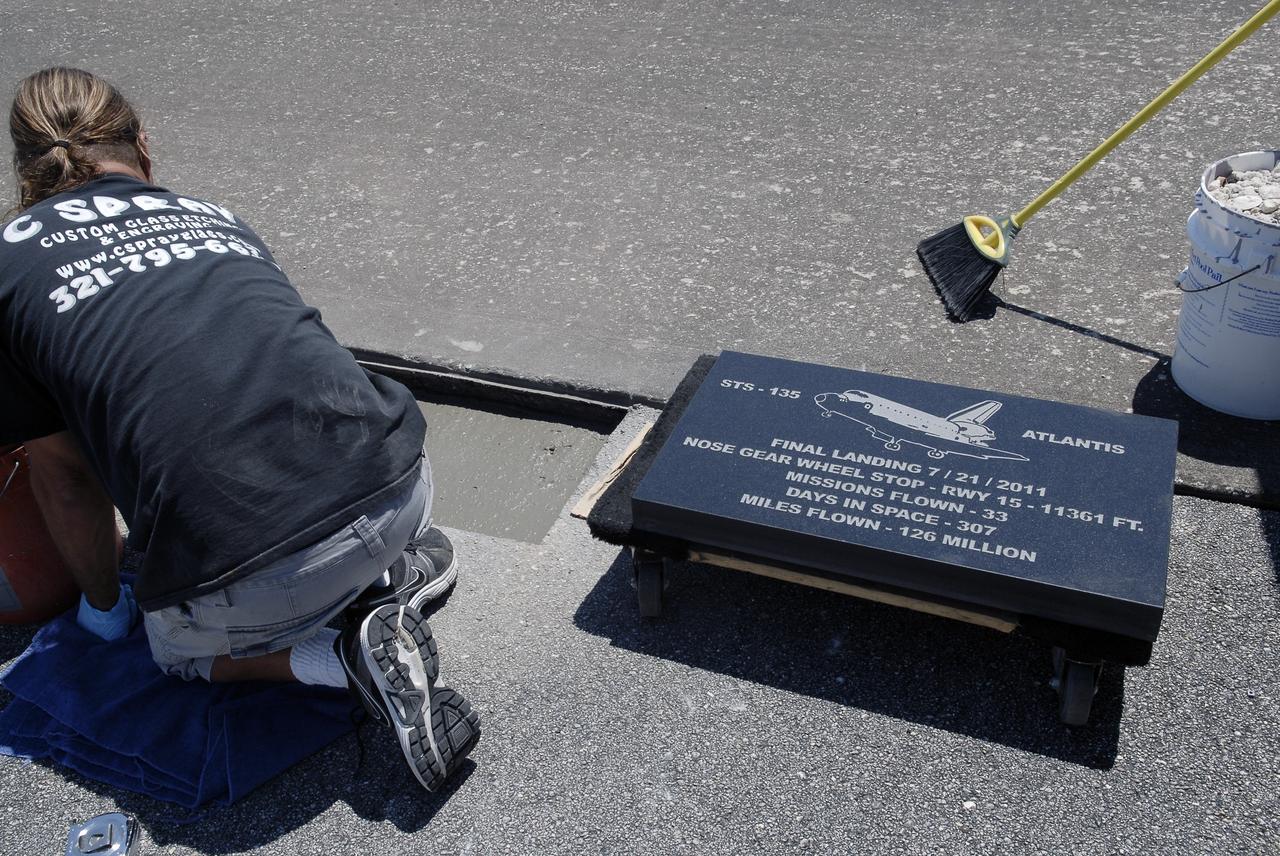
CAPE CANAVERAL, Fla. - At the Shuttle Landing Facility SLF at NASA’s Kennedy Space Center in Florida, Chad Stout with C Spray Glass Blasting in Cocoa, Fla., prepares to install a special plaque to mark the nose gear wheel stop of space shuttle Atlantis. The black granite plaque, which is 16 by 28 inches, is the third plaque permanently mounted to commemorate the final landing of each of the three orbiters. Atlantis completed the STS-135 mission by landing at the SLF on July 21, 2011, at 5:57 a.m. Atlantis flew 33 missions, completed 4,848 orbits of the Earth, traveled nearly 126 million miles and spent 307 days in space. Atlantis carried 207 astronauts to space. Photo credit: NASA/Charisse Nahser
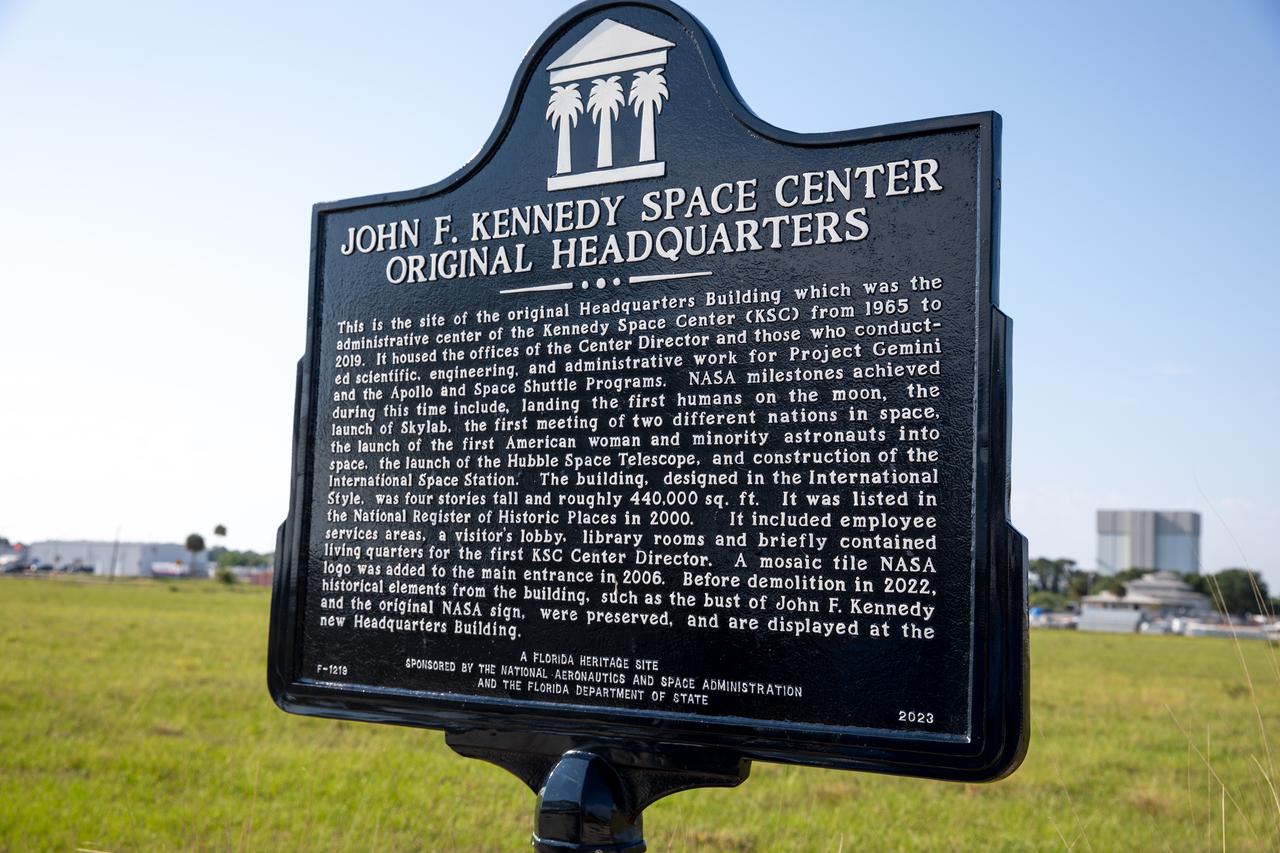
A large bronze historical marker plaque is unveiled Tuesday, May 28, 2024, at the location of NASA Kennedy Space Center’s original headquarters building. Approved in April 2023 as part of the State of Florida’s Historical Markers program in celebration of National Historic Preservation Month, the marker commemorates the early days of space exploration and is displayed permanently just west of the seven-story, 200,000 square foot Central Campus Headquarters Building, which replaced the old building in 2019.
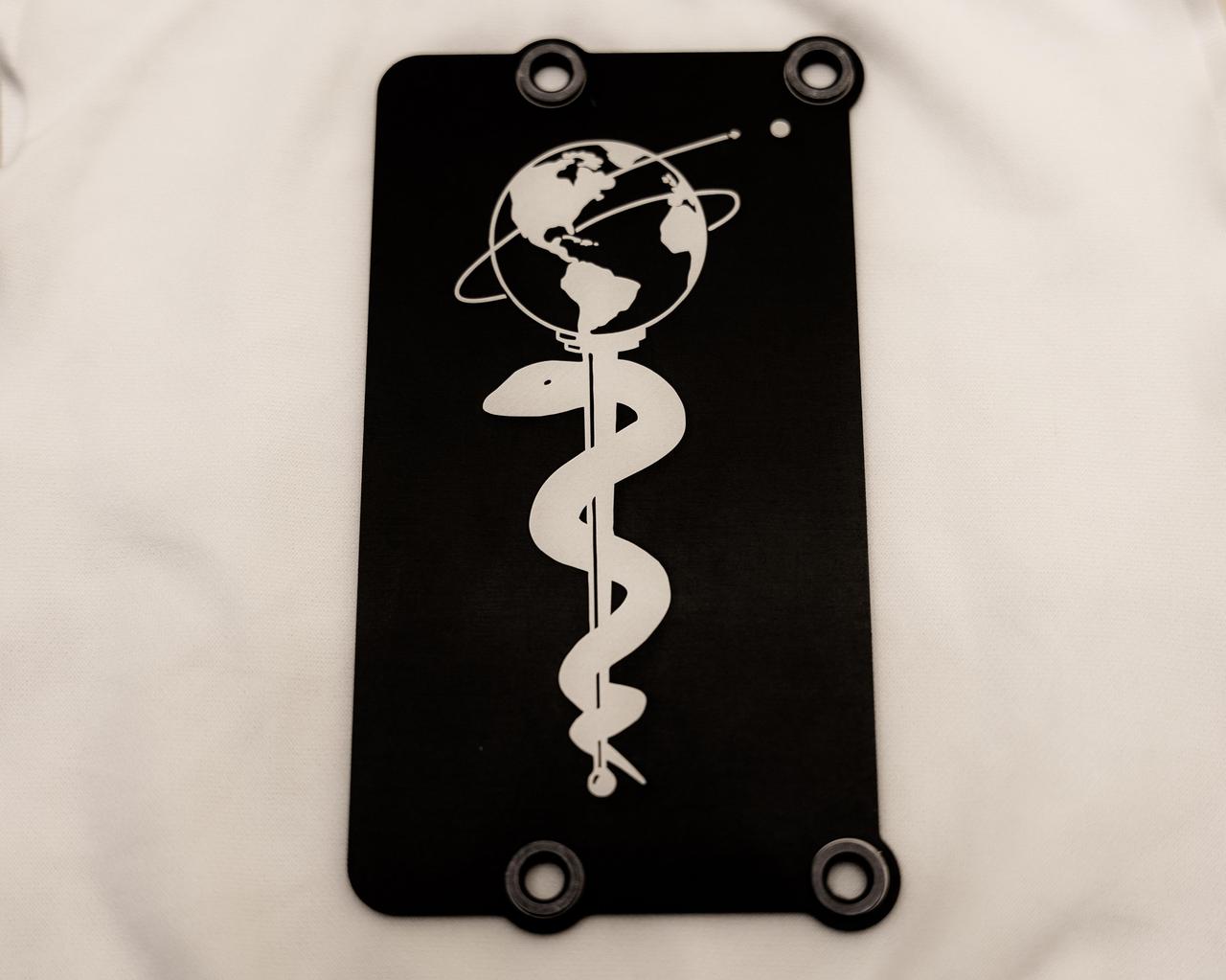
Members of NASA's Mars 2020 Perseverance rover mission installed a plate on the left side of the rover chassis, commemorating the impact of the COVID-19 pandemic and paying tribute to the perseverance of healthcare workers around the world. Made of aluminum, the 3-by-5-inch (8-by-13-centimeter) plaque was attached to the rover in May 2020 during final assembly at Kennedy Space Center in Florida. https://photojournal.jpl.nasa.gov/catalog/PIA23921
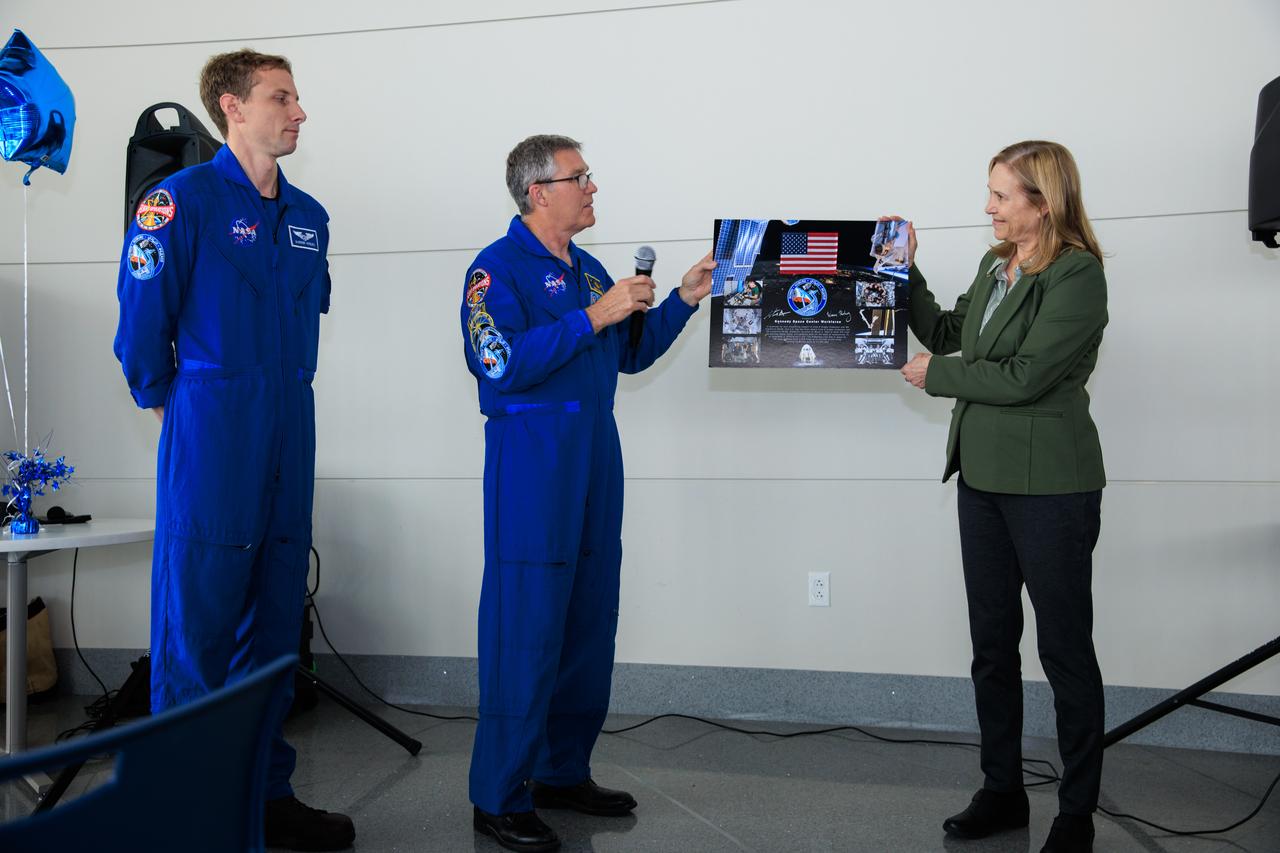
NASA’s SpaceX Crew-6 astronauts Warren “Woody” Hoburg and Stephen Bowen speak with Kennedy Space Center director Janet Petro during a meet-and-greet at the agency’s Central Campus Headquarters cafeteria at Kennedy Space Center in Florida on Wednesday, March 27, 2024. The astronauts present a plaque to Petro commemorating the agency’s sixth rotational crew mission to the to the International Space Station in partnership with SpaceX.

Vice Commander, Air Force Space Command, Lt. Gen. Roger DeKok (left) receives a commemorative plaque from Ed Gormel, committee chairman for the 50th anniversary gala that capped a year-long celebration of 50 years of rocket launches from Cape Canaveral Air Force Station. The first launch at CCAFS took place at 9:28 a.m. on July 24, 1950, with the liftoff of Bumper 8 from Launch Complex 3. The gala was hosted by the Cape Canaveral Chapter Air Force Association
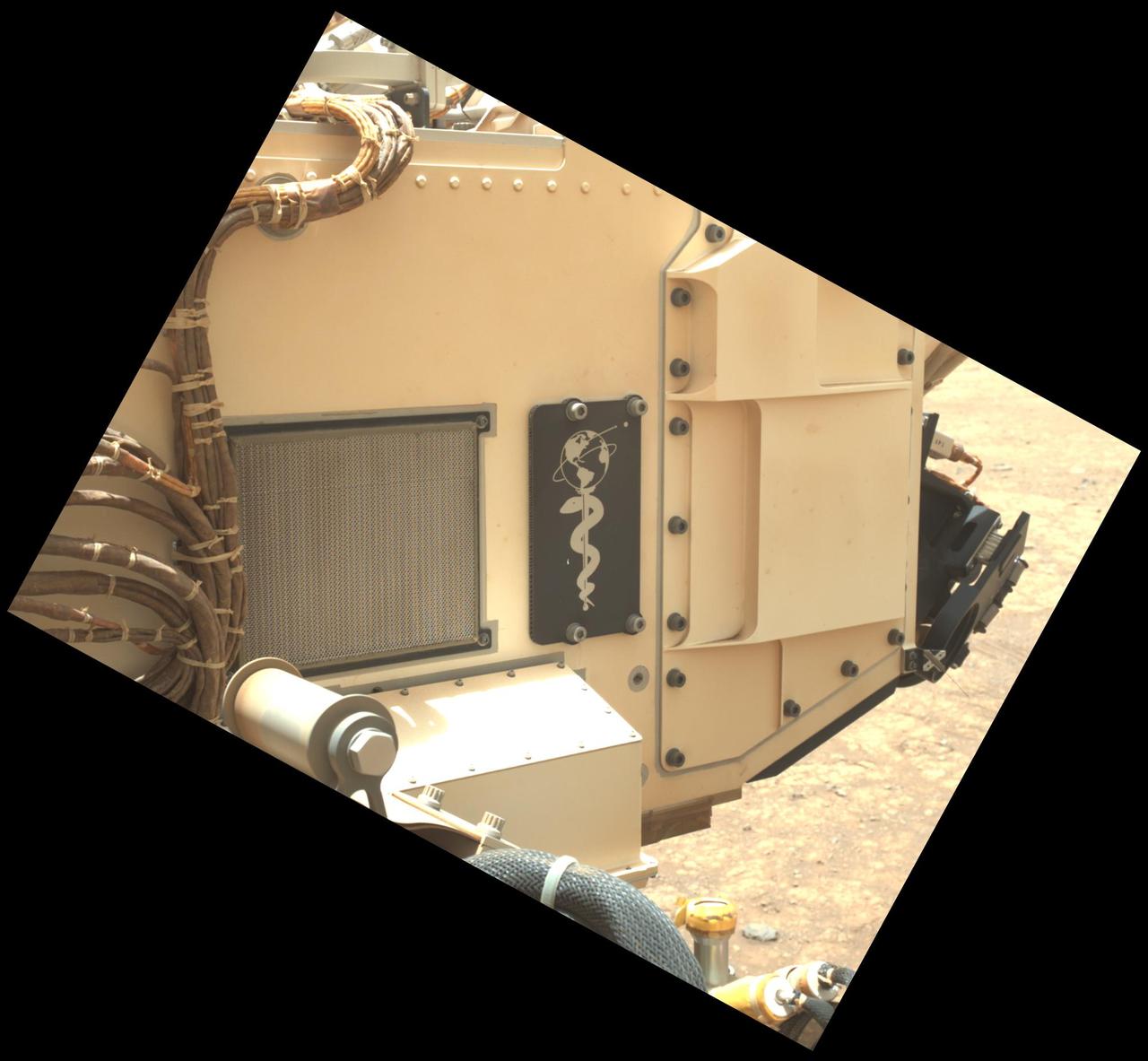
This close-up view of a plate on NASA's Perseverance rover commemorating the impact of the COVID-19 pandemic and paying tribute to the perseverance of health care workers around the world was acquired on June 28, 2025 (the 1,548th day, or sol, of its mission to Mars). Located on the left side of the rover chassis, the 3-by-5-inch (8-by-13-centimeter) aluminum plaque was attached in May 2020 during final assembly at NASA's Kennedy Space Center in Florida. https://photojournal.jpl.nasa.gov/catalog/PIA26641

CAPE CANAVERAL, Fla. – During NASA's 40th Anniversary of Apollo Celebration at the Apollo/Saturn V Center at NASA's Kennedy Space Center in Florida, the Visitor Complex Chief Operating Officer, Bob Moore, gives Center Director Bob Cabana a plaque commemorating the Apollo Treasures Gallery. At far left is Apollo astronaut Buzz Aldrin. Seven other Apollo astronauts participated in the celebration. The celebration honored the July 1969 launch and landing on the moon. Photo credit: NASA/Kim Shiflett
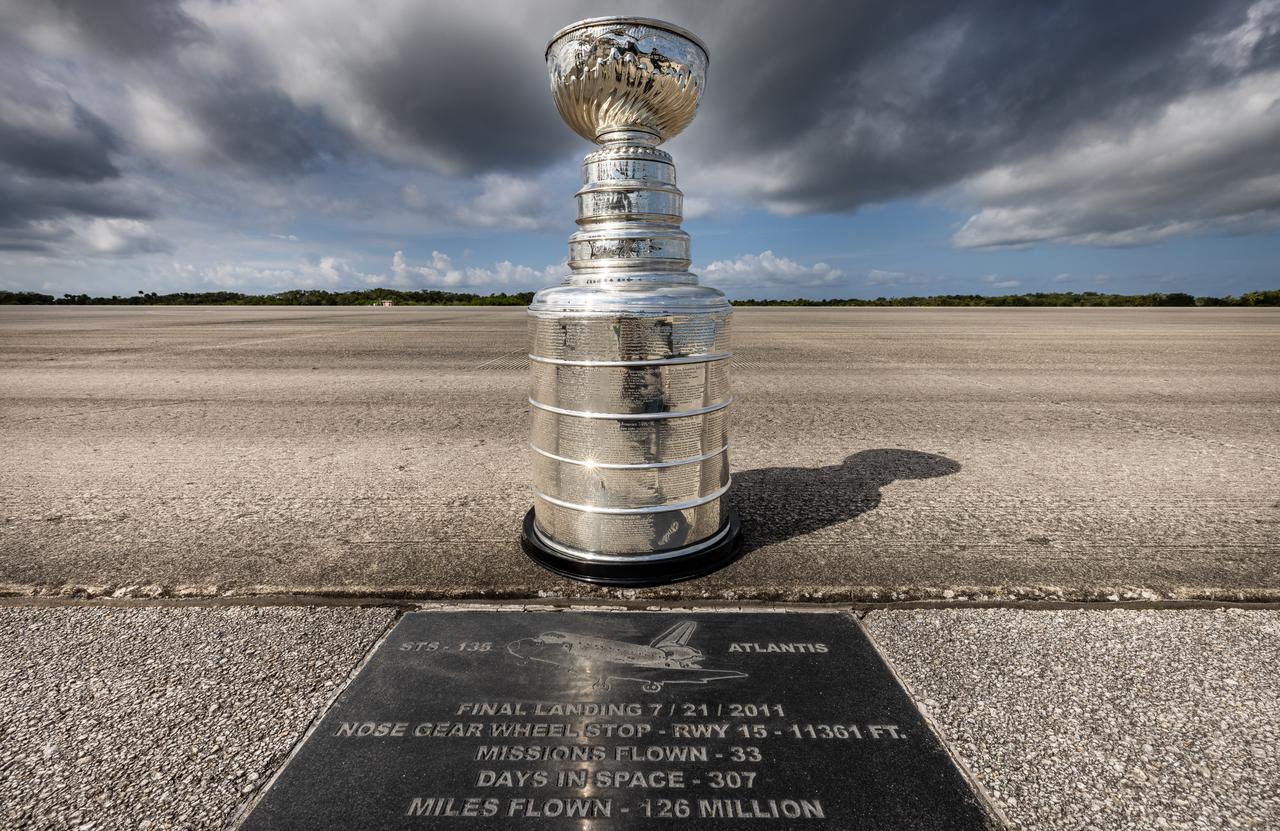
Earlier this year, the Florida Panthers won their first NHL championship and brought victory to the state of Florida. As part of its championship tour, the Stanley Cup made a visit to Kennedy Space Center. Pictured here is the Stanley Cup on the runway of the Launch and Landing Facility, formerly the Shuttle Landing Facility at NASA’s Kennedy Space Center on Tuesday Sept. 17, 2024. The trophy is beside the Space Shuttle Atlantis landmark, a commemorative plaque marking the landing spot of the last shuttle flight that occurred in July 2011.
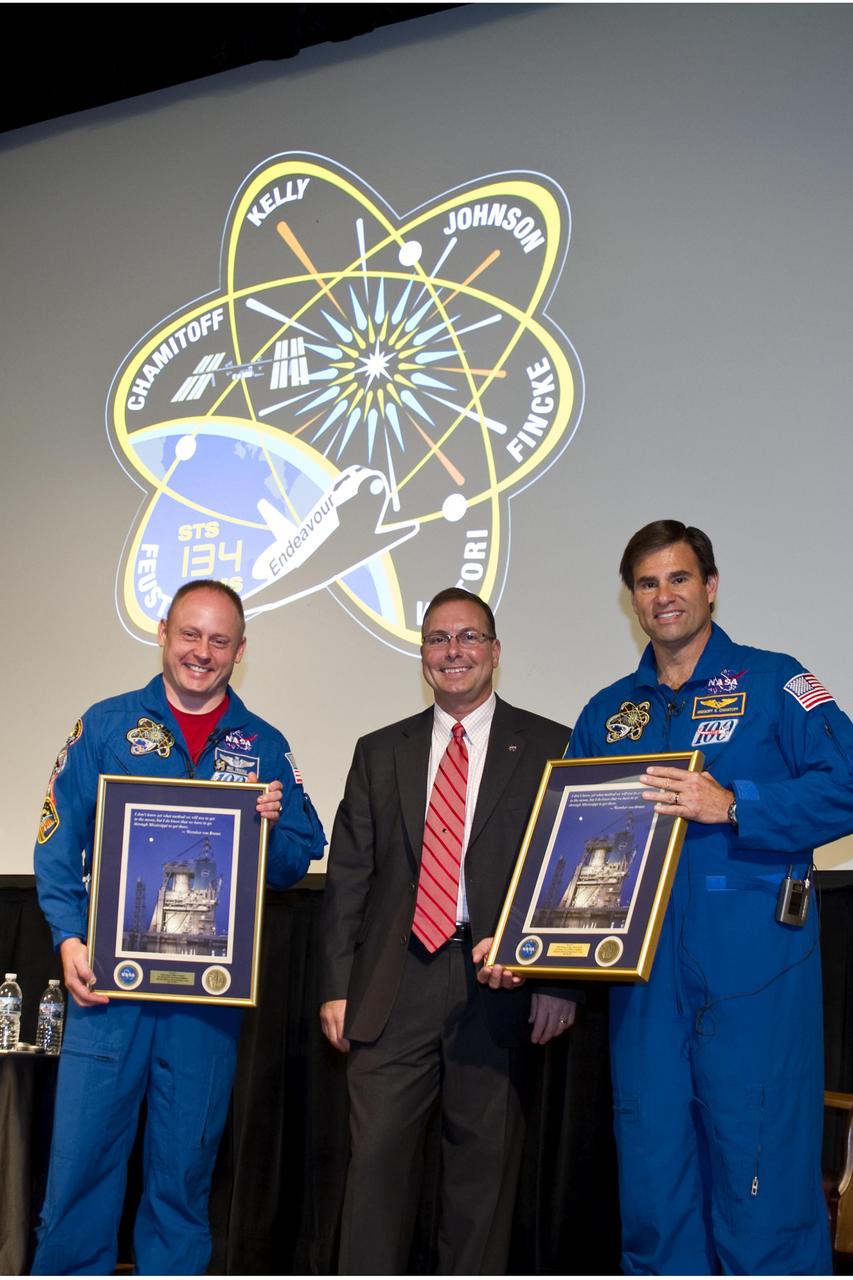
Stennis Space Center Deputy Director Richard Gilbrech (center) presents commemorative plaques to STS-134 crew members Michael Fincke (l) and Gregory Chamitoff during their July 20 visit to the south Mississippi facility. During the visit, Fincke and Chamitoff spoke to Stennis employees about their STS-134 mission aboard shuttle Endeavour, the final flight to space for the NASA orbiter.
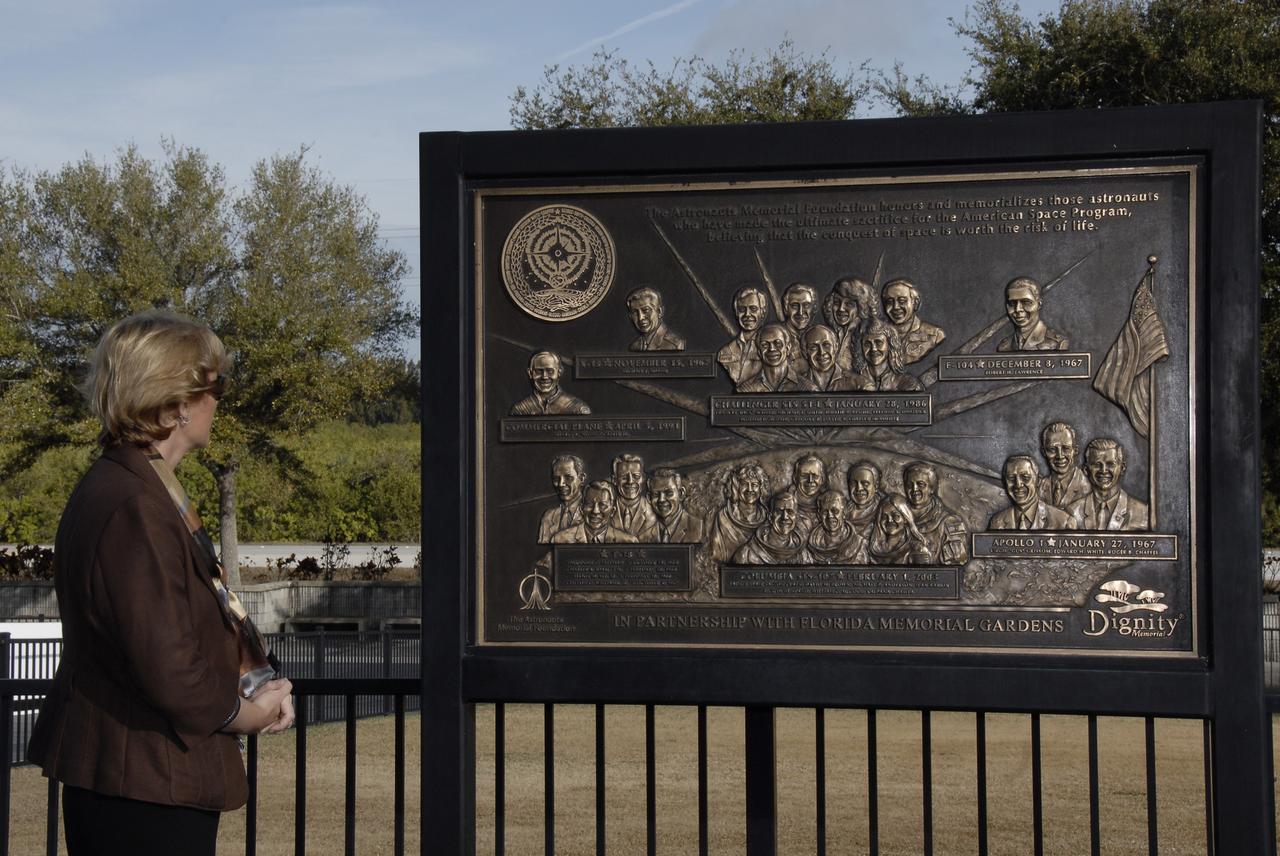
CAPE CANAVERAL, Fla. – Near the Space Mirror Memorial at NASA's Kennedy Space Center Visitor Complex, a large plaque commemorates the crews of Apollo 1 and space shuttles Challenger and Columbia who lost their lives while furthering the cause of exploration and discovery. At left is Tara Gillam, manager of the Office of Diversity and Equal Opportunity at Kennedy. Jan. 29 is NASA's Day of Remembrance observance and included a wreath-laying ceremony in front of the Space Mirror Memorial. Photo credit: NASA/Kim Shiflett
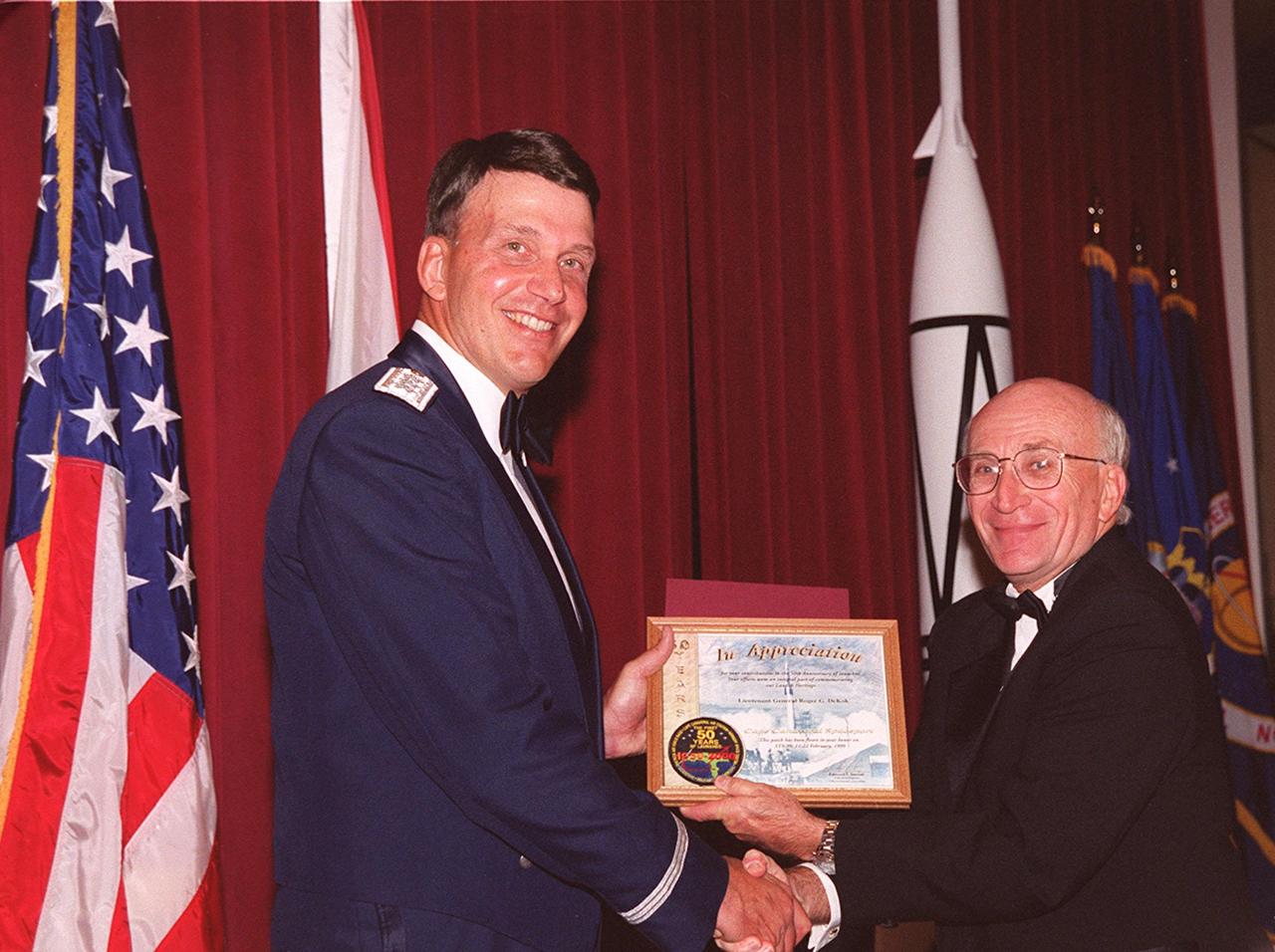
Vice Commander, Air Force Space Command, Lt. Gen. Roger DeKok (left) receives a commemorative plaque from Ed Gormel, committee chairman for the 50th anniversary gala that capped a year-long celebration of 50 years of rocket launches from Cape Canaveral Air Force Station. The first launch at CCAFS took place at 9:28 a.m. on July 24, 1950, with the liftoff of Bumper 8 from Launch Complex 3. The gala was hosted by the Cape Canaveral Chapter Air Force Association
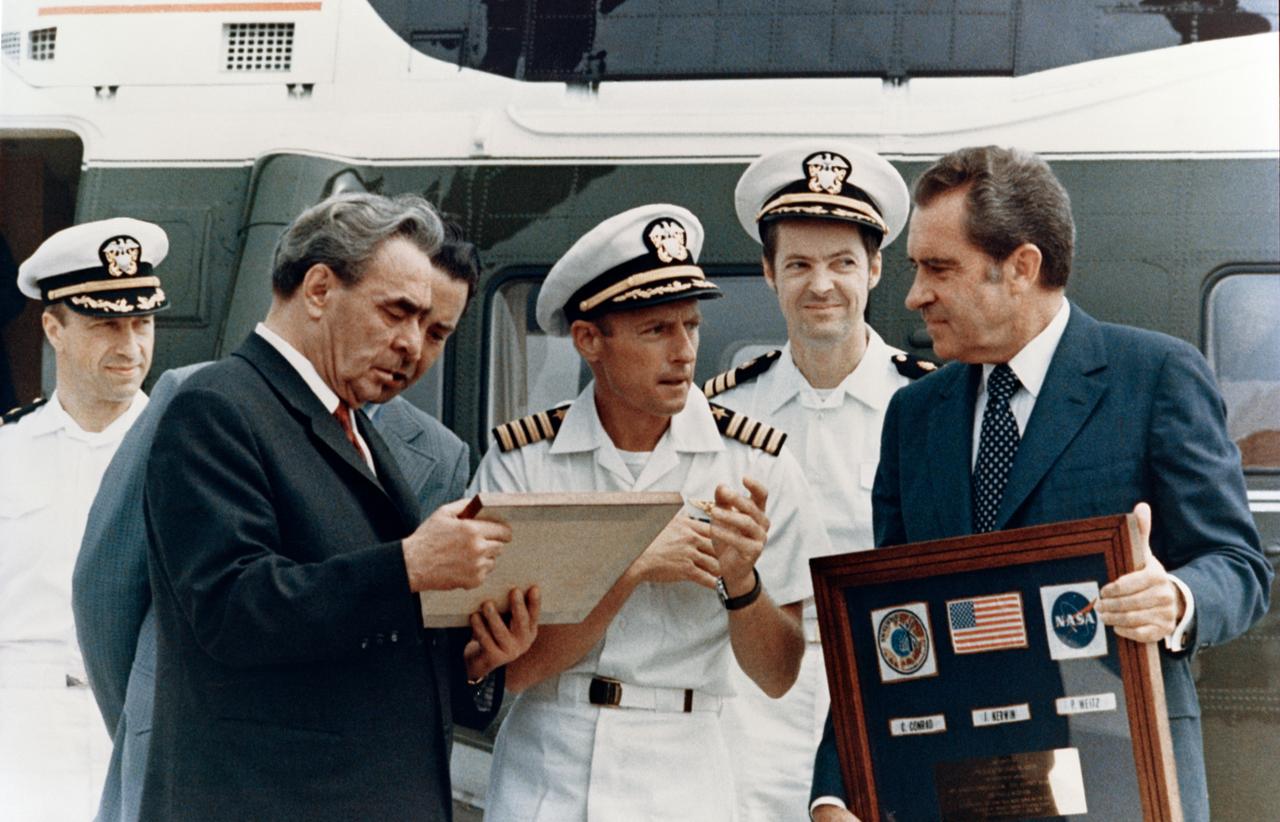
S73-30889 (June 1973) --- Leonid I. Breznev, General Secretary of the Communist Party, Union of Soviet Socialist Republics, and President Richard M. Nixon, during ceremonies at the Western White House in San Clemente, California, examine plaques presented by Skylab astronauts Charles Conrad Jr., center; Joseph P. Kerwin, second from right; and Paul J. Weitz, left. Photo credit: NASA
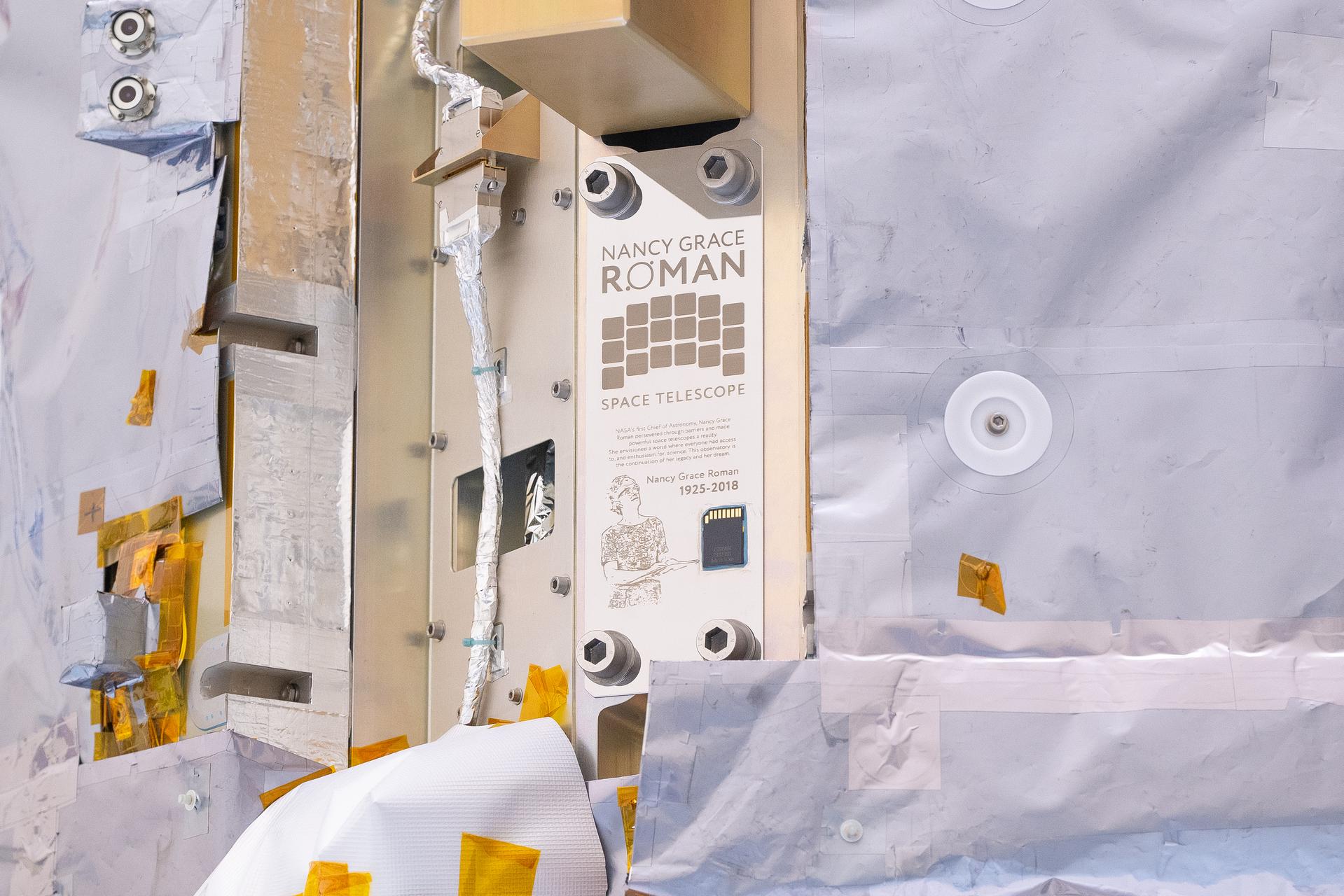
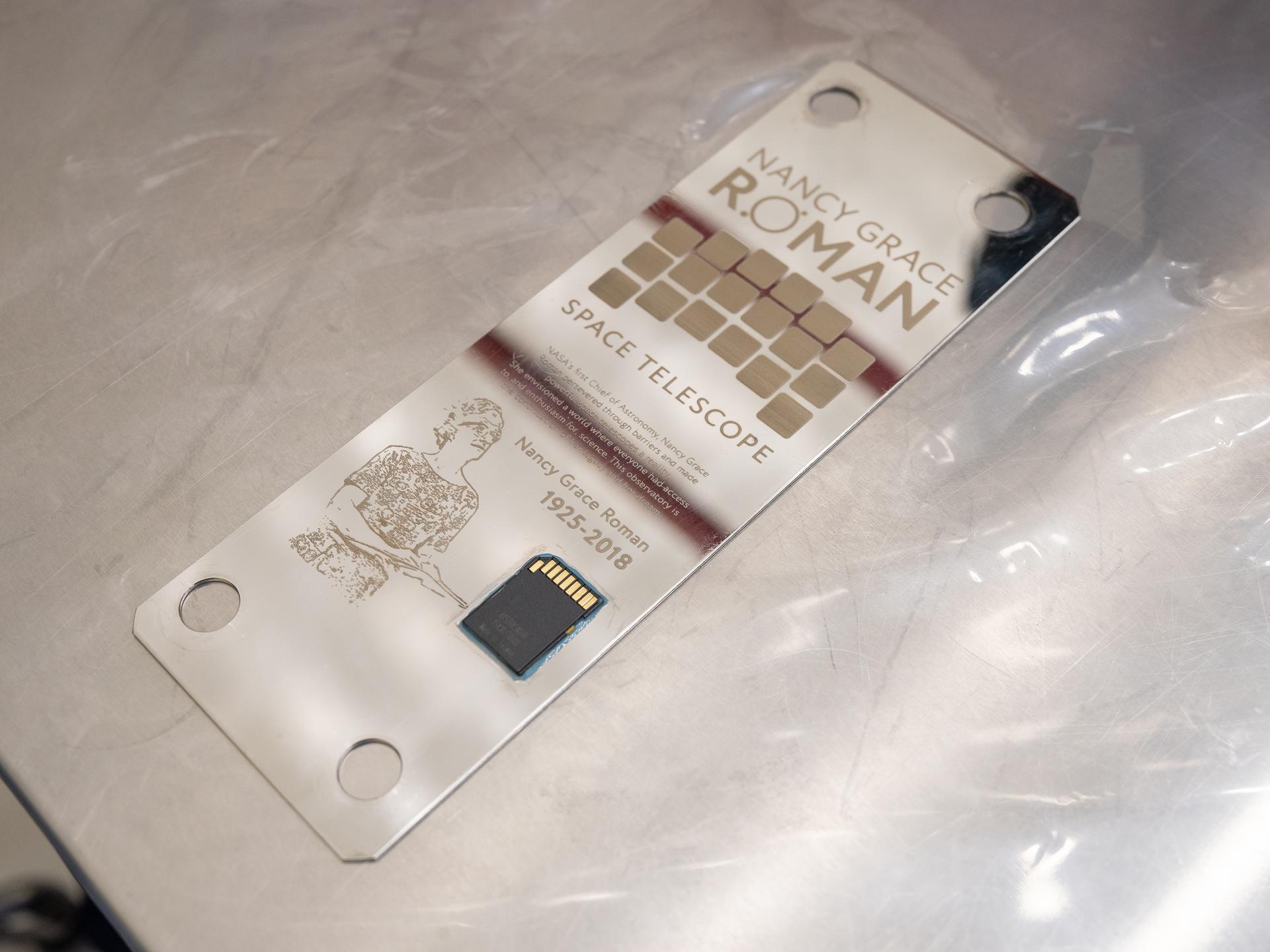
Technicians inside the Payload Hazardous Servicing Facility at NASA’s Kennedy Space Center complete installation of a commemorative plaque on the agency’s Nancy Grace Roman Space Telescope, as photographed on Tuesday, July 28, 2026. In addition to honoring the legacy of Dr. Nancy Grace Roman, NASA’s first chief astronomer and one of the architects of the agency’s modern science program, the plaque features a memory card containing a total of 1,350,144 names submitted by people from across the globe, including astronauts from NASA’s Artemis II and Artemis III missions. The Roman observatory will travel to the Sun-Earth Lagrange point 2, or L2, about one million miles from Earth, where the Sun’s and Earth’s gravity balance out, to complete a statistical census of planetary systems in our galaxy and settle essential questions in the areas of dark energy, exoplanets, and infrared astrophysics.
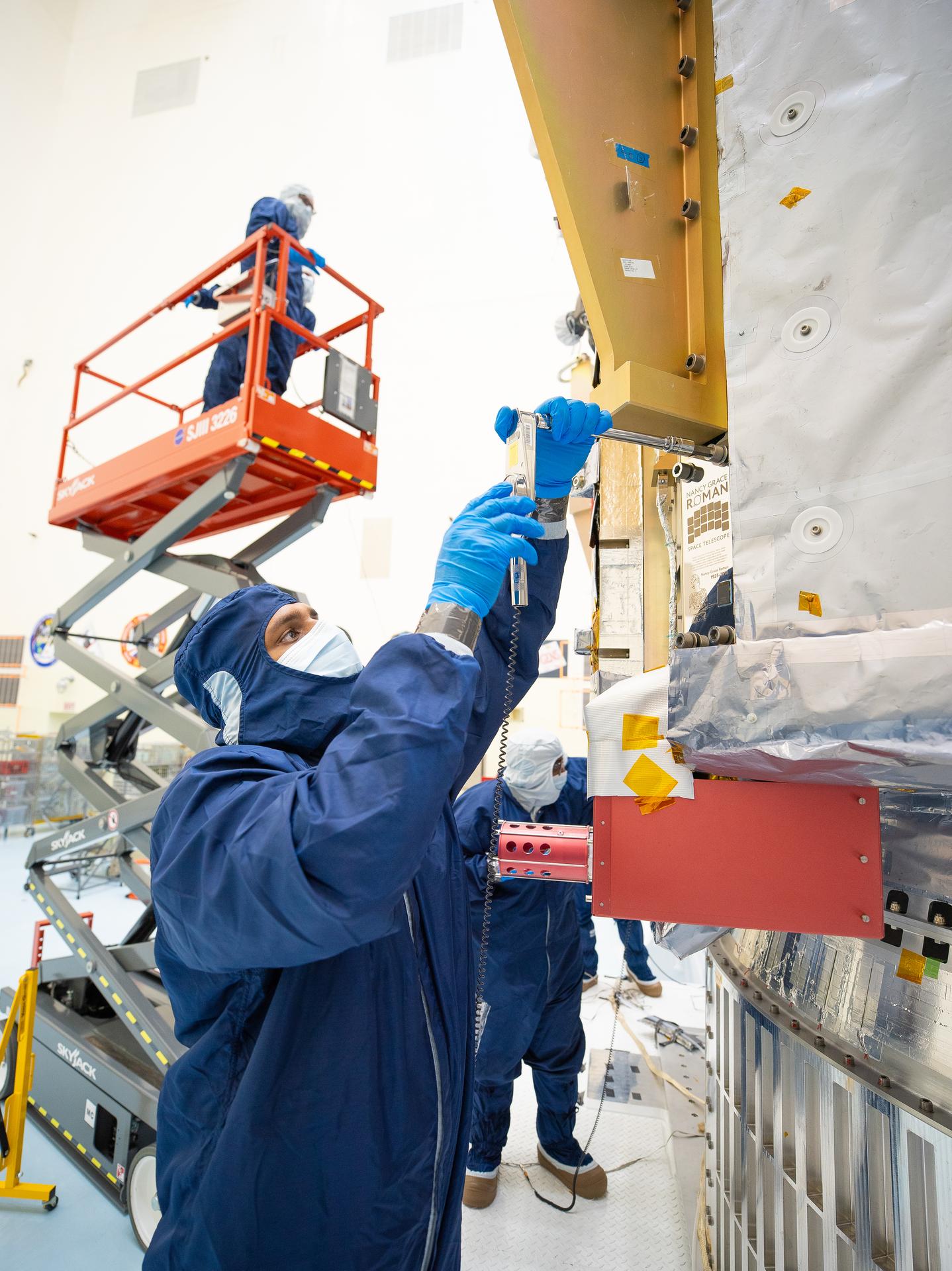
Technicians inside the Payload Hazardous Servicing Facility at NASA’s Kennedy Space Center in Florida install a commemorative plaque on the Nancy Grace Roman Space Telescope on Monday, July 27, 2026. In addition to honoring the legacy of Dr. Nancy Grace Roman, NASA’s first chief astronomer and one of the architects of the agency’s modern science program, the plaque features a memory card containing a total of 1,350,144 names submitted by people from across the globe, including astronauts from NASA’s Artemis II and Artemis III missions. The Roman observatory will travel to the Sun-Earth Lagrange point 2, or L2, about one million miles from Earth, where the Sun’s and Earth’s gravity balance out, to complete a statistical census of planetary systems in our galaxy and settle essential questions in the areas of dark energy, exoplanets, and infrared astrophysics.
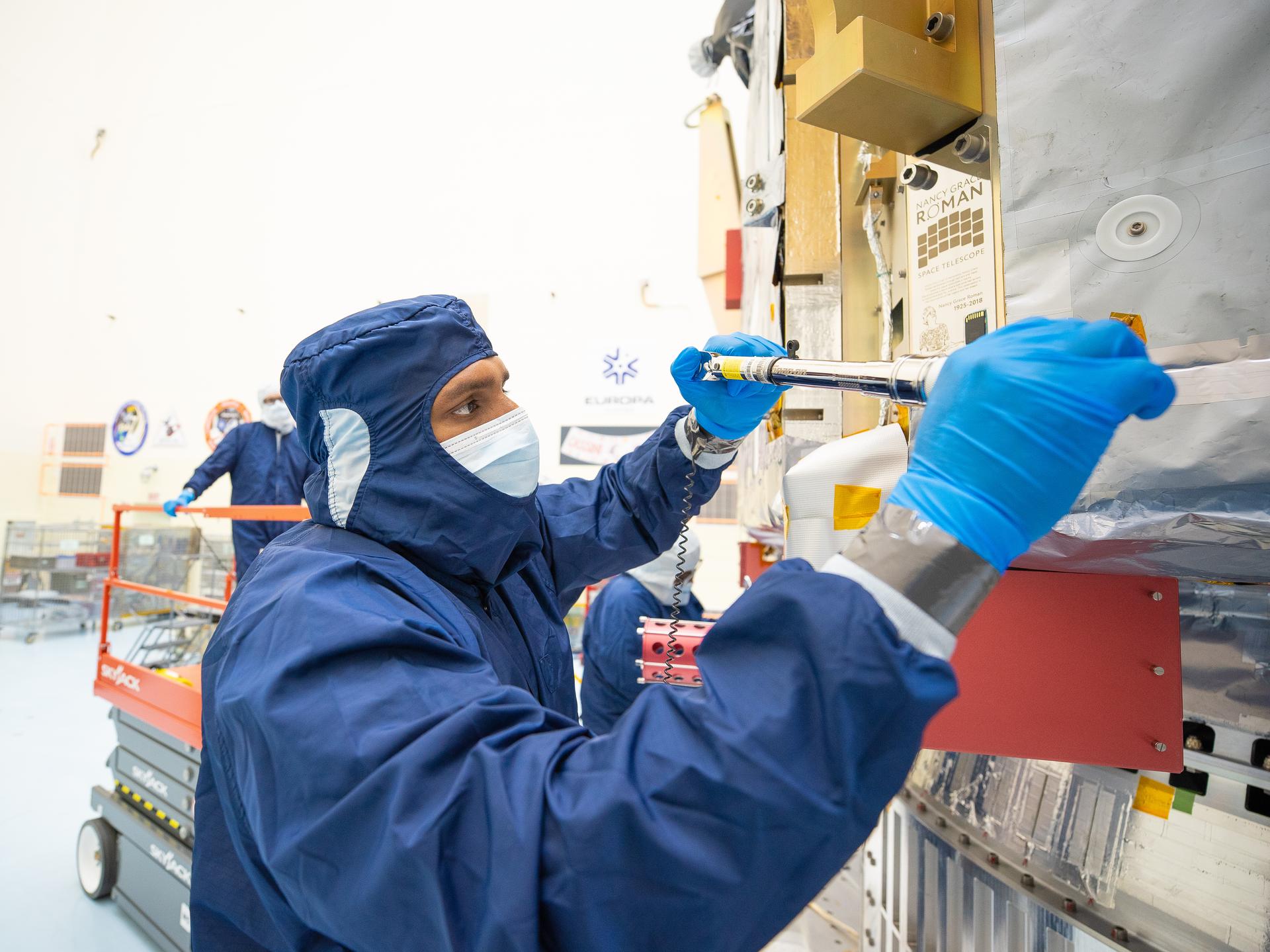
Technicians inside the Payload Hazardous Servicing Facility at NASA’s Kennedy Space Center in Florida install a commemorative plaque on the Nancy Grace Roman Space Telescope on Monday, July 27, 2026. In addition to honoring the legacy of Dr. Nancy Grace Roman, NASA’s first chief astronomer and one of the architects of the agency’s modern science program, the plaque features a memory card containing a total of 1,350,144 names submitted by people from across the globe, including astronauts from NASA’s Artemis II and Artemis III missions. The Roman observatory will travel to the Sun-Earth Lagrange point 2, or L2, about one million miles from Earth, where the Sun’s and Earth’s gravity balance out, to complete a statistical census of planetary systems in our galaxy and settle essential questions in the areas of dark energy, exoplanets, and infrared astrophysics.
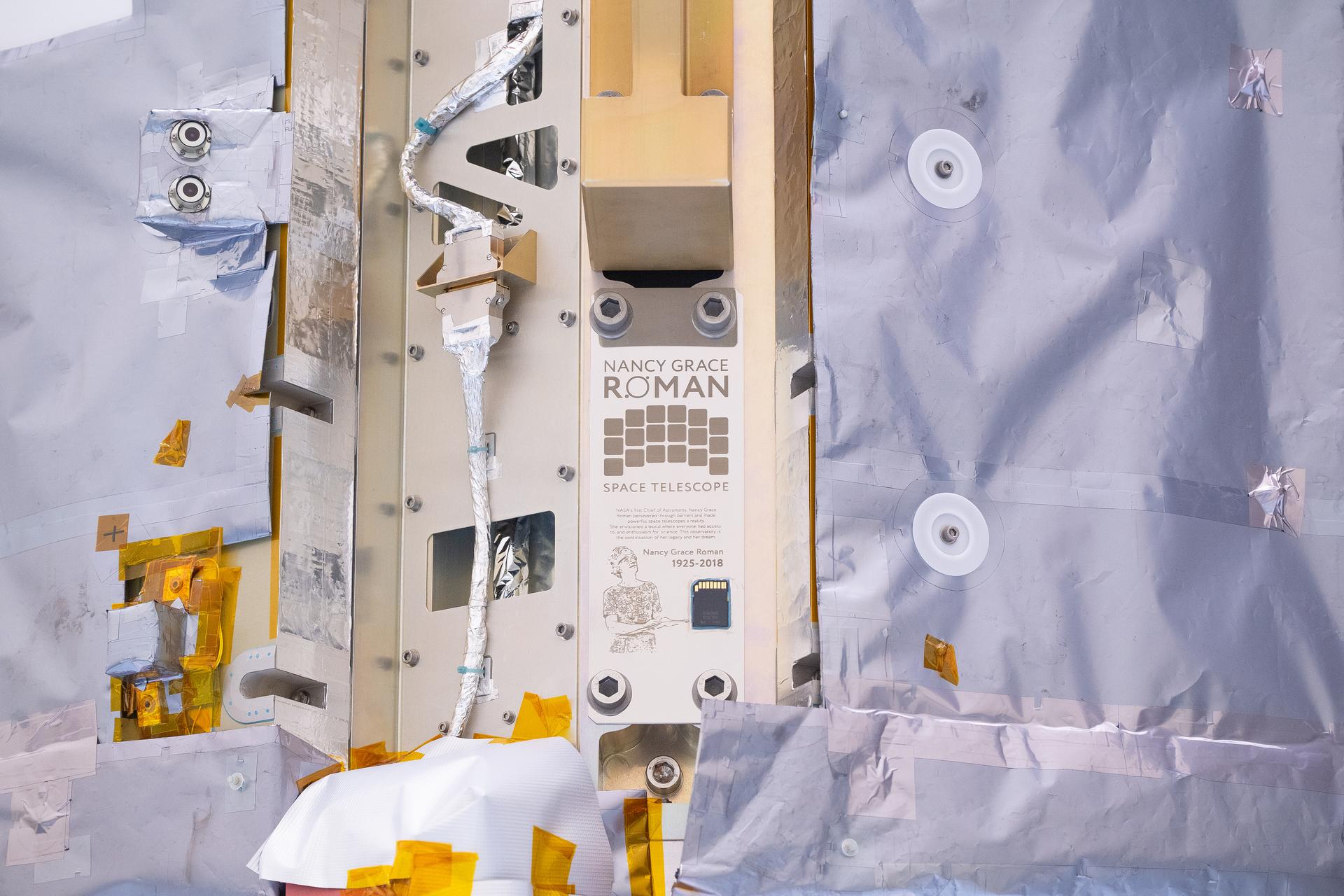
Technicians inside the Payload Hazardous Servicing Facility at NASA’s Kennedy Space Center complete installation of a commemorative plaque on the agency’s Nancy Grace Roman Space Telescope, as photographed on Tuesday, July 28, 2026. In addition to honoring the legacy of Dr. Nancy Grace Roman, NASA’s first chief astronomer and one of the architects of the agency’s modern science program, the plaque features a memory card containing a total of 1,350,144 names submitted by people from across the globe, including astronauts from NASA’s Artemis II and Artemis III missions. The Roman observatory will travel to the Sun-Earth Lagrange point 2, or L2, about one million miles from Earth, where the Sun’s and Earth’s gravity balance out, to complete a statistical census of planetary systems in our galaxy and settle essential questions in the areas of dark energy, exoplanets, and infrared astrophysics.
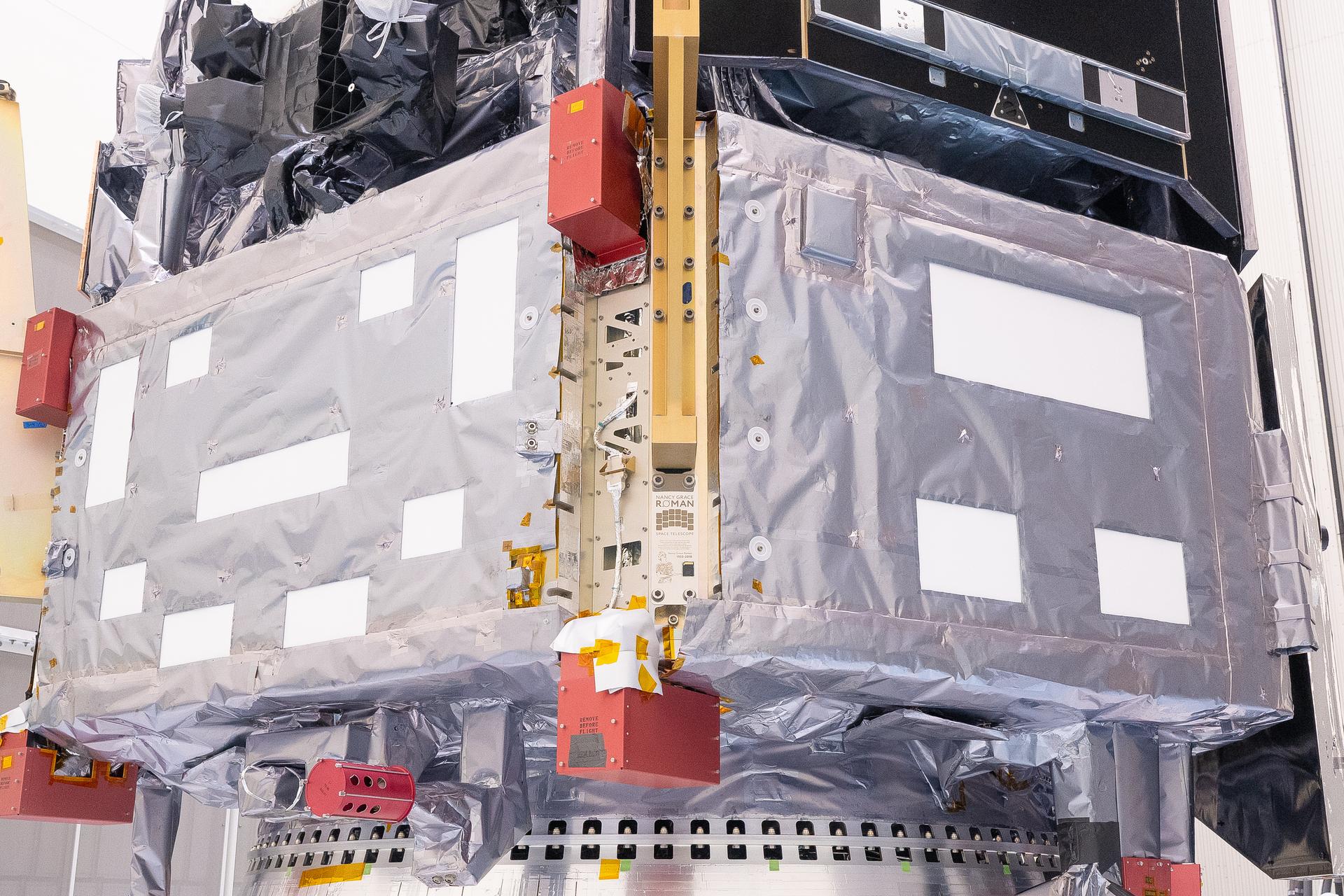
Technicians inside the Payload Hazardous Servicing Facility at NASA’s Kennedy Space Center complete installation of a commemorative plaque on the agency’s Nancy Grace Roman Space Telescope, as photographed on Tuesday, July 28, 2026. In addition to honoring the legacy of Dr. Nancy Grace Roman, NASA’s first chief astronomer and one of the architects of the agency’s modern science program, the plaque features a memory card containing a total of 1,350,144 names submitted by people from across the globe, including astronauts from NASA’s Artemis II and Artemis III missions. The Roman observatory will travel to the Sun-Earth Lagrange point 2, or L2, about one million miles from Earth, where the Sun’s and Earth’s gravity balance out, to complete a statistical census of planetary systems in our galaxy and settle essential questions in the areas of dark energy, exoplanets, and infrared astrophysics.
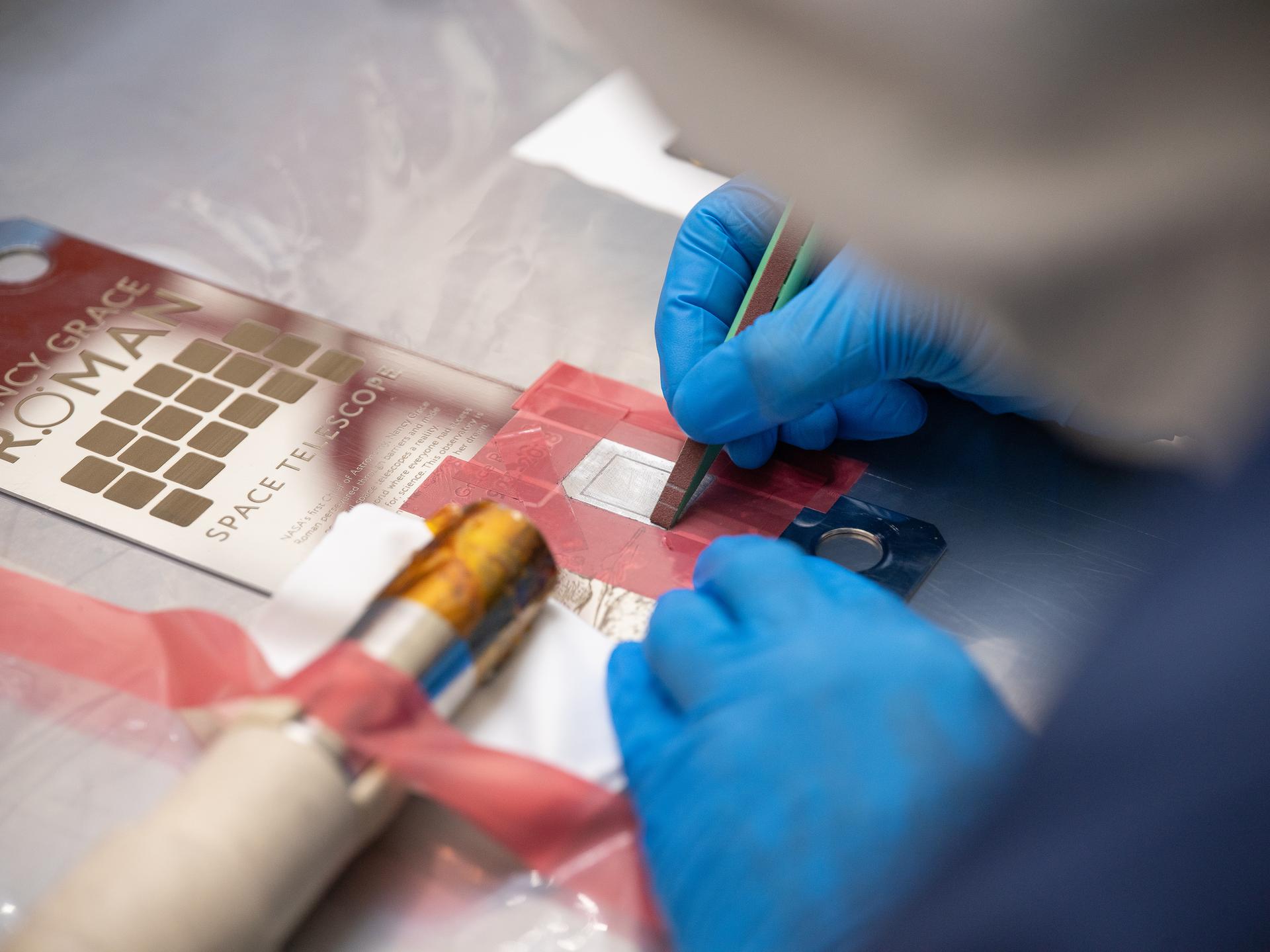
A technician inside the Payload Hazardous Servicing Facility at NASA’s Kennedy Space Center in Florida installs a memory card containing a total of 1,350,144 names as part of a commemorative plaque on the Nancy Grace Roman Space Telescope on Friday, July 17, 2026. The names, submitted by people from across the globe, including astronauts from NASA’s Artemis II and Artemis III missions, will travel with the Roman observatory to the Sun-Earth Lagrange point 2, or L2, about one million miles from Earth, where the Sun’s and Earth’s gravity balance out. Roman is named after Dr. Nancy Grace Roman, NASA’s first chief astronomer and one of the architects of the agency’s modern science program.
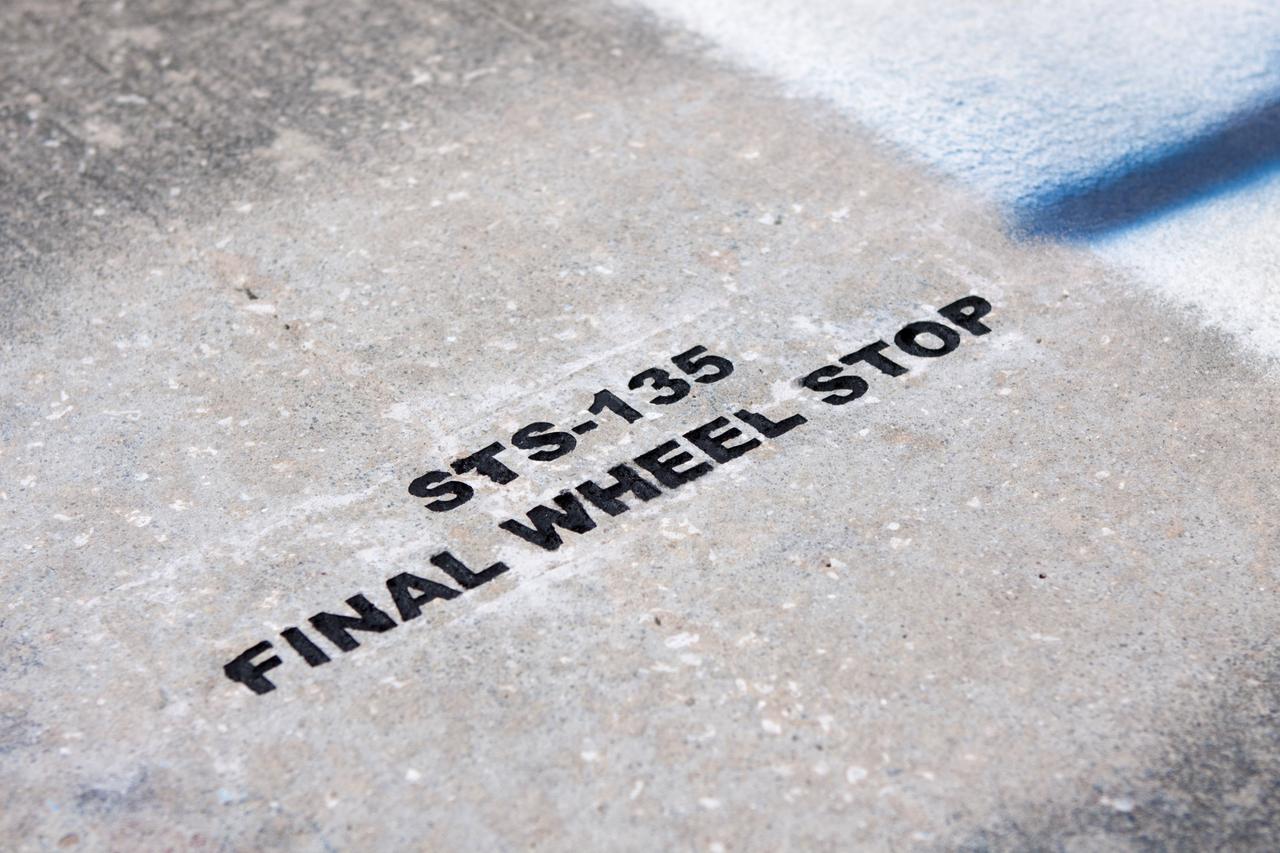
CAPE CANAVERAL, Fla. - At the Shuttle Landing Facility SLF at NASA’s Kennedy Space Center in Florida, the final wheel stop of an orbiter is marked. Space shuttle Atlantis completed the STS-135 mission by landing at the SLF on July 21, 2011, at 5:57 a.m. A special plaque will be permanently mounted at the runway’s edge to commemorate the final shuttle landing. Atlantis flew 33 missions, completed 4,848 orbits of the Earth, traveled nearly 126 million miles and spent 307 days in space. Atlantis carried 207 astronauts to space. Photo credit: NASA/Jim Grossmann
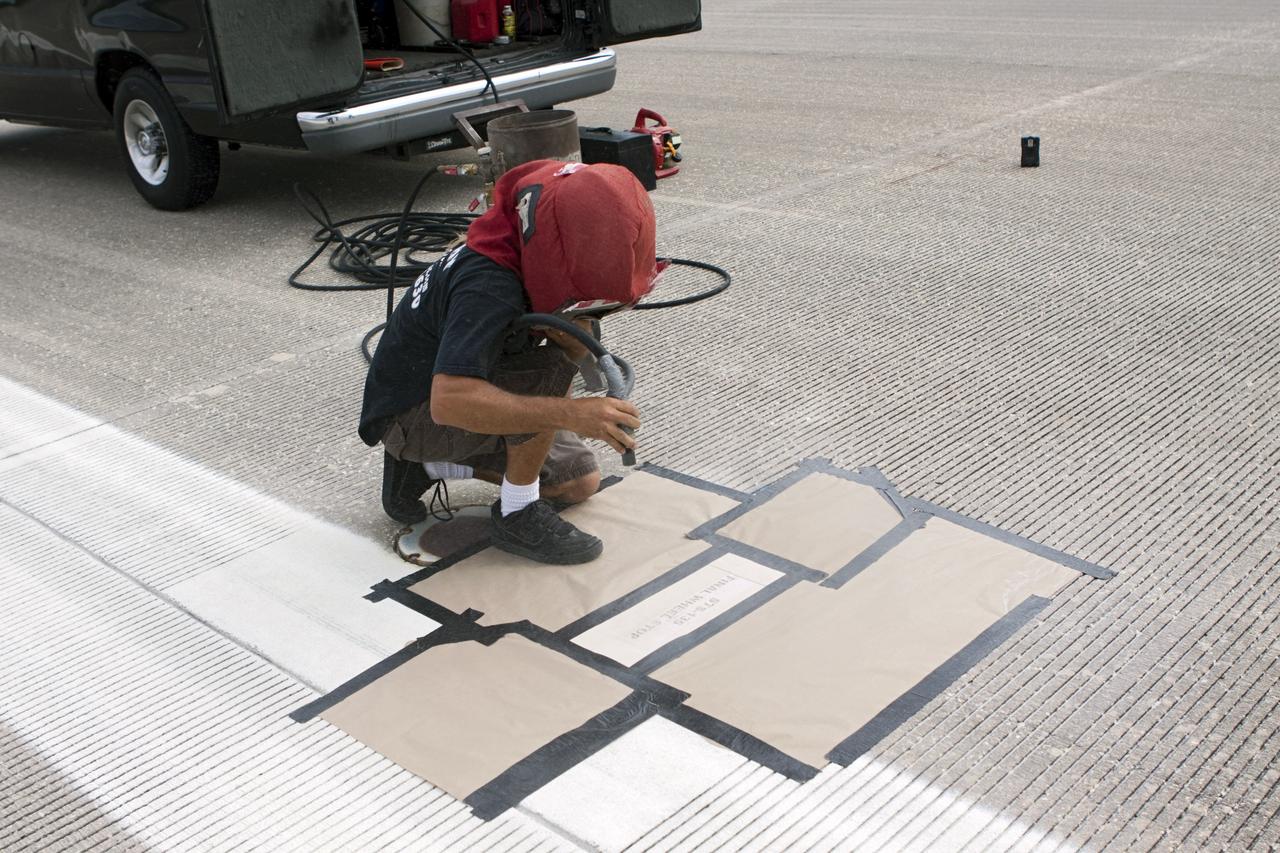
CAPE CANAVERAL, Fla. - At the Shuttle Landing Facility SLF at NASA’s Kennedy Space Center in Florida, a United Space Alliance technician marks the final front and rear wheel stop locations of an orbiter. Space shuttle Atlantis completed the STS-135 mission by landing at the SLF on July 21, 2011, at 5:57 a.m. A special plaque will be permanently mounted at the runway’s edge to commemorate the final shuttle landing. Atlantis flew 33 missions, completed 4,848 orbits of the Earth, traveled nearly 126 million miles and spent 307 days in space. Atlantis carried 207 astronauts to space. Photo credit: NASA/Jim Grossmann
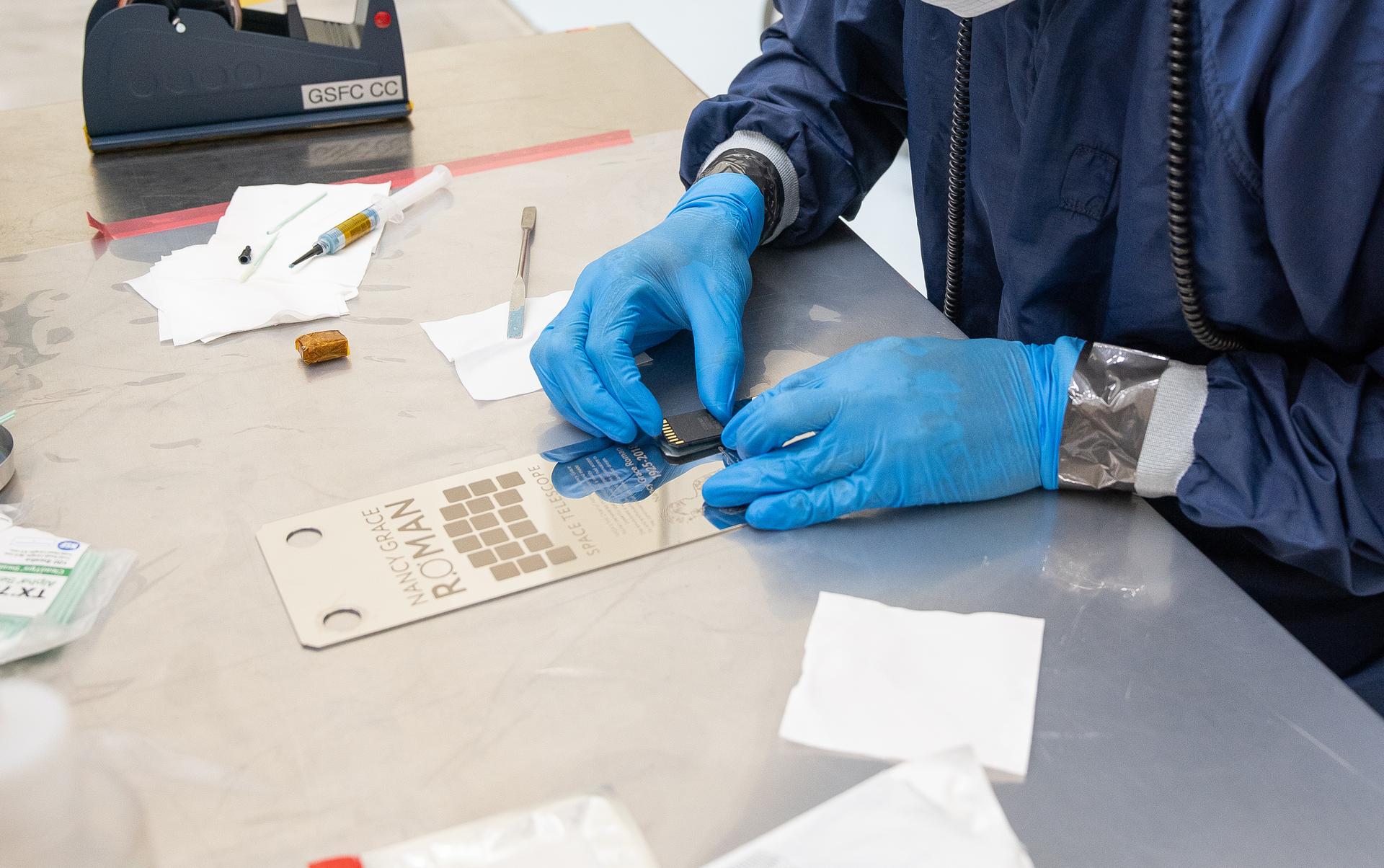
A technician inside the Payload Hazardous Servicing Facility at NASA’s Kennedy Space Center in Florida installs a memory card containing a total of 1,350,144 names as part of a commemorative plaque on the Nancy Grace Roman Space Telescope on Friday, July 17, 2026. The names, submitted by people from across the globe, including astronauts from NASA’s Artemis II and Artemis III missions, will travel with the Roman observatory to the Sun-Earth Lagrange point 2, or L2, about one million miles from Earth, where the Sun’s and Earth’s gravity balance out. Roman is named after Dr. Nancy Grace Roman, NASA’s first chief astronomer and one of the architects of the agency’s modern science program.

The A-1 Test Stand at NASA Stennis Space Center near Bay St. Louis, Miss., was the focus of a ceremony held Thursday to transition the storied facility to a new program of work: testing the J-2X engines that will power the agency's next generation spacecraft, Ares I & V. Standing before the historic structure, with a plaque commemorating the change, are (from left) SSC Center Director Richard Gilbrech; NASA Associate Administrator for Exploration Systems Scott Horowitz; and NASA Space Operations Deputy Associate Administrator for Program Integration Michael Hawes. Ares vehicles are the crew and cargo launch vehicles being developed under NASA's Constellation Program.
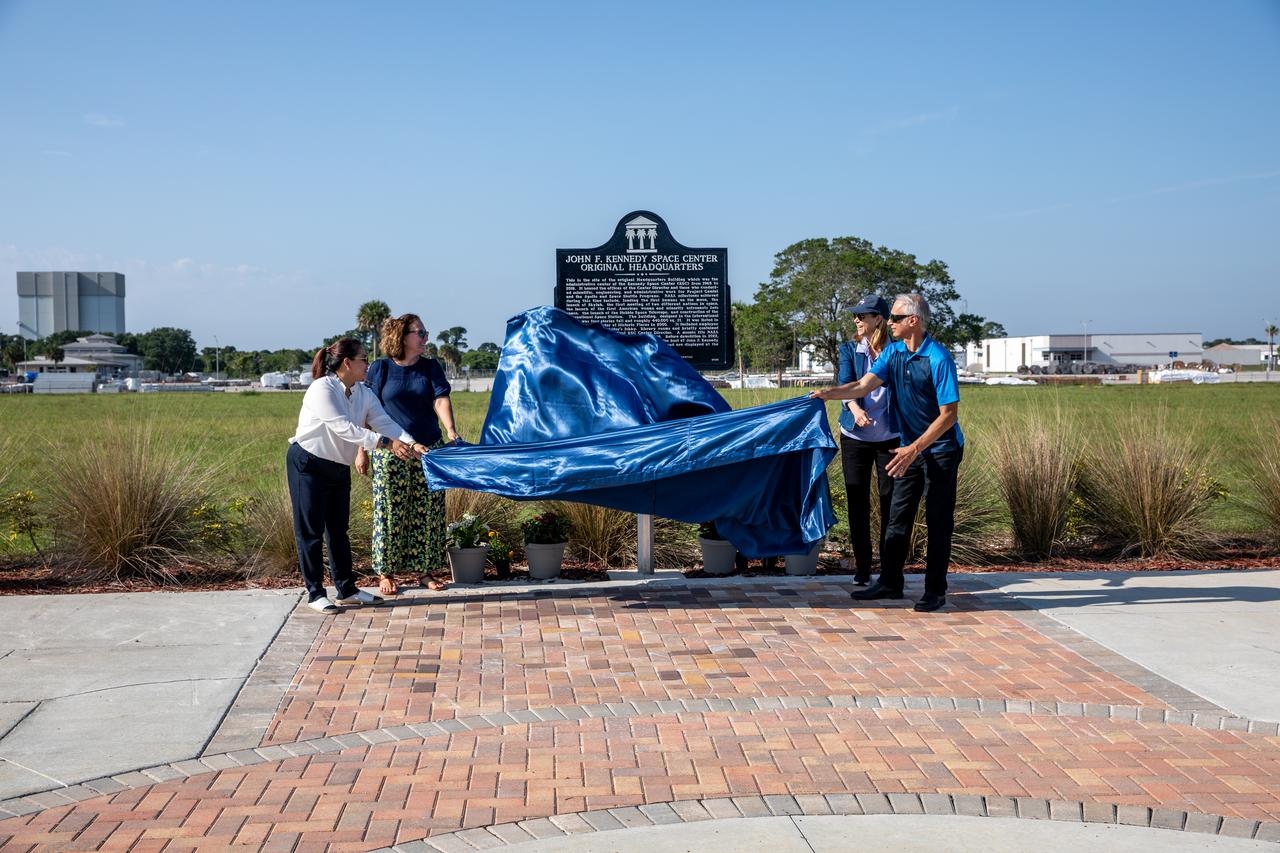
From the left, NASA Kennedy Space Center’s, Maui Dalton, project manager, engineering; Katherine Zeringue, cultural resources manager; Janet Petro, NASA Kennedy Space Center director; and Ismael Otero, project manager, engineering, unveil a large bronze historical marker plaque at the location of NASA Kennedy’s original headquarters building on Tuesday, May 28, 2024. Approved in April 2023 as part of the State of Florida’s Historical Markers program in celebration of National Historic Preservation Month, the marker commemorates the early days of space exploration and is displayed permanently just west of the seven-story, 200,000 square foot Central Campus Headquarters Building, which replaced the old building in 2019.
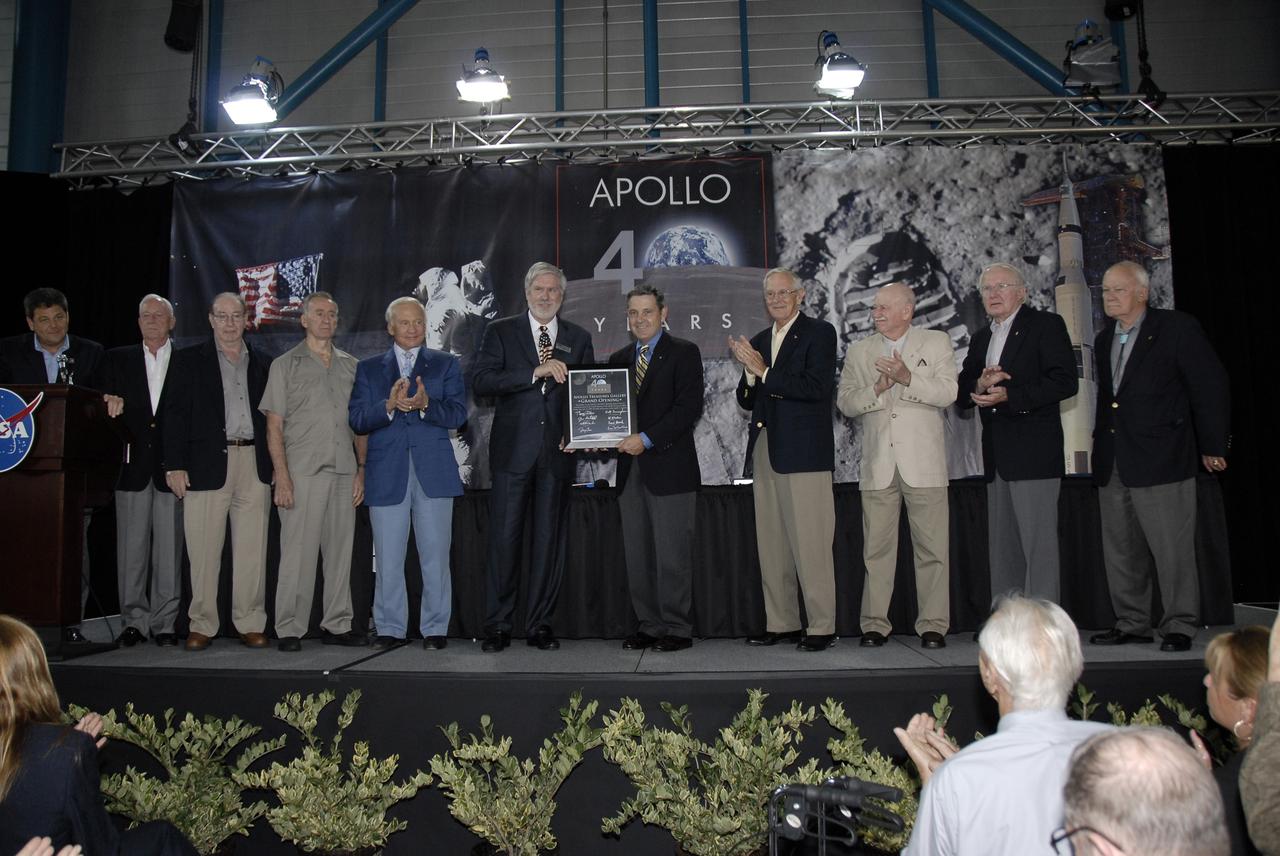
CAPE CANAVERAL, Fla. – During NASA's 40th Anniversary of Apollo Celebration at the Apollo/Saturn V Center at NASA's Kennedy Space Center in Florida, the Visitor Complex Chief Operating Officer, Bob Moore (center left), gives Center Director Bob Cabana a plaque commemorating the Apollo Treasures Gallery. Others on stage are (far left) the program moderator, John Zarella, with CNN, and Apollo astronauts Al Worden, Edgar Mitchell, Walt Cunningham, Buzz Aldrin, (Moore, Cabana), Charlie Duke, Vance Brand, Gerald Carr and Bruce McCandless. The celebration honored the July 1969 launch and landing on the moon. Photo credit: NASA/Kim Shiflett

KENNEDY SPACE CENTER, Fla. - J.J. "Tip" Talone Jr., director of KSC's International Space Station/Payload Processing, presents Expedition 2 crew member Susan Helms with a photo plaque from employees commemorating her stay aboard the Space Station. The Expedition 2 crew, which included astronaut Jim Voss and cosmonaut Yury Usachev, made the space voyage to the Station on mission STS-102 in March 2001. After five months on the Station, they returned to Earth, at the KSC Shuttle Landing Facility, on mission STS-105 in August 2001
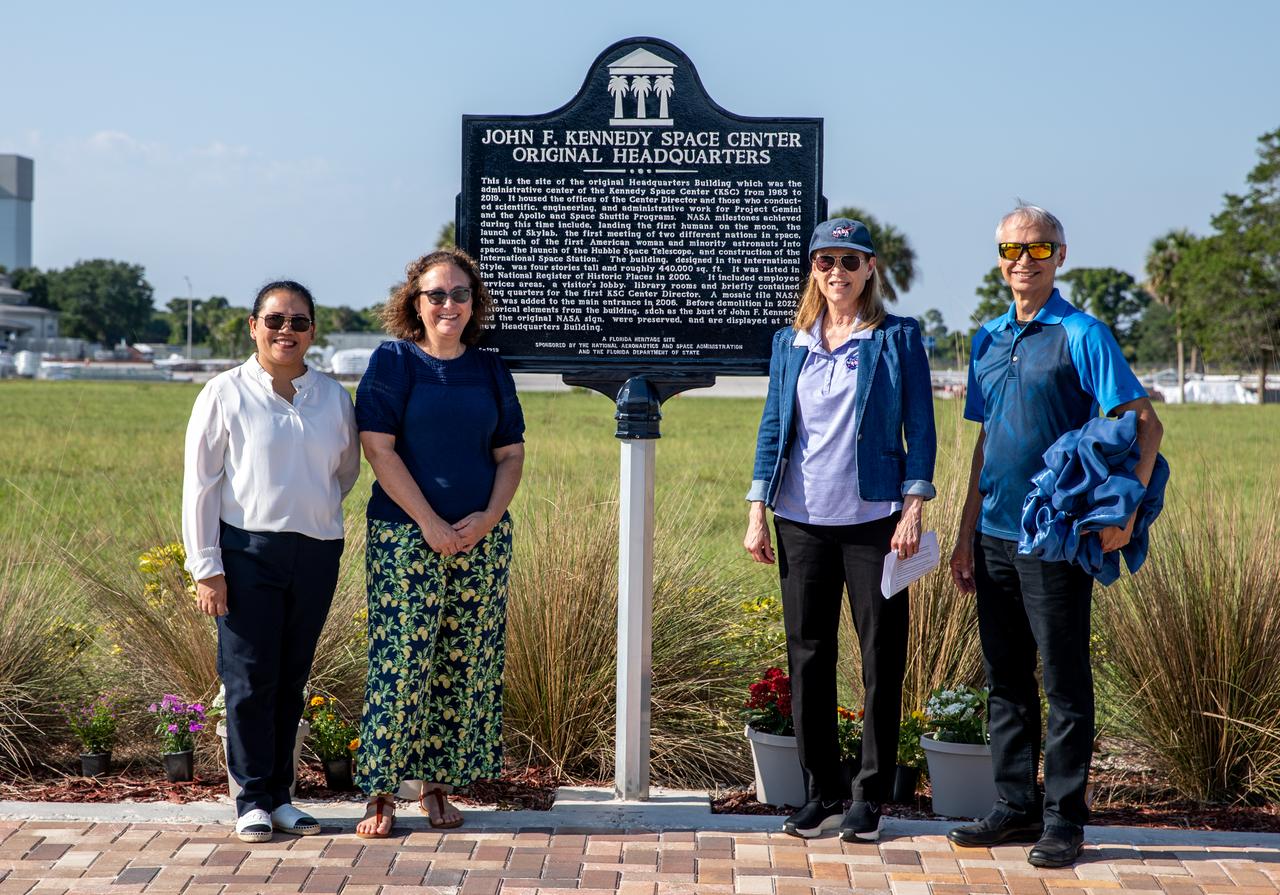
From the left, NASA Kennedy Space Center’s, Maui Dalton, project manager, engineering; Katherine Zeringue, cultural resources manager; Janet Petro, NASA Kennedy Space Center director; and Ismael Otero, project manager, engineering, present a large bronze historical marker plaque at the location of NASA Kennedy’s original headquarters building on Tuesday, May 28, 2024. Approved in April 2023 as part of the State of Florida’s Historical Markers program in celebration of National Historic Preservation Month, the marker commemorates the early days of space exploration and is displayed permanently just west of the seven-story, 200,000 square foot Central Campus Headquarters Building, which replaced the old building in 2019.
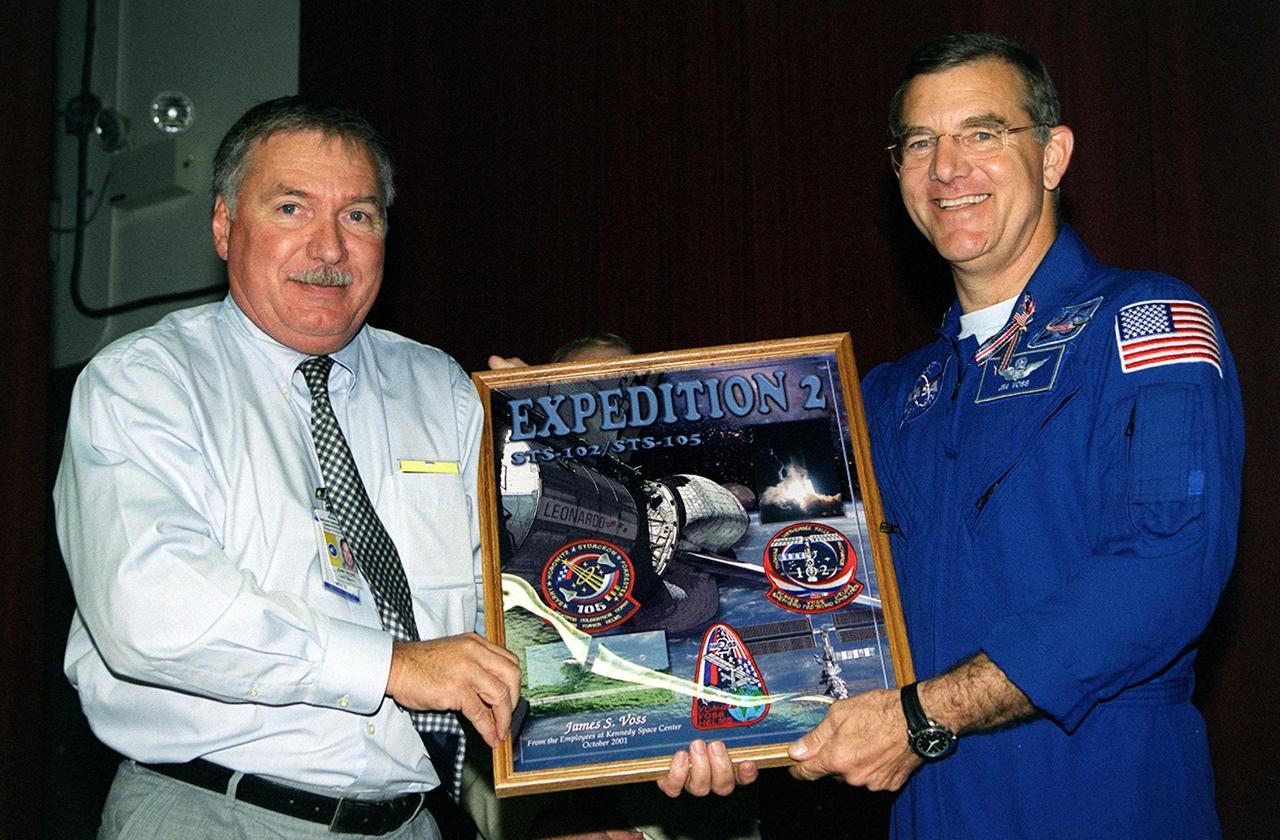
KENNEDY SPACE CENTER, Fla. -- J.J. "Tip" Talone Jr., director of KSC's International Space Station/Payload Processing, presents Expedition 2 crew member Jim Voss with a photo plaque from employees commemorating his stay aboard the Space Station. The Expedition 2 crew, which included astronaut Susan Helms and cosmonaut Yury Usachev , made the space voyage to the Station on mission STS-102 in March 2001. After five months on the Station, they returned to Earth, at the KSC Shuttle Landing Facility, on mission STS-105 in August 2001
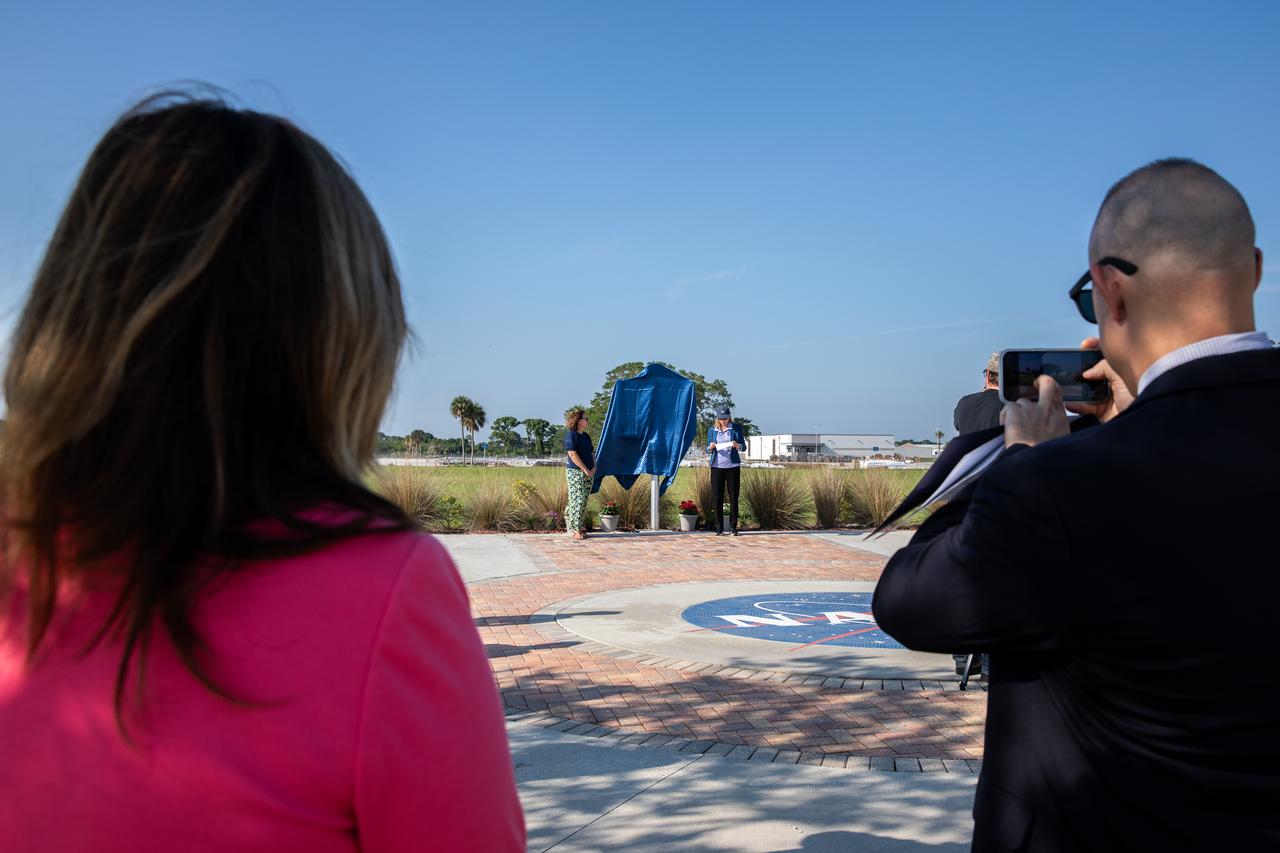
From the left, Katherine Zeringue, cultural resources manager, NASA’s Kennedy Space Center, is joined by Janet Petro, NASA Kennedy Space Center director, at a ceremony attended by NASA employees held Tuesday, May 28, 2024, to unveil a large bronze historical marker plaque at the location of NASA Kennedy’s original headquarters building. Approved in April 2023 as part of the State of Florida’s Historical Markers program in celebration of National Historic Preservation Month, the marker commemorates the early days of space exploration and is displayed permanently just west of the seven-story, 200,000 square foot Central Campus Headquarters Building, which replaced the old building in 2019.
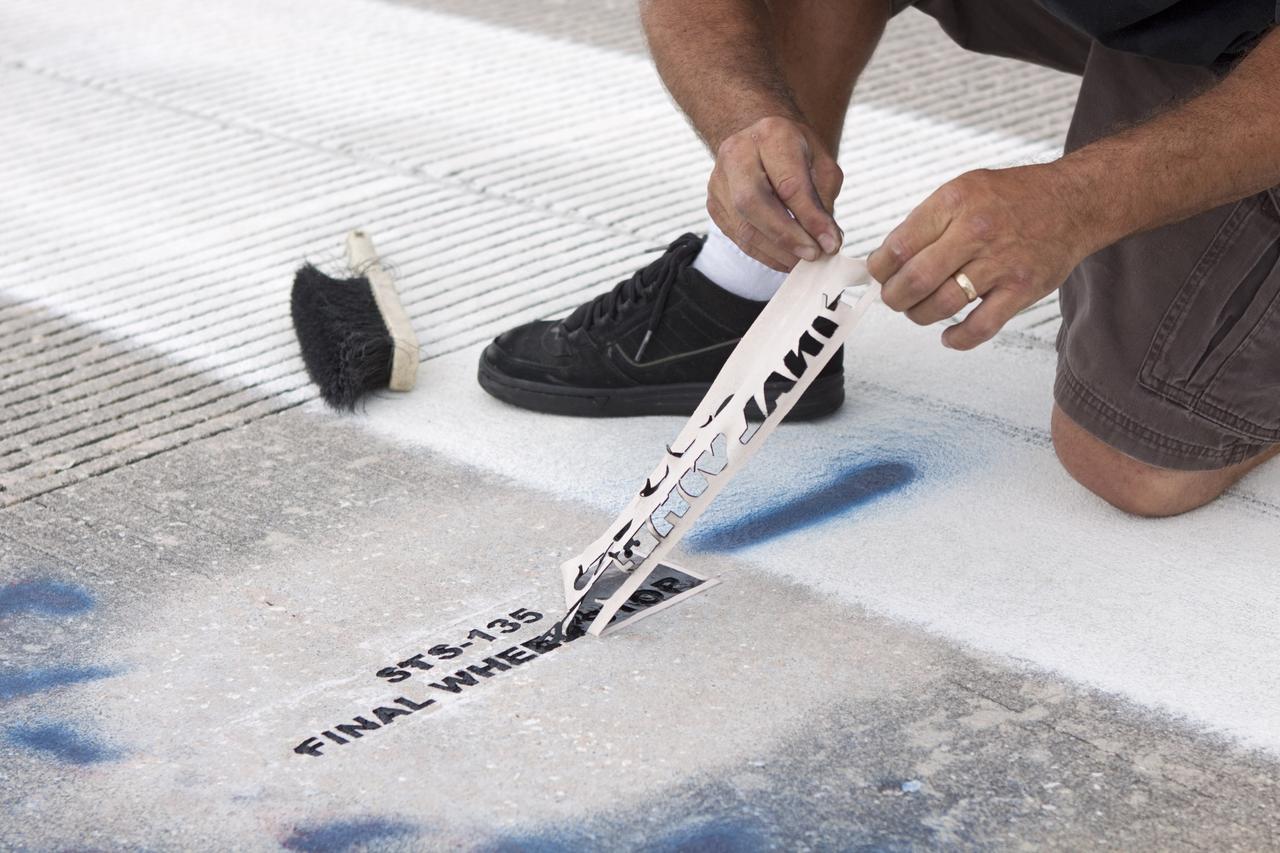
CAPE CANAVERAL, Fla. - At the Shuttle Landing Facility SLF at NASA’s Kennedy Space Center in Florida, a United Space Alliance technician marks the final front and rear wheel stop locations of an orbiter. Space shuttle Atlantis completed the STS-135 mission by landing at the SLF on July 21, 2011, at 5:57 a.m. A special plaque will be permanently mounted at the runway’s edge to commemorate the final shuttle landing. Atlantis flew 33 missions, completed 4,848 orbits of the Earth, traveled nearly 126 million miles and spent 307 days in space. Atlantis carried 207 astronauts to space. Photo credit: NASA/Jim Grossmann
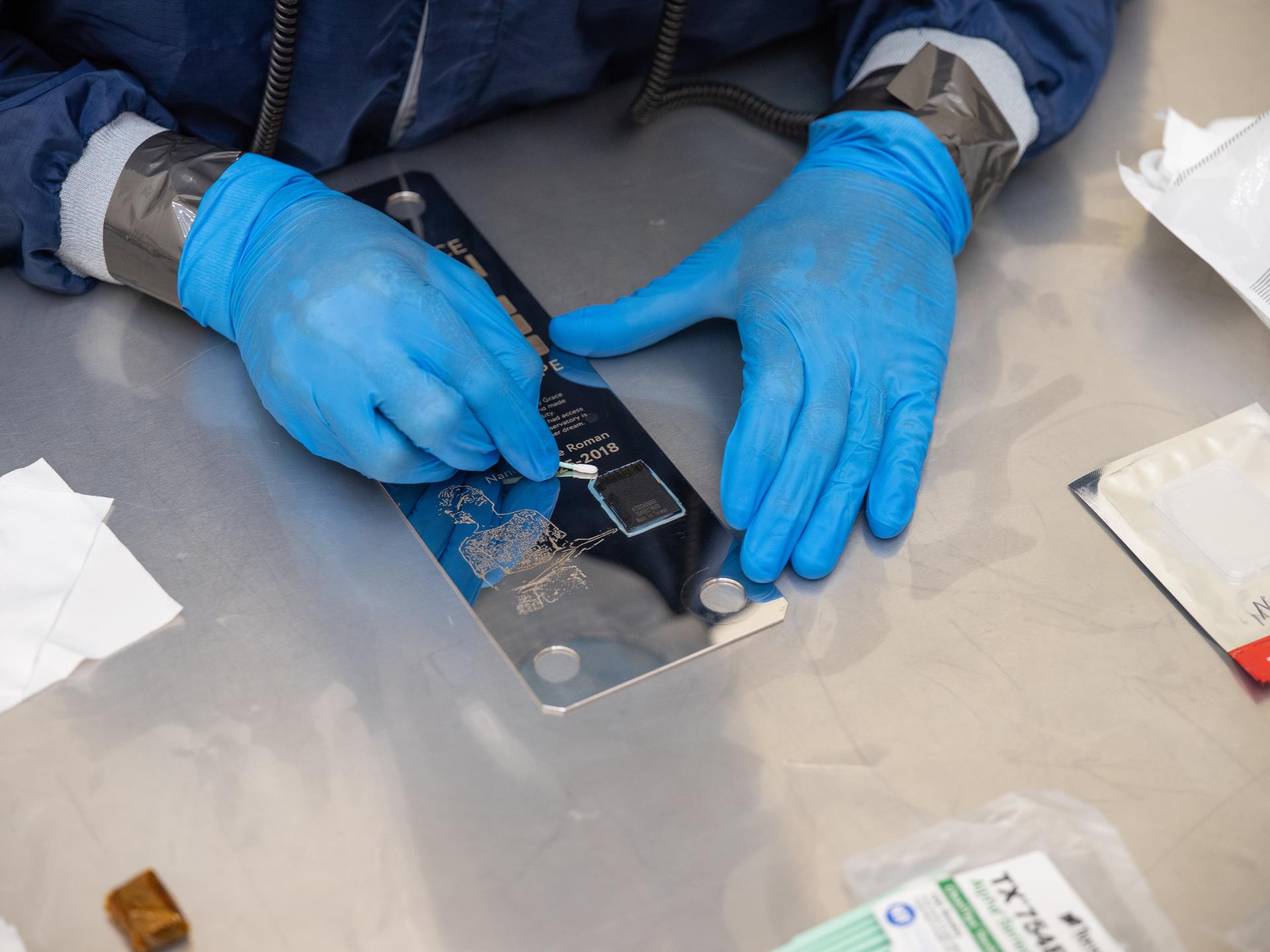
A technician inside the Payload Hazardous Servicing Facility at NASA’s Kennedy Space Center in Florida installs a memory card containing a total of 1,350,144 names as part of a commemorative plaque on the Nancy Grace Roman Space Telescope on Friday, July 17, 2026. The names, submitted by people from across the globe, including astronauts from NASA’s Artemis II and Artemis III missions, will travel with the Roman observatory to the Sun-Earth Lagrange point 2, or L2, about one million miles from Earth, where the Sun’s and Earth’s gravity balance out. Roman is named after Dr. Nancy Grace Roman, NASA’s first chief astronomer and one of the architects of the agency’s modern science program.
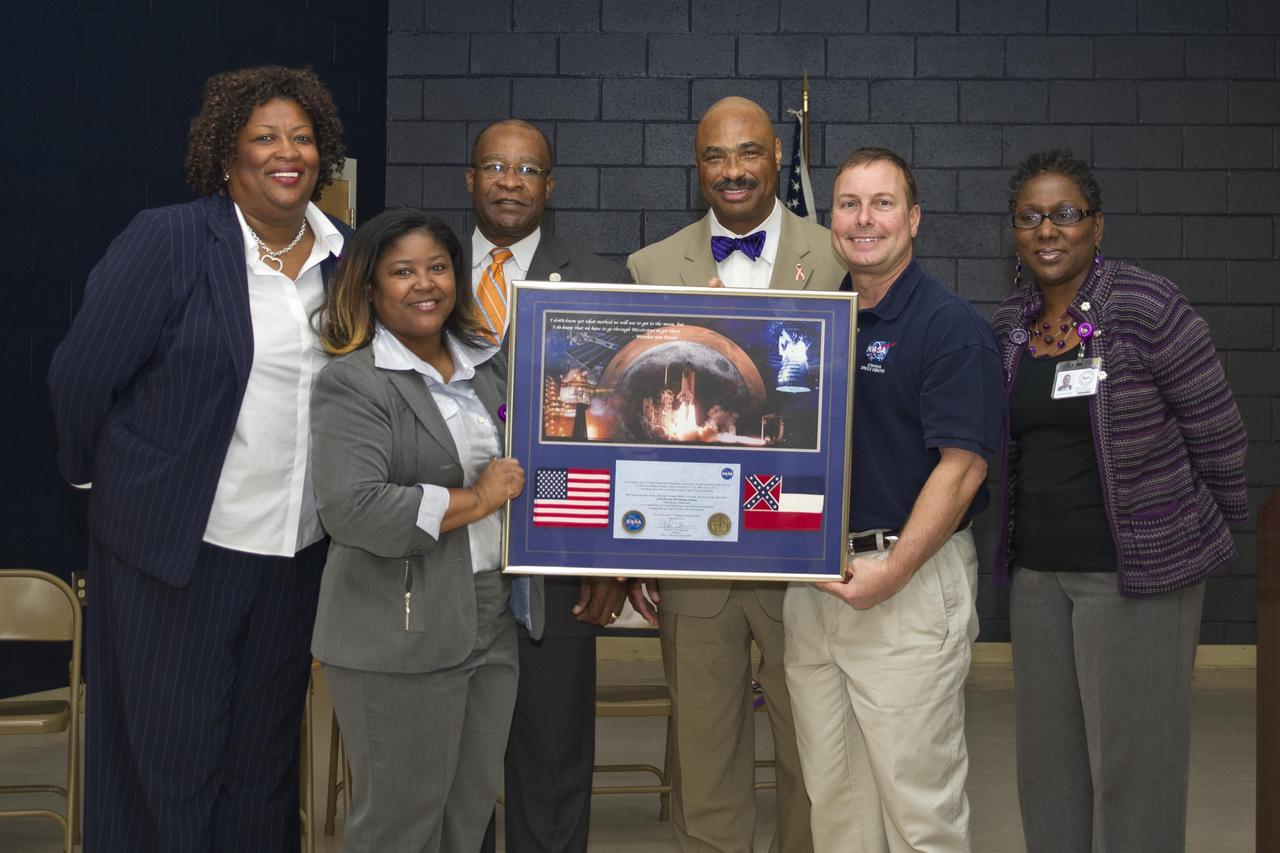
Stennis Deputy Director Rick Gilbrech (second from right) presents a commemorative plaque to Lillie Burney Elementary School officials, including (l to r): Lillie Burney Principal Deborah Smith; Assistant Principal Dr. Bobbie Trussell; Hattiesburg Mayor Johnny DuPree; Hattiesburg Public School District Superintendent James Bacchus; Gilbrech; and District Assistant Superintendent Dr. Edna Thomas. NASA senior staff members from Stennis visited the Hattiesburg, Miss., school Jan. 27, 2012, for a morning of activities and outreach to students and school officials.
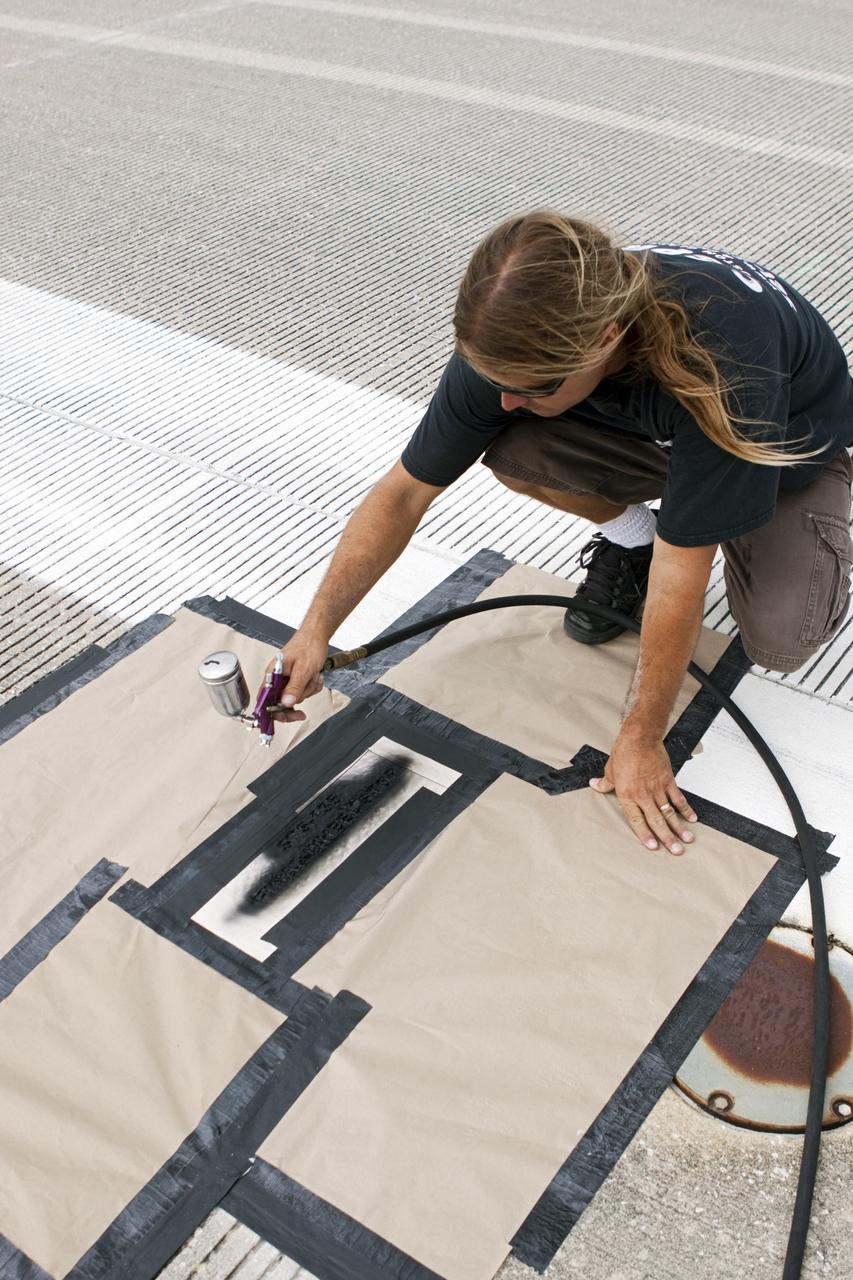
CAPE CANAVERAL, Fla. - At the Shuttle Landing Facility SLF at NASA’s Kennedy Space Center in Florida, a United Space Alliance technician marks the final front and rear wheel stop locations of an orbiter. Space shuttle Atlantis completed the STS-135 mission by landing at the SLF on July 21, 2011, at 5:57 a.m. A special plaque will be permanently mounted at the runway’s edge to commemorate the final shuttle landing. Atlantis flew 33 missions, completed 4,848 orbits of the Earth, traveled nearly 126 million miles and spent 307 days in space. Atlantis carried 207 astronauts to space. Photo credit: NASA/Jim Grossmann
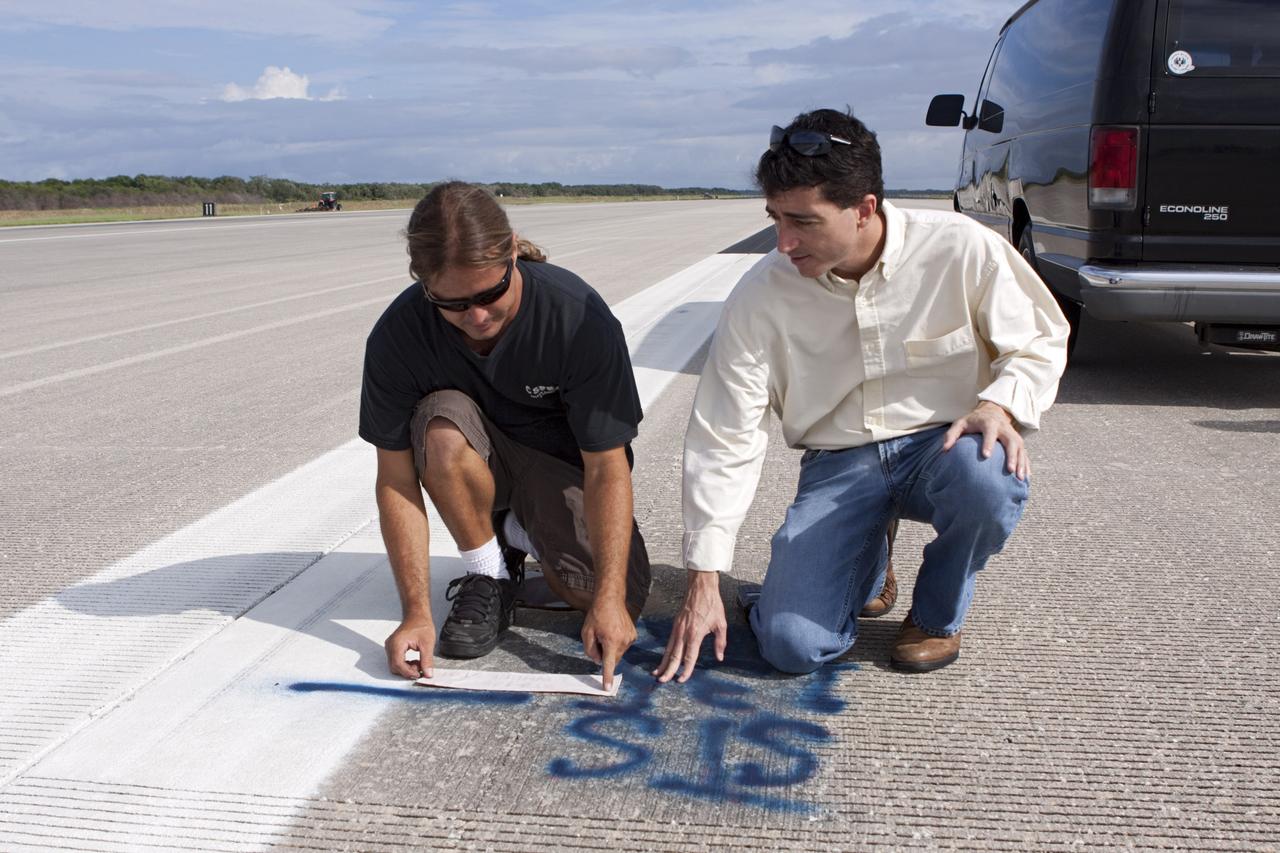
CAPE CANAVERAL, Fla. - At the Shuttle Landing Facility SLF at NASA’s Kennedy Space Center in Florida, United Space Alliance technicians make preparations to mark the final front and rear wheel stop locations of an orbiter. Space shuttle Atlantis completed the STS-135 mission by landing at the SLF on July 21, 2011, at 5:57 a.m. A special plaque will be permanently mounted at the runway’s edge to commemorate the final shuttle landing. Atlantis flew 33 missions, completed 4,848 orbits of the Earth, traveled nearly 126 million miles and spent 307 days in space. Atlantis carried 207 astronauts to space. Photo credit: NASA/Jim Grossmann
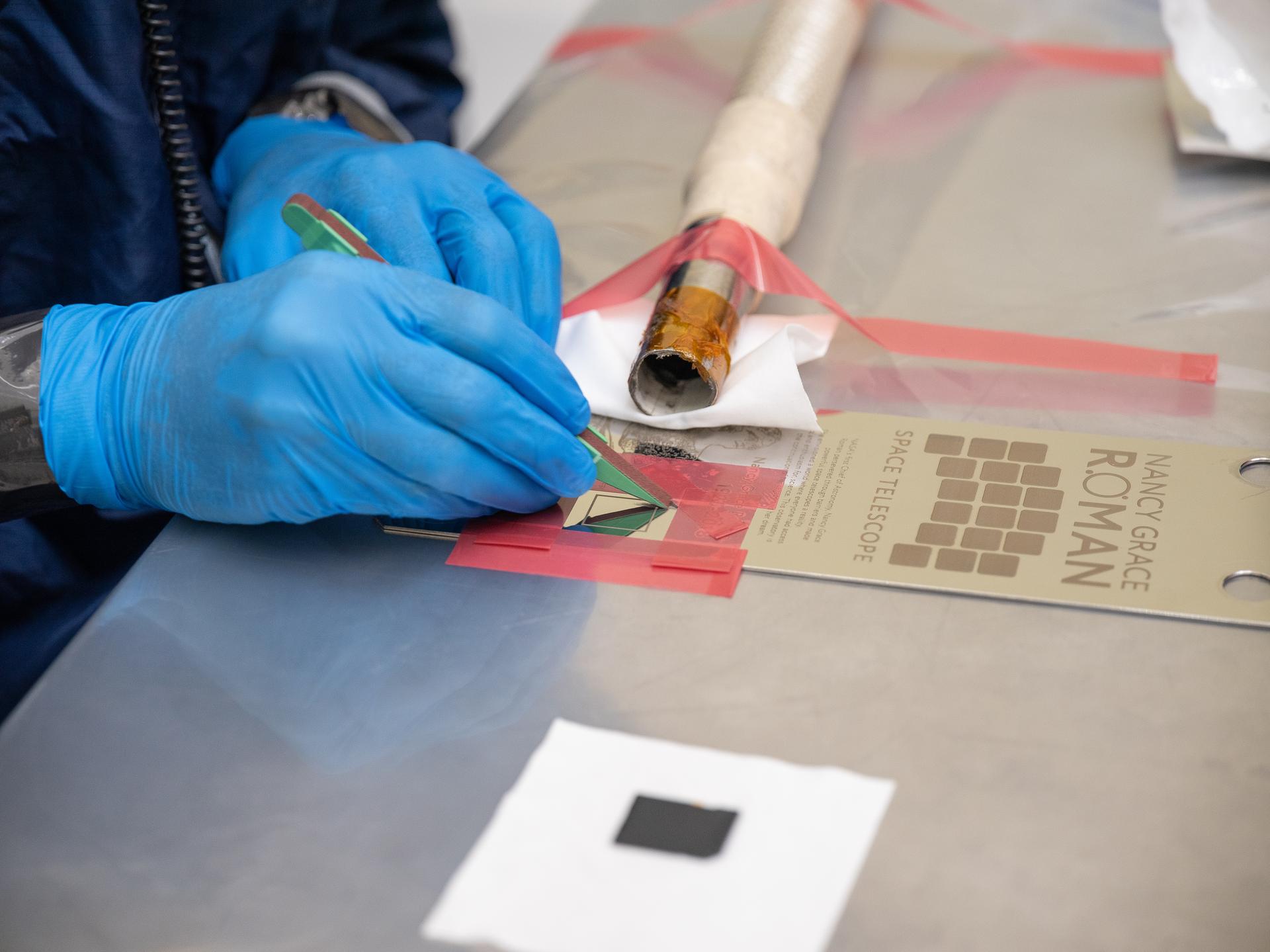
A technician inside the Payload Hazardous Servicing Facility at NASA’s Kennedy Space Center in Florida installs a memory card containing a total of 1,350,144 names as part of a commemorative plaque on the Nancy Grace Roman Space Telescope on Friday, July 17, 2026. The names, submitted by people from across the globe, including astronauts from NASA’s Artemis II and Artemis III missions, will travel with the Roman observatory to the Sun-Earth Lagrange point 2, or L2, about one million miles from Earth, where the Sun’s and Earth’s gravity balance out. Roman is named after Dr. Nancy Grace Roman, NASA’s first chief astronomer and one of the architects of the agency’s modern science program.
CAPE CANAVERAL, Fla. - At the Shuttle Landing Facility SLF at NASA’s Kennedy Space Center in Florida, United Space Alliance technicians make preparations to mark the final front and rear wheel stop locations of an orbiter. Space shuttle Atlantis completed the STS-135 mission by landing at the SLF on July 21, 2011, at 5:57 a.m. A special plaque will be permanently mounted at the runway’s edge to commemorate the final shuttle landing. Atlantis flew 33 missions, completed 4,848 orbits of the Earth, traveled nearly 126 million miles and spent 307 days in space. Atlantis carried 207 astronauts to space. Photo credit: NASA/Jim Grossmann
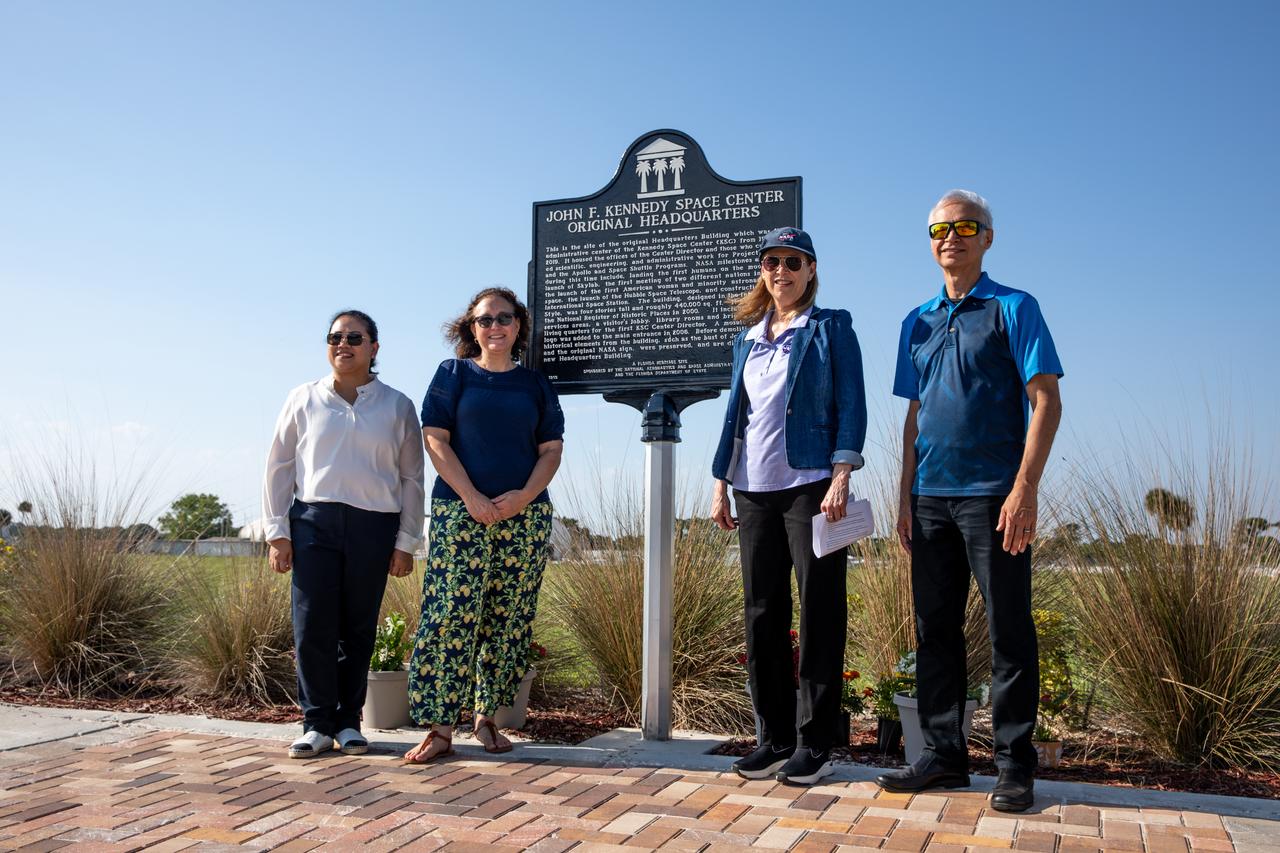
From the left, NASA Kennedy Space Center’s, Maui Dalton, project manager, engineering; Katherine Zeringue, cultural resources manager; Janet Petro, NASA Kennedy Space Center director; and Ismael Otero, project manager, engineering, present a large bronze historical marker plaque at the location of NASA Kennedy’s original headquarters building on Tuesday, May 28, 2024. Approved in April 2023 as part of the State of Florida’s Historical Markers program in celebration of National Historic Preservation Month, the marker commemorates the early days of space exploration and is displayed permanently just west of the seven-story, 200,000 square foot Central Campus Headquarters Building, which replaced the old building in 2019.
A technician inside the Payload Hazardous Servicing Facility at NASA’s Kennedy Space Center in Florida installs a memory card containing a total of 1,350,144 names as part of a commemorative plaque on the Nancy Grace Roman Space Telescope on Friday, July 17, 2026. The names, submitted by people from across the globe, including astronauts from NASA’s Artemis II and Artemis III missions, will travel with the Roman observatory to the Sun-Earth Lagrange point 2, or L2, about one million miles from Earth, where the Sun’s and Earth’s gravity balance out. Roman is named after Dr. Nancy Grace Roman, NASA’s first chief astronomer and one of the architects of the agency’s modern science program.
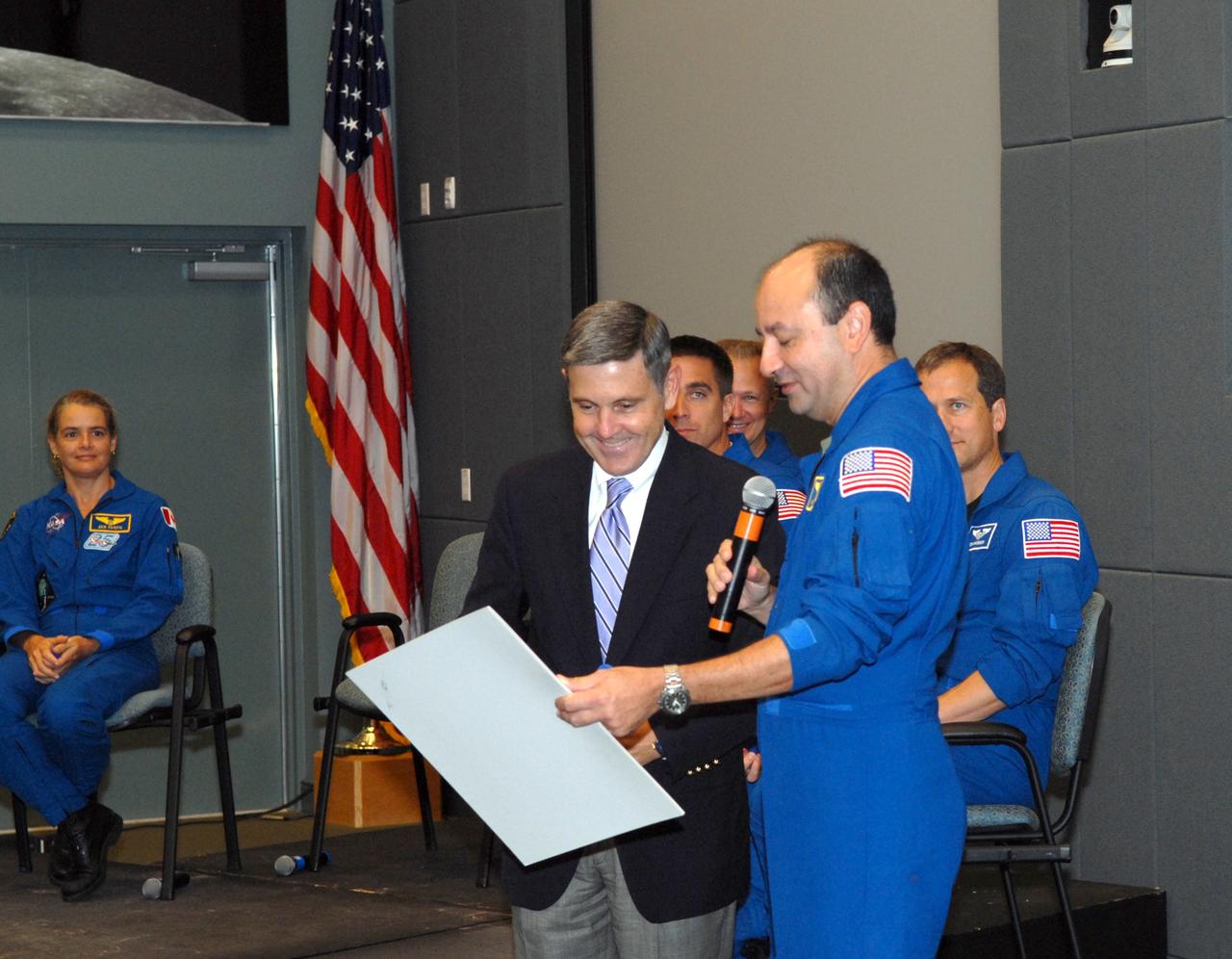
CAPE CANAVERAL, Fla. – Following a presentation by the STS-127 crew members about their experiences on the mission, Commander Mark Polansky (right) presents a plaque commemorating the mission to Kennedy Space Center Director Bob Cabana. At far left is Mission Specialist Julie Payette. Behind Cabana are Mission Specialist Christopher Cassidy and Pilot Doug Hurley. Behind Polansky is Mission Specialist Tom Marshburn. The STS-127 mission was the final of three flights dedicated to the assembly of the Japanese Kibo laboratory complex on the International Space Station. The crew launched on space shuttle Endeavour on July 15 and returned July 31. Photo credit: NASA/Jim Grossmann
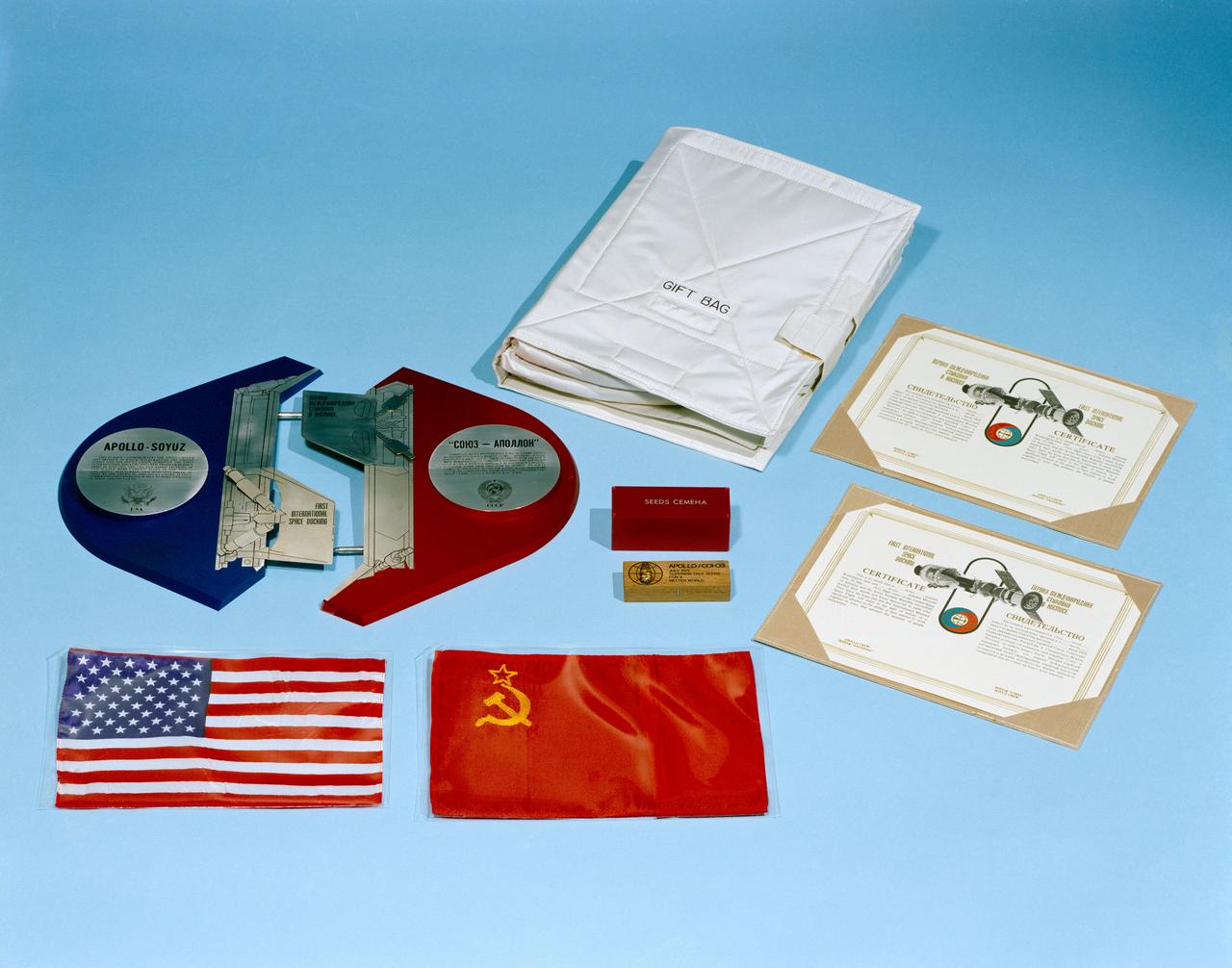
S75-27952 (July 1975) --- A close-up view of the special ?gift bag? in which several exchange/gift items will be carried aboard the Apollo Command Module during the joint U.S.-USSR Apollo-Soyuz Test Project mission. Some of these items are seen here alongside the bag. They are the sectionized ASTP Commemorative Plaque, ten 8x12 inch American flags, ten 8.07x16.14 inch (205mm x 410mm) Soviet Union flags, a special box of white spruce tree seeds, and the ASTP Certification to authorize the ASTP docking. The gifts will be presented and the exchange made while the Apollo and Soyuz spacecraft are docked in Earth orbit.
CAPE CANAVERAL, Fla. - At the Shuttle Landing Facility SLF at NASA’s Kennedy Space Center in Florida, a United Space Alliance technician marks the final front and rear wheel stop locations of an orbiter. Space shuttle Atlantis completed the STS-135 mission by landing at the SLF on July 21, 2011, at 5:57 a.m. A special plaque will be permanently mounted at the runway’s edge to commemorate the final shuttle landing. Atlantis flew 33 missions, completed 4,848 orbits of the Earth, traveled nearly 126 million miles and spent 307 days in space. Atlantis carried 207 astronauts to space. Photo credit: NASA/Jim Grossmann
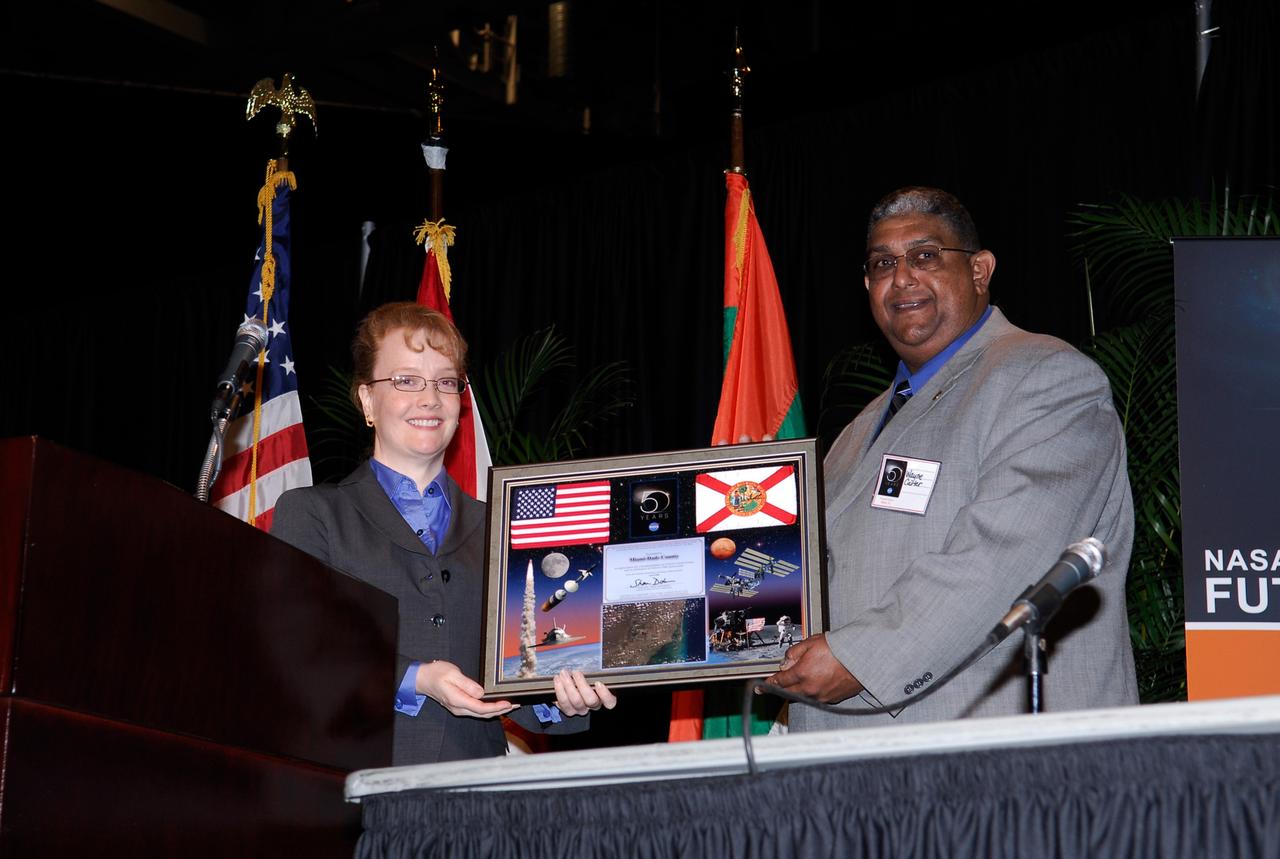
CAPE CANAVERAL, Fla. -- NASA Deputy Administrator Shana Dale (left) presents a 50th anniversary commemorative plaque to Wayne Carter during a Future Forum in Miami that focused on how space exploration benefits Florida's economy. Carter is assistant director for constituent services for the Miami-Dade County Mayor, Carlos Alveraz. The event, which included presentations and panels, was held at the University of Miami's BankUnited Center. Among those participating were NASA Deputy Administrator Shana Dale, astronaut Carl Walz, director of the Advanced Capabilities Division in NASA's Exploration Systems Mission Directorate, and Russell Romanella, director, International Space Station and Spacecraft Processing. Photo credit: NASA/Kim Shiflett
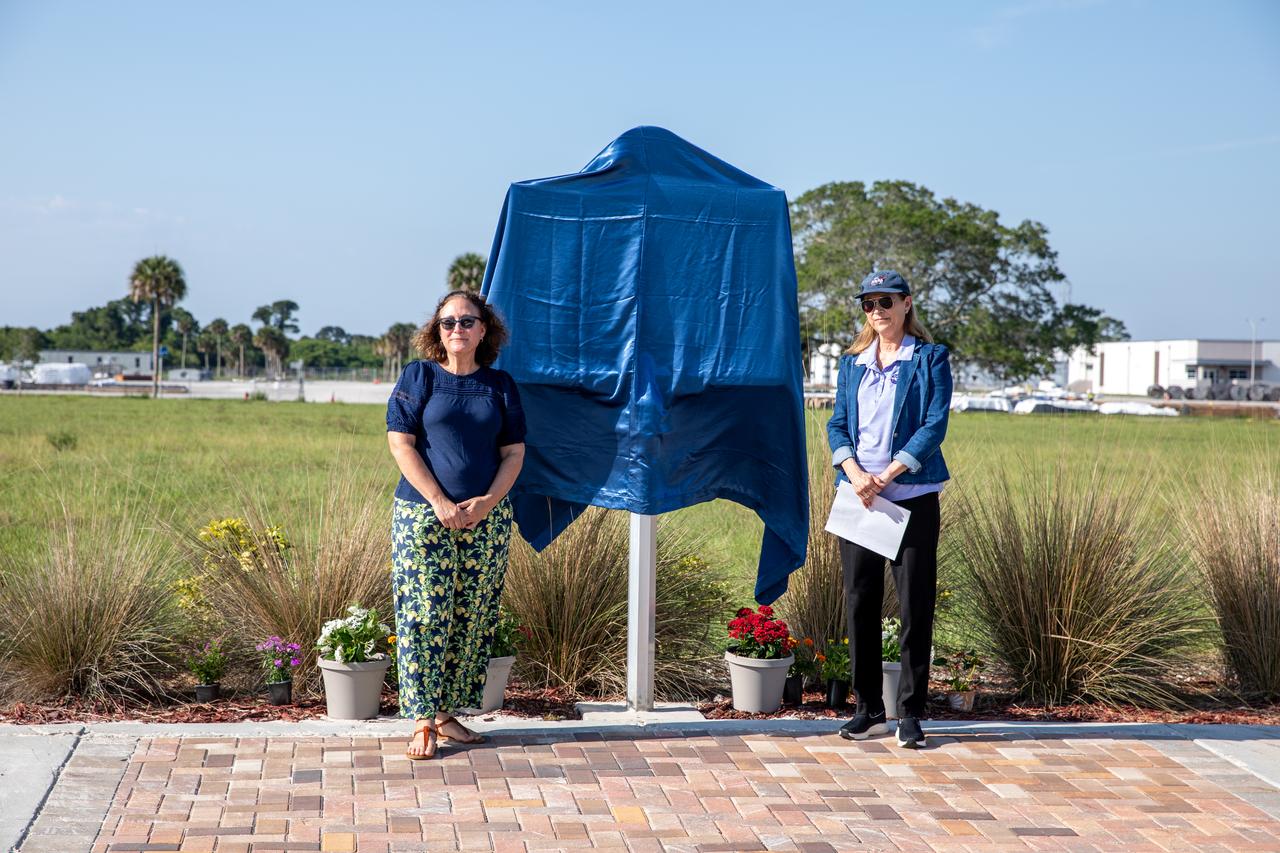
From the left, Katherine Zeringue, cultural resources manager, NASA’s Kennedy Space Center, is joined by Janet Petro, NASA Kennedy Space Center director, at a ceremony held Tuesday, May 28, 2024, to unveil a large bronze historical marker plaque at the location of NASA Kennedy’s original headquarters building. Approved in April 2023 as part of the State of Florida’s Historical Markers program in celebration of National Historic Preservation Month, the marker commemorates the early days of space exploration and is displayed permanently just west of the seven-story, 200,000 square foot Central Campus Headquarters Building, which replaced the old building in 2019.
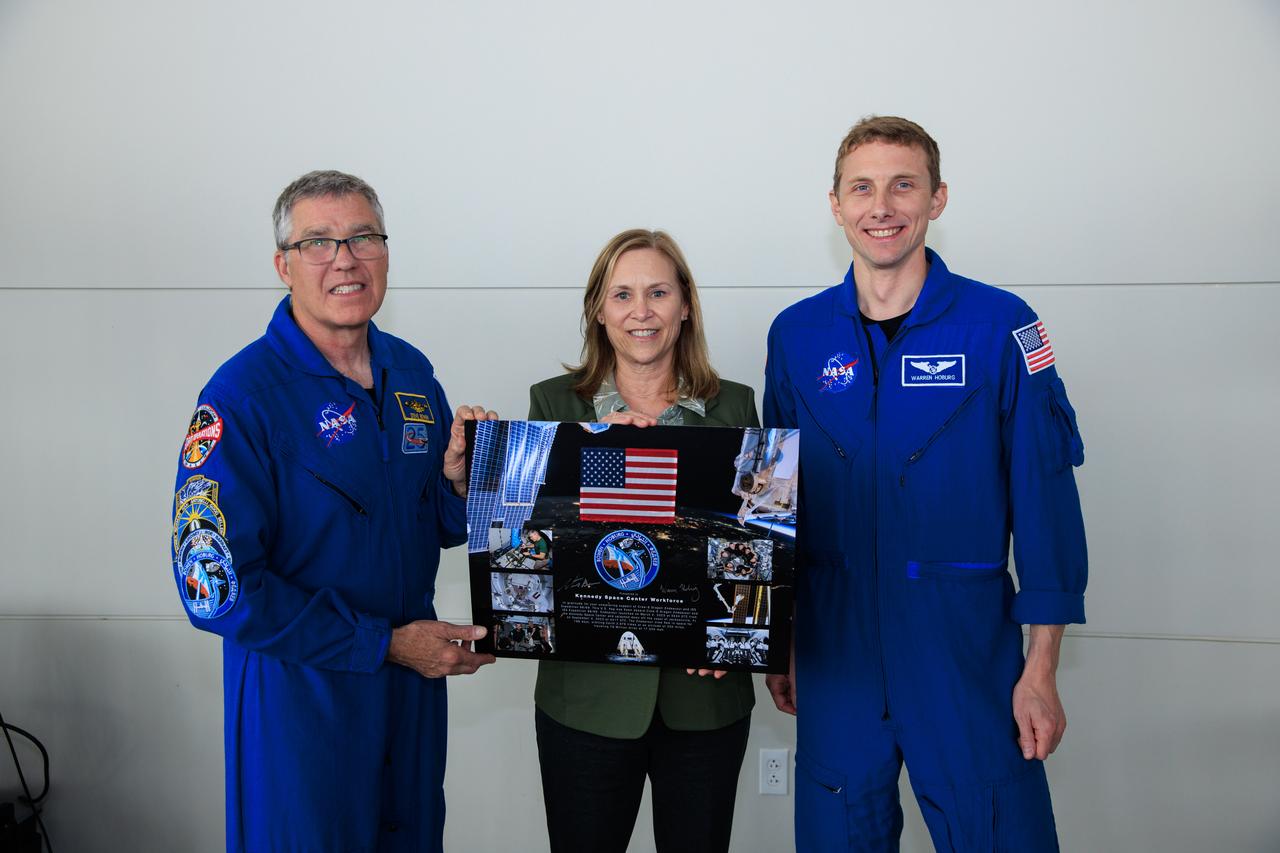
NASA’s SpaceX Crew-6 astronauts Stephen Bowen and Warren “Woody” Hoburg present a plaque commemorating the agency’s Crew-6 mission to the International Space Station to Kennedy Space Center director Janet Petro during a meet-and-greet at the agency’s Central Campus Headquarters cafeteria at Kennedy Space Center in Florida on Wednesday, March 27, 2024. Employees and other personnel got the chance to meet with the Crew-6 astronauts and celebrate the recent retirement of Bob Cabana, who was Kennedy’s Center Director for 13 years before retiring in December 2023.

CAPE CANAVERAL, Fla. - In the Training Auditorium at NASA's Kennedy Space Center in Florida, STS-130 Commander George Zamka presents a plaque commemorating the STS-130 mission to Kennedy Center Director Bob Cabana. From left are Cabana; Zamka; Mission Specialists Stephen Robinson (holding plaque), Robert Behnken, Nicholas Patrick, and Kathryn Hire; and Pilot Terry Virts. The presentation followed a program for Kennedy employees in which the crew talked about their experiences on the mission. Endeavour launched Feb. 8, 2010, and landed Feb. 21. During Endeavour's STS-130 mission, the crew installed the Tranquility node, a module that provides additional room for crew members and many of the station's life support and environmental control systems. Attached to Tranquility is a cupola with seven windows that provide a panoramic view of Earth, celestial objects and visiting spacecraft. STS-130 was the 24th flight for Endeavour, the 32nd shuttle mission devoted to ISS assembly and maintenance, and the 130th shuttle mission. For information on the STS-130 mission and crew, visit http:__www.nasa.gov_mission_pages_shuttle_shuttlemissions_sts130_index.html. Photo credit: NASA_Jim Grossmann
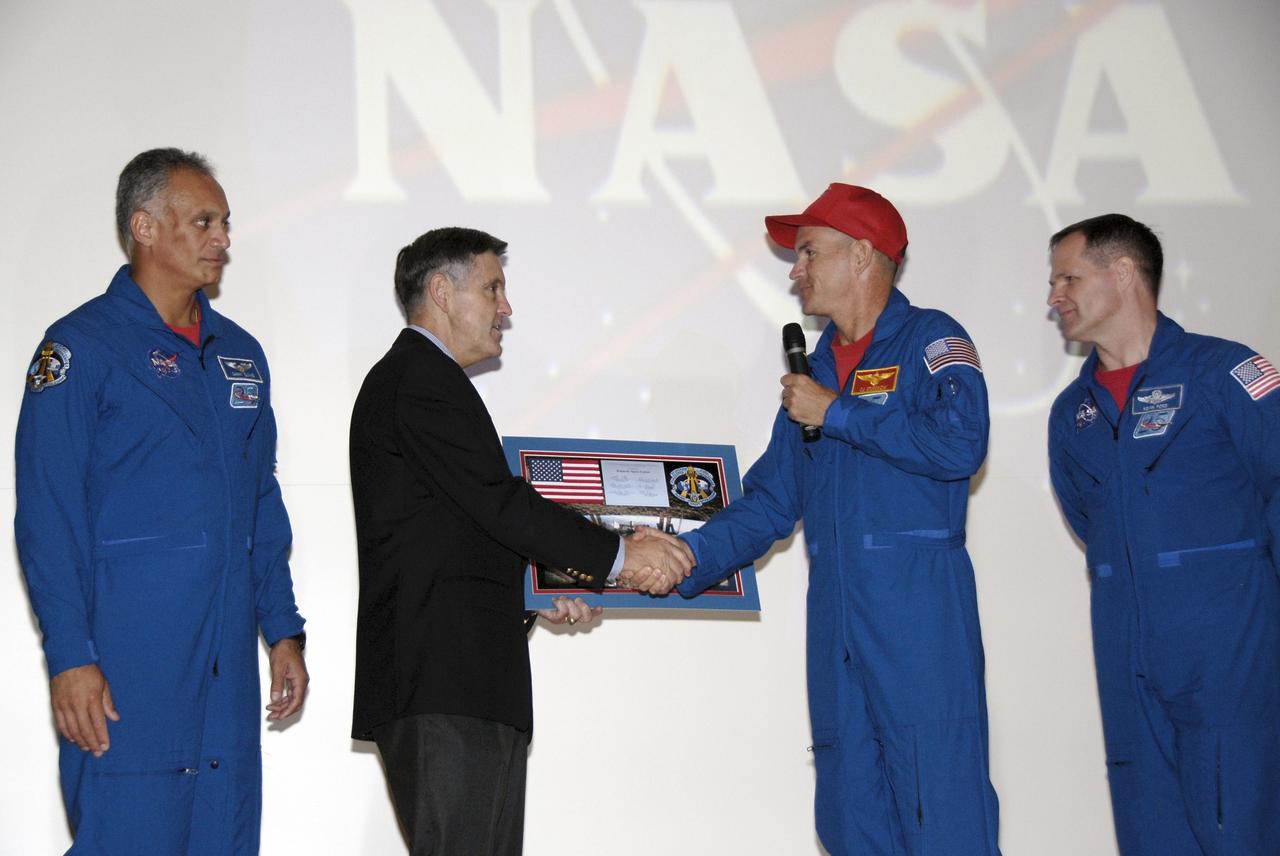
CAPE CANAVERAL, Fla. – In the Training Auditorium at NASA's Kennedy Space Center in Florida, STS-128 Commander Rick Sturckow, with the microphone, presents a plaque commemorating the mission to Center Director Bob Cabana. The presentation followed a program for Kennedy employees in which the crew talked about their experiences on the mission. At left is Mission Specialist John "Danny" Olivas; at right is Pilot Kevin Ford. More than 7 tons of supplies, science racks and equipment, as well as additional environmental hardware to sustain six crew members on the International Space Station were delivered to the International Space Station on the STS-128 mission. The equipment included a freezer to store research samples, a new sleeping compartment and the COLBERT treadmill. The mission was the 128th in the Space Shuttle Program, the 37th flight of Discovery and the 30th station assembly flight. Launch was Aug. 28, 2009. Photo credit: NASA/Kim Shiflett
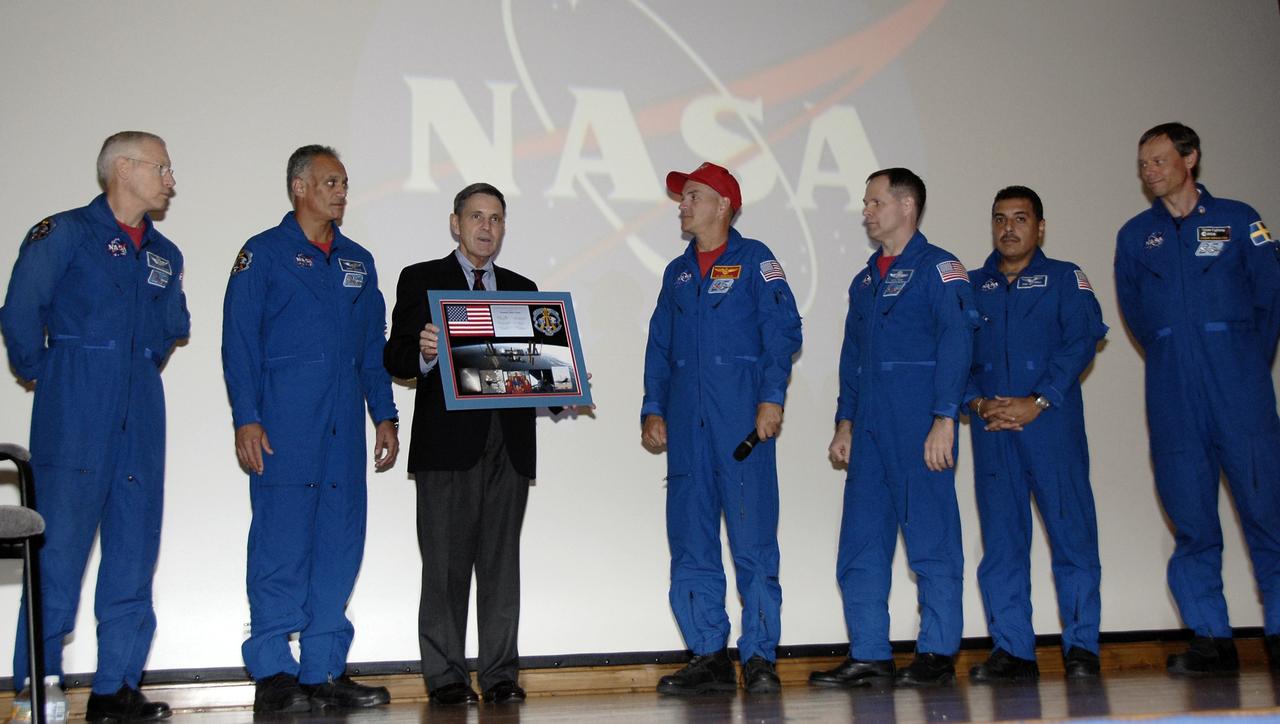
CAPE CANAVERAL, Fla. – CAPE CANAVERAL, Fla. – In the Training Auditorium at NASA's Kennedy Space Center in Florida, Center Director Bob Cabana accepts a plaque commemorating the STS-128 space shuttle mission for the STS-128 crew. From left are Mission Specialists Patrick Forrester and John "Danny" Olivas; Cabana; Commander Rick Sturckow; Pilot Kevin Ford; and Mission Specialists Jose Hernandez and Christer Fuglesang. More than 7 tons of supplies, science racks and equipment, as well as additional environmental hardware to sustain six crew members on the International Space Station were delivered to the International Space Station on the STS-128 mission. The equipment included a freezer to store research samples, a new sleeping compartment and the COLBERT treadmill. The mission was the 128th in the Space Shuttle Program, the 37th flight of Discovery and the 30th station assembly flight. Launch was Aug. 28, 2009. Photo credit: NASA/Kim Shiflett
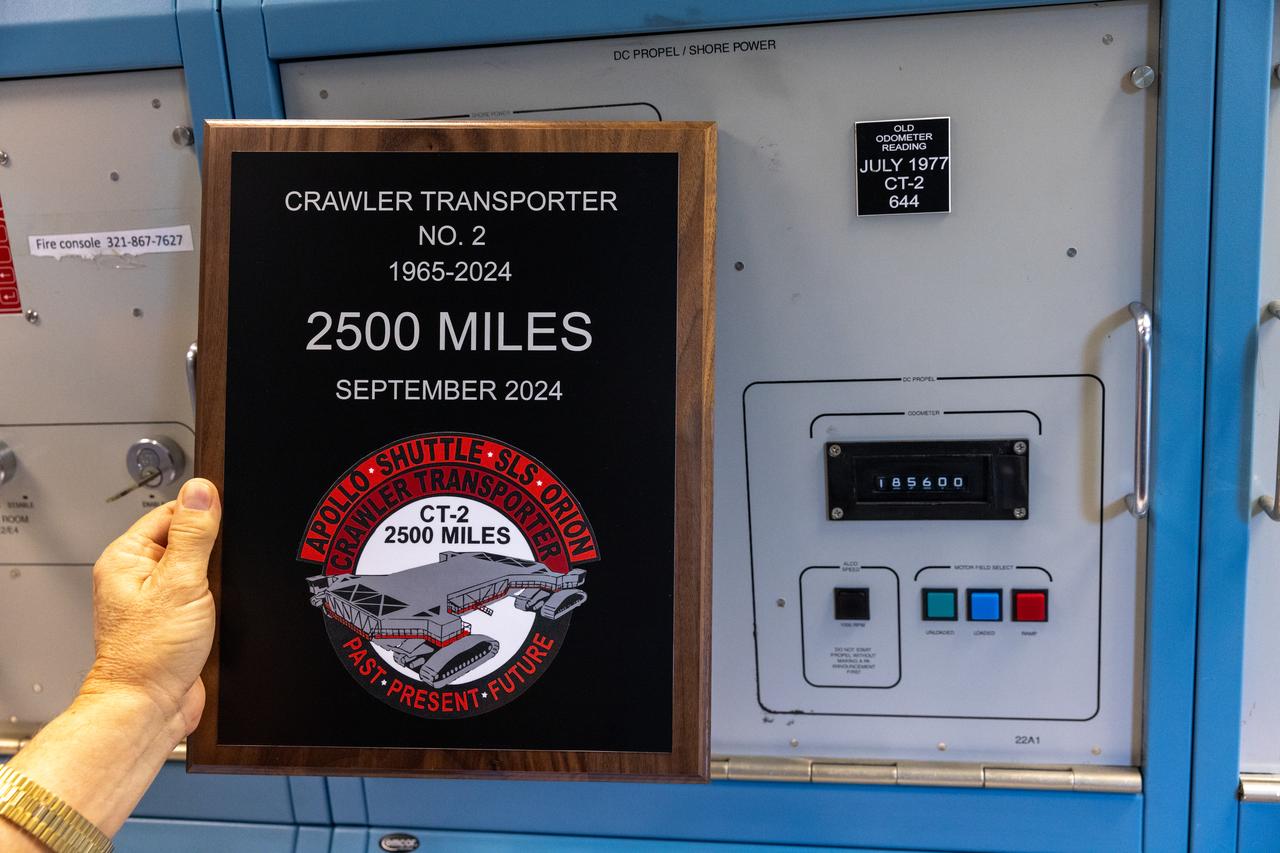
A plaque is held near the odometer of the agency’s crawler-transporter 2, on Wednesday, Sept. 25, 2024, at NASA’s Kennedy Space Center in Florida, commemorating the milestone of 2,500 miles traveled since its construction in 1965. Crawler-transporter 2 reached the milestone while teams with NASA’s Exploration Ground Systems took it on a trip in preparation for supporting the roll of the mobile launcher from Launch Pad 39B back into the spaceport’s Vehicle Assembly Building ahead of the Artemis II launch. Built originally to transport massive Saturn V rockets during the Apollo Program, crawler-transporter 2 continued its service during the Space Shuttle Program, and currently transports the massive SLS (Space Launch System) rocket and Orion spacecraft atop the mobile launcher as part of the agency’s Artemis campaign.
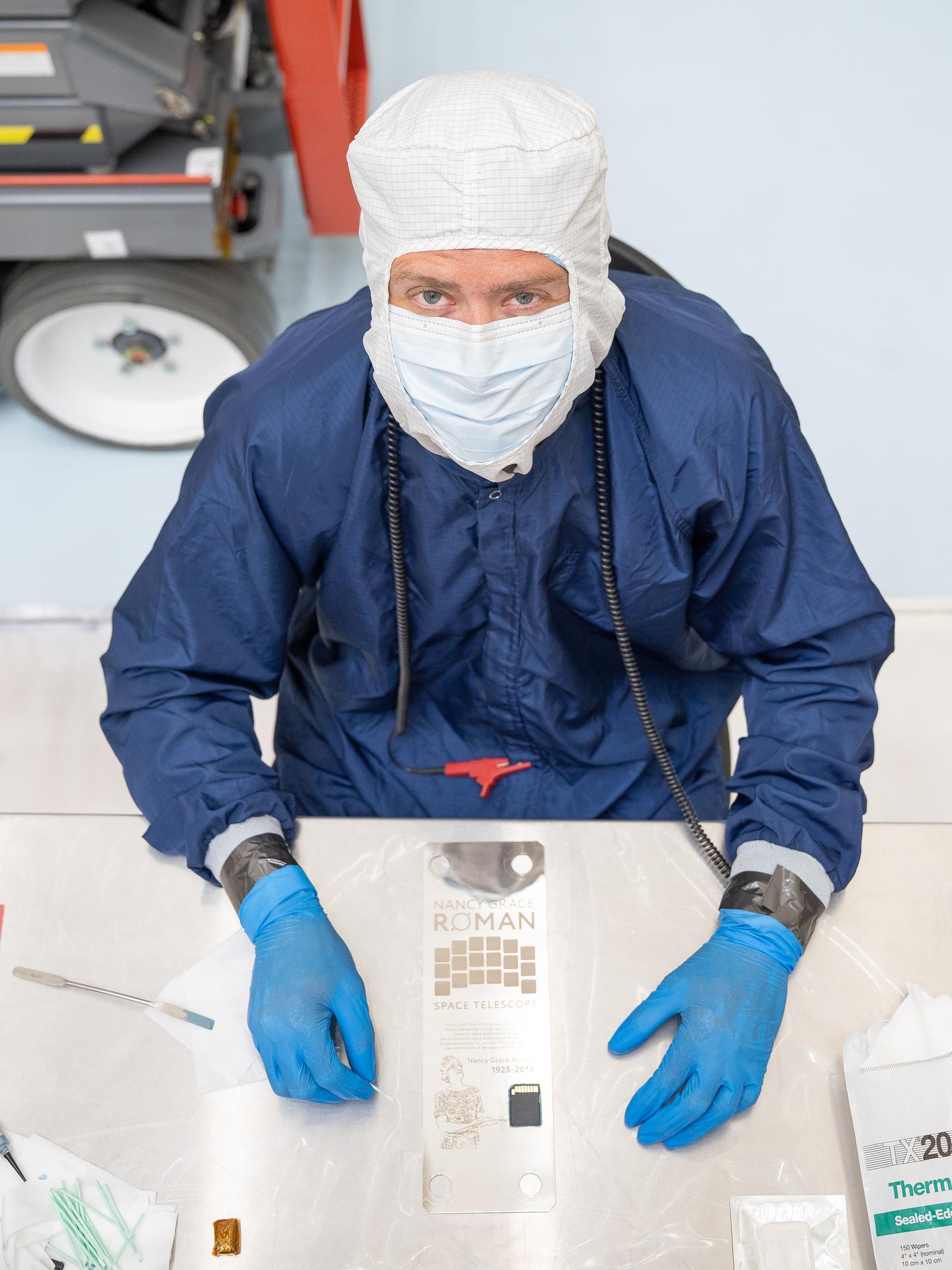
Inside the Payload Hazardous Servicing Facility at NASA’s Kennedy Space Center in Florida, Harry Willems, a mechanical technician from the agency’s Goddard Space Flight Center in Greenbelt, Maryland, installs a memory card containing a total of 1,350,144 names as part of a commemorative plaque on the Nancy Grace Roman Space Telescope on Friday, July 17, 2026. The names, submitted by people from across the globe, including astronauts from NASA’s Artemis II and Artemis III missions, will travel with the Roman observatory to the Sun-Earth Lagrange point 2, or L2, about one million miles from Earth, where the Sun’s and Earth’s gravity balance out. Roman is named after Dr. Nancy Grace Roman, NASA’s first chief astronomer and one of the architects of the agency’s modern science program.
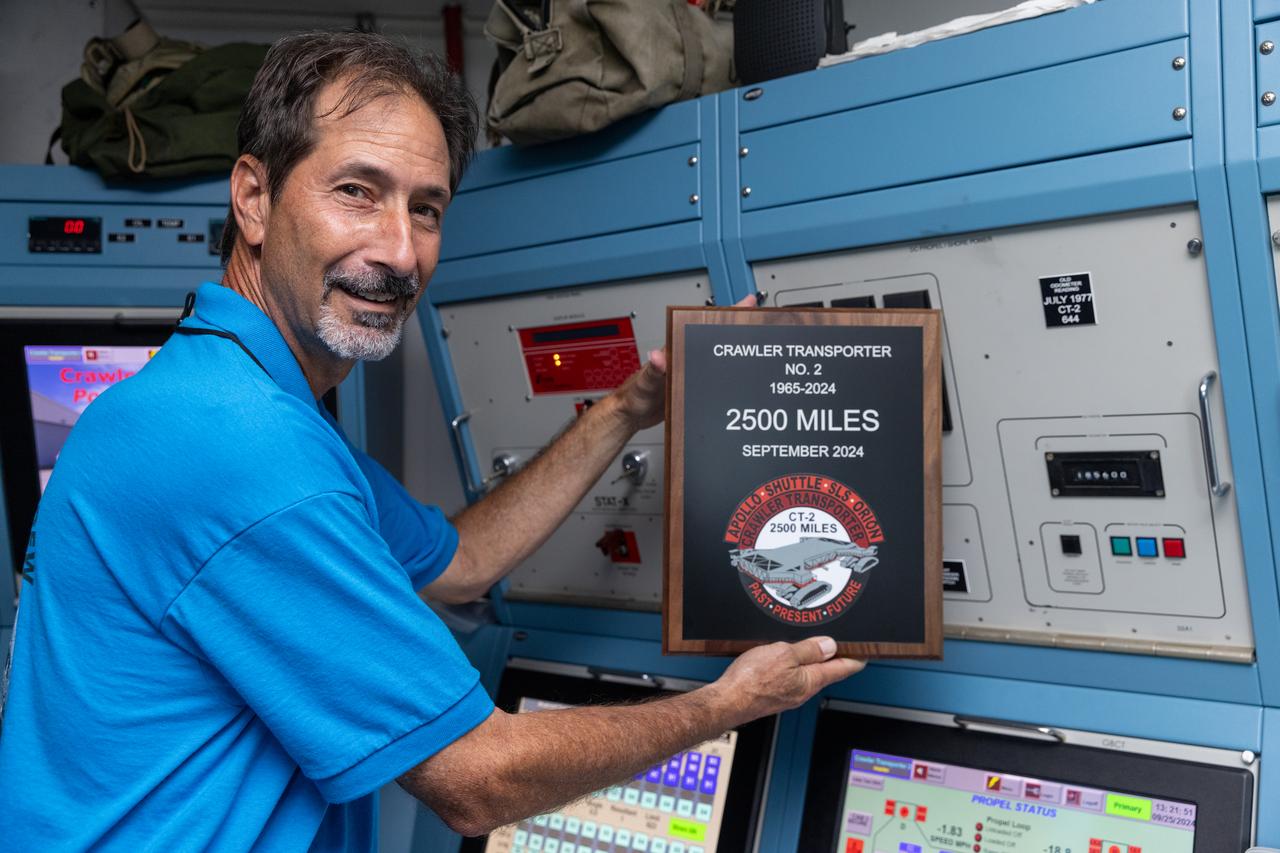
John Giles, crawler element operations manager for NASA’s Exploration Ground Systems, holds a plaque near the odometer of the agency’s crawler-transporter 2, on Wednesday, Sept. 25, 2024, at NASA’s Kennedy Space Center in Florida, commemorating the milestone of 2,500 miles traveled since its construction in 1965. Crawler-transporter 2 reached the milestone while teams took it on a trip in preparation for supporting the roll of the mobile launcher from Launch Pad 39B back into the spaceport’s Vehicle Assembly Building ahead of the Artemis II launch. Built originally to transport massive Saturn V rockets during the Apollo Program, crawler-transporter 2 continued its service during the Space Shuttle Program, and currently transports the massive SLS (Space Launch System) rocket and Orion spacecraft atop the mobile launcher as part of the agency’s Artemis campaign.
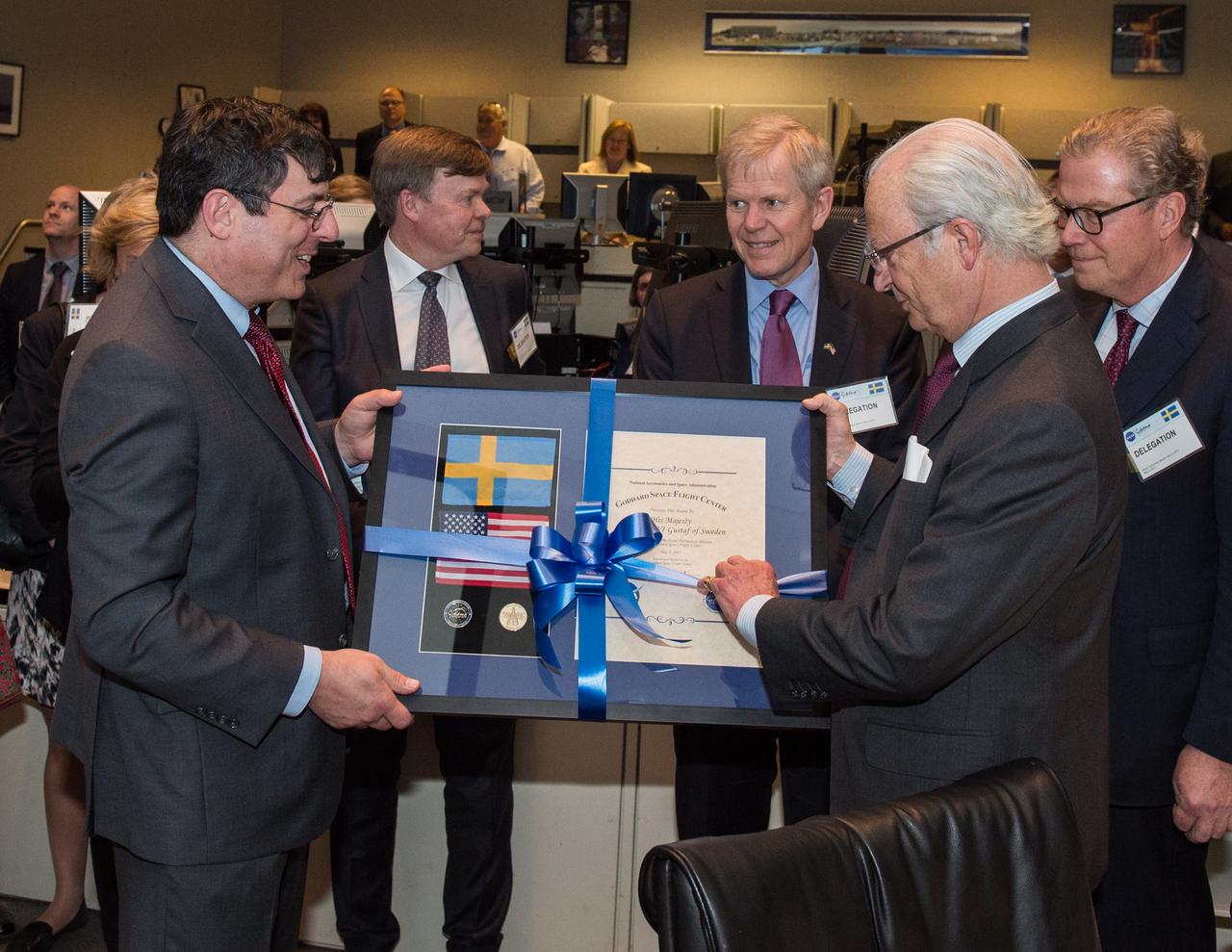
Swedish Delegation Visits GSFC – May 3, 2017 – Goddard Center Director Chris Scolese presents His Majesty Carl XVI Gustaf, King of Sweden a commemorative plaque in honor of his visit. Credit: NASA/Goddard/Bill Hrybyk Read more: <a href="https://go.nasa.gov/2p1rP0h" rel="nofollow">go.nasa.gov/2p1rP0h</a> <b><a href="http://www.nasa.gov/audience/formedia/features/MP_Photo_Guidelines.html" rel="nofollow">NASA image use policy.</a></b> <b><a href="http://www.nasa.gov/centers/goddard/home/index.html" rel="nofollow">NASA Goddard Space Flight Center</a></b> enables NASA’s mission through four scientific endeavors: Earth Science, Heliophysics, Solar System Exploration, and Astrophysics. Goddard plays a leading role in NASA’s accomplishments by contributing compelling scientific knowledge to advance the Agency’s mission. <b>Follow us on <a href="http://twitter.com/NASAGoddardPix" rel="nofollow">Twitter</a></b> <b>Like us on <a href="http://www.facebook.com/pages/Greenbelt-MD/NASA-Goddard/395013845897?ref=tsd" rel="nofollow">Facebook</a></b> <b>Find us on <a href="http://instagrid.me/nasagoddard/?vm=grid" rel="nofollow">Instagram</a></b>
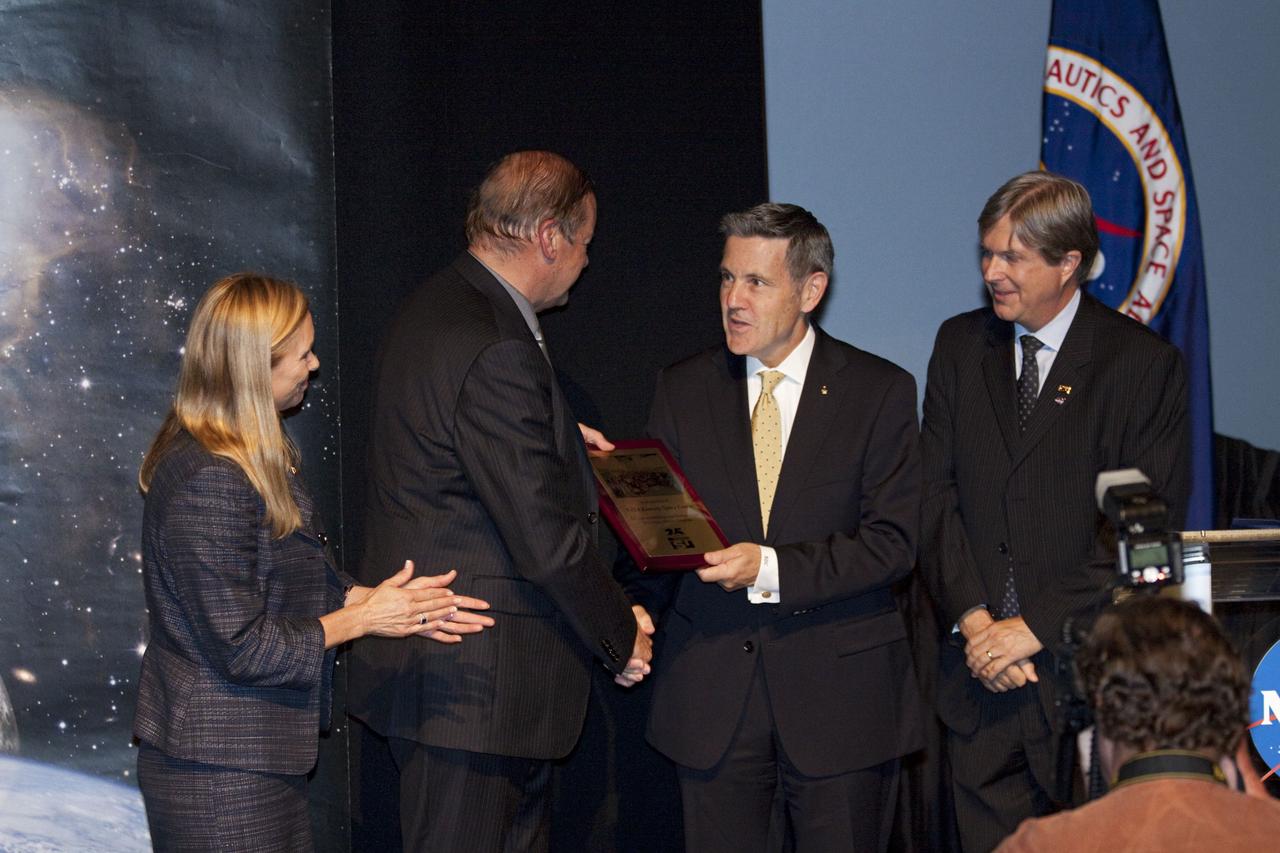
CAPE CANAVERAL, Fla. – Kennedy Space Center Director Robert Cabana, right-center, presents a commemorative plaque to, Dr. Walter Peeters, president of the International Space University. Looking on are Kennedy's Deputy Director Janet Petro and Gary Martin, 2012 director of Space Studies Program for the ISU. The presentation took place during ISU closing ceremonies at the Kennedy Space center Visitor Complex on Aug. 3, 2012. The International Space University is a nine-week intensive course designed for post-graduate university students and professionals during the summer. The program is hosted by a different country each year, providing a unique educational experience for participants from around the world. NASA Kennedy Space Center and the Florida Institute of Technology co-hosted this year's event which ran from June 4 to Aug. 3. There were about 125 participants representing 31 countries. For more information, visit http://www.isunet.edu Photo credit: NASA/Kim Shiflett