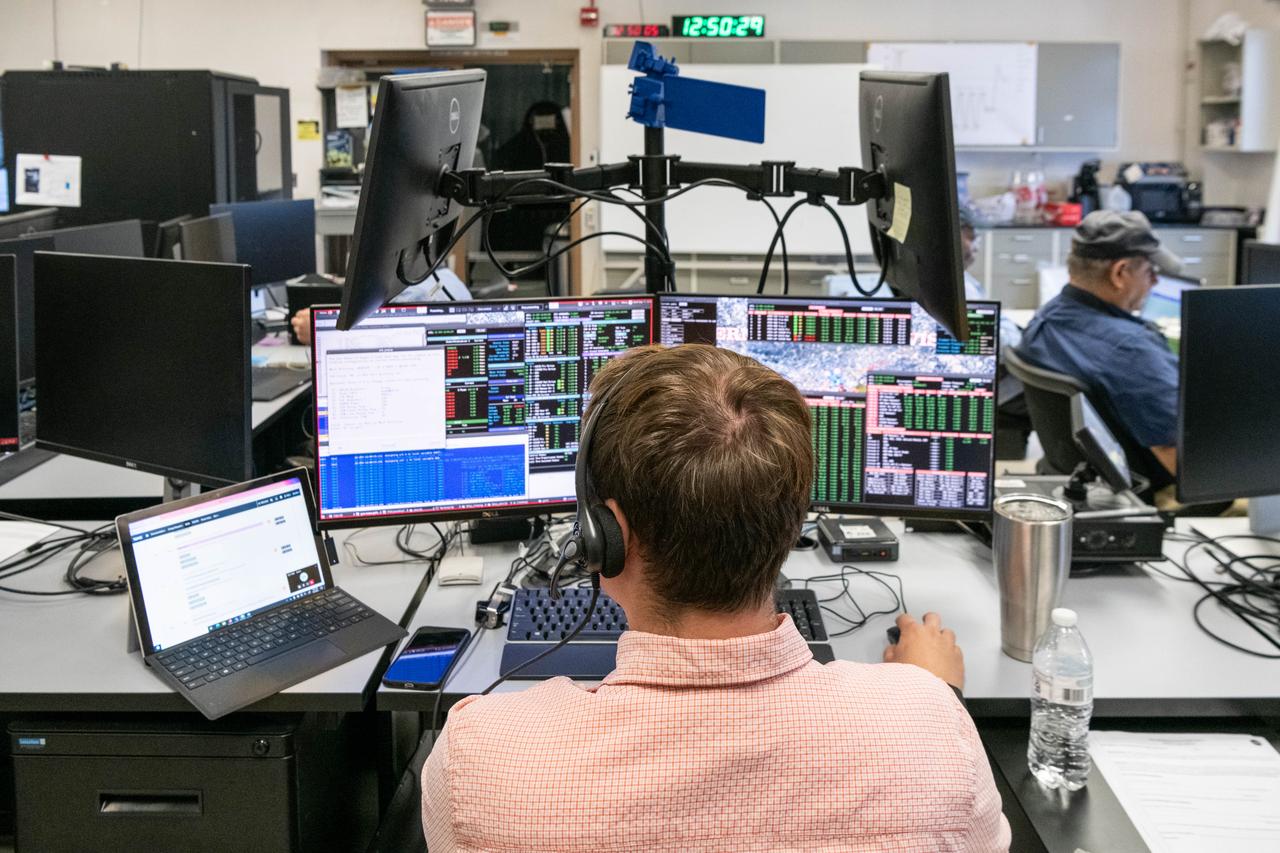
Test conductor, Lucas Tucker, monitors thermal vacuum testing operations in the Ocean Color Instrument (OCI) control room during the environmental test campaign. OCI is a highly advanced optical spectrometer that will be used to measure properties of light over portions of the electromagnetic spectrum. It will enable continuous measurement of light at finer wavelength resolution than previous NASA satellite sensors, extending key system ocean color data records for climate studies. OCI is PACE's (Plankton, Aerosol, Cloud, ocean Ecosystem) primary sensor built at Goddard Space Flight Center in Greenbelt, MD.
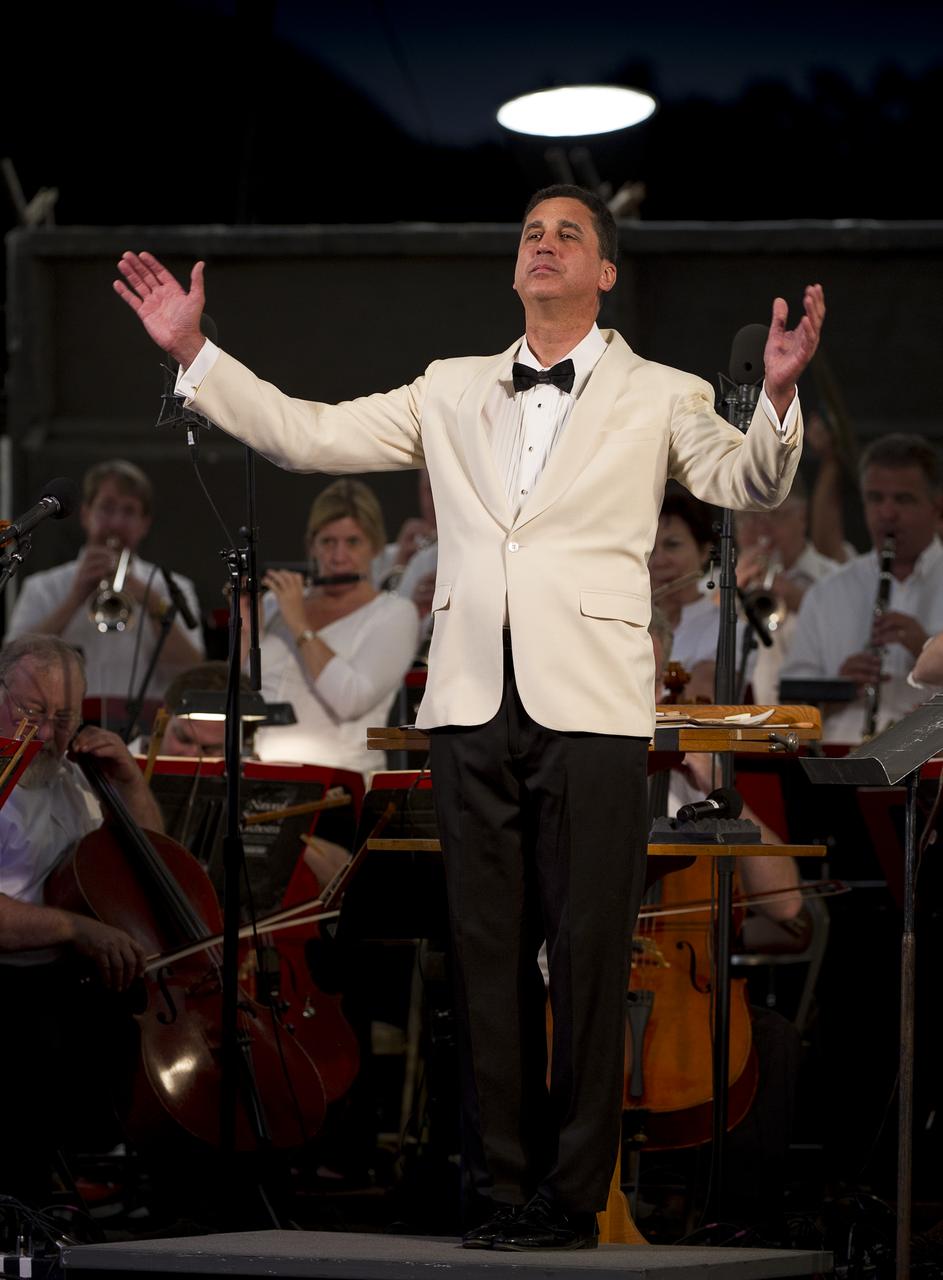
National Symphony Orchestra Conductor Emil de Cou leads the National Symphony Orchestra during the Labor Day Weekend concert on the West Lawn of the U.S. Capitol, Sunday, September 5, 2010 in Washington. NASA Administrator Charles Bolden joined the Orchestra to introduce one the program's segments, music from the film "Apollo 13". Photo Credit: (NASA/Bill Ingalls)
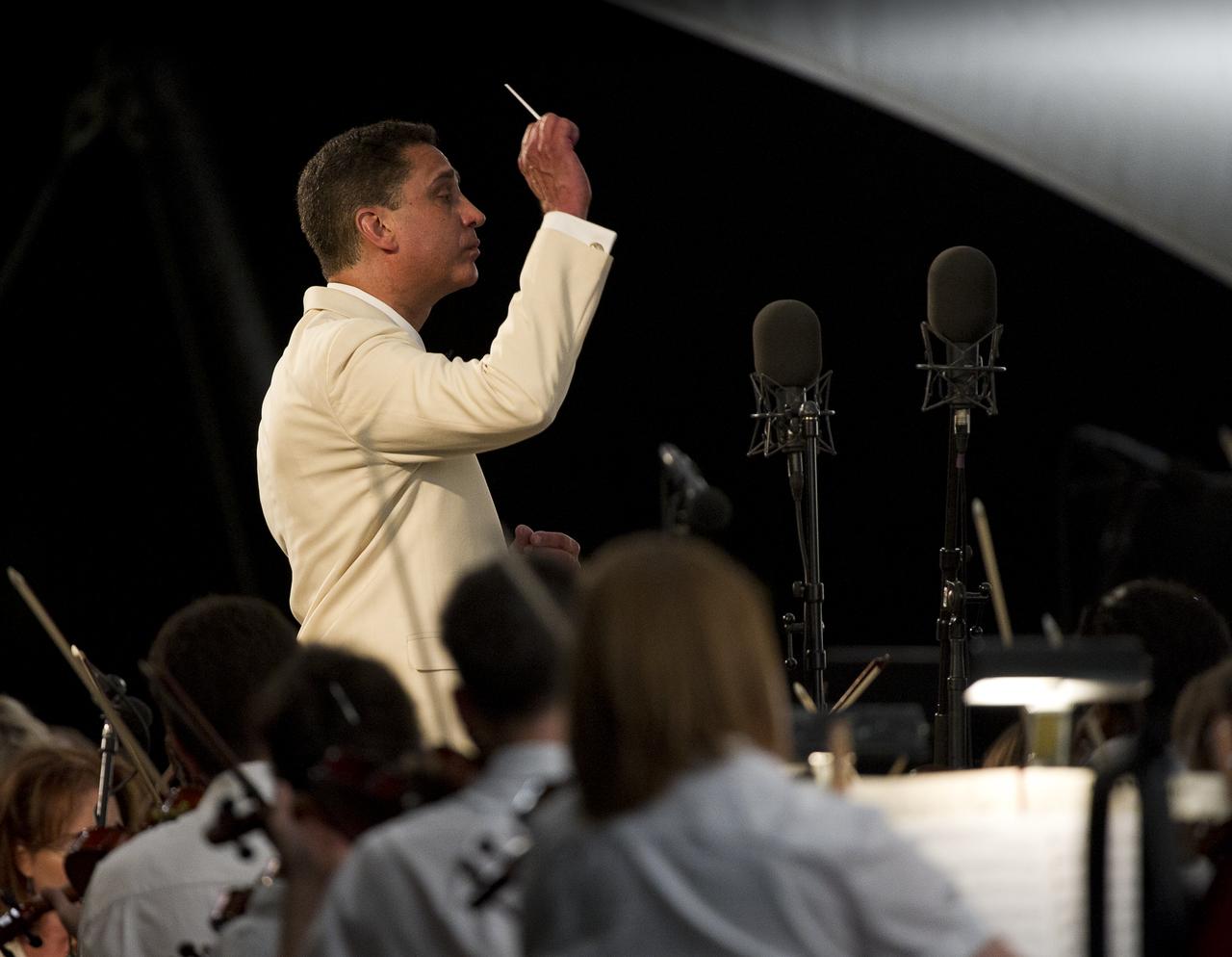
National Symphony Orchestra Conductor Emil de Cou leads the National Symphony Orchestra during the Labor Day Weekend concert on the West Lawn of the U.S. Capitol, Sunday, September 5, 2010 in Washington. NASA Administrator Charles Bolden joined the Orchestra to introduce one the program's segments, music from the film "Apollo 13". Photo Credit: (NASA/Bill Ingalls)
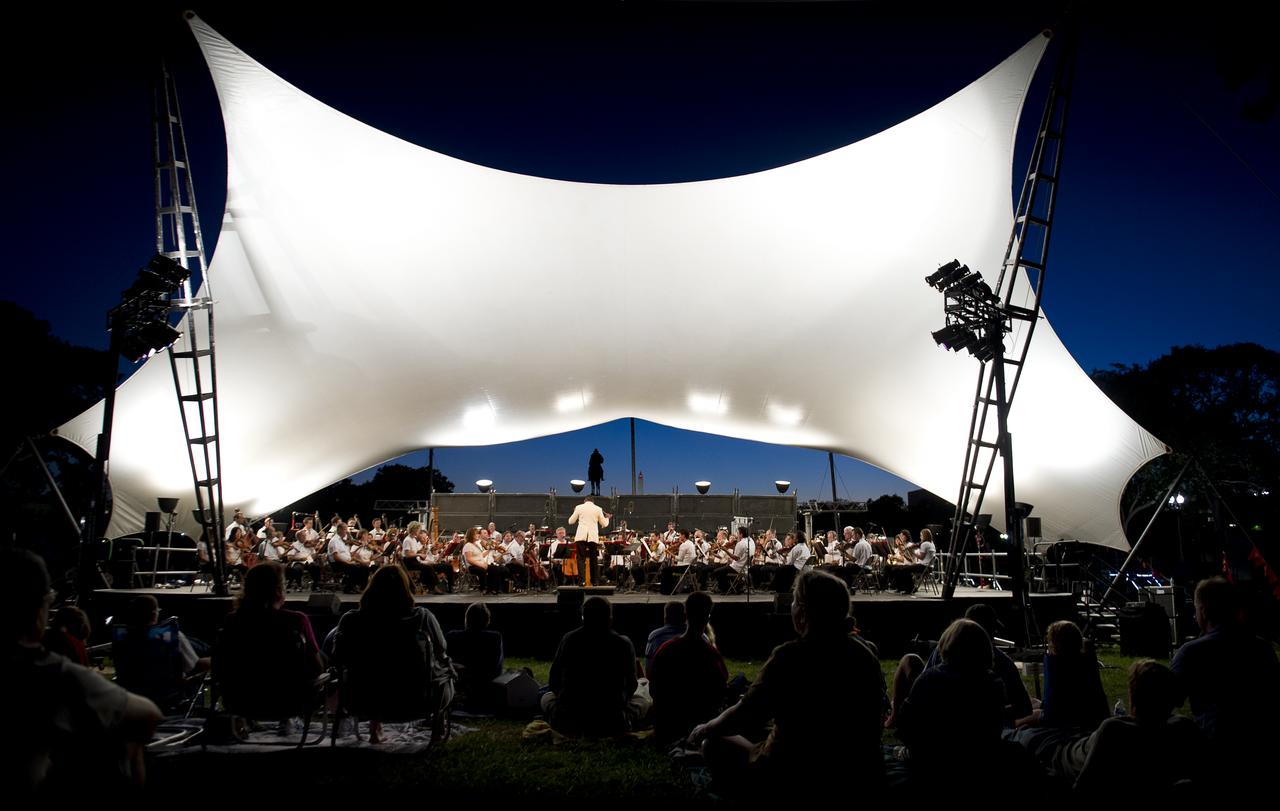
National Symphony Orchestra Conductor Emil de Cou leads the National Symphony Orchestra during the Labor Day Weekend concert on the West Lawn of the U.S. Capitol, Sunday, September 5, 2010 in Washington. NASA Administrator Charles Bolden joined the Orchestra to introduce one the program's segments, music from the film "Apollo 13". Photo Credit: (NASA/Bill Ingalls)
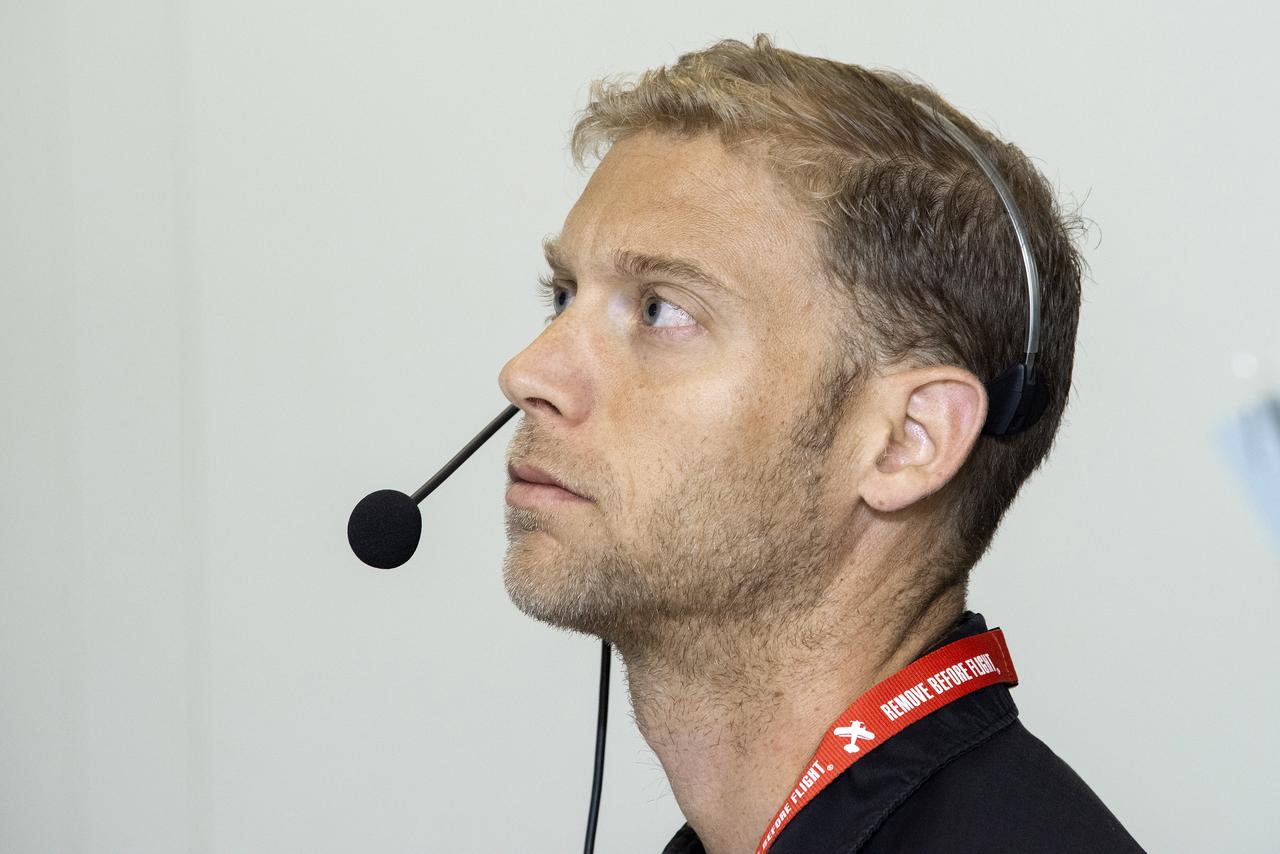
Chris Miller, who was test conductor on this X-56 A flight, prepares for the start of the mission.

Conductor Emil de Cou and The U.S. Army Chorus and Alumni sing while Gene Kranz, retired NASA Flight Director and manager, acts as guest conductor of the National Symphony Orchestra, during the "Salute to Apollo" ceremony at the Kennedy Center for the Performing Arts, Saturday, July 18, 2009 in Washington. The event was part of NASA's week long celebration of the Apollo 40th Anniversary. Photo Credit: (NASA/Bill Ingalls)
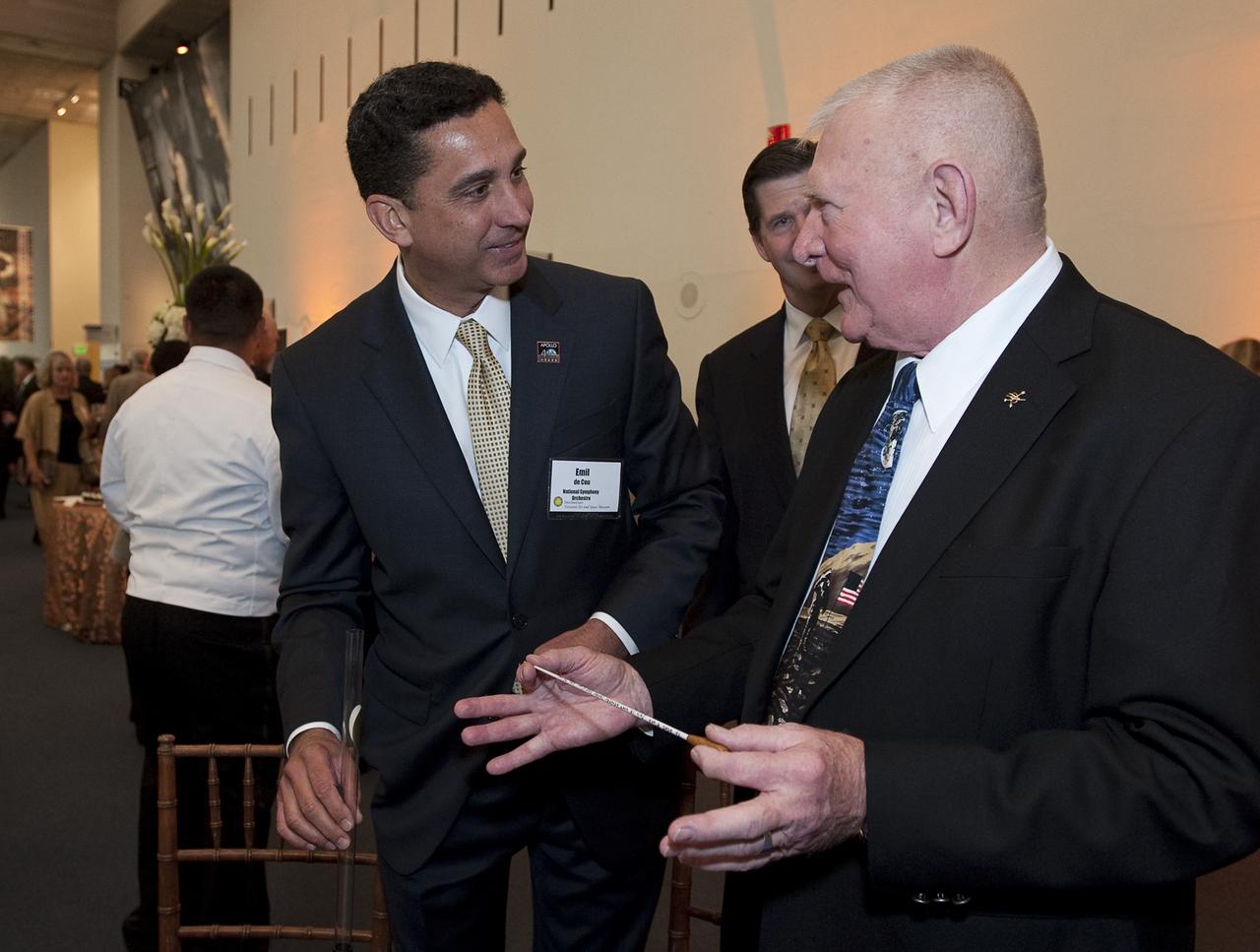
National Symphony Orchestra Conductor Emil de Cou, left, presents a ceremonial baton to retired NASA Flight Director and manager Gene Kranz at the Apollo 40th anniversary celebration held at the National Air and Space Museum, Monday, July 20, 2009 in Washington. Kranz was a guest conductor the night before at the Kennedy Center for the Performing Arts. Photo Credit: (NASA/Bill Ingalls)
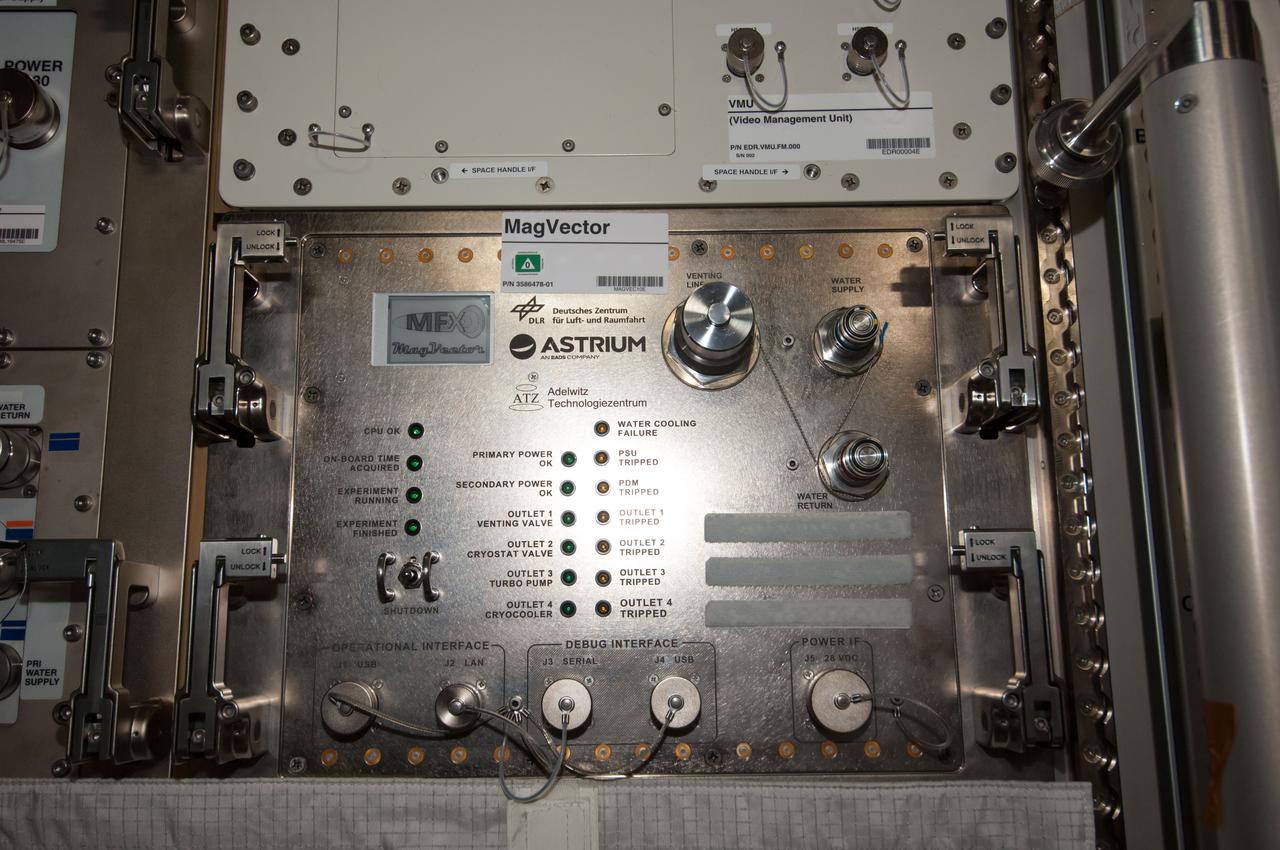
iss040e108291 (8/26/2014) --- Photographic documentation of final installation of MAGVECTOR hardware in the Columbus module aboard the International Space Station (ISS). MAGVECTOR qualitatively investigates the interaction between a moving magnetic field and an electrical conductor. The set up will provide initial insights regarding the principal feasibility on board the ISS,future improvements and phenomenological trends and dependencies. The expected changes in the magnetic field structure on the Ram and Wake side of the electrical conductor are of interest for technical applications as well as for astrophysical research.
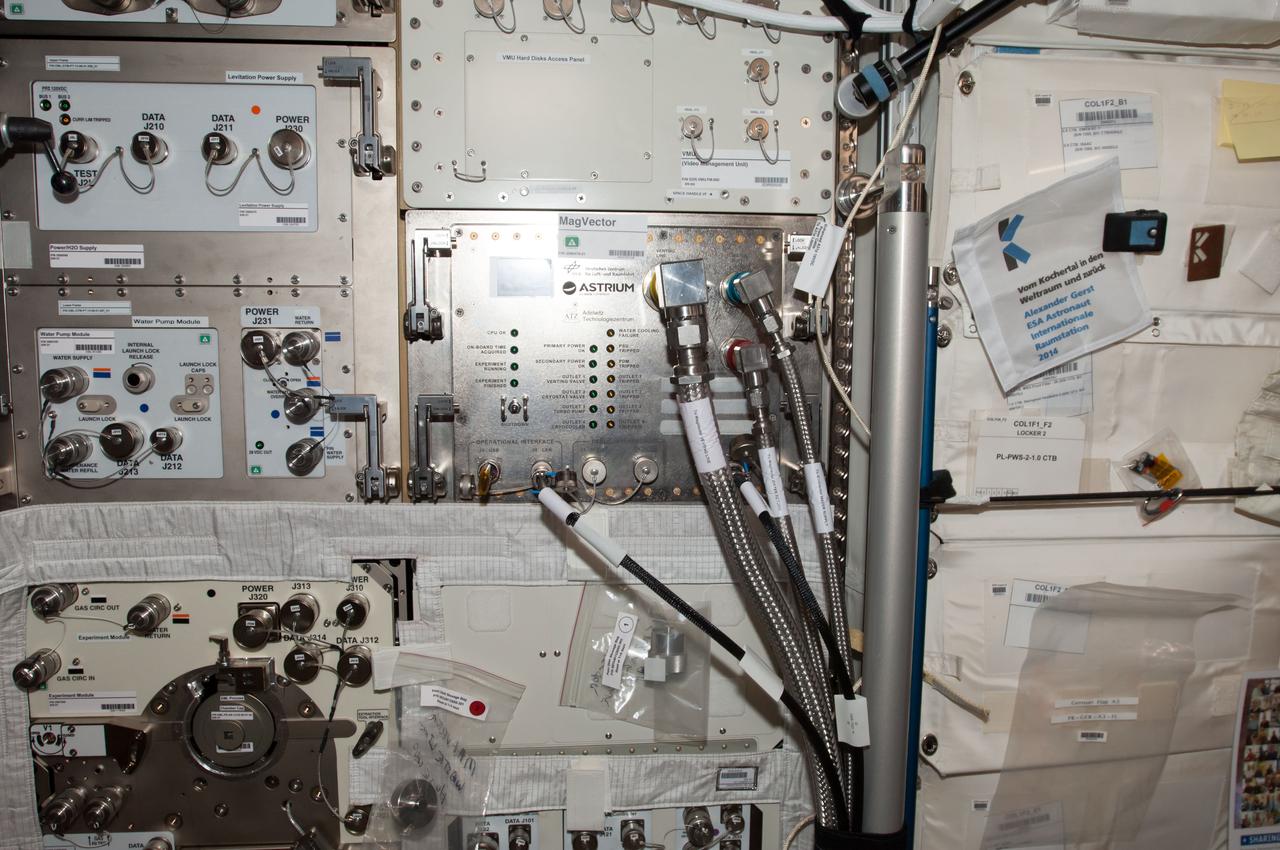
iss040e123621 (9/4/2014) --- Photographic documentation of final installation of MAGVECTOR hardware in the Columbus module aboard the International Space Station (ISS). MAGVECTOR qualitatively investigates the interaction between a moving magnetic field and an electrical conductor. The set up will provide initial insights regarding the principal feasibility on board the ISS,future improvements and phenomenological trends and dependencies. The expected changes in the magnetic field structure on the Ram and Wake side of the electrical conductor are of interest for technical applications as well as for astrophysical research.
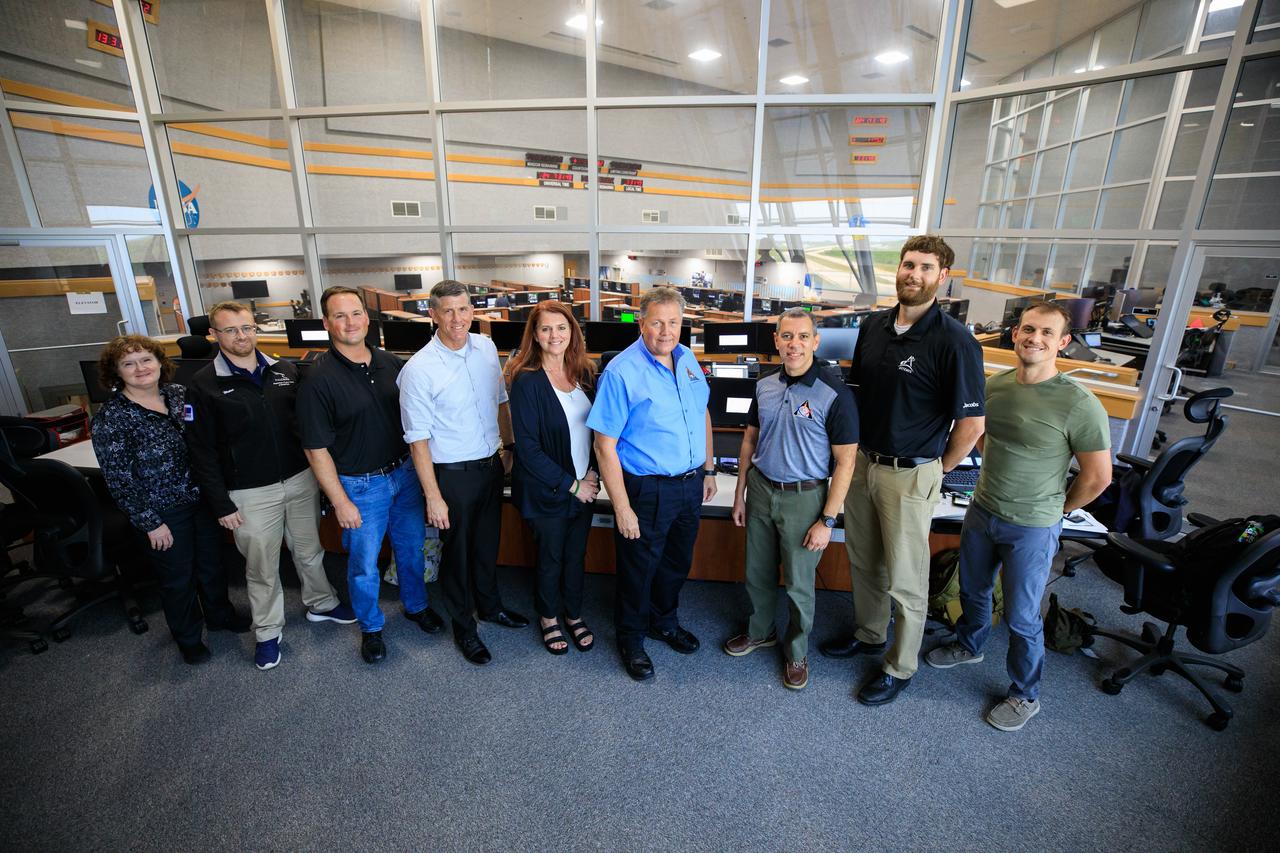
Members of the Artemis I launch team are photographed inside Firing Room 1 of the Rocco A. Petrone Launch Control Center at NASA’s Kennedy Space Center in Florida prior to a certification ceremony on Aug. 12, 2022. From left are Laurie Sally, Space Launch System (SLS) test conductor; Josh Waters, assistant ground test conductor; Wes Mosedale, technical assistant to the launch director; Jeremy Graeber, assistant launch director; Charlie Blackwell-Thompson, launch director; Jeff Spaulding, senior NASA test director; Danny Zeno, NASA test director; Lucas Vojak, assistant Orion test conductor; and Terry Woxberg, Orion test conductor. The ceremony was held to commemorate the certification of the Artemis I launch team following their launch simulation held in December 2021. During the ceremony, senior members of the launch team handed out certificates to individual team members. The first in an increasingly complex series of missions, Artemis I will test the SLS rocket and Orion spacecraft as an integrated system prior to crewed flights to the Moon. Through Artemis, NASA will land the first woman and the first person of color on the lunar surface, paving the way for long-term lunar presence and using the Moon as a steppingstone before venturing to Mars.

Conductor Gemma New speaks to the audience during the National Symphony Orchestra’s performance of Gustav Holst’s “The Planets” Wednesday, Jan. 22, 2020, at The Anthem in Washington, DC. Photo Credit: (NASA/Joel Kowsky)
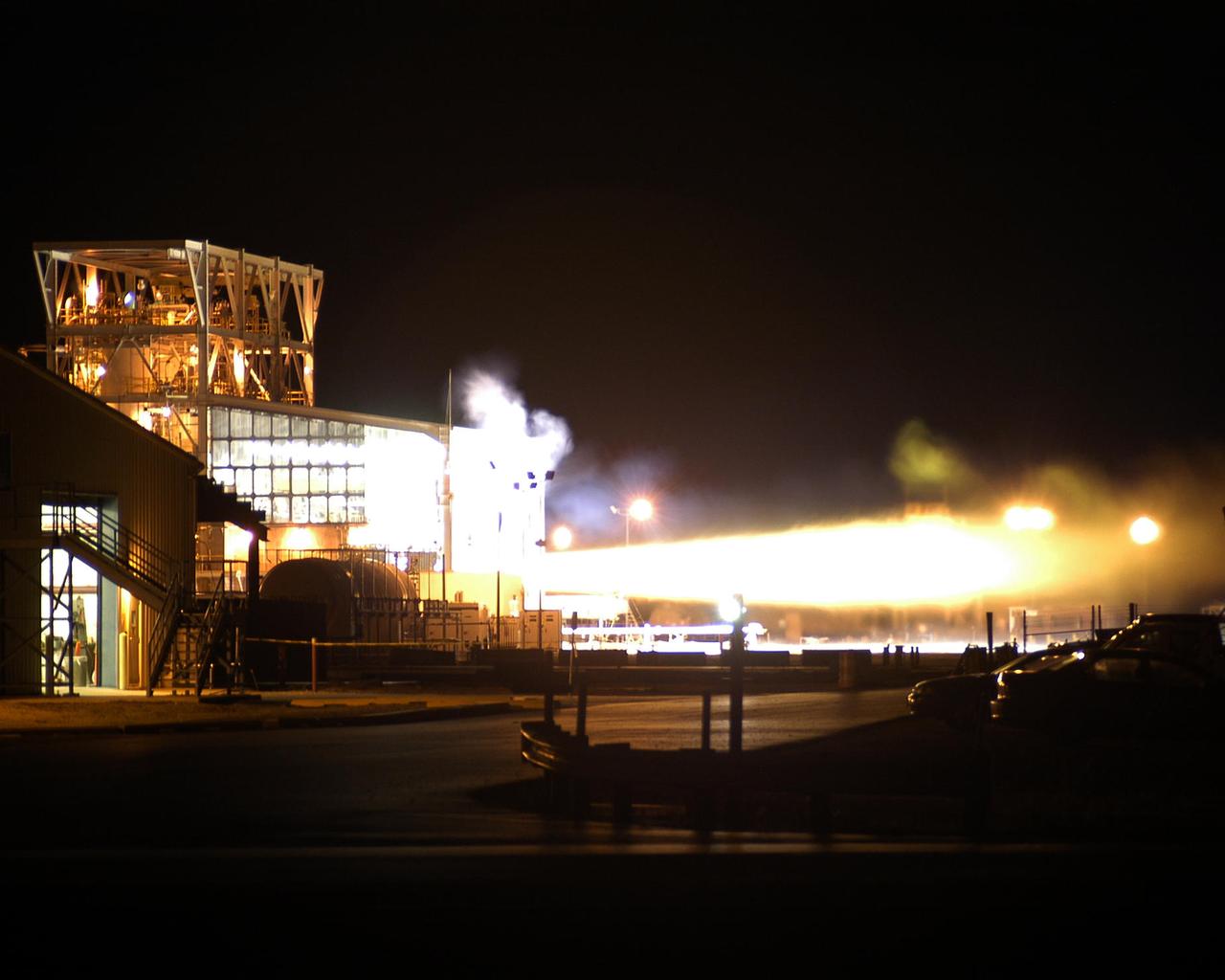
The Integrated Powerhead Demonstrator test fires with Wayne North as test conductor. The engine was tested at the E Complex of NASA's Stennis Space Center near Bay St. Louis, Miss. on Dec. 8, 2005.
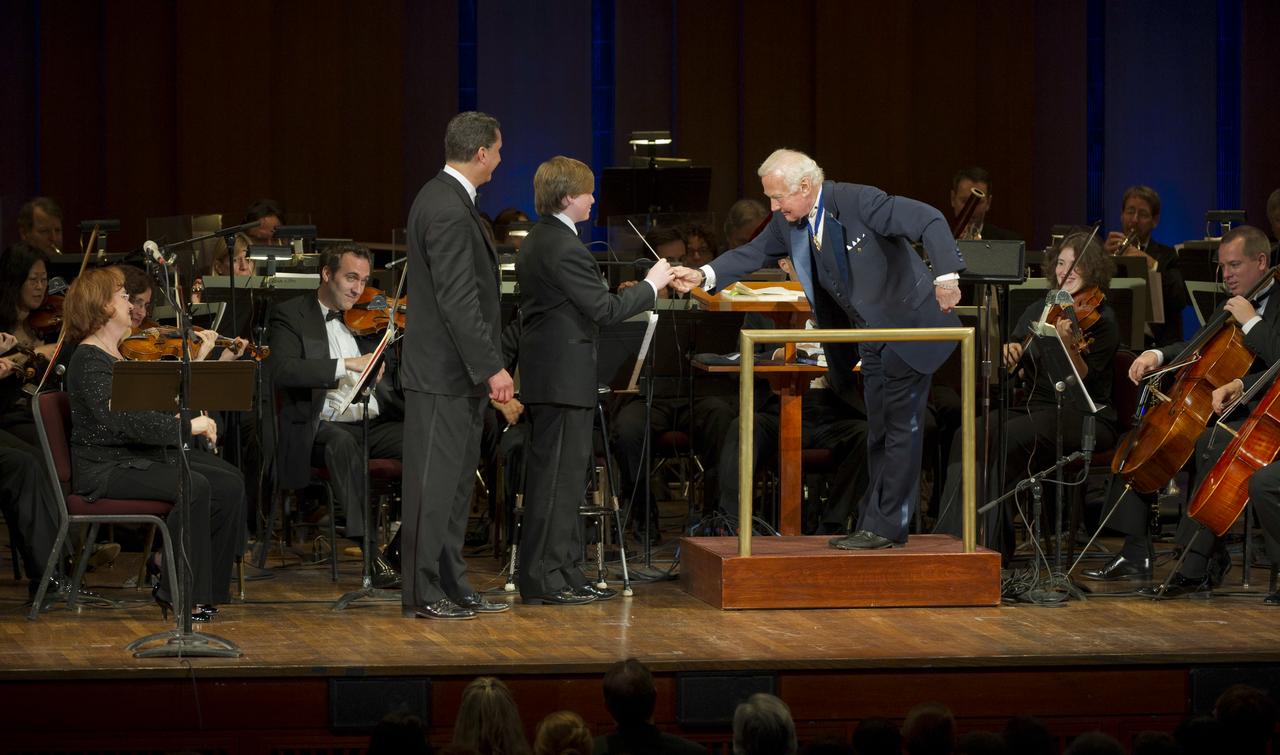
Former Apolo 11 astronaut Buzz Aldrin, right, passes the baton to second guest conductor Ted Kennedy III as conductor Emil de Cou looks on while the Space Philharmonic plays on during a program commemorating Human Spaceflight and the Kennedy Legacy, Wednesday, May 25, 2011, in the concert hall at the John F. Kennedy Center for the Performing Arts in Washington. The event marked the 50th Anniversary of President John F. Kennedy's Special Message to the Congress on Urgent National Needs in which he stated "landing a man on the moon and returning him safely to earth". Photo Credit: (NASA/Paul E. Alers)
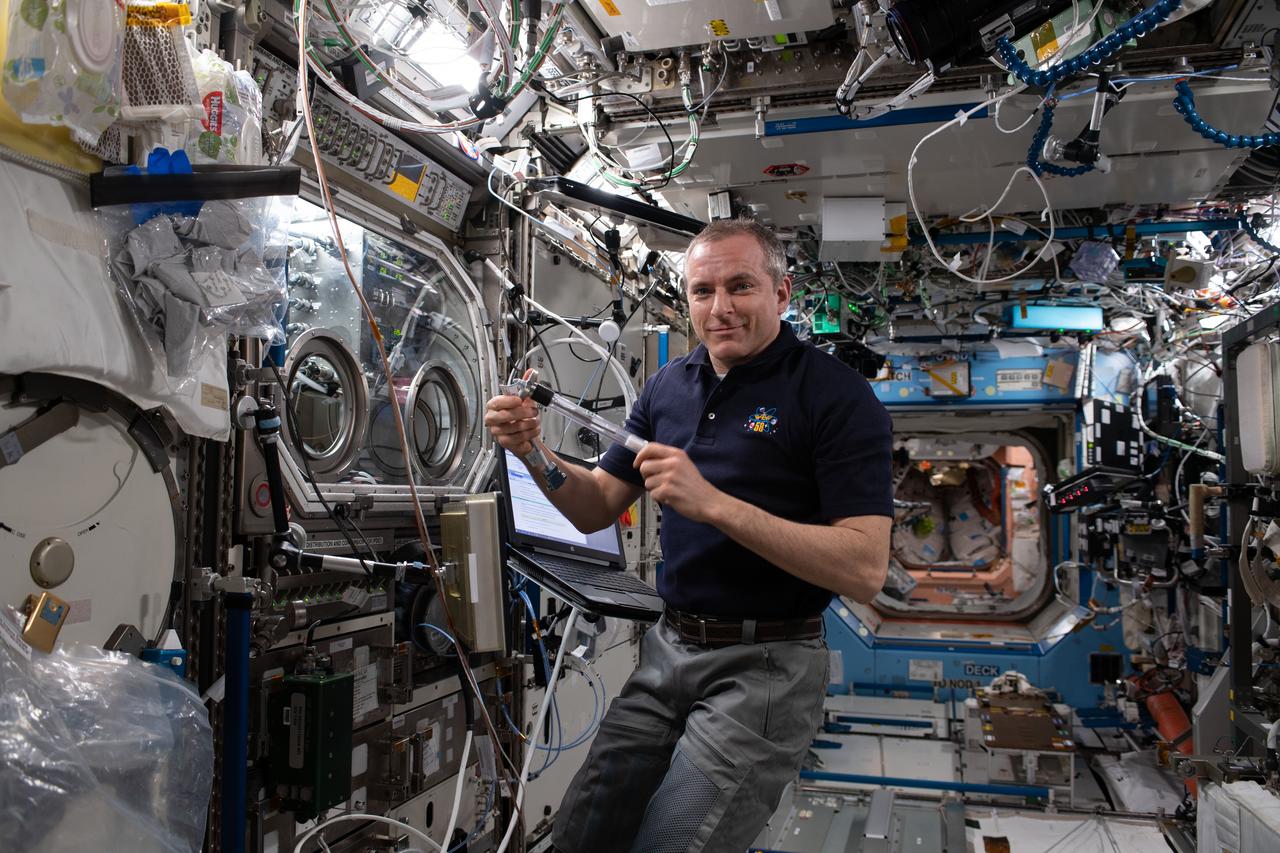
iss059e027344 (April 19, 2019) --- Astronaut David Saint-Jacques of the Canadian Space Agency studies how crystals melt and solidify using the Microgravity Science Glovebox inside the U.S. Destiny laboratory module. The Solidification Using a Baffle in Sealed Ampoules study explores how to produce high-quality semi-conductor crystals in microgravity.
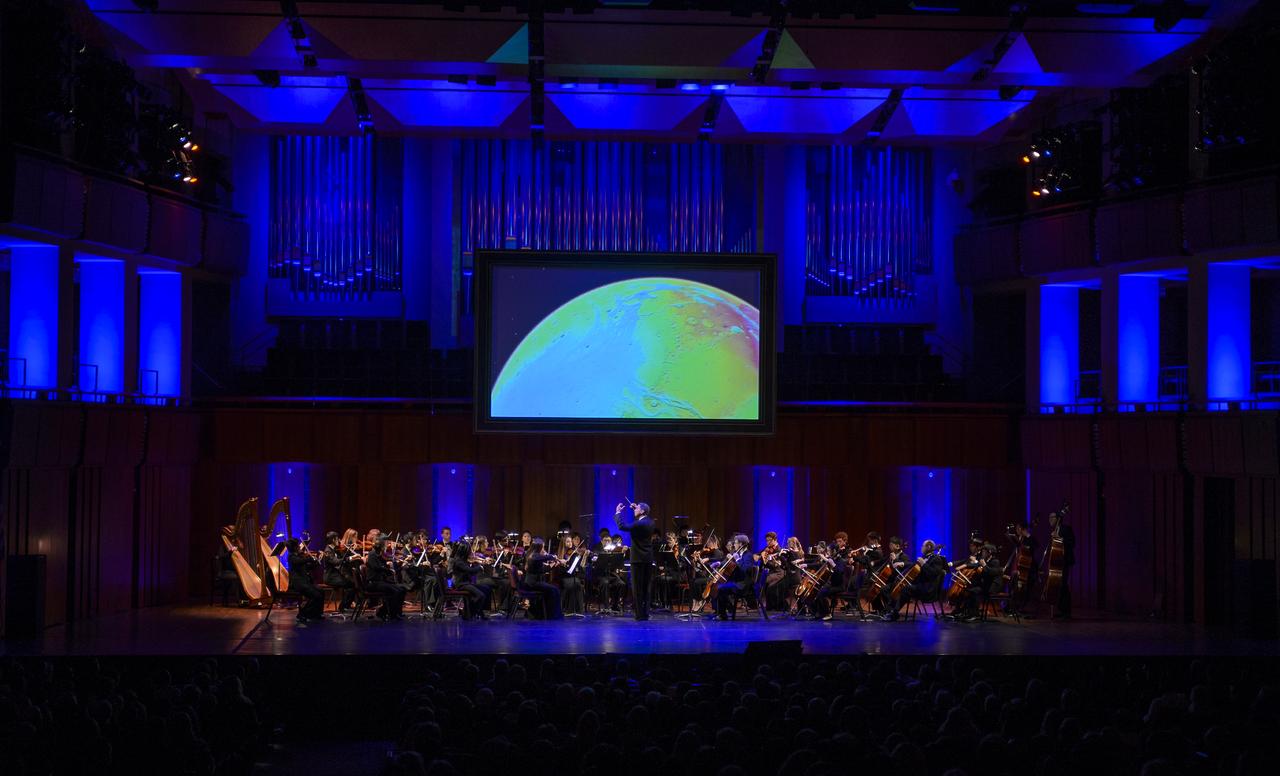
The Maryland Classic Youth Orchestras performs "Clair du Lune" with Guest Conductor Emil de Cou during the National Tribute to Sally Ride at the John F. Kennedy Center for the Performing Arts, Monday, May 20, 2013 in Washington. Photo Credit: (NASA/Bill Ingalls)

Maria Zapata, test conductor, participates in the Artemis III terminal countdown simulation on Thursday, May 7, 2026, inside Firing Room 1 of the Rocco A. Petrone Launch Control Center at NASA’s Kennedy Space Center in Florida. This marked the first simulation the launch team performed ahead of Artemis III.
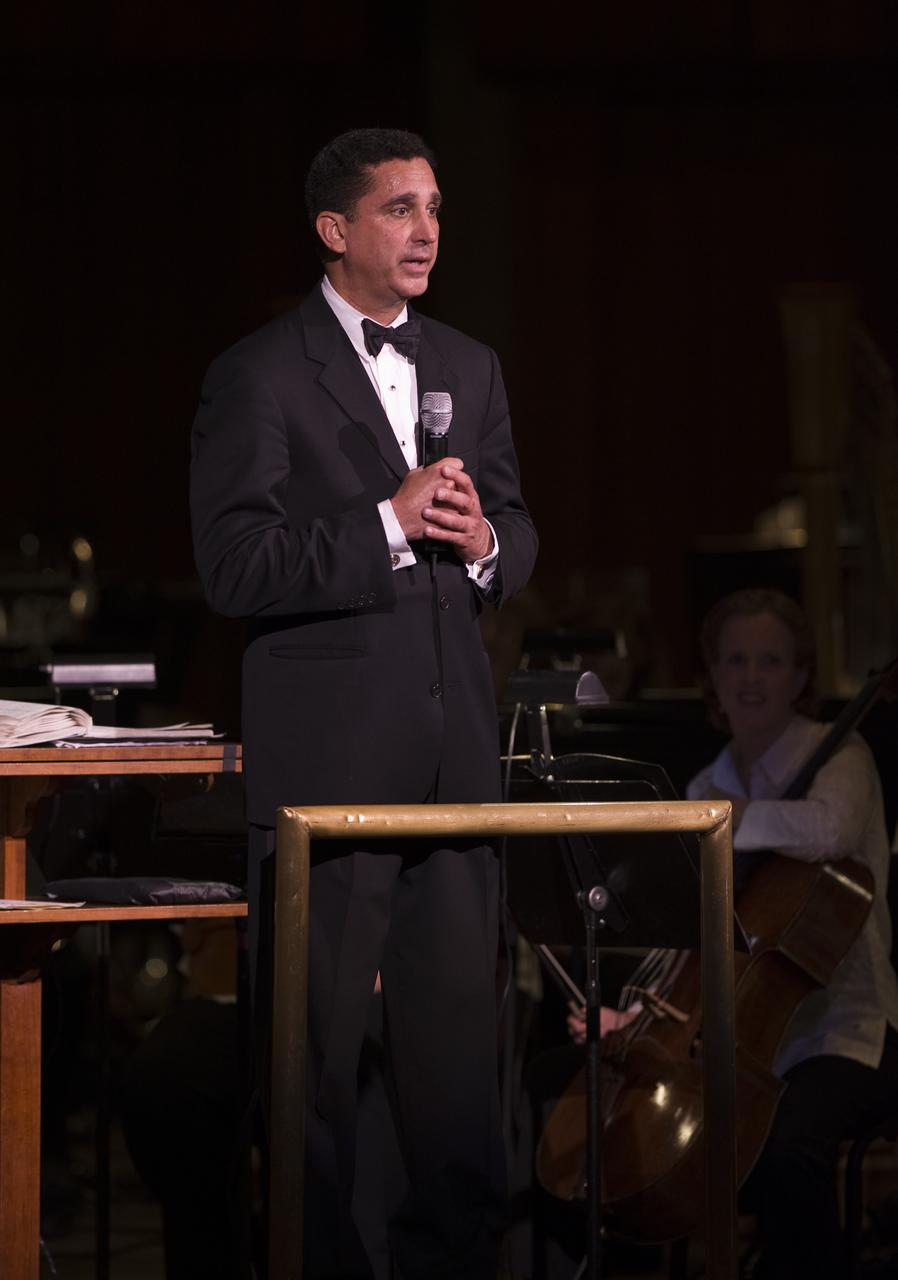
Emil de Cou, Conductor of the National Symphony Orchestra, talks to the audience during the "Salute to Apollo" ceremony at the Kennedy Center for the Performing Arts, Saturday, July 18, 2009 in Washington. The event was part of NASA's week long celebration of the Apollo 40th Anniversary. Photo Credit: (NASA/Bill Ingalls)

Members of the National Symphony Orchestra, under Conductor Emil de Cou, perform during the "Salute to Apollo" ceremony at the Kennedy Center for the Performing Arts, Saturday, July 18, 2009 in Washington. The event was part of NASA's week long celebration of the Apollo 40th Anniversary. Photo Credit: (NASA/Bill Ingalls)
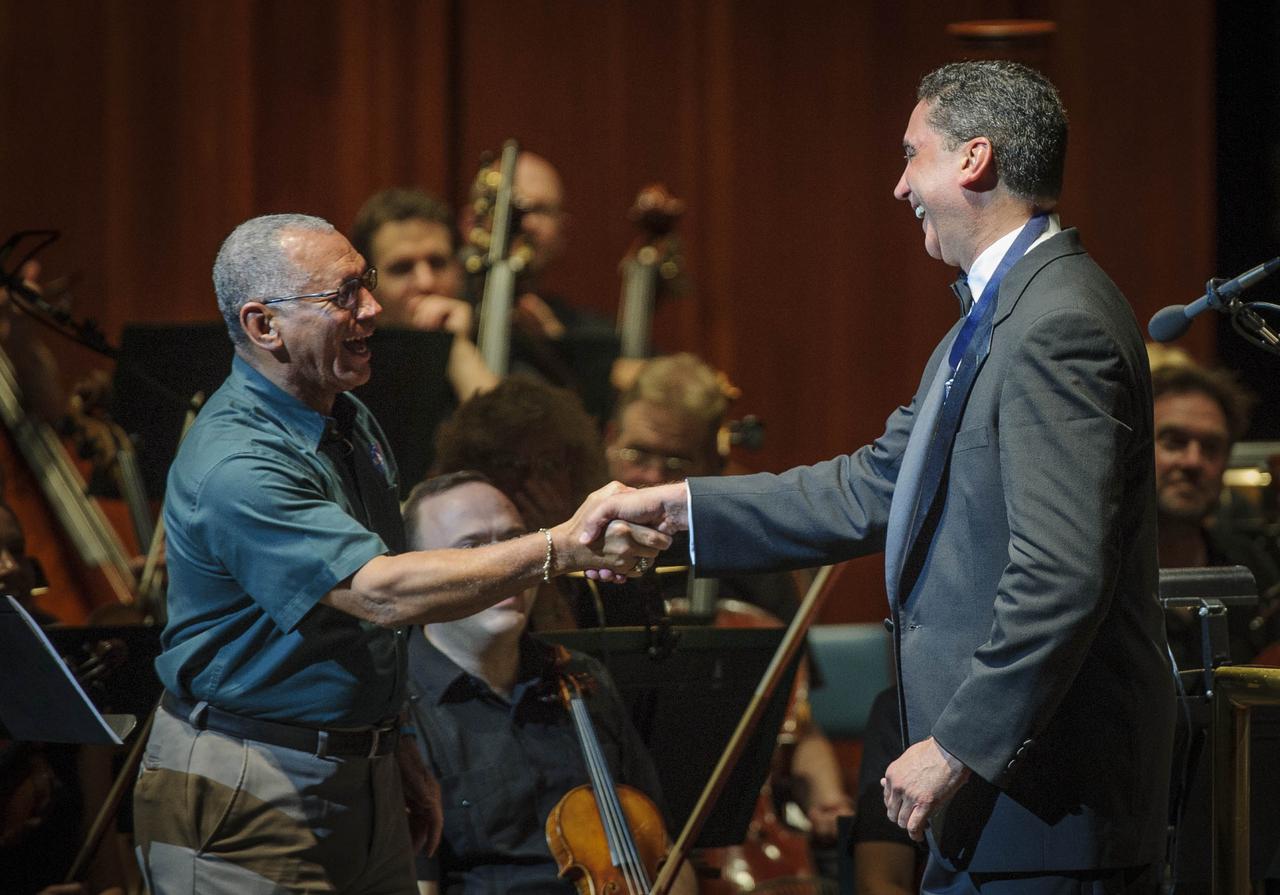
NASA Administrator Charles Bolden, left, shakes hands with Emil de Cou, conductor of the National Symphony Orchestra during a performance entitled "The Planets--An HD Odyessy", Friday evening, July 27, 2012, at the Wolf Trap National Park for the Performing Arts in Vienna, Va. Photo Credit: (NASA/Paul E. Alers)
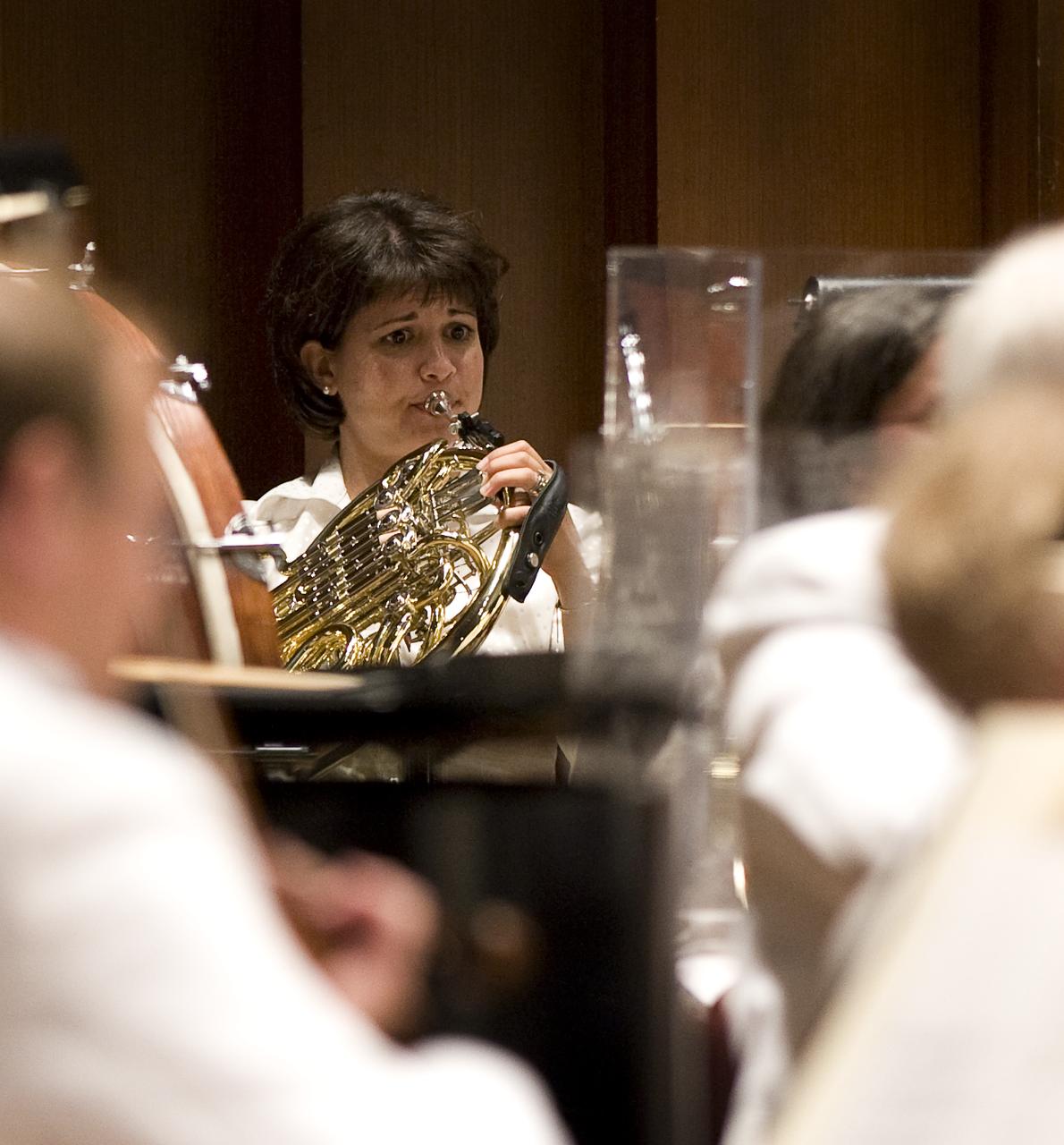
Members of the National Symphony Orchestra, under Conductor Emil de Cou, perform during the "Salute to Apollo" ceremony at the Kennedy Center for the Performing Arts, Saturday, July 18, 2009 in Washington. The event was part of NASA's week long celebration of the Apollo 40th Anniversary. Photo Credit: (NASA/Bill Ingalls)
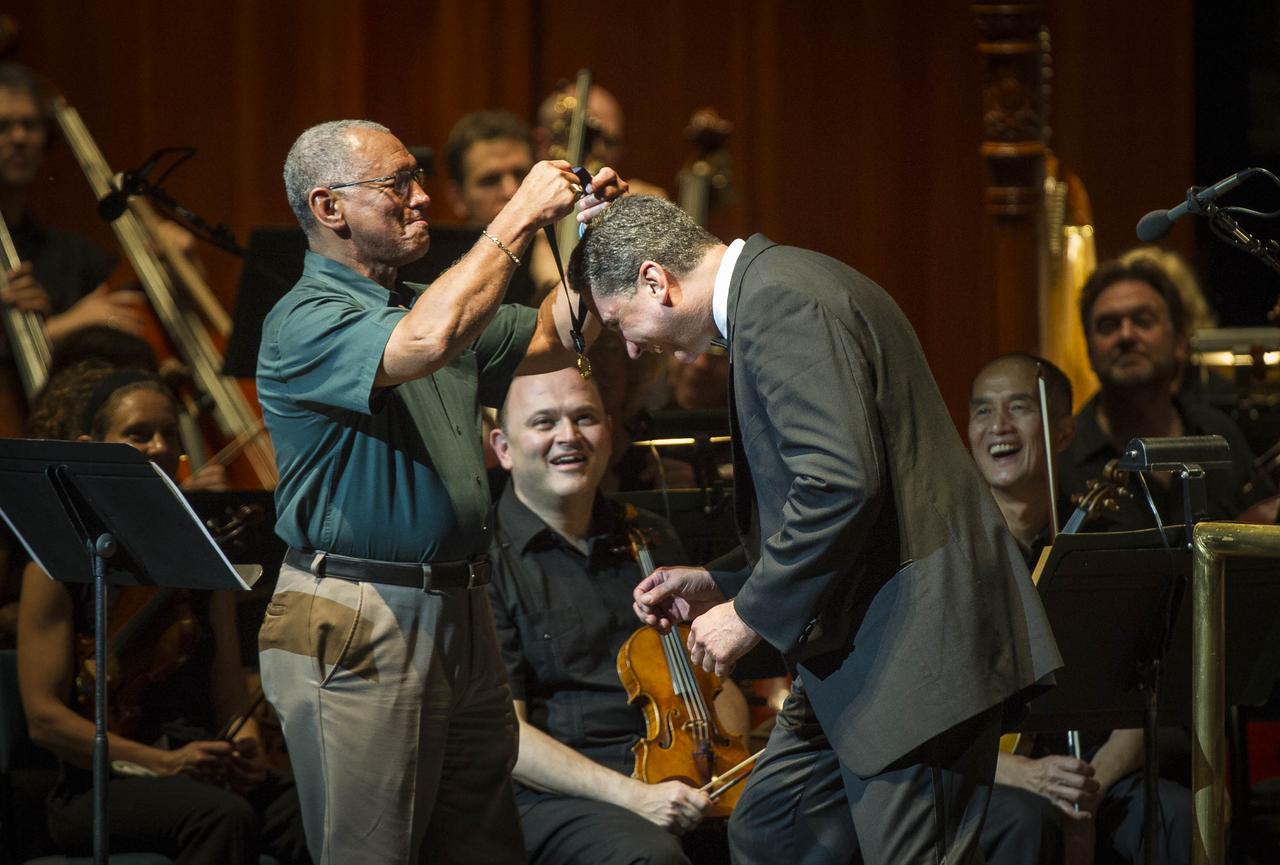
NASA Administrator Charles Bolden, left, presents a medal to Emil de Cou, conductor of the National Symphony Orchestra during a performance entitled "The Planets--An HD Odyessy", Friday evening, July 27, 2012, at the Wolf Trap National Park for the Performing Arts in Vienna, Va. Photo Credit: (NASA/Paul E. Alers)
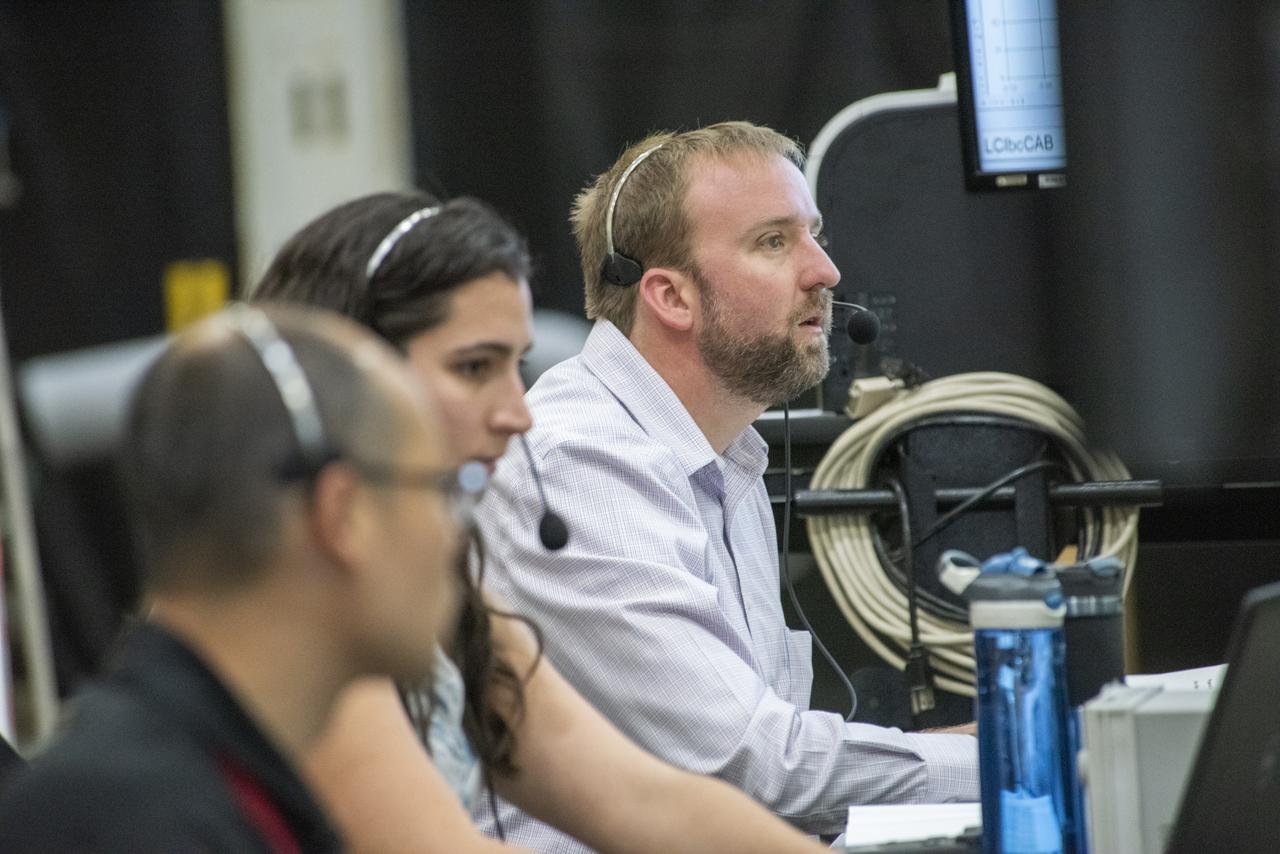
Wesley Li, Kirsten Boogaard and test conductor Eric Miller observe testing of the X-57 distributed electric aircraft wing at NASA's Armstrong Flight Research Center in California. Tests increased confidence in the wing's durability and calibrated installed strain gauges for inflight load monitoring of the wing.
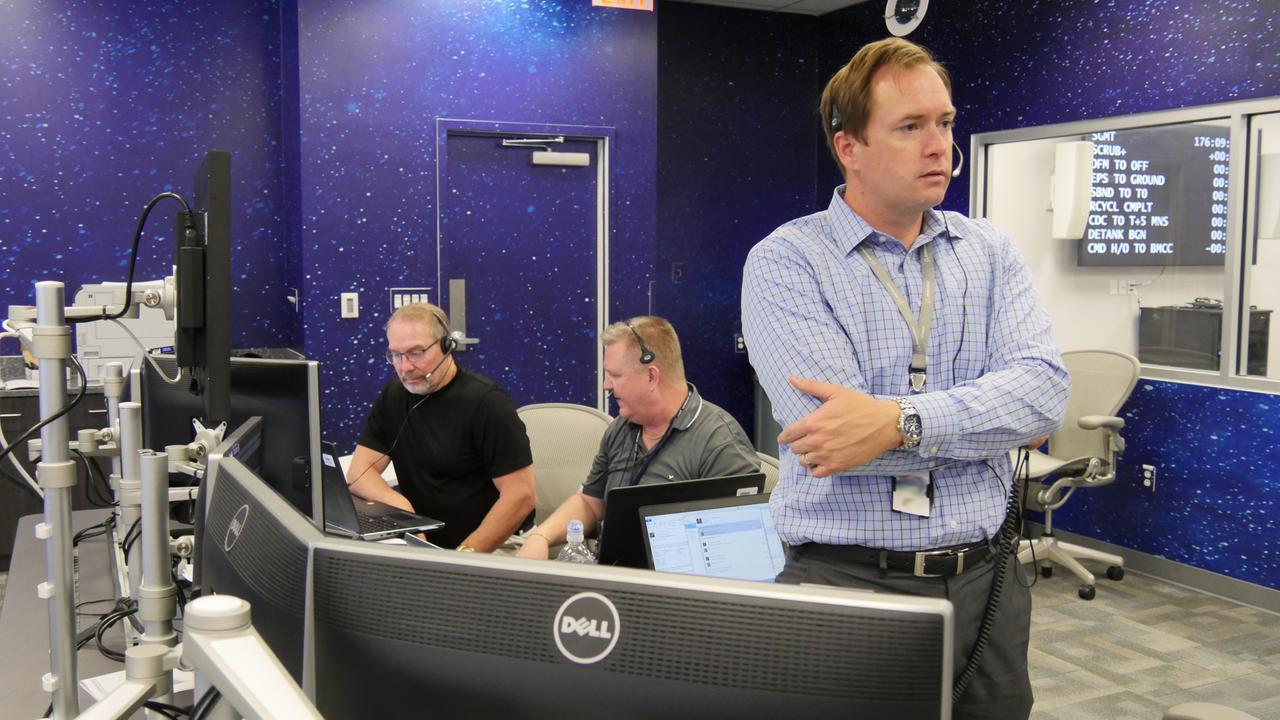
Inside the Boeing Mission Control Center at Kennedy Space Center, Fla., launch control teams for the CST-100 Starliner rehearse a fully integrated prelaunch simulation of the spacecraft’s upcoming Orbital Flight Test. Boeing Spacecraft Launch Conductor Louis Atchison speaks on console to the Mission Management Team as the countdown in the launch simulation progresses.

Sierra Sewdass, test conductor, participates in the Artemis III terminal countdown simulation on Thursday, May 7, 2026, inside Firing Room 1 of the Rocco A. Petrone Launch Control Center at NASA’s Kennedy Space Center in Florida. This marked the first simulation the launch team performed ahead of Artemis III.

Maria Zapata, test conductor, participates in the Artemis III terminal countdown simulation on Thursday, May 7, 2026, inside Firing Room 1 of the Rocco A. Petrone Launch Control Center at NASA’s Kennedy Space Center in Florida. This marked the first simulation the launch team performed ahead of Artemis III.
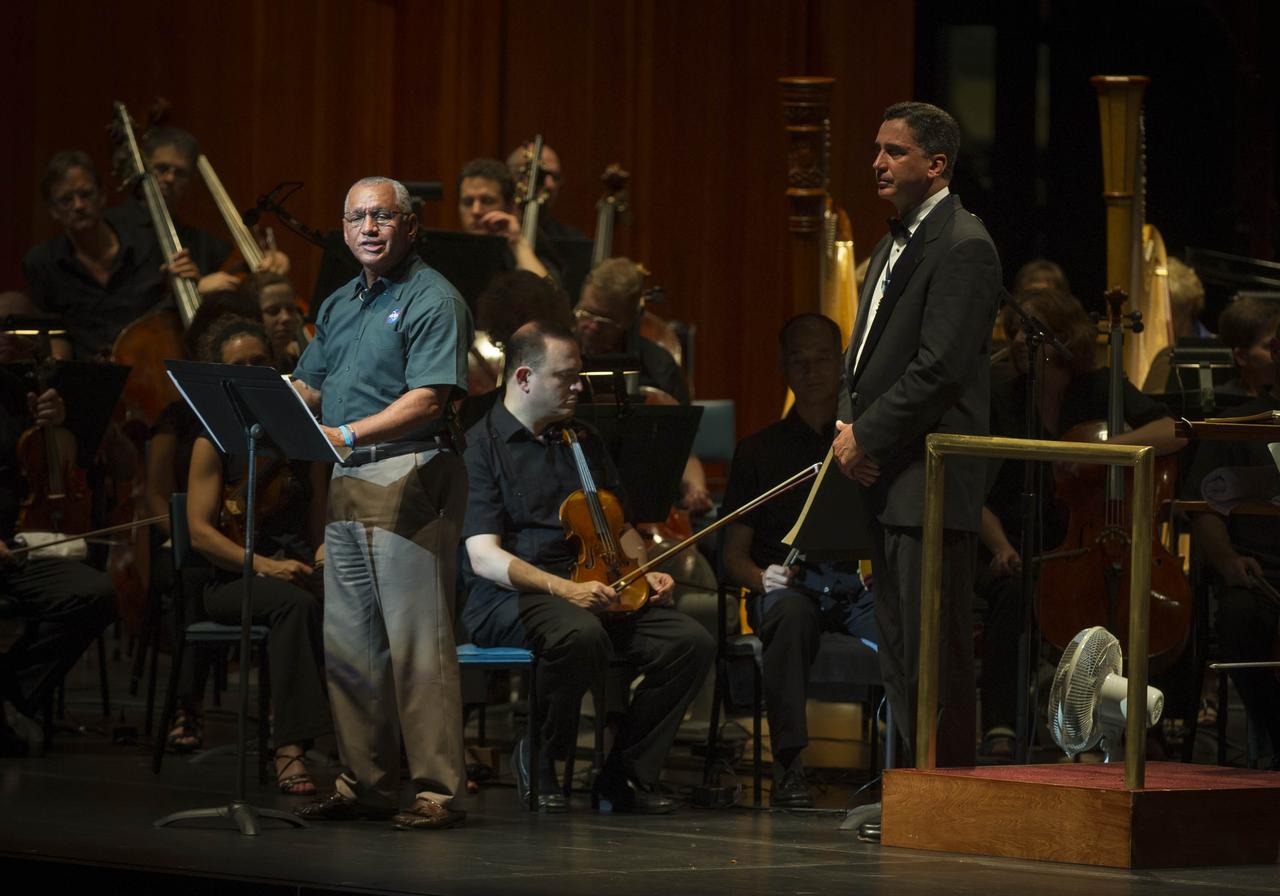
NASA Administrator Charles Bolden, left, speaks as Emil de Cou, conductor of the National Symphony Orchestra, right, looks on during a performance entitled "The Planets--An HD Odyessy", Friday evening, July 27, 2012, at the Wolf Trap National Park for the Performing Arts in Vienna, Va. Photo Credit: (NASA/Paul E. Alers)
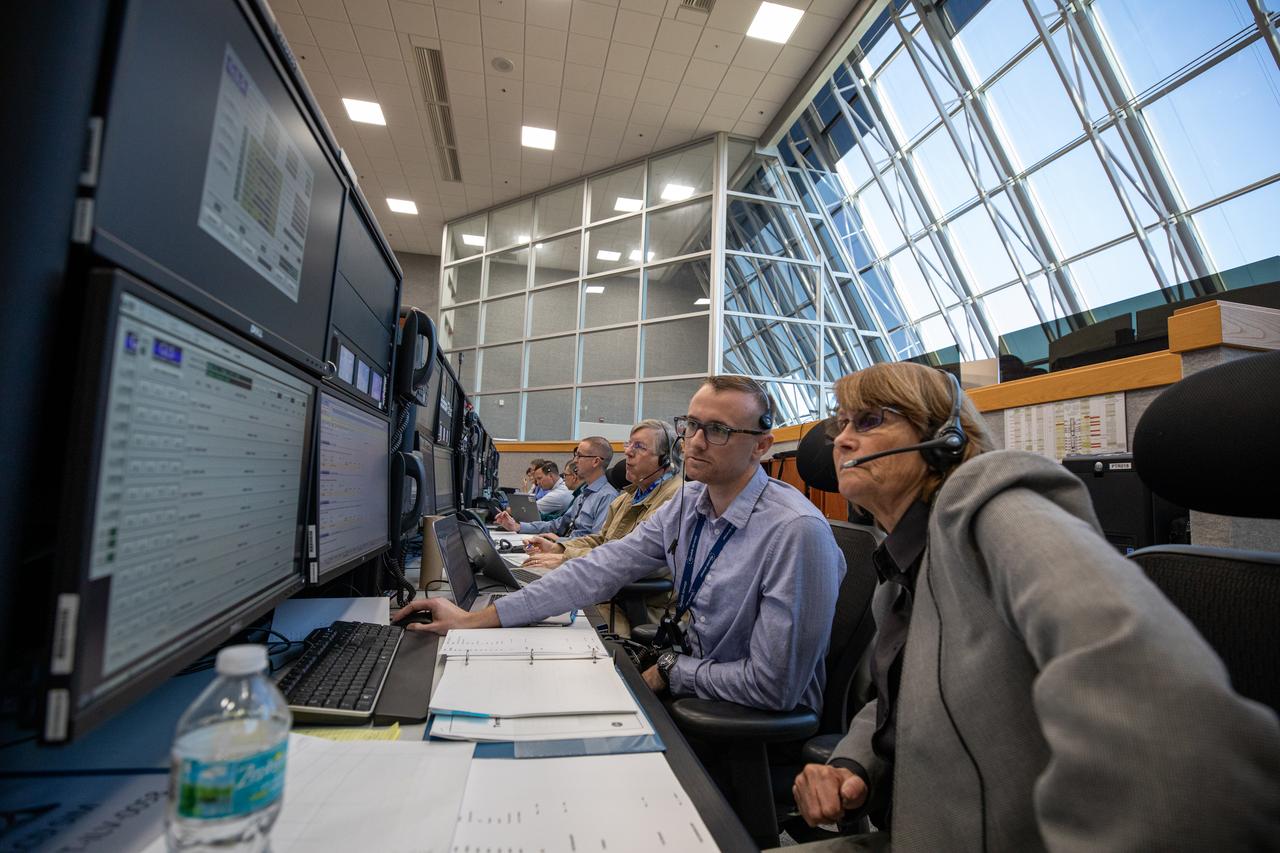
Josh Waters (left), ground test conductor, and Teresa Annulis, assistant ground test conductor, participate in an Artemis I launch countdown simulation inside the Launch Control Center’s Firing Room 1 at NASA’s Kennedy Space Center in Florida. Under the leadership of Launch Director Charlie Blackwell-Thompson, nearly 100 engineers from Orion, Space Launch System (SLS) and the agency’s Exploration Ground Systems came together on Feb. 3, 2020, to work through a series of simulated challenges, as well as a final countdown procedure. During these exercises, different issues were introduced to familiarize the team with launch day operations, while providing them with an opportunity to practice how they would handle those issues in real-time. Artemis I will be the first integrated test flight of the Orion spacecraft and SLS rocket – the system that will ultimately land the first woman and the next man on the Moon.
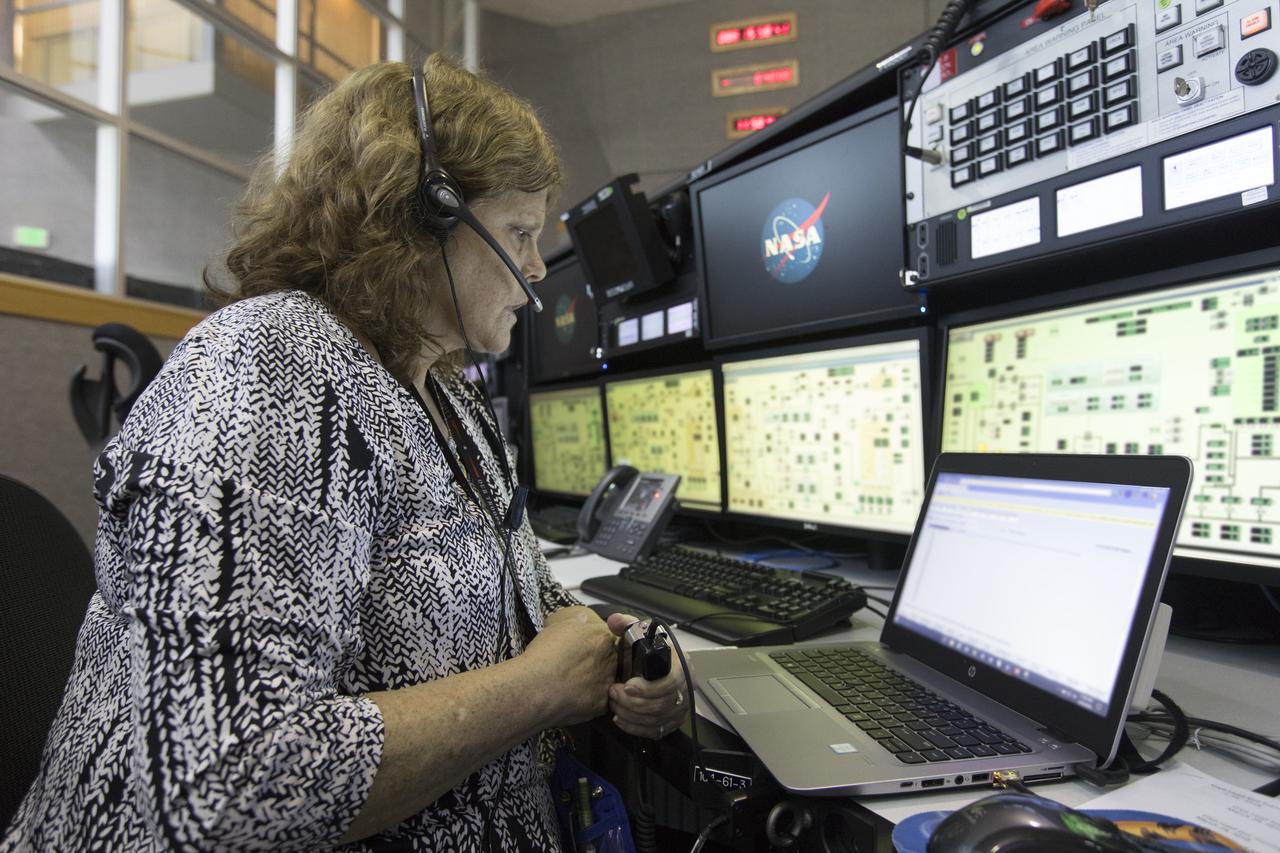
Roberta Wyrick, spacecraft test conductor with Jacobs, NASA's Test and Operations Support Contractor, monitors operations from her console in Firing Room 1 at the Kennedy Space Center's Launch Control Center during a countdown simulation for Exploration Mission 1. It was the agency's first simulation of a portion of the countdown for the first launch of a Space Launch System rocket and Orion spacecraft that will eventually take astronauts beyond low-Earth orbit to destinations such as the Moon and Mars.
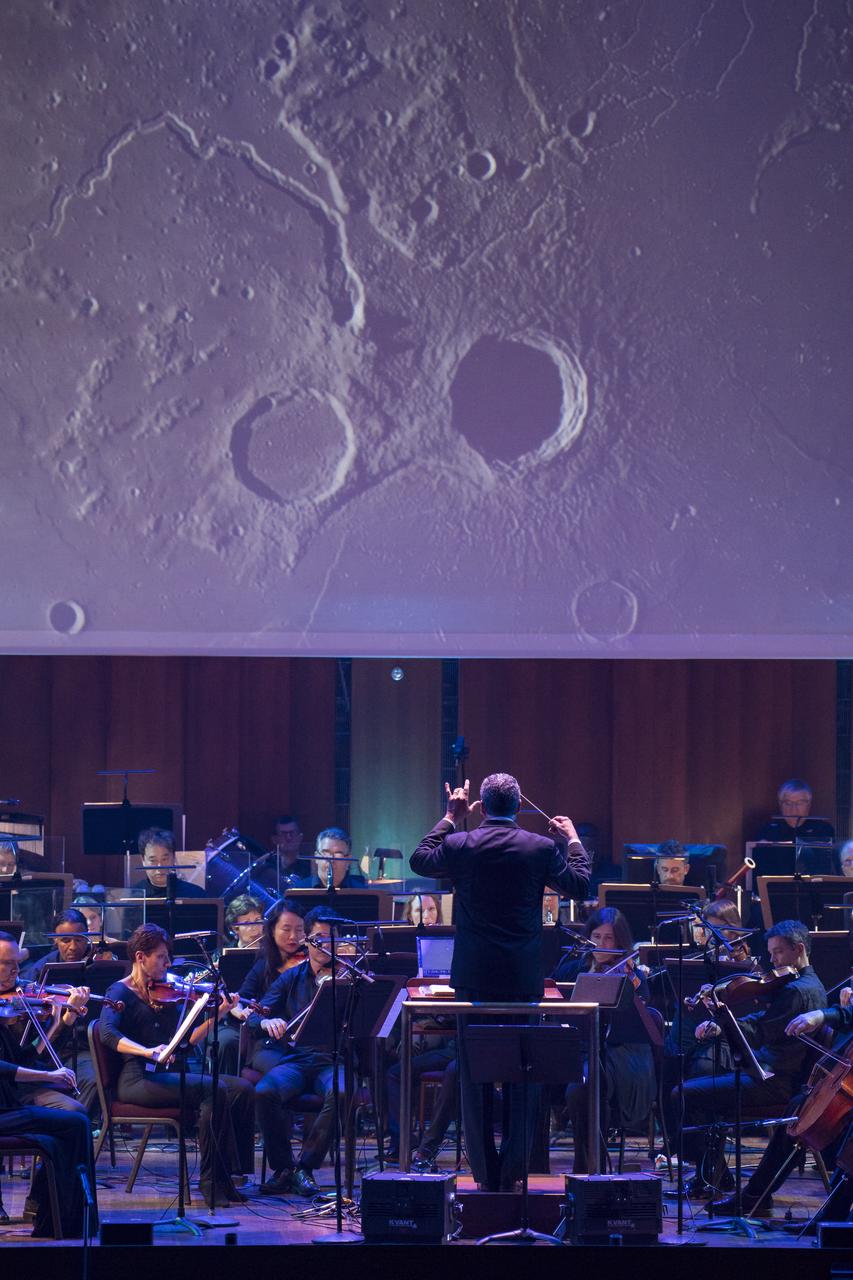
Conductor Emil de Cou leads the National Symphony Orchestra during the "Space, the Next Frontier" event celebrating NASA's 60th Anniversary, Friday, June 1, 2018 at the John F. Kennedy Center for the Performing Arts in Washington. The event featured music inspired by space including artists will.i.am, Grace Potter, Coheed & Cambria, John Cho, and guest Nick Sagan, son of Carl Sagan. Photo Credit: (NASA/Aubrey Gemignani)
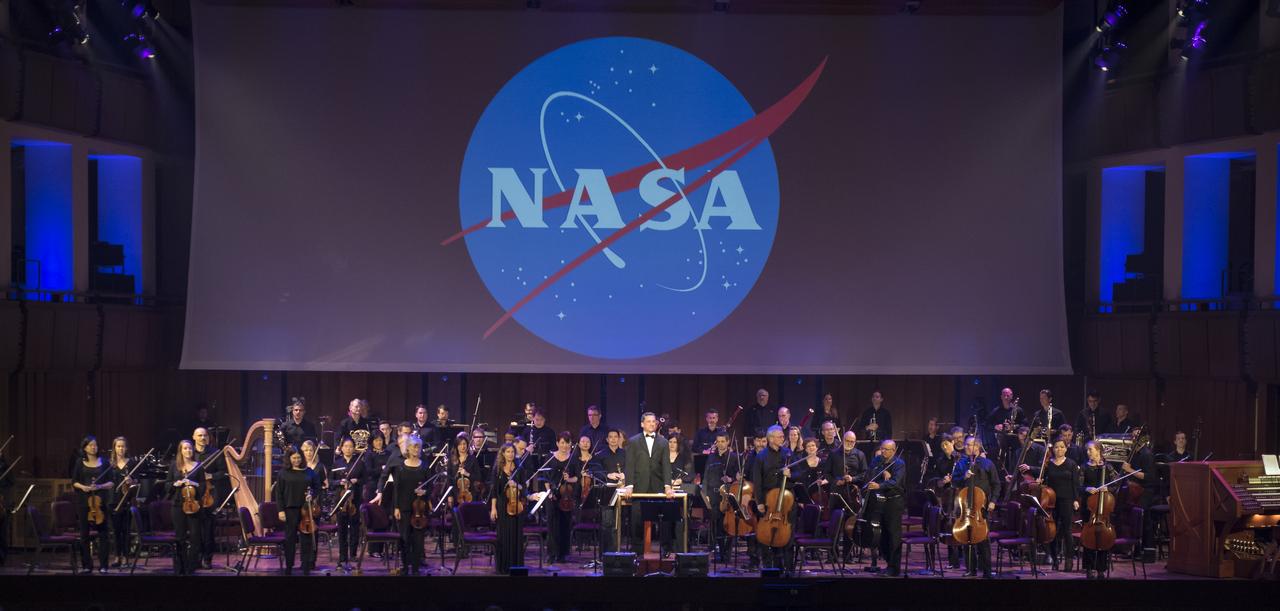
Conductor Emil de Cou and the National Symphony Orchestra stands at the start of the second half of "Space, the Next Frontier" celebrating NASA's 60th Anniversary, Friday, June 1, 2018 at the John F. Kennedy Center for the Performing Arts in Washington. The event featured music inspired by space including artists will.i.am, Grace Potter, Coheed & Cambria, John Cho, and guest Nick Sagan, son of Carl Sagan. Photo Credit: (NASA/Aubrey Gemignani)
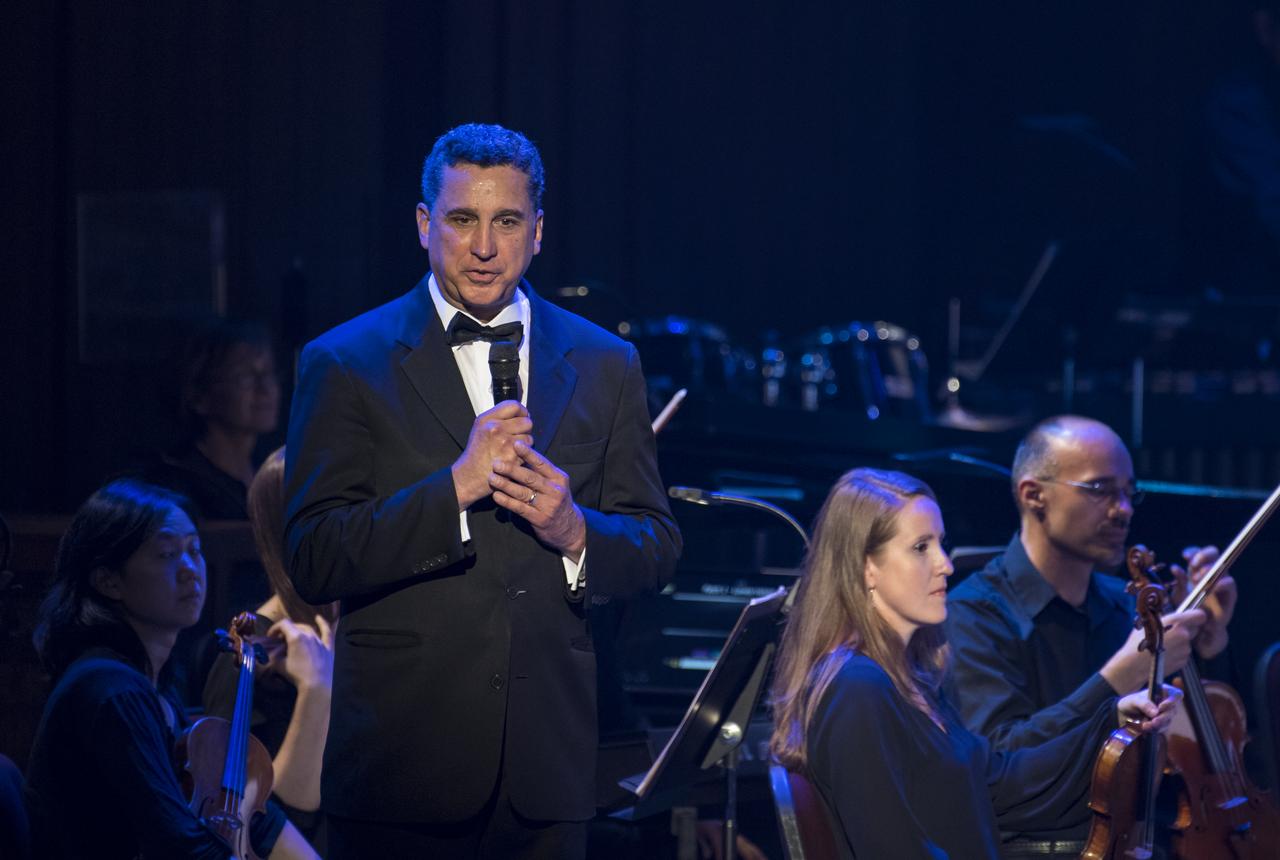
Conductor Emil de Cou speaks after leading the National Symphony Orchestra during the "Space, the Next Frontier" event celebrating NASA's 60th Anniversary, Friday, June 1, 2018 at the John F. Kennedy Center for the Performing Arts in Washington. The event featured music inspired by space including artists will.i.am, Grace Potter, Coheed & Cambria, John Cho, and guest Nick Sagan, son of Carl Sagan. Photo Credit: (NASA/Aubrey Gemignani)
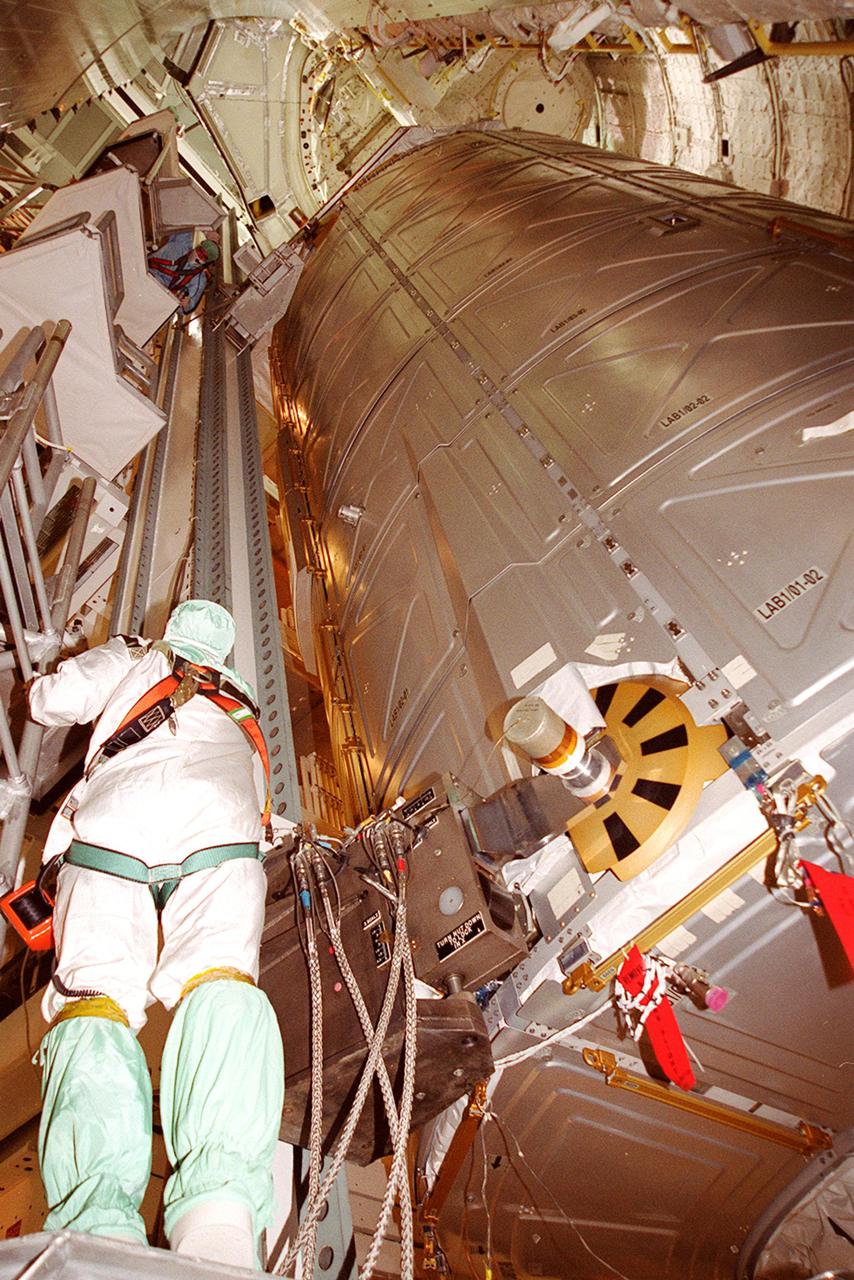
The U.S. Lab Destiny is ready to be moved from Atlantis’ payload bay into the Payload Changeout Room. After the move, Atlantis will roll back to the Vehicle Assembly Building to allow workers to conduct inspections, continuity checks and X-ray analysis on the 36 solid rocket booster cables located inside each booster’s system tunnel. An extensive evaluation of NASA’s SRB cable inventory revealed conductor damage in four (of about 200) cables on the shelf. Shuttle managers decided to prove the integrity of the system tunnel cables already on Atlantis
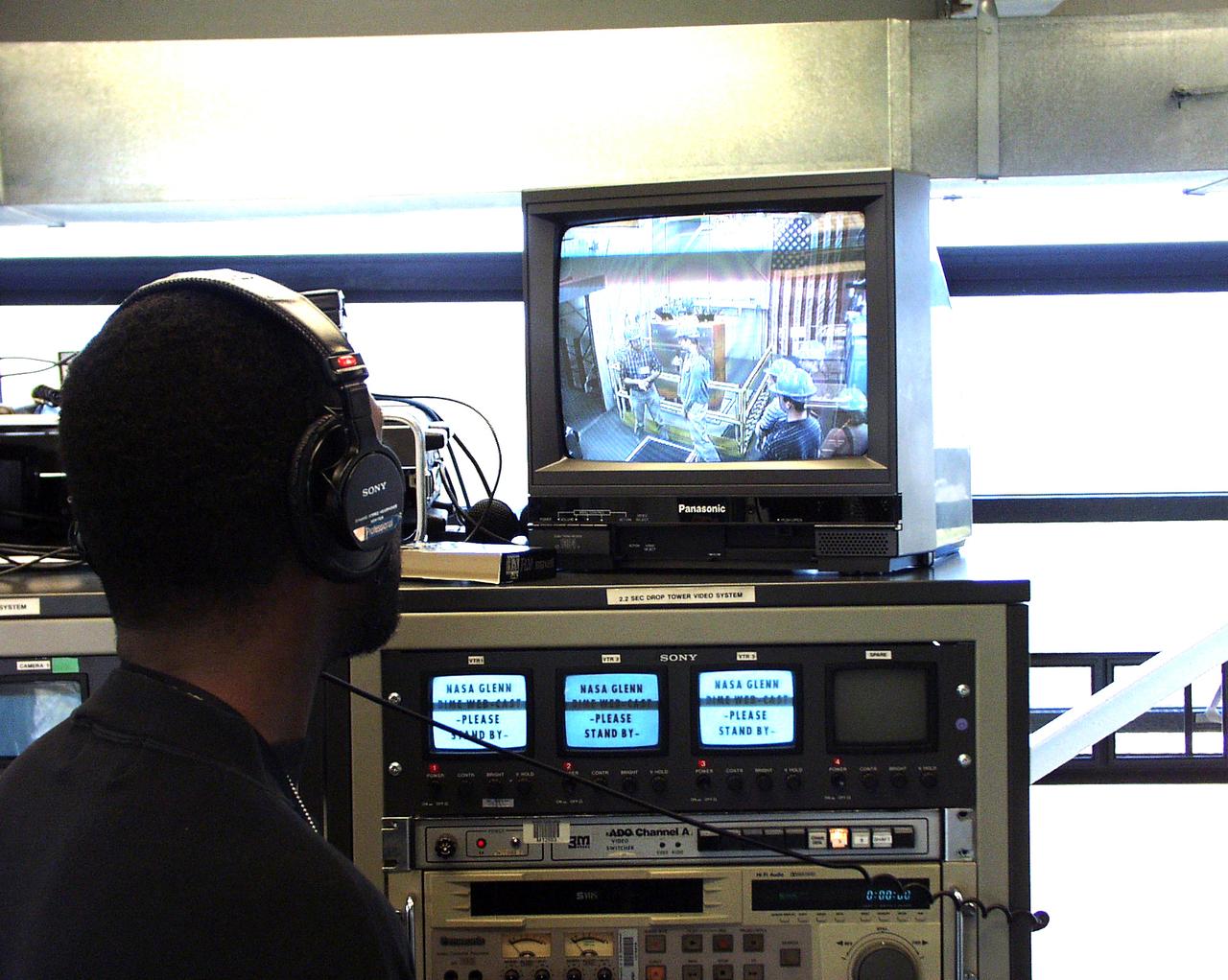
A NASA test conductor at the top of the 2.2-second Drop Tower monitors a student lecture at a lower level. This was part of the Microgravity Environment (DIME) competition held April 23-25, 2002, at NASA's Glenn Research Center. Competitors included two teams from Sycamore High School, Cincinnati, OH, and one each from Bay High School, Bay Village, OH, and COSI Academy, Columbus, OH. DIME is part of NASA's education and outreach activities. Details are on line at http://microgravity.grc.nasa.gov/DIME_2002.html.
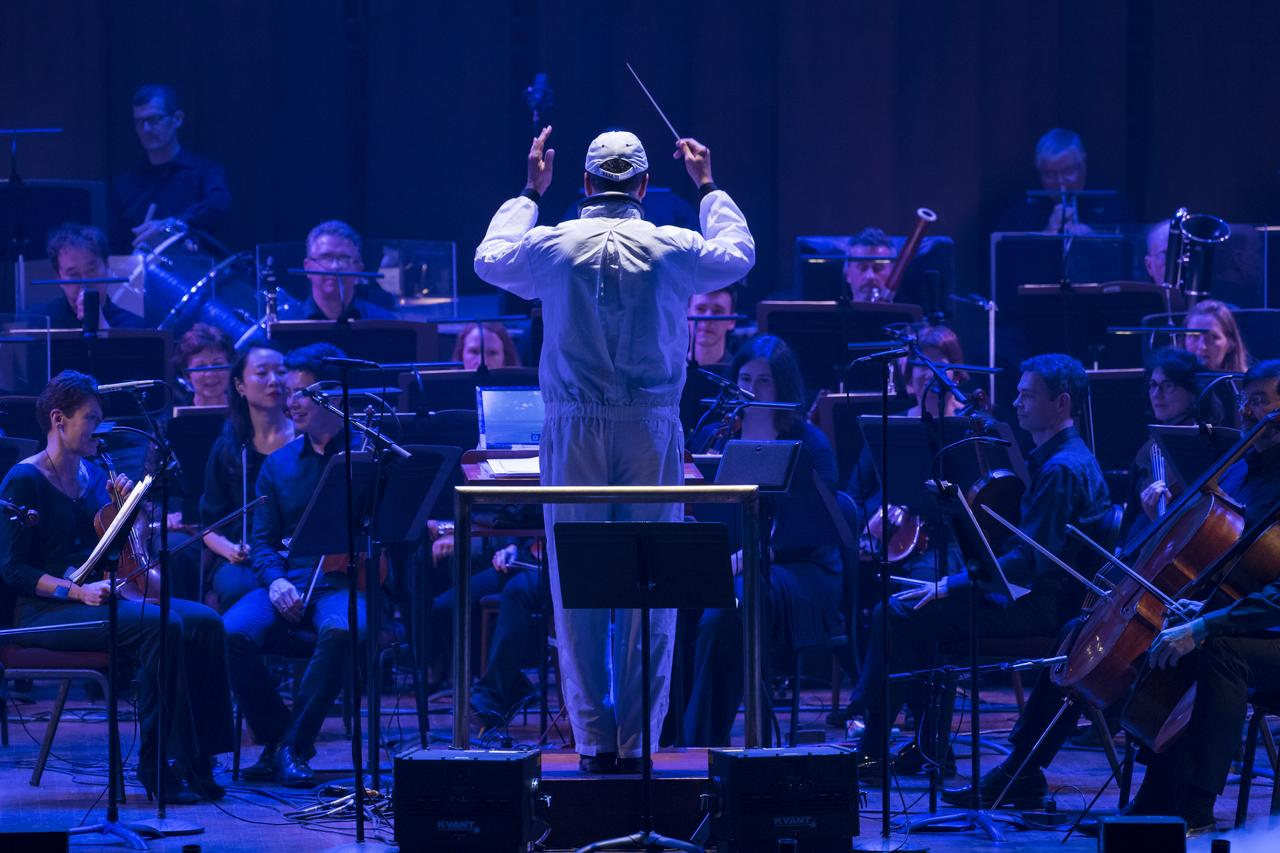
Conductor Emil de Cou leads the National Symphony Orchestra during the "Space, the Next Frontier" event celebrating NASA's 60th Anniversary, Friday, June 1, 2018 at the John F. Kennedy Center for the Performing Arts in Washington. The event featured music inspired by space including artists will.i.am, Grace Potter, Coheed & Cambria, John Cho, and guest Nick Sagan, son of Carl Sagan. Photo Credit: (NASA/Aubrey Gemignani)
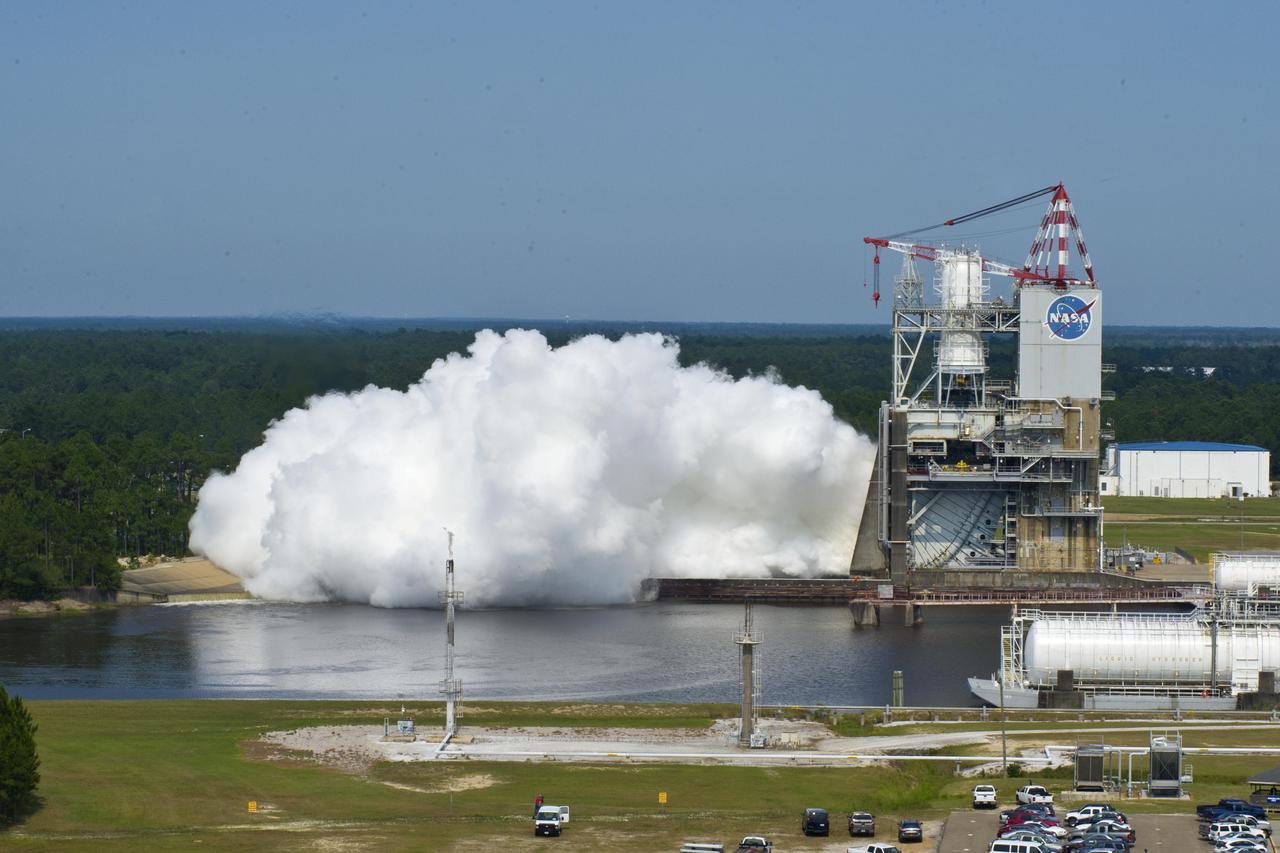
On May 25, 2012, NASA recorded another first during a 40-second test of the next-generation J-2X engine on the A-2 Test Stand at Stennis Space Center. Test conductors fired the J-2X in both the secondary and primary modes of operation. Previous tests were run in one mode only; combining the two allowed operators to collect critical data on engine performance.
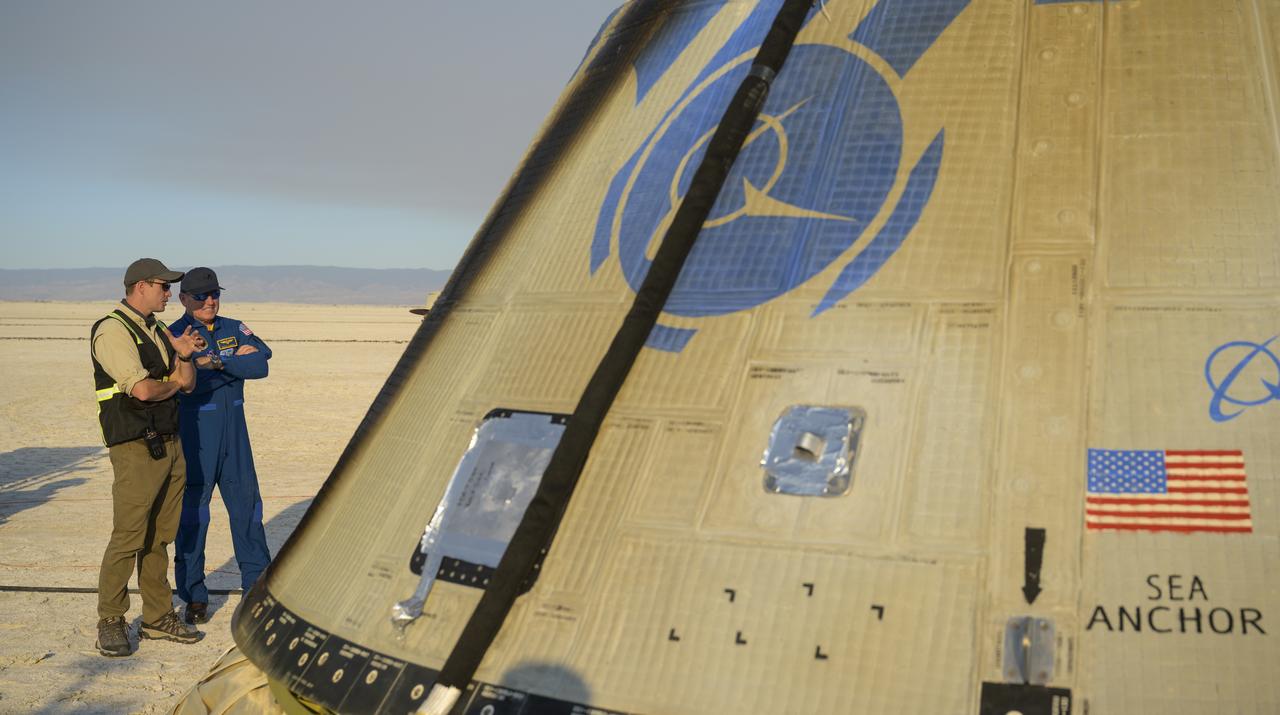
Boeing Starliner Launch Conductor Louis Atchison, left, and NASA astronaut Butch Wilmore look at Boeing’s CST-100 Starliner spacecraft after it landed at White Sands Missile Range’s Space Harbor, Wednesday, May 25, 2022, in New Mexico. Boeing’s Orbital Flight Test-2 (OFT-2) is Starliner’s second uncrewed flight test to the International Space Station as part of NASA's Commercial Crew Program. OFT-2 serves as an end-to-end test of the system's capabilities. Photo Credit: (NASA/Bill Ingalls)
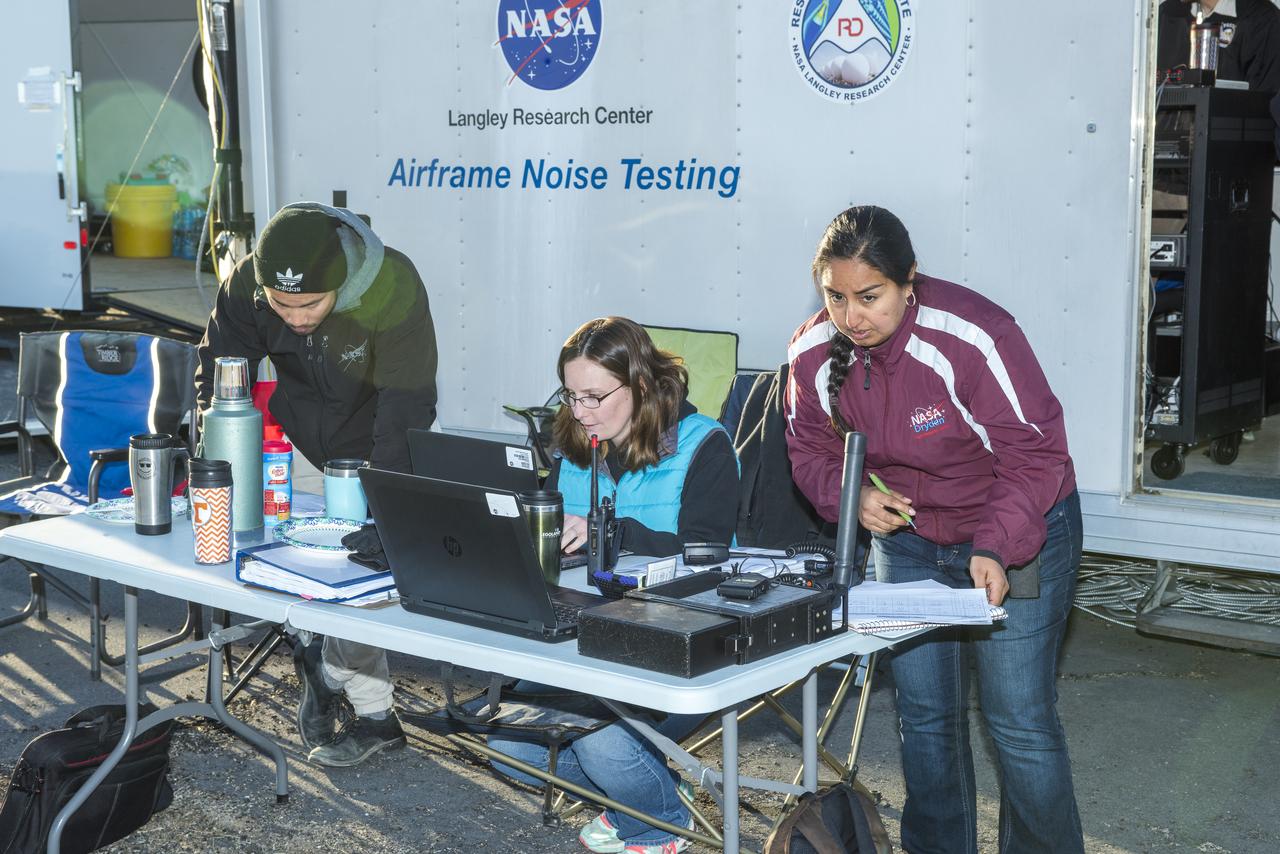
Claudia Sales, NASA’s acting X-59 deputy chief engineer and airworthiness certification lead for the quiet supersonic research aircraft, stands in front of a Gulfstream G-III, also known as Subsonic Research Aircraft Testbed (SCRAT). Sales supported ground testing as test conductor for Acoustics Research Measurements (ARM) flights at NASA’s Armstrong Research Flight Center in Edwards, California, in 2018.
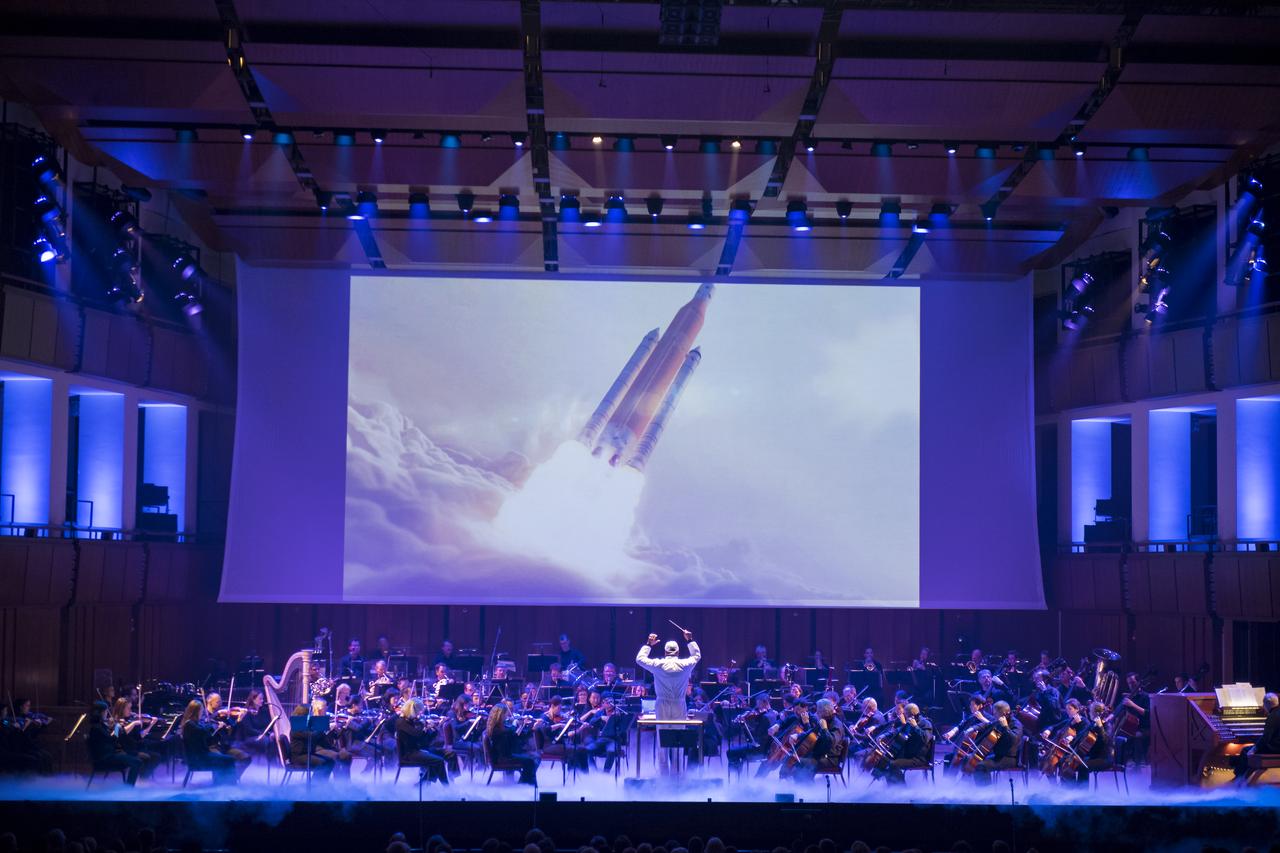
Conductor Emil de Cou leads the National Symphony Orchestra during the "Space, the Next Frontier" event celebrating NASA's 60th Anniversary, Friday, June 1, 2018 at the John F. Kennedy Center for the Performing Arts in Washington. The event featured music inspired by space including artists will.i.am, Grace Potter, Coheed & Cambria, John Cho, and guest Nick Sagan, son of Carl Sagan. Photo Credit: (NASA/Aubrey Gemignani)
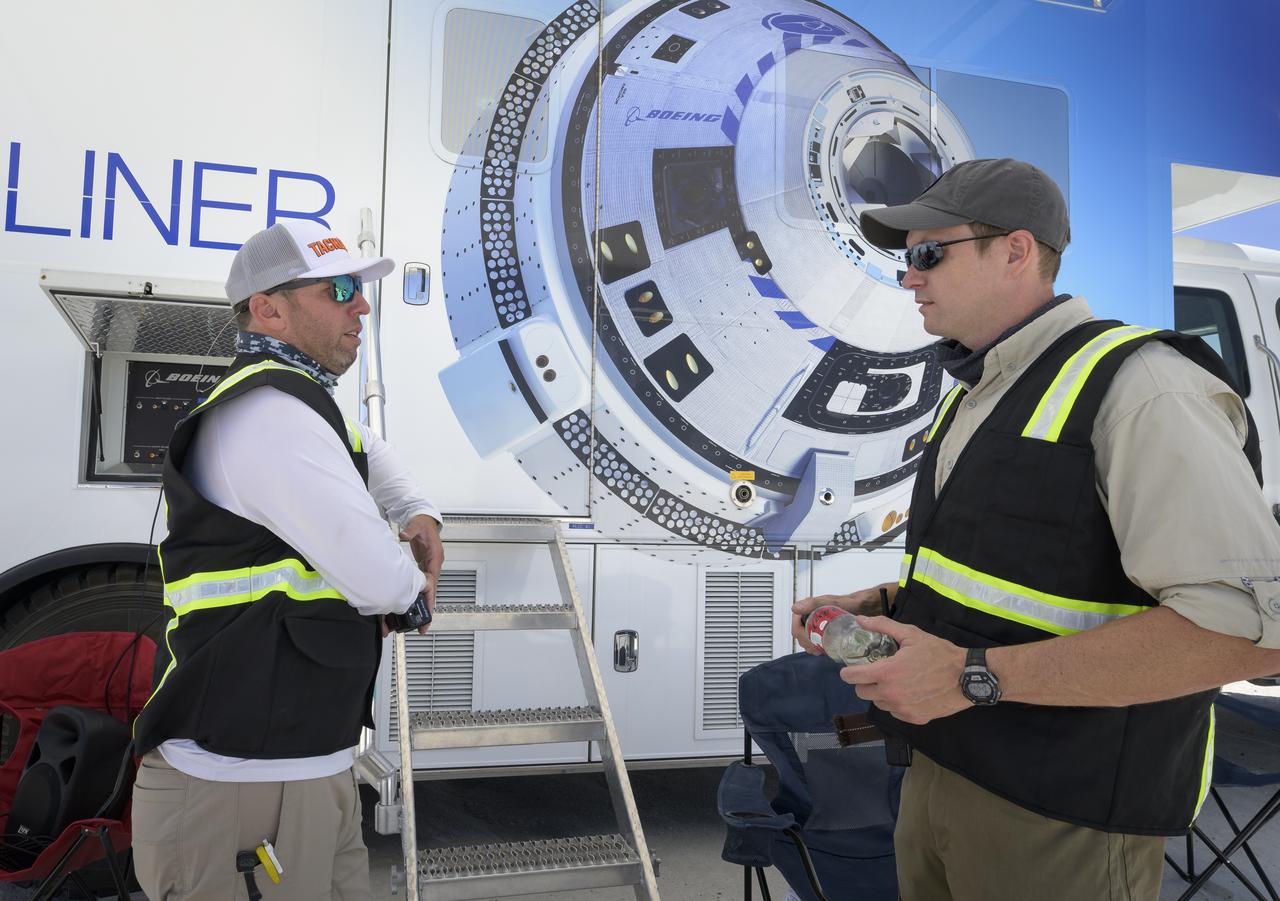
Boeing Recovery Director Bryan Gartner, left, and Boeing Starliner Launch Conductor Louis Atchison prepare for the landing of Boeing’s CST-100 Starliner spacecraft at White Sands Missile Range’s Space Harbor, Wednesday, May 25, 2022, in New Mexico. Boeing’s Orbital Flight Test-2 (OFT-2) is Starliner’s second uncrewed flight test to the International Space Station as part of NASA's Commercial Crew Program. OFT-2 serves as an end-to-end test of the system's capabilities. Photo Credit: (NASA/Bill Ingalls)
![Engineers and technicians in the control room at the Dryden Flight Research Center must constantly monitor critical operations and checks during research projects like NASA's hypersonic X-43A. Visible in the photo, taken two days before the X-43's captive carry flight in January 2004, are [foreground to background]; Tony Kawano (Range Safety Officer), Brad Neal (Mission Controller), and Griffin Corpening (Test Conductor).](https://images-assets.nasa.gov/image/ED04-0019-10/ED04-0019-10~medium.jpg)
Engineers and technicians in the control room at the Dryden Flight Research Center must constantly monitor critical operations and checks during research projects like NASA's hypersonic X-43A. Visible in the photo, taken two days before the X-43's captive carry flight in January 2004, are [foreground to background]; Tony Kawano (Range Safety Officer), Brad Neal (Mission Controller), and Griffin Corpening (Test Conductor).
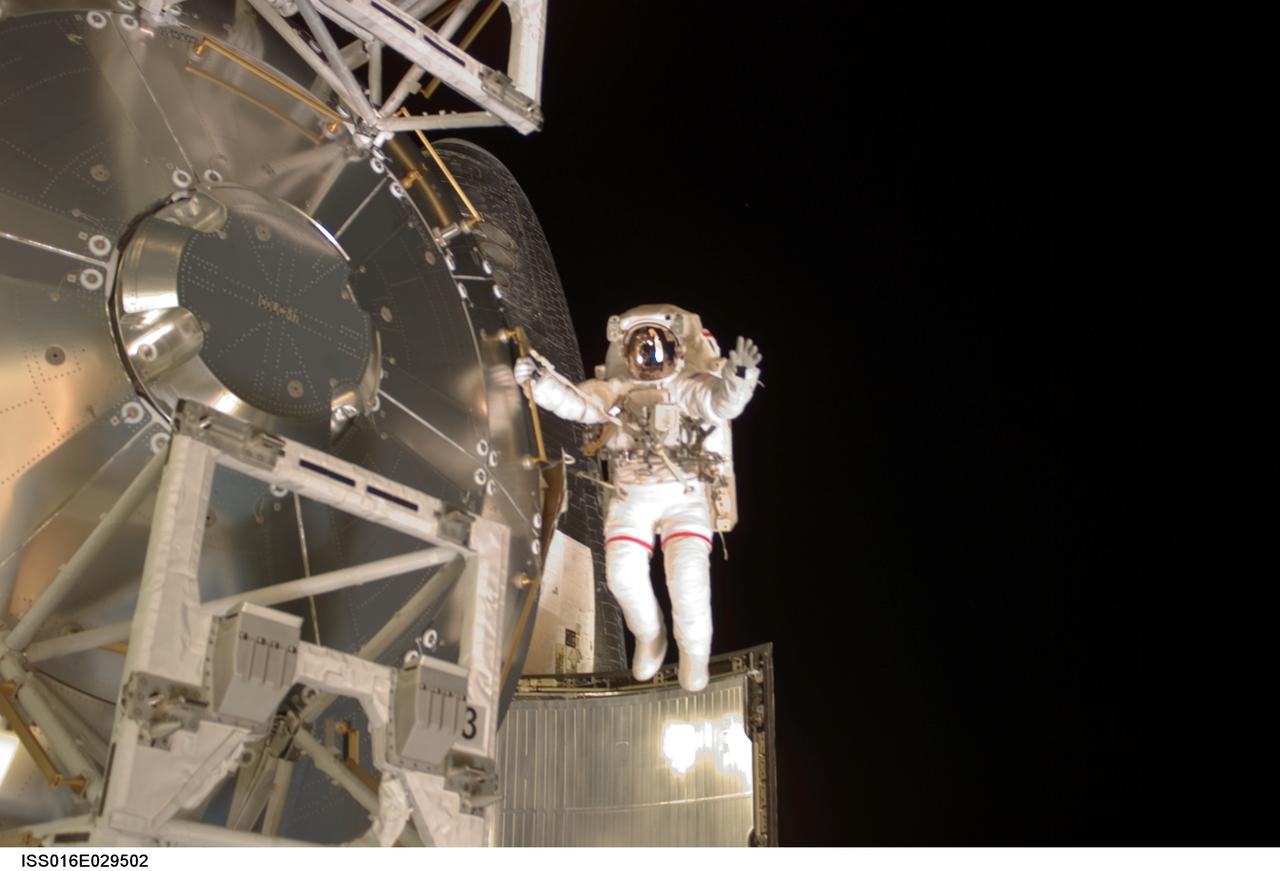
ISS016-E-029502 (15 Feb. 2008) --- Astronaut Rex Walheim, mission specialist, holds onto a handrail and spreads his arms at the Columbus laboratory, the newest piece of hardware on the International Space Station. On this the final spacewalk for the STS-122 Atlantis crew, Walheim's pose is reminiscent of that of a musical conductor who has just completed leading a successful concert. Stanley Love (out of frame), mission specialist, shared this extravehicular activity with Walheim.
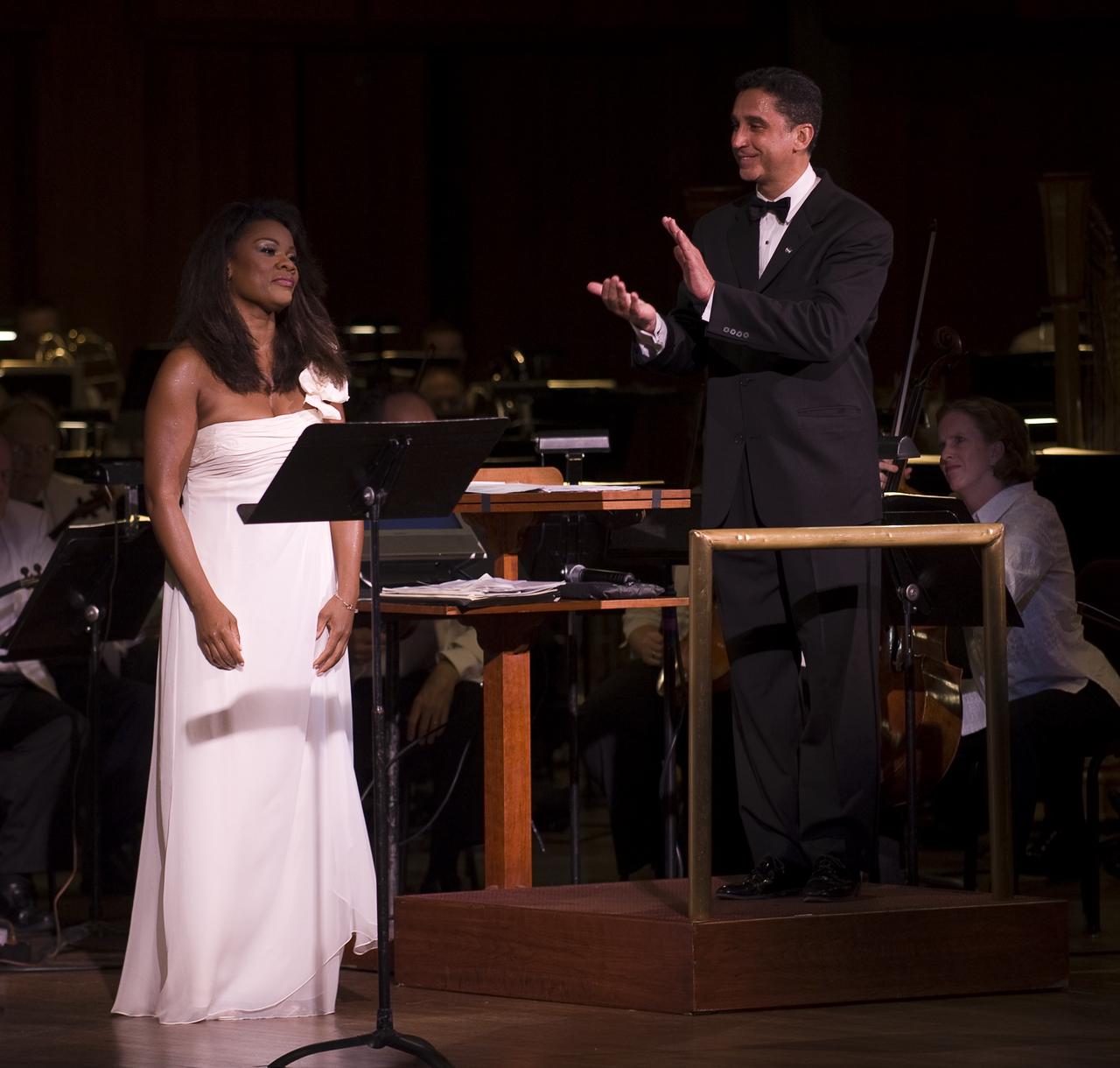
Emil de Cou, Conductor of the National Symphony Orchestra, applauds after Opera singer Denyce Graves' perfomance during the "Salute to Apollo" ceremony at the Kennedy Center for the Performing Arts, Saturday, July 18, 2009 in Washington. The event was part of NASA's week long celebration of the Apollo 40th Anniversary. Photo Credit: (NASA/Bill Ingalls)
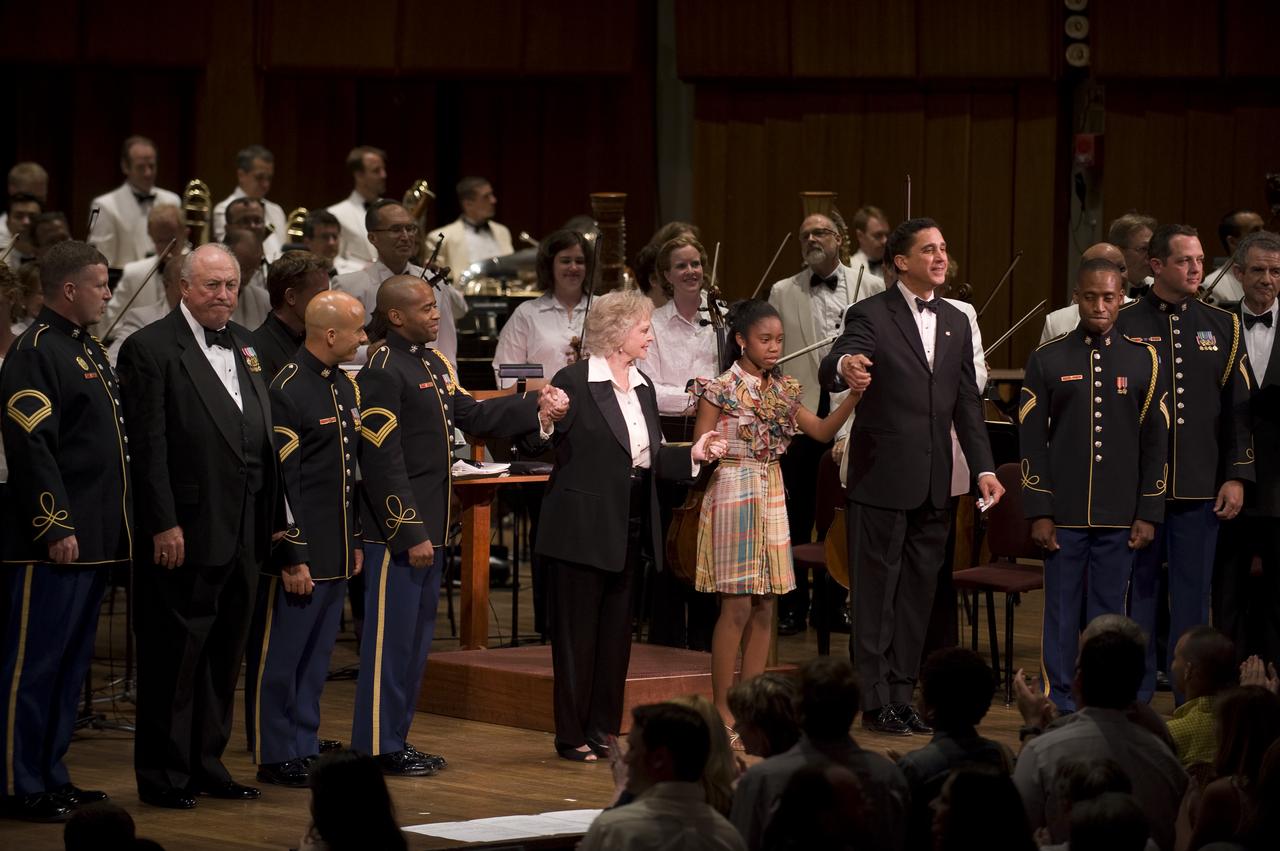
Conductor Emil de Cou, the National Symphony Orchestra, singer Jamia Nash, actress June Lockhart, the U.S. Army Chorus and Alumni take a bow during the "Salute to Apollo" ceremony at the Kennedy Center for the Performing Arts, Saturday, July 18, 2009 in Washington. The event was part of NASA's week long celebration of the Apollo 40th Anniversary. Photo Credit: (NASA/Bill Ingalls)
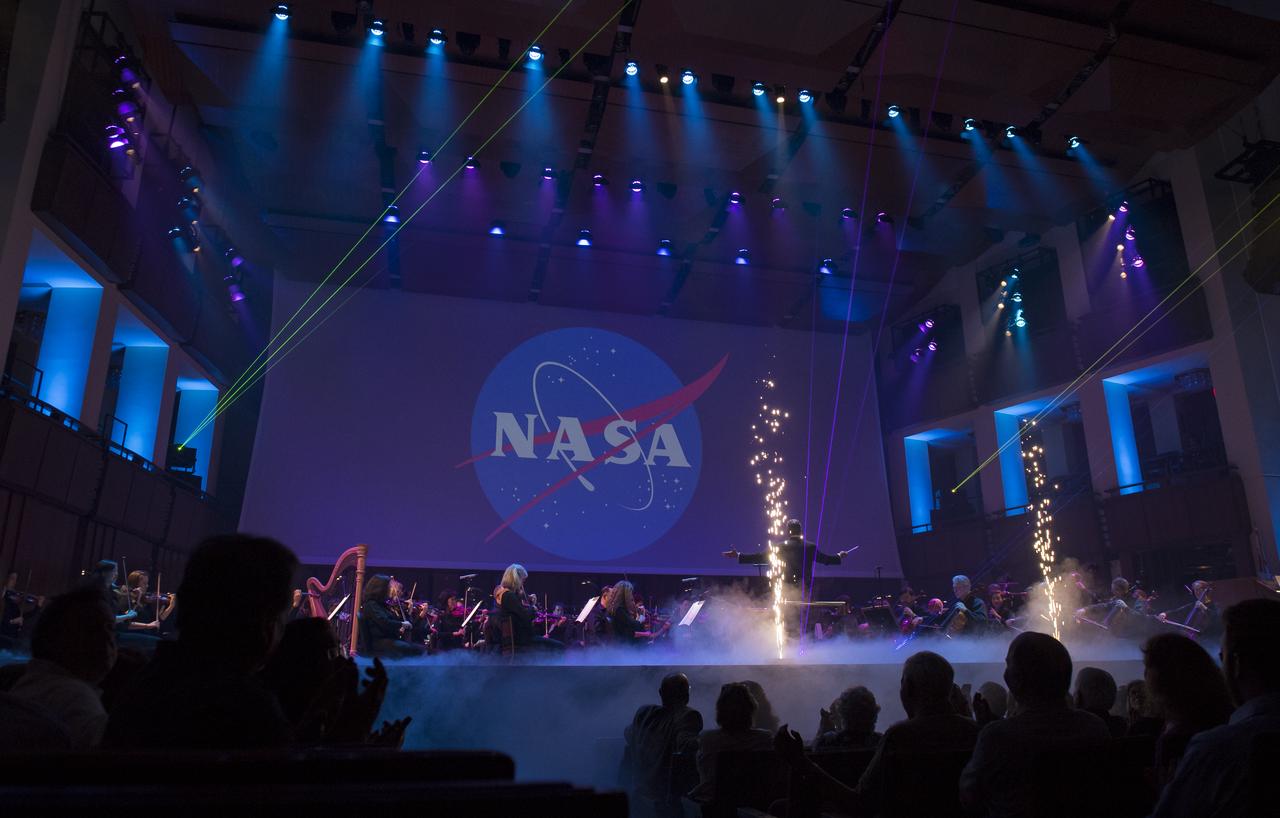
Conductor Emil de Cou leads the final performance of the National Symphony Orchestra during the "Space, the Next Frontier" event celebrating NASA's 60th Anniversary, Friday, June 1, 2018 at the John F. Kennedy Center for the Performing Arts in Washington. The event featured music inspired by space including artists will.i.am, Grace Potter, Coheed & Cambria, John Cho, and guest Nick Sagan, son of Carl Sagan. Photo Credit: (NASA/Aubrey Gemignani)
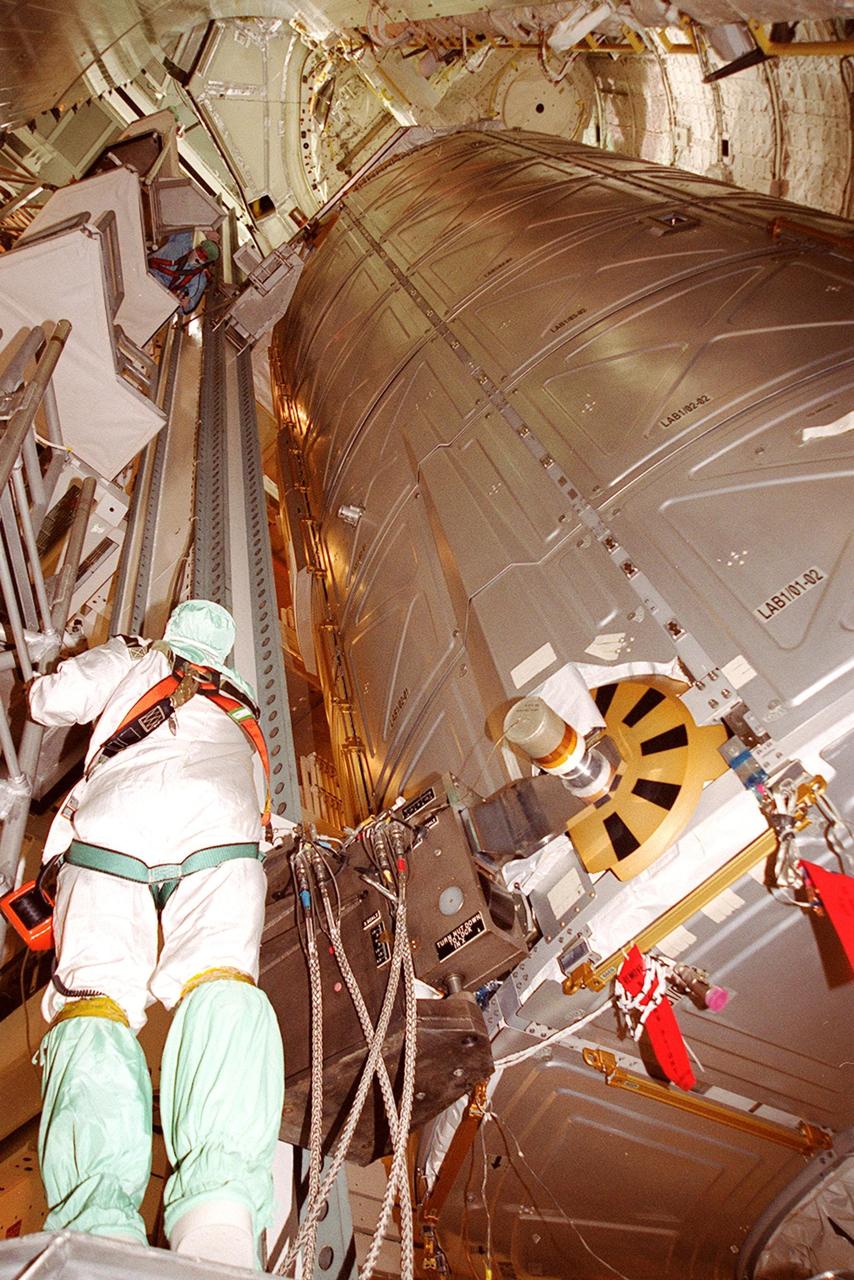
The U.S. Lab Destiny is ready to be moved from Atlantis’ payload bay into the Payload Changeout Room. After the move, Atlantis will roll back to the Vehicle Assembly Building to allow workers to conduct inspections, continuity checks and X-ray analysis on the 36 solid rocket booster cables located inside each booster’s system tunnel. An extensive evaluation of NASA’s SRB cable inventory revealed conductor damage in four (of about 200) cables on the shelf. Shuttle managers decided to prove the integrity of the system tunnel cables already on Atlantis
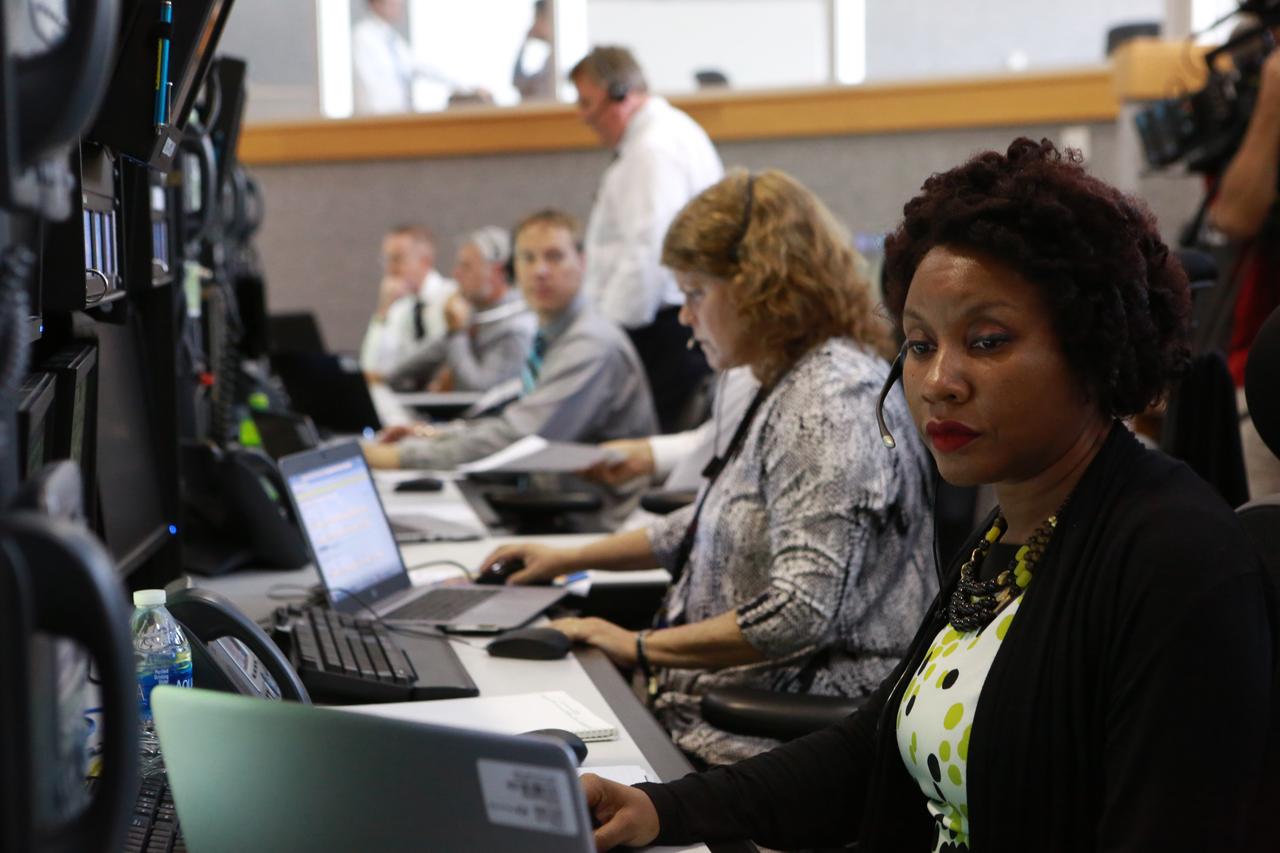
Space Launch System Test Conductors Roberta Wyrick, left, and Tracy Parks, both with Jacobs, NASA's Test and Operations Support Contractor, monitor operations from their consoles in Firing Room 1 at the Kennedy Space Center's Launch Control Center during a countdown simulation for Exploration Mission 1. It was the agency's first simulation of a portion of the countdown for the first launch of a Space Launch System rocket and Orion spacecraft that will eventually take astronauts beyond low-Earth orbit to destinations such as the Moon and Mars.

Conductor Emil de Cou leads the National Symphony Orchestra during the "Space, the Next Frontier" event celebrating NASA's 60th Anniversary, Friday, June 1, 2018 at the John F. Kennedy Center for the Performing Arts in Washington. The event featured music inspired by space including artists will.i.am, Grace Potter, Coheed & Cambria, John Cho, and guest Nick Sagan, son of Carl Sagan. Photo Credit: (NASA/Aubrey Gemignani)
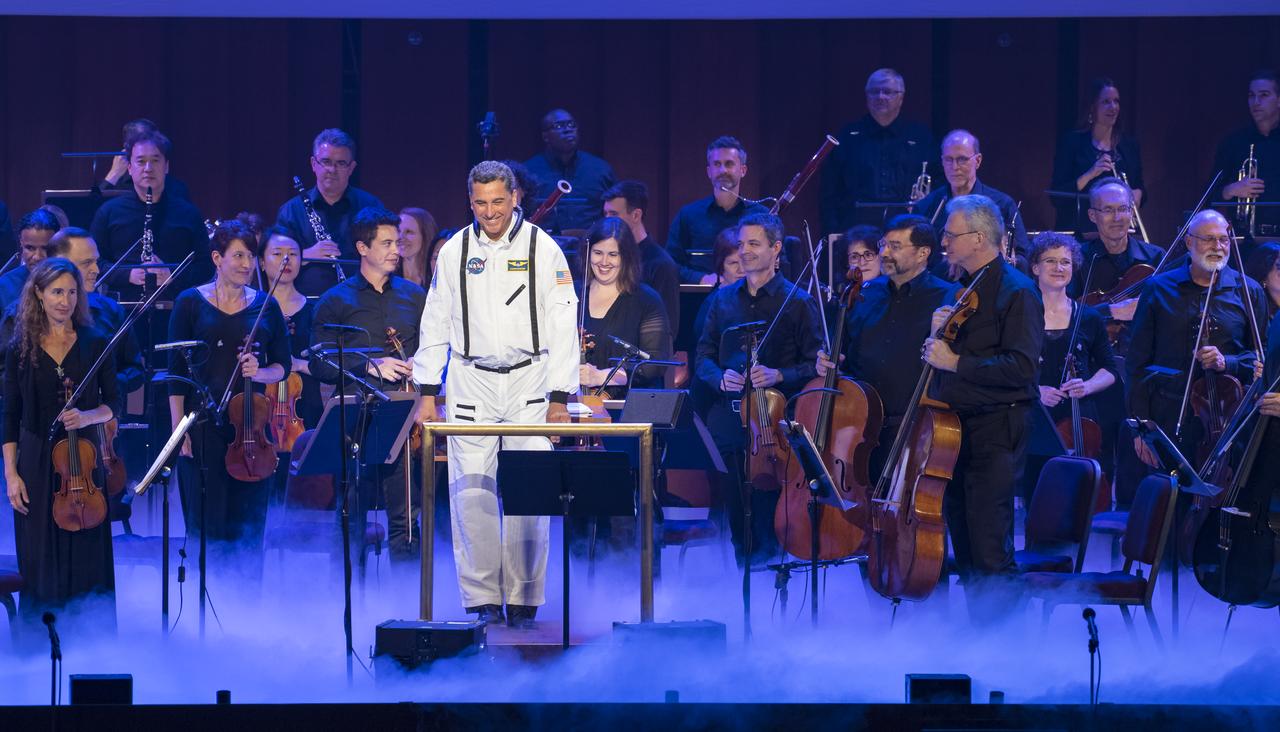
Conductor Emil de Cou speaks after leading the National Symphony Orchestra during the "Space, the Next Frontier" event celebrating NASA's 60th Anniversary, Friday, June 1, 2018 at the John F. Kennedy Center for the Performing Arts in Washington. The event featured music inspired by space including artists will.i.am, Grace Potter, Coheed & Cambria, John Cho, and guest Nick Sagan, son of Carl Sagan. Photo Credit: (NASA/Aubrey Gemignani)
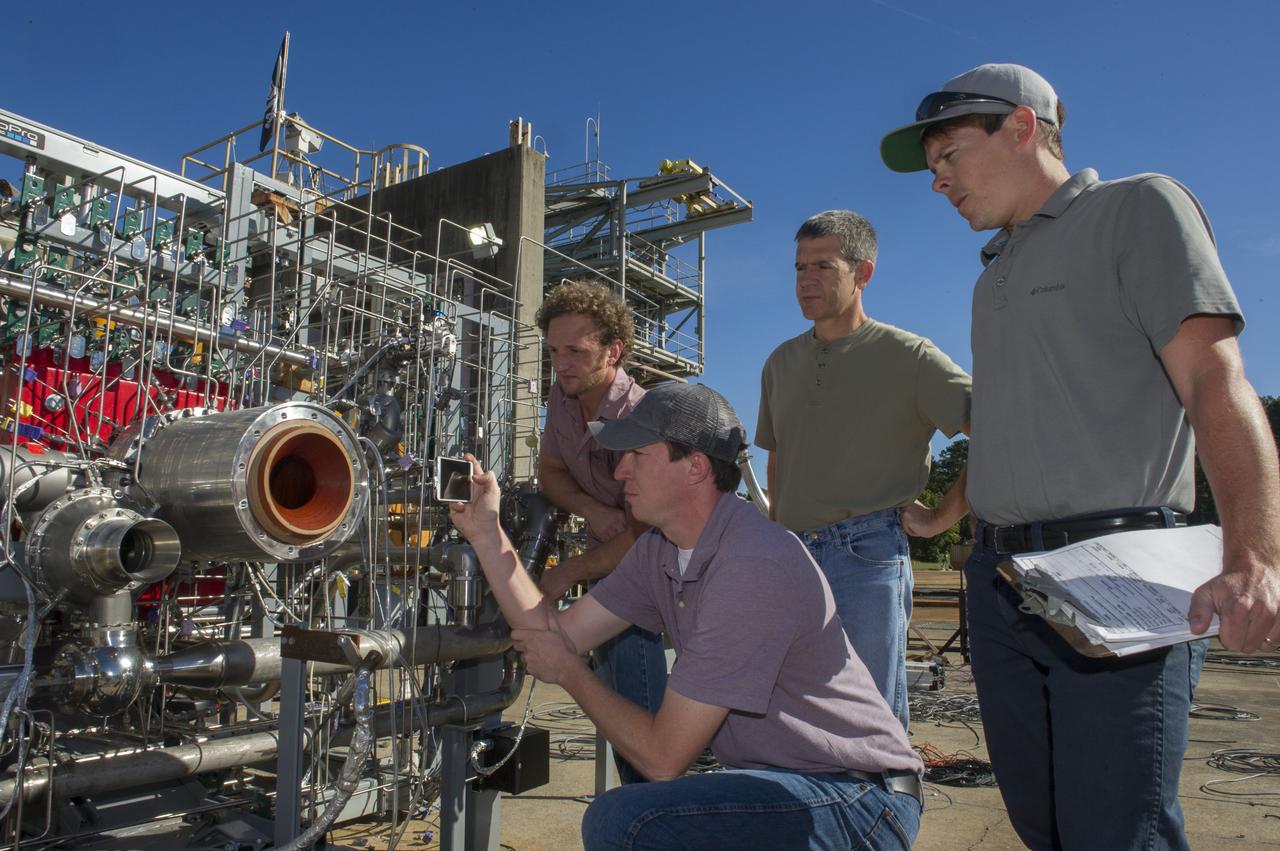
ASSEMBLING AND TESTING A BREADBOARD ENGINE MADE UP OF 3-D ENGINE COMPONENTS, PROPULSION ENGINEER NICK CASE (LEFT FRONT) PHOTOGRAPHS THE INJECTOR, WHILE RYAN WALLS (FAR RIGHT), THE TEST CONDUCTOR LOOKS ON. MARTY CALVERT (LEFT BACK) AND BRAD BULLARD (RIGHT BACK) HELPED DESIGN THE TURBOPUMP AND INJECTOR, TWO OF THE MOST COMPLEX ENGINE PARTS TESTED.
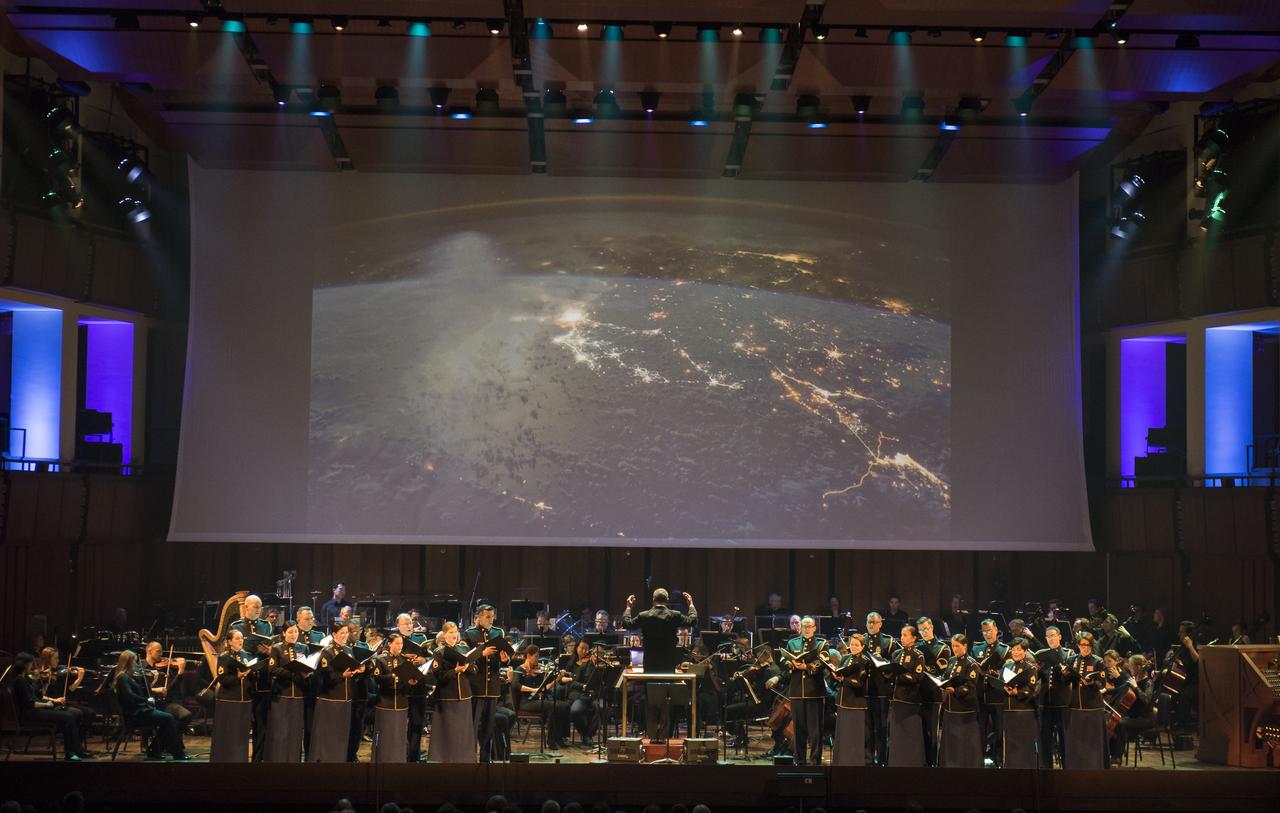
Conductor Emil de Cou leads the National Symphony Orchestra during the "Space, the Next Frontier" event celebrating NASA's 60th Anniversary, Friday, June 1, 2018 at the John F. Kennedy Center for the Performing Arts in Washington. The event featured music inspired by space including artists will.i.am, Grace Potter, Coheed & Cambria, John Cho, and guest Nick Sagan, son of Carl Sagan. Photo Credit: (NASA/Aubrey Gemignani)
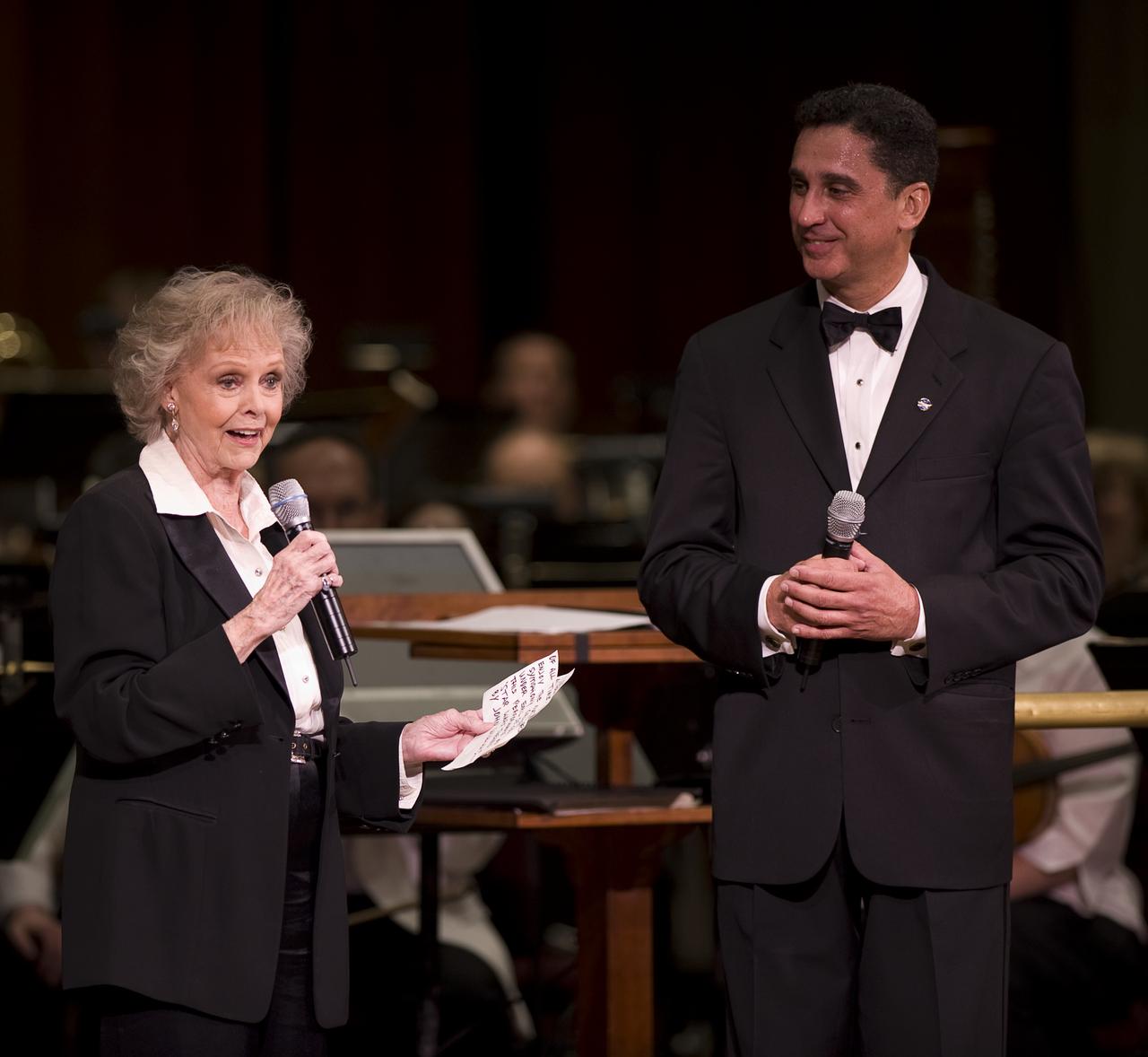
National Symphony Orchestra Conductor Emil de Cou, right, listens to Actress June Lockhart introduce a set of space themed music during the "Salute to Apollo" ceremony at the Kennedy Center for the Performing Arts, Saturday, July 18, 2009 in Washington. The event was part of NASA's week long celebration of the Apollo 40th Anniversary. Photo Credit: (NASA/Bill Ingalls)
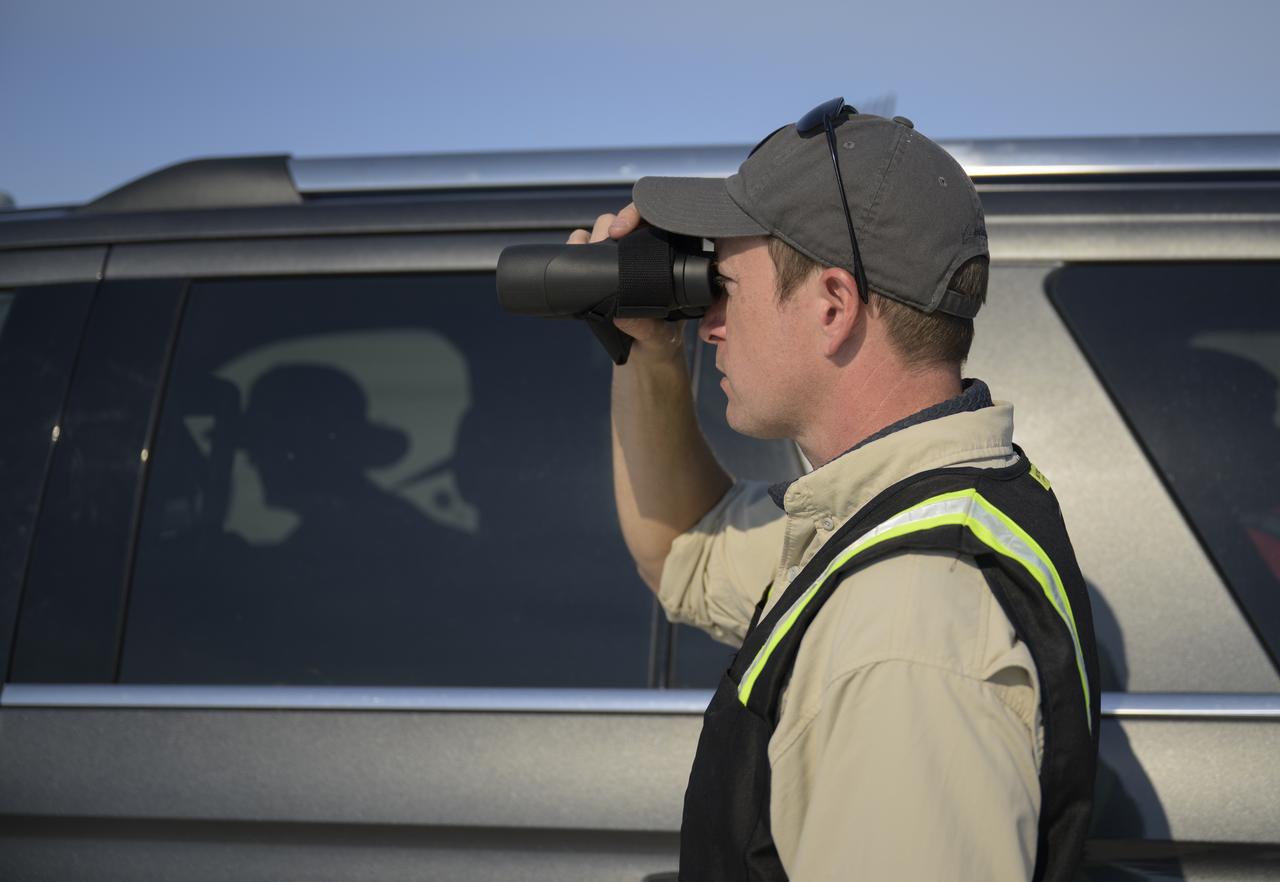
Boeing Starliner Launch Conductor Louis Atchison monitors teams as they work around Boeing’s CST-100 Starliner spacecraft after it landed at White Sands Missile Range’s Space Harbor, Wednesday, May 25, 2022, in New Mexico. Boeing’s Orbital Flight Test-2 (OFT-2) is Starliner’s second uncrewed flight test to the International Space Station as part of NASA's Commercial Crew Program. OFT-2 serves as an end-to-end test of the system's capabilities. Photo Credit: (NASA/Bill Ingalls)
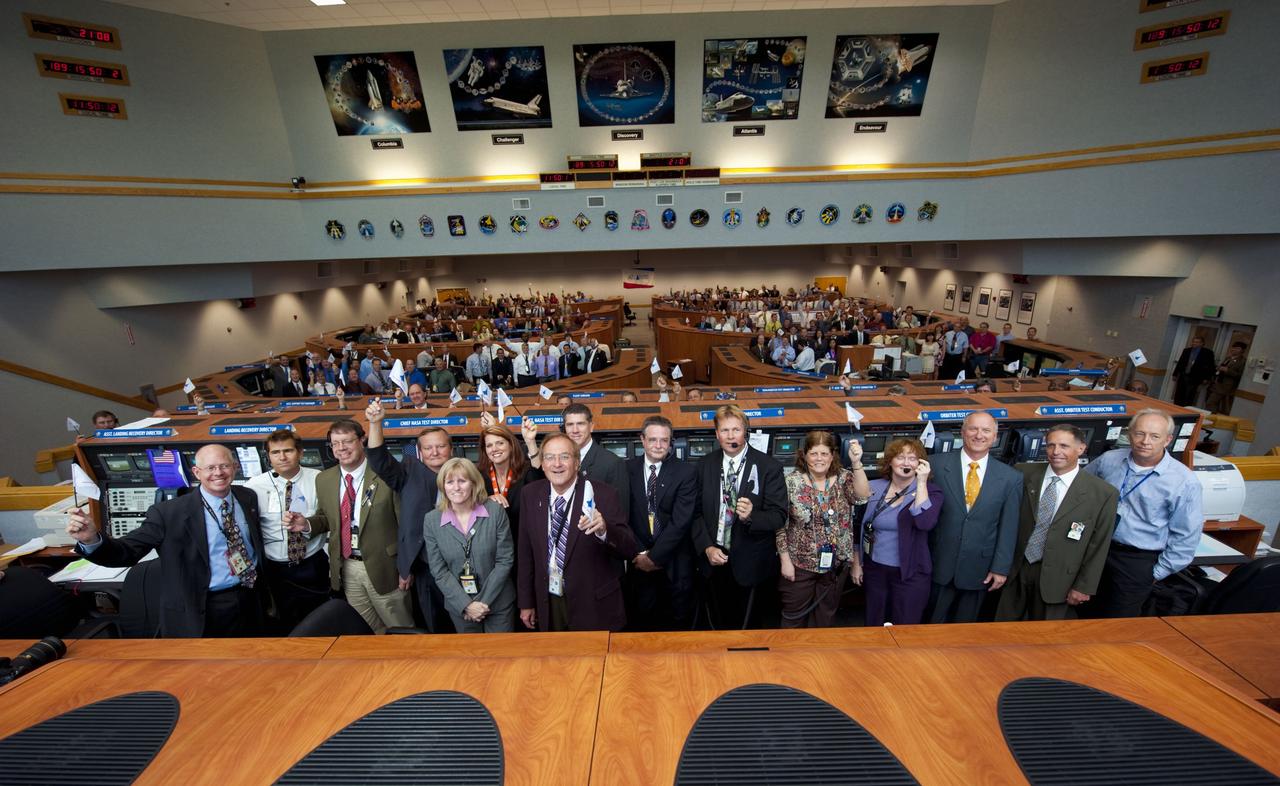
CAPE CANAVERAL, Fla. -- Launch controllers wave their STS-135 shuttle launch team member flags and cheer in Firing Room 4 of the Launch Control Center following the successful launch of space shuttle Atlantis from NASA's Kennedy Space Center in Florida. In the foreground, from left, are NASA Test Directors Steve Payne and Bob Holl; Landing and Recovery Director Greg Gaddis; Shuttle Launch Director Mike Leinbach; Atlantis' NASA Flow Director Angie Brewer; NASA Test Director Charlie Blackwell-Thompson; STS-135 Launch Commentator George Diller; NASA Test Directors Jeremy Graeber, Tim Potter, and Jeff Spaulding; Orbiter Test Conductor Roberta Wyrick; Assistant Orbiter Test Conductor Laurie Sally; Assistant Launch Director Pete Nickolenko; United Space Alliance Vice President of Launch and Recovery Systems Mark Nappi; and United Space Alliance Test Conductor Mark Paxton. Atlantis began its final flight, the STS-135 mission to the International Space Station, at 11:29 a.m. EDT on July 8. STS-135 will deliver the Raffaello multi-purpose logistics module packed with supplies and spare parts for the International Space Station. Atlantis also is flying the Robotic Refueling Mission experiment that will investigate the potential for robotically refueling existing satellites in orbit. In addition, Atlantis will return with a failed ammonia pump module to help NASA better understand the failure mechanism and improve pump designs for future systems. STS-135 is the 33rd flight of Atlantis, the 37th shuttle mission to the space station, and the 135th and final mission of NASA's Space Shuttle Program. For more information, visit www.nasa.gov/mission_pages/shuttle/shuttlemissions/sts135/index.html. Photo credit: NASA/Kim Shiflett
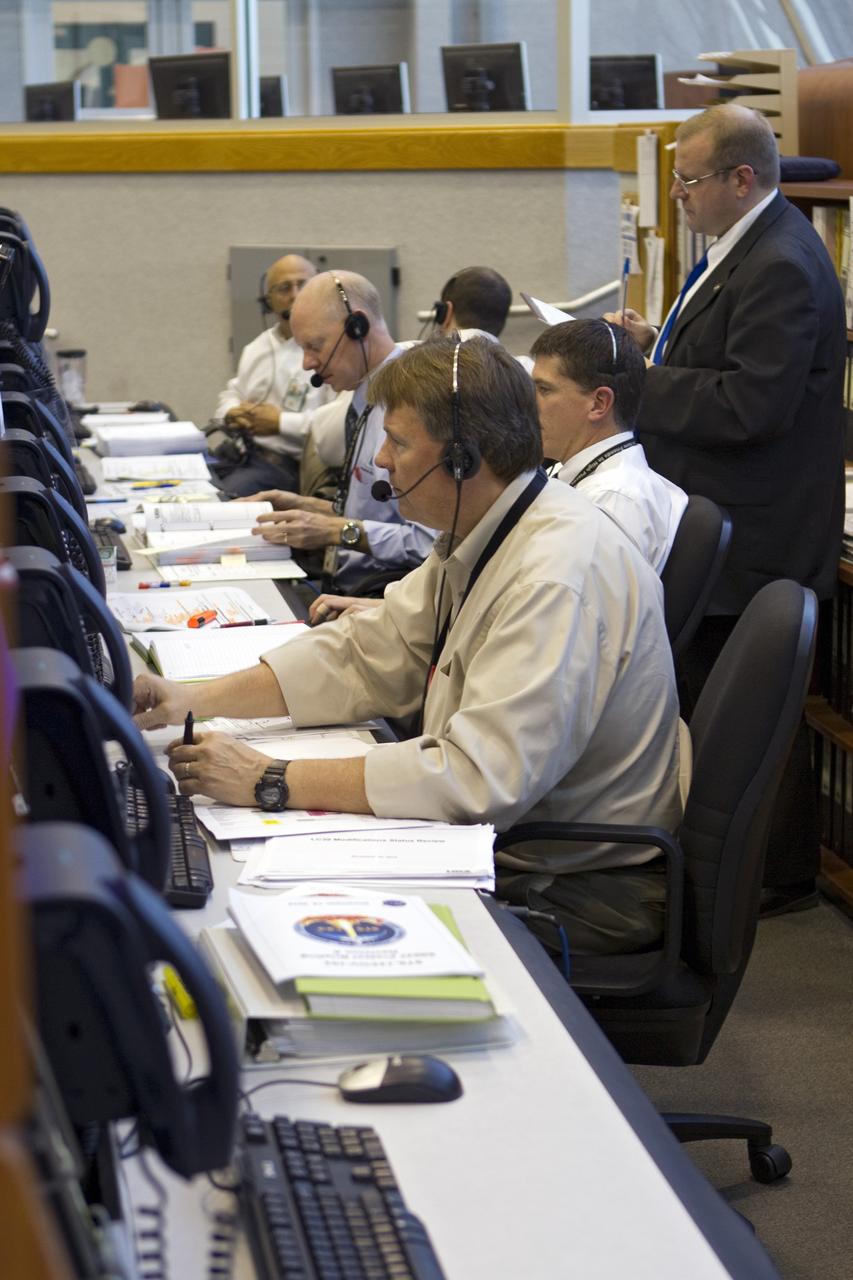
CAPE CANAVERAL, Fla. -- Team members stationed at consoles in the Launch Control Center at NASA's Kennedy Space Center in Florida monitor space shuttle Discovery's external fuel tank as it is loaded with more than 535,000 gallons of cryogenic propellants. From back, are Assistant Launch Orbiter Test Conductor Mark Taffet, Launch Orbiter Test Conductor John Kracsun, STS-133 NASA Test Director Steve Payne, NASA Commentator Allard Beutel, NASA Test Director Jeremy Graeber and STS-133 Assistant NASA Test Director Jeff Spaulding. During today's tanking test, the team is paying particular attention to the external tank's ribbed intertank region. Beginning tomorrow, engineers will evaluate data on 21-foot-long, U-shaped aluminum brackets, called stringers, and the newly replaced ground umbilical carrier plate (GUCP). Discovery's first launch attempt for STS-133 was scrubbed in early November due to a hydrogen gas leak at the GUCP. In order to perform additional analysis on the tank, Discovery will be rolled back to the Vehicle Assembly Building, a move that is planned for next week. The next launch opportunity is no earlier than Feb. 3, 2011. For more information on STS-133, visit www.nasa.gov/mission_pages/shuttle/shuttlemissions/sts133/. Photo credit: NASA/Cory Huston
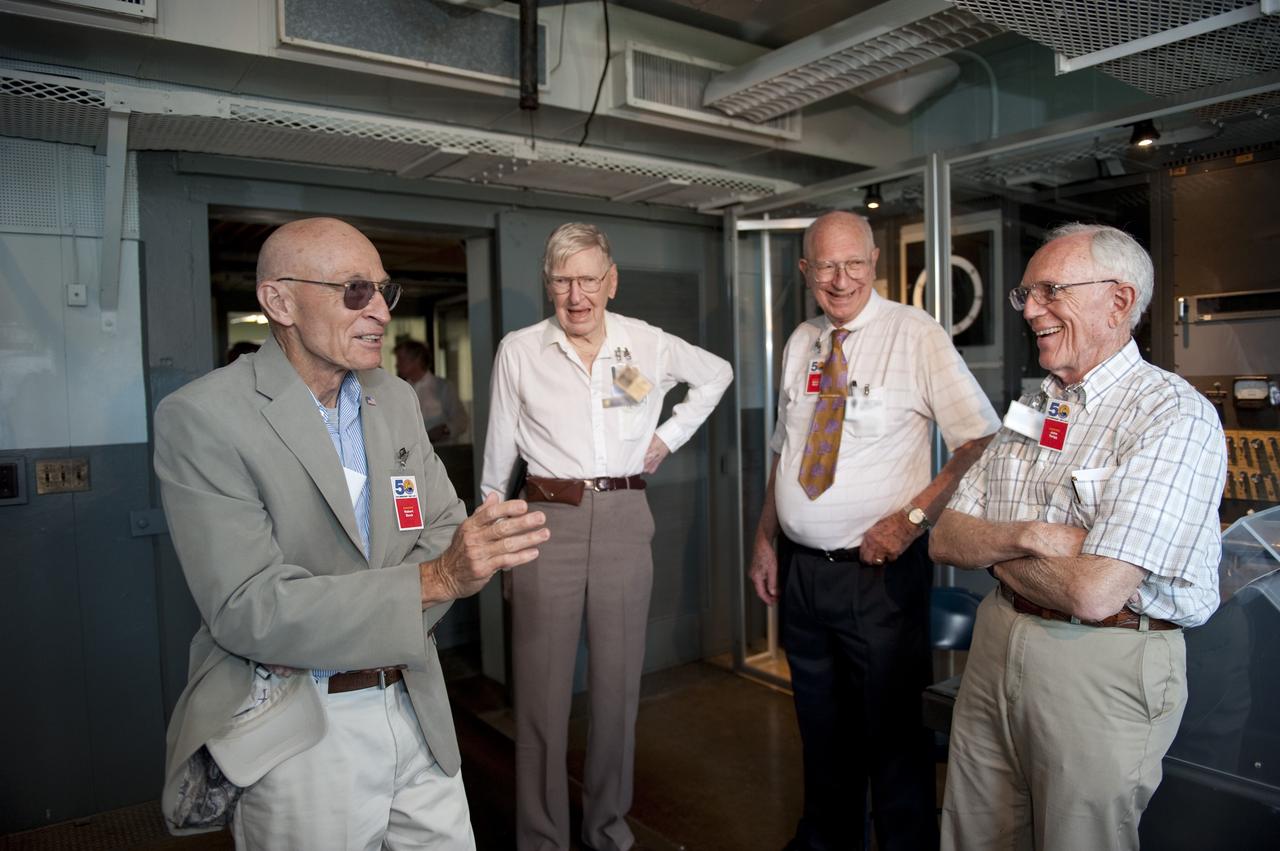
CAPE CANAVERAL, Fla. -- On Cape Canaveral Air Force Station in Florida, invited guests tour the blockhouse at Complex 5/6 during a celebration of Alan Shepard's historic flight 50 years ago. From left are Robert Sieck, former shuttle launch director; Andy Anderson, former manager for communications in the Mercury Mission Control Center; Bob Moser, former chief test conductor for the Mercury-Redstone launches; and John Twigg, former backup chief test conductor for the Mercury-Redstone launches. The celebration was held at the launch site of the first U.S. manned spaceflight May 5, 1961, to mark the 50th anniversary of the flight. Fifty years ago, astronaut Alan Shepard lifted off inside the Mercury capsule, "Freedom 7," atop an 82-foot-tall Mercury-Redstone rocket at 9:34 a.m. EST, sending him on a remarkably successful, 15-minute suborbital flight. The event was attended by more than 200 workers from the original Mercury program and included a re-creation of Shepard's flight and recovery, as well as a tribute to his contributions as a moonwalker on the Apollo 14 lunar mission. For more information, visit www.nasa.gov/topics/history/milestones/index.html. Photo credit: NASA/Kim Shiflett
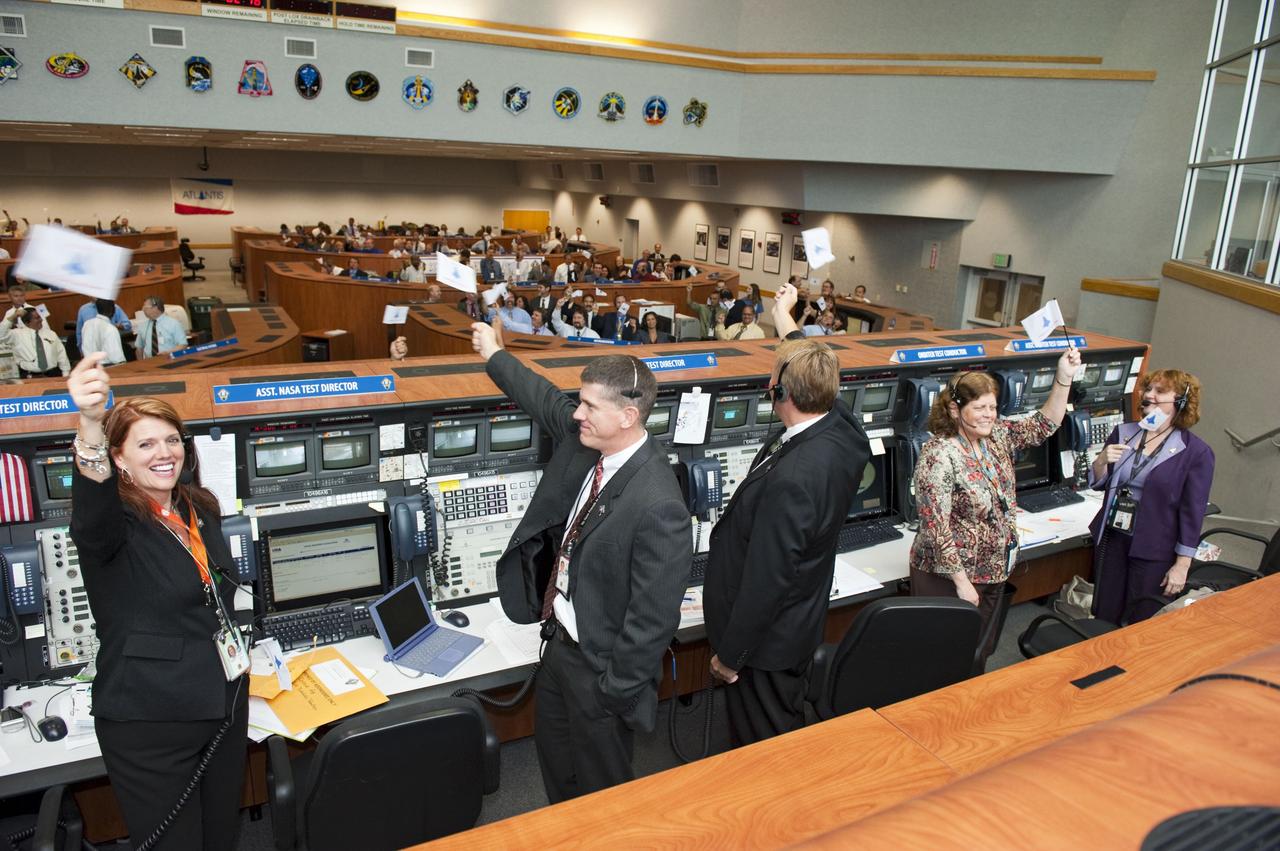
CAPE CANAVERAL, Fla. -- Launch controllers wave their STS-135 shuttle launch team member flags and cheer in Firing Room 4 of the Launch Control Center following the successful launch of space shuttle Atlantis from NASA's Kennedy Space Center in Florida. In the foreground, from left, are NASA Test Directors Charlie Blackwell-Thompson, Jeremy Graeber, and Jeff Spaulding; Orbiter Test Conductor Roberta Wyrick; and Assistant Orbiter Test Conductor Laurie Sally. Atlantis began its final flight, the STS-135 mission to the International Space Station, at 11:29 a.m. EDT on July 8. STS-135 will deliver the Raffaello multi-purpose logistics module packed with supplies and spare parts for the International Space Station. Atlantis also is flying the Robotic Refueling Mission experiment that will investigate the potential for robotically refueling existing satellites in orbit. In addition, Atlantis will return with a failed ammonia pump module to help NASA better understand the failure mechanism and improve pump designs for future systems. STS-135 is the 33rd flight of Atlantis, the 37th shuttle mission to the space station, and the 135th and final mission of NASA's Space Shuttle Program. For more information, visit www.nasa.gov/mission_pages/shuttle/shuttlemissions/sts135/index.html. Photo credit: NASA/Kim Shiflett
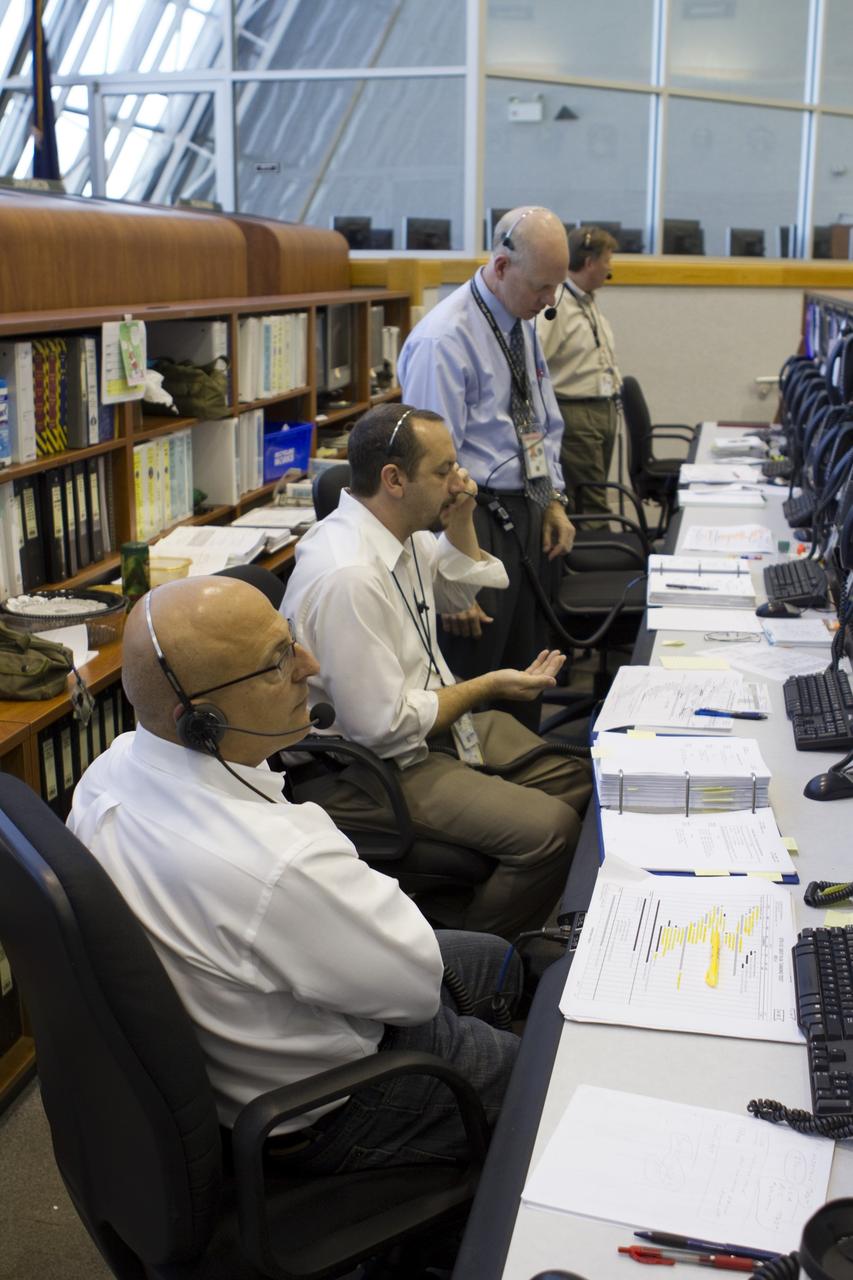
CAPE CANAVERAL, Fla. -- Team members stationed at consoles in the Launch Control Center at NASA's Kennedy Space Center in Florida monitor space shuttle Discovery's external fuel tank as it is loaded with more than 535,000 gallons of cryogenic propellants. From back, are STS-133 Assistant NASA Test Director Jeff Spaulding, STS-133 NASA Test Director Steve Payne, Launch Orbiter Test Conductor John Kracsun and Assistant Launch Orbiter Test Conductor Mark Taffet. During today's tanking test, the team is paying particular attention to the external tank's ribbed intertank region. Beginning tomorrow, engineers will evaluate data on 21-foot-long, U-shaped aluminum brackets, called stringers, and the newly replaced ground umbilical carrier plate (GUCP). Discovery's first launch attempt for STS-133 was scrubbed in early November due to a hydrogen gas leak at the GUCP. In order to perform additional analysis on the tank, Discovery will be rolled back to the Vehicle Assembly Building, a move that is planned for next week. The next launch opportunity is no earlier than Feb. 3, 2011. For more information on STS-133, visit www.nasa.gov/mission_pages/shuttle/shuttlemissions/sts133/. Photo credit: NASA/Cory Huston
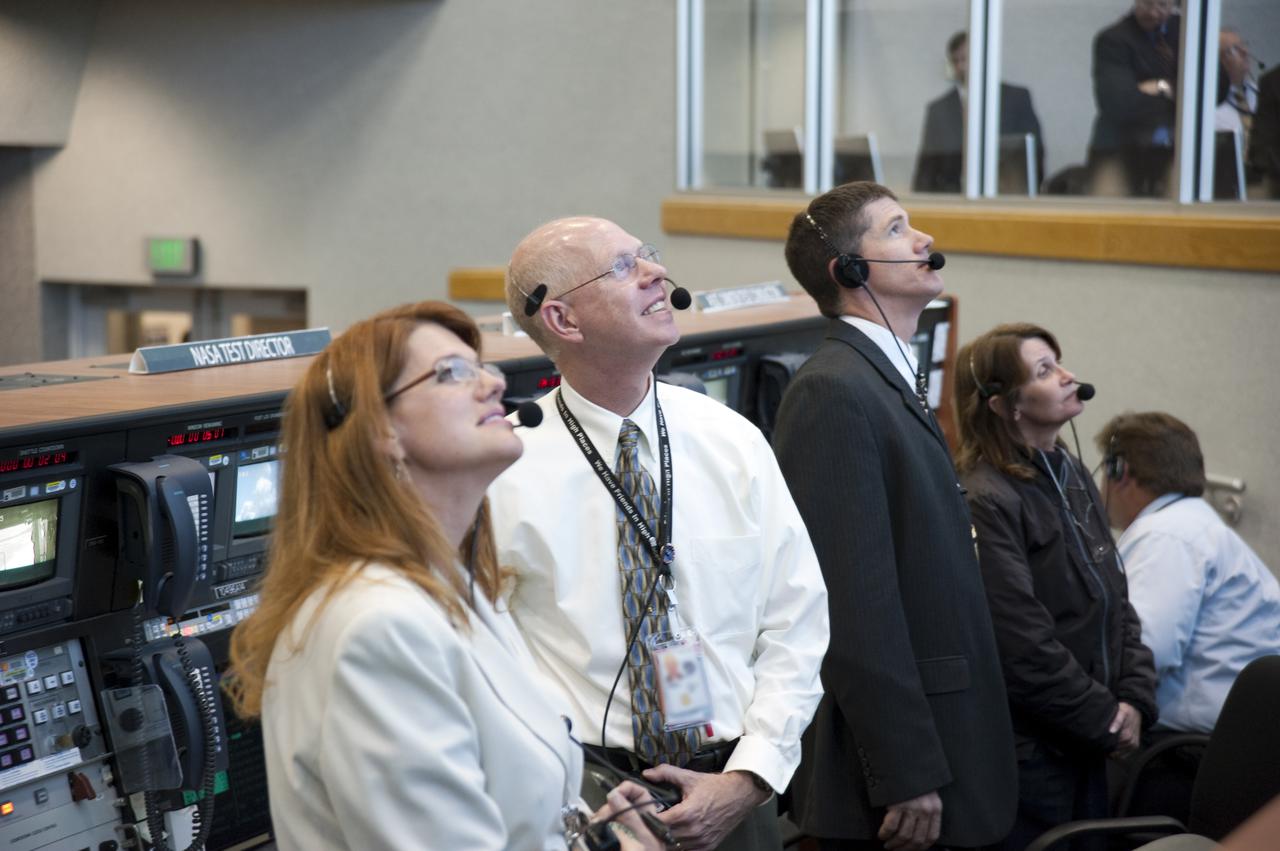
CAPE CANAVERAL, Fla. -- NASA test directors, from left, Charlie Blackwell-Thompson, Steve Payne and Jeremy Graeber, and Orbiter Test Conductor Teresa Annulis, watch space shuttle Atlantis lift off on its STS-132 mission to the International Space Station through the windows of Firing Room 4 of the Launch Control Center at NASA's Kennedy Space Center in Florida. Launch was on time at 2:20 p.m. EDT. STS-132 is the 132nd shuttle flight, the 32nd for Atlantis and the 34th shuttle mission dedicated to station assembly and maintenance. For more information on the STS-132 mission objectives, payload and crew, visit www.nasa.gov_mission_pages_shuttle_shuttlemissions_sts132_index.html. Photo credit: NASA_Kim Shiflett
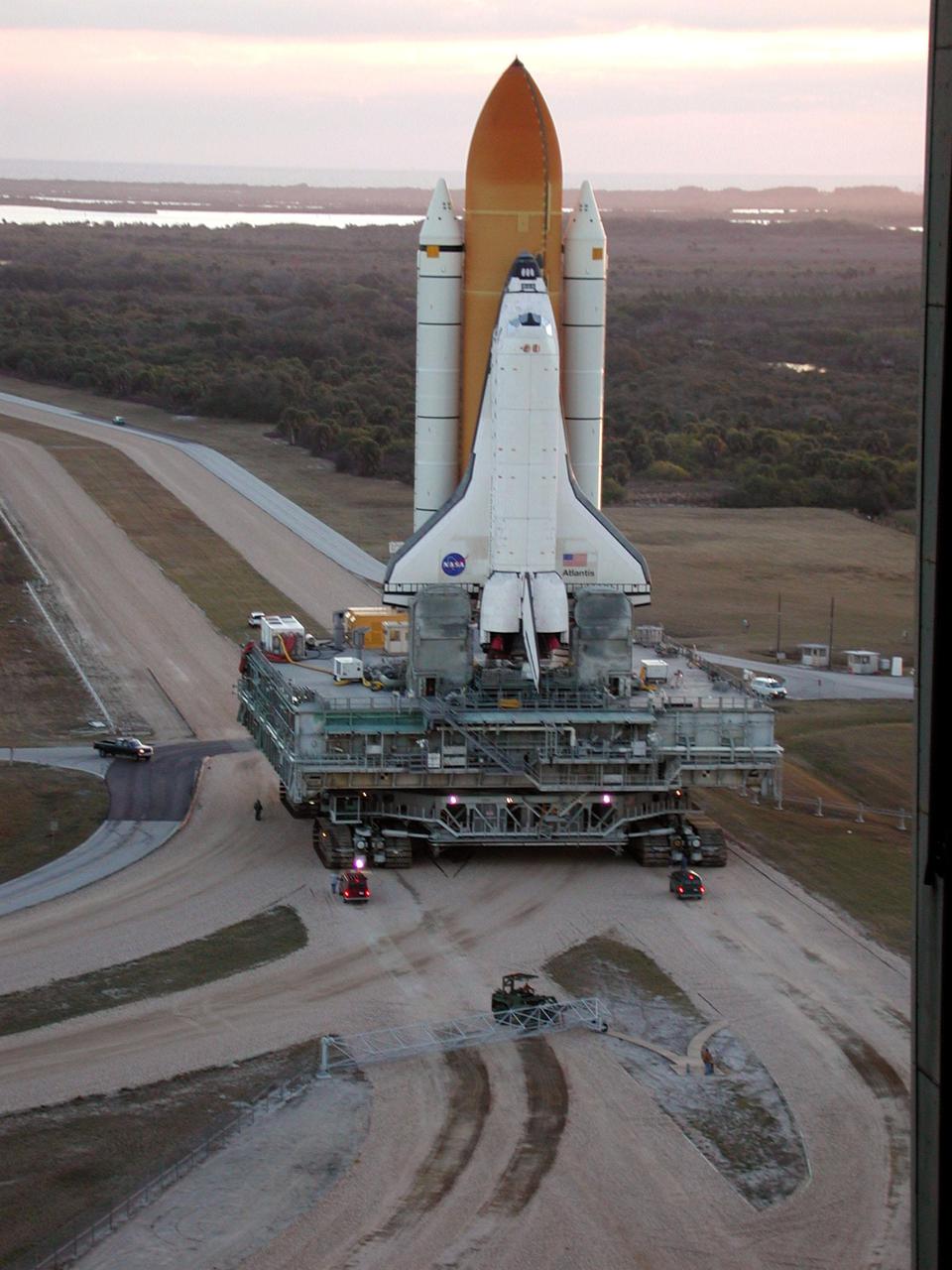
KENNEDY SPACE CENTER, Fla. -- In the early morning light, Space Shuttle Atlantis makes the turn from the Vehicle Assembly Building onto the crawlerway for the trek to Launch Pad 39A. The Shuttle has been in the VAB undergoing tests on the solid rocket booster cables. A prior extensive evaluation of NASA’s SRB cable inventory on the shelf revealed conductor damage in four (of about 200) cables. Shuttle managers decided to prove the integrity of the system tunnel cables already on Atlantis, causing return of the Shuttle to the VAB a week ago. Launch of Atlantis on STS-98 has been rescheduled to Feb. 7 at 6:11 p.m. EST
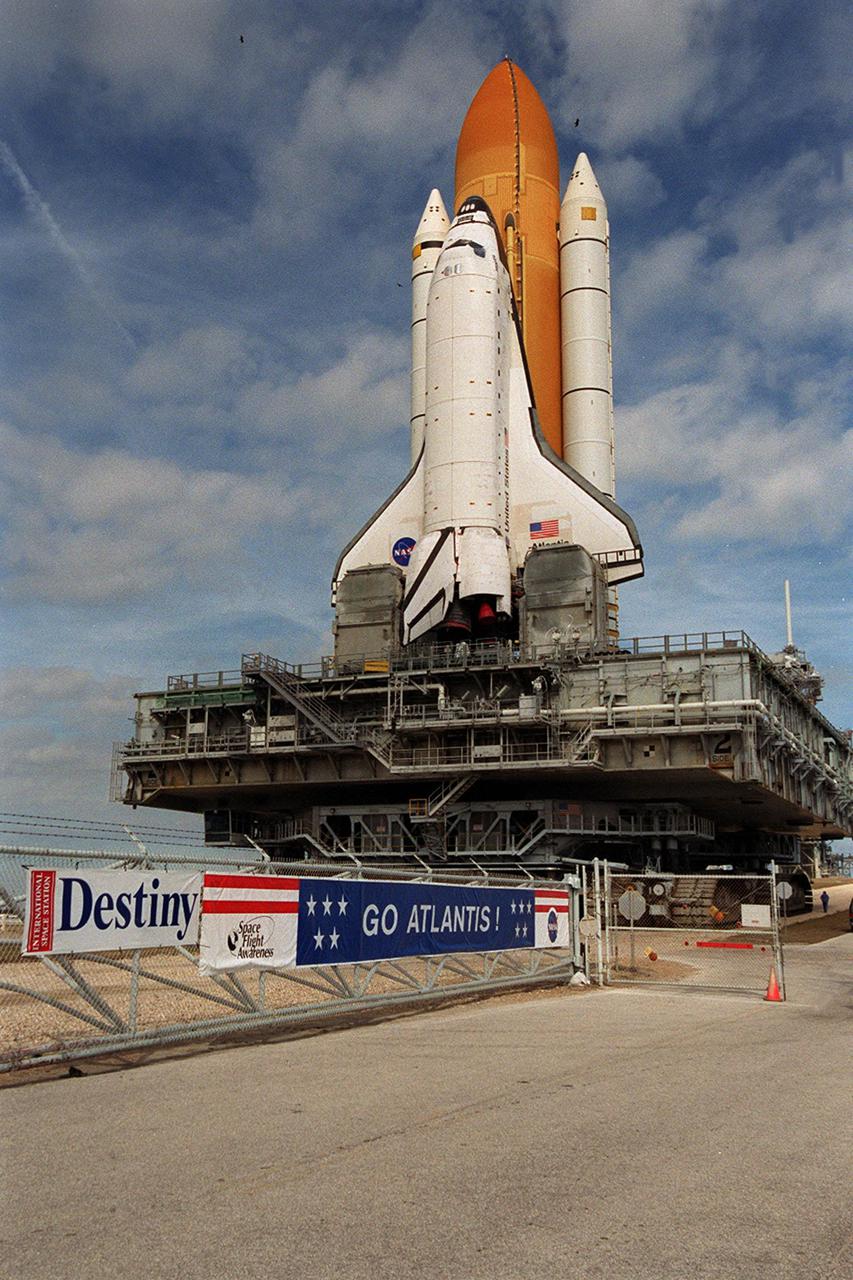
KENNEDY SPACE CENTER, Fla. -- The gate outside Launch Pad 39A heralds the STS-98 launch as Space Shuttle Atlantis makes its way to the pad. The Shuttle had returned to the Vehicle Assembly Building from the launch pad in order to undergo tests on the solid rocket booster cables. A prior extensive evaluation of NASA’s SRB cable inventory on the shelf revealed conductor damage in four (of about 200) cables. Shuttle managers decided to prove the integrity of the system tunnel cables already on Atlantis, causing return of the Shuttle to the VAB a week ago. The Shuttle will undergo preparations for a rescheduled launch Feb. 7 at 6:11 p.m. EST
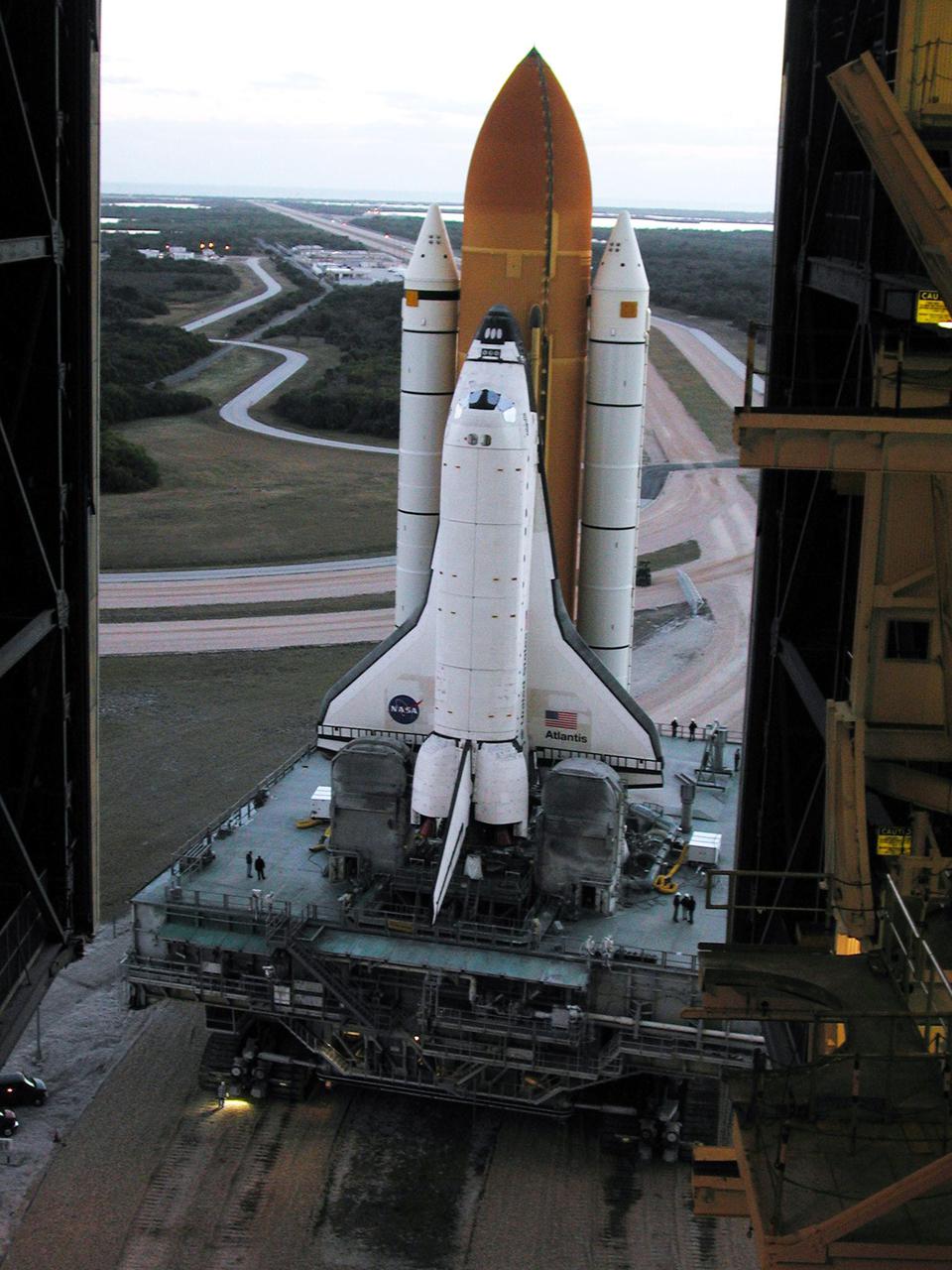
KENNEDY SPACE CENTER, Fla. -- Reflecting light from framework inside the Vehicle Assembly Building, Space Shuttle Atlantis begins rolling out of the VAB to Launch Pad 39A after tests were completed on the solid rocket booster cables. A prior extensive evaluation of NASA’s SRB cable inventory on the shelf revealed conductor damage in four (of about 200) cables. Shuttle managers decided to prove the integrity of the system tunnel cables already on Atlantis, causing return of the Shuttle to the VAB a week ago. Launch of Atlantis on STS-98 has been rescheduled to Feb. 7 at 6:11 p.m. EST

KENNEDY SPACE CENTER, FLA. -- Space Shuttle Atlantis begins rolling back to the Vehicle Assembly Building on the crawler-transporter. In the VAB workers will conduct inspections, make continuity checks and conduct X-ray analysis on the 36 solid rocket booster cables located inside each booster’s system tunnel. An extensive evaluation of NASA’s SRB cable inventory revealed conductor damage in four (of about 200) cables on the shelf. Shuttle managers decided to prove the integrity of the system tunnel cables already on Atlantis before launching Jan. 19. The launch has been rescheduled no earlier than Feb. 6
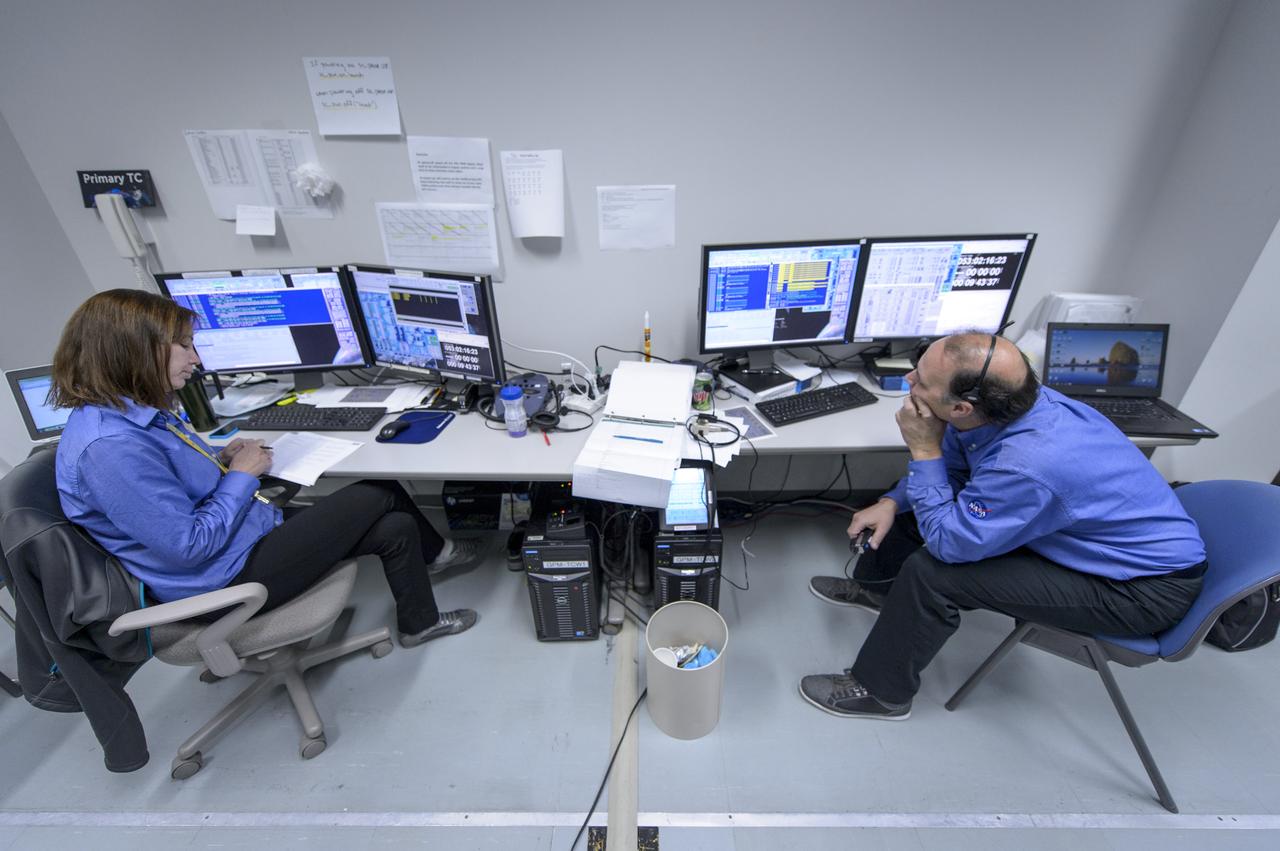
NASA GPM Test Conductors, Michelle Lacombe, left, and Bill Dehaven participate in an all-day launch simulation for the Global Precipitation Measurement (GPM) Core Observatory at the Spacecraft Test and Assembly Building 2 (STA2), Saturday, Feb. 22, 2014, Tanegashima Space Center (TNSC), Tanegashima Island, Japan. Japan Aerospace Exploration Agency (JAXA) plans to launch an H-IIA rocket carrying the GPM Core Observatory on Feb. 28, 2014. The NASA-JAXA GPM spacecraft will collect information that unifies data from an international network of existing and future satellites to map global rainfall and snowfall every three hours. Photo Credit: (NASA/Bill Ingalls)
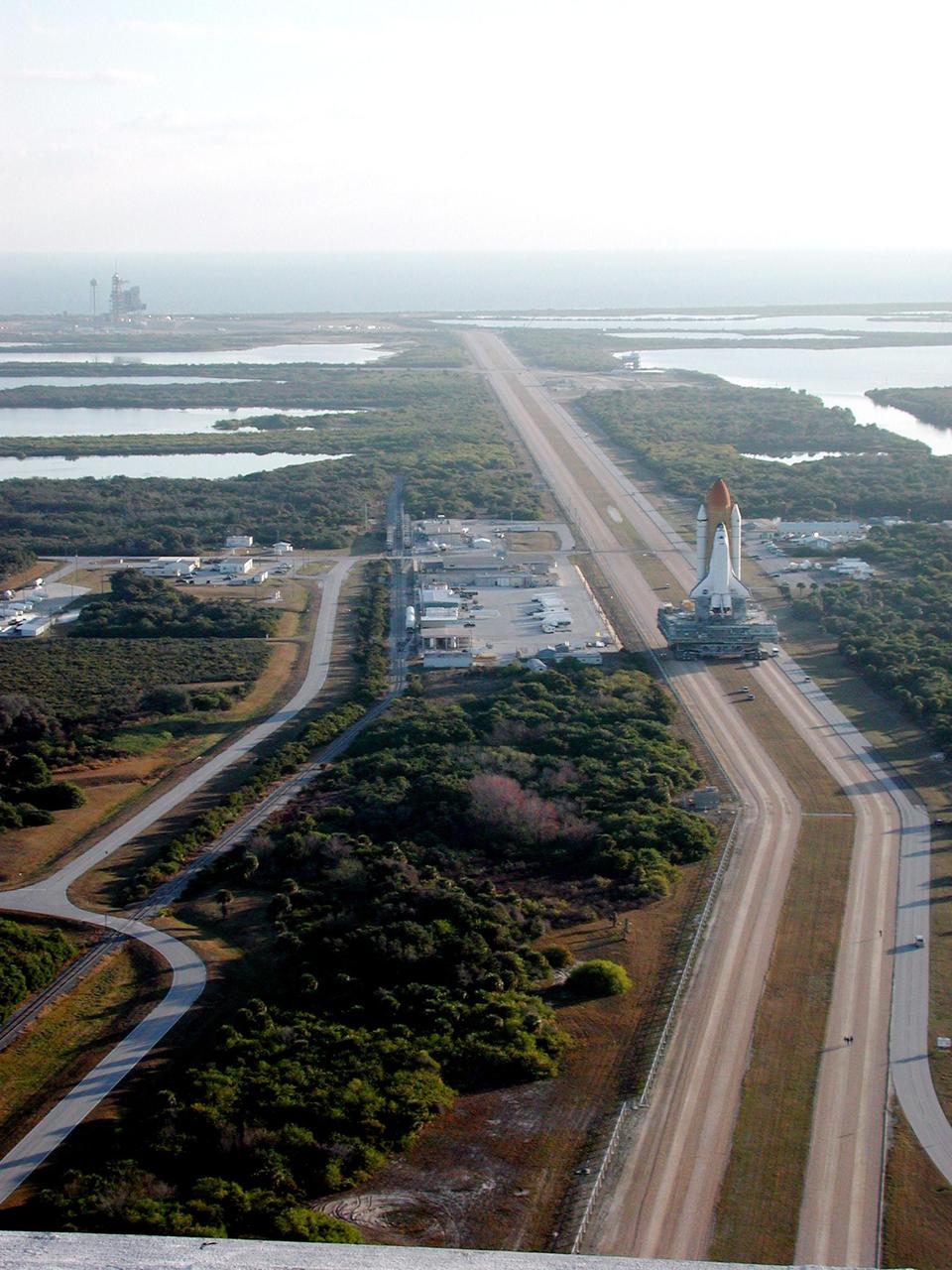
KENNEDY SPACE CENTER, Fla. -- Photographed from the top of the Vehicle Assembly Building, Space Shuttle Atlantis creeps along the crawlerway for the trek to Launch Pad 39A (upper left). In the background is the Atlantic Ocean. The Shuttle has been in the VAB undergoing tests on the solid rocket booster cables. A prior extensive evaluation of NASA’s SRB cable inventory on the shelf revealed conductor damage in four (of about 200) cables. Shuttle managers decided to prove the integrity of the system tunnel cables already on Atlantis, causing return of the Shuttle to the VAB a week ago. Launch of Atlantis on STS-98 has been rescheduled to Feb. 7 at 6:11 p.m. EST
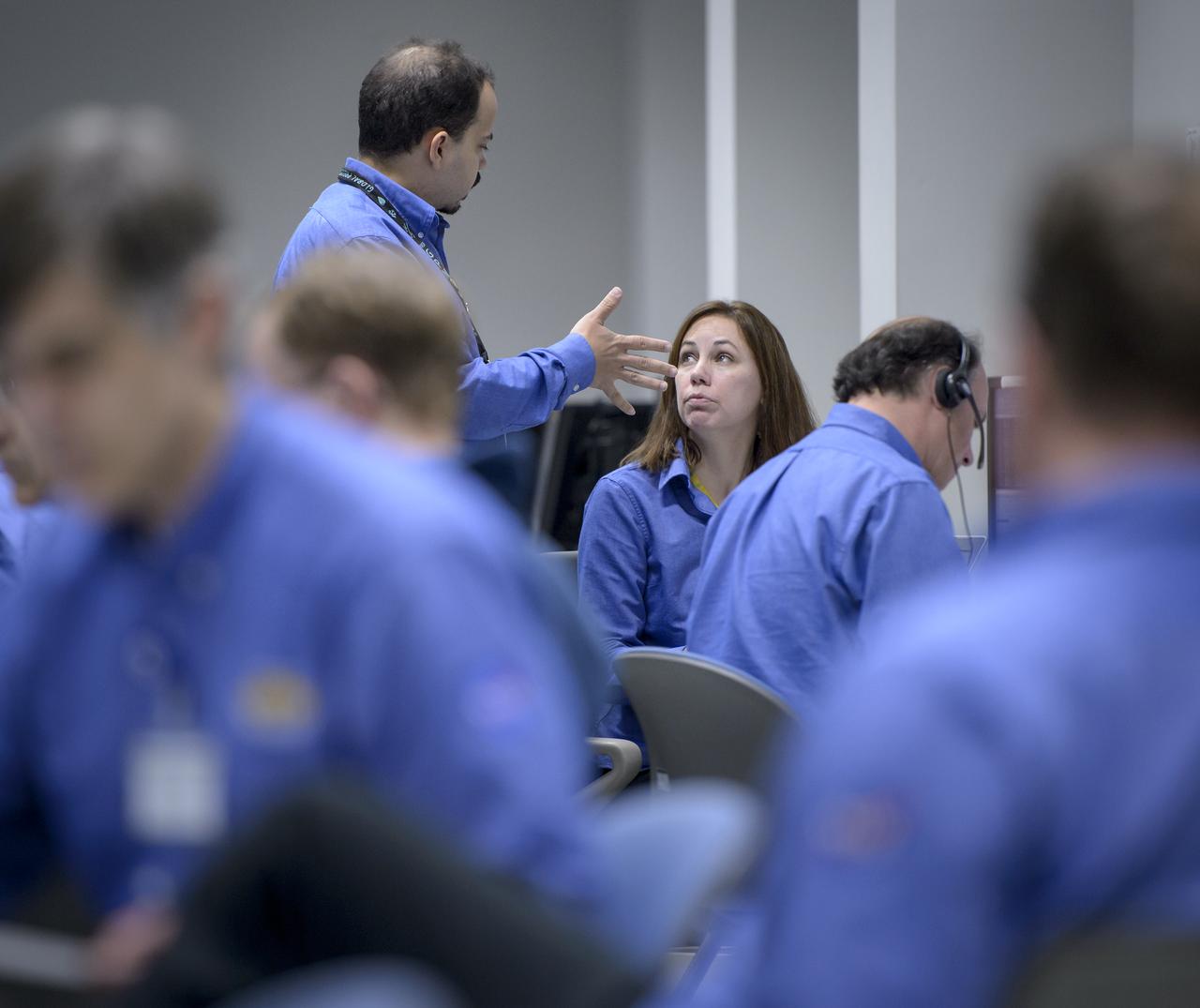
NASA GPM Test Conductors John Pope, and, Michelle Lacombe talk during the all-day launch simulation for the Global Precipitation Measurement (GPM) Core Observatory at the Spacecraft Test and Assembly Building 2 (STA2), Saturday, Feb. 22, 2014, Tanegashima Space Center (TNSC), Tanegashima Island, Japan. Japan Aerospace Exploration Agency (JAXA) plans to launch an H-IIA rocket carrying the GPM Core Observatory on Feb. 28, 2014. The NASA-JAXA GPM spacecraft will collect information that unifies data from an international network of existing and future satellites to map global rainfall and snowfall every three hours. Photo Credit: (NASA/Bill Ingalls)
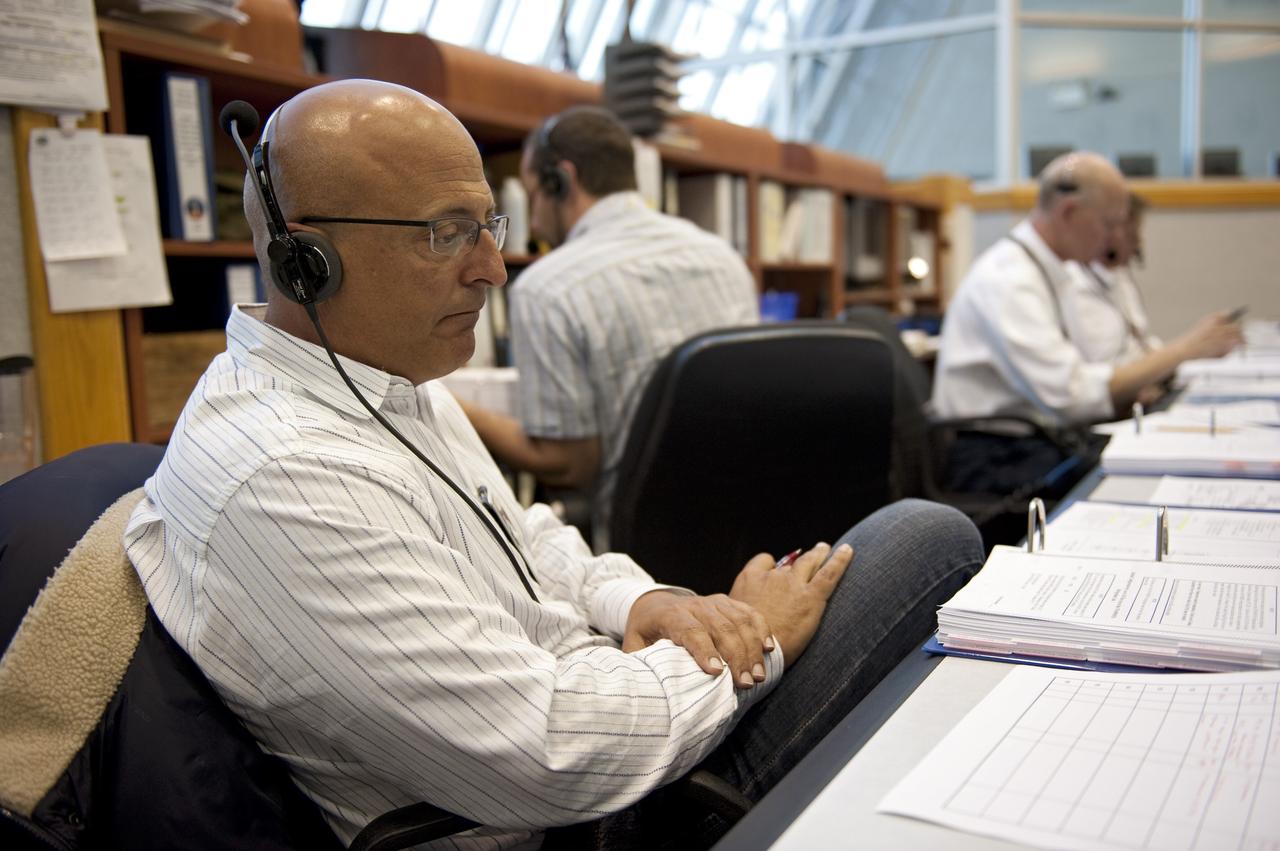
CAPE CANAVERAL, Fla. -- In the Launch Control Center at NASA's Kennedy Space Center in Florida, Assistant Launch Orbiter Test Conductor Mark Taffet sits at his console in Firing Room 4 along with other STS-133 launch team members to rehearse procedures for the liftoff of space shuttle Discovery's final mission. The team at Kennedy also participated in launch simulations with personnel at NASA's Johnson Space Center in Houston. Discovery's next launch opportunity to the International Space Station on the STS-133 mission is planned for no earlier than Feb. 24. For more information on STS-133, visit www.nasa.gov/mission_pages/shuttle/shuttlemissions/sts133/. Photo credit: NASA/Kim Shiflett
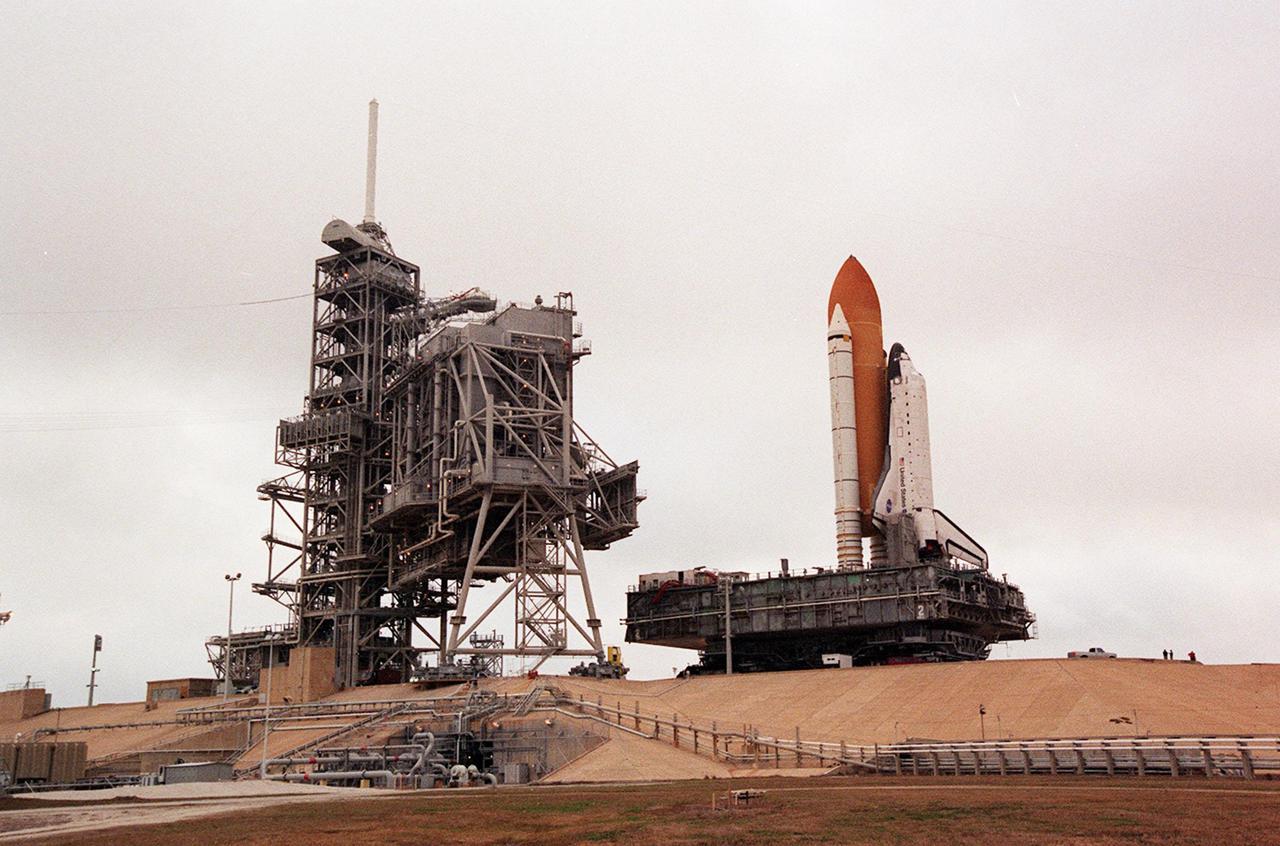
KENNEDY SPACE CENTER, FLA. -- Space Shuttle Atlantis begins rolling back to the Vehicle Assembly Building on the crawler-transporter. In the VAB workers will conduct inspections, make continuity checks and conduct X-ray analysis on the 36 solid rocket booster cables located inside each booster’s system tunnel. An extensive evaluation of NASA’s SRB cable inventory revealed conductor damage in four (of about 200) cables on the shelf. Shuttle managers decided to prove the integrity of the system tunnel cables already on Atlantis before launching Jan. 19. The launch has been rescheduled no earlier than Feb. 6

A locomotive conductor prepares to move the Soyuz TMA-09M spacecraft out by train to the Baikonur Cosmodrome launch pad, Sunday, May 26, 2013, in Kazakhstan. The launch of the Soyuz rocket to the International Space Station (ISS) with Expedition 36/37 Soyuz Commander Fyodor Yurchikhin of the Russian Federal Space Agency (Roscosmos), Flight Engineers; Luca Parmitano of the European Space Agency, and Karen Nyberg of NASA, is scheduled for Wednesday May 29, Kazakh time. Yurchikhin, Nyberg, and, Parmitano, will remain aboard the station until mid-November. Photo credit: (NASA/Bill Ingalls)
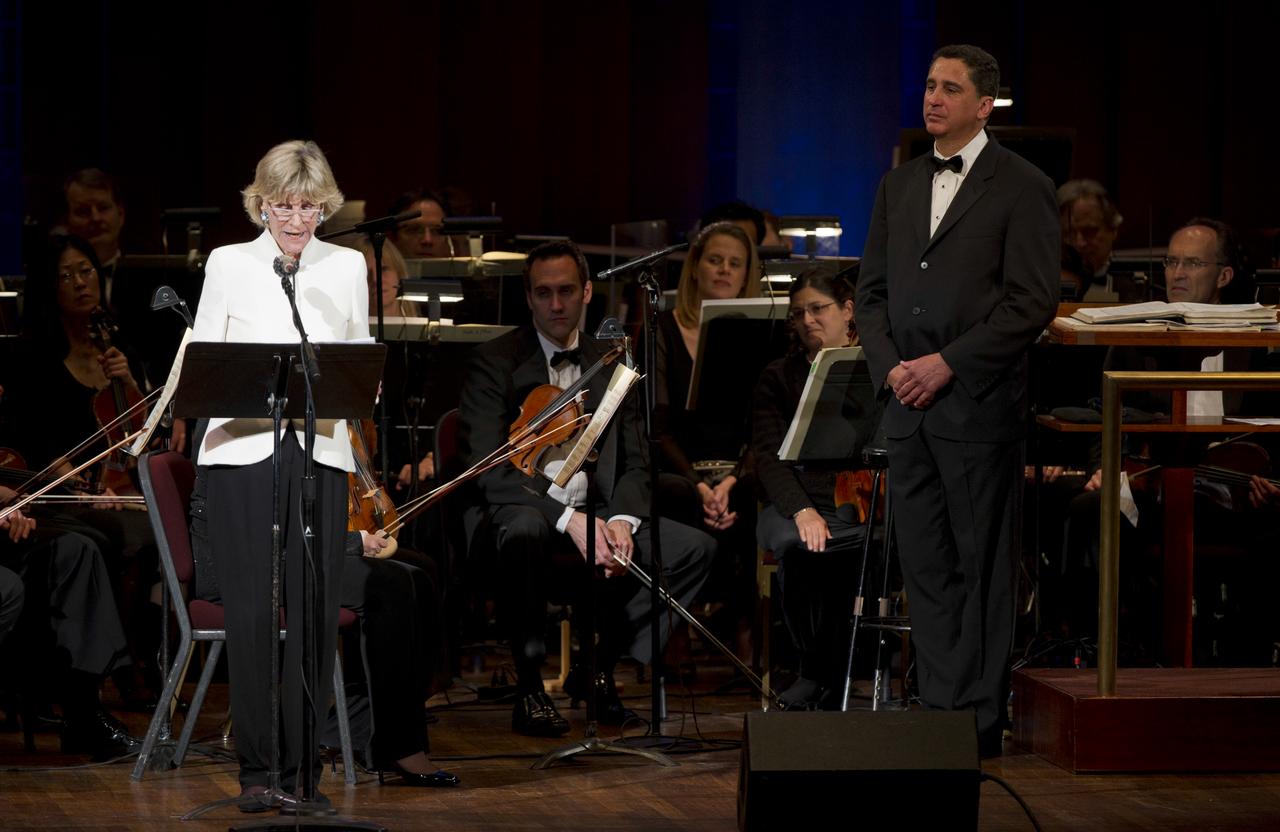
Jean Kennedy Smith, sister of John F. Kennedy, delivers remarks during a program entitled Human Spaceflight: The Kennedy Legacy as Emil de Cou, conductor of the Space Philharmonic, right, looks on, Wednesday, May 25, 2011, in the concert hall at the John F. Kennedy Center for the Performing Arts in Washington. The event marked the 50th Anniversary of President John F. Kennedy's Special Message to the Congress on Urgent National Needs in which he stated "landing a man on the moon and returning him safely to earth". Photo Credit: (NASA/Paul E. Alers)
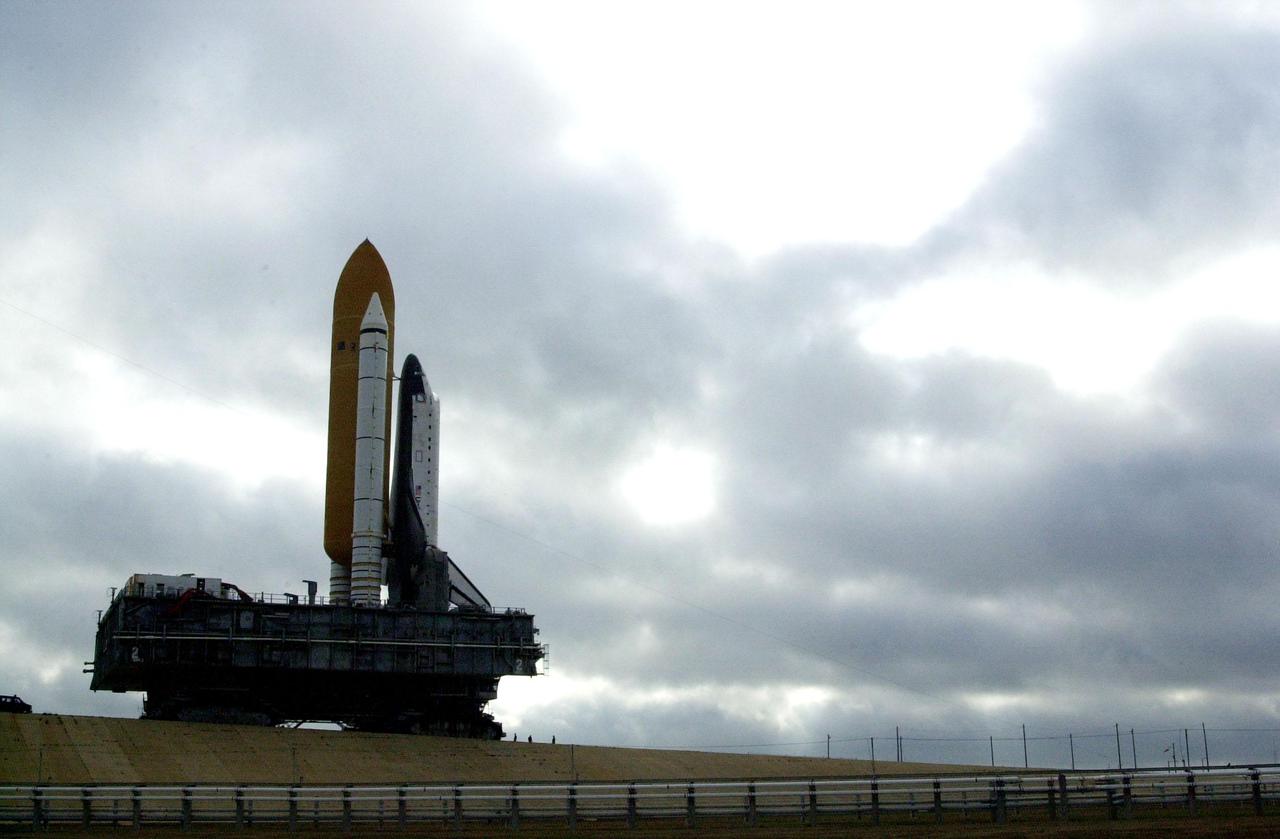
KENNEDY SPACE CENTER, FLA. -- Space Shuttle Atlantis stands out against the fogand cloud-swept sky on its trek aboard the crawler-transporter back to the Vehicle Assembly Building. In the VAB workers will conduct inspections, make continuity checks and conduct X-ray analysis on the 36 solid rocket booster cables located inside each booster’s system tunnel. An extensive evaluation of NASA’s SRB cable inventory revealed conductor damage in four (of about 200) cables on the shelf. Shuttle managers decided to prove the integrity of the system tunnel cables already on Atlantis before launching Jan. 19. The launch has been rescheduled no earlier than Feb. 6
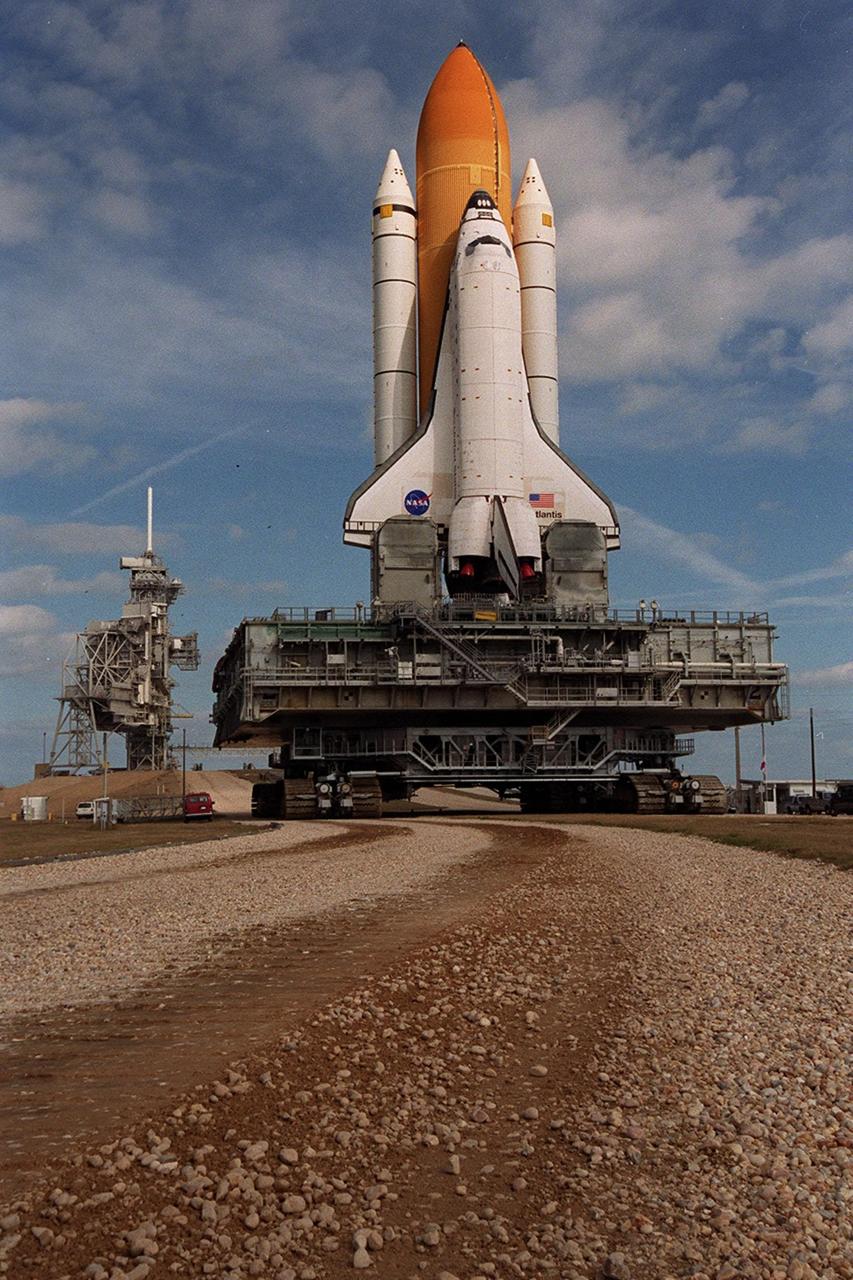
KENNEDY SPACE CENTER, Fla. -- Space Shuttle Atlantis makes tracks as it crawls to Launch Pad 39A (background, left). The Shuttle had returned to the Vehicle Assembly Building from the launch pad in order to undergo tests on the solid rocket booster cables. A prior extensive evaluation of NASA’s SRB cable inventory on the shelf revealed conductor damage in four (of about 200) cables. Shuttle managers decided to prove the integrity of the system tunnel cables already on Atlantis, causing return of the Shuttle to the VAB a week ago. The Shuttle rolled back to Launch Pad 39A to get ready for launch on Feb. 7 at 6:11 p.m. EST
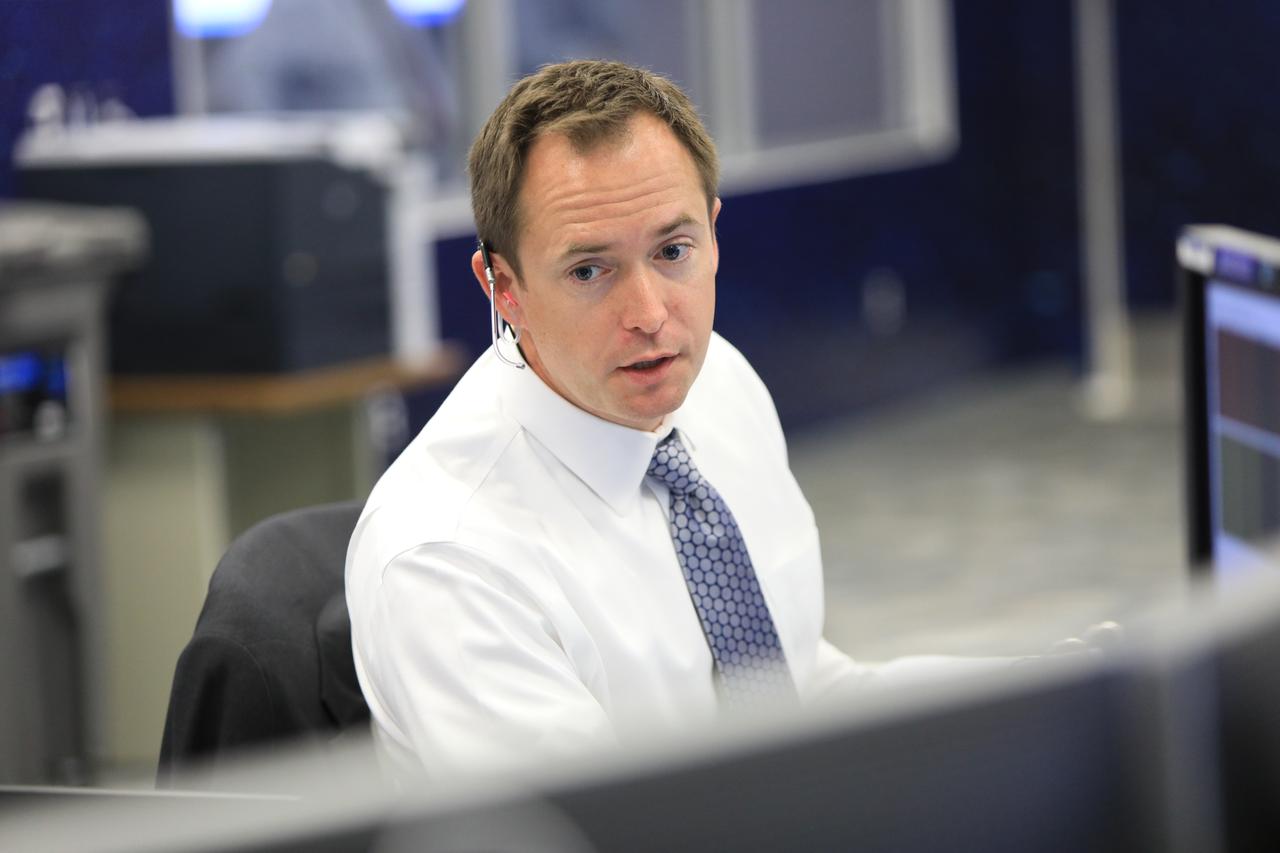
As part of the joint team that will launch Boeing’s CST-100 Starliner on a United Launch Alliance (ULA) Atlas V rocket in Boeing’s Orbital Flight Test (OFT), Boeing Spacecraft Launch Conductor Louis Atchison participated in a successful Integrated Crew Exercise on Feb. 12. NASA, ULA, Boeing and Department of Defense personnel executed a mock countdown that practiced fueling the rocket and operating on the unique launch day timeline that features a four-hour built-in hold at the T-minus 4 minute mark. OFT is Boeing’s uncrewed flight test of Starliner and part of NASA’s Commercial Crew Program, which will return human spaceflight launches into low-Earth orbit from U.S. soil.
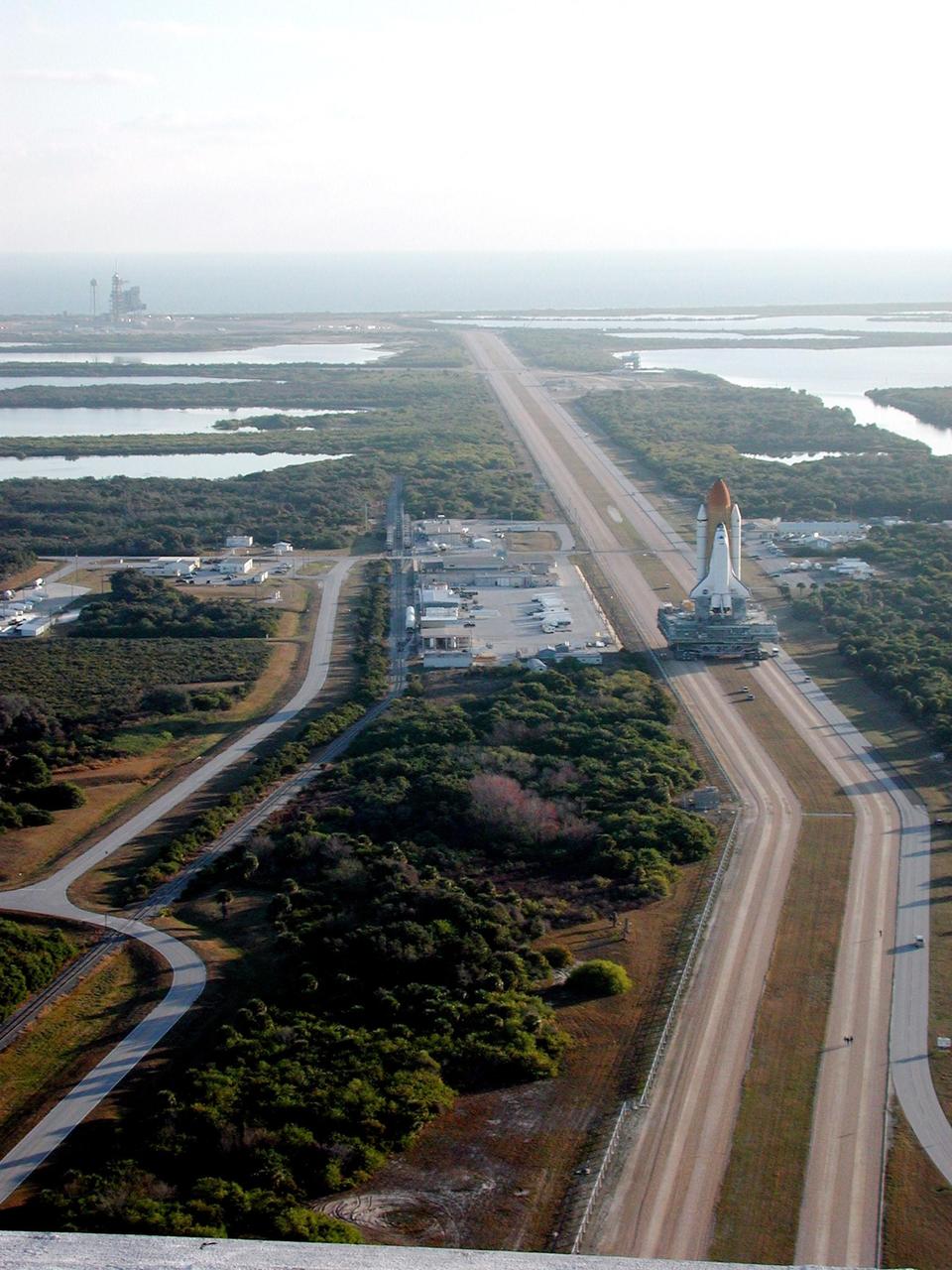
KENNEDY SPACE CENTER, Fla. -- Photographed from the top of the Vehicle Assembly Building, Space Shuttle Atlantis creeps along the crawlerway for the trek to Launch Pad 39A (upper left). In the background is the Atlantic Ocean. The Shuttle has been in the VAB undergoing tests on the solid rocket booster cables. A prior extensive evaluation of NASA’s SRB cable inventory on the shelf revealed conductor damage in four (of about 200) cables. Shuttle managers decided to prove the integrity of the system tunnel cables already on Atlantis, causing return of the Shuttle to the VAB a week ago. Launch of Atlantis on STS-98 has been rescheduled to Feb. 7 at 6:11 p.m. EST
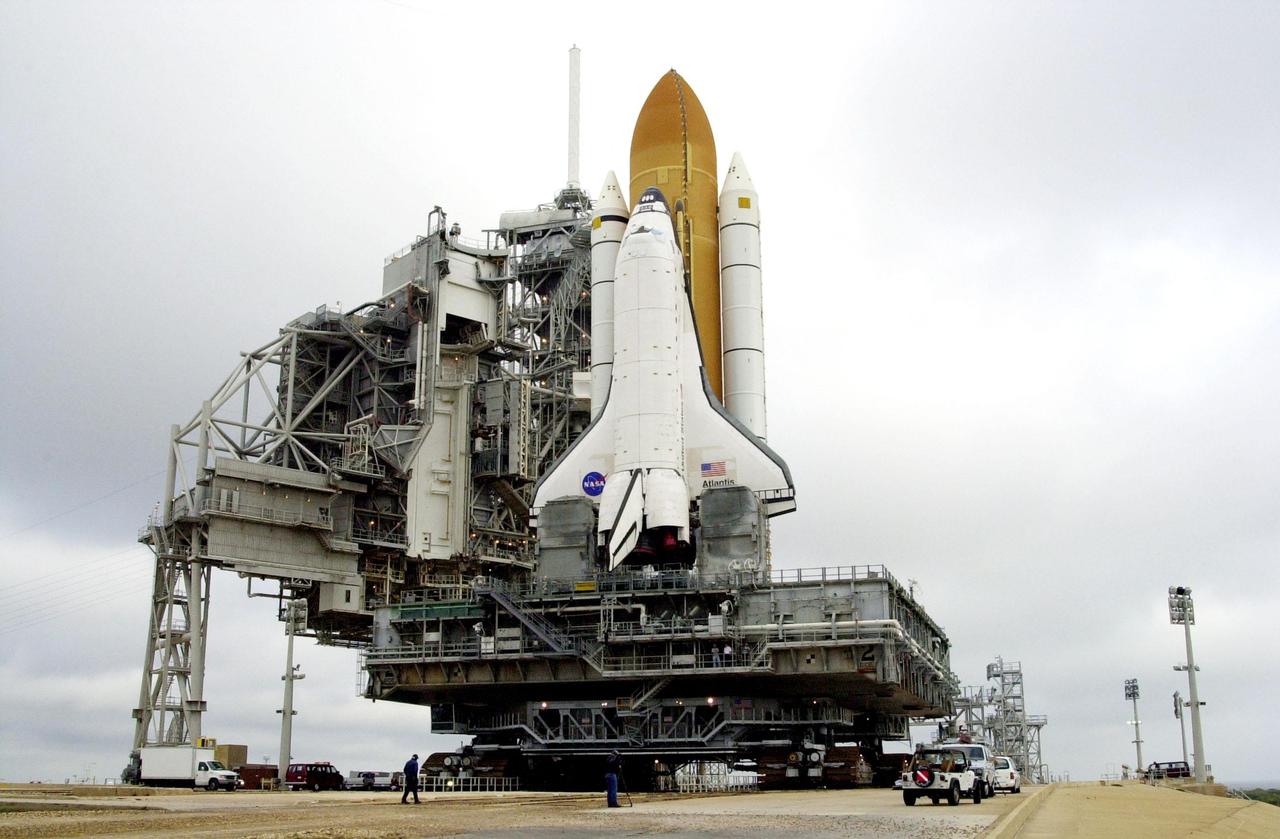
KENNEDY SPACE CENTER, FLA. -- Space Shuttle Atlantis begins moving back to the Vehicle Assembly Building where workers will conduct inspections, make continuity checks and conduct X-ray analysis on the 36 solid rocket booster cables located inside each booster’s system tunnel. An extensive evaluation of NASA’s SRB cable inventory revealed conductor damage in four (of about 200) cables on the shelf. Shuttle managers decided to prove the integrity of the system tunnel cables already on Atlantis before launching Jan. 19. The launch has been rescheduled no earlier than Feb. 6
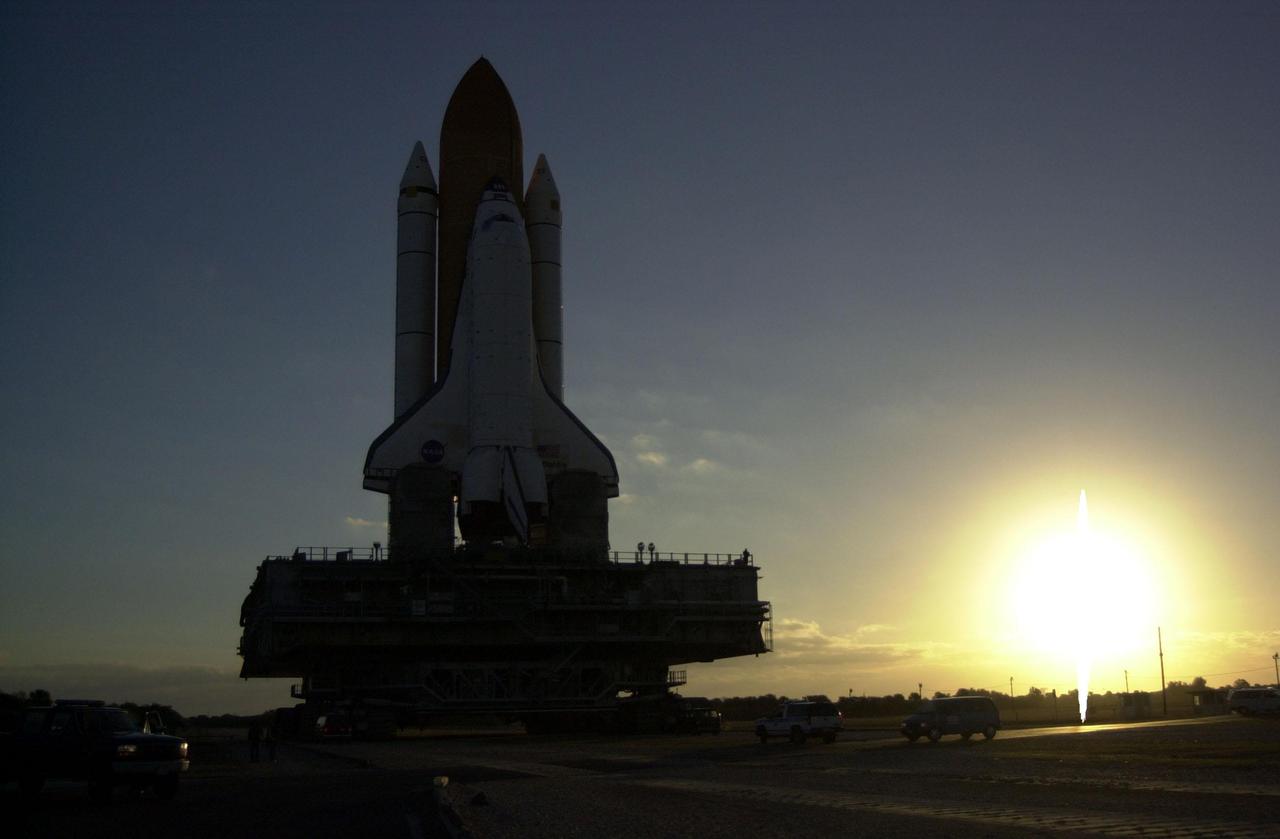
KENNEDY SPACE CENTER, Fla. -- As the sun clears the horizon, it creates a silhouette of the Space Shuttle Atlantis as it makes the crawl from the Vehicle Assembly Building to Launch Pad 39A. The Shuttle has been in the VAB undergoing tests on the solid rocket booster cables. A prior extensive evaluation of NASA’s SRB cable inventory on the shelf revealed conductor damage in four (of about 200) cables. Shuttle managers decided to prove the integrity of the system tunnel cables already on Atlantis, causing return of the Shuttle to the VAB a week ago. Launch of Atlantis on STS-98 has been rescheduled to Feb. 7 at 6:11 p.m. EST
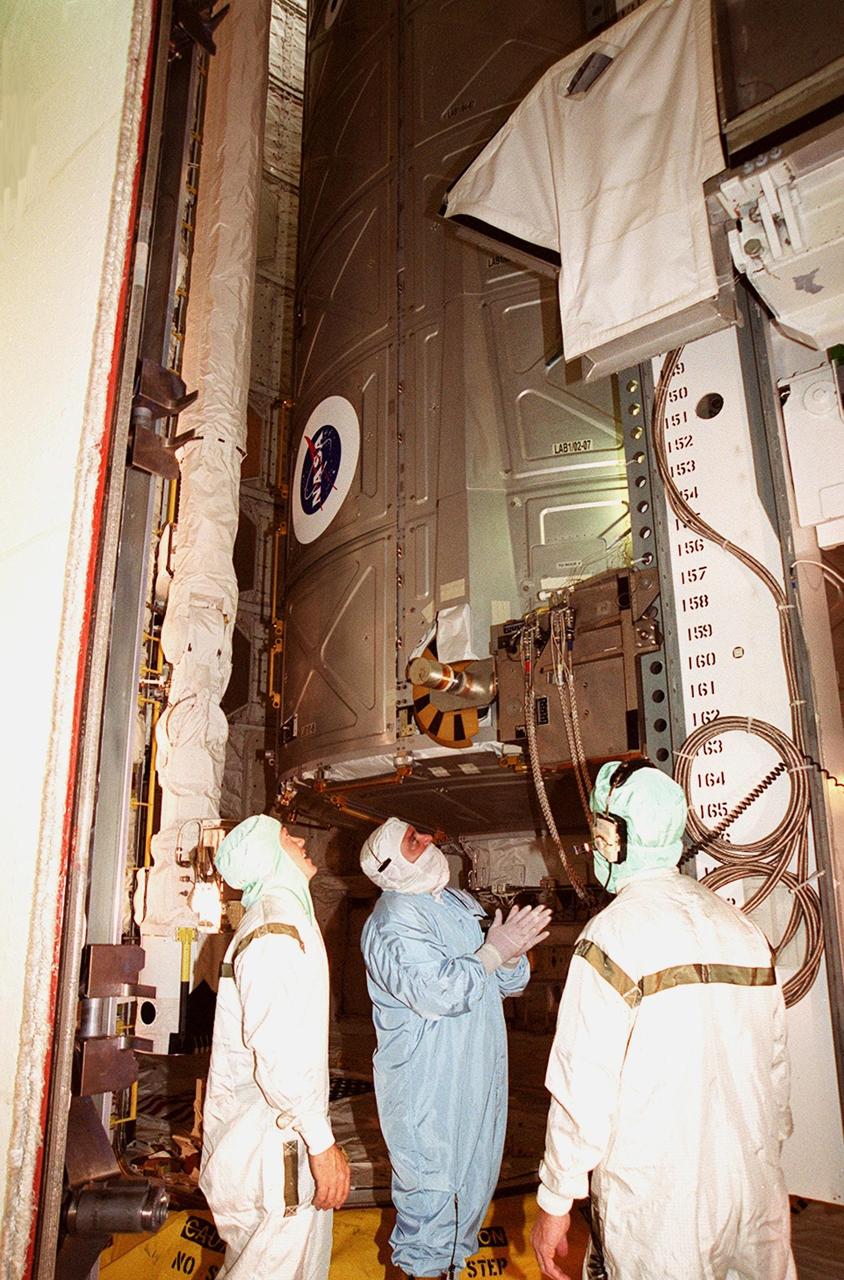
Workers in the Payload Changeout Room check the Payload Ground Handling Mechanism that will move the U.S. Lab Destiny out of Atlantis’ payload bay and into the PCR. After the move, Atlantis will roll back to the Vehicle Assembly Building to allow workers to conduct inspections, continuity checks and X-ray analysis on the 36 solid rocket booster cables located inside each booster’s system tunnel. An extensive evaluation of NASA’s SRB cable inventory revealed conductor damage in four (of about 200) cables on the shelf. Shuttle managers decided to prove the integrity of the system tunnel cables already on Atlantis
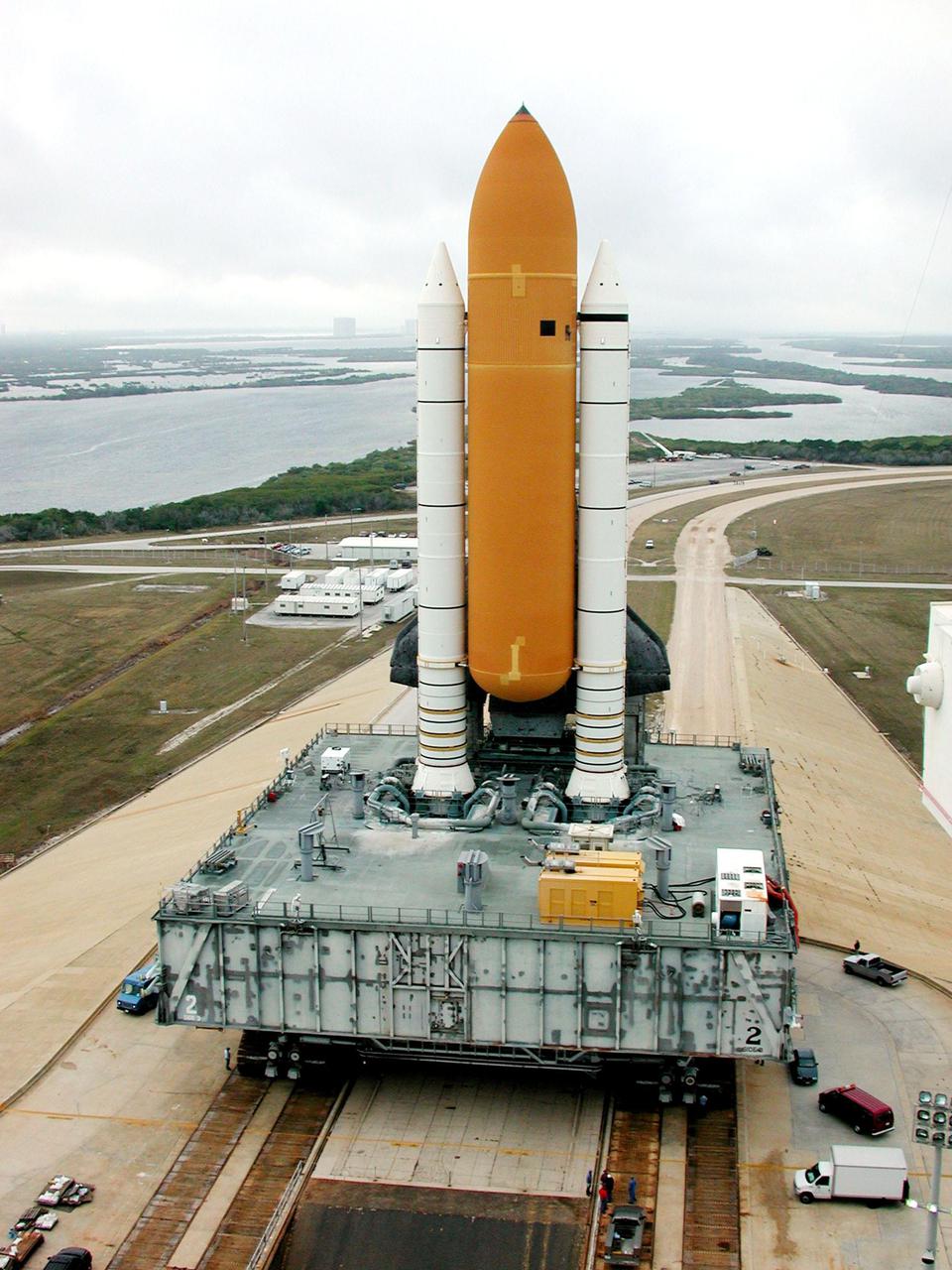
KENNEDY SPACE CENTER, FLA. -- Perched atop its Mobile Launcher Platform, Space Shuttle Atlantis moves back to the Vehicle Assembly Building, via the crawler-transporter underneath, along the crawlerway. The water in the background is part of the Banana River. Atlantis’ return to the VAB was determined by Shuttle managers so that inspections, continuity checks and X-ray analysis can be conducted on the 36 solid rocket booster cables located inside each booster’s system tunnel. An extensive evaluation of NASA’s SRB cable inventory revealed conductor damage in four (of about 200) cables on the shelf. The launch has been rescheduled no earlier than Feb. 6
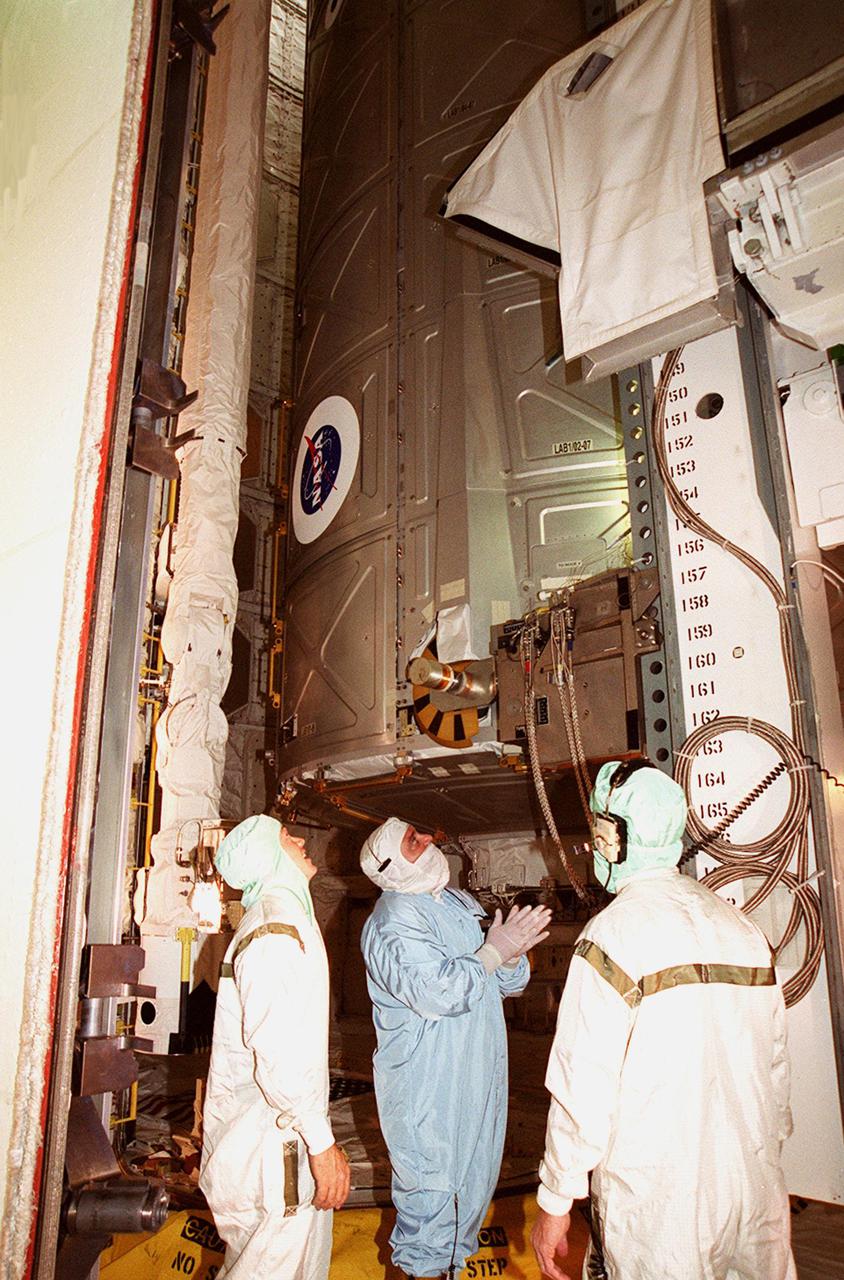
Workers in the Payload Changeout Room check the Payload Ground Handling Mechanism that will move the U.S. Lab Destiny out of Atlantis’ payload bay and into the PCR. After the move, Atlantis will roll back to the Vehicle Assembly Building to allow workers to conduct inspections, continuity checks and X-ray analysis on the 36 solid rocket booster cables located inside each booster’s system tunnel. An extensive evaluation of NASA’s SRB cable inventory revealed conductor damage in four (of about 200) cables on the shelf. Shuttle managers decided to prove the integrity of the system tunnel cables already on Atlantis
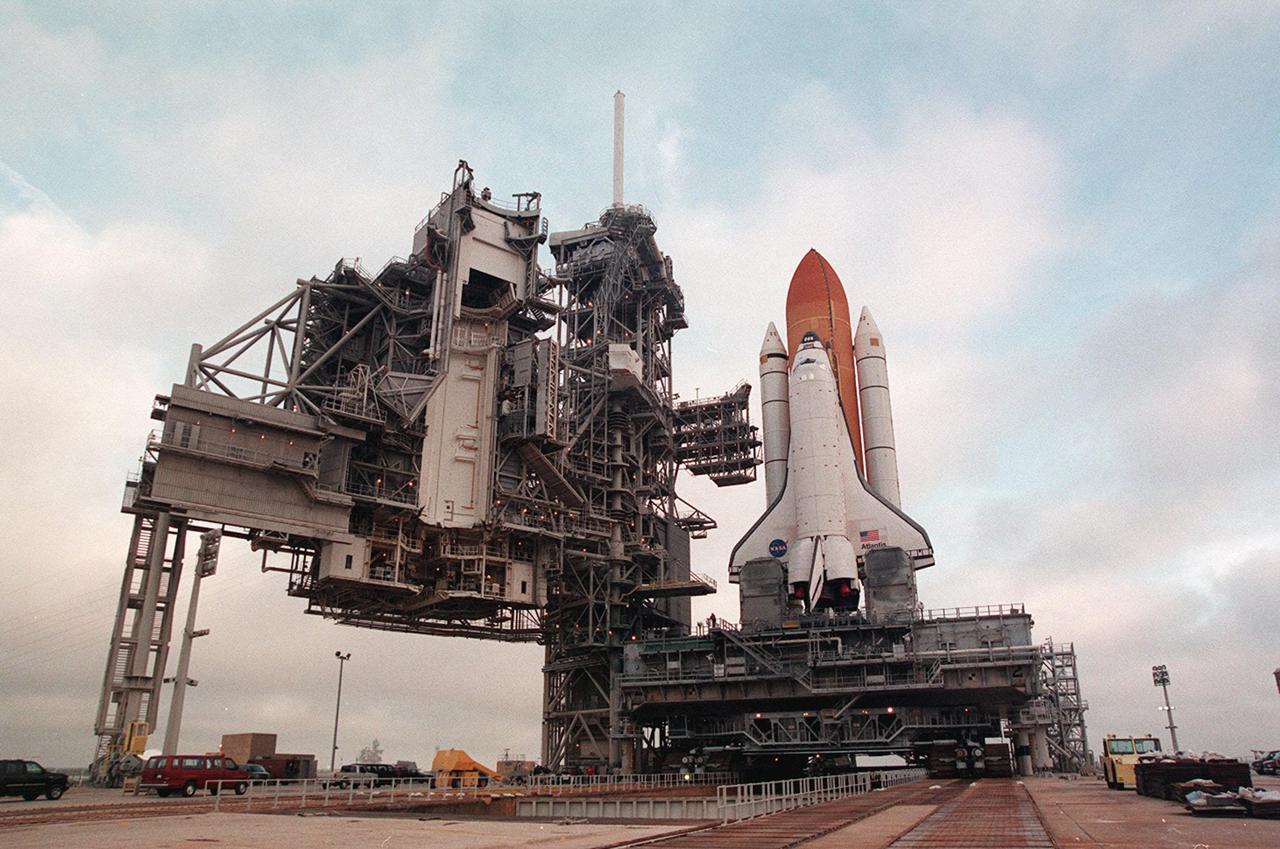
KENNEDY SPACE CENTER, FLA. -- Space Shuttle Atlantis is ready to roll back to the Vehicle Assembly Building via the crawler-transporter. In the VAB workers will conduct inspections, make continuity checks and conduct X-ray analysis on the 36 solid rocket booster cables located inside each booster’s system tunnel. An extensive evaluation of NASA’s SRB cable inventory revealed conductor damage in four (of about 200) cables on the shelf. Shuttle managers decided to prove the integrity of the system tunnel cables already on Atlantis before launching Jan. 19. The launch has been rescheduled no earlier than Feb. 6
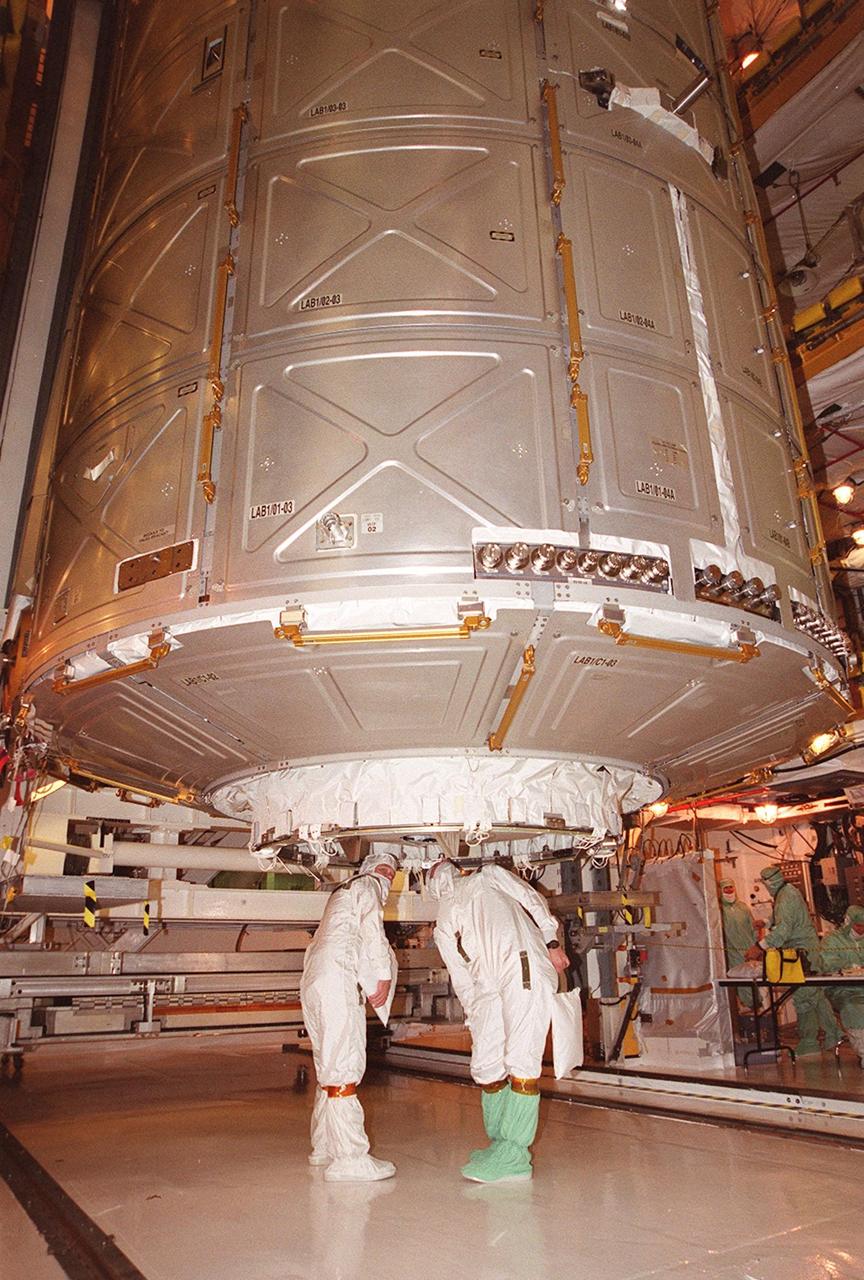
Workers in the Payload Changeout Room check the U.S. Lab Destiny as its moves from Atlantis’ payload bay into the PCR. Destiny will remain in the PCR while Atlantis rolls back to the Vehicle Assembly Building to allow workers to conduct inspections, continuity checks and X-ray analysis on the 36 solid rocket booster cables located inside each booster’s system tunnel. An extensive evaluation of NASA’s SRB cable inventory revealed conductor damage in four (of about 200) cables on the shelf. Shuttle managers decided to prove the integrity of the system tunnel cables already on Atlantis
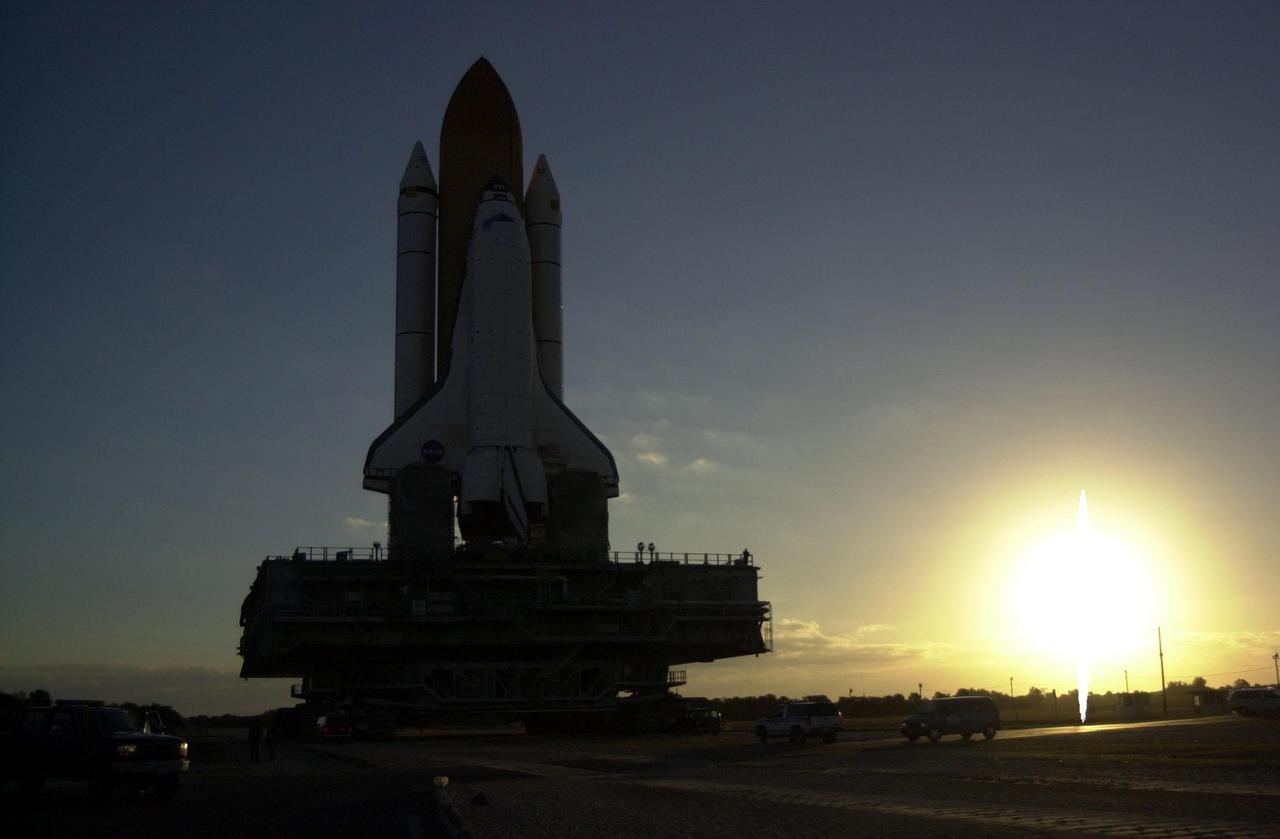
KENNEDY SPACE CENTER, Fla. -- As the sun clears the horizon, it creates a silhouette of the Space Shuttle Atlantis as it makes the crawl from the Vehicle Assembly Building to Launch Pad 39A. The Shuttle has been in the VAB undergoing tests on the solid rocket booster cables. A prior extensive evaluation of NASA’s SRB cable inventory on the shelf revealed conductor damage in four (of about 200) cables. Shuttle managers decided to prove the integrity of the system tunnel cables already on Atlantis, causing return of the Shuttle to the VAB a week ago. Launch of Atlantis on STS-98 has been rescheduled to Feb. 7 at 6:11 p.m. EST
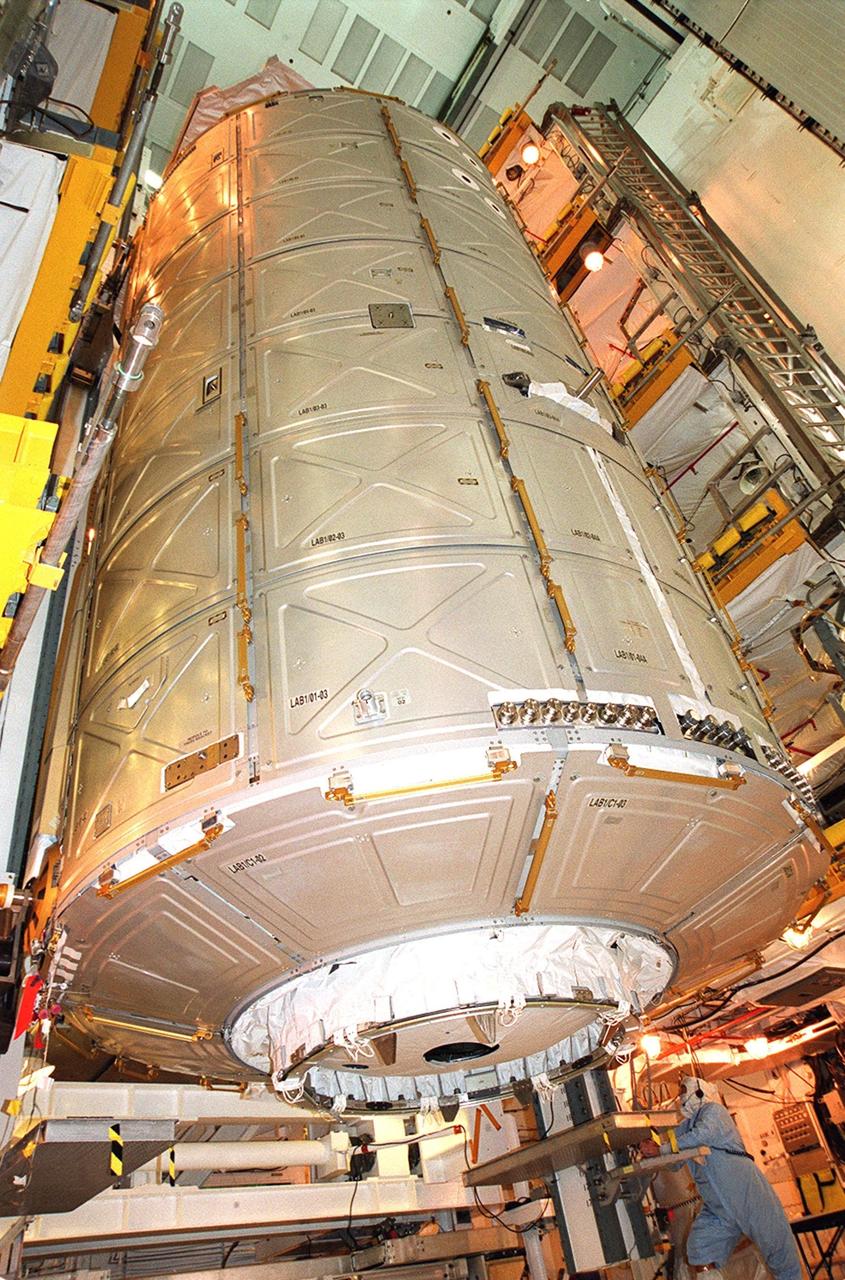
The U.S. Lab Destiny moves out of Atlantis’ payload bay and into the Payload Changeout Room via the Payload Ground Handling Mechanism. Destiny will remain in the PCR while Atlantis rolls back to the Vehicle Assembly Building to allow workers to conduct inspections, continuity checks and X-ray analysis on the 36 solid rocket booster cables located inside each booster’s system tunnel. An extensive evaluation of NASA’s SRB cable inventory revealed conductor damage in four (of about 200) cables on the shelf. Shuttle managers decided to prove the integrity of the system tunnel cables already on Atlantis

Workers in the Payload Changeout Room check the U.S. Lab Destiny as its moves from Atlantis’ payload bay into the PCR. Destiny will remain in the PCR while Atlantis rolls back to the Vehicle Assembly Building to allow workers to conduct inspections, continuity checks and X-ray analysis on the 36 solid rocket booster cables located inside each booster’s system tunnel. An extensive evaluation of NASA’s SRB cable inventory revealed conductor damage in four (of about 200) cables on the shelf. Shuttle managers decided to prove the integrity of the system tunnel cables already on Atlantis
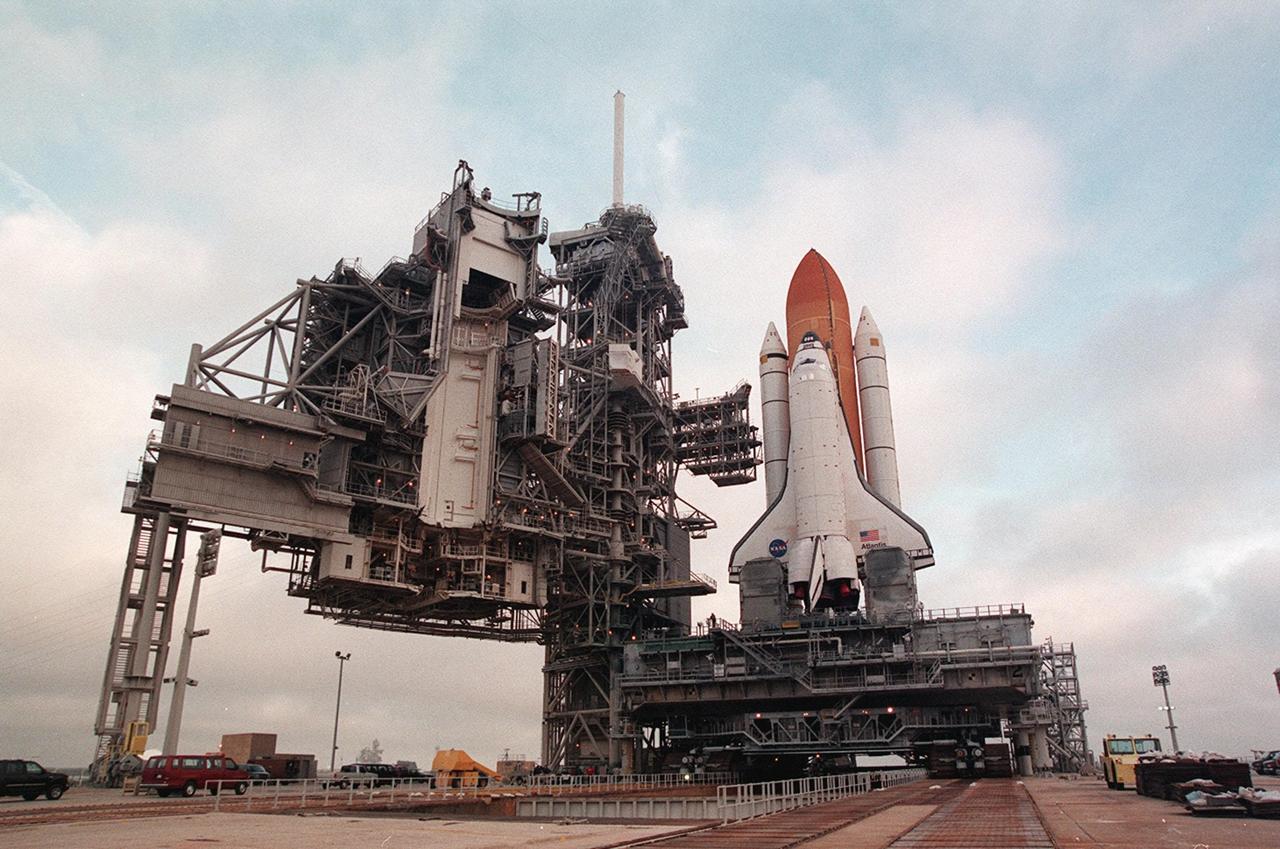
KENNEDY SPACE CENTER, FLA. -- Space Shuttle Atlantis is ready to roll back to the Vehicle Assembly Building via the crawler-transporter. In the VAB workers will conduct inspections, make continuity checks and conduct X-ray analysis on the 36 solid rocket booster cables located inside each booster’s system tunnel. An extensive evaluation of NASA’s SRB cable inventory revealed conductor damage in four (of about 200) cables on the shelf. Shuttle managers decided to prove the integrity of the system tunnel cables already on Atlantis before launching Jan. 19. The launch has been rescheduled no earlier than Feb. 6
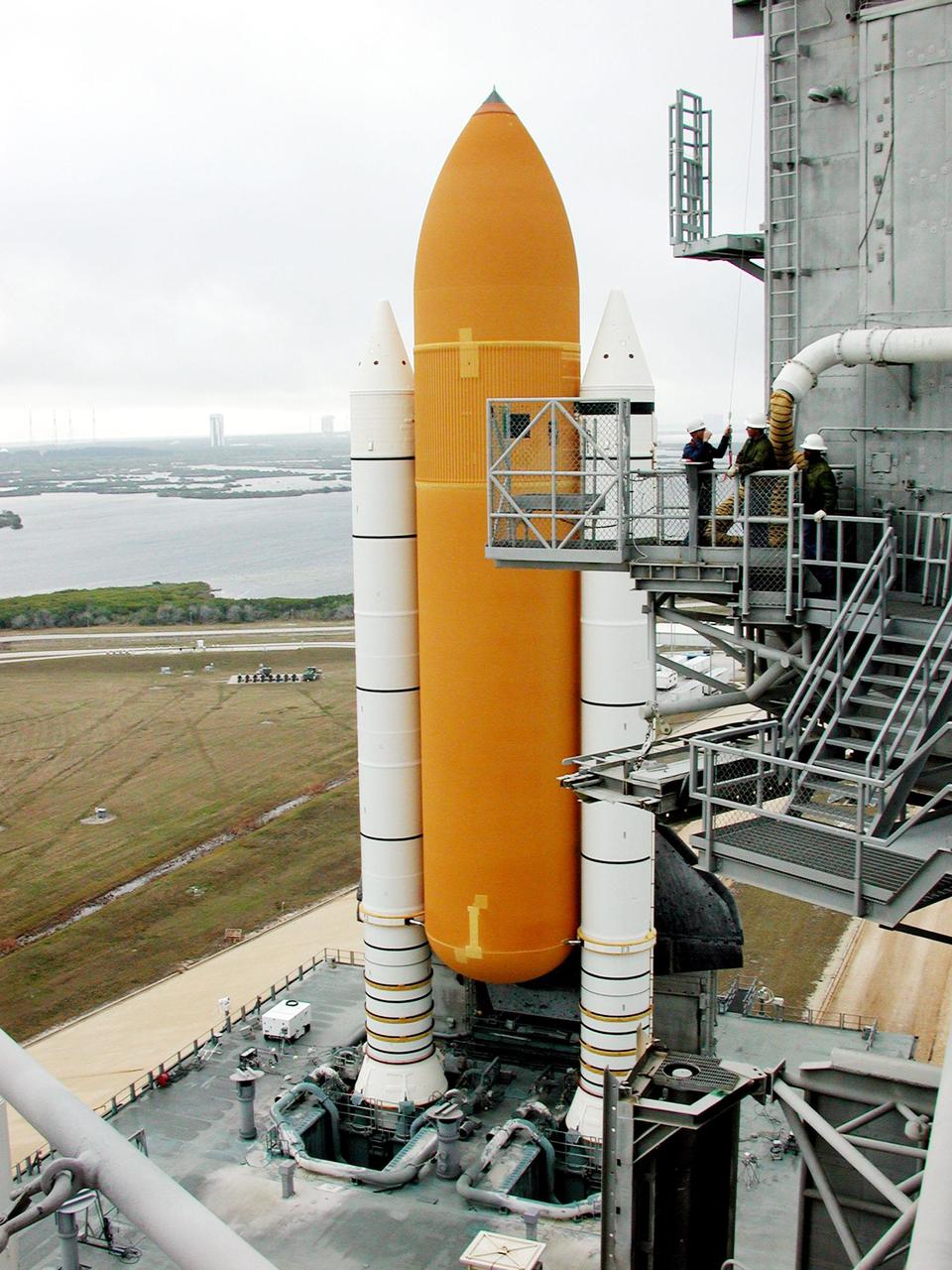
KENNEDY SPACE CENTER, FLA. -- As Space Shuttle Atlantis begins its crawl back to the Vehicle Assembly Building, work continues on the Fixed Service Structure at Launch Pad 39A. Atlantis’ return to the VAB was determined by Shuttle managers so that inspections, continuity checks and X-ray analysis can be conducted on the 36 solid rocket booster cables located inside each booster’s system tunnel. An extensive evaluation of NASA’s SRB cable inventory revealed conductor damage in four (of about 200) cables on the shelf. The launch has been rescheduled no earlier than Feb. 6
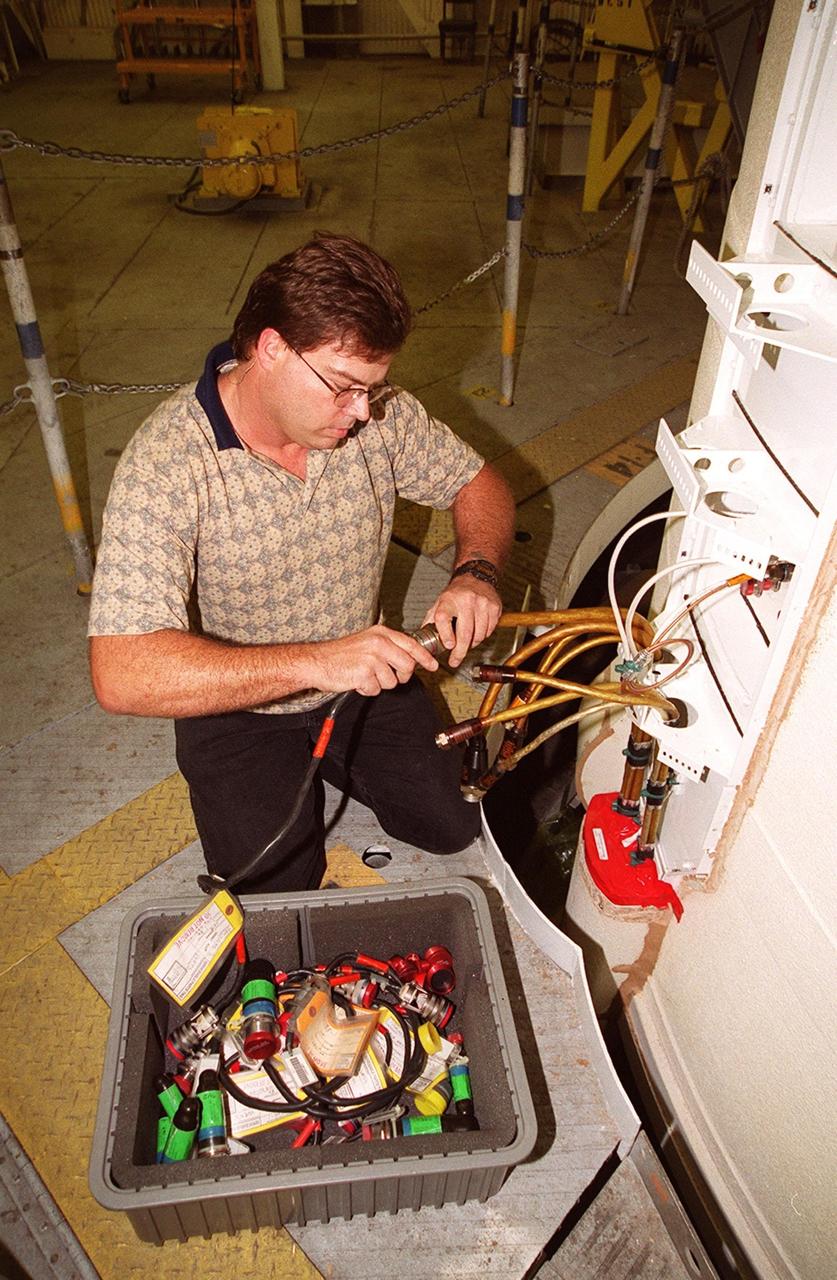
KENNEDY SPACE CENTER, FLA. -- United Space Alliance SRB technician Richard Bruns attaches a cable end cover to a cable pulled from the solid rocket booster on Space Shuttle Atlantis. The Shuttle was rolled back from Launch Pad 39A in order to conduct tests on the SRB cables. A prior extensive evaluation of NASA’s SRB cable inventory on the shelf revealed conductor damage in four (of about 200) cables. Shuttle managers decided to prove the integrity of the system tunnel cables already on Atlantis before launching. Workers are conducting inspections, making continuity checks and conducting X-ray analysis on the cables. The launch has been rescheduled no earlier than Feb. 6. <br

Workers in the Payload Changeout Room check the U.S. Lab Destiny as its moves from Atlantis’ payload bay into the PCR. Destiny will remain in the PCR while Atlantis rolls back to the Vehicle Assembly Building to allow workers to conduct inspections, continuity checks and X-ray analysis on the 36 solid rocket booster cables located inside each booster’s system tunnel. An extensive evaluation of NASA’s SRB cable inventory revealed conductor damage in four (of about 200) cables on the shelf. Shuttle managers decided to prove the integrity of the system tunnel cables already on Atlantis

KENNEDY SPACE CENTER, Fla. -- The gate outside Launch Pad 39A heralds the STS-98 launch as Space Shuttle Atlantis makes its way to the pad. The Shuttle had returned to the Vehicle Assembly Building from the launch pad in order to undergo tests on the solid rocket booster cables. A prior extensive evaluation of NASA’s SRB cable inventory on the shelf revealed conductor damage in four (of about 200) cables. Shuttle managers decided to prove the integrity of the system tunnel cables already on Atlantis, causing return of the Shuttle to the VAB a week ago. The Shuttle will undergo preparations for a rescheduled launch Feb. 7 at 6:11 p.m. EST
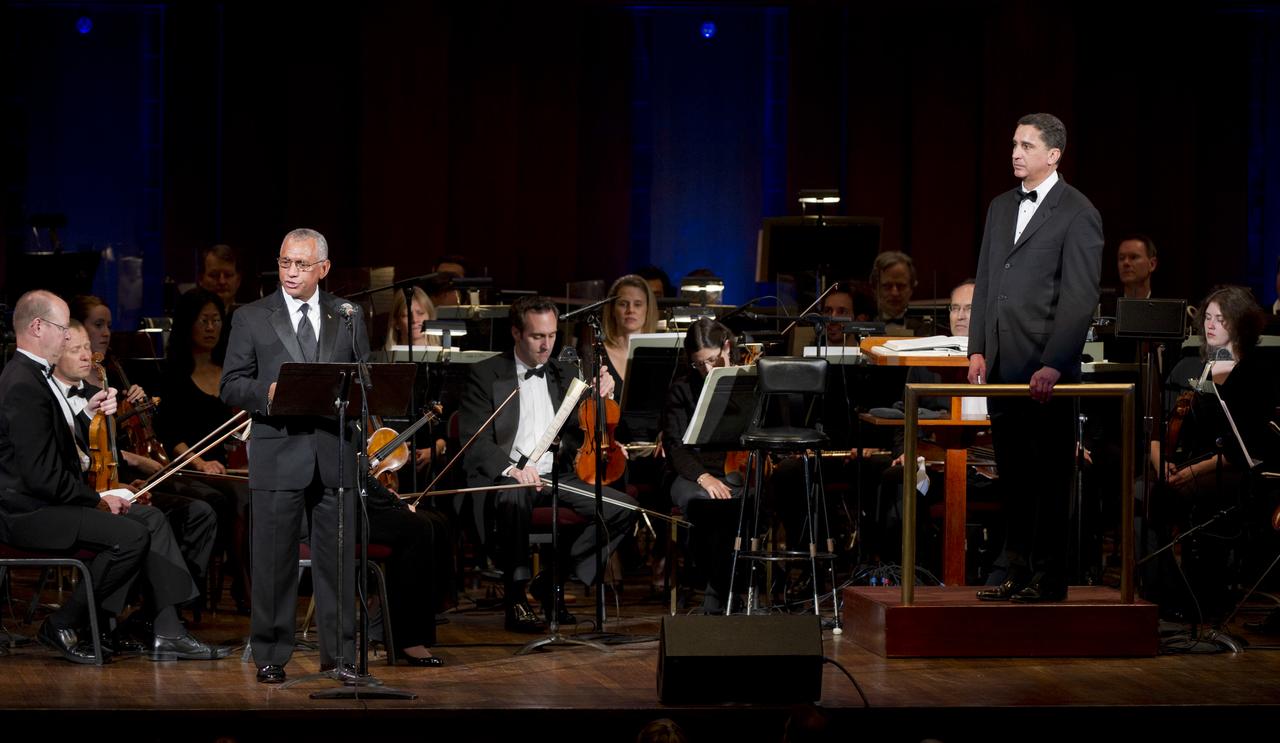
NASA Administrator Charles Bolden delivers opening remarks at the beginning of a program entitled Human Spaceflight: The Kennedy Legacy as Emil de Cou, conductor of the Space Philharmonic, right, looks on, Wednesday, May 25, 2011, in the concert hall at the John F. Kennedy Center for the Performing Arts in Washington. The event marked the 50th Anniversary of President John F. Kennedy's Special Message to the Congress on Urgent National Needs in which he stated "landing a man on the moon and returning him safely to earth". Photo Credit: (NASA/Paul E. Alers)
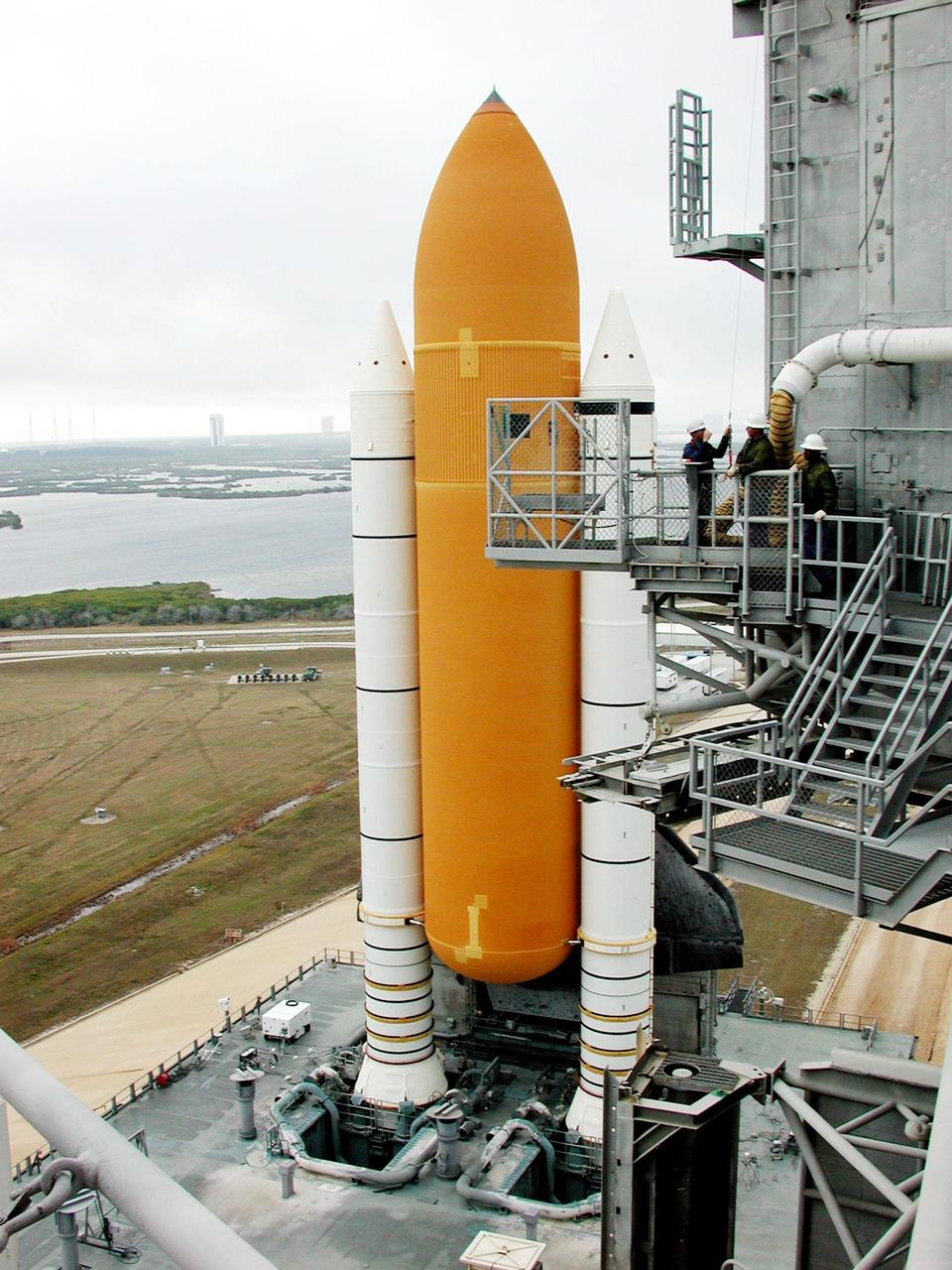
KENNEDY SPACE CENTER, FLA. -- As Space Shuttle Atlantis begins its crawl back to the Vehicle Assembly Building, work continues on the Fixed Service Structure at Launch Pad 39A. Atlantis’ return to the VAB was determined by Shuttle managers so that inspections, continuity checks and X-ray analysis can be conducted on the 36 solid rocket booster cables located inside each booster’s system tunnel. An extensive evaluation of NASA’s SRB cable inventory revealed conductor damage in four (of about 200) cables on the shelf. The launch has been rescheduled no earlier than Feb. 6

KENNEDY SPACE CENTER, Fla. -- Space Shuttle Atlantis begins rolling out of the Vehicle Assembly Building to Launch Pad 39A. The Shuttle has been in the VAB undergoing tests on the solid rocket booster cables. A prior extensive evaluation of NASA’s SRB cable inventory on the shelf revealed conductor damage in four (of about 200) cables. Shuttle managers decided to prove the integrity of the system tunnel cables already on Atlantis, causing return of the Shuttle to the VAB a week ago. Launch of Atlantis on STS-98 has been rescheduled to Feb. 7 at 6:11 p.m. EST
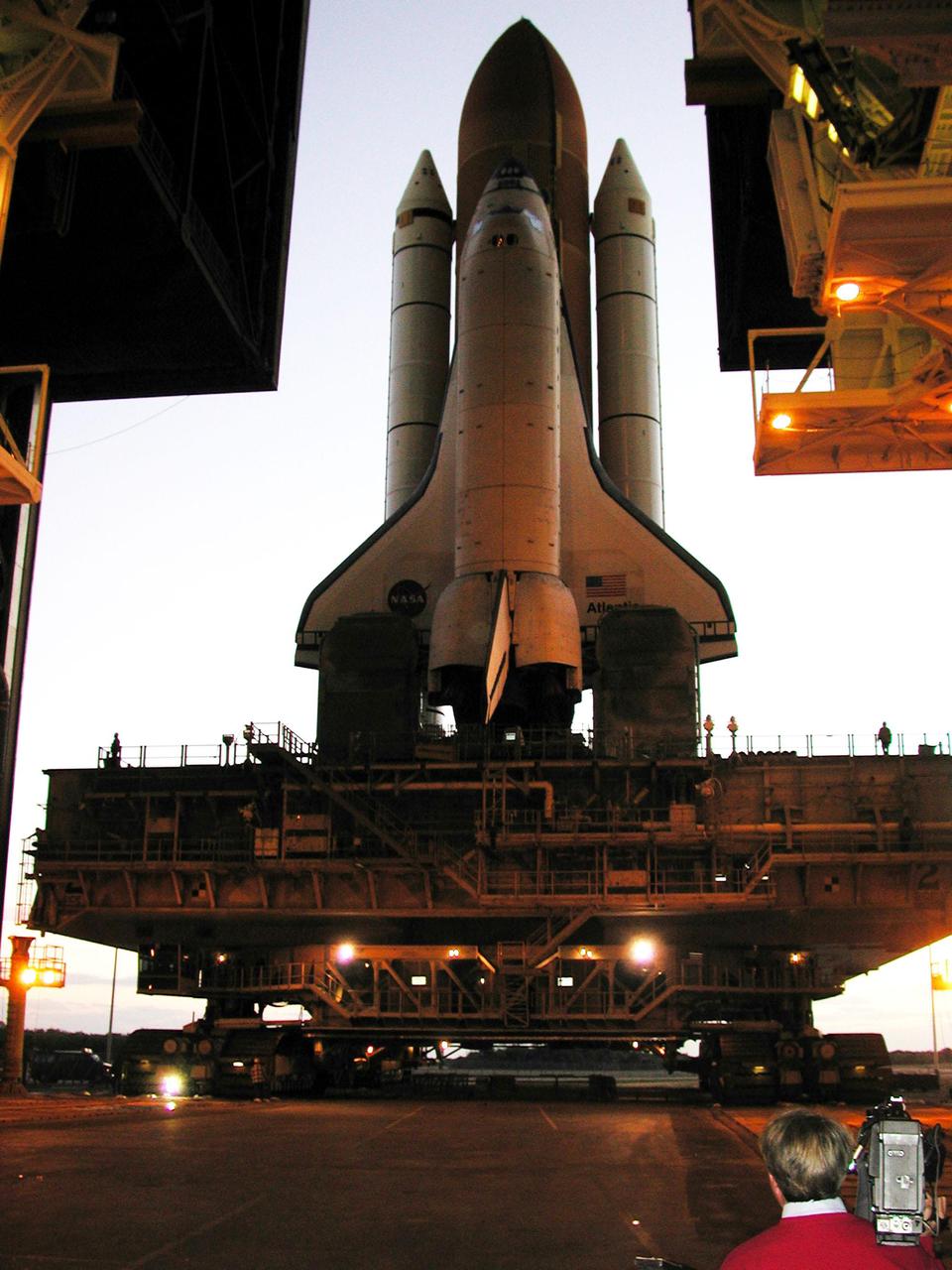
KENNEDY SPACE CENTER, Fla. -- Reflecting light from framework inside the Vehicle Assembly Building, Space Shuttle Atlantis begins rolling out of the VAB to Launch Pad 39A after tests were completed on the solid rocket booster cables. A prior extensive evaluation of NASA’s SRB cable inventory on the shelf revealed conductor damage in four (of about 200) cables. Shuttle managers decided to prove the integrity of the system tunnel cables already on Atlantis, causing return of the Shuttle to the VAB a week ago. Launch of Atlantis on STS-98 has been rescheduled to Feb. 7 at 6:11 p.m. EST
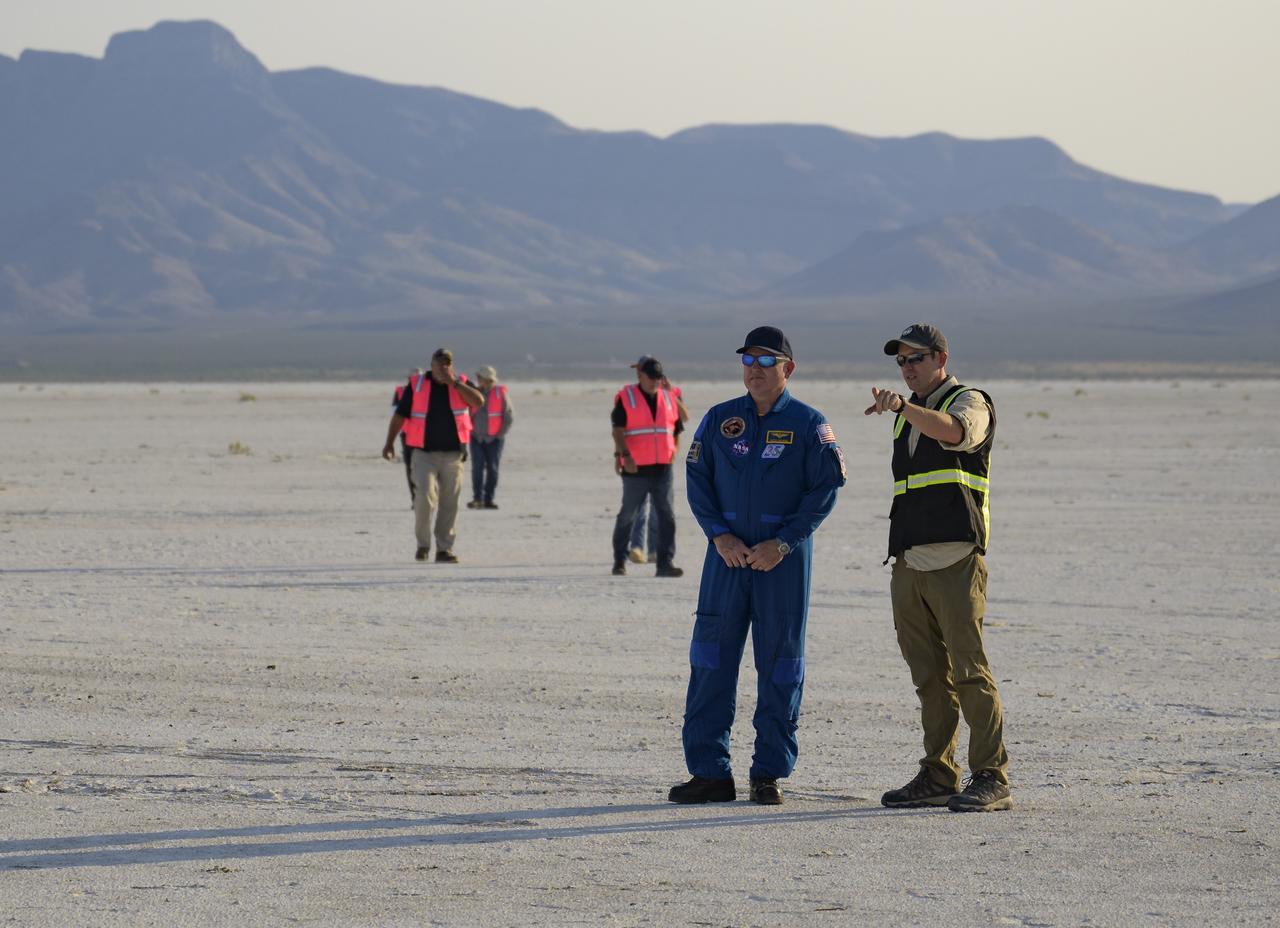
NASA astronaut Butch Wilmore, and Boeing Starliner Launch Conductor Louis Atchison, right, watch as Boeing and NASA teams work around Boeing’s CST-100 Starliner spacecraft after it landed at White Sands Missile Range’s Space Harbor, Wednesday, May 25, 2022, in New Mexico. Boeing’s Orbital Flight Test-2 (OFT-2) is Starliner’s second uncrewed flight test to the International Space Station as part of NASA's Commercial Crew Program. OFT-2 serves as an end-to-end test of the system's capabilities. Photo Credit: (NASA/Bill Ingalls)
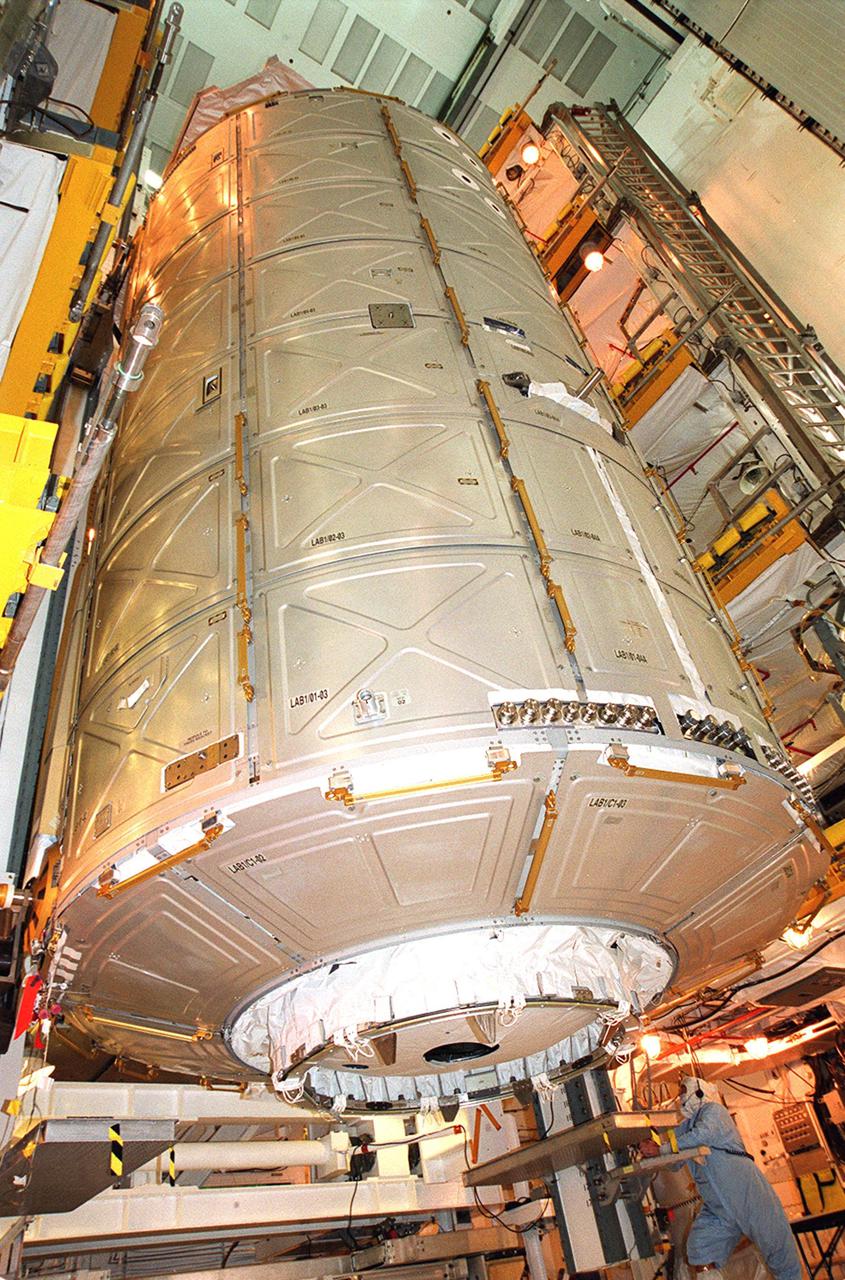
The U.S. Lab Destiny moves out of Atlantis’ payload bay and into the Payload Changeout Room via the Payload Ground Handling Mechanism. Destiny will remain in the PCR while Atlantis rolls back to the Vehicle Assembly Building to allow workers to conduct inspections, continuity checks and X-ray analysis on the 36 solid rocket booster cables located inside each booster’s system tunnel. An extensive evaluation of NASA’s SRB cable inventory revealed conductor damage in four (of about 200) cables on the shelf. Shuttle managers decided to prove the integrity of the system tunnel cables already on Atlantis
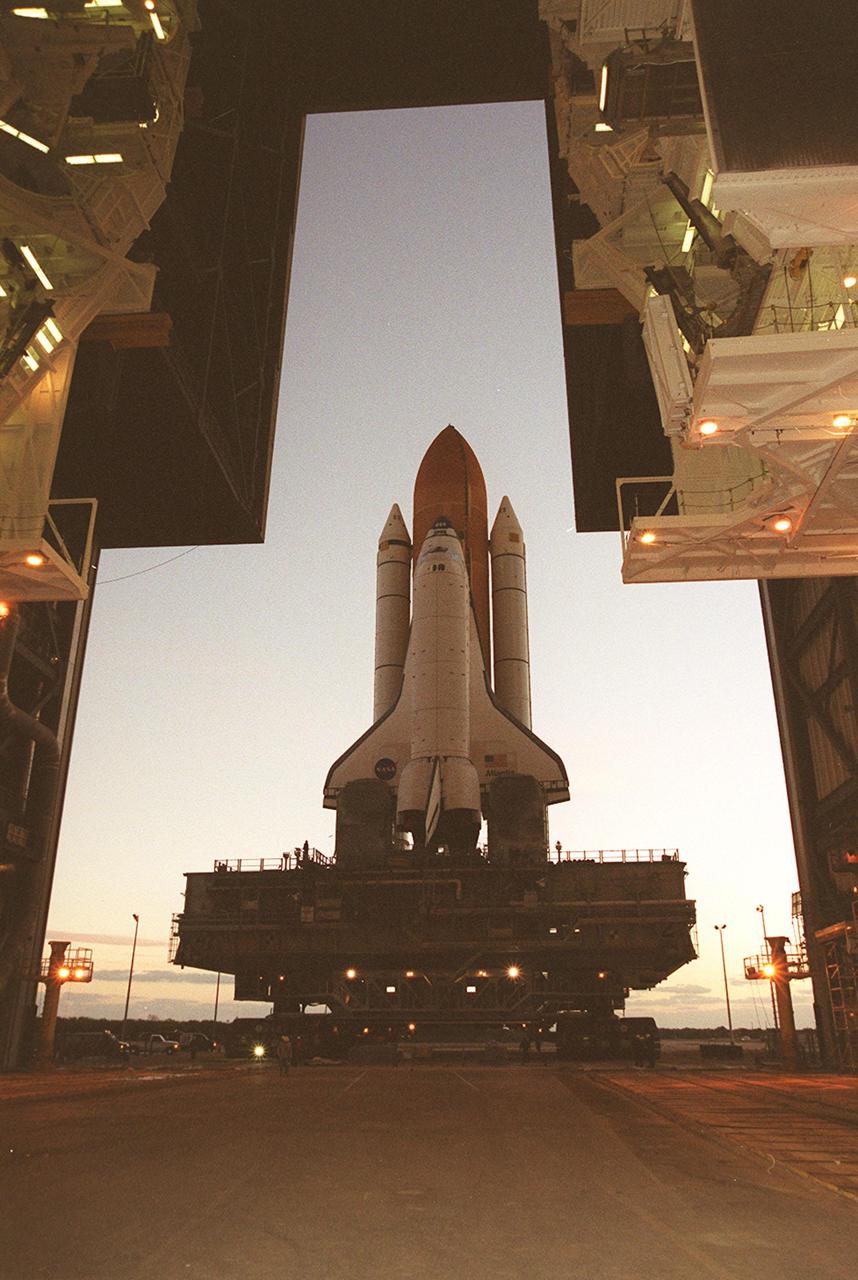
KENNEDY SPACE CENTER, Fla. -- Space Shuttle Atlantis rolls out from the Vehicle Assembly Building into the crisp morning air on its way to Launch Pad 39A. The Shuttle has been in the VAB undergoing tests on the solid rocket booster cables. A prior extensive evaluation of NASA’s SRB cable inventory on the shelf revealed conductor damage in four (of about 200) cables. Shuttle managers decided to prove the integrity of the system tunnel cables already on Atlantis, causing return of the Shuttle to the VAB a week ago. Launch of Atlantis on STS-98 has been rescheduled to Feb. 7 at 6:11 p.m. EST
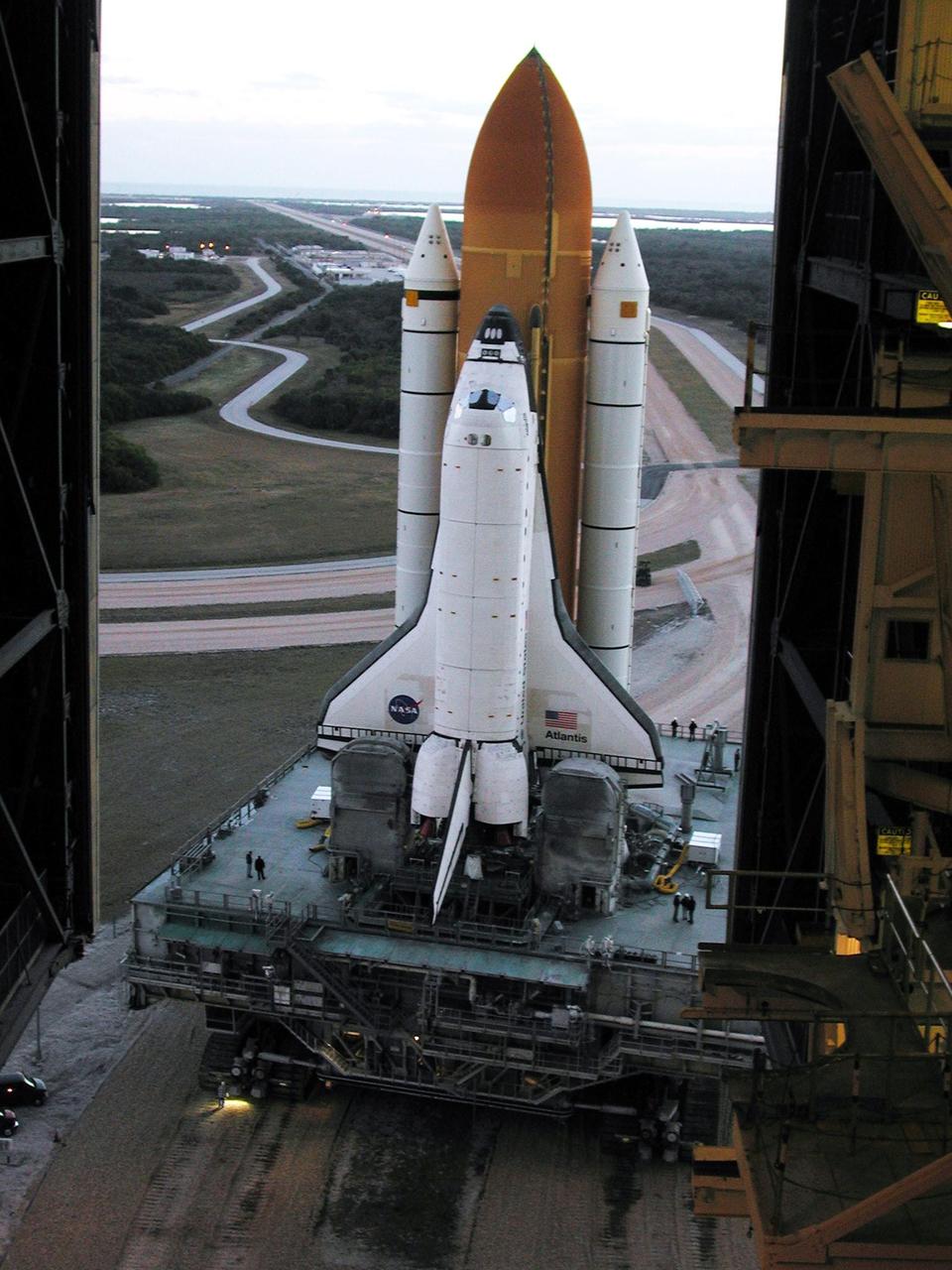
KENNEDY SPACE CENTER, Fla. -- Reflecting light from framework inside the Vehicle Assembly Building, Space Shuttle Atlantis begins rolling out of the VAB to Launch Pad 39A after tests were completed on the solid rocket booster cables. A prior extensive evaluation of NASA’s SRB cable inventory on the shelf revealed conductor damage in four (of about 200) cables. Shuttle managers decided to prove the integrity of the system tunnel cables already on Atlantis, causing return of the Shuttle to the VAB a week ago. Launch of Atlantis on STS-98 has been rescheduled to Feb. 7 at 6:11 p.m. EST

KENNEDY SPACE CENTER, Fla. -- Dozens of storks are roused from the ground near the Vehicle Assembly Building after the Space Shuttle Atlantis has moved out. The Shuttle has been in the VAB undergoing tests on the solid rocket booster cables. A prior extensive evaluation of NASA’s SRB cable inventory on the shelf revealed conductor damage in four (of about 200) cables. Shuttle managers decided to prove the integrity of the system tunnel cables already on Atlantis, causing return of the Shuttle to the VAB a week ago. The Shuttle rolled back to Launch Pad 39A to get ready for launch on Feb. 7 at 6:11 p.m. EST
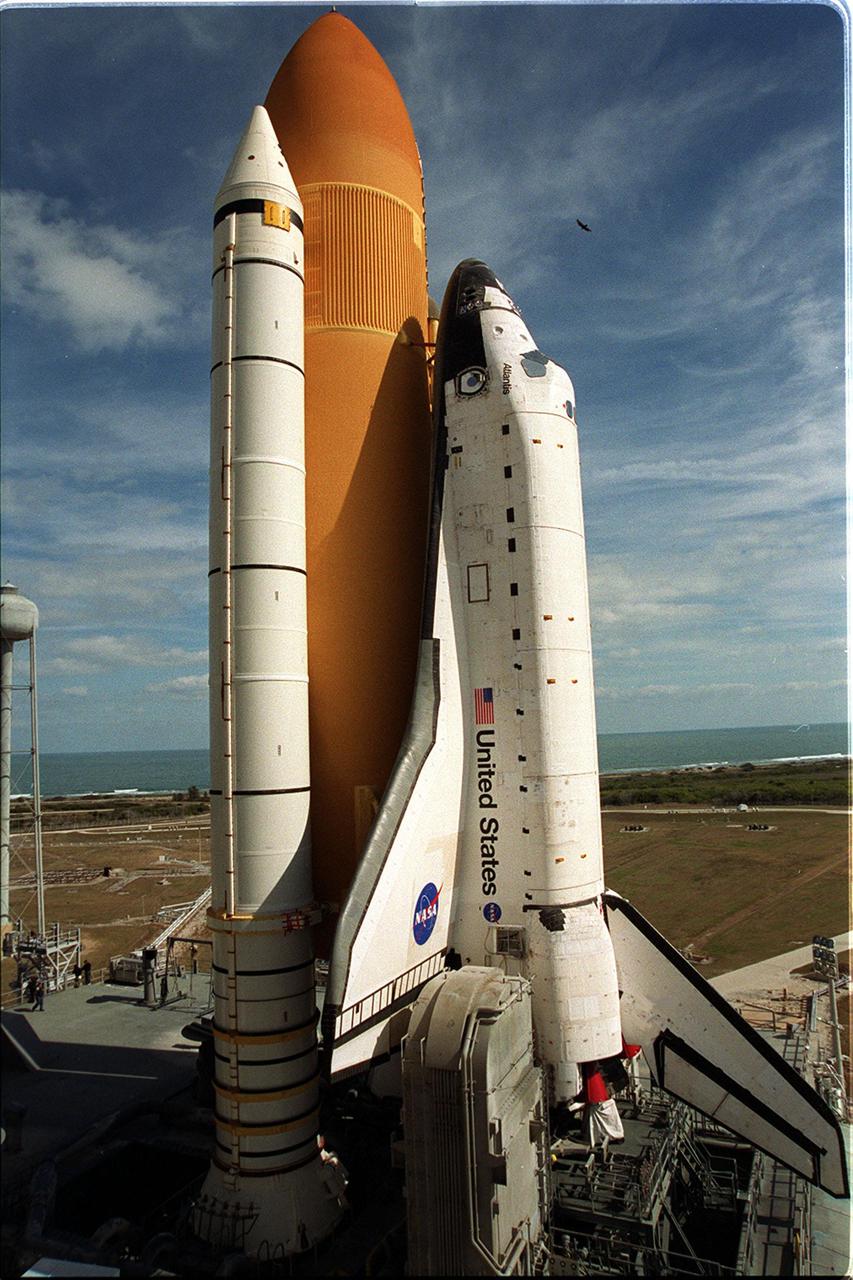
KENNEDY SPACE CENTER, Fla. -- The gate outside Launch Pad 39A heralds the STS-98 launch as Space Shuttle Atlantis makes its way to the pad. The Shuttle had returned to the Vehicle Assembly Building from the launch pad in order to undergo tests on the solid rocket booster cables. A prior extensive evaluation of NASA’s SRB cable inventory on the shelf revealed conductor damage in four (of about 200) cables. Shuttle managers decided to prove the integrity of the system tunnel cables already on Atlantis, causing return of the Shuttle to the VAB a week ago. The Shuttle will undergo preparations for a rescheduled launch Feb. 7 at 6:11 p.m. EST
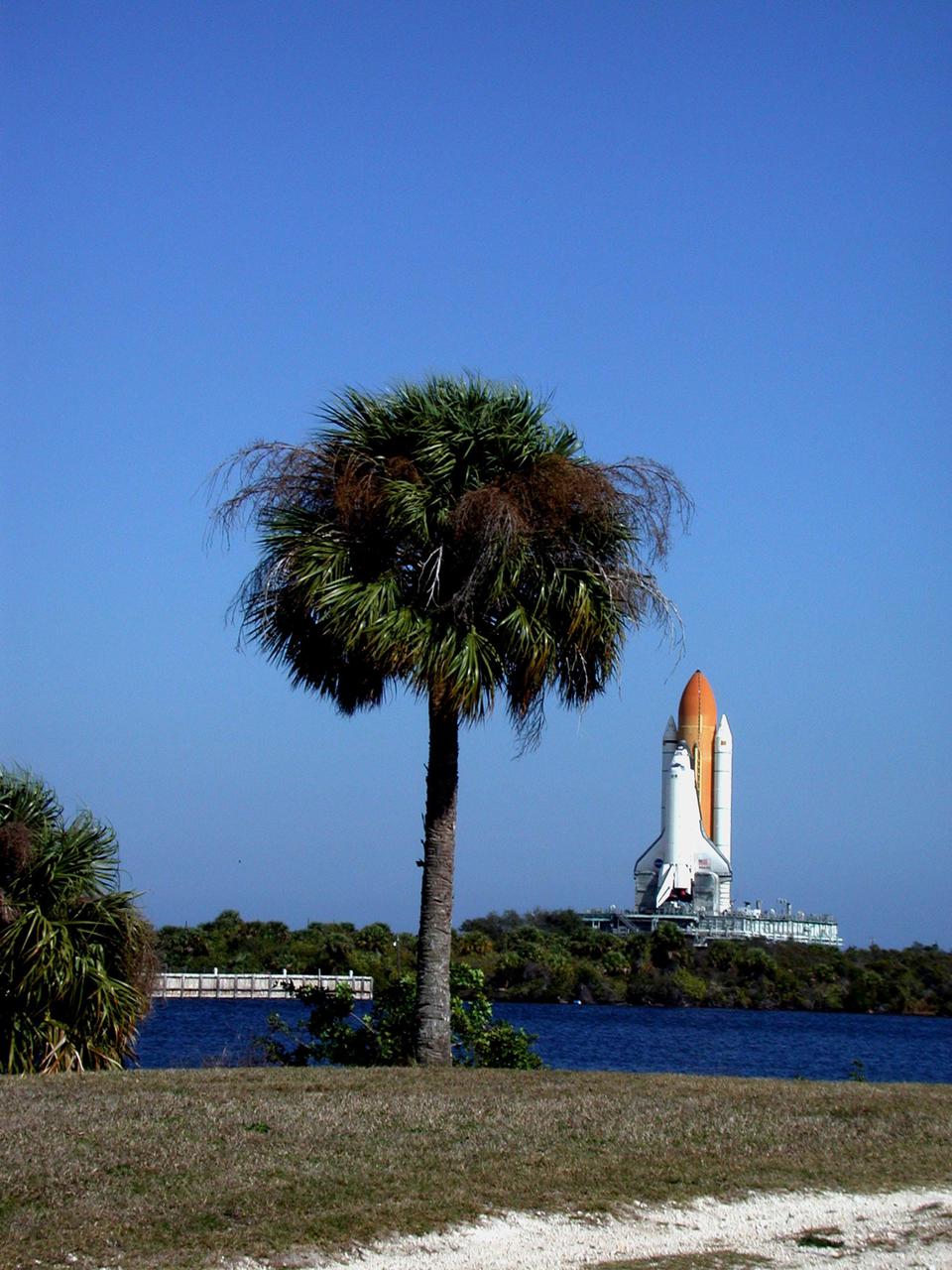
KENNEDY SPACE CENTER, FLA. -- Space Shuttle Atlantis joins blue skies and palm trees on the Florida landscape. Atlantis is rolling back from Launch Pad 39A to the Vehicle Assembly Building so that workers can conduct inspections, make continuity checks and conduct X-ray analysis on the 36 SRB cables located inside each booster’s system tunnel. An extensive evaluation of NASA’s SRB cable inventory revealed conductor damage in four (of about 200) cables on the shelf. Shuttle managers decided to prove the integrity of the system tunnel cables already on Atlantis before launching Jan. 19. The launch has been rescheduled no earlier than Feb. 6

The U.S. Lab Destiny begins moving out of Atlantis’ payload bay and into the Payload Changeout Room via the Payload Ground Handling Mechanism. Destiny will remain in the PCR while Atlantis rolls back to the Vehicle Assembly Building to allow workers to conduct inspections, continuity checks and X-ray analysis on the 36 solid rocket booster cables located inside each booster’s system tunnel. An extensive evaluation of NASA’s SRB cable inventory revealed conductor damage in four (of about 200) cables on the shelf. Shuttle managers decided to prove the integrity of the system tunnel cables already on Atlantis