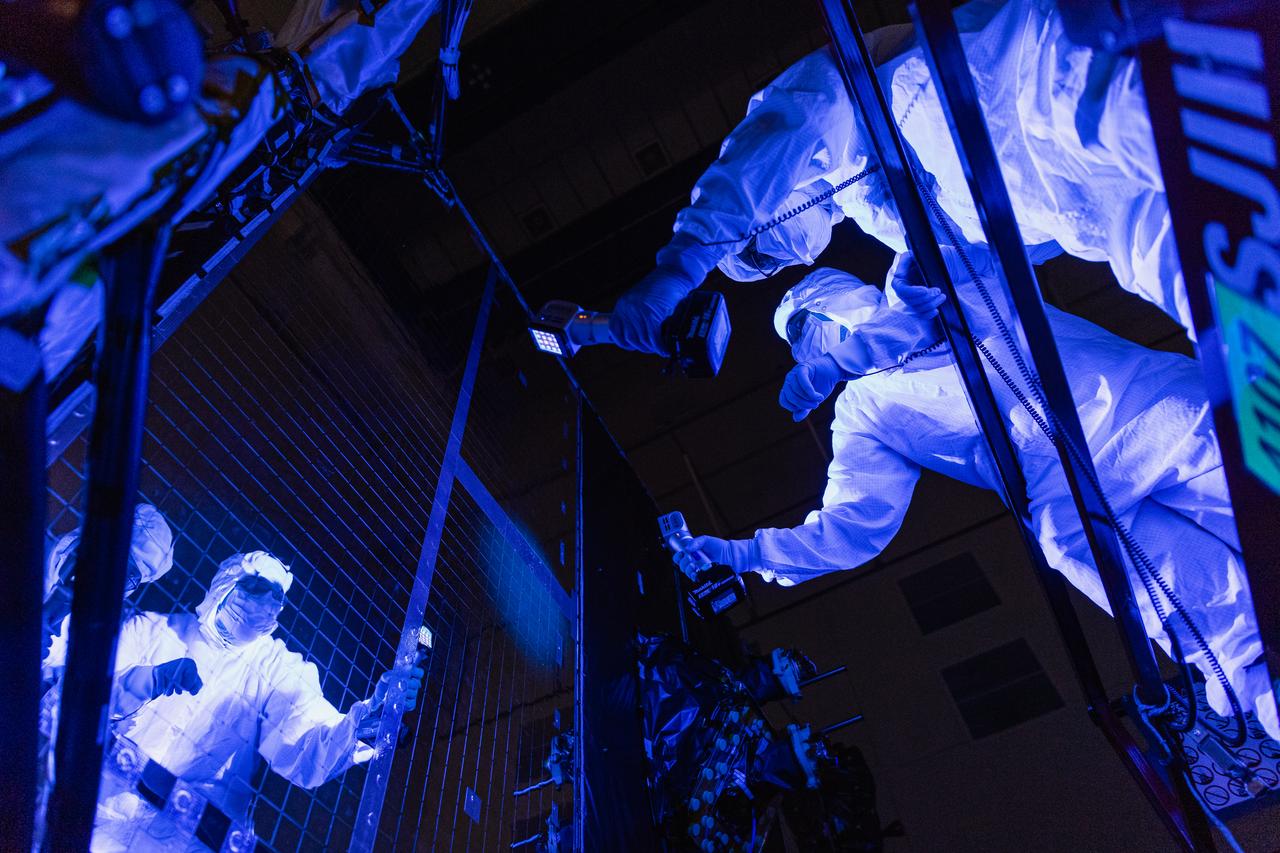
NASA Contamination control engineers perform a blacklight inspection on the OSAM-1 Spacecraft Bus at Goddard Space Flight Center, Greenbelt Md., Sept 30, 2023. This photo has been reviewed by OSAM1 project management, Maxar public release authority, and the Export Control Office and is released for public view. NASA/Mike Guinto
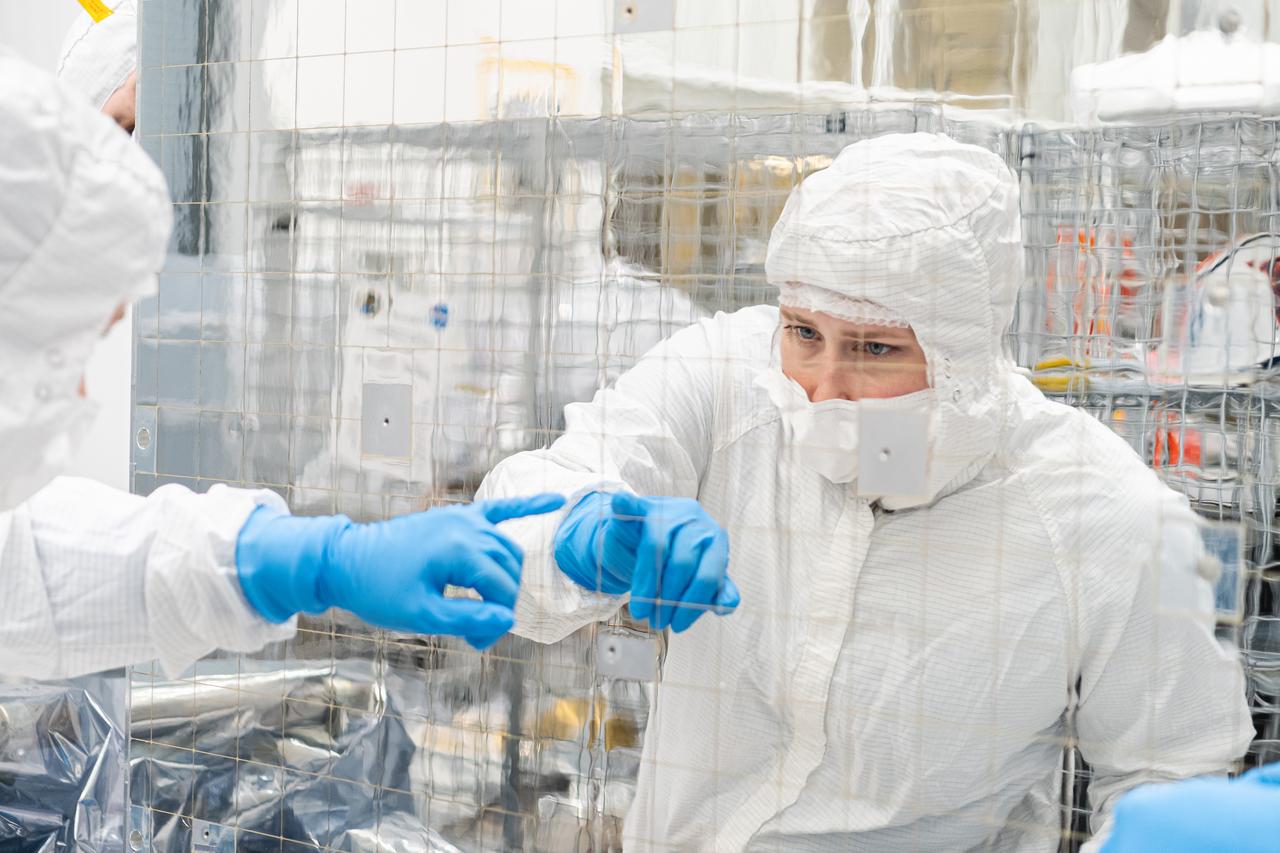
Contamination control technician Sydnie Heiman inspects one of OSAM-1's radiator panels inside the cleanroom at Goddard Space Flight Center, Greenbelt Md., July 10, 2023. This photo has been reviewed by OSAM1 project management and the Export Control Office and is released for public view. NASA/Mike Guinto
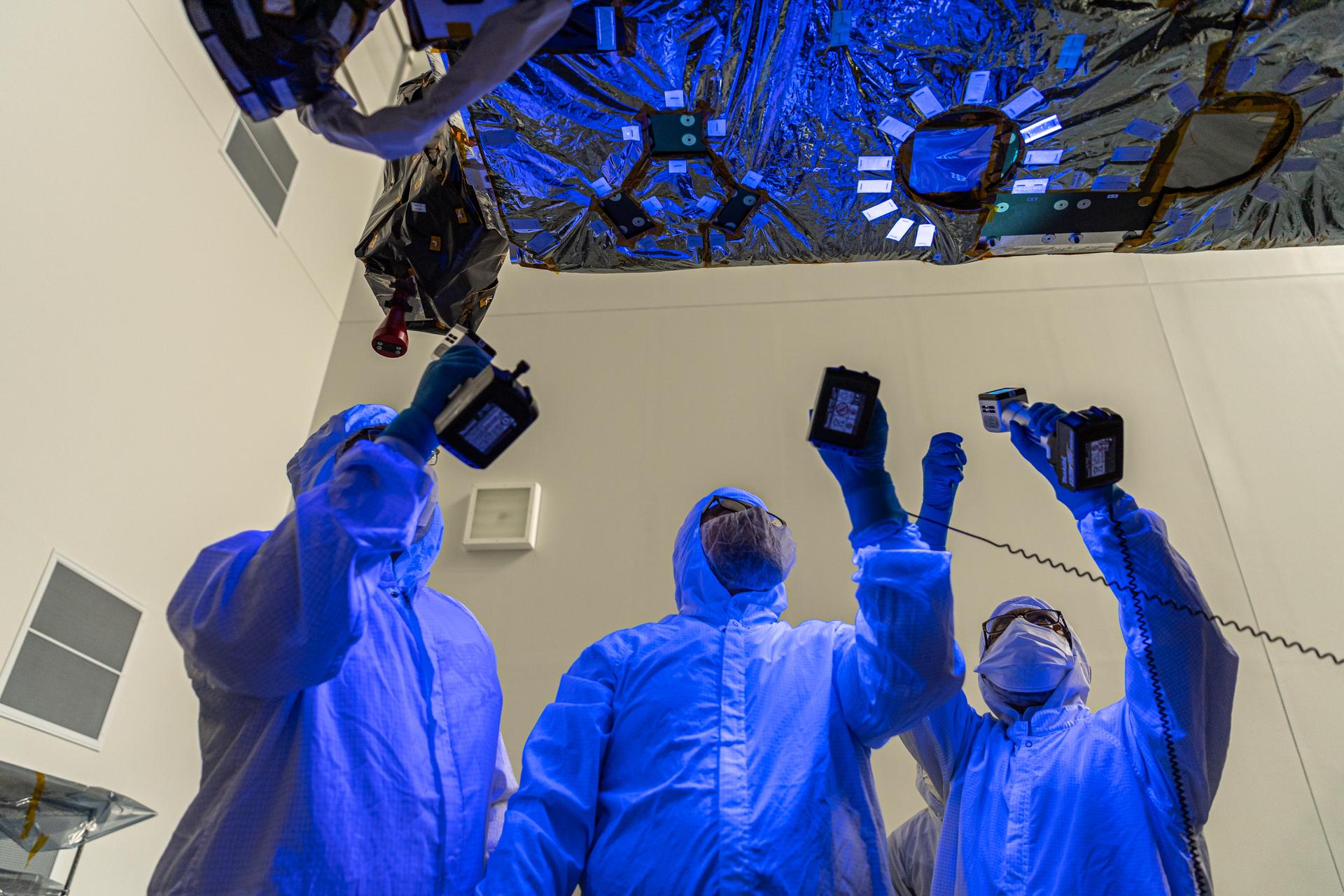
NASA Contamination and control engineers perform a blacklight inspection on the OSAM-1 Spacecraft Bus at Goddard Space Flight Center, Greenbelt Md., Sept 30, 2023. This photo has been reviewed by OSAM1 project management, Maxar public release authority, and the Export Control Office and is released for public view. NASA/Mike Guinto
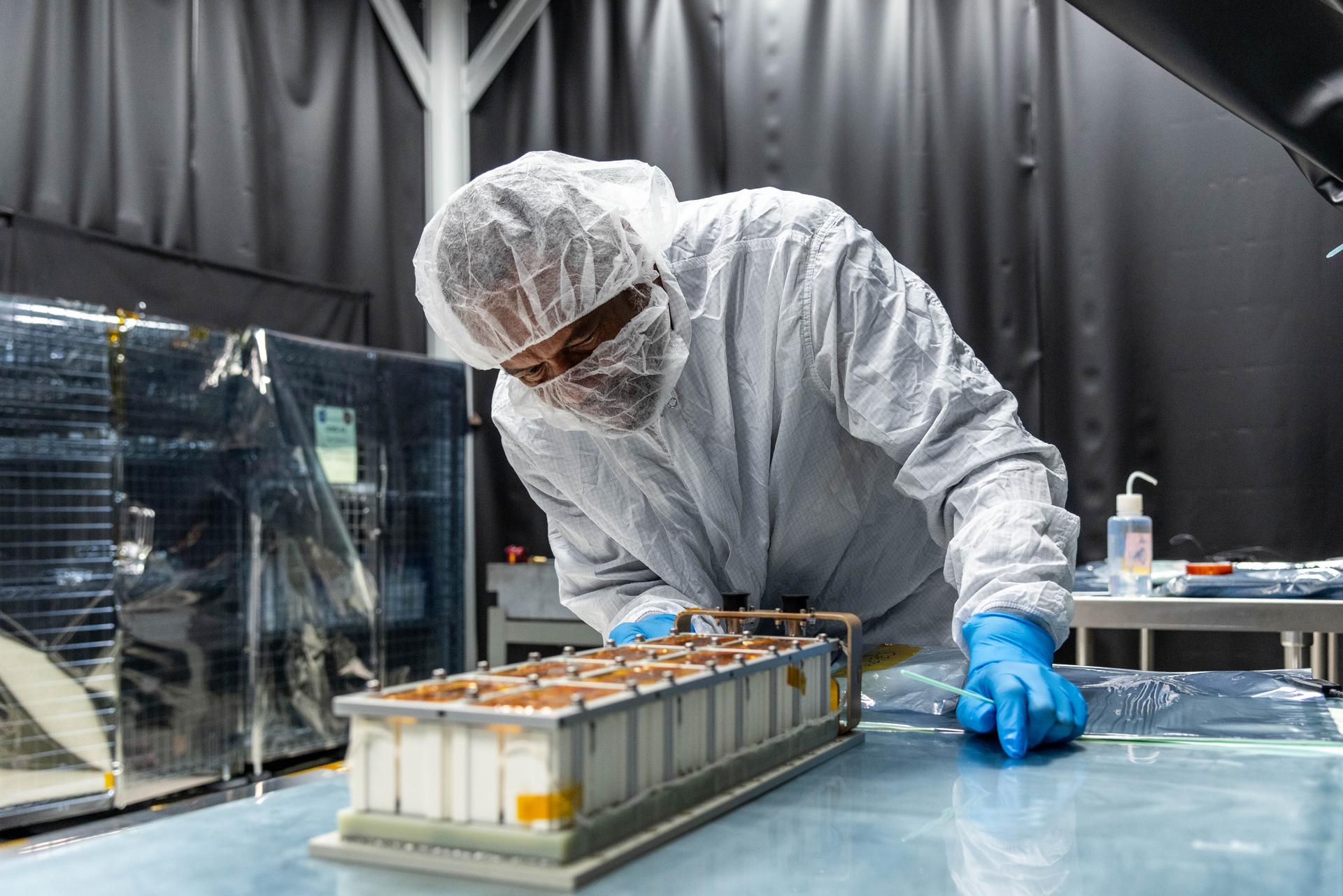
Contamination Control Technician, Rudy Foxwell, inspects the Lunar Environment Monitoring Station (LEMS) Flight Battery in a clean tent at NASA's Goddard Space Flight Center in Greenbelt, Maryland on October 14th, 2026. NASA/Katie Mellos.
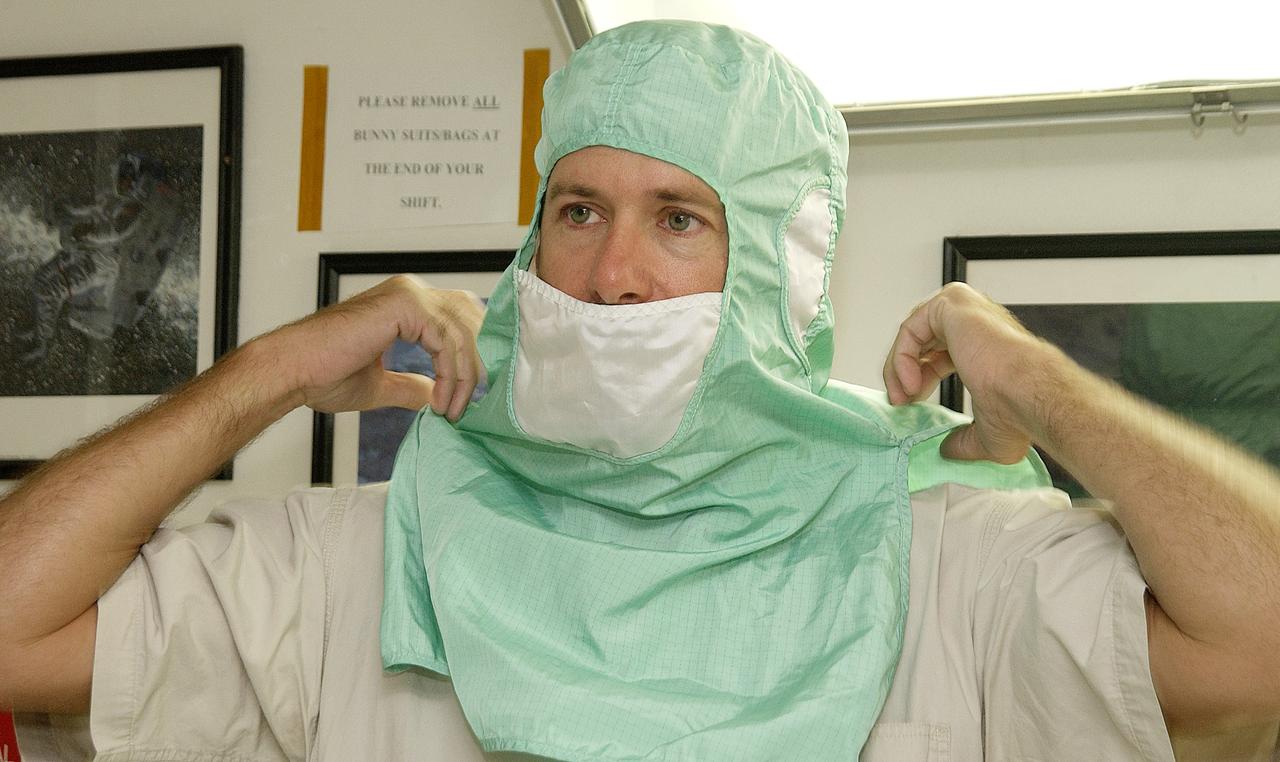
KENNEDY SPACE CENTER, FLA. - A KSC employee dons the head and face cover of a "bunny suit," part of standard clean room apparel, before entering a clean room. This apparel is designed to cover the hair, clothing and shoes of employees to prevent particulate matter from contaminating the space flight hardware being stored or processed in the clean room and is one aspect of KSC's Foreign Object Debris (FOD) control program, an important safety initiative.
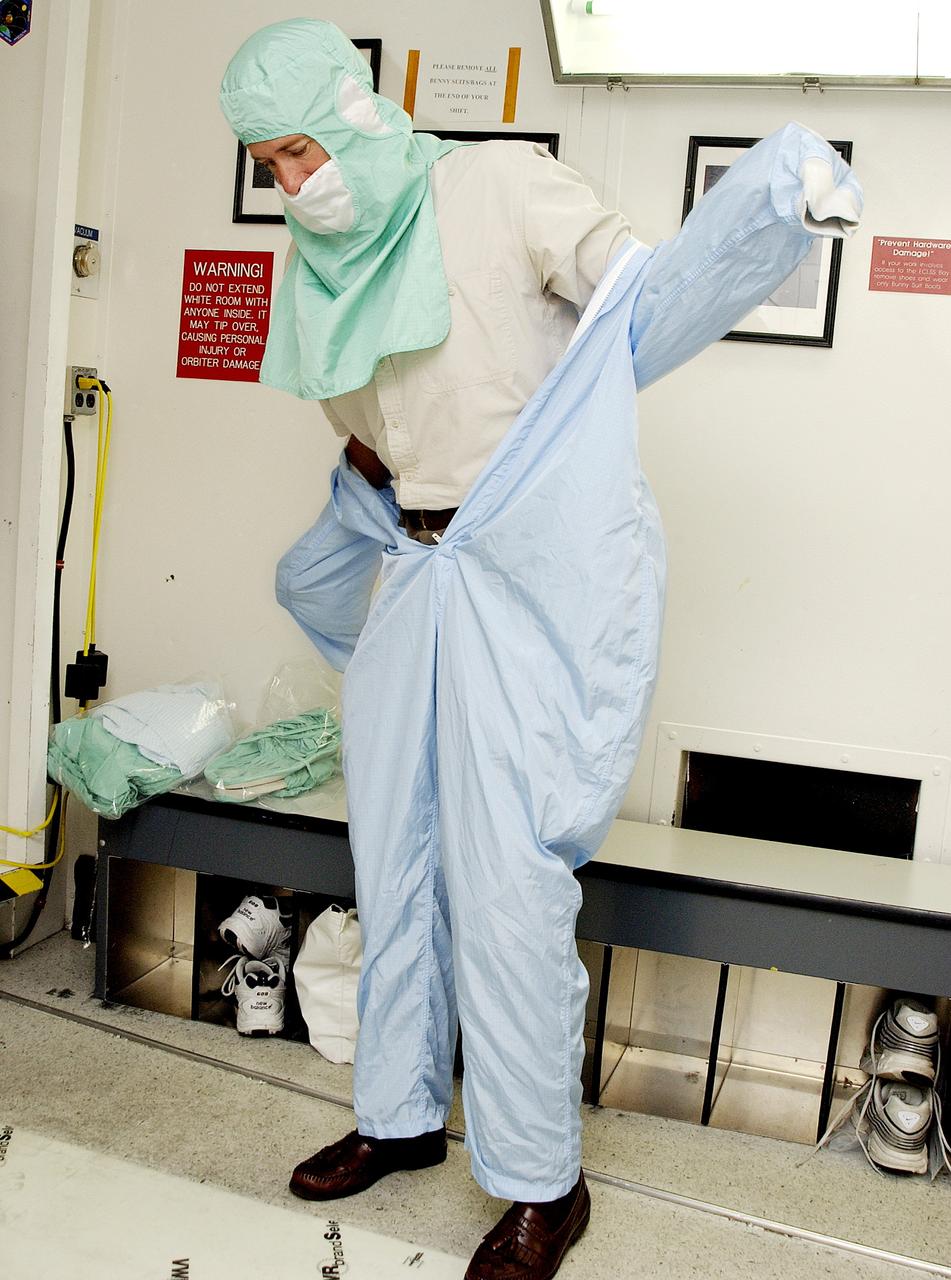
KENNEDY SPACE CENTER, FLA. - A KSC employee dons the coverall of a "bunny suit," part of standard clean room apparel, before entering a clean room. The apparel is designed to cover the hair, clothing and shoes of employees to prevent particulate matter from contaminating the space flight hardware being stored or processed in the clean room and is one aspect of KSC's Foreign Object Debris (FOD) control program, an important safety initiative.
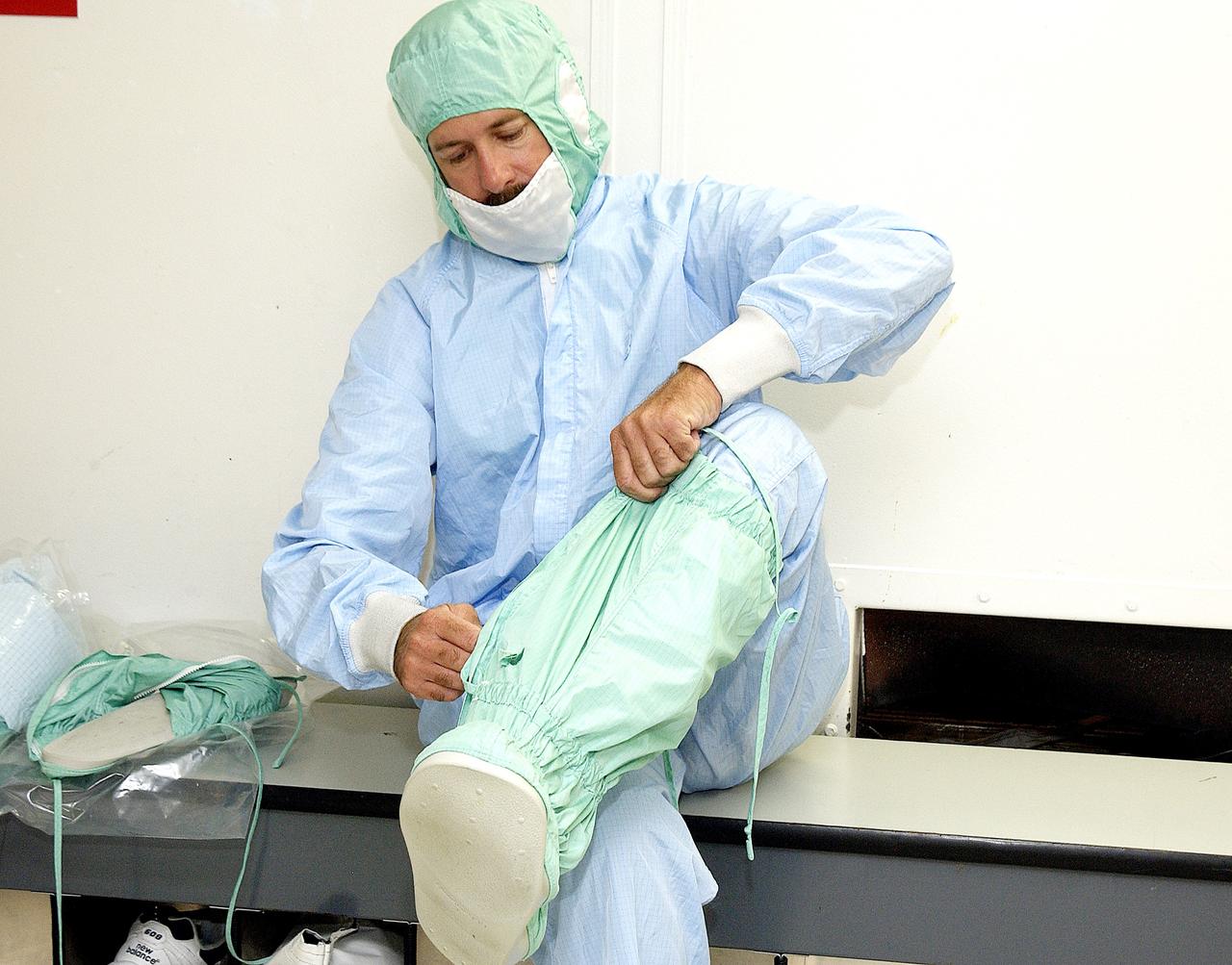
KENNEDY SPACE CENTER, FLA. - A KSC employee dons the foot and leg covers of a "bunny suit," part of standard clean room apparel, before entering a clean room. The apparel is designed to cover the hair, clothing and shoes of employees to prevent particulate matter from contaminating the space flight hardware being stored or processed in the clean room and is one aspect of KSC's Foreign Object Debris (FOD) control program, an important safety initiative.
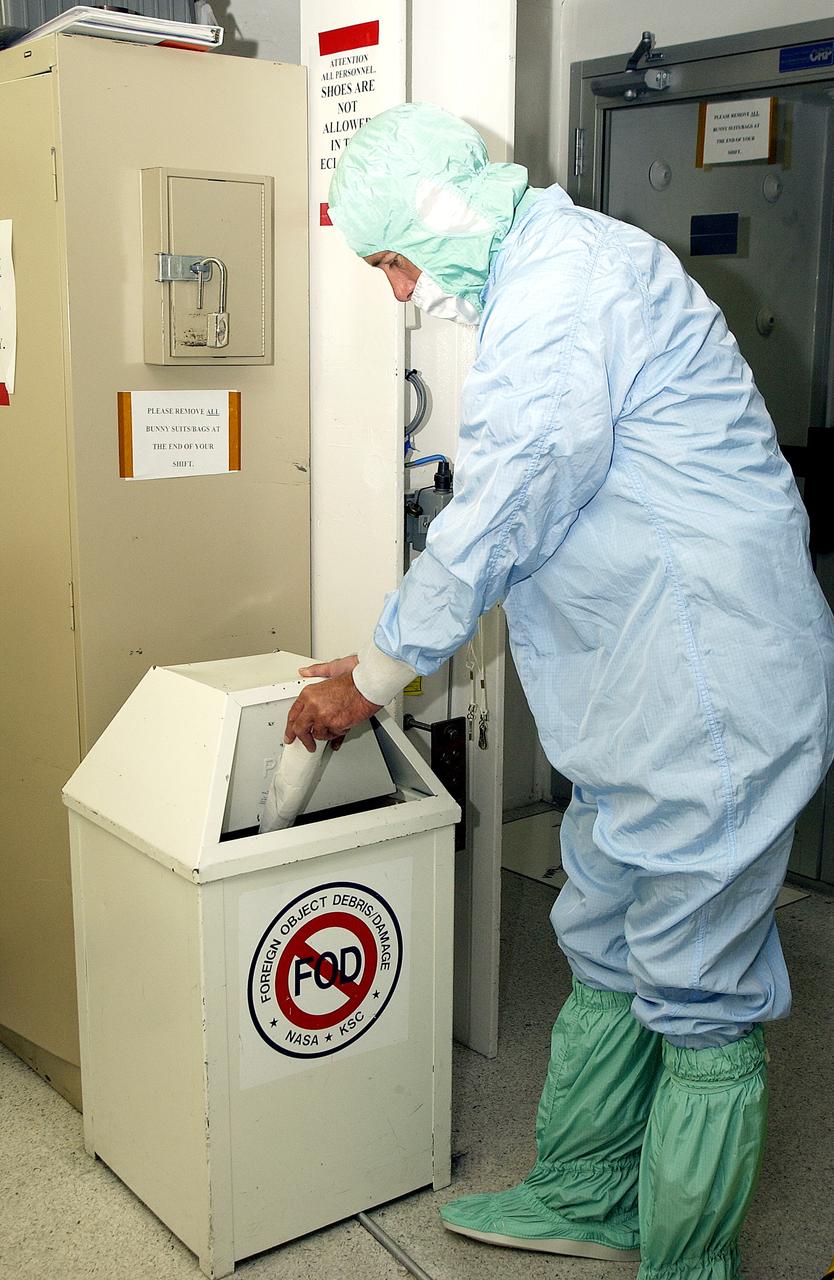
KENNEDY SPACE CENTER, FLA. - A KSC employee dressed in a "bunny suit," standard clean room apparel, disposes of some waste material into a container designated for the purpose. The apparel is designed to cover the hair, clothing and shoes of employees entering a clean room to prevent particulate matter from contaminating the space flight hardware being stored or processed in the room. The suit and container are both part of KSC's Foreign Object Debris (FOD) control program, an important safety initiative.
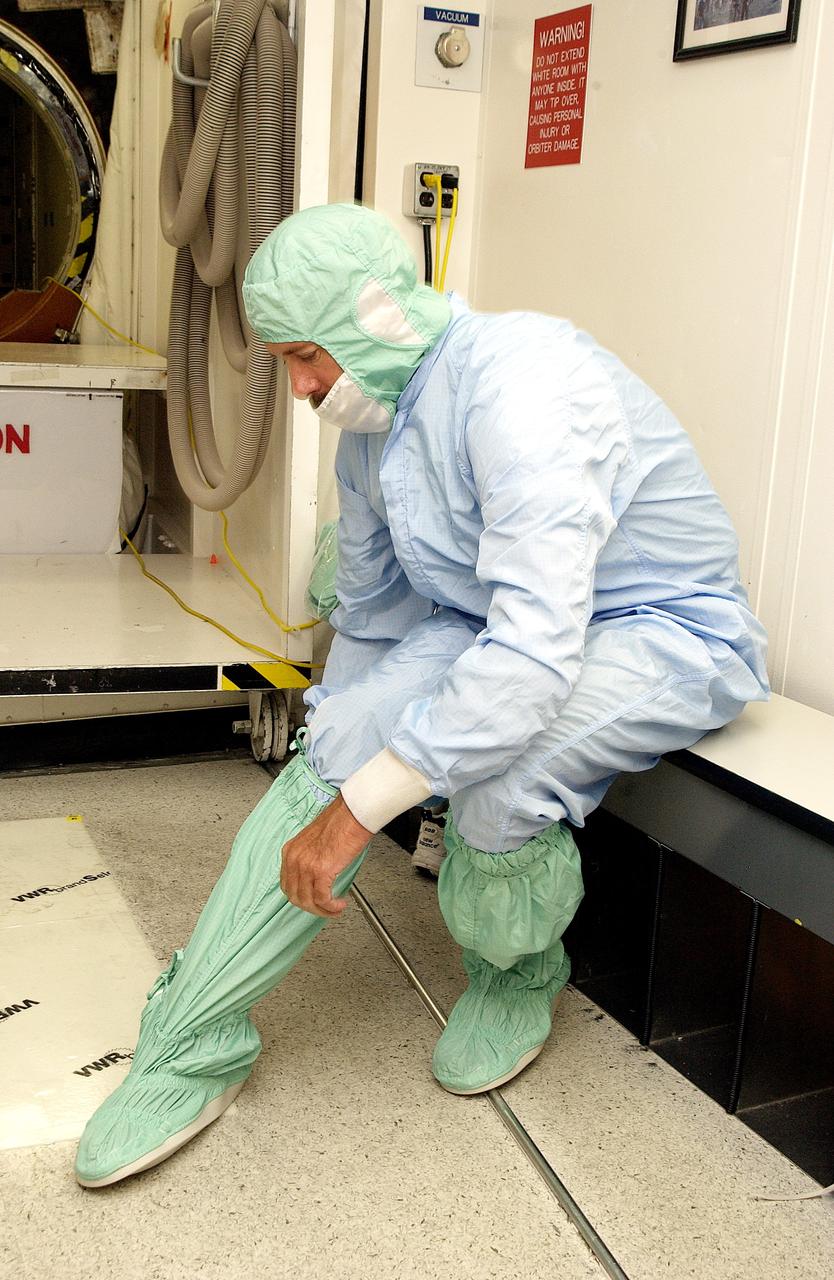
KENNEDY SPACE CENTER, FLA. - A KSC employee secures a foot and leg cover of his "bunny suit," part of standard clean room apparel, before entering a clean room. The apparel is designed to cover the hair, clothing and shoes of employees to prevent particulate matter from contaminating the space flight hardware being stored or processed in the clean room and is one aspect of KSC's Foreign Object Debris (FOD) control program, an important safety initiative.
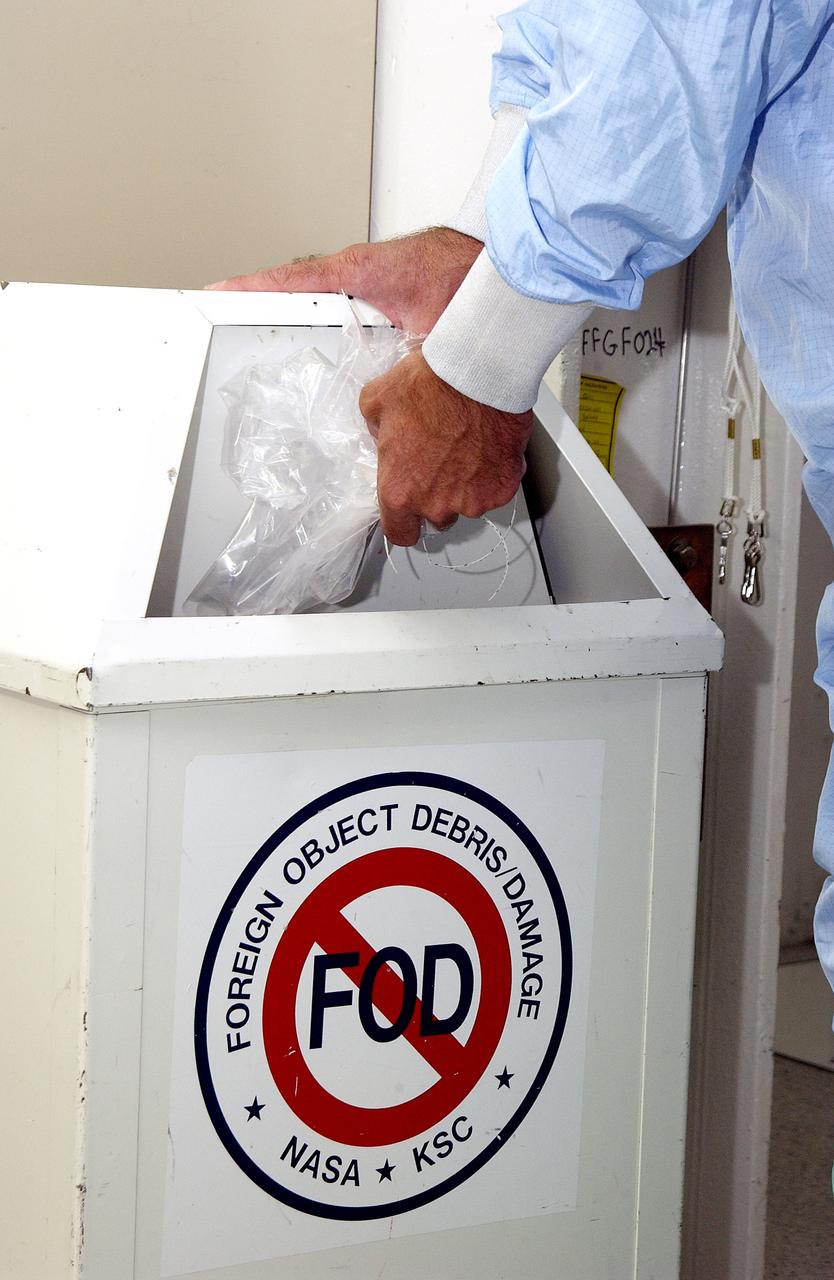
KENNEDY SPACE CENTER, FLA. - A KSC employee dressed in a "bunny suit," standard clean room apparel, disposes of some waste material into a container designated for the purpose. The apparel is designed to cover the hair, clothing and shoes of employees entering a clean room to prevent particulate matter from contaminating the space flight hardware being stored or processed in the room. The suit and container are both part of KSC's Foreign Object Debris (FOD) control program, an important safety initiative.
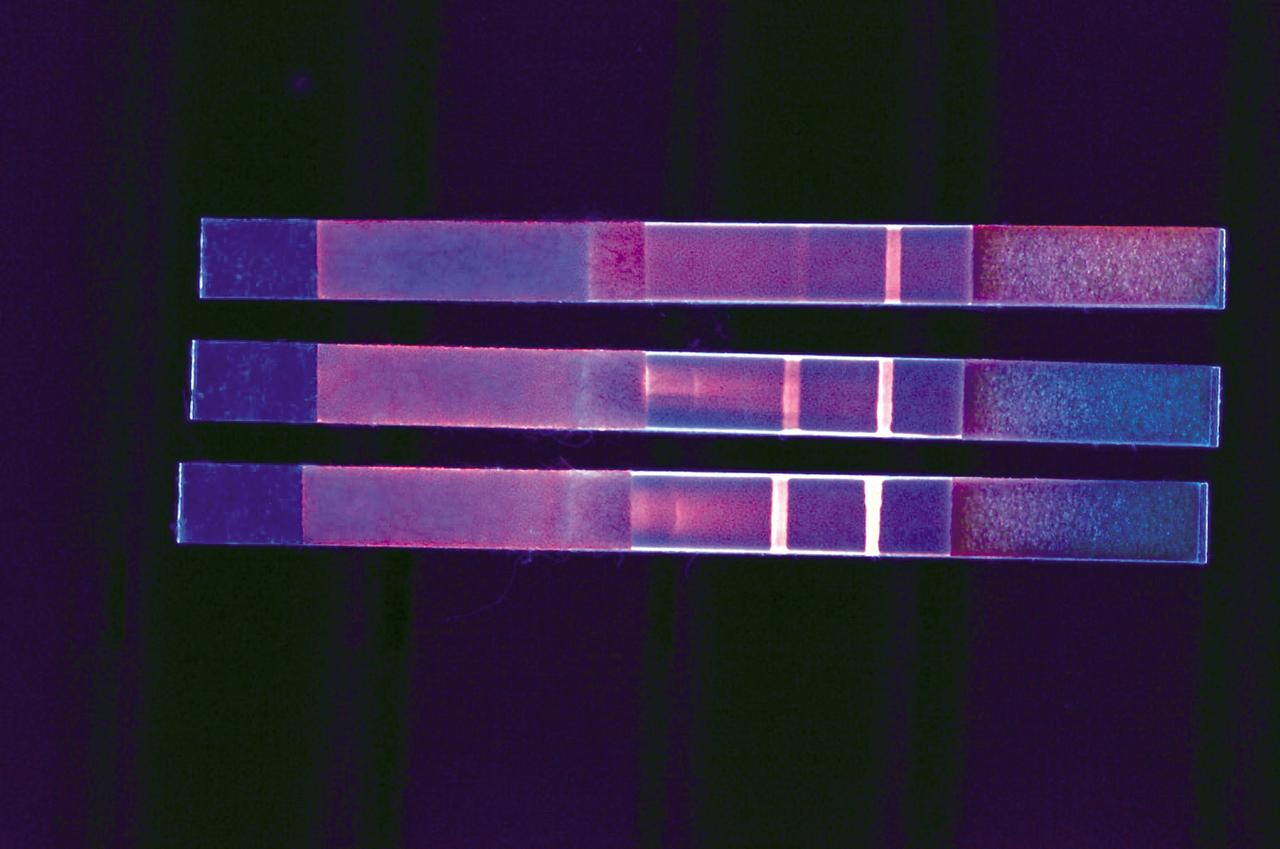
As easy to read as a home pregnancy test, three Quantifiable Lateral Flow Assay (QLFA) strips used to test water for E. coli show different results. The brightly glowing control line on the far right of each strip indicates that all three tests ran successfully. But the glowing test line on the middle left and bottom strips reveal their samples were contaminated with E. coli bacteria at two different concentrations. The color intensity correlates with concentration of contamination.
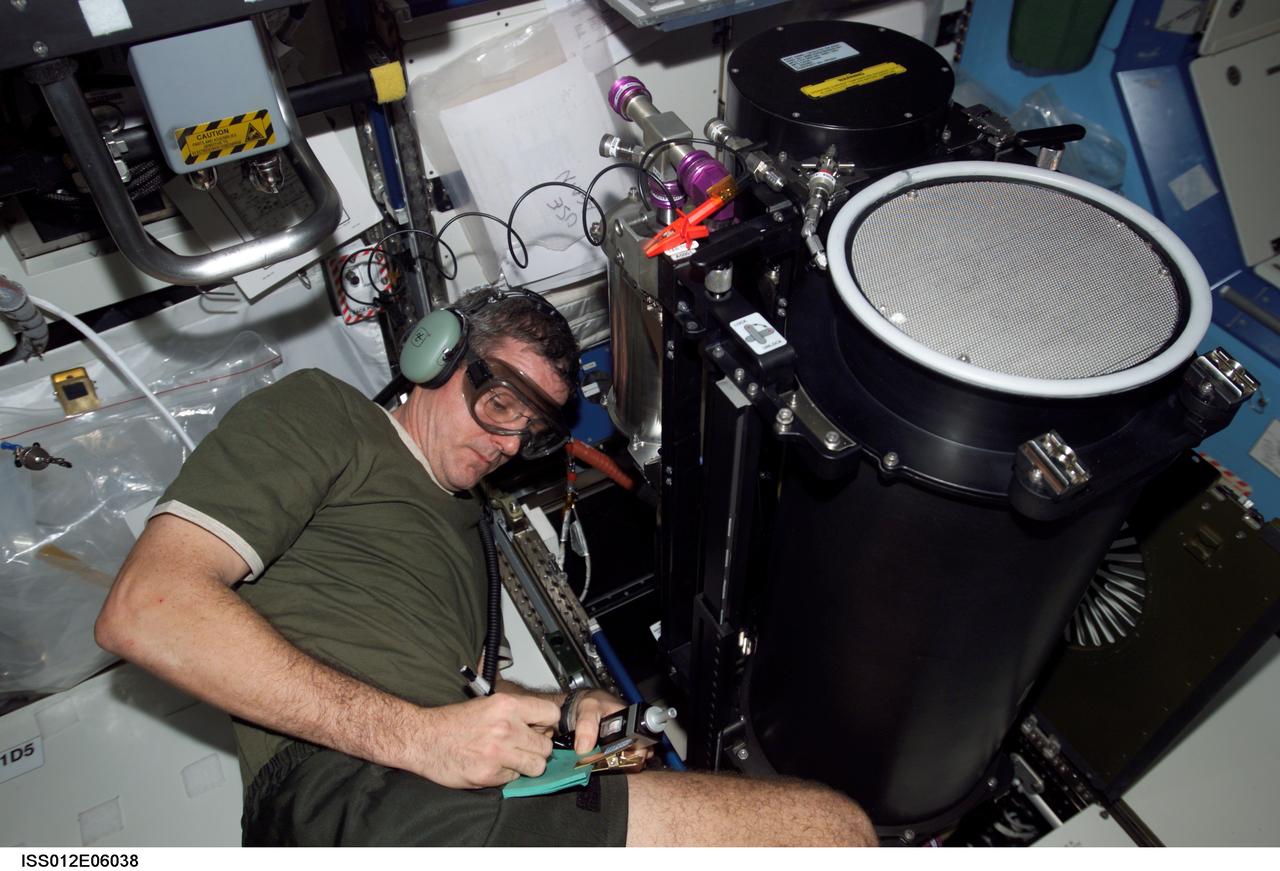
ISS012-E-06038 (31 October 2005) --- Astronaut William S. McArthur Jr., Expedition 12 commander and NASA science officer, conducts troubleshooting operations on the Trace Contaminant Control Subassembly (TCCS) in the Destiny laboratory of the international space station.
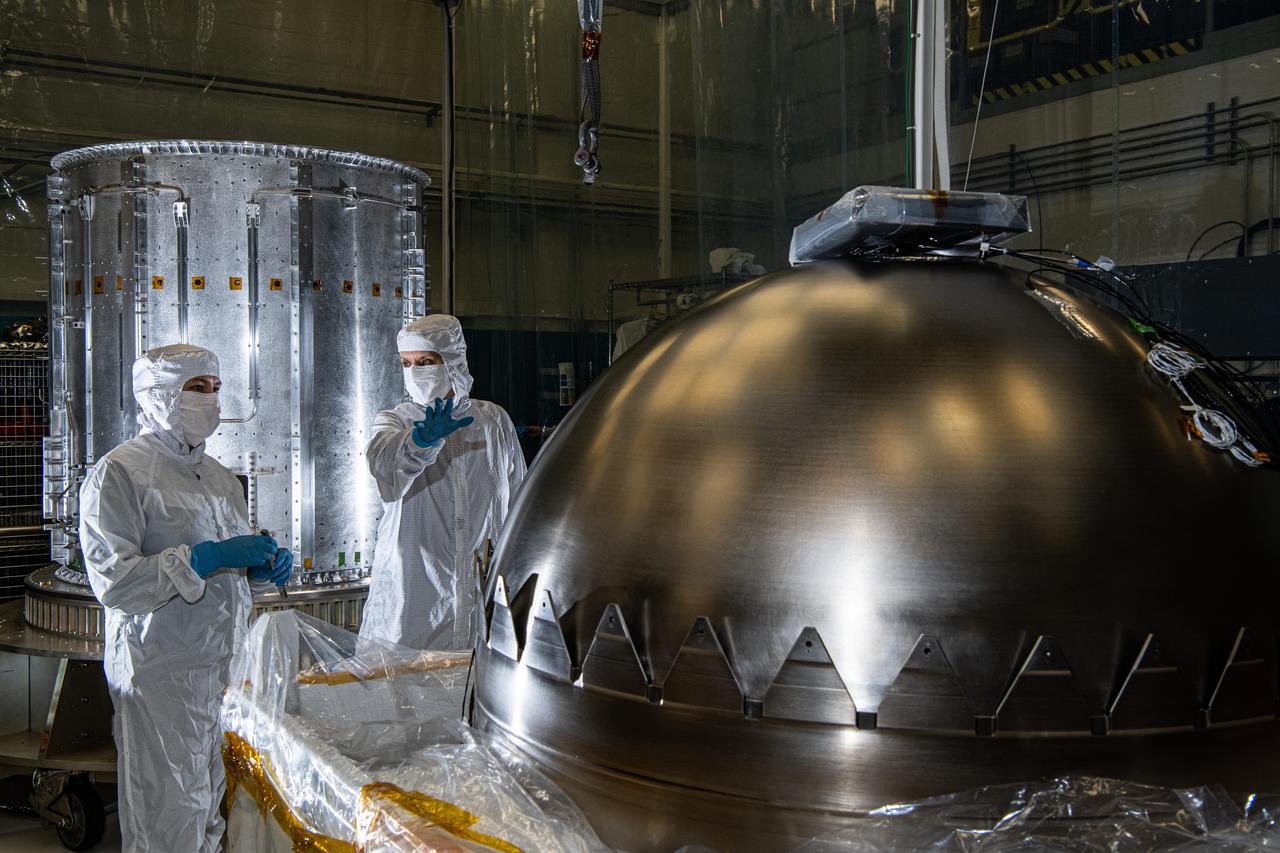
Contamination control engineers in a clean room at NASA's Goddard Space Flight Center in Greenbelt, Maryland, evaluate a propellant tank before it is installed in NASA's Europa Clipper spacecraft. The tank is one of two that will be used to hold the spacecraft's propellant. It will be inserted into the cylinder seen at left in the background, one of two cylinders that make up the propulsion module. With an internal global ocean under a thick layer of ice, Jupiter's moon Europa may have the potential to harbor existing life. Europa Clipper will swoop around Jupiter on an elliptical path, dipping close to the moon on each flyby to collect data. Understanding Europa's habitability will help scientists better understand how life developed on Earth and the potential for finding life beyond our planet. Europa Clipper is set to launch in 2024. https://photojournal.jpl.nasa.gov/catalog/PIA24478

S73-37251 (23 November 1973) --- Astronaut Bruce McCandless II, left, shows off a mock-up of the occulting disc for the T025 Coronagraph Contamination Measurement Engineering and Technology Experiment to be used by the crewmen of the third manned Skylab mission (Skylab 4), now into their eighth day in Earth orbit. On the right is flight director Neil B. Hutchinson. The men are in the Mission Operations Control Room (MOCR) of the Mission Control Center (MCC) at Johnson Space Center. Photo credit: NASA
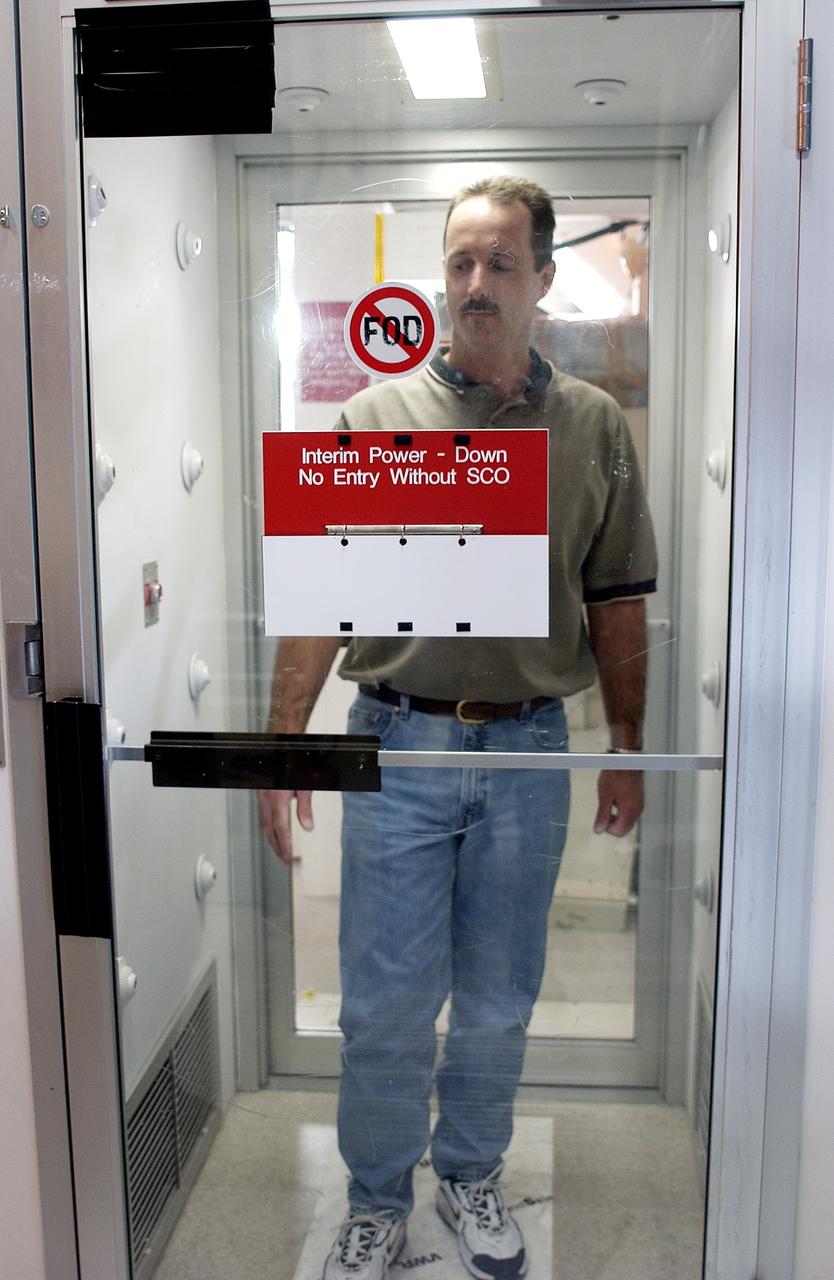
KENNEDY SPACE CENTER, FLA. - A KSC employee uses a clean-air shower before entering a clean room. Streams of pressurized air directed at the occupant from nozzles in the chamber's ceiling and walls are designed to dislodge particulate matter from hair, clothing and shoes. The adhesive mat on the floor captures soil from shoe soles, as well as particles that fall on its surface. Particulate matter has the potential to contaminate the space flight hardware being stored or processed in the clean room. The shower is part of KSC's Foreign Object Debris (FOD) control program, an important safety initiative.
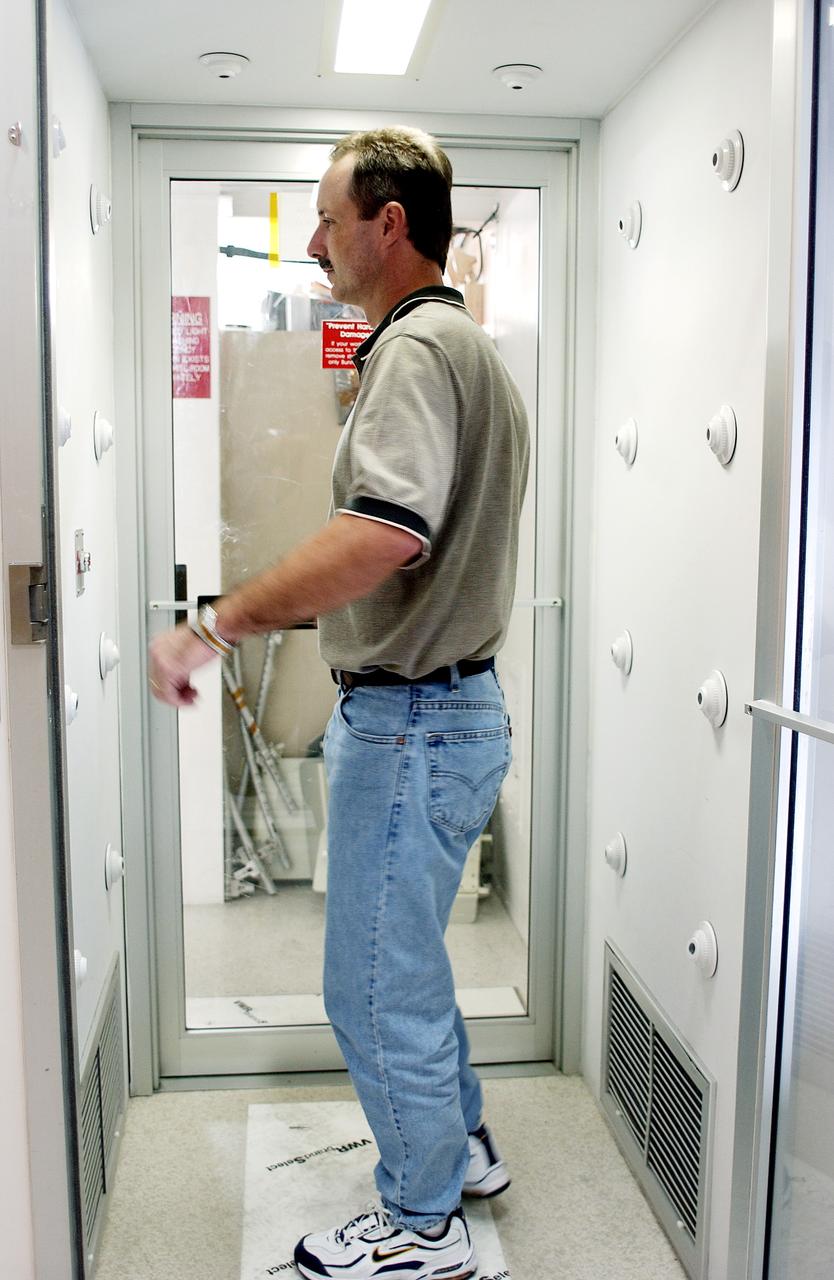
KENNEDY SPACE CENTER, FLA. - A KSC employee uses a clean-air shower before entering a clean room. Streams of pressurized air directed at the occupant from nozzles in the chamber's ceiling and walls are designed to dislodge particulate matter from hair, clothing and shoes. The adhesive mat on the floor captures soil from shoe soles, as well as particles that fall on its surface. Particulate matter has the potential to contaminate the space flight hardware being stored or processed in the clean room. The shower is part of KSC's Foreign Object Debris (FOD) control program, an important safety initiative.
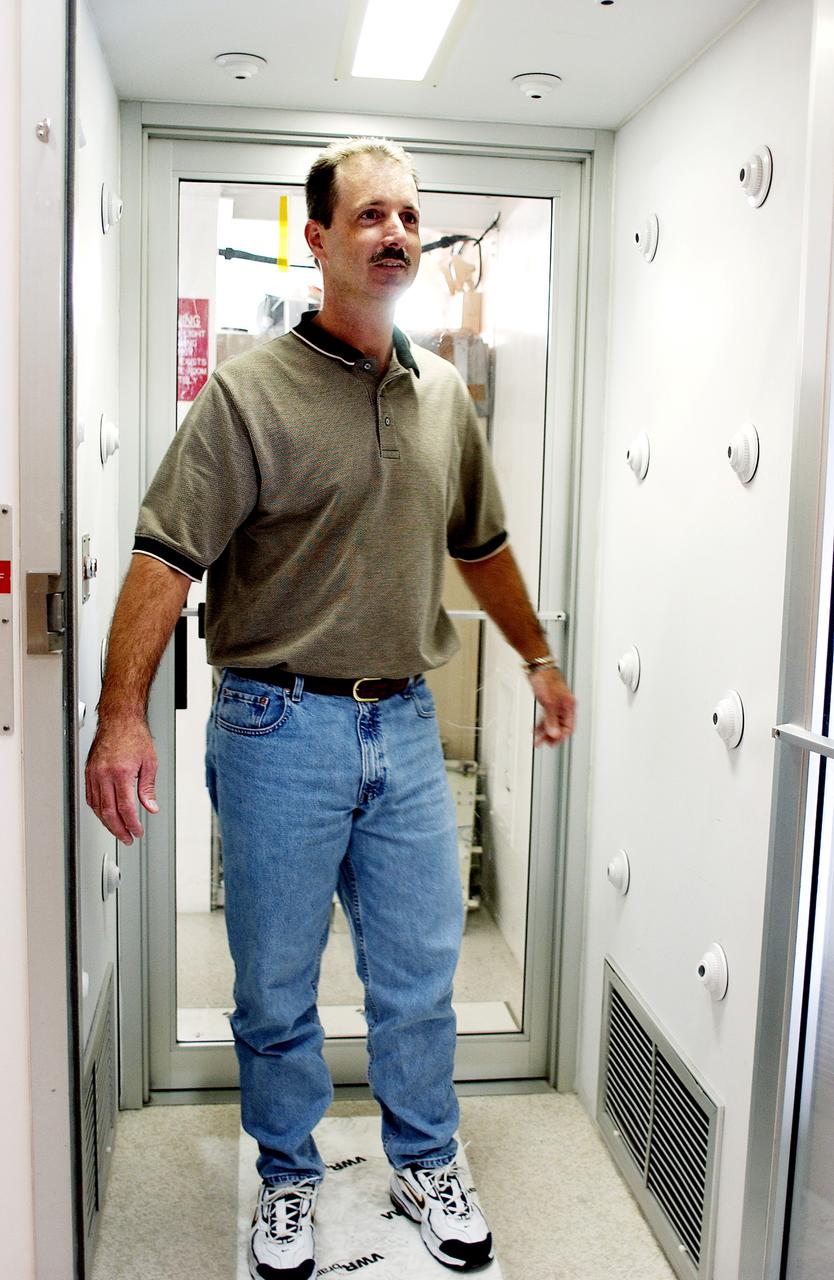
KENNEDY SPACE CENTER, FLA. - A KSC employee uses a clean-air shower before entering a clean room. Streams of pressurized air directed at the occupant from nozzles in the chamber's ceiling and walls are designed to dislodge particulate matter from hair, clothing and shoes. The adhesive mat on the floor captures soil from shoe soles, as well as particles that fall on its surface. Particulate matter has the potential to contaminate the space flight hardware being stored or processed in the clean room. The shower is part of KSC's Foreign Object Debris (FOD) control program, an important safety initiative.
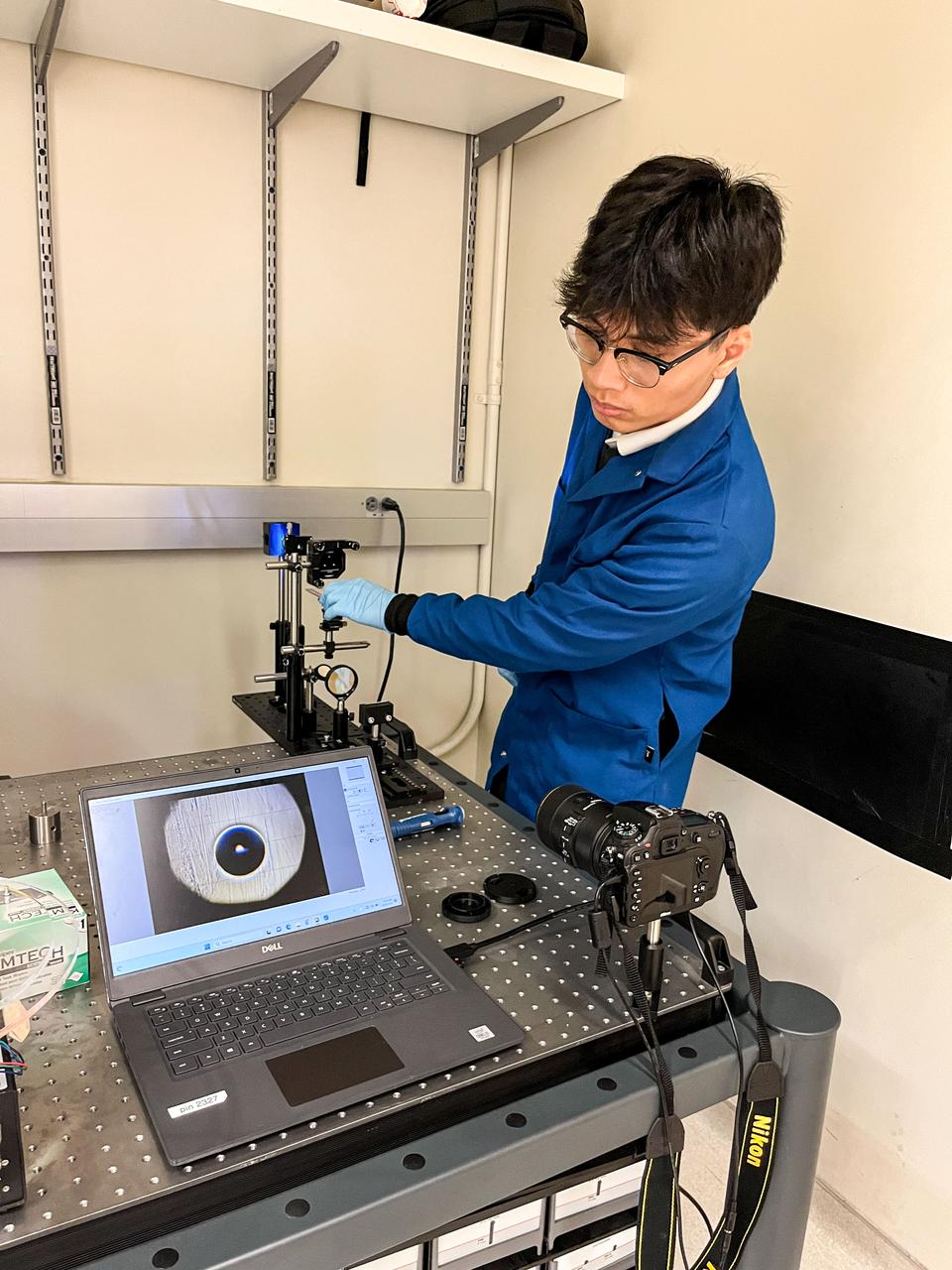
jsc2023e055884 (9/26/2023) --- Trinh Huynh uses a quantitative Schlieren system to measure the deformation of the mucus-like gel around a liquid drop. The Gaucho Lung investigation will study fluid transport within gel-coated tubes to learn more about treatment programs for respiratory distress syndrome and develop new contamination control strategies. Image courtesy of University of California, Santa Barbara.
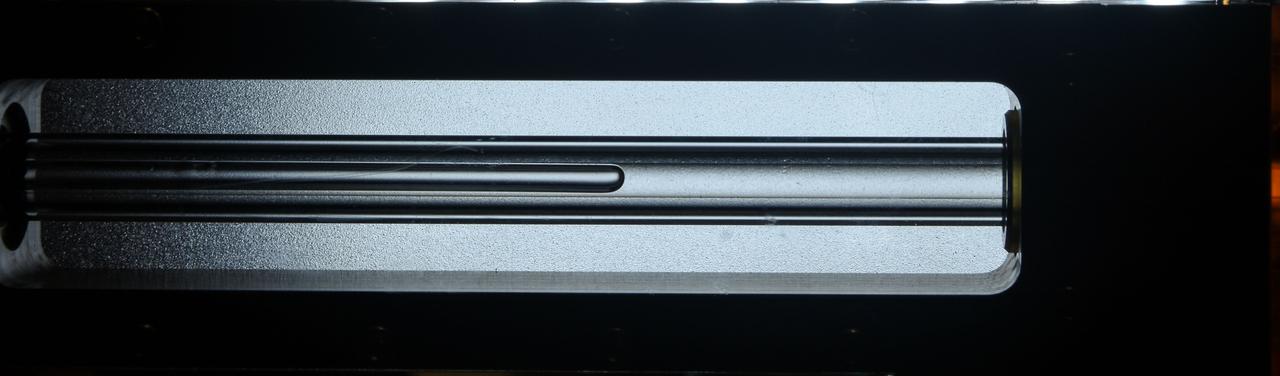
jsc2023e055883 (10/5/2023) --- Oil is pushed back into the reservoir by a jet of air during the reset phase of the investigation. As the oil moves back into the reservoir, it leaves behind a thin liquid film. The Gaucho Lung investigation will study fluid transport within gel-coated tubes to learn more about treatment programs for respiratory distress syndrome and develop new contamination control strategies. Image courtesy of University of California, Santa Barbara.
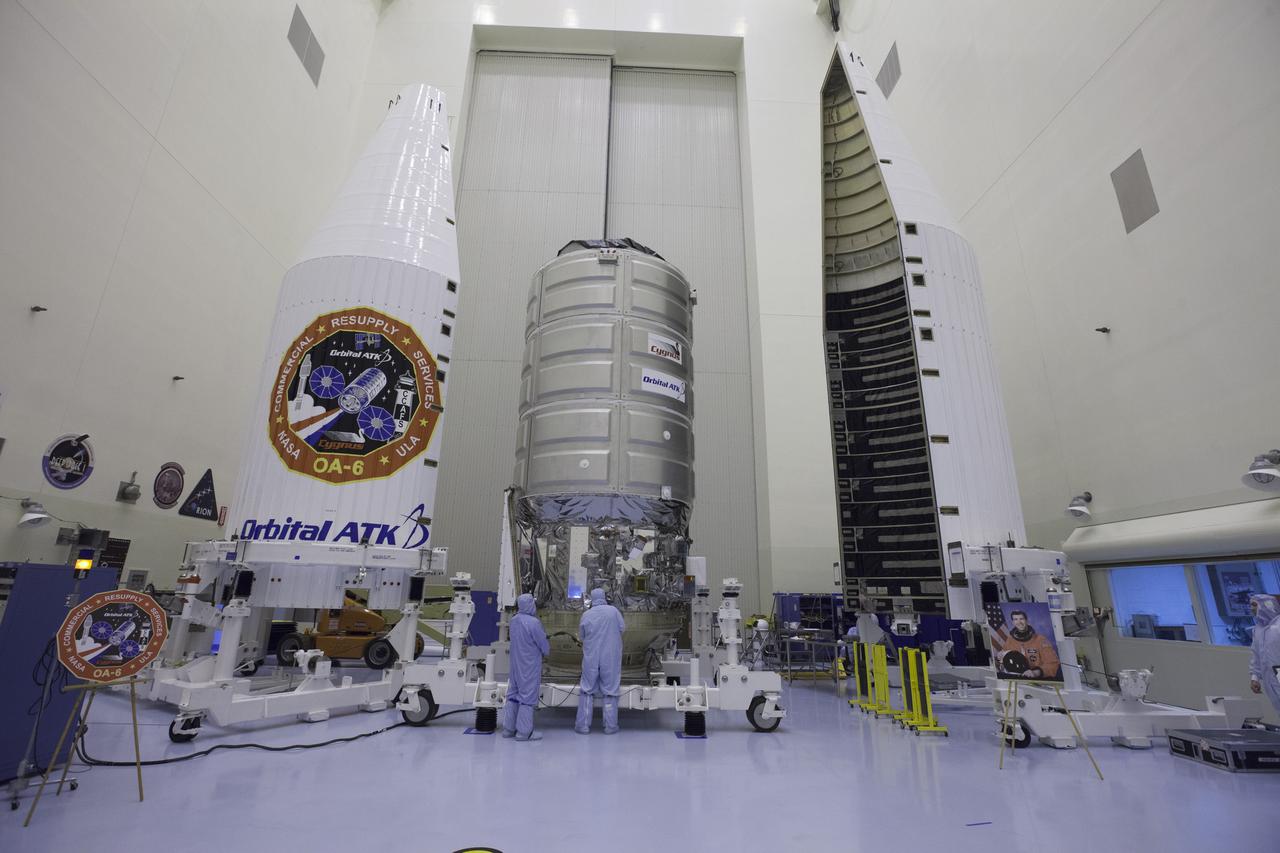
Inside the Payload Hazardous Servicing Facility at NASA's Kennedy Space Center in Florida, a Cygnus cargo spacecraft is being prepared for the upcoming Orbital ATK Commercial Resupply Services-6 mission to deliver hardware and supplies to the International Space Station. Technicians and engineers are clad in "bunny suits." The cleanroom garments are worn to prevent contamination in the controlled environment. The Cygnus is scheduled to lift off atop a United Launch Alliance Atlas V rocket on March 22.
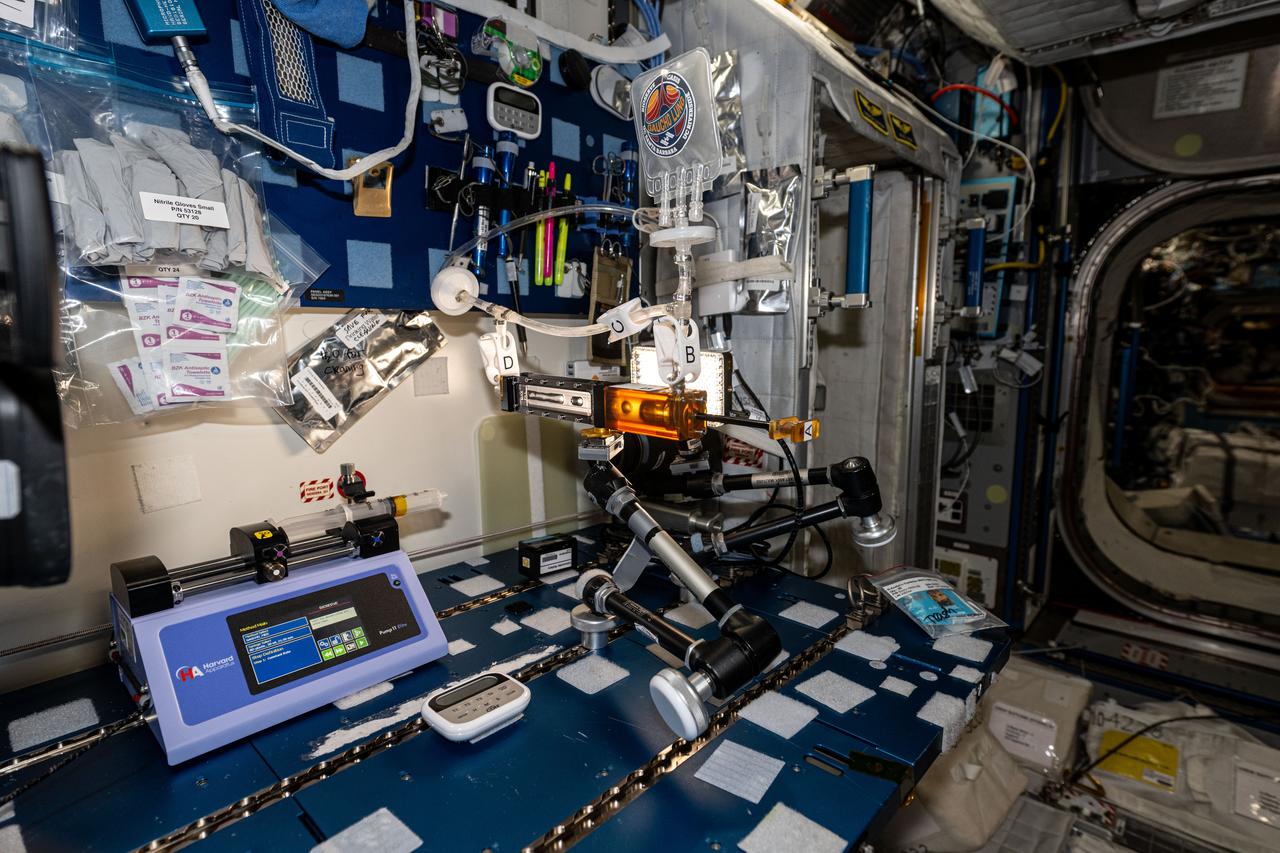
iss071e092797 (5/20/2024) --- A view of the Gaucho Lung investigation hardware aboard the International space station (ISS). The Wicking in Gel-Coated Tubes (Gaucho Lung) investigation studies fluid transport within gel-coated tubes to learn more about treatment programs for respiratory distress syndrome and develop new contamination control strategies.
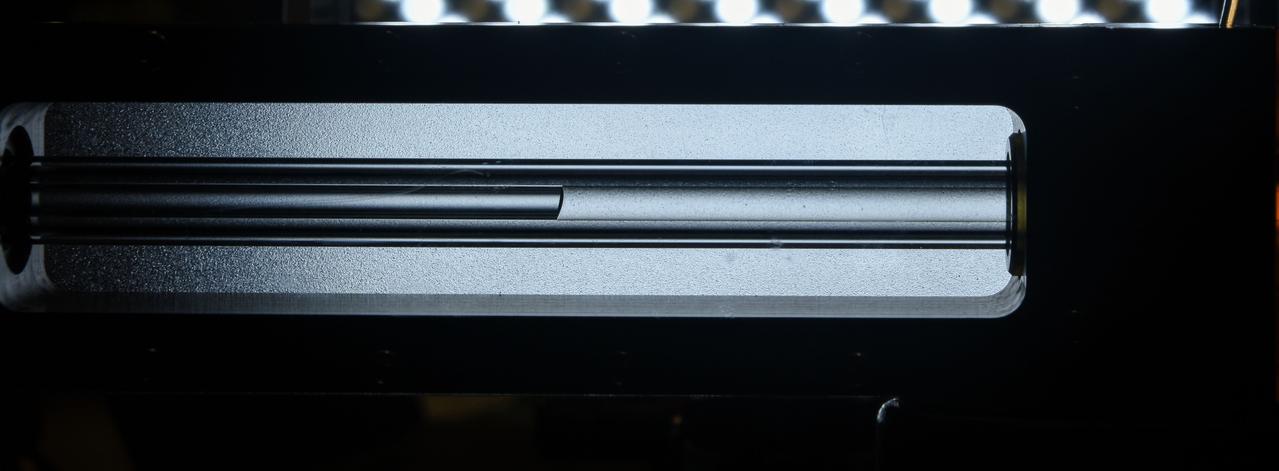
jsc2023e055882 10/5/2023) --- Oil flows into a glass tube during the imbibition phase of the experiment. The oil is initially stored in a reservoir on the right side of the tube (not visible). When the reservoir is open, the oil spontaneously flows into the tube, driven by interfacial/capillary action. The Wicking in Gel-Coated Tubes (Gaucho Lung) investigation studies fluid transport within gel-coated tubes to learn more about treatment programs for respiratory distress syndrome and develop new contamination control strategies. Image courtesy of University of California, Santa Barbara.
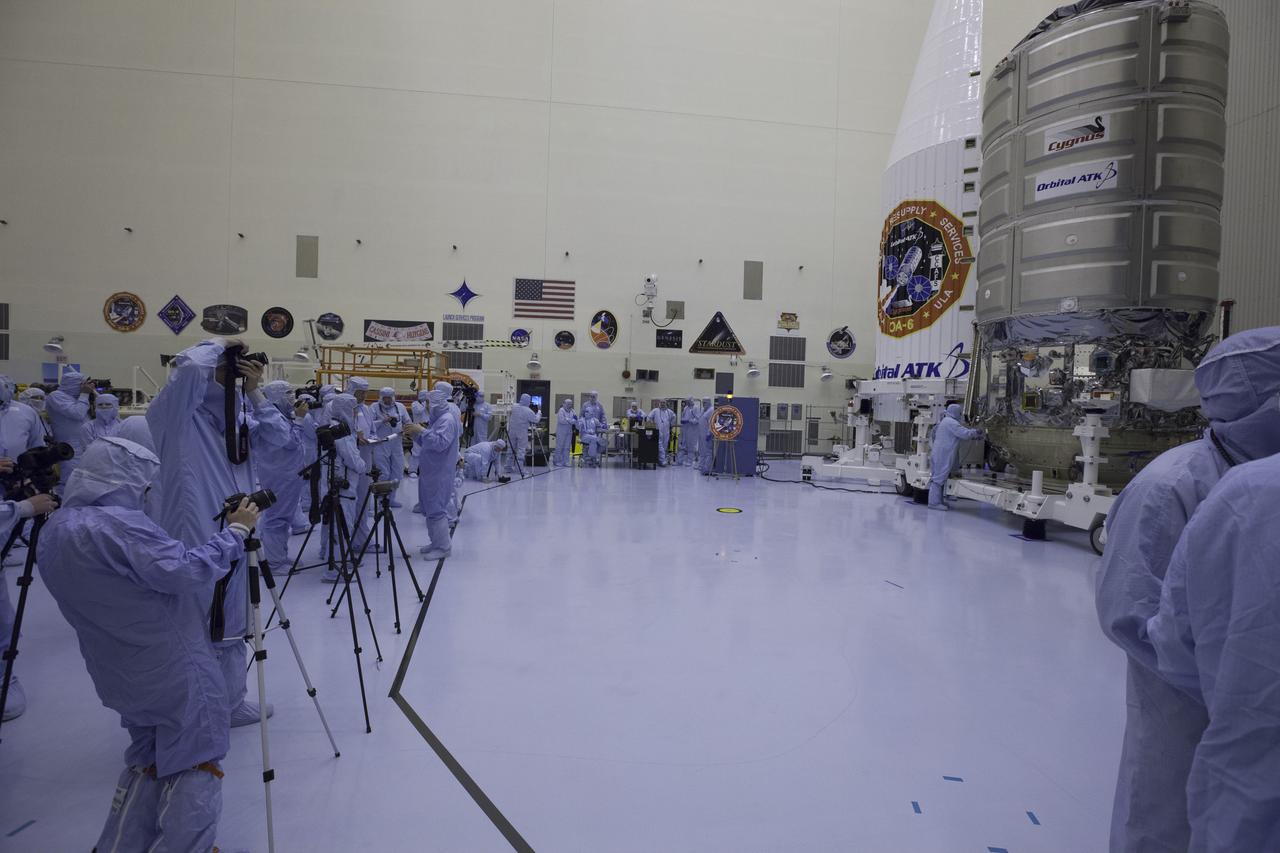
Inside the Payload Hazardous Servicing Facility at NASA's Kennedy Space Center in Florida, members of the news media get a close-up view of a Cygnus cargo vessel. The spacecraft is scheduled for the upcoming Orbital ATK Commercial Resupply Services-6 mission to deliver hardware and supplies to the International Space Station. Reporters, technicians and engineers are clad in "bunny suits." The cleanroom garments are worn to prevent contamination in the controlled environment. The Cygnus is scheduled to lift off atop a United Launch Alliance Atlas V rocket on March 22.
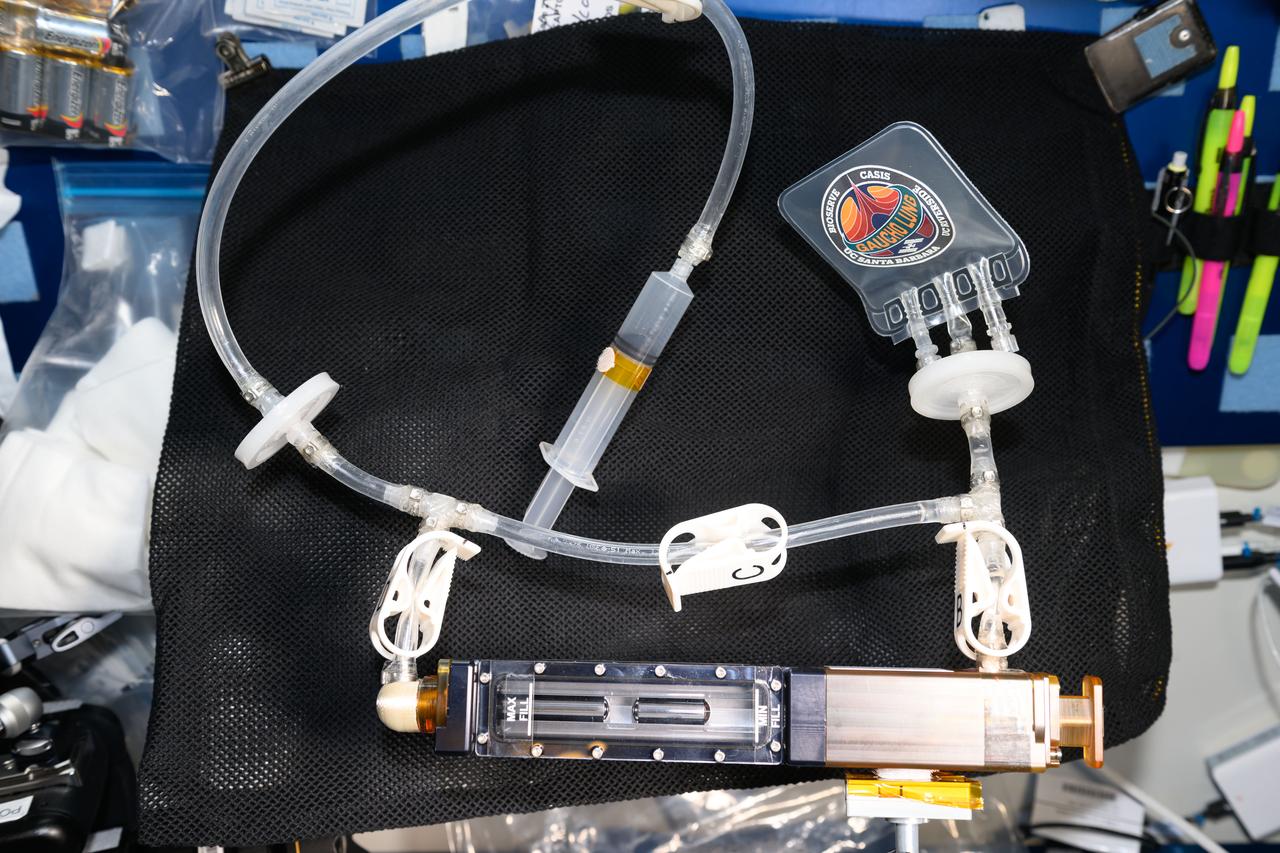
iss071e06219 (5/7/2024) --- A view of the Gaucho Lung investigation hardware aboard the International space station (ISS). The Wicking in Gel-Coated Tubes (Gaucho Lung) investigation studies fluid transport within gel-coated tubes to learn more about treatment programs for respiratory distress syndrome and develop new contamination control strategies.
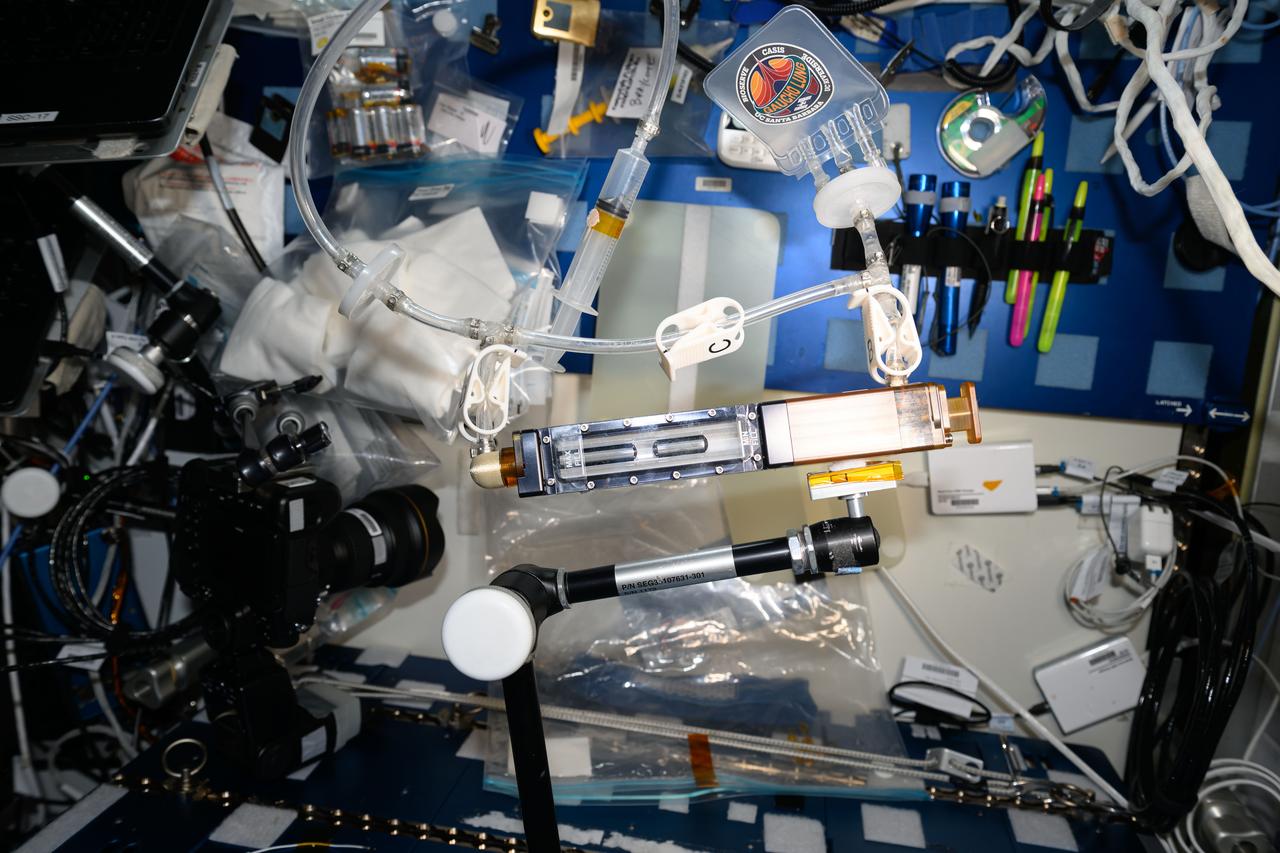
iss071e062617 (5/7/2024) --- A view of the Gaucho Lung investigation hardware aboard the International space station (ISS). The Wicking in Gel-Coated Tubes (Gaucho Lung) investigation studies fluid transport within gel-coated tubes to learn more about treatment programs for respiratory distress syndrome and develop new contamination control strategies.
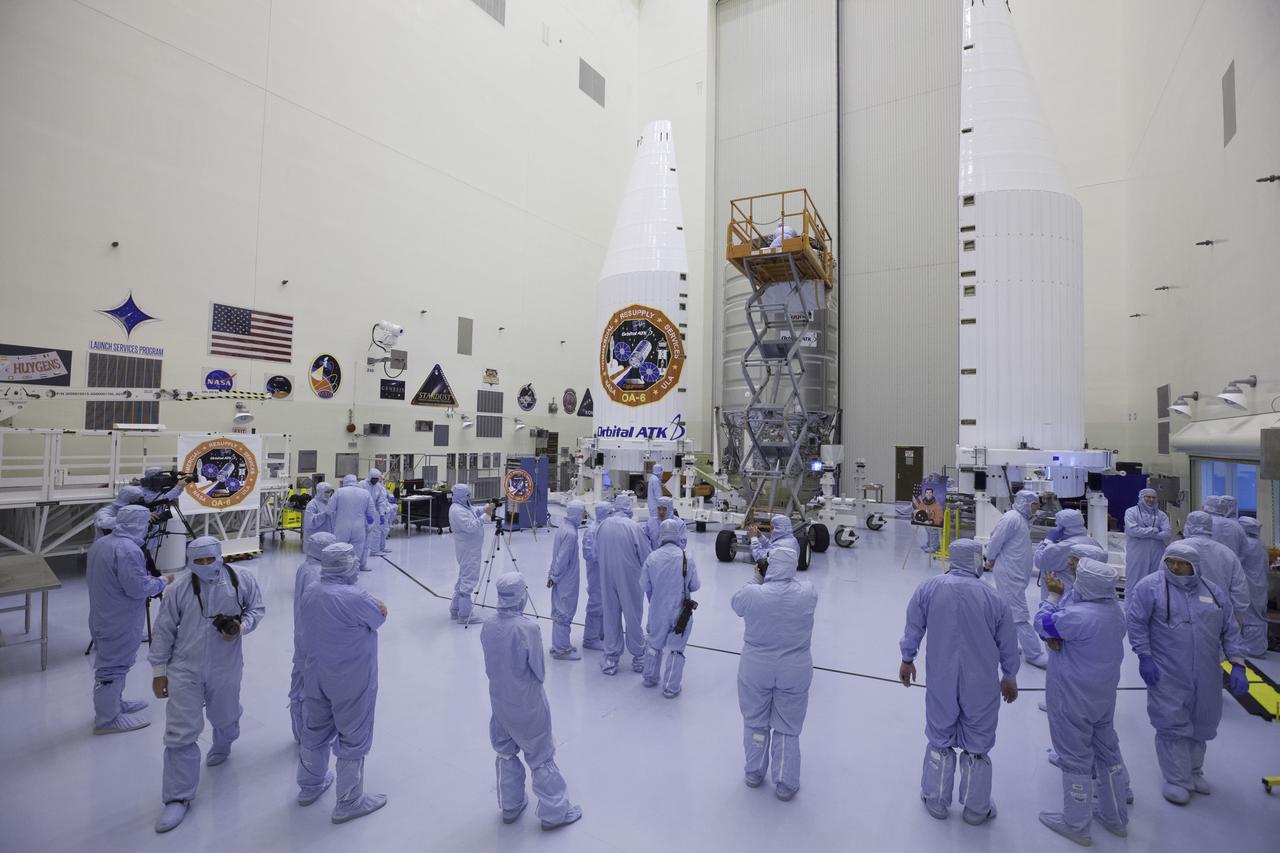
Inside the Payload Hazardous Servicing Facility at NASA's Kennedy Space Center in Florida, members of the news media get a close-up view of a Cygnus cargo vessel. The spacecraft is scheduled for the upcoming Orbital ATK Commercial Resupply Services-6 mission to deliver hardware and supplies to the International Space Station. Reporters, technicians and engineers are clad in "bunny suits." The cleanroom garments are worn to prevent contamination in the controlled environment. The Cygnus is scheduled to lift off atop a United Launch Alliance Atlas V rocket on March 22.
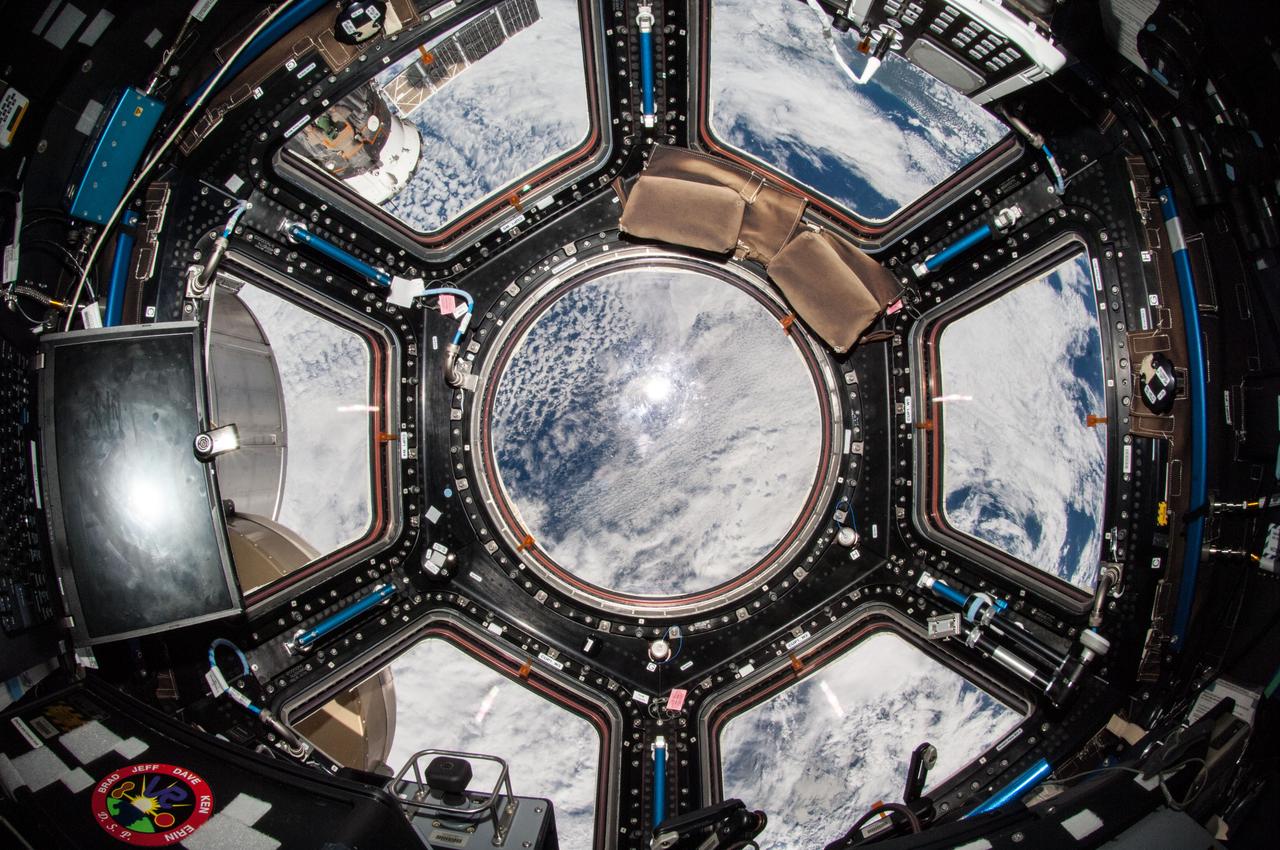
iss038e013587 (12/8/2013) --- A view of the Cupola module aboard the International Space Station (ISS). The cupola is a small module designed for the observation of operations outside the station such as robotic activities, the approach of vehicles, and spacewalks. Its six side windows and a direct nadir viewing window provide spectacular views of Earth and celestial objects. The windows are equipped with shutters to protect them from contamination and collisions with orbital debris or micrometeorites. The cupola house the robotic workstation that controls the Canadarm2.
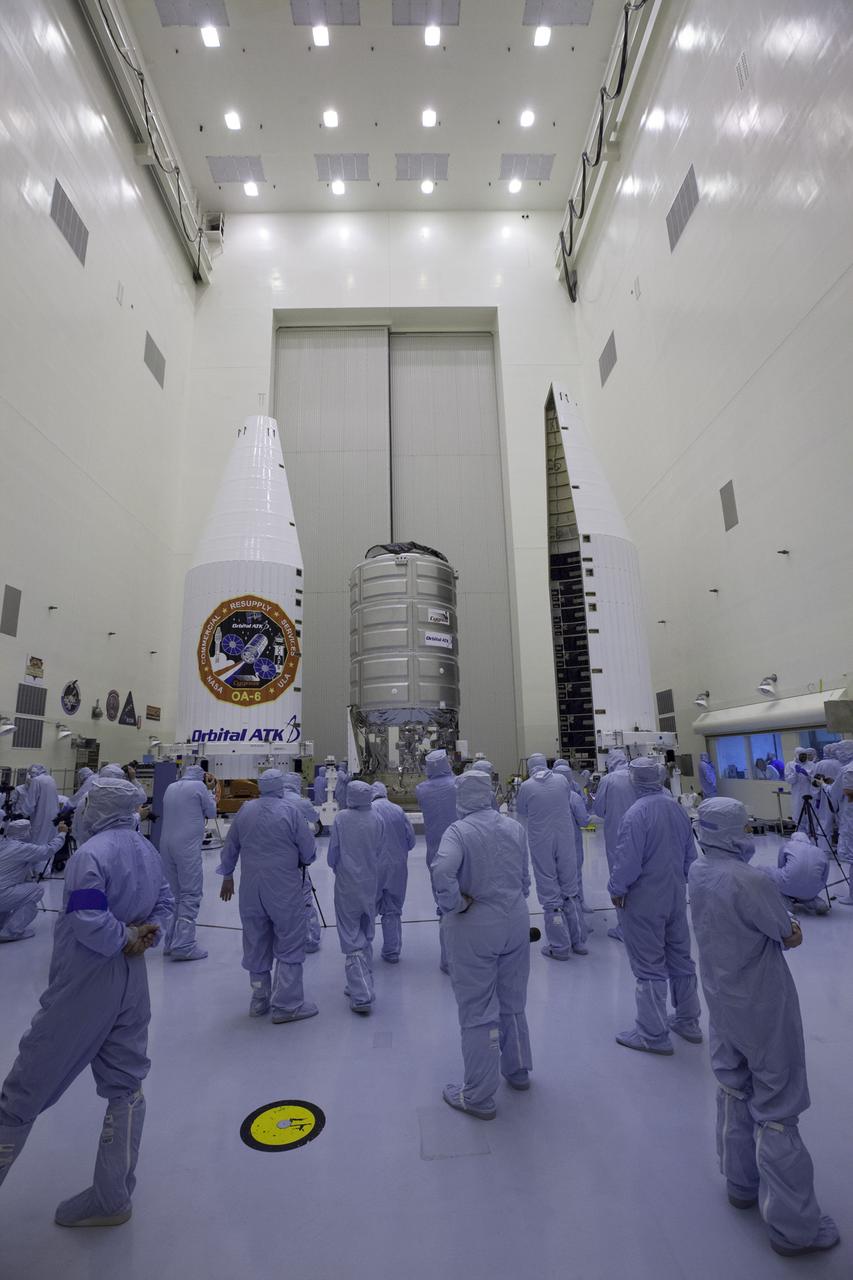
Inside the Payload Hazardous Servicing Facility at NASA's Kennedy Space Center in Florida, members of the news media get a close-up view of a Cygnus cargo vessel. The spacecraft is scheduled for the upcoming Orbital ATK Commercial Resupply Services-6 mission to deliver hardware and supplies to the International Space Station. Reporters, technicians and engineers are clad in "bunny suits." The cleanroom garments are worn to prevent contamination in the controlled environment. The Cygnus is scheduled to lift off atop a United Launch Alliance Atlas V rocket on March 22.
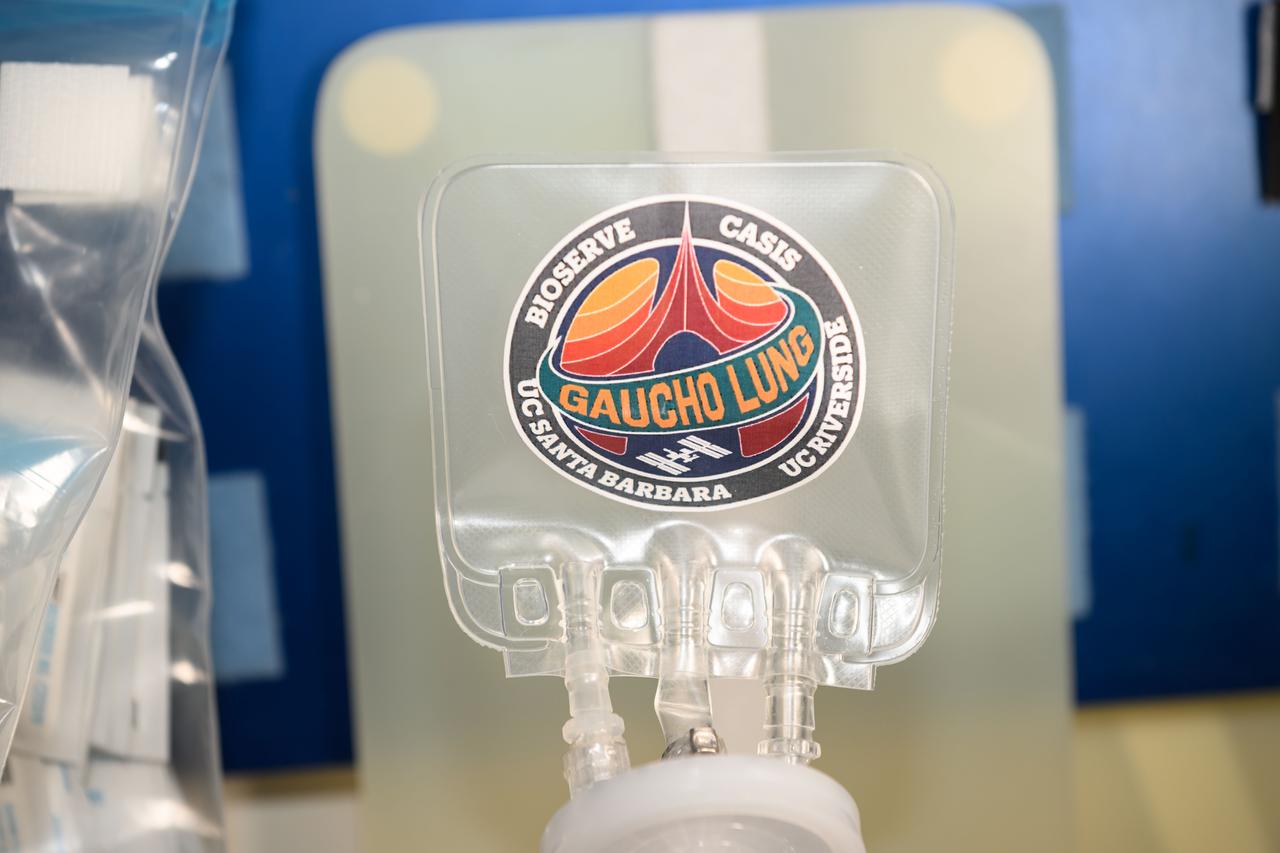
iss071e062589 (5/7/2024) --- A view of the Gaucho Lung Sample Pouch aboard the International space station (ISS). The Wicking in Gel-Coated Tubes (Gaucho Lung) investigation studies fluid transport within gel-coated tubes to learn more about treatment programs for respiratory distress syndrome and develop new contamination control strategies.
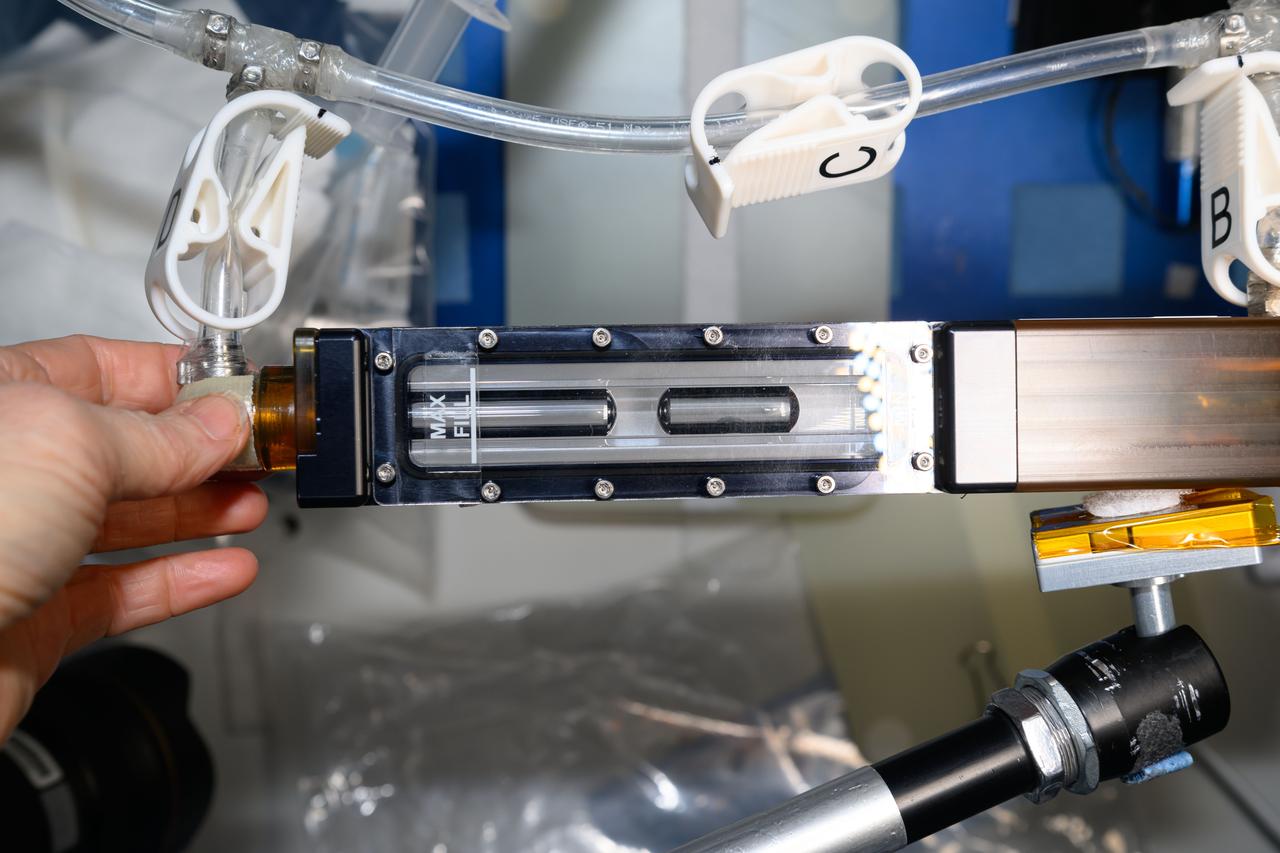
iss071e062603 (5/7/2024) --- A view of the Gaucho Lung investigation hardware aboard the International space station (ISS). The Wicking in Gel-Coated Tubes (Gaucho Lung) investigation studies fluid transport within gel-coated tubes to learn more about treatment programs for respiratory distress syndrome and develop new contamination control strategies.
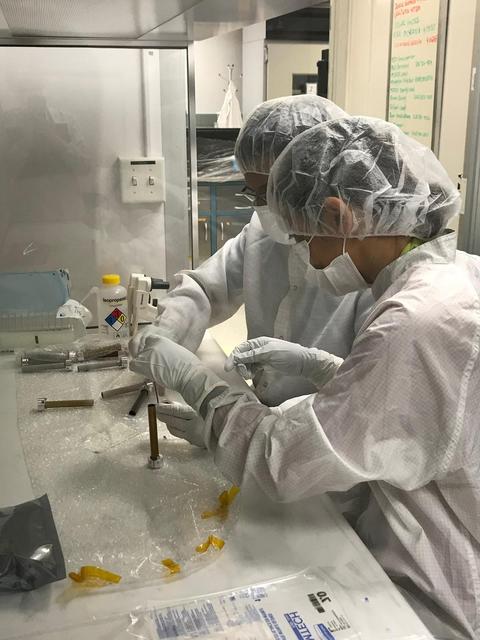
Planetary protection engineers at NASA's Jet Propulsion Laboratory in Southern California swab engineering models of the tubes that will store Martian rock and sediment samples as part of NASA’s Mars 2020 Perseverance mission. Team members wanted to understand the transport of biological particles when the rover is taking rock cores. These measurements helped the rover team design hardware and sampling methods that meet stringent biological contamination control requirements. https://photojournal.jpl.nasa.gov/catalog/PIA23718
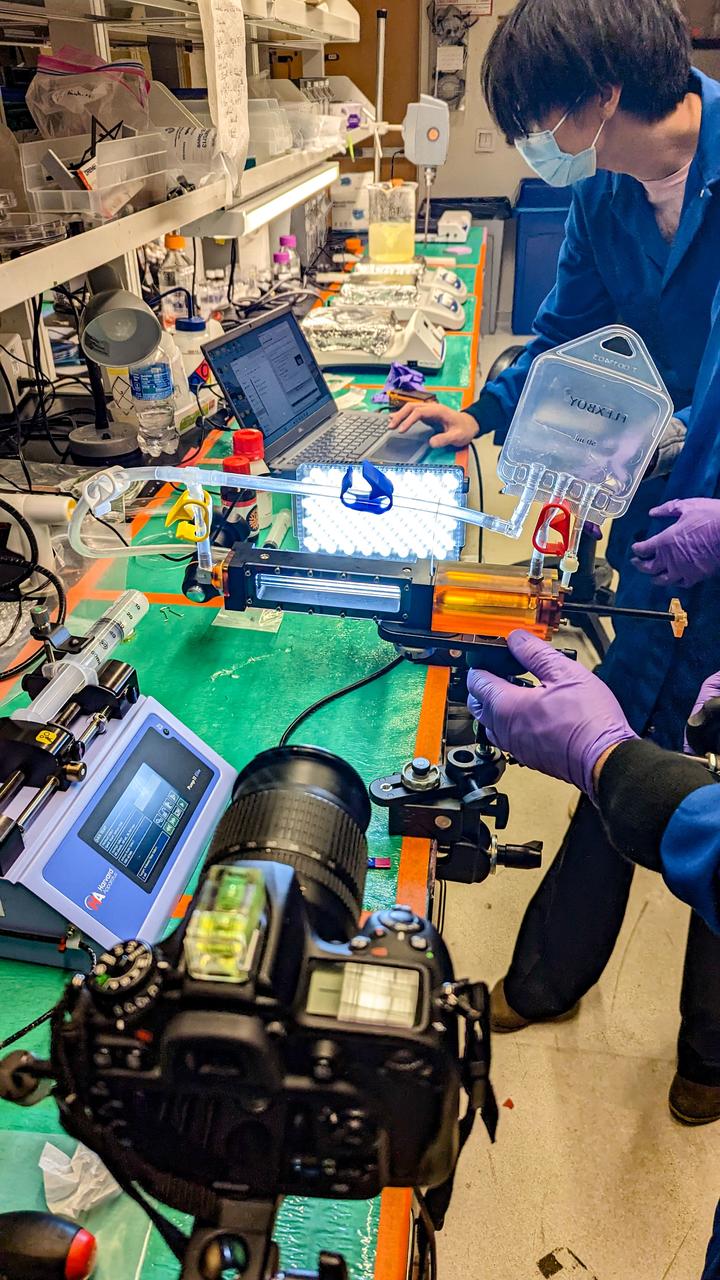
jsc2023e055886 (2/22/2023) --- Matthew Vellone operates the first prototype of the system to fly aboard the International Space Station, while Trinh Huynh records a video of the investigation. he Gaucho Lung investigation will study fluid transport within gel-coated tubes to learn more about treatment programs for respiratory distress syndrome and develop new contamination control strategies. Image courtesy of Bioserve.
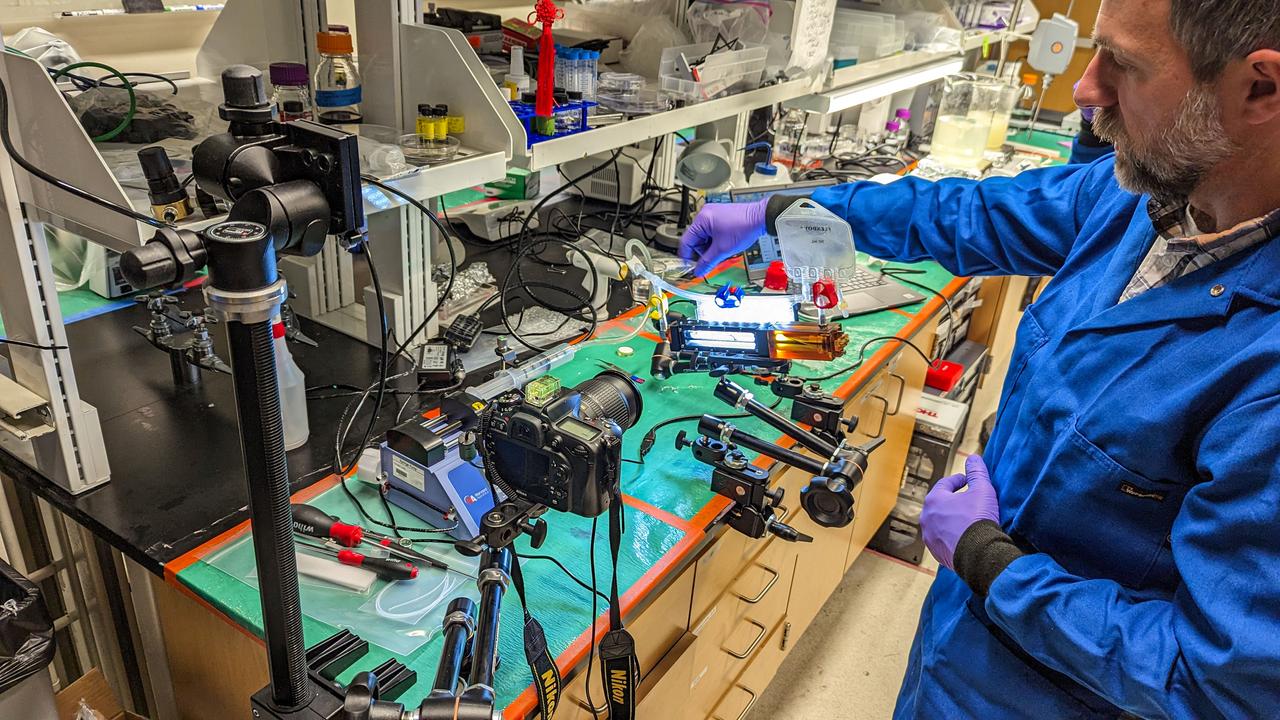
jsc2023e055885 (2/22/2023) --- Matthew Vellone operates the first prototype of the experimental system to fly aboard the International Space Station. The ground set-up is tilted to drive the flow of oil into a large tube using gravity. The Gaucho Lung investigation will study fluid transport within gel-coated tubes to learn more about treatment programs for respiratory distress syndrome and develop new contamination control strategies. Image courtesy of Bioserve.
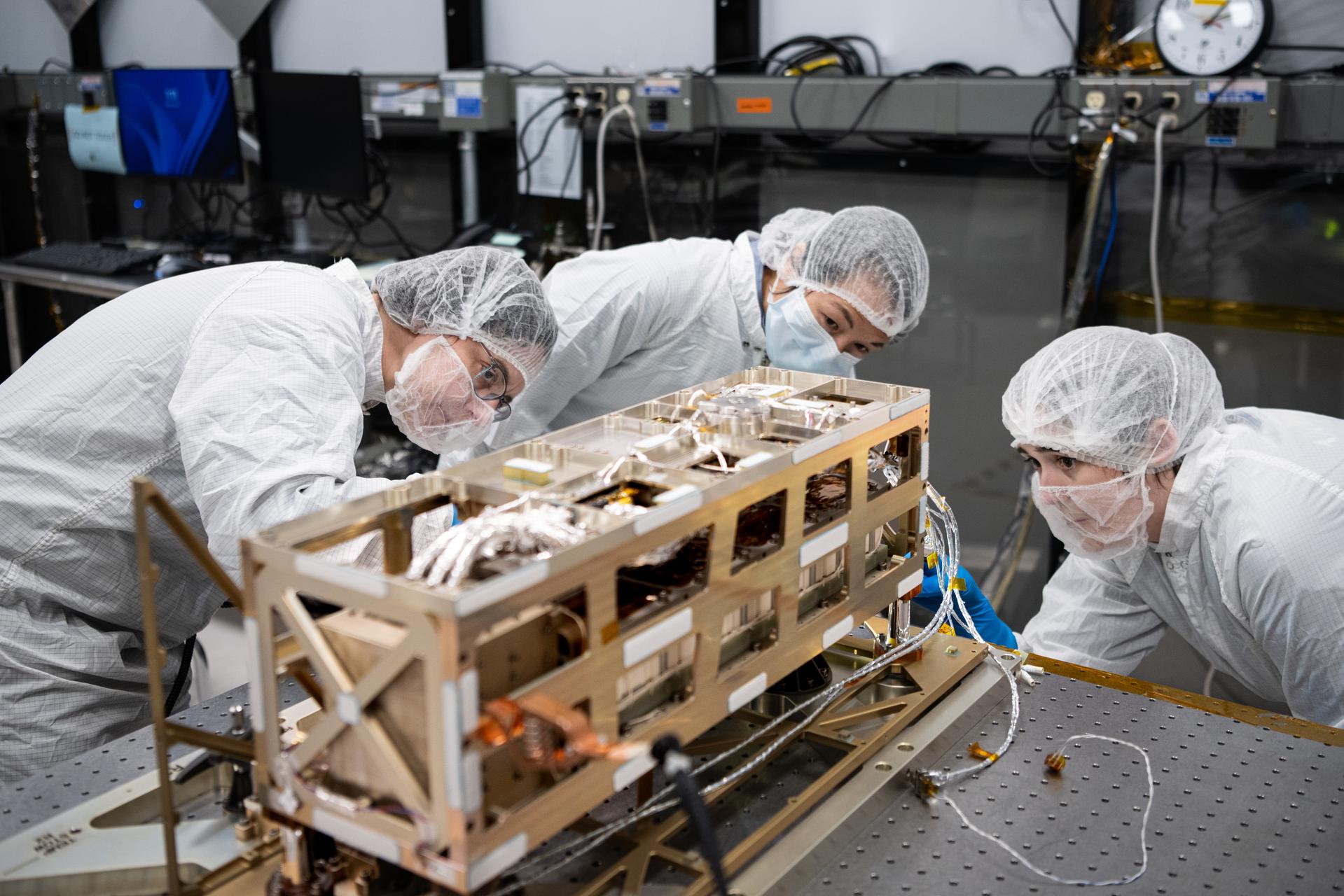
(L-R) Contamination Control Engineer Diane Briczinski, Acting Science Mission Directorate Chief Engineer Synthia Tonn, and Lead Payload Systems Engineer Sam Hicks inspect the Lunar Environment Monitoring Station (LEMS) instrument in the cleanroom at Goddard Space Flight Center in Greenbelt Md. on January 12th, 2026. LEMS is a compact, autonomous, and self-sustaining seismometer suite designed to carry out continuous, long-term, monitoring of the lunar seismic environment at the South Polar region. Photo Credit: NASA/Denny Henry
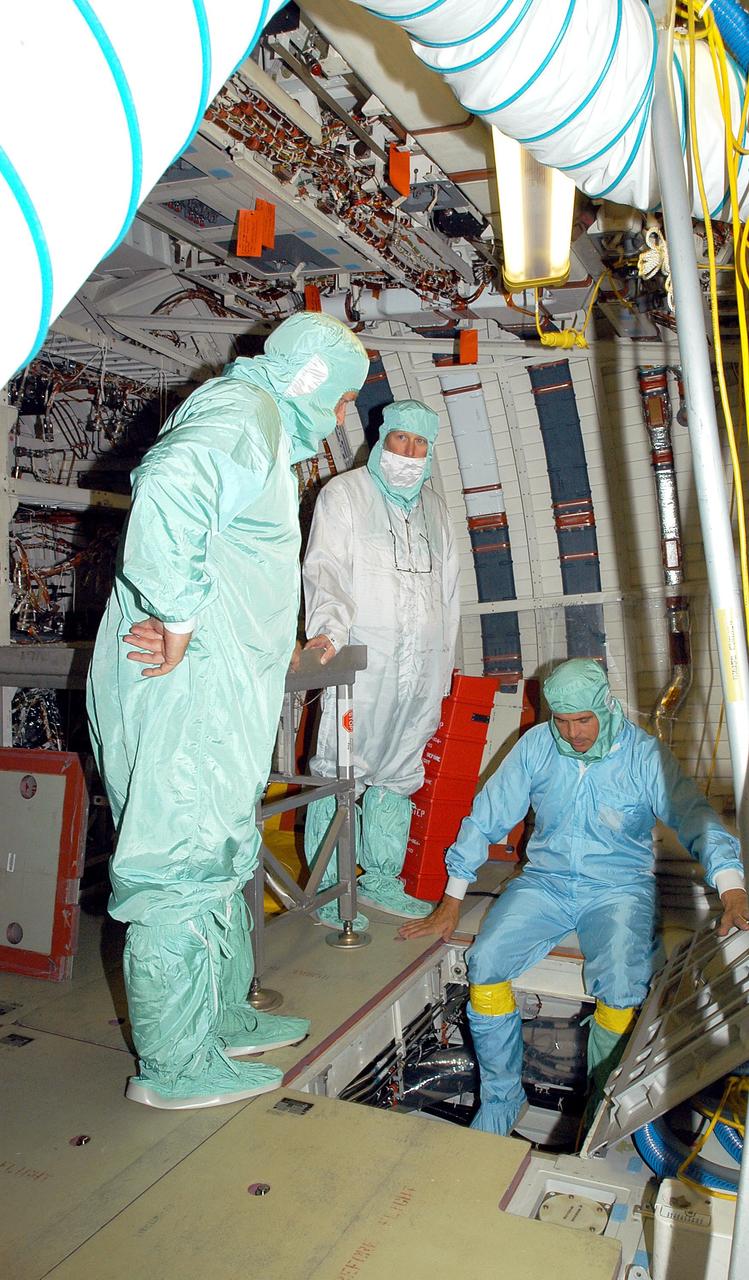
KENNEDY SPACE CENTER, FLA. - In the middeck of Endeavour, in the Orbiter Processing Facility, Center Director Jim Kennedy (far left) watches as a technician gets ready to lower himself through the LiOH door into the Environmental Control and Life Support System (ECLSS) bay. LiOH refers to lithium hydroxide, canisters of which are stored in the ECLSS bay under the middeck floor. During flight, cabin air from the cabin fan is ducted to two LiOH canisters, where carbon dioxide is removed and activated charcoal removes odors and trace contaminants. Kennedy is taking an opportunity to learn first-hand what workers are doing to enable Return to Flight. Endeavour is in an Orbiter Major Modification period.
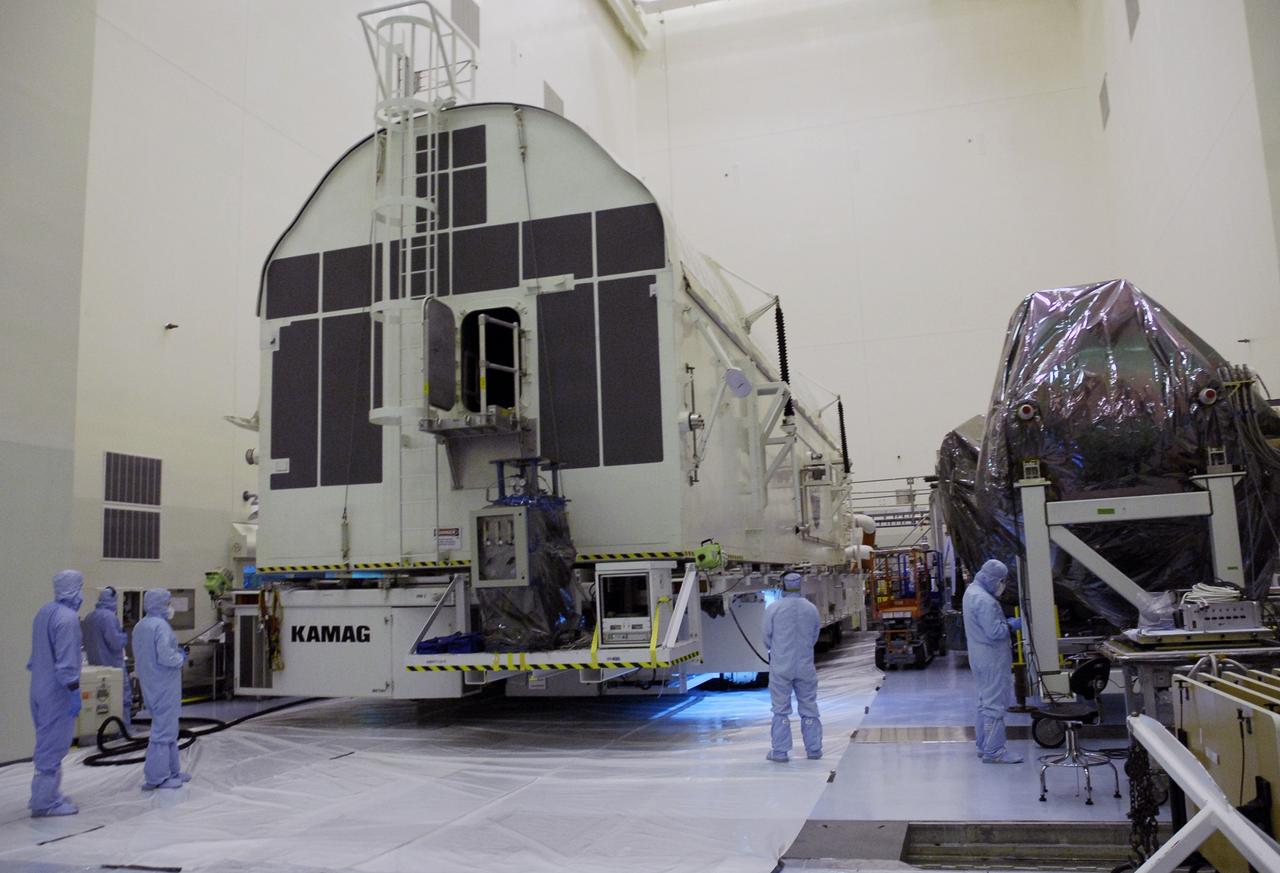
CAPE CANAVERAL, Fla. - The payload canister moves back into the environmentally controlled high bay of the Payload Hazardous Servicing Facility at NASA's Kennedy Space Center. The canister was moved out of the high bay during contamination of the Super Lightweight Integration Carrier, one of four associated with the STS-125 mission to service the Hubble Space Telescope. The carriers are being installed in the payload canister for transfer to Launch Pad 39A. At the pad, all the carriers will be loaded into space shuttle Atlantis’ payload bay. Launch of Atlantis is targeted for Oct. 10. Photo credit: NASA/Jack Pfaller
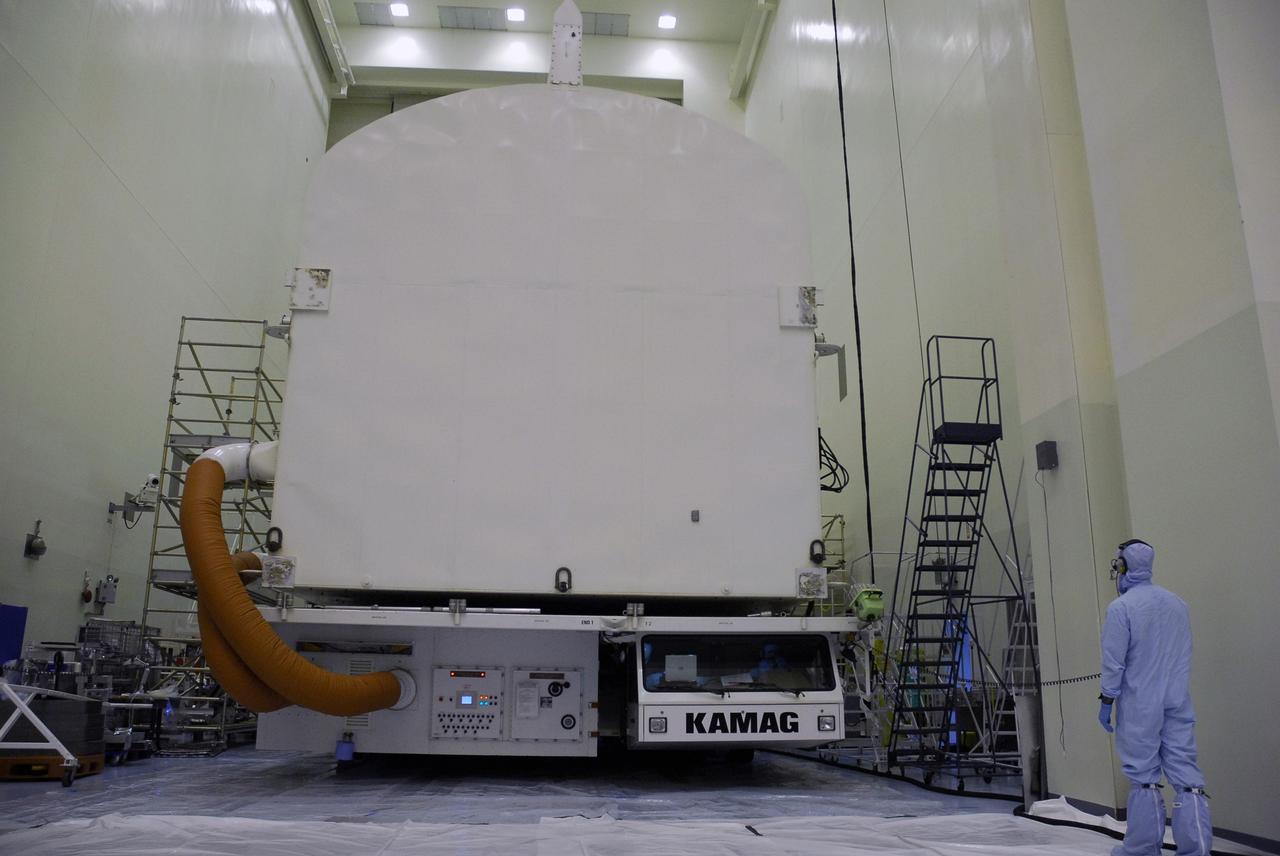
CAPE CANAVERAL, Fla. - The payload canister moves back into the environmentally controlled high bay of the Payload Hazardous Servicing Facility at NASA's Kennedy Space Center. The canister was moved out of the high bay during contamination of the Super Lightweight Integration Carrier, one of four associated with the STS-125 mission to service the Hubble Space Telescope. It will be installed in the payload canister for transfer to Launch Pad 39A. At the pad, all the carriers will be loaded into space shuttle Atlantis’ payload bay. Launch of Atlantis is targeted for Oct. 10. Photo credit: NASA/Jack Pfaller

CAPE CANAVERAL, Fla. - The payload canister moves back into the environmentally controlled high bay of the Payload Hazardous Servicing Facility at NASA's Kennedy Space Center. The canister was moved out of the high bay during contamination of the Super Lightweight Integration Carrier, one of four associated with the STS-125 mission to service the Hubble Space Telescope. The carriers are being installed in the payload canister for transfer to Launch Pad 39A. At the pad, all the carriers will be loaded into space shuttle Atlantis’ payload bay. Launch of Atlantis is targeted for Oct. 10. On the left next to the canister is the Multi-Use Logistic Equipment, or MULE, carrier, which will be transferred to the canister. Photo credit: NASA/Jack Pfaller
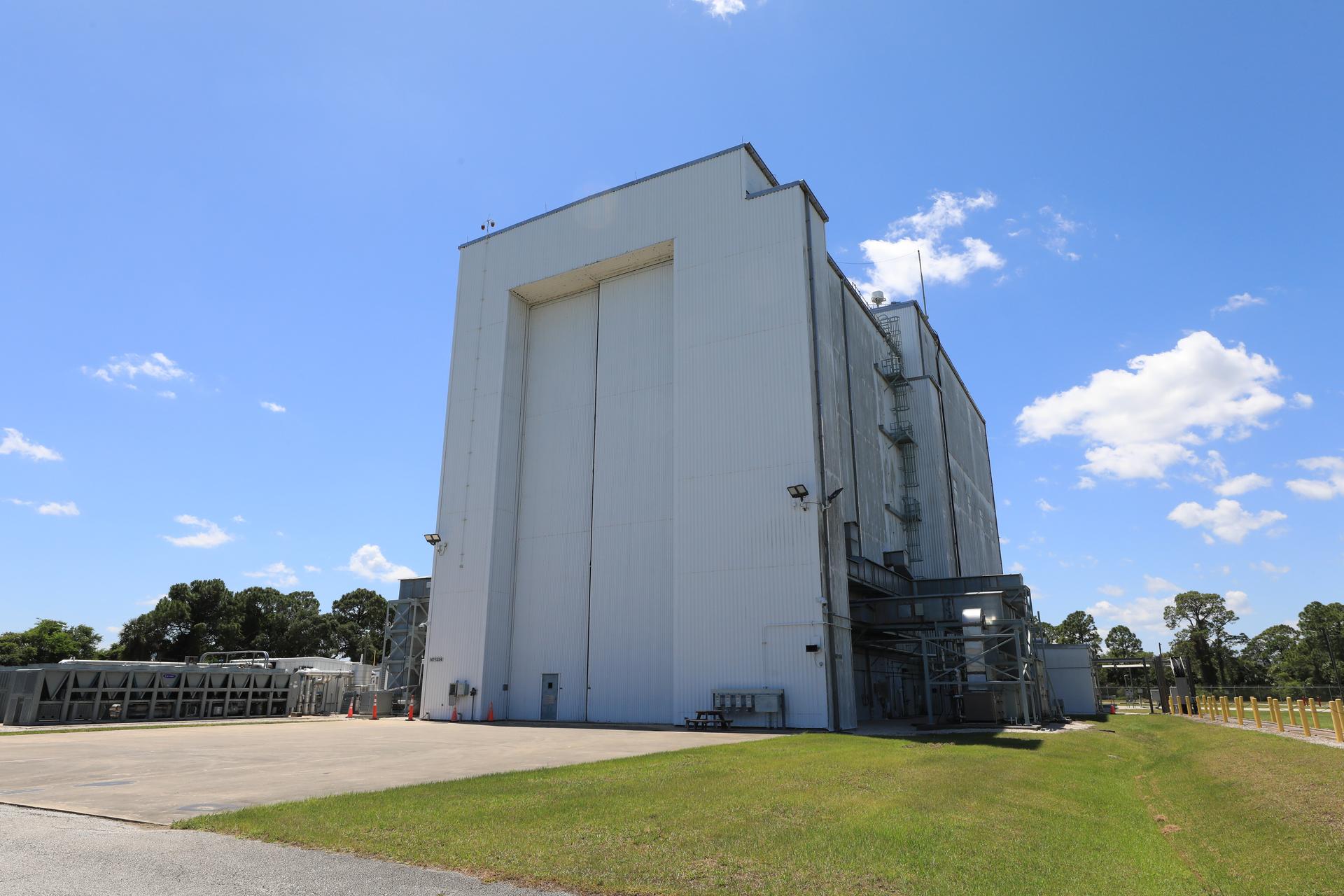
A photograph shows the exterior of NASA’s Payload Hazardous Servicing Facility (PHSF) on Tuesday, April 21, 2026, at NASA’s Kennedy Space Center in Florida. Recently, technicians performed several upgrades to the facility ahead of the arrival of the agency’s Nancy Grace Roman Space Telescope, designed to provide deep, panoramic views of the cosmos, generating never-before-seen pictures that will revolutionize our understanding of the universe. Roman will undergo several prelaunch operations, including thermal protection closeout, cleaning, solar array work, and loading hydrazine propellant. The PHSF is one of the very few facilities where spacecraft undergo both hazardous fueling operations and delicate contamination control procedures.
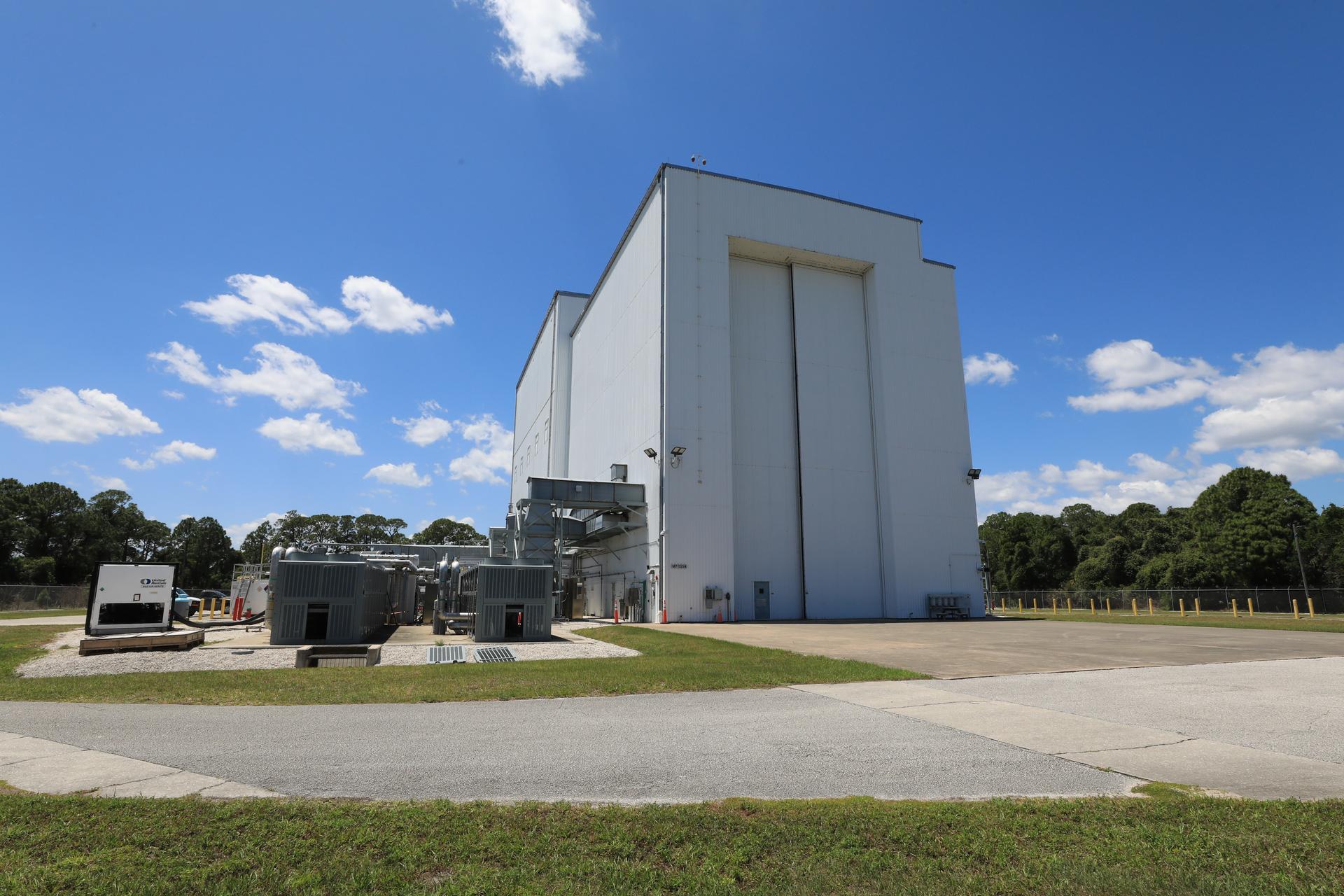
A photograph shows the exterior of NASA’s Payload Hazardous Servicing Facility (PHSF) on Tuesday, April 21, 2026, at NASA’s Kennedy Space Center in Florida. Recently, technicians performed several upgrades to the facility ahead of the arrival of the agency’s Nancy Grace Roman Space Telescope, designed to provide deep, panoramic views of the cosmos, generating never-before-seen pictures that will revolutionize our understanding of the universe. Roman will undergo several prelaunch operations, including thermal protection closeout, cleaning, solar array work, and loading hydrazine propellant. The PHSF is one of the very few facilities where spacecraft undergo both hazardous fueling operations and delicate contamination control procedures.
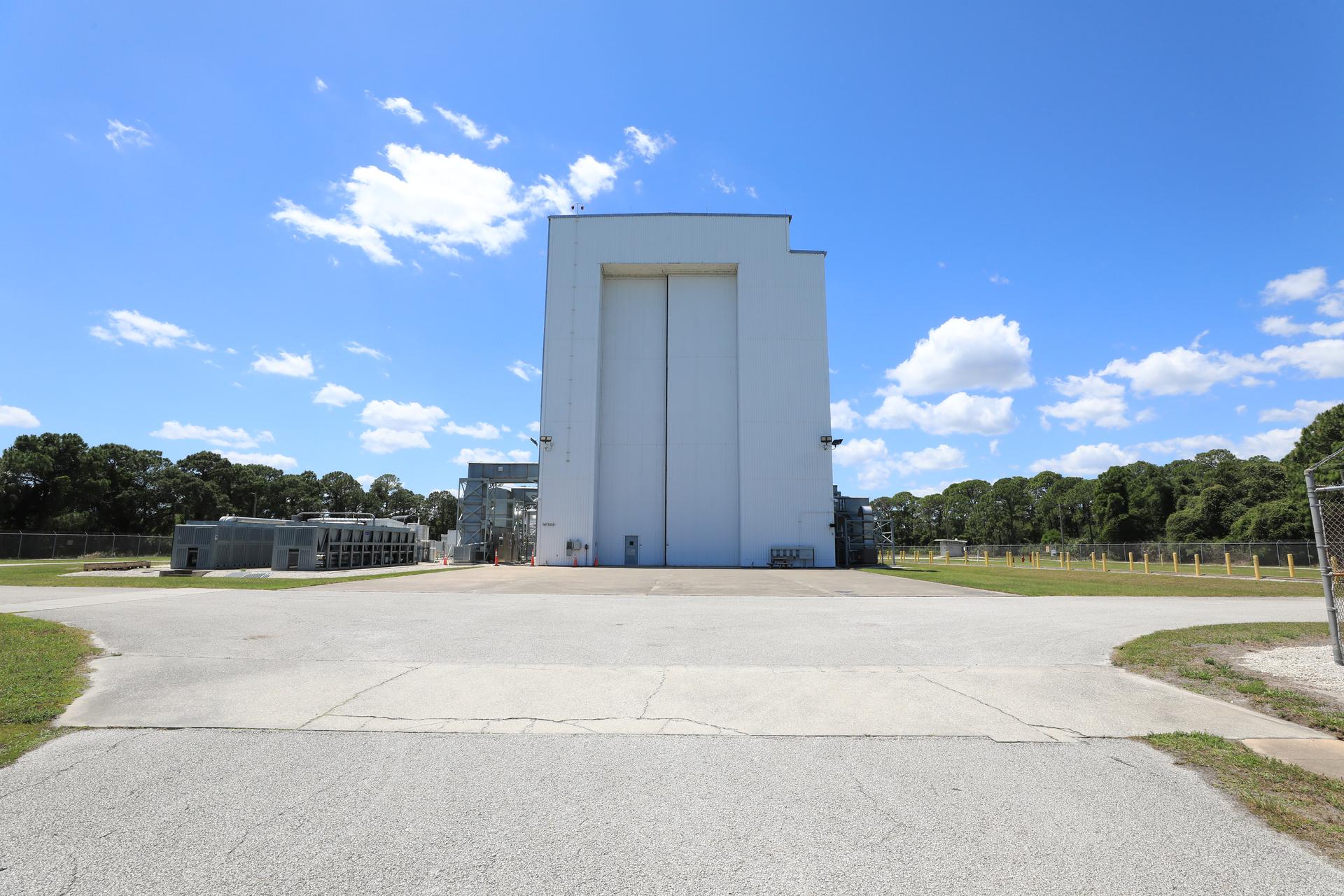
A photograph shows the exterior of NASA’s Payload Hazardous Servicing Facility (PHSF) on Tuesday, April 21, 2026, at NASA’s Kennedy Space Center in Florida. Recently, technicians performed several upgrades to the facility ahead of the arrival of the agency’s Nancy Grace Roman Space Telescope, designed to provide deep, panoramic views of the cosmos, generating never-before-seen pictures that will revolutionize our understanding of the universe. Roman will undergo several prelaunch operations, including thermal protection closeout, cleaning, solar array work, and loading hydrazine propellant. The PHSF is one of the very few facilities where spacecraft undergo both hazardous fueling operations and delicate contamination control procedures.
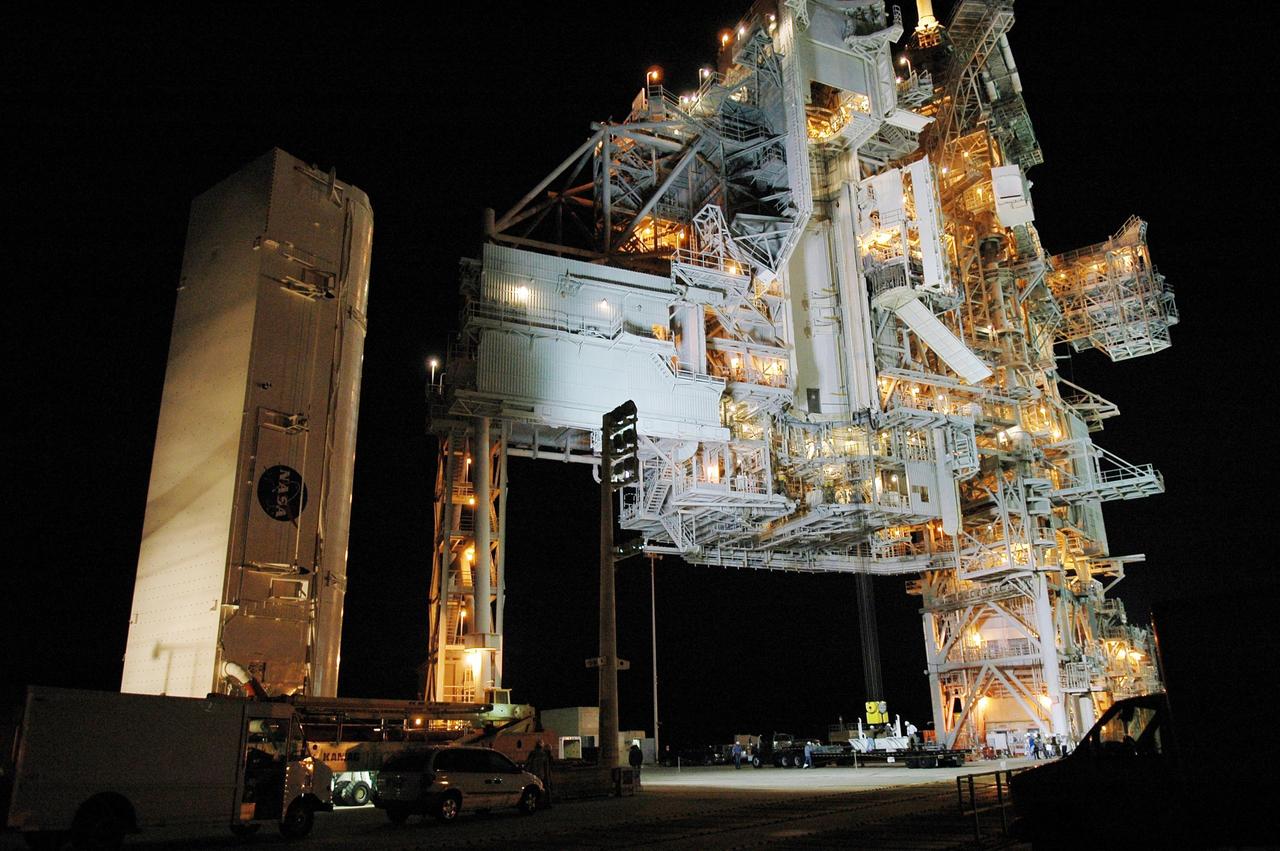
KENNEDY SPACE CENTER, FLA. -- The payload canister transporter and canister approach the rotating service structure (RSS) on Launch Pad 39B. Inside the canister are the SPACEHAB module and the port 5 truss segment for mission STS-116. They will be moved into the payload changeout room (PCR) on the RSS and transferred into Space Shuttle Discovery's payload bay once the vehicle has rolled out to the pad. The PCR is the enclosed, environmentally controlled portion of the RSS that supports cargo delivery to the pad and subsequent vertical installation into the orbiter payload bay. Seals around the mating surface of the PCR fit against the orbiter and allow the opening of the payload bay or canister doors and removal of the cargo without exposure to outside air and contaminants. A clean-air purge in the PCR maintains environmental control during PCR cargo operations. Cargo is removed from the payload canister and installed vertically in the orbiter by the payload ground handling mechanism (PGHM). Photo credit: NASA/Kim Shiflett
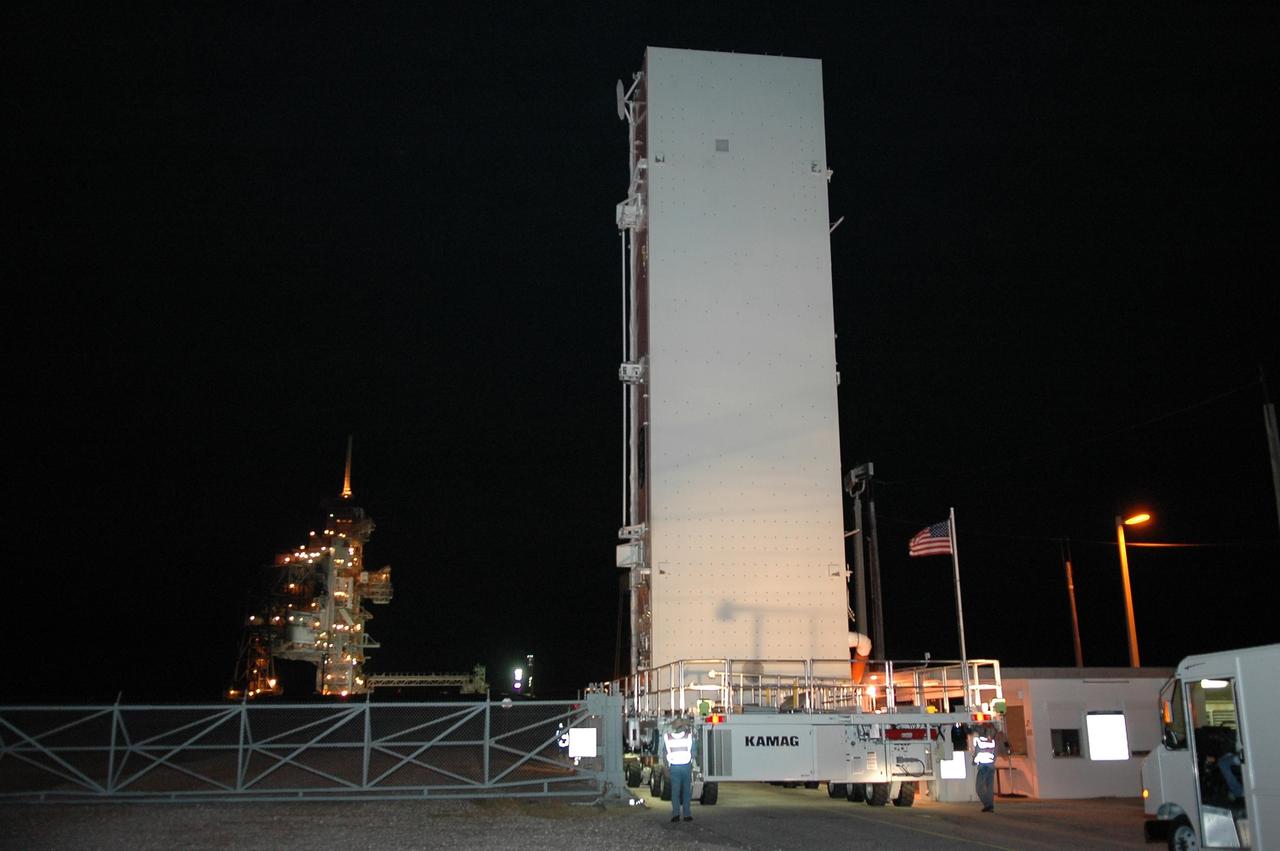
KENNEDY SPACE CENTER, FLA. -- The payload canister transporter and canister arrive at the gate to Launch Pad 39B. Inside the canister are the SPACEHAB module and the port 5 truss segment for mission STS-116. They will be moved into the payload changeout room (PCR) at the pad and transferred into Space Shuttle Discovery's payload bay once the vehicle has rolled out to the pad. The PCR is the enclosed, environmentally controlled portion of the RSS that supports cargo delivery to the pad and subsequent vertical installation into the orbiter payload bay. Seals around the mating surface of the PCR fit against the orbiter and allow the opening of the payload bay or canister doors and removal of the cargo without exposure to outside air and contaminants. A clean-air purge in the PCR maintains environmental control during PCR cargo operations. Cargo is removed from the payload canister and installed vertically in the orbiter by the payload ground handling mechanism (PGHM). Photo credit: NASA/Kim Shiflett
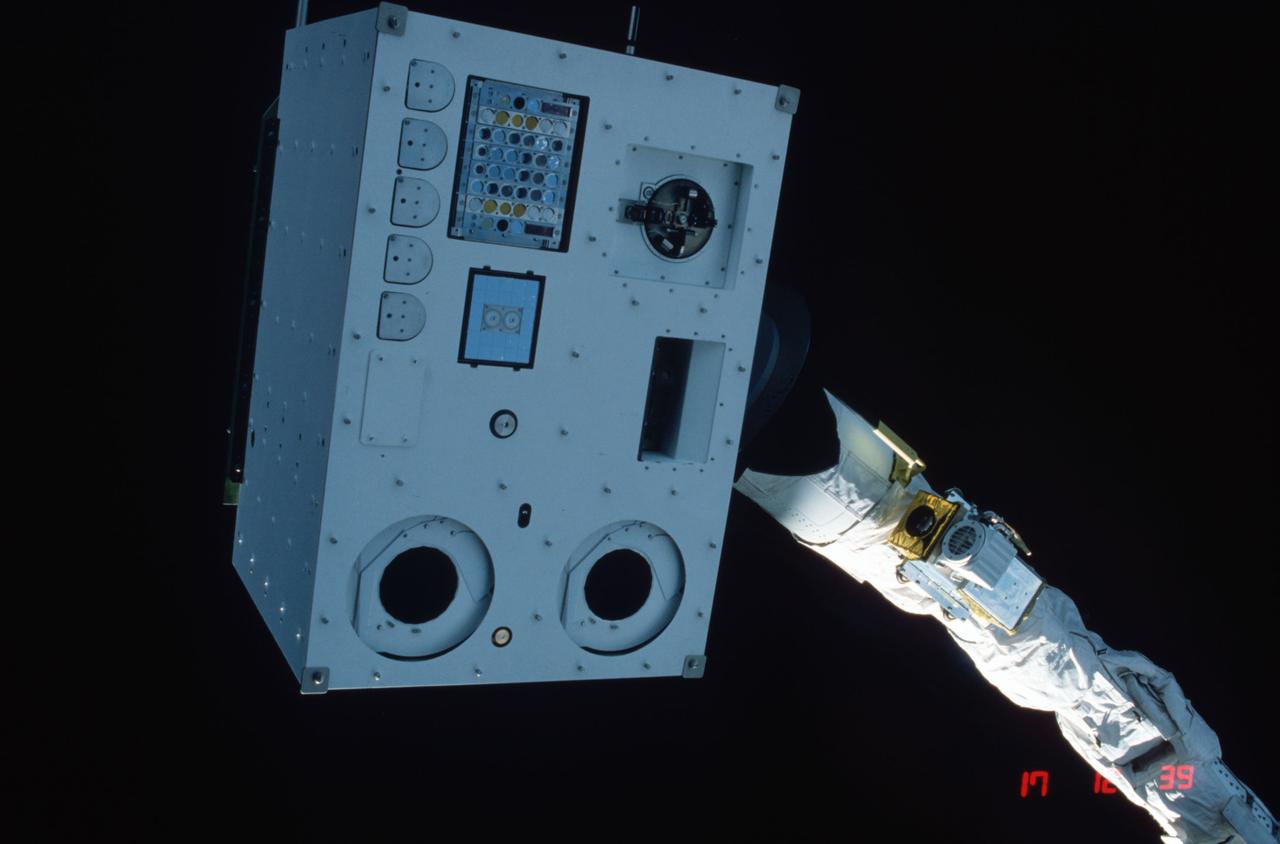
STS004-23-119 (27 June-4 July 1982) --- This is a close-up view of the Marshall Space Flight Center-developed Induced Environment Contamination Monitor (IECM), a multi-instrument box designed to check for contaminants in and around the space shuttle orbiter cargo bay which might adversely affect delicate experiments carried aboard. The astronaut crew of Thomas K. Mattingly II and Henry W. Hartsfield Jr. maneuvered the Canadian-built robot arm (called the remote manipulator system) very near their overhead flight deck windows and captured this scene with a 35mm camera. HOLD PICTURE HORIZONTALLY WITH FRAME NUMBER AT TOP CENTER. Cameras for the 11 instruments are pictured as black circles at the bottom of the frame. The access door to the arm and safe plug is located about halfway up the left edge of the box. A cascade injector device is immediately to the right of the plug. The rectangular opening at right center of the monitor is the optical effects module. Mass spectrometer is at upper left. Air sampler bottles are at upper left. The colorful rectangle near upper left of the monitor is the passive array. Not easily seen, but also a part of the instrument, are the cryogenic quartz crystal micro balance and the temperature controlled quartz micro balance. Photo credit: NASA
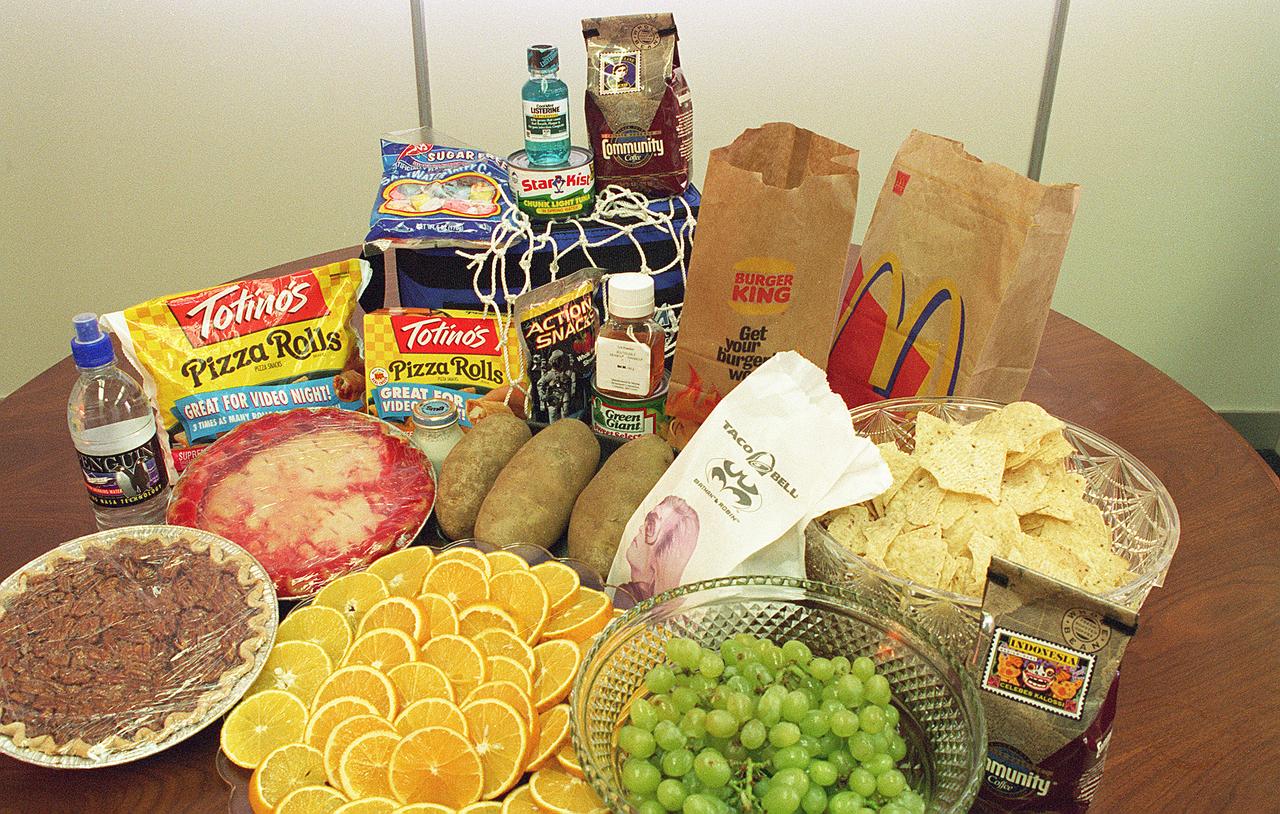
When NASA started plarning for manned space travel in 1959, the myriad challenges of sustaining life in space included a seemingly mundane but vitally important problem: How and what do you feed an astronaut? There were two main concerns: preventing food crumbs from contaminating the spacecraft's atmosphere or floating into sensitive instruments, and ensuring complete freedom from potentially catastrophic disease-producing bacteria, viruses, and toxins. To solve these concerns, NASA enlisted the help of the Pillsbury Company. Pillsbury quickly solved the first problem by coating bite-size foods to prevent crumbling. They developed the hazard analysis and critical control point (HACCP) concept to ensure against bacterial contamination. Hazard analysis is a systematic study of product, its ingredients, processing conditions, handling, storage, packing, distribution, and directions for consumer use to identify sensitive areas that might prove hazardous. Hazard analysis provides a basis for blueprinting the Critical Control Points (CCPs) to be monitored. CCPs are points in the chain from raw materials to the finished product where loss of control could result in unacceptable food safety risks. In early 1970, Pillsbury plants were following HACCP in production of food for Earthbound consumers. Pillsbury's subsequent training courses for Food and Drug Administration (FDA) personnel led to the incorporation of HACCP in the FDA's Low Acid Canned Foods Regulations, set down in the mid-1970s to ensure the safety of all canned food products in the U.S.

Ana Leon, Solar Orbiter contamination control architect with Airbus Defence and Space, participates in a Spanish Facebook Live event for the Solar Orbiter mission in the Press Site auditorium at NASA’s Kennedy Space Center in Florida on Jan. 29, 2020. Solar Orbiter is an international cooperative mission between ESA (European Space Agency) and NASA. The mission aims to study the Sun, its outer atmosphere and solar wind. The spacecraft will provide the first images of the Sun’s poles. NASA’s Launch Services Program based at Kennedy is managing the launch. The spacecraft has been developed by Airbus Defence and Space. Solar Orbiter will launch in February 2020 aboard a United Launch Alliance Atlas V rocket from Space Launch Complex 41 at Cape Canaveral Air Force Station in Florida.
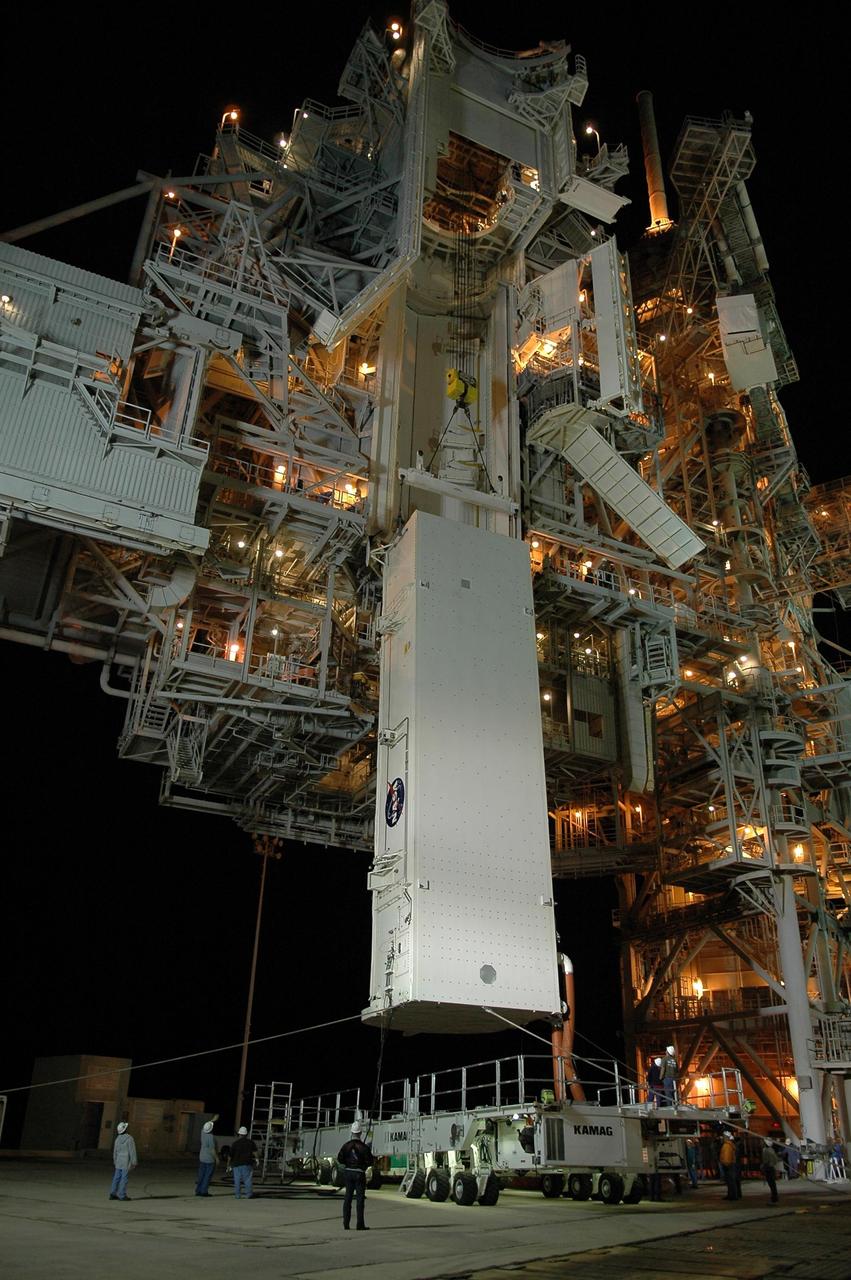
KENNEDY SPACE CENTER, FLA. -- With umbilical lines still attached, the payload canister is lifted up to the payload changeout room (PCR) on the rotating service structure (RSS) on Launch Pad 39B. Inside the canister are the SPACEHAB module and the port 5 truss segment for mission STS-116. Once inside the PCR, they will be transferred into Space Shuttle Discovery's payload bay once the vehicle has rolled out to the pad. On the right is the fixed service structure. The PCR is the enclosed, environmentally controlled portion of the RSS that supports cargo delivery to the pad and subsequent vertical installation into the orbiter payload bay. Seals around the mating surface of the PCR fit against the orbiter and allow the opening of the payload bay or canister doors and removal of the cargo without exposure to outside air and contaminants. A clean-air purge in the PCR maintains environmental control during PCR cargo operations. Cargo is removed from the payload canister and installed vertically in the orbiter by the payload ground handling mechanism (PGHM). Photo credit: NASA/Kim Shiflett
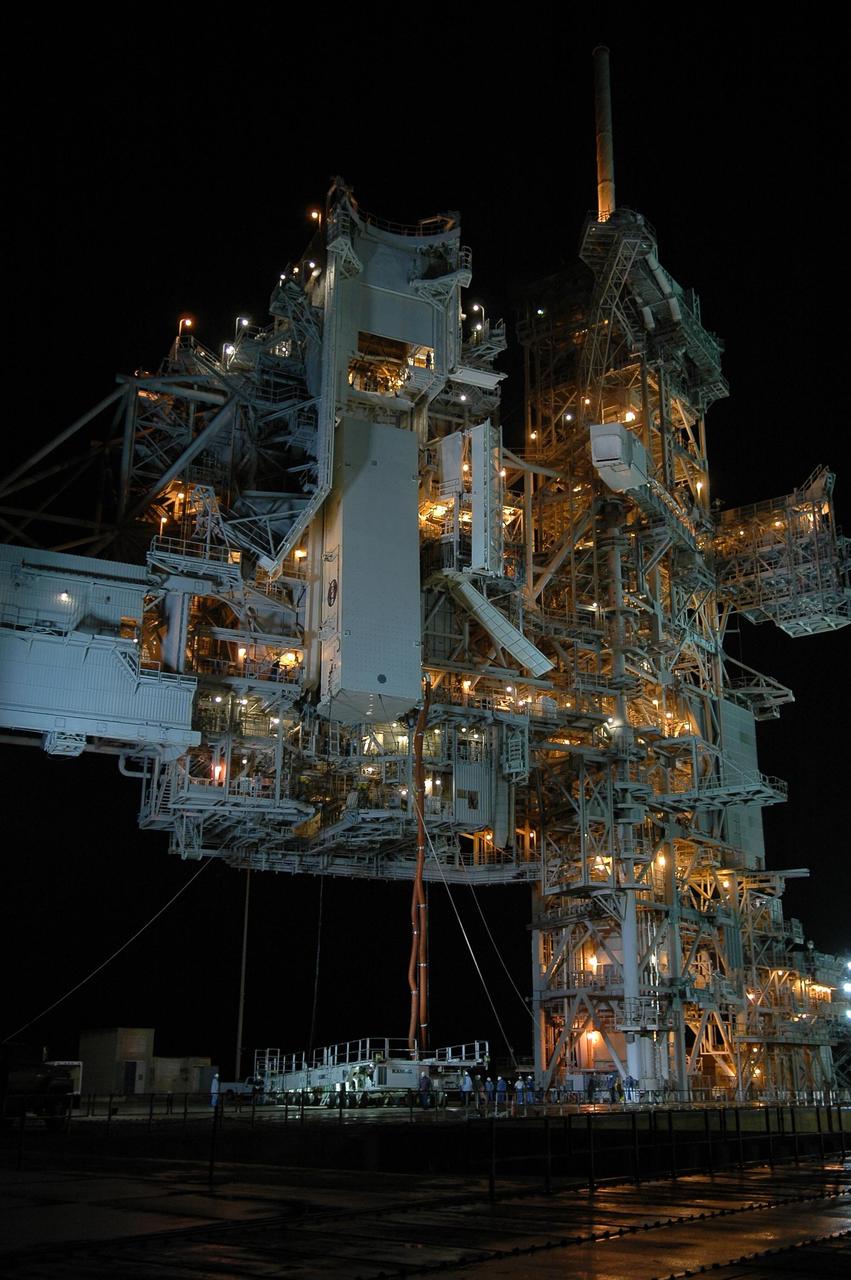
KENNEDY SPACE CENTER, FLA. -- With umbilical lines still attached, the payload canister is lifted up to the payload changeout room (PCR) on the rotating service structure (RSS) on Launch Pad 39B. Inside the canister are the SPACEHAB module and the port 5 truss segment for mission STS-116. Once inside the PCR, they will be transferred into Space Shuttle Discovery's payload bay once the vehicle has rolled out to the pad. On the right is the fixed service structure. The PCR is the enclosed, environmentally controlled portion of the RSS that supports cargo delivery to the pad and subsequent vertical installation into the orbiter payload bay. Seals around the mating surface of the PCR fit against the orbiter and allow the opening of the payload bay or canister doors and removal of the cargo without exposure to outside air and contaminants. A clean-air purge in the PCR maintains environmental control during PCR cargo operations. Cargo is removed from the payload canister and installed vertically in the orbiter by the payload ground handling mechanism (PGHM). Photo credit: NASA/Kim Shiflett
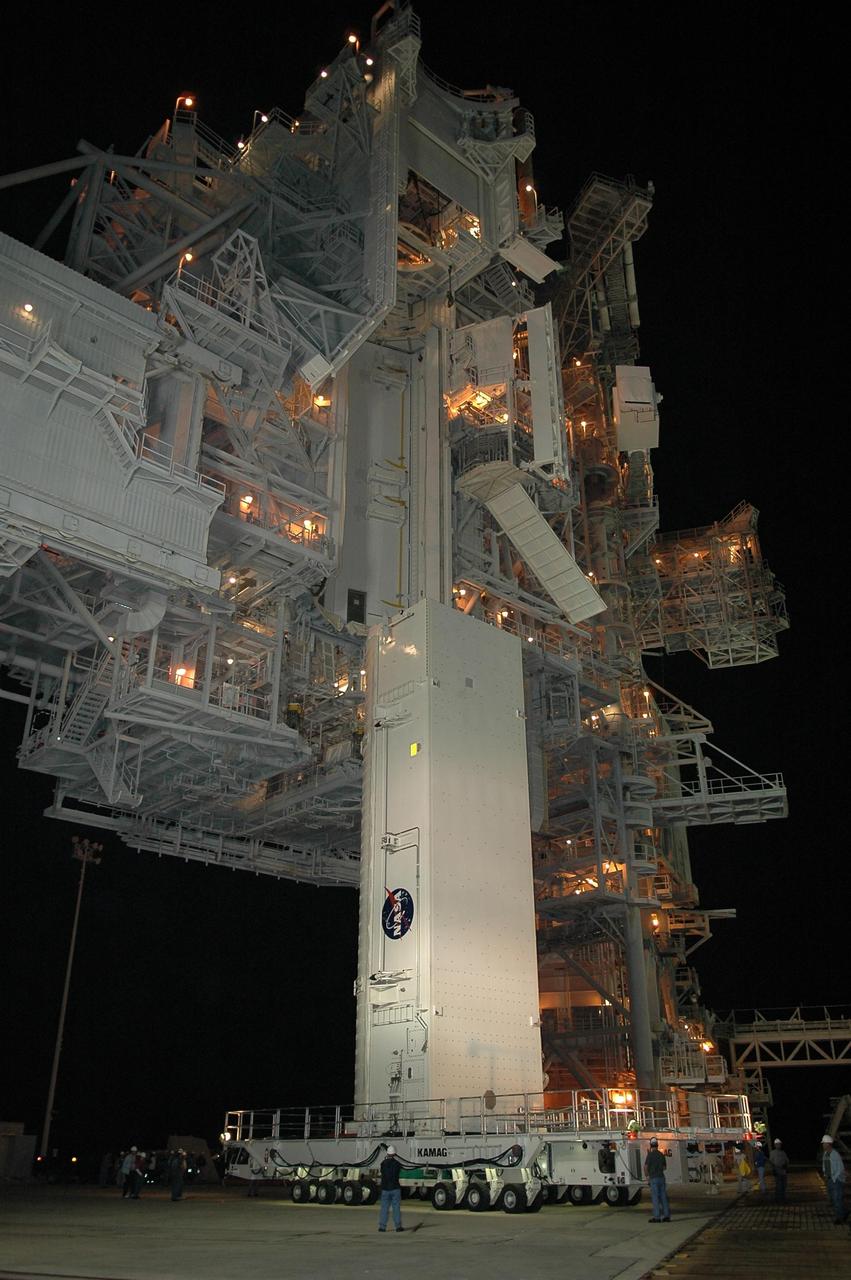
KENNEDY SPACE CENTER, FLA. -- The payload canister transporter and canister move into place under the payload changeout room (PCR) on the rotating service structure (RSS) on Launch Pad 39B. Inside the canister are the SPACEHAB module and the port 5 truss segment for mission STS-116. Once inside the PCR, they will be transferred into Space Shuttle Discovery's payload bay once the vehicle has rolled out to the pad. The PCR is the enclosed, environmentally controlled portion of the RSS that supports cargo delivery to the pad and subsequent vertical installation into the orbiter payload bay. Seals around the mating surface of the PCR fit against the orbiter and allow the opening of the payload bay or canister doors and removal of the cargo without exposure to outside air and contaminants. A clean-air purge in the PCR maintains environmental control during PCR cargo operations. Cargo is removed from the payload canister and installed vertically in the orbiter by the payload ground handling mechanism (PGHM). Photo credit: NASA/Kim Shiflett
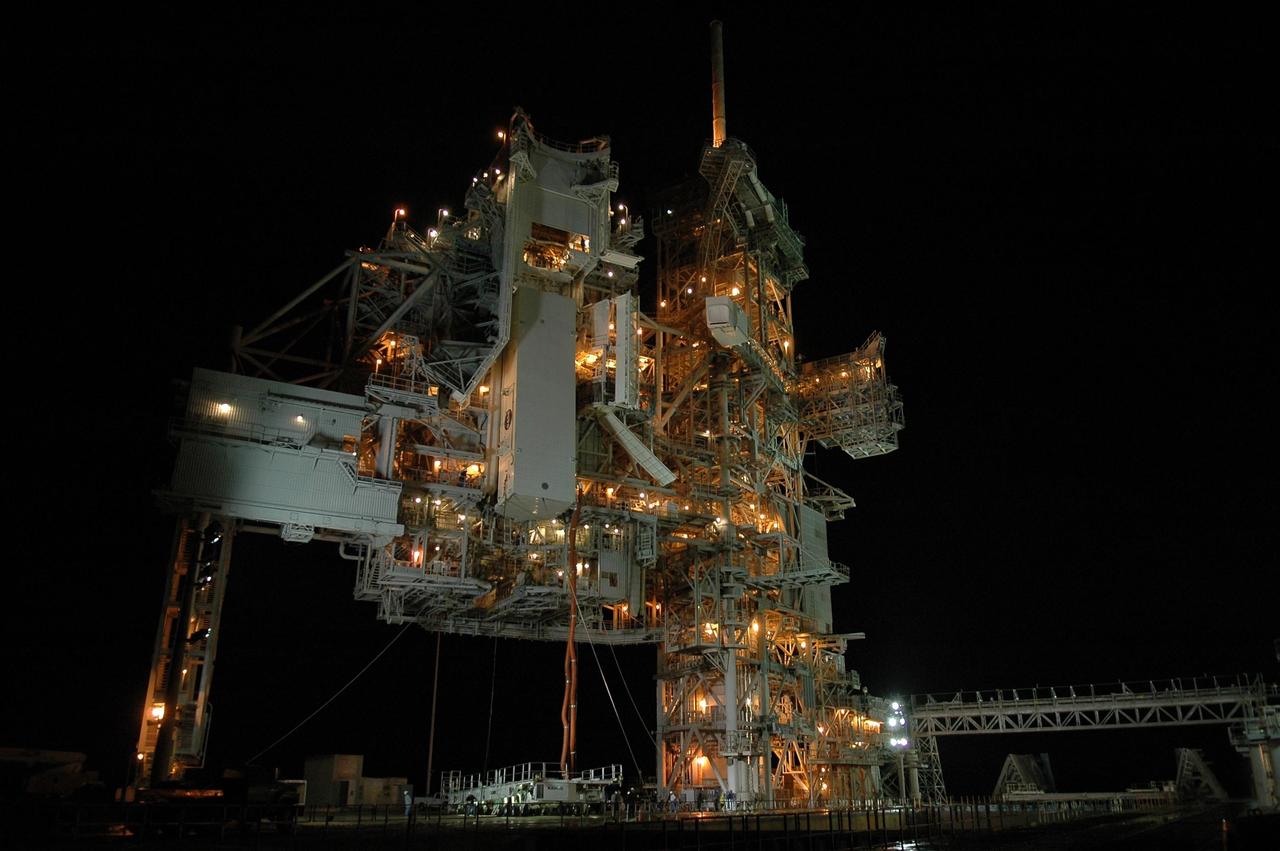
KENNEDY SPACE CENTER, FLA. -- With umbilical lines still attached, the payload canister is lifted up to the payload changeout room (PCR) on the rotating service structure (RSS) on Launch Pad 39B. Inside the canister are the SPACEHAB module and the port 5 truss segment for mission STS-116. Once inside the PCR, they will be transferred into Space Shuttle Discovery's payload bay once the vehicle has rolled out to the pad. On the right is the fixed service structure. The PCR is the enclosed, environmentally controlled portion of the RSS that supports cargo delivery to the pad and subsequent vertical installation into the orbiter payload bay. Seals around the mating surface of the PCR fit against the orbiter and allow the opening of the payload bay or canister doors and removal of the cargo without exposure to outside air and contaminants. A clean-air purge in the PCR maintains environmental control during PCR cargo operations. Cargo is removed from the payload canister and installed vertically in the orbiter by the payload ground handling mechanism (PGHM). Photo credit: NASA/Kim Shiflett
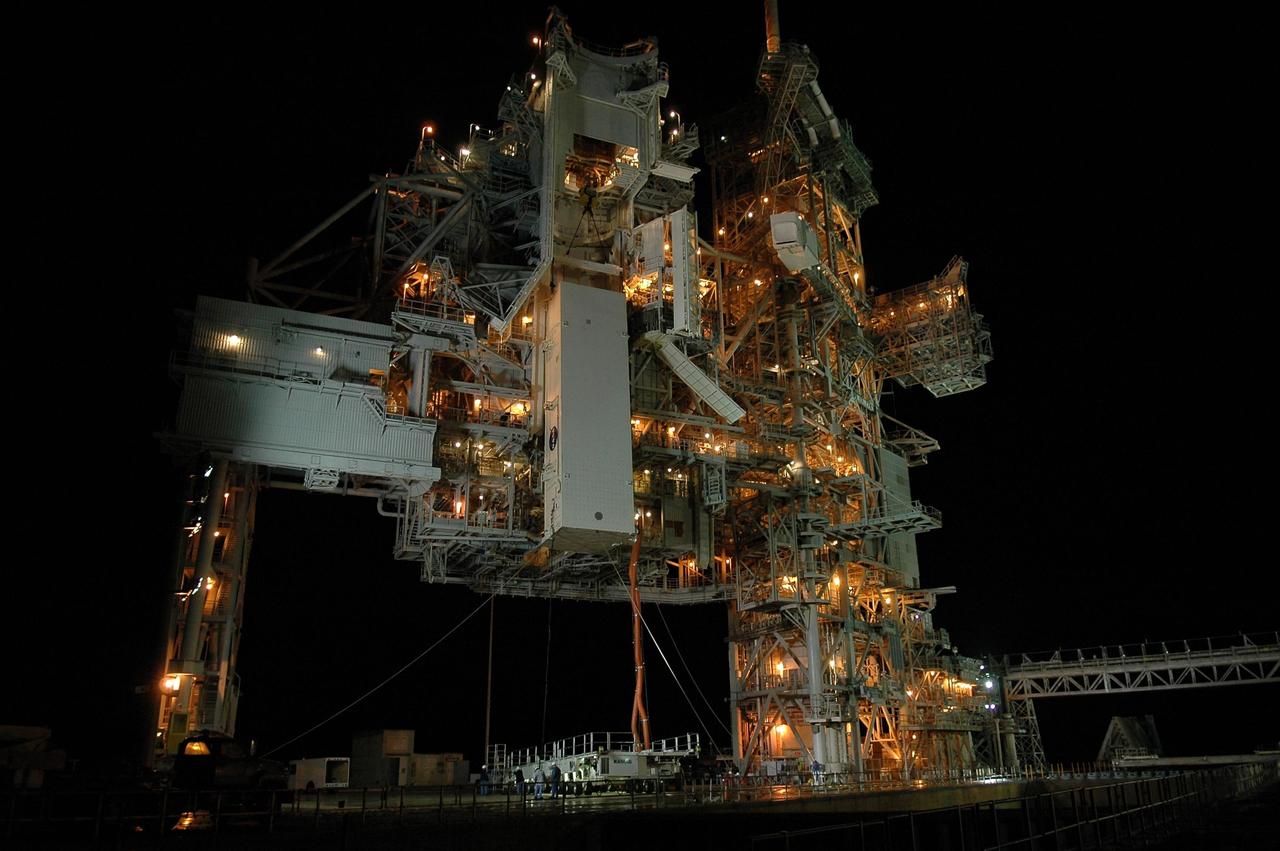
KENNEDY SPACE CENTER, FLA. -- With umbilical lines still attached, the payload canister is lifted up to the payload changeout room (PCR) on the rotating service structure (RSS) on Launch Pad 39B. Inside the canister are the SPACEHAB module and the port 5 truss segment for mission STS-116. Once inside the PCR, they will be transferred into Space Shuttle Discovery's payload bay after the vehicle has rolled out to the pad. On the right is the fixed service structure. The PCR is the enclosed, environmentally controlled portion of the RSS that supports cargo delivery to the pad and subsequent vertical installation into the orbiter payload bay. Seals around the mating surface of the PCR fit against the orbiter and allow the opening of the payload bay or canister doors and removal of the cargo without exposure to outside air and contaminants. A clean-air purge in the PCR maintains environmental control during PCR cargo operations. Cargo is removed from the payload canister and installed vertically in the orbiter by the payload ground handling mechanism (PGHM). Photo credit: NASA/Kim Shiflett
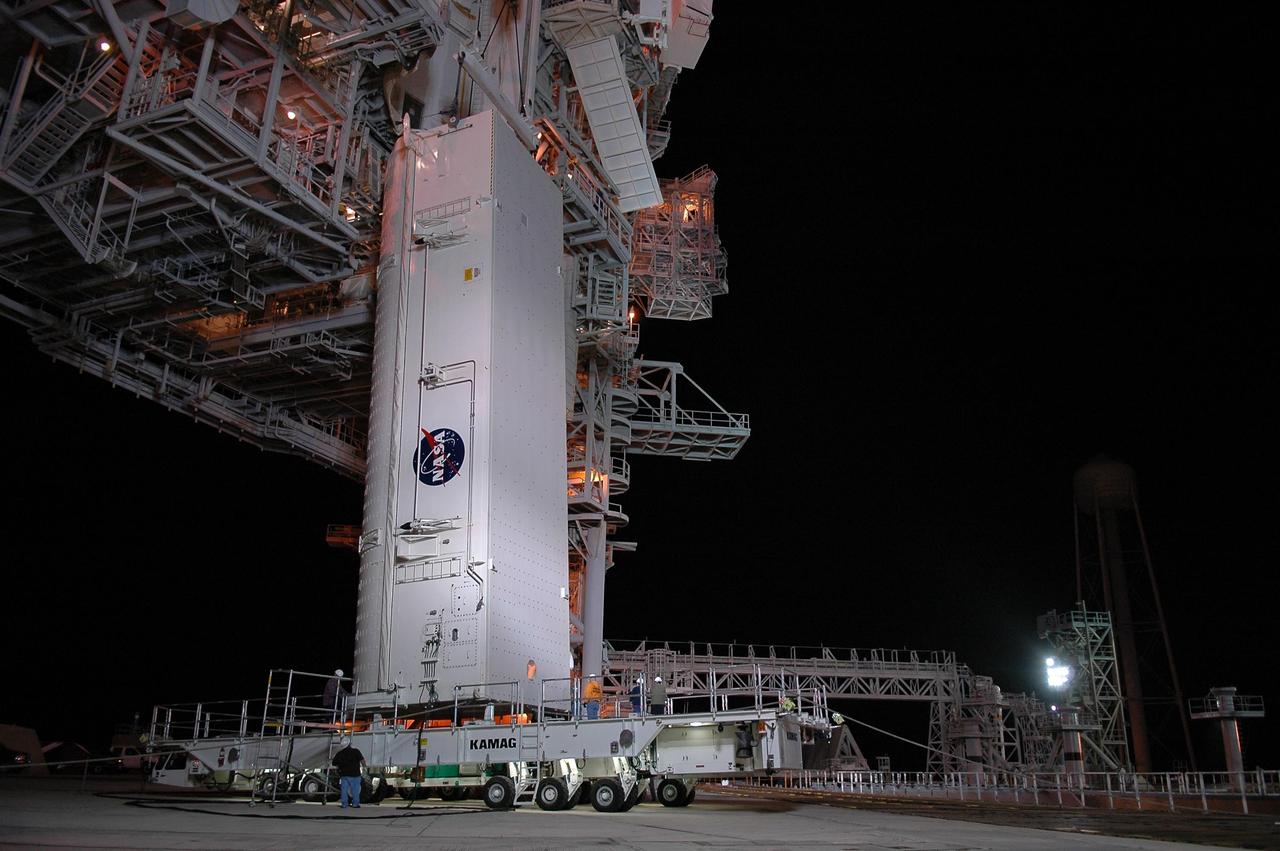
KENNEDY SPACE CENTER, FLA. -- The payload canister is raised off the transporter and will be lifted up to the payload changeout room (PCR) on the rotating service structure (RSS) on Launch Pad 39B. Inside the canister are the SPACEHAB module and the port 5 truss segment for mission STS-116. Once inside the PCR, they will be transferred into Space Shuttle Discovery's payload bay once the vehicle has rolled out to the pad. The PCR is the enclosed, environmentally controlled portion of the RSS that supports cargo delivery to the pad and subsequent vertical installation into the orbiter payload bay. Seals around the mating surface of the PCR fit against the orbiter and allow the opening of the payload bay or canister doors and removal of the cargo without exposure to outside air and contaminants. A clean-air purge in the PCR maintains environmental control during PCR cargo operations. Cargo is removed from the payload canister and installed vertically in the orbiter by the payload ground handling mechanism (PGHM). Photo credit: NASA/Kim Shiflett
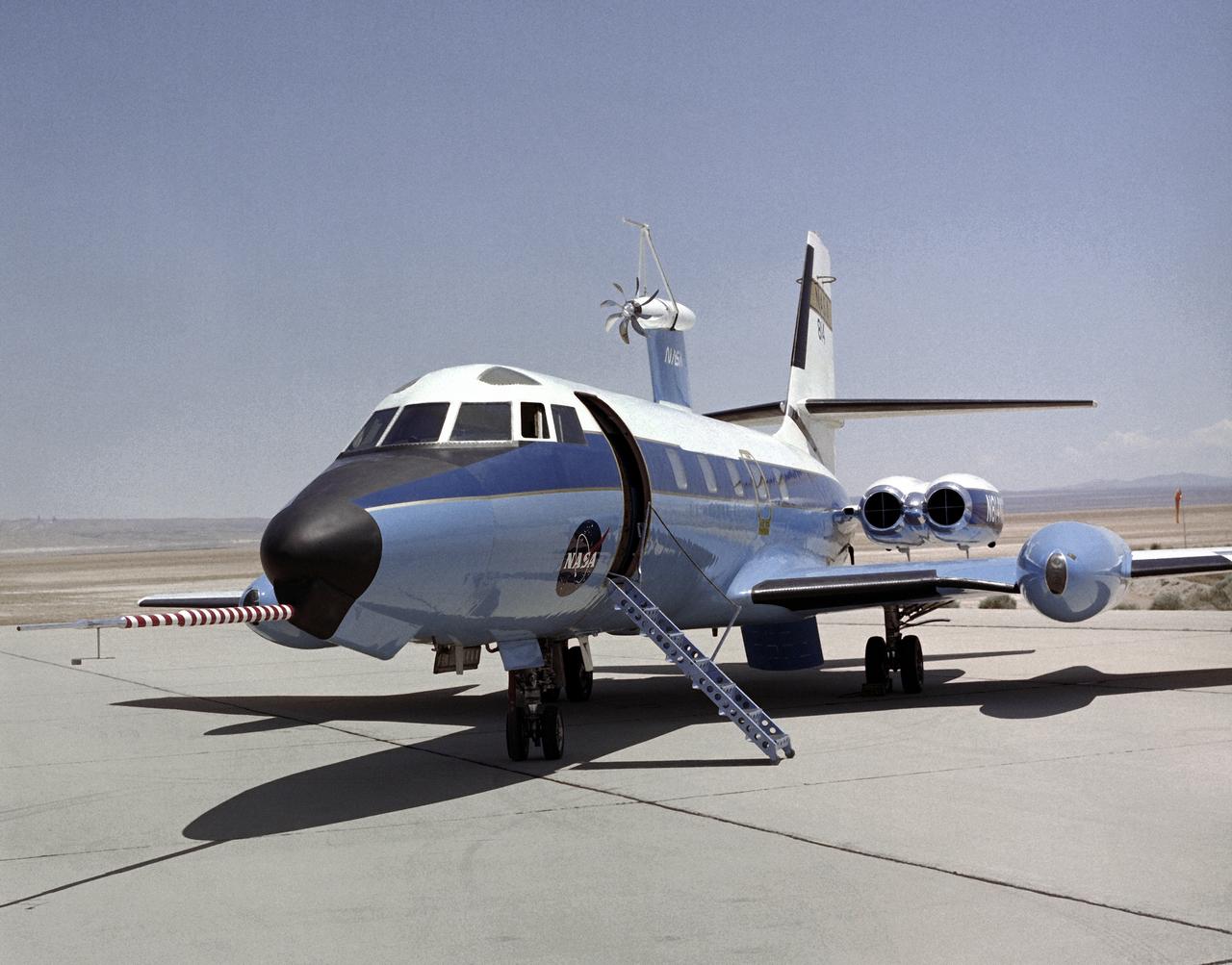
In this photo of the C-140 JetStar on the Dryden Ramp, a subscale propeller has been fitted to the upper fuselage of the aircraft.
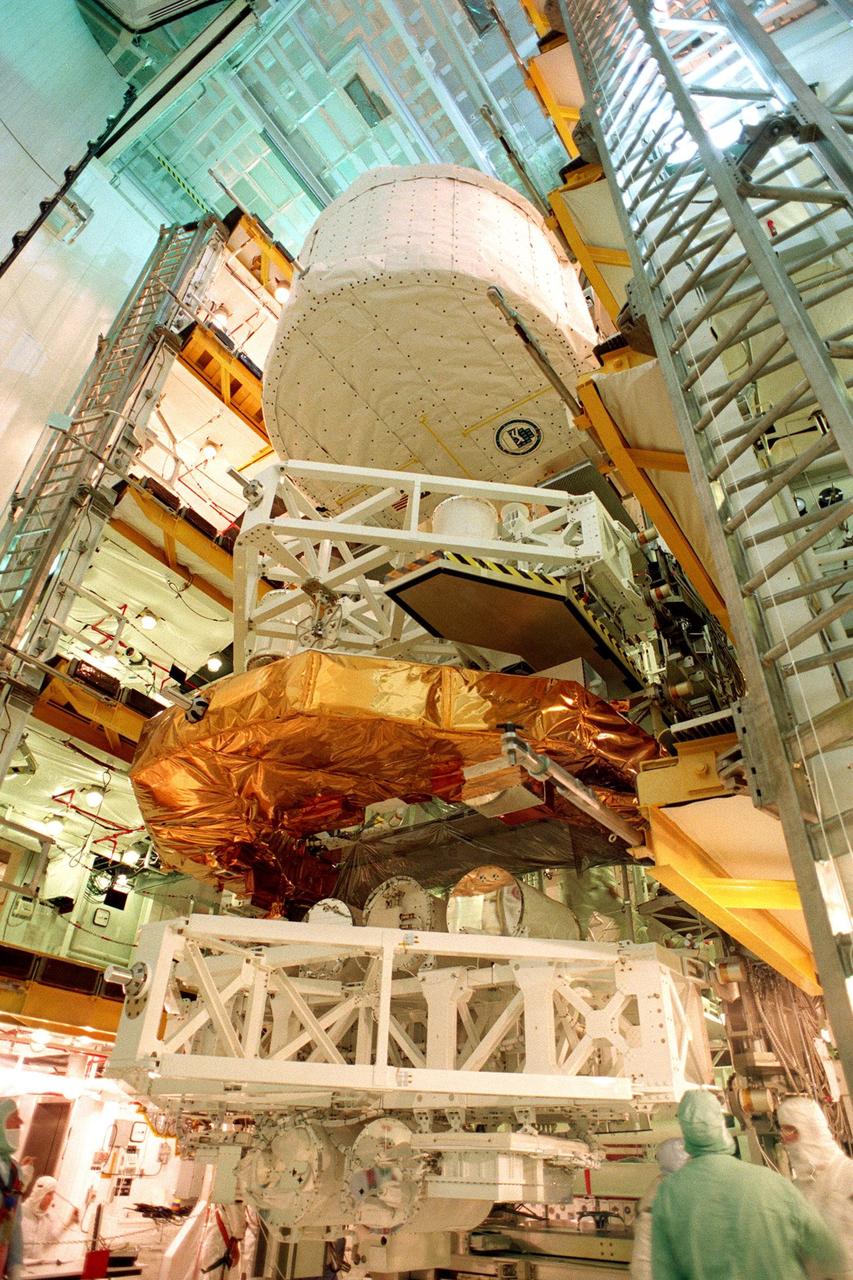
KENNEDY SPACE CENTER, FLA. -- Inside the Payload Changeout Room (PCR) in the Rotating Service Structure (RSS) at Launch Pad 39-B, technicians in clean suits move the payloads for mission STS-95 to the payload bay of Space Shuttle Discovery. At the top of the RSS is the Spacehab module; below it are the Spartan solar-observing deployable spacecraft, the Hubble Space Telescope Orbiting Systems Test Platform (HOST), and the International Extreme Ultraviolet Hitchhiker (IEH-3). The PCR is an environmentally controlled facility with seals around the mating surface that fit against the orbiter or payload canister and permit the payload bay or canister doors to be opened and cargo removed without exposing it to outside air and contaminants. Payloads are installed vertically in the orbiter using the extendable payload ground handling mechanism. Fixed and extendable work platforms provide work access in the PCR. The SPACEHAB single module involves experiments on space flight and the aging process. Spartan is a solar physics spacecraft designed to perform remote sensing of the hot outer layers of the sun's atmosphere or corona. HOST carries four experiments to validate components planned for installation during the third Hubble Space Telescope servicing mission and to evaluate new technologies in an Earth-orbiting environment. IEH-3 comprises several experiments that will study the Jovian planetary system, hot stars, planetary and reflection nebulae, other stellar objects and their environments through remote observation of EUV/FUV emissions; study spacecraft interactions, Shuttle glow, thruster firings, and contamination; and measure the solar constant and identify variations in the value during a solar cycle. Mission STS-95 is scheduled to launch Oct. 29, 1998
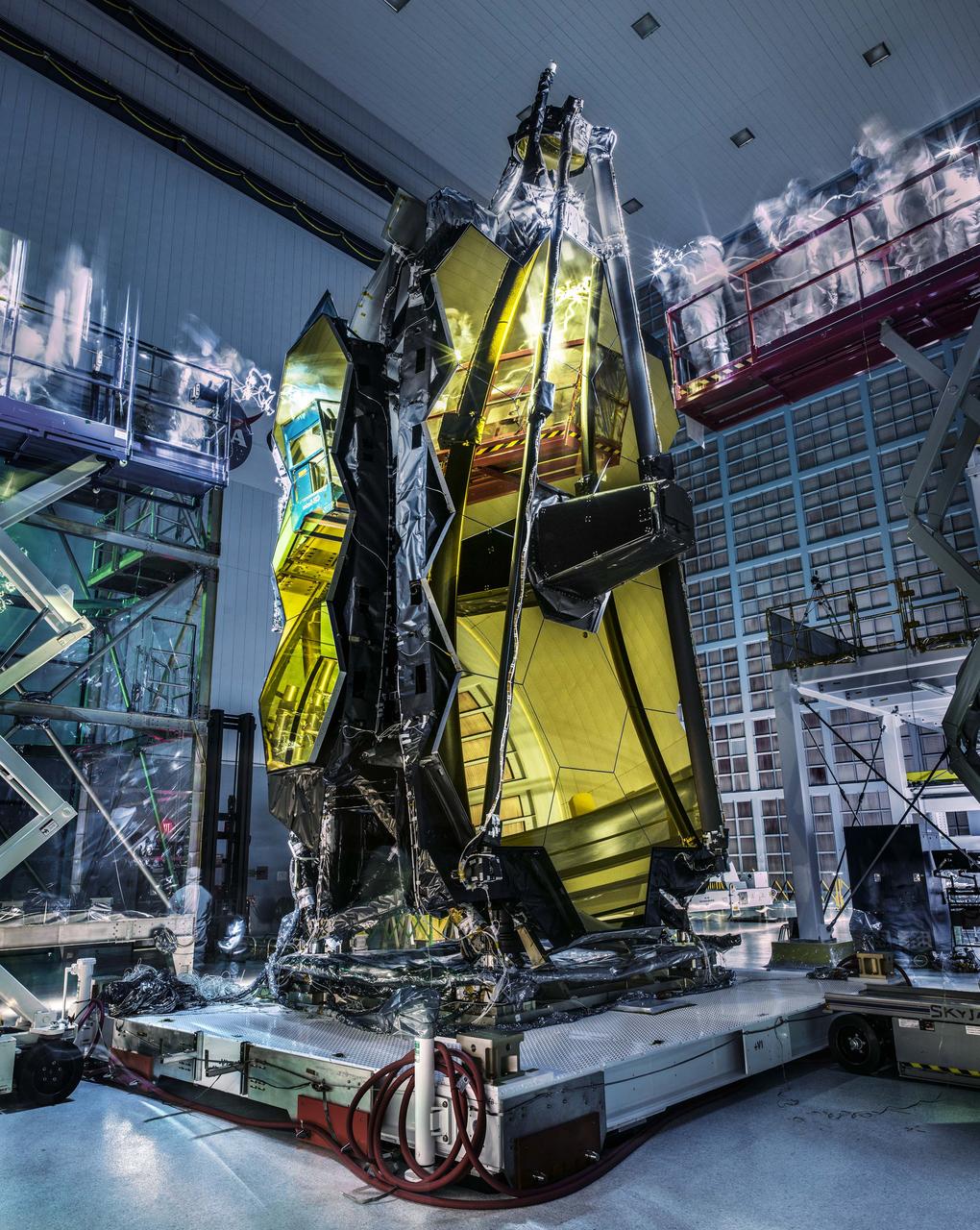
What happens when the lights are turned out in the enormous clean room that currently houses NASA's James Webb Space Telescope? The technicians who are inspecting the telescope and its expansive golden mirrors look like ghostly wraiths in this image as they conduct a "lights out inspection" in the Spacecraft Systems Development and Integration Facility (SSDIF) at NASA's Goddard Space Flight Center in Greenbelt, Maryland. The clean room lights were turned off to inspect the telescope after it experienced vibration and acoustic testing. The contamination control engineer used a bright flashlight and special ultraviolet flashlights to inspect for contamination because it's easier to find in the dark. NASA photographer Chris Gunn said "The people have a ghostly appearance because it's a long exposure." He left the camera's shutter open for a longer than normal time so the movement of the technicians appear as a blur. He also used a special light "painting" technique to light up the primary mirror. The James Webb Space Telescope is the scientific successor to NASA's Hubble Space Telescope. It will be the most powerful space telescope ever built. Webb is an international project led by NASA with its partners, ESA (European Space Agency) and the Canadian Space Agency. For more information about the Webb telescope visit: <a href="http://www.jwst.nasa.gov" rel="nofollow">www.jwst.nasa.gov</a> or <a href="http://www.nasa.gov/webb" rel="nofollow">www.nasa.gov/webb</a> Image Credit: NASA/Chris Gunn
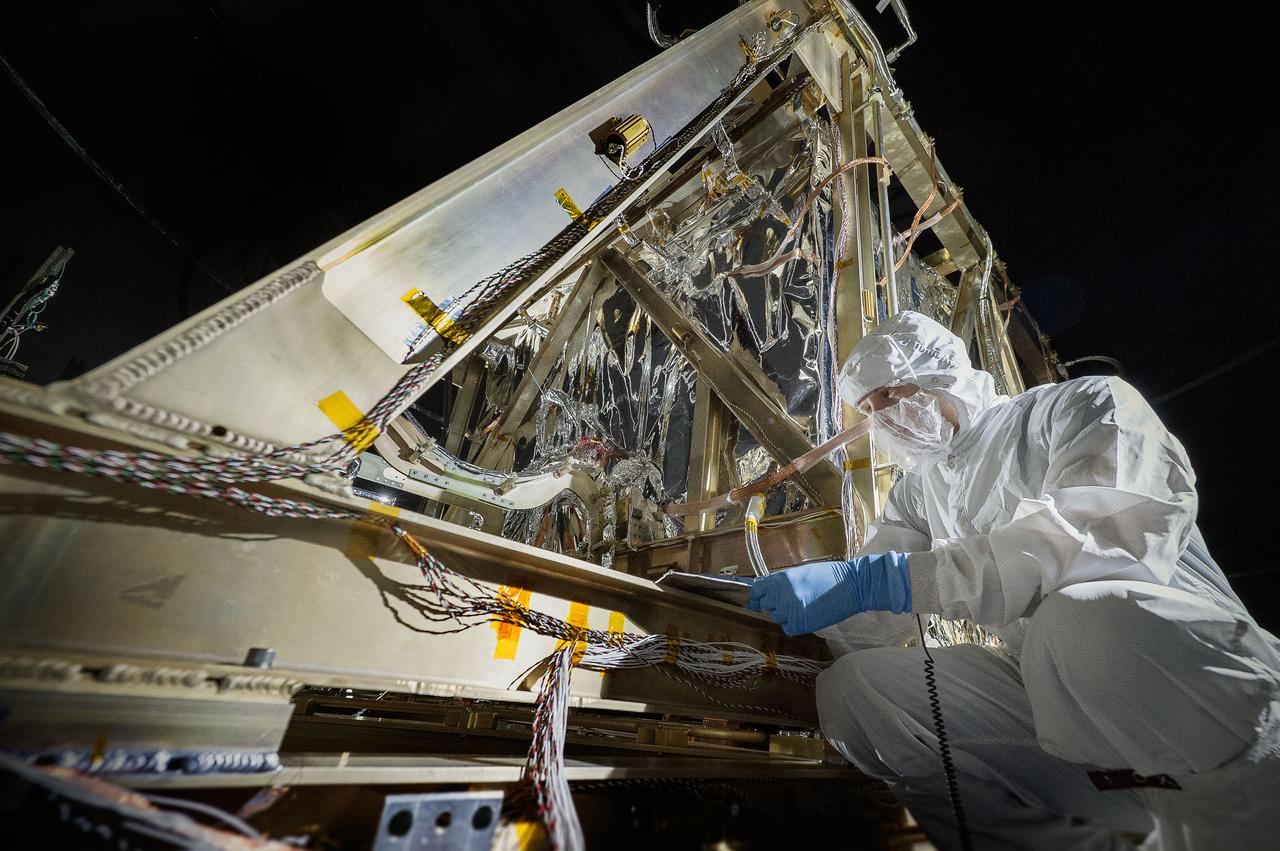
At NASA's James Webb Space Telescope's final destination in space, one million miles away from Earth, it will operate at incredibly cold temperatures of -387 degrees Fahrenheit, or 40 degrees Kelvin. This is 260 degrees Fahrenheit colder than any place on the Earth’s surface has ever been. So first, this final super cold test at Goddard will prepare the Integrated Science Instrument Module (ISIM), or the “heart” of the telescope, for space. Read more: <a href="http://go.nasa.gov/1KFPwJG" rel="nofollow">go.nasa.gov/1KFPwJG</a> Contamination Control Engineer Alan Abeel conducts final inspections and places contamination foils before the start of the test. Credit: NASA/Goddard/Chris Gunn <b><a href="http://www.nasa.gov/audience/formedia/features/MP_Photo_Guidelines.html" rel="nofollow">NASA image use policy.</a></b> <b><a href="http://www.nasa.gov/centers/goddard/home/index.html" rel="nofollow">NASA Goddard Space Flight Center</a></b> enables NASA’s mission through four scientific endeavors: Earth Science, Heliophysics, Solar System Exploration, and Astrophysics. Goddard plays a leading role in NASA’s accomplishments by contributing compelling scientific knowledge to advance the Agency’s mission. <b>Follow us on <a href="http://twitter.com/NASAGoddardPix" rel="nofollow">Twitter</a></b> <b>Like us on <a href="http://www.facebook.com/pages/Greenbelt-MD/NASA-Goddard/395013845897?ref=tsd" rel="nofollow">Facebook</a></b> <b>Find us on <a href="http://instagrid.me/nasagoddard/?vm=grid" rel="nofollow">Instagram</a></b>
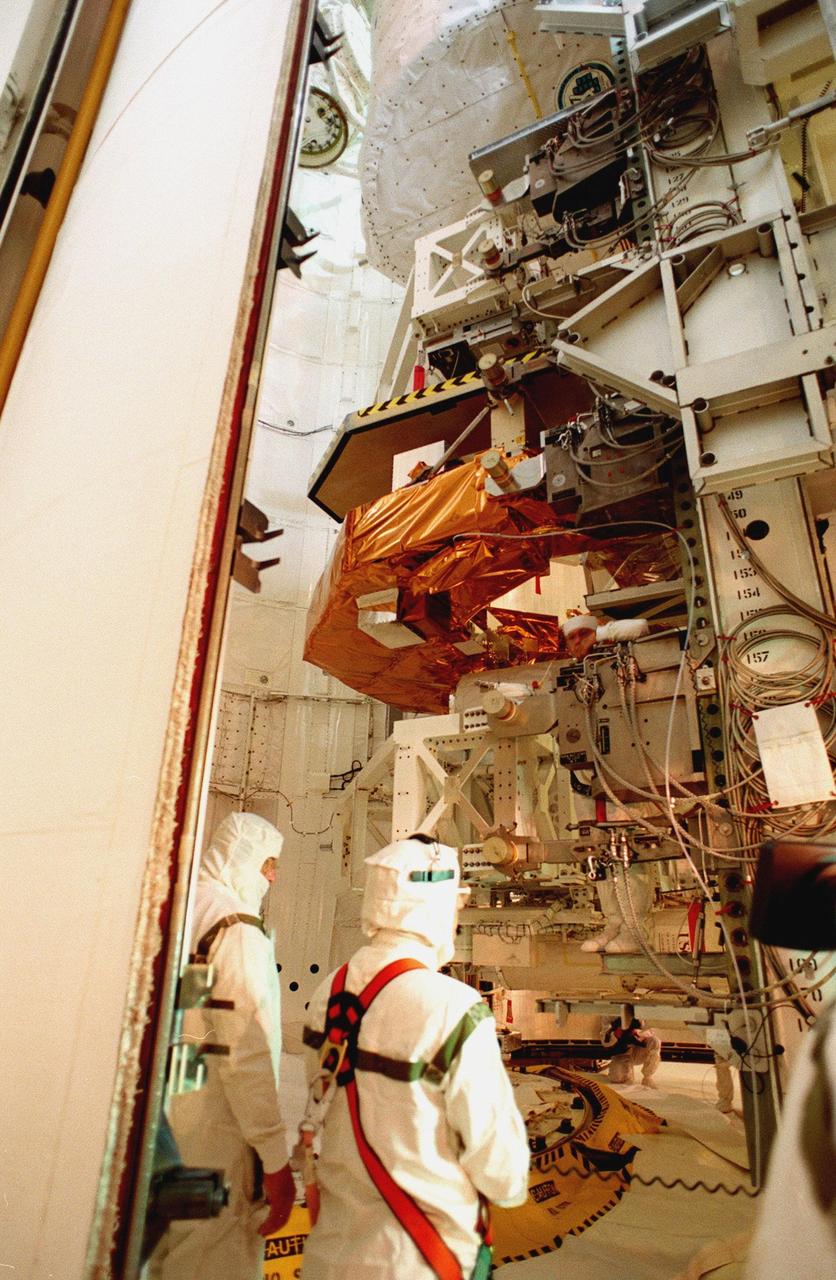
KENNEDY SPACE CENTER,FLA. -- Inside the Payload Changeout Room (PCR) in the Rotating Service Structure (RSS) at Launch Pad 39-B, technicians in clean suits and tethers prepare to move the payloads for mission STS-95 through the open doors of the payload bay (left) of Space Shuttle Discovery. At the top of the RSS is the Spacehab module; below it are the Spartan solar-observing deployable spacecraft, the Hubble Space Telescope Orbiting Systems Test Platform (HOST), and the International Extreme Ultraviolet Hitchhiker (IEH-3). The PCR is an environmentally controlled facility with seals around the mating surface that fit against the orbiter or payload canister and permit the payload bay or canister doors to be opened and cargo removed without exposing it to outside air and contaminants. Payloads are installed vertically in the orbiter using the extendable payload ground handling mechanism. Fixed and extendable work platforms provide work access in the PCR. The SPACEHAB single module involves experiments on space flight and the aging process. Spartan is a solar physics spacecraft designed to perform remote sensing of the hot outer layers of the sun's atmosphere or corona. HOST carries four experiments to validate components planned for installation during the third Hubble Space Telescope servicing mission and to evaluate new technologies in an Earth-orbiting environment. IEH-3 comprises several experiments that will study the Jovian planetary system, hot stars, planetary and reflection nebulae, other stellar objects and their environments through remote observation of EUV/FUV emissions; study spacecraft interactions, Shuttle glow, thruster firings, and contamination; and measure the solar constant and identify variations in the value during a solar cycle. Mission STS-95 is scheduled to launch Oct. 29, 1998
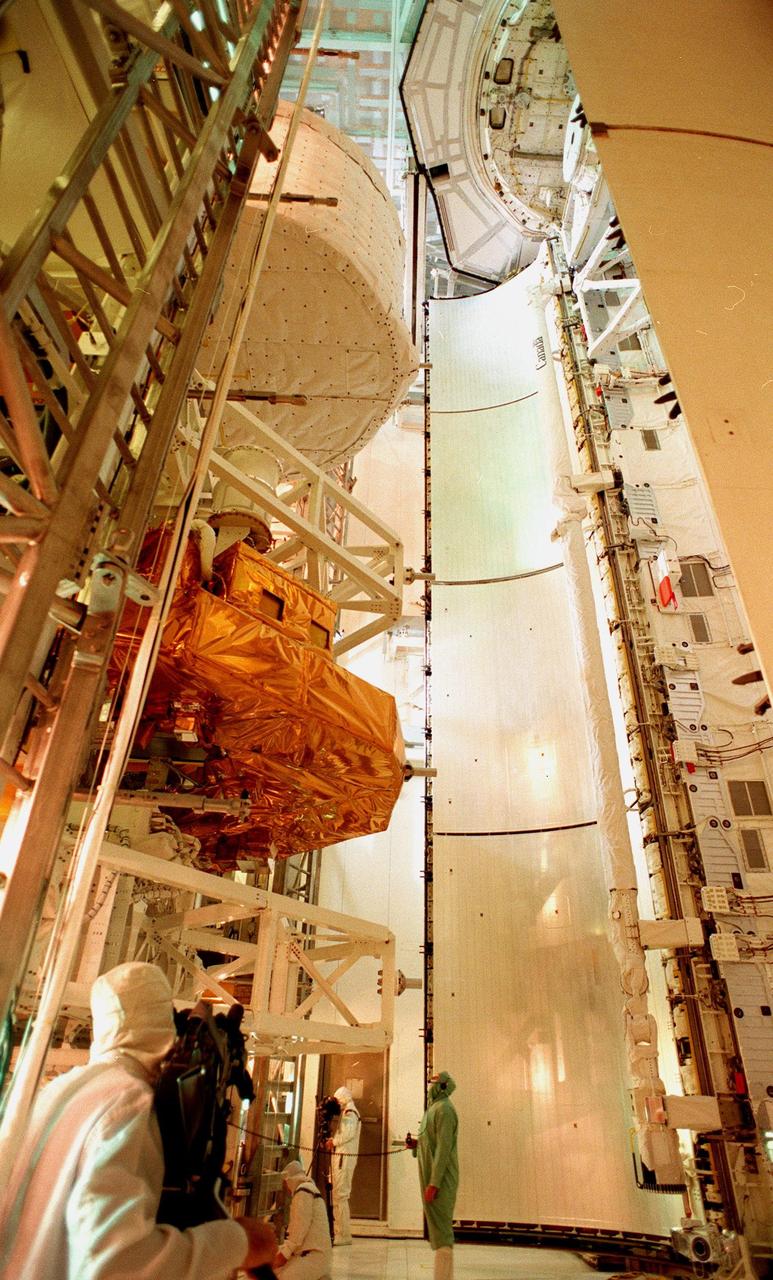
KENNEDY SPACE CENTER, FLA. -- Inside the Payload Changeout Room (PCR) in the Rotating Service Structure (RSS) at Launch Pad 39-B, technicians in clean suits and tethers prepare to move the payloads for mission STS-95 through the open doors of the payload bay (right) of Space Shuttle Discovery. At the top of the RSS is the Spacehab module; below it are the Spartan solar-observing deployable spacecraft, the Hubble Space Telescope Orbiting Systems Test Platform (HOST), and International Extreme Ultraviolet Hitchhiker (IEH-3). The PCR is an environmentally controlled facility with seals around the mating surface that fit against the orbiter or payload canister and permit the payload bay or canister doors to be opened and cargo removed without exposing it to outside air and contaminants. Payloads are installed vertically in the orbiter using the extendable payload ground handling mechanism. Fixed and extendable work platforms provide work access in the PCR. The SPACEHAB single module involves experiments on space flight and the aging process. Spartan is a solar physics spacecraft designed to perform remote sensing of the hot outer layers of the sun's atmosphere or corona. HOST carries four experiments to validate components planned for installation during the third Hubble Space Telescope servicing mission and to evaluate new technologies in an Earth-orbiting environment. IEH-3 comprises several experiments that will study the Jovian planetary system, hot stars, planetary and reflection nebulae, other stellar objects and their environments through remote observation of EUV/FUV emissions; study spacecraft interactions, Shuttle glow, thruster firings, and contamination; and measure the solar constant and identify variations in the value during a solar cycle. Mission STS-95 is scheduled to launch Oct. 29, 1998
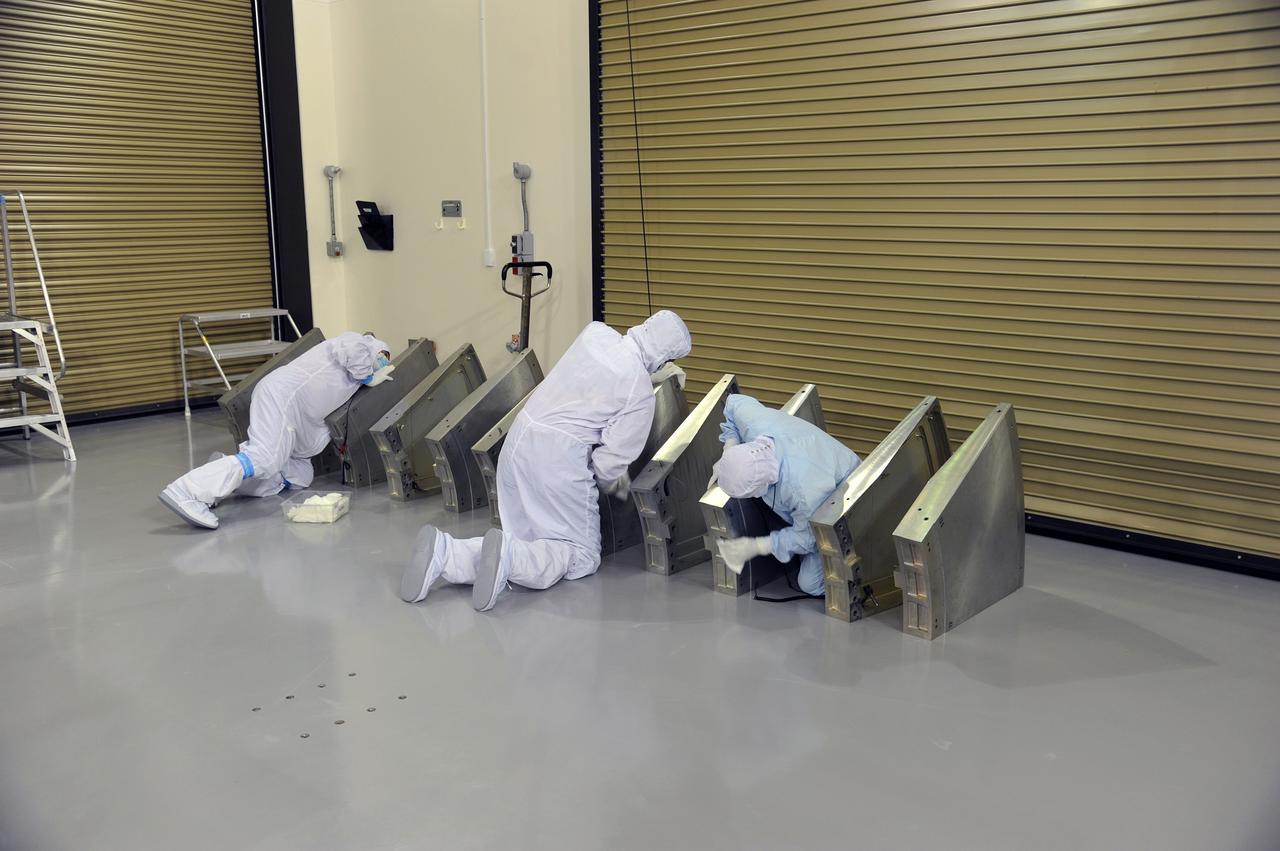
VANDENBERG AIR FORCE BASE, Calif. – Technicians clean some of the hardware for NASA's Orbiting Carbon Observatory-2 mission, or OCO-2, in the Astrotech Payload Processing Facility on Vandenberg Air Force Base in California to ensure that the spacecraft is not contaminated prior to its transport to Space Launch Complex 2 for enclosure in the Delta II payload fairing. Launch aboard a United Launch Alliance Delta II rocket is scheduled for 5:56 a.m. EDT on July 1. OCO-2 is NASA’s first mission dedicated to studying atmospheric carbon dioxide, the leading human-produced greenhouse gas driving changes in Earth’s climate. OCO-2 will provide a new tool for understanding the human and natural sources of carbon dioxide emissions and the natural "sinks" that absorb carbon dioxide and help control its buildup. The observatory will measure the global geographic distribution of these sources and sinks and study their changes over time. To learn more about OCO-2, visit http://oco.jpl.nasa.gov. Photo credit: NASA/30th Space Wing, U.S. Air Force
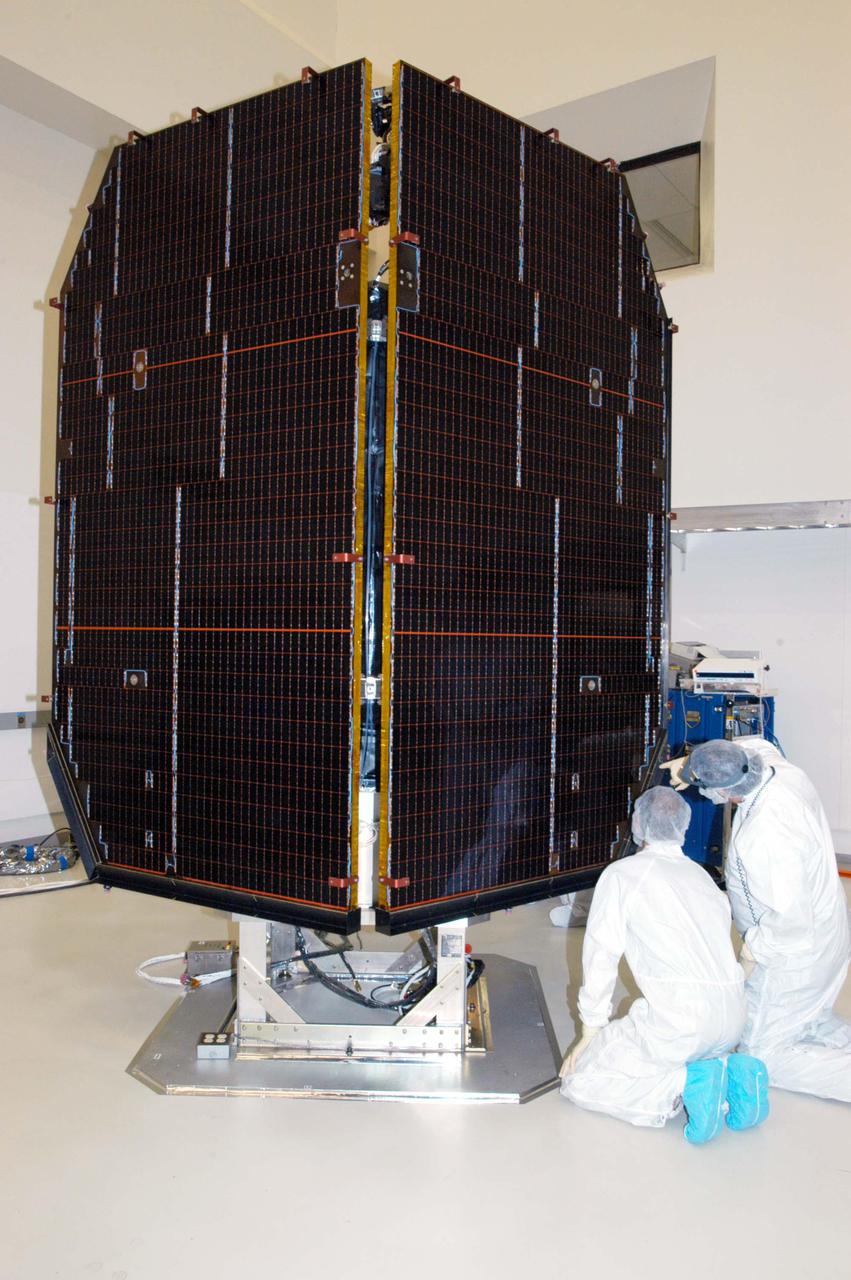
KENNEDY SPACE CENTER, FLA. - At Astrotech Space Operations in Titusville, Fla., Alec Baldwin (left) and Mike Renbarger check cells on the solar panels on the Deep Impact spacecraft. Baldwin is a technician and Renbarger a contamination control technician with Ball Aerospace and Technologies Corp. in Boulder, Colo. The spacecraft is undergoing verification testing after its long road trip from Colorado. A NASA Discovery mission, Deep Impact will probe beneath the surface of Comet Tempel 1 on July 4, 2005, when the comet is 83 million miles from Earth, and reveal the secrets of its interior. After releasing a 3- by 3-foot projectile to crash onto the surface, Deep Impact’s flyby spacecraft will collect pictures and data of how the crater forms, measuring the crater’s depth and diameter, as well as the composition of the interior of the crater and any material thrown out, and determining the changes in natural outgassing produced by the impact. It will send the data back to Earth through the antennas of the Deep Space Network. The spacecraft is scheduled to launch Dec. 30, 2004, aboard a Boeing Delta II rocket from Launch Complex 17 at Cape Canaveral Air Force Station, Fla.

At left, Albert Sierra, Launch Services Program, moderates a Spanish Facebook Live event for the Solar Orbiter mission, with Teresa Nieves-chinchilla, deputy project scientist at NASA’s Goddard Space Flight Center in Greenbelt, Maryland, and Ana Leon, Solar Orbiter contamination control architect with Airbus Defence and Space. The event was held in the Press Site auditorium at the agency’s Kennedy Space Center in Florida on Jan. 29, 2020. Solar Orbiter is an international cooperative mission between ESA (European Space Agency) and NASA. The mission aims to study the Sun, its outer atmosphere and solar wind. The spacecraft will provide the first images of the Sun’s poles. NASA’s Launch Services Program based at Kennedy is managing the launch. The spacecraft has been developed by Airbus Defence and Space. Solar Orbiter will launch in February 2020 aboard a United Launch Alliance Atlas V rocket from Space Launch Complex 41 at Cape Canaveral Air Force Station in Florida.
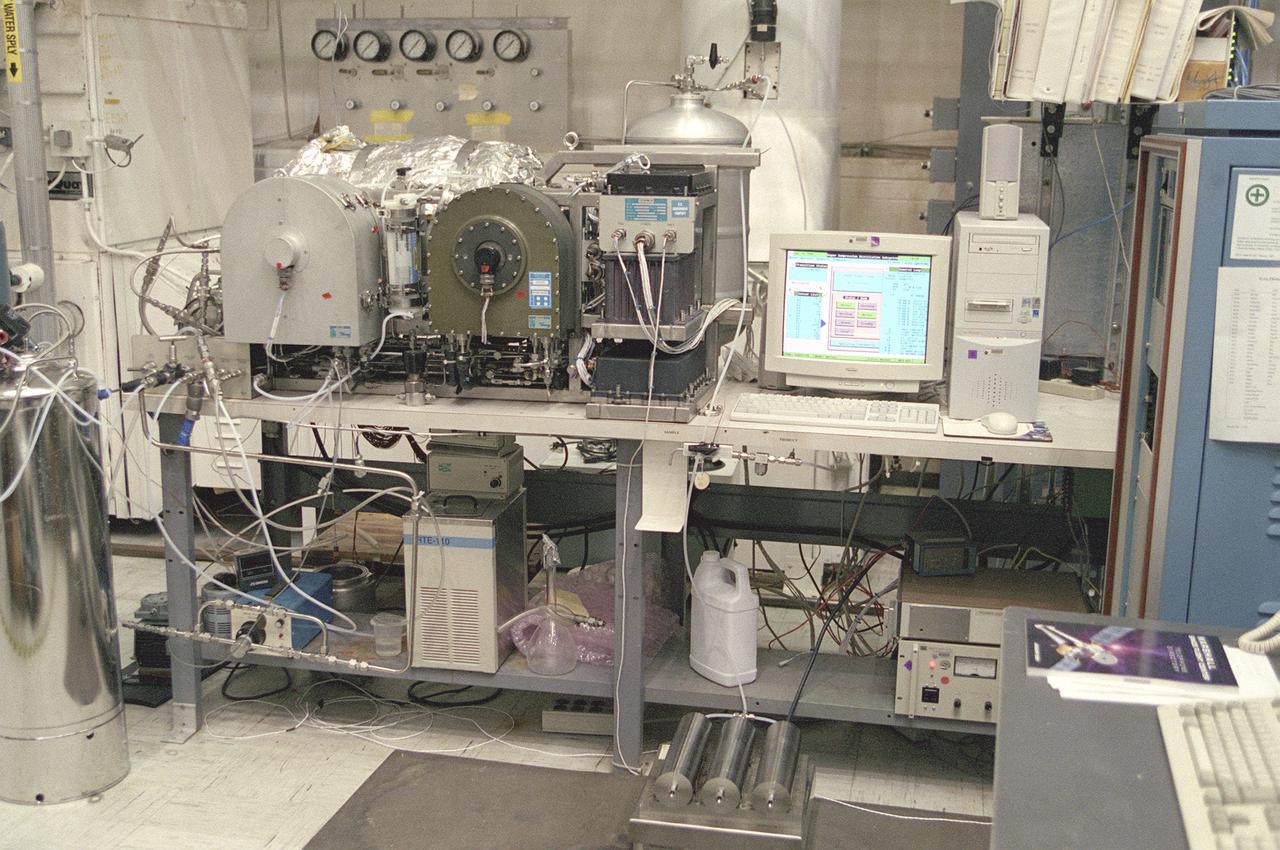
The Marshall Space Flight Center (MSFC) is responsible for designing and building the life support systems that will provide the crew of the International Space Station (ISS) a comfortable environment in which to live and work. Scientists and engineers at the MSFC are working together to provide the ISS with systems that are safe, efficient, and cost-effective. These compact and powerful systems are collectively called the Environmental Control and Life Support Systems, or simply, ECLSS. This photograph shows the fifth generation Urine Processor Development Hardware. The Urine Processor Assembly (UPA) is a part of the Water Recovery System (WRS) on the ISS. It uses a chase change process called vapor compression distillation technology to remove contaminants from urine. The UPA accepts and processes pretreated crewmember urine to allow it to be processed along with other wastewaters in the Water Processor Assembly (WPA). The WPA removes free gas, organic, and nonorganic constituents before the water goes through a series of multifiltration beds for further purification. Product water quality is monitored primarily through conductivity measurements. Unacceptable water is sent back through the WPA for reprocessing. Clean water is sent to a storage tank.
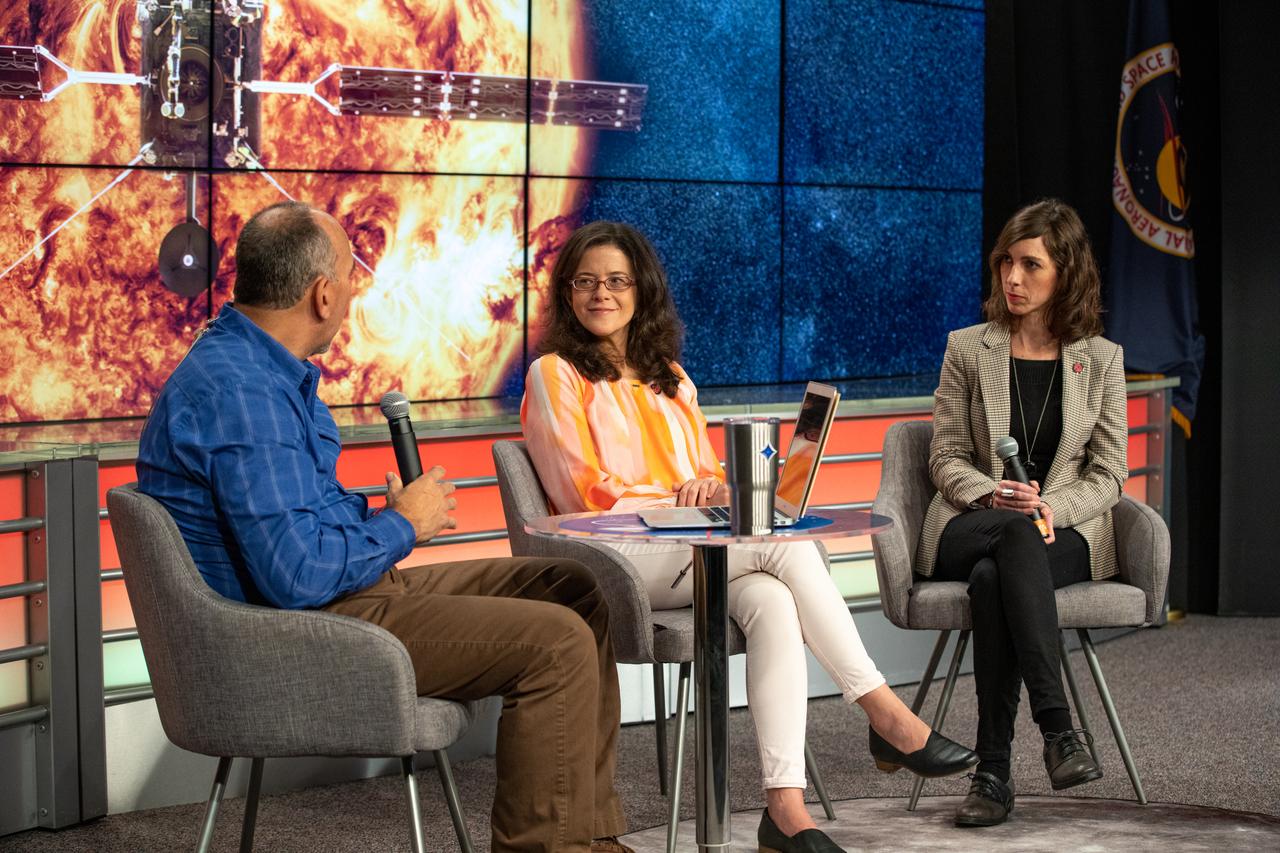
At left, Albert Sierra, Launch Services Program, moderates a Spanish Facebook Live event for the Solar Orbiter mission, with Teresa Nieves-chinchilla, deputy project scientist at NASA’s Goddard Space Flight Center in Greenbelt, Maryland, and Ana Leon, Solar Orbiter contamination control architect with Airbus Defence and Space. The event was held in the Press Site auditorium at the agency’s Kennedy Space Center in Florida on Jan. 29, 2020. Solar Orbiter is an international cooperative mission between ESA (European Space Agency) and NASA. The mission aims to study the Sun, its outer atmosphere and solar wind. The spacecraft will provide the first images of the Sun’s poles. NASA’s Launch Services Program based at Kennedy is managing the launch. The spacecraft has been developed by Airbus Defence and Space. Solar Orbiter will launch in February 2020 aboard a United Launch Alliance Atlas V rocket from Space Launch Complex 41 at Cape Canaveral Air Force Station in Florida.
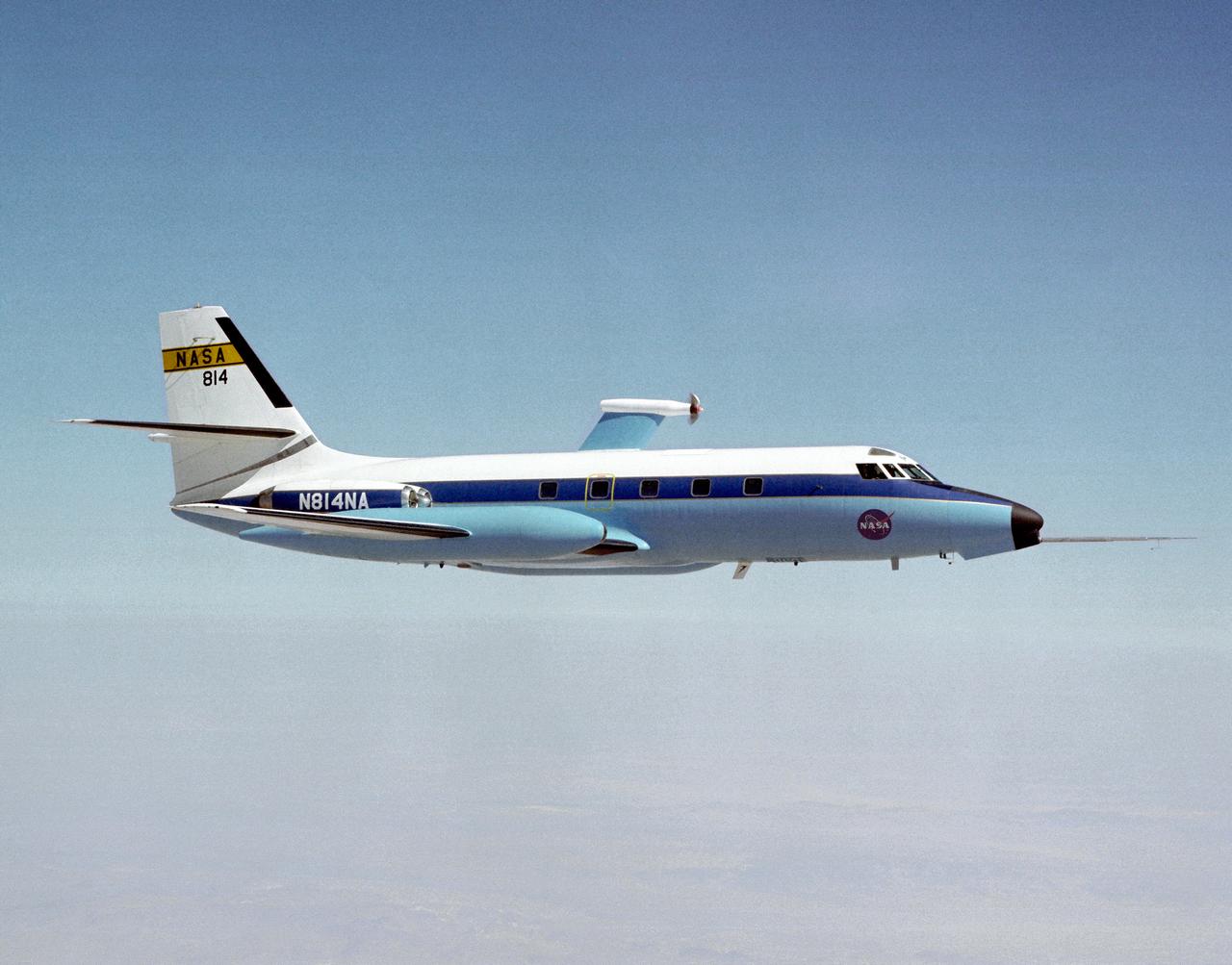
The Dryden C-140 JetStar during testing of advanced propfan designs. Dryden conducted flight research in 1981-1982 on several designs. The technology was developed under the direction of the Lewis Research Center (today the Glenn Research Center, Cleveland, OH) under the Advanced Turboprop Program. Under that program, Langley Research Center in Virginia oversaw work on accoustics and noise reduction. These efforts were intended to develop a high-speed and fuel-efficient turboprop system.