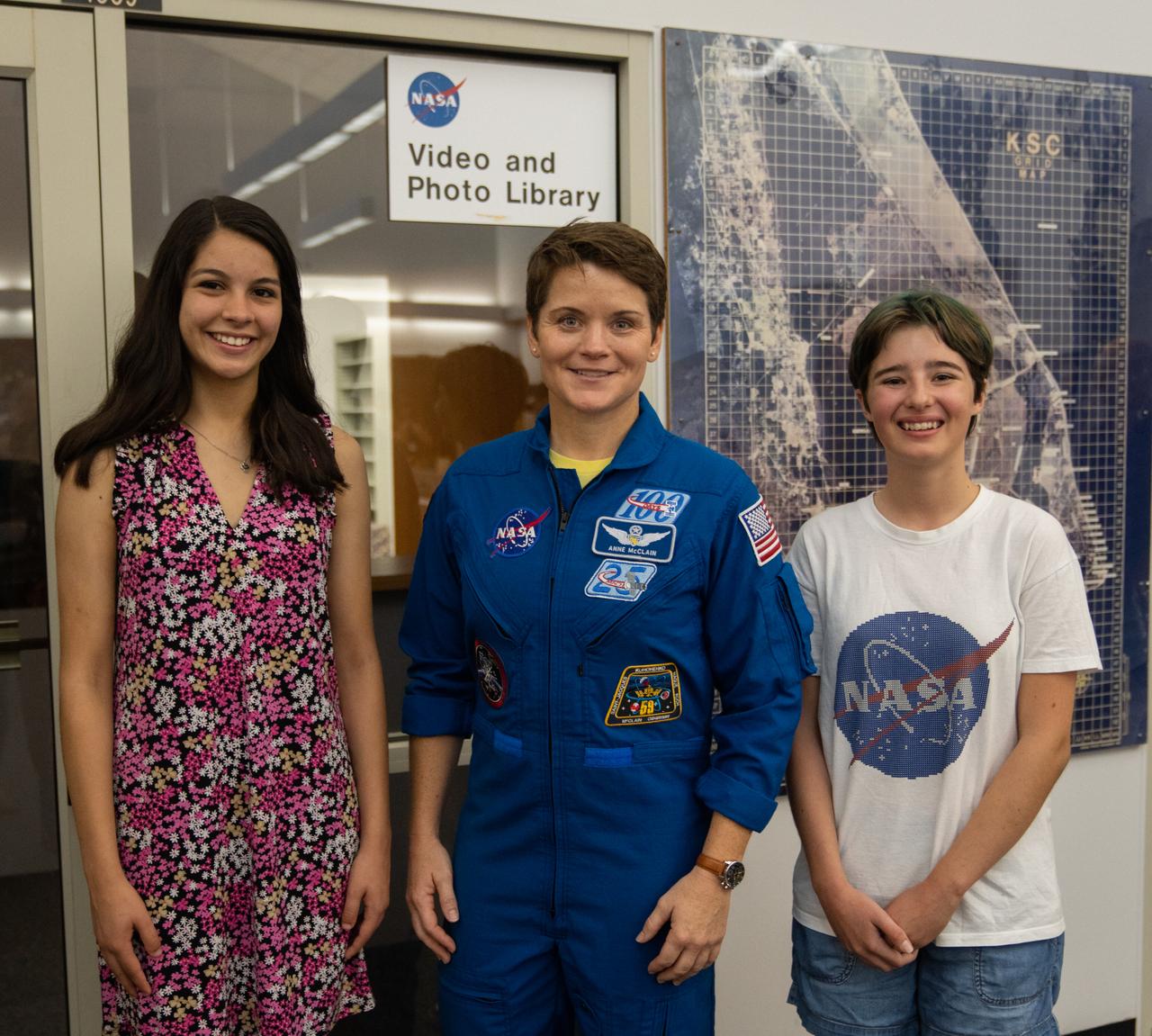
Student essay winners Amanda Gutierrez, left, and Taia Saurer pose with NASA astronaut Anne McClain at the agency’s news center at Kennedy Space Center in Florida on Sept. 2, 2022. Gutierrez and Saurer won the Artemis Moon Pod Essay Contest – a nationwide event involving nearly 14,000 students – for their creative visions of a pioneering journey to the Moon. The grand prize was a trip to Kennedy to watch the launch of Artemis I. Gutierrez, 17, is an 11th-grader from Lincoln, Nebraska, while Saurer, 14, is an eighth-grader from Laguna Beach, California.
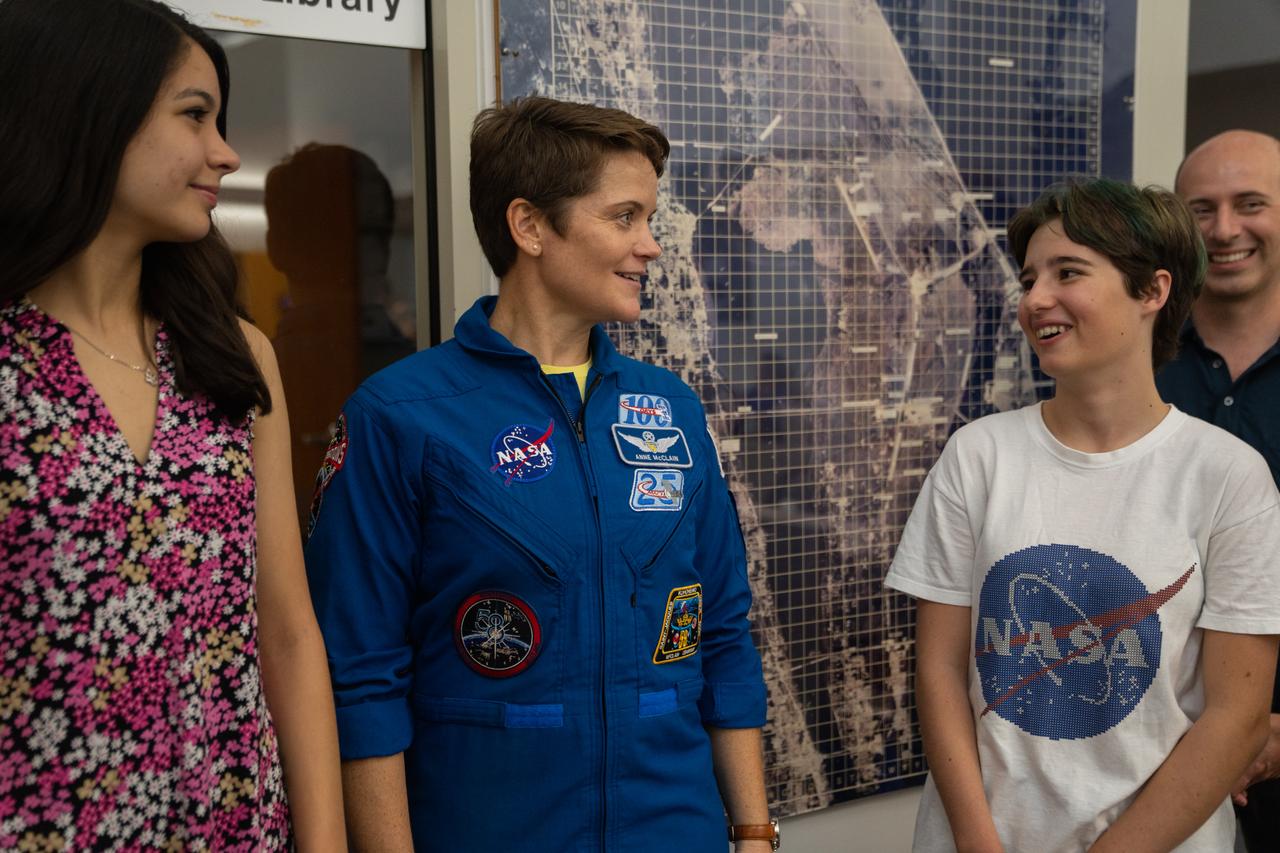
NASA astronaut Anne McClain talks with student essay winners Amanda Gutierrez, left, and Taia Saurer at the agency’s news center at Kennedy Space Center in Florida on Sept. 2, 2022. Gutierrez and Saurer won the Artemis Moon Pod Essay Contest – a nationwide event involving nearly 14,000 students – for their creative visions of a pioneering journey to the Moon. The grand prize was a trip to Kennedy to watch the launch of Artemis I. Gutierrez, 17, is an 11th-grader from Lincoln, Nebraska, while Saurer, 14, is an eighth-grader from Laguna Beach, California.
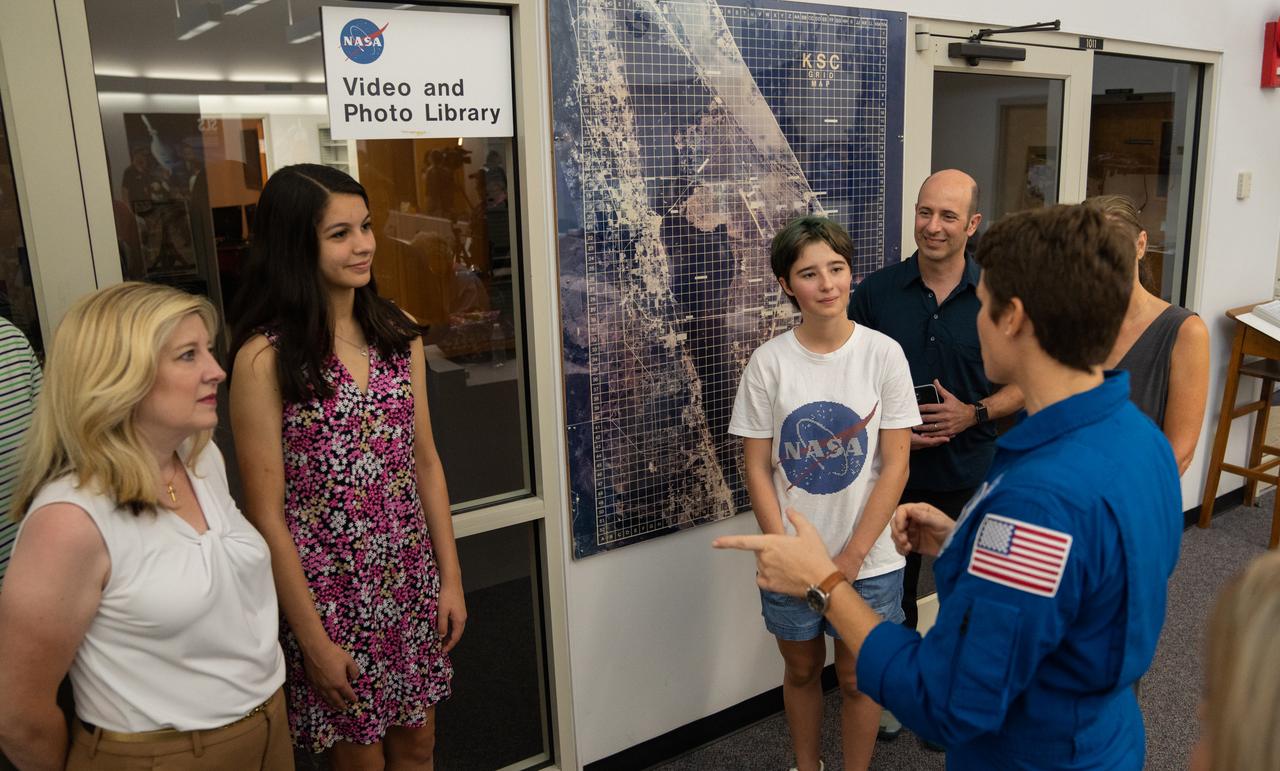
NASA astronaut Anne McClain talks with student essay winners Amanda Gutierrez, second from left, and Taia Saurer, white NASA shirt, at the agency’s news center at Kennedy Space Center in Florida on Sept. 2, 2022. Gutierrez and Saurer won the Artemis Moon Pod Essay Contest – a nationwide event involving nearly 14,000 students – for their creative visions of a pioneering journey to the Moon. The grand prize was a trip to Kennedy to watch the launch of Artemis I. Gutierrez, 17, is an 11th-grader from Lincoln, Nebraska, while Saurer, 14, is an eighth-grader from Laguna Beach, California.
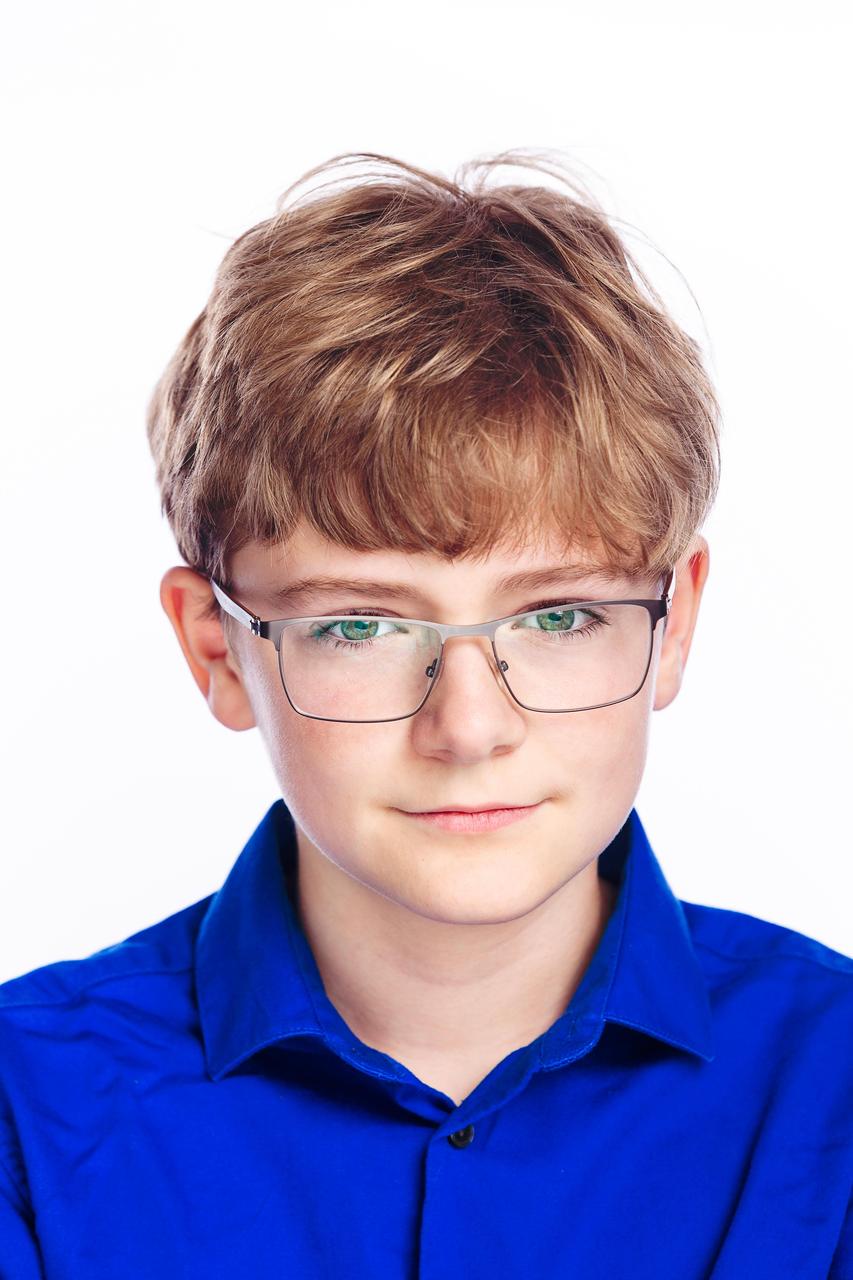
Seventh-grader Alexander Mather of Lake Braddock Secondary School in Burke, Virginia, submitted the winning entry in the agency's "Name the Rover" essay contest, making the case to name the Mars 2020 rover "Perseverance." For the contest, NASA received 28,000 essays (150 words or less) from K-12 students from every U.S. state and territory. https://photojournal.jpl.nasa.gov/catalog/PIA23761
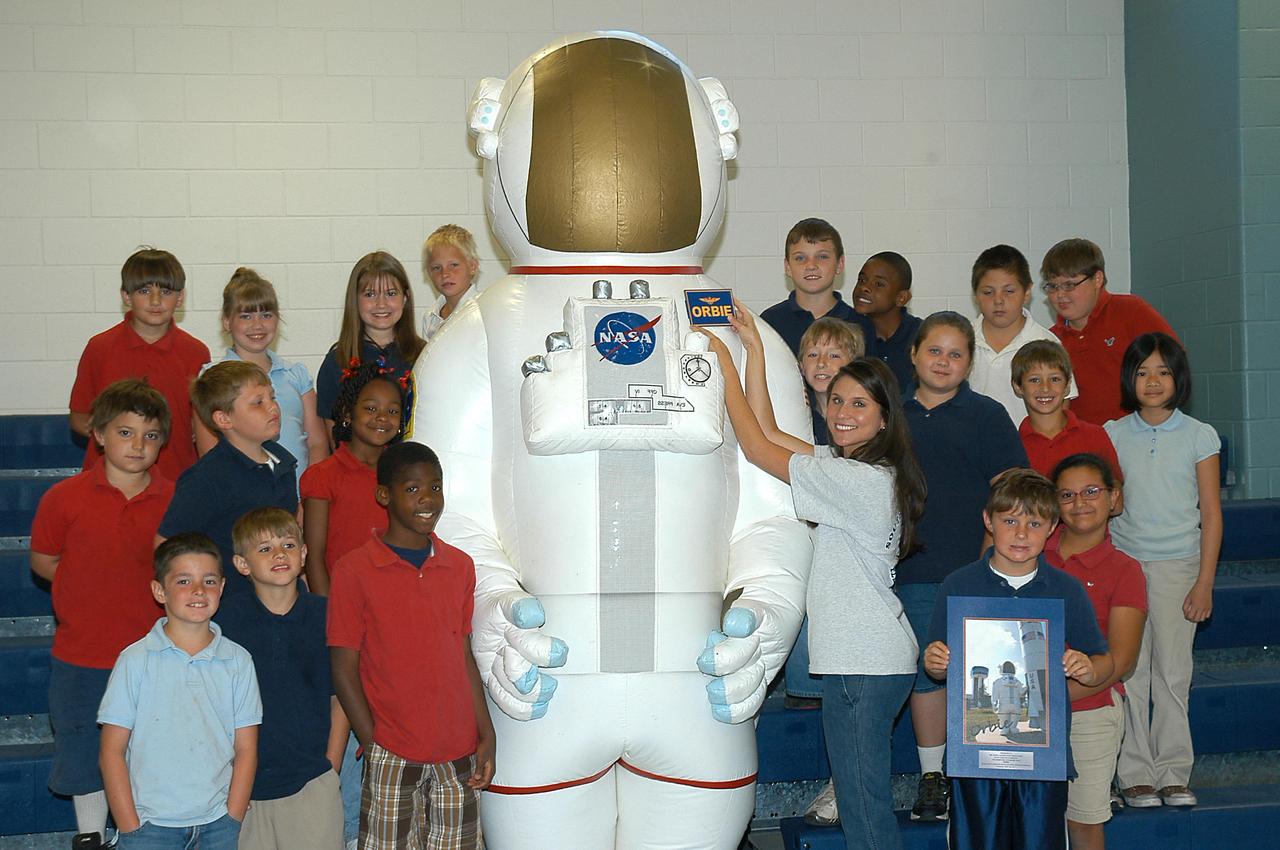
Students at South Hancock Elementary School in Bay St. Louis, Miss., gather around Orbie the Astronaut on May 19 as teacher Sarah Ladner affixes a nameplate to the Stennis Space Center mascot. Members of the third-grade class won a contest to name the inflatable astronaut. Some 20 schools in Louisiana and Mississippi participated in the contest.

NASA's Global Precipitation Measurement (GPM) mission wants to see your best photos of winter weather! You can submit your images to the contest here: <a href="http://www.flickr.com/groups/gpm-extreme-weather/">www.flickr.com/groups/gpm-extreme-weather/</a> To read more about this image and or to see the high res file go to: <a href="http://earthobservatory.nasa.gov/IOTD/view.php?id=80082" rel="nofollow">earthobservatory.nasa.gov/IOTD/view.php?id=80082</a>
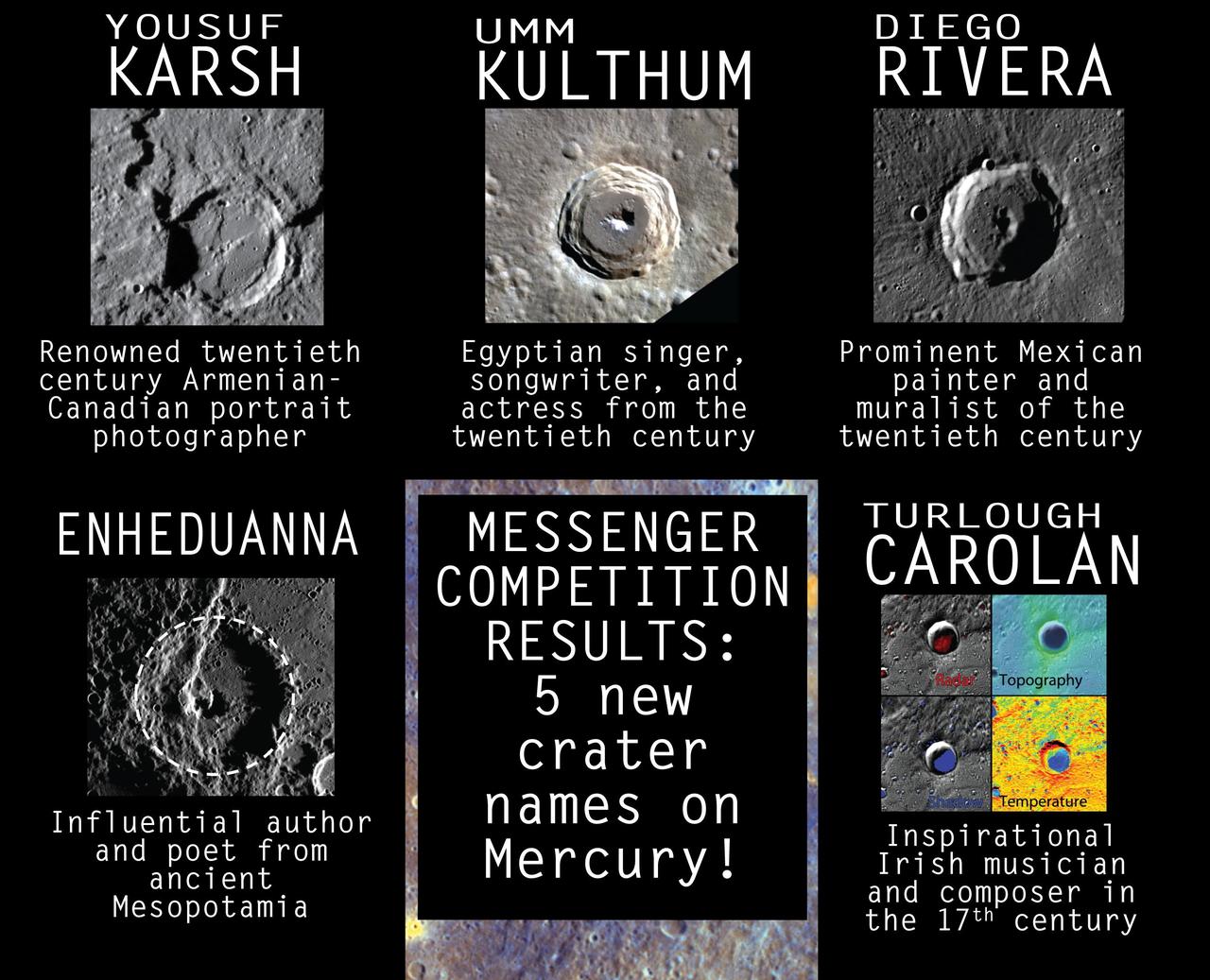
Five previously unnamed craters on Mercury now have names. MESSENGER's Education and Public Outreach (EPO) team led a contest that solicited naming suggestions from the public via a competition website. In total, 3,600 contest entries were received and a semi-final list of 17 names were submitted to the International Astronomical Union (IAU) for consideration. The IAU selected the final five crater names, keeping with the convention that Mercury's craters are named after those who have made significant contributions to the humanities. And the winners are: Carolan: (83.8° N, 31.7° E) Named for Turlough O'Carolan, the Irish musician and composer (1670-1738) Enheduanna: (48.3° N, 326.2° E) Named for the author and poet from ancient Mesopotamia Karsh (35.6° S, 78.9° E) Named for Yousuf Karsh, twentieth century Armenian-Canadian portrait photographer Kulthum (50.7° N, 93.5° E) Named for Umm Kulthum, twentieth century Egyptian singer, songwriter, and actress Rivera: (69.3° N, 32.4° E) Named for Diego Rivera, twentieth century Mexican painter and muralist http://photojournal.jpl.nasa.gov/catalog/PIA19439
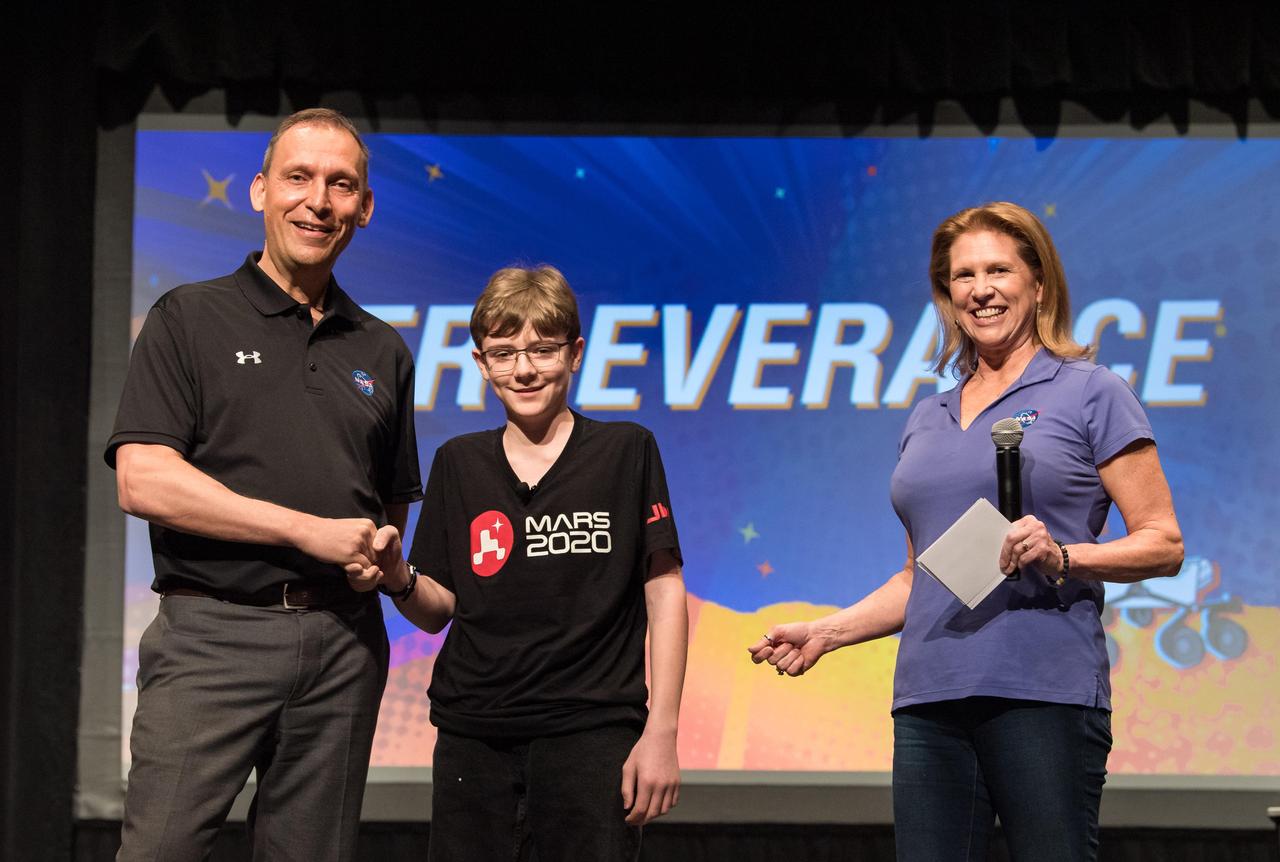
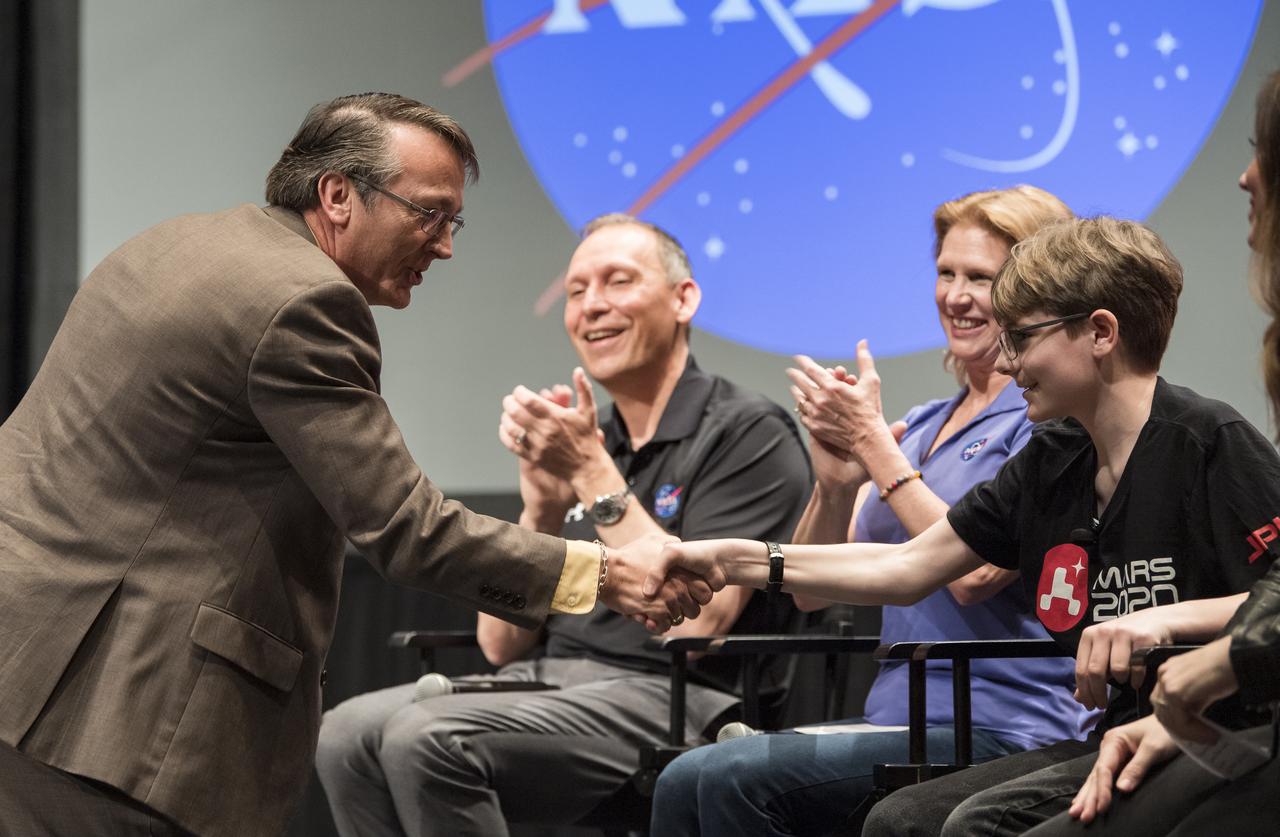
Lori Glaze, director of NASA's Planetary Science Division, looks on as Thomas Zurbuchen, associate administrator of NASA's Science Mission Directorate, congratulates Alexander Mather on March 5, 2020, during a celebration at Lake Braddock Secondary School in Burke, Virginia. The seventh grader had the honor of naming the agency's next Mars rover after submitting the winning entry to the agency's "Name the Rover" essay contest, which received 28,000 entrants from K-12 students from every U.S. state and territory. https://photojournal.jpl.nasa.gov/catalog/PIA23762
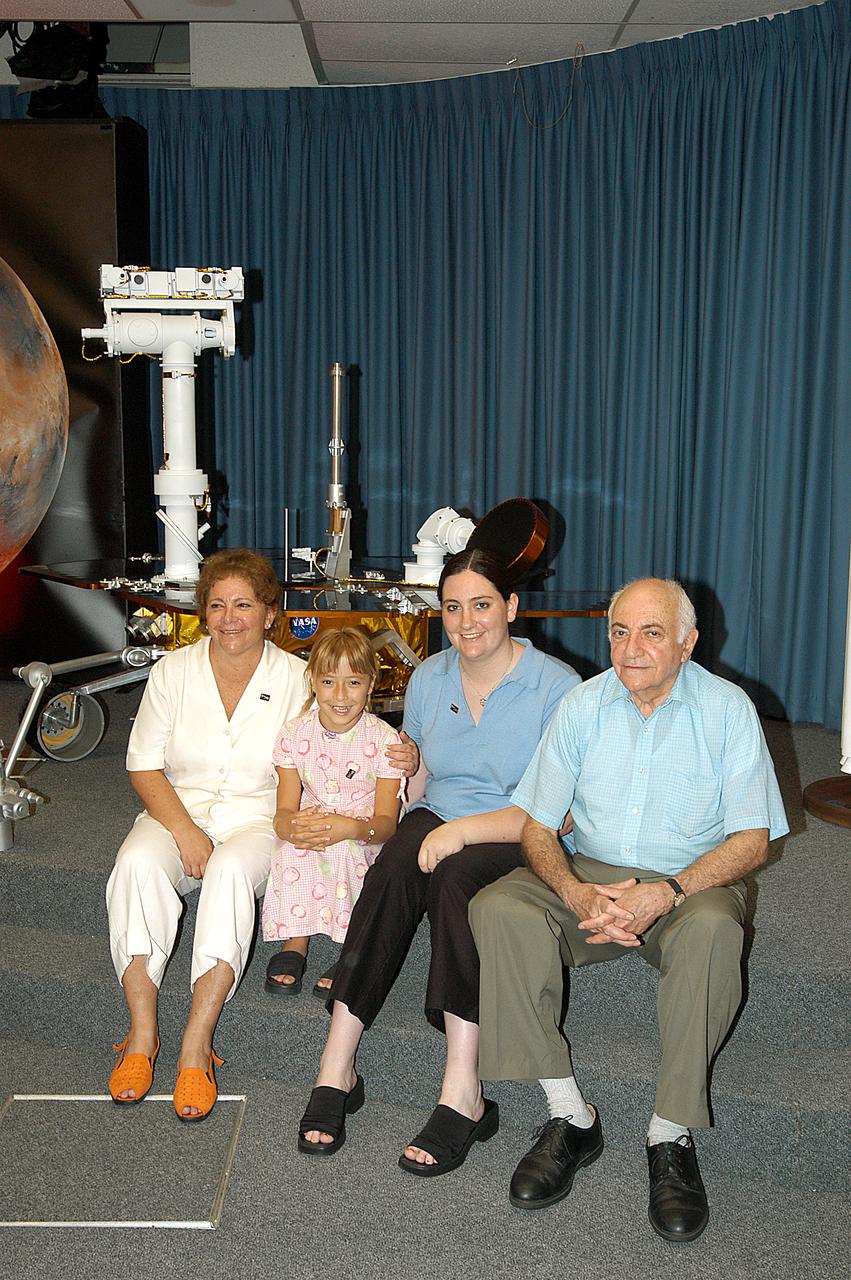
Siberian-born Sofi Collis (second from left), the third grade student winner of the "Name the Rovers" contest, poses with her adopted American family. The names she proposed -- Spirit and Opportunity -- were announced today in a press conference held by NASA Administrator Sean O'Keefe. NASA's twin Mars Exploration Rovers are designed to study the history of water on Mars. These robotic geologists are equipped with a robotic arm, a drilling tool, three spectrometers, and four pairs of cameras that allow them to have a human-like, 3D view of the terrain. Each rover could travel as far as 100 meters in one day to act as Mars scientists' eyes and hands, exploring an environment where humans are not yet able to go. MER-A, with the rover Spirit aboard, is scheduled to launch on June 8 at 2:06 p.m. EDT, with two launch opportunities each day during a launch period that closes on June 24.
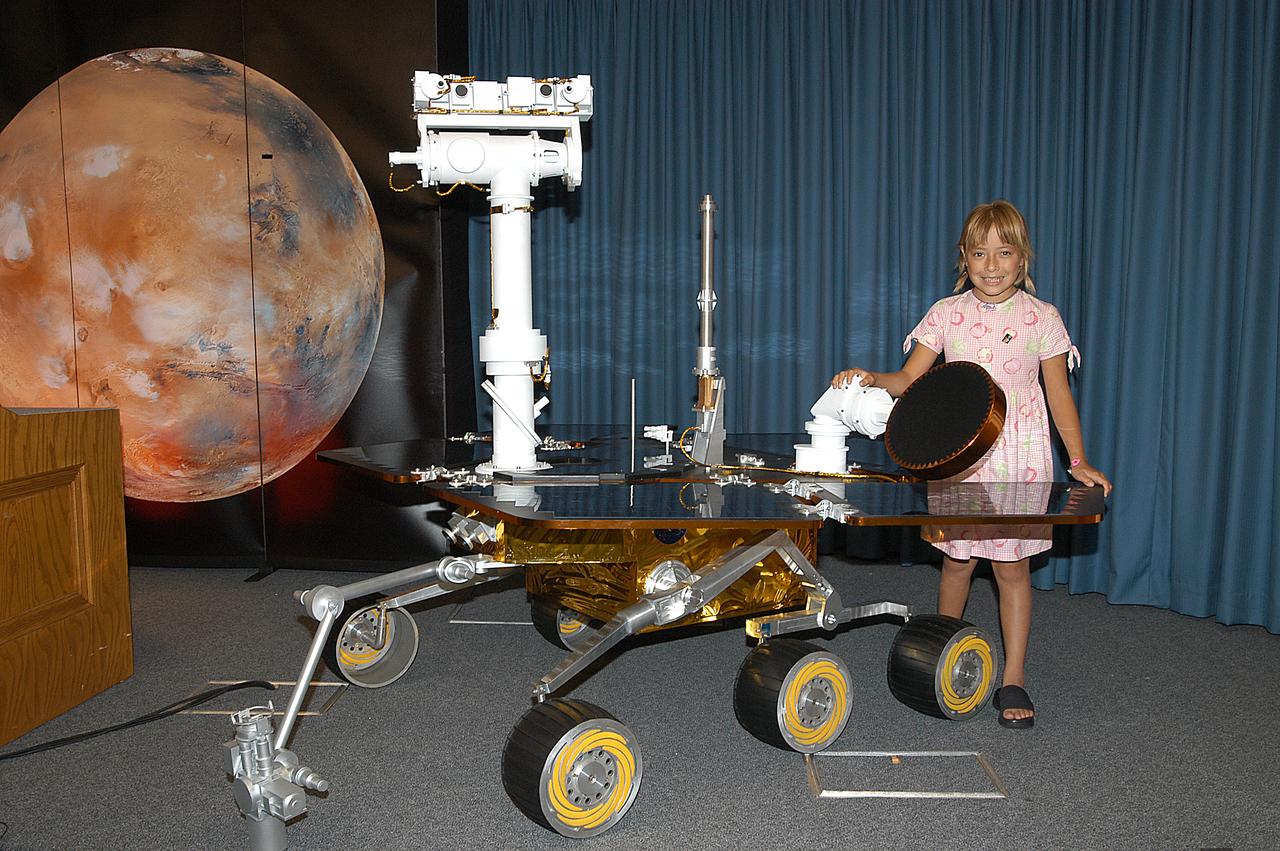
Sofi Collis, the third grade student winner of the "Name the Rovers" contest, poses with a model of a rover. The names she proposed -- Spirit and Opportunity -- were announced today in a press conference held by NASA Administrator Sean O'Keefe. NASA's twin Mars Exploration Rovers are designed to study the history of water on Mars. These robotic geologists are equipped with a robotic arm, a drilling tool, three spectrometers, and four pairs of cameras that allow them to have a human-like, 3D view of the terrain. Each rover could travel as far as 100 meters in one day to act as Mars scientists' eyes and hands, exploring an environment where humans are not yet able to go. MER-A, with the rover Spirit aboard, is scheduled to launch on June 8 at 2:06 p.m. EDT, with two launch opportunities each day during a launch period that closes on June 24.
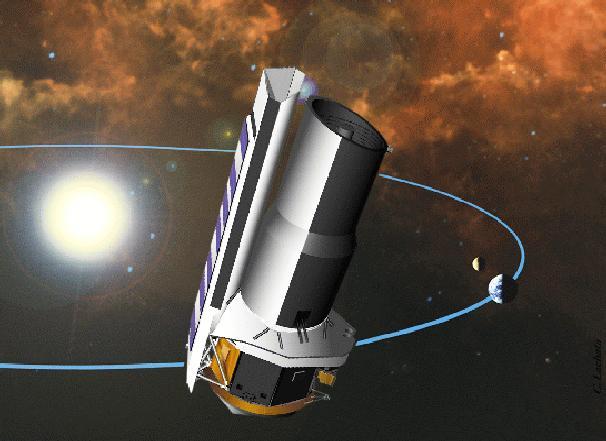
This image was used in a contest to rename the Space InfraRed Telescope Facility SIRTF, now known as the Spitzer Space Telescope.
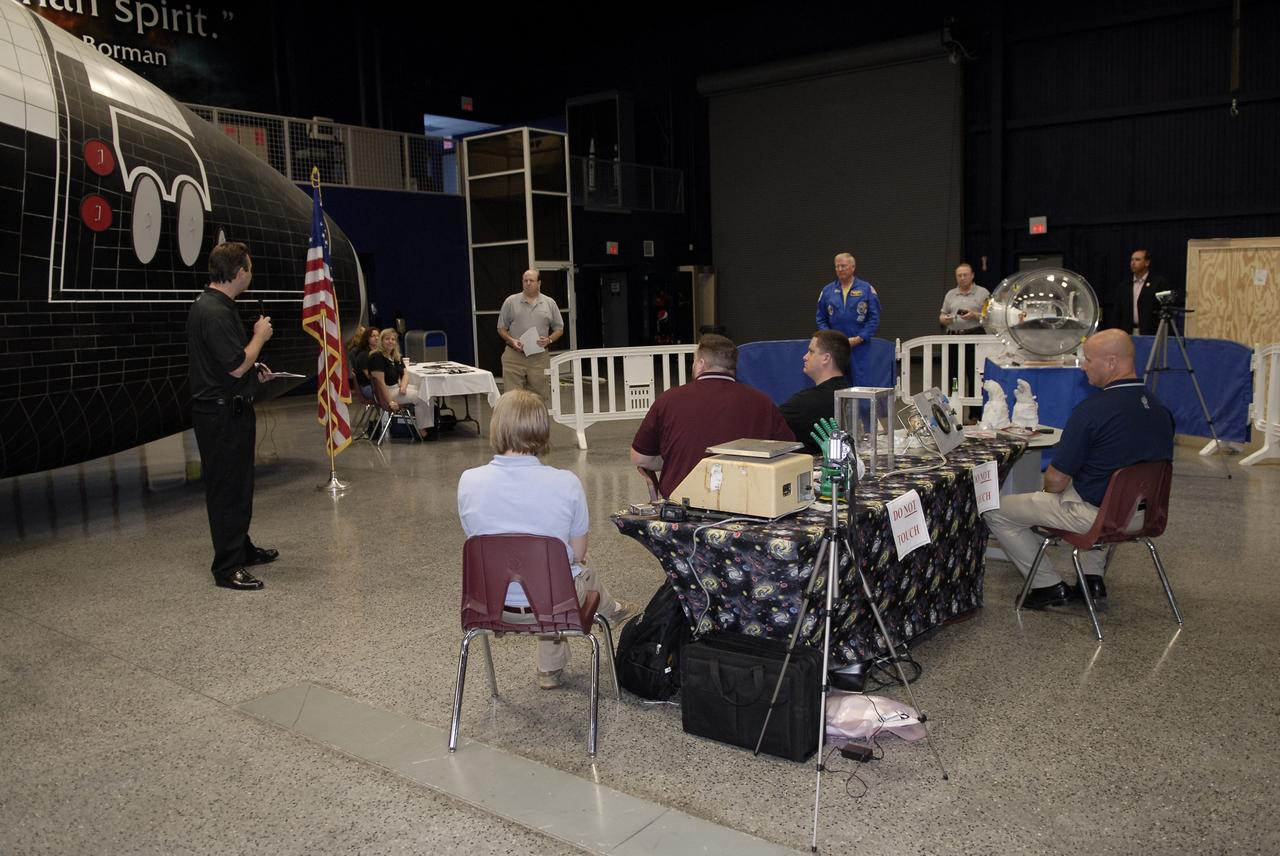
CAPE CANAVERAL, Fla. – Paul Secor, left, of Secor Strategies LLC, addresses the participants in the 2009 Astronaut Glove Challenge, part of NASA’s Centennial Challenges Program, at the Astronaut Hall of Fame near NASA’s Kennedy Space Center in Florida. Secor Strategies LLC, of Titusville, Fla., is a sponsor of the event and provided local logistical services. The nationwide competition focused on developing improved pressure suit gloves for astronauts to use while working in space. During the challenge, inventors tested the gloves to measure dexterity and strength during operation in a glove box which simulates the vacuum of space. Centennial Challenges is NASA’s program of technology prizes for the citizen-inventor. The winning prize for the Glove Challenge is $250,000 provided by the Centennial Challenges Program. Photo credit: NASA/Kim Shiflett

CAPE CANAVERAL, Fla. – Independent inventor Peter Homer, left, founder of Flagsuit LLC, inserts a glove which he designed into a glove box for a demonstration of its dexterity and flexibility during the 2009 Astronaut Glove Challenge, part of NASA’s Centennial Challenges Program, at the Astronaut Hall of Fame near NASA’s Kennedy Space Center in Florida. Homer was the winner of the competition held in 2007. The nationwide competition focused on developing improved pressure suit gloves for astronauts to use while working in space. During the challenge, inventors tested the gloves to measure dexterity and strength during operation in a glove box which simulates the vacuum of space. Centennial Challenges is NASA’s program of technology prizes for the citizen-inventor. The winning prize for the Glove Challenge is $250,000 provided by the Centennial Challenges Program. Photo credit: NASA/Kim Shiflett
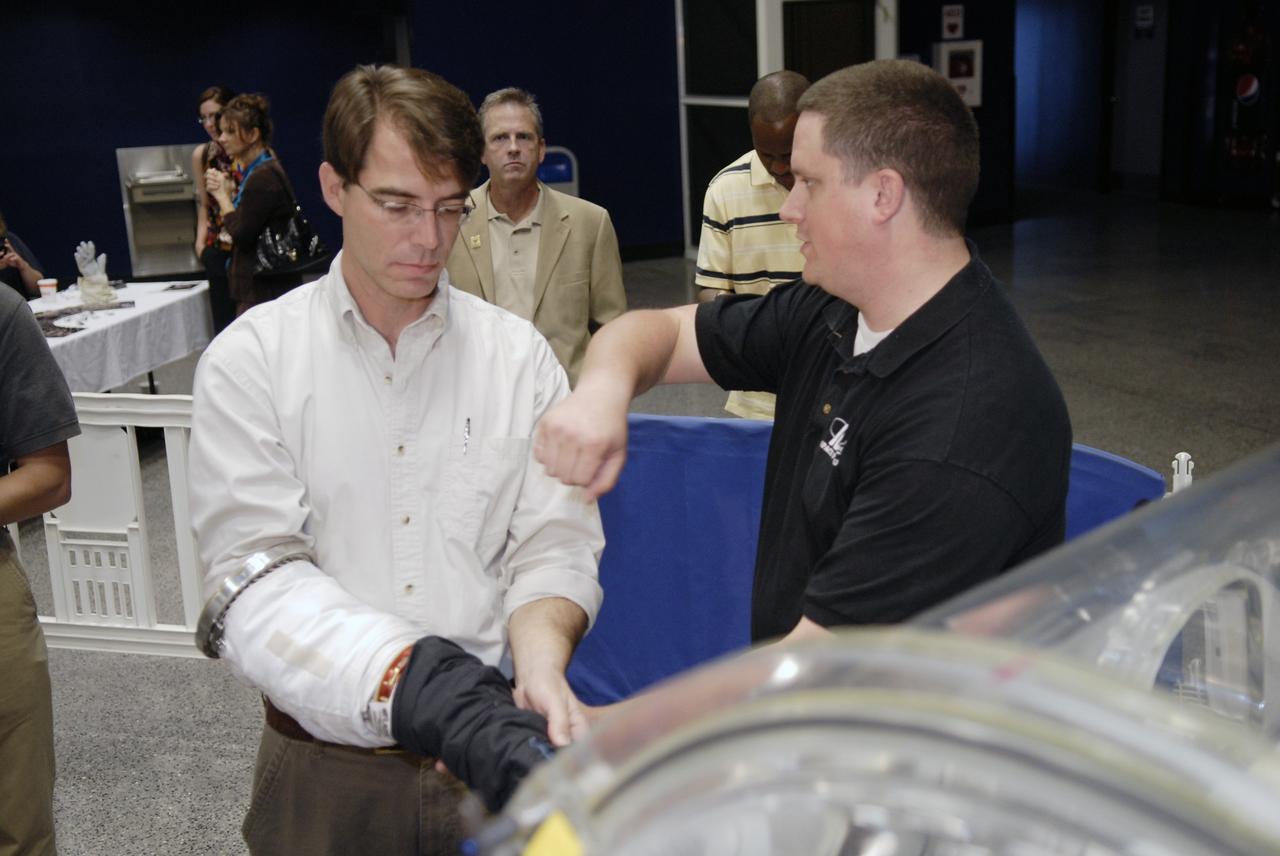
CAPE CANAVERAL, Fla. – Independent inventor Peter Homer, founder of Flagsuit LLC, submits a glove which he designed to a dexterity and flexibility test during the 2009 Astronaut Glove Challenge, part of NASA’s Centennial Challenges Program, at the Astronaut Hall of Fame near NASA’s Kennedy Space Center in Florida. Homer was the winner of the competition held in 2007. The nationwide competition focused on developing improved pressure suit gloves for astronauts to use while working in space. During the challenge, inventors tested the gloves to measure dexterity and strength during operation in a glove box which simulates the vacuum of space. Centennial Challenges is NASA’s program of technology prizes for the citizen-inventor. The winning prize for the Glove Challenge is $250,000 provided by the Centennial Challenges Program. Photo credit: NASA/Kim Shiflett
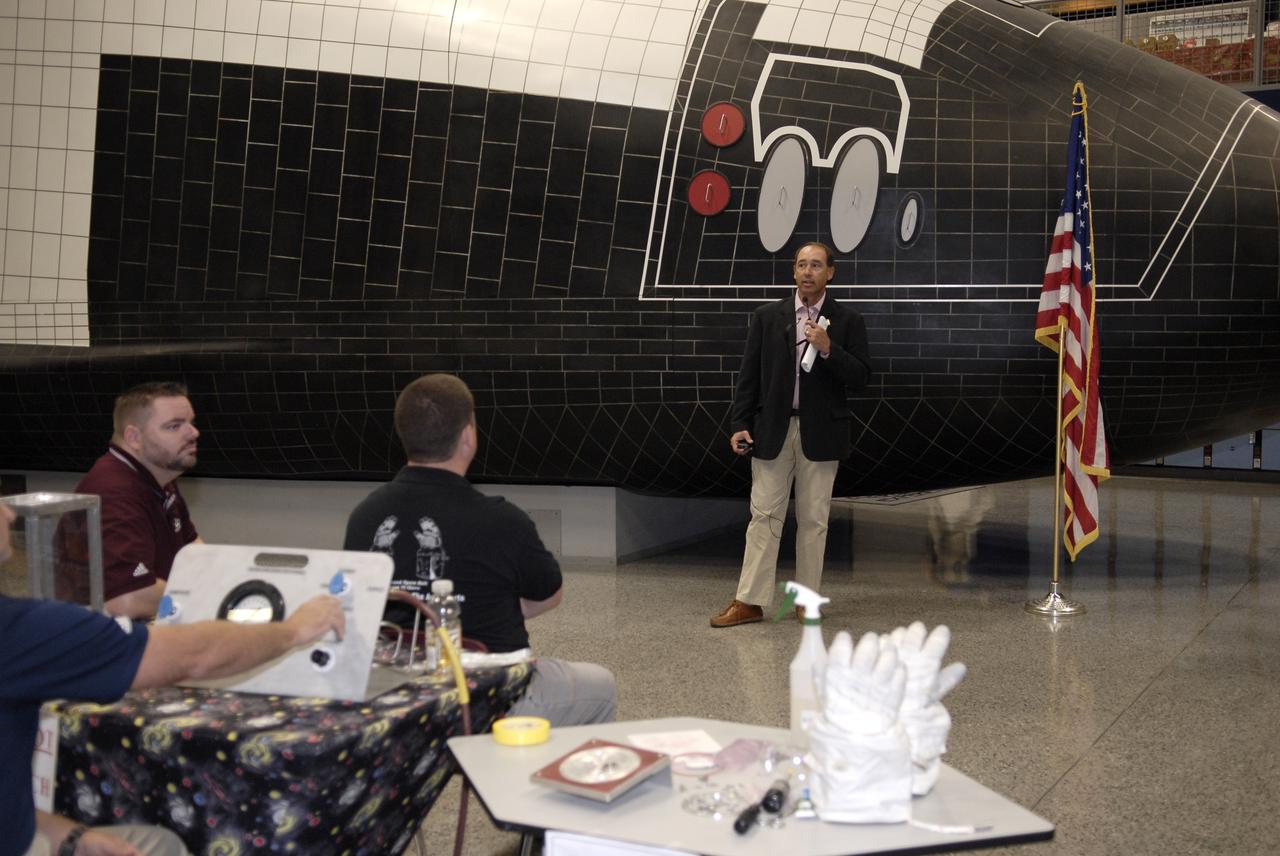
CAPE CANAVERAL, Fla. – Andy Petro, at microphone, manager of NASA Centennial Challenges, addresses the participants in the 2009 Astronaut Glove Challenge, part of NASA’s Centennial Challenges Program, at the Astronaut Hall of Fame near NASA’s Kennedy Space Center in Florida. The nationwide competition focused on developing improved pressure suit gloves for astronauts to use while working in space. During the challenge, inventors tested the gloves to measure dexterity and strength during operation in a glove box which simulates the vacuum of space. Centennial Challenges is NASA’s program of technology prizes for the citizen-inventor. The winning prize for the Glove Challenge is $250,000 provided by the Centennial Challenges Program. Photo credit: NASA/Kim Shiflett
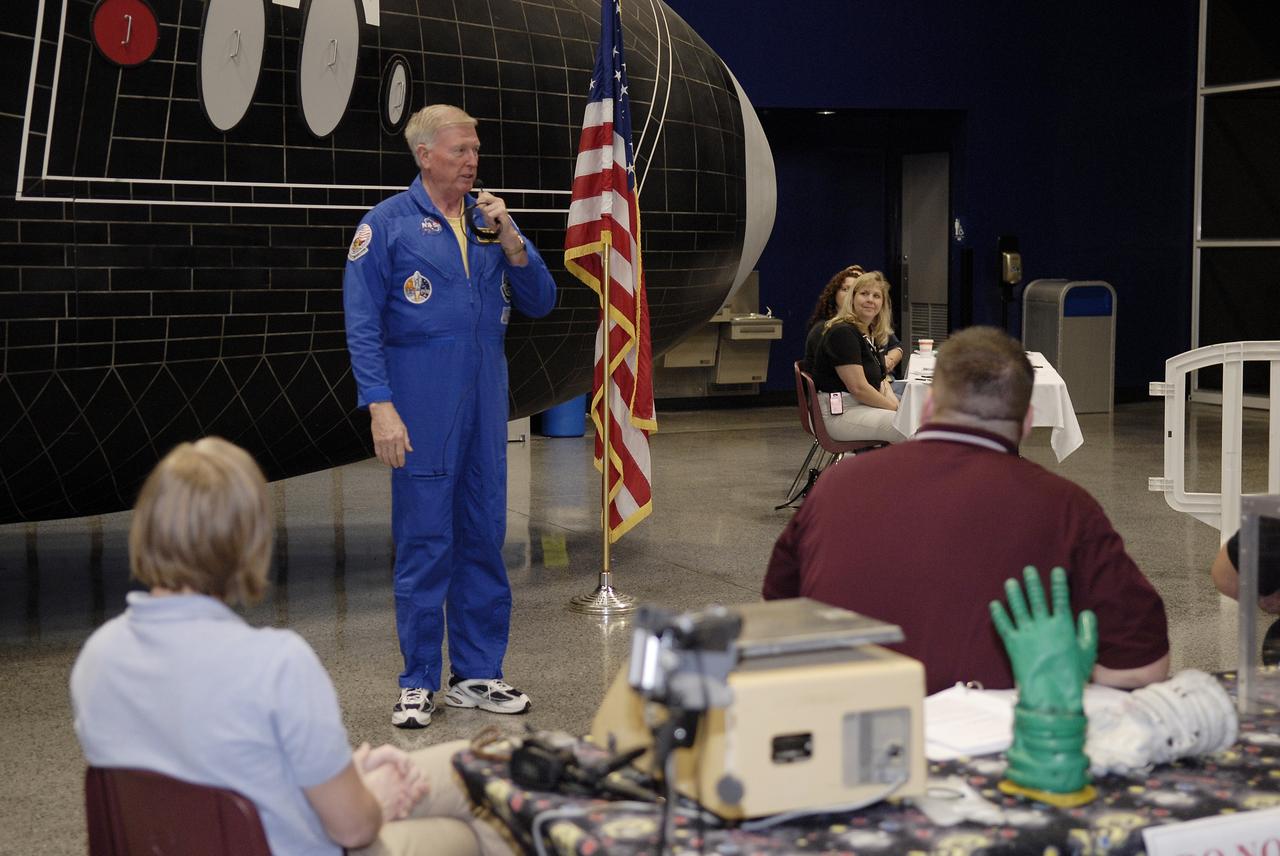
CAPE CANAVERAL, Fla. – Former NASA astronaut Jon McBride, at microphone, addresses the participants in the 2009 Astronaut Glove Challenge, part of NASA’s Centennial Challenges Program, at the Astronaut Hall of Fame near NASA’s Kennedy Space Center in Florida. The nationwide competition focused on developing improved pressure suit gloves for astronauts to use while working in space. During the challenge, inventors tested the gloves to measure dexterity and strength during operation in a glove box which simulates the vacuum of space. Centennial Challenges is NASA’s program of technology prizes for the citizen-inventor. The winning prize for the Glove Challenge is $250,000 provided by the Centennial Challenges Program. Photo credit: NASA/Kim Shiflett
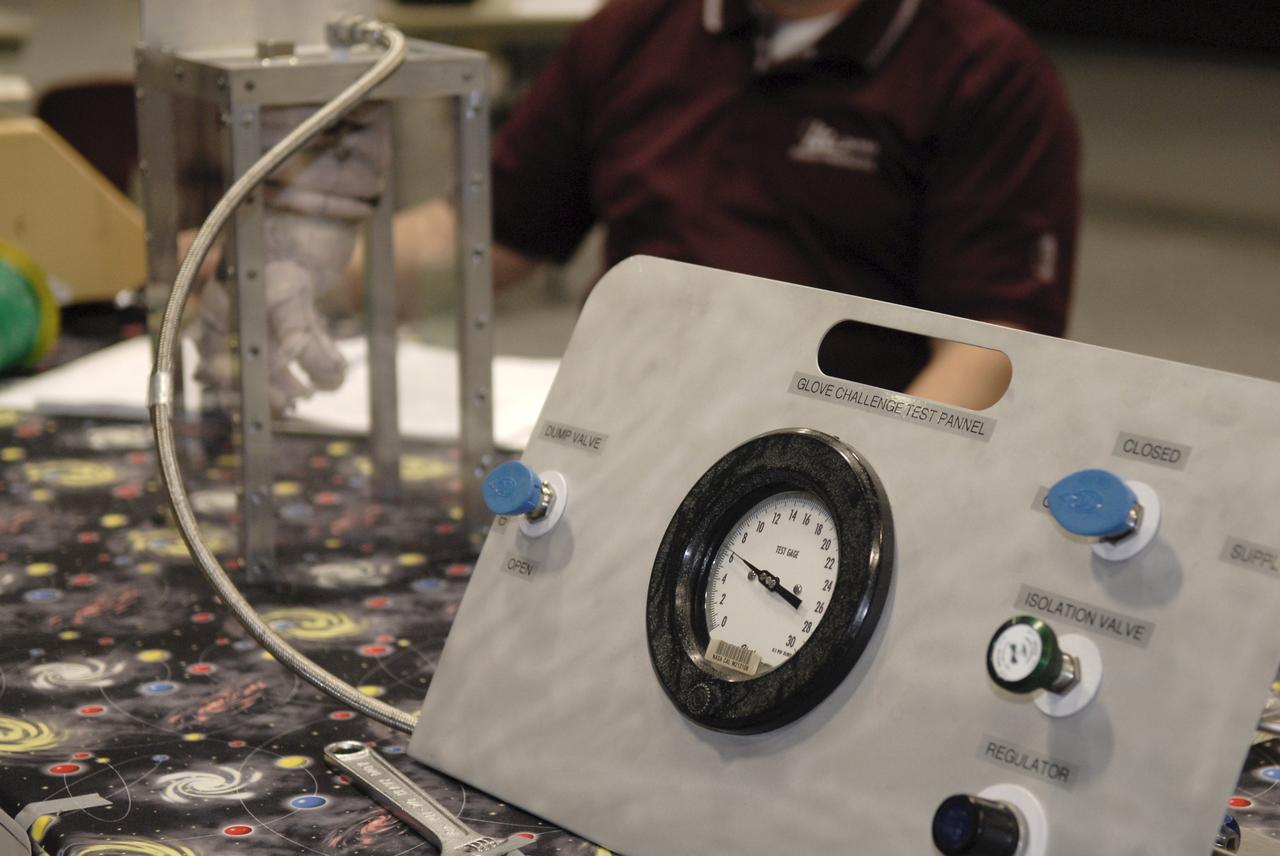
CAPE CANAVERAL, Fla. – This gauge is measuring how much internal pressure a newly designed glove can withstand during a burst test at the 2009 Astronaut Glove Challenge, part of NASA’s Centennial Challenges Program, at the Astronaut Hall of Fame near NASA’s Kennedy Space Center in Florida. The nationwide competition focused on developing improved pressure suit gloves for astronauts to use while working in space. During the challenge, inventors tested the gloves to measure dexterity and strength during operation in a glove box which simulates the vacuum of space. Centennial Challenges is NASA’s program of technology prizes for the citizen-inventor. The winning prize for the Glove Challenge is $250,000 provided by the Centennial Challenges Program. Photo credit: NASA/Kim Shiflett

CAPE CANAVERAL, Fla. – A representative of ILC Dover prepares a newly designed glove for a dexterity and flexibility test during the 2009 Astronaut Glove Challenge, part of NASA’s Centennial Challenges Program, at the Astronaut Hall of Fame near NASA’s Kennedy Space Center in Florida. The nationwide competition focused on developing improved pressure suit gloves for astronauts to use while working in space. During the challenge, inventors tested the gloves to measure dexterity and strength during operation in a glove box which simulates the vacuum of space. Centennial Challenges is NASA’s program of technology prizes for the citizen-inventor. The winning prize for the Glove Challenge is $250,000 provided by the Centennial Challenges Program. Photo credit: NASA/Kim Shiflett

CAPE CANAVERAL, Fla. – Independent inventor Peter Homer, founder of Flagsuit LLC, inserts a glove which he designed into a glove box for a dexterity and flexibility test during the 2009 Astronaut Glove Challenge, part of NASA’s Centennial Challenges Program, at the Astronaut Hall of Fame near NASA’s Kennedy Space Center in Florida. Homer was the winner of the competition held in 2007. The nationwide competition focused on developing improved pressure suit gloves for astronauts to use while working in space. During the challenge, inventors tested the gloves to measure dexterity and strength during operation in a glove box which simulates the vacuum of space. Centennial Challenges is NASA’s program of technology prizes for the citizen-inventor. The winning prize for the Glove Challenge is $250,000 provided by the Centennial Challenges Program. Photo credit: NASA/Kim Shiflett
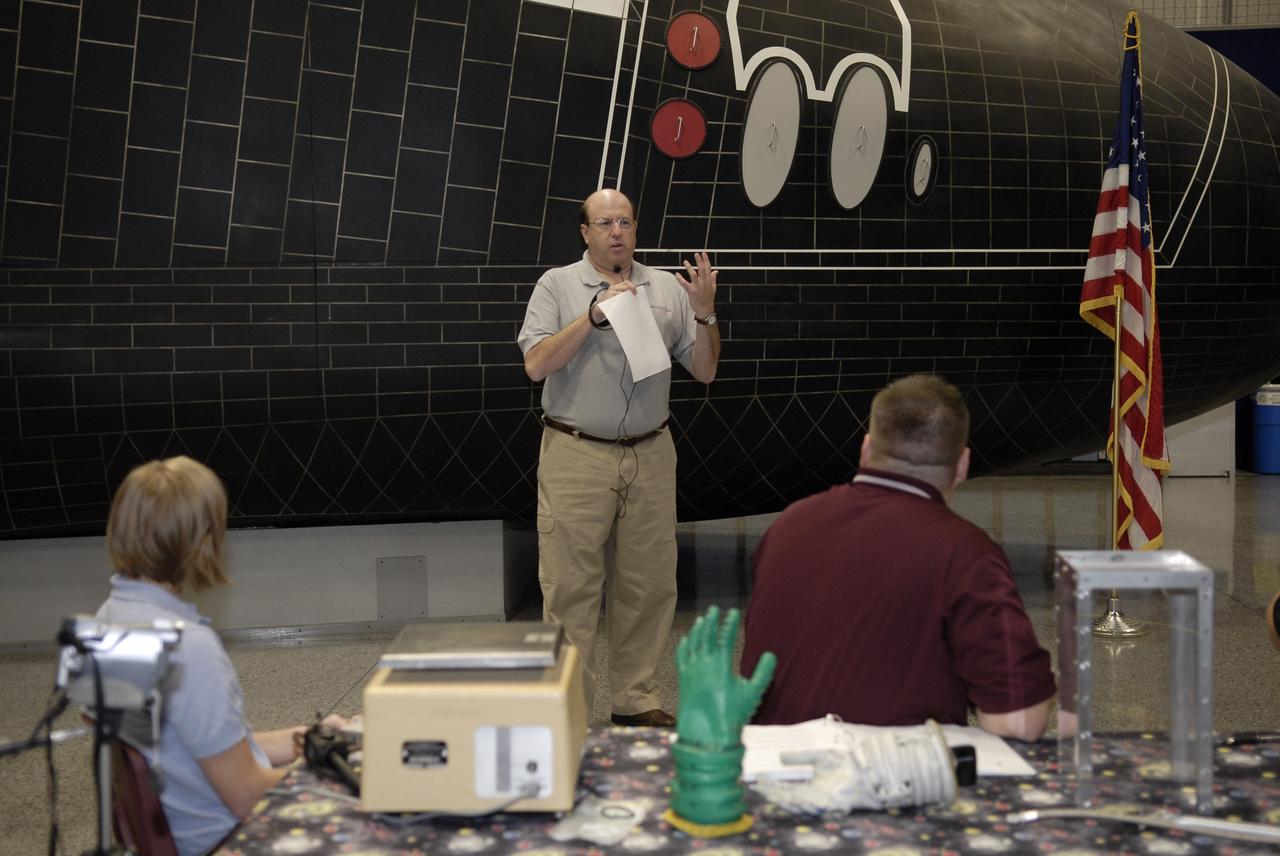
CAPE CANAVERAL, Fla. – Alan Hayes, at microphone, chairman of Volanz Aerospace Inc., addresses the participants in the 2009 Astronaut Glove Challenge, part of NASA’s Centennial Challenges Program, at the Astronaut Hall of Fame near NASA’s Kennedy Space Center in Florida. Volanz Aerospace Inc., of Owings, Md., administers the competition at no cost to NASA. The nationwide competition focused on developing improved pressure suit gloves for astronauts to use while working in space. During the challenge, inventors tested the gloves to measure dexterity and strength during operation in a glove box which simulates the vacuum of space. Centennial Challenges is NASA’s program of technology prizes for the citizen-inventor. The winning prize for the Glove Challenge is $250,000 provided by the Centennial Challenges Program. Photo credit: NASA/Kim Shiflett
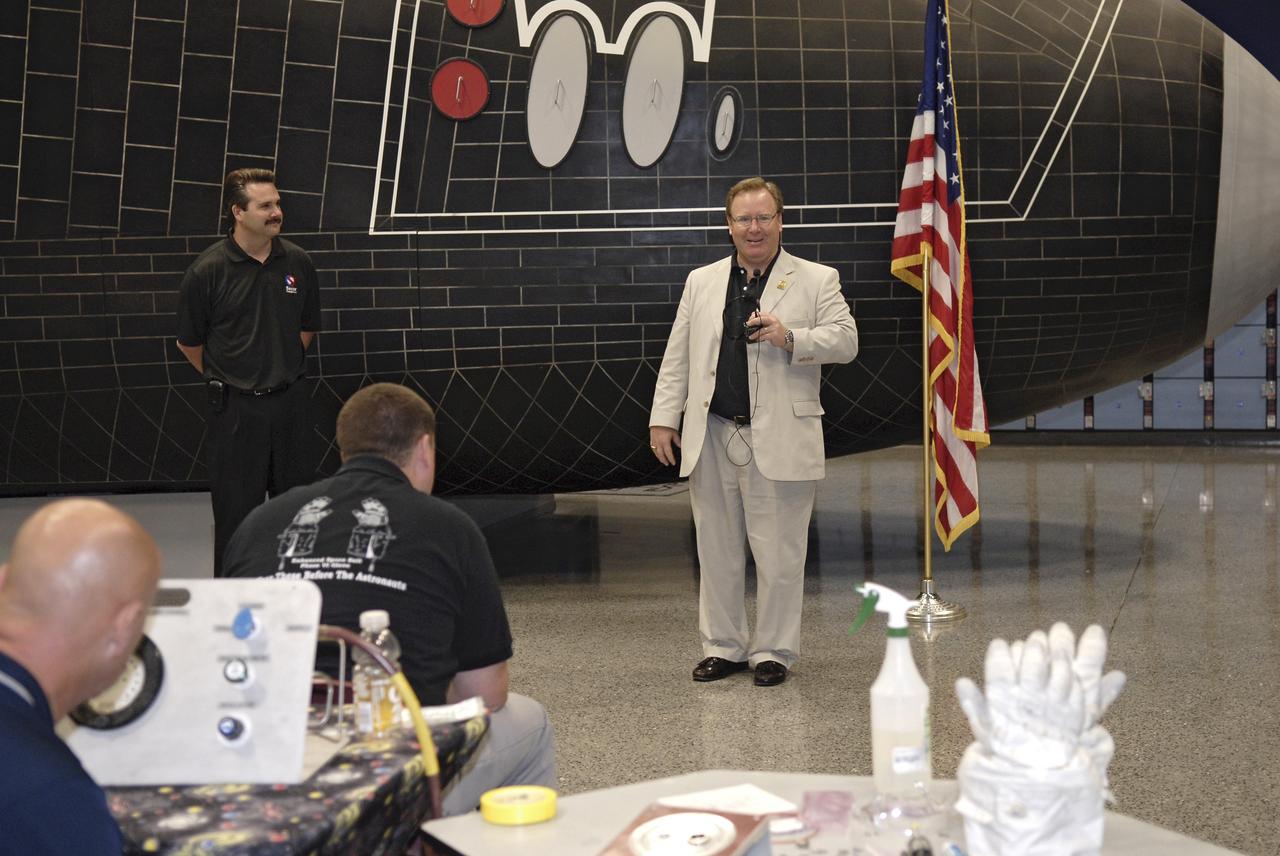
CAPE CANAVERAL, Fla. – Doug Comstock, at microphone, director of the NASA Innovative Partnerships Program, addresses the participants in the 2009 Astronaut Glove Challenge, part of NASA’s Centennial Challenges Program, at the Astronaut Hall of Fame near NASA’s Kennedy Space Center in Florida. The nationwide competition focused on developing improved pressure suit gloves for astronauts to use while working in space. During the challenge, inventors tested the gloves to measure dexterity and strength during operation in a glove box which simulates the vacuum of space. Centennial Challenges is NASA’s program of technology prizes for the citizen-inventor. The winning prize for the Glove Challenge is $250,000 provided by the Centennial Challenges Program. Photo credit: NASA/Kim Shiflett
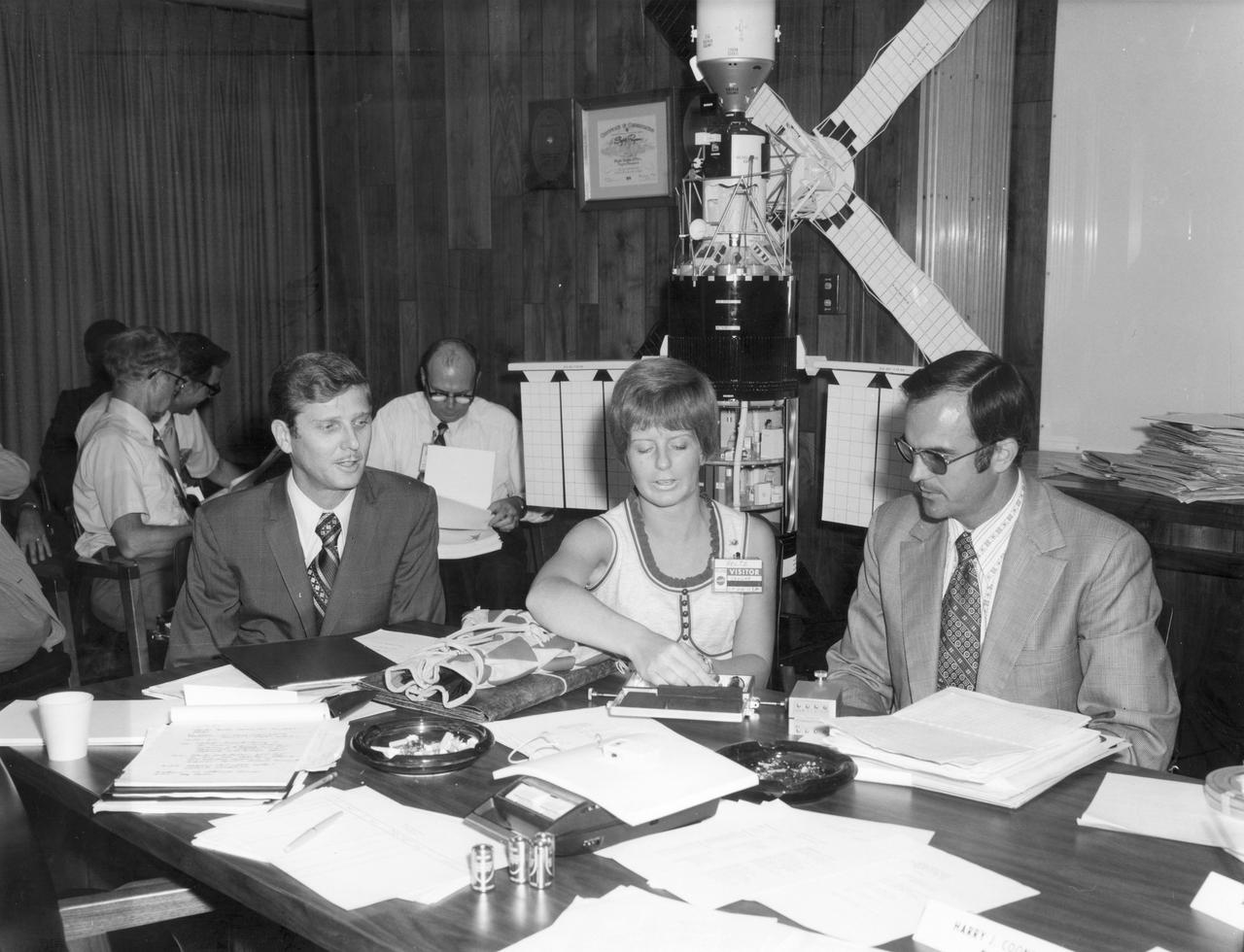
Miss Cheryl Peltz, high school student from Littleton, Colorado, discusses her “Cytoplasmic Streaming in Zero Gravity” experiment with Ed Armstrong (left) of the NASA Manned Spacecraft Center, and her advisor Charles Cothran (right) of the NASA Marshall Space Flight Center (MSFC). She was one of the 25 winners of a contest in which some 3,500 high school students proposed experiments for the following year’s Skylab Mission. Of the 25 students, 6 did not see their experiments conducted on Skylab because the experiments were not compatible with Skylab hardware and timelines. Of the 19 remaining, 11 experiments required the manufacture of equipment, of which Miss Peltz’s was one.
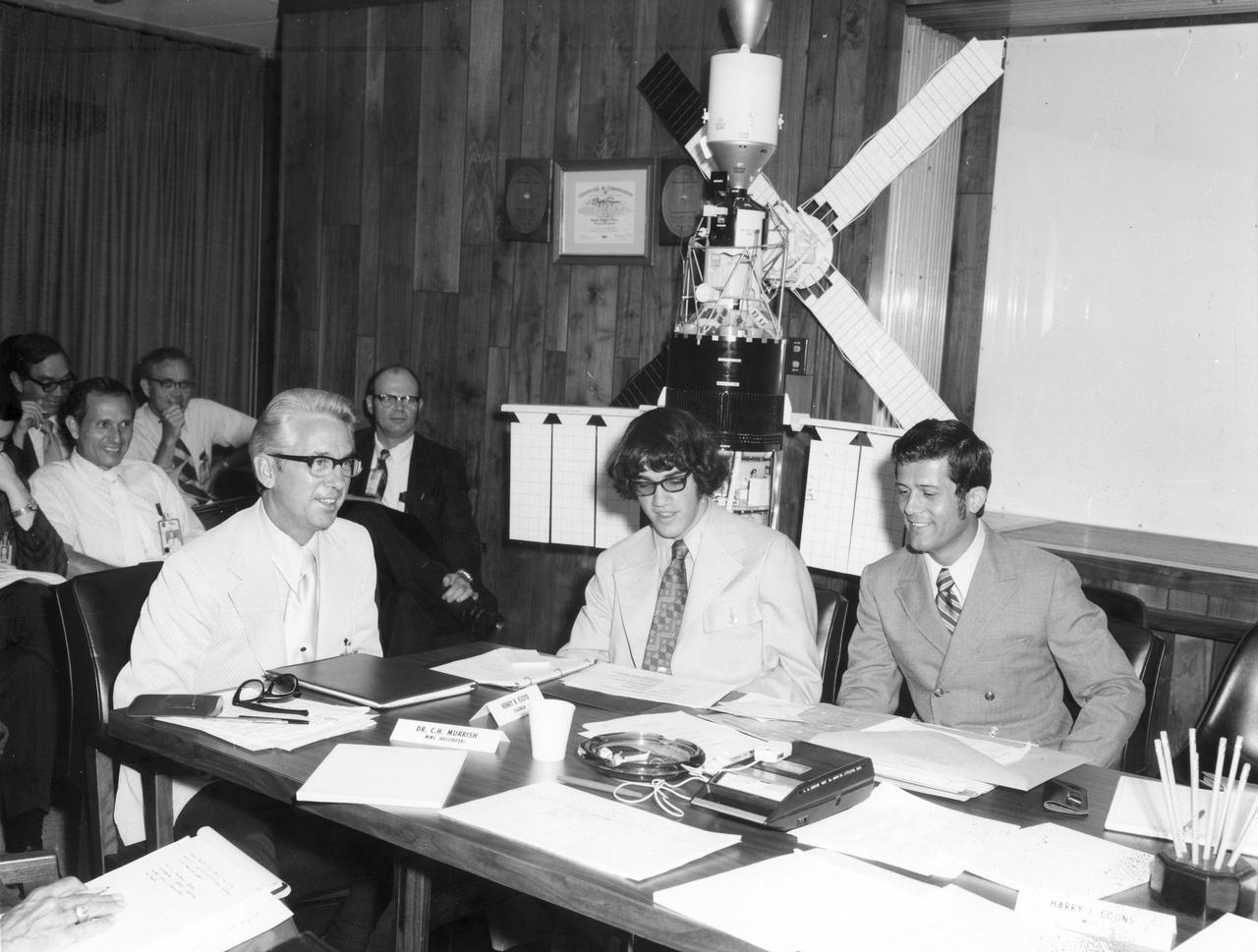
Robert L. Staehle (center), high school student from Harley School, Rochester New York, talks with Steven Hall (advisor to Staehle) and Henry Floyd, both of the Marshall Space Flight Center (MSFC) about his experiment “Behavior of Bacteria and Bacterial Spores in the Skylab Space Environment”. He was one of the 25 winners of a contest in which some 3,500 high school students proposed experiments for the following year’s Skylab mission. Of the 25 students, 6 did not see their experiments conducted on Skylab because the experiments were not compatible with Skylab hardware and timelines. Of the 19 remaining, 11 experiments required the manufacture of equipment.
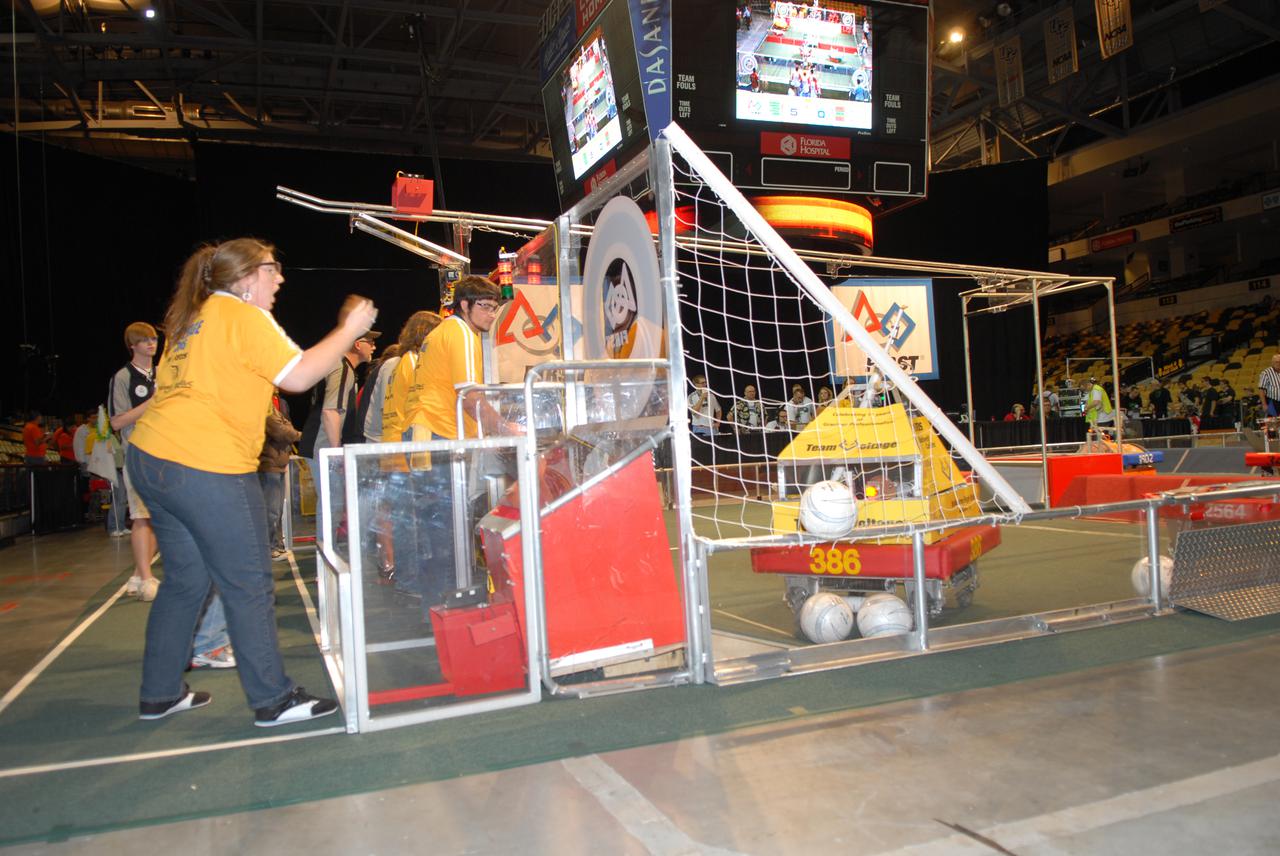
CAPE CANAVERAL, Fla. – Team Voltage participates in the regional FIRST robotics competition at the University of Central Florida in Orlando, Fla. The team is made up of students from Melbourne High School in Florida. More than 50 high school teams took part in the competition called 'For Inspiration and Recognition of Science and Technology,' or FIRST, in hopes of advancing to the national robotics championship. FIRST, founded in 1989, is a non-profit organization that designs accessible, innovative programs to build self-confidence, knowledge and life skills while motivating young people to pursue academic opportunities. The robotics competition challenges teams of high school students and their mentors to solve a common problem in a six-week timeframe using a standard kit of parts and a common set of rules. NASA is the largest sponsor of the international program. Kennedy Space Center is a sponsor of the regional event. Photo credit: NASA_Jim Grossmann
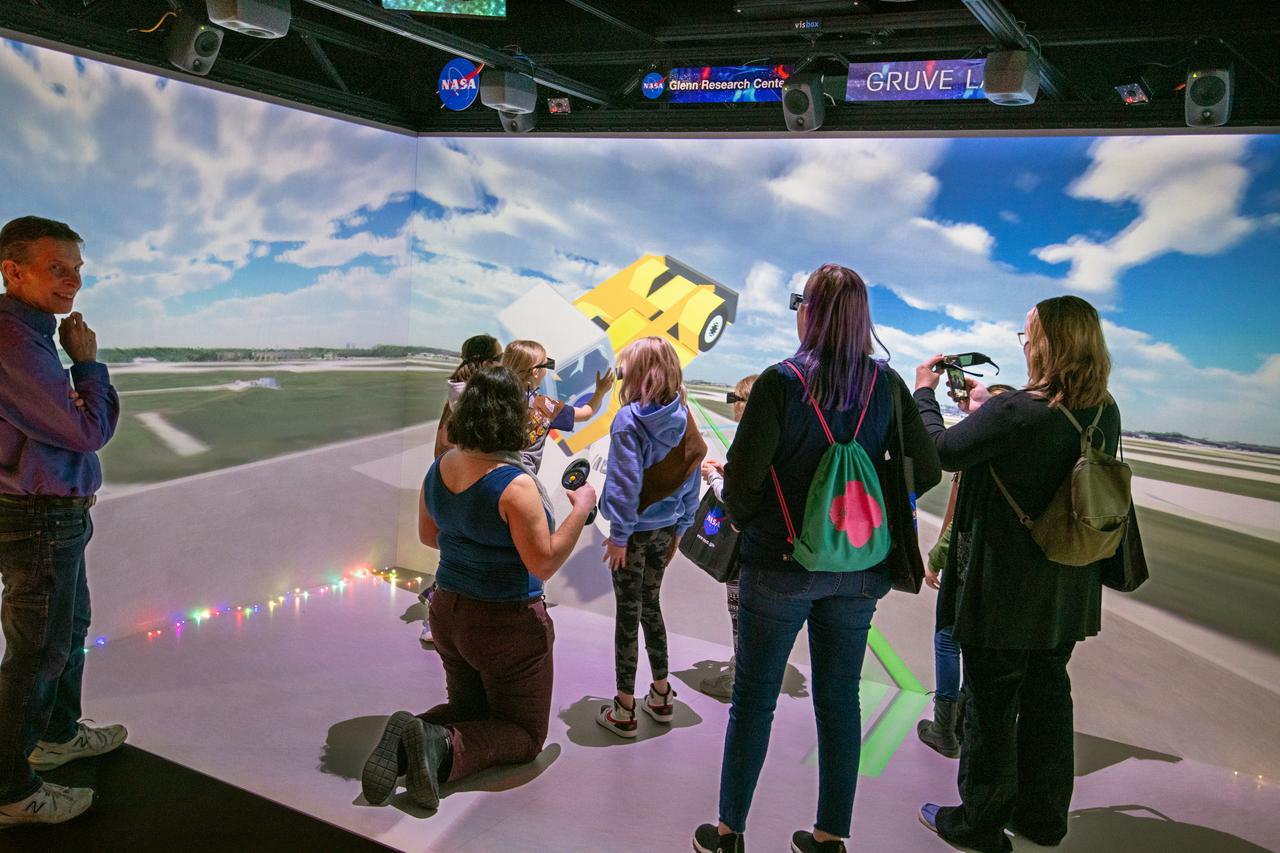
Local area girl scouts competed in a "Girl Scouts to the Moon and Back" essay contest. The essay contest gave the girls scouts a chance to win a Space Science badge that has actually been to space on NASA's Artemis I mission. After the award ceremony the girl scouts got to tour some of the NASA Glenn facilities. Picture is the "cave" at the Graphics and Visualization Lab, also known as the GRUVE Lab. Looking on is Richard Rinehart who is an engineer who works in the GRUVE LAB and creates 3D simulated experiences that demonstrate NASA's technology.
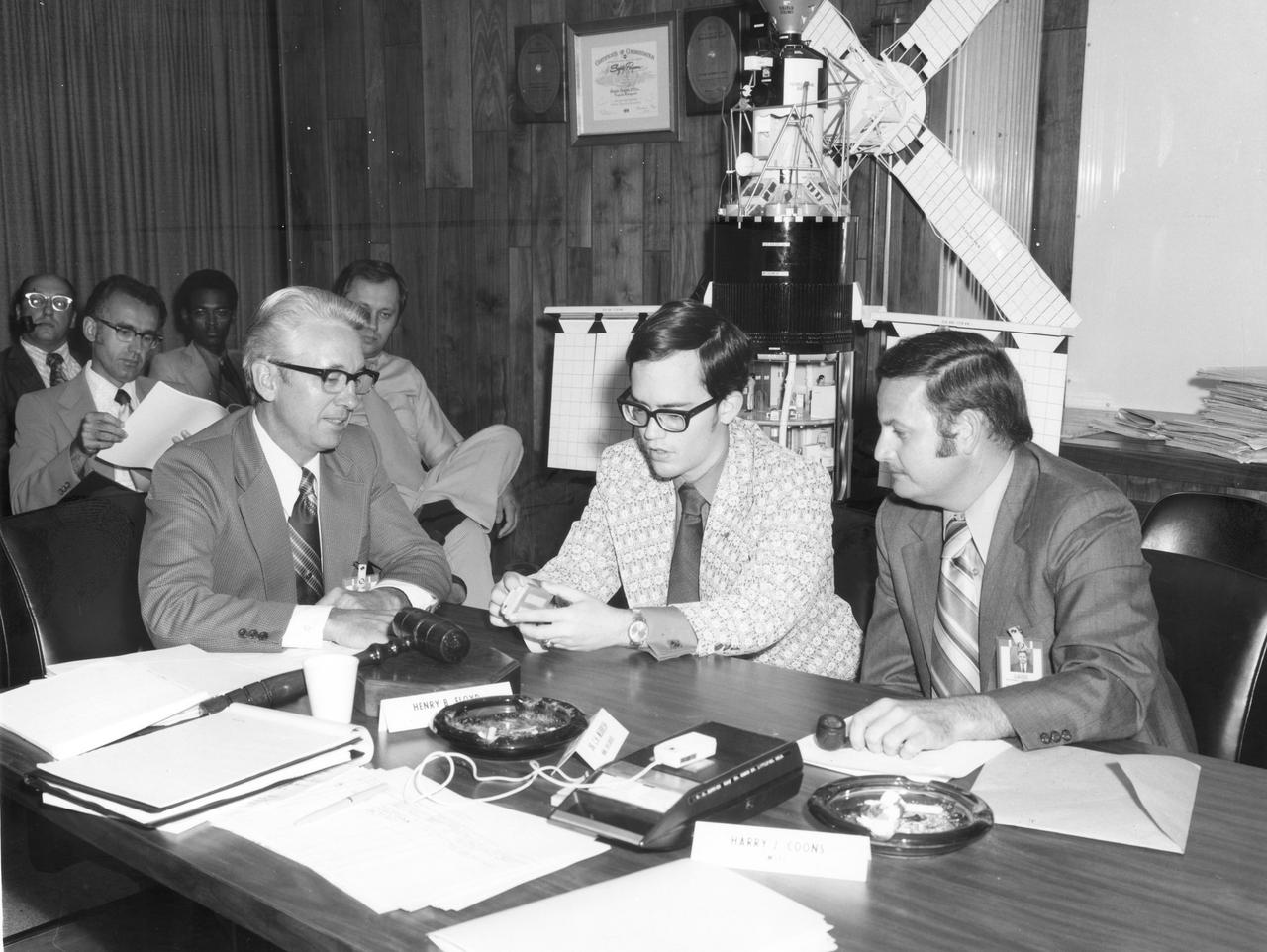
Terry C. Quist (center), high school student from San Antonio, Texas, discusses his proposed Skylab experiment with Marshall Space Flight Center’s (MSFC) Henry Floyd (left), coordinator of the Skylab Student Experiment Project, and DR. Raymond Gause, scientific advisor to Quist. The student’s experiment, “Earth Orbital Neutron Analysis”, was aimed at learning more about the source of neutrons in the solar system by seeking the number and direction from which each comes. Quist was among the 25 winners of a contest in which some 3,500 high school students proposed experiments for the following year’s Skylab mission. Of the 25 students, 6 did not see their experiments conducted on Skylab because the experiments were not compatible with Skylab hardware and timelines. Of the 19 remaining, 11 experiments required the manufacture of equipment, such as Quist’s experiment, which required detector hardware.
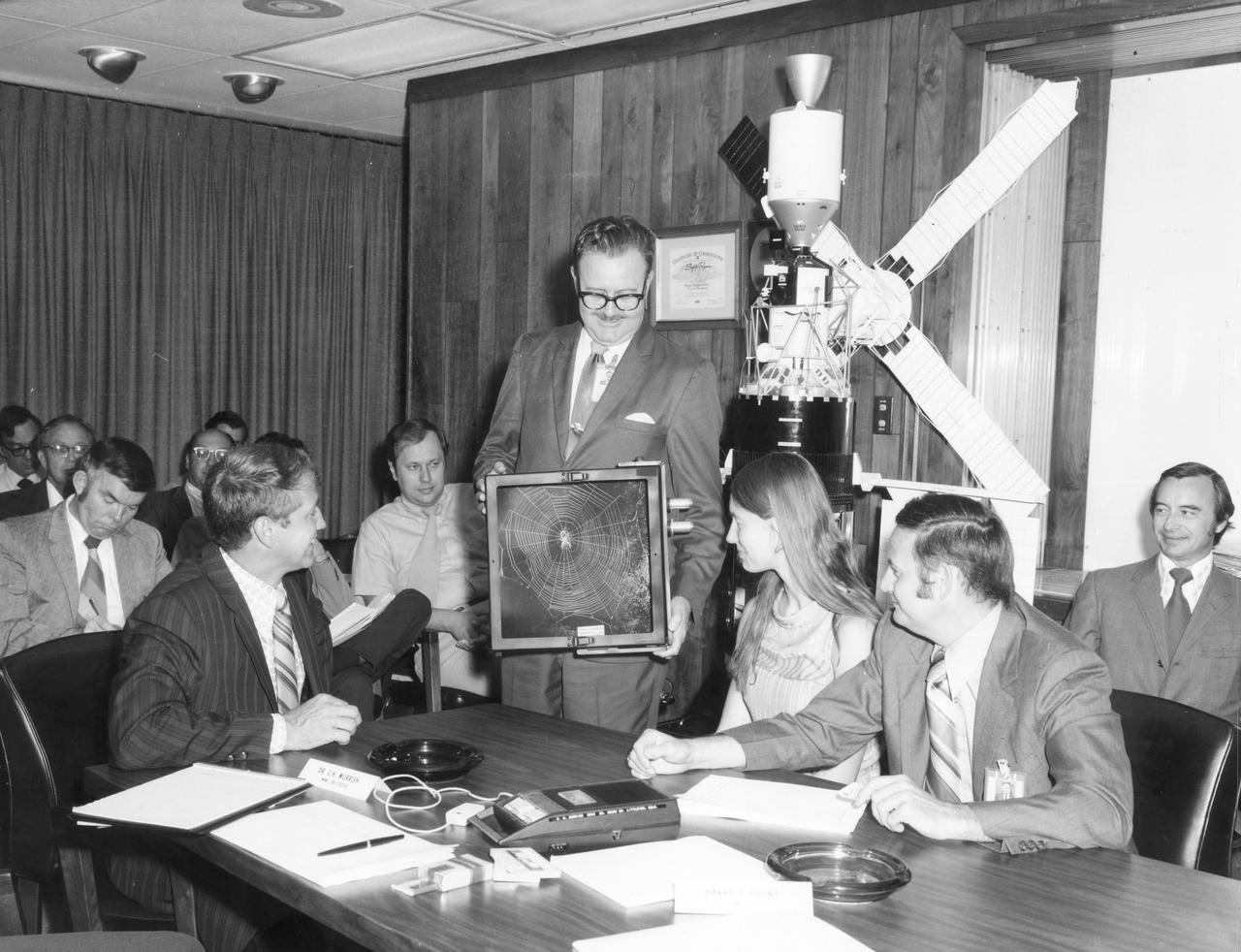
Lexington, Massachusetts high school student, Judith Miles, discusses her proposed Skylab experiment with engineers and scientists during a design review of the experiment equipment. At left is Ron Pavlue of Kennedy Space Flight Center (KSC), holding a box is Keith Demorest of Marshall Space Flight Center (MSFC). Right of Miles is Dr. Raymond Gause, also of MSFC, who is Miles’ scientific advisor. In her experiment, called the “Web Formation in Zero Gravity”, spiders were released into a box and their actions recorded to determine how well they adapt to the absence of gravity. Spiders are known to adapt quickly to other changes in the environment but nothing was known of their ability to adapt to weightlessness. At the same time spiders were weaving webs in Earth orbit, similar spiders were spinning webs in identical boxes on Earth under full gravity conditions. Miles was among the 25 winners of a contest in which some 3,500 high school students proposed experiments for the following year’s Skylab mission. Of the 25 students, 6 did not see their experiments conducted on Skylab because the experiments were not compatible with Skylab hardware and timelines. Of the 19 remaining, 11 experiments required the manufacture of equipment.
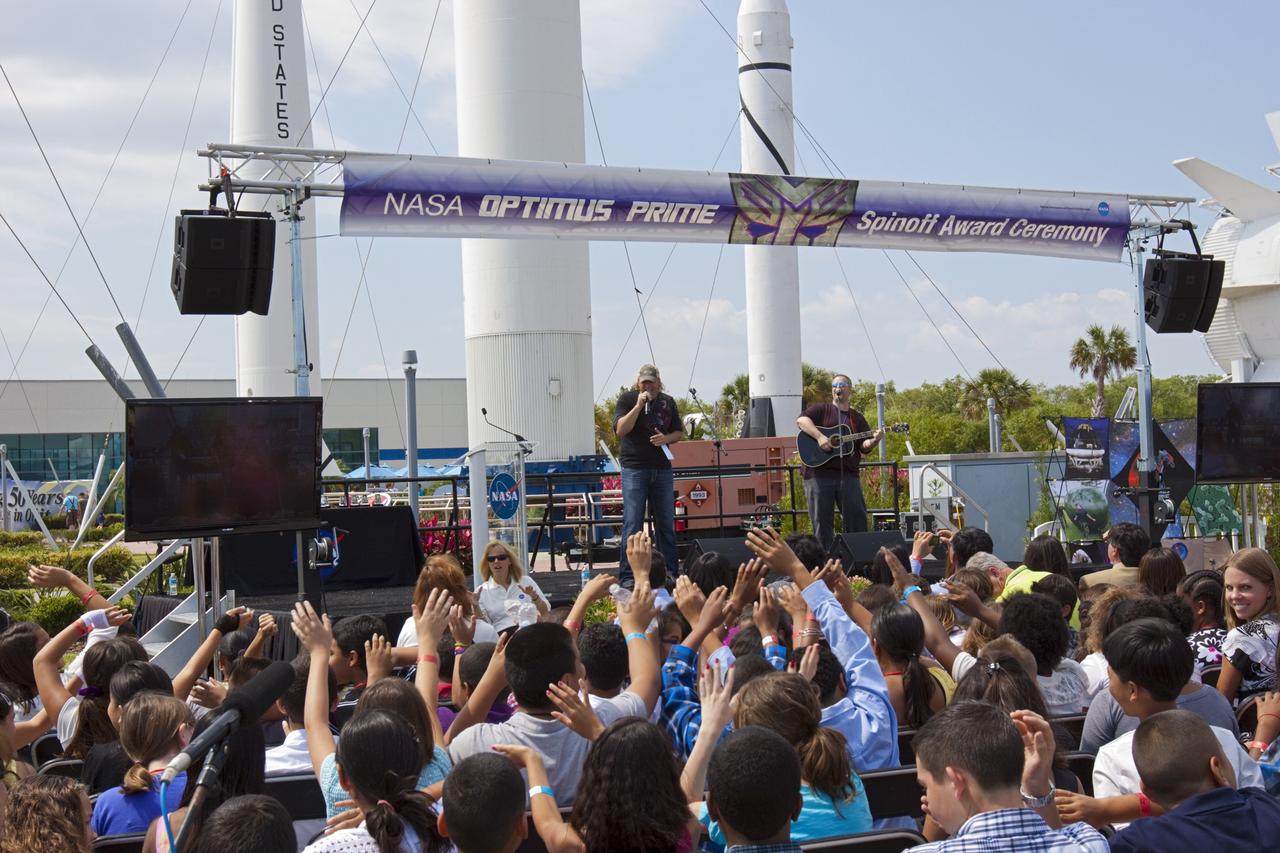
CAPE CANAVERAL, Fla. - Country music singer Ansel Brown, performs his song "When You Fly" for students and teachers involved with the NASA OPTIMUS PRIME Spinoff Video Contest in the Rocket Garden of the Kennedy Space Center Visitor Complex. The contest challenged students in grades three through 12 to study NASA spinoff technologies and produce short, creative videos promoting their favorites. The NASA Goddard Space Flight Center's Innovative Partnerships Office in Greenbelt, Md., designed the contest to help students see the benefits of NASA technology here on Earth. NASA collaborated with Hasbro in using the OPTIMUS PRIME character. Photo credit: NASA/Jim Grossmann
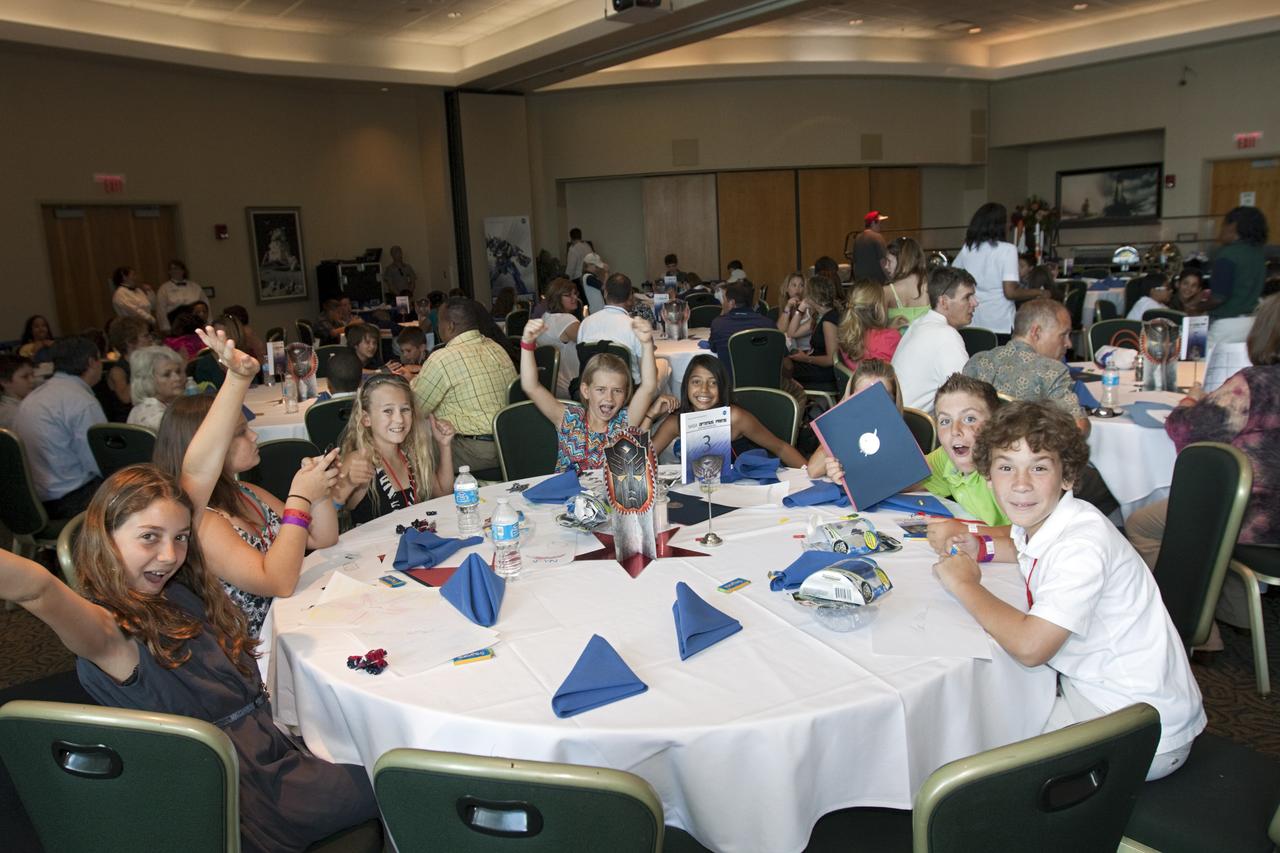
CAPE CANAVERAL, Fla. - Winners of the NASA OPTIMUS PRIME Spinoff Video Contest show their excitement in the Debus Conference Center of the Kennedy Space Center Visitor Complex. The contest challenged students in grades three through 12 to study NASA spinoff technologies and produce short, creative videos promoting their favorites. The NASA Goddard Space Flight Center's Innovative Partnerships Office in Greenbelt, Md., designed the contest to help students see the benefits of NASA technology here on Earth. NASA collaborated with Hasbro in using the OPTIMUS PRIME character. Photo credit: NASA/Jim Grossmann
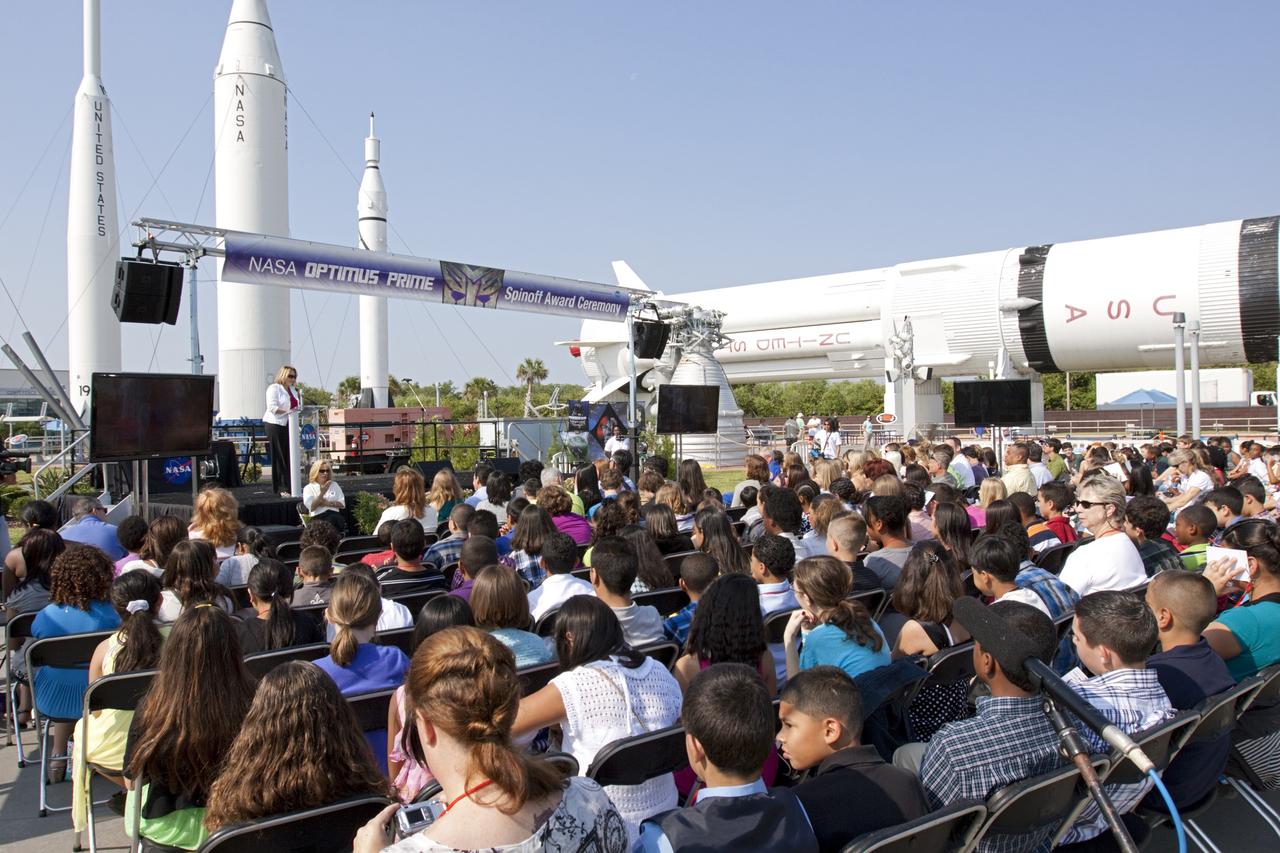
CAPE CANAVERAL, Fla. - Cheryl Hurst, NASA Kennedy Space Center's director of External Relations and Education, addresses students and teachers involved with the NASA OPTIMUS PRIME Spinoff Video Contest in the Rocket Garden of the Kennedy Space Center Visitor Complex. The contest challenged students in grades three through 12 to study NASA spinoff technologies and produce short, creative videos promoting their favorites. The NASA Goddard Space Flight Center's Innovative Partnerships Office in Greenbelt, Md., designed the contest to help students see the benefits of NASA technology here on Earth. NASA collaborated with Hasbro in using the OPTIMUS PRIME character. Photo credit: NASA/Jim Grossmann
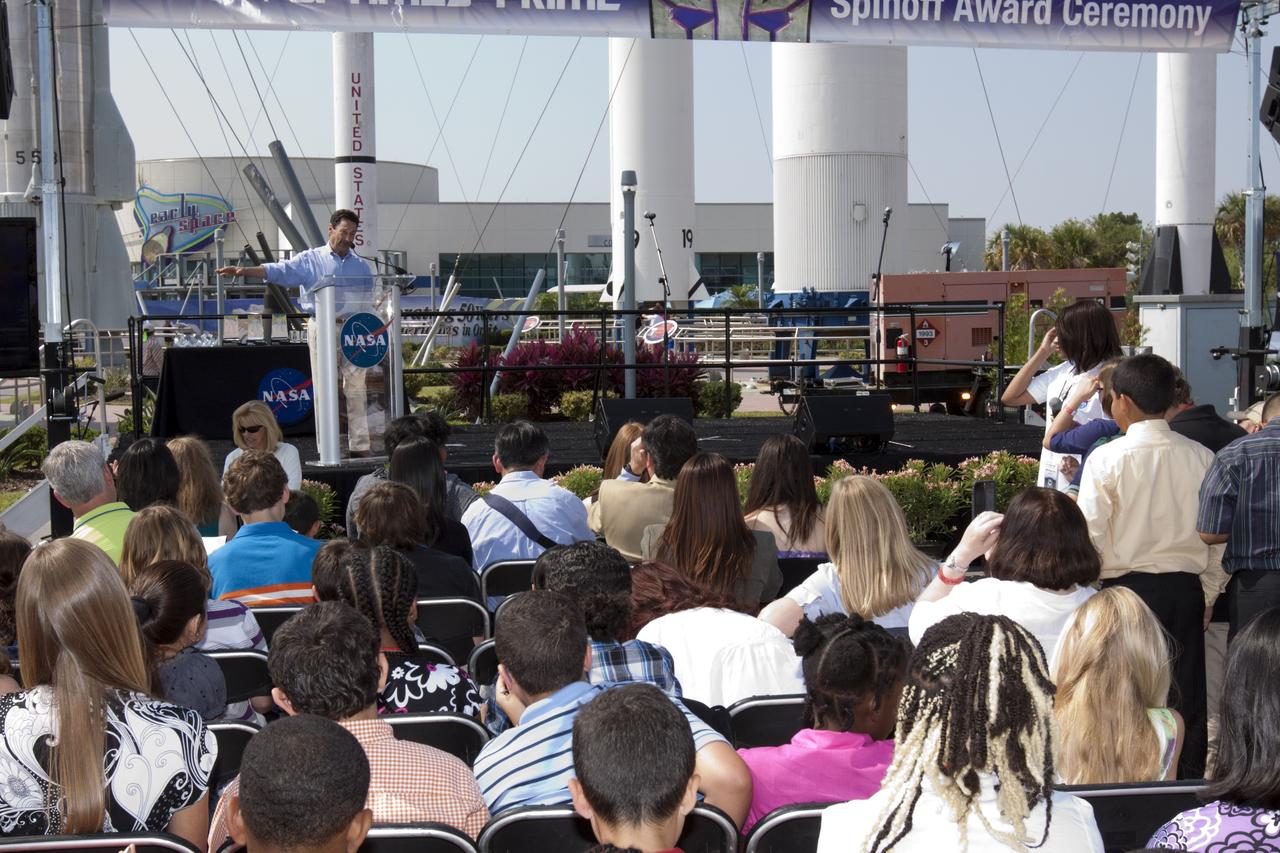
CAPE CANAVERAL, Fla. - Peter Cullen, the voice of OPTIMUS PRIME from the "Transformers" franchise, addresses students and teachers involved with the NASA OPTIMUS PRIME Spinoff Video Contest in the Rocket Garden of the Kennedy Space Center Visitor Complex. The contest challenged students in grades three through 12 to study NASA spinoff technologies and produce short, creative videos promoting their favorites. The NASA Goddard Space Flight Center's Innovative Partnerships Office in Greenbelt, Md., designed the contest to help students see the benefits of NASA technology here on Earth. NASA collaborated with Hasbro in using the OPTIMUS PRIME character. Photo credit: NASA/Jim Grossmann
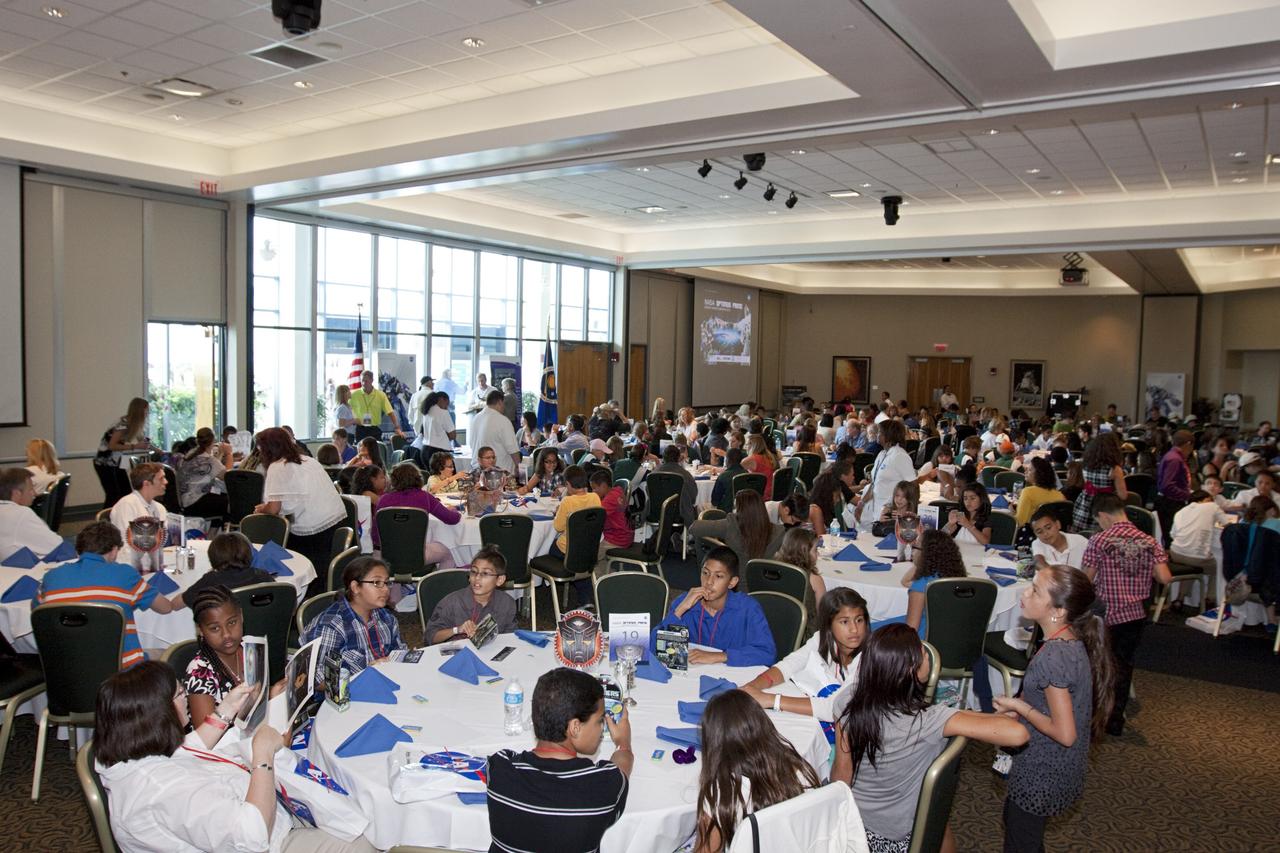
CAPE CANAVERAL, Fla. - Students and teachers of the NASA OPTIMUS PRIME Spinoff Video Contest await an award ceremony in the Debus Conference Center of the Kennedy Space Center Visitor Complex. The contest challenged students in grades three through 12 to study NASA spinoff technologies and produce short, creative videos promoting their favorites. The NASA Goddard Space Flight Center's Innovative Partnerships Office in Greenbelt, Md., designed the contest to help students see the benefits of NASA technology here on Earth. NASA collaborated with Hasbro in using the OPTIMUS PRIME character. Photo credit: NASA/Jim Grossmann
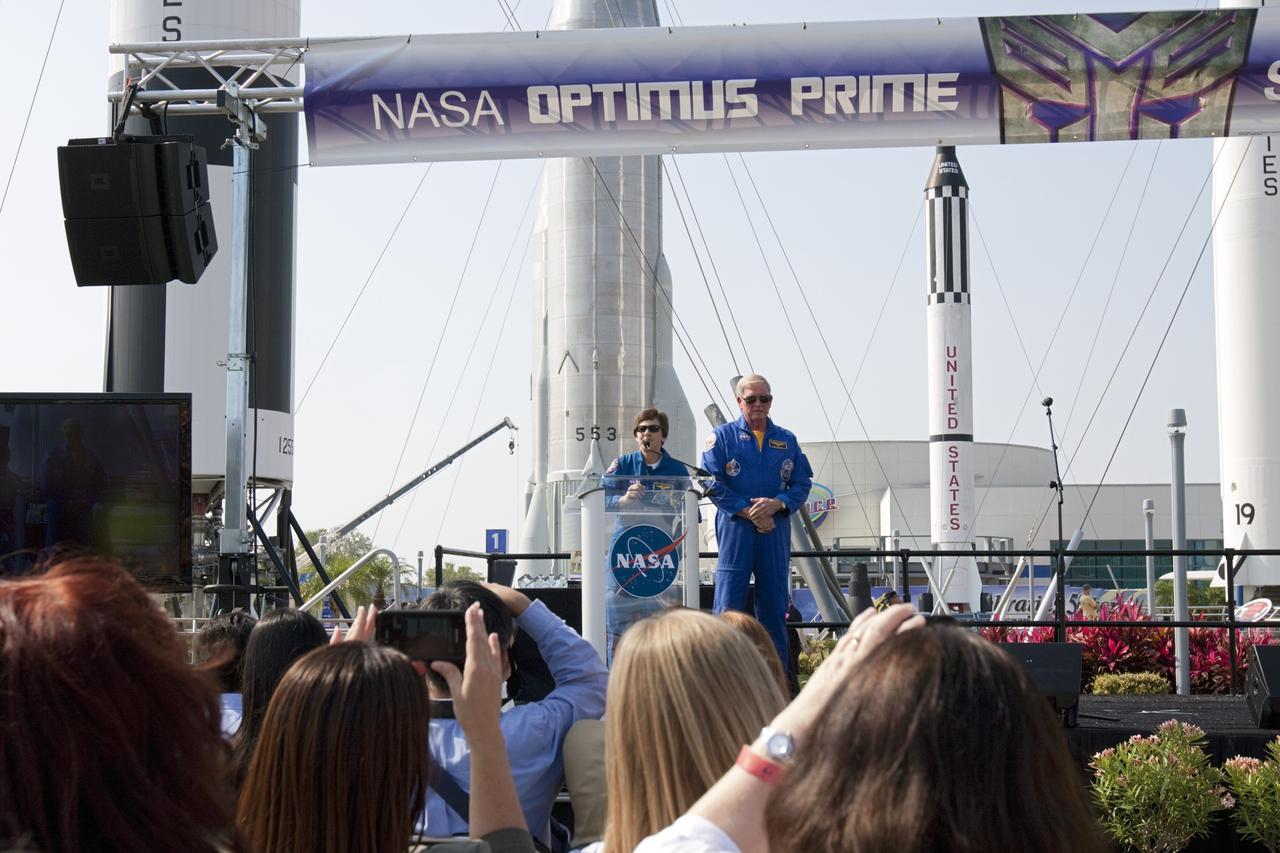
CAPE CANAVERAL, Fla. - NASA astronauts, Wendy Lawrence, left, and Jon McBride address students and teachers involved with the NASA OPTIMUS PRIME Spinoff Video Contest in the Rocket Garden of the Kennedy Space Center Visitor Complex. The contest challenged students in grades three through 12 to study NASA spinoff technologies and produce short, creative videos promoting their favorites. The NASA Goddard Space Flight Center's Innovative Partnerships Office in Greenbelt, Md., designed the contest to help students see the benefits of NASA technology here on Earth. NASA collaborated with Hasbro in using the OPTIMUS PRIME character. Photo credit: NASA/Jim Grossmann
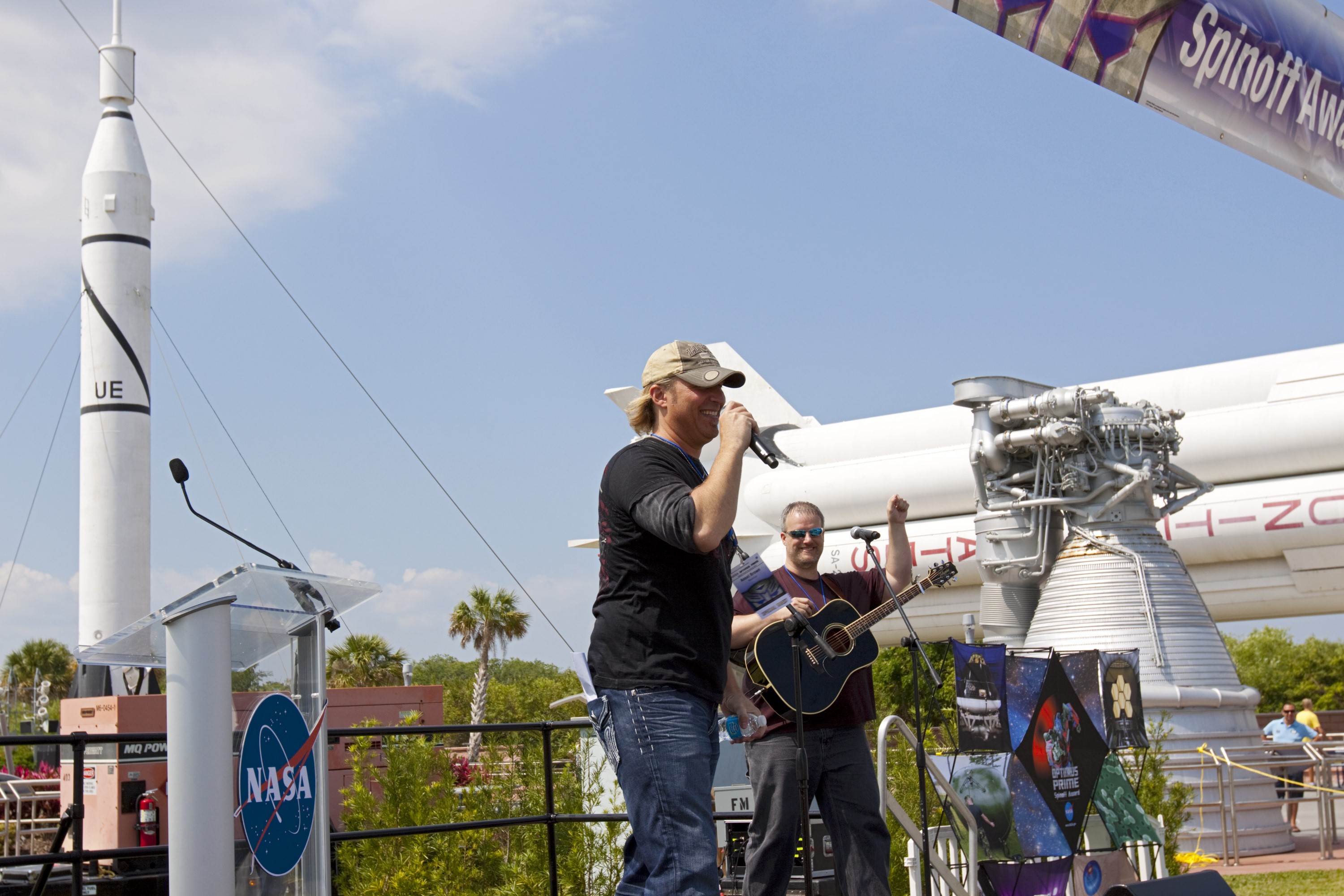
CAPE CANAVERAL, Fla. - Country music singer, Ansel Brown, performs his song "When You Fly" for students and teachers involved with the NASA OPTIMUS PRIME Spinoff Video Contest in the Rocket Garden of the Kennedy Space Center Visitor Complex. The contest challenged students in grades three through 12 to study NASA spinoff technologies and produce short, creative videos promoting their favorites. The NASA Goddard Space Flight Center's Innovative Partnerships Office in Greenbelt, Md., designed the contest to help students see the benefits of NASA technology here on Earth. NASA collaborated with Hasbro in using the OPTIMUS PRIME character. Photo credit: NASA/Jim Grossmann
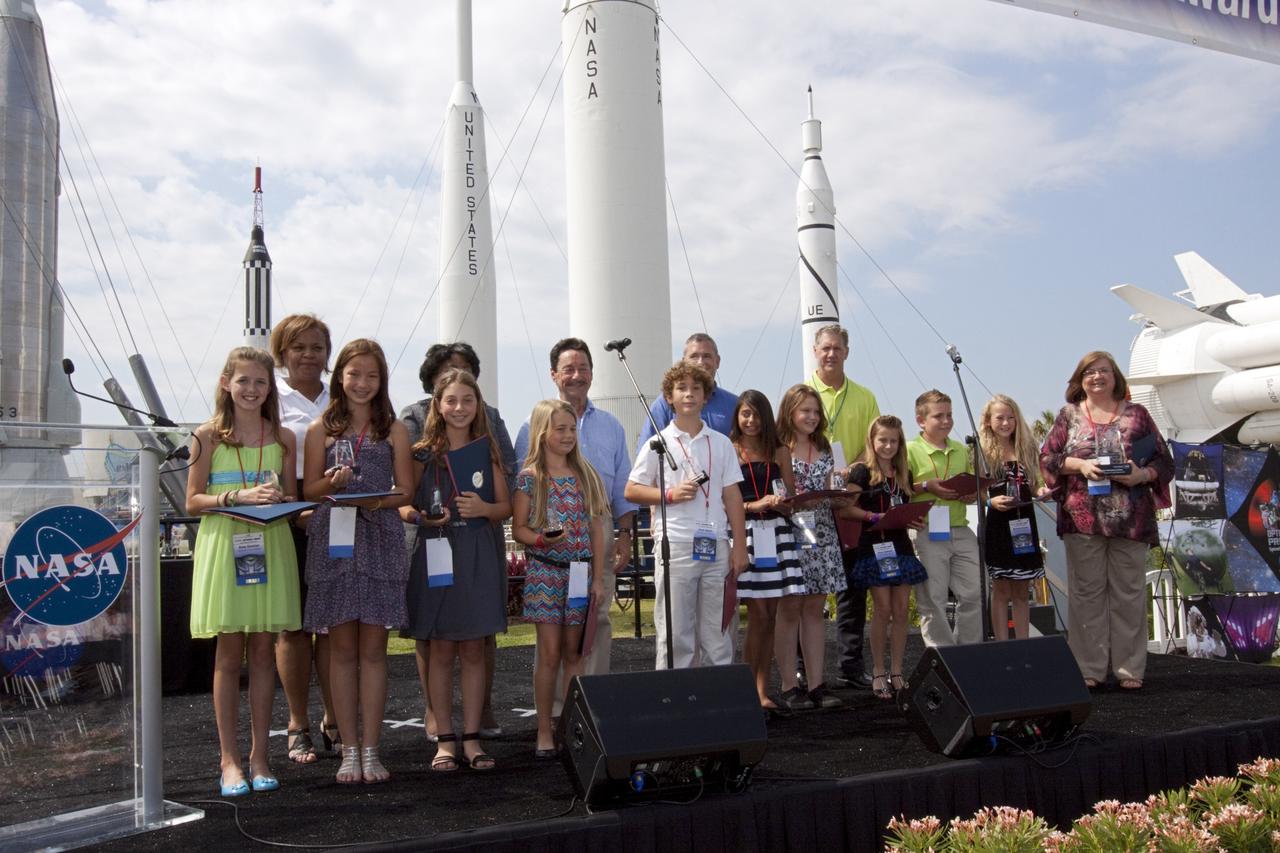
CAPE CANAVERAL, Fla. - Winners of the NASA OPTIMUS PRIME Spinoff Video Contest gather with their awards in the Rocket Garden of the Kennedy Space Center Visitor Complex. The contest challenged students in grades three through 12 to study NASA spinoff technologies and produce short, creative videos promoting their favorites. The NASA Goddard Space Flight Center's Innovative Partnerships Office in Greenbelt, Md., designed the contest to help students see the benefits of NASA technology here on Earth. NASA collaborated with Hasbro in using the OPTIMUS PRIME character. Photo credit: NASA/Jim Grossmann

CAPE CANAVERAL, Fla. - Darryl Mitchell, NASA's project manager for the NASA OPTIMUS PRIME Spinoff Video Contest, addresses students and teachers in the Rocket Garden of the Kennedy Space Center Visitor Complex. The contest challenged students in grades three through 12 to study NASA spinoff technologies and produce short, creative videos promoting their favorites. The NASA Goddard Space Flight Center's Innovative Partnerships Office in Greenbelt, Md., designed the contest to help students see the benefits of NASA technology here on Earth. NASA collaborated with Hasbro in using the OPTIMUS PRIME character. Photo credit: NASA/Jim Grossmann
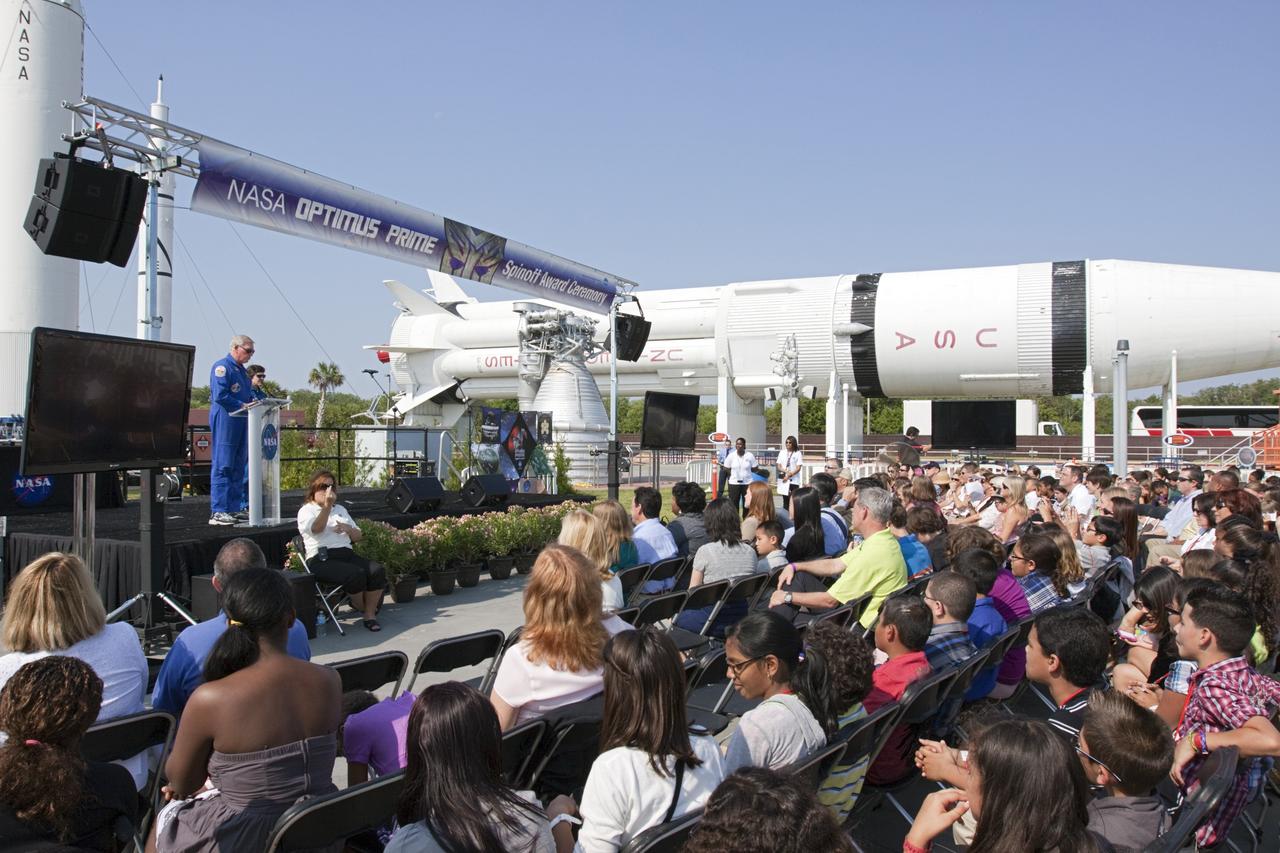
CAPE CANAVERAL, Fla. - NASA astronauts Jon McBride, left, and Wendy Lawrence address students and teachers involved with the NASA OPTIMUS PRIME Spinoff Video Contest in the Rocket Garden of the Kennedy Space Center Visitor Complex. The contest challenged students in grades three through 12 to study NASA spinoff technologies and produce short, creative videos promoting their favorites. The NASA Goddard Space Flight Center's Innovative Partnerships Office in Greenbelt, Md., designed the contest to help students see the benefits of NASA technology here on Earth. NASA collaborated with Hasbro in using the OPTIMUS PRIME character. Photo credit: NASA/Jim Grossmann
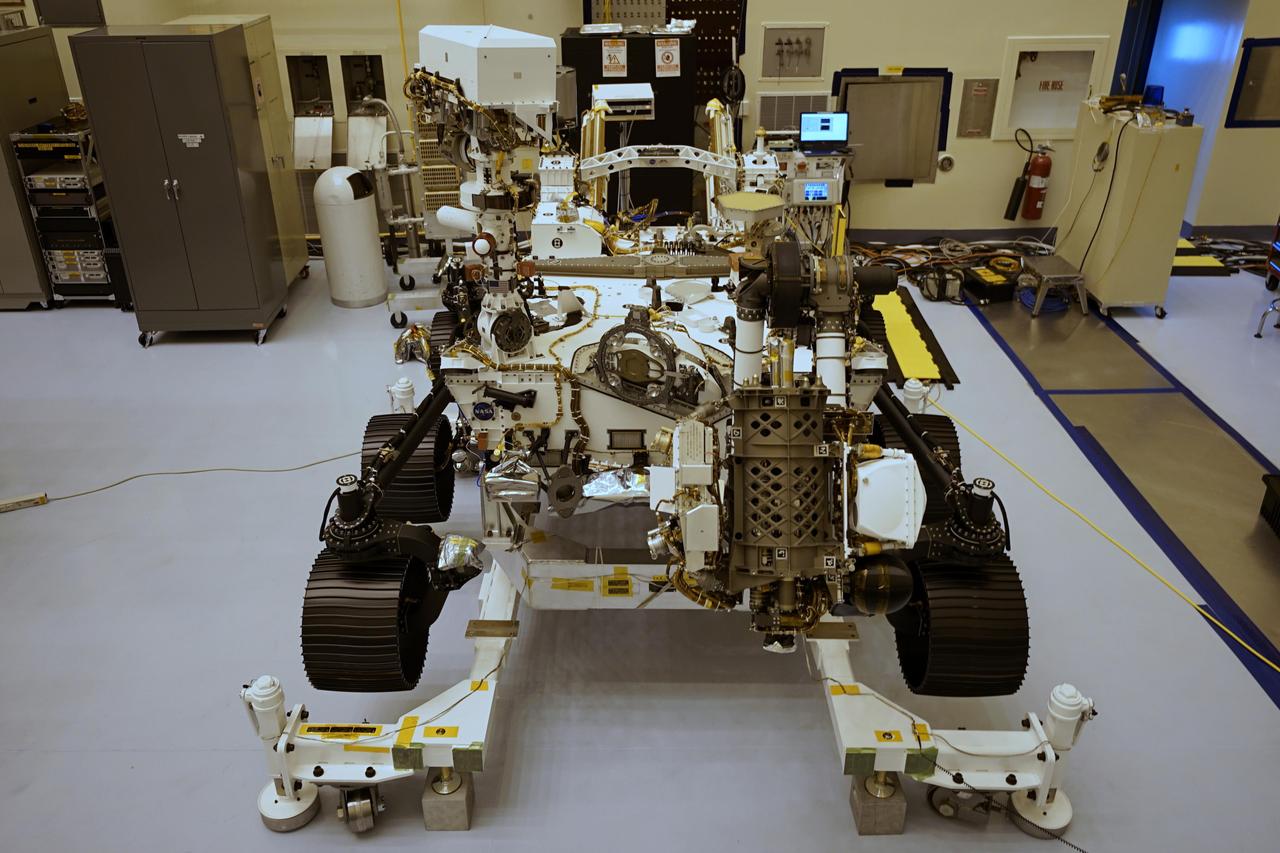
Top center: The plate affixed to the aft crossbeam of NASA's Mars Perseverance rover — seen here on March 16, 2020, at NASA's Kennedy Space Center in Florida — carries 10,932,295 names submitted by people during NASA's "Send Your Name to Mars" campaign and essays of the 155 finalists in the "Name the Rover" contest. https://photojournal.jpl.nasa.gov/catalog/PIA23770
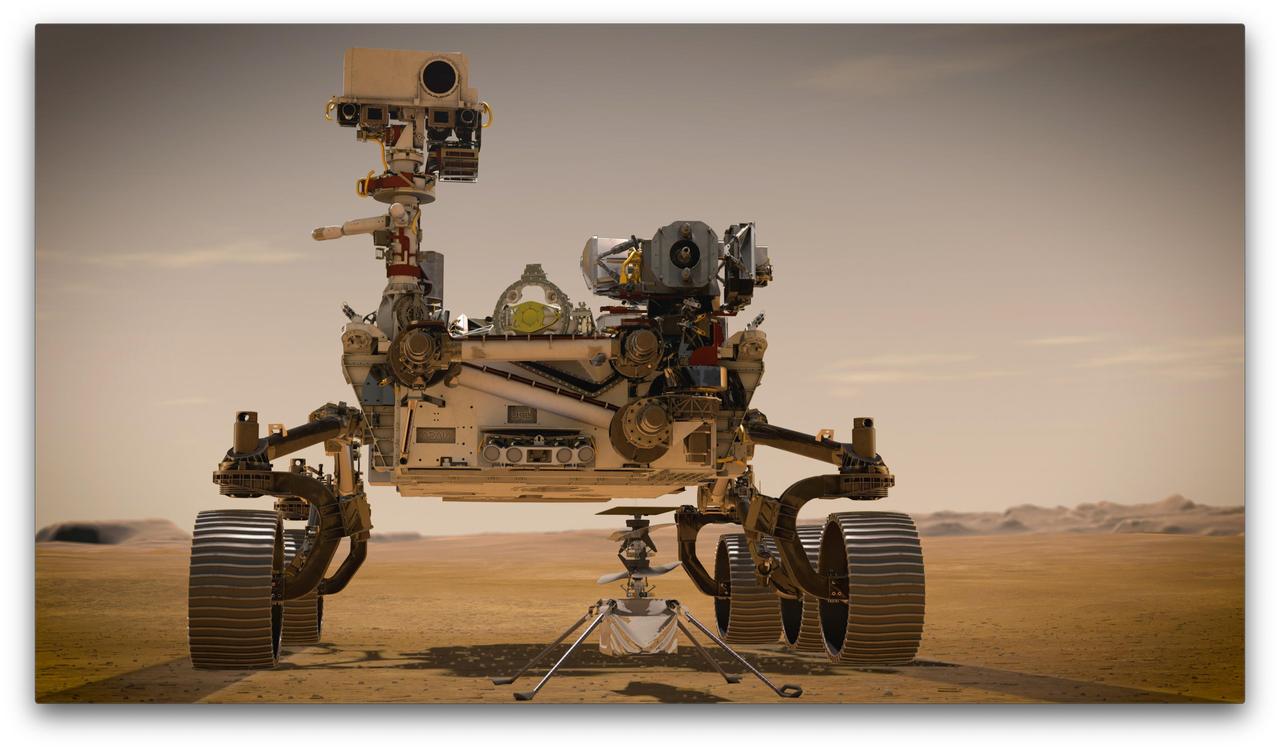
In February 2021, NASA's Mars 2020 Perseverance rover and NASA's Ingenuity Mars Helicopter (shown in an artist's concept) will be the agency's two newest explorers on Mars. Both were named by students as part of an essay contest. Perseverance is the most sophisticated rover NASA has ever sent to Mars. Ingenuity, a technology experiment, will be the first aircraft to attempt controlled flight on another planet. Perseverance will arrive at Mars' Jezero Crater with Ingenuity attached to its belly. https://photojournal.jpl.nasa.gov/catalog/PIA23962
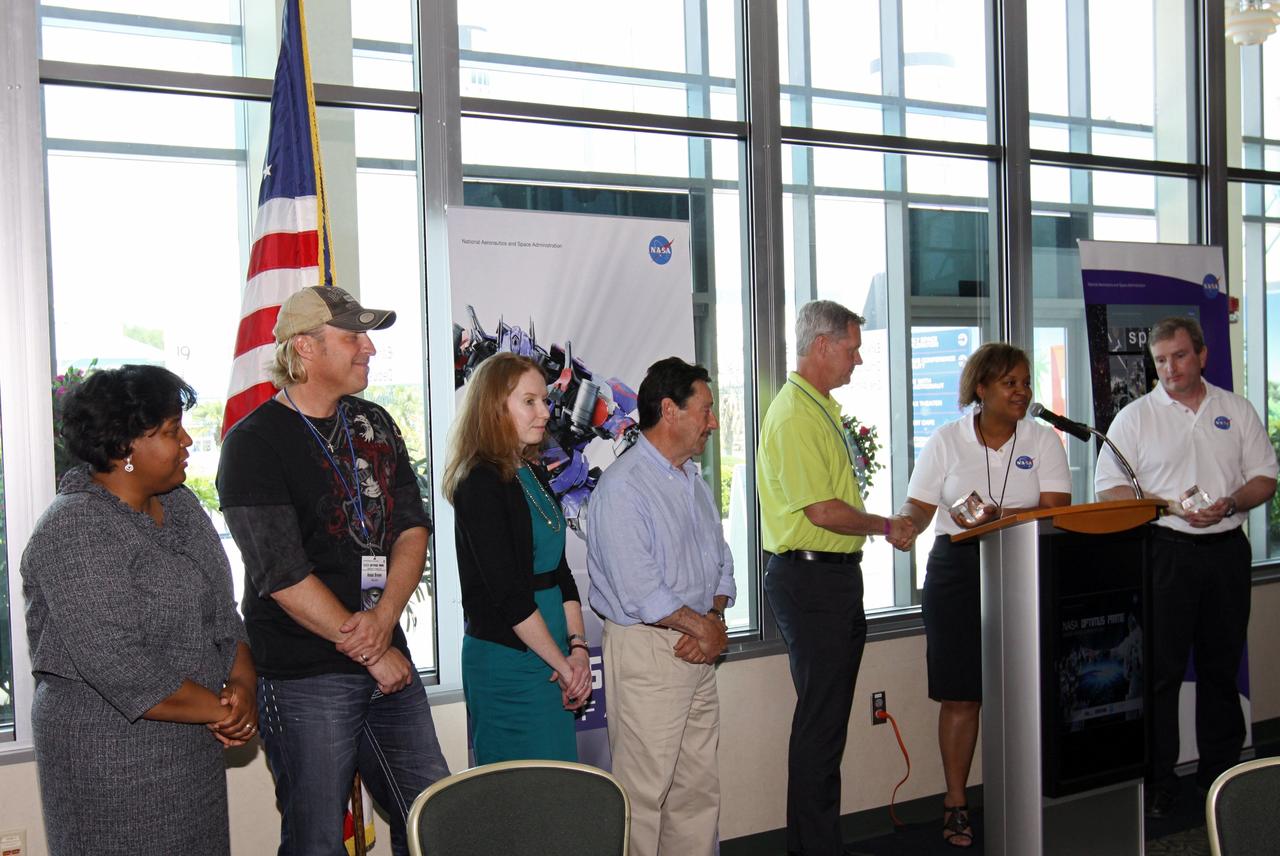
CAPE CANAVERAL, Fla. - In the Debus Conference Center of the Kennedy Space Center Visitor Complex, winners of the NASA OPTIMUS PRIME Spinoff Video Contest receive awards from Joyce Ward, the United States Patent and Trademark Office's education coordinator/administrator, left Ansel Brown, country music singer and song writer of "When You Fly" Sarah Carroll, brand manager of TRANSFORMERS for Hasbro Inc. Peter Cullen, the voice of OPTIMUS PRIME from the "Transformers" franchise Matt Schatzle, executive director of the American Society of Mechanical Engineers Foundation Nona Cheeks, chief of the Technology Commercialization Office at NASA's Goddard Space Flight Center in Greenbelt, Md. and Darryl Mitchell, NASA's project manager for the video contest. The contest challenged students in grades three through 12 to study NASA spinoff technologies and produce short, creative videos promoting their favorites. Goddard's Innovative Partnerships Office designed the contest to help students see the benefits of NASA technology here on Earth. NASA collaborated with Hasbro in using the OPTIMUS PRIME character. Photo credit: NASA/Jim Grossmann
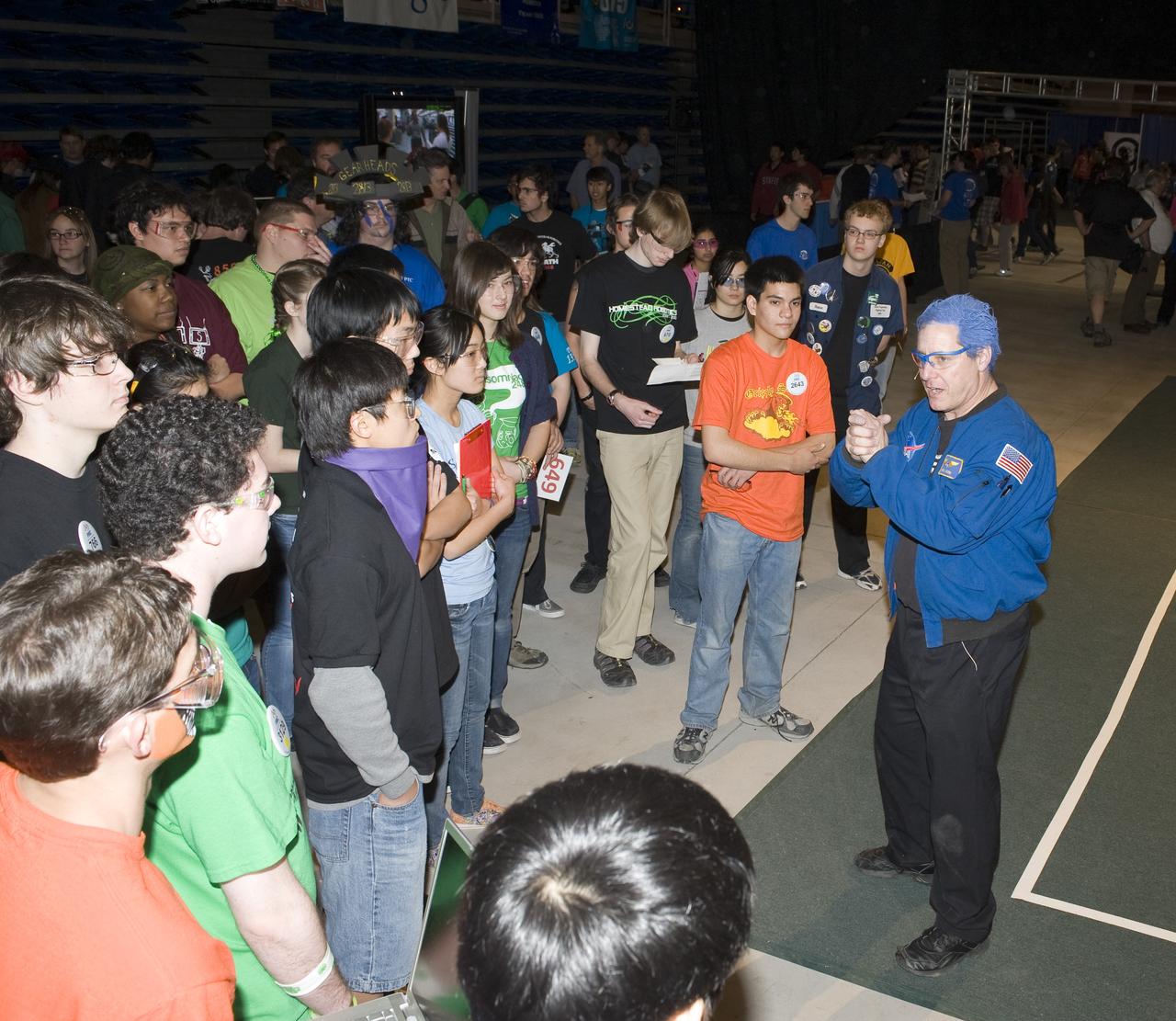
For Inspiration and Recognition of Science and Technology; FIRST Robotics Competition 2010 Silicon Valley Regional held at San Jose State University, San Jose, California Mark Leon, Ames Robotic Alliance fires up the contestants
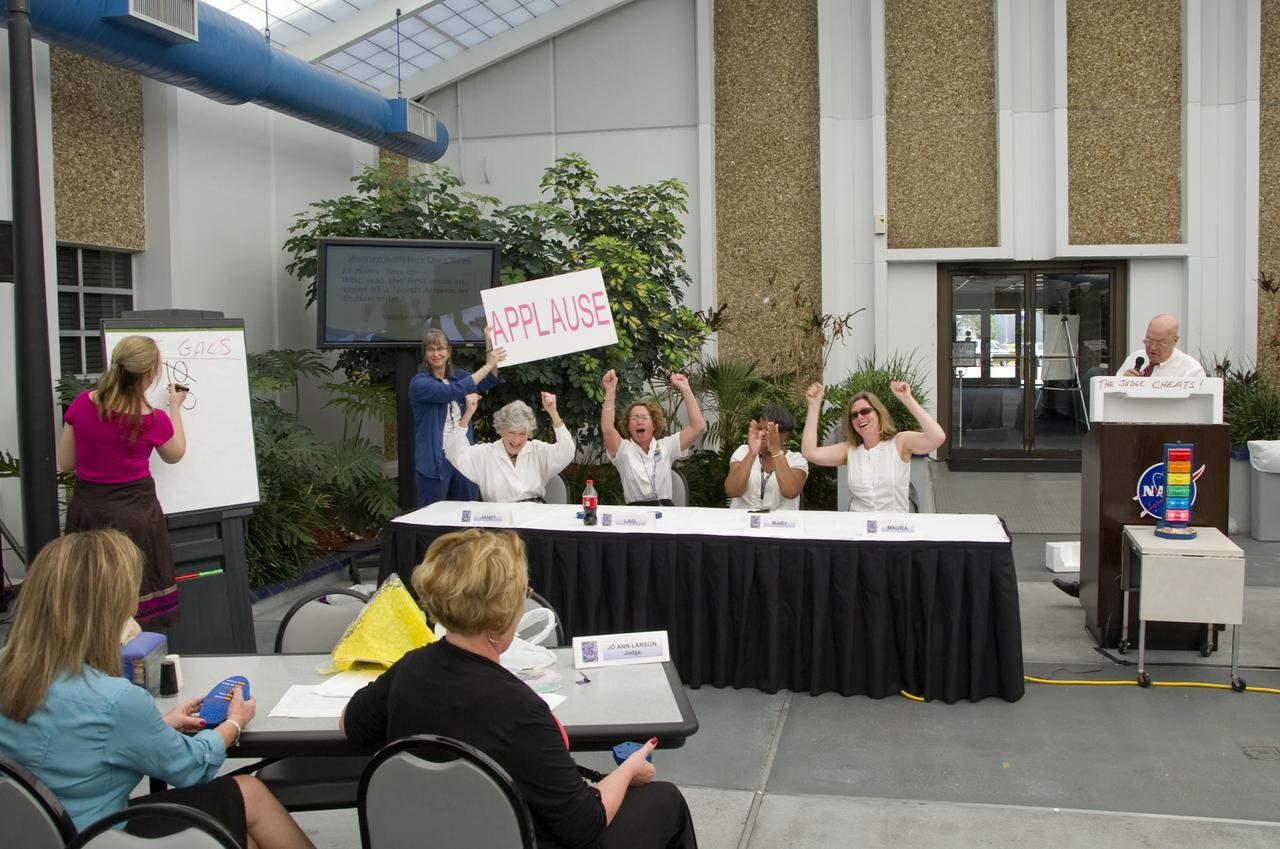
John C. Stennis Space Center employees (l to r) Janet Kovac (NASA Shared Services Center), Lael Butler (Environmental Protection Agency Gulf of Mexico Program), Mary Carter (NSSC) and Maura Lohrenz (Naval Research Laboratory) celebrate a correct answer during the Women's History Month Quiz Bowl held onsite March 24. The contest between the women and a panel of four men tested each side's knowledge of women's history facts and events. This year's Women's History Month theme was 'Our History is Our Strength.' Befitting that sentiment, the panel of women won the contest.
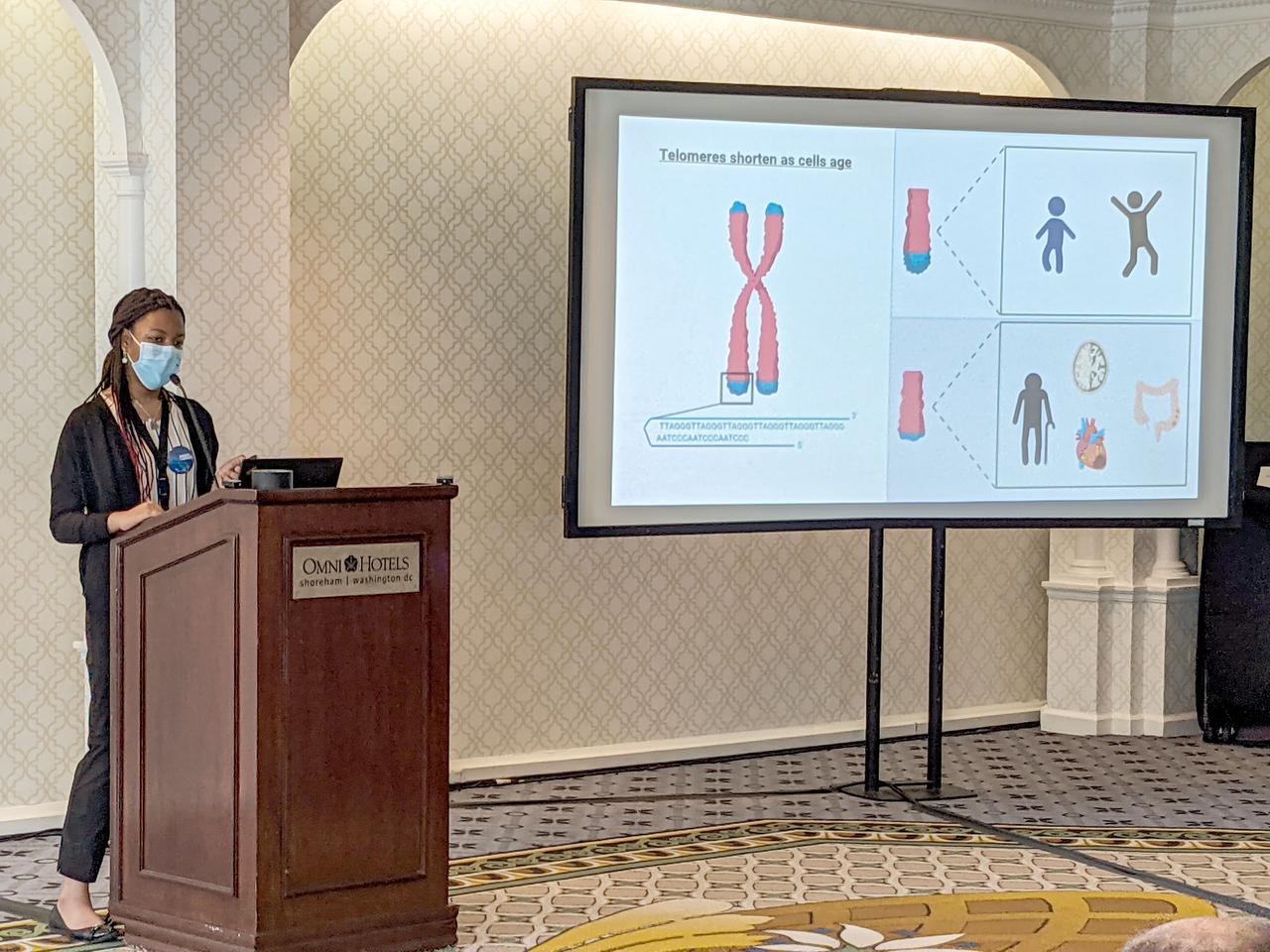
jsc2023e031078 (7/27/2022) --- Pristine Onuoha, Genes in Space-10 winner, presents her idea to contest judges. The Genes in Space program allows for 10 student projects to be selected for spaceflight analysis, which gives students a chance to attempt to solve real-world problems. Image courtesy of Genes in Space.
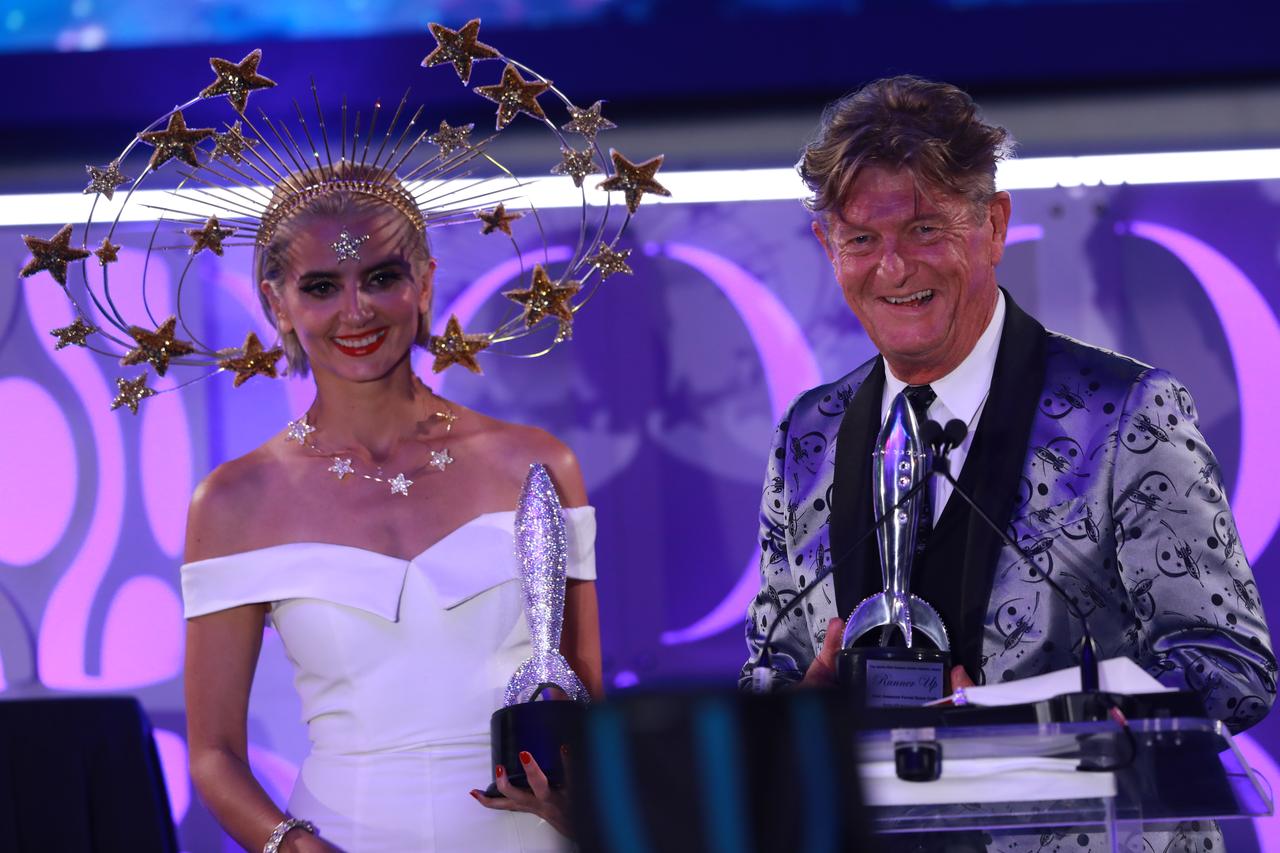
During the Apollo 11 50th Gala, presented by Northrop Grumman, on July 16, 2019, last year's space-themed constume contest winner, left, helps the announcer preent this year's winners their awards. The gala was held inside the Apollo/Saturn V Center at the Kennedy Space Center Visitor Complex in Florida.
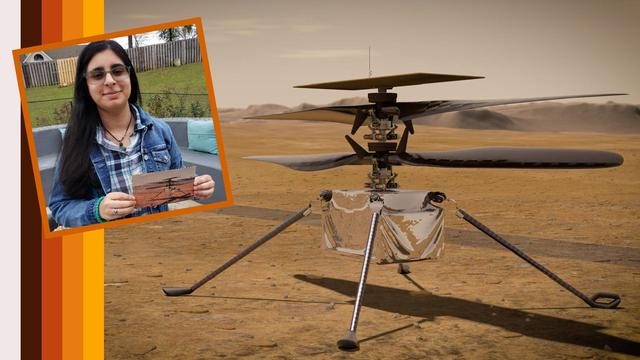
Vaneeza Rupani (inset), a junior at Tuscaloosa County High School in Northport, Alabama, came up with the name Ingenuity for NASA's Mars Helicopter (an artist's impression of which is seen here) and the motivation behind it for NASA's "Name the Rover" essay contest. https://photojournal.jpl.nasa.gov/catalog/PIA23883
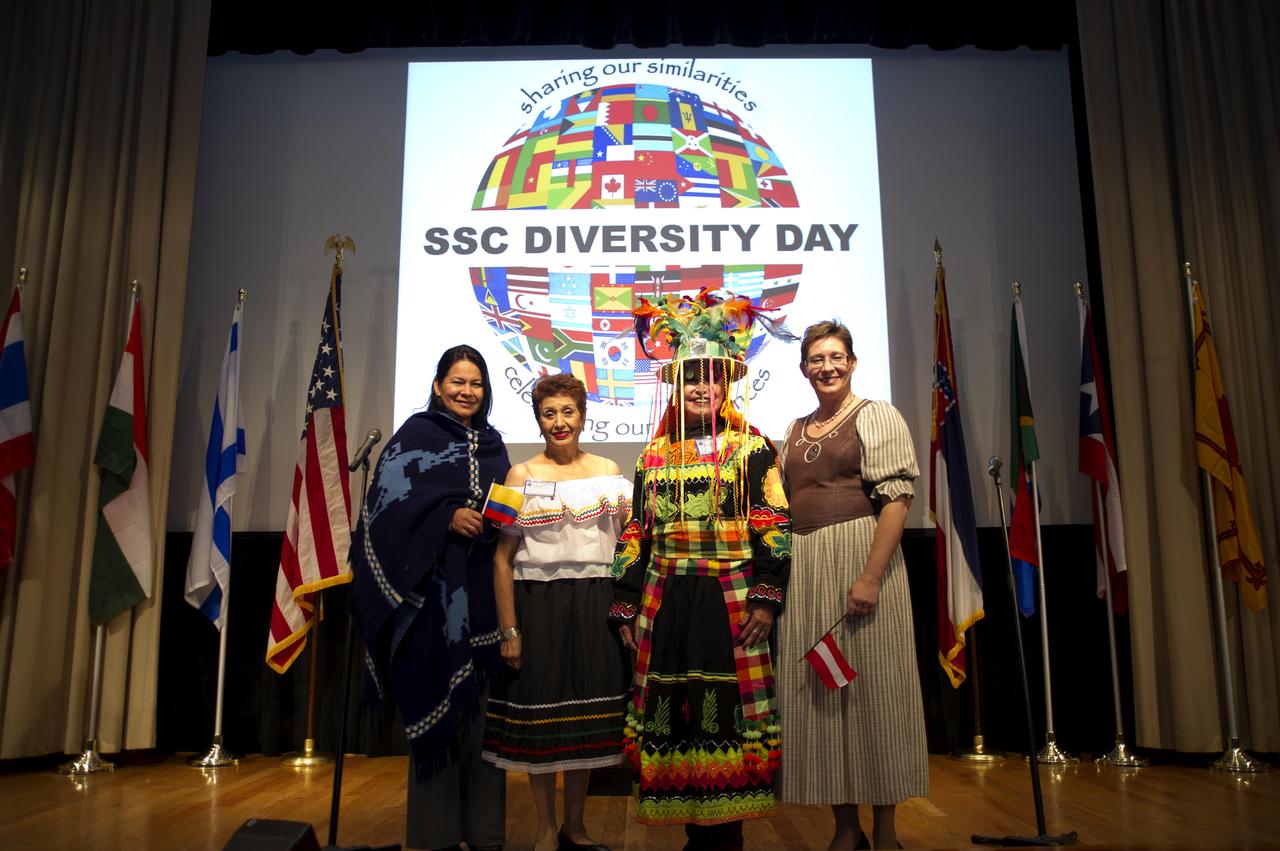
John C. Stennis Space Center employees enjoyed 2012 Diversity Day activities Oct. 31. During the day, Stennis employees were able to visit cultural exhibits and participate such events as an employee talent showcase, a car/motorcycle show, Stennis 'Family Feud' contests and a cultural dress parade.
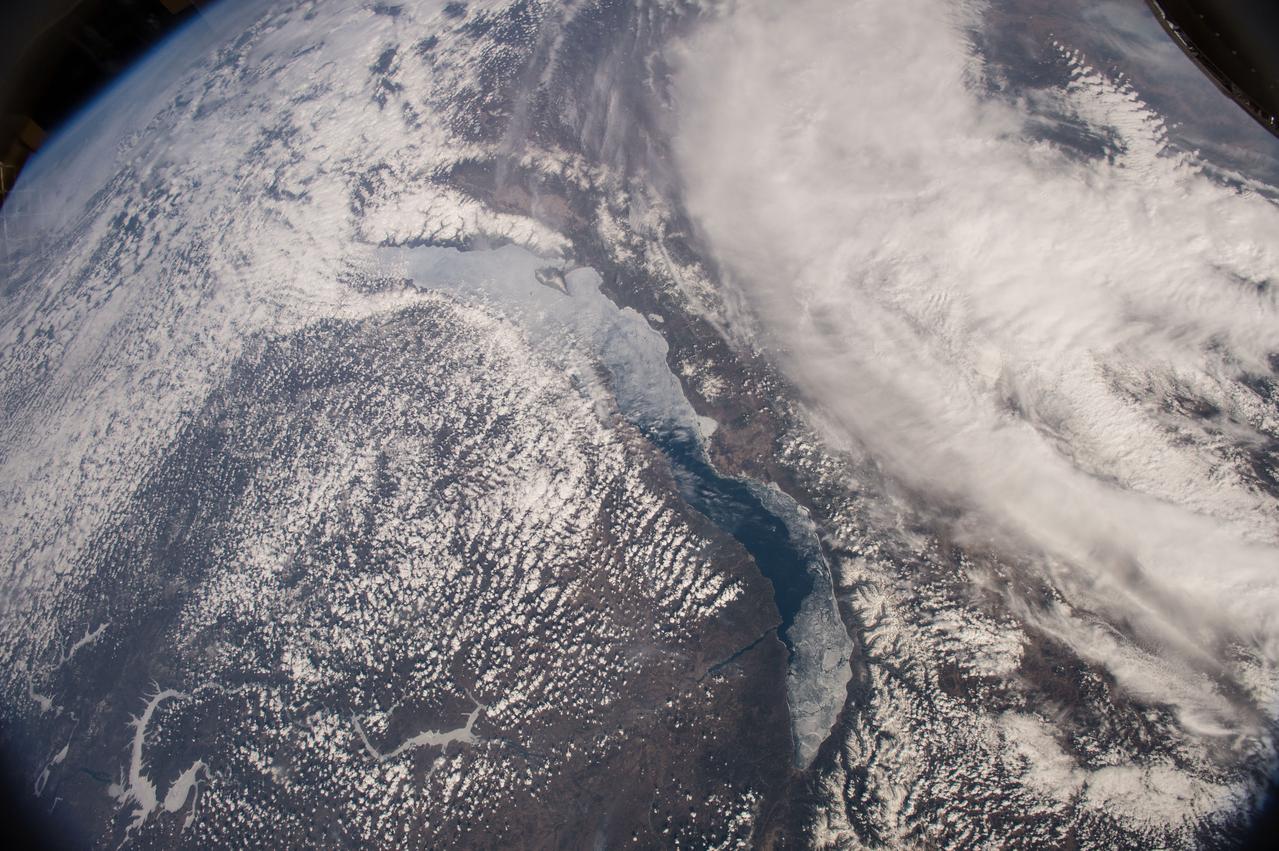
ISS043E142265 (04/26/2015) --- NASA astronaut Scott Kelly on the International Space Station Apr.26, 2015 tweeted this image out of an Earth observation as part of his Space Geo contest "name this location" with this remark and clue: "This frozen body of water is the world's oldest (25 million years) and deepest basin on Earth. Name it!"
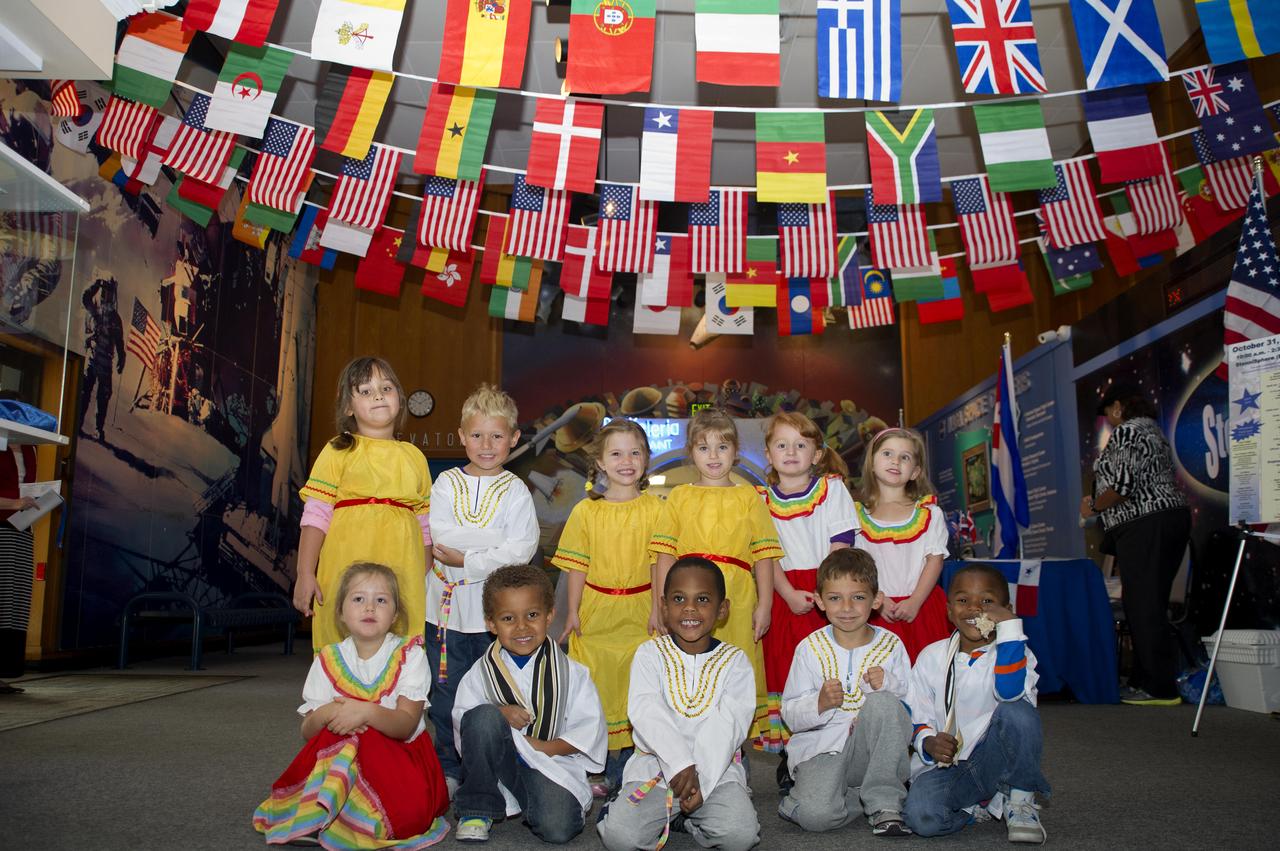
John C. Stennis Space Center employees enjoyed 2012 Diversity Day activities Oct. 31. The day's color-filled schedule included an employee talent showcase, a car/motorcycle show, Stennis 'Family Feud' contests, a cultural dress parade, food vendors and various cultural exhibits.
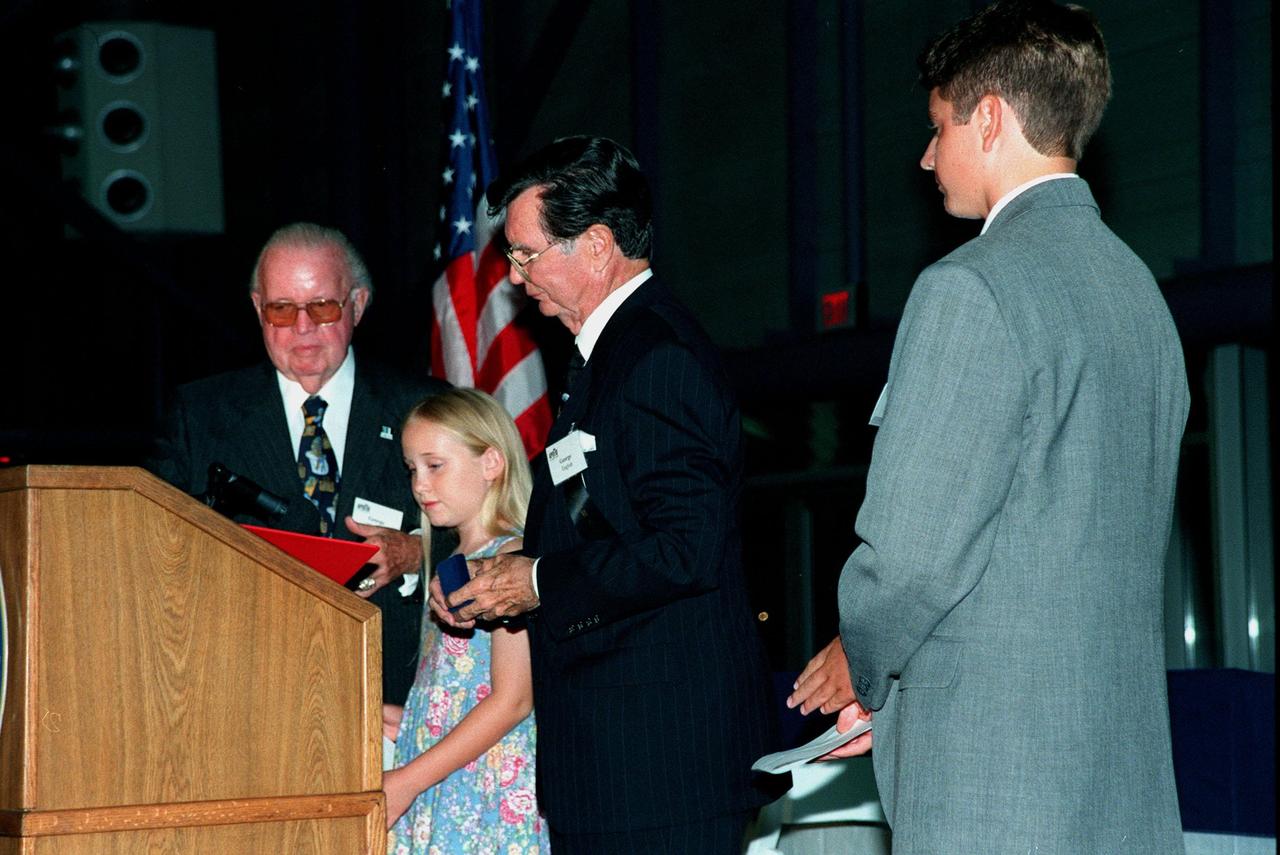
KENNEDY SPACE CENTER, FLA. -- George Meguiar (left) presents a scholarship award to Kyla Davis Horn, of Cocoa Beach, one of the winners of an essay contest related to the 30th Anniversary of Apollo 11. Meguiar and George English (second from right) head the Apollo 11 Commemoration Association who sponsored the contest in conjunction with Florida Today newspaper. The other scholarship winner is Kyle Rukaczewski, of Satellite Beach (far right). A third winner, Jason Gagnon, of Viera, was unable to attend. The presentation was made at the Apollo/Saturn V Center during an anniversary banquet that honored all the people who made the Apollo Program possible. Special guests included former Apollo astronauts Neil Armstrong, Edwin "Buzz" Aldrin, Gene Cernan and Walt Cunningham, who shared their experiences with the audience
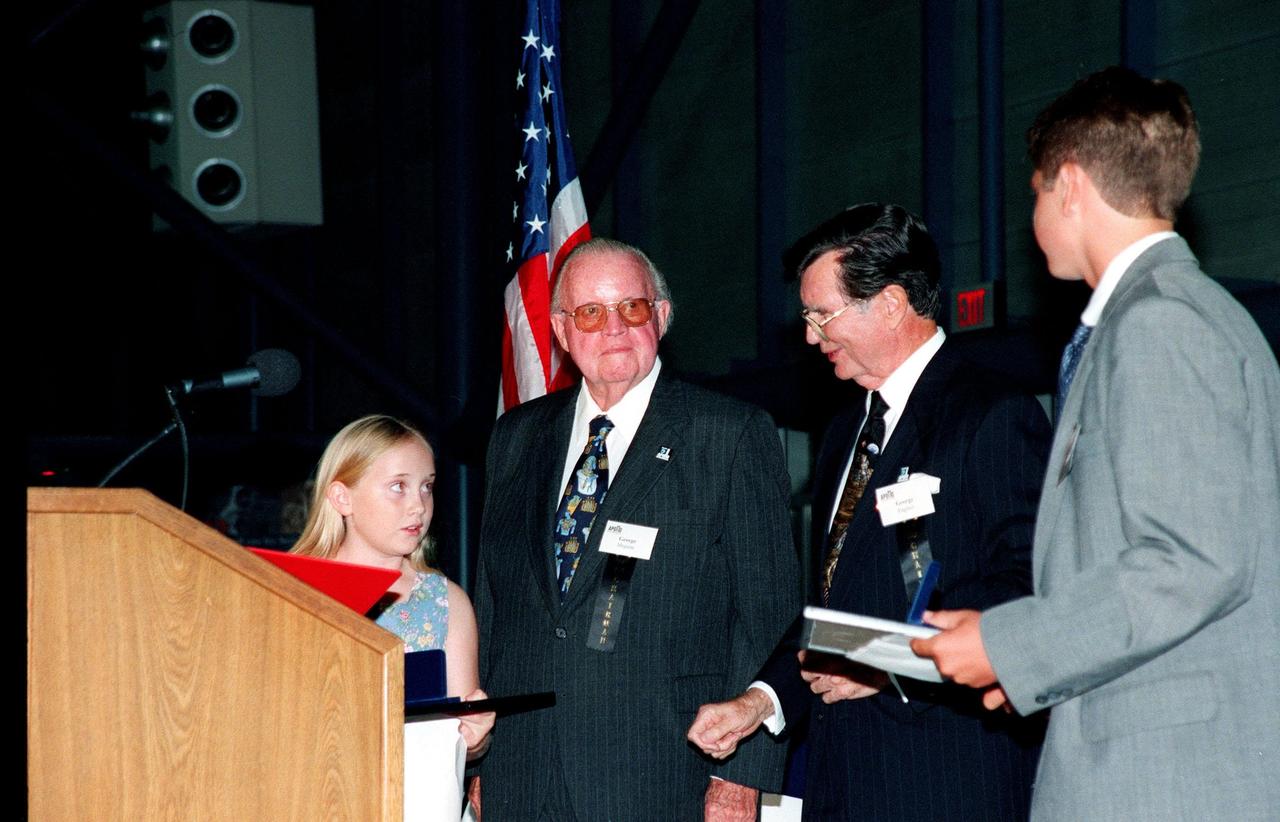
KENNEDY SPACE CENTER, FLA. -- At the Apollo/Saturn V Center, George Meguiar (center left) and George English (center right) present scholarships to two students who entered an essay contest in conjunction with the 30th Anniversary of Apollo 11. The winners shown are Kyla Davis Horn, of Cocoa Beach, and Kyle Rukaczewski, of Satellite Beach. A third winner, Jason Gagnon, of Viera, was unable to attend. Meguiar and English head the Apollo 11 Commemoration Association which sponsored the contest in conjunction with Florida Today newspaper. The presentation was made at the Apollo/Saturn V Center during an anniversary banquet that honored all the people who made the Apollo Program possible. Special guests included former Apollo astronauts Neil Armstrong, Edwin "Buzz" Aldrin, Gene Cernan and Walt Cunningham, who shared their experiences with the audience
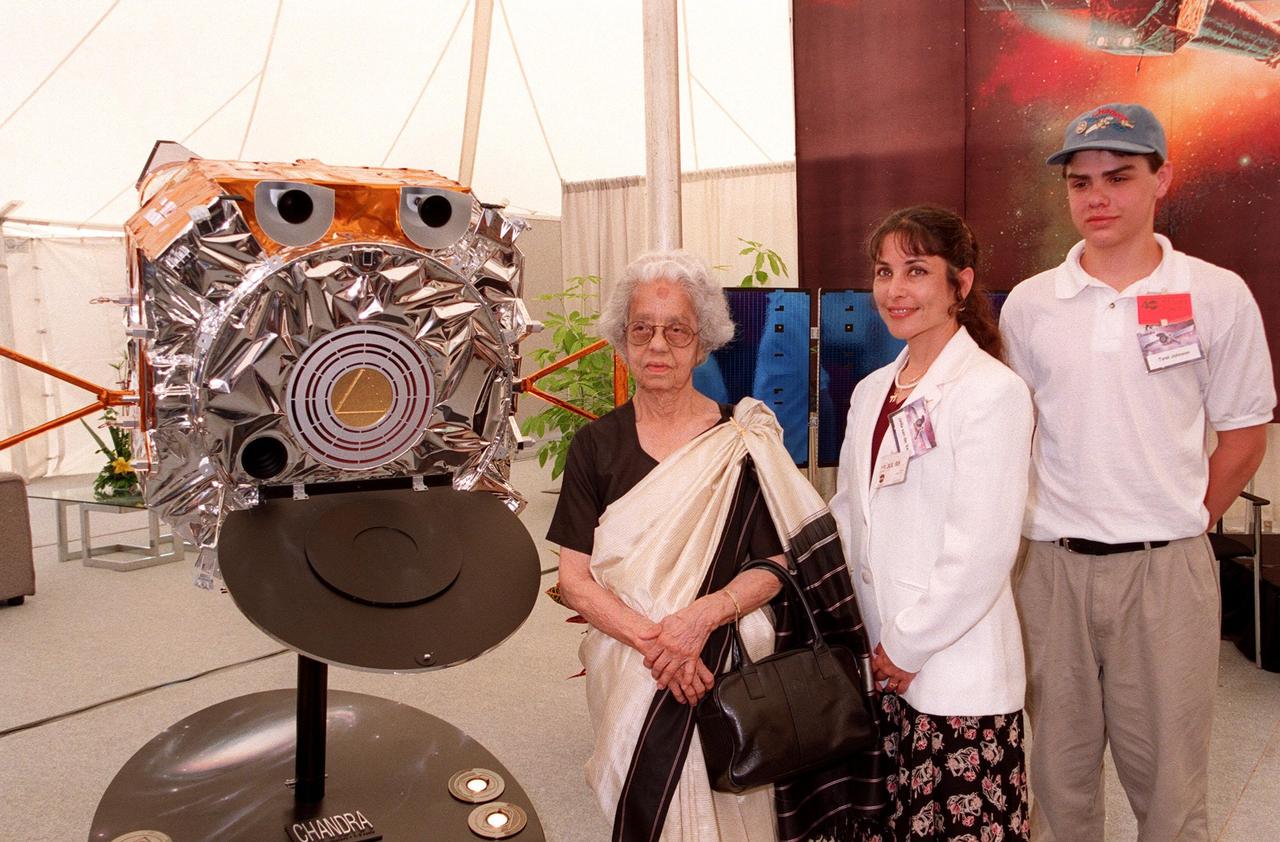
KENNEDY SPACE CENTER, FLA. -- Mrs. Lalitha Chandrasekhar (left), wife of the late Indian-American Nobel Laureate Subrahmanyan Chandrasekhar, poses with a model of the Chandra X-ray Observatory and the winners of the contest to rename the telescope in the TRW Media Hospitality Tent at the NASA Press Site at KSC. The winners of the contest are Jatila van der Veen (center), academic coordinator and lecturer, Physics Dept., University of Santa Barbara, Calif., and Tyrel Johnson (right), high school student, Laclede, Idaho. The name "Chandra," a shortened version of Chandrasekhar's name which he preferred among friends and colleagues, was chosen to honor the Nobel Laureate. "Chandra" also means "Moon" or "luminous" in Sanskrit. The observatory is scheduled to be launched aboard Columbia on Space Shuttle mission STS-93
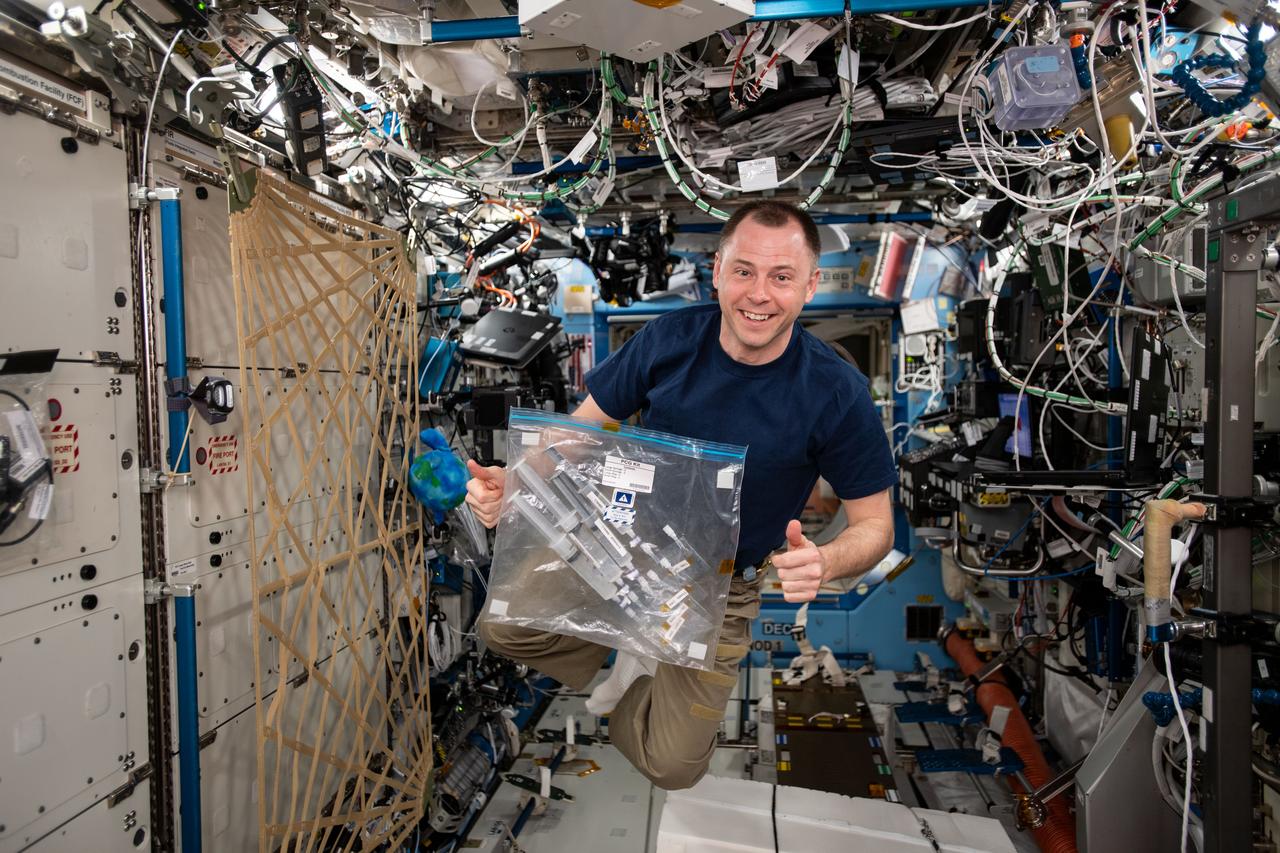
iss059e068212 (5/20/2019) --- NASA astronaut Nick Hague is photographed with the CASIS PCG-14 investigation in the Destiny module of the International Space Station (ISS). The Wisconsin Crystal Growing Contest-Wisconsin Space Crystals (CASIS PCG 14) teaches middle and high school students the unique engineering research and operations of the space program. The investigation allows students to understand the capabilities and constraints of conducting an experiment in microgravity.
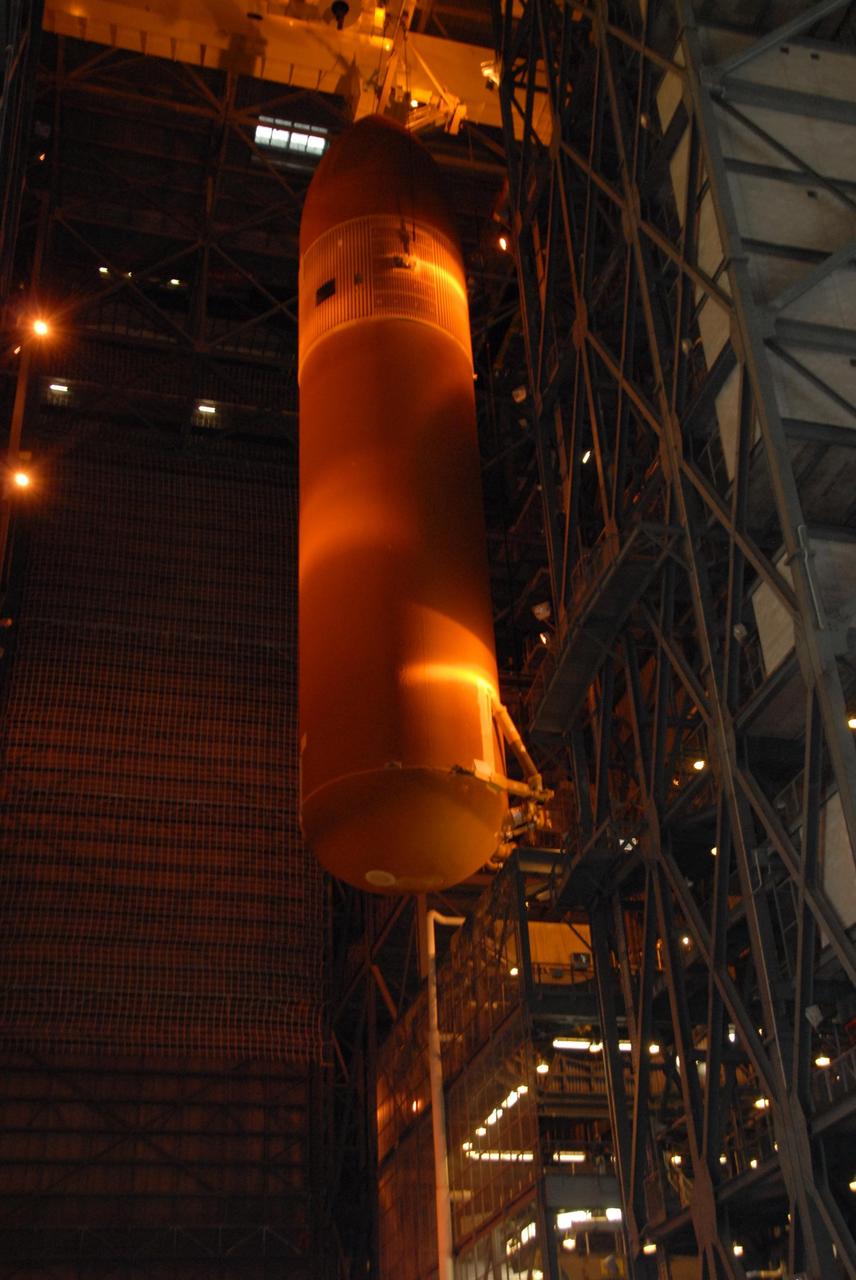
KENNEDY SPACE CENTER, FLA. -- In the Vehicle Assembly Building at KSC, a crane moves laterally to carry external tank No. 120 into a checkout cell. The tank will be prepared for stacking with solid rocket boosters to launch Space Shuttle Discovery on mission STS-120 in October. The mission is the 23rd to the International Space Station and will launch an Italian-built, U.S. multi-port module known as Harmony for the station. Christened after a school contest, Harmony will provide attachment points for European and Japanese laboratory modules. NASA/George Shelton
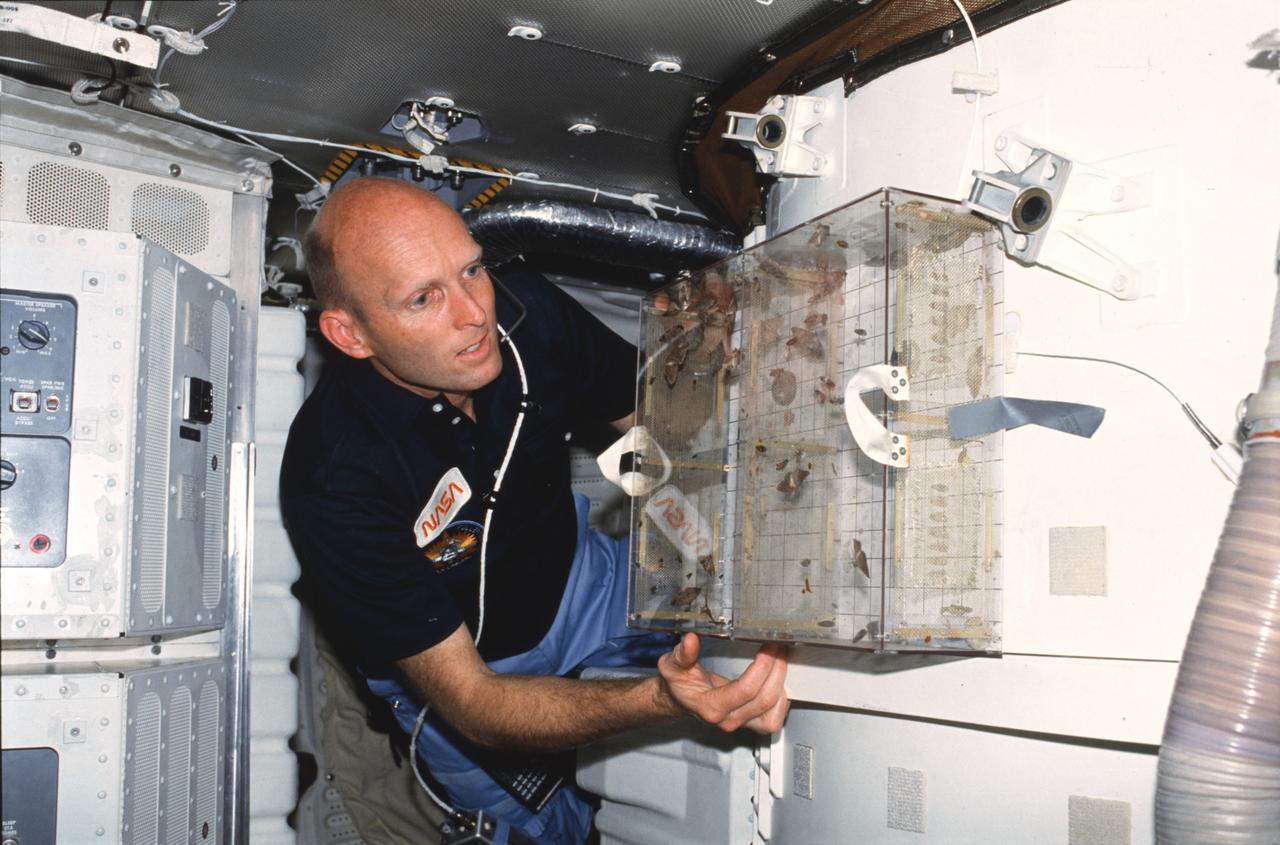
STS003-23-178 (22-30 March 1982) --- Astronaut C. Gordon Fullerton, STS-3 pilot, examines Student Experiment 81-8 (SE-81-8) Insect Flight Motion Study taped to the airlock on aft middeck. Todd Nelson, a high school senior from Minnesota, won a national contest to fly his experiment on this particular flight. Moths, flies, and bees were studied in the near weightless environment. Photo credit: NASA
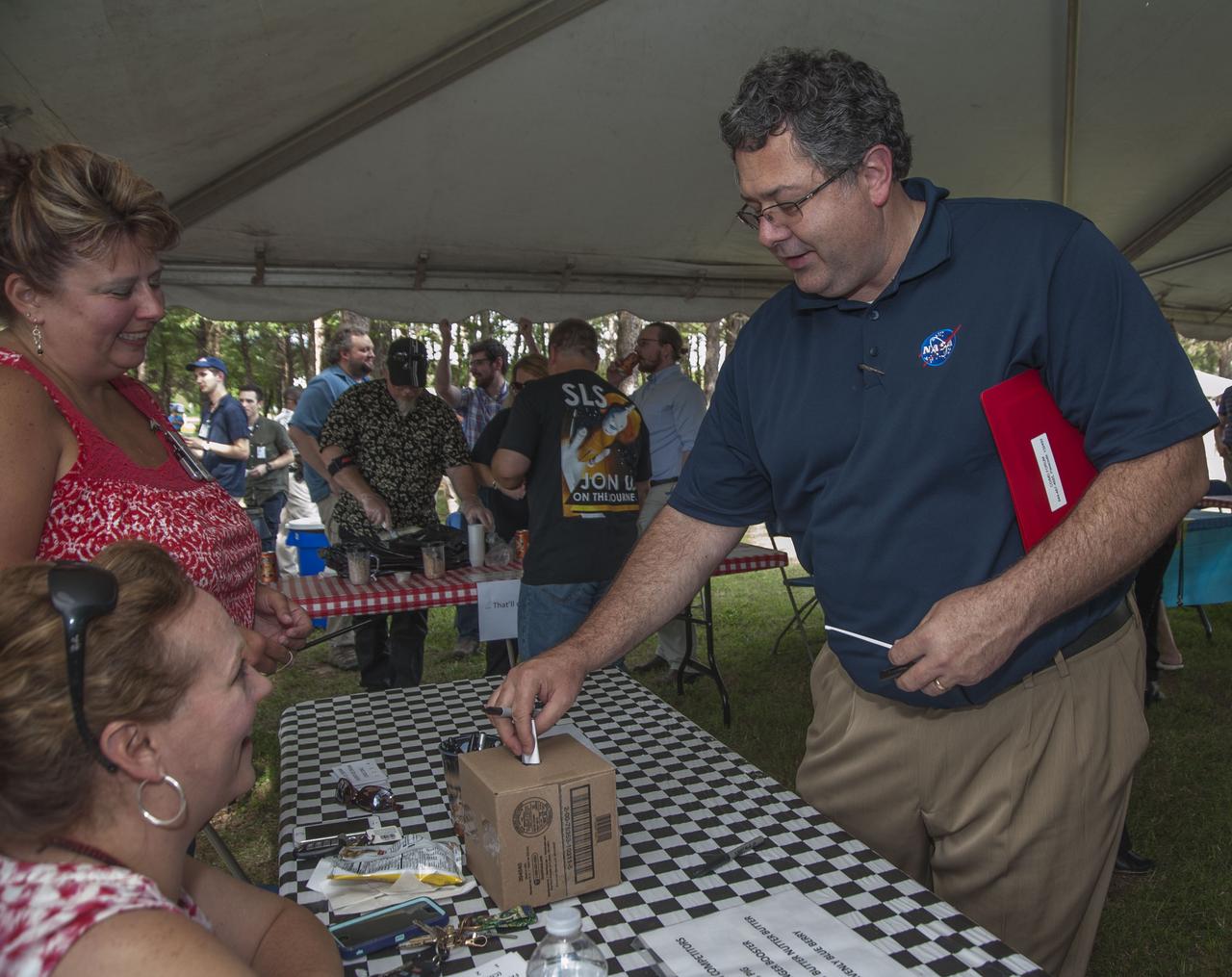
MARSHALL SPACE FLIGHT CENTER DIRECTOR TODD MAY CASTS HIS BALLOT IN THE HOMEMADE ICE CREAM CONTEST DURING THE GREAT EXCHANGE SUMMER BLAST SOCIAL, PRESENTED JUNE 9 BY THE MARSHALL EXCHANGE. THE EXCHANGE IS A NON-APPROPRIATED-FUND ACTIVITY THAT AIMS TO CONTRIBUTE TO THE WELFARE, EFFICIENCY AND MORALE OF MARSHALL TEAM MEMBERS, OTHER GOVERNMENT PERSONNEL, RETIRED NASA EMPLOYEES AND THEIR FAMILIES.
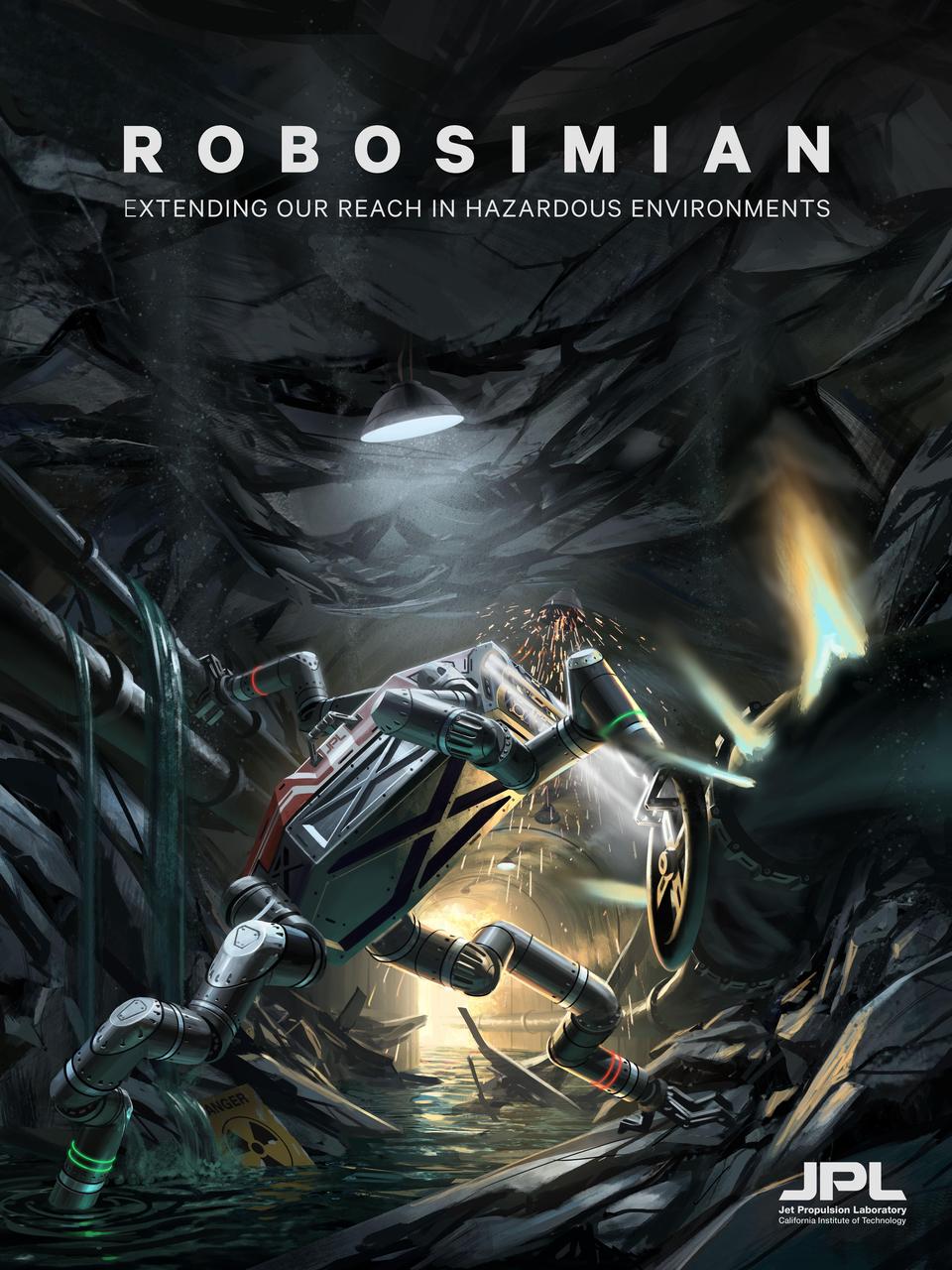
This artist's concept shows RoboSimian, a robot intended to assist with disaster relief and mitigation. RoboSimian is an ape-like robot that moves around on four limbs. It was designed and built at the Jet Propulsion Laboratory in Pasadena, California. It will compete in the 2015 DARPA Robotics Challenge Finals. To get the robot in shape for the contest, researchers at JPL are collaborating with partners at University of California, Santa Barbara, and the California Institute of Technology. http://photojournal.jpl.nasa.gov/catalog/PIA19313
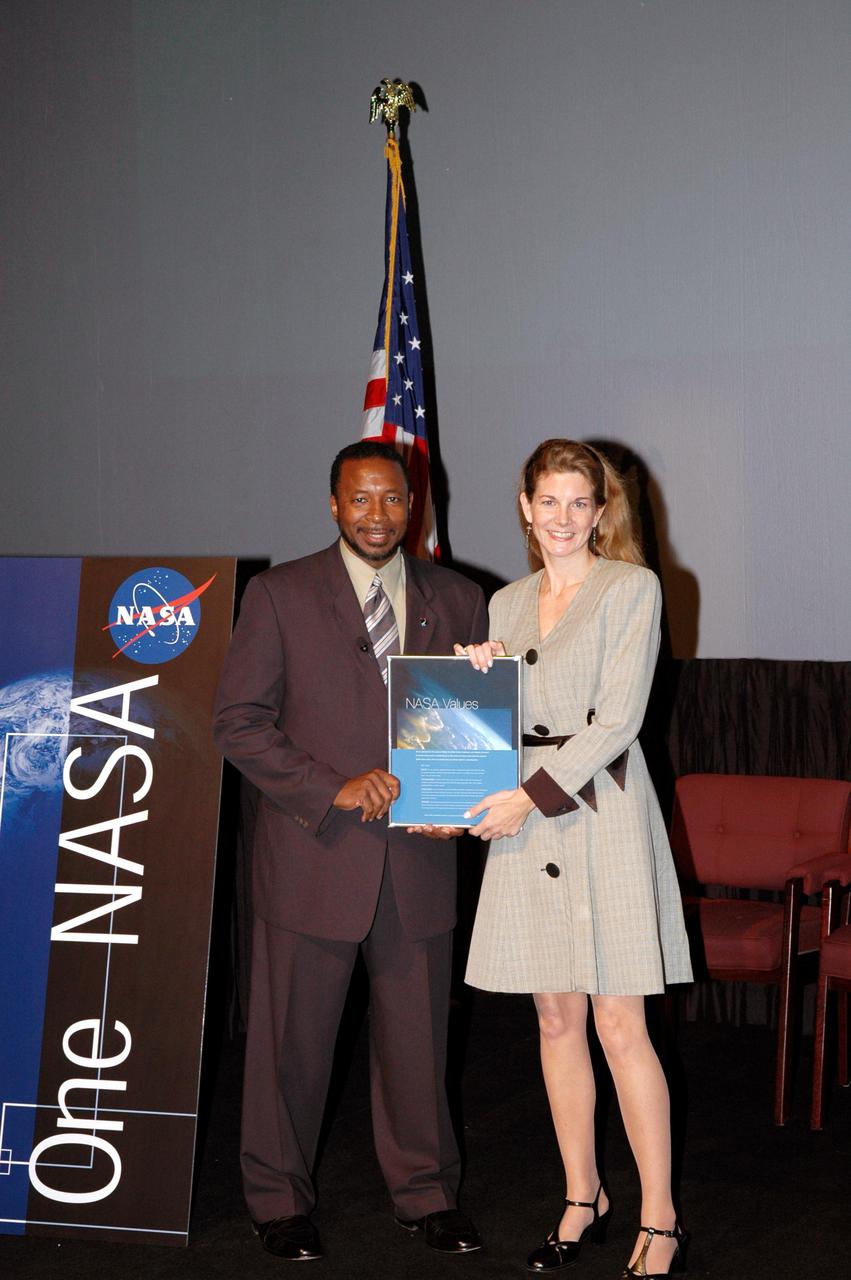
KENNEDY SPACE CENTER, FLA. - Kennedy’s Deputy Director Woodrow Whitlow Jr. presents Mary Erdmann an award for a winning entry in the NASA Values essay contest. The award was presented during the One NASA Leader-Led Workshop, which presented senior leadership in the Agency talking about ongoing Transformation activities and Kennedy’s role in the Vision for Space Exploration.
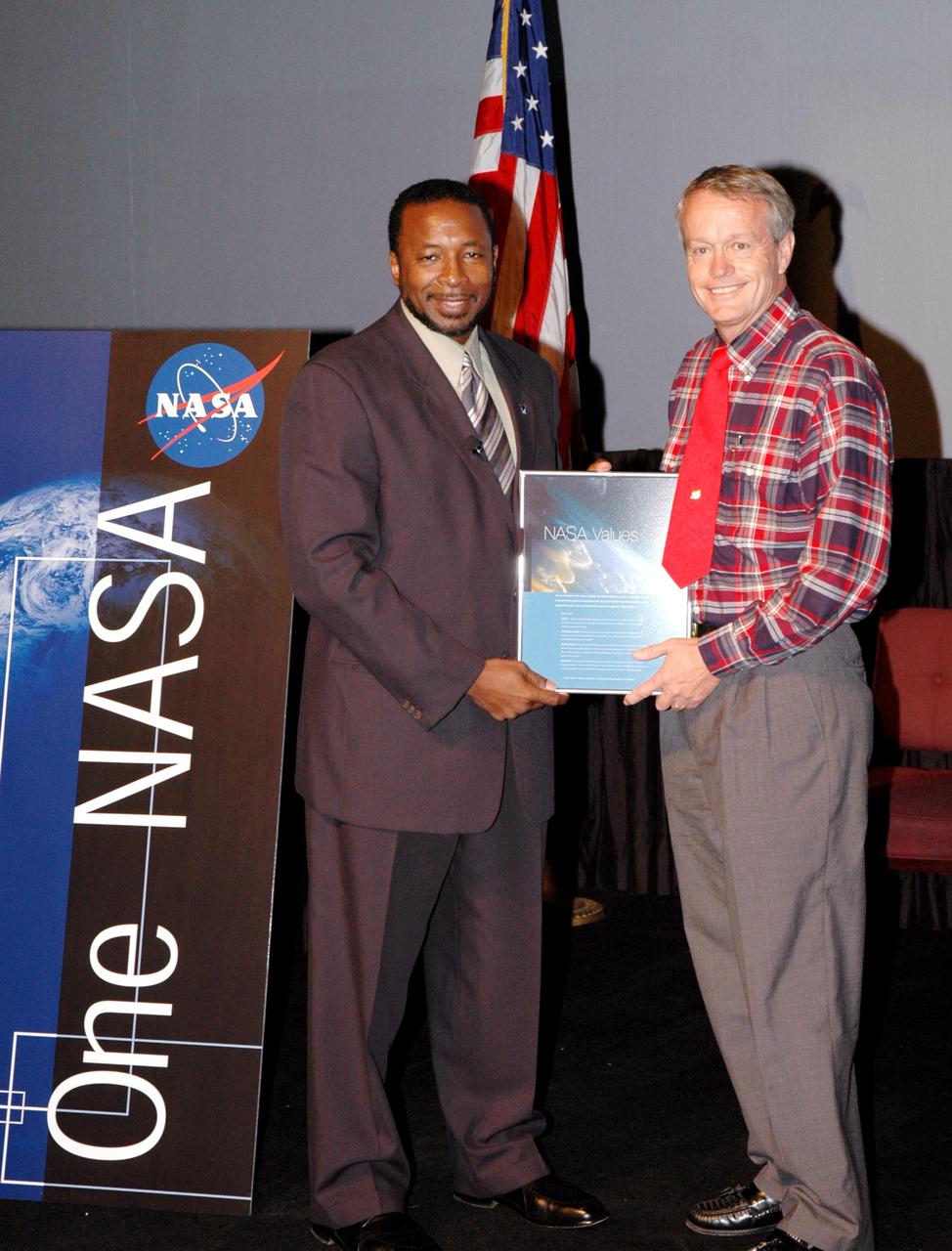
KENNEDY SPACE CENTER, FLA. - Kennedy’s Deputy Director Woodrow Whitlow Jr. presents Ronny Goodin an award for a winning entry in the NASA Values essay contest. The award was presented during the One NASA Leader-Led Workshop, which presented senior leadership in the Agency talking about ongoing Transformation activities and Kennedy’s role in the Vision for Space Exploration.
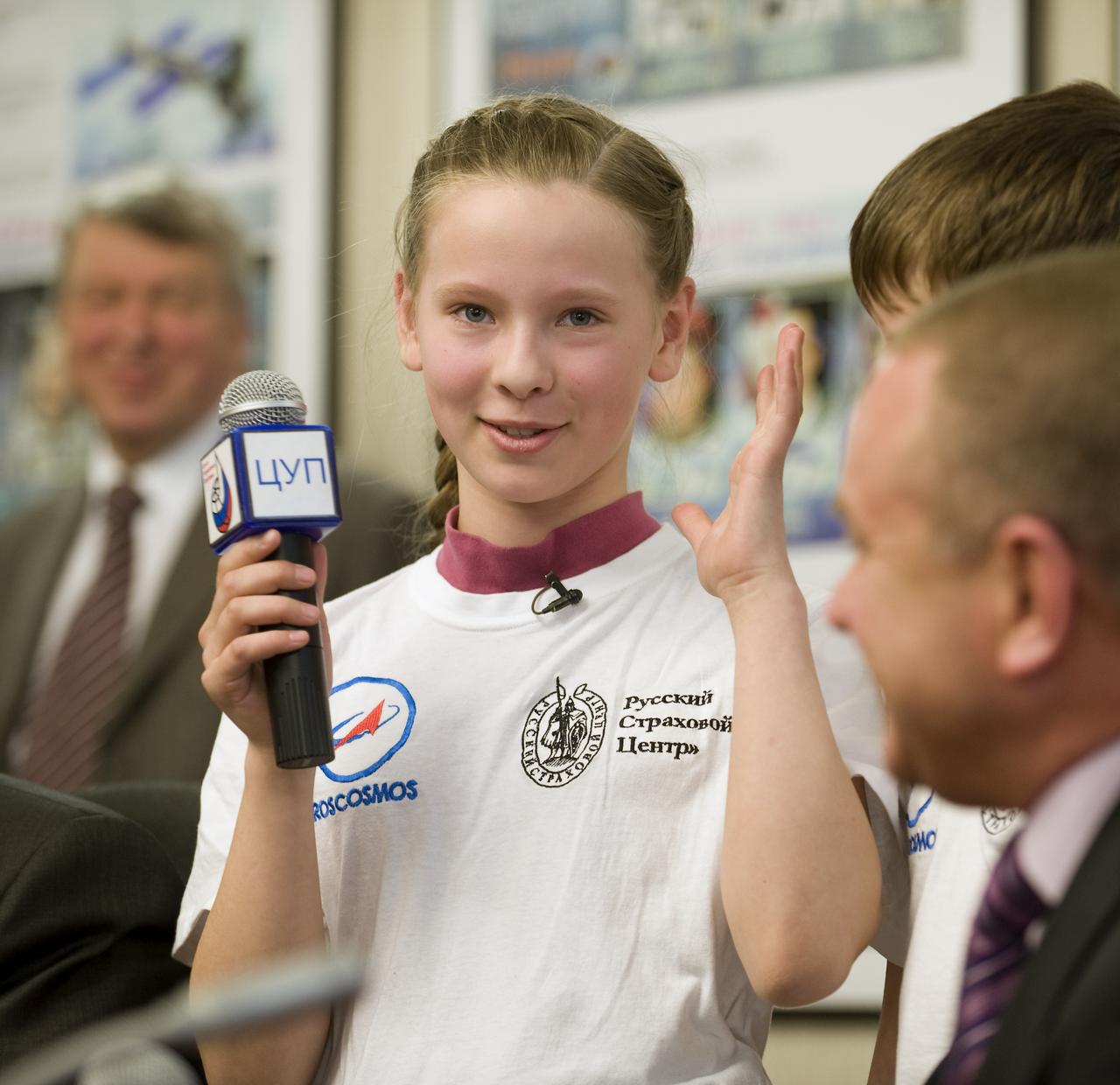
12-year-old Anna Chibiskova of Moscow speaks during the Soyuz post-docking press conference at the Russian mission Control Center in Korolev, Russia on Saturday March 28, 2009. Chibiskova was the winner of an International logo design contest for the Expedition 19 mission. Stas Pyatkin, (not pictured) from the Uglegorsk Amur region, won third place and 12-year-old Keytlin Riley (not pictured) from New York won second place. Photo Credit: (NASA/Bill Ingalls)
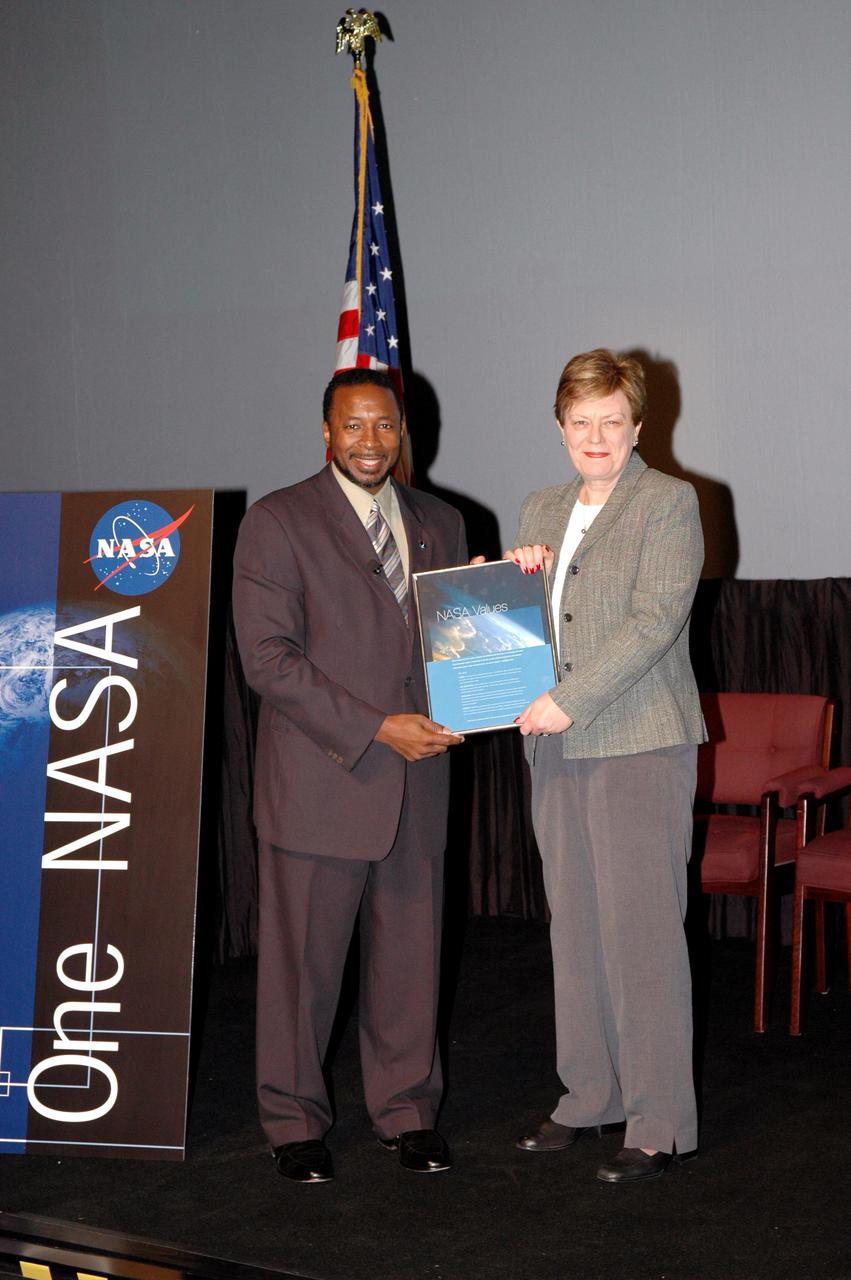
KENNEDY SPACE CENTER, FLA. - Kennedy’s Deputy Director Woodrow Whitlow Jr. presents Carol Anne Dunn an award for a winning entry in the NASA Values essay contest. The award was presented during the One NASA Leader-Led Workshop, which presented senior leadership in the Agency talking about ongoing Transformation activities and Kennedy’s role in the Vision for Space Exploration.
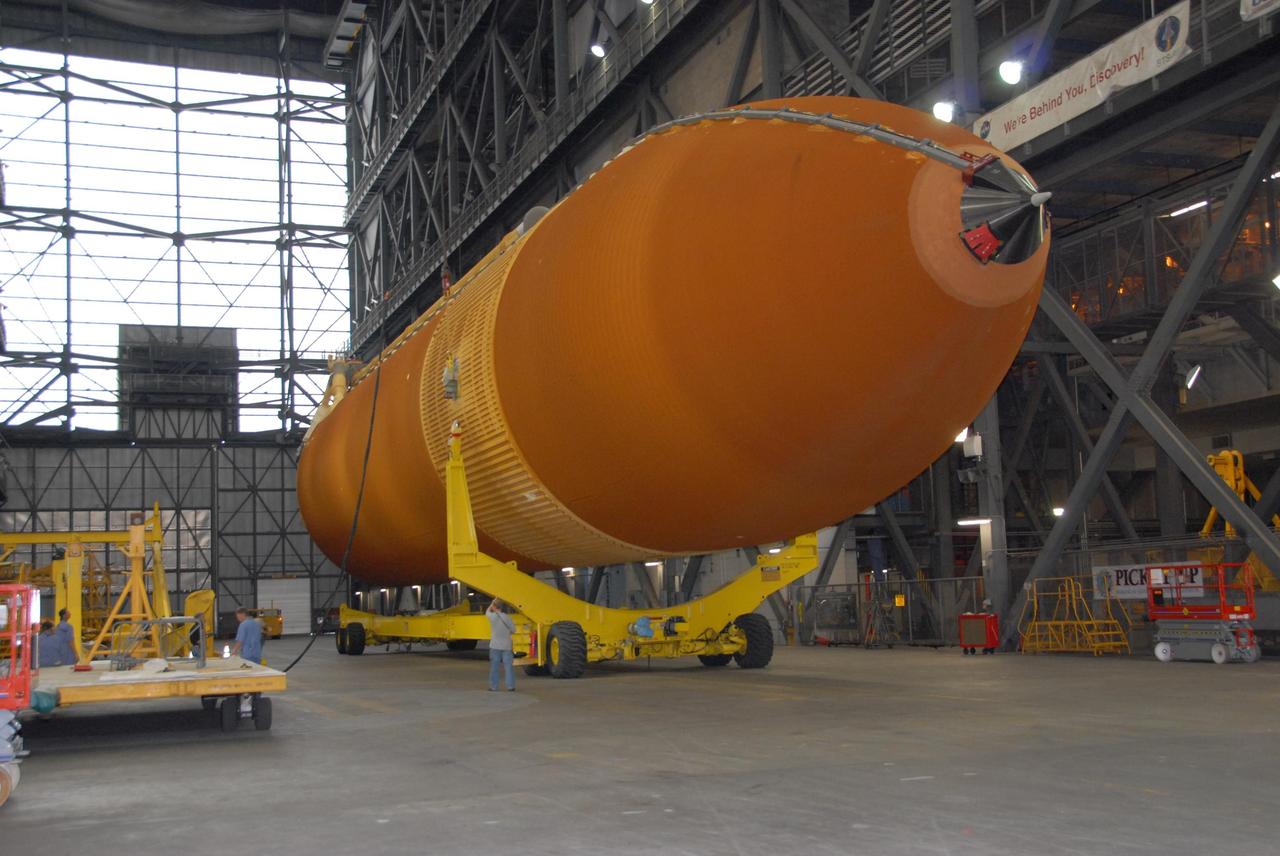
KENNEDY SPACE CENTER, FLA. -- In the transfer aisle of the Vehicle Assembly Building at KSC, external tank No. 120 is being fitted with a crane to raise and lift it into a checkout cell. The tank will be used to launch Space Shuttle Discovery on mission STS-120 in October. The mission is the 23rd to the International Space Station and will launch an Italian-built, U.S. multi-port module known as Harmony for the station. Christened after a school contest, Harmony will provide attachment points for European and Japanese laboratory modules. NASA/George Shelton
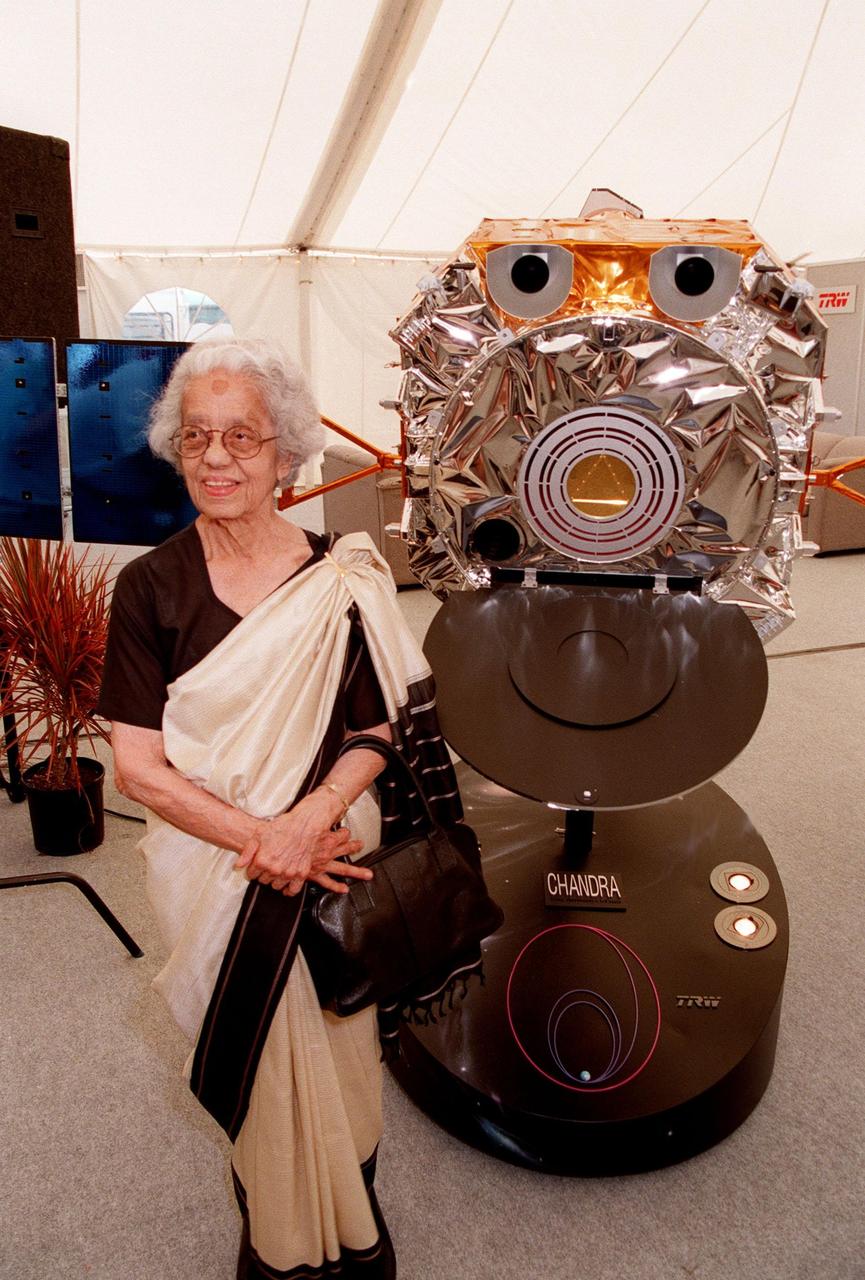
KENNEDY SPACE CENTER, FLA. -- Mrs. Lalitha Chandrasekhar, wife of the late Indian-American Nobel Laureate Subrahmanyan Chandrasekhar, poses with a model of the Chandra X-ray Observatory in the TRW Media Hospitality Tent at the NASA Press Site at KSC. The name "Chandra," a shortened version of Chandrasekhar's name which he preferred among friends and colleagues, was chosen in a contest to rename the telescope. "Chandra" also means "Moon" or "luminous" in Sanskrit. The observatory is scheduled to be launched aboard Columbia on Space Shuttle mission STS-93
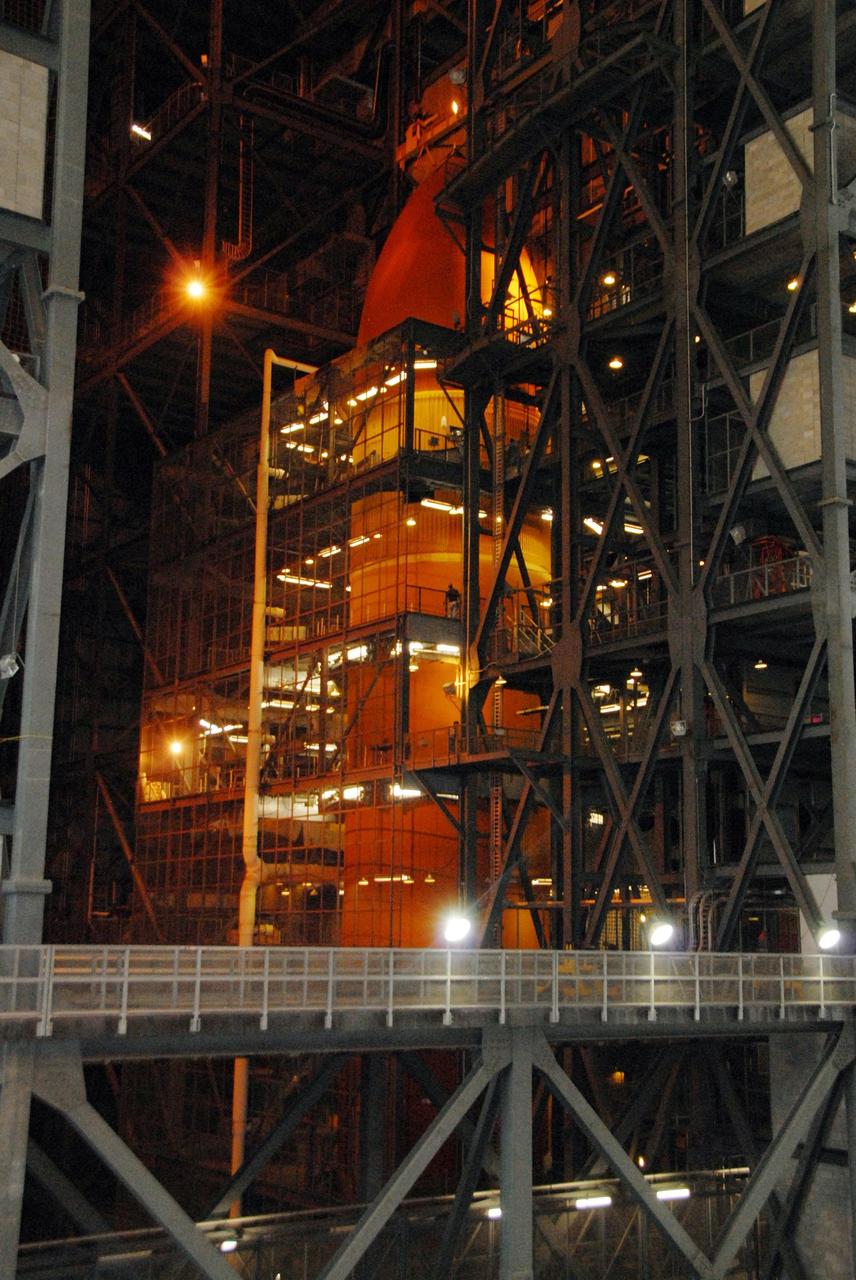
KENNEDY SPACE CENTER, FLA. -- In the Vehicle Assembly Building at KSC, external tank No. 120 is in place in a checkout cell. The tank will be prepared for stacking with solid rocket boosters to launch Space Shuttle Discovery on mission STS-120 in October. The mission is the 23rd to the International Space Station and will launch an Italian-built, U.S. multi-port module known as Harmony for the station. Christened after a school contest, Harmony will provide attachment points for European and Japanese laboratory modules. NASA/George Shelton
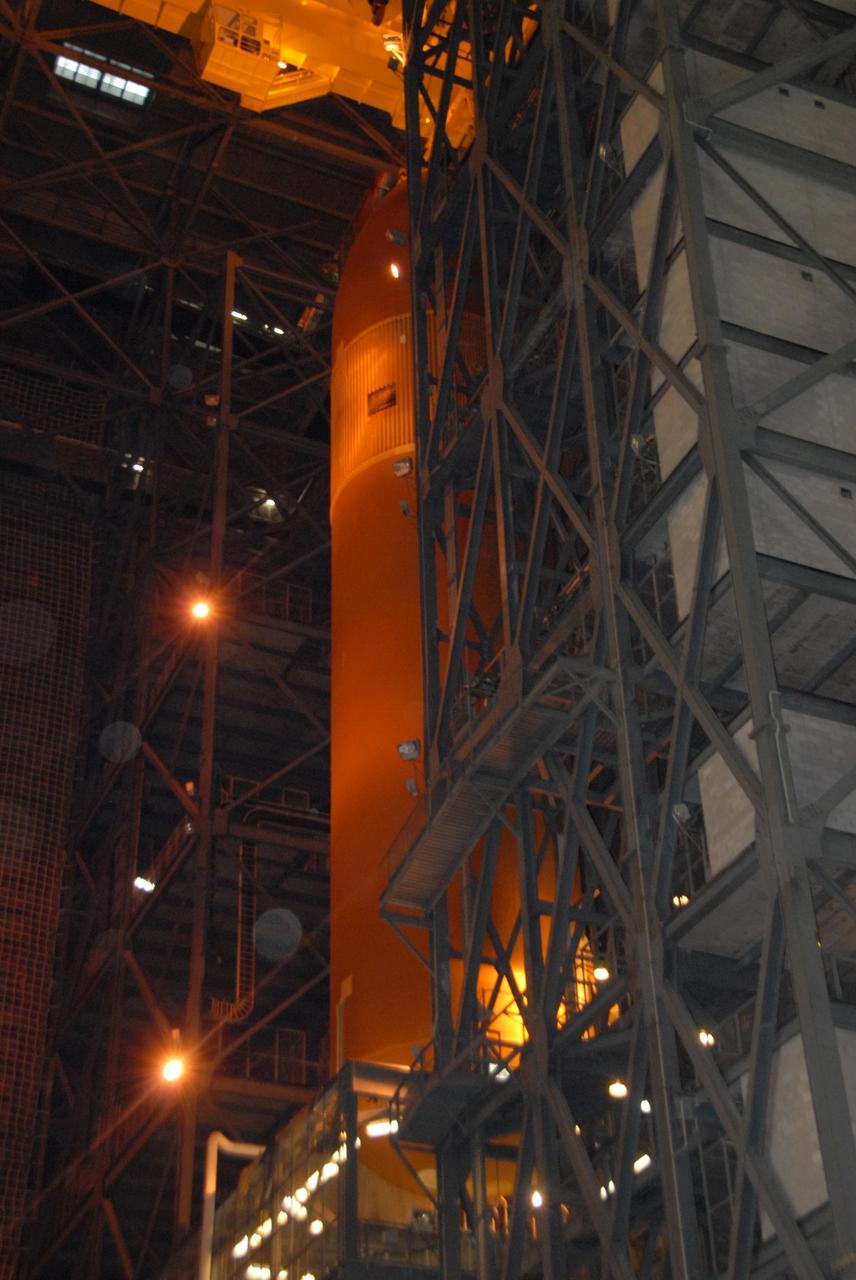
KENNEDY SPACE CENTER, FLA. -- In the Vehicle Assembly Building at KSC, a crane moves external tank No. 120 into a checkout cell. The tank will be prepared for stacking with solid rocket boosters to launch Space Shuttle Discovery on mission STS-120 in October. The mission is the 23rd to the International Space Station and will launch an Italian-built, U.S. multi-port module known as Harmony for the station. Christened after a school contest, Harmony will provide attachment points for European and Japanese laboratory modules. NASA/George Shelton
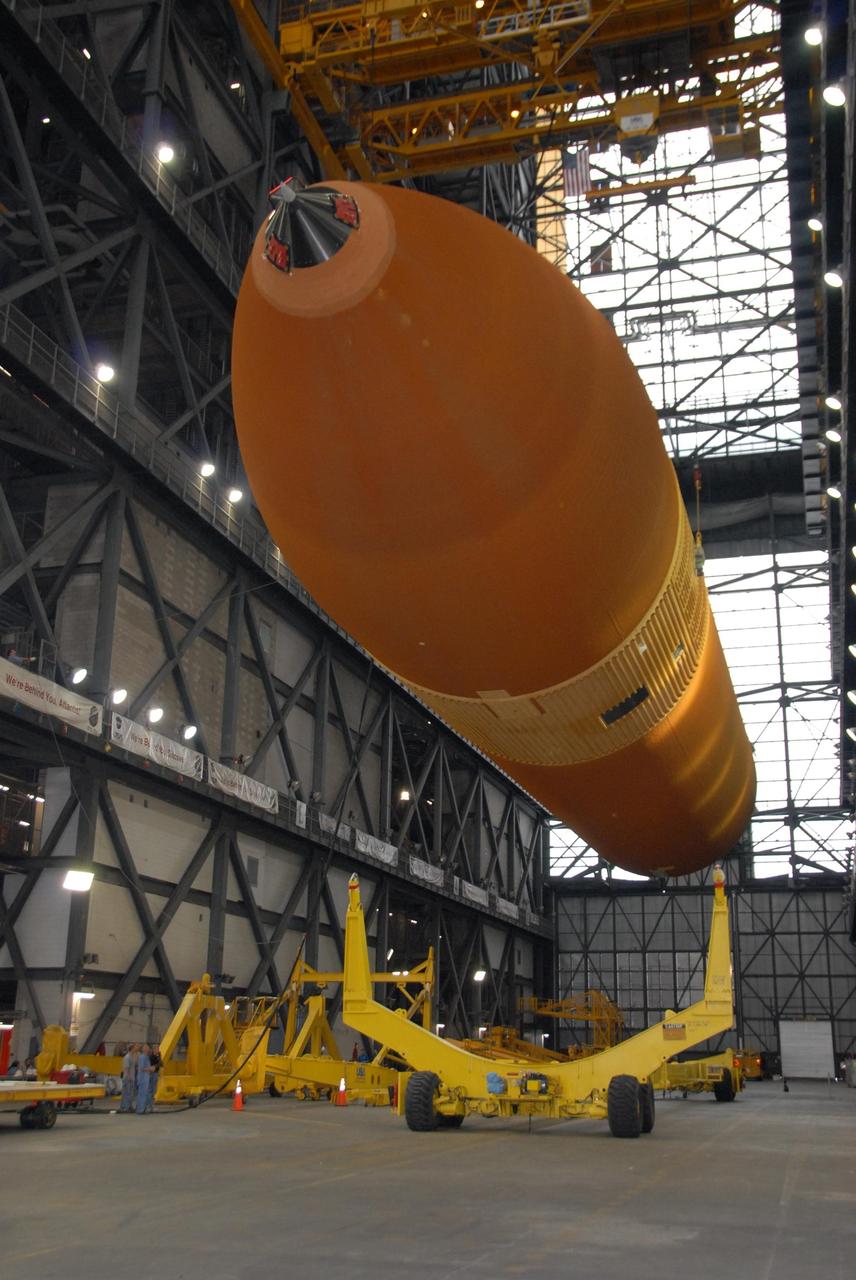
KENNEDY SPACE CENTER, FLA. -- In the transfer aisle of the Vehicle Assembly Building at KSC, an overhead crane raises external tank No. 120 from its transporter. The tank will be lifted into a checkout cell. ET-120 will be used to launch Space Shuttle Discovery on mission STS-120 in October. The mission is the 23rd to the International Space Station and will launch an Italian-built, U.S. multi-port module known as Harmony for the station. Christened after a school contest, Harmony will provide attachment points for European and Japanese laboratory modules. NASA/George Shelton
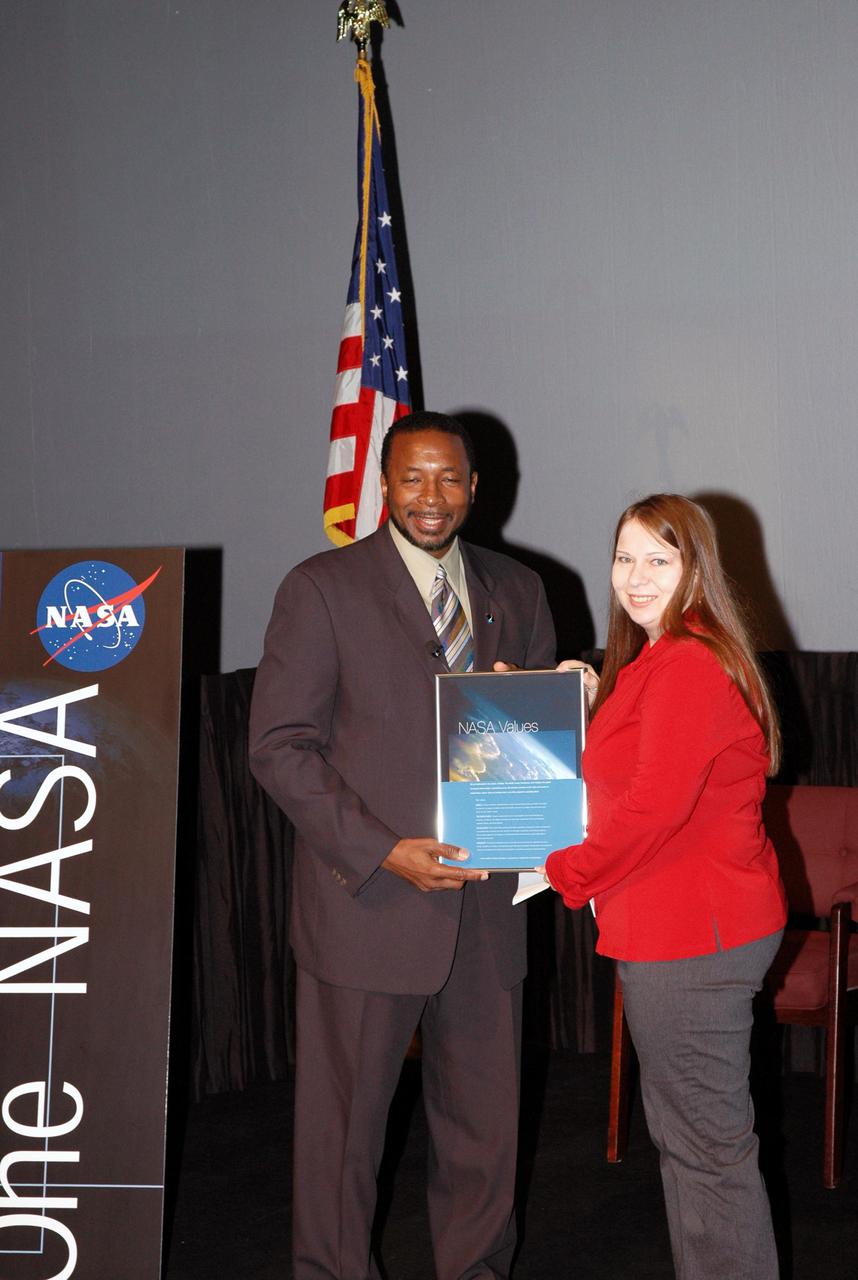
KENNEDY SPACE CENTER, FLA. - Kennedy’s Deputy Director Woodrow Whitlow Jr. presents Pattie Lewis an award for a winning entry in the NASA Values essay contest. The award was presented during the One NASA Leader-Led Workshop, which presented senior leadership in the Agency talking about ongoing Transformation activities and Kennedy’s role in the Vision for Space Exploration.

ISS043E120523 (04/14/2015) --- NASA astronaut Scott Kelly on the International Space Station tweeted this earth observation image out on Apr. 14, 2015 as part of his Space Geo contest of "name this location": Scott tweeted this comment and clue: "#SpaceGeo! In 1962, former Astronaut John Glenn's Friendship 7 Mercury landed in this vicinity. Name it!"
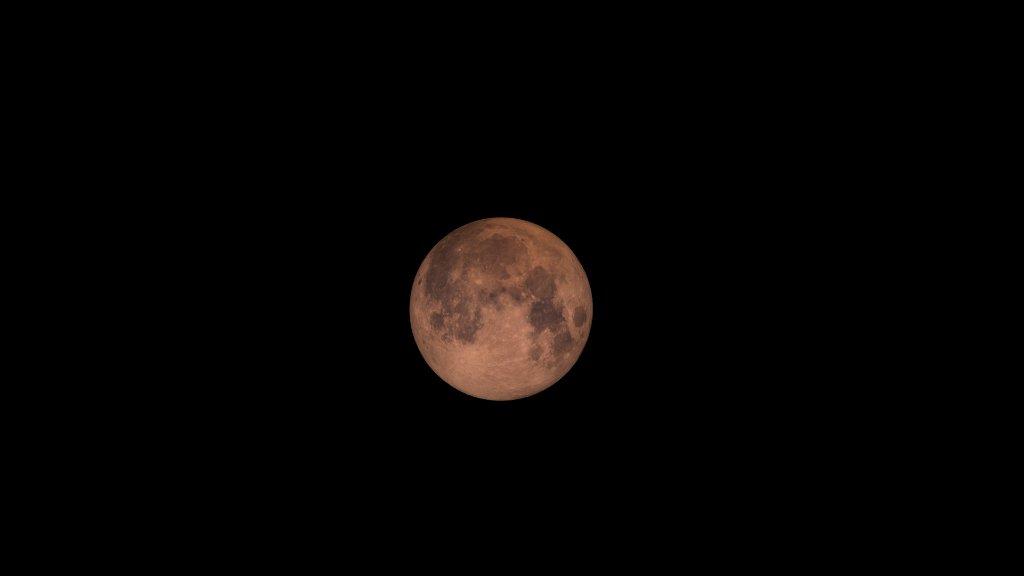
Are you ready for tonight's #SuperBloodMoon Lunar Eclipse? Get your camera and find a great spot to snap a pic of the event, then share it with NASA in our Flickr group <a href="https://www.flickr.com/groups/superbloodmoon/">www.flickr.com/groups/superbloodmoon/</a> You can also share your photo with us starting at 10:00pm EDT tonight in the NASA photo contest here: <a href="http://go.nasa.gov/superbloodmoon-contest" rel="nofollow">go.nasa.gov/superbloodmoon-contest</a> Learn more about this celestial event & when to look up to see it: <a href="http://bit.ly/1NVEwh5" rel="nofollow">bit.ly/1NVEwh5</a> <b><a href="http://www.nasa.gov/audience/formedia/features/MP_Photo_Guidelines.html" rel="nofollow">NASA image use policy.</a></b> <b><a href="http://www.nasa.gov/centers/goddard/home/index.html" rel="nofollow">NASA Goddard Space Flight Center</a></b> enables NASA’s mission through four scientific endeavors: Earth Science, Heliophysics, Solar System Exploration, and Astrophysics. Goddard plays a leading role in NASA’s accomplishments by contributing compelling scientific knowledge to advance the Agency’s mission. <b>Follow us on <a href="http://twitter.com/NASAGoddardPix" rel="nofollow">Twitter</a></b> <b>Like us on <a href="http://www.facebook.com/pages/Greenbelt-MD/NASA-Goddard/395013845897?ref=tsd" rel="nofollow">Facebook</a></b> <b>Find us on <a href="http://instagrid.me/nasagoddard/?vm=grid" rel="nofollow">Instagram</a></b>
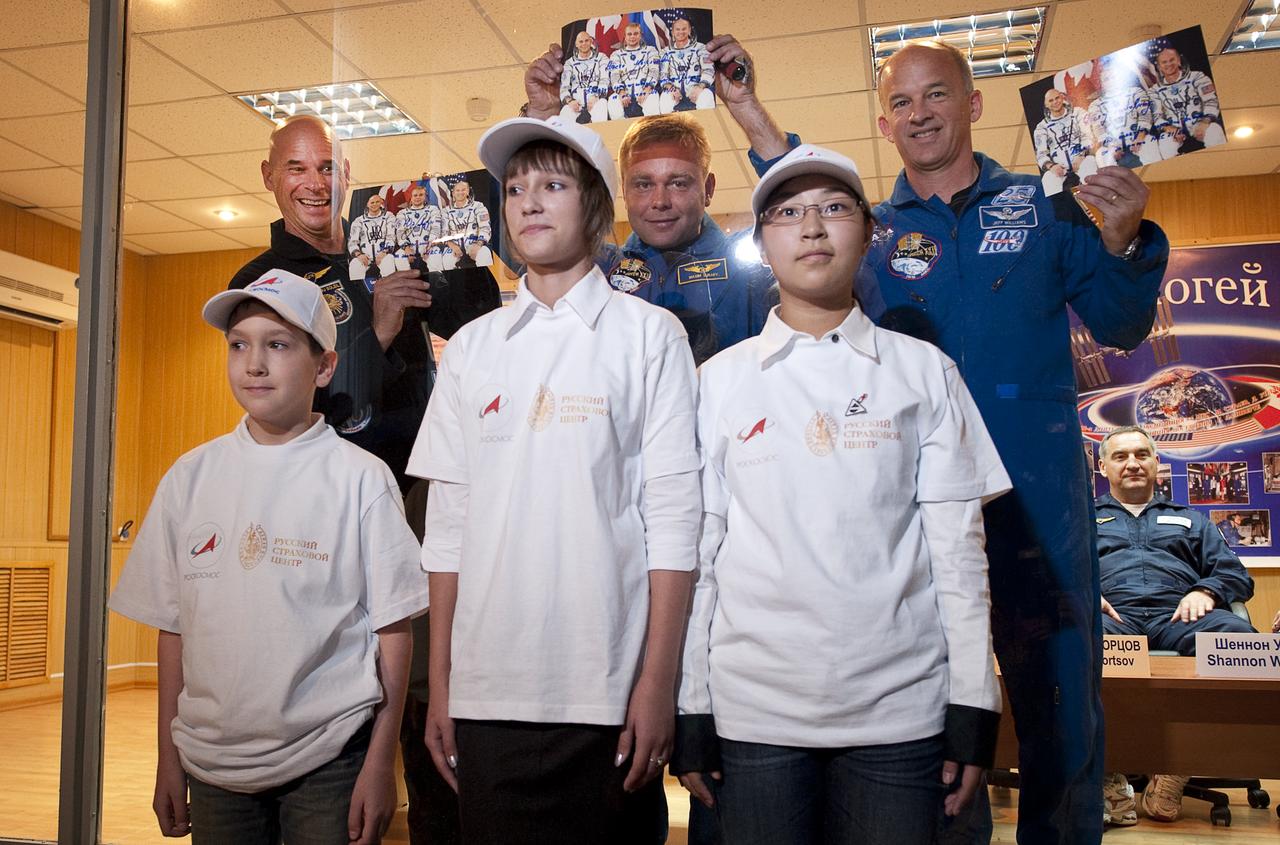
Spaceflight Participant Guy Laliberté, back left, Expedition 21 Flight Engineer Maxim Suraev, back center, Expedition 21 Flight Engineer Jeffrey N. Williams, back right, pose for a photograph with winners of a ROSCOSMOS drawing contest, Oleg Golovin, from Elektrostal, Russia, front left, Nastya Mestyashova from Orenburg, Russia, front center, and Dong Yue from China at the start of the press conference, Tuesday, Sept. 29, 2009 at the Cosmonaut Hotel in Baikonur, Kazakhstan. Their winning drawings will be incorporated into the Expedition 22 mission patch. Photo Credit: (NASA/Bill Ingalls)
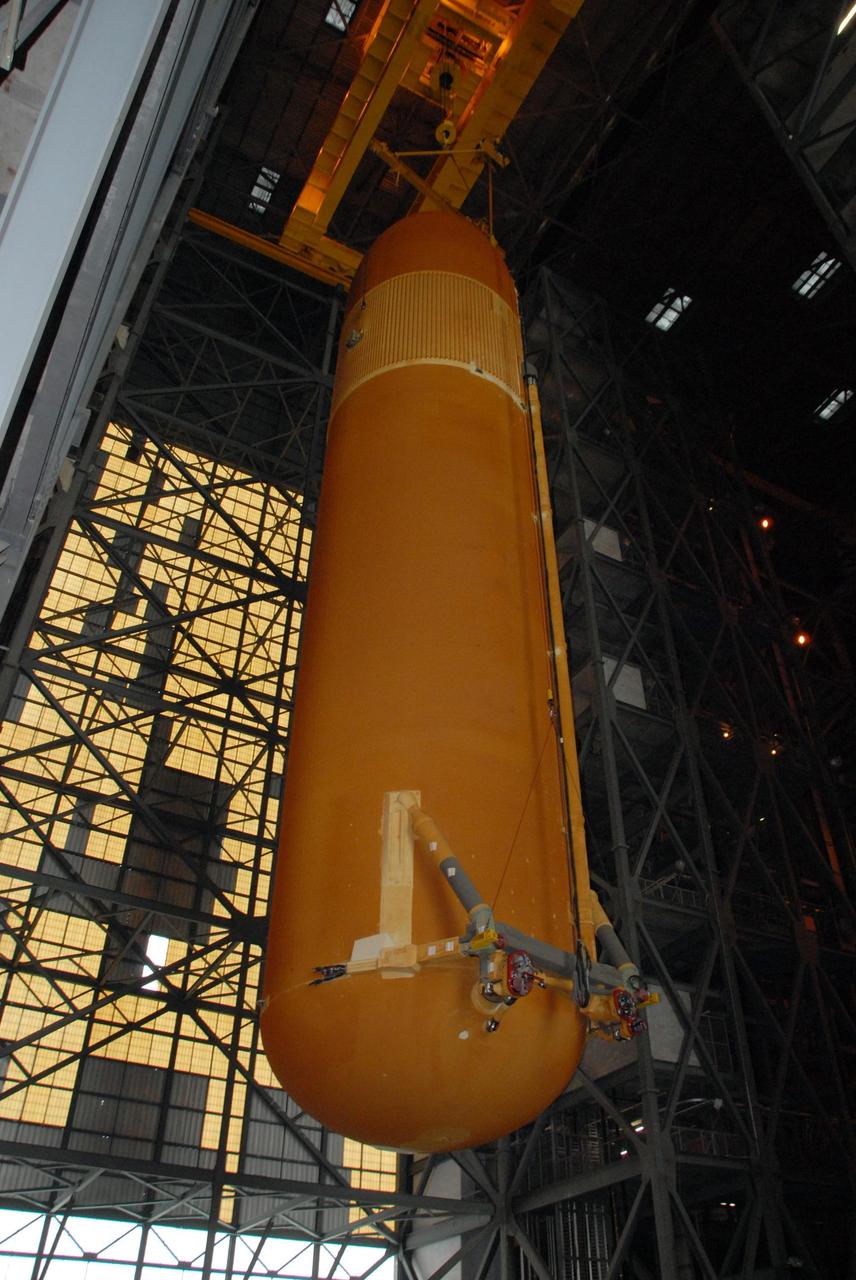
KENNEDY SPACE CENTER, FLA. -- In the Vehicle Assembly Building at KSC, a crane lifts external tank No. 120 into the upper regions. The tank is being lifted for a move into a checkout cell. The tank will be prepared for stacking with solid rocket boosters to launch Space Shuttle Discovery on mission STS-120 in October. The mission is the 23rd to the International Space Station and will launch an Italian-built, U.S. multi-port module known as Harmony for the station. Christened after a school contest, Harmony will provide attachment points for European and Japanese laboratory modules. NASA/George Shelton
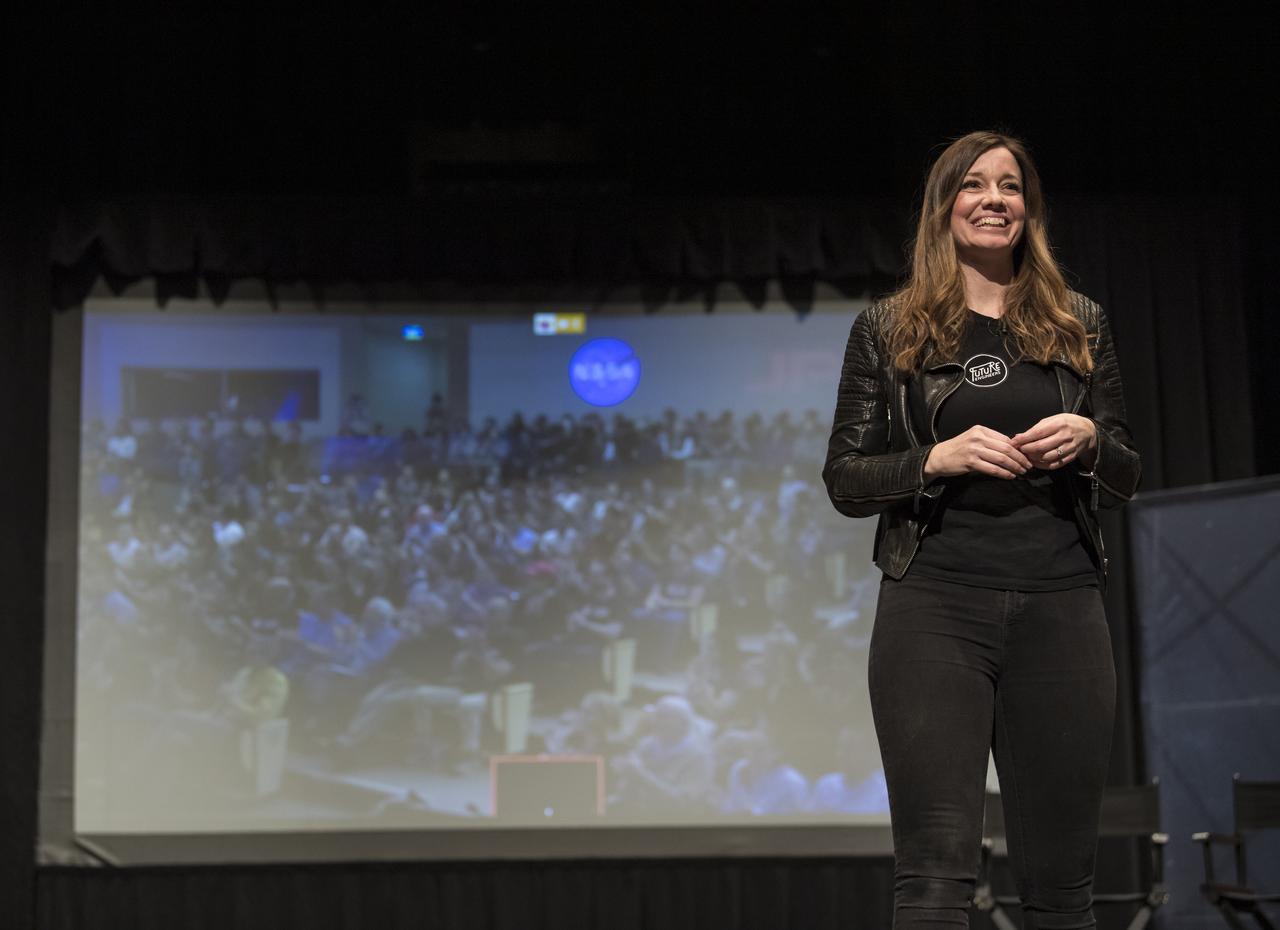
Founder and CEO of Future Engineers, Deanne Bell, speaks to the audience at an event to announce the official name of the Mars 2020 rover, Thursday, March 5, 2020, at Lake Braddock Secondary School in Burke, Va. The final selection of the new name, Perseverance, was made by NASA’s Associate Administrator of the Science Mission Directorate, Thomas Zurbuchen, following a nationwide naming contest conducted in 2019 that drew more than 28,000 essays by K-12 students from every U.S. state and territory. The rover is currently at NASA's Kennedy Space Center in Florida being prepared for launch this summer. Photo Credit: (NASA/Aubrey Gemignani)
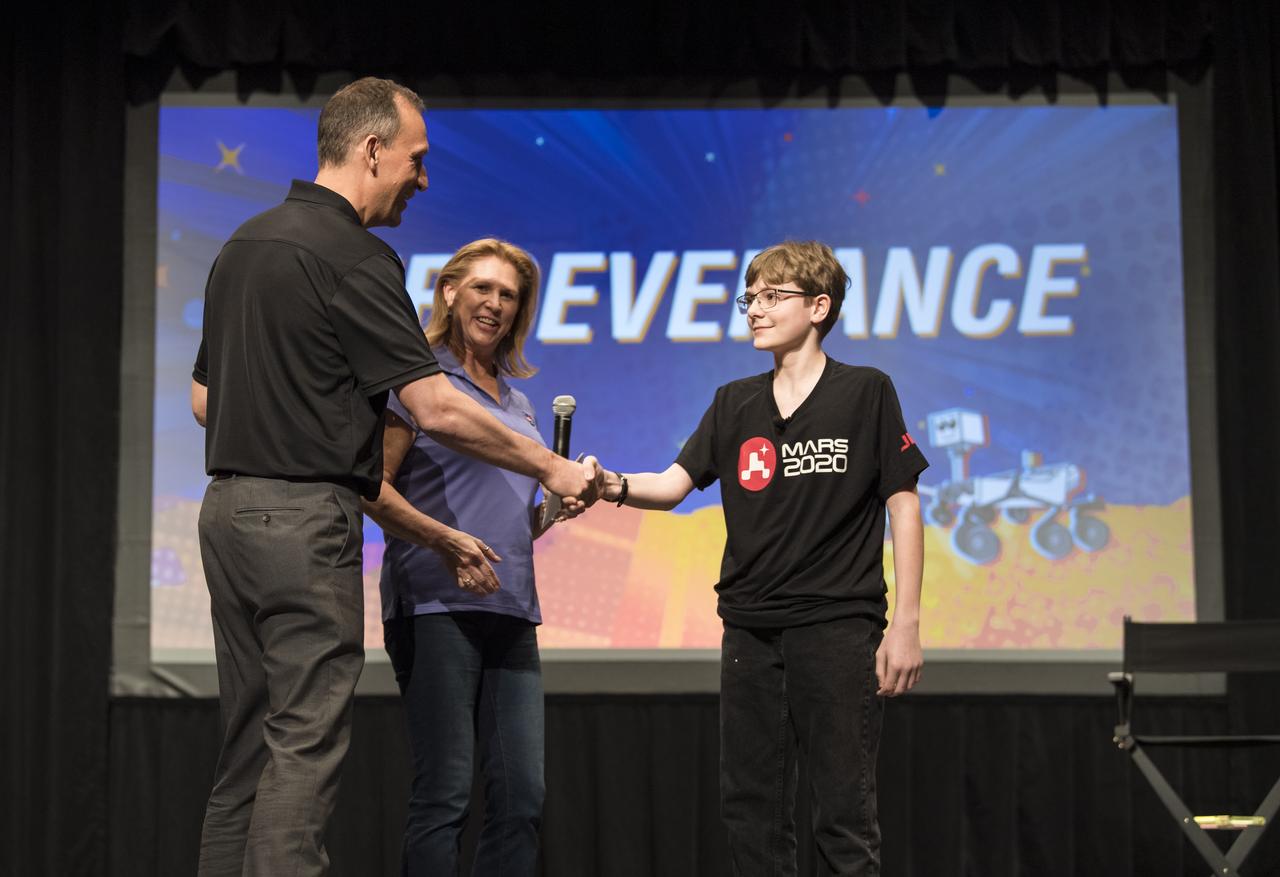
Associate Administrator of NASA's Science Mission Directorate, Thomas Zurbuchen, shakes hands with Alex Mather, the student whose submission, Perseverance, was chosen as the official name of the Mars 2020 rover, Thursday, March 5, 2020, at Lake Braddock Secondary School in Burke, Va. The final selection of the new name was made by Zurbuchen following a nationwide naming contest conducted in 2019 that drew more than 28,000 essays by K-12 students from every U.S. state and territory. Perseverance is currently at NASA's Kennedy Space Center in Florida being prepared for launch this summer. Photo Credit: (NASA/Aubrey Gemignani)
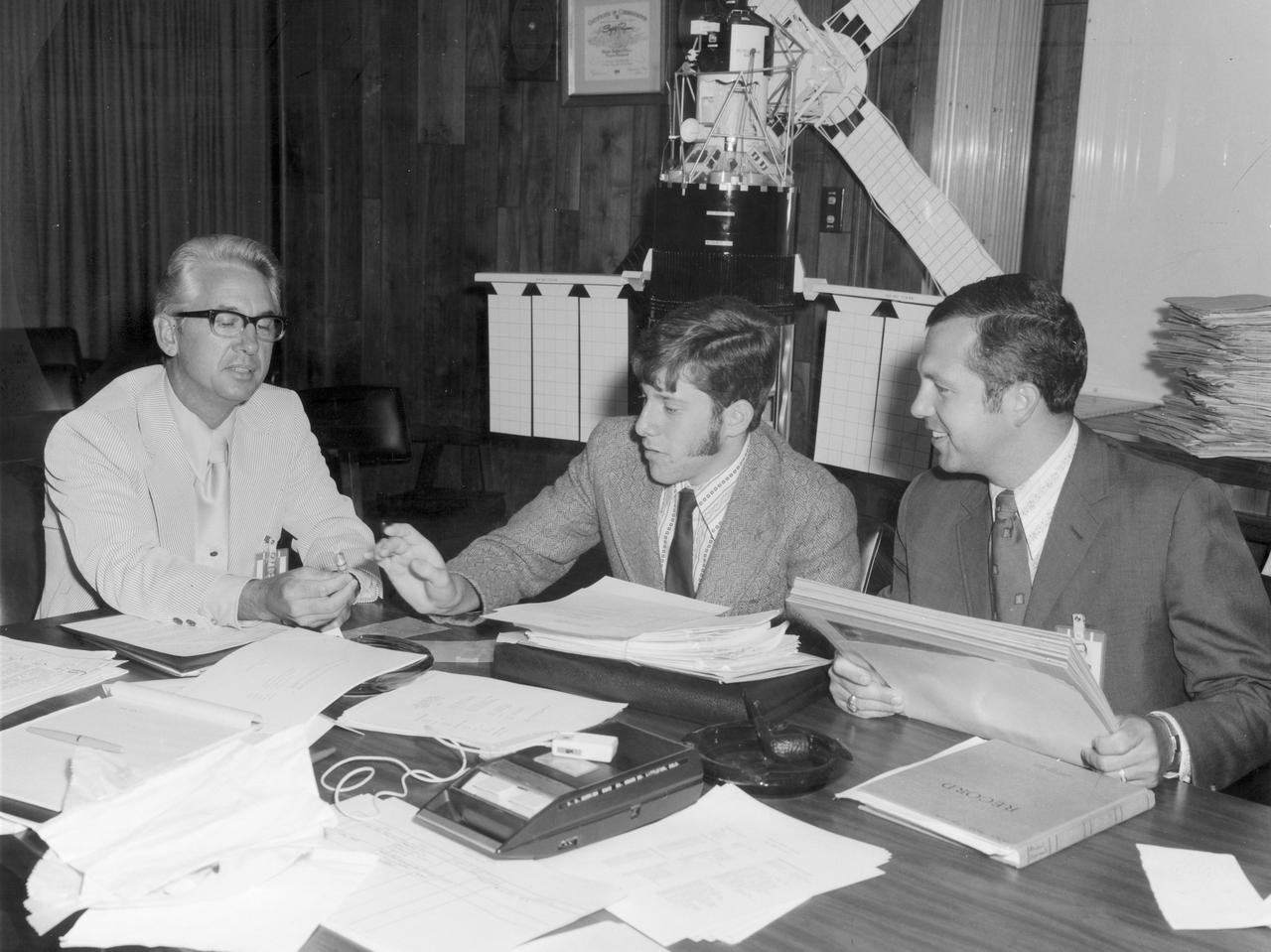
Todd Meister(center), high school student of the Bronx High School of Science, discusses his experiment “An Invitro Study of Selected Isolated Immune Phenomena” with his advisor, Dr. Robert Allen (right) and Henry Floyd, both of the Marshall Space Flight Center (MSFC). His experiment was aimed at discovering whether or not the absence of gravity affects the representative life processes. Meister was one of the 25 winners of a contest in which some 3,500 high school students proposed experiments for the following year’s Skylab mission. Of the 25 students, 6 did not see their experiments conducted on Skylab because the experiments were not compatible with Skylab hardware and timelines. Of the 19 remaining, 11 experiments required the manufacture of equipment.
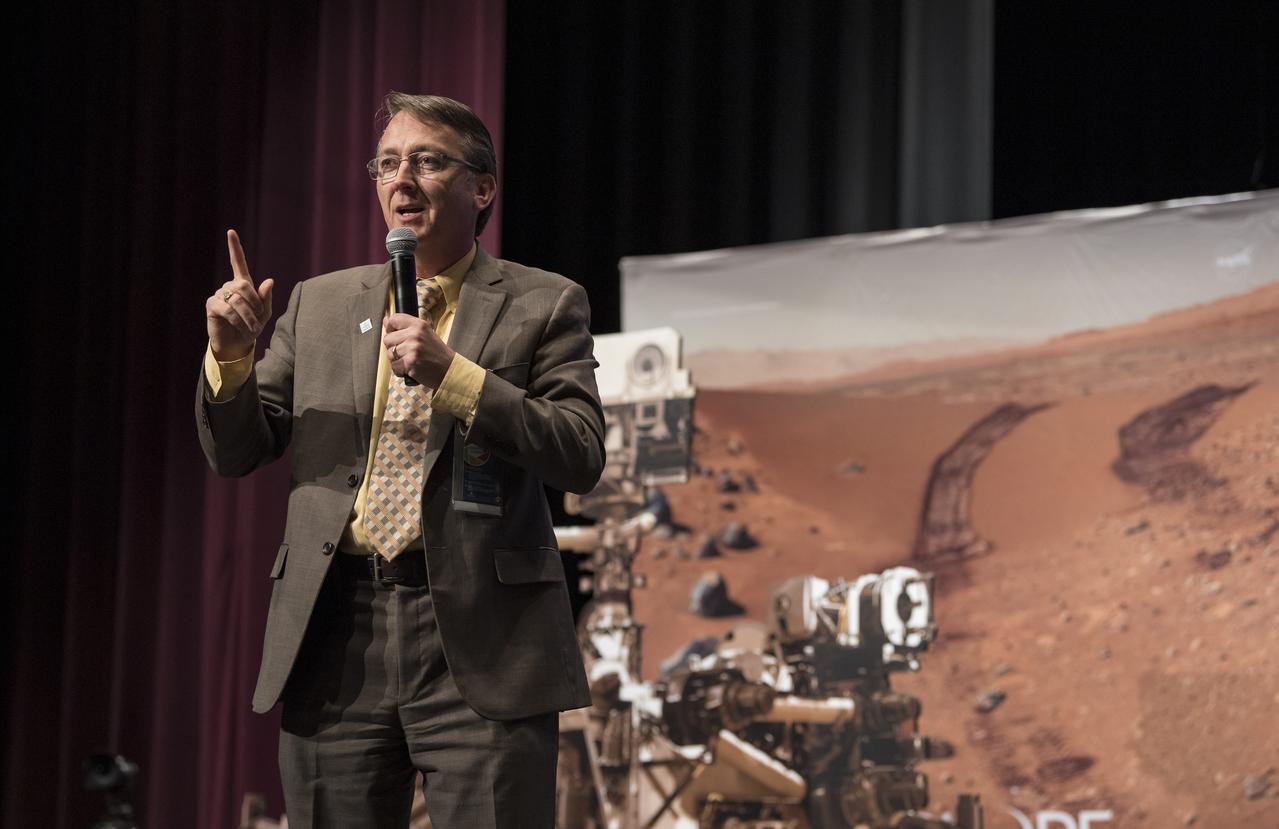
Fairfax County Division Superintendent Scott Brabrand speaks about the importance of STEM at an event to announce the official name of the Mars 2020 rover, Thursday, March 5, 2020, at Lake Braddock Secondary School in Burke, Va. The final selection of the new name was made by Associate Administrator of NASA's Science Mission Directorate, Thomas Zurbuchen, following a nationwide naming contest conducted in 2019 that drew more than 28,000 essays by K-12 students from every U.S. state and territory. The rover is currently at NASA's Kennedy Space Center in Florida being prepared for launch this summer. Photo Credit: (NASA/Aubrey Gemignani)
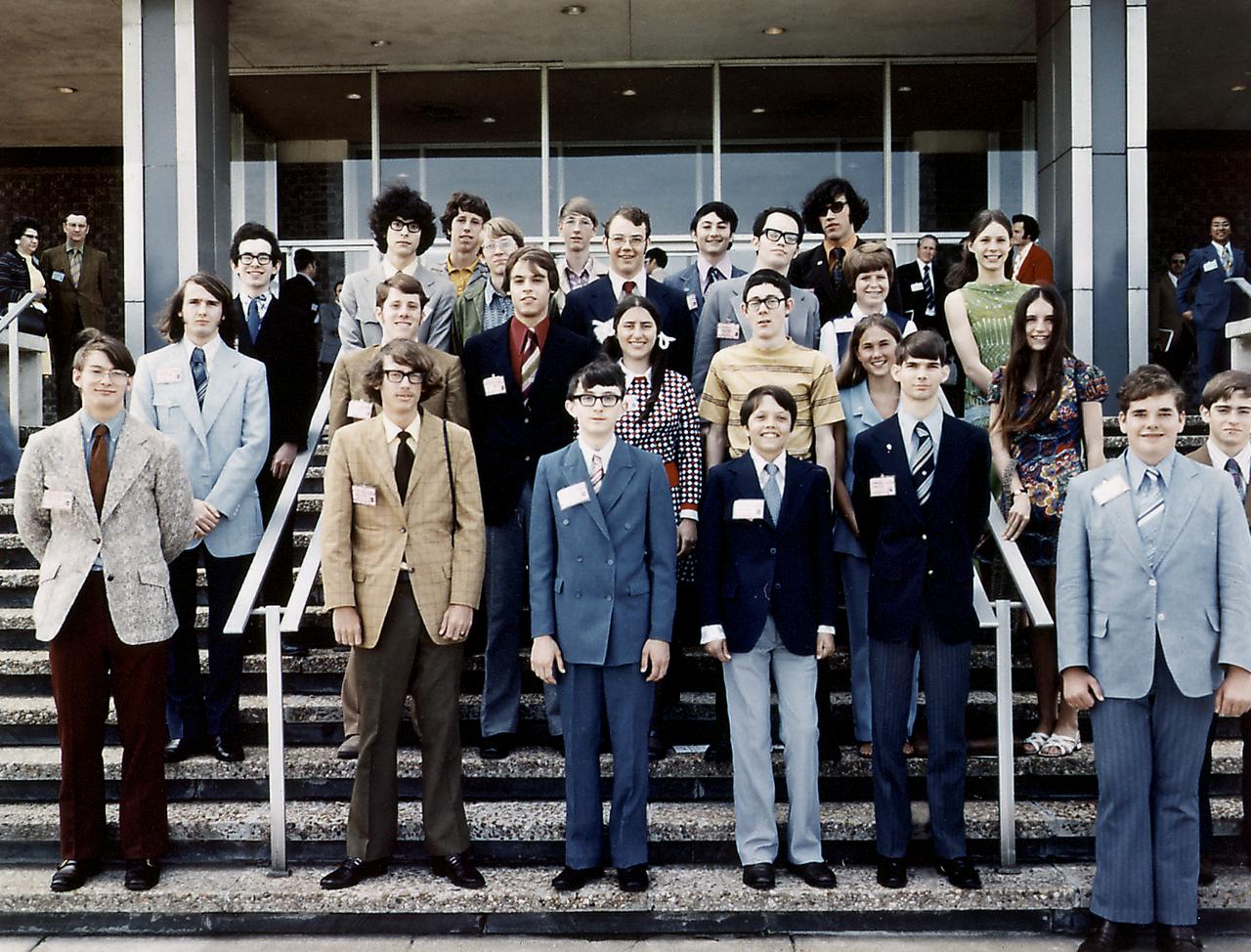
One of the most successful of the Skylab educational efforts was the Skylab Student Project. This was a nationwide contest in which secondary school students submitted proposals for experiments to fly on Skylab. After the official announcement of this project, over 4,000 students responded with 3,409 proposals from which 25 winners were selected. In the subsequent evaluation of these 25 proposed experiments in terms of their suitability for flight, the Marshall Space Flight Center, the lead center for Skylab, selected 19. This photograph is a group shot of the 25 winners in the Skylab student program when they met for the first time at the Marshall Space Flight Center in May 1972.
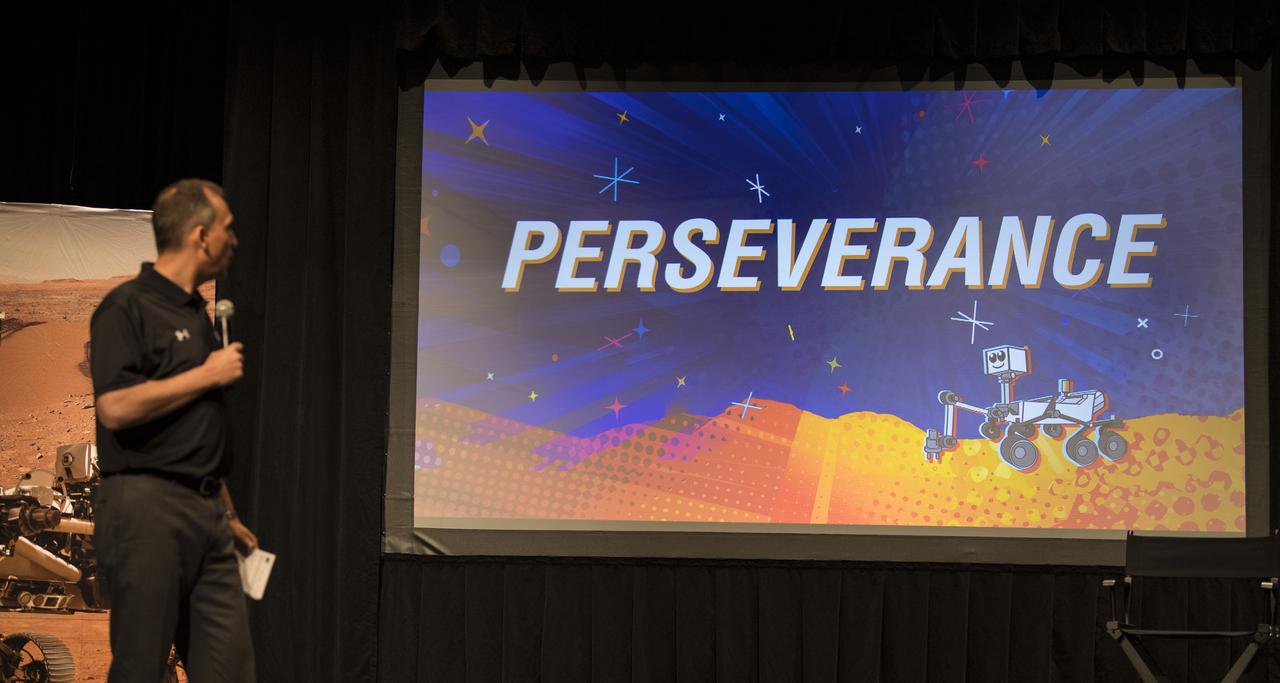
Associate Administrator of NASA's Science Mission Directorate, Thomas Zurbuchen, announces the official name, Perseverance, for the rover formerly known as Mars 2020, Thursday, March 5, 2020, at Lake Braddock Secondary School in Burke, Va. Zurbuchen made the final selection of the new name following a nationwide naming contest conducted in 2019 that drew more than 28,000 essays by K-12 students from every U.S. state and territory. Perseverance is currently at NASA's Kennedy Space Center in Florida being prepared for launch this summer. Photo Credit: (NASA/Aubrey Gemignani)
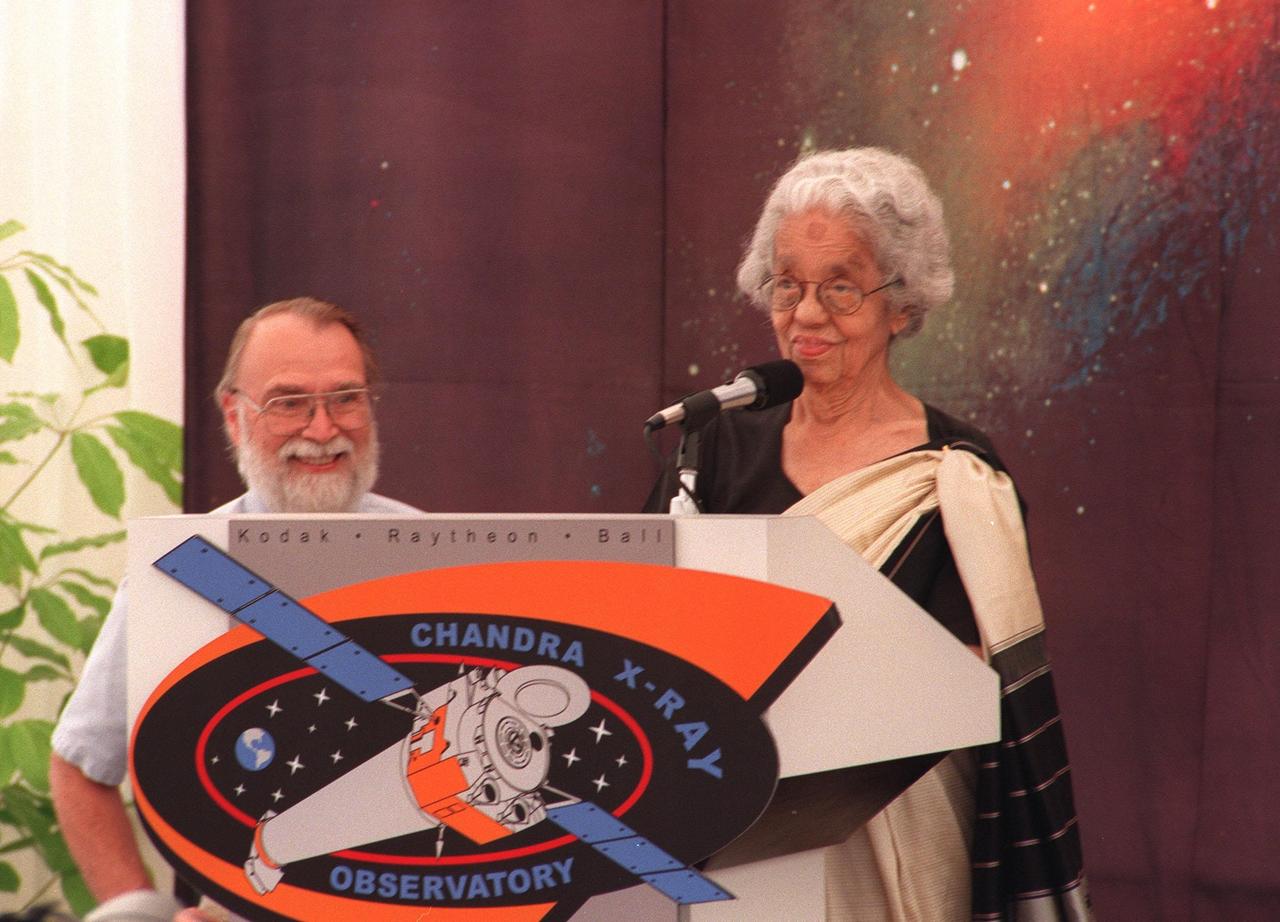
KENNEDY SPACE CENTER, FLA. -- Mrs. Lalitha Chandrasekhar (right), wife of the late Indian-American Nobel Laureate Subrahmanyan Chandrasekhar, addresses the media and other invited guests in the TRW Media Hospitality Tent at the NASA Press Site at KSC as Dr. Alan Bunner, Science Program Director, Structure and Evolution of the Universe, Office of Space Science, NASA Headquarters, Washington, D.C., looks on. The name "Chandra," a shortened version of her husband's name which he preferred among friends and colleagues, was chosen in a contest to rename the Advanced X-ray Astrophysics Facility. "Chandra" also means "Moon" or "luminous" in Sanskrit. The observatory is scheduled to be launched aboard Columbia on Space Shuttle mission STS-93
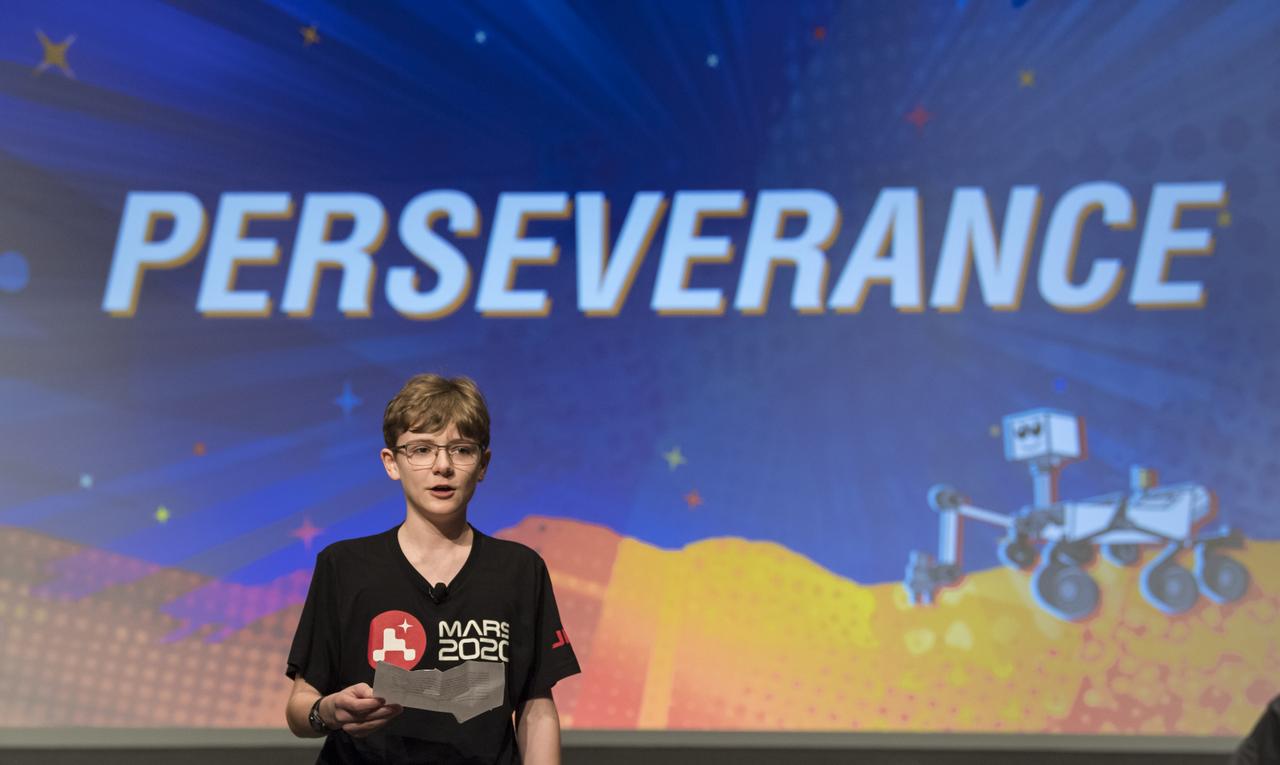
Alex Mather, the student whose submission, Perseverance, was chosen as the official name of the Mars 2020 rover, reads his essay entry, Thursday, March 5, 2020, at Lake Braddock Secondary School in Burke, Va. The final selection of the new name was made by Associate Administrator of NASA's Science Mission Directorate, Thomas Zurbuchen, following a nationwide naming contest conducted in 2019 that drew more than 28,000 essays by K-12 students from every U.S. state and territory. Perseverance is currently at NASA's Kennedy Space Center in Florida being prepared for launch this summer. Photo Credit: (NASA/Aubrey Gemignani)
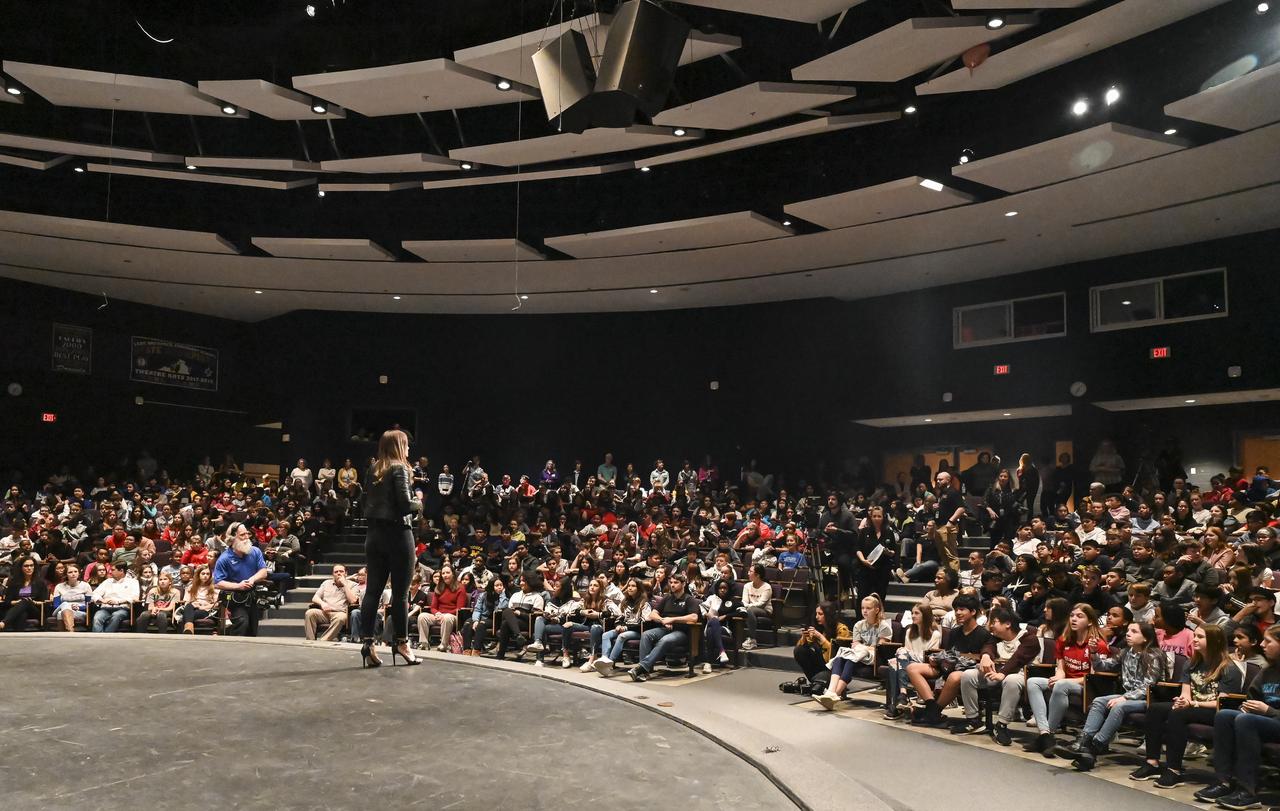
Founder and CEO of Future Engineers, Deanne Bell, speaks to the audience at an event to announce the official name of the Mars 2020 rover, Thursday, March 5, 2020, at Lake Braddock Secondary School in Burke, Va. The final selection of the new name, Perseverance, was made by NASA’s Associate Administrator of the Science Mission Directorate, Thomas Zurbuchen, following a nationwide naming contest conducted in 2019 that drew more than 28,000 essays by K-12 students from every U.S. state and territory. The rover is currently at NASA's Kennedy Space Center in Florida being prepared for launch this summer. Photo Credit: (NASA/Aubrey Gemignani)
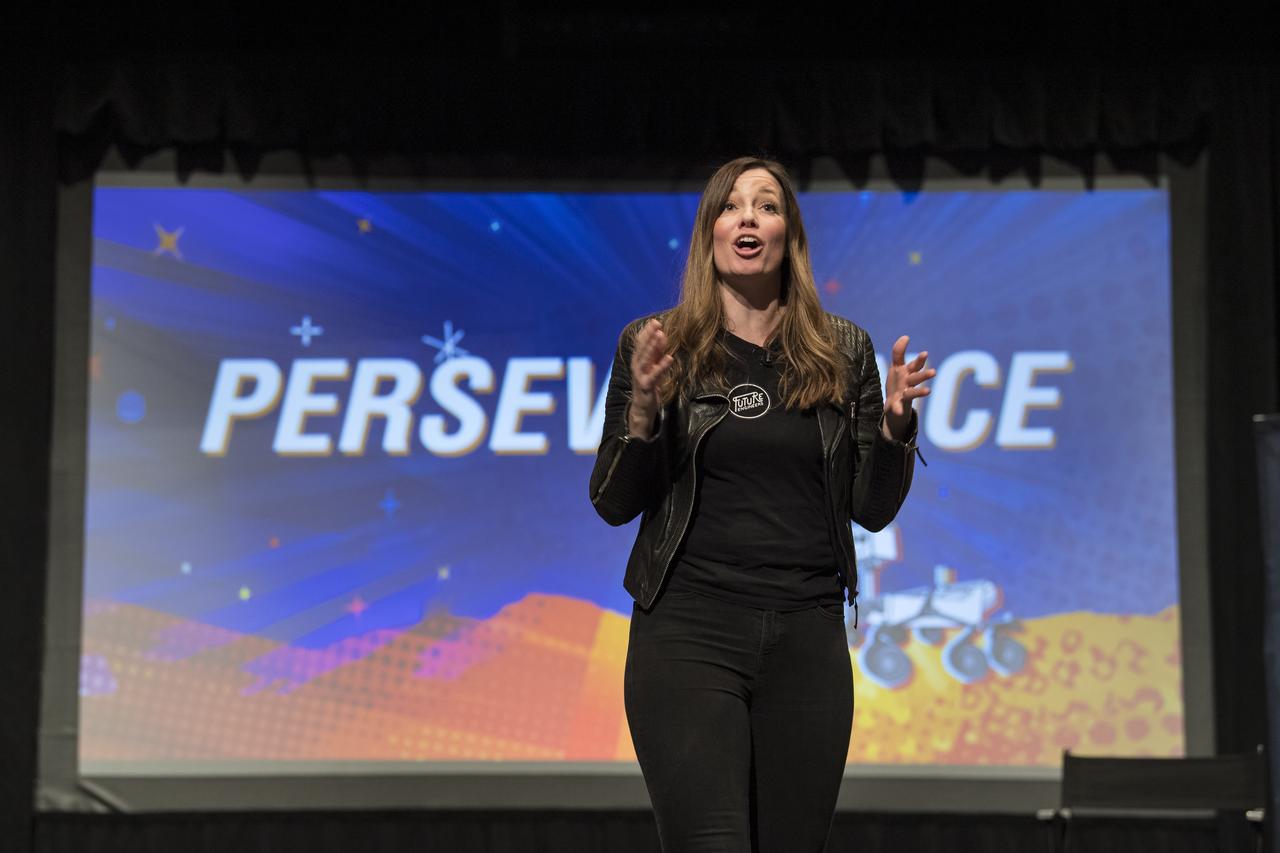
Founder and CEO of Future Engineers, Deanne Bell, speaks at an event to announce the official name of the Mars 2020 rover, Thursday, March 5, 2020, at Lake Braddock Secondary School in Burke, Va. The final selection of the new name, Perseverance, was made by NASA’s Associate Administrator of the Science Mission Directorate, Thomas Zurbuchen, following a nationwide naming contest conducted in 2019 that drew more than 28,000 essays by K-12 students from every U.S. state and territory. The rover is currently at NASA's Kennedy Space Center in Florida being prepared for launch this summer. Photo Credit: (NASA/Aubrey Gemignani)
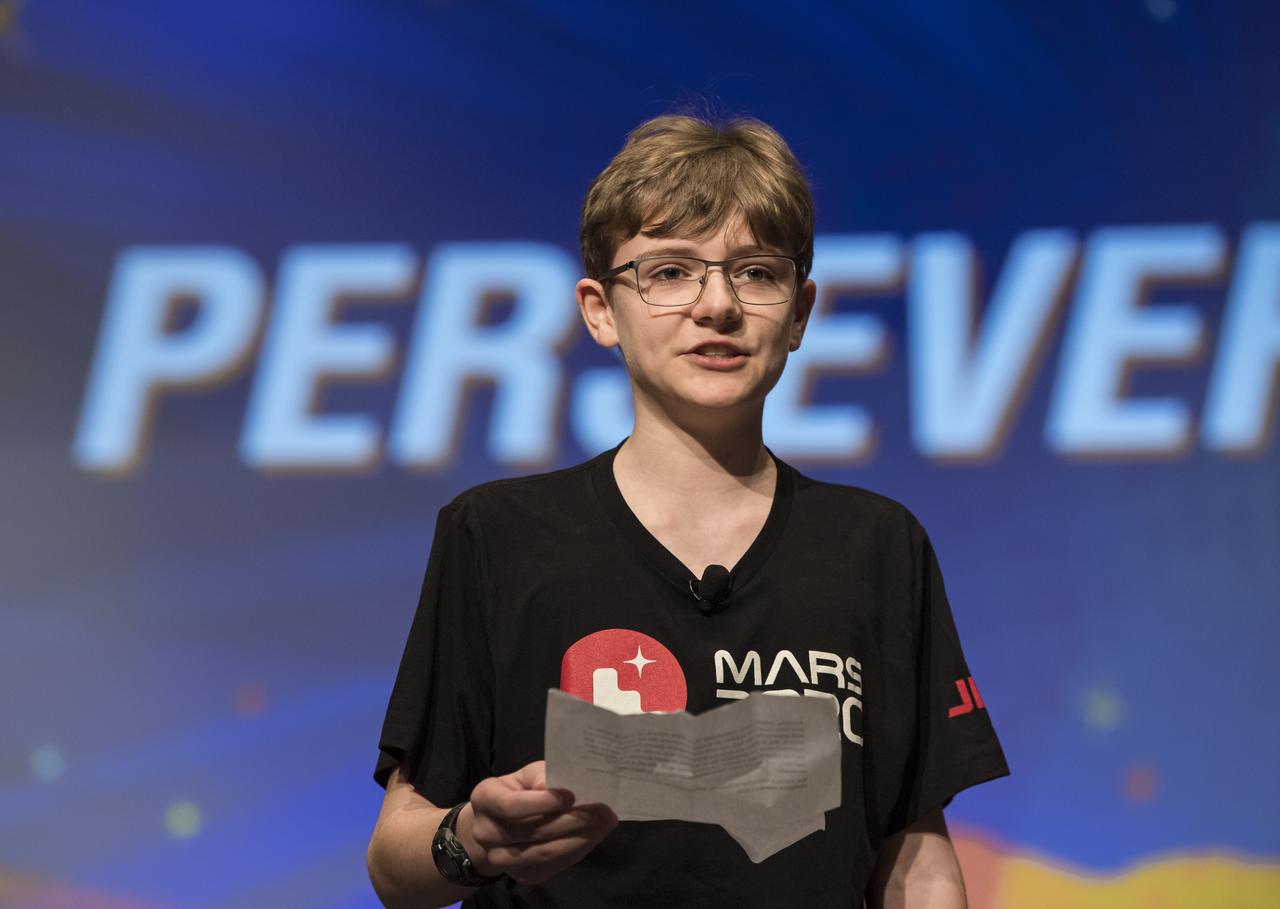
Alex Mather, the student whose submission, Perseverance, was chosen as the official name of the Mars 2020 rover, reads his essay entry, Thursday, March 5, 2020, at Lake Braddock Secondary School in Burke, Va. The final selection of the new name was made by Associate Administrator of NASA's Science Mission Directorate, Thomas Zurbuchen, following a nationwide naming contest conducted in 2019 that drew more than 28,000 essays by K-12 students from every U.S. state and territory. Perseverance is currently at NASA's Kennedy Space Center in Florida being prepared for launch this summer. Photo Credit: (NASA/Aubrey Gemignani)
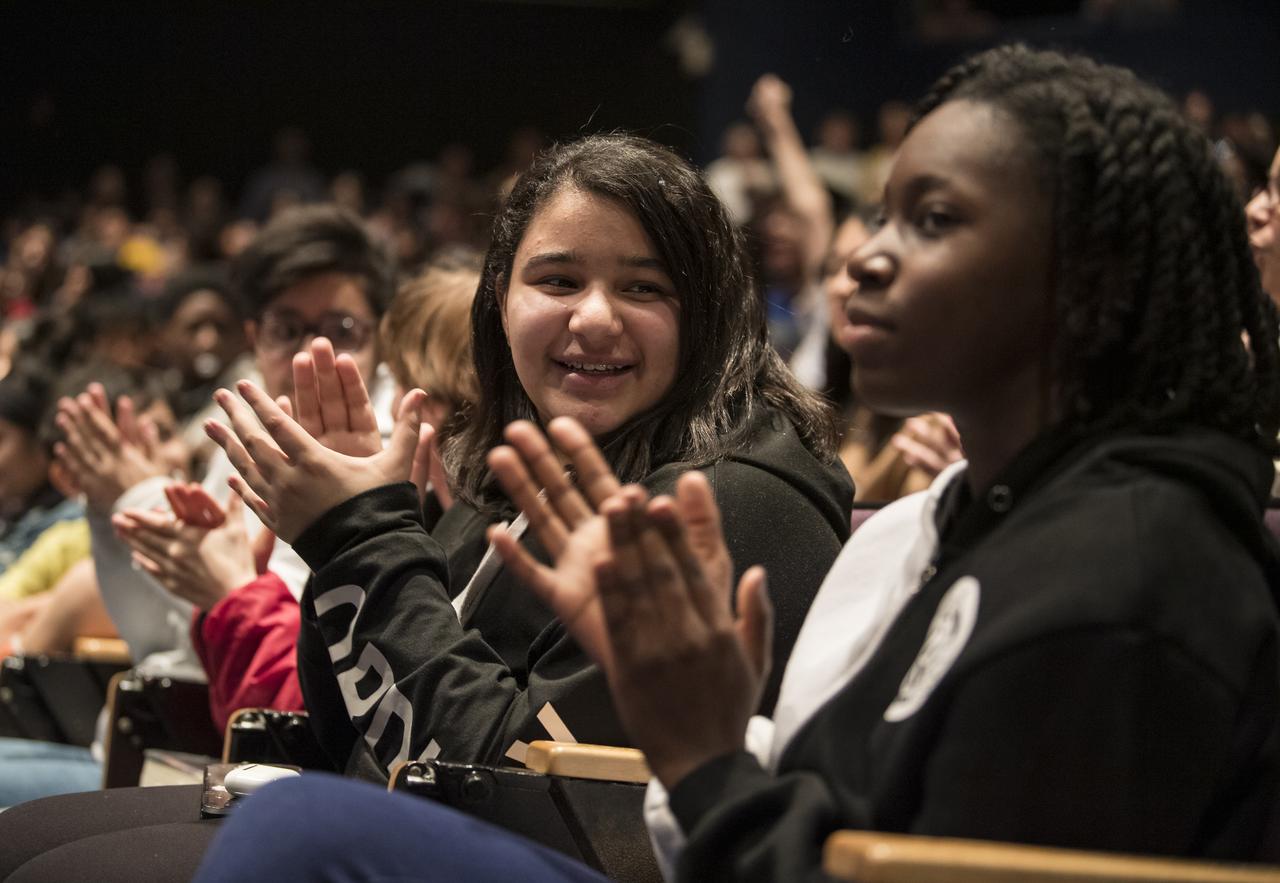
Students applaud during an event to announce the official name of the Mars 2020 rover, Thursday, March 5, 2020, at Lake Braddock Secondary School in Burke, Va. The final selection of the new name, Perseverance, was made by Associate Administrator of NASA's Science Mission Directorate, Thomas Zurbuchen, following a nationwide naming contest conducted in 2019 that drew more than 28,000 essays by K-12 students from every U.S. state and territory. The rover is currently at NASA's Kennedy Space Center in Florida being prepared for launch this summer. Photo Credit: (NASA/Aubrey Gemignani)
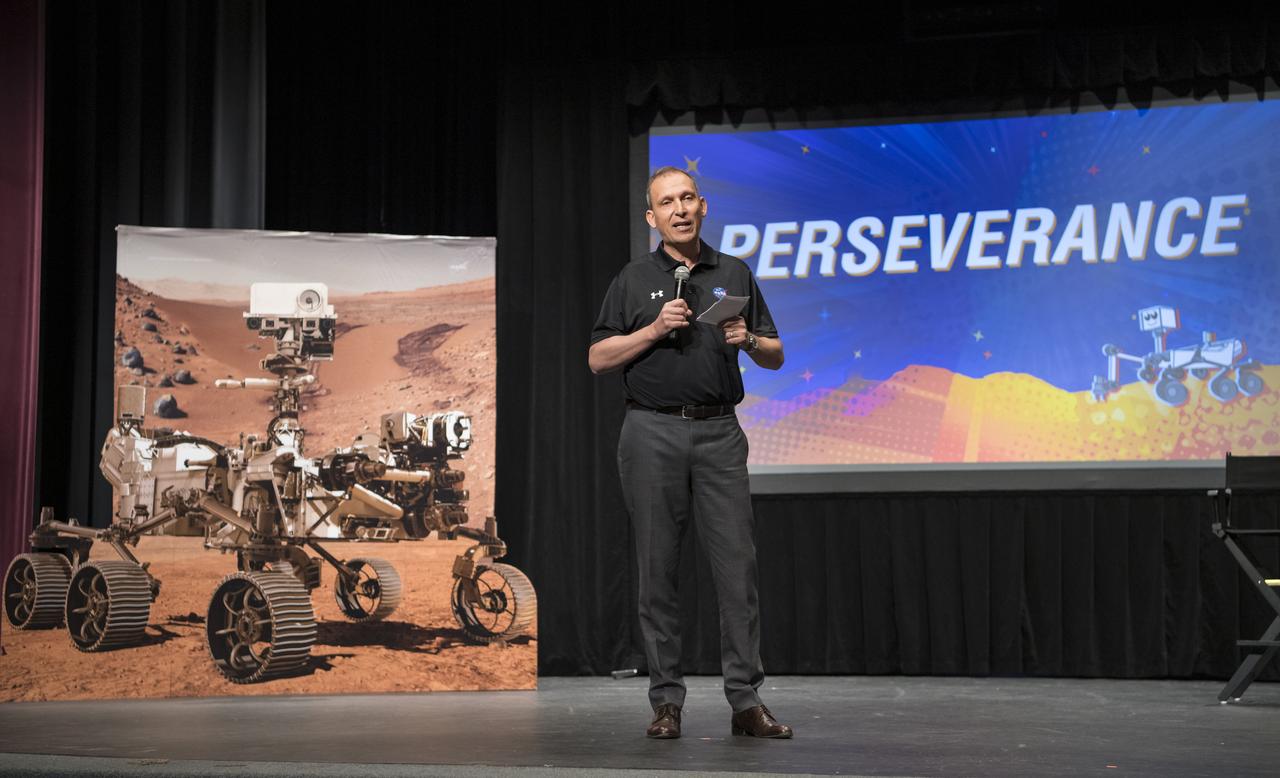
Associate Administrator of NASA's Science Mission Directorate, Thomas Zurbuchen, speaks after announcing the official name, Perseverance, for the rover formerly known as Mars 2020, Thursday, March 5, 2020, at Lake Braddock Secondary School in Burke, Va. Zurbuchen made the final selection of the new name following a nationwide naming contest conducted in 2019 that drew more than 28,000 essays by K-12 students from every U.S. state and territory. Perseverance is currently at NASA's Kennedy Space Center in Florida being prepared for launch this summer. Photo Credit: (NASA/Aubrey Gemignani)
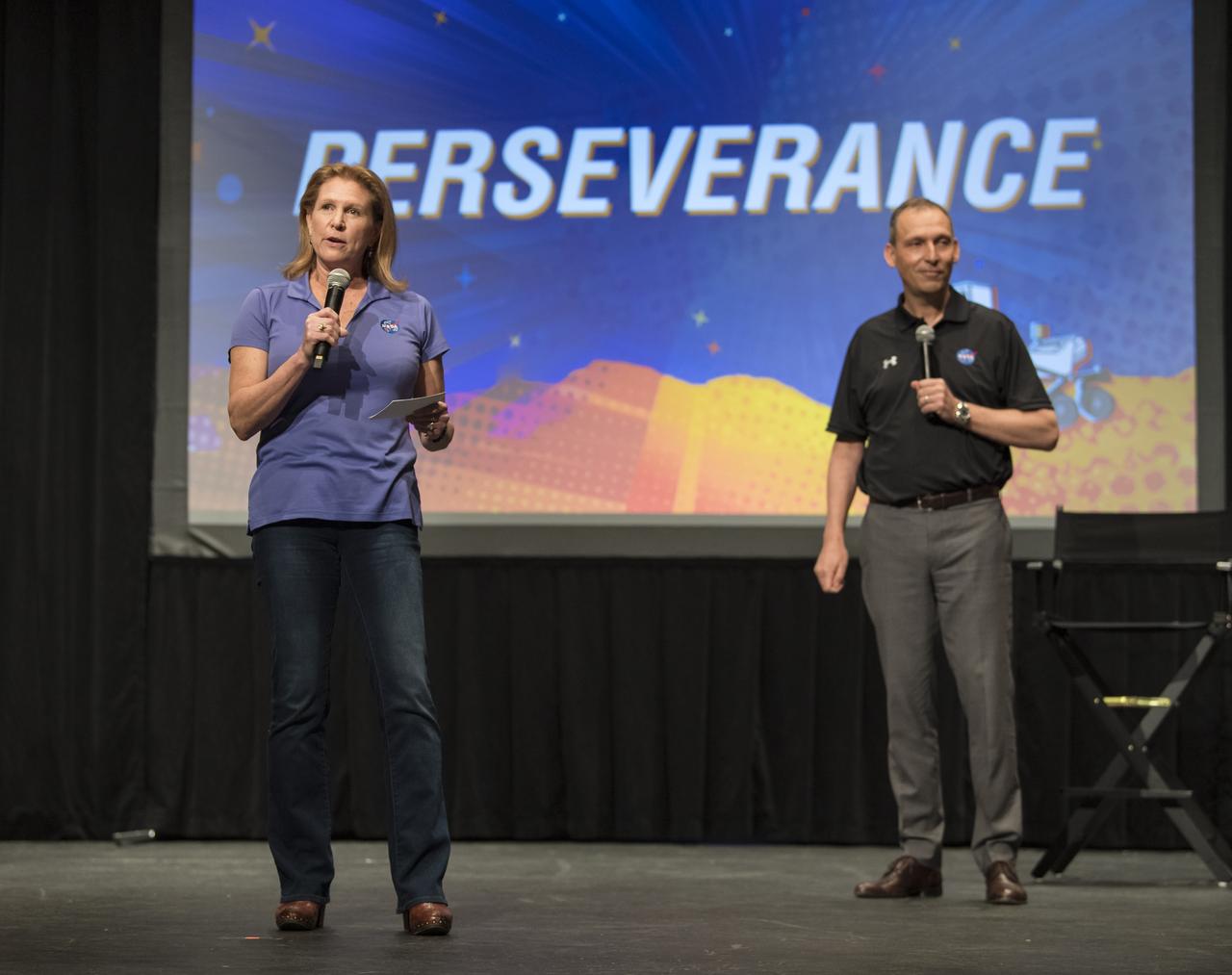
Director of NASA's Science Mission Directorate’s Planetary Science Division, Lori Glaze, left, speaks after the announcement of the official name, Perseverance, for the rover formerly known as Mars 2020, Thursday, March 5, 2020, at Lake Braddock Secondary School in Burke, Va. The final selection of the new name was made by Associate Administrator of NASA's Science Mission Directorate, Thomas Zurbuchen, following a nationwide naming contest conducted in 2019 that drew more than 28,000 essays by K-12 students from every U.S. state and territory. Perseverance is currently at NASA's Kennedy Space Center in Florida being prepared for launch this summer. Photo Credit: (NASA/Aubrey Gemignani)
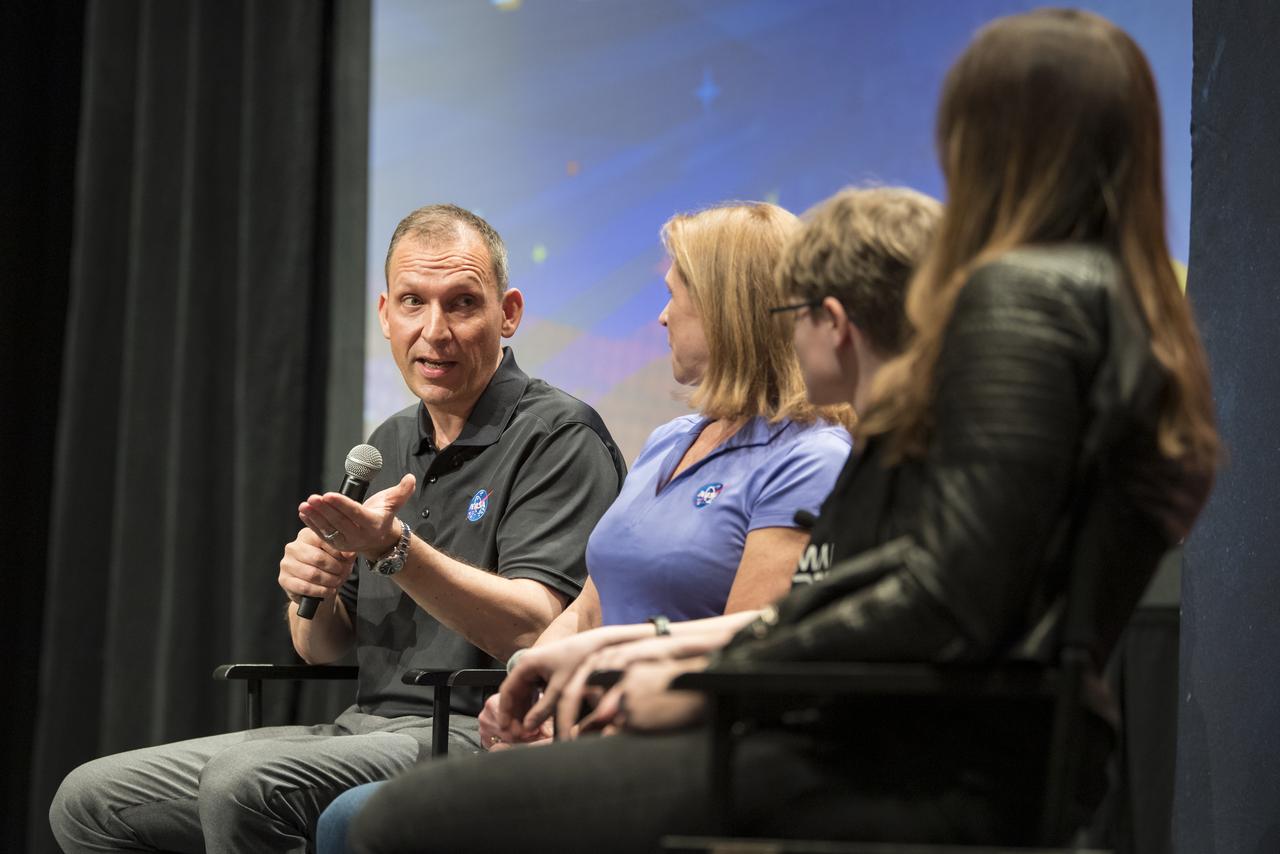
Associate Administrator of NASA's Science Mission Directorate, Thomas Zurbuchen, left, answers a question from Alex Mather, the student whose submission, Perseverance, was chosen as the official name of the Mars 2020 rover, second from right, Thursday, March 5, 2020, at Lake Braddock Secondary School in Burke, Va. The final selection of the new name was made by Zurbuchen, following a nationwide naming contest conducted in 2019 that drew more than 28,000 essays by K-12 students from every U.S. state and territory. Perseverance is currently at NASA's Kennedy Space Center in Florida being prepared for launch this summer. Photo Credit: (NASA/Aubrey Gemignani)
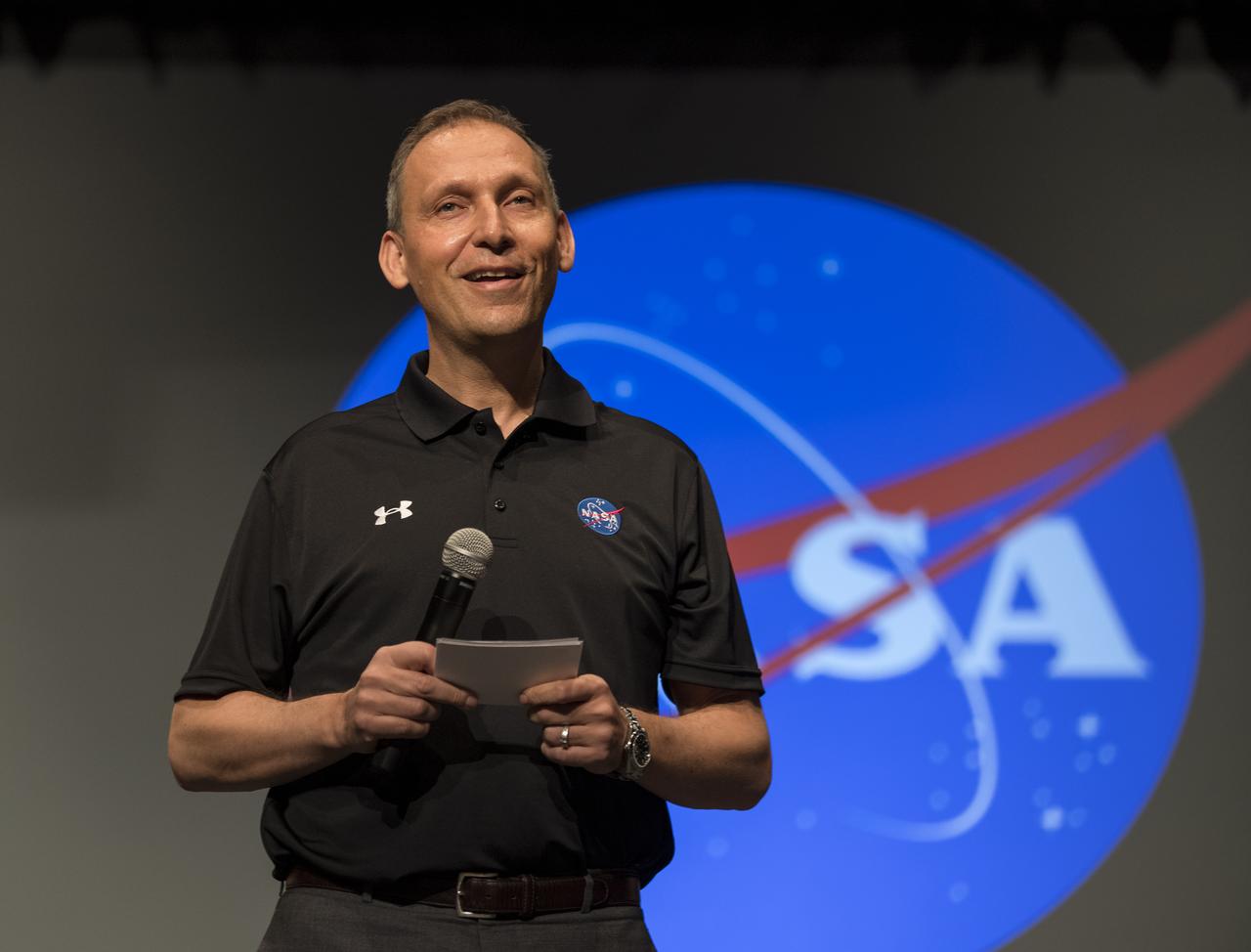
Associate Administrator of NASA's Science Mission Directorate, Thomas Zurbuchen, announces the official name, Perseverance, for the rover formerly known as Mars 2020, Thursday, March 5, 2020, at Lake Braddock Secondary School in Burke, Va. Zurbuchen made the final selection of the new name following a nationwide naming contest conducted in 2019 that drew more than 28,000 essays by K-12 students from every U.S. state and territory. Perseverance is currently at NASA's Kennedy Space Center in Florida being prepared for launch this summer. Photo Credit: (NASA/Aubrey Gemignani)
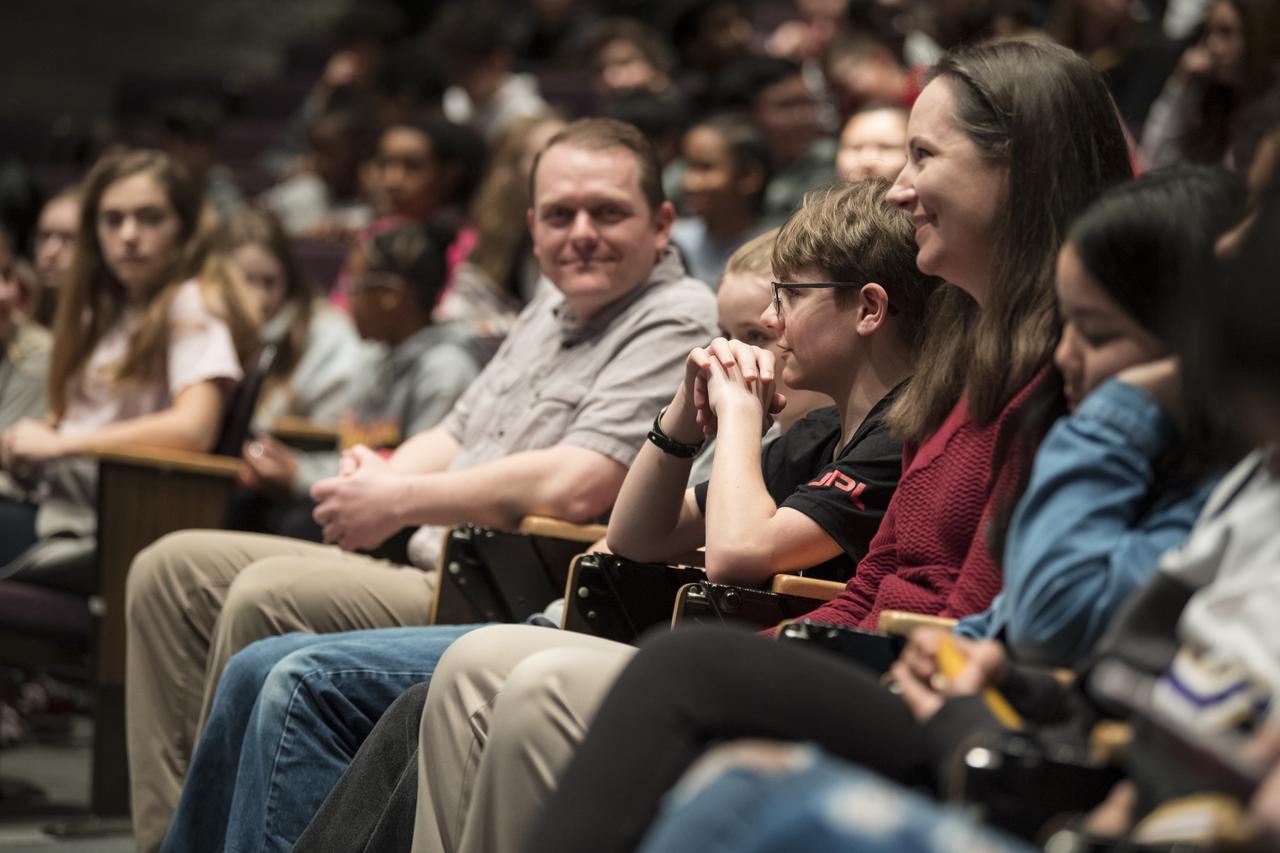
Alex Mather, the student whose submission, Perseverance, was chosen as the official name of the Mars 2020 rover, is seen in the audience seated with his family, Thursday, March 5, 2020, at Lake Braddock Secondary School in Burke, Va. The final selection of the new name was made by Associate Administrator of NASA's Science Mission Directorate, Thomas Zurbuchen, following a nationwide naming contest conducted in 2019 that drew more than 28,000 essays by K-12 students from every U.S. state and territory. Perseverance is currently at NASA's Kennedy Space Center in Florida being prepared for launch this summer. Photo Credit: (NASA/Aubrey Gemignani)

KENNEDY SPACE CENTER, FLA. -- External tank No. 120 is suspended vertically above the transfer aisle of the Vehicle Assembly Building at KSC. The tank will next be lifted into a checkout cell. ET-120 will be prepared for stacking with solid rocket boosters to launch Space Shuttle Discovery on mission STS-120 in October. The mission is the 23rd to the International Space Station and will launch an Italian-built, U.S. multi-port module known as Harmony for the station. Christened after a school contest, Harmony will provide attachment points for European and Japanese laboratory modules. NASA/George Shelton
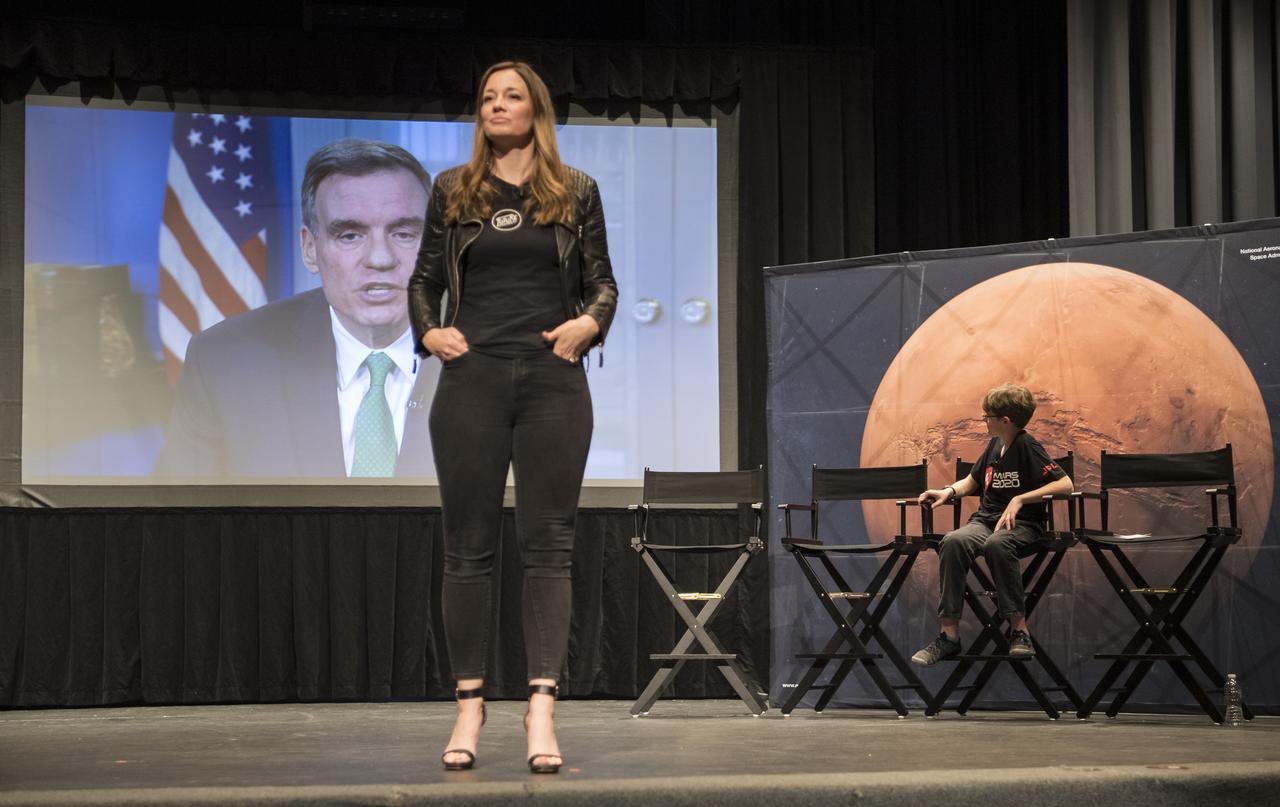
Alex Mather watches a congratulatory video from Sen. Mark Warner, D-Va, during an event to announce the official name of the Mars 2020 rover, Thursday, March 5, 2020, at Lake Braddock Secondary School in Burke, Va. The final selection of the new name, Perseverance, was made by Associate Administrator of NASA's Science Mission Directorate, Thomas Zurbuchen, following a nationwide naming contest conducted in 2019 that drew more than 28,000 essays by K-12 students from every U.S. state and territory. The rover is currently at NASA's Kennedy Space Center in Florida being prepared for launch this summer. Photo Credit: (NASA/Aubrey Gemignani)
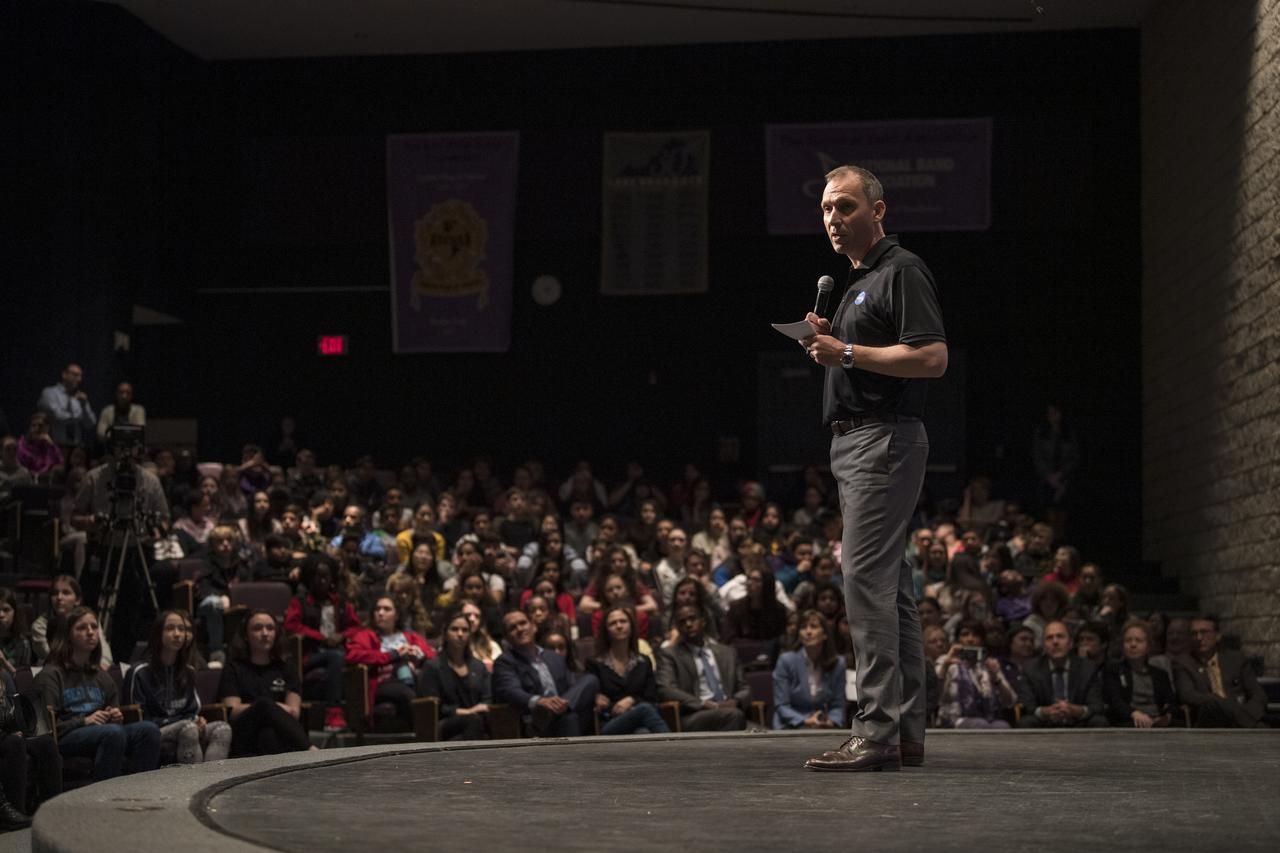
Associate Administrator of NASA's Science Mission Directorate, Thomas Zurbuchen, announces the official name, Perseverance, for the rover formerly known as Mars 2020, Thursday, March 5, 2020, at Lake Braddock Secondary School in Burke, Va. Zurbuchen made the final selection of the new name following a nationwide naming contest conducted in 2019 that drew more than 28,000 essays by K-12 students from every U.S. state and territory. Perseverance is currently at NASA's Kennedy Space Center in Florida being prepared for launch this summer. Photo Credit: (NASA/Aubrey Gemignani)
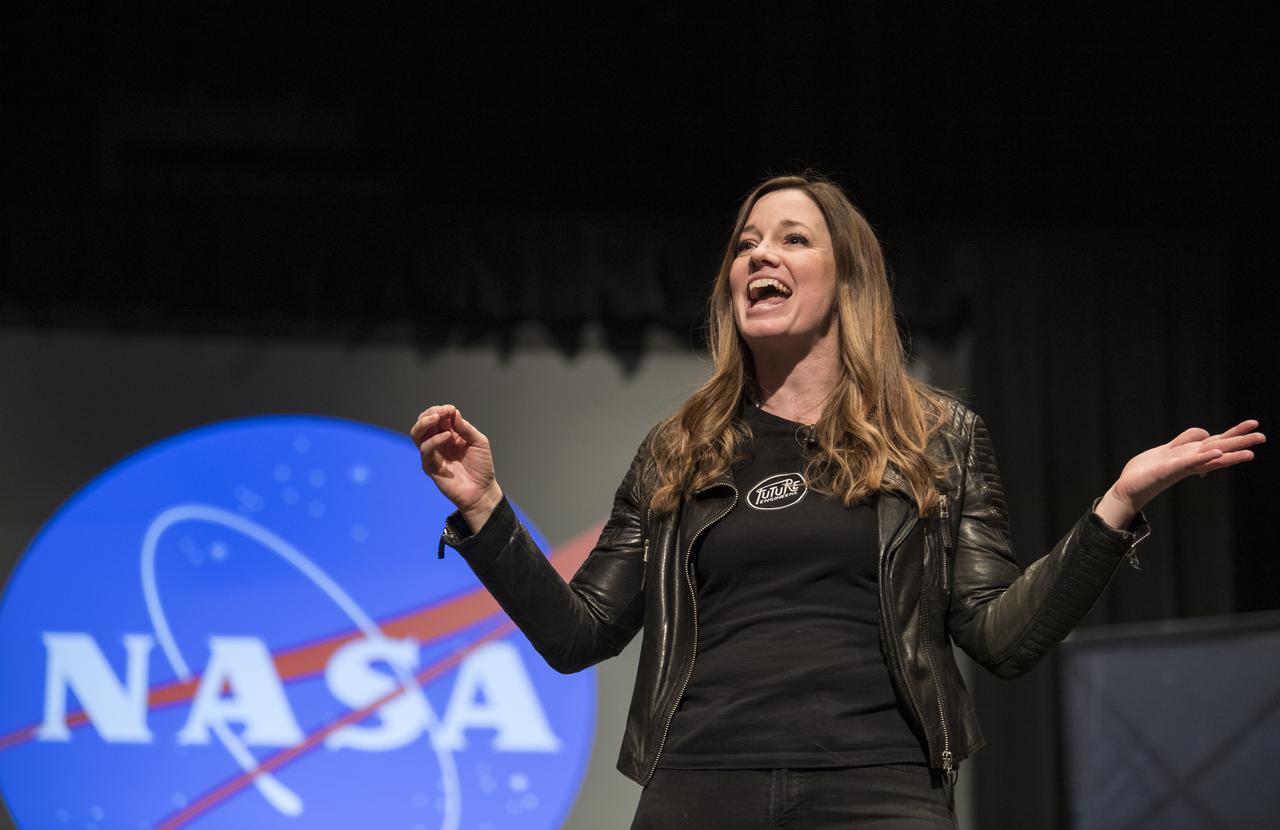
Founder and CEO of Future Engineers, Deanne Bell, speaks to the audience at an event to announce the official name of the Mars 2020 rover, Thursday, March 5, 2020, at Lake Braddock Secondary School in Burke, Va. The final selection of the new name, Perseverance, was made by NASA’s Associate Administrator of the Science Mission Directorate, Thomas Zurbuchen, following a nationwide naming contest conducted in 2019 that drew more than 28,000 essays by K-12 students from every U.S. state and territory. The rover is currently at NASA's Kennedy Space Center in Florida being prepared for launch this summer. Photo Credit: (NASA/Aubrey Gemignani)
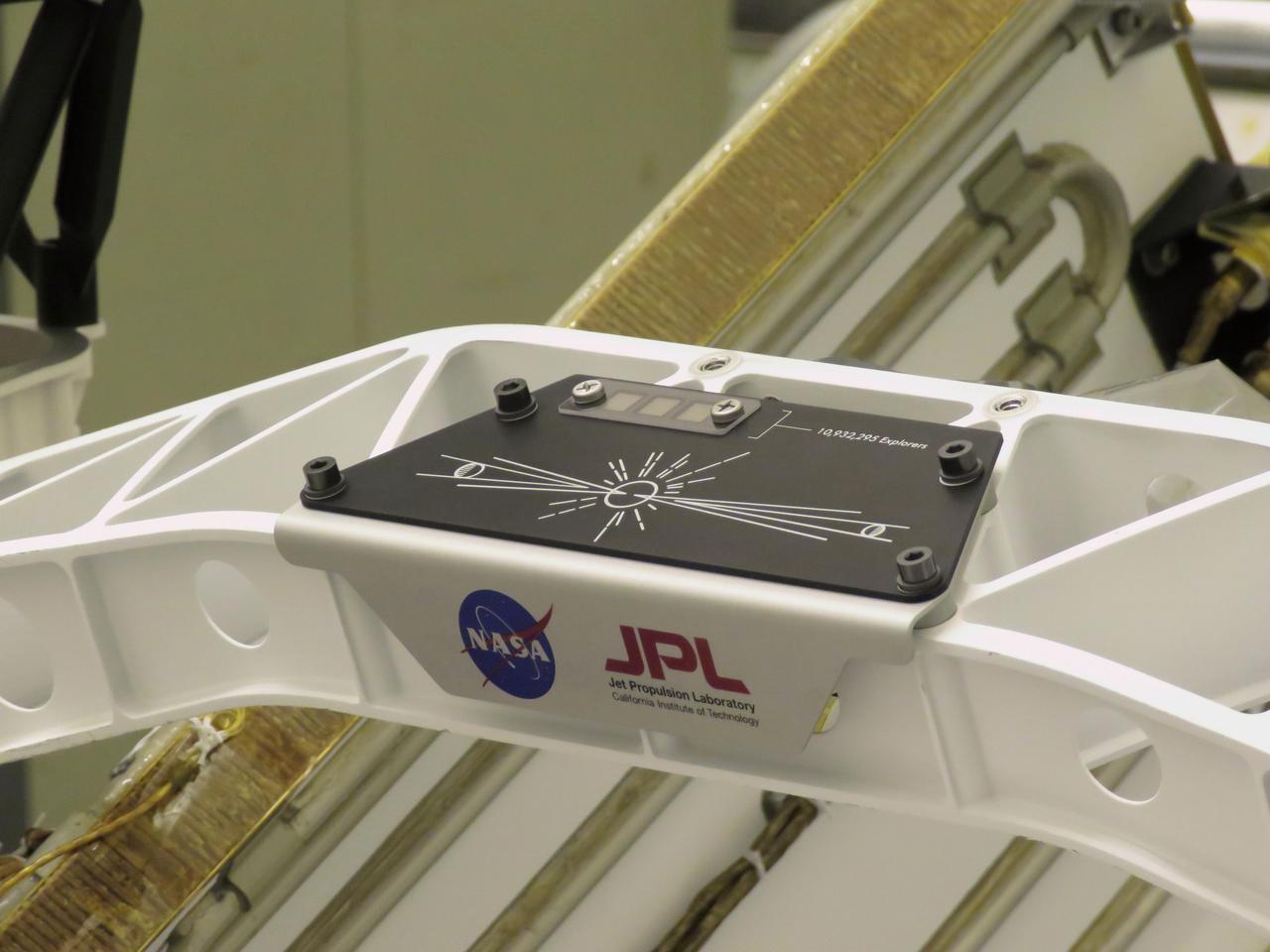
A placard commemorating NASA's "Send Your Name to Mars" campaign was installed on the Perseverance Mars rover on March 16, 2020, at NASA's Kennedy Space Center in Florida. Three fingernail-sized chips affixed to the upper-left corner of the placard feature the names of 10,932,295 people who participated. They were individually stenciled onto the chips by electron beam, along with the essays of the 155 finalists in NASA's "Name the Rover" contest. Liftoff aboard a United Launch Alliance Atlas V 541 rocket is targeted for mid-July of 2020 from Cape Canaveral Air Force Station. NASA's Launch Services Program, based at Kennedy, is managing the launch. https://photojournal.jpl.nasa.gov/catalog/PIA23769
Fairfax County Division Superintendent Scott Brabrand shakes hands with Alex Mather, the student whose submission, Perseverance, was chosen as the official name of the Mars 2020 rover, Thursday, March 5, 2020, at Lake Braddock Secondary School in Burke, Va. The final selection of the new name was made by Zurbuchen following a nationwide naming contest conducted in 2019 that drew more than 28,000 essays by K-12 students from every U.S. state and territory. Perseverance is currently at NASA's Kennedy Space Center in Florida being prepared for launch this summer. Photo Credit: (NASA/Aubrey Gemignani)
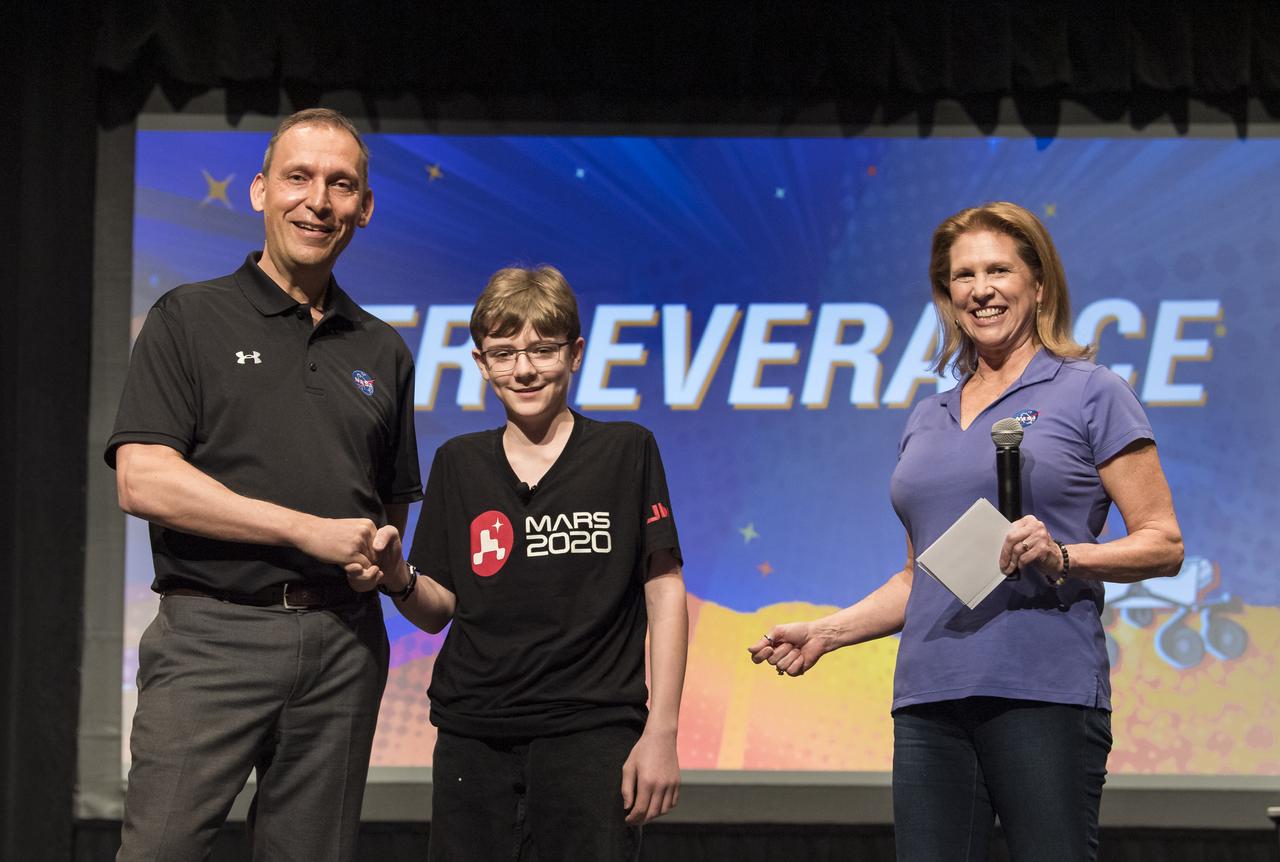
Associate Administrator of NASA's Science Mission Directorate, Thomas Zurbuchen, shakes hands with Alex Mather, the student whose submission, Perseverance, was chosen as the official name of the Mars 2020 rover, Thursday, March 5, 2020, at Lake Braddock Secondary School in Burke, Va. The final selection of the new name was made by Zurbuchen following a nationwide naming contest conducted in 2019 that drew more than 28,000 essays by K-12 students from every U.S. state and territory. Perseverance is currently at NASA's Kennedy Space Center in Florida being prepared for launch this summer. Photo Credit: (NASA/Aubrey Gemignani)
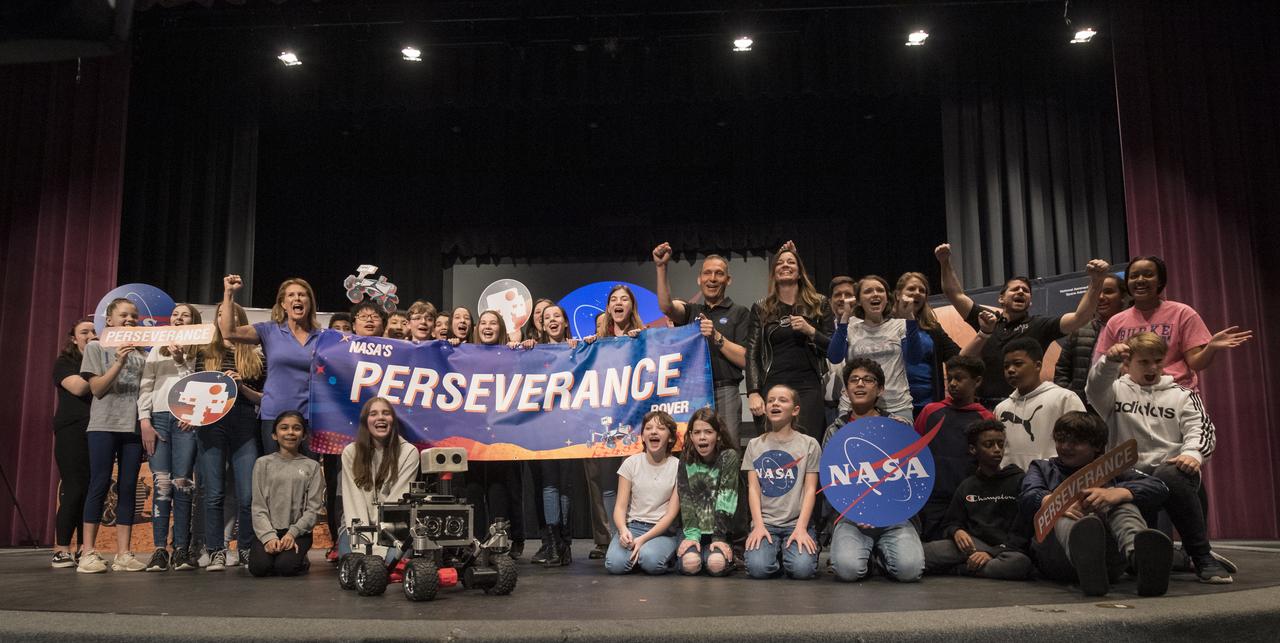
Students chant, “Go Perseverance!” during an event to announce the official name of the Mars 2020 rover, Thursday, March 5, 2020, at Lake Braddock Secondary School in Burke, Va. The final selection of the new name, Perseverance, was made by Associate Administrator of NASA's Science Mission Directorate, Thomas Zurbuchen, following a nationwide naming contest conducted in 2019 that drew more than 28,000 essays by K-12 students from every U.S. state and territory. The rover is currently at NASA's Kennedy Space Center in Florida being prepared for launch this summer. Photo Credit: (NASA/Aubrey Gemignani)
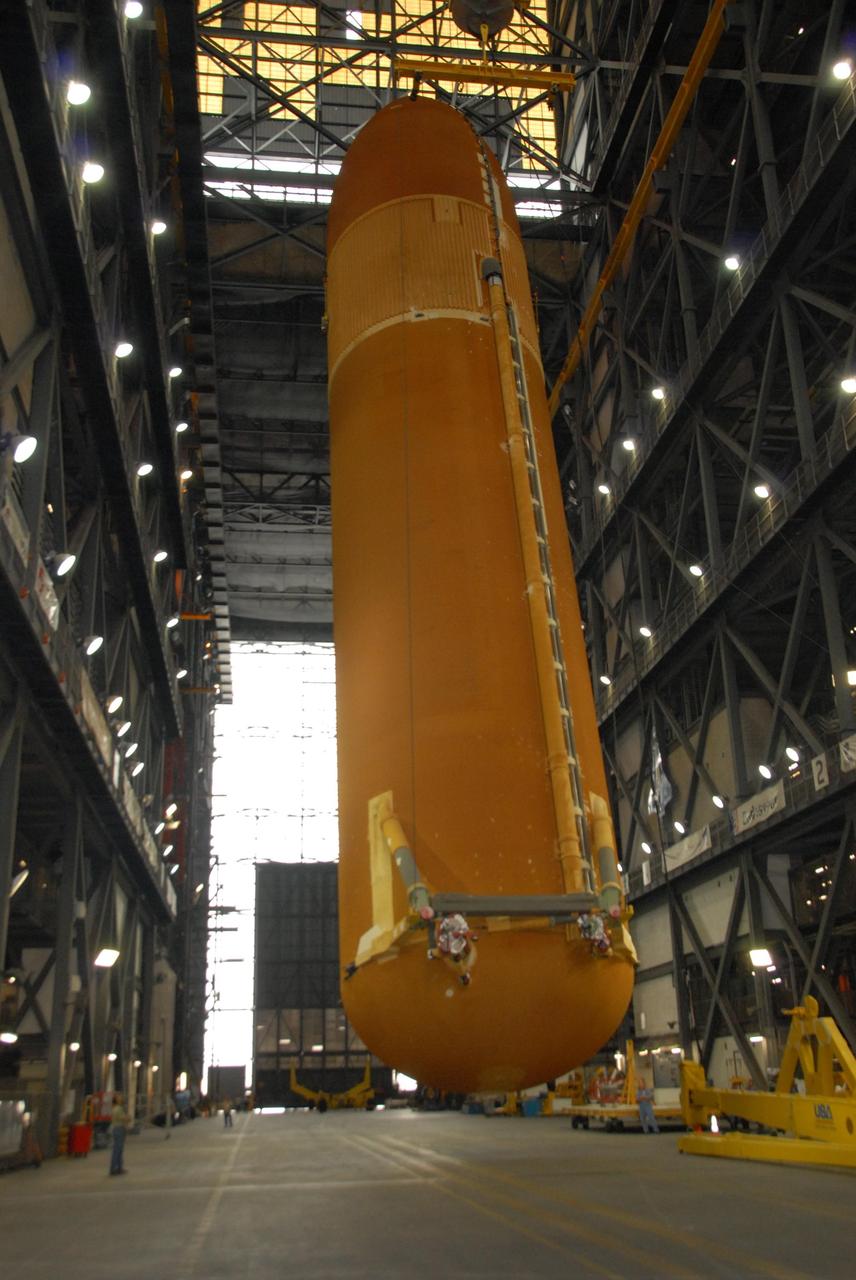
KENNEDY SPACE CENTER, FLA. -- In the transfer aisle of the Vehicle Assembly Building at KSC, an overhead crane raises external tank No. 120 to a vertical position. The tank will next be lifted into a checkout cell. ET-120 will be prepared for stacking with solid rocket boosters to launch Space Shuttle Discovery on mission STS-120 in October. The mission is the 23rd to the International Space Station and will launch an Italian-built, U.S. multi-port module known as Harmony for the station. Christened after a school contest, Harmony will provide attachment points for European and Japanese laboratory modules. NASA/George Shelton
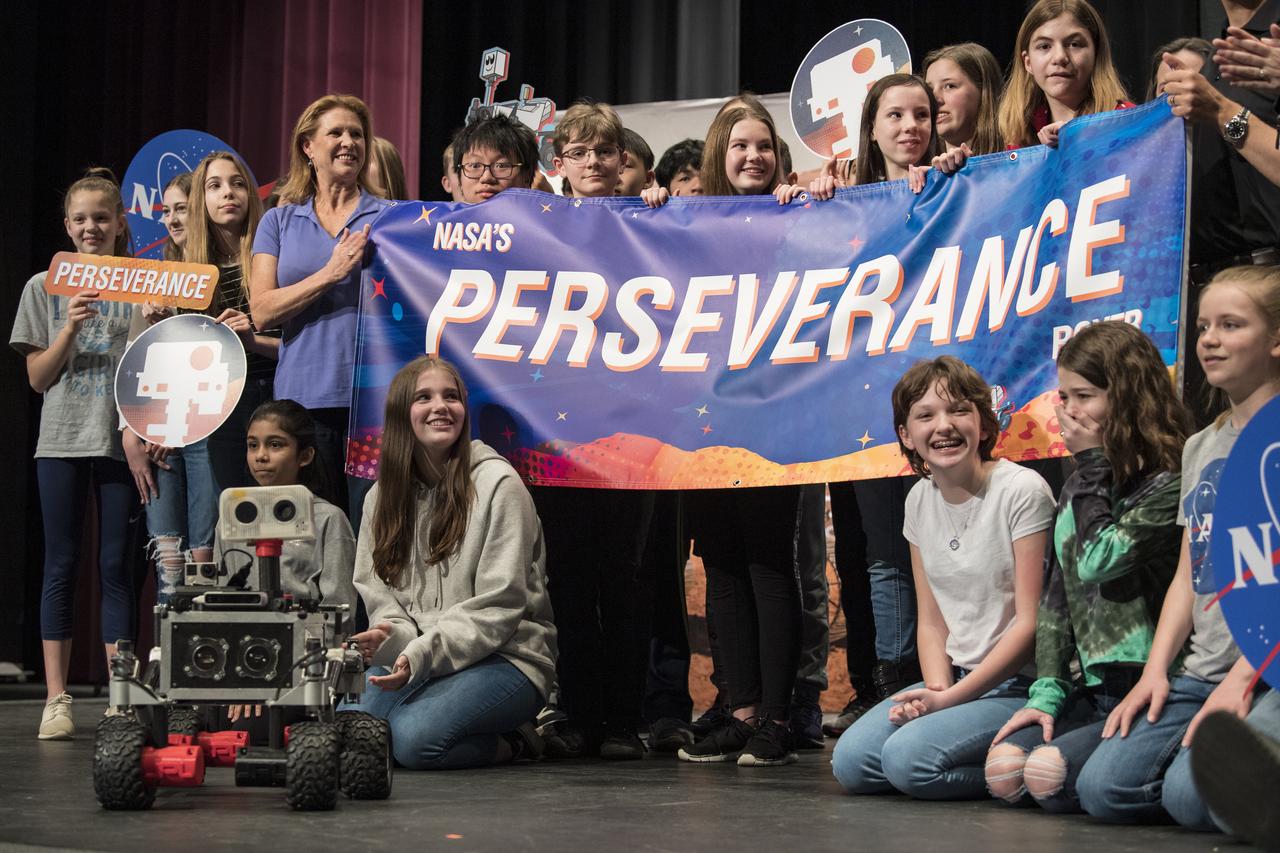
Associate Administrator of NASA's Science Mission Directorate, Thomas Zurbuchen, announces the official name, Perseverance, for the rover formerly known as Mars 2020, Thursday, March 5, 2020, at Lake Braddock Secondary School in Burke, Va. Zurbuchen made the final selection of the new name following a nationwide naming contest conducted in 2019 that drew more than 28,000 essays by K-12 students from every U.S. state and territory. Perseverance is currently at NASA's Kennedy Space Center in Florida being prepared for launch this summer. Photo Credit: (NASA/Aubrey Gemignani)
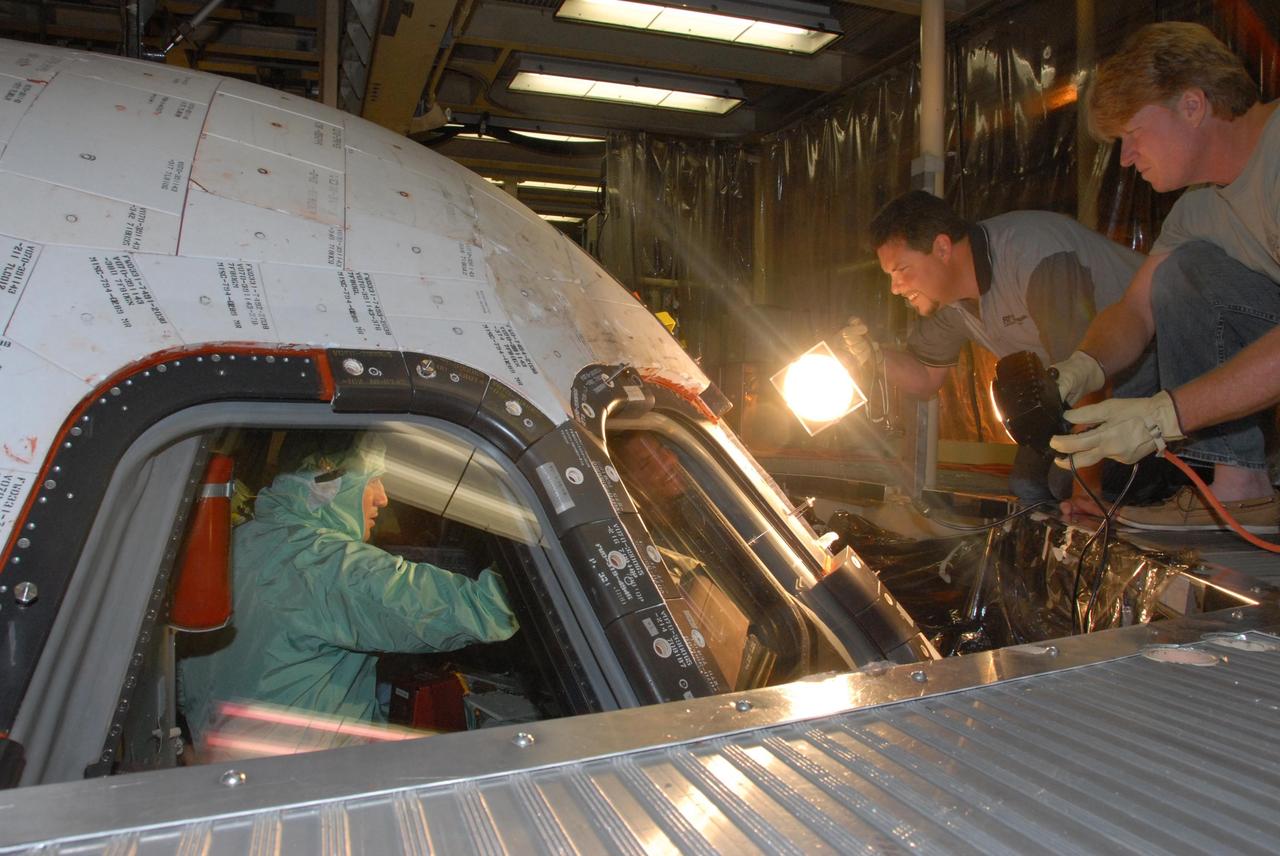
KENNEDY SPACE CENTER, FLA. - In the Orbiter Processing Facility bay 3, STS-120 Commander Pamela A. Melroy makes a close inspection of the cockpit window on the orbiter Discovery. The STS-120 crew is at Kennedy for a crew equipment interface test, or CEIT, which includes harness training, inspection of the thermal protection system and camera operation for planned extravehicular activities, or EVAs. The STS-120 mission will deliver the Harmony module, christened after a school contest, which will provide attachment points for European and Japanese laboratory modules on the International Space Station. Known in technical circles as Node 2, it is similar to the six-sided Unity module that links the U.S. and Russian sections of the station. Built in Italy for the United States, Harmony will be the first new U.S. pressurized component to be added. The STS-120 mission is targeted to launch on Oct. 20. Photo credit: NASA/George Shelton
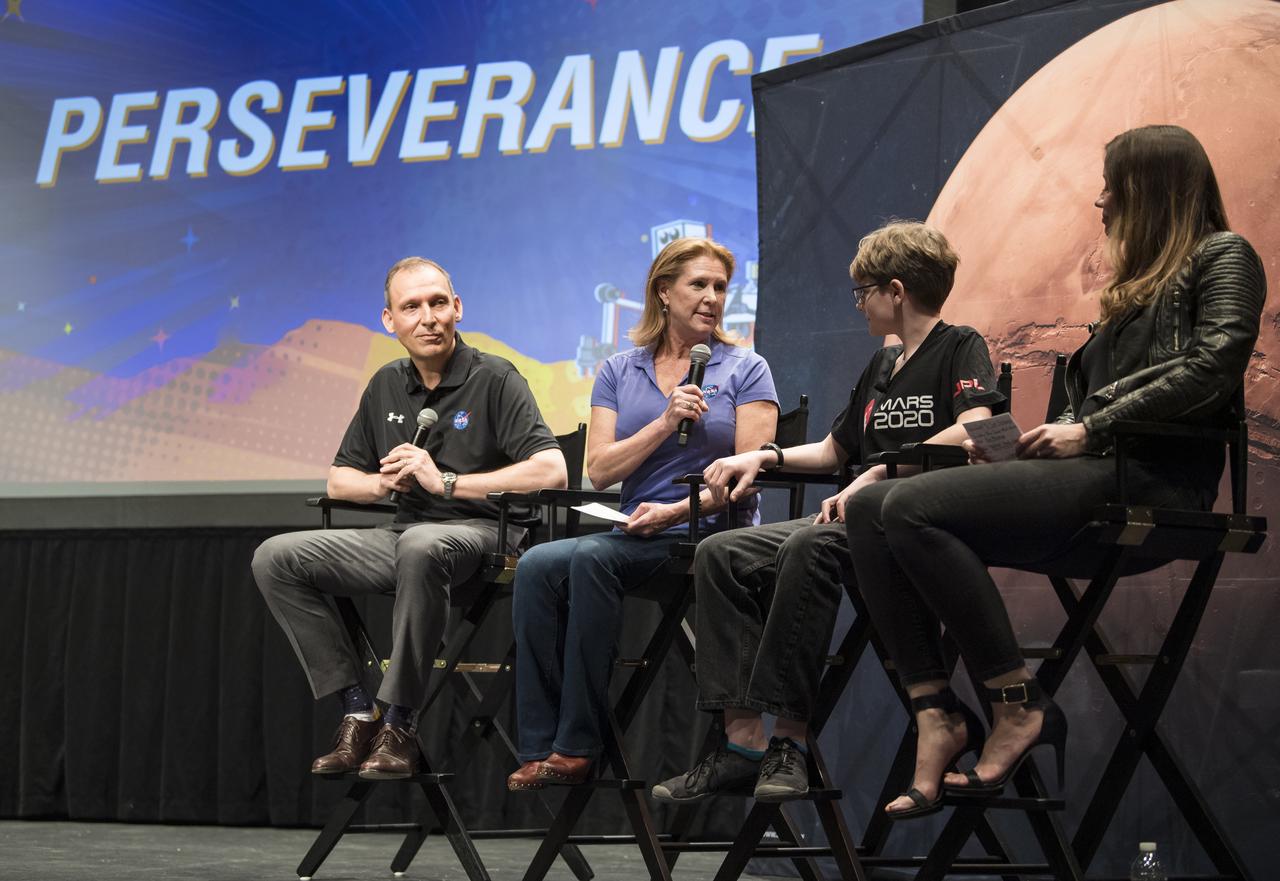
Lori Glaze, Director of the Planetary Science Division of NASA's Science Mission Directorate, second from left, asks Alex Mather, the student whose submission, Perseverance, was chosen as the official name of the Mars 2020 rover, a question, Thursday, March 5, 2020, at Lake Braddock Secondary School in Burke, Va. The final selection of the new name was made by Associate Administrator of NASA's Science Mission Directorate, Thomas Zurbuchen, following a nationwide naming contest conducted in 2019 that drew more than 28,000 essays by K-12 students from every U.S. state and territory. Perseverance is currently at NASA's Kennedy Space Center in Florida being prepared for launch this summer. Photo Credit: (NASA/Aubrey Gemignani)
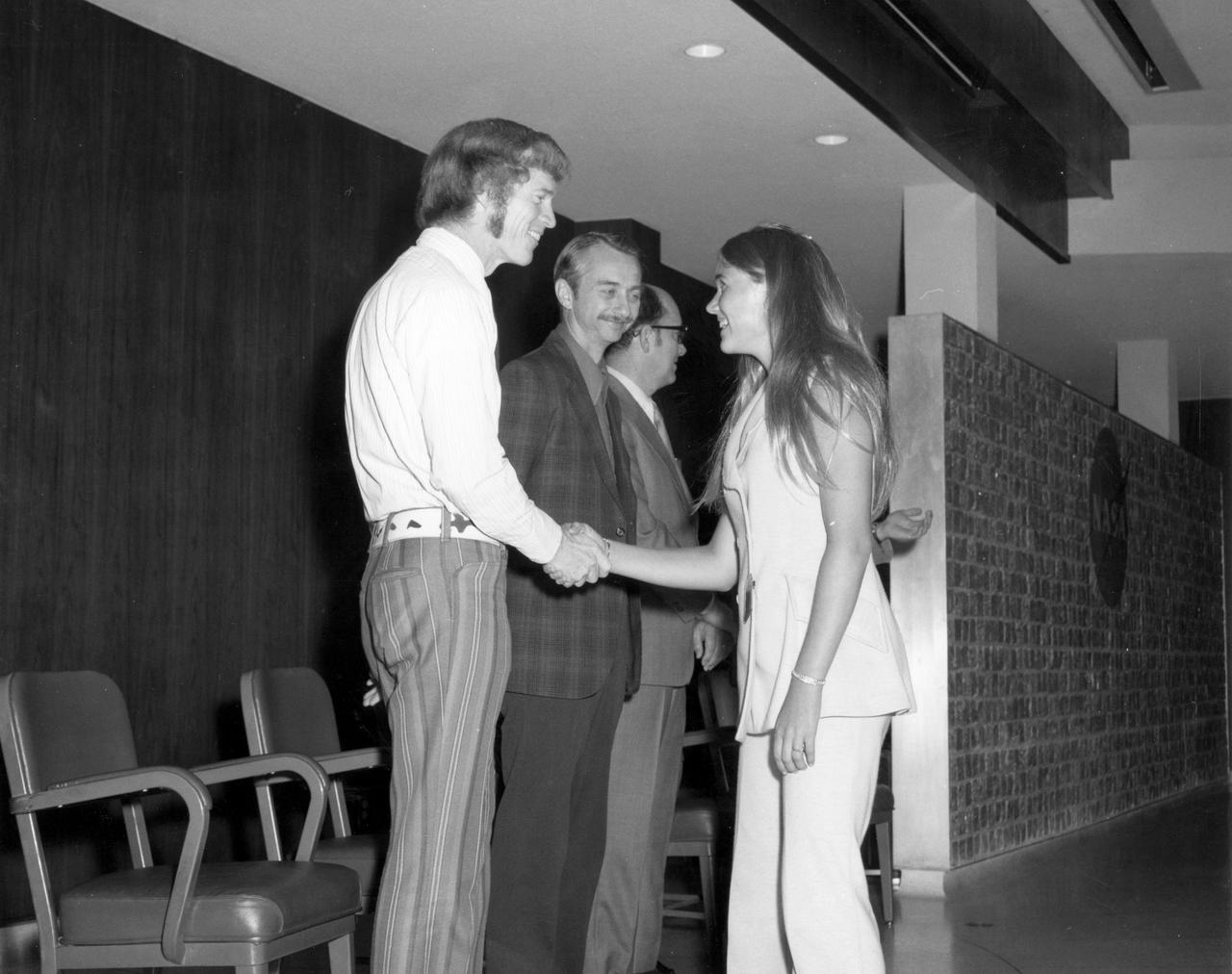
Houston, Texas high school student, Kathy L. Jackson, is greeted by astronauts Russell L. Schweickart (left) and Owen K. Garriott (center), and Marshall Space Flight Center (MSFC) Skylab Program Manager, Leland Belew during a tour of the Marshall Space Flight Center (MSFC). Jackson was among 25 winners of a contest in which some 3,500 high school students proposed experiments for the following year’s Skylab mission. The nationwide scientific competition was sponsored by the National Science Teachers Association and the National Aeronautics and Space Administration (NASA). The winning students, along with their parents and sponsor teachers, visited MSFC where they met with scientists and engineers, participated in design reviews for their experiments, and toured MSFC facilities. Of the 25 students, 6 did not see their experiments conducted on Skylab because the experiments were not compatible with Skylab hardware and timelines. Of the 19 remaining, 11 experiments required the manufacture of additional equipment.