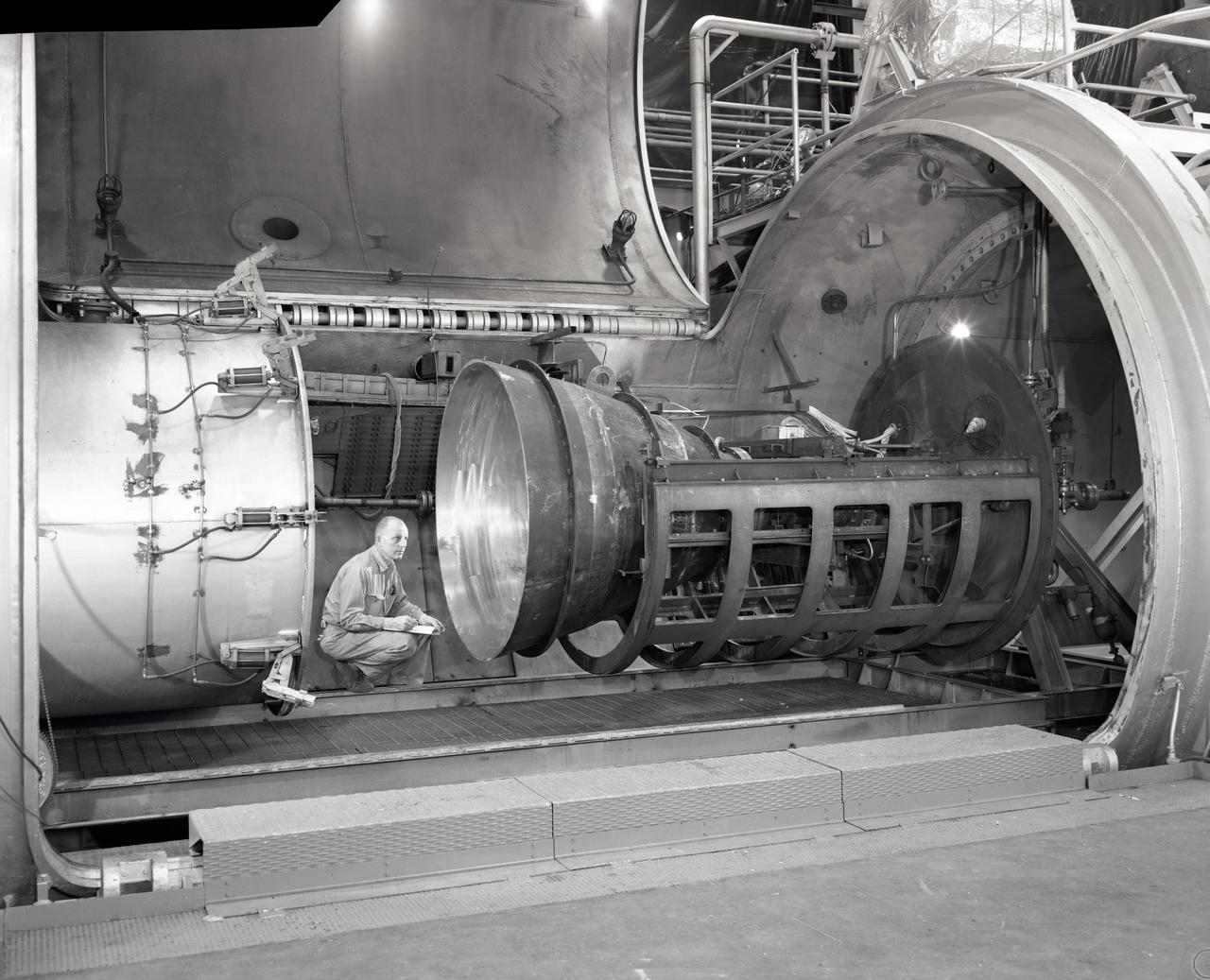
APOLLO CONTOUR ENGINE MOUNTED IN THE PROPULSION SYSTEMS LABORATORY PSL NO. 2 TEST CELL
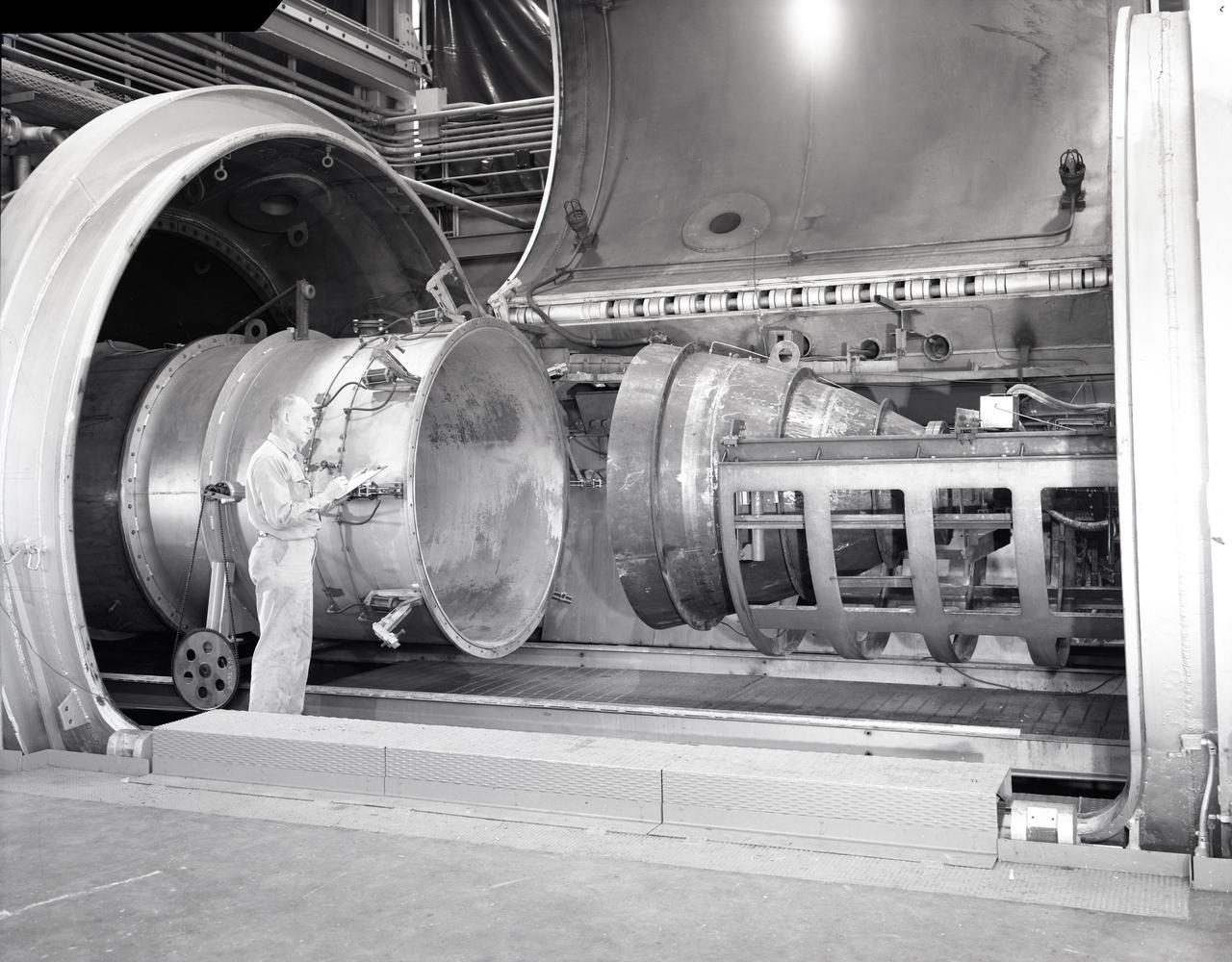
APOLLO CONTOUR ENGINE MOUNTED IN THE PROPULSION SYSTEMS LABORATORY PSL NO. 2 TEST CELL
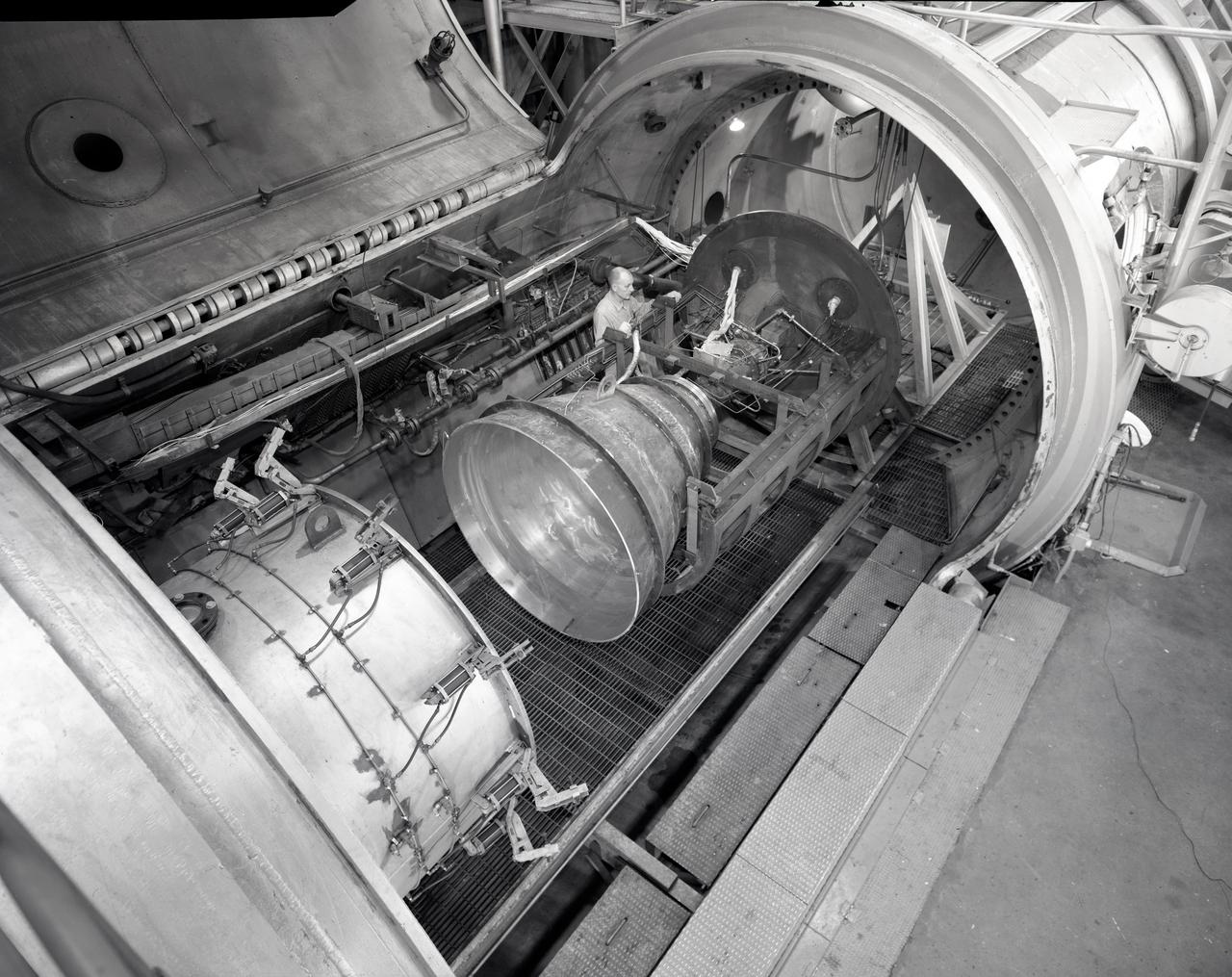
APOLLO CONTOUR ENGINE MOUNTED IN THE PROPULSION SYSTEMS LABORATORY PSL NO. 2 TEST CELL
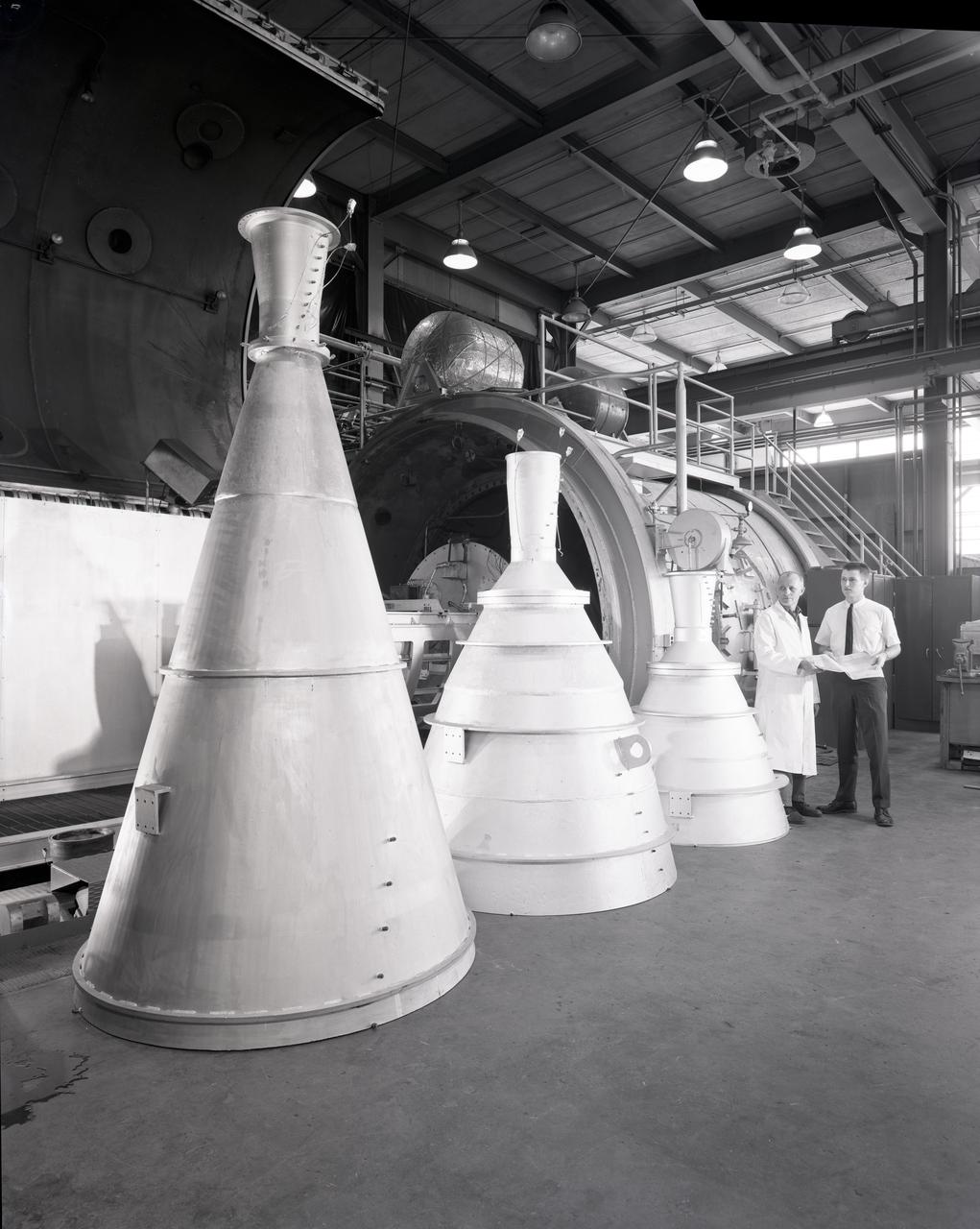
15 DEGREE CONICAL NOZZLE - TITAN TRANSTAGE CONTOUR ENGINE - APOLLO
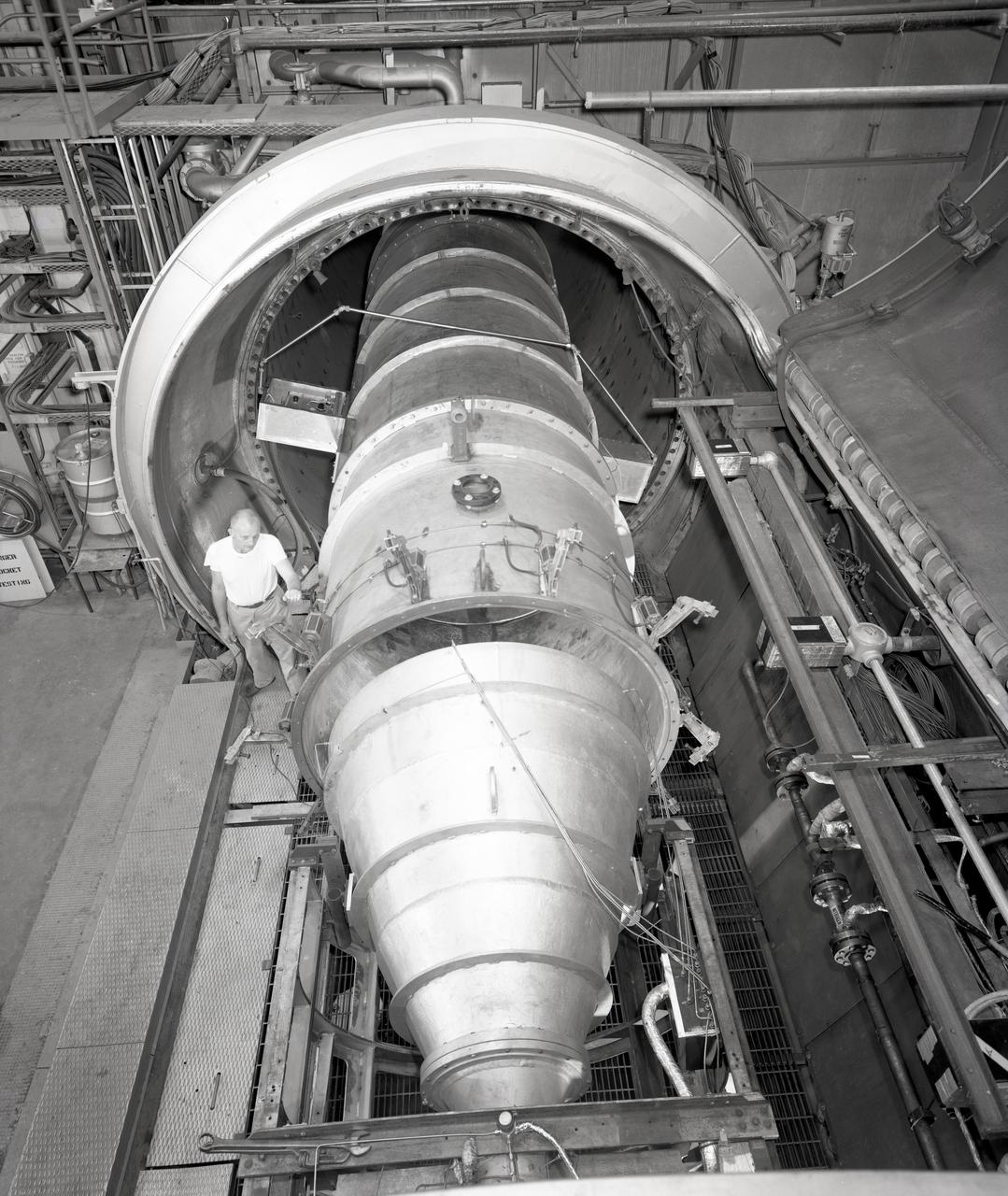
Apollo Contour Engine Model being tested in the NASA Lewis Research Center, Propulsion Systems Laboratory, PSL
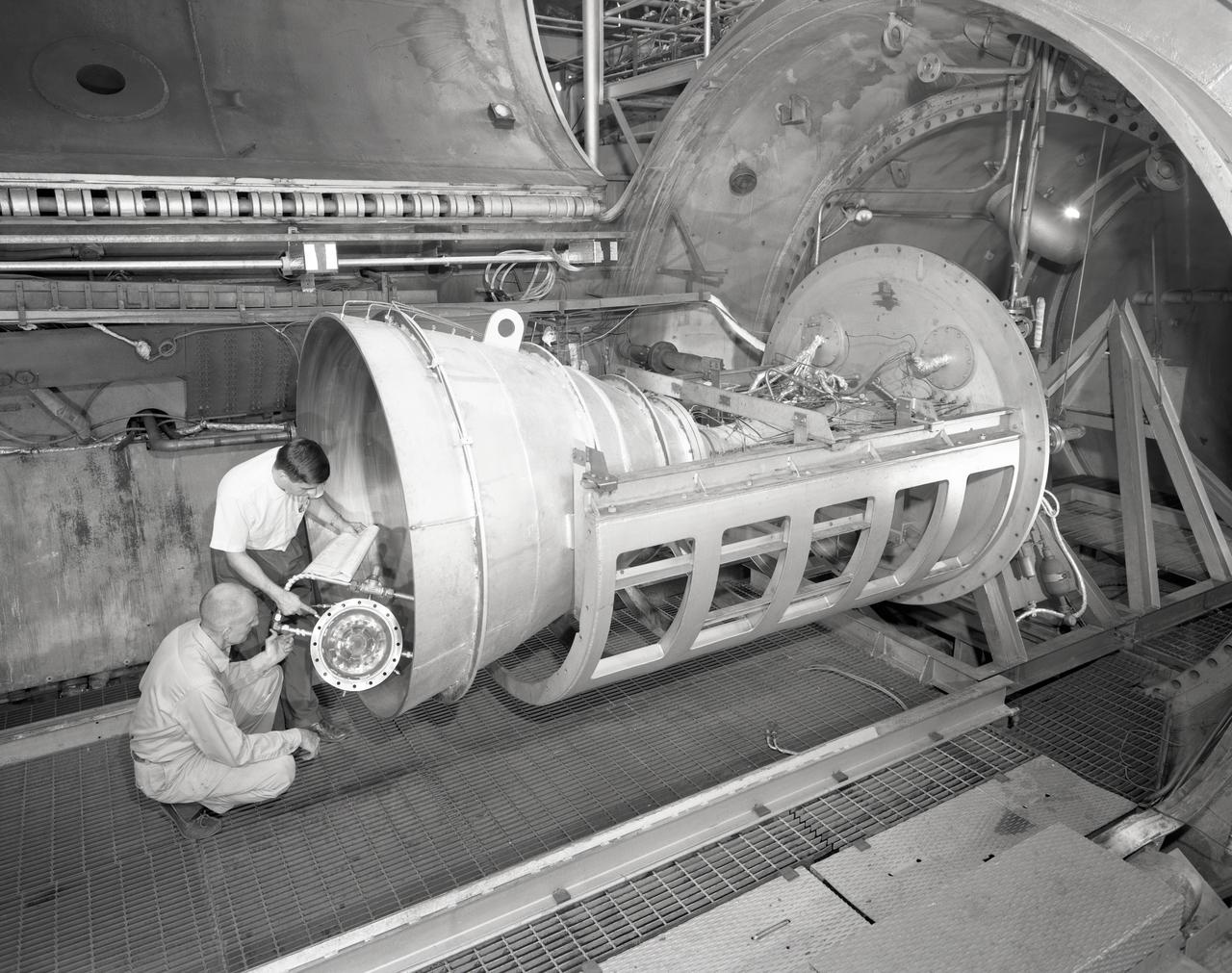
Apollo Contour Engine Model being tested in the NASA Lewis Research Center, Propulsion Systems Laboratory, PSL
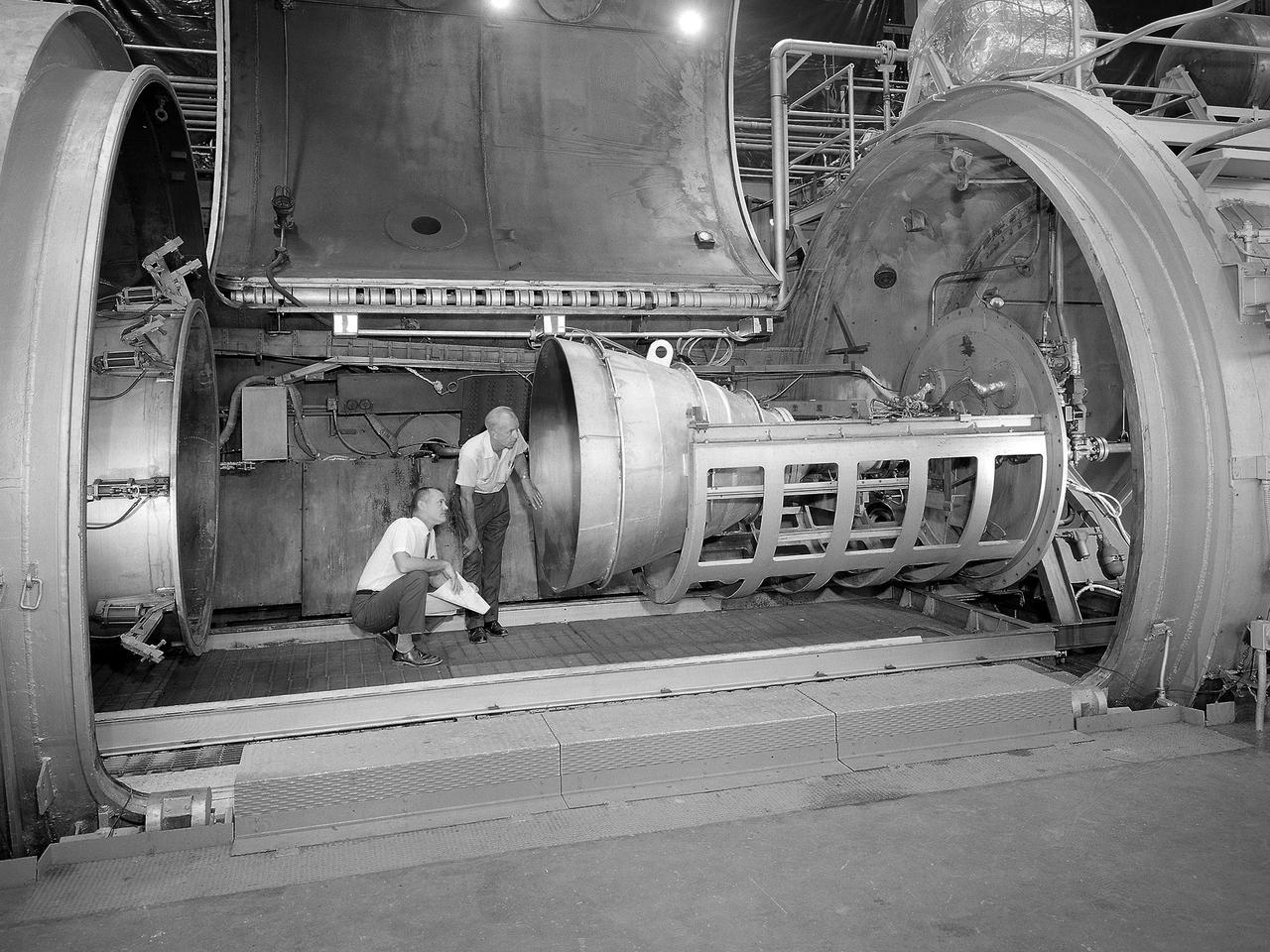
Bill Harrison and Bud Meilander check the setup of an Apollo Contour rocket nozzle in the Propulsion Systems Laboratory at the National Aeronautics and Space Administration (NASA) Lewis Research Center. The Propulsion Systems Laboratory contained two 14-foot diameter test chambers that could simulate conditions found at very high altitudes. The facility was used in the 1960s to study complex rocket engines such as the Pratt and Whitney RL-10 and rocket components such as the Apollo Contour nozzle, seen here. Meilander oversaw the facility’s mechanics and the installation of test articles into the chambers. Harrison was head of the Supersonic Tunnels Branch in the Test Installations Division. Researchers sought to determine the impulse value of the storable propellant mix, classify and improve the internal engine performance, and compare the results with analytical tools. A special setup was installed in the chamber that included a device to measure the thrust load and a calibration stand. Both cylindrical and conical combustion chambers were examined with the conical large area ratio nozzles. In addition, two contour nozzles were tested, one based on the Apollo Service Propulsion System and the other on the Air Force’s Titan transtage engine. Three types of injectors were investigated, including a Lewis-designed model that produced 98-percent efficiency. It was determined that combustion instability did not affect the nozzle performance. Although much valuable information was obtained during the tests, attempts to improve the engine performance were not successful.
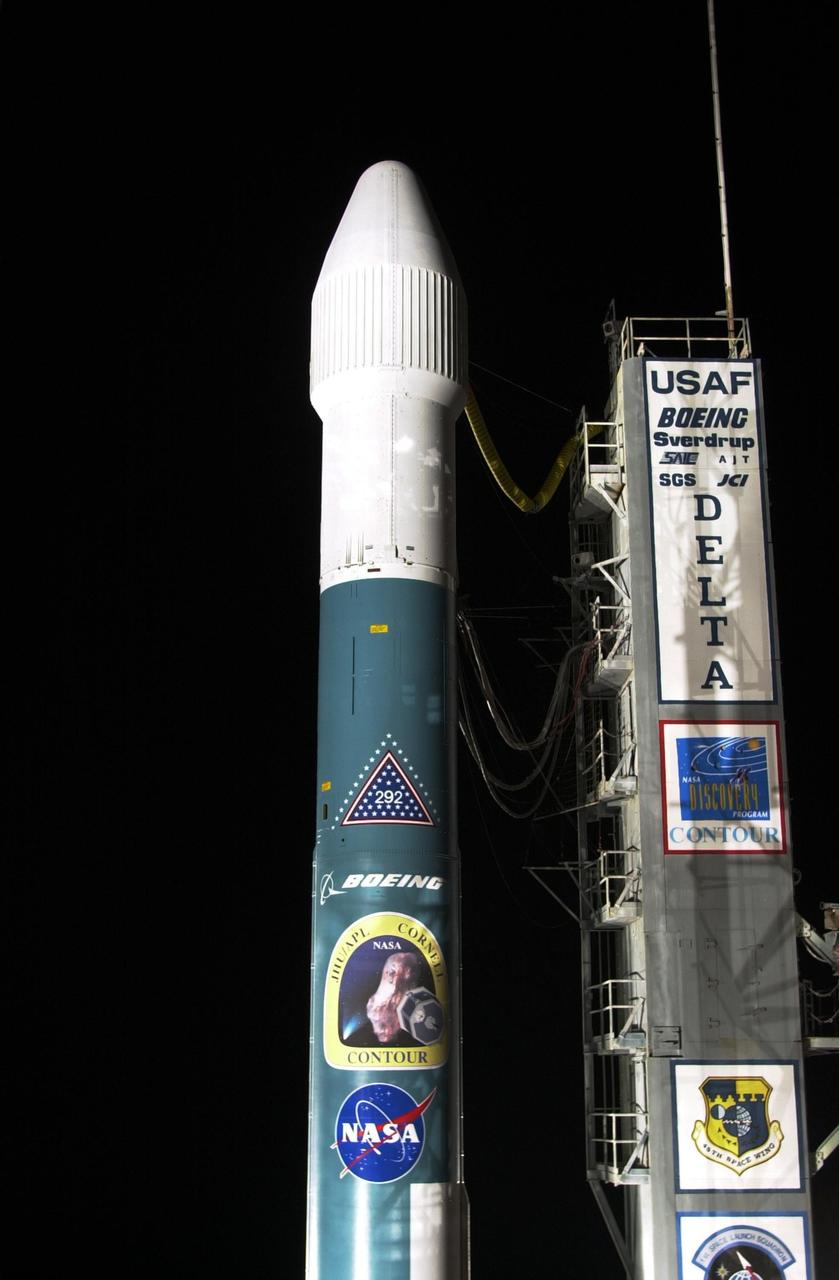
KENNEDY SPACE CENTER, FLA. -- After tower rollback, the Boeing Delta II rocket with NASA's Comet Nucleus Tour (CONTOUR) spacecraft attached is visible. The rocket exhibits several logos, including that of CONTOUR, Boeing and NASA. The launch is scheduled for 2:47 a.m. EDT July 3. Designed and built by The Johns Hopkins University Applied Physics Laboratory (APL) in Laurel, Md., the 2,138-pound (970-kilogram) spacecraft will be placed into an elliptical Earth orbit until Aug. 15, when it is scheduled to fire its main engine and enter a comet-chasing orbit around the sun. The mission's flexible four-year plan includes encounters with comets Encke (Nov. 12, 2003) and Schwassmann-Wachmann 3 (June 19, 2006), though it can add an encounter with a "new" and scientifically valuable comet from the outer solar system, should one be discovered in time for CONTOUR to fly past it. CONTOUR's four scientific instruments will take detailed pictures and measure the chemical makeup of each comet's nucleus -- a chunk of ice and rock -- while analyzing the surrounding gas and dust.
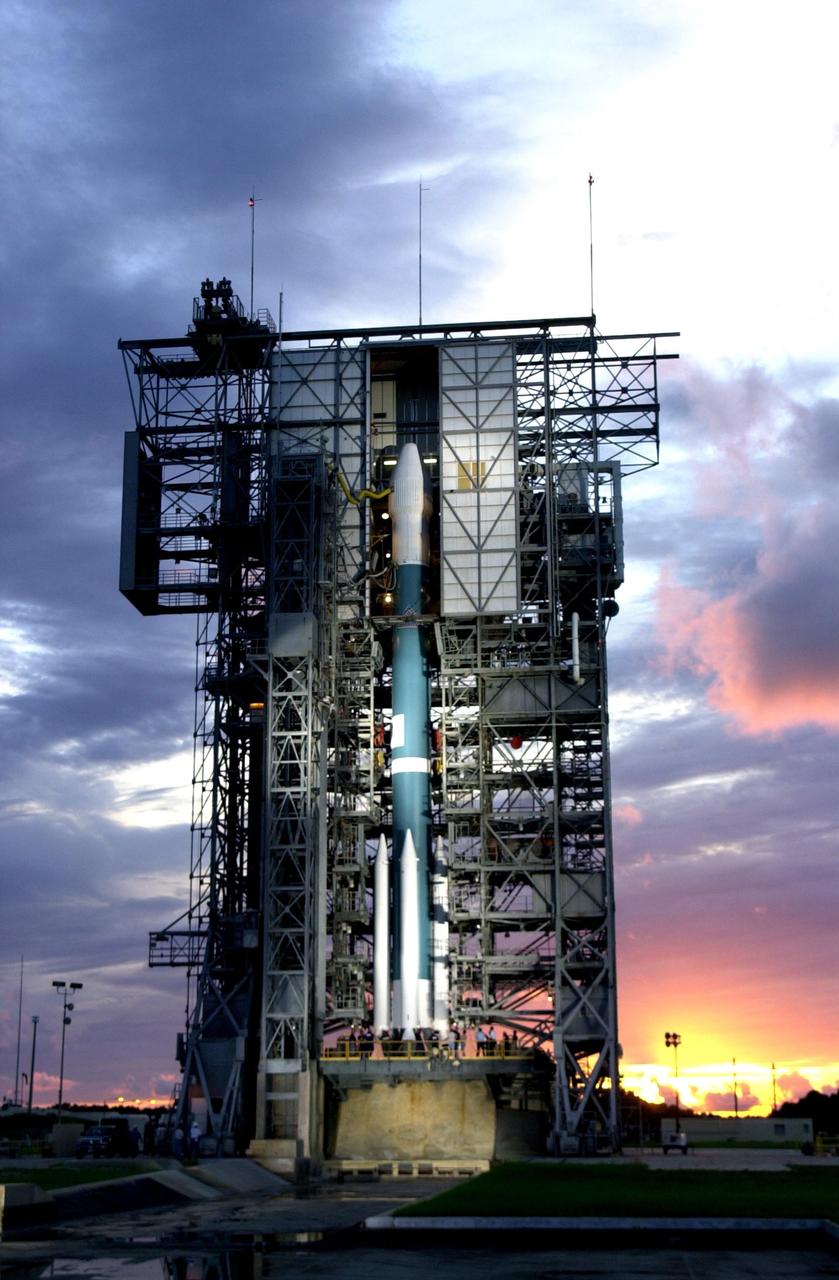
KENNEDY SPACE CENTER, FLA. -- The setting sun casts purple and pink shades in the sky as the launch tower on pad 17-A, Cape Canaveral Air Force Station, rolls back to reveal the Boeing Delta II rocket with NASA's Comet Nucleus Tour (CONTOUR) spacecraft attached. The launch is scheduled for 2:47 a.m. EDT July 3. Designed and built by The Johns Hopkins University Applied Physics Laboratory (APL) in Laurel, Md., the 2,138-pound (970-kilogram) spacecraft will be placed into an elliptical Earth orbit until Aug. 15, when it is scheduled to fire its main engine and enter a comet-chasing orbit around the sun. The mission's flexible four-year plan includes encounters with comets Encke (Nov. 12, 2003) and Schwassmann-Wachmann 3 (June 19, 2006), though it can add an encounter with a "new" and scientifically valuable comet from the outer solar system, should one be discovered in time for CONTOUR to fly past it. CONTOUR's four scientific instruments will take detailed pictures and measure the chemical makeup of each comet's nucleus -- a chunk of ice and rock -- while analyzing the surrounding gas and dust.
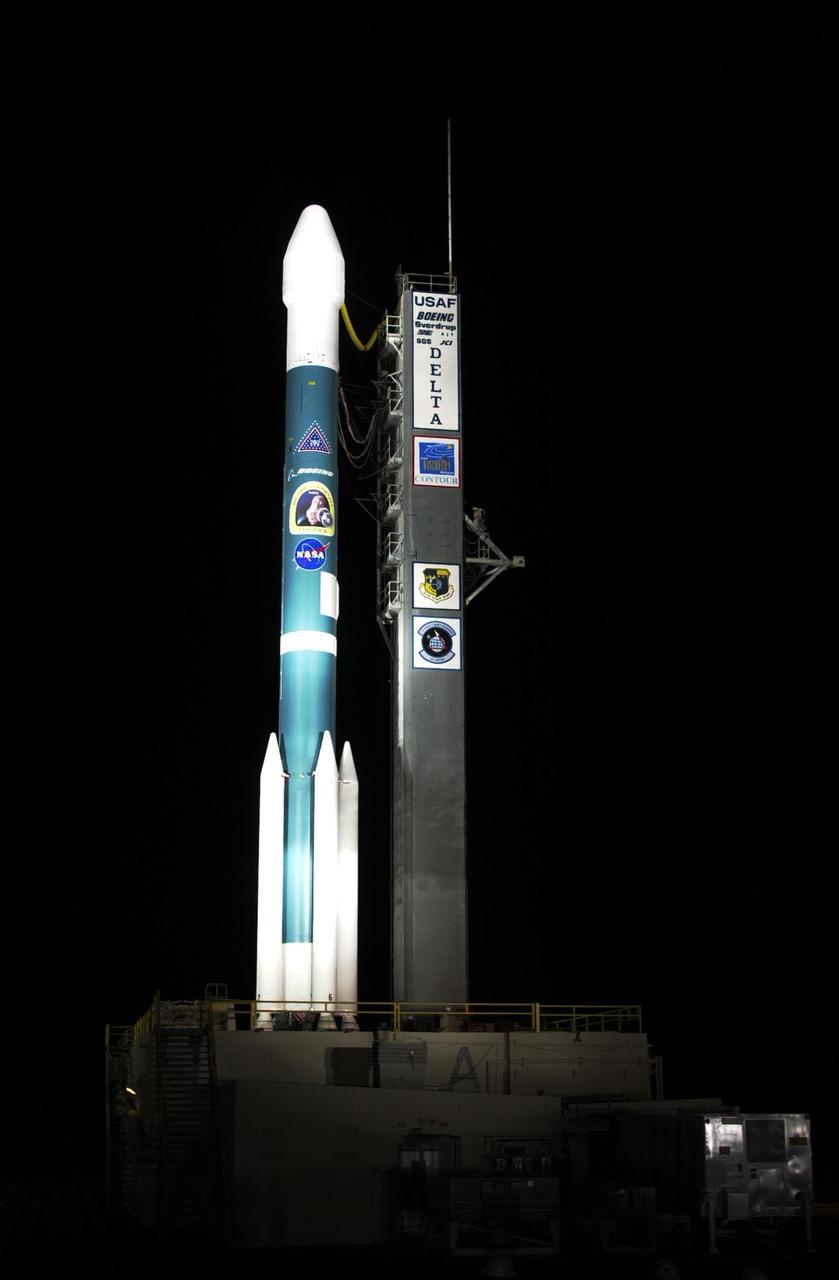
KENNEDY SPACE CENTER, FLA. -- The Boeing Delta II rocket with NASA's Comet Nucleus Tour (CONTOUR) spacecraft attached is bathed in light as it sits on pad 17-A, Cape Canaveral Air Force Station. The launch is scheduled for 2:47 a.m. EDT July 3. Designed and built by The Johns Hopkins University Applied Physics Laboratory (APL) in Laurel, Md., the 2,138-pound (970-kilogram) spacecraft will be placed into an elliptical Earth orbit until Aug. 15, when it is scheduled to fire its main engine and enter a comet-chasing orbit around the sun. The mission's flexible four-year plan includes encounters with comets Encke (Nov. 12, 2003) and Schwassmann-Wachmann 3 (June 19, 2006), though it can add an encounter with a "new" and scientifically valuable comet from the outer solar system, should one be discovered in time for CONTOUR to fly past it. CONTOUR's four scientific instruments will take detailed pictures and measure the chemical makeup of each comet's nucleus -- a chunk of ice and rock -- while analyzing the surrounding gas and dust.
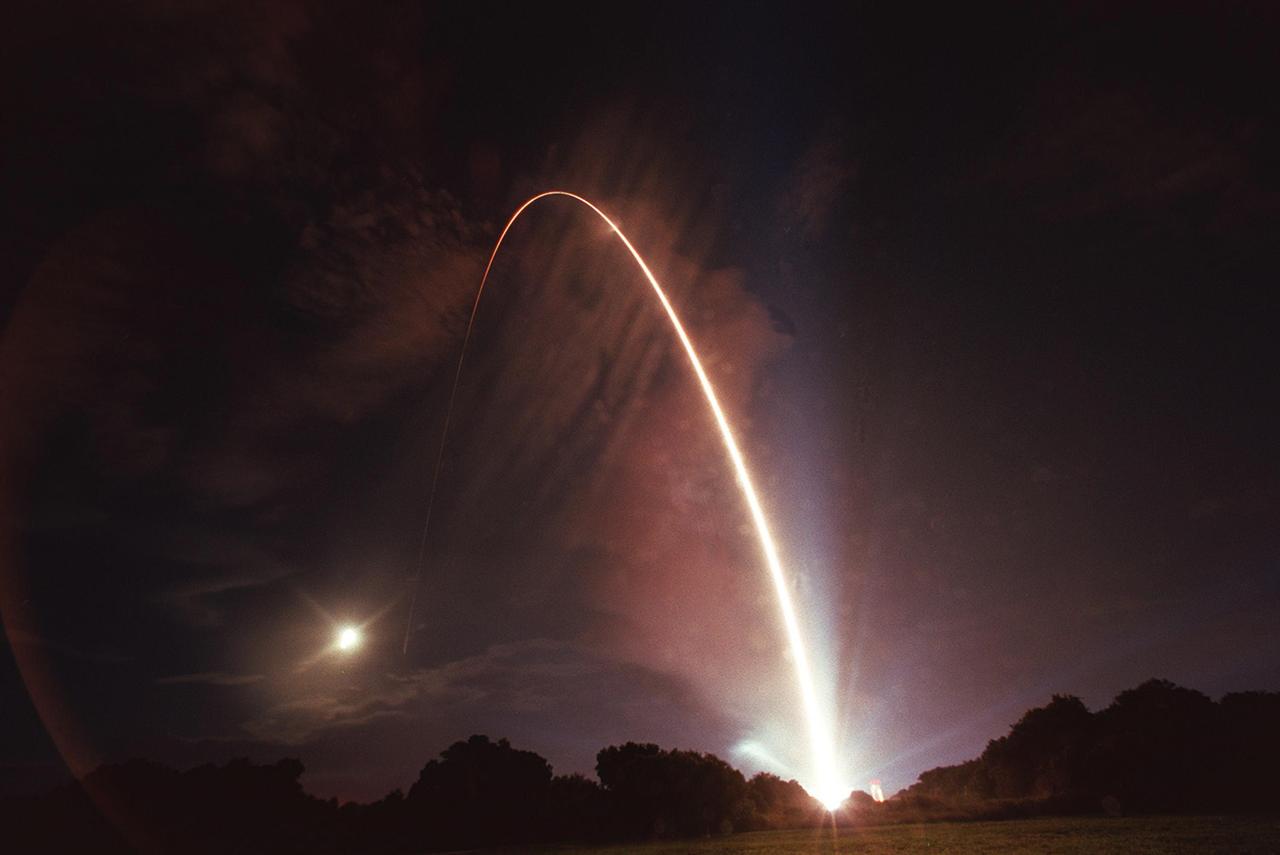
KENNEDY SPACE CENTER, FLA. -- The Boeing Delta II rocket carrying NASA's Comet Nucleus Tour (CONTOUR) spacecraft streaks across the night sky above pad 17-A, Cape Canaveral Air Force Station. The launch took place at 2:47:41 a.m. EDT July 3. Designed and built by The Johns Hopkins University Applied Physics Laboratory (APL) in Laurel, Md., the 2,138-pound (970-kilogram) spacecraft will be placed into an elliptical Earth orbit until Aug. 15, when it is scheduled to fire its main engine and enter a comet-chasing orbit around the sun. The mission's flexible four-year plan includes encounters with comets Encke (Nov. 12, 2003) and Schwassmann-Wachmann 3 (June 19, 2006), though it can add an encounter with a "new" and scientifically valuable comet from the outer solar system, should one be discovered in time for CONTOUR to fly past it. CONTOUR's four scientific instruments will take detailed pictures and measure the chemical makeup of each comet's nucleus -- a chunk of ice and rock -- while analyzing the surrounding gas and dust.
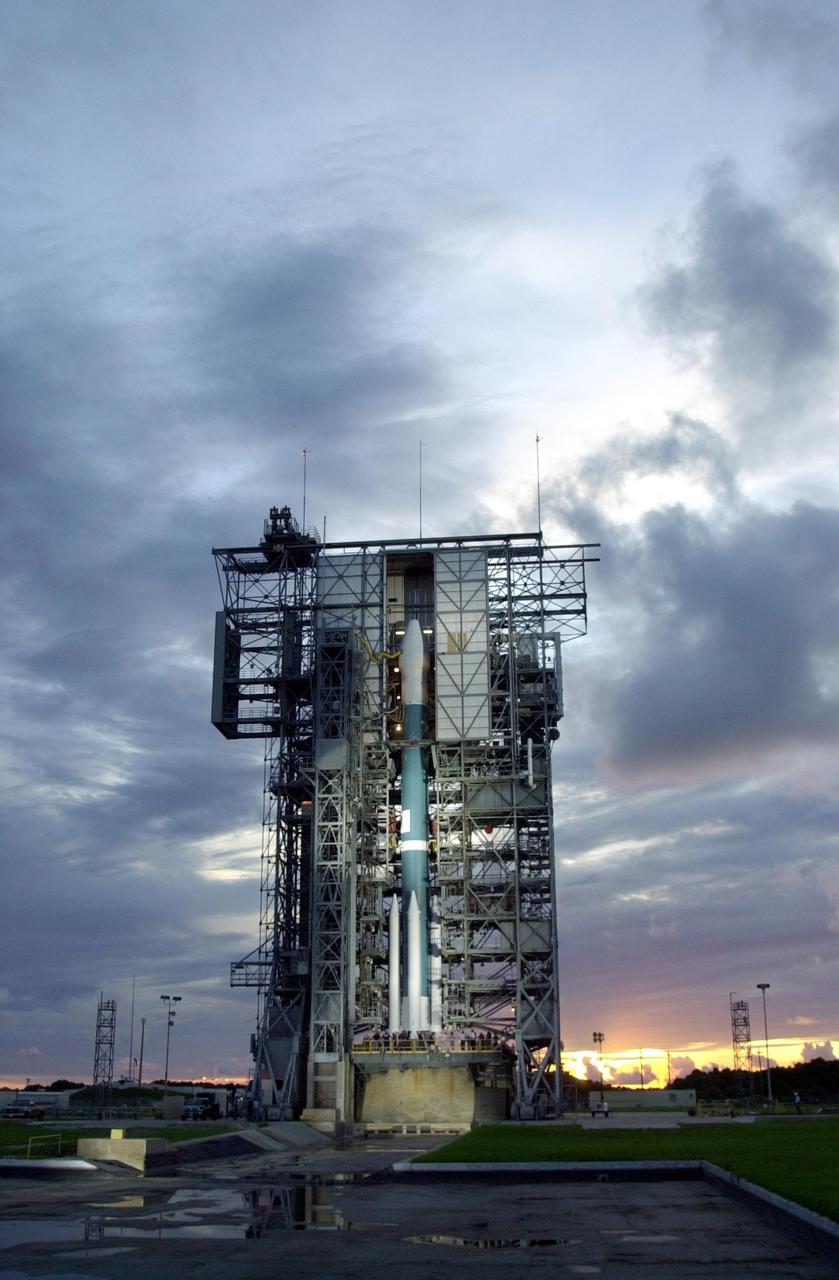
KENNEDY SPACE CENTER, FLA. -- The Boeing Delta II rocket with NASA's Comet Nucleus Tour (CONTOUR) spacecraft attached is visible as the launch tower is rolled back. The launch is scheduled for 2:47 a.m. EDT July 3 from Cape Canaveral Air Force Station, Fla. Designed and built by The Johns Hopkins University Applied Physics Laboratory (APL) in Laurel, Md., the 2,138-pound (970-kilogram) spacecraft will be placed into an elliptical Earth orbit until Aug. 15, when it is scheduled to fire its main engine and enter a comet-chasing orbit around the sun. The mission's flexible four-year plan includes encounters with comets Encke (Nov. 12, 2003) and Schwassmann-Wachmann 3 (June 19, 2006), though it can add an encounter with a "new" and scientifically valuable comet from the outer solar system, should one be discovered in time for CONTOUR to fly past it. CONTOUR's four scientific instruments will take detailed pictures and measure the chemical makeup of each comet's nucleus -- a chunk of ice and rock -- while analyzing the surrounding gas and dust.

KENNEDY SPACE CENTER, FLA. - Sunset-shaded clouds of purple and pink fill the sky as the launch tower on pad 17-A, Cape Canaveral Air Force Station, rolls back to reveal the Boeing Delta II rocket with NASA's Comet Nucleus Tour (CONTOUR) spacecraft attached. The launch is scheduled for 2:47 a.m. EDT July 3. Designed and built by The Johns Hopkins University Applied Physics Laboratory (APL) in Laurel, Md., the 2,138-pound (970-kilogram) spacecraft will be placed into an elliptical Earth orbit until Aug. 15, when it is scheduled to fire its main engine and enter a comet-chasing orbit around the sun. The mission's flexible four-year plan includes encounters with comets Encke (Nov. 12, 2003) and Schwassmann-Wachmann 3 (June 19, 2006), though it can add an encounter with a "new" and scientifically valuable comet from the outer solar system, should one be discovered in time for CONTOUR to fly past it. CONTOUR's four scientific instruments will take detailed pictures and measure the chemical makeup of each comet's nucleus -- a chunk of ice and rock -- while analyzing the surrounding gas and dust.
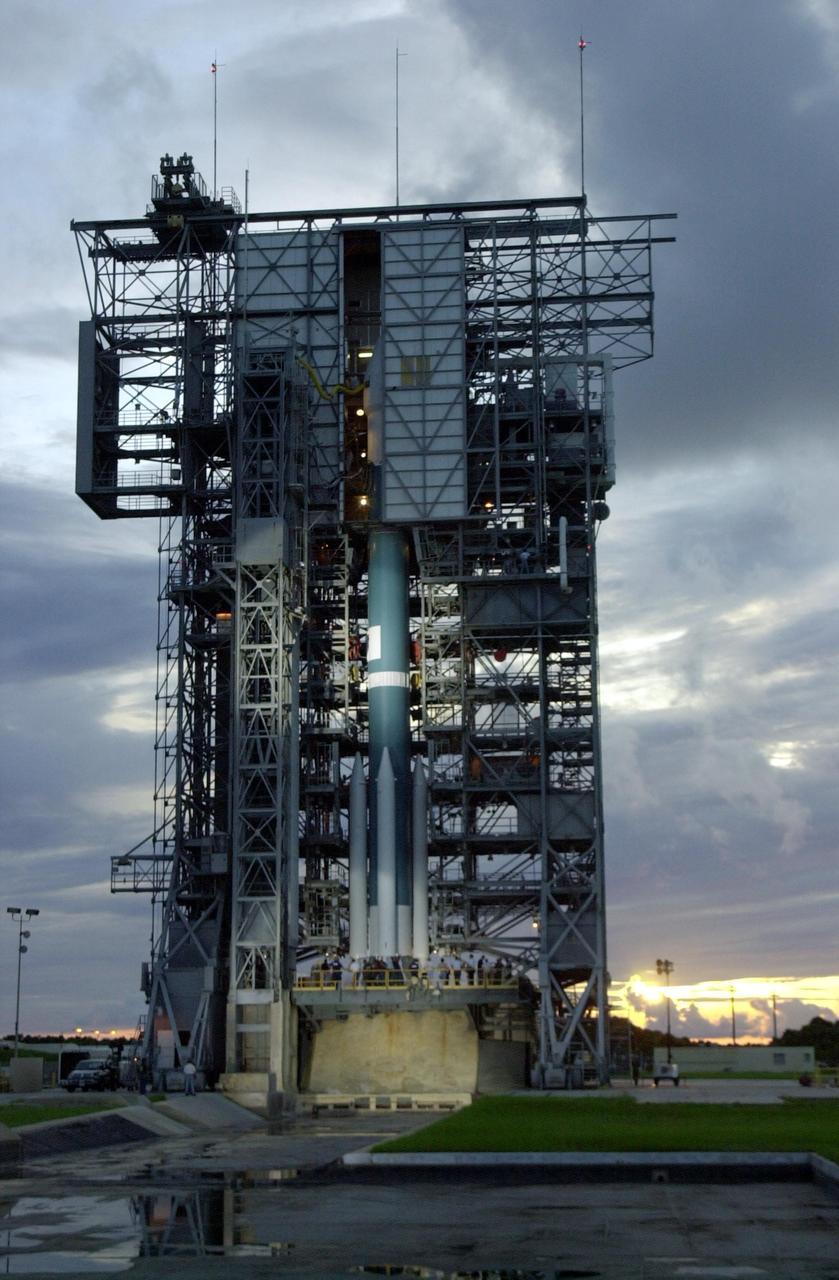
KENNEDY SPACE CENTER, FLA. - The Boeing Delta II rocket with NASA's Comet Nucleus Tour (CONTOUR) spacecraft attached is becoming visible as the launch tower is prepared for rollback. The launch is scheduled for 2:47 a.m. EDT July 3 from Cape Canaveral Air Force Station, Fla. Designed and built by The Johns Hopkins University Applied Physics Laboratory (APL) in Laurel, Md., the 2,138-pound (970-kilogram) spacecraft will be placed into an elliptical Earth orbit until Aug. 15, when it is scheduled to fire its main engine and enter a comet-chasing orbit around the sun. The mission's flexible four-year plan includes encounters with comets Encke (Nov. 12, 2003) and Schwassmann-Wachmann 3 (June 19, 2006), though it can add an encounter with a "new" and scientifically valuable comet from the outer solar system, should one be discovered in time for CONTOUR to fly past it. CONTOUR's four scientific instruments will take detailed pictures and measure the chemical makeup of each comet's nucleus -- a chunk of ice and rock -- while analyzing the surrounding gas and dust.
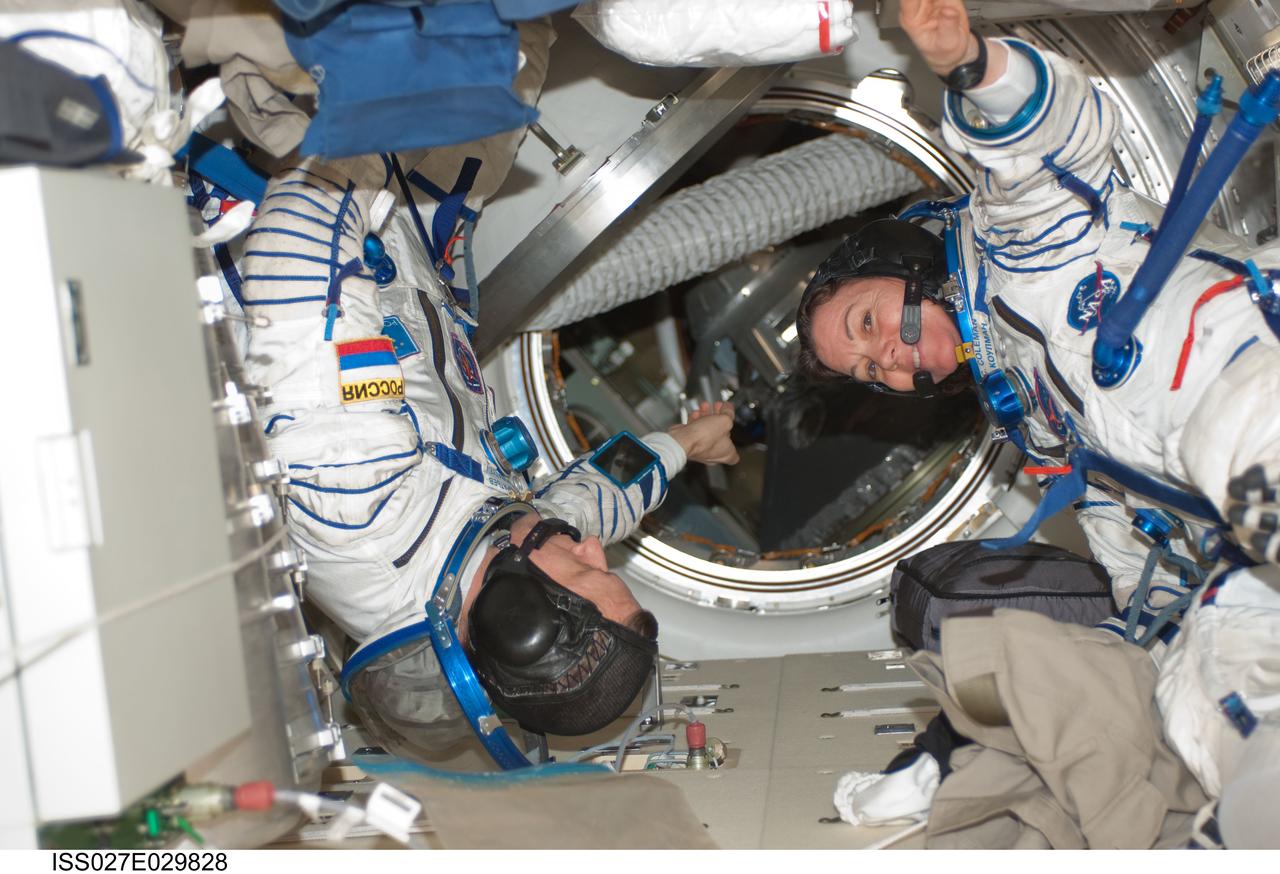
ISS027-E-029828 (13 May 2011) --- Attired in their Russian Sokol launch and entry suits, Russian cosmonaut Dmitry Kondratyev, Expedition 27 commander; and NASA astronaut Cady Coleman, flight engineer, prepare to perform a fit check in their body-contoured Kazbek couches in the Soyuz TMA-20 spacecraft docked to the International Space Station. Kondratyev, Coleman and European Space Agency astronaut Paolo Nespoli (out of frame) are scheduled to return to Earth on May 23.
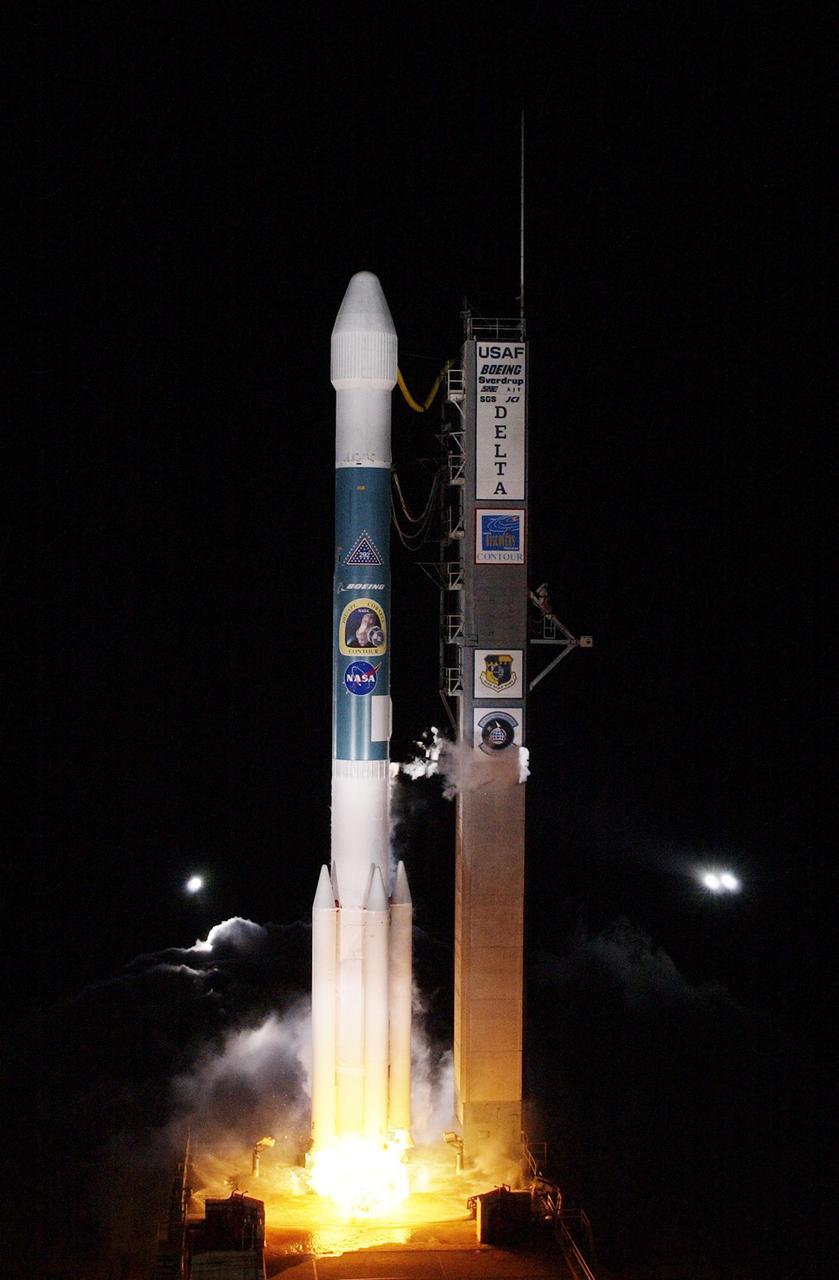
KENNEDY SPACE CENTER, FLA. -- NASA's Comet Nucleus Tour (CONTOUR) spacecraft successfully launches at 2:47 a.m. EDT aboard a Boeing Delta II rocket from Cape Canaveral Air Force Station, Fla. Designed and built by The Johns Hopkins University Applied Physics Laboratory (APL) in Laurel, Md., the 2,138-pound (970-kilogram) spacecraft was placed into an elliptical Earth orbit 63 minutes after launch. About 19 minutes later the mission operations team at APL acquired a signal from the spacecraft through the Deep Space Network antenna station in Goldstone, Calif., and by 5:45 a.m. EDT Mission Director Dr. Robert W. Farquhar of the Applied Physics Lab confirmed the craft was operating normally and ready to carry out its early orbit maneuvers. CONTOUR will orbit Earth until Aug. 15, when it is scheduled to fire its main engine and enter a comet-chasing orbit around the sun. The mission's flexible four-year plan includes encounters with comets Encke (Nov. 12, 2003) and Schwassmann-Wachmann 3 (June 19, 2006), though it can add an encounter with a "new" and scientifically valuable comet from the outer solar system, should one be discovered in time for CONTOUR to fly past it. CONTOUR's four scientific instruments will take detailed pictures and measure the chemical makeup of each comet's nucleus -- a chunk of ice and rock -- while analyzing the surrounding gas and dust.
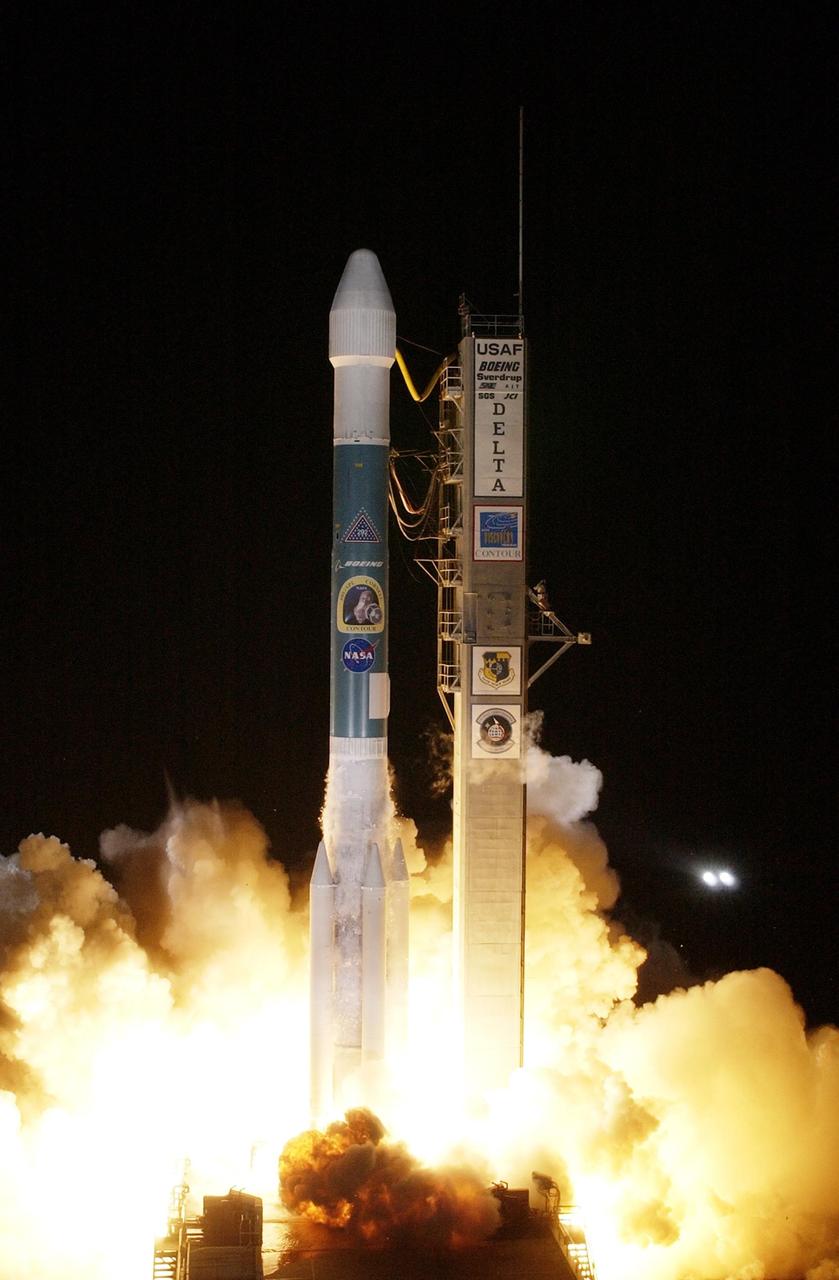
KENNEDY SPACE CENTER, FLA. -- NASA's Comet Nucleus Tour (CONTOUR) spacecraft successfully launches at 2:47 a.m. EDT aboard a Boeing Delta II rocket from Cape Canaveral Air Force Station, Fla. Designed and built by The Johns Hopkins University Applied Physics Laboratory (APL) in Laurel, Md., the 2,138-pound (970-kilogram) spacecraft was placed into an elliptical Earth orbit 63 minutes after launch. About 19 minutes later the mission operations team at APL acquired a signal from the spacecraft through the Deep Space Network antenna station in Goldstone, Calif., and by 5:45 a.m. EDT Mission Director Dr. Robert W. Farquhar of the Applied Physics Lab confirmed the craft was operating normally and ready to carry out its early orbit maneuvers. CONTOUR will orbit Earth until Aug. 15, when it is scheduled to fire its main engine and enter a comet-chasing orbit around the sun. The mission's flexible four-year plan includes encounters with comets Encke (Nov. 12, 2003) and Schwassmann-Wachmann 3 (June 19, 2006), though it can add an encounter with a "new" and scientifically valuable comet from the outer solar system, should one be discovered in time for CONTOUR to fly past it. CONTOUR's four scientific instruments will take detailed pictures and measure the chemical makeup of each comet's nucleus -- a chunk of ice and rock -- while analyzing the surrounding gas and dust.
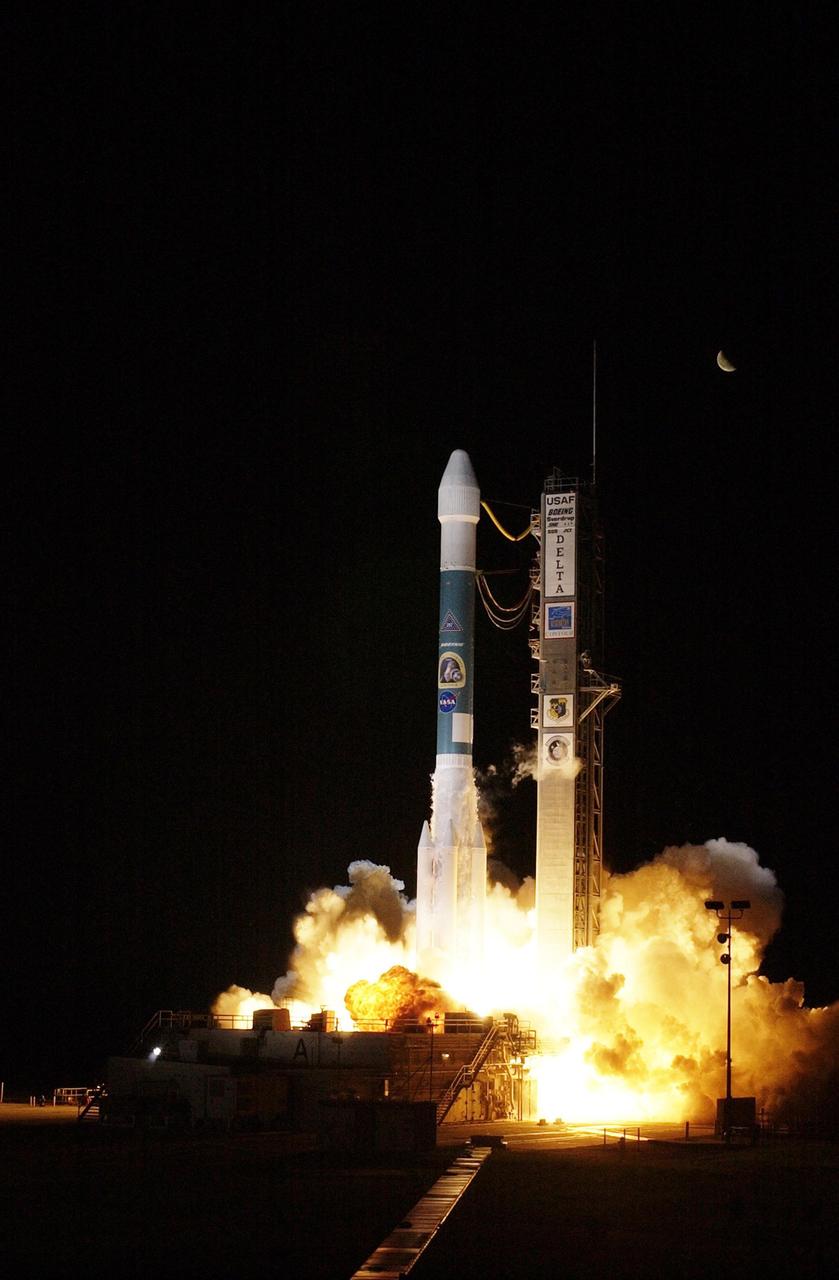
KENNEDY SPACE CENTER, FLA. - A third-quarter moon is the only visible element in the sky as NASA's Comet Nucleus Tour (CONTOUR) spacecraft successfully launches at 2:47 a.m. EDT aboard a Boeing Delta II rocket from Cape Canaveral Air Force Station, Fla. Designed and built by The Johns Hopkins University Applied Physics Laboratory (APL) in Laurel, Md., the 2,138-pound (970-kilogram) spacecraft was placed into an elliptical Earth orbit 63 minutes after launch. About 19 minutes later the mission operations team at APL acquired a signal from the spacecraft through the Deep Space Network antenna station in Goldstone, Calif., and by 5:45 a.m. EDT Mission Director Dr. Robert W. Farquhar of the Applied Physics Lab confirmed the craft was operating normally and ready to carry out its early orbit maneuvers. CONTOUR will orbit Earth until Aug. 15, when it is scheduled to fire its main engine and enter a comet-chasing orbit around the sun. The mission's flexible four-year plan includes encounters with comets Encke (Nov. 12, 2003) and Schwassmann-Wachmann 3 (June 19, 2006), though it can add an encounter with a "new" and scientifically valuable comet from the outer solar system, should one be discovered in time for CONTOUR to fly past it. CONTOUR's four scientific instruments will take detailed pictures and measure the chemical makeup of each comet's nucleus -- a chunk of ice and rock -- while analyzing the surrounding gas and dust.
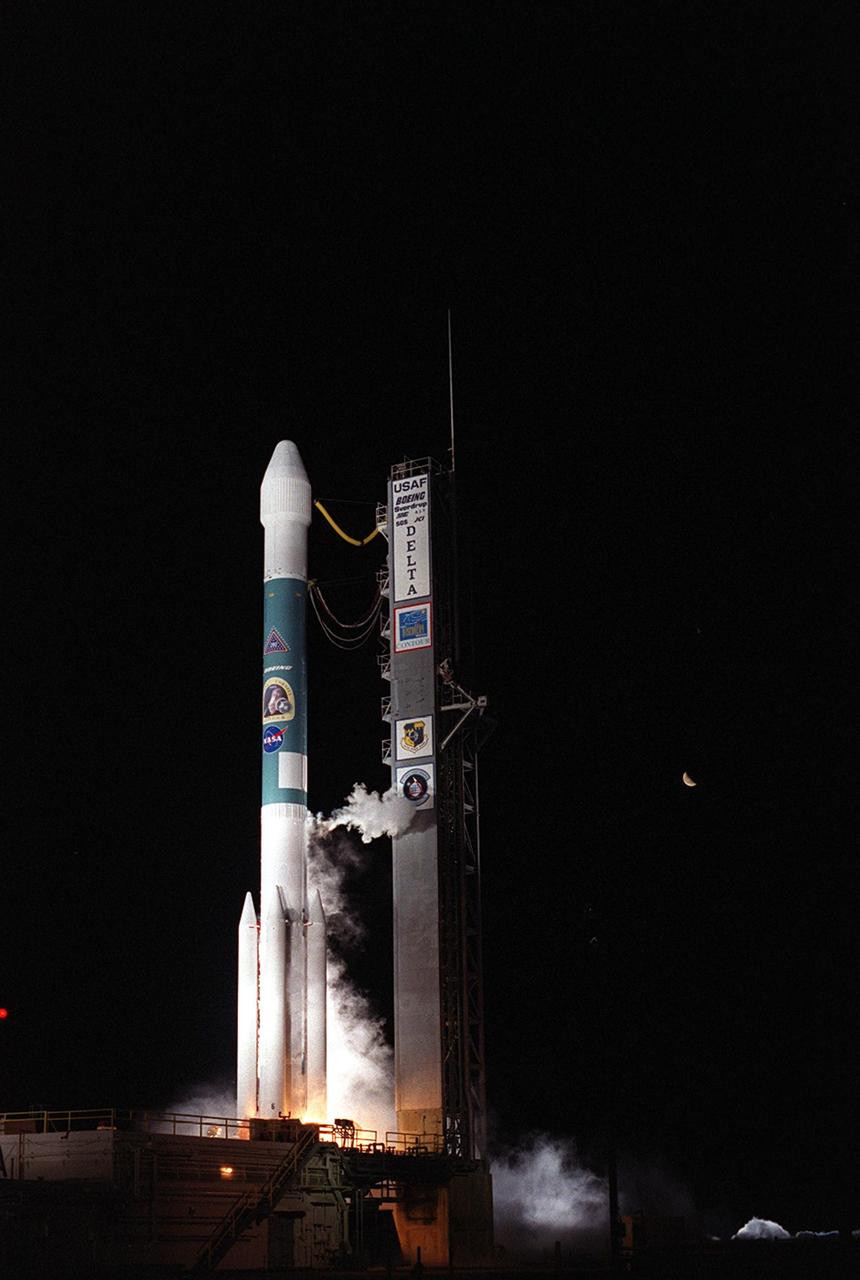
KENNEDY SPACE CENTER, FLA. -- NASA's Comet Nucleus Tour (CONTOUR) spacecraft successfully launches at 2:47:41 a.m. EDT aboard a Boeing Delta II rocket from Cape Canaveral Air Force Station, Fla. Designed and built by The Johns Hopkins University Applied Physics Laboratory (APL) in Laurel, Md., the 2,138-pound (970-kilogram) spacecraft was placed into an elliptical Earth orbit 63 minutes after launch. About 19 minutes later the mission operations team at APL acquired a signal from the spacecraft through the Deep Space Network antenna station in Goldstone, Calif., and by 5:45 a.m. EDT Mission Director Dr. Robert W. Farquhar of the Applied Physics Lab confirmed the craft was operating normally and ready to carry out its early orbit maneuvers. CONTOUR will orbit Earth until Aug. 15, when it is scheduled to fire its main engine and enter a comet-chasing orbit around the sun. The mission's flexible four-year plan includes encounters with comets Encke (Nov. 12, 2003) and Schwassmann-Wachmann 3 (June 19, 2006), though it can add an encounter with a "new" and scientifically valuable comet from the outer solar system, should one be discovered in time for CONTOUR to fly past it. CONTOUR's four scientific instruments will take detailed pictures and measure the chemical makeup of each comet's nucleus -- a chunk of ice and rock -- while analyzing the surrounding gas and dust.
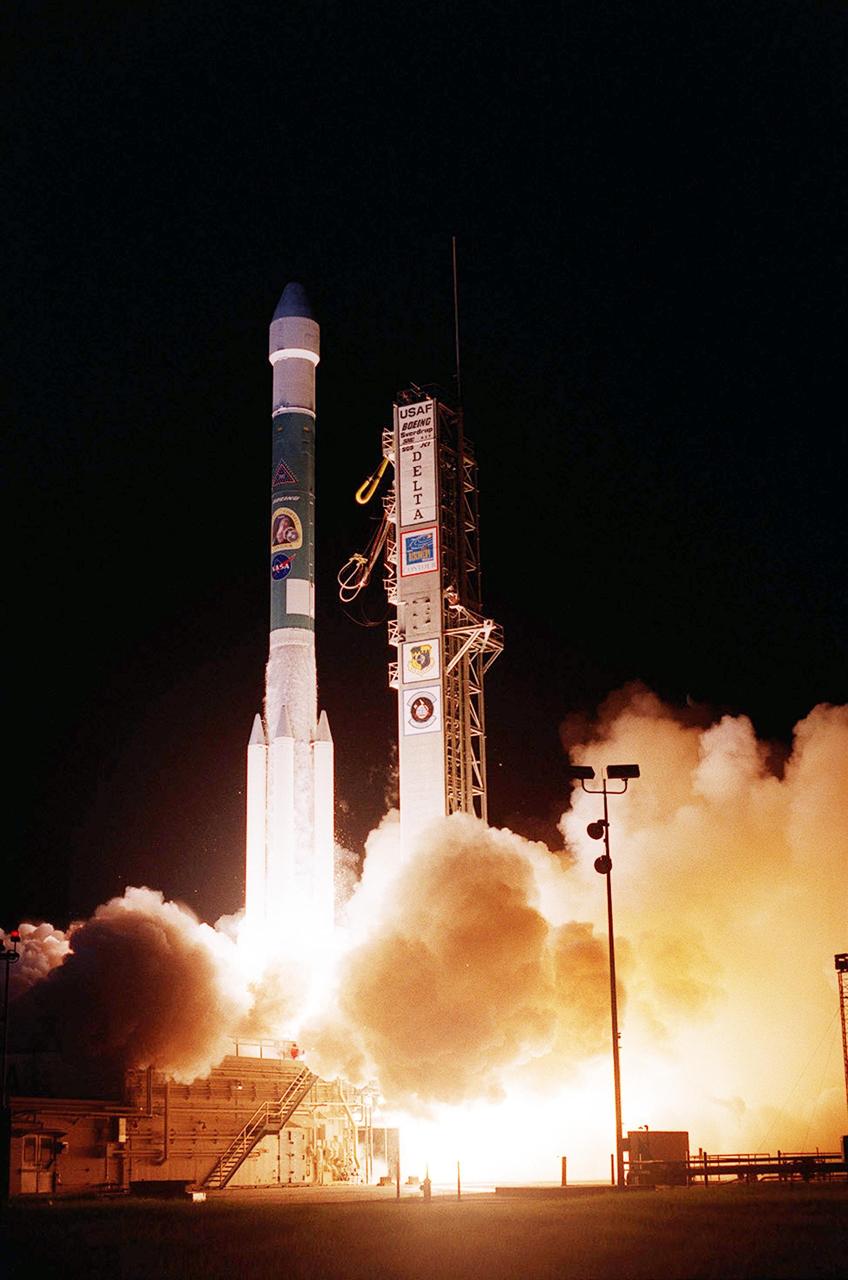
KENNEDY SPACE CENTER, FLA. -- NASA's Comet Nucleus Tour (CONTOUR) spacecraft successfully launches at 2:47:41 a.m. EDT aboard a Boeing Delta II rocket from Cape Canaveral Air Force Station, Fla. Designed and built by The Johns Hopkins University Applied Physics Laboratory (APL) in Laurel, Md., the 2,138-pound (970-kilogram) spacecraft was placed into an elliptical Earth orbit 63 minutes after launch. About 19 minutes later the mission operations team at APL acquired a signal from the spacecraft through the Deep Space Network antenna station in Goldstone, Calif., and by 5:45 a.m. EDT Mission Director Dr. Robert W. Farquhar of the Applied Physics Lab confirmed the craft was operating normally and ready to carry out its early orbit maneuvers. CONTOUR will orbit Earth until Aug. 15, when it is scheduled to fire its main engine and enter a comet-chasing orbit around the sun. The mission's flexible four-year plan includes encounters with comets Encke (Nov. 12, 2003) and Schwassmann-Wachmann 3 (June 19, 2006), though it can add an encounter with a "new" and scientifically valuable comet from the outer solar system, should one be discovered in time for CONTOUR to fly past it. CONTOUR's four scientific instruments will take detailed pictures and measure the chemical makeup of each comet's nucleus -- a chunk of ice and rock -- while analyzing the surrounding gas and dust.
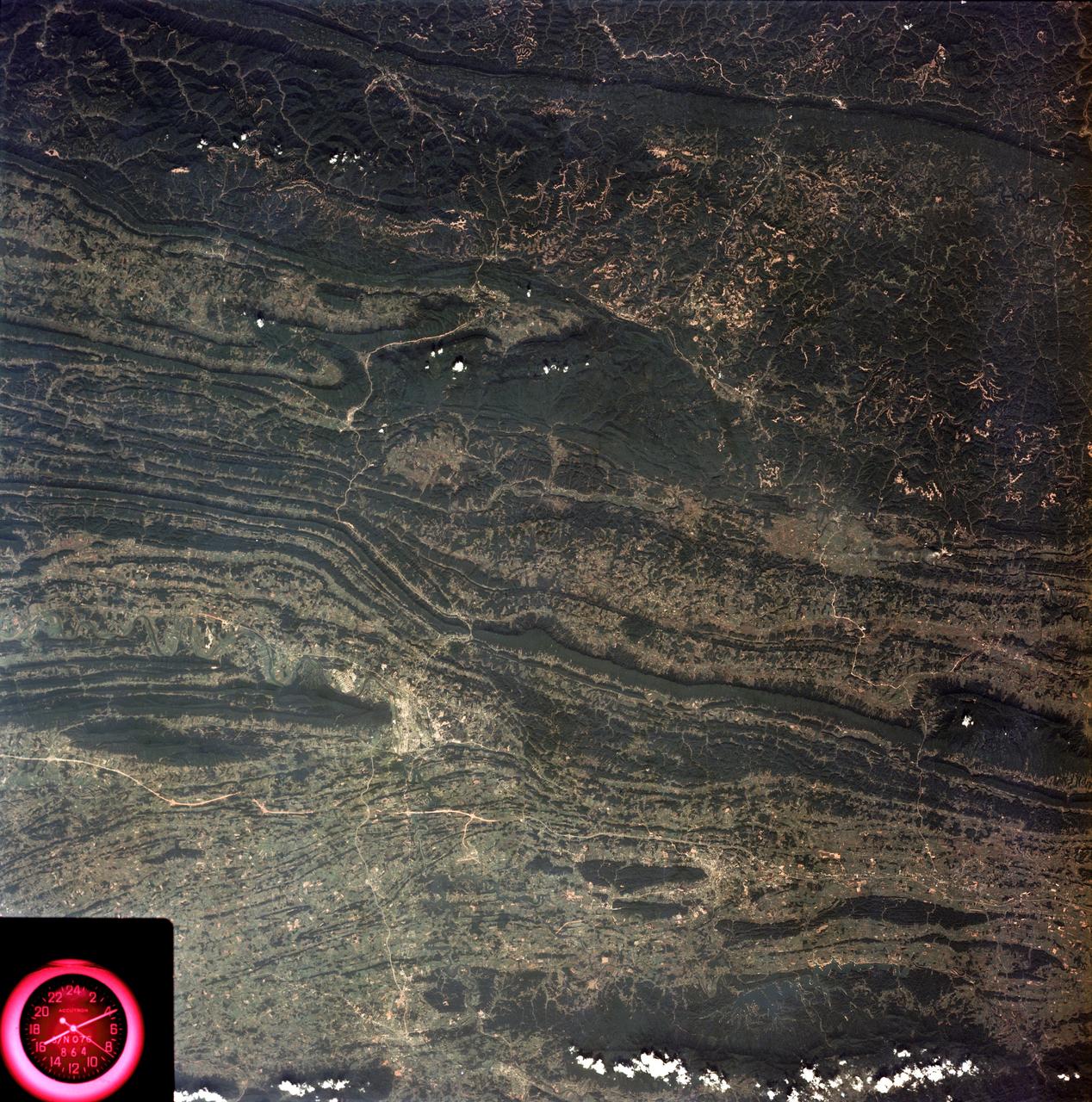
SL3-88-053 (July-September 1973) --- A near vertical view of the Tennessee-Virginia-Kentucky border area is seen in this Skylab 3 Earth Resources Experiments Package S190-B (five-inch Earth terrain camera) photograph taken from the Skylab space station in Earth orbit. The clock is in the most southerly corner of the picture. Interstate 81 under construction extends northeast-southwest across the bottom portion of the photograph. The larger urban area nearest the center of the picture is Kingsport, Tennessee. On the southern side of I-80 and east of Kingsport is the city of Bristol, Tennessee-Virginia. Johnson City, Tennessee is the urban area near the edge of the picture southeast of Kingsport. The Holston River, a tributary of the Tennessee River, meanders through the Kingsport area. The characteristic ridge and valley features in the Cumberland Plateau of Kentucky, Tennessee and Virginia are clearly visible. Forests (dark green) occur on the ridges and clearly outline the folded and faulted rock formations. The valleys (light) were formed in the softer rocks as a result of erosion. Agricultural areas are indicated by the characteristic rectangular patterns. Coal production is an important industry of this area; and it is mined by surface open pit operations. The irregular light areas in the Kentucky-Virginia border area are the strip mines which follow the contour of the land. Reclamation of the strip mine areas is aided through accurate knowledge of the mine and drainage systems. Dr. Ronald Brooks of the Wolf Research and Development Corporation can use this photograph in study of strip mine areas in the east central U.S. Federal agencies participating with NASA on the EREP project are the Departments of Agriculture, Commerce, Interior, the Environmental Protection Agency and the Corps of Engineers. All EREP photography is available to the public through the Department of Interior’s Earth Resources Observations Systems Data Center, Sioux Falls, South Dakota, 57198. Photo credit: NASA