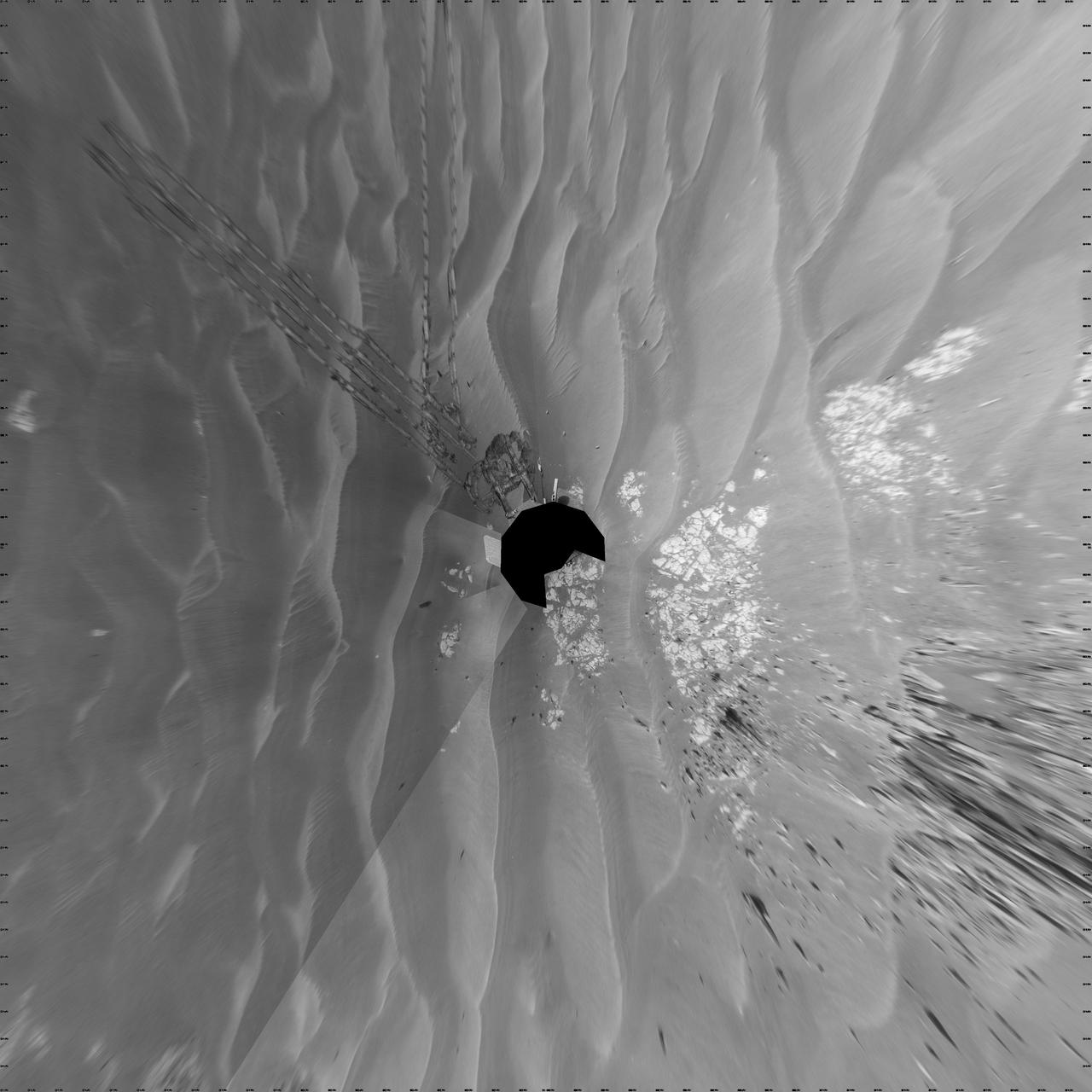
Opportunity at Cook Islands Vertical
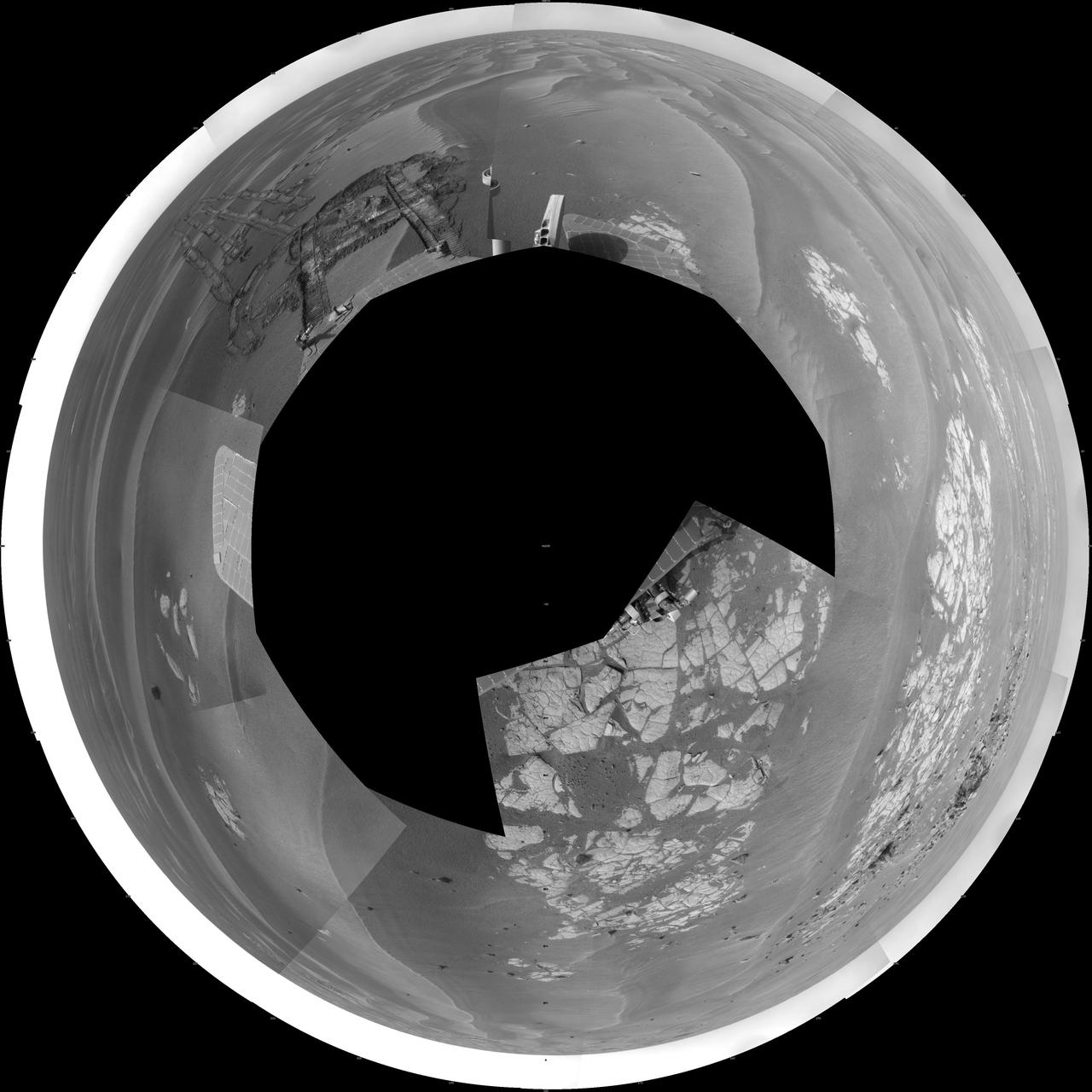
Opportunity at Cook Islands Polar
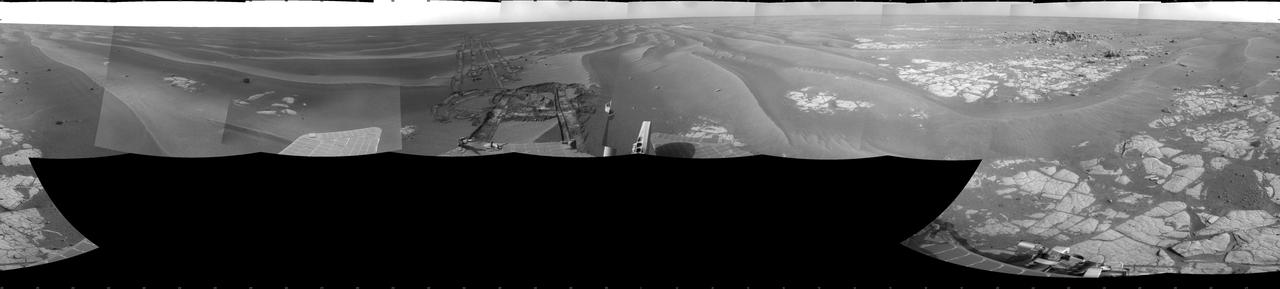
Opportunity at Cook Islands
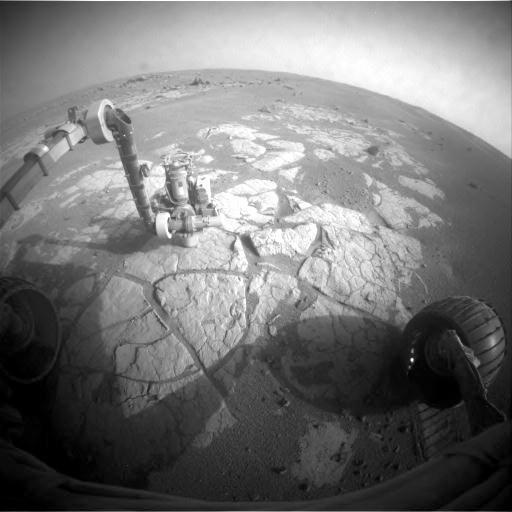
Opportunity Examining Composition of Cook Islands Outcrop
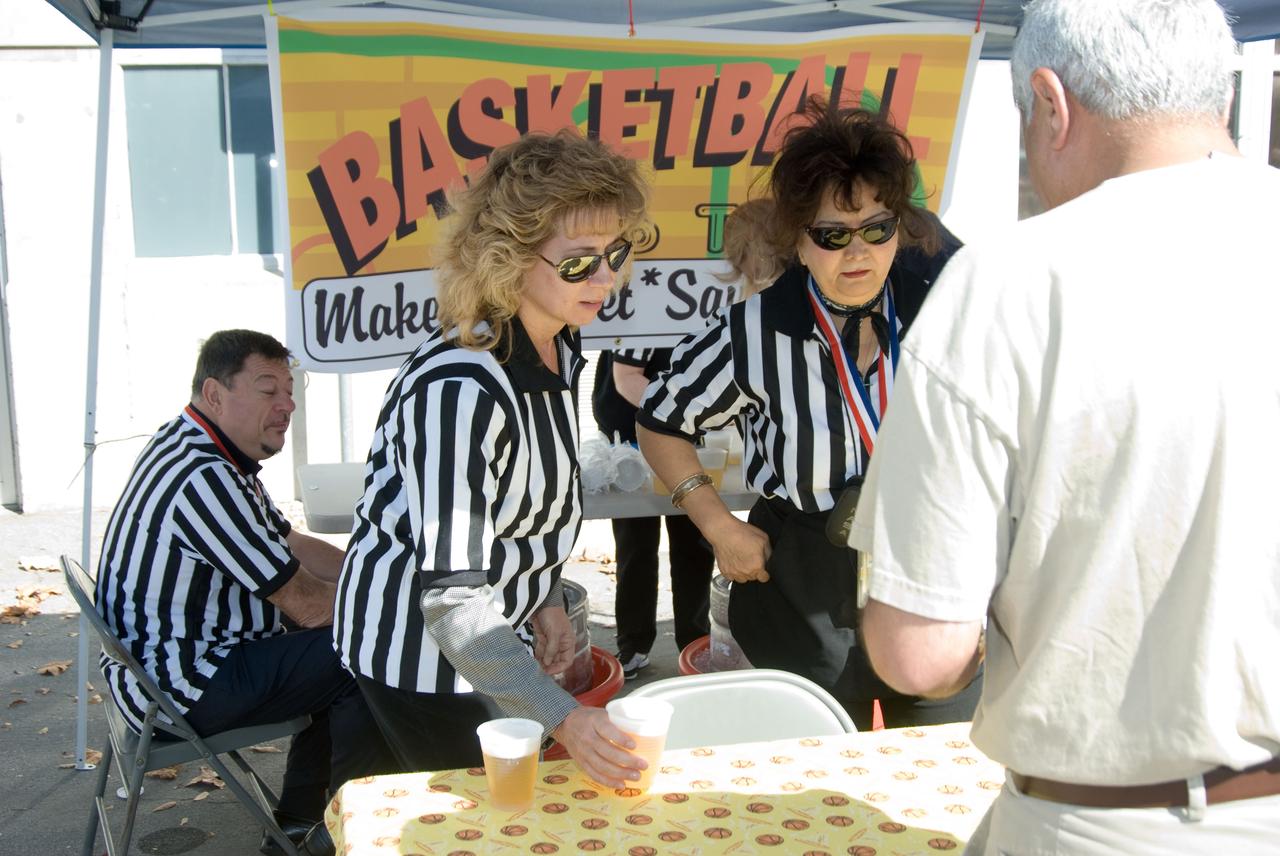
11th annual chili cook-off
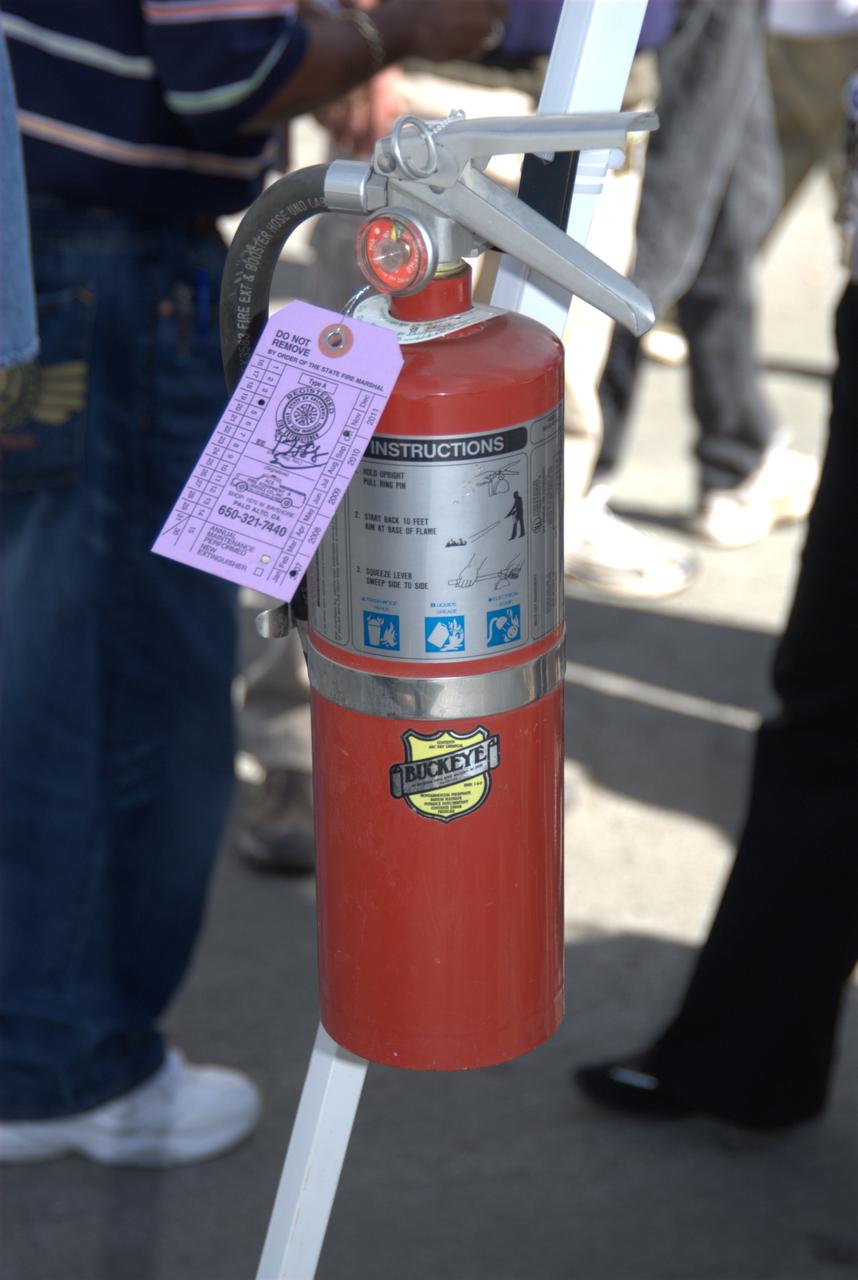
11th annual chili cook-off
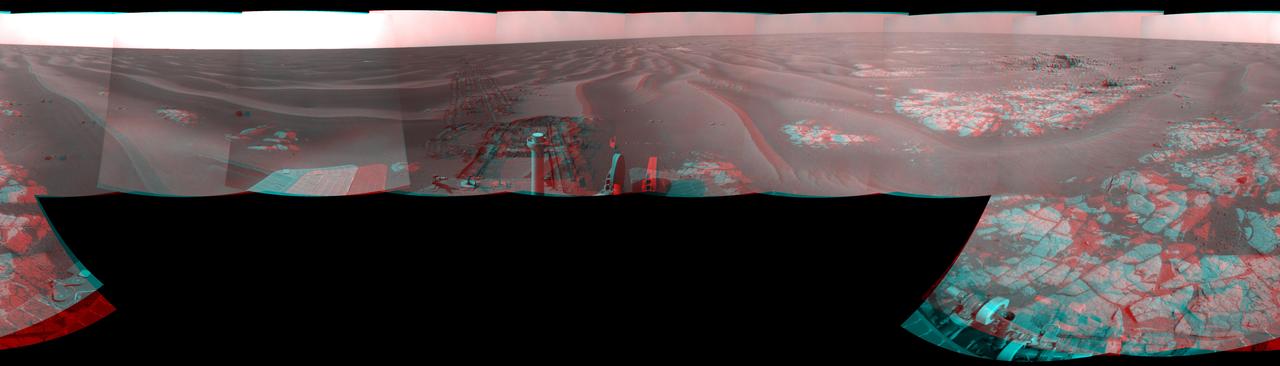
NASA Mars Exploration Rover Opportunity combined images into this stereo, 360-degree view of the rover surroundings on March 12, 2009. Cook Islands is visible just below center of this image. 3D glasses are necessary to view this image.
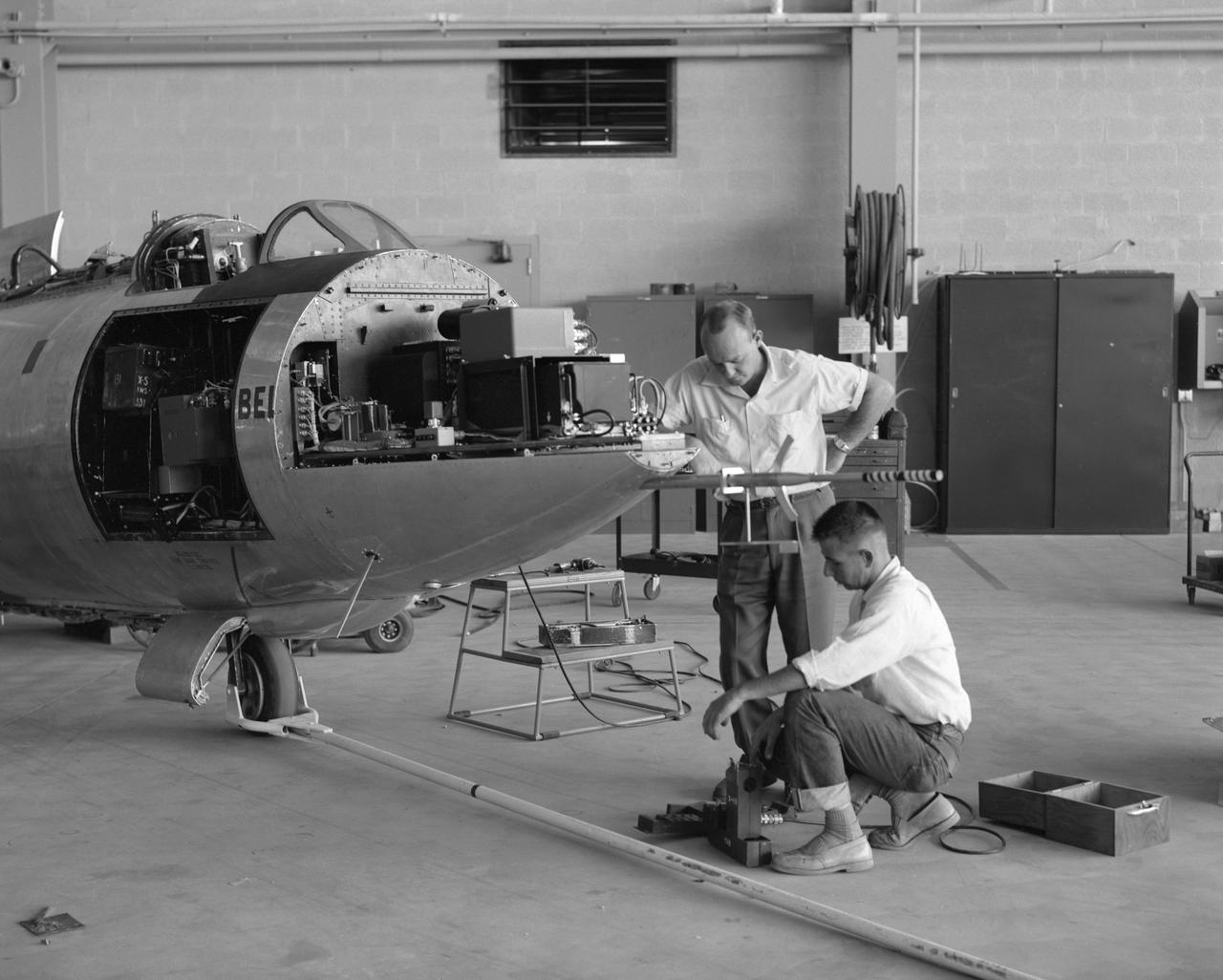
Lee Adelsbach and Bob Cook work on the instrumentation on the Bell X-1B.
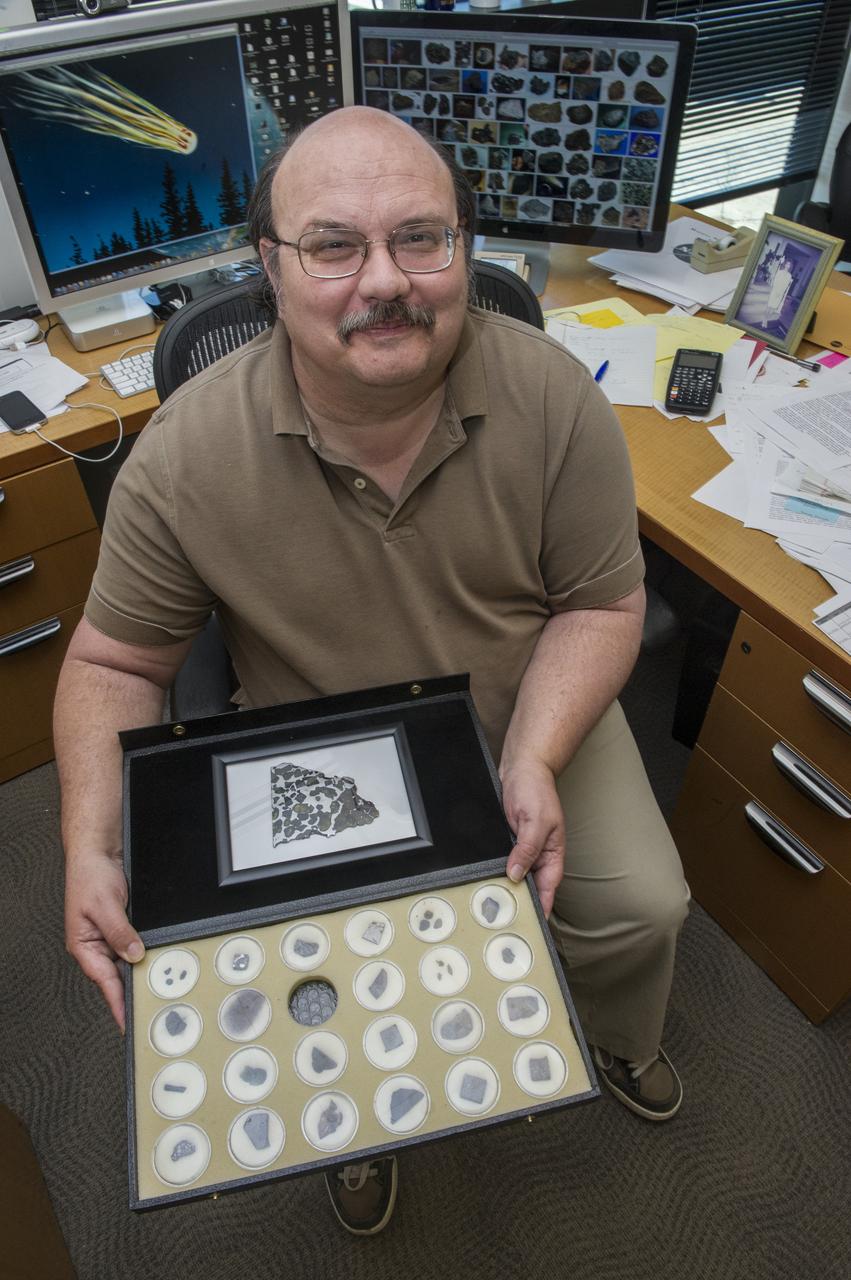
DR. BILL COOKE, LEAD OF THE METEROID ENVIRONMENT OFFICE AT MARSHALL SHOWS VARIOUS METEORITES IN HIS COLLECTION.

MARSHALL SPACE FLIGHT CENTER ASTRONOMER BILL COOKE AND WEBMASTER BROOKE BOEN CONDUCTING A LIVE CHAT ON THE PERSEIDS METEOR SHOWER.

SCI2017_0007: Artist illustration of the thick ring of dust that can obscure the energetic processes that occur near the supermassive black hole of an active galactic nuclei. The SOFIA studies suggest that the dust distribution is about 30 percent smaller than previously thought. Credit: NASA/SOFIA/Lynette Cook
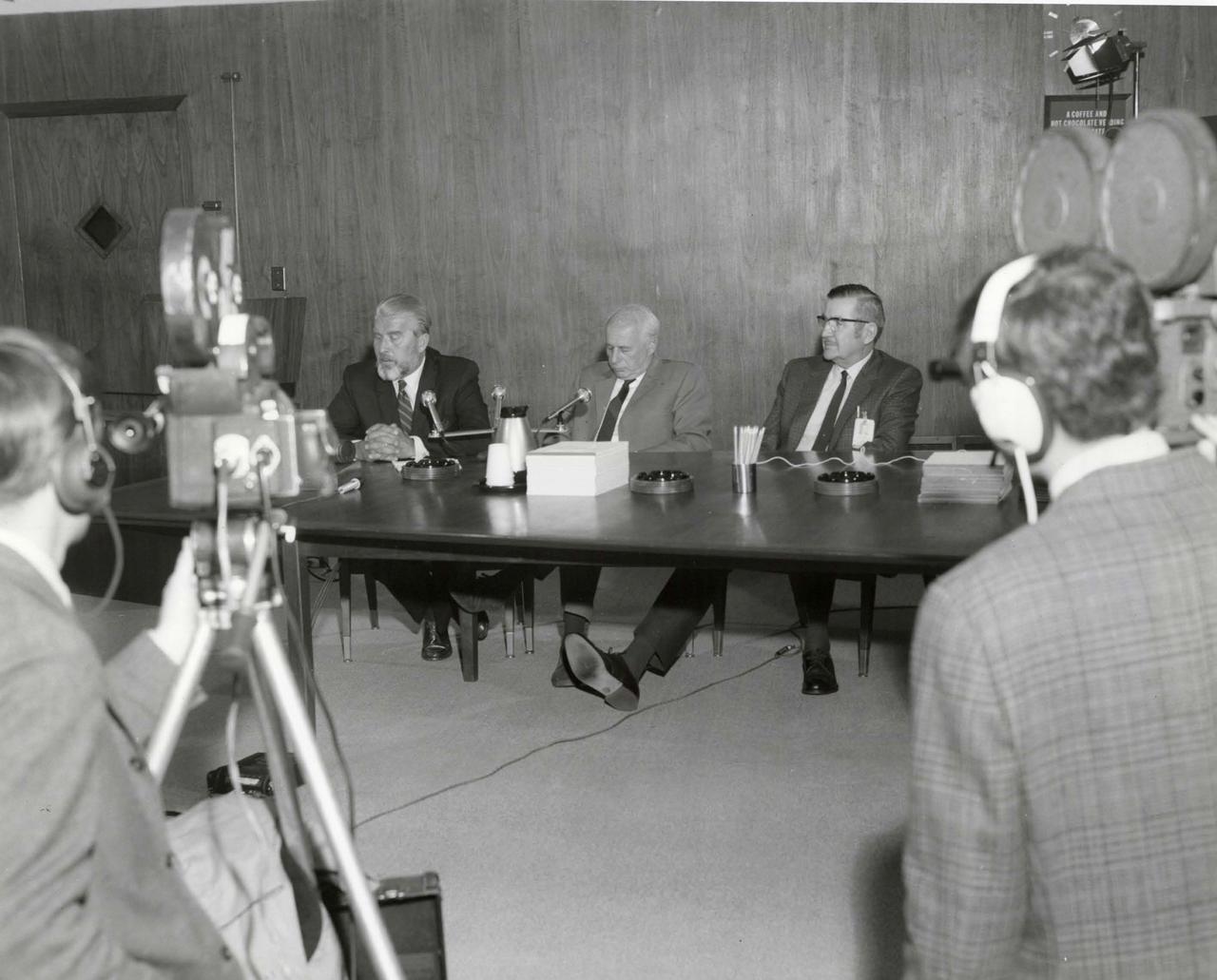
Dr. Wernher Von Braun, Dr. Eberhard Rees, and R.W. Cook at a press conference with cameras in the foreground.
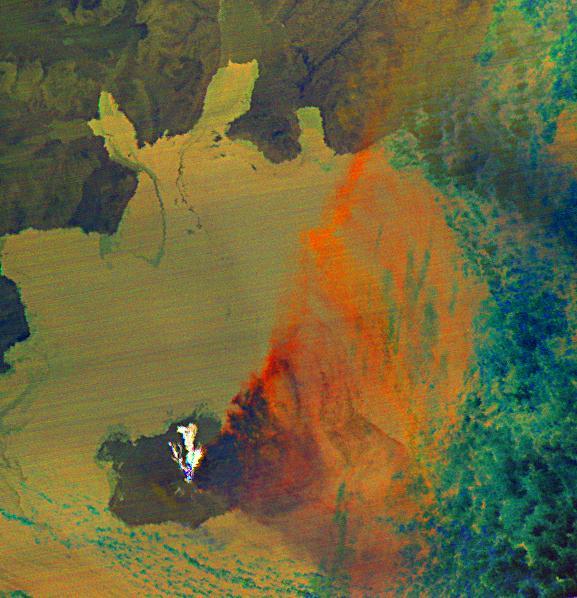
Since last spring, the U.S. Geological Survey Alaska Volcano Observatory AVO has detected increasing volcanic unrest at Augustine Volcano in Cook Inlet, Alaska near Anchorage. This image is from NASA Terra spacecraft.
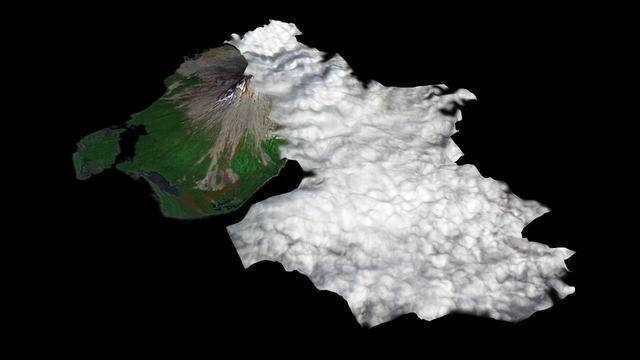
Since last spring, the U.S. Geological Survey Alaska Volcano Observatory AVO has detected increasing volcanic unrest at Augustine Volcano in Cook Inlet, Alaska near Anchorage. This image is from NASA Terra spacecraft.
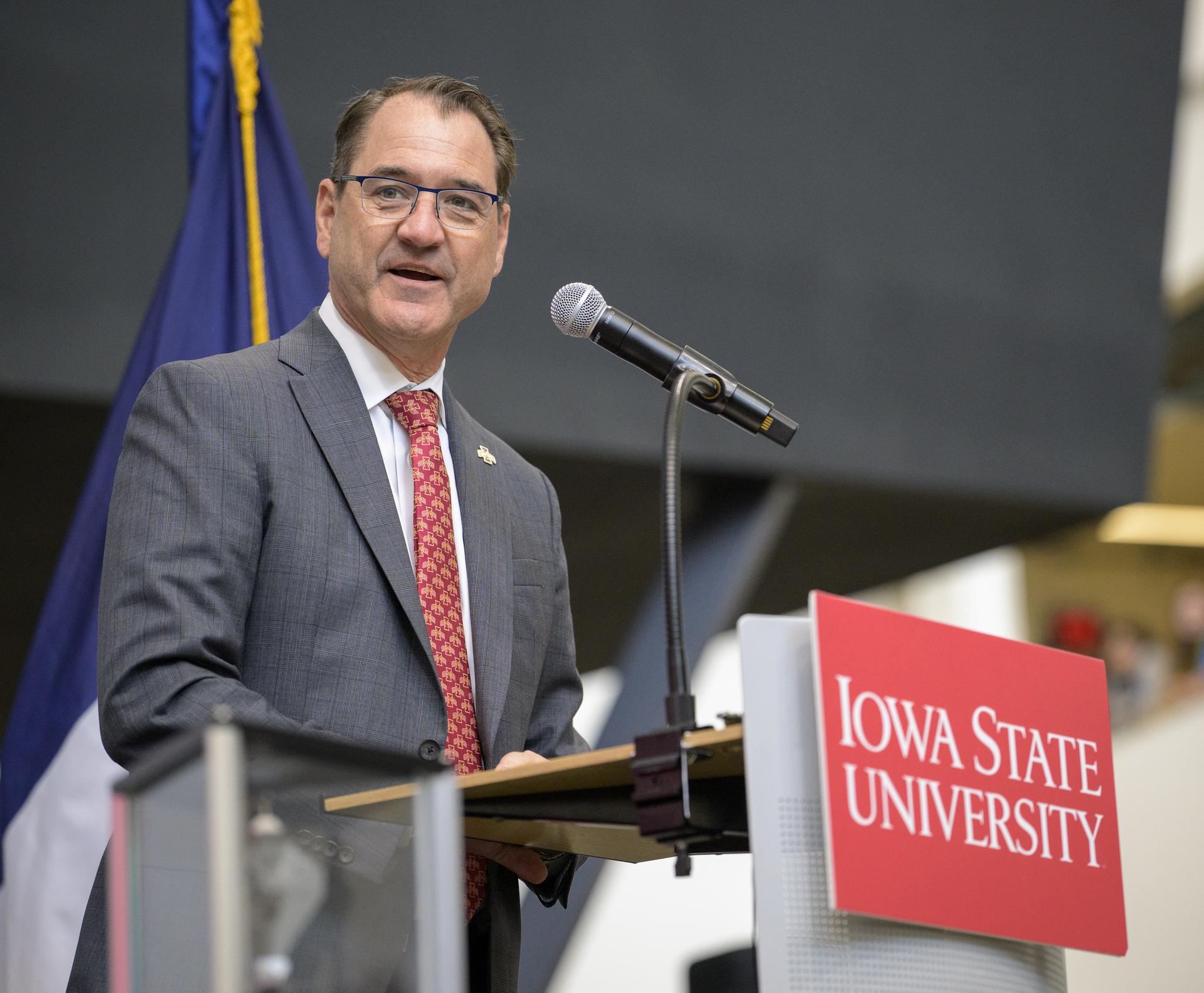
David Cook, President, Iowa State University gives opening remarks during a townhall with students, Tuesday, Sept. 8, 2026, at Iowa State University in Ames, Iowa. Photo Credit: (NASA/Bill Ingalls)
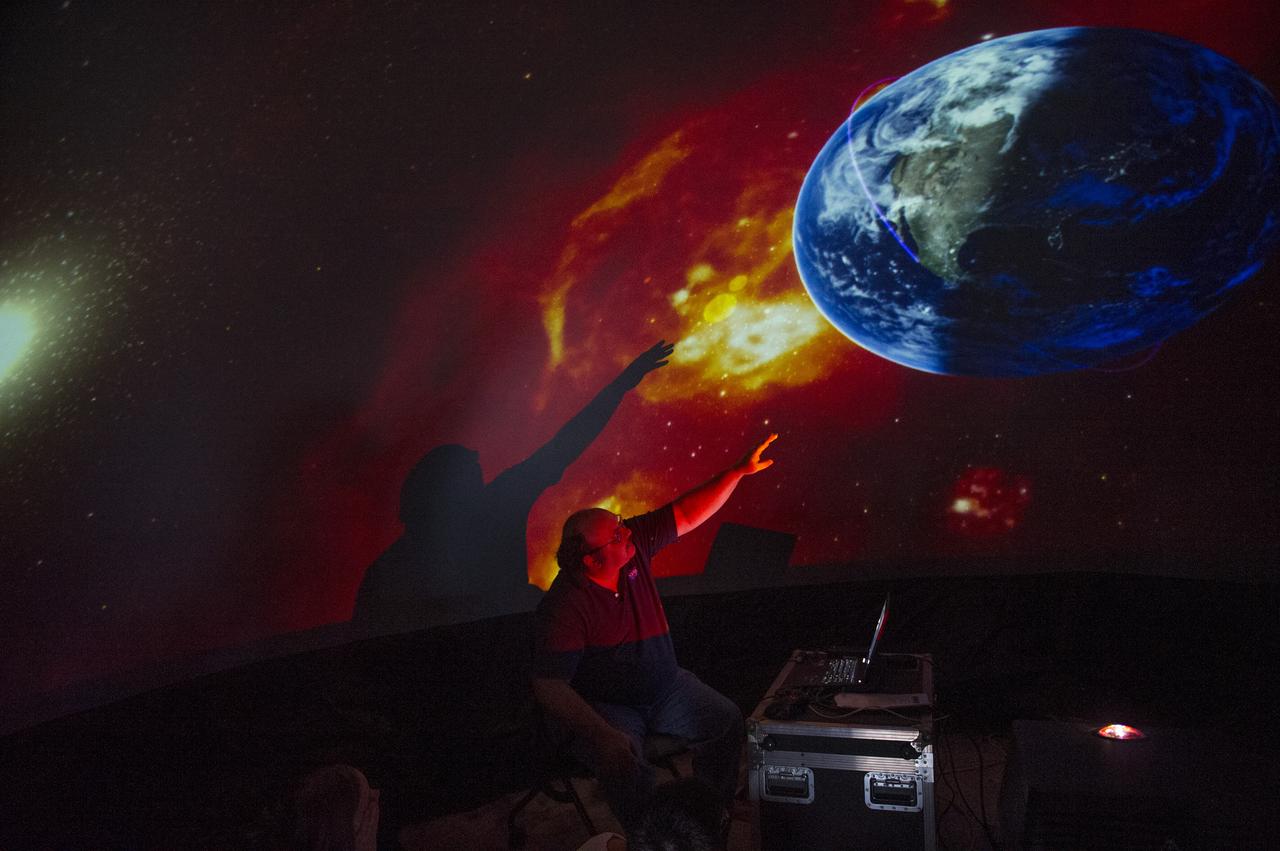
DR. BILL COOKE, LEAD OF MARSHALL'S METEOROID ENVIRONMENTS OFFICE, TOOK VISITORS ON A TOUR OF THE SOLAR SYSTEM IN ONE OF TWO INFLATABLE PLANETARIUMS FEATURED AT THE INTERNATIONAL OBSERVE THE MOON NIGHT AT NASA'S EDUCATION TRAINING FACILITY ON 9/22/12.
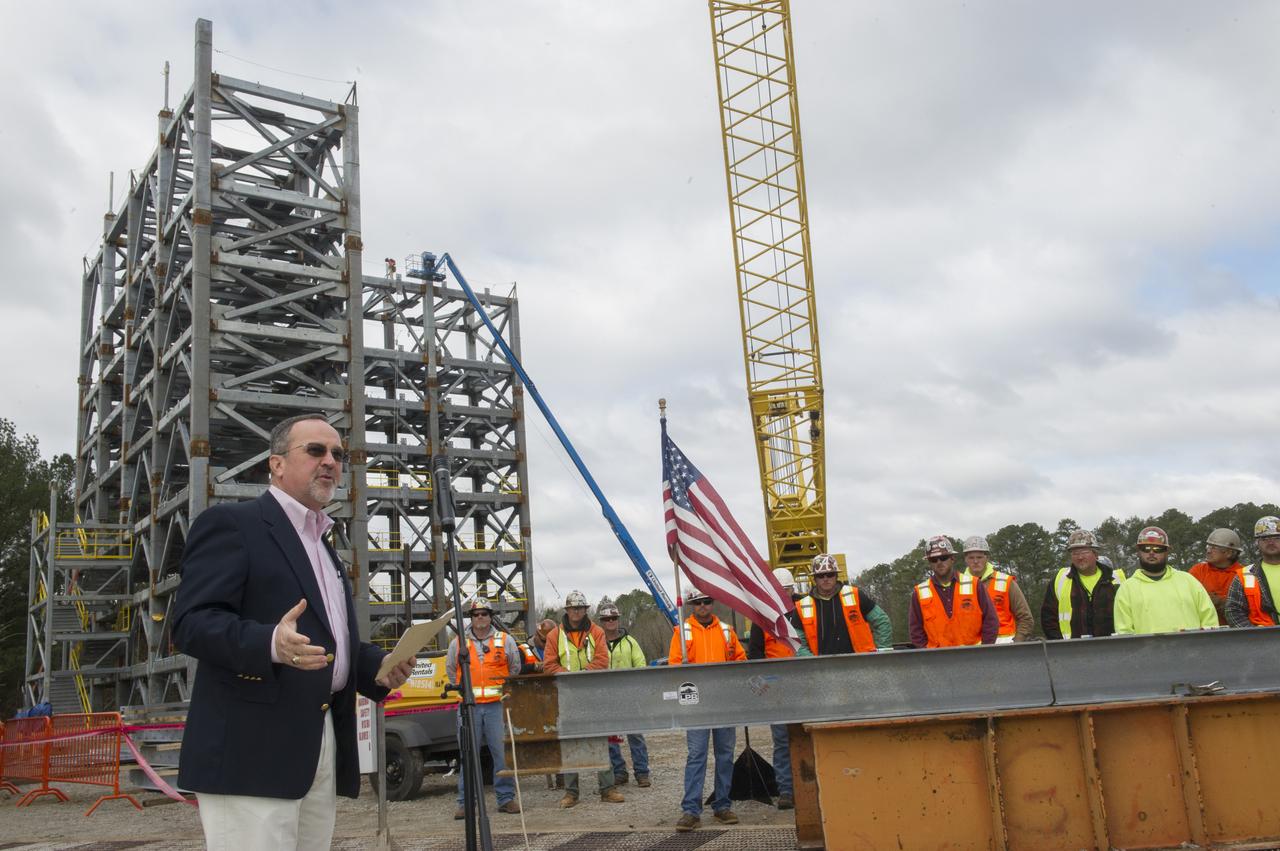
"YOUR WORK IS CRITICAL TO THE JOURNEY TO MARS," SAID SLS DEPUTY PROGRAM MANAGER JERRY COOK TO THE CONSTRUCTION CREW AT THE "TOP OUT" CEREMONY FOR TEST STAND 4697 AT MARSHALL.
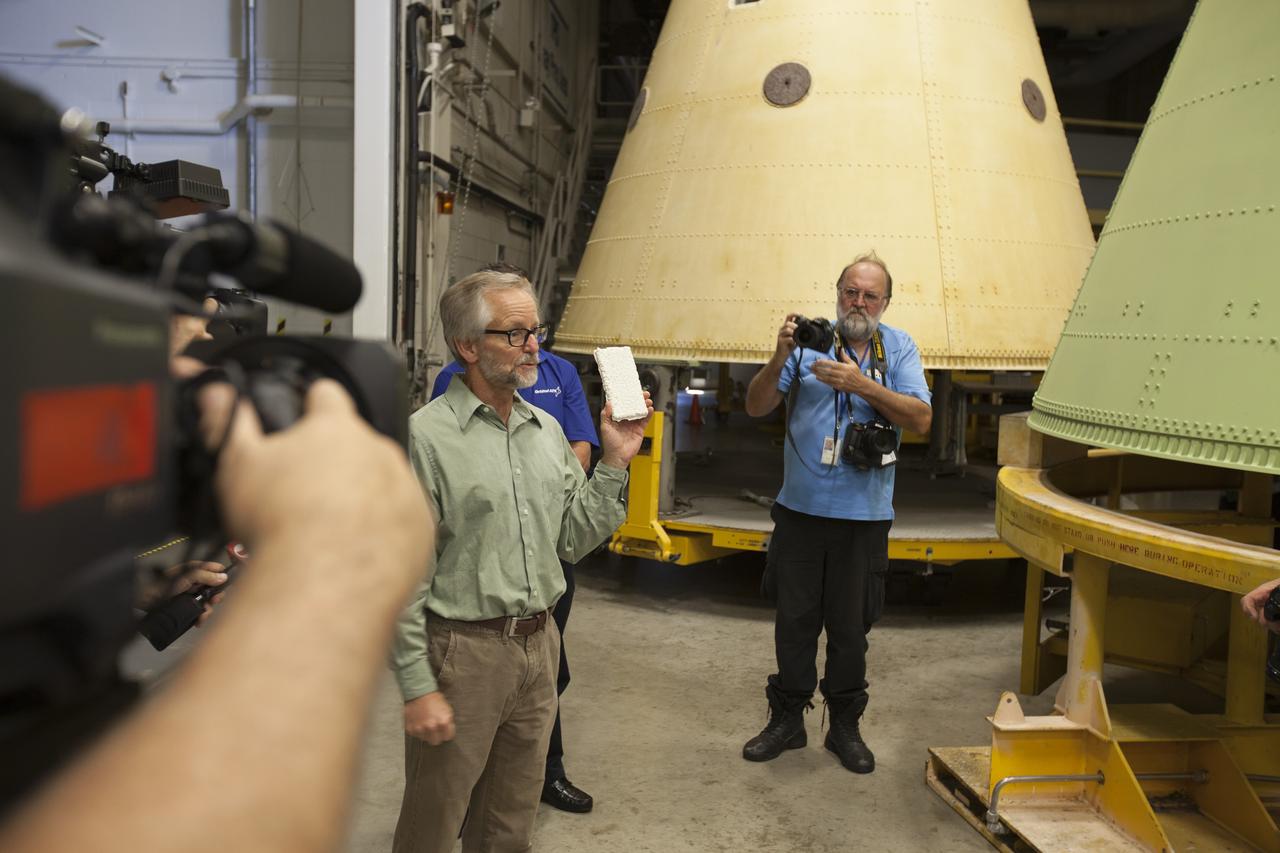
Inside the Booster Fabrication Facility (BFF) at NASA’s Kennedy Space Center in Florida, Jeff Cook, a thermal protection system specialist with Orbital ATK, displays a sample of the painted thermal protection system that is being applied to booster segments. Members of the news media toured the BFF. Orbital ATK is a contractor for NASA’s Marshall Space Flight Center in Alabama, and operates the BFF to prepare aft booster segments and hardware for the SLS rocket boosters. The SLS rocket and Orion spacecraft will launch on Exploration Mission-1 in 2018. The Ground Systems Development and Operations Program is preparing the infrastructure to process and launch spacecraft for deep-space missions and the journey to Mars.
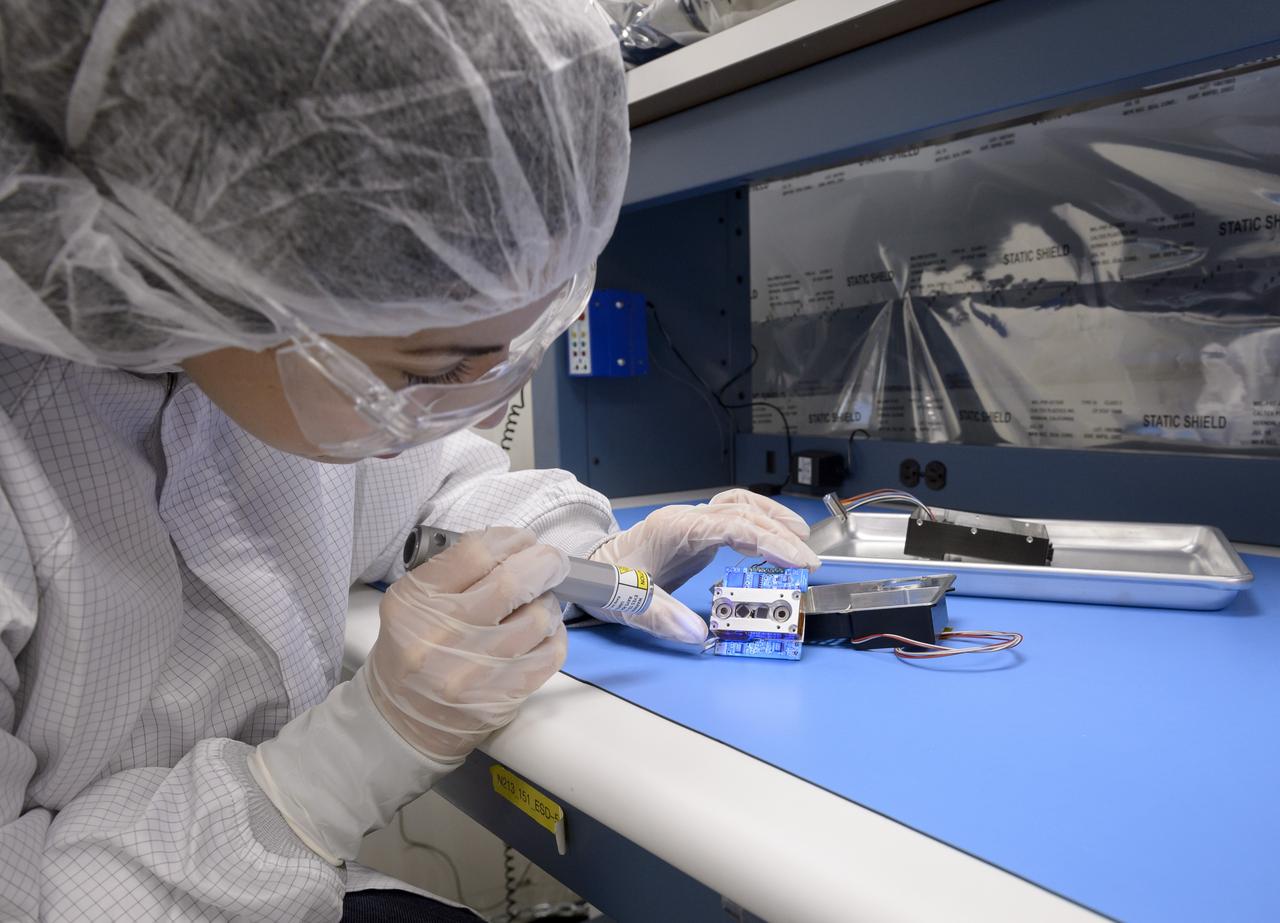
Near InfraRed Volatiles Spectrometer System (NIRVSS) engineering build in Ames N-213 Laboratory with Amanda Cook. The NIRVSS will fly on the Volatiles Investigating Polar Exploration Rover, or VIPER in its search for water on the south pole of the moon.
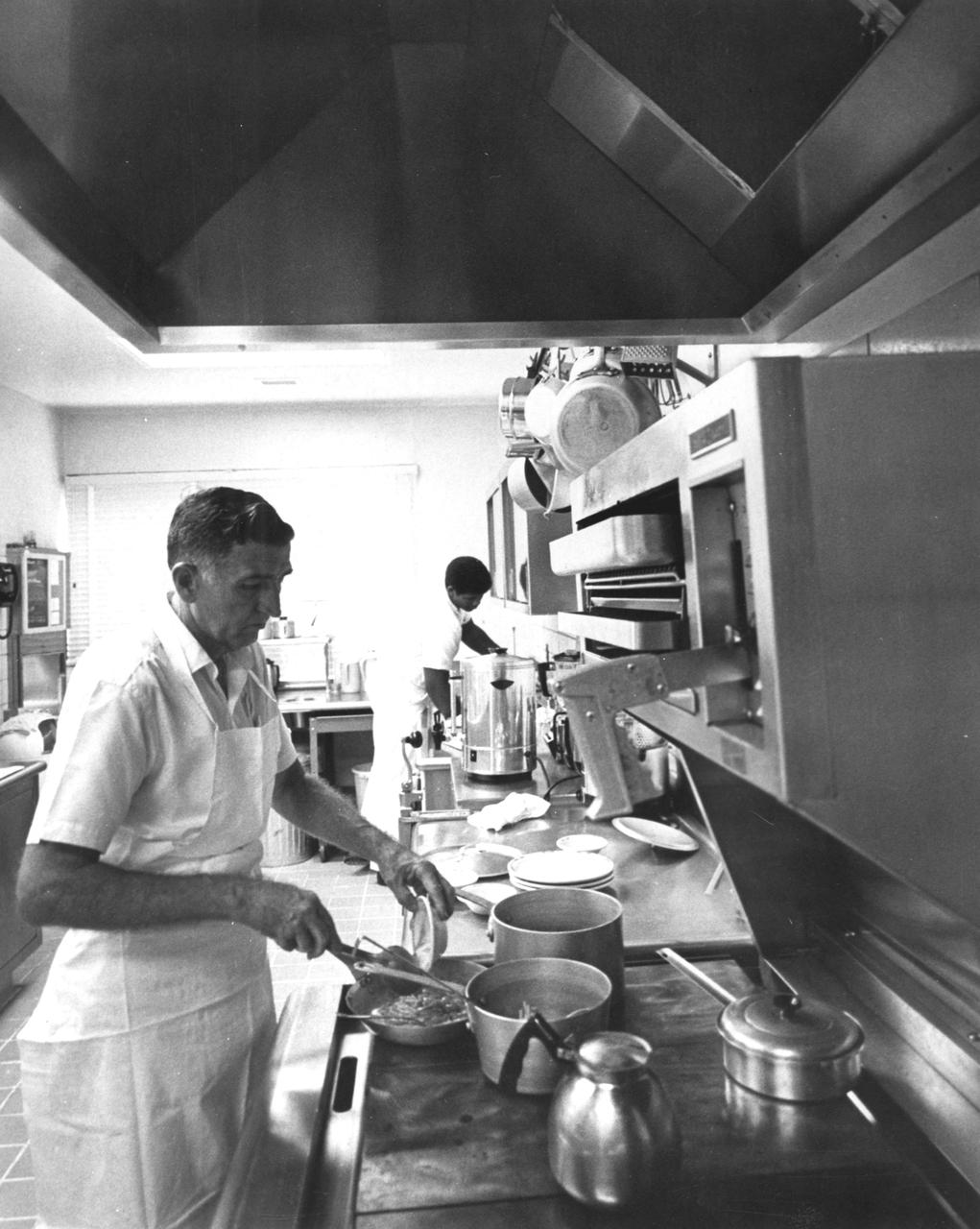
Cooks at the astronaut quarters of the NASA Kennedy Space Center (KSC) prepared meals for the Apollo 11 astronauts a few days before their historic first lunar landing mission. The Apollo 11 mission launched from KSC in Florida via the Marshall Space Flight Center (MSFC) developed Saturn V launch vehicle on July 16, 1969 and safely returned to Earth on July 24, 1969. Aboard the space craft were astronauts Neil A. Armstrong, commander; Michael Collins, Command Module (CM) pilot; and Edwin E. (Buzz) Aldrin Jr., Lunar Module (LM) pilot. The CM, “Columbia”, piloted by Collins, remained in a parking orbit around the Moon while the LM, “Eagle’’, carrying astronauts Armstrong and Aldrin, landed on the Moon. On July 20, 1969, Armstrong was the first human to ever stand on the lunar surface, followed by Aldrin. During 2½ hours of surface exploration, the crew collected 47 pounds of lunar surface material for analysis back on Earth. With the success of Apollo 11, the national objective to land men on the Moon and return them safely to Earth had been accomplished.
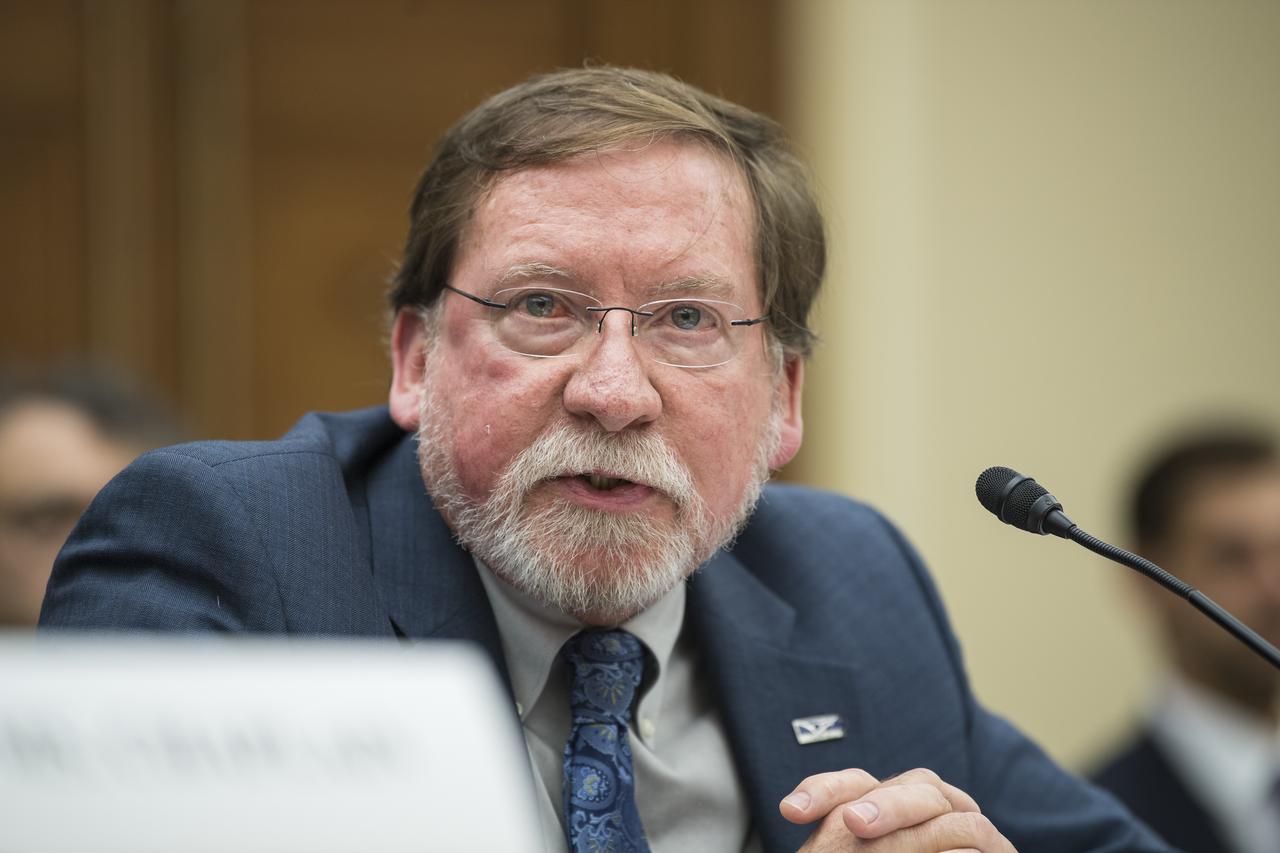
Doug Cooke, owner, Cooke Concepts and Solutions, testifies during a Space and Aeronautics Subcommittee of the House Science, Space, and Technology Committee hearing titled, “Developing Core Capabilities for Deep Space Exploration: An Update on NASA's SLS, Orion, and Exploration Ground Systems," Wednesday, September 18, 2019 at the Rayburn House Office Building in Washington. Photo Credit: (NASA/Aubrey Gemignani)
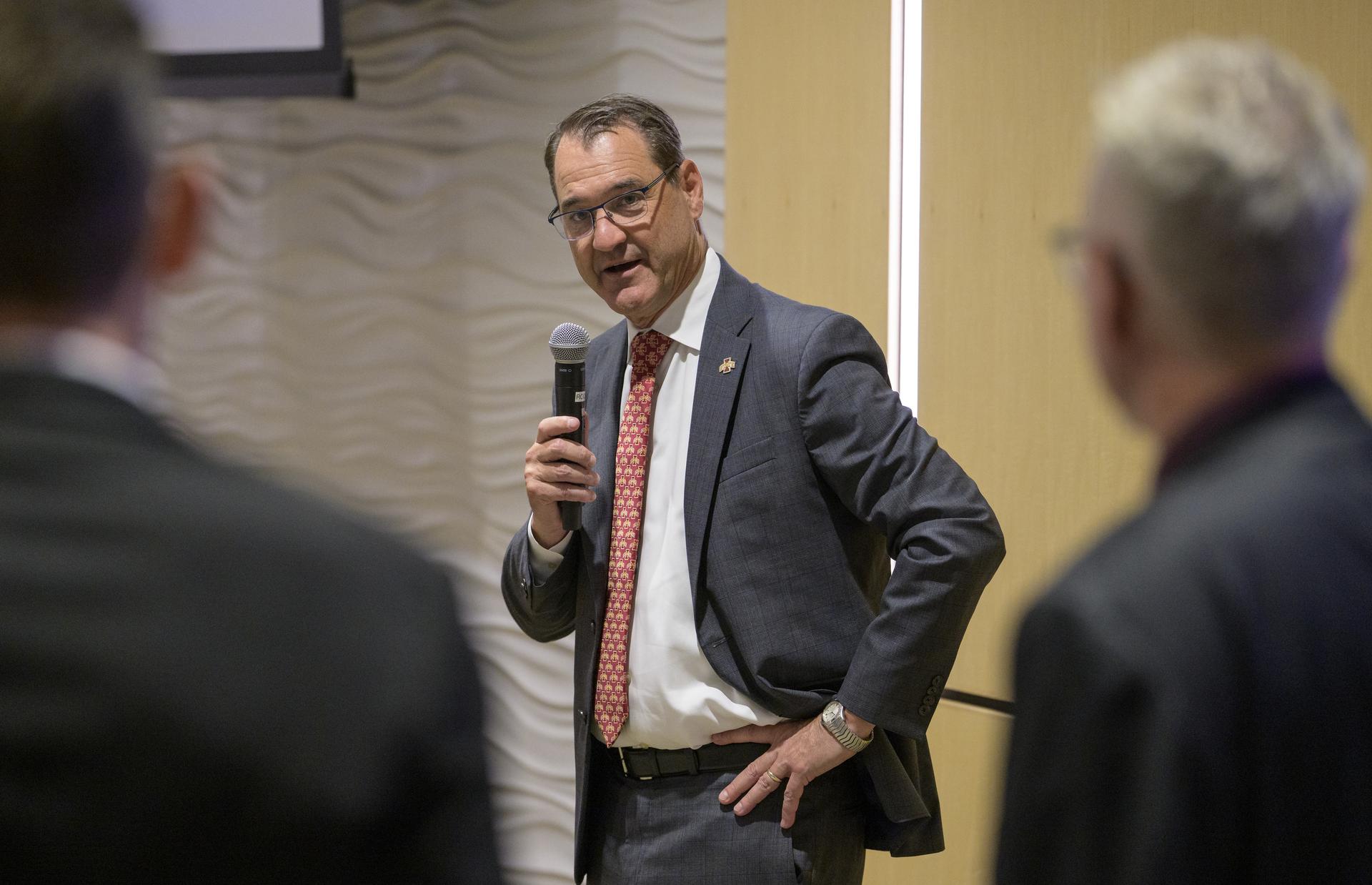
David Cook, President, Iowa State University welcomes NASA Administrator Jared Isaacman to the Ames National Laboratory, Tuesday, Sept. 8, 2026, on the campus of Iowa State University in Ames, Iowa. Photo Credit: (NASA/Bill Ingalls)
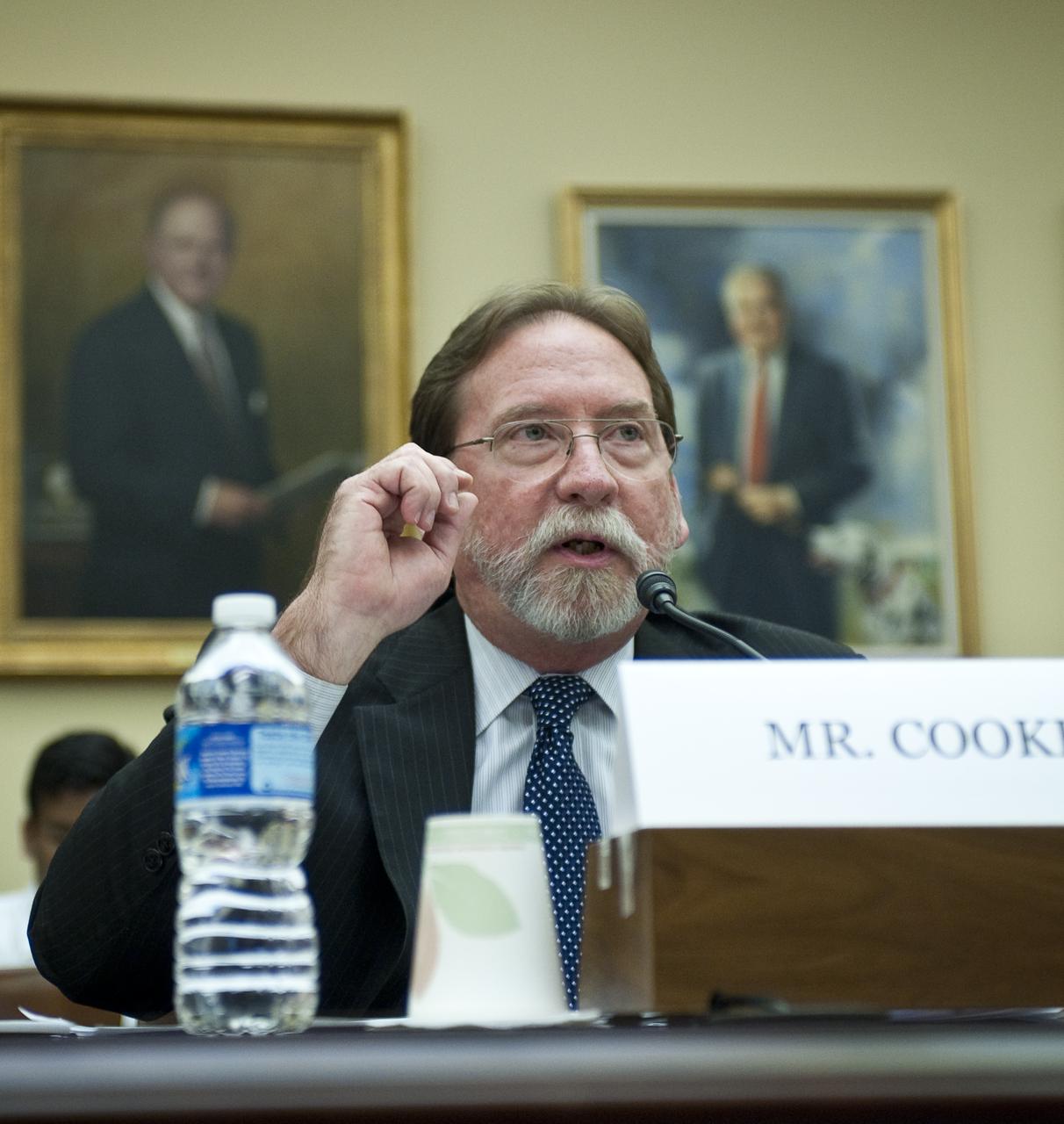
Douglas R. Cooke, NASA's Associate Administrator for Exploration Systems Mission Directorate (ESMD), appears before the U.S. House of Representatives' Committee on Science and Technology, Subcommittee on Space and Aeronautics to discuss proposed changes to NASA's exploration program on Wednesday, March 24, 2010, on Capitol Hill in Washington. Photo Credit: (NASA/Carla Cioffi)
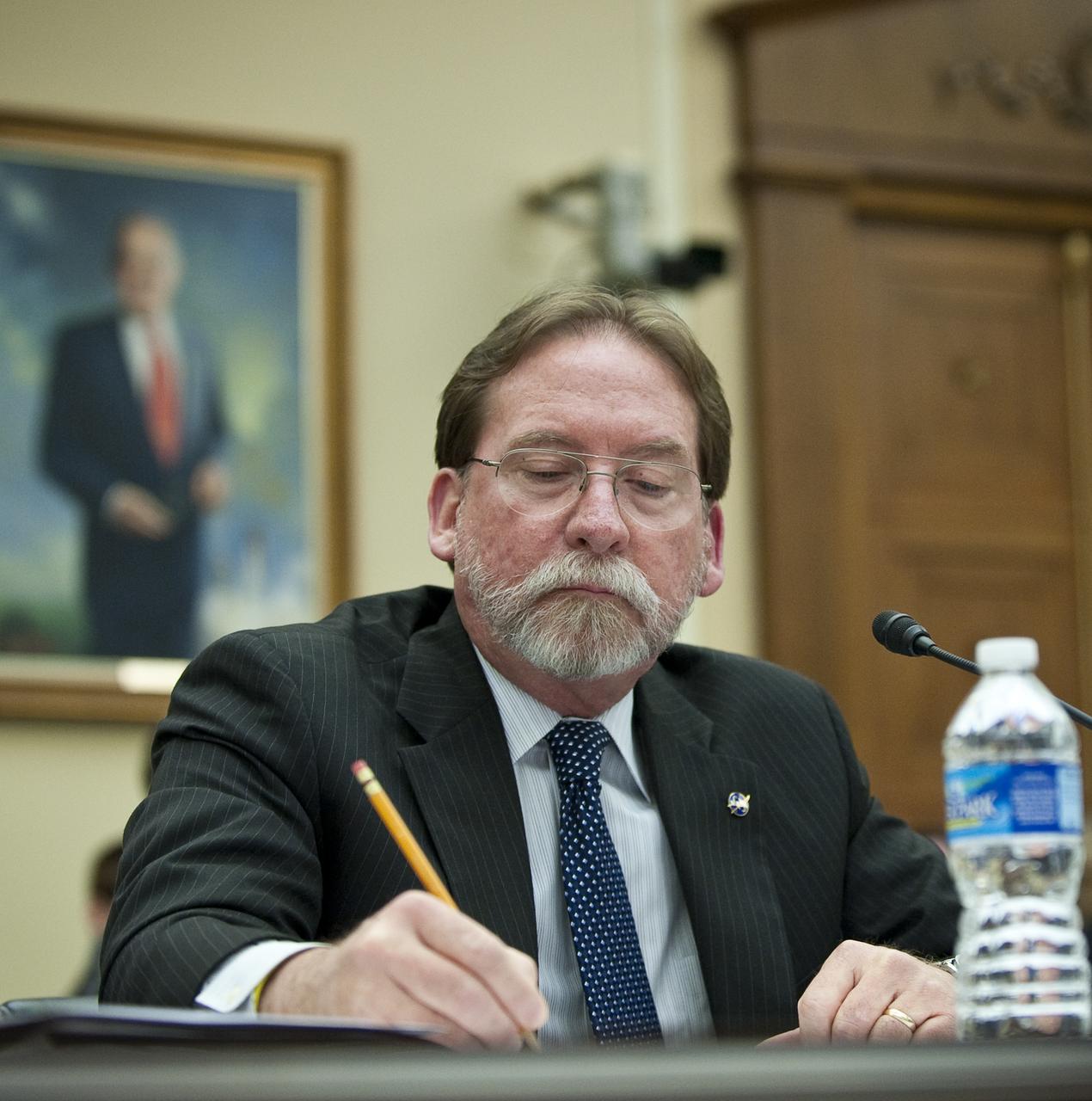
Douglas R. Cooke, NASA's Associate Administrator for Exploration Systems Mission Directorate (ESMD), appears before the U.S. House of Representatives' Committee on Science and Technology, Subcommittee on Space and Aeronautics to discuss proposed changes to NASA's exploration program on Wednesday, March 24, 2010, on Capitol Hill in Washington. Photo Credit: (NASA/Carla Cioffi)
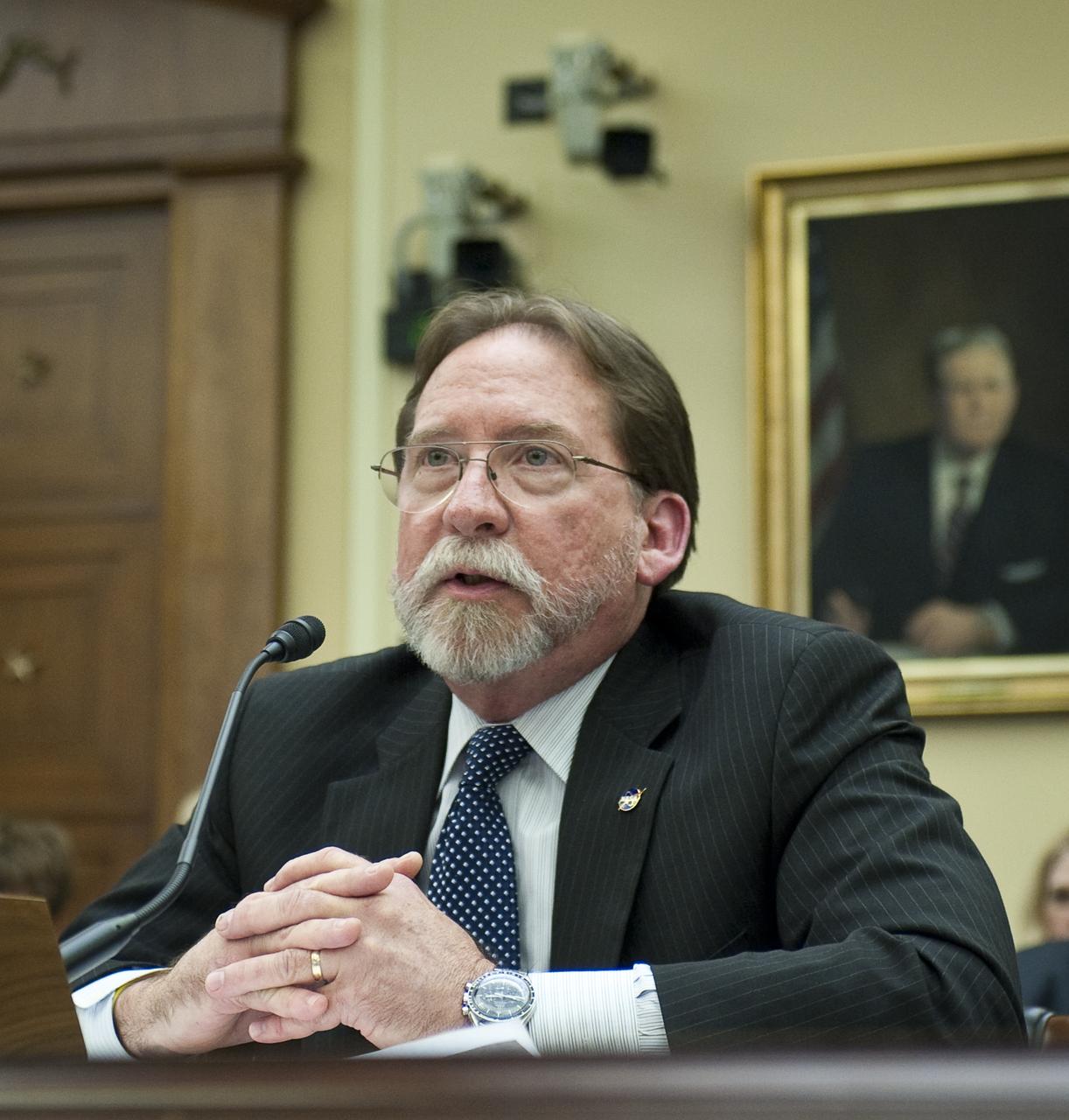
Douglas R. Cooke, NASA's Associate Administrator for Exploration Systems Mission Directorate (ESMD), appears before the U.S. House of Representatives' Committee on Science and Technology, Subcommittee on Space and Aeronautics to discuss proposed changes to NASA's exploration program on Wednesday, March 24, 2010, on Capitol Hill in Washington. Photo Credit: (NASA/Carla Cioffi)
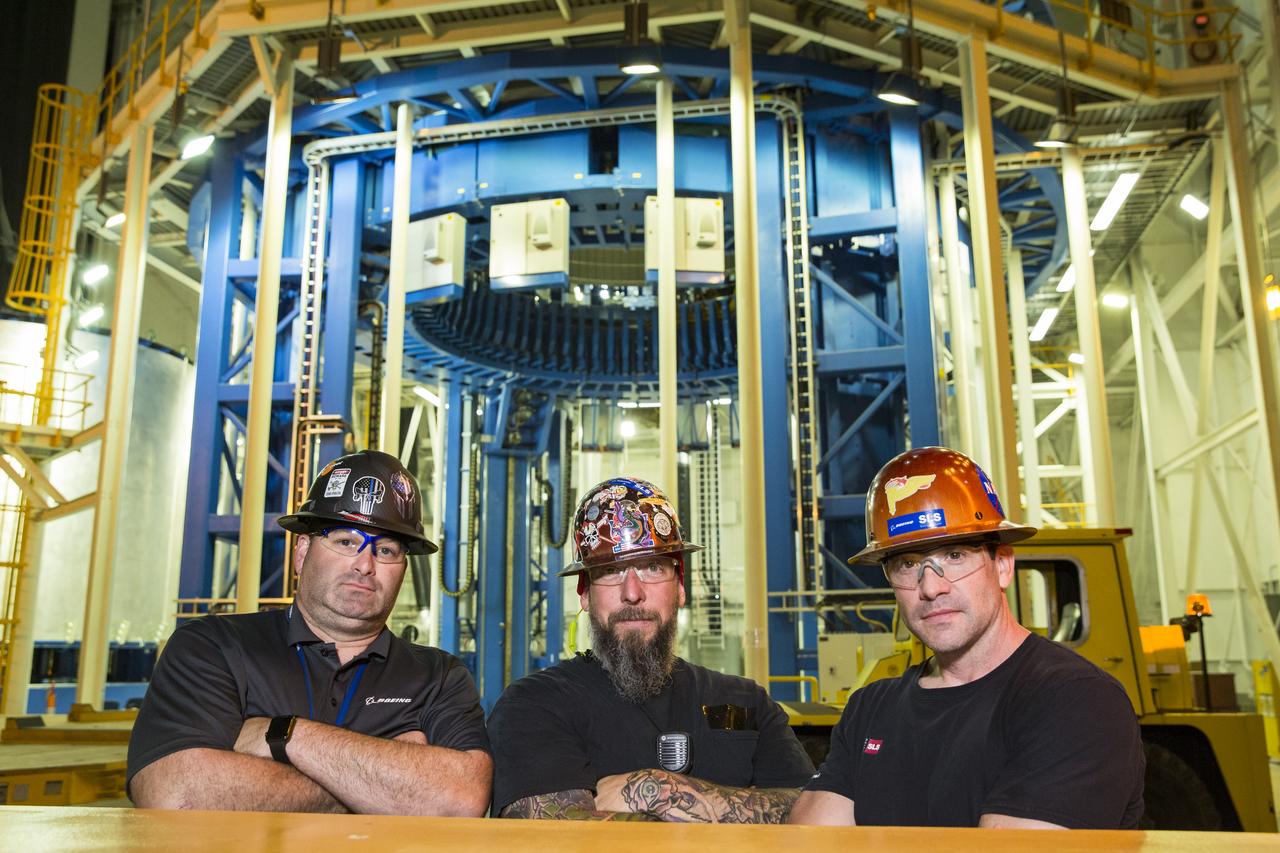
From left to right, Mac Cook, Jeffrey Thompson, Chris Mart, Critical Lift and Move Team, Boeing, Portrait, Friday, June 28, 2019 at Michoud Assembly Facility, New Orleans, LA. Photo Credit: (NASA/Aubrey Gemignani)
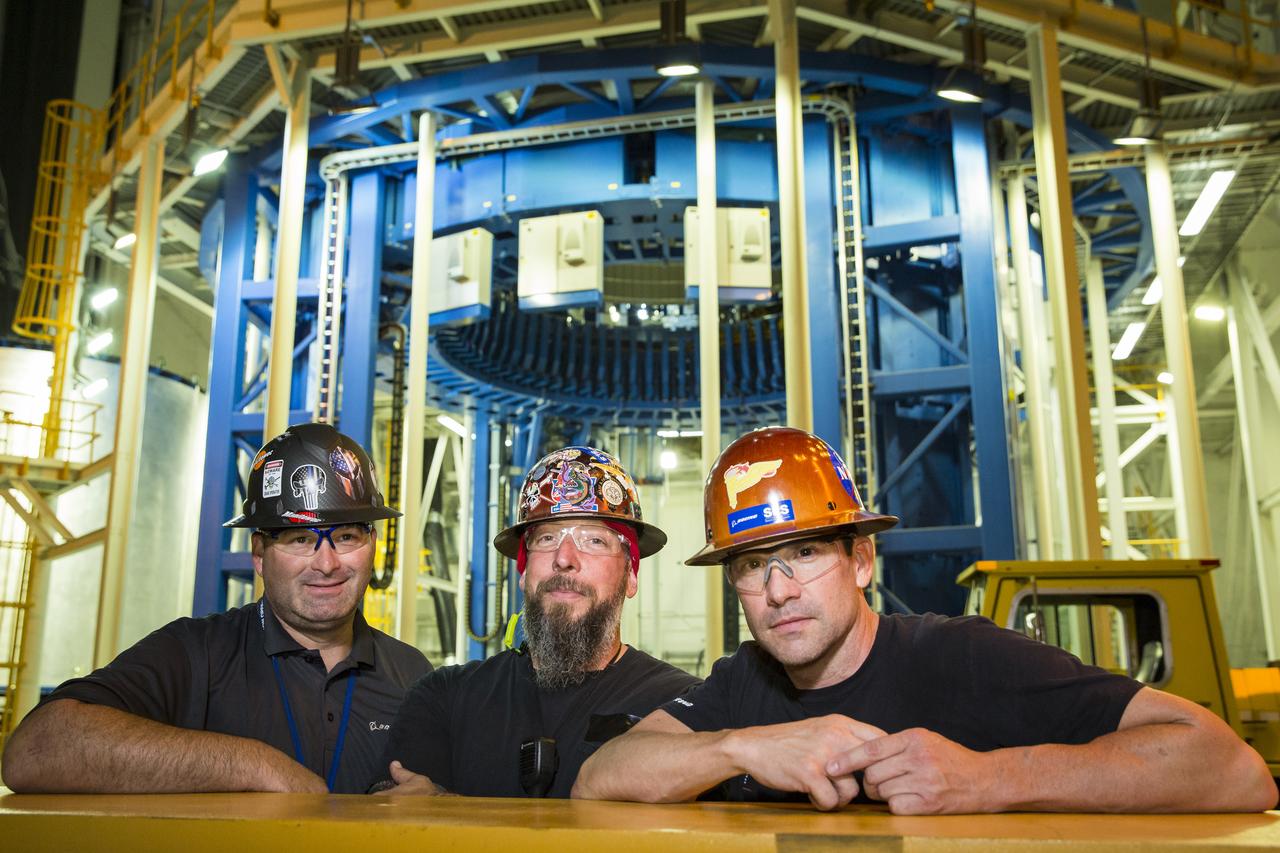
From left to right, Mac Cook, Jeffrey Thompson, Chris Mart, Critical Lift and Move Team, Boeing, Portrait, Friday, June 28, 2019 at Michoud Assembly Facility, New Orleans, LA. Photo Credit: (NASA/Aubrey Gemignani)

Acting NASA Associate Administrator for Human Exploration and Operations, Ken Bowersox, left, Cristina Chaplain, director, Contracting and National Security Acquisitions, U.S. Government Accountability Office (GAO), center, and Doug Cooke, owner, Cooke Concepts and Solutions, right, testify during a Space and Aeronautics Subcommittee of the House Science, Space, and Technology Committee hearing titled, “Developing Core Capabilities for Deep Space Exploration: An Update on NASA's SLS, Orion, and Exploration Ground Systems," Wednesday, September 18, 2019 at the Rayburn House Office Building in Washington. Photo Credit: (NASA/Aubrey Gemignani)
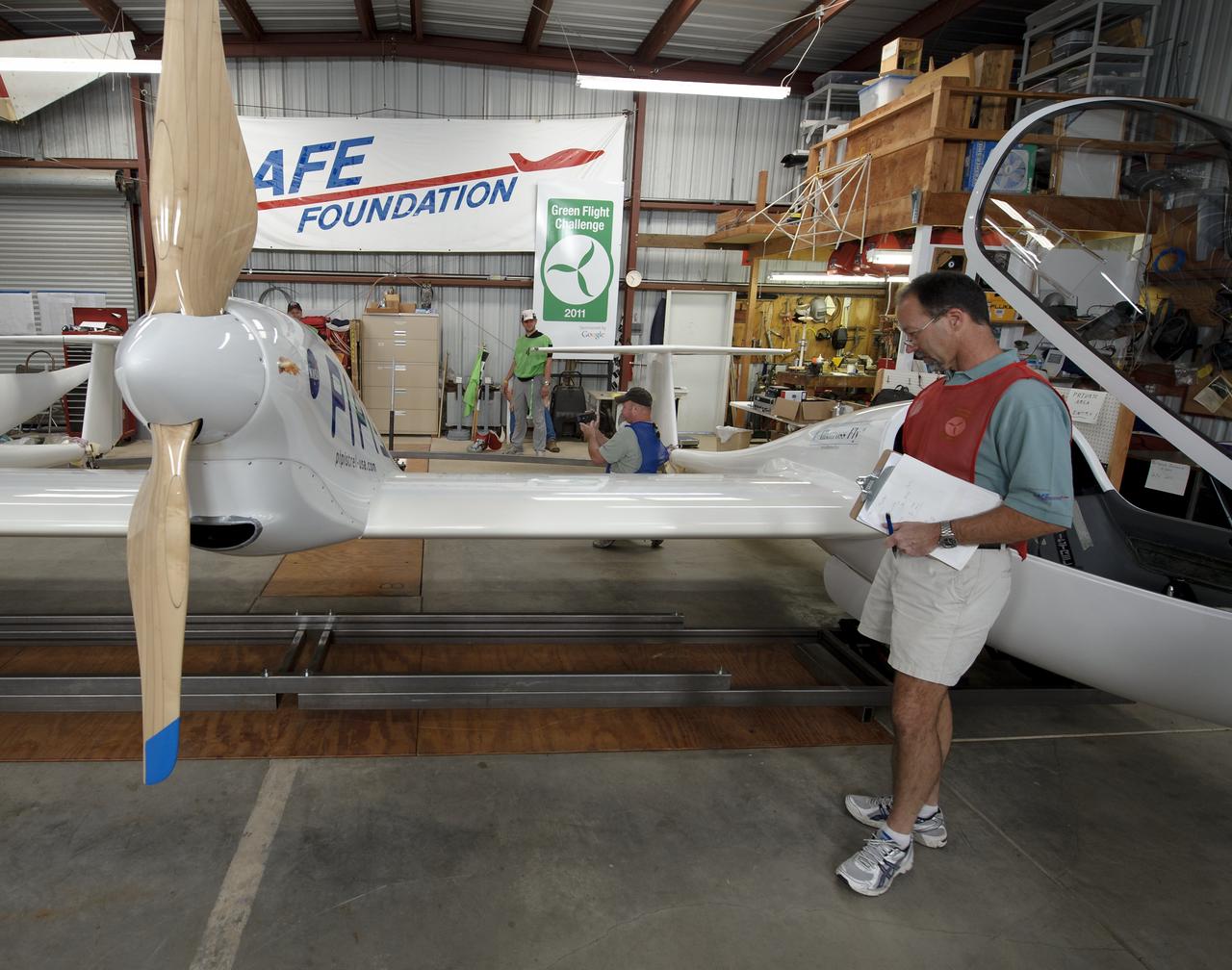
Wayne Cook, Weights Chief, inspects the Pipistrel-USA, Taurus G4 as it rest on a scale built into the floor of the hangar during the 2011 Green Flight Challenge, sponsored by Google, at the Charles M. Schulz Sonoma County Airport in Santa Rosa, Calif. on Monday, Sept. 26, 2011. NASA and the Comparative Aircraft Flight Efficiency (CAFE) Foundation are having the challenge with the goal to advance technologies in fuel efficiency and reduced emissions with cleaner renewable fuels and electric aircraft. Photo Credit: (NASA/Bill Ingalls)
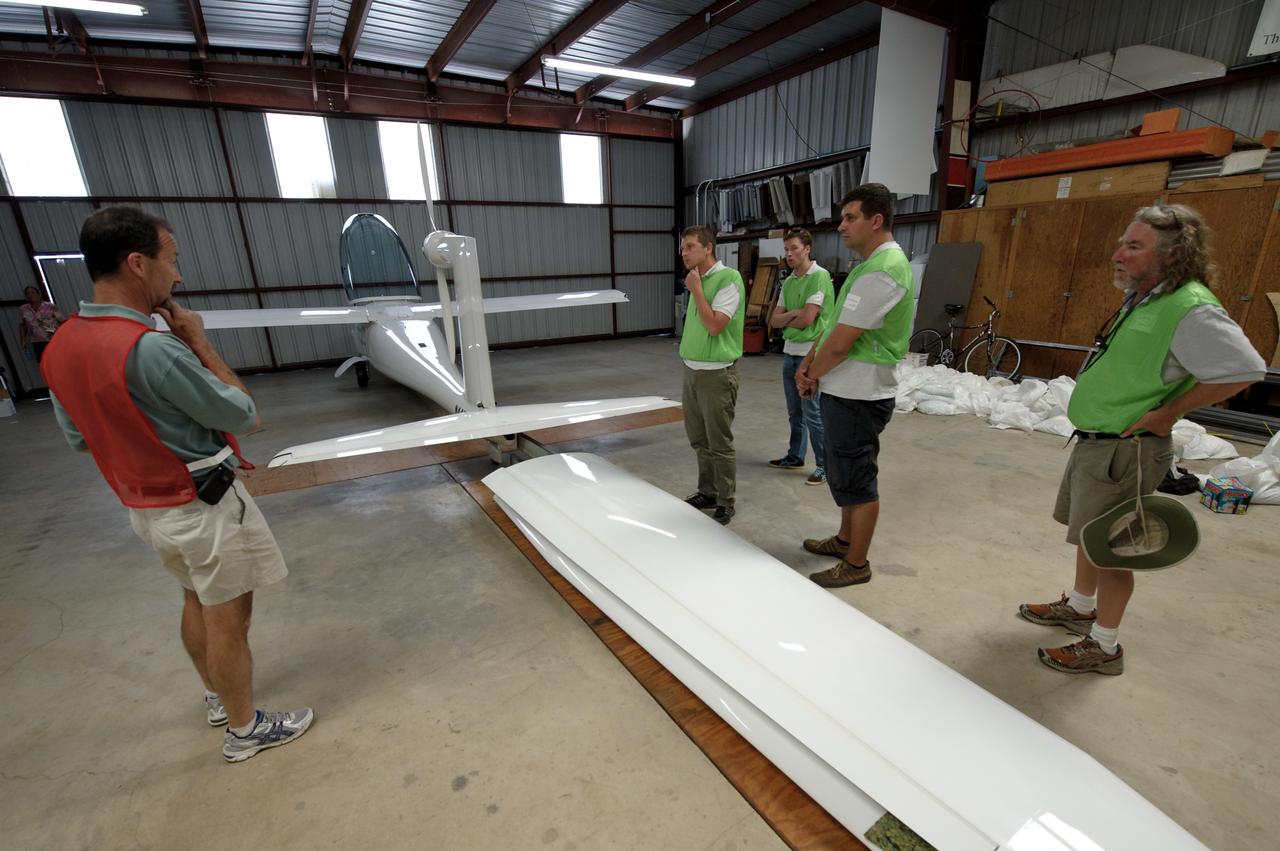
CAFE Foundation Weights Chief Wayne Cook, left, talks with the e-Genius aircraft crew about their weigh-in during the 2011 Green Flight Challenge, sponsored by Google, at the Charles M. Schulz Sonoma County Airport in Santa Rosa, Calif. on Monday, Sept. 26, 2011. NASA and the Comparative Aircraft Flight Efficiency (CAFE) Foundation are having the challenge with the goal to advance technologies in fuel efficiency and reduced emissions with cleaner renewable fuels and electric aircraft. Photo Credit: (NASA/Bill Ingalls)
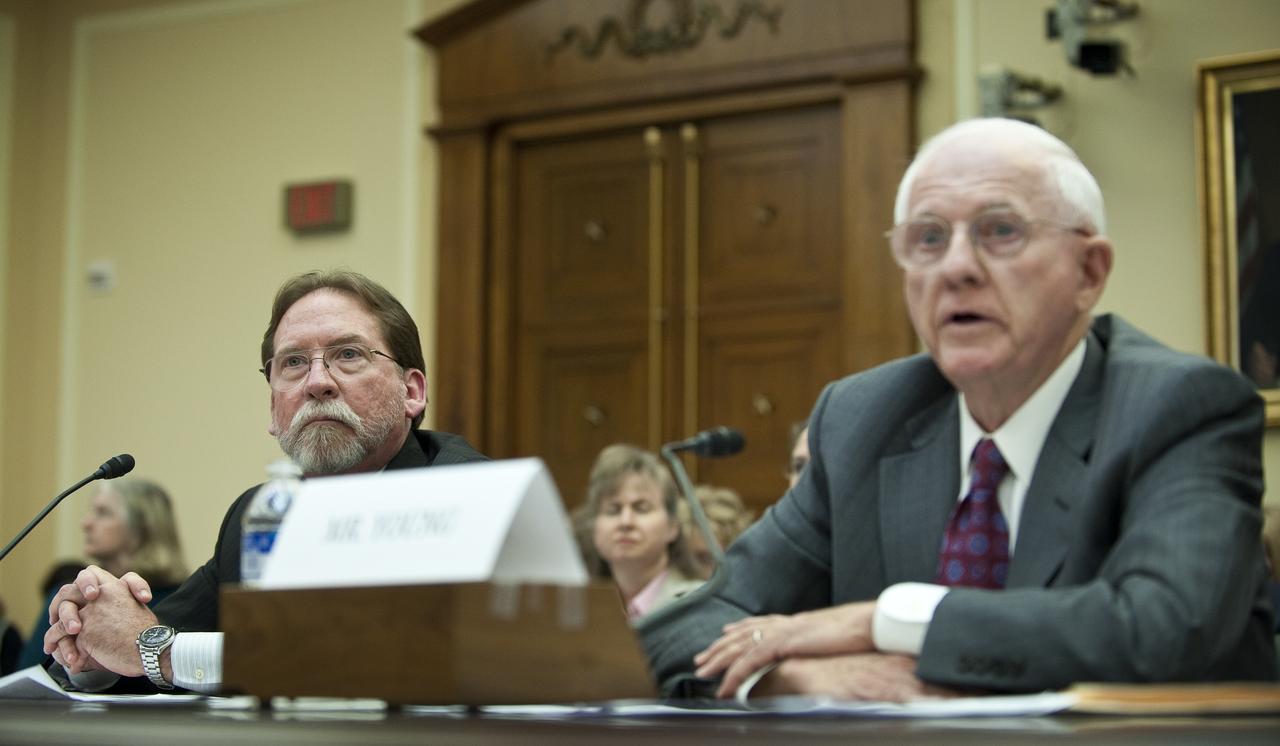
Douglas R. Cooke, left, NASA's Associate Administrator for Exploration Systems Mission Directorate (ESMD) and A. Thomas Young, retired Executive Vice President, Lockheed Martin appear before the U.S. House of Representatives' Committee on Science and Technology, Subcommittee on Space and Aeronautics to discuss proposed changes to NASA's exploration program on Wednesday, March 24, 2010, on Capitol Hill in Washington. Photo Credit: (NASA/Carla Cioffi)
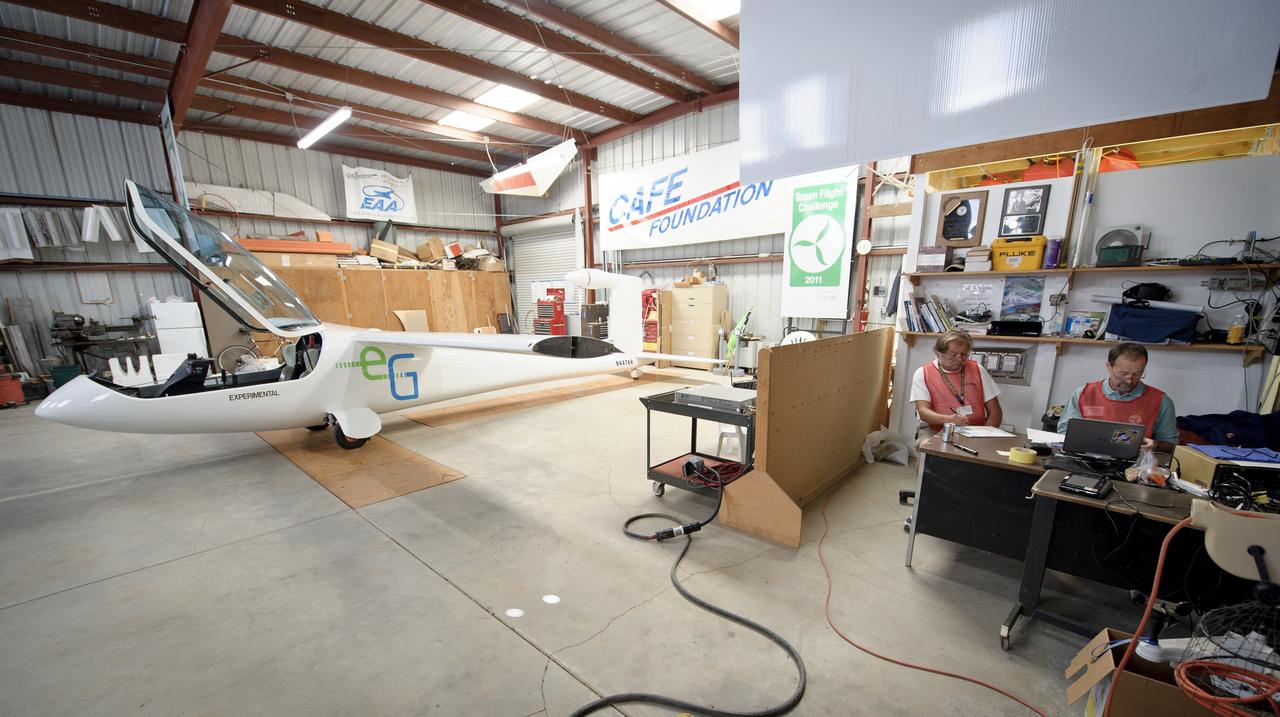
CAFE Foundation Weights crew member Ron Stout, left, and Weights Chief Wayne Cook, weigh-in the e-Genius aircraft during the 2011 Green Flight Challenge, sponsored by Google, at the Charles M. Schulz Sonoma County Airport in Santa Rosa, Calif. on Monday, Sept. 26, 2011. NASA and the Comparative Aircraft Flight Efficiency (CAFE) Foundation are having the challenge with the goal to advance technologies in fuel efficiency and reduced emissions with cleaner renewable fuels and electric aircraft. Photo Credit: (NASA/Bill Ingalls)
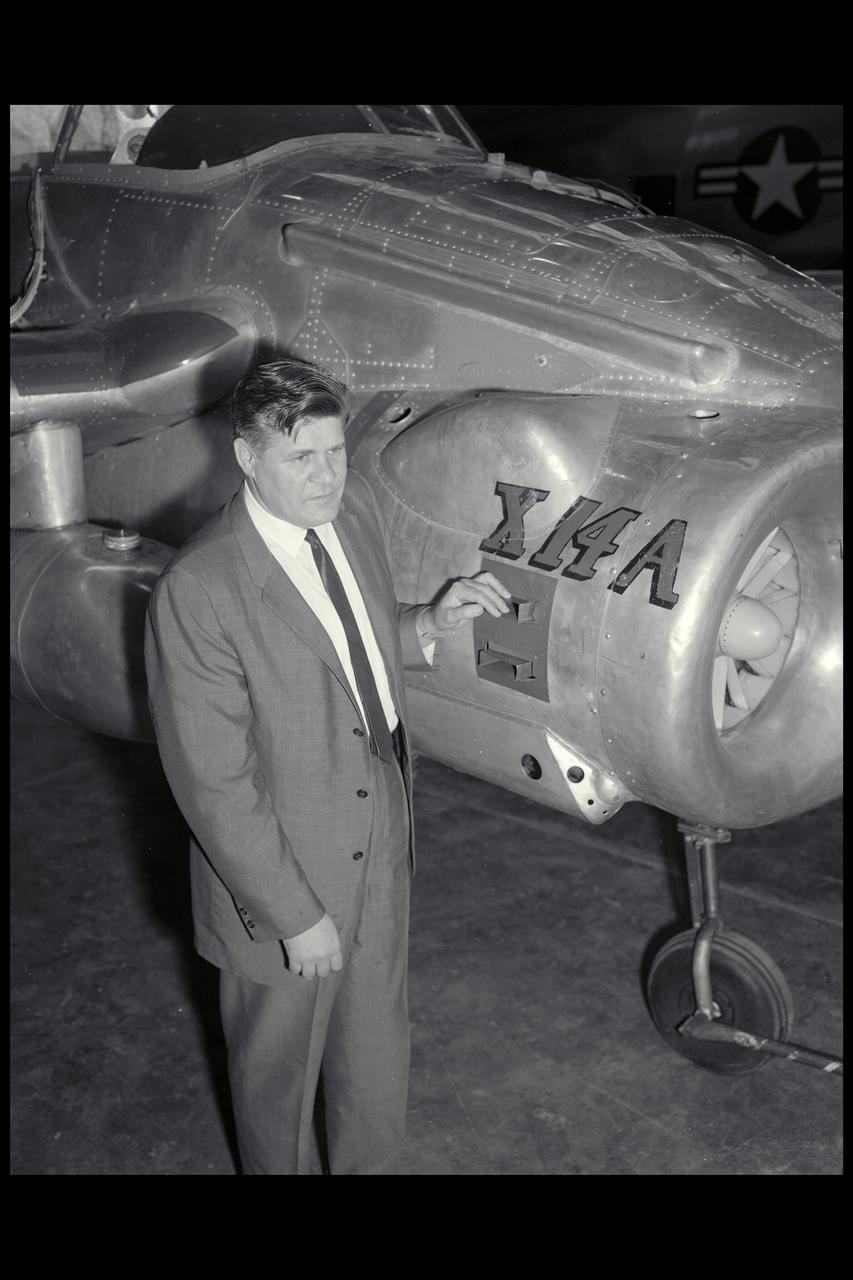
Woody Cook standing by X-14
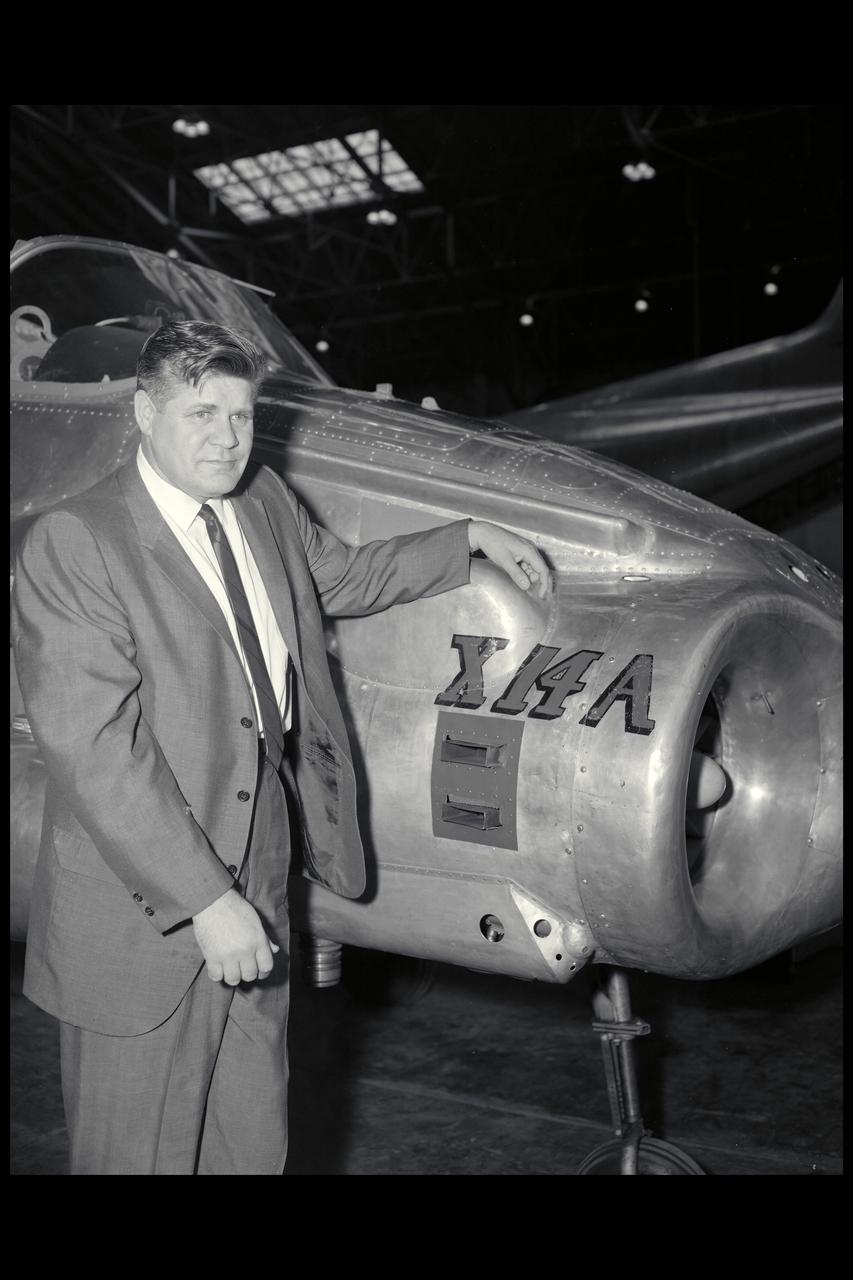
Woody Cook standing by X-14
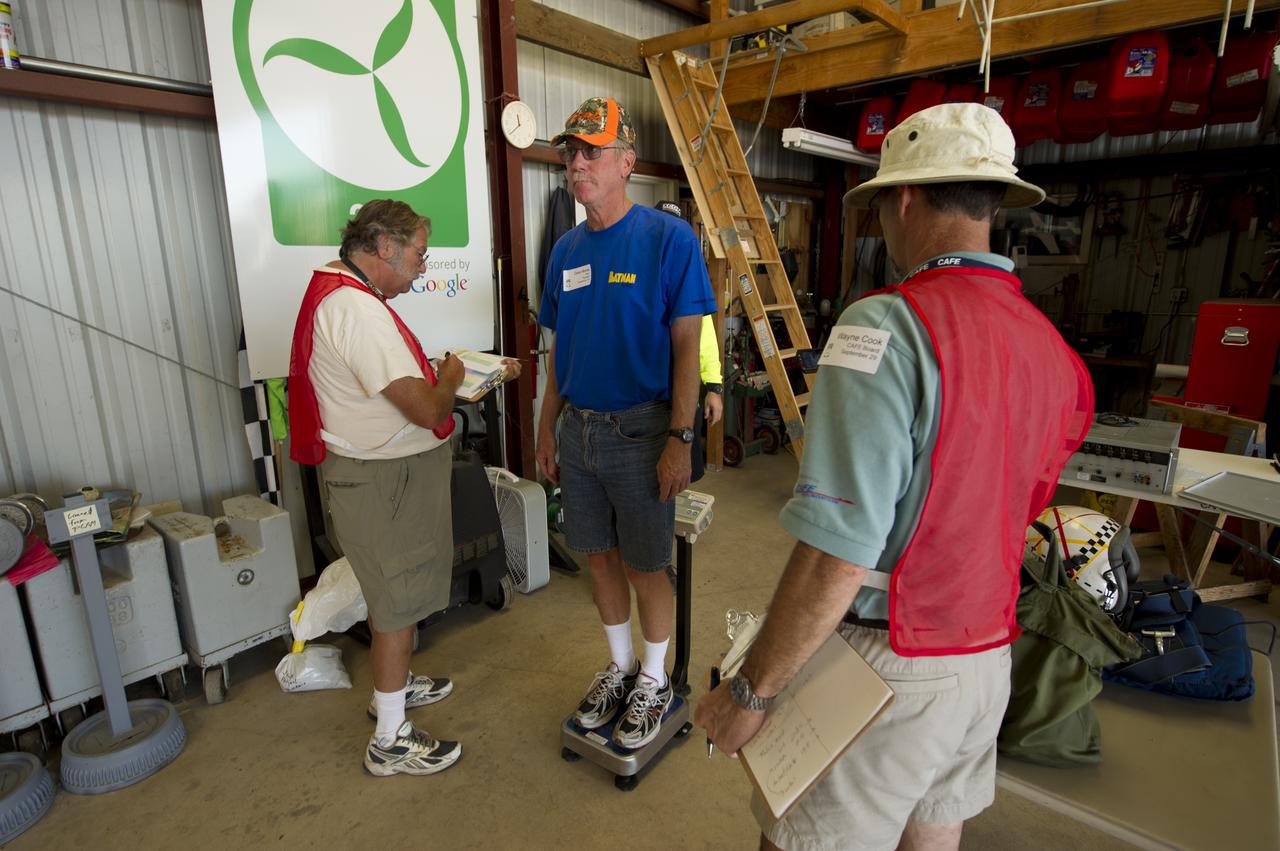
Pipistrel Taurus G4 Pilot David Morss, center, is is weighed-in as CAFE Foundation Weights Chief Wayne Cook, right, and Weight crew member Ron Stout look on during the 2011 Green Flight Challenge, sponsored by Google, held at the Charles M. Schulz Sonoma County Airport in Santa Rosa, Calif. on Thursday, Sept. 29, 2011. NASA and the Comparative Aircraft Flight Efficiency (CAFE) Foundation are having the challenge with the goal to advance technologies in fuel efficiency and reduced emissions with cleaner renewable fuels and electric aircraft. Photo Credit: (NASA/Bill Ingalls)
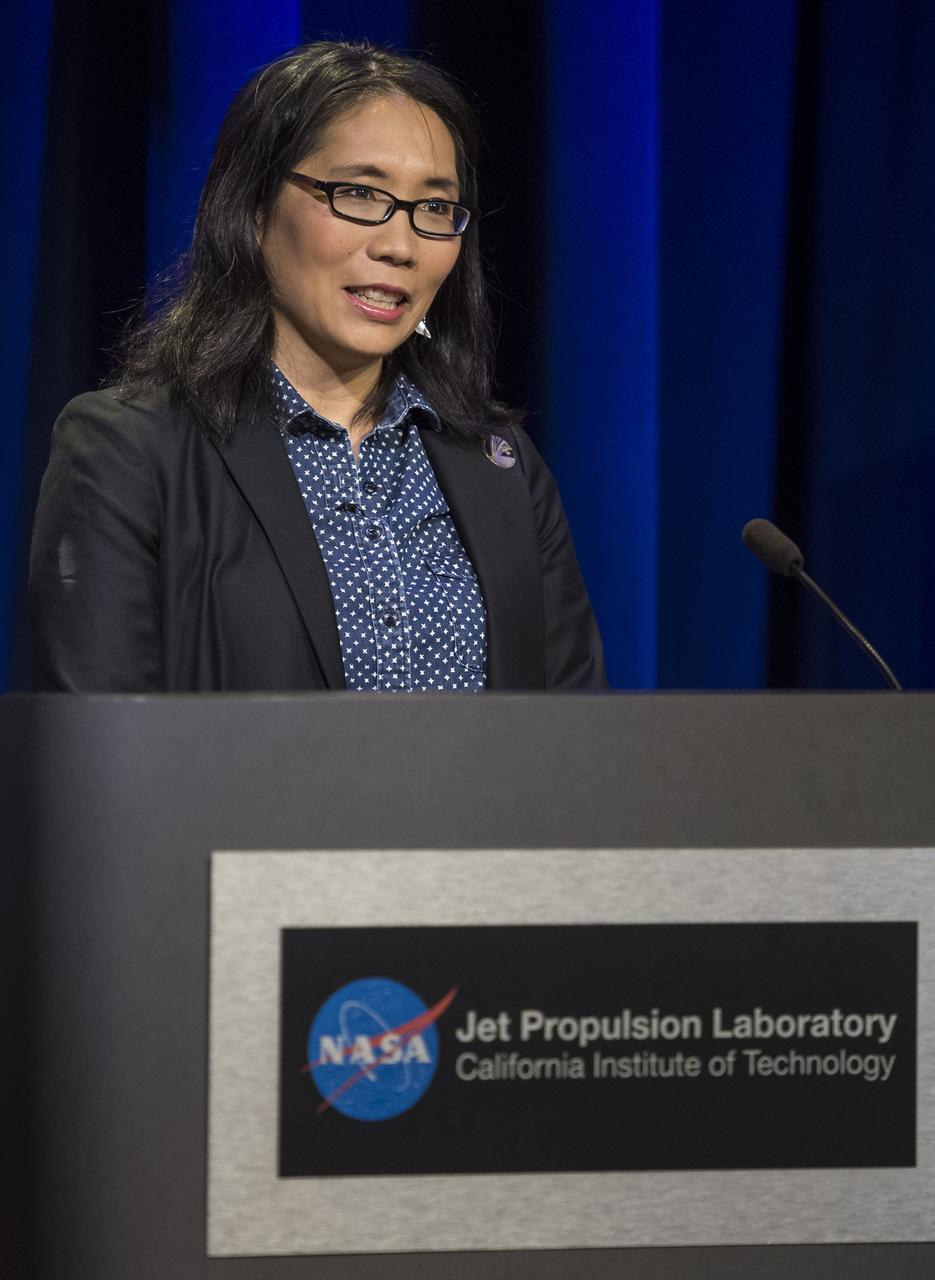
Jia-Rui Cook, media relations representative at JPL, moderates a press conference held after the end of the Cassini mission, Friday, Sept. 15, 2017 at NASA's Jet Propulsion Laboratory in Pasadena, California. Since its arrival in 2004, the Cassini-Huygens mission has been a discovery machine, revolutionizing our knowledge of the Saturn system and captivating us with data and images never before obtained with such detail and clarity. On Sept. 15, 2017, operators deliberately plunged the spacecraft into Saturn, as Cassini gathered science until the end. Loss of contact with the Cassini spacecraft occurred at 7:55 a.m. EDT (4:55 a.m. PDT). The “plunge” ensures Saturn’s moons will remain pristine for future exploration. During Cassini’s final days, mission team members from all around the world gathered at NASA’s Jet Propulsion Laboratory, Pasadena, California, to celebrate the achievements of this historic mission. Photo Credit: (NASA/Joel Kowsky)
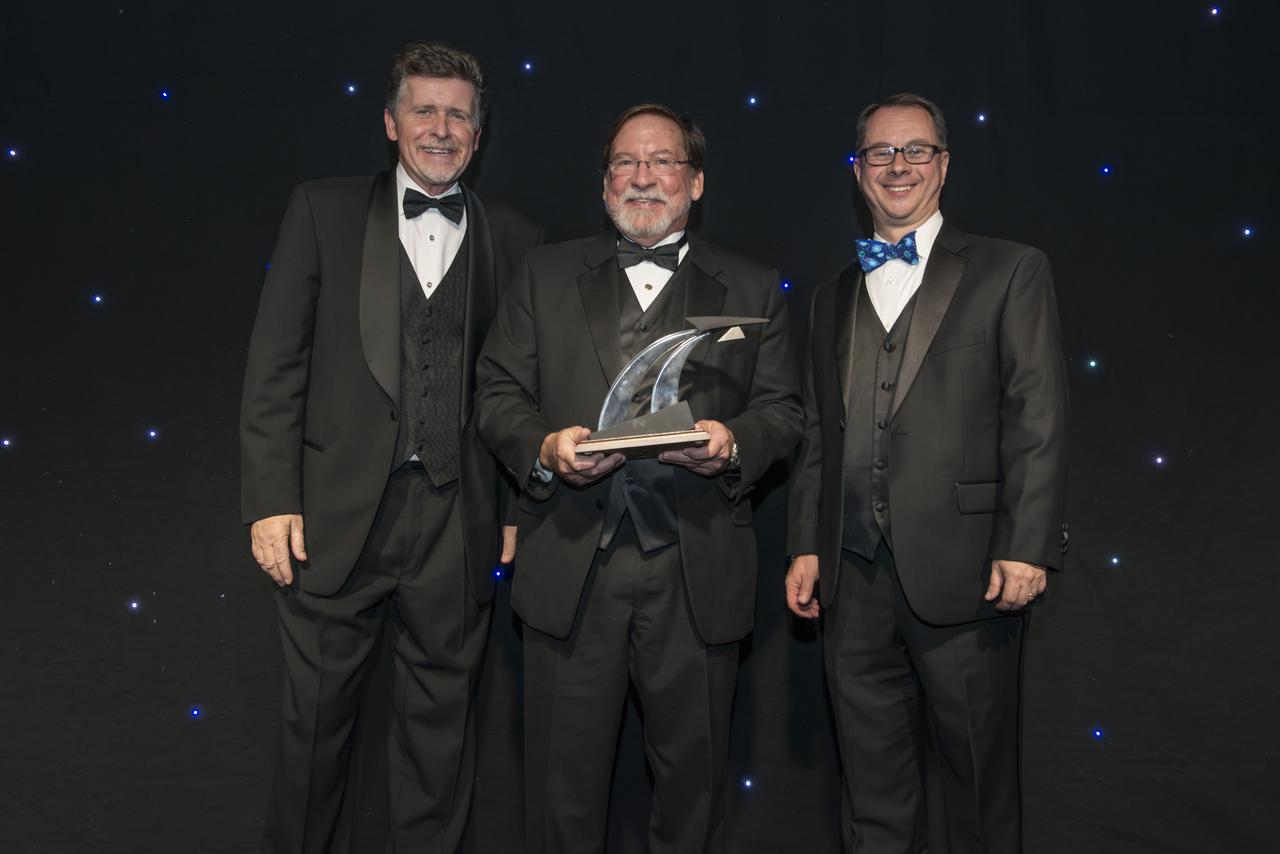
The annual Dr. Wernher Von Braun Memorial Dinner was held at the U.S. Space and Rocket Center's Davidson Center on October 26, 2017 with Keynote speaker General John Hyten, Commander of U.S. Strategic Command. Emcee was Mark Larson of Mark Larson Media Services, Inc. Dr. Wernher Von Braun Memorial Scholarships were presented to 8 college students by the National Space Club. Educator of the Year was awarded to Tammy Thorpe; Community Service award was presented to Huntsville, Al. Mayor Tommy Battle. The Communications Award was presented to retired astronaut Dr. Mike Massimino. The Distinguished Science Award was presented to Dr. Martin Weisskopf. The Astronautics Engineer Award was presented to Douglas R. Cooke. The Dr. Wernher Von Braun Space Flight Trophy was presented to Robert Lightfoot.
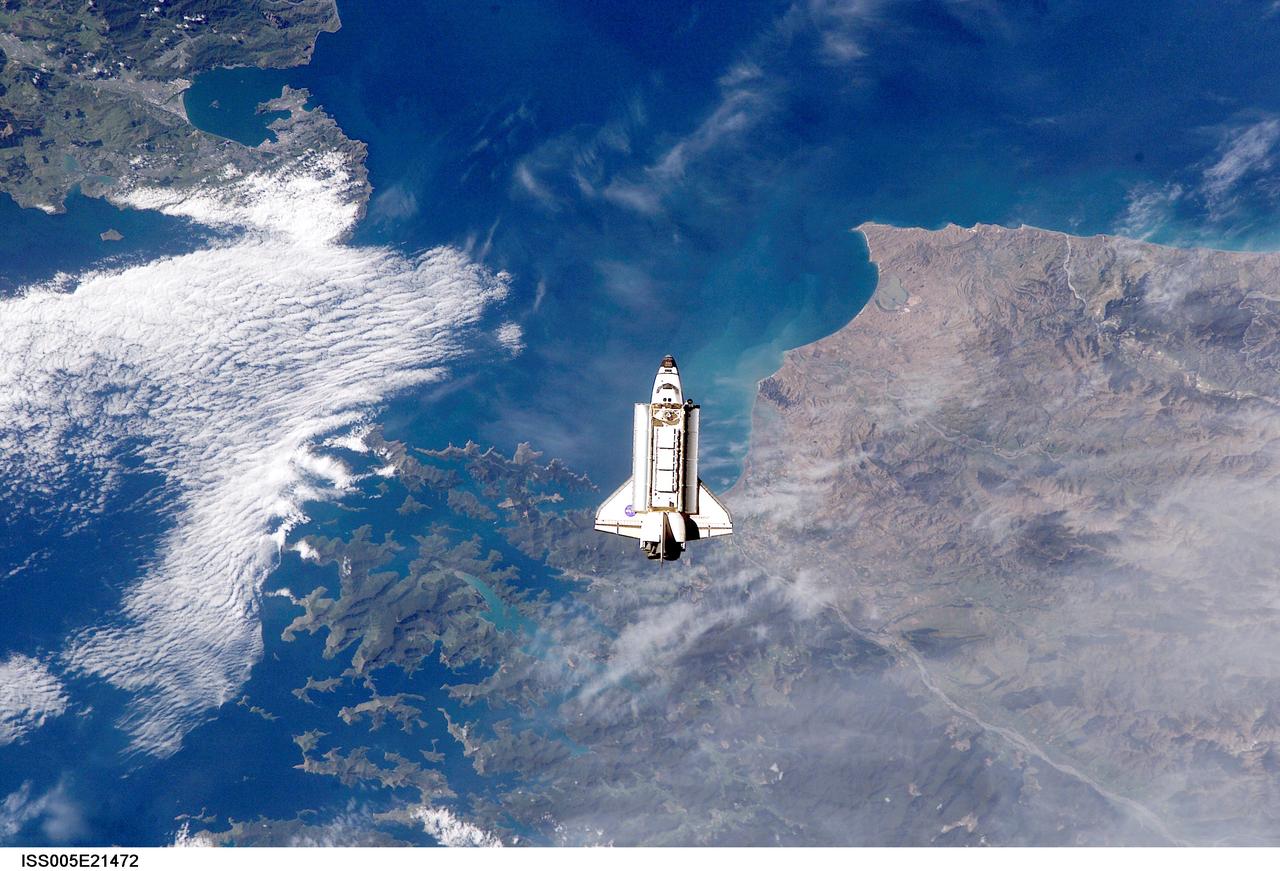
ISS005-E-21472 (25 November 2002) --- The Space Shuttle Endeavour is backdropped over Cook Strait, New Zealand as it approaches the International Space Station (ISS) during STS-113 rendezvous and docking operations. Docking occurred at 3:59 p.m. (CST) on November 25, 2002. The Port One (P1) truss, which was later to be attached to the station and outfitted during three spacewalks, can be seen in Endeavour's cargo bay. Endeavour's namesake, and her captain, First Lieutenant James Cook, moved through the waters of Cook Strait for the first time on Feb. 7, 1770.
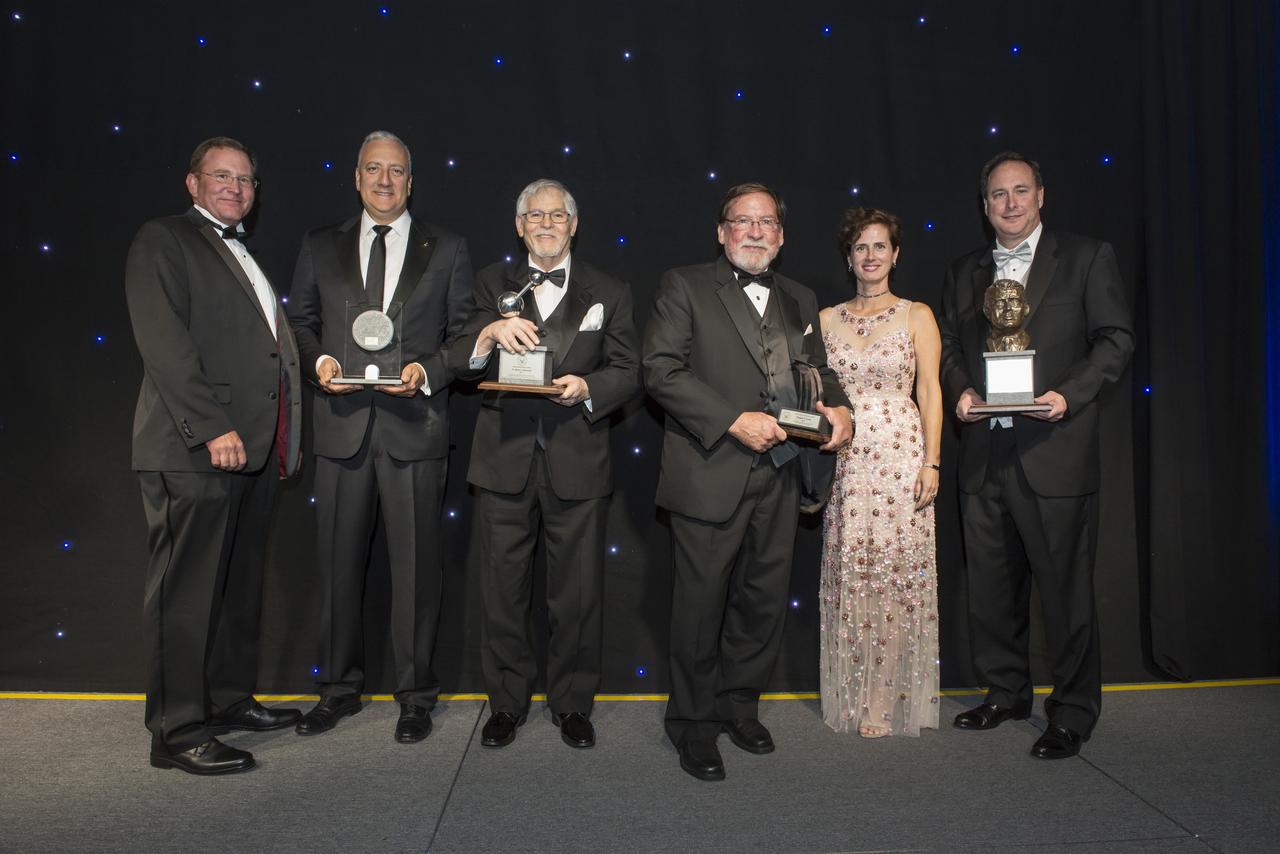
The annual Dr. Wernher Von Braun Memorial Dinner was held at the U.S. Space and Rocket Center's Davidson Center on October 26, 2017 with Keynote speaker General John Hyten, Commander of U.S. Strategic Command. Emcee was Mark Larson of Mark Larson Media Services, Inc. Dr. Wernher Von Braun Memorial Scholarships were presented to 8 college students by the National Space Club. Educator of the Year was awarded to Tammy Thorpe; Community Service award was presented to Huntsville, Al. Mayor Tommy Battle. The Communications Award was presented to retired astronaut Dr. Mike Massimino. The Distinguished Science Award was presented to Dr. Martin Weisskopf. The Astronautics Engineer Award was presented to Douglas R. Cooke. The Dr. Wernher Von Braun Space Flight Trophy was presented to Robert Lightfoot.
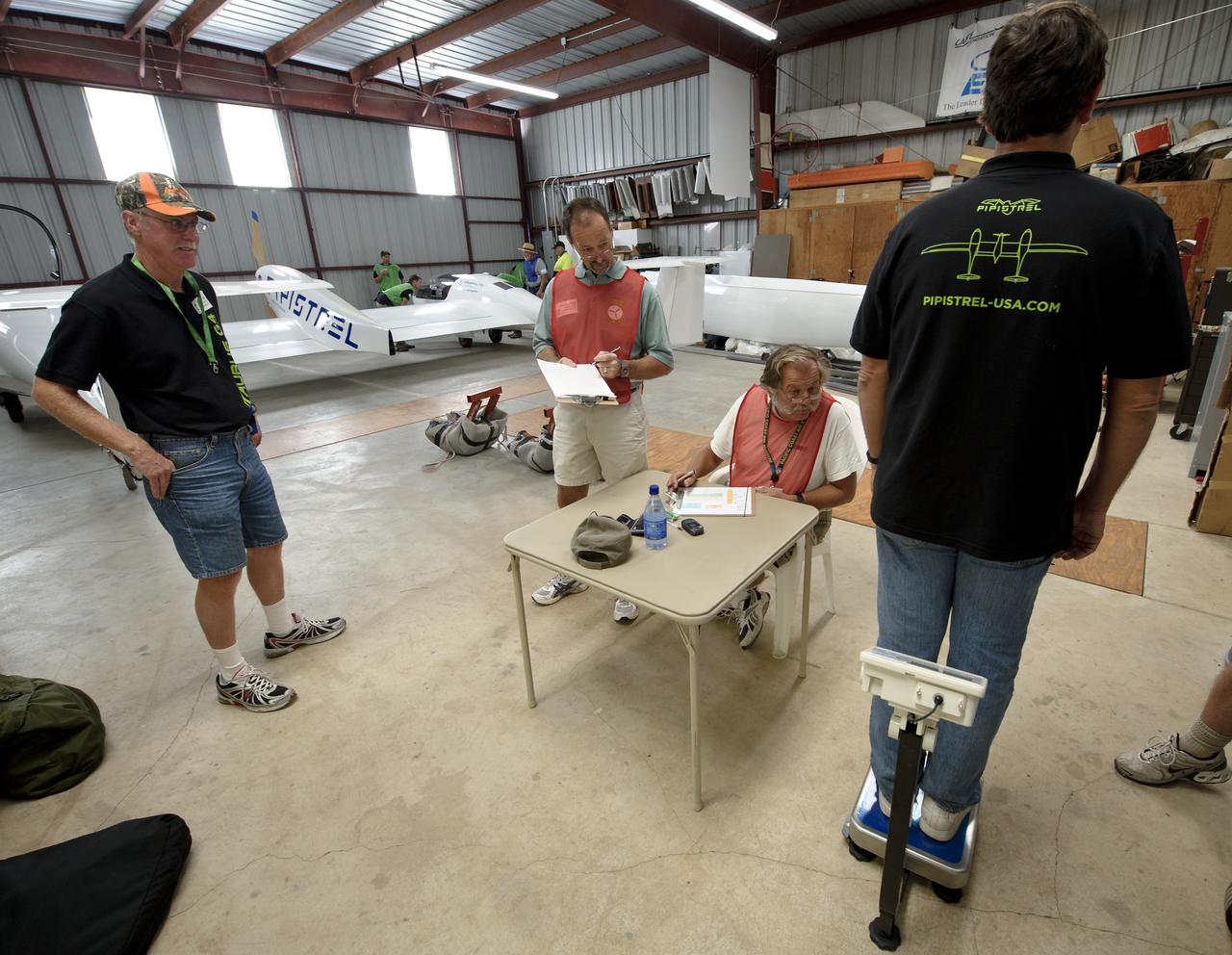
Pipistrel-USA Pilot David Morss, left, CAFE Foundation Weights Chief Wayne Cook, 2nd from left, and Weight crew member Ron Stout look on as Pipistrel-USA Pilot Robin Reid is weighed-in during the 2011 Green Flight Challenge, sponsored by Google, at the Charles M. Schulz Sonoma County Airport in Santa Rosa, Calif. on Monday, Sept. 26, 2011. NASA and the Comparative Aircraft Flight Efficiency (CAFE) Foundation are having the challenge with the goal to advance technologies in fuel efficiency and reduced emissions with cleaner renewable fuels and electric aircraft. Photo Credit: (NASA/Bill Ingalls)
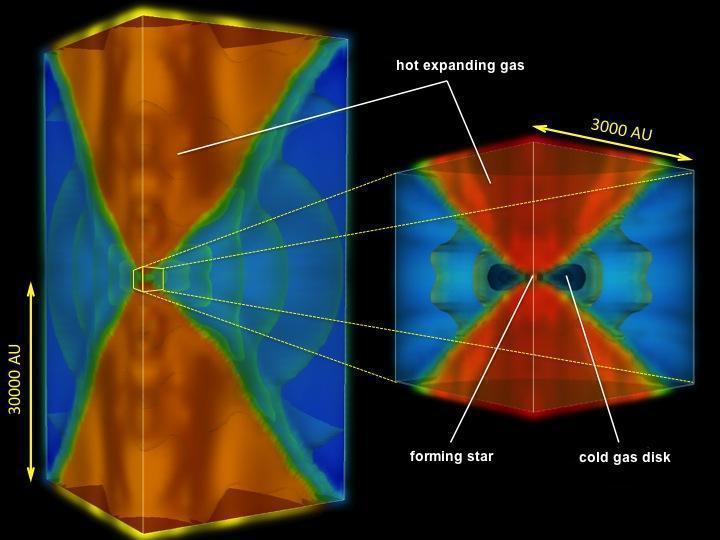
Scientists are simulating how the very first stars in our universe were born. The stars we see today formed out of collapsing clouds of gas and dust. In the very early universe, however, the stars had fewer ingredients available.
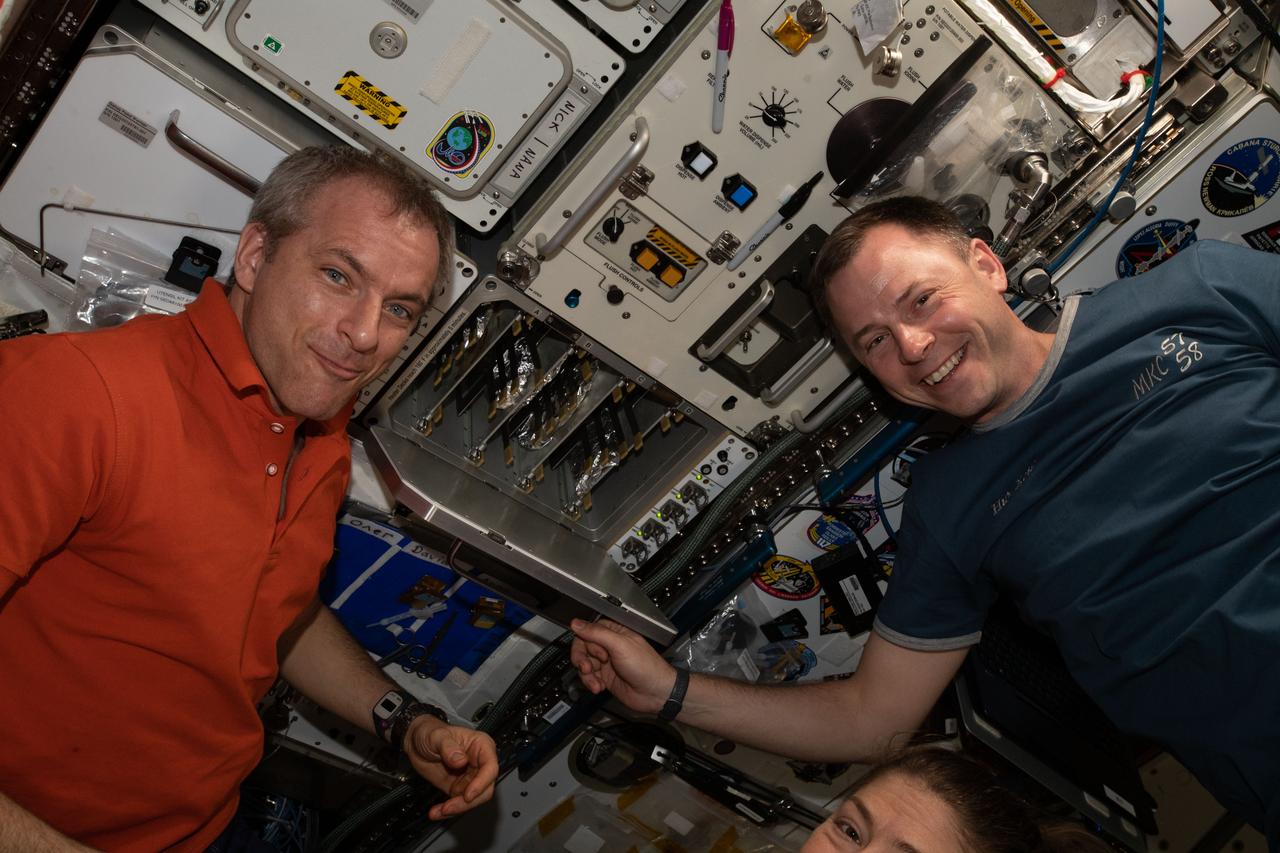
iss059e006481 (March 31, 2019) --- Astronauts David Saint-Jacques and Nick Hague eagerly await pizzas being cooked aboard the International Space Station's galley.
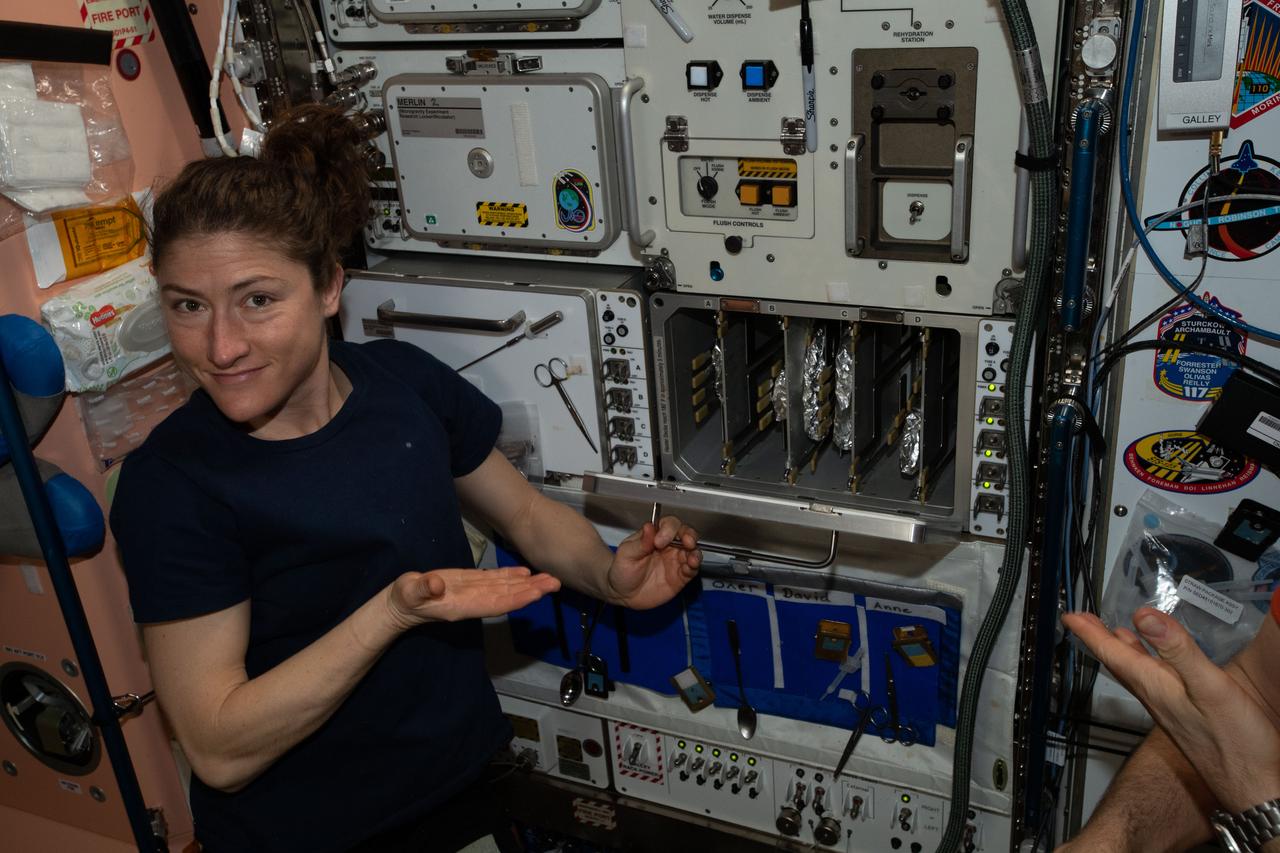
iss059e006478 (March 31, 2019) --- NASA astronaut Christina Koch anticipates the personal-size pizzas being cooked aboard the International Space Station's galley.
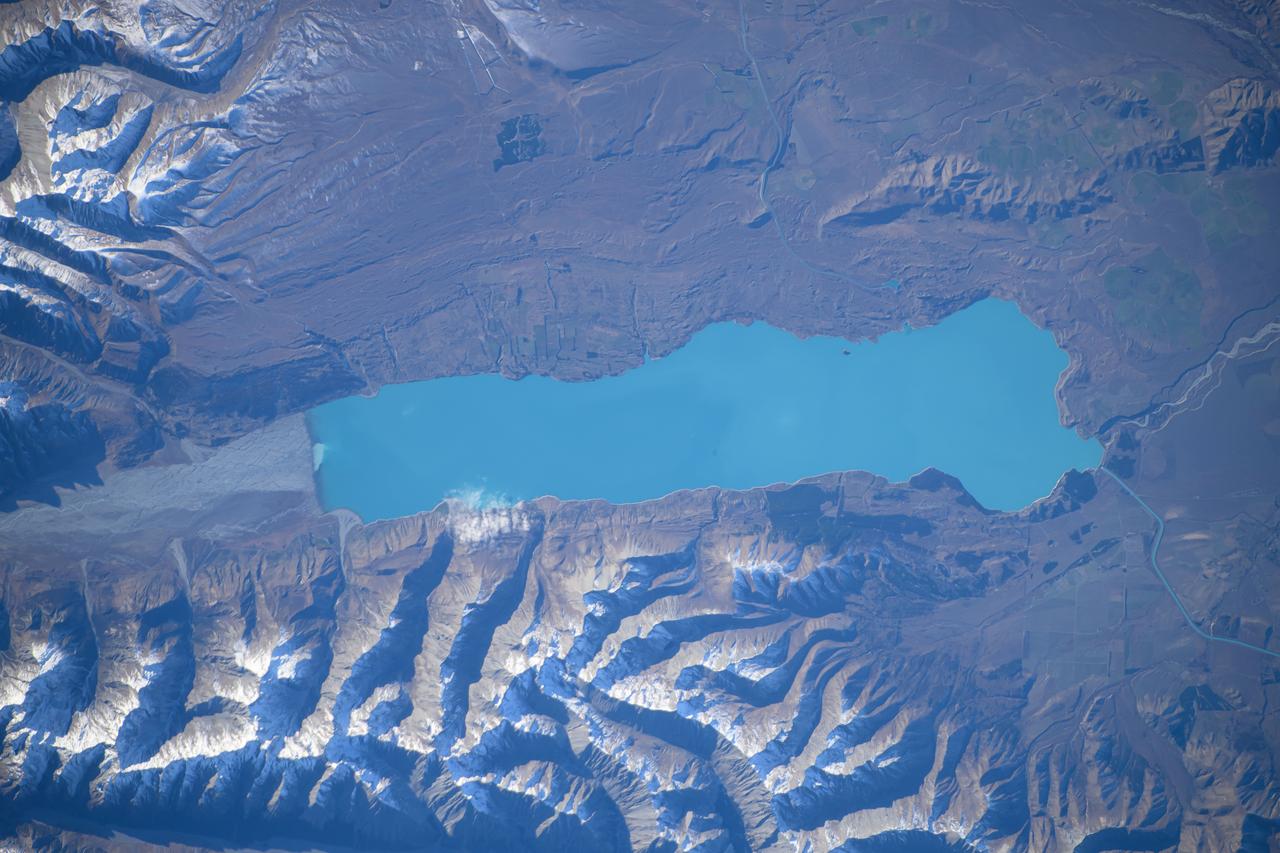
iss071e073562 (May 11, 2024) --- Lake Pukaki, fed by the Tasman River and south of Aoraki/Mount Cook in the Southern Alps, is pictured from the International Space Station as it orbited 266 miles above New Zealand.

SCI2017_0004: Artist's illustration of the Epsilon Eridani system showing Epsilon Eridani b, right foreground, a Jupiter-mass planet orbiting its parent star at the outside edge of an asteroid belt. In the background can be seen another narrow asteroid or comet belt plus an outermost belt similar in size to our solar system's Kuiper Belt. The similarity of the structure of the Epsilon Eridani system to our solar system is remarkable, although Epsilon Eridani is much younger than our sun. SOFIA observations confirmed the existence of the asteroid belt adjacent to the orbit of the Jovian planet. Credit: NASA/SOFIA/Lynette Cook
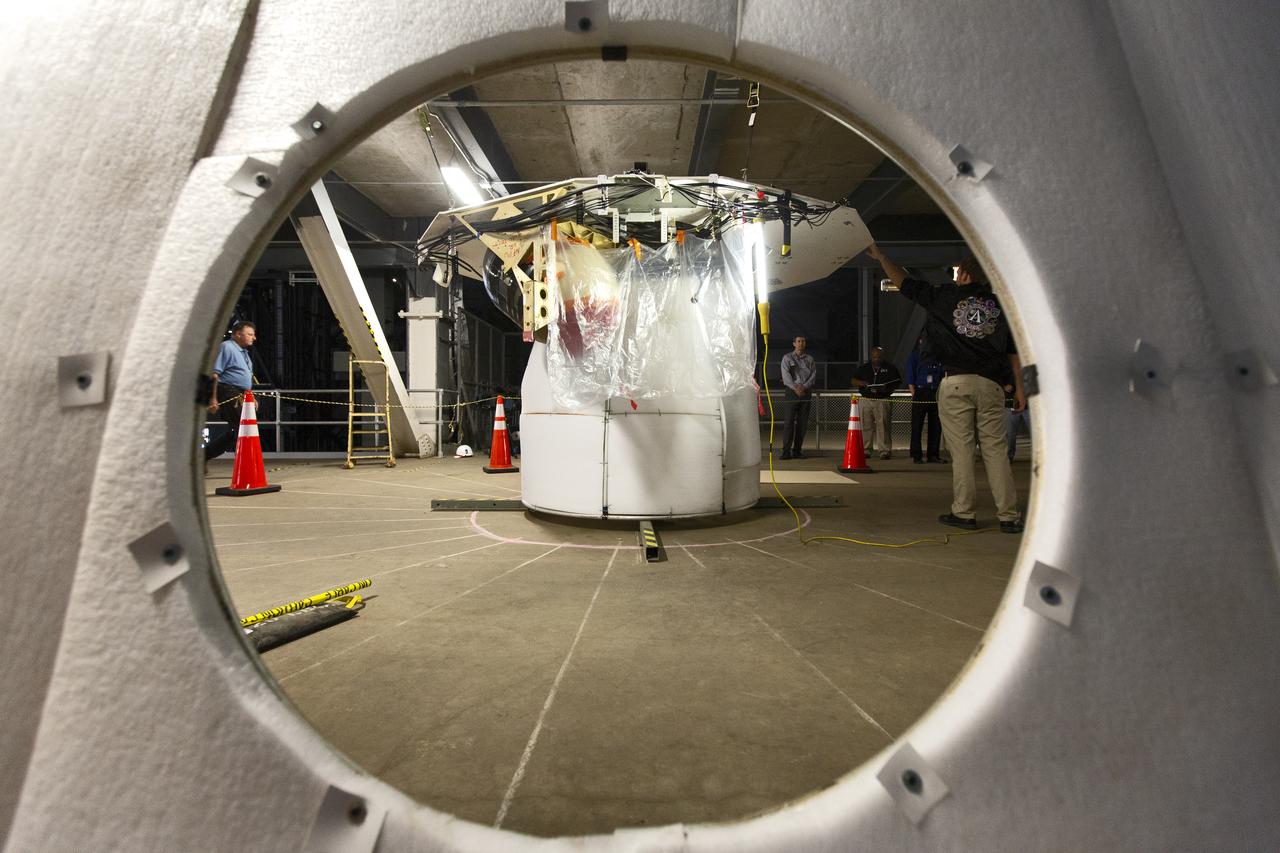
Robert Cook, a launch vehicle engineer with Millennium Engineering and Integration, talks during the Space Launch System (SLS) avionics handling tool demonstration inside Kennedy Space Center’s Vehicle Assembly Building on April 4, 2019. The demonstration showed that avionics boxes could be successfully and safely mounted into the SLS rocket’s upper stage — called the Interim Cryogenic Propulsion Stage, or ICPS — with low risk of damaging a closely located hydrazine tank. Avionics boxes include the Inertial Navigation and Control Assembly and flight batteries. Cook designed the ICPS section mockup used in the exercise.
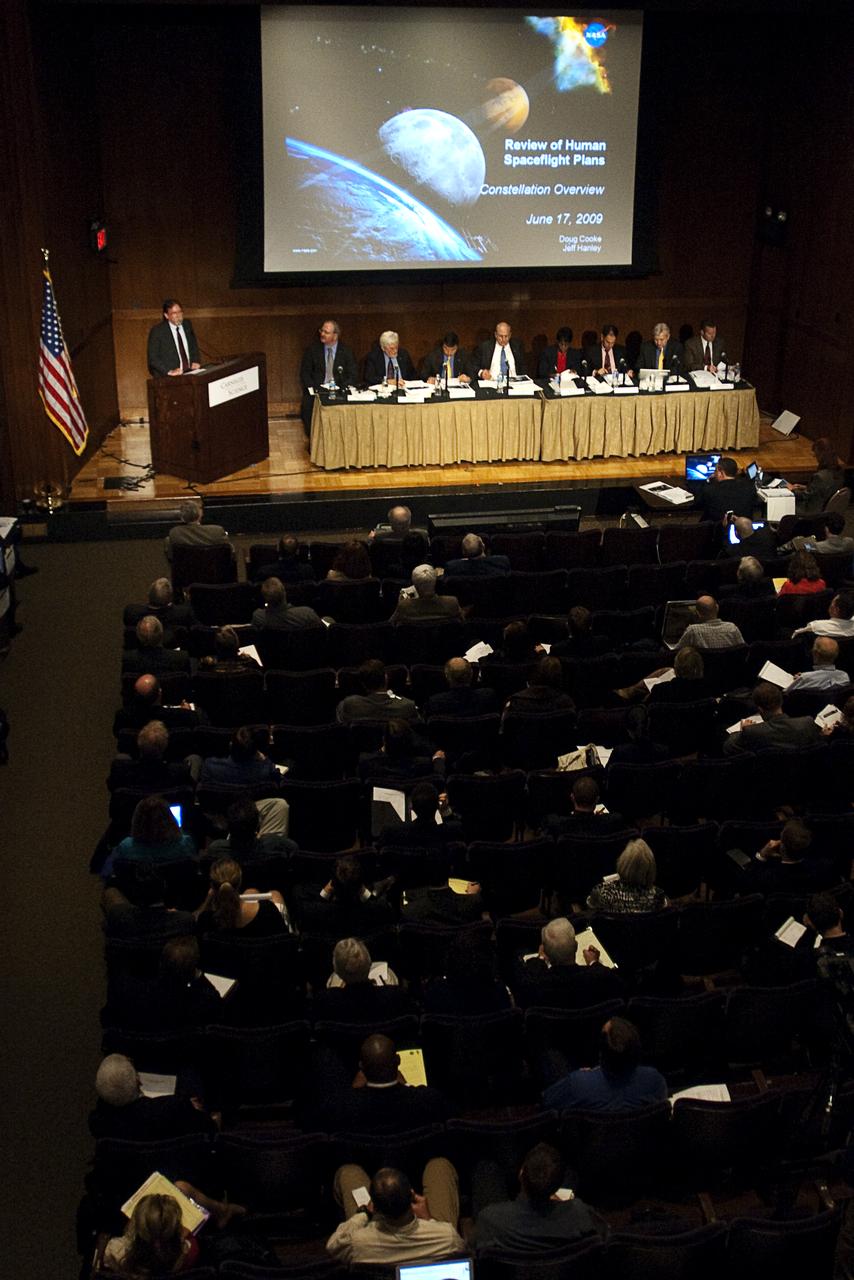
Douglas R. Cooke, Associate Administrator for Exploration Systems Mission Directorate, at podium, addresses the Human Space Flight Review Committee, Wednesday, June 17, 2009, at the Carnegie Institution in Washington. The panel will examine ongoing and planned NASA development activities and potential alternatives in order to present options for advancing a safe, innovative, affordable and sustainable human space flight program following the space shuttle's retirement. The committee wil present its results by August 2009. Seated from left on the panel is Jeffrey Greason, Bohdan Bejmuk, Dr. Leroy Chiao, Norman Augustine (chair), Dr. Wanda Austin, Dr. Edward Crawley, Dr. Christopher Chyba and Philip McAlister. Photo Credit: (NASA/Paul E. Alers)
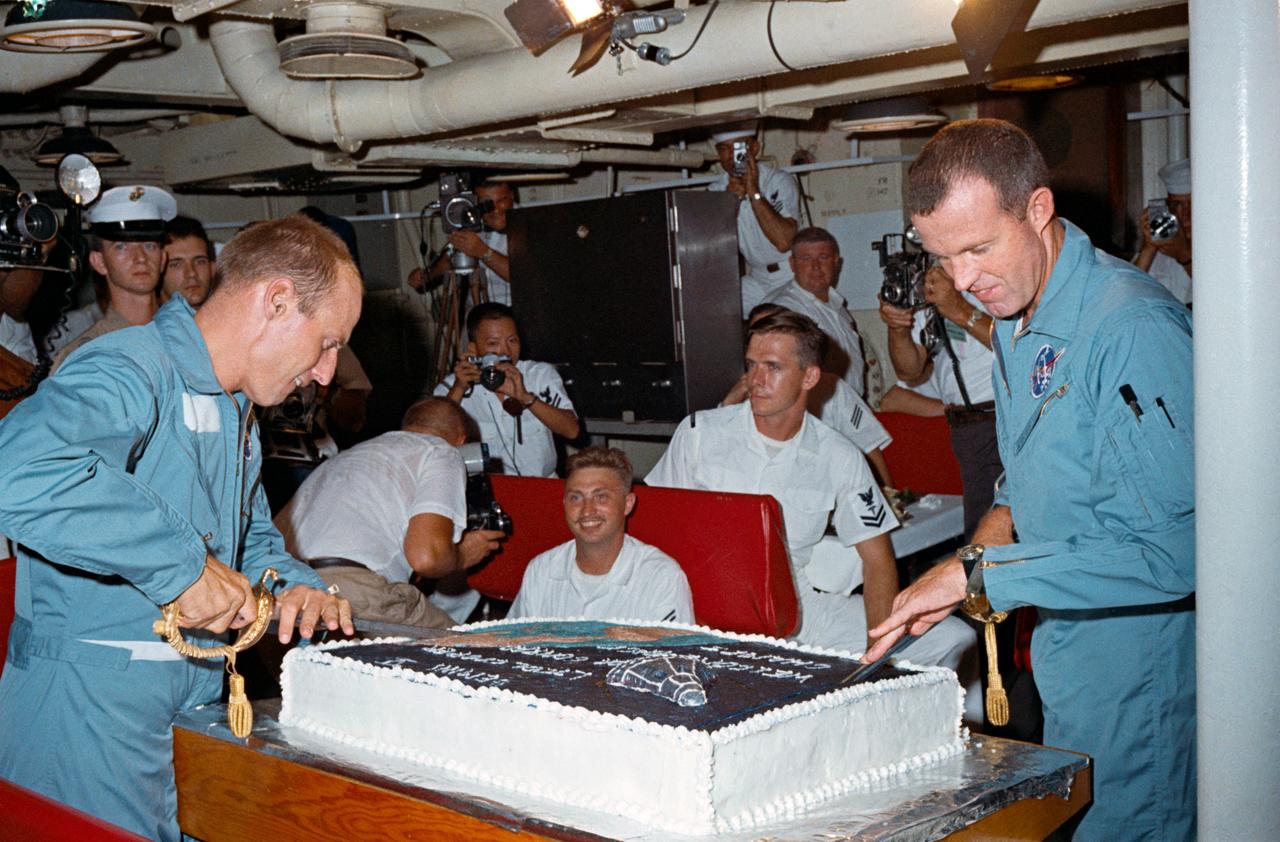
S65-51660 (29 Aug. 1965) --- Astronauts Charles Conrad Jr. (left) and L. Gordon Cooper Jr. prepare to slice into the huge cake prepared for them by the cooks onboard the aircraft carrier USS Lake Champlain. They are using ornamental Navy swords for knives.

iss073e0458478 (July 4, 2025) --- The International Space Station soared 267 miles above New Zealand's snow-capped Southern Alps mountain range that includes Mount Cook, the nation's highest peak at over 12,200 feet. At lower left, is a set of the orbital outpost's main solar arrays and a rollout solar array.

This image composite compares visible-light and infrared views from NASA's Spitzer Space Telescope of the glowing Trifid Nebula, a giant star-forming cloud of gas and dust located 5,400 light-years away in the constellation Sagittarius. Visible-light images of the Trifid taken with NASA's Hubble Space Telescope, Baltimore, Md. (inside left, figure 1) and the National Optical Astronomy Observatory, Tucson, Ariz., (outside left, figure 1) show a murky cloud lined with dark trails of dust. Data of this same region from the Institute for Radioastronomy millimeter telescope in Spain revealed four dense knots, or cores, of dust (outlined by yellow circles), which are "incubators" for embryonic stars. Astronomers thought these cores were not yet ripe for stars, until Spitzer spotted the warmth of rapidly growing massive embryos tucked inside. http://photojournal.jpl.nasa.gov/catalog/PIA07226
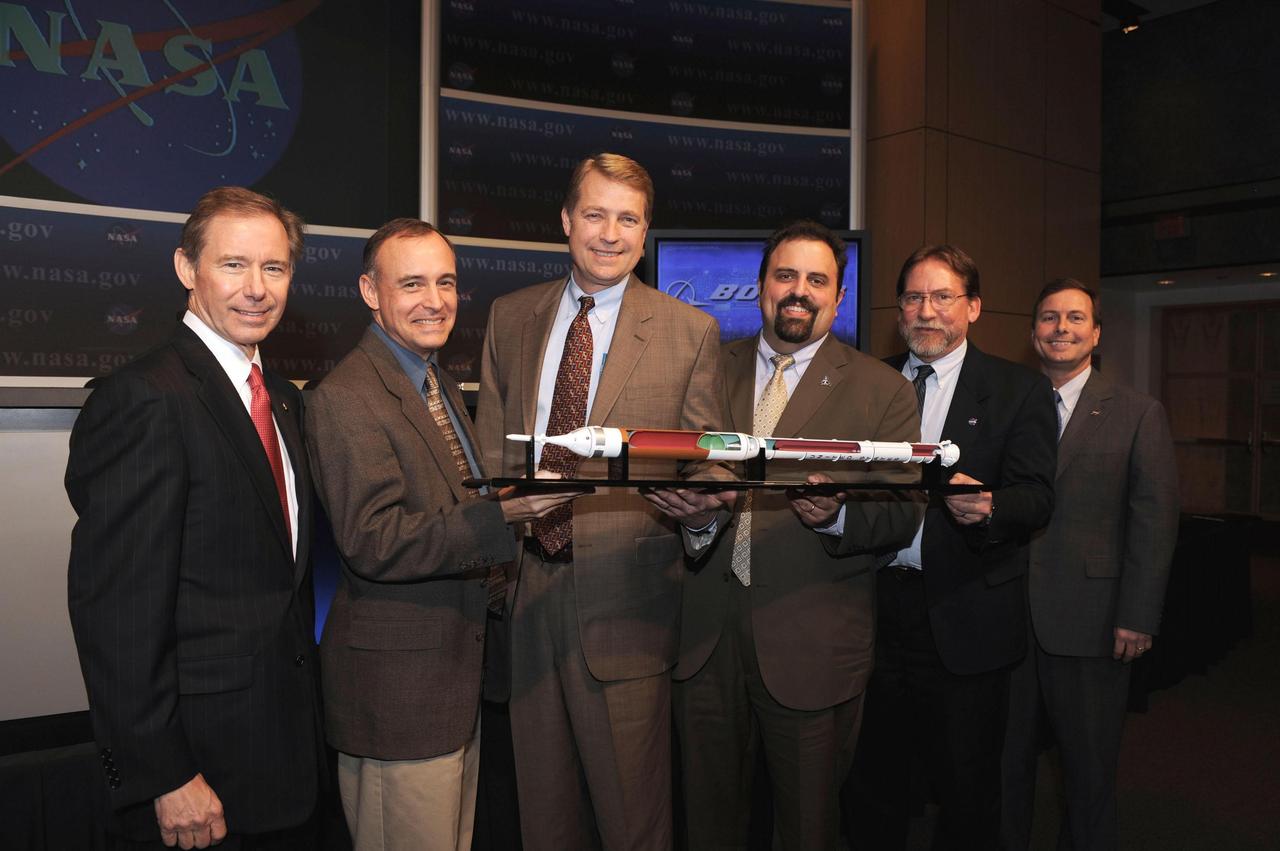
WASHINGTON, D.C. -- (From left) Brewster Shaw, vice president and genral manager of Boeing Space Exploration; Jeff Hanley, Constellation Program manager; Danny Davis, Upper Stage Element manager; Steve Cook, Ares Project manager; Doug Cooke, deputy associate administrator for Exploration Systems; and Rick Gilbrech, associate administrator for Space Exploration, stand with a model of the Ares I rocket on Dec. 12, 2007, at NASA Headquarters in Washington. NASA has selected The Boeing Company of Huntsville, Ala., as the prime contractor to produce, deliver and install avionics systsems for the Ares I rocket that will launch the Orion crew exploration vehicle into orbit. The selection is the final major contract award for Ares I. Photo credit: NASA/Paul E. Alers
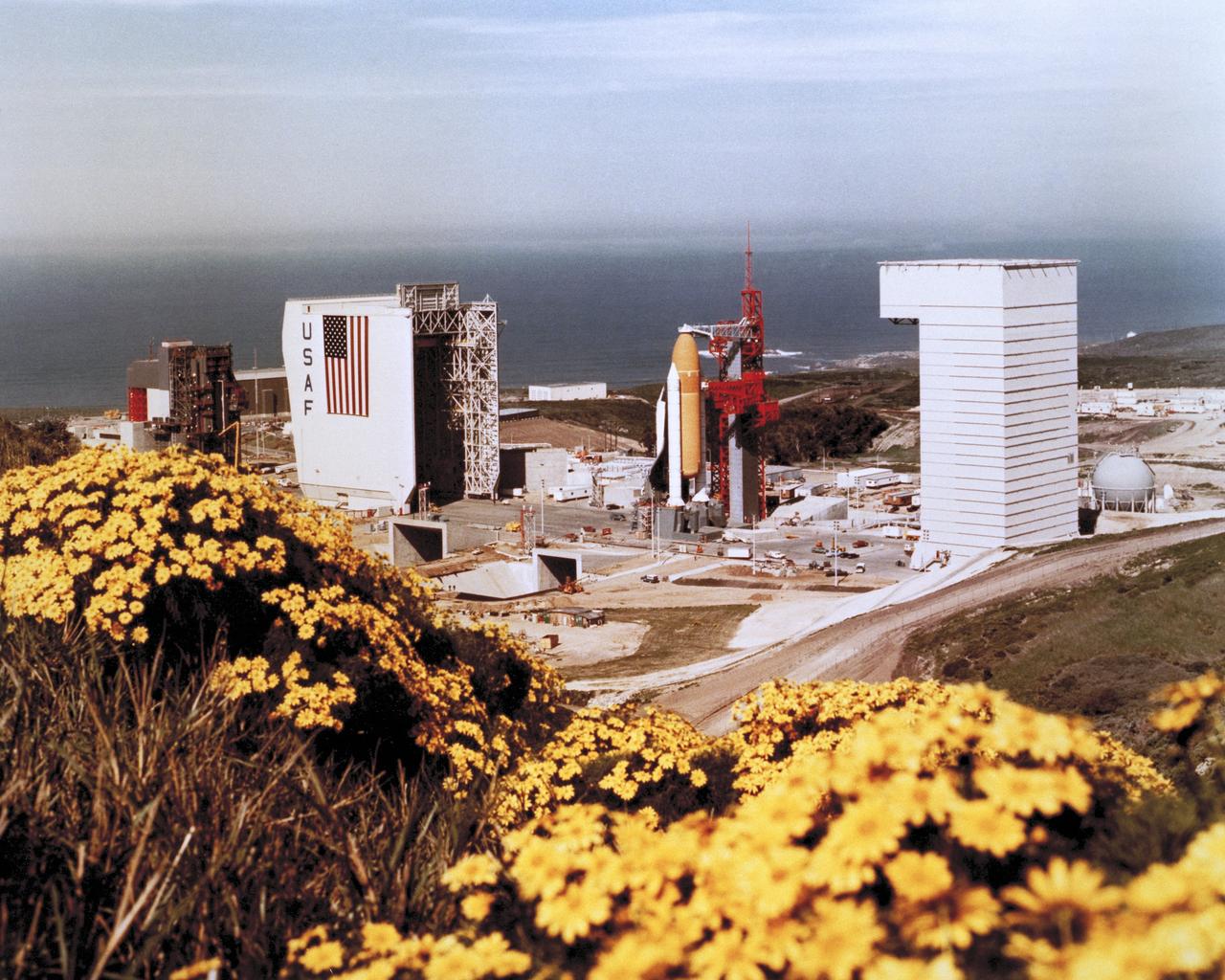
VANDENBERG AIR FORCE BASE, Calif. -- At Vandenberg Air Force Base in the early '80s, the Space Shuttle Enterprise undergoes Pathfinder fit checks at a tower. The Enterprise was built as a test vehicle and was not equipped for spaceflight. Enterprise eventually became the property of the Smithsonian Institution. Vandenberg AFB is located on the Central Coast of California about 150 miles northwest of Los Angeles. The property is comprised of parts of five Mexican land grants and a sixth grant that was transferred virtually intact to the Army. Vandenberg now is operated by the 30th Space Wing, and is the only military installation in the United States from which unmanned government and commercial satellites are launched into polar orbit. It is also the only site from which intercontinental ballistic missiles ICBMs are launched toward the Kwajalein Atoll to verify weapon systems performance. Vandenberg's military service dates back to 1941, when known as Camp Cooke it served as an Army training facility for armored and infantry troops. The main camp closed in June 1946 and was reactivated in August 1950 after the outbreak of the Korean War. The 13th and 20th Armored Divisions and the 40th, 44th, 86th, and 91st Infantry Divisions trained at Cooke. With the advent of the missile age in the 1950s, the Air Force persuaded Secretary of Defense Charles E. Wilson to direct the Army to transfer 64,000 acres of North Camp Cooke to the Air Force for use as a missile launch and training base. In 1958, Camp Cooke was renamed Vandenberg Air Force Base in honor of the late General Hoyt S. Vandenberg, second Air Force Chief of Staff of the United States Air Force and chief architect of today's modern Air Force. Photo Credit: NASA
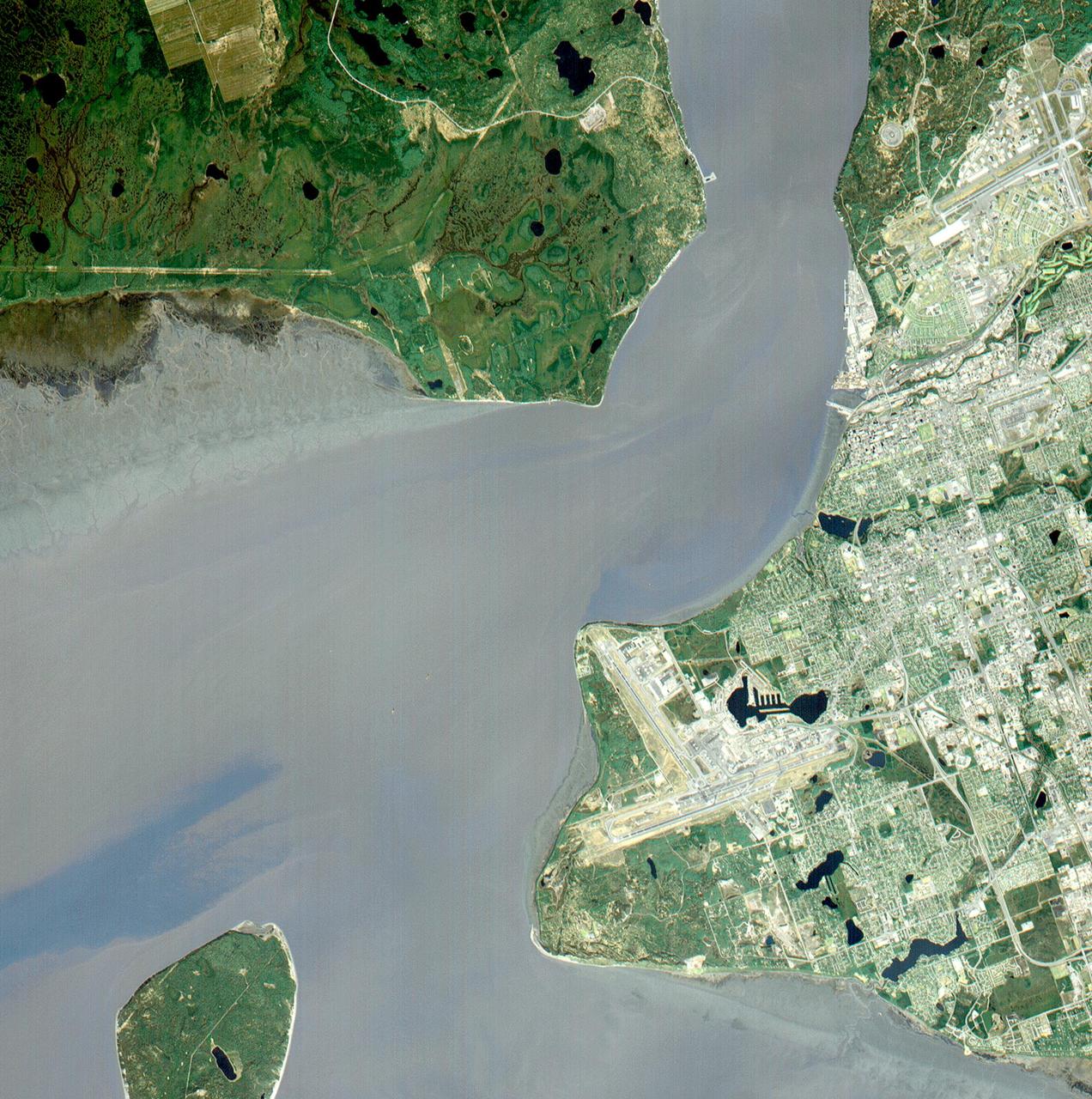
Anchorage, Alaska and Cook Inlet are seen in this 30 by 30 km (19 by 19 miles) sub-image, acquired May 12, 2000 by the Advanced Spaceborne Thermal Emission and Reflection Radiometer (ASTER). Orbiting at an altitude of 705 km (430 miles) on board NASA's Terra satellite, ASTER provides data at a resolution of 15 m (47 feet) and allows creation of this simulated natural color image. At the center of the image is the Ted Stevens Anchorage International Airport; in the upper right corner is Elmendorf Air Force Base. Dark green coniferous forests are seen in the northwest part of the image. A golf course, with its lush green fairways, is just south of the Air Force Base. The image covers an area of 30 by 30 km, was acquired May 12, 2000, and is located at 61.2 degrees north latitude and 149.9 degrees west longitude. http://photojournal.jpl.nasa.gov/catalog/PIA02675
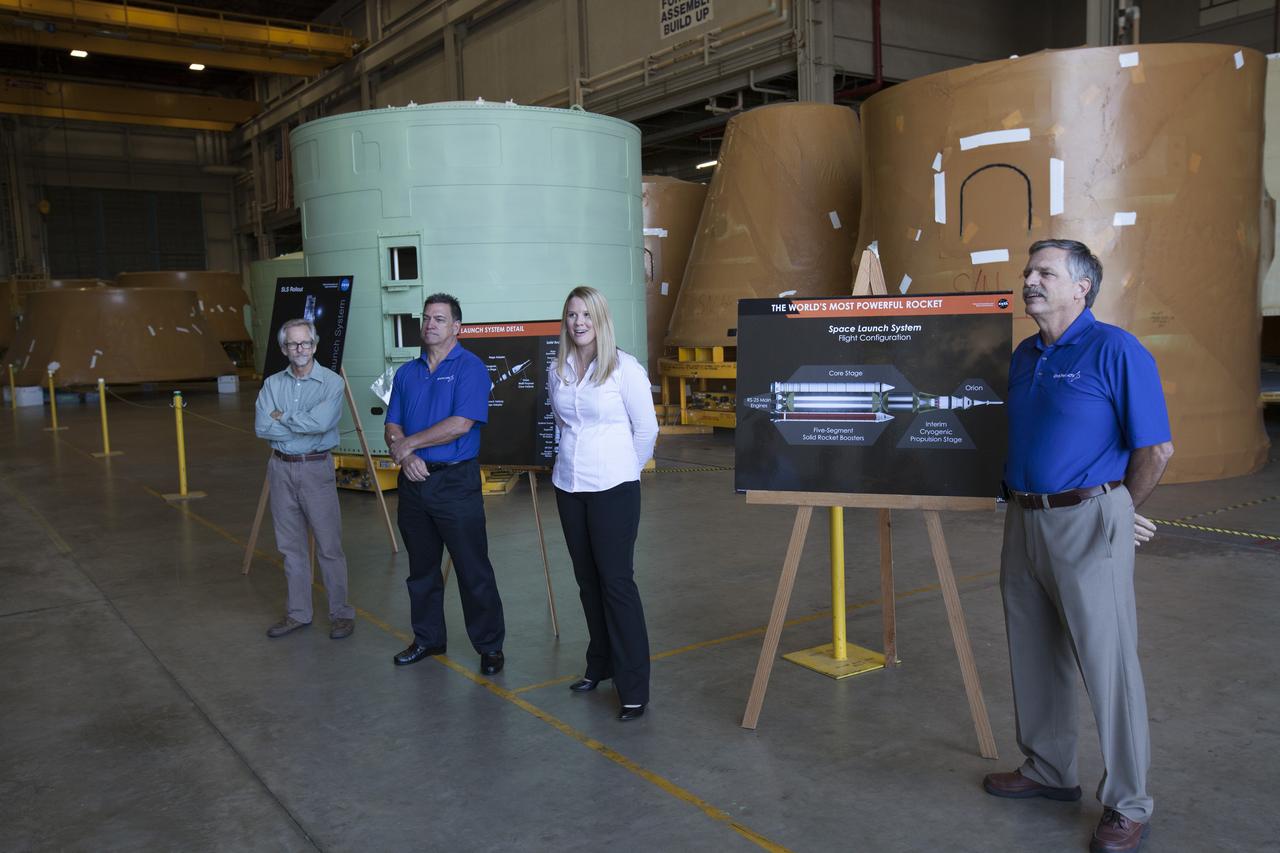
Bethany March, an element integration engineer at NASA’s Marshall Space Flight Center (MSFC) in Alabama, speaks to members of the news media during a tour of the Booster Fabrication Facility (BFF) at NASA’s Kennedy Space Center in Florida. Orbital ATK is a contractor for MSFC, and operates the BFF to prepare aft booster segments and hardware for the agency’s Space Launch System (SLS) solid rocket boosters. To her right is Rick Serfozo, Orbital ATK Florida site director. The SLS rocket and Orion spacecraft will launch on Exploration Mission-1 in 2018. The Ground Systems Development and Operations Program is preparing the infrastructure to process and launch spacecraft for deep-space missions and the journey to Mars.
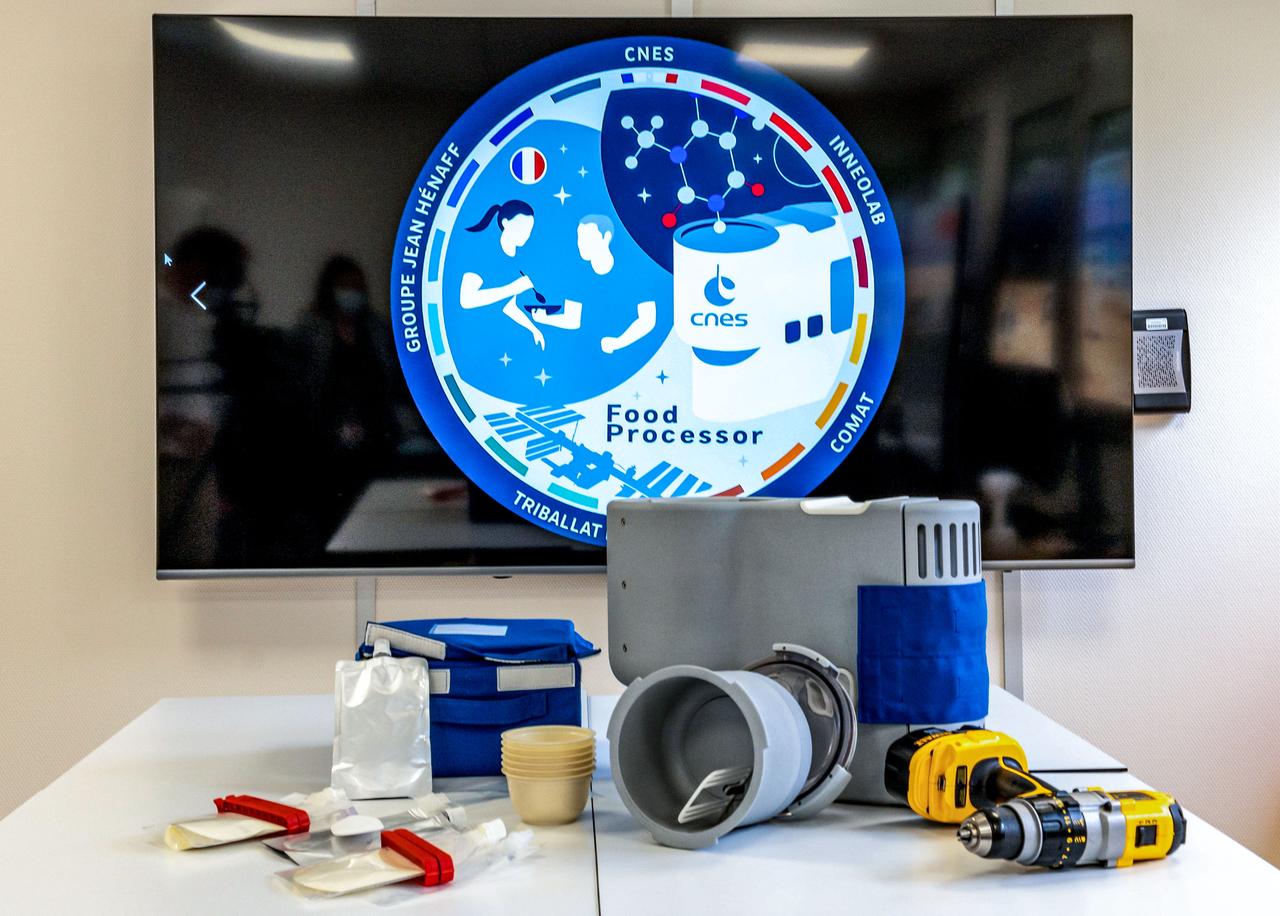
jsc2023e054754 (6/23/2021) --- A preflight view of the Food Processor Instrument and consumables including the drill it will need to use on board the International Space Station (ISS). The objective of the Advanced System for Space Food (Food Processor) investigation on board the International Space Station is to test a prototype equipment demonstrator with one specific recipe that uses basic cooking functions (beating egg whites, mixing products). © CNES/DE PRADA Thierry, 2021.
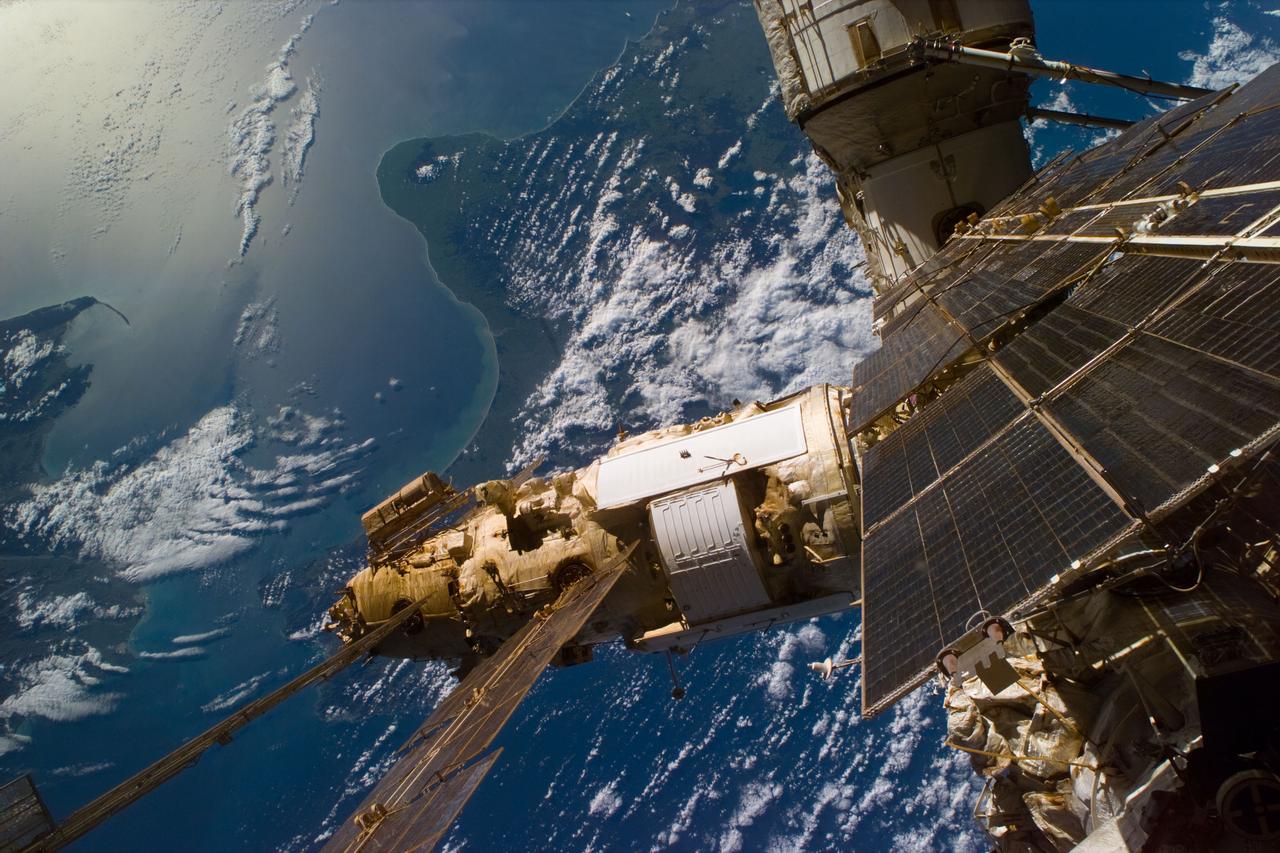
STS79-E-5065 (19 September 1996) --- As seen from the Space Shuttle Atlantis' flight deck, backdropped against Cook Strait, the Tasman Sea and the south Pacific Ocean, several components of Russia's Mir Space Station greet STS-79 crew members looking through aft-flight deck windows. Egmont National Park and Mt. Egmont on New Zealand's North Island can be easily delineated, during Flight Day 4.
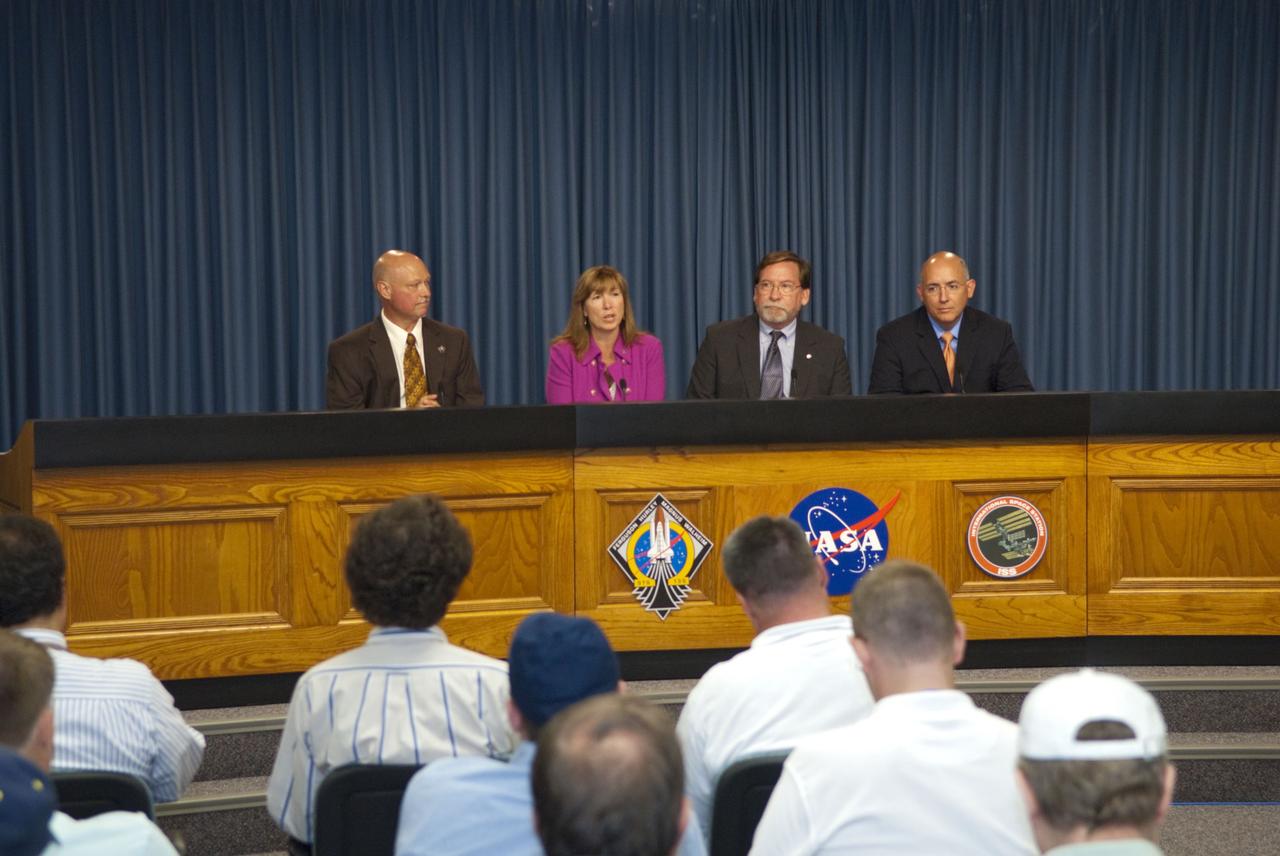
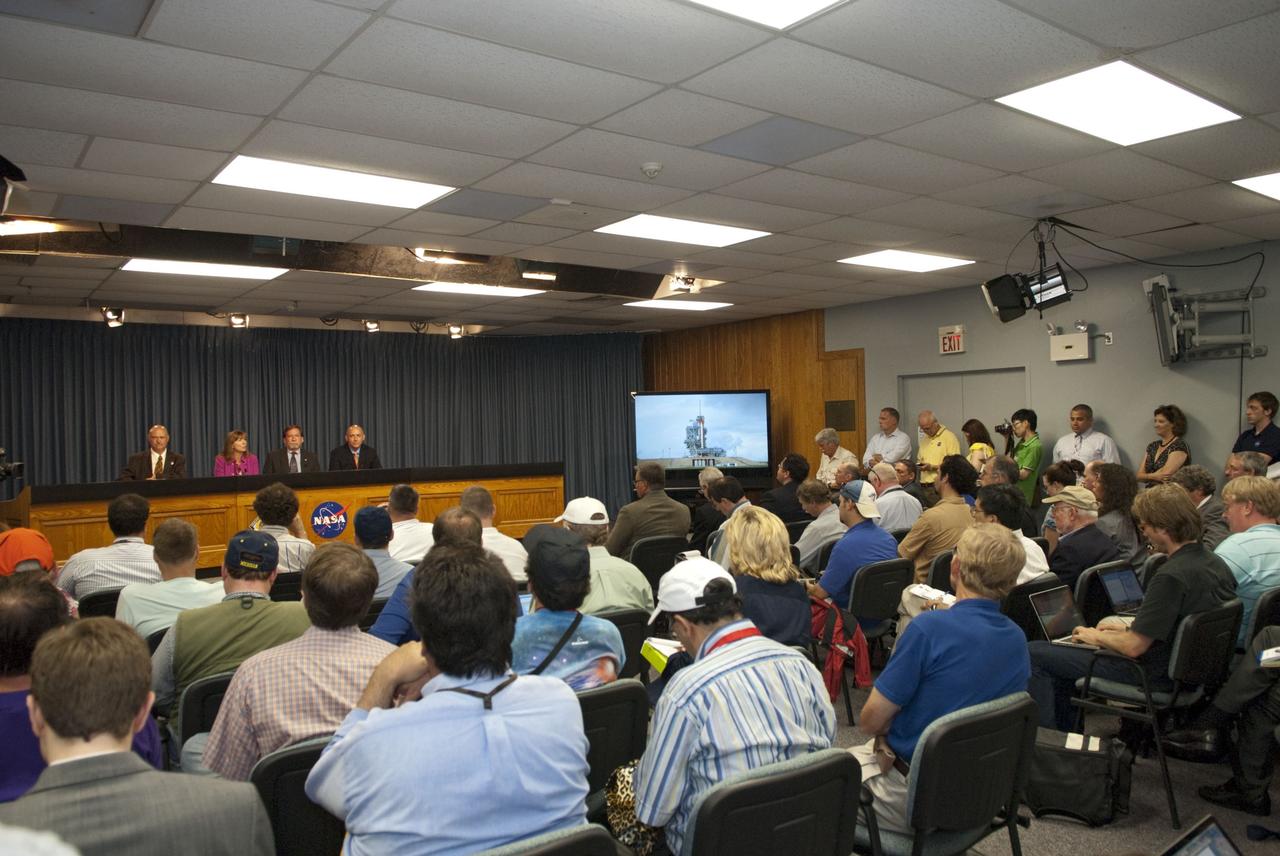
CAPE CANAVERAL, Fla. -- In the Press Site auditorium at NASA's Kennedy Space Center in Florida, media were briefed about the agency's next step for Human Space Flight. Seen here are NASA Public Affairs Officer Mike Curie (left); Lori Garver, NASA deputy administrator; Doug Cooke, Exploration Systems Mission Directorate associate administrator and Mike Suffredini, NASA International Space Station Program manager. Photo credit: NASA/Jim Grossmann
CAPE CANAVERAL, Fla. -- In the Press Site auditorium at NASA's Kennedy Space Center in Florida, media were briefed about the agency's next step for Human Space Flight. Seen here are NASA Public Affairs Officer Mike Curie (left); Lori Garver, NASA deputy administrator; Doug Cooke, Exploration Systems Mission Directorate associate administrator and Mike Suffredini, NASA International Space Station Program manager. Photo credit: NASA/Jim Grossmann
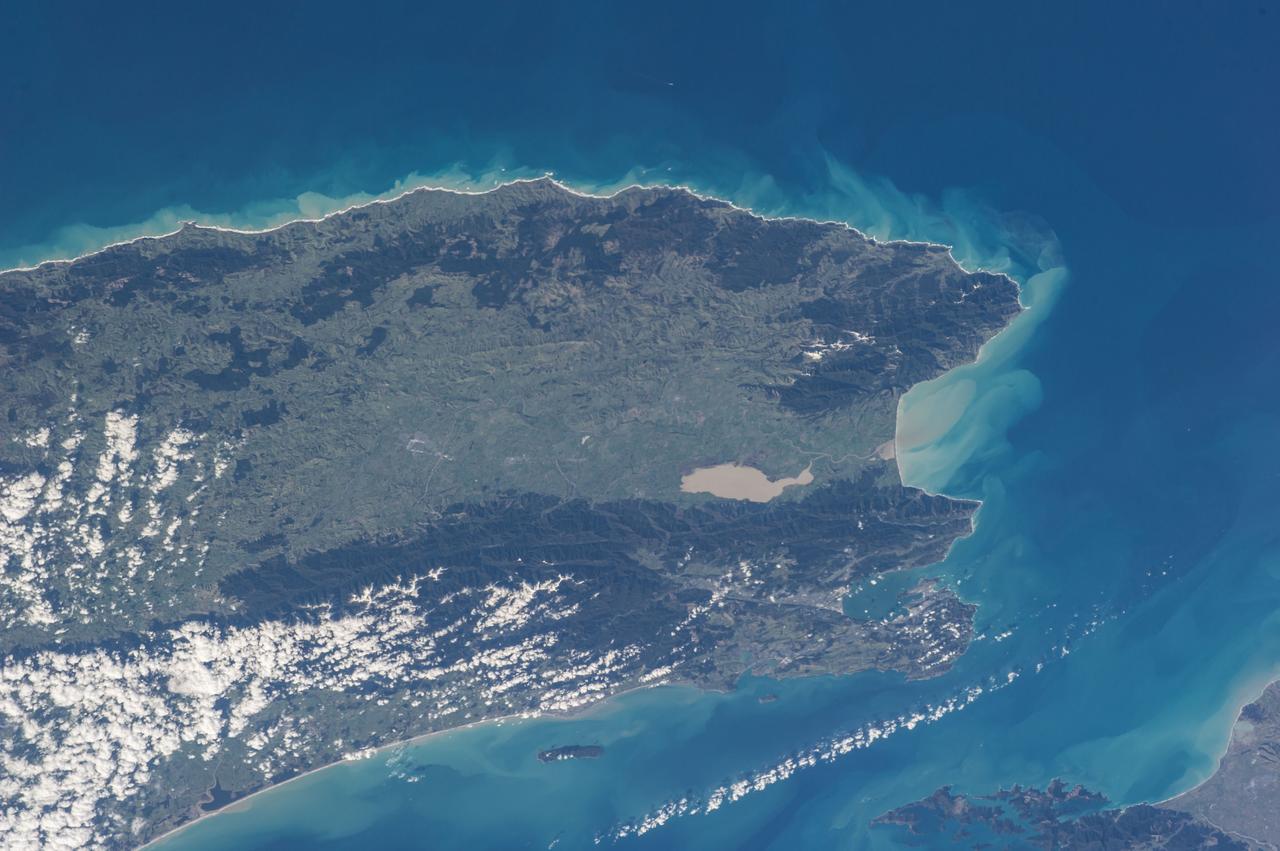
ISS040-E-091153 (10 Aug. 2014) --- One of the Expedition 40 crew members aboard the International Space Station, flying at an altitude of 225 nautical miles, exposed this image of the south end of New Zealand's North Island on Aug. 10, 2014. Lake Wellington is just to the right of center frame. The north end of South Island is out of frame on the right side of Cook Strait at far right.
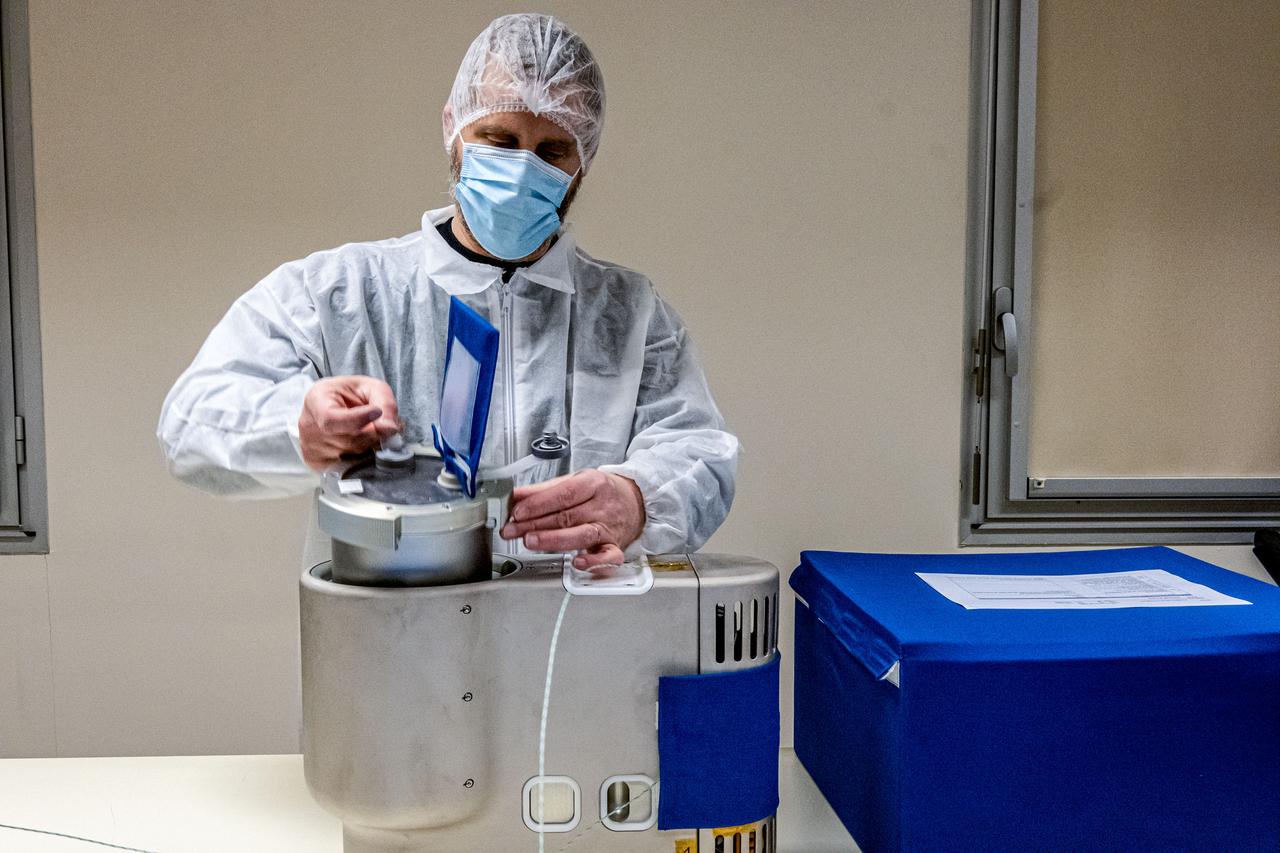
jsc2023e054755 (2/11/2021) --- A preflight view of David Moreeuw (Inneloab) testing the Food Processor assembly. The objective of the Advanced System for Space Food (Food Processor) investigation on board the International Space Station is to test a prototype equipment demonstrator with one specific recipe that uses basic cooking functions (beating egg whites, mixing products). © CNES/DE PRADA Thierry, 2021

“We did science fair projects in eighth grade. So my dad and I designed an experiment to look at what cooking oil is best for cooking popcorn. Now you go to science fairs and you see this experiment everywhere. But in 1989, it was like, ‘wow, a kid who knows the scientific method!’ “I made a lot of popcorn. My poor brothers had to eat it all. I measured volume popped and how many kernels were left unpopped. But I also measured the taste factor. For example, cooking popcorn in peanut oil actually has good yield but it doesn’t taste good. “In high school, I had this chemistry teacher named Carol Palmer. I’ll never forget her. The science fairs were really important to her. She had partnerships with laboratories in town, and through this program, I got to go to a stainless steel foundry. “Do you know what paper machines are like? Picture giant rolls, like the size of an 18-wheeler truckbed. This place made those things. This was the early 90s, so we were just starting to recycle paper. But the machines had begun falling apart because of all the corrosive chemicals added to the mix to remove ink. I was simulating that process in the laboratory through different experiments. And I won two years in a row at the state-level science fair: I won first prize in electrochemistry and I won first prize in chemistry. “It was all because of this teacher. And to be honest, I wouldn’t have known that materials science was a thing or that I should study it if I hadn’t had that opportunity. It really put me on course.” Kathleen Boggs, Systems and Technology Demonstration Manager in the International Space Station Division of the Human Exploration and Operations Mission Directorate, Thursday, March 5, 2020, at NASA Headquarters in Washington, DC. Photo Credit: (NASA/Joel Kowsky)
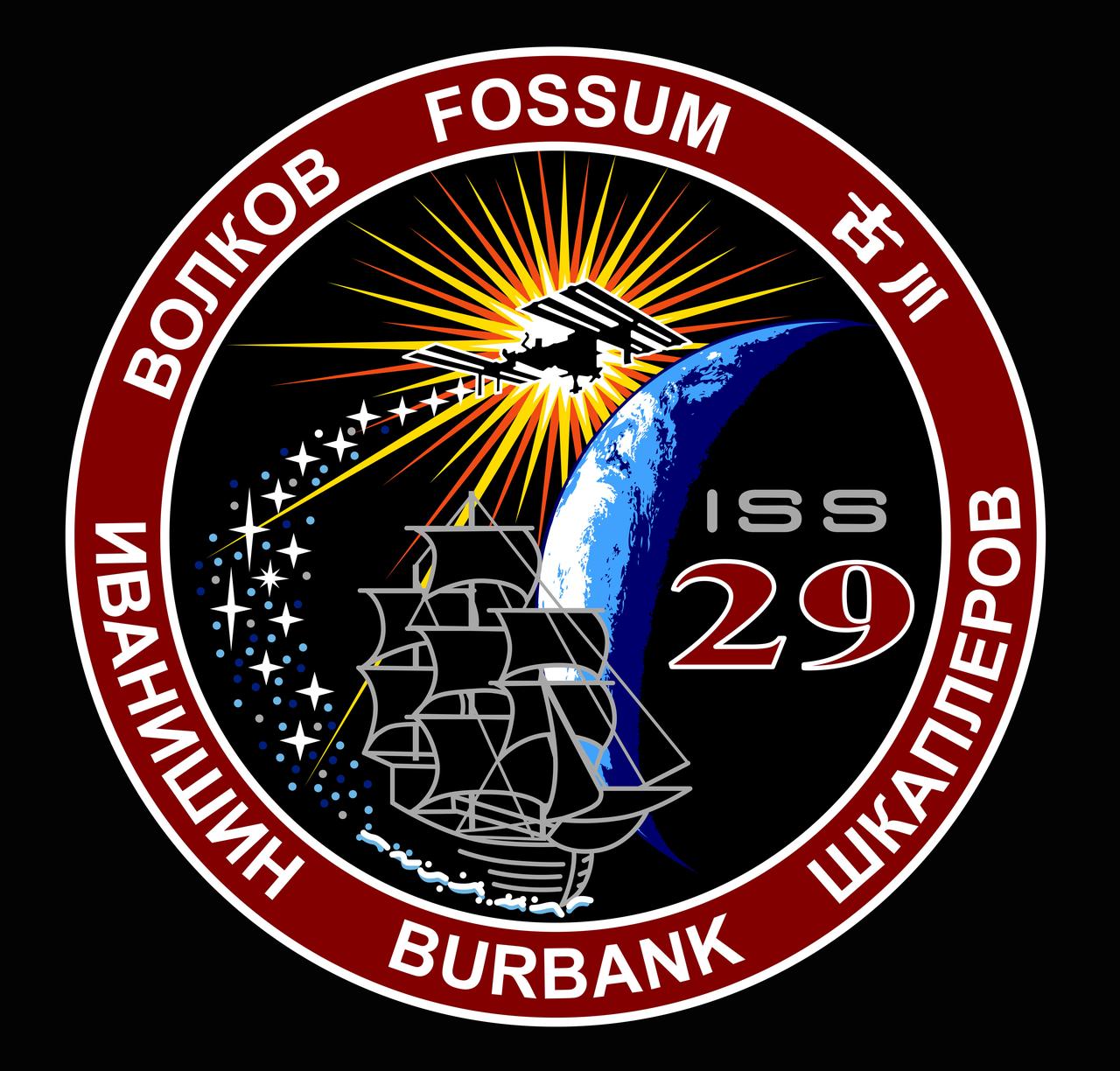
ISS029-S-001 (23 March 2011) --- On the Expedition 29 patch, the International Space Station (ISS) is shown following the path of the historic 18th century explorer, Captain James Cook, and his ship, Endeavour. During Cook?s three main voyages, he explored and mapped major portions of the oceans and coastlines under the flight path of the ISS and added immeasurably to the body of knowledge of that time. As the ISS sails a stardust trail ? following the spirit of Endeavour sailing toward the dark unknown and new discoveries ? it enlightens Earth below. Through the centuries, the quest for new discoveries has been a significant element of the human character, inspiring us to endure hardships and separation to be part of a mission which is greater than any individual. A spokesman for the crew stated, ?The crew of Expedition 29 is proud to continue the journey in this greatest of all human endeavors.? The NASA insignia design for shuttle and space station flights is reserved for use by the astronauts and for other official use as the NASA Administrator may authorize. Public availability has been approved only in the form of illustrations by the various news media. When and if there is any change in this policy, which is not anticipated, it will be publicly announced. Photo credit: NASA or National Aeronautics and Space Administration
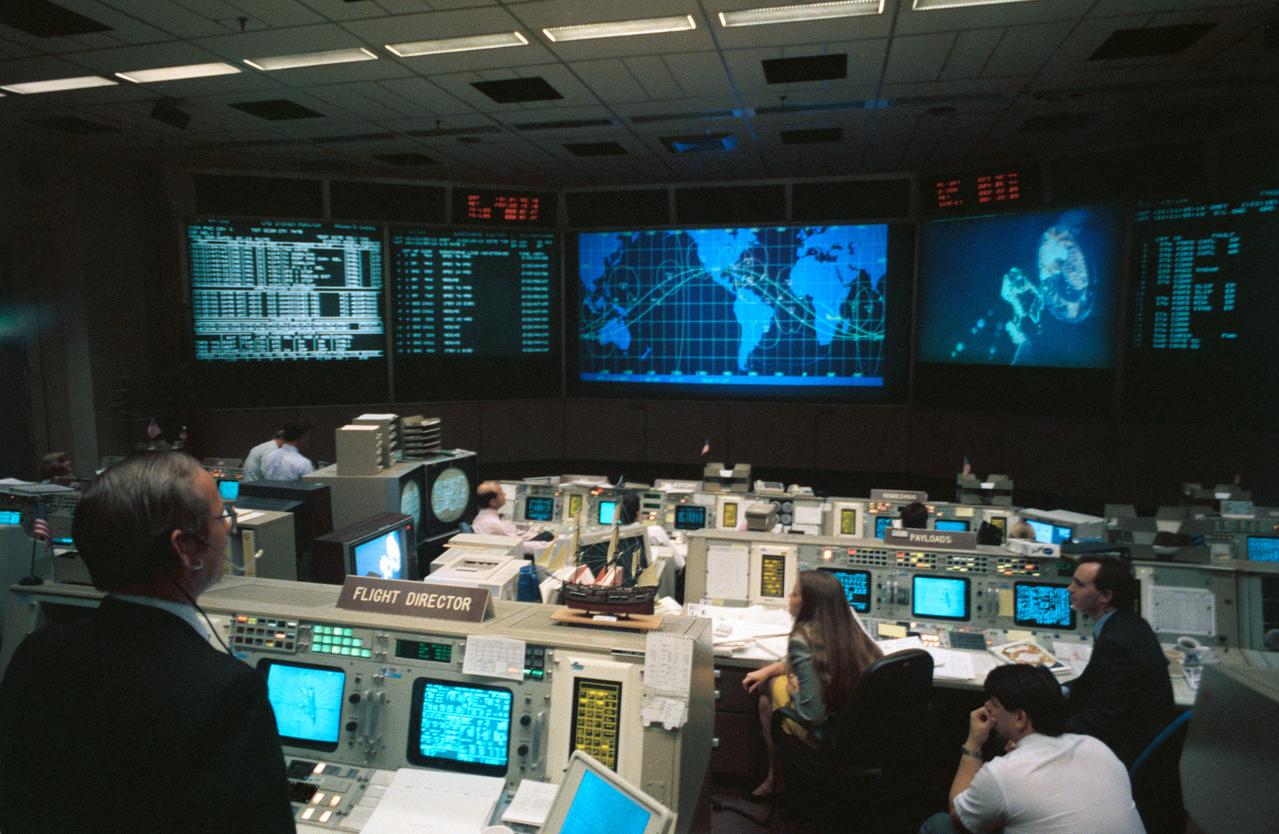
S49-S-0231 (11 May 1992) --- In the space shuttle flight control room (FCR) in Mission Control Center in Houston, Flight Director Al Pennington monitors the progress of the initial spacewalk of the STS-49 flight. A scale model of HM Bark Endeavour, namesake for the space shuttle currently making its inaugural flight, adorns the console. The model was built by Dan Willett of JSC's Information Resources Directorate. The original sailing ship Endeavour was commanded by Lt. James Cook on a scientific voyage to the South Pacific, Australia and New Zealand from 1768 to 1771. Photo credit: NASA
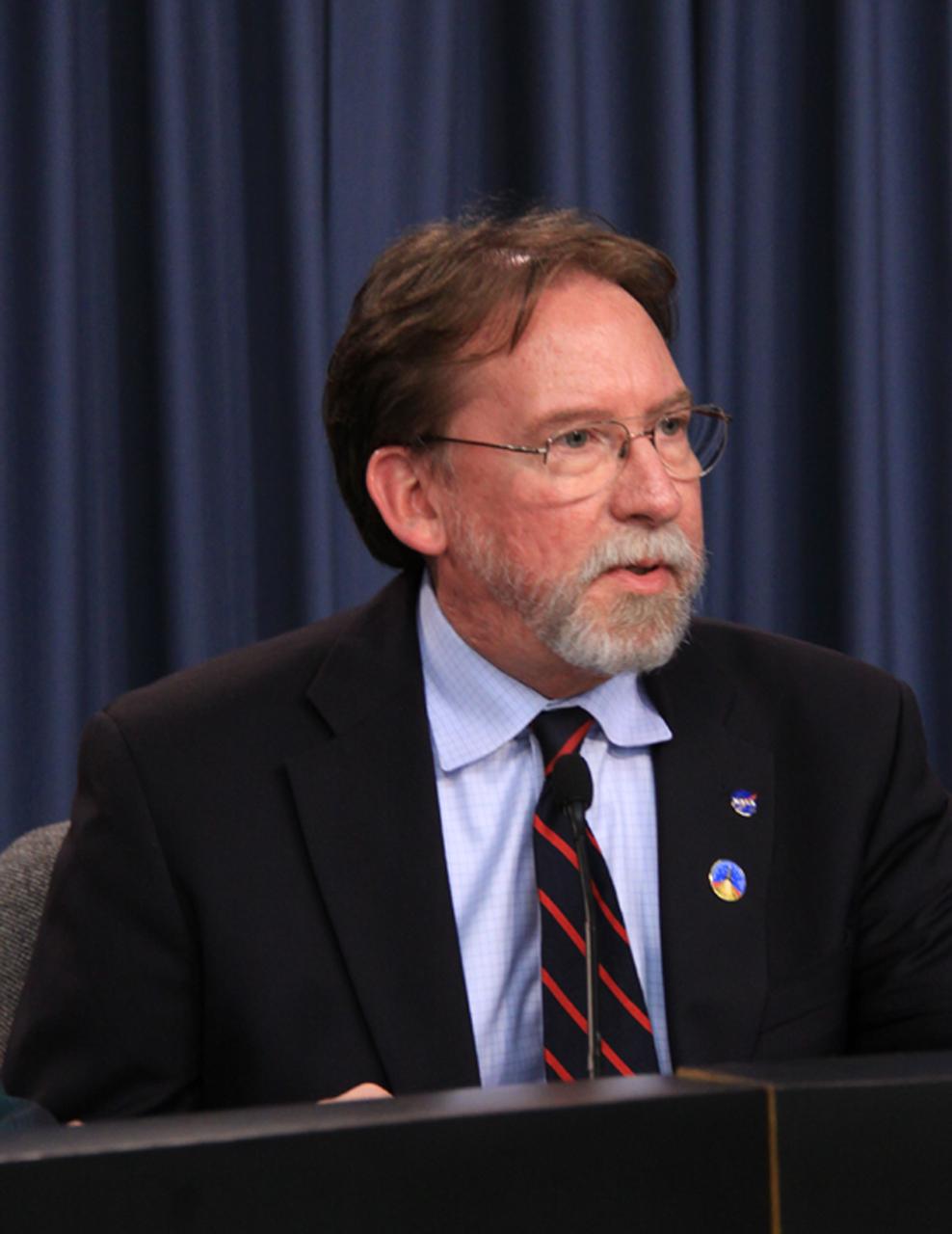
CAPE CANAVERAL, Fla. – In the Press Site auditorium at NASA's Kennedy Space Center in Florida, Doug Cooke, associate administrator for NASA's Exploration Systems Mission Directorate, participates in a news conference following the conclusion of the flight test readiness review, or FTRR, for the Ares I-X test rocket. During the meeting, senior NASA and contractor managers assessed the risks associated with the test and determined the rocket, support systems and procedures are ready for launch. The Ares I-X launch date was announced after the FTRR and is officially set for Oct. 27. For information on the Ares I-X vehicle and flight test, visit http://www.nasa.gov/aresIX. Photo credit: NASA/Jack Pfaller
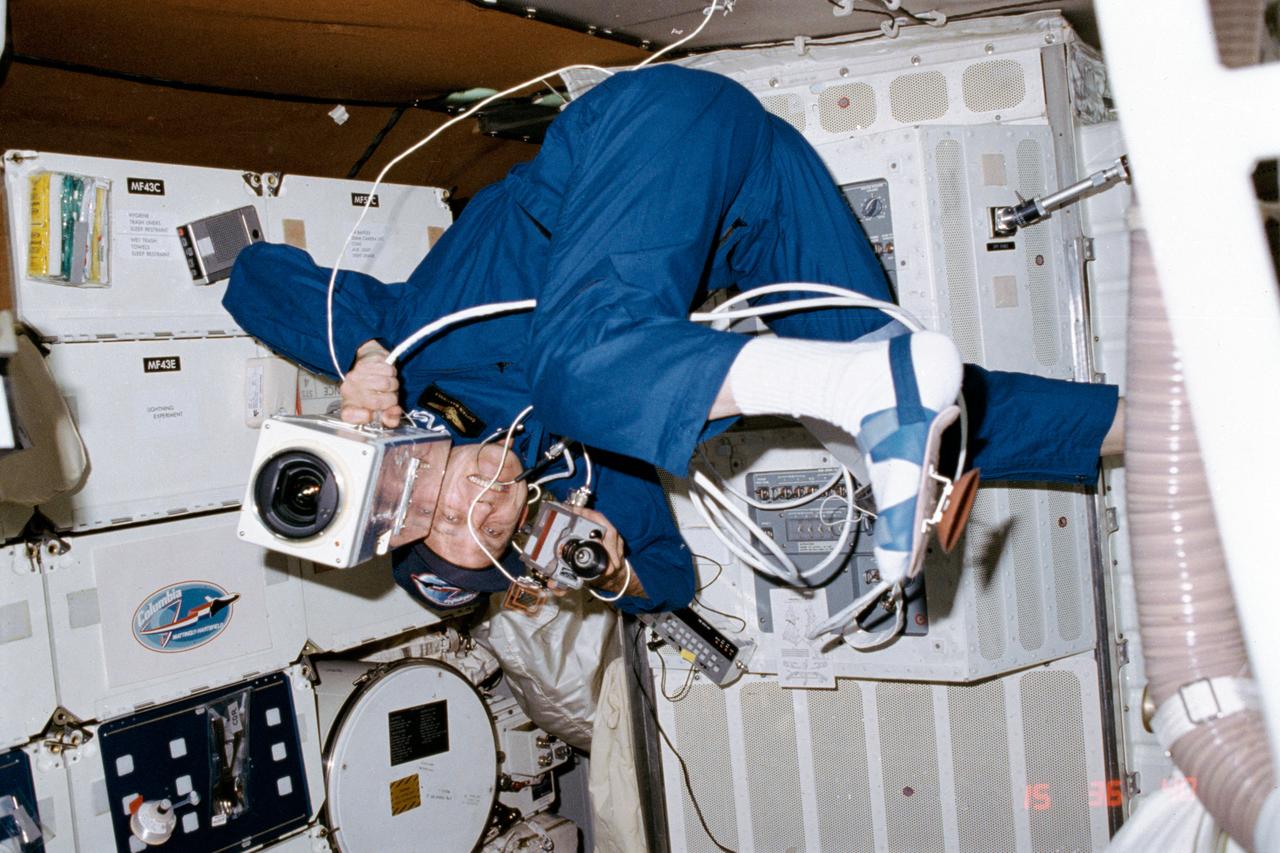
STS004-23-131 (27 June-4 July 1982) ---Astronaut Thomas K. Mattingly II, STS-4 commander, floats in the middeck area of the Earth-orbiting space shuttle Columbia. He handles two cameras at one time. In the commander’s right hand is a 16mm data acquisition camera (DAC), and in his left hand is a TV camera. Note the suction-cup equipped footwear which Mattingly revealed to the world via TV on one of his popular “cook’s tours” from crewmate Henry W. Hartsfield, pilot, operated a 35mm camera to expose this frame. Photo credit: NASA
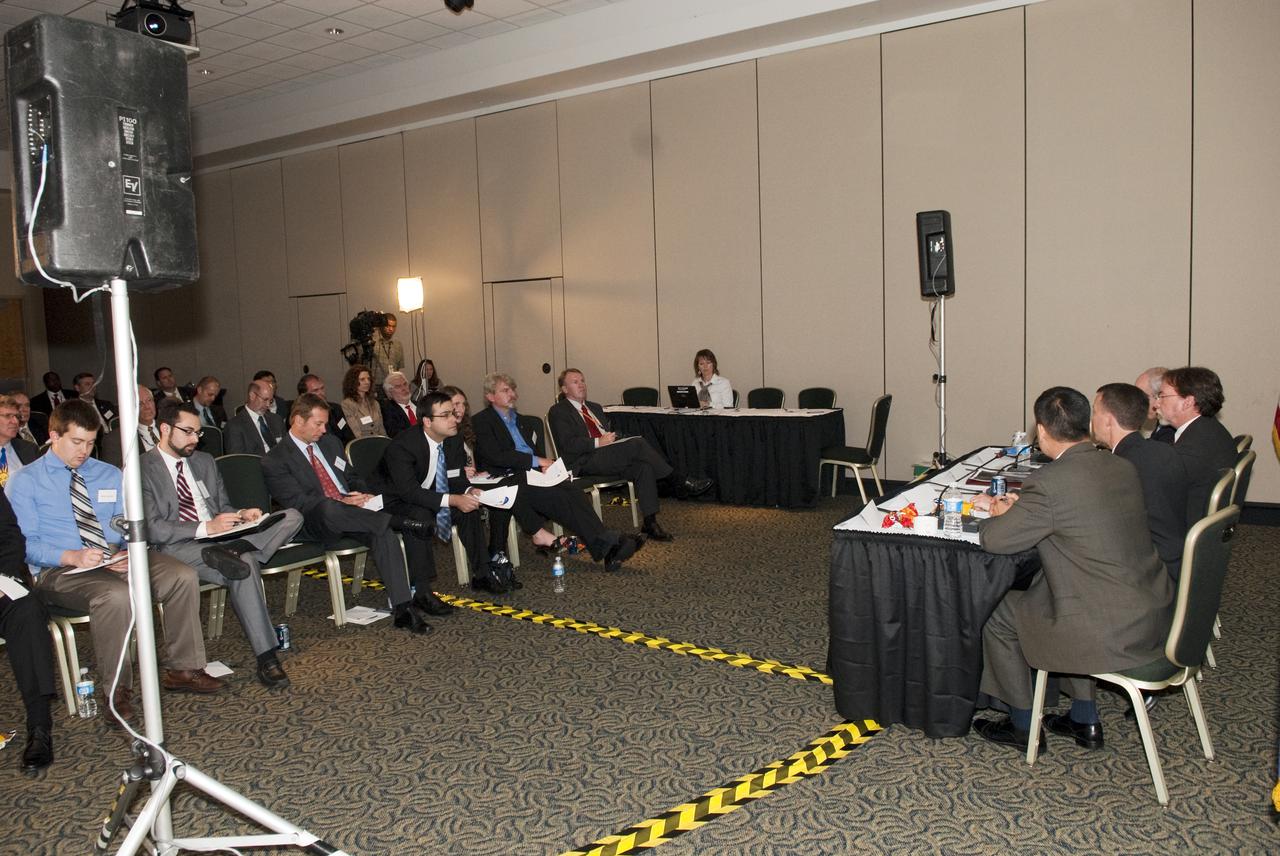
CAPE CANAVERAL, Fla. - In the Vanguard room of the Debus Center at NASA Kennedy Space Center Visitor Complex in Florida, a participant asks a question of the panel during the 'Jumpstarting the New Technologies to Take Us Beyond,' break-out session that is part of the Conference on the American Space Program for the 21st Century. The distinguished panel for this session is: Norman R. Augustine, chair of the Review of U.S. Human Space Flight Plans Committee and panel moderator; Doug Cooke Associate Administrator Exploration Systems for NASA; Robert Braun, NASA Chief Technologist and Ed Lu, Advanced Projects Program Manager for Google. Photo Credit: NASA_Jim Grossmann
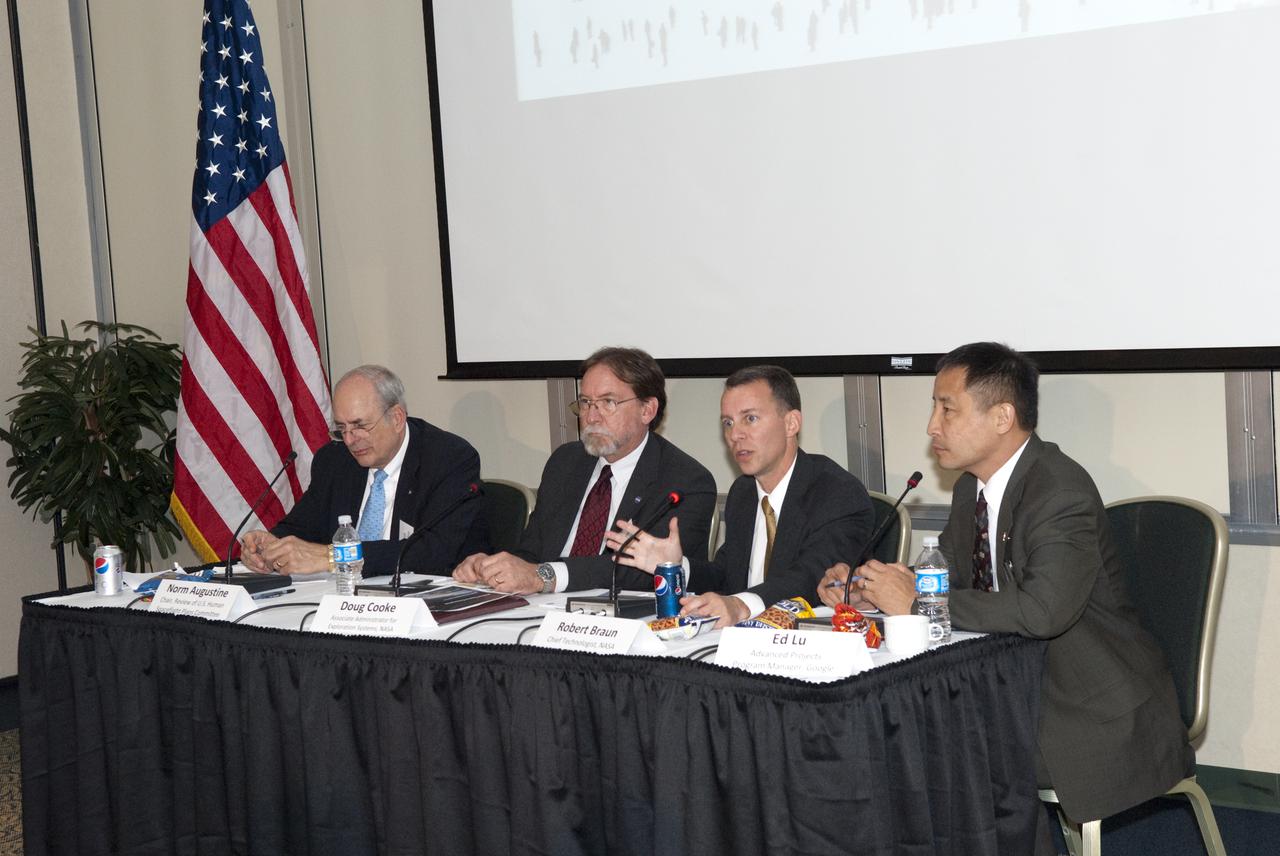
CAPE CANAVERAL, Fla. - In the Vanguard room of the Debus Center at NASA Kennedy Space Center Visitor Complex in Florida, Norman R. Augustine (left), chair of the Review of U.S. Human Space Flight Plans Committee and panel moderator heads up the third break-out session, 'Jumpstarting the New Technologies to Take Us Beyond,' that is part of the Conference on the American Space Program for the 21st Century. The distinguished panel for this session is: Doug Cooke Associate Administrator Exploration Systems for NASA; Robert Braun, NASA Chief Technologist and Ed Lu, Advanced Projects Program Manager for Google. Photo Credit: NASA_Jim Grossmann
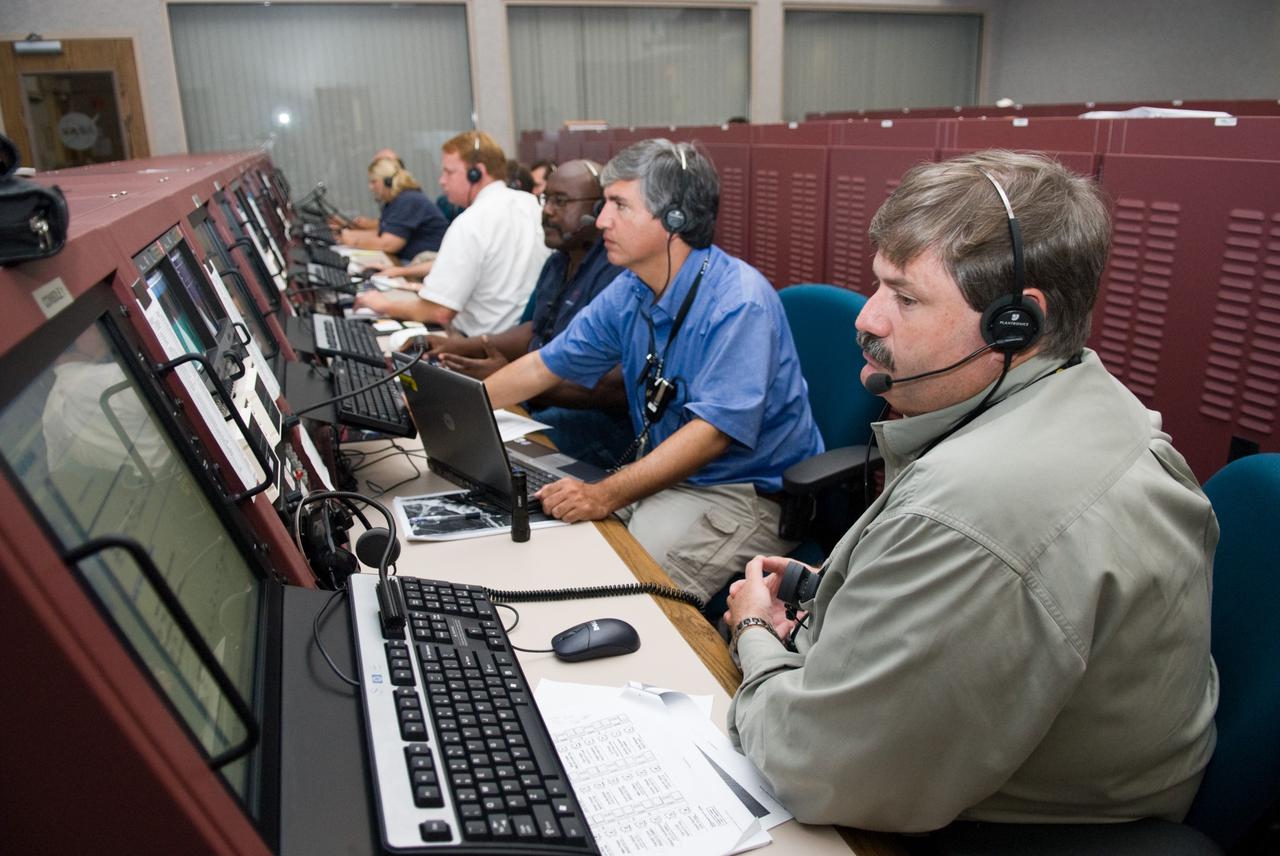
CAPE CANAVERAL, Fla. – In the Launch Vehicle Data Center- 1 in Cape Canaveral Air Force Station's Hangar AE, (from right) JJ Joyner, Jonathan Cruz and Stuart Cooke take part in a countdown simulation for the upcoming Ares I-X flight test. The LVDC was developed by NASA's Kennedy Space Center to support multiple test operations in parallel or a single large launch operation. The LVDC works in tandem with the adjacent Mission Director Center, the control room where NASA launch managers monitor expendable vehicle launches, and where the final decision to launch is made. Photo credit: NASA/Kim Shiflett
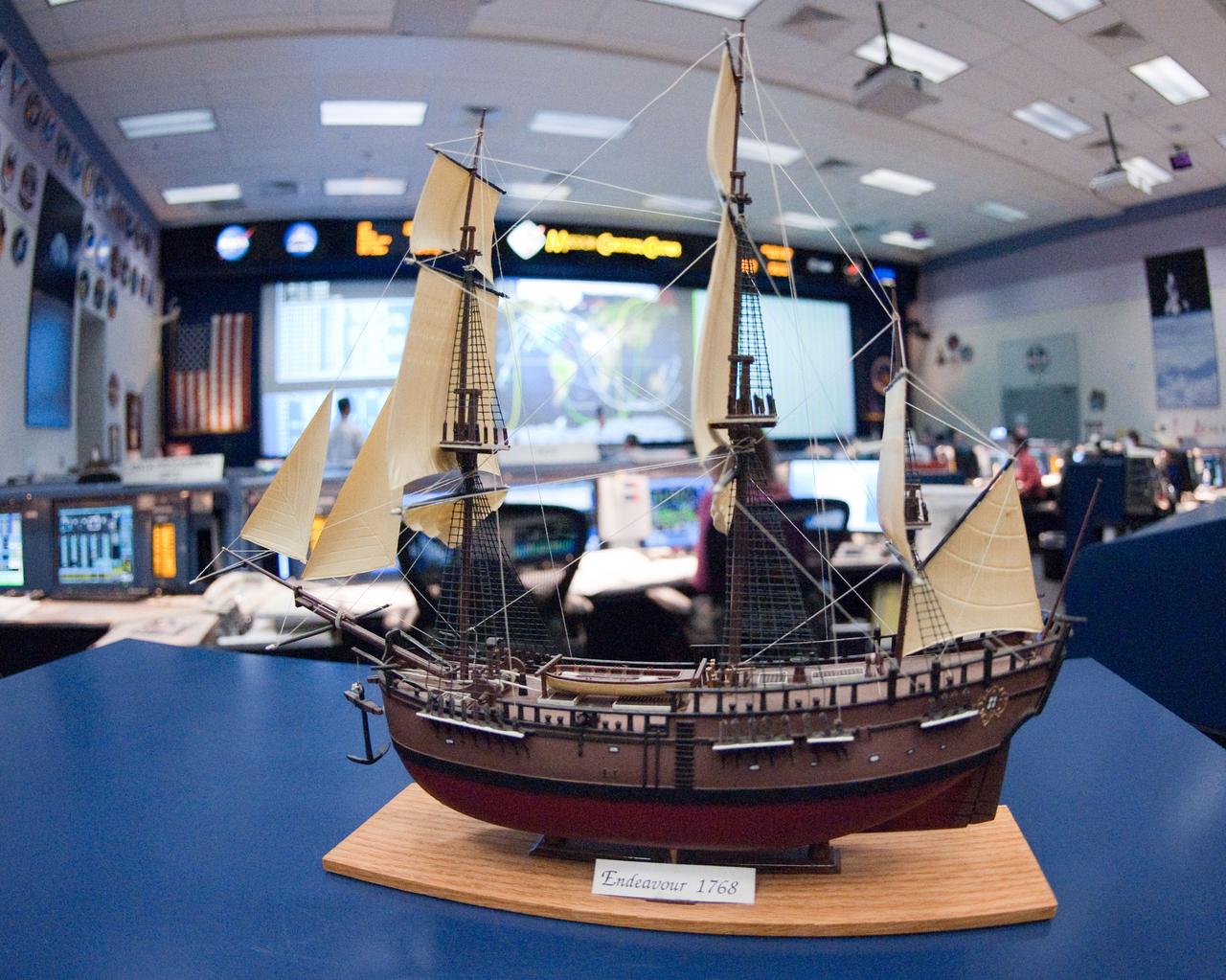
JSC2011-E-045472 (17 May 2011) --- A scale model of HM Bark Endeavour, namesake for the space shuttle currently making its final flight, adorns a console in the space shuttle flight control room in Mission Control in Houston. This model was first displayed in 1992 in the old shuttle control room during STS-49, the inaugural flight of the shuttle Endeavour. It was built by Dan Willett of JSC's Information Resources Directorate. The original sailing ship Endeavour was commanded by Lt. James Cook on a scientific voyage to the South Pacific, Australia and New Zealand from 1768 to 1771. Photo credit: NASA

KENNEDY SPACE CENTER, FLA. - At a press conference at NASA's Kennedy Space Center, NASA officials announced the names of the next-generation of rockets for future space exploration. Seated (left to right) are Dolores Beasley, with NASA Public Affairs; Scott Horowitz, NASA associate administrator of the Exploration Systems Mission Directorate; Jeff Hanley, manager of the Constellation Program at Johnson Space Center; and Steve Cook, manager of the Exploration Launch Office at Marshall Space Flight Center. The crew launch vehicle will be called Ares I, and the cargo launch vehicle will be known as Ares V. The name Ares is a pseudonym for Mars and appropriate for NASA's exploration mission. Photo credit: NASA/George Shelton
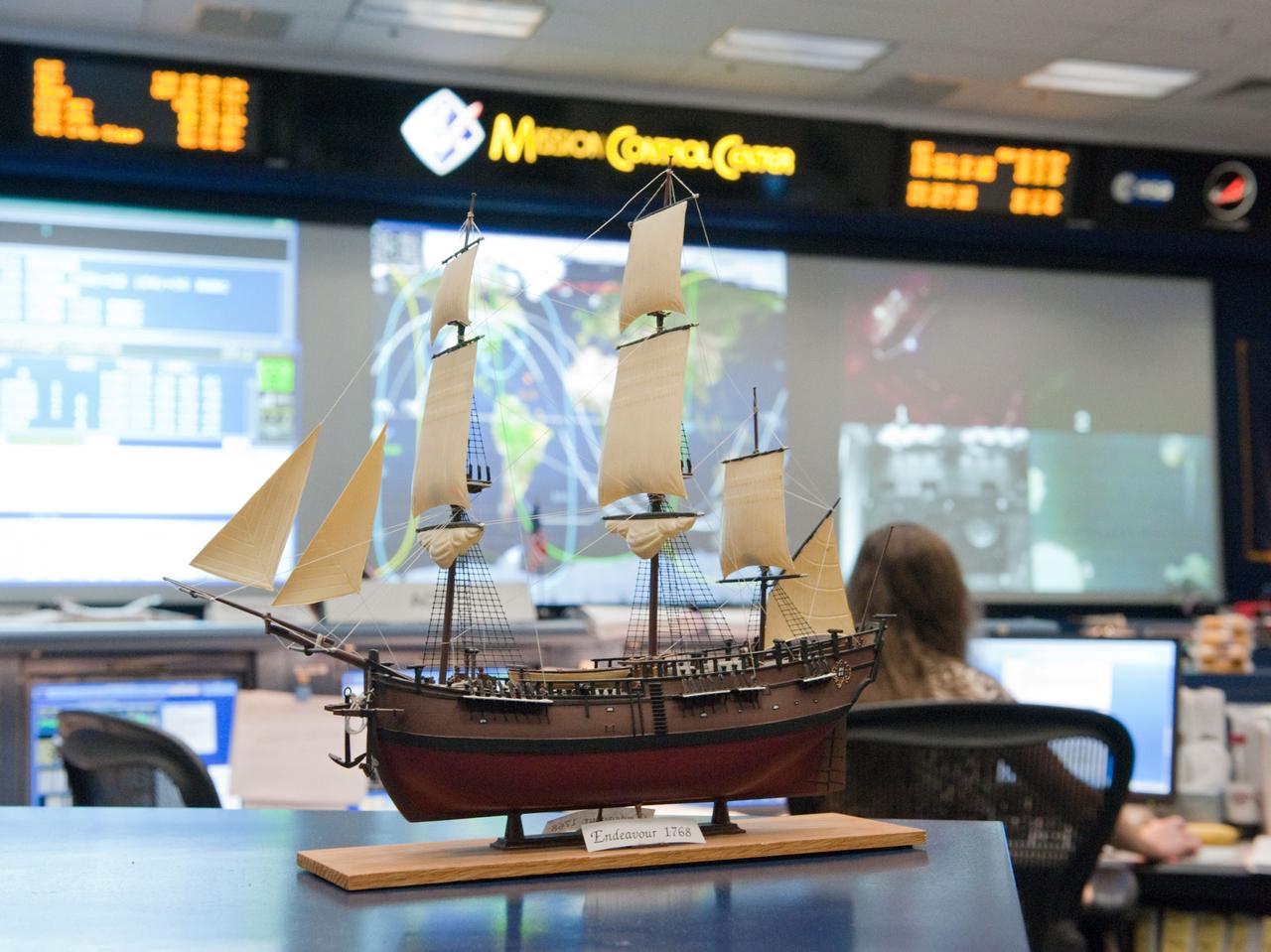
JSC2011-E-046588 (20 May 2011) --- A scale model of HM Bark Endeavour, namesake for the space shuttle currently making its final flight, adorns a console in the space shuttle flight control room in Mission Control in Houston. This model was first displayed in 1992 in the old shuttle control room during STS-49, the inaugural flight of the shuttle Endeavour. It was built by Dan Willett of JSC's Information Resources Directorate. The original sailing ship Endeavour was commanded by Lt. James Cook on a scientific voyage to the South Pacific, Australia and New Zealand from 1768 to 1771. Photo credit: NASA
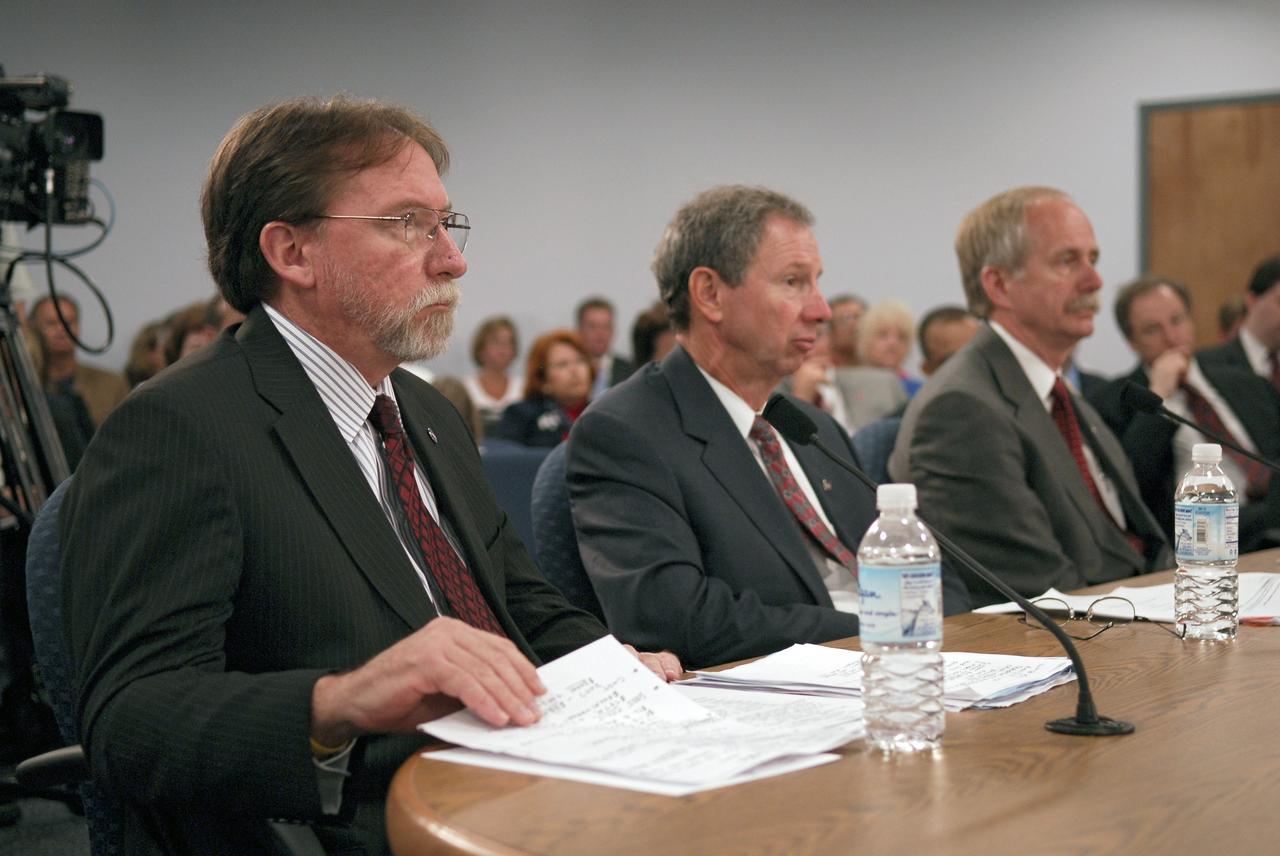
CAPE CANAVERAL, Fla. – A Senate field hearing held at the Canaveral Port Authority and chaired by Florida Sen. Bill Nelson (third from right on the dais) focuses on workforce related challenges at NASA's Kennedy Space Center and potential solutions to mitigate the transition's effects on the community. The hearing examined issues surrounding the retirement of the space shuttle and the transition to the new Orion/Ares system. At the table representing NASA are Deputy Associate Administrator of Exploration Systems Doug Cooke, Administrator Michael Griffin and Associate Administrator of Space Operations William Gerstenmaier. Photo credit: NASA/Kim Shiflett
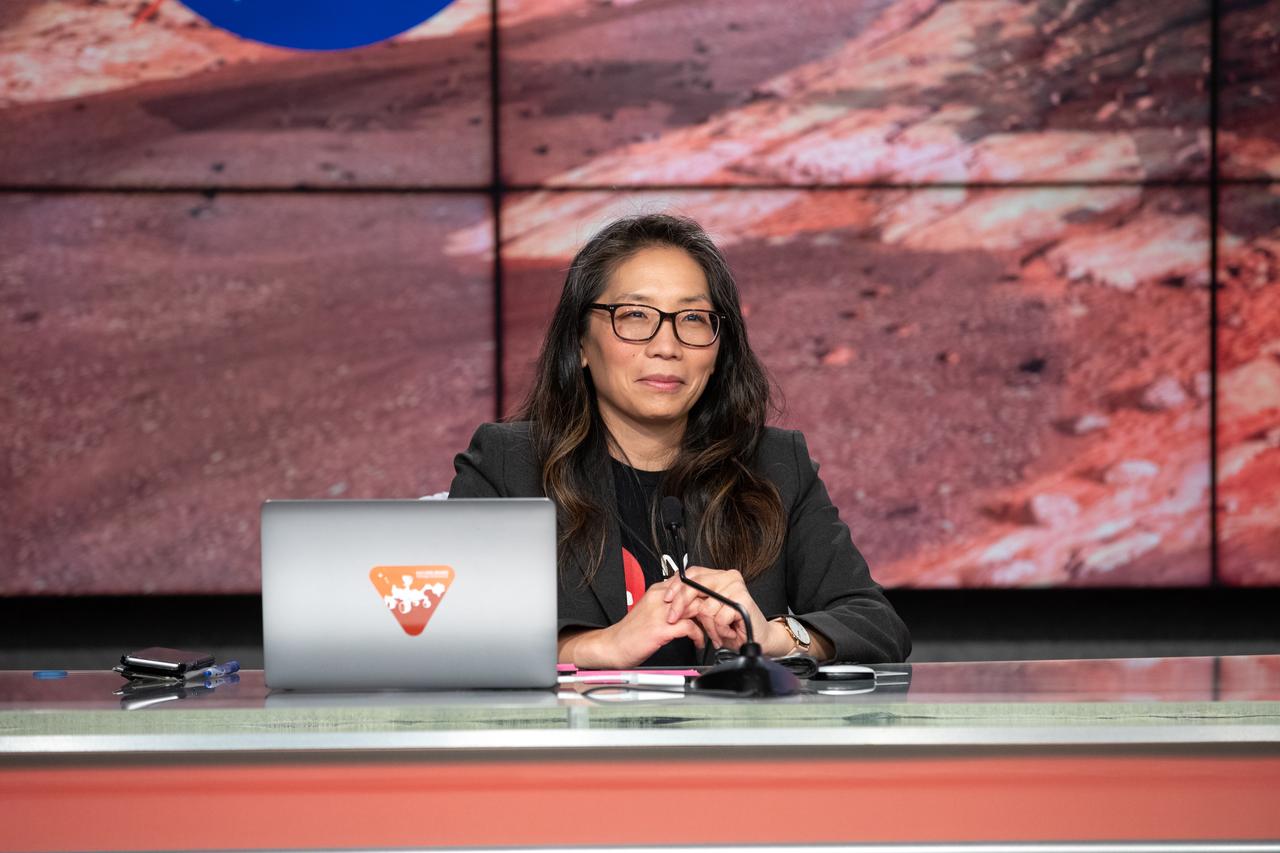
Jia-Rui Cook with NASA’s Jet Propulsion Laboratory moderates a Mars 2020 Sample Return briefing at NASA’s Kennedy Space Center in Florida on July 28, 2020. The Mars Perseverance rover is scheduled to launch on July 30, on a United Launch Alliance Atlas V 541 rocket from Space Launch Complex 41 at nearby Cape Canaveral Air Force Station. The rover is part of NASA’s Mars Exploration Program, a long-term effort of robotic exploration of the Red Planet. The rover will search for habitable conditions in the ancient past and signs of past microbial life on Mars. The Launch Services Program at Kennedy is responsible for launch management.
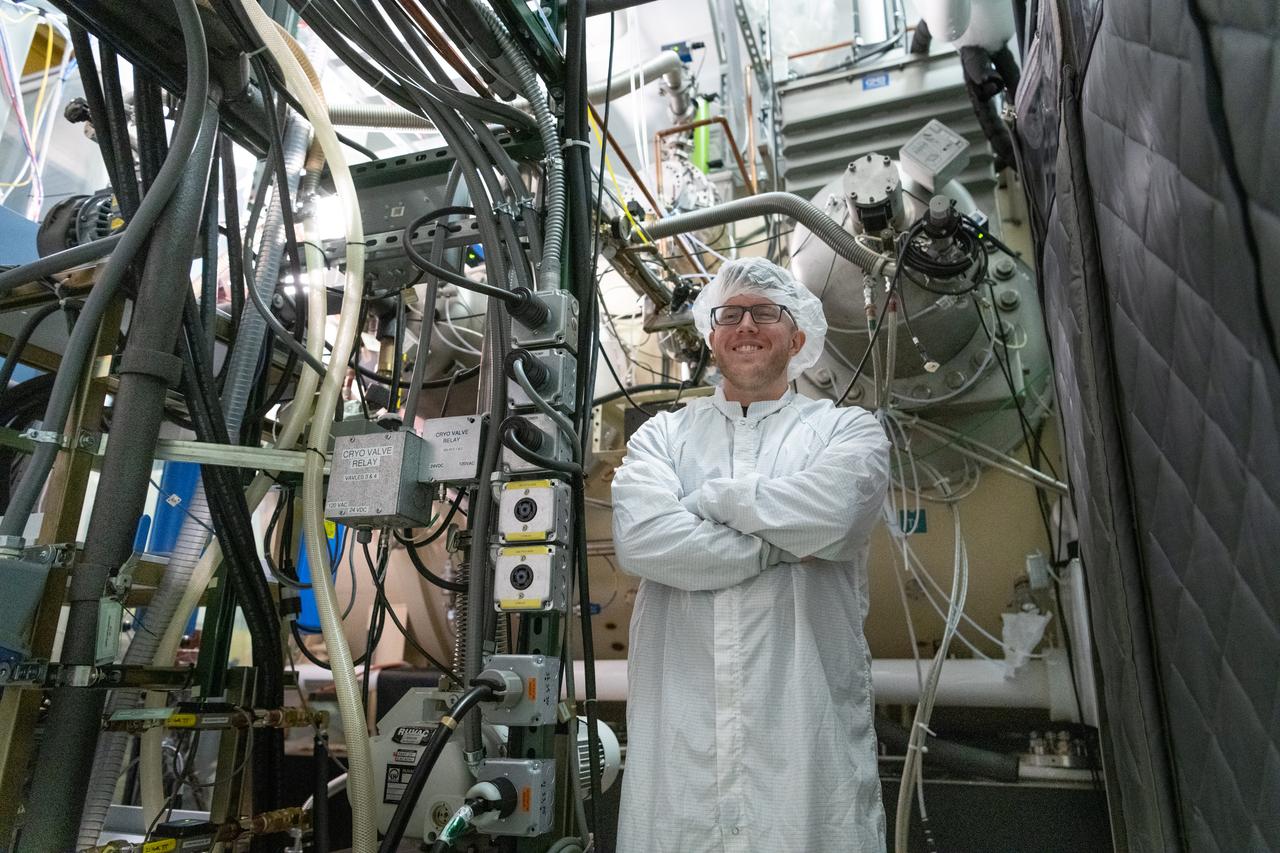
Thermal vacuum technician, Sean Cook, monitors the Ocean Color Instrument (OCI) thermal vacuum chamber temperatures during the environmental test campaign. OCI is a highly advanced optical spectrometer that will be used to measure properties of light over portions of the electromagnetic spectrum. It will enable continuous measurement of light at finer wavelength resolution than previous NASA satellite sensors, extending key system ocean color data records for climate studies. OCI is PACE's (Plankton, Aerosol, Cloud, ocean Ecosystem) primary sensor built at Goddard Space Flight Center in Greenbelt, MD.
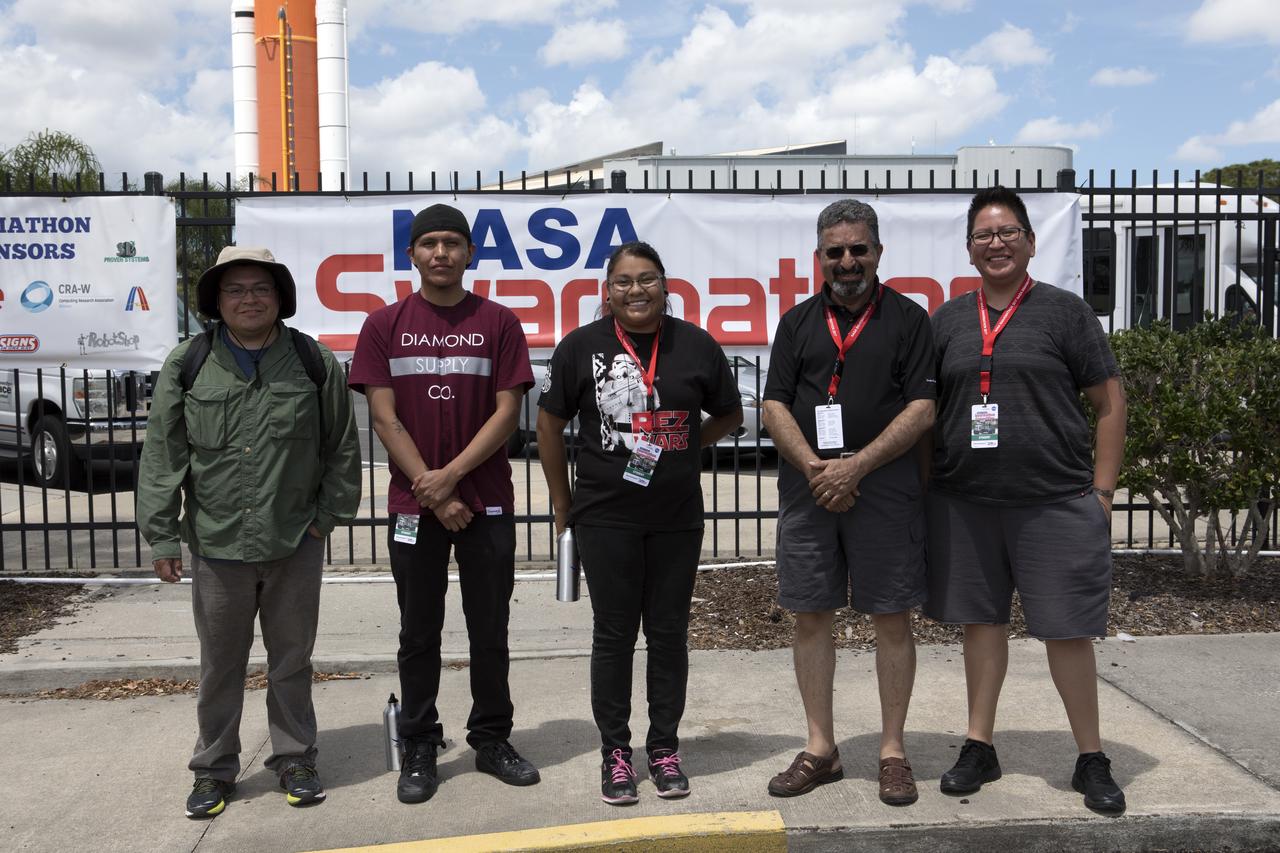
In the second annual Swarmathon competition at NASA's Kennedy Space Center in Florida, students were asked to develop computer code for the small robots called "Swarmies." The students programmed the robots to look for "resources" in the form of cubes with AprilTags, similar to barcodes. A team from Southwestern Indian Polytechnic Institute (SIPI) in Albuquerque, New Mexico, captured first place and a $5,000 cash prize. SIPI team members, from the left, are: students Emery Sutherland, Ty Shurley, Christian Martinez, SIPI engineering professor Dr. Nader Vadiee who was the team's faculty advisor, and student Schulte Cooke.
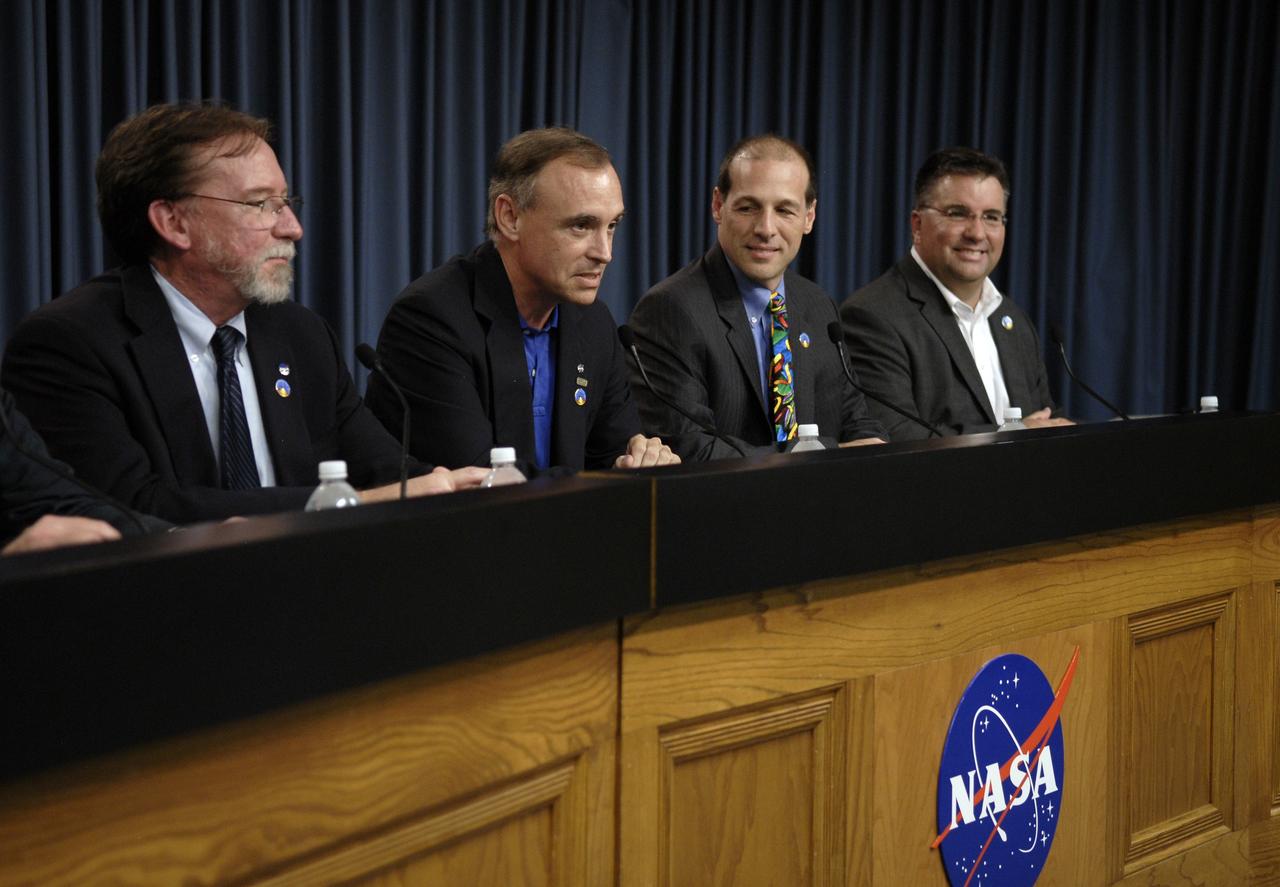
CAPE CANAVERAL, Fla. - At NASA's Kennedy Space Center in Florida, Constellation Program Manager Jeff Hanley addresses a post-launch news conference in the Press Site auditorium following the successful launch of the Ares I-X test rocket at 11:30 a.m. EDT Oct. 28. From left, are, Doug Cooke, associate administrator for NASA's Exploration Systems Mission Directorate; Hanley; Bob Ess, mission manager for the Ares I-X flight test; and Edward Mango, launch director for the Ares I-X flight test. For more information on the Ares I-X vehicle and flight test, visit http://www.nasa.gov/aresIX. Photo credit: NASA/Kim Shiflett
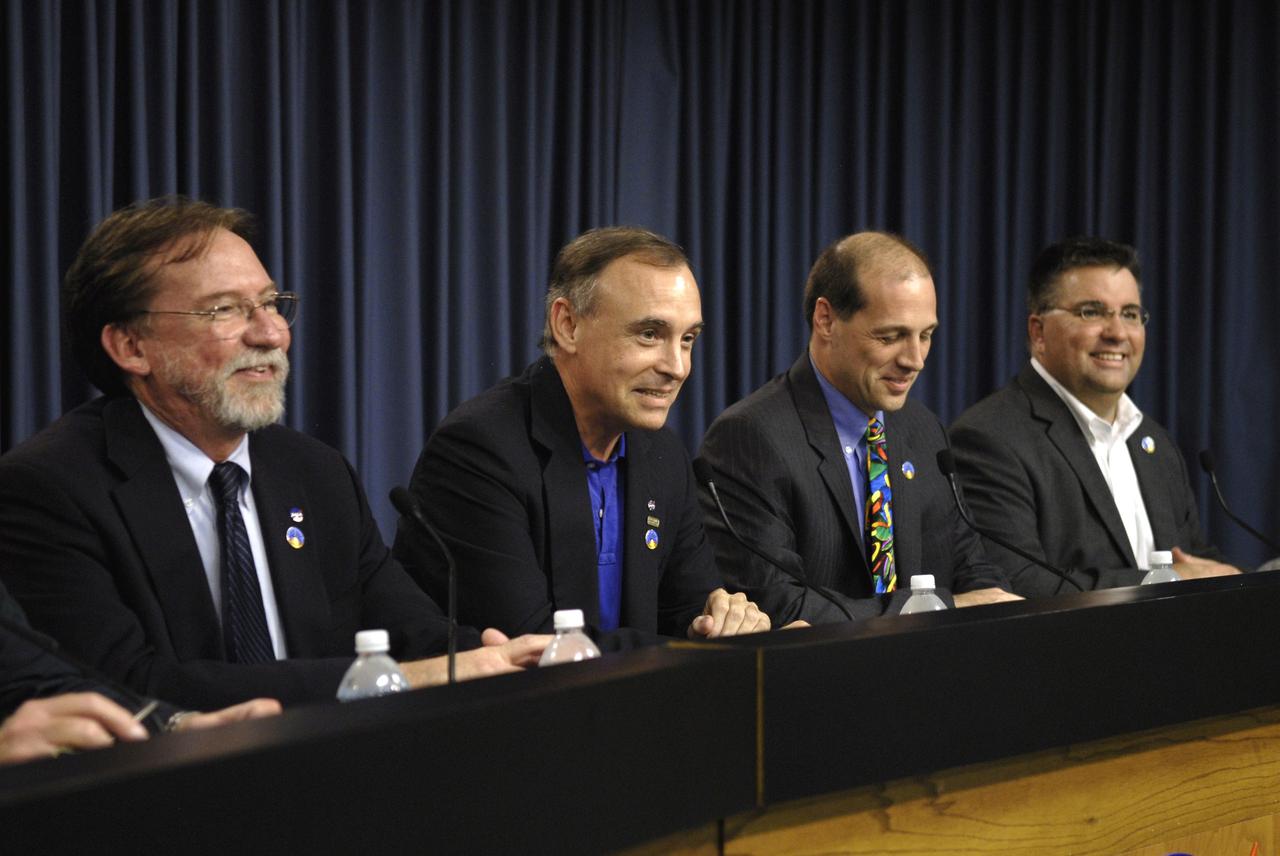
CAPE CANAVERAL, Fla. - At NASA's Kennedy Space Center in Florida, a post-launch news conference is held in the Press Site auditorium following the successful launch of the Ares I-X test rocket at 11:30 a.m. EDT Oct. 28. Smiling, from left, are Doug Cooke, associate administrator for NASA's Exploration Systems Mission Directorate; Jeff Hanley, Constellation Program manager; Bob Ess, mission manager for the Ares I-X flight test; and Edward Mango, launch director for the Ares I-X flight test. For more information on the Ares I-X vehicle and flight test, visit http://www.nasa.gov/aresIX. Photo credit: NASA/Kim Shiflett
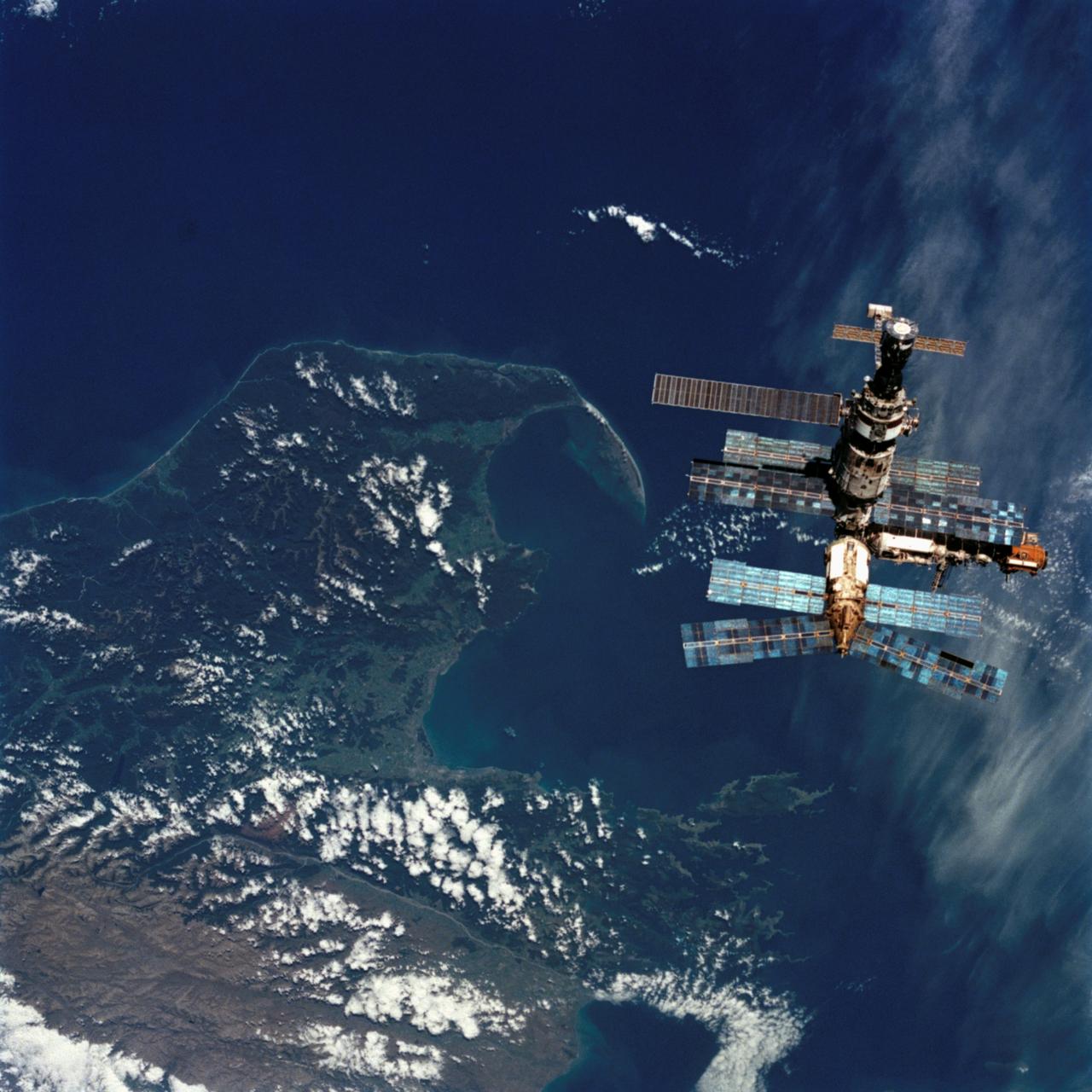
STS076-713-036 (23 March 1996) --- Backdropped against the waters of Cook Strait near New Zealand's South Island, Russia's Mir Space Station is seen from the aft flight deck window of the Space Shuttle Atlantis. The two spacecraft were in the process of making their third docking in Earth-orbit. With the subsequent delivery of astronaut Shannon W. Lucid to the Mir, the Mir-21 crew grew to three, as the mission specialist quickly becomes a cosmonaut guest researcher. She will spend approximately 140 days on Mir before returning to Earth.
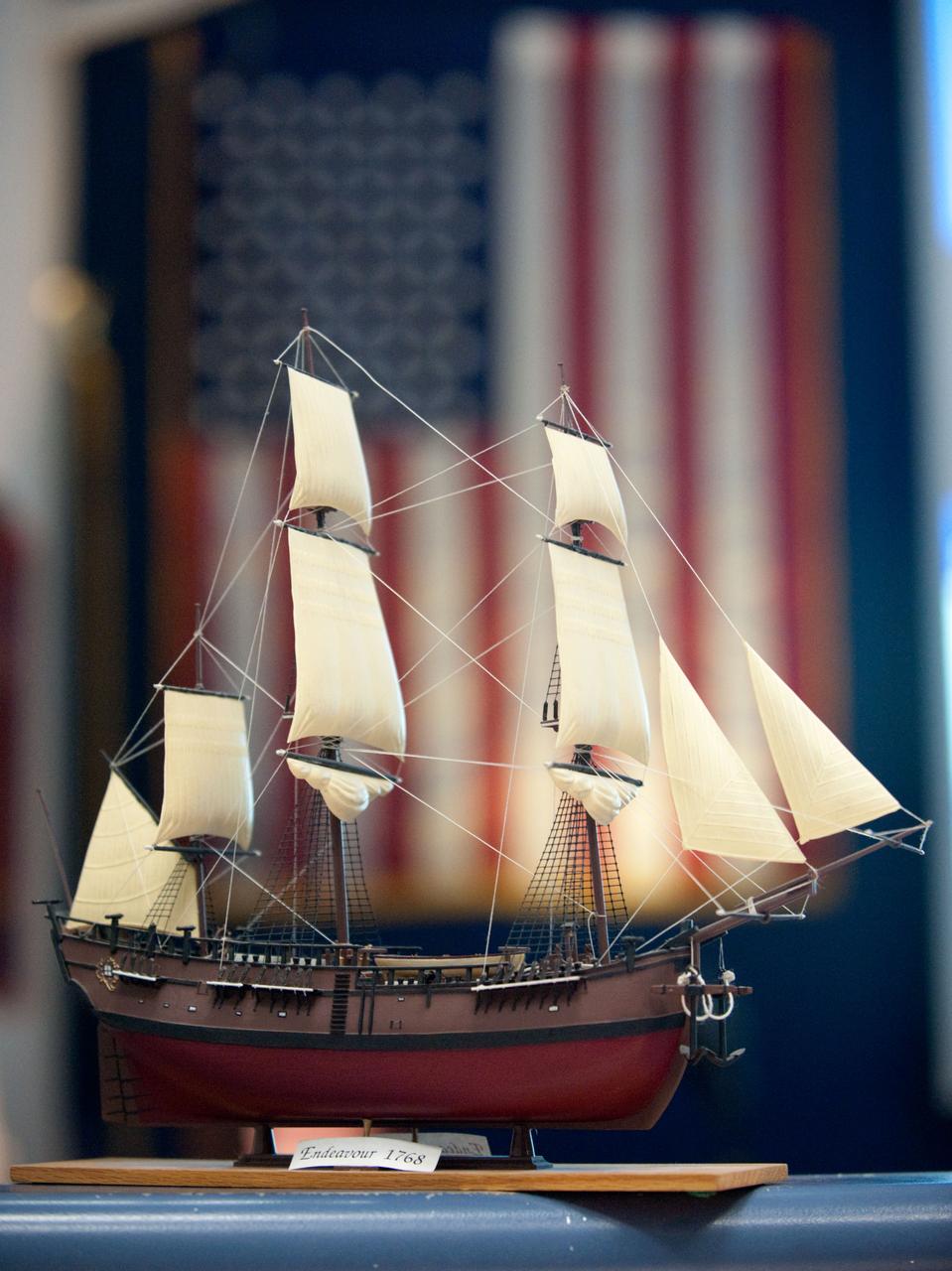
JSC2011-E-046587 (20 May 2011) --- A scale model of HM Bark Endeavour, namesake for the space shuttle currently making its final flight, adorns a console in the space shuttle flight control room in Mission Control in Houston. This model was first displayed in 1992 in the old shuttle control room during STS-49, the inaugural flight of the shuttle Endeavour. It was built by Dan Willett of JSC's Information Resources Directorate. The original sailing ship Endeavour was commanded by Lt. James Cook on a scientific voyage to the South Pacific, Australia and New Zealand from 1768 to 1771. Photo credit: NASA
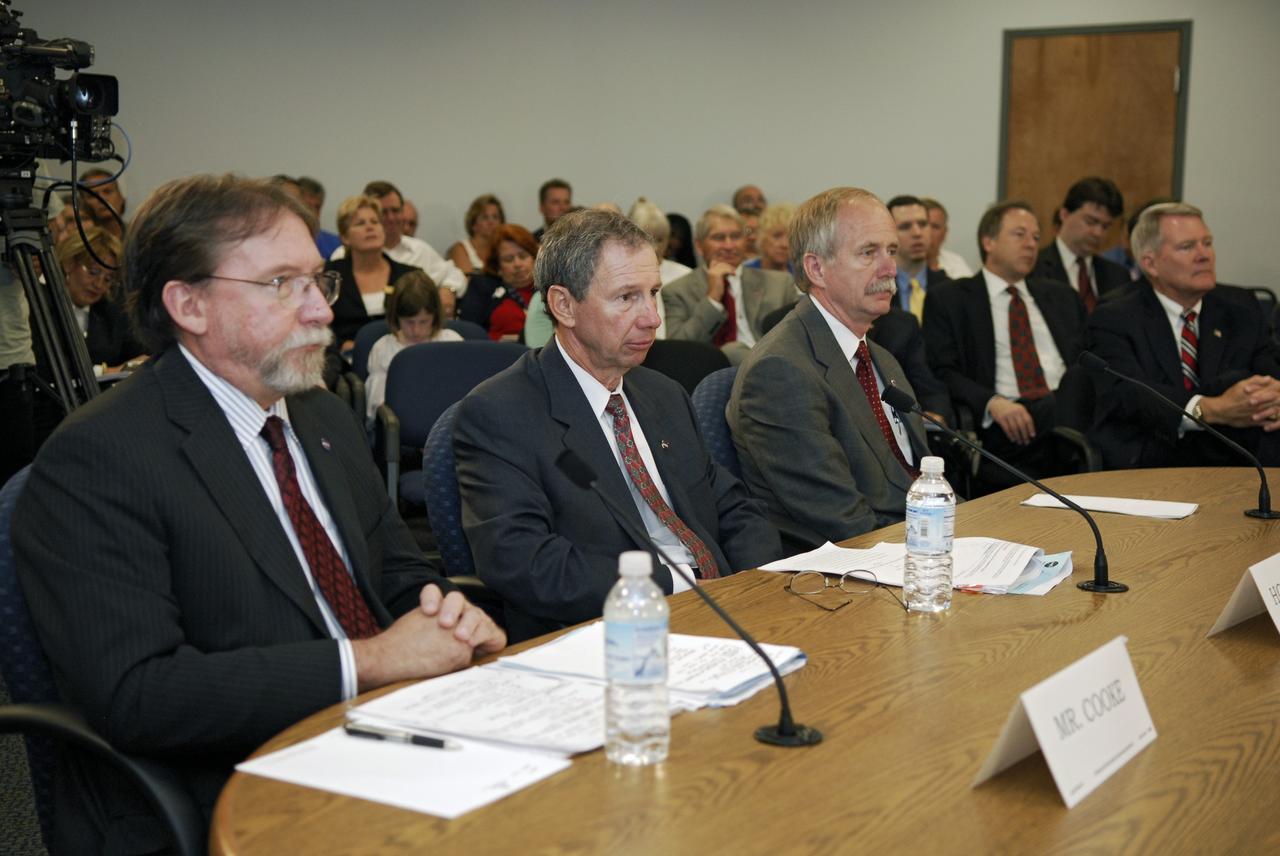
CAPE CANAVERAL, Fla. – A Senate field hearing held at the Canaveral Port Authority and chaired by Florida Sen. Bill Nelson (third from right on the dais) focuses on workforce related challenges at NASA's Kennedy Space Center and potential solutions to mitigate the transition's effects on the community. The hearing examined issues surrounding the retirement of the space shuttle and the transition to the new Orion/Ares system. At the table representing NASA are Deputy Associate Administrator of Exploration Systems Doug Cooke, Administrator Michael Griffin and Associate Administrator of Space Operations William Gerstenmaier. Photo credit: NASA/Kim Shiflett
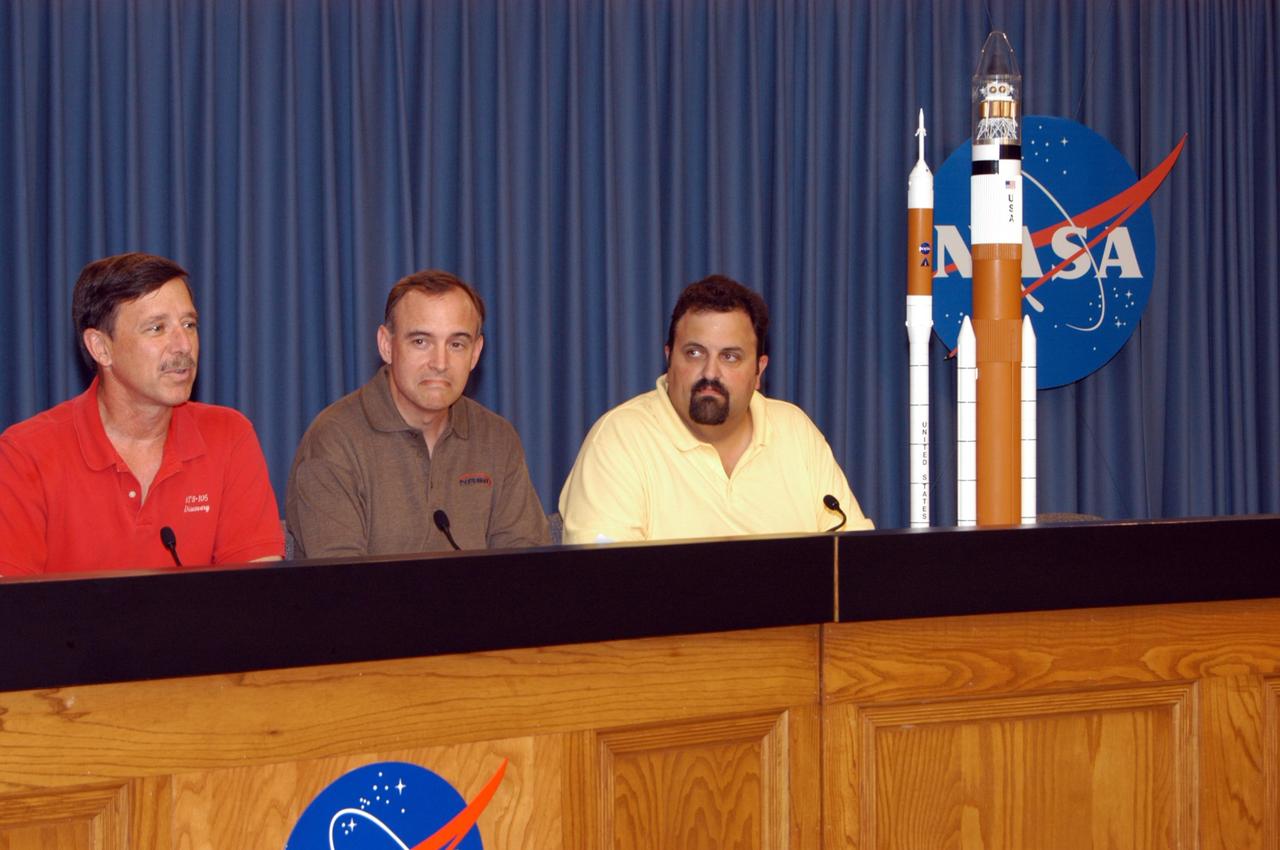
KENNEDY SPACE CENTER, FLA. - At a press conference in at NASA's Kennedy Space Center, NASA officials announced the names of the next-generation of rockets for future space exploration. Seated at the dais are (left to right) Scott Horowitz, NASA associate administrator of the Exploration Systems Mission Directorate; Jeff Hanley, manager of the Constellation Program at Johnson Space Center; and Steve Cook, manager of the Exploration Launch Office at Marshall Space Flight Center. The crew launch vehicle will be called Ares I, and the cargo launch vehicle will be known as Ares V. The name Ares is a pseudonym for Mars and appropriate for NASA's exploration mission. Photo credit: NASA/George Shelton
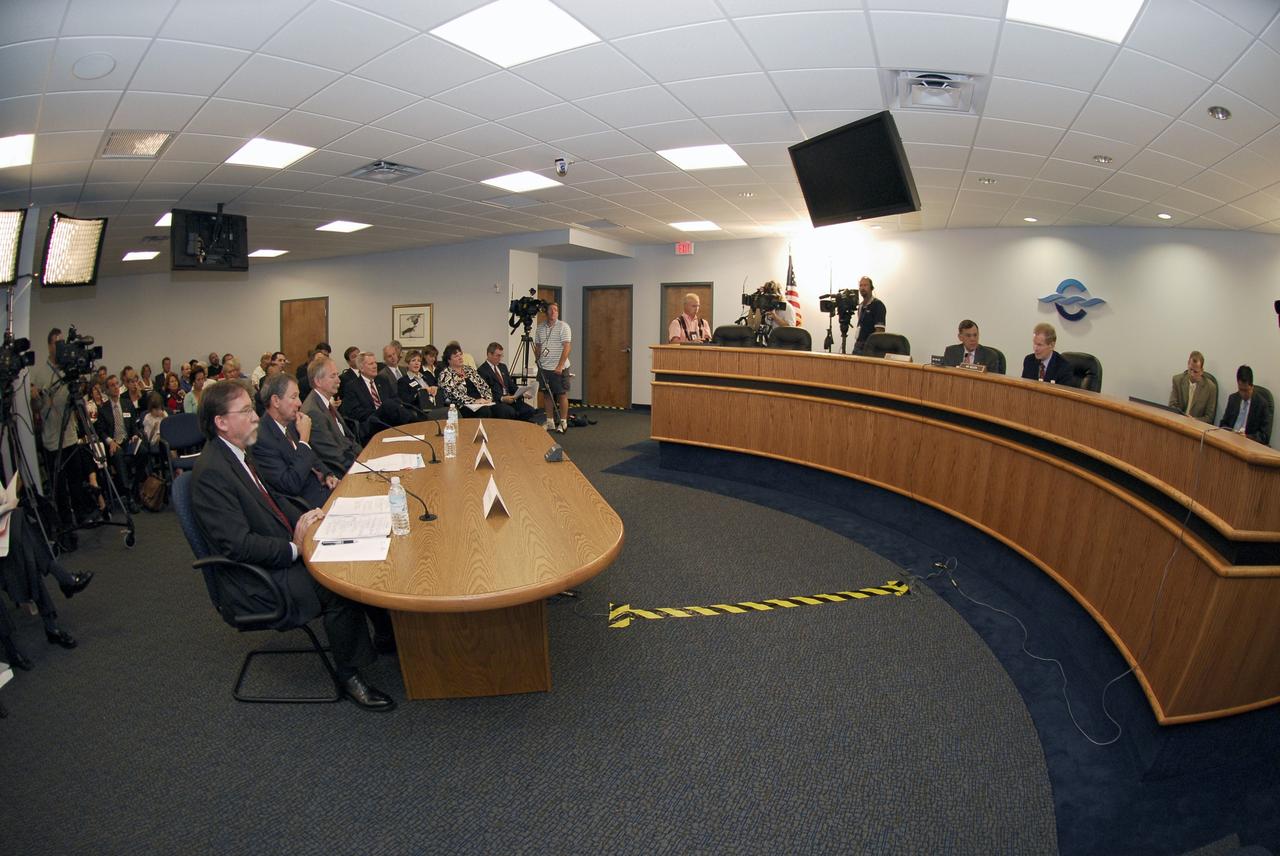
CAPE CANAVERAL, Fla. – A Senate field hearing held at the Canaveral Port Authority and chaired by Florida Sen. Bill Nelson (third from right on the dais) focuses on workforce related challenges at NASA's Kennedy Space Center and potential solutions to mitigate the transition's effects on the community. The hearing examined issues surrounding the retirement of the space shuttle and the transition to the new Orion/Ares system. At Nelson's right is Florida Sen. Mel Martinez. Seated at left are NASA representatives Deputy Associate Administrator of Exploration Systems Doug Cooke, Administrator Michael Griffin and Associate Administrator of Space Operations William Gerstenmaier. Photo credit: NASA/Kim Shiflett
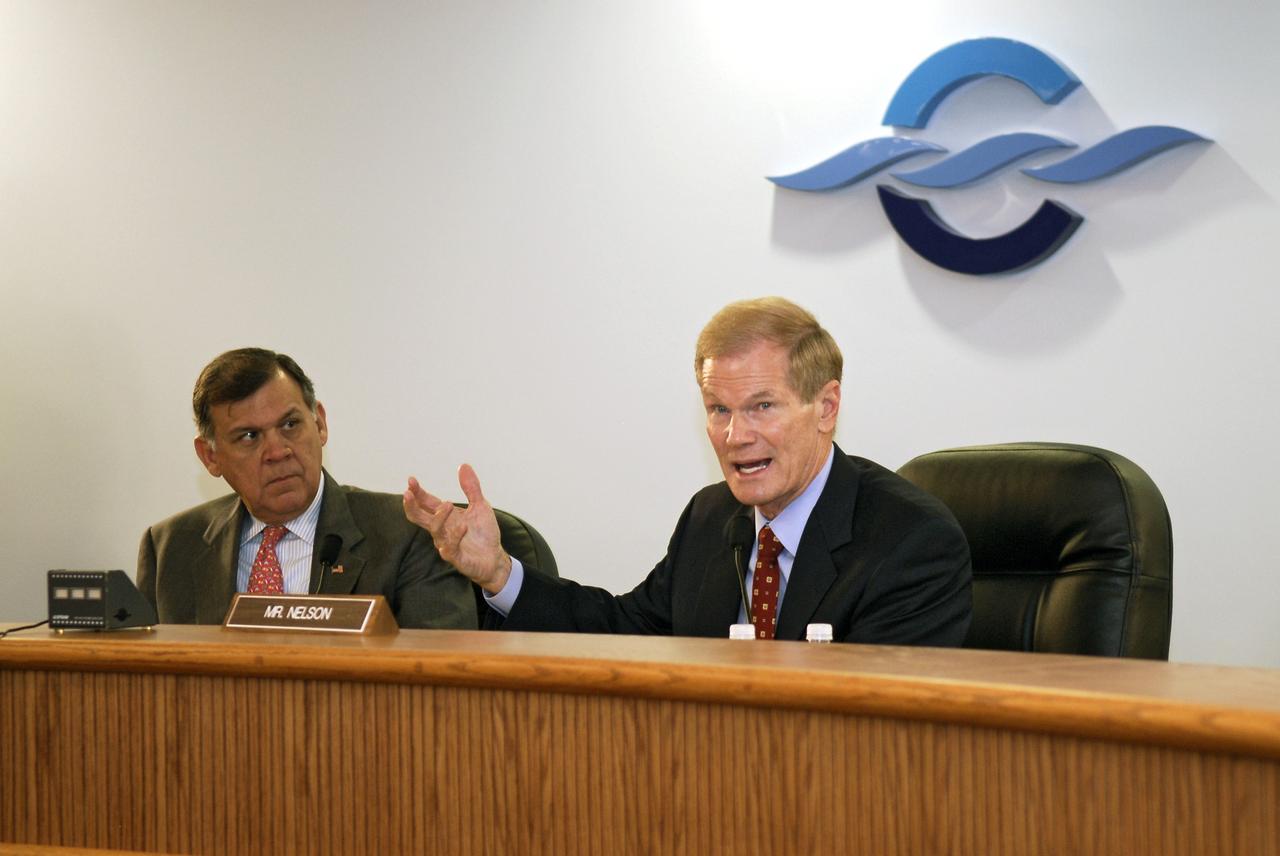
CAPE CANAVERAL, Fla. – A Senate field hearing held at the Canaveral Port Authority and chaired by Florida Sen. Bill Nelson (right) focuses on workforce related challenges at NASA's Kennedy Space Center and potential solutions to mitigate the transition's effects on the community. The hearing examined issues surrounding the retirement of the space shuttle and the transition to the new Orion/Ares system. On the left is Florida Sen. Mel Martinez. NASA was represented by Deputy Associate Administrator of Exploration Systems Doug Cooke, Administrator Michael Griffin and Associate Administrator of Space Operations William Gerstenmaier. Photo credit: NASA/Kim Shiflett
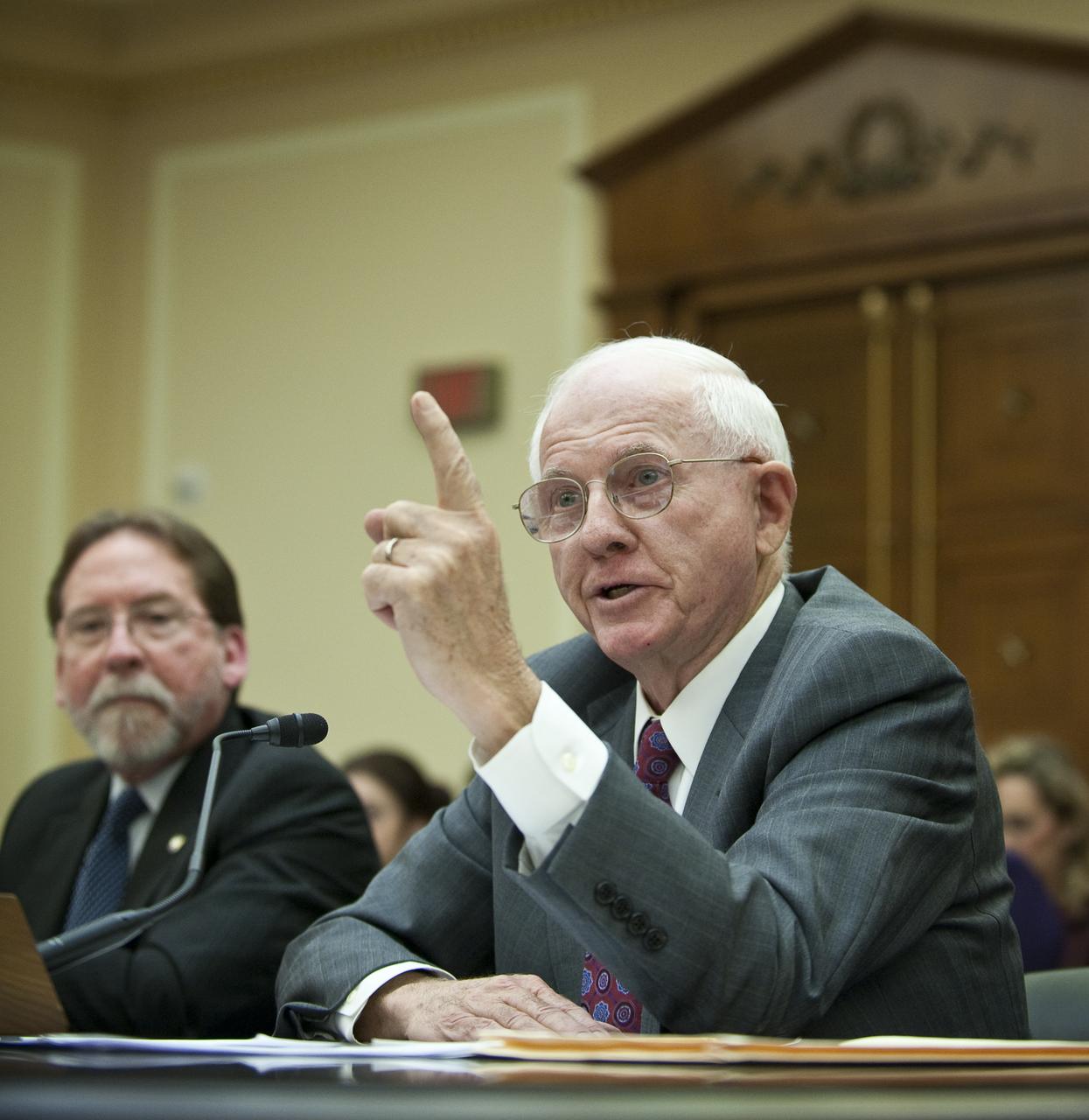
A. Thomas Young, right, retired Executive Vice President, Lockheed Martin, speaks before the U.S. House of Representatives' Committee on Science and Technology, Subcommittee on Space and Aeronautics to discuss proposed changes to NASA's exploration program on Wednesday, March 24, 2010, on Capitol Hill in Washington. Photo Credit: (NASA/Carla Cioffi)
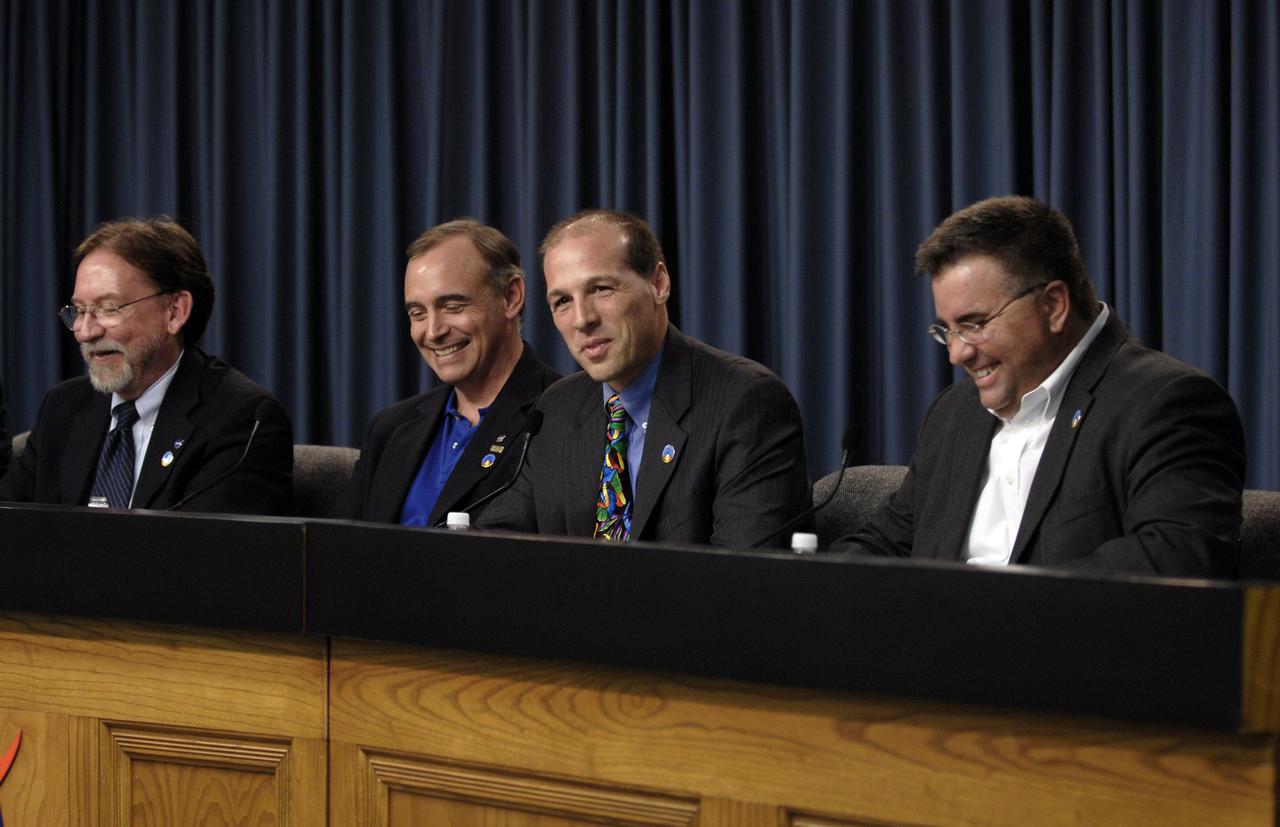
CAPE CANAVERAL, Fla. - At NASA's Kennedy Space Center in Florida, a post-launch news conference is held in the Press Site auditorium following the successful launch of the Ares I-X test rocket at 11:30 a.m. EDT Oct. 28. Sharing a lighter moment are, from left, Doug Cooke, associate administrator for NASA's Exploration Systems Mission Directorate; Jeff Hanley, Constellation Program manager; Bob Ess, mission manager for the Ares I-X flight test; and Edward Mango, launch director for the Ares I-X flight test. For more information on the Ares I-X vehicle and flight test, visit http://www.nasa.gov/aresIX. Photo credit: NASA/Kim Shiflett
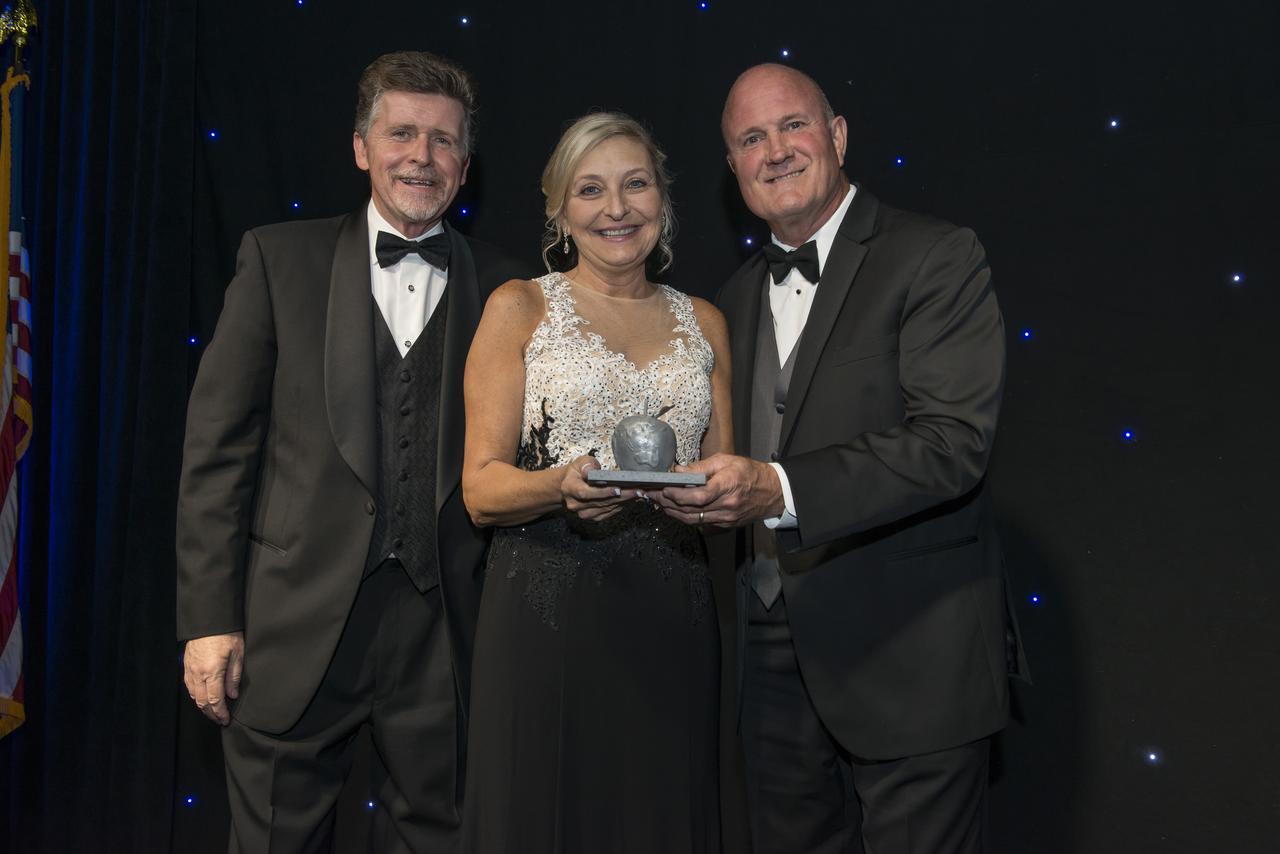
The annual Dr. Wernher Von Braun Memorial Dinner was held at the U.S. Space and Rocket Center's Davidson Center on October 26, 2017 with Keynote speaker General John Hyten, Commander of U.S. Strategic Command. Emcee was Mark Larson of Mark Larson Media Services, Inc. Dr. Wernher Von Braun Memorial Scholarships were presented to 8 college students by the National Space Club. Educator of the Year was awarded to Tammy Thorpe; Community Service award was presented to Huntsville, Al. Mayor Tommy Battle. The Communications Award was presented to retired astronaut Dr. Mike Massimino. The Distinguished Science Award was presented to Dr. Martin Weisskopf. The Astronautics Engineer Award was presented to Douglas R. Cooke. The Dr. Wernher Von Braun Space Flight Trophy was presented to Robert Lightfoot.
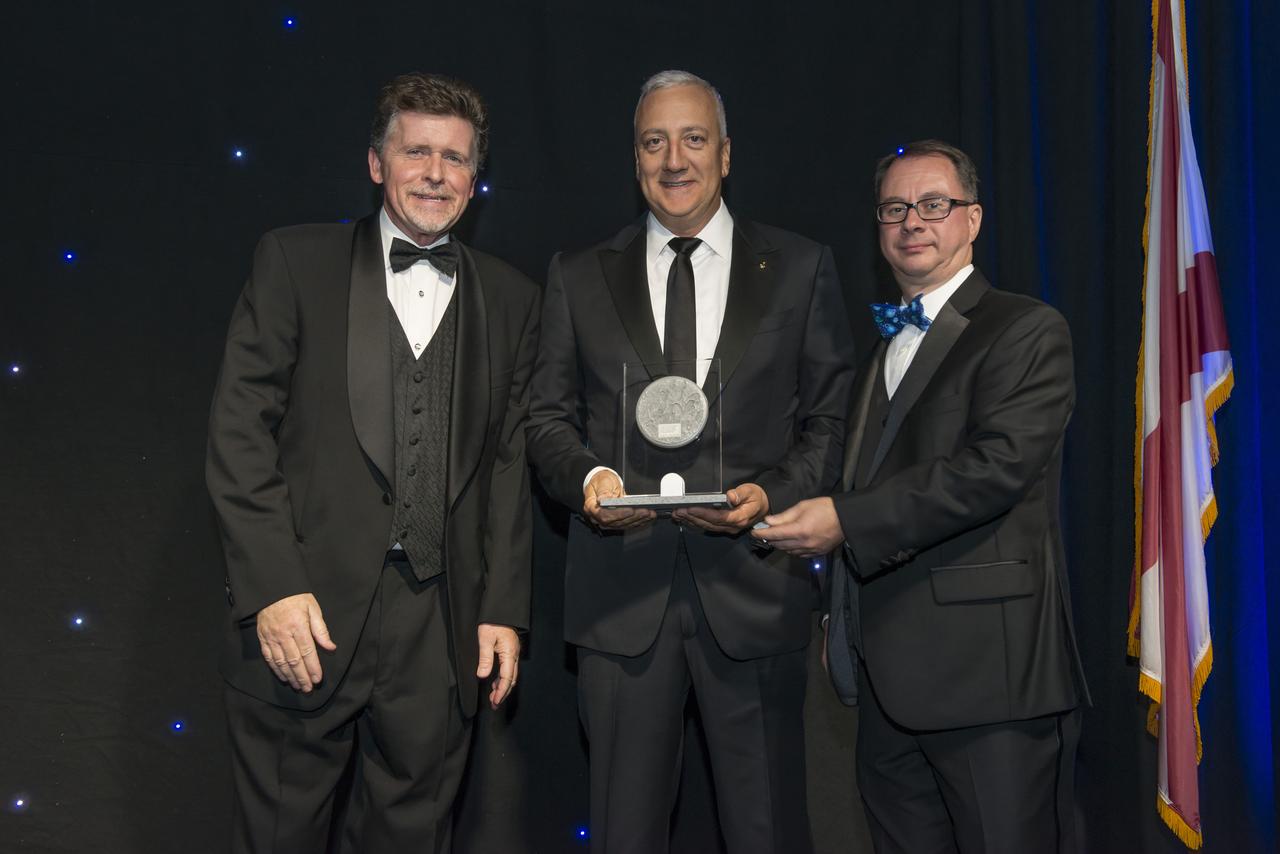
The annual Dr. Wernher Von Braun Memorial Dinner was held at the U.S. Space and Rocket Center's Davidson Center on October 26, 2017 with Keynote speaker General John Hyten, Commander of U.S. Strategic Command. Emcee was Mark Larson of Mark Larson Media Services, Inc. Dr. Wernher Von Braun Memorial Scholarships were presented to 8 college students by the National Space Club. Educator of the Year was awarded to Tammy Thorpe; Community Service award was presented to Huntsville, Al. Mayor Tommy Battle. The Communications Award was presented to retired astronaut Dr. Mike Massimino. The Distinguished Science Award was presented to Dr. Martin Weisskopf. The Astronautics Engineer Award was presented to Douglas R. Cooke. The Dr. Wernher Von Braun Space Flight Trophy was presented to Robert Lightfoot.
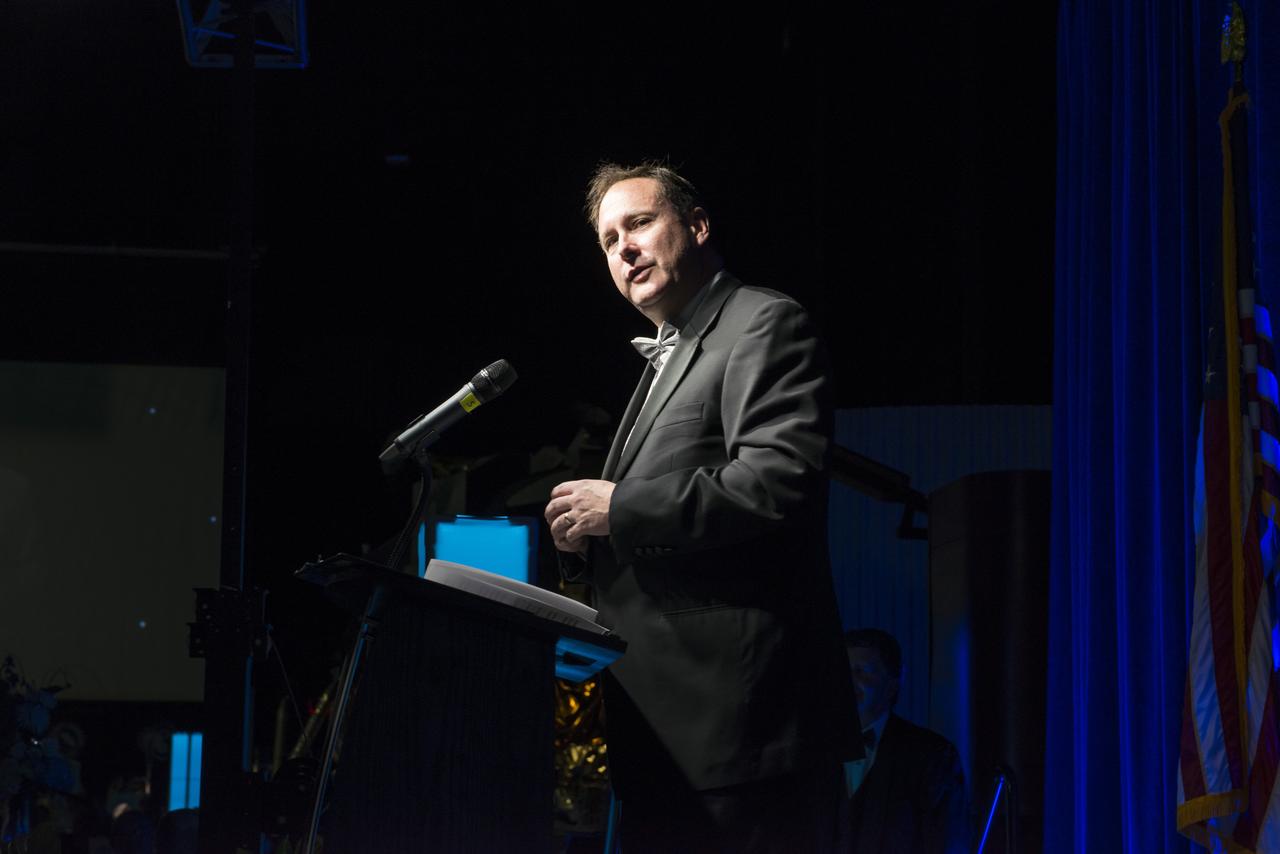
The annual Dr. Wernher Von Braun Memorial Dinner was held at the U.S. Space and Rocket Center's Davidson Center on October 26, 2017 with Keynote speaker General John Hyten, Commander of U.S. Strategic Command. Emcee was Mark Larson of Mark Larson Media Services, Inc. Dr. Wernher Von Braun Memorial Scholarships were presented to 8 college students by the National Space Club. Educator of the Year was awarded to Tammy Thorpe; Community Service award was presented to Huntsville, Al. Mayor Tommy Battle. The Communications Award was presented to retired astronaut Dr. Mike Massimino. The Distinguished Science Award was presented to Dr. Martin Weisskopf. The Astronautics Engineer Award was presented to Douglas R. Cooke. The Dr. Wernher Von Braun Space Flight Trophy was presented to Robert Lightfoot.
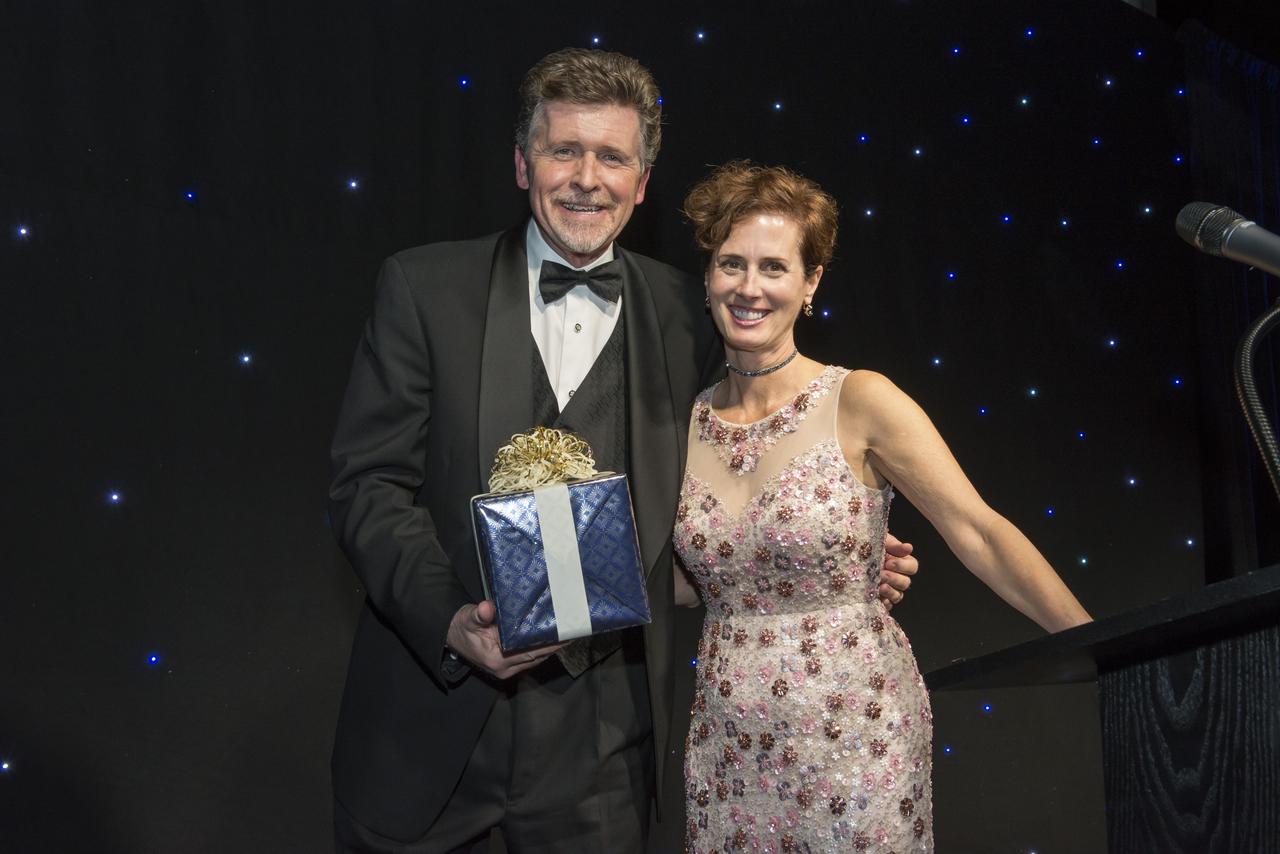
The annual Dr. Wernher Von Braun Memorial Dinner was held at the U.S. Space and Rocket Center's Davidson Center on October 26, 2017 with Keynote speaker General John Hyten, Commander of U.S. Strategic Command. Emcee was Mark Larson of Mark Larson Media Services, Inc. Dr. Wernher Von Braun Memorial Scholarships were presented to 8 college students by the National Space Club. Educator of the Year was awarded to Tammy Thorpe; Community Service award was presented to Huntsville, Al. Mayor Tommy Battle. The Communications Award was presented to retired astronaut Dr. Mike Massimino. The Distinguished Science Award was presented to Dr. Martin Weisskopf. The Astronautics Engineer Award was presented to Douglas R. Cooke. The Dr. Wernher Von Braun Space Flight Trophy was presented to Robert Lightfoot.
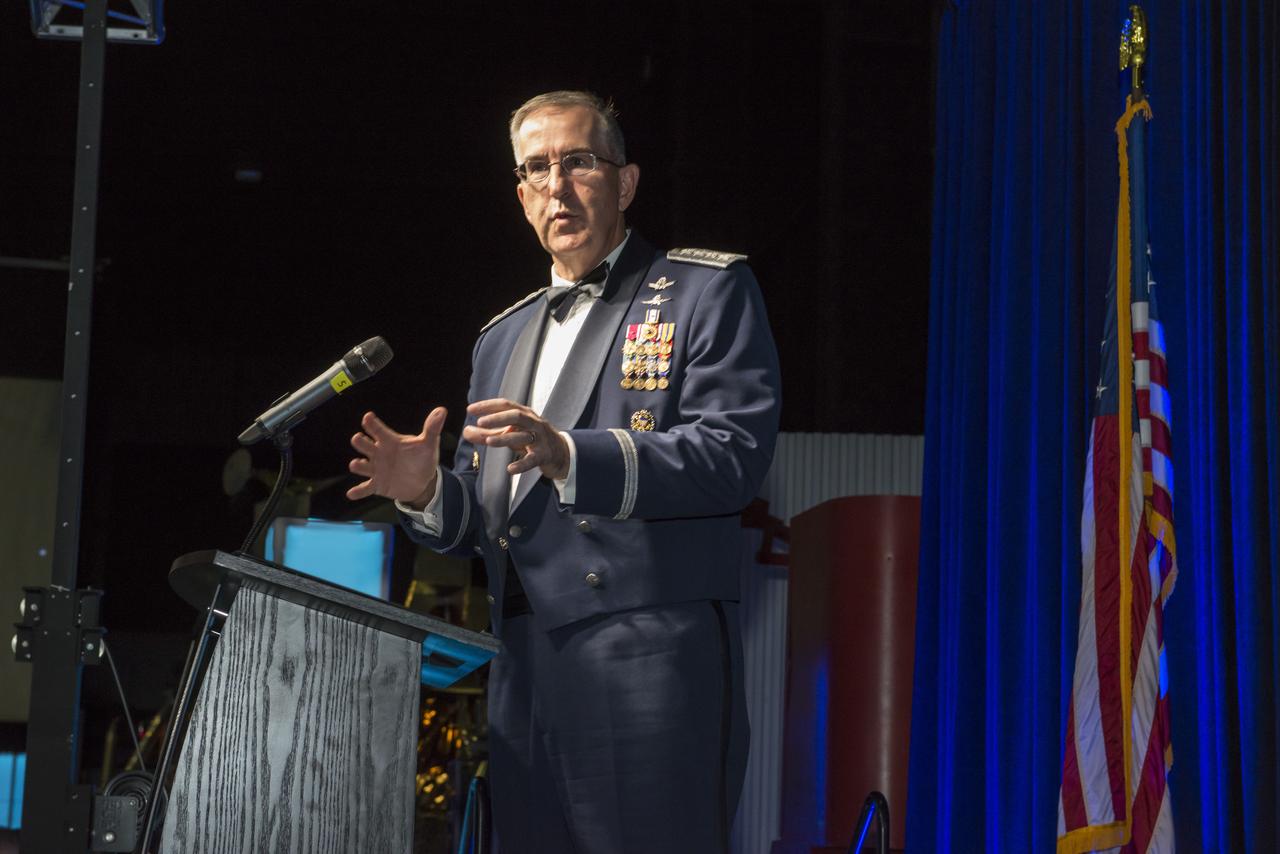
The annual Dr. Wernher Von Braun Memorial Dinner was held at the U.S. Space and Rocket Center's Davidson Center on October 26, 2017 with Keynote speaker General John Hyten, Commander of U.S. Strategic Command. Emcee was Mark Larson of Mark Larson Media Services, Inc. Dr. Wernher Von Braun Memorial Scholarships were presented to 8 college students by the National Space Club. Educator of the Year was awarded to Tammy Thorpe; Community Service award was presented to Huntsville, Al. Mayor Tommy Battle. The Communications Award was presented to retired astronaut Dr. Mike Massimino. The Distinguished Science Award was presented to Dr. Martin Weisskopf. The Astronautics Engineer Award was presented to Douglas R. Cooke. The Dr. Wernher Von Braun Space Flight Trophy was presented to Robert Lightfoot.
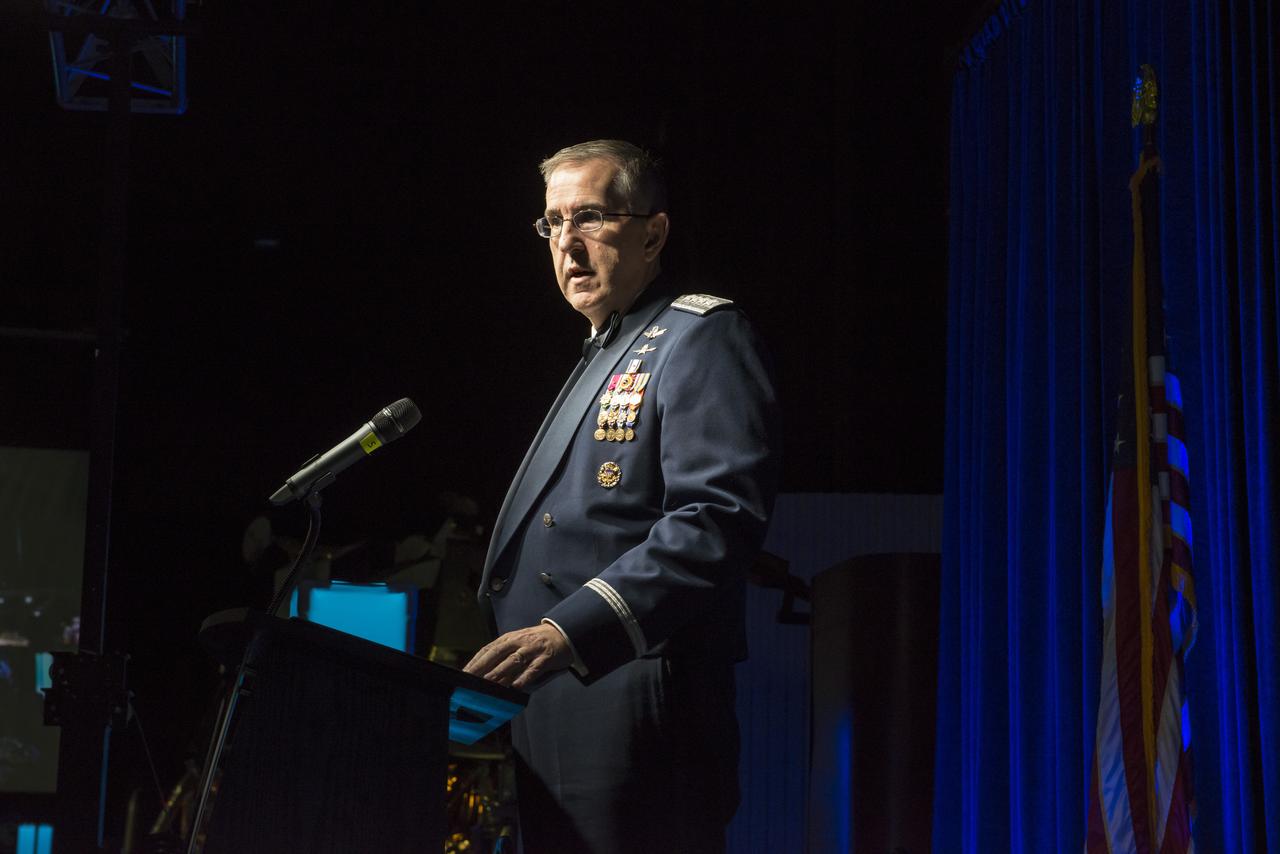
The annual Dr. Wernher Von Braun Memorial Dinner was held at the U.S. Space and Rocket Center's Davidson Center on October 26, 2017 with Keynote speaker General John Hyten, Commander of U.S. Strategic Command. Emcee was Mark Larson of Mark Larson Media Services, Inc. Dr. Wernher Von Braun Memorial Scholarships were presented to 8 college students by the National Space Club. Educator of the Year was awarded to Tammy Thorpe; Community Service award was presented to Huntsville, Al. Mayor Tommy Battle. The Communications Award was presented to retired astronaut Dr. Mike Massimino. The Distinguished Science Award was presented to Dr. Martin Weisskopf. The Astronautics Engineer Award was presented to Douglas R. Cooke. The Dr. Wernher Von Braun Space Flight Trophy was presented to Robert Lightfoot.

The annual Dr. Wernher Von Braun Memorial Dinner was held at the U.S. Space and Rocket Center's Davidson Center on October 26, 2017 with Keynote speaker General John Hyten, Commander of U.S. Strategic Command. Emcee was Mark Larson of Mark Larson Media Services, Inc. Dr. Wernher Von Braun Memorial Scholarships were presented to 8 college students by the National Space Club. Educator of the Year was awarded to Tammy Thorpe; Community Service award was presented to Huntsville, Al. Mayor Tommy Battle. The Communications Award was presented to retired astronaut Dr. Mike Massimino. The Distinguished Science Award was presented to Dr. Martin Weisskopf. The Astronautics Engineer Award was presented to Douglas R. Cooke. The Dr. Wernher Von Braun Space Flight Trophy was presented to Robert Lightfoot.
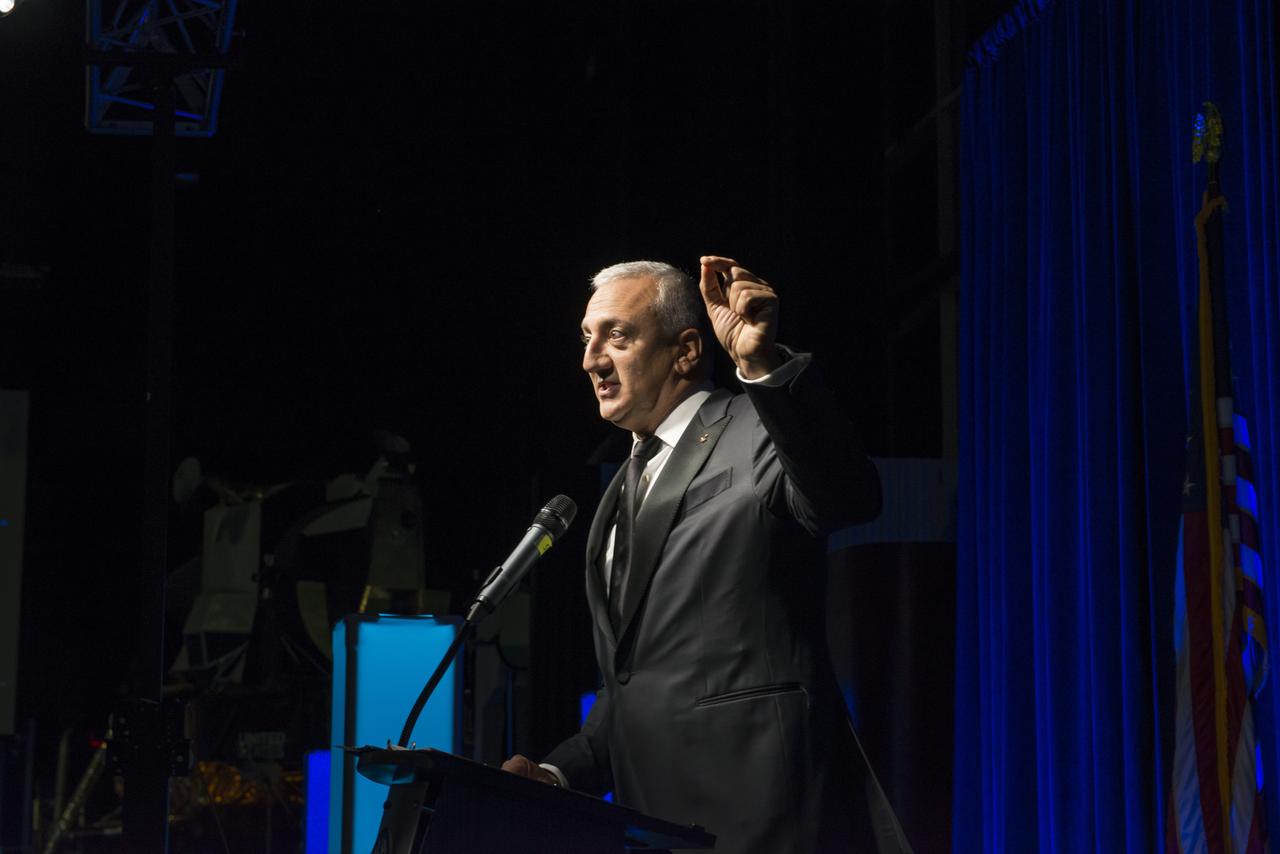
The annual Dr. Wernher Von Braun Memorial Dinner was held at the U.S. Space and Rocket Center's Davidson Center on October 26, 2017 with Keynote speaker General John Hyten, Commander of U.S. Strategic Command. Emcee was Mark Larson of Mark Larson Media Services, Inc. Dr. Wernher Von Braun Memorial Scholarships were presented to 8 college students by the National Space Club. Educator of the Year was awarded to Tammy Thorpe; Community Service award was presented to Huntsville, Al. Mayor Tommy Battle. The Communications Award was presented to retired astronaut Dr. Mike Massimino. The Distinguished Science Award was presented to Dr. Martin Weisskopf. The Astronautics Engineer Award was presented to Douglas R. Cooke. The Dr. Wernher Von Braun Space Flight Trophy was presented to Robert Lightfoot.
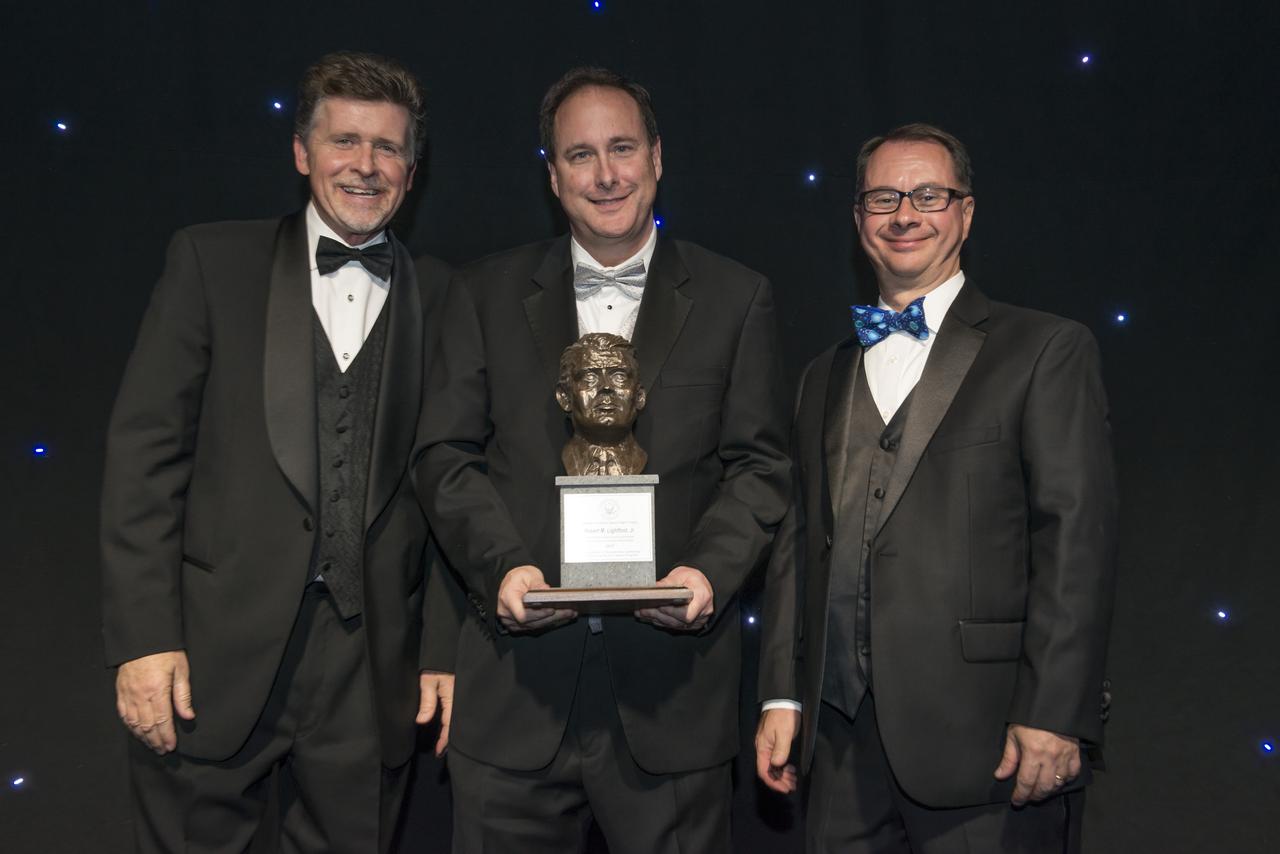
The annual Dr. Wernher Von Braun Memorial Dinner was held at the U.S. Space and Rocket Center's Davidson Center on October 26, 2017 with Keynote speaker General John Hyten, Commander of U.S. Strategic Command. Emcee was Mark Larson of Mark Larson Media Services, Inc. Dr. Wernher Von Braun Memorial Scholarships were presented to 8 college students by the National Space Club. Educator of the Year was awarded to Tammy Thorpe; Community Service award was presented to Huntsville, Al. Mayor Tommy Battle. The Communications Award was presented to retired astronaut Dr. Mike Massimino. The Distinguished Science Award was presented to Dr. Martin Weisskopf. The Astronautics Engineer Award was presented to Douglas R. Cooke. The Dr. Wernher Von Braun Space Flight Trophy was presented to Robert Lightfoot.
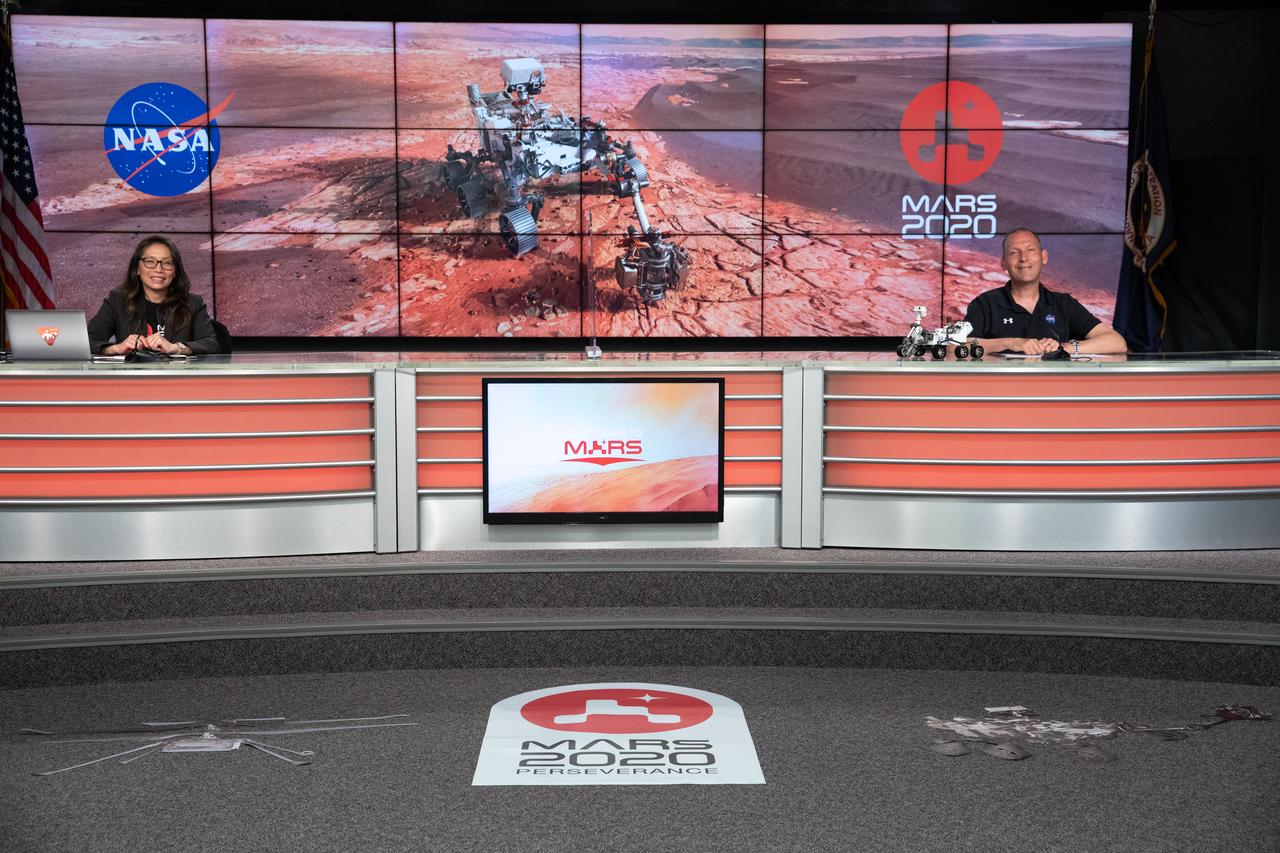
A Mars 2020 Sample Return briefing is held at NASA’s Kennedy Space Center in Florida on July 28, 2020. Participating in the briefing, from left, are Moderator Jia-Rui Cook, NASA’s Jet Propulsion Laboratory; and Thomas Zurbuchen, NASA associate administrator, Science Mission Directorate, The Mars Perseverance rover is scheduled to launch July 30, on a United Launch Alliance Atlas V 541 rocket from Space Launch Complex 41 at nearby Cape Canaveral Air Force Station. The rover is part of NASA’s Mars Exploration Program, a long-term effort of robotic exploration of the Red Planet. The rover will search for habitable conditions in the ancient past and signs of past microbial life on Mars. The Launch Services Program at Kennedy is responsible for launch management.
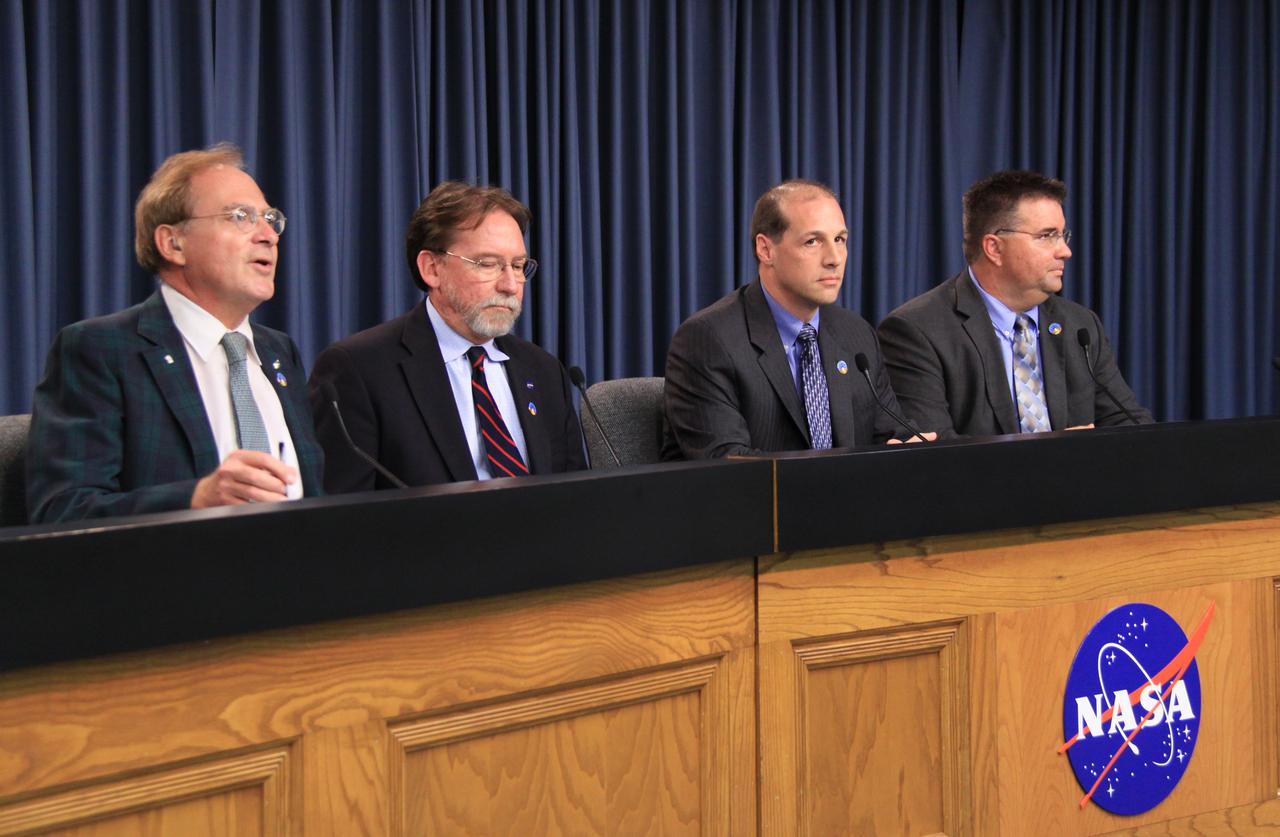
CAPE CANAVERAL, Fla. - At NASA's Kennedy Space Center in Florida, a news conference is held in the Press Site auditorium following the conclusion of the flight test readiness review, or FTRR, for the Ares I-X test rocket. From left are moderator George Diller, NASA Public Affairs officer; Doug Cooke, associate administrator for NASA's Exploration Systems Mission Directorate; Bob Ess, mission manager for the Ares I-X flight test; and Edward Mango, launch director for the Ares I-X flight test. During the meeting, senior NASA and contractor managers assessed the risks associated with the test and determined the rocket, support systems and procedures are ready for launch. The Ares I-X launch date was announced after the FTRR and is officially set for Oct. 27. For information on the Ares I-X vehicle and flight test, visit http://www.nasa.gov/aresIX. Photo credit: NASA/Jack Pfaller
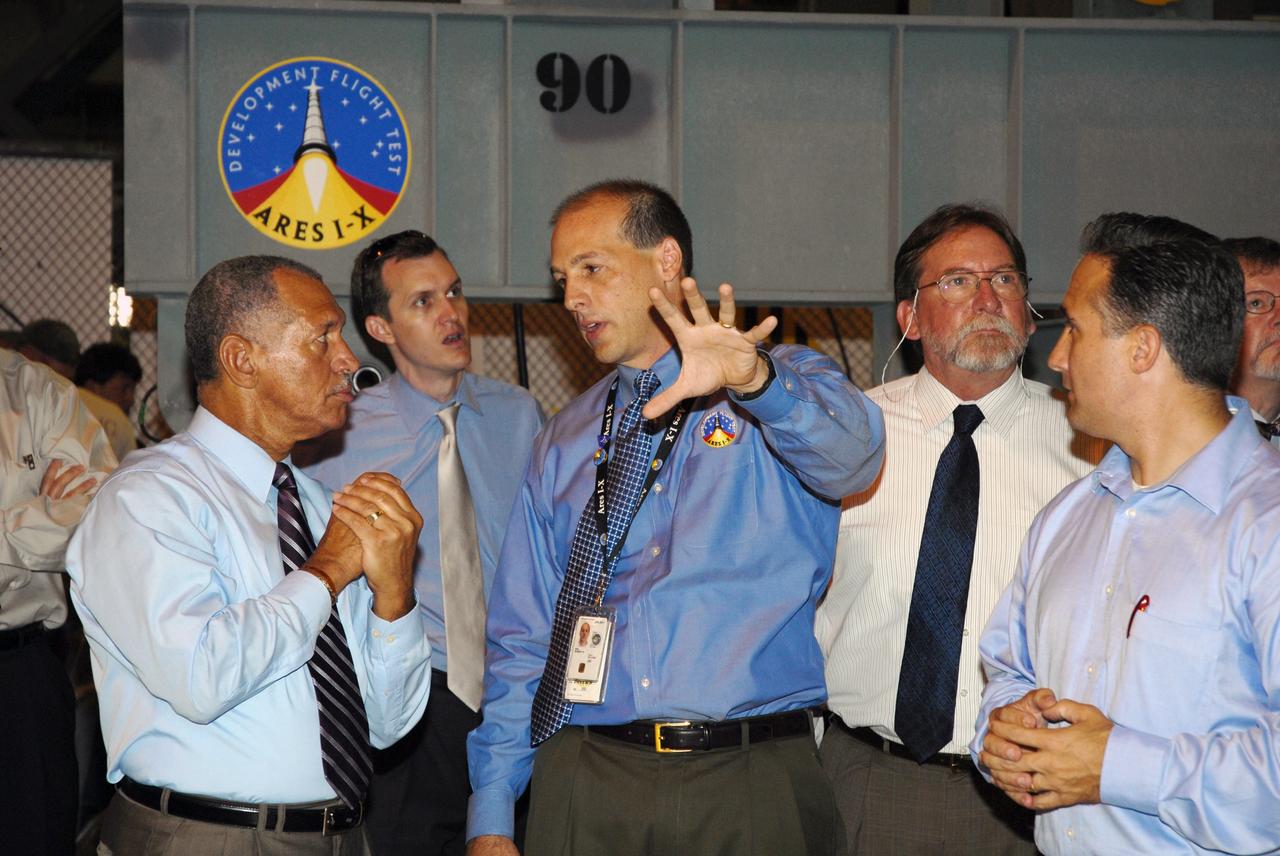
CAPE CANAVERAL, Fla. – At NASA's Kennedy Space Center in Florida, NASA Administrator Charles Bolden learns about the Ares I-X operations from NASA Ares I-X Mission Manager Bob Ess (center). At right are Acting Associate Administrator of Exploration Systems Doug Cook and NASA engineer Trent Smith. Bolden is touring several facilities at Kennedy involved with NASA's Constellation Program. Bolden also was at Kennedy for several events, including the landing of space shuttle Endeavour's STS-127 mission and the signing of the joint NASA-Japan Aerospace Exploration Agency agreement defining the terms of cooperation between the agencies on the Global Precipitation Measurement, or GPM, mission. Photo credit: NASA/Kim Shiflett
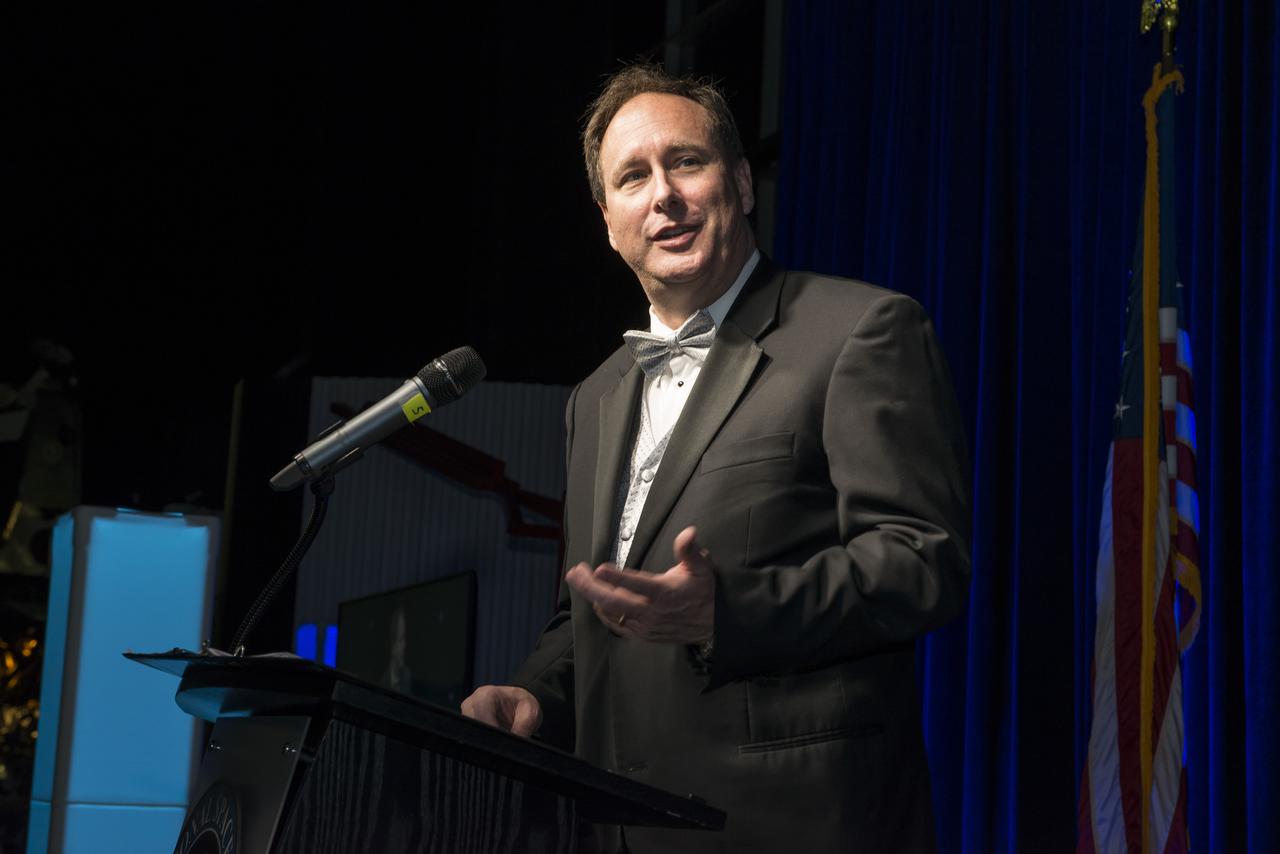
The annual Dr. Wernher Von Braun Memorial Dinner was held at the U.S. Space and Rocket Center's Davidson Center on October 26, 2017 with Keynote speaker General John Hyten, Commander of U.S. Strategic Command. Emcee was Mark Larson of Mark Larson Media Services, Inc. Dr. Wernher Von Braun Memorial Scholarships were presented to 8 college students by the National Space Club. Educator of the Year was awarded to Tammy Thorpe; Community Service award was presented to Huntsville, Al. Mayor Tommy Battle. The Communications Award was presented to retired astronaut Dr. Mike Massimino. The Distinguished Science Award was presented to Dr. Martin Weisskopf. The Astronautics Engineer Award was presented to Douglas R. Cooke. The Dr. Wernher Von Braun Space Flight Trophy was presented to Robert Lightfoot.
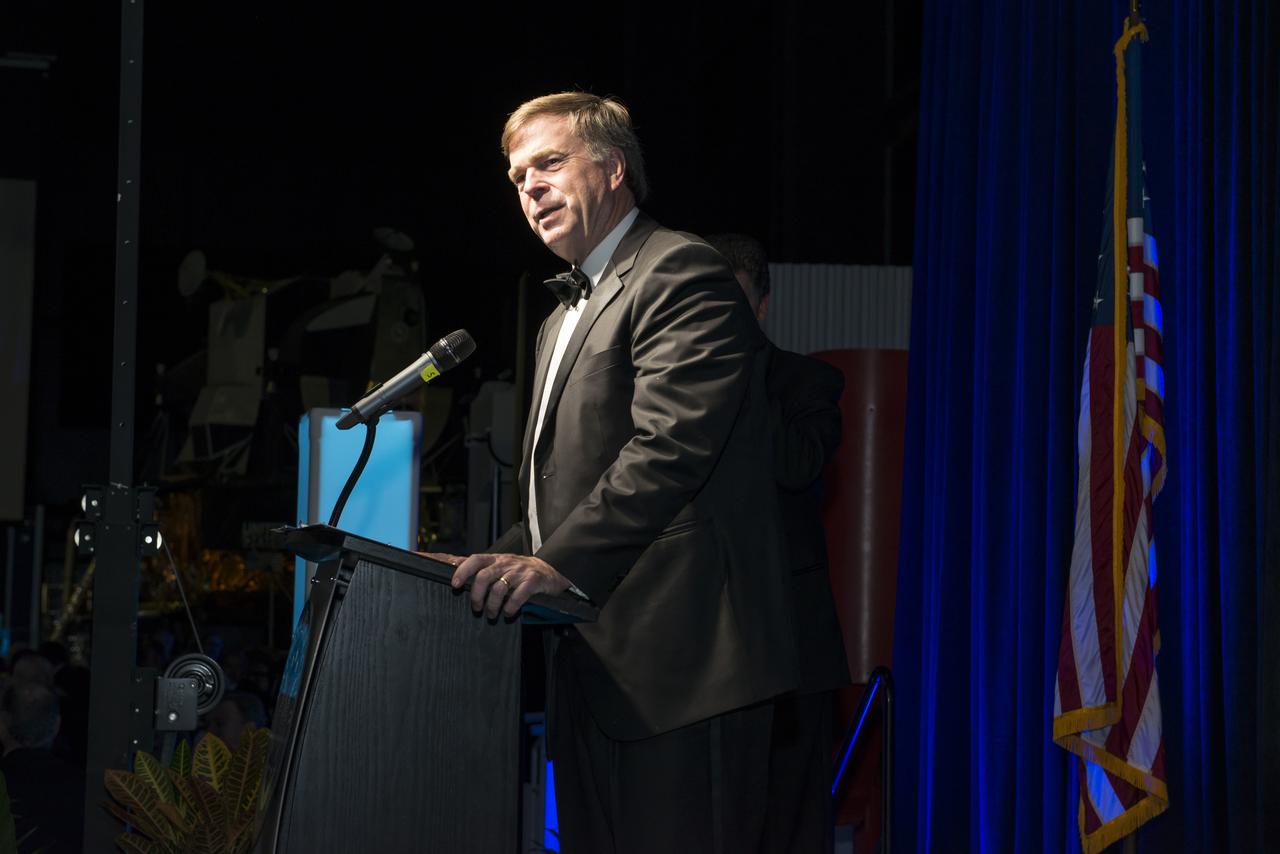
The annual Dr. Wernher Von Braun Memorial Dinner was held at the U.S. Space and Rocket Center's Davidson Center on October 26, 2017 with Keynote speaker General John Hyten, Commander of U.S. Strategic Command. Emcee was Mark Larson of Mark Larson Media Services, Inc. Dr. Wernher Von Braun Memorial Scholarships were presented to 8 college students by the National Space Club. Educator of the Year was awarded to Tammy Thorpe; Community Service award was presented to Huntsville, Al. Mayor Tommy Battle. The Communications Award was presented to retired astronaut Dr. Mike Massimino. The Distinguished Science Award was presented to Dr. Martin Weisskopf. The Astronautics Engineer Award was presented to Douglas R. Cooke. The Dr. Wernher Von Braun Space Flight Trophy was presented to Robert Lightfoot.
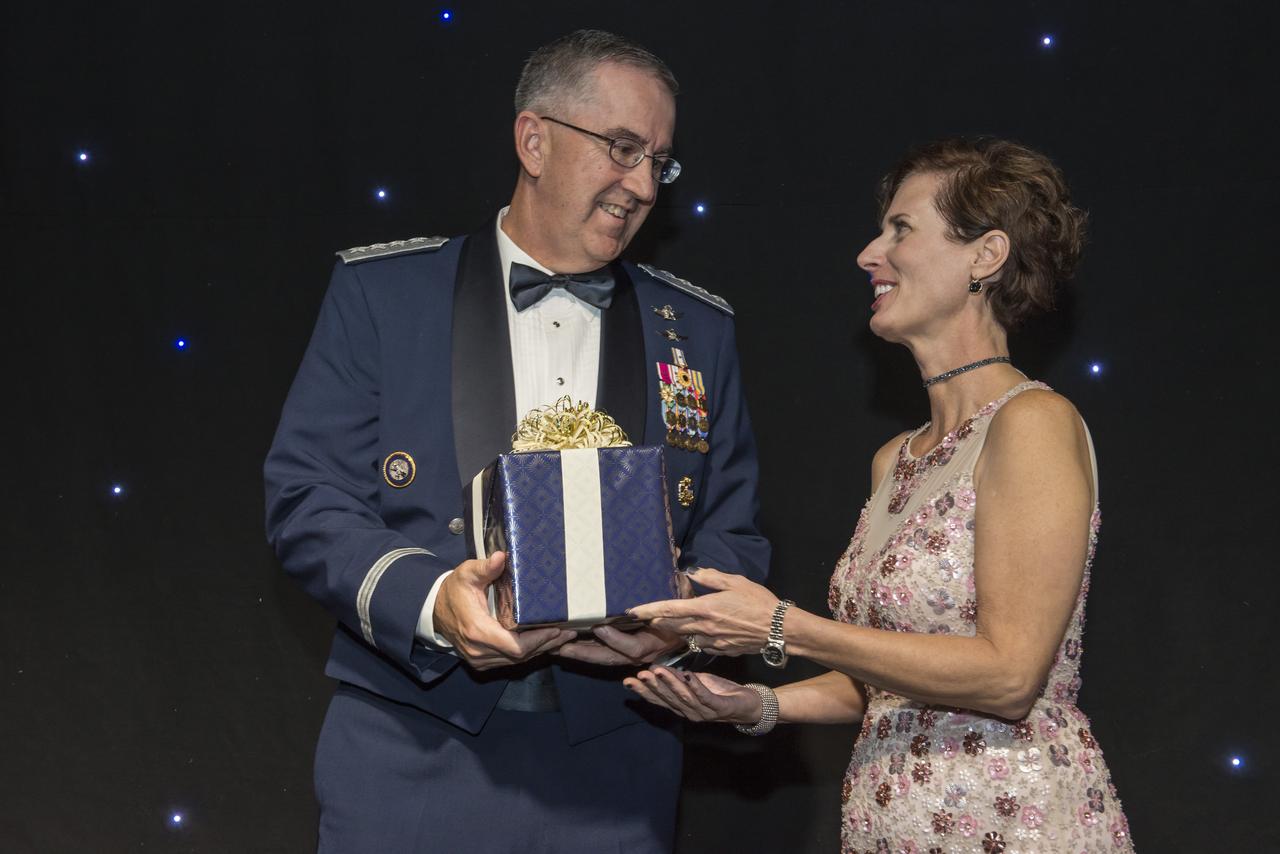
The annual Dr. Wernher Von Braun Memorial Dinner was held at the U.S. Space and Rocket Center's Davidson Center on October 26, 2017 with Keynote speaker General John Hyten, Commander of U.S. Strategic Command. Emcee was Mark Larson of Mark Larson Media Services, Inc. Dr. Wernher Von Braun Memorial Scholarships were presented to 8 college students by the National Space Club. Educator of the Year was awarded to Tammy Thorpe; Community Service award was presented to Huntsville, Al. Mayor Tommy Battle. The Communications Award was presented to retired astronaut Dr. Mike Massimino. The Distinguished Science Award was presented to Dr. Martin Weisskopf. The Astronautics Engineer Award was presented to Douglas R. Cooke. The Dr. Wernher Von Braun Space Flight Trophy was presented to Robert Lightfoot.