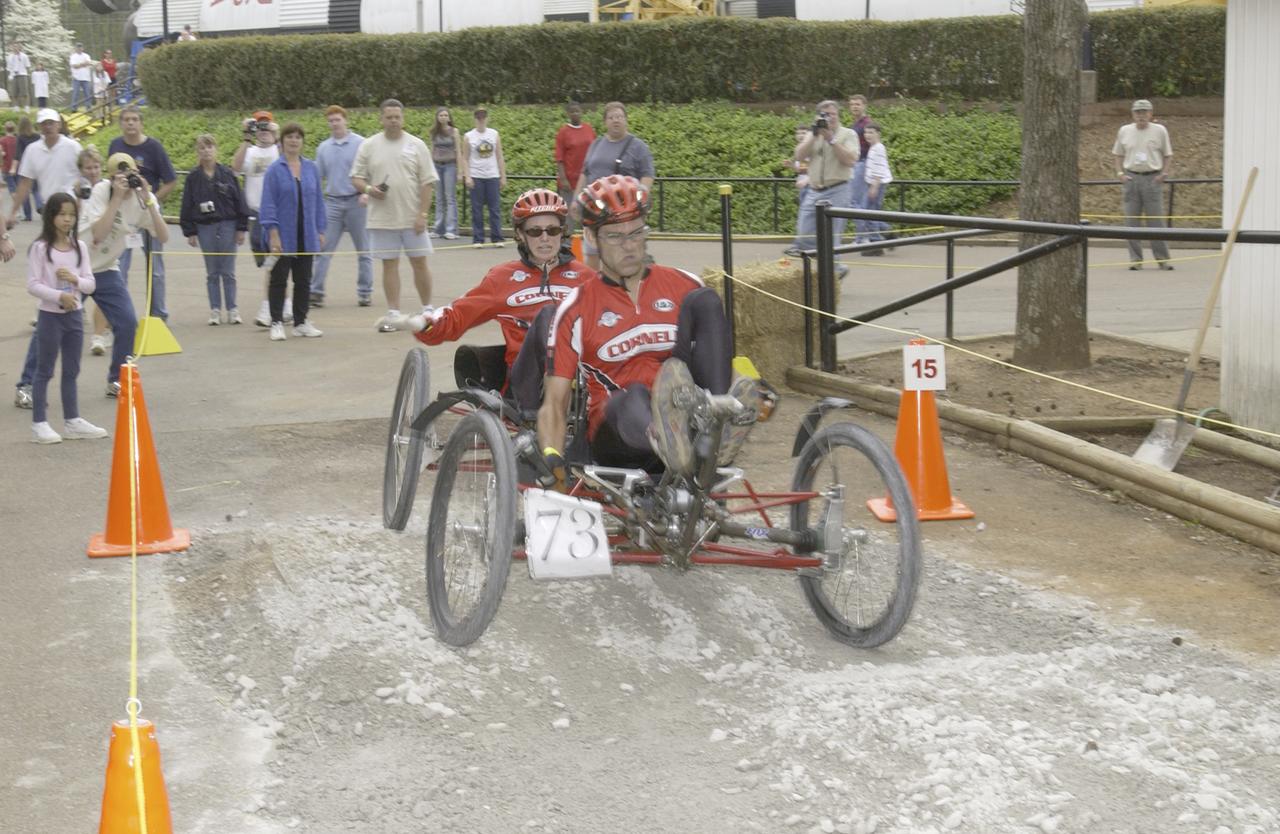
Students from across the United States and as far away as Puerto Rico and South America came to Huntsville, Alabama for the 9th annual Great Moonbuggy Race at the U.S. Space Rocket Center. Seventy-seven teams, representing high schools and colleges from 21 states, Puerto Rico, and Columbia, raced human powered vehicles over a lunar-like terrain. A team from Cornell University in Ithaca, New York, took the first place honor in the college division. This photograph shows the Cornell #2 team driving their vehicle through the course. The team finished the race in second place in the college division. Vehicles powered by two team members, one male and one female, raced one at a time over a half-mile obstacle course of simulated moonscape terrain. The competition is inspired by development, some 30 years ago, of the Lunar Roving Vehicle (LRV), a program managed by the Marshall Space Flight Center. The LRV team had to design a compact, lightweight, all-terrain vehicle, that could be transported to the Moon in the small Apollo spacecraft. The Great Moonbuggy Race challenges students to design and build a human powered vehicle so they will learn how to deal with real-world engineering problems, similar to those faced by the actual NASA LRV team.
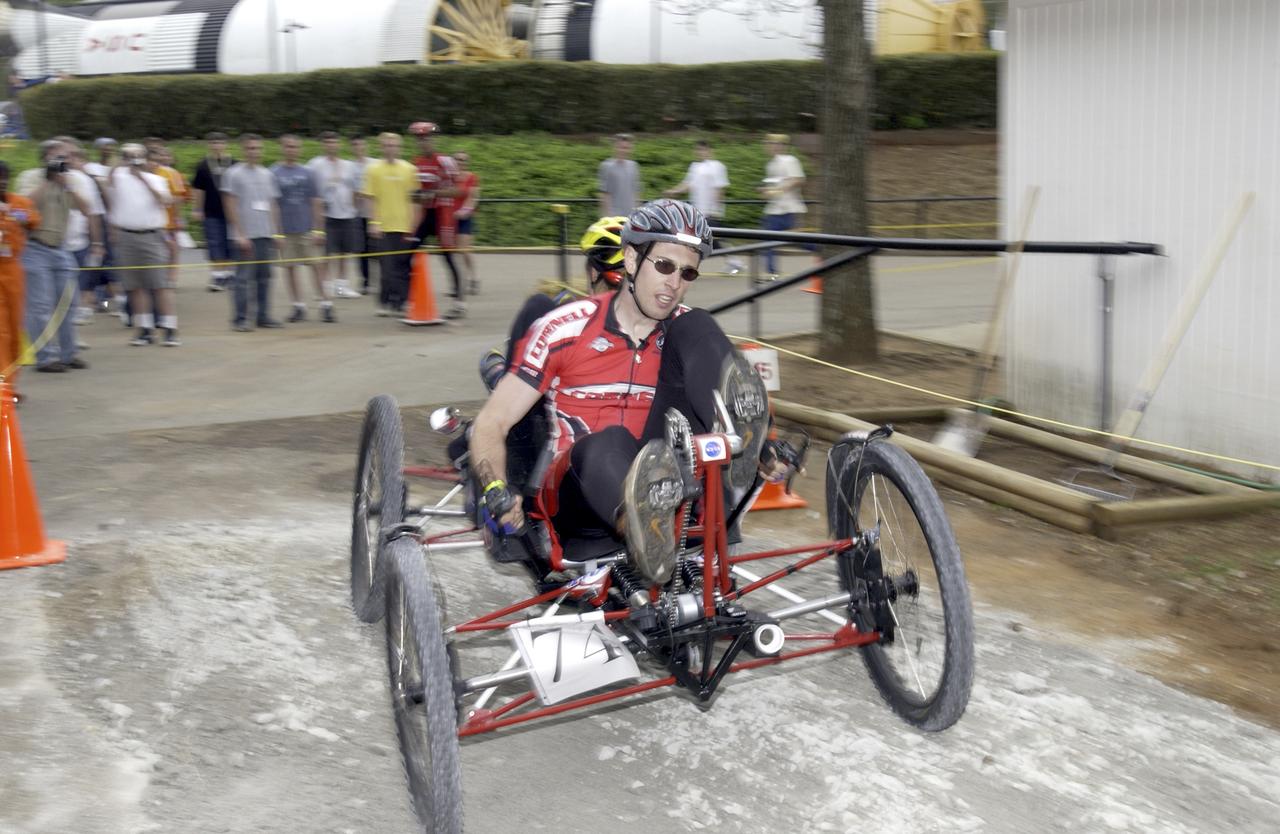
Students from across the United States and as far away as Puerto Rico and South America came to Huntsville, Alabama for the 9th annual Great Moonbuggy Race at the U.S. Space Rocket Center. Seventy-seven teams, representing high schools and colleges from 21 states, Puerto Rico, and Columbia, raced human powered vehicles over a lunar-like terrain. A team from Cornell University in Ithaca, New York, took the first place honor in the college division. In this photograph, the Cornell #1 team, the collegiate first place winner, maneuvers their vehicle through the course. Vehicles powered by two team members, one male and one female, raced one at a time over a half-mile obstacle course of simulated moonscape terrain. The competition is inspired by development, some 30 years ago, of the Lunar Roving Vehicle (LRV), a program managed by the Marshall Space Flight Center. The LRV team had to design a compact, lightweight, all-terrain vehicle that could be transported to the Moon in the small Apollo spacecraft. The Great Moonbuggy Race challenges students to design and build a humanpowered vehicle so they will learn how to deal with real-world engineering problems similar to those faced by the actual NASA LRV team.
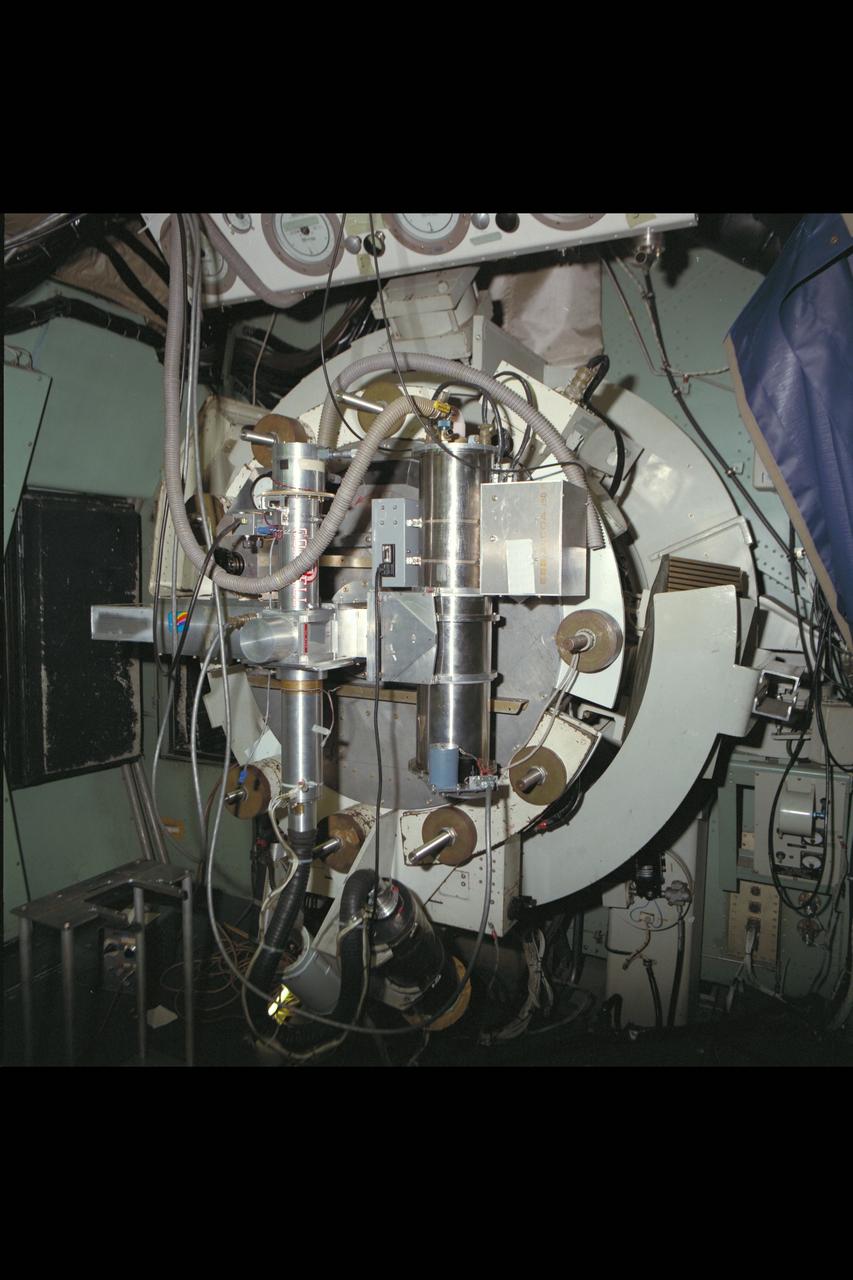
C-141 KAO: Cornell University, FAR Infrared Interferometer
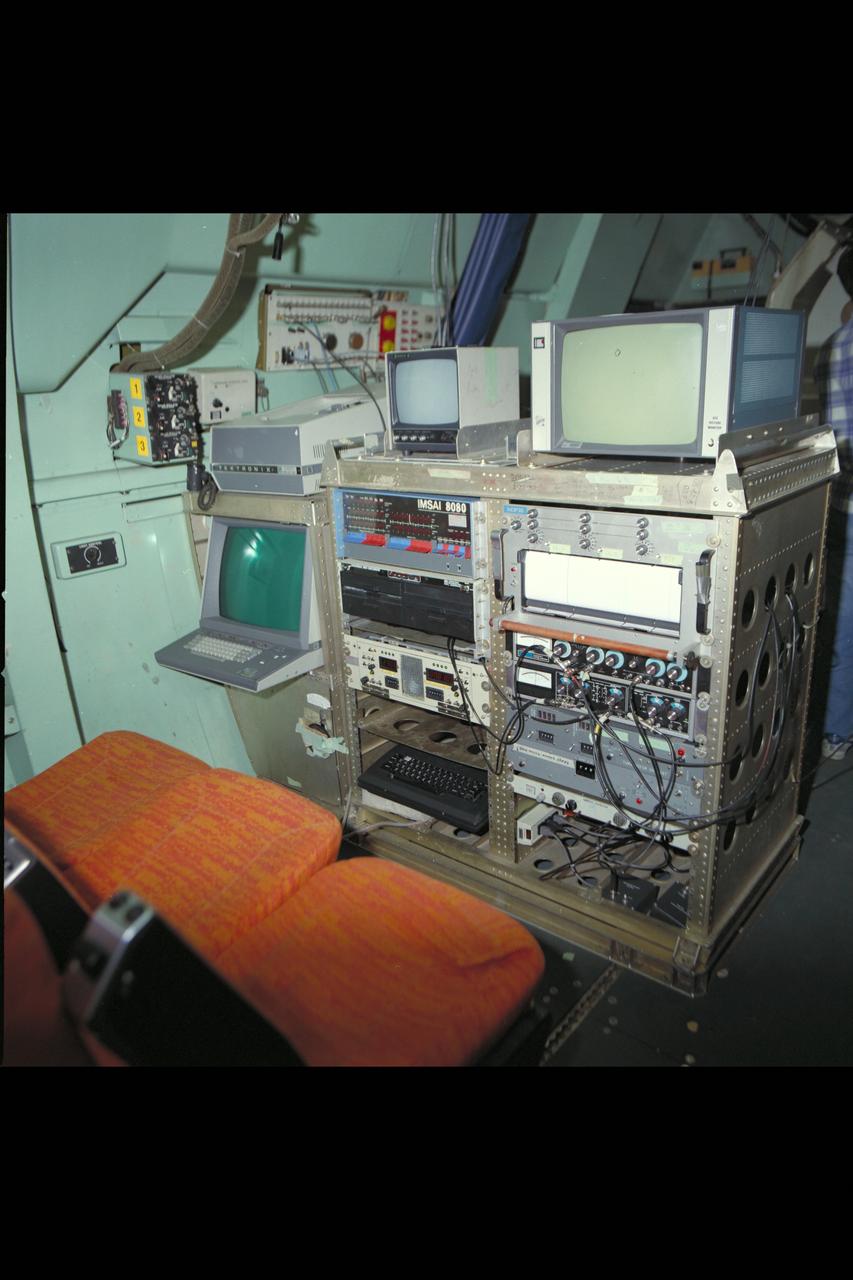
C-141 KAO: Cornell University, FAR Infrared Interferometer - experimentor's station
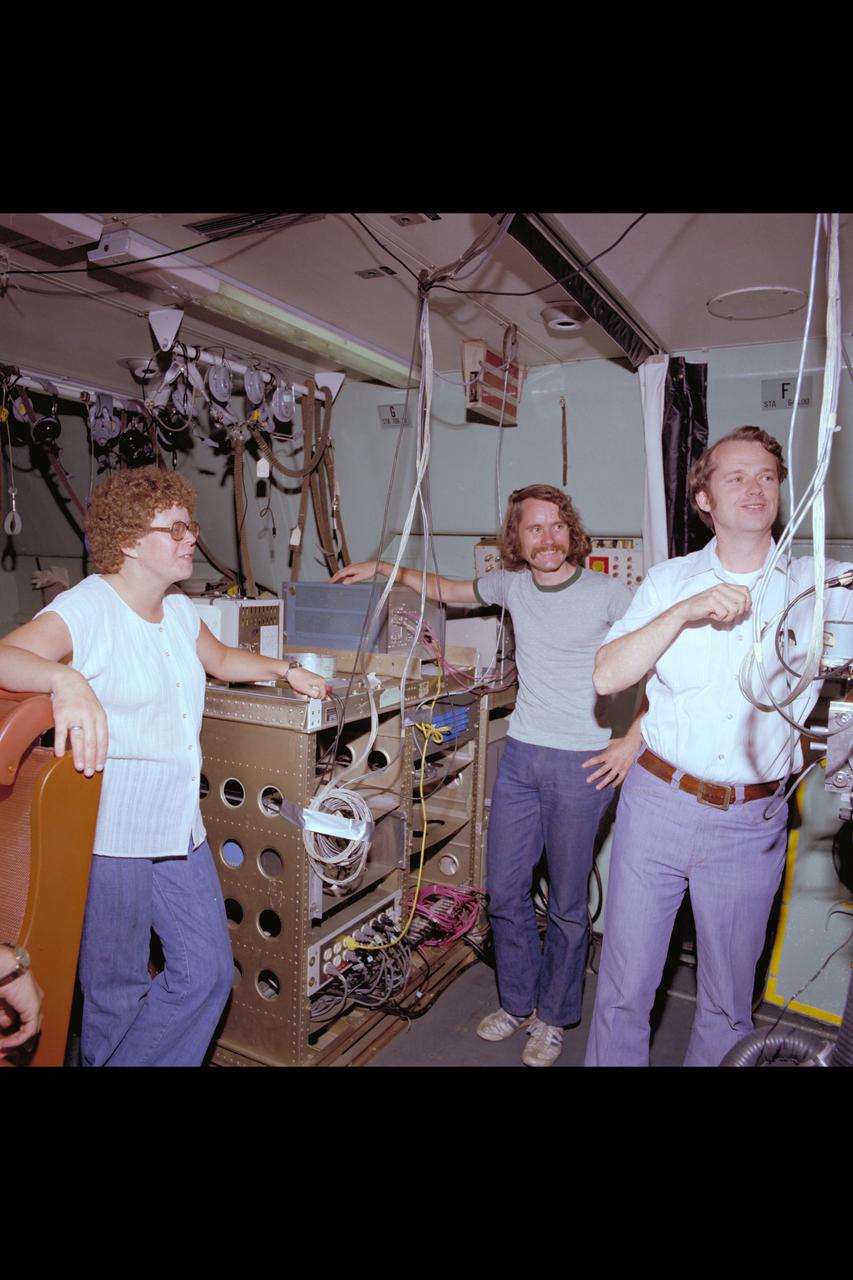
C-141 KAO Rochester, Cornell and California University Experiments packages on board
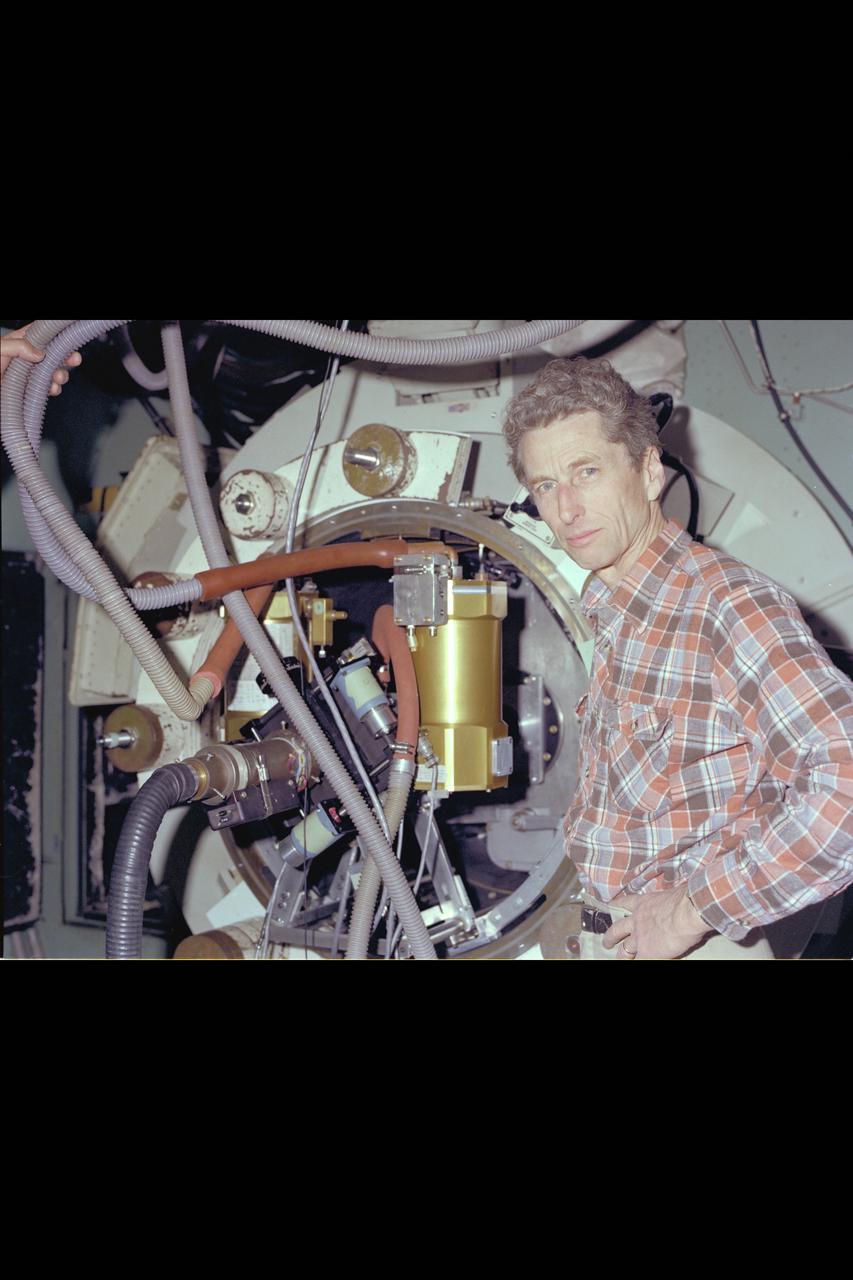
C-141 KAO: Cornell University, FAR Infrared Interferometer
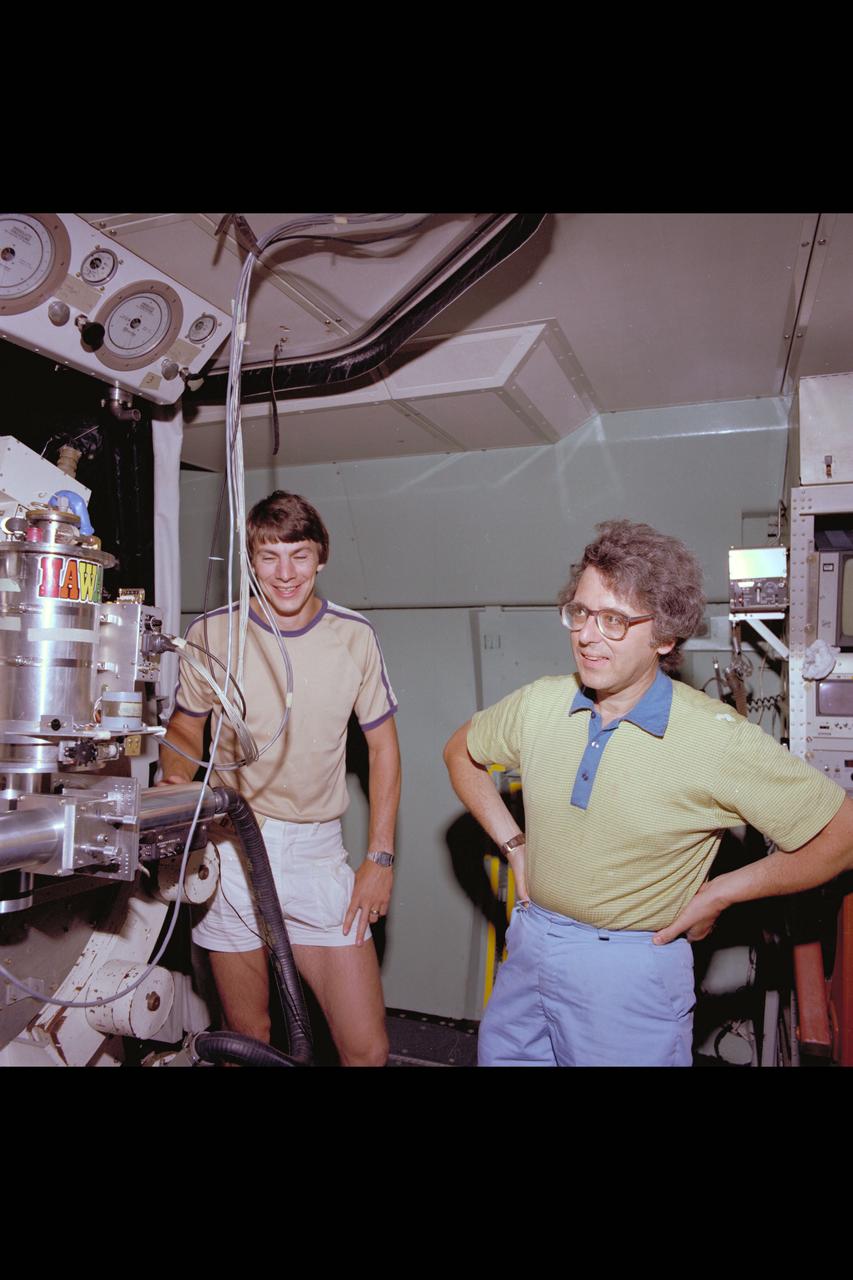
C-141 KAO Rochester, Cornell and California University Experiments packages on board
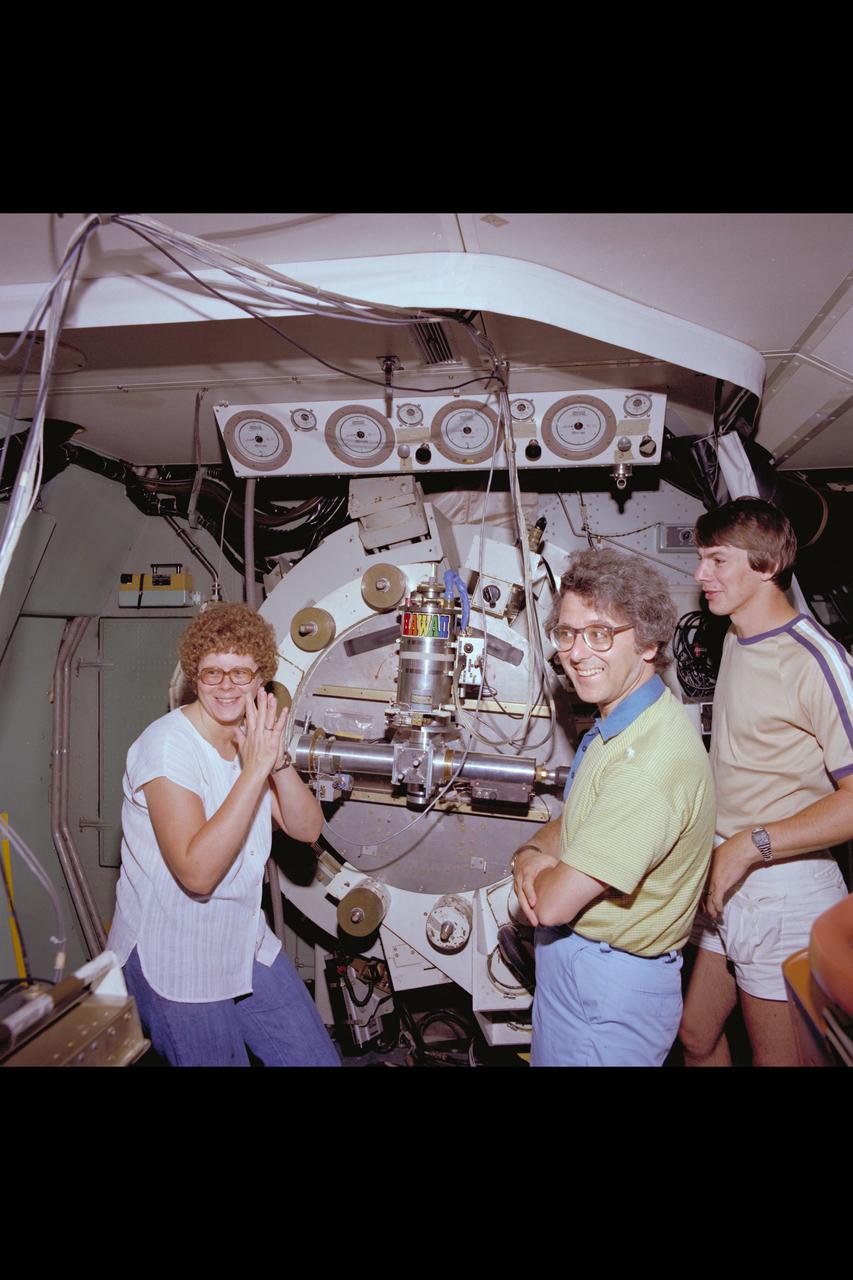
C-141 KAO Rochester, Cornell and California University Experiments packages onboard
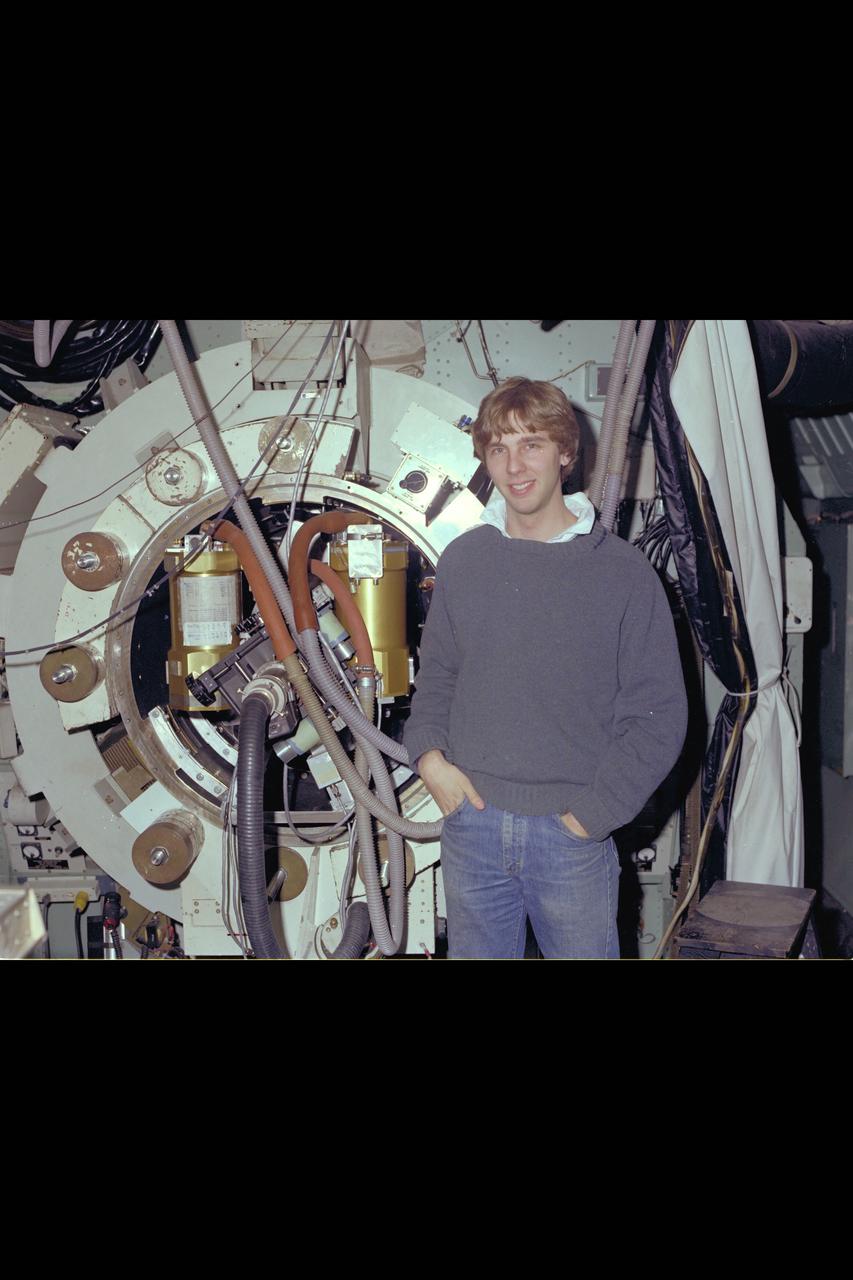
C-141 KAO: Cornell University, FAR Infrared Interferometer
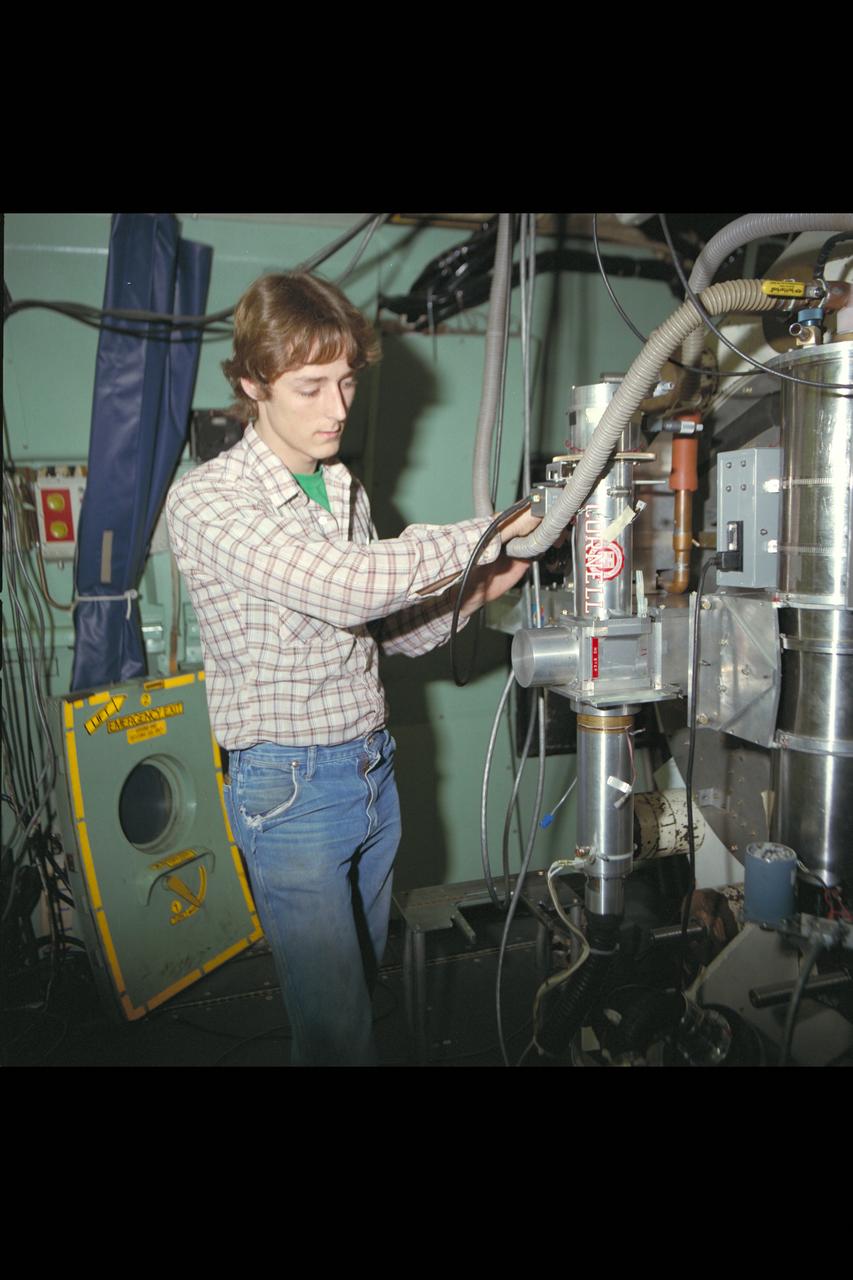
C-141 KAO: Cornell University, FAR Infrared Interferometer
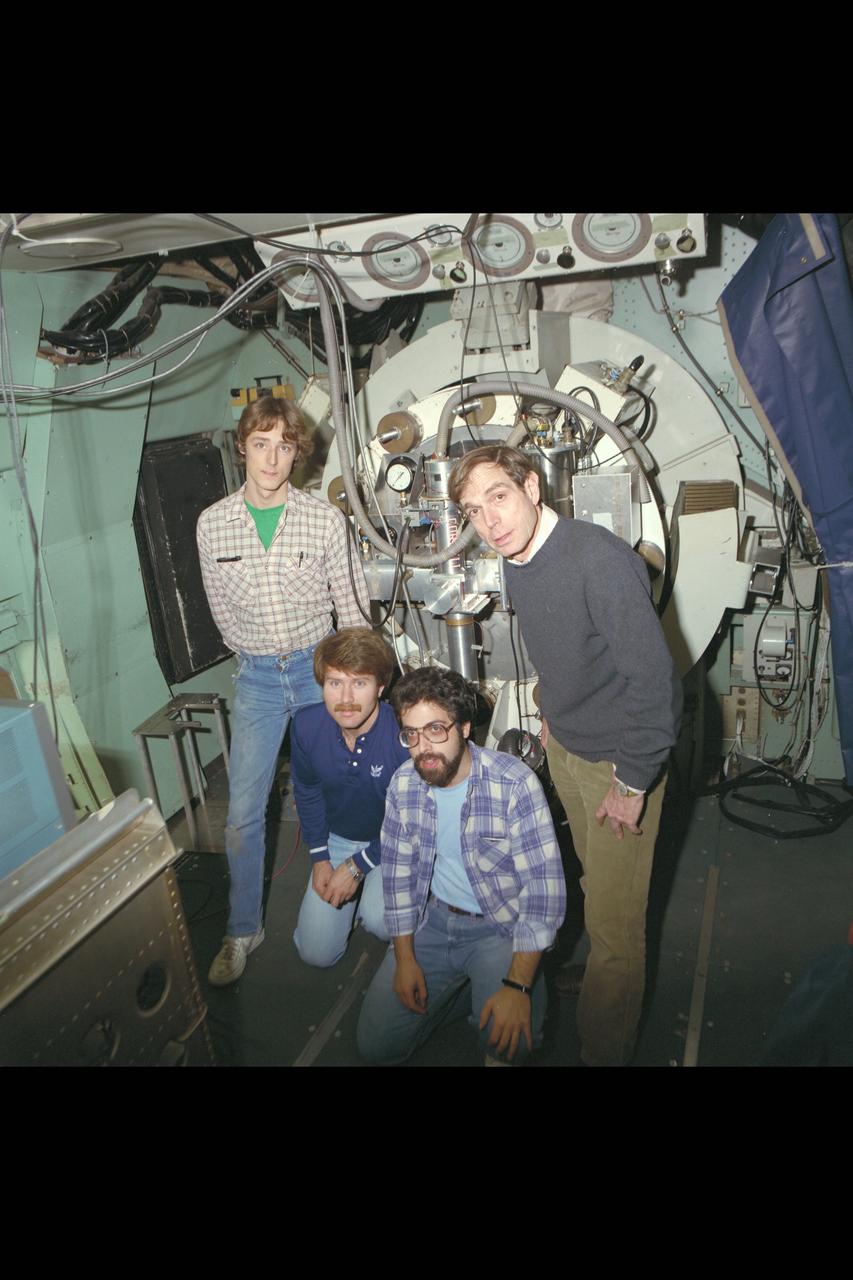
C-141 KAO: Cornell University, FAR Infrared Interferometer (Team Photo)
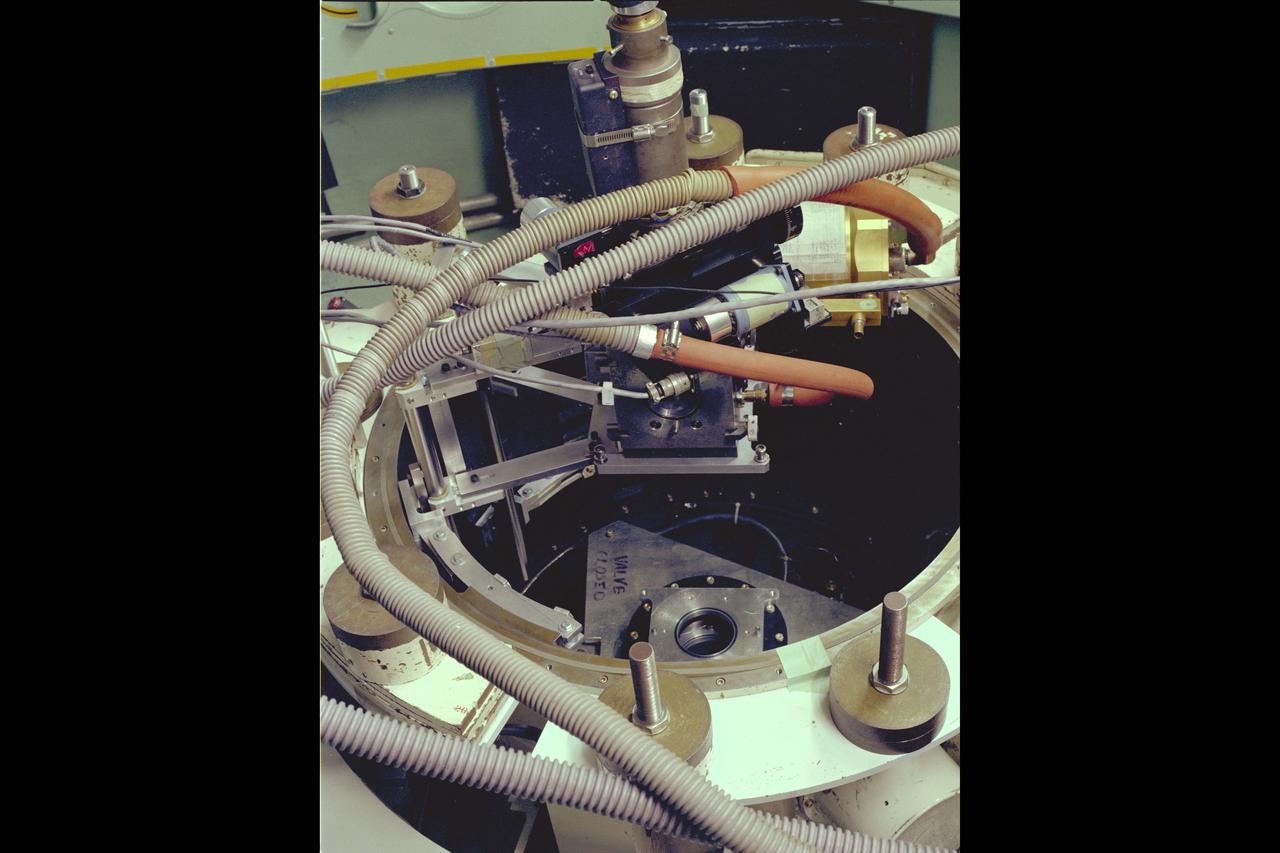
C-141 KAO: Cornell University, FAR Infrared Interferometer
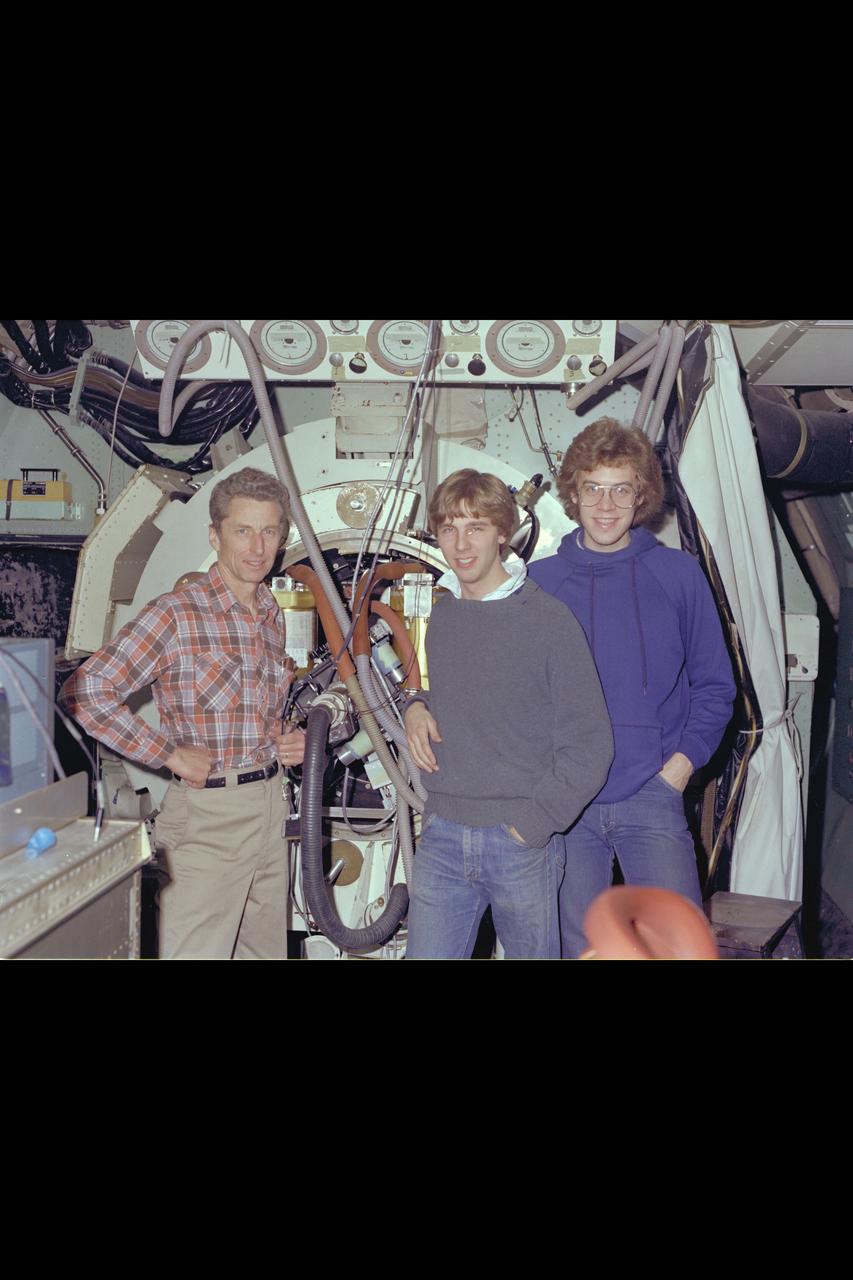
C-141 KAO: Cornell University, FAR Infrared Interferometer
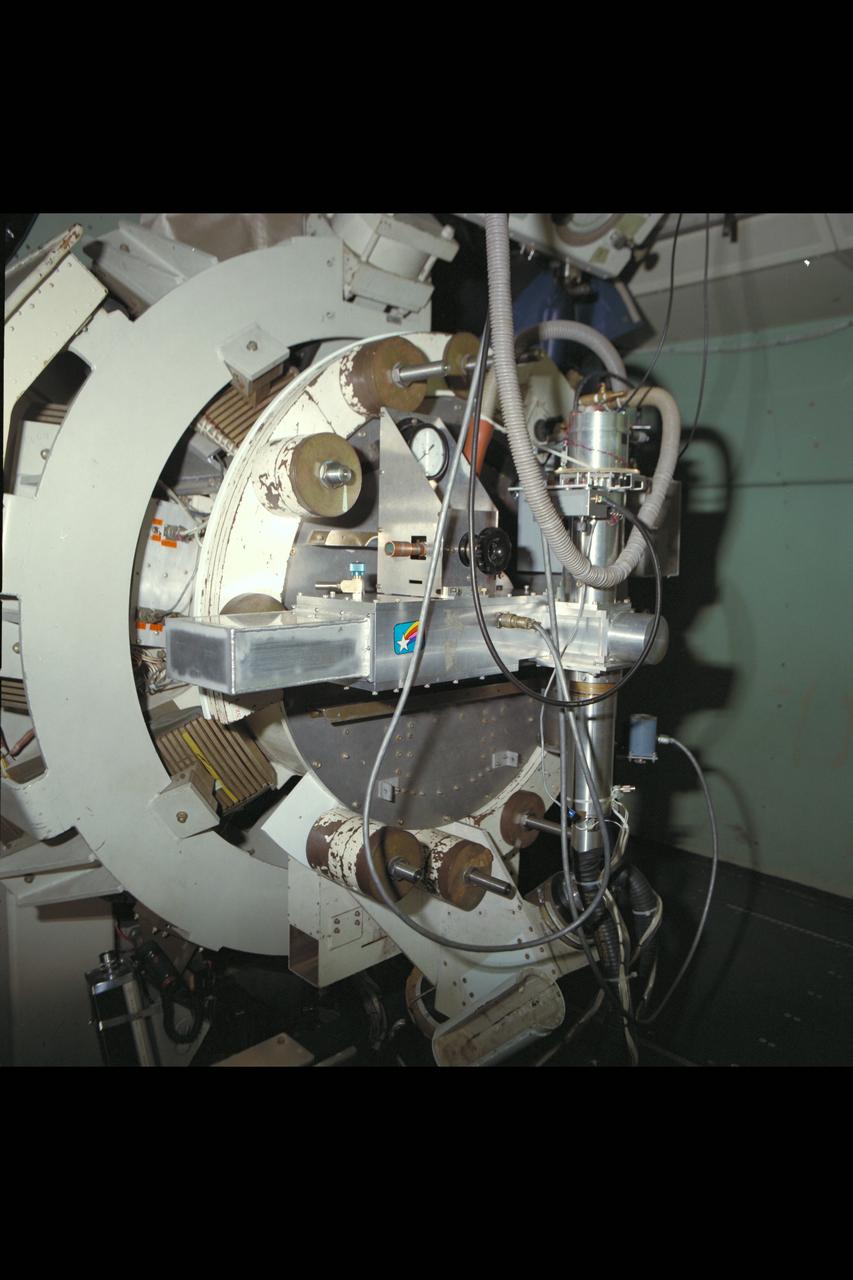
C-141 KAO: Cornell University, FAR Infrared Interferometer
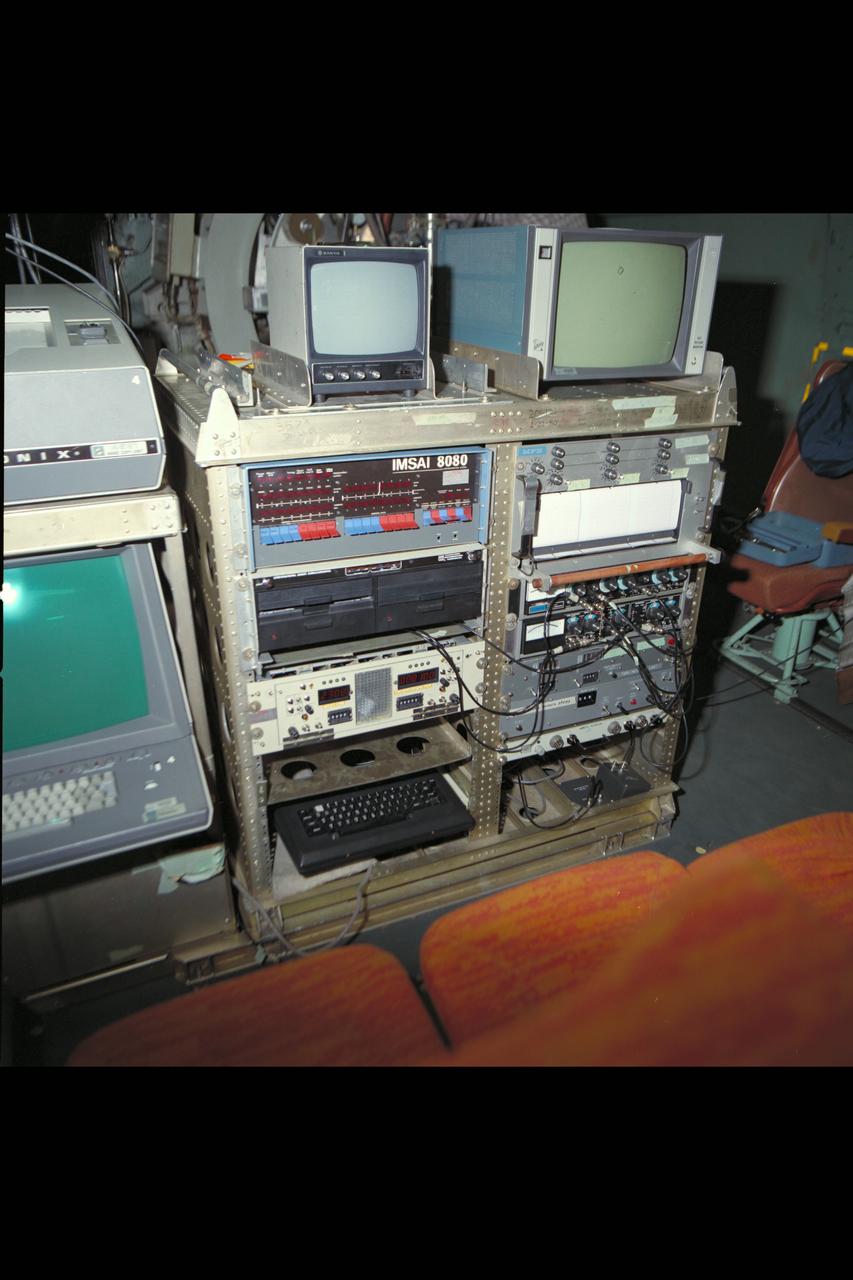
C-141 KAO: Cornell University, FAR Infrared Interferometer - experimentor's staton
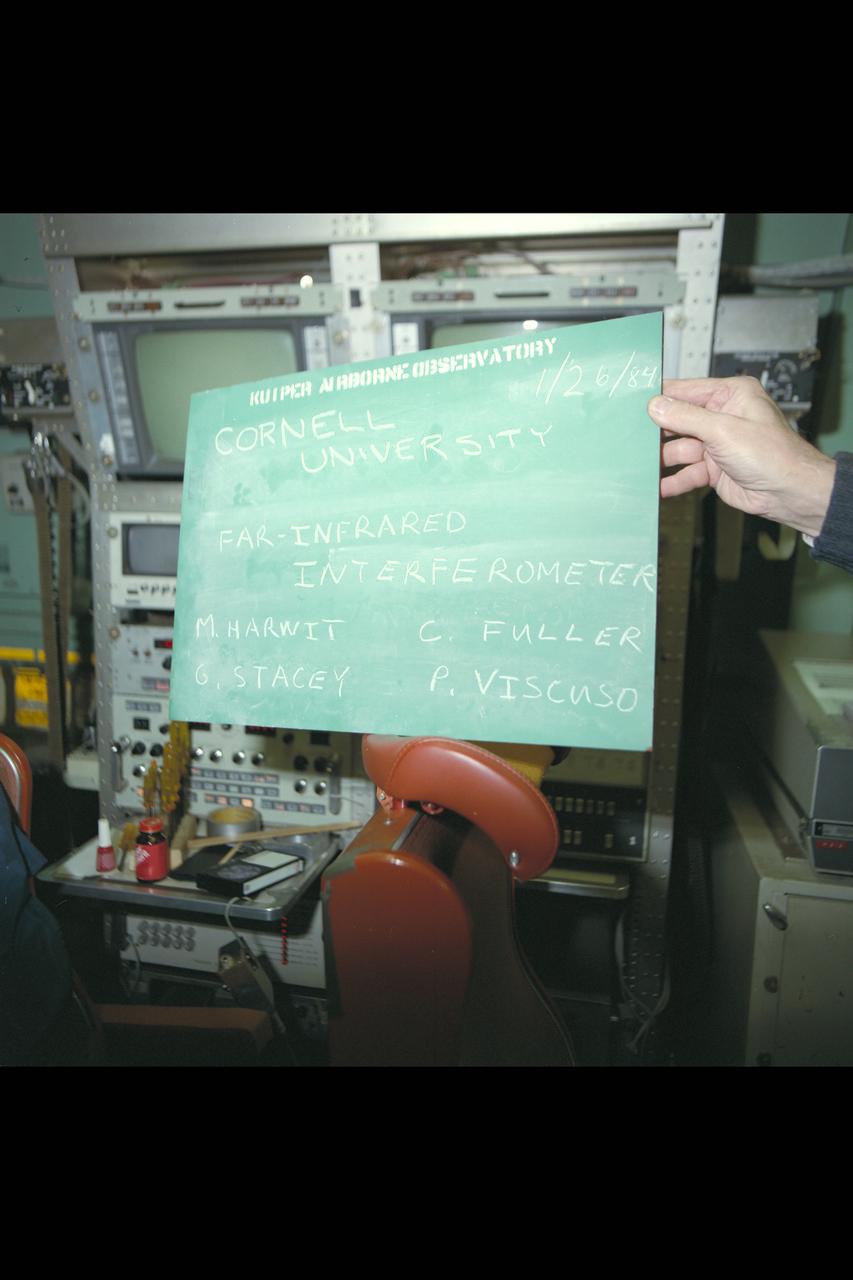
C-141 KAO: Cornell University, FAR Infrared Interferometer
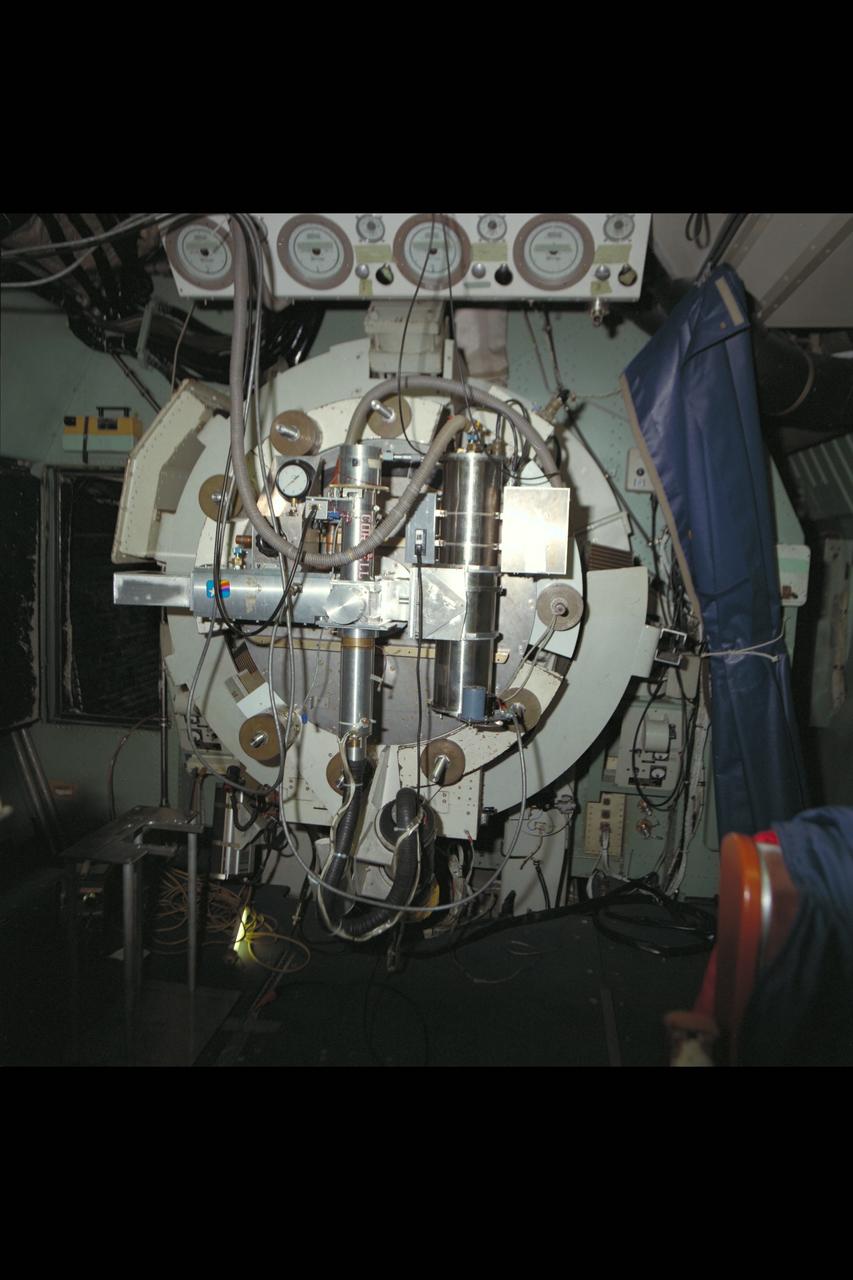
C-141 KAO: Cornell University, FAR Infrared Interferometer
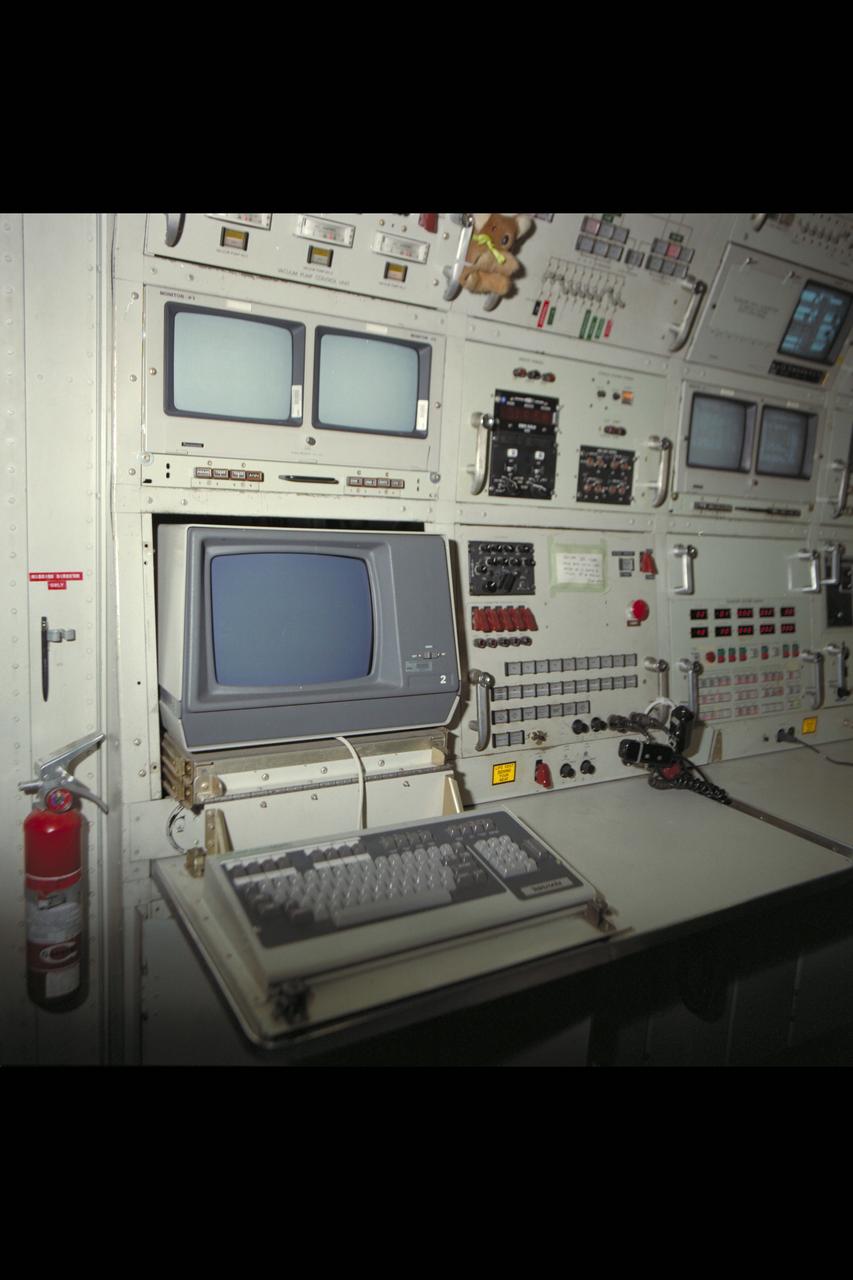
C-141 KAO: Cornell University, FAR Infrared Interferometer - mission directors console
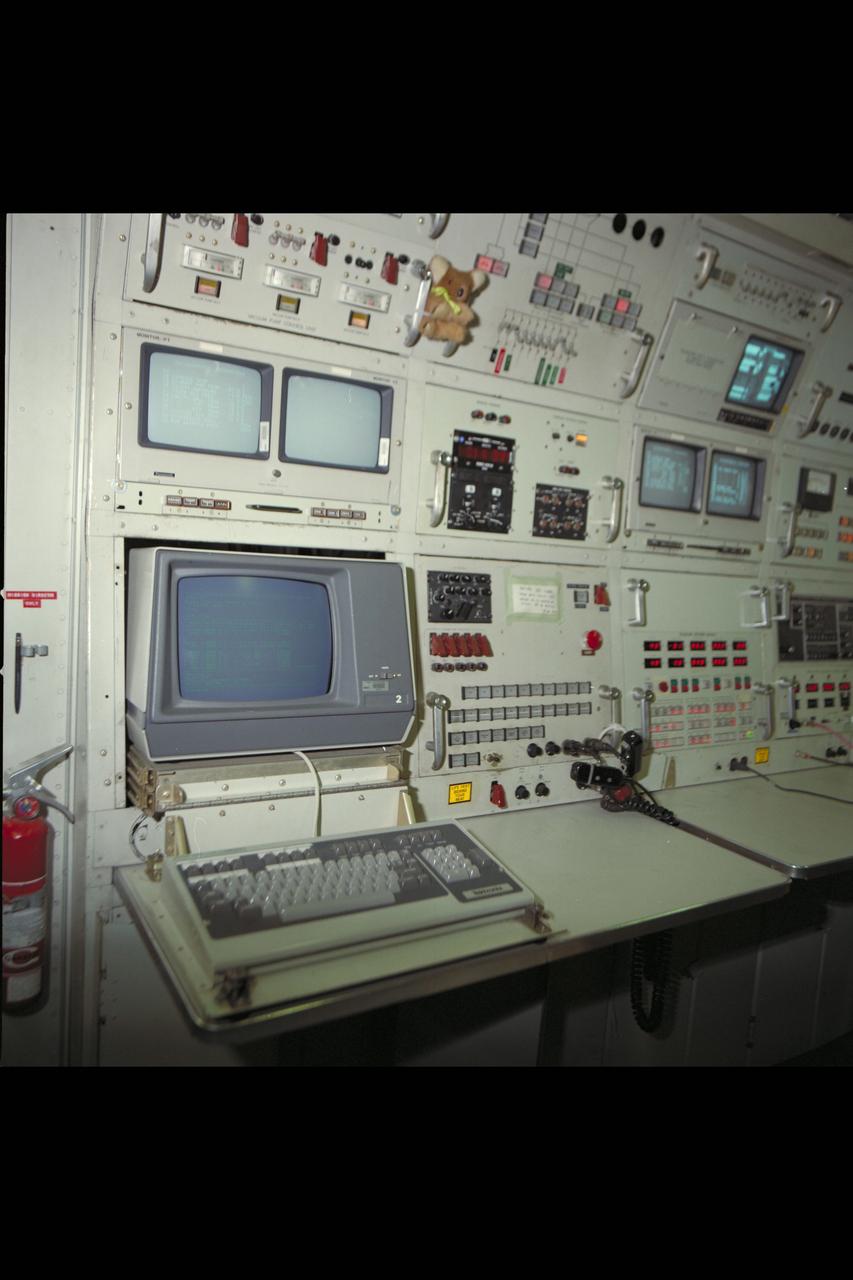
C-141 KAO: Cornell University, FAR Infrared Interferometer - mission directors console
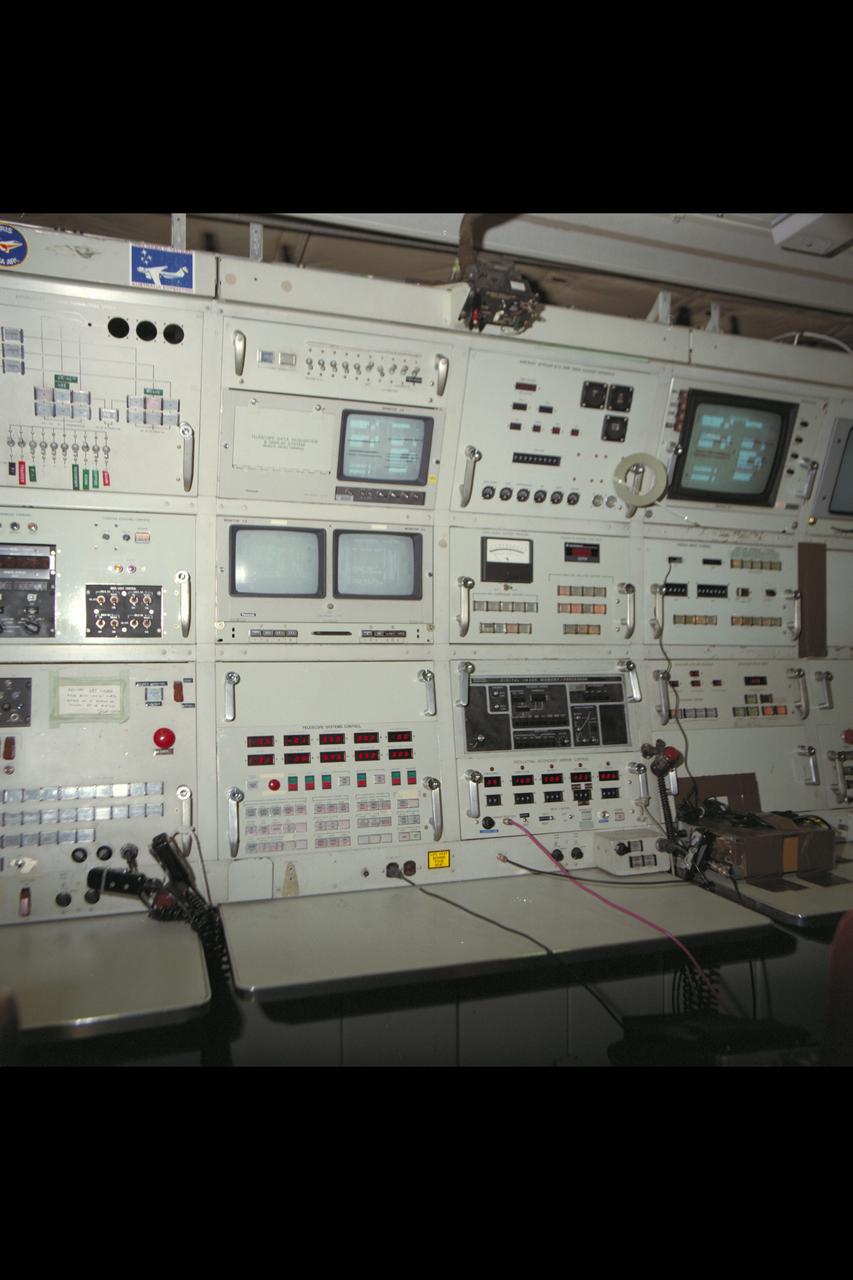
C-141 KAO: Cornell University, FAR Infrared Interferometer - mission directors console
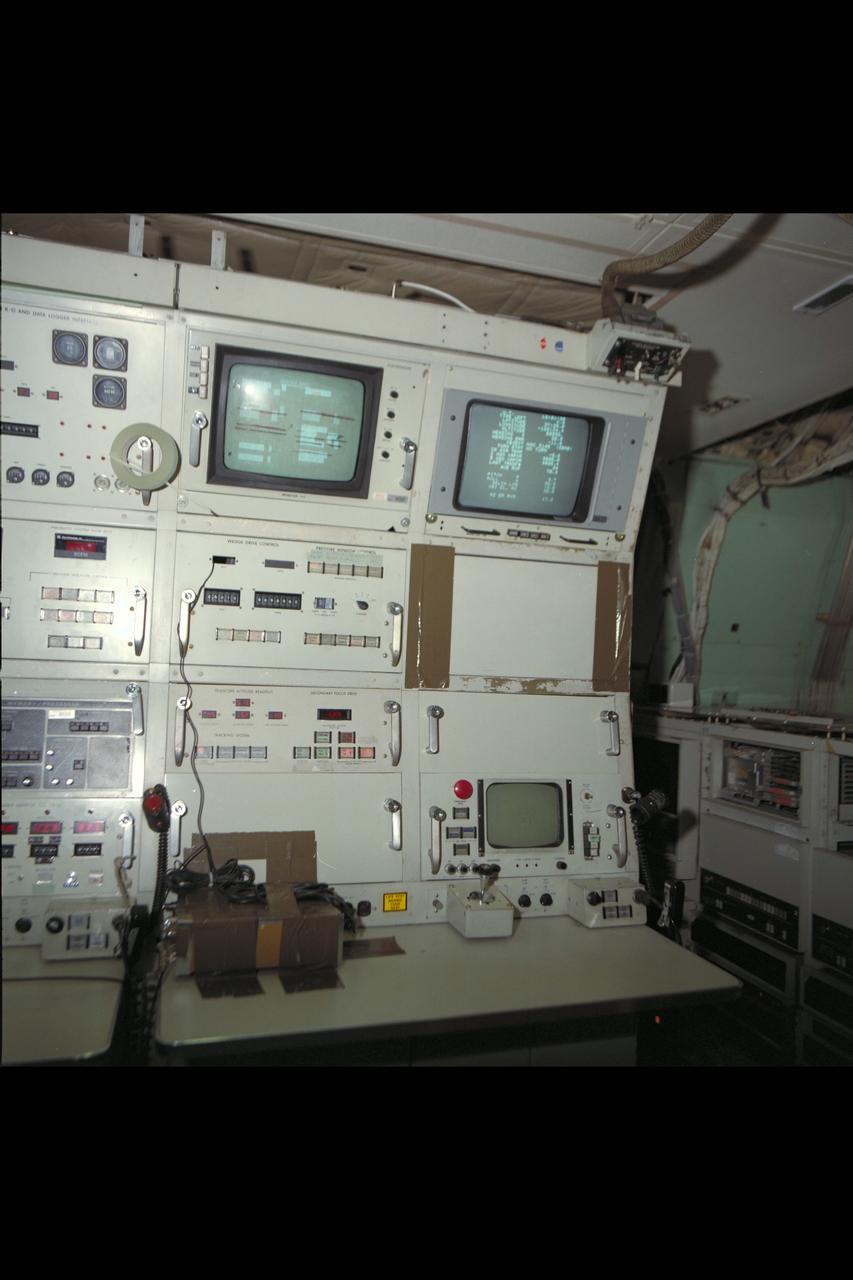
C-141 KAO: Cornell University, FAR Infrared Interferometer mission directors console

ISS007-E-13397 (24 August 2003) --- This view of Ithaca, New York was taken by one of the Expedition 7 crewmembers onboard the International Space Station (ISS). Ithaca is the home of Cornell University, where astronaut Edward T. Lu, NASA ISS science officer and flight engineer, received a Bachelor of Science degree in electrical engineering and the Cornell University Presidential Scholar award.

Aeronautics Technical Seminar: Dr. Elisabeth Pate-Cornell, Burt and Deedee McMurtry professor and chair of the Department of Management Science and Engineering at Stanford University presents 'Lessons Learned in Applying Engineering Risk Analysis'.

Aeronautics Technical Seminar: Dr. Elisabeth Pate-Cornell, Burt and Deedee McMurtry professor and chair of the Department of Management Science and Engineering at Stanford University presents 'Lessons Learned in Applying Engineering Risk Analysis'.
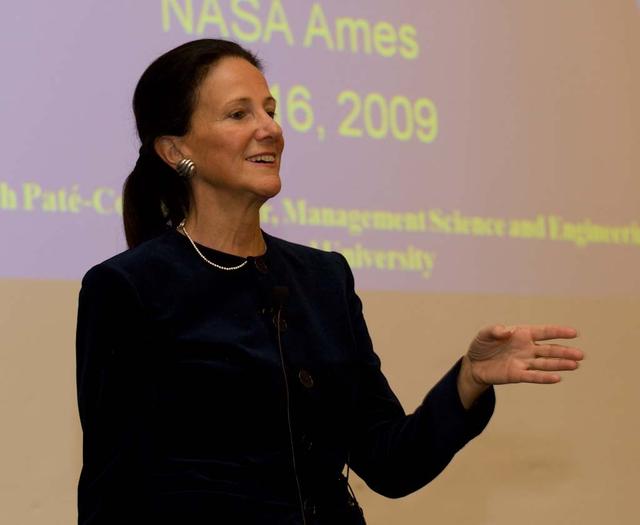
Aeronautics Technical Seminar: Dr. Elisabeth Pate-Cornell, Burt and Deedee McMurtry professor and chair of the Department of Management Science and Engineering at Stanford University presents 'Lessons Learned in Applying Engineering Risk Analysis'.

Aeronautics Technical Seminar: Dr. Elisabeth Pate-Cornell, Burt and Deedee McMurtry professor and chair of the Department of Management Science and Engineering at Stanford University presents 'Lessons Learned in Applying Engineering Risk Analysis'.

Aeronautics Technical Seminar: Dr. Elisabeth Pate-Cornell, Burt and Deedee McMurtry professor and chair of the Department of Management Science and Engineering at Stanford University presents 'Lessons Learned in Applying Engineering Risk Analysis'.
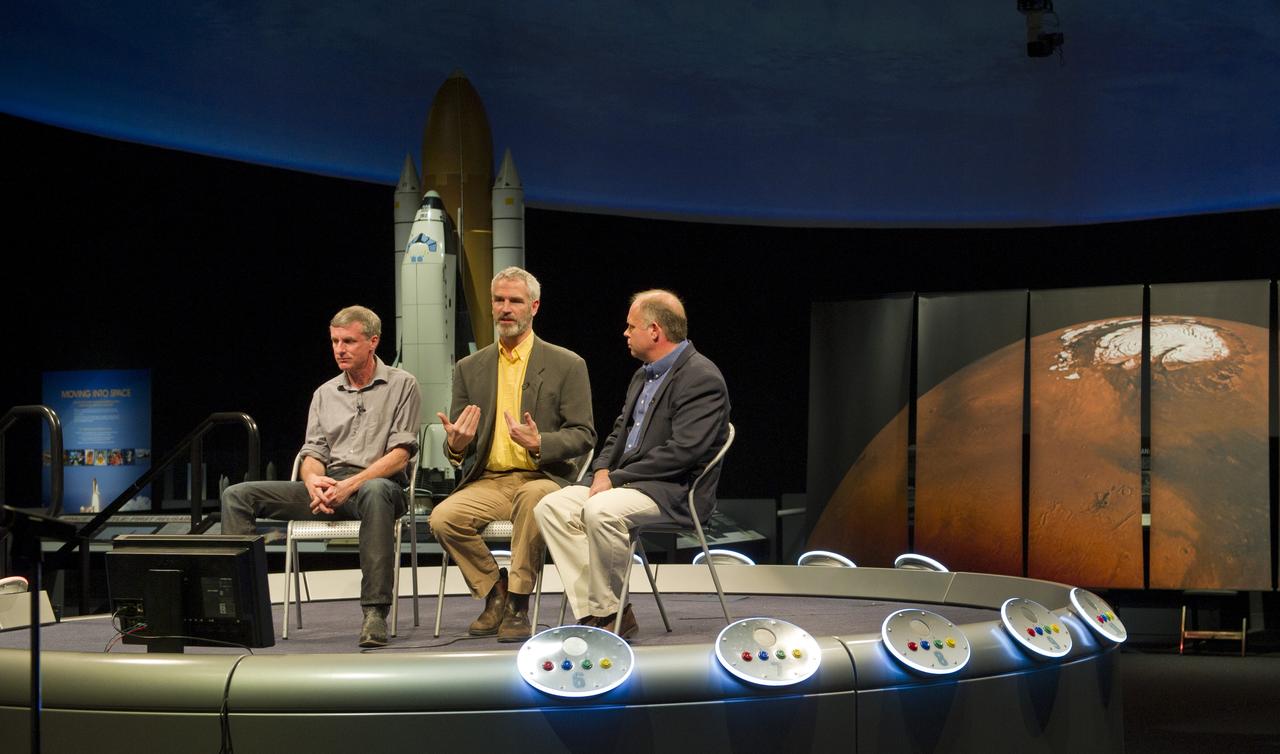
Dr. John Grant, seated right, moderates a discussion with Dr. Jack Mustard, from Brown University, and Dr. Steve Squyres, from Cornell University, seated left, during a Mars Program Update, Thursday, Jan. 13, 2011, at the Smithsonian National Air and Space Museum in Washington. Prominent scientists discussed evidence of water on Mars, current Program status, including the 7th Anniversary of the Mars rovers and the upcoming Mars Science Laboratory mission and previewed exciting discoveries to come. Photo Credit: (NASA/Paul E. Alers)

CAPE CANAVERAL, Fla. - Wrap up of the Conference on the American Space Program for the 21st Century took place in the Astronaut Encounter Theater at the NASA Kennedy Space Center Visitor Complex. Before the panel began their remarks, Apollo astronaut Buzz Aldrin (center), Louis Friedman, Founder and Executive director of The Planetary Society (left) and Jim Bell, professor, Department of Astronomy at Cornell University, took a few moments to discuss the event. Photo Credit: NASA_Jim Grossmann

Dr. Steve Squyres, from Cornell University, talks during a Mars Program Update where prominent scientists discussed evidence of water on Mars, current Program status, including the 7th Anniversary of the Mars rovers and the upcoming Mars Science Laboratory mission and previewing exciting discoveries to come, Thursday, Jan. 13, 2011, at the Smithsonian National Air and Space Museum in Washington. Photo Credit: (NASA/Paul E. Alers)
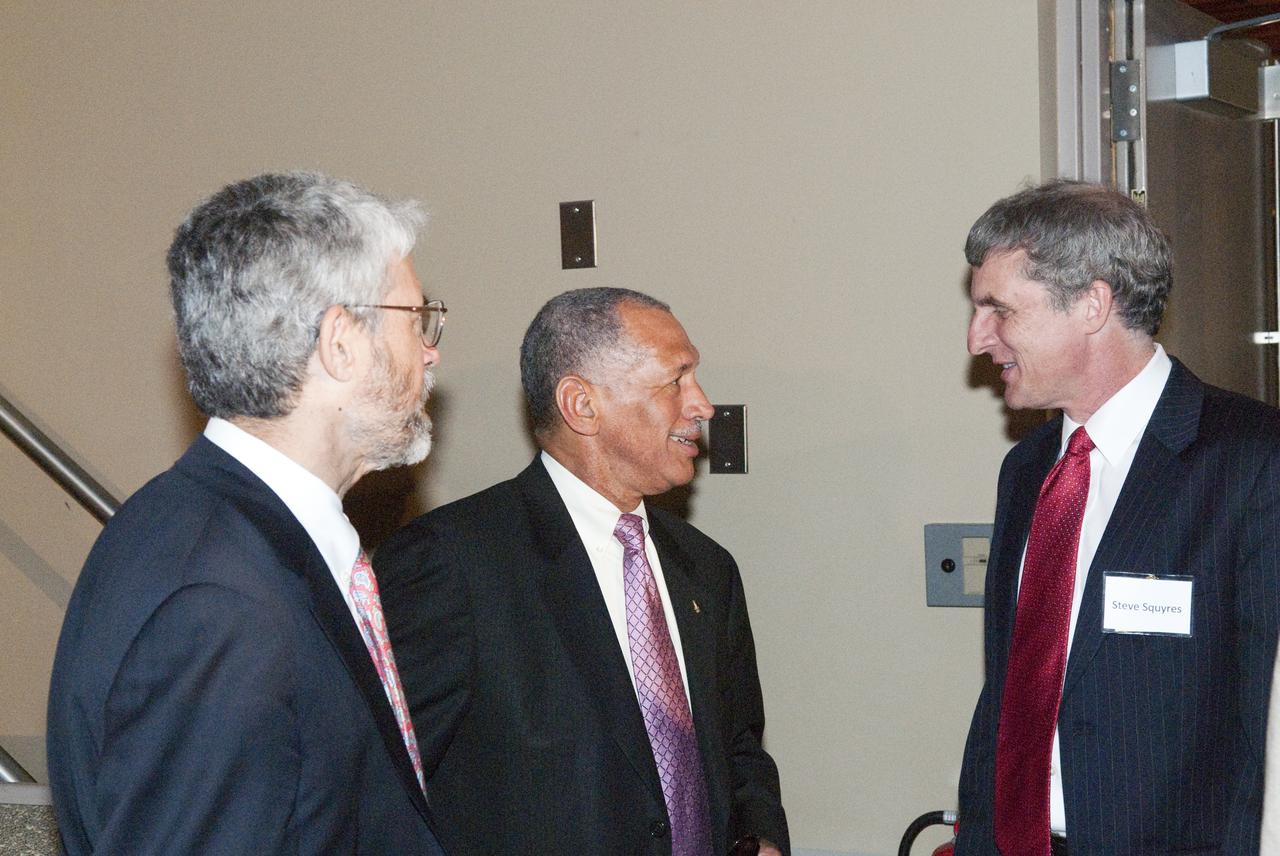
CAPE CANAVERAL, Fla. - In the Astronaut Encounter Theater at the NASA Kennedy Space Center Visitor Complex in Florida, John Holdren, assistant to the President for science and technology and director of the White House Office of Science and Technology Policy, NASA Administrator Charles Bolden and Dr. Steve Squyres, Astronomy Professor at Cornell University took a few moments to talk prior to the wrap up of the Conference on the American Space Program for the 21st Century. Photo Credit: NASA_Jim Grossmann
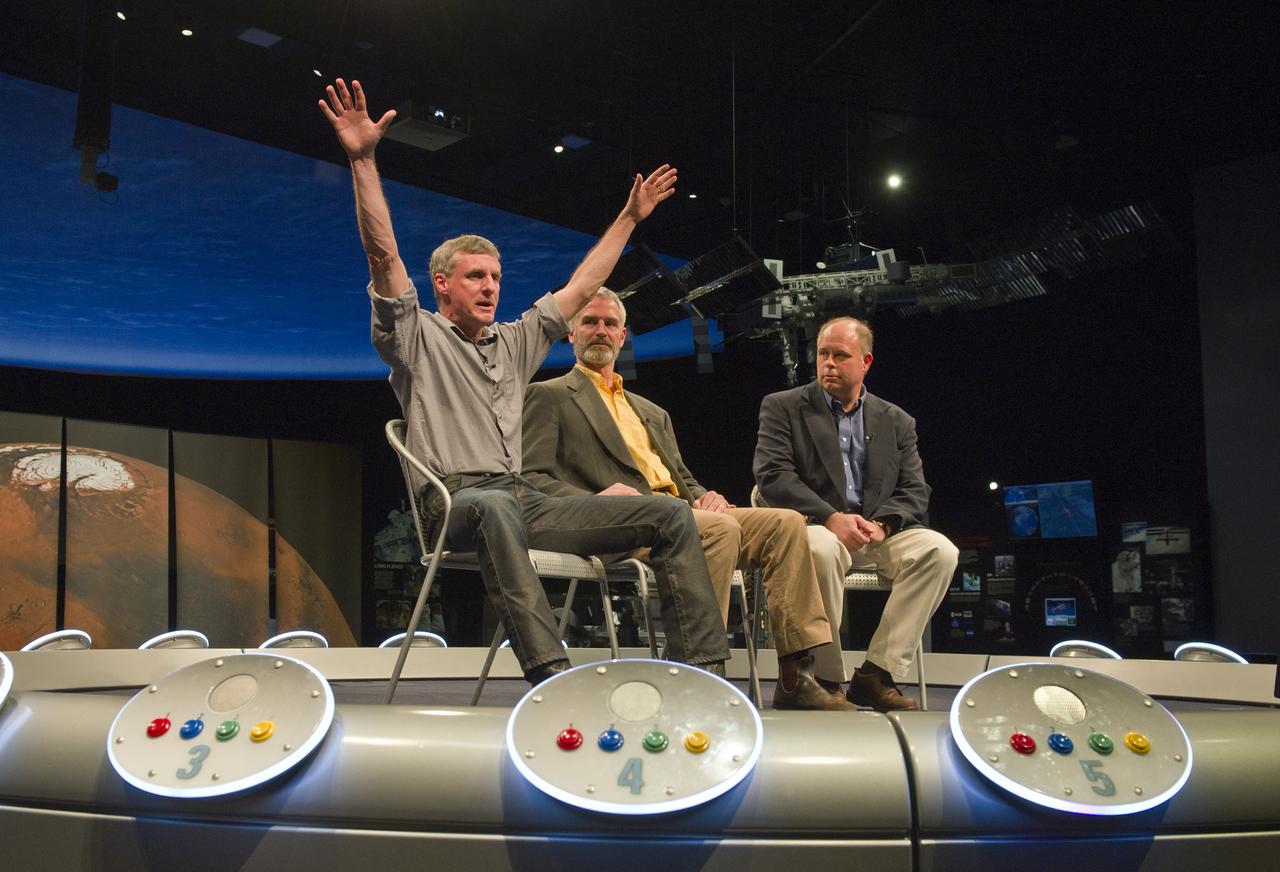
Dr. Steve Squyres, from Cornell University, left, talks during a panel discussion on the Mars Program, Thursday, Jan. 13, 2011, at the Smithsonian National Air and Space Museum in Washington as Dr. Jack Mustard, from Brown University and Dr. John Grant, moderator, right, look on. Prominent scientists and the head of the Mars Exploration Program gathered at the Smithsonian to discuss evidence of water on Mars; current Program status, including the 7th Anniversary of the Mars rovers and the upcoming Mars Science Laboratory mission also giving previews of the exciting discoveries to come. Photo Credit: (NASA/Paul E. Alers)

Joe Ververka, Stardust NExT Principal Investigator, from Cornell University, speaks during a news briefing, Wednesday, Jan. 19, 2011, at NASA Headquarters in Washington. On Feb. 14, 2011 NASA's Stardust-NExT (New Exploration of Tempel 1) mission will encounter Comet Tempel 1, providing a unique opportunity to measure the dust properties which will also provide a comparison between two observations of a single comet, Tempel 1, taken before and after a single orbital pass around the sun. Photo Credit: (NASA/Paul E. Alers)
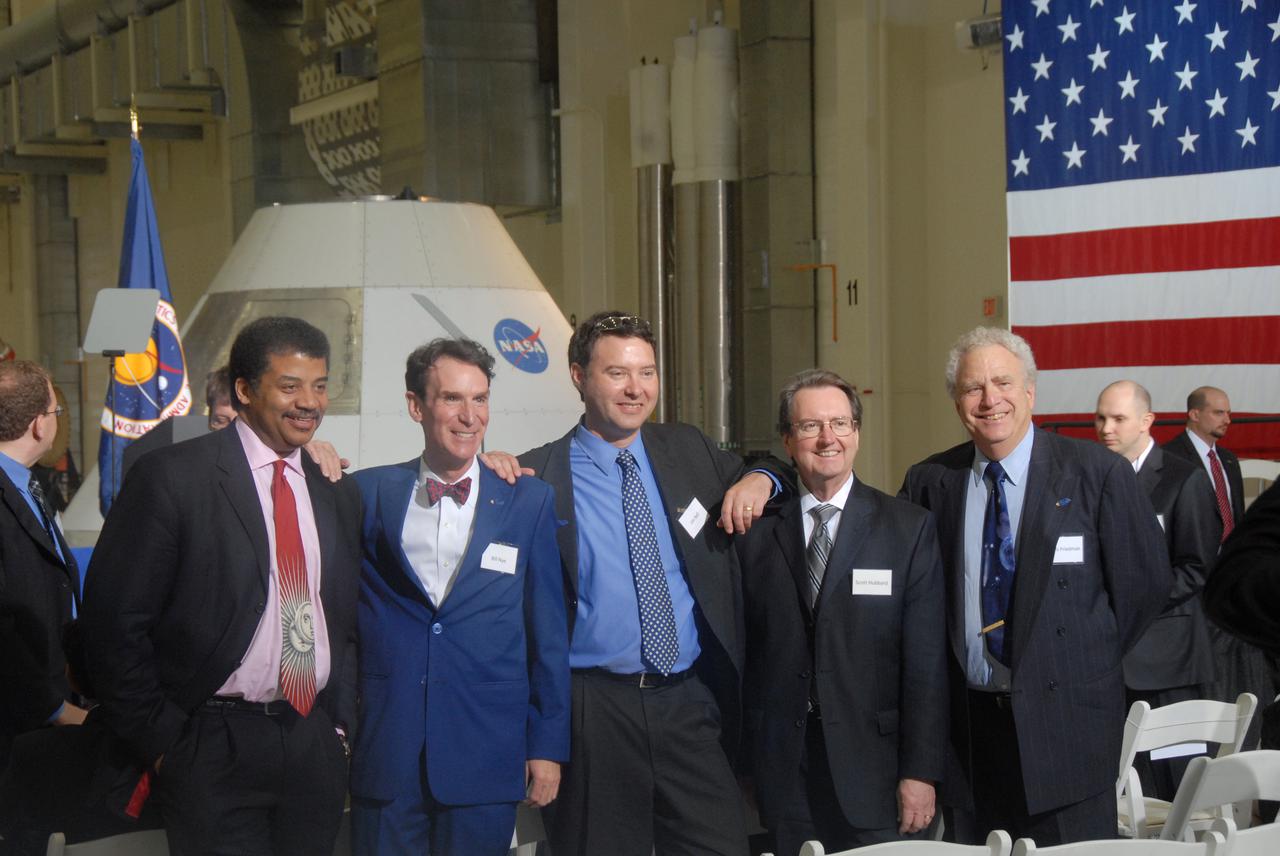
CAPE CANAVERAL, Fla. - In the Operations and Checkout Building at NASA's Kennedy Space Center in Florida, some of the participants and invited guests of the Conference on the American Space Program for the 21st Century pose for a group portrait. From left are Neil deGrasse Tyson, director, Hayden Planetarium, American Museum of Natural History; Bill Nye The Science Guy, engineer and television personality; Jim Bell, professor, Department of Astronomy, Cornell University; Scott Hubbard, former director, NASA's Ames Research Center; and Louis Friedman, founder and executive director, The Planetary Society. President Barack Obama opened the Conference on the American Space Program for the 21st Century with remarks on the new course his administration is charting for NASA and the future of U.S. leadership in human spaceflight. Photo credit: NASA_Jim Grossmann

Cassini interdisciplinary Titan scientist at Cornell University, Jonathan Lunine, speaks to NASA Social attendees about the Cassini mission, Thursday, Sept. 14, 2017 at NASA's Jet Propulsion Laboratory in Pasadena, California. Since its arrival in 2004, the Cassini-Huygens mission has been a discovery machine, revolutionizing our knowledge of the Saturn system and captivating us with data and images never before obtained with such detail and clarity. On Sept. 15, 2017, operators will deliberately plunge the spacecraft into Saturn, as Cassini gathered science until the end. The “plunge” ensures Saturn’s moons will remain pristine for future exploration. During Cassini’s final days, mission team members from all around the world gathered at NASA’s Jet Propulsion Laboratory, Pasadena, California, to celebrate the achievements of this historic mission. Photo Credit: (NASA/Joel Kowsky)
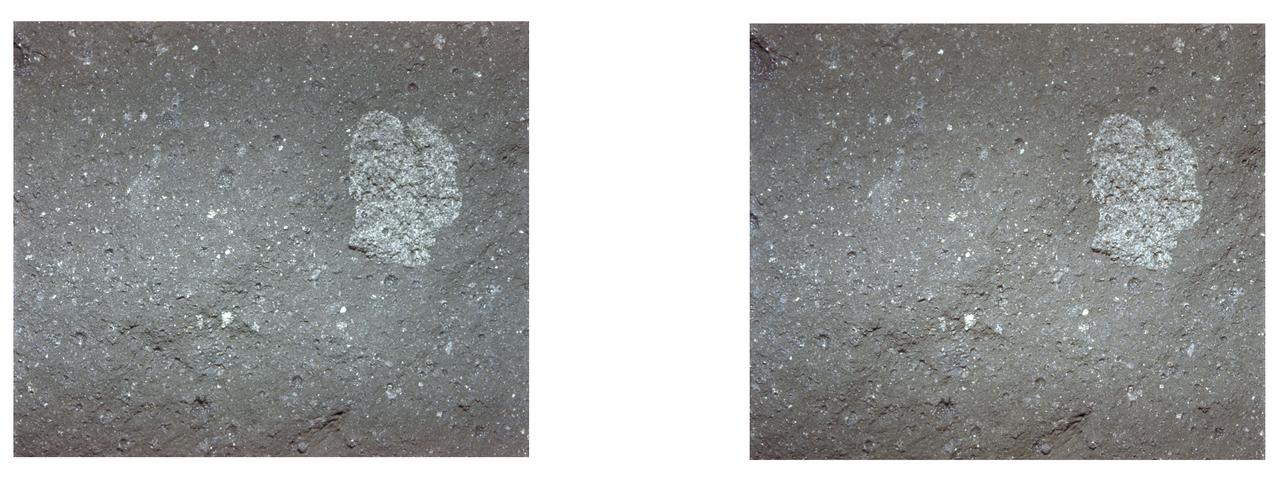
AS11-45-6709 (20 July 1969) --- An Apollo 11 stereo view of the surface of a lunar rock showing an embedded three-fourths inch fragment of a different color. On the surface several small pits are seen; mostly less than one-eighth inch in size, and with a glazed surface. They have a raised rim, characteristic of pits made by high-velocity micro meteorite impacts. The exposure was made by the Apollo 11 35mm stereo close-up camera. The camera was specially developed to get the highest possible resolution of a small area. A three-inch square area is photographed with a flash illumination and at a fixed distance. The camera is mounted on a walking stick, and the astronauts use it by holding it up against the object to be photographed and pulling the trigger. The pictures are in color and give a stereo view, enabling the fine detail to be seen very clearly. The project is under the direction of Professor T. Gold of Cornell University and Mr. F. Pearce of NASA. The camera was designed and built by Eastman Kodak. Professor E. Purcell of Harvard University and Dr. E. Land of the Polaroid Corporation have contributed to the project. The pictures brought back from the moon by the Apollo 11 crew are of excellent quality and allow fine detail of the undisturbed lunar surface to be seen. Scientists hope to be able to deduce from them some of the processes that have taken place that have shaped and modified the surface.
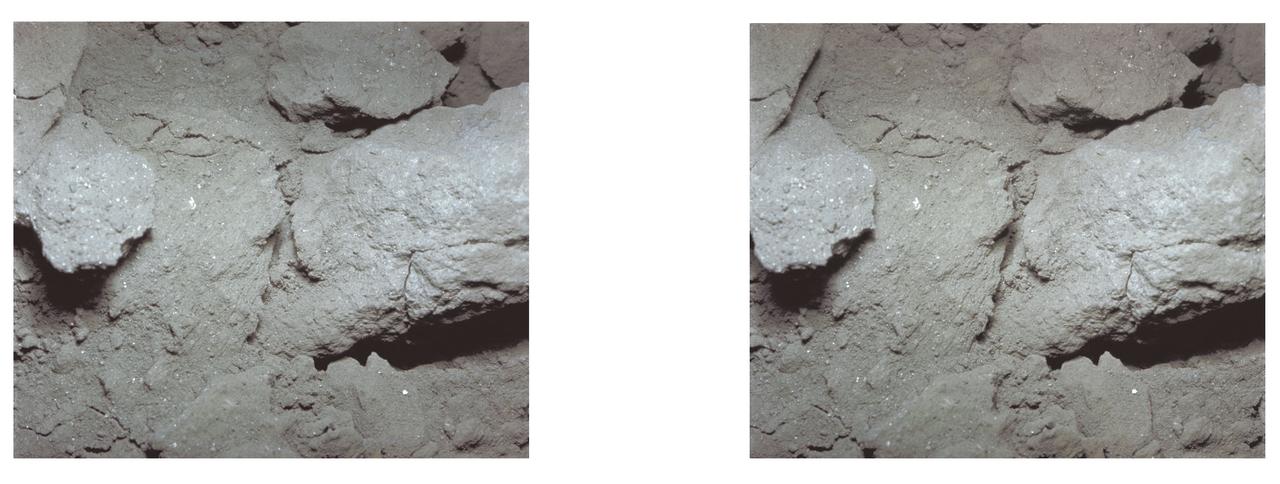
AS11-45-6706 (20 July 1969) --- An Apollo 11 stereo view showing a clump of lunar surface powder, with various small pieces of different color. Many small, shiny spherical particles can be seen. The picture is three inches across. The exposure was made by the Apollo 11 35mm stereo close-up camera. The camera was specially developed to get the highest possible resolution of a small area. A three-inch square area is photographed with a flash illumination and at a fixed distance. The camera is mounted on a walking stick, and the astronauts use it by holding it up against the object to be photographed and pulling the trigger. The pictures are in color and give a stereo view, enabling the fine detail to be seen very clearly. The project is under the direction of Professor T. Gold of Cornell University and Mr. F. Pearce of NASA. The camera was designed and built by Eastman Kodak. Professor E. Purcell of Harvard University and Dr. E. Land of the Polaroid Corporation have contributed to the project. The pictures brought back from the moon by the Apollo 11 crew are of excellent quality and allow fine detail of the undisturbed lunar surface to be seen. Scientists hope to be able to deduce from them some of the processes that have taken place that have shaped and modified the surface.
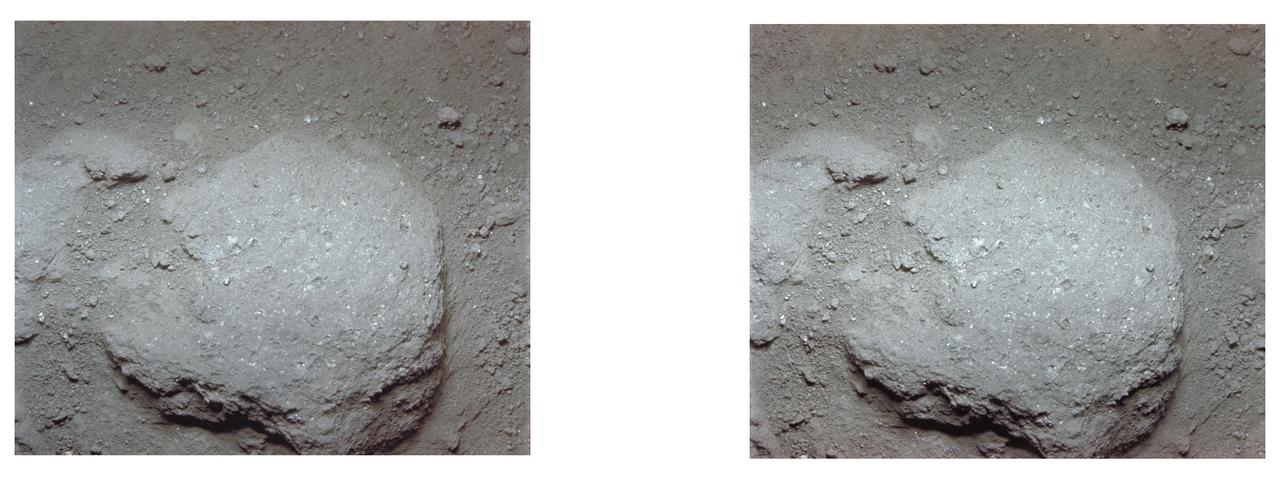
AS11-45-6712 (20 July 1969) --- An Apollo 11 stereo view of a stone, about two and one-half inches long, embedded in the powdery lunar surface material. The little pieces closely around it suggest that it has suffered some erosion. On the surface several small pits are seen, mostly less than one-eighth inch in size, and with a glazed surface. They have a raised rim, characteristic of pits made by the Apollo 11 35mm stereo close-up camera. The camera was specially developed to get the highest possible resolution of a small area. A three-inch square area is photographed with a flash illumination and at a fixed distance. The camera is mounted on a walking stick, and the astronauts use it by holding it up against the object to be photographed and pulling the trigger. The pictures are in color and give a stereo view, enabling the fine detail to be seen very clearly. The project is under the direction of Professor T. Gold of Cornell University and Mr. F. Pearce of NASA. The camera was designed and built by Eastman Kodak. Professor E. Purcell of Harvard University and Dr. E. Land of the Polaroid Corporation have contributed to the project. The pictures brought back from the moon by the Apollo 11 crew are of excellent quality and allow fine detail of the undisturbed lunar surface to be seen. Scientists hope to be able to deduce from them some of the processes that have taken place that have shaped and modified the surface.
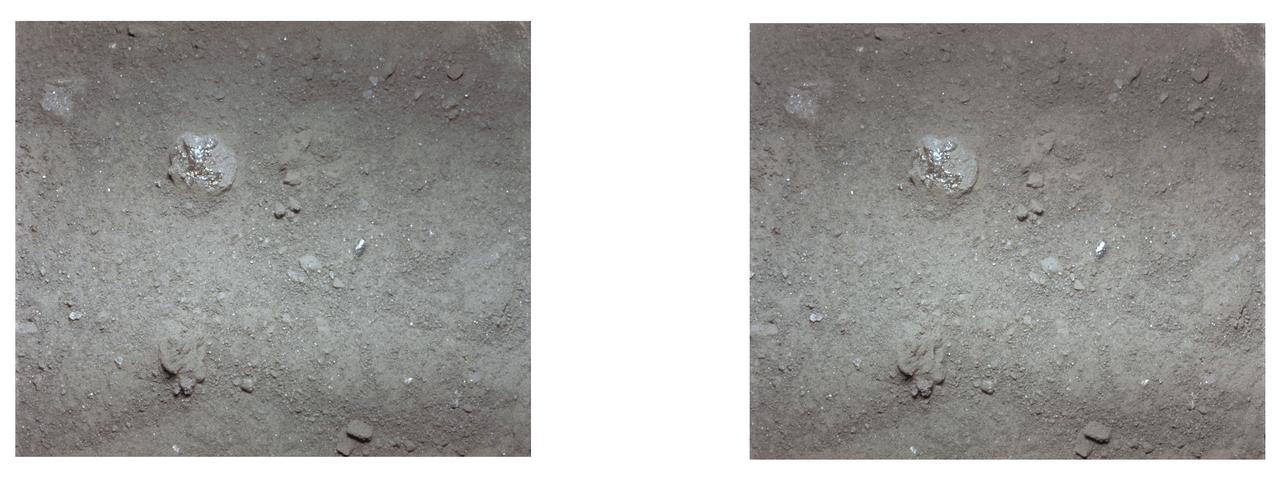
AS11-45-6704 (20 July 1969) --- An Apollo stereo view showing a close-up of a small lump of lunar surface powder about a half inch across, with a splash of a glassy material over it. It seems that a drop of molten material fell on it, splashed and froze. The exposure was made by the Apollo 11 35mm stereo close-up camera. The camera was specially developed to get the highest possible resolution of a small area. A three-inch square area is photographed with a flash illumination and at a fixed distance. The camera is mounted on a walking stick, and the astronauts use it by holding it up against the object to be photographed and pulling the trigger. The pictures are in color and give a stereo view, enabling the fine detail to be seen very clearly. The project is under the direction of Professor T. Gold of Cornell University and Dr. F. Pearce of NASA. The camera was designed and built by Eastman Kodak. Professor E. Purcell of Harvard University and Dr. E. Land of the Polaroid Corporation have contributed to the project. The pictures brought back from the moon by the Apollo 11 crew are of excellent quality and allow fine detail of the undisturbed lunar surface to be seen. Scientists hope to be able to deduce from them some of the processes that have taken place that have shaped and modified the surface.
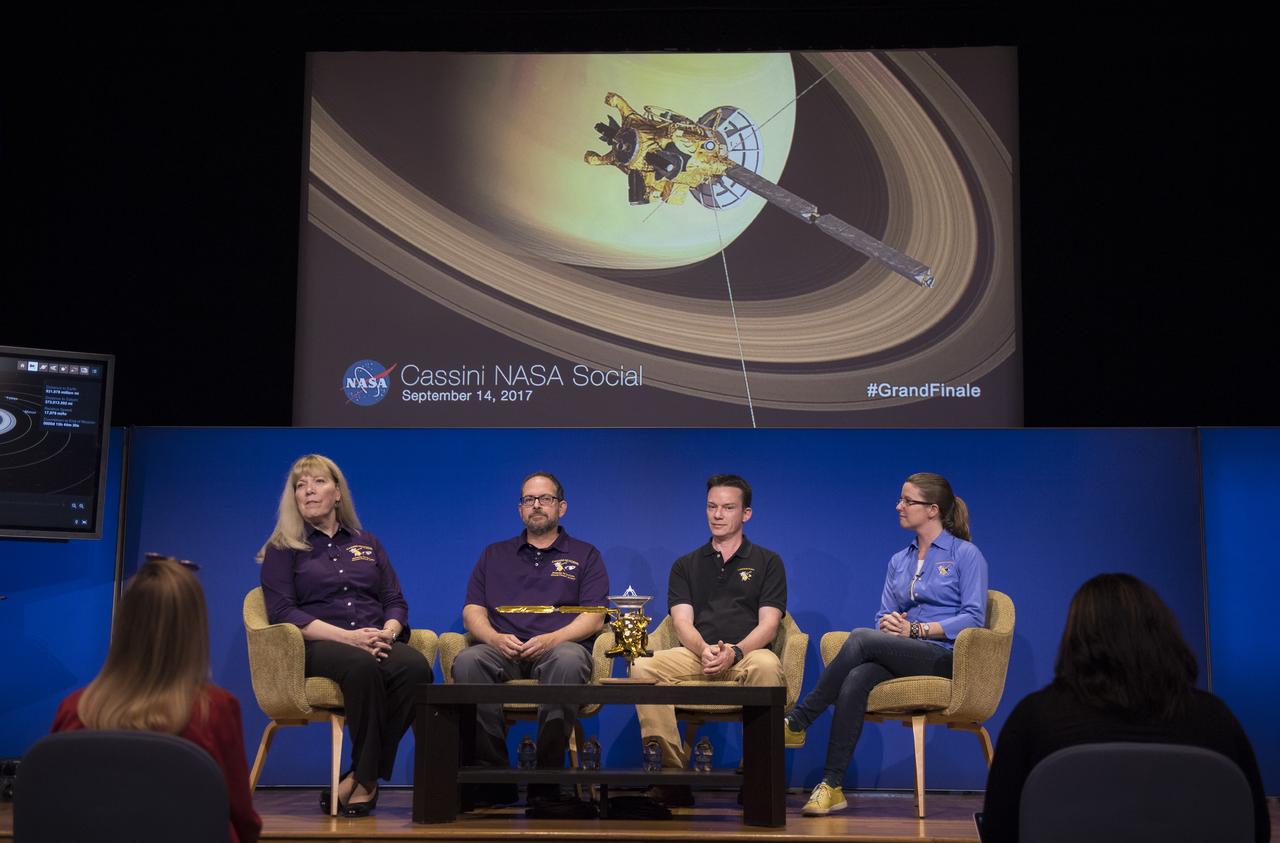
Cassini project scientist at JPL, Linda Spilker, left, Cassini interdisciplinary Titan scientist at Cornell University, Jonathan Lunine, second from left, Cassini Composite Infrared Spectrometer(CIRS) Instrument deputy principle investigator Connor Nixon, second from right, and Cassini assistant project science systems engineer Morgan Cable, right, participate in a Cassini science panel discussion during the Cassini NASA Social, Thursday, Sept. 14, 2017 at NASA's Jet Propulsion Laboratory in Pasadena, California. Since its arrival in 2004, the Cassini-Huygens mission has been a discovery machine, revolutionizing our knowledge of the Saturn system and captivating us with data and images never before obtained with such detail and clarity. On Sept. 15, 2017, operators will deliberately plunge the spacecraft into Saturn, as Cassini gathered science until the end. The “plunge” ensures Saturn’s moons will remain pristine for future exploration. During Cassini’s final days, mission team members from all around the world gathered at NASA’s Jet Propulsion Laboratory, Pasadena, California, to celebrate the achievements of this historic mission. Photo Credit: (NASA/Joel Kowsky)

NASA Social attendees are seen during a science panel discussion with Cassini project scientist at JPL, Linda Spilker, Cassini interdisciplinary Titan scientist at Cornell University, Jonathan Lunine, Cassini Composite Infrared Spectrometer(CIRS) Instrument deputy principle investigator Connor Nixon, and Cassini assistant project science systems engineer Morgan Cable, Thursday, Sept. 14, 2017 at NASA's Jet Propulsion Laboratory in Pasadena, California. Since its arrival in 2004, the Cassini-Huygens mission has been a discovery machine, revolutionizing our knowledge of the Saturn system and captivating us with data and images never before obtained with such detail and clarity. On Sept. 15, 2017, operators will deliberately plunge the spacecraft into Saturn, as Cassini gathered science until the end. The “plunge” ensures Saturn’s moons will remain pristine for future exploration. During Cassini’s final days, mission team members from all around the world gathered at NASA’s Jet Propulsion Laboratory, Pasadena, California, to celebrate the achievements of this historic mission. Photo Credit: (NASA/Joel Kowsky)

SCI2012_0003: SOFIA mid-infrared image of the planetary nebula Minkowski 2-9 (M2-9), also known as the Butterfly Nebula, compared with a visual-wavelength Hubble Space Telescope image at the same scale and orientation. The nebula is composed of two lobes of gas & dust expelled from a dying star with about the mass of our Sun that is seen at the center of the lobes. The HST image shows mostly ionized gas in the lobes whereas the SOFIA image shows mostly solid grains condensing in the gas. The SOFIA data were obtained during SOFIA's Early Science program in 2011 by a Guest Investigator team led by Michael Werner of Caltech/JPL using the FORCAST camera (P.I.Terry Herter, Cornell University). Credit: SOFIA image, RGB = 37, 24, 20 microns; NASA/DLR/USRA/DSI/FORCAST team/M. Werner et al./A. Helton, J. Rho; HST image: NASA/ESA/NSF/AURA/Hubble Heritage Team/STScI/B. Balick, V. Icke, G. Mellema
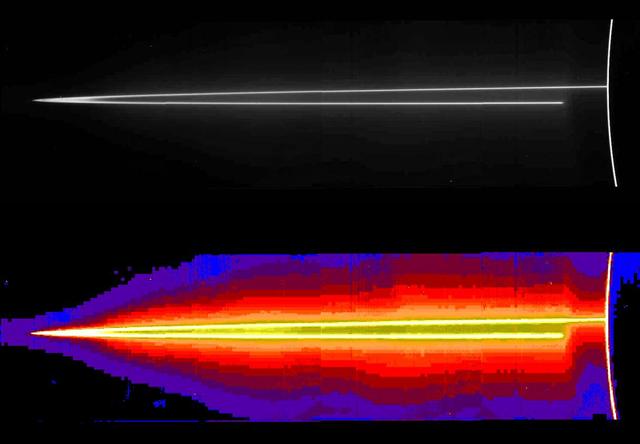
A mosaic of four images taken through the clear filter (610 nanometers) of the solid state imaging (CCD) system aboard NASA's Galileo spacecraft on November 8, 1996, at a resolution of approximately 46 kilometers (28.5 miles) per picture element (pixel) along Jupiter's rings. Because the spacecraft was only about 0.5 degrees above the ring plane, the image is highly foreshortened in the vertical direction. The images were obtained when Galileo was in Jupiter's shadow, peering back toward the Sun; the ring was approximately 2.3 million kilometers (1.4 million miles) away. The arc on the far right of the image is produced when sunlight is scattered by small particles comprising Jupiter's upper atmospheric haze. The ring also efficiently scatters light, indicating that much of its brightness is due to particles that are microns or less in diameter. Such small particles are believed to have human-scale lifetimes, i.e., very brief compared to the solar system's age. http://photojournal.jpl.nasa.gov/catalog/PIA00701
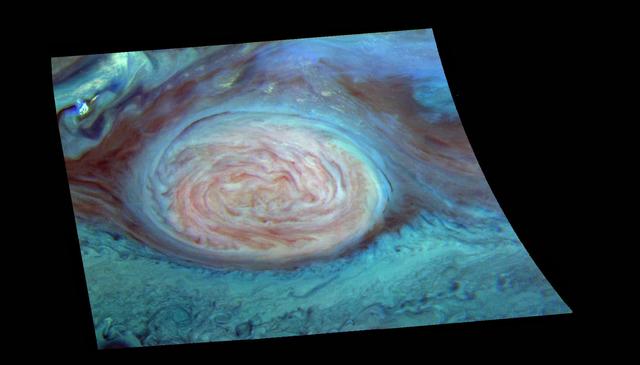
False color representation of Jupiter Great Red Spot GRS taken by NASA Galileo imaging system. The Great Red Spot appears pink and the surrounding region blue because of the particular color coding used in this representation.
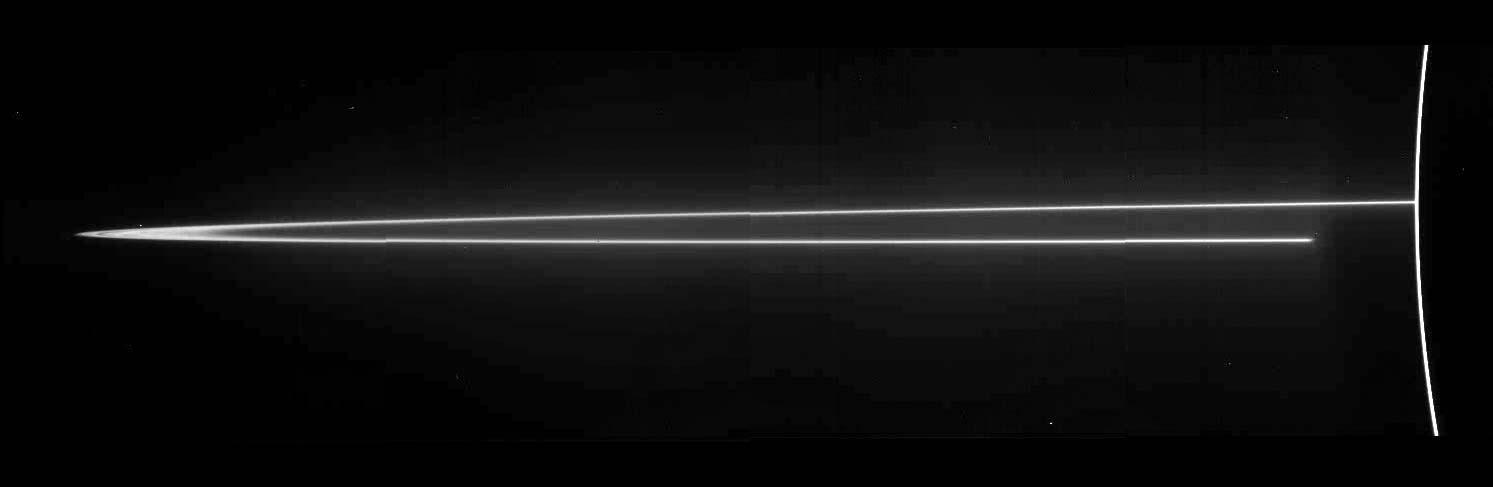
Jupiter Main Ring
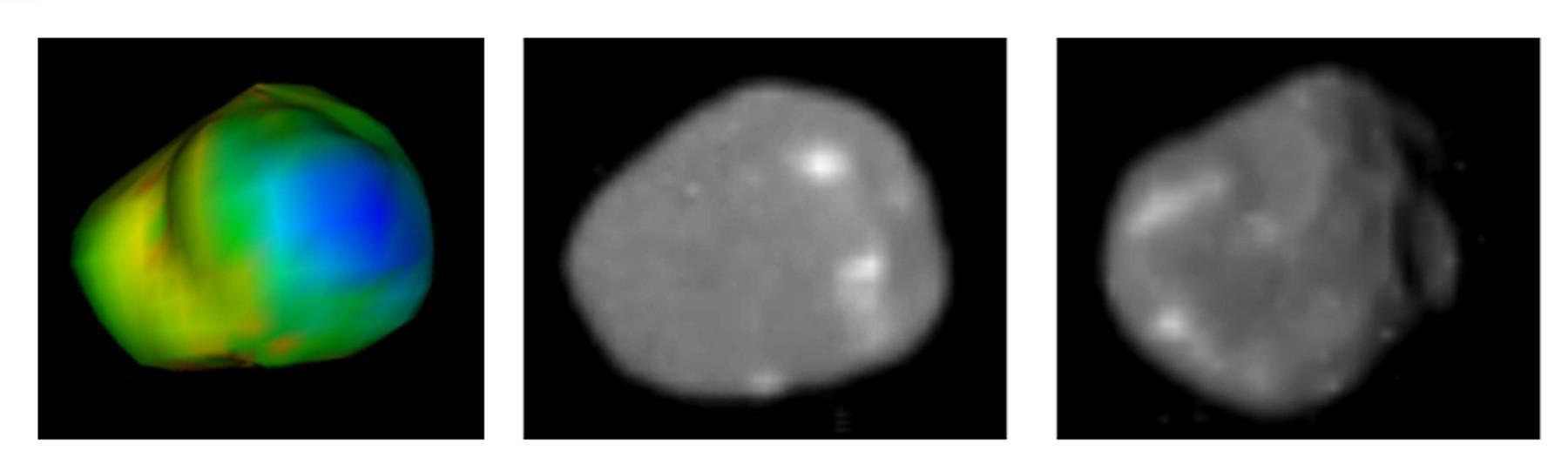
These images of Jupiter moon Amalthea were taken with NASA Galileo and Voyager spacecraft. Amalthea is almost pure water ice, hinting that it may not have formed where it now orbits.
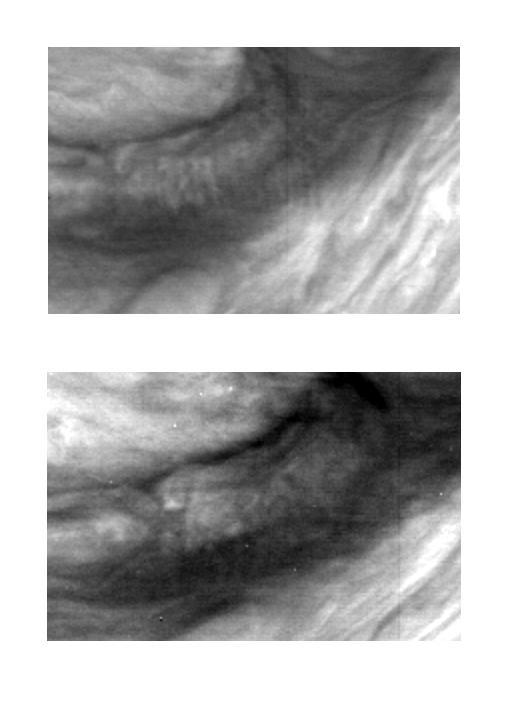
These two images of Jupiter atmosphere were taken with the violet filter of the Solid State Imaging CCD system aboard NASA Galileo spacecraft. Mesoscale waves can be seen in the center of the upper image. The images were obtained on June 26, 1996.
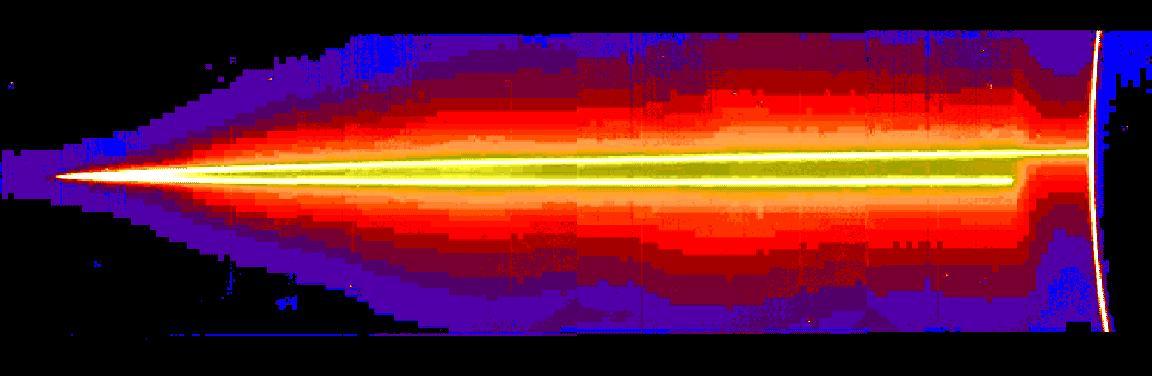
A mosaic of four images taken through the clear filter (610 nanometers) of the solid state imaging (CCD) system aboard NASA's Galileo spacecraft on November 8, 1996, at a resolution of approximately 46 kilometers (km) per picture element (pixel) along the rings; however, because the spacecraft was only about 0.5 degrees above the ring plane, the image is highly foreshortened in the vertical direction. The images were obtained when Galileo was in Jupiter's shadow peering back toward the Sun; the ring was approximately 2,300,000 kilometers (km) away. The arc on the far right of the image is produced by sunlight scattered by small particles comprising Jupiter's upper atmospheric haze. The ring also efficiently scatters light, indicating that much of its brightness is due to particles that are microns or less in diameter. Such small particles are believed to have human-scale lifetimes, i.e., very brief compared to the solar system's age. Jupiter's ring system is composed of three parts -- a flat main ring, a lenticular halo interior to the main ring, and the gossamer ring, which lies exterior to the main ring. The near and far arms of Jupiter's main ring extend horizontally across the mosaic, joining together at the ring's ansa, on the far left side of the figure. The near arm of the ring appears to be abruptly truncated close to the planet, at the point where it passes into Jupiter's shadow. A faint mist of particles can be seen above and below the main rings; this vertically extended, toroidal "halo" is unusual in planetary rings, and is probably caused by electromagnetic forces which can push small grains out of the ring plane. Halo material is present across this entire image, implying that it reaches more than 27,000 km above the ring plane. Because of shadowing, the halo is not visible close to Jupiter in the lower right part of the mosaic. In order to accentuate faint features in the image, different brightnesses are shown through color, with the brightest being white or yellow and the faintest purple. http://photojournal.jpl.nasa.gov/catalog/PIA00658
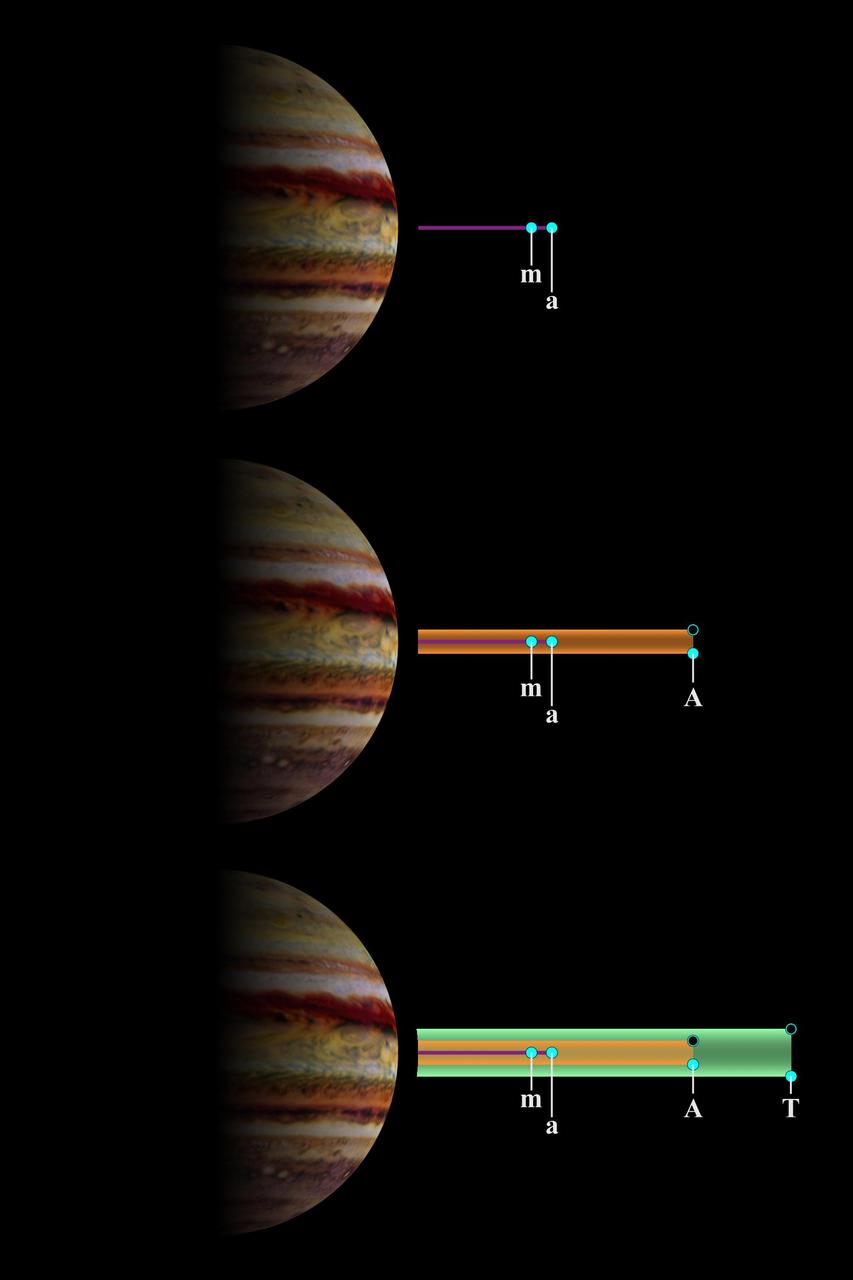
Jupiter Main and Gossamer Ring Structures

Roughly true color image of the Great Red Spot of Jupiter as taken by NASA Galileo spacecraft on June 26, 1996.

Full-Circle Bonestell Panorama from Spirit
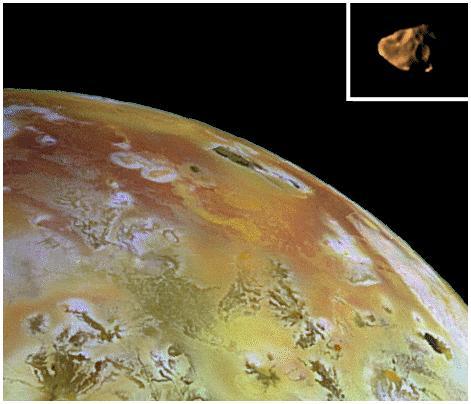
Comparison of Amalthea to Io
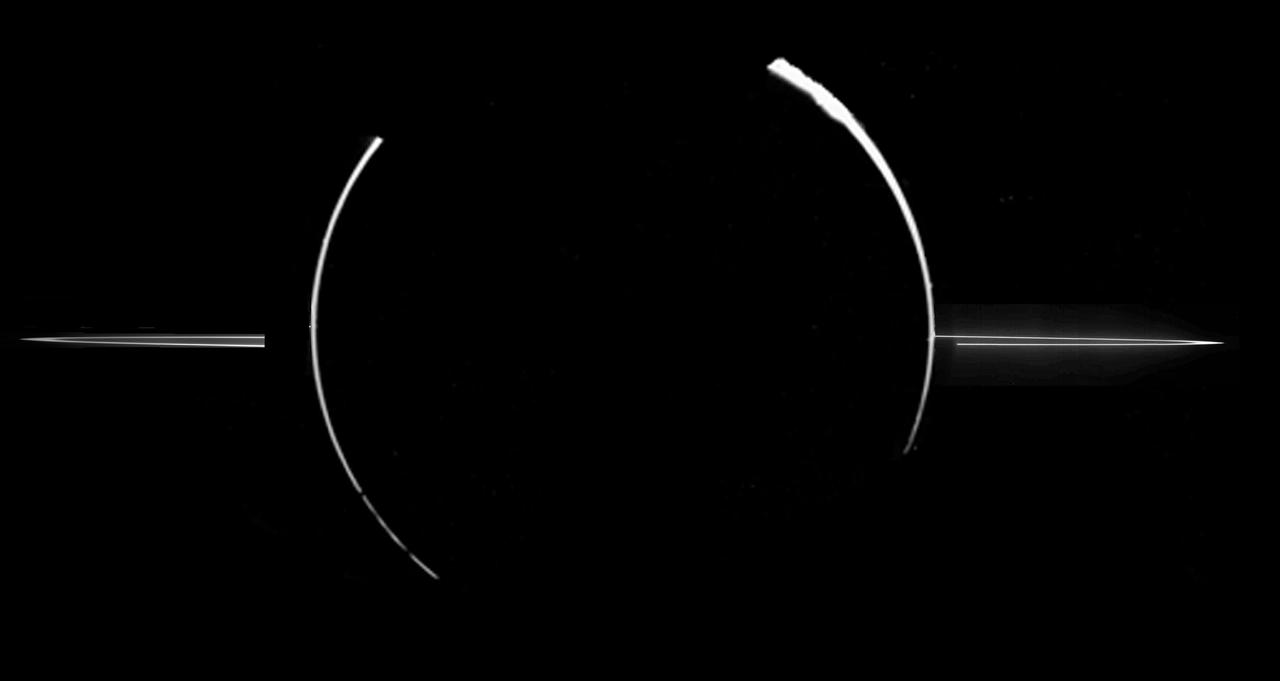
Jupiter Ring System
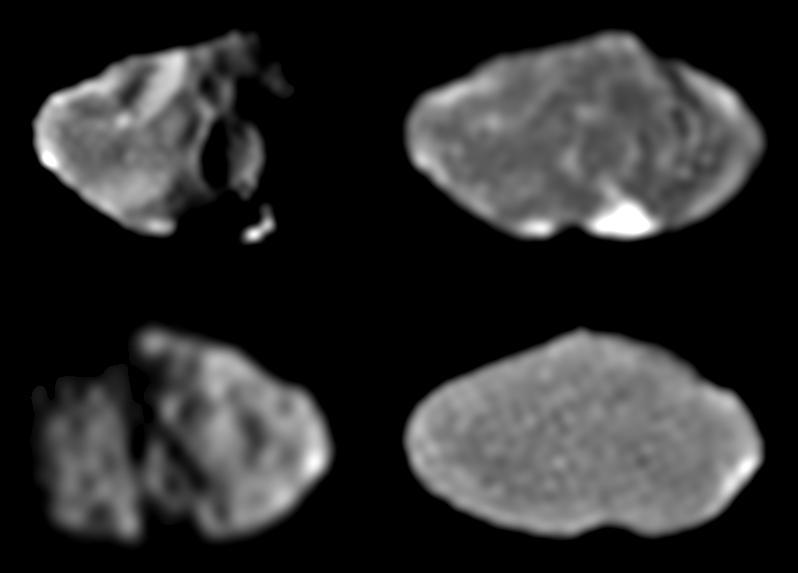
Four Galileo Views of Amalthea

Jupiter Main Ring and Halo

Full-Circle Santorini Panorama from Opportunity False Color
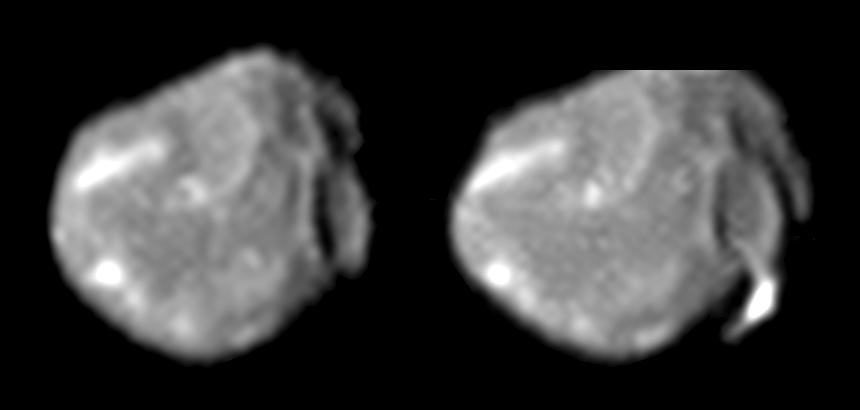
Bright Streak on Amalthea
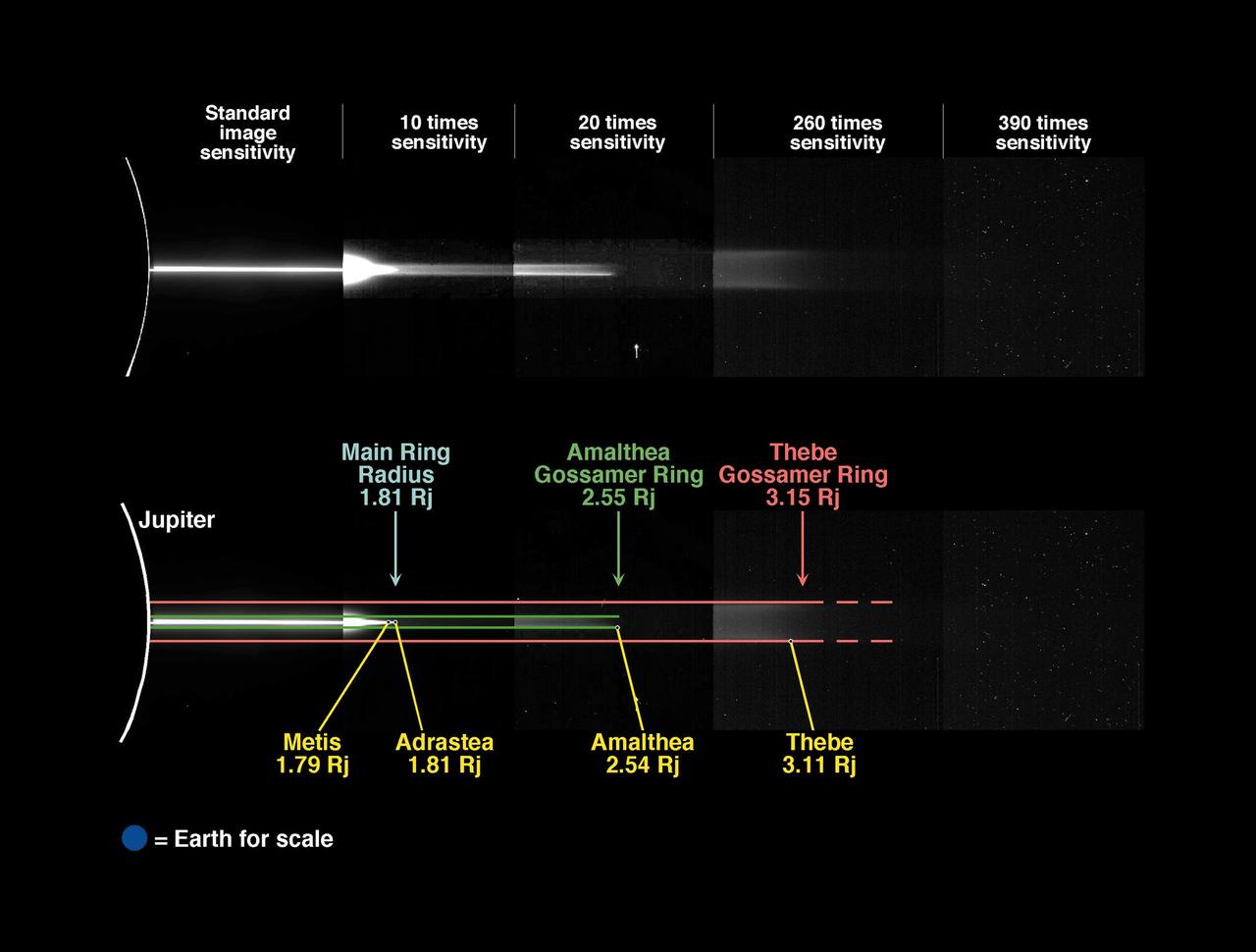
Jupiter Gossamer Ring Structure
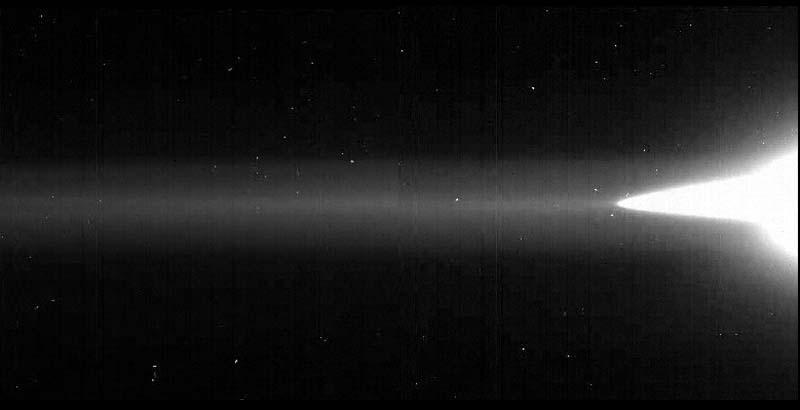
Jupiter Gossamer Ring
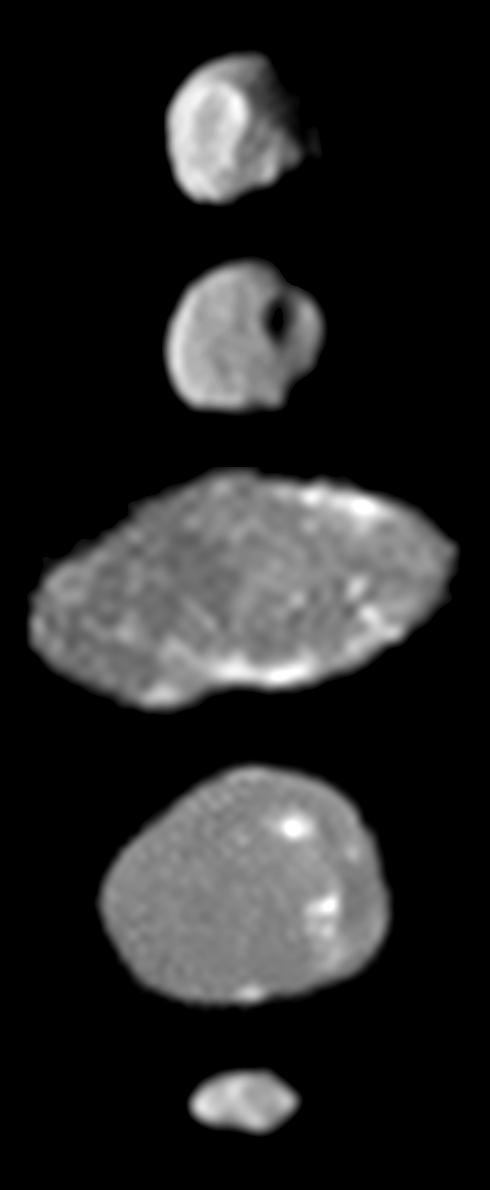
Jupiter Small Satellite Montage
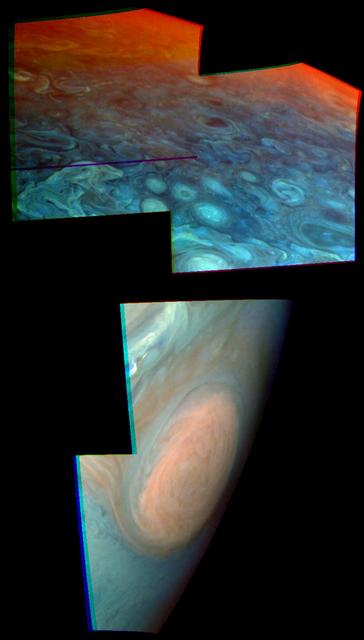
These two views of Jupiter obtained by NASA Galileo spacecraft show evidence of strikingly different stratospheric hazes between the polar regions and low or mid latitudes. The Great Red Spot shows in one mosaic taken on June 26, 1996.
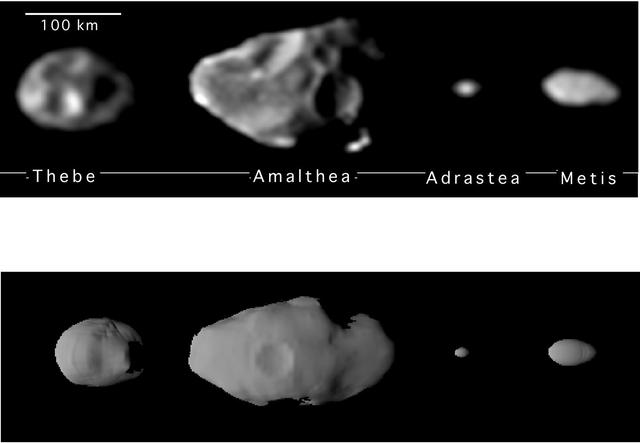
Shapes of the Small Inner Satellites of Jupiter
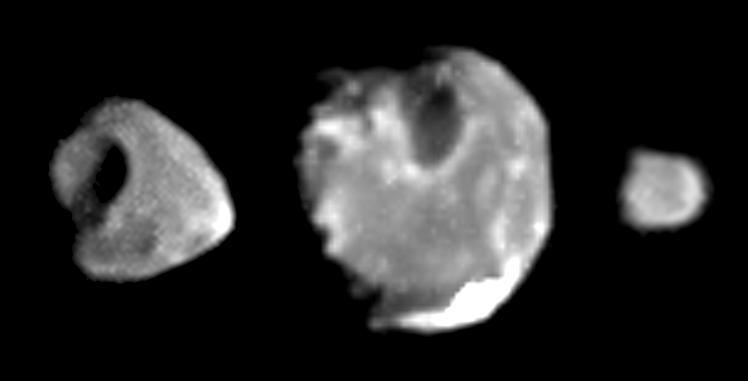
Best images yet of Thebe, Amalthea and Metis
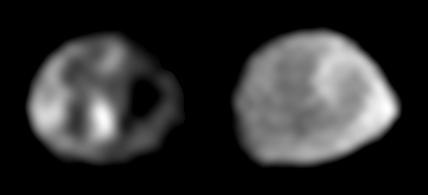
Two Galileo Views of Thebe
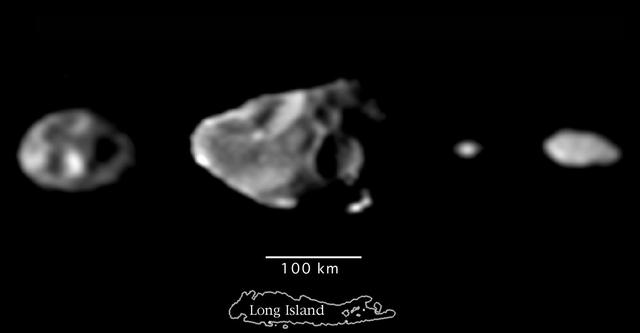
Scale Comparison of the Inner Small Satellites of Jupiter
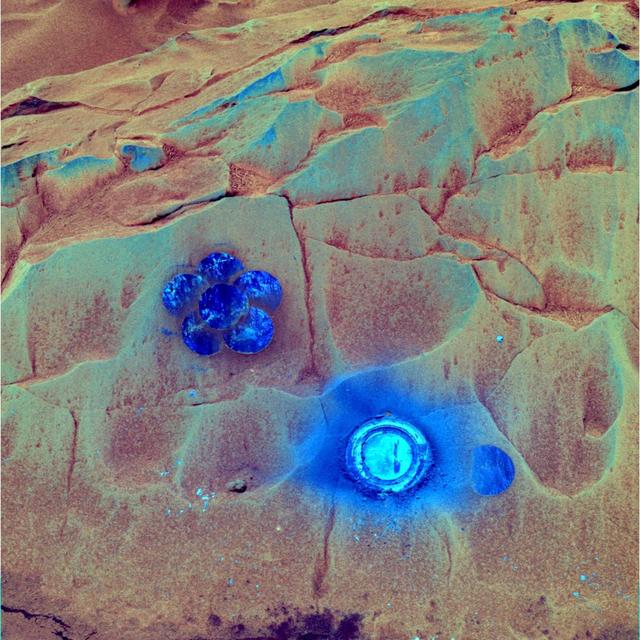
Daisy in Full Bloom on Mazatzal False Color
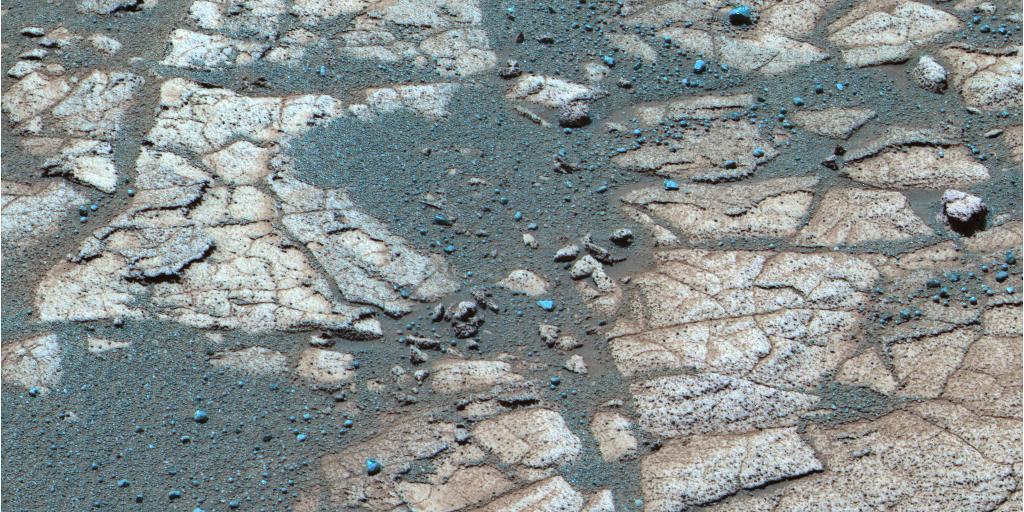
Rind-Like Features at a Meridiani Outcrop

This 360-degree panorama shows the vista from the location where NASA Mars Exploration Rover Spirit has spent its third Martian southern-hemisphere winter inside Mars Gusev Crater. 3D glasses are necessary to view this image.
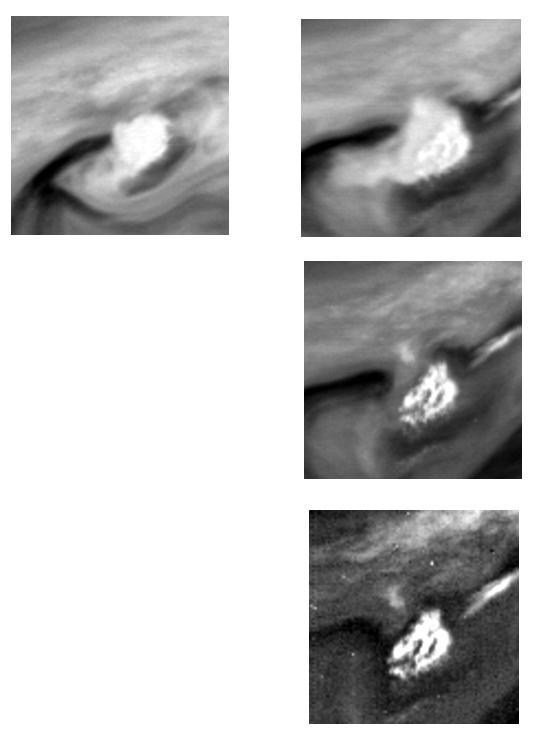
These two images of Jupiter atmosphere were taken by NASA Galileo spacecraft on June 26, 1996. The bright white spot in the center of each image is to the northwest of Jupiter Great Red Spot GRS.
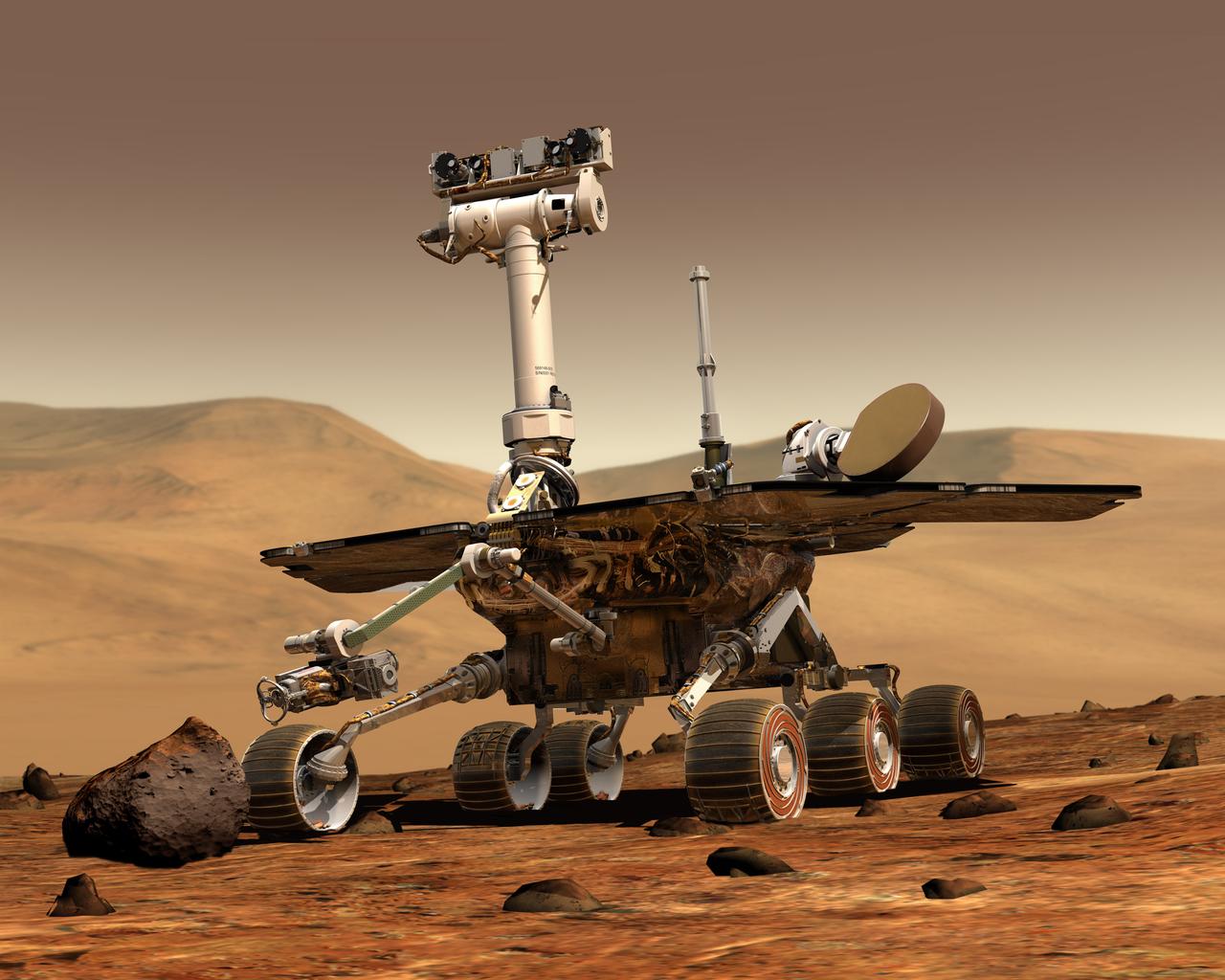
An artist concept portrays a NASA Mars Exploration Rover on the surface of Mars. Two rovers were launched in 2003 and arrived at sites on Mars in January 2004.

Full-Circle Bonestell Panorama from Spirit False Color

Sundial Lands on Mars
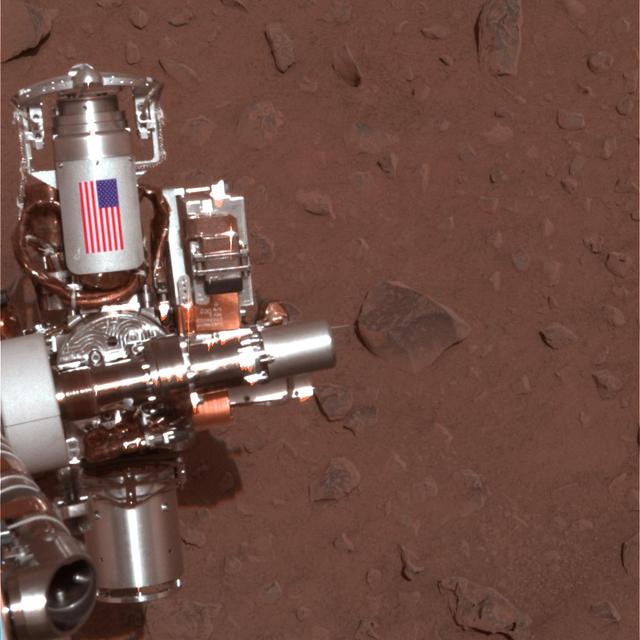
The piece of metal with the American flag on it in this image of a NASA rover on Mars is made of aluminum recovered from the site of the World Trade Center towers in the weeks after their destruction.

Full-Circle Santorini Panorama from Opportunity

Jupiter Inner Satellites and Ring Components
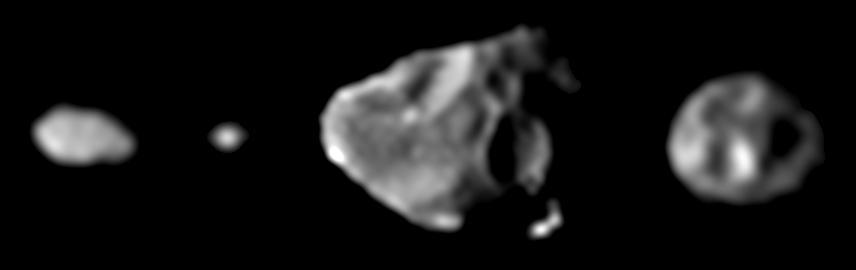
Family Portrait of the Small Inner Satellites of Jupiter
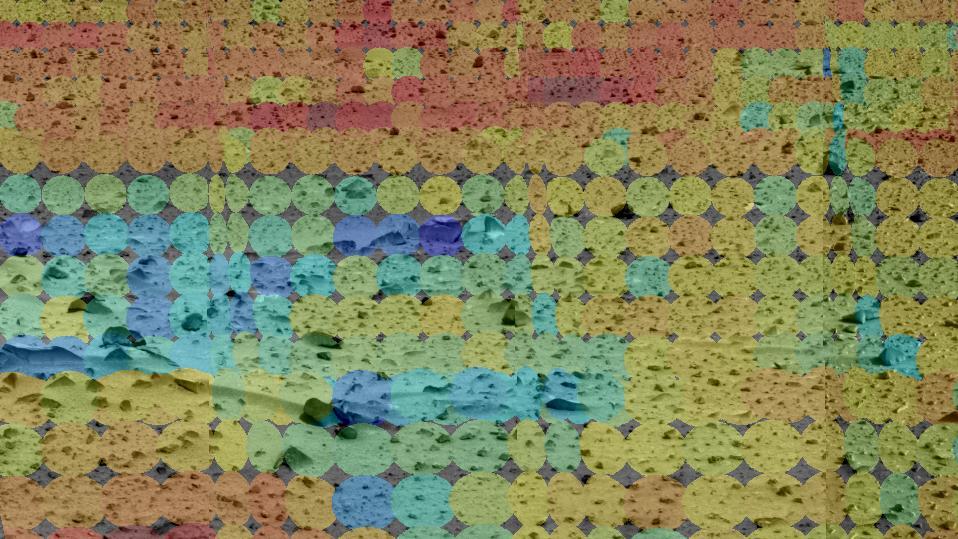
Mars Through Infrared Eyes of Spirit-2
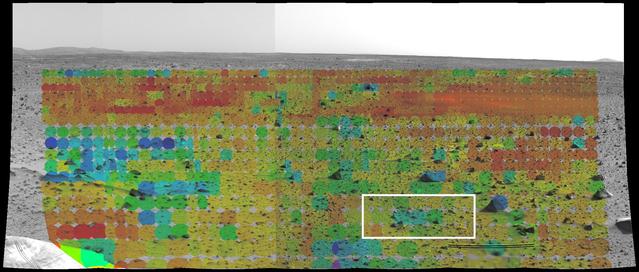
Mars Through Infrared Eyes of Spirit-3
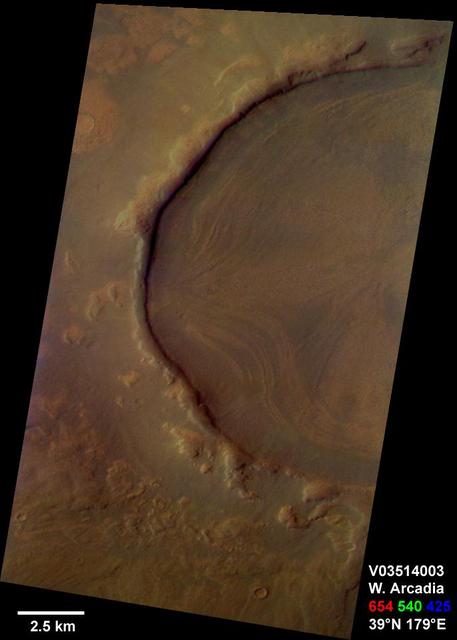
This is a Mars Odyssey visible color image of an unnamed crater in western Arcadia Planitia (near 39 degrees N, 179 degrees E). The crater shows a number of interesting internal and external features that suggest that it has undergone substantial modification since it formed. These features include concentric layers and radial streaks of brighter, redder materials inside the crater, and a heavily degraded rim and ejecta blanket. The patterns inside the crater suggest that material has flowed or slumped towards the center. Other craters with features like this have been seen at both northern and southern mid latitudes The distribution of these kinds of craters suggests the possible influence of surface or subsurface ice in the formation of these enigmatic features. The image was taken on September 29, 2002 during late northern spring. This is an approximate true color image, generated from a long strip of visible red (654 nm), green (540 nm), and blue (425 nm) filter images that were calibrated using a combination of pre-flight measurements and Hubble images of Mars. The colors appear perhaps a bit darker than one might expect; this is most likely because the images were acquired in late afternoon (roughly 4:40 p.m. local solar time) and the low Sun angle results in an overall darker surface. http://photojournal.jpl.nasa.gov/catalog/PIA04263

NASA Spitzer Space Telescope, formerly known as the Space Infrared Telescope Facility, has captured in stunning detail the spidery filaments and newborn stars of theTarantula Nebula, a rich star-forming region also known as 30 Doradus. This cloud of glowing dust and gas is located in the Large Magellanic Cloud, the nearest galaxy to our own Milky Way, and is visible primarily from the Southern Hemisphere. This image of an interstellar cauldron provides a snapshot of the complex physical processes and chemistry that govern the birth - and death - of stars. At the heart of the nebula is a compact cluster of stars, known as R136, which contains very massive and young stars. The brightest of these blue supergiant stars are up to 100 times more massive than the Sun, and are at least 100,000 times more luminous. These stars will live fast and die young, at least by astronomical standards, exhausting their nuclear fuel in a few million years. The Spitzer Space Telescope image was obtained with an infrared array camera that is sensitive to invisible infrared light at wavelengths that are about ten times longer than visible light. In this four-color composite, emission at 3.6 microns is depicted in blue, 4.5 microns in green, 5.8 microns in orange, and 8.0 microns in red. The image covers a region that is three-quarters the size of the full moon. The Spitzer observations penetrate the dust clouds throughout the Tarantula to reveal previously hidden sites of star formation. Within the luminescent nebula, many holes are also apparent. These voids are produced by highly energetic winds originating from the massive stars in the central star cluster. The structures at the edges of these voids are particularly interesting. Dense pillars of gas and dust, sculpted by the stellar radiation, denote the birthplace of future generations of stars. The Spitzer image provides information about the composition of the material at the edges of the voids. The surface layers closest to the massive stars are subject to the most intense stellar radiation. Here, the atoms are stripped of their electrons, and the green color of these regions is indicative of the radiation from this highly excited, or 'ionized,' material. The ubiquitous red filaments seen throughout the image reveal the presence of molecular material thought to be rich in hydrocarbons. The Tarantula Nebula is the nearest example of a 'starburst' phenomenon, in which intense episodes of star formation occur on massive scales. Most starbursts, however, are associated with dusty and distant galaxies. Spitzer infrared observations of the Tarantula provide astronomers with an unprecedented view of the lifecycle of massive stars and their vital role in regulating the birth of future stellar and planetary systems. http://photojournal.jpl.nasa.gov/catalog/PIA05062
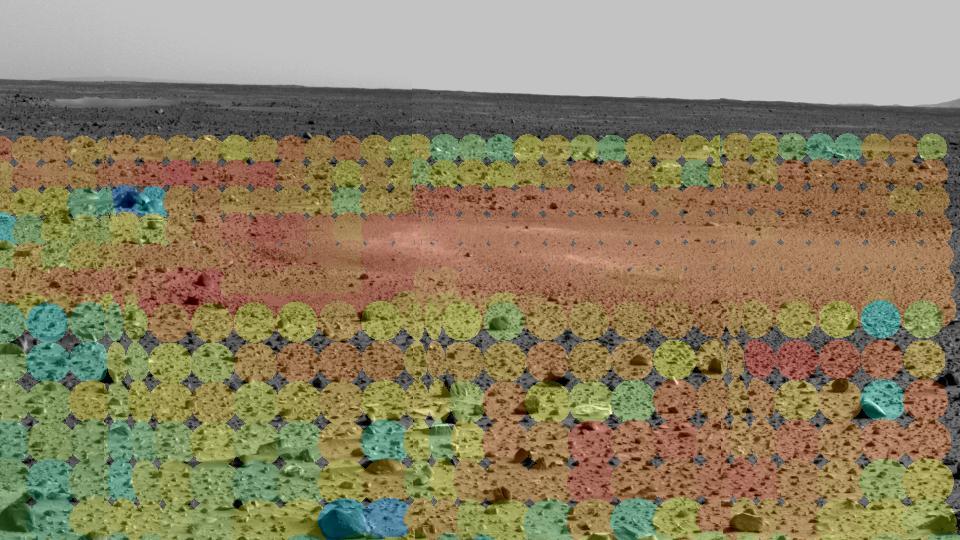
Mars Through Infrared Eyes of Spirit

Chlorine Clues
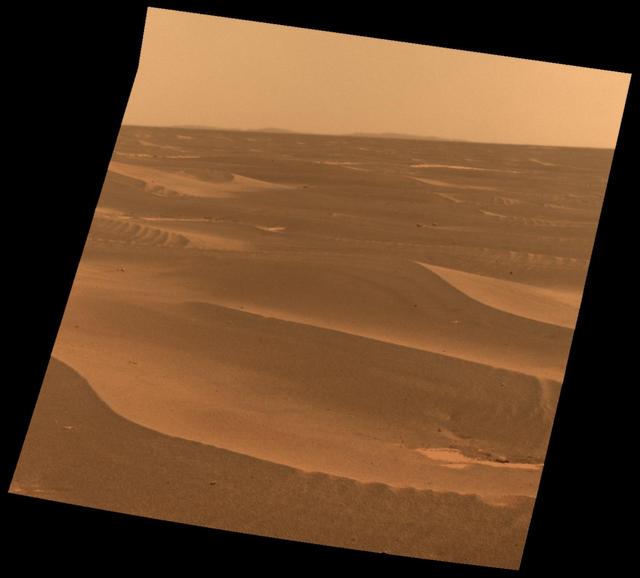
NASA Mars Exploration Rover used its panoramic camera to record this view of the rim of a crater about 65 kilometers 40 miles in the distance, on the southwestern horizon. This crater, Bopolu, is about 19 kilometers 12 miles in diameter.
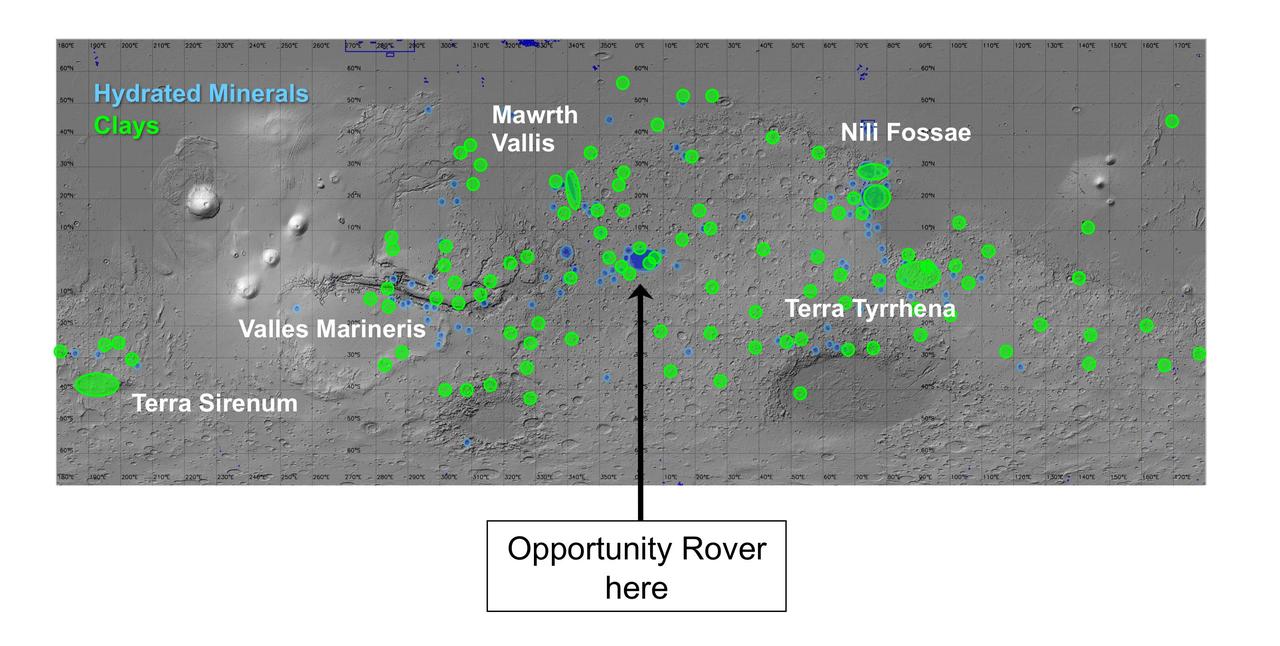
On this map of Mars, spectrometers on spacecraft orbiting Mars have detected clay minerals green and hydrated minerals-- clays, sulfates and others blue.

Rim of Endeavour on Opportunity Horizon, Sol 2424 False Color

Rising highest above the horizon in the right half of the image, captured by NASA Mars Exporation Rover, is a portion of the western rim of Endeavour Crater including a ridge informally named Cape Tribulation.

This image uses a view from the navigation camera on NASA Mars Exploration Rover Opportunity to show context for a horizon shot by the rover narrower-angle panoramic camera of the rim of Endeavour crater.
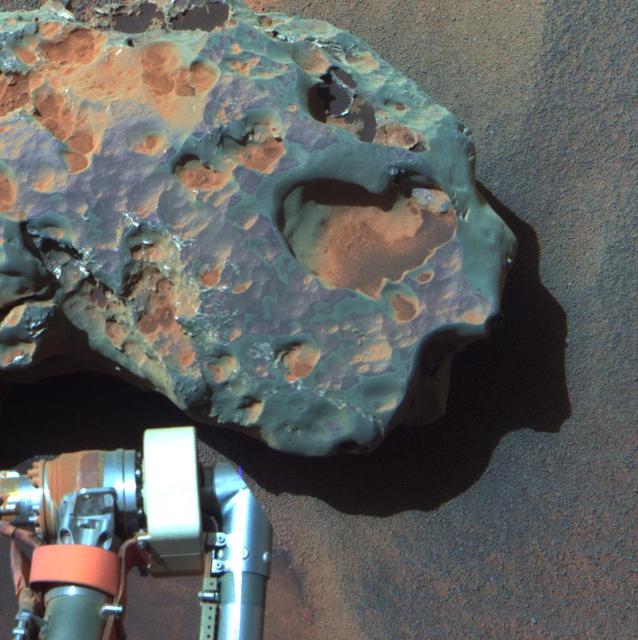
NASA Mars Exploration Rover Opportunity found this image of a meteorite. The science team used two tools on Opportunity arm, the microscopic imager and the alpha particle X-ray spectrometer, to inspect the rock texture and composition.
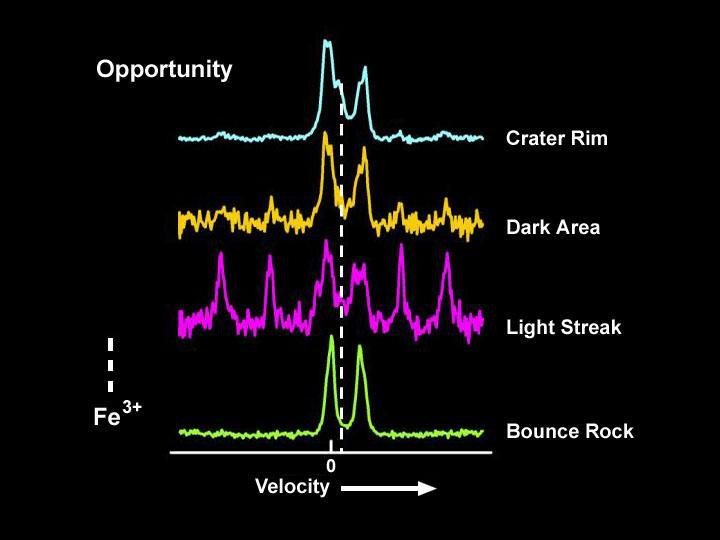
Bounce: Not Like the Others
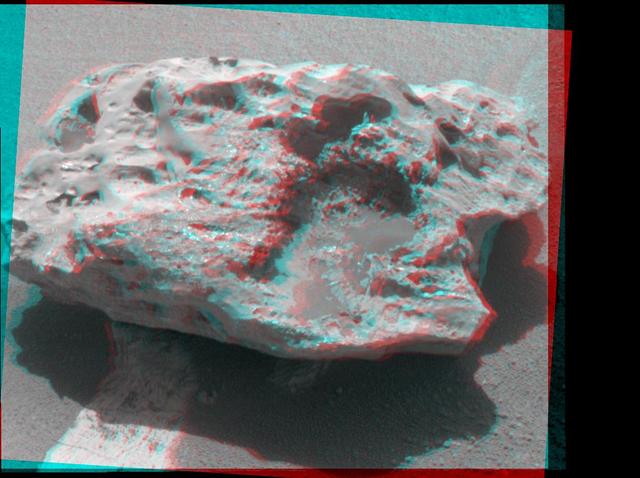
Composition measurements by NASA Mars Exploration Rover Opportunity confirm that this rock on the Martian surface is an iron-nickel meteorite. 3D glasses are necessary to view this image.
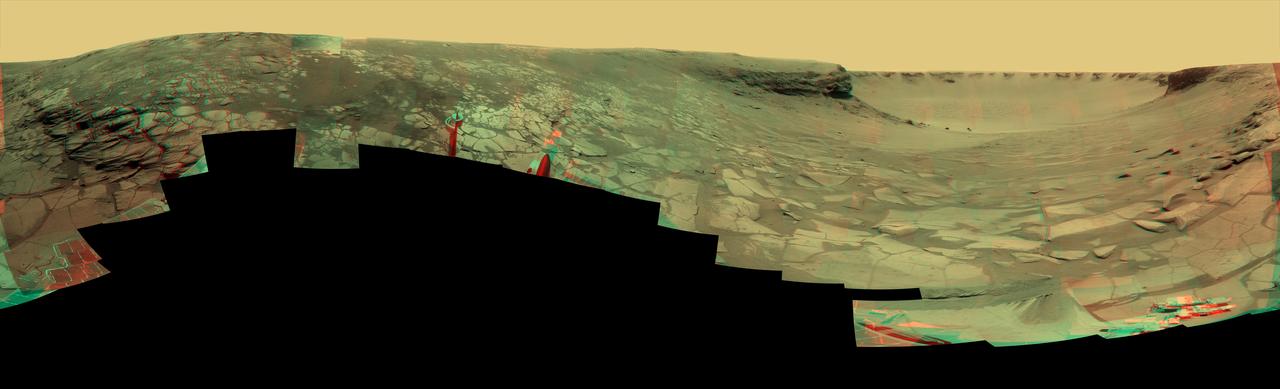
NASA Mars Exploration Rover Opportunity examined rocks inside an alcove called Duck Bay in the western portion of Victoria Crater. 3D glasses are necessary to view this image.
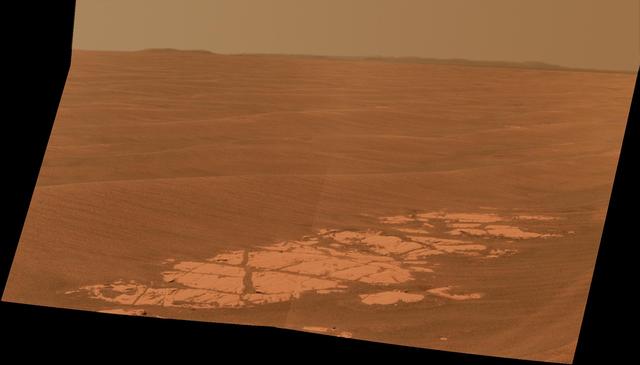
NASA Mars Exploration Rover Opportunity used its panoramic camera Pancam to capture this view approximately true-color view of the rim of Endeavour crater, the rover destination in a multi-year traverse along the sandy Martian landscape.
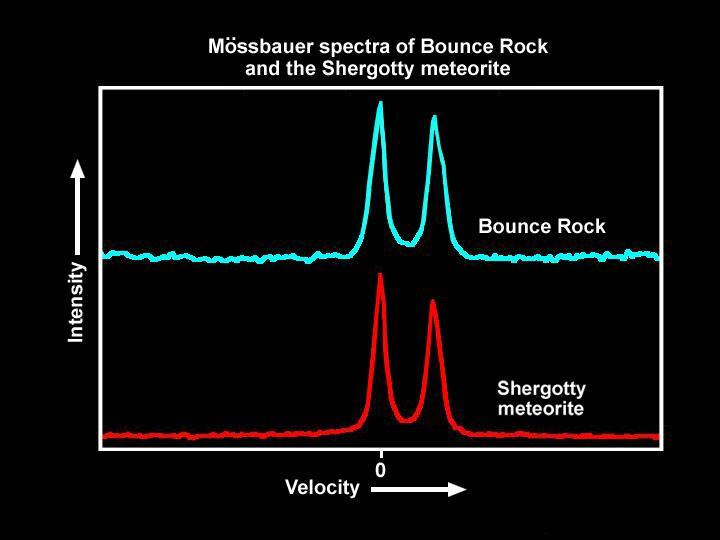
Bounce and Shergotty Share Common Ground
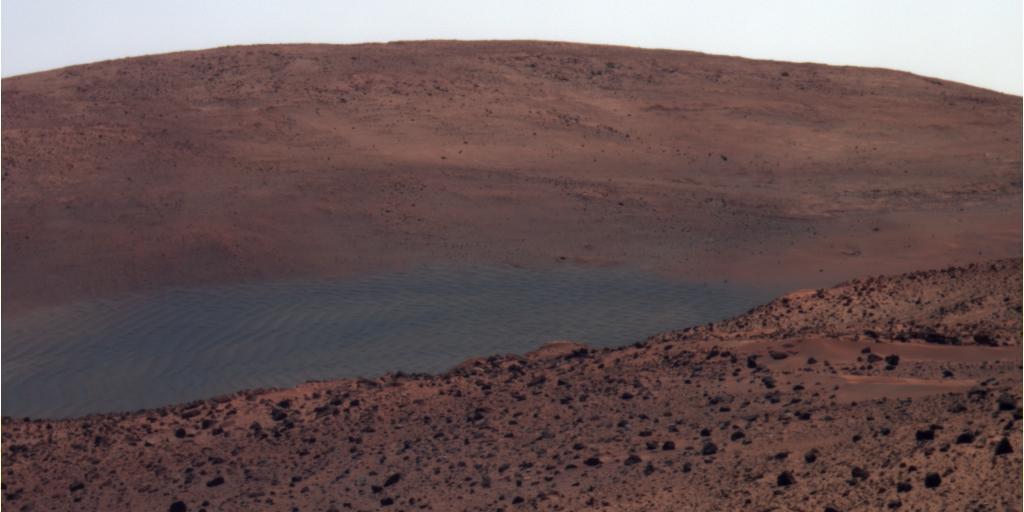
View from Spirit Overwintering Position False Color

This full-circle,stereo view from the panoramic camera Pancam on NASA Mars Exploration Rover Spirit shows the terrain surrounding the location called Troy, where Spirit became embedded in soft soil during the spring of 2009.

The soft soil exposed when wheels of NASA Mars Exploration Rover Spirit dug into a patch of ground dubbed Troy exhibit variations in hue visible in this image, in which the colors have been stretched to emphasize the differences.
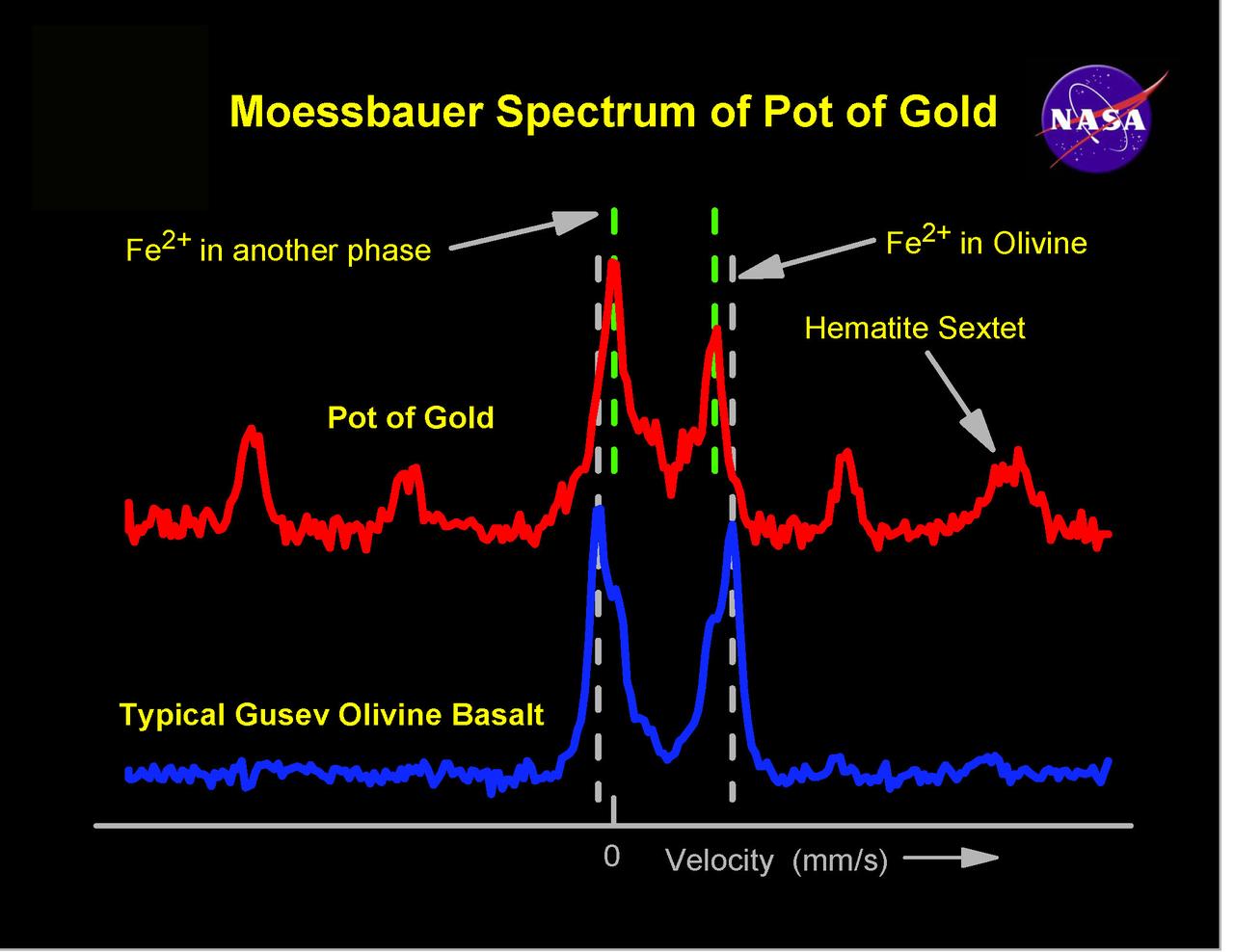
Spirit, Too, Finds Hematite
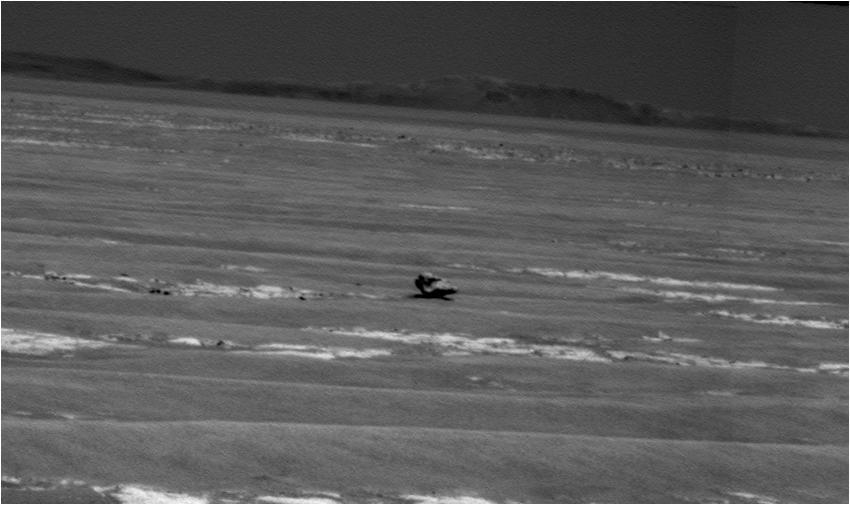
NASA Mars Exploration Rover Opportunity used its panoramic camera to capture this view of a dark rock the size of a toaster that may be an iron meteorite. Part of the rim of Endurance Crater is on the horizon.
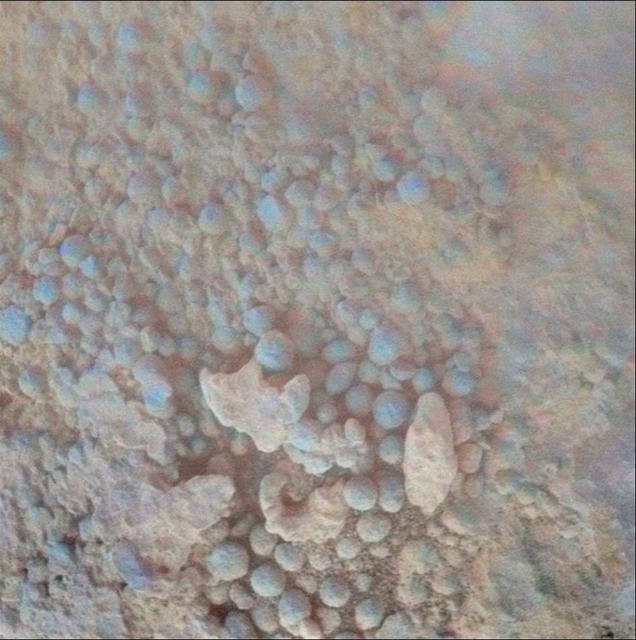
This image from the microscopic imager on NASA Mars Exploration Rover Opportunity shows details of the coating on a rock called Chocolate Hills, which the rover found and examined at the edge of a young crater called Concepción.
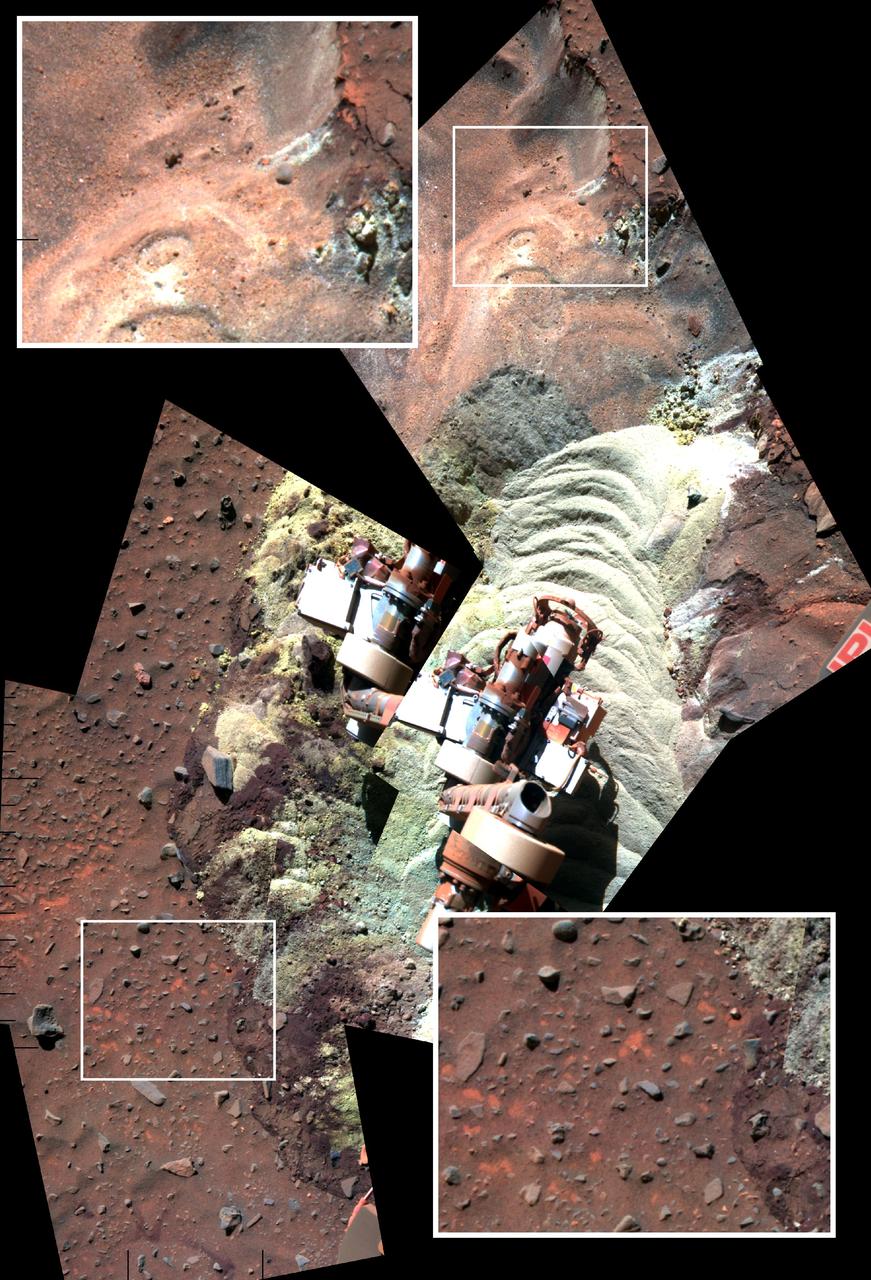
This mosaic of images shows the soil in front of NASA Mars Exploration Rover Spirit after a series of short backward drives during attempts to extricate the rover from a sand trap in January and early February 2010.