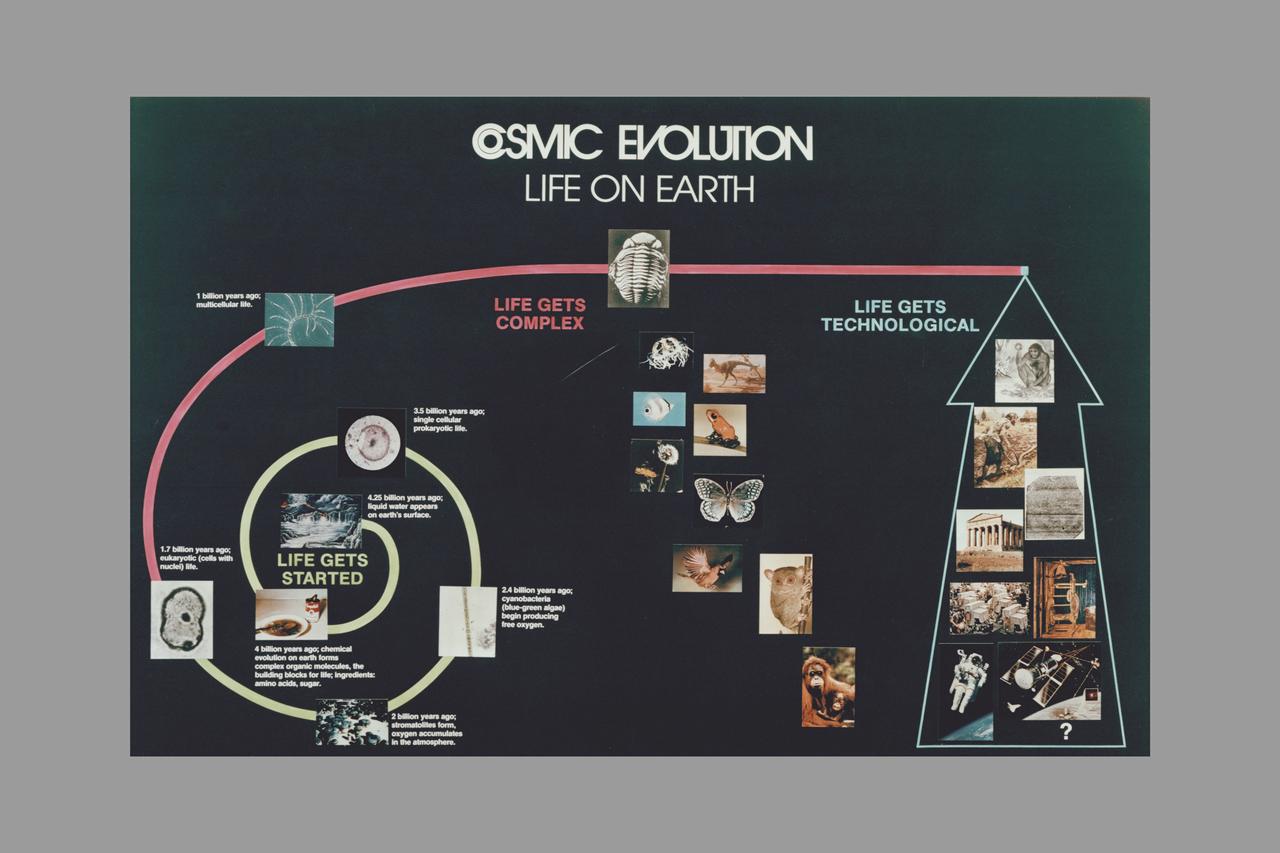
Cosmic Evolution. Setting the stage. Life on Earth (contains some copyrighten material - no for general release)
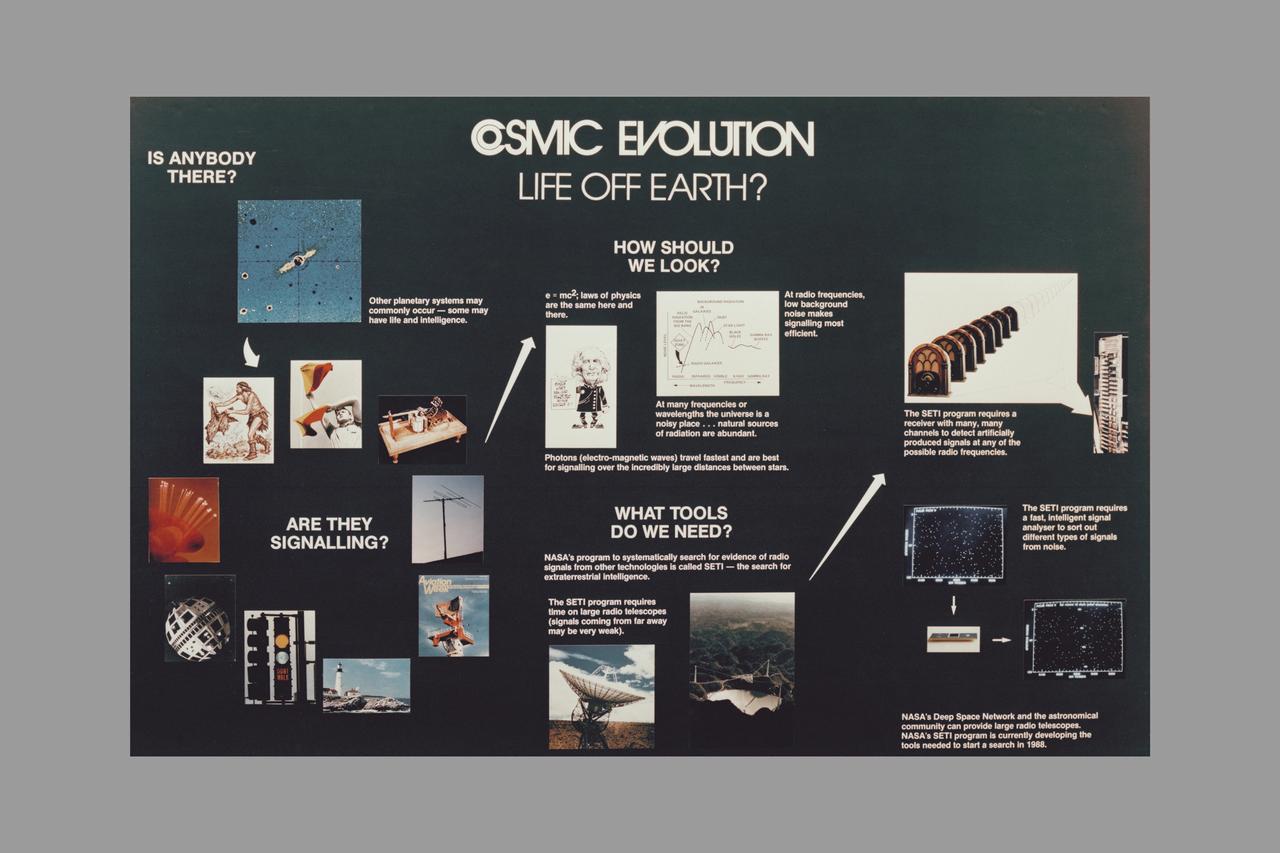
Cosmic Evolution. Setting the stage, Life off Earth (contains some copyrighted material - no for general release)

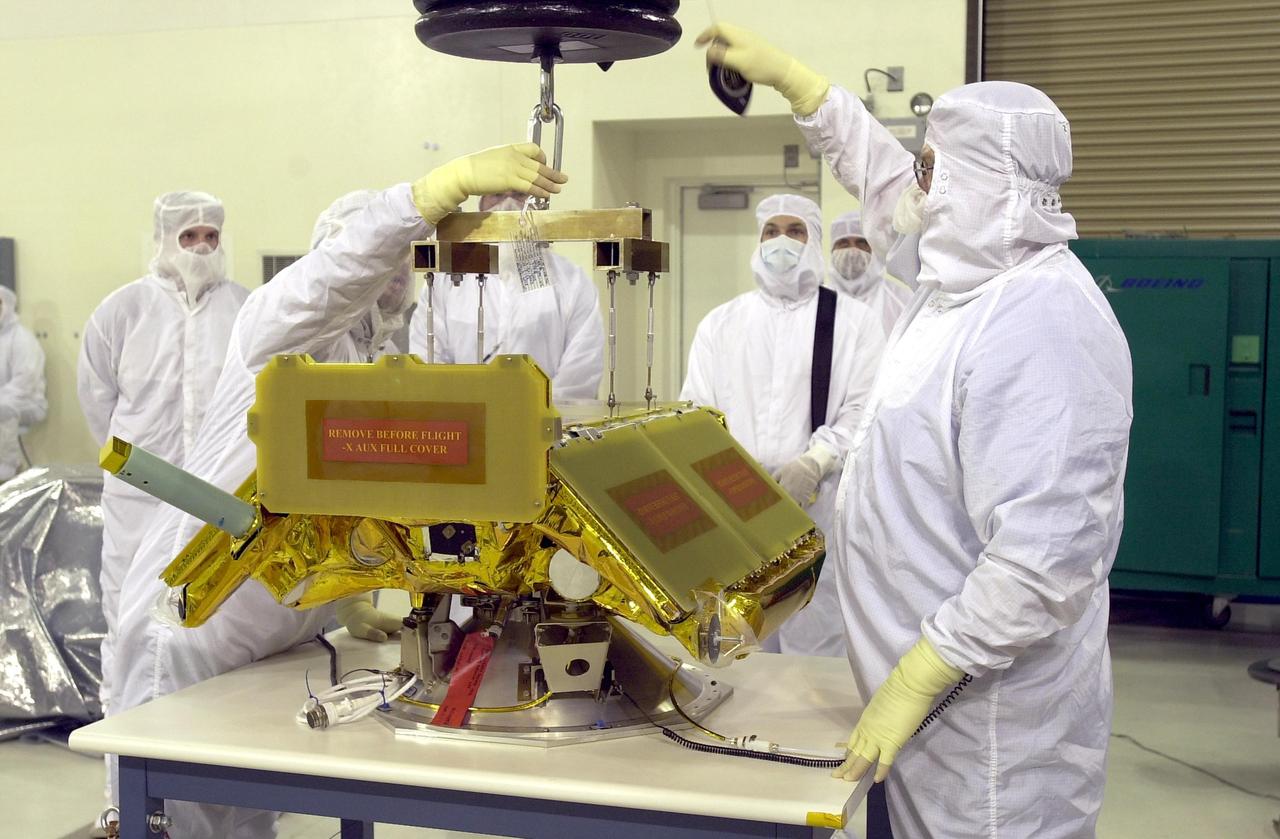
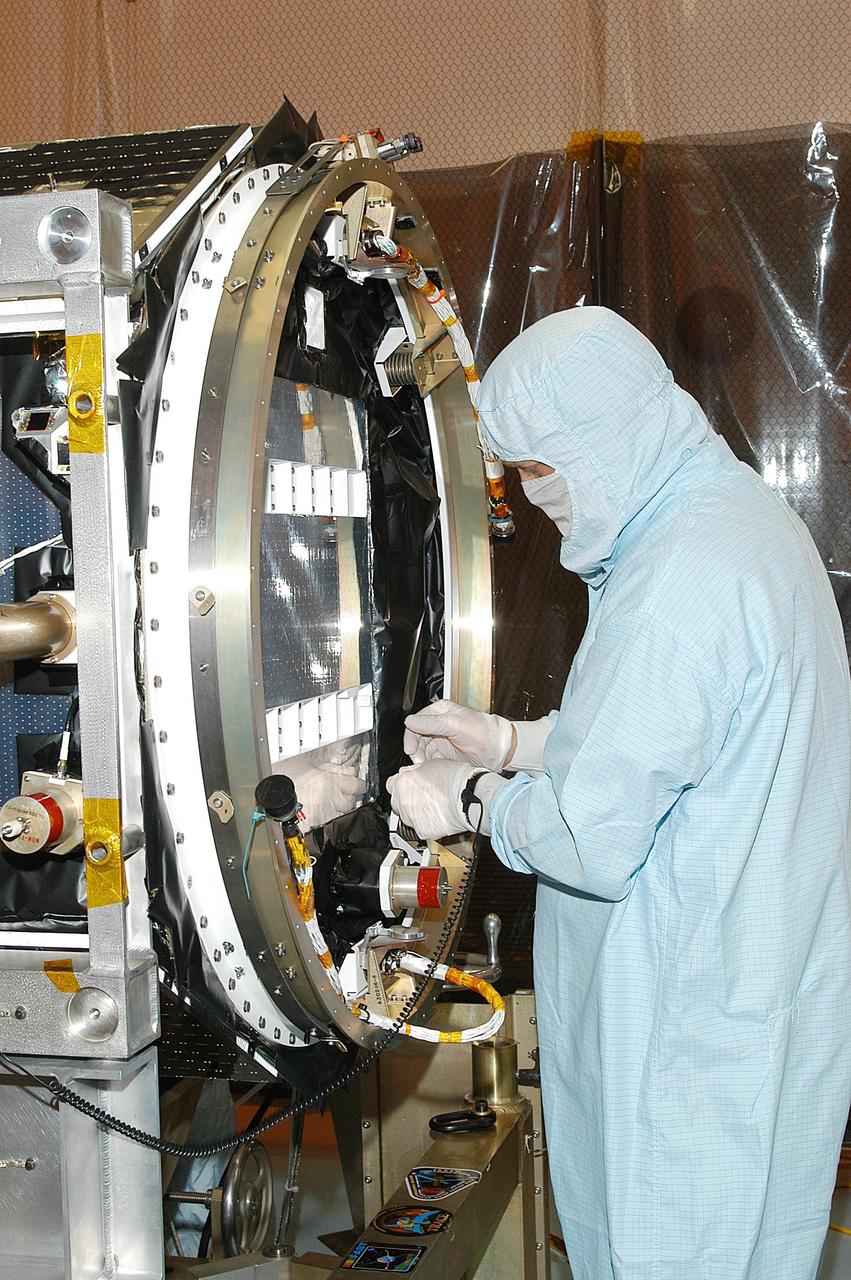
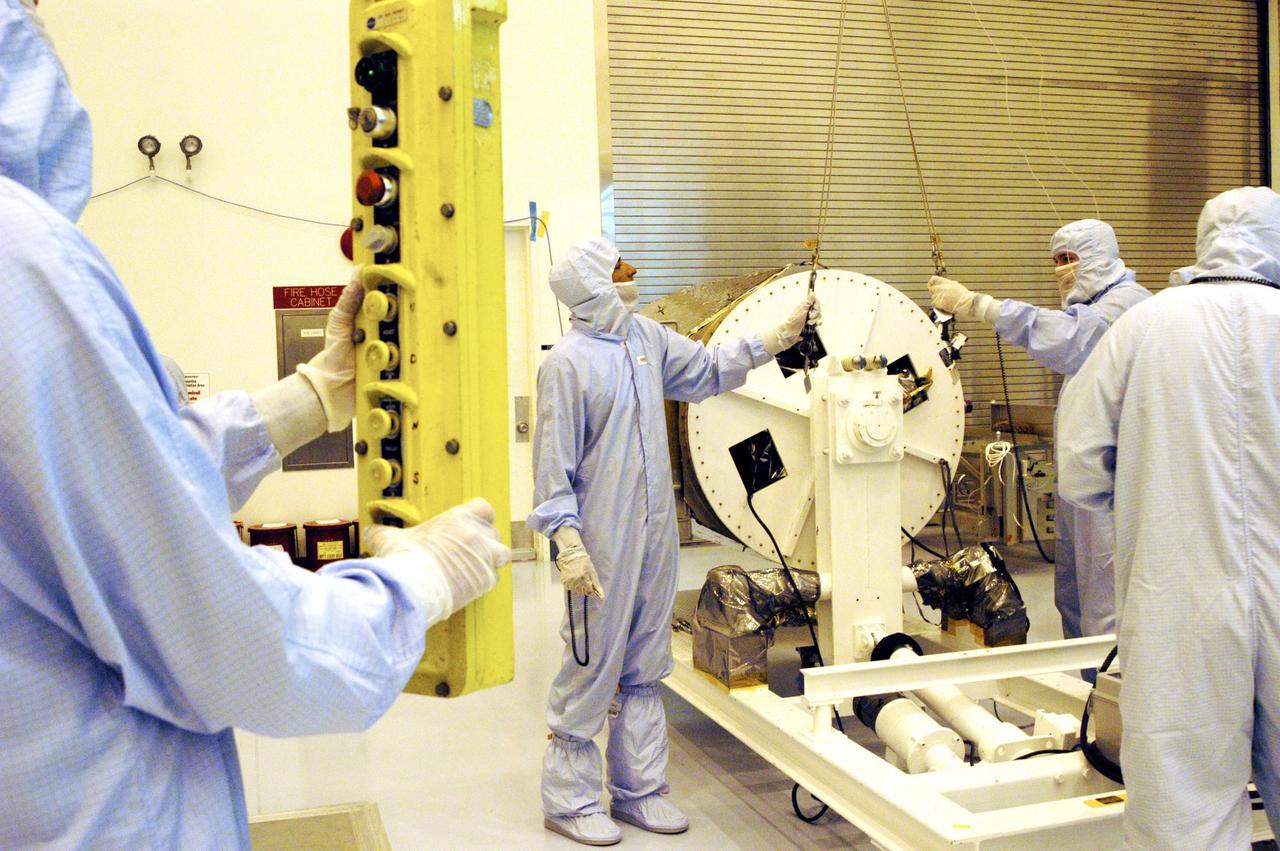
In the Multi-Payload Processing Facility, workers check the deployment of the cover of the telescope on NASA Galaxy Evolution Explorer, an orbiting space telescope observing galaxies in ultraviolet light across 10 billion years of cosmic history.
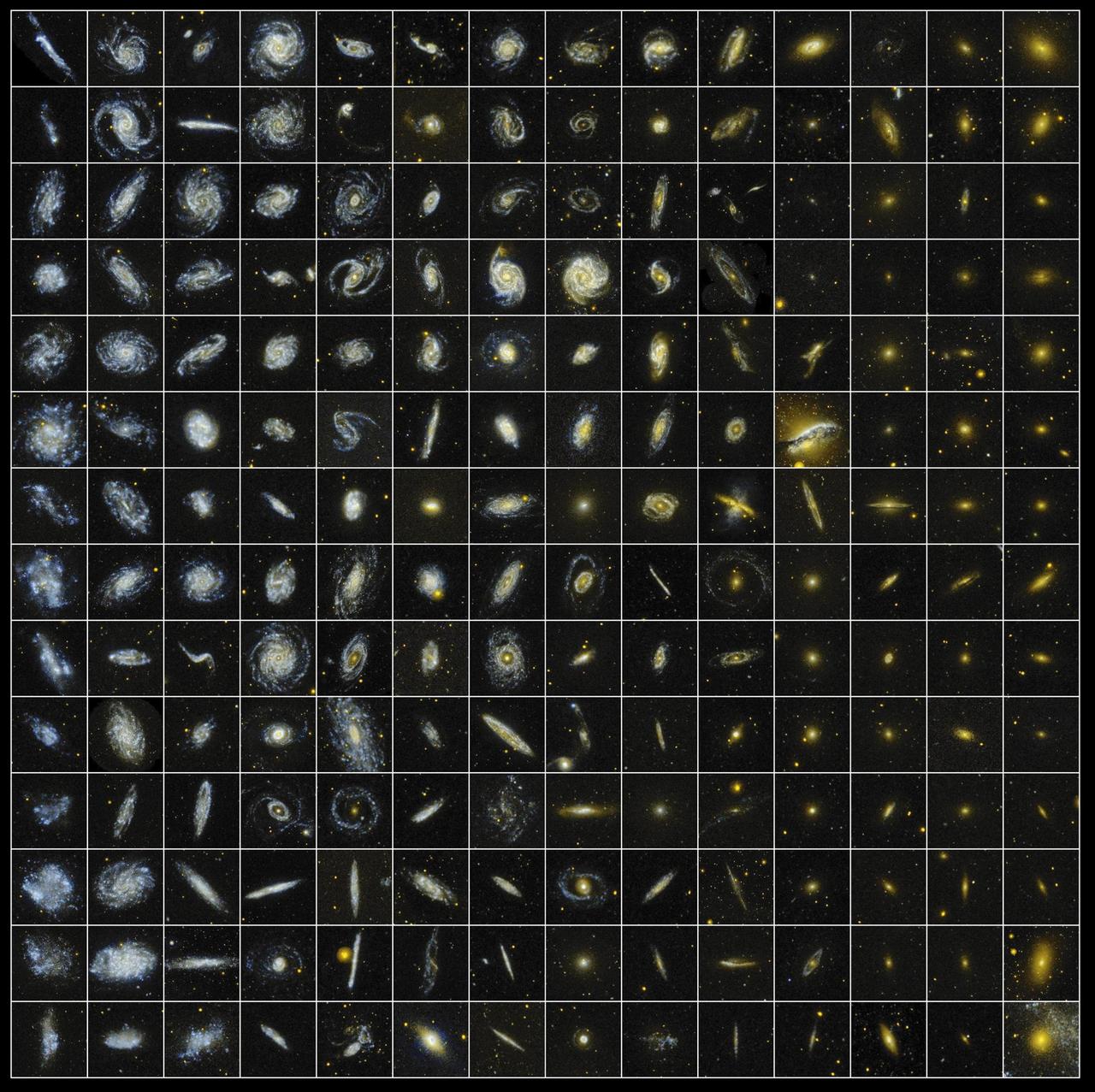
From sparkling blue rings to dazzling golden disks and mined from NASA Galaxy Evolution Explorer Survey of Nearby Galaxies data, these cosmic gems were collected with the telescope sensitive ultraviolet instruments.
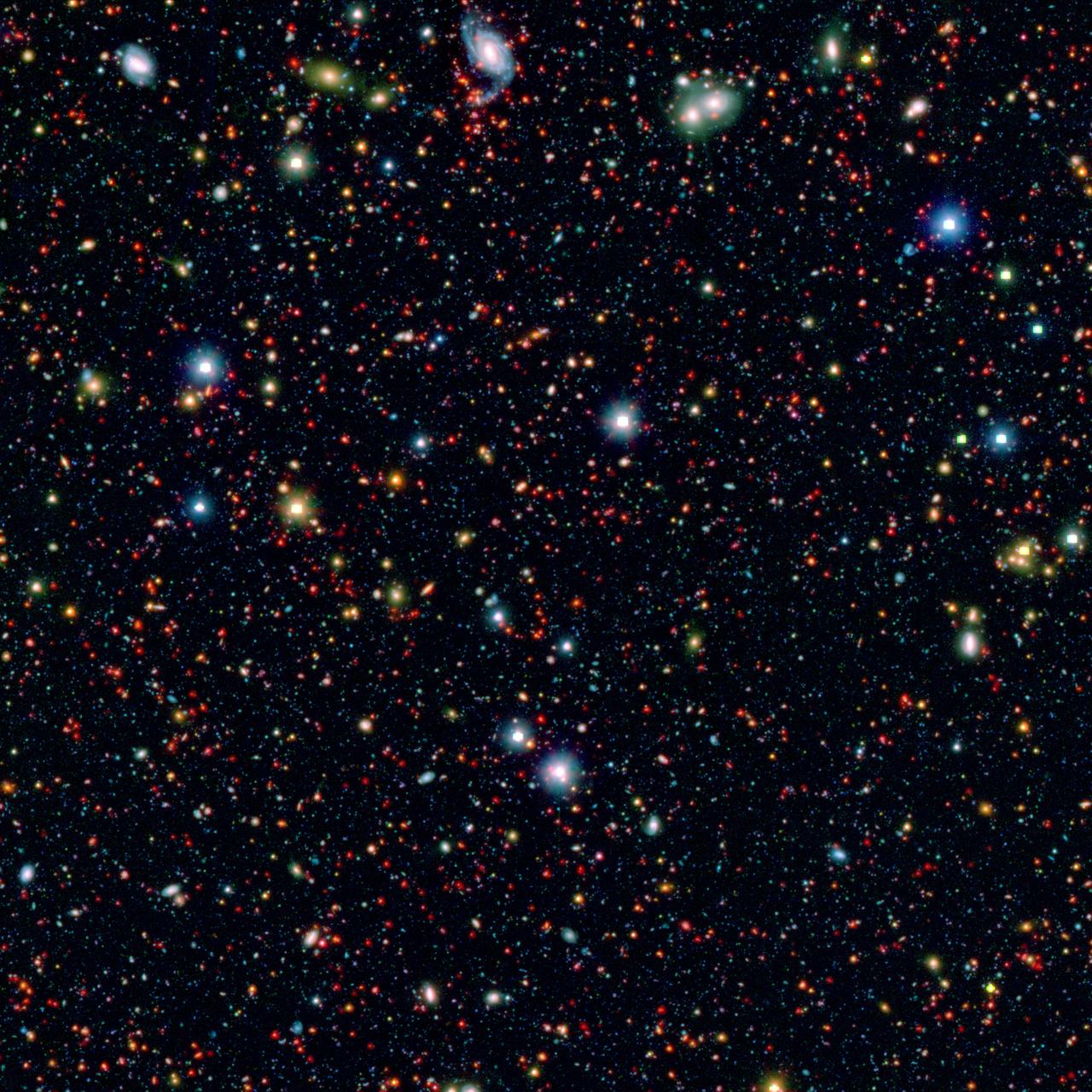
Millions of galaxies populate the patch of sky known as the COSMOS field, short for Cosmic Evolution Survey, a portion of which is shown here. Even the smallest dots in this image are galaxies, some up to 12 billion light-years away.
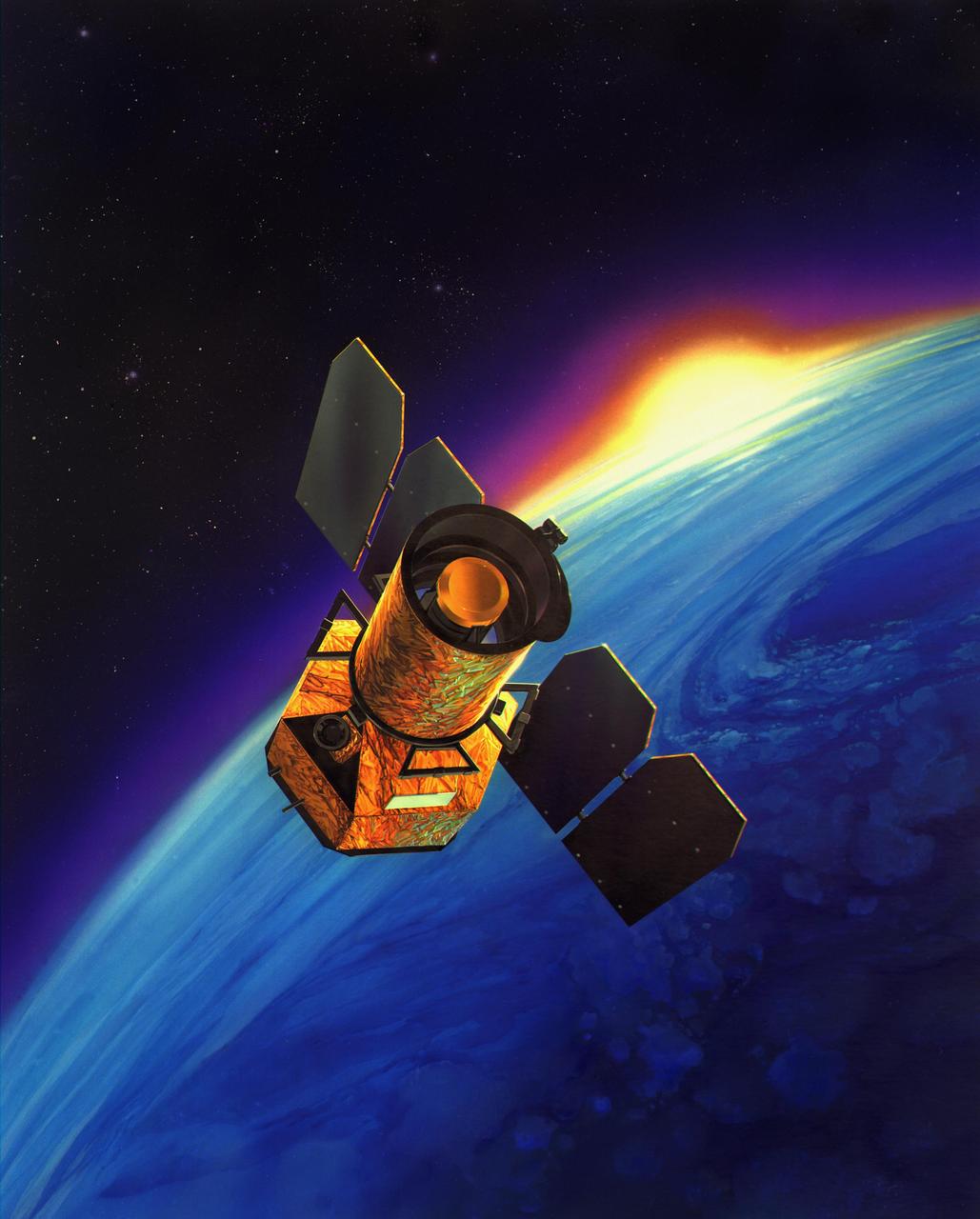
The Galaxy Evolution Explorer was launched on April 28, 2003. Its mission is to study the shape, brightness, size and distance of galaxies across 10 billion years of cosmic history. The 50-centimeter-diameter (19.7-inch) telescope onboard the Galaxy Evolution Explorer sweeps the skies in search of ultraviolet-light sources. Ultraviolet is light from the higher end of the electromagnetic spectrum, just above visible light in frequency, but below X-rays and gamma rays. While a small amount of ultraviolet penetrates Earth's atmosphere, causing sunburn, the Galaxy Evolution Explorer observes those ultraviolet frequencies that can only be seen from space. http://photojournal.jpl.nasa.gov/catalog/PIA04234
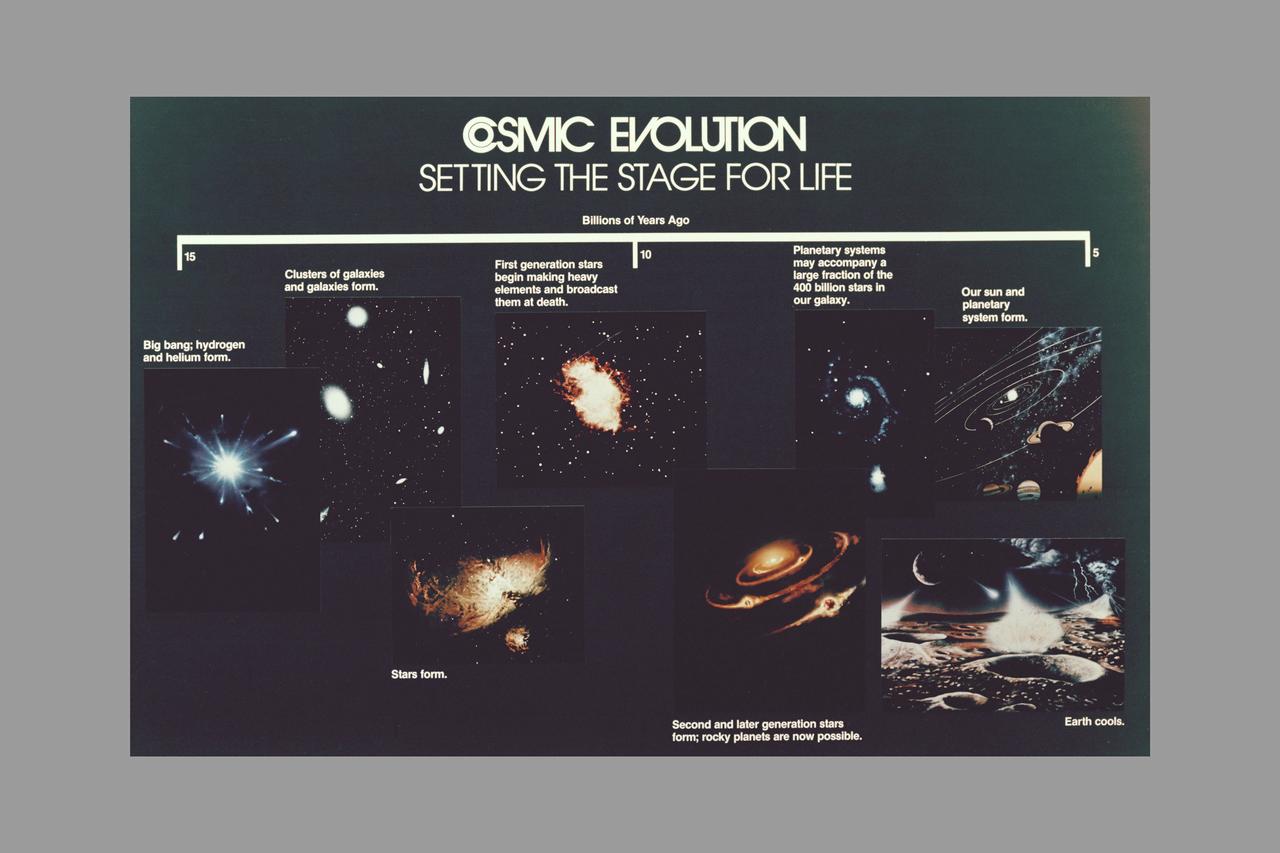
Composite Artwork Cosmic Evolution. Setting the stage. Life on and off Earth. (contains some copyrighted materials - no for general release)
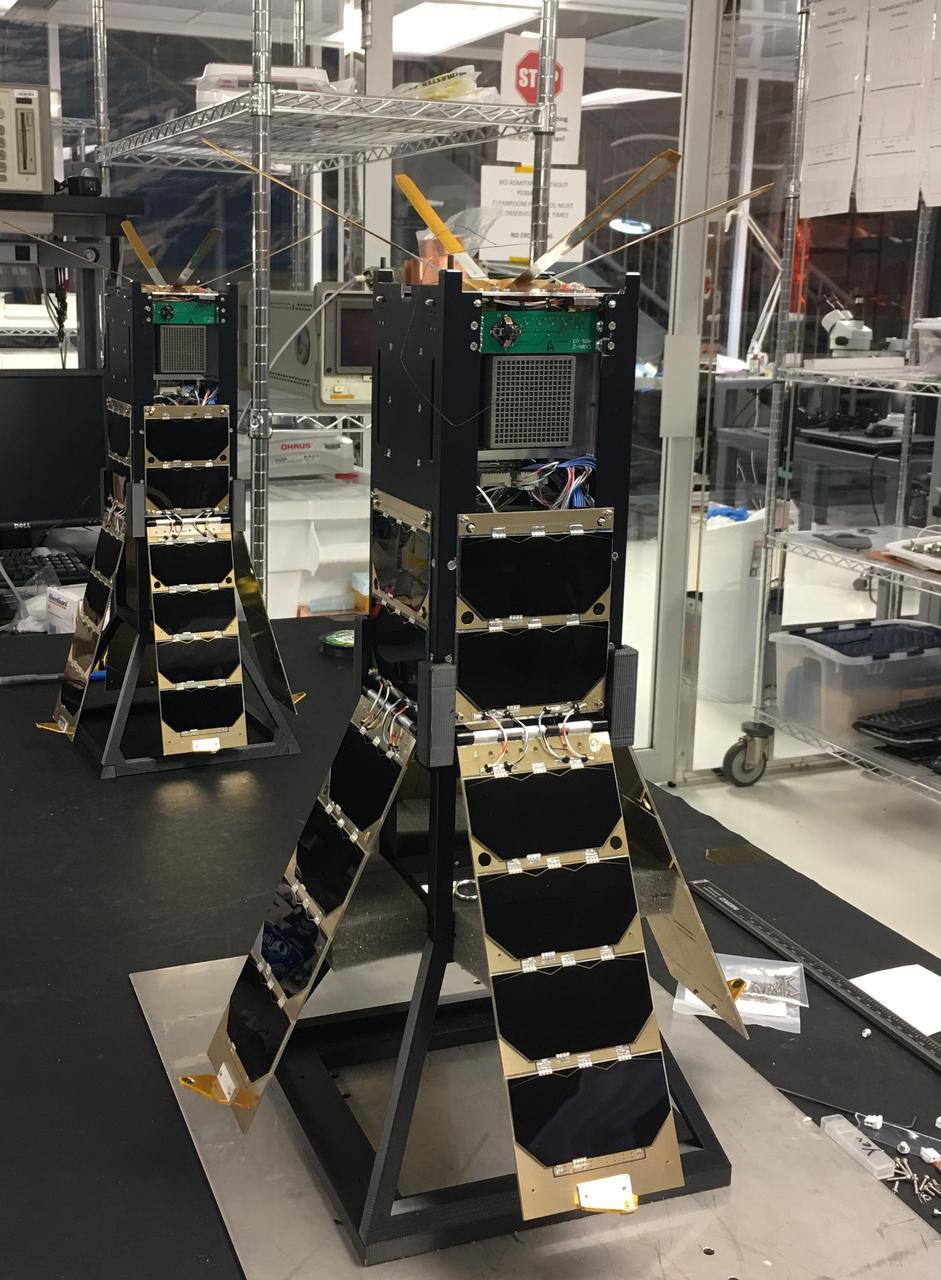
The Cosmic X-Ray Background NanoSat-2 (CXBN-2) CubeSat Mission developed by Morehead State University and its partners the Keldysh Institute (Moscow, Russia), the Maysville Community and Technical College (Morehead, KY) and KYSpace LLC (Lexington, KY) will increase the precision of measurements of the Cosmic X-Ray Background in the 30-50 keV range to a precision of <5%, thereby constraining models that attempt to explain the relative contribution of proposed sources lending insight into the underlying physics of the early universe. The mission addresses a fundamental science question that is central to our understanding of the structure, origin, and evolution of the universe by potentially lending insight into both the high-energy background radiation and into the evolution of primordial galaxies. Launched by NASA’s CubeSat Launch Initiative NET April 18, 2017 ELaNa XVII mission on the seventh Orbital-ATK Cygnus Commercial Resupply Services (OA-7) to the International Space Station and deployed on tbd.
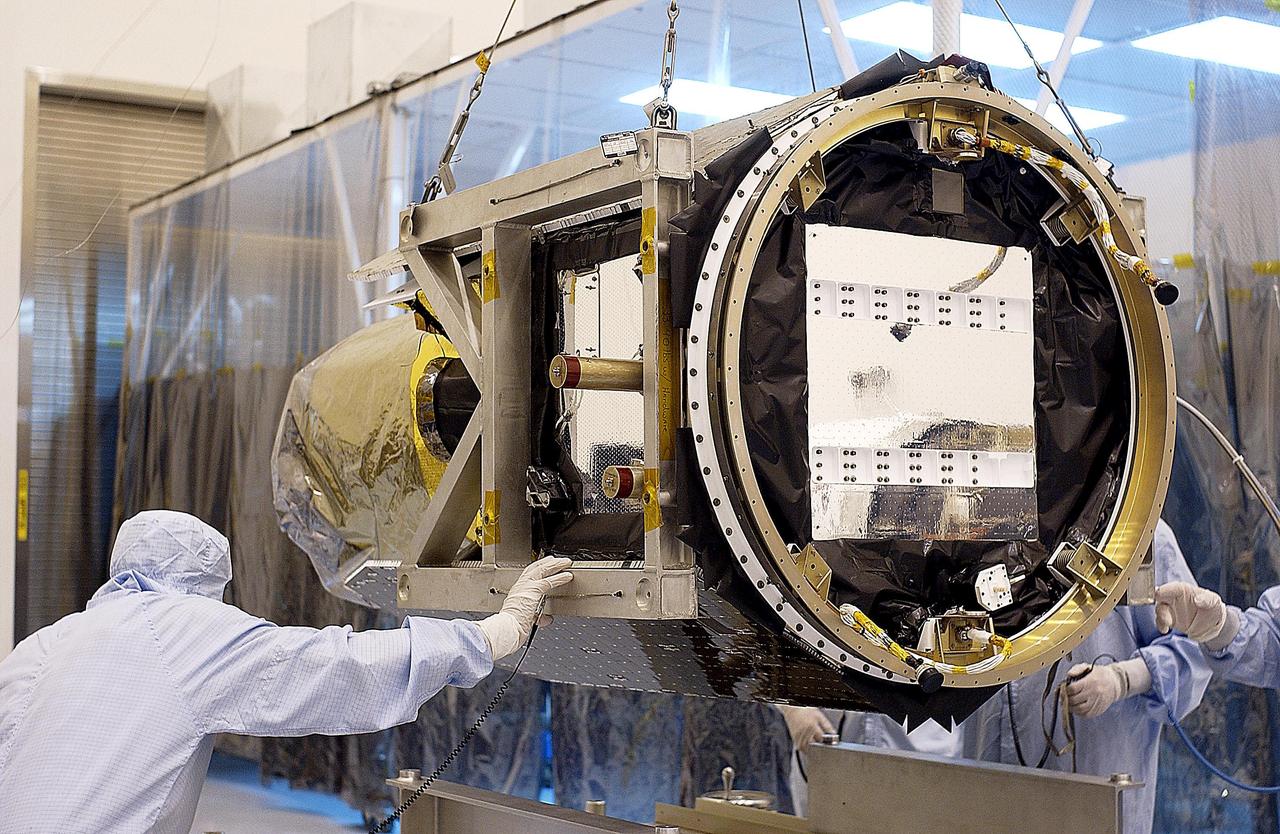
KENNEDY SPACE CENTER, Fla. - The Galaxy Evolution Explorer (GALEX) spacecraft is lowered toward a work stand. Foreign object debris shields will be installed before its launch. The GALEX is an orbiting space telescope that will observe galaxies in ultraviolet light across 10 billion years of cosmic history. During its 29-month mission GALEX will produce the first comprehensive map of a Universe of galaxies under construction, bringing more understanding how galaxies like the Milky Way were formed. The GALEX launch date is under review.
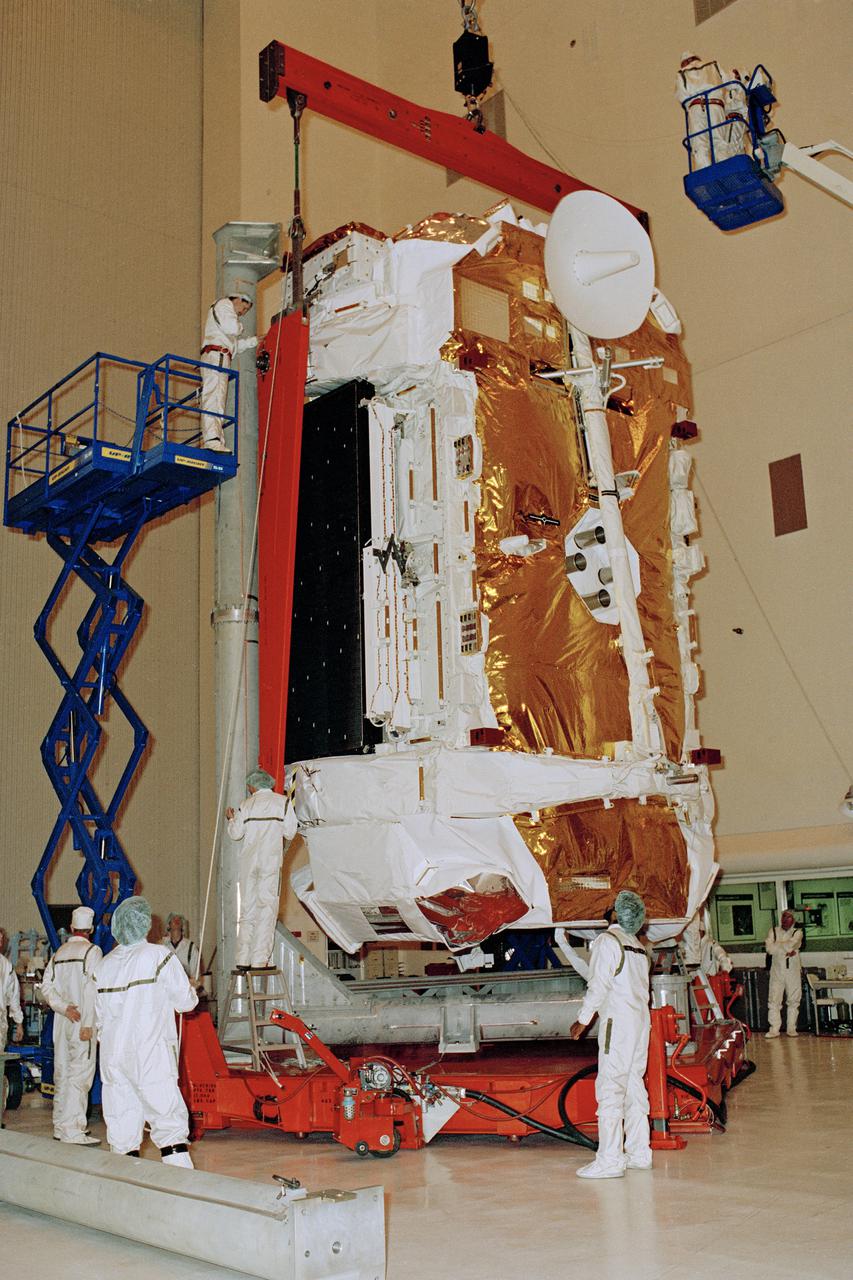
CAPE CANAVERAL, Fla. -- In the Payload Hazardous Servicing Facility at the Kennedy Space Center in Florida, technicians tilt the massive Gamma ray Observatory GRO upright for installation onto the transporter which will carry it to the Vertical Processing Facility. The spacecraft is scheduled to fly aboard the space shuttle Atlantis on STS-37. As the second of four great observatories planned by NASA, GRO will study the celestial gamma rays believed to be a record of cosmic change and evolution. Photo Credit: NASA
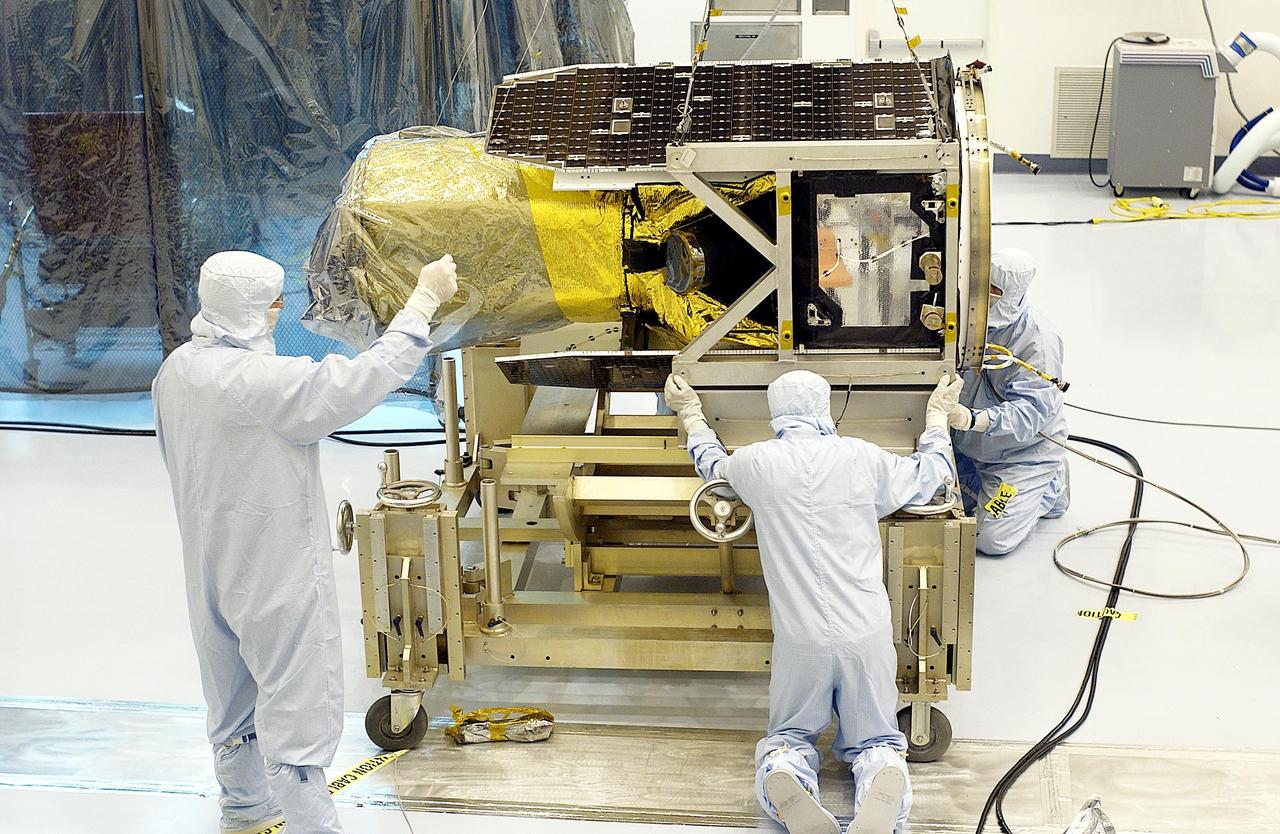
KENNEDY SPACE CENTER, Fla. - The Galaxy Evolution Explorer (GALEX) spacecraft is placed on a work stand. Foreign object debris shields will be installed before its launch. The GALEX is an orbiting space telescope that will observe galaxies in ultraviolet light across 10 billion years of cosmic history. During its 29-month mission GALEX will produce the first comprehensive map of a Universe of galaxies under construction, bringing more understanding how galaxies like the Milky Way were formed. The GALEX launch date is under review.

WFIRST, the Wide Field Infrared Survey Telescope, is shown here in an artist's rendering. It will carry a Wide Field Instrument to provide astronomers with Hubble-quality images covering large swaths of the sky, and enabling several studies of cosmic evolution. Its Coronagraph Instrument will directly image exoplanets similar to those in our own solar system and make detailed measurements of the chemical makeup of their atmospheres. http://photojournal.jpl.nasa.gov/catalog/PIA20060
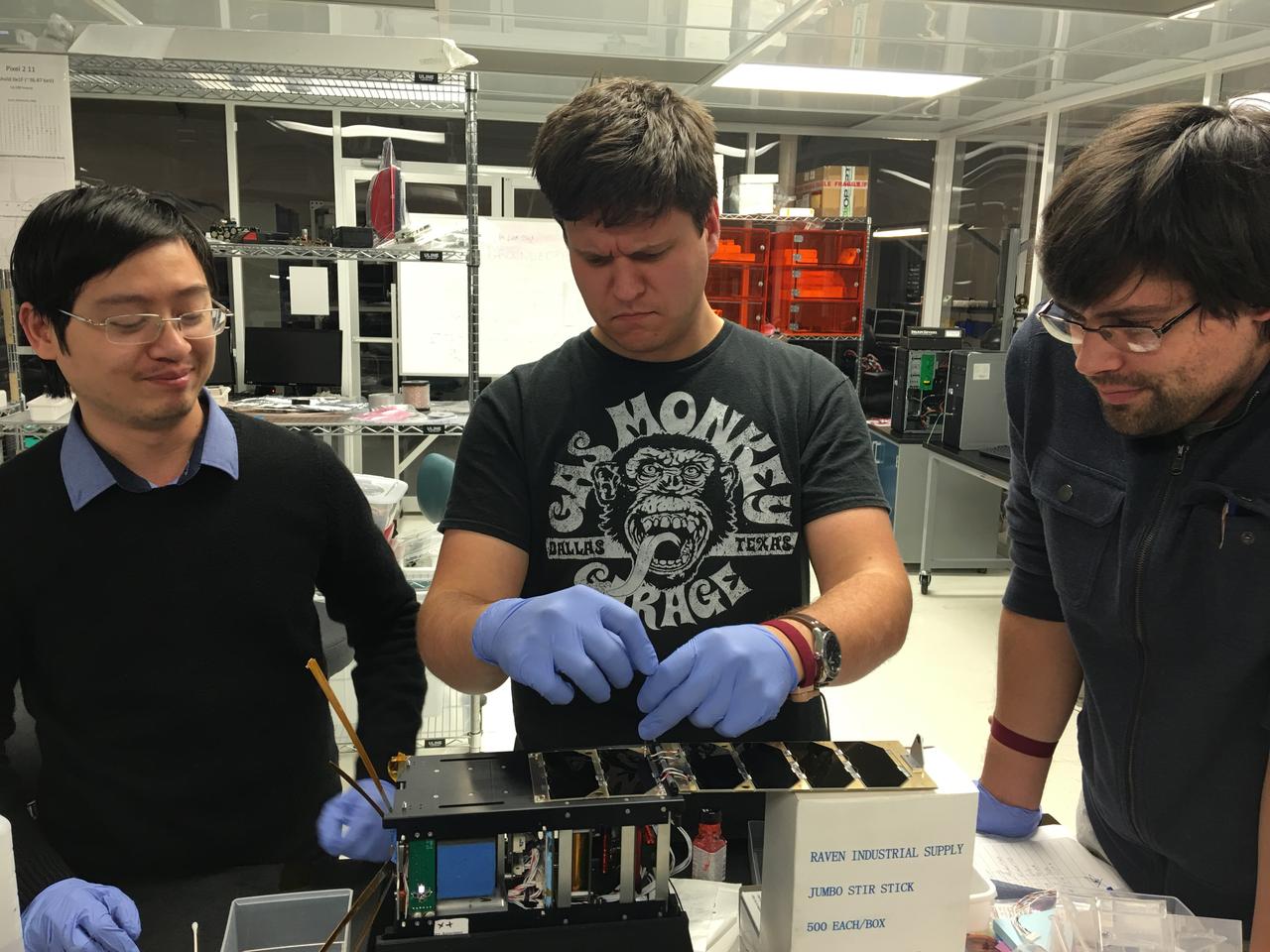
CXBN-2 Integration Team in the Morehead State University Spacecraft Integration and Assembly Facility. Left to right: Kein Dant, Yevgeniy Byleborodov, and Nate Richard. The Cosmic X-Ray Background NanoSat-2 (CXBN-2) CubeSat Mission developed by Morehead State University and its partners the Keldysh Institute (Moscow, Russia), the Maysville Community and Technical College (Morehead, KY) and KYSpace LLC (Lexington, KY) will increase the precision of measurements of the Cosmic X-Ray Background in the 30-50 keV range to a precision of <5%, thereby constraining models that attempt to explain the relative contribution of proposed sources lending insight into the underlying physics of the early universe. The mission addresses a fundamental science question that is central to our understanding of the structure, origin, and evolution of the universe by potentially lending insight into both the high-energy background radiation and into the evolution of primordial galaxies. Launched by NASA’s CubeSat Launch Initiative NET April 18, 2017 ELaNa XVII mission on the seventh Orbital-ATK Cygnus Commercial Resupply Services (OA-7) to the International Space Station and deployed on tbd.

KENNEDY SPACE CENTER, Fla. - The Galaxy Evolution Explorer (GALEX) spacecraft is lifted toward a work stand (in the foreground). Foreign object debris shields will be installed before its launch. The GALEX is an orbiting space telescope that will observe galaxies in ultraviolet light across 10 billion years of cosmic history. During its 29-month mission GALEX will produce the first comprehensive map of a Universe of galaxies under construction, bringing more understanding how galaxies like the Milky Way were formed. The GALEX launch date is under review.

KENNEDY SPACE CENTER, FLA. - Foreign object debris shields are installed and a borescope inspection is conducted on the Galaxy Evolution Explorer (GALEX) spacecraft in the Payload Hazardous Servicing Facility. Technicians are looking for a small fastener and associated clip missing from a demated connector identified during preflight testing. GALEX is an orbiting space telescope that will observe galaxies in ultraviolet light across 10 billion years of cosmic history. During its 29-month mission, GALEX will produce the first comprehensive map of a Universe of galaxies under construction, bringing more understanding to how galaxies like the Milky Way were formed. The GALEX launch date in late April is currently under review.
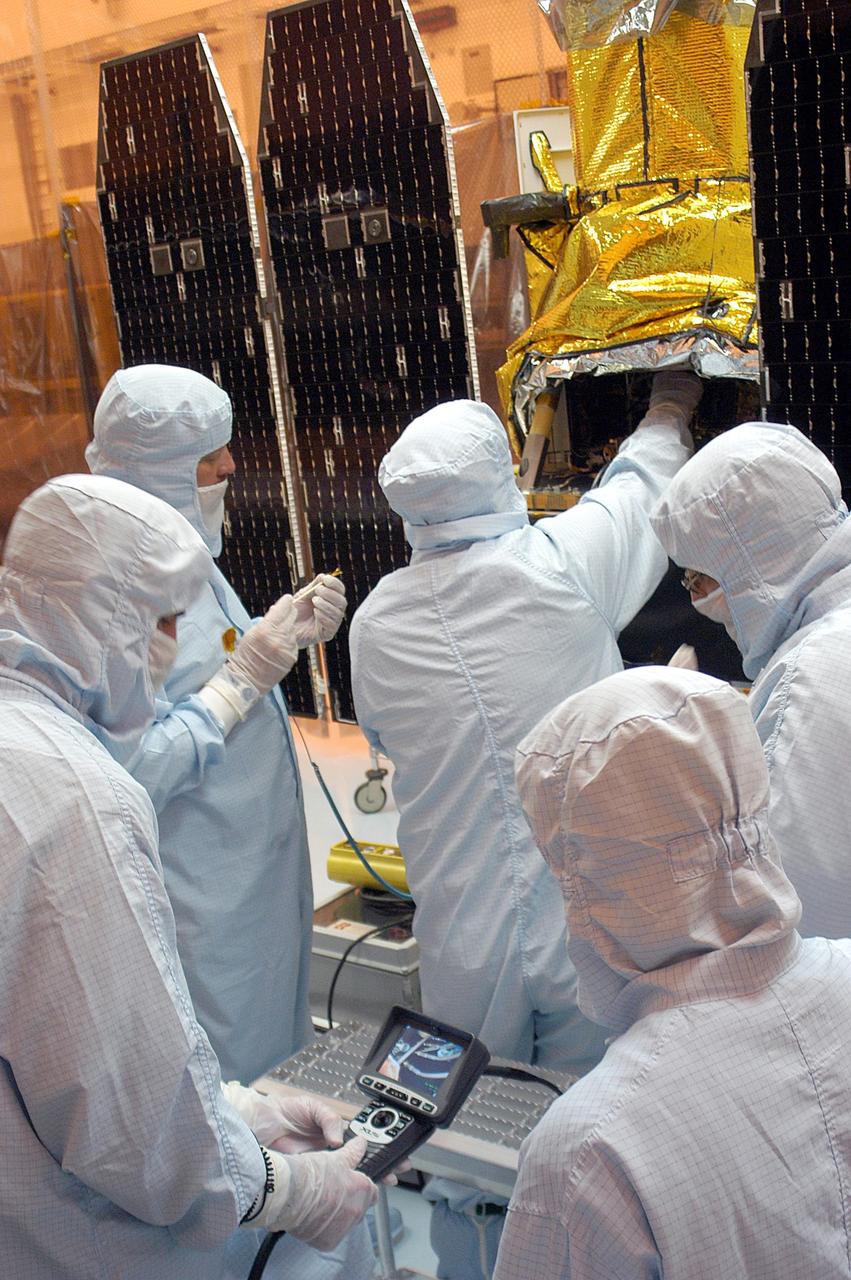
KENNEDY SPACE CENTER, FLA. - Foreign object debris shields are installed and a borescope inspection is conducted on the Galaxy Evolution Explorer (GALEX) spacecraft in the Payload Hazardous Servicing Facility. Technicians are looking for a small fastener and associated clip missing from a demated connector identified during preflight testing. GALEX is an orbiting space telescope that will observe galaxies in ultraviolet light across 10 billion years of cosmic history. During its 29-month mission, GALEX will produce the first comprehensive map of a Universe of galaxies under construction, bringing more understanding to how galaxies like the Milky Way were formed. The GALEX launch date in late April is currently under review.
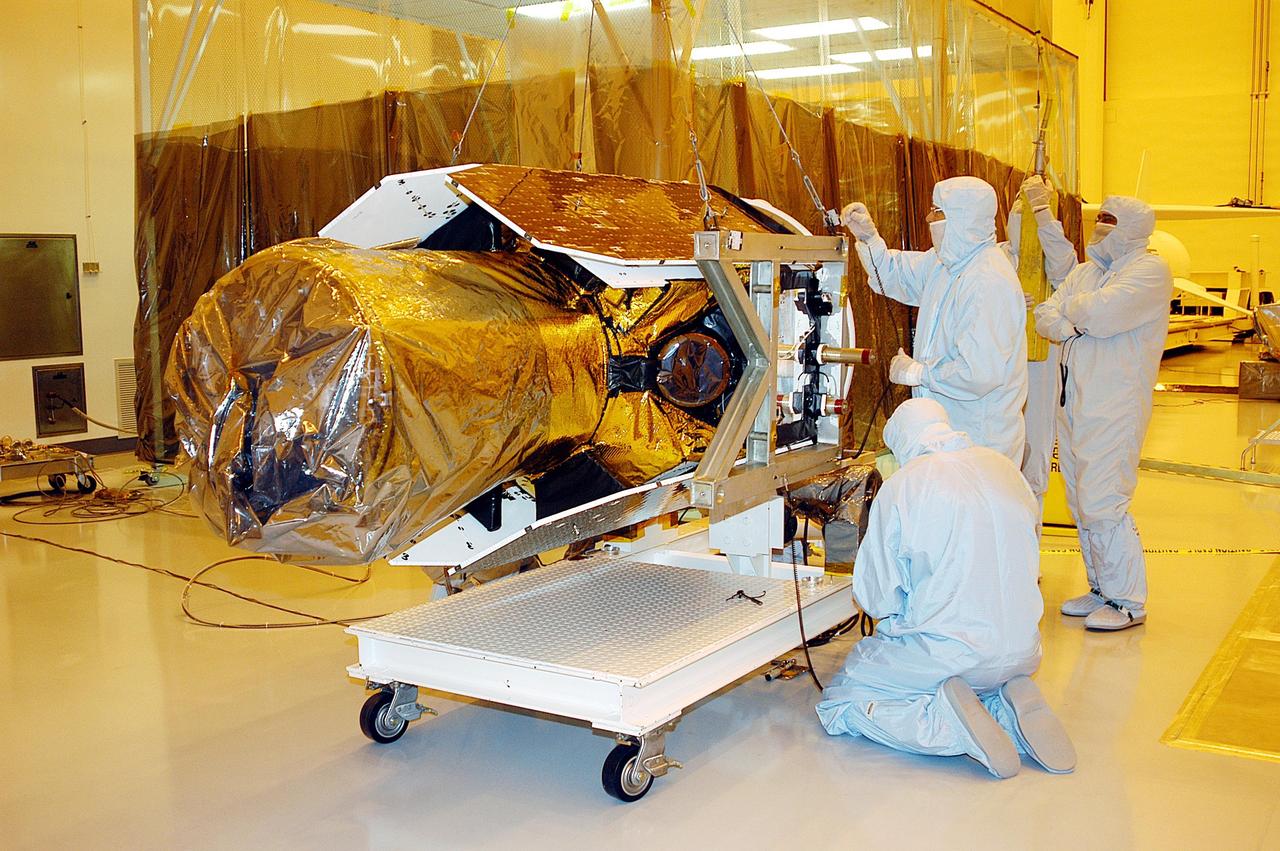
KENNEDY SPACE CENTER, FLA. - The Galaxy Evolution Explorer (GALEX) spacecraft is demated from its Pegasus launch vehicle and secured to a workstand in the Payload Hazardous Servicing Facility. A borescope inspection will be conducted to locate a small fastener and associated clip missing from a demated connector identified during preflight testing. GALEX is an orbiting space telescope that will observe galaxies in ultraviolet light across 10 billion years of cosmic history. During its 29-month mission, GALEX will produce the first comprehensive map of a Universe of galaxies under construction, bringing more understanding to how galaxies like the Milky Way were formed. The GALEX launch date in late April is currently under review.
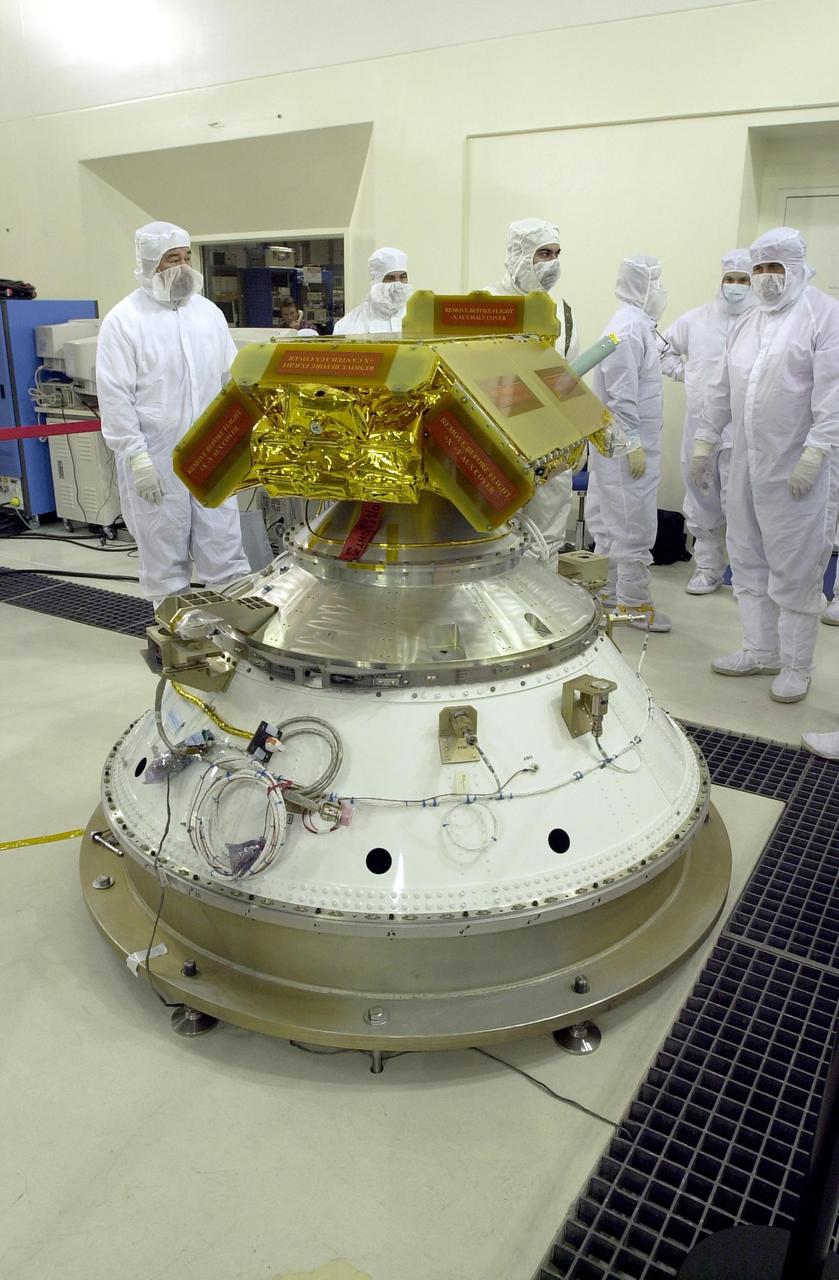
KENNEDY SPACE CENTER, FLA. - The Cosmic Hot Interstellar Plasma Spectrometer, or CHIPSat, undergoes final processing before launch. CHIPSat, a suitcase-size 131-pound satellite, will provide invaluable information into the origin, physical processes and properties of the hot gas contained in the interstellar medium. This can provide important clues about the formation and evolution of galaxies since the interstellar medium literally contains the seeds of future stars. CHIPSat is scheduled for launch, with the Ice, Cloud, and Land Elevation Satellite (ICESat), on a Delta II expendable launch vehicle from Vandenberg Air Force Base, Calif., on Jan. 11, 2003, between 4:45 p.m. - 5:30 p.m. PST.
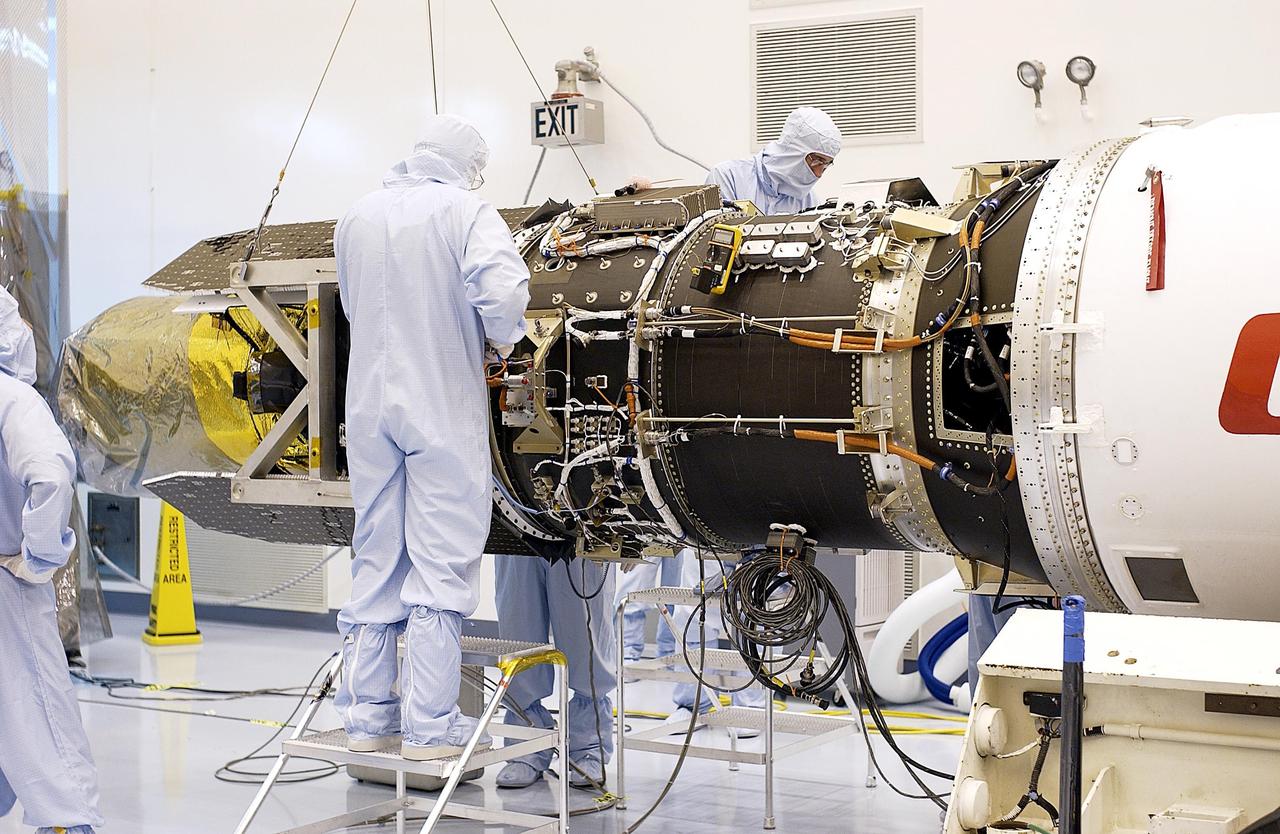
KENNEDY SPACE CENTER, FLA. - Workers in the Multi-Payload Processing Facility prepare to demate the Galaxy Evolution Explorer (GALEX) spacecraft from the Pegasus XL launch vehicle. Foreign object debris shields will be installed before its launch. The GALEX is an orbiting space telescope that will observe galaxies in ultraviolet light across 10 billion years of cosmic history. During its 29-month mission GALEX will produce the first comprehensive map of a Universe of galaxies under construction, bringing more understanding how galaxies like the Milky Way were formed. The GALEX launch date is under review.
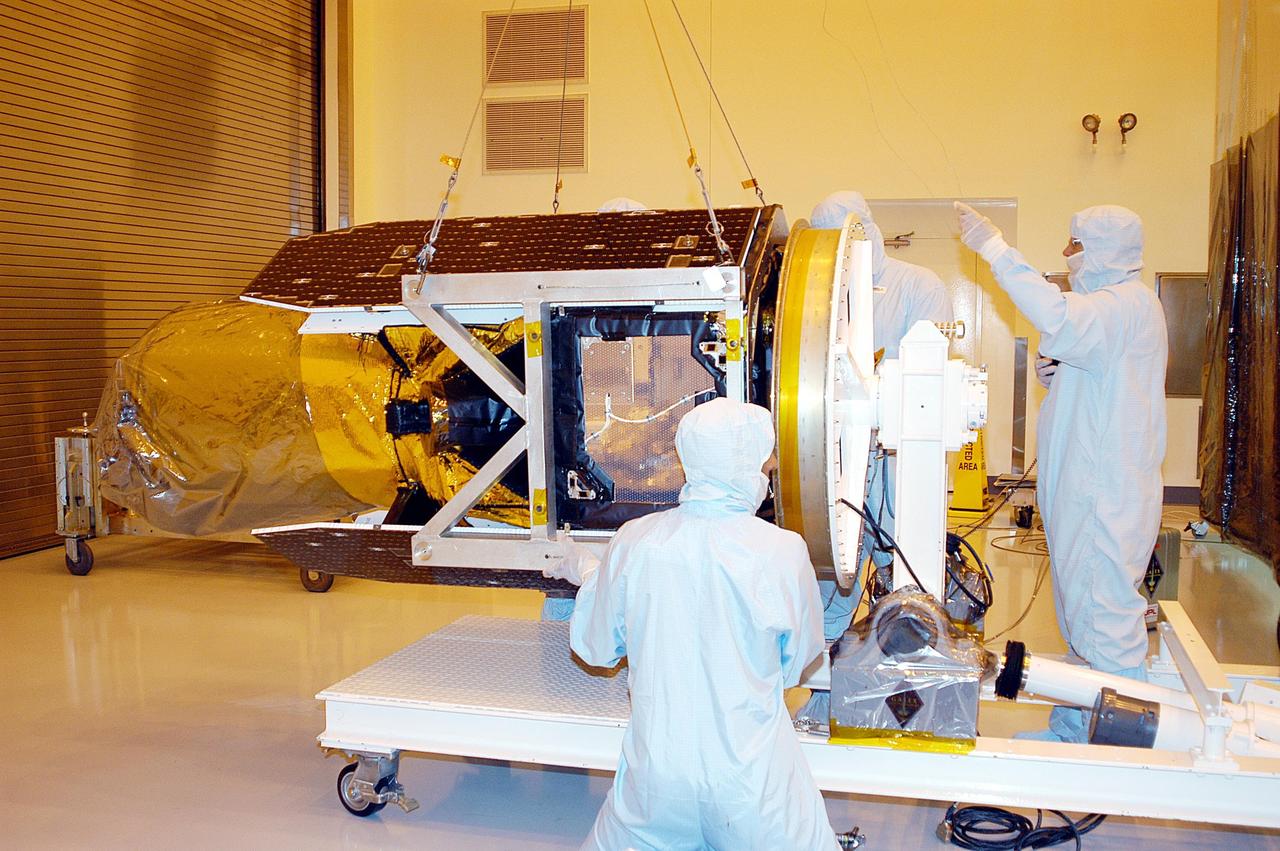
KENNEDY SPACE CENTER, FLA. - The Galaxy Evolution Explorer (GALEX) spacecraft is demated from its Pegasus launch vehicle and secured to a workstand in the Payload Hazardous Servicing Facility. A borescope inspection will be conducted to locate a small fastener and associated clip missing from a demated connector identified during preflight testing. GALEX is an orbiting space telescope that will observe galaxies in ultraviolet light across 10 billion years of cosmic history. During its 29-month mission, GALEX will produce the first comprehensive map of a Universe of galaxies under construction, bringing more understanding to how galaxies like the Milky Way were formed. The GALEX launch date in late April is currently under review.
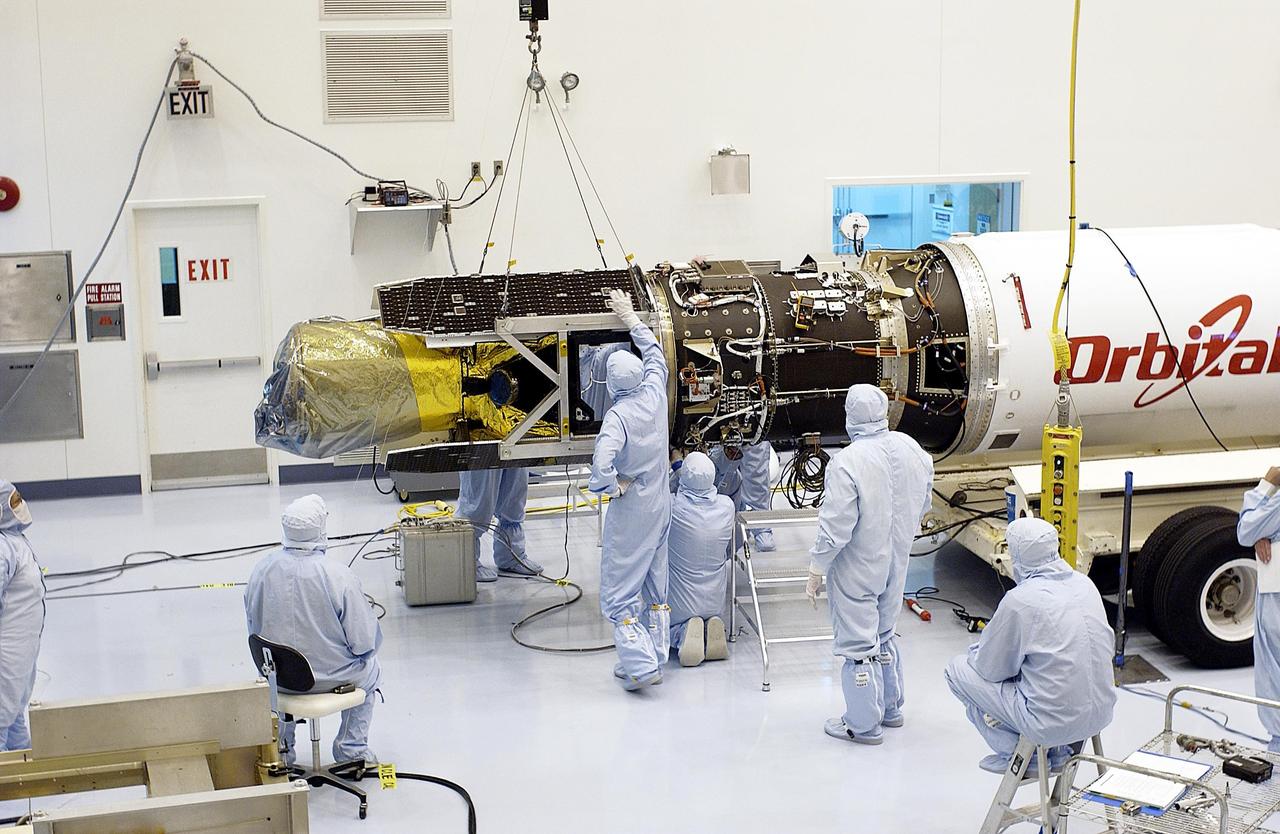
KENNEDY SPACE CENTER, Fla. - Workers in the Multi-Payload Processing Facility begin demating the Galaxy Evolution Explorer (GALEX) spacecraft from the Pegasus XL launch vehicle. Foreign object debris shields will be installed before its launch. The GALEX is an orbiting space telescope that will observe galaxies in ultraviolet light across 10 billion years of cosmic history. During its 29-month mission GALEX will produce the first comprehensive map of a Universe of galaxies under construction, bringing more understanding how galaxies like the Milky Way were formed. The GALEX launch date is under review.
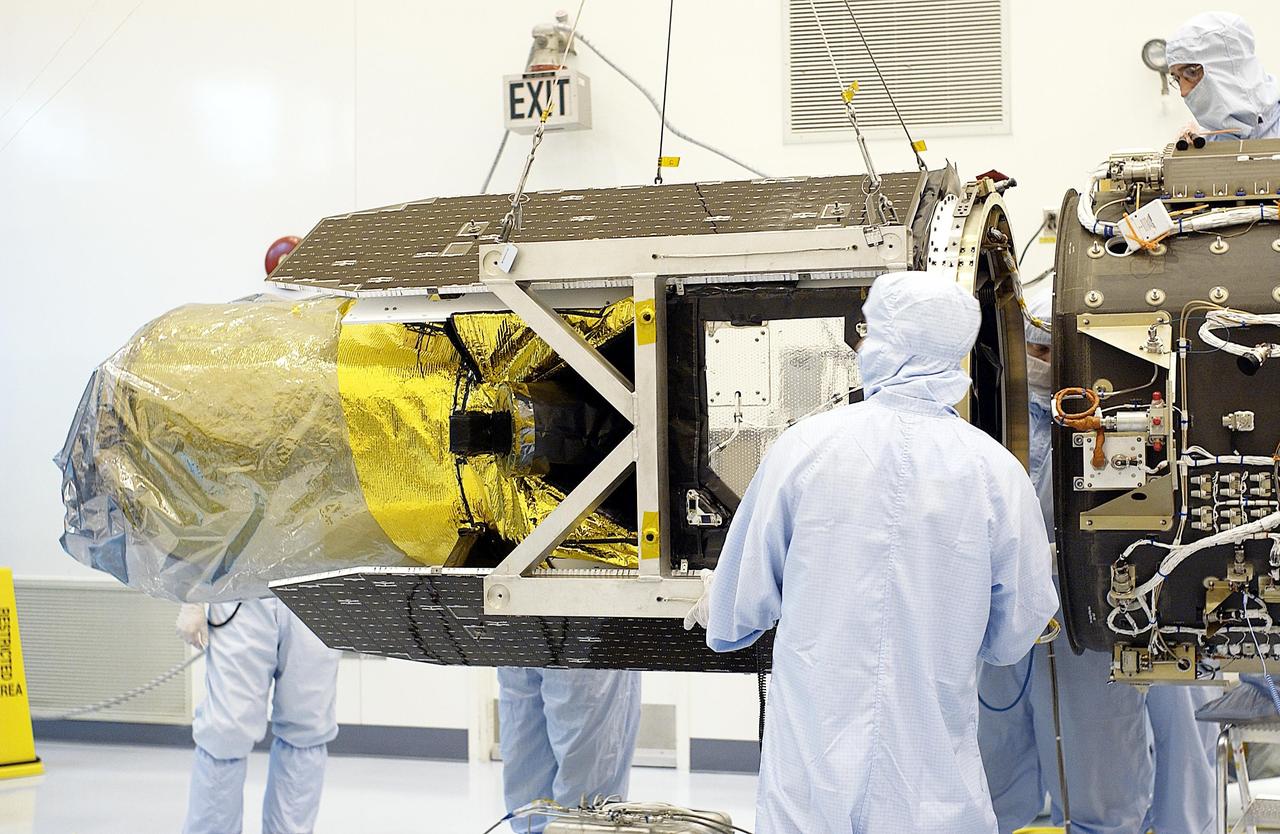
KENNEDY SPACE CENTER, Fla. - The Galaxy Evolution Explorer (GALEX) spacecraft is moved away from the Pegasus XL launch vehicle. Foreign object debris shields will be installed before its launch. The GALEX is an orbiting space telescope that will observe galaxies in ultraviolet light across 10 billion years of cosmic history. During its 29-month mission GALEX will produce the first comprehensive map of a Universe of galaxies under construction, bringing more understanding how galaxies like the Milky Way were formed. The GALEX launch date is under review.
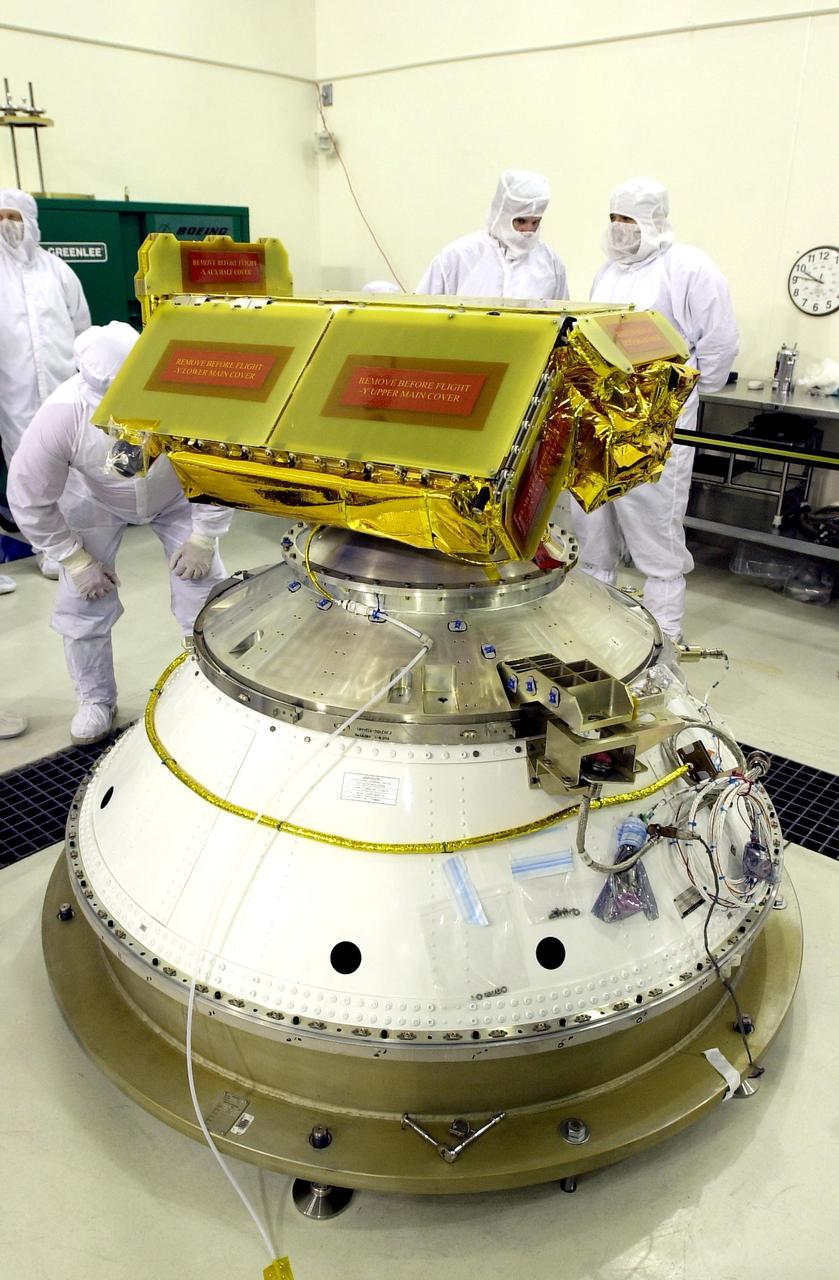
KENNEDY SPACE CENTER, FLA. - The Cosmic Hot Interstellar Plasma Spectrometer, or CHIPSat, undergoes final processing before launch. CHIPSat, a suitcase-size 131-pound satellite, will provide invaluable information into the origin, physical processes and properties of the hot gas contained in the interstellar medium. This can provide important clues about the formation and evolution of galaxies since the interstellar medium literally contains the seeds of future stars. CHIPSat is scheduled for launch, with the Ice, Cloud, and Land Elevation Satellite (ICESat), on a Delta II expendable launch vehicle from Vandenberg Air Force Base, Calif., on Jan. 11, 2003, between 4:45 p.m. - 5:30 p.m. PST.
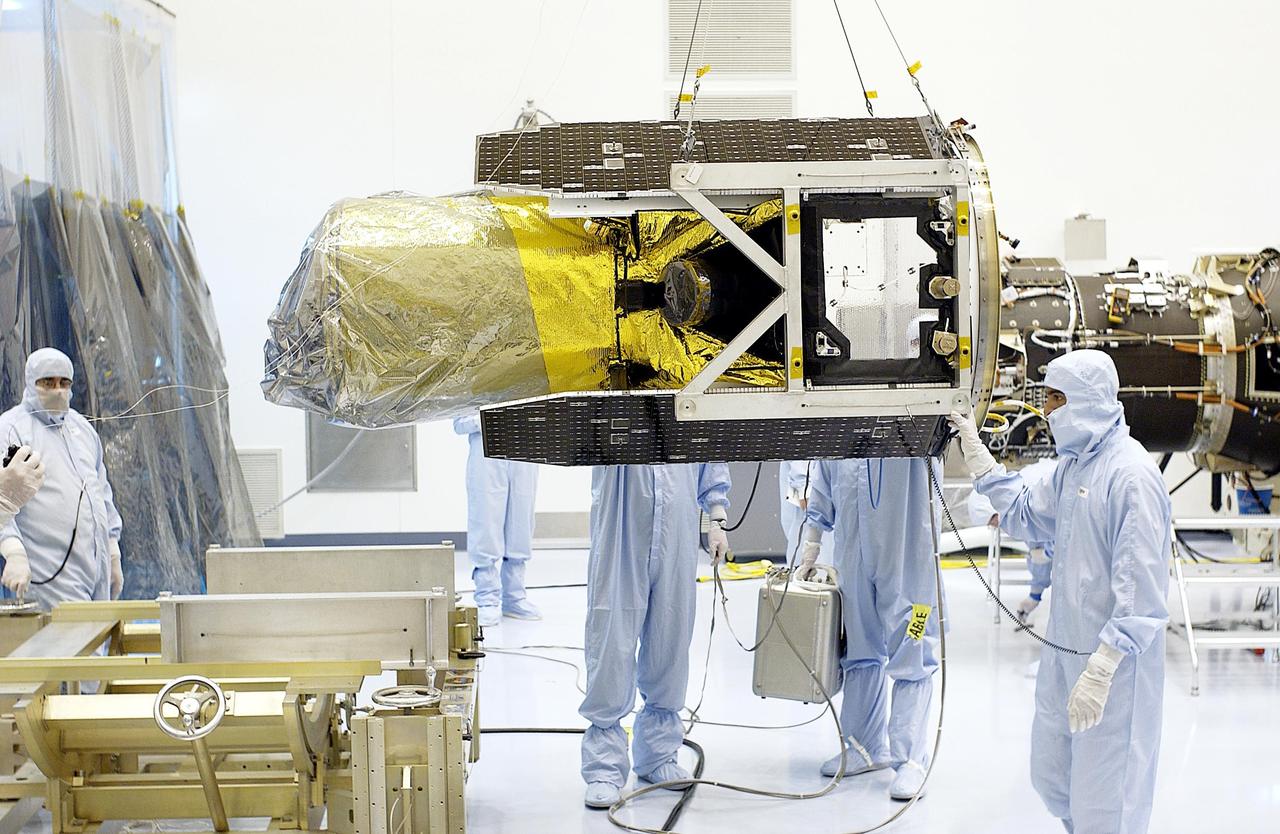
KENNEDY SPACE CENTER, Fla. - The Galaxy Evolution Explorer (GALEX) spacecraft is moved toward a work stand (in the foreground). Foreign object debris shields will be installed before its launch. The GALEX is an orbiting space telescope that will observe galaxies in ultraviolet light across 10 billion years of cosmic history. During its 29-month mission GALEX will produce the first comprehensive map of a Universe of galaxies under construction, bringing more understanding how galaxies like the Milky Way were formed. The GALEX launch date is under review.

KENNEDY SPACE CENTER, Fla. - The Galaxy Evolution Explorer (GALEX) spacecraft is lifted away from the Pegasus XL launch vehicle after demating. Foreign object debris shields will be installed before its launch. The GALEX is an orbiting space telescope that will observe galaxies in ultraviolet light across 10 billion years of cosmic history. During its 29-month mission GALEX will produce the first comprehensive map of a Universe of galaxies under construction, bringing more understanding how galaxies like the Milky Way were formed. The GALEX launch date is under review.
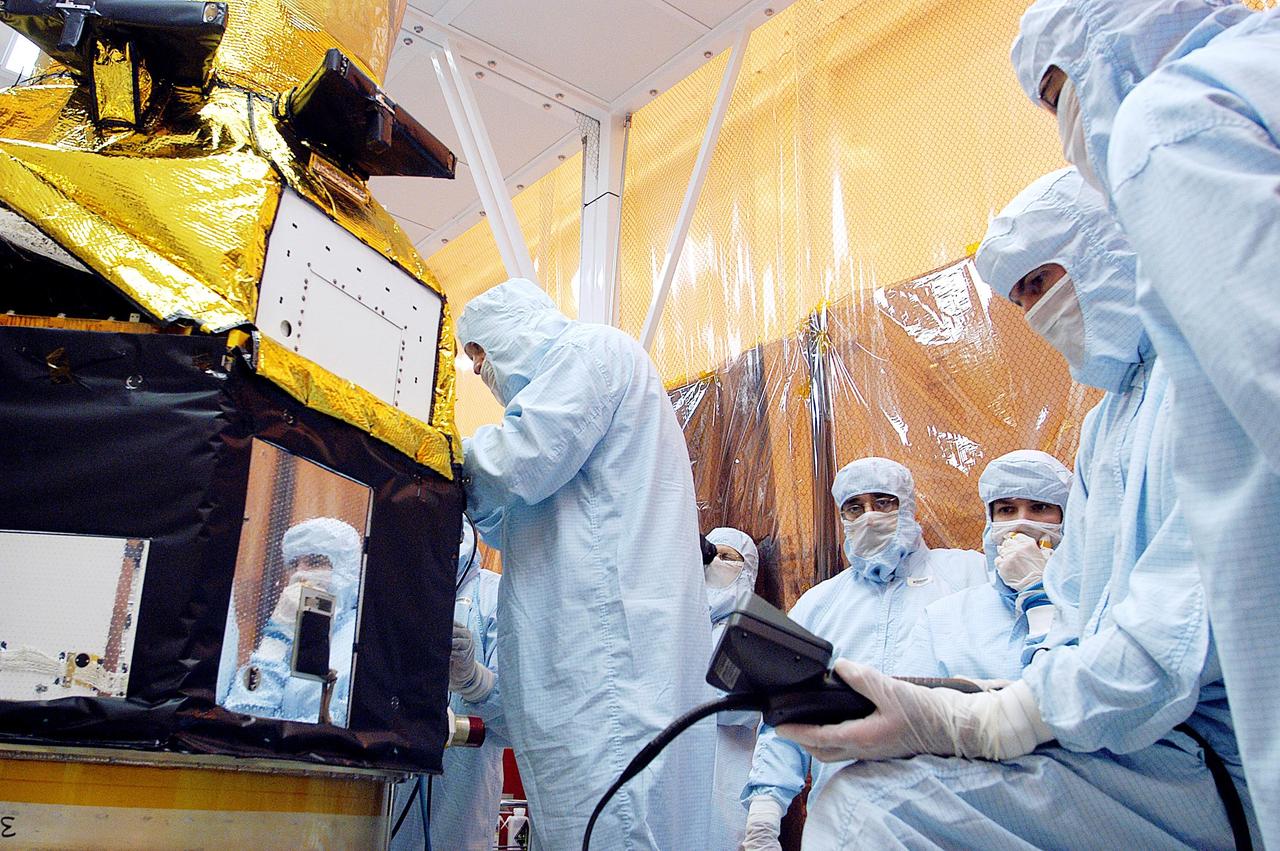
KENNEDY SPACE CENTER, FLA. - Foreign object debris shields are installed and a borescope inspection is conducted on the Galaxy Evolution Explorer (GALEX) spacecraft in the Payload Hazardous Servicing Facility. Technicians are looking for a small fastener and associated clip missing from a demated connector identified during preflight testing. GALEX is an orbiting space telescope that will observe galaxies in ultraviolet light across 10 billion years of cosmic history. During its 29-month mission, GALEX will produce the first comprehensive map of a Universe of galaxies under construction, bringing more understanding to how galaxies like the Milky Way were formed. The GALEX launch date in late April is currently under review.
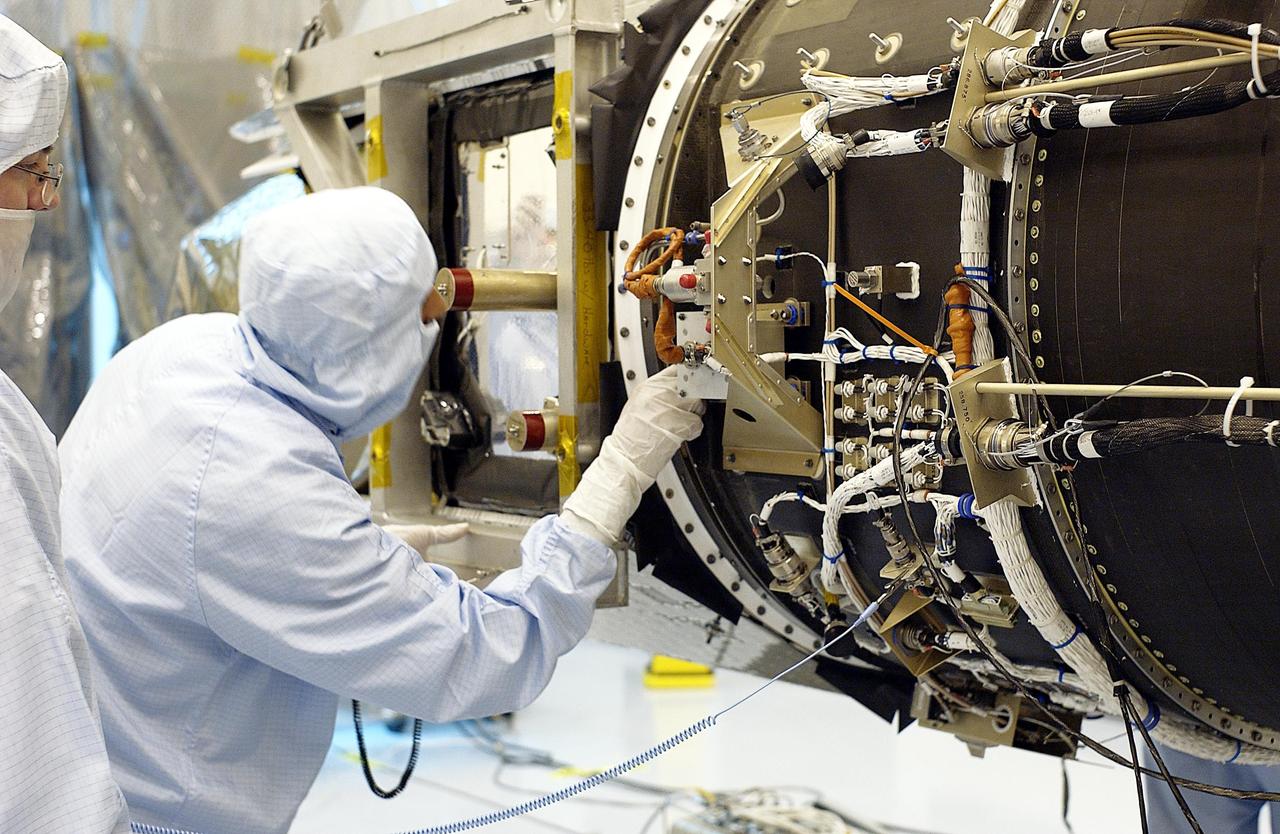
KENNEDY SPACE CENTER, Fla. - Workers in the Multi-Payload Processing Facility check the Galaxy Evolution Explorer (GALEX) spacecraft as it is removed from the Pegasus XL launch vehicle. Foreign object debris shields will be installed before its launch. The GALEX is an orbiting space telescope that will observe galaxies in ultraviolet light across 10 billion years of cosmic history. During its 29-month mission GALEX will produce the first comprehensive map of a Universe of galaxies under construction, bringing more understanding how galaxies like the Milky Way were formed. The GALEX launch date is under review.
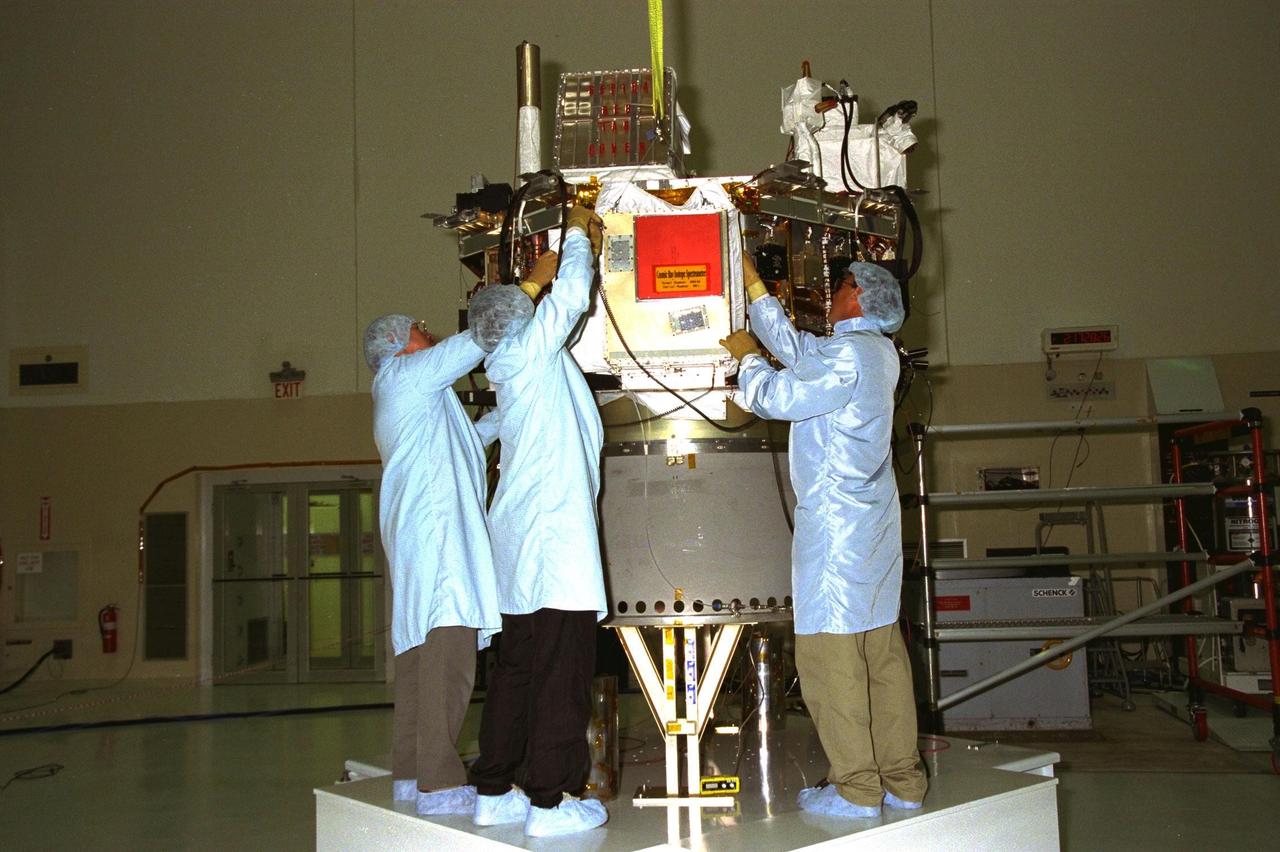
Workers from the Johns Hopkins University’s Applied Physics Laboratory (APL) install the Cosmic Ray Isotope Spectrometer (CRIS) on the Advanced Composition Explorer (ACE) spacecraft in KSC’s Spacecraft Assembly and Encapsulation Facility-2 (SAEF-2). From left, are Al Sadilek, Marcos Gonzalez and Cliff Willey. CRIS is one of nine instruments on ACE, which will investigate the origin and evolution of solar phenomenon, the formation of the solar corona, solar flares and the acceleration of the solar wind. ACE was developed for NASA by the APL. The spacecraft is scheduled to be launched Aug. 21 aboard a two-stage Delta II 7920-8 rocket from Space Launch Complex 17, Pad A

KENNEDY SPACE CENTER, FLA. - Foreign object debris shields are installed and a borescope inspection is conducted on the Galaxy Evolution Explorer (GALEX) spacecraft in the Payload Hazardous Servicing Facility. Technicians are looking for a small fastener and associated clip missing from a demated connector identified during preflight testing. GALEX is an orbiting space telescope that will observe galaxies in ultraviolet light across 10 billion years of cosmic history. During its 29-month mission, GALEX will produce the first comprehensive map of a Universe of galaxies under construction, bringing more understanding to how galaxies like the Milky Way were formed. The GALEX launch date in late April is currently under review.
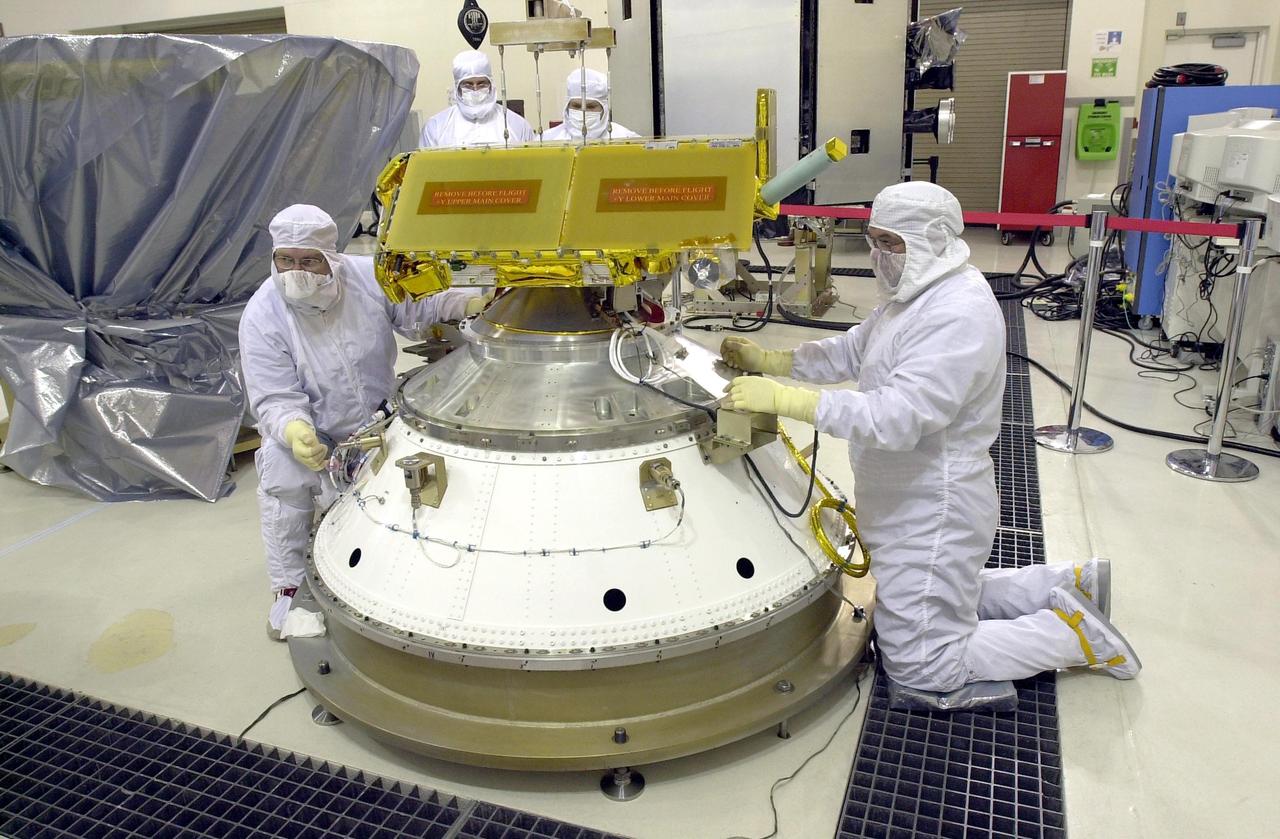
KENNEDY SPACE CENTER, FLA. - The Cosmic Hot Interstellar Plasma Spectrometer, or CHIPSat, undergoes final processing before launch. CHIPSat, a suitcase-size 131-pound satellite, will provide invaluable information into the origin, physical processes and properties of the hot gas contained in the interstellar medium. This can provide important clues about the formation and evolution of galaxies since the interstellar medium literally contains the seeds of future stars. CHIPSat is scheduled for launch, with the Ice, Cloud, and Land Elevation Satellite (ICESat), on a Delta II expendable launch vehicle from Vandenberg Air Force Base, Calif., on Jan. 11, 2003, between 4:45 p.m. - 5:30 p.m. PST.
KENNEDY SPACE CENTER, FLA. - The Cosmic Hot Interstellar Plasma Spectrometer, or CHIPSat, undergoes final processing before launch. CHIPSat, a suitcase-size 131-pound satellite, will provide invaluable information into the origin, physical processes and properties of the hot gas contained in the interstellar medium. This can provide important clues about the formation and evolution of galaxies since the interstellar medium literally contains the seeds of future stars. CHIPSat is scheduled for launch, with the Ice, Cloud, and Land Elevation Satellite (ICESat), on a Delta II expendable launch vehicle from Vandenberg Air Force Base, Calif., on Jan. 11, 2003, between 4:45 p.m. - 5:30 p.m. PST.
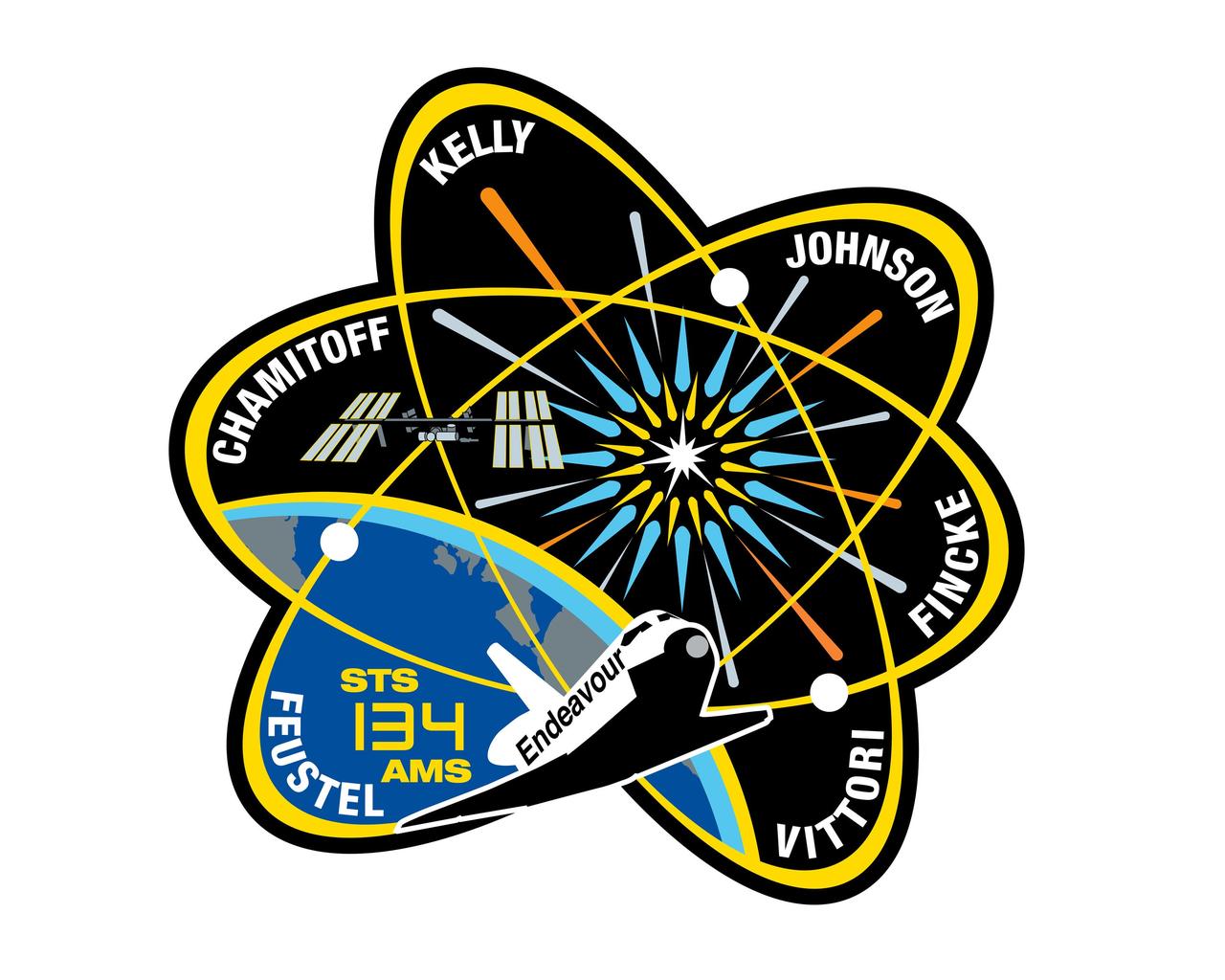
STS134-S-001 (March 2010) --- The design of the STS-134 crew patch highlights research on the International Space Station (ISS) focusing on the fundamental physics of the universe. On this mission, the crew of space shuttle Endeavour will install the Alpha Magnetic Spectrometer-2 (AMS) experiment -- a cosmic particle detector that utilizes the first-ever superconducting magnet to be flown in space. By studying sub-atomic particles in the background cosmic radiation, and searching for anti-matter and dark-matter, it will help scientists better understand the evolution and properties of our universe. The shape of the patch is inspired by the international atomic symbol, and represents the atom with orbiting electrons around the nucleus. The burst near the center refers to the big-bang theory and the origin of the universe. The shuttle Endeavour and ISS fly together into the sunrise over the limb of Earth, representing the dawn of a new age, understanding the nature of the universe. The NASA insignia design for shuttle flights is reserved for use by the astronauts and for other official use as the NASA administrator may authorize. Public availability has been approved only in the form of illustrations by the various news media. When and if there is any change in this policy, which we do not anticipate, it will be publicly announced.

STS134-S-001 (March 2010) --- The design of the STS-134 crew patch highlights research on the International Space Station (ISS) focusing on the fundamental physics of the universe. On this mission, the crew of the space shuttle Endeavour will install the Alpha Magnetic Spectrometer (AMS) experiment - a cosmic particle detector. By studying subatomic particles in the background cosmic radiation and searching for antimatter, dark-matter, and dark energy, it will help scientists better understand the evolution and properties of our universe. The shape of the patch is inspired by the international atomic symbol, and represents the atom with orbiting electrons around the nucleus. The burst near the center refers to the origin of the universe. The space shuttle Endeavour and ISS fly together into the sunrise over the limb of the Earth, representing the dawn of a new age?understanding the nature of the universe. The NASA insignia design for space shuttle flights is reserved for use by the astronauts and for other official use as the NASA Administrator may authorize. Public availability has been approved only in the forms of illustrations by the various news media. When and if there is any change in this policy, which is not anticipated, the change will be publicly announced. Photo credit: NASA
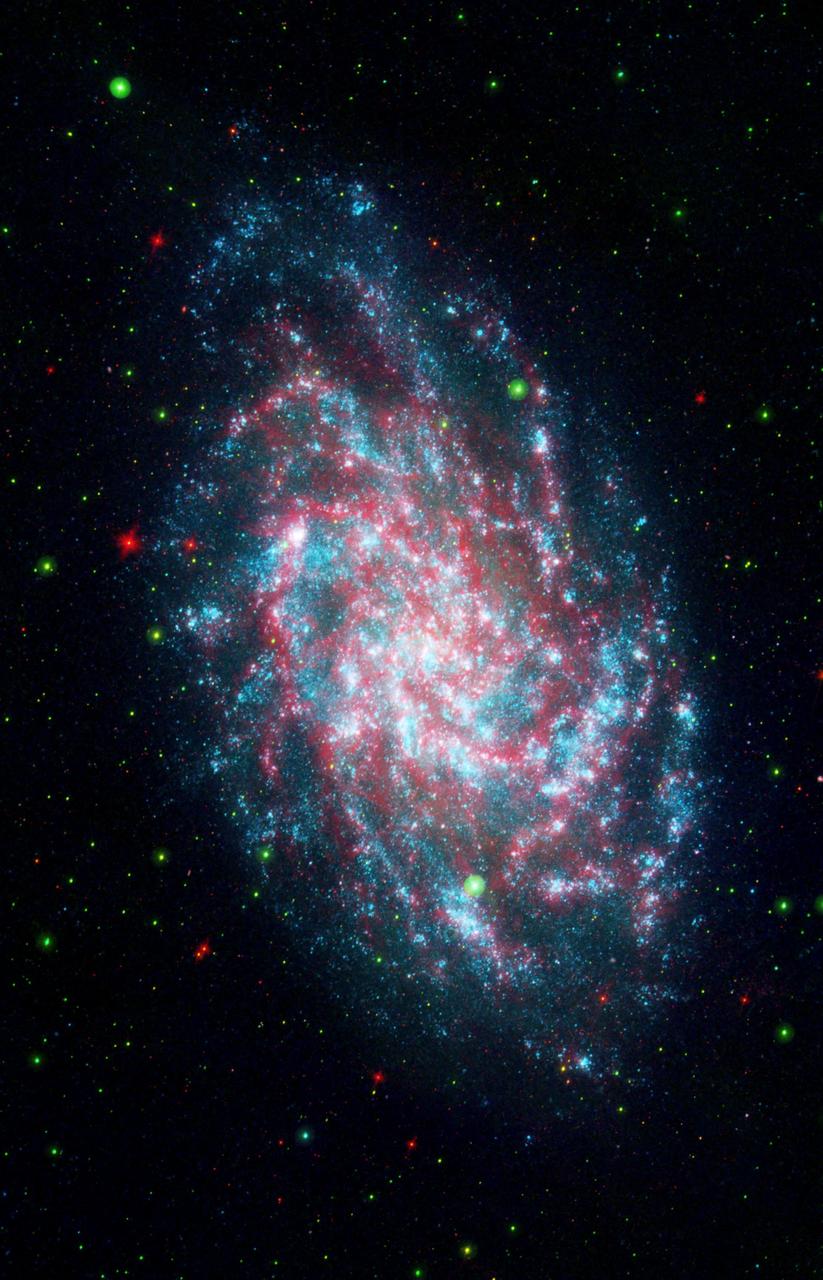
NASA Galaxy Evolution Explorer Mission celebrates its sixth anniversary studying galaxies beyond our Milky Way through its sensitive ultraviolet telescope, the only such far-ultraviolet detector in space. Pictured here, the galaxy NGC598 known as M33. The mission studies the shape, brightness, size and distance of distant galaxies across 10 billion years of cosmic history, giving scientists a wealth of data to help us better understand the origins of the universe. One such object is pictured here, the galaxy NGC598, more commonly known as M33. This image is a blend of the Galaxy Evolution Explorer's M33 image and another taken by NASA's Spitzer Space Telescope. M33, one of our closest galactic neighbors, is about 2.9 million light-years away in the constellation Triangulum, part of what's known as our Local Group of galaxies. Together, the Galaxy Evolution Explorer and Spitzer can see a broad spectrum of sky. Spitzer, for example, can detect mid-infrared radiation from dust that has absorbed young stars' ultraviolet light. That's something the Galaxy Evolution Explorer cannot see. This combined image shows in amazing detail the beautiful and complicated interlacing of the heated dust and young stars. In some regions of M33, dust gathers where there is very little far-ultraviolet light, suggesting that the young stars are obscured or that stars farther away are heating the dust. In some of the outer regions of the galaxy, just the opposite is true: There are plenty of young stars and very little dust. Far-ultraviolet light from young stars glimmers blue, near-ultraviolet light from intermediate age stars glows green, and dust rich in organic molecules burns red. This image is a 3-band composite including far infrared as red. http://photojournal.jpl.nasa.gov/catalog/PIA11998
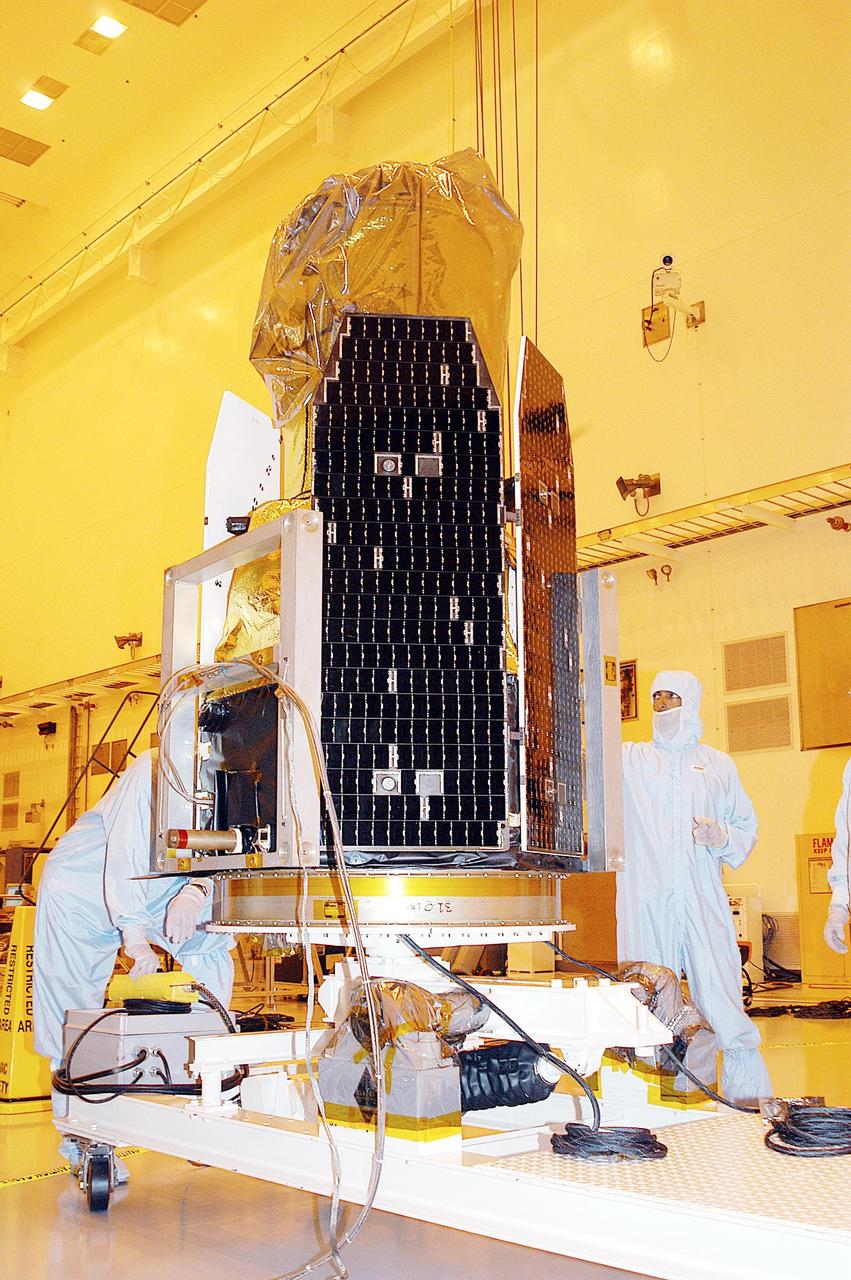
KENNEDY SPACE CENTER, FLA. - Technicians lift the Galaxy Evolution Explorer (GALEX) spacecraft into a vertical position after it is demated from its Pegasus launch vehicle in the Payload Hazardous Servicing Facility. A borescope inspection will be conducted to locate a small fastener and associated clip missing from a demated connector identified during preflight testing. GALEX is an orbiting space telescope that will observe galaxies in ultraviolet light across 10 billion years of cosmic history. During its 29-month mission, GALEX will produce the first comprehensive map of a Universe of galaxies under construction, bringing more understanding to how galaxies like the Milky Way were formed. The GALEX launch date in late April is currently under review.
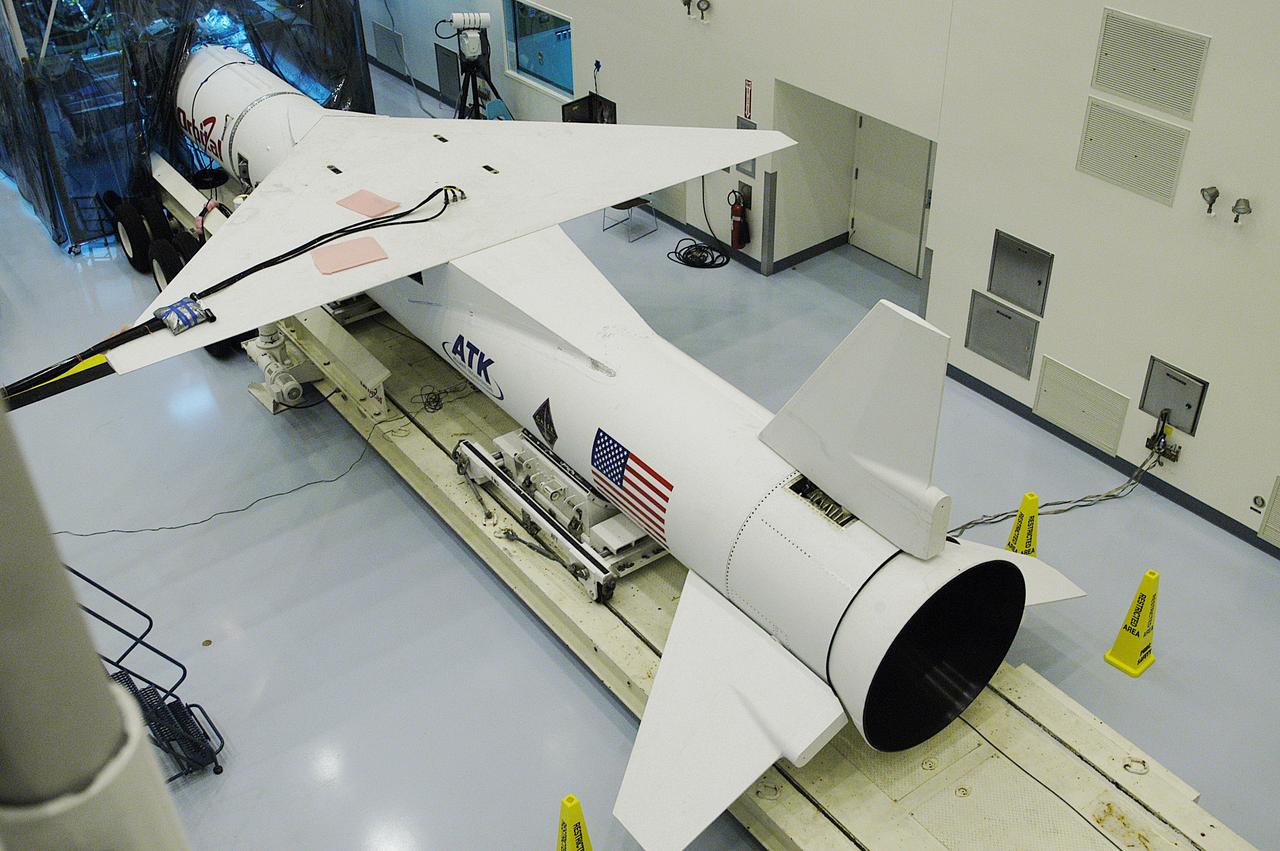
In the Multi-Payload Processing Facility, the Pegasus XL launch vehicle is in position for mating of the Galaxy Evolution Explorer (GALEX) satellite. The GALEX, set to launch April 2 from Cape Canaveral Air Force Station, will carry into space an orbiting telescope that will observe a million galaxies across 10 billion years of cosmic history to help astronomers determine when the stars and elements we see today had their origins. The spacecraft will sweep the skies for 28 months using state-of-the-art ultraviolet detectors to single out galaxies dominated by young, hot, short-lived stars that give off a great deal of energy at that wavelength. These galaxies are actively creating stars, and therefore provide a window into the history and causes of star formation in galaxies.
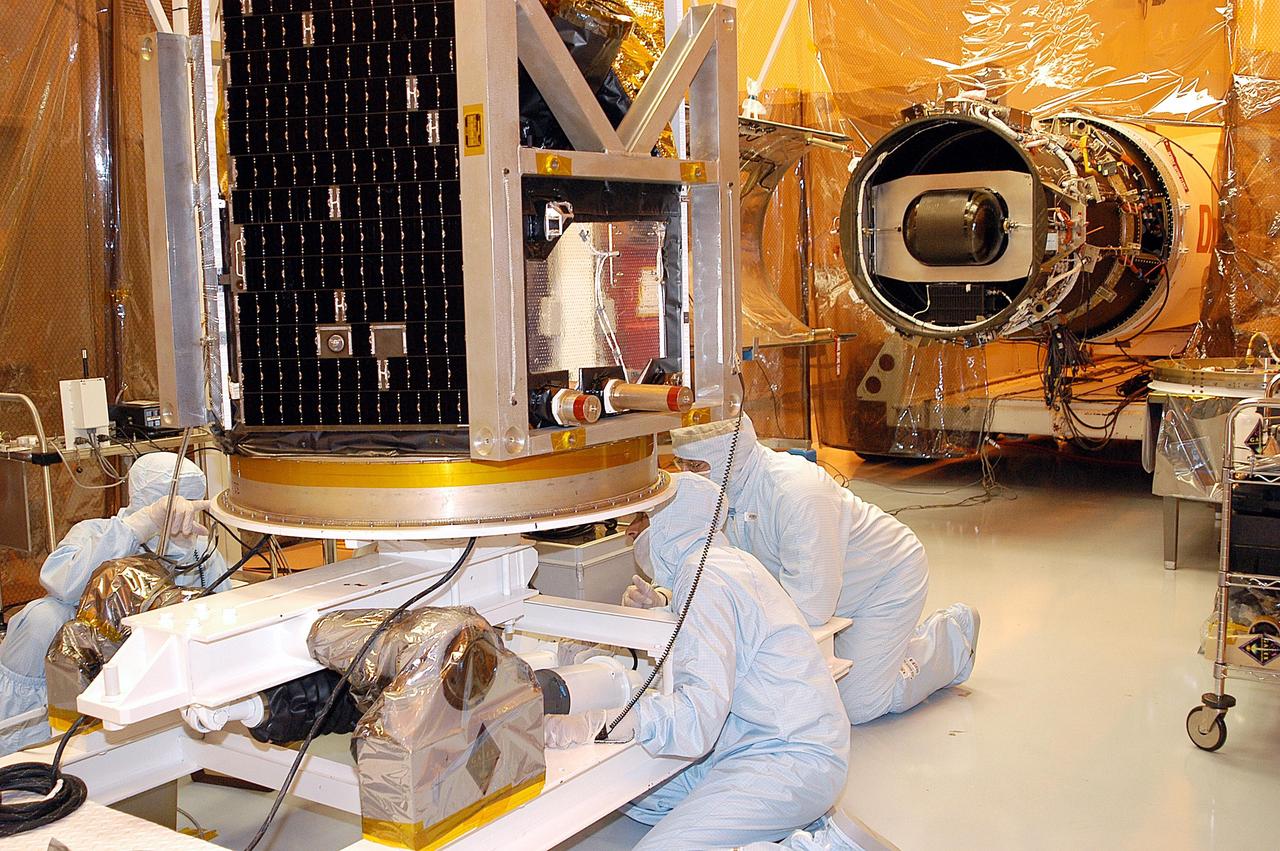
KENNEDY SPACE CENTER, FLA. - Technicians verify that the Galaxy Evolution Explorer (GALEX) spacecraft is secure on its workstand after being moved into a vertical position in the Payload Hazardous Servicing Facility. On the right is the Pegasus launch vehicle from which it was demated. A borescope inspection will be conducted on the spacecraft to locate a small fastener and associated clip missing from a demated connector identified during preflight testing. GALEX is an orbiting space telescope that will observe galaxies in ultraviolet light across 10 billion years of cosmic history. During its 29-month mission, GALEX will produce the first comprehensive map of a Universe of galaxies under construction, bringing more understanding to how galaxies like the Milky Way were formed. The GALEX launch date in late April is currently under review.
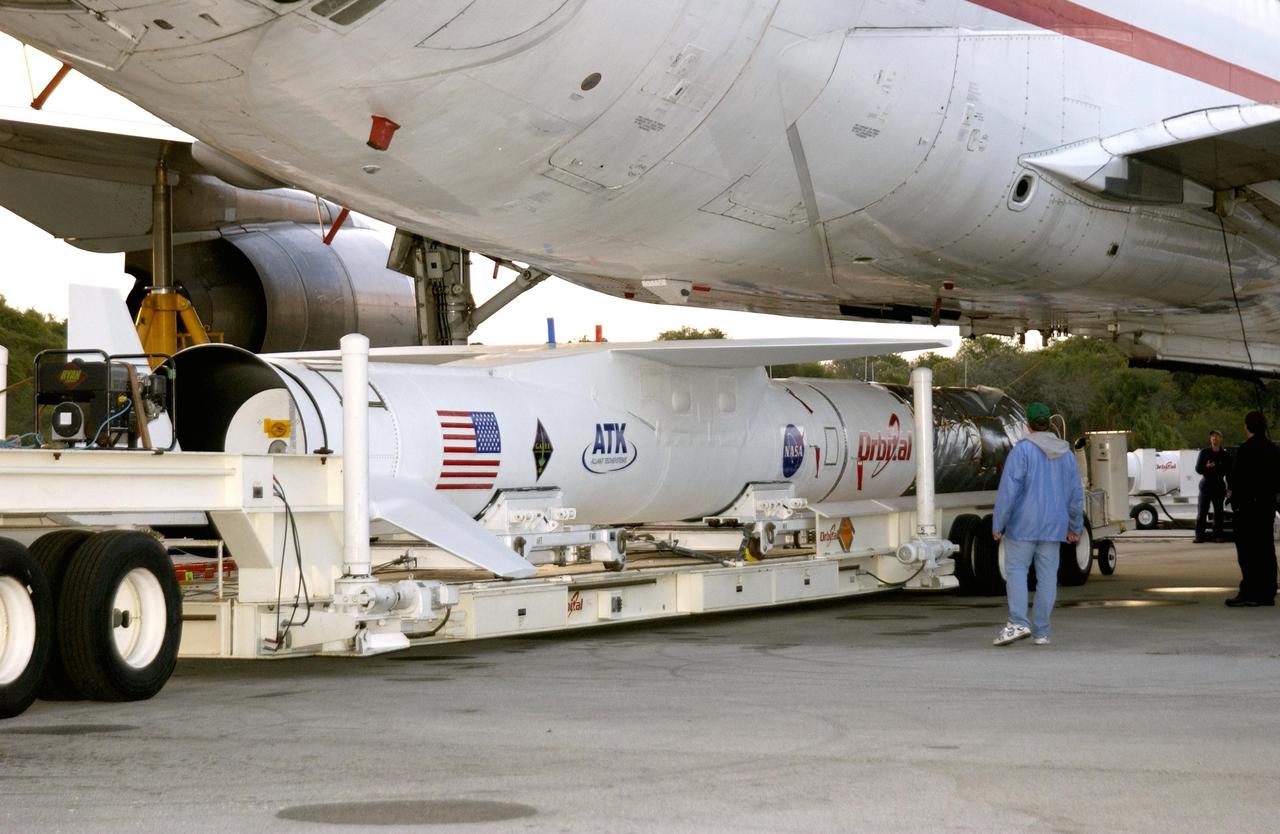
KENNEDY SPACE CENTER, FLA. - The mated Pegasus XL and Galaxy Evolution Explorer (GALEX) satellite move under the Orbital Sciences L-1011 aircraft at Cape Canaveral Air Force Station. The GALEX, to be launched April 28 from the L-1011, will carry into space an orbiting telescope that will observe a million galaxies across 10 billion years of cosmic history to help astronomers determine when the stars and elements we see today had their origins. The spacecraft will sweep the skies for 28 months using state-of-the-art ultraviolet detectors to single out galaxies dominated by young, hot, short-lived stars that give off a great deal of energy at that wavelength. These galaxies are actively creating stars, and therefore provide a window into the history and causes of star formation in galaxies.
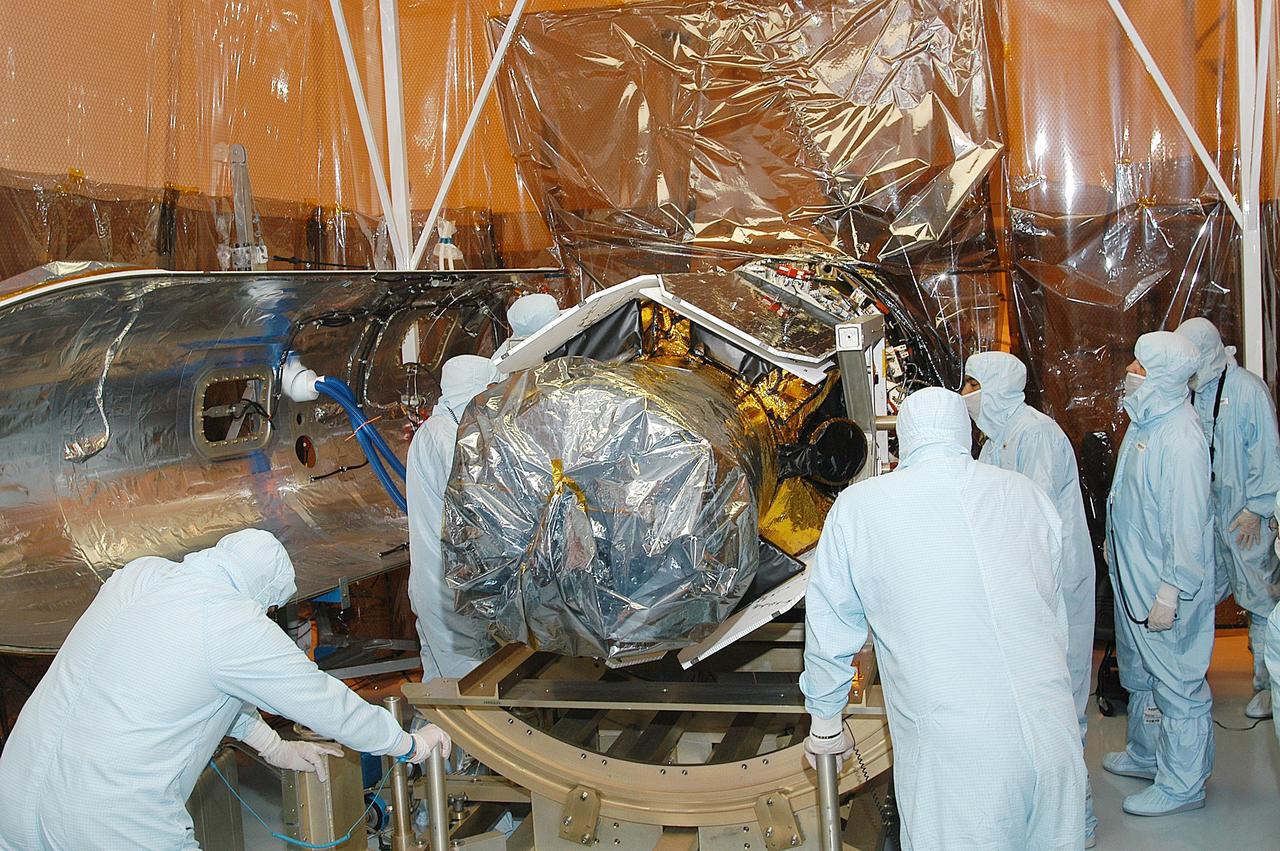
KENNEDY SPACE CENTER, FLA. -- In the Multi-Payload Processing Facility, NASA's Galaxy Evolution Explorer is prepared for mating with the Pegasus XL launch vehicle. The GALEX, set to launch April 2 from Cape Canaveral Air Force Station, will carry into space an orbiting telescope that will observe a million galaxies across 10 billion years of cosmic history to help astronomers determine when the stars and elements we see today had their origins. The spacecraft will sweep the skies for 28 months using state-of-the-art ultraviolet detectors to single out galaxies dominated by young, hot, short-lived stars that give off a great deal of energy at that wavelength. These galaxies are actively creating stars, and therefore provide a window into the history and causes of star formation in galaxies.
KENNEDY SPACE CENTER, FLA. -- -- In the Multi-Payload Processing Facility, NASA's Galaxy Evolution Explorer is prepared for mating with the Pegasus XL launch vehicle. The GALEX, set to launch April 2 from Cape Canaveral Air Force Station, will carry into space an orbiting telescope that will observe a million galaxies across 10 billion years of cosmic history to help astronomers determine when the stars and elements we see today had their origins. The spacecraft will sweep the skies for 28 months using state-of-the-art ultraviolet detectors to single out galaxies dominated by young, hot, short-lived stars that give off a great deal of energy at that wavelength. These galaxies are actively creating stars, and therefore provide a window into the history and causes of star formation in galaxies.
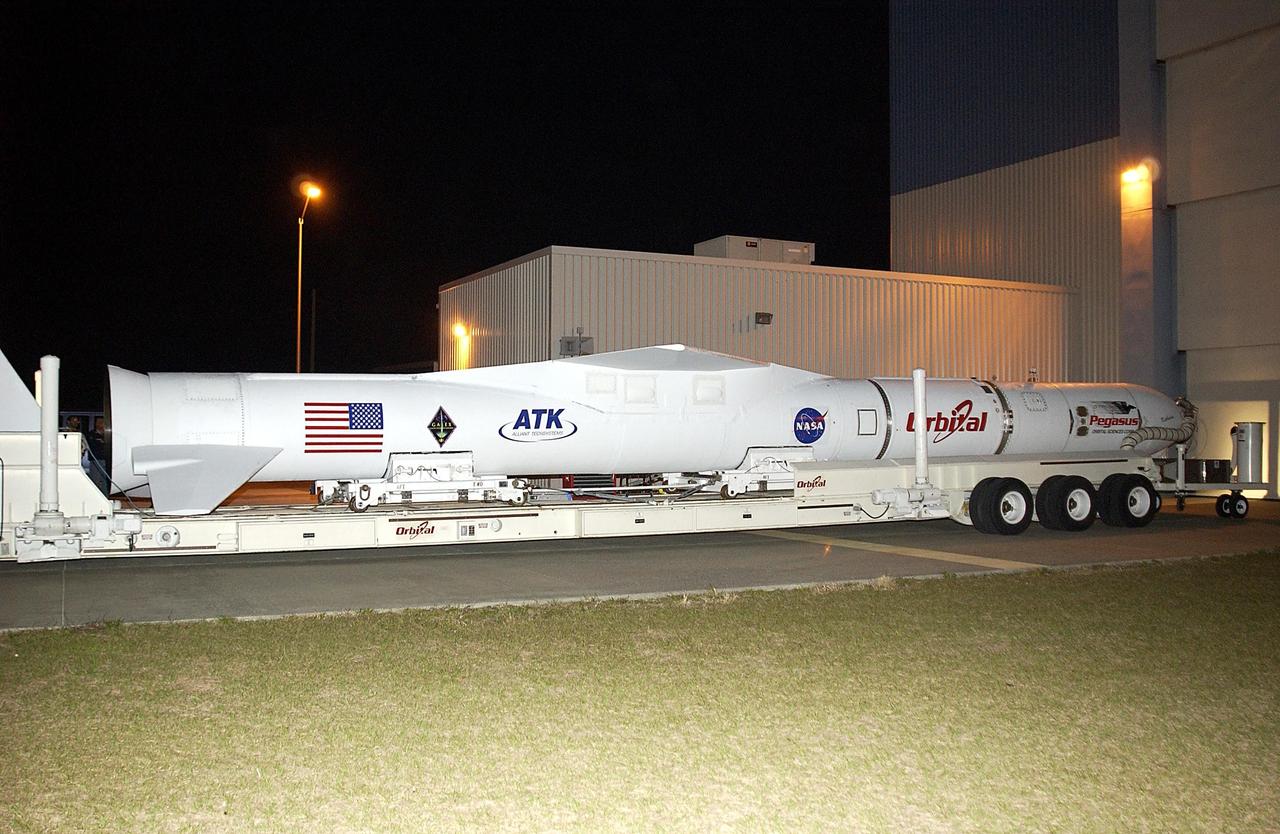
KENNEDY SPACE CENTER, FLA. - As darkness falls, the Pegasus launch vehicle arrives at the Multi-Payload Processing Facility (MPPF) at KSC. There it will be mated to the Galaxy Evolution Explorer (GALEX). The Pegasus will carry into orbit the GALEX, a space telescope that will observe galaxies in ultraviolet light across 10 billion years of cosmic history. Led by the California Institute of Technology, GALEX will conduct several first-of-a-kind sky surveys, including an extra-galactic (beyond our galaxy) ultraviolet all-sky survey. During its 29-month mission GALEX will produce the first comprehensive map of a Universe of galaxies under construction, bringing more understanding of how galaxies like the Milky Way were formed. GALEX is due to be launched from Cape Canaveral Air Force Station March 25.
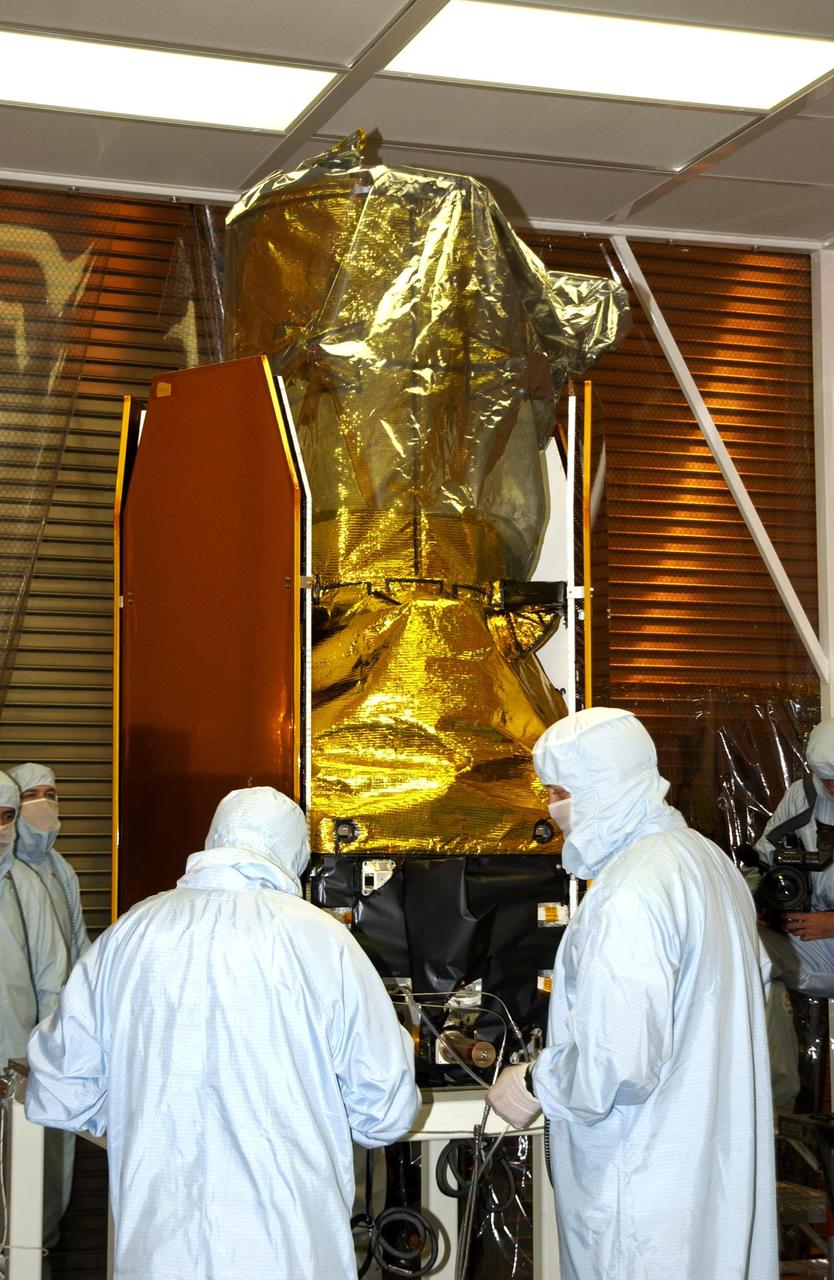
KENNEDY SPACE CENTER, FLA. -- In the Multi-Payload Processing Facility, the GALEX satellite has been moved to a rotation stand. The Galaxy Evolution Explorer (GALEX) is an orbiting space telescope that will observe galaxies in ultraviolet light across 10 billion years of cosmic history. Led by the California Institute of Technology, GALEX will conduct several first-of-a-kind sky surveys, including an extra-galactic (beyond our galaxy) ultraviolet all-sky survey. During its 29-month mission GALEX will produce the first comprehensive map of a Universe of galaxies under construction, bringing more understanding of how galaxies like the Milky Way were formed. GALEX is due to be launched from Cape Canaveral Air Force Station March 25 via a Pegasus rocket.
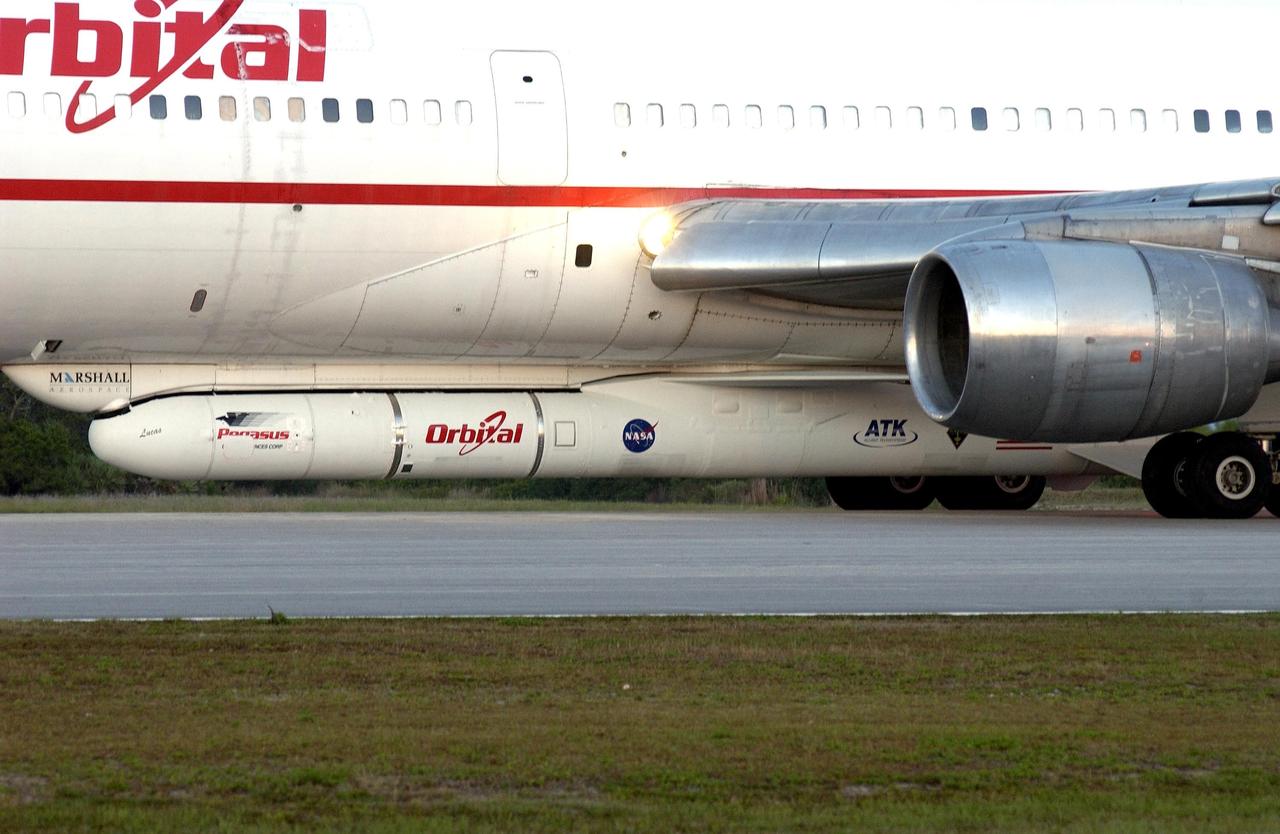
KENNEDY SPACE CENTER, FLA. - Orbital Sciences' L-1011 aircraft carries the Pegasus XL rocket/Galaxy Evolution Explorer (GALEX) under its belly. The aircraft is scheduled for takeoff in a window beginning at 7:50 a.m. and release of the Pegasus about 8 a.m. The GALEX will carry into space an orbiting telescope that will observe a million galaxies across 10 billion years of cosmic history to help astronomers determine when the stars and elements we see today had their origins. The spacecraft will sweep the skies for 28 months using state-of-the-art ultraviolet detectors to single out galaxies dominated by young, hot, short-lived stars that give off a great deal of energy at that wavelength. These galaxies are actively creating stars, and therefore provide a window into the history and causes of star formation in galaxies.
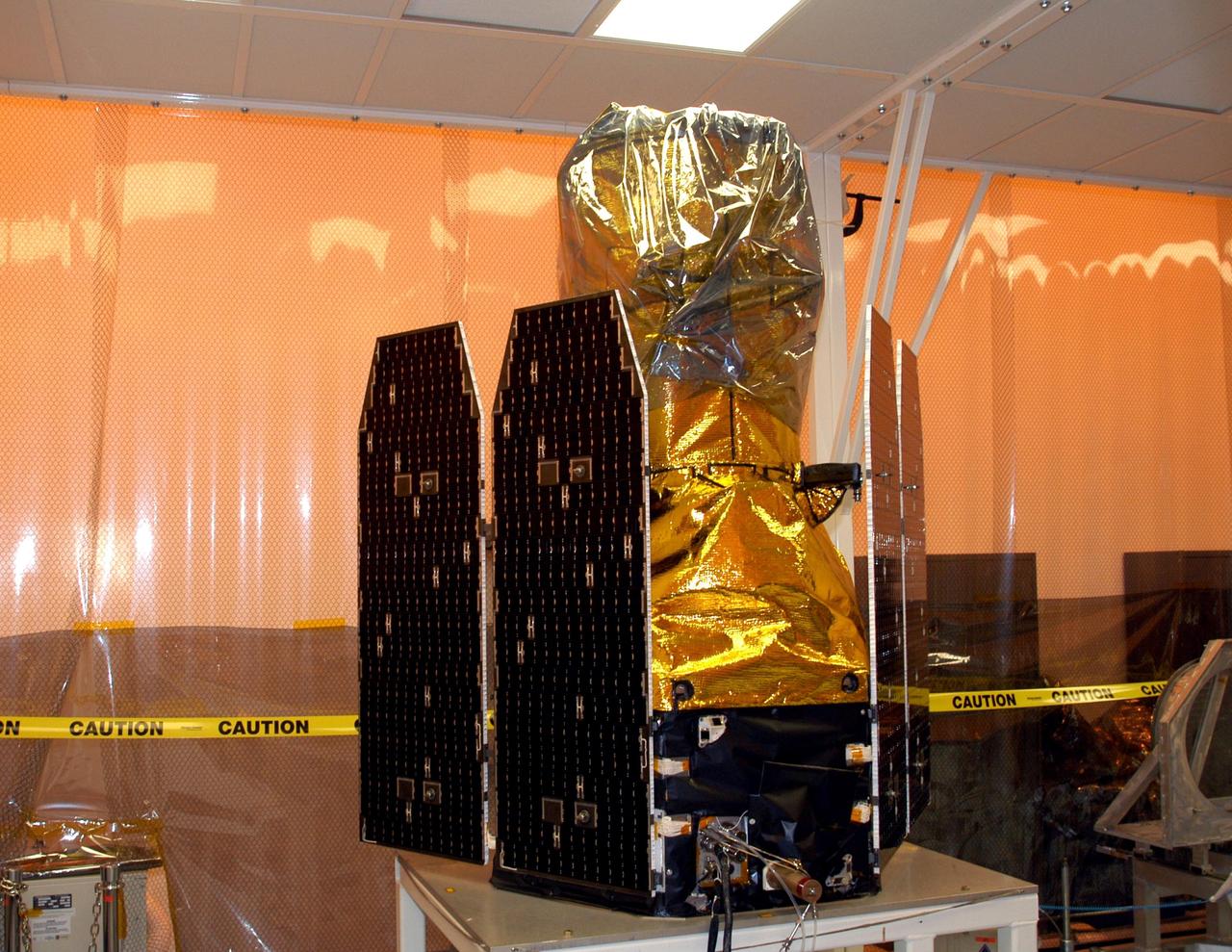
KENNEDY SPACE CENTER, FLA. - The Galaxy Evolution Explorer (GALEX) satellite is ready for deployment of its solar array panels during processing in the Multi-Payload Processing Facility. The GALEX is an orbiting space telescope that will observe galaxies in ultraviolet light across 10 billion years of cosmic history. Led by the California Institute of Technology, GALEX will conduct several first-of-a-kind sky surveys, including an extra-galactic (beyond our galaxy) ultraviolet all-sky survey. During its 29-month mission GALEX will produce the first comprehensive map of a Universe of galaxies under construction, bringing more understanding of how galaxies like the Milky Way were formed. GALEX is due to be launched from Cape Canaveral Air Force Station March 25 via a Pegasus rocket.
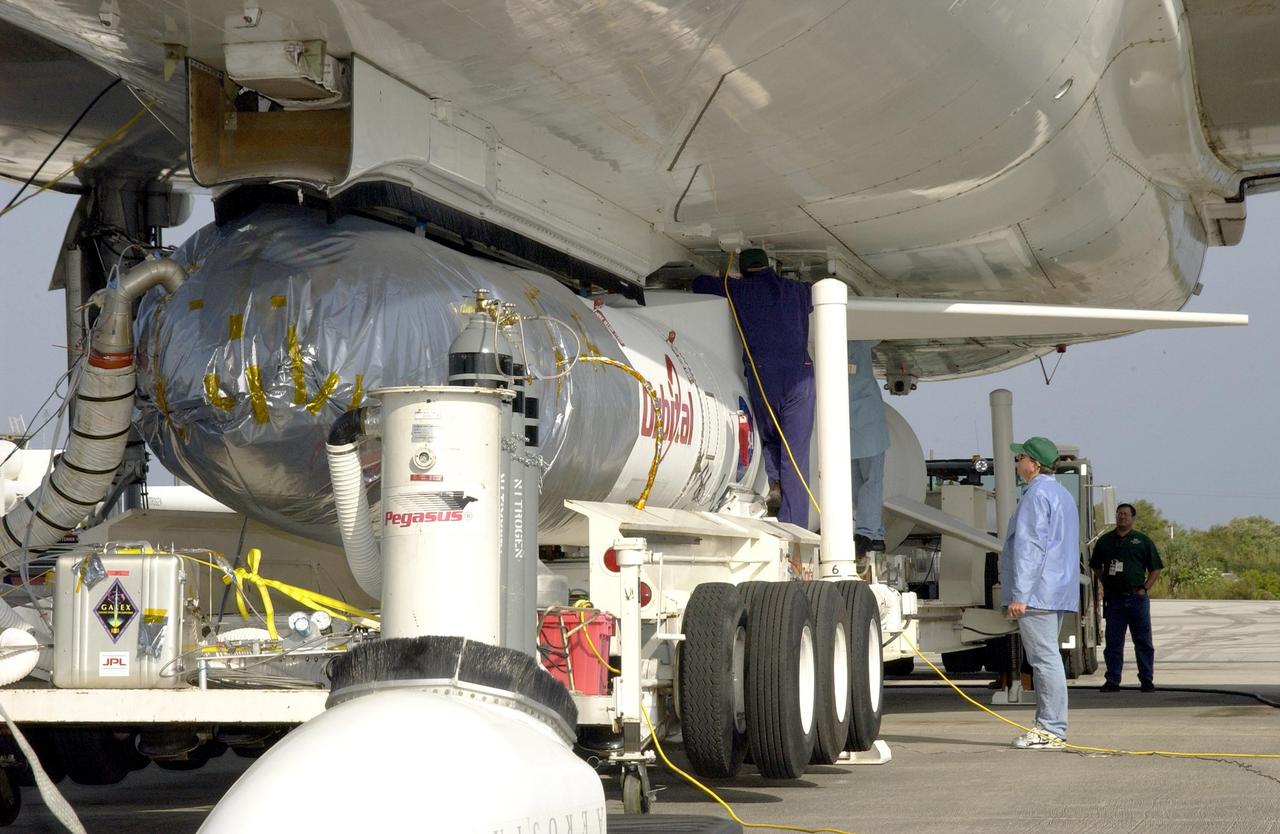
KENNEDY SPACE CENTER, FLA. - At Cape Canaveral Air Force Station, workers finish attaching the mated Pegasus XL and Galaxy Evolution Explorer (GALEX) satellite to the Orbital Sciences L-1011 aircraft. The GALEX, to be launched April 28 from the L-1011, will carry into space an orbiting telescope that will observe a million galaxies across 10 billion years of cosmic history to help astronomers determine when the stars and elements we see today had their origins. The spacecraft will sweep the skies for 28 months using state-of-the-art ultraviolet detectors to single out galaxies dominated by young, hot, short-lived stars that give off a great deal of energy at that wavelength. These galaxies are actively creating stars, and therefore provide a window into the history and causes of star formation in galaxies.

KENNEDY SPACE CENTER, FLA. - Workers in the Multi-Payload Processing Facility look over the GALEX satellite before solar array testing. The Galaxy Evolution Explorer (GALEX) is an orbiting space telescope that will observe galaxies in ultraviolet light across 10 billion years of cosmic history. Led by the California Institute of Technology, GALEX will conduct several first-of-a-kind sky surveys, including an extra-galactic (beyond our galaxy) ultraviolet all-sky survey. During its 29-month mission GALEX will produce the first comprehensive map of a Universe of galaxies under construction, bringing more understanding of how galaxies like the Milky Way were formed. GALEX is due to be launched from Cape Canaveral Air Force Station March 25 via a Pegasus rocket.
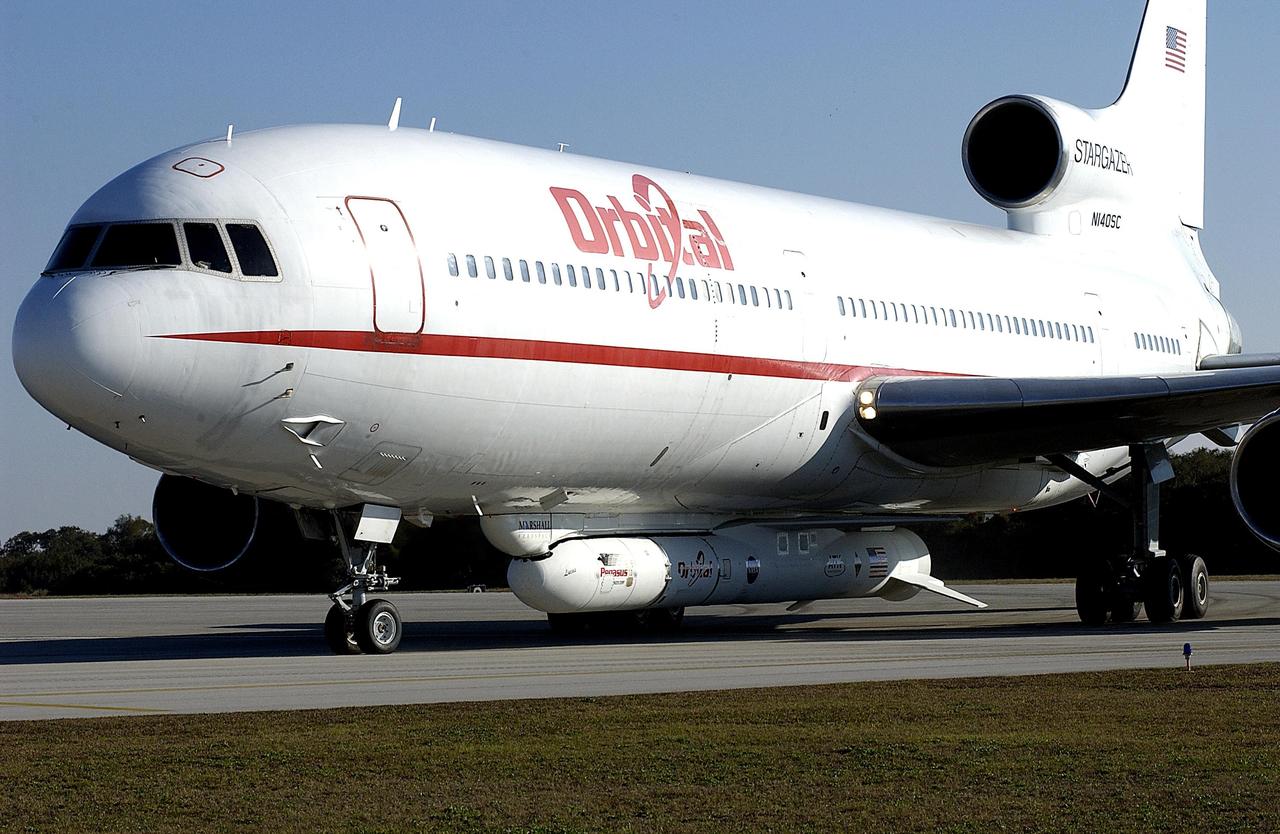
KENNEDY SPACE CENTER, FLA. -- The Orbital Sciences Corp.'s L-1011 aircraft sits on the Skid Strip, Cape Canaveral Air Force Station, with the Pegasus rocket attached below. The Pegasus will carry into space the Galaxy Evolution Explorer (GALEX), an orbiting space telescope that will observe galaxies in ultraviolet light across 10 billion years of cosmic history. Led by the California Institute of Technology, GALEX will conduct several first-of-a-kind sky surveys, including an extra-galactic (beyond our galaxy) ultraviolet all-sky survey. During its 29-month mission GALEX will produce the first comprehensive map of a Universe of galaxies under construction, bringing more understanding how galaxies like the Milky Way were formed. GALEX is due to be launched from Cape Canaveral Air Force Station March 25.
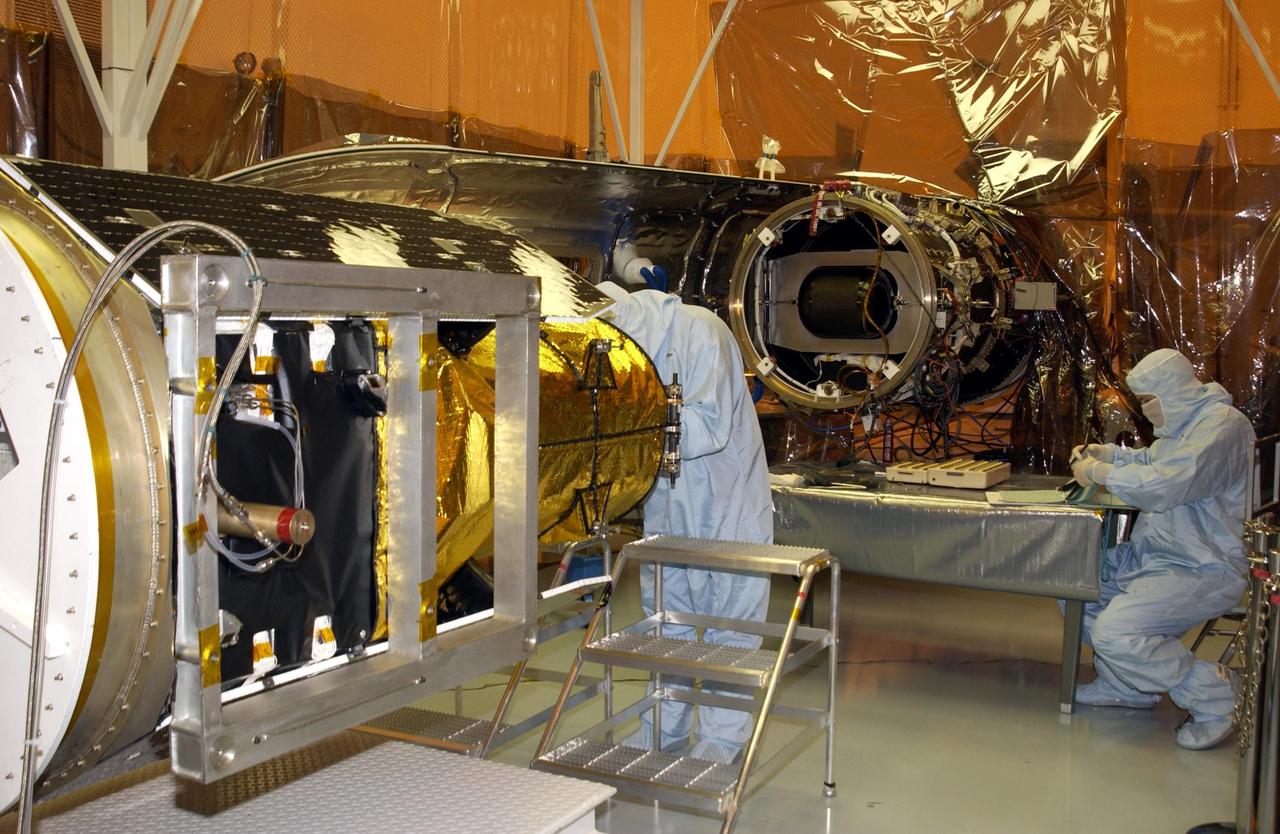
KENNEDY SPACE CENTER, FLA. -- A technician (left) works on NASA's Galaxy Evolution Explorer spacecraft after rotation. The GALEX will be mated mating with the Pegasus XL launch vehicle. Set to launch April 2 from Cape Canaveral Air Force Station, the GALEX will carry into space an orbiting telescope that will observe a million galaxies across 10 billion years of cosmic history to help astronomers determine when the stars and elements we see today had their origins. From its orbit high above Earth, the spacecraft will sweep the skies for 28 months using state-of-the-art ultraviolet detectors. Looking in the ultraviolet will single out galaxies dominated by young, hot, short-lived stars that give off a great deal of energy at that wavelength. These galaxies are actively creating stars, and therefore provide a window into the history and causes of star formation in galaxies.

KENNEDY SPACE CENTER, FLA. - Workers in the Multi-Payload Processing Facility check the solar array panels on the Galaxy Evolution Explorer (GALEX) satellite after they were deployed. The GALEX is an orbiting space telescope that will observe galaxies in ultraviolet light across 10 billion years of cosmic history. Led by the California Institute of Technology, GALEX will conduct several first-of-a-kind sky surveys, including an extra-galactic (beyond our galaxy) ultraviolet all-sky survey. During its 29-month mission GALEX will produce the first comprehensive map of a Universe of galaxies under construction, bringing more understanding of how galaxies like the Milky Way were formed. GALEX is due to be launched from Cape Canaveral Air Force Station March 25 via a Pegasus rocket.
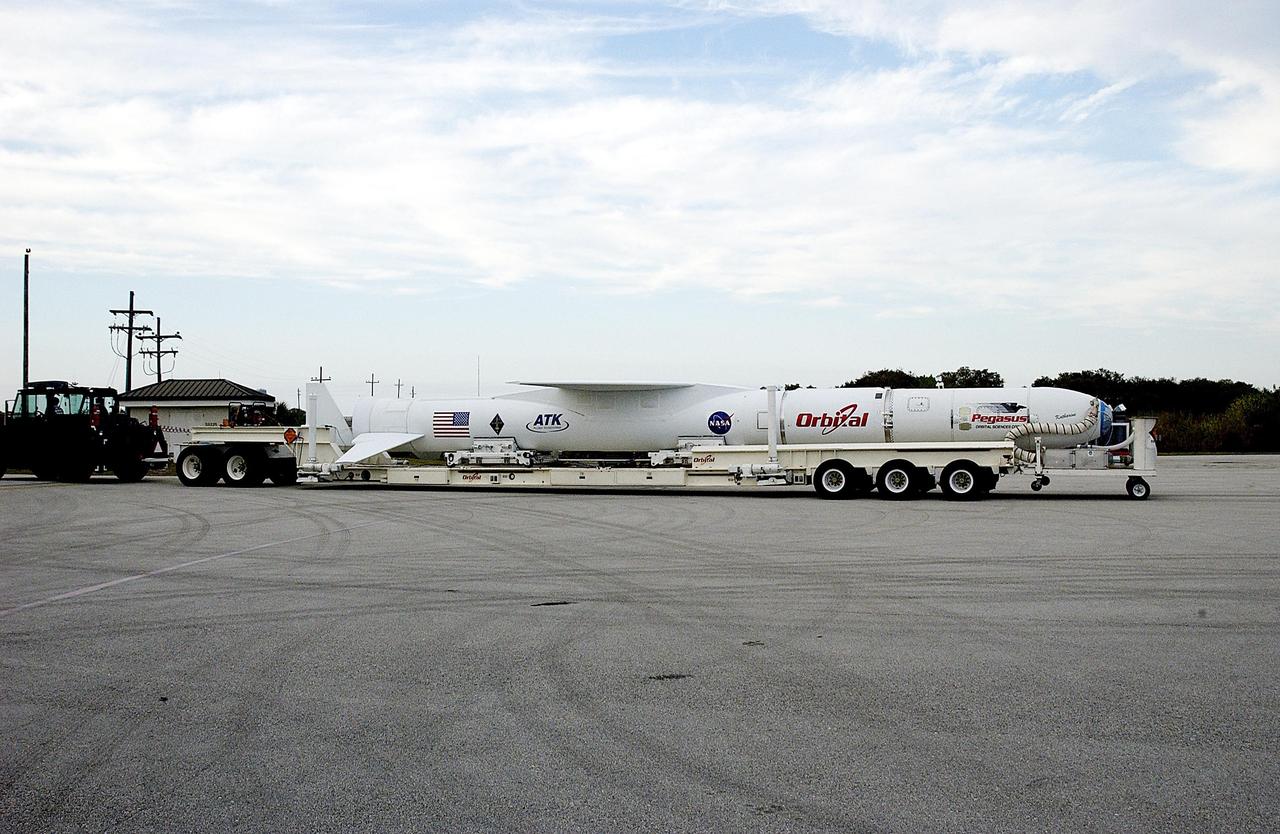
KENNEDY SPACE CENTER, FLA. -- The Pegasus launch vehicle is on a transporter, ready to be moved from the Skid Strip, Cape Canaveral Air Force Station, to the Multi-Payload Processing Facility (MPPF) at KSC. There it will be mated to the Galaxy Evolution Explorer (GALEX). The Pegasus will carry into orbit the GALEX, an orbiting space telescope that will observe galaxies in ultraviolet light across 10 billion years of cosmic history. Led by the California Institute of Technology, GALEX will conduct several first-of-a-kind sky surveys, including an extra-galactic (beyond our galaxy) ultraviolet all-sky survey. During its 29-month mission GALEX will produce the first comprehensive map of a Universe of galaxies under construction, bringing more understanding of how galaxies like the Milky Way were formed. GALEX is due to be launched from Cape Canaveral Air Force Station March 25.
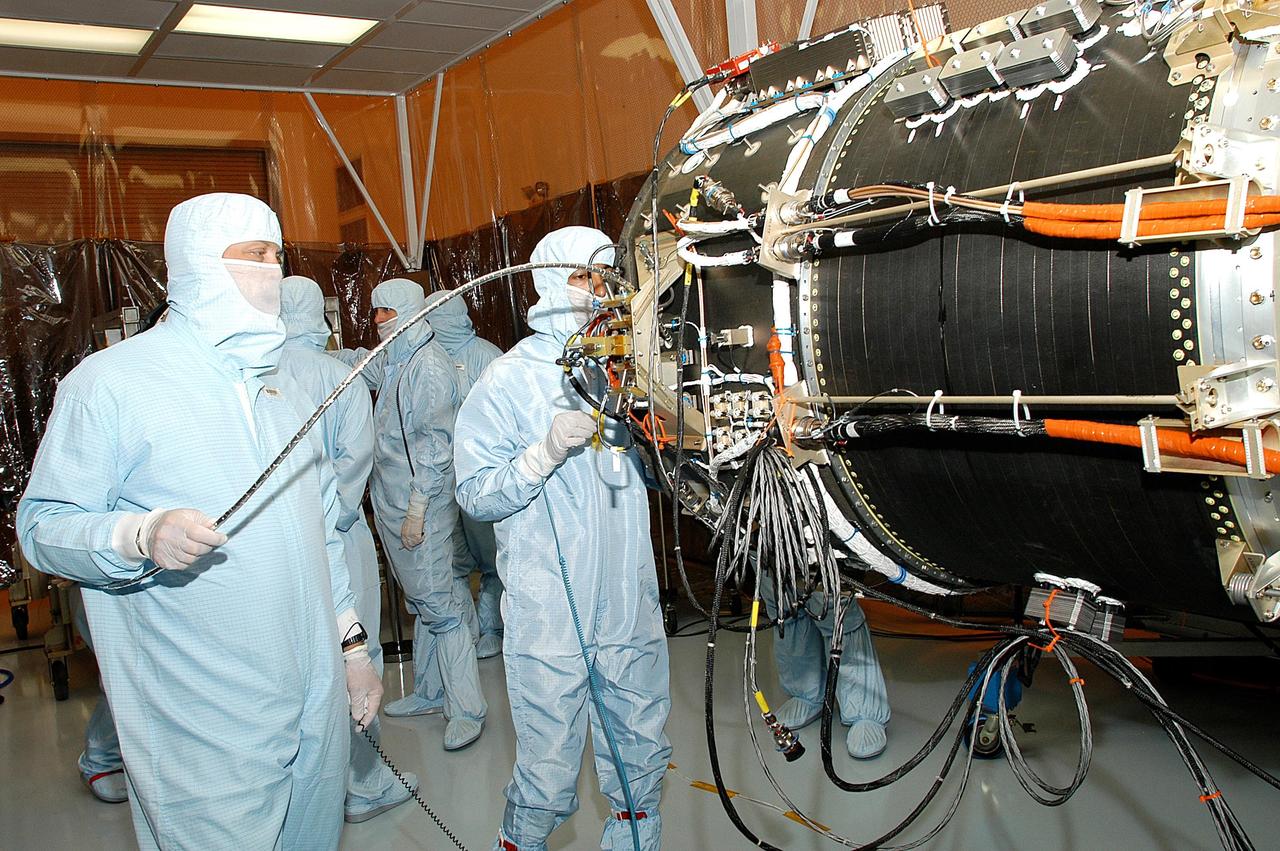
KENNEDY SPACE CENTER, FLA. -- In the Multi-Payload Processing Facility, NASA's Galaxy Evolution Explorer is prepared for mating with the Pegasus XL launch vehicle. The GALEX, set to launch April 2 from Cape Canaveral Air Force Station, will carry into space an orbiting telescope that will observe a million galaxies across 10 billion years of cosmic history to help astronomers determine when the stars and elements we see today had their origins. The spacecraft will sweep the skies for 28 months using state-of-the-art ultraviolet detectors to single out galaxies dominated by young, hot, short-lived stars that give off a great deal of energy at that wavelength. These galaxies are actively creating stars, and therefore provide a window into the history and causes of star formation in galaxies.
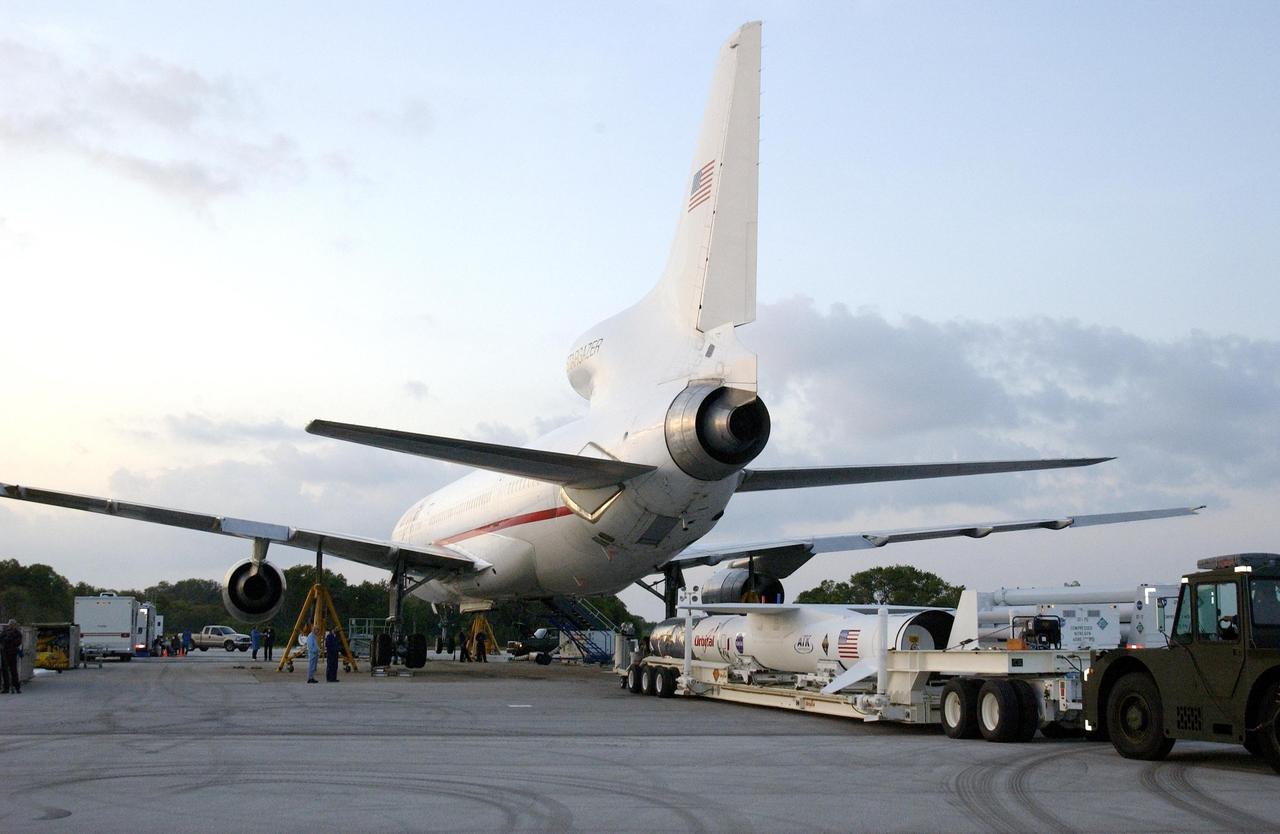
KENNEDY SPACE CENTER, FLA. - In the early morning light, the mated Pegasus XL and Galaxy Evolution Explorer (GALEX) satellite are seen near the Orbital Sciences L-1011 aircraft at Cape Canaveral Air Force Station. The GALEX, to be launched April 28 from the L-1011, will carry into space an orbiting telescope that will observe a million galaxies across 10 billion years of cosmic history to help astronomers determine when the stars and elements we see today had their origins. The spacecraft will sweep the skies for 28 months using state-of-the-art ultraviolet detectors to single out galaxies dominated by young, hot, short-lived stars that give off a great deal of energy at that wavelength. These galaxies are actively creating stars, and therefore provide a window into the history and causes of star formation in galaxies.
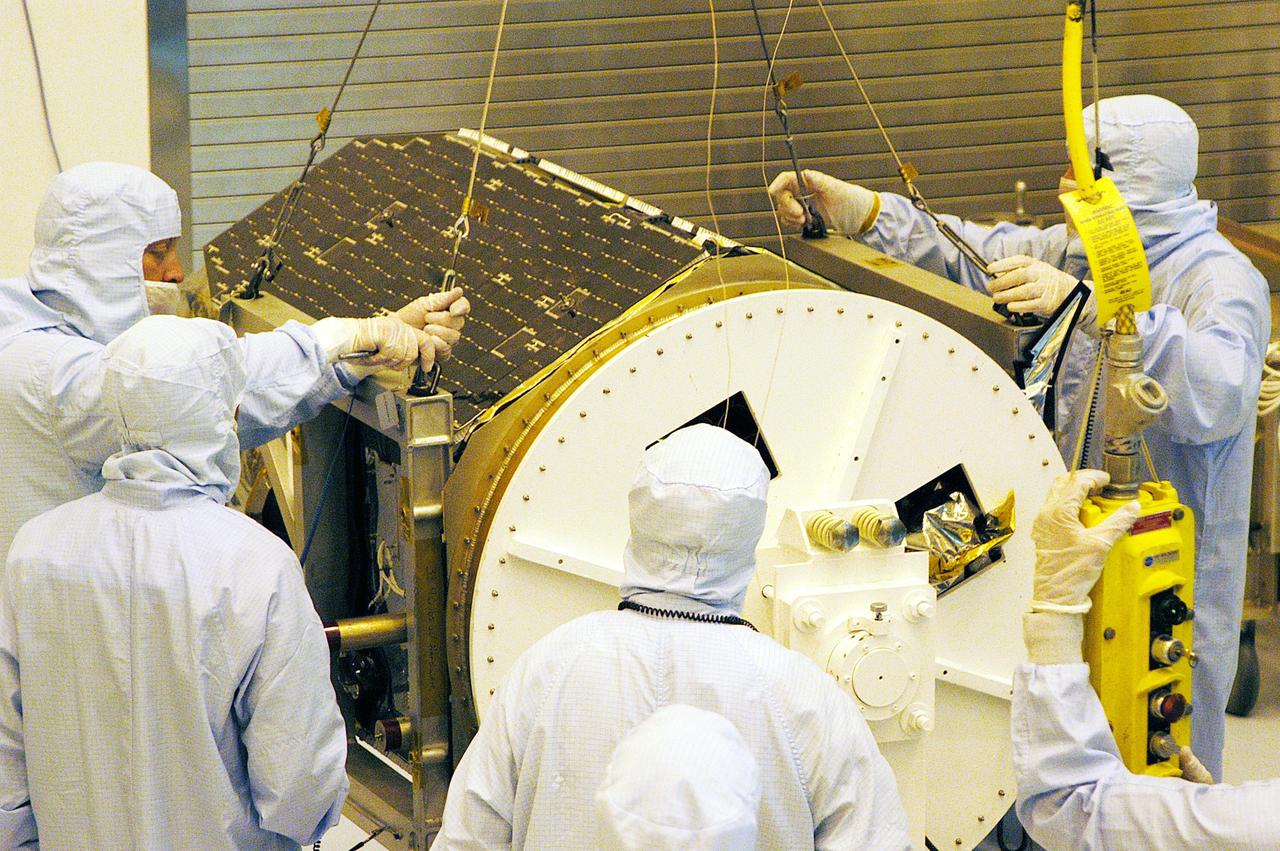
KENNEDY SPACE CENTER, FLA. - Technicians prepare to lift the Galaxy Evolution Explorer (GALEX) spacecraft into a vertical position after it is demated from its Pegasus launch vehicle in the Payload Hazardous Servicing Facility. A borescope inspection will be conducted to locate a small fastener and associated clip missing from a demated connector identified during preflight testing. GALEX is an orbiting space telescope that will observe galaxies in ultraviolet light across 10 billion years of cosmic history. During its 29-month mission, GALEX will produce the first comprehensive map of a Universe of galaxies under construction, bringing more understanding to how galaxies like the Milky Way were formed. The GALEX launch date in late April is currently under review.
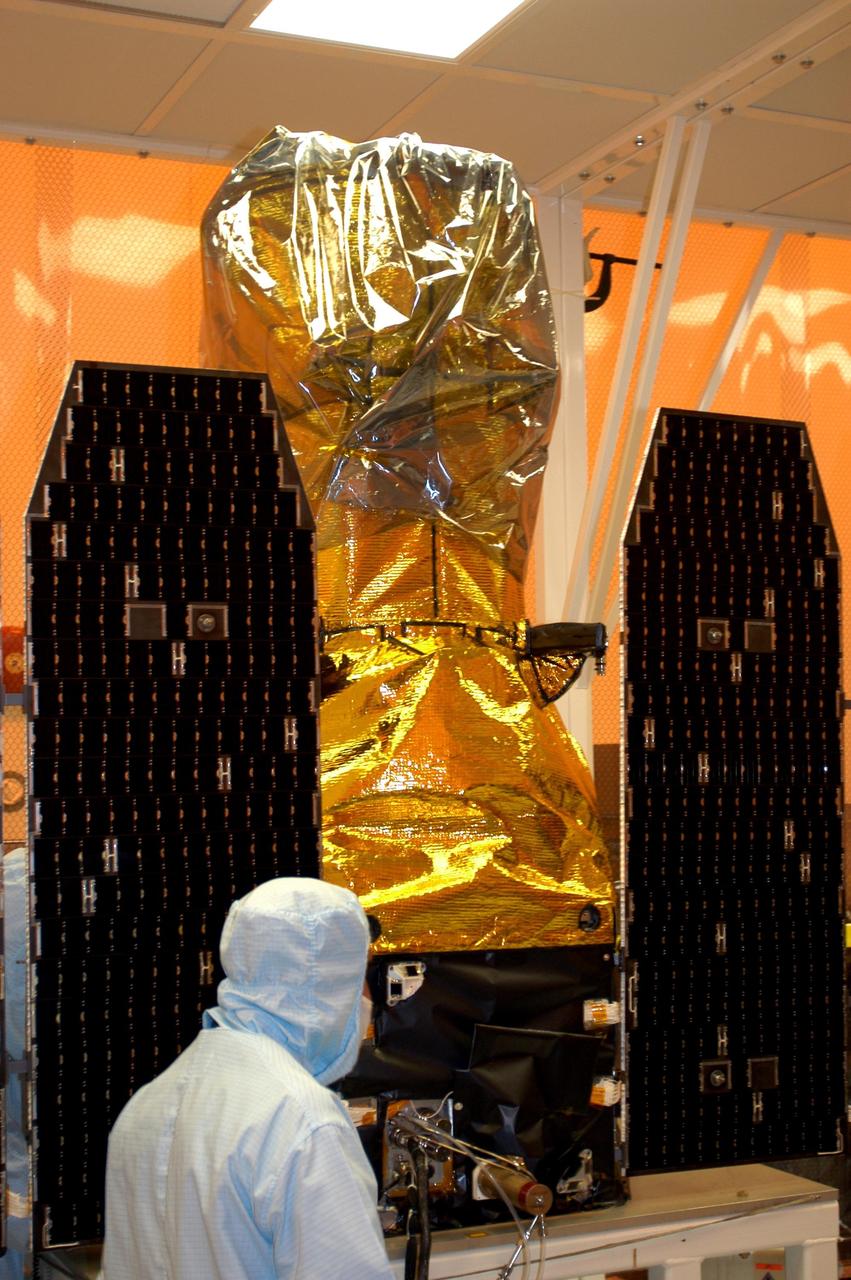
KENNEDY SPACE CENTER, FLA. -- The solar array panels on the Galaxy Evolution Explorer (GALEX) satellite are deployed during processing in the Multi-Payload Processing Facility. The GALEX is an orbiting space telescope that will observe galaxies in ultraviolet light across 10 billion years of cosmic history. Led by the California Institute of Technology, GALEX will conduct several first-of-a-kind sky surveys, including an extra-galactic (beyond our galaxy) ultraviolet all-sky survey. During its 29-month mission GALEX will produce the first comprehensive map of a Universe of galaxies under construction, bringing more understanding of how galaxies like the Milky Way were formed. GALEX is due to be launched from Cape Canaveral Air Force Station March 25 via a Pegasus rocket.
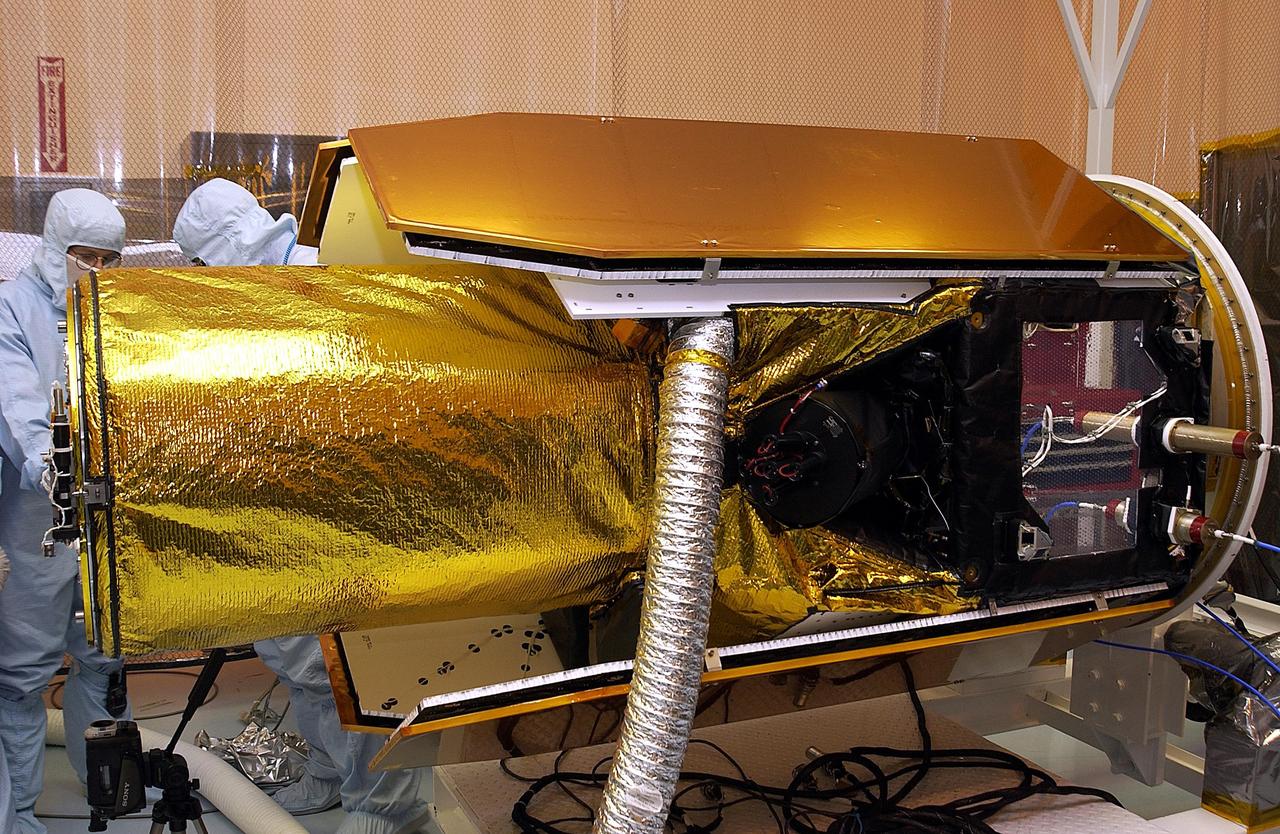
KENNEDY SPACE CENTER, FLA. -- In the Multi-Payload Processing Facility, workers check the deployment of the cover of the telescope on the GALEX satellite. The Galaxy Evolution Explorer (GALEX) is an orbiting space telescope that will observe galaxies in ultraviolet light across 10 billion years of cosmic history. Led by the California Institute of Technology, GALEX will conduct several first-of-a-kind sky surveys, including an extra-galactic (beyond our galaxy) ultraviolet all-sky survey. During its 29-month mission GALEX will produce the first comprehensive map of a Universe of galaxies under construction, bringing more understanding of how galaxies like the Milky Way were formed. GALEX is due to be launched from Cape Canaveral Air Force Station March 25 via a Pegasus rocket.
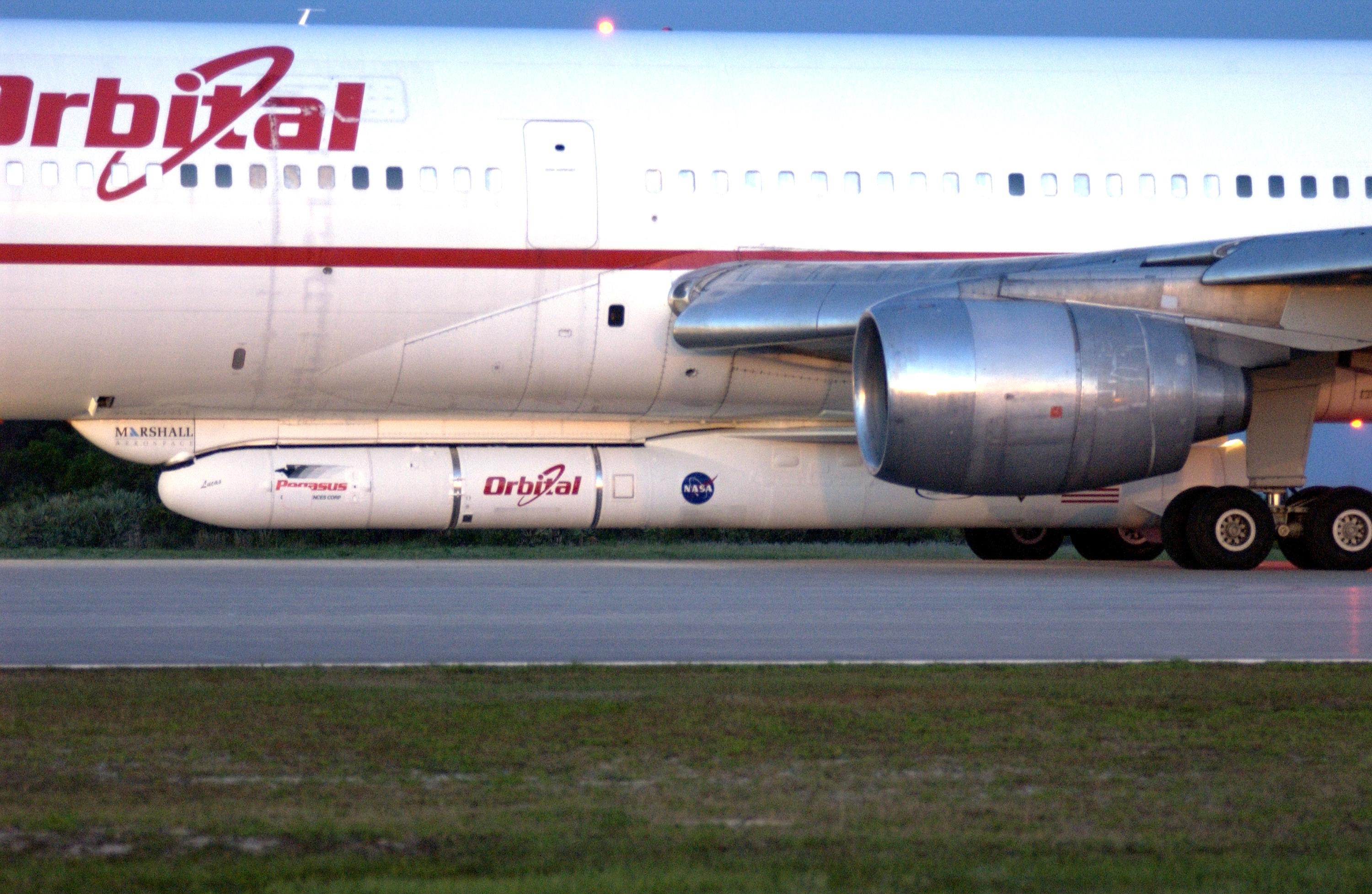
KENNEDY SPACE CENTER, FLA. - At Cape Canaveral Air Force Station, Orbital Sciences' L-1011 aircraft waits for takeoff time between 7:50 and 9:50 a.m. EDT. Attached underneath is the Pegasus XL rocket with its payload, the Galaxy Evolution Explorer (GALEX), due to be released about 8 a.m. The GALEX will carry into space an orbiting telescope that will observe a million galaxies across 10 billion years of cosmic history to help astronomers determine when the stars and elements we see today had their origins. The spacecraft will sweep the skies for 28 months using state-of-the-art ultraviolet detectors to single out galaxies dominated by young, hot, short-lived stars that give off a great deal of energy at that wavelength. These galaxies are actively creating stars, and therefore provide a window into the history and causes of star formation in galaxies.
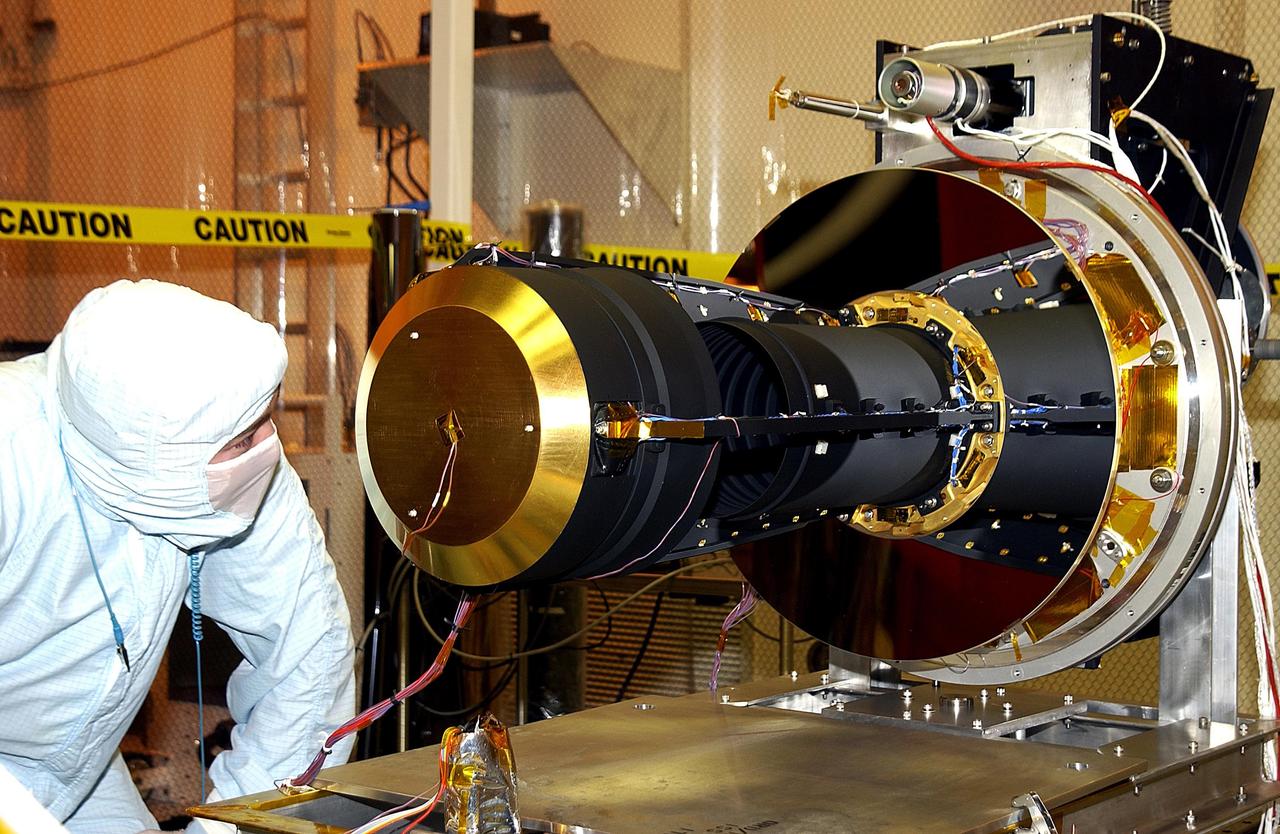
KENNEDY SPACE CENTER, FLA. -- In the Multi-Payload Processing Facility, a worker inspects the GALEX satellite after its rotation on a stand. The Galaxy Evolution Explorer (GALEX) is an orbiting space telescope that will observe galaxies in ultraviolet light across 10 billion years of cosmic history. Led by the California Institute of Technology, GALEX will conduct several first-of-a-kind sky surveys, including an extra-galactic (beyond our galaxy) ultraviolet all-sky survey. During its 29-month mission GALEX will produce the first comprehensive map of a Universe of galaxies under construction, bringing more understanding of how galaxies like the Milky Way were formed. GALEX is due to be launched from Cape Canaveral Air Force Station March 25 via a Pegasus rocket.
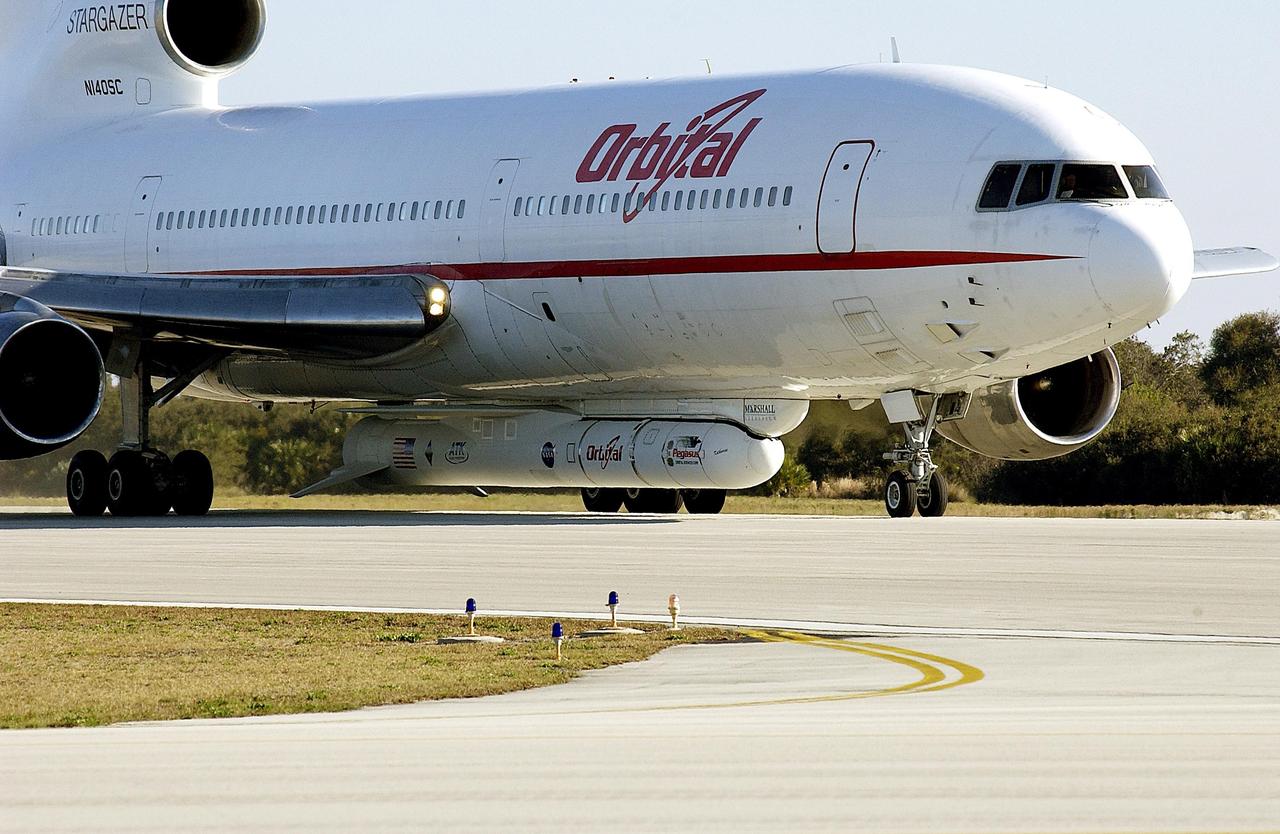
KENNEDY SPACE CENTER, FLA. -- The Orbital Sciences Corp.'s L-1011 aircraft arrives at the Skid Strip, Cape Canaveral Air Force Station, with the Pegasus rocket attached below. The Pegasus will carry into space the Galaxy Evolution Explorer (GALEX), an orbiting space telescope that will observe galaxies in ultraviolet light across 10 billion years of cosmic history. Led by the California Institute of Technology, GALEX will conduct several first-of-a-kind sky surveys, including an extra-galactic (beyond our galaxy) ultraviolet all-sky survey. During its 29-month mission, GALEX will produce the first comprehensive map of a Universe of galaxies under construction, bringing more understanding how galaxies like the Milky Way were formed. GALEX is due to be launched from Cape Canaveral Air Force Station March 25.
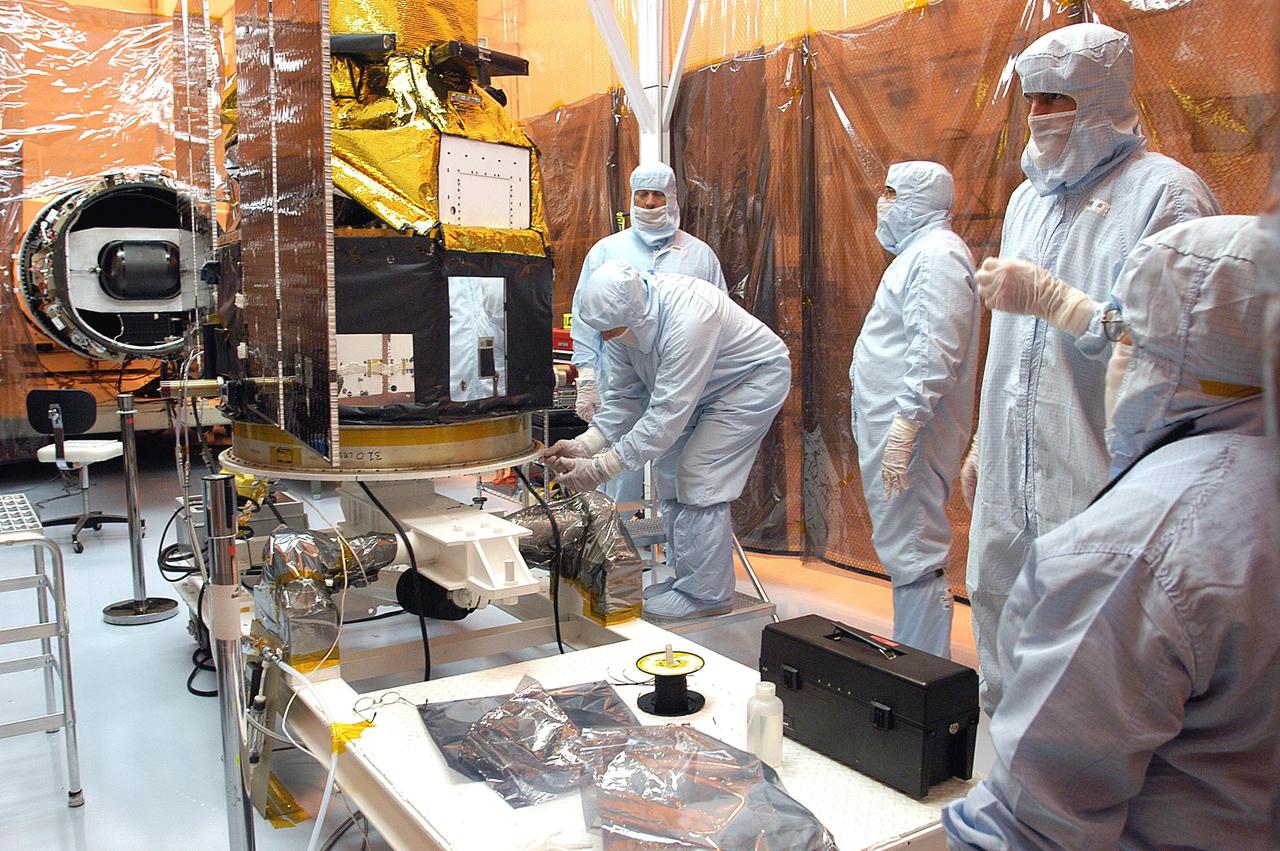
KENNEDY SPACE CENTER, FLA. - Foreign object debris shields are installed and a borescope inspection is conducted on the Galaxy Evolution Explorer (GALEX) spacecraft in the Payload Hazardous Servicing Facility. Technicians are looking for a small fastener and associated clip missing from a demated connector identified during preflight testing. On the left is the Pegasus launch vehicle from which the spacecraft was demated. GALEX is an orbiting space telescope that will observe galaxies in ultraviolet light across 10 billion years of cosmic history. During its 29-month mission, GALEX will produce the first comprehensive map of a Universe of galaxies under construction, bringing more understanding to how galaxies like the Milky Way were formed. The GALEX launch date in late April is currently under review.
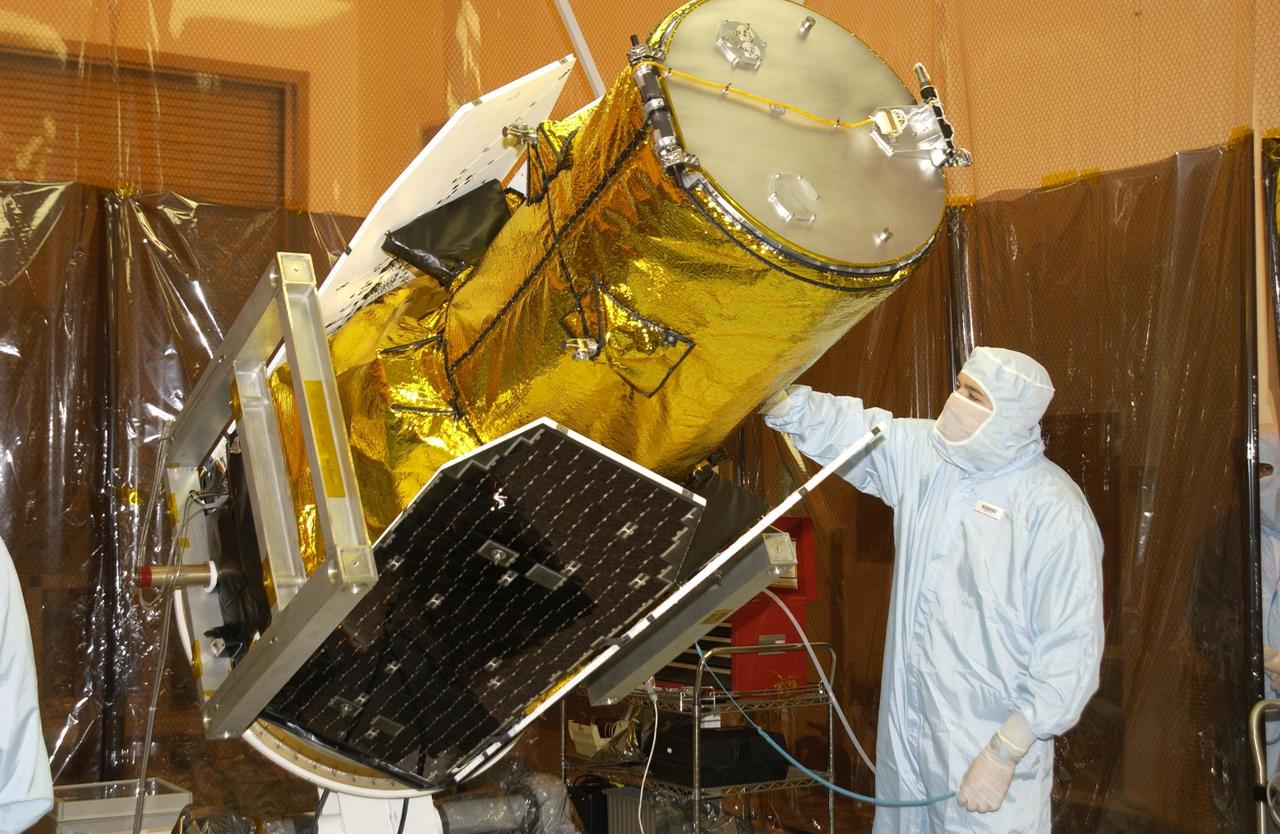
KENNEDY SPACE CENTER, FLA. -A worker in the Multi-Payload Processing Facility watches closely as NASA's Galaxy Evolution Explorer spacecraft is rotated in preparation for mating with the Pegasus XL launch vehicle. The GALEX, set to launch April 2 from Cape Canaveral Air Force Station, will carry into space an orbiting telescope that will observe a million galaxies across 10 billion years of cosmic history to help astronomers determine when the stars and elements we see today had their origins. From its orbit high above Earth, the spacecraft will sweep the skies for 28 months using state-of-the-art ultraviolet detectors. Looking in the ultraviolet will single out galaxies dominated by young, hot, short-lived stars that give off a great deal of energy at that wavelength. These galaxies are actively creating stars, and therefore provide a window into the history and causes of star formation in galaxies.
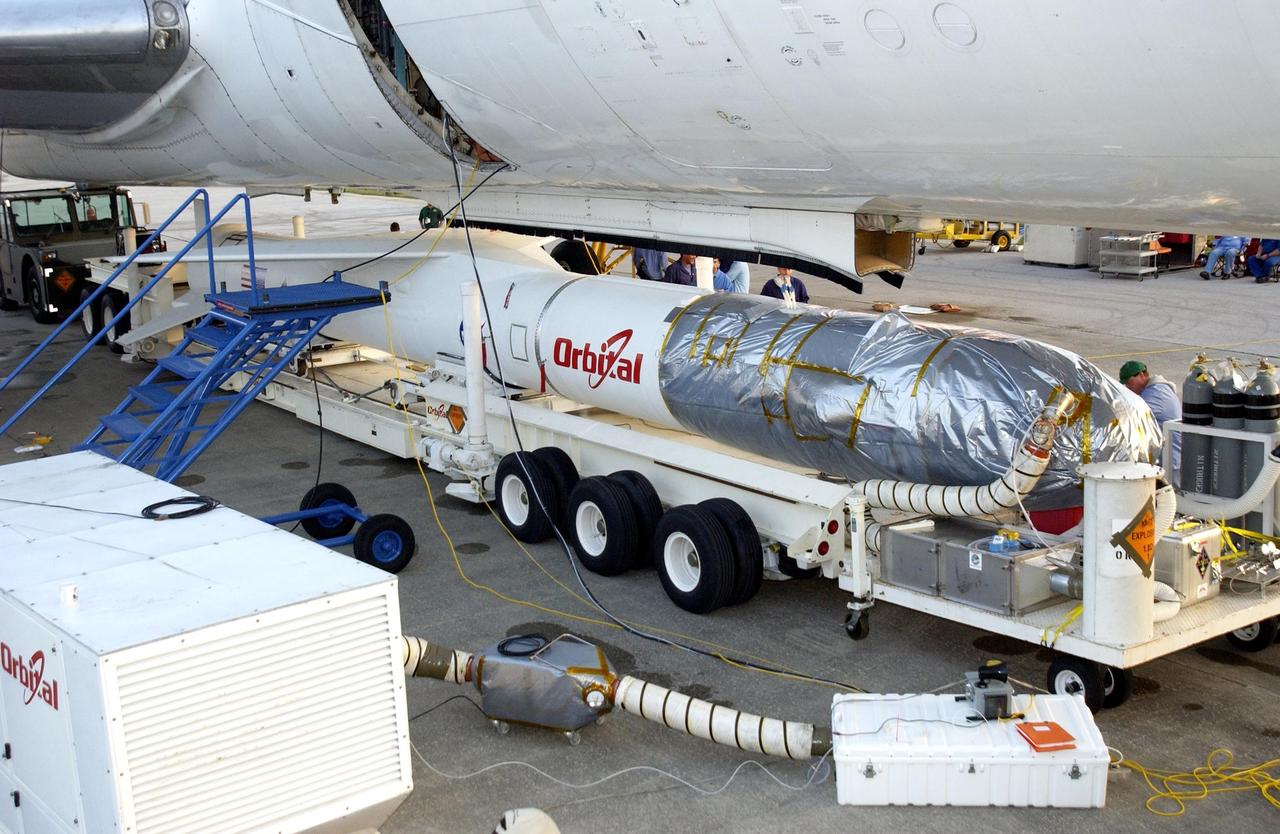
KENNEDY SPACE CENTER, FLA. - At Cape Canaveral Air Force Station, workers prepare to attach the mated Pegasus XL and Galaxy Evolution Explorer (GALEX) satellite to the Orbital Sciences L-1011 aircraft. The GALEX, to be launched April 28 from the L-1011, will carry into space an orbiting telescope that will observe a million galaxies across 10 billion years of cosmic history to help astronomers determine when the stars and elements we see today had their origins. The spacecraft will sweep the skies for 28 months using state-of-the-art ultraviolet detectors to single out galaxies dominated by young, hot, short-lived stars that give off a great deal of energy at that wavelength. These galaxies are actively creating stars, and therefore provide a window into the history and causes of star formation in galaxies.
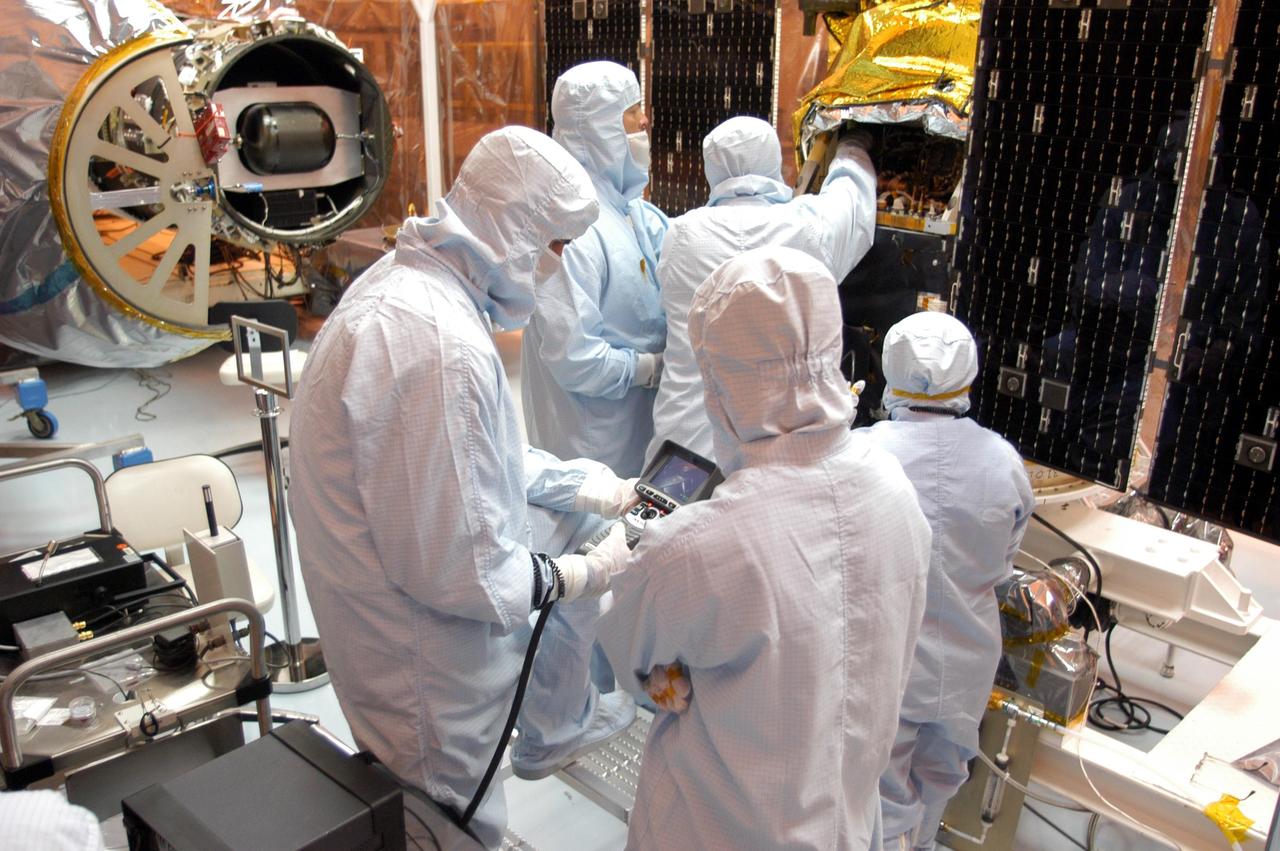
KENNEDY SPACE CENTER, FLA. - Technicians prepare to lift the Galaxy Evolution Explorer (GALEX) spacecraft into a vertical position after it is demated from its Pegasus launch vehicle in the Payload Hazardous Servicing Facility. A borescope inspection will be conducted to locate a small fastener and associated clip missing from a demated connector identified during preflight testing. GALEX is an orbiting space telescope that will observe galaxies in ultraviolet light across 10 billion years of cosmic history. During its 29-month mission, GALEX will produce the first comprehensive map of a Universe of galaxies under construction, bringing more understanding to how galaxies like the Milky Way were formed. The GALEX launch date in late April is currently under review.
KENNEDY SPACE CENTER, FLA. -- In the Multi-Payload Processing Facility, NASA's Galaxy Evolution Explorer is prepared for mating with the Pegasus XL launch vehicle. The GALEX, set to launch April 2 from Cape Canaveral Air Force Station, will carry into space an orbiting telescope that will observe a million galaxies across 10 billion years of cosmic history to help astronomers determine when the stars and elements we see today had their origins. The spacecraft will sweep the skies for 28 months using state-of-the-art ultraviolet detectors to single out galaxies dominated by young, hot, short-lived stars that give off a great deal of energy at that wavelength. These galaxies are actively creating stars, and therefore provide a window into the history and causes of star formation in galaxies.
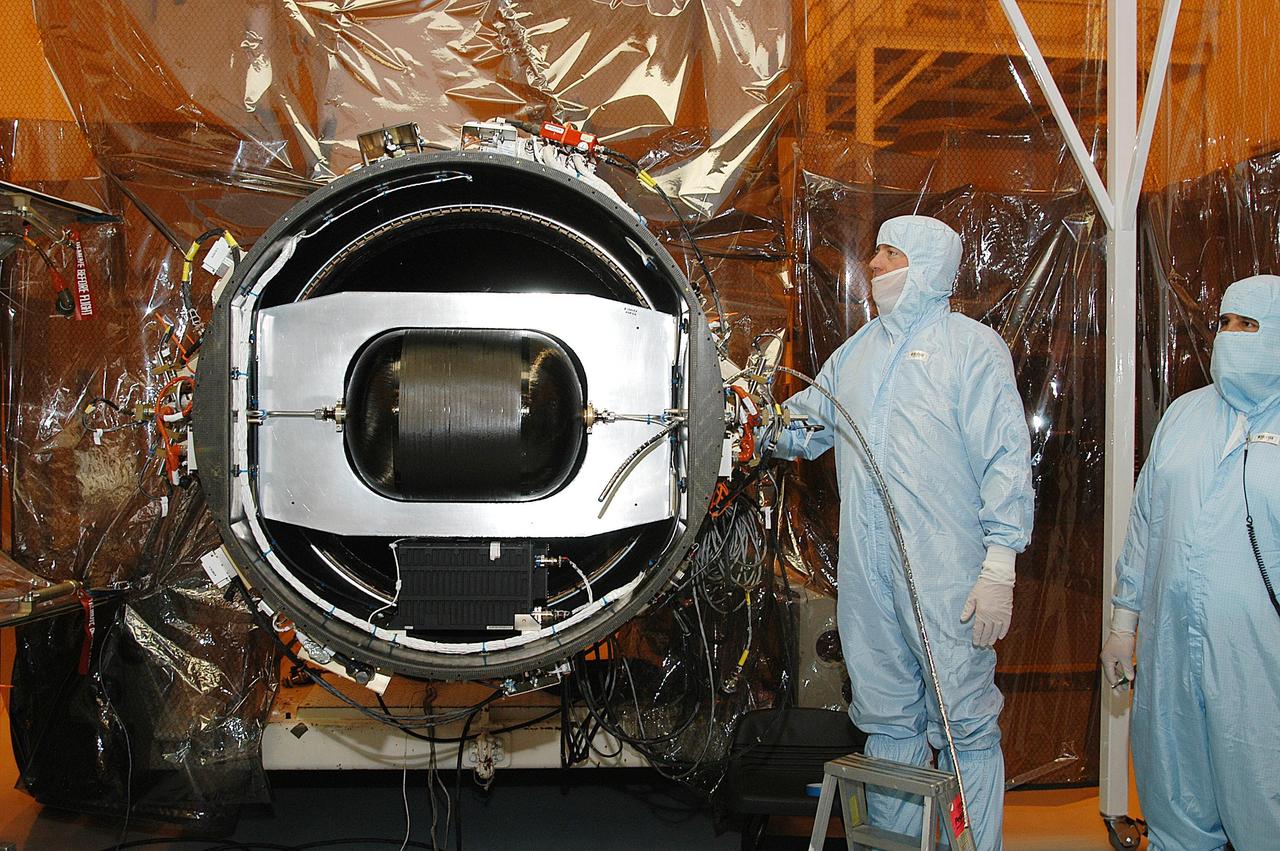
KENNEDY SPACE CENTER, FLA. - Foreign object debris shields are installed and a borescope inspection is conducted on the Galaxy Evolution Explorer (GALEX) spacecraft in the Payload Hazardous Servicing Facility. On the left is the Pegasus launch vehicle from which it was demated. Technicians are looking for a small fastener and associated clip missing from a demated connector identified during preflight testing. GALEX is an orbiting space telescope that will observe galaxies in ultraviolet light across 10 billion years of cosmic history. During its 29-month mission, GALEX will produce the first comprehensive map of a Universe of galaxies under construction, bringing more understanding to how galaxies like the Milky Way were formed. The GALEX launch date in late April is currently under review.
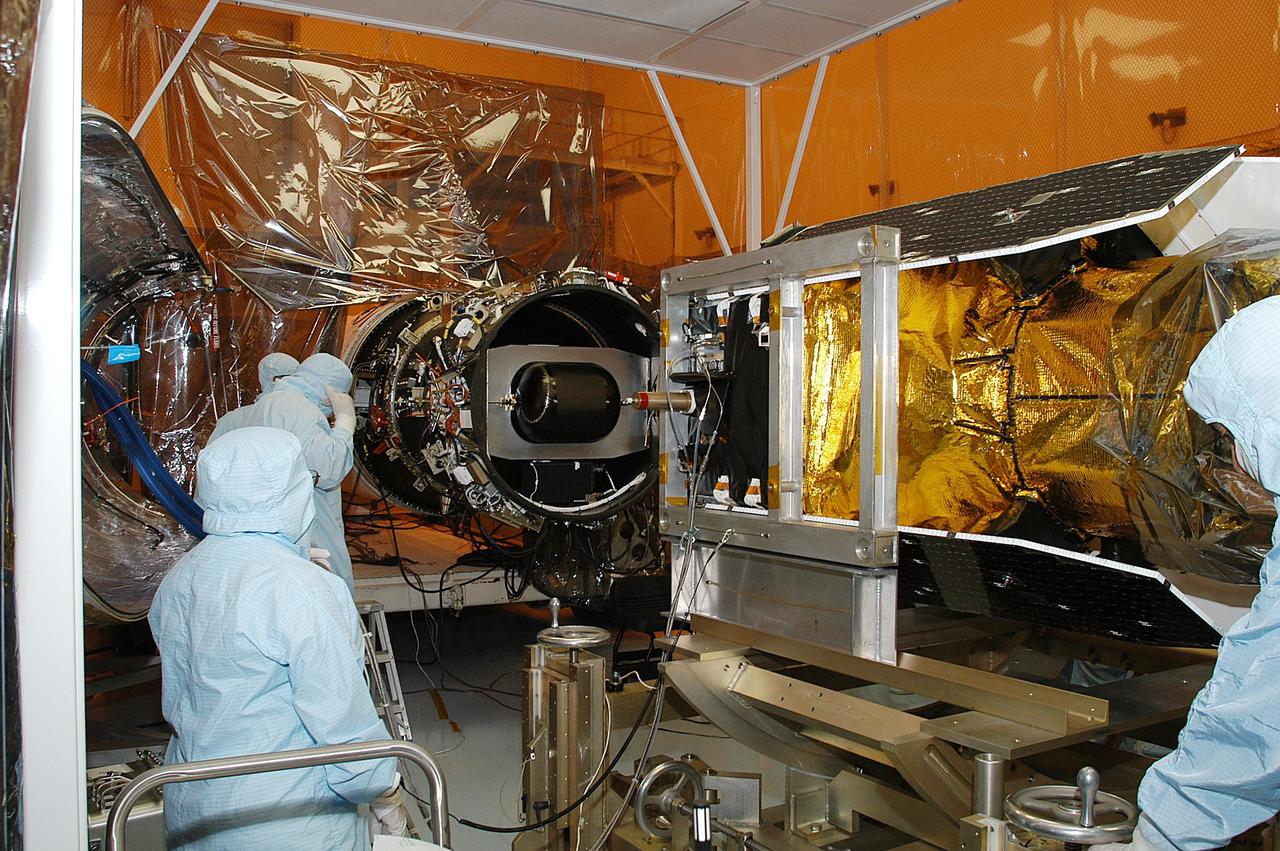
KENNEDY SPACE CENTER, FLA. -- In the Multi-Payload Processing Facility, NASA's Galaxy Evolution Explorer is prepared for mating with the Pegasus XL launch vehicle. The GALEX, set to launch April 2 from Cape Canaveral Air Force Station, will carry into space an orbiting telescope that will observe a million galaxies across 10 billion years of cosmic history to help astronomers determine when the stars and elements we see today had their origins. The spacecraft will sweep the skies for 28 months using state-of-the-art ultraviolet detectors to single out galaxies dominated by young, hot, short-lived stars that give off a great deal of energy at that wavelength. These galaxies are actively creating stars, and therefore provide a window into the history and causes of star formation in galaxies.
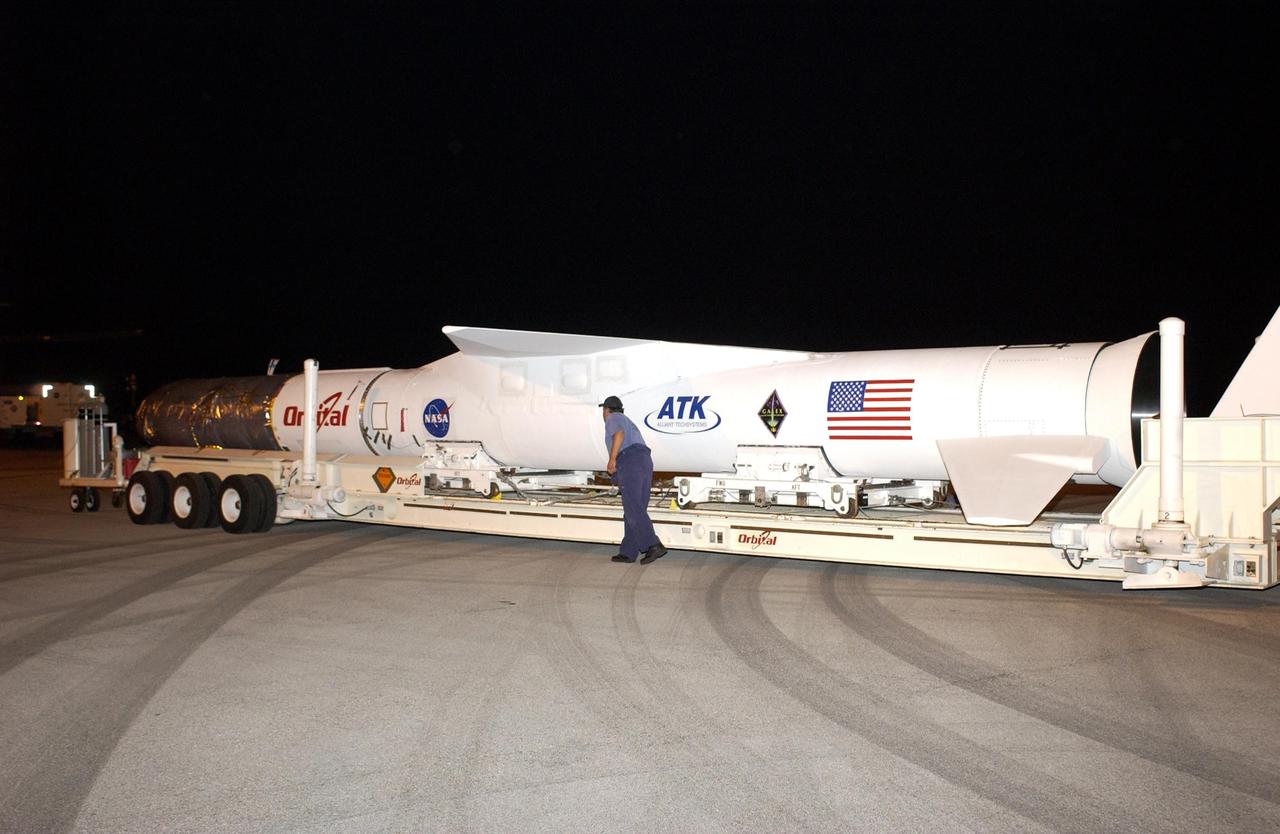
KENNEDY SPACE CENTER, FLA. - The mated Pegasus XL and Galaxy Evolution Explorer (GALEX) satellite arrive at Cape Canaveral Air Force Station. The GALEX, to be launched April 28 from an Orbital Sciences L-1011 aircraft, will carry into space an orbiting telescope that will observe a million galaxies across 10 billion years of cosmic history to help astronomers determine when the stars and elements we see today had their origins. The spacecraft will sweep the skies for 28 months using state-of-the-art ultraviolet detectors to single out galaxies dominated by young, hot, short-lived stars that give off a great deal of energy at that wavelength. These galaxies are actively creating stars, and therefore provide a window into the history and causes of star formation in galaxies.
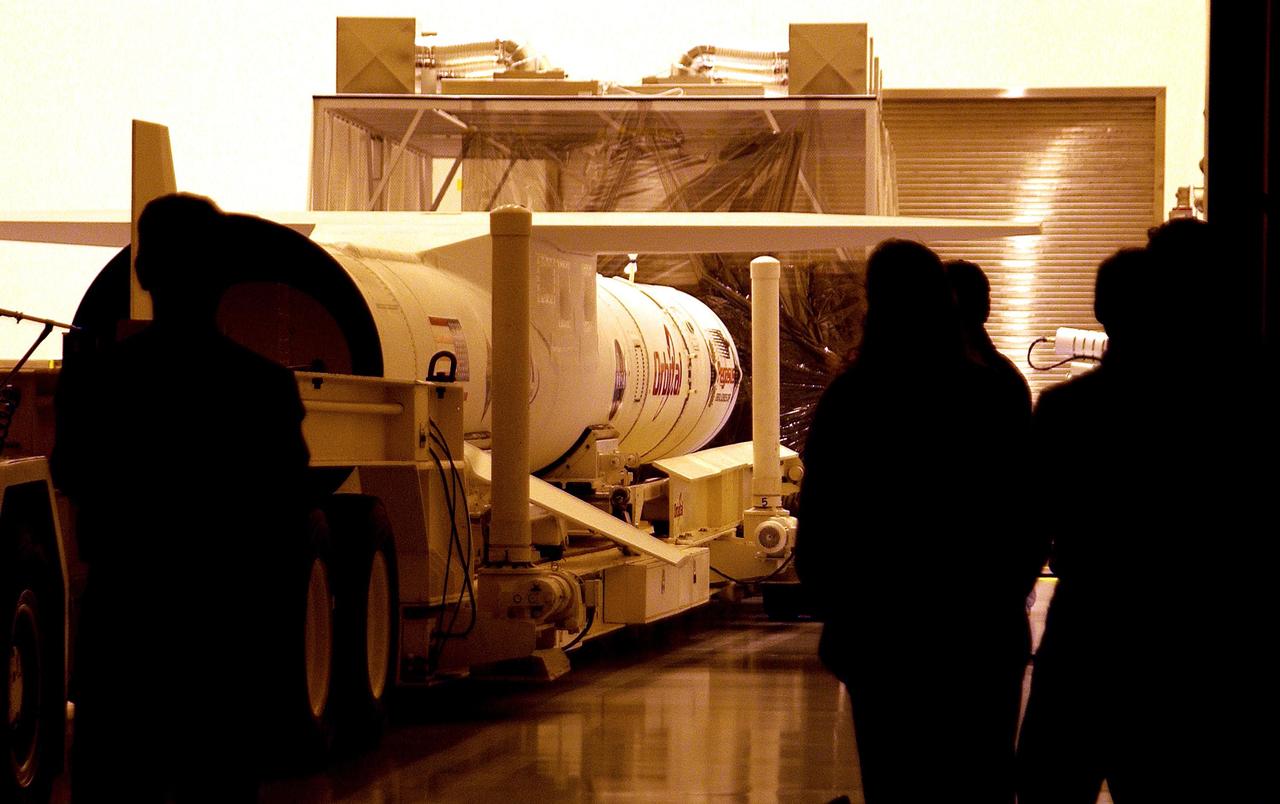
KENNEDY SPACE CENTER, FLA. -- The Pegasus launch vehicle is inside the Multi-Payload Processing Facility (MPPF) at KSC. There it will be mated to the Galaxy Evolution Explorer (GALEX). The Pegasus will carry into orbit the GALEX, a space telescope that will observe galaxies in ultraviolet light across 10 billion years of cosmic history. Led by the California Institute of Technology, GALEX will conduct several first-of-a-kind sky surveys, including an extra-galactic (beyond our galaxy) ultraviolet all-sky survey. During its 29-month mission GALEX will produce the first comprehensive map of a Universe of galaxies under construction, bringing more understanding of how galaxies like the Milky Way were formed. GALEX is due to be launched from Cape Canaveral Air Force Station March 25.

KENNEDY SPACE CENTER, FLA. -- The Pegasus launch vehicle enters the Multi-Payload Processing Facility (MPPF) at KSC. There it will be mated to the Galaxy Evolution Explorer (GALEX). The Pegasus will carry into orbit the GALEX, a space telescope that will observe galaxies in ultraviolet light across 10 billion years of cosmic history. Led by the California Institute of Technology, GALEX will conduct several first-of-a-kind sky surveys, including an extra-galactic (beyond our galaxy) ultraviolet all-sky survey. During its 29-month mission GALEX will produce the first comprehensive map of a Universe of galaxies under construction, bringing more understanding of how galaxies like the Milky Way were formed. GALEX is due to be launched from Cape Canaveral Air Force Station March 25.
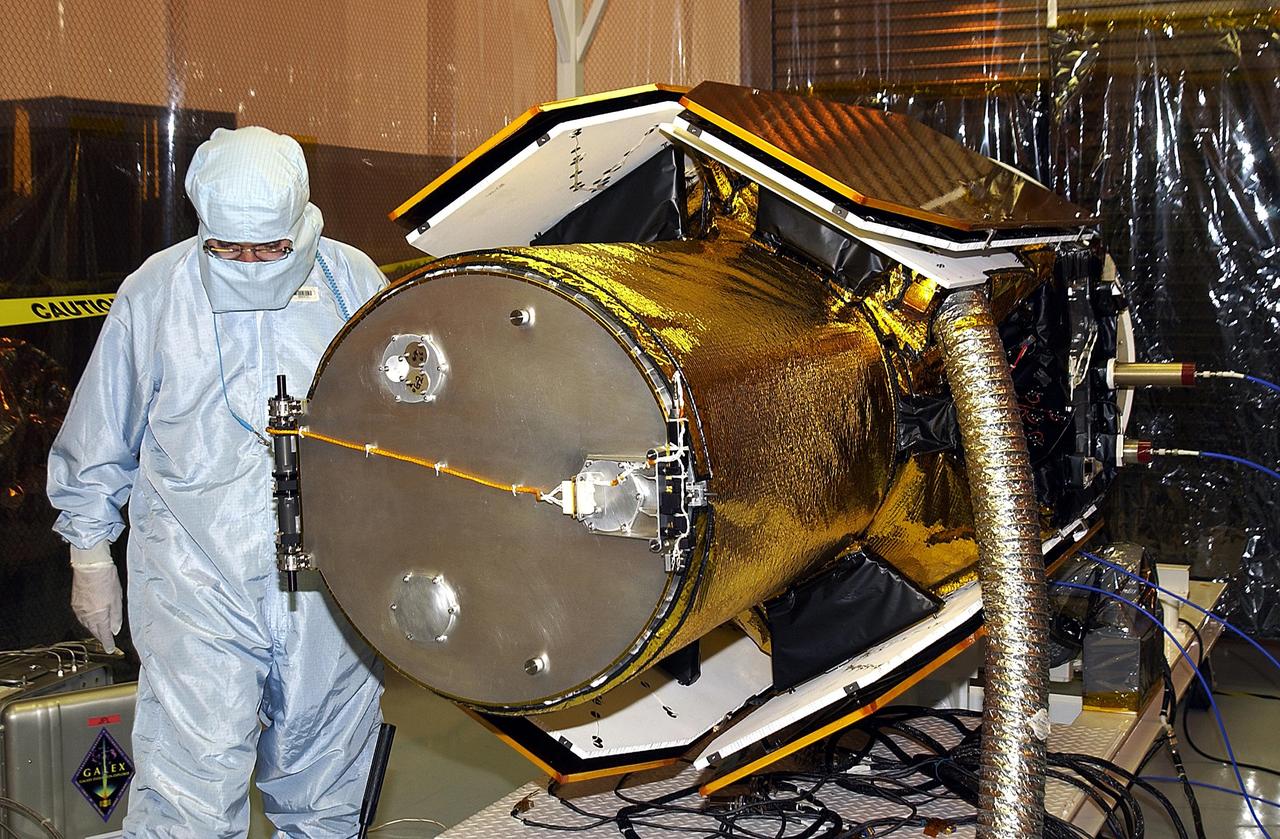
KENNEDY SPACE CENTER, FLA. -- In the Multi-Payload Processing Facility, workers check the deployment of the cover of the telescope on the GALEX satellite. The Galaxy Evolution Explorer (GALEX) is an orbiting space telescope that will observe galaxies in ultraviolet light across 10 billion years of cosmic history. Led by the California Institute of Technology, GALEX will conduct several first-of-a-kind sky surveys, including an extra-galactic (beyond our galaxy) ultraviolet all-sky survey. During its 29-month mission GALEX will produce the first comprehensive map of a Universe of galaxies under construction, bringing more understanding of how galaxies like the Milky Way were formed. GALEX is due to be launched from Cape Canaveral Air Force Station March 25 via a Pegasus rocket.
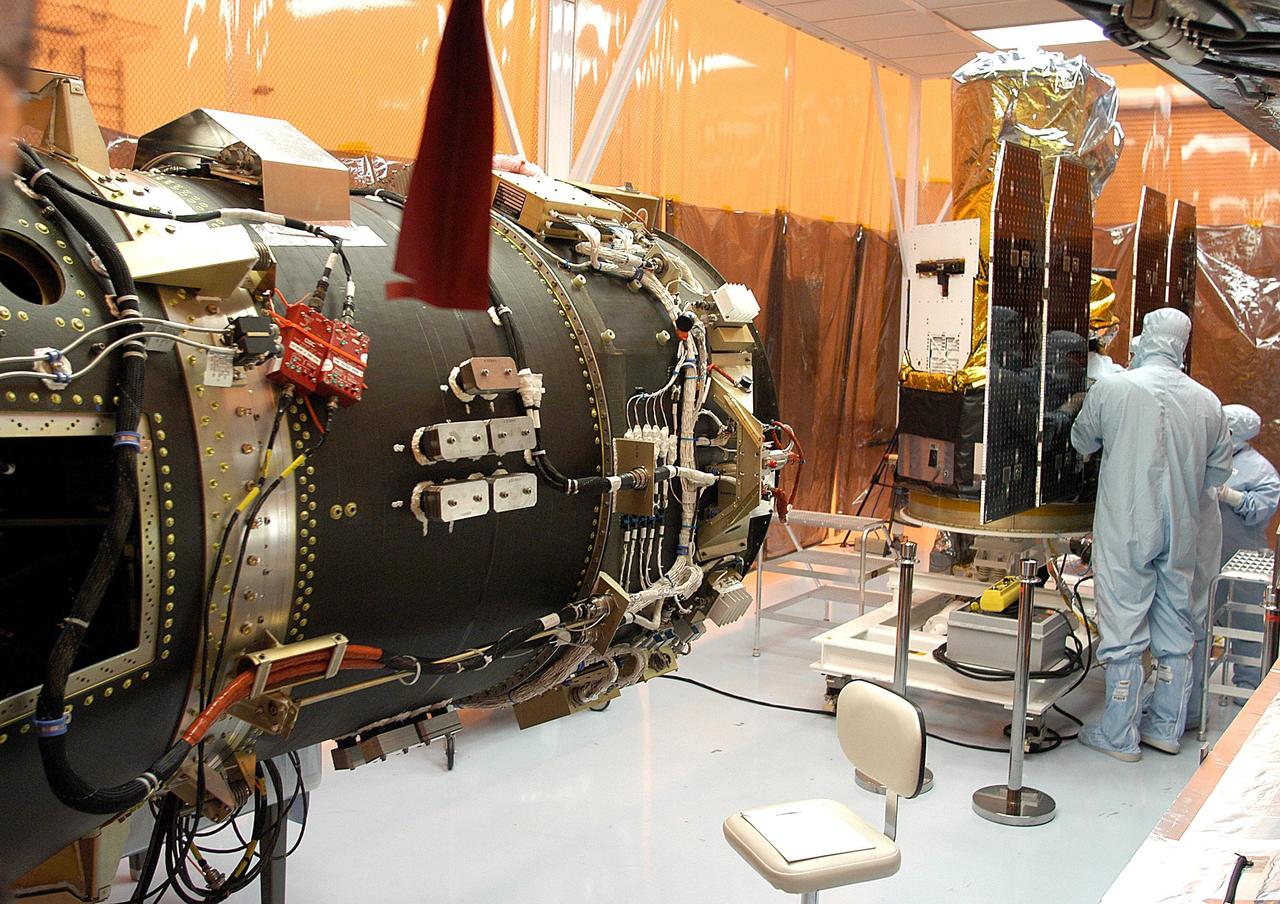
KENNEDY SPACE CENTER, FLA. - Foreign object debris shields are installed and a borescope inspection is conducted on the Galaxy Evolution Explorer (GALEX) spacecraft in the Payload Hazardous Servicing Facility. On the left is the Pegasus launch vehicle from which it was demated. Technicians are looking for a small fastener and associated clip missing from a demated connector identified during preflight testing. GALEX is an orbiting space telescope that will observe galaxies in ultraviolet light across 10 billion years of cosmic history. During its 29-month mission, GALEX will produce the first comprehensive map of a Universe of galaxies under construction, bringing more understanding to how galaxies like the Milky Way were formed. The GALEX launch date in late April is currently under review.
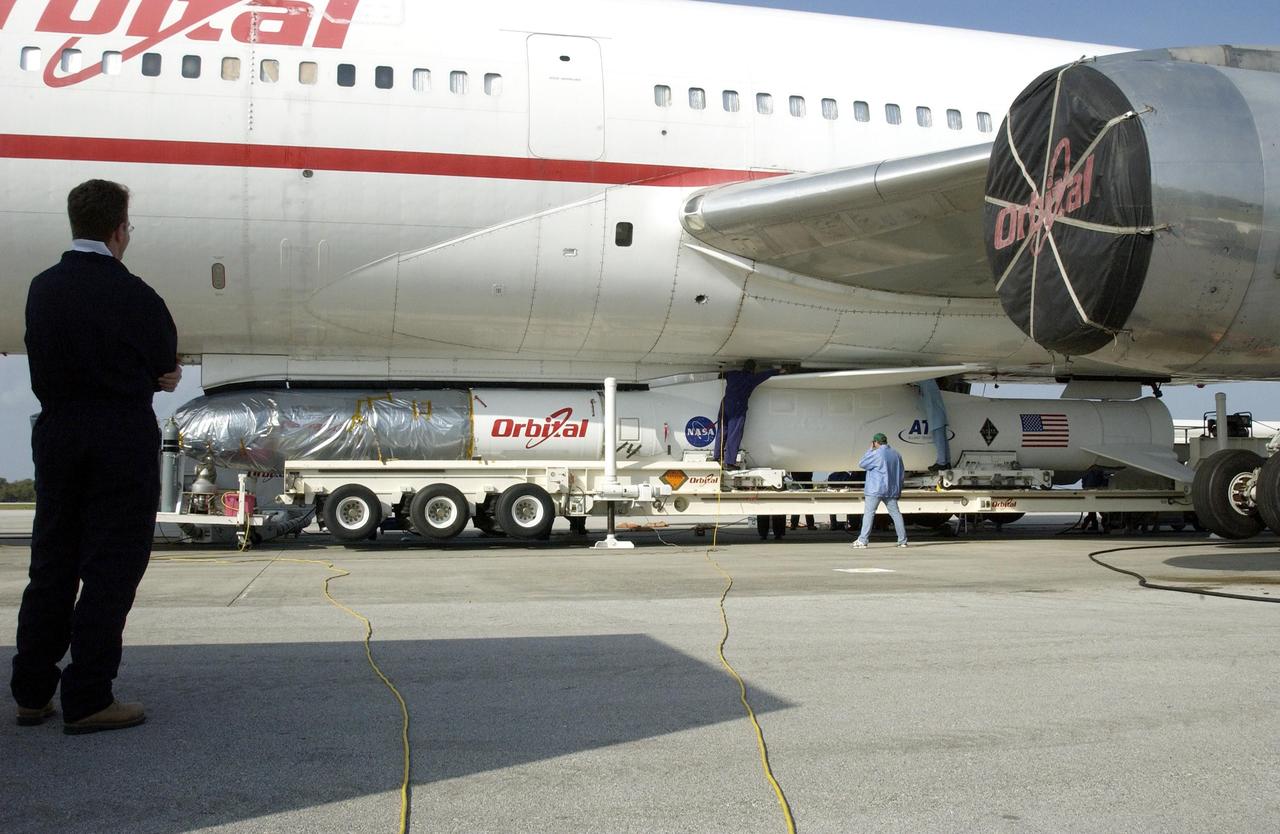
KENNEDY SPACE CENTER, FLA. - At Cape Canaveral Air Force Station, the Pegasus XL and Galaxy Evolution Explorer (GALEX) satellite are mated to the Orbital Sciences L-1011 aircraft. The GALEX, to be launched April 28 from the L-1011, will carry into space an orbiting telescope that will observe a million galaxies across 10 billion years of cosmic history to help astronomers determine when the stars and elements we see today had their origins. The spacecraft will sweep the skies for 28 months using state-of-the-art ultraviolet detectors to single out galaxies dominated by young, hot, short-lived stars that give off a great deal of energy at that wavelength. These galaxies are actively creating stars, and therefore provide a window into the history and causes of star formation in galaxies.
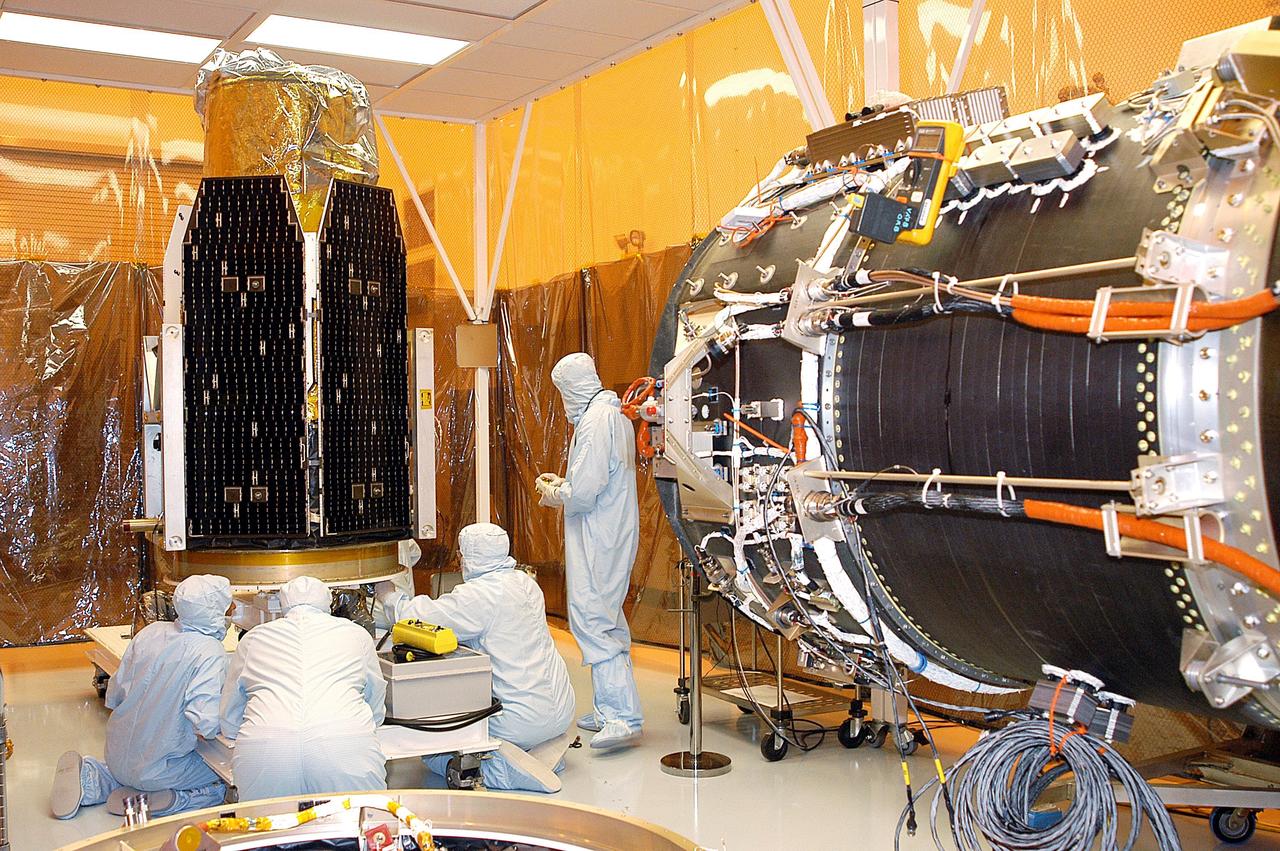
KENNEDY SPACE CENTER, FLA. - The Galaxy Evolution Explorer (GALEX) spacecraft awaits inspection after being moved into a vertical position in the Payload Hazardous Servicing Facility. On the right is the Pegasus launch vehicle from which it was demated. A borescope inspection will be conducted on the spacecraft to locate a small fastener and associated clip missing from a demated connector identified during preflight testing. GALEX is an orbiting space telescope that will observe galaxies in ultraviolet light across 10 billion years of cosmic history. During its 29-month mission, GALEX will produce the first comprehensive map of a Universe of galaxies under construction, bringing more understanding to how galaxies like the Milky Way were formed. The GALEX launch date in late April is currently under review.
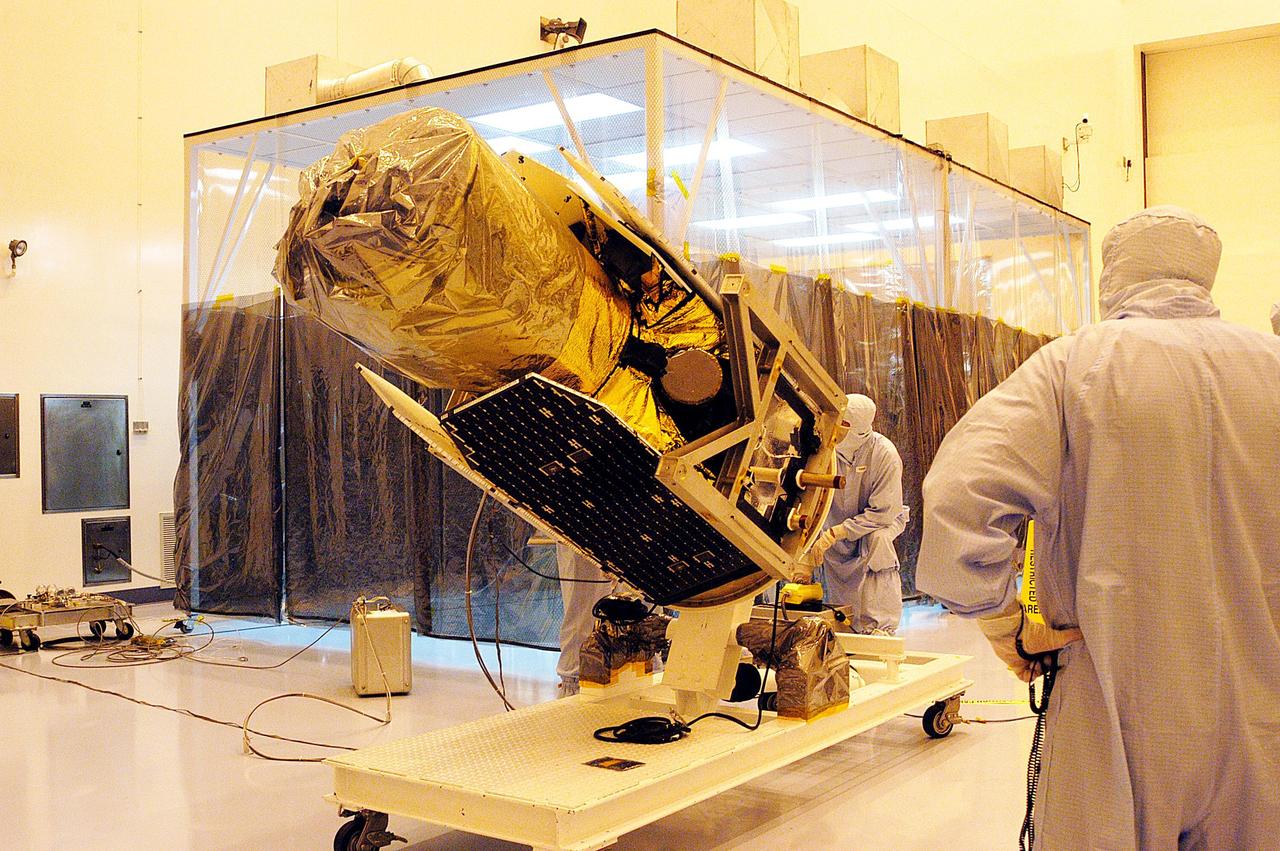
KENNEDY SPACE CENTER, FLA. - Technicians lift the Galaxy Evolution Explorer (GALEX) spacecraft into a vertical position after it is demated from its Pegasus launch vehicle in the Payload Hazardous Servicing Facility. A borescope inspection will be conducted to locate a small fastener and associated clip missing from a demated connector identified during preflight testing. GALEX is an orbiting space telescope that will observe galaxies in ultraviolet light across 10 billion years of cosmic history. During its 29-month mission, GALEX will produce the first comprehensive map of a Universe of galaxies under construction, bringing more understanding to how galaxies like the Milky Way were formed. The GALEX launch date in late April is currently under review.
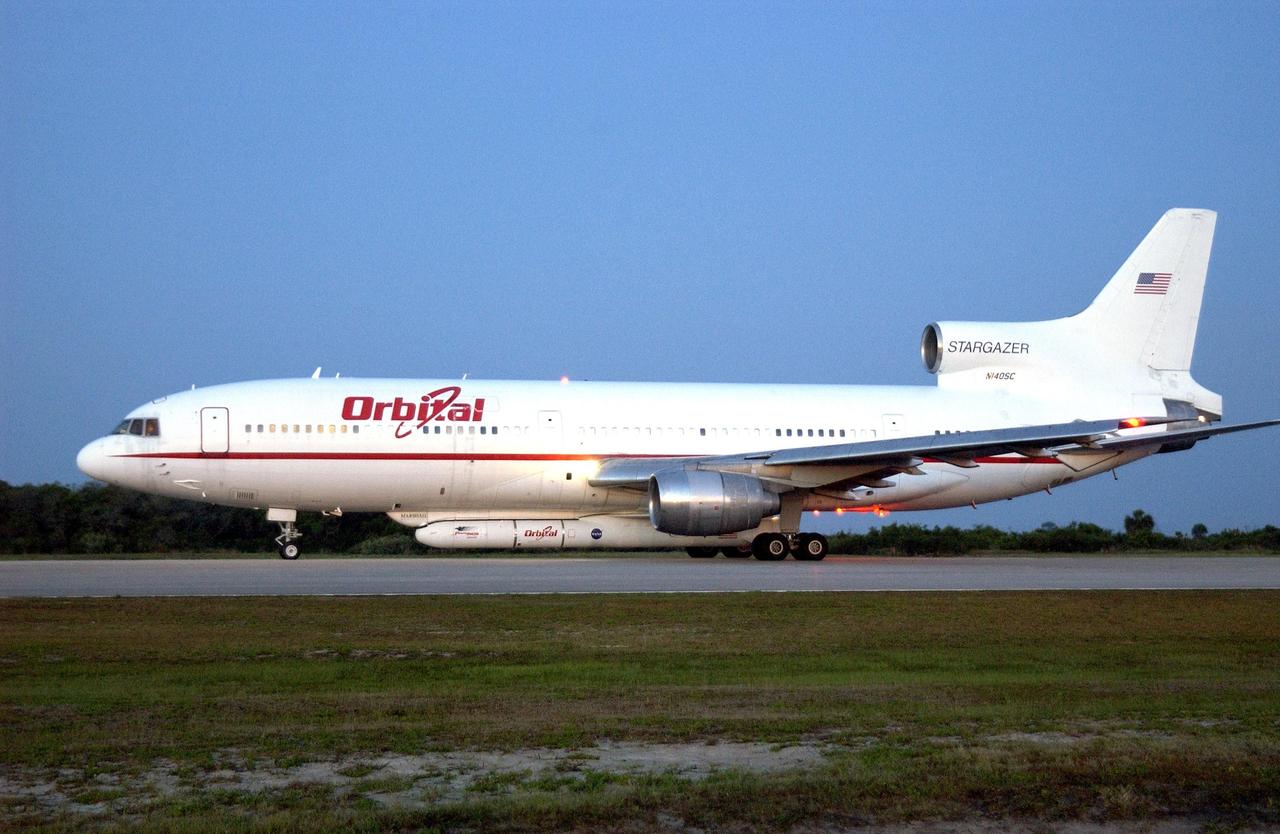
KENNEDY SPACE CENTER, FLA. - At Cape Canaveral Air Force Station, Orbital Sciences' L-1011 aircraft waits for takeoff time between 7:50 and 9:50 a.m. EDT. Attached underneath is the Pegasus XL rocket with its payload, the Galaxy Evolution Explorer (GALEX), due to be released about 8 a.m. The GALEX will carry into space an orbiting telescope that will observe a million galaxies across 10 billion years of cosmic history to help astronomers determine when the stars and elements we see today had their origins. The spacecraft will sweep the skies for 28 months using state-of-the-art ultraviolet detectors to single out galaxies dominated by young, hot, short-lived stars that give off a great deal of energy at that wavelength. These galaxies are actively creating stars, and therefore provide a window into the history and causes of star formation in galaxies.
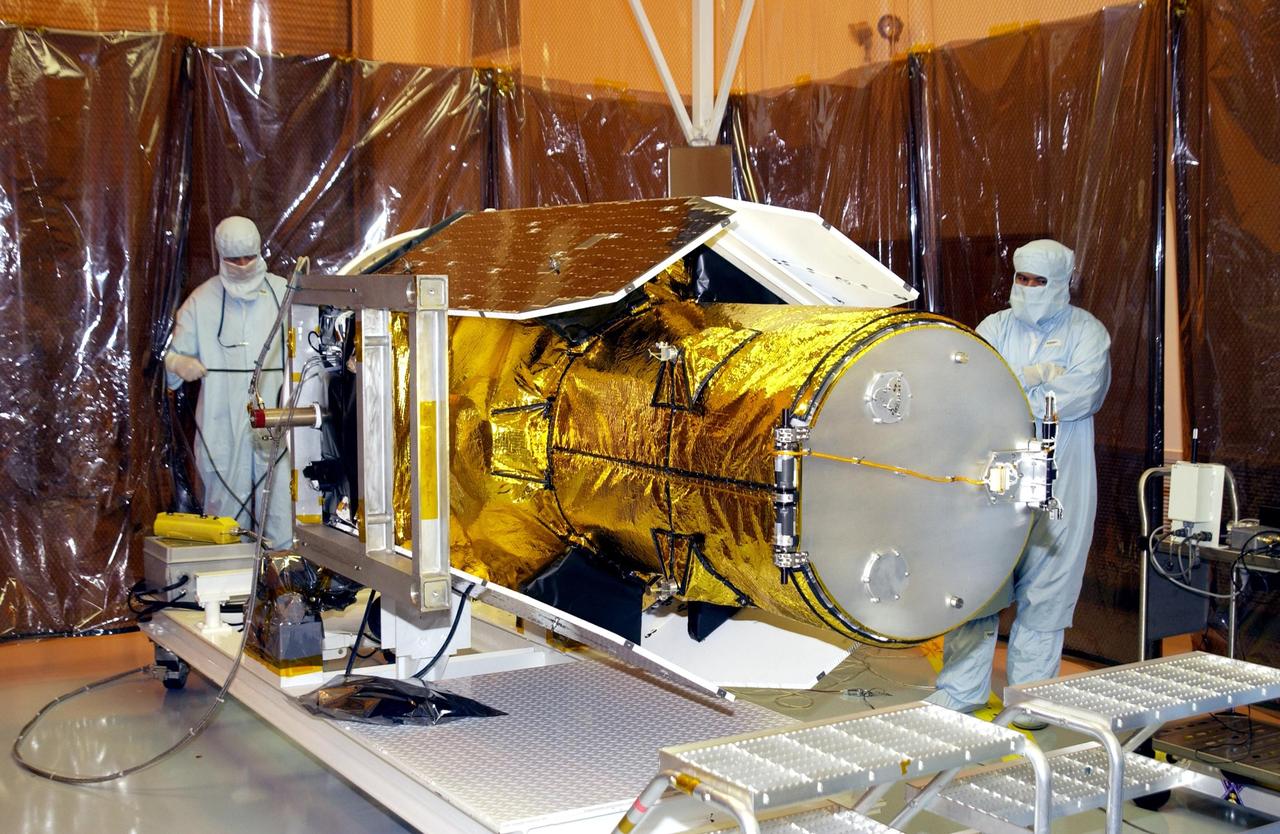
KENNEDY SPACE CENTER, FLA. -- NASA's Galaxy Evolution Explorer spacecraft is successfully rotated to horizontal in preparation for mating with the Pegasus XL launch vehicle. The GALEX, set to launch April 2 from Cape Canaveral Air Force Station, will carry into space an orbiting telescope that will observe a million galaxies across 10 billion years of cosmic history to help astronomers determine when the stars and elements we see today had their origins. From its orbit high above Earth, the spacecraft will sweep the skies for 28 months using state-of-the-art ultraviolet detectors. Looking in the ultraviolet will single out galaxies dominated by young, hot, short-lived stars that give off a great deal of energy at that wavelength. These galaxies are actively creating stars, and therefore provide a window into the history and causes of star formation in galaxies.
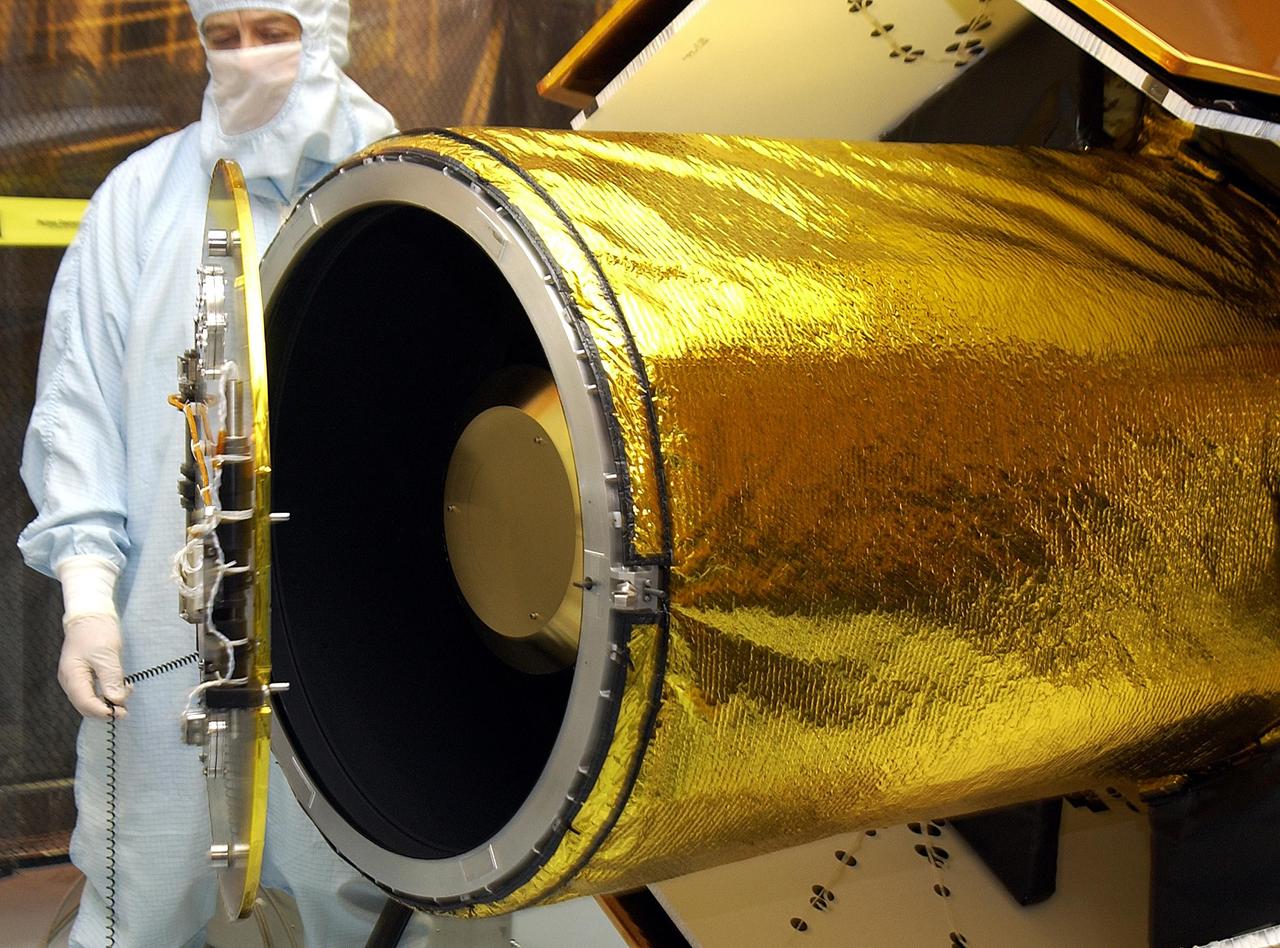
KENNEDY SPACE CENTER, FLA. -- In the Multi-Payload Processing Facility, workers check the deployment of the cover of the telescope on the GALEX satellite. The Galaxy Evolution Explorer (GALEX) is an orbiting space telescope that will observe galaxies in ultraviolet light across 10 billion years of cosmic history. Led by the California Institute of Technology, GALEX will conduct several first-of-a-kind sky surveys, including an extra-galactic (beyond our galaxy) ultraviolet all-sky survey. During its 29-month mission GALEX will produce the first comprehensive map of a Universe of galaxies under construction, bringing more understanding of how galaxies like the Milky Way were formed. GALEX is due to be launched from Cape Canaveral Air Force Station March 25 via a Pegasus rocket.
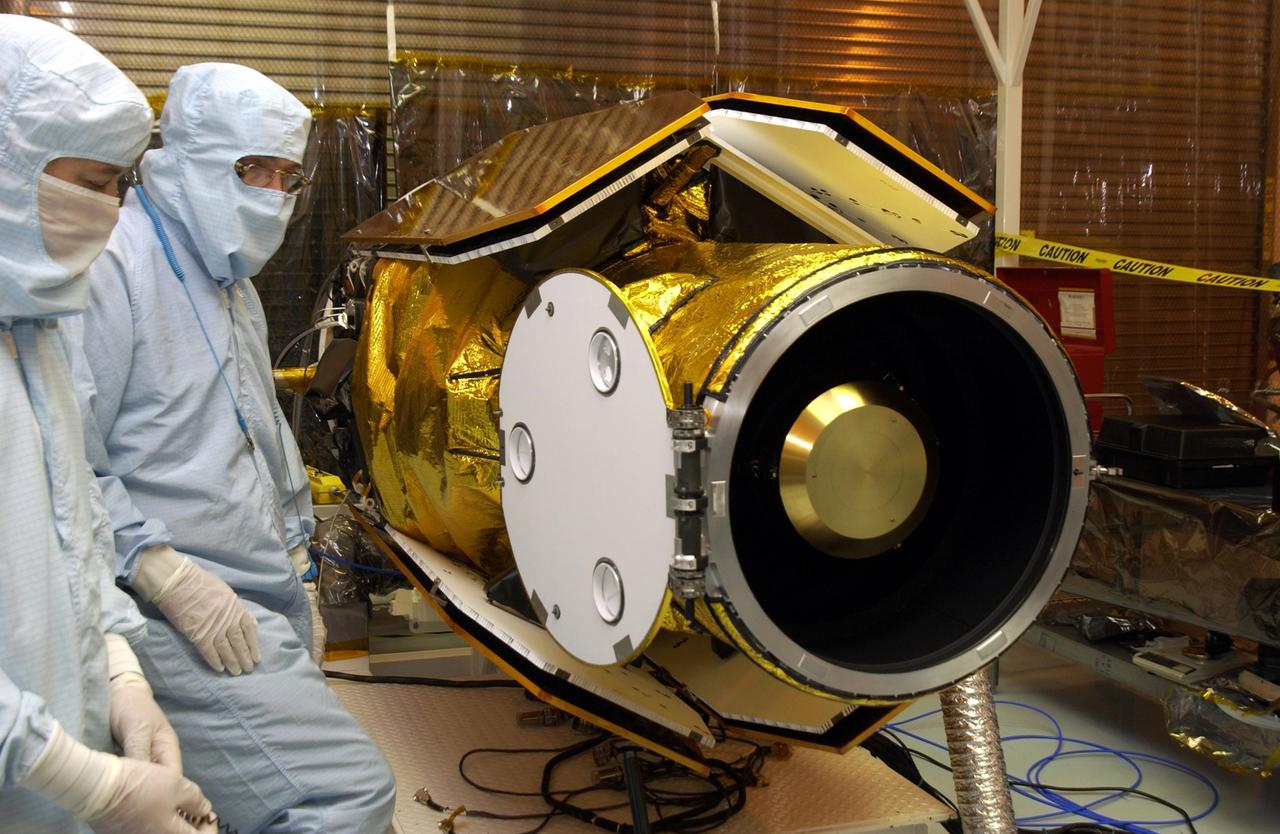
KENNEDY SPACE CENTER, FLA. -- In the Multi-Payload Processing Facility, workers check the deployment of the cover of the telescope on the GALEX satellite. The Galaxy Evolution Explorer (GALEX) is an orbiting space telescope that will observe galaxies in ultraviolet light across 10 billion years of cosmic history. Led by the California Institute of Technology, GALEX will conduct several first-of-a-kind sky surveys, including an extra-galactic (beyond our galaxy) ultraviolet all-sky survey. During its 29-month mission GALEX will produce the first comprehensive map of a Universe of galaxies under construction, bringing more understanding of how galaxies like the Milky Way were formed. GALEX is due to be launched from Cape Canaveral Air Force Station March 25 via a Pegasus rocket.
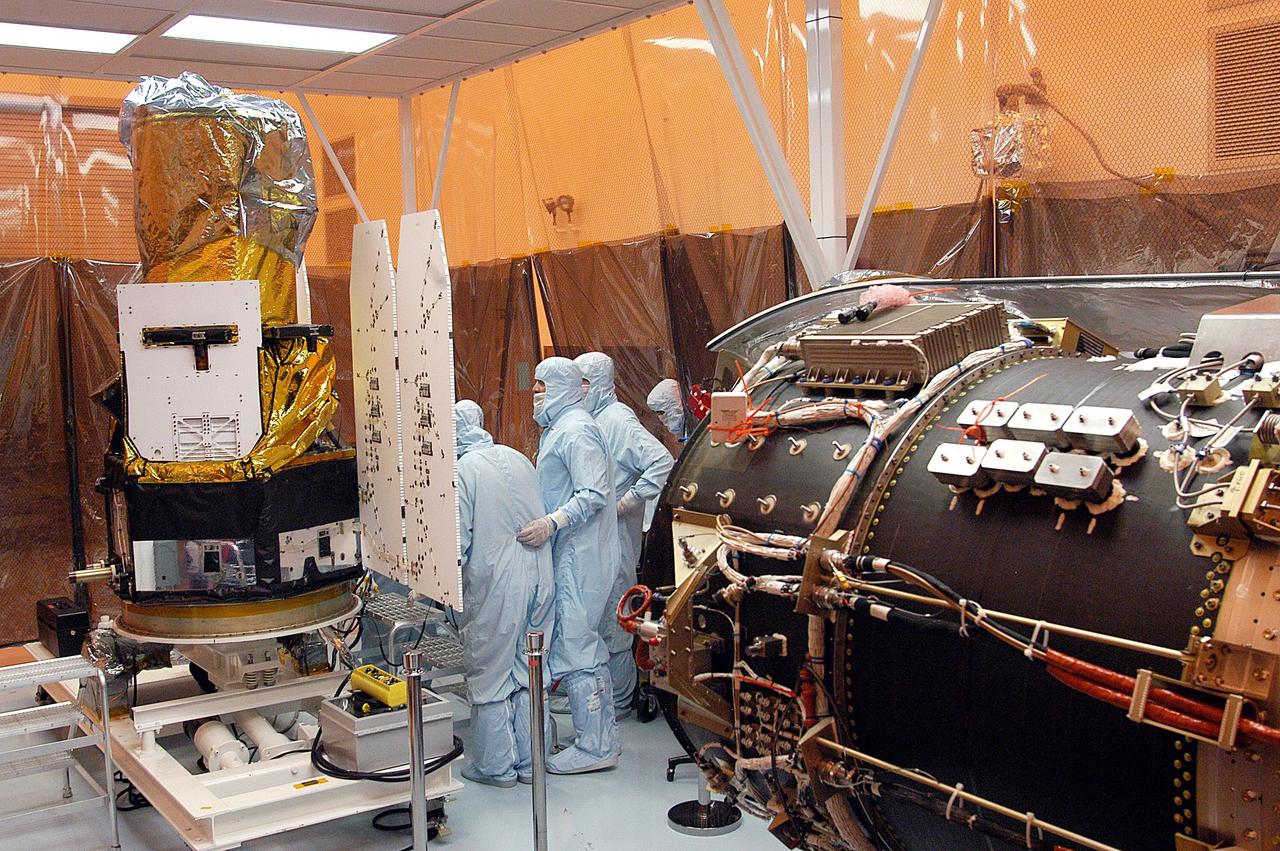
KENNEDY SPACE CENTER, FLA. - Foreign object debris shields are installed and a borescope inspection is conducted on the Galaxy Evolution Explorer (GALEX) spacecraft in the Payload Hazardous Servicing Facility. On the right is the Pegasus launch vehicle from which it was demated. Technicians are looking for a small fastener and associated clip missing from a demated connector identified during preflight testing. GALEX is an orbiting space telescope that will observe galaxies in ultraviolet light across 10 billion years of cosmic history. During its 29-month mission, GALEX will produce the first comprehensive map of a Universe of galaxies under construction, bringing more understanding to how galaxies like the Milky Way were formed. The GALEX launch date in late April is currently under review.
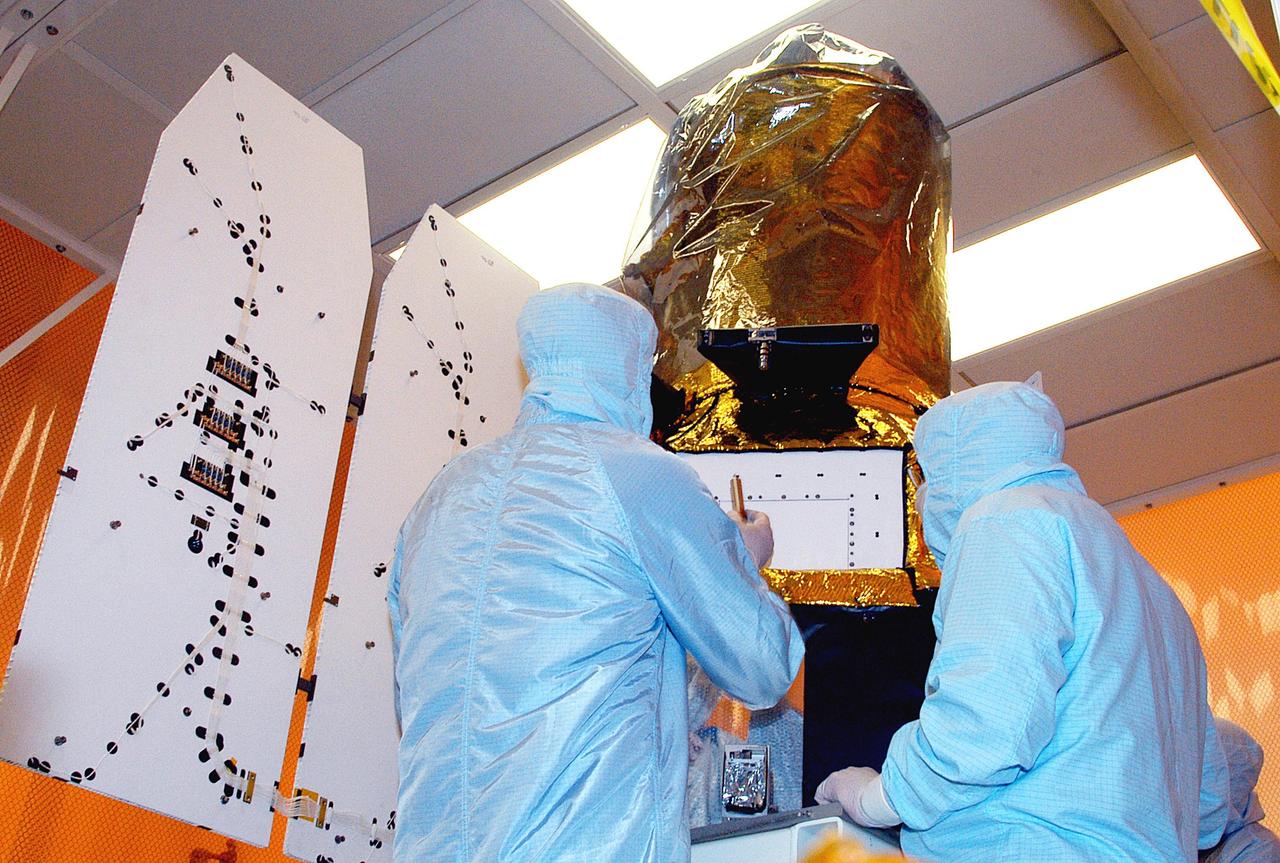
KENNEDY SPACE CENTER, FLA. -- Workers in the Multi-Payload Processing Facility check the solar array panels on the Galaxy Evolution Explorer (GALEX) satellite after they were deployed. The GALEX is an orbiting space telescope that will observe galaxies in ultraviolet light across 10 billion years of cosmic history. Led by the California Institute of Technology, GALEX will conduct several first-of-a-kind sky surveys, including an extra-galactic (beyond our galaxy) ultraviolet all-sky survey. During its 29-month mission GALEX will produce the first comprehensive map of a Universe of galaxies under construction, bringing more understanding of how galaxies like the Milky Way were formed. GALEX is due to be launched from Cape Canaveral Air Force Station March 25 via a Pegasus rocket.
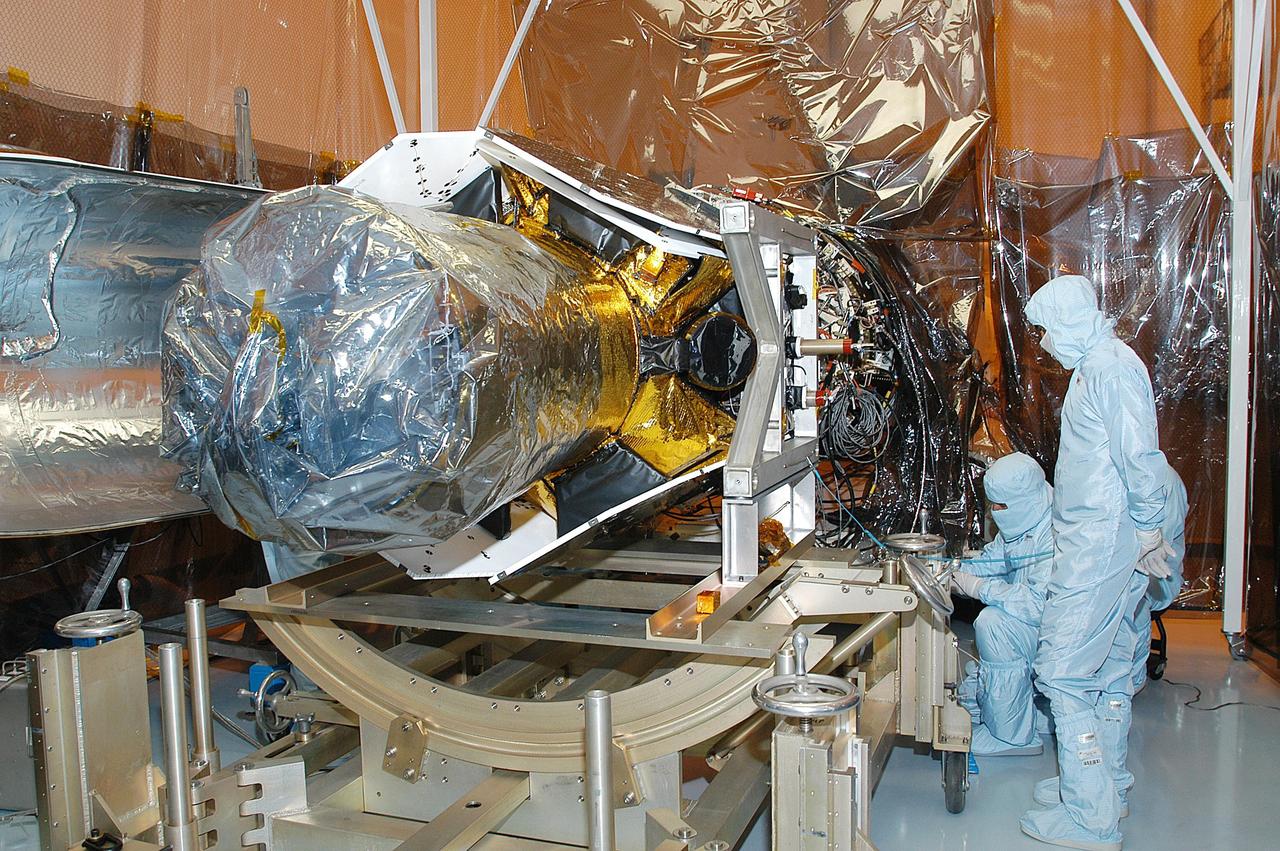
KENNEDY SPACE CENTER, FLA. -- In the Multi-Payload Processing Facility, NASA's Galaxy Evolution Explorer is prepared for mating with the Pegasus XL launch vehicle. The GALEX, set to launch April 2 from Cape Canaveral Air Force Station, will carry into space an orbiting telescope that will observe a million galaxies across 10 billion years of cosmic history to help astronomers determine when the stars and elements we see today had their origins. The spacecraft will sweep the skies for 28 months using state-of-the-art ultraviolet detectors to single out galaxies dominated by young, hot, short-lived stars that give off a great deal of energy at that wavelength. These galaxies are actively creating stars, and therefore provide a window into the history and causes of star formation in galaxies.
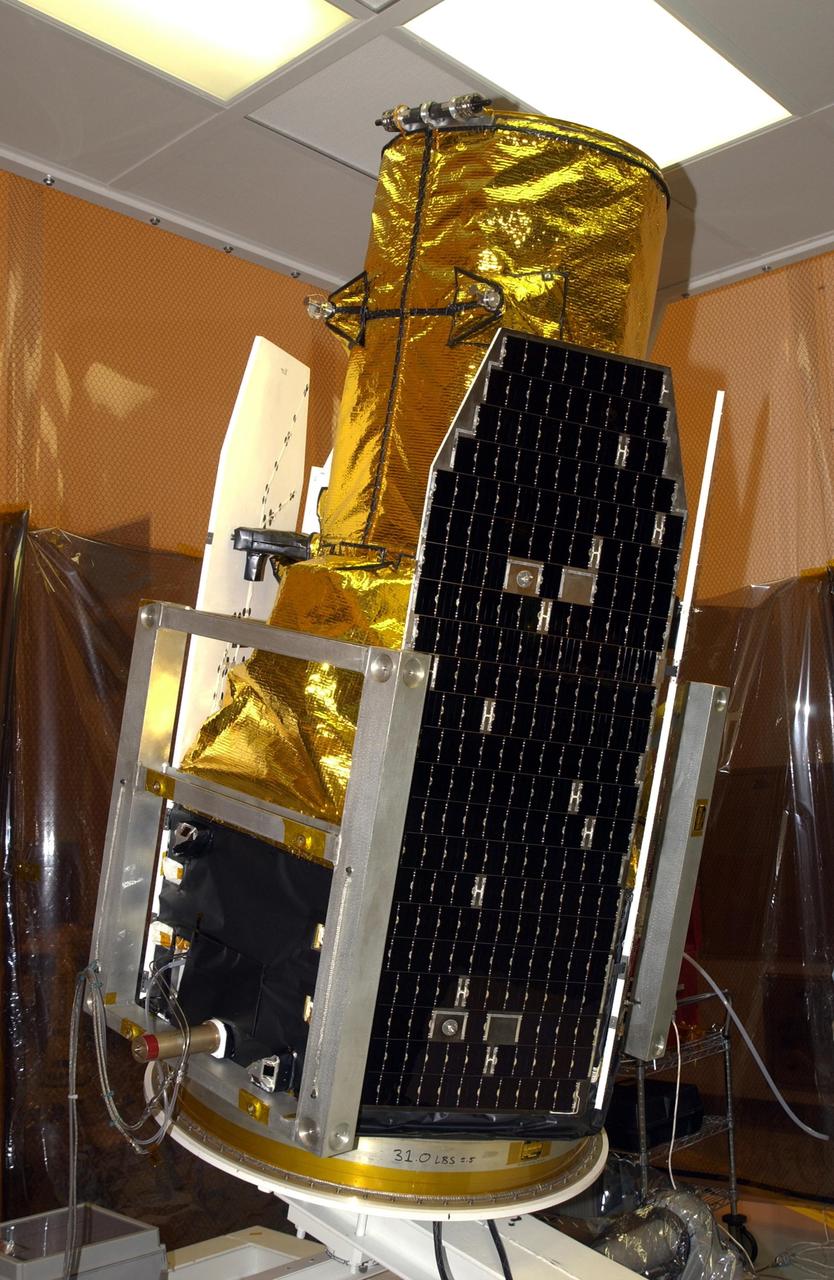
KENNEDY SPACE CENTER, FLA. -- In the Multi-Payload Processing Facility, NASA's Galaxy Evolution Explorer spacecraft is moved to a rotation stand in preparation for mating with the Pegasus XL launch vehicle. The GALEX, set to launch April 2 from Cape Canaveral Air Force Station, will carry into space an orbiting telescope that will observe a million galaxies across 10 billion years of cosmic history to help astronomers determine when the stars and elements we see today had their origins. From its orbit high above Earth, the spacecraft will sweep the skies for 28 months using state-of-the-art ultraviolet detectors. Looking in the ultraviolet will single out galaxies dominated by young, hot, short-lived stars that give off a great deal of energy at that wavelength. These galaxies are actively creating stars, and therefore provide a window into the history and causes of star formation in galaxies.

KENNEDY SPACE CENTER, FLA. - The solar array panels on the Galaxy Evolution Explorer (GALEX) satellite are deployed during processing in the Multi-Payload Processing Facility. The GALEX is an orbiting space telescope that will observe galaxies in ultraviolet light across 10 billion years of cosmic history. Led by the California Institute of Technology, GALEX will conduct several first-of-a-kind sky surveys, including an extra-galactic (beyond our galaxy) ultraviolet all-sky survey. During its 29-month mission GALEX will produce the first comprehensive map of a Universe of galaxies under construction, bringing more understanding of how galaxies like the Milky Way were formed. GALEX is due to be launched from Cape Canaveral Air Force Station March 25 via a Pegasus rocket.
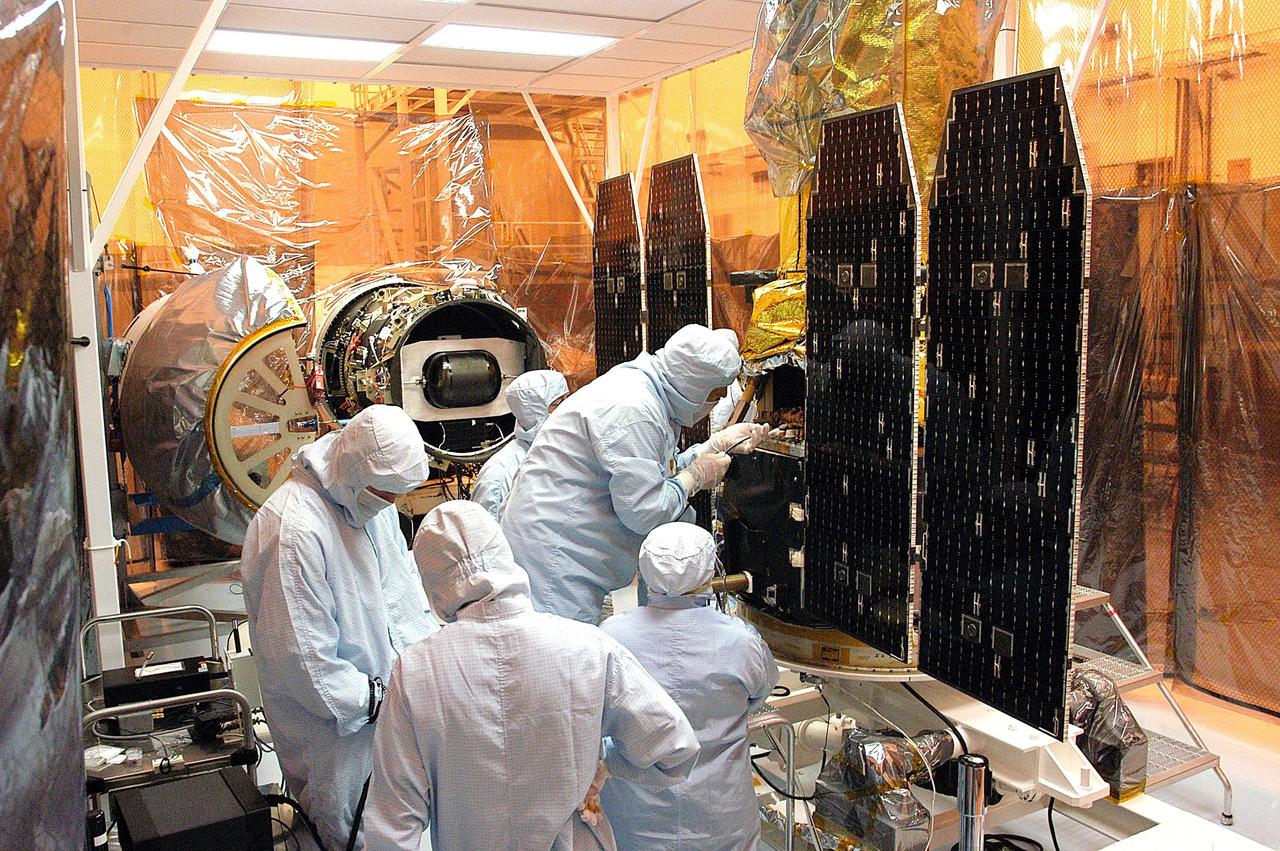
KENNEDY SPACE CENTER, FLA. - Foreign object debris shields are installed and a borescope inspection is conducted on the Galaxy Evolution Explorer (GALEX) spacecraft in the Payload Hazardous Servicing Facility. On the left is the Pegasus launch vehicle from which it was demated. Technicians are looking for a small fastener and associated clip missing from a demated connector identified during preflight testing. GALEX is an orbiting space telescope that will observe galaxies in ultraviolet light across 10 billion years of cosmic history. During its 29-month mission, GALEX will produce the first comprehensive map of a Universe of galaxies under construction, bringing more understanding to how galaxies like the Milky Way were formed. The GALEX launch date in late April is currently under review.
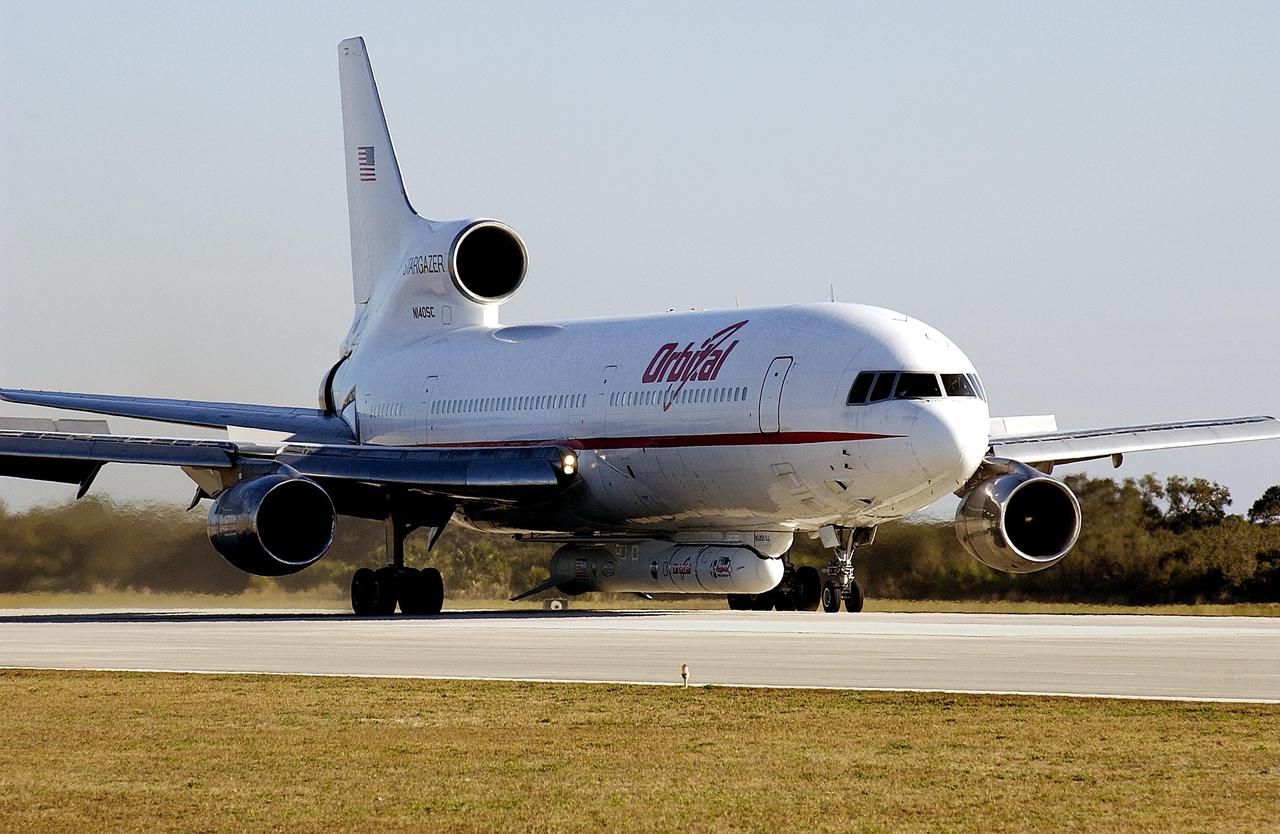
KENNEDY SPACE CENTER, FLA. -- The Orbital Sciences Corp.'s L-1011 aircraft arrives at the Skid Strip, Cape Canaveral Air Force Station, with the Pegasus rocket attached below. The Pegasus will carry ito orbit the Galaxy Evolution Explorer (GALEX), an orbiting space telescope that will observe galaxies in ultraviolet light across 10 billion years of cosmic history. Led by the California Institute of Technology, GALEX will conduct several first-of-a-kind sky surveys, including an extra-galactic (beyond our galaxy) ultraviolet all-sky survey. During its 29-month mission, GALEX will produce the first comprehensive map of a Universe of galaxies under construction, bringing more understanding how galaxies like the Milky Way were formed. GALEX is due to be launched from Cape Canaveral Air Force Station March 25.
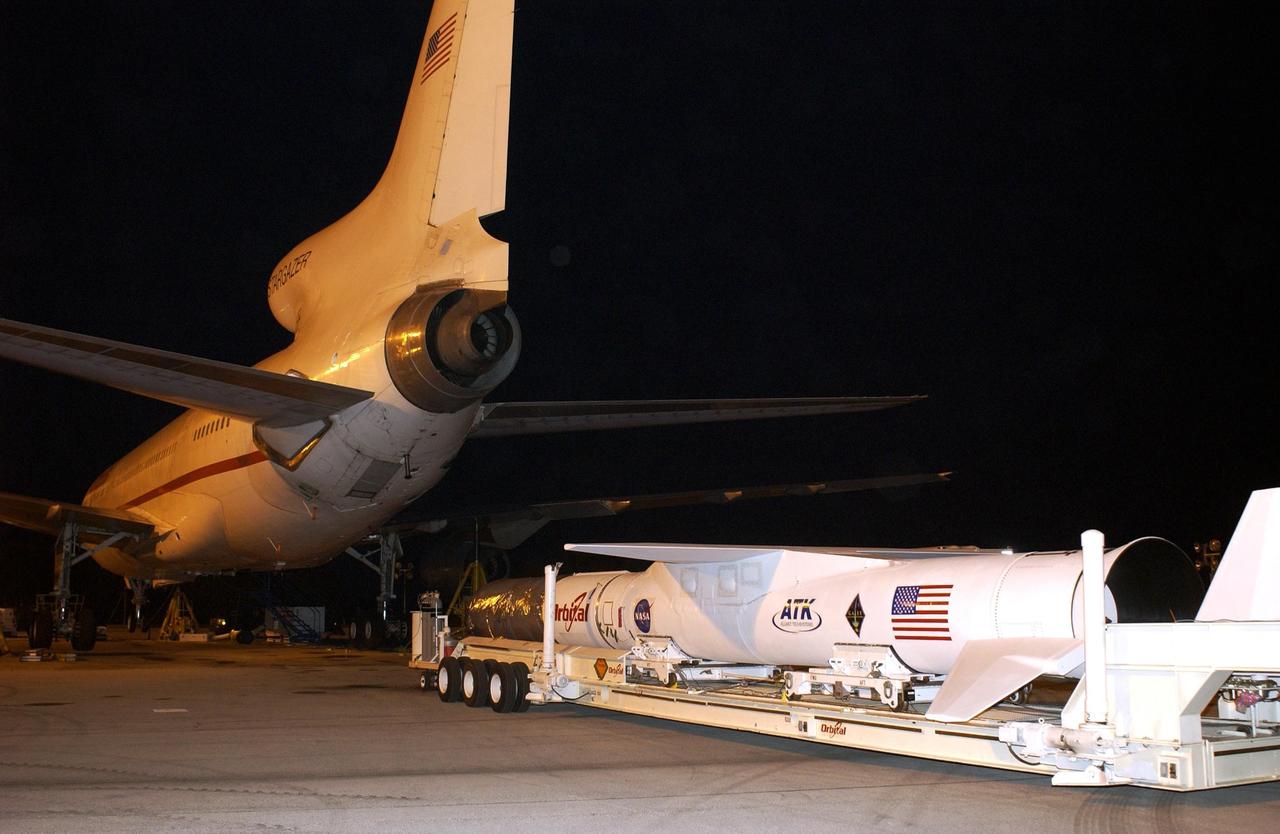
KENNEDY SPACE CENTER, FLA. - The mated Pegasus XL and Galaxy Evolution Explorer (GALEX) satellite approach the Orbital Sciences L-1011 aircraft at Cape Canaveral Air Force Station. The GALEX, to be launched April 28 from the L-1011, will carry into space an orbiting telescope that will observe a million galaxies across 10 billion years of cosmic history to help astronomers determine when the stars and elements we see today had their origins. The spacecraft will sweep the skies for 28 months using state-of-the-art ultraviolet detectors to single out galaxies dominated by young, hot, short-lived stars that give off a great deal of energy at that wavelength. These galaxies are actively creating stars, and therefore provide a window into the history and causes of star formation in galaxies.
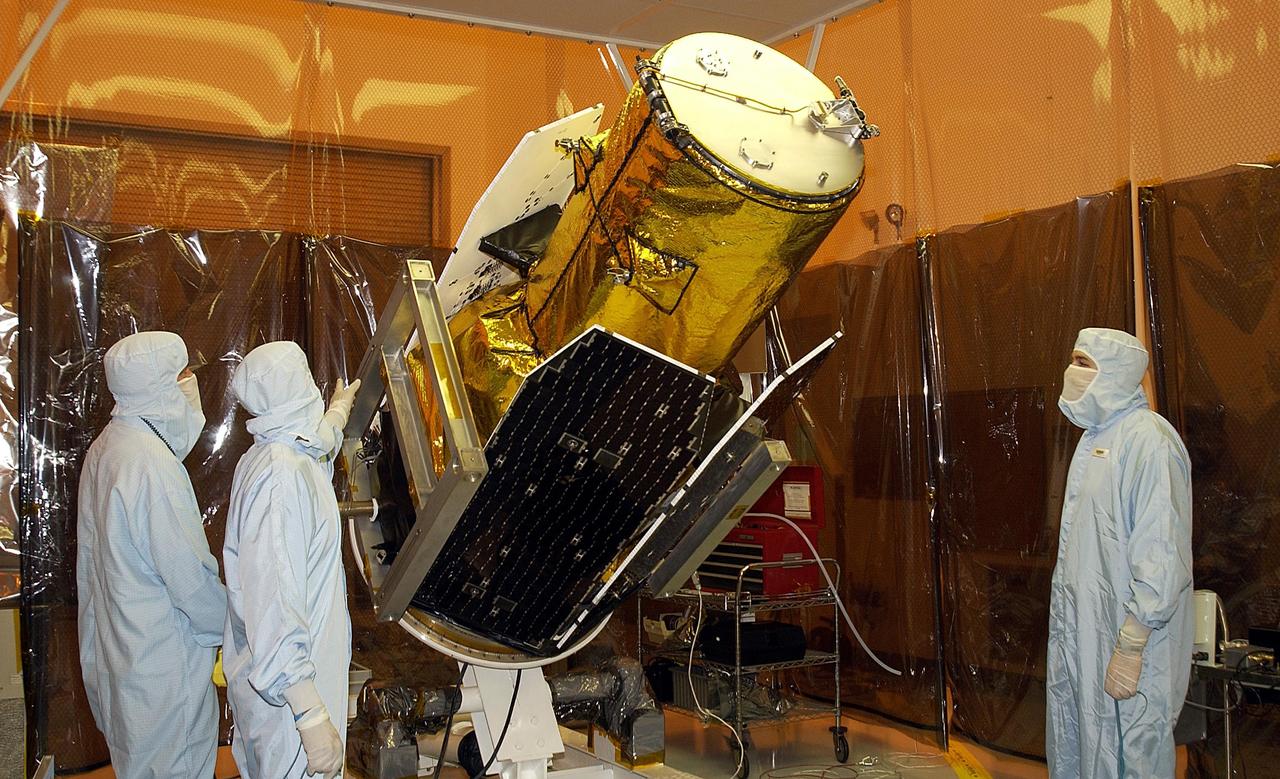
KENNEDY SPACE CENTER, FLA. - Workers in the Multi-Payload Processing Facility watch as NASA's Galaxy Evolution Explorer spacecraft is rotated in preparation for mating with the Pegasus XL launch vehicle. The GALEX, set to launch April 2 from Cape Canaveral Air Force Station, will carry into space an orbiting telescope that will observe a million galaxies across 10 billion years of cosmic history to help astronomers determine when the stars and elements we see today had their origins. From its orbit high above Earth, the spacecraft will sweep the skies for 28 months using state-of-the-art ultraviolet detectors. Looking in the ultraviolet will single out galaxies dominated by young, hot, short-lived stars that give off a great deal of energy at that wavelength. These galaxies are actively creating stars, and therefore provide a window into the history and causes of star formation in galaxies.
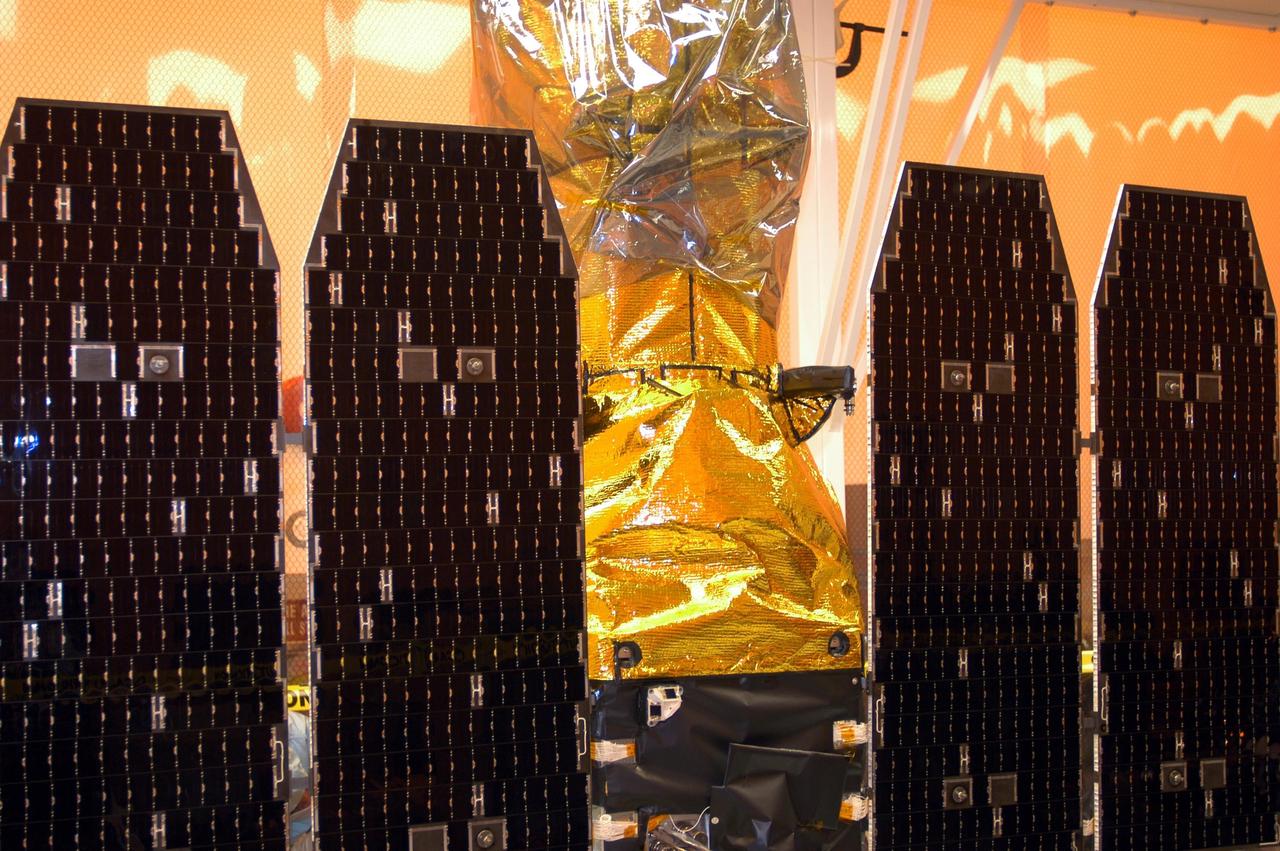
KENNEDY SPACE CENTER, FLA. -- The solar array panels on the Galaxy Evolution Explorer (GALEX) satellite are deployed during processing in the Multi-Payload Processing Facility. The GALEX is an orbiting space telescope that will observe galaxies in ultraviolet light across 10 billion years of cosmic history. Led by the California Institute of Technology, GALEX will conduct several first-of-a-kind sky surveys, including an extra-galactic (beyond our galaxy) ultraviolet all-sky survey. During its 29-month mission GALEX will produce the first comprehensive map of a Universe of galaxies under construction, bringing more understanding of how galaxies like the Milky Way were formed. GALEX is due to be launched from Cape Canaveral Air Force Station March 25 via a Pegasus rocket.
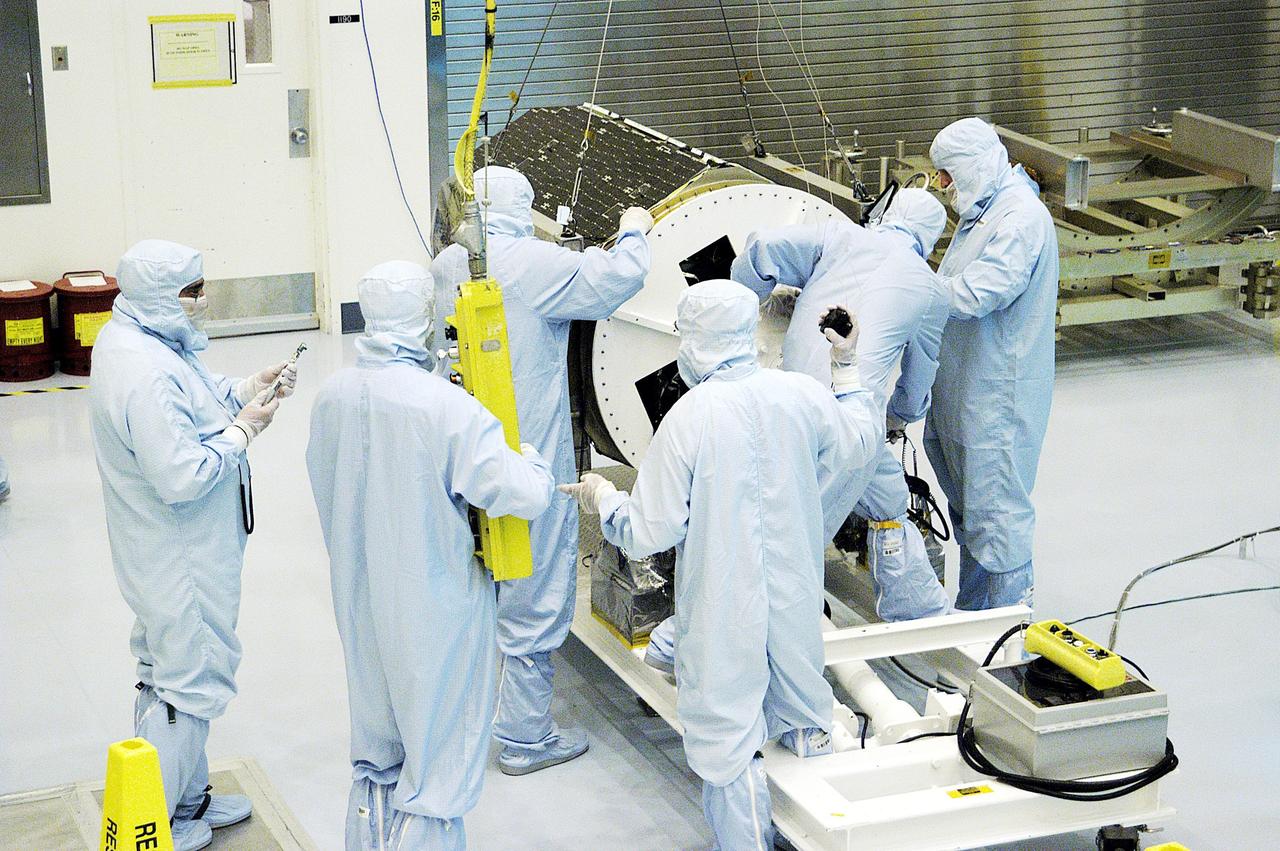
KENNEDY SPACE CENTER, FLA. - Technicians prepare to lift the Galaxy Evolution Explorer (GALEX) spacecraft into a vertical position after it is demated from its Pegasus launch vehicle in the Payload Hazardous Servicing Facility. A borescope inspection will be conducted to locate a small fastener and associated clip missing from a demated connector identified during preflight testing. GALEX is an orbiting space telescope that will observe galaxies in ultraviolet light across 10 billion years of cosmic history. During its 29-month mission, GALEX will produce the first comprehensive map of a Universe of galaxies under construction, bringing more understanding to how galaxies like the Milky Way were formed. The GALEX launch date in late April is currently under review.
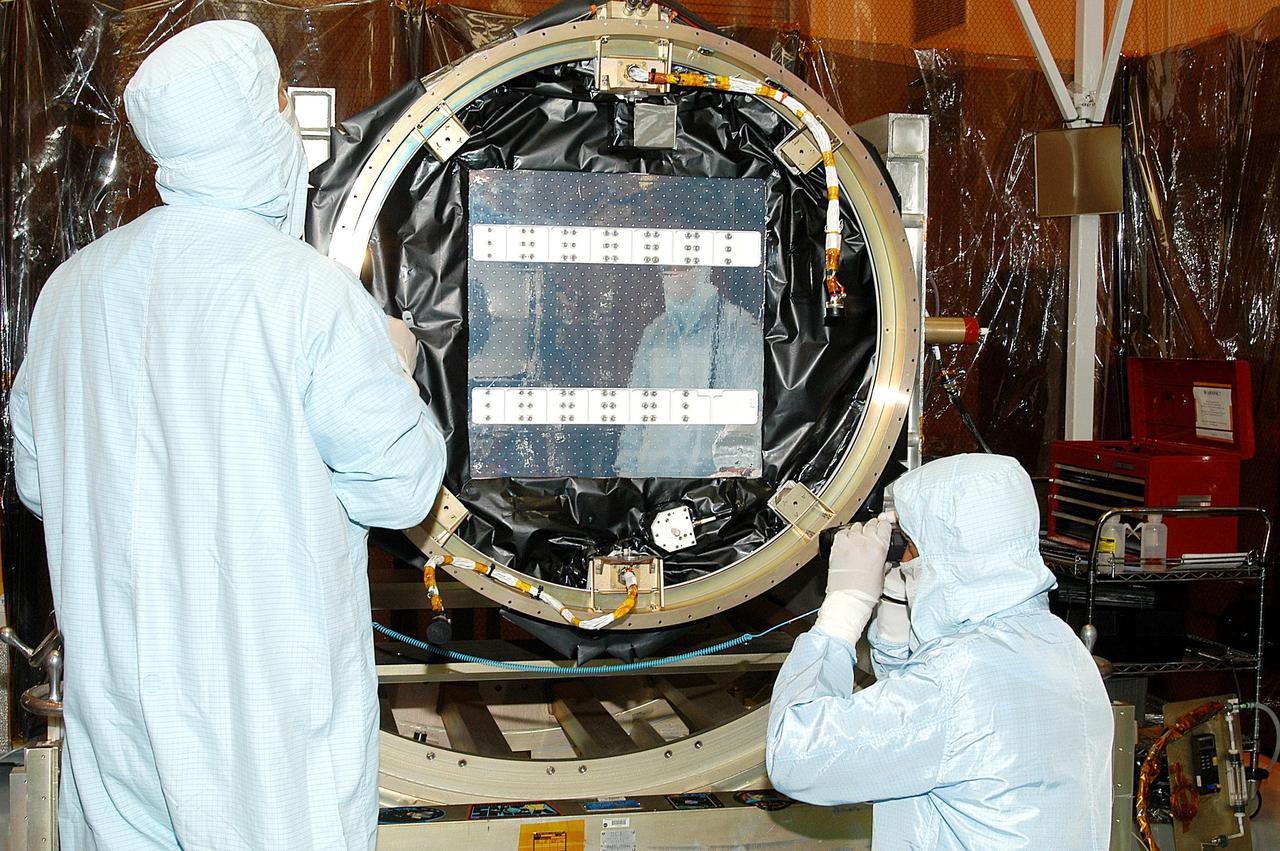
KENNEDY SPACE CENTER, FLA. -- -- In the Multi-Payload Processing Facility, NASA's Galaxy Evolution Explorer is prepared for mating with the Pegasus XL launch vehicle. The GALEX, set to launch April 2 from Cape Canaveral Air Force Station, will carry into space an orbiting telescope that will observe a million galaxies across 10 billion years of cosmic history to help astronomers determine when the stars and elements we see today had their origins. The spacecraft will sweep the skies for 28 months using state-of-the-art ultraviolet detectors to single out galaxies dominated by young, hot, short-lived stars that give off a great deal of energy at that wavelength. These galaxies are actively creating stars, and therefore provide a window into the history and causes of star formation in galaxies.
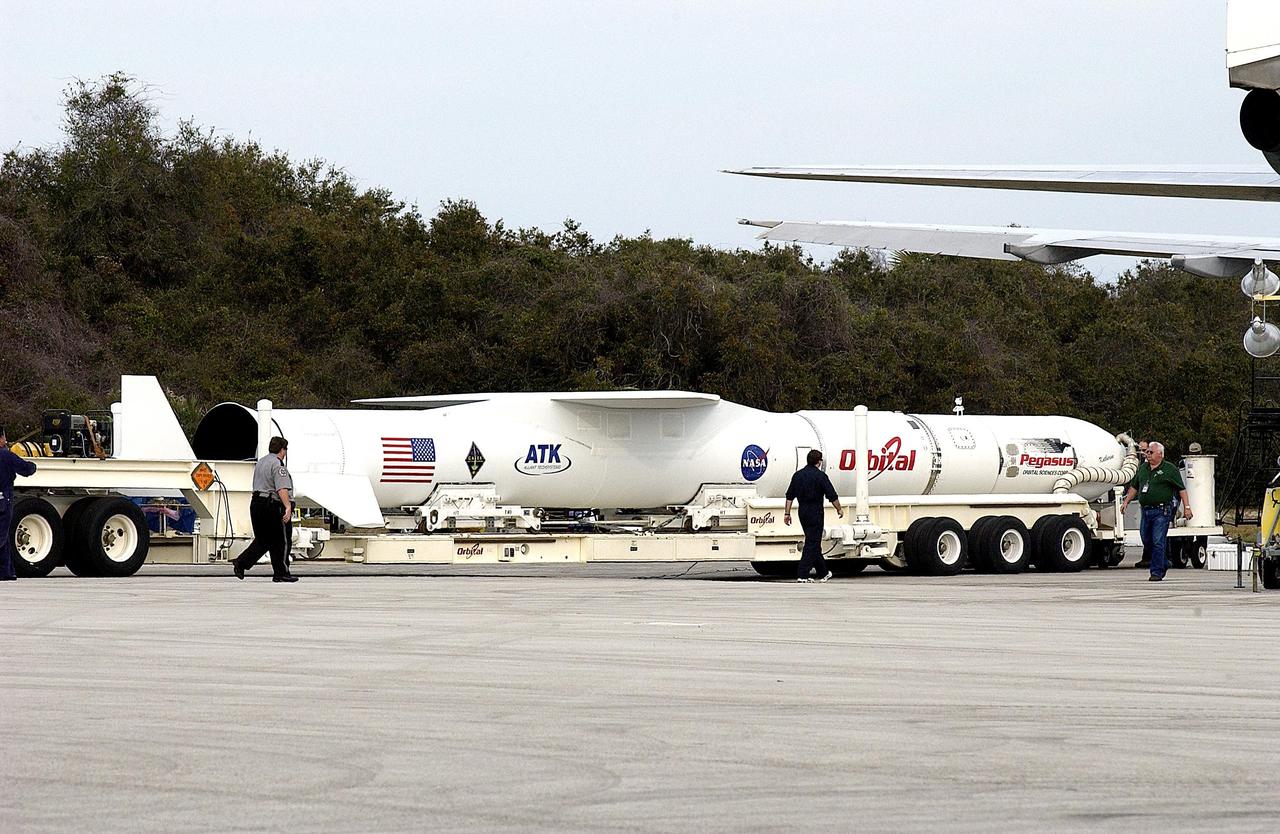
KENNEDY SPACE CENTER, FLA. -- The Pegasus launch vehicle is on a transporter, ready to be moved from the Skid Strip, Cape Canaveral Air Force Station, to the Multi-Payload Processing Facility (MPPF) at KSC. There it will be mated to the Galaxy Evolution Explorer (GALEX). The Pegasus will carry the GALEX, an orbiting space telescope that will observe galaxies in ultraviolet light across 10 billion years of cosmic history, into orbit. Led by the California Institute of Technology, GALEX will conduct several first-of-a-kind sky surveys, including an extra-galactic (beyond our galaxy) ultraviolet all-sky survey. During its 29-month mission GALEX will produce the first comprehensive map of a Universe of galaxies under construction, bringing more understanding of how galaxies like the Milky Way were formed. GALEX is due to be launched from Cape Canaveral Air Force Station March 25.

KENNEDY SPACE CENTER, FLA. -- In the Multi-Payload Processing Facility, workers check the deployment of the cover of the telescope on the GALEX satellite. The Galaxy Evolution Explorer (GALEX) is an orbiting space telescope that will observe galaxies in ultraviolet light across 10 billion years of cosmic history. Led by the California Institute of Technology, GALEX will conduct several first-of-a-kind sky surveys, including an extra-galactic (beyond our galaxy) ultraviolet all-sky survey. During its 29-month mission GALEX will produce the first comprehensive map of a Universe of galaxies under construction, bringing more understanding of how galaxies like the Milky Way were formed. GALEX is due to be launched from Cape Canaveral Air Force Station March 25 via a Pegasus rocket.
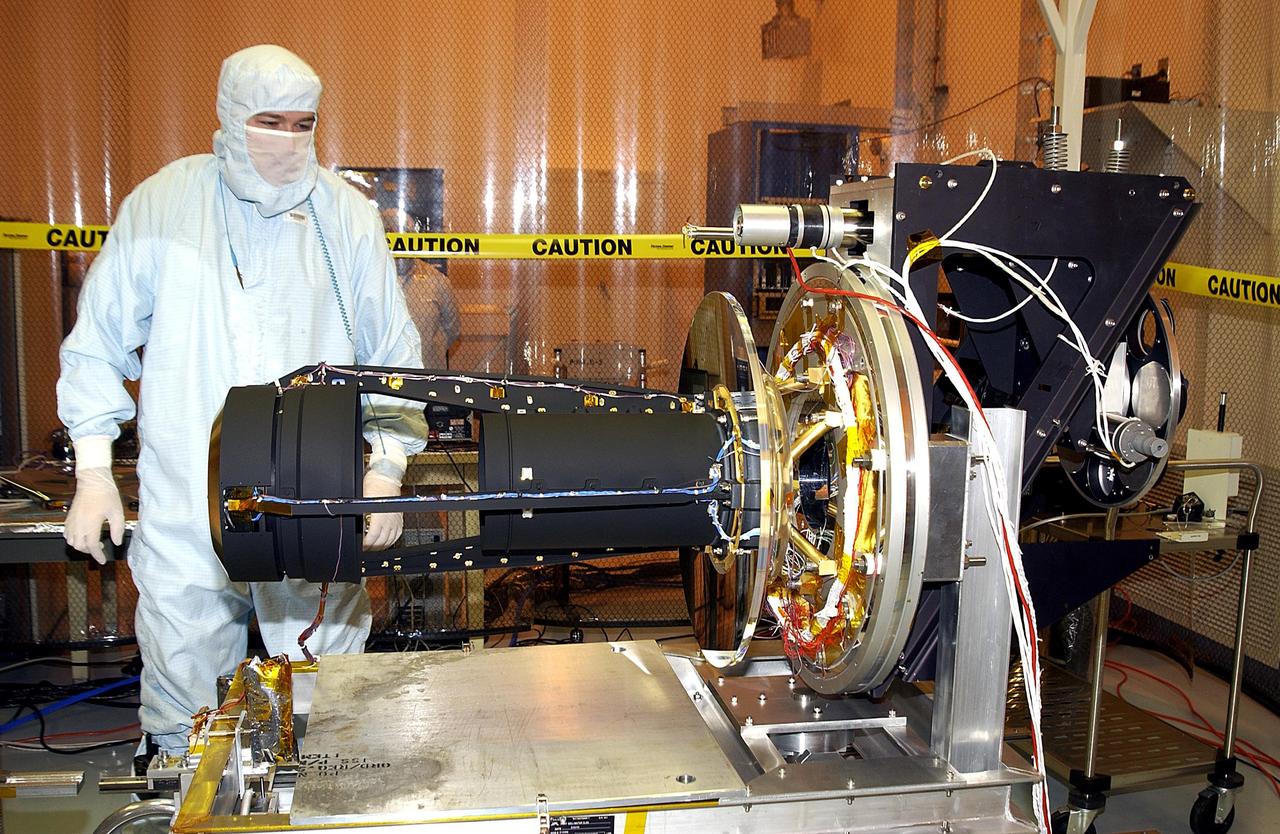
KENNEDY SPACE CENTER, FLA. -- In the Multi-Payload Processing Facility, a worker checks over the GALEX satellite on a rotation stand. The Galaxy Evolution Explorer (GALEX) is an orbiting space telescope that will observe galaxies in ultraviolet light across 10 billion years of cosmic history. Led by the California Institute of Technology, GALEX will conduct several first-of-a-kind sky surveys, including an extra-galactic (beyond our galaxy) ultraviolet all-sky survey. During its 29-month mission GALEX will produce the first comprehensive map of a Universe of galaxies under construction, bringing more understanding of how galaxies like the Milky Way were formed. GALEX is due to be launched from Cape Canaveral Air Force Station March 25 via a Pegasus rocket.
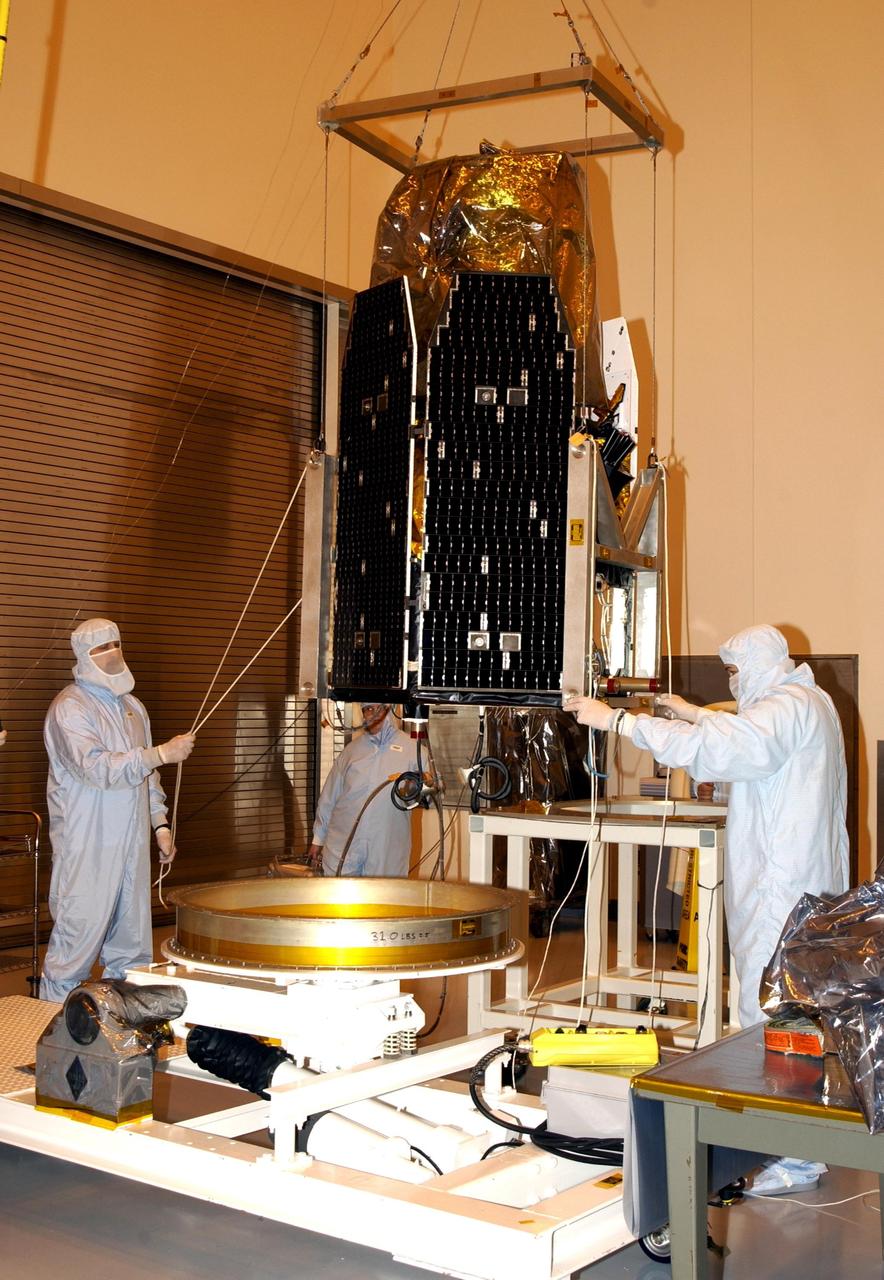
KENNEDY SPACE CENTER, FLA. -- The GALEX satellite is rotated to vertical again for solar array testing in the Multi-Payload Processing Facility. The Galaxy Evolution Explorer (GALEX) is an orbiting space telescope that will observe galaxies in ultraviolet light across 10 billion years of cosmic history. Led by the California Institute of Technology, GALEX will conduct several first-of-a-kind sky surveys, including an extra-galactic (beyond our galaxy) ultraviolet all-sky survey. During its 29-month mission GALEX will produce the first comprehensive map of a Universe of galaxies under construction, bringing more understanding of how galaxies like the Milky Way were formed. GALEX is due to be launched from Cape Canaveral Air Force Station March 25 via a Pegasus rocket.

In the Multi-Payload Processing Facility, the Pegasus XL launch vehicle waits for mating of the Galaxy Evolution Explorer (GALEX) satellite. The GALEX, set to launch April 2 from Cape Canaveral Air Force Station, will carry into space an orbiting telescope that will observe a million galaxies across 10 billion years of cosmic history to help astronomers determine when the stars and elements we see today had their origins. The spacecraft will sweep the skies for 28 months using state-of-the-art ultraviolet detectors to single out galaxies dominated by young, hot, short-lived stars that give off a great deal of energy at that wavelength. These galaxies are actively creating stars, and therefore provide a window into the history and causes of star formation in galaxies.
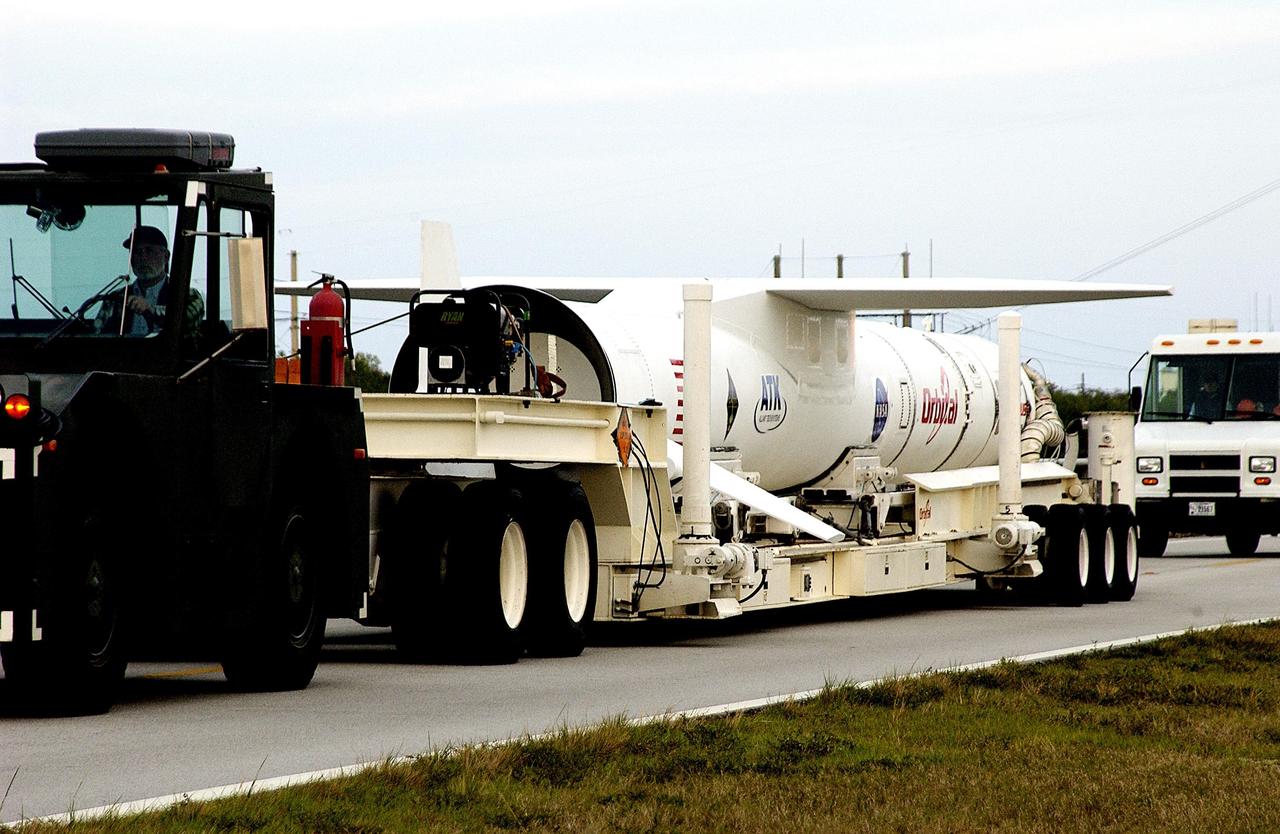
KENNEDY SPACE CENTER, FLA. -- The Pegasus launch vehicle is moved from the Skid Strip, Cape Canaveral Air Force Station, to the Multi-Payload Processing Facility (MPPF) at KSC. There it will be mated to the Galaxy Evolution Explorer (GALEX). The Pegasus will carry into orbit the GALEX, a space telescope that will observe galaxies in ultraviolet light across 10 billion years of cosmic history. Led by the California Institute of Technology, GALEX will conduct several first-of-a-kind sky surveys, including an extra-galactic (beyond our galaxy) ultraviolet all-sky survey. During its 29-month mission GALEX will produce the first comprehensive map of a Universe of galaxies under construction, bringing more understanding of how galaxies like the Milky Way were formed. GALEX is due to be launched from Cape Canaveral Air Force Station March 25.
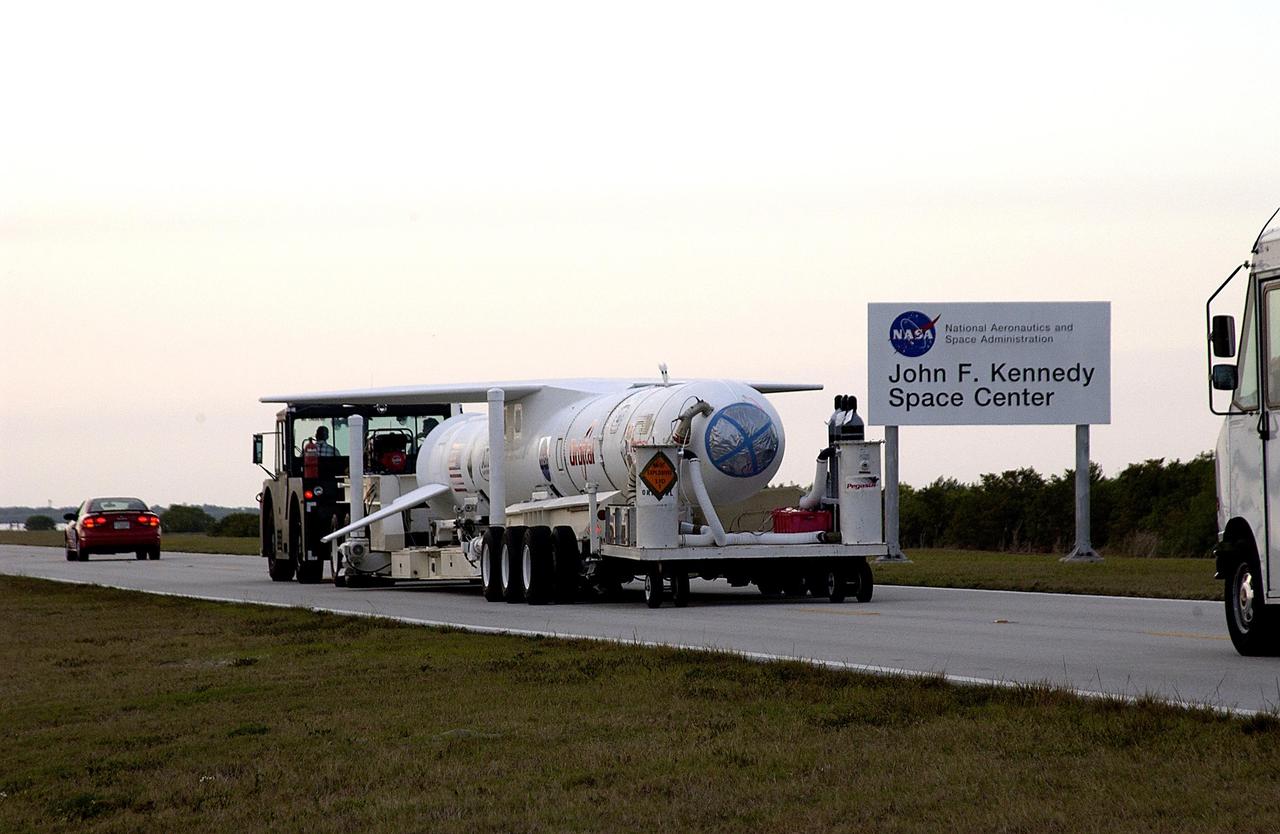
KENNEDY SPACE CENTER, FLA. -- The Pegasus launch vehicle is moved from the Skid Strip, Cape Canaveral Air Force Station, to the Multi-Payload Processing Facility (MPPF) at KSC. There it will be mated to the Galaxy Evolution Explorer (GALEX). The Pegasus will carry into orbit the GALEX, a space telescope that will observe galaxies in ultraviolet light across 10 billion years of cosmic history. Led by the California Institute of Technology, GALEX will conduct several first-of-a-kind sky surveys, including an extra-galactic (beyond our galaxy) ultraviolet all-sky survey. During its 29-month mission GALEX will produce the first comprehensive map of a Universe of galaxies under construction, bringing more understanding of how galaxies like the Milky Way were formed. GALEX is due to be launched from Cape Canaveral Air Force Station March 25.
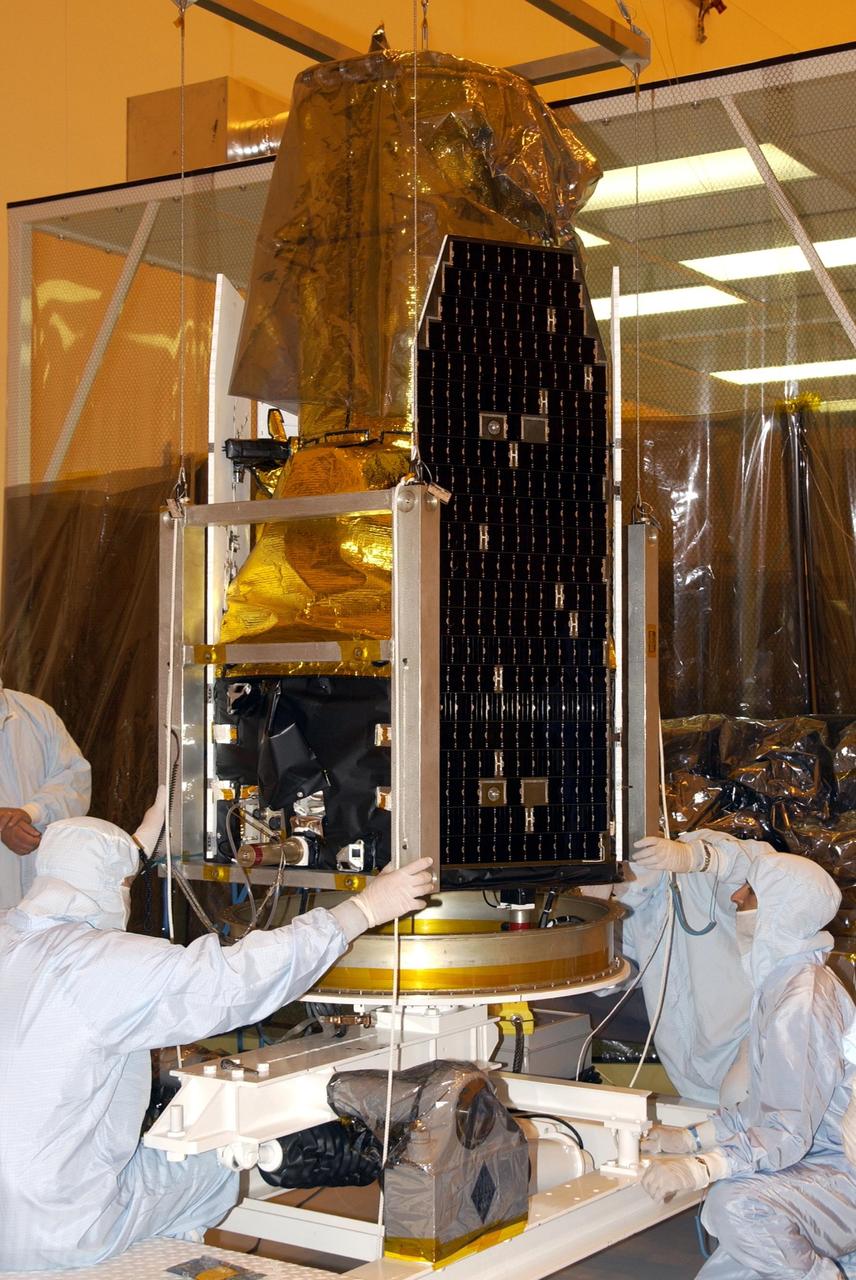
KENNEDY SPACE CENTER, FLA. - Workers prepare the GALEX satellite for solar array testing in the Multi-Payload Processing Facility. The Galaxy Evolution Explorer (GALEX) is an orbiting space telescope that will observe galaxies in ultraviolet light across 10 billion years of cosmic history. Led by the California Institute of Technology, GALEX will conduct several first-of-a-kind sky surveys, including an extra-galactic (beyond our galaxy) ultraviolet all-sky survey. During its 29-month mission GALEX will produce the first comprehensive map of a Universe of galaxies under construction, bringing more understanding of how galaxies like the Milky Way were formed. GALEX is due to be launched from Cape Canaveral Air Force Station March 25 via a Pegasus rocket.
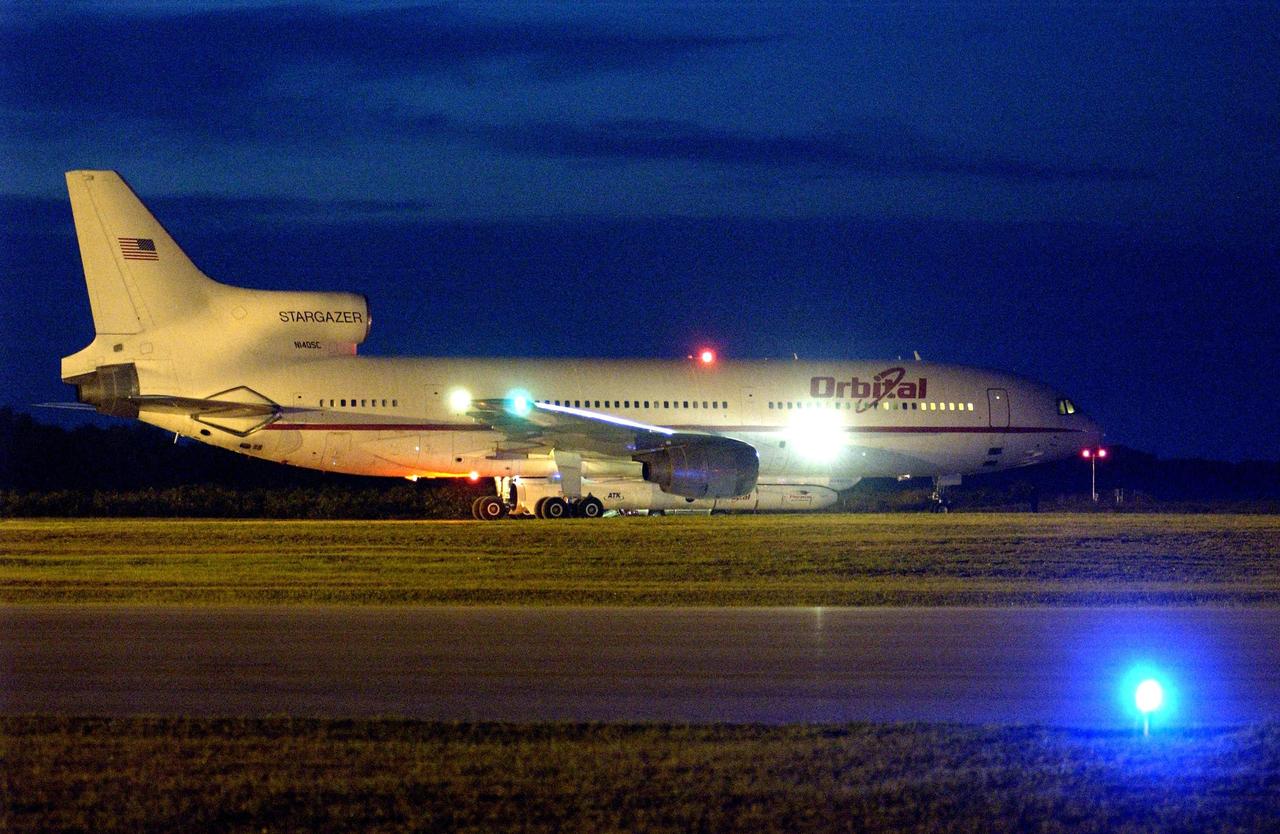
KENNEDY SPACE CENTER, FLA. - In the early morning hours at Cape Canaveral Air Force Station, Orbital Sciences' L-1011 aircraft waits for takeoff time between 7:50 and 9:50 a.m. EDT. Attached underneath is the Pegasus XL rocket with its payload, the Galaxy Evolution Explorer (GALEX), due to be released about 8 a.m. The GALEX will carry into space an orbiting telescope that will observe a million galaxies across 10 billion years of cosmic history to help astronomers determine when the stars and elements we see today had their origins. The spacecraft will sweep the skies for 28 months using state-of-the-art ultraviolet detectors to single out galaxies dominated by young, hot, short-lived stars that give off a great deal of energy at that wavelength. These galaxies are actively creating stars, and therefore provide a window into the history and causes of star formation in galaxies.
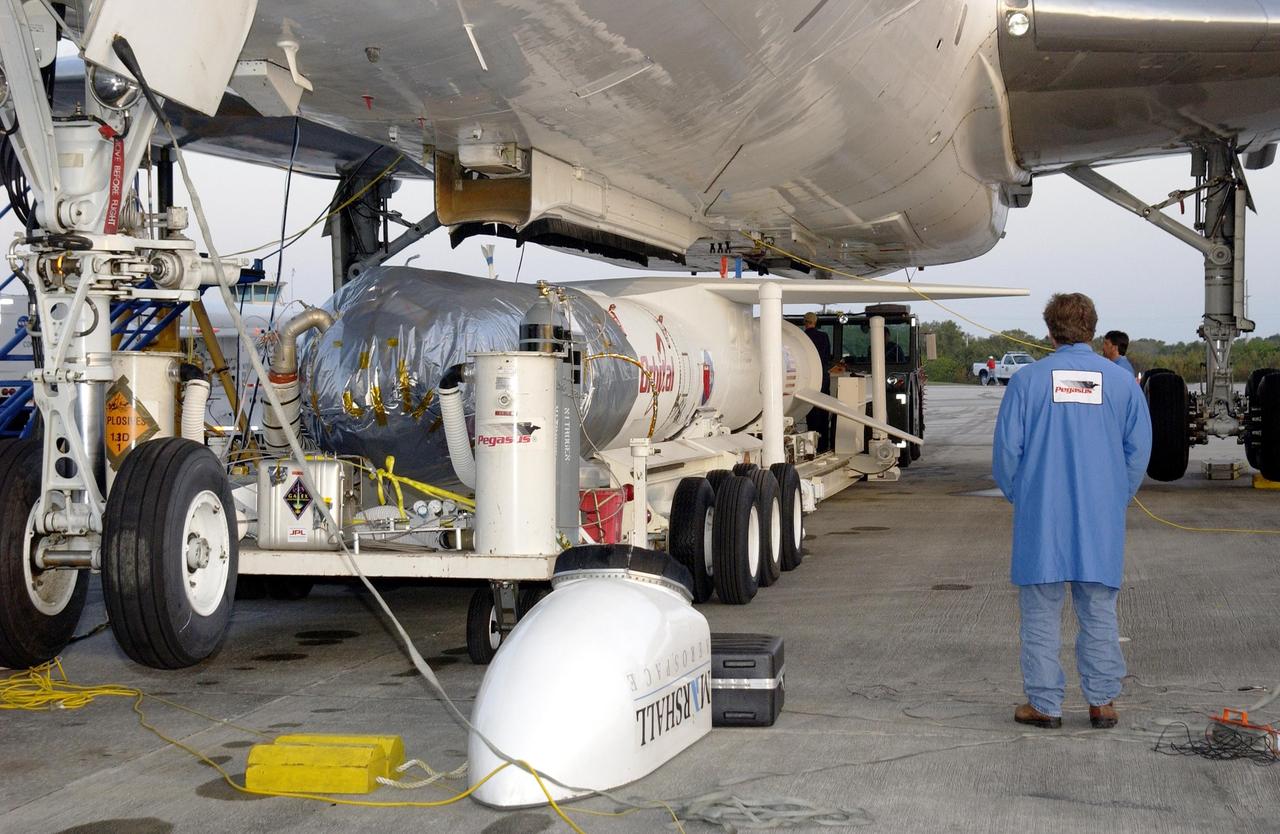
KENNEDY SPACE CENTER, FLA. - The mated Pegasus XL and Galaxy Evolution Explorer (GALEX) satellite are moved into position under the Orbital Sciences L-1011 aircraft at Cape Canaveral Air Force Station. The GALEX, to be launched April 28 from the L-1011, will carry into space an orbiting telescope that will observe a million galaxies across 10 billion years of cosmic history to help astronomers determine when the stars and elements we see today had their origins. The spacecraft will sweep the skies for 28 months using state-of-the-art ultraviolet detectors to single out galaxies dominated by young, hot, short-lived stars that give off a great deal of energy at that wavelength. These galaxies are actively creating stars, and therefore provide a window into the history and causes of star formation in galaxies.
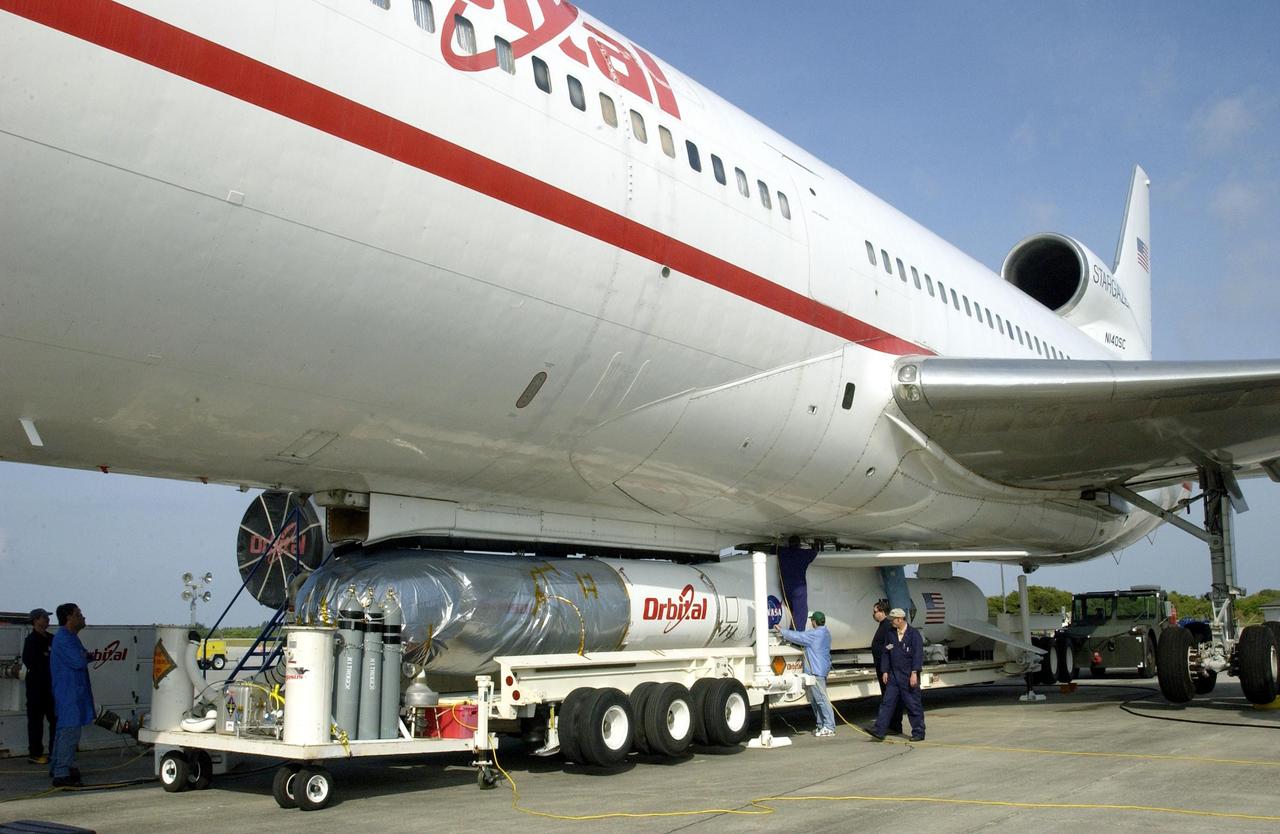
KENNEDY SPACE CENTER, FLA. - At Cape Canaveral Air Force Station, workers finish attaching the mated Pegasus XL and Galaxy Evolution Explorer (GALEX) satellite to the Orbital Sciences L-1011 aircraft. The GALEX, to be launched April 28 from the L-1011, will carry into space an orbiting telescope that will observe a million galaxies across 10 billion years of cosmic history to help astronomers determine when the stars and elements we see today had their origins. The spacecraft will sweep the skies for 28 months using state-of-the-art ultraviolet detectors to single out galaxies dominated by young, hot, short-lived stars that give off a great deal of energy at that wavelength. These galaxies are actively creating stars, and therefore provide a window into the history and causes of star formation in galaxies.