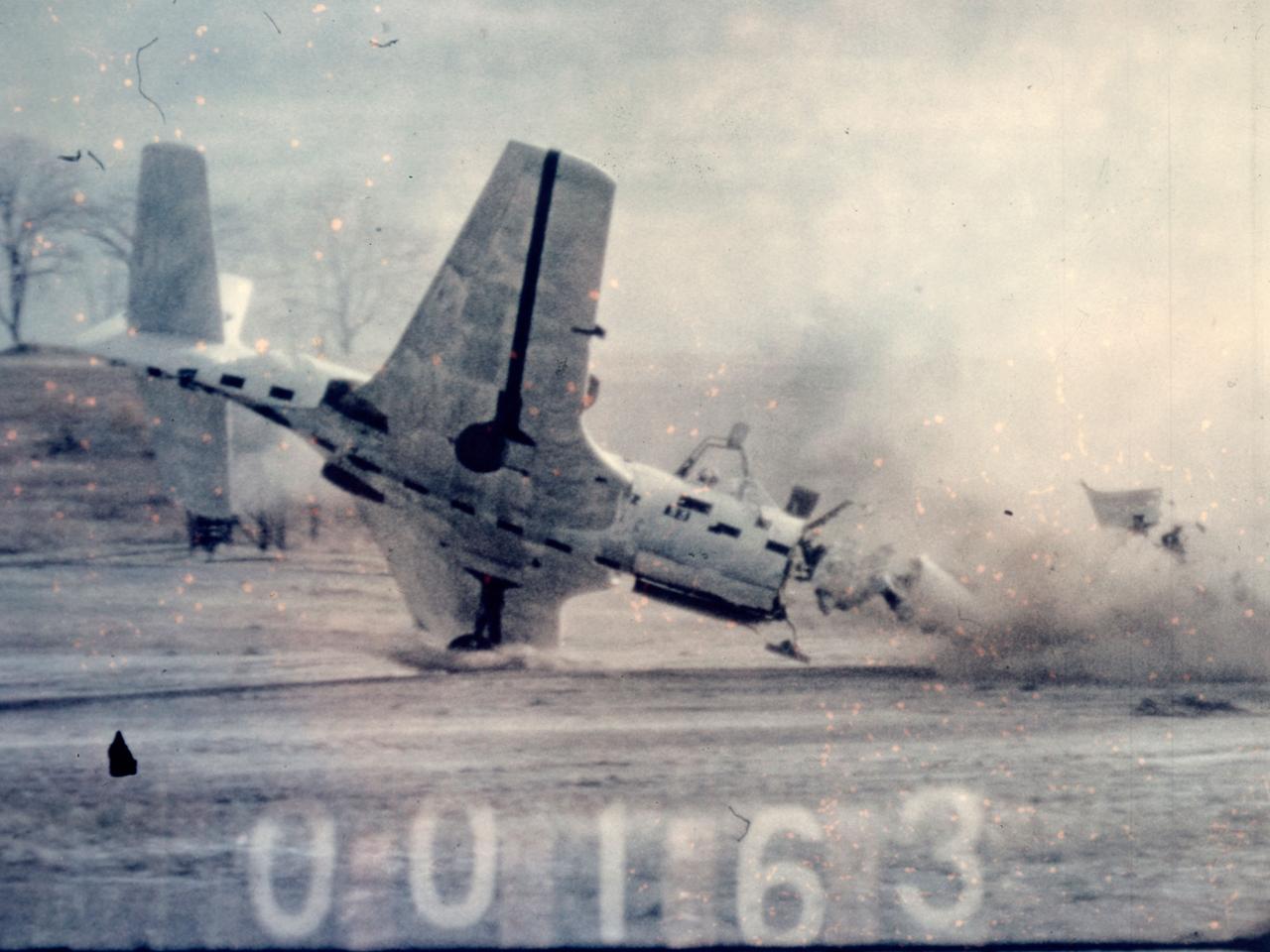
Researchers at the National Advisory Committee for Aeronautics (NACA) Lewis Flight Propulsion Laboratory purposely wreck a McDonnell FH-1 Phantom as part of the laboratory’s Crash Fire Program. NACA Lewis researchers created the program in 1949 to investigate methods for improving survival rates for take-off and landing-type crashes. In these types of crashes, the passengers often survived the impact only to perish in the ensuing fire. Previously there had been little information on the nature of post-crash fires, and it was difficult to use analytical studies in this area. Irving Pinkel, Chief of the Lewis Flight Propulsion Division, was the primary researcher. He enlisted flight safety specialist and aeronautics researchers G. Merritt Preston and Gerard Pesman, mechanical engineer Dugald Black, and others. The tests were conducted at the nearby Ravenna Arsenal using decommissioned Air Force fighter and transport aircraft. The pilotless aircraft were accelerated down a rail on a 1700-foot track at take-off speeds and run into barriers to simulate a variety of different types of crashes. The first barrier stripped off the landing gears and another briefly sent the aircraft off the ground before it crashed into a dirt mound. Telemetry and high-speed cameras were crucial elements in these studies. NACA Lewis photographer Bill Wynne developed a method for inserting timekeeping devices on test film that were able to show time to one thousandth of a second.
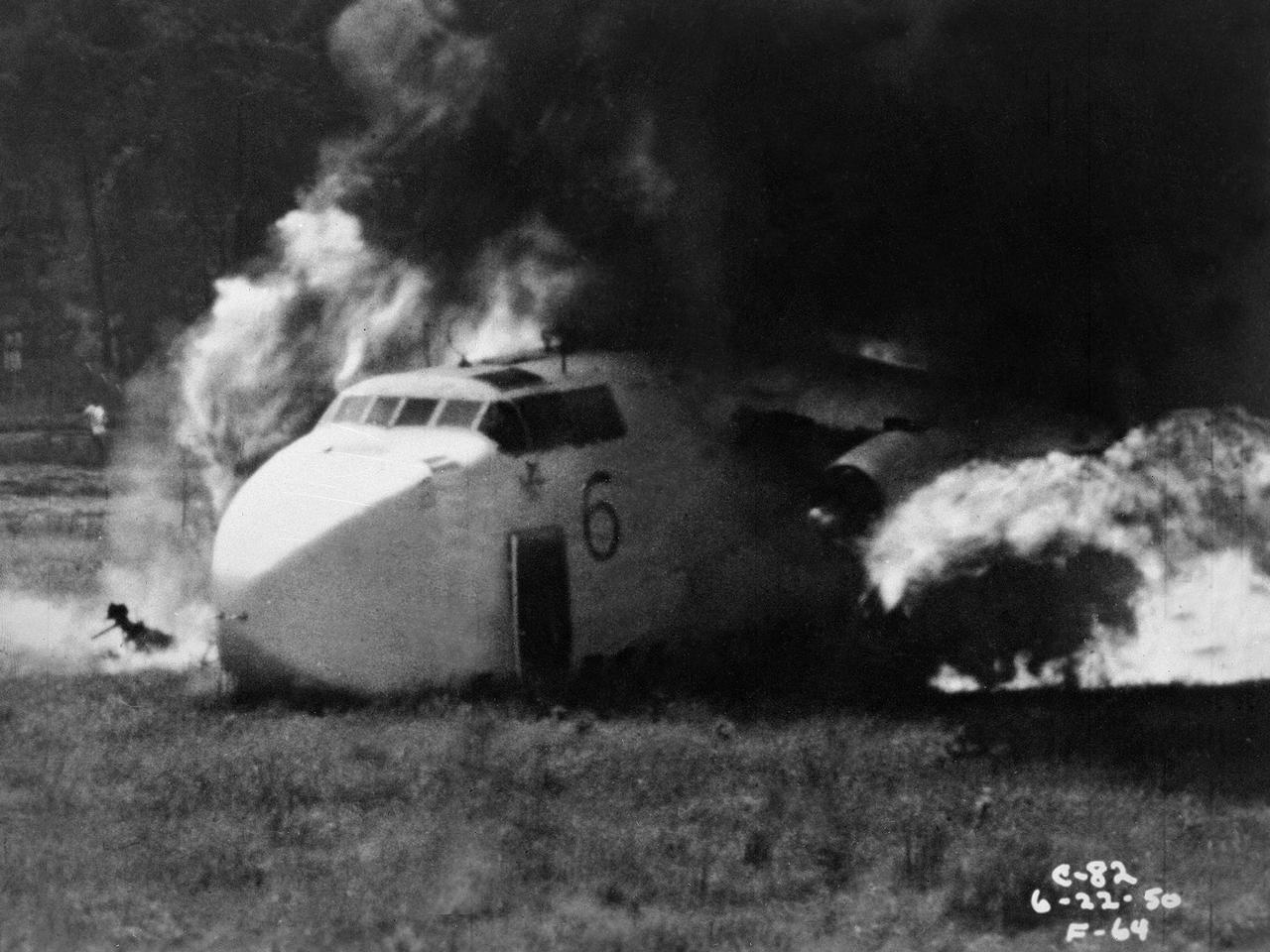
Researchers at the National Advisory Committee for Aeronautics (NACA) Lewis Flight Propulsion Laboratory purposely crash a Fairchild C-82 Packet aircraft to study flame propagation. A rash of passenger aircraft crashes in 1946 and 1947 spurred a White House call for an investigatory board staffed by members of the Civil Aeronautics Board, military, and the NACA. The group addressed fire segregation, extinguishment, and prevention. The NACA established a Subcommittee on Aircraft Fire Prevention in February 1948 to coordinate its efforts. The Lewis team simulated situations in which an aircraft failed to become airborne during takeoff resulting in crashes into embankments and other objects. The Lewis researchers initially used surplus C-46 and C-82 military transport planes. In these situations, the aircraft generally suffered damage to its fuel system and other components, but was structurally survivable. The aircraft were mounted to a rail that ran down a 1700-foot long test runway. The aircraft was secured at the starting point with an anchor pier so it could get its engines up to takeoff speed before launching down the track. Barriers at the end of the runway were designed to simulate a variety of different types of crashes. Telemetry and high-speed cameras were crucial elements in these studies. The preliminary testing phase identified potential ignition sources and analyzed the spread of flammable materials.
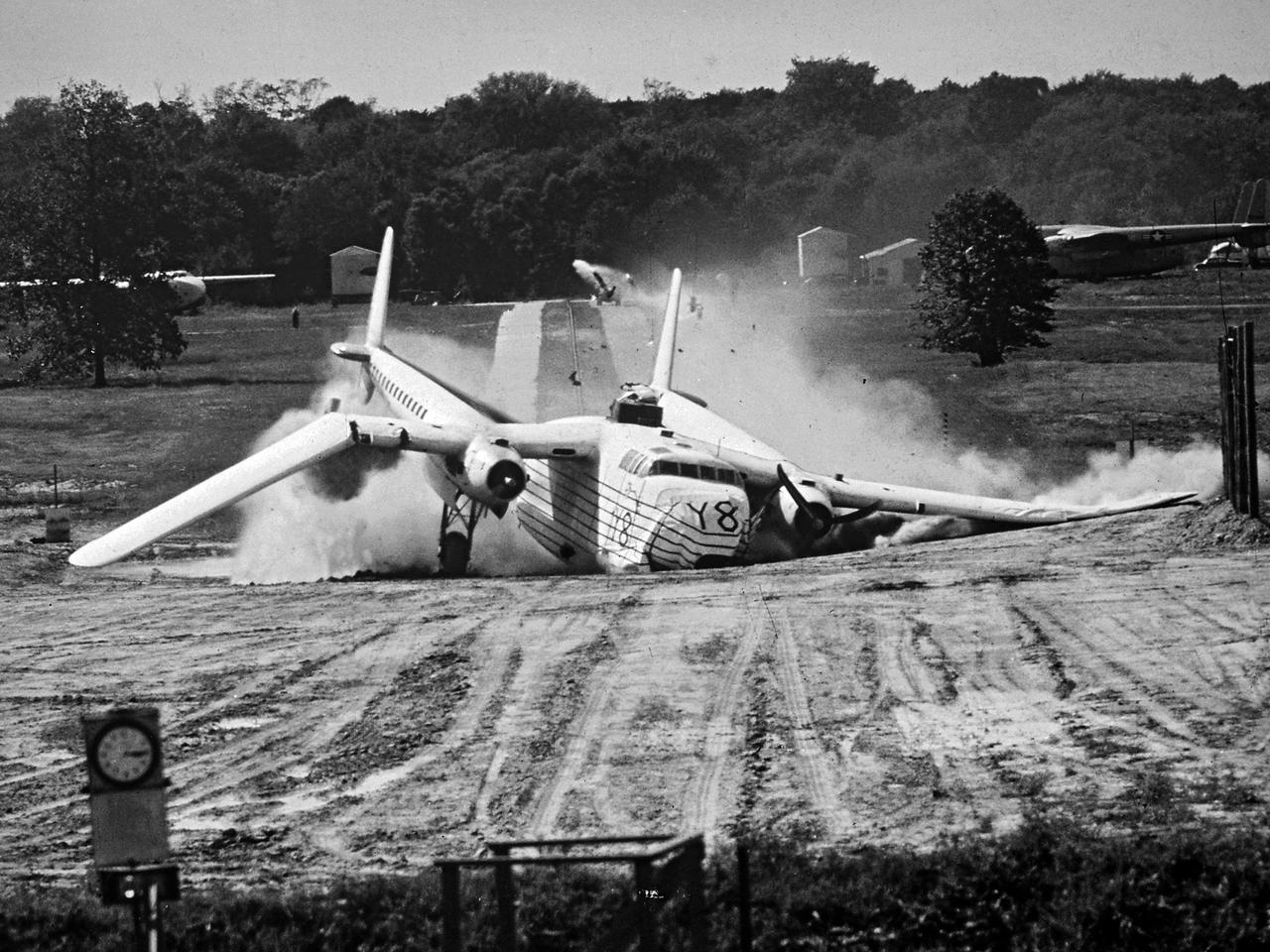
A Fairchild C-82 Packet is purposely destroyed by researchers at the National Advisory Committee for Aeronautics (NACA) Lewis Flight Propulsion Laboratory. In response to an escalating number of transport aircraft crashes in the mid-1940s, the NACA researchers undertook a decade-long investigation into a number of issues surrounding low-altitude aircraft crashes. The tests were conducted at the Ravenna Arsenal, approximately 60 miles south of the Lewis laboratory in Cleveland, Ohio. The aircraft were excess military transports from World War II. The aircraft was guided down the runway at speeds of 80 to 105 miles per hour. It came into contact with poles which tore open the 1500-gallon fuel tanks in the wings before reaching the barriers at the end of the runway. Fuel poured from the tanks and supply lines, resulting in the spread of both liquid fuel and a large cloud of spray. Solomon Weiss developed a method of dying the fuel red to improve its visibility during the crashes. This red fuel cloud trailed slightly behind the skidding aircraft, then rushed forward when the aircraft stopped. The nine-crash initial phase of testing used Lockheed C-56 Lodestar and C-82 transport aircraft to identify potential ignition sources and analyze the spread of flammable materials. The researchers were able to identify different classes of ignition sources, fuel disbursement patterns, the time when a particular ignition source might appear, rate of the fire spread, cabin survival times, and deceleration rates.

Photographed on 06/20/79. -- NASA airframe crash test #17. Model aircraft suspended at crash facility. Model aircraft shown on fire. Shown before and after crash.
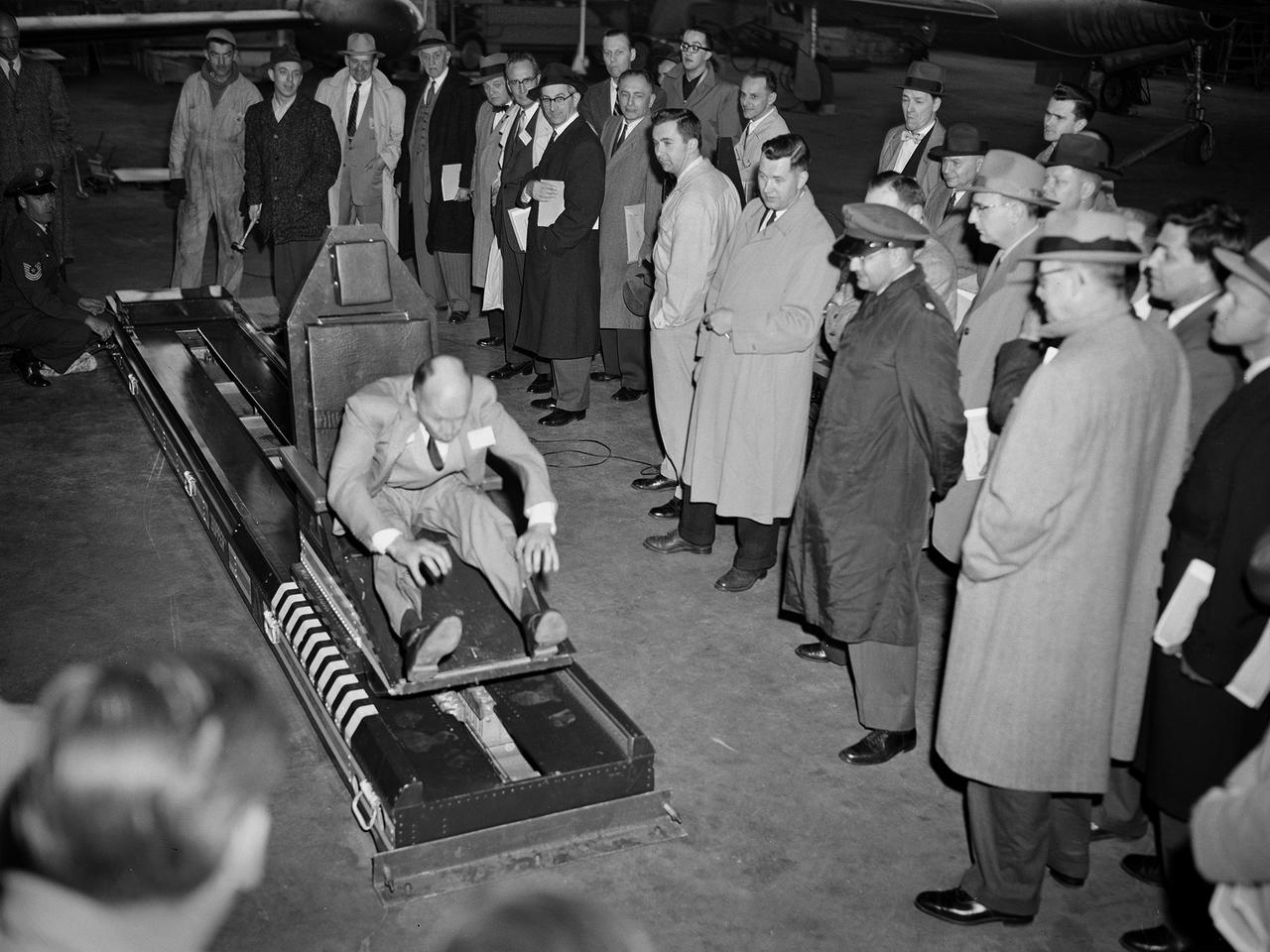
Howard Hasbrook volunteers for a demonstration of a scaled-down version of Lieutenant Colonel John Stapp’s rocket sled set up in the hangar at the National Advisory Committee for Aeronautics (NACA) Lewis Flight Propulsion Laboratory. In 1945 Stapp, an Air Force medical doctor, volunteered to participate in a deceleration program to study the human body’s tolerance to aircraft crash forces. A 1500-pound sled powered by rockets was installed in 1947 on a section of railroad track in the California desert. Stapp participated in 29 experiments over the next seven years and broke land and deceleration records. These tests studied the effects of acceleration, G-force, deceleration, and wind blast on humans. Stapp suffered broken bones and retinal hemorrhages, but suffered no permanent damage. NACA Lewis was conducting a series of crash impact studies in the mid-1950s using dummies in actual aircraft. Irving Pinkel, the director of the program, and Stapp became friends through their mutual interest in this field. In April 1956 Stapp visited the Cleveland lab to give a talk to the local section of the American Rocket Society that discussed issues relating to the escape of pilots from the cockpit of supersonic jet aircraft. That same week, NACA Lewis’ Pinkel, Gerard Pesman, Merritt Preston, and Dugald Black received the annual Laura Taber Barbour Air Safety Award for their work on the Crash Fire Program. Black and Preston are visible in the crowd in this photograph.
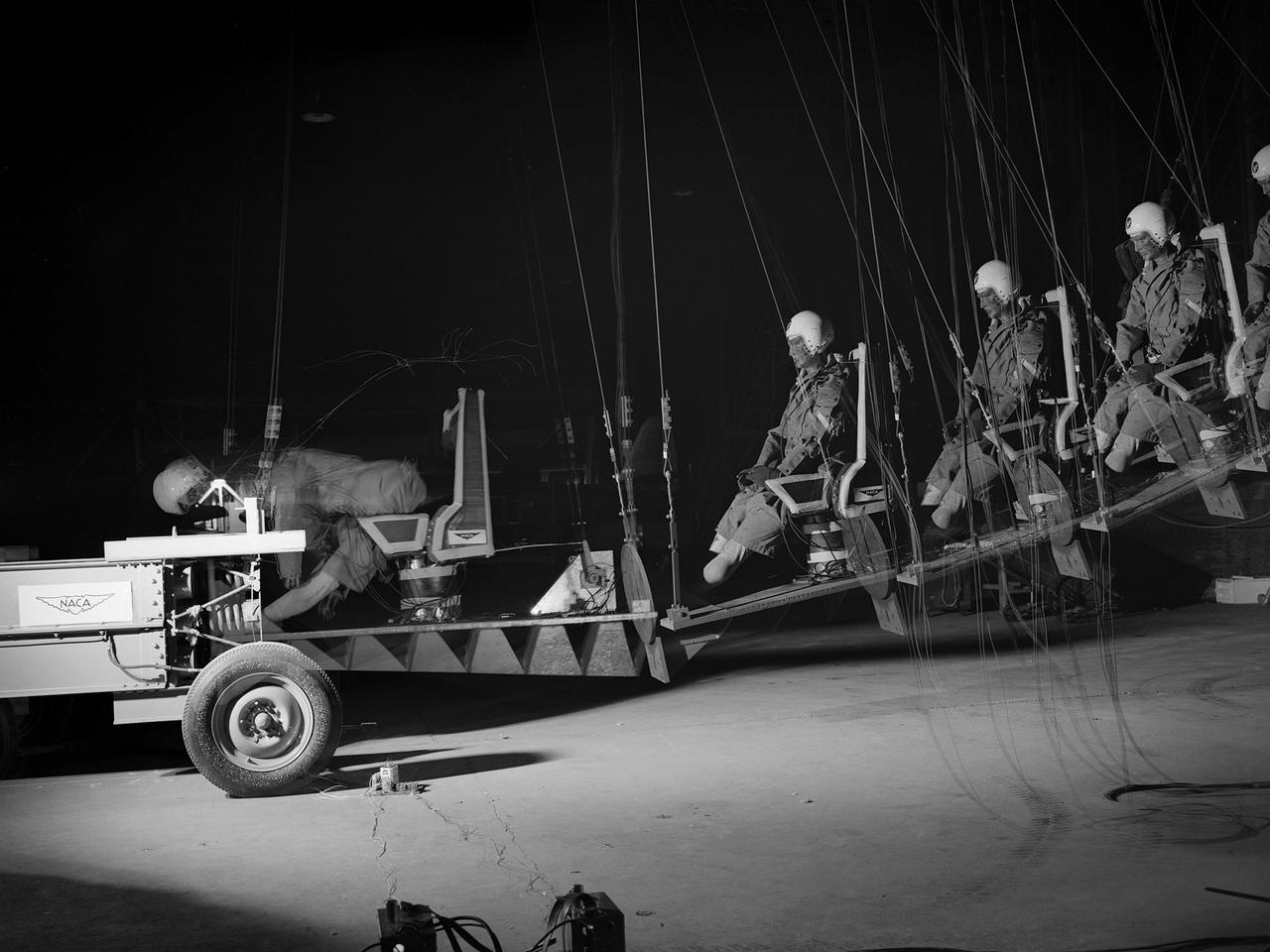
This time-lapse photograph shows the test of a pilot seat and restraint designed by researchers at the National Advisory Committee for Aeronautics (NACA) Lewis Flight Propulsion Laboratory. The laboratory had undertaken a multi-year investigation into the causes and preventative measures for fires resulting from low altitude aircraft crashes. The program was expanded in the mid-1950s to include the study of crash impact on passengers, new types of types of seat restraints, and better seat designs. The impact program began by purposely wrecking surplus transport Fairchild C-82 Packet and Piper Cub aircraft into barricades at the end of a test runway. Instrumented dummies and cameras were installed in the pilot and passenger areas. After determining the different loads experienced during a crash and the effects on the passengers, the NACA researchers began designing new types of seats and restraints. The result was an elastic seat that flexed upon impact, absorbing 75 percent of the loads before it slowly recoiled. This photograph shows the seats mounted on a pendulum with a large spring behind the platform to provide the jolt that mimicked the forces of a crash. The seat was constructed without any potentially damaging metal parts and included rubber-like material, an inflated back and arms, and a seat cushion. After the pendulum tests, the researchers compared the flexible seats to the rigid seats during a crash of a transport aircraft. They found the passengers in the rigid seats received 66 percent higher g-forces than the NACA-designed seats.
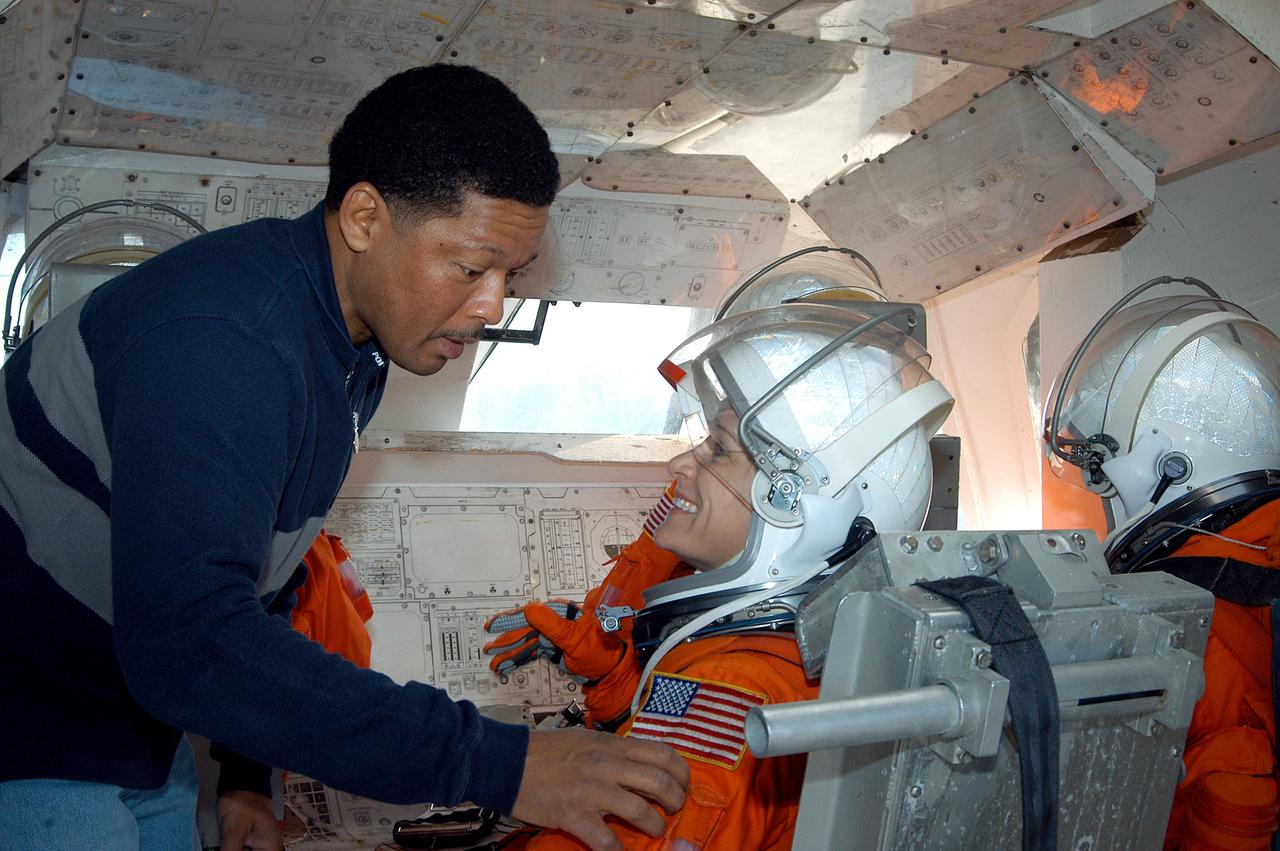
KENNEDY SPACE CENTER, FLA. - Volunteers from the KSC Fire-Rescue team dressed in launch and entry suits settle into seats in an orbiter crew compartment mock-up under the guidance of George Brittingham, USA suit technician on the Closeout Crew. Brittingham is helping Catherine Di Biase, a nurse with Bionetics Life Sciences. They are all taking part in a “Mode VII” emergency landing simulation at Kennedy Space Center. The purpose is to exercise emergency preparedness personnel, equipment and facilities in rescuing astronauts from a downed orbiter and providing immediate medical attention. This simulation presents an orbiter that has crashed short of the Shuttle Landing Facility in a wooded area 2-1/2 miles south of Runway 33. Emergency crews will respond to the volunteer “astronauts” simulating various injuries. Rescuers must remove the crew, provide triage and transport to hospitals those who need further treatment. Local hospitals are participating in the exercise.
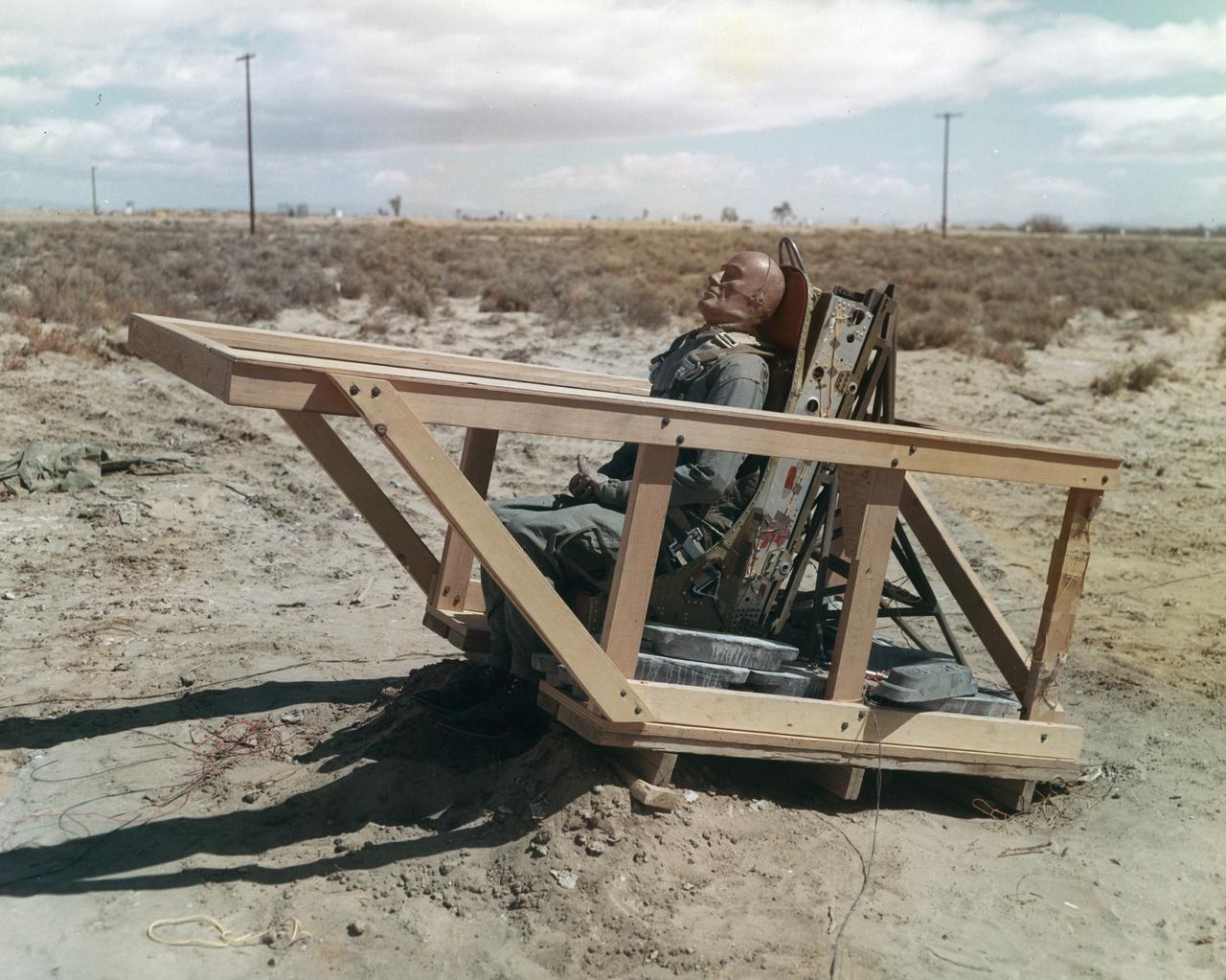
The M2-F1 was fitted with an ejection seat before the airtow flights began. The project selected the seat used in the T-37 as modified by the Weber Company to use a rocket rather than a ballistic charge for ejection. To test the ejection seat, the Flight Research Center's Dick Klein constructed a plywood mockup of the M2-F1's top deck and canopy. On the first firings, the test was unsuccessful, but on the final test the dummy in the seat landed safely. The M2-F1 ejection seat was later used in the two Lunar Landing Research Vehicles and the three Lunar Landing Training Vehicles. Three of them crashed, but in each case the pilot ejected from the vehicle successfully.
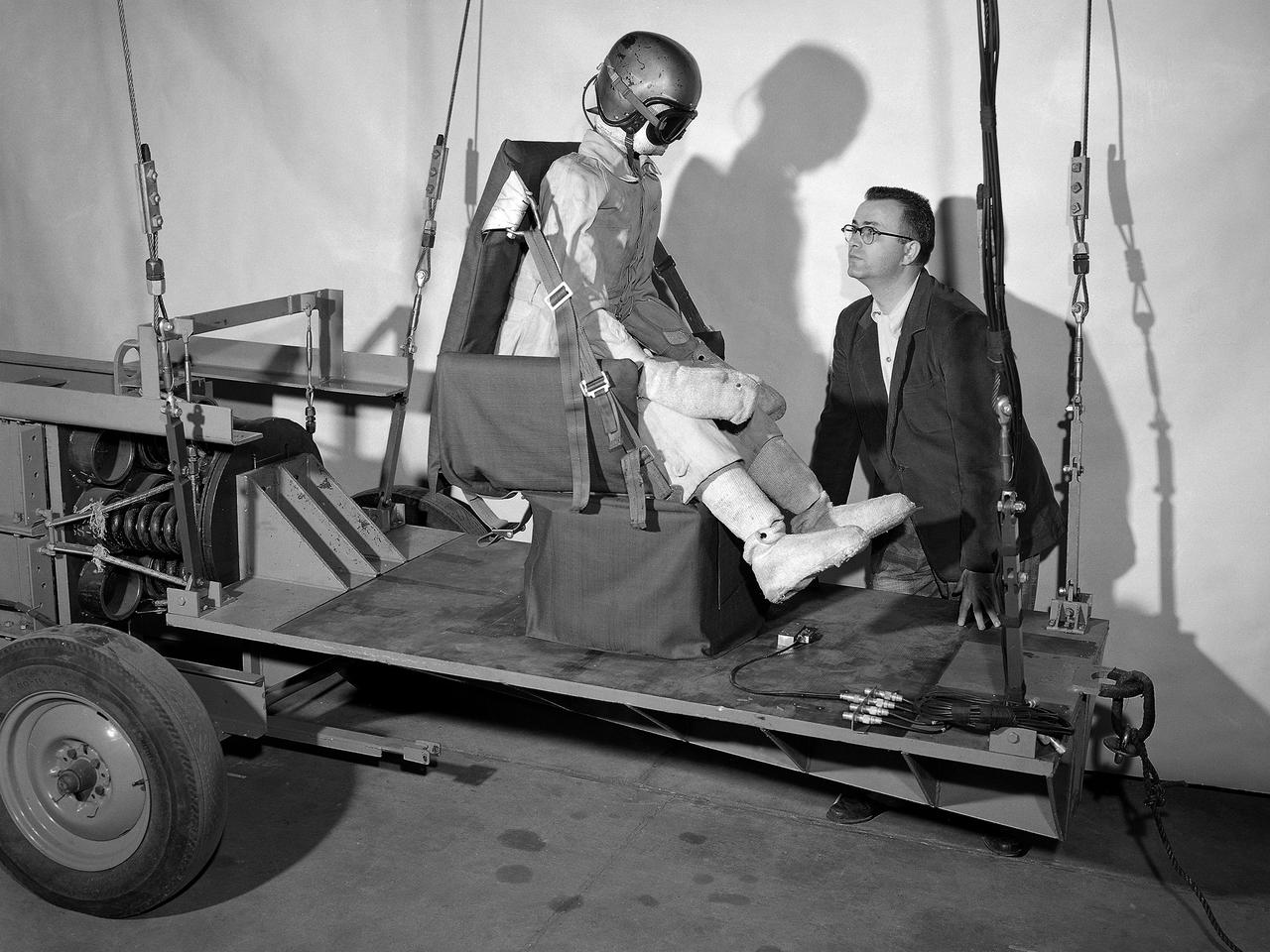
A researcher at the National Advisory Committee for Aeronautics (NACA) Lewis Flight Propulsion Laboratory prepares for a test of an NACA-designed aircraft seat. The laboratory had undertaken a multi-year investigation into the causes and prevention of fires on low altitude aircraft crashes. The program was expanded in the mid-1950s to include the study of impact on passengers, types of seat restraints, and seat design. The crash impact portion of the program began by purposely wrecking surplus Fairchild C-82 Packet and Piper Cub aircraft into barricades at the end of a test runway at the Ravenna Arsenal, located approximately 40 miles south of the Lewis lab in Cleveland. Instrumented dummies and cameras were installed in the pilot and passenger areas. After determining the different loads and their effects on the passengers, the NACA researchers began designing new types of seats and restraints. The result was an elastic seat that flexed upon impact, absorbing 75 percent of the loads before it slowly recoiled. This photograph shows the seats mounted on a pendulum with a large spring behind the platform to provide the jolt that mimicked the forces of a crash. The seat was constructed without any potentially damaging metal parts and included rubber-like material, an inflated back and arms, and a seat cushion. After the pendulum tests, the researchers compared the flexible seats to the rigid seats during a crash of a transport aircraft. They found the passengers in the rigid seats received 66 percent higher g-forces than the NACA-designed seats.
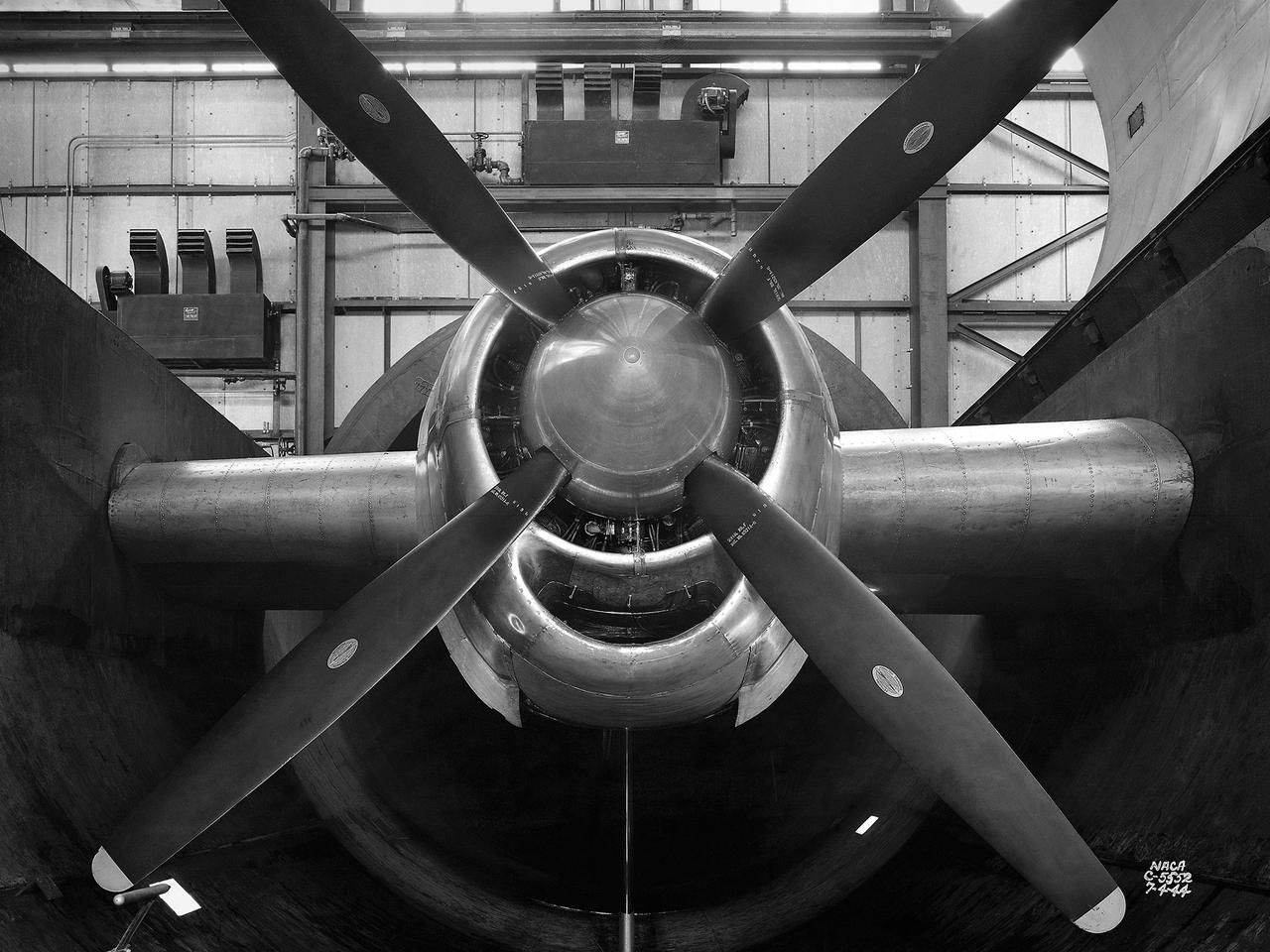
The resolution of the Boeing B-29 Superfortress’ engine cooling problems was one of the Aircraft Engine Research Laboratory’s (AERL) key contributions to the World War II effort. The B-29 leapfrogged previous bombers in size, speed, and altitude capabilities. The B–29 was intended to soar above anti-aircraft fire and make pinpoint bomb drops onto strategic targets. Four Wright Aeronautical R-3350 engines powered the massive aircraft. The engines, however, frequently strained and overheated due to payload overloading. This resulted in a growing number of engine fires that often resulted in crashes. The military asked the NACA to tackle the overheating issue. Full-scale engine tests on a R–3350 engine in the Prop House demonstrated that a NACA-designed impeller increased the fuel injection system’s flow rate. Single-cylinder studies resolved a valve failure problem by a slight extension of the cylinder head, and researchers in the Engine Research Building combated uneven heating with a new fuel injection system. Investigations during the summer of 1944 in the Altitude Wind Tunnel, which could simulate flight conditions at high altitudes, led to reduction of drag and improved air flow by reshaping the cowling inlet and outlet. The NACA modifications were then flight tested on a B-29 bomber that was brought to the AERL.
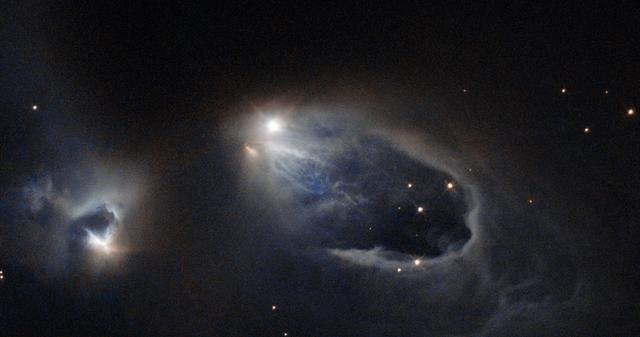
Look at the bright star in the middle of this image. It appears as if it just sneezed. This sight will only last for a few thousand years — a blink of an eye in the young star's life. If you could carry on watching for a few years you would realize it's not just one sneeze, but a sneezing fit. This young star is firing off rapid releases of super-hot, super-fast gas, like multiple sneezes, before it finally exhausts itself. These bursts of gas have shaped the turbulent surroundings, creating structures known as Herbig-Haro objects. These objects are formed from the star's energetic "sneezes." Launched due to magnetic fields around the forming star, these energetic releases can contain as much mass as our home planet, and cannon into nearby clouds of gas at hundreds of kilometers/miles per second. Shock waves form, such as the U-shape below this star. Unlike most other astronomical phenomena, as the waves crash outwards, they can be seen moving across human timescales of years. Soon, this star will stop sneezing, and mature to become a star like our sun. This region is actually home to several interesting objects. The star at the center of the frame is a variable star named V633 Cassiopeiae, with Herbig-Haro objects HH 161 and HH 164 forming parts of the horseshoe-shaped loop emanating from it. The slightly shrouded star just to the left is known as V376 Cassiopeiae, another variable star that has succumbed to its neighbor's infectious sneezing fits; this star is also sneezing, creating yet another Herbig-Haro object — HH 162. Both stars are very young and are still surrounded by dusty material left over from their formation, which spans the gap between the two. Credit: ESA/Hubble & NASA, Acknowledgement: Gilles Chapdelaine <b><a href="http://www.nasa.gov/audience/formedia/features/MP_Photo_Guidelines.html" rel="nofollow">NASA image use policy.</a></b> <b><a href="http://www.nasa.gov/centers/goddard/home/index.html" rel="nofollow">NASA Goddard Space Flight Center</a></b> enables NASA’s mission through four scientific endeavors: Earth Science, Heliophysics, Solar System Exploration, and Astrophysics. Goddard plays a leading role in NASA’s accomplishments by contributing compelling scientific knowledge to advance the Agency’s mission. <b>Follow us on <a href="http://twitter.com/NASA_GoddardPix" rel="nofollow">Twitter</a></b> <b>Like us on <a href="http://www.facebook.com/pages/Greenbelt-MD/NASA-Goddard/395013845897?ref=tsd" rel="nofollow">Facebook</a></b> <b>Find us on <a href="http://instagram.com/nasagoddard?vm=grid" rel="nofollow">Instagram</a></b>