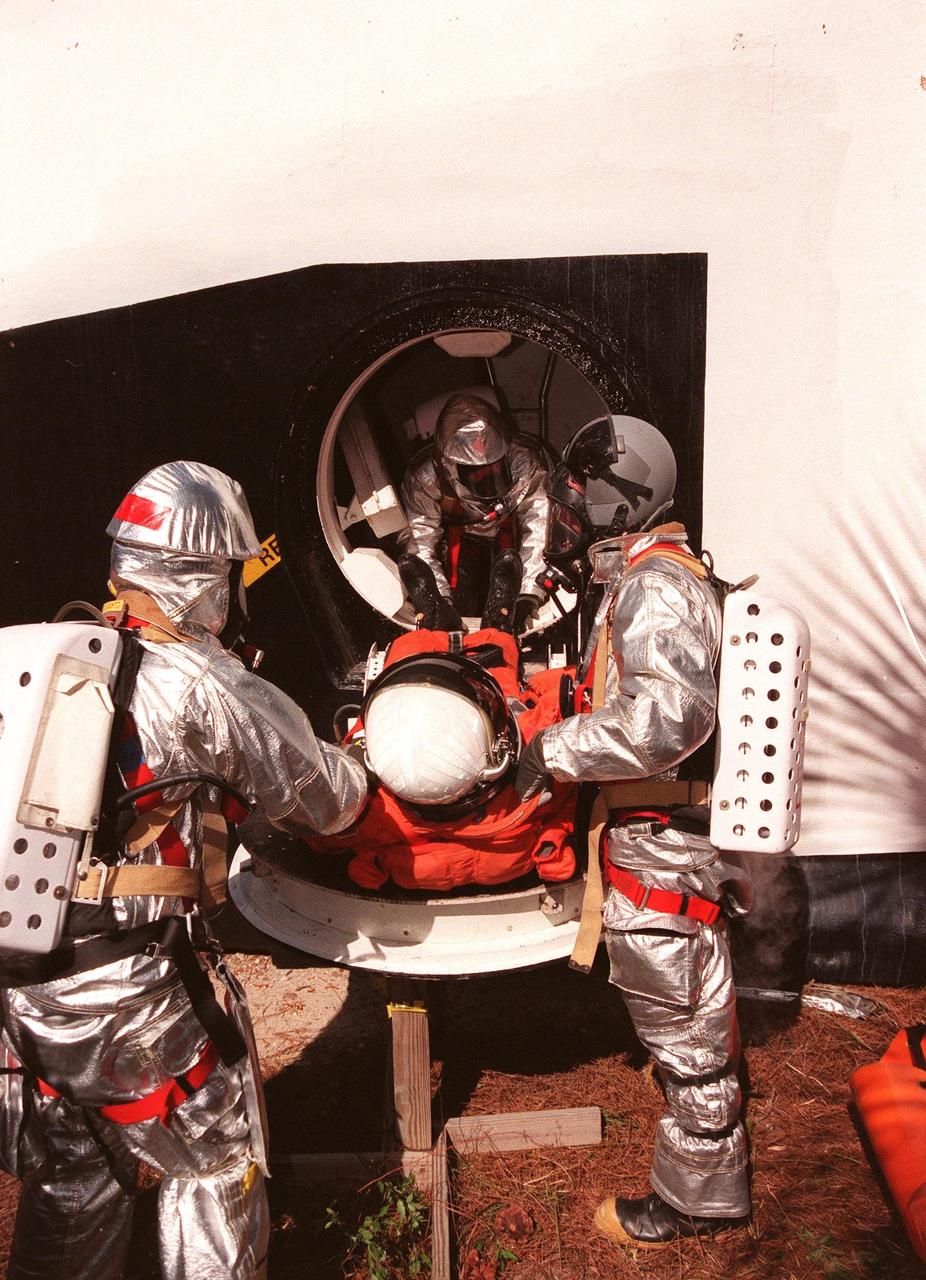
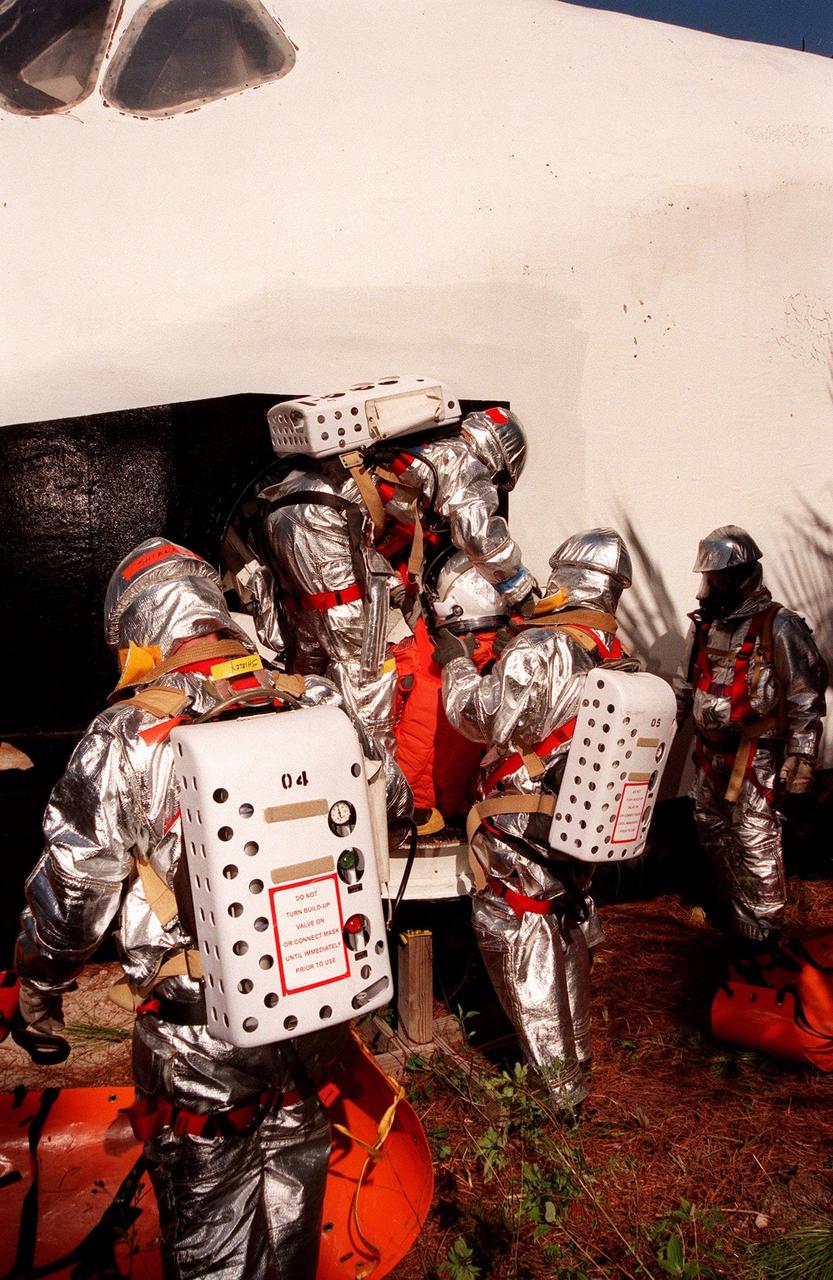
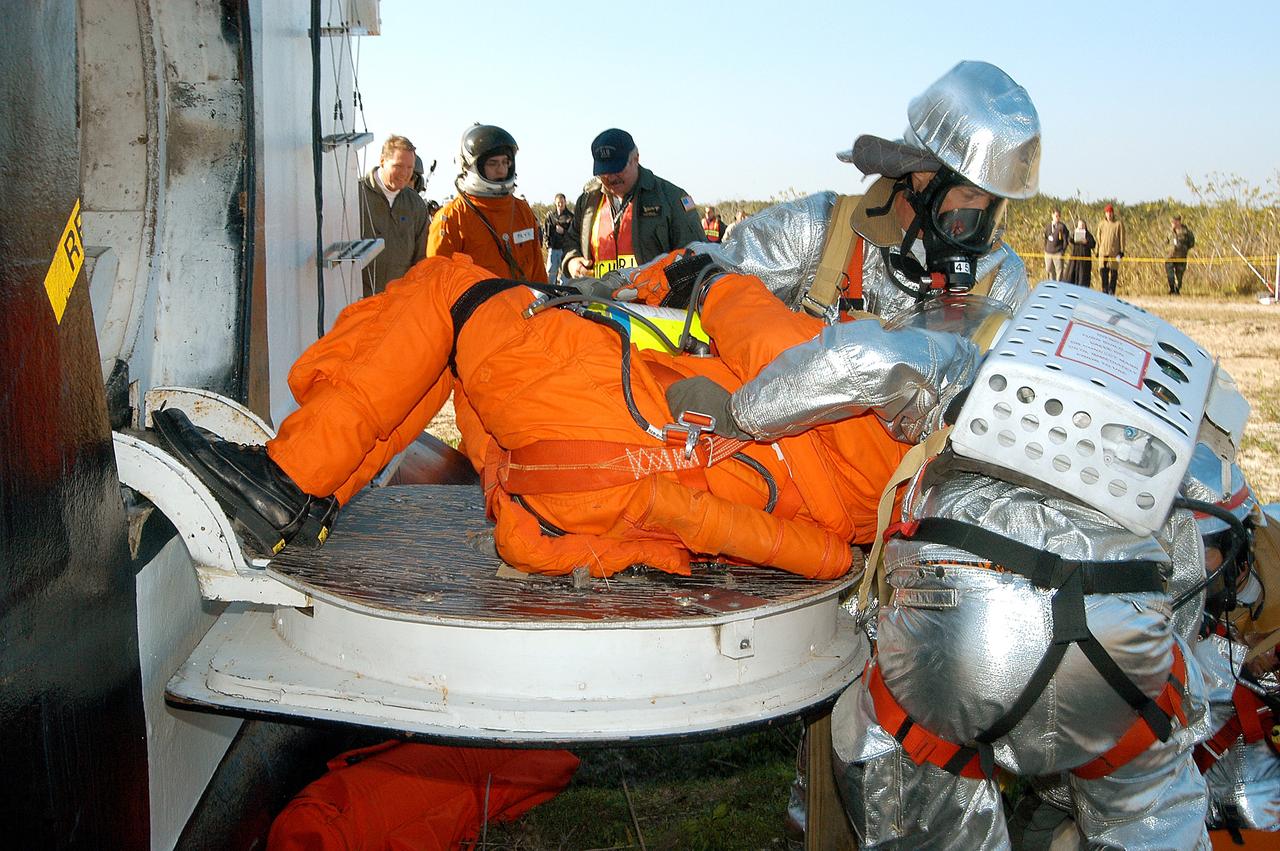
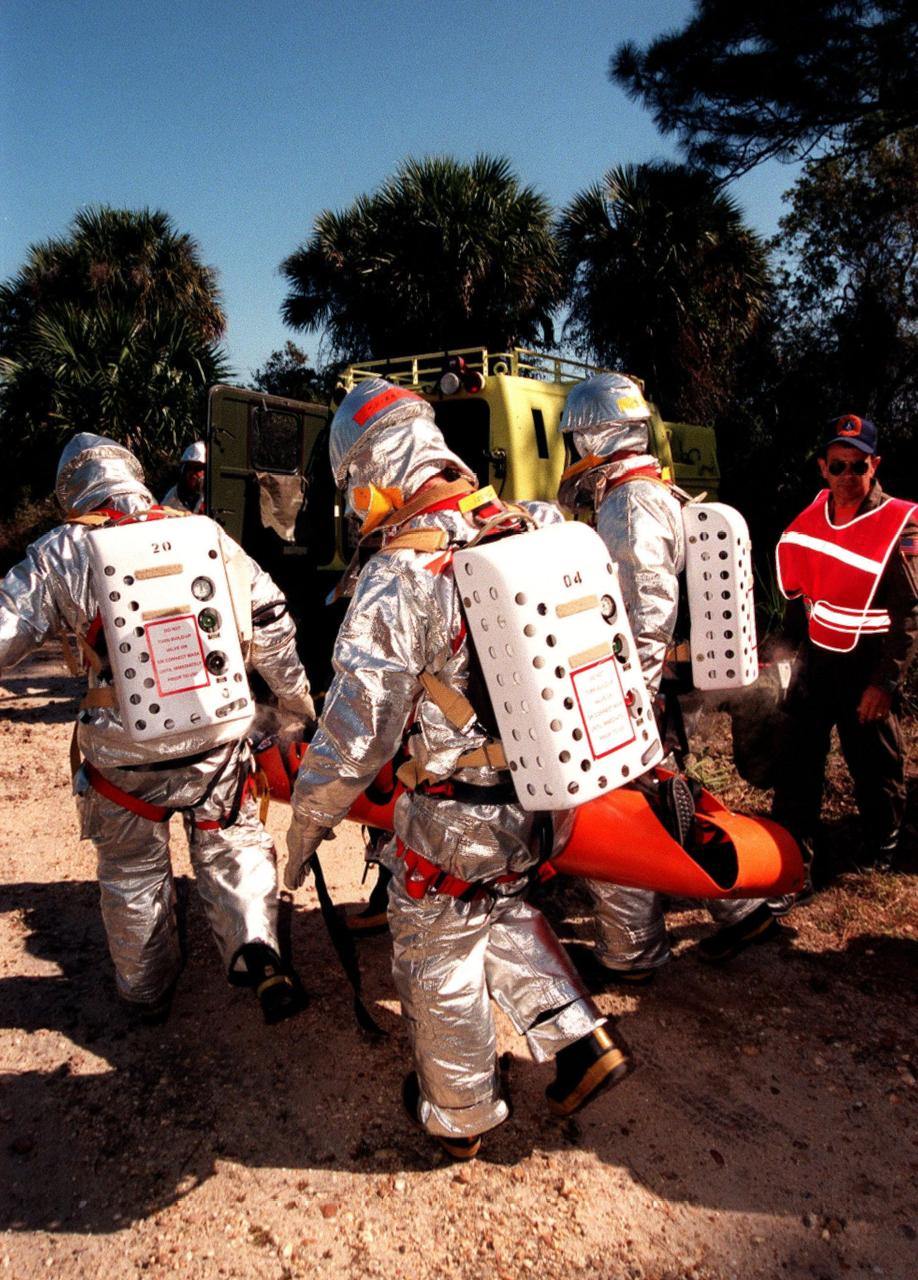
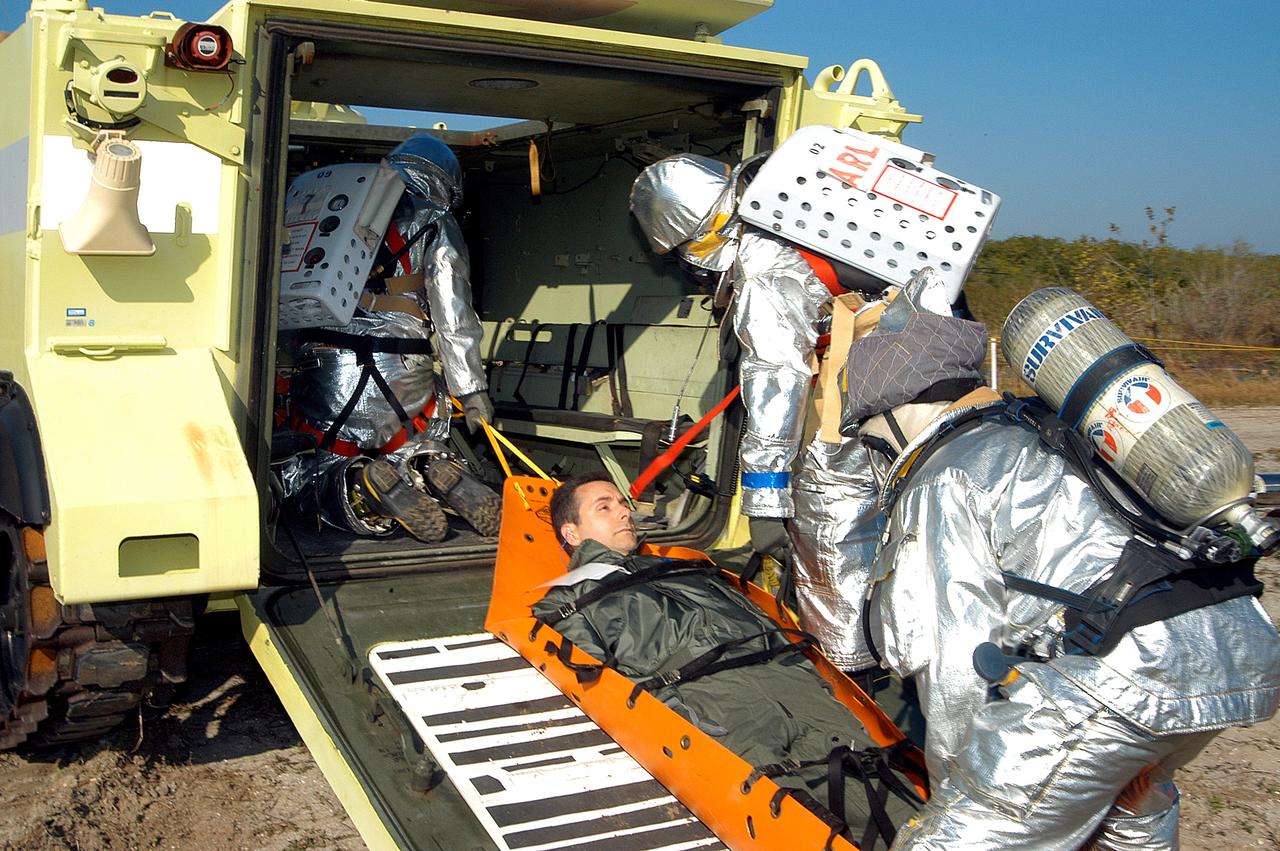
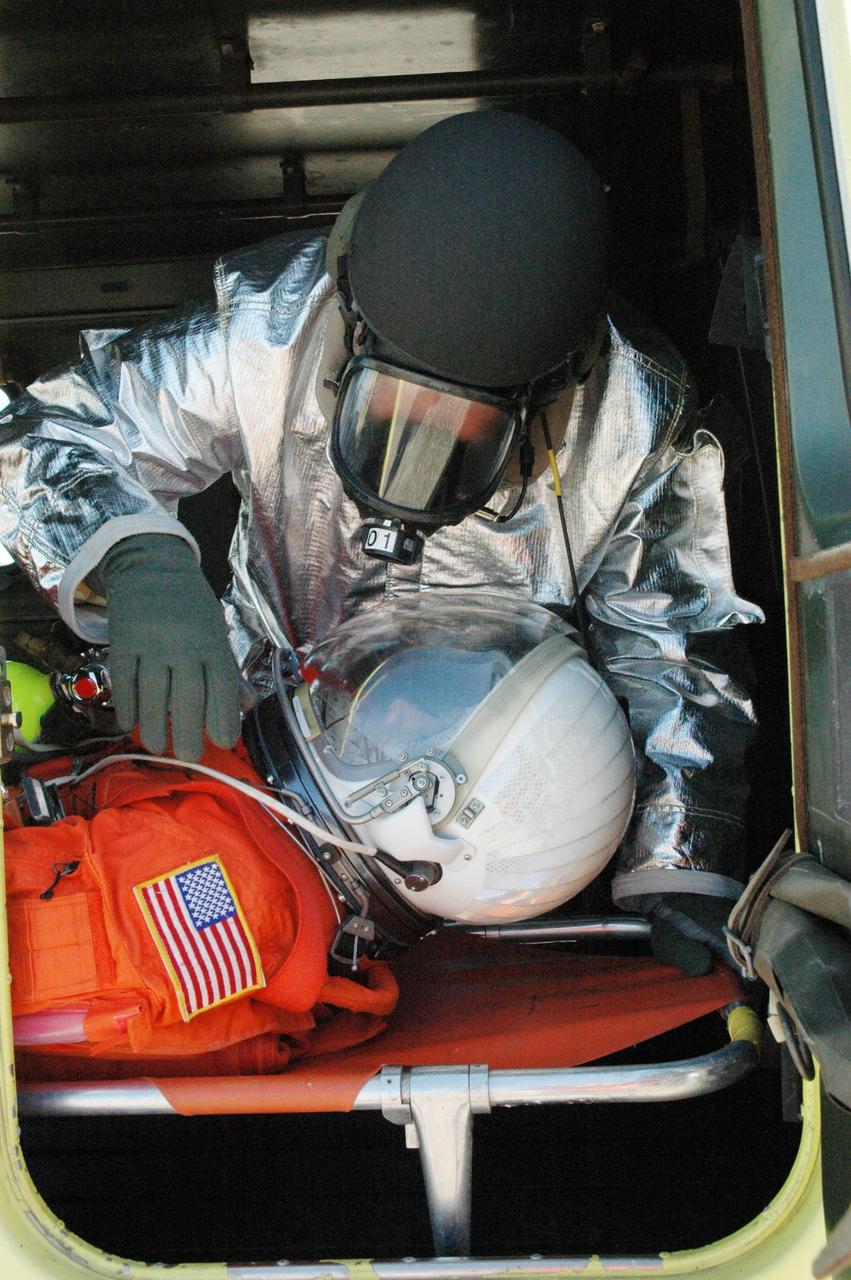
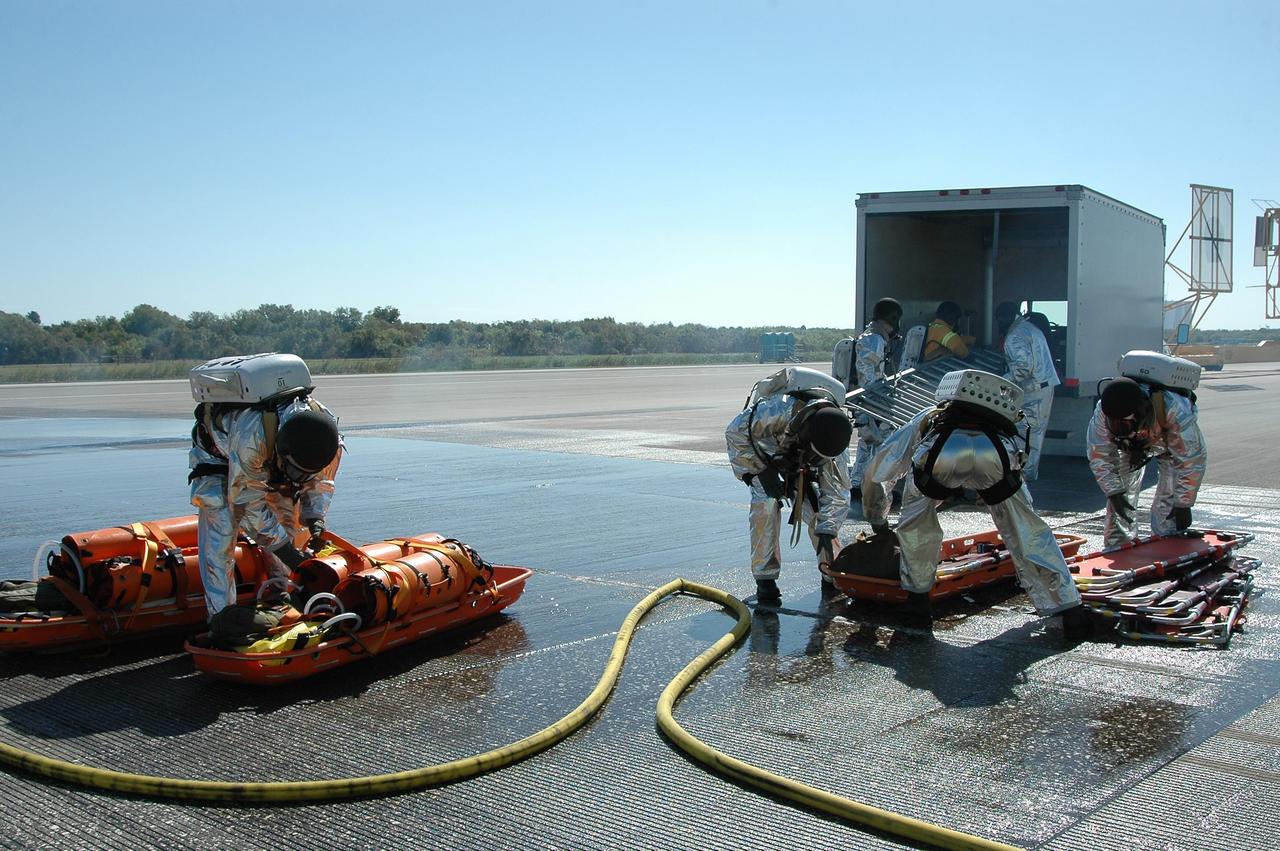
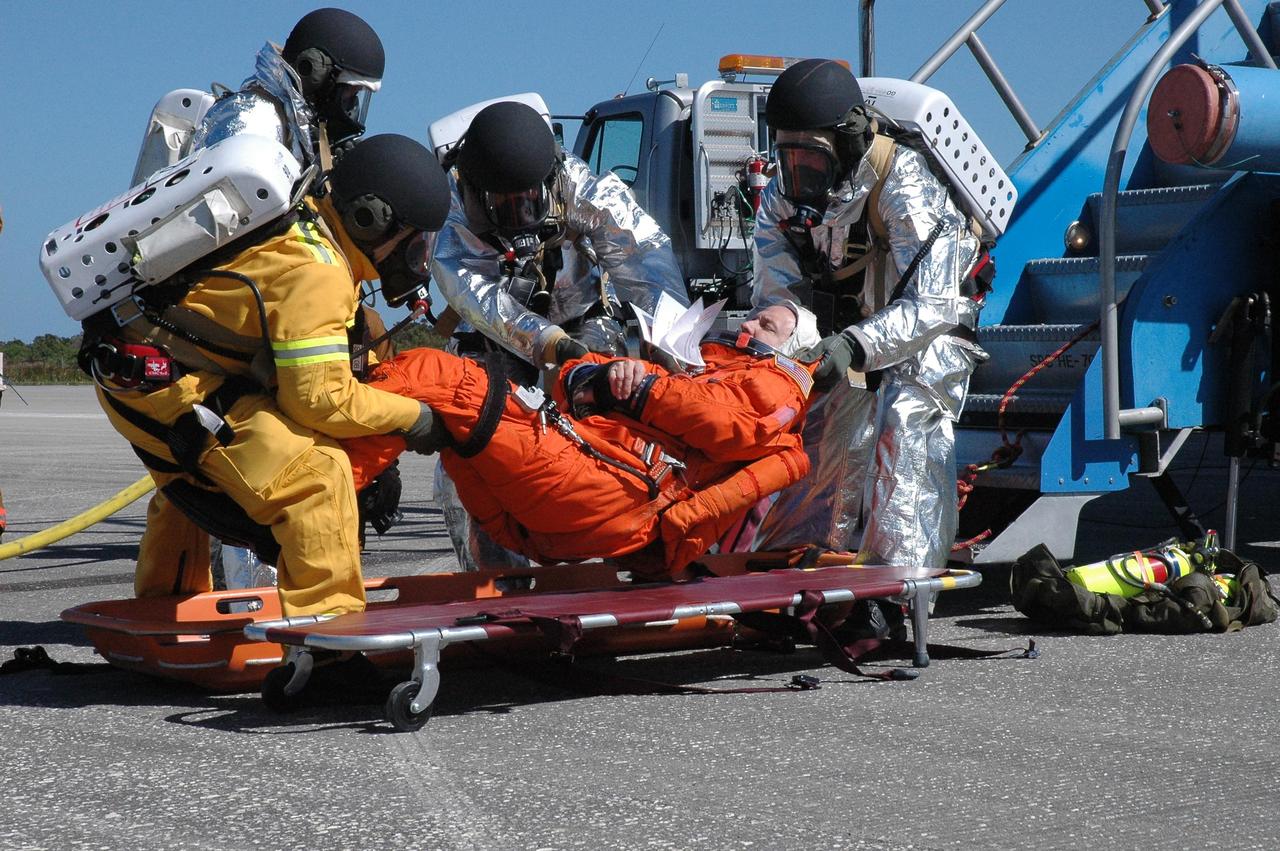
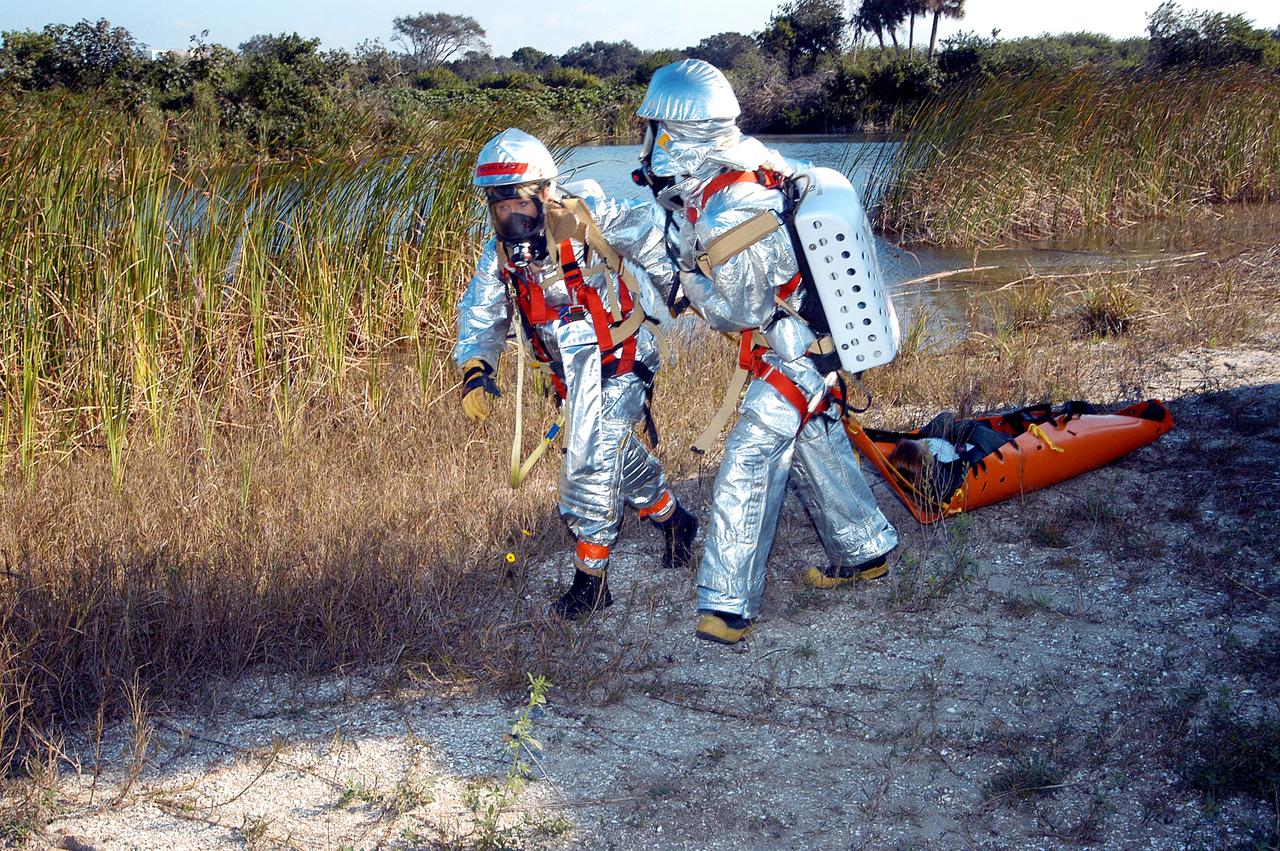
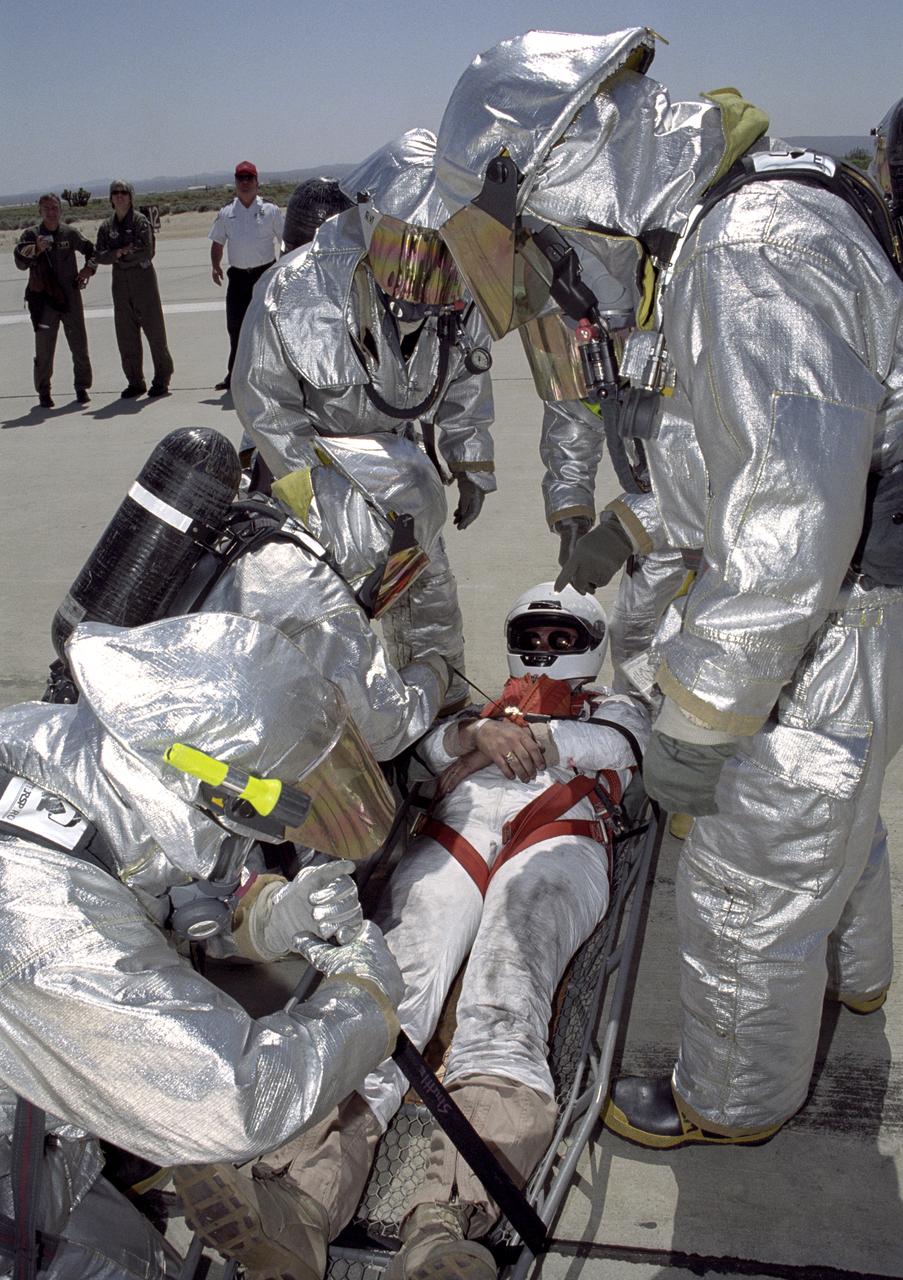
Clad in full thermal protection suits, Air Force fire-rescue crews strap a stand-in "astronaut" into a litter during a Space Shuttle rescue training exercise at Edwards AFB.
Clad in thermal protection suits, fire-rescue crews strap a stand-in "astronaut" into a litter during a Space Shuttle rescue training exercise at Edwards AFB
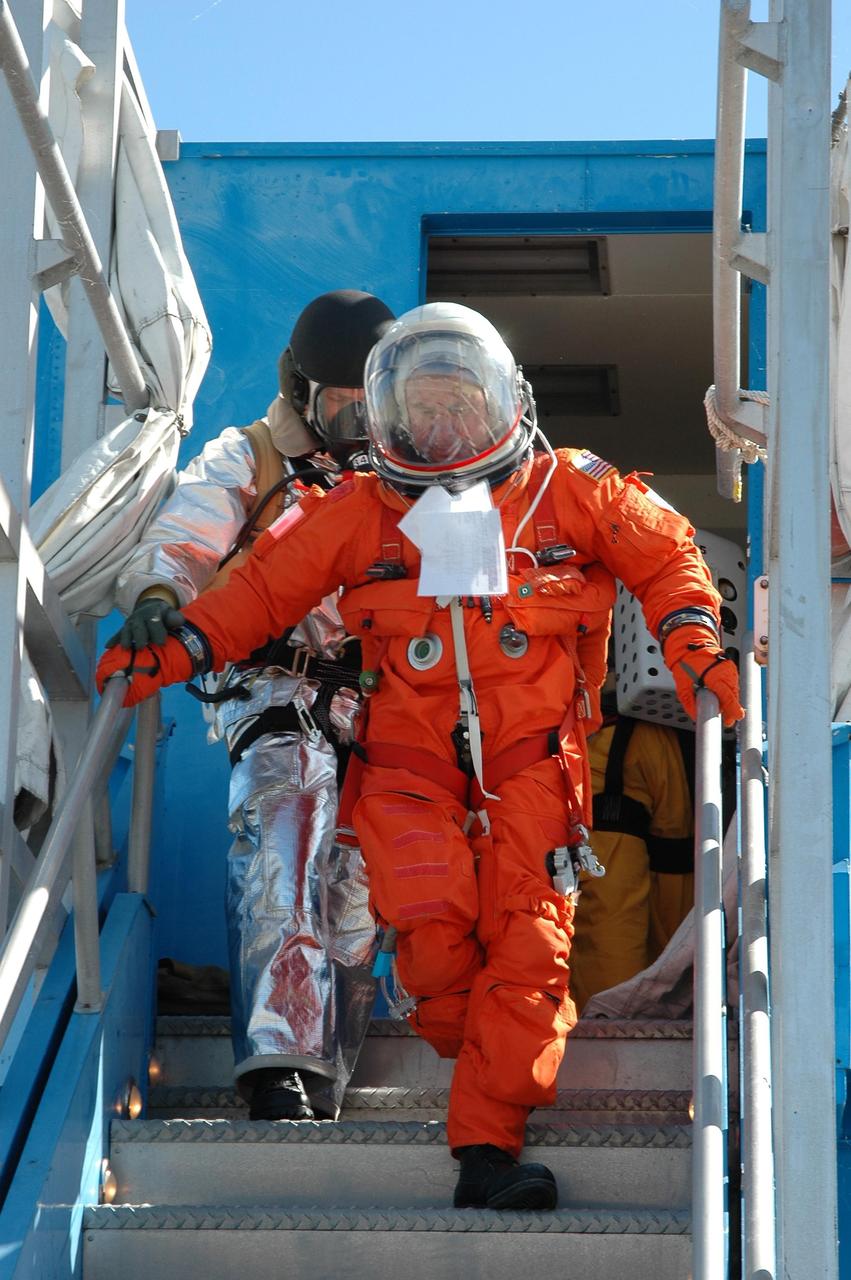
A volunteer "astronaut" starts down an exit slide from a Space Shuttle crew compartment mockup during a rescue and recovery training exercise.
A volunteer "astronaut" starts down an exit slide from a Space Shuttle crew compartment mockup during a rescue and recovery training exercise
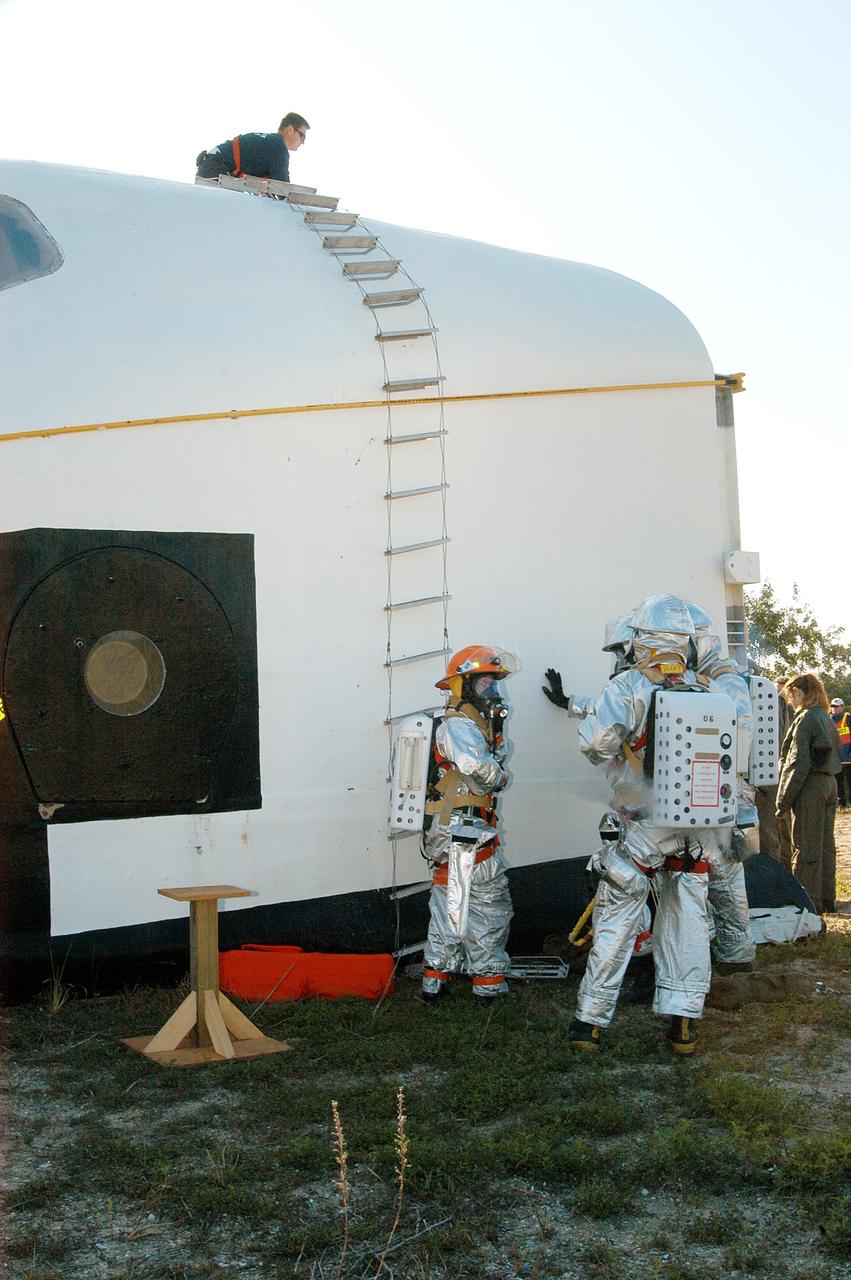
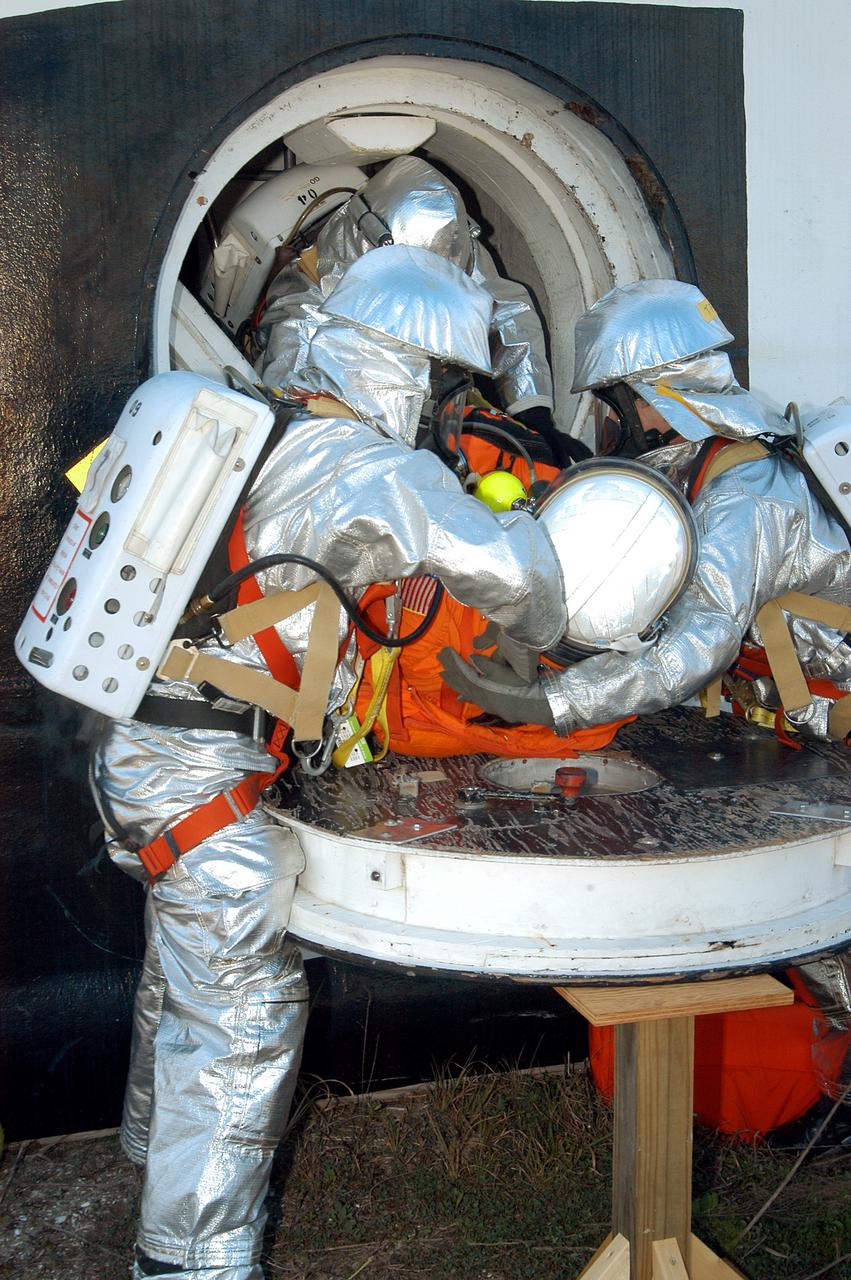
Air Force fire/rescue crew enter the space shuttle cabin mockup hatch to evacuate the shuttle crew during a shuttle rescue training exercise at Edwards AFB. (USAF photo # 070505-F-1287F-118)
Air Force fire/rescue crew enter the space shuttle cabin mockup hatch to evacuate the shuttle crew during a shuttle rescue training exercise at Edwards AFB
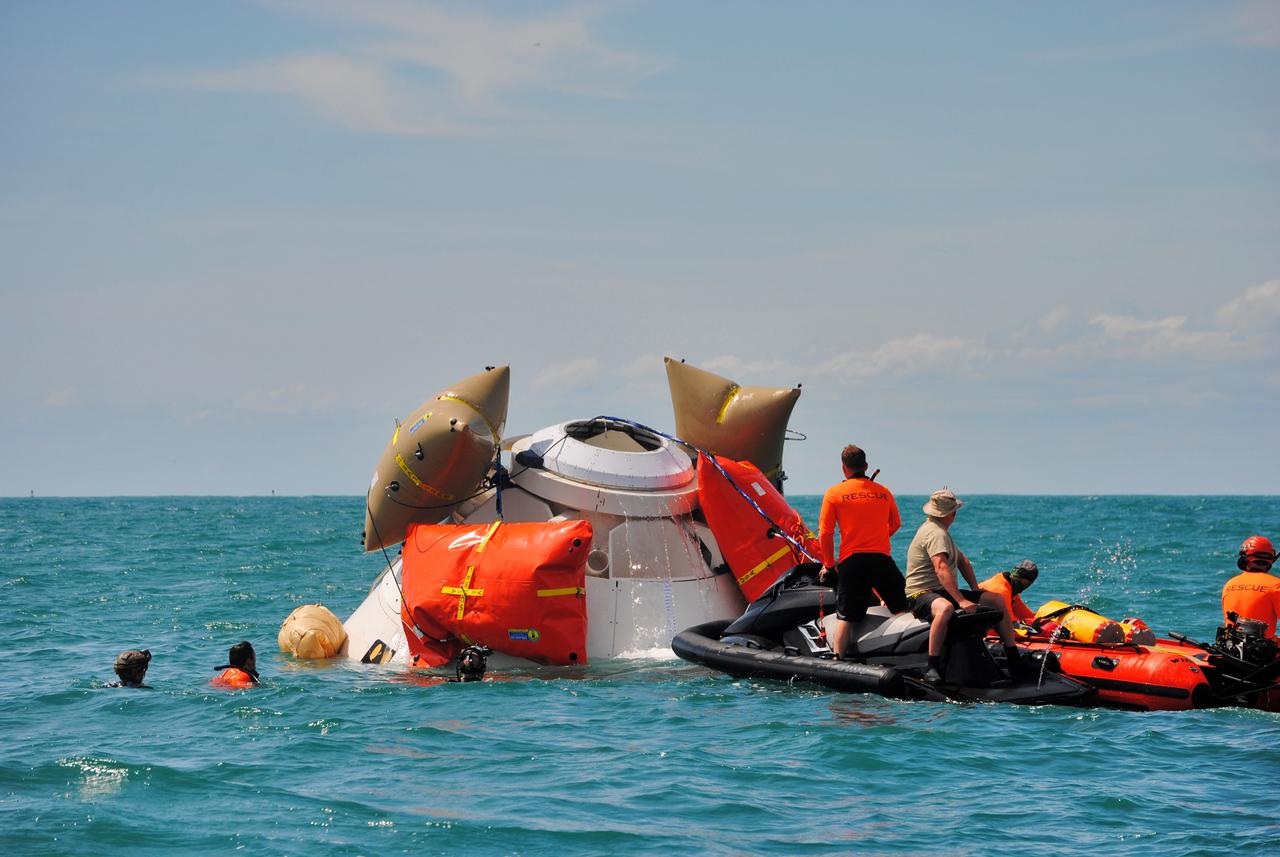
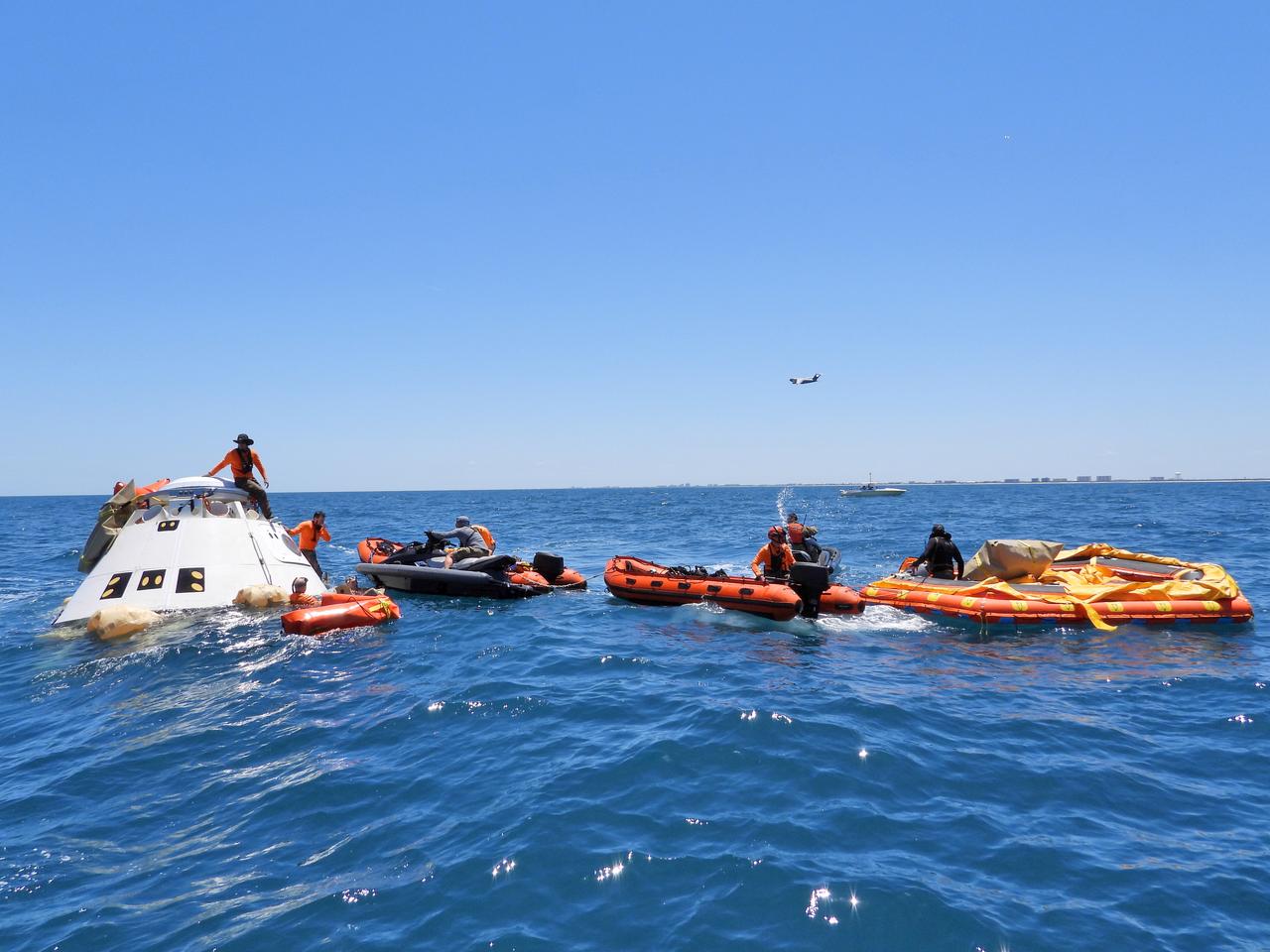
Rescue team members are using a Boeing CST-100 Starliner training capsule, known as Boiler Plate 3, to practice crew rescue procedures in the unlikely event of an emergency resulting in a splashdown. NASA and the Department of Defense Human Space Flight Support Office Rescue Division conducted a search and rescue training exercise at the Army Wharf at Cape Canaveral Air Force Station in Florida on April 17, 2019. The teams practiced manually inflating uprighting airbags to lift the spacecraft to its upright position. This is the first at-sea exercise with the Starliner training capsule ahead of Boeing’s Crew Flight Test with astronauts targeted for later this year. During normal return scenarios, Boeing's Starliner will land on land in a safe zone of about 15 square miles in the Western United States. Throughout the commercial crew development phases with NASA, Boeing has performed dozens of qualification tests on its parachute and airbag systems simulating conditions on land and in the water.
Det 3 Recovery of Boeing Starliner Boiler Plate
Rescue team members perform checks of the Boeing CST-100 Starliner training capsule, known as Boiler Plate 3, during a search and rescue exercise on April 16, 2019. NASA and the Department of Defense Human Space Flight Support Office Rescue Division are conducting a search and rescue training exercise over the next several days at the Wharf and in the Atlantic Ocean simulating a rescue in the unlikely event of an emergency. It is the first at-sea exercise with the Starliner training capsule ahead of Boeing’s Crew Flight Test with astronauts targeted for later this year. During normal return scenarios, Boeing's Starliner will land on land in a safe zone of about 15 square miles in the Western United States. Throughout the commercial crew development phases with NASA, Boeing has performed dozens of qualification tests on its parachute and airbag systems simulating conditions on land and in the water.
Det 3 Recovery of Boeing Starliner Boiler Plate
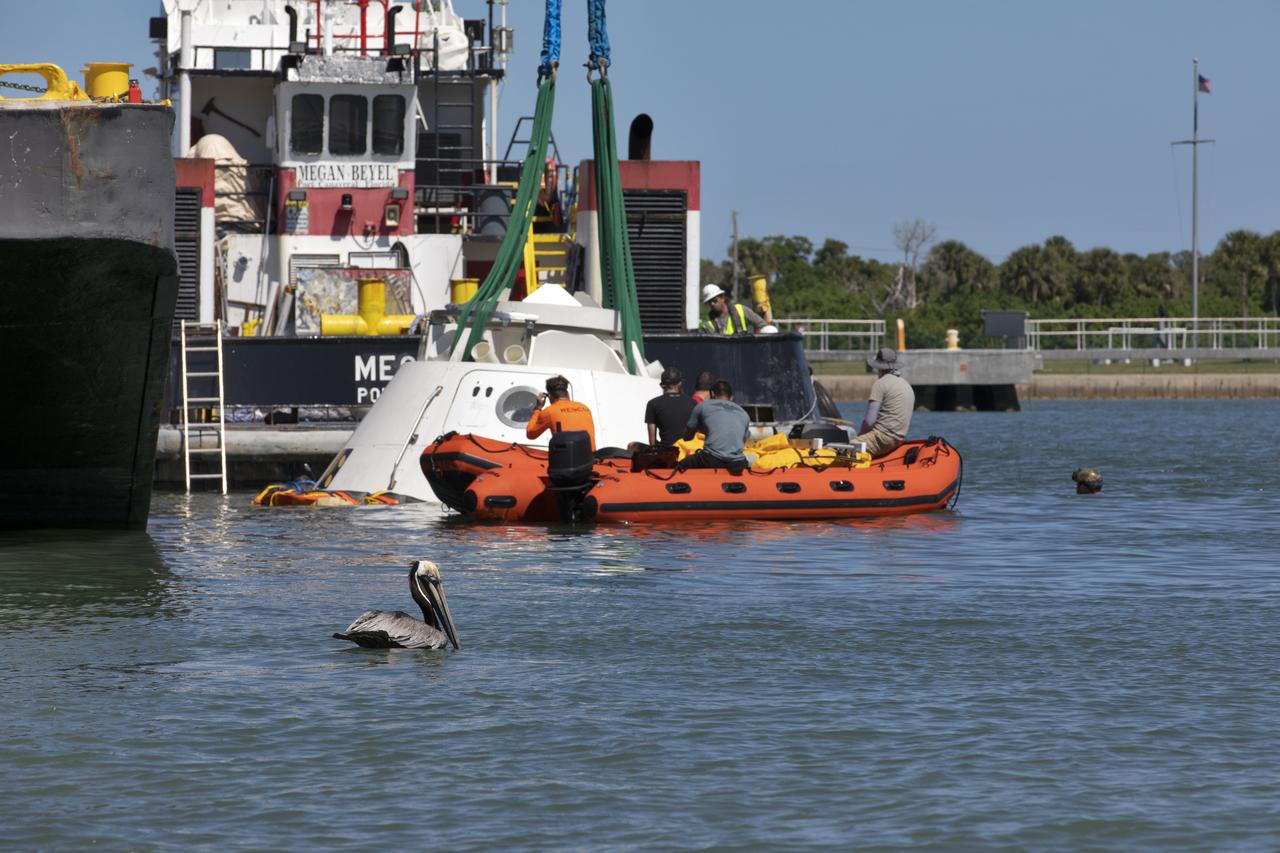
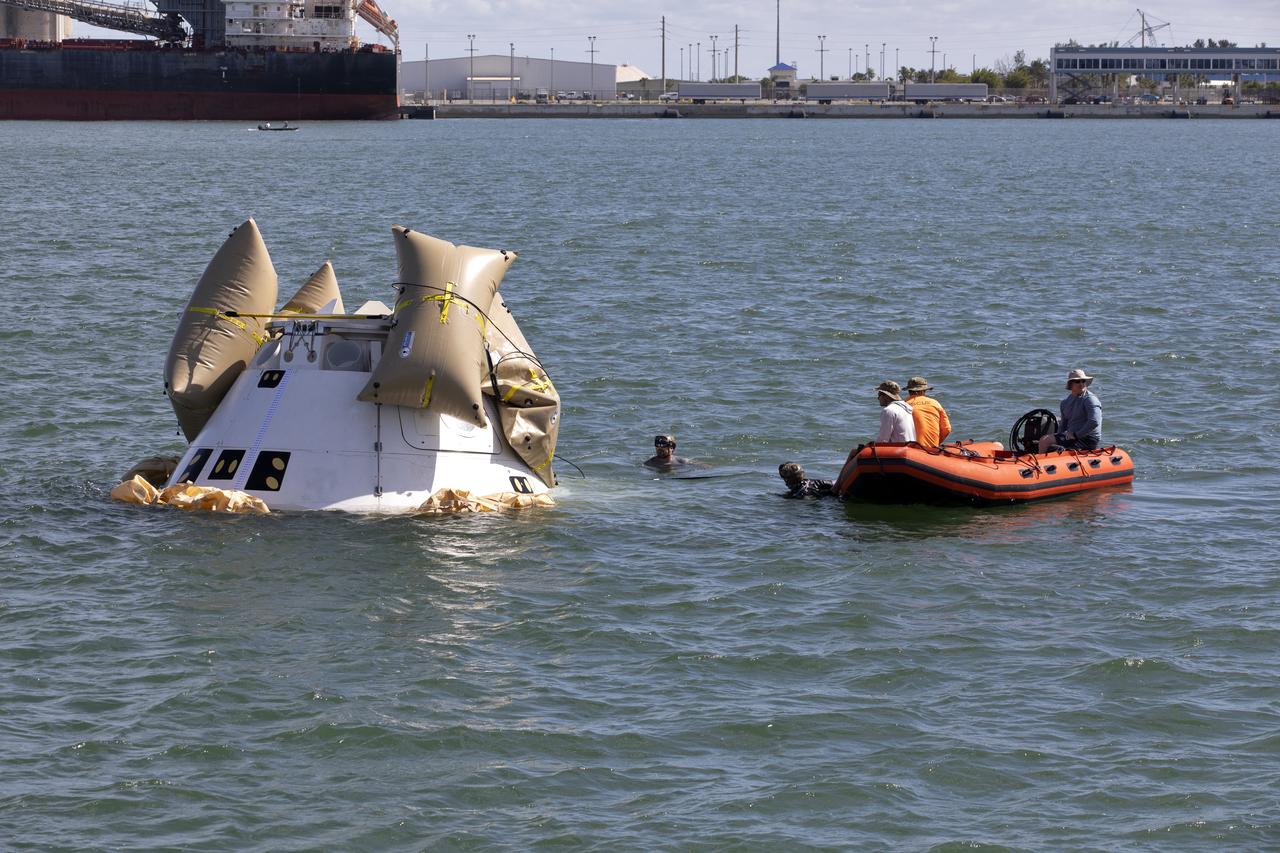
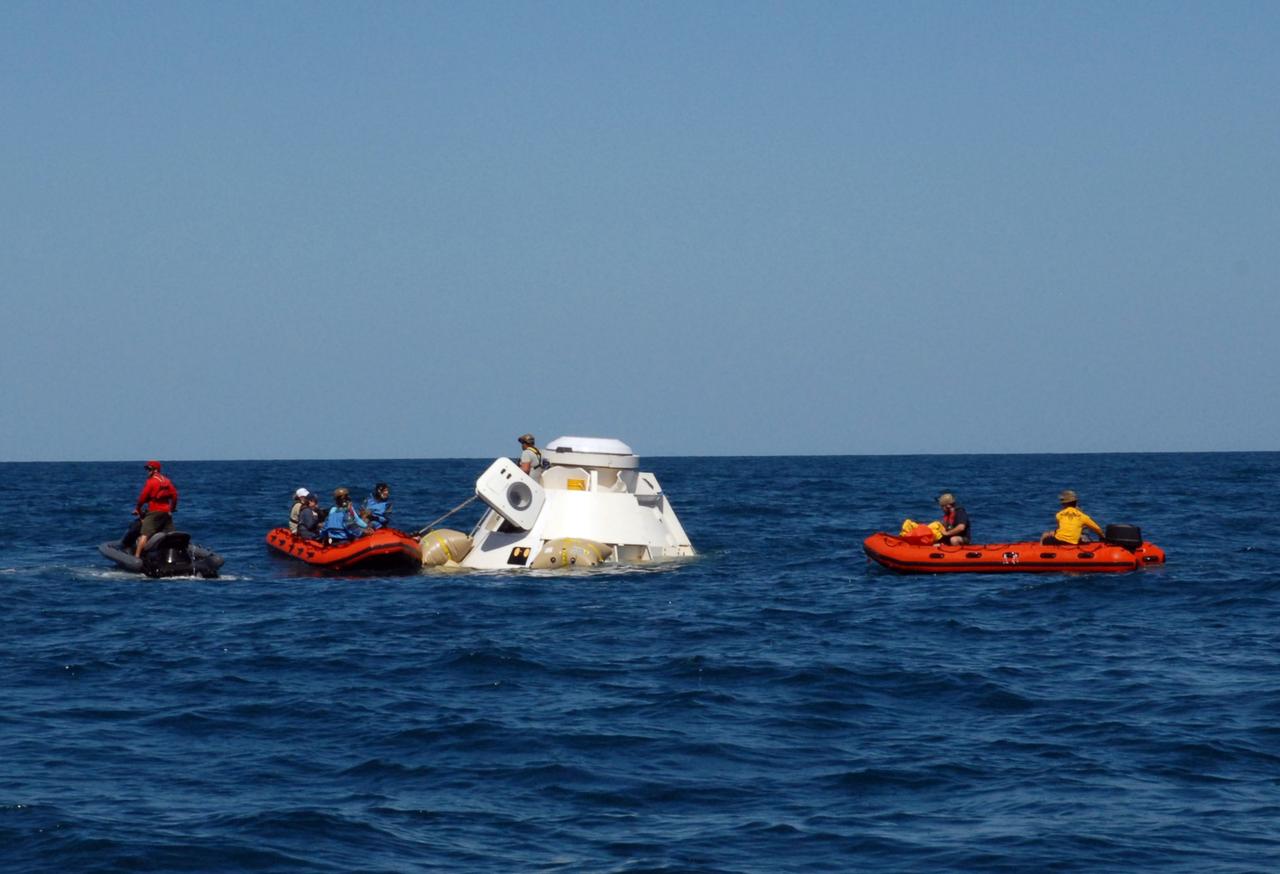
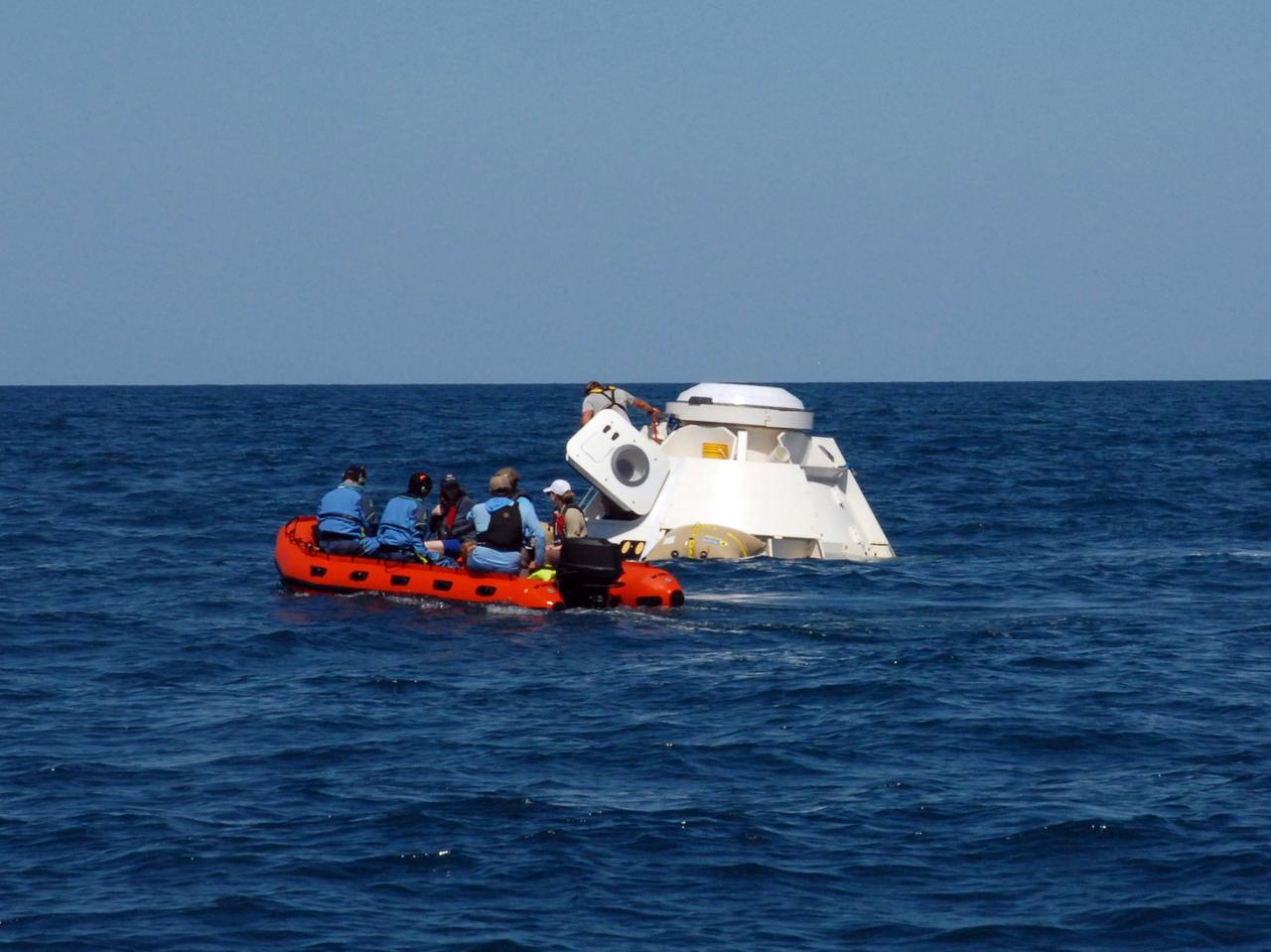
Rescue team members in an inflatable boat approach the Boeing CST-100 Starliner training capsule, known as Boiler Plate 3, at the Army Wharf at Cape Canaveral Air Force Station in Florida on April 16, 2019. NASA and the Department of Defense Human Space Flight Support Office Rescue Division are conducting a search and rescue training exercise over the next several days at the Wharf and in the Atlantic Ocean simulating a rescue in the unlikely event of an emergency. It is the first at-sea exercise with the Starliner training capsule ahead of Boeing’s Crew Flight Test with astronauts targeted for later this year. During normal return scenarios, Boeing's Starliner will land on land in a safe zone of about 15 square miles in the Western United States. Throughout the commercial crew development phases with NASA, Boeing has performed dozens of qualification tests on its parachute and airbag systems simulating conditions on land and in the water.
Det 3 Recovery of Boeing Starliner Boiler Plate
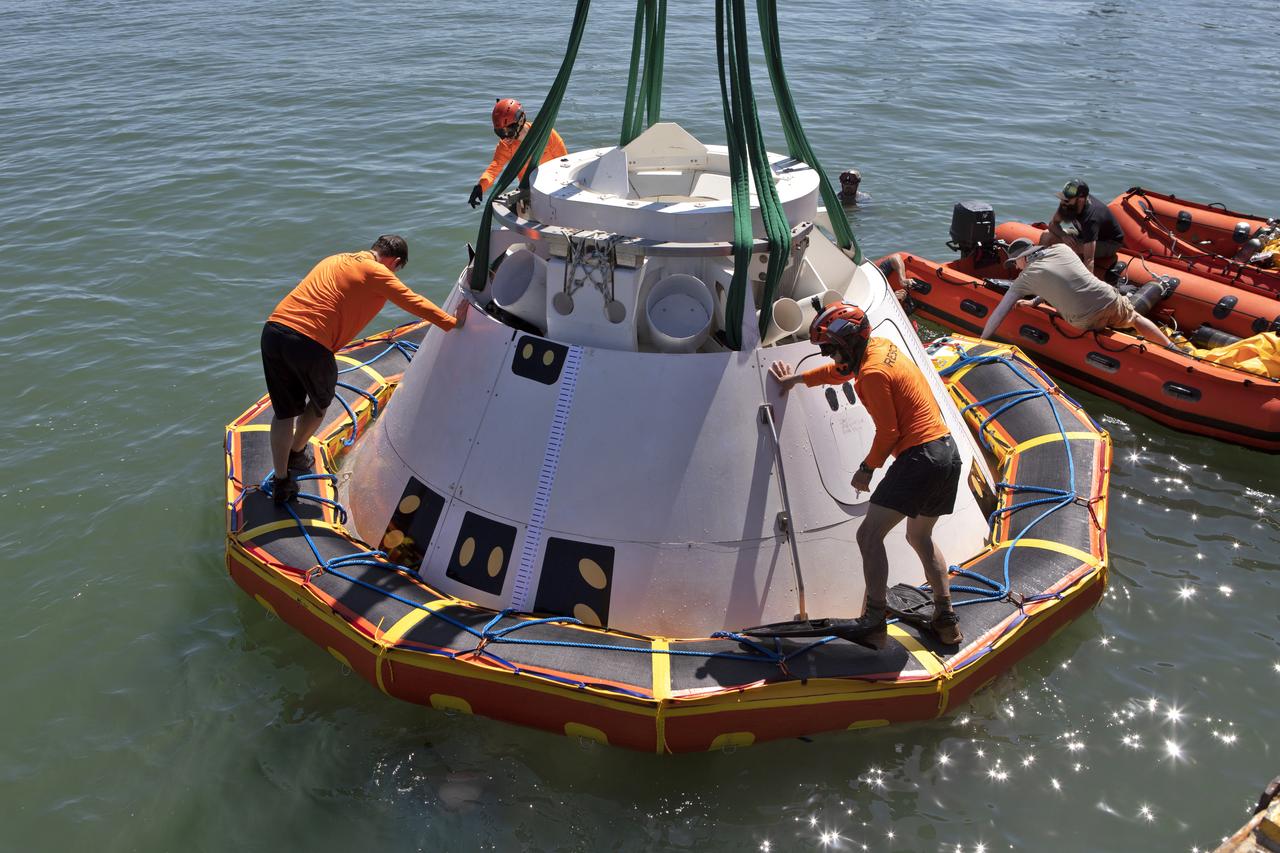
Rescue team members stand on the stabilization collar attached to the Boeing CST-100 Starliner training capsule, known as Boiler Plate 3, to perform checks during a search and rescue training exercise April 16, 2019. NASA and the Department of Defense Human Space Flight Support Office Rescue Division are conducting the exercise over the next several days at the Wharf and in the Atlantic Ocean simulating a rescue in the unlikely event of an emergency. It is the first at-sea exercise with the Starliner training capsule ahead of Boeing’s Crew Flight Test with astronauts targeted for later this year. During normal return scenarios, Boeing's Starliner will land on land in a safe zone of about 15 square miles in the Western United States. Throughout the commercial crew development phases with NASA, Boeing has performed dozens of qualification tests on its parachute and airbag systems simulating conditions on land and in the water.
Det 3 Recovery of Boeing Starliner Boiler Plate
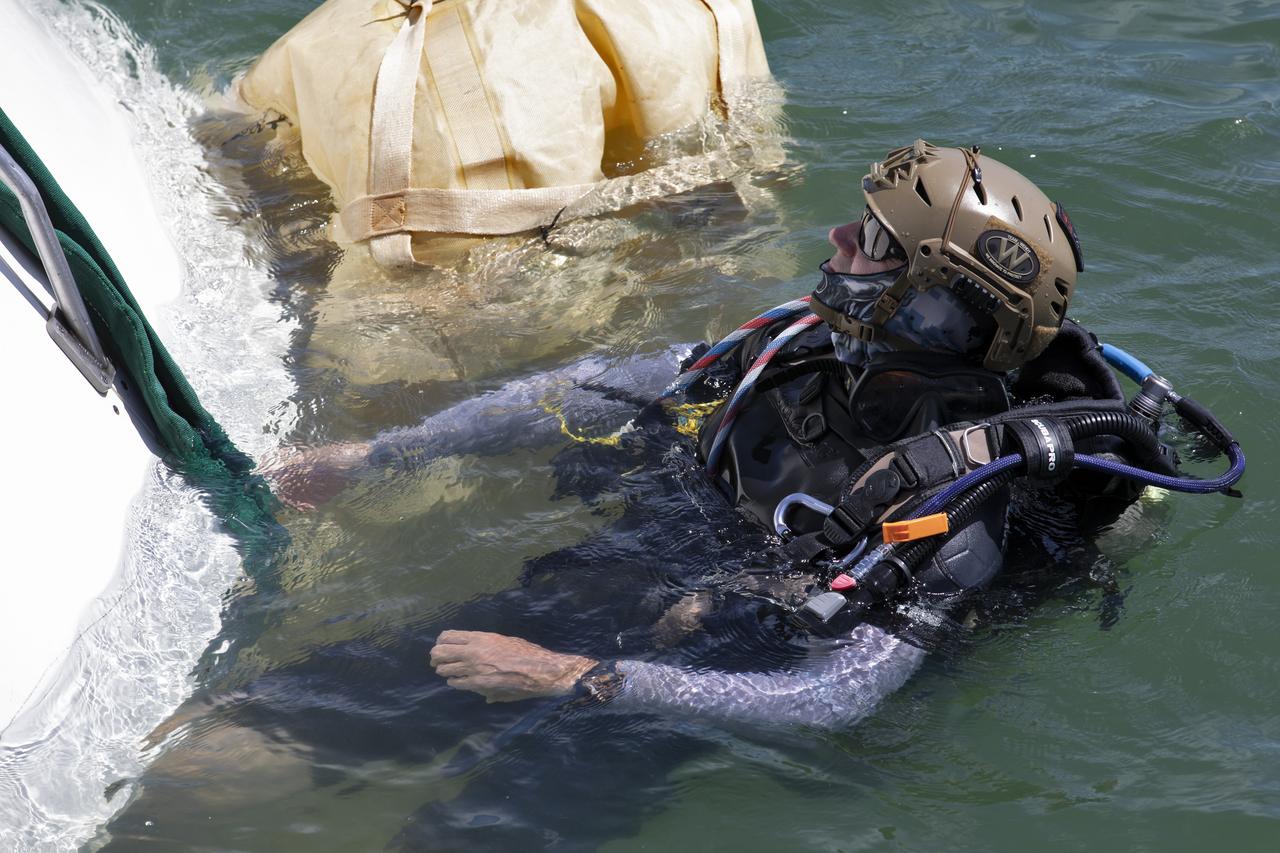
Rescue team members remove the stabilization collar from the Boeing CST-100 Starliner training capsule, known as Boiler Plate 3, in the water at the Army Wharf at Cape Canaveral Air Force Station in Florida on April 16, 2019. NASA and the Department of Defense Human Space Flight Support Office Rescue Division are conducting a search and rescue training exercise using the Starliner trainer over the next several days at the Wharf and in the Atlantic Ocean simulating a rescue in the unlikely event of an emergency. It is the first at-sea exercise with the Starliner training capsule ahead of Boeing’s Crew Flight Test with astronauts targeted for later this year. During normal return scenarios, Boeing's Starliner will land on land in a safe zone of about 15 square miles in the Western United States. Throughout the commercial crew development phases with NASA, Boeing has performed dozens of qualification tests on its parachute and airbag systems simulating conditions on land and in the water.
Det 3 Recovery of Boeing Starliner Boiler Plate
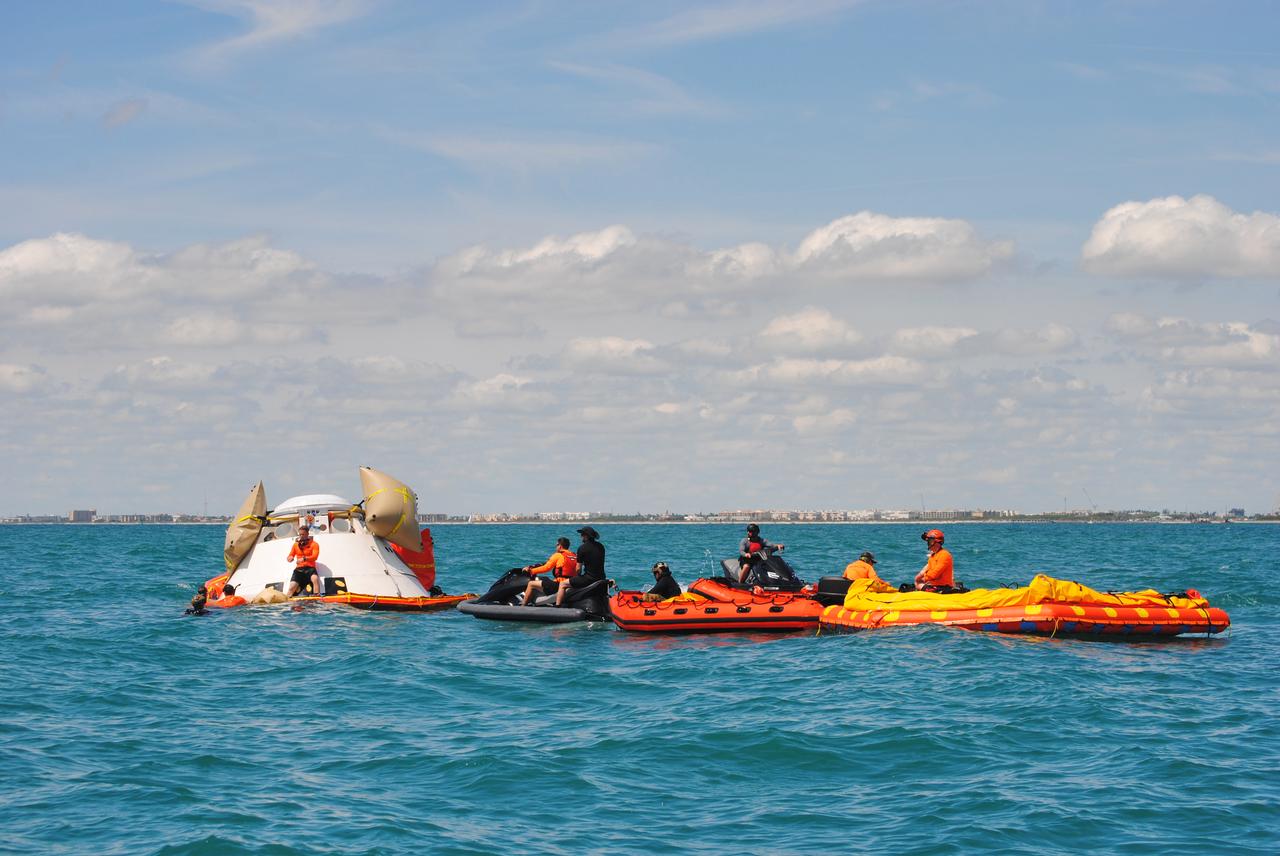
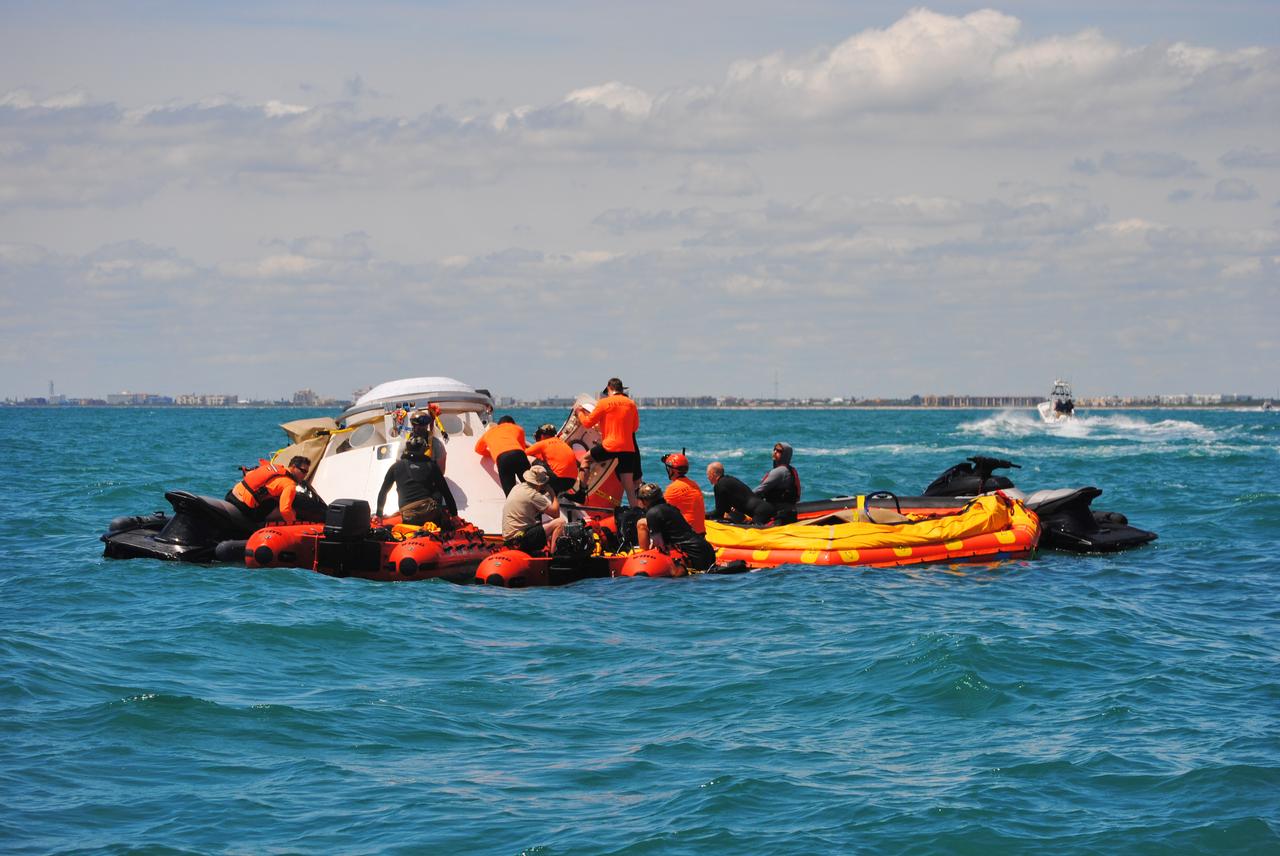
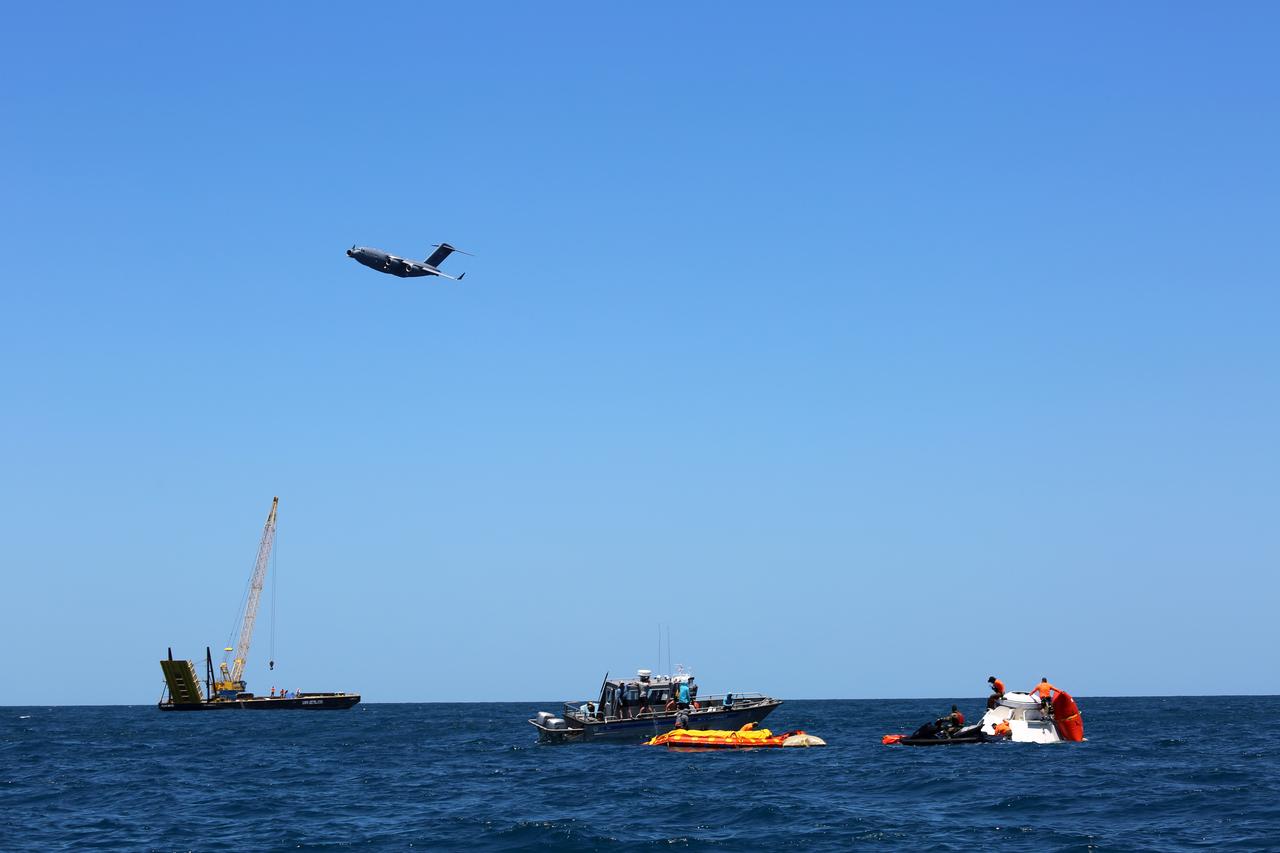
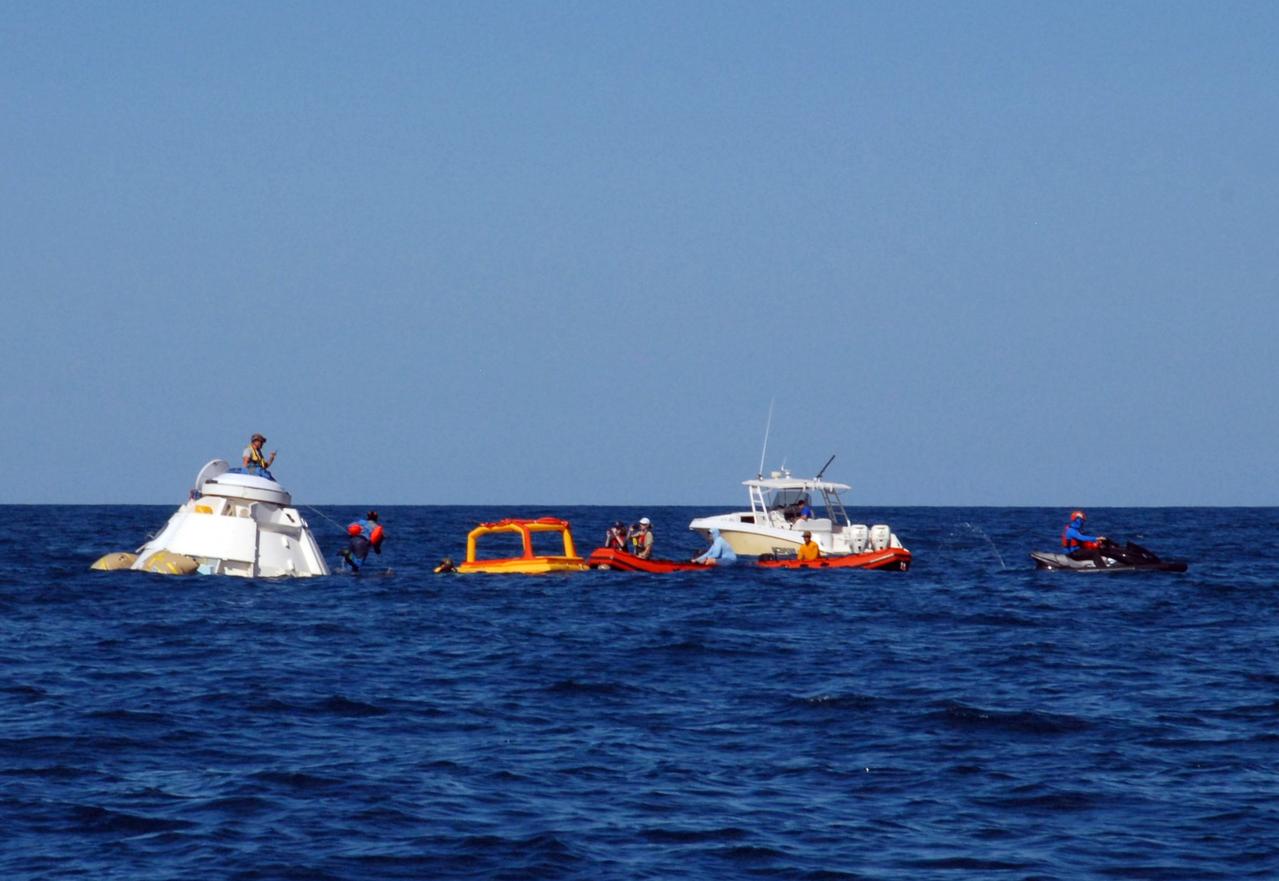
Rescue team members are using a Boeing CST-100 Starliner training capsule to rehearse a search and rescue training exercise in the unlikely event of an emergency resulting in a splashdown. NASA and the Department of Defense (DoD) Human Space Flight Support Office Rescue Division conducted the open-ocean exercise, after nearly two weeks of training, off the coast of Cape Canaveral near the agency’s Kennedy Space Center in Florida on April 25, 2019. This exercise provides team members with the necessary training ahead of Boeing’s Crew Flight Test with astronauts targeted for later this year. During normal return scenarios, Boeing’s Starliner will land in a safe zone of about 15 square miles in the Western United States. Throughout the commercial crew development phases with NASA, Boeing has performed dozens of qualification tests on its parachute and airbag systems simulating conditions on land and in the water.
Starliner Astronaut Water Rescue Training
Rescue team members are using a Boeing CST-100 Starliner training capsule to rehearse a search and rescue training exercise in the unlikely event of an emergency resulting in a splashdown. NASA and the Department of Defense (DoD) Human Space Flight Support Office Rescue Division conducted the open-ocean exercise, after nearly two weeks of training, off the coast of Cape Canaveral near the agency’s Kennedy Space Center in Florida on April 25, 2019. This exercise provides team members with the necessary training ahead of Boeing’s Crew Flight Test with astronauts targeted for later this year. During normal return scenarios, Boeing’s Starliner will land in a safe zone of about 15 square miles in the Western United States. Throughout the commercial crew development phases with NASA, Boeing has performed dozens of qualification tests on its parachute and airbag systems simulating conditions on land and in the water.
Starliner Astronaut Water Rescue Training
Rescue team members are using a Boeing CST-100 Starliner training capsule to rehearse a search and rescue training exercise in the unlikely event of an emergency resulting in a splashdown. NASA and the Department of Defense (DoD) Human Space Flight Support Office Rescue Division conducted the open-ocean exercise, after nearly two weeks of training, off the coast of Cape Canaveral near the agency’s Kennedy Space Center in Florida on April 25, 2019. This exercise provides team members with the necessary training ahead of Boeing’s Crew Flight Test with astronauts targeted for later this year. During normal return scenarios, Boeing’s Starliner will land in a safe zone of about 15 square miles in the Western United States. Throughout the commercial crew development phases with NASA, Boeing has performed dozens of qualification tests on its parachute and airbag systems simulating conditions on land and in the water.
Starliner Astronaut Water Rescue Training
Rescue team members are using a Boeing CST-100 Starliner training capsule to rehearse a search and rescue training exercise in the unlikely event of an emergency resulting in a splashdown. NASA and the Department of Defense (DoD) Human Space Flight Support Office Rescue Division conducted the open-ocean exercise, after nearly two weeks of training, off the coast of Cape Canaveral near the agency’s Kennedy Space Center in Florida on April 25, 2019. This exercise provides team members with the necessary training ahead of Boeing’s Crew Flight Test with astronauts targeted for later this year. During normal return scenarios, Boeing’s Starliner will land in a safe zone of about 15 square miles in the Western United States. Throughout the commercial crew development phases with NASA, Boeing has performed dozens of qualification tests on its parachute and airbag systems simulating conditions on land and in the water.
Starliner Astronaut Water Rescue Training
Rescue team members are using a Boeing CST-100 Starliner training capsule to rehearse a search and rescue training exercise in the unlikely event of an emergency resulting in a splashdown. NASA and the Department of Defense (DoD) Human Space Flight Support Office Rescue Division conducted the open-ocean exercise, after nearly two weeks of training, off the coast of Cape Canaveral near the agency’s Kennedy Space Center in Florida on April 25, 2019. This exercise provides team members with the necessary training ahead of Boeing’s Crew Flight Test with astronauts targeted for later this year. During normal return scenarios, Boeing’s Starliner will land in a safe zone of about 15 square miles in the Western United States. Throughout the commercial crew development phases with NASA, Boeing has performed dozens of qualification tests on its parachute and airbag systems simulating conditions on land and in the water.
Starliner Astronaut Water Rescue Training
Rescue team members are using a Boeing CST-100 Starliner training capsule to rehearse a search and rescue training exercise in the unlikely event of an emergency resulting in a splashdown. NASA and the Department of Defense (DoD) Human Space Flight Support Office Rescue Division conducted the open-ocean exercise, after nearly two weeks of training, off the coast of Cape Canaveral near the agency’s Kennedy Space Center in Florida on April 25, 2019. This exercise provides team members with the necessary training ahead of Boeing’s Crew Flight Test with astronauts targeted for later this year. During normal return scenarios, Boeing’s Starliner will land in a safe zone of about 15 square miles in the Western United States. Throughout the commercial crew development phases with NASA, Boeing has performed dozens of qualification tests on its parachute and airbag systems simulating conditions on land and in the water.
Starliner Astronaut Water Rescue Training
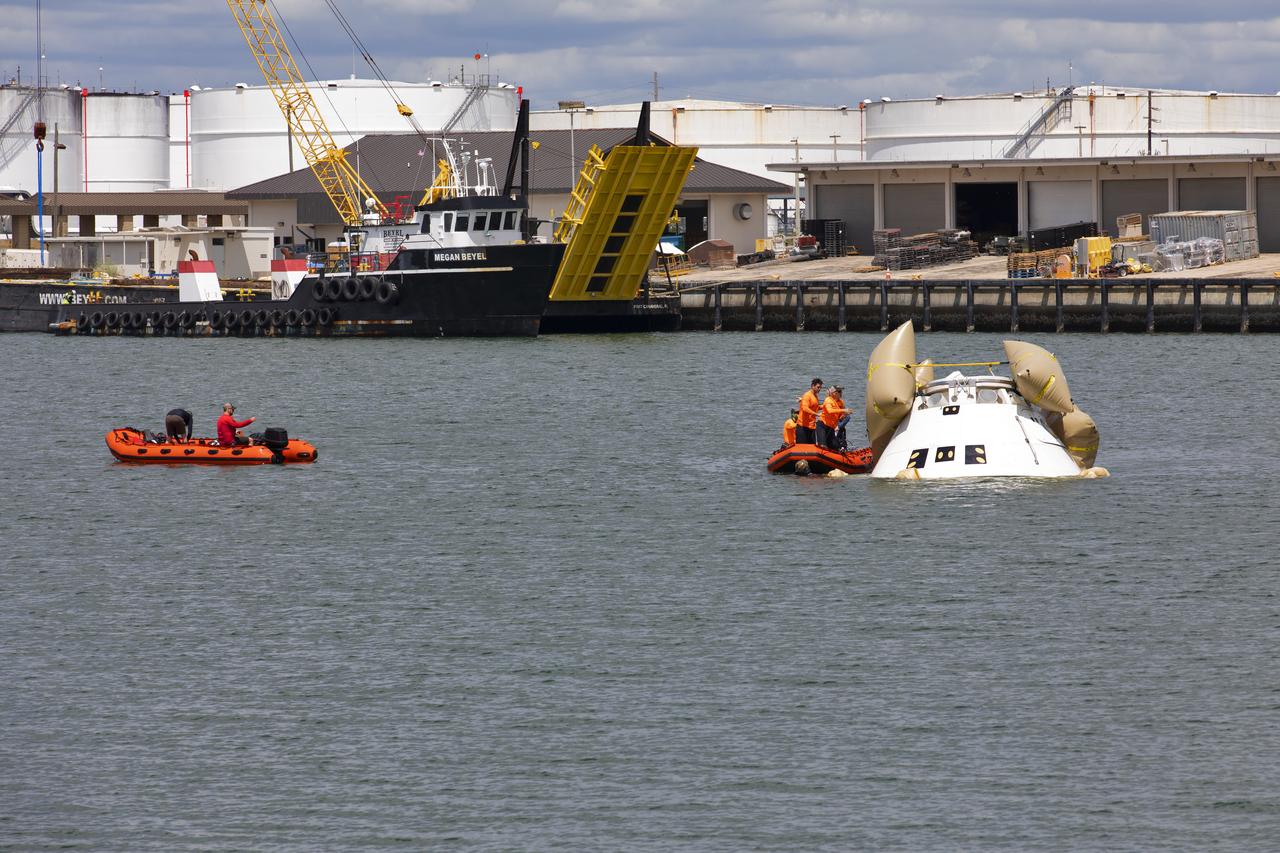
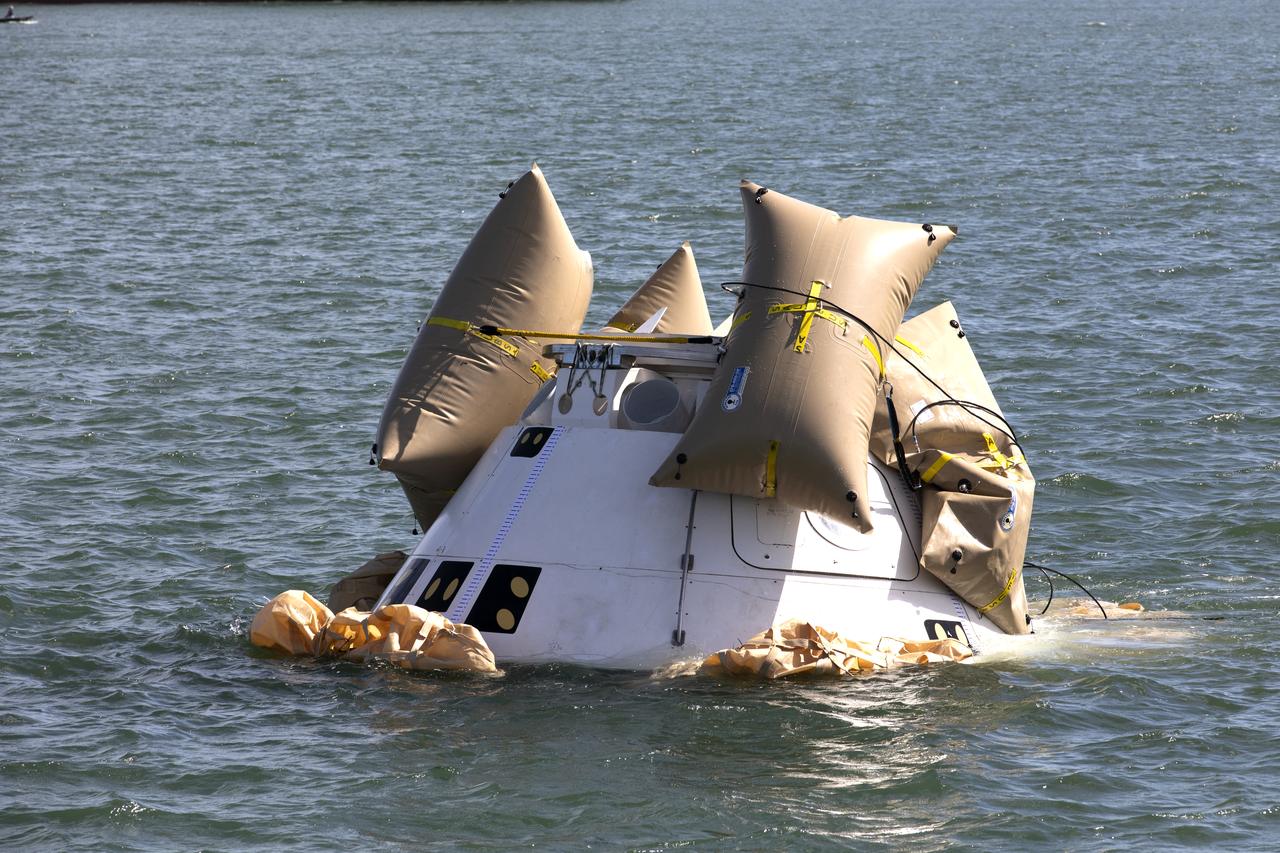
Rescue team members are using a Boeing CST-100 Starliner training capsule, known as Boiler Plate 3, to practice uprighting procedures in the unlikely event of an emergency resulting in a splashdown. NASA and the Department of Defense Human Space Flight Support Office Rescue Division conducted a search and rescue training exercise at the Army Wharf at Cape Canaveral Air Force Station in Florida on April 17, 2019. The manual uprighting airbags could be used to lift the spacecraft to its upright position. This is the first at-sea exercise with the Starliner training capsule ahead of Boeing’s Crew Flight Test with astronauts targeted for later this year. During normal return scenarios, Boeing's Starliner will land on land in a safe zone of about 15 square miles in the Western United States. Throughout the commercial crew development phases with NASA, Boeing has performed dozens of qualification tests on its parachute and airbag systems simulating conditions on land and in the water.
Det 3 Recovery of Boeing Starliner Boiler Plate
Rescue team members are using a Boeing CST-100 Starliner training capsule, known as Boiler Plate 3, to practice uprighting procedures in the unlikely event of an emergency resulting in a splashdown. NASA and the Department of Defense Human Space Flight Support Office Rescue Division conducted a search and rescue training exercise at the Army Wharf at Cape Canaveral Air Force Station in Florida on April 17, 2019. The manual uprighting airbags could be used to lift the spacecraft to its upright position. This is the first at-sea exercise with the Starliner training capsule ahead of Boeing’s Crew Flight Test with astronauts targeted for later this year. During normal return scenarios, Boeing's Starliner will land on land in a safe zone of about 15 square miles in the Western United States. Throughout the commercial crew development phases with NASA, Boeing has performed dozens of qualification tests on its parachute and airbag systems simulating conditions on land and in the water.
Det 3 Recovery of Boeing Starliner Boiler Plate
Rescue team members are using a Boeing CST-100 Starliner training capsule, known as Boiler Plate 3, to practice uprighting procedures in the unlikely event of an emergency resulting in a splashdown. NASA and the Department of Defense Human Space Flight Support Office Rescue Division conducted a search and rescue training exercise at the Army Wharf at Cape Canaveral Air Force Station in Florida on April 17, 2019. The manual uprighting airbags could be used to lift the spacecraft to its upright position. This is the first at-sea exercise with the Starliner training capsule ahead of Boeing’s Crew Flight Test with astronauts targeted for later this year. During normal return scenarios, Boeing's Starliner will land on land in a safe zone of about 15 square miles in the Western United States. Throughout the commercial crew development phases with NASA, Boeing has performed dozens of qualification tests on its parachute and airbag systems simulating conditions on land and in the water.
Det 3 Recovery of Boeing Starliner Boiler Plate
Rescue team members are using a Boeing CST-100 Starliner training capsule, known as Boiler Plate 3, to practice uprighting procedures in the unlikely event of an emergency resulting in a splashdown. NASA and the Department of Defense Human Space Flight Support Office Rescue Division conducted a search and rescue training exercise at the Army Wharf at Cape Canaveral Air Force Station in Florida on April 17, 2019. The manual uprighting airbags could be used to lift the spacecraft to its upright position. This is the first at-sea exercise with the Starliner training capsule ahead of Boeing’s Crew Flight Test with astronauts targeted for later this year. During normal return scenarios, Boeing's Starliner will land on land in a safe zone of about 15 square miles in the Western United States. Throughout the commercial crew development phases with NASA, Boeing has performed dozens of qualification tests on its parachute and airbag systems simulating conditions on land and in the water.
Det 3 Recovery of Boeing Starliner Boiler Plate
Rescue team members are using a Boeing CST-100 Starliner training capsule, known as Boiler Plate 3, to practice uprighting procedures in the unlikely event of an emergency resulting in a splashdown. NASA and the Department of Defense Human Space Flight Support Office Rescue Division conducted a search and rescue training exercise at the Army Wharf at Cape Canaveral Air Force Station in Florida on April 17, 2019. The manual uprighting airbags could be used to lift the spacecraft to its upright position. This is the first at-sea exercise with the Starliner training capsule ahead of Boeing’s Crew Flight Test with astronauts targeted for later this year. During normal return scenarios, Boeing's Starliner will land on land in a safe zone of about 15 square miles in the Western United States. Throughout the commercial crew development phases with NASA, Boeing has performed dozens of qualification tests on its parachute and airbag systems simulating conditions on land and in the water.
Det 3 Recovery of Boeing Starliner Boiler Plate
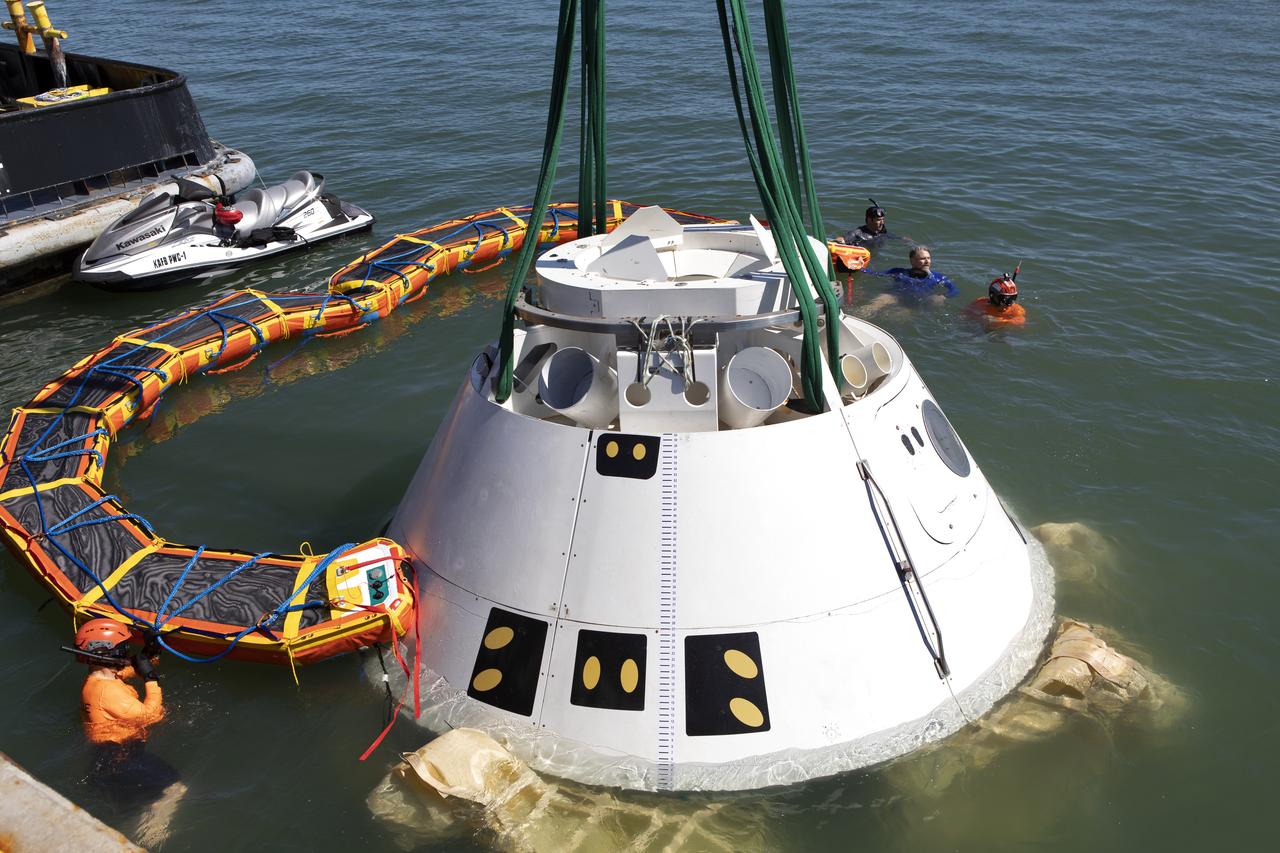
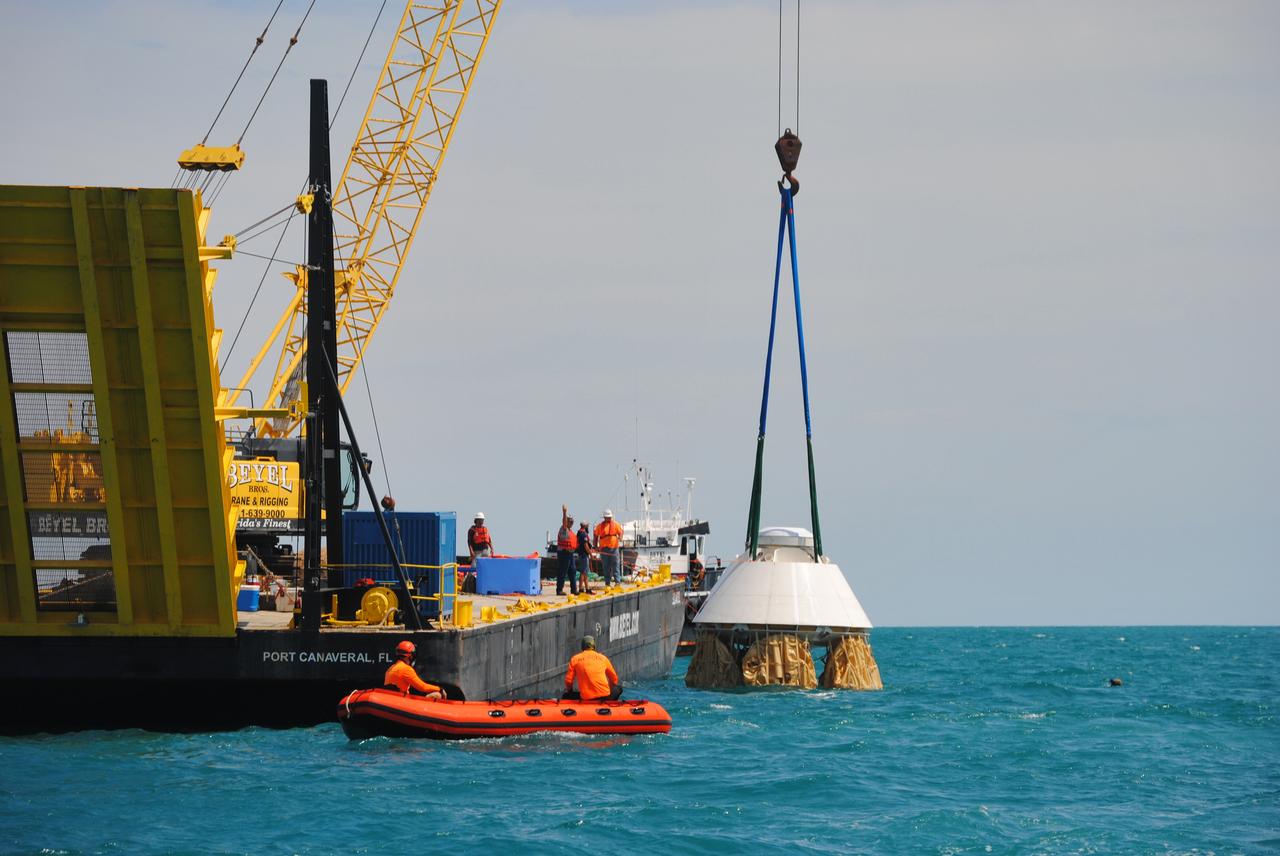
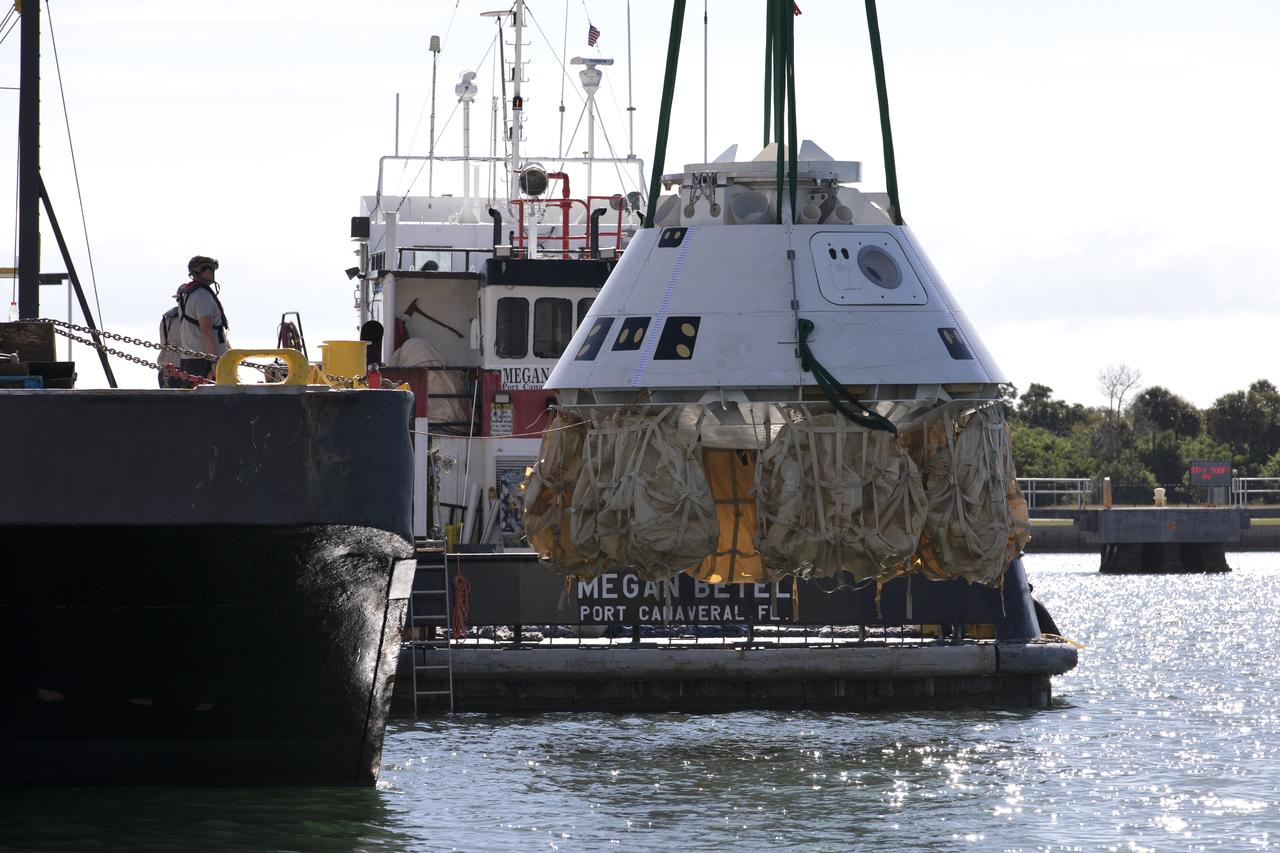
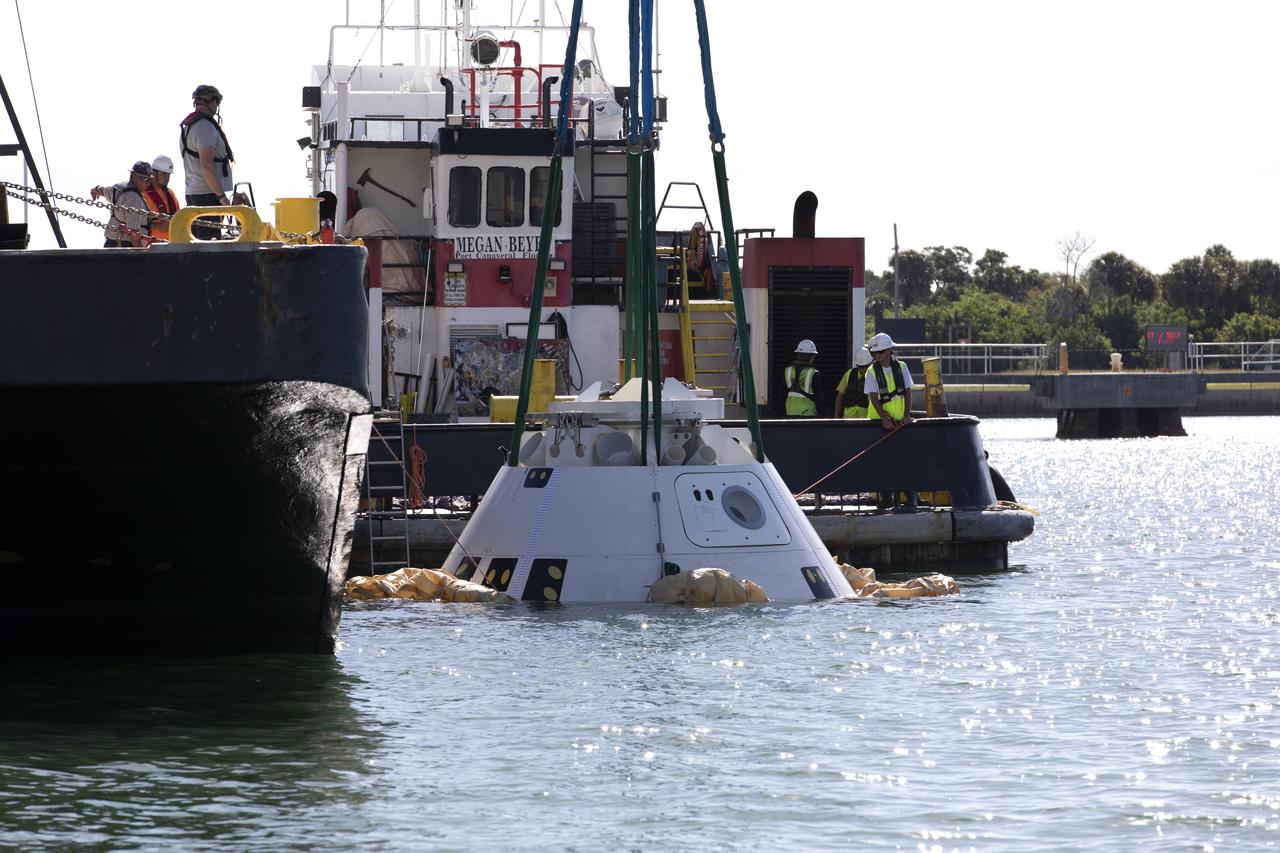
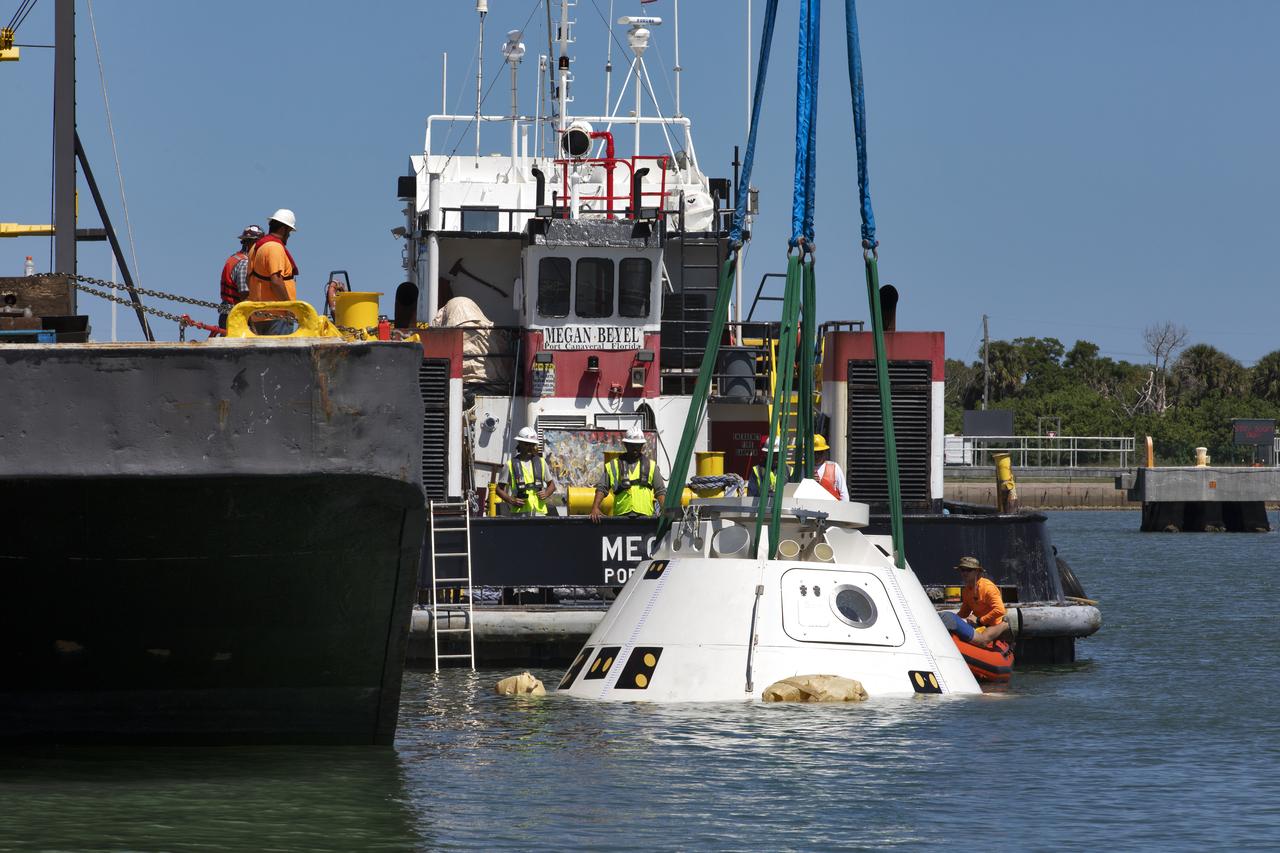
Rescue team members lower the Boeing CST-100 Starliner training capsule, known as Boiler Plate 3, into the water at the Army Wharf at Cape Canaveral Air Force Station in Florida on April 16, 2019. The team is practicing crew rescue procedures in the unlikely event of an emergency resulting in a splashdown. NASA and the Department of Defense Human Space Flight Support Office Rescue Division conducted a search and rescue training exercise at the Army Wharf at Cape Canaveral Air Force Station in Florida on April 17, 2019. The teams practiced manually inflating uprighting airbags to lift the spacecraft to its upright position. This is the first at-sea exercise with the Starliner training capsule ahead of Boeing’s Crew Flight Test with astronauts targeted for later this year. During normal return scenarios, Boeing's Starliner will land on land in a safe zone of about 15 square miles in the Western United States. Throughout the commercial crew development phases with NASA, Boeing has performed dozens of qualification tests on its parachute and airbag systems simulating conditions on land and in the water.
Det 3 Recovery of Boeing Starliner Boiler Plate
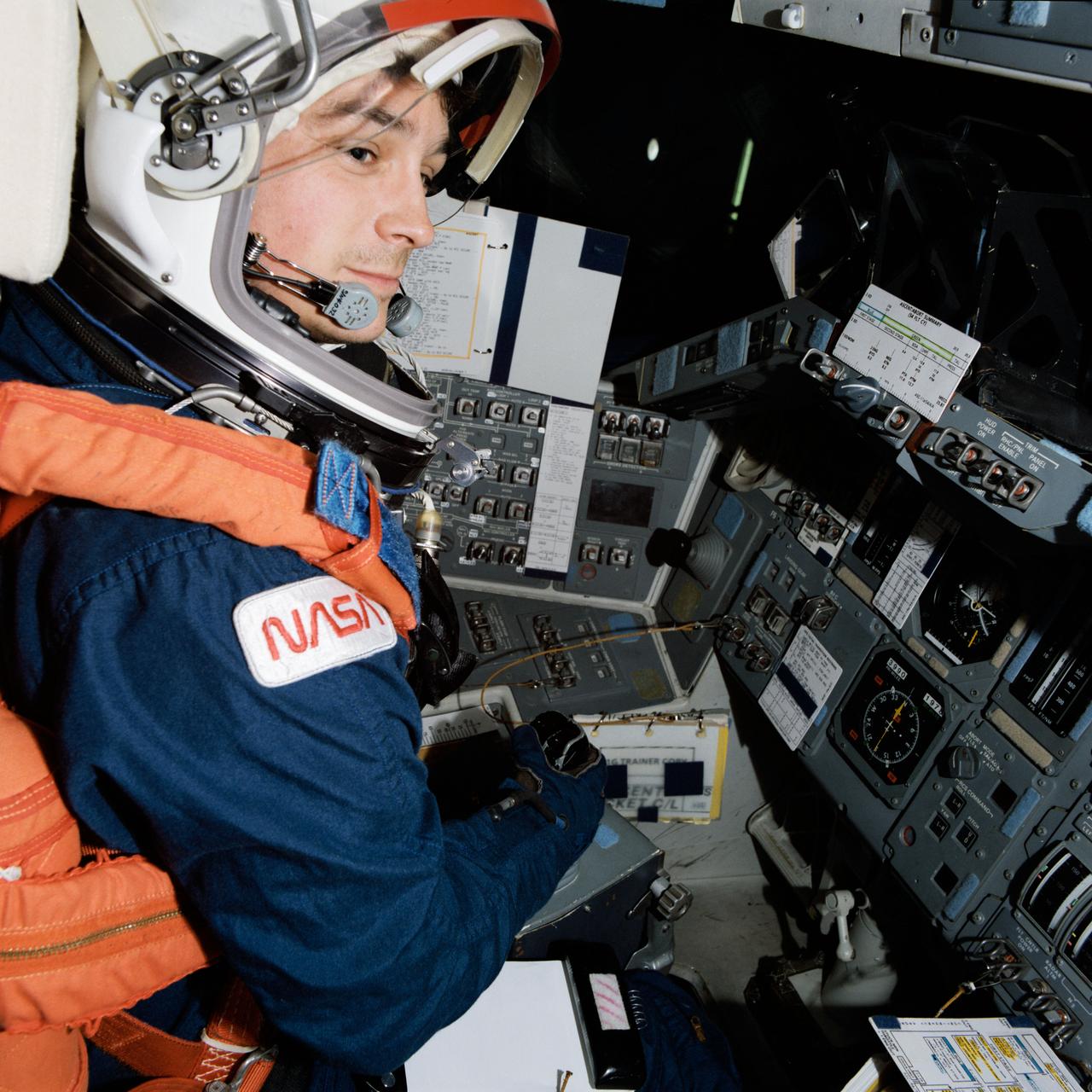
Photos of orbiter fire rescue and crew escape training for extravehicular activity (EVA) crew systems support conducted in Bldg 9A Crew Compartment Trainer (CCT) and Fuel Fuselage Trainer (FFT) include views of CCT interior of middeck starboard fuselage showing middeck forward (MF) locker and COAS assembly filter, artiflex film and camcorder bag (26834); launch/entry suit (LES) helmet assembly, neckring and helmet hold-down assembly (26835-26836); middeck aft (MA) lockers (26837); area of middeck airlock and crew escape pole (26838); connectors of crew escape pole in the middeck (268390); three test subjects in LES in the flight deck (26840); emergency side hatch slide before inflated stowage (26841); area of below adjacent to floor panel MD23R (26842); a test subject in LES in the flight deck (26843); control board and also showing sign of "orbital maneuvering system (OMS) secure and OMS TK" (26844); test subject in the flight deck also showing chart of "ascent/abort summary" (26845).
Orbiter fire rescue and crew escape training for EVA crew systems support
The Boeing CST-100 Starliner training capsule, known as Boiler Plate 3, is lowered into the water at the Army Wharf at Cape Canaveral Air Force Station in Florida on April 16, 2019. NASA and the Department of Defense Human Space Flight Support Office Rescue Division are conducting a search and rescue training exercise over the next several days at the Wharf and in the Atlantic Ocean simulating a rescue in the unlikely event of an emergency. It is the first at-sea exercise with the Starliner training capsule ahead of Boeing’s Crew Flight Test with astronauts targeted for later this year. During normal return scenarios, Boeing's Starliner will land on land in a safe zone of about 15 square miles in the Western United States. Throughout the commercial crew development phases with NASA, Boeing has performed dozens of qualification tests on its parachute and airbag systems simulating conditions on land and in the water.
Det 3 Recovery of Boeing Starliner Boiler Plate
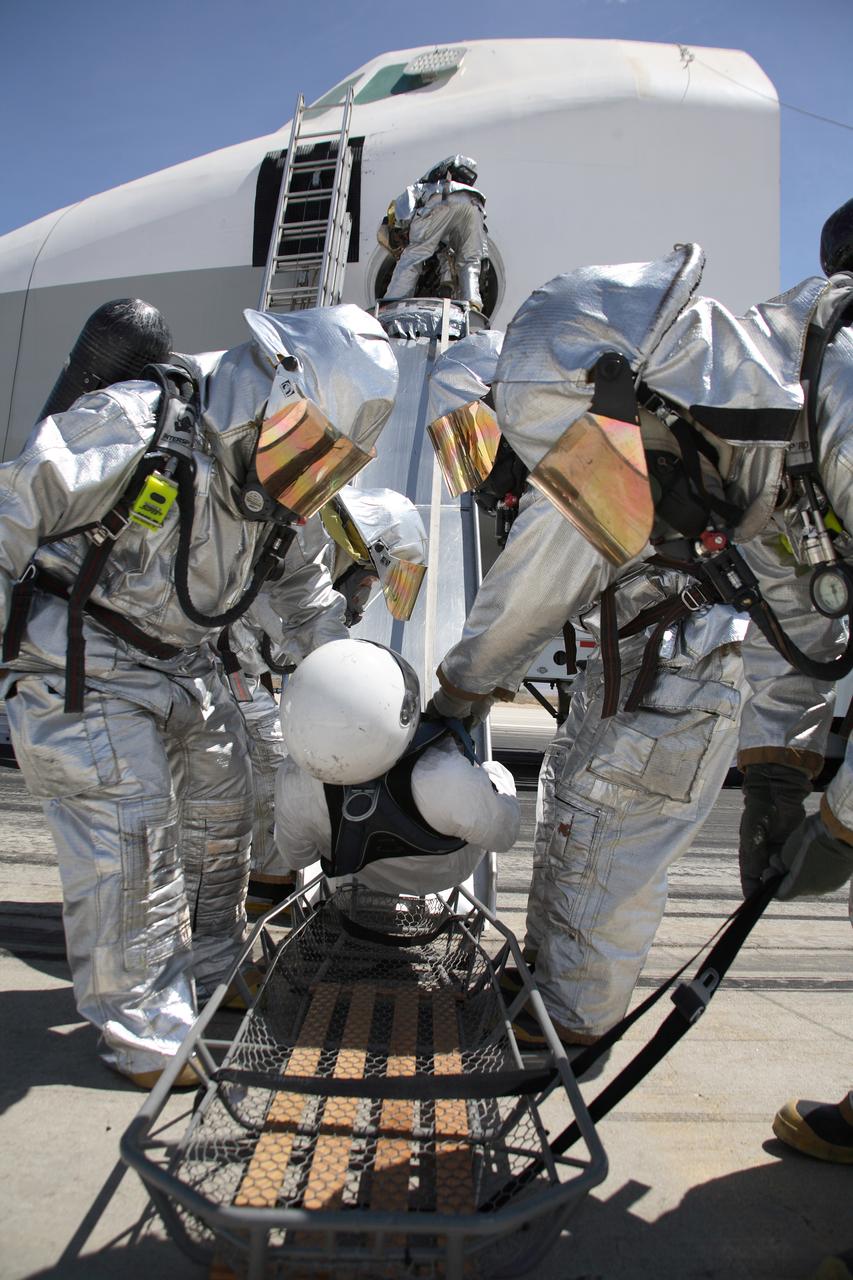
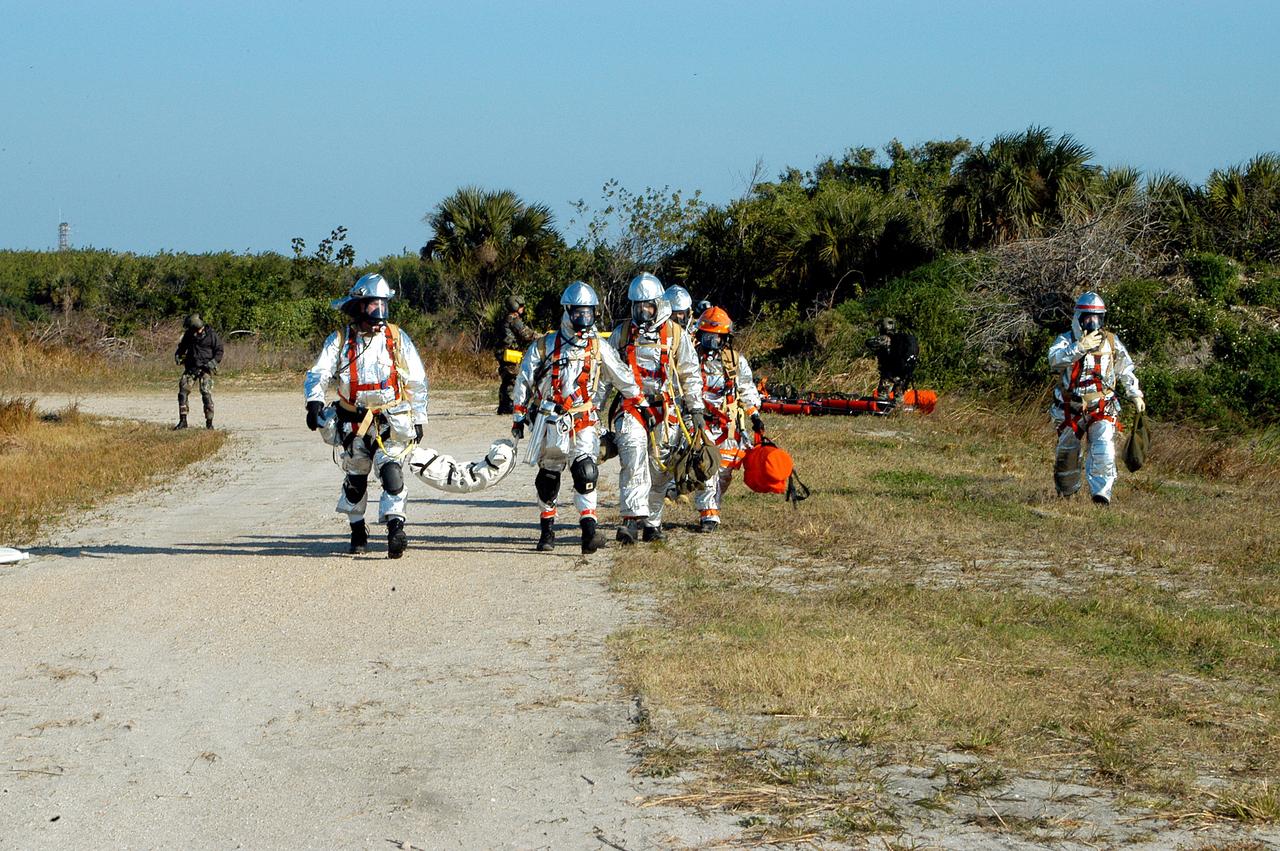
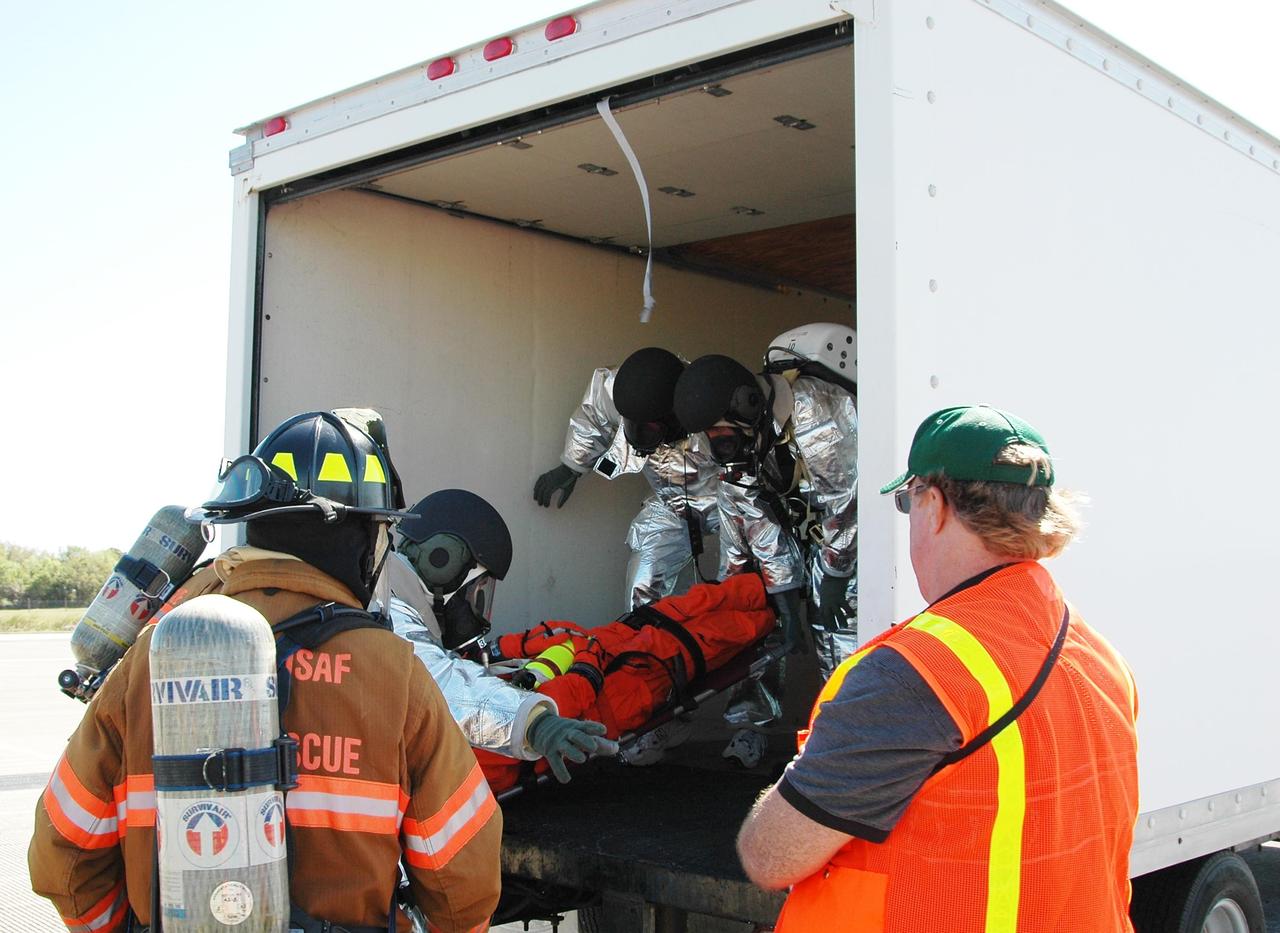
Air Force fire/rescue crew place a volunteer "injured astronaut" on a stretcher after exiting the shuttle cabin mockup during the training exercise. (USAF photo # 070505-F-1287F-126)
Air Force fire/rescue crew place a volunteer "injured astronaut" on a stretcher after exiting the shuttle cabin mockup during the training exercise
Rescue team members prepare an inflatable front porch that will be attached to the Boeing CST-100 Starliner training capsule, known as Boiler Plate 3, during a search and rescue training exercise at the Army Wharf at Cape Canaveral Air Force Station in Florida on April 16, 2019. The front porch will be used to extract astronauts from the capsule and conduct initial health assessments in the unlikely event of an emergency resulting in a splashdown. NASA and the Department of Defense Human Space Flight Support Office Rescue Division are conducting the exercise over the next several days at the Wharf and in the Atlantic Ocean. It is the first at-sea exercise with the Starliner training capsule ahead of Boeing’s Crew Flight Test with astronauts targeted for later this year. During normal return scenarios, Boeing's Starliner will land on land in a safe zone of about 15 square miles in the Western United States. Throughout the commercial crew development phases with NASA, Boeing has performed dozens of qualification tests on its parachute and airbag systems simulating conditions on land and in the water.
Det 3 Recovery of Boeing Starliner Boiler Plate
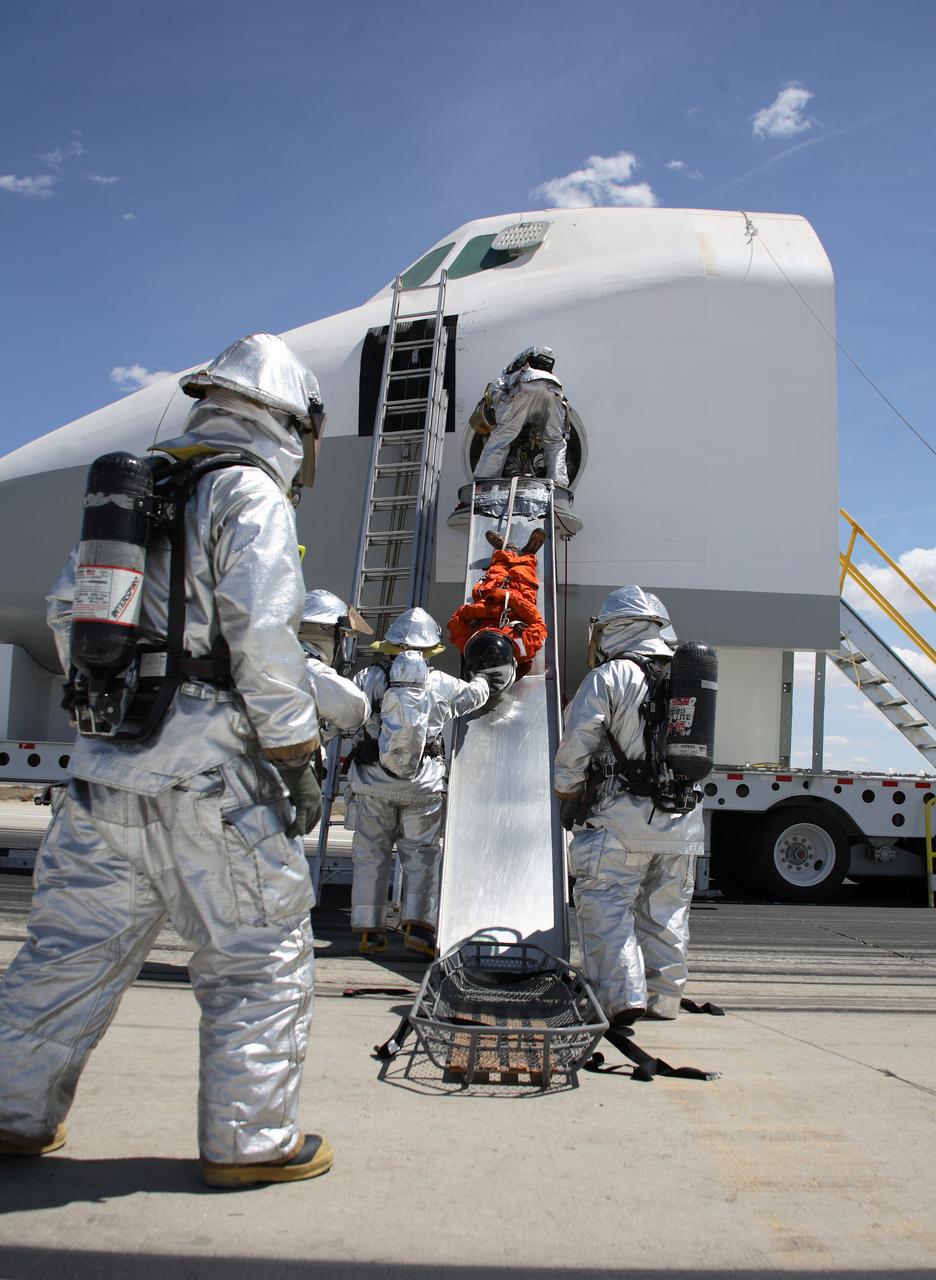
Clad in thermal protection suits, fire/rescue crew aid a volunteer "Injured astronaut" to a head-first ride down the exit slide from the shuttle cabin mockup. (USAF photo # 070505-F-1287F-132)
Clad in thermal protection suits, fire/rescue crew aid a volunteer "Injured astronaut" to a head-first ride down the exit slide from the shuttle cabin mockup
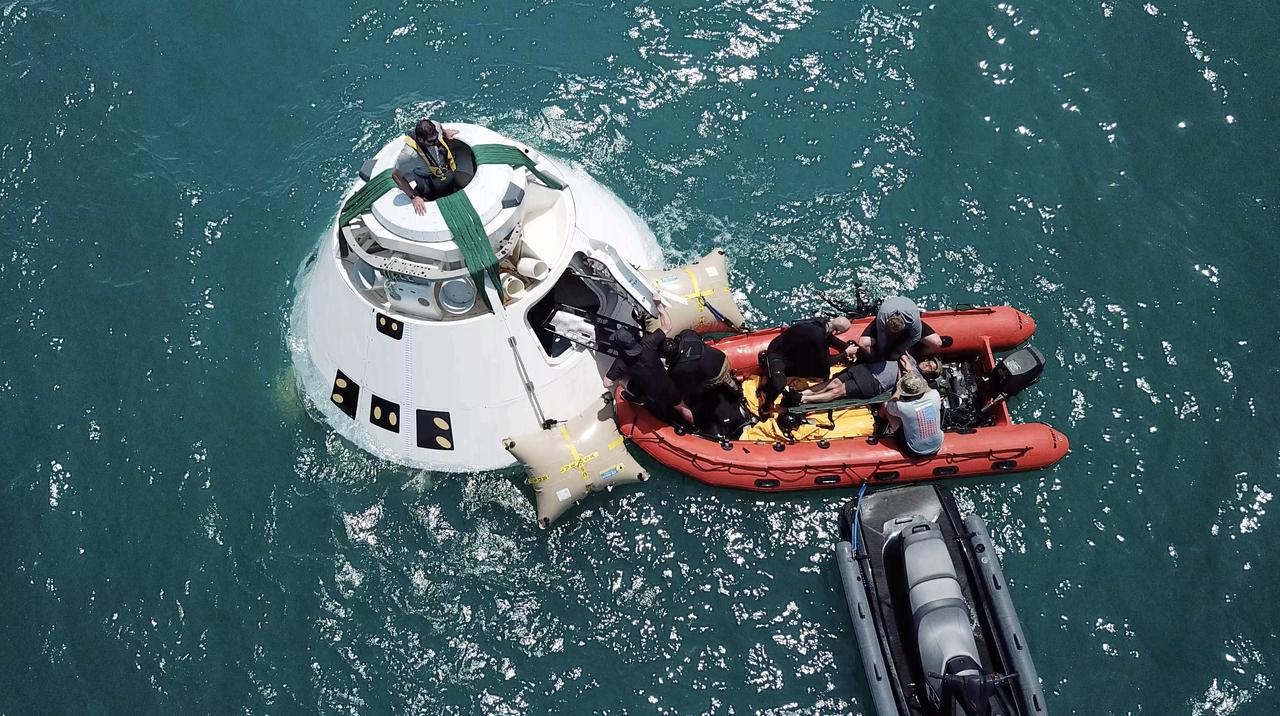
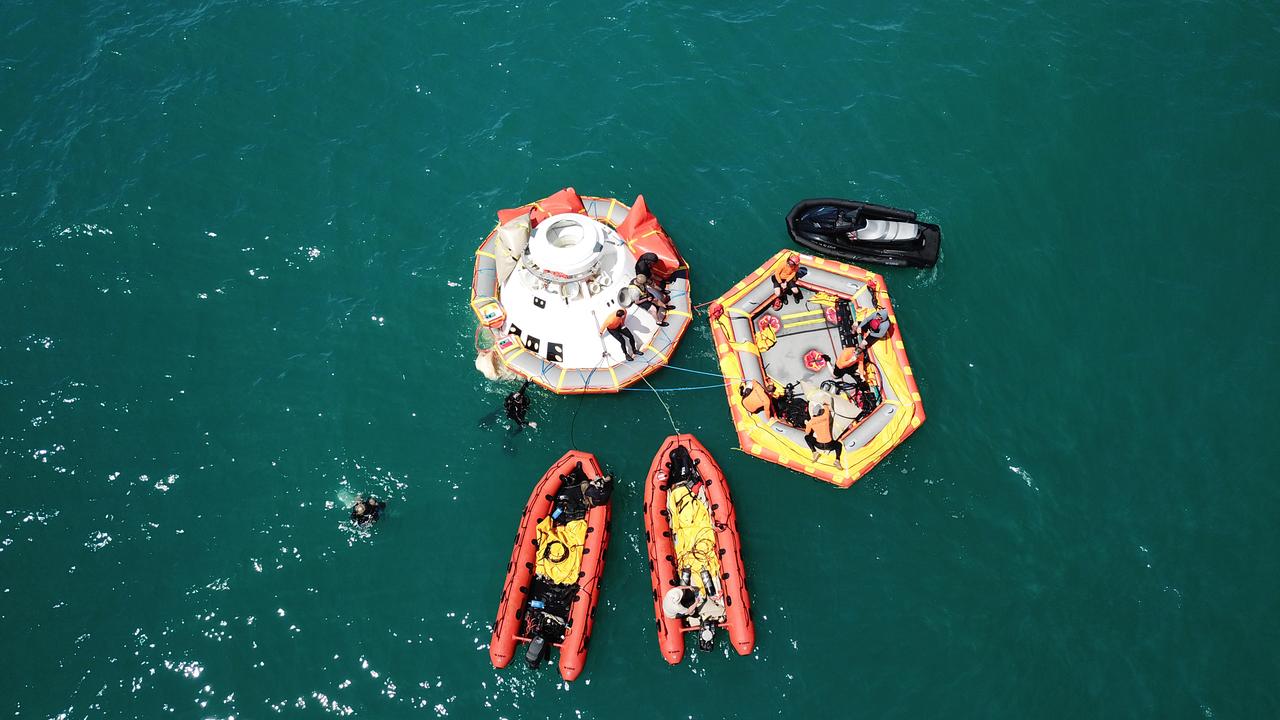
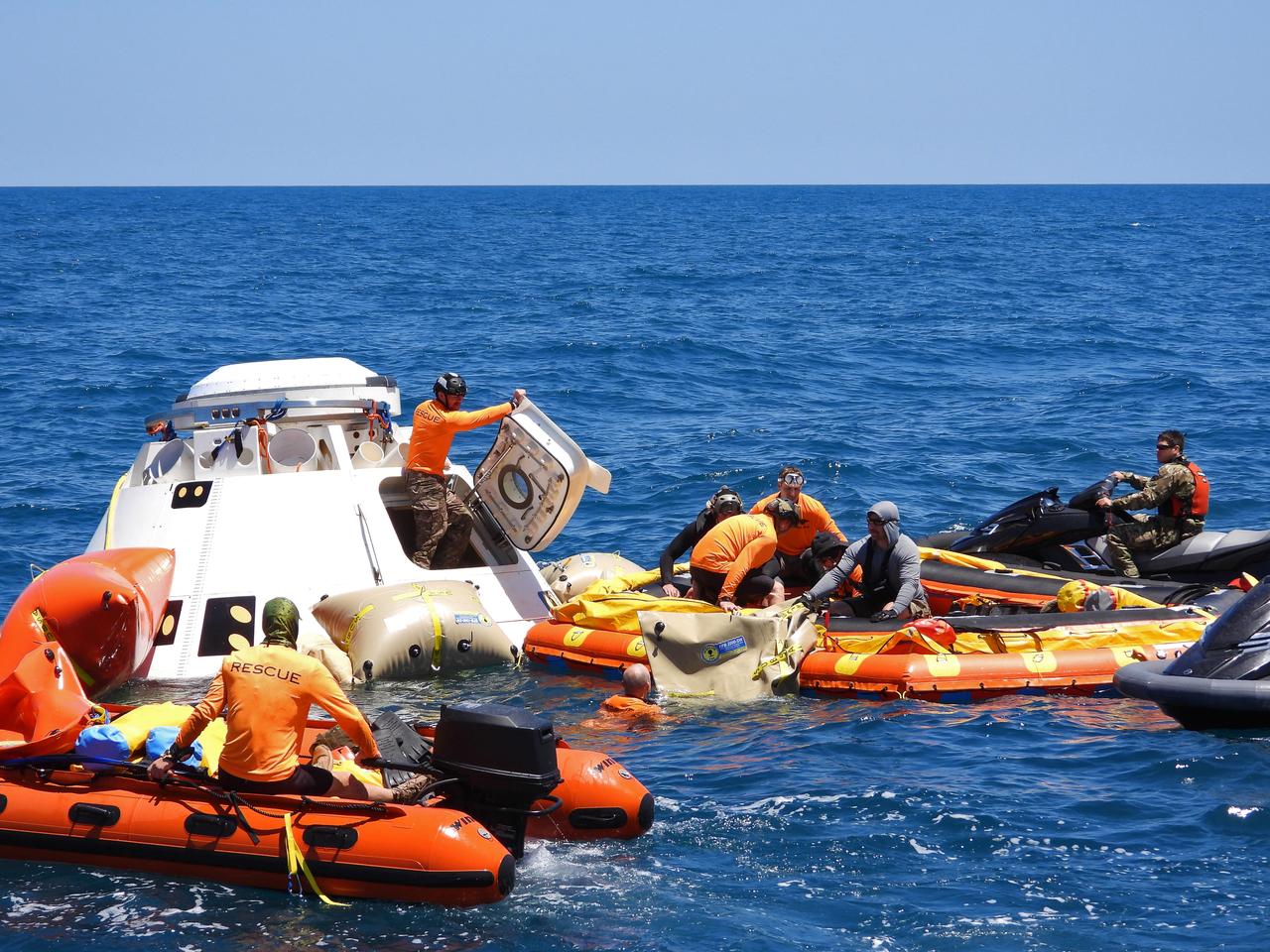
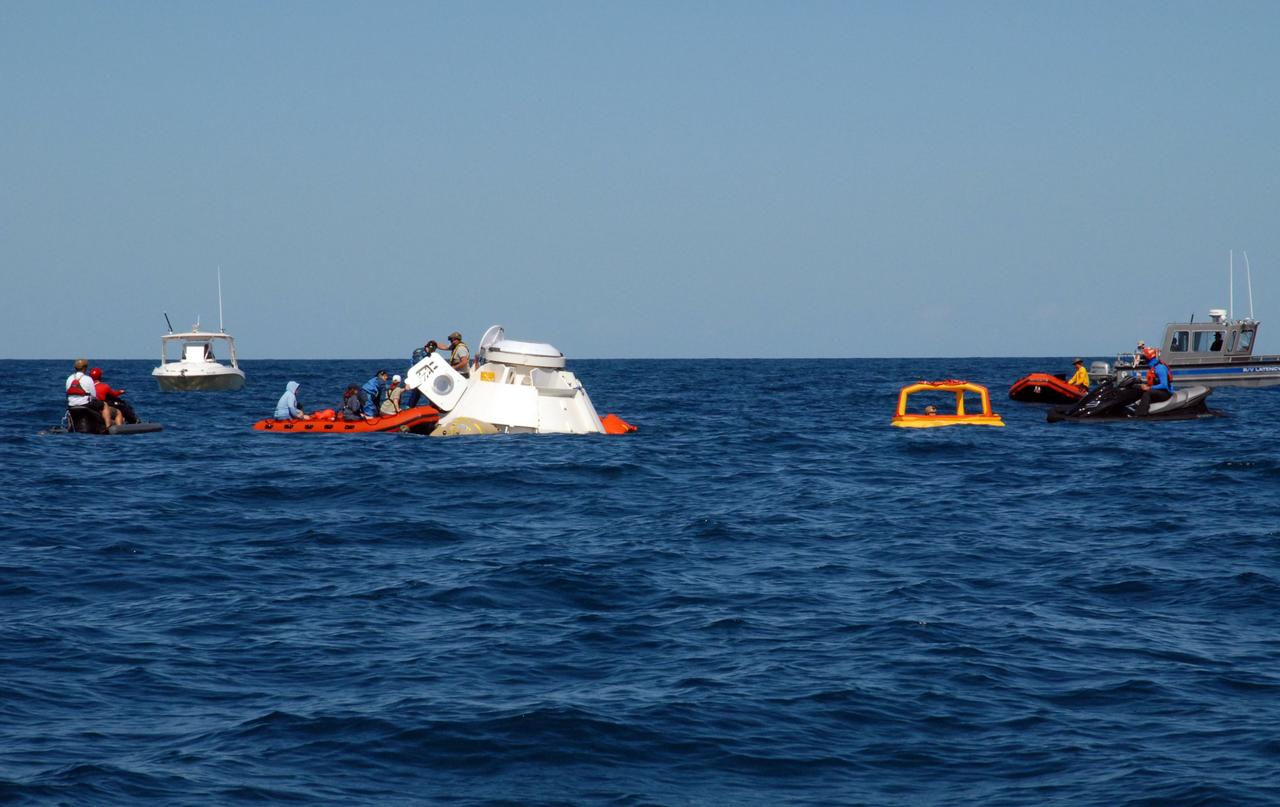
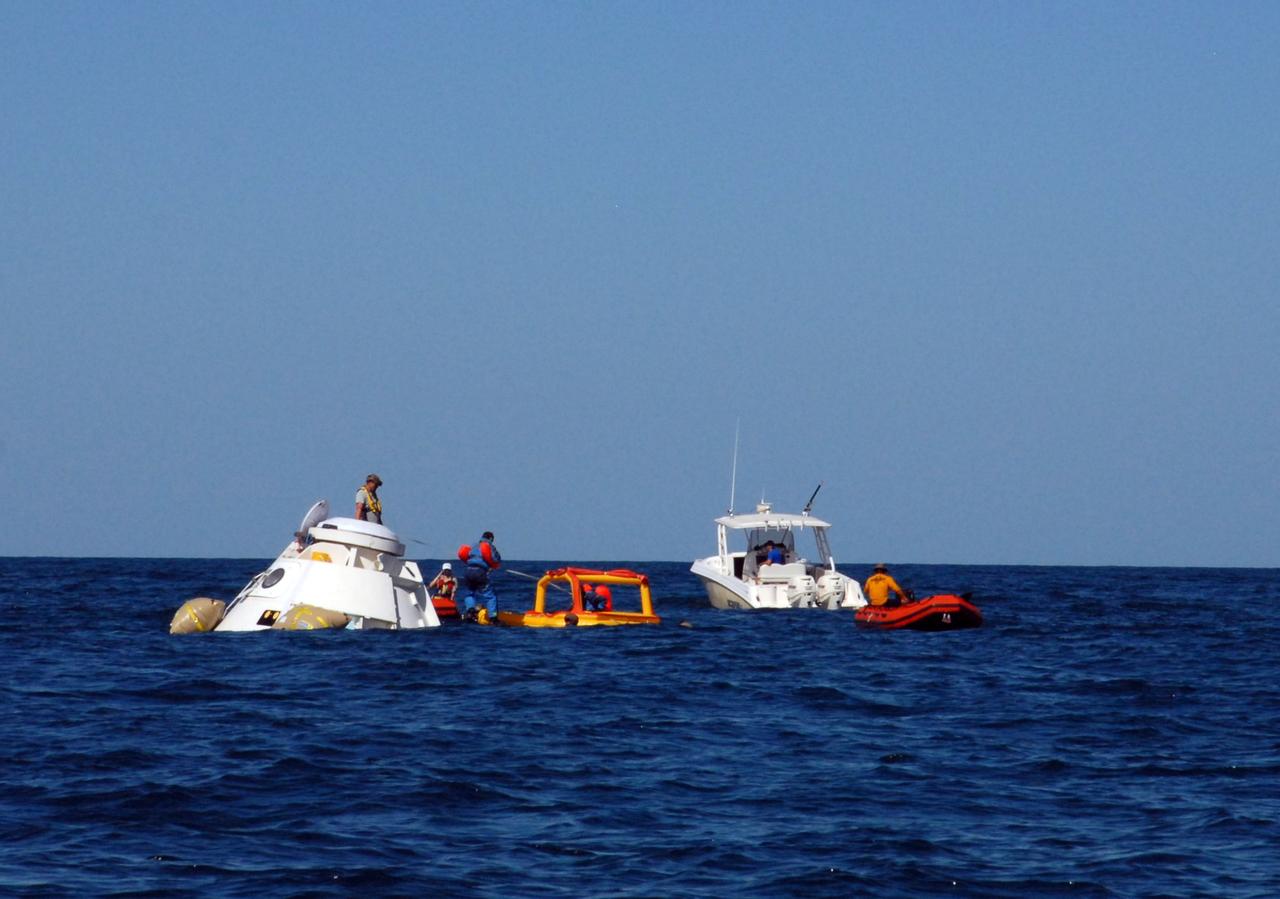
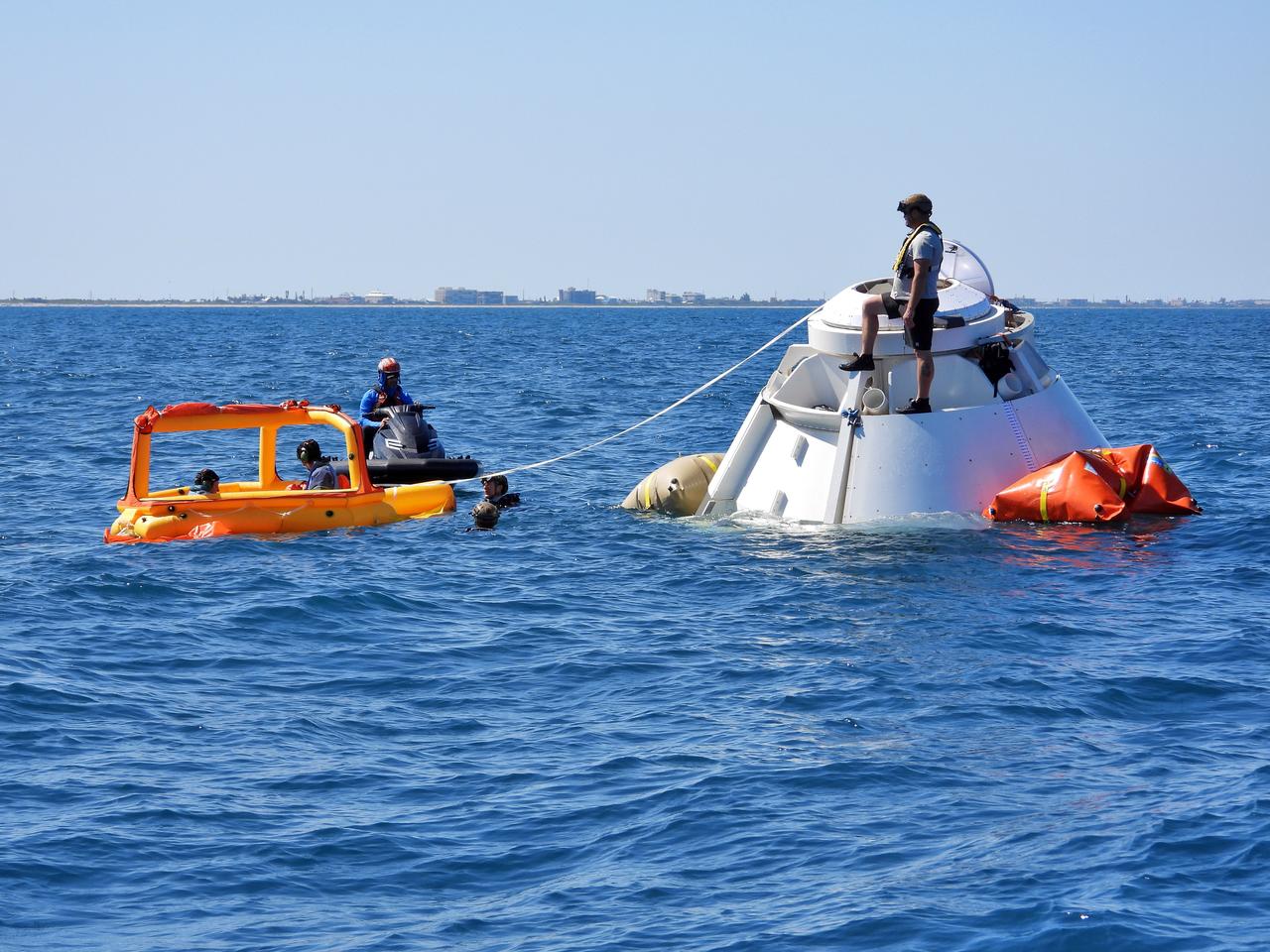
Rescue team members are using a Boeing CST-100 Starliner training capsule to rehearse a full mission profile training exercise in the unlikely event of an emergency resulting in a splashdown. NASA and the Department of Defense (DoD) Human Space Flight Support Office Rescue Division conducted the exercise, after a culmination of nearly two weeks of training, off the coast of Cape Canaveral near the agency’s Kennedy Space Center in Florida on April 27, 2019. The team rehearsed assisted egress, extracting DoD team members acting as astronauts, from the capsule and providing immediate medical treatment. This open-ocean exercise provides team members with the necessary training ahead of Boeing’s Crew Flight Test with astronauts targeted for later this year. During normal return scenarios, Boeing’s Starliner will land in a safe zone of about 15 square miles in the Western United States. Throughout the commercial crew development phases with NASA, Boeing has performed dozens of qualification tests on its parachute and airbag systems simulating conditions on land and in the water.
Starliner Astronaut Water Rescue Training
Rescue team members are using a Boeing CST-100 Starliner training capsule to rehearse a full mission profile training exercise in the unlikely event of an emergency resulting in a splashdown. NASA and the Department of Defense (DoD) Human Space Flight Support Office Rescue Division conducted the exercise, after a culmination of nearly two weeks of training, off the coast of Cape Canaveral near the agency’s Kennedy Space Center in Florida on April 27, 2019. The team rehearsed assisted egress, extracting DoD team members acting as astronauts, from the capsule and providing immediate medical treatment. This open-ocean exercise provides team members with the necessary training ahead of Boeing’s Crew Flight Test with astronauts targeted for later this year. During normal return scenarios, Boeing’s Starliner will land in a safe zone of about 15 square miles in the Western United States. Throughout the commercial crew development phases with NASA, Boeing has performed dozens of qualification tests on its parachute and airbag systems simulating conditions on land and in the water.
Starliner Astronaut Water Rescue Training
Rescue team members are using a Boeing CST-100 Starliner training capsule to rehearse a full mission profile training exercise in the unlikely event of an emergency resulting in a splashdown. NASA and the Department of Defense (DoD) Human Space Flight Support Office Rescue Division conducted the exercise, after a culmination of nearly two weeks of training, off the coast of Cape Canaveral near the agency’s Kennedy Space Center in Florida on April 27, 2019. The team rehearsed assisted egress, extracting DoD team members acting as astronauts, from the capsule and providing immediate medical treatment. This open-ocean exercise provides team members with the necessary training ahead of Boeing’s Crew Flight Test with astronauts targeted for later this year. During normal return scenarios, Boeing’s Starliner will land in a safe zone of about 15 square miles in the Western United States. Throughout the commercial crew development phases with NASA, Boeing has performed dozens of qualification tests on its parachute and airbag systems simulating conditions on land and in the water.
Starliner Astronaut Water Rescue Training
Rescue team members are using a Boeing CST-100 Starliner training capsule to rehearse a full mission profile training exercise in the unlikely event of an emergency resulting in a splashdown. NASA and the Department of Defense (DoD) Human Space Flight Support Office Rescue Division conducted the exercise, after a culmination of nearly two weeks of training, off the coast of Cape Canaveral near the agency’s Kennedy Space Center in Florida on April 27, 2019. The team rehearsed assisted egress, extracting DoD team members acting as astronauts, from the capsule and providing immediate medical treatment. This open-ocean exercise provides team members with the necessary training ahead of Boeing’s Crew Flight Test with astronauts targeted for later this year. During normal return scenarios, Boeing’s Starliner will land in a safe zone of about 15 square miles in the Western United States. Throughout the commercial crew development phases with NASA, Boeing has performed dozens of qualification tests on its parachute and airbag systems simulating conditions on land and in the water.
Starliner Astronaut Water Rescue Training
Rescue team members are using a Boeing CST-100 Starliner training capsule to rehearse a full mission profile training exercise in the unlikely event of an emergency resulting in a splashdown. NASA and the Department of Defense (DoD) Human Space Flight Support Office Rescue Division conducted the exercise, after a culmination of nearly two weeks of training, off the coast of Cape Canaveral near the agency’s Kennedy Space Center in Florida on April 27, 2019. The team rehearsed assisted egress, extracting DoD team members acting as astronauts, from the capsule and providing immediate medical treatment. This open-ocean exercise provides team members with the necessary training ahead of Boeing’s Crew Flight Test with astronauts targeted for later this year. During normal return scenarios, Boeing’s Starliner will land in a safe zone of about 15 square miles in the Western United States. Throughout the commercial crew development phases with NASA, Boeing has performed dozens of qualification tests on its parachute and airbag systems simulating conditions on land and in the water.
Starliner Astronaut Water Rescue Training
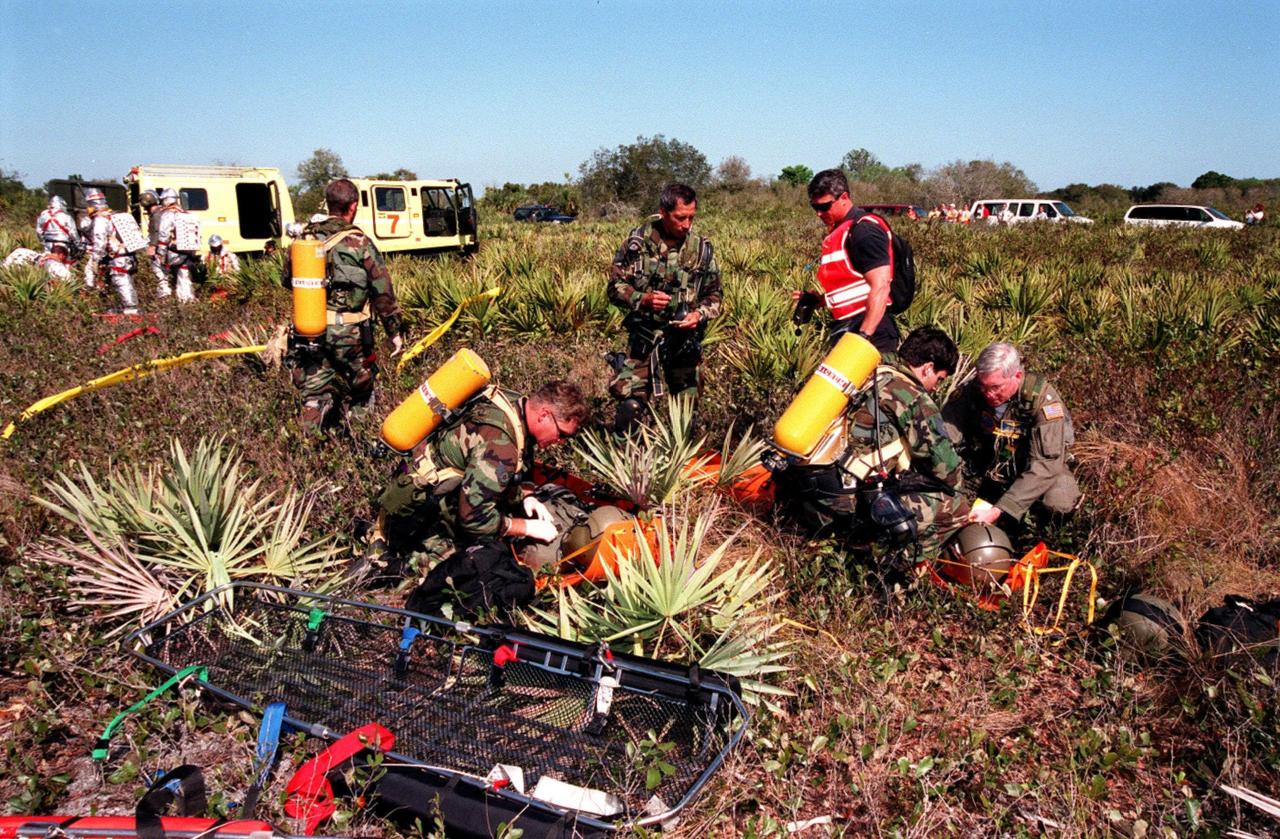
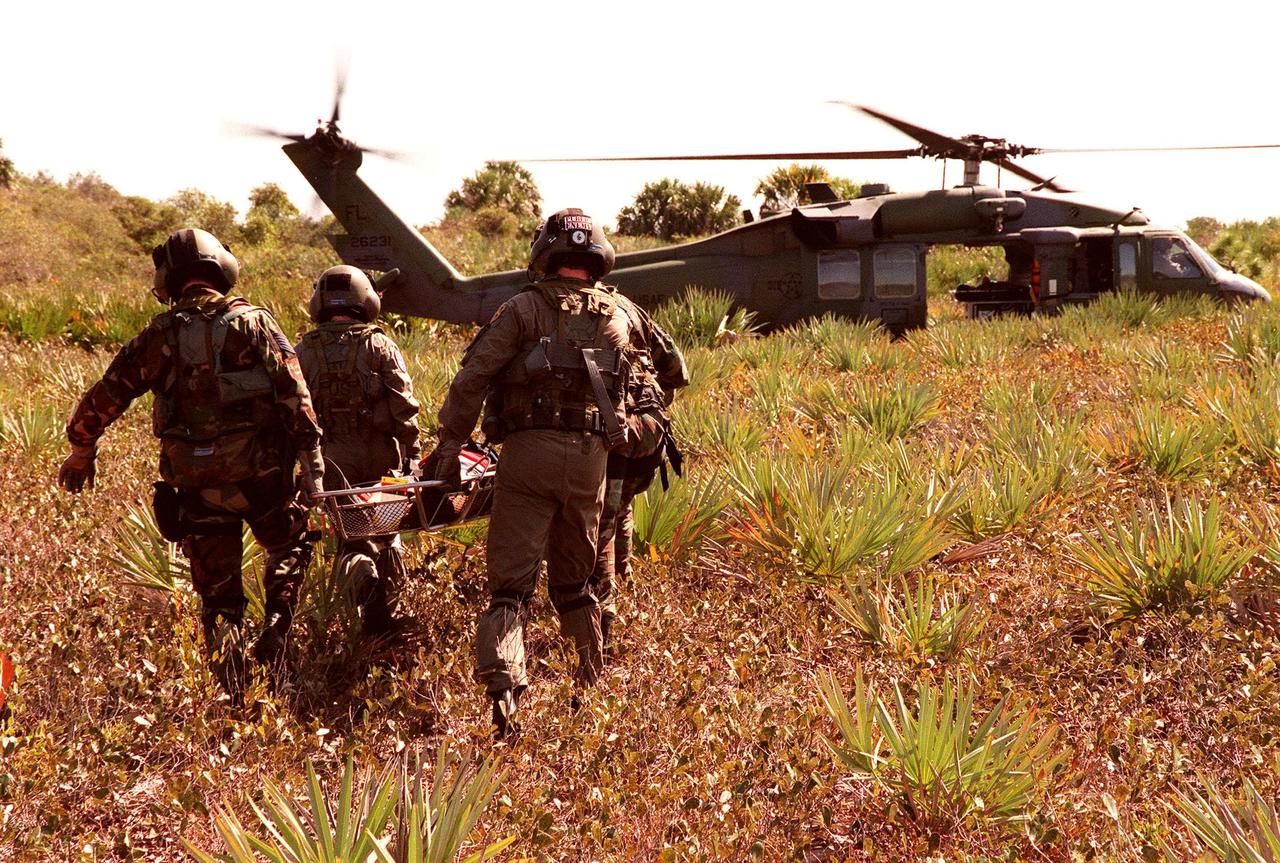
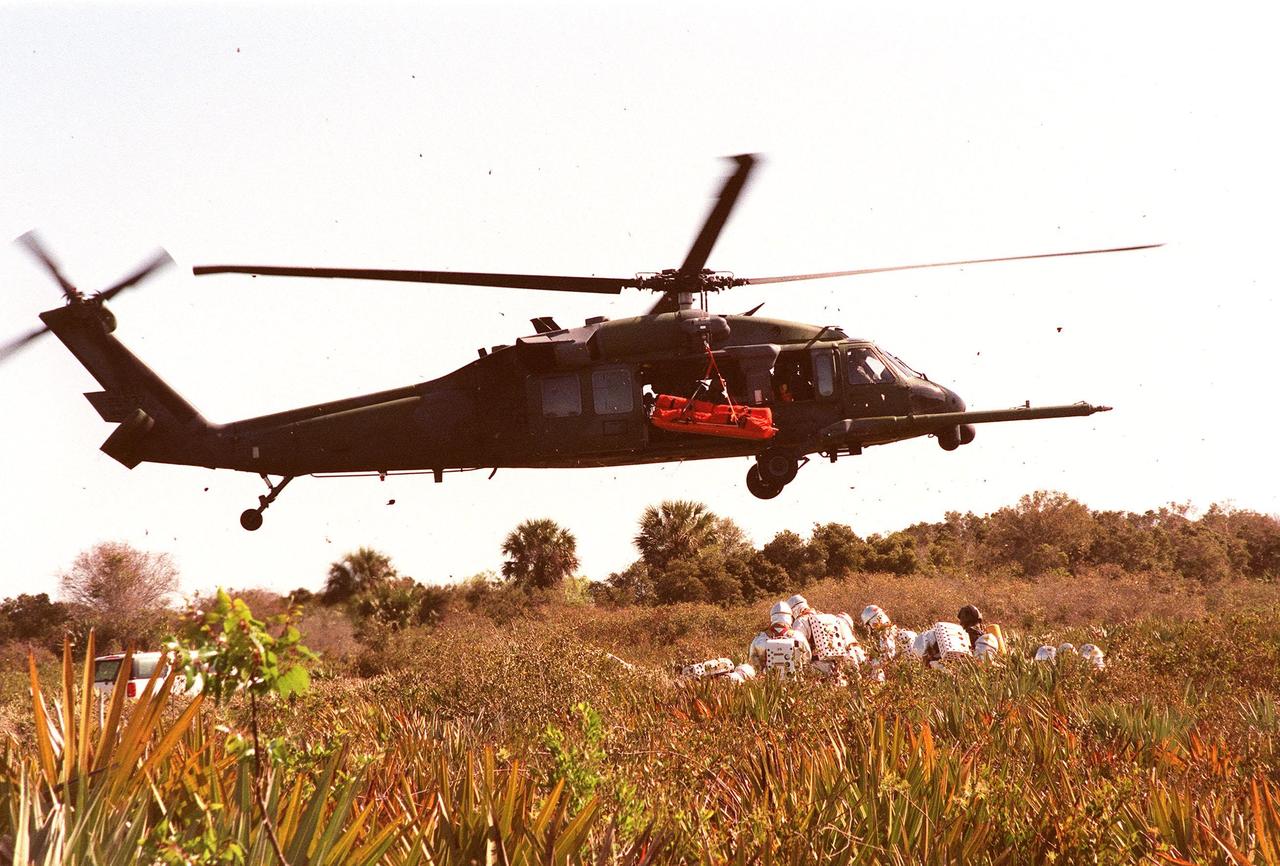
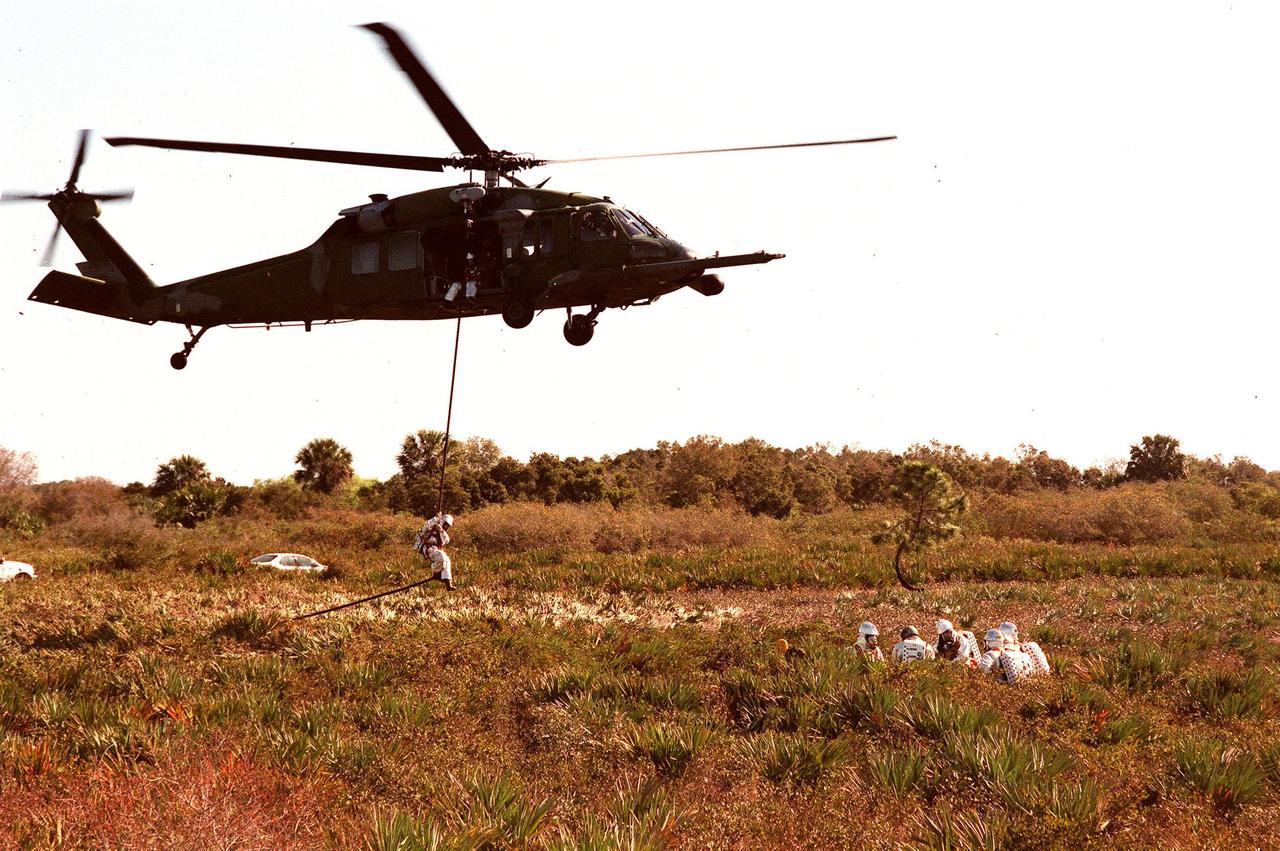
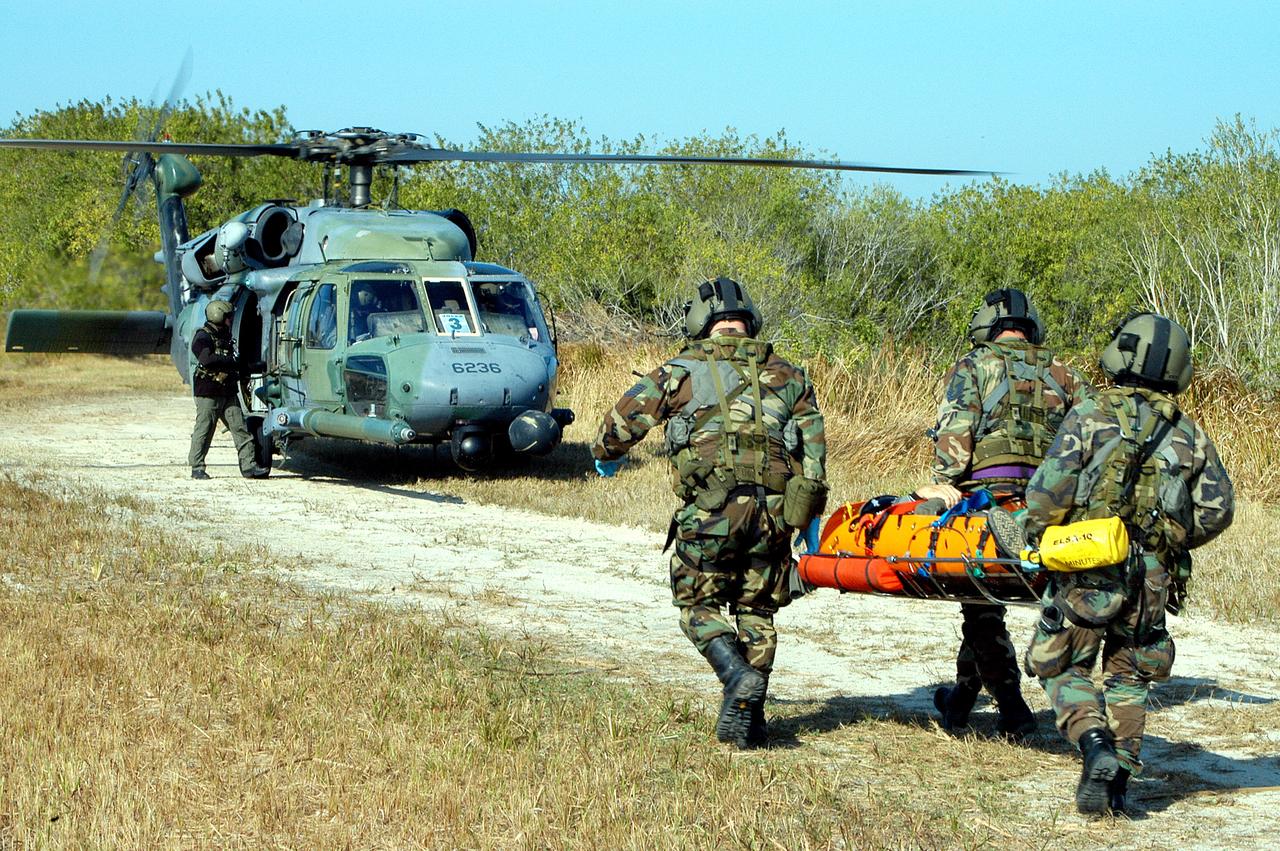
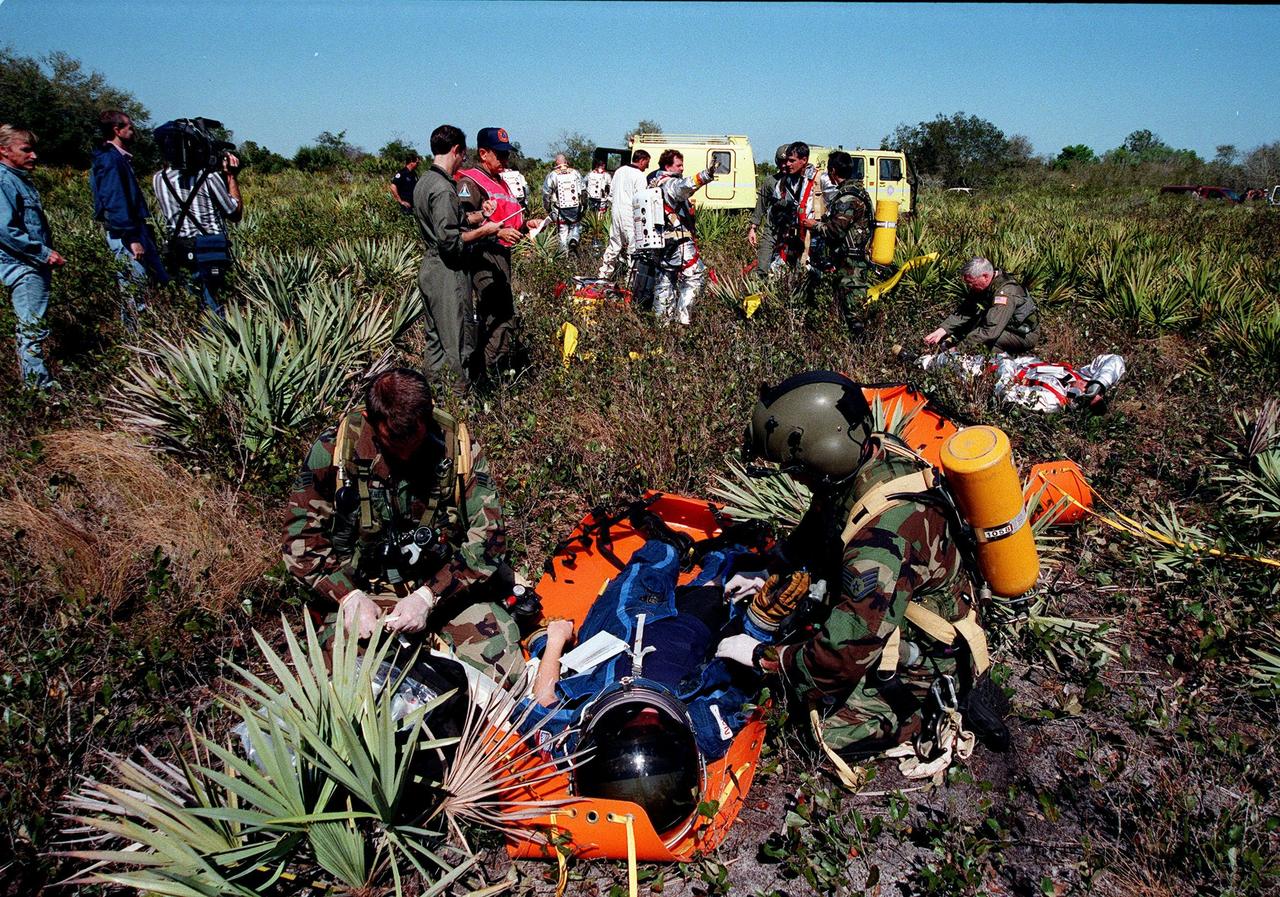
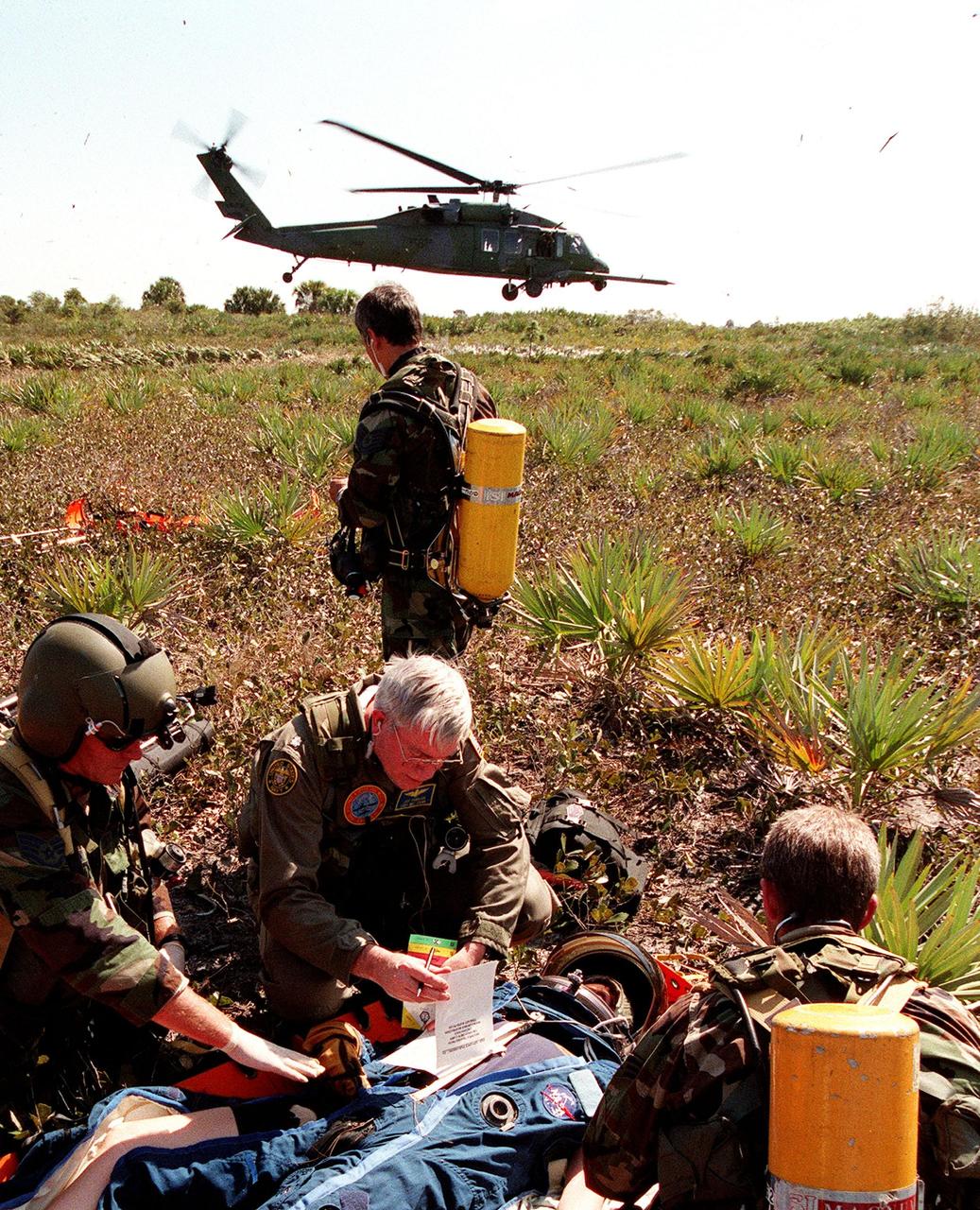
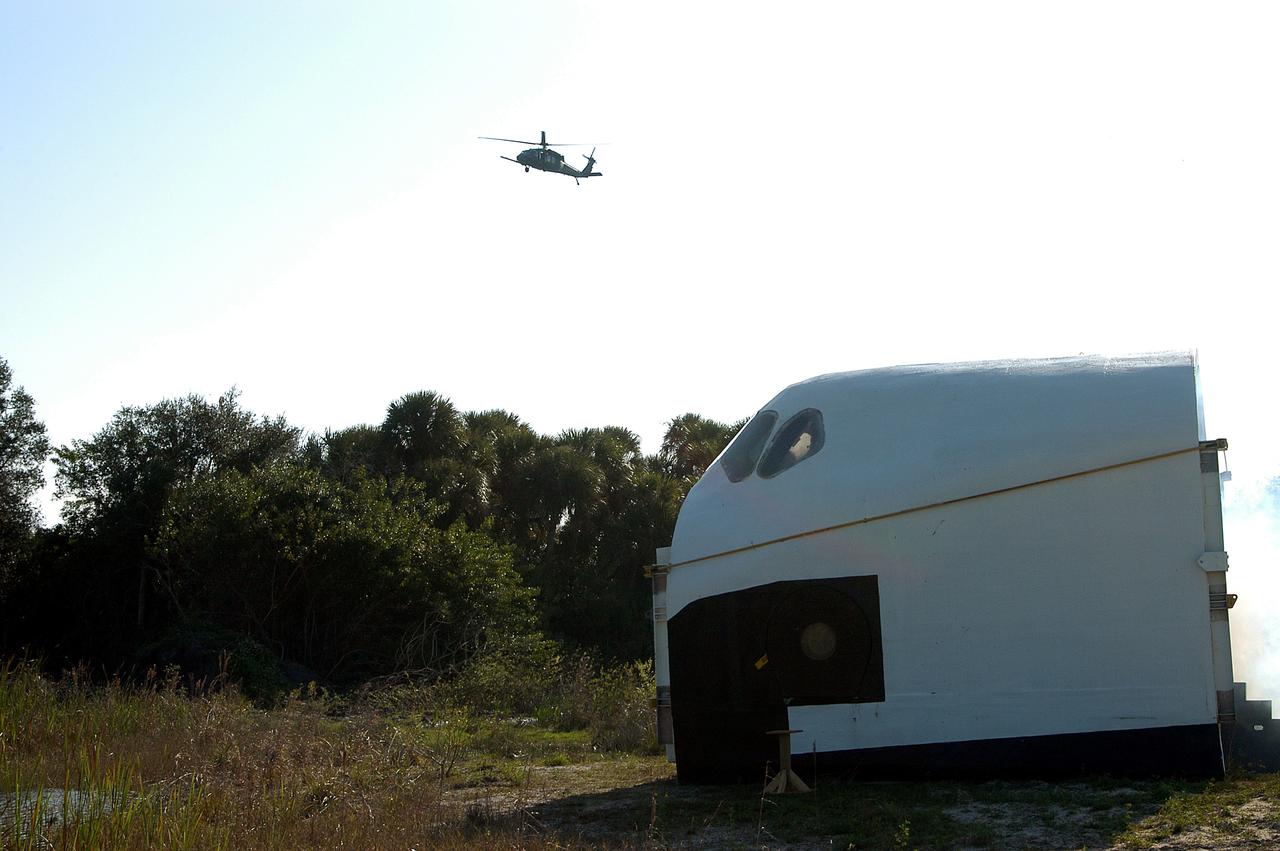
KENNEDY SPACE CENTER, FLA. -- During a simulated rescue mission in the woods near the Shuttle Landing Facility, the KSC response team removes a Shuttle "crew" member from the mock orbiter. The response team is training for the unlikely scenario of a Shuttle mishap at the SLF. The Mode 7 simulation of an astronaut rescue exercises all aspects of command and control, search and rescue, and medical procedures required for a successful rescue. The remote location of the mock-up prevents a totally land-based crew rescue, and calls on a NASA UH-1 helicopter to locate the site and four Air Force HH-60 helicopters to drop emergency equipment and fire/rescue workers to prepare the "crew" for preliminary triage. The helicopters later are used to remove the crew five astronaut candidates, one representative from the Vehicle Integration Test office, and one fire/rescue worker. The exercise concluded with airlifted "patients" arriving safely in the emergency rooms of participating area hospitals
KSC-99pp0297
During a simulated rescue mission in the woods near the Shuttle Landing Facility (SLF), the KSC response team removes a crew member from a mock Shuttle. The response team is training for the unlikely scenario of a Shuttle mishap at the SLF. The Mode 7 simulation of an astronaut rescue exercises all aspects of command and control, search and rescue, and medical procedures required for a successful rescue. The remote location of the mock-up prevents a totally land-based crew rescue, and calls on a NASA UH-1 helicopter to locate the site and four Air Force HH-60 helicopters to drop emergency equipment and fire/rescue workers to prepare the "crew" for preliminary triage. The helicopters later are used to remove the crew five astronaut candidates, one representative from the Vehicle Integration Test office, and one fire/rescue worker. The exercise concluded with airlifted "patients" arriving safely in the emergency rooms of participating area hospitals
KSC-99pp0296
KENNEDY SPACE CENTER, FLA. -- In the simulated rescue mission, the KSC response team takes part in the unlikely scenario of a Shuttle mishap at the Shuttle Landing Facility. The Mode 7 simulation of an astronaut rescue exercised all aspects of command and control, search and rescue, and medical procedures required for a successful rescue. The remote location of the mock-up prevents a totally land-based crew rescue, and calls on a NASA UH-1 helicopter to locate the site and four Air Force HH-60 helicopters to drop emergency equipment and fire/rescue workers to prepare the "crew" for preliminary triage. The helicopters later are used to remove the crew five astronaut candidates, one representative from the Vehicle Integration Test office, and one fire/rescue worker. The exercise concluded with airlifted "patients" arriving safely in the emergency rooms of participating area hospitals.
KSC-99pp0295
KENNEDY SPACE CENTER, FLA. - Emergency crew members “rescue” an injured astronaut from the orbiter crew compartment mock-up during a “Mode VII” emergency landing simulation at Kennedy Space Center.  The purpose of the Mode VII is to exercise emergency preparedness personnel, equipment and facilities in rescuing astronauts from a downed orbiter and providing immediate medical attention.  This simulation presents an orbiter that has crashed short of the Shuttle Landing Facility in a wooded area 2-1/2 miles south of Runway 33.  Emergency crews are responding to the volunteer astronauts who are simulating various injuries.  Rescuers must remove the crew, provide triage and transport to hospitals those who need further treatment.  Local hospitals are participating in the exercise.
KENNEDY SPACE CENTER, FLA. - Emergency crew members “rescue” an injured astronaut from the orbiter crew compartment mock-up during a “Mode VII” emergency landing simulation at Kennedy Space Center. The purpose of the Mode VII is to exercise emergency preparedness personnel, equipment and facilities in rescuing astronauts from a downed orbiter and providing immediate medical attention. This simulation presents an orbiter that has crashed short of the Shuttle Landing Facility in a wooded area 2-1/2 miles south of Runway 33. Emergency crews are responding to the volunteer astronauts who are simulating various injuries. Rescuers must remove the crew, provide triage and transport to hospitals those who need further treatment. Local hospitals are participating in the exercise.
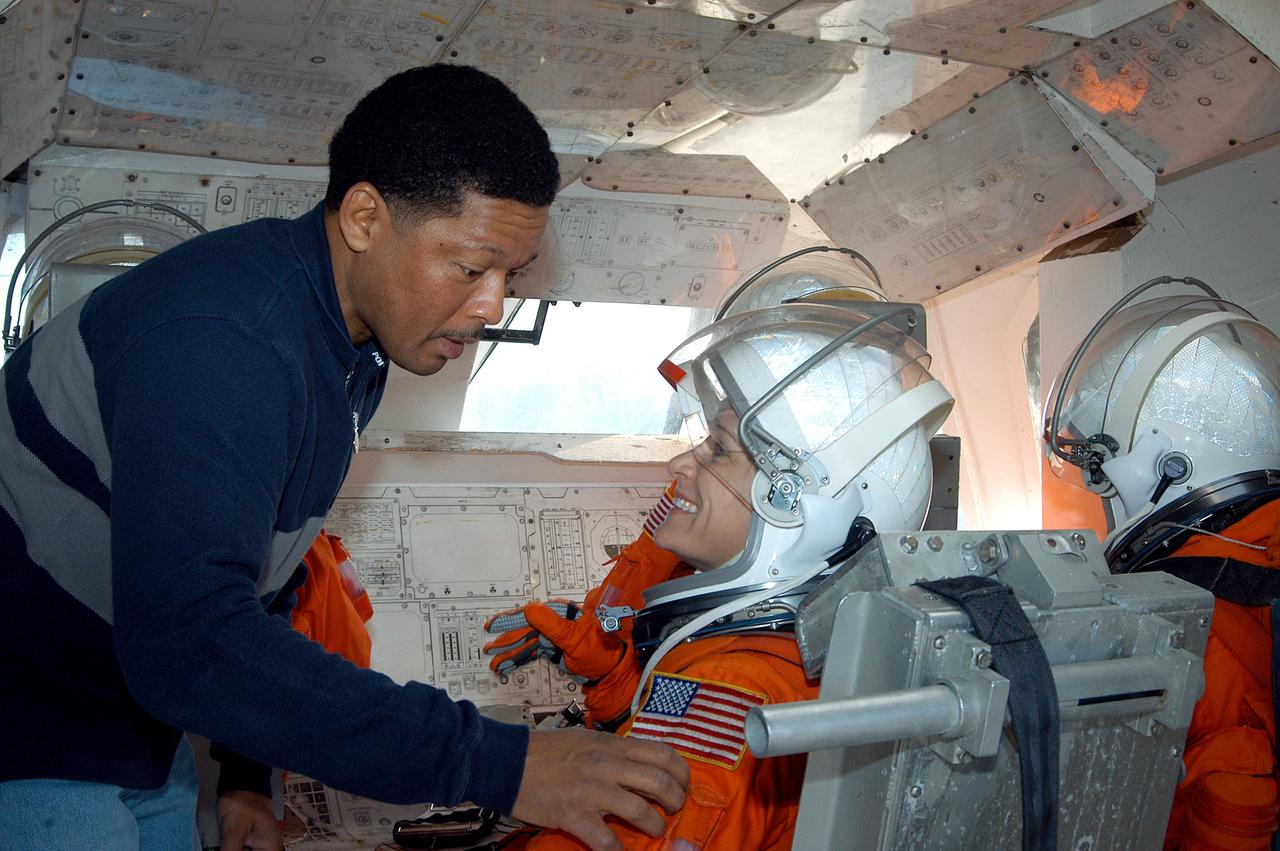
KENNEDY SPACE CENTER, FLA. - Volunteers from the KSC Fire-Rescue team dressed in launch and entry suits settle into seats in an orbiter crew compartment mock-up under the guidance of George Brittingham, USA suit technician on the Closeout Crew. Brittingham is helping Catherine Di Biase, a nurse with Bionetics Life Sciences. They are all taking part in a “Mode VII” emergency landing simulation at Kennedy Space Center.  The purpose is to exercise emergency preparedness personnel, equipment and facilities in rescuing astronauts from a downed orbiter and providing immediate medical attention.  This simulation presents an orbiter that has crashed short of the Shuttle Landing Facility in a wooded area 2-1/2 miles south of Runway 33.  Emergency crews will respond to the volunteer “astronauts” simulating various injuries.  Rescuers must remove the crew, provide triage and transport to hospitals those who need further treatment.  Local hospitals are participating in the exercise.
KENNEDY SPACE CENTER, FLA. - Volunteers from the KSC Fire-Rescue team dressed in launch and entry suits settle into seats in an orbiter crew compartment mock-up under the guidance of George Brittingham, USA suit technician on the Closeout Crew. Brittingham is helping Catherine Di Biase, a nurse with Bionetics Life Sciences. They are all taking part in a “Mode VII” emergency landing simulation at Kennedy Space Center. The purpose is to exercise emergency preparedness personnel, equipment and facilities in rescuing astronauts from a downed orbiter and providing immediate medical attention. This simulation presents an orbiter that has crashed short of the Shuttle Landing Facility in a wooded area 2-1/2 miles south of Runway 33. Emergency crews will respond to the volunteer “astronauts” simulating various injuries. Rescuers must remove the crew, provide triage and transport to hospitals those who need further treatment. Local hospitals are participating in the exercise.
KENNEDY SPACE CENTER, FLA. - In a “Mode VII” emergency landing simulation at Kennedy Space Center, a helicopter crew helps “rescued” astronauts.  The purpose of Mode VII is to exercise emergency preparedness personnel, equipment and facilities in rescuing astronauts from a downed orbiter and providing immediate medical attention.  This simulation presents an orbiter that has crashed short of the Shuttle Landing Facility in a wooded area 2-1/2 miles south of Runway 33.  Emergency crews are responding to the volunteer “astronauts” simulating various injuries inside an orbiter crew compartment mock-up.  Rescuers must remove the crew, provide triage and transport to hospitals those who need further treatment.  Local hospitals are participating in the exercise.
KENNEDY SPACE CENTER, FLA. - In a “Mode VII” emergency landing simulation at Kennedy Space Center, a helicopter crew helps “rescued” astronauts. The purpose of Mode VII is to exercise emergency preparedness personnel, equipment and facilities in rescuing astronauts from a downed orbiter and providing immediate medical attention. This simulation presents an orbiter that has crashed short of the Shuttle Landing Facility in a wooded area 2-1/2 miles south of Runway 33. Emergency crews are responding to the volunteer “astronauts” simulating various injuries inside an orbiter crew compartment mock-up. Rescuers must remove the crew, provide triage and transport to hospitals those who need further treatment. Local hospitals are participating in the exercise.
KENNEDY SPACE CENTER, FLA. - Emergency crews leave the scene after a helicopter removed “rescued” astronauts from the scene.  They are taking part in a “Mode VII” emergency landing simulation at Kennedy Space Center, in order to exercise emergency preparedness personnel, equipment and facilities in rescuing astronauts from a downed orbiter and providing immediate medical attention.  This simulation presents an orbiter that has crashed short of the Shuttle Landing Facility in a wooded area 2-1/2 miles south of Runway 33.  Emergency crews are responding to the volunteer “astronauts” simulating various injuries inside an orbiter crew compartment mock-up.  Rescuers must remove the crew, provide triage and transport to hospitals those who need further treatment.  Local hospitals are participating in the exercise.
KENNEDY SPACE CENTER, FLA. - Emergency crews leave the scene after a helicopter removed “rescued” astronauts from the scene. They are taking part in a “Mode VII” emergency landing simulation at Kennedy Space Center, in order to exercise emergency preparedness personnel, equipment and facilities in rescuing astronauts from a downed orbiter and providing immediate medical attention. This simulation presents an orbiter that has crashed short of the Shuttle Landing Facility in a wooded area 2-1/2 miles south of Runway 33. Emergency crews are responding to the volunteer “astronauts” simulating various injuries inside an orbiter crew compartment mock-up. Rescuers must remove the crew, provide triage and transport to hospitals those who need further treatment. Local hospitals are participating in the exercise.
KENNEDY SPACE CENTER, FLA. - Emergency crew members prepare to rescue another “astronaut” from inside the orbiter crew compartment mock-up that is the scene of a “Mode VII” emergency landing simulation at Kennedy Space Center.  The purpose of the Mode VII is to exercise emergency preparedness personnel, equipment and facilities in rescuing astronauts from a downed orbiter and providing immediate medical attention.  This simulation presents an orbiter that has crashed short of the Shuttle Landing Facility in a wooded area 2-1/2 miles south of Runway 33.  Emergency crews are responding to the volunteer astronauts who are simulating various injuries.  Rescuers must remove the crew, provide triage and transport to hospitals those who need further treatment.  Local hospitals are participating in the exercise.
KENNEDY SPACE CENTER, FLA. - Emergency crew members prepare to rescue another “astronaut” from inside the orbiter crew compartment mock-up that is the scene of a “Mode VII” emergency landing simulation at Kennedy Space Center. The purpose of the Mode VII is to exercise emergency preparedness personnel, equipment and facilities in rescuing astronauts from a downed orbiter and providing immediate medical attention. This simulation presents an orbiter that has crashed short of the Shuttle Landing Facility in a wooded area 2-1/2 miles south of Runway 33. Emergency crews are responding to the volunteer astronauts who are simulating various injuries. Rescuers must remove the crew, provide triage and transport to hospitals those who need further treatment. Local hospitals are participating in the exercise.
KENNEDY SPACE CENTER, FLA. - Emergency crew members “rescue” an astronaut from inside the orbiter crew compartment mock-up that is the scene of a “Mode VII” emergency landing simulation at Kennedy Space Center.  The purpose of the Mode VII is to exercise emergency preparedness personnel, equipment and facilities in rescuing astronauts from a downed orbiter and providing immediate medical attention.  This simulation presents an orbiter that has crashed short of the Shuttle Landing Facility in a wooded area 2-1/2 miles south of Runway 33.  Emergency crews are responding to the volunteer “astronauts” who are simulating various injuries.  Rescuers must remove the crew, provide triage and transport to hospitals those who need further treatment.  Local hospitals are participating in the exercise.
KENNEDY SPACE CENTER, FLA. - Emergency crew members “rescue” an astronaut from inside the orbiter crew compartment mock-up that is the scene of a “Mode VII” emergency landing simulation at Kennedy Space Center. The purpose of the Mode VII is to exercise emergency preparedness personnel, equipment and facilities in rescuing astronauts from a downed orbiter and providing immediate medical attention. This simulation presents an orbiter that has crashed short of the Shuttle Landing Facility in a wooded area 2-1/2 miles south of Runway 33. Emergency crews are responding to the volunteer “astronauts” who are simulating various injuries. Rescuers must remove the crew, provide triage and transport to hospitals those who need further treatment. Local hospitals are participating in the exercise.
KENNEDY SPACE CENTER, FLA. - Emergency crew members “rescue” an injured astronaut from the orbiter crew compartment mock-up during a “Mode VII” emergency landing simulation at Kennedy Space Center.  The purpose of the Mode VII is to exercise emergency preparedness personnel, equipment and facilities in rescuing astronauts from a downed orbiter and providing immediate medical attention.  This simulation presents an orbiter that has crashed short of the Shuttle Landing Facility in a wooded area 2-1/2 miles south of Runway 33.  Emergency crews are responding to the volunteer astronauts who are simulating various injuries.  Rescuers must remove the crew, provide triage and transport to hospitals those who need further treatment.  Local hospitals are participating in the exercise.
KENNEDY SPACE CENTER, FLA. - Emergency crew members “rescue” an injured astronaut from the orbiter crew compartment mock-up during a “Mode VII” emergency landing simulation at Kennedy Space Center. The purpose of the Mode VII is to exercise emergency preparedness personnel, equipment and facilities in rescuing astronauts from a downed orbiter and providing immediate medical attention. This simulation presents an orbiter that has crashed short of the Shuttle Landing Facility in a wooded area 2-1/2 miles south of Runway 33. Emergency crews are responding to the volunteer astronauts who are simulating various injuries. Rescuers must remove the crew, provide triage and transport to hospitals those who need further treatment. Local hospitals are participating in the exercise.
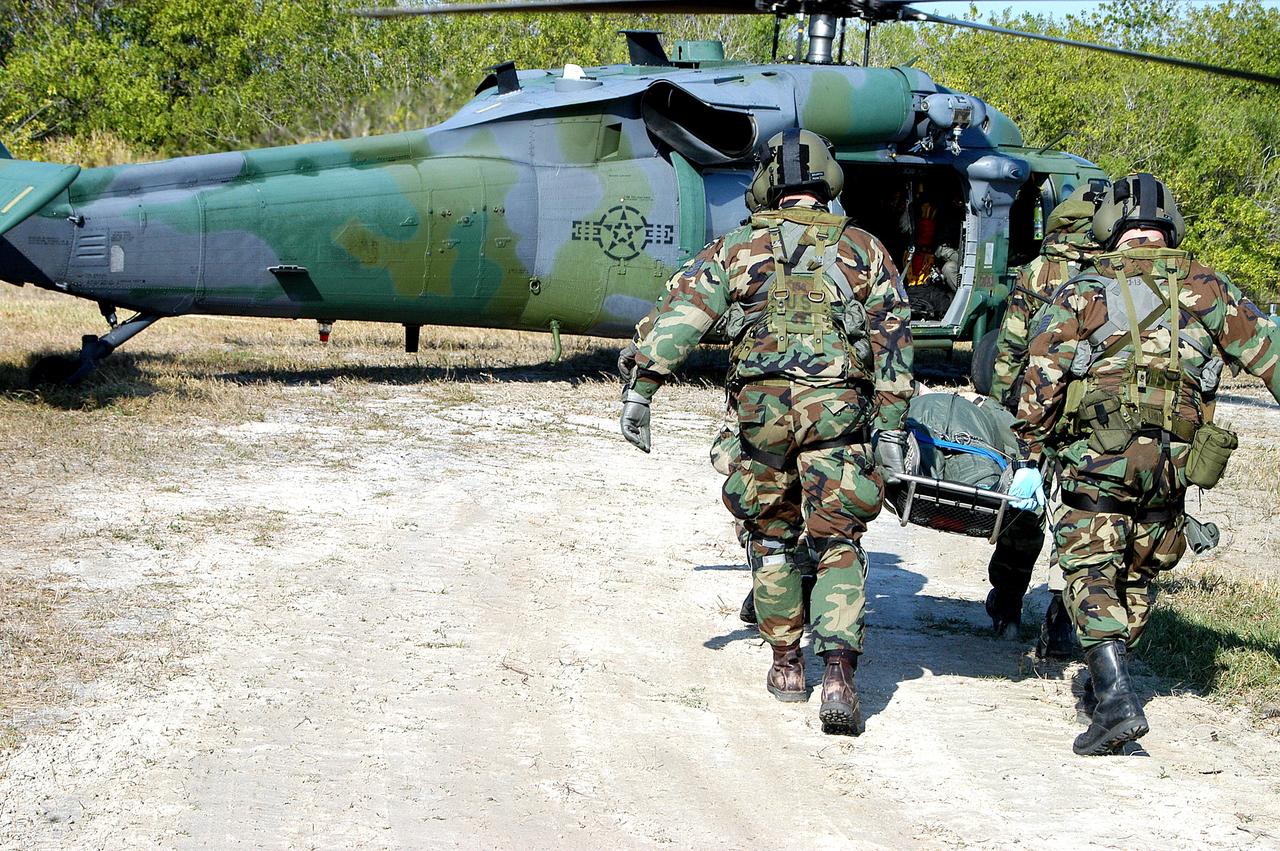
KENNEDY SPACE CENTER, FLA. -- During a simulated rescue mission in the woods near the Shuttle Landing Facility (SLF), the KSC response team practices carrying an injured crew member to an Air Force HH-60 helicopter for transport to a local hospital. The response team is training for the unlikely scenario of a Shuttle mishap at the SLF. The Mode 7 simulation of an astronaut rescue exercises all aspects of command and control, search and rescue, and medical procedures required for a successful rescue. The remote location of the mock-up prevents a totally land-based crew rescue, and calls on a NASA UH-1 helicopter to locate the site and four Air Force HH-60 helicopters to reach the site, drop emergency equipment and later remove the "crew" five astronaut candidates, one representative from the Vehicle Integration Test office, and one fire/rescue worker. The exercise will conclude with airlifted "patients" arriving safely in the emergency rooms of participating area hospitals
KSC-99pp0300
KENNEDY SPACE CENTER, FLA. -- In the woods next to the Shuttle Landing Facility (SLF), the KSC response team takes part in training for the unlikely scenario of a Shuttle mishap at the SLF. The Mode 7 simulation of an astronaut rescue exercises all aspects of command and control, search and rescue, and medical procedures required for a successful rescue. The remote location of the mock-up prevents a totally land-based crew rescue, and calls on a NASA UH-1 helicopter to locate the site and four Air Force HH-60 helicopters to drop emergency equipment and fire/rescue workers to prepare the "crew" for preliminary triage. The helicopters later are used to remove the crew five astronaut candidates, one representative from the Vehicle Integration Test office, and one fire/rescue worker. The exercise concluded with airlifted "patients" arriving safely in the emergency rooms of participating area hospitals
KSC-99pp0294
KENNEDY SPACE CENTER, FLA. -- During a simulated rescue mission in the woods near the Shuttle Landing Facility (SLF), the KSC response team practices lifting an injured crew member to an Air Force HH-60 helicopter for transport to a local hospital. The response team is training for the unlikely scenario of a Shuttle mishap at the SLF. The Mode 7 simulation of an astronaut rescue exercises all aspects of command and control, search and rescue, and medical procedures required for a successful rescue. The remote location of the mock-up prevents a totally land-based crew rescue, and calls on a NASA UH-1 helicopter to locate the site and four Air Force HH-60 helicopters to reach and prepare the "crew" five astronaut candidates, one representative from the Vehicle Integration Test office, and one fire/rescue worker for preliminary triage. The exercise will conclude with airlifted "patients" arriving safely in the emergency rooms of participating area hospitals
KSC-99pp0299
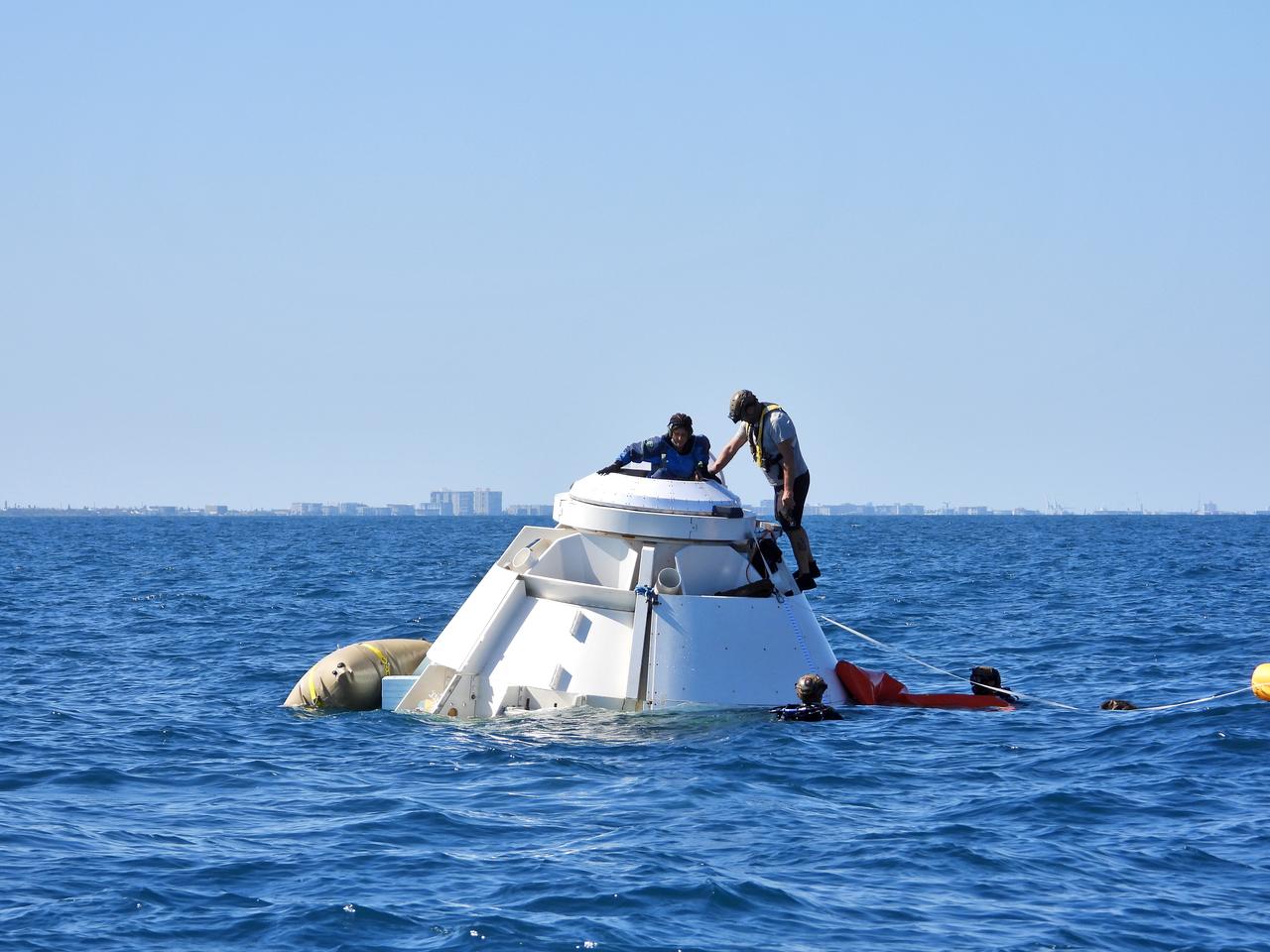
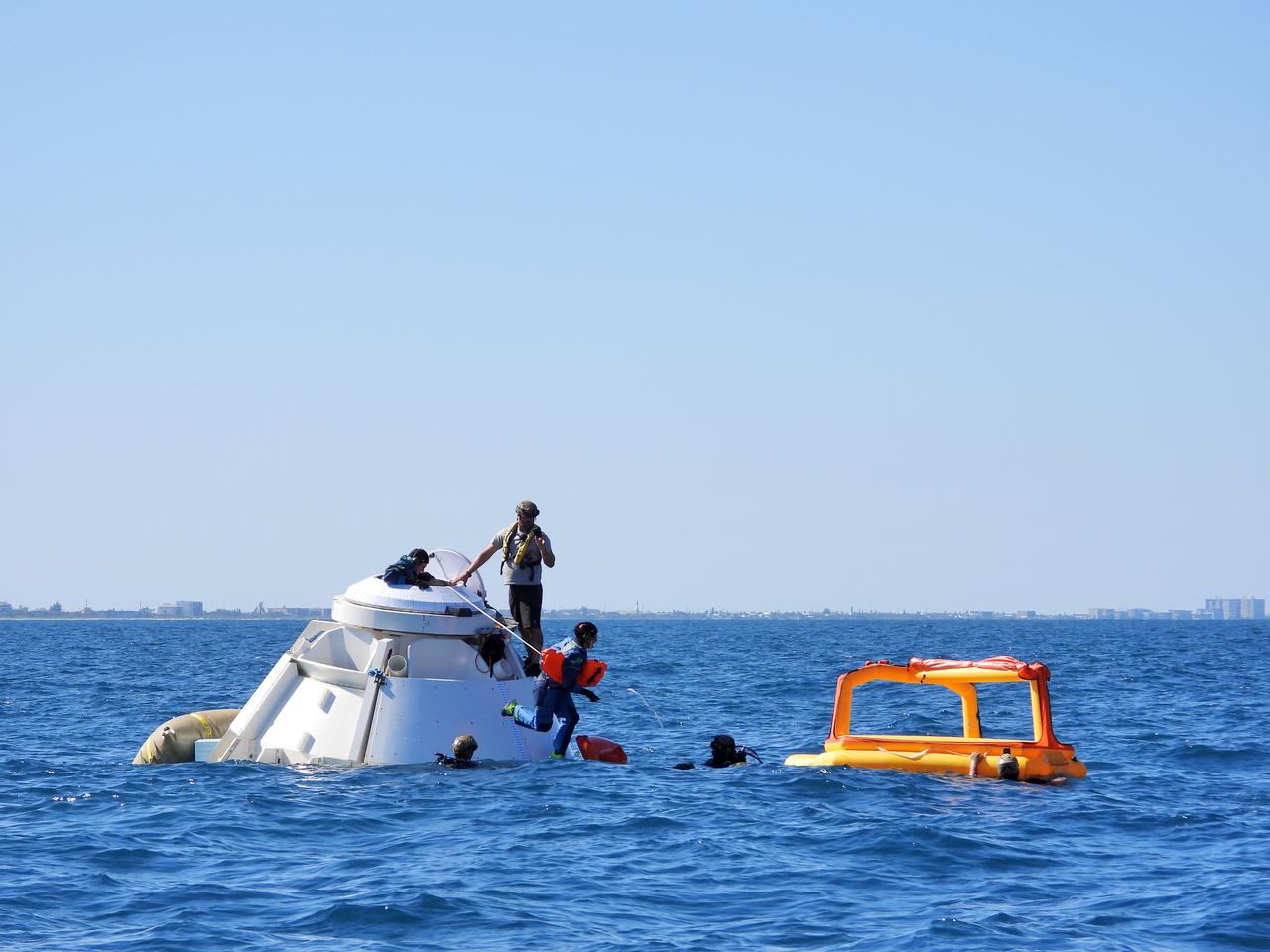
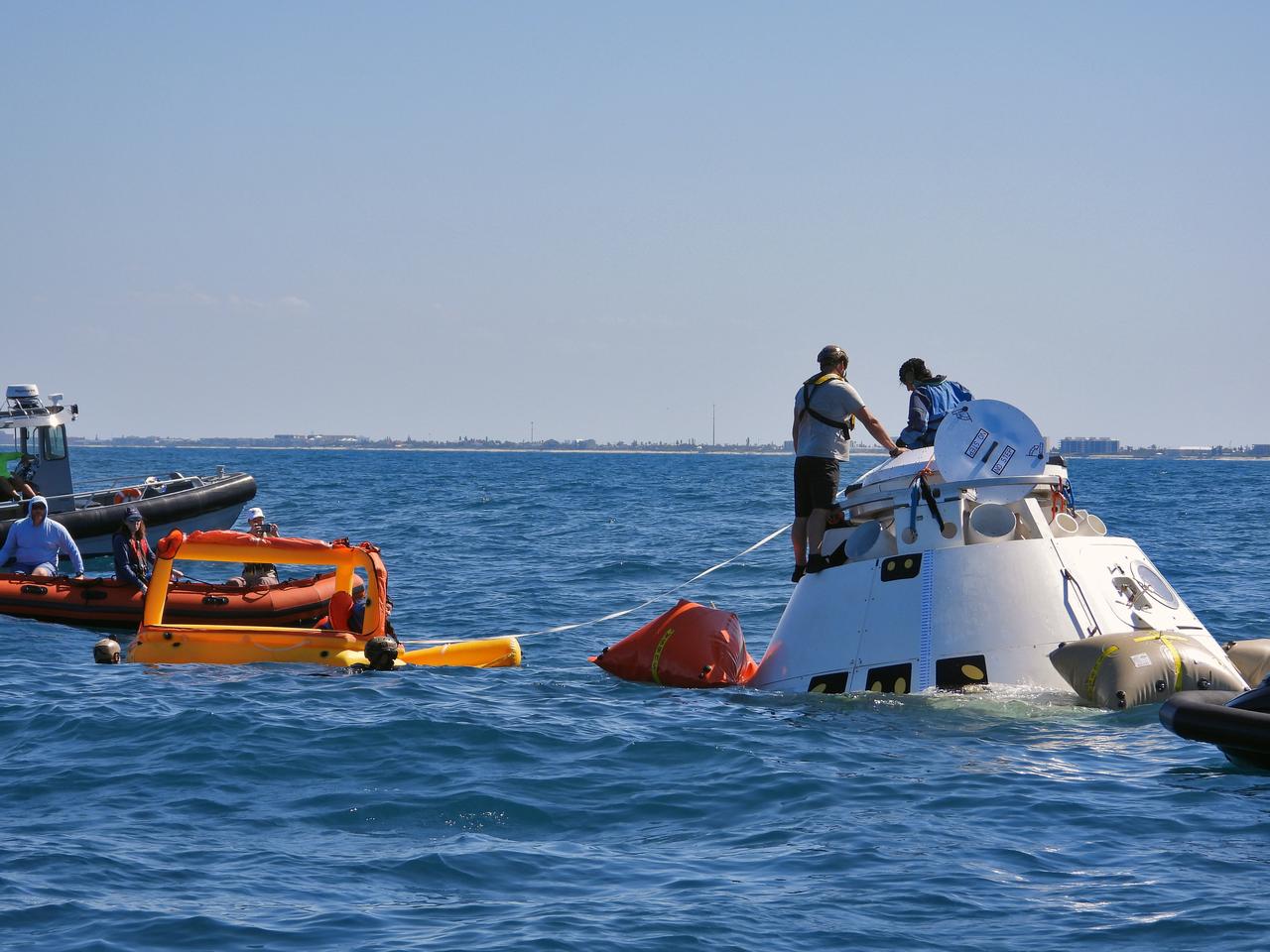
NASA astronauts Suni Williams and Barry “Butch” Wilmore rehearse the steps they would take to exit Boeing’s CST-100 Starliner spacecraft without assistance in the unlikely event of an emergency resulting in a splashdown. The training exercise, which occurred April 27, 2019, took place several miles off the coast of Cape Canaveral near NASA’s Kennedy Space Center in Florida. It included the astronauts unloading a rescue raft from inside the spacecraft, climbing out through a hatch at the top of the spacecraft, jumping into the Atlantic Ocean and boarding the raft. This open-ocean exercise provides the astronauts with the necessary training ahead of Boeing’s Crew Flight Test and subsequent missions. During normal return scenarios, Boeing’s Starliner will land in a safe zone of about 15 square miles in the Western United States. Throughout the commercial crew development phases with NASA, Boeing has performed dozens of qualification tests on its parachute and airbag systems simulating conditions on land and in the water.
Starliner Astronaut Water Rescue Training
NASA astronauts Suni Williams and Barry “Butch” Wilmore rehearse the steps they would take to exit Boeing’s CST-100 Starliner spacecraft without assistance in the unlikely event of an emergency resulting in a splashdown. The training exercise, which occurred April 27, 2019, took place several miles off the coast of Cape Canaveral near NASA’s Kennedy Space Center in Florida. It included the astronauts unloading a rescue raft from inside the spacecraft, climbing out through a hatch at the top of the spacecraft, jumping into the Atlantic Ocean and boarding the raft. This open-ocean exercise provides the astronauts with the necessary training ahead of Boeing’s Crew Flight Test and subsequent missions. During normal return scenarios, Boeing’s Starliner will land in a safe zone of about 15 square miles in the Western United States. Throughout the commercial crew development phases with NASA, Boeing has performed dozens of qualification tests on its parachute and airbag systems simulating conditions on land and in the water.
Starliner Astronaut Water Rescue Training
NASA astronauts Suni Williams and Barry “Butch” Wilmore rehearse the steps they would take to exit Boeing’s CST-100 Starliner spacecraft without assistance in the unlikely event of an emergency resulting in a splashdown. The training exercise, which occurred April 27, 2019, took place several miles off the coast of Cape Canaveral near NASA’s Kennedy Space Center in Florida. It included the astronauts unloading a rescue raft from inside the spacecraft, climbing out through a hatch at the top of the spacecraft, jumping into the Atlantic Ocean and boarding the raft. This open-ocean exercise provides the astronauts with the necessary training ahead of Boeing’s Crew Flight Test and subsequent missions. During normal return scenarios, Boeing’s Starliner will land in a safe zone of about 15 square miles in the Western United States. Throughout the commercial crew development phases with NASA, Boeing has performed dozens of qualification tests on its parachute and airbag systems simulating conditions on land and in the water.
Starliner Astronaut Water Rescue Training
NASA astronauts Suni Williams and Barry “Butch” Wilmore rehearse the steps they would take to exit Boeing’s CST-100 Starliner spacecraft without assistance in the unlikely event of an emergency resulting in a splashdown. The training exercise, which occurred April 27, 2019, took place several miles off the coast of Cape Canaveral near NASA’s Kennedy Space Center in Florida. It included the astronauts unloading a rescue raft from inside the spacecraft, climbing out through a hatch at the top of the spacecraft, jumping into the Atlantic Ocean and boarding the raft. This open-ocean exercise provides the astronauts with the necessary training ahead of Boeing’s Crew Flight Test and subsequent missions. During normal return scenarios, Boeing’s Starliner will land in a safe zone of about 15 square miles in the Western United States. Throughout the commercial crew development phases with NASA, Boeing has performed dozens of qualification tests on its parachute and airbag systems simulating conditions on land and in the water.
Starliner Astronaut Water Rescue Training
NASA astronauts Suni Williams and Barry “Butch” Wilmore rehearse the steps they would take to exit Boeing’s CST-100 Starliner spacecraft without assistance in the unlikely event of an emergency resulting in a splashdown. The training exercise, which occurred April 27, 2019, took place several miles off the coast of Cape Canaveral near NASA’s Kennedy Space Center in Florida. It included the astronauts unloading a rescue raft from inside the spacecraft, climbing out through a hatch at the top of the spacecraft, jumping into the Atlantic Ocean and boarding the raft. This open-ocean exercise provides the astronauts with the necessary training ahead of Boeing’s Crew Flight Test and subsequent missions. During normal return scenarios, Boeing’s Starliner will land in a safe zone of about 15 square miles in the Western United States. Throughout the commercial crew development phases with NASA, Boeing has performed dozens of qualification tests on its parachute and airbag systems simulating conditions on land and in the water.
Starliner Astronaut Water Rescue Training
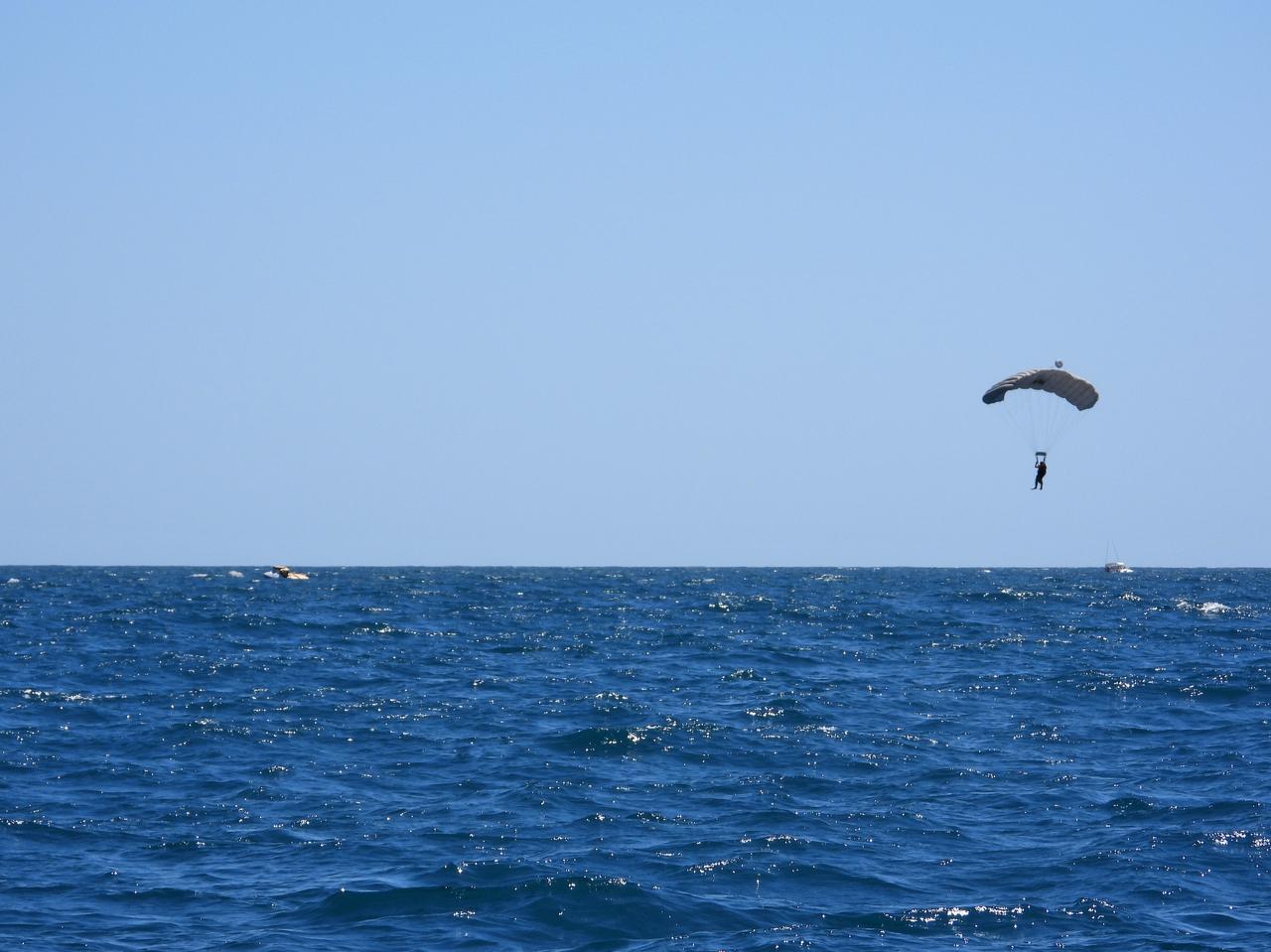
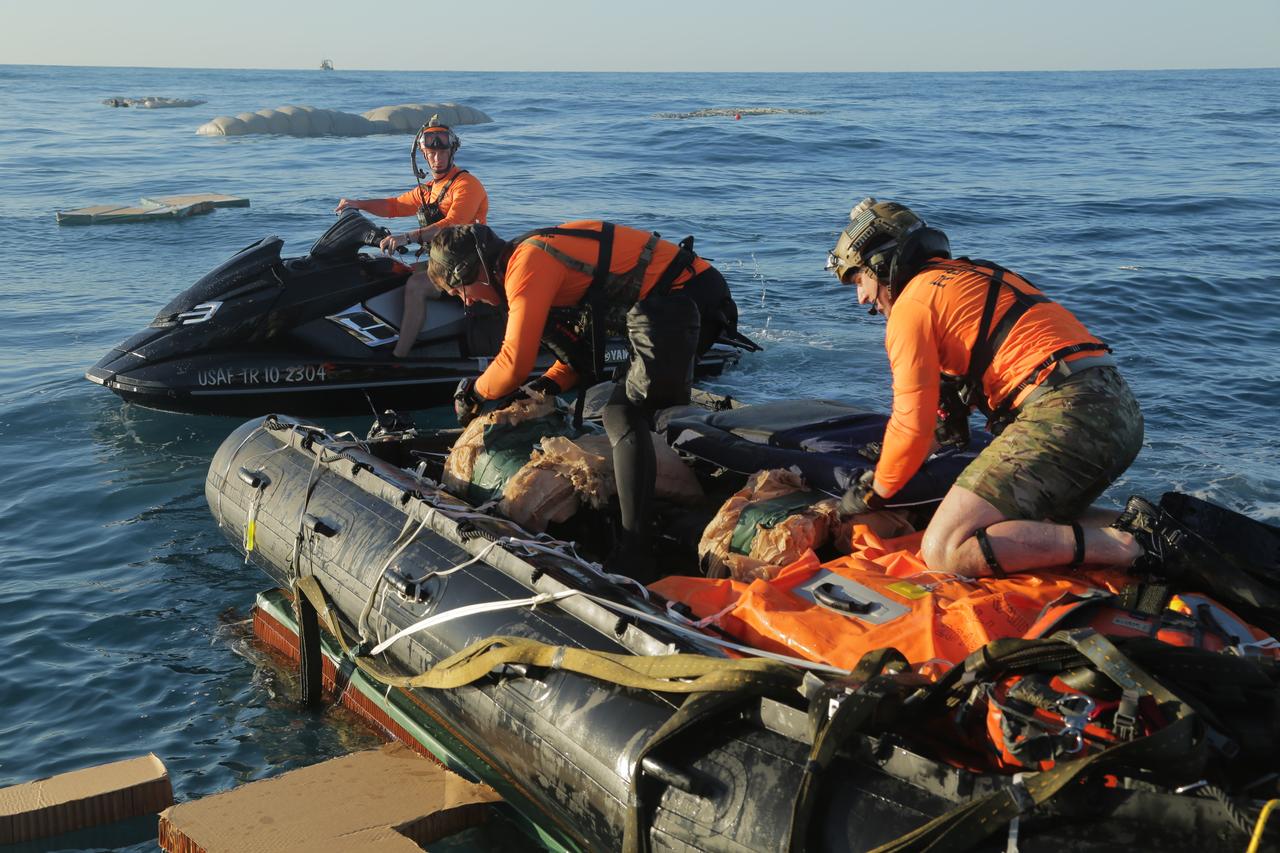
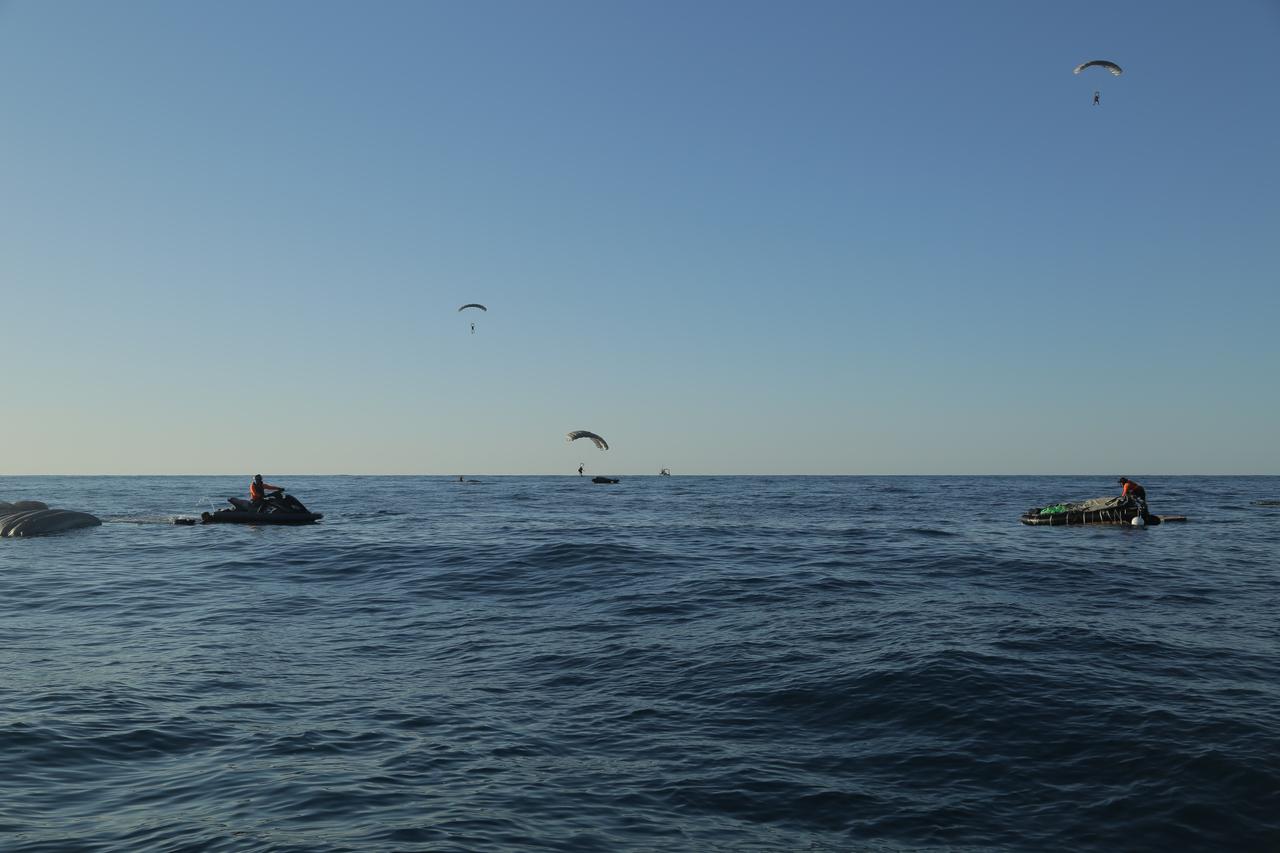
U.S. Air Force “Guardian Angel” Pararescue forces are airdropped into the Atlantic Ocean off the coast of Cape Canaveral near Kennedy Space Center in Florida to rehearse a full mission profile training exercise on April 27, 2019. The exercise included using a Boeing CST-100 Starliner training capsule to run through the necessary steps in the unlikely event of an emergency resulting in a splashdown. NASA and the Department of Defense (DoD) Human Space Flight Support Office Rescue Division conducted the training, which included rehearsing assisted egress, extracting DoD team members acting as astronauts, from the capsule and providing immediate medical treatment. This open-ocean exercise provides team members with the necessary training ahead of Boeing’s Crew Flight Test with astronauts targeted for later this year. During normal return scenarios, Boeing’s Starliner will land in a safe zone of about 15 square miles in the Western United States. Throughout the commercial crew development phases with NASA, Boeing has performed dozens of qualification tests on its parachute and airbag systems simulating conditions on land and in the water.
Starliner Astronaut Water Rescue Training
NASA astronauts Suni Williams and Barry “Butch” Wilmore rehearse the steps they would take to exit Boeing’s CST-100 Starliner spacecraft without assistance in the unlikely event of an emergency resulting in a splashdown. The training exercise, which occurred April 27, 2019, took place several miles off the coast of Cape Canaveral near NASA’s Kennedy Space Center in Florida. It included the astronauts unloading a rescue raft from inside the spacecraft, climbing out through a hatch at the top of the spacecraft, jumping into the Atlantic Ocean and boarding the raft. This open-ocean exercise provides the astronauts with the necessary training ahead of Boeing’s Crew Flight Test and subsequent missions. During normal return scenarios, Boeing’s Starliner will land in a safe zone of about 15 square miles in the Western United States. Throughout the commercial crew development phases with NASA, Boeing has performed dozens of qualification tests on its parachute and airbag systems simulating conditions on land and in the water.
Starliner Astronaut Water Rescue Training
U.S. Air Force “Guardian Angel” Pararescue forces are airdropped into the Atlantic Ocean off the coast of Cape Canaveral near Kennedy Space Center in Florida to rehearse a full mission profile training exercise on April 27, 2019. The exercise included using a Boeing CST-100 Starliner training capsule to run through the necessary steps in the unlikely event of an emergency resulting in a splashdown. NASA and the Department of Defense (DoD) Human Space Flight Support Office Rescue Division conducted the training, which included rehearsing assisted egress, extracting DoD team members acting as astronauts, from the capsule and providing immediate medical treatment. This open-ocean exercise provides team members with the necessary training ahead of Boeing’s Crew Flight Test with astronauts targeted for later this year. During normal return scenarios, Boeing’s Starliner will land in a safe zone of about 15 square miles in the Western United States. Throughout the commercial crew development phases with NASA, Boeing has performed dozens of qualification tests on its parachute and airbag systems simulating conditions on land and in the water.
Starliner Astronaut Water Rescue Training
NASA astronauts Suni Williams and Barry “Butch” Wilmore rehearse the steps they would take to exit Boeing’s CST-100 Starliner spacecraft without assistance in the unlikely event of an emergency resulting in a splashdown. The training exercise, which occurred April 27, 2019, took place several miles off the coast of Cape Canaveral near NASA’s Kennedy Space Center in Florida. It included the astronauts unloading a rescue raft from inside the spacecraft, climbing out through a hatch at the top of the spacecraft, jumping into the Atlantic Ocean and boarding the raft. This open-ocean exercise provides the astronauts with the necessary training ahead of Boeing’s Crew Flight Test and subsequent missions. During normal return scenarios, Boeing’s Starliner will land in a safe zone of about 15 square miles in the Western United States. Throughout the commercial crew development phases with NASA, Boeing has performed dozens of qualification tests on its parachute and airbag systems simulating conditions on land and in the water.
Starliner Astronaut Water Rescue Training
NASA astronauts Suni Williams and Barry “Butch” Wilmore rehearse the steps they would take to exit Boeing’s CST-100 Starliner spacecraft without assistance in the unlikely event of an emergency resulting in a splashdown. The training exercise, which occurred April 27, 2019, took place several miles off the coast of Cape Canaveral near NASA’s Kennedy Space Center in Florida. It included the astronauts unloading a rescue raft from inside the spacecraft, climbing out through a hatch at the top of the spacecraft, jumping into the Atlantic Ocean and boarding the raft. This open-ocean exercise provides the astronauts with the necessary training ahead of Boeing’s Crew Flight Test and subsequent missions. During normal return scenarios, Boeing’s Starliner will land in a safe zone of about 15 square miles in the Western United States. Throughout the commercial crew development phases with NASA, Boeing has performed dozens of qualification tests on its parachute and airbag systems simulating conditions on land and in the water.
Starliner Astronaut Water Rescue Training
NASA astronauts Suni Williams and Barry “Butch” Wilmore rehearse the steps they would take to exit Boeing’s CST-100 Starliner spacecraft without assistance in the unlikely event of an emergency resulting in a splashdown. The training exercise, which occurred April 27, 2019, took place several miles off the coast of Cape Canaveral near NASA’s Kennedy Space Center in Florida. It included the astronauts unloading a rescue raft from inside the spacecraft, climbing out through a hatch at the top of the spacecraft, jumping into the Atlantic Ocean and boarding the raft. This open-ocean exercise provides the astronauts with the necessary training ahead of Boeing’s Crew Flight Test and subsequent missions. During normal return scenarios, Boeing’s Starliner will land in a safe zone of about 15 square miles in the Western United States. Throughout the commercial crew development phases with NASA, Boeing has performed dozens of qualification tests on its parachute and airbag systems simulating conditions on land and in the water.
Starliner Astronaut Water Rescue Training
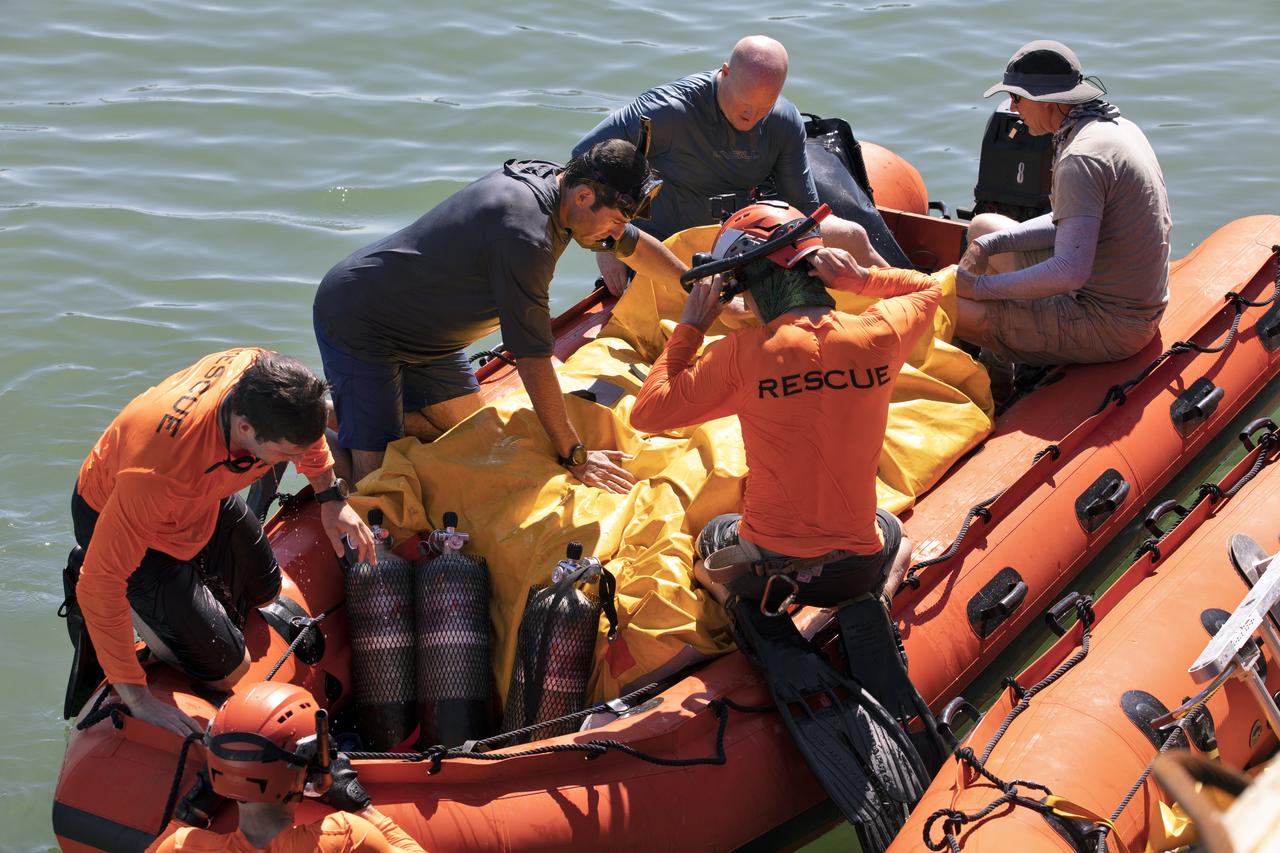
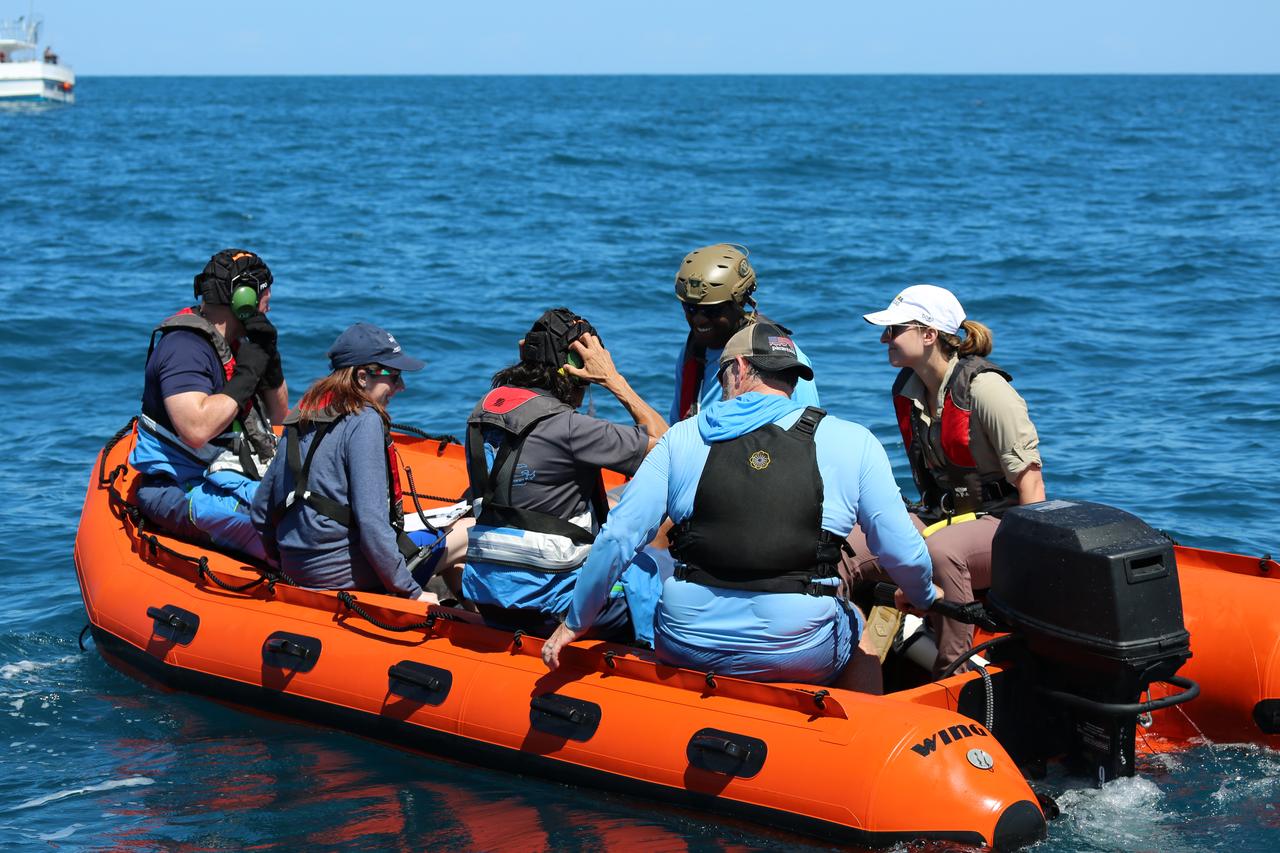
NASA astronauts Suni Williams and Barry “Butch” Wilmore, joined by their training team on a watercraft in the Atlantic Ocean, secure their safety gear as they prepare to rehearse the steps they would take to exit Boeing’s CST-100 Starliner spacecraft without assistance in the unlikely event of an emergency resulting in a splashdown. The training exercise, which occurred April 27, 2019, took place several miles off the coast of Cape Canaveral near NASA’s Kennedy Space Center in Florida. It included the astronauts unloading a rescue raft from inside the spacecraft, climbing out through a hatch at the top of the spacecraft, jumping into the Atlantic Ocean and boarding the raft. This open-ocean exercise provides the astronauts with the necessary training ahead of Boeing’s Crew Flight Test and subsequent missions. During normal return scenarios, Boeing’s Starliner will land in a safe zone of about 15 square miles in the Western United States. Throughout the commercial crew development phases with NASA, Boeing has performed dozens of qualification tests on its parachute and airbag systems simulating conditions on land and in the water.
Starliner Astronaut Water Rescue Training
NASA astronauts Suni Williams and Barry “Butch” Wilmore rehearse the steps they would take to exit Boeing’s CST-100 Starliner spacecraft without assistance in the unlikely event of an emergency resulting in a splashdown. The training exercise, which occurred April 27, 2019, took place several miles off the coast of Cape Canaveral near NASA’s Kennedy Space Center in Florida. It included the astronauts unloading a rescue raft from inside the spacecraft, climbing out through a hatch at the top of the spacecraft, jumping into the Atlantic Ocean and boarding the raft. This open-ocean exercise provides the astronauts with the necessary training ahead of Boeing’s Crew Flight Test and subsequent missions. During normal return scenarios, Boeing’s Starliner will land in a safe zone of about 15 square miles in the Western United States. Throughout the commercial crew development phases with NASA, Boeing has performed dozens of qualification tests on its parachute and airbag systems simulating conditions on land and in the water.
Starliner Astronaut Water Rescue Training
U.S. Air Force “Guardian Angel” Pararescue forces are airdropped into the Atlantic Ocean off the coast of Cape Canaveral near Kennedy Space Center in Florida to rehearse a full mission profile training exercise on April 27, 2019. The exercise included using a Boeing CST-100 Starliner training capsule to run through the necessary steps in the unlikely event of an emergency resulting in a splashdown. NASA and the Department of Defense (DoD) Human Space Flight Support Office Rescue Division conducted the training, which included rehearsing assisted egress, extracting DoD team members acting as astronauts, from the capsule and providing immediate medical treatment. This open-ocean exercise provides team members with the necessary training ahead of Boeing’s Crew Flight Test with astronauts targeted for later this year. During normal return scenarios, Boeing’s Starliner will land in a safe zone of about 15 square miles in the Western United States. Throughout the commercial crew development phases with NASA, Boeing has performed dozens of qualification tests on its parachute and airbag systems simulating conditions on land and in the water.
Starliner Astronaut Water Rescue Training
NASA astronauts Suni Williams and Barry “Butch” Wilmore rehearse the steps they would take to exit Boeing’s CST-100 Starliner spacecraft without assistance in the unlikely event of an emergency resulting in a splashdown. The training exercise, which occurred April 27, 2019, took place several miles off the coast of Cape Canaveral near NASA’s Kennedy Space Center in Florida. It included the astronauts unloading a rescue raft from inside the spacecraft, climbing out through a hatch at the top of the spacecraft, jumping into the Atlantic Ocean and boarding the raft. This open-ocean exercise provides the astronauts with the necessary training ahead of Boeing’s Crew Flight Test and subsequent missions. During normal return scenarios, Boeing’s Starliner will land in a safe zone of about 15 square miles in the Western United States. Throughout the commercial crew development phases with NASA, Boeing has performed dozens of qualification tests on its parachute and airbag systems simulating conditions on land and in the water.
Starliner Astronaut Water Rescue Training
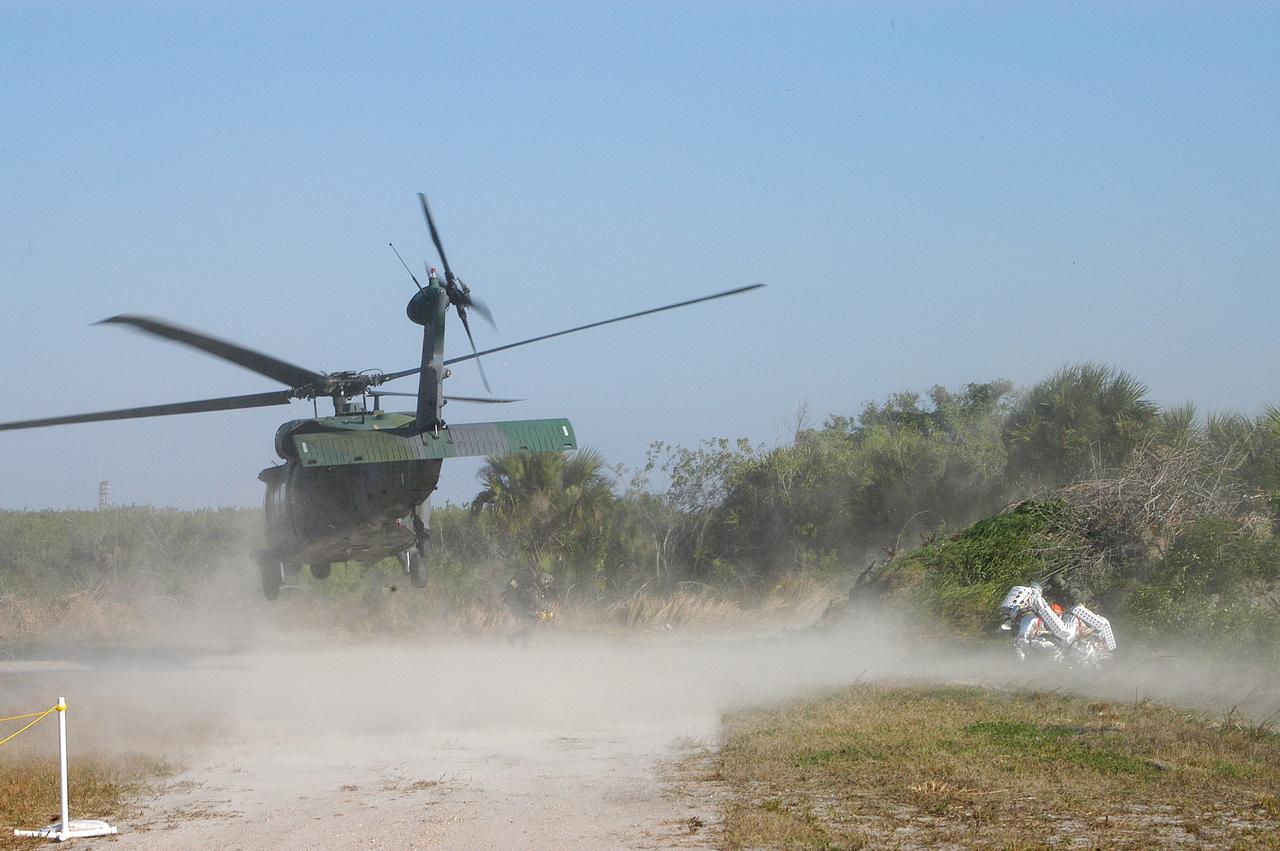
KENNEDY SPACE CENTER, FLA. -- During a simulated rescue mission in the woods near the Shuttle Landing Facility (SLF), a fire/rescue worker practices disembarking from an Air Force HH-60 helicopter. The KSC response team is training for the unlikely scenario of a Shuttle mishap at the SLF. The Mode 7 simulation of an astronaut rescue exercises all aspects of command and control, search and rescue, and medical procedures required for a successful rescue. The remote location of the mock-up prevents a totally land-based crew rescue, and calls on a NASA UH-1 helicopter to locate the site and four Air Force HH-60 helicopters to drop emergency equipment and fire/rescue workers to prepare the "crew" for preliminary traige. The helicopters are used later to remove the crew five astronaut candidates, one representative from the Vehicle Integration Test office, and one fire/rescue worker. The exercise will conclude with airlifted "patients" arriving safely in the emergency rooms of participating area hospitals
KSC-99pp0298
KENNEDY SPACE CENTER, FLA. - A helicopter rescue team prepares another “injured” astronaut for transportation to a local hospital.  They are all taking part in a “Mode VII” emergency landing simulation at Kennedy Space Center.  The purpose of the Mode VII is to exercise emergency preparedness personnel, equipment and facilities in rescuing astronauts from a downed orbiter and providing immediate medical attention.  This simulation presents an orbiter that has crashed short of the Shuttle Landing Facility in a wooded area 2-1/2 miles south of Runway 33.  Emergency crews are responding to the volunteer “astronauts” who are simulating various injuries inside the crew compartment mock-up.  Rescuers must remove the crew, provide triage and transport to hospitals those who need further treatment.  Local hospitals are participating in the exercise.
KENNEDY SPACE CENTER, FLA. - A helicopter rescue team prepares another “injured” astronaut for transportation to a local hospital. They are all taking part in a “Mode VII” emergency landing simulation at Kennedy Space Center. The purpose of the Mode VII is to exercise emergency preparedness personnel, equipment and facilities in rescuing astronauts from a downed orbiter and providing immediate medical attention. This simulation presents an orbiter that has crashed short of the Shuttle Landing Facility in a wooded area 2-1/2 miles south of Runway 33. Emergency crews are responding to the volunteer “astronauts” who are simulating various injuries inside the crew compartment mock-up. Rescuers must remove the crew, provide triage and transport to hospitals those who need further treatment. Local hospitals are participating in the exercise.
KENNEDY SPACE CENTER, FLA. - A helicopter rescue team prepares another “injured” astronaut for transportation to a local hospital.  They are all taking part in a “Mode VII” emergency landing simulation at Kennedy Space Center.  The purpose of the Mode VII is to exercise emergency preparedness personnel, equipment and facilities in rescuing astronauts from a downed orbiter and providing immediate medical attention.  This simulation presents an orbiter that has crashed short of the Shuttle Landing Facility in a wooded area 2-1/2 miles south of Runway 33.  Emergency crews are responding to the volunteer “astronauts” who are simulating various injuries inside the crew compartment mock-up.  Rescuers must remove the crew, provide triage and transport to hospitals those who need further treatment.  Local hospitals are participating in the exercise.
KENNEDY SPACE CENTER, FLA. - A helicopter rescue team prepares another “injured” astronaut for transportation to a local hospital. They are all taking part in a “Mode VII” emergency landing simulation at Kennedy Space Center. The purpose of the Mode VII is to exercise emergency preparedness personnel, equipment and facilities in rescuing astronauts from a downed orbiter and providing immediate medical attention. This simulation presents an orbiter that has crashed short of the Shuttle Landing Facility in a wooded area 2-1/2 miles south of Runway 33. Emergency crews are responding to the volunteer “astronauts” who are simulating various injuries inside the crew compartment mock-up. Rescuers must remove the crew, provide triage and transport to hospitals those who need further treatment. Local hospitals are participating in the exercise.
KENNEDY SPACE CENTER, FLA. - An “injured” rescue worker is lifted into an M-113 armored personnel carrier provided for transportation during a “Mode VII” emergency landing simulation at Kennedy Space Center.  The purpose of the Mode VII is to exercise emergency preparedness personnel, equipment and facilities in rescuing astronauts from a downed orbiter and providing immediate medical attention.  This simulation presents an orbiter that has crashed short of the Shuttle Landing Facility in a wooded area 2-1/2 miles south of Runway 33.  Emergency crews are responding to the volunteer astronauts who are simulating various injuries inside the crew compartment mock-up.  Rescuers must remove the crew, provide triage and transport to hospitals those who need further treatment.  Local hospitals are participating in the exercise.
KENNEDY SPACE CENTER, FLA. - An “injured” rescue worker is lifted into an M-113 armored personnel carrier provided for transportation during a “Mode VII” emergency landing simulation at Kennedy Space Center. The purpose of the Mode VII is to exercise emergency preparedness personnel, equipment and facilities in rescuing astronauts from a downed orbiter and providing immediate medical attention. This simulation presents an orbiter that has crashed short of the Shuttle Landing Facility in a wooded area 2-1/2 miles south of Runway 33. Emergency crews are responding to the volunteer astronauts who are simulating various injuries inside the crew compartment mock-up. Rescuers must remove the crew, provide triage and transport to hospitals those who need further treatment. Local hospitals are participating in the exercise.
KENNEDY SPACE CENTER, FLA. - A helicopter is landing near rescue team members taking part in a “Mode VII” emergency landing simulation at Kennedy Space Center.  The purpose of Mode VII is to exercise emergency preparedness personnel, equipment and facilities in rescuing astronauts from a downed orbiter and providing immediate medical attention.  This simulation presents an orbiter that has crashed short of the Shuttle Landing Facility in a wooded area 2-1/2 miles south of Runway 33.  Emergency crews are responding to the volunteer “astronauts” simulating various injuries inside an orbiter crew compartment mock-up.  Rescuers must remove the crew, provide triage and transport to hospitals those who need further treatment.  Local hospitals are participating in the exercise.
KENNEDY SPACE CENTER, FLA. - A helicopter is landing near rescue team members taking part in a “Mode VII” emergency landing simulation at Kennedy Space Center. The purpose of Mode VII is to exercise emergency preparedness personnel, equipment and facilities in rescuing astronauts from a downed orbiter and providing immediate medical attention. This simulation presents an orbiter that has crashed short of the Shuttle Landing Facility in a wooded area 2-1/2 miles south of Runway 33. Emergency crews are responding to the volunteer “astronauts” simulating various injuries inside an orbiter crew compartment mock-up. Rescuers must remove the crew, provide triage and transport to hospitals those who need further treatment. Local hospitals are participating in the exercise.
KENNEDY SPACE CENTER, FLA. - A helicopter rescue team carries another “injured” astronaut to a helicopter for transportation to a local hospital.  They are all taking part in a “Mode VII” emergency landing simulation at Kennedy Space Center.  The purpose of the Mode VII is to exercise emergency preparedness personnel, equipment and facilities in rescuing astronauts from a downed orbiter and providing immediate medical attention.  This simulation presents an orbiter that has crashed short of the Shuttle Landing Facility in a wooded area 2-1/2 miles south of Runway 33.  Emergency crews are responding to the volunteer “astronauts” who are simulating various injuries inside the crew compartment mock-up.  Rescuers must remove the crew, provide triage and transport to hospitals those who need further treatment.  Local hospitals are participating in the exercise.
KENNEDY SPACE CENTER, FLA. - A helicopter rescue team carries another “injured” astronaut to a helicopter for transportation to a local hospital. They are all taking part in a “Mode VII” emergency landing simulation at Kennedy Space Center. The purpose of the Mode VII is to exercise emergency preparedness personnel, equipment and facilities in rescuing astronauts from a downed orbiter and providing immediate medical attention. This simulation presents an orbiter that has crashed short of the Shuttle Landing Facility in a wooded area 2-1/2 miles south of Runway 33. Emergency crews are responding to the volunteer “astronauts” who are simulating various injuries inside the crew compartment mock-up. Rescuers must remove the crew, provide triage and transport to hospitals those who need further treatment. Local hospitals are participating in the exercise.
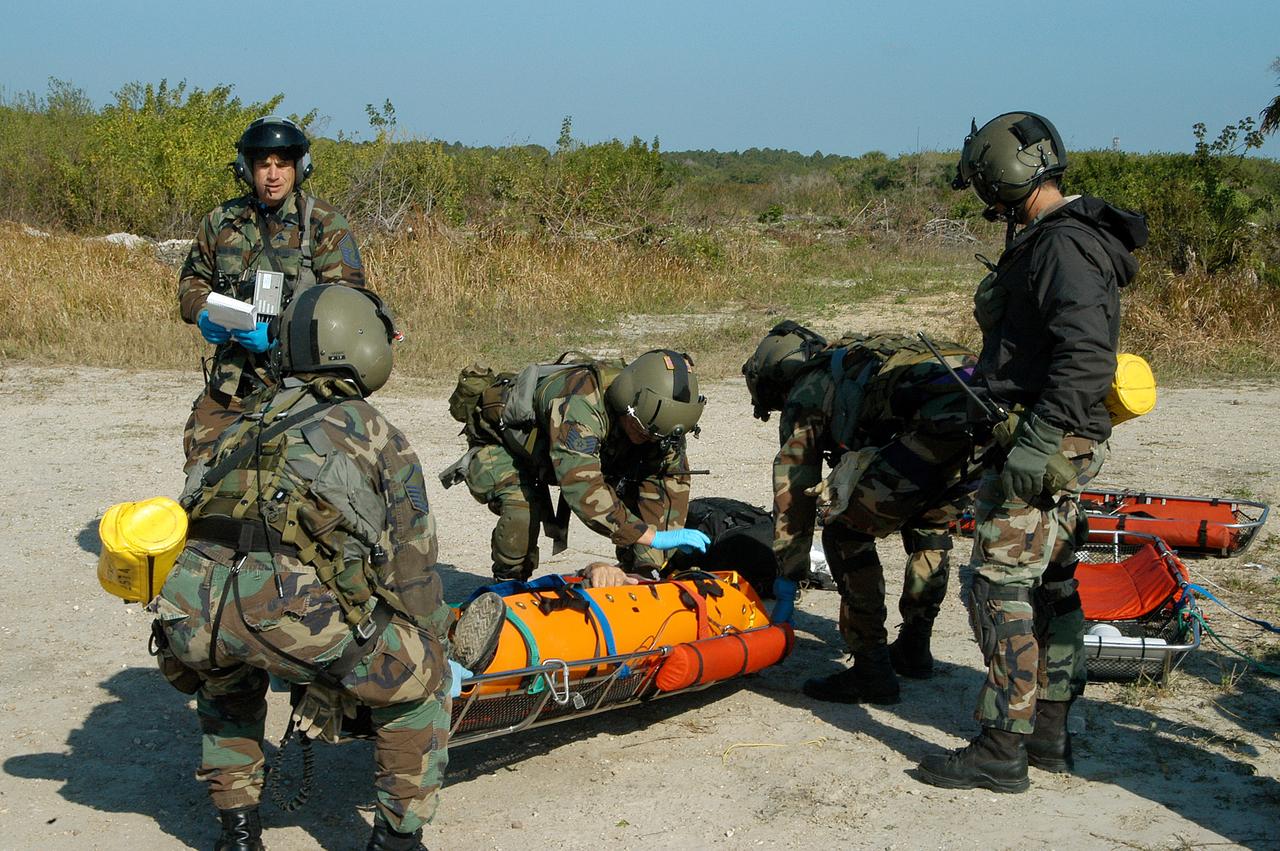
KENNEDY SPACE CENTER, FLA. -- During a simulated rescue mission in the woods near the Shuttle Landing Facility (SLF), the KSC response team practices stabilizing an injured crew member before transport to a local hospital by an Air Force HH-60 helicopter. The response team is training for the unlikely scenario of a Shuttle mishap at the SLF. The Mode 7 simulation of an astronaut rescue exercises all aspects of command and control, search and rescue, and medical procedures required for a successful rescue. The remote location of the mock-up prevents a totally land-based crew rescue, and calls on a NASA UH-1 helicopter to locate the site and four HH-60 helicopters to drop emergency equipment and fire/rescue workers to prepare the "crew" for preliminary triage. The helicopters are then used to remove the crew five astronaut candidates, one representative from the Vehicle Integration Test office, and one fire/rescue worker. The exercise will conclude with airlifted "patients" arriving safely in the emergency rooms of participating area hospitals
KSC-99pp0302
KENNEDY SPACE CENTER, FLA. -- During a simulated rescue mission in the woods near the Shuttle Landing Facility (SLF), the KSC response team practices stabilizing an injured crew member before transport to a local hospital by helicopter. The response team is training for the unlikely scenario of a Shuttle mishap at the SLF. The Mode 7 simulation of an astronaut rescue exercises all aspects of command and control, search and rescue, and medical procedures required for a successful rescue. The remote location of the mock-up prevents a totally land-based crew rescue, and calls on a NASA UH-1 helicopter to locate the site and four Air Force HH-60 helicopters to drop emergency equipment and fire/rescue workers who will prepare the "crew" for preliminary triage. The helicopters later will help remove the crew five astronaut candidates, one representative from the Vehicle Integration Test office, and one fire/rescue worker. The exercise will conclude with airlifted "patients" arriving safely in the emergency rooms of participating area hospitals
KSC-99pp0301
KENNEDY SPACE CENTER, FLA.  -  At NASA Kennedy Space Center's Shuttle Landing Facility, an emergency rescue worker tends to an "injured astronaut" inside a rescue vehicle.  Volunteers and emergency rescue workers are participating in a simulated emergency landing of a shuttle crew.   Known as a Mode VI exercise, the operation uses volunteer workers from the Center to pose as astronauts. The purpose of the simulation is to exercise emergency preparedness personnel, equipment and facilities in rescuing astronauts from a downed orbiter and providing immediate medical attention. Photo credit: NASA/Troy Cryder
KSC-06pd0517
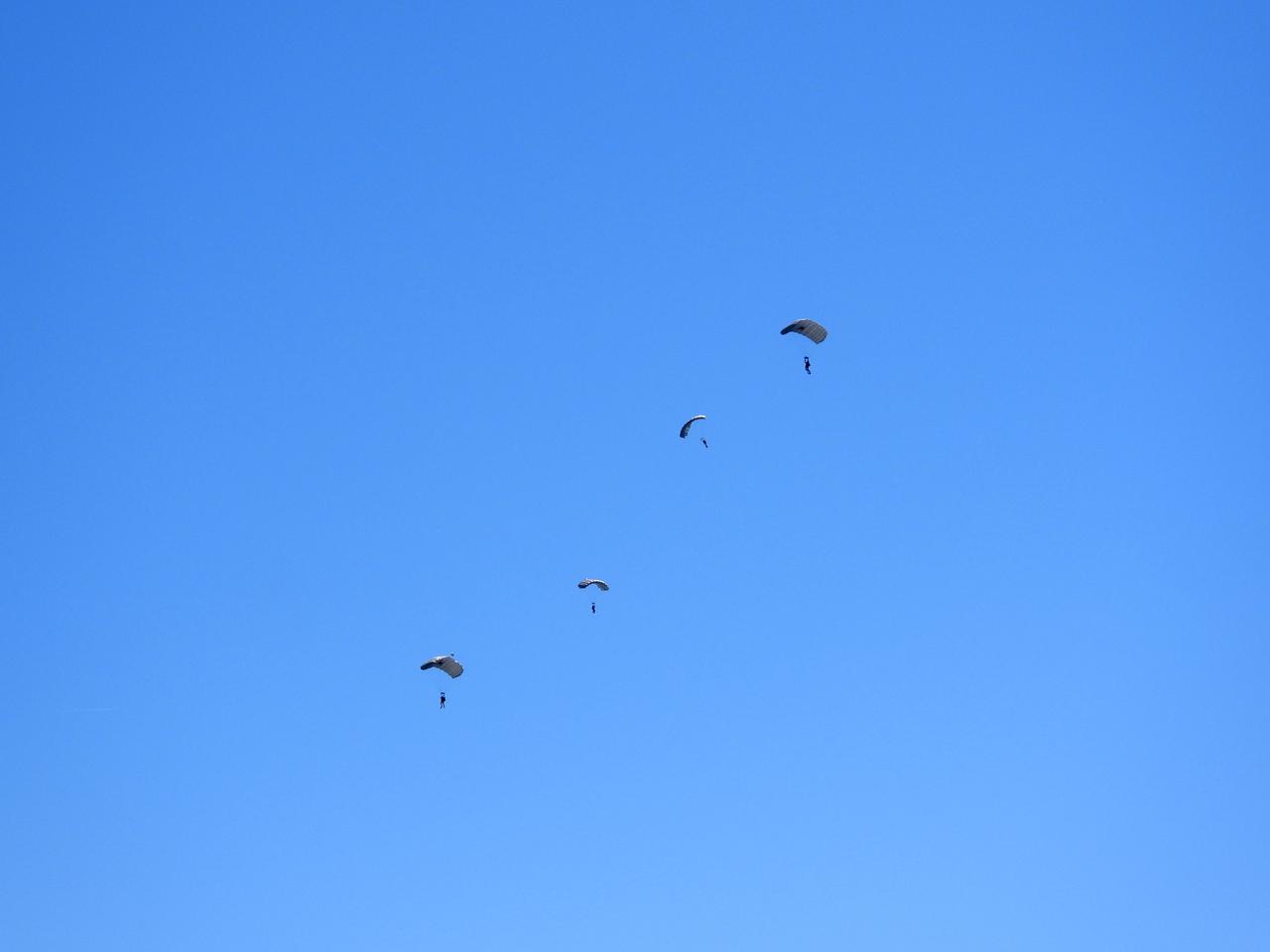
Pararescue specialists from the 304th Rescue Squadron, located in Portland, Oregon and supporting the 45th Operations Group’s Detachment 3, based out of Patrick Air Force Base, deploy their parachutes and prepare to touch down on the Atlantic Ocean surface during an April astronaut rescue exercise with NASA’s Commercial Crew Program and SpaceX off of Florida’s eastern coast. The pararescue specialists, also known as “Guardian Angels,” jumped from military aircraft and simulated a rescue operation to demonstrate their ability to safely remove crew from the SpaceX Crew Dragon in the unlikely event of an emergency landing.
SpaceX Recovery Trainer Egress and Handling Testing
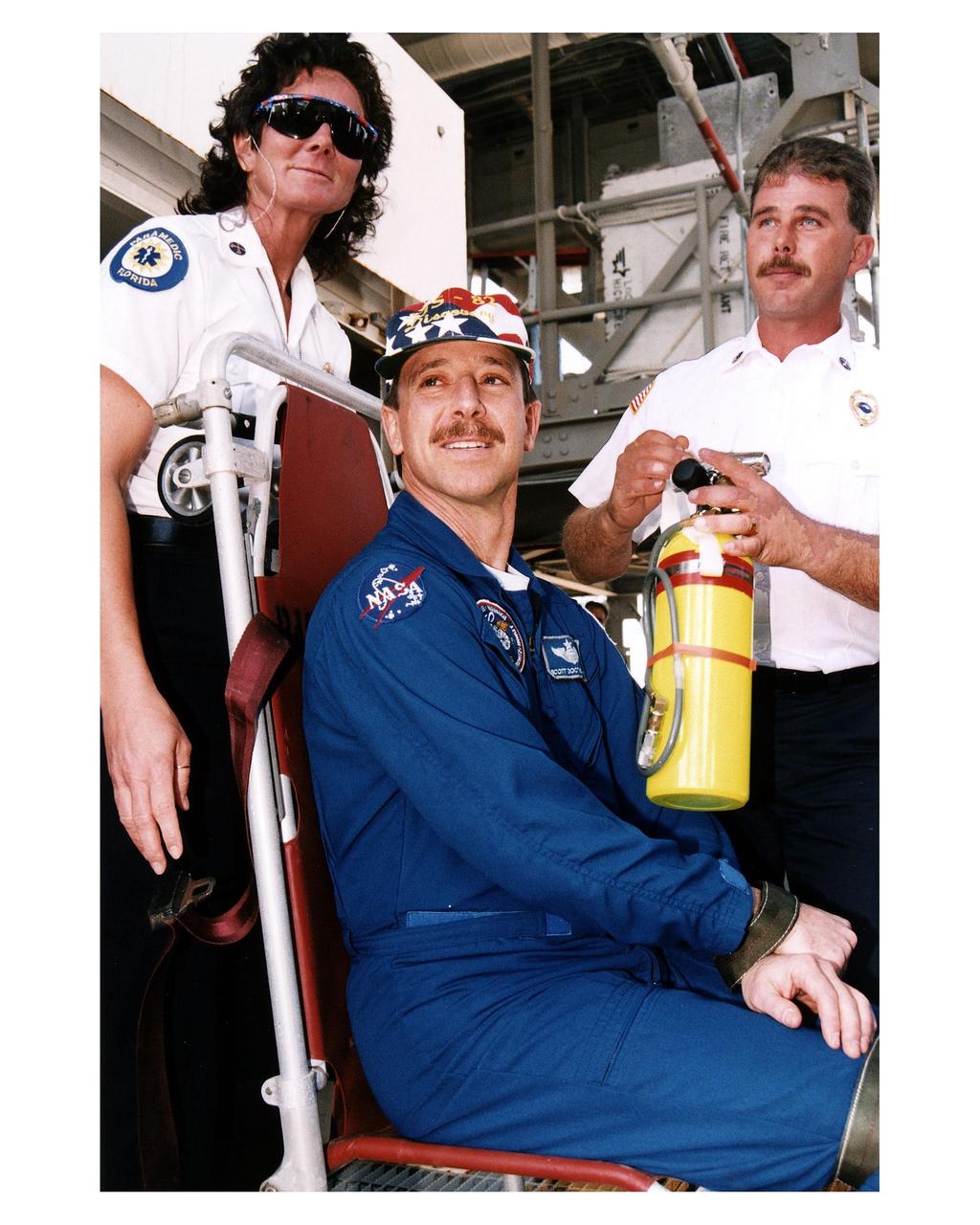
KENNEDY SPACE CENTER, Fla. -- STS-82 Pilot Scott J. "Doc" Horowitz, seated, poses as an immobilized person while pad rescue leaders Kathy Weaver and Steve Kelly of KSC Fire Rescue Services demonstrate the use of flight crew rescue equipment. The demonstration is part of crew training during Terminal Countdown Demonstration Test (TCDT) activities at Launch Pad 39A. The seven-member STS-82 crew will conduct the second Hubble Space Telescope servicing mission. Liftoff of the 10-day flight is scheduled Feb. 11
KSC-97pc209
Pararescue specialists from the 304th Rescue Squadron, located in Portland, Oregon and supporting the 45th Operations Group’s Detachment 3, based out of Patrick Air Force Base, prepare equipment during an April astronaut rescue exercise with NASA’s Commercial Crew Program and SpaceX off of Florida’s eastern coast. The pararescue specialists, also known as “Guardian Angels,” jumped from military aircraft and simulated a rescue operation to demonstrate their ability to safely remove crew from the SpaceX Crew Dragon in the unlikely event of an emergency landing. The pararescue specialists are fully qualified paramedics able to perform field surgery, if necessary.
SpaceX Recovery Trainer Egress and Handling Testing
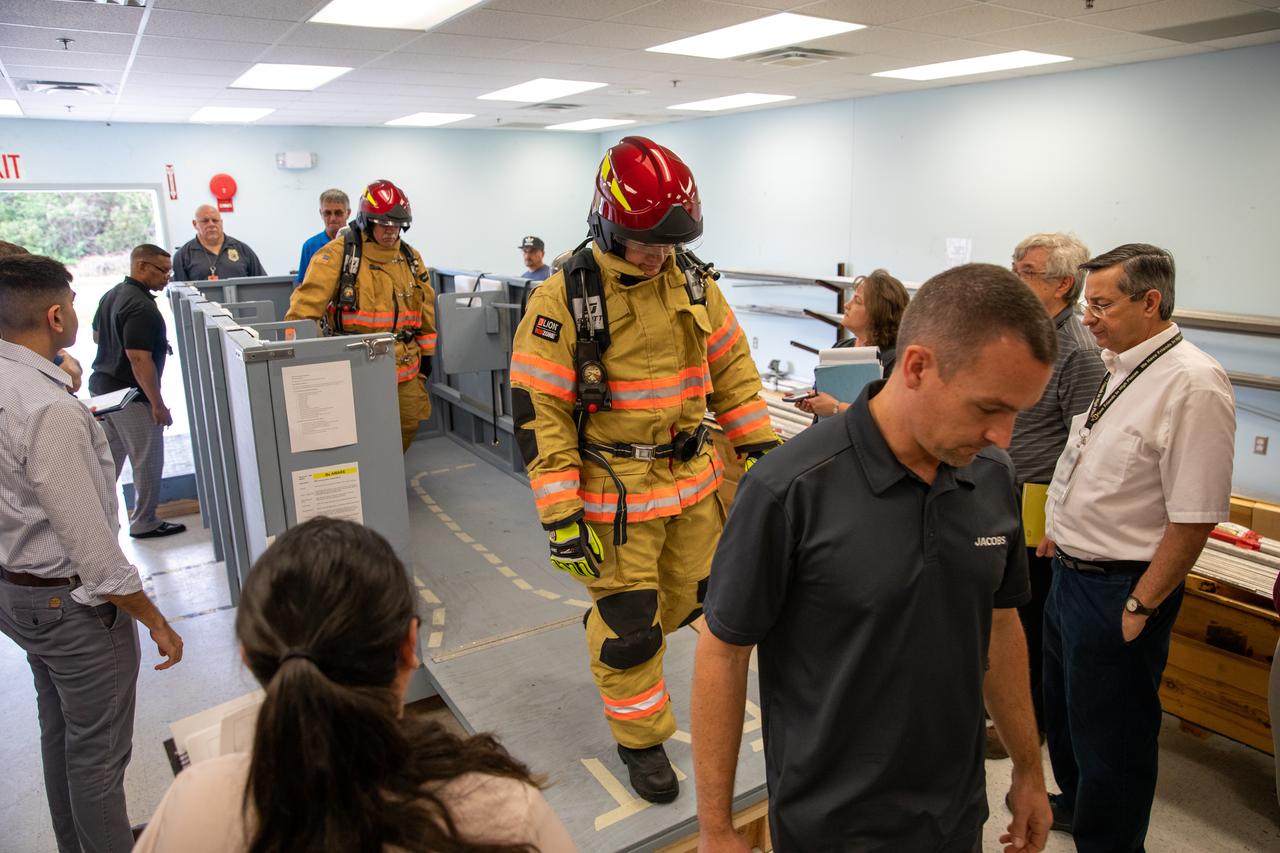
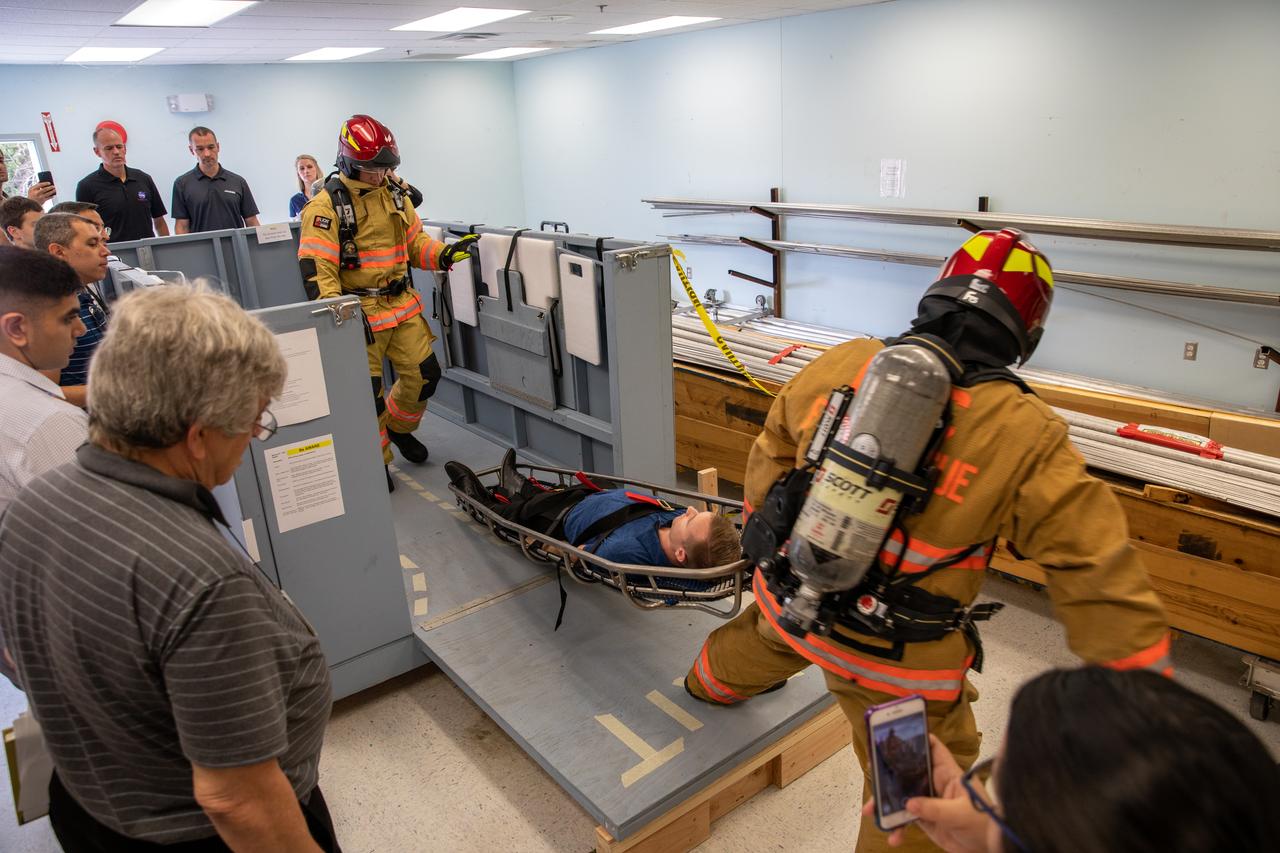
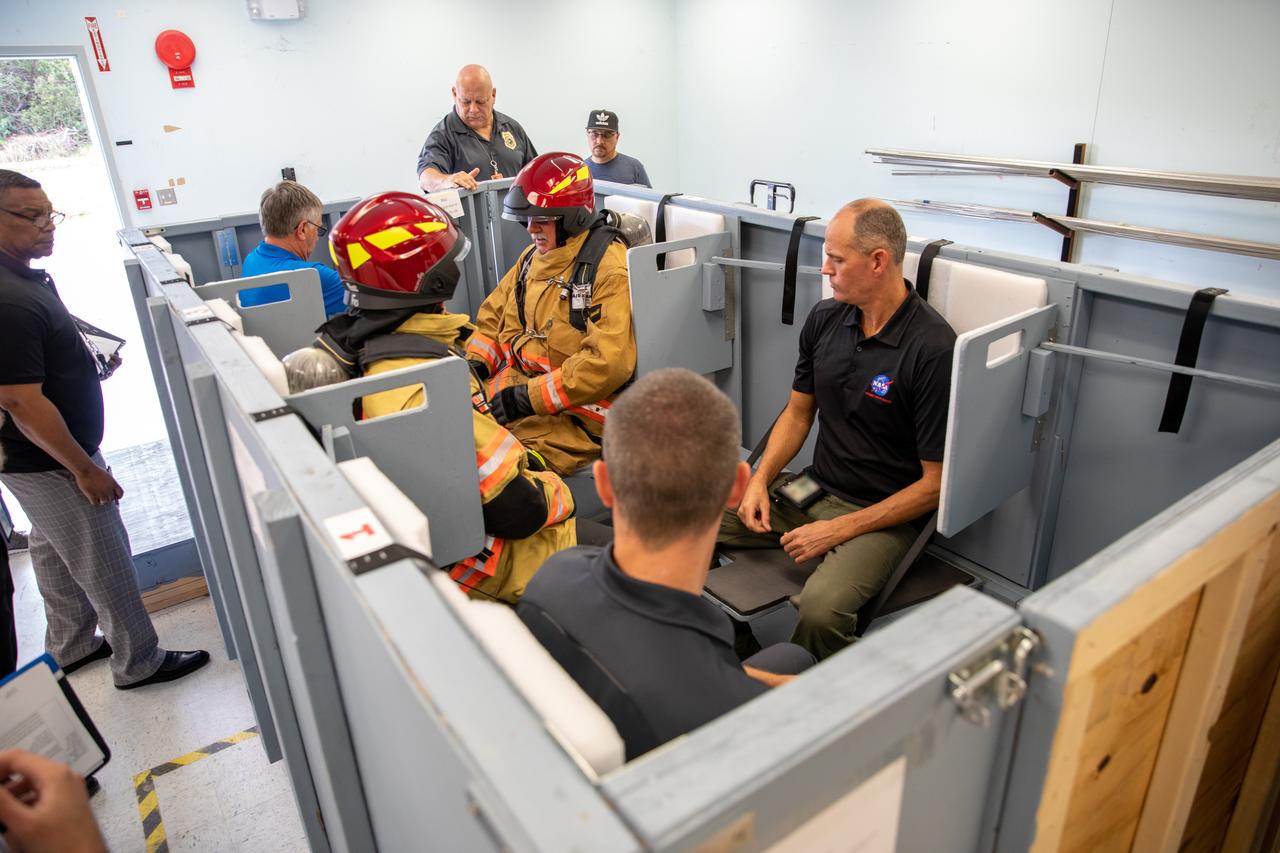
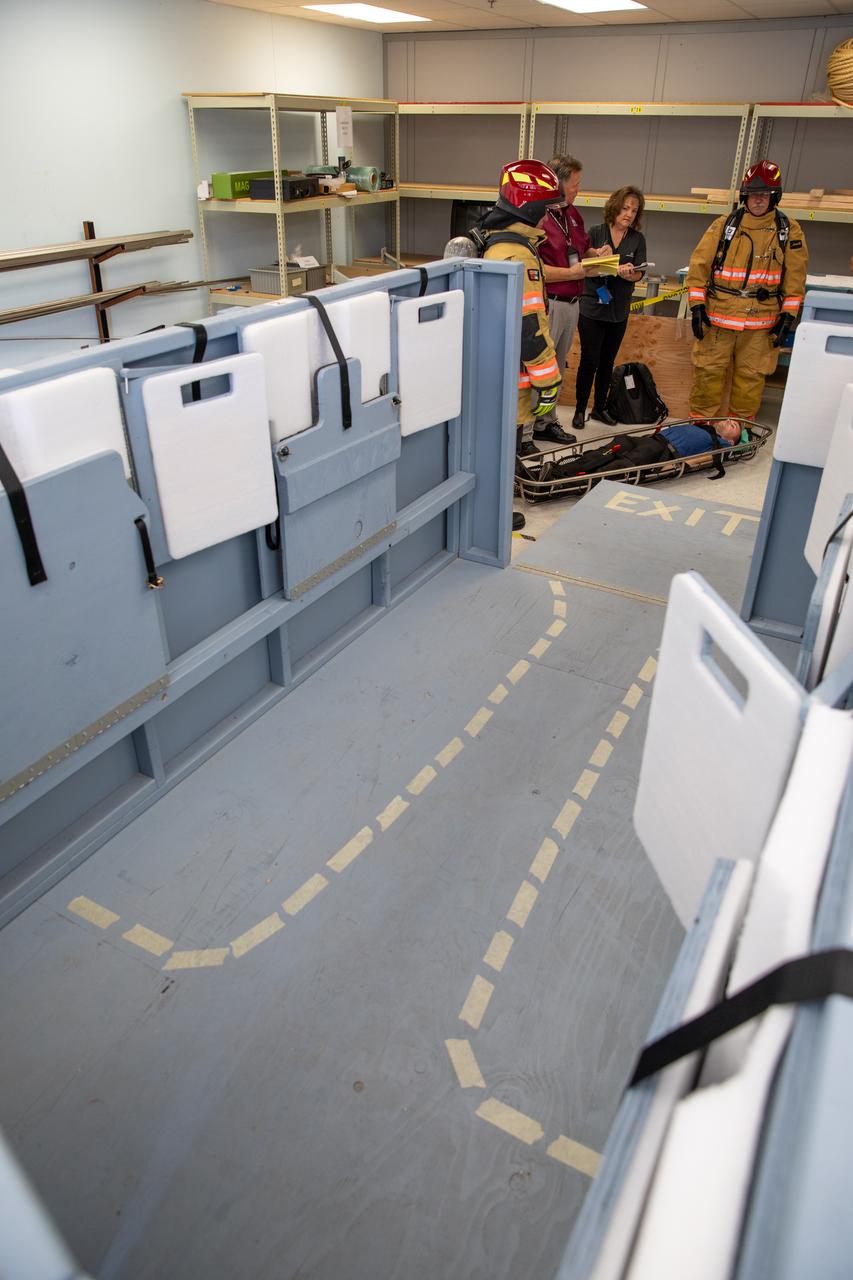
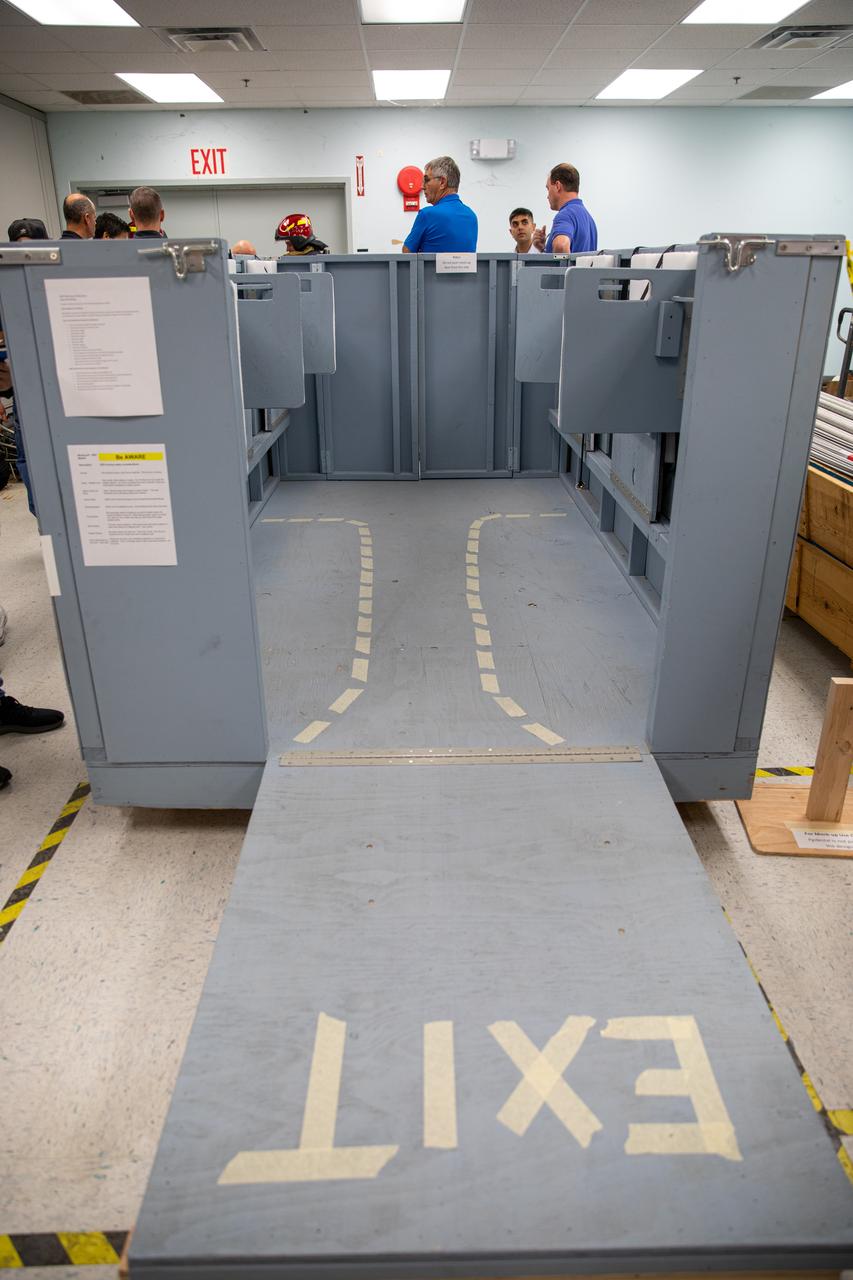
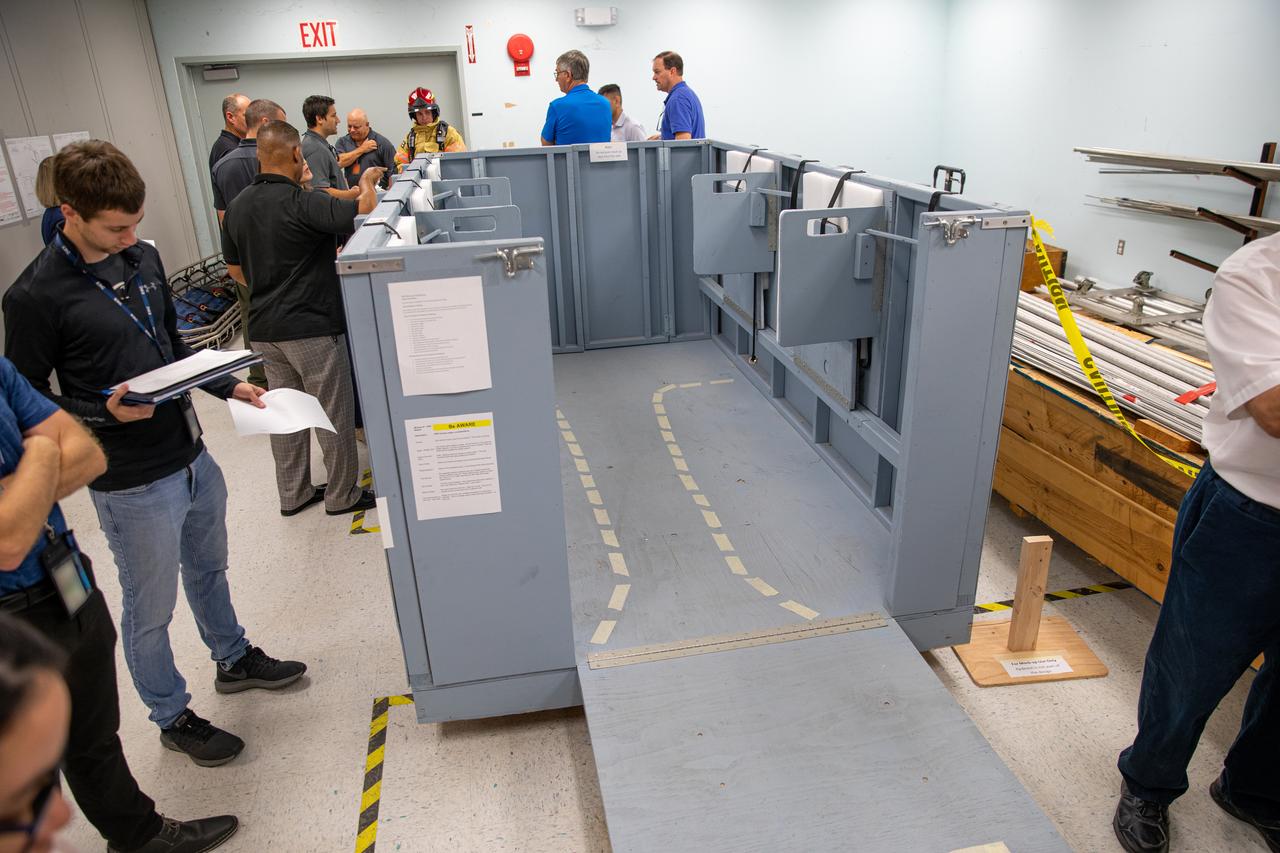
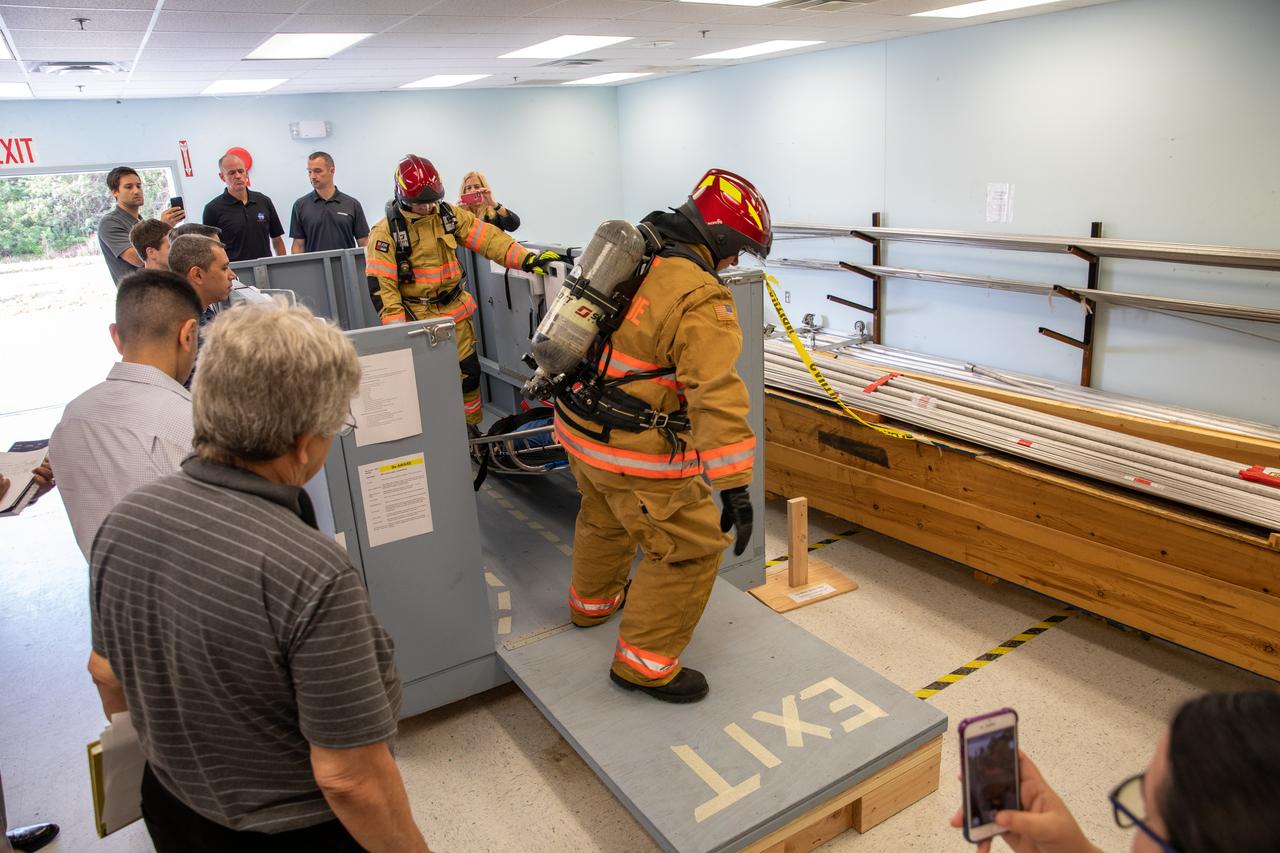
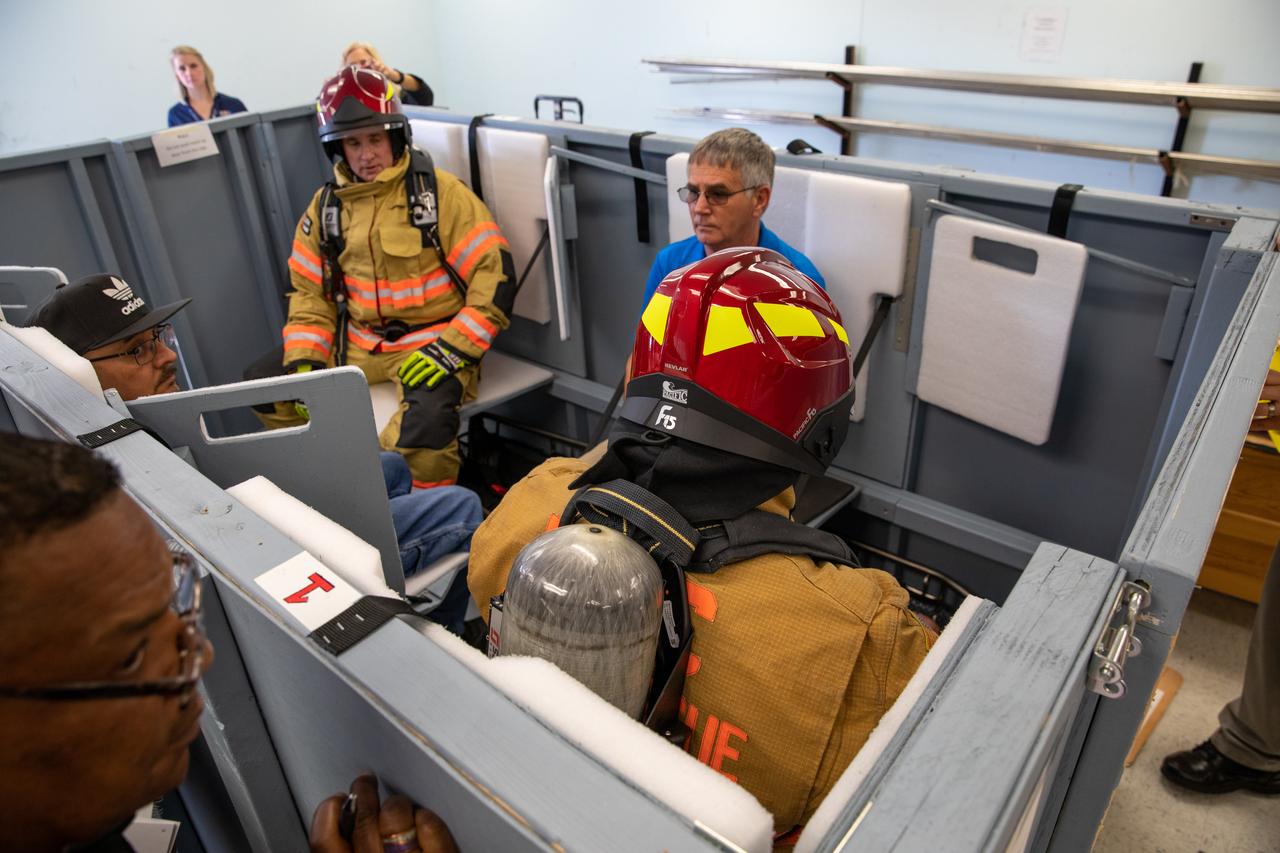
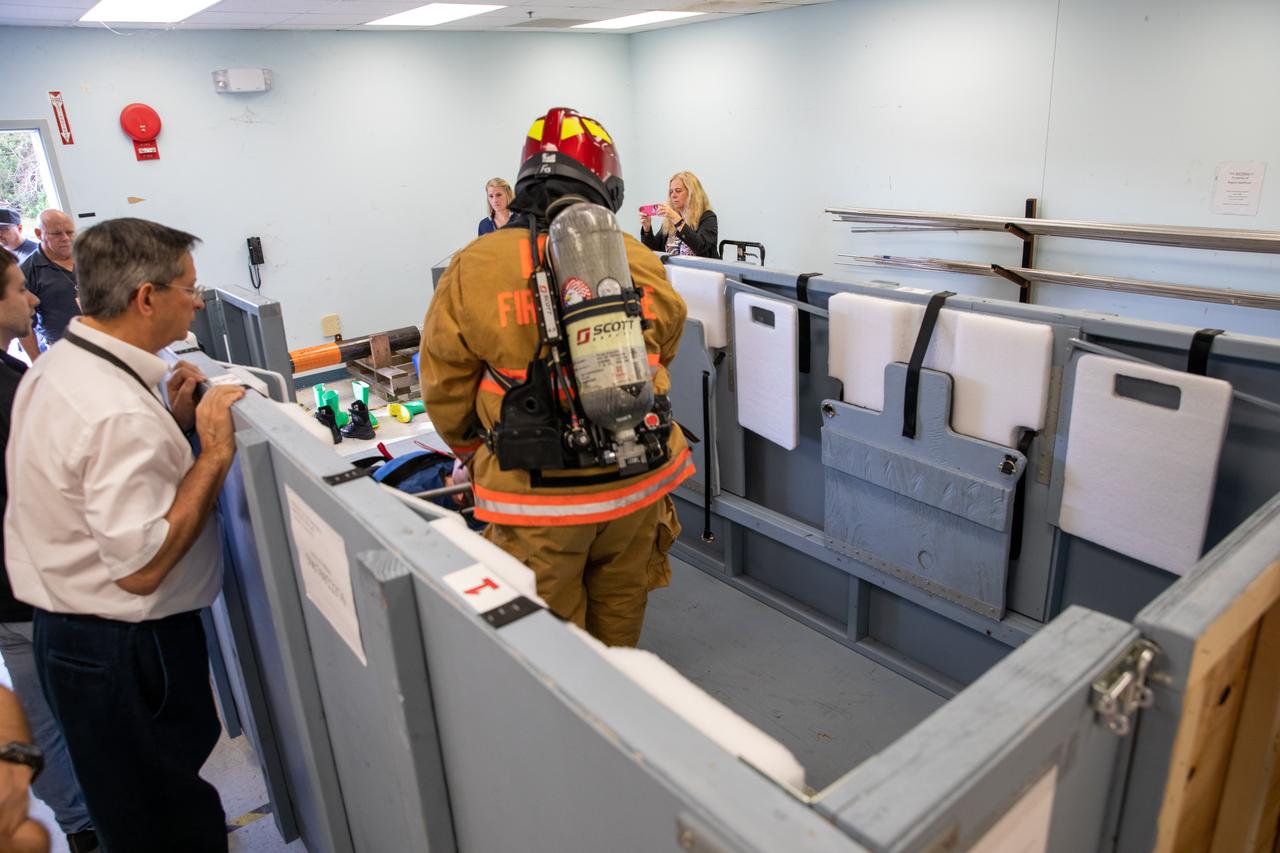
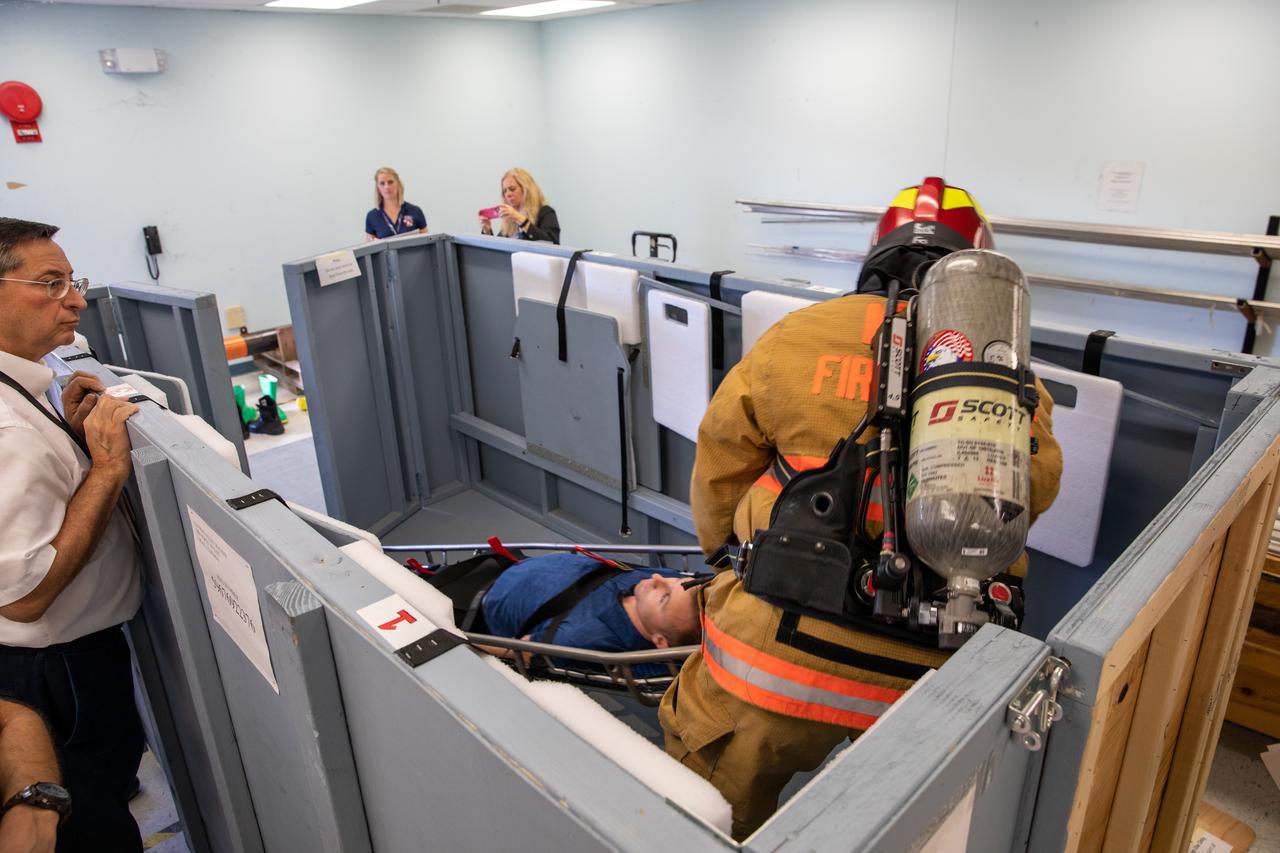
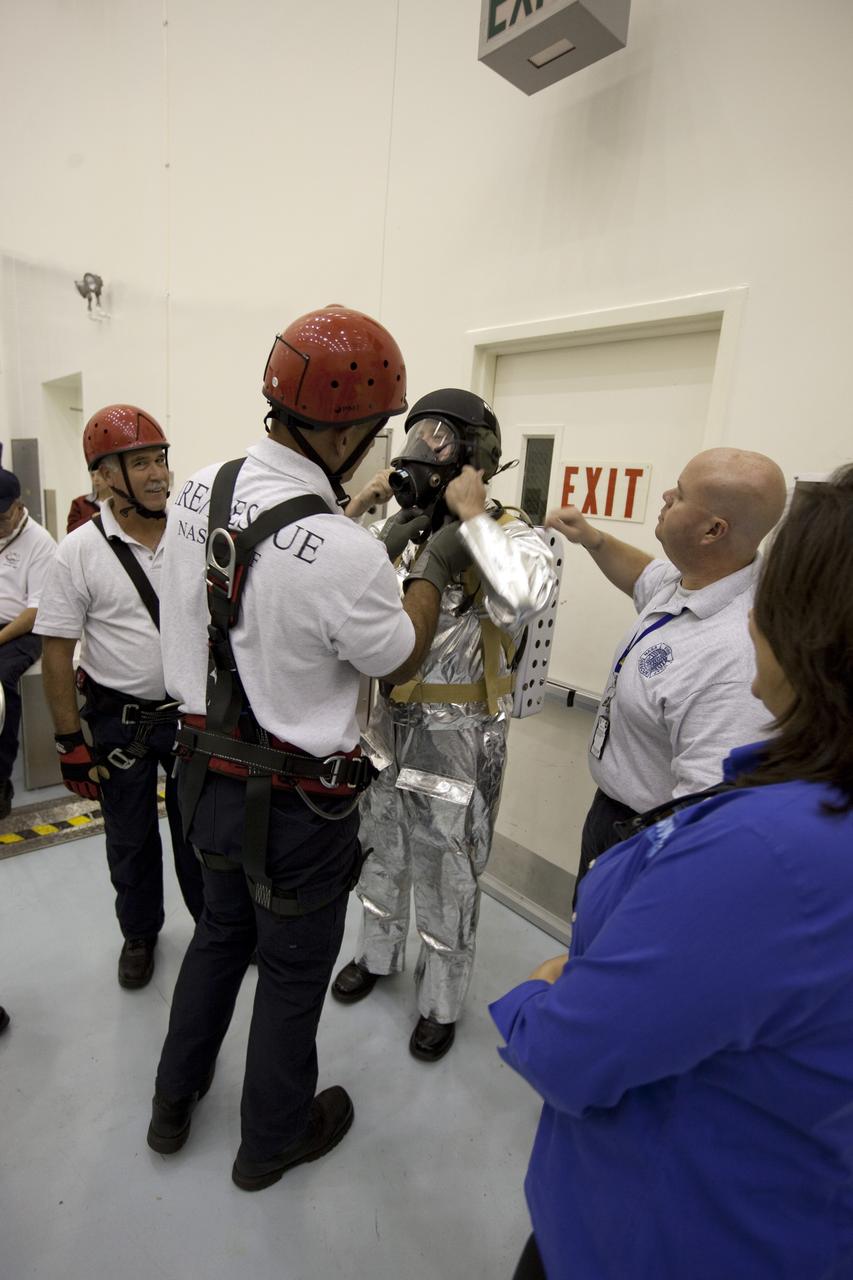
Members of NASA Kennedy Space Center’s Fire Rescue team walk through a mock-up of a launch pad escape basket on Feb. 19, 2020. Kennedy’s prime contractor Reynolds, Smith and Hill presented the mock-up to NASA, fire rescue personnel and other stakeholders at the Florida spaceport. The basket would be utilized at Launch Pad 39B in the unlikely event of an emergency at the pad requiring evacuation during crewed missions under the Artemis Program. The actual egress basket will be designed larger than ones used during the shuttle era in order to accommodate fire rescue crew, astronauts and closeout crew. During the presentation, a fire rescue team conducted a series of trial scenarios and addressed items such as basket release location, seat depth to accommodate firefighters in full gear, sequence of loading and more.
Pad 39B Egress Mock Up
KENNEDY SPACE CENTER, FLA.  -   In a simulated emergency landing of a shuttle crew at NASA Kennedy Space Center's Shuttle Landing Facility, emergency rescue personnel place an "injured astronaut" into a rescue vehicle.  Known as a Mode VI exercise, the operation uses volunteer workers from the Center to pose as astronauts. The purpose of the simulation is to exercise emergency preparedness personnel, equipment and facilities in rescuing astronauts from a downed orbiter and providing immediate medical attention. Photo credit: NASA/Kim Shiflett
KSC-06pd0496
KENNEDY SPACE CENTER, FLA.  -  At NASA Kennedy Space Center's Shuttle Landing Facility, emergency rescue personnel gently place an "injured astronaut" onto a stretcher.  Volunteers and emergency rescue workers are participating in a simulated emergency landing of a shuttle crew. Known as a Mode VI exercise, the operation uses volunteer workers from the Center to pose as astronauts. The purpose of the simulation is to exercise emergency preparedness personnel, equipment and facilities in rescuing astronauts from a downed orbiter and providing immediate medical attention. Photo credit: NASA/Troy Cryder
KSC-06pd0516
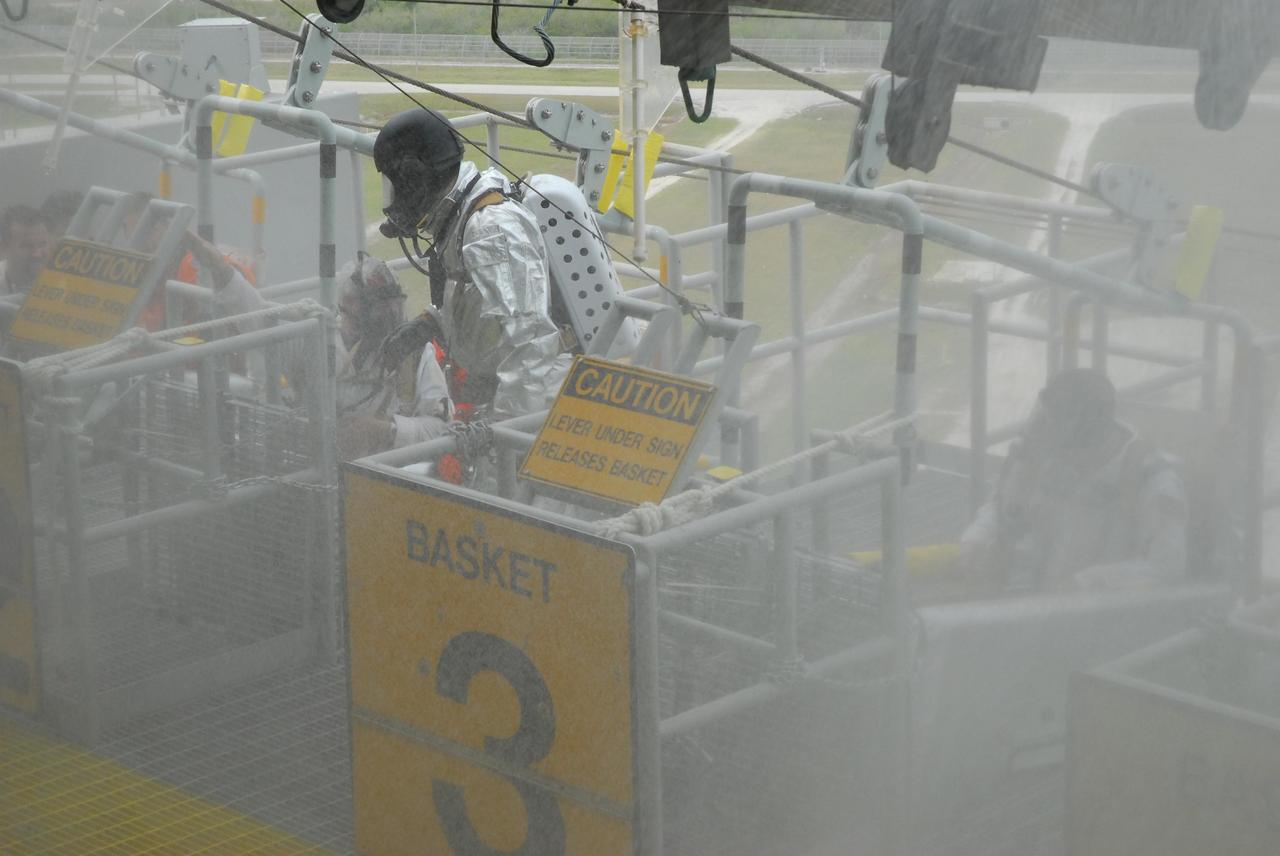
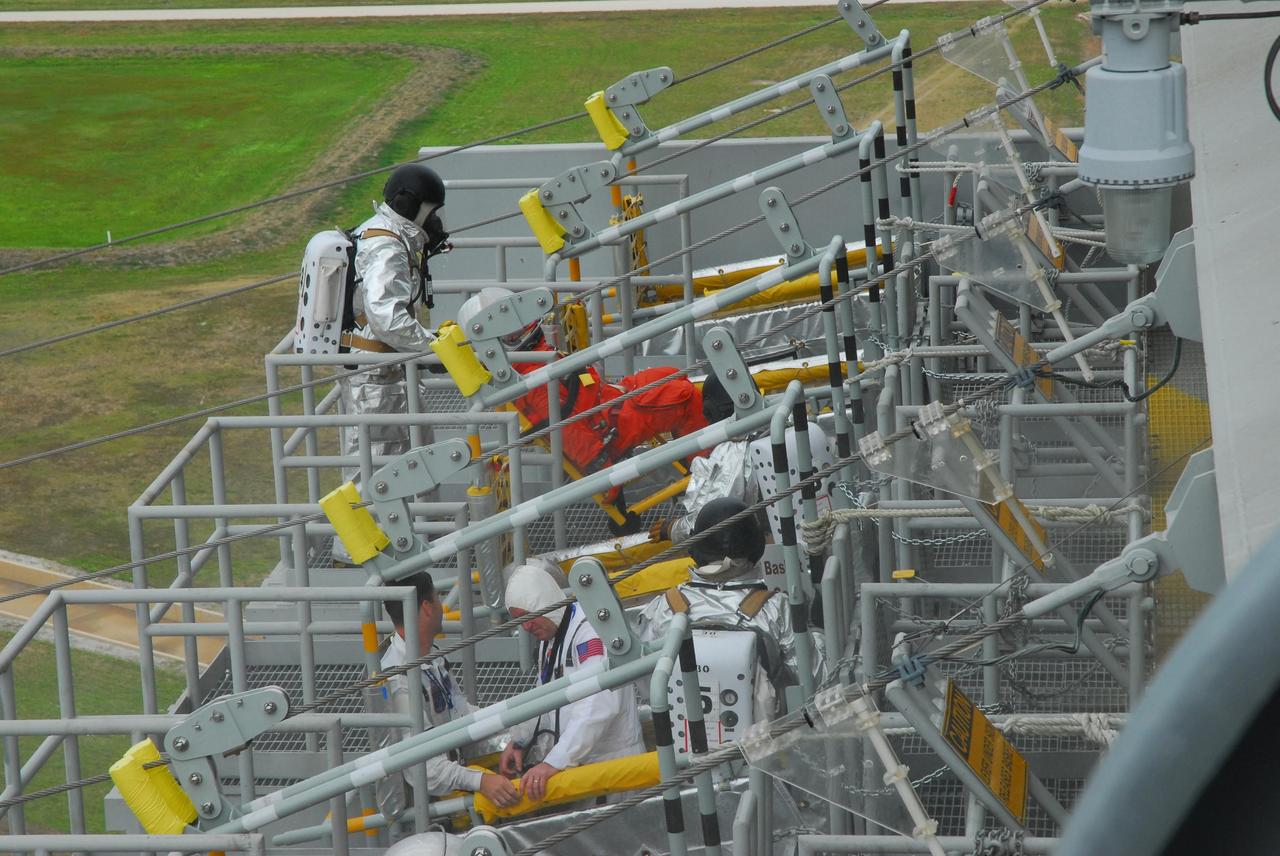
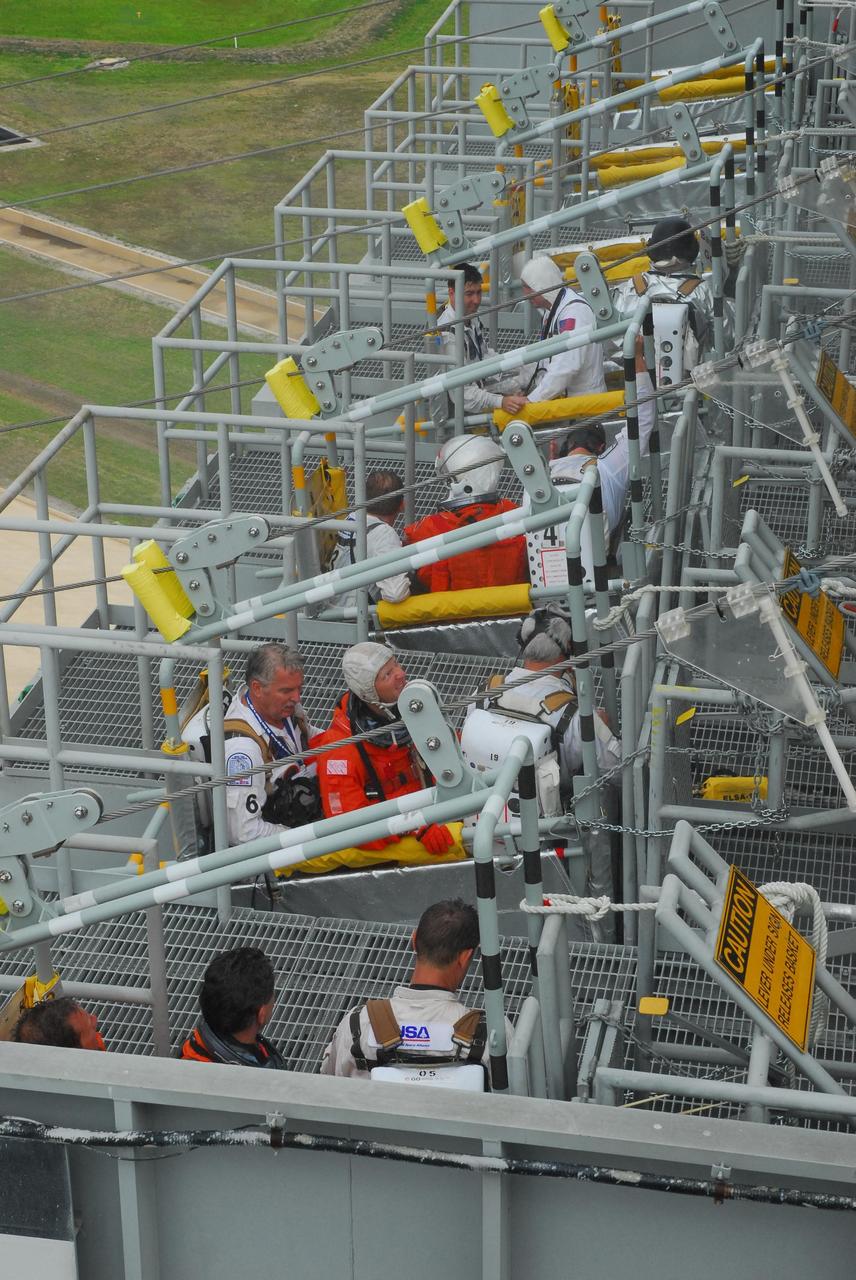
KENNEDY SPACE CENTER, FLA.  -- During a simulated rescue mission on Launch Pad 39A, known as Mode 2,  KSC workers dressed in astronauts' launch-and-entry suits are climbing into the slidewire baskets.  A fire rescue team is simulating extracting the crew from the orbiter and helping them to the baskets.The KSC rescue teams are practicing emergency procedures in the unlikely scenario of a mishap on the pad during a launch sequence.  The exercises are standard training procedures to assess and prepare emergency personnel, procedures and hardware.  Photo credit: NASA/Jack Pfaller
KSC-07pd0806
KENNEDY SPACE CENTER, FLA.  -- During a simulated rescue mission on Launch Pad 39A, known as Mode 2, KSC workers dressed in astronauts' launch-and-entry suits climb into the slidewire baskets.  A fire rescue team is simulating extracting the crew from the orbiter and helping them to the baskets. The KSC rescue teams are practicing emergency procedures in the unlikely scenario of a mishap on the pad during a launch sequence.  The exercises are standard training procedures to assess and prepare emergency personnel, procedures and hardware.  Photo credit: NASA/Jack Pfaller
KSC-07pd0804
KENNEDY SPACE CENTER, FLA.  -  At NASA Kennedy Space Center's Shuttle Landing Facility, emergency rescue personnel begin the simulated emergency rescue of a shuttle crew after landing.  Known as a Mode VI exercise, the operation uses volunteer workers from the Center to pose as astronauts. The purpose of the simulation is to exercise emergency preparedness personnel, equipment and facilities in rescuing astronauts from a downed orbiter and providing immediate medical attention. Photo credit: NASA/Kim Shiflett
KSC-06pd0488
KENNEDY SPACE CENTER, FLA.  -  At NASA Kennedy Space Center's Shuttle Landing Facility, emergency rescue personnel get equipment ready for a simulated emergency rescue of a shuttle crew after landing.  Known as a Mode VI exercise, the operation uses volunteer workers from the Center to pose as astronauts. The purpose of the simulation is to exercise emergency preparedness personnel, equipment and facilities in rescuing astronauts from a downed orbiter and providing immediate medical attention. Photo credit: NASA/Kim Shiflett
KSC-06pd0487
KENNEDY SPACE CENTER, FLA.  -- During a simulated rescue mission on Launch Pad 39A, known as Mode 2,  KSC workers dressed in astronauts' launch-and-entry suits are climbing into the slidewire baskets.  A fire rescue team is simulating extracting the crew from the orbiter and helping them to the baskets.The KSC rescue teams are practicing emergency procedures in the unlikely scenario of a mishap on the pad during a launch sequence.  The exercises are standard training procedures to assess and prepare emergency personnel, procedures and hardware.  Photo credit: NASA/Jack Pfaller
KSC-07pd0805
KENNEDY SPACE CENTER, FLA. - A rescue team carries an “injured” astronaut toward the helicopter for transportation to a local hospital.  They are all taking part in a “Mode VII” emergency landing simulation at Kennedy Space Center.  The purpose of the Mode VII is to exercise emergency preparedness personnel, equipment and facilities in rescuing astronauts from a downed orbiter and providing immediate medical attention.  This simulation presents an orbiter that has crashed short of the Shuttle Landing Facility in a wooded area 2-1/2 miles south of Runway 33.  Emergency crews are responding to the volunteer astronauts who are simulating various injuries inside the crew compartment mock-up.  Rescuers must remove the crew, provide triage and transport to hospitals those who need further treatment.  Local hospitals are participating in the exercise. Emergency crews are responding to the volunteer astronauts who are simulating various injuries inside the crew compartment mock-up.  Rescuers must remove the crew, provide triage and transport to hospitals those who need further treatment.  Local hospitals are participating in the exercise.
KENNEDY SPACE CENTER, FLA. - A rescue team carries an “injured” astronaut toward the helicopter for transportation to a local hospital. They are all taking part in a “Mode VII” emergency landing simulation at Kennedy Space Center. The purpose of the Mode VII is to exercise emergency preparedness personnel, equipment and facilities in rescuing astronauts from a downed orbiter and providing immediate medical attention. This simulation presents an orbiter that has crashed short of the Shuttle Landing Facility in a wooded area 2-1/2 miles south of Runway 33. Emergency crews are responding to the volunteer astronauts who are simulating various injuries inside the crew compartment mock-up. Rescuers must remove the crew, provide triage and transport to hospitals those who need further treatment. Local hospitals are participating in the exercise. Emergency crews are responding to the volunteer astronauts who are simulating various injuries inside the crew compartment mock-up. Rescuers must remove the crew, provide triage and transport to hospitals those who need further treatment. Local hospitals are participating in the exercise.
NASA astronaut Victor Glover (left) participates in emergency egress training with medical and fire-rescue personnel and teams near Launch Complex 39B at the agency’s Kennedy Space Center in Florida on Tuesday, May 6, 2025. During the training, Glover and fellow Artemis II crew members and backup members, along with members of the closeout crew, pad rescue team, and NASA’s Exploration Ground Systems Program practiced procedures in the event of an emergency at the launch pad.
Artemis II crew with EGS
KENNEDY SPACE CENTER, FLA. - Emergency crew members transport an “injured” astronaut during a “Mode VII” emergency landing simulation at Kennedy Space Center.  The purpose of the Mode VII is to exercise emergency preparedness personnel, equipment and facilities in rescuing astronauts from a downed orbiter and providing immediate medical attention.  This simulation presents an orbiter that has crashed short of the Shuttle Landing Facility in a wooded area 2-1/2 miles south of Runway 33.  Emergency crews are responding to the volunteer astronauts who are simulating various injuries.  Rescuers must remove the crew, provide triage and transport to hospitals those who need further treatment.  Local hospitals are participating in the exercise.
KENNEDY SPACE CENTER, FLA. - Emergency crew members transport an “injured” astronaut during a “Mode VII” emergency landing simulation at Kennedy Space Center. The purpose of the Mode VII is to exercise emergency preparedness personnel, equipment and facilities in rescuing astronauts from a downed orbiter and providing immediate medical attention. This simulation presents an orbiter that has crashed short of the Shuttle Landing Facility in a wooded area 2-1/2 miles south of Runway 33. Emergency crews are responding to the volunteer astronauts who are simulating various injuries. Rescuers must remove the crew, provide triage and transport to hospitals those who need further treatment. Local hospitals are participating in the exercise.
KENNEDY SPACE CENTER, FLA. - A helicopter approaches an orbiter crew compartment mock-up as part of a “Mode VII” emergency landing simulation at Kennedy Space Center.  The purpose is to exercise emergency preparedness personnel, equipment and facilities in rescuing astronauts from a downed orbiter and providing immediate medical attention.  This simulation presents an orbiter that has crashed short of the Shuttle Landing Facility in a wooded area 2-1/2 miles south of Runway 33.  Emergency crews will respond to the volunteer “astronauts” simulating various injuries.  Rescuers must remove the crew, provide triage and transport to hospitals those who need further treatment.  Local hospitals are participating in the exercise.
KENNEDY SPACE CENTER, FLA. - A helicopter approaches an orbiter crew compartment mock-up as part of a “Mode VII” emergency landing simulation at Kennedy Space Center. The purpose is to exercise emergency preparedness personnel, equipment and facilities in rescuing astronauts from a downed orbiter and providing immediate medical attention. This simulation presents an orbiter that has crashed short of the Shuttle Landing Facility in a wooded area 2-1/2 miles south of Runway 33. Emergency crews will respond to the volunteer “astronauts” simulating various injuries. Rescuers must remove the crew, provide triage and transport to hospitals those who need further treatment. Local hospitals are participating in the exercise.
NASA Kennedy Space Center’s prime contractor Reynolds, Smith and Hill presents a mock-up of a launch pad escape basket to NASA, Kennedy Fire Rescue personnel and other stakeholders on Feb. 19, 2020. The basket would be utilized at the Florida spaceport’s Launch Pad 39B in the unlikely event of an emergency at the pad requiring evacuation during crewed missions under the Artemis Program. The actual egress basket will be designed larger than ones used during the shuttle era in order to accommodate fire rescue crew, astronauts and closeout crew. During the presentation, a fire rescue team walked through a series of trial scenarios and addressed items such as basket release location, seat depth to accommodate firefighters in full gear, sequence of loading and more.
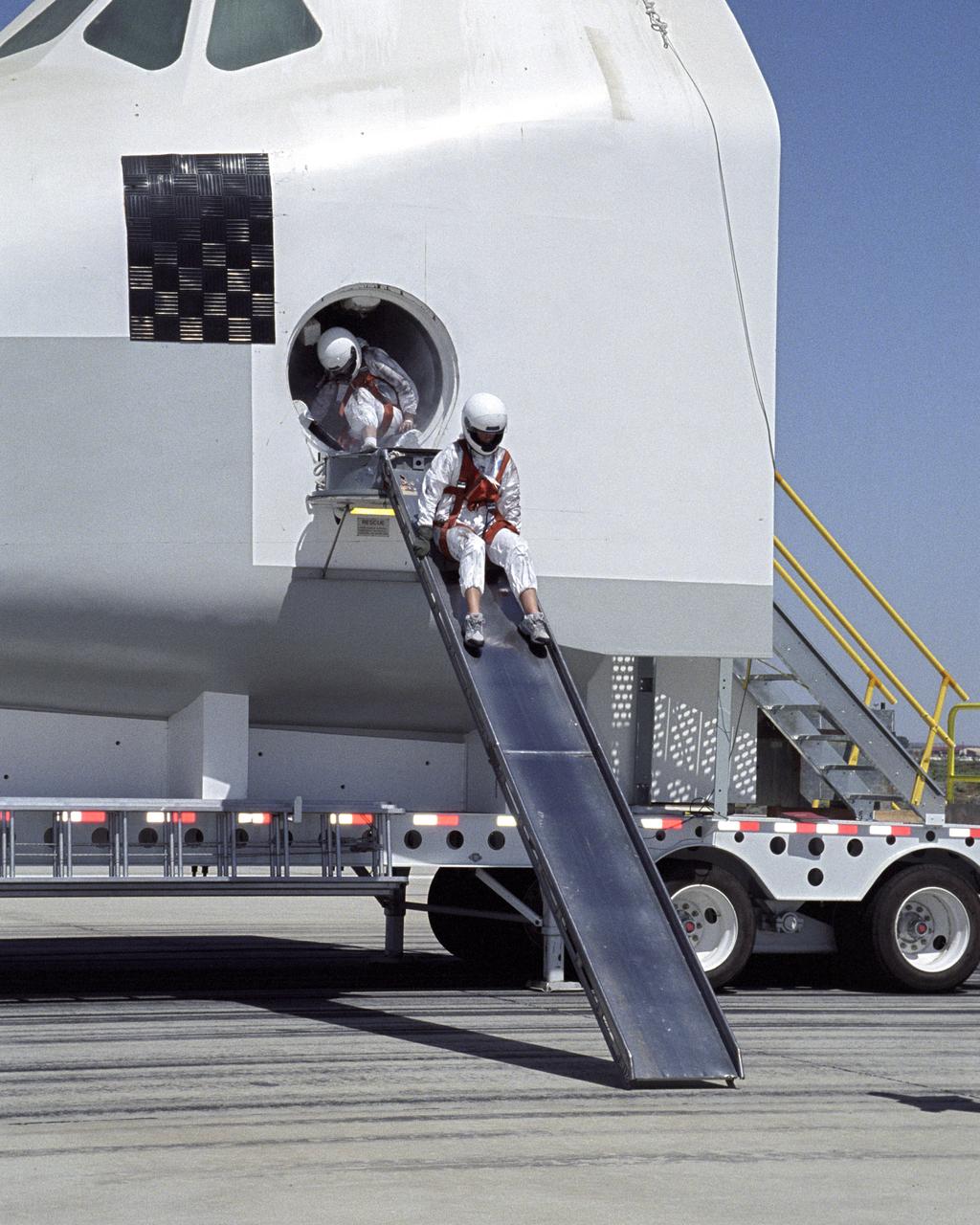
Pad 39B Egress Mock Up
Members of NASA Kennedy Space Center’s Fire Rescue team conduct a series of trial scenarios in a mock-up of a launch pad escape basket on Feb. 19, 2020. Kennedy’s prime contractor Reynolds, Smith and Hill presented the mock-up to NASA, Kennedy Fire Rescue personnel and other stakeholders at the Florida spaceport. The basket would be utilized at Launch Pad 39B in the unlikely event of an emergency at the pad requiring evacuation during crewed missions under the Artemis Program. The actual egress basket will be designed larger than ones used during the shuttle era in order to accommodate fire rescue crew, astronauts and closeout crew. During the presentation, items such as basket release location, seat depth to accommodate firefighters in full gear, sequence of loading and more were addressed. Engineers will take what they learned during this presentation and discussion to advance the design of the pad egress system.
Pad 39B Egress Mock Up
Members of NASA Kennedy Space Center’s Fire Rescue team conduct a series of trial scenarios in a mock-up of a launch pad escape basket on Feb. 19, 2020. Kennedy’s prime contractor Reynolds, Smith and Hill presented the mock-up to NASA, Kennedy Fire Rescue personnel and other stakeholders at the Florida spaceport. The basket would be utilized at Launch Pad 39B in the unlikely event of an emergency at the pad requiring evacuation during crewed missions under the Artemis Program. The actual egress basket will be designed larger than ones used during the shuttle era in order to accommodate fire rescue crew, astronauts and closeout crew. During the presentation, items such as basket release location, seat depth to accommodate firefighters in full gear, sequence of loading and more were addressed. Engineers will take what they learned during this presentation and discussion to advance the design of the pad egress system.
Pad 39B Egress Mock Up
Members of NASA Kennedy Space Center’s Fire Rescue team participate in a series of trial scenarios in a mock-up of a launch pad escape basket on Feb. 19, 2020. Kennedy’s prime contractor Reynolds, Smith and Hill presented the mock-up to NASA, Kennedy Fire Rescue personnel and other stakeholders at the Florida spaceport. The basket would be utilized at Launch Pad 39B in the unlikely event of an emergency at the pad requiring evacuation during crewed missions under the Artemis Program. The actual egress basket will be designed larger than ones used during the shuttle era in order to accommodate fire rescue crew, astronauts and closeout crew. During the presentation, items such as basket release location, seat depth to accommodate firefighters in full gear, sequence of loading and more were addressed. Engineers will take what they learned during this presentation and discussion to advance the design of the pad egress system.
Pad 39B Egress Mock Up
A C-17 Globemaster aircraft from the Alaska Air National Guard’s 249th Airlift Squadron flies overhead as pararescue specialists from the 304th Rescue Squadron, located in Portland, Oregon complete an astronaut rescue training exercise inside a covered life raft on the Atlantic Ocean. The pararescue specialists, supporting the 45th Operations Group’s Detachment 3, based out of Patrick Air Force Base, conducted the exercise in April with NASA’s Commercial Crew Program and SpaceX off of Florida’s eastern coast. The specially designed 20-person life raft is equipped with enough food, water and medical supplies to sustain both rescuers and crew for up to three days, if necessary. In this situation, the Department of Defense (DOD) would complete the rescue by enlisting help from the US Coast Guard, a DOD ship, or a nearby commercial ship of opportunity to transport the crew to safety.
SpaceX Recovery Trainer Egress and Handling Testing
NASA Kennedy Space Center’s prime contractor Reynolds, Smith and Hill presents a mock-up of a launch pad escape basket to NASA, Kennedy Fire Rescue personnel and other stakeholders on Feb. 19, 2020. The basket would be utilized at the Florida spaceport’s Launch Pad 39B in the unlikely event of an emergency at the pad requiring evacuation during crewed missions under the Artemis Program. The actual egress basket will be designed larger than ones used during the shuttle era in order to accommodate fire rescue crew, astronauts and closeout crew. During the presentation, a fire rescue team walked through a series of trial scenarios and addressed items such as basket release location, seat depth to accommodate firefighters in full gear, sequence of loading and more.
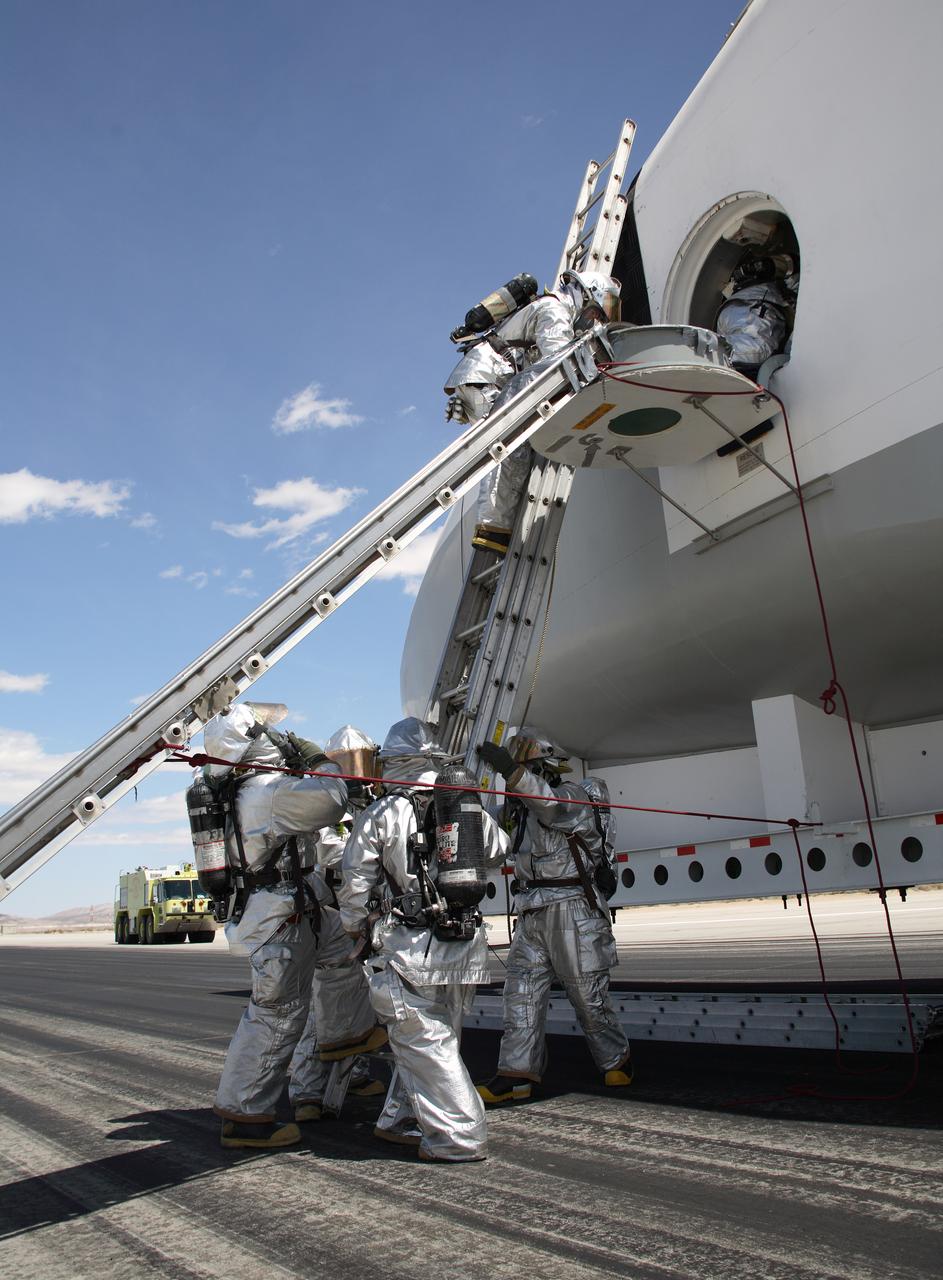
Pad 39B Egress Mock Up
NASA Kennedy Space Center’s prime contractor Reynolds, Smith and Hill presents a mock-up of a launch pad escape basket to NASA, Kennedy Fire Rescue personnel and other stakeholders on Feb. 19, 2020. The basket would be utilized at the Florida spaceport’s Launch Pad 39B in the unlikely event of an emergency at the pad requiring evacuation during crewed missions under the Artemis Program. The actual egress basket will be designed larger than ones used during the shuttle era in order to accommodate fire rescue crew, astronauts and closeout crew. During the presentation, a fire rescue team walked through a series of trial scenarios and addressed items such as basket release location, seat depth to accommodate firefighters in full gear, sequence of loading and more.
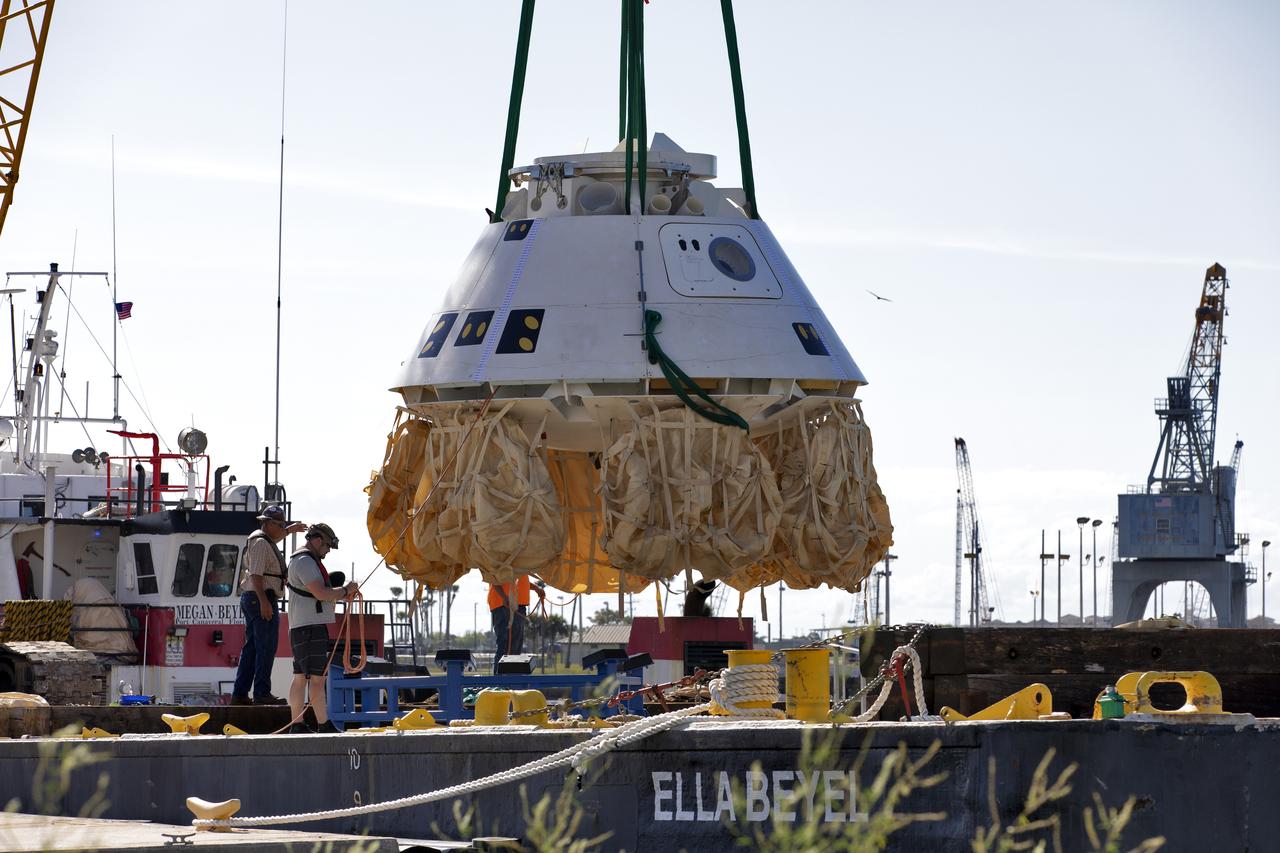
Pad 39B Egress Mock Up
Members of NASA Kennedy Space Center’s Fire Rescue team conduct a series of trial scenarios in a mock-up of a launch pad escape basket on Feb. 19, 2020. Kennedy’s prime contractor Reynolds, Smith and Hill presented the mock-up to NASA, Kennedy Fire Rescue personnel and other stakeholders at the Florida spaceport. The basket would be utilized at Launch Pad 39B in the unlikely event of an emergency at the pad requiring evacuation during crewed missions under the Artemis Program. The actual egress basket will be designed larger than ones used during the shuttle era in order to accommodate fire rescue crew, astronauts and closeout crew. During the presentation, items such as basket release location, seat depth to accommodate firefighters in full gear, sequence of loading and more were addressed. Engineers will take what they learned during this presentation and discussion to advance the design of the pad egress system.
Pad 39B Egress Mock Up
On Feb. 19, 2020, at NASA’s Kennedy Space Center in Florida, prime contractor Reynolds, Smith and Hill presents a mock-up of a launch pad escape basket to NASA, Kennedy Fire Rescue personnel and other stakeholders. The basket would be utilized at Launch Pad 39B in the unlikely event of an emergency at the pad requiring evacuation during crewed missions under the Artemis Program. The actual egress basket will be designed larger than ones used during the shuttle era in order to accommodate fire rescue crew, astronauts and closeout crew. During the presentation, a fire rescue team walked through a series of trial scenarios and addressed items such as basket release location, seat depth to accommodate firefighters in full gear, sequence of loading and more.
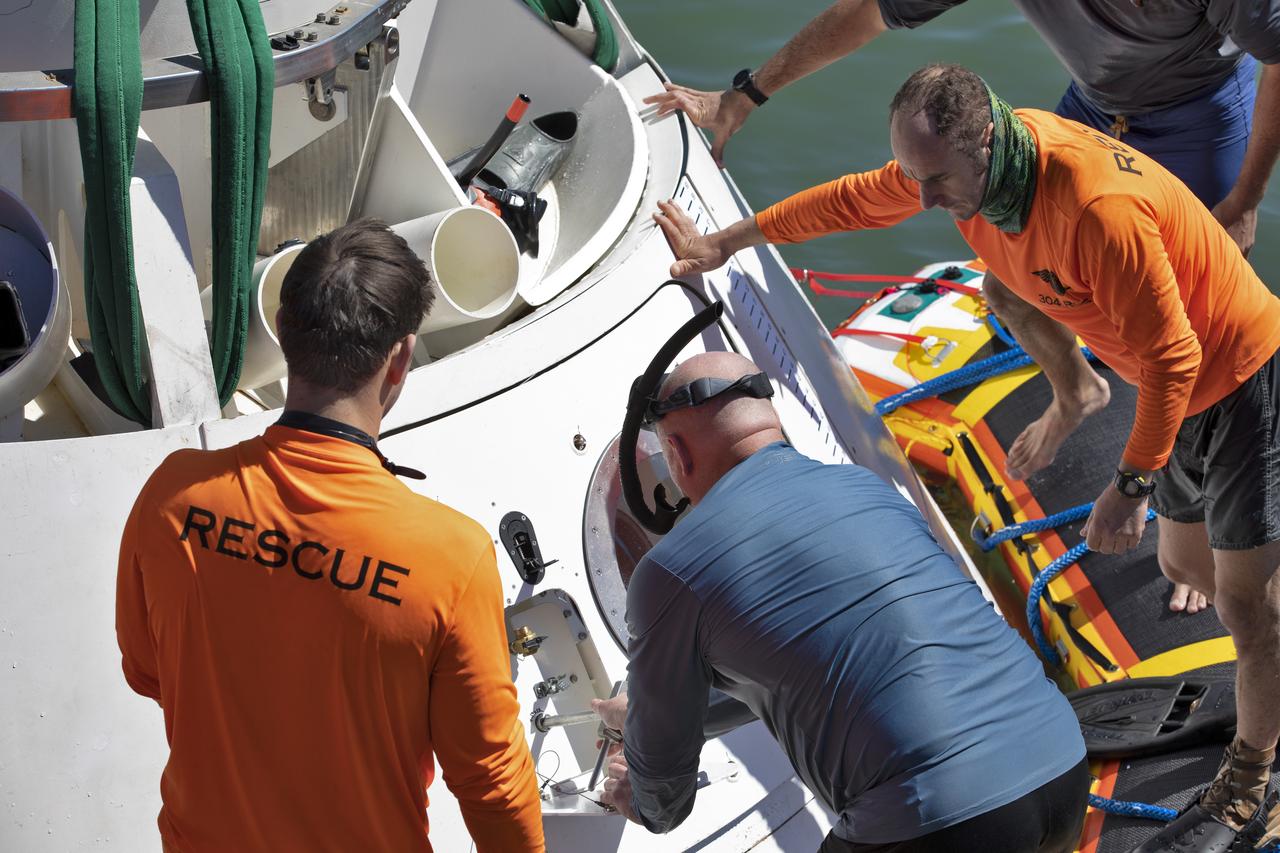
Pad 39B Egress Mock Up
Pararescue specialists from the 304th Rescue Squadron, located in Portland, Oregon and supporting the 45th Operations Group’s Detachment 3, based out of Patrick Air Force Base, secure a covered life raft as the sun sets during an astronaut rescue training exercise with NASA’s Commercial Crew Program and SpaceX off of Florida’s eastern coast in April. The specially designed 20-person life raft is equipped with enough food, water and medical supplies to sustain both rescuers and crew for up to three days, if necessary. In this situation, the Department of Defense (DOD) would complete the rescue by enlisting help from the US Coast Guard, a DOD ship, or a nearby commercial ship of opportunity to transport the crew to safety.
SpaceX Recovery Trainer Egress and Handling Testing
Members of NASA Kennedy Space Center’s Fire Rescue team conduct a series of trial scenarios in a mock-up of a launch pad escape basket on Feb. 19, 2020. Kennedy’s prime contractor Reynolds, Smith and Hill presented the mock-up to NASA, Kennedy Fire Rescue personnel and other stakeholders at the Florida spaceport. The basket would be utilized at Launch Pad 39B in the unlikely event of an emergency at the pad requiring evacuation during crewed missions under the Artemis Program. The actual egress basket will be designed larger than ones used during the shuttle era in order to accommodate fire rescue crew, astronauts and closeout crew. During the presentation, items such as basket release location, seat depth to accommodate firefighters in full gear, sequence of loading and more were addressed. Engineers will take what they learned during this presentation and discussion to advance the design of the pad egress system.
Pad 39B Egress Mock Up
CAPE CANAVERAL, Fla. --   On Launch Pad 39B at NASA's Kennedy Space Center, a group of NASA and contractor workers from Kennedy Space Center and other NASA centers, along with the Department of Defense, participate in a flight crew evacuation drill, also referred to as the Mode II/IV Simulation. During the exercise, an emergency condition during launch countdown was simulated and participants did their parts to perform an emergency egress of the flight and ground crew, including the slidewire system.  With the simulated emergency in play, Fire Rescue and Closeout Crew workers aided in the extraction and rescue of the crew.  Photo credit: NASA/Kim Shiflett
KSC-08pd0928
CAPE CANAVERAL, Fla. --   On Launch Pad 39B at NASA's Kennedy Space Center, a group of NASA and contractor workers from Kennedy Space Center and other NASA centers, along with the Department of Defense, participate in a flight crew evacuation drill, also referred to as the Mode II/IV Simulation. During the exercise, an emergency condition during launch countdown was simulated and participants did their parts to perform an emergency egress of the flight and ground crew, in this case from the 195-foot level of the fixed service structure.  With the simulated emergency in play, Fire Rescue and Closeout Crew workers aided in the extraction and rescue of the crew.  Photo credit: NASA/Kim Shiflett
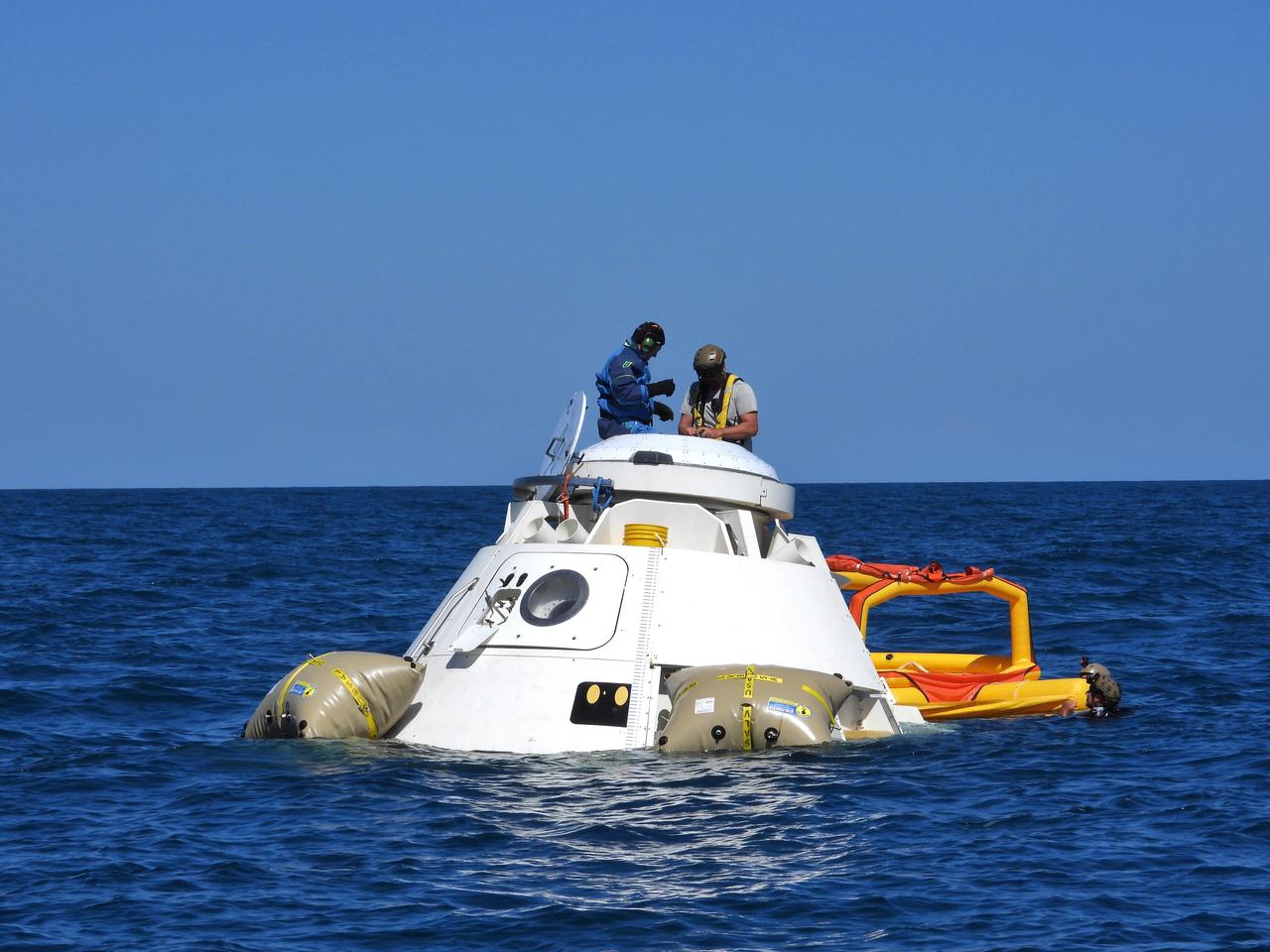
KSC-08pd0929
CAPE CANAVERAL, Fla. -- In the Multi-Payload Processing Facility at NASA's Kennedy Space Center in Florida, workers take photos and video of fire and rescue personnel, as well as a closeout crew, participating in an exercise known as crew egress evaluation from an Orion mock-up. The spacecraft is replicated in all areas that could affect a crew's escape, including the area that seals to a launch pad's White Room. The exercise focuses on whether astronauts and their rescue crews can exit the vehicle quickly in the event of a pad emergency.       For more information on Orion, visit www.nasa.gov/orion. Photo credit: NASA/Dimitri Gerondidakis
KSC-2010-5175
CAPE CANAVERAL, Fla. -- On Launch Pad 39B at NASA's Kennedy Space Center, a group of NASA and contractor workers from Kennedy Space Center and other NASA centers, along with the Department of Defense, participate in a flight crew evacuation drill, also referred to as the Mode II/IV Simulation. During the exercise, an emergency condition during launch countdown was simulated and participants did their parts to perform an emergency egress of the flight and ground crew.  With the simulated emergency in play, Fire Rescue and Closeout Crew workers aided in the extraction and rescue of the crew.   Photo credit: NASA/Kim Shiflett
KSC-08pd0925
CAPE CANAVERAL, Fla. --  On Launch Pad 39B at NASA's Kennedy Space Center, a group of NASA and contractor workers from Kennedy Space Center and other NASA centers, along with the Department of Defense, participate in a flight crew evacuation drill, also referred to as the Mode II/IV Simulation. During the exercise, an emergency condition during launch countdown was simulated and participants did their parts to perform an emergency egress of the flight and ground crew, including the slidewire system.  With the simulated emergency in play, Fire Rescue and Closeout Crew workers aided in the extraction and rescue of the crew.  Photo credit: NASA/Kim Shiflett
KSC-08pd0926
CAPE CANAVERAL, Fla. --   On Launch Pad 39B at NASA's Kennedy Space Center, a group of NASA and contractor workers from Kennedy Space Center and other NASA centers, along with the Department of Defense, participate in a flight crew evacuation drill, also referred to as the Mode II/IV Simulation. During the exercise, an emergency condition during launch countdown was simulated and participants did their parts to perform an emergency egress of the flight and ground crew, including the slidewire system.  With the simulated emergency in play, Fire Rescue and Closeout Crew workers aided in the extraction and rescue of the crew.  Photo credit: NASA/Kim Shiflett
KSC-08pd0927
CAPE CANAVERAL, Fla. -- In the Multi-Payload Processing Facility at NASA's Kennedy Space Center in Florida, fire and rescue personnel, as well as a closeout crew, participate in an exercise known as crew egress evaluation from an Orion mock-up. The spacecraft is replicated in all areas that could affect a crew's escape, including the area that seals to a launch pad's White Room. The exercise focuses on whether astronauts and their rescue crews can exit the vehicle quickly in the event of a pad emergency.       For more information on Orion, visit www.nasa.gov/orion. Photo credit: NASA/Dimitri Gerondidakis
KSC-2010-5176