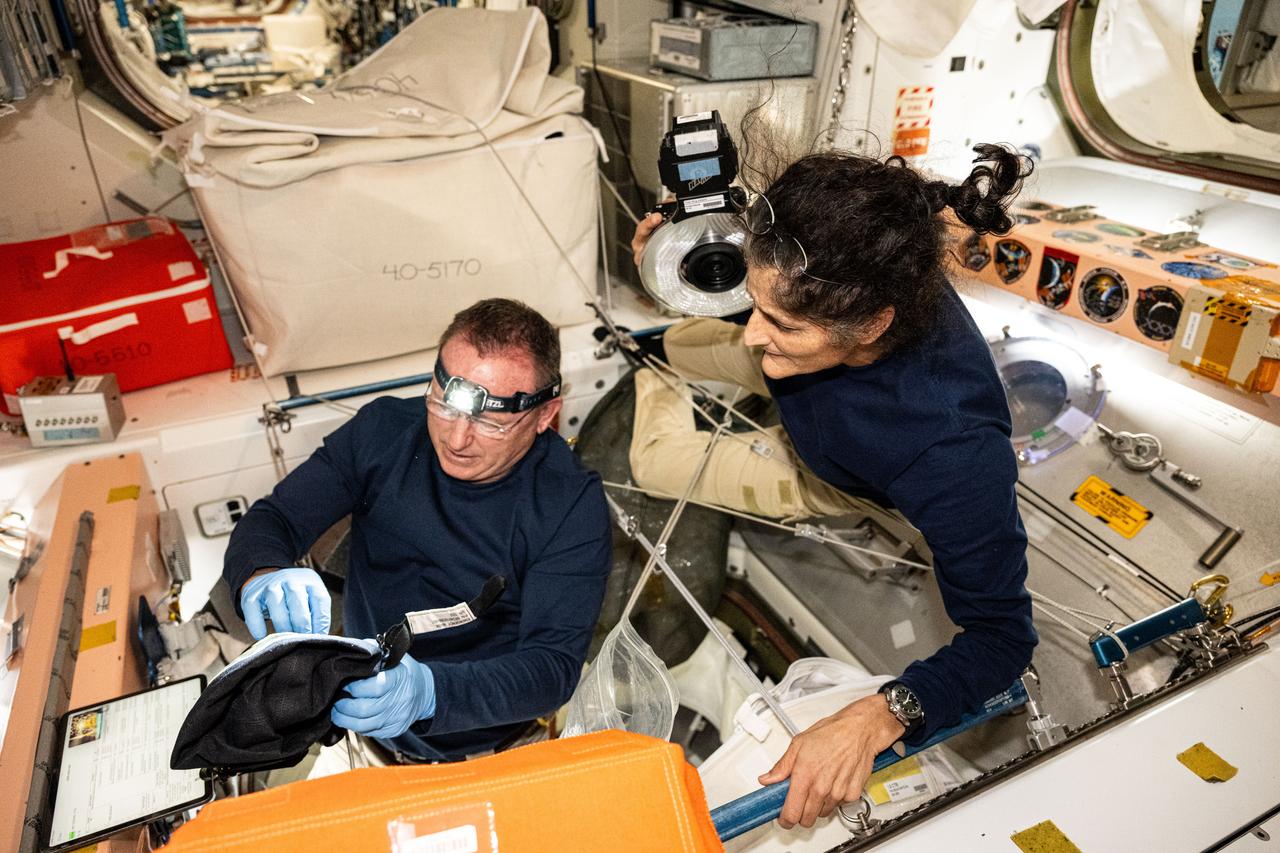
iss071e513842 (Aug. 9, 2024) --- NASA astronauts Butch Wilmore and Suni Williams, Boeing's Crew Flight Test Commander and Pilot respectively, inspect safety hardware aboard the International Space Station.
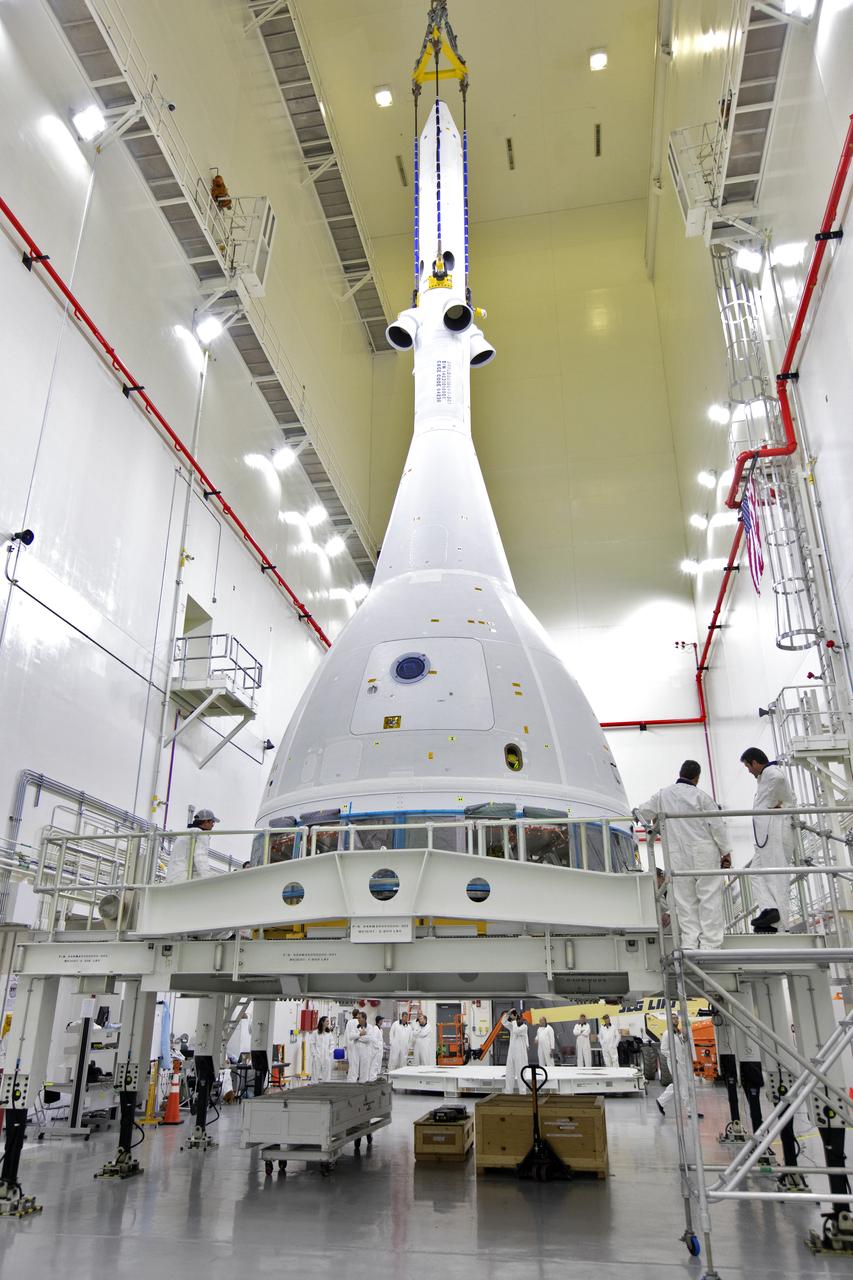
Inside the Launch Abort System Facility (LASF) at NASA’s Kennedy Space Center in Florida, a test version of the Orion crew module has been integrated with the Launch Abort System (LAS) on May 18, 2019. The test vehicle and the LAS will be used for the Orion Ascent Abort-2 (AA-2) Flight Test. AA-2 is a full-stress test of the LAS, planned for July 2. AA-2 will launch from Space Launch Complex 46, carrying a fully functional LAS and a 22,000-pound Orion test vehicle to an altitude of 31,000 feet and traveling at more than 1,000 miles an hour. The test will verify the LAS can steer the crew module and astronauts aboard to safety if an emergency occurs during ascent on the Space Launch System (SLS) rocket. NASA's Orion and Exploration Ground Systems programs, contractors Jacob's, Lockheed Martin and Northrop Grumman, in conjunction with the Air Force Space and Missile Center's Launch Operations branch and the 45th Space Wing are performing flight operations for AA-2.
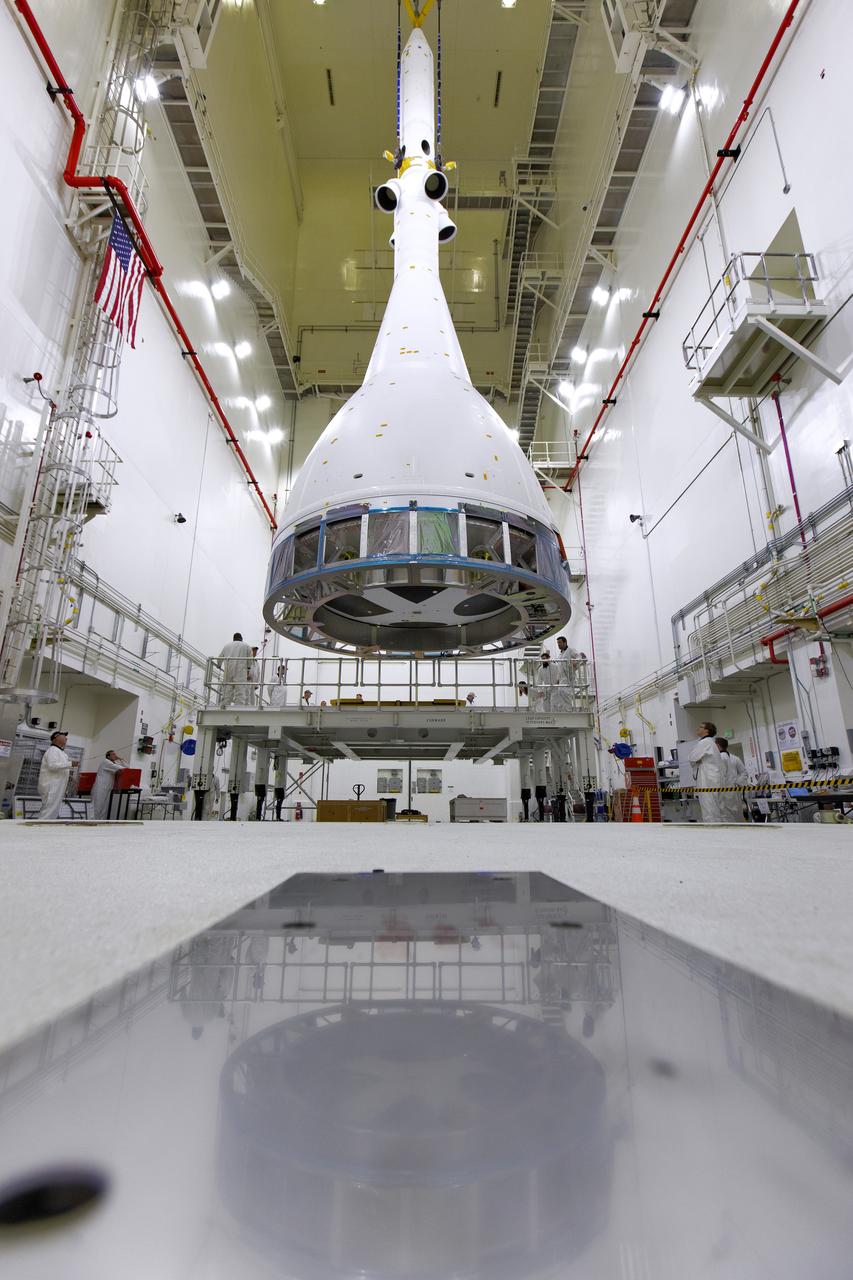
Inside the Launch Abort System Facility (LASF) at NASA’s Kennedy Space Center in Florida, a test version of the Orion crew module has been integrated with the Launch Abort System (LAS) on May 18, 2019. It is being lifted by crane for transfer to a KAMAG transporter. The test vehicle and the LAS will be used for the Orion Ascent Abort-2 (AA-2) Flight Test. AA-2 is a full-stress test of the LAS, planned for July 2. AA-2 will launch from Space Launch Complex 46, carrying a fully functional LAS and a 22,000-pound Orion test vehicle to an altitude of 31,000 feet and traveling at more than 1,000 miles an hour. The test will verify the LAS can steer the crew module and astronauts aboard to safety if an emergency occurs during ascent on the Space Launch System (SLS) rocket. NASA's Orion and Exploration Ground Systems programs, contractors Jacob's, Lockheed Martin and Northrop Grumman, in conjunction with the Air Force Space and Missile Center's Launch Operations branch and the 45th Space Wing are performing flight operations for AA-2.
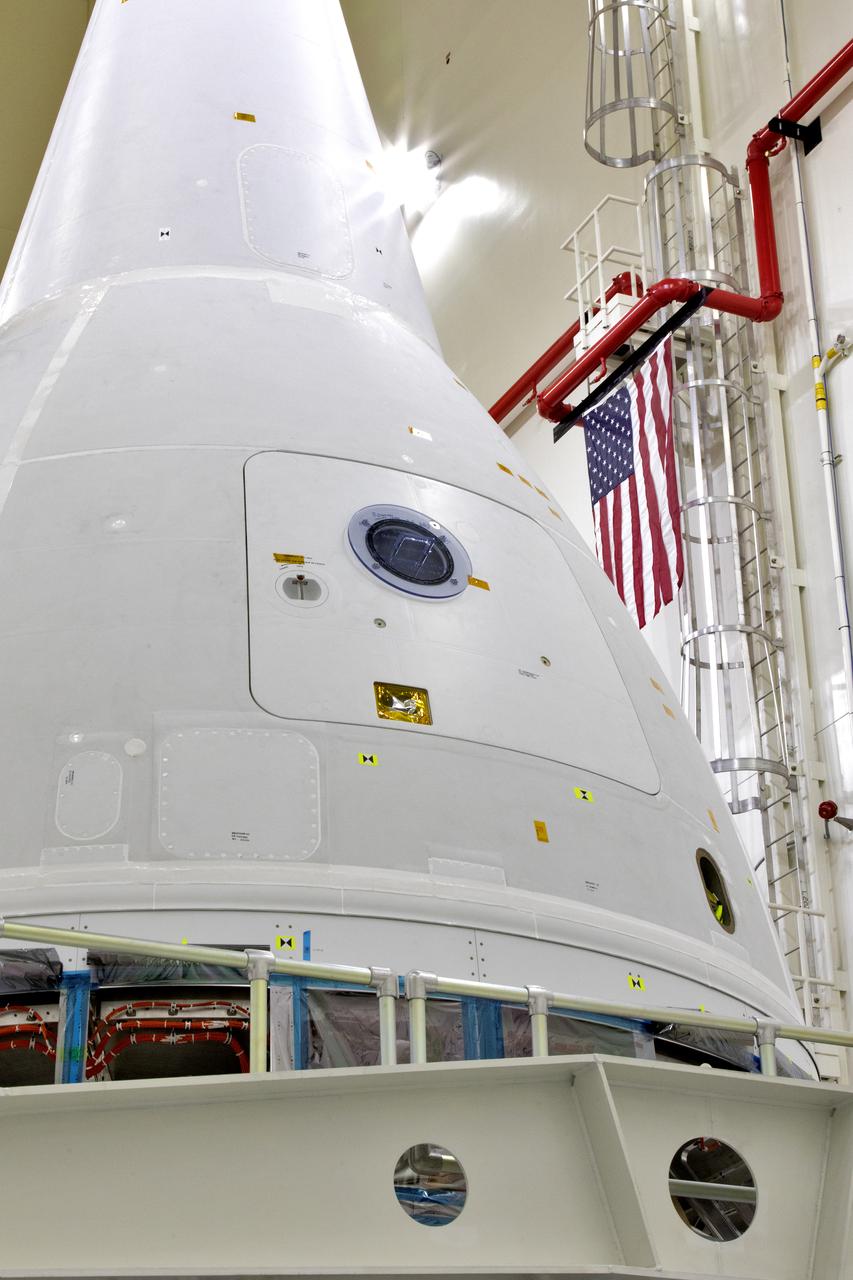
Inside the Launch Abort System Facility (LASF) at NASA’s Kennedy Space Center in Florida, a test version of the Orion crew module has been integrated with the Launch Abort System (LAS) on May 18, 2019. The test vehicle and the LAS will be used for the Orion Ascent Abort-2 (AA-2) Flight Test. AA-2 is a full-stress test of the LAS, planned for July 2. AA-2 will launch from Space Launch Complex 46, carrying a fully functional LAS and a 22,000-pound Orion test vehicle to an altitude of 31,000 feet and traveling at more than 1,000 miles an hour. The test will verify the LAS can steer the crew module and astronauts aboard to safety if an emergency occurs during ascent on the Space Launch System (SLS) rocket. NASA's Orion and Exploration Ground Systems programs, contractors Jacob's, Lockheed Martin and Northrop Grumman, in conjunction with the Air Force Space and Missile Center's Launch Operations branch and the 45th Space Wing are performing flight operations for AA-2.
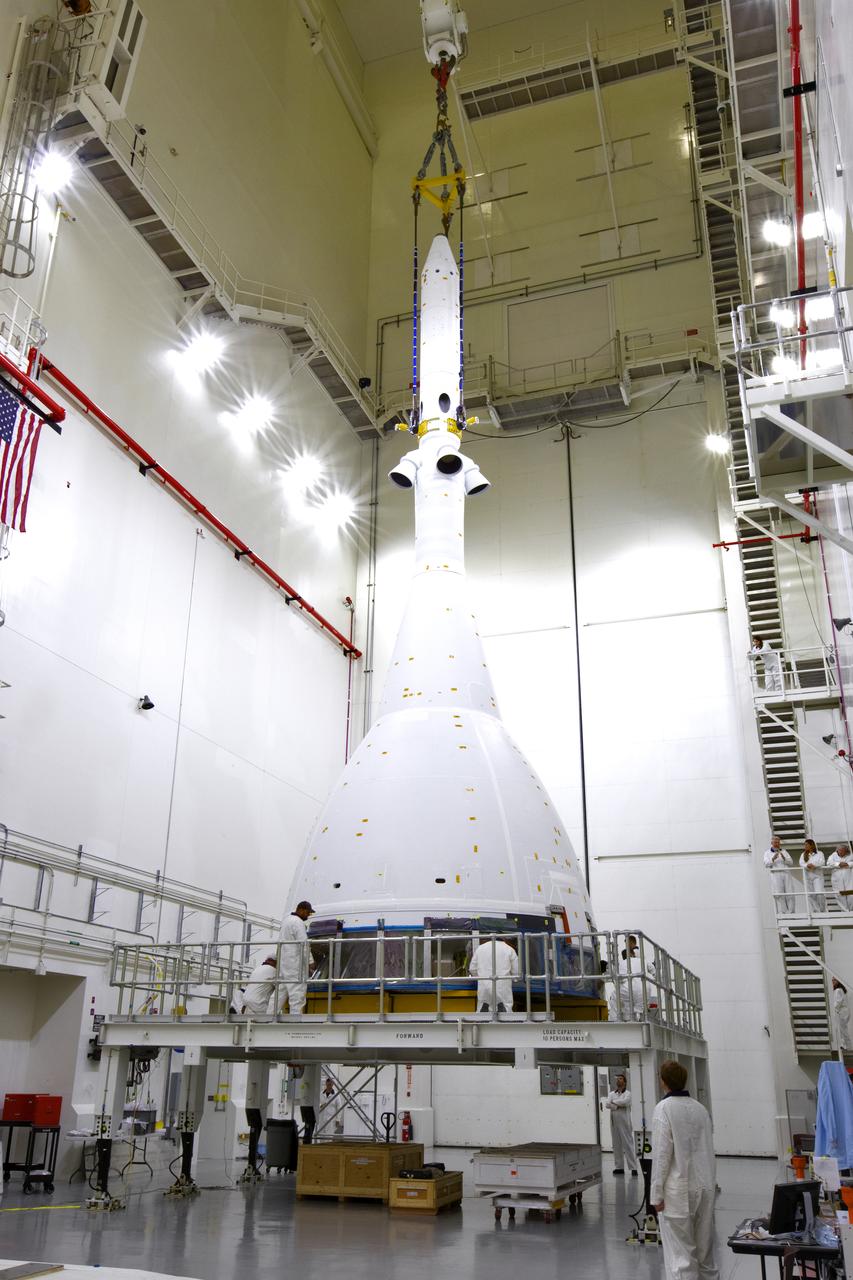
Inside the Launch Abort System Facility (LASF) at NASA’s Kennedy Space Center in Florida, a test version of the Orion crew module has been integrated with the Launch Abort System (LAS) on May 18, 2019. The test vehicle and the LAS will be used for the Orion Ascent Abort-2 (AA-2) Flight Test. AA-2 is a full-stress test of the LAS, planned for July 2. AA-2 will launch from Space Launch Complex 46, carrying a fully functional LAS and a 22,000-pound Orion test vehicle to an altitude of 31,000 feet and traveling at more than 1,000 miles an hour. The test will verify the LAS can steer the crew module and astronauts aboard to safety if an emergency occurs during ascent on the Space Launch System (SLS) rocket. NASA's Orion and Exploration Ground Systems programs, contractors Jacob's, Lockheed Martin and Northrop Grumman, in conjunction with the Air Force Space and Missile Center's Launch Operations branch and the 45th Space Wing are performing flight operations for AA-2.
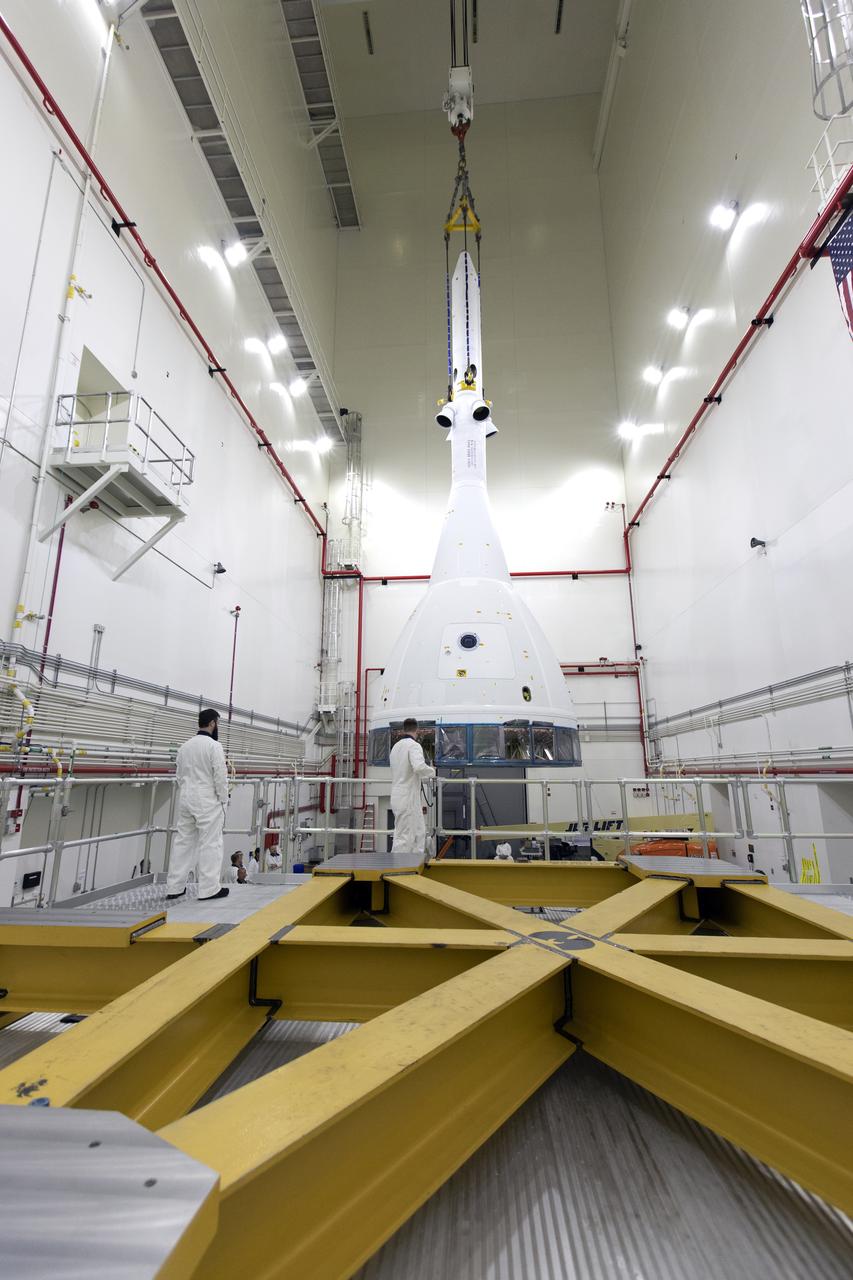
Inside the Launch Abort System Facility (LASF) at NASA’s Kennedy Space Center in Florida, workers are completing the integration of a test version of the Orion crew module with the Launch Abort System (LAS) on May 18, 2019. The test vehicle and the LAS will be used for the Orion Ascent Abort-2 (AA-2) Flight Test. AA-2 is a full-stress test of the LAS, planned for July 2. AA-2 will launch from Space Launch Complex 46, carrying a fully functional LAS and a 22,000-pound Orion test vehicle to an altitude of 31,000 feet and traveling at more than 1,000 miles an hour. The test will verify the LAS can steer the crew module and astronauts aboard to safety if an emergency occurs during ascent on the Space Launch System (SLS) rocket. NASA's Orion and Exploration Ground Systems programs, contractors Jacob's, Lockheed Martin and Northrop Grumman, in conjunction with the Air Force Space and Missile Center's Launch Operations branch and the 45th Space Wing are performing flight operations for AA-2.
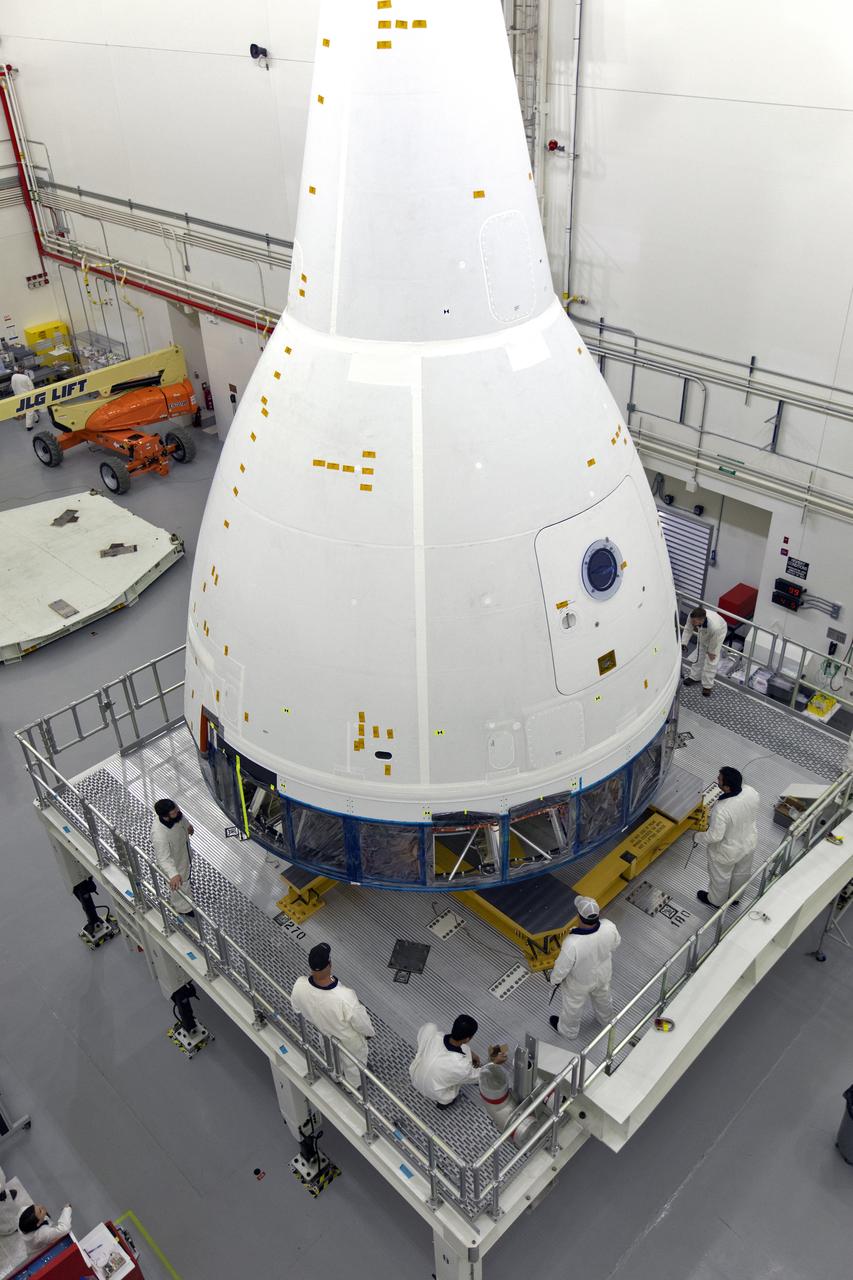
Inside the Launch Abort System Facility (LASF) at NASA’s Kennedy Space Center in Florida, workers are completing the integration of a test version of the Orion crew module with the Launch Abort System (LAS) on May 18, 2019. The test vehicle and the LAS will be used for the Orion Ascent Abort-2 (AA-2) Flight Test. AA-2 is a full-stress test of the LAS, planned for July 2. AA-2 will launch from Space Launch Complex 46, carrying a fully functional LAS and a 22,000-pound Orion test vehicle to an altitude of 31,000 feet and traveling at more than 1,000 miles an hour. The test will verify the LAS can steer the crew module and astronauts aboard to safety if an emergency occurs during ascent on the Space Launch System (SLS) rocket. NASA's Orion and Exploration Ground Systems programs, contractors Jacob's, Lockheed Martin and Northrop Grumman, in conjunction with the Air Force Space and Missile Center's Launch Operations branch and the 45th Space Wing are performing flight operations for AA-2.
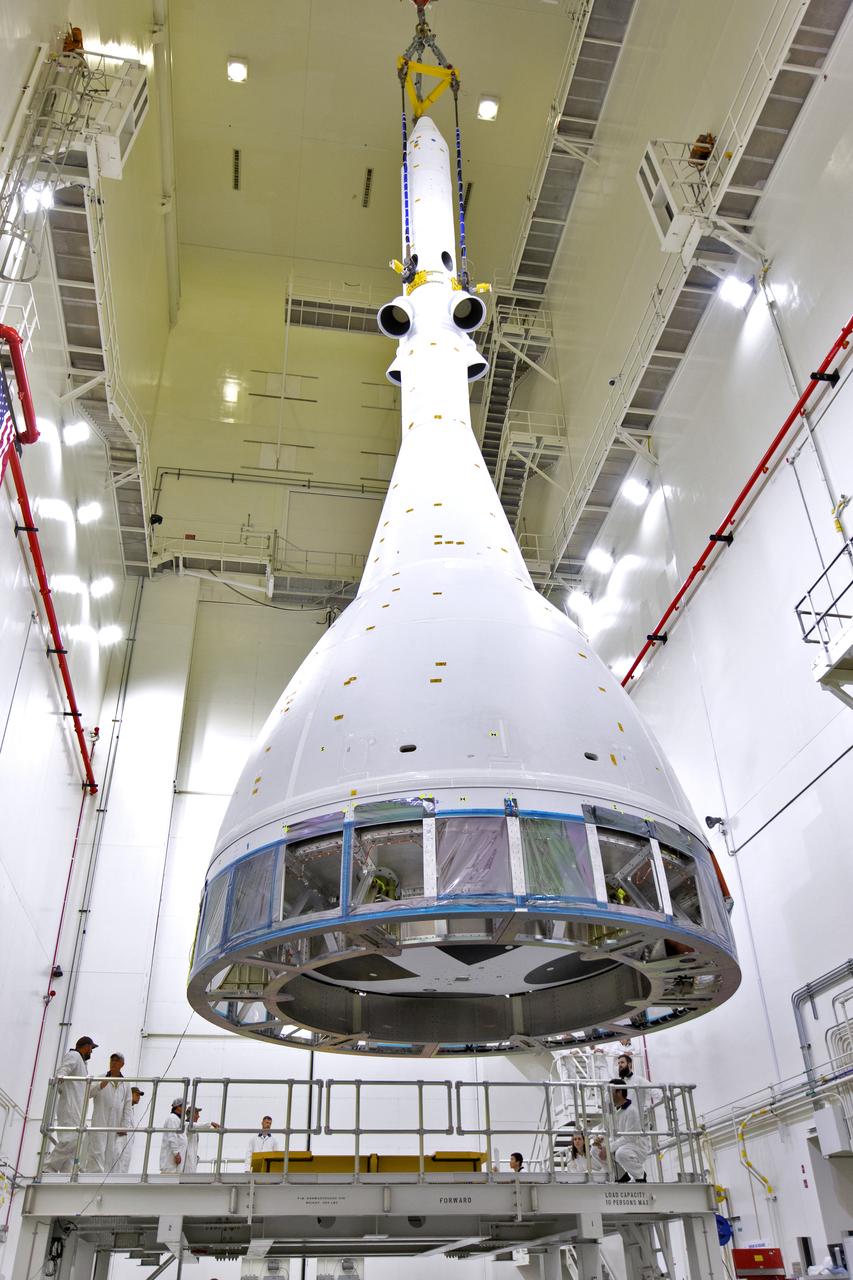
Inside the Launch Abort System Facility (LASF) at NASA’s Kennedy Space Center in Florida, a test version of the Orion crew module has been integrated with the Launch Abort System (LAS) on May 18, 2019. It is being lifted by crane for transfer to a KAMAG transporter. The test vehicle and the LAS will be used for the Orion Ascent Abort-2 (AA-2) Flight Test. AA-2 is a full-stress test of the LAS, planned for July 2. AA-2 will launch from Space Launch Complex 46, carrying a fully functional LAS and a 22,000-pound Orion test vehicle to an altitude of 31,000 feet and traveling at more than 1,000 miles an hour. The test will verify the LAS can steer the crew module and astronauts aboard to safety if an emergency occurs during ascent on the Space Launch System (SLS) rocket. NASA's Orion and Exploration Ground Systems programs, contractors Jacob's, Lockheed Martin and Northrop Grumman, in conjunction with the Air Force Space and Missile Center's Launch Operations branch and the 45th Space Wing are performing flight operations for AA-2.
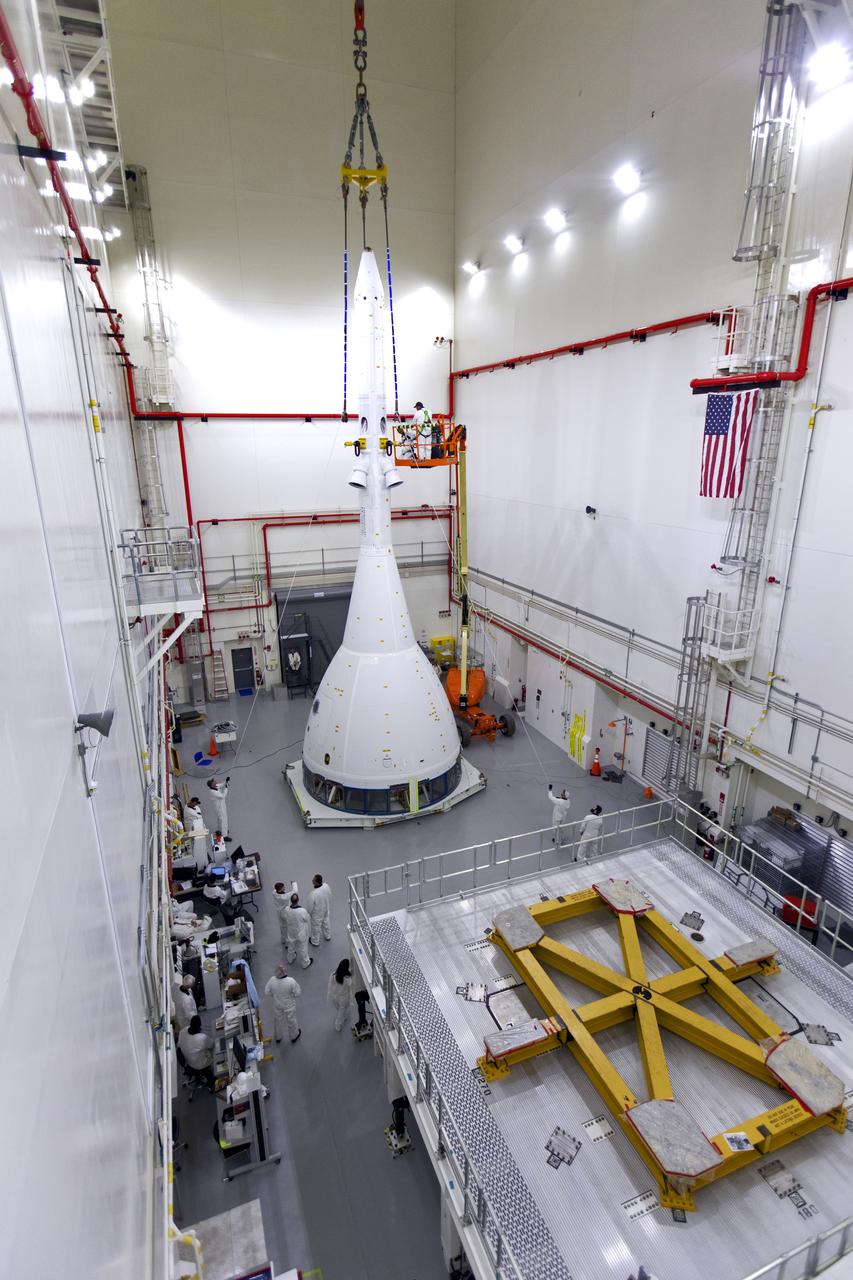
Inside the Launch Abort System Facility (LASF) at NASA’s Kennedy Space Center in Florida, workers are completing the integration of a test version of the Orion crew module with the Launch Abort System (LAS) on May 18, 2019. The test vehicle and the LAS will be used for the Orion Ascent Abort-2 (AA-2) Flight Test. AA-2 is a full-stress test of the LAS, planned for July 2. AA-2 will launch from Space Launch Complex 46, carrying a fully functional LAS and a 22,000-pound Orion test vehicle to an altitude of 31,000 feet and traveling at more than 1,000 miles an hour. The test will verify the LAS can steer the crew module and astronauts aboard to safety if an emergency occurs during ascent on the Space Launch System (SLS) rocket. NASA's Orion and Exploration Ground Systems programs, contractors Jacob's, Lockheed Martin and Northrop Grumman, in conjunction with the Air Force Space and Missile Center's Launch Operations branch and the 45th Space Wing are performing flight operations for AA-2.
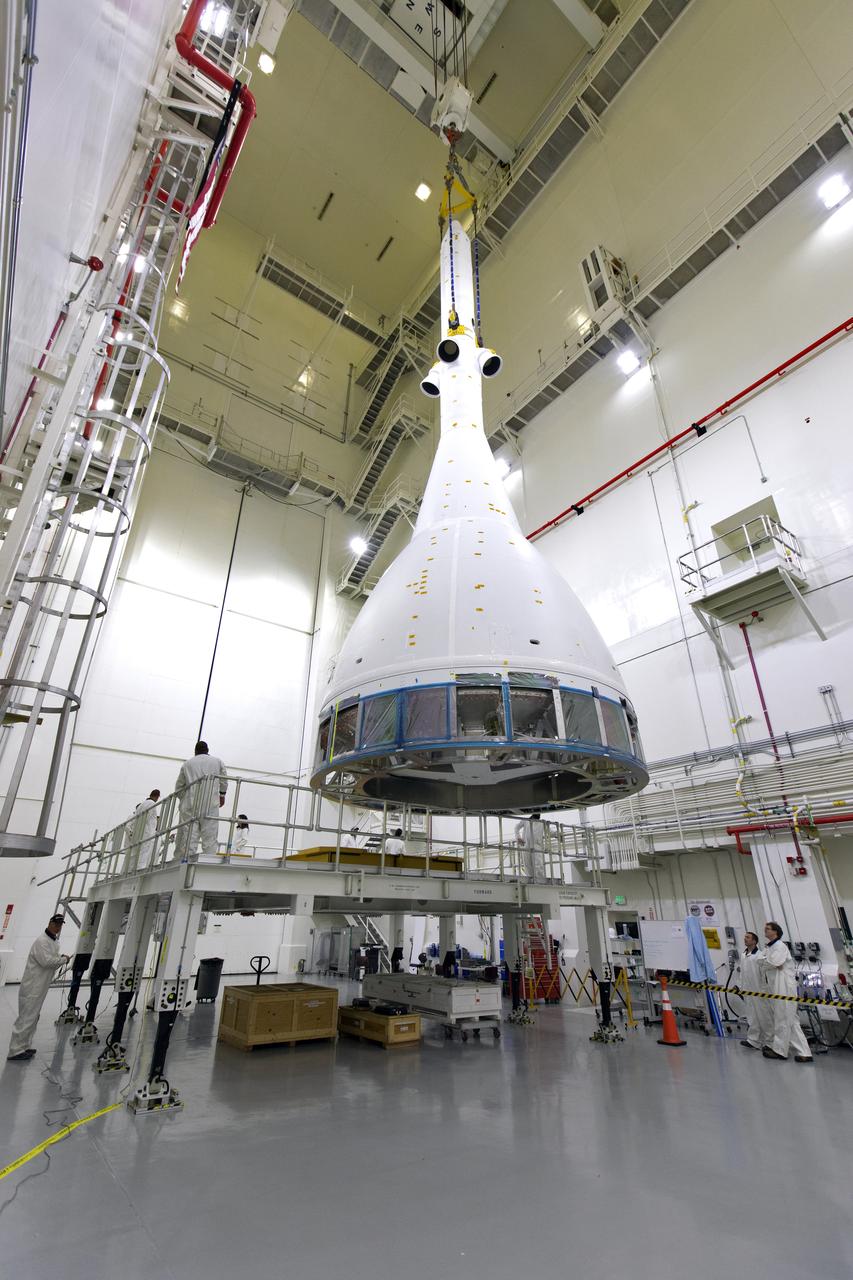
Inside the Launch Abort System Facility (LASF) at NASA’s Kennedy Space Center in Florida, a test version of the Orion crew module has been integrated with the Launch Abort System (LAS) on May 18, 2019. It is being lifted by crane for transfer to a KAMAG transporter. The test vehicle and the LAS will be used for the Orion Ascent Abort-2 (AA-2) Flight Test. AA-2 is a full-stress test of the LAS, planned for July 2. AA-2 will launch from Space Launch Complex 46, carrying a fully functional LAS and a 22,000-pound Orion test vehicle to an altitude of 31,000 feet and traveling at more than 1,000 miles an hour. The test will verify the LAS can steer the crew module and astronauts aboard to safety if an emergency occurs during ascent on the Space Launch System (SLS) rocket. NASA's Orion and Exploration Ground Systems programs, contractors Jacob's, Lockheed Martin and Northrop Grumman, in conjunction with the Air Force Space and Missile Center's Launch Operations branch and the 45th Space Wing are performing flight operations for AA-2.
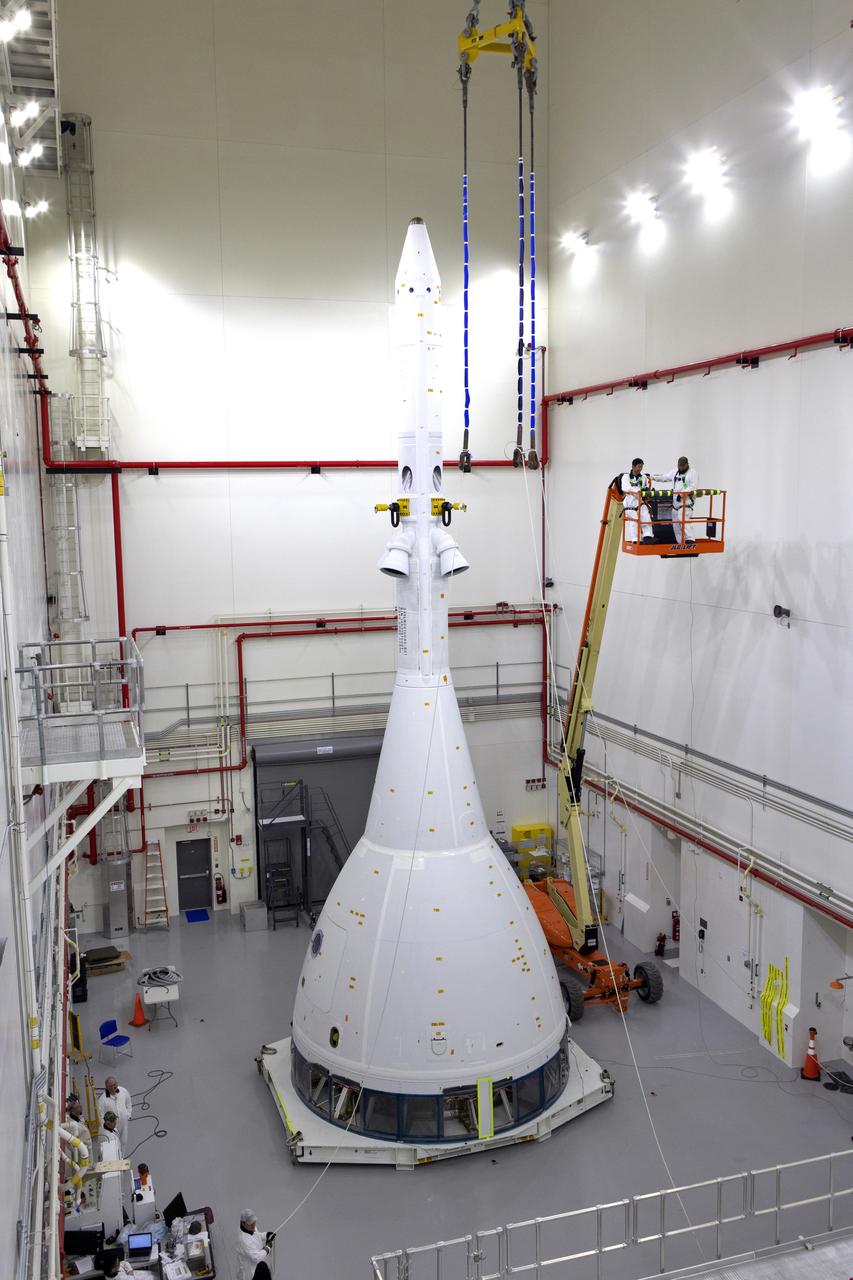
Inside the Launch Abort System Facility (LASF) at NASA’s Kennedy Space Center in Florida, workers are completing the integration of a test version of the Orion crew module with the Launch Abort System (LAS) on May 18, 2019. The test vehicle and the LAS will be used for the Orion Ascent Abort-2 (AA-2) Flight Test. AA-2 is a full-stress test of the LAS, planned for July 2. AA-2 will launch from Space Launch Complex 46, carrying a fully functional LAS and a 22,000-pound Orion test vehicle to an altitude of 31,000 feet and traveling at more than 1,000 miles an hour. The test will verify the LAS can steer the crew module and astronauts aboard to safety if an emergency occurs during ascent on the Space Launch System (SLS) rocket. NASA's Orion and Exploration Ground Systems programs, contractors Jacob's, Lockheed Martin and Northrop Grumman, in conjunction with the Air Force Space and Missile Center's Launch Operations branch and the 45th Space Wing are performing flight operations for AA-2.
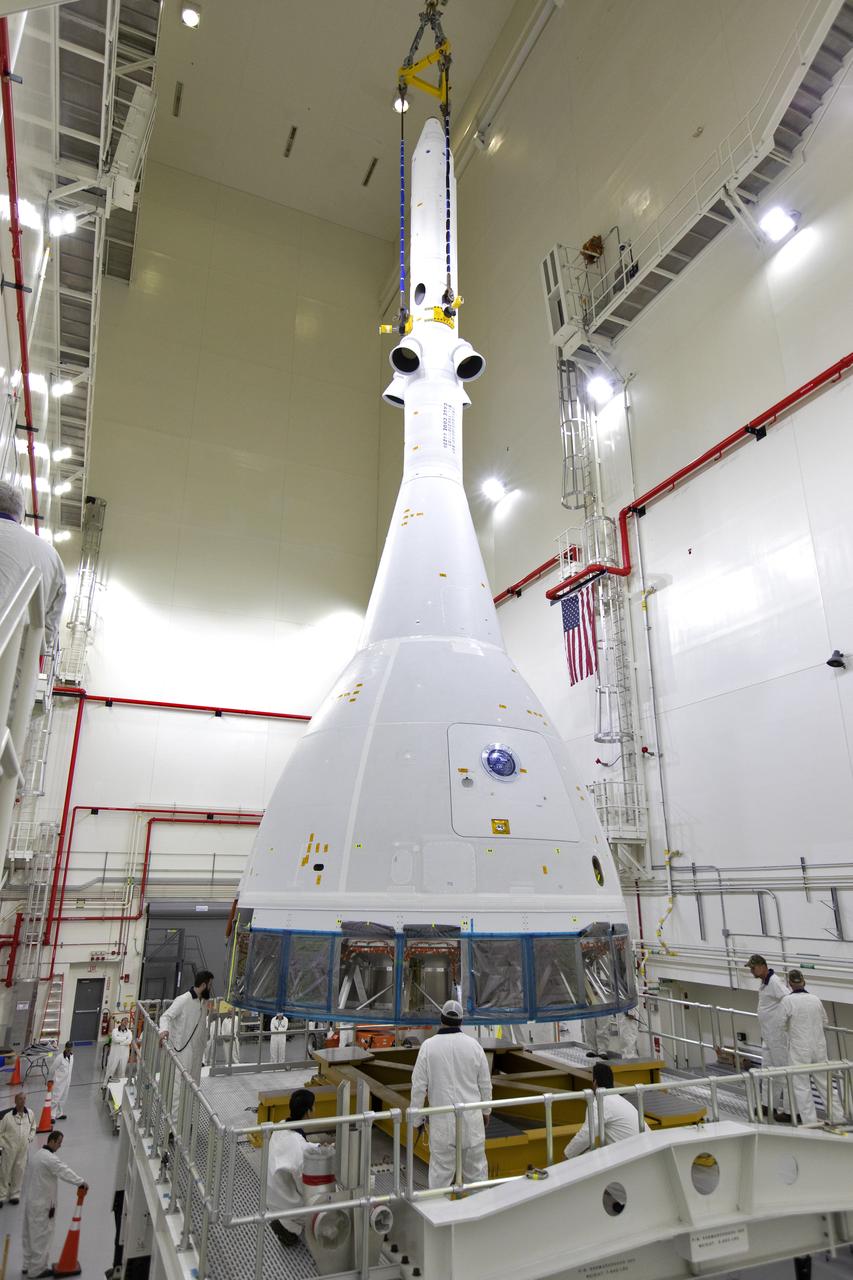
Inside the Launch Abort System Facility (LASF) at NASA’s Kennedy Space Center in Florida, workers are completing the integration of a test version of the Orion crew module with the Launch Abort System (LAS) on May 18, 2019. The test vehicle and the LAS will be used for the Orion Ascent Abort-2 (AA-2) Flight Test. AA-2 is a full-stress test of the LAS, planned for July 2. AA-2 will launch from Space Launch Complex 46, carrying a fully functional LAS and a 22,000-pound Orion test vehicle to an altitude of 31,000 feet and traveling at more than 1,000 miles an hour. The test will verify the LAS can steer the crew module and astronauts aboard to safety if an emergency occurs during ascent on the Space Launch System (SLS) rocket. NASA's Orion and Exploration Ground Systems programs, contractors Jacob's, Lockheed Martin and Northrop Grumman, in conjunction with the Air Force Space and Missile Center's Launch Operations branch and the 45th Space Wing are performing flight operations for AA-2.
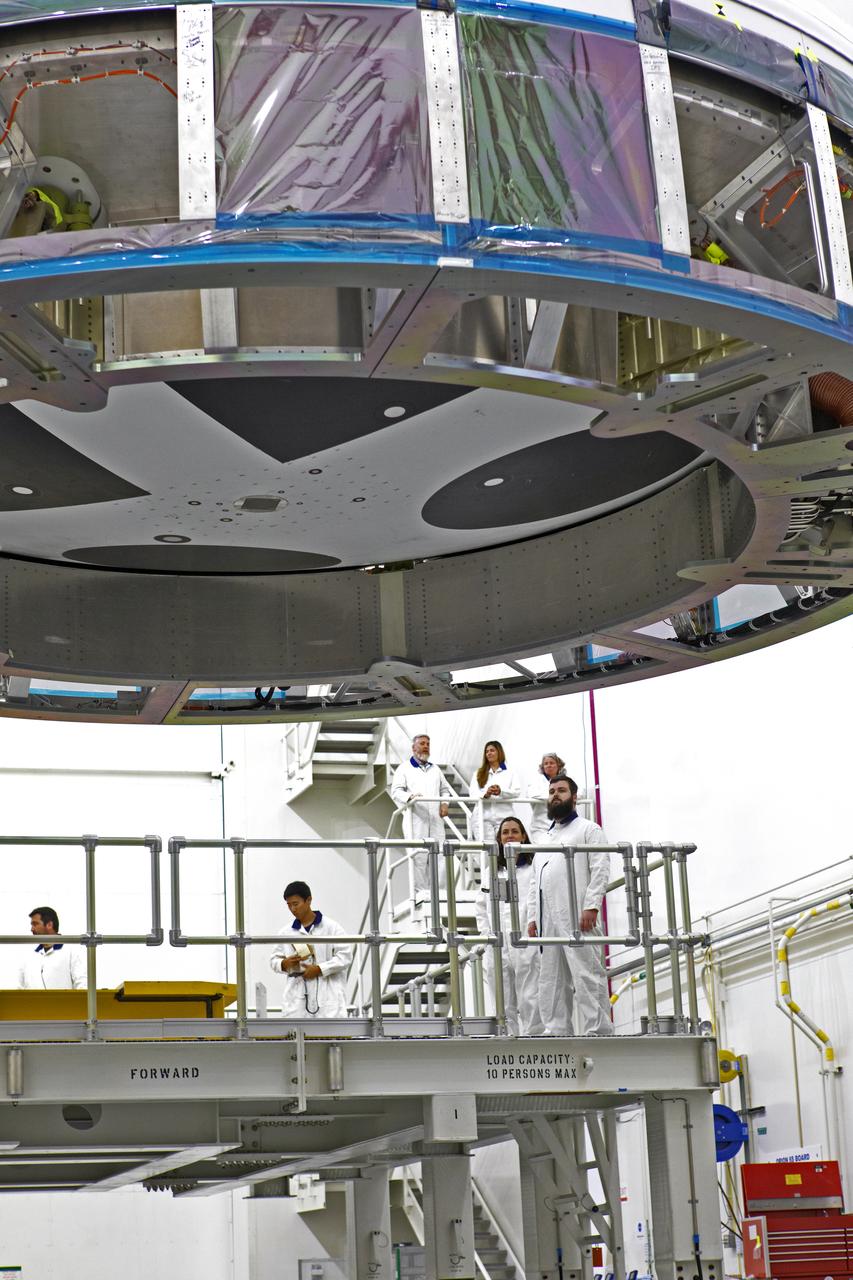
Inside the Launch Abort System Facility (LASF) at NASA’s Kennedy Space Center in Florida, workers are completing the integration of a test version of the Orion crew module with the Launch Abort System (LAS) on May 18, 2019. The test vehicle and the LAS will be used for the Orion Ascent Abort-2 (AA-2) Flight Test. AA-2 is a full-stress test of the LAS, planned for July 2. AA-2 will launch from Space Launch Complex 46, carrying a fully functional LAS and a 22,000-pound Orion test vehicle to an altitude of 31,000 feet and traveling at more than 1,000 miles an hour. The test will verify the LAS can steer the crew module and astronauts aboard to safety if an emergency occurs during ascent on the Space Launch System (SLS) rocket. NASA's Orion and Exploration Ground Systems programs, contractors Jacob's, Lockheed Martin and Northrop Grumman, in conjunction with the Air Force Space and Missile Center's Launch Operations branch and the 45th Space Wing are performing flight operations for AA-2.
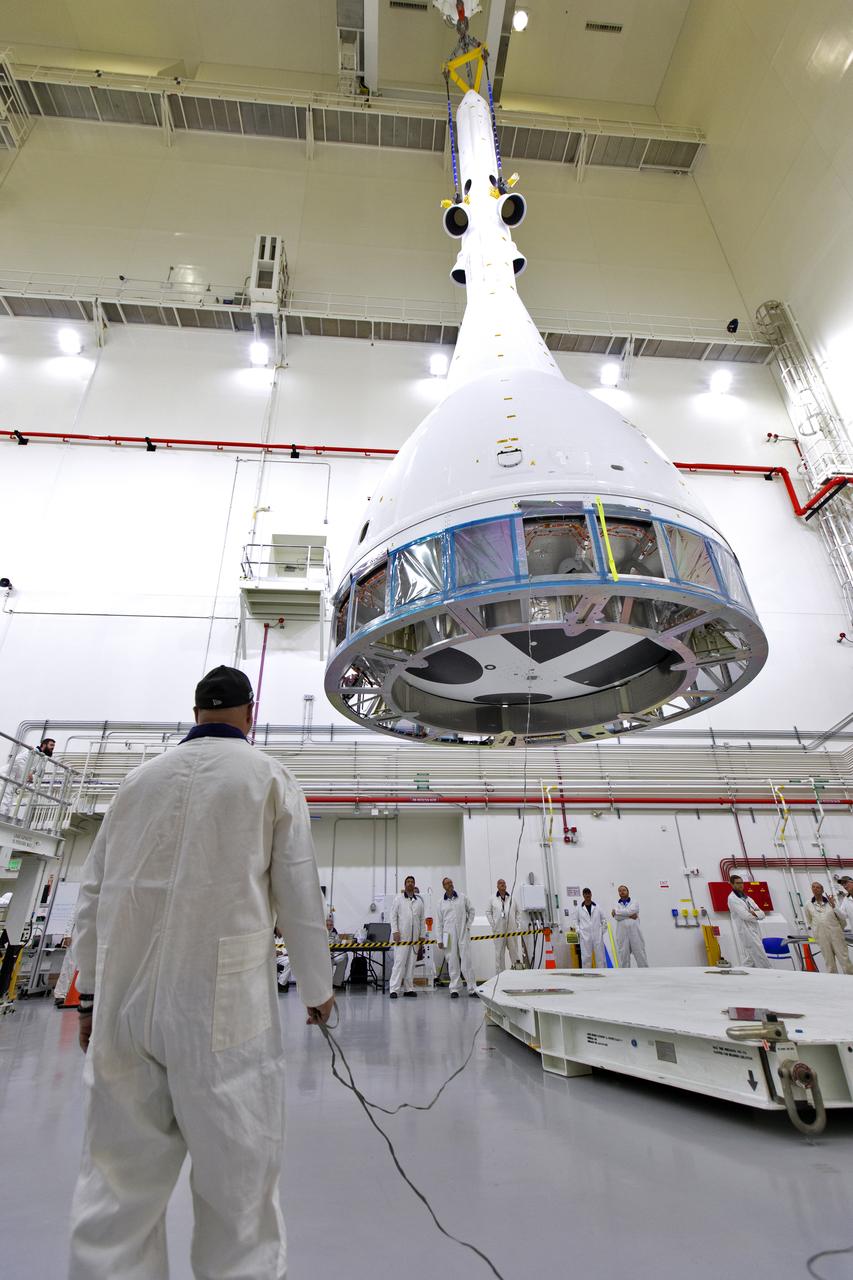
Inside the Launch Abort System Facility (LASF) at NASA’s Kennedy Space Center in Florida, a test version of the Orion crew module has been integrated with the Launch Abort System (LAS) on May 18, 2019. It is being lifted by crane for transfer to a KAMAG transporter. The test vehicle and the LAS will be used for the Orion Ascent Abort-2 (AA-2) Flight Test. AA-2 is a full-stress test of the LAS, planned for July 2. AA-2 will launch from Space Launch Complex 46, carrying a fully functional LAS and a 22,000-pound Orion test vehicle to an altitude of 31,000 feet and traveling at more than 1,000 miles an hour. The test will verify the LAS can steer the crew module and astronauts aboard to safety if an emergency occurs during ascent on the Space Launch System (SLS) rocket. NASA's Orion and Exploration Ground Systems programs, contractors Jacob's, Lockheed Martin and Northrop Grumman, in conjunction with the Air Force Space and Missile Center's Launch Operations branch and the 45th Space Wing are performing flight operations for AA-2.
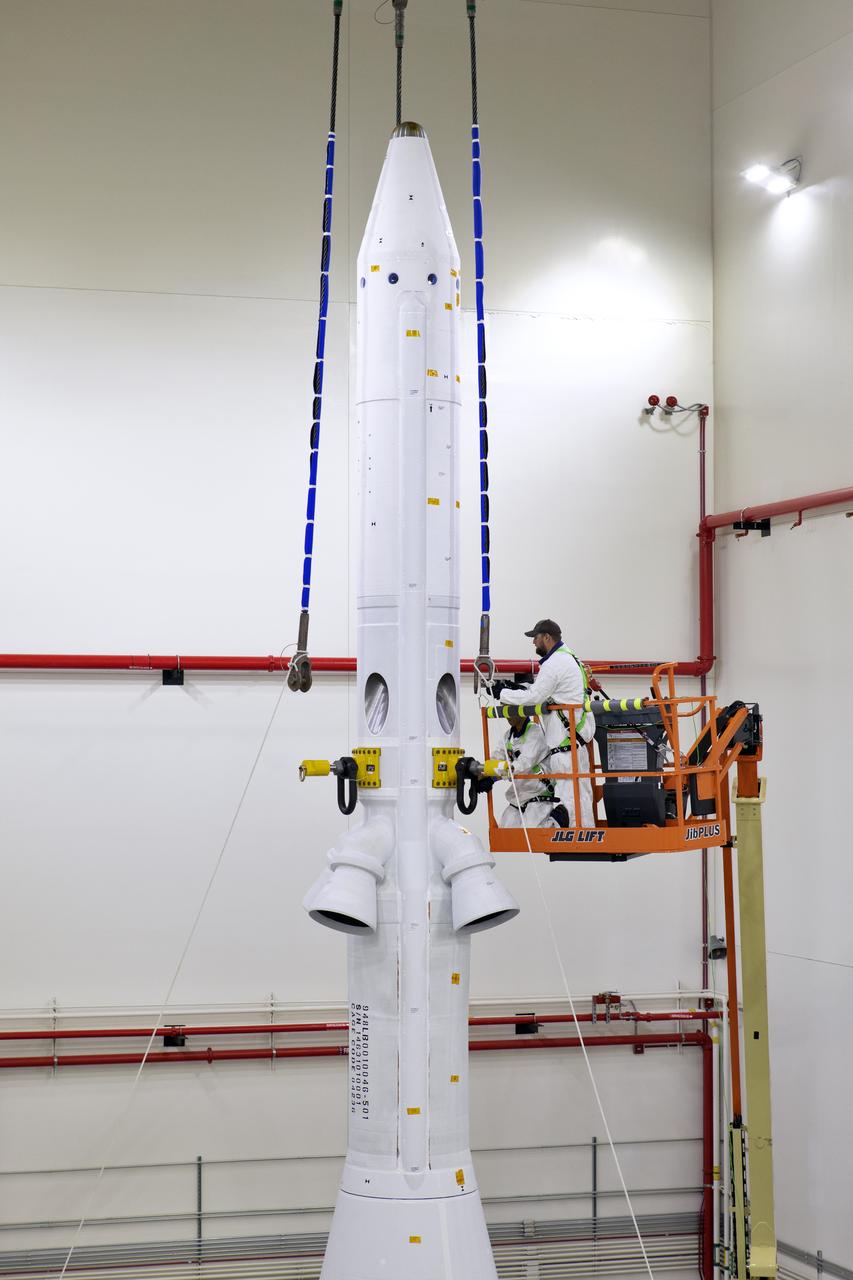
Inside the Launch Abort System Facility (LASF) at NASA’s Kennedy Space Center in Florida, workers are completing the integration of a test version of the Orion crew module with the Launch Abort System (LAS) on May 18, 2019. In view are the LAS attitude control motor, jettison motor and abort motor. The test vehicle and the LAS will be used for the Orion Ascent Abort-2 (AA-2) Flight Test. AA-2 is a full-stress test of the LAS, planned for July 2. AA-2 will launch from Space Launch Complex 46, carrying a fully functional LAS and a 22,000-pound Orion test vehicle to an altitude of 31,000 feet and traveling at more than 1,000 miles an hour. The test will verify the LAS can steer the crew module and astronauts aboard to safety if an emergency occurs during ascent on the Space Launch System (SLS) rocket. NASA's Orion and Exploration Ground Systems programs, contractors Jacob's, Lockheed Martin and Northrop Grumman, in conjunction with the Air Force Space and Missile Center's Launch Operations branch and the 45th Space Wing are performing flight operations for AA-2.
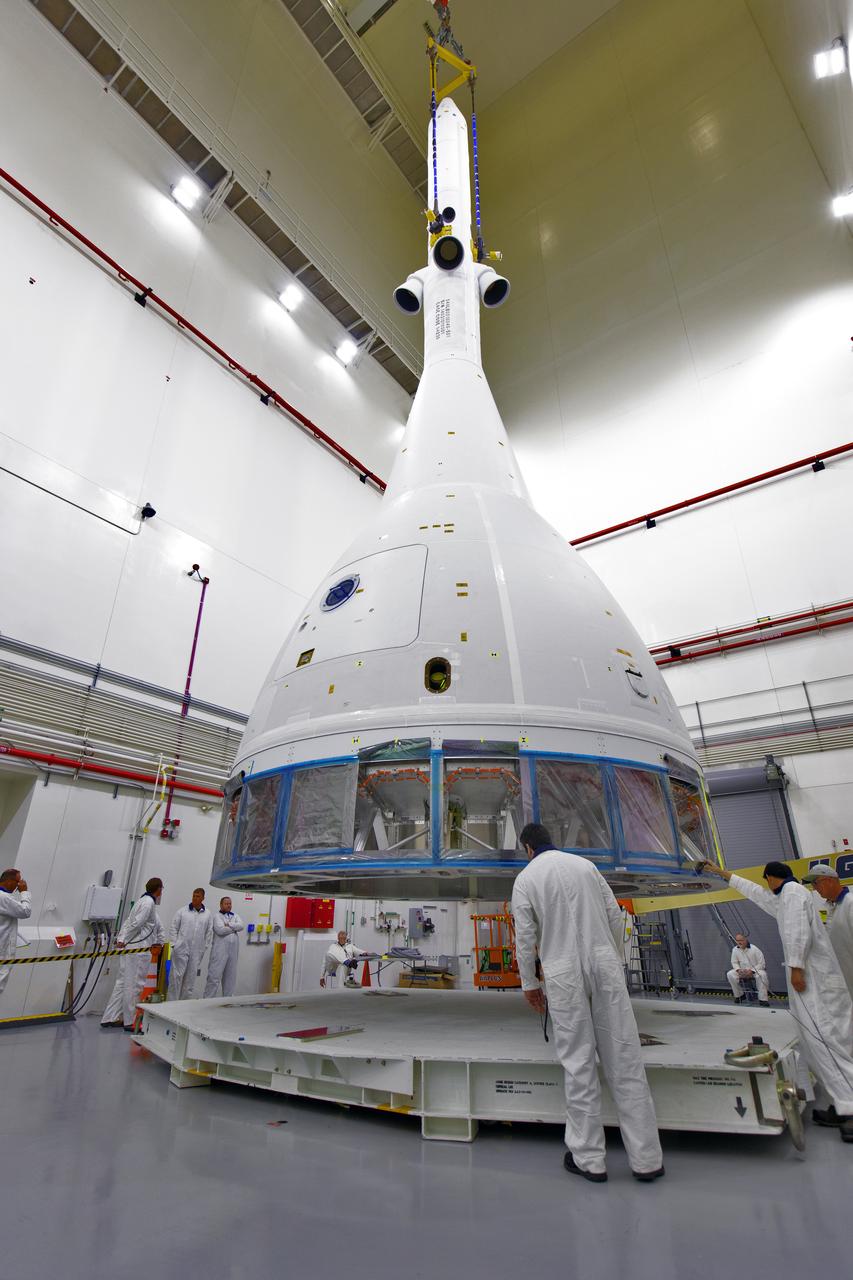
Inside the Launch Abort System Facility (LASF) at NASA’s Kennedy Space Center in Florida, workers are completing the integration of a test version of the Orion crew module with the Launch Abort System (LAS) on May 18, 2019. The test vehicle and the LAS will be used for the Orion Ascent Abort-2 (AA-2) Flight Test. AA-2 is a full-stress test of the LAS, planned for July 2. AA-2 will launch from Space Launch Complex 46, carrying a fully functional LAS and a 22,000-pound Orion test vehicle to an altitude of 31,000 feet and traveling at more than 1,000 miles an hour. The test will verify the LAS can steer the crew module and astronauts aboard to safety if an emergency occurs during ascent on the Space Launch System (SLS) rocket. NASA's Orion and Exploration Ground Systems programs, contractors Jacob's, Lockheed Martin and Northrop Grumman, in conjunction with the Air Force Space and Missile Center's Launch Operations branch and the 45th Space Wing are performing flight operations for AA-2.
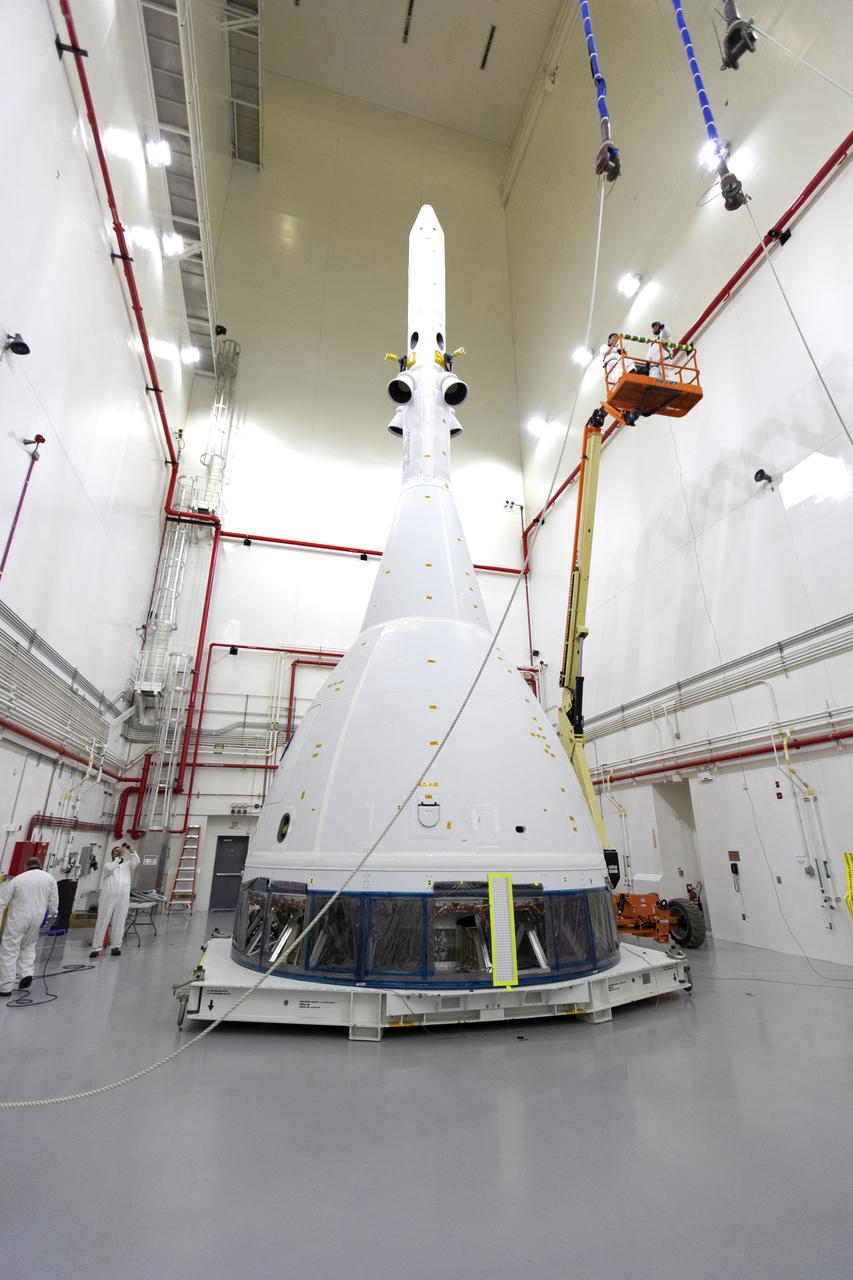
Inside the Launch Abort System Facility (LASF) at NASA’s Kennedy Space Center in Florida, workers are completing the integration of a test version of the Orion crew module with the Launch Abort System (LAS) on May 18, 2019. The test vehicle and the LAS will be used for the Orion Ascent Abort-2 (AA-2) Flight Test. AA-2 is a full-stress test of the LAS, planned for July 2. AA-2 will launch from Space Launch Complex 46, carrying a fully functional LAS and a 22,000-pound Orion test vehicle to an altitude of 31,000 feet and traveling at more than 1,000 miles an hour. The test will verify the LAS can steer the crew module and astronauts aboard to safety if an emergency occurs during ascent on the Space Launch System (SLS) rocket. NASA's Orion and Exploration Ground Systems programs, contractors Jacob's, Lockheed Martin and Northrop Grumman, in conjunction with the Air Force Space and Missile Center's Launch Operations branch and the 45th Space Wing are performing flight operations for AA-2.
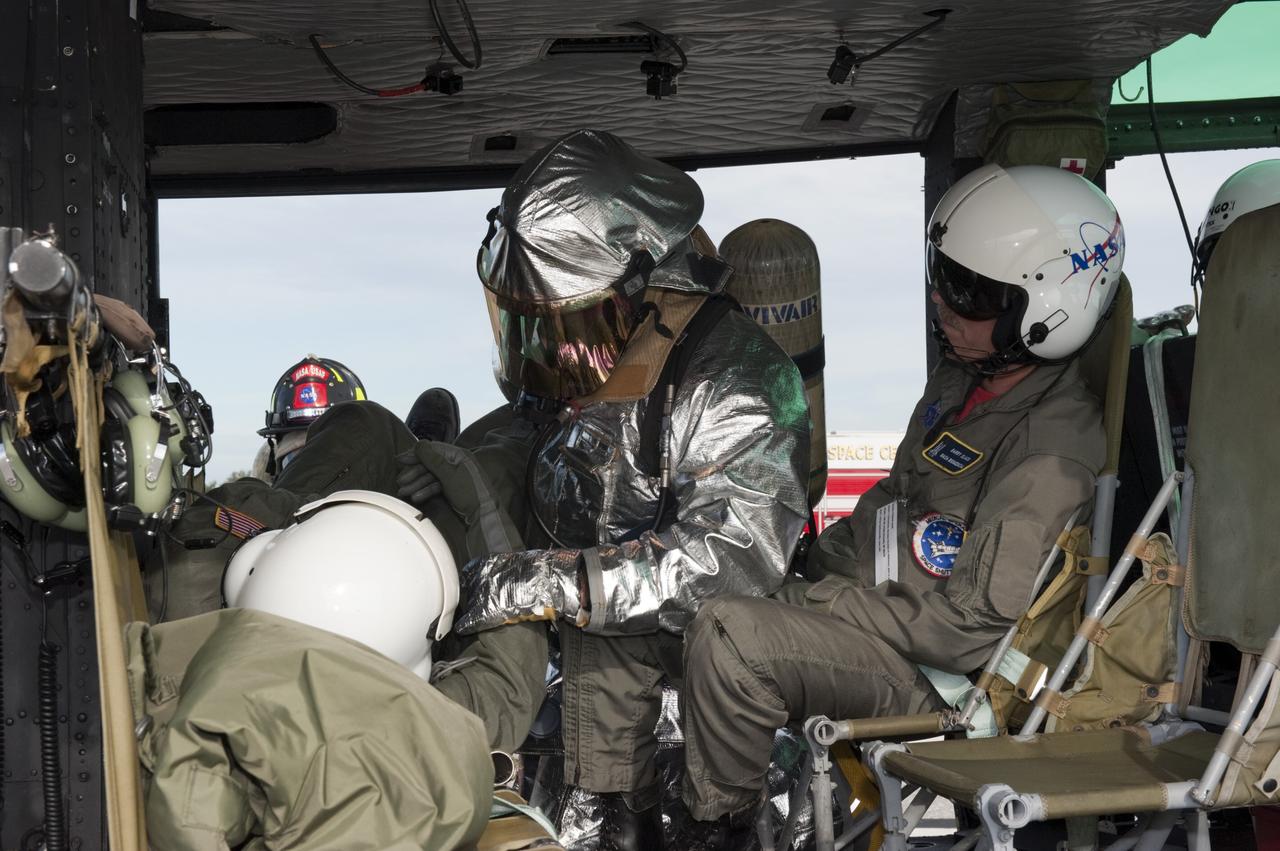
CAPE CANAVERAL, Fla. -- NASA Fire Rescue personnel assist volunteers portraying injured Huey II helicopter crew members participating in the aviation safety exercise during Emergency Response Safety Training at the Shuttle Landing Facility, Runway 33, at NASA’s Kennedy Space Center in Florida. The simulated helicopter mishap exercise was conducted to evaluate emergency response and mishap investigations of aircraft at Kennedy. Participants included Air Rescue Fire Fighters, Flight Operations, Disaster Preparedness, Security, and Safety. NASA mandates simulated aviation safety training take place every two years. Photo credit: NASA/Kim Shiflett
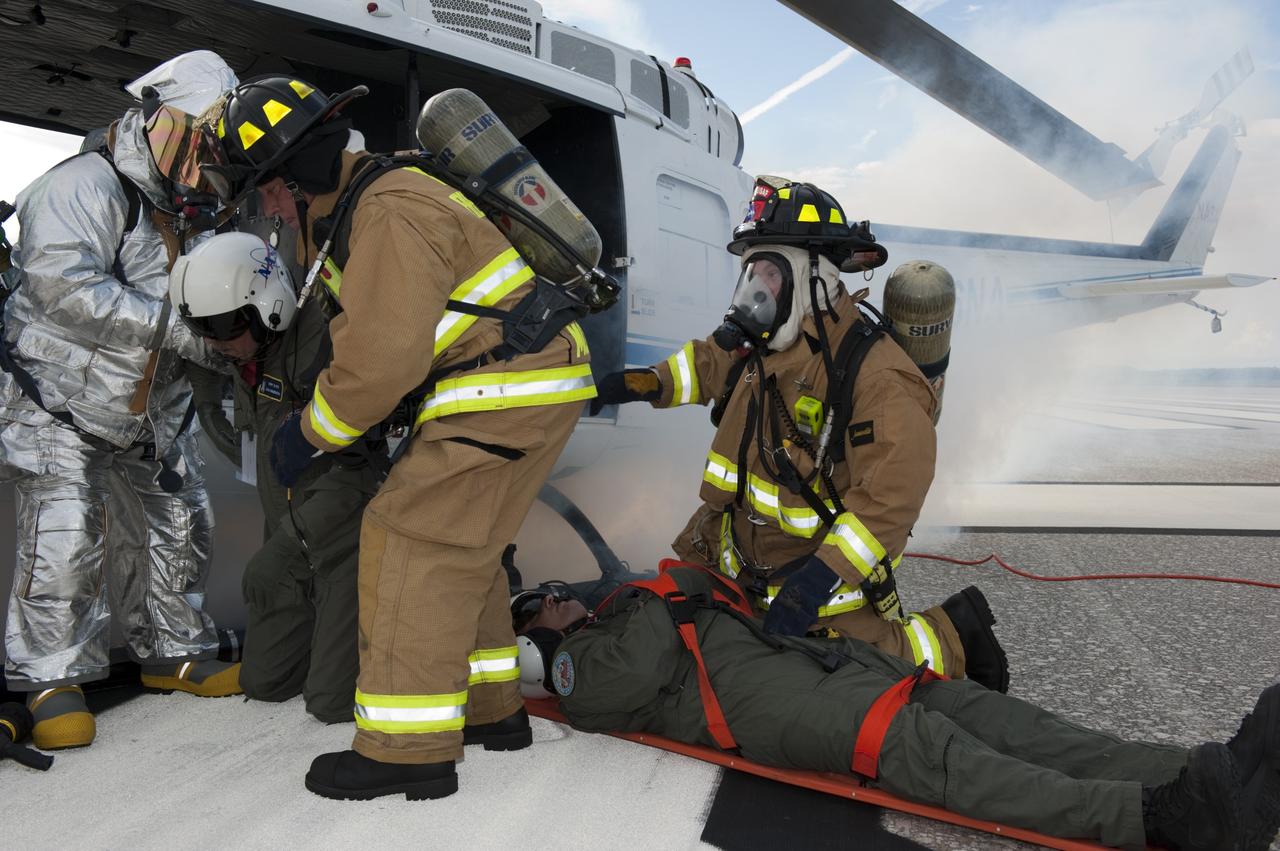
CAPE CANAVERAL, Fla. -- NASA Fire Rescue personnel assist volunteers portraying injured Huey II helicopter crew members participating in the aviation safety exercise during Emergency Response Safety Training at the Shuttle Landing Facility, Runway 33, at NASA’s Kennedy Space Center in Florida. The simulated helicopter mishap exercise was conducted to evaluate emergency response and mishap investigations of aircraft at Kennedy. Participants included Air Rescue Fire Fighters, Flight Operations, Disaster Preparedness, Security, and Safety. NASA mandates simulated aviation safety training take place every two years. Photo credit: NASA/Kim Shiflett
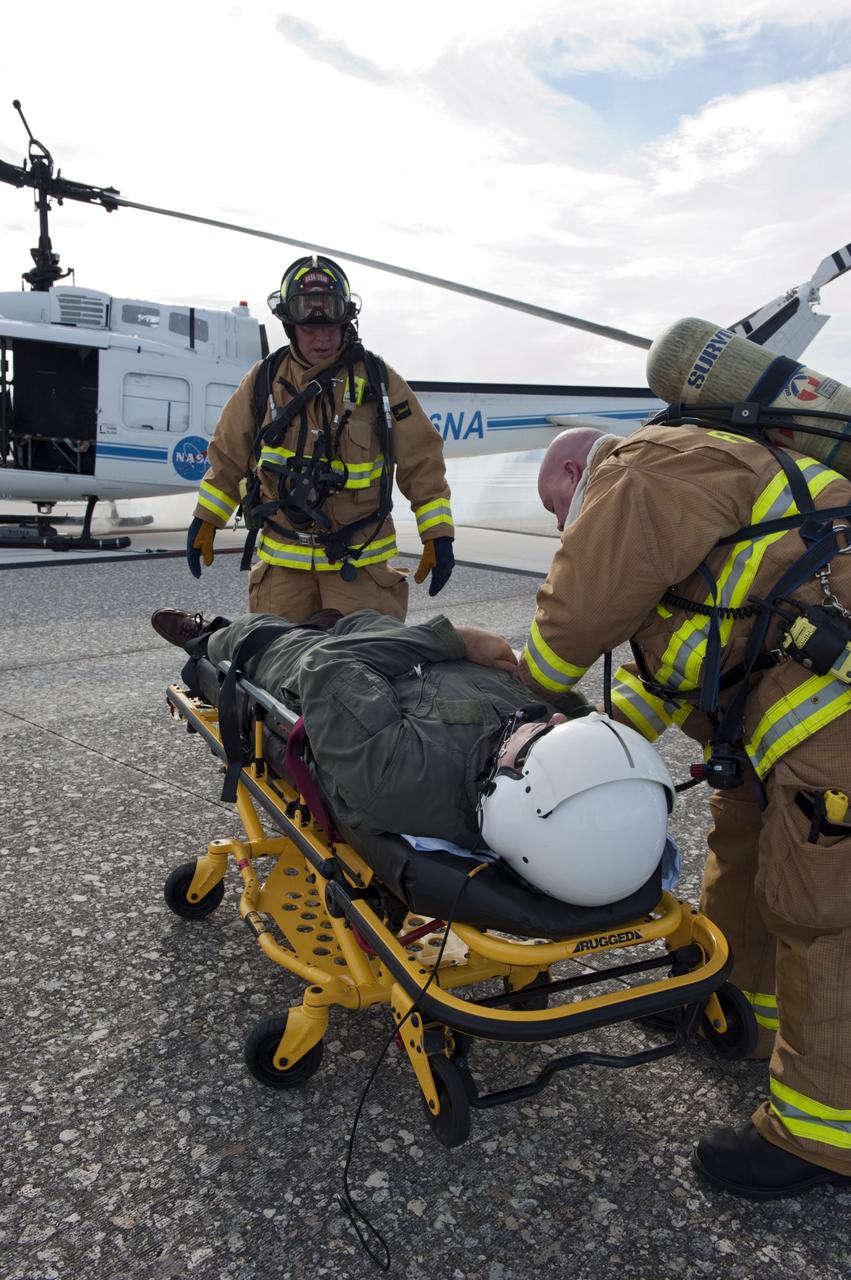
CAPE CANAVERAL, Fla. -- NASA Fire Rescue personnel assist volunteers portraying injured Huey II helicopter crew members participating in the aviation safety exercise during Emergency Response Safety Training at the Shuttle Landing Facility, Runway 33, at NASA’s Kennedy Space Center in Florida. The simulated helicopter mishap exercise was conducted to evaluate emergency response and mishap investigations of aircraft at Kennedy. Participants included Air Rescue Fire Fighters, Flight Operations, Disaster Preparedness, Security, and Safety. NASA mandates simulated aviation safety training take place every two years. Photo credit: NASA/Kim Shiflett
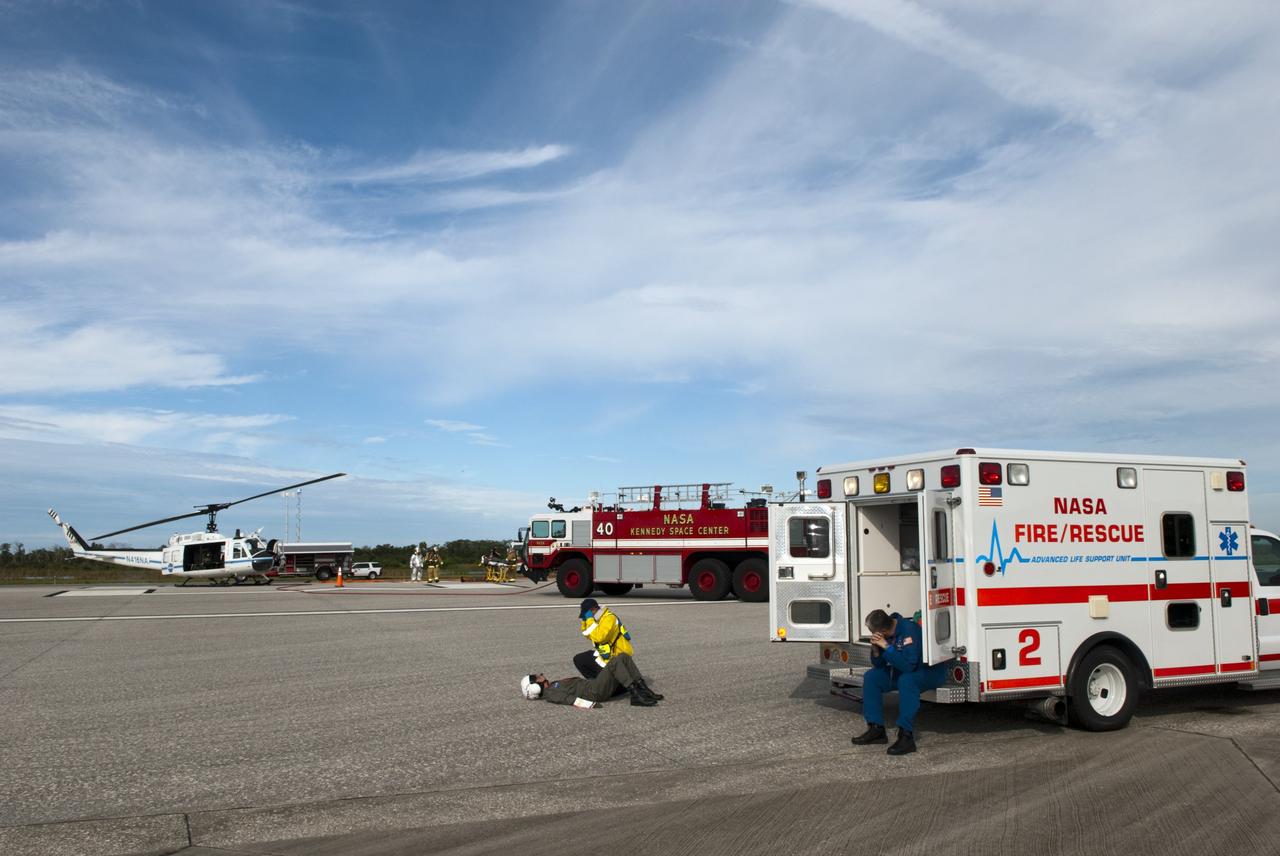
CAPE CANAVERAL, Fla. -- Volunteers portraying injured Huey II helicopter crew members are assisted by NASA Fire Rescue personnel in support of the aviation safety exercise during Emergency Response Safety Training at the Shuttle Landing Facility, Runway 33, at NASA’s Kennedy Space Center in Florida. The simulated helicopter mishap exercise was conducted to evaluate emergency response and mishap investigations of aircraft at Kennedy. Participants included Air Rescue Fire Fighters, Flight Operations, Disaster Preparedness, Security, and Safety. NASA mandates simulated aviation safety training take place every two years. Photo credit: NASA/Kim Shiflett
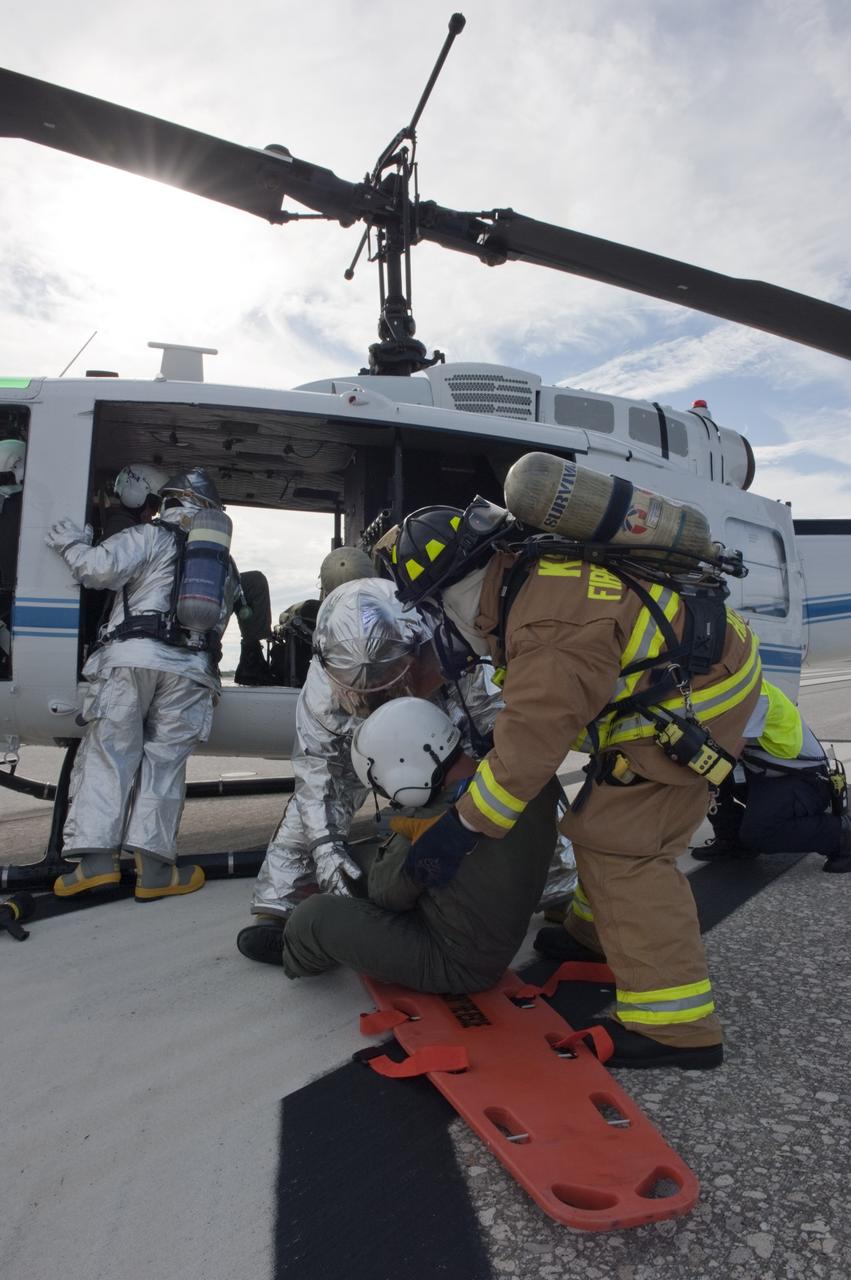
CAPE CANAVERAL, Fla. -- NASA Fire Rescue personnel assist volunteers portraying injured Huey II helicopter crew members participating in the aviation safety exercise during Emergency Response Safety Training at the Shuttle Landing Facility, Runway 33, at NASA’s Kennedy Space Center in Florida. The simulated helicopter mishap exercise was conducted to evaluate emergency response and mishap investigations of aircraft at Kennedy. Participants included Air Rescue Fire Fighters, Flight Operations, Disaster Preparedness, Security, and Safety. NASA mandates simulated aviation safety training take place every two years. Photo credit: NASA/Kim Shiflett

CAPE CANAVERAL, Fla. -- NASA Fire Rescue personnel assist a volunteer portraying an injured Huey II helicopter crew member participating in the aviation safety exercise during Emergency Response Safety Training at the Shuttle Landing Facility, Runway 33, at NASA’s Kennedy Space Center in Florida. The simulated helicopter mishap exercise was conducted to evaluate emergency response and mishap investigations of aircraft at Kennedy. Participants included Air Rescue Fire Fighters, Flight Operations, Disaster Preparedness, Security, and Safety. NASA mandates simulated aviation safety training take place every two years. Photo credit: NASA/Kim Shiflett
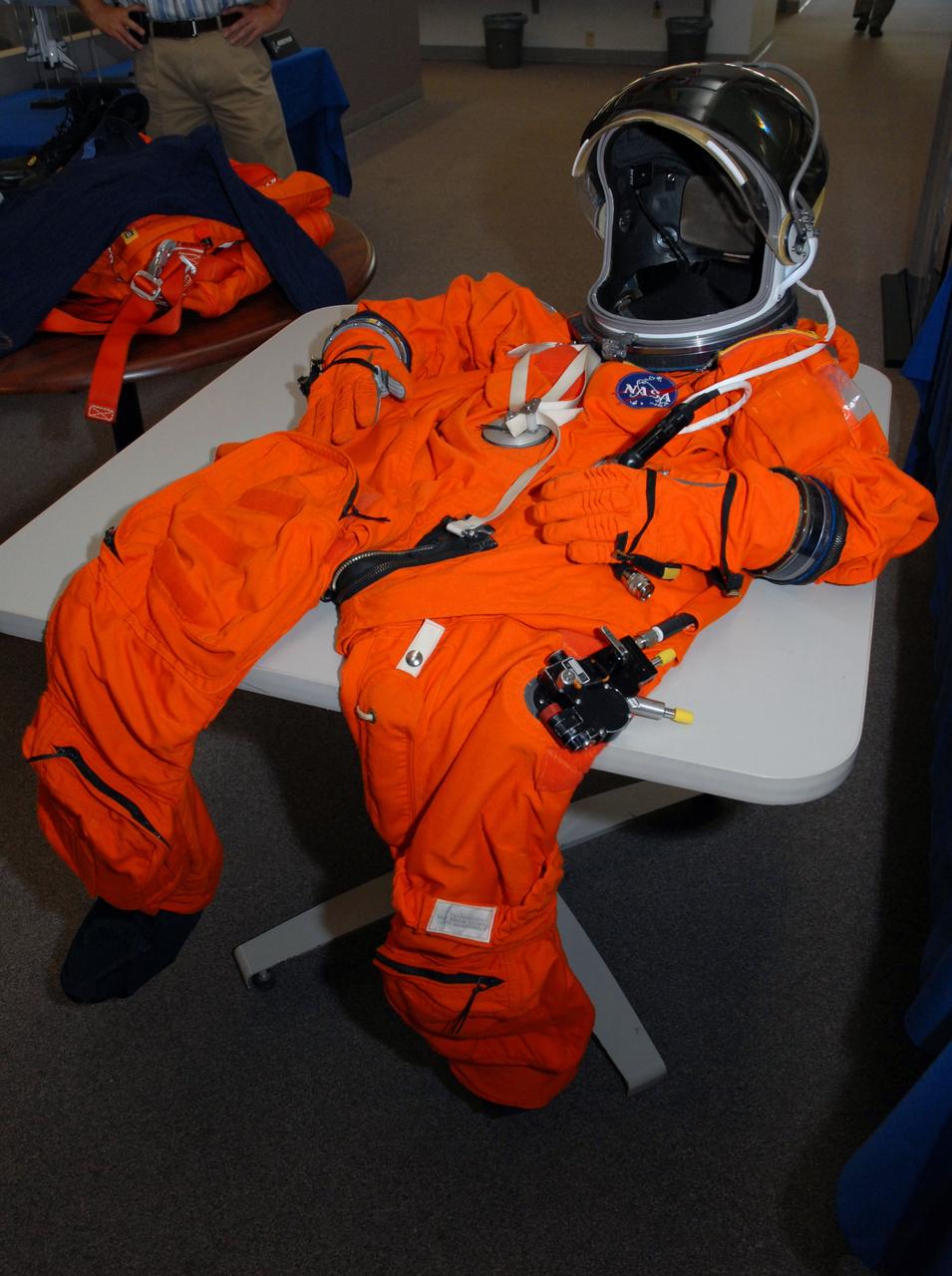
CAPE CANAVERAL, Fla. -- On a table in the NASA News Center at NASA's Kennedy Space Center, a sample launch and entry suit is laid out for the media. Shuttle Crew Escape System Manager KC Chhipwadia described the individual pieces and their importance to the safety of the shuttle crews during their missions. All the elements of the suit provide comfort plus safety elements in the event of an emergency. Photo credit: NASA/Amanda Diller

iss071e513837 (Aug. 9, 2024) --- NASA astronauts Butch Wilmore and Suni Williams, Boeing's Crew Flight Test Commander and Pilot respectively, inspect safety hardware aboard the International Space Station.
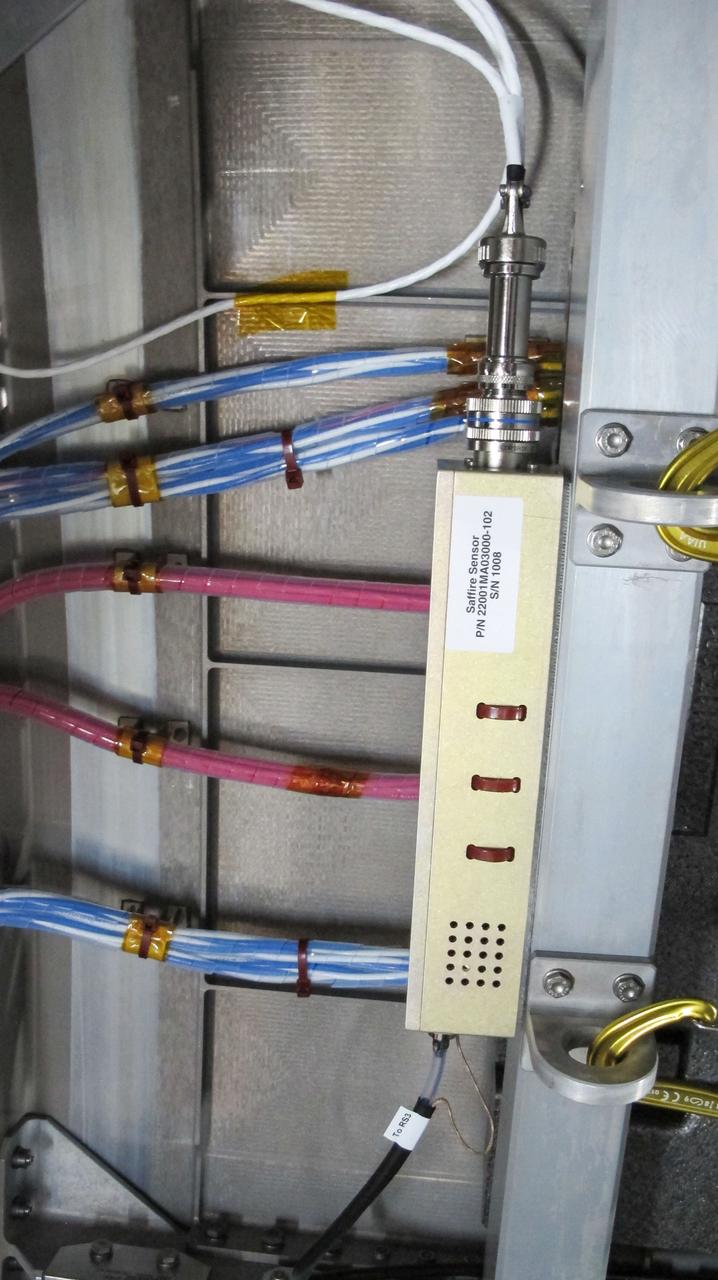
jsc2019e050038 (8/12/2019) --- Photo documentation taken during the NG-12 Crew Equipment Interface Test (CEIT) The view is of a SAFFIRE sensor. The NASA Advanced Exploration Systems program began a project to develop and demonstrate spacecraft fire safety technologies in relevant environments. The keystone of these demonstrations is a large-scale fire safety experiment conducted on an International Space Station (ISS) re-supply vehicle after it has undocked from the ISS and before it enters the atmosphere.
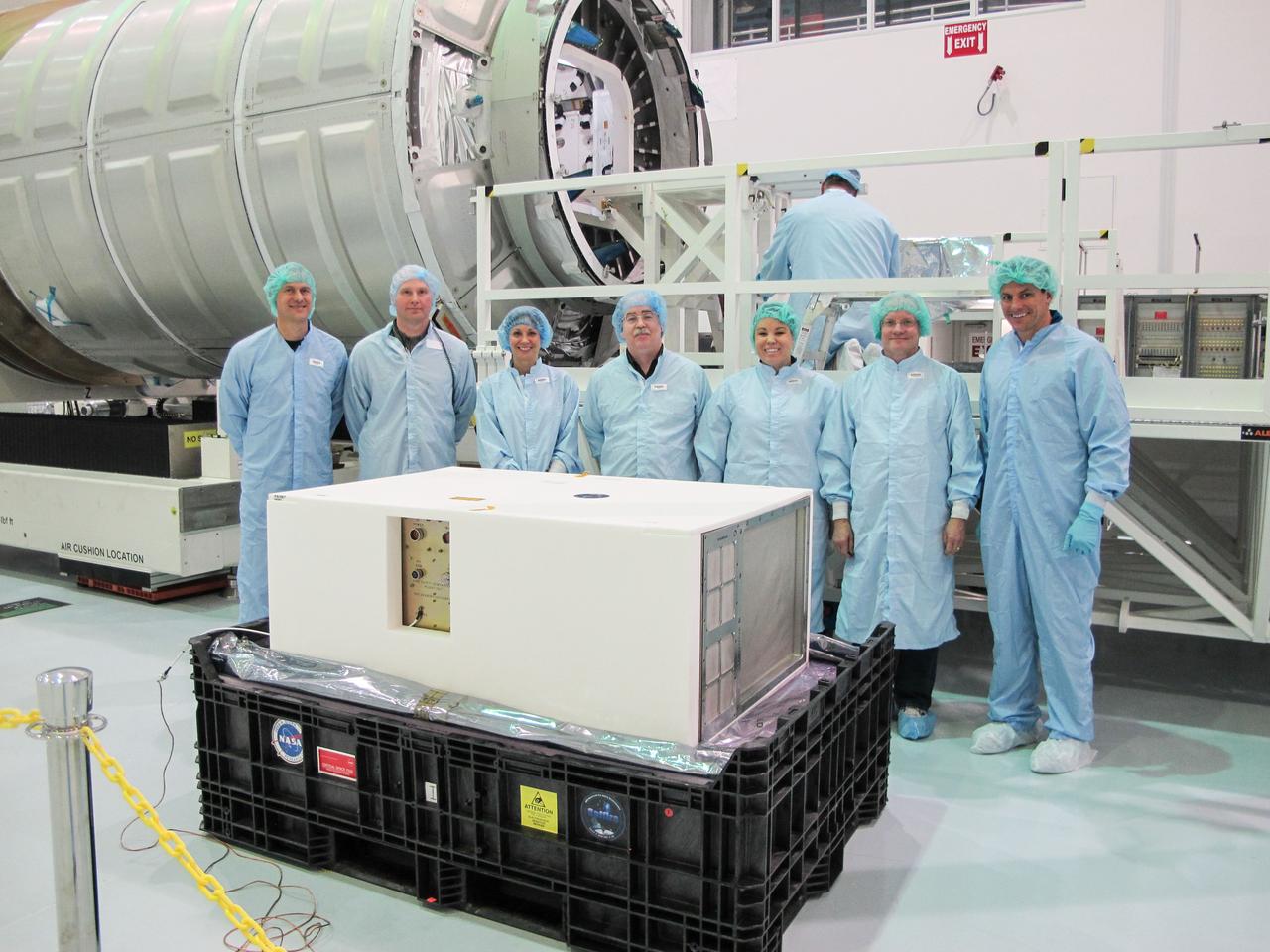
jsc2016e017570 (1/22/2016) --- Photographic documentation of Saffire-I taken during the OA-6 Crew Equipment Interface Test (CEIT) at KSC/Space Station Processing Facility (SSPF). The NASA Advanced Exploration Systems program began a project to develop and demonstrate spacecraft fire safety technologies in relevant environments. The keystone of these demonstrations is a large-scale fire safety experiment conducted on an International Space Station (ISS) re-supply vehicle after it has undocked from the ISS and before it enters the atmosphere.
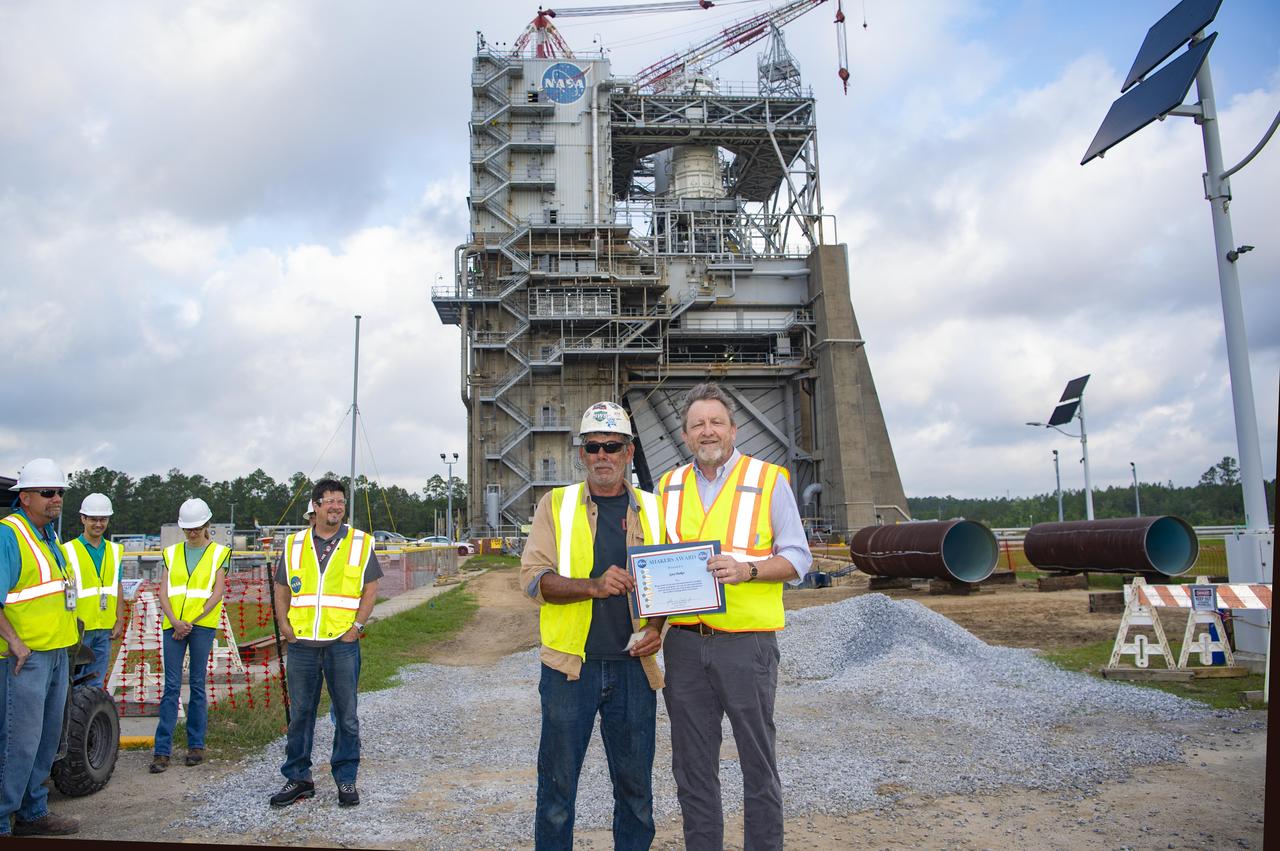
: Gary Parker, an employee with Healtheon, Inc., is presented a NASA SHAKERS (Smart Human Actions Keep Everyone Really Safe) Award from NASA Stennis Associate Director Rodney McKellip on May 8. Parker, left, received the award for leadership and dedication to safety of the crew working to upgrade an essential test complex water system at NASA Stennis. As one of the crew leaders, Parker ensured all took the safest approach for each task, even as the scale of the project increased. NASA’s constant attention to safety, one of the agency’s five core values, is the cornerstone for mission success.
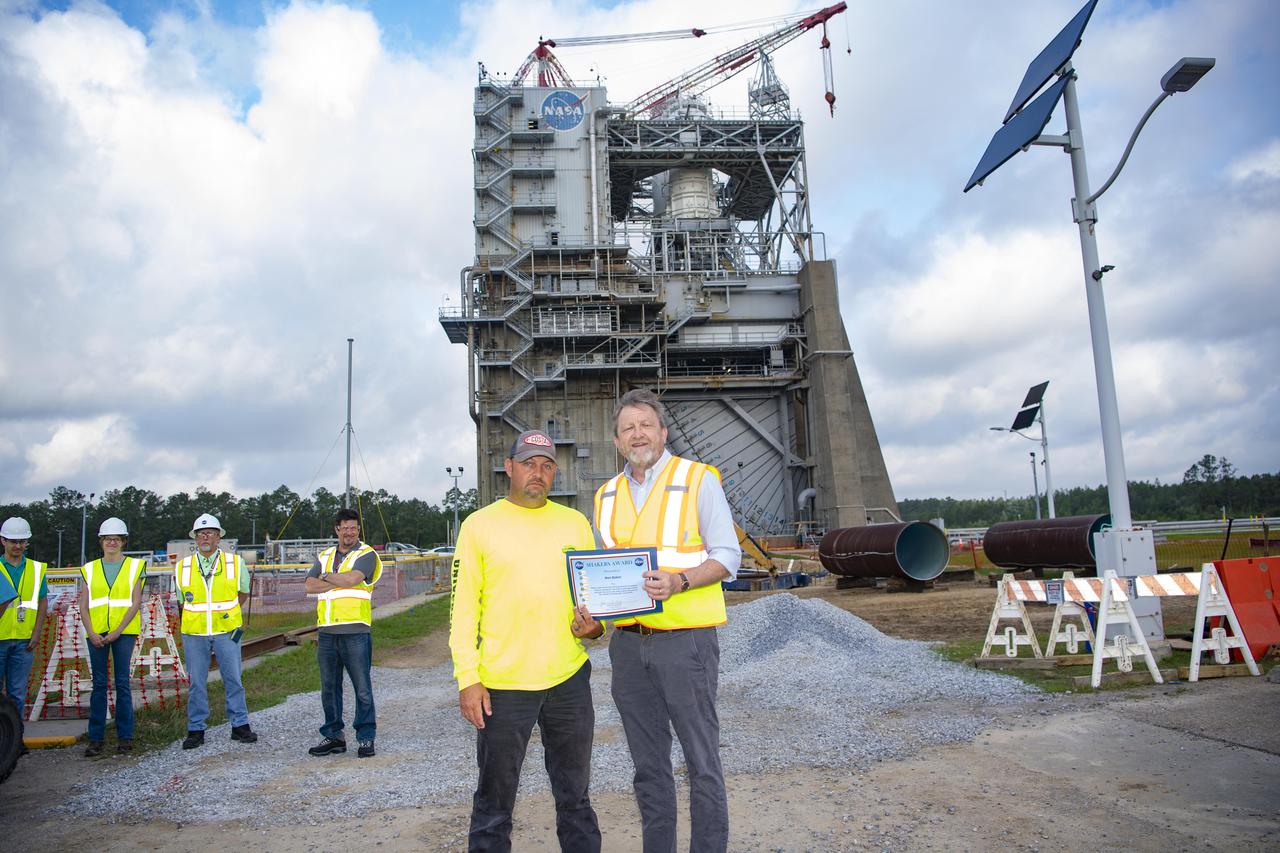
Matt Roberts, an employee with Healtheon, Inc., is presented a NASA SHAKERS (Smart Human Actions Keep Everyone Really Safe) Award from NASA Stennis Associate Director Rodney McKellip on May 8. Roberts, left, received the award for leadership and dedication to safety of the crew working to upgrade an essential test complex water system at NASA Stennis. As one of the crew leaders, Roberts ensured all took the safest approach for each task, even as the scale of the project increased. NASA’s constant attention to safety, one of the agency’s five core values, is the cornerstone for mission success.
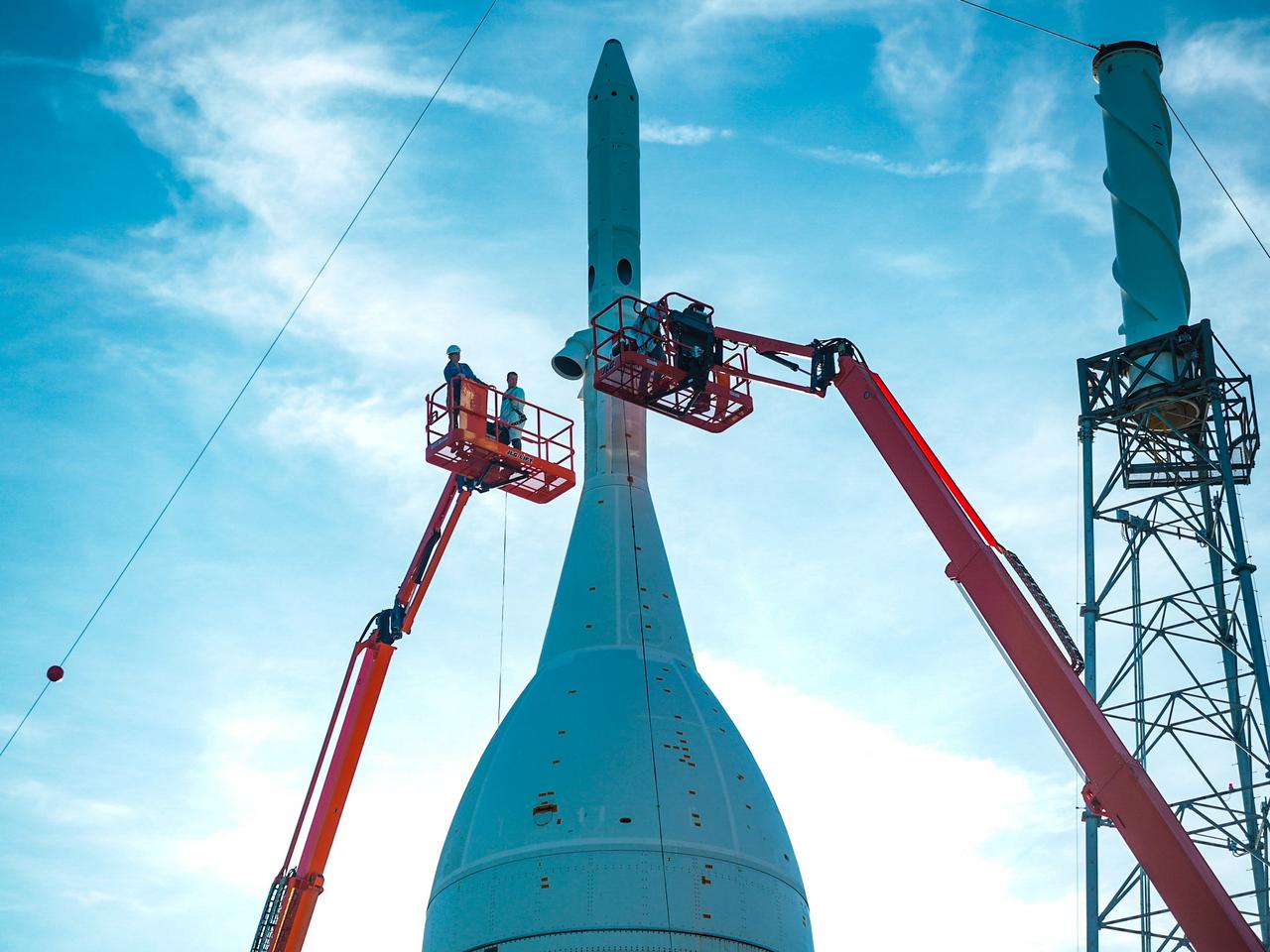
On July 1, 2019, the Orion Launch Abort System and Crew Module attached to the abort test booster are readied for flight on Ascent Abort-2 (AA-2). The successful test demonstrated the ability to carry the crew to safety in case of a mishap during ascent.
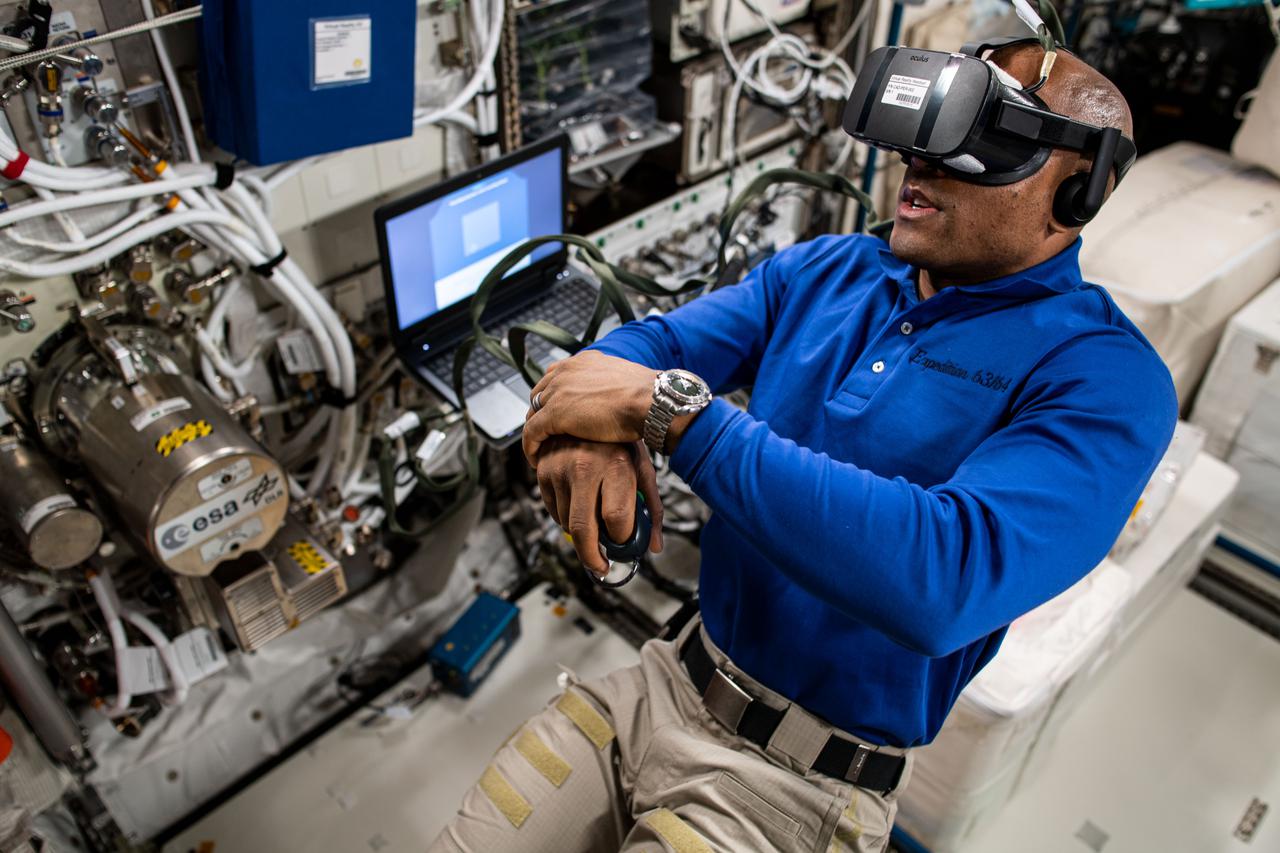
This ESA (European Space Agency) Time Perception in Microgravity investigation is studying crew member reaction times and time perception in space. Glover participates as a research subject using a virtual reality headset. This work helps provide data on astronaut cognitive performance, a critical factor for ensuring crew safety and mission success.
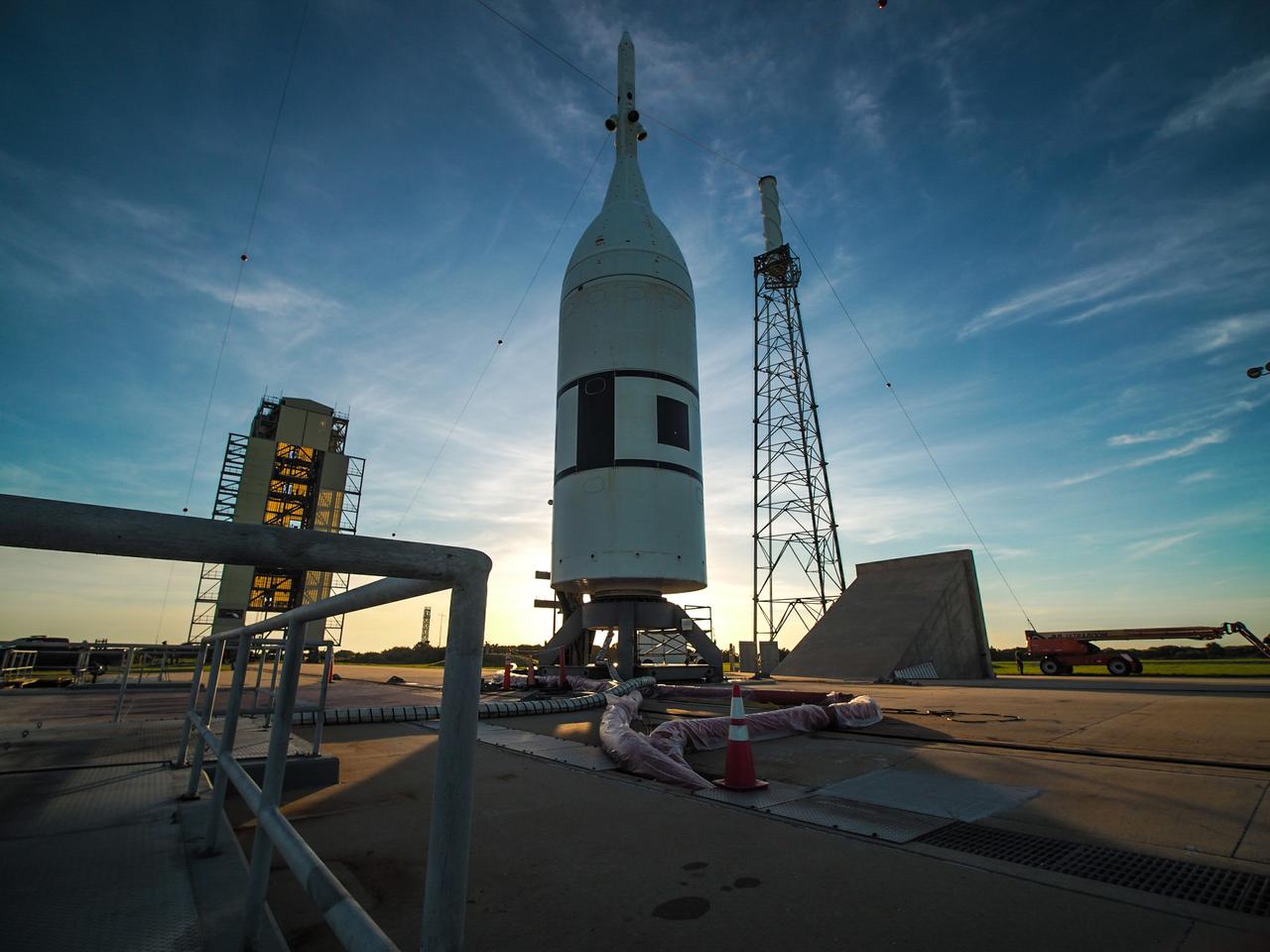
On July 1, 2019, the Orion Launch Abort System and Crew Module attached to the abort test booster are readied for flight on Ascent Abort-2 (AA-2). The successful test demonstrated the ability to carry the crew to safety in case of a mishap during ascent.
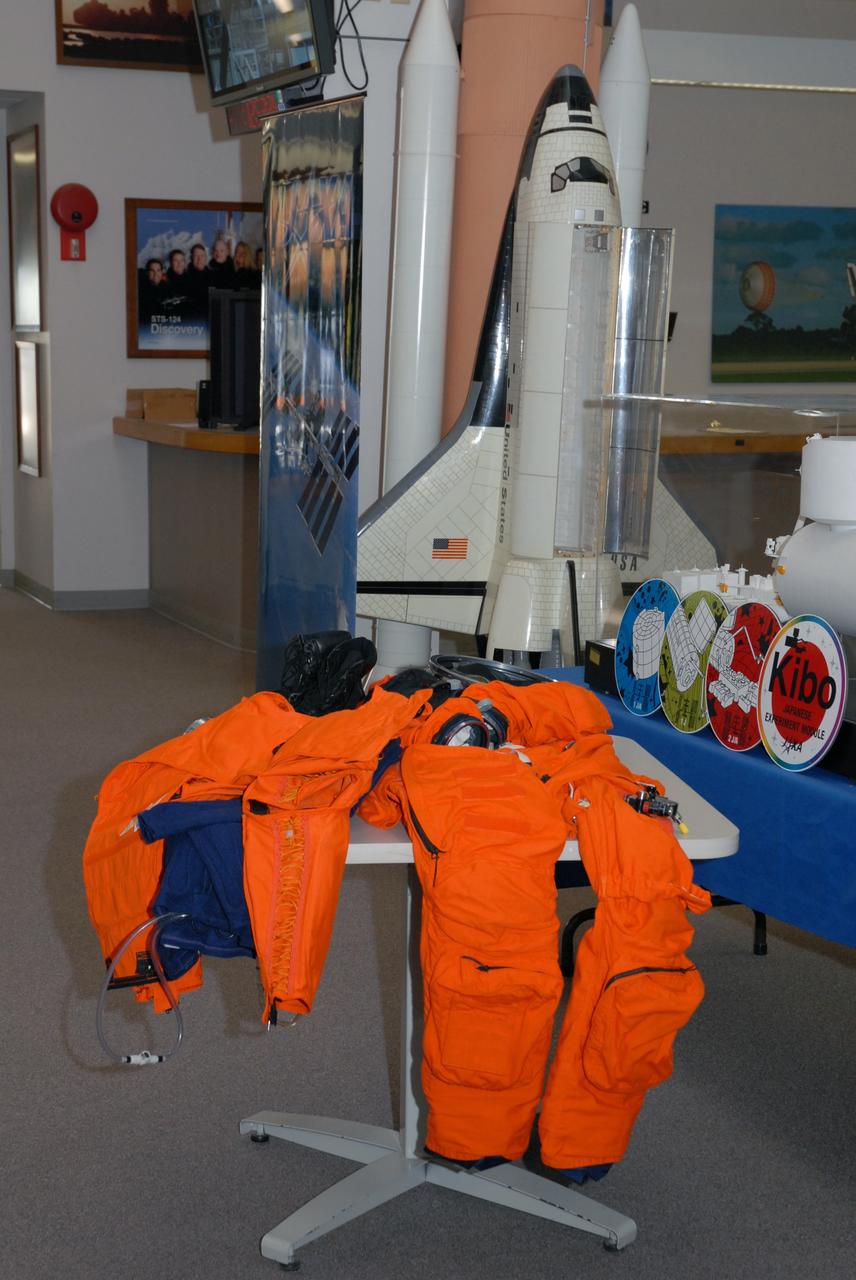
CAPE CANAVERAL, Fla. -- In the NASA News Center at NASA's Kennedy Space Center, components of the astronauts' launch and entry suit are on display for the media. Shuttle Crew Escape System Manager KC Chhipwadia described the individual pieces and their importance to the safety of the shuttle crews during their missions. Photo credit: NASA/Amanda Diller

On July 1, 2019, the Orion Launch Abort System and Crew Module attached to the abort test booster are readied for flight on Ascent Abort-2 (AA-2). The successful test demonstrated the ability to carry the crew to safety in case of a mishap during ascent.
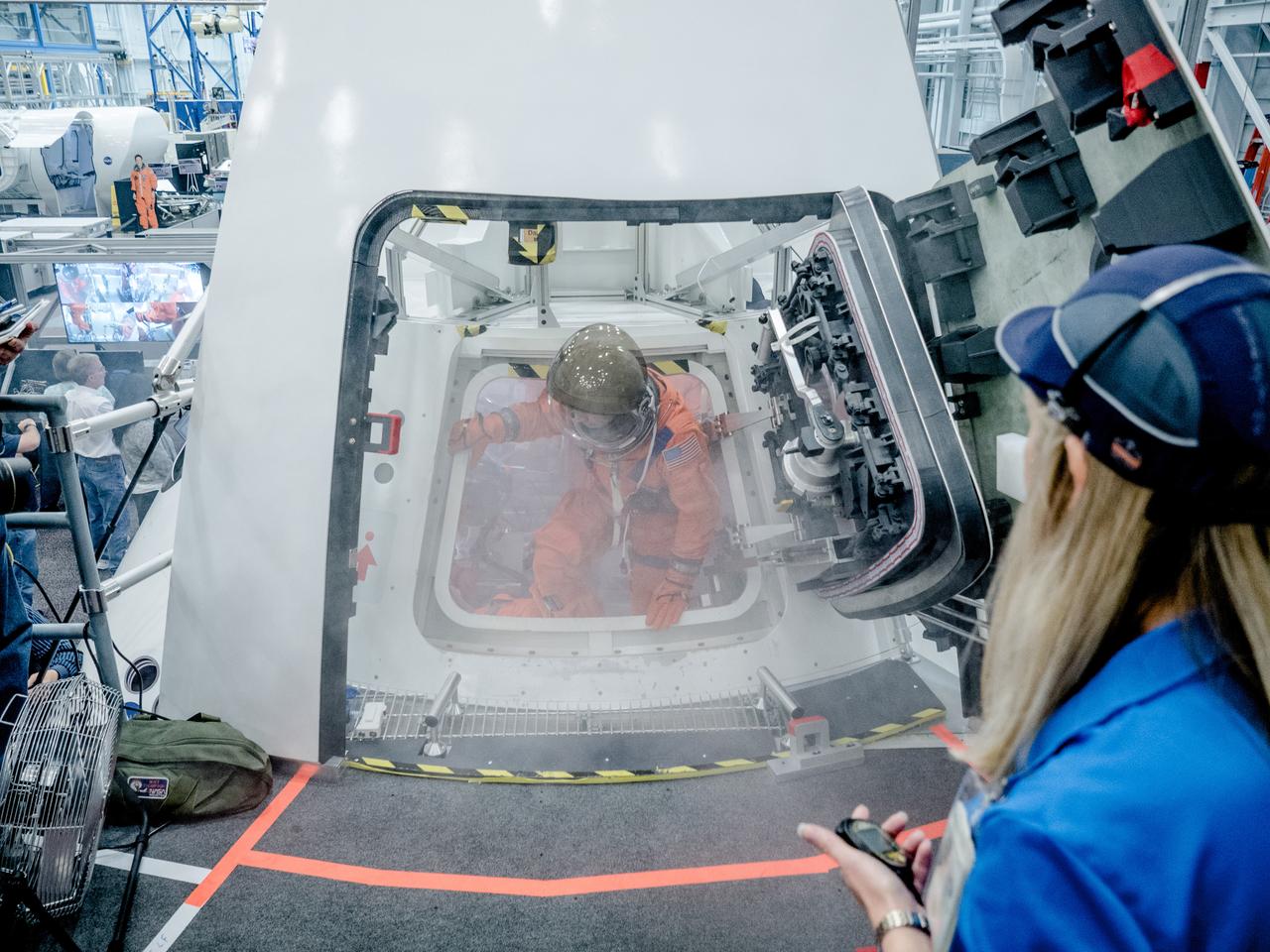
NASA is performing a series of tests to evaluate how astronauts and ground crew involved in final preparations before Orion missions will quickly get out of the spacecraft if an emergency were to occur on the pad prior to launch. In the hours before astronauts launch to space in Orion from NASA’s modernized spaceport in Florida in on the agency’s Space Launch System rocket, they will cross the Crew Access Arm 300 feet above the ground and climb inside the crew module with the assistance of ground personnel trained to help them strap into their seats and take care of last-minute needs. The testing is helping engineers evaluate hardware designs and establish procedures that would be used to get astronauts and ground crew out of the capsule as quickly as possible. Flight and ground crew are required to get out of Orion within two minutes to protect for a variety of failure scenarios that do not require the launch abort system to be activated, such as crew incapacitation, fire or the presence of toxins in the cabin. This testing took place the week of Oct. 30, 2017 using the Orion mockup in the Space Vehicle Mockup Facility at NASA’s Johnson Space Center in Houston. In this photo, engineers used fake smoke to imitate a scenario in which astronauts must exit the capsule when their vision is obscured. Markings on the ground indicate where the Crew Access Arm would be located and help guide the crew. This testing is a collaborative effort between the Orion and Ground Systems Development and Operations programs. Previous egress testing at Johnson and in the Gulf of Mexico has evaluated how crew will exit the spacecraft at the end of their missions..

NASA is performing a series of tests to evaluate how astronauts and ground crew involved in final preparations before Orion missions will quickly get out of the spacecraft if an emergency were to occur on the pad prior to launch. In the hours before astronauts launch to space in Orion from NASA’s modernized spaceport in Florida in on the agency’s Space Launch System rocket, they will cross the Crew Access Arm 300 feet above the ground and climb inside the crew module with the assistance of ground personnel trained to help them strap into their seats and take care of last-minute needs. The testing is helping engineers evaluate hardware designs and establish procedures that would be used to get astronauts and ground crew out of the capsule as quickly as possible. Flight and ground crew are required to get out of Orion within two minutes to protect for a variety of failure scenarios that do not require the launch abort system to be activated, such as crew incapacitation, fire or the presence of toxins in the cabin. This testing took place the week of Oct. 30, 2017 using the Orion mockup in the Space Vehicle Mockup Facility at NASA’s Johnson Space Center in Houston. In this photo, engineers used fake smoke to imitate a scenario in which astronauts must exit the capsule when their vision is obscured. Markings on the ground indicate where the Crew Access Arm would be located and help guide the crew. This testing is a collaborative effort between the Orion and Ground Systems Development and Operations programs. Previous egress testing at Johnson and in the Gulf of Mexico has evaluated how crew will exit the spacecraft at the end of their missions..
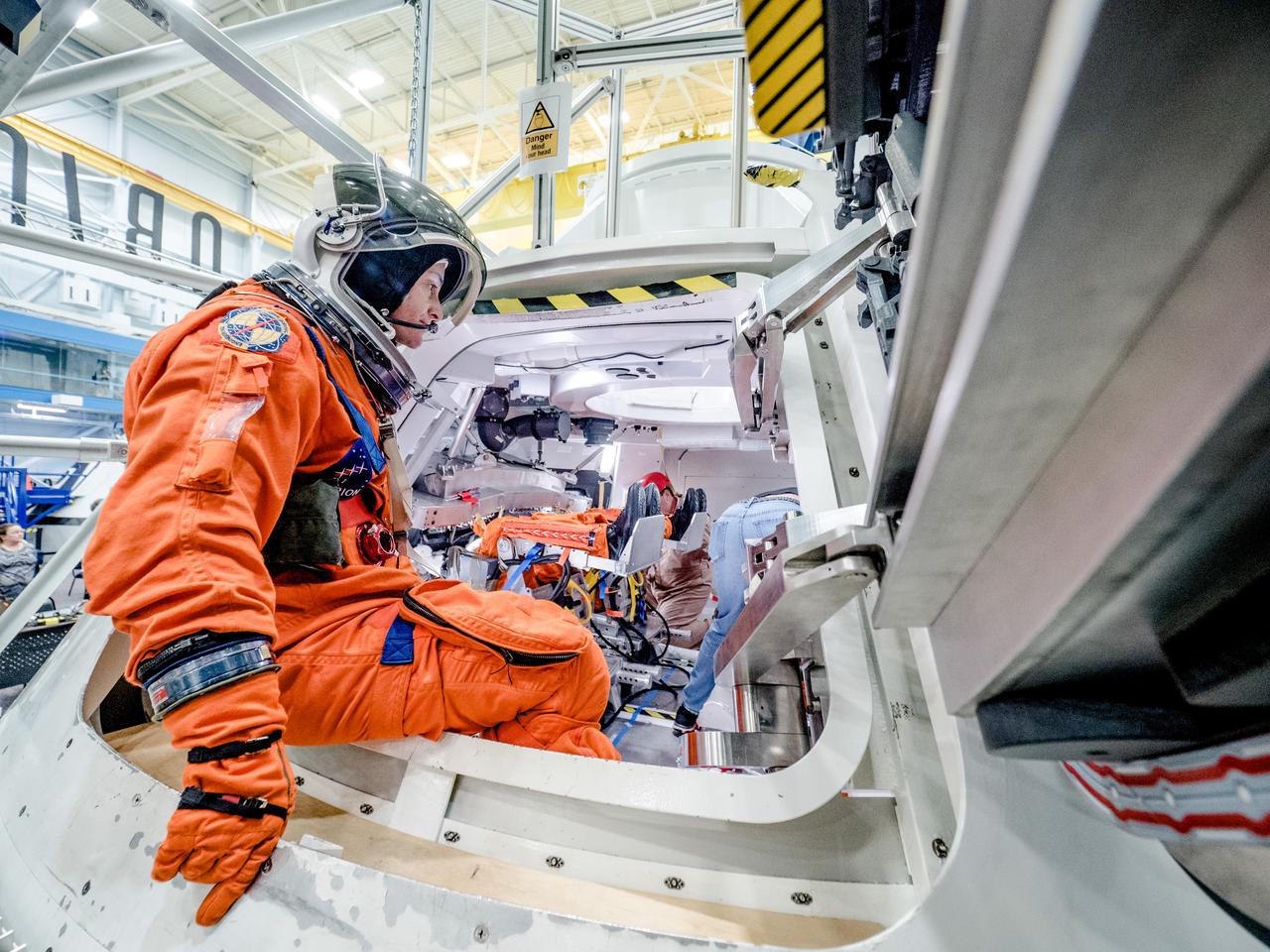
NASA is performing a series of tests to evaluate how astronauts and ground crew involved in final preparations before Orion missions will quickly get out of the spacecraft if an emergency were to occur on the pad prior to launch. In the hours before astronauts launch to space in Orion from NASA’s modernized spaceport in Florida in on the agency’s Space Launch System rocket, they will cross the Crew Access Arm 300 feet above the ground and climb inside the crew module with the assistance of ground personnel trained to help them strap into their seats and take care of last-minute needs. The testing is helping engineers evaluate hardware designs and establish procedures that would be used to get astronauts and ground crew out of the capsule as quickly as possible. Flight and ground crew are required to get out of Orion within two minutes to protect for a variety of failure scenarios that do not require the launch abort system to be activated, such as crew incapacitation, fire or the presence of toxins in the cabin. This testing took place the week of Oct. 30, 2017 using the Orion mockup in the Space Vehicle Mockup Facility at NASA’s Johnson Space Center in Houston. In this photo, engineers used fake smoke to imitate a scenario in which astronauts must exit the capsule when their vision is obscured. Markings on the ground indicate where the Crew Access Arm would be located and help guide the crew. This testing is a collaborative effort between the Orion and Ground Systems Development and Operations programs. Previous egress testing at Johnson and in the Gulf of Mexico has evaluated how crew will exit the spacecraft at the end of their missions..
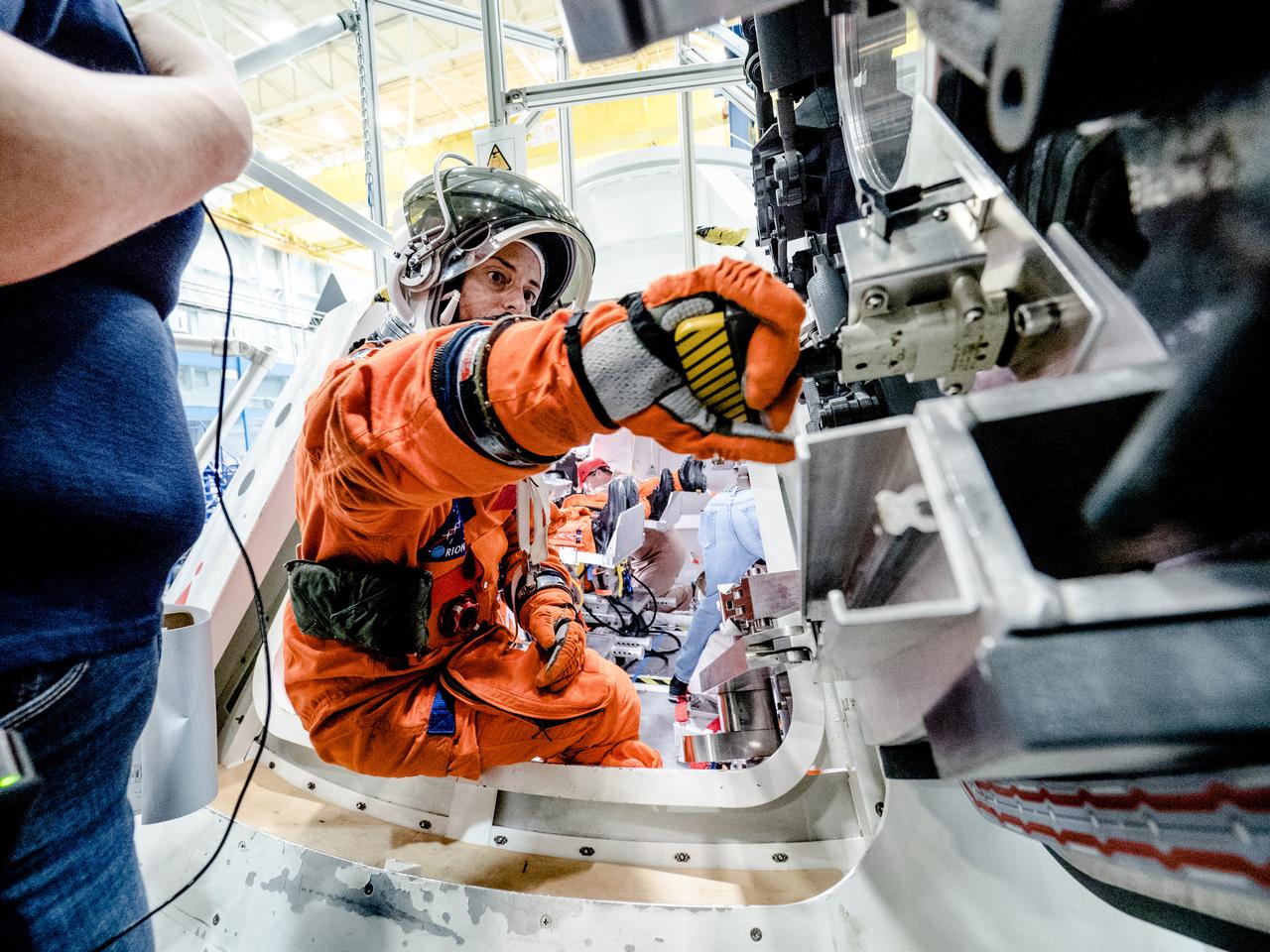
NASA is performing a series of tests to evaluate how astronauts and ground crew involved in final preparations before Orion missions will quickly get out of the spacecraft if an emergency were to occur on the pad prior to launch. In the hours before astronauts launch to space in Orion from NASA’s modernized spaceport in Florida in on the agency’s Space Launch System rocket, they will cross the Crew Access Arm 300 feet above the ground and climb inside the crew module with the assistance of ground personnel trained to help them strap into their seats and take care of last-minute needs. The testing is helping engineers evaluate hardware designs and establish procedures that would be used to get astronauts and ground crew out of the capsule as quickly as possible. Flight and ground crew are required to get out of Orion within two minutes to protect for a variety of failure scenarios that do not require the launch abort system to be activated, such as crew incapacitation, fire or the presence of toxins in the cabin. This testing took place the week of Oct. 30, 2017 using the Orion mockup in the Space Vehicle Mockup Facility at NASA’s Johnson Space Center in Houston. In this photo, engineers used fake smoke to imitate a scenario in which astronauts must exit the capsule when their vision is obscured. Markings on the ground indicate where the Crew Access Arm would be located and help guide the crew. This testing is a collaborative effort between the Orion and Ground Systems Development and Operations programs. Previous egress testing at Johnson and in the Gulf of Mexico has evaluated how crew will exit the spacecraft at the end of their missions..

NASA is performing a series of tests to evaluate how astronauts and ground crew involved in final preparations before Orion missions will quickly get out of the spacecraft if an emergency were to occur on the pad prior to launch. In the hours before astronauts launch to space in Orion from NASA’s modernized spaceport in Florida in on the agency’s Space Launch System rocket, they will cross the Crew Access Arm 300 feet above the ground and climb inside the crew module with the assistance of ground personnel trained to help them strap into their seats and take care of last-minute needs. The testing is helping engineers evaluate hardware designs and establish procedures that would be used to get astronauts and ground crew out of the capsule as quickly as possible. Flight and ground crew are required to get out of Orion within two minutes to protect for a variety of failure scenarios that do not require the launch abort system to be activated, such as crew incapacitation, fire or the presence of toxins in the cabin. This testing took place the week of Oct. 30, 2017 using the Orion mockup in the Space Vehicle Mockup Facility at NASA’s Johnson Space Center in Houston. In this photo, engineers used fake smoke to imitate a scenario in which astronauts must exit the capsule when their vision is obscured. Markings on the ground indicate where the Crew Access Arm would be located and help guide the crew. This testing is a collaborative effort between the Orion and Ground Systems Development and Operations programs. Previous egress testing at Johnson and in the Gulf of Mexico has evaluated how crew will exit the spacecraft at the end of their missions..
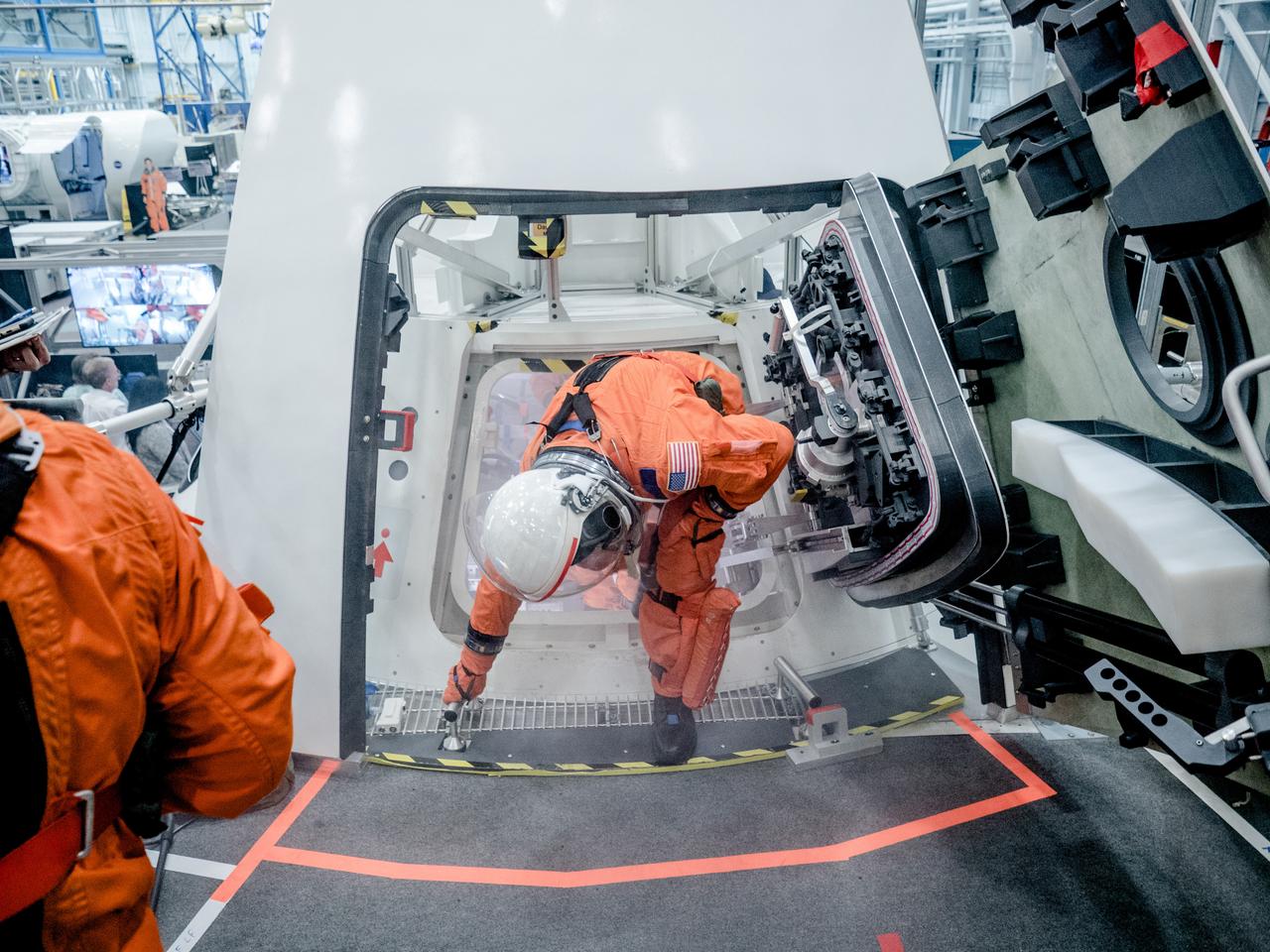
NASA is performing a series of tests to evaluate how astronauts and ground crew involved in final preparations before Orion missions will quickly get out of the spacecraft if an emergency were to occur on the pad prior to launch. In the hours before astronauts launch to space in Orion from NASA’s modernized spaceport in Florida in on the agency’s Space Launch System rocket, they will cross the Crew Access Arm 300 feet above the ground and climb inside the crew module with the assistance of ground personnel trained to help them strap into their seats and take care of last-minute needs. The testing is helping engineers evaluate hardware designs and establish procedures that would be used to get astronauts and ground crew out of the capsule as quickly as possible. Flight and ground crew are required to get out of Orion within two minutes to protect for a variety of failure scenarios that do not require the launch abort system to be activated, such as crew incapacitation, fire or the presence of toxins in the cabin. This testing took place the week of Oct. 30, 2017 using the Orion mockup in the Space Vehicle Mockup Facility at NASA’s Johnson Space Center in Houston. In this photo, engineers used fake smoke to imitate a scenario in which astronauts must exit the capsule when their vision is obscured. Markings on the ground indicate where the Crew Access Arm would be located and help guide the crew. This testing is a collaborative effort between the Orion and Ground Systems Development and Operations programs. Previous egress testing at Johnson and in the Gulf of Mexico has evaluated how crew will exit the spacecraft at the end of their missions..
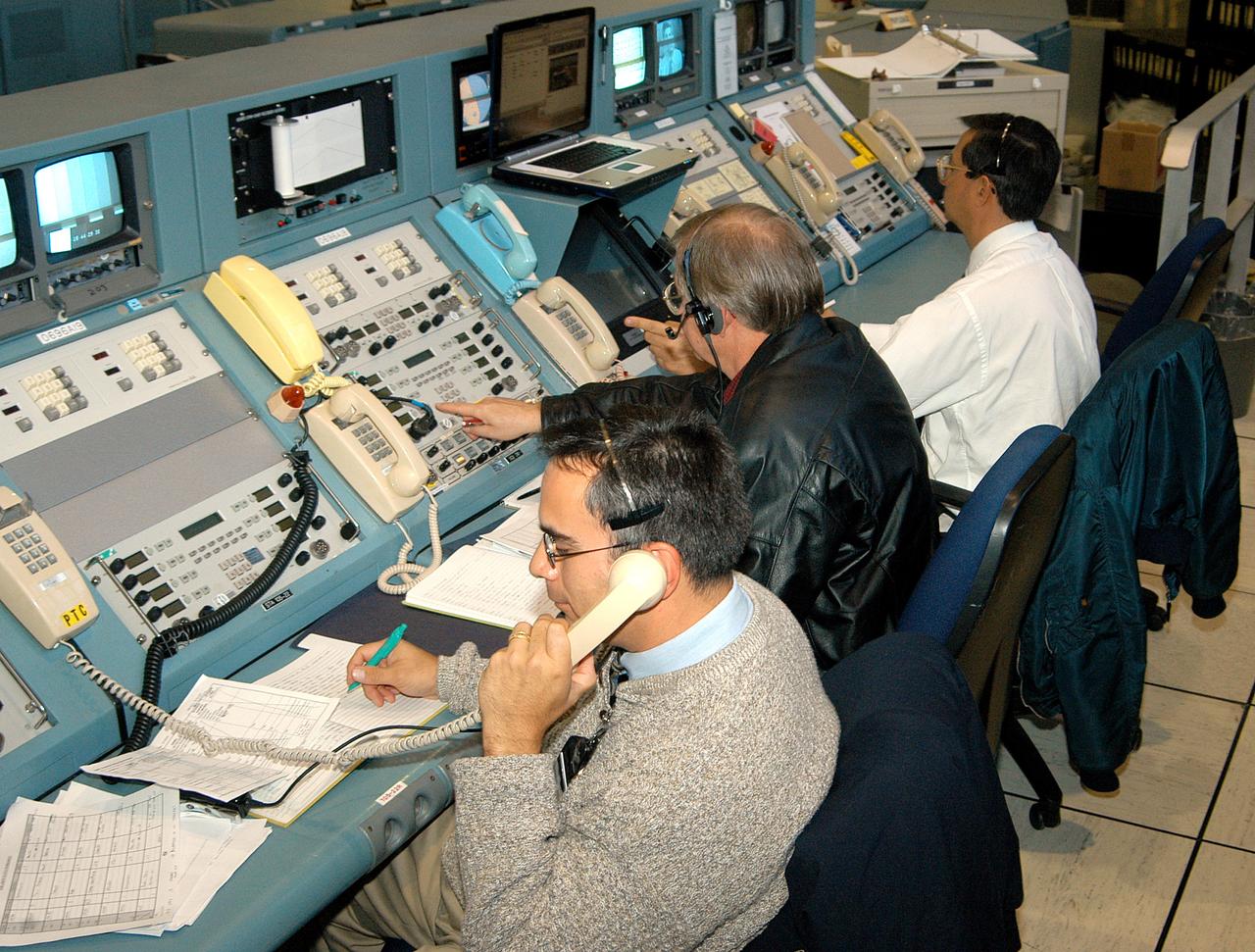
KENNEDY SPACE CENTER, FLA. - In the Launch Control Center, officials monitor the “Mode VII” emergency landing simulation being conducted at Kennedy Space Center and managed and directed from the LCC. From left are Dr. Luis Moreno and Dr. David Reed, with Bionetics Life Sciences, and Dr. Philip Scarpa, with the KSC Safety, Occupational Health and Environment Division. The purpose of the Mode VII is to exercise emergency preparedness personnel, equipment and facilities in rescuing astronauts from a downed orbiter and providing immediate medical attention. This simulation presents an orbiter that has crashed short of the Shuttle Landing Facility in a wooded area 2-1/2 miles south of Runway 33. Emergency crews are responding to the volunteer “astronauts” who are simulating various injuries inside the crew compartment mock-up. Rescuers must remove the crew, provide triage and transport to hospitals those who need further treatment. Local hospitals are participating in the exercise.
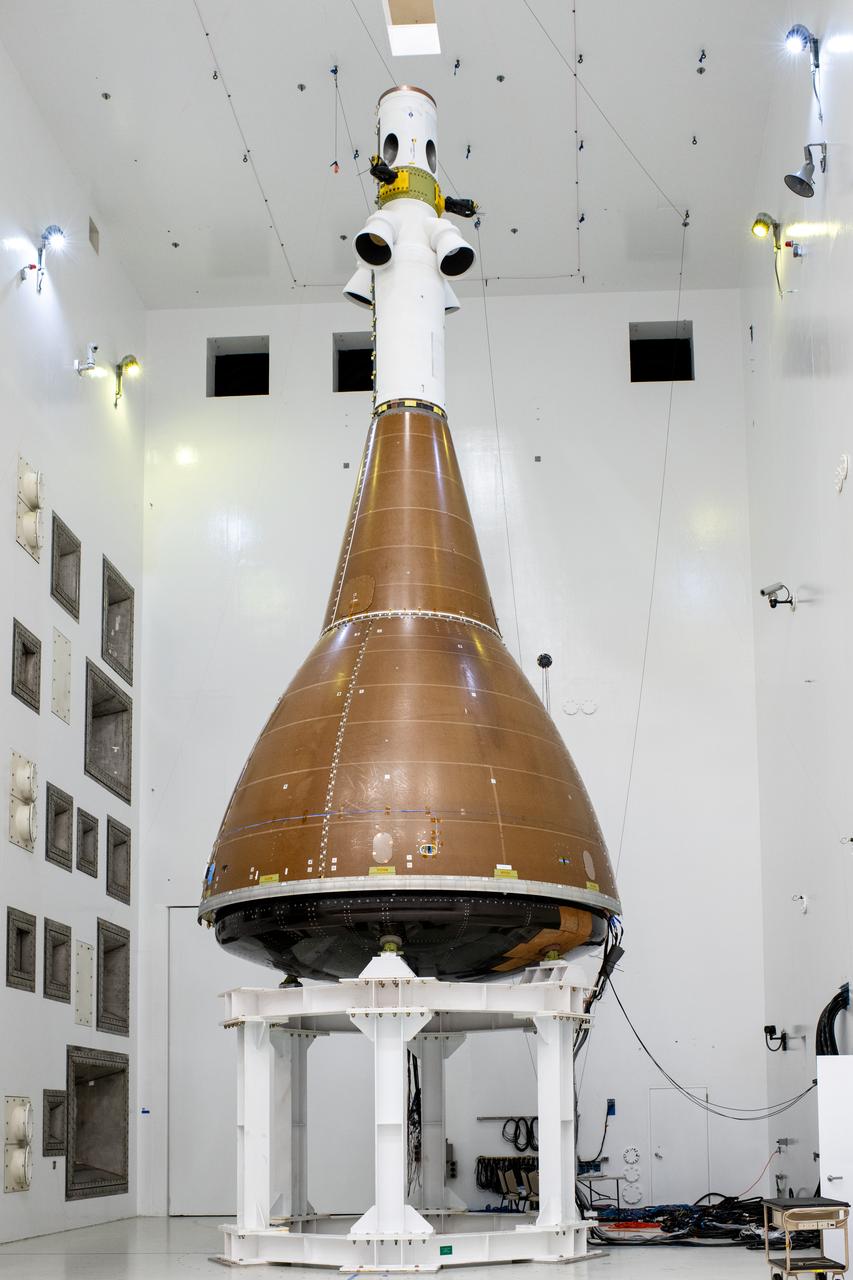
Vibro-acoustic testing on the Orion spacecraft that flew around the Moon on Artemis I, now known as the Environmental Test Article at Armstrong Test Facility in Sandusky, OH. The testing will help ensure the safety of future crews aboard Orion. Photo Credit: (NASA/Sara Lowthian-Hanna)
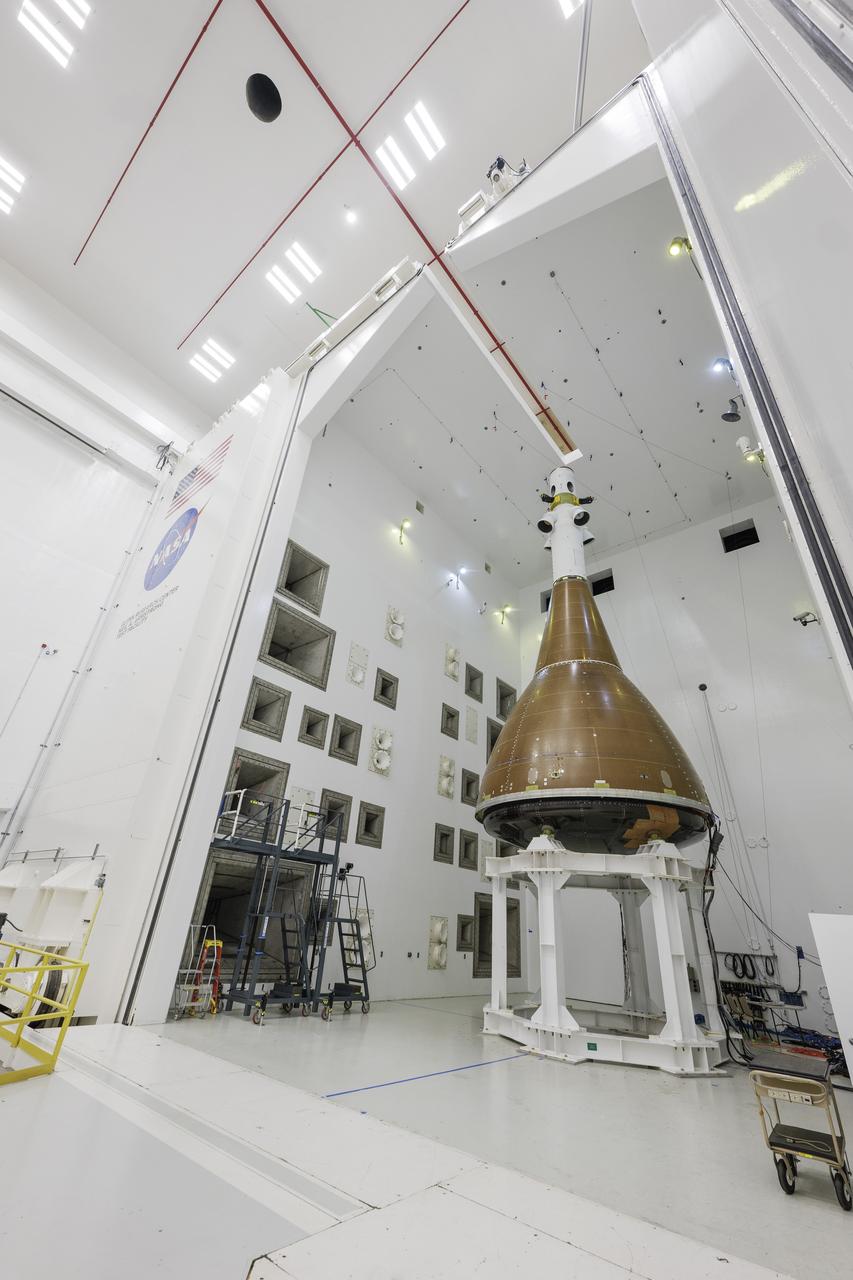
The team at NASA's Armstrong Test Facility in Sandusky, Ohio has begun vibro-acoustic testing on the Orion spacecraft that flew around the Moon on Artemis I, now known as the Environmental Test Article. The testing will help ensure the safety of future crews aboard Orion. Photo credit: NASA / Rad Sinyak
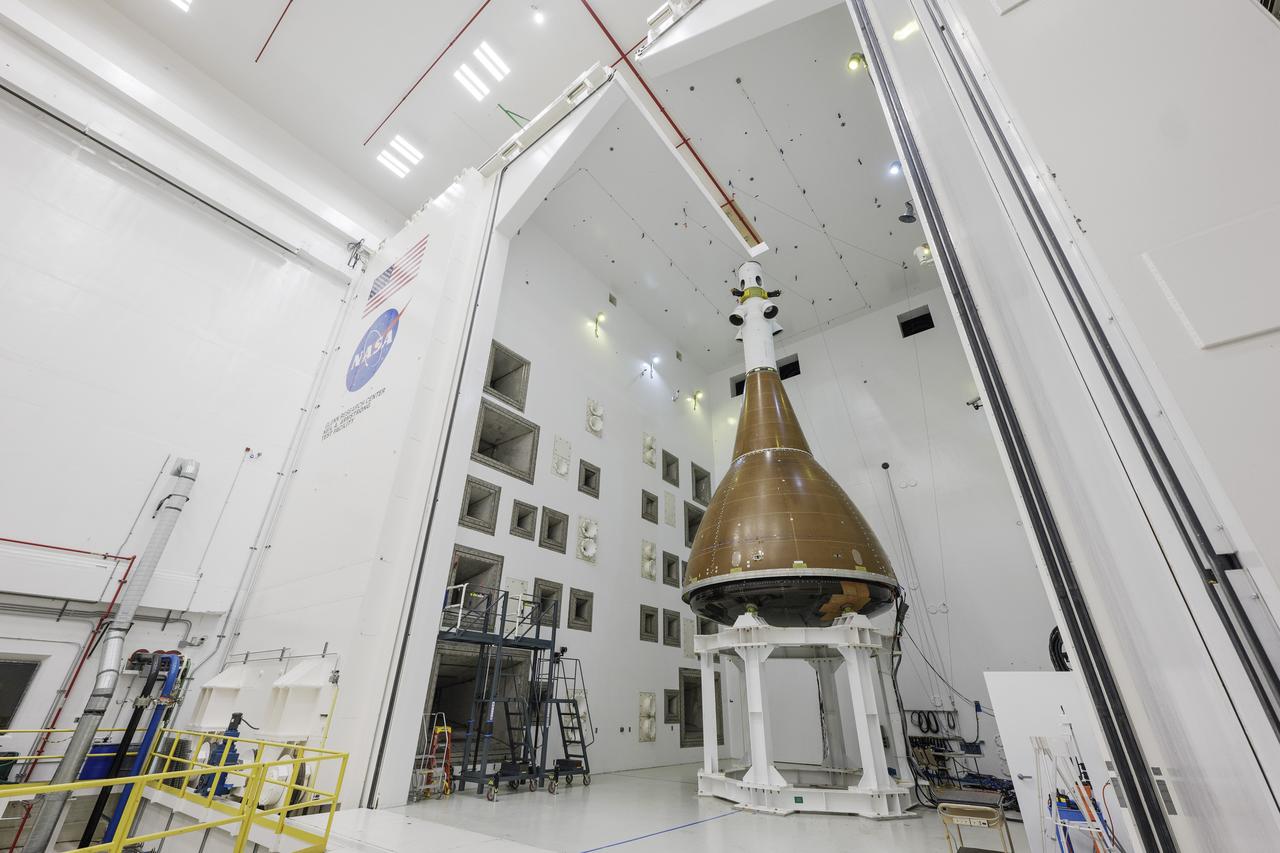
The team at NASA's Armstrong Test Facility in Sandusky, Ohio has begun vibro-acoustic testing on the Orion spacecraft that flew around the Moon on Artemis I, now known as the Environmental Test Article. The testing will help ensure the safety of future crews aboard Orion. Photo credit: NASA / Rad Sinyak

Aircraft maintenance crews at NASA‘s Armstrong Flight Research Center prepare the remotely-piloted Ikhana aircraft for a test flight. The test flight was performed to validate key technologies and operations necessary for FAA’s approval to fly the aircraft in the National Airspace System June 12, 2018, without a safety chase aircraft.
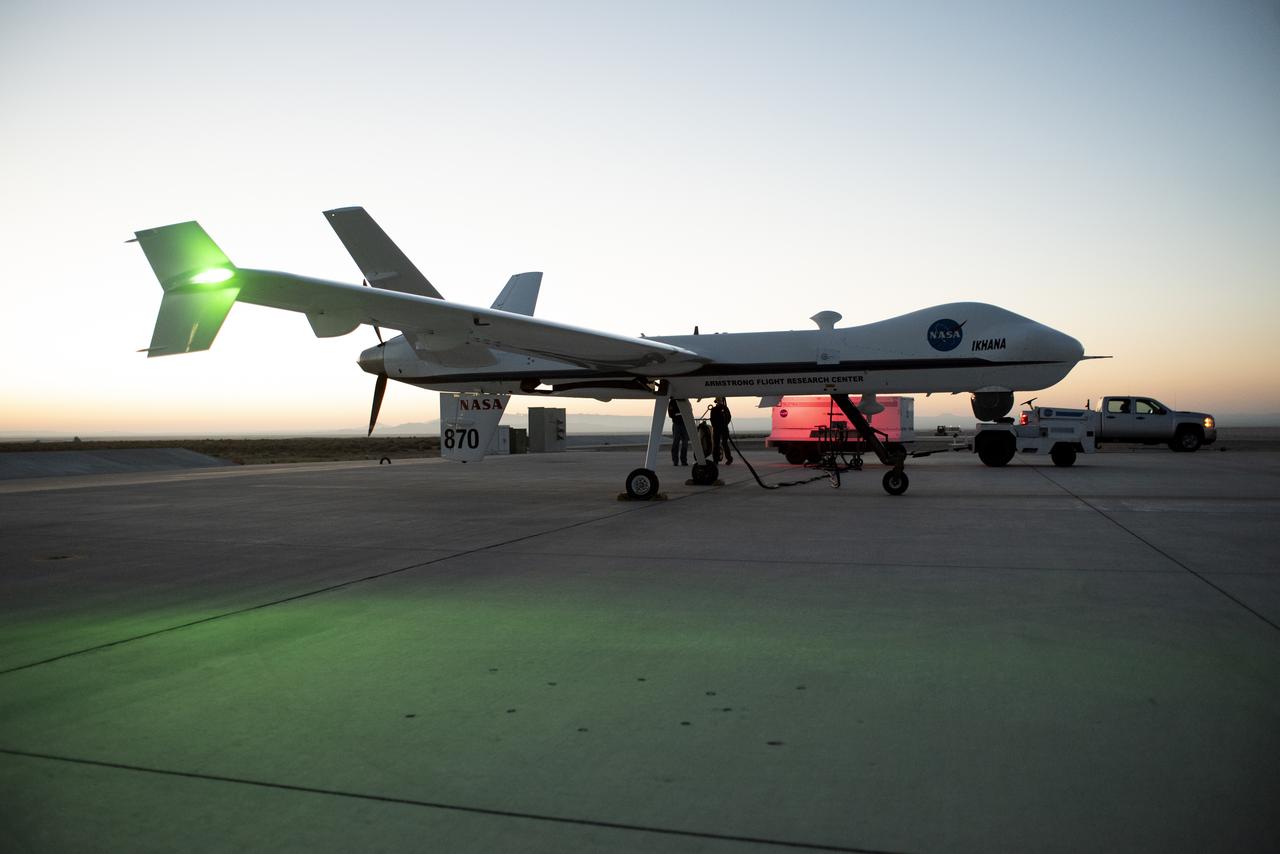
Aircraft maintenance crews at NASA‘s Armstrong Flight Research Center prepare the remotely-piloted Ikhana aircraft for a test flight of Ikhana. The test flight was performed to validate key technologies and operations necessary for FAA’s approval to fly the aircraft in the National Airspace System June 12, 2018, without a safety chase aircraft.
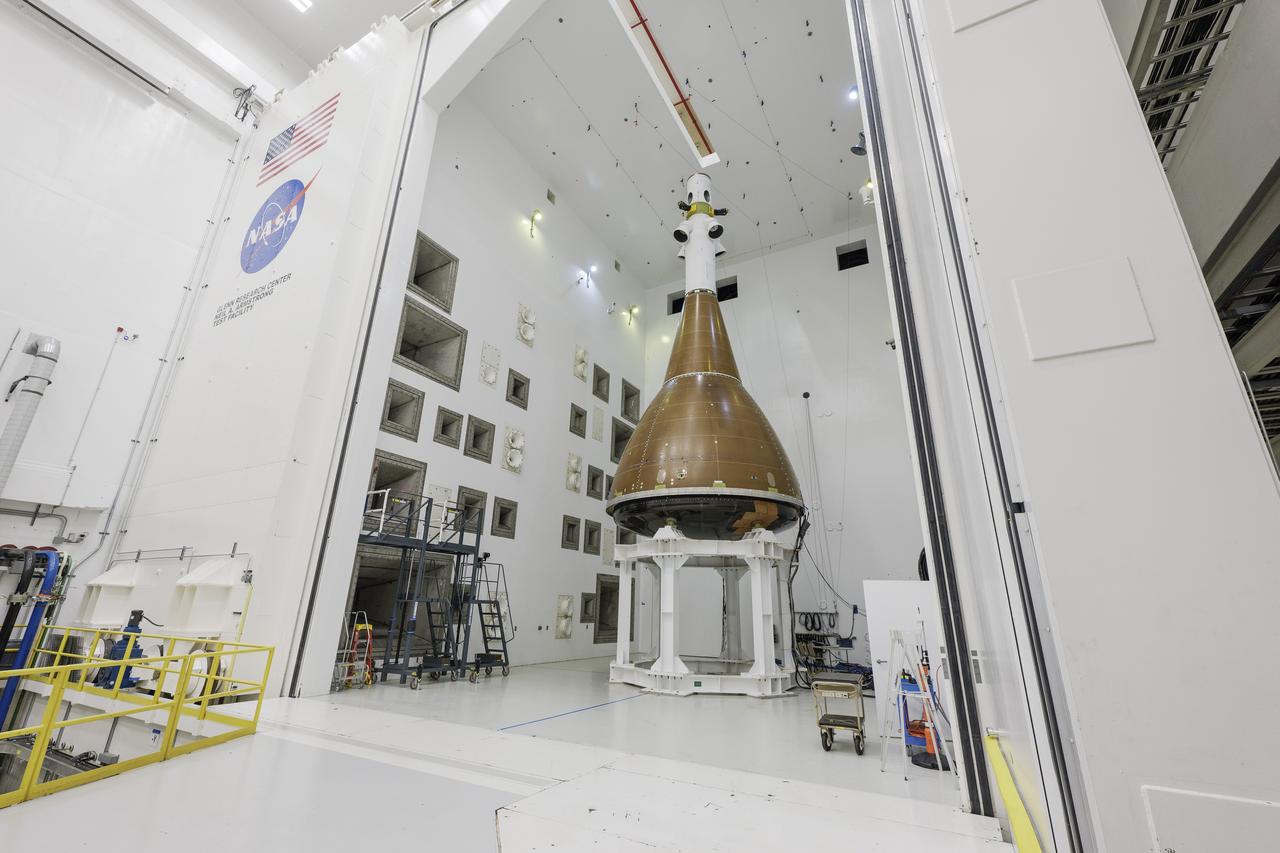
The team at NASA's Armstrong Test Facility in Sandusky, Ohio has begun vibro-acoustic testing on the Orion spacecraft that flew around the Moon on Artemis I, now known as the Environmental Test Article. The testing will help ensure the safety of future crews aboard Orion.

Vibro-acoustic testing on the Orion spacecraft that flew around the Moon on Artemis I, now known as the Environmental Test Article. The testing at Armstrong Test Facility will help ensure the safety of future crews aboard Orion. Photograph taken on September 11, 2024. Photo Credit: (NASA/Sara Lowthian-Hanna)
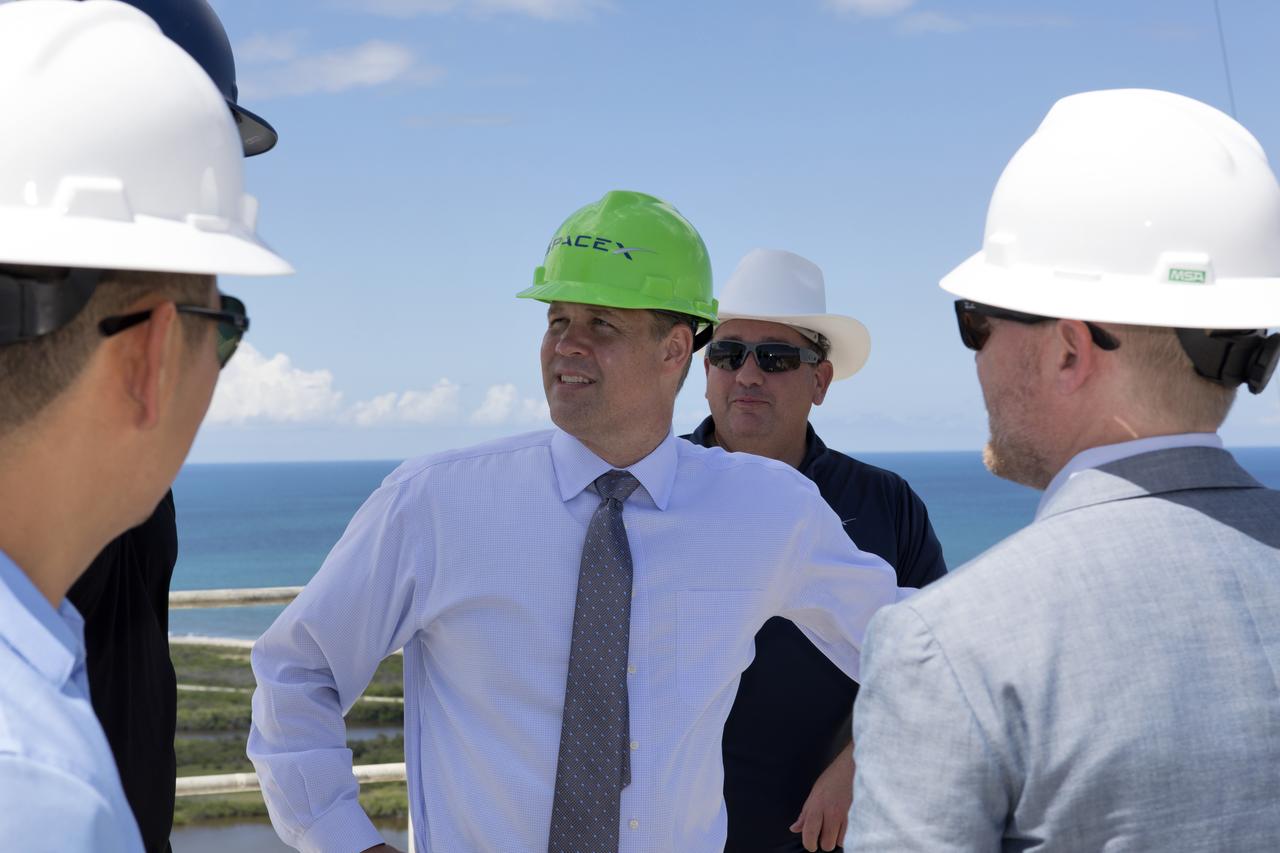
NASA Administrator Jim Bridenstine, center, in the green safety helmet, tours SpaceX Launch Complex 39A, on Aug. 8, 2018, at the agency's Kennedy Space Center in Florida. Bridenstine received updates on SpaceX accomplishments for NASA's Commercial Crew Program.
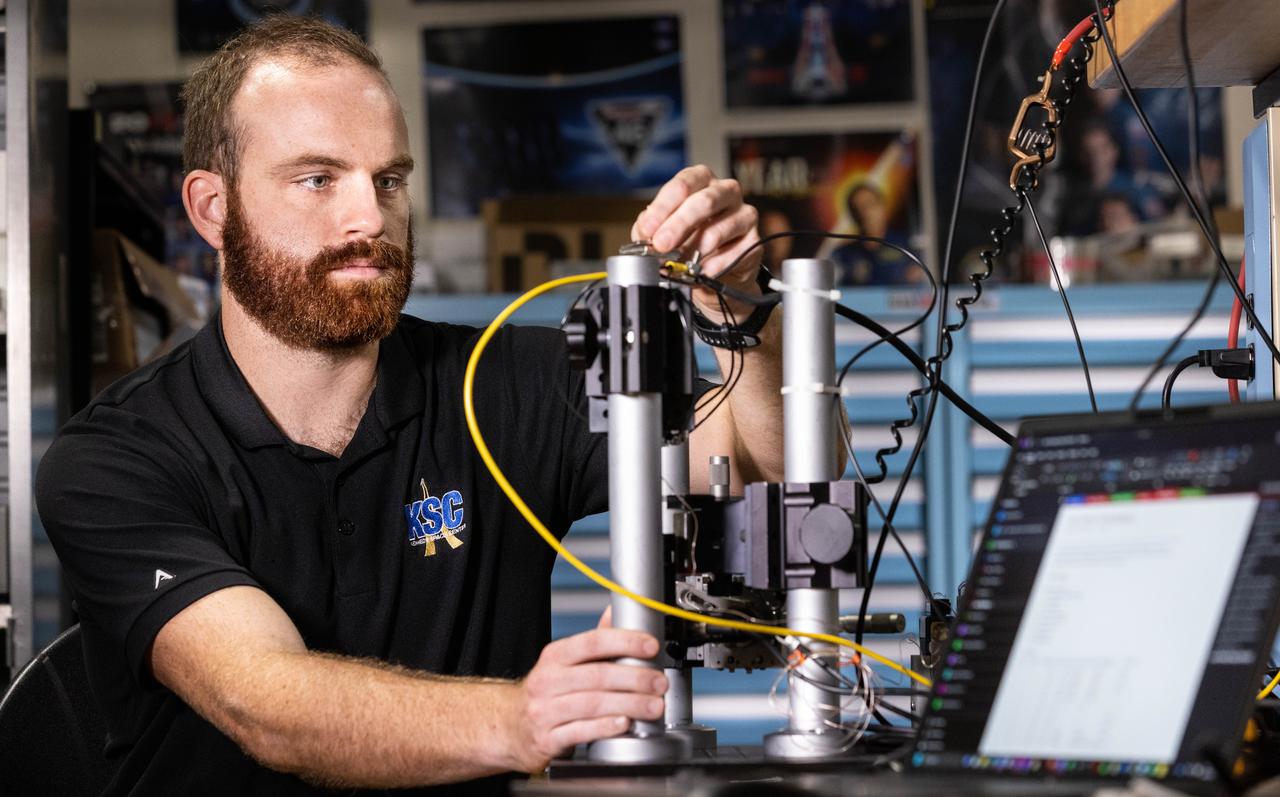
Stefan Tomovic from the Engineering Directorate at NASA’s Kennedy Space Center in Florida evaluates pressure transducers for NASA’s Engineering and Safety Center on Wednesday, Aug. 20, 2025. This probe is designed to improve the detection of thruster pressure sensor anomalies for the agency’s Commercial Crew Program.
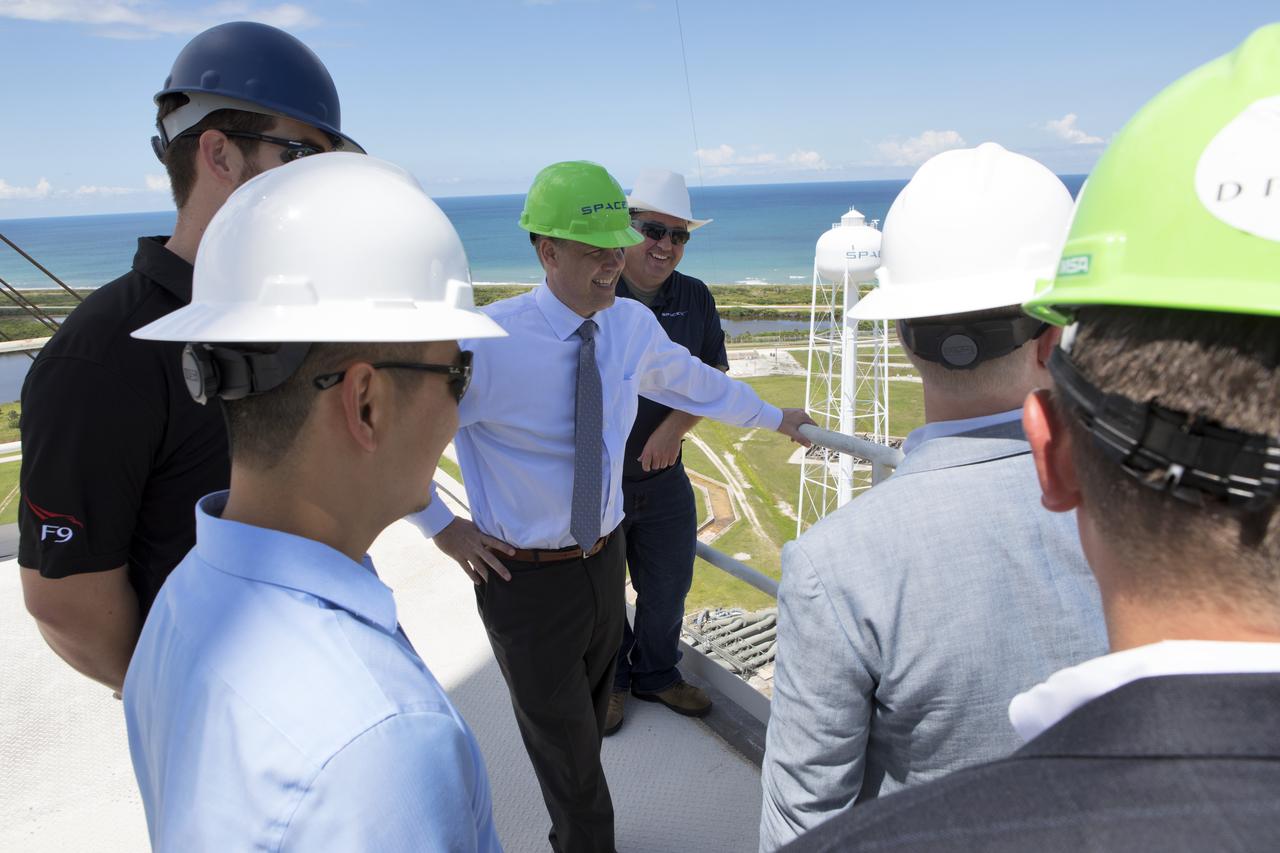
NASA Administrator Jim Bridenstine, center, in the green safety helmet, tours SpaceX Launch Complex 39A, on Aug. 8, 2018, at the agency's Kennedy Space Center in Florida. Bridenstine received updates on SpaceX accomplishments for NASA's Commercial Crew Program.
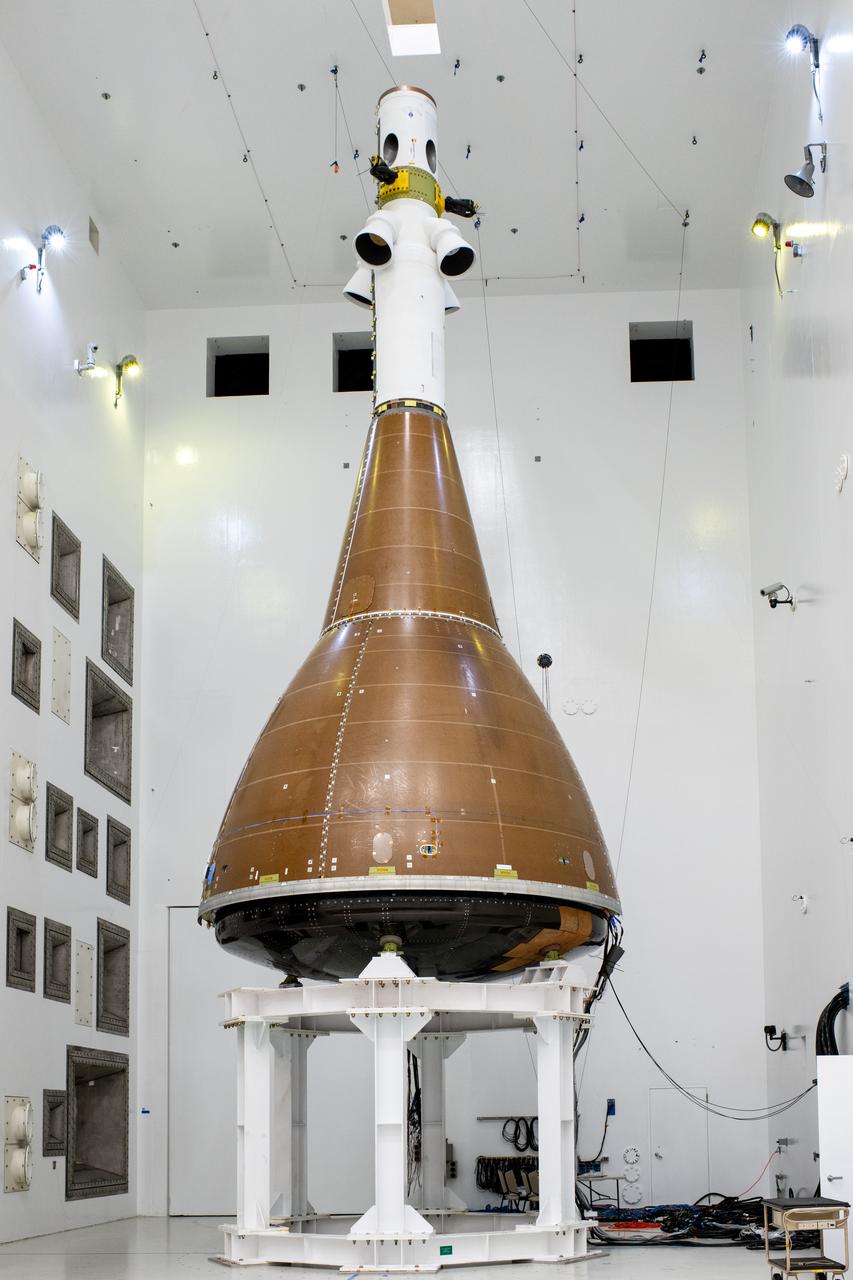
The team at NASA's Armstrong Test Facility in Sandusky, Ohio has begun vibro-acoustic testing on the Orion spacecraft that flew around the Moon on Artemis I, now known as the Environmental Test Article. The testing will help ensure the safety of future crews aboard Orion.
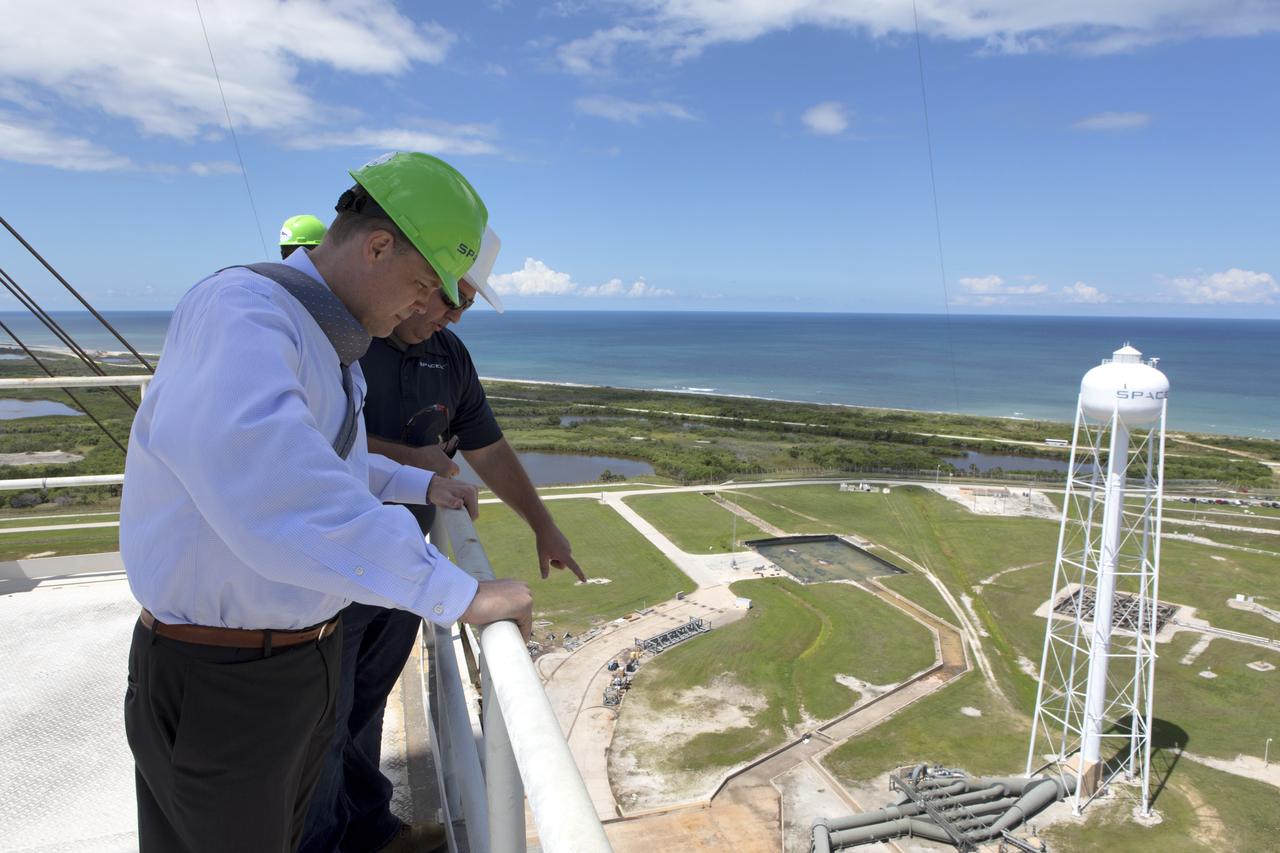
NASA Administrator Jim Bridenstine, in the green safety helmet, tours SpaceX Launch Complex 39A, on Aug. 8, 2018, at the agency's Kennedy Space Center in Florida. Bridenstine received updates on SpaceX accomplishments for NASA's Commercial Crew Program.
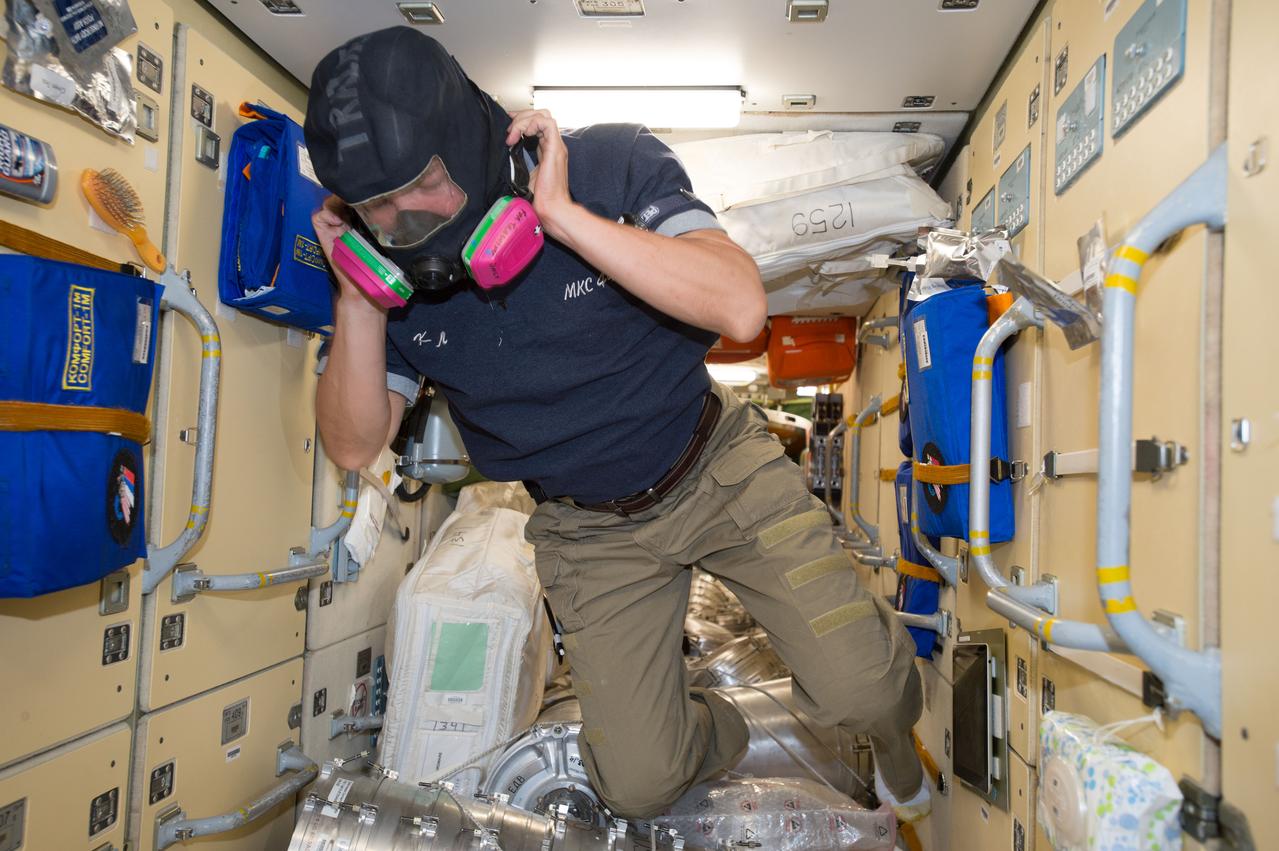
ISS044E025035 (07/29/2015) --- NASA astronaut Kjell Lindgren wears protective breathing apparatus that would be used in the unlikely event of a fire or hazardous chemical leak inside the pressurized air volume of the International Space Station. Familiarization of safety and emergency equipment is standard practice for all newly arrived crew members.
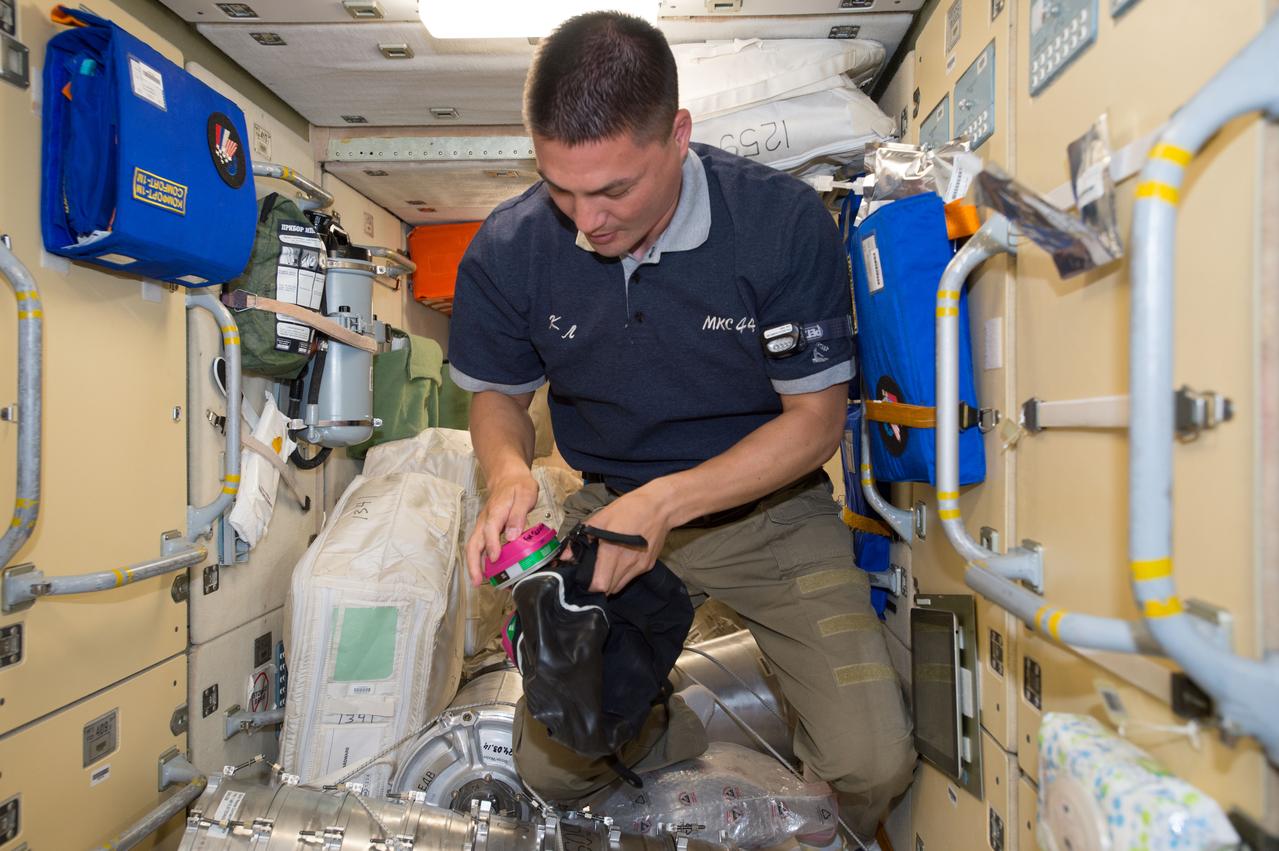
ISS044E025035 (07/29/2015) --- NASA astronaut Kjell Lindgren prepares to don protective breathing apparatus that would be used in the unlikely event of a fire or hazardous chemical leak inside the pressurized air volume of the International Space Station. Familiarization of safety and emergency equipment is standard practice for all newly arrived crew members.
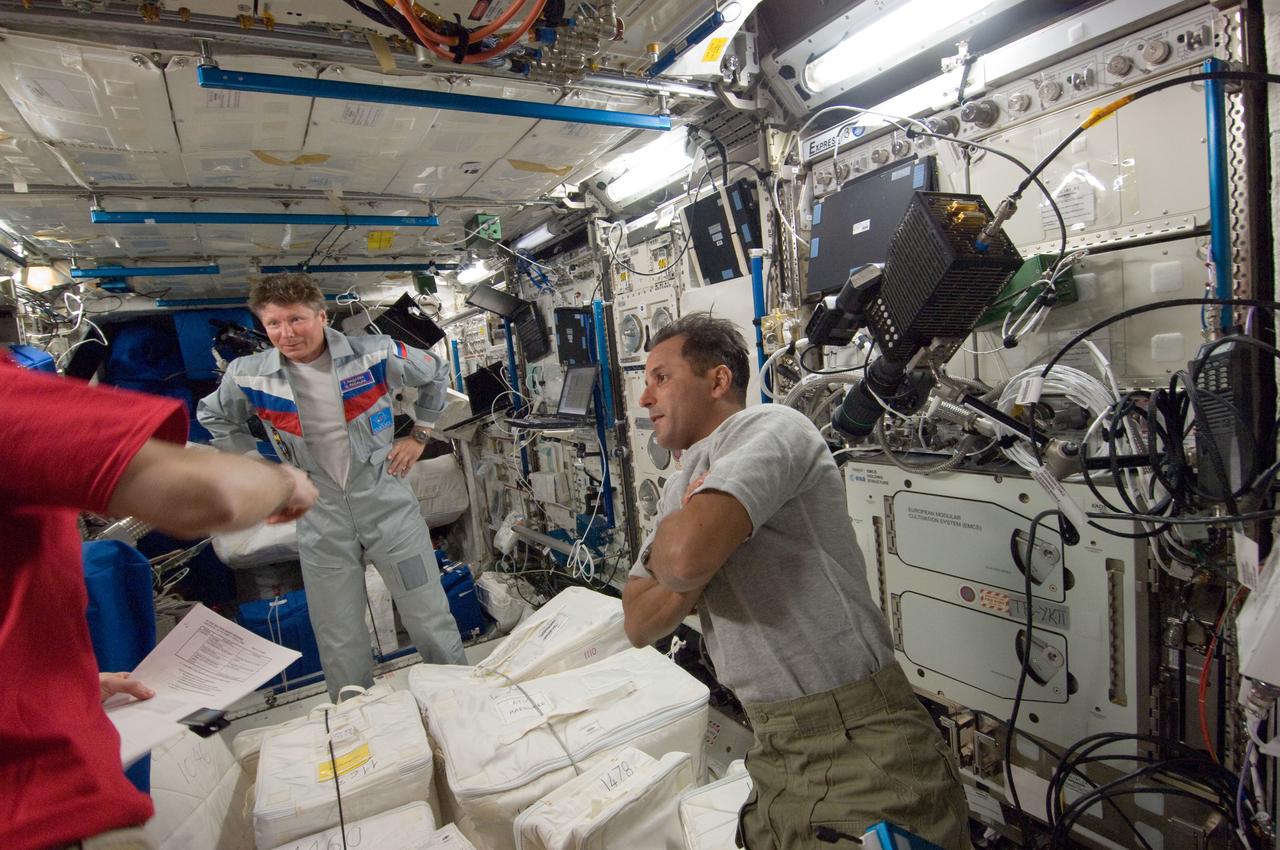
ISS031-E-081658 (17 May 2012) --- Russian cosmonaut Gennady Padalka (background) and NASA astronaut Joe Acaba, both Expedition 31 flight engineers, are pictured during a crew safety briefing in the Columbus laboratory to familiarize them with the potential hazards and available safety measures onboard the International Space Station. Russian cosmonaut Oleg Kononenko (mostly out of frame at left), commander, conducted the briefing. Out of frame are European Space Agency astronaut Andre Kuipers, NASA astronaut Don Pettit and Russian cosmonaut Sergei Revin, all flight engineers. The event took place shortly after Padalka, Revin and Acaba docked with the space station in their Soyuz TMA-04M spacecraft.
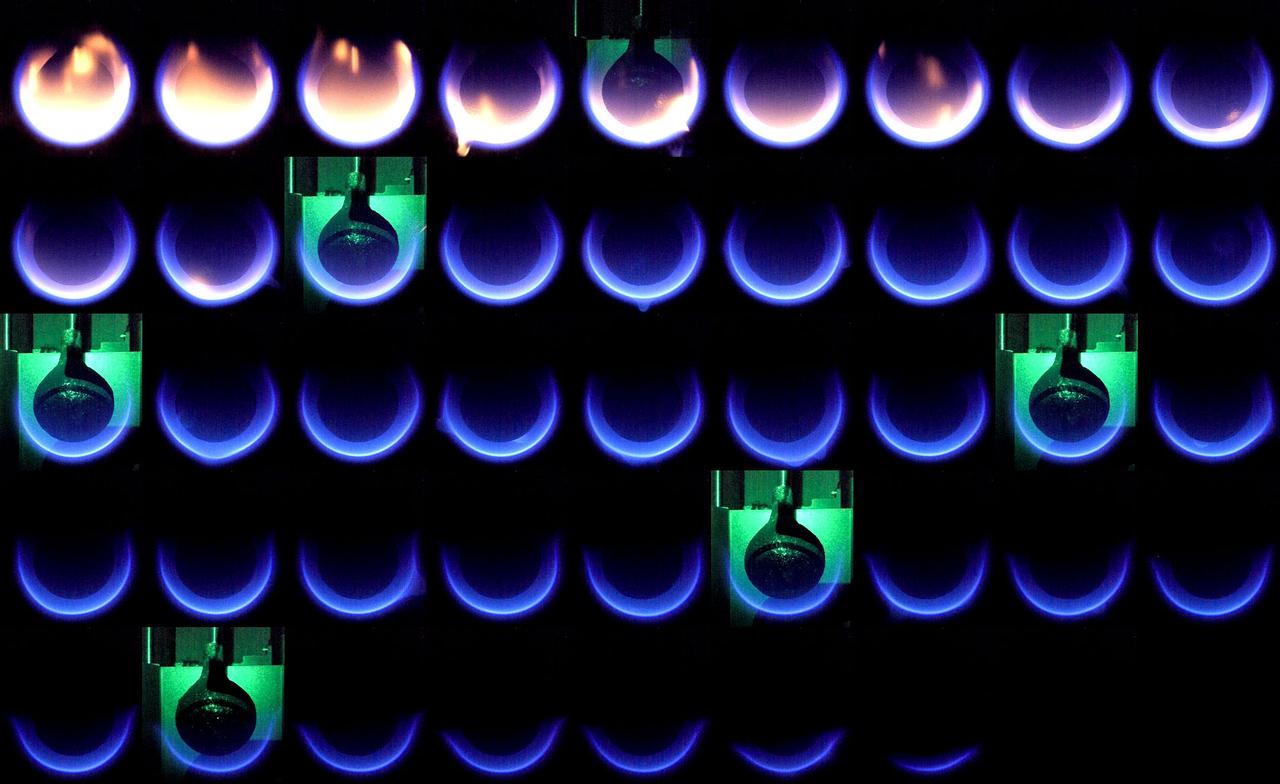
jsc2023e013681 (3/9/2023) --- The Solid Fuel Ignition and Extinction (SoFIE) Growth and Extinction Limits (GEL) experiment aboard the International Space Station (ISS) studies flame growth and extinction in an effort to improve fire safety in space. This image shows a sequence of snapshots taken about 3 seconds apart. During this test point, the ambient oxygen concentration starts relatively high (28%). Initially, the flame is seen as yellow and sooty. As the ambient pressure is reduced, the flame becomes bluer and continues to shrink until fully extinguished. This gives researchers pressure limit data points for flame extinction that could help improve crew and spacecraft safety for future exploration missions.
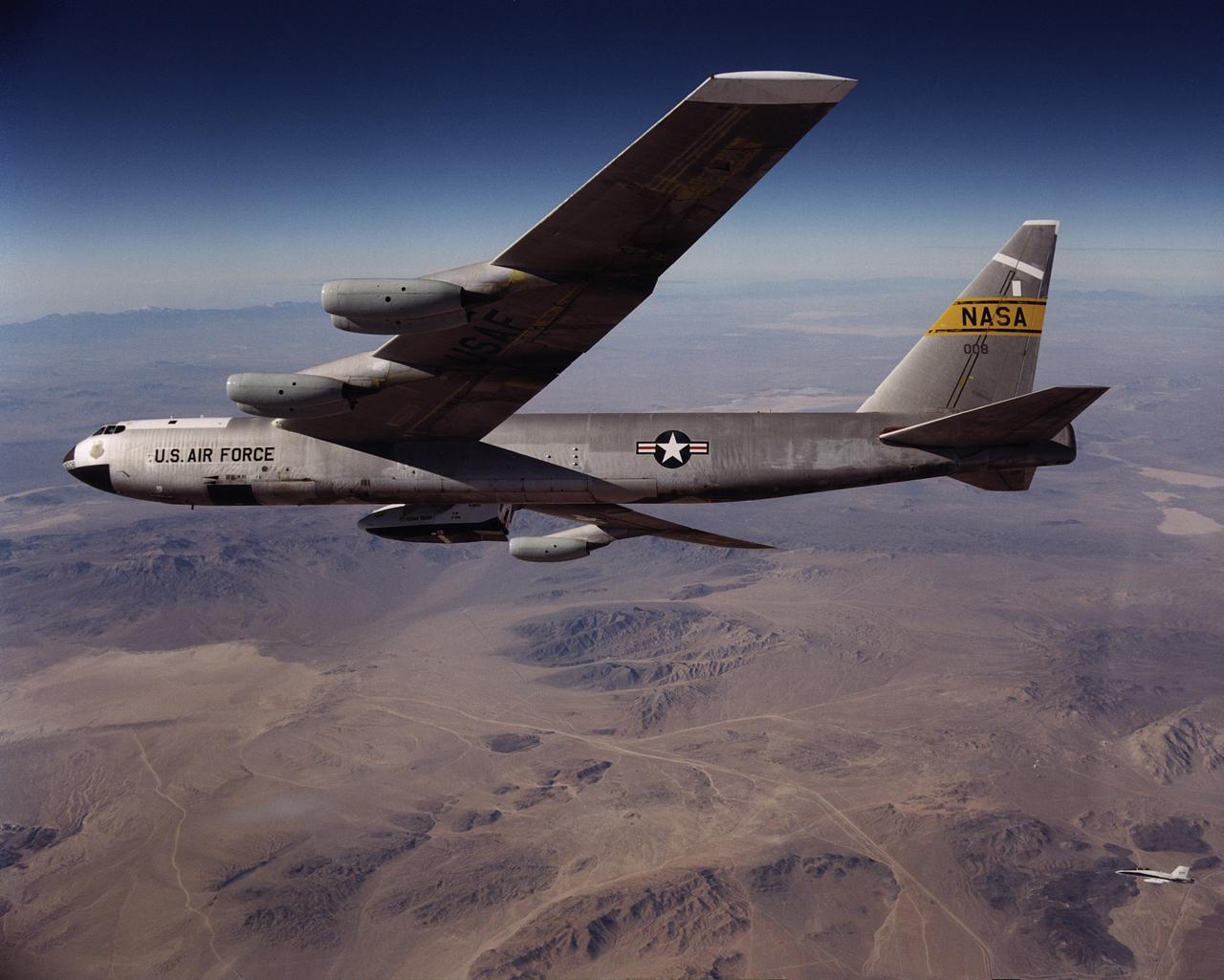
The X-38 prototypes are intended to perfect a "crew lifeboat" for the International Space Station. The X-38 vehicle 131R demonstrates a huge 7,500 square-foot parafoil that will that will enable the Crew Return Vehicle (CRV) to land on the length of a football field after returning from space. The CRV is intended to serve as an emergency transport to carry a crew to safety in the event of problems with the International Space Station.
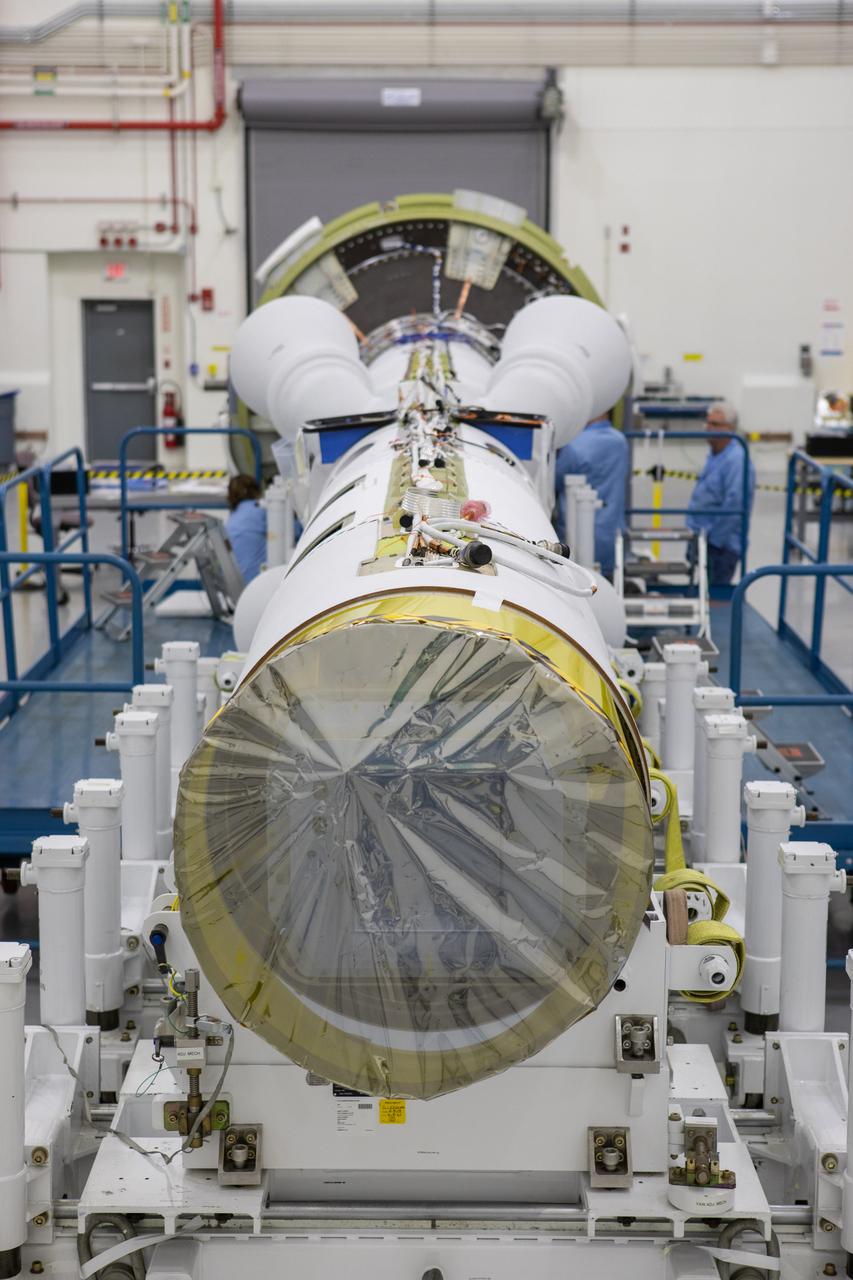
Inside the Launch Abort System Facility at NASA’s Kennedy Space Center in Florida, work is underway Aug. 21, 2019, to integrate segments of the launch abort system for the agency’s uncrewed flight test, Artemis I. During crewed launches of the Orion spacecraft atop the Space Launch System rocket, the LAS will protect the crew module and astronauts aboard to safety if an emergency occurs during launch.
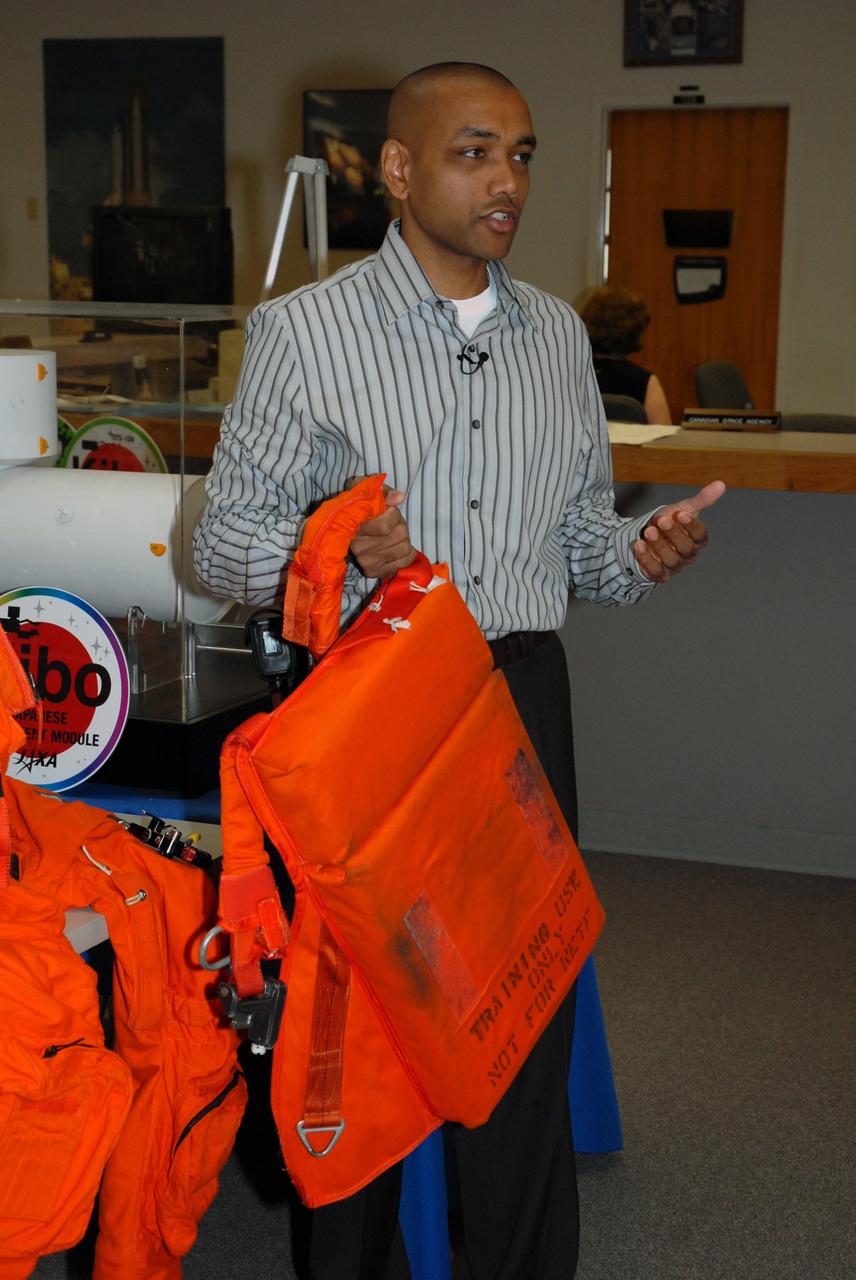
CAPE CANAVERAL, Fla. -- In the NASA News Center at NASA's Kennedy Space Center, Shuttle Crew Escape System Manager KC Chhipwadia describes for the media the components of the parachute worn by shuttle crews during launch and landing. On top is a pilot and drag chute. In the middle is the main chute. At bottom is a survival life raft. The elements of the suit and parachute provide safety elements in the event of an emergency. Photo credit: NASA/Amanda Diller
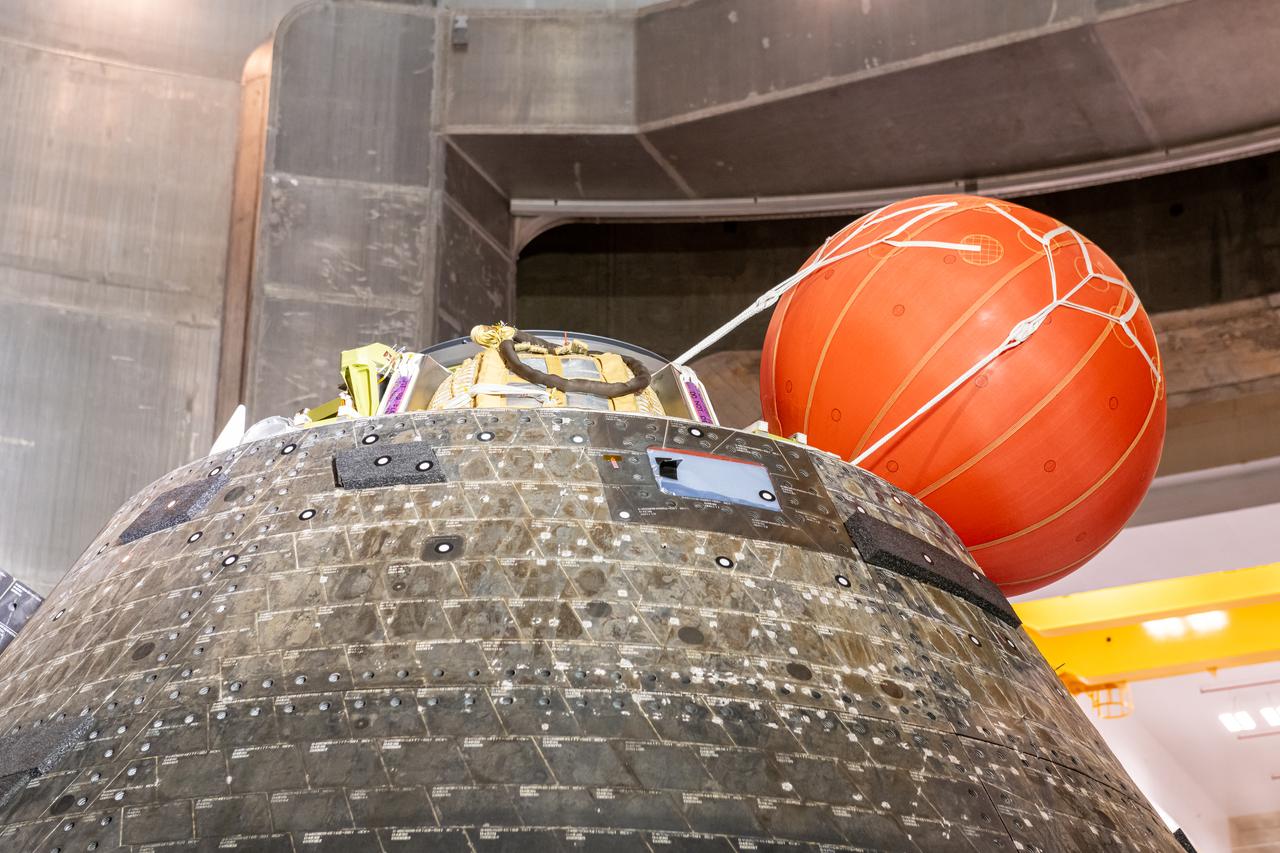
The Orion Crew Module, also known as the Orion Environmental Test Article (ETA), returned to NASA’s Neil Armstrong Test Facility in Sandusky, Ohio, in January 2024 and completed an 11-month test campaign necessary for the safety and success of Artemis II. In November 2024, experts completed the Crew Module Uprighting System Test, which is the system of five airbags on top of the capsule that inflate upon splashdown. Photo Credit: (NASA/Jordan Salkin)
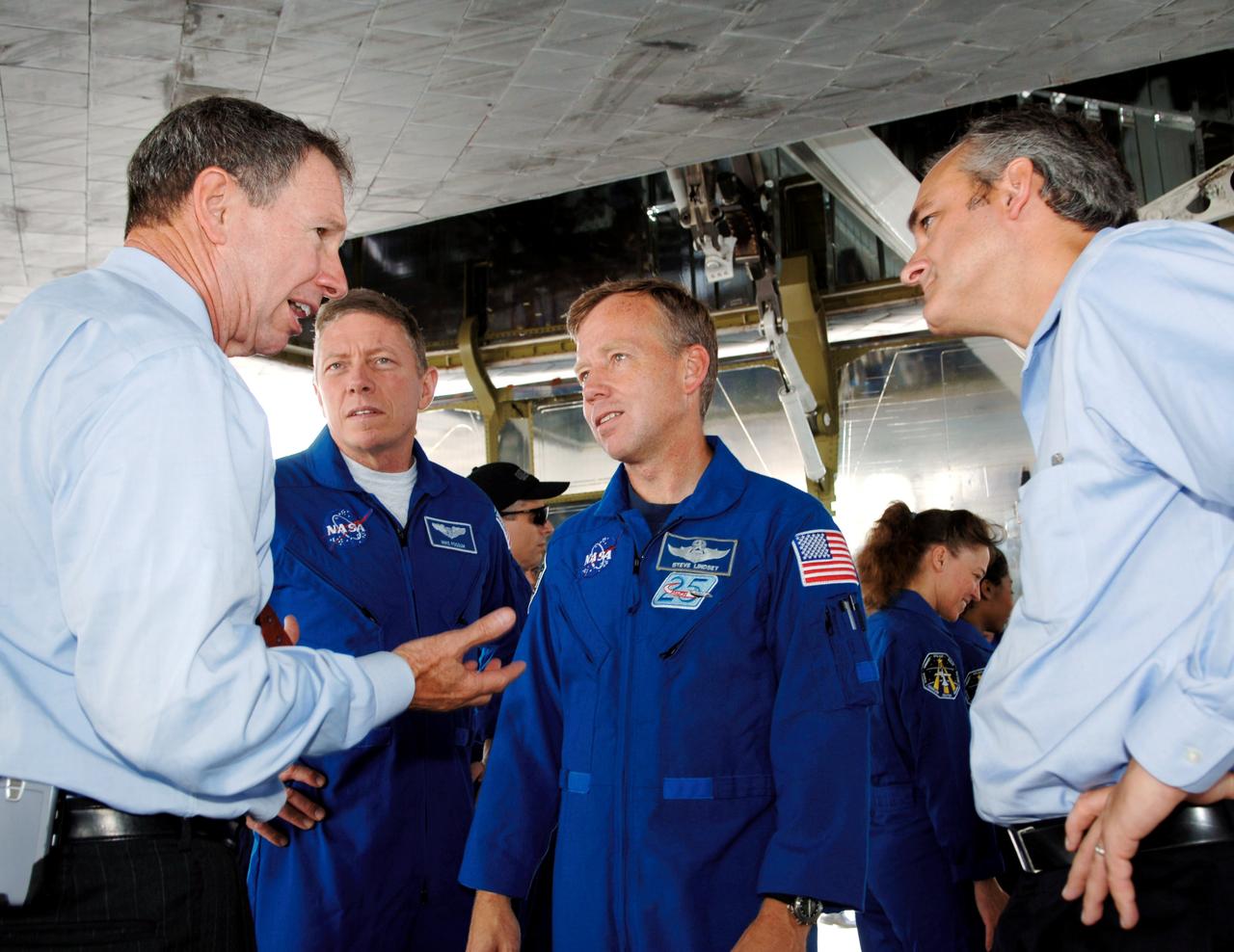
STS121-S-066 (17 July 2006) --- Dr. Michael Griffin (left), NASA administrator, and Rex Geveden (right), associate administrator, talk with STS-121 crew members Michael E. Fossum (left), mission specialist; and Steven W. Lindsey, commander, after the landing of the Space Shuttle Discovery and conclusion of mission STS-121. The crew of seven tested new equipment and procedures to improve shuttle safety, as well as deliver supplies and make repairs to the International Space Station. Photo Credit: NASA/Bill Ingalls
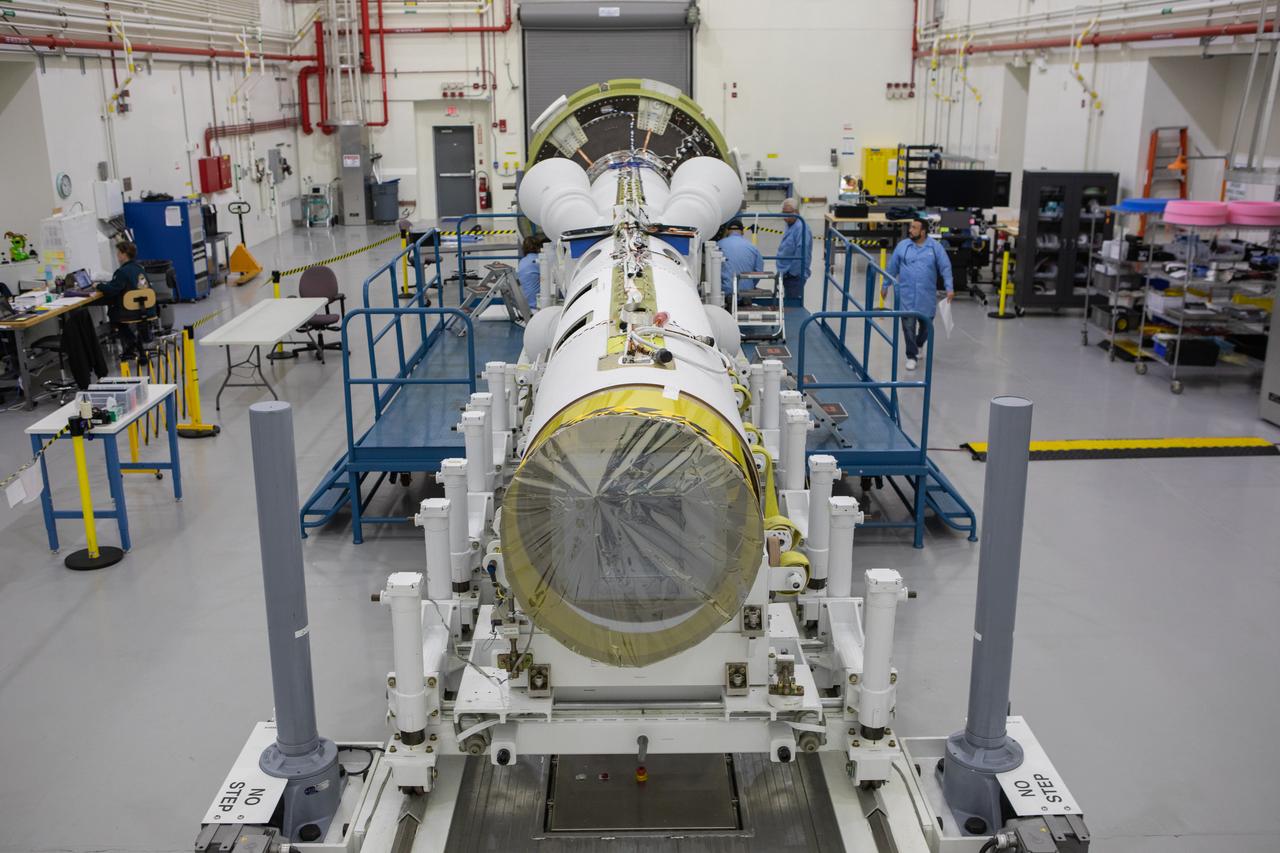
Inside the Launch Abort System Facility at NASA’s Kennedy Space Center in Florida, work is underway Aug. 21, 2019, to integrate segments of the launch abort system for the agency’s uncrewed flight test, Artemis I. During crewed launches of the Orion spacecraft atop the Space Launch System rocket, the LAS will protect the crew module and astronauts aboard to safety if an emergency occurs during launch.
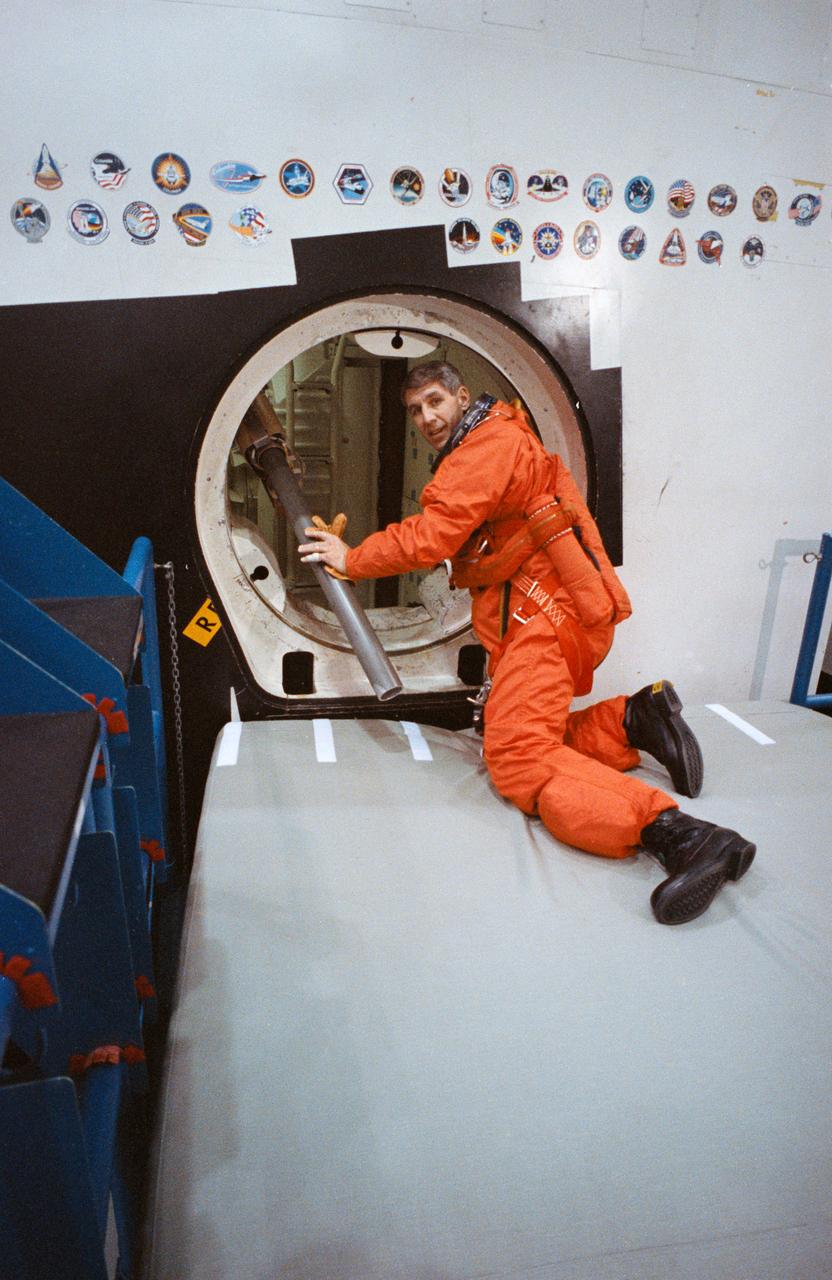
STS-38 Mission Specialist (MS) Robert C. Springer, wearing launch and entry suit (LES), climbs through the side hatch of the crew compartment trainer (CCT) located in JSC's Mockup and Integration Laboratory (MAIL) Bldg 9A. Springer will practice emergency egress through the side hatch using the crew escape system (CES) pole (at Springer's left). The inflated safety cushion under Springer will break his fall as he rolls out of the side hatch.
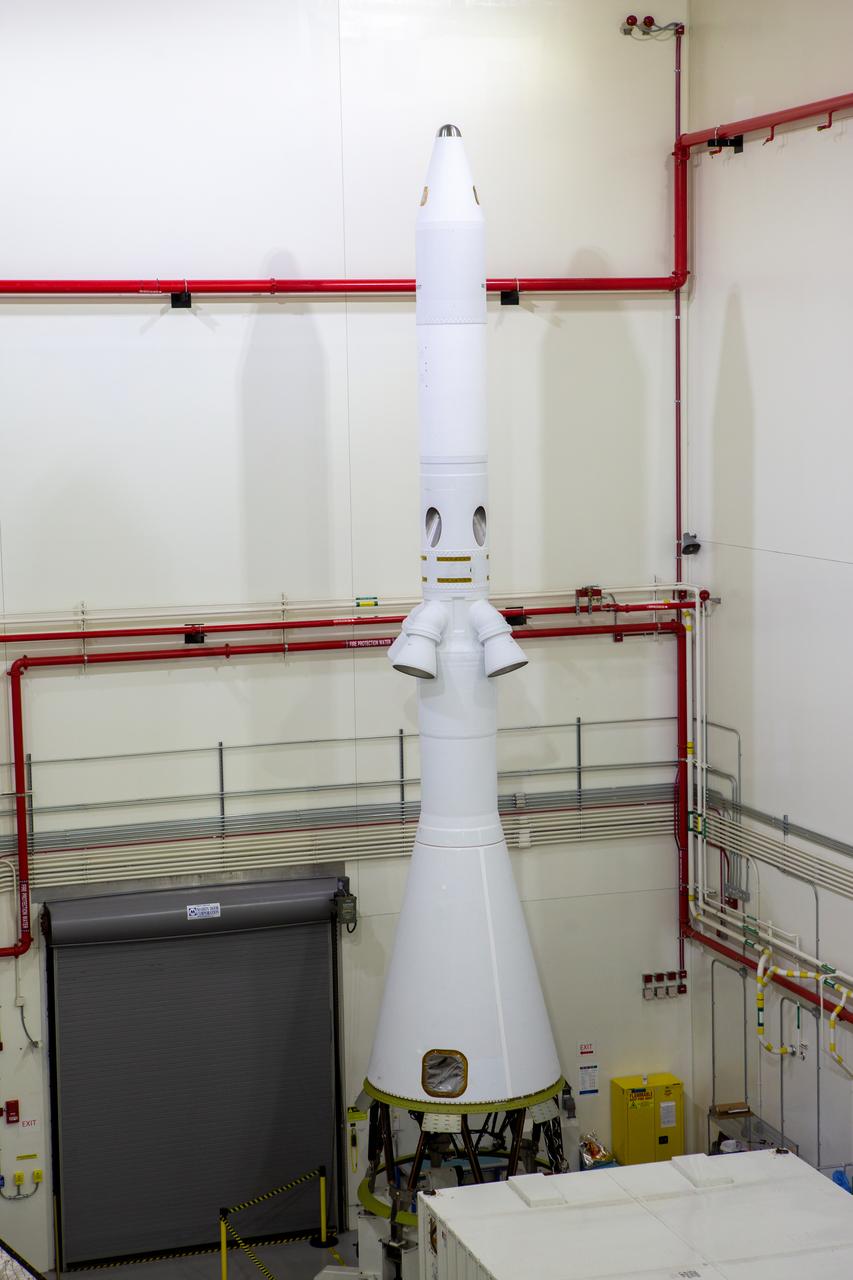
Inside the Launch Abort System Facility (LASF) at NASA’s Kennedy Space Center in Florida, the Launch Abort System (LAS) for the Orion spacecraft that will launch on Artemis I, the first of the Artemis series, awaits final processing with the spacecraft. The LAS was processed and prepared inside the LASF. During crewed launches of the Orion spacecraft atop the Space Launch System rocket, the LAS will protect the crew module and astronauts aboard to safety if an emergency occurs during launch.
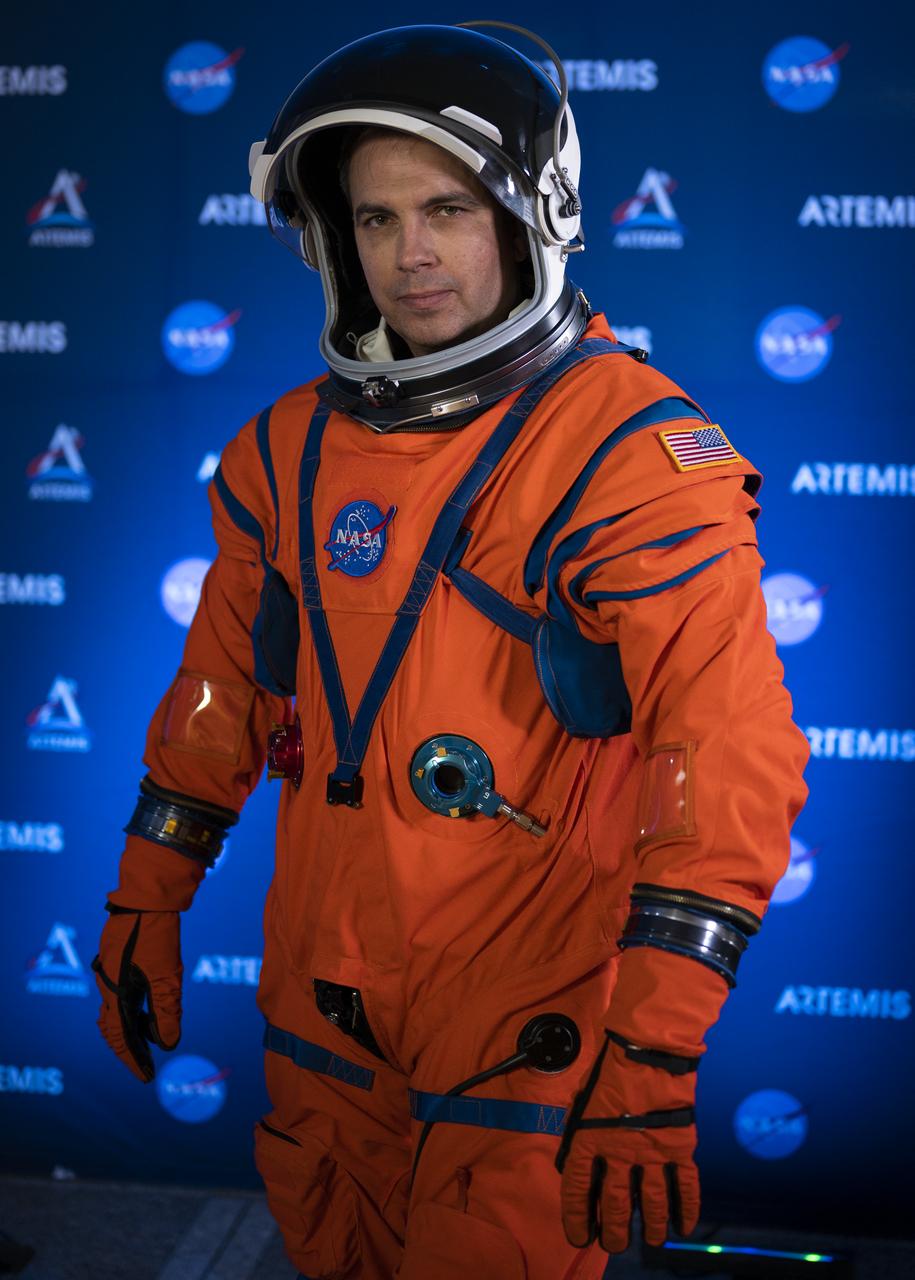
Dustin Gohmert, Orion Crew Survival Systems Project Manager at NASA’s Johnson Space Center, poses for a portrait while wearing the Orion Crew Survival System (OCSS) suit, Tuesday, Oct. 15, 2019 at NASA Headquarters in Washington, DC. The Orion suit is designed for a custom fit and incorporates safety technology and mobility features that will help protect astronauts on launch day, in emergency situations, high-risk parts of missions near the Moon, and during the high-speed return to Earth. Photo Credit: (NASA/Joel Kowsky)
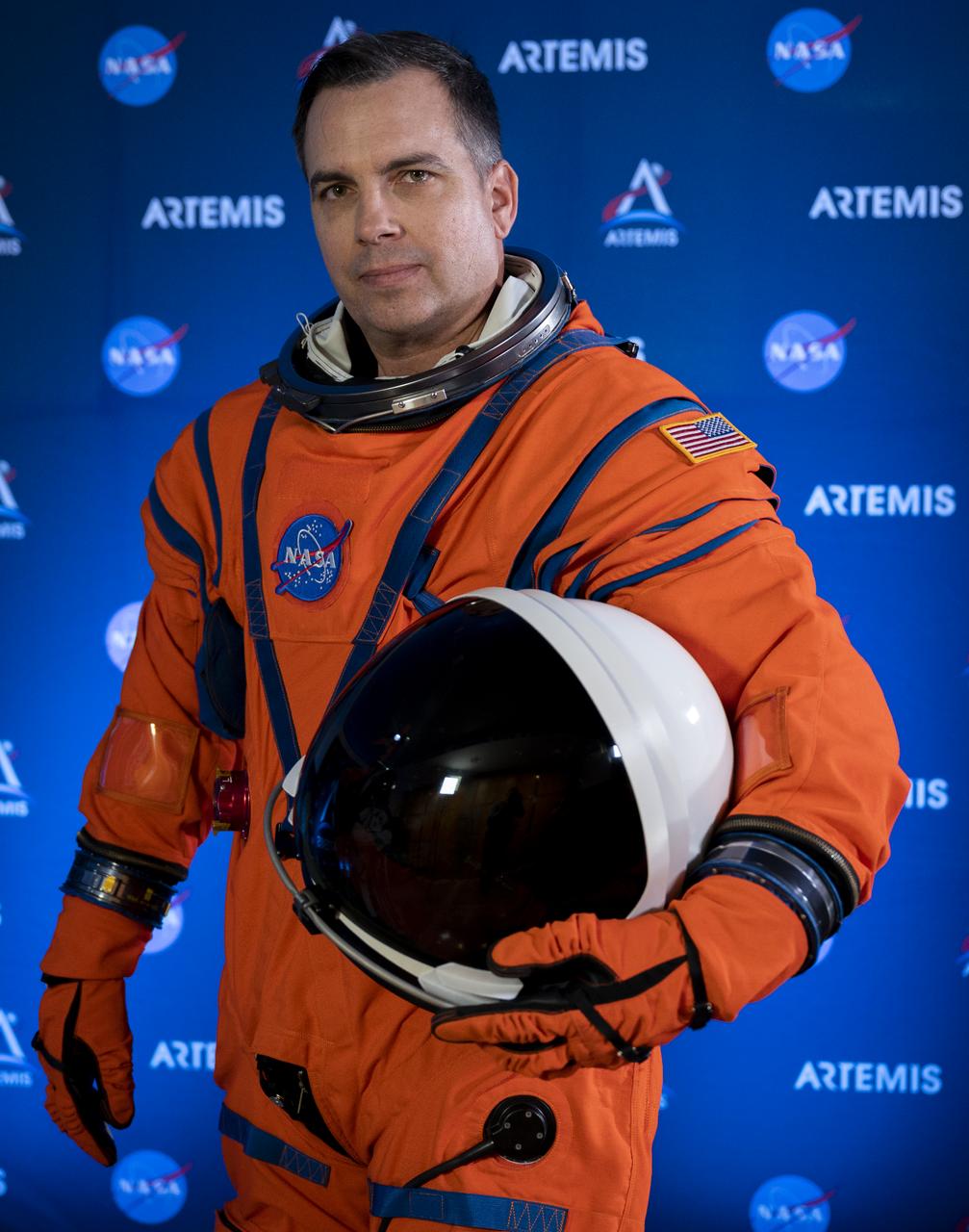
Dustin Gohmert, Orion Crew Survival Systems Project Manager at NASA’s Johnson Space Center, poses for a portrait while wearing the Orion Crew Survival System (OCSS) suit, Tuesday, Oct. 15, 2019 at NASA Headquarters in Washington, DC. The Orion suit is designed for a custom fit and incorporates safety technology and mobility features that will help protect astronauts on launch day, in emergency situations, high-risk parts of missions near the Moon, and during the high-speed return to Earth. Photo Credit: (NASA/Joel Kowsky)

KENNEDY SPACE CENTER, FLA. - STS-121 Mission Specialists Lisa Nowak and Piers Sellers inspect cables in the mid-body of Space Shuttle Discovery on Launch Pad 39B. The crew is making final preparations for the launch on July 1 to the International Space Station. On the 12-day mission, the crew will test new equipment and procedures to improve shuttle safety, as well as deliver supplies and make repairs to the station. This mission is the 115th shuttle flight and the 18th U.S. flight to the station. Photo credit: NASA/Kim Shiflet
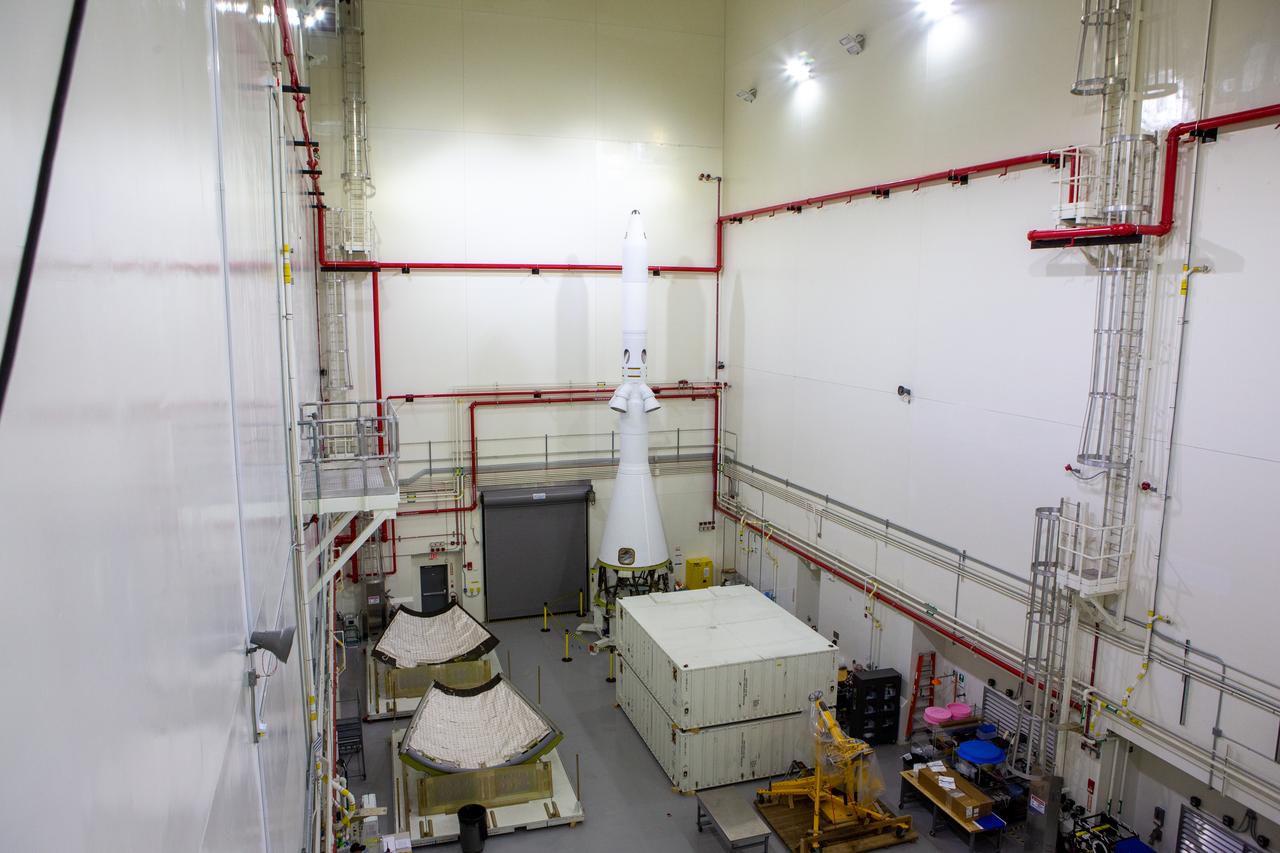
In this view from above inside the Launch Abort System Facility at NASA’s Kennedy Space Center in Florida, the Launch Abort System (LAS) for the Orion spacecraft that will launch on Artemis I, the first uncrewed mission of the Artemis series, awaits final processing with the spacecraft. The LAS was processed and prepared inside the LASF. During crewed launches of the Orion spacecraft atop the Space Launch System rocket, the LAS will protect the crew module and astronauts aboard to safety if an emergency occurs during launch.
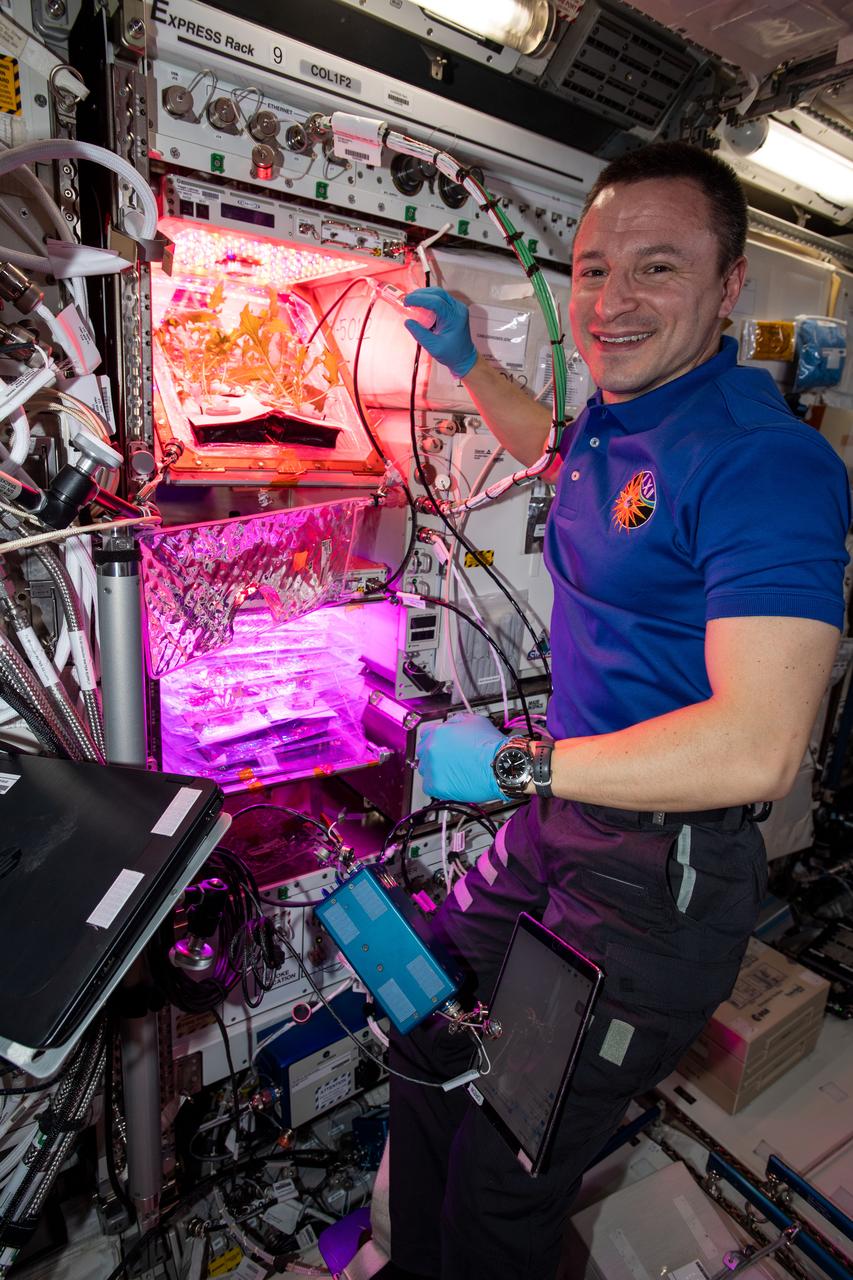
iss061e012956 (Oct. 23, 2019) --- This past week NASA astronaut Andrew Morgan watered the plant pillows in which Mizuna mustard greens are growing for the Veg-04B experiment. Veg-04B focuses on the effects of light quality and fertilizer on the leafy Mizuna crop, microbial food safety, nutritional value and the taste acceptability by the crew. The space botany research is also informing NASA how to provide fresh food for crews on long-term space missions.
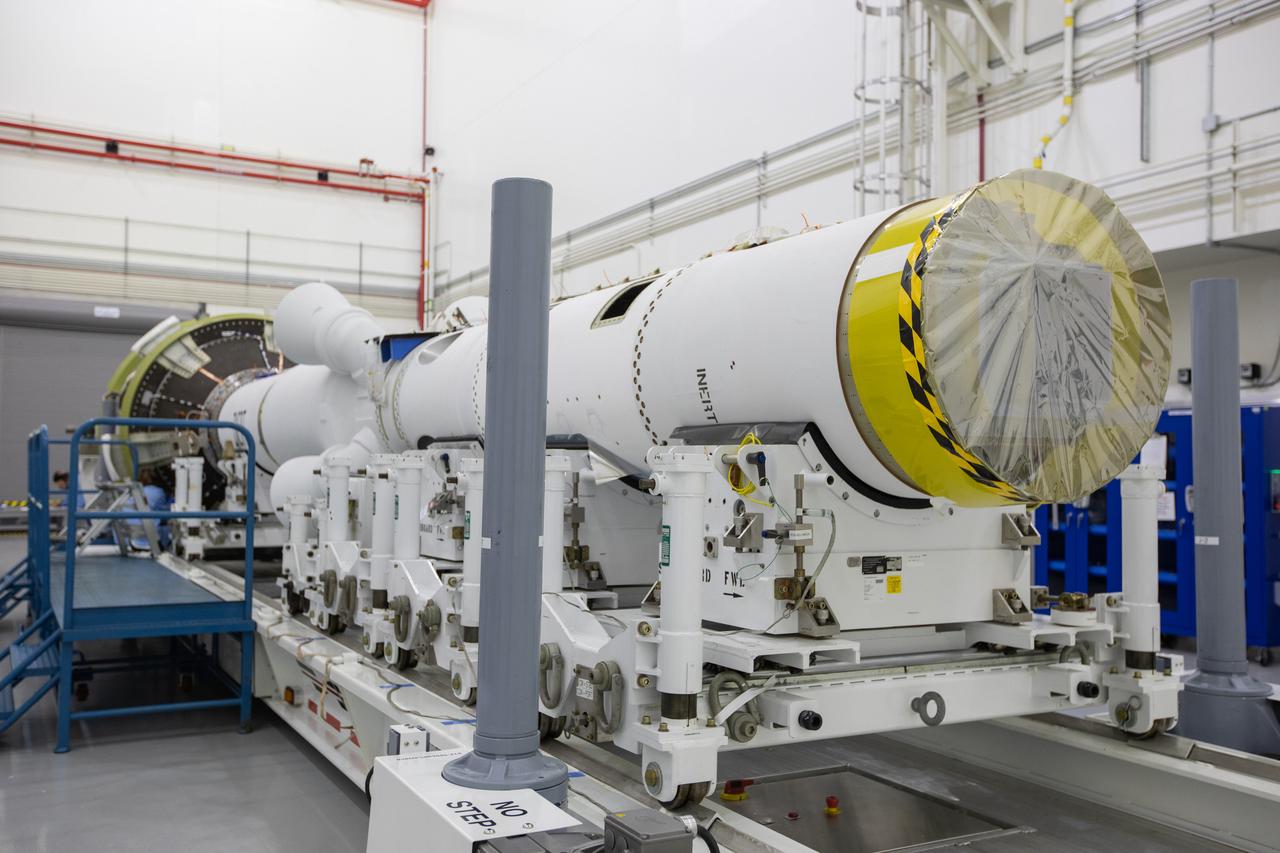
Inside the Launch Abort System Facility at NASA’s Kennedy Space Center in Florida, work is underway Aug. 21, 2019, to integrate segments of the launch abort system for the agency’s uncrewed flight test, Artemis I. During crewed launches of the Orion spacecraft atop the Space Launch System rocket, the LAS will protect the crew module and astronauts aboard to safety if an emergency occurs during launch.
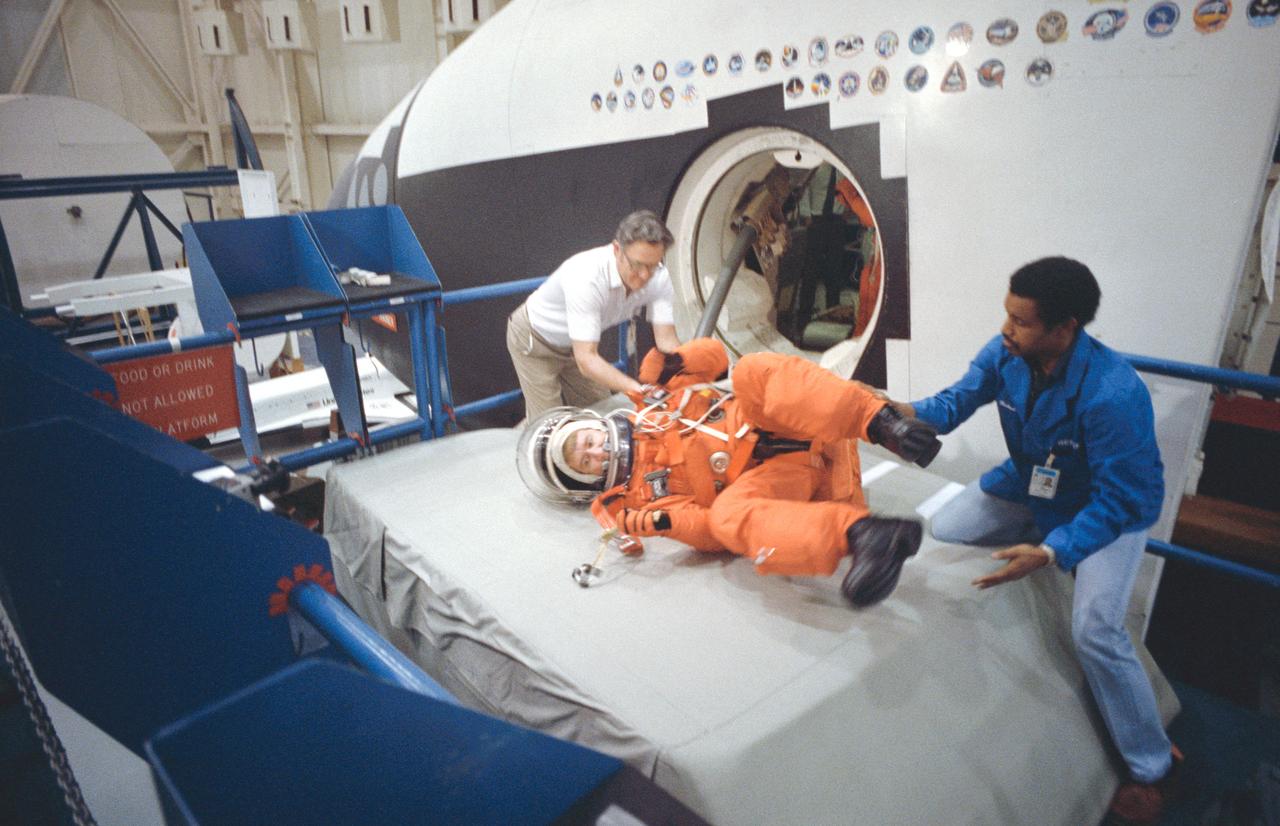
STS-38 Pilot Frank L. Culbertson, wearing launch and entry suit (LES) and launch and entry helmet (LEH), rolls through the side hatch of the crew compartment trainer (CCT) located in JSC's Mockup and Integration Laboratory (MAIL) Bldg 9A. Assisted by technicians, Culbertson practices emergency egress through the side hatch using the crew escape system (CES) pole which extends out the side hatch. The inflated safety cushion breaks Culbertson's fall as he rolls out of the side hatch.
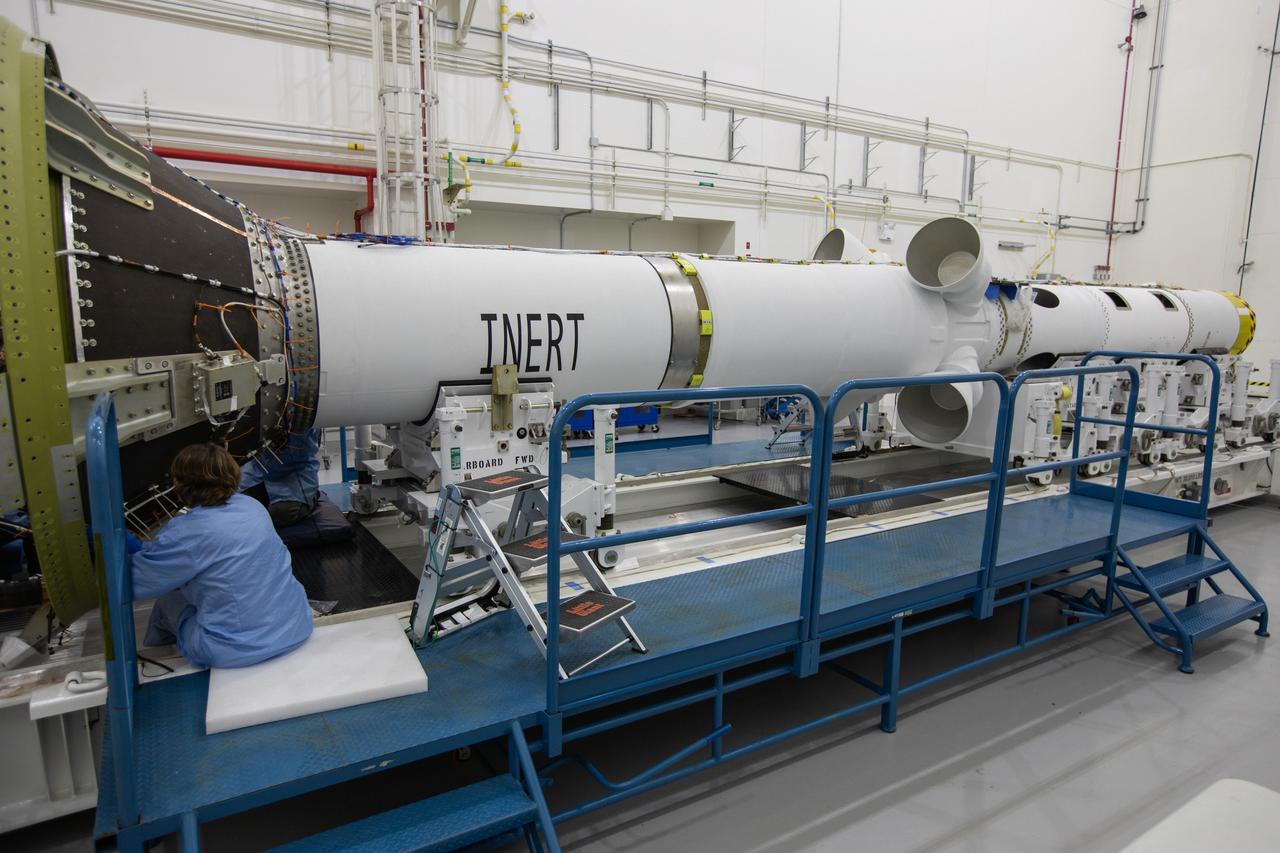
Inside the Launch Abort System Facility at NASA’s Kennedy Space Center in Florida, work is underway Aug. 21, 2019, to integrate segments of the launch abort system for the agency’s uncrewed flight test, Artemis I. During crewed launches of the Orion spacecraft atop the Space Launch System rocket, the LAS will protect the crew module and astronauts aboard to safety if an emergency occurs during launch.
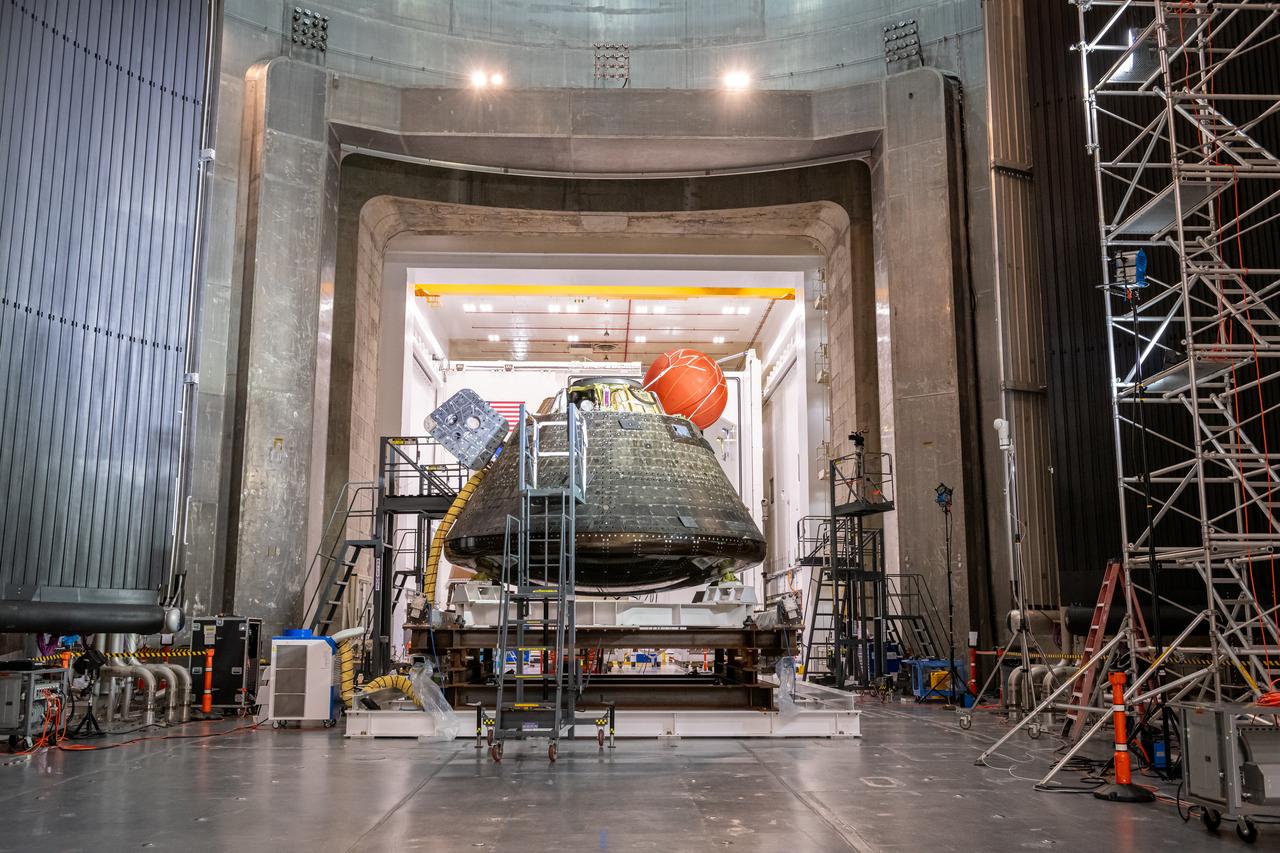
The Orion Crew Module, also known as the Orion Environmental Test Article (ETA), returned to NASA’s Neil Armstrong Test Facility in Sandusky, Ohio, in January 2024 and completed an 11-month test campaign necessary for the safety and success of Artemis II. In November 2024, experts completed the Crew Module Uprighting System Test, which is the system of five airbags on top of the capsule that inflate upon splashdown. Photo Credit: (NASA/Jordan Salkin)
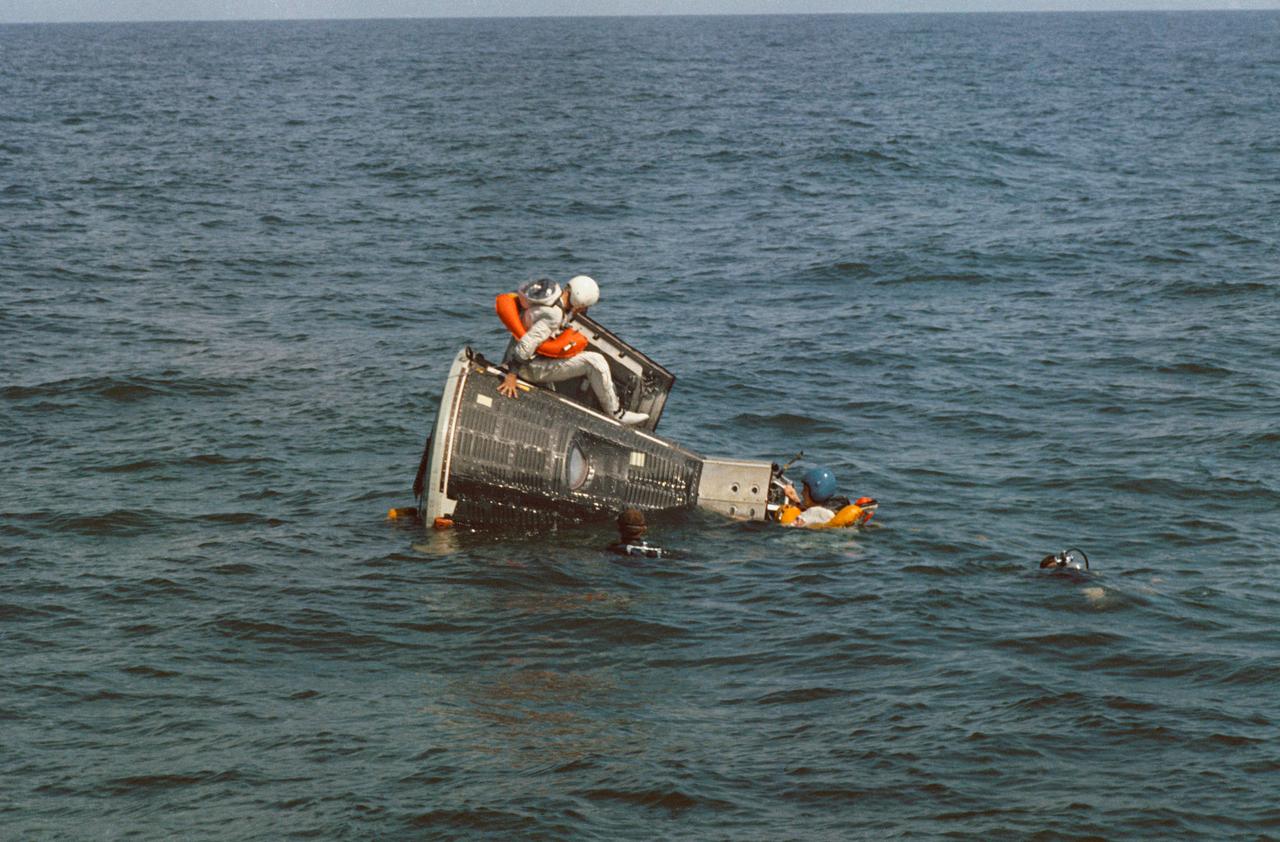
S65-55562 (15 Oct. 1965) --- Astronaut James A. Lovell Jr., prime crew pilot for the Gemini-7 spaceflight, sits on top of the Gemini spacecraft Static Test Article during water egress training in the Gulf of Mexico. Astronaut Frank Borman (wearing blue helmet), prime crew command pilot, hangs onto the nose of the spacecraft. NASA divers are in the water as a safety precaution. Photo credit: NASA
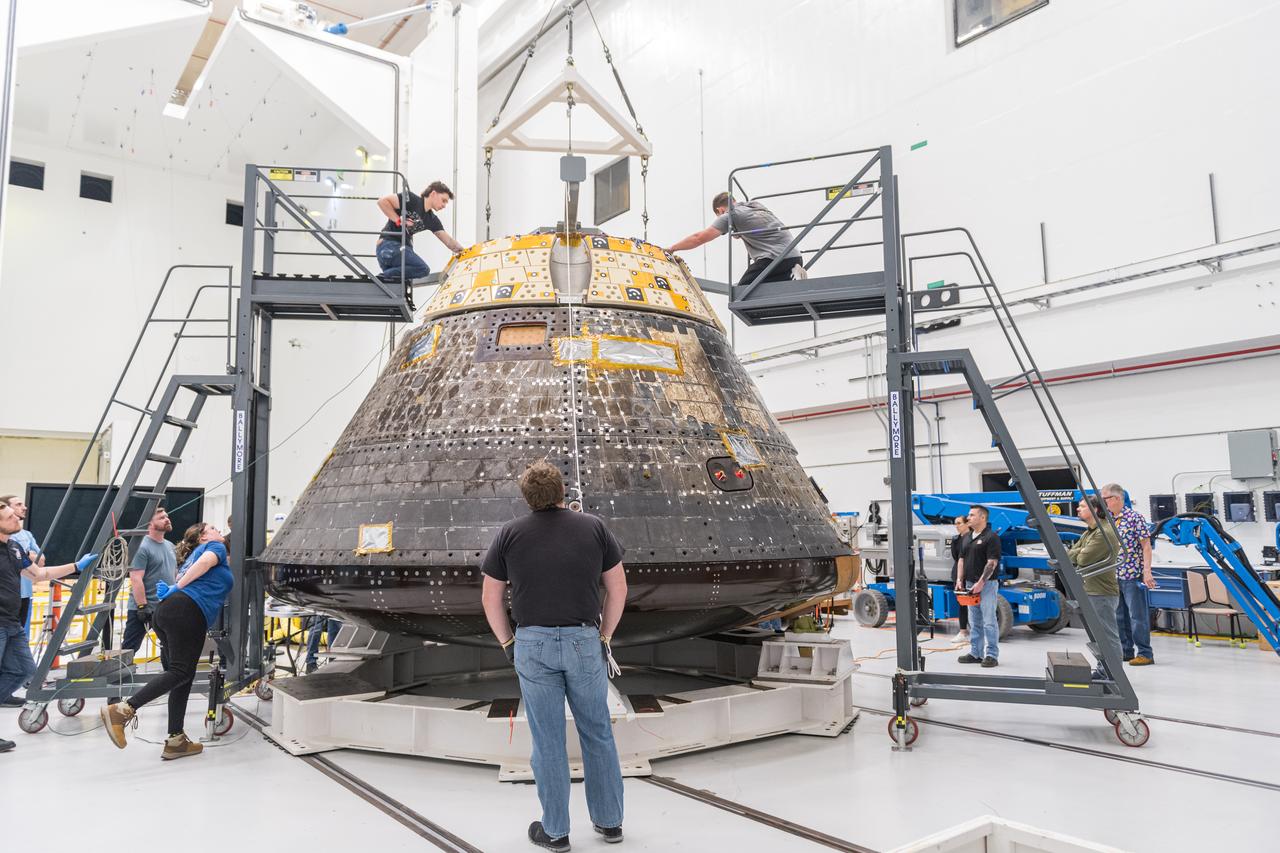
The Orion Crew Module, also known as the Orion Environmental Test Article (ETA), prepares for testing by installing the Forward Bay Cover. The Crew Module returned to NASA’s Neil Armstrong Test Facility in Sandusky, Ohio, in January 2024 and completed an 11-month test campaign necessary for the safety and success of Artemis II. Photo Credit: (NASA/Jordan Salkin)
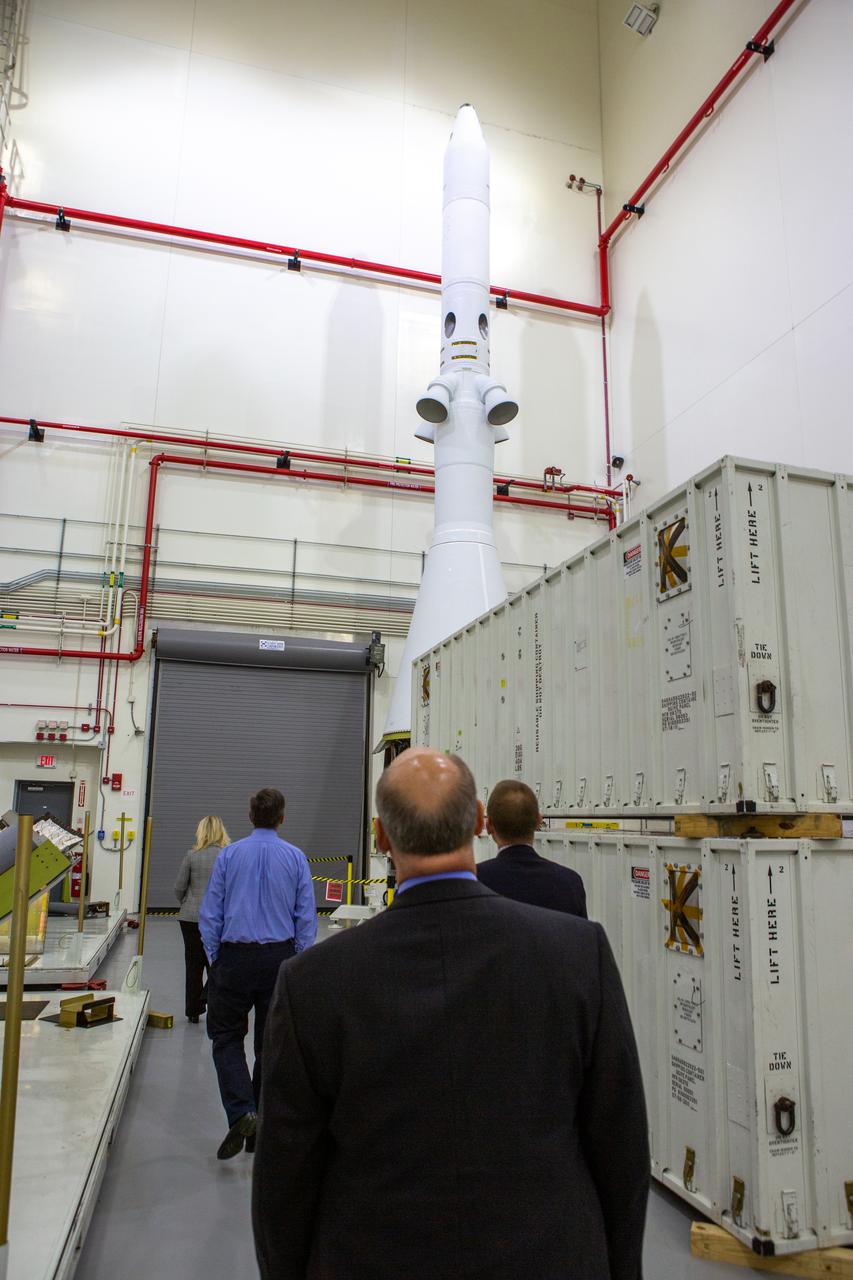
Inside the Launch Abort System Facility (LASF) at NASA’s Kennedy Space Center in Florida, the Launch Abort System (LAS) for the Orion spacecraft that will launch on Artemis I, the first of the Artemis series, awaits final processing with the spacecraft. The LAS was processed and prepared inside the LASF. During crewed launches of the Orion spacecraft atop the Space Launch System rocket, the LAS will protect the crew module and astronauts aboard to safety if an emergency occurs during launch.
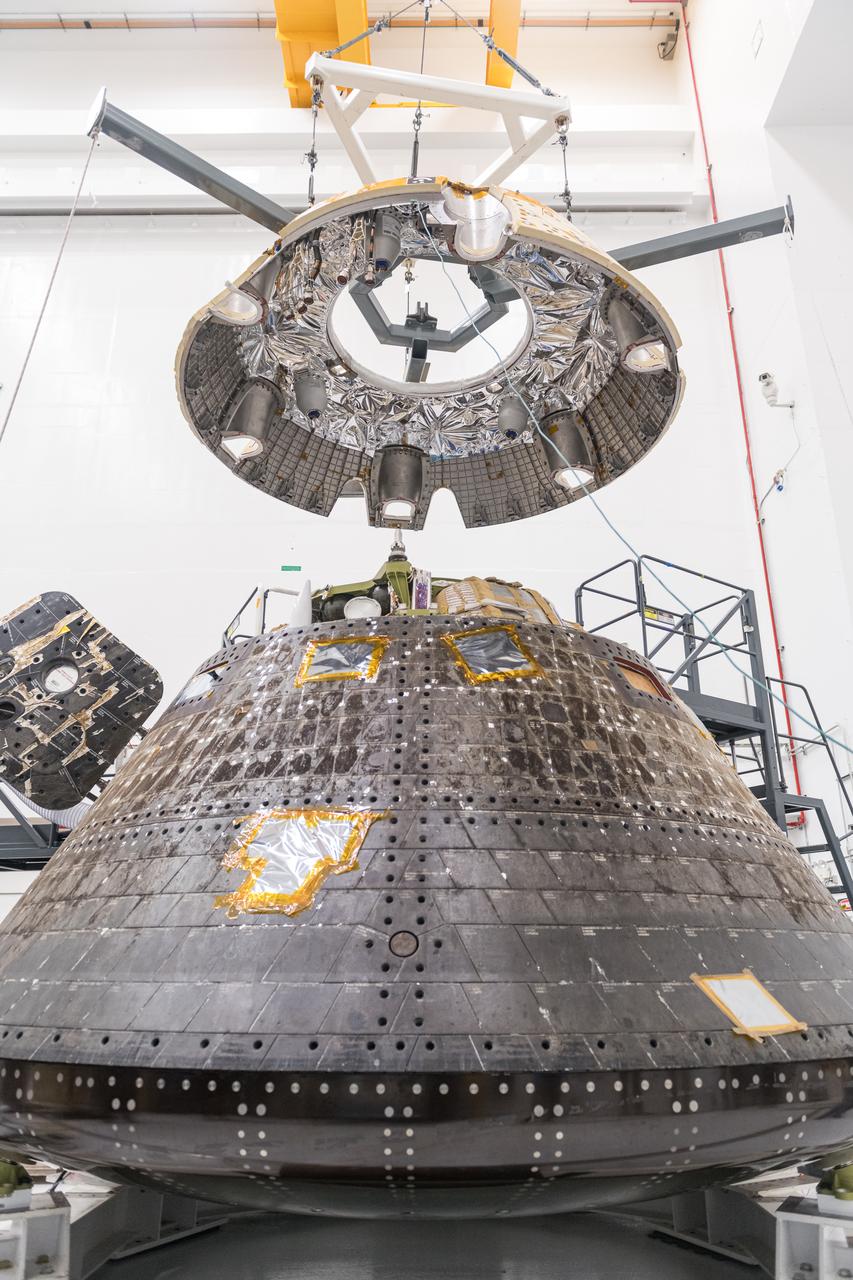
The Orion Crew Module, also known as the Orion Environmental Test Article (ETA), prepares for testing by installing the Forward Bay Cover. The Crew Module returned to NASA’s Neil Armstrong Test Facility in Sandusky, Ohio, in January 2024 and completed an 11-month test campaign necessary for the safety and success of Artemis II. Photo Credit: (NASA/Jordan Salkin)
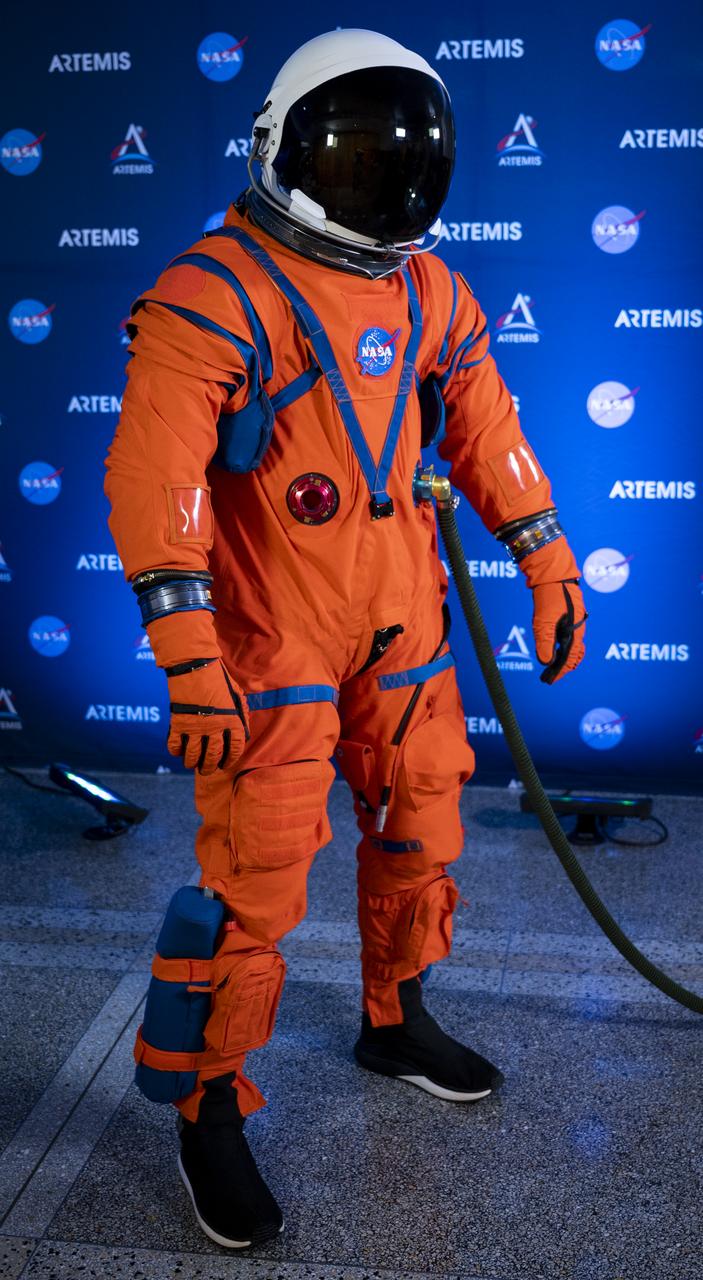
Dustin Gohmert, Orion Crew Survival Systems Project Manager at NASA’s Johnson Space Center, poses for a portrait while wearing the Orion Crew Survival System (OCSS) suit, Tuesday, Oct. 15, 2019 at NASA Headquarters in Washington, DC. The Orion suit is designed for a custom fit and incorporates safety technology and mobility features that will help protect astronauts on launch day, in emergency situations, high-risk parts of missions near the Moon, and during the high-speed return to Earth. Photo Credit: (NASA/Joel Kowsky)
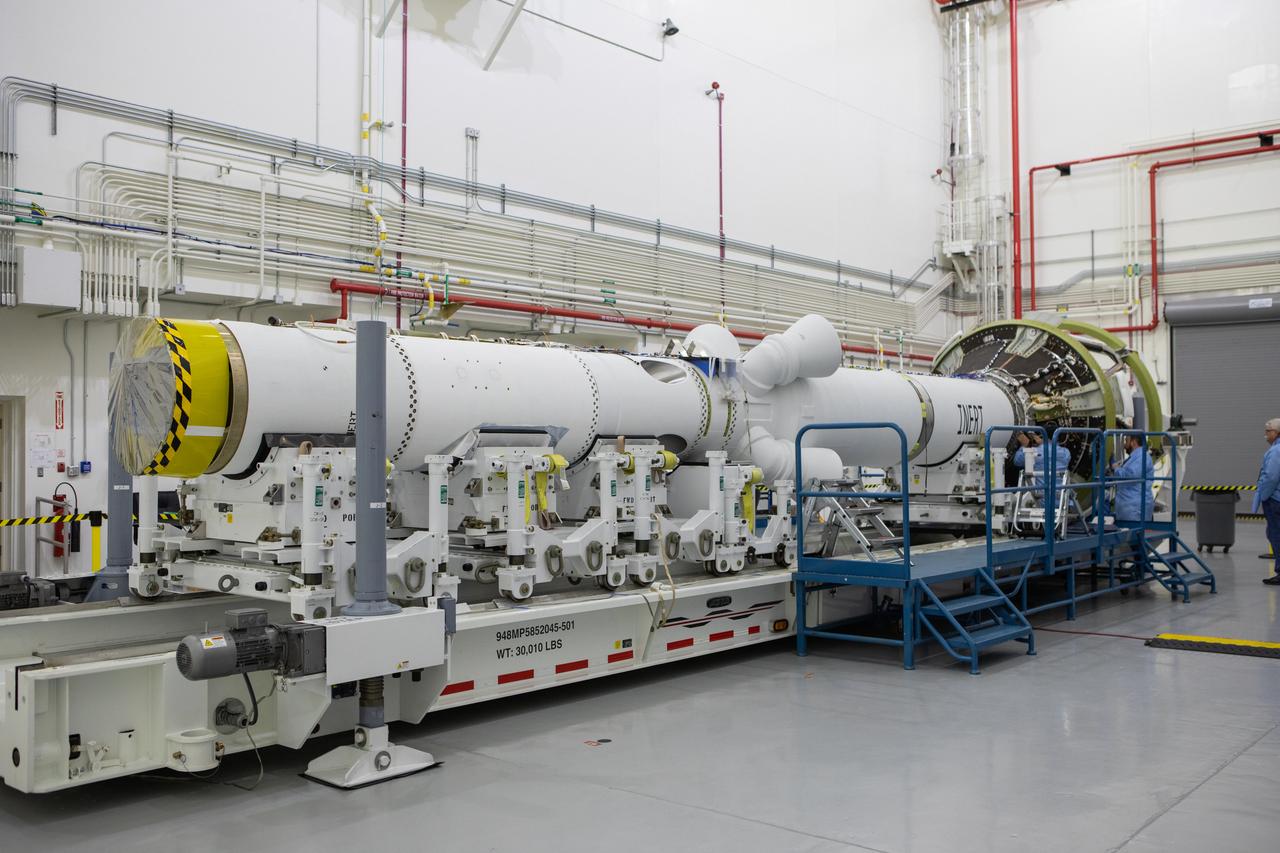
Inside the Launch Abort System Facility at NASA’s Kennedy Space Center in Florida, work is underway Aug. 21, 2019, to integrate segments of the launch abort system for the agency’s uncrewed flight test, Artemis I. During crewed launches of the Orion spacecraft atop the Space Launch System rocket, the LAS will protect the crew module and astronauts aboard to safety if an emergency occurs during launch.
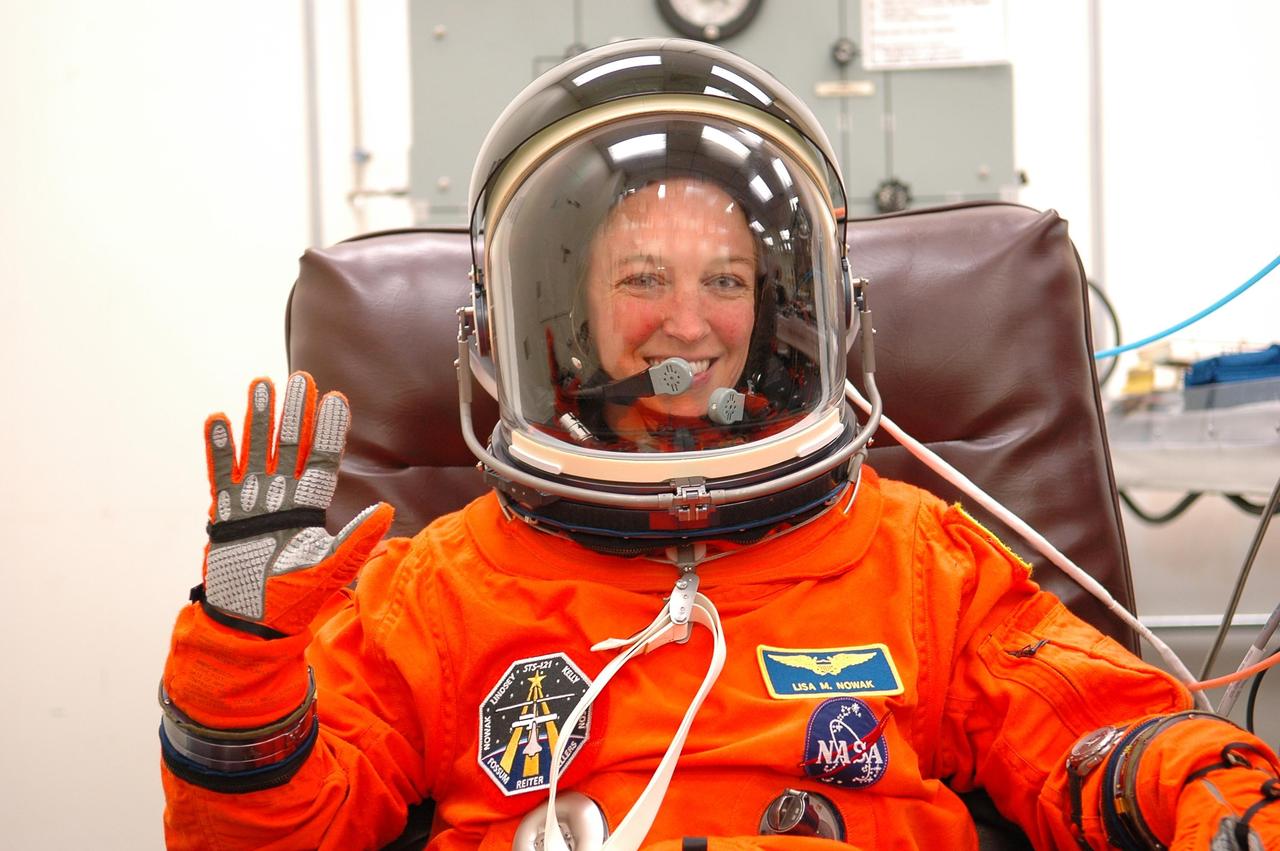
KENNEDY SPACE CENTER, FLA. - Excited about her first space flight, STS-121 Mission Specialist Lisa Nowak completes a fitting on her launch suit in the Operations and Checkout Building. The crew is making final preparations for the launch on July 1 to the International Space Station. On the 12-day mission, the crew will test new equipment and procedures to improve shuttle safety, as well as deliver supplies and make repairs to the station. This mission is the 115th shuttle flight and the 18th U.S. flight to the station. Photo credit: NASA/Kim Shiflett

KENNEDY SPACE CENTER, FLA. -- After their arrival at KSC, STS-107 Payload Commander Michael Anderson and Mission Specialist Kalpana Chawla head to crew quarters. They and the rest of the crew are at KSC to take part in Terminal Countdown Demonstration Test activities, which include a simulated launch countdown. STS-107 is a mission devoted to research and will include more than 80 experiments that will study Earth and space science, advanced technology development, and astronaut health and safety. Launch is scheduled for Jan. 16, 2003.

Dustin Gohmert, Orion Crew Survival Systems Project Manager at NASA’s Johnson Space Center, poses for a portrait while wearing the Orion Crew Survival System (OCSS) suit, Tuesday, Oct. 15, 2019 at NASA Headquarters in Washington, DC. The Orion suit is designed for a custom fit and incorporates safety technology and mobility features that will help protect astronauts on launch day, in emergency situations, high-risk parts of missions near the Moon, and during the high-speed return to Earth. Photo Credit: (NASA/Joel Kowsky)
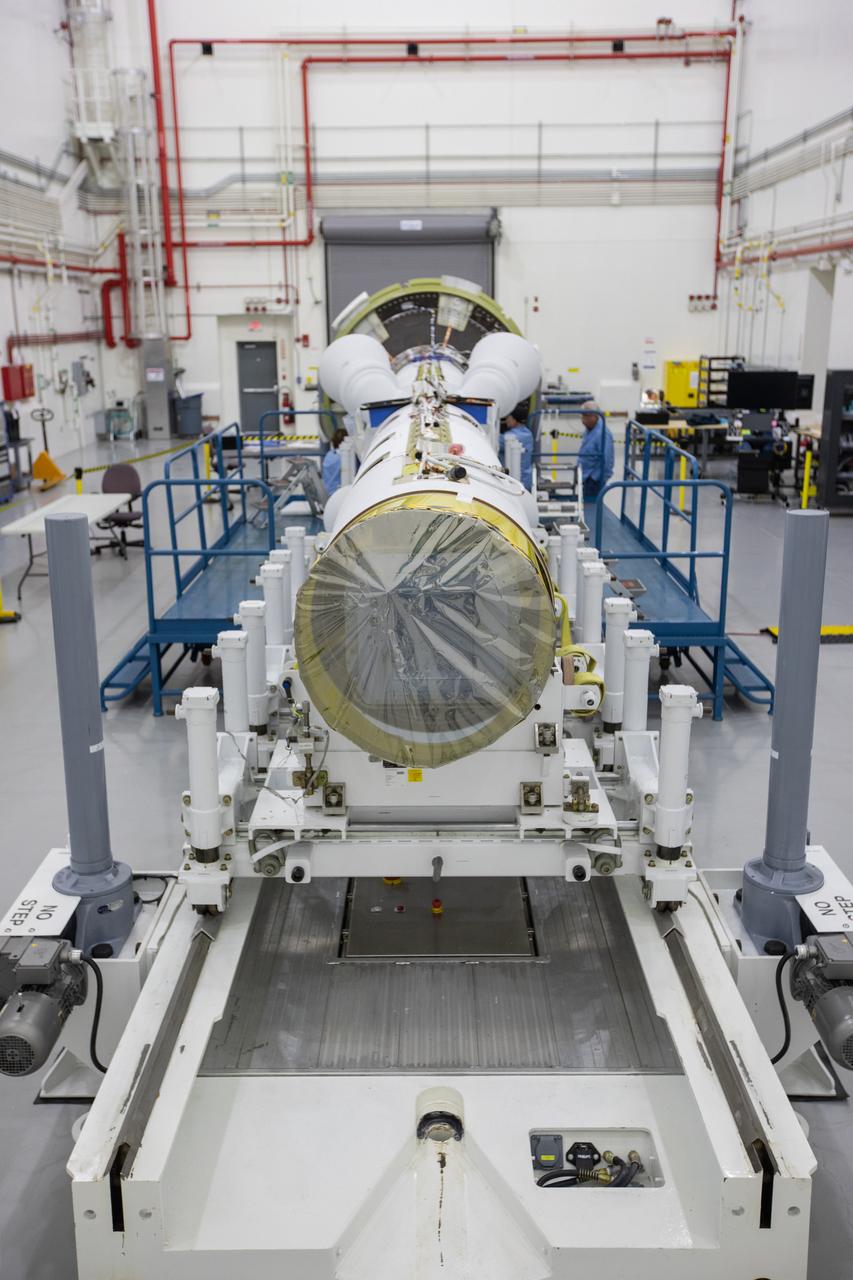
Inside the Launch Abort System Facility at NASA’s Kennedy Space Center in Florida, work is underway Aug. 21, 2019, to integrate segments of the launch abort system for the agency’s uncrewed flight test, Artemis I. During crewed launches of the Orion spacecraft atop the Space Launch System rocket, the LAS will protect the crew module and astronauts aboard to safety if an emergency occurs during launch.
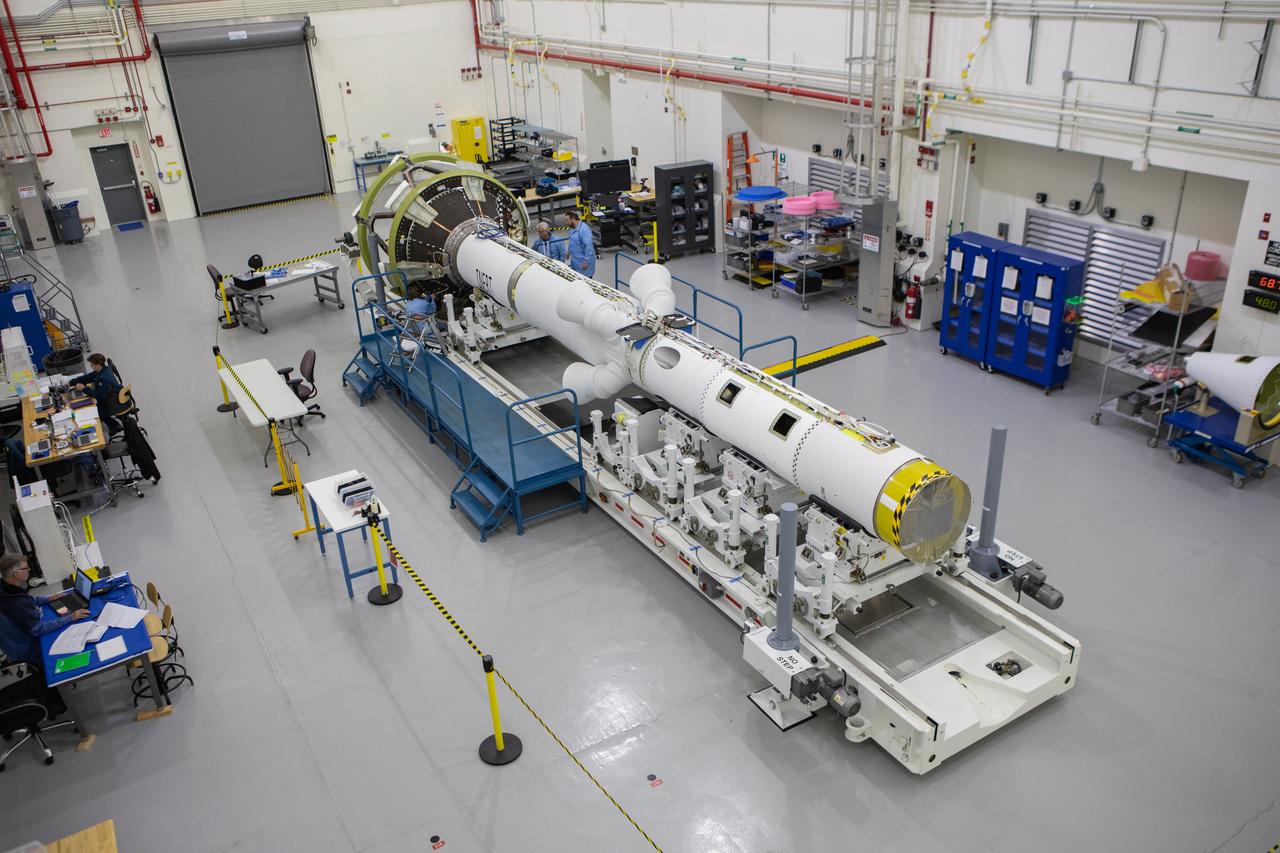
In this view from above inside the Launch Abort System Facility at NASA’s Kennedy Space Center in Florida, work is underway Aug. 21, 2019, to integrate segments of the launch abort system for the agency’s uncrewed flight test, Artemis I. During crewed launches of the Orion spacecraft atop the Space Launch System rocket, the LAS will protect the crew module and astronauts aboard to safety if an emergency occurs during launch.
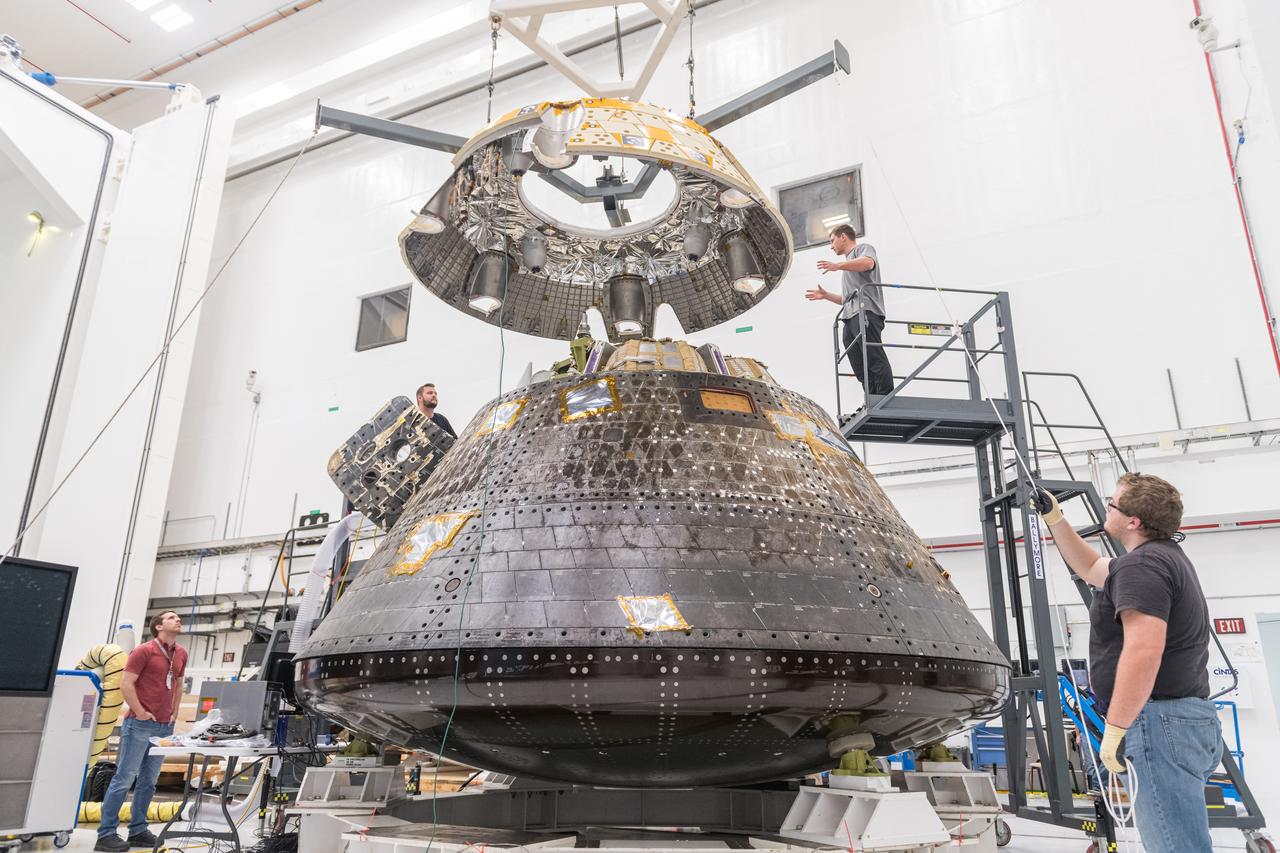
The Orion Crew Module, also known as the Orion Environmental Test Article (ETA), prepares for testing by installing the Forward Bay Cover. The Crew Module returned to NASA’s Neil Armstrong Test Facility in Sandusky, Ohio, in January 2024 and completed an 11-month test campaign necessary for the safety and success of Artemis II. Photo Credit: (NASA/Jordan Salkin)
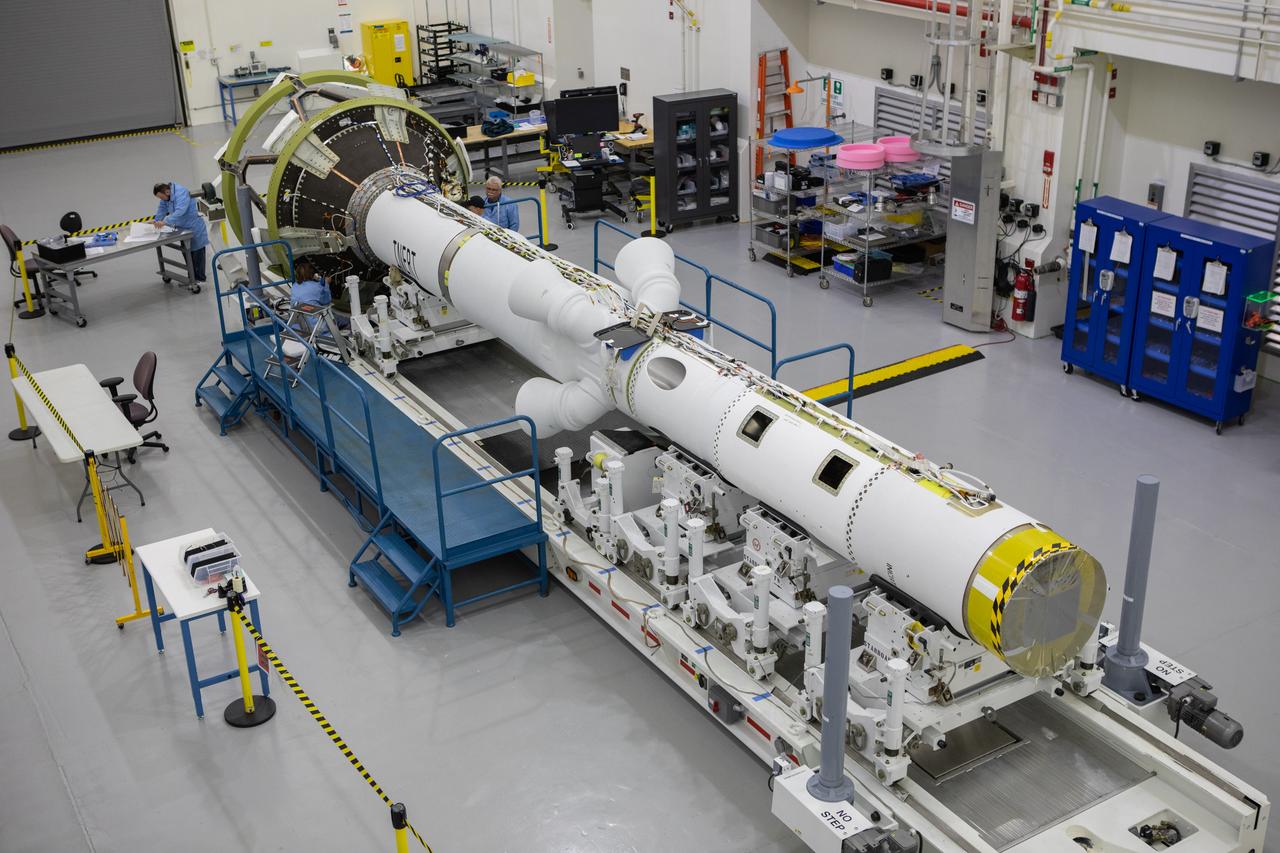
In this view from above inside the Launch Abort System Facility at NASA’s Kennedy Space Center in Florida, work is underway Aug. 21, 2019, to integrate segments of the launch abort system for the agency’s uncrewed flight test, Artemis I. During crewed launches of the Orion spacecraft atop the Space Launch System rocket, the LAS will protect the crew module and astronauts aboard to safety if an emergency occurs during launch.
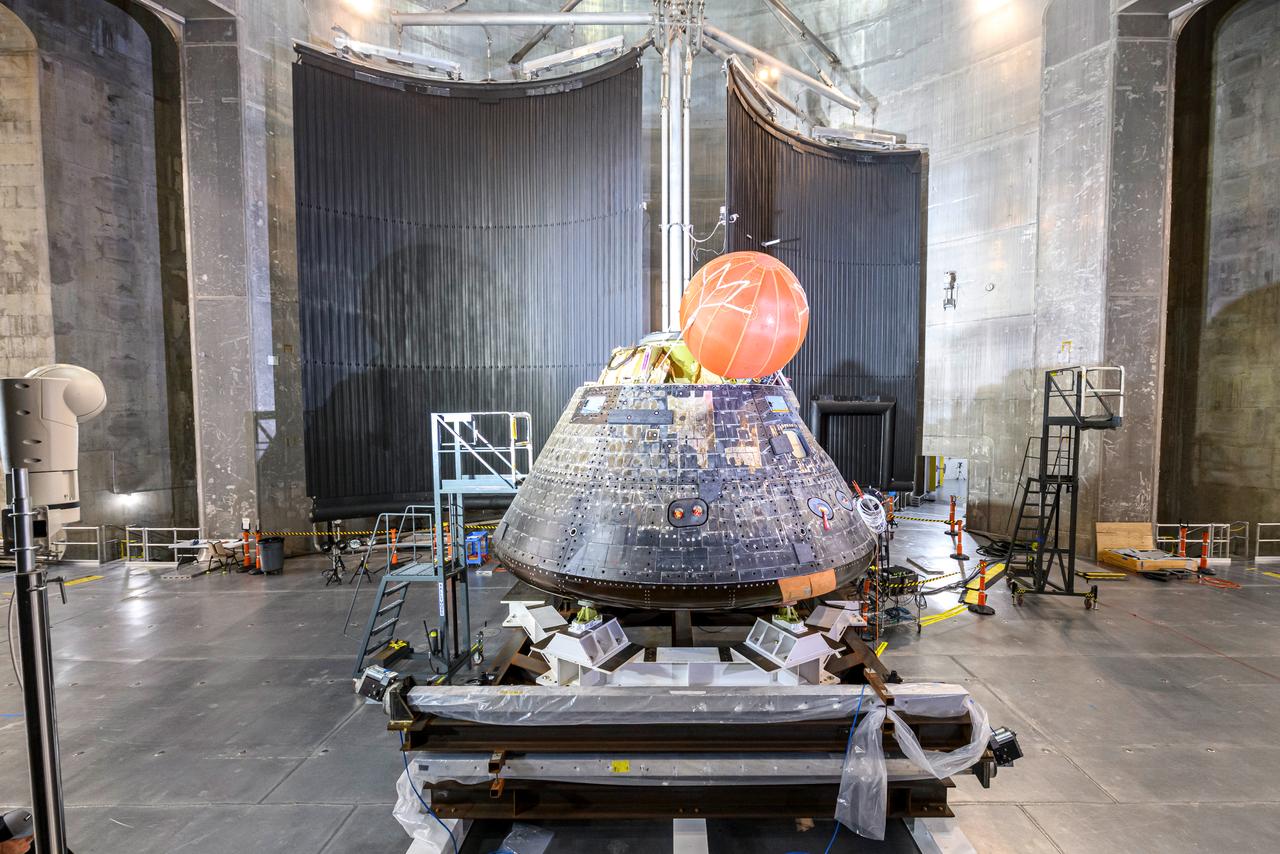
The Orion Crew Module, also known as the Orion Environmental Test Article (ETA), returned to NASA’s Neil Armstrong Test Facility in Sandusky, Ohio, in January 2024 and completed an 11-month test campaign necessary for the safety and success of Artemis II. In November 2024, experts completed the Crew Module Uprighting System Test, which is the system of five airbags on top of the capsule that inflate upon splashdown. Photo Credit: (NASA/Jordan Salkin and Quentin Schwinn)
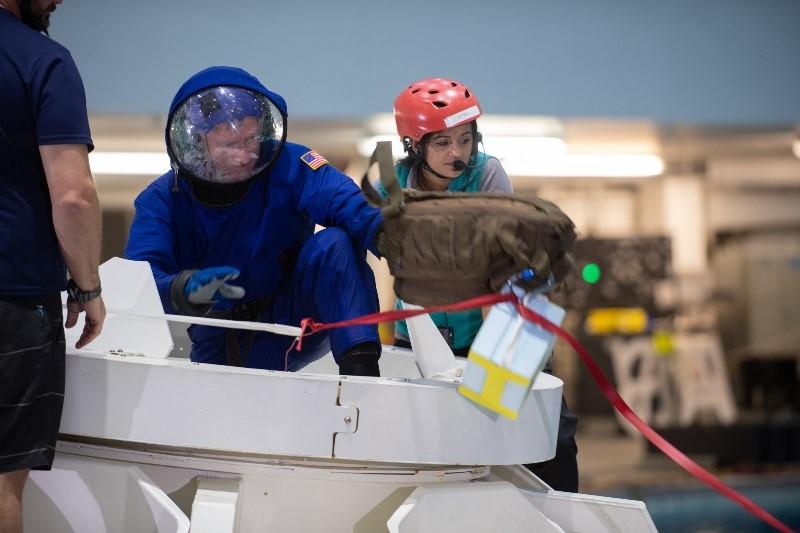
Boeing astronaut and CST-100 Starliner Crew Flight Test crew member Chris Ferguson trains for a contingency water landing in NASA’s Neutral Buoyancy Laboratory at the Johnson Space Center in Houston, Texas. Starliner is designed to land on land, but it can also abort to safe water landings if needed. For safety, all Starliner crews will prepare for all possible scenarios, however unlikely. Boeing’s Crew Flight Test is part of NASA’s Commercial Crew Program, which is working with Boeing to return human spaceflight launches to the space station from U.S. soil.

From left, NASA Kennedy Space Center Director Brian Hughes speaks to NASA astronauts Zena Cardman and Mike Fincke, and JAXA (Japan Aerospace Exploration Agency) astronaut Kimiya Yui during their visit to Kennedy in Florida on Thursday, June 11, 2026. The three crew members, along with Roscosmos cosmonaut Oleg Platonov, spent five and a half months aboard the International Space Station.

From left, NASA astronaut Zena Cardman, JAXA (Japan Aerospace Exploration Agency) astronaut Kimiya Yu, and NASA astronaut Mike Fincke tour the Vehicle Assembly Building during a visit to NASA’s Kennedy Space Center in Florida on Thursday, June 11, 2026. The three crew members, along with Roscosmos cosmonaut Oleg Platonov, spent five and a half months aboard the International Space Station.

From left, NASA astronauts Zena Cardman and Mike Fincke, and JAXA (Japan Aerospace Exploration Agency) astronaut Kimiya Yui speak to employees in the Vehicle Assembly Building during a visit to NASA’s Kennedy Space Center in Florida on Thursday, June 11, 2026. The three crew members, along with Roscosmos cosmonaut Oleg Platonov, spent five and a half months aboard the International Space Station.

From left, JAXA (Japan Aerospace Exploration Agency) astronaut Kimiya Yu, along with NASA astronauts Mike Fincke and Zena Cardman, pose for a photograph inside the Vehicle Assembly Building during a visit to NASA’s Kennedy Space Center in Florida on Thursday, June 11, 2026. The three crew members, along with Roscosmos cosmonaut Oleg Platonov, spent five and a half months aboard the International Space Station.

From left, NASA astronauts Zena Cardman, Mike Fincke (not pictured), and JAXA (Japan Aerospace Exploration Agency) astronaut Kimiya Yu tour the Vehicle Assembly Building during a visit to NASA’s Kennedy Space Center in Florida on Thursday, June 11, 2026. The three crew members, along with Roscosmos cosmonaut Oleg Platonov, spent five and a half months aboard the International Space Station.

NASA astronaut Zena Cardman, commander for NASA’s SpaceX Crew-11 mission, speaks to employees during a visit to NASA’s Kennedy Space Center in Florida on Thursday, June 11, 2026. Cardman, NASA astronaut Mike Fincke, JAXA (Japan Aerospace Exploration Agency) astronaut Kimiya Yui, and Roscosmos cosmonaut Oleg Platonov spent five and a half months aboard the International Space Station.

NASA astronaut Mike Fincke, pilot for NASA’s SpaceX Crew-11 mission, speaks to employees in the Vehicle Assembly Building during a visit to NASA’s Kennedy Space Center in Florida on Thursday, June 11, 2026. Fincke, NASA astronaut Zena Cardman, JAXA (Japan Aerospace Exploration Agency) astronaut Kimiya Yui, and Roscosmos cosmonaut Oleg Platonov spent five and a half months aboard the International Space Station.

JAXA (Japan Aerospace Exploration Agency) astronaut Kimiya Yui, mission specialist for NASA’s SpaceX Crew-11 mission, speaks to employees during a visit to NASA’s Kennedy Space Center in Florida on Thursday, June 11, 2026. Yui, along with NASA astronauts Zena Cardman and Mike Fincke, and Roscosmos cosmonaut Oleg Platonov spent five and a half months aboard the International Space Station.
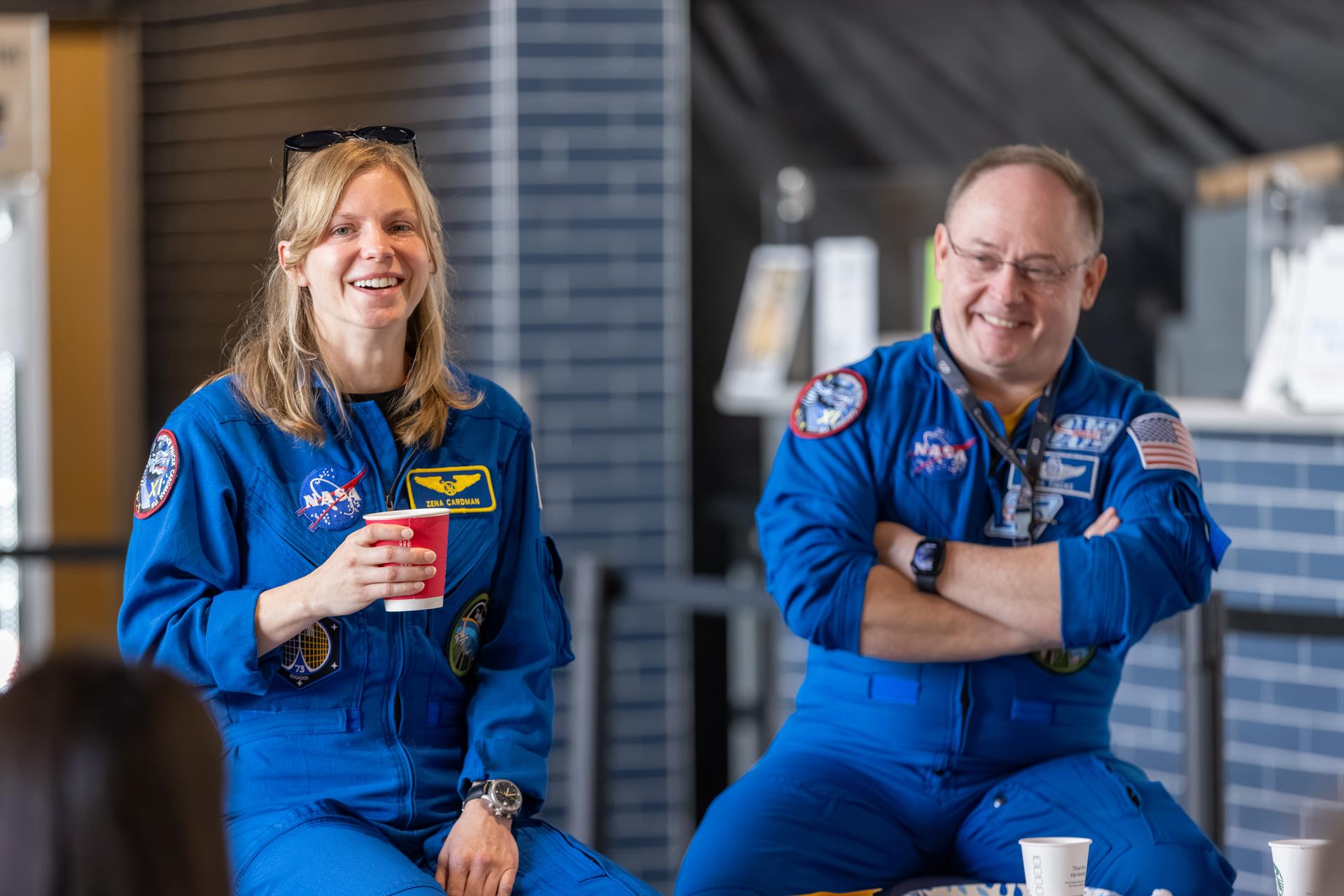
From left, NASA astronauts Zena Cardman and Mike Fincke speak to employees during a visit to NASA’s Kennedy Space Center in Florida on Thursday, June 11, 2026. Cardman and Fincke, along with JAXA (Japan Aerospace Exploration Agency) astronaut Kimiya Yui, and Roscosmos cosmonaut Oleg Platonov, spent five and a half months aboard the International Space Station.

From left, NASA astronauts Mike Fincke and Zena Cardman, JAXA (Japan Aerospace Exploration Agency) astronaut Kimiya Yu, and NASA Kennedy Space Center Director Brian Hughes pose for a photograph with employees during a visit to NASA’s Kennedy Space Center in Florida on Thursday, June 11, 2026. The three crew members, along with Roscosmos cosmonaut Oleg Platonov, spent five and a half months aboard the International Space Station.

From left, NASA astronauts Mike Fincke and Zena Cardman, and JAXA (Japan Aerospace Exploration Agency) astronaut Kimiya Yu tour the Vehicle Assembly Building during a visit to NASA’s Kennedy Space Center in Florida on Thursday, June 11, 2026. The three crew members, along with Roscosmos cosmonaut Oleg Platonov, spent five and a half months aboard the International Space Station.