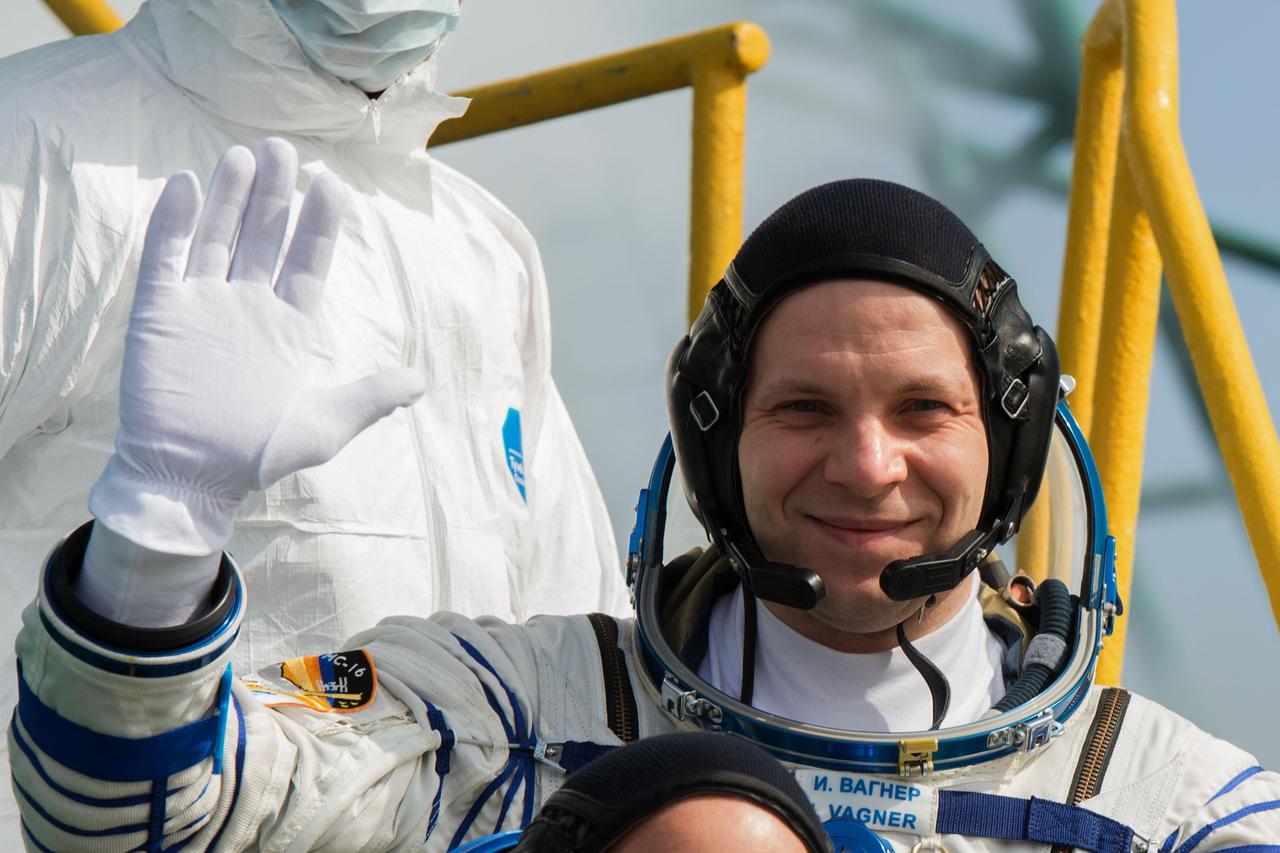
jsc2020e017123 - Expedition 63 Crew Waves Farewell - Expedition 63 crewmember Ivan Vagner of Roscosmos waves goodbye as he, Chris Cassidy of NASA, and Anatoly Ivanishin of Roscosmos, prepare to climb aboard the Soyuz MS-16 rocket at Site 31 at the Baikonur Cosmodrome in Kazakhstan, Thursday, April 9, 2020. They launched a short time later to the International Space Station for the start of a six-and-a-half month mission. Photo Credit: (NASA/GCTC/Andrey Shelepin)
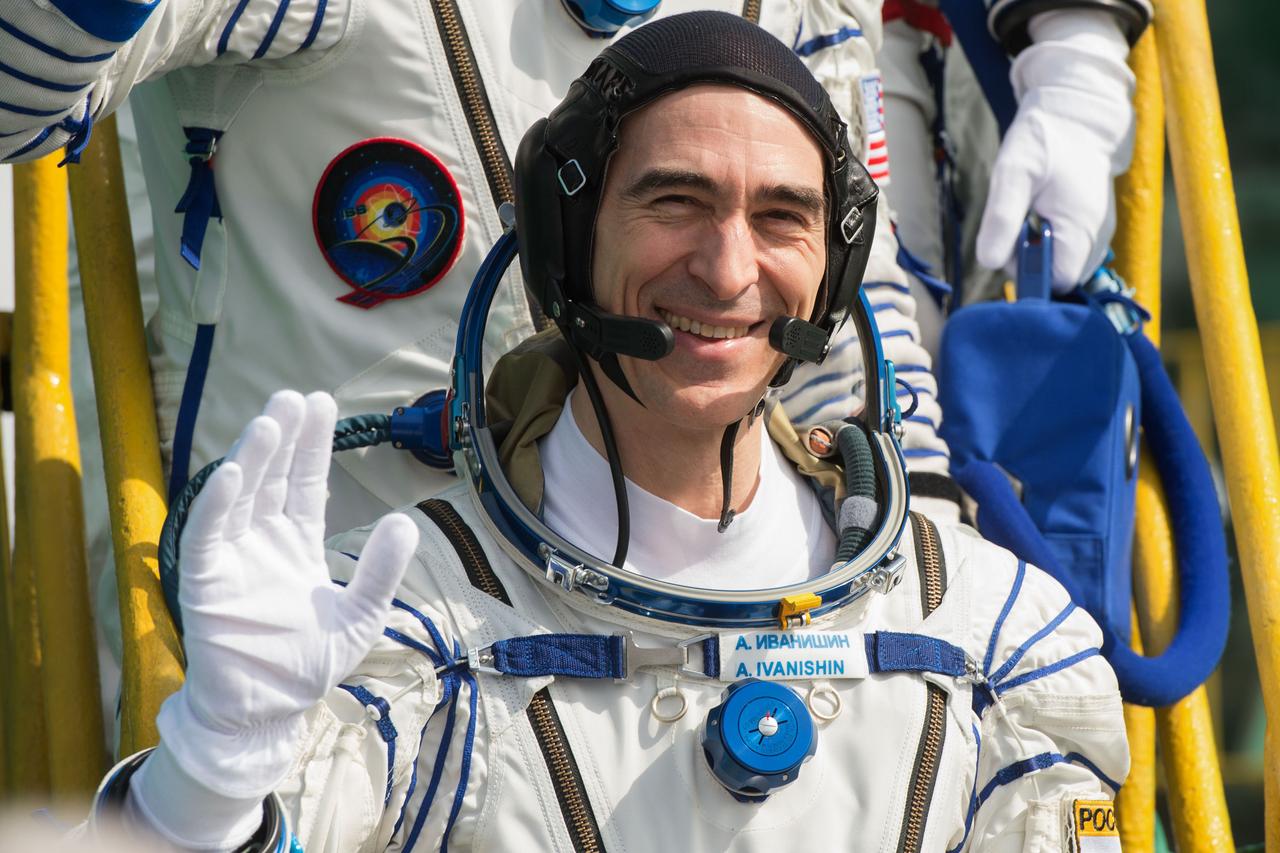
jsc2020e017125 - Expedition 63 Crew Waves Farewell - Expedition 63 crewmember Anatoly Ivanishin of Roscosmos, waves goodbye as he, Chris Cassidy of NASA, and Ivan Vagner of Roscosmos prepare to climb aboard the Soyuz MS-16 rocket at Site 31 at the Baikonur Cosmodrome in Kazakhstan, Thursday, April 9, 2020. They launched a short time later to the International Space Station for the start of a six-and-a-half month mission. Photo Credit: (NASA/GCTC/Andrey Shelepin)
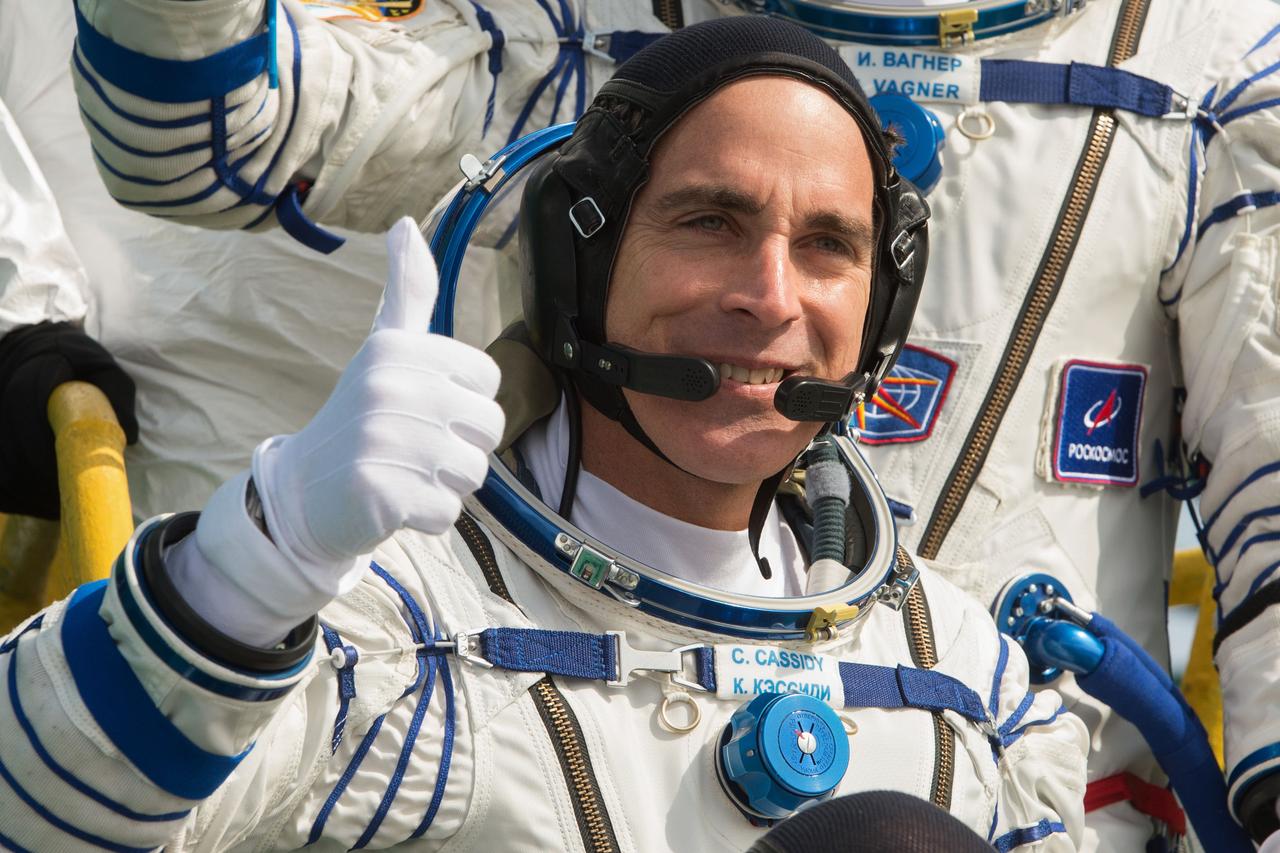
jsc2020e017124 - Expedition 63 Crew Waves Farewell - Expedition 63 crewmember Chris Cassidy of NASA waves goodbye as he, and cosmonauts Ivan Vagner and Anatoly Ivanishin of Roscosmos, prepare to climb aboard the Soyuz MS-16 rocket at Site 31 at the Baikonur Cosmodrome in Kazakhstan, Thursday, April 9, 2020. They launched a short time later to the International Space Station for the start of a six-and-a-half month mission. Photo Credit: (NASA/GCTC/Andrey Shelepin)
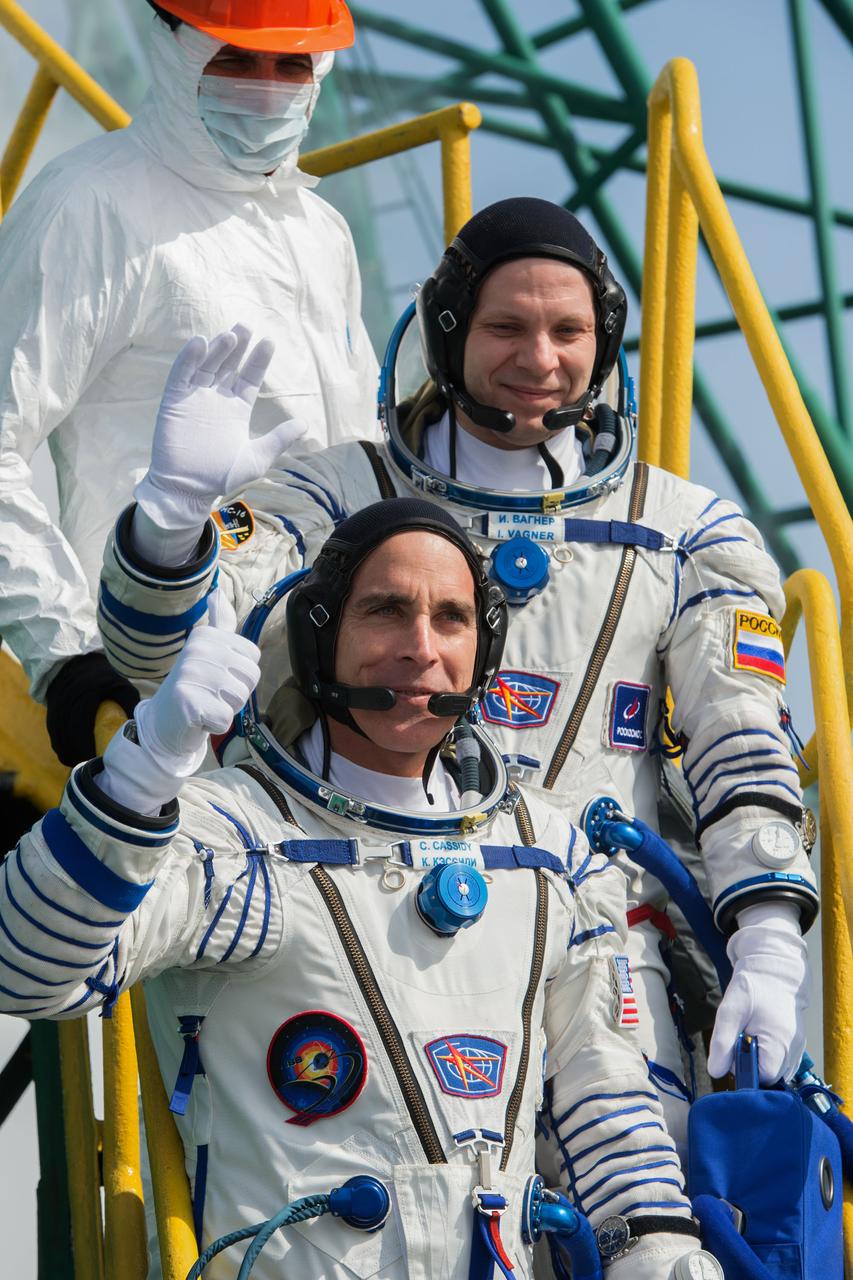
jsc2020e017121 - Expedition 63 Crew Waves Farewell - Expedition 63 crewmembers Ivan Vagner of Roscosmos, top, and Chris Cassidy of NASA wave goodbye as they and Anatoly Ivanishin of Roscosmos prepare to climb aboard the Soyuz MS-16 rocket at Site 31 at the Baikonur Cosmodrome in Kazakhstan, Thursday, April 9, 2020. They launched a short time later to the International Space Station for the start of a six-and-a-half month mission. Photo Credit: (NASA/GCTC/Andrey Shelepin)
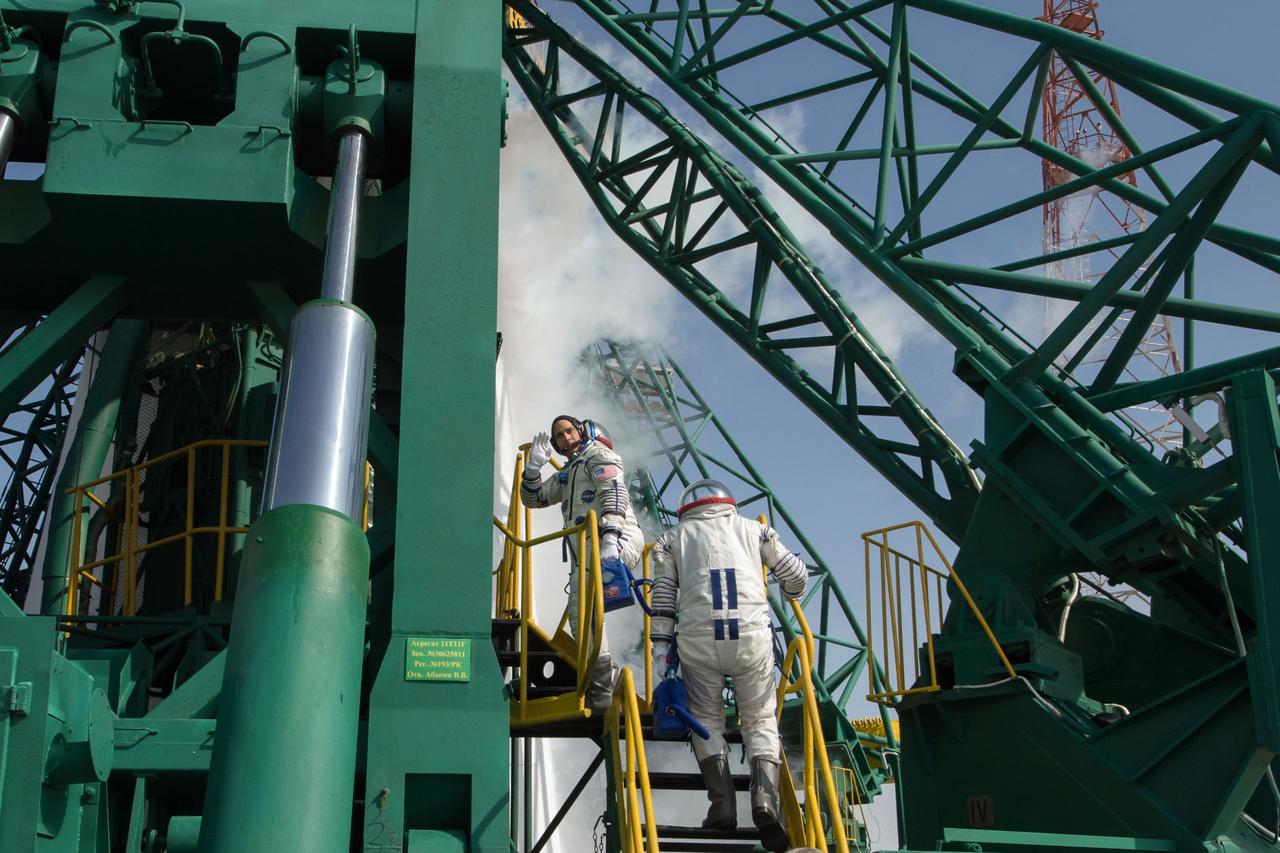
jsc2020e017127 - Expedition 63 Crew Waves Farewell - Expedition 63 crewmember Chris Cassidy of NASA waves farewell as he, Anatoly Ivanishin and Ivan Vagner of Roscosmos climb aboard the Soyuz MS-16 rocket at Site 31 at the Baikonur Cosmodrome in Kazakhstan, Thursday, April 9, 2020. They launched a short time later to the International Space Station for the start of a six-and-a-half month mission. Photo Credit: (NASA/GCTC/Andrey Shelepin)
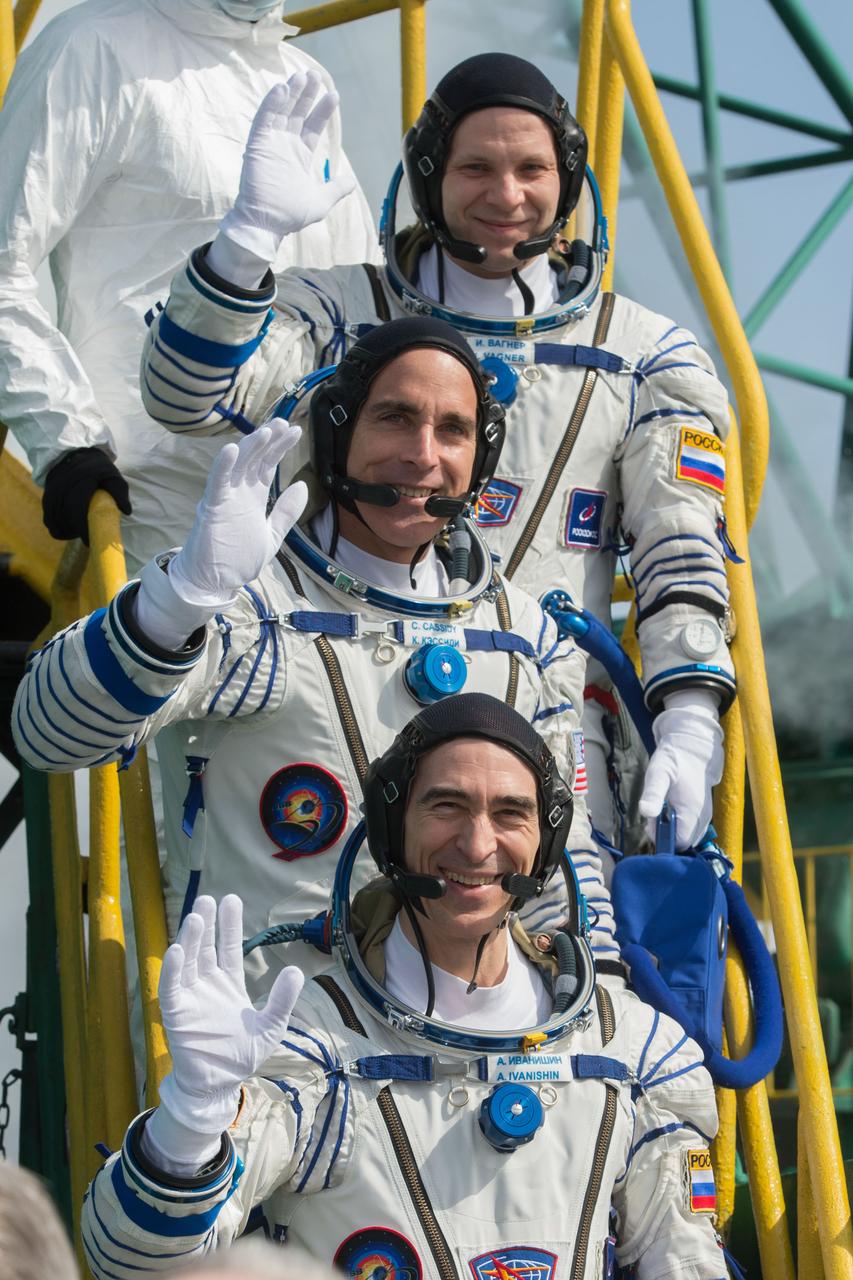
jsc2020e017122 - Expedition 63 Crew Waves Farewell - Expedition 63 crewmembers Ivan Vagner of Roscosmos, top, Chris Cassidy of NASA, center, and Anatoly Ivanishin wave goodbye as they prepare to climb aboard the Soyuz MS-16 rocket at Site 31 at the Baikonur Cosmodrome in Kazakhstan, Thursday, April 9, 2020. They launched a short time later to the International Space Station for the start of a six-and-a-half month mission. Photo Credit: (NASA/GCTC/Andrey Shelepin)
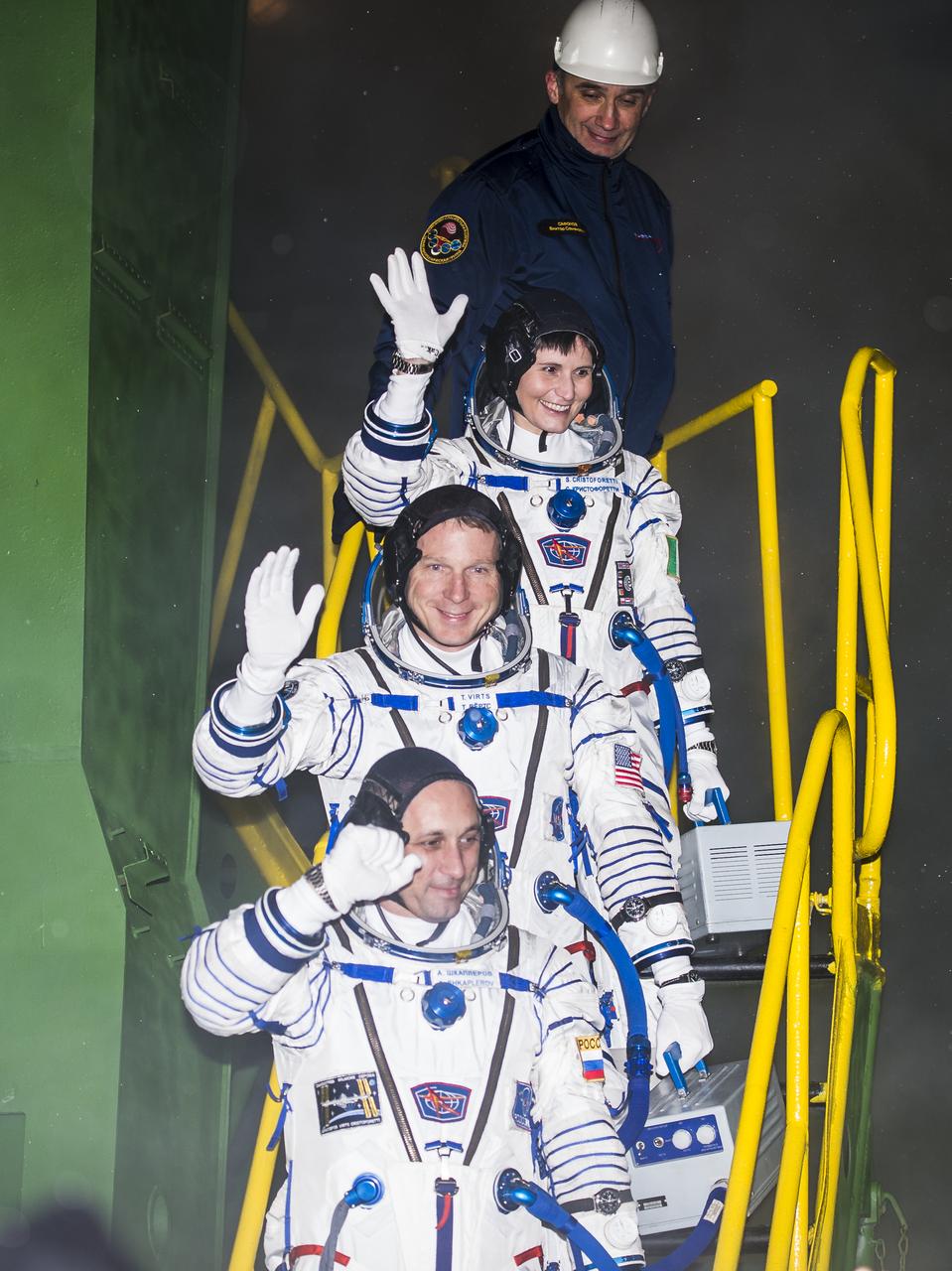
Expedition 42 Flight Engineer Samantha Cristoforetti, of the European Space Agency (ESA), top, Flight Engineer Terry Virts of NASA, center, and Soyuz Commander Anton Shkaplerov of the Russian Federal Space Agency (Roscosmos), bottom, wave farewell prior to boarding the Soyuz TMA-15M spacecraft for launch, Monday, Nov. 24, 2014 at the Baikonur Cosmodrome in Kazakhstan. Cristoforetti, Virts, and Shkaplerov will spend the next five and a half months aboard the International Space Station. Photo Credit: (NASA/Aubrey Gemignani)

jsc2020e017126 - Expedition 63 Crew Waves Farewell - Expedition 63 crewmembers Ivan Vagner of Roscosmos, Chris Cassidy of NASA, and Anatoly Ivanishin of Roscosmos climb aboard the Soyuz MS-16 rocket at Site 31 at the Baikonur Cosmodrome in Kazakhstan, Thursday, April 9, 2020. They launched a short time later to the International Space Station for the start of a six-and-a-half month mission. Photo Credit: (NASA/GCTC/Andrey Shelepin)
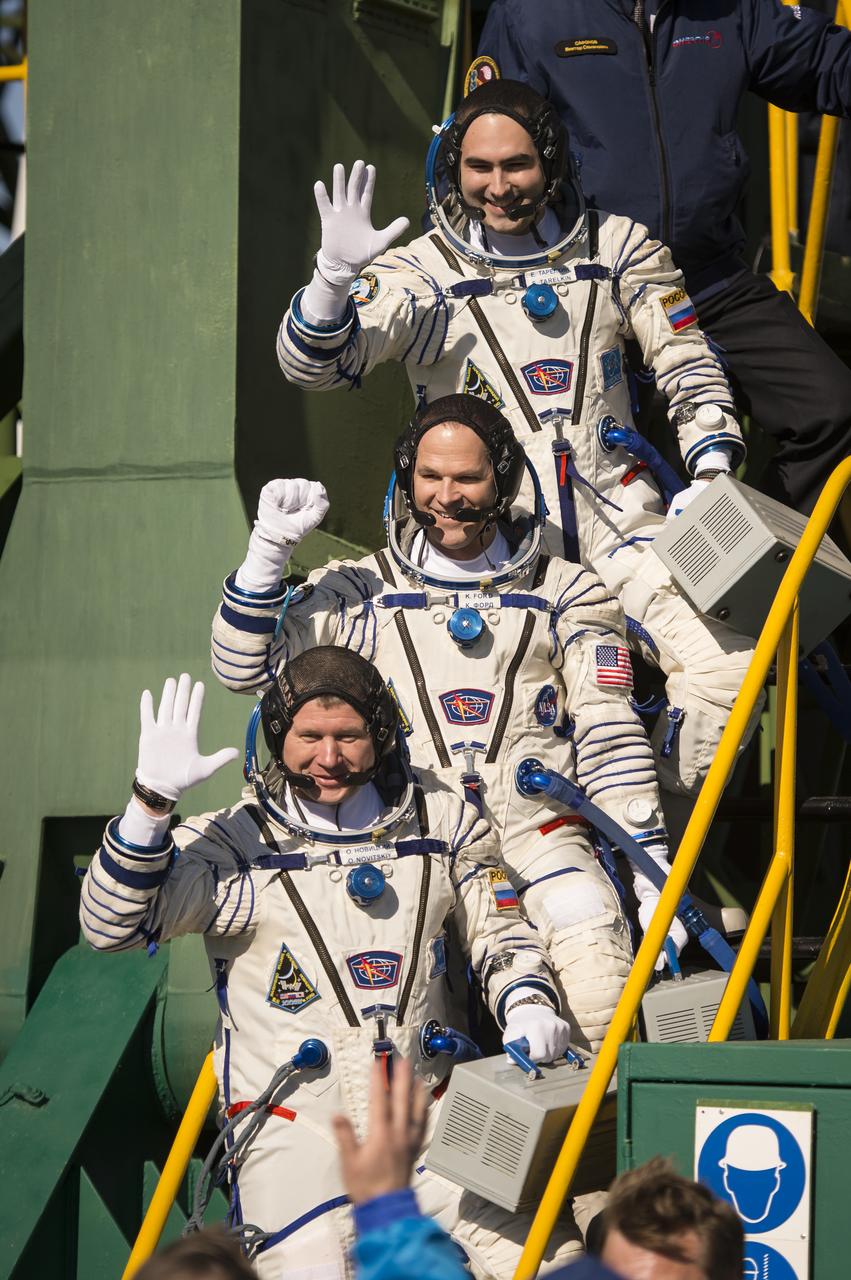
Expedition 33/34 crew members, Soyuz Commander Oleg Novitskiy, bottom, Flight Engineer Kevin Ford of NASA, and Flight Engineer Evgeny Tarelkin of ROSCOSMOS, top, wave farewell before boarding their Soyuz rocket just a few hours before their launch to the International Space Station on Tuesday, October 23, 2012, in Baikonur, Kazakhstan. Launch of a Soyuz rocket later in the afternoon will send Ford, Novitskiy and Tarelkin on a five-month mission aboard the International Space Station. Photo Credit: (NASA/Bill Ingalls)
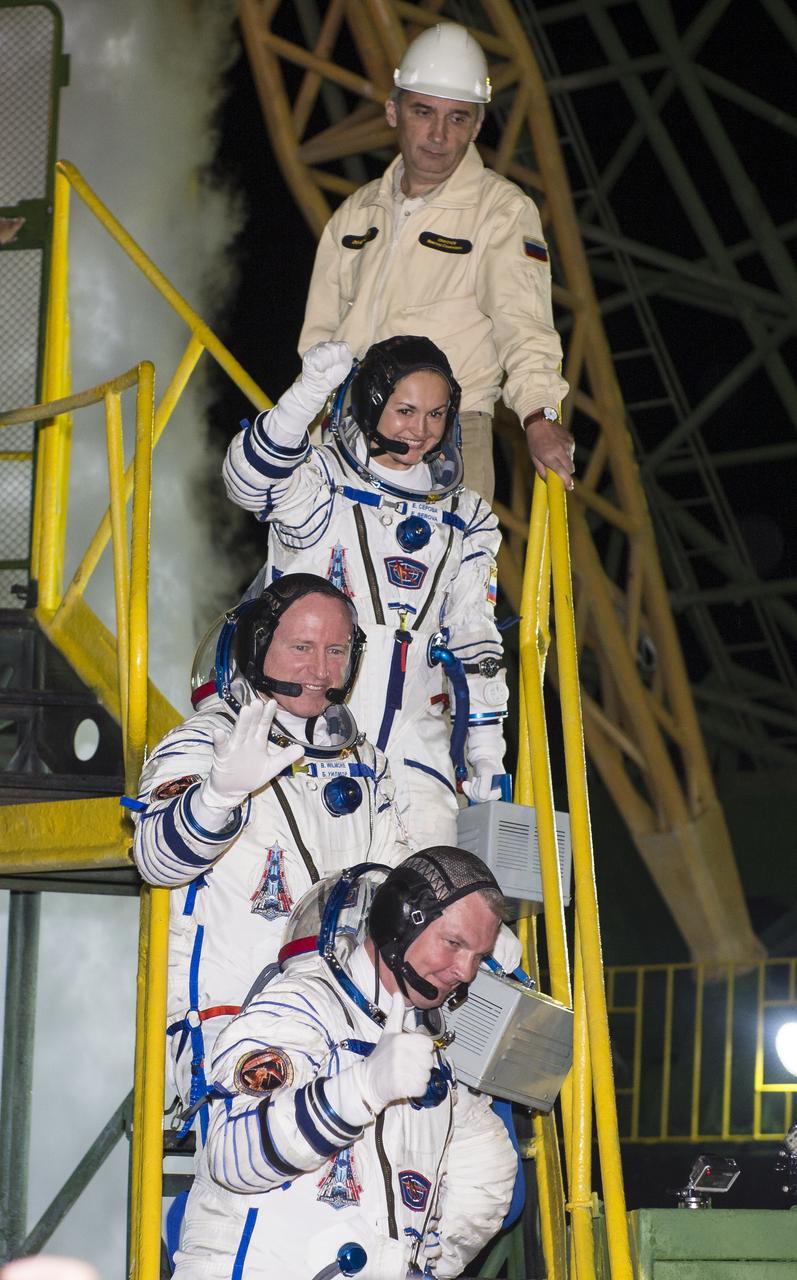
Expedition 41 Soyuz Commander Alexander Samokutyaev of the Russian Federal Space Agency (Roscosmos), bottom, Flight Engineer Barry Wilmore of NASA, middle, and Elena Serova of Roscosmos, top, wave farewell prior to boarding the Soyuz TMA-14M spacecraft for launch, Thursday, Sept. 25, 2014 at the Baikonur Cosmodrome in Kazakhstan. Samokutyaev, Wilmore, and Serova will spend the next five and a half months aboard the International Space Station. Photo Credit: (NASA/Aubrey Gemignani)
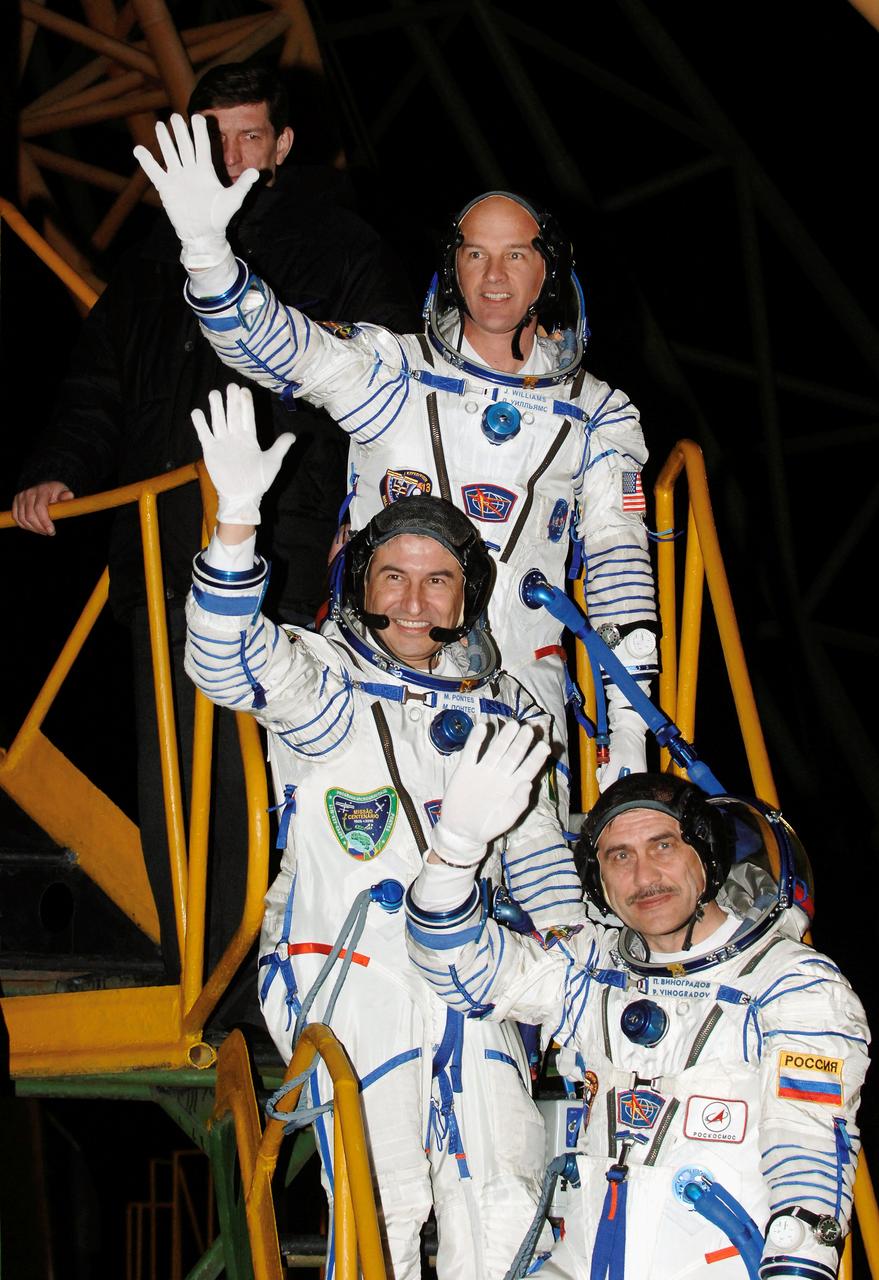
JSC2006-E-11941 (30 March 2006) --- Prime crew members for the upcoming mission to the International Space Station wave goodbye to the cameras at the launch pad. (top to bottom) Astronaut Jeffrey N. Williams, NASA International Space Station science officer and flight engineer; astronaut Marcos Pontes, Brazilian Space Agency Soyuz crew member; and cosmonaut Pavel V. Vinogradov, Russia’s Federal Space Agency International Space Station commander. Baikonur, Kazakhstan. Photo Credit: NASA/Bill Ingalls
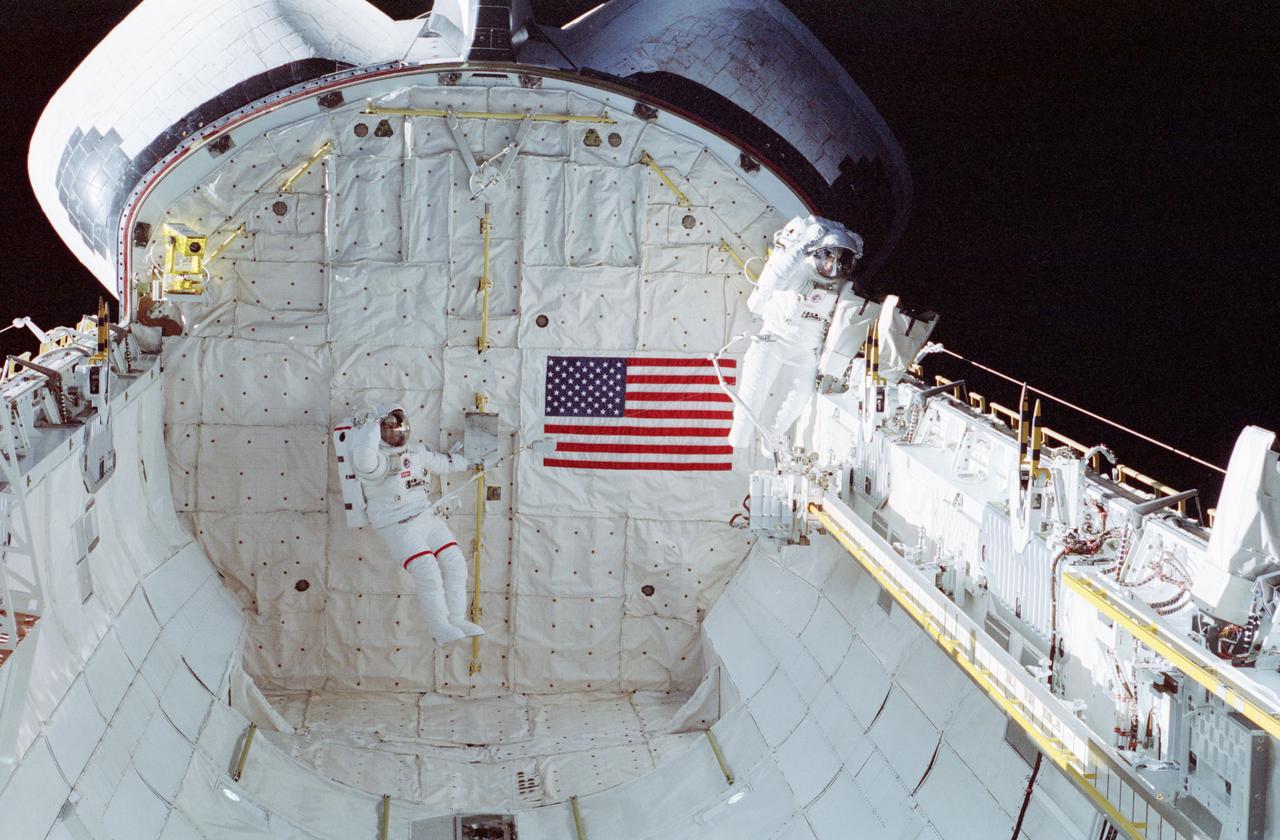
During their STS-37 extravehicular activity (EVA), Mission Specialist (MS) Jerry L. Ross (left) and MS Jerome Apt, in the aft section of Atlantis', Orbiter Vehicle (OV) 104's, payload bay (PLB), turn and wave to their fellow crewmembers who are overseeing the activity from inside the crew compartment. Ross is tethered to the guidewire running along the PLB port side. Apt has reached the end of the Crew and Equipment Translation Aid (CETA) deployable track via the manual hand over hand cart.
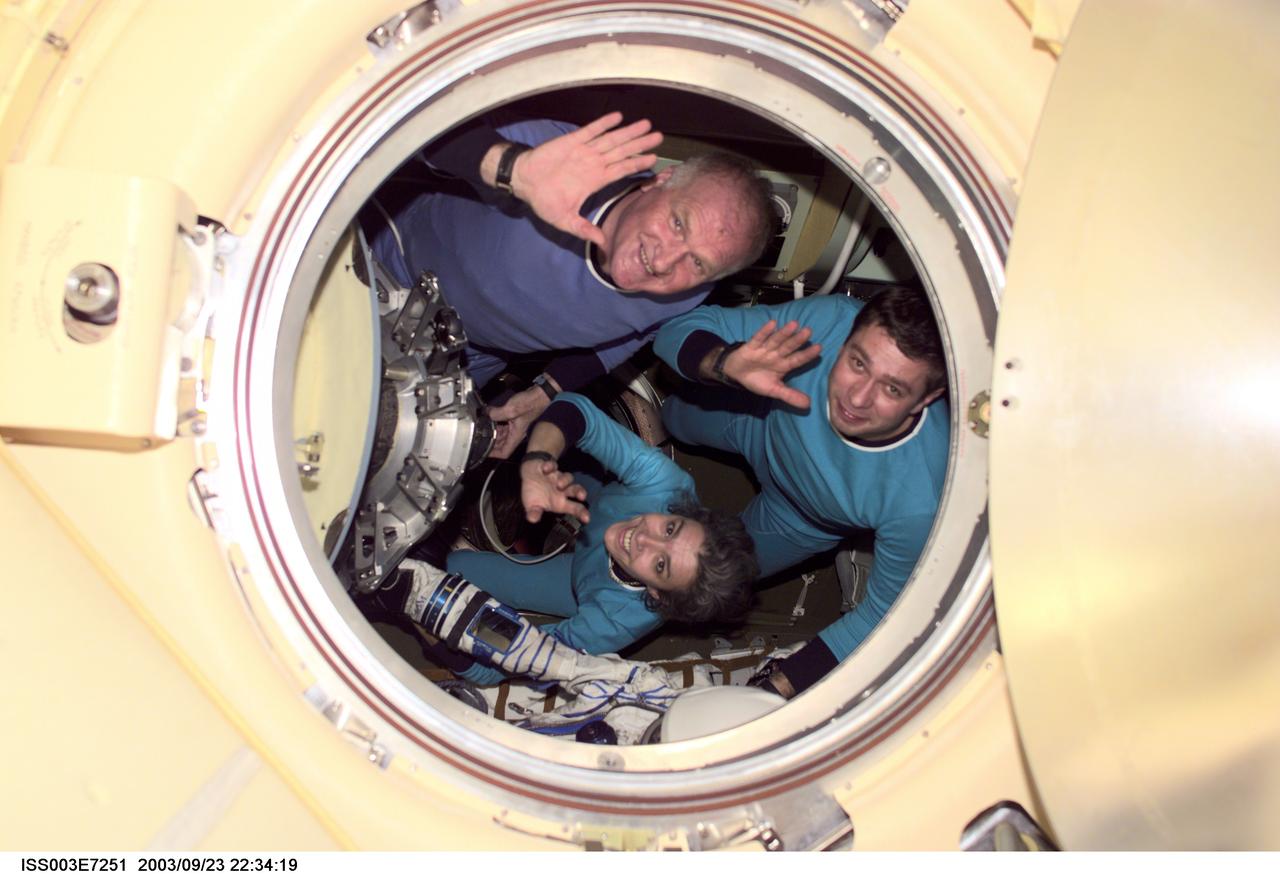
ISS003-E-7251 (23-31 October 2001) --- The Soyuz Taxi crewmembers wave from a Soyuz spacecraft docked to the International Space Station (ISS). Clockwise from the top are Commander Victor Afanasyev, Flight Engineer Konstantin Kozeev and French Flight Engineer Claudie Haignere. Afanasyev and Kozeev represent Rosaviakosmos, and Haignere represents ESA, carrying out a flight program for CNES, the French Space Agency, under a commercial contract with the Russian Aviation and Space Agency. This image was taken with a digital still camera by one of the Expedition Three crew from the nadir docking port on the station.
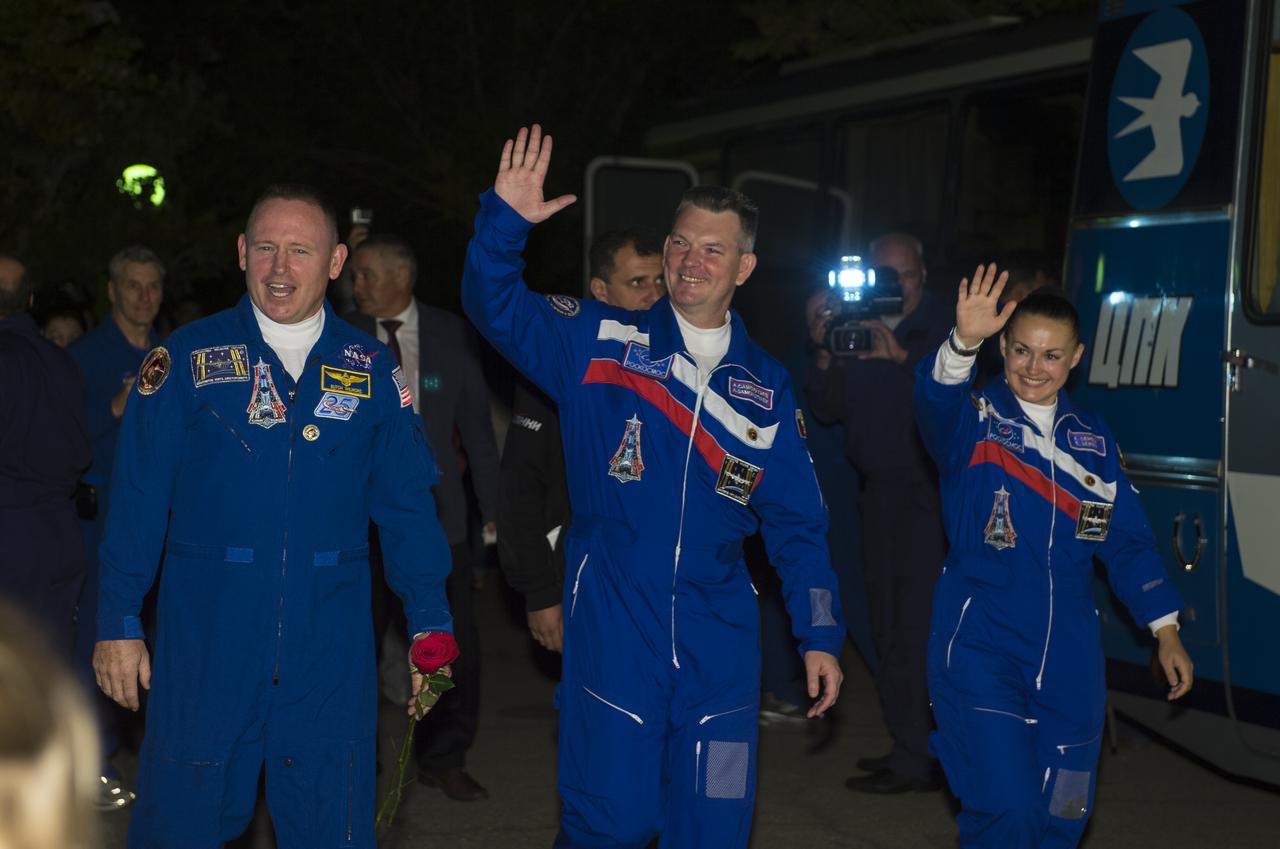
Expedition 41 crew members, Flight Engineer Barry Wilmore of NASA, left, Soyuz Commander Alexander Samokutyaev of the Russian Federal Space Agency (Roscosmos), center, and Flight Engineer Elena Serova of Roscosmos, right, wave farewell to family and friends as they depart the Cosmonaut Hotel to suit-up for their Soyuz launch to the International Space Station on Thursday, Sept. 25, 2014, in Baikonur, Kazakhstan. Launch of the Soyuz rocket is scheduled for the early hours of Sept. 26 and will send Samokutyaev, Serova and Wilmore on a five and a half month mission aboard the International Space Station. Photo Credit: (NASA/Aubrey Gemignani)
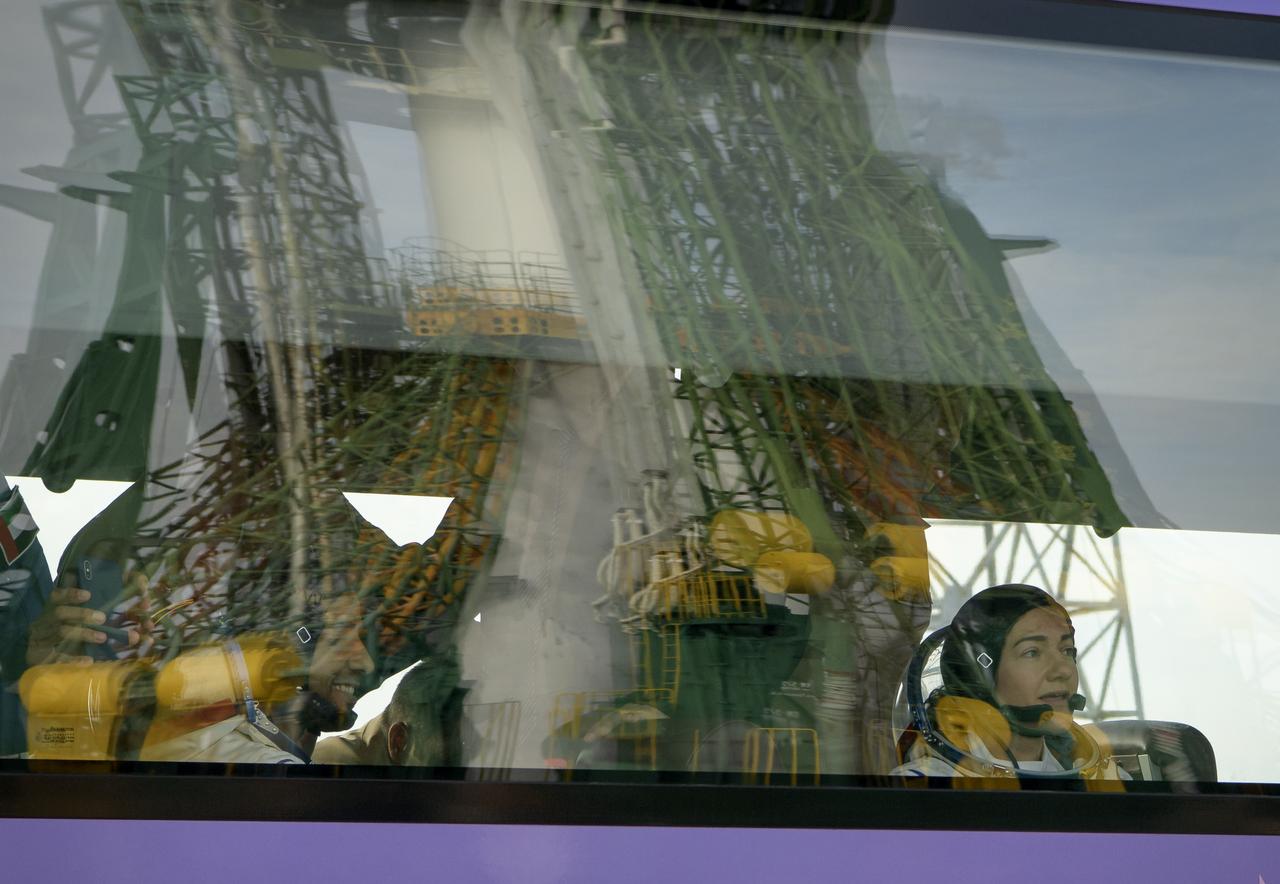
Spaceflight participant Hazzaa Ali Almansoori of the United Arab Emirates, left, and Expedition 61 astronaut Jessica Meir of NASA look at the Soyuz rocket as the bus carrying them and Expedition 61 cosmonaut Oleg Skripochka of Roscosmos arrives at the launch pad, Wednesday, Sept. 25, 2019 at the Baikonur Cosmodrome in Kazakhstan. Meir, Skripochka, and Almansoori will launch from the Baikonur Cosmodrome to the International Space Station. Photo Credit: (NASA/Bill Ingalls)
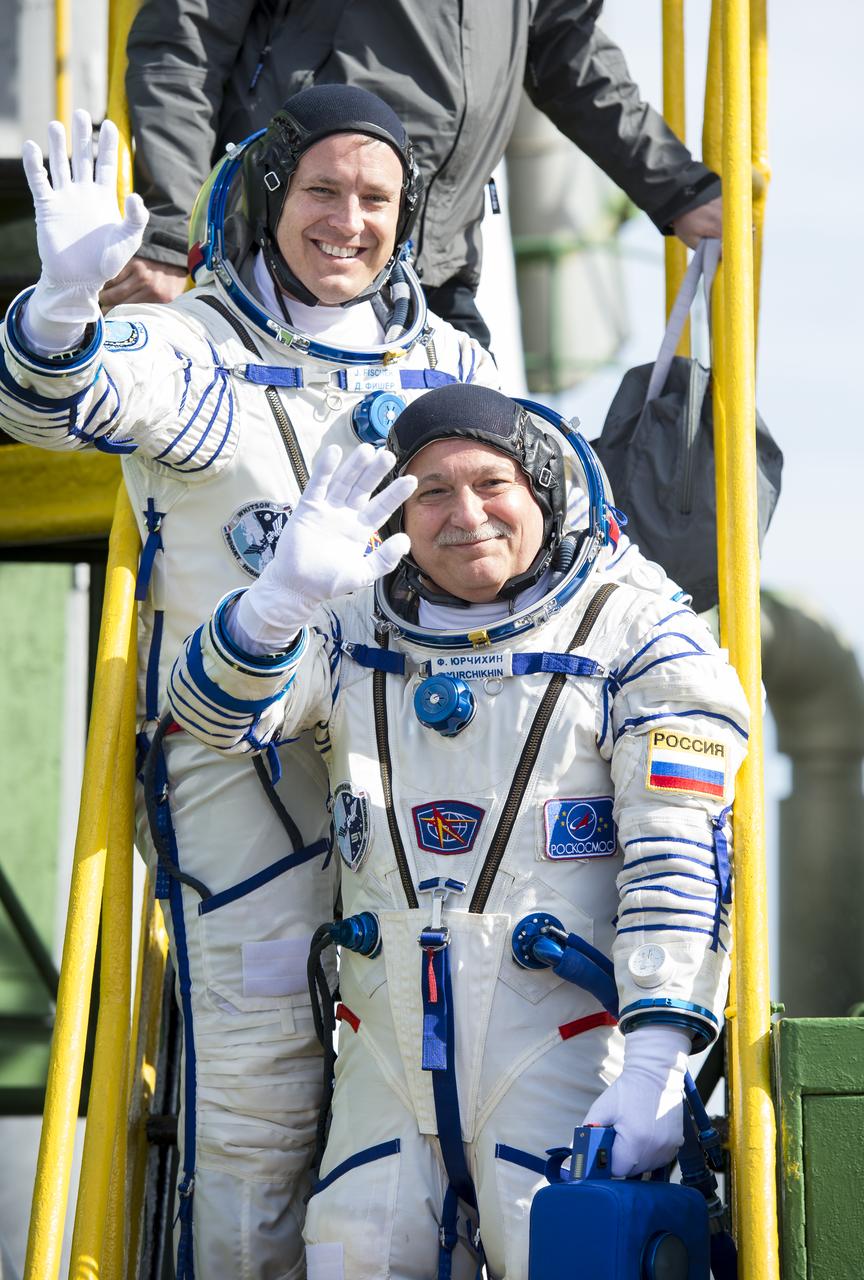
Expedition 51 Soyuz Commander Fyodor Yurchikhin of Roscosmos, bottom and Flight Engineer Jack Fischer of NASA, top, wave farewell prior to boarding the Soyuz MS-04 spacecraft for launch, Thursday, April 20, 2017 at the Baikonur Cosmodrome in Kazakhstan. Yurchikhin and Fischer will spend the next four and a half months aboard the International Space Station. Photo Credit: (NASA/Aubrey Gemignani)
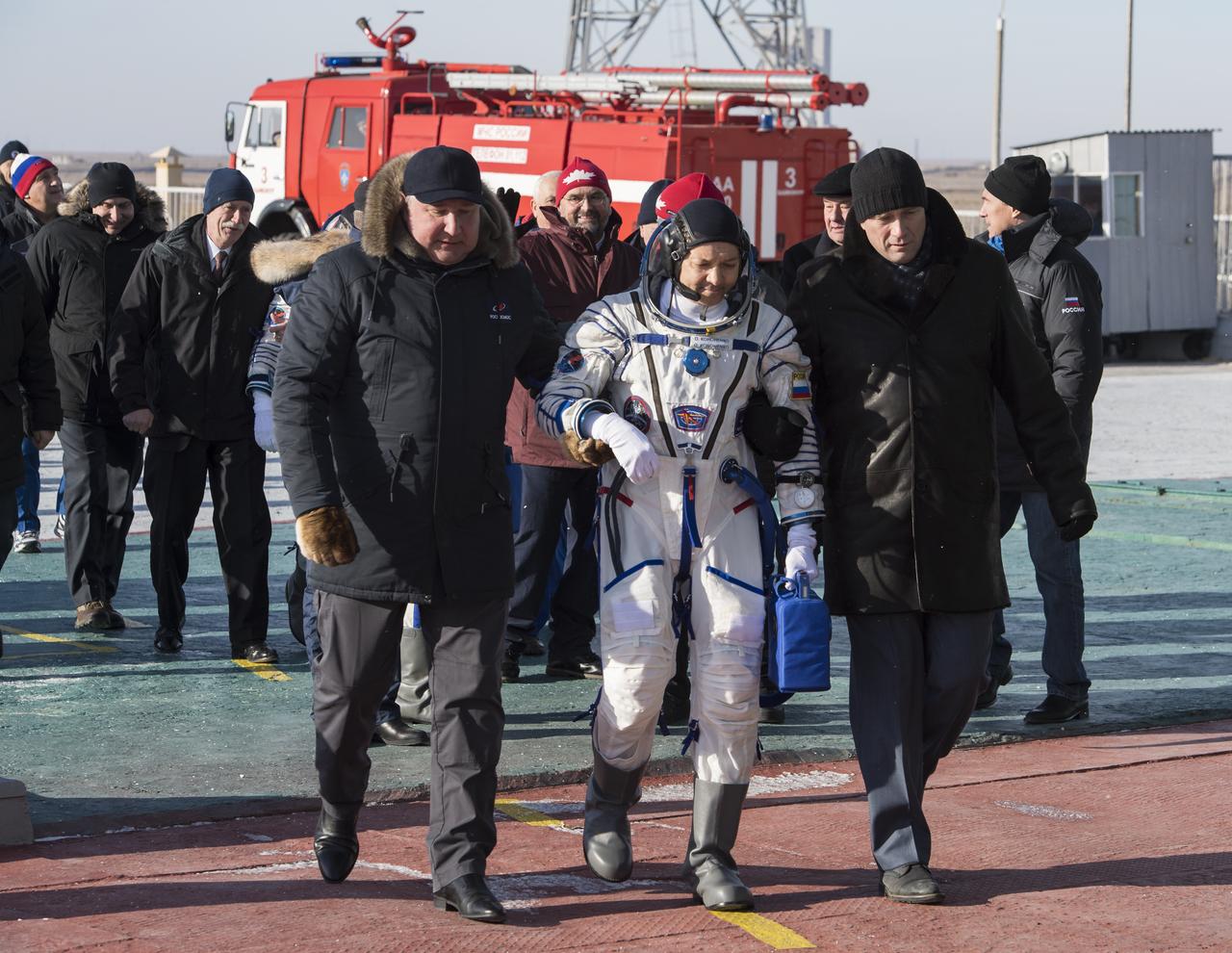
Expedition 58 Soyuz Commander Oleg Kononenko of Roscosmos is walked to the Soyuz vehicle for launch by Dmitry Rogozin, Director General of Roscosmos, left, Monday, Dec. 3, 2018 in Baikonur, Kazakhstan. Kononenko, Flight Engineer Anne McClain of NASA, and Flight Engineer David Saint-Jacques of the Canadian Space Agency (CSA) will spend the next six and a half months onboard the International Space Station. Photo Credit: (NASA/Aubrey Gemignani)
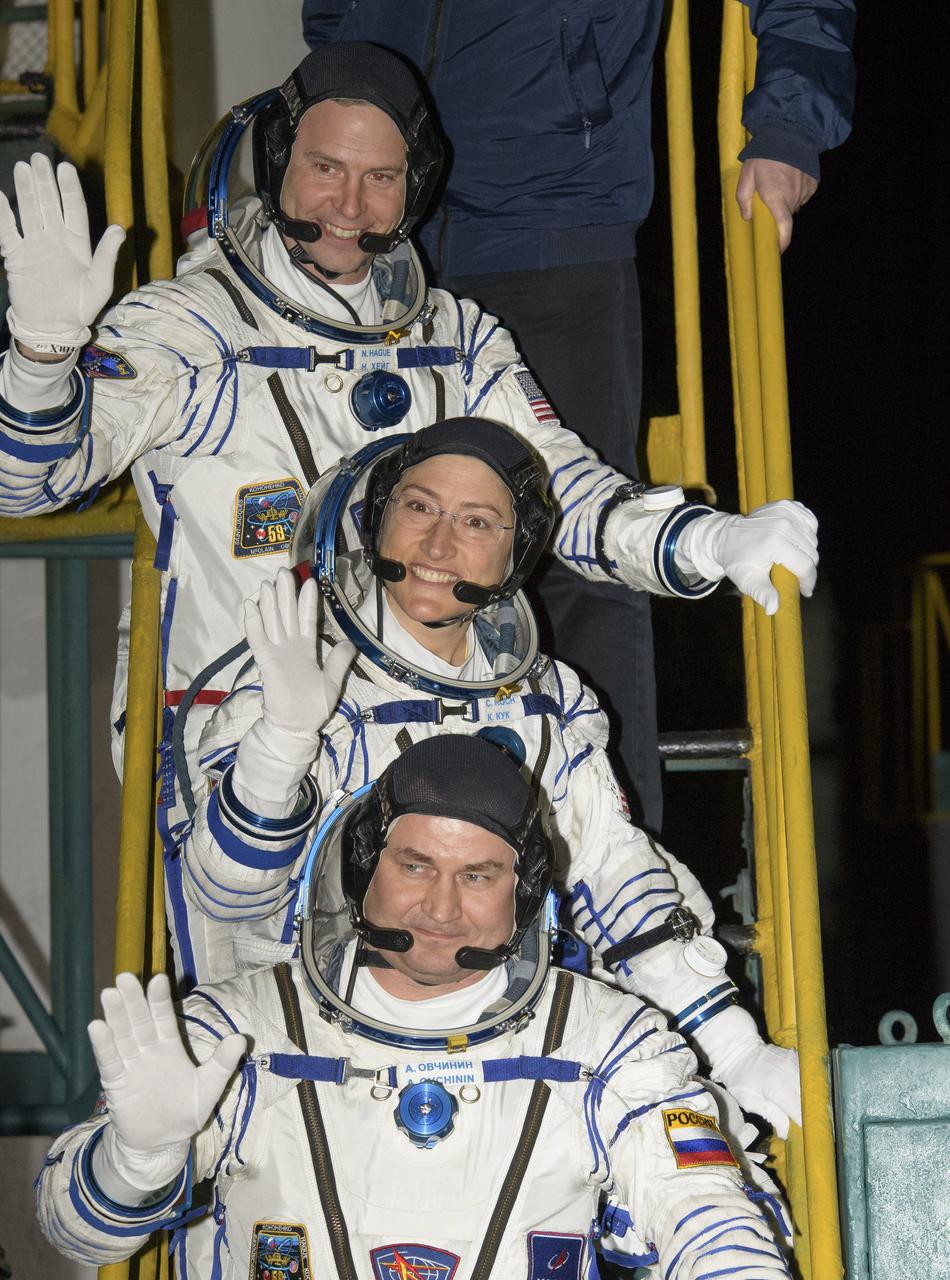
Expedition 59 crewmembers Nick Hague of NASA, top, Christina Koch of NASA, center, and Alexey Ovchinin of Roscosmos wave farewell prior to boarding the Soyuz MS-12 spacecraft for launch, Thursday, March 14, 2019 at the Baikonur Cosmodrome in Kazakhstan. Hague, Koch, and Ovchinin will spend six-and-a-half months living and working aboard the International Space Station. Photo Credit: (NASA/Bill Ingalls)
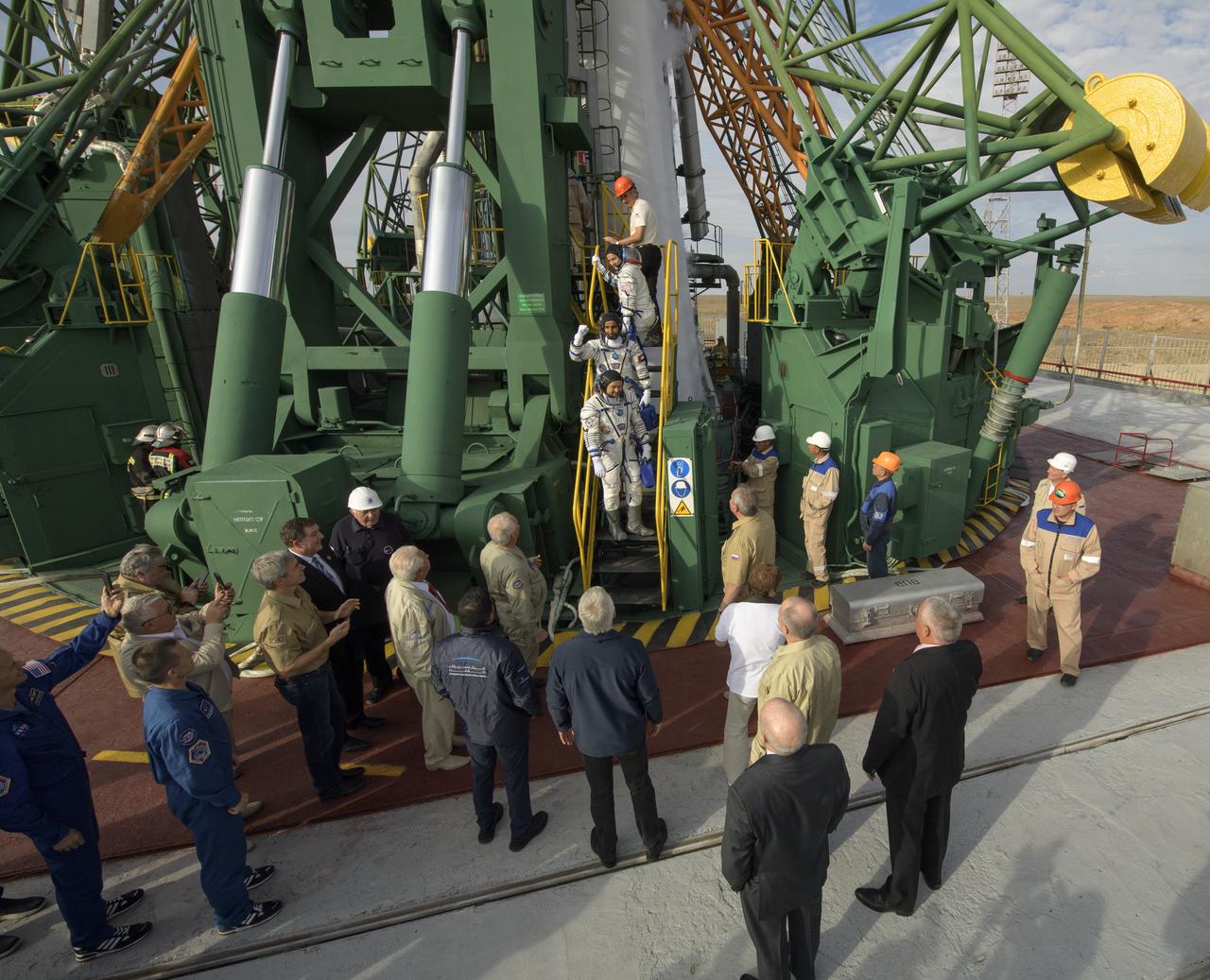
Expedition 61 astronaut Jessica Meir of NASA, top, spaceflight participant Hazzaa Ali Almansoori of the United Arab Emirates, center, and Expedition 61 cosmonaut Oleg Skripochka of Roscosmos, wave farewell prior to boarding the Soyuz MS-15 spacecraft for launch, Wednesday, Sept. 25, 2019 at the Baikonur Cosmodrome in Kazakhstan. Meir, Skripochka, and Almansoori will launch from the Baikonur Cosmodrome to the International Space Station. Photo Credit: (NASA/Bill Ingalls)
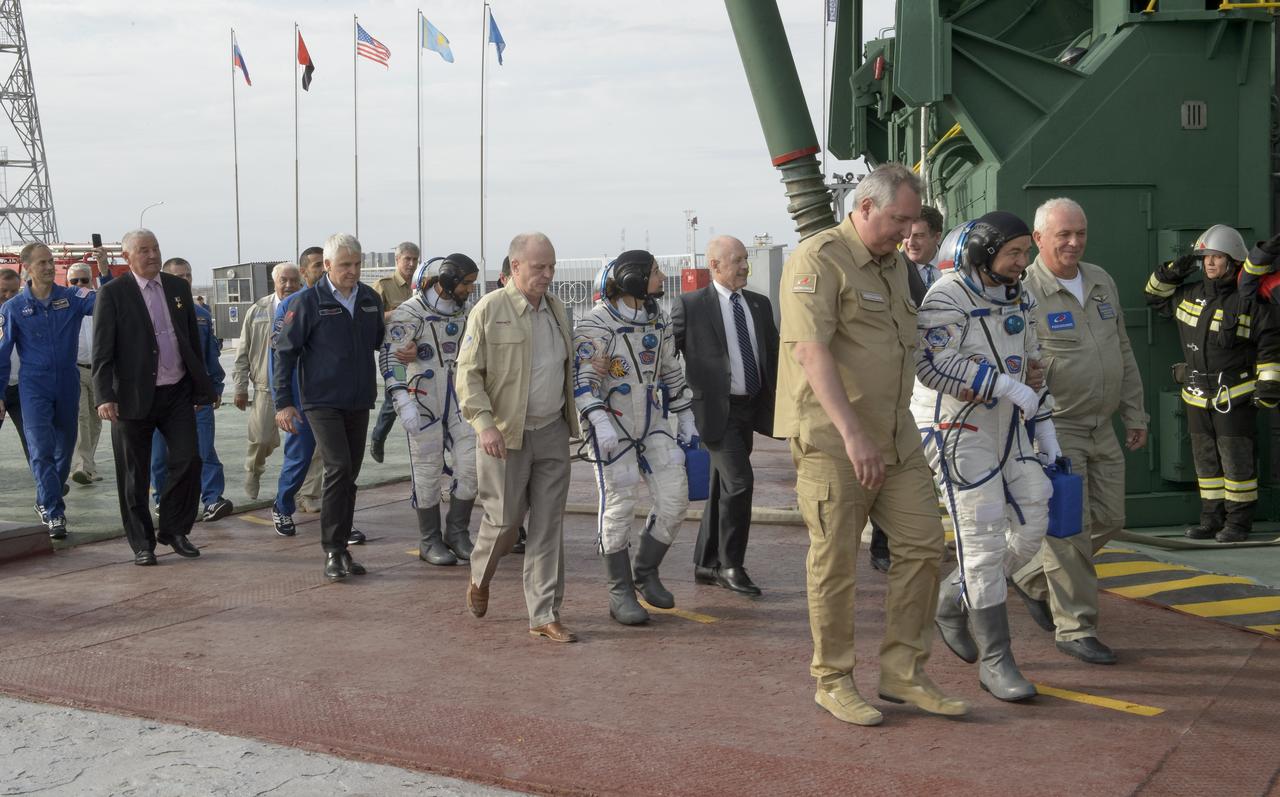
Spaceflight participant Hazzaa Ali Almansoori of the United Arab Emirates, left, Expedition 61 astronaut Jessica Meir of NASA, center, and Expedition 61 cosmonaut Oleg Skripochka of Roscosmos prepare to board the Soyuz MS-15 spacecraft for launch, Wednesday, Sept. 25, 2019 at the Baikonur Cosmodrome in Kazakhstan. Meir, Skripochka, and Almansoori will launch from the Baikonur Cosmodrome to the International Space Station. Photo Credit: (NASA/GCTC/Irina Spector)
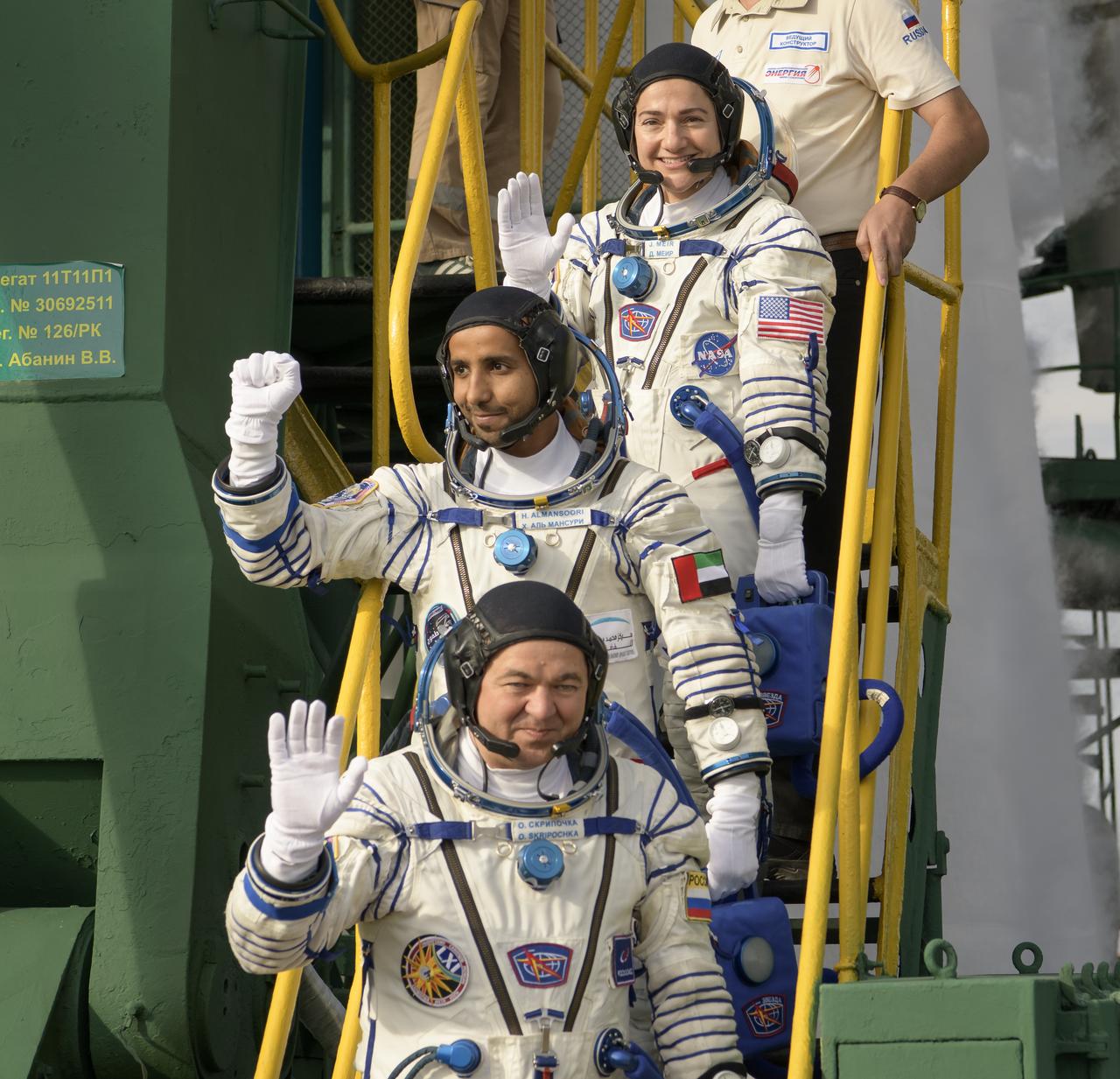
Expedition 61 astronaut Jessica Meir of NASA, top, spaceflight participant Hazzaa Ali Almansoori of the United Arab Emirates, center, and Expedition 61 cosmonaut Oleg Skripochka of Roscosmos, wave farewell prior to boarding the Soyuz MS-15 spacecraft for launch, Wednesday, Sept. 25, 2019 at the Baikonur Cosmodrome in Kazakhstan. Meir, Skripochka, and Almansoori will launch from the Baikonur Cosmodrome to the International Space Station. Photo Credit: (NASA/Bill Ingalls)
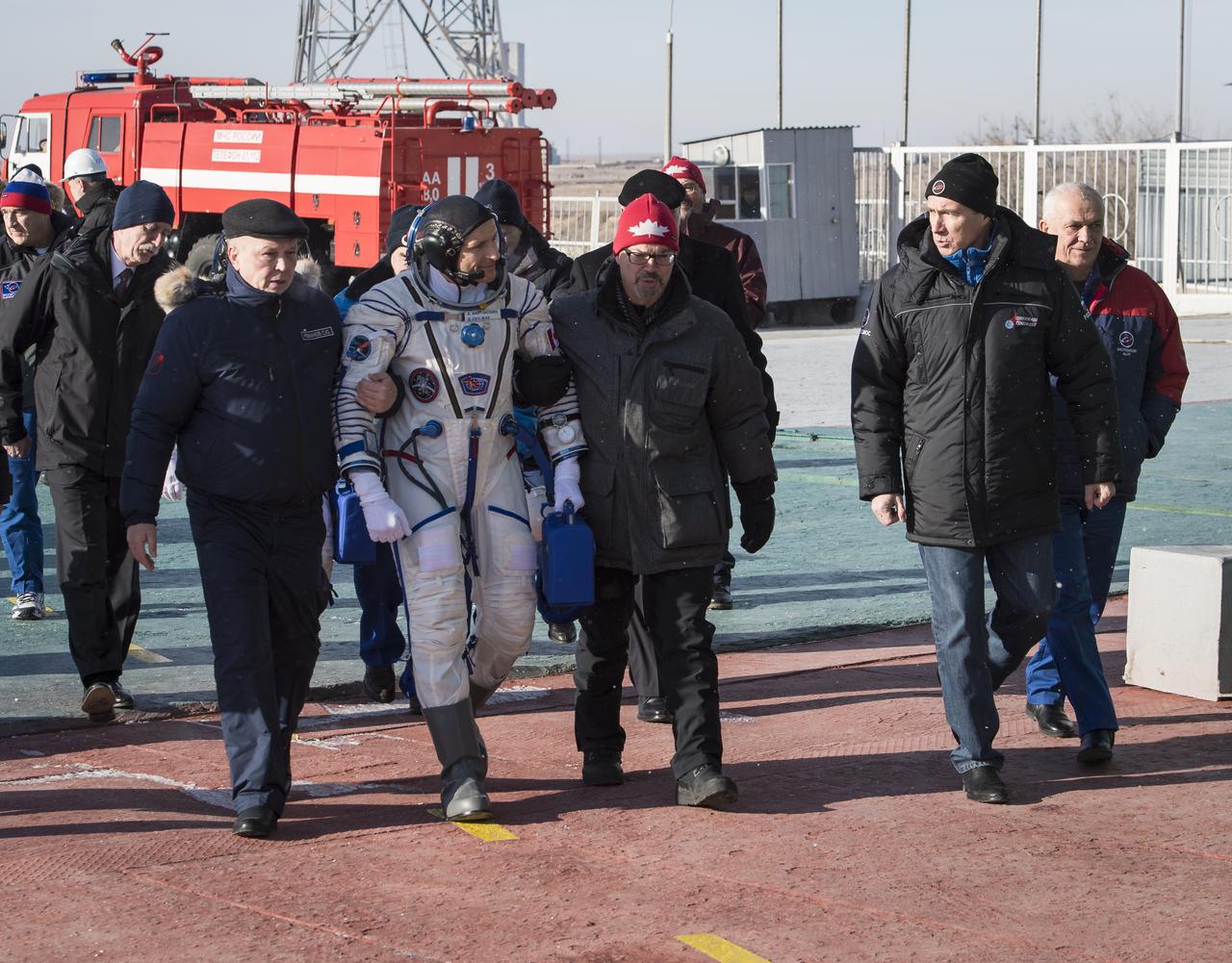
Expedition 58 Flight Engineer David Saint-Jacques is walked to the Soyuz vehicle for launch by Sylvain Laporte, president, Canadian Space Agency (CSA), second from right, Monday, Dec. 3, 2018 in Baikonur, Kazakhstan. Saint-Jacques, Soyuz Commander Oleg Kononenko of Roscosmos, and Flight Engineer Anne McClain of NASA, will spend the next six and a half months onboard the International Space Station. Photo Credit: (NASA/Aubrey Gemignani)
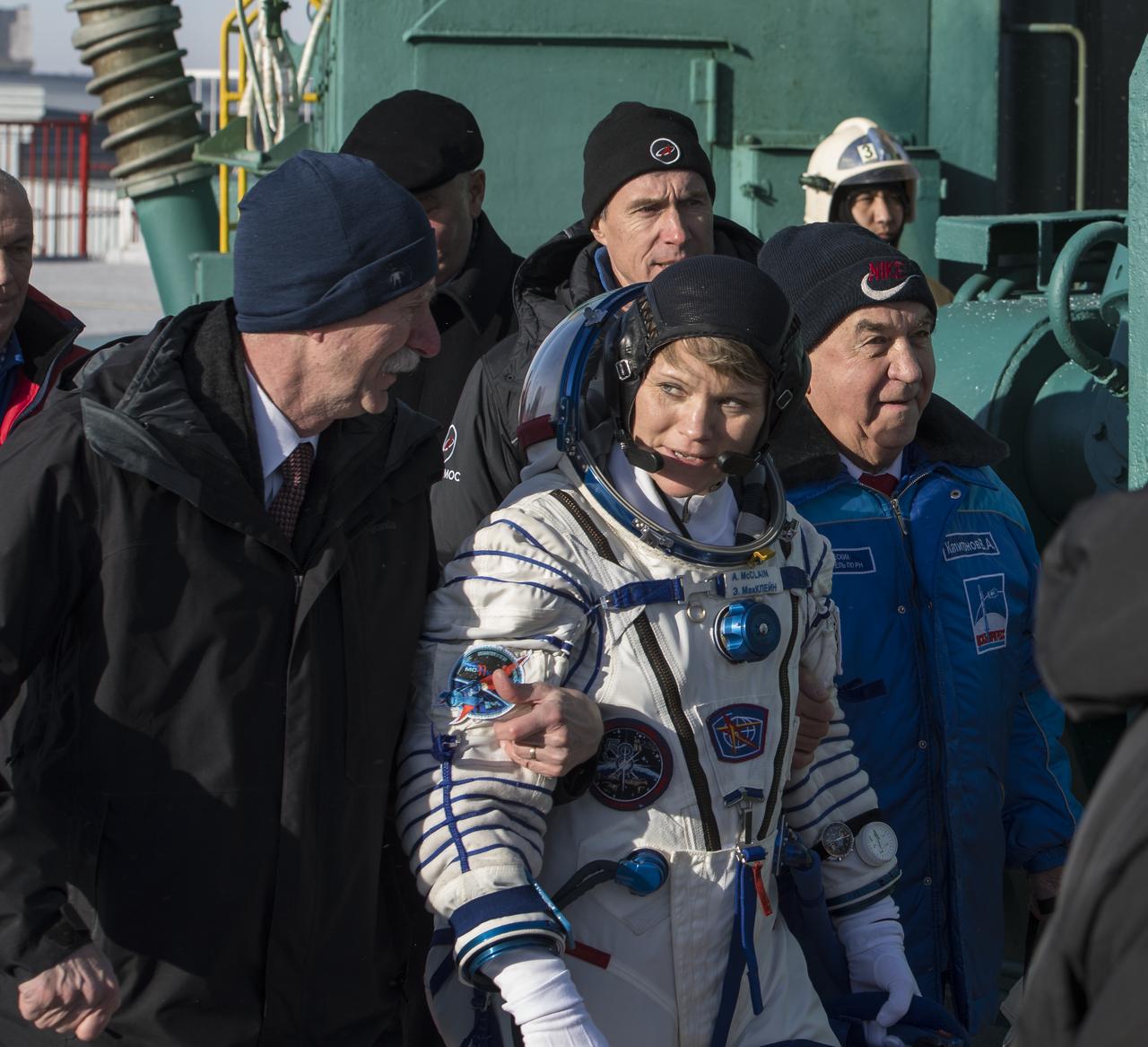
Expedition 58 Flight Engineer Anne McClain of NASA is walked to the Soyuz vehicle for launch by Bill Gerstenmaier, associate administrator, Human Exploration and Operations, NASA, left, Monday, Dec. 3, 2018 in Baikonur, Kazakhstan. McClain, Flight Engineer David Saint-Jacques of the Canadian Space Agency (CSA), and Soyuz Commander Oleg Kononenko of Roscosmos, will spend the next six and a half months onboard the International Space Station. Photo Credit: (NASA/Aubrey Gemignani)
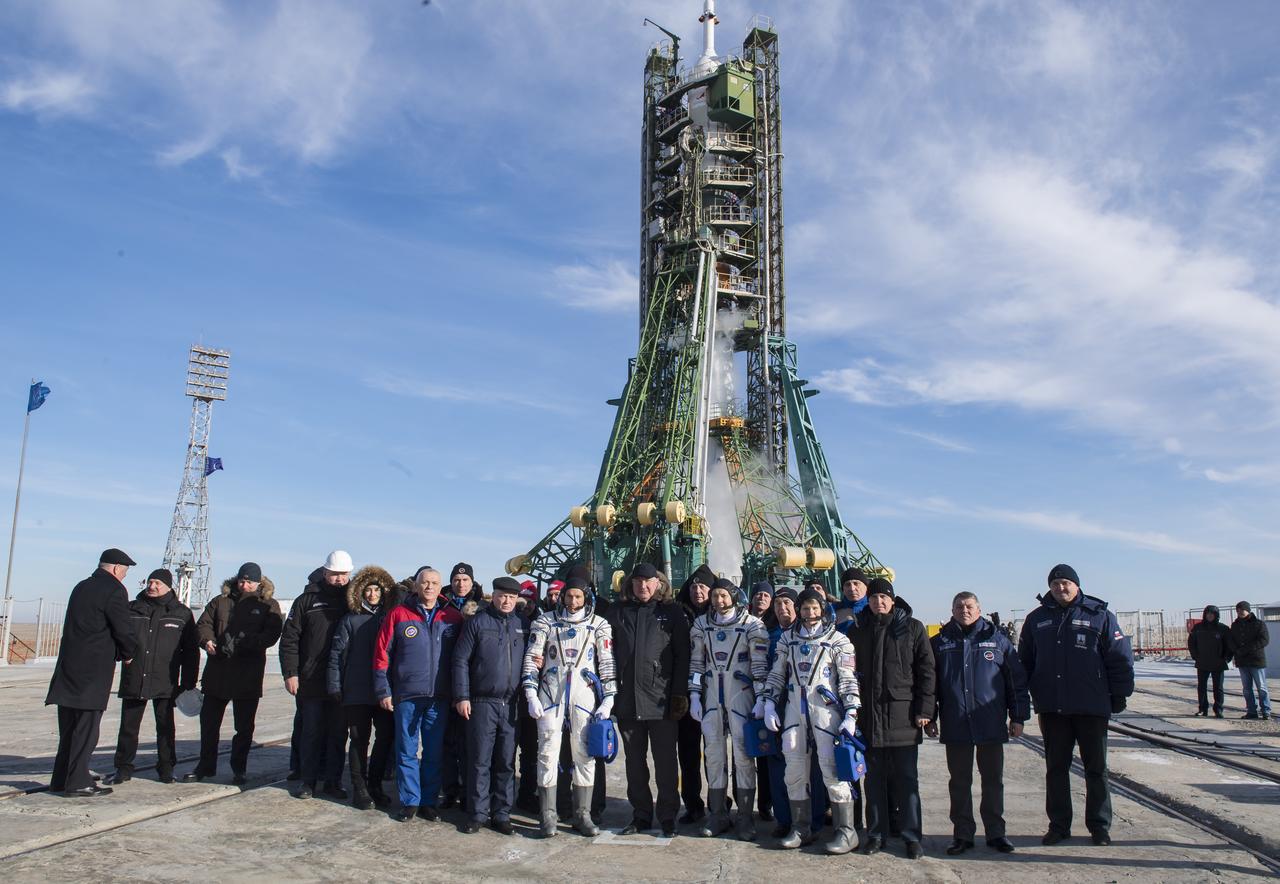
Expedition 58 crew, Flight Engineer Anne McClain of NASA, Soyuz Commander Oleg Kononenko of Roscosmos, and Flight Engineer David Saint-Jacques of the Canadian Space Agency (CSA) pose for a photo with senior officials of Roscosmos, NASA, and the Canadian Space Agency (CSA) after arriving at the launch pad by bus to begin boarding the Soyuz MS-11 spacecraft for launch, Monday, Dec. 3, 2018 in Baikonur, Kazakhstan. Kononenko, McClain, and Saint-Jacques will spend the next six and a half months onboard the International Space Station. Photo Credit: (NASA/Aubrey Gemignani)
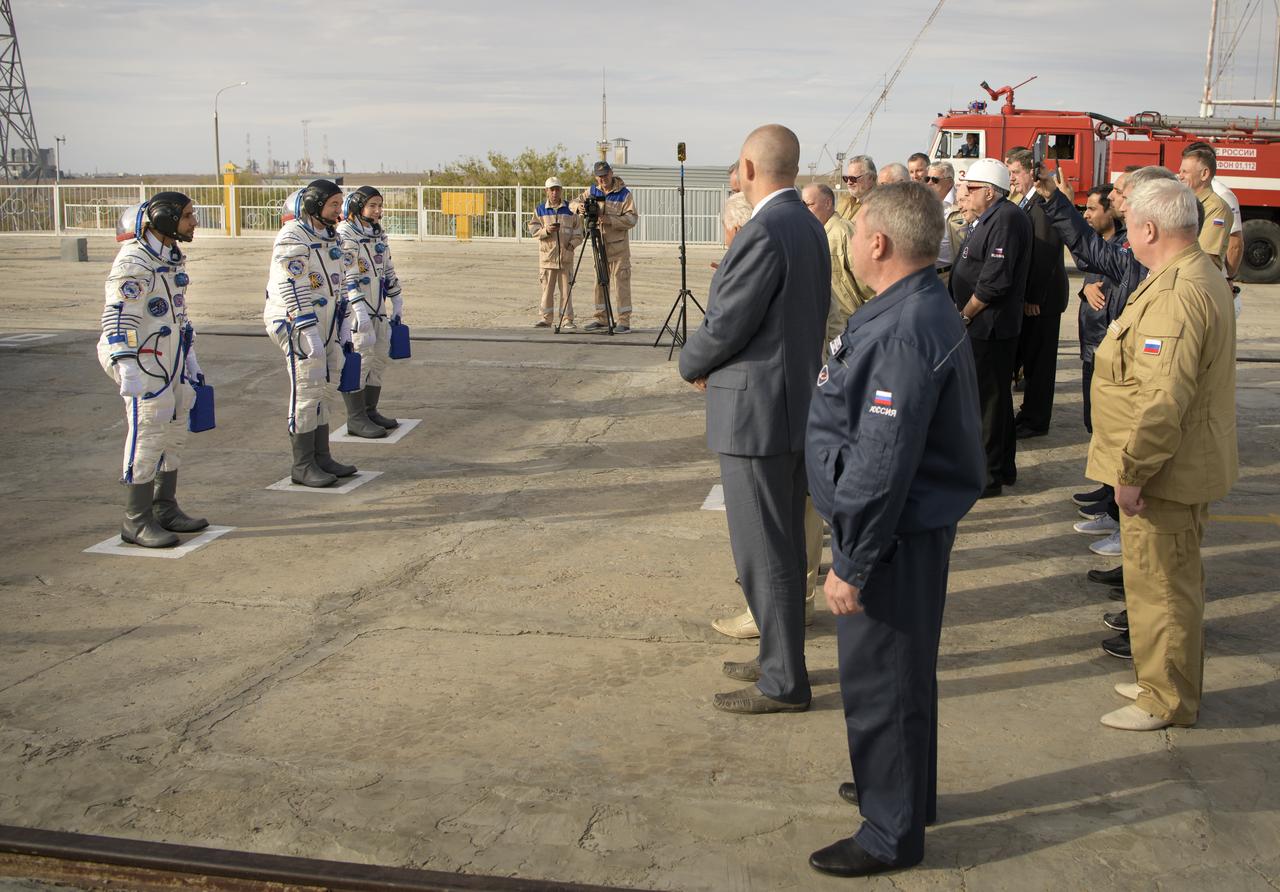
Spaceflight participant Hazzaa Ali Almansoori of the United Arab Emirates, left, Expedition 61 cosmonaut Oleg Skripochka of Roscosmos, center, and Expedition 61 astronaut Jessica Meir of NASA, check in with officials prior to boarding the Soyuz MS-15 spacecraft for launch, Wednesday, Sept. 25, 2019 at the Baikonur Cosmodrome in Kazakhstan. Meir, Skripochka, and Almansoori will launch from the Baikonur Cosmodrome to the International Space Station. Photo Credit: (NASA/Bill Ingalls)
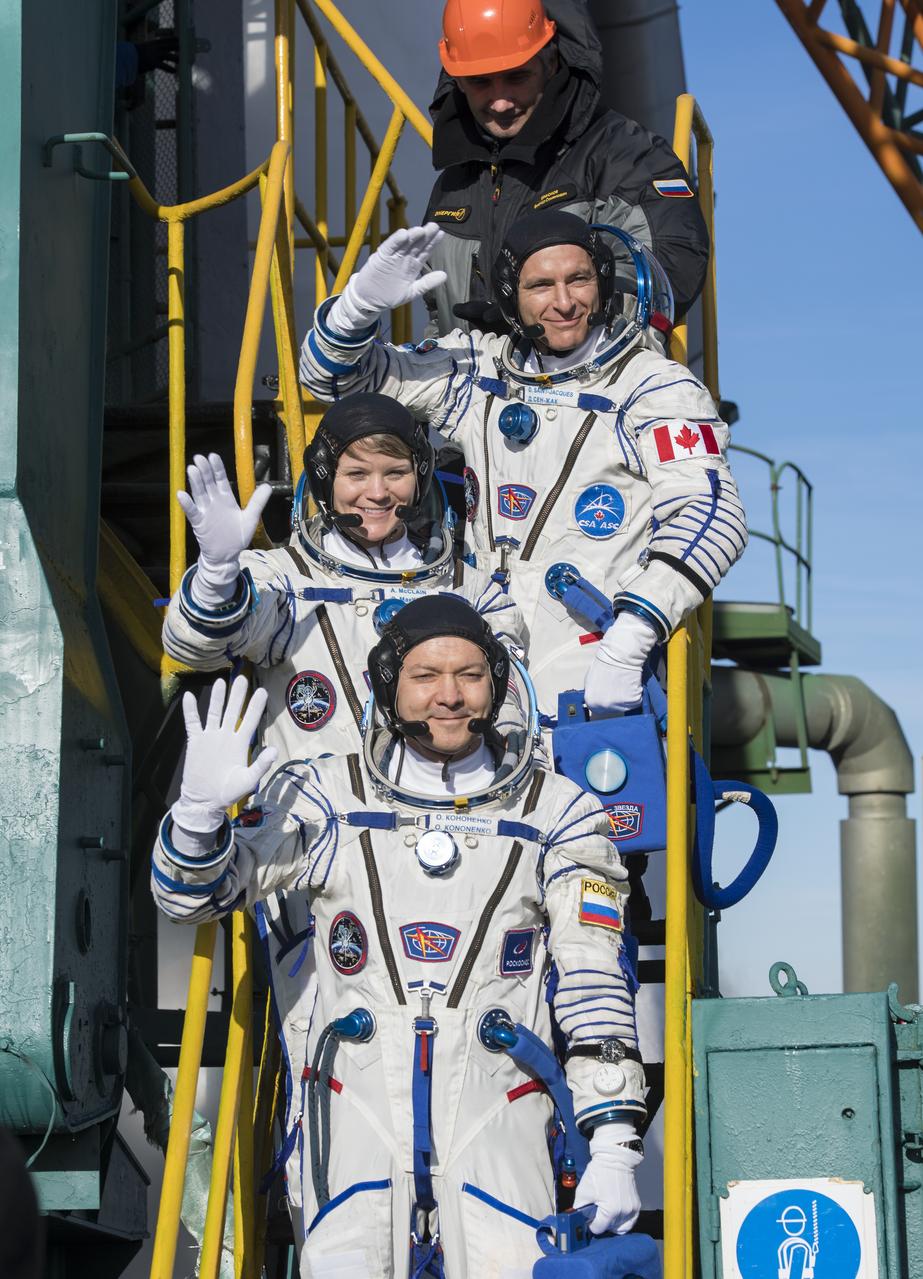
Expedition 58 Flight Engineer David Saint-Jacques of the Canadian Space Agency (CSA), top, Flight Engineer Anne McClain of NASA, center, and Soyuz Commander Oleg Kononenko of Roscosmos, bottom, wave farewell prior to boarding the Soyuz MS-11 spacecraft for launch, Monday, Dec. 3, 2018 in Baikonur, Kazakhstan. Kononenko. McClain, and Saint-Jacques will spend the next six and a half months onboard the International Space Station. Photo Credit: (NASA/Aubrey Gemignani)
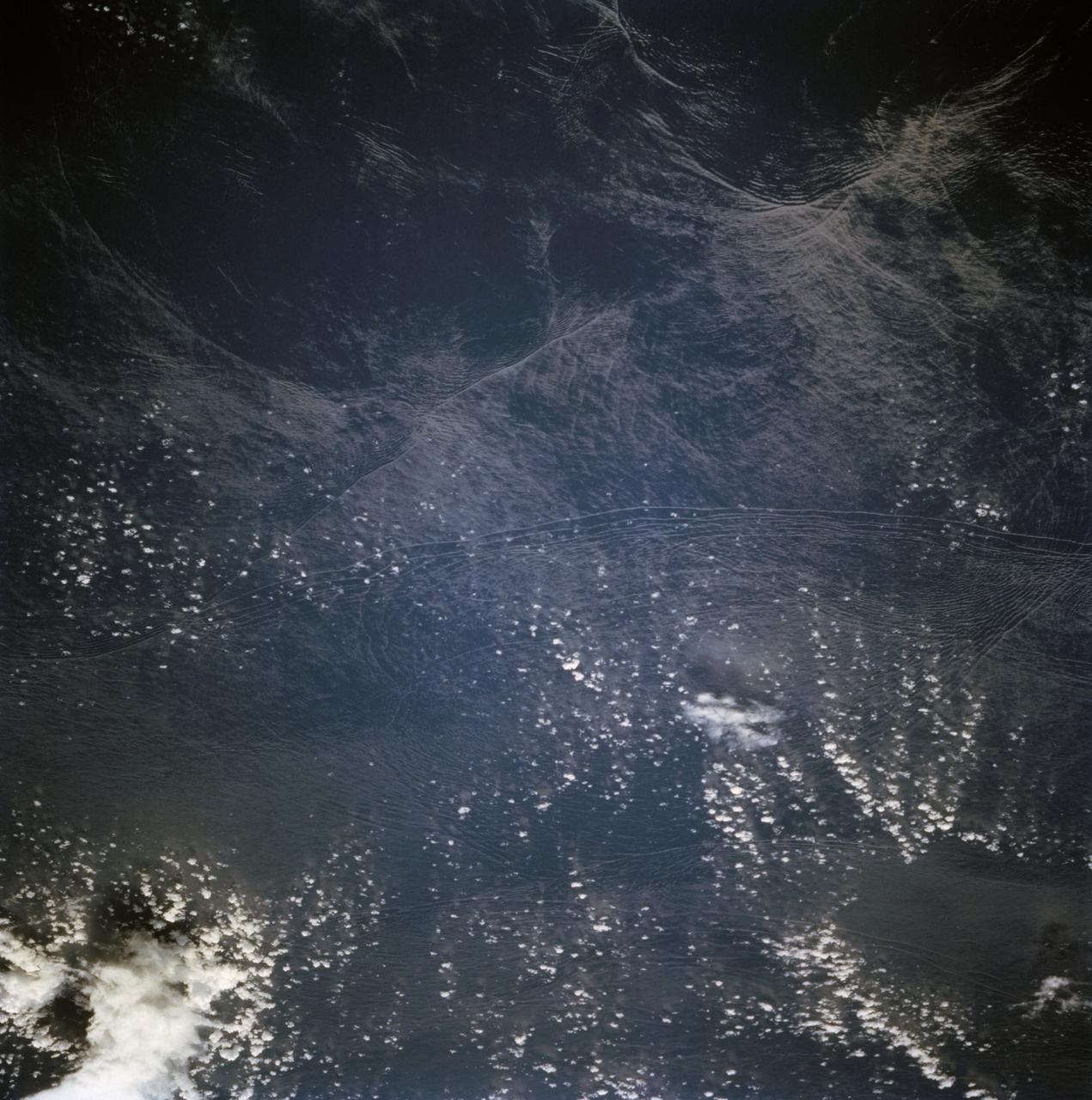
STS068-236-044 (30 September-11 October 1994) --- These internal waves in the Andaman Sea, west of Burma, were photographed from 115 nautical miles above Earth by the crew of the Space Shuttle Endeavour during the Space Radar Laboratory 2 (SRL-2) mission. The internal waves smooth out some of the capillary waves at the surface in bands and travel along the density discontinuity at the bottom of the mixed layer depth. There is little evidence of the internal waves at the surface. They are visible in the Space Shuttle photography because of sunglint, which reflects off the water.
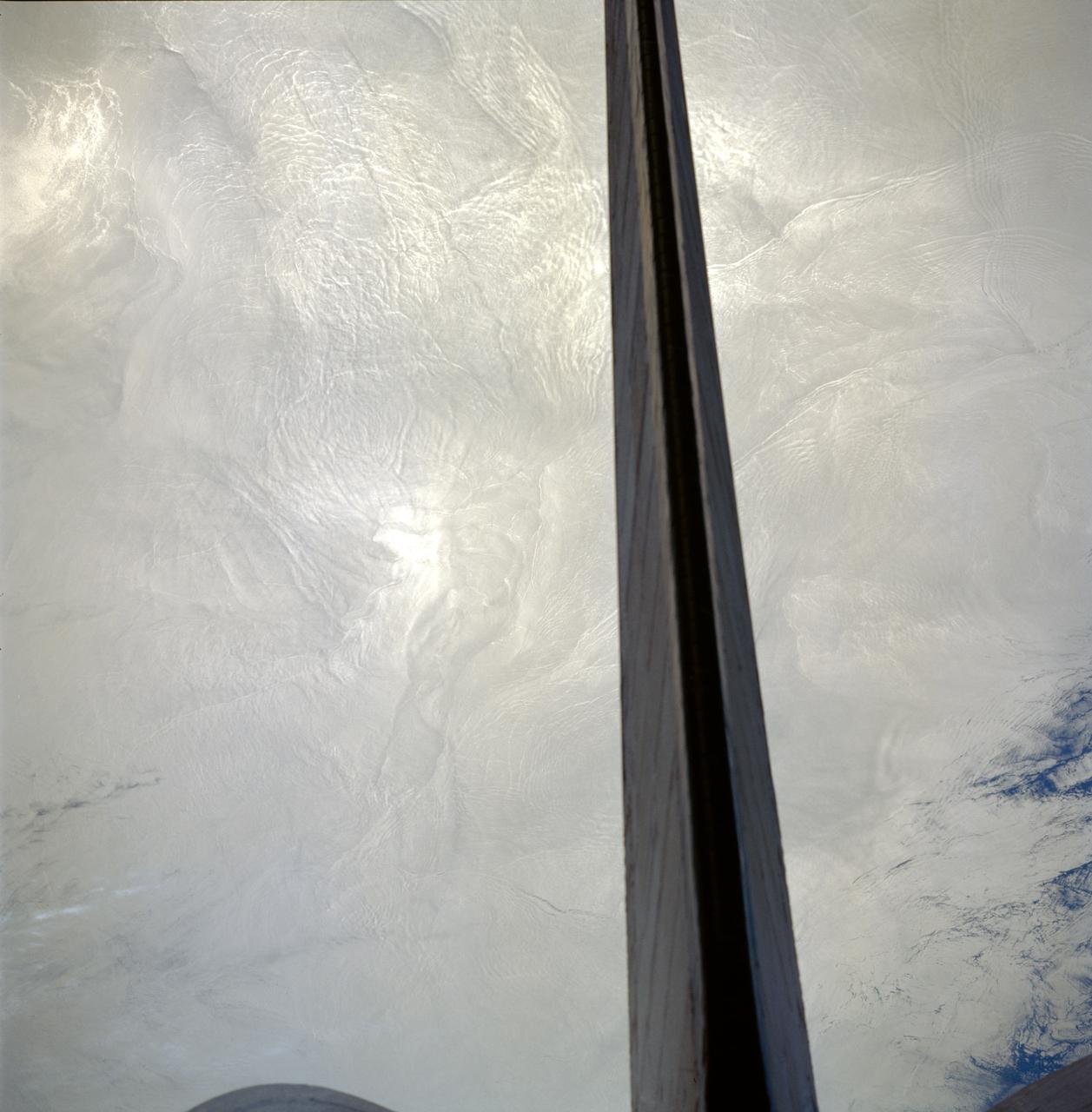
STS091-713-061 (2-12 June 1998) --- The vertical stabilizer of the Space Shuttle Discovery runs through this Atlantic Ocean image made from its crew cabin. Many sets of internal waves are seen in the 70mm frame traveling through an area off the Atlantic coast of Nova Scotia, Canada. There are seven sets that run perpendicular to each other. Internal waves are tidally induced and travel below the surface of the ocean along a density change which occurs often around 150 feet deep. According to NASA scientists studying the STS-91 collection, the waves are visible because, as the wave action smoothes out the smaller waves on the surface, the manner in which the sun is reflected is changed.
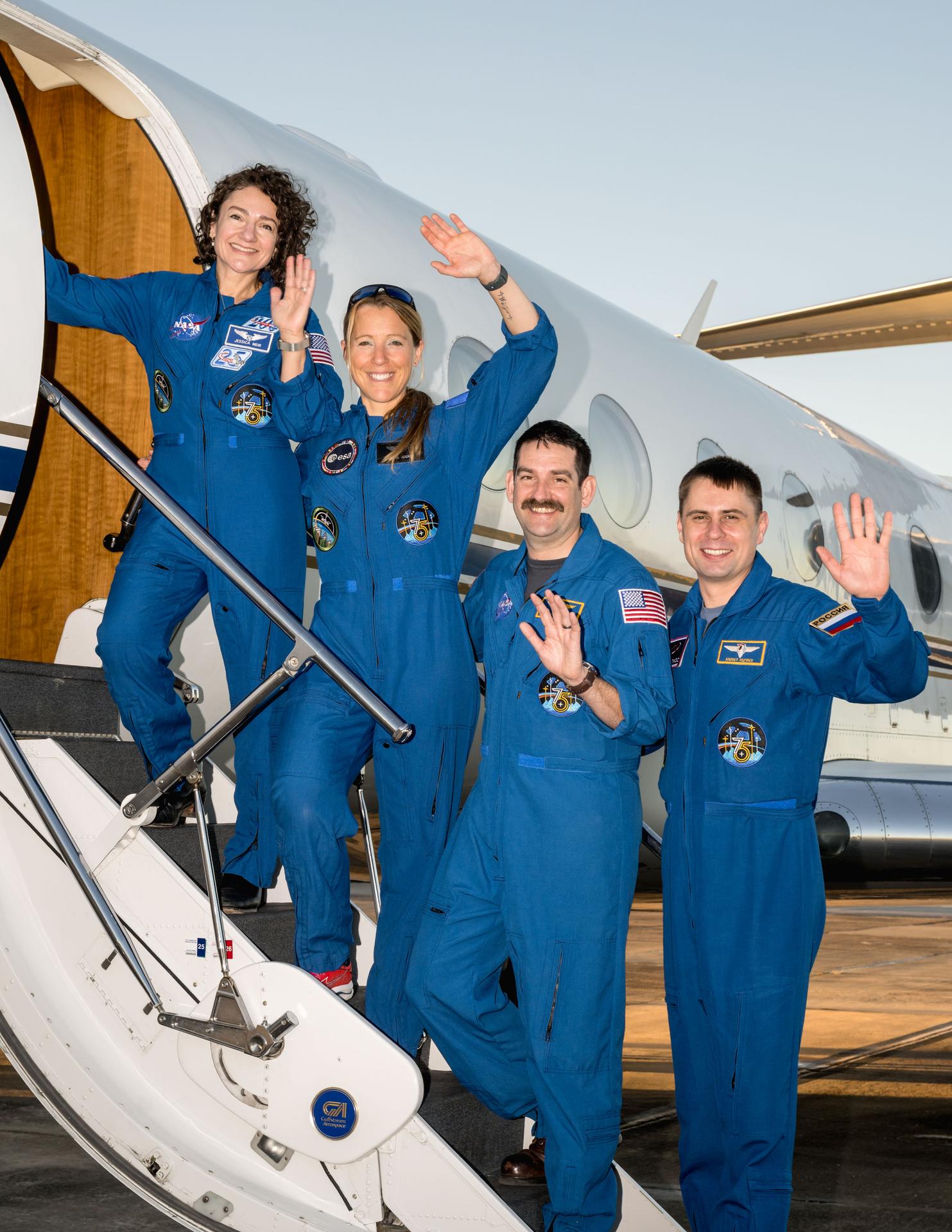
jsc2026e005916 (Feb. 6, 2026) --- Four crew members representing NASA's SpaceX Crew-12 mission to the International Space Station wave to the camera prior to departing from Ellington Field in Houston, Texas, to Kennedy Space Center in Florida. From left are, Commander Jessica Meir of NASA, Mission Specialist Sophie Adenot of ESA (Euroean Space Agency), Pilot Jack Hathaway of NASA, and Mission Specialist Andrey Fedyaev of Roscosmos. Credit: NASA/Josh Valcarcel
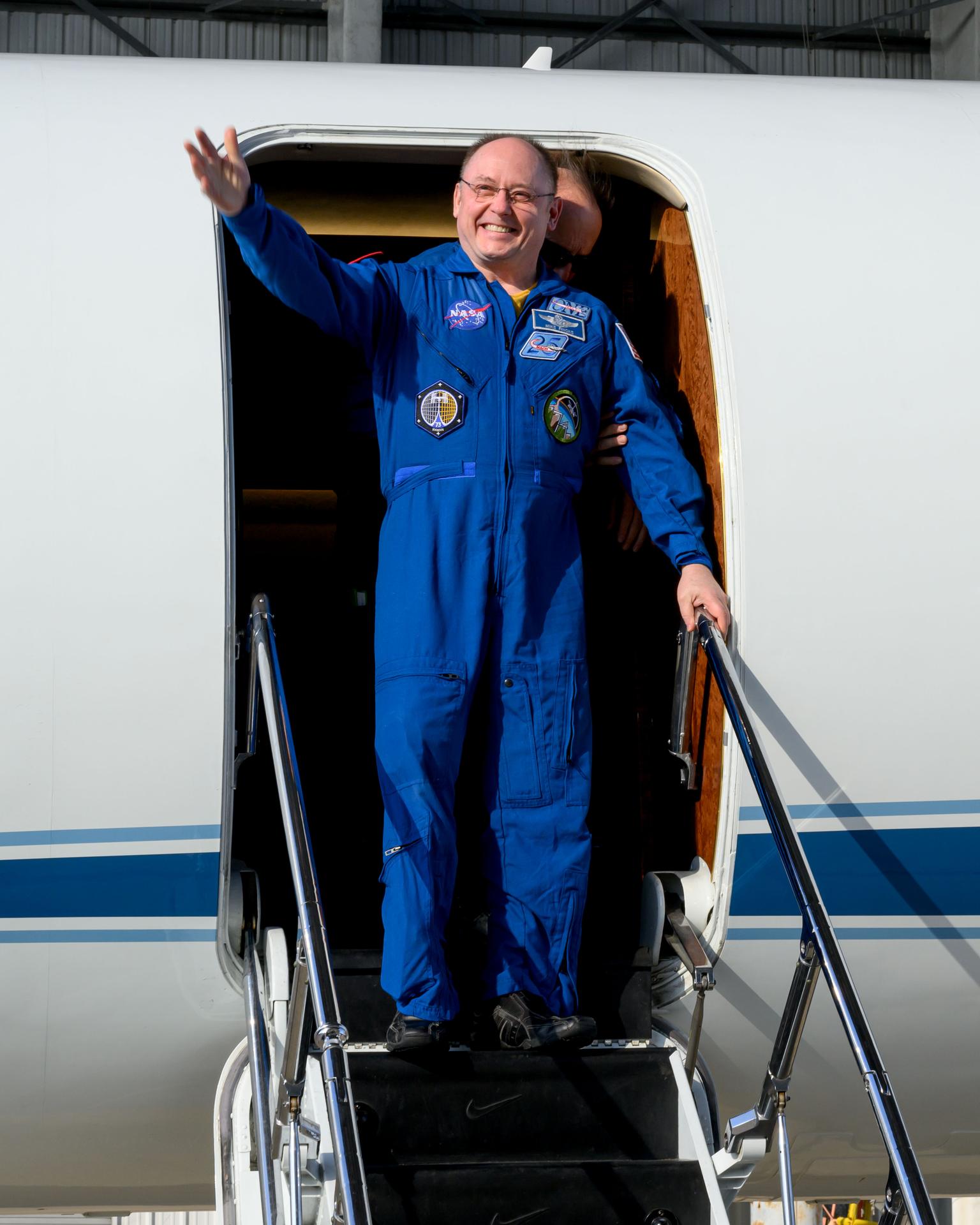
jsc2026e002116 (Jan. 16, 2025) --- NASA astronaut and SpaceX Crew-11 Pilot Mike Fincke waves to officials at Ellington Field in Houston, Texas. He departed the International Space Station and returned to Earth the day before aboard the Dragon spacecraft for a parachute-assisted splashdown off the coast of San Diego, California. Credit: NASA/Robert Markowitz
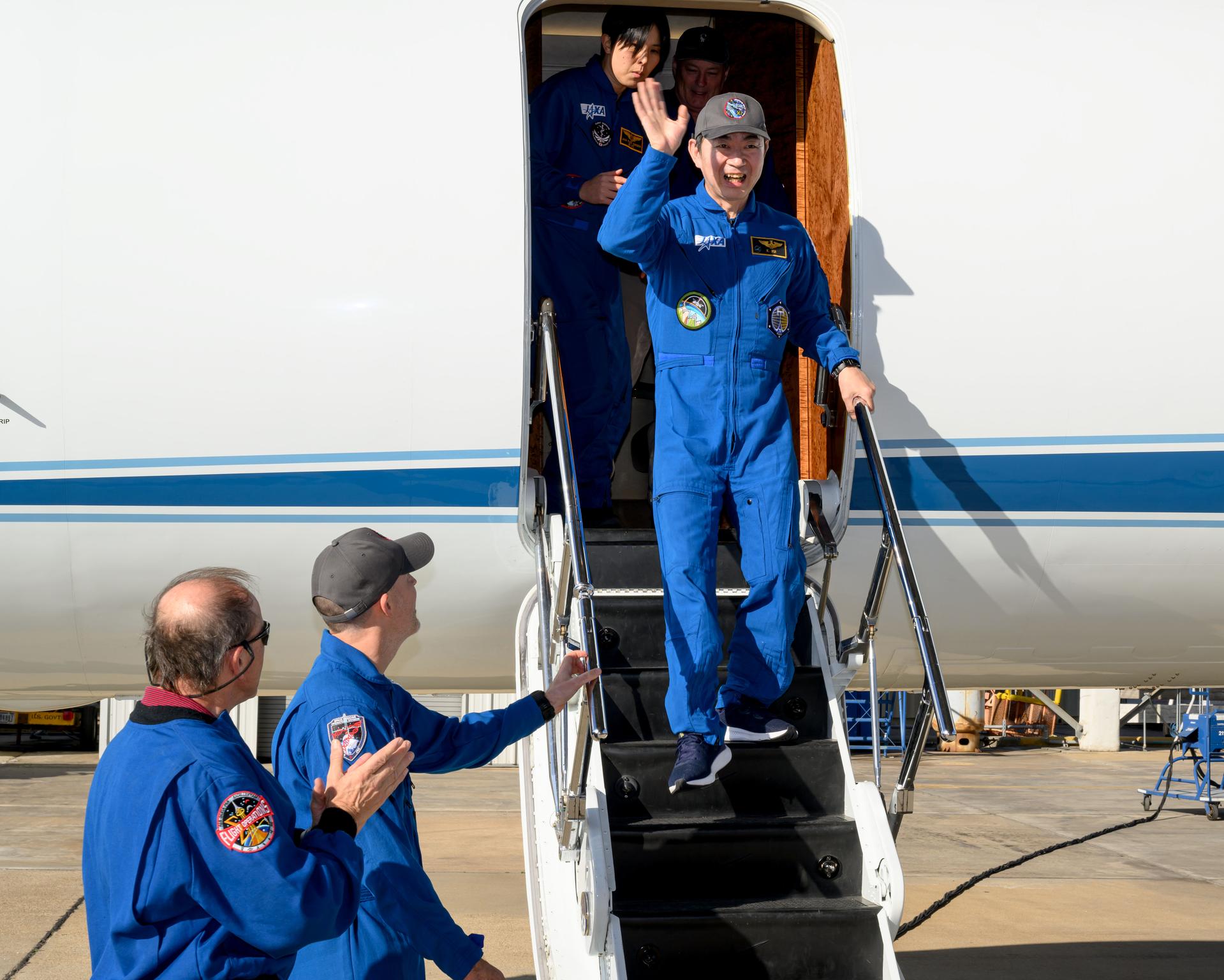
jsc2026e002115 (Jan. 16, 2025) --- JAXA (Japan Aerospace Exploration Agency) astronaut and SpaceX Crew-11 Mission Specialist Kimiya Yui waves to officials at Ellington Field in Houston, Texas. He departed the International Space Station and returned to Earth the day before aboard the Dragon spacecraft for a parachute-assisted splashdown off the coast of San Diego, California. Credit: NASA/Robert Markowitz
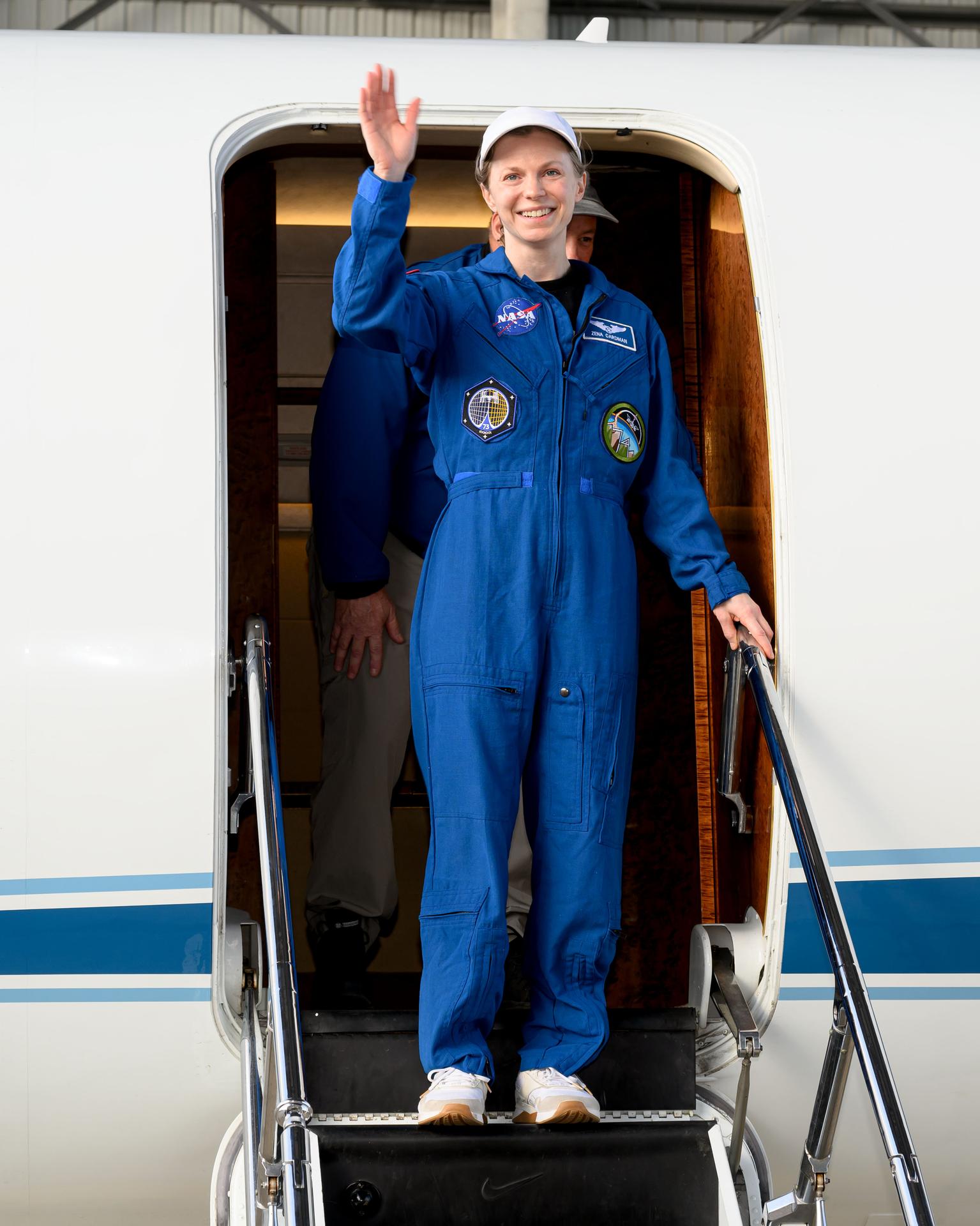
jsc2026e002117 (Jan. 16, 2025) --- NASA astronaut and SpaceX Crew-11 Commander Zena Cardman waves to officials at Ellington Field in Houston, Texas. She departed the International Space Station and returned to Earth the day before aboard the Dragon spacecraft for a parachute-assisted splashdown off the coast of San Diego, California. Credit: NASA/Robert Markowitz
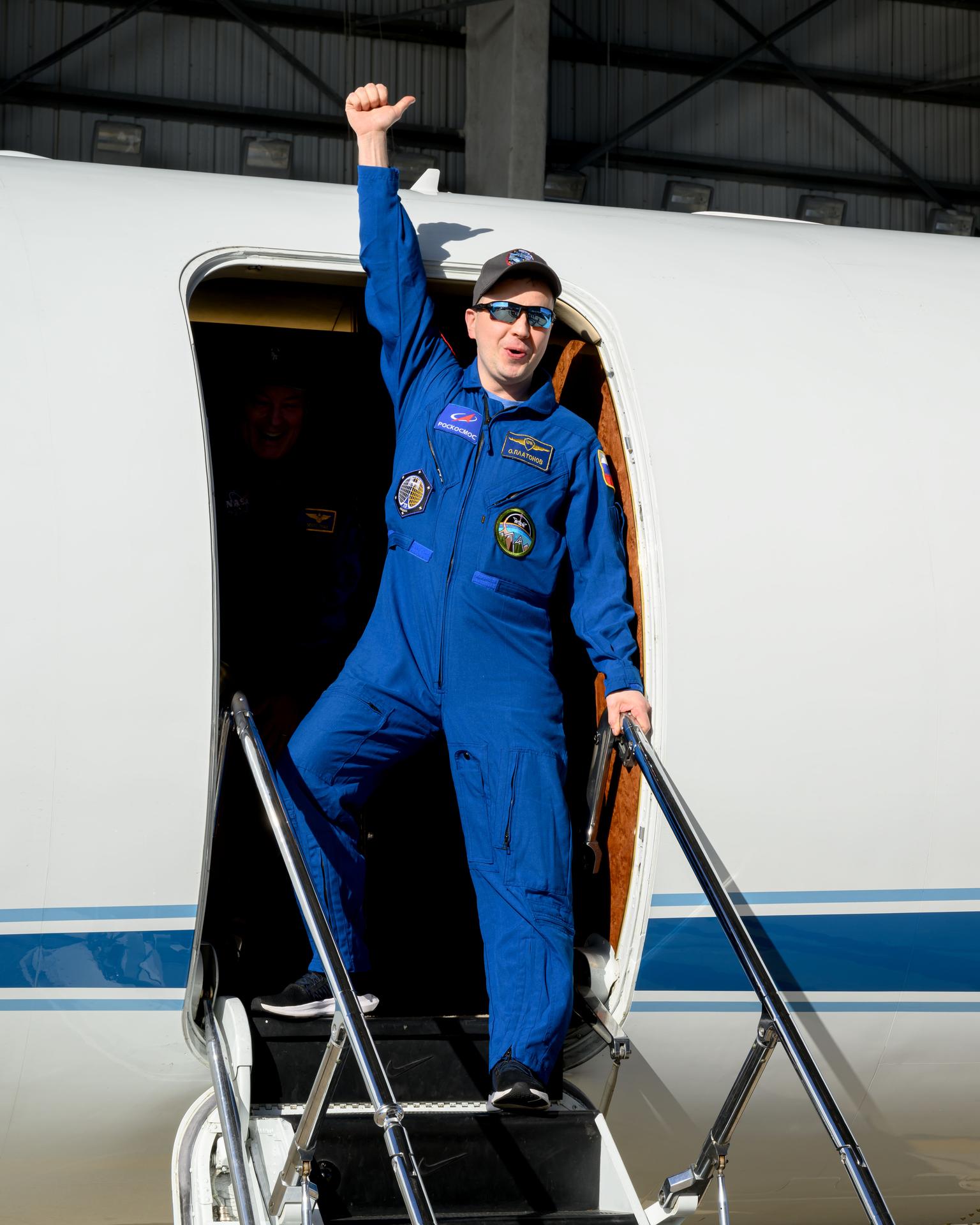
jsc2026e002114 (Jan. 16, 2025) --- Roscosmos cosmonaut and SpaceX Crew-11 Mission Specialist Oleg Platonov waves to officials at Ellington Field in Houston, Texas. He departed the International Space Station and returned to Earth the day before aboard the Dragon spacecraft for a parachute-assisted splashdown off the coast of San Diego, California. Credit: NASA/Robert Markowitz
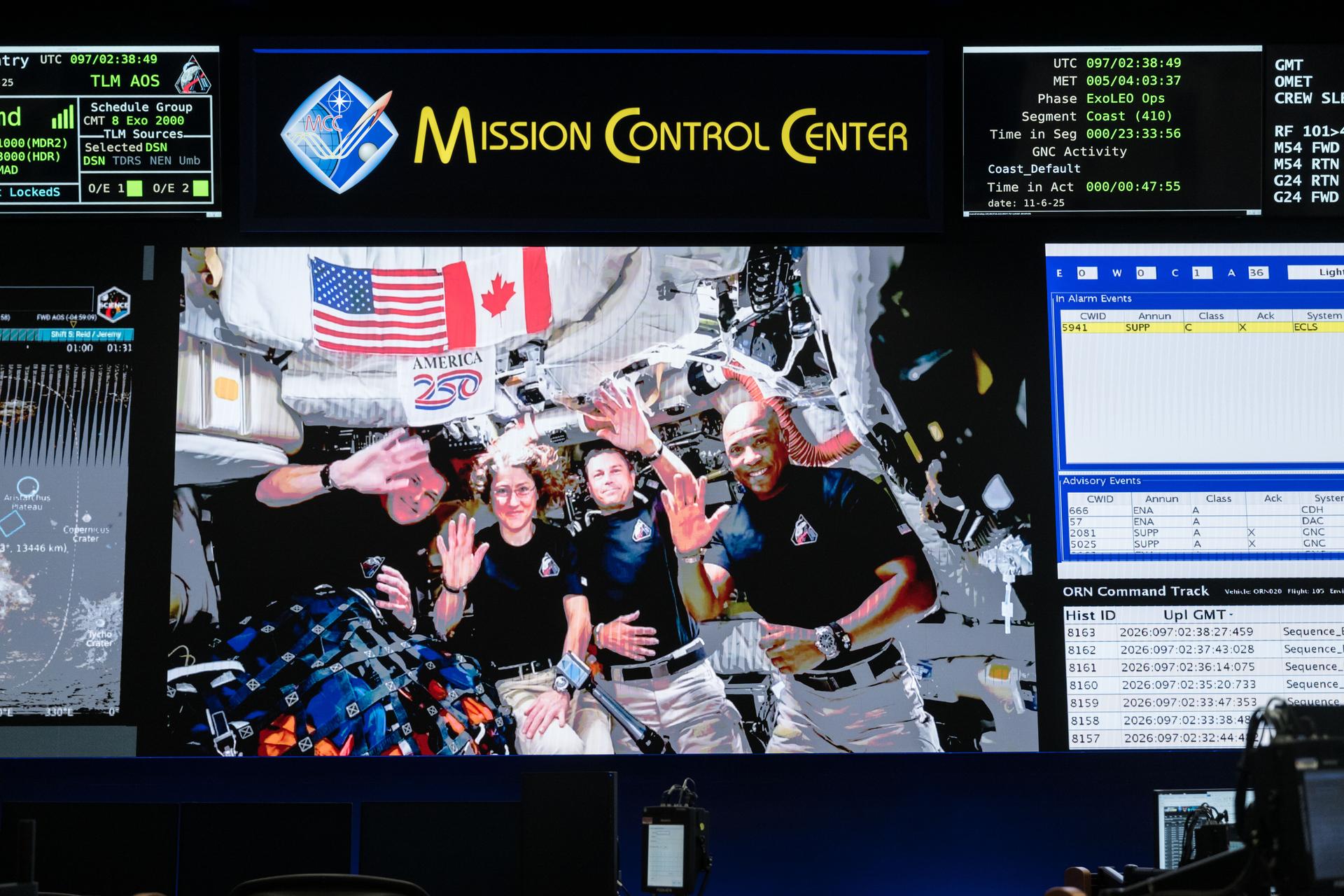
jsc2026e020504 (April 6, 2026) - The Artemis II crew – CSA (Canadian Space Agency) Astronaut Jeremy Hansen (far left) and NASA astronauts Christina Koch (center left), Reid Wiseman (center right), and Victor Glover (right) – pauses to wave after a live conversation with President Donald J. Trump following their historic lunar flyby during Flight Day 6. They are pictured on the screens of the White Flight Control room at NASA’s Mission Control Center at the agency’s Johnson Space Center in Houston. Credit: NASA
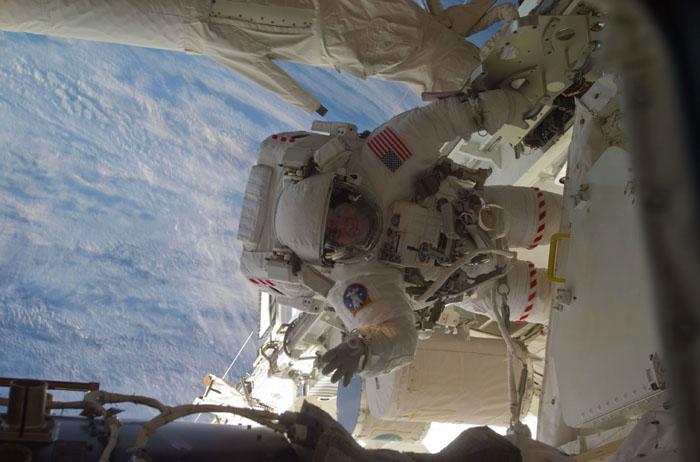
STS102-E-5194 (13 March 2001) --- Astronaut Paul W. Richards, mission specialist, waves toward his crew mate during the second STS-102 space walk. The picture was taken with a digital still camera.
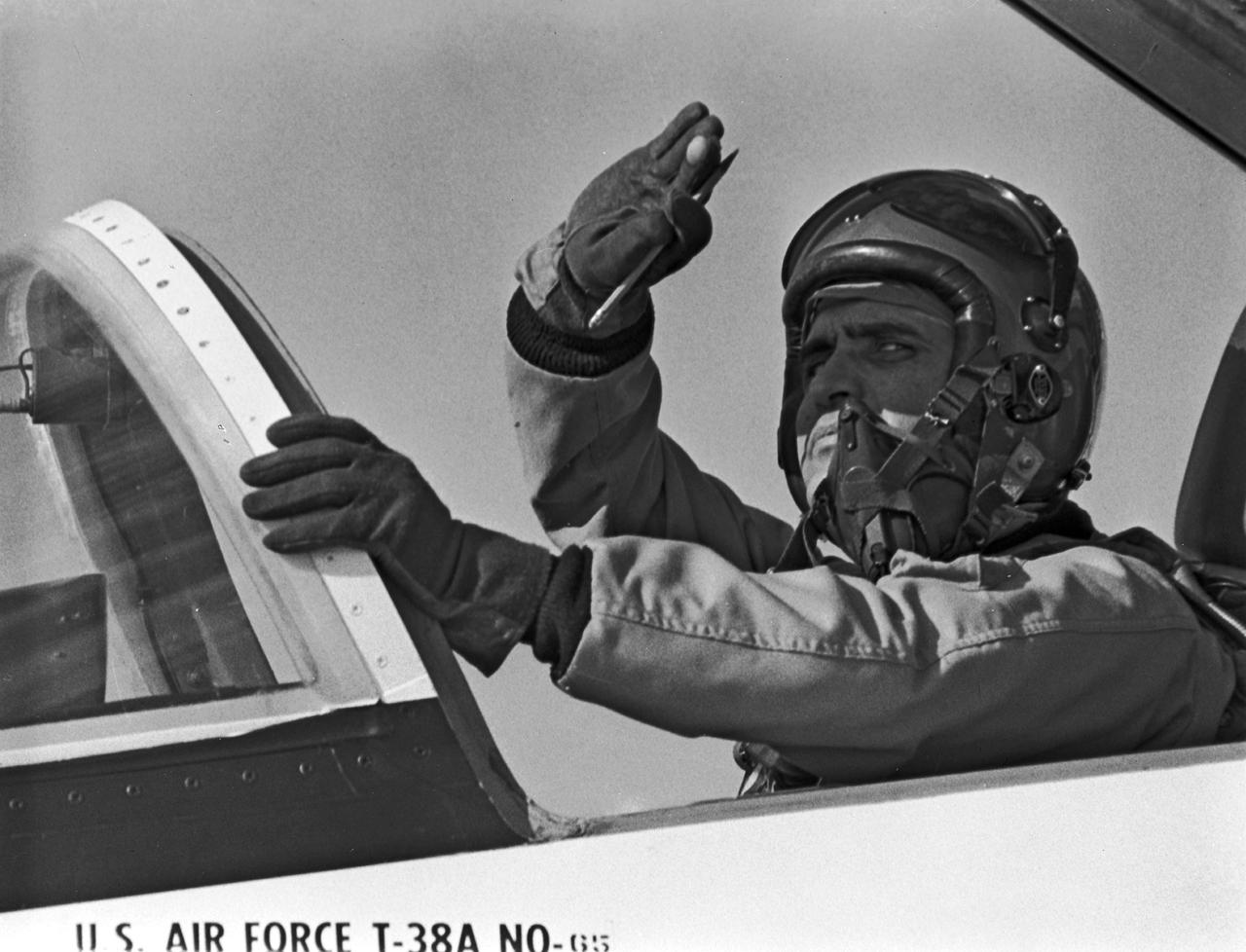
Apollo 17 Lunar Module Pilot Harrison H. Schmitt waves to ground crew personnel as he prepares to fly a T-38 jet aircraft today on a training flight over the Spaceport are to sharpen his flying skills.
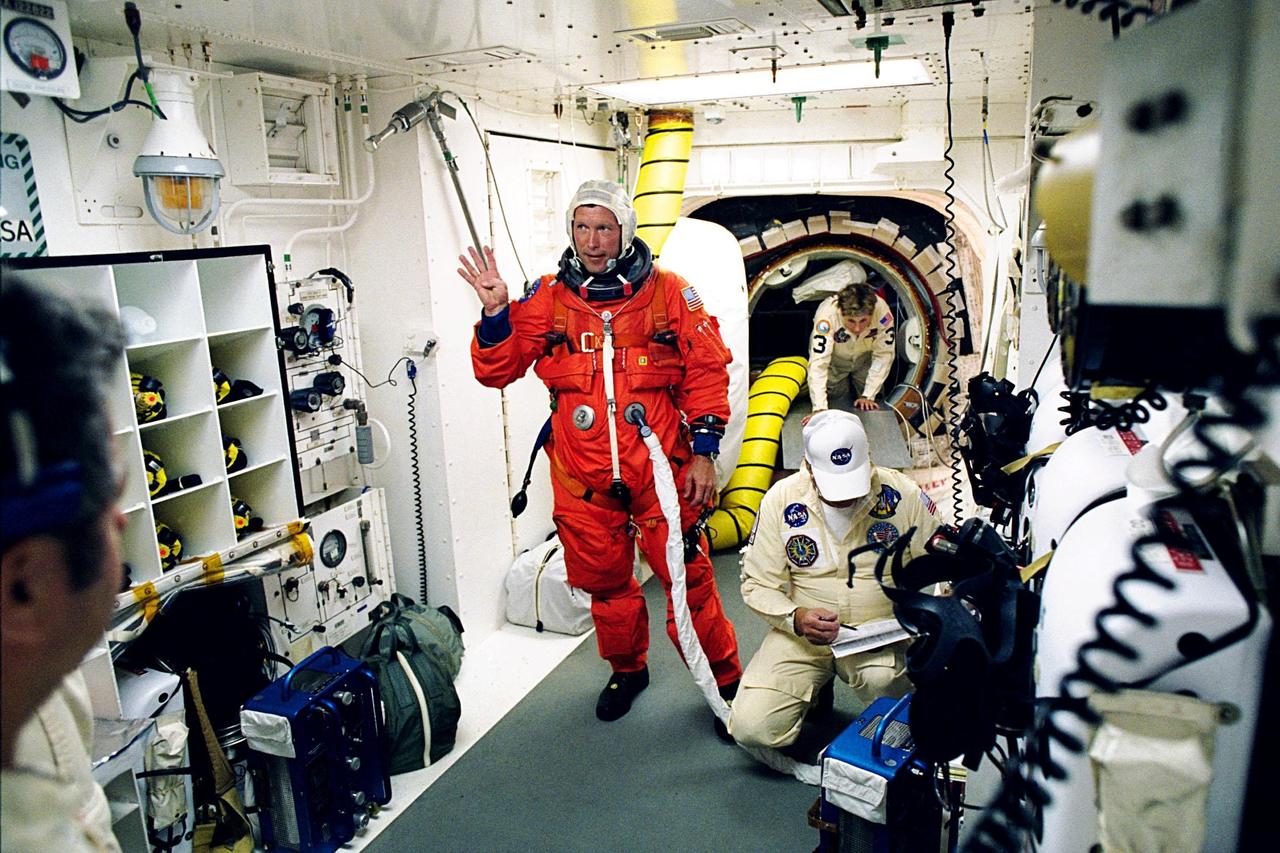
STS-91 Pilot Dominic L. Gorie waves to the camera as he is prepared for entry into the Space Shuttle Discovery by Launch Pad 39A white room crew members Jean Alexander (behind Gorie) and Greg Lohning
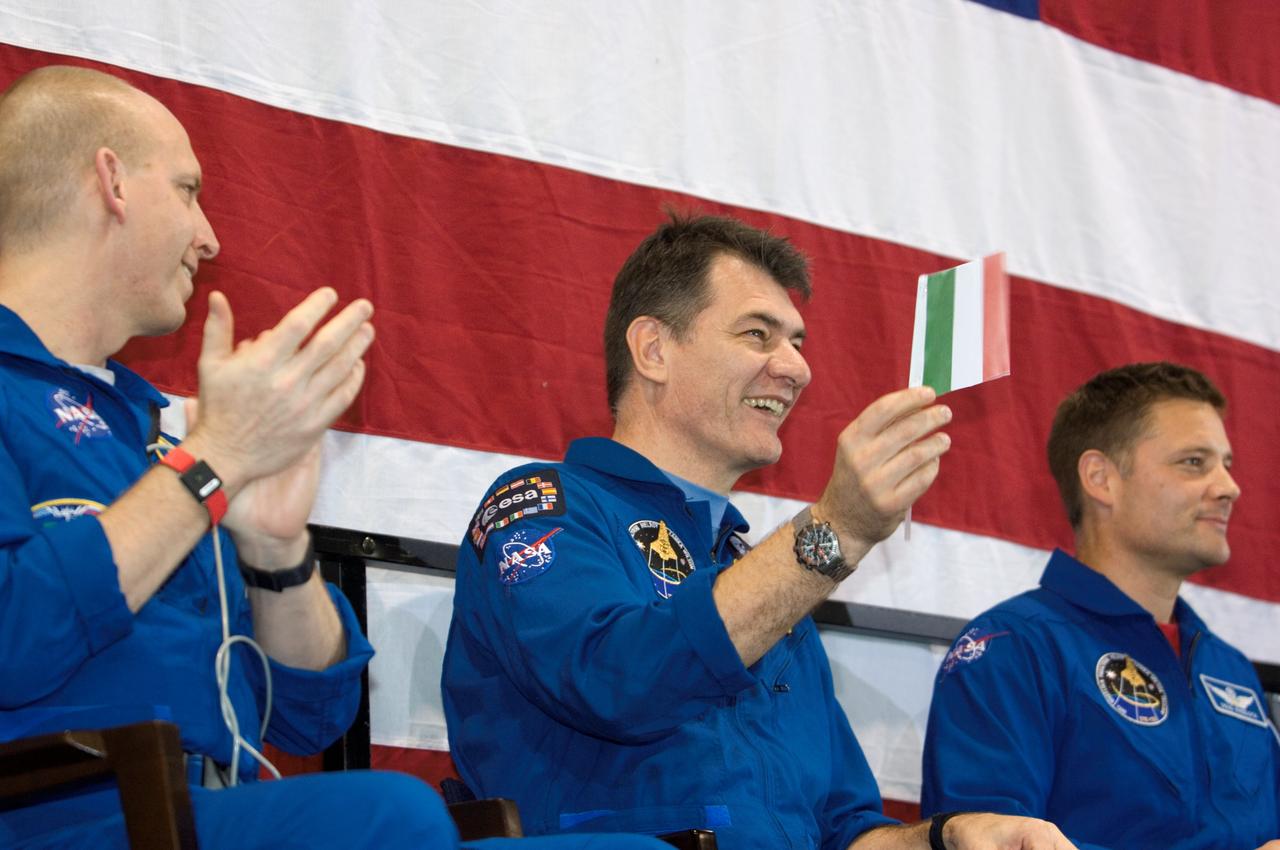
JSC2007-E-098008 (8 Nov. 2007) --- European Space Agency astronaut Paolo Nespoli, STS-120 mission specialist, waves his homeland's national flag during the Discovery crew's Nov. 8 welcome home ceremony at Houston's Ellington Field. Other replicas of the Italian flag were seen waving throughout the hangar. Nespoli is flanked by two fellow mission specialists -- astronauts Clay Anderson (left) and Doug Wheelock.
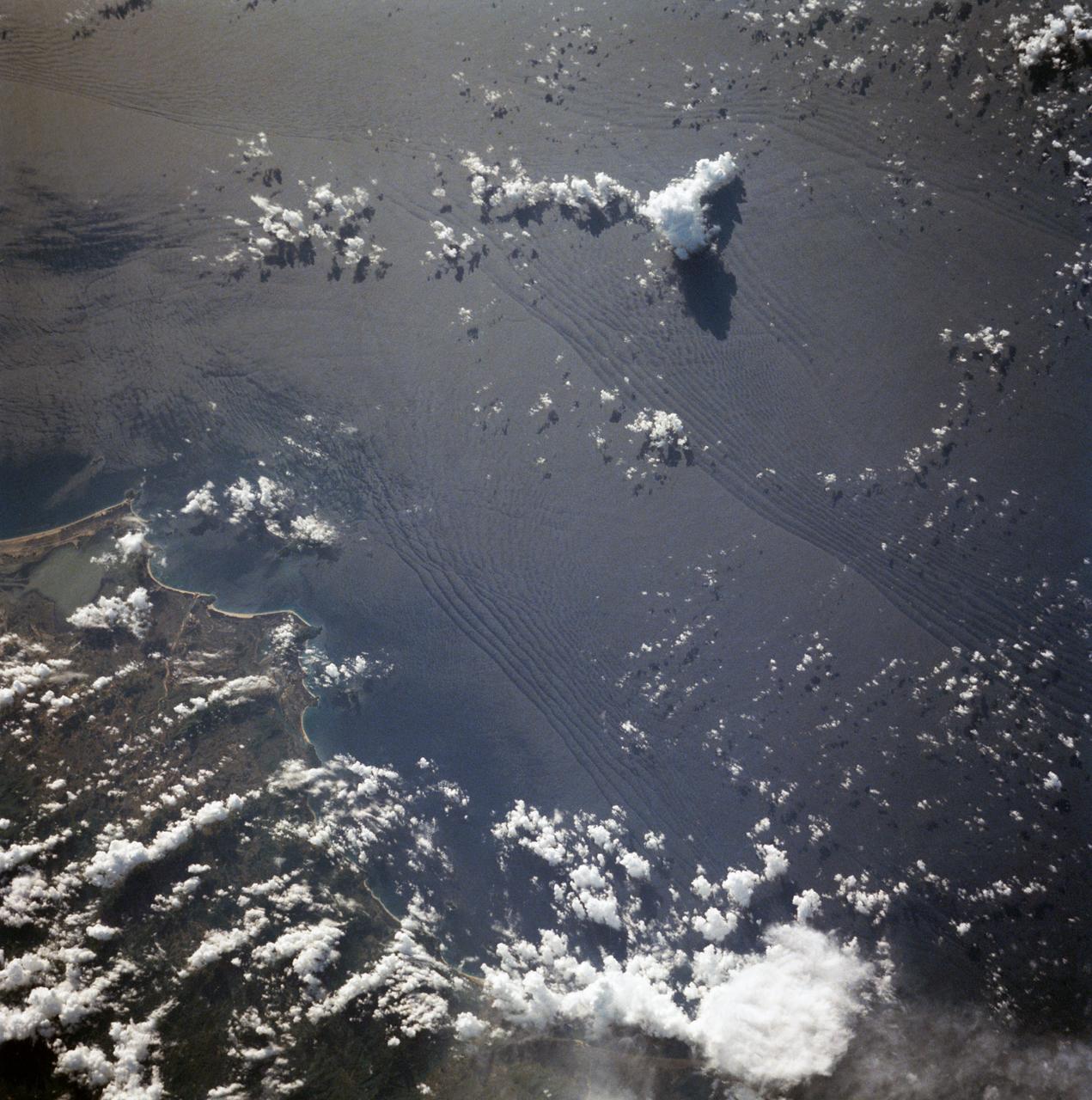
STS007-05-245 (18-24 June 1983) --- A rare view of internal waves in the South China Sea. Several different series of internal waves are represented in the 70mm frame, exposed with a handheld camera by members of the STS-7 astronaut crew aboard the Earth-orbiting Challenger. The land area visible in the lower left is part of the large island of Hainan, China.
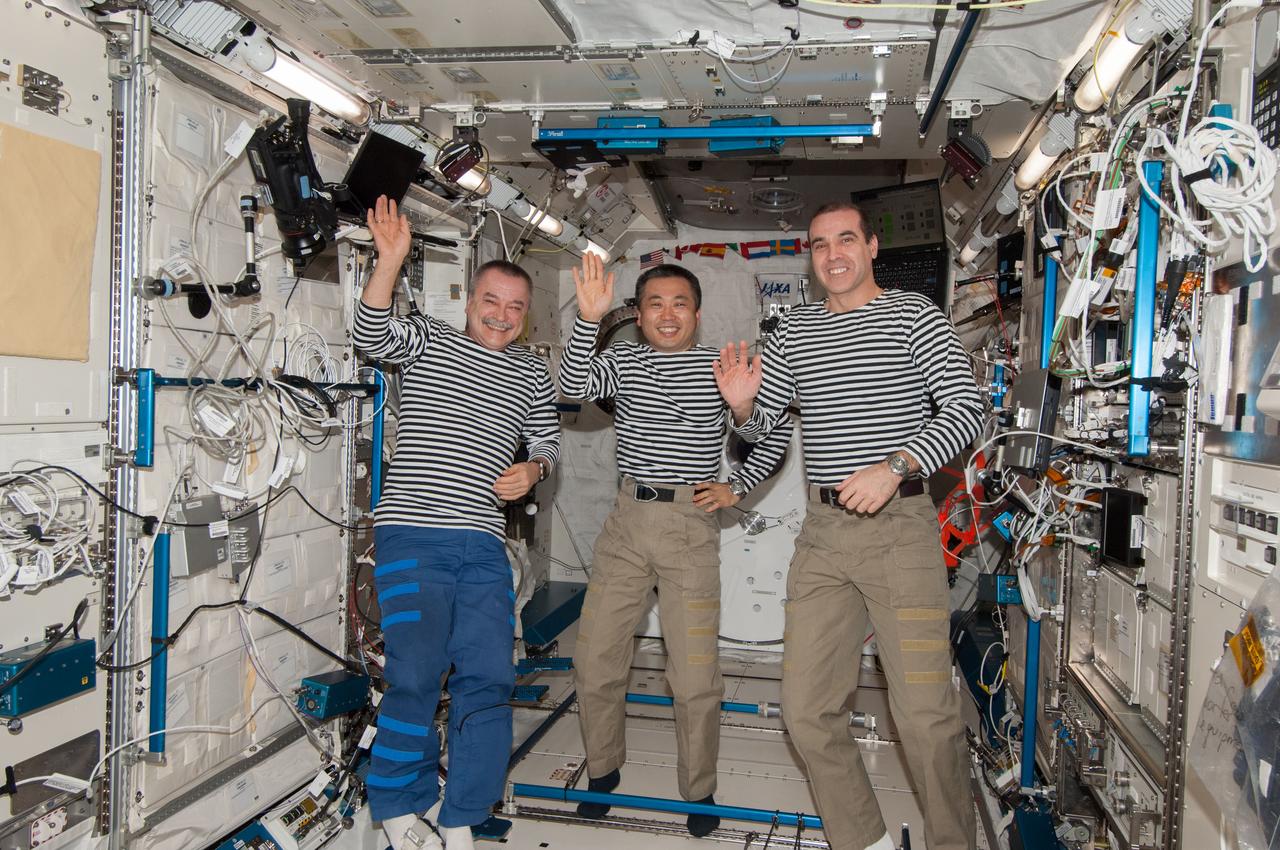
ISS038-E-068903 (9 March 2014) --- The new commander of the current crew on the International Space Station (Expedition 39) and the Expedition 38/39 flight engineers wave inside the Kibo laboratory. Their waving may very well be a symbolic farewell to the Expedition 38 crew members (out of frame) who are on the eve of their departure day from the orbital outpost. Expedition 39 Commander Koichi Wakata (center) of the Japanese Aerospace Exploration Agency (JAXA) is joined here by Flight Engineers Rick Mastracchio (right) of NASA and cosmonaut Mikhail Tyurin of the Russian Federal Space Agency (Roscosmos).

A young child waving an Artemis flag poses with members of the Titusville Police Dept. on the Max Brewer Bridge on Aug. 29, 2022, during Artemis I countdown festivities. The launch was waved off for the day at the agency’s Kennedy Space Center. The first in a series of increasingly complex missions, Artemis I will provide a foundation for human deep space exploration and demonstrate our commitment and capability to extend human presence to the Moon and beyond. The primary goal of Artemis I is to thoroughly test the integrated systems before crewed missions by operating the spacecraft in a deep space environment, testing Orion’s heat shield, and recovering the crew module after reentry, descent, and splashdown.
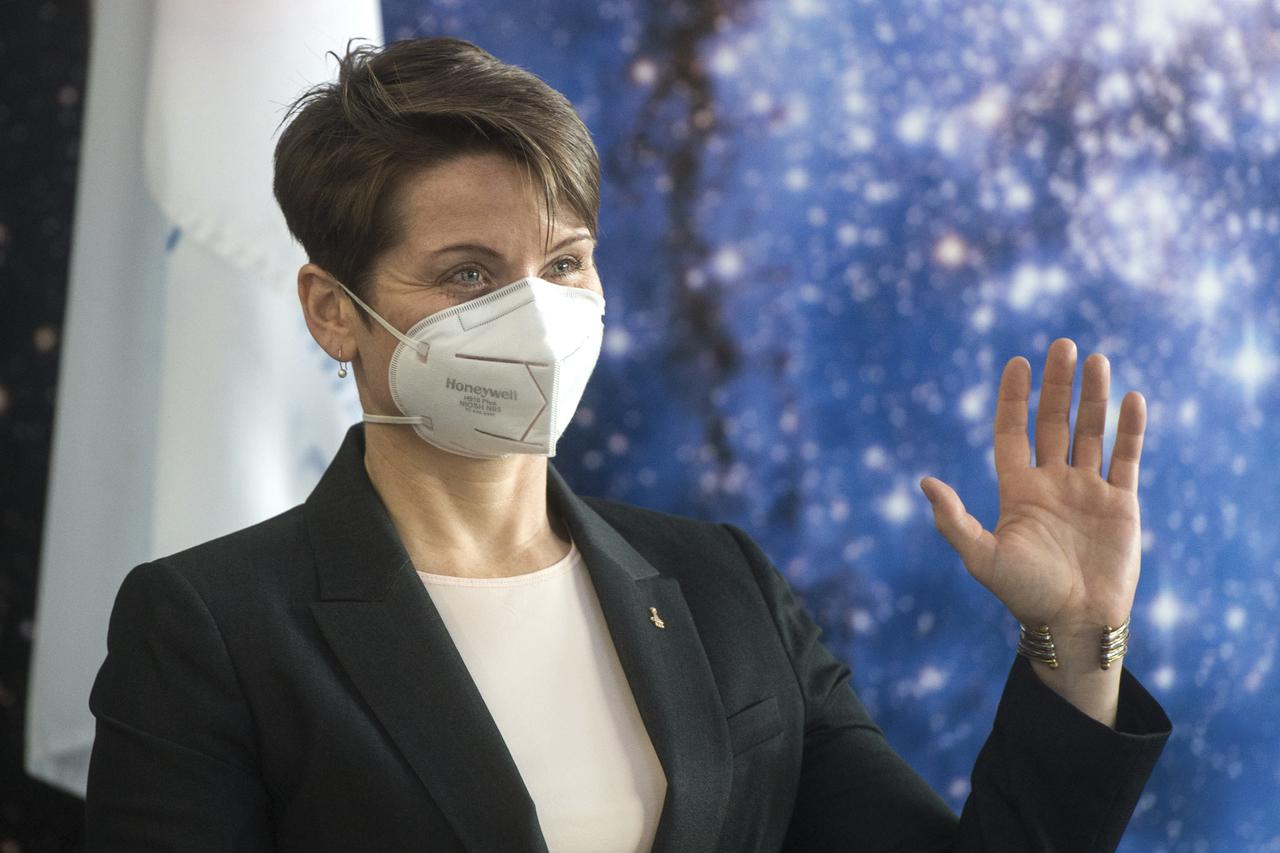
Expedition 65 backup crew member NASA astronaut Anne McClain waves during a press conference prior to the prime crew’s launch from the Baikonur Cosmodrome in Kazakhstan, Wednesday, March 24, 2021 at the Gagarin Cosmonaut Training Center (GCTC) in Star City, Russia. Photo Credit: (NASA/GCTC/Andrey Shelepin)
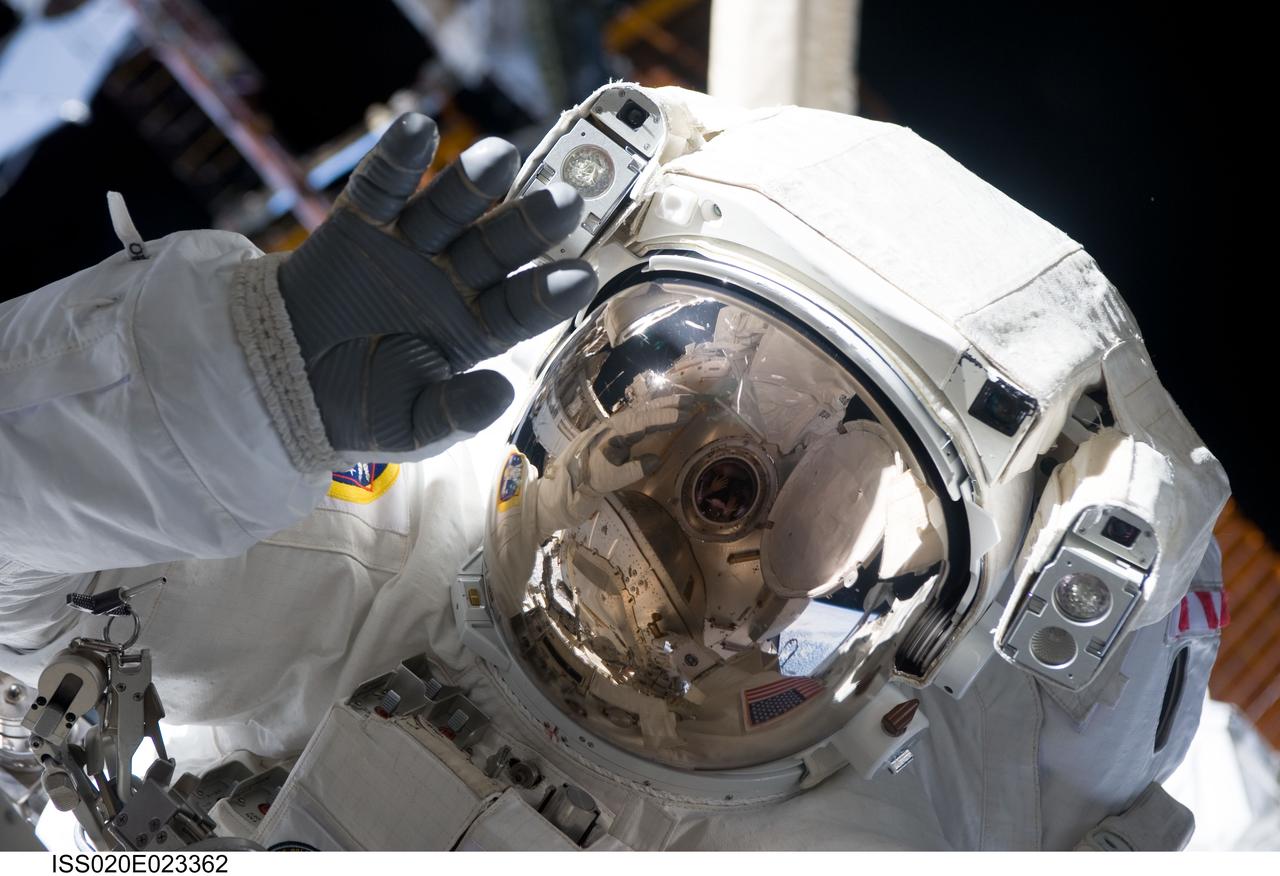
ISS020-E-023362 (22 July 2009) --- Astronaut Christopher Cassidy waves toward his spacewalking colleague, astronaut Dave Wolf, during the third session of extravehicular activity for the STS-127 crew to perform work, in cooncert with the Expedition 20 crew on the International Space Station.
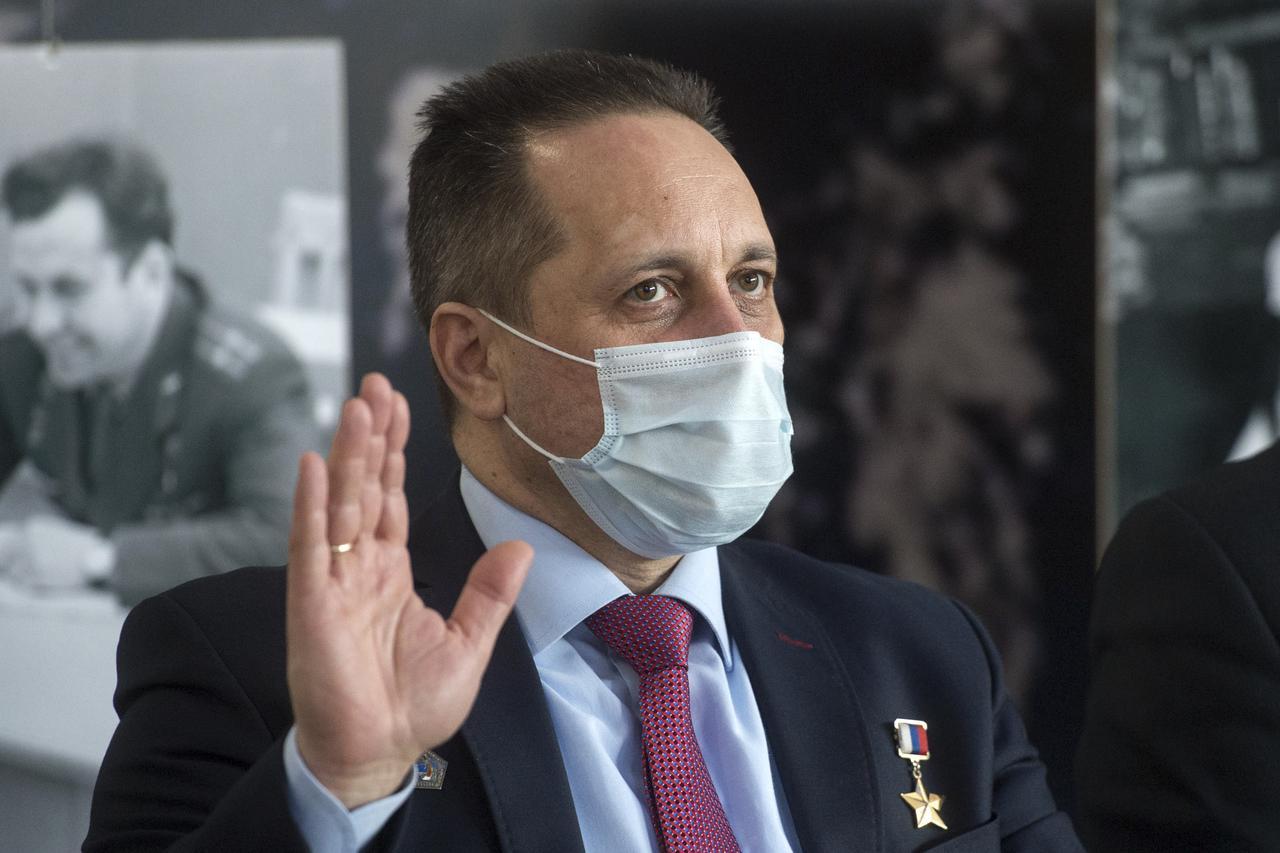
Expedition 65 backup crew member Russian cosmonaut Anton Shkaplerov of Roscosmos waves during a press conference prior to the prime crew’s launch from the Baikonur Cosmodrome in Kazakhstan, Wednesday, March 24, 2021 at the Gagarin Cosmonaut Training Center (GCTC) in Star City, Russia. Photo Credit: (NASA/GCTC/Andrey Shelepin)
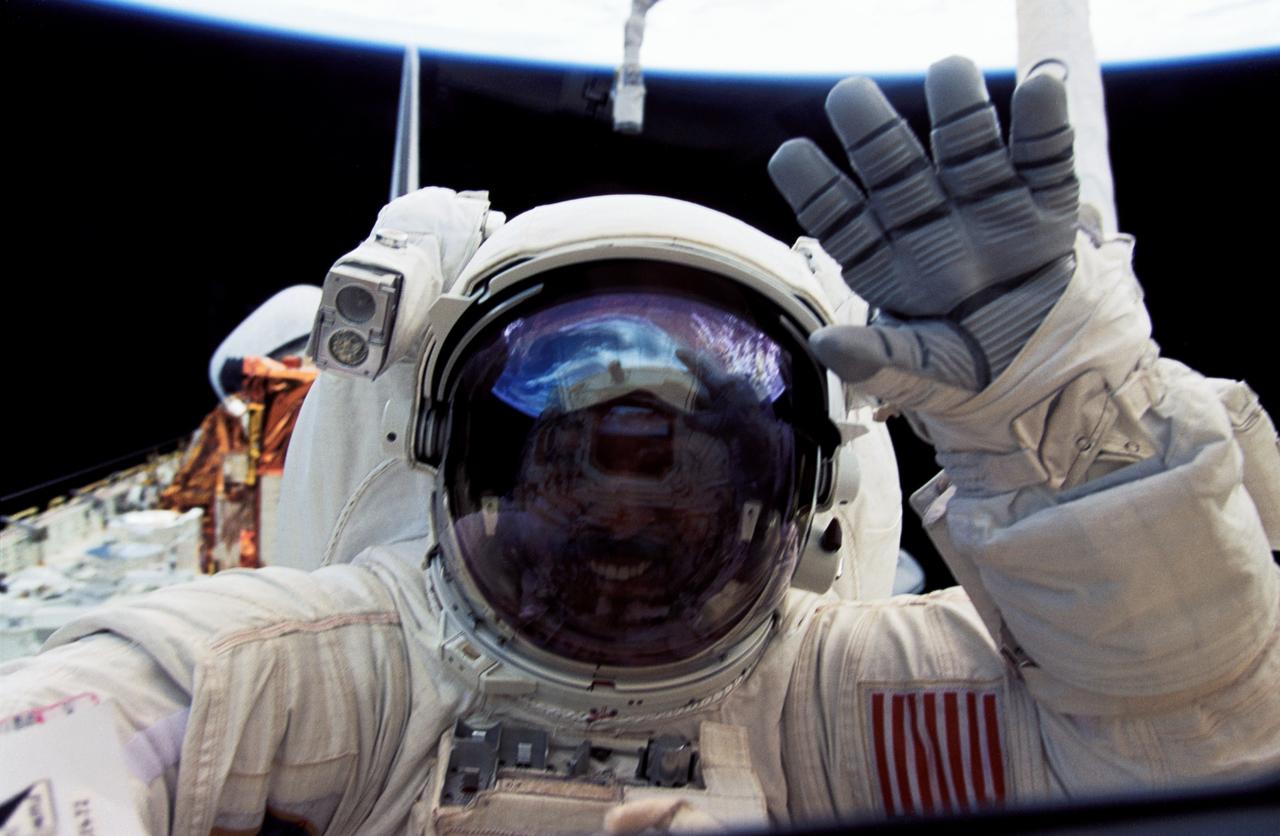
STS072-393-022 (17 Jan. 1996) --- In the Space Shuttle Endeavour's cargo bay, astronaut Winston E. Scott waves to crew mates inside the crew cabin during his extravehicular activity (EVA) on January 17, 1996. Scott was joined by astronaut Leroy Chiao for the EVA.
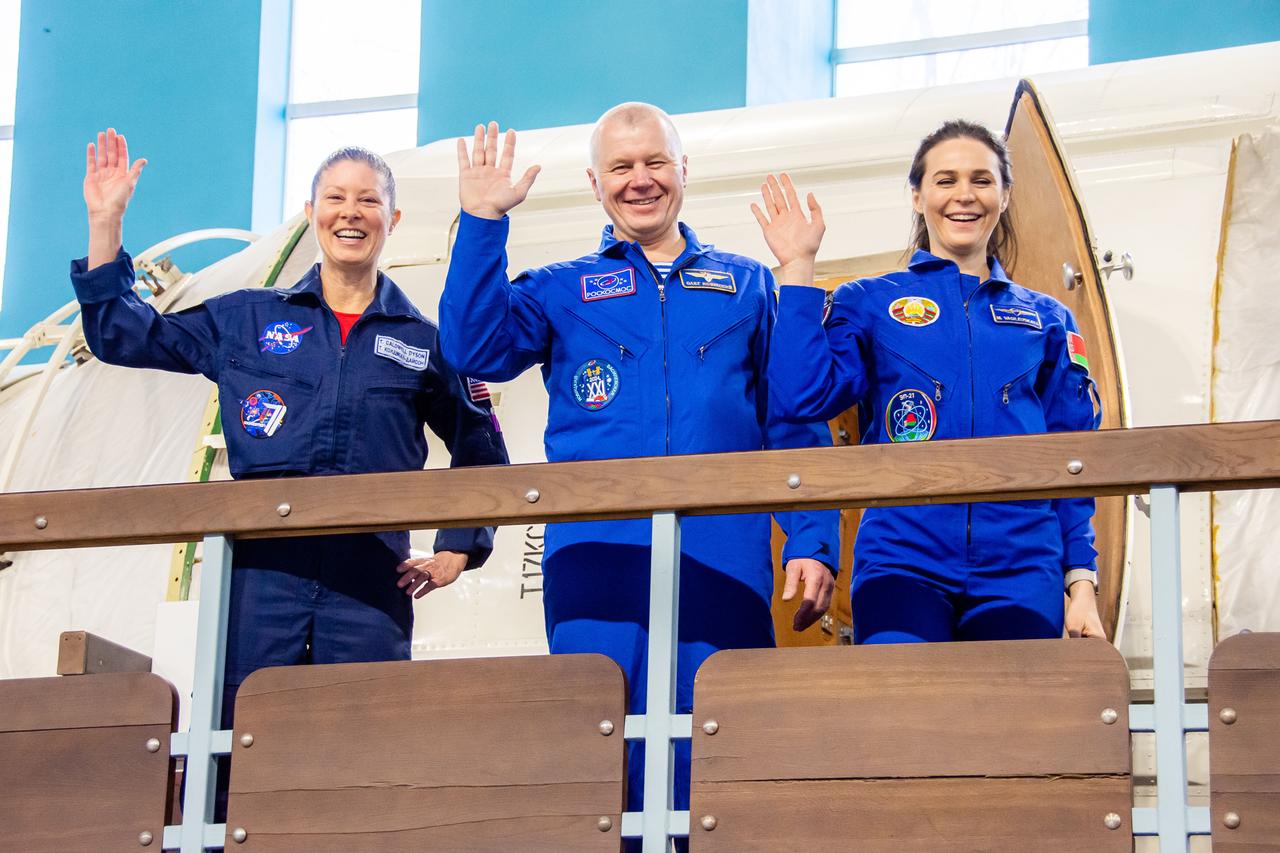
jsc2024e016953 (Feb. 28, 2024) --- Soyuz MS-25 crew members (from left) Tracy Dyson from NASA, Oleg Novitskiy from Roscosmos, and Belarus spaceflight participant Marina Vasilevskaya wave to photographers during their crew qualification exams at the Gagarin Cosmonaut Training Center in Star City, Russia. Credit: GCTC/Roscosmos

ISS038-E-036501 (28 Jan. 2014) --- This wide field-of-view image photographed by an Expedition 38 crew member on the International Space Station shows an east-west swath of the southwestern Indian Ocean. Two remote islands, part of the French Southern and Antarctic Lands, appear in the center of the image. Possession Island (right center) and East Island (center) are both only 18 kilometers long. A smaller island, Ile aux Cochons (Pigs Island), lies 100 kilometers to the west. Each island has set up V-shaped trains of waves, like bow waves, as the air flows over the islands from the west (right to left). The bow-wave patterns are overlaid on the low regional stratus (blanket) cloud that is so common in the southern Indian Ocean at 50 degrees south latitude. This view was taken from more than 400 kilometers above the sea surface and reveals relationships that could not be readily understood by someone standing on one of the islands. For example, larger and higher islands produce larger waves. So the largest are being generated by Possession Island (934 meters above sea level at the highest point), and East Island, versus much smaller waves developed downwind of the tiny Ile de Pingouins (340 meters above sea level high, invisible below the cloud deck). Other patterns also can be detected. Waves in an upper layer can be seen casting shadows onto a lower layer (lower left). In the top half of the image the waves are making thicker and thinner zones in the clouds of the lower layer. Wave trains from Possession Island and Ile aux Cochons are interacting in a cross-hatch pattern (center).
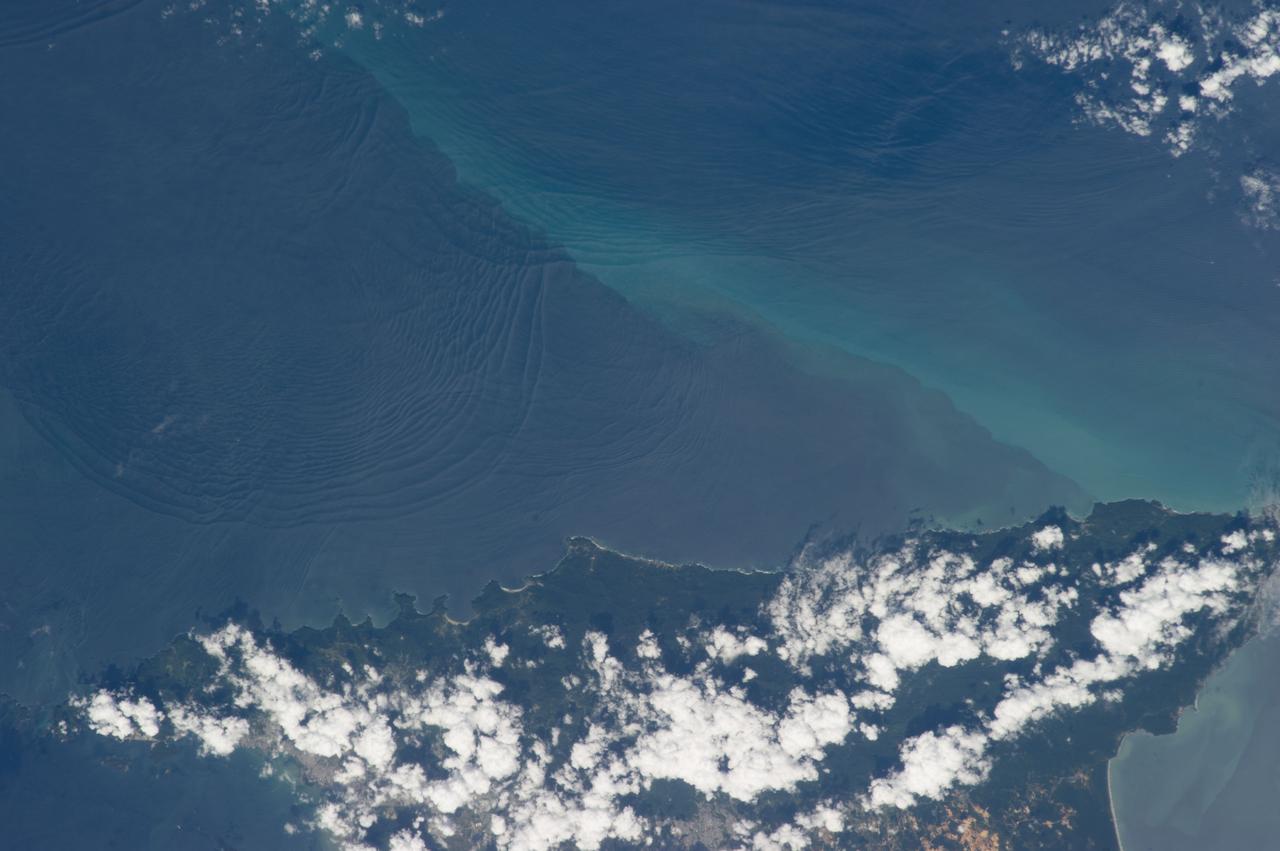
ISS034-E-032377 (18 Jan. 2013) --- Internal waves off Northern Trinidad are featured in this image photographed by an Expedition 34 crew member on the International Space Station. This photograph shows the north coast of the island of Trinidad in the southeastern Caribbean Sea, where heating of the land is setting off the growth of cumulus clouds. The light blue northwest-southeast trending plume at center is sediment from one of the rivers that flows into the sea here. Adjacent to, and appearing to cross the sediment plume, a series of subtle interacting arcs can be seen in the sea. These are known as internal waves which are the surface manifestation of slow waves moving tens of meters beneath the sea surface. These produce enough of an effect on the sea surface to be seen from space, but only where they are enhanced due to reflection of sunlight, or sunglint, back towards the space station. The image shows at least three sets of internal waves interacting. The most prominent set (top left) shows a “packet” of several waves moving from the northwest due to the tidal flow towards the north coast of Trinidad. Two less prominent, younger sets can be seen further out to sea. A very broad set enters the view from the north and northeast, and interacts at top center with the first set. All the internal waves are probably caused by the shelf break near Tobago (outside the image to top right). The shelf break is the step between shallow seas (around continents and islands) and the deep ocean. It is the line at which tides usually start to generate internal waves. The sediment plume at center is embedded in the Equatorial Current (also known as the Guyana Current) and is transporting material to the northwest—in almost the opposite direction to the movement of the internal waves. The current flows strongly from east to west around Trinidad, all the way from equatorial Africa, driven by year-round easterly winds. Seafarers in the vicinity of Trinidad are warned that the current, and its local reverse eddies, make navigation of smaller craft in these waters complicated and sometimes dangerous.
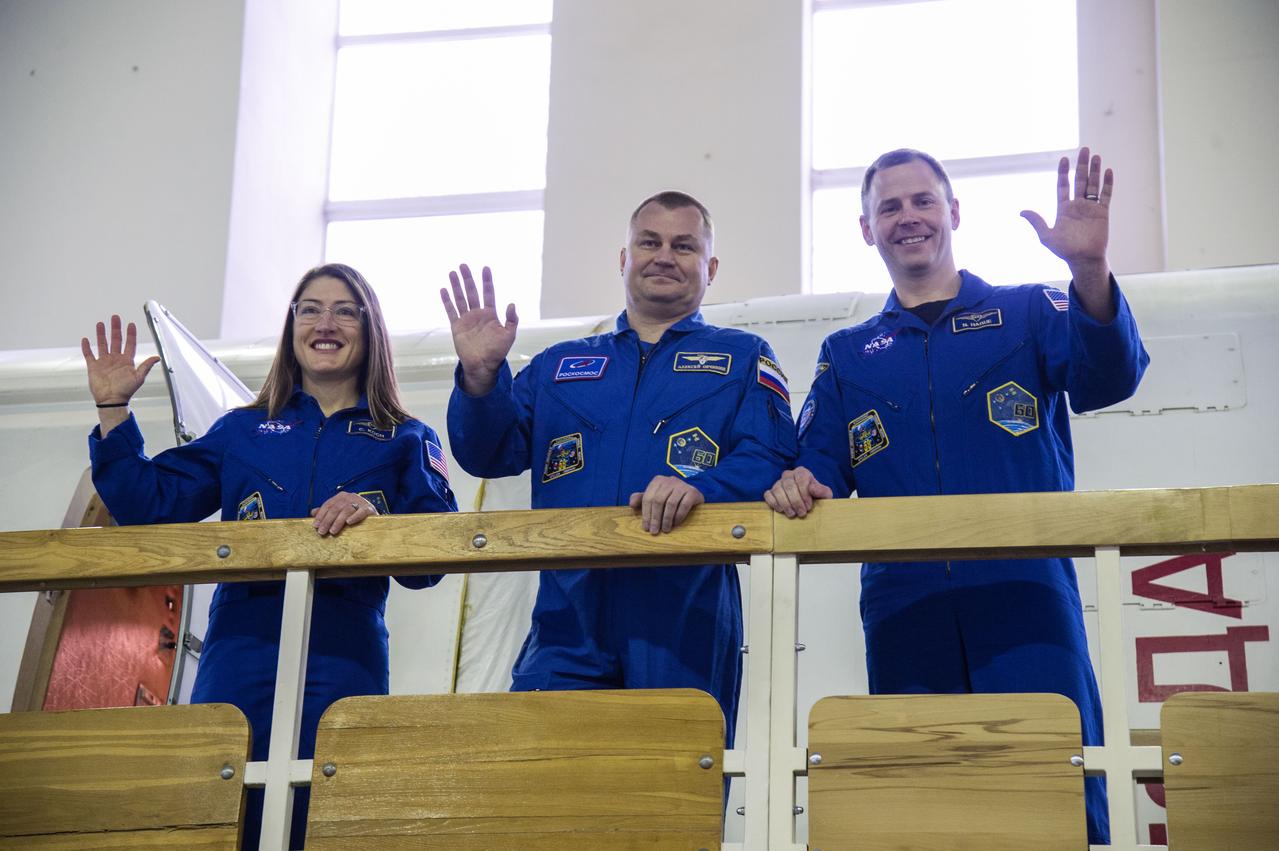
jsc2019e003765 (Feb. 19, 2019) --- At the Gagarin Cosmonaut Training Center in Star City, Russia, Expedition 59 crew members Christina Koch of NASA (left), Alexey Ovchinin of Roscosmos (center) and Nick Hague of NASA (right) wave to cameras Feb. 19 during the first of two days of final pre-launch qualification exams. They will launch March 14, U.S. time, from the Baikonur Cosmodrome in Kazakhstan on the Soyuz MS-12 spacecraft for a six-and-a-half month mission on the International Space Station. Credit: NASA/Beth Weissinger
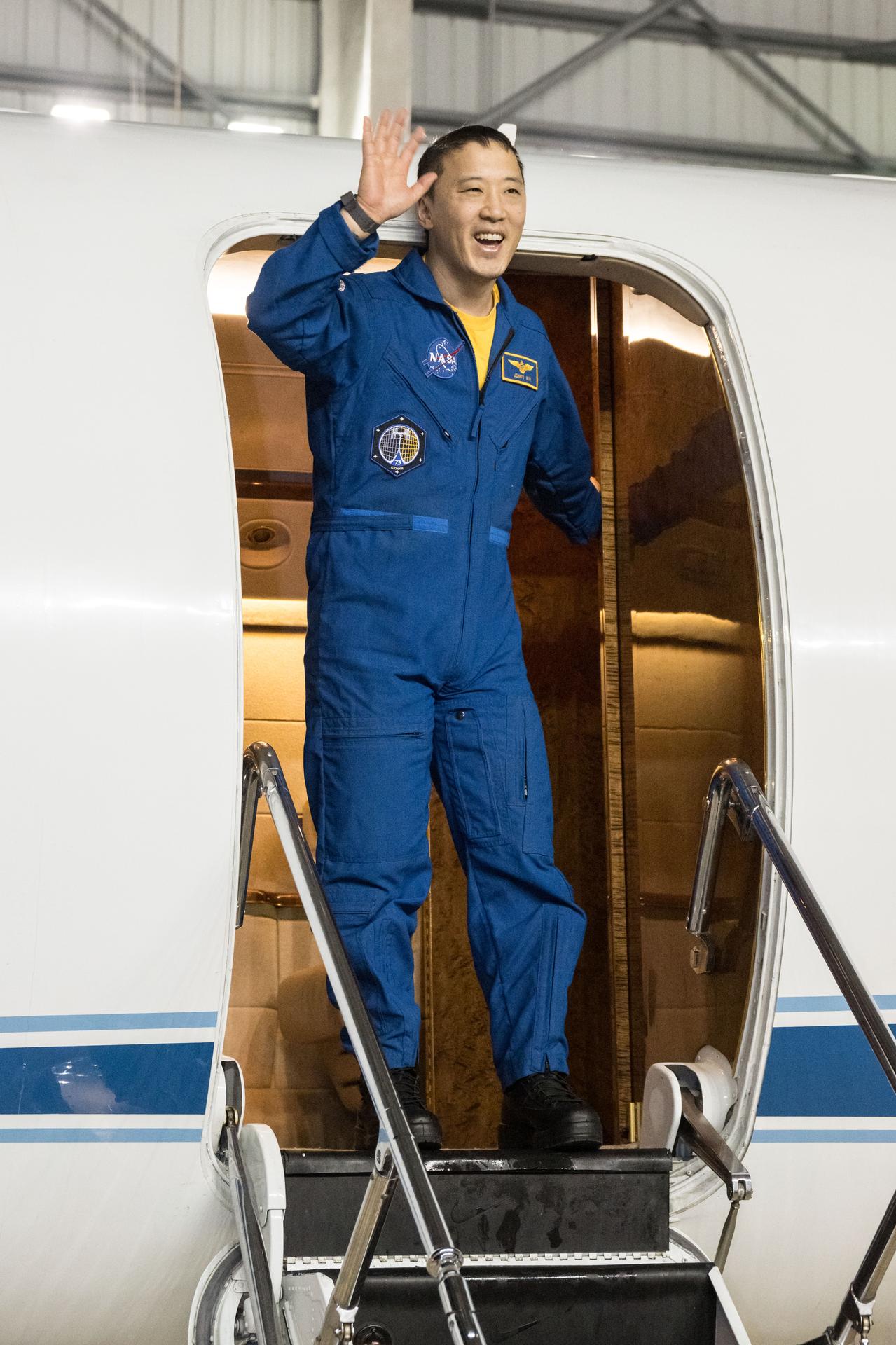
jsc2025e089530 (Dec. 10, 2025) --- NASA astronaut Jonny Kim waves to NASA personnel at Ellington Field after exiting the Gulfstream V aircraft that returned him to Houston, Texas, from Kazakhstan in Central Asia. The day before, Kim had landed in Kazakhstan aboard the Soyuz MS-27 crew spacecraft with Roscosmos cosmonauts Sergey Ryzhikov and Alexey Zubritsky after completing a 245-day research mission aboard the International Space Station. Credit: NASA/Robert Markowitz
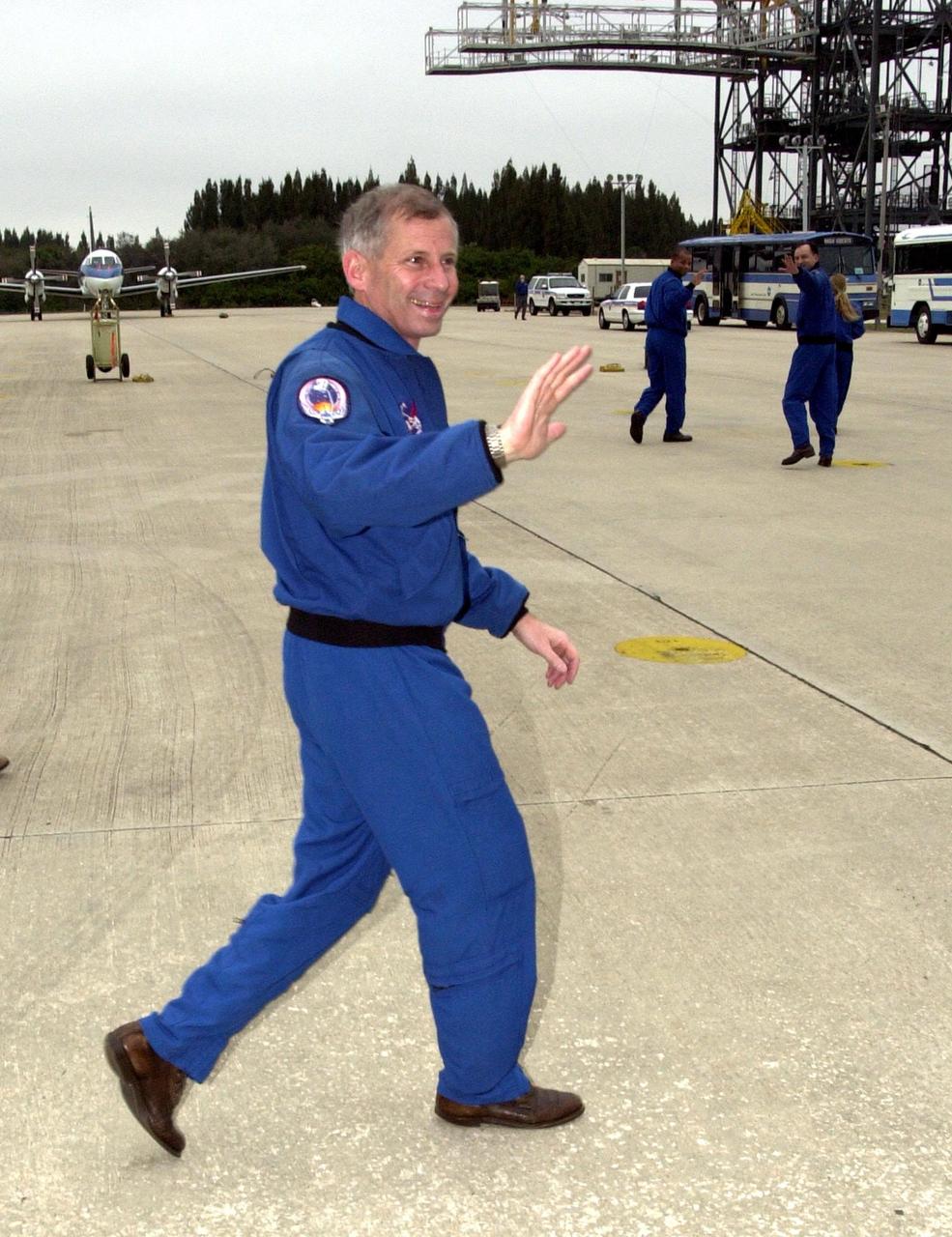
KENNEDY SPACE CENTER, FLA. -- STS-98 Mission Commander Kenneth Cockrell waves to his family at the Shuttle Landing Facility after the crew's arrival Sunday to complete preparations for launch.; In the background, Mission Specialist Robert Curbeam (left) and Pilot Mark Polansky are also caught waving.; The crew is preparing to board a bus for transport to the Operations and Checkout Building where the crew quarters at KSC is located. Crew members Thomas Jones and Marsha Ivins, both mission specialists, are not in plain view.; STS-98 is the seventh construction flight to the International Space Station, carrying as payload the U.S. Lab Destiny, a key element in the construction of the ISS. Launch of STS-98 is scheduled for Feb. 7 at 6:11 p.m. EST
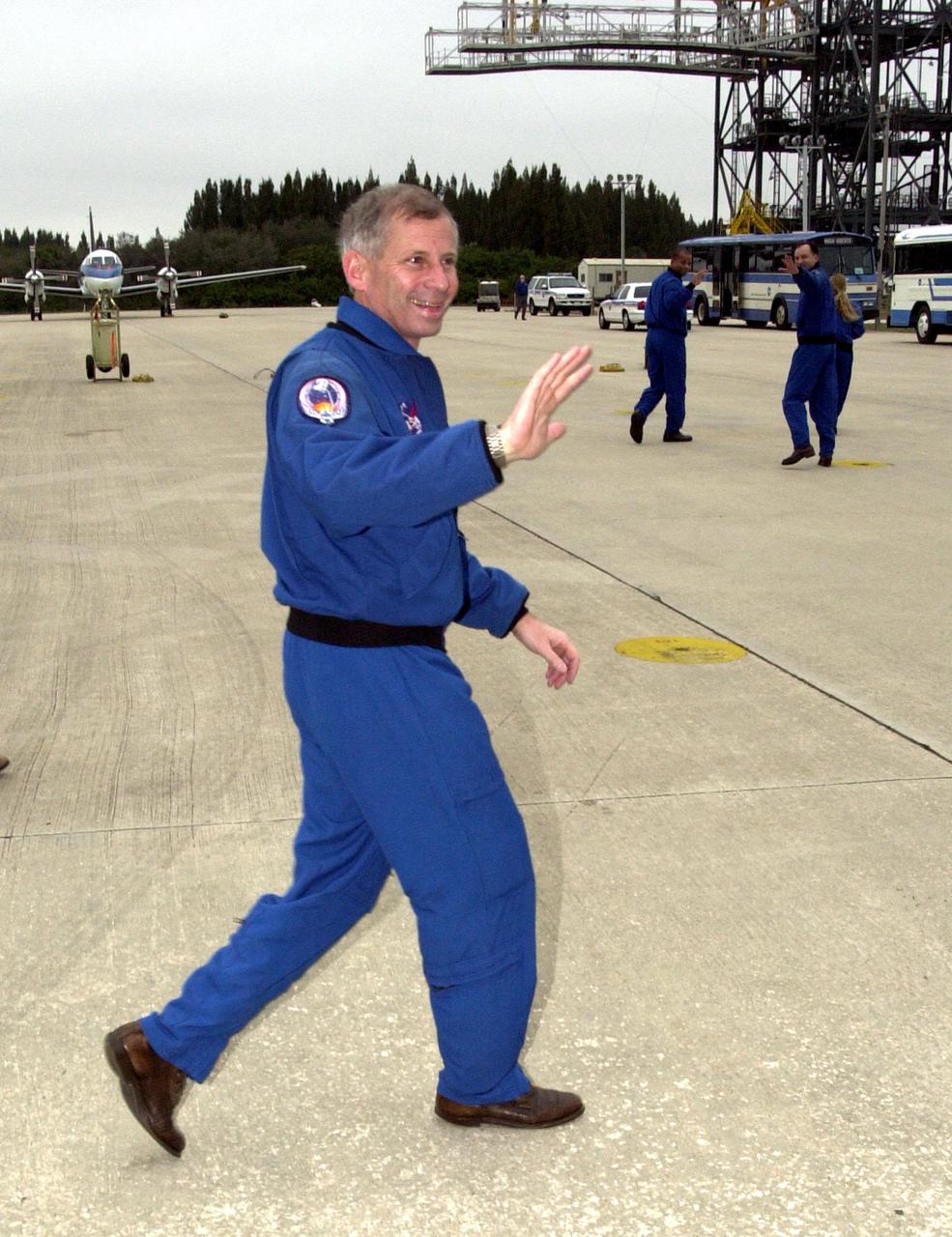
KENNEDY SPACE CENTER, FLA. -- STS-98 Mission Commander Kenneth Cockrell waves to his family at the Shuttle Landing Facility after the crew's arrival Sunday to complete preparations for launch.; In the background, Mission Specialist Robert Curbeam (left) and Pilot Mark Polansky are also caught waving.; The crew is preparing to board a bus for transport to the Operations and Checkout Building where the crew quarters at KSC is located. Crew members Thomas Jones and Marsha Ivins, both mission specialists, are not in plain view.; STS-98 is the seventh construction flight to the International Space Station, carrying as payload the U.S. Lab Destiny, a key element in the construction of the ISS. Launch of STS-98 is scheduled for Feb. 7 at 6:11 p.m. EST
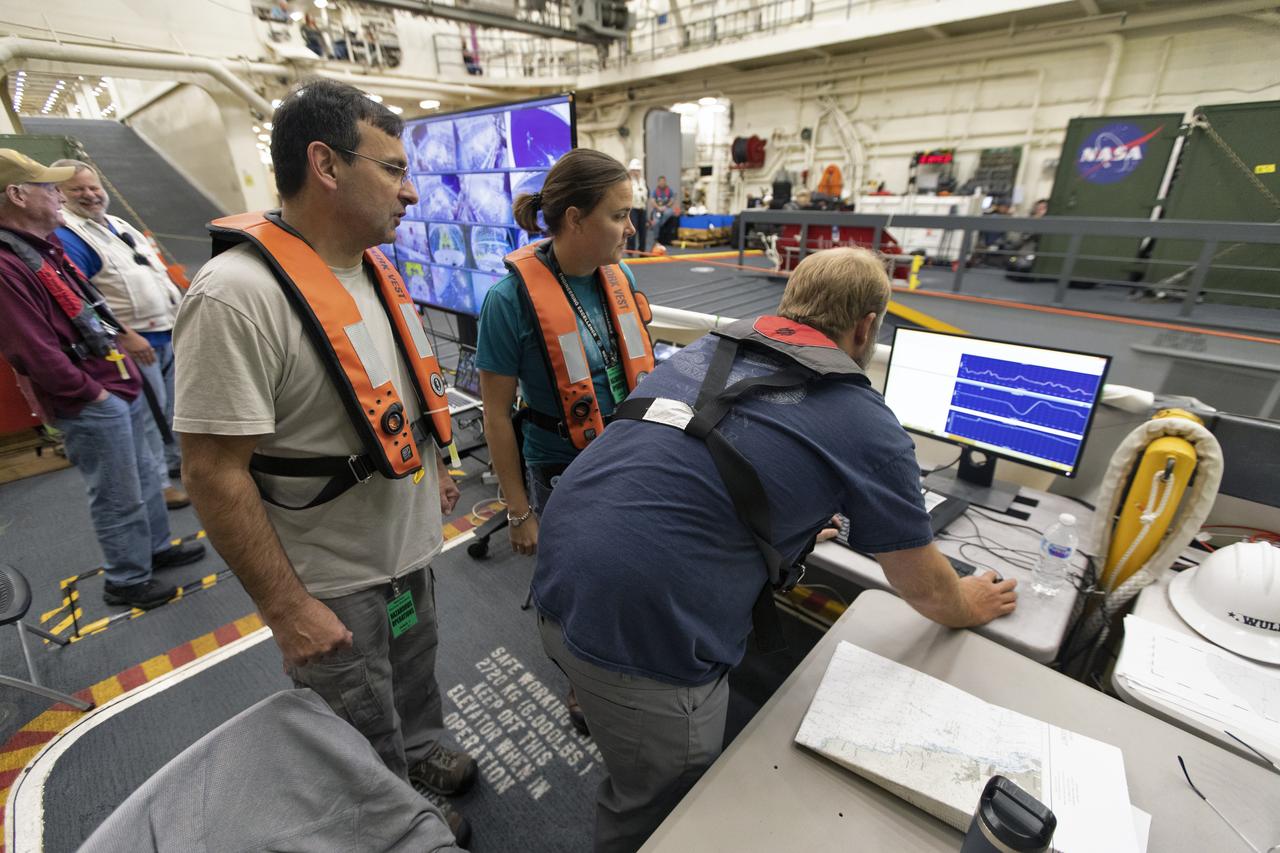
Wave trackers with Applied Physical Sciences monitor ocean wave conditions during Underway Recovery Test-7 (URT-7) aboard the USS John P. Murtha on Nov. 4, 2018. NASA's Recovery Team, along with the U.S. Navy, practice recovering a test version of the Orion capsule as part of URT-7 in the Pacific Ocean. URT-7 is one in a series of tests to verify and validate procedures and hardware that will be used to recover the Orion spacecraft after it splashes down in the Pacific Ocean following deep space exploration missions. Orion will have emergency abort capability, sustain the crew during space travel and provide safe re-entry from deep space return velocities.

Expedition 64 prime crew member Sergey Kud-Sverchkov of Roscosmos, waves during a press conference prior to his launch from the Baikonur Cosmodrome in Kazakhstan, Thursday, Sept. 24, 2020 at the Gagarin Cosmonaut Training Center (GCTC) in Star City, Russia. Photo Credit: (NASA/GCTC/Andrey Shelepin)
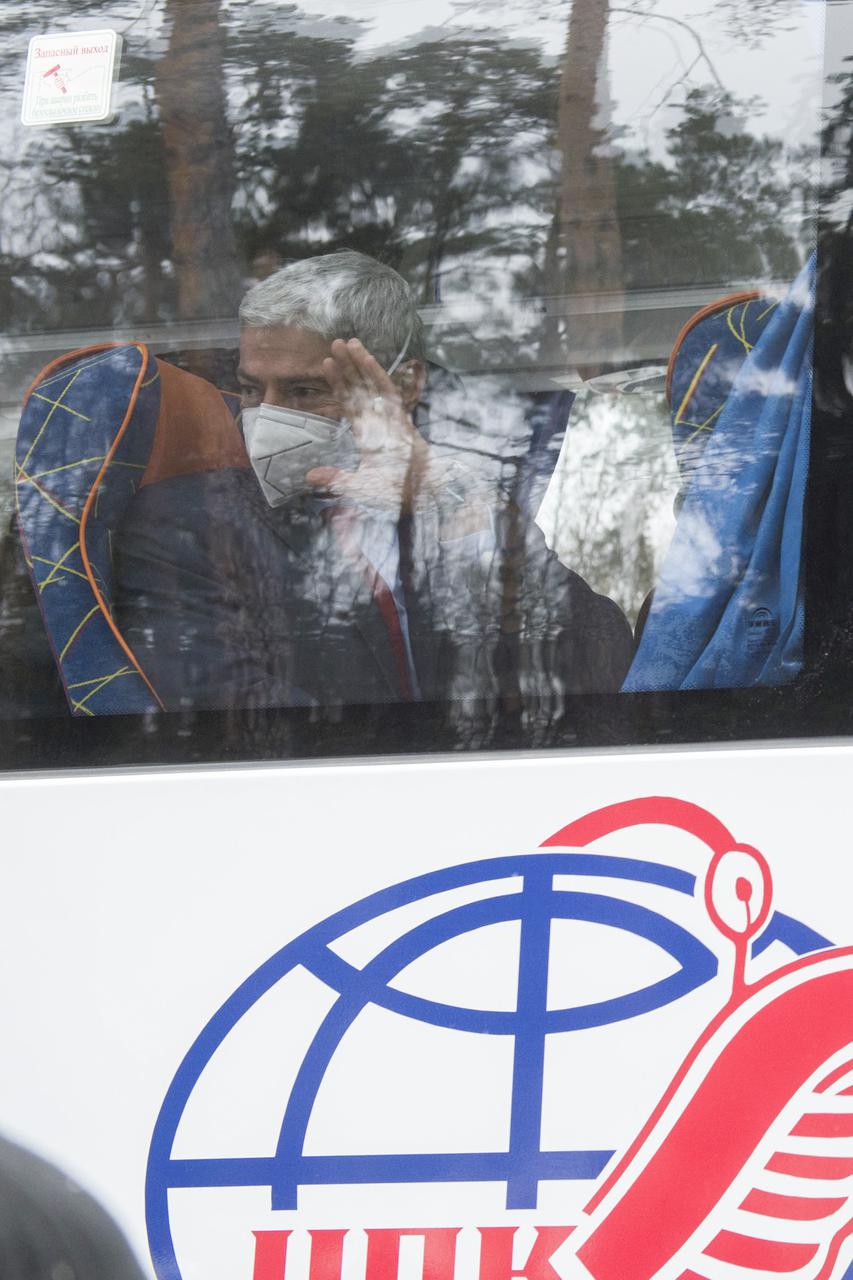
Expedition 65 prime crew member, NASA astronaut Mark Vande Hei, waves goodbye after boarding the bus to his flight to Baikonur for launch from the Baikonur Cosmodrome, Friday, March 26, 2021 at the Gagarin Cosmonaut Training Center (GCTC) in Star City, Russia. Photo Credit: (NASA/GCTC/Andrey Shelepin)

S103-E-5248 (22 December 1999) --- Astronaut Steven L. Smith, payload commander, waves to a crew mate located inside the Space Shuttle Discovery's cabin during the first space walk of NASA's third servicing visit to the Hubble Space Telescope (HST). The photo was taken with an electronic still camera (ESC).
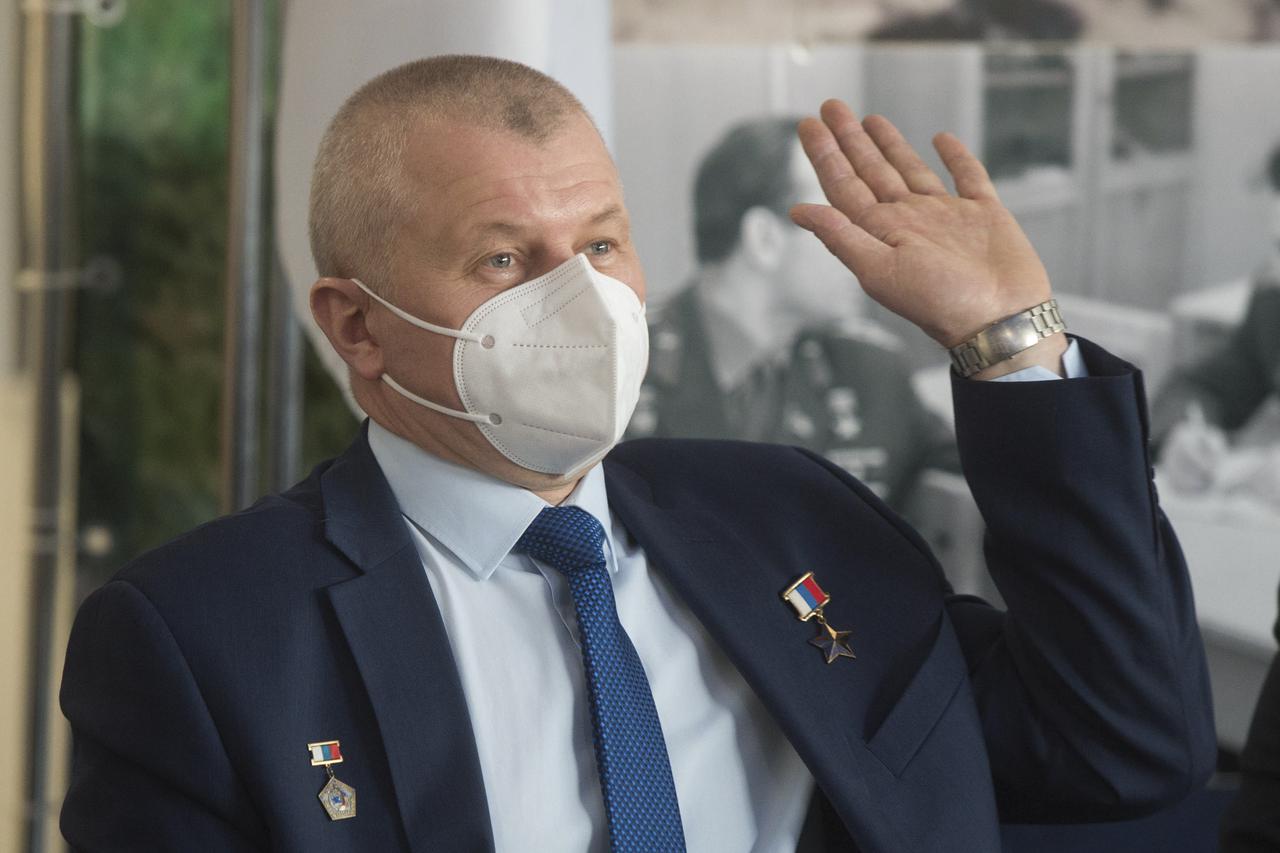
Expedition 65 prime crew member Russian cosmonaut Oleg Novitskiy of Roscosmos waves during a press conference prior to his launch from the Baikonur Cosmodrome in Kazakhstan, Wednesday, March 24, 2021 at the Gagarin Cosmonaut Training Center (GCTC) in Star City, Russia. Photo Credit: (NASA/GCTC/Andrey Shelepin)
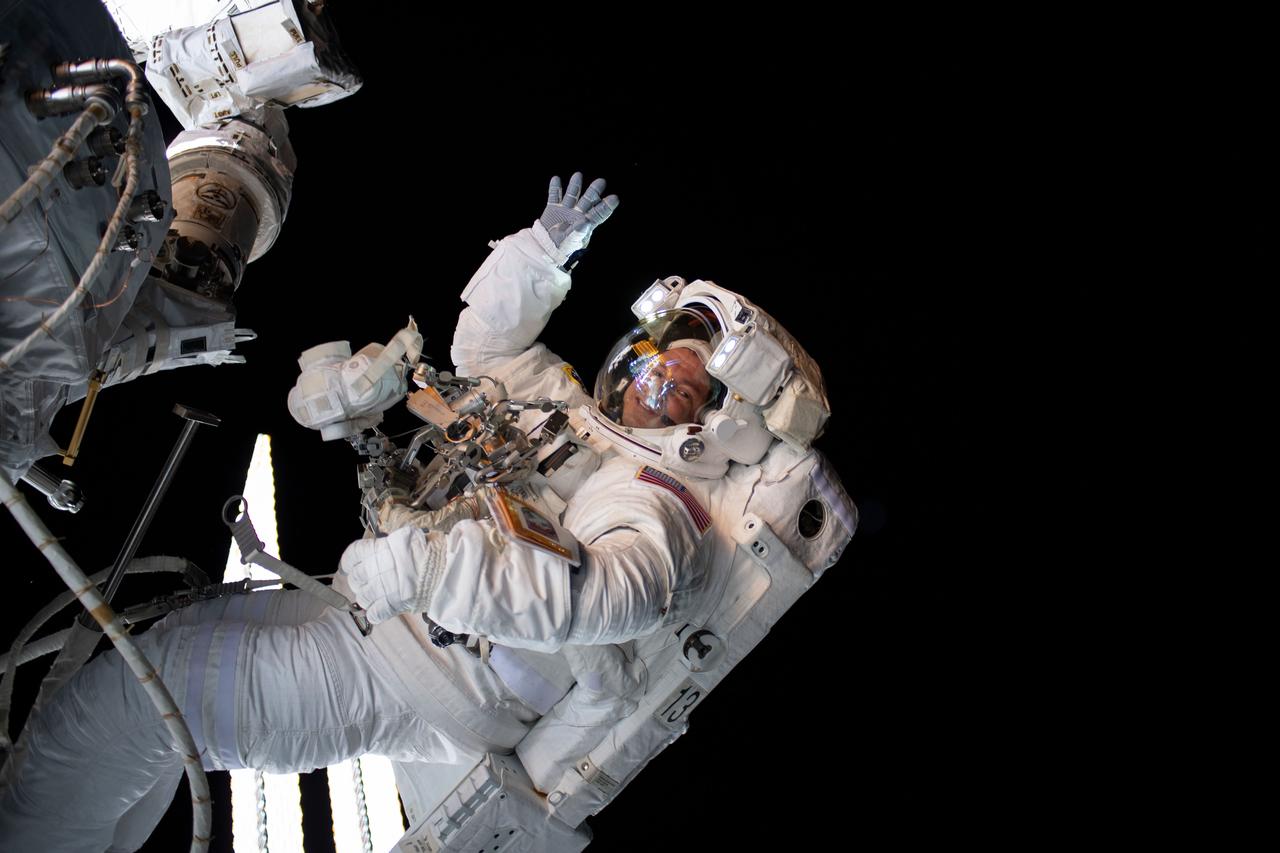
iss060e043194 (Aug. 21, 2019) --- NASA astronaut Andrew Morgan waves as he is photographed during a spacewalk to install the International Space Station’s second commercial crew vehicle docking port, the International Docking Adapter-3 (IDA-3).
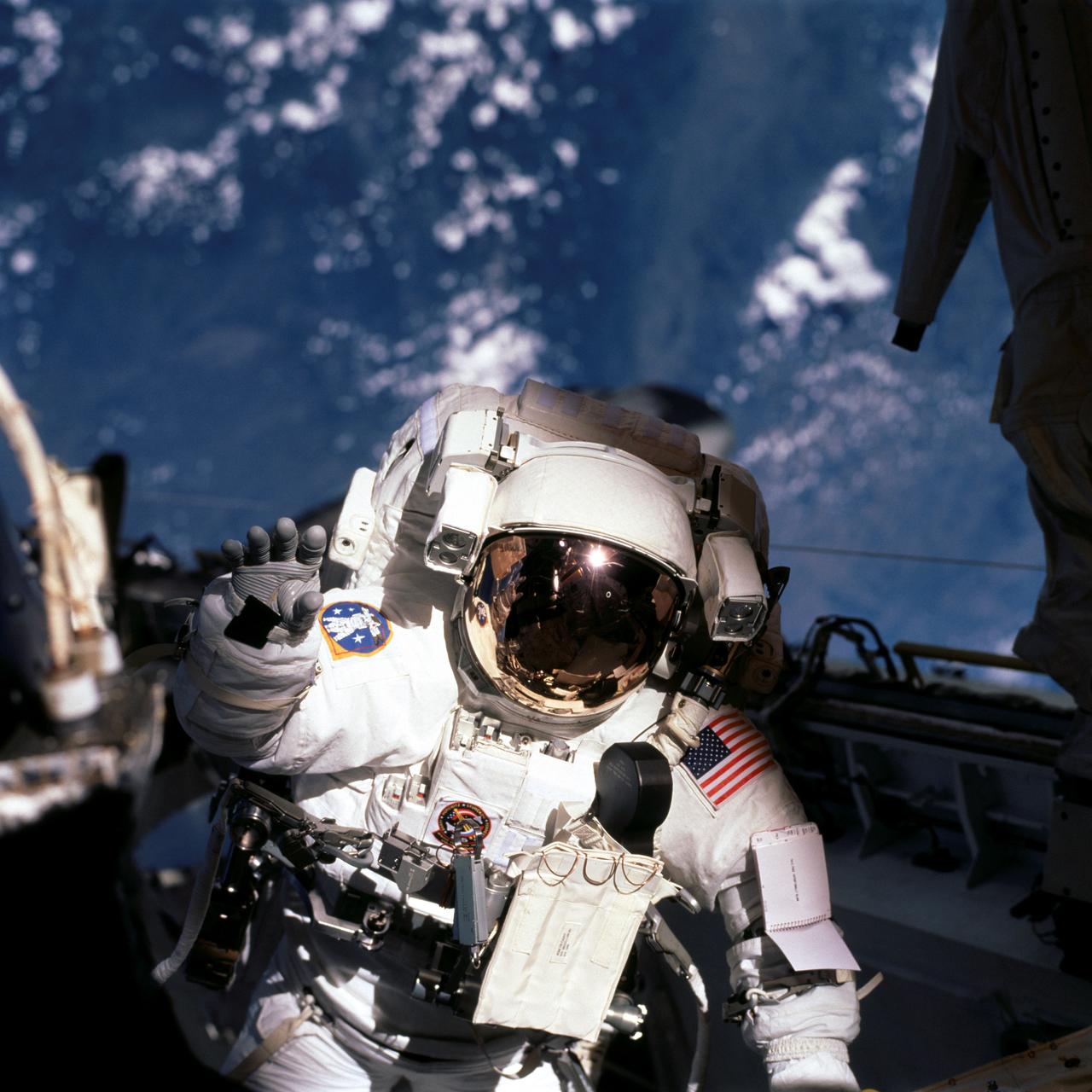
STS105-725-024 (16 August 2001) --- Astronaut Patrick G. Forrester, STS-105 mission specialist, waves at a crew member inside Discovery's cabin during one of two sessions of extravehicular activity (EVA). Astronaut Daniel T. Barry, mission specialist, joined Forrester on both space walks.
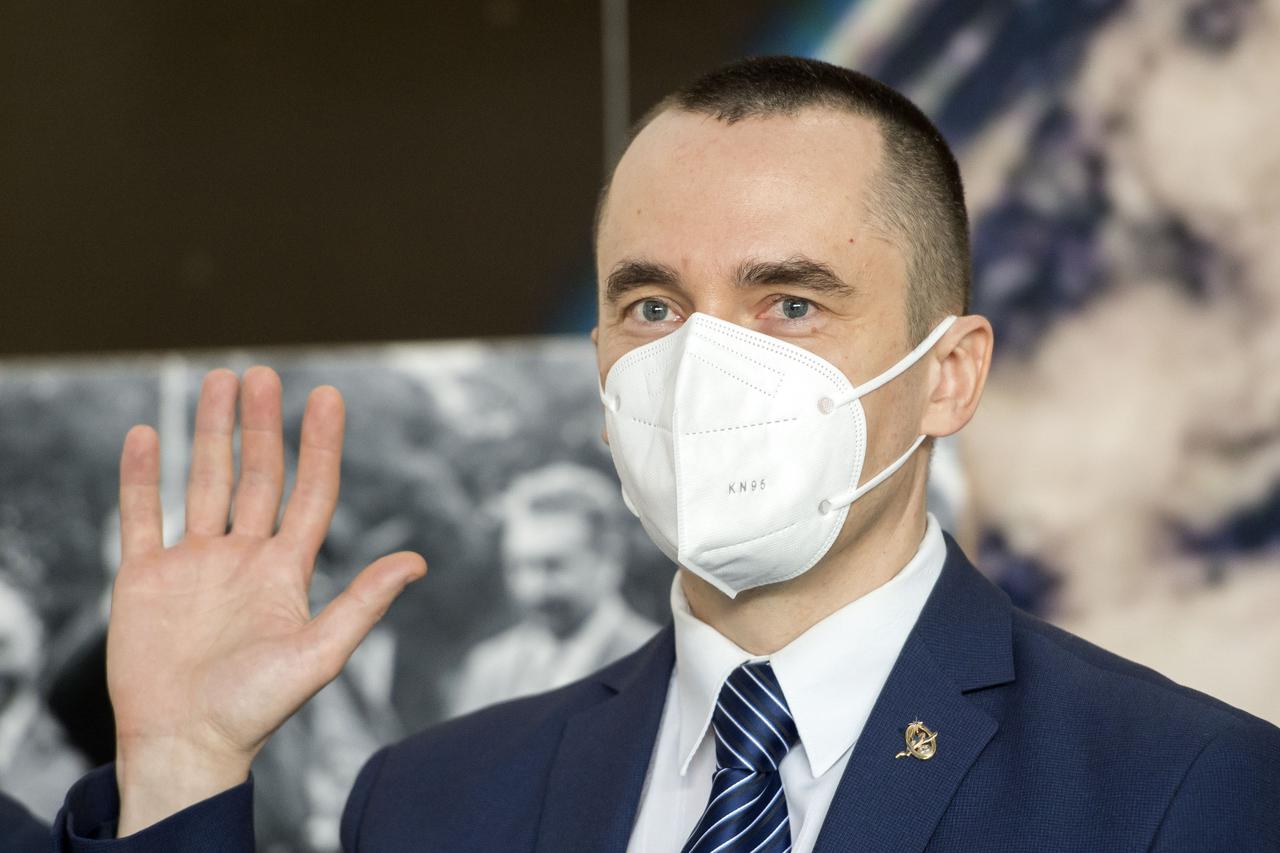
Expedition 65 prime crew member Russian cosmonaut Pyotr Dubrov of Roscosmos waves during a press conference prior to his launch from the Baikonur Cosmodrome in Kazakhstan, Wednesday, March 24, 2021 at the Gagarin Cosmonaut Training Center (GCTC) in Star City, Russia. Photo Credit: (NASA/GCTC/Irina Spector)
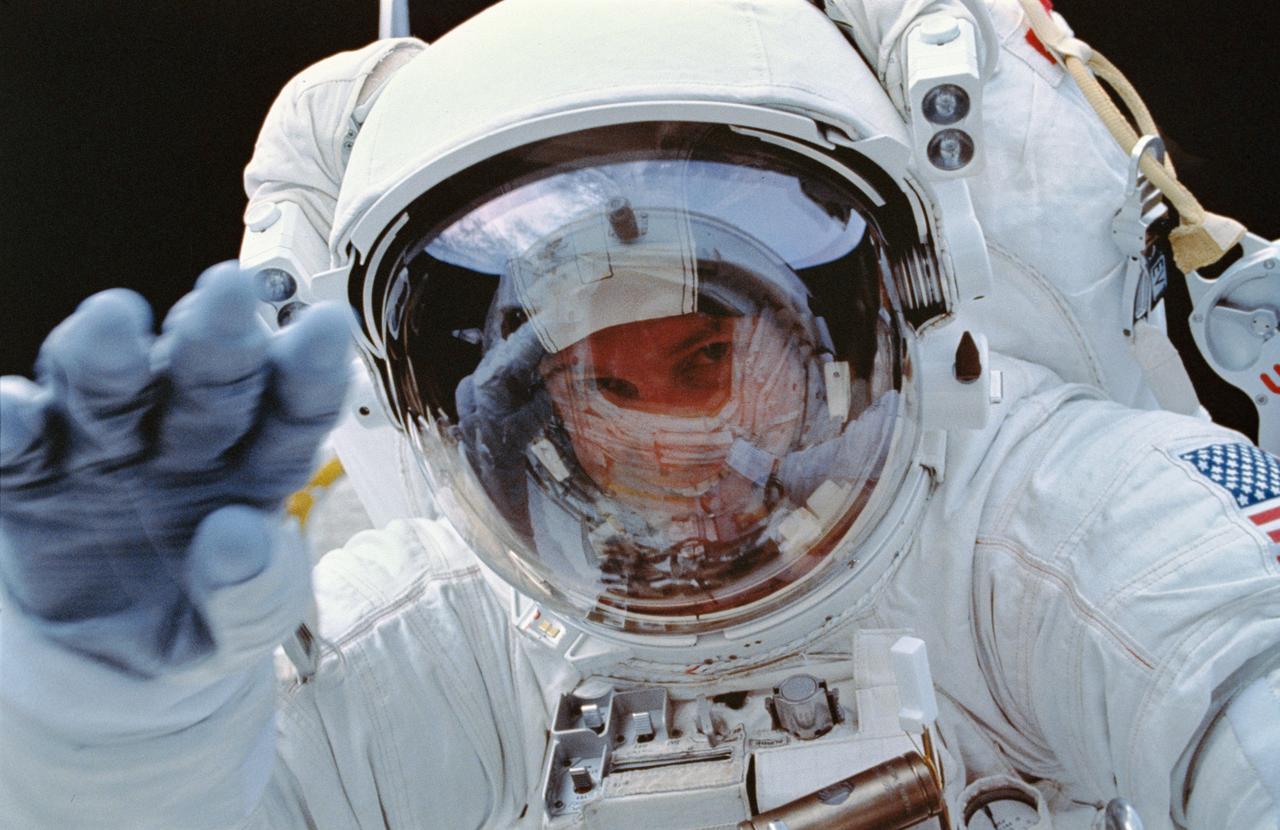
STS054-31-031 (17 Jan 1993) --- Astronaut Gregory J. Harbaugh, mission specialist, waves to fellow crew members on Endeavour's aft flight deck from the payload bay during the four-plus hours extravehicular activity (EVA). Harbaugh was joined on the EVA by astronaut Mario Runco Jr., mission specialist.
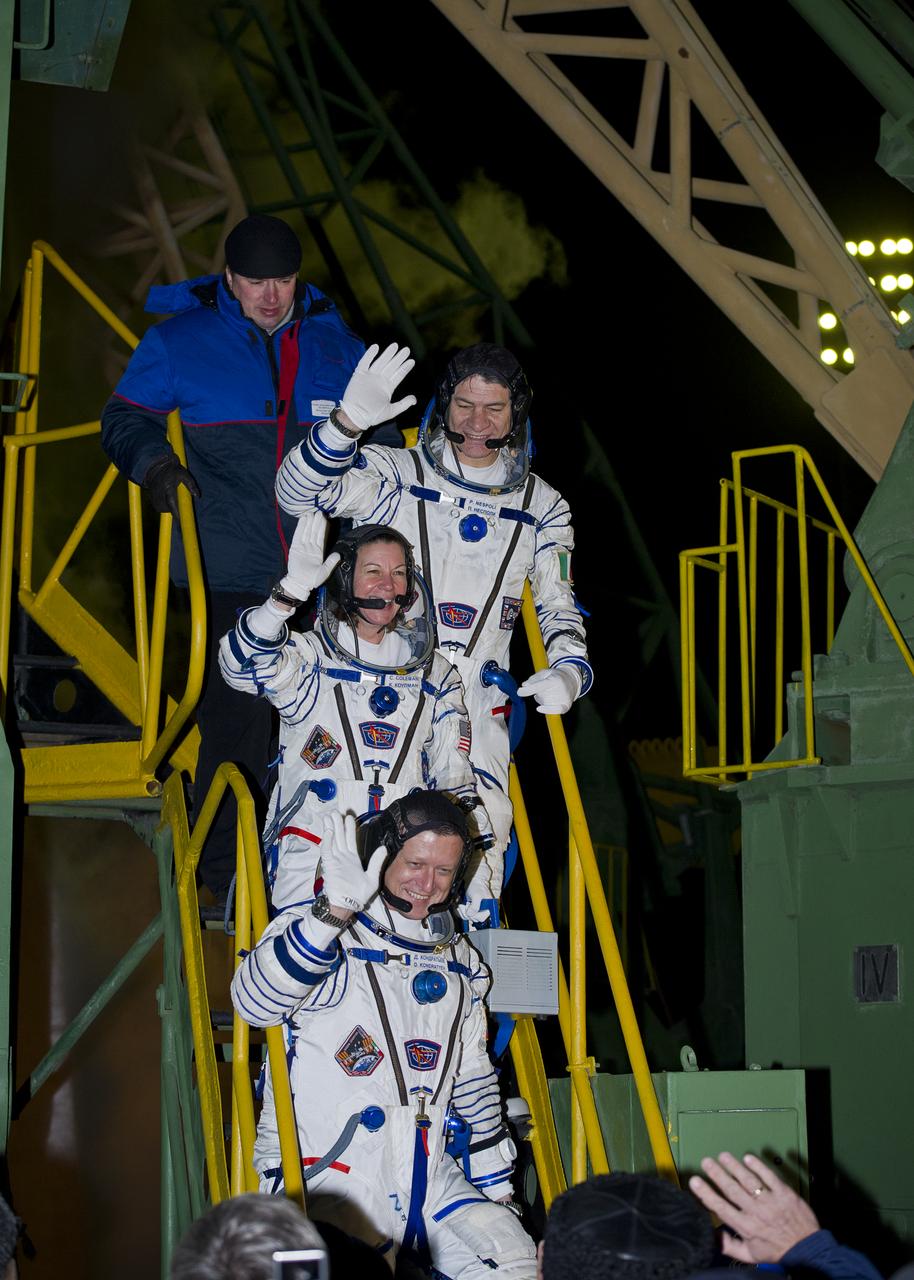
Expedition 26 crew members from bottom Soyuz Commander Dmitry Kondratyev, NASA Flight Engineer Cady Coleman and European Space Agency Flight Engineer Paolo Nespoli, wave to the crowd prior to launching at the Baikonur Cosmodrome in Kazakhstan on Wednesday, Dec. 15, 2010. (Photo Credit: NASA/Carla Cioffi)
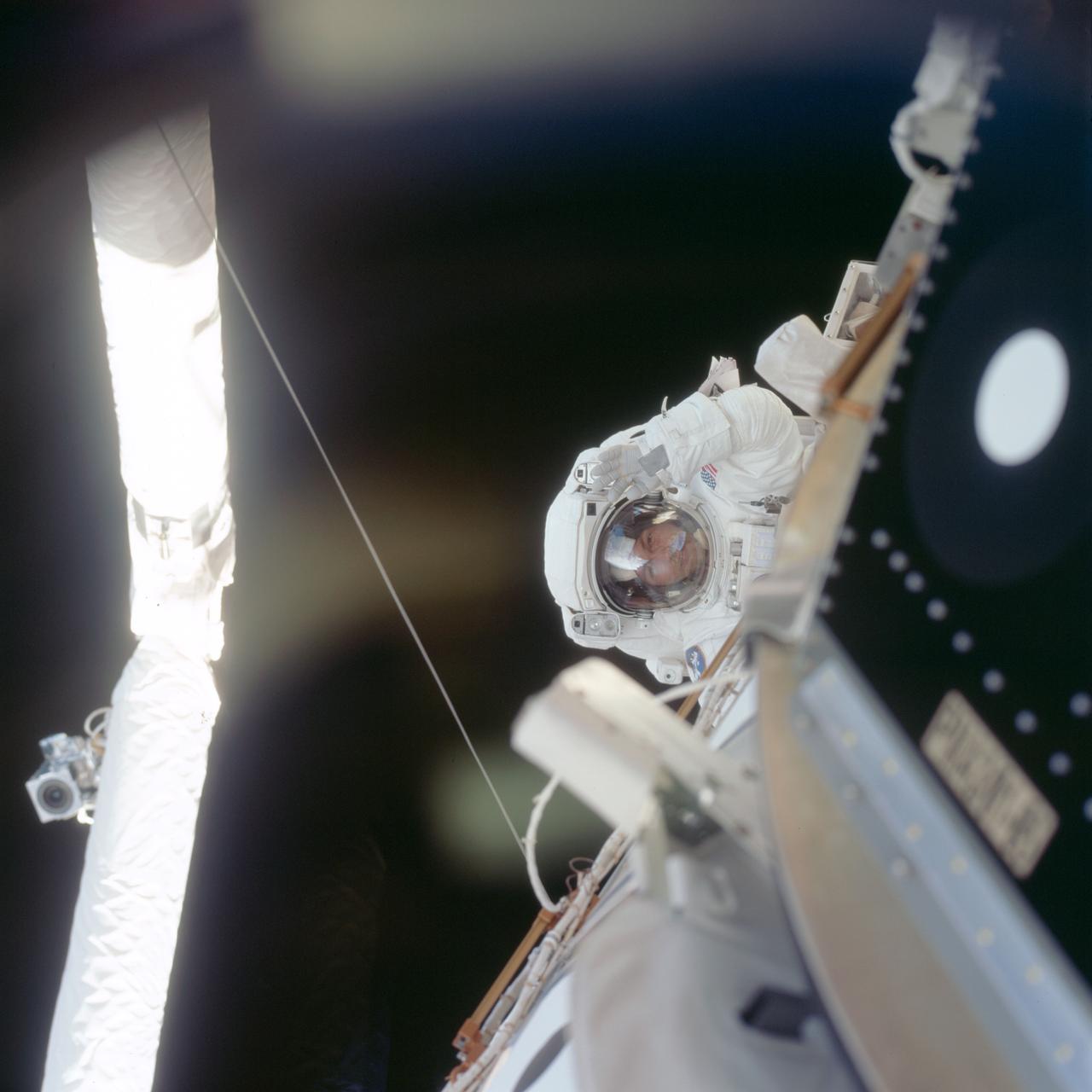
STS097-703-014 (7 December 2000) --- Astronaut Carlos I. Noriega, one of two space walking STS-97 mission specialists, waves at a crew member inside Endeavour's cabin during the mission's final session of extravehicular activity (EVA).
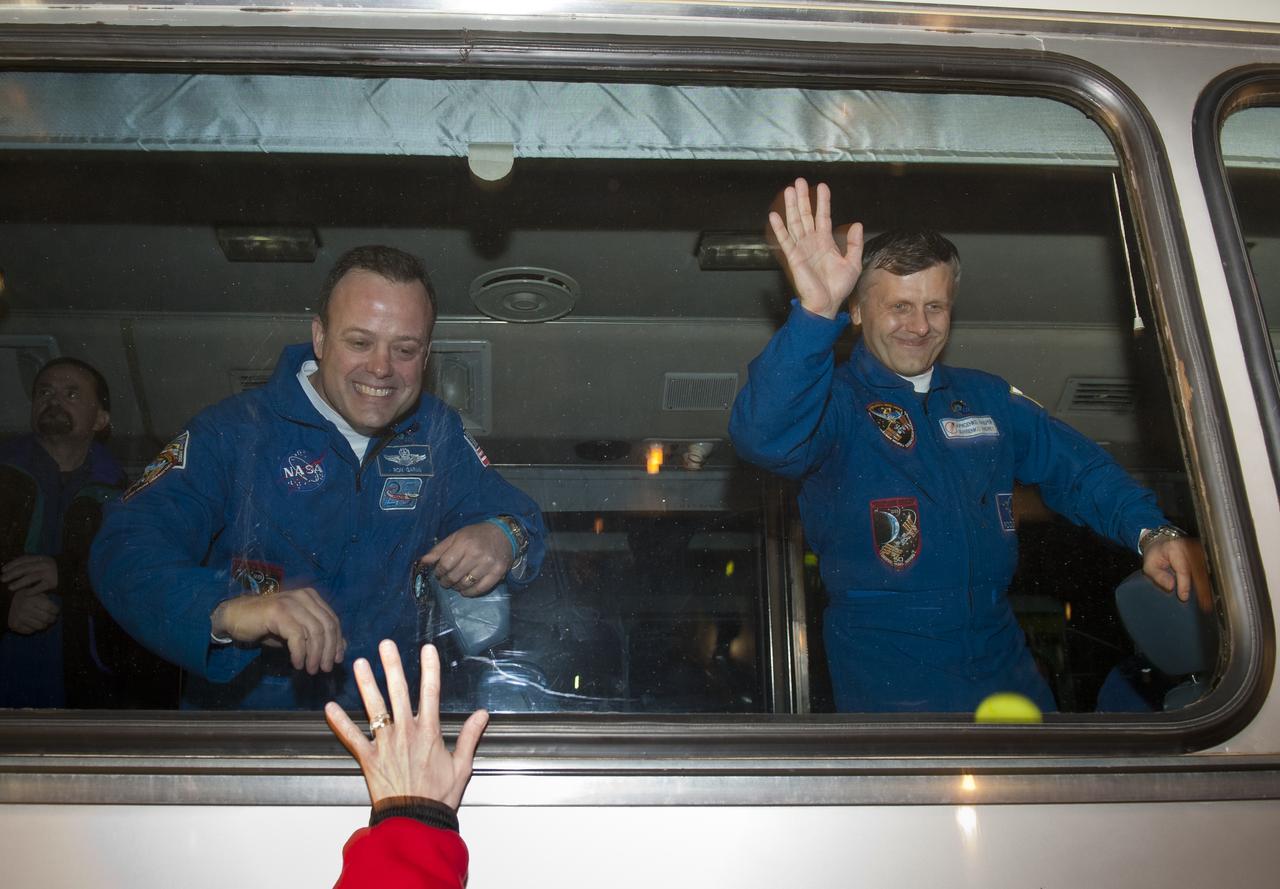
Expedition 27 crew members NASA Flight Engineer Ron Garan, left, and Russian Flight Engineer Andrey Borisenko wave farewell to well wishers as they depart the Cosmonaut Hotel on the evening before their Soyuz launch to the International Space Station on Monday, April 4, 2011 in Baikonur, Kazakhstan. Photo Credit: (NASA/Carla Cioffi)
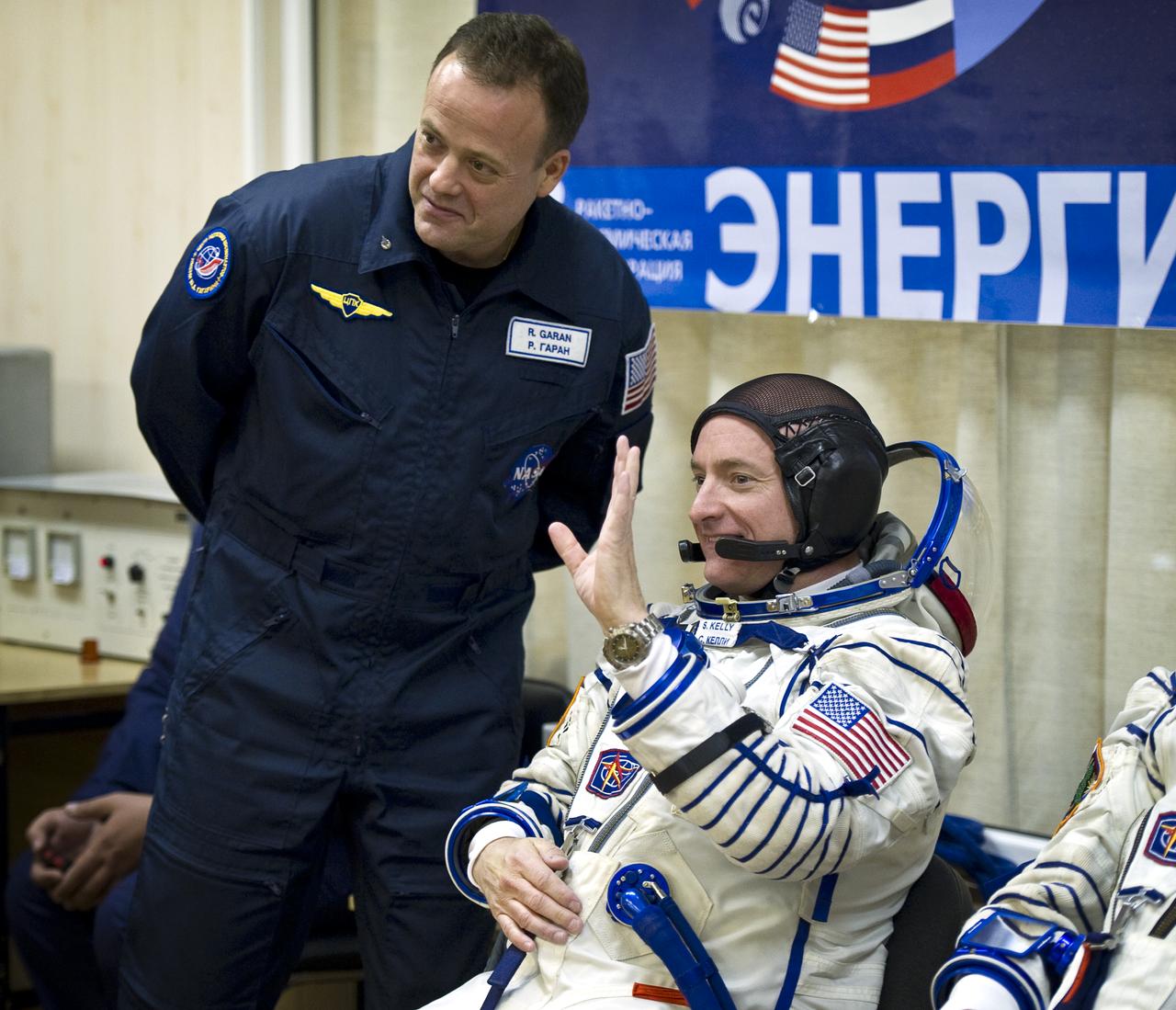
Expedition 25 NASA Flight Engineer Scott Kelly waves to friends and family as he awaits to have his Russian Sokol Suit pressure checked at the Baikonur Cosmodrome in Kazakhstan on Friday, Oct. 8, 2010. Backup crew member Ron Garan, left, looks on. Photo Credit: (NASA/Carla Cioffi)
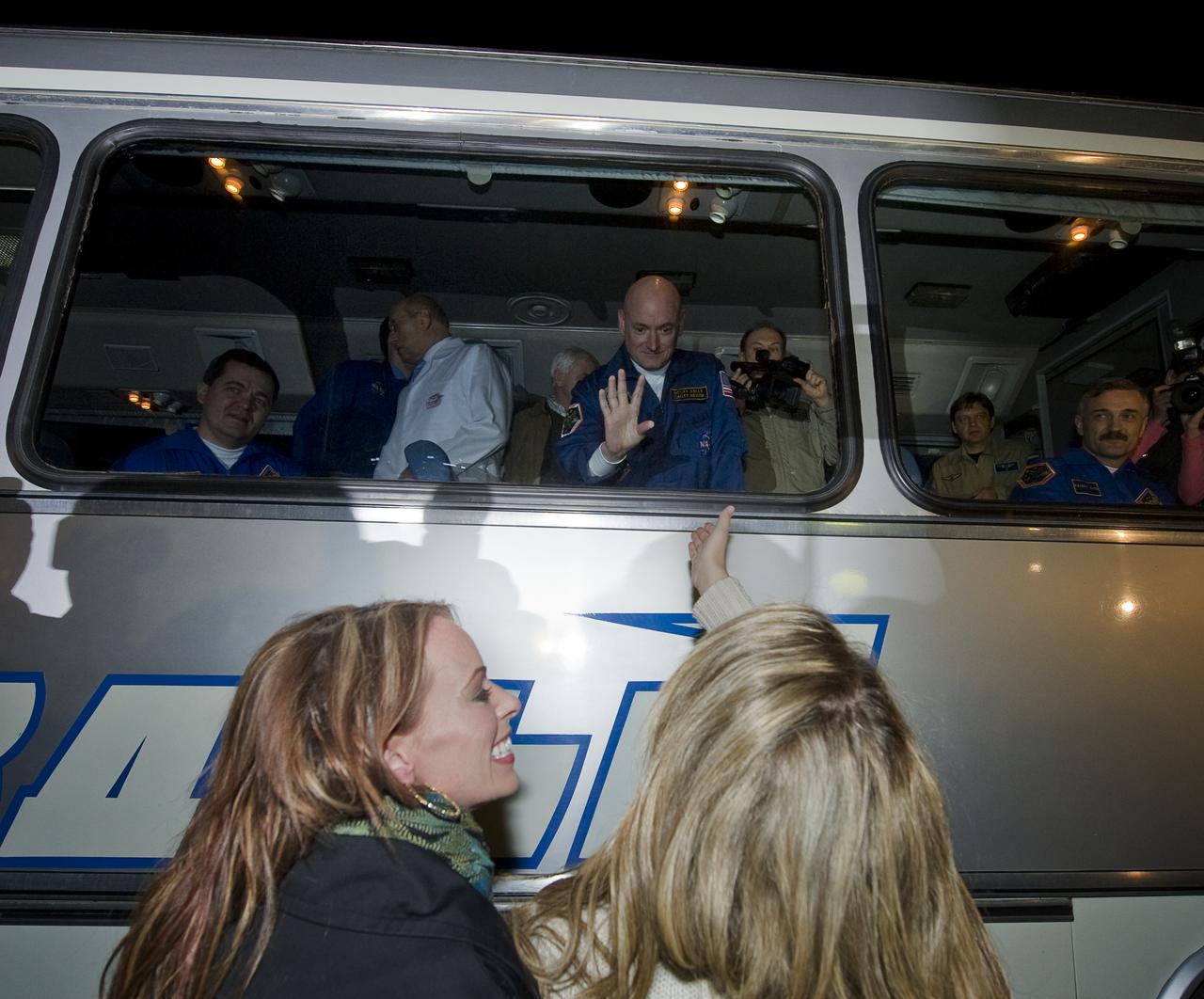
Expedition 25 NASA Flight Engineer Scott Kelly waves farewell to friends and family as he and his crew mates depart the Cosmonaut Hotel on the evening before their launch at the Cosmonaut Hotel, Thursday, Oct. 7, 2010 in Baikonur, Kazakhstan. Photo Credit: (NASA/Carla Cioffi)
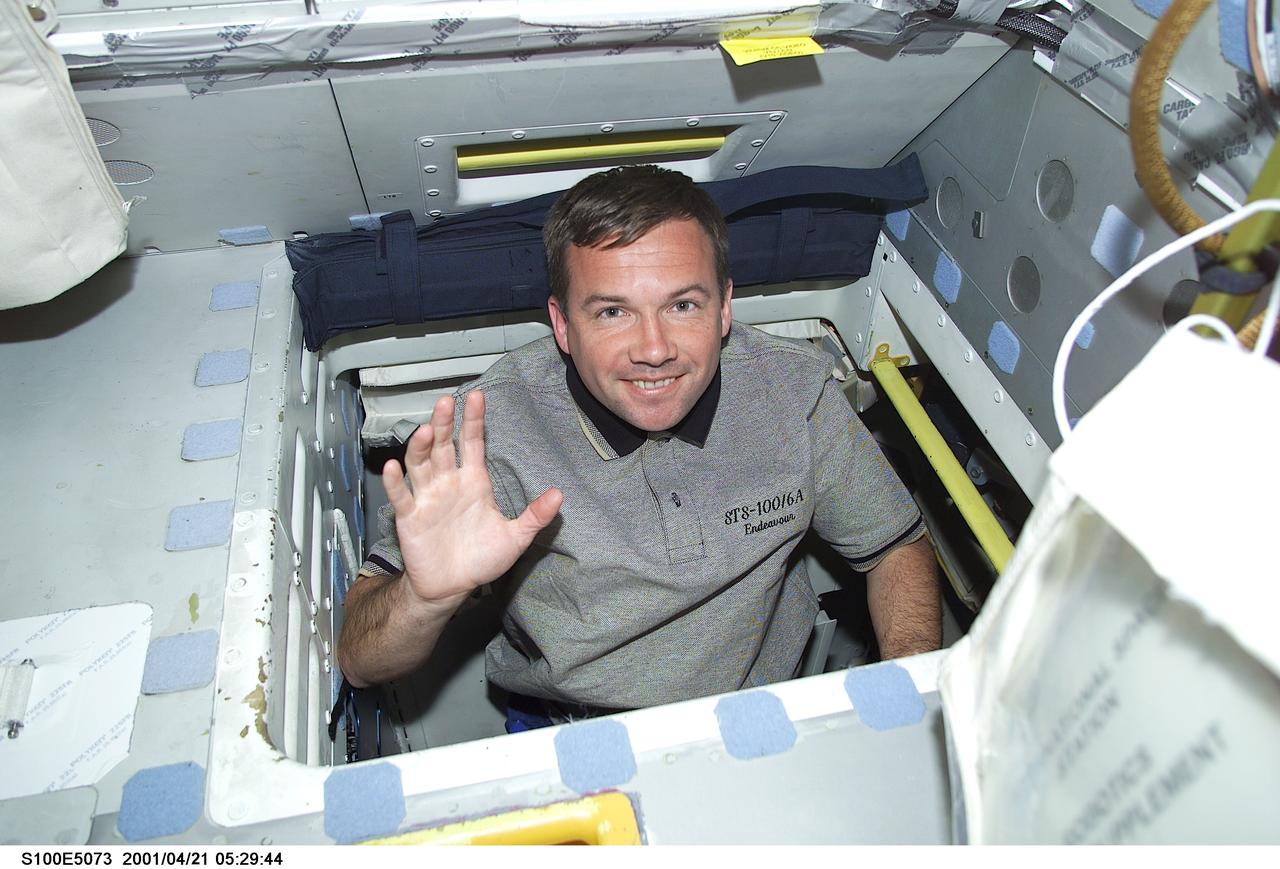
S100-E-5073 (21 April 2001) --- Cosmonaut Yuri V. Lonchakov, mission specialist representing Rosaviakosmos, waves to a crew mate while translating through the passageway between the middeck and flight deck onboard the Earth-orbiting Space Shuttle Endeavour. The image was recorded with a digital still camera.

Expedition 65 prime crew member NASA astronaut Mark Vande Hei, waves during a press conference prior to his launch from the Baikonur Cosmodrome in Kazakhstan, Wednesday, March 24, 2021 at the Gagarin Cosmonaut Training Center (GCTC) in Star City, Russia. Photo Credit: (NASA/GCTC/Andrey Shelepin)
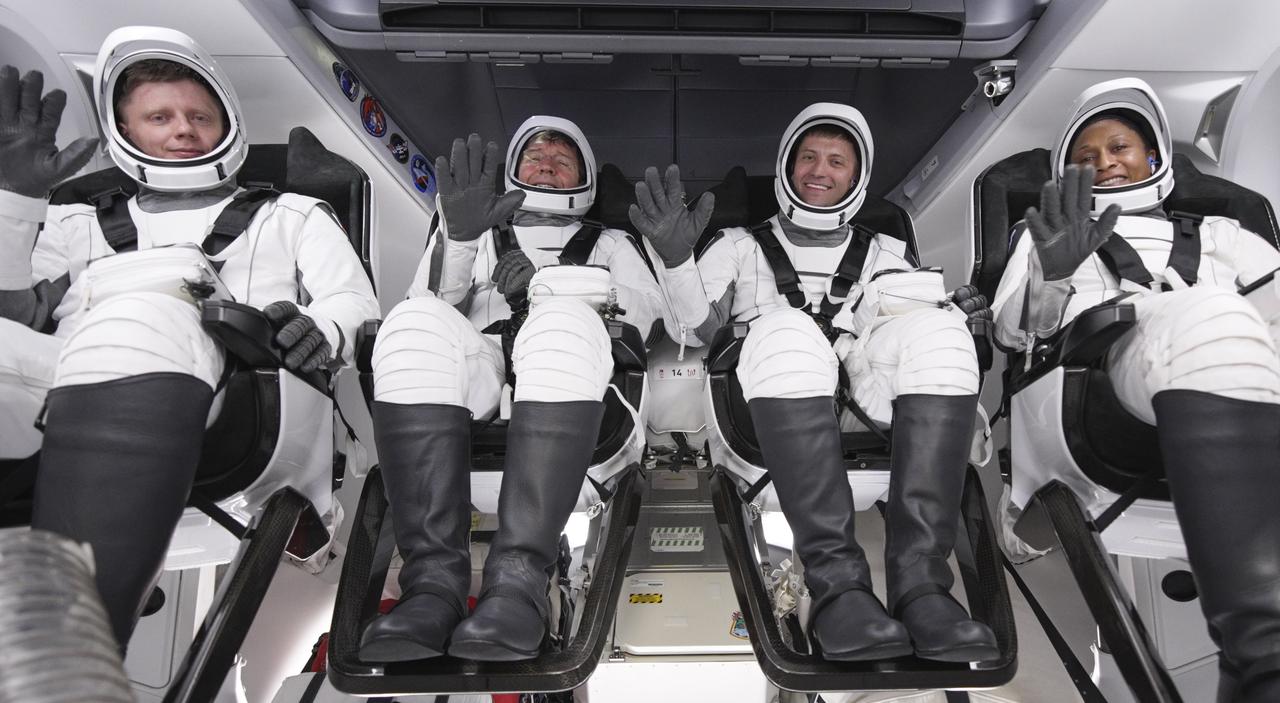
NASA’s SpaceX Crew-8 astronauts from right to left NASA astronauts Jeanette Epps, Matthew Dominick, and Michael Barratt, and Roscosmos cosmonaut Alexander Grebenkin smile and wave inside a Dragon spacecraft at Launch Complex 39A at Kennedy Space Center in Florida ahead of liftoff scheduled for 10:53 p.m. on Sunday, March 3, 2024. The Crew-8 mission is the eighth crew rotation mission with SpaceX to the station, and the ninth flight of Dragon with people as part of the agency’s Commercial Crew Program.
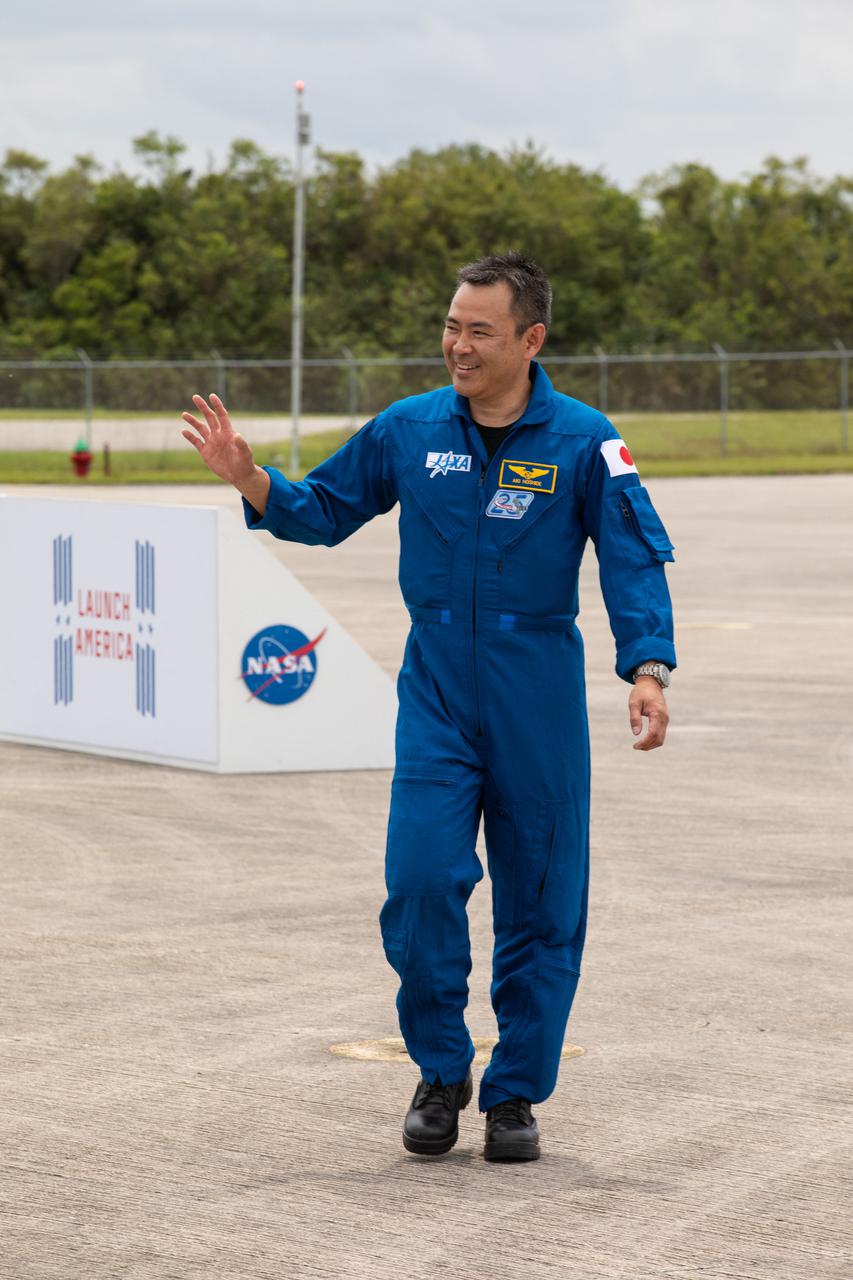
JAXA astronaut Akihilo Hoshide smiles and waves during the SpaceX Crew-2 arrival media event held at Kennedy Space Center in Florida on April 16, 2021. Hoshide is part of NASA’s SpaceX Crew-2 crew, which includes NASA astronauts Megan McArthur and Shane Kimbrough, along with ESA astronaut Thomas Pesquet. The astronauts will fly to the space station on NASA’s SpaceX Crew-2 mission. Liftoff is targeted for Thursday, April 22, at 6:11 a.m. EDT.
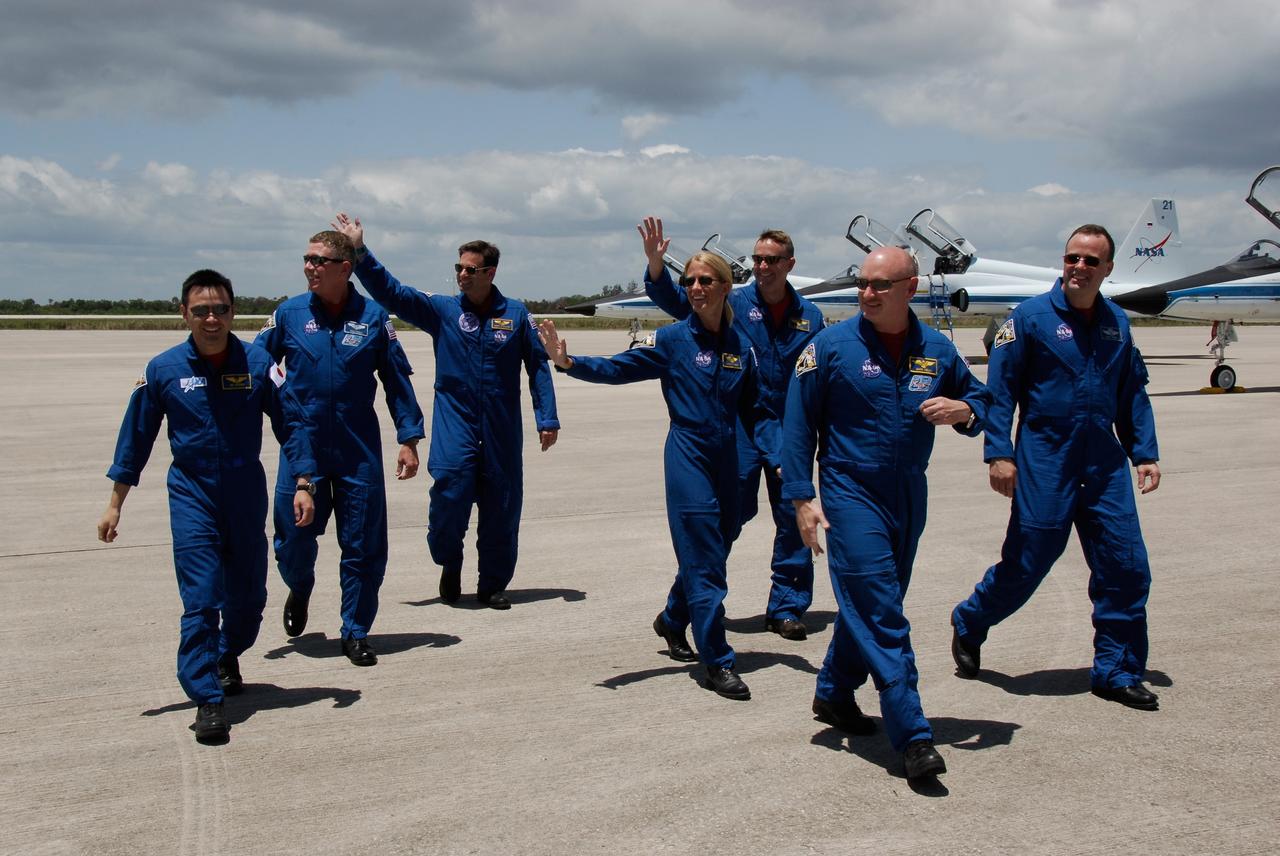
CAPE CANAVERAL, Fla. -- After greeting the media on their arrival on the Shuttle Landing Facility at NASA's Kennedy Space Center, the crew members of space shuttle Discovery's STS-124 mission wave and head for the van that will take them to crew quarters in the Operations and Checkout Building. They will be preparing for launch scheduled for 5:02 p.m. May 31. On the STS-124 mission, the crew of seven will deliver and install the Japanese Experiment Module – Pressurized Module and Japanese Remote Manipulator System. Photo credit: NASA/Kim Shiflett
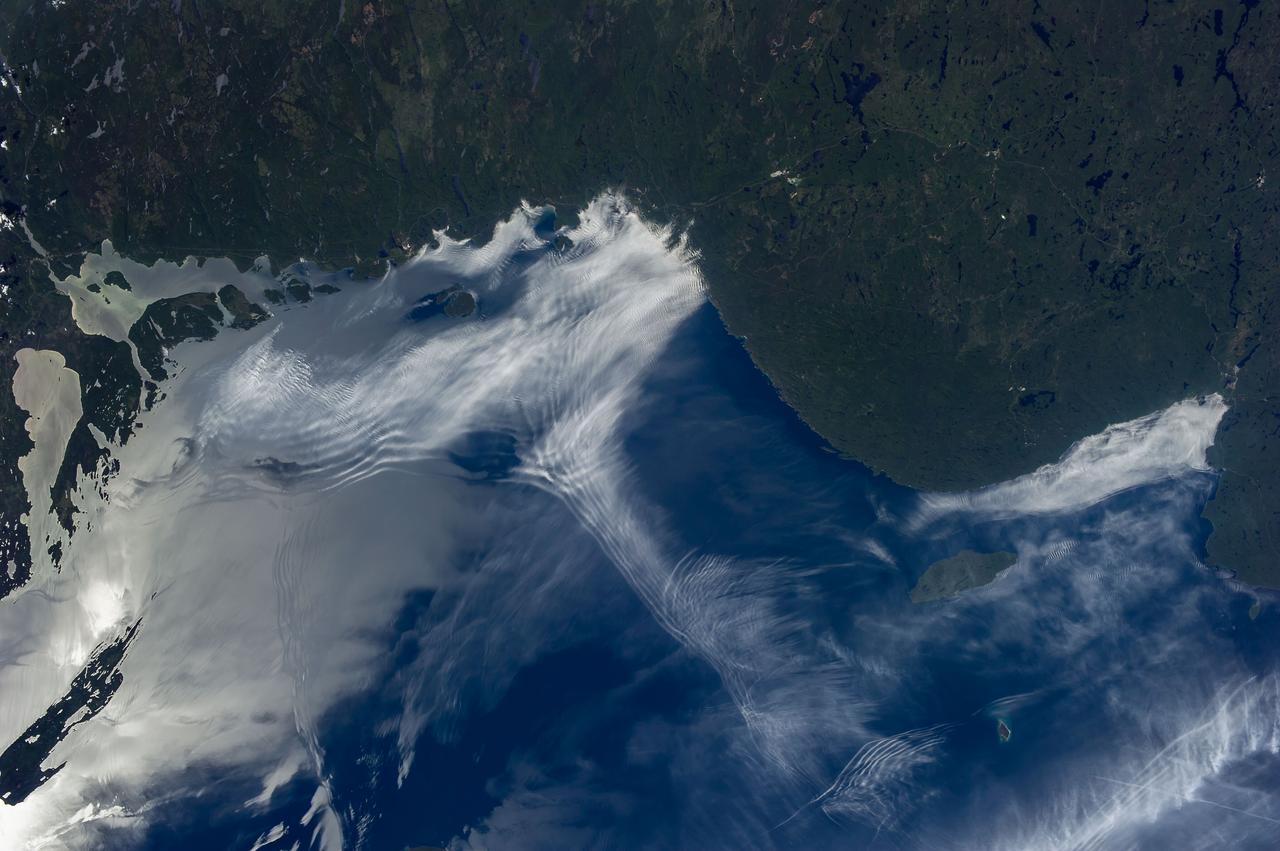
ISS036-E-011843 (24 June 2013) --- Gravity waves and sunglint on Lake Superior are featured in this image photographed by an Expedition 36 crew member on the International Space Station. From the vantage point of the space station, crew members frequently observe Earth atmospheric and surface phenomena in ways impossible to view from the ground. Two such phenomena?gravity waves and sunglint?are illustrated in this photograph of northeastern Lake Superior. The Canadian Shield of southern Ontario (bottom) is covered with extensive green forest canopy typical of early summer. Offshore, and to the west and southwest of Pukaskwa National Park several distinct sets of parallel cloud bands are visible. Gravity waves are produced when moisture-laden air encounters imbalances in air density, such as might be expected when cool air flows over warmer air; this can cause the flowing air to oscillate up and down as it moves, causing clouds to condense as the air rises (cools) and evaporate away as the air sinks (warms). This produces parallel bands of clouds oriented perpendicular to the wind direction. The orientation of the cloud bands visible in this image, parallel to the coastlines, suggests that air flowing off of the land surfaces to the north is interacting with moist, stable air over the lake surface, creating gravity waves. The second phenomenon?sunglint?effects the water surface around and to the northeast of Isle Royale (upper right). Sunglint is caused by light reflection off a water surface; some of the reflected light travels directly back towards the observer, resulting in a bright mirror-like appearance over large expanses of water. Water currents and changes in surface tension (typically caused by presence of oils or surfactants) alter the reflective properties of the water, and can be highlighted by sunglint. For example, surface water currents are visible to the east of Isle Royale that are oriented similarly to the gravity waves ? suggesting that they too are the product of winds moving off of the land surface.
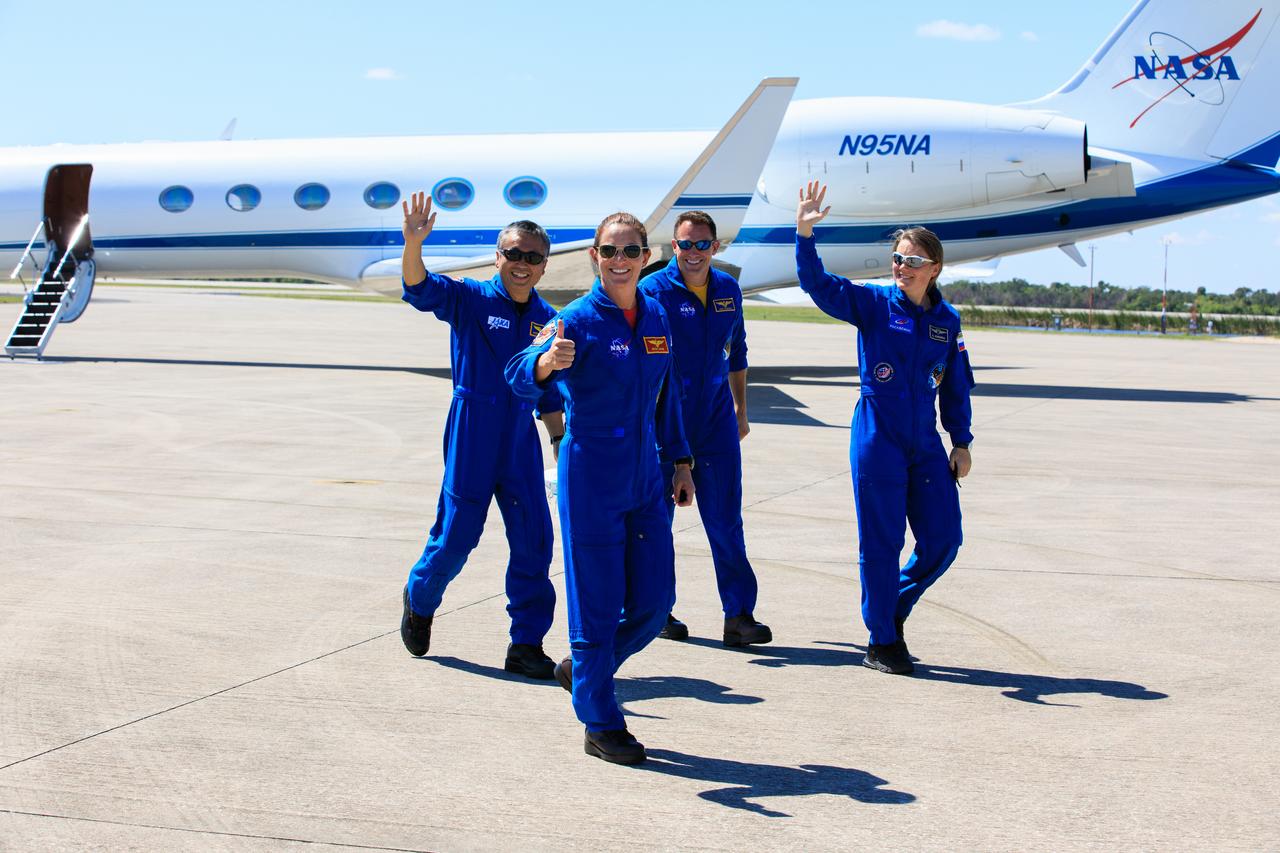
Crew members for NASA’s SpaceX Crew-5 mission to the International Space Station wave during a crew arrival media event at the Launch and Landing Facility at Kennedy Space Center in Florida on Oct. 1, 2022. From left are Koichi Wakata, mission specialist; Nicole Mann, commander; Josh Cassada, pilot; and Anna Kikina, mission specialist. The crew will head to the center’s Crew Quarters as they await launch aboard the Crew Dragon on a SpaceX Falcon 9 rocket. Launch is targeted for noon EDT on Oct. 5 from Launch Complex 39A. Crew-5 is the fifth crew rotation mission with SpaceX to the station, and the sixth flight of Dragon with people as part of the agency’s Commercial Crew Program.
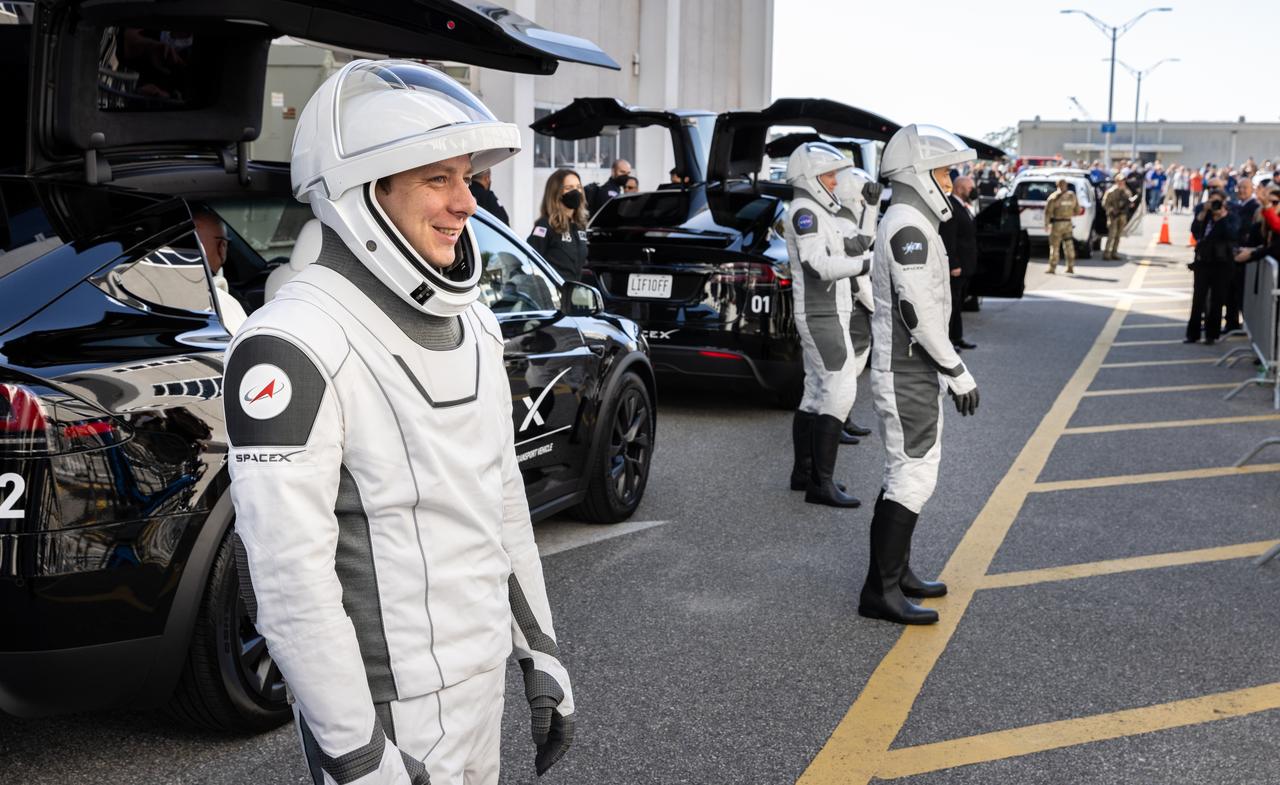
NASA’s SpaceX Crew-10 crew members wave to family and friends as they prepare to depart the Neil A. Armstrong Operations and Checkout Building at the agency’s Kennedy Space Center in Florida for nearby Launch Complex 39A for launch of Crew-10 on Wednesday, March 12, 2025. NASA astronauts Anne McClain and Nichole Ayers, along with JAXA (Japan Aerospace Exploration Agency) astronaut Takuya Onishi and Roscosmos cosmonaut Kirill Peskov are scheduled to lift off aboard SpaceX’s Dragon spacecraft and Falcon 9 rocket at 7:48 p.m. EDT. Crew-10 is the 10th crew rotation mission with SpaceX to the space station as part of the agency’s Commercial Crew Program.
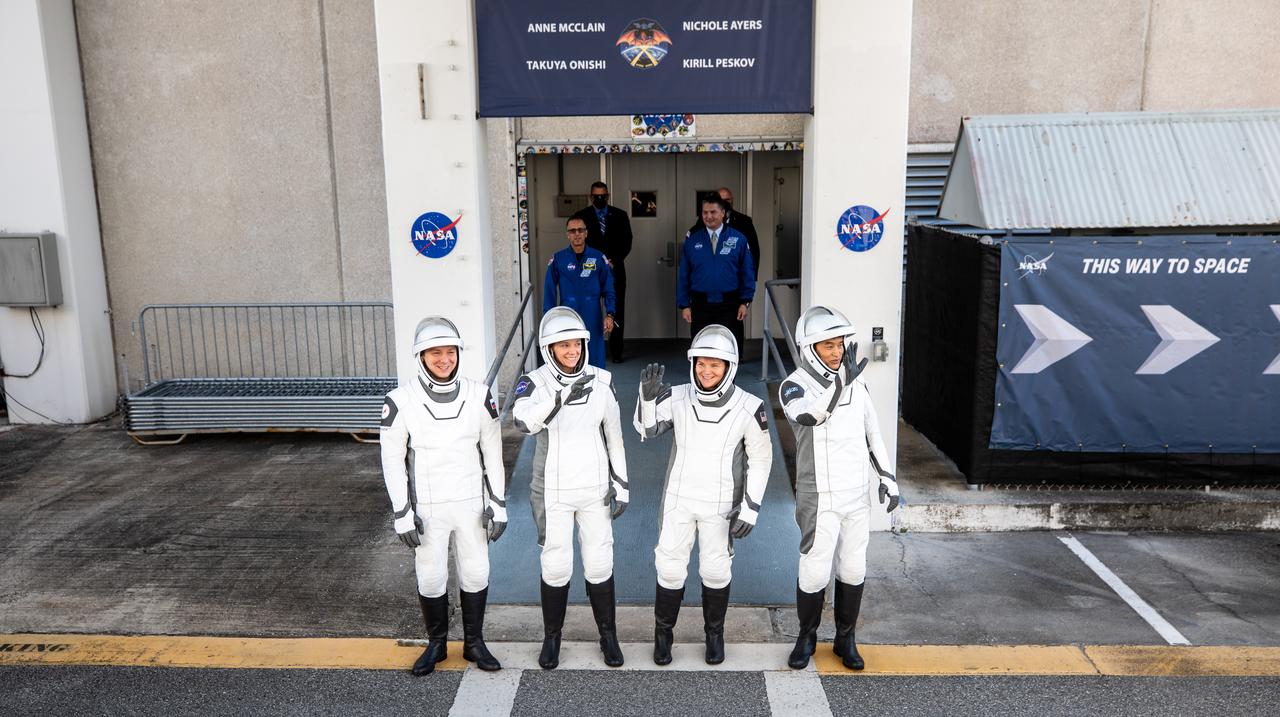
NASA’s SpaceX Crew-10 crew members wave to family and friends as they prepare to depart the Neil A. Armstrong Operations and Checkout Building at the agency’s Kennedy Space Center in Florida for nearby Launch Complex 39A for launch of Crew-10 on Wednesday, March 12, 2025. From left to right, Roscosmos cosmonaut Kirill Peskov, NASA astronauts Nichole Ayers and Anne McClain, along with JAXA (Japan Aerospace Exploration Agency) astronaut Takuya Onishi are scheduled to lift off aboard SpaceX’s Dragon spacecraft and Falcon 9 rocket at 7:48 p.m. EDT. Crew-10 is the 10th crew rotation mission with SpaceX to the space station as part of the agency’s Commercial Crew Program.
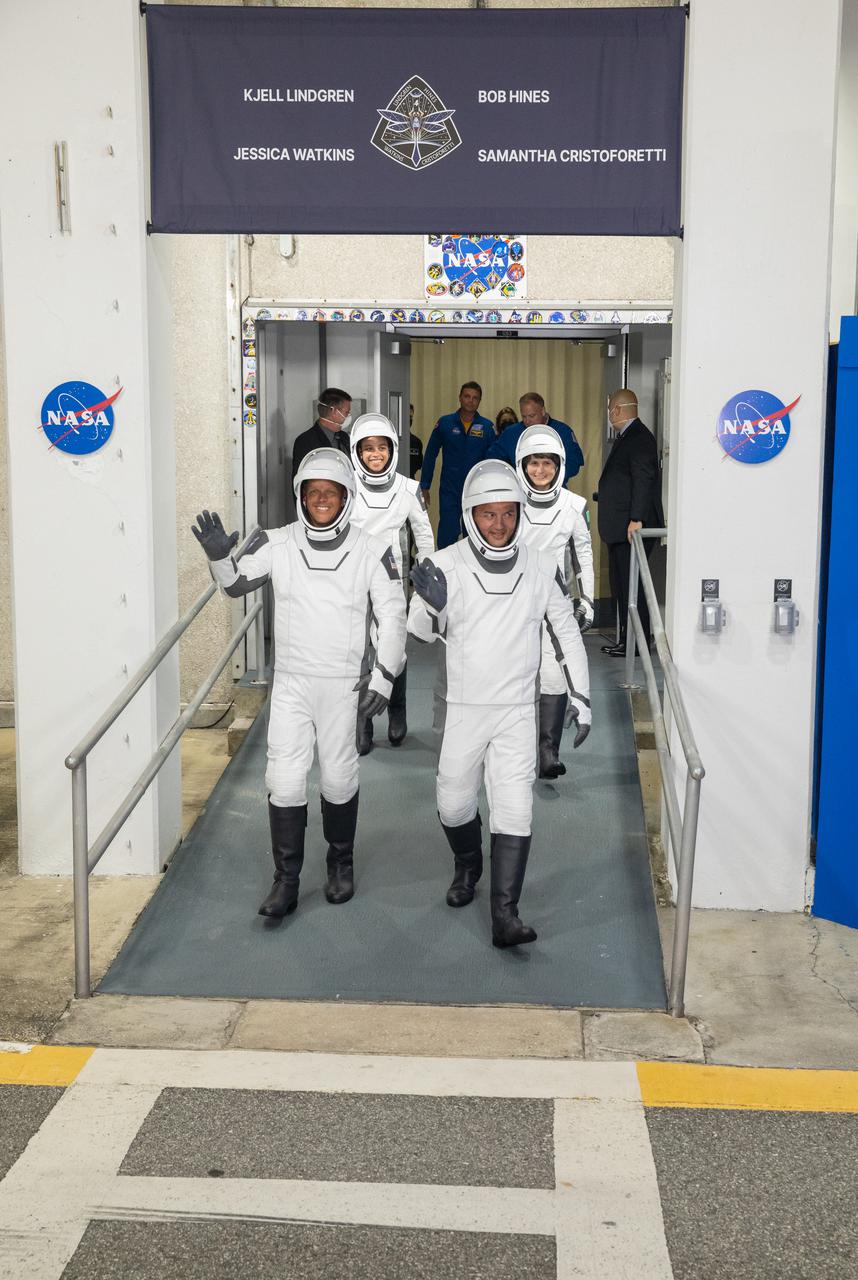
Crew-4 astronauts, from left, front to back, Bob Hines, Kjell Lindgren, Jessica Watkins, and Samantha Cristoforetti wave after walking out through the double doors below the Neil A. Armstrong Building’s Astronaut Crew Quarters at NASA’s Kennedy Space Center in Florida on April 27, 2022. They will make their way to the customized Tesla Model X cars that will take them to their spacecraft at Launch Complex 39A. SpaceX’s Crew Dragon, powered by the company’s Falcon 9 rocket, will carry the four-person crew to the International Space Station as part of NASA’s Commercial Crew Program. Crew-4 is scheduled to launch today at 3:52 a.m. EDT, from Pad 39A at Kennedy.
NASA’s SpaceX Crew-10 crew members wave to family and friends as they prepare to depart the Neil A. Armstrong Operations and Checkout Building at the agency’s Kennedy Space Center in Florida for nearby Launch Complex 39A for launch of Crew-10 on Wednesday, March 12, 2025. NASA astronauts Anne McClain and Nichole Ayers, along with JAXA (Japan Aerospace Exploration Agency) astronaut Takuya Onishi and Roscosmos cosmonaut Kirill Peskov are scheduled to lift off aboard SpaceX’s Dragon spacecraft and Falcon 9 rocket at 7:48 p.m. EDT. Crew-10 is the 10th crew rotation mission with SpaceX to the space station as part of the agency’s Commercial Crew Program.
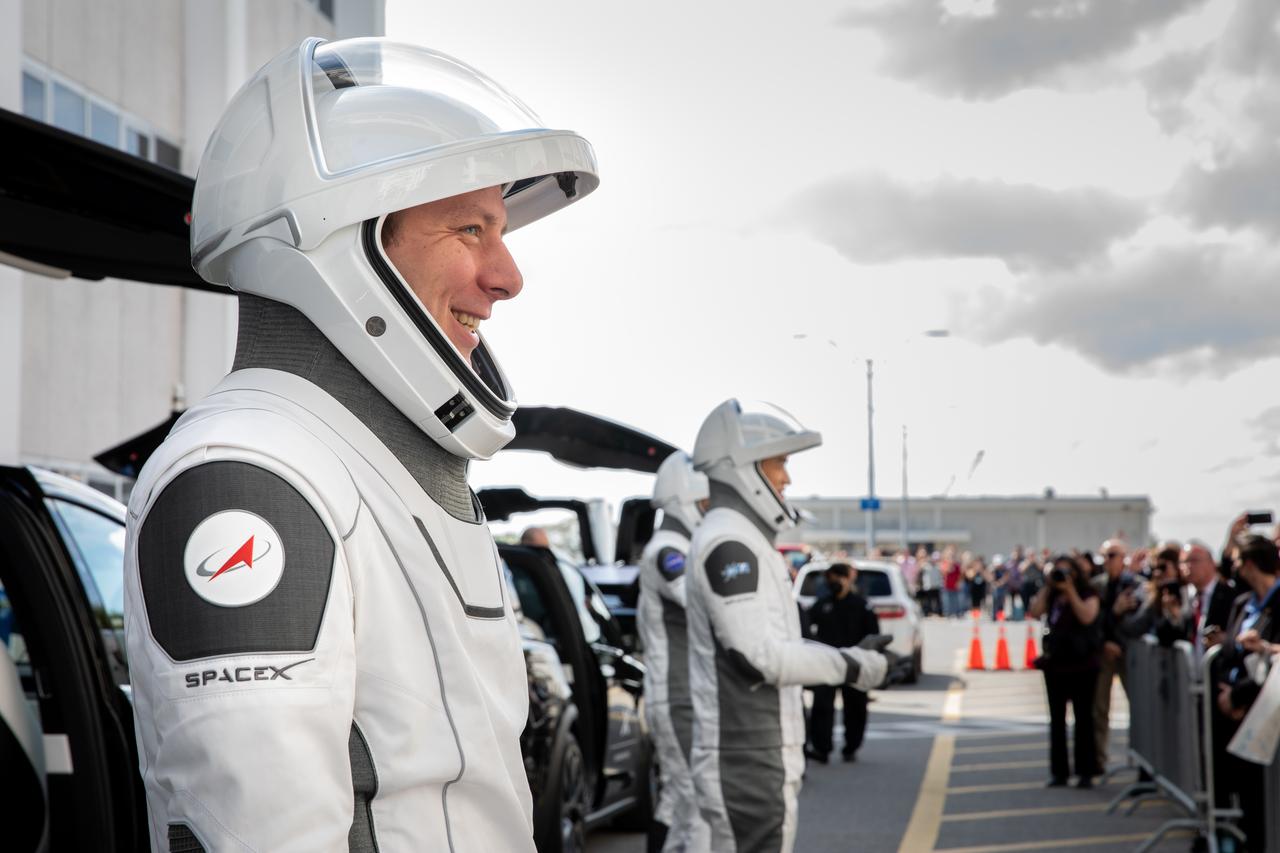
NASA’s SpaceX Crew-10 crew members wave to family and friends as they prepare to depart the Neil A. Armstrong Operations and Checkout Building at the agency’s Kennedy Space Center in Florida for nearby Launch Complex 39A for launch of Crew-10 on Friday, March 14, 2025. NASA astronauts Anne McClain and Nichole Ayers, along with JAXA (Japan Aerospace Exploration Agency) astronaut Takuya Onishi and Roscosmos cosmonaut Kirill Peskov are scheduled to lift off aboard SpaceX’s Dragon spacecraft and Falcon 9 rocket at 7:03 p.m. EDT. Crew-10 is the 10th crew rotation mission with SpaceX to the space station as part of the agency’s Commercial Crew Program.
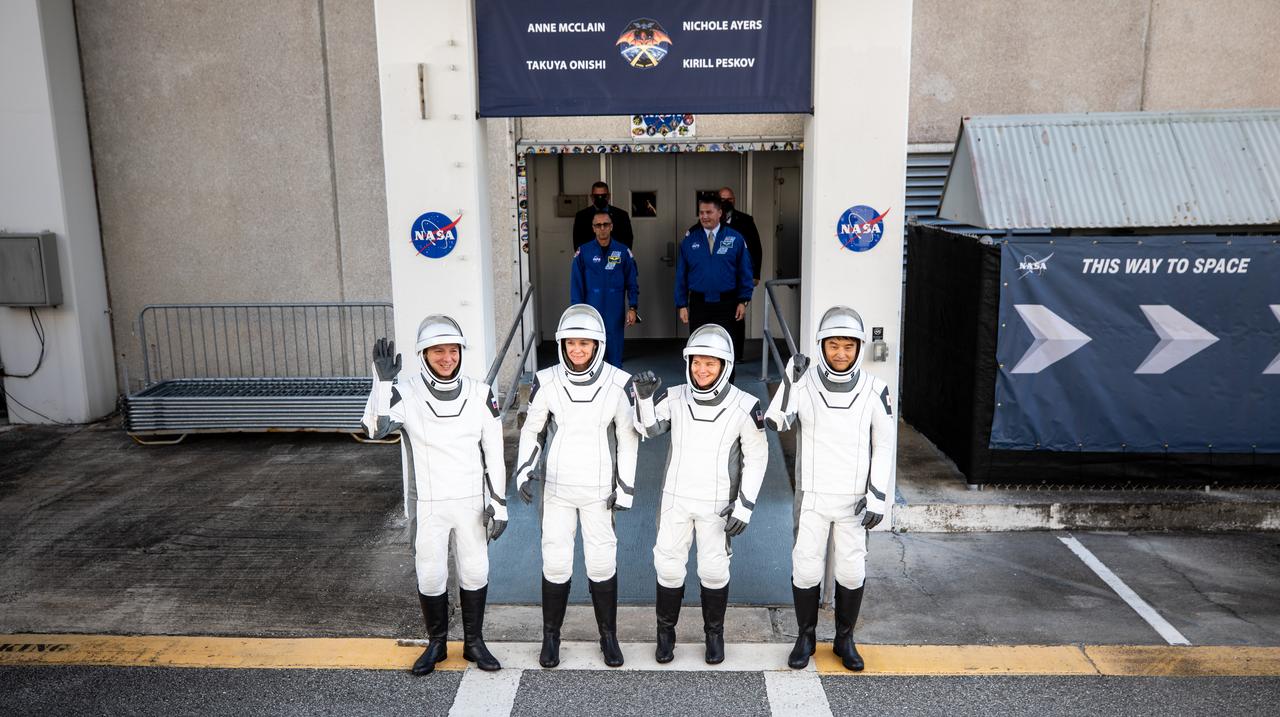
NASA’s SpaceX Crew-10 crew members wave to family and friends as they prepare to depart the Neil A. Armstrong Operations and Checkout Building at the agency’s Kennedy Space Center in Florida for nearby Launch Complex 39A for launch of Crew-10 on Wednesday, March 12, 2025. From left to right, Roscosmos cosmonaut Kirill Peskov, NASA astronauts Nichole Ayers and Anne McClain, along with JAXA (Japan Aerospace Exploration Agency) astronaut Takuya Onishi are scheduled to lift off aboard SpaceX’s Dragon spacecraft and Falcon 9 rocket at 7:48 p.m. EDT. Crew-10 is the 10th crew rotation mission with SpaceX to the space station as part of the agency’s Commercial Crew Program.
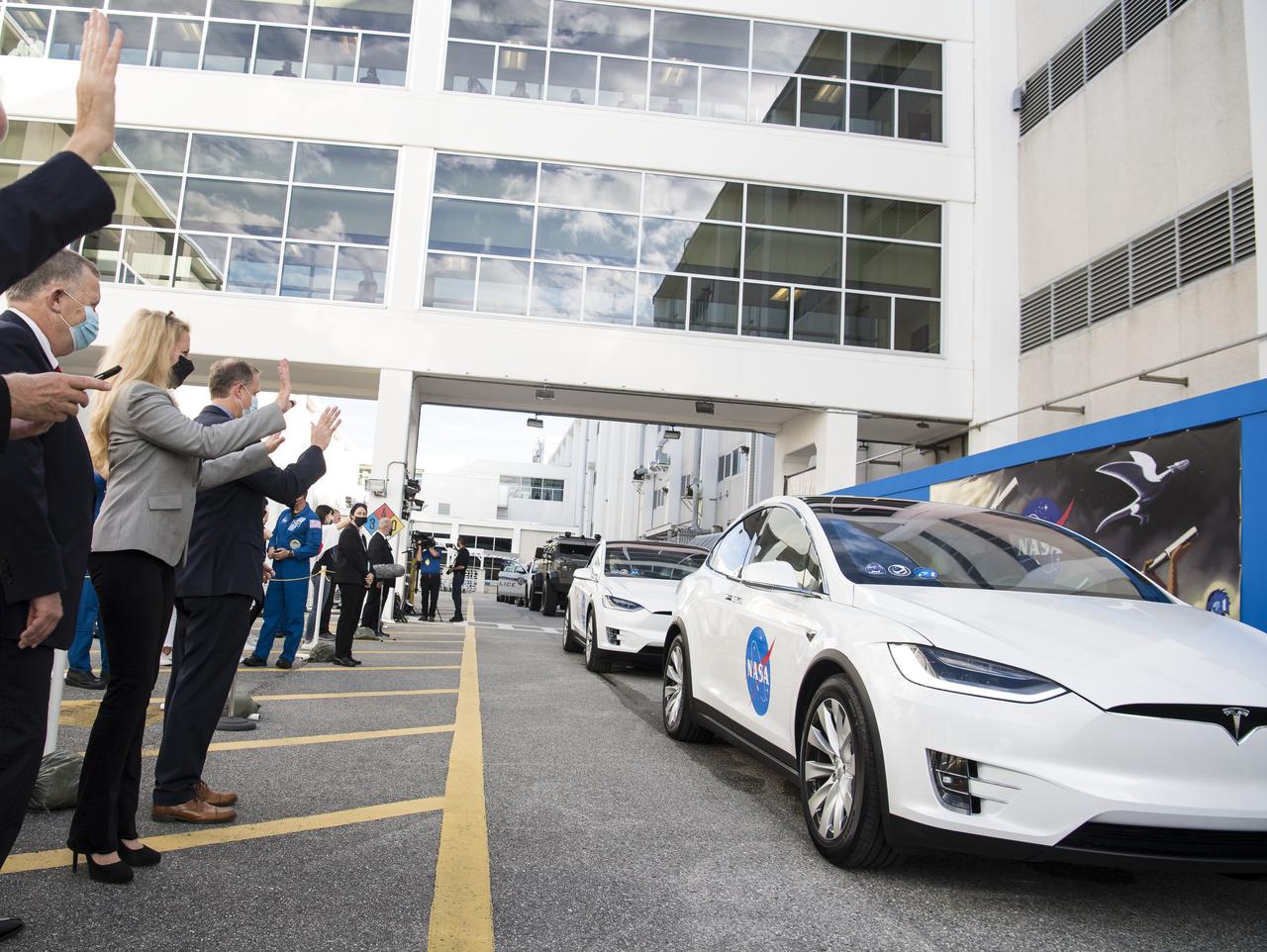
NASA Administrator Jim Bridenstine, Gwynne Shotwell, president and chief operating officer of SpaceX, and NASA Deputy Administrator Jim Morhard wave as NASA astronauts Mike Hopkins, Victor Glover, Shannon Walker, and Japan Aerospace Exploration Agency (JAXA) astronaut Soichi Noguchi, wearing SpaceX spacesuits, wave as they prepare to depart the Neil A. Armstrong Operations and Checkout Building for Launch Complex 39A to board the SpaceX Crew Dragon spacecraft for the Crew-1 mission launch, Sunday, Nov. 15, 2020, at NASA’s Kennedy Space Center in Florida. NASA’s SpaceX Crew-1 mission is the first crew rotation mission of the SpaceX Crew Dragon spacecraft and Falcon 9 rocket to the International Space Station as part of the agency’s Commercial Crew Program. NASA astronauts Mike Hopkins, Victor Glover, and Shannon Walker, and astronaut Soichi Noguchi of the Japan Aerospace Exploration Agency (JAXA) are scheduled to launch at 7:27 p.m. EST, from Launch Complex 39A at the Kennedy Space Center. Photo Credit: (NASA/Joel Kowsky)
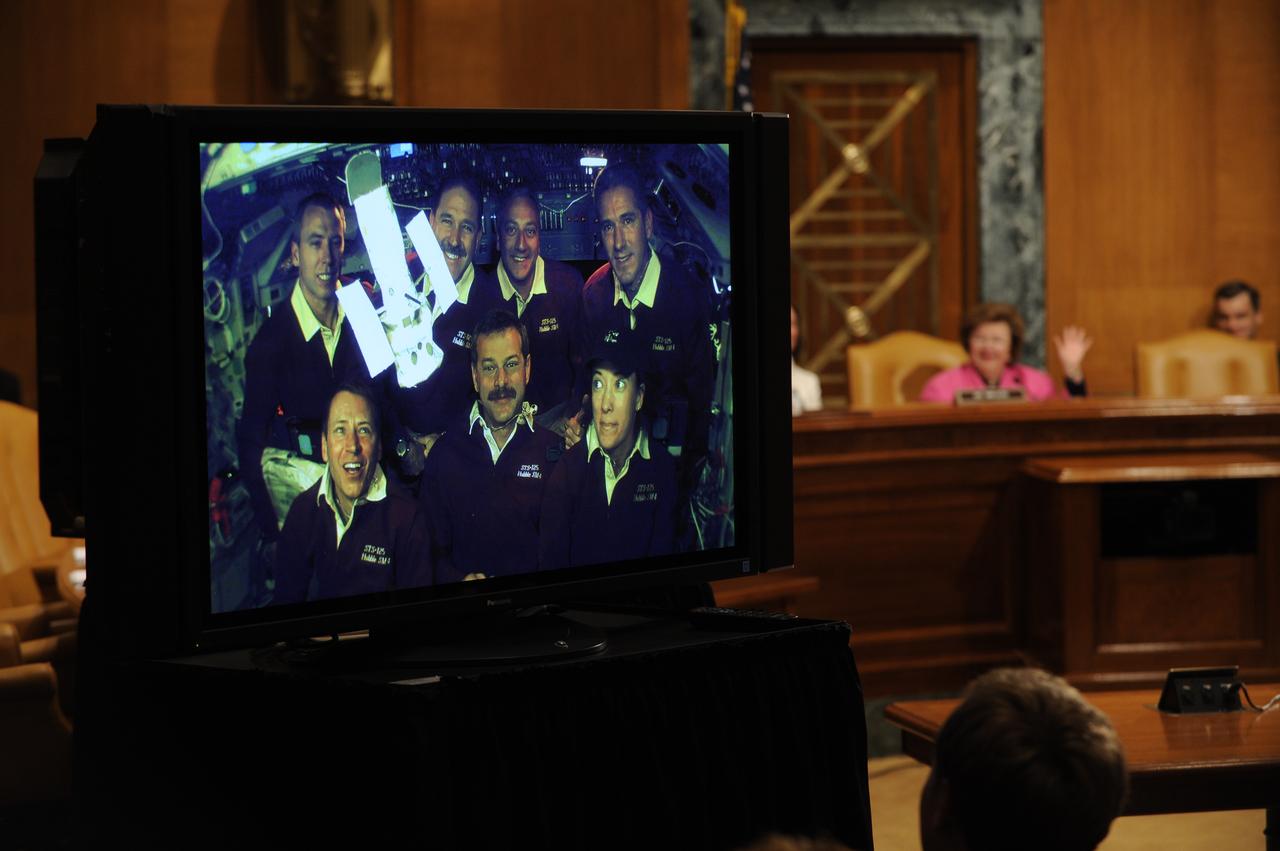
U.S. Sen. Barbara Mikulski, D-Md., rear right, waves to the crew of STS-125, at the end of a televised phone call to the space shuttle, Thursday, May 21, 2009, in a Dirksen Senate office building hearing room on Capitol Hill in Washington. The crew of STS-125 is returning to earth after finishing repairs on the Hubble Space Telescope. Photo Credit: (NASA/Paul E. Alers)
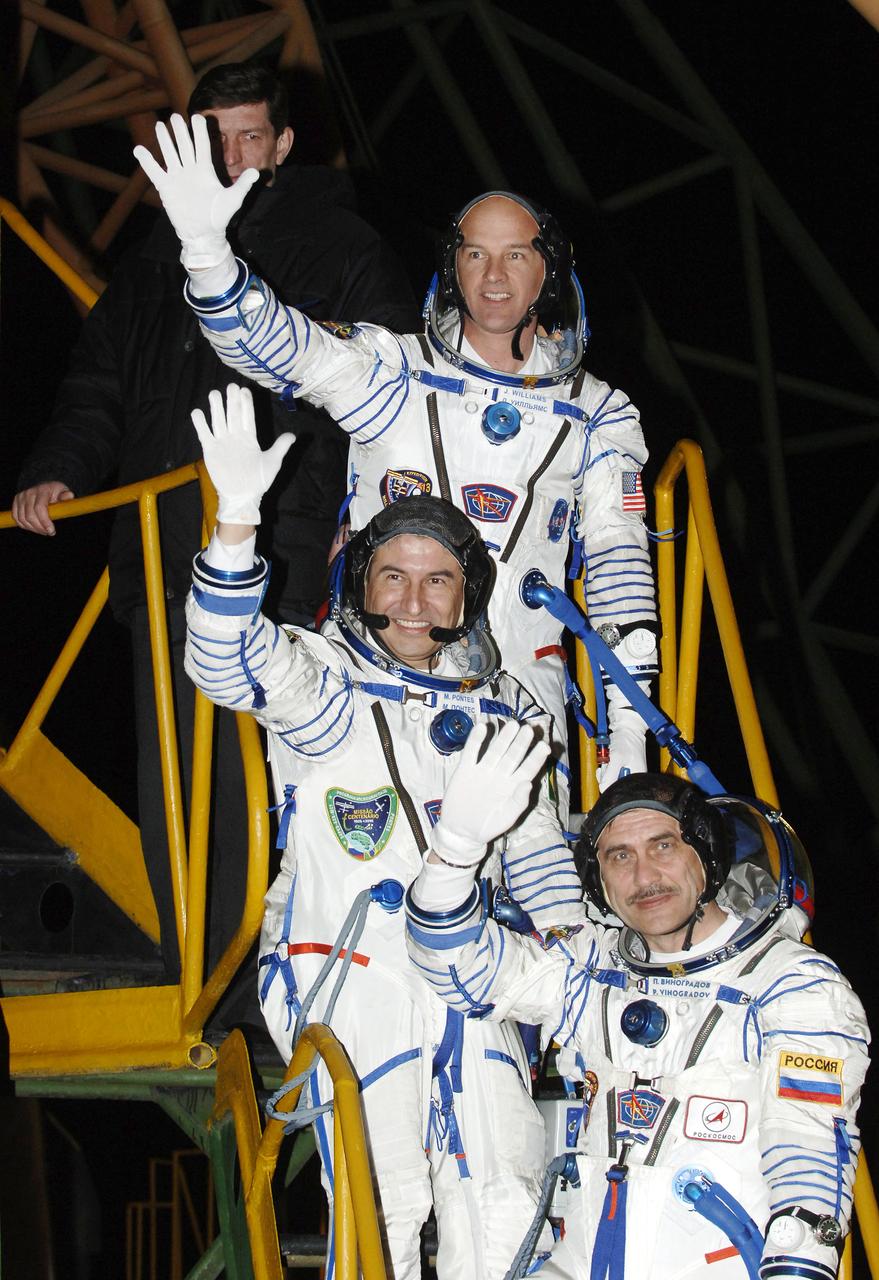
Expedition 13 prime crew members wave goodbye to the cameras at the launch pad. Jeffrey N. Williams, top, Science Officer and Flight Engineer; Marcos Pontes, Brazilian Space Agency Soyuz crew member; and Pavel V. Vinogradov, bottom, Commander. Baikonur, Kazakhstan. Thursday, March 30, 2006. Photo Credit: (NASA/Bill Ingalls)
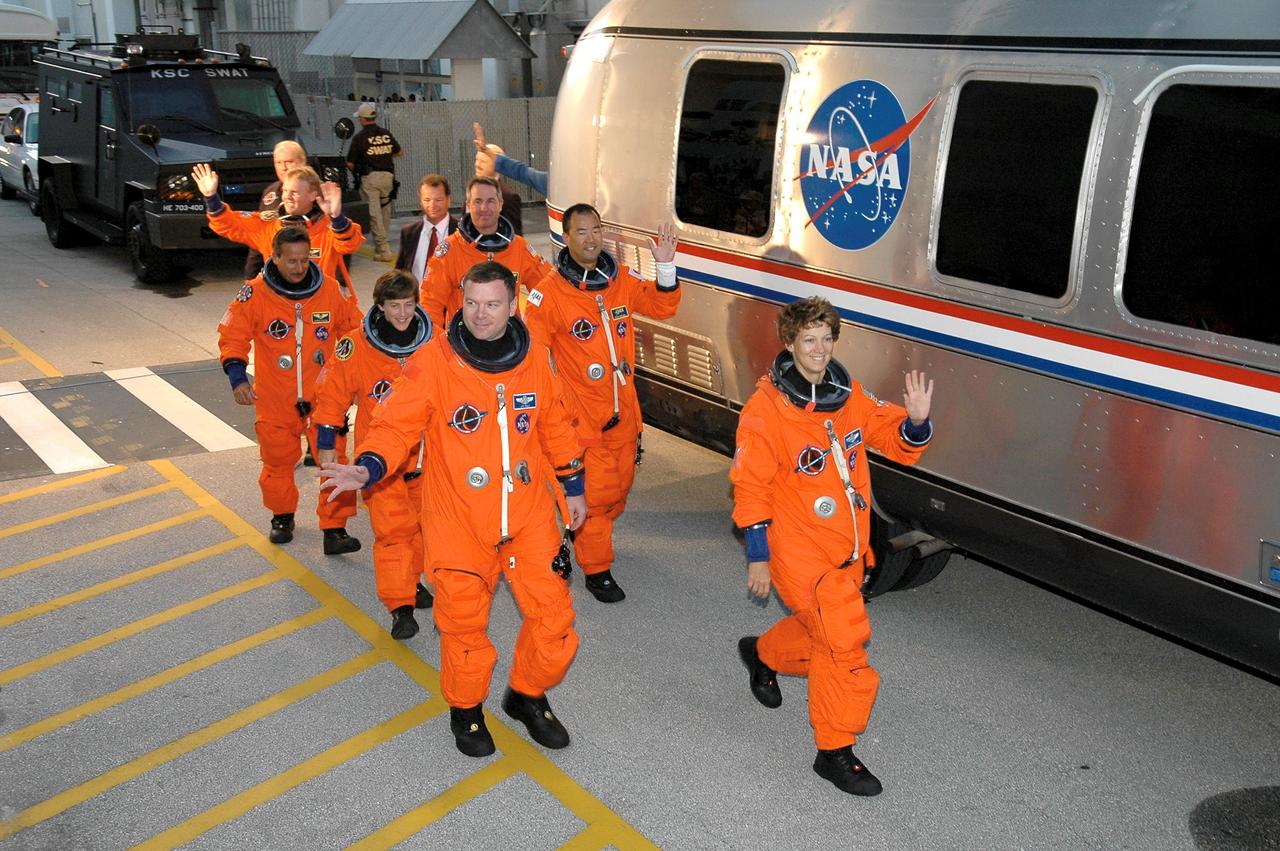
STS114-S-007 (26 July 2005) --- The STS-114 crew members, having donned their launch and entry suits, wave at KSC employees as they prepare to board the transfer van awaiting to take them to Launch Pad 39B. Eileen M. Collins, mission commander, leads the way. James M. Kelly, pilot, is at front left. Other crew members -- Wendy Lawrence, Andrew S.W. Thomas, Stephen K. Robinson, Charles J. Camarda and JAXA astronaut Soichi Noguchi -- follow.
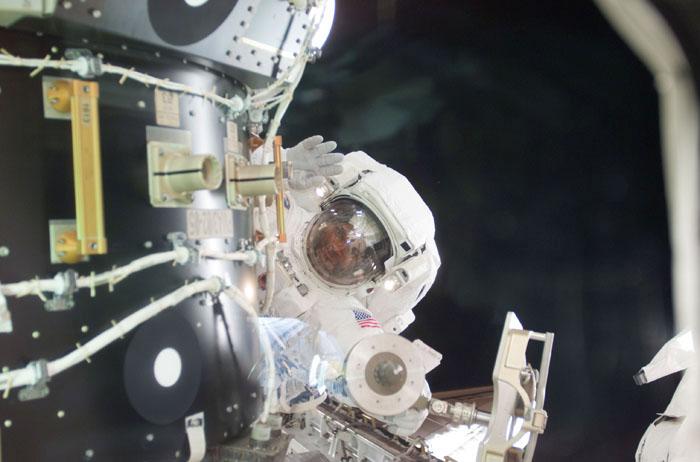
STS98-E-5190 (12 February 2001) --- Astronaut Robert L. Curbeam, STS-98 mission specialist, waves to a crew mate inside the Space Shuttle Atlantis' crew cabin from his position near Pressurized Mating Adapter (PMA-3) during the second of three scheduled space walks on 5a. The scene was recorded with a digital still camera.
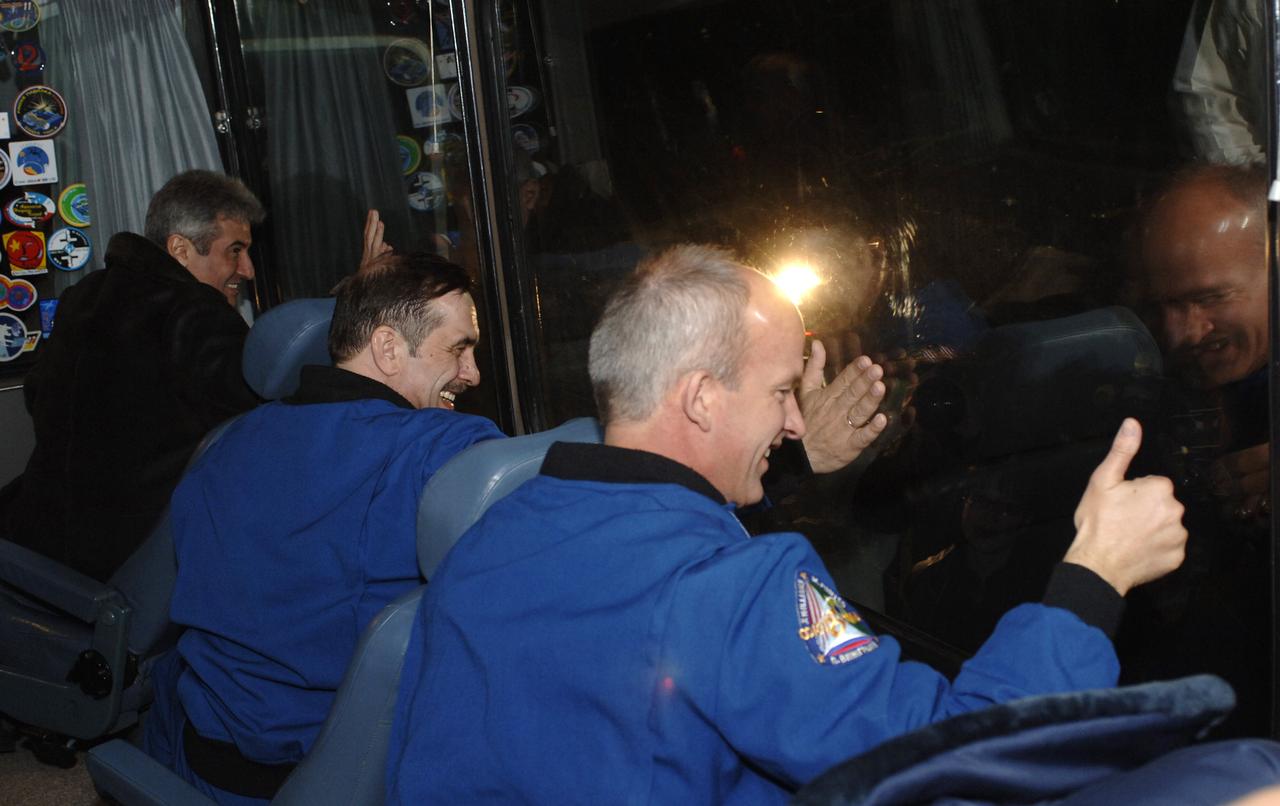
Marcos Pontes, left, Brazilian Space Agency Soyuz crew member, and Expedition 13 crew members, Pavel V. Vinogradov, Commander, and Jeffrey N. Williams, Science Officer and Flight Engineer, right, wave goodbye to friends and family at the Cosmonaut Hotel in Baikonur, Kazakhstan on Thursday, March 30, 2006. Photo Credit: (NASA/Bill Ingalls)

ISS039-E-020763 (13 May 2013) --- Inside the Unity node less than an hour before hatch closure on the Soyuz TMA-11M spacecraft, the Expedition 39 crew members wave good bye to crew members remaining on the International Space Station. From left to right are Expedition 39 Commander Koichi Wakata of the Japan Aerospace Exploration Agency, Soyuz Commander Mikhail Tyurin of Russia's Federal Space Agency (Roscosmos) and Flight Engineer Rick Mastracchio of NASA.
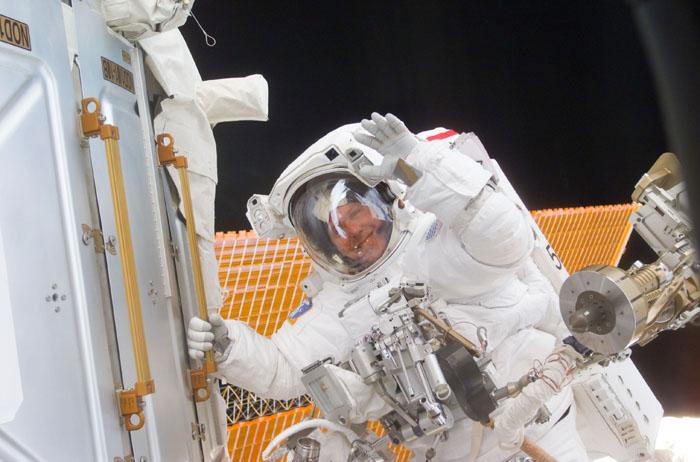
STS98-E-5195 (12 February 2001) --- Astronaut Thomas D. Jones, STS-98 mission specialist, waves at crew mates inside Atlantis' crew cabin while working on the International Space Station (ISS) during the second of three scheduled space walks involving himself and astronaut Robert L. Curbeam and assisted by their STS-98 astronauts aboard the Atlantis. The scene was recorded with a digital still camera.
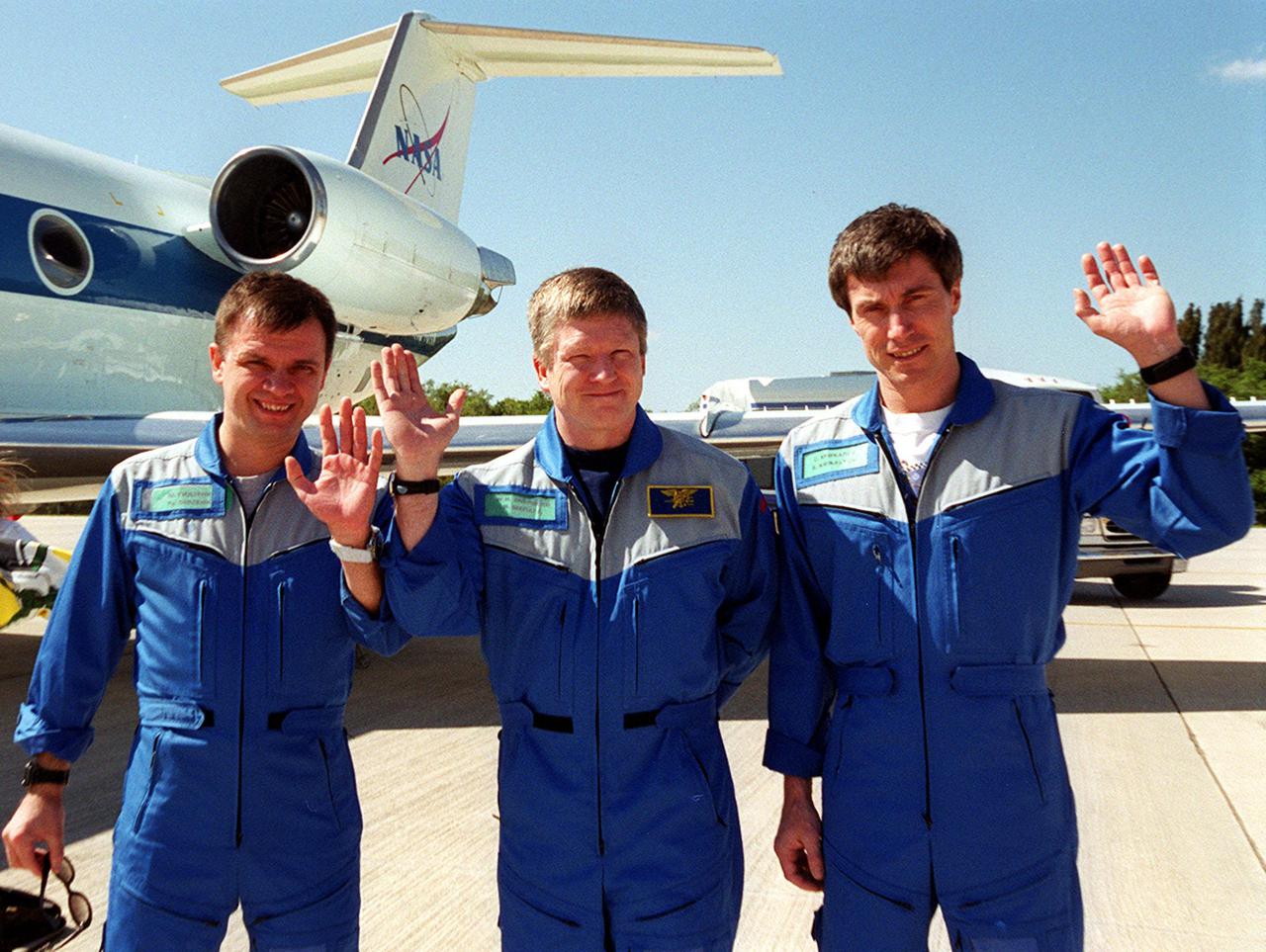
The International Space Station's Expedition One crew members wave at the camera and onlookers as they prepare to depart KSC from the Shuttle Landing Facility for their return to the Johnson Space Center in Houston. From left to right are Yuri Pavlovich Gidzenko, William M. Shepherd and Sergei Konstantinovich Krikalev. The crew returned to Earth aboard Discovery March 21, concluding mission STS-102
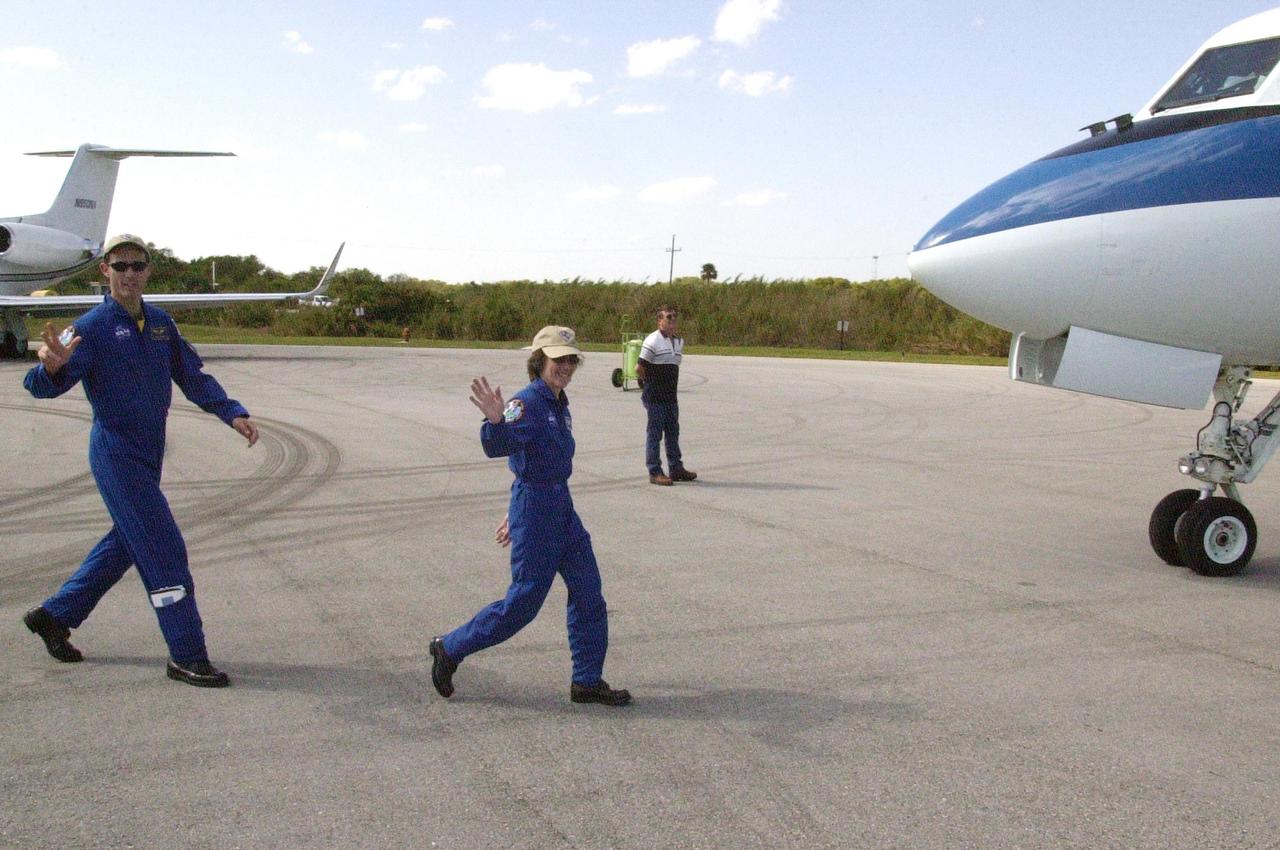
KENNEDY SPACE CENTER, FLA. - At the Cape Canaveral Air Force Station Skid Strip, STS-109 Mission Specialists James Newman and Nancy Currie wave to onlookers as they head for the aircraft and departure for Houston. The crew returned to KSC aboard Columbia March 12 after an 11-day mission servicing the Hubble Space Telescope. The other crew members are Commander Scott Altman, Pilot Duane Carey and Mission Specialists John Grunsfeld, Richard Linnehan and Michael Massimino
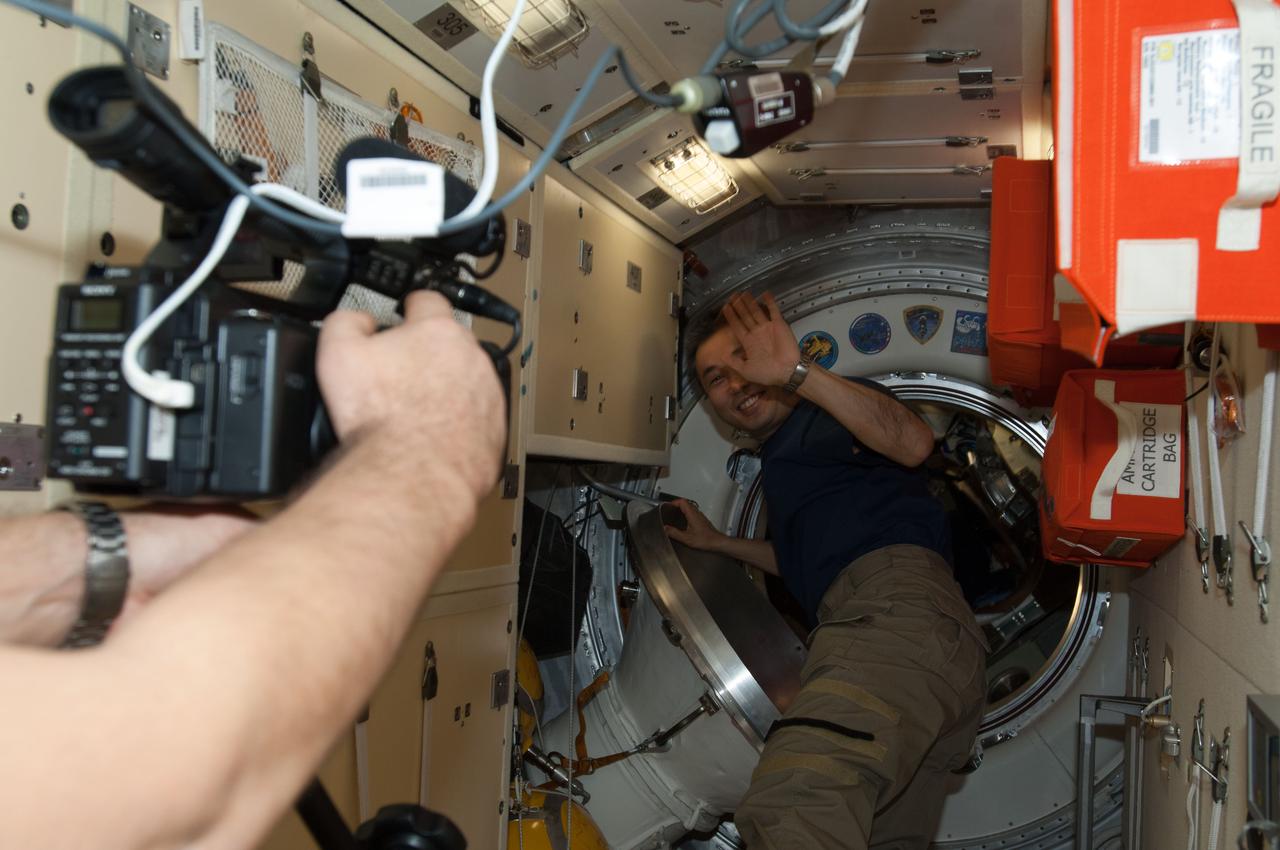
ISS039-E-020769 (13 May 2013) --- Expedition 39 Commander Koichi Wakata of the Japan Aerospace Exploration Agency waves good bye as one of the three remaining crew members on the orbital outpost records video of the crew departure. Already on the other side of the hatch are Expedition Flight Engineers Rick Mastracchio of NASA and Mikhail Tyurin of Russia's Federal Space Agency (Roscosmos).
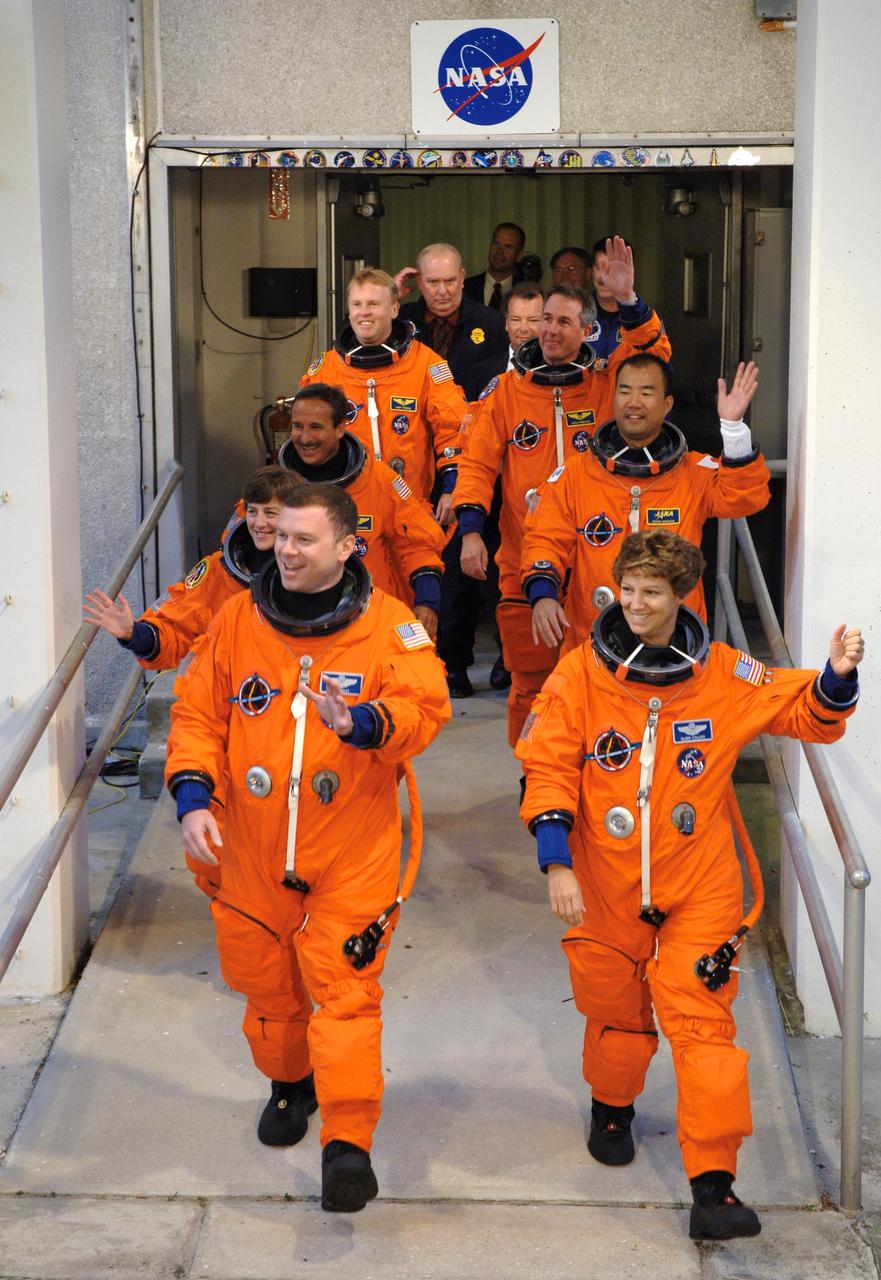
STS114-S-006 (26 July 2005) --- The STS-114 crew members, having donned their launch and entry suits, wave at KSC employees as they head out to the transfer van awaiting to take them to Launch Pad 39B. Eileen M. Collins, commander, leads the way. James M. Kelly, pilot, is at front left. Other crew members -- Wendy Lawrence, Andrew S.W. Thomas, Stephen K. Robinson, Charles J. Camarda and JAXA astronaut Soichi Noguchi--follow.
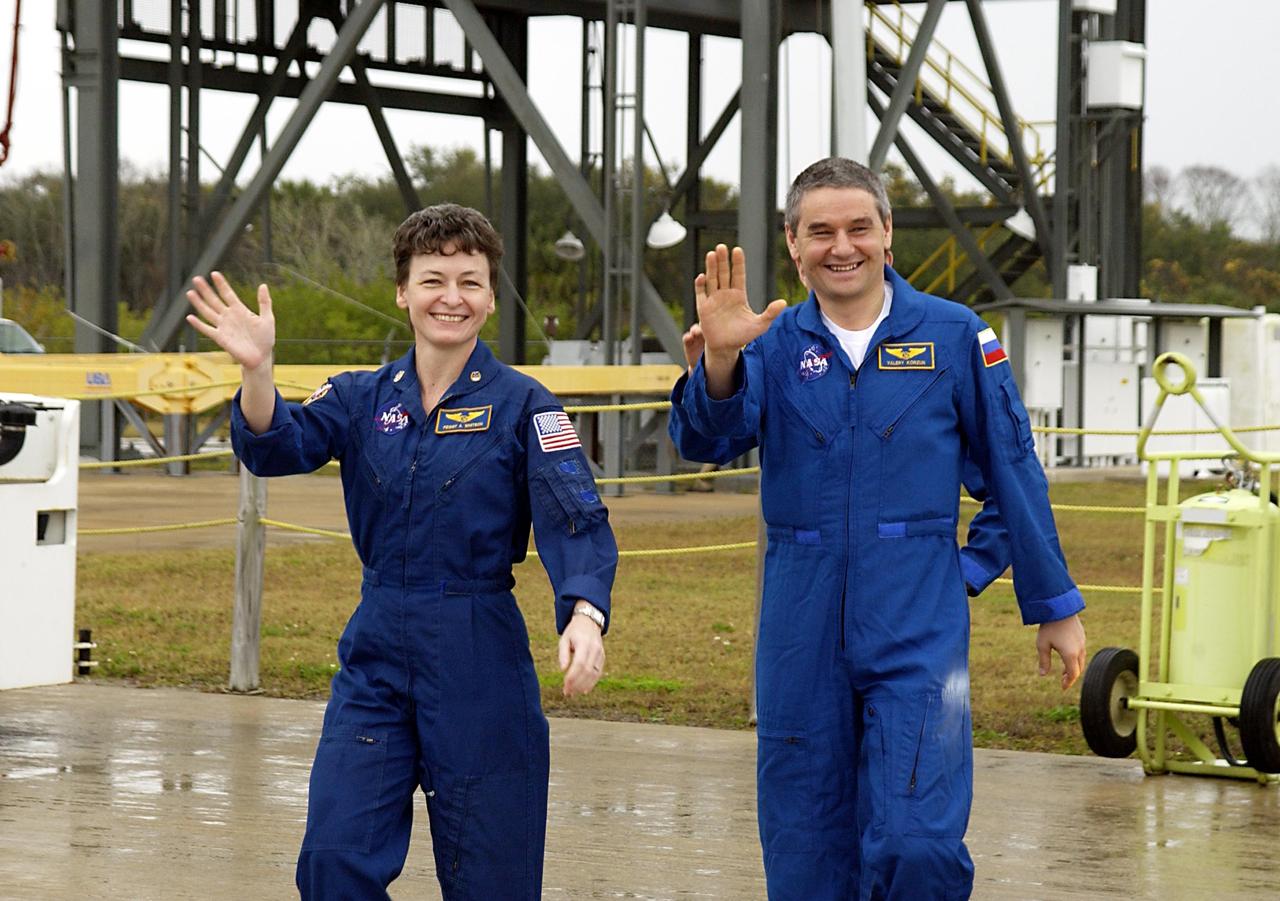
KENNEDY SPACE CENTER, FLA. -- Expedition Five crew members wave to onlookers as they leave KSC for Houston. From left are Science Officer Peggy Whitson and Commander Valery Korzun. Not seen is Flight Engineer Sergei Treschev. The three returned to Earth Dec. 7 on Endeavour, with the STS-113 crew, after six months on the International Space Station.
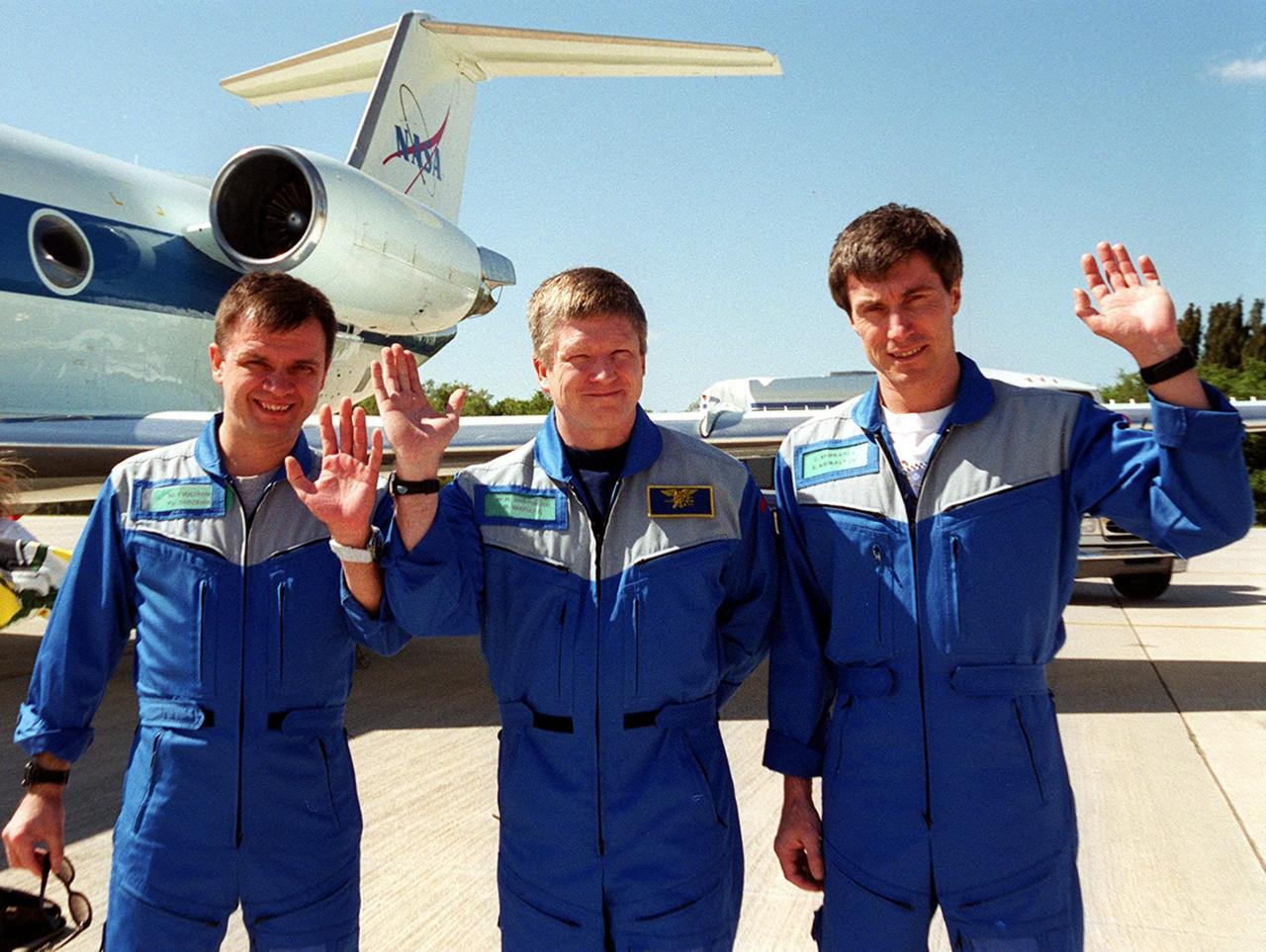
The International Space Station's Expedition One crew members wave at the camera and onlookers as they prepare to depart KSC from the Shuttle Landing Facility for their return to the Johnson Space Center in Houston. From left to right are Yuri Pavlovich Gidzenko, William M. Shepherd and Sergei Konstantinovich Krikalev. The crew returned to Earth aboard Discovery March 21, concluding mission STS-102
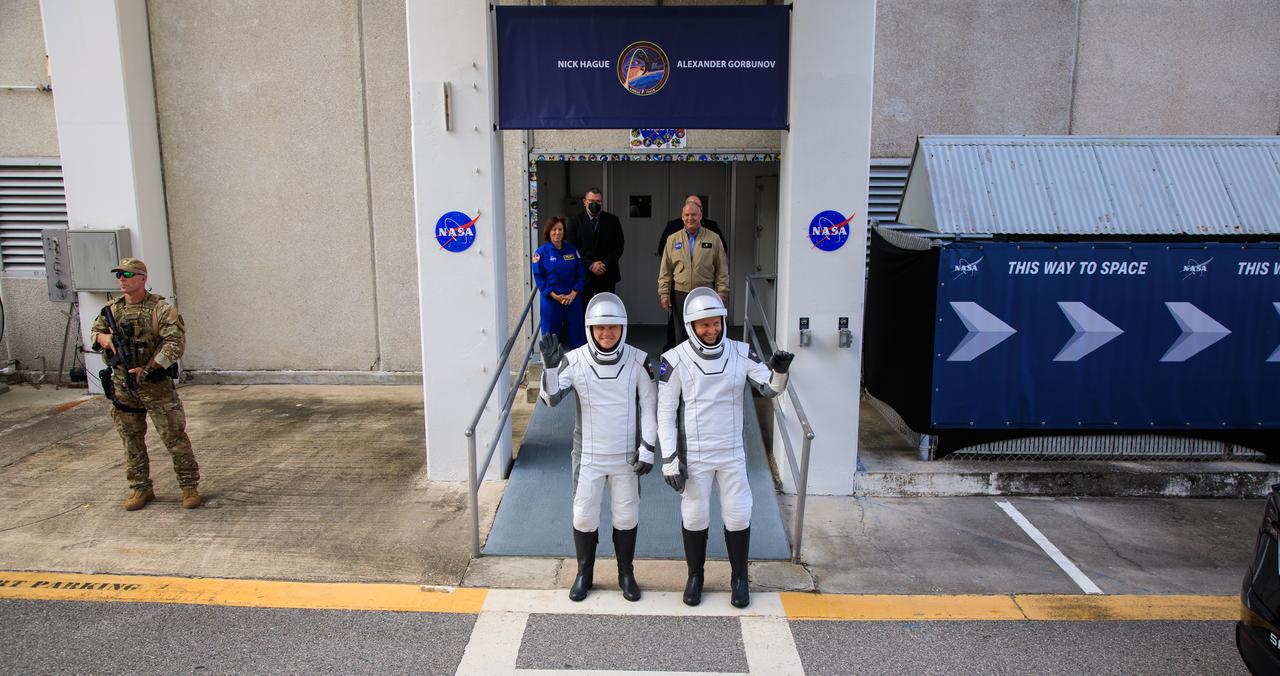
NASA’s SpaceX Crew-9 crew members wave to family and friends as they prepare to depart the Neil A. Armstrong Operations and Checkout Building at the agency’s Kennedy Space Center in Florida for nearby Space Launch Complex-40 at Cape Canaveral Space Force Station for launch of Crew-9 on Saturday, Sept. 28, 2024. NASA astronaut Nick Hague (lright) and Roscosmos cosmonaut Aleksandr Gorbunov will launch to the International Space Station aboard SpaceX’s Dragon spacecraft and Falcon 9 rocket. Launch is targeted for 1:17 p.m. EDT for the ninth crew rotation mission with SpaceX to the space station as part of the agency’s Commercial Crew Program.
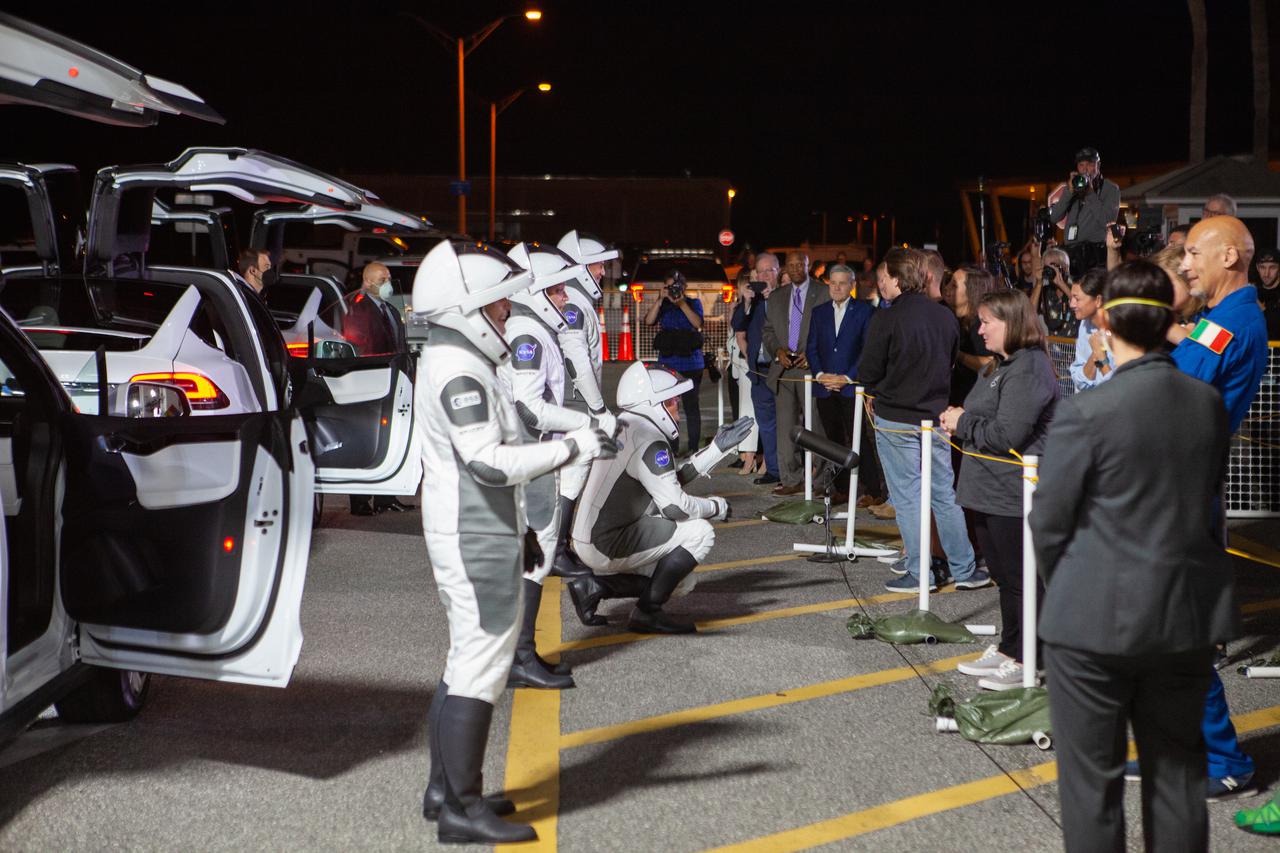
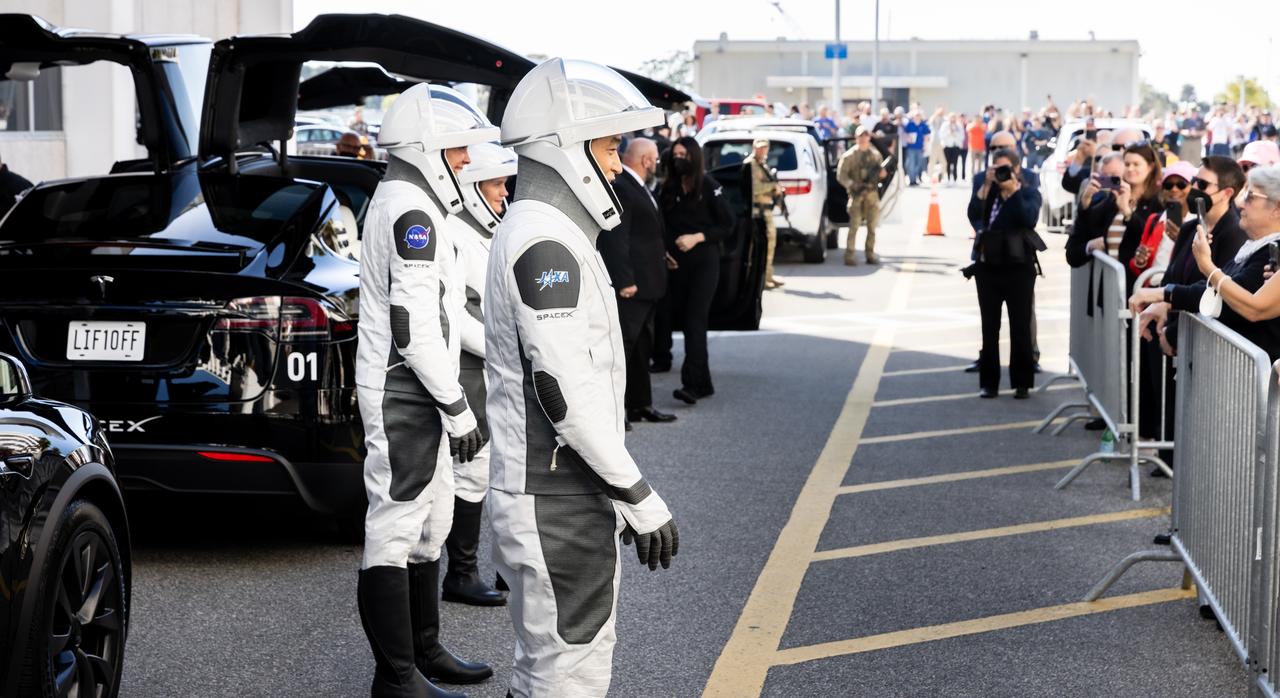
Crew-4 astronauts Kjell Lindgren, Samantha Cristoforetti, Bob Hines, and Jessica Watkins wave to their families outside of the Neil Armstrong Operations and Checkout Building at NASA’s Kennedy Space Center in Florida before getting into the customized Tesla Model X vehicles that will transport them to their spacecraft at Launch Complex 39A. SpaceX’s Crew Dragon, powered by the company’s Falcon 9 rocket, will carry the four-person crew to the International Space Station as part of NASA’s Commercial Crew Program. Crew-4 is scheduled to launch today at 3:52 a.m. EDT, from Pad 39A at Kennedy.
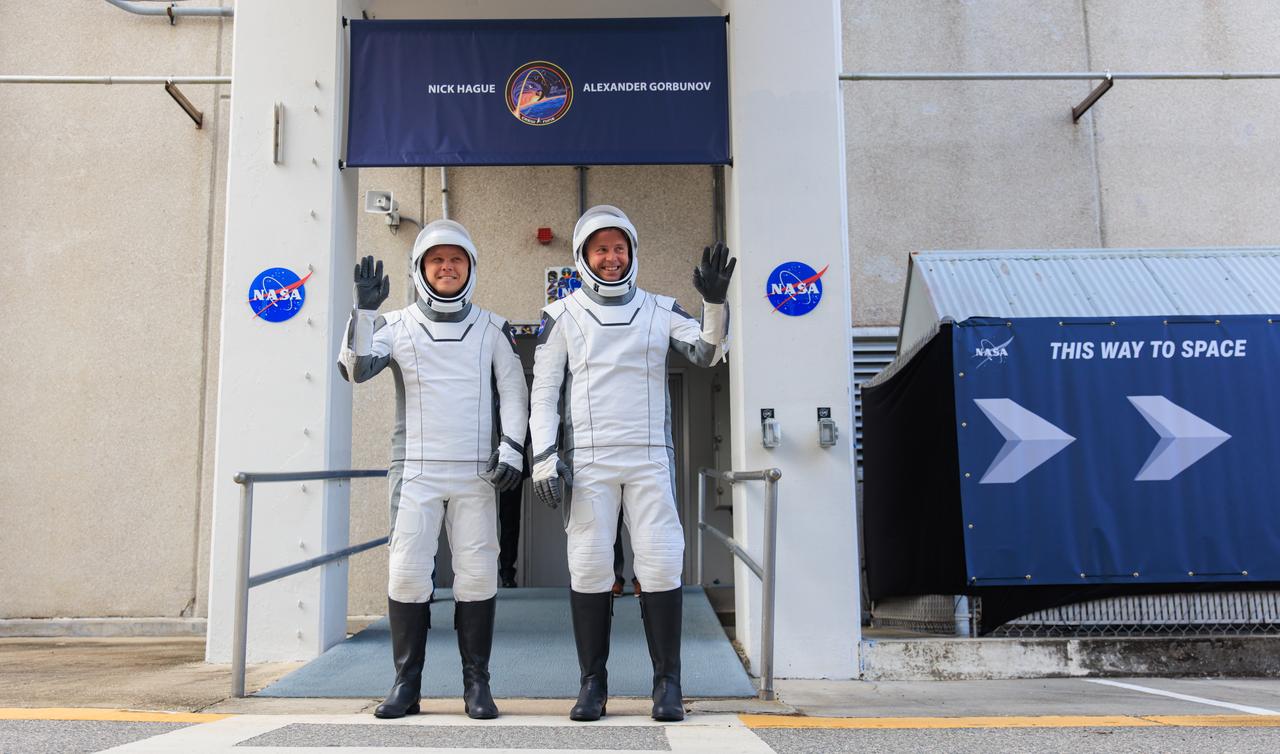
NASA’s SpaceX Crew-9 crew members wave to family and friends as they prepare to depart the Neil A. Armstrong Operations and Checkout Building at the agency’s Kennedy Space Center in Florida for nearby Space Launch Complex-40 at Cape Canaveral Space Force Station for launch of Crew-9 on Saturday, Sept. 28, 2024. NASA astronaut Nick Hague (lright) and Roscosmos cosmonaut Aleksandr Gorbunov will launch to the International Space Station aboard SpaceX’s Dragon spacecraft and Falcon 9 rocket. Launch is targeted for 1:17 p.m. EDT for the ninth crew rotation mission with SpaceX to the space station as part of the agency’s Commercial Crew Program.
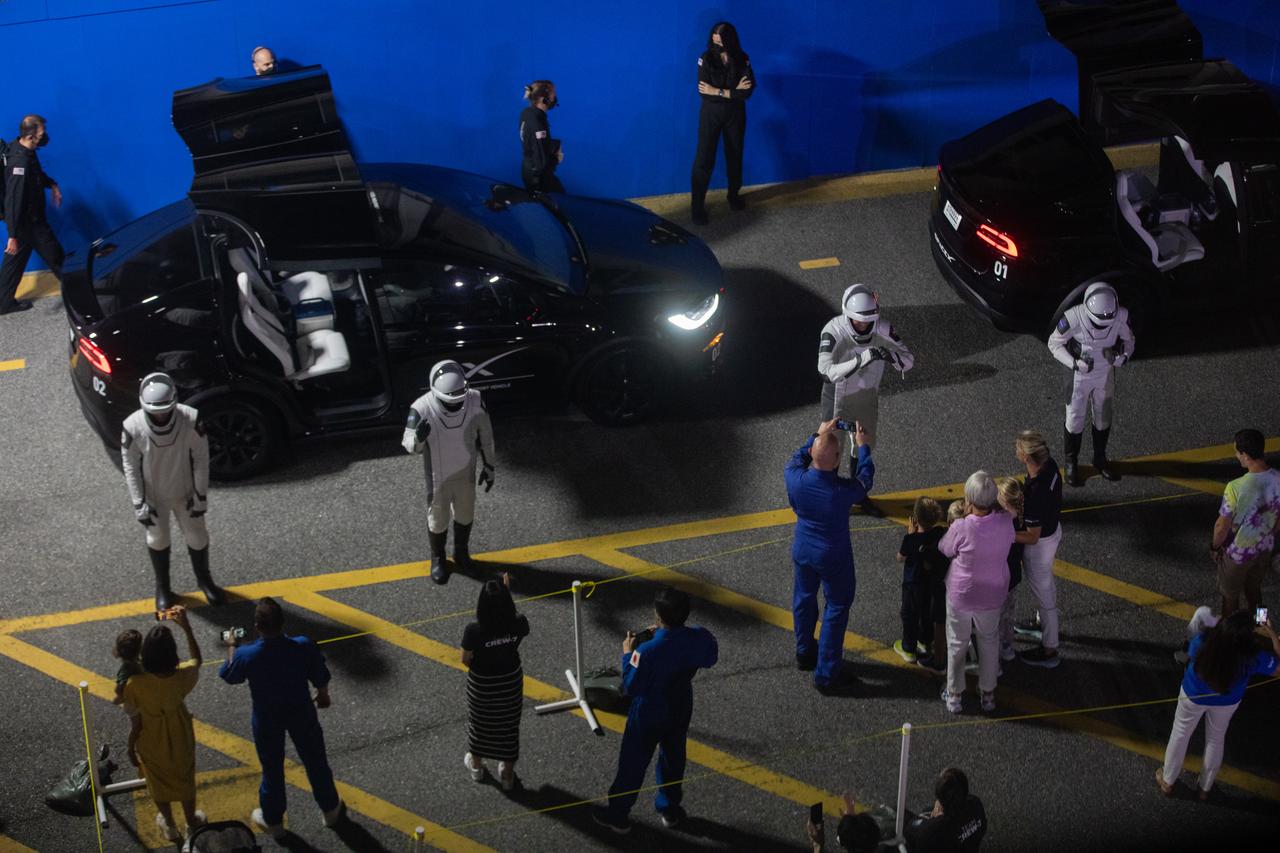
NASA’s SpaceX Crew-7 crew members Jasmin Moghbeli, Andreas Mogensen, Satoshi Furukawa, and Konstantin Borisov wave to their families and friends on Saturday, Aug. 26, 2023, outside of the Neil Armstrong Operations and Checkout Building at NASA’s Kennedy Space Center in Florida. Next, they will get into the customized Tesla Model X vehicles that will transport them to Kennedy’s Launch Complex 39A. SpaceX’s Dragon spacecraft, powered by the company’s Falcon 9 rocket, will carry the four-person crew to the International Space Station as part of NASA’s Commercial Crew Program. Crew-7 is scheduled to launch at 3:27 a.m. EDT.
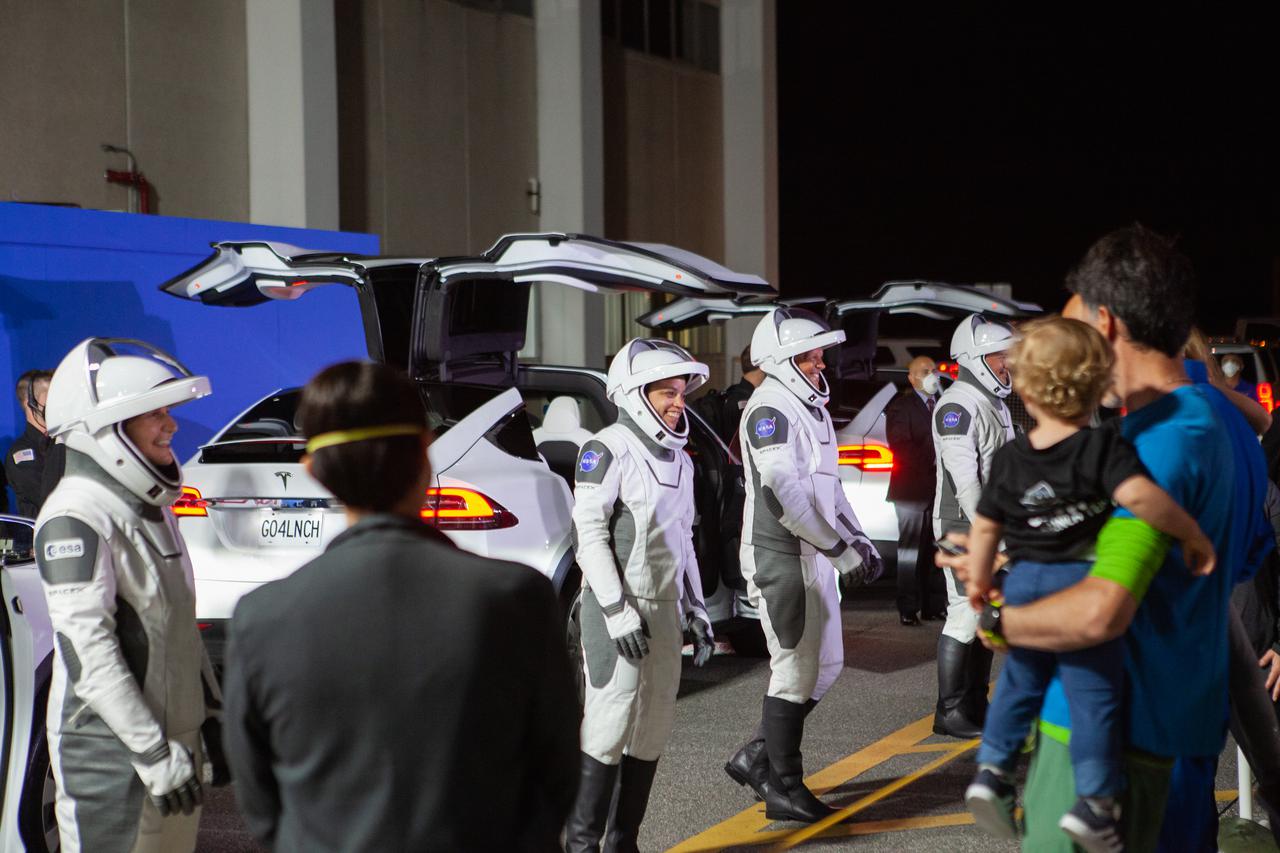
Crew-4 astronauts Kjell Lindgren, Samantha Cristoforetti, Bob Hines, and Jessica Watkins wave to their families outside of the Neil Armstrong Operations and Checkout Building at NASA’s Kennedy Space Center in Florida before getting into the customized Tesla Model X vehicles that will transport them to their spacecraft at Launch Complex 39A. SpaceX’s Crew Dragon, powered by the company’s Falcon 9 rocket, will carry the four-person crew to the International Space Station as part of NASA’s Commercial Crew Program. Crew-4 is scheduled to launch today at 3:52 a.m. EDT, from Pad 39A at Kennedy.
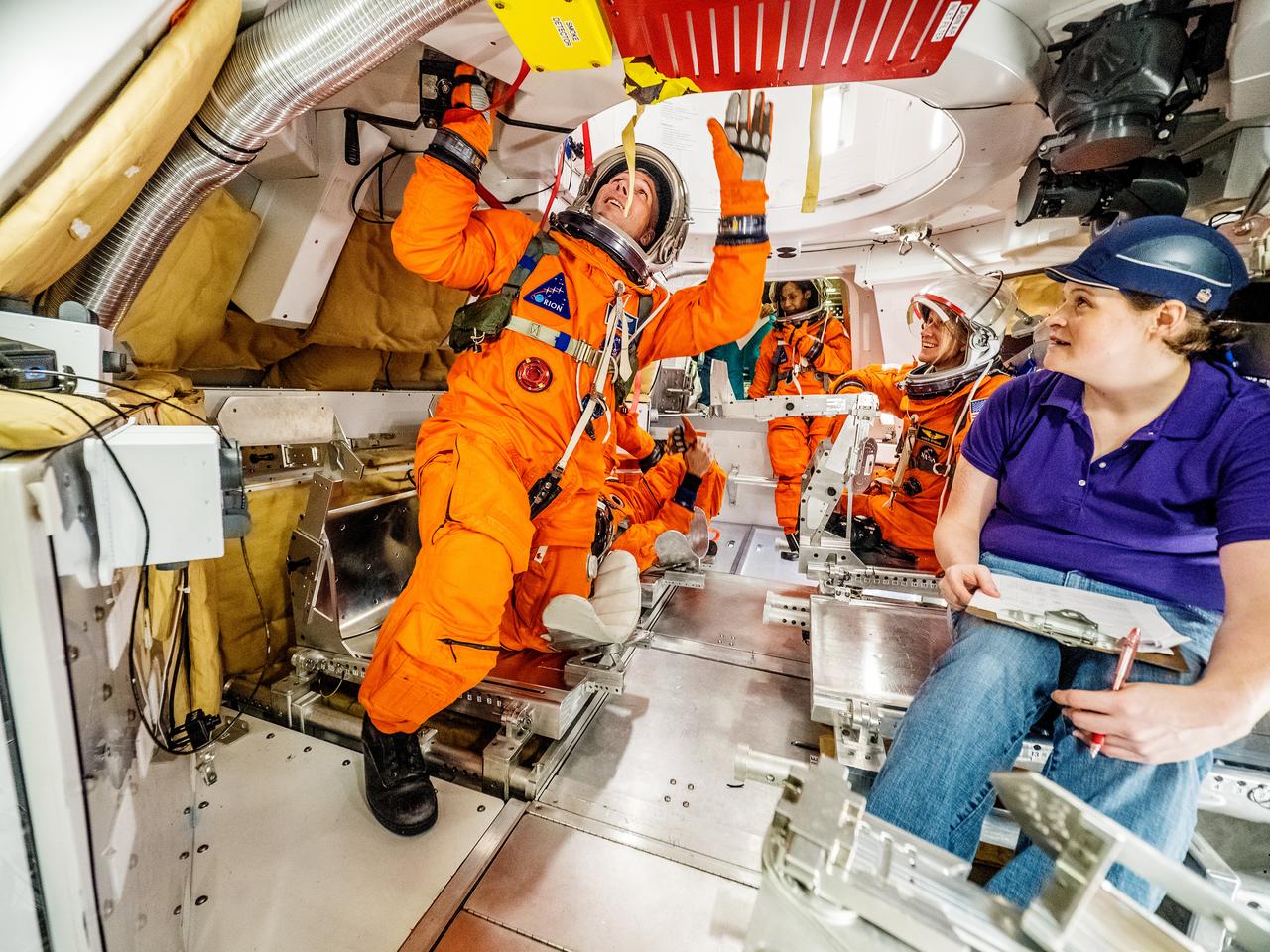
Engineers and astronauts conduct testing in a representative model of the Orion spacecraft at NASA’s Johnson Space Center in Houston on July 28, 2016 to gather the crew's feedback on the design of the docking hatch and on post-landing equipment operations. ..While the crew will primarily use the side hatch for entry and exit on Earth and the docking hatch to travel between Orion and a habitation module on long-duration deep space missions, the crew will need to be able to exit out of the docking hatch if wave heights in the Pacific Ocean upon splashdown are too high. The work is being done to help ensure all elements of Orion's design are safe and effective for the crew to use on future missions on the journey to Mars.
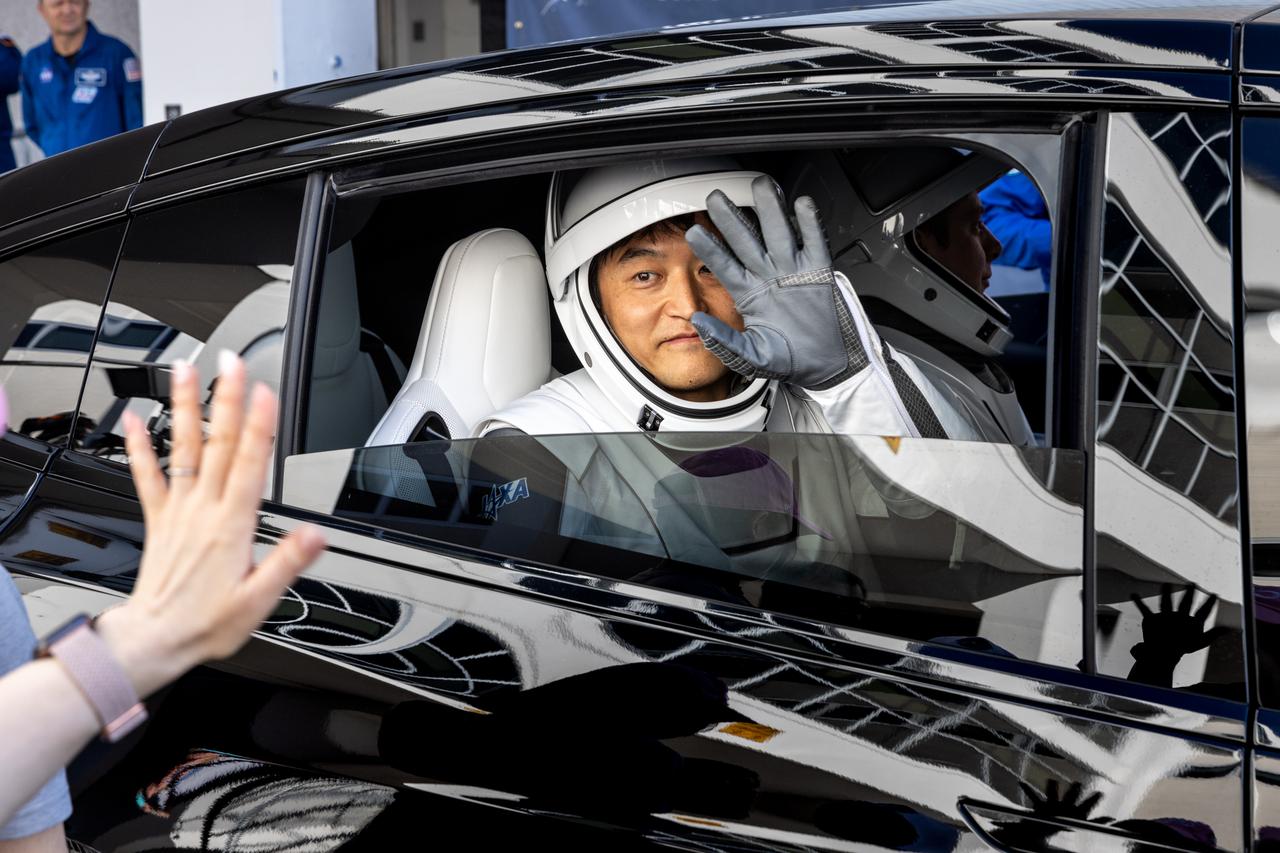
JAXA (Japan Aerospace Exploration Agency) astronaut Takuya Onishi waves from the convoy carrying NASA’s SpaceX Crew-10 from the Neil A. Armstrong Operations and Checkout Building at the agency’s Kennedy Space Center in Florida to nearby Launch Complex 39A ahead of launch on Wednesday, March 12, 2025. NASA astronauts Anne McClain and Nichole Ayers, along with Onishi and Roscosmos cosmonaut Kirill Peskov are scheduled to lift off aboard SpaceX’s Dragon spacecraft and Falcon 9 rocket at 7:48 p.m. EDT. Crew-10 is the 10th crew rotation mission with SpaceX to the space station as part of the agency’s Commercial Crew Program.