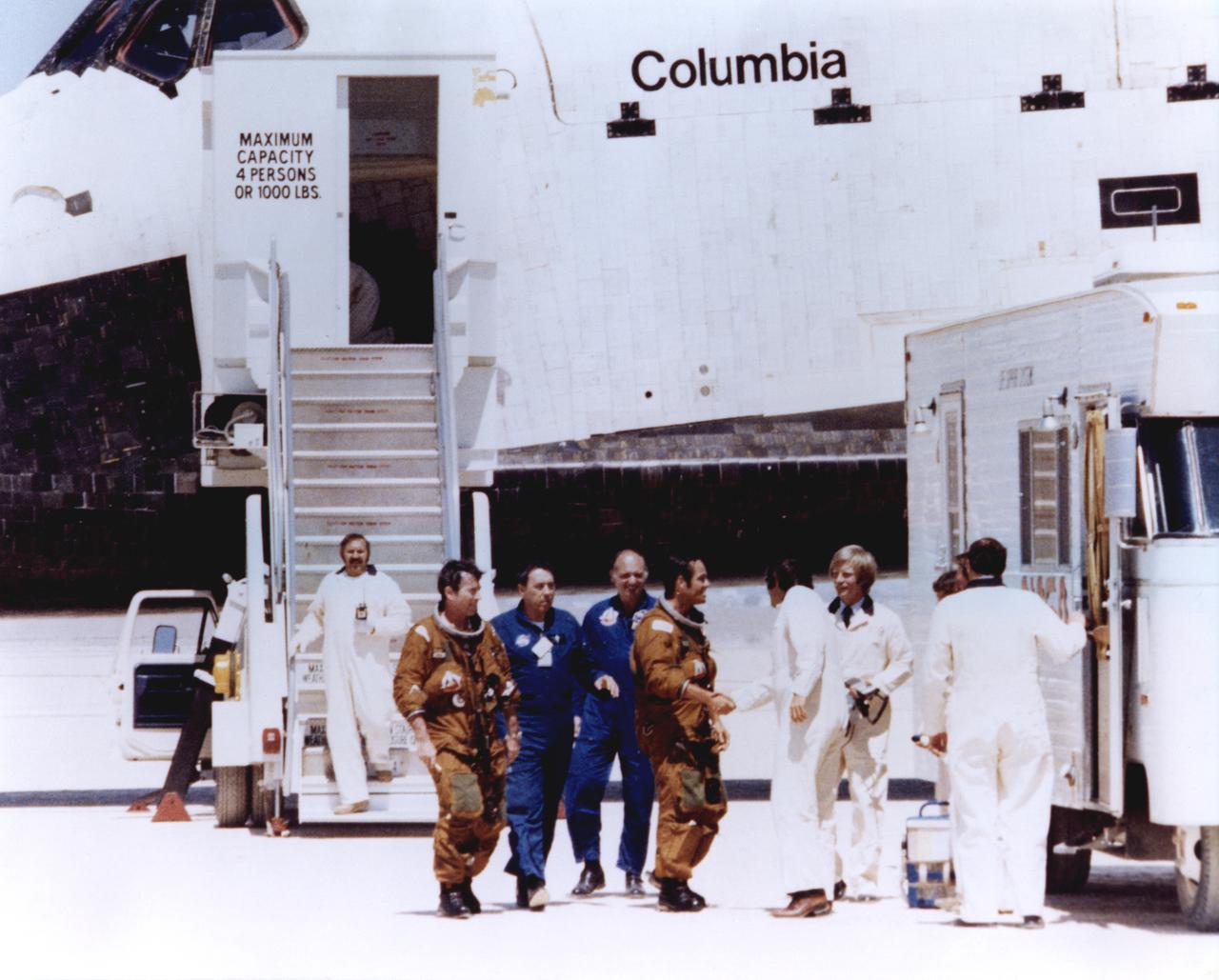
WELCOME HOME -- Space Shuttle astronauts John Young and Robert Crippen (in tan space suits) are greeted by members of the ground crew moments after stepping off the shuttle Columbia following its first landing at Edwards Air Force Base, Calif. Young and Crippen had piloted the Columbia on its first orbital space mission, April 12 - 14, 1981.
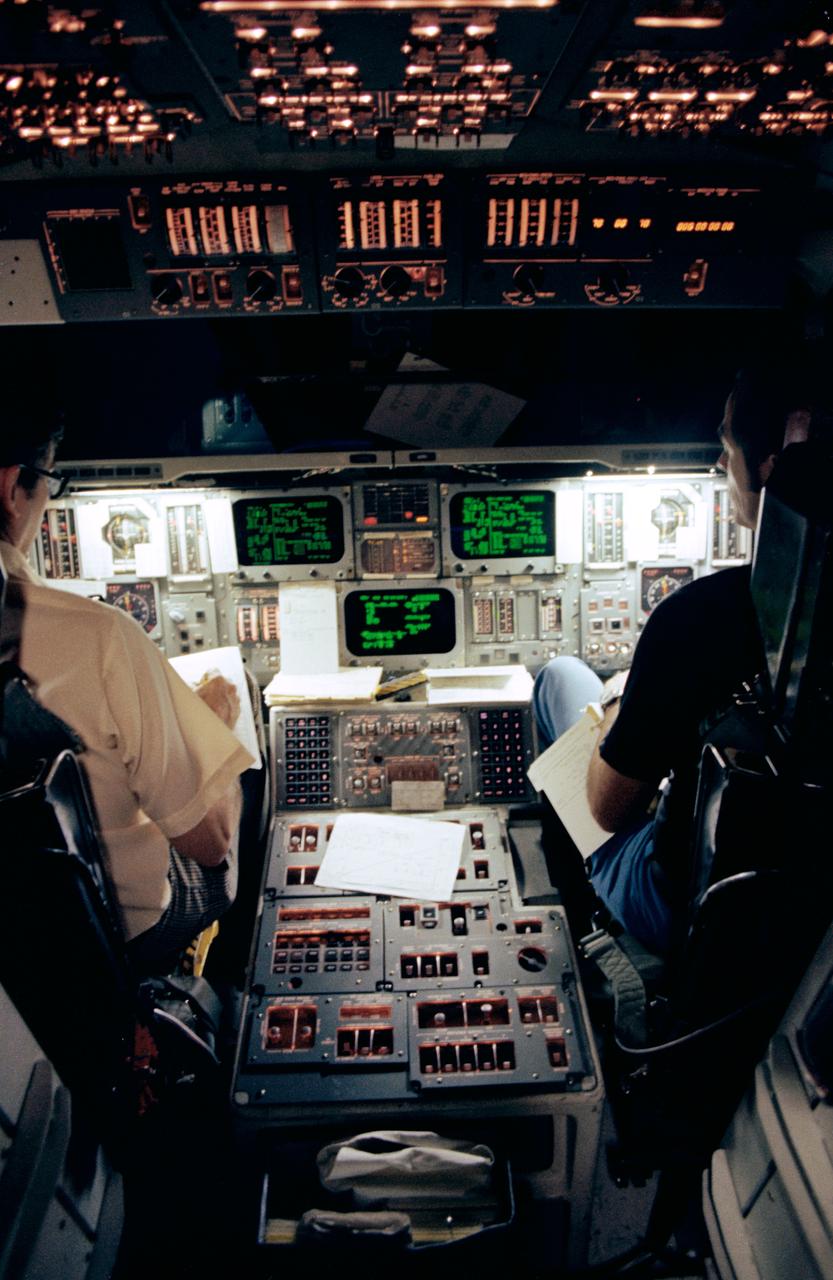
S79-31075 (5 April 1979) --- Astronauts John W. Young, left, and Robert L. Crippen, crewmen for the first space transportation system (STS-1) mission, go over a check off list during simulations in the Johnson Space Center?s shuttle mission simulator in the mission simulation and training facility. Young will be crew commander and Crippen, pilot, for the mission-shuttle?s initial orbital flight test (OFT). Photo credit: NASA
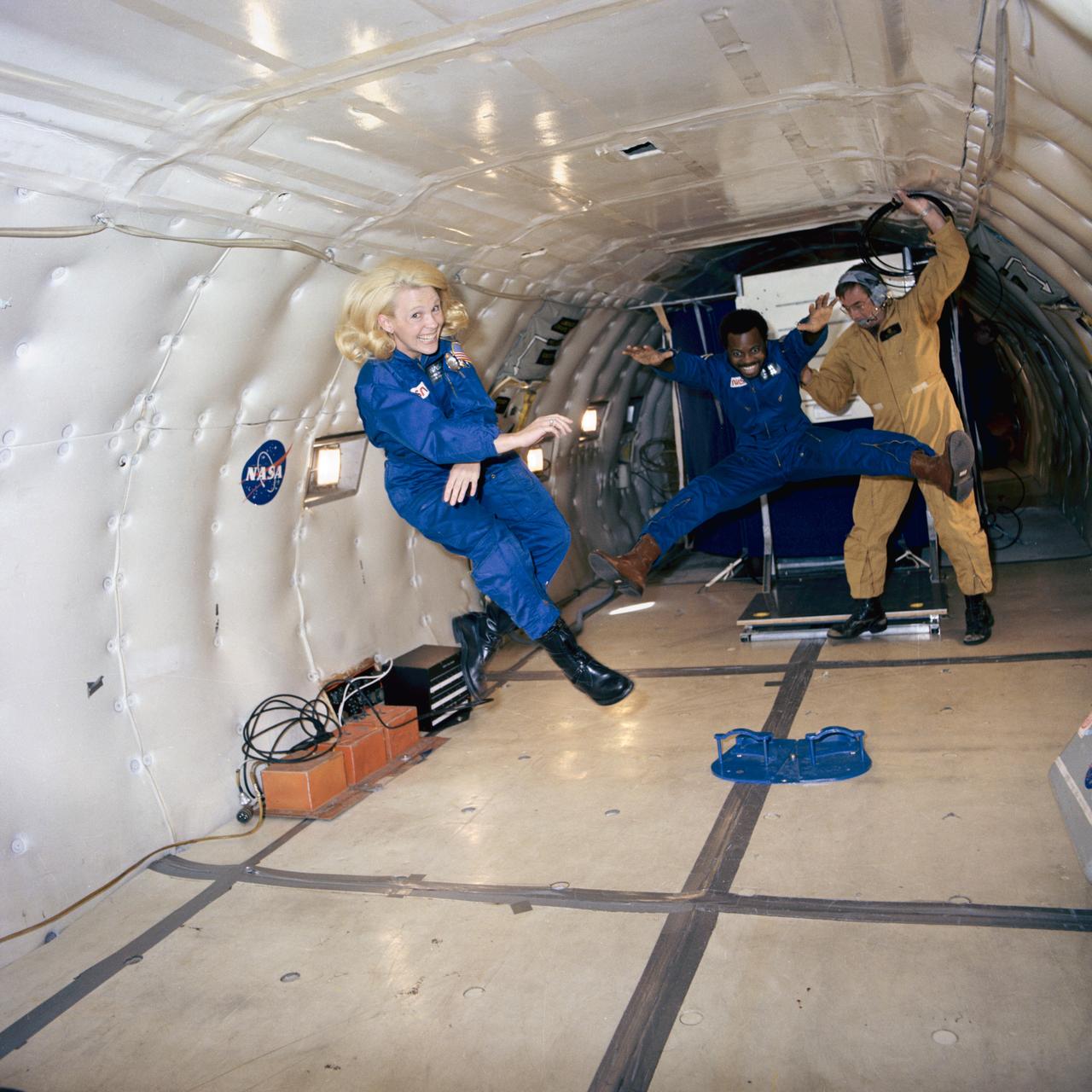
Zero-gravity experiments in KC-135 conducted by John Young, Robert L. Crippen, Joseph Kerwin, and Margaret Seddon. 1. Kerwin, Joseph - Zero-G 2. Seddon, Margaret - Zero-G 3. Young, John - Zero-G 4. Aircraft - KC-135
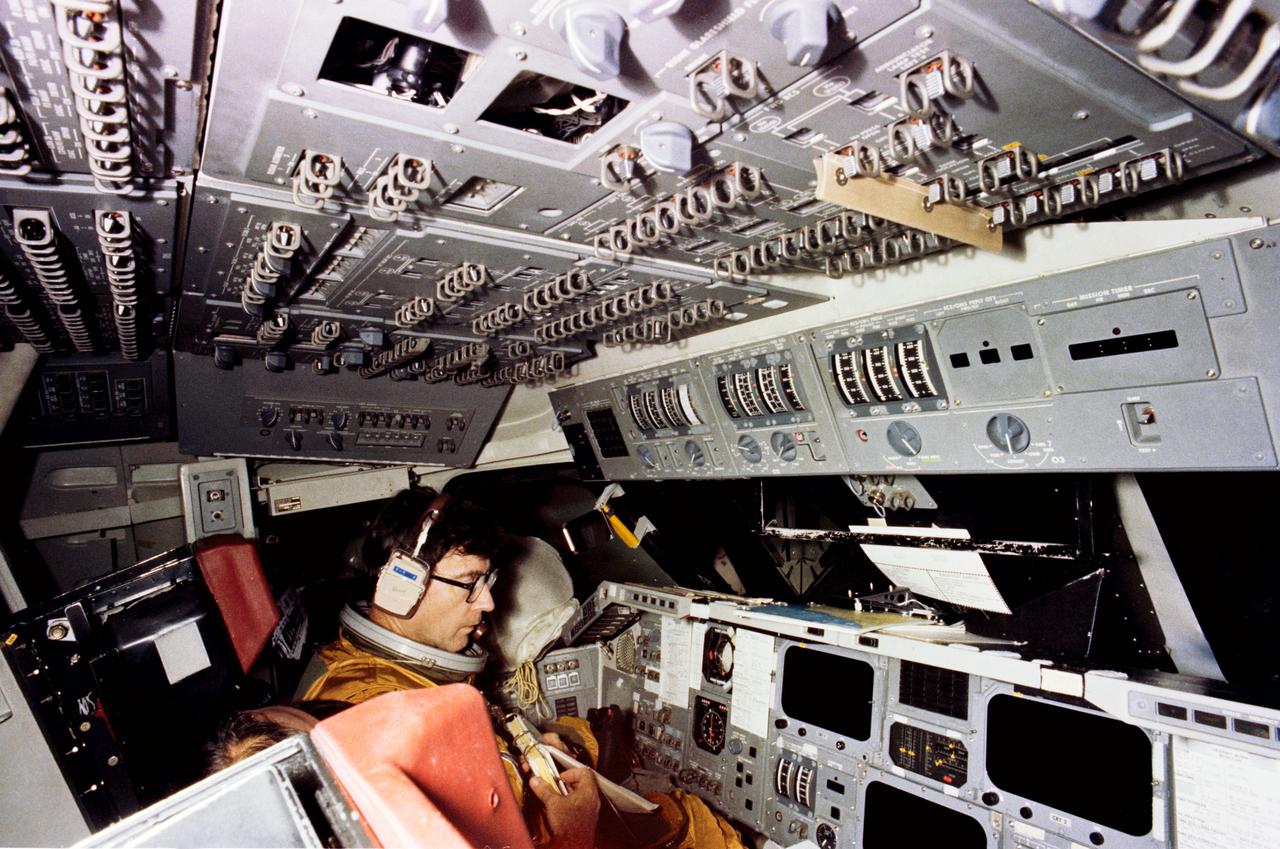
S79-37006 (29 Sept. 1979) --- Astronaut John W. Young, commander of STS-1, goes through a simulation exercises in the shuttle mission simulator (SMS) in the mission simulation and training facility at NASA's Johnson Space Center (JSC). Young and astronaut Robert L. Crippen, prime crew pilot, are in training for the first of series of orbital test missions aboard the Columbia. Photo credit: NASA
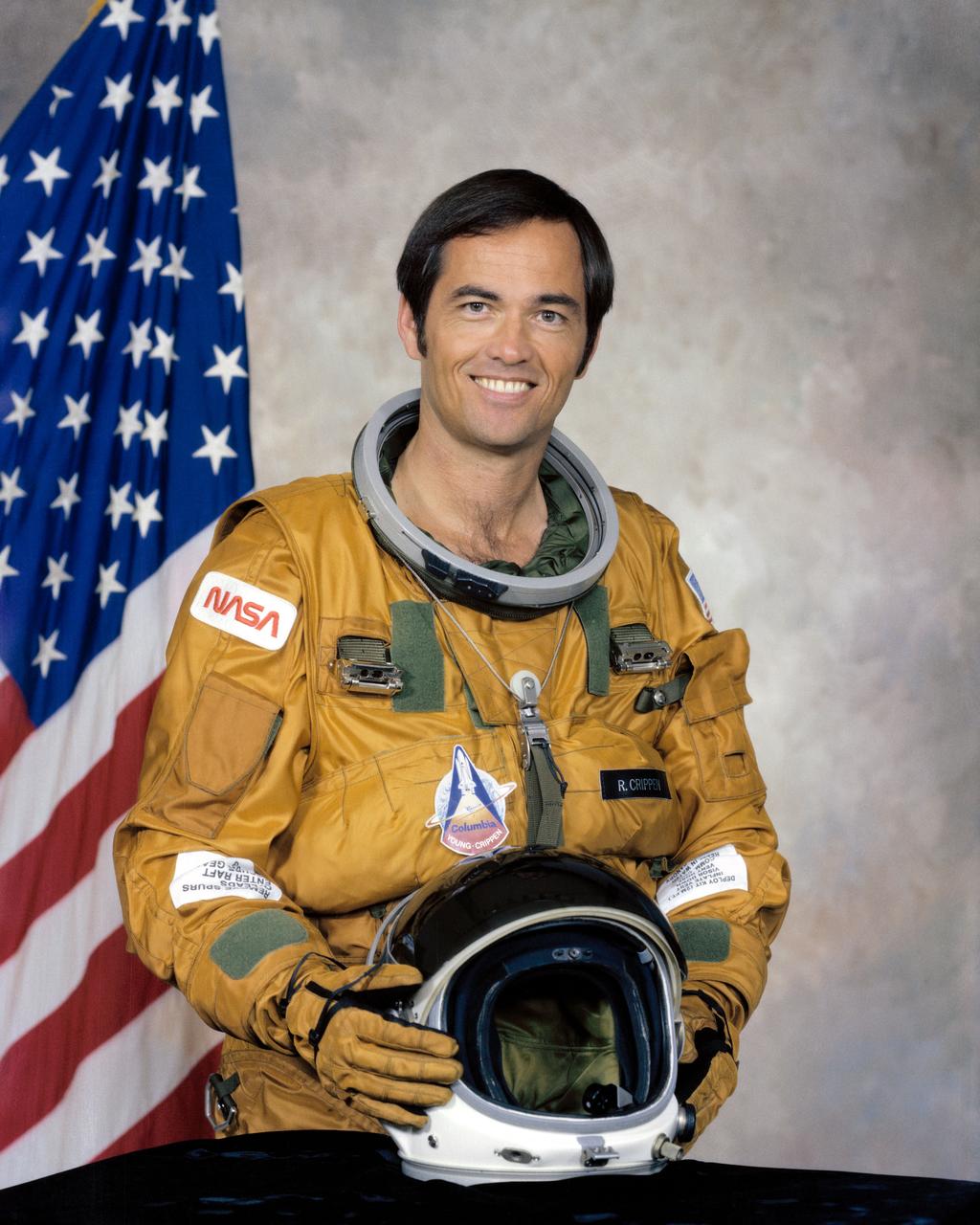
S79-31777 (7 May 1979) --- Astronaut Robert L. Crippen.

S72-41855 (15 June 1972) --- Astronaut Robert L. Crippen, Skylab Medical Experiment Altitude Test (SMEAT) commander, simulates the preparation of a Skylab meal. Crippen is a member of a three-man crew who will spend up to 56 days in the Crew Systems Division's 20-foot altitude chamber at the NASA Manned Spacecraft Center (MSC) beginning in mid-July to obtain medical data and evaluate medical experiment equipment for Skylab. The two crew members not shown in this view are astronauts Karol J. Bobko, SMEAT pilot, and Dr. William E. Thornton, SMEAT science pilot. Photo credit: NASA
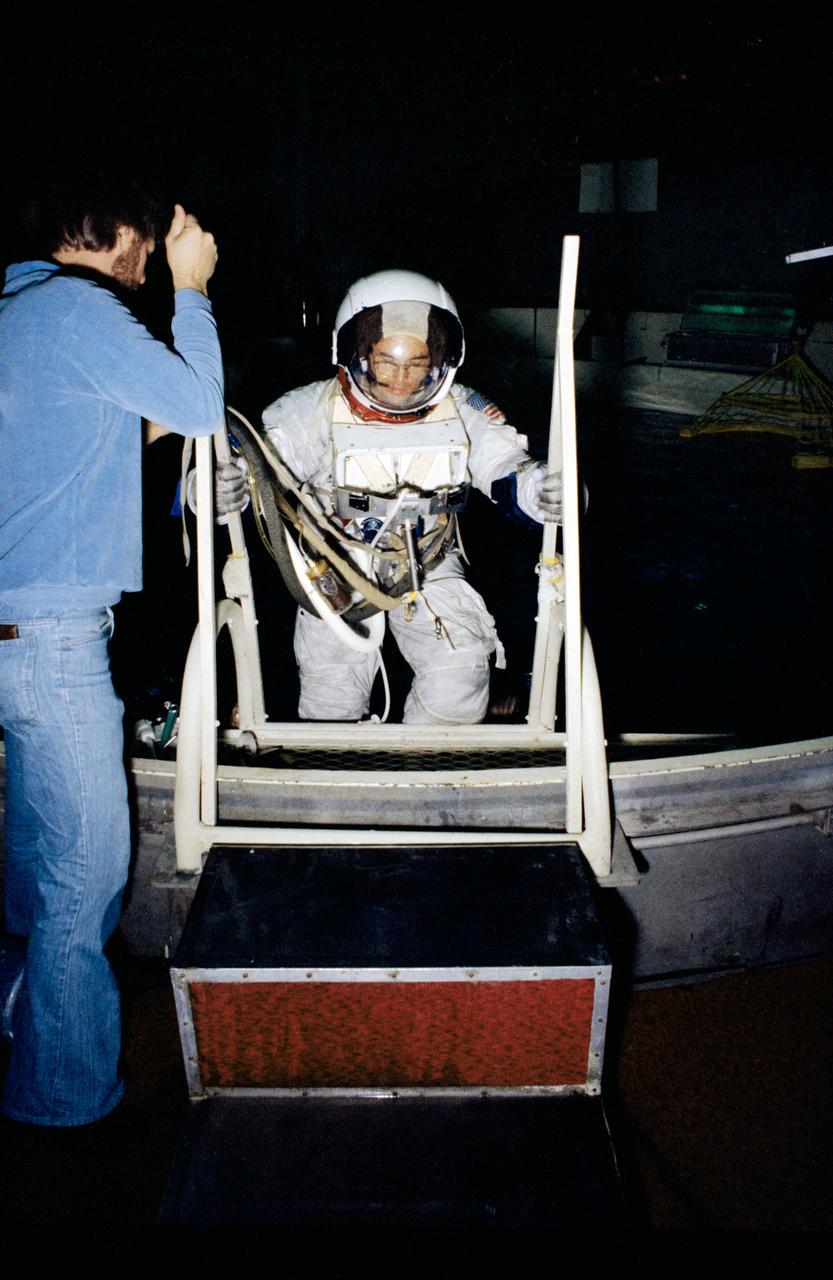
S79-25016 (13 Dec. 1978) --- Astronaut Robert L. Crippen, pilot for the first space shuttle orbital flight test, descends steps leading into the water immersion facility (WIF) during a training session in the Johnson Space Center?s training and test facility (Bldg. 260). The WIF affords one of two ways to simulate space extravehicular activity (EVA), the other being inside aircraft flying a parabolic curve. Crippen will be joined by astronaut John W. Young, commander for the first space shuttle flight (STS-1). Photo credit: NASA
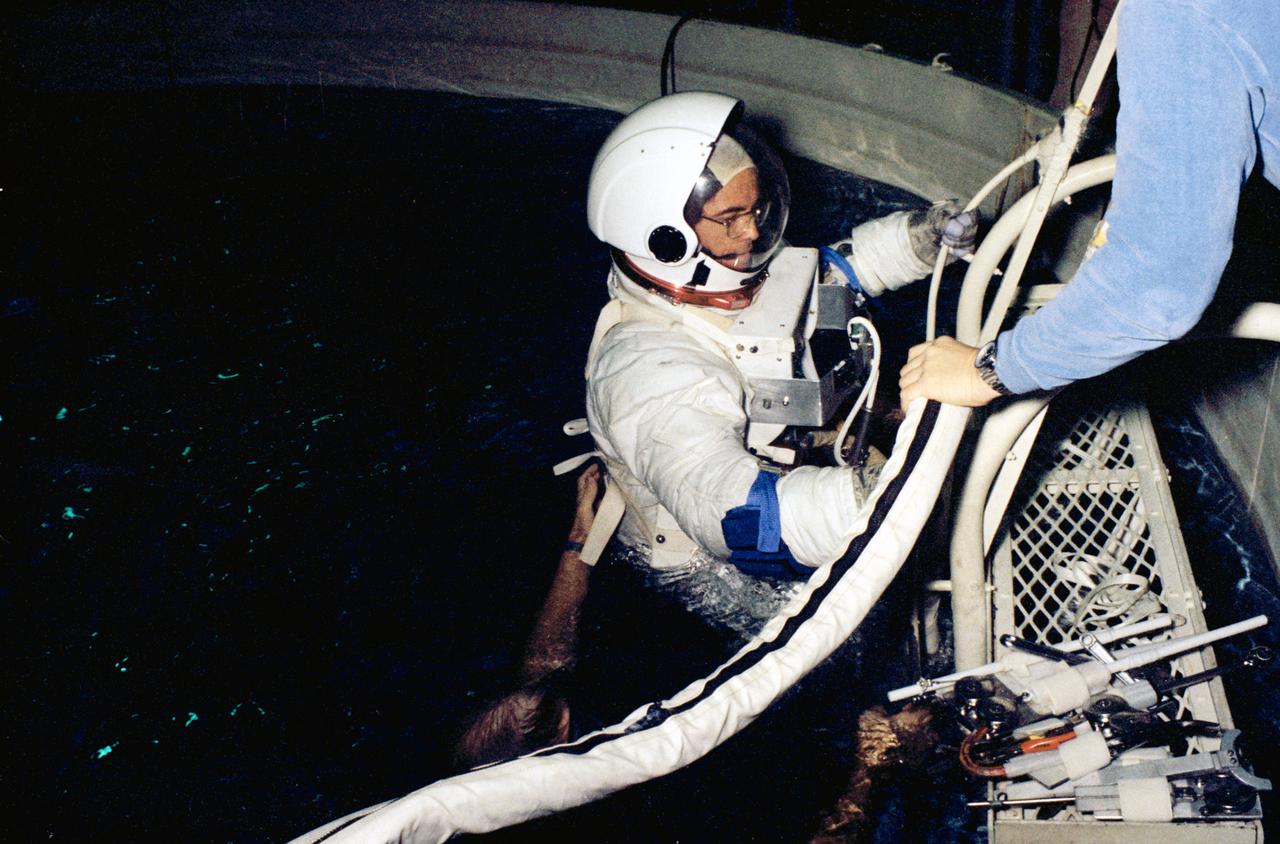
S79-25014 (13 Dec. 1978) --- Astronaut Robert L. Crippen, pilot of the first space shuttle orbital flight test (STS-1), eases into a water immersion facility (WIF) during a training session in the Johnson Space Center?s training and test facility (Bldg. 260). The WIF affords one of two ways to simulate the feeling of weightlessness experienced during space extravehicular activity (EVA), the other being inside aircraft flying a parabolic curve. Crippen will be joined by astronaut John W. Young, commander for the STS-1 flight. Photo credit: NASA
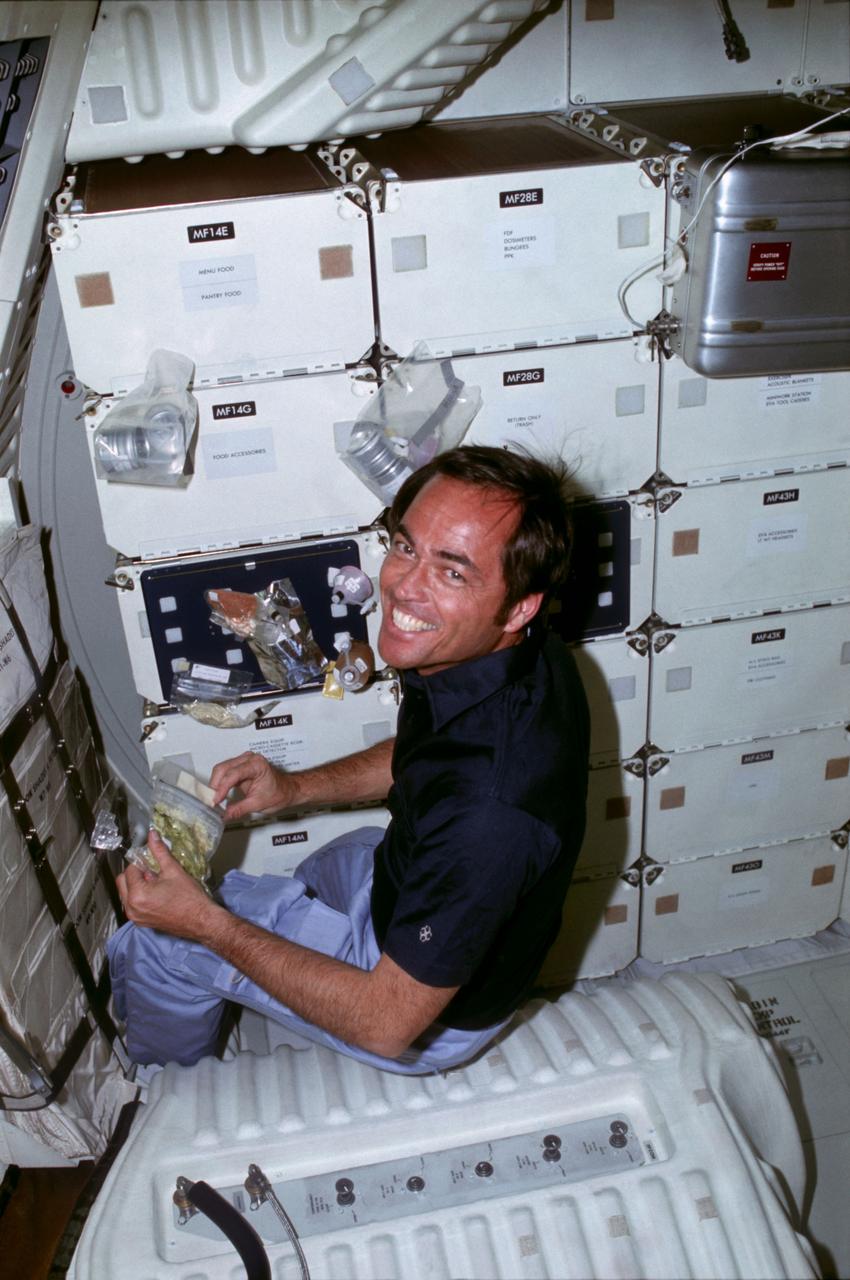
STS001-07-502 (12-14 April 1981) --- A smiling Robert L. Crippen, STS-1 pilot, is about to prepare a meal aboard the space shuttle Columbia in Earth orbit. Prepared meals, which need only water added, and beverages, can be seen attached to trays, which are mounted on locker doors in Columbia's middeck area. Astronaut John W. Young, commander, took this photograph with a 35mm camera. Photo credit: NASA
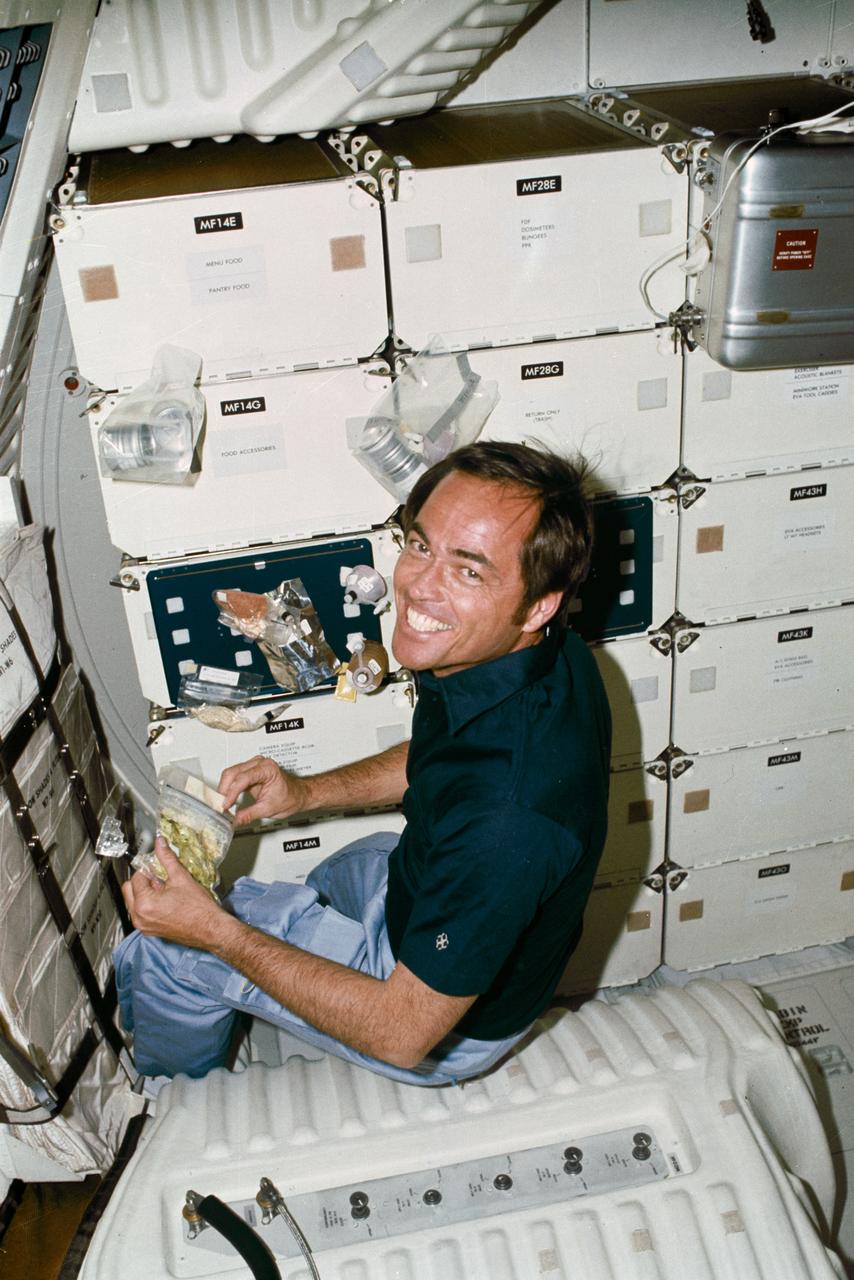
STS001-07-502 (12-14 April 1981) --- A smiling Robert L. Crippen, STS-1 pilot, is about to prepare a meal aboard the space shuttle Columbia in Earth orbit. Prepared meals, which need only water added, and beverages, can be seen attached to trays, which are mounted on locker doors in Columbia's middeck area. Astronaut John W. Young, commander, took this photograph with a 35mm camera. Photo credit: NASA
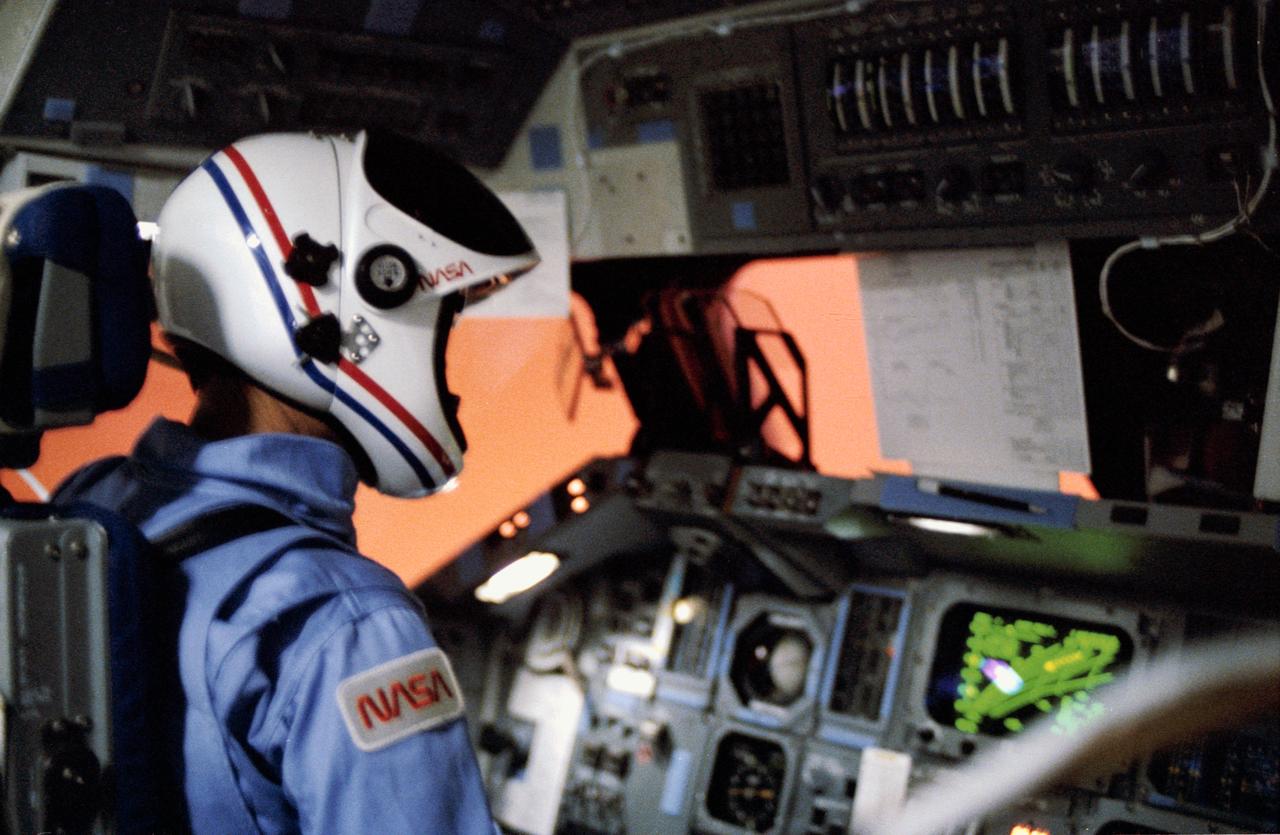
STS007-31-1614 & S83-35775 (24 June 1983) --- Astronaut Robert L. Crippen is seen at the commander’s station of the Space Shuttle Challenger as it passes through the Earth’s atmosphere on re-entry. The friction results in a pinkish glow visible through the forward windows on the flight deck. The scene was exposed with a 35mm camera.
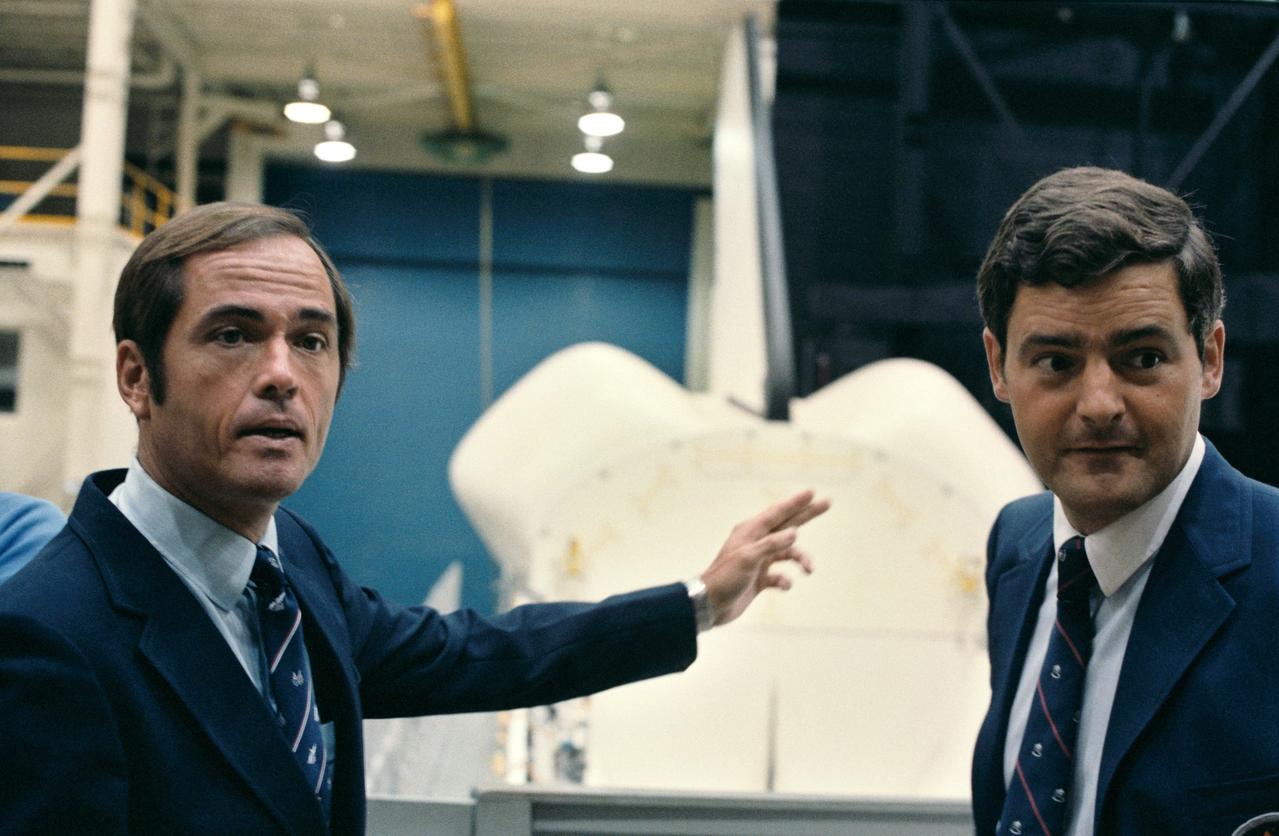
41D-3142 (3 Sept 1984) --- Astronaut Robert L. Crippen, left, crew commander for NASA's 41-G flight, and Marc Garneau, payload specialist representing the Canadian National Research Council (NRC), participate in a briefing in the Shuttle mockup and integration laboratory at the Johnson Space Center.
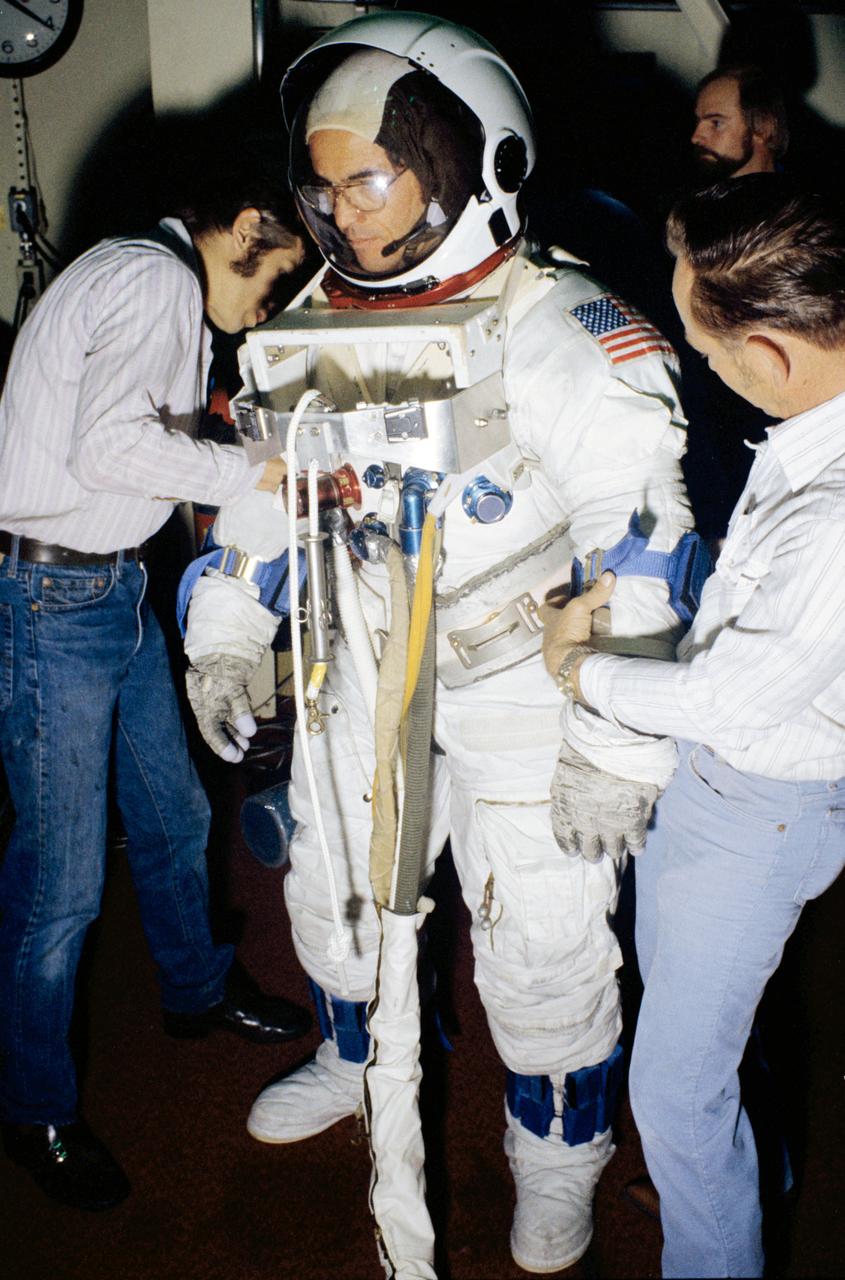
S79-25007 (13 Dec. 1978) --- Astronaut Robert L. Crippen, pilot for the first space shuttle orbital flight test (STS-1), is assisted by technicians prior to entering a water immersion facility (WIF) during a training session. The zero-gravity familiarization took place in the Johnson Space Center?s training and test center (Building 260). The WIF afford one of two ways to simulate the feeling of weightlessness experienced during space extravehicular activity (EVA), the other being inside aircraft flying a parabolic curve. Crippen will be joined by astronaut John W. Young for the STS-1 flight. Photo credit: NASA
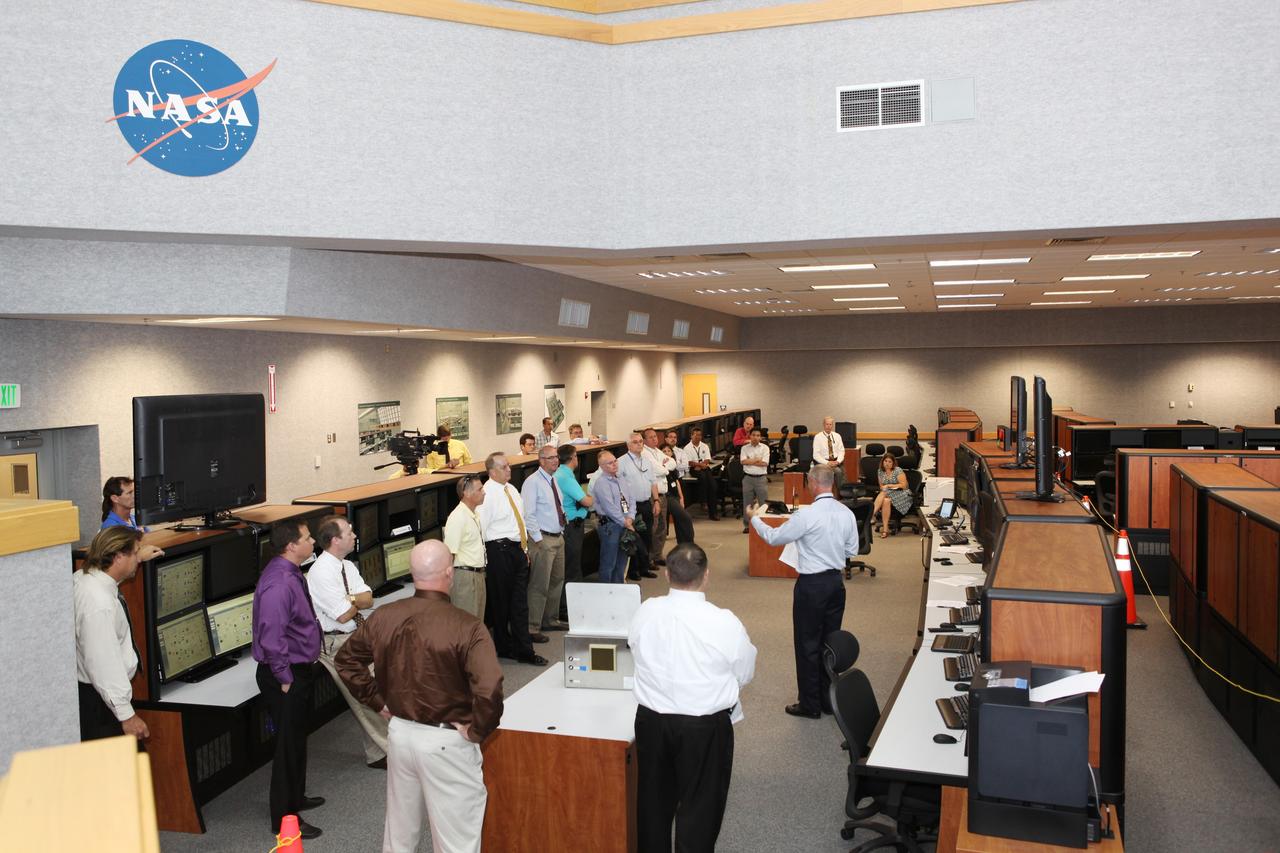
CAPE CANAVERAL, Fla. – Workers at NASA's Kennedy Space Center watch a demonstration of new systems installed in the Young-Crippen Firing Room, also known as Firing Room 1, inside the Launch Control Center. The renovation has been led by the Ground Systems Development and Operations Program based at Kennedy. The new systems are designed to be flexible so controllers can process and launch multiple types of rockets and spacecraft, whether they are government or commercial models. Photo credit: NASA/Dmitri Gerondidakis

CAPE CANAVERAL, Fla. – Robert Cabana, director of NASA's Kennedy Space Center and a former astronaut, takes a look inside new systems installed in the Young-Crippen Firing Room, also known as Firing Room 1, inside the Launch Control Center. The renovation has been led by the Ground Systems Development and Operations Program based at Kennedy. The new systems are designed to be flexible so controllers can process and launch multiple types of rockets and spacecraft, whether they are government or commercial models. Photo credit: NASA/Dmitri Gerondidakis
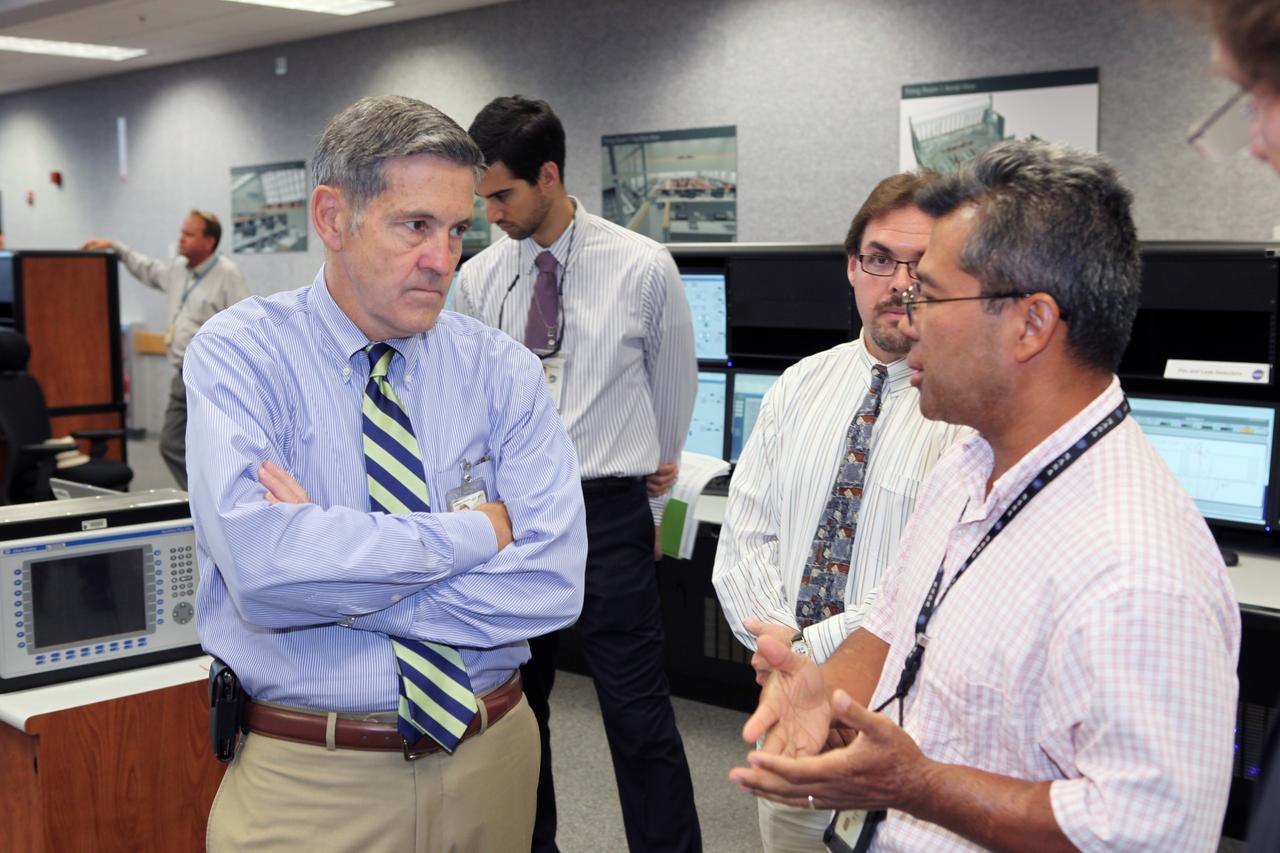
CAPE CANAVERAL, Fla. – Robert Cabana, director of NASA's Kennedy Space Center and a former astronaut, listens to a presentation of new systems installed in the Young-Crippen Firing Room, also known as Firing Room 1, inside the Launch Control Center. The renovation has been led by the Ground Systems Development and Operations Program based at Kennedy. The new systems are designed to be flexible so controllers can process and launch multiple types of rockets and spacecraft, whether they are government or commercial models. Photo credit: NASA/Dmitri Gerondidakis
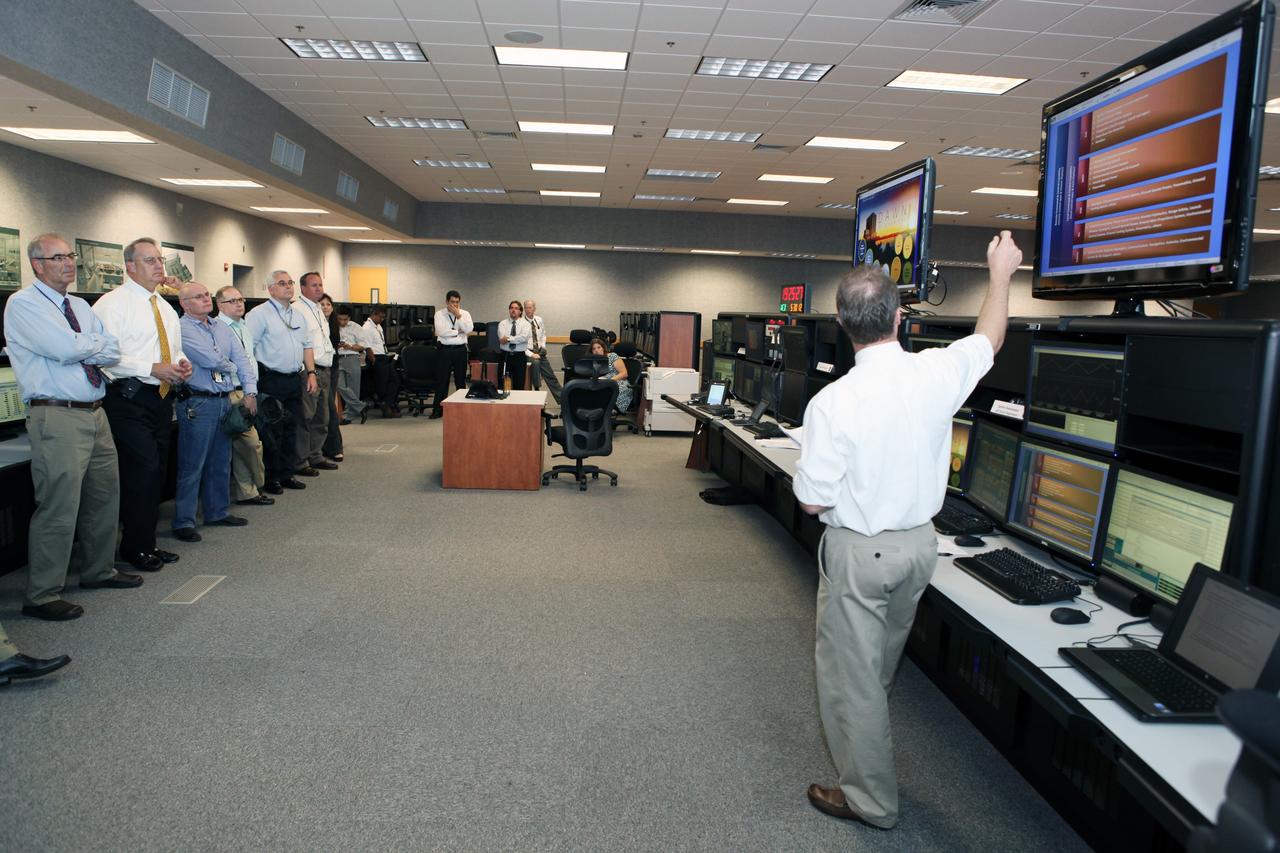
CAPE CANAVERAL, Fla. – Workers at NASA's Kennedy Space Center watch a demonstration of new systems installed in the Young-Crippen Firing Room, also known as Firing Room 1, inside the Launch Control Center. The renovation has been led by the Ground Systems Development and Operations Program based at Kennedy. The new systems are designed to be flexible so controllers can process and launch multiple types of rockets and spacecraft, whether they are government or commercial models. Photo credit: NASA/Dmitri Gerondidakis
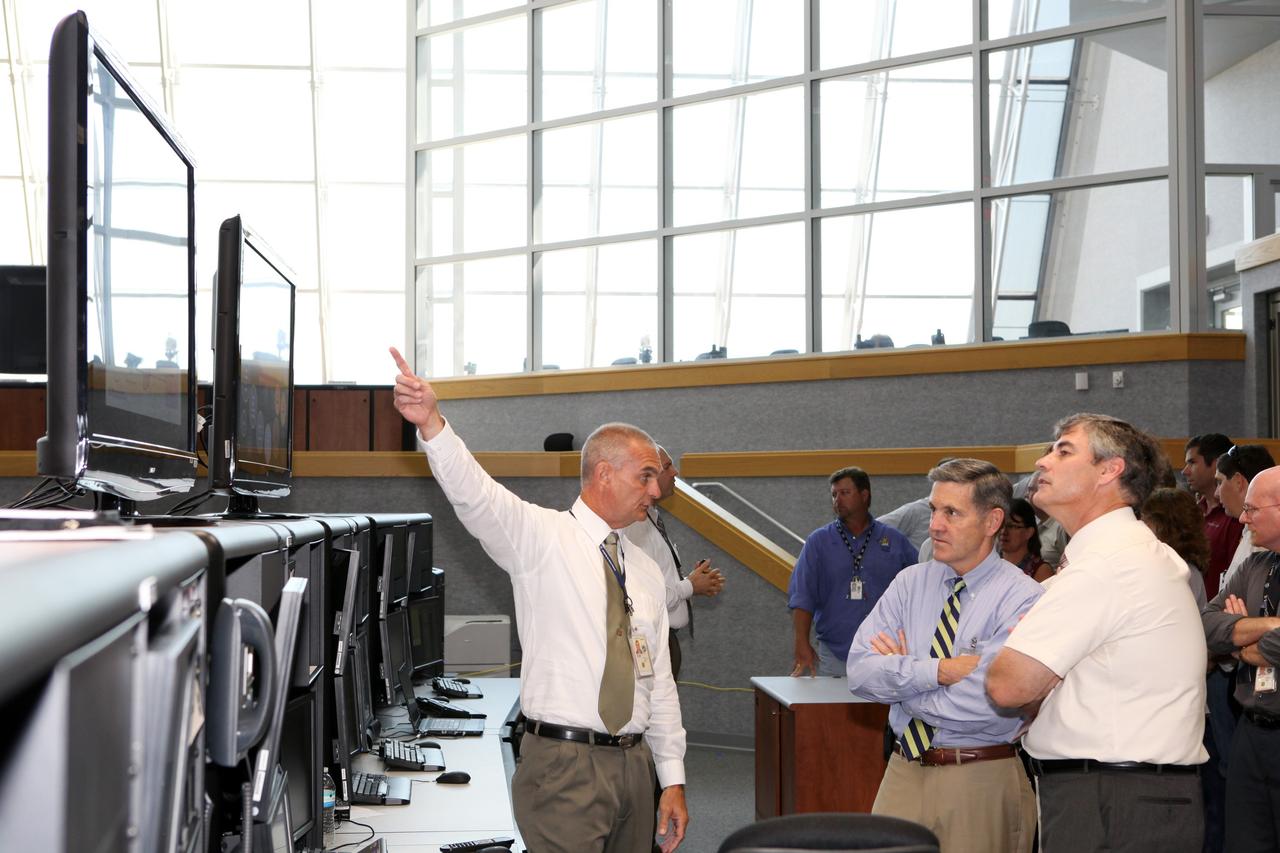
CAPE CANAVERAL, Fla. – Robert Cabana, director of NASA's Kennedy Space Center and a former astronaut, watches a demonstration of new systems installed in the Young-Crippen Firing Room, also known as Firing Room 1, inside the Launch Control Center. The renovation has been led by the Ground Systems Development and Operations Program based at Kennedy. The new systems are designed to be flexible so controllers can process and launch multiple types of rockets and spacecraft, whether they are government or commercial models. Photo credit: NASA/Dmitri Gerondidakis
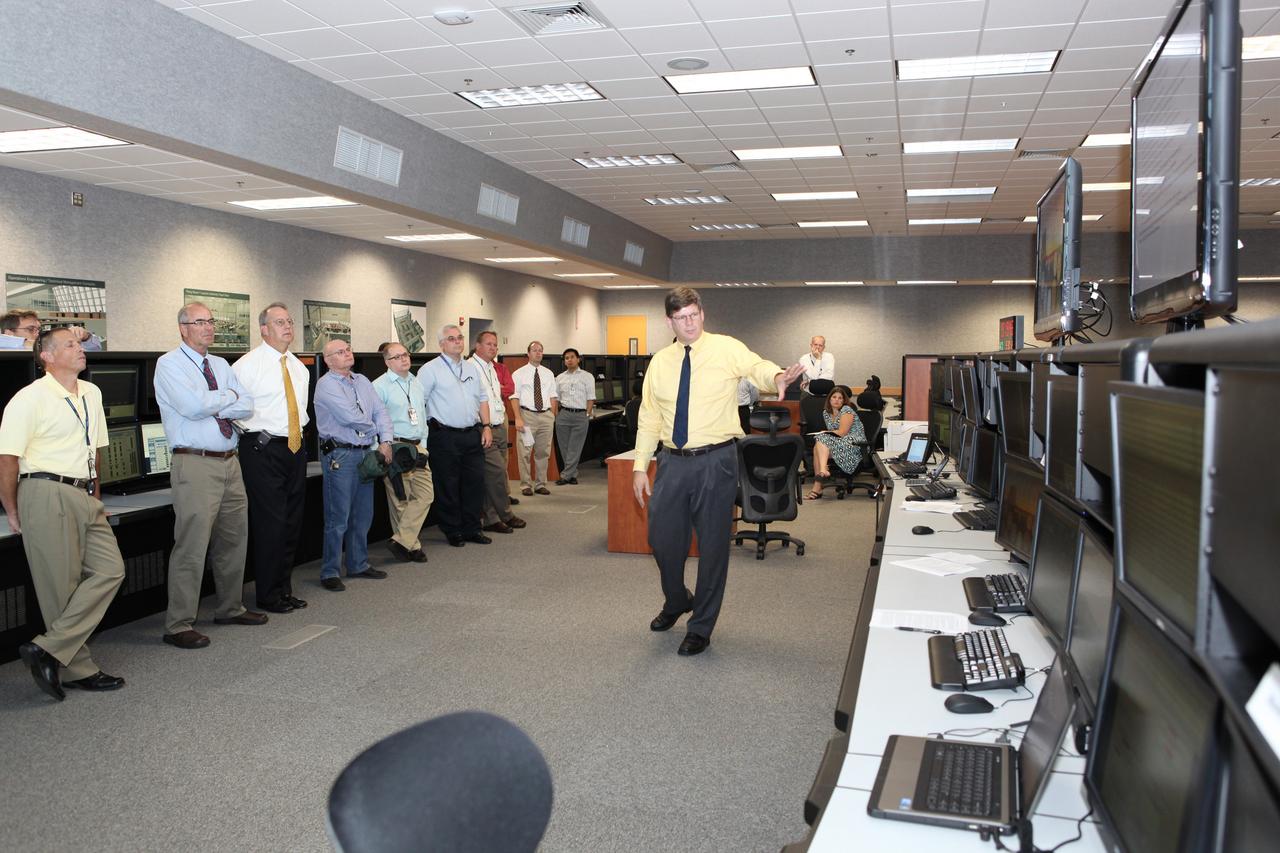
CAPE CANAVERAL, Fla. – Workers at NASA's Kennedy Space Center watch a demonstration of new systems installed in the Young-Crippen Firing Room, also known as Firing Room 1, inside the Launch Control Center. The renovation has been led by the Ground Systems Development and Operations Program based at Kennedy. The new systems are designed to be flexible so controllers can process and launch multiple types of rockets and spacecraft, whether they are government or commercial models. Photo credit: NASA/Dmitri Gerondidakis
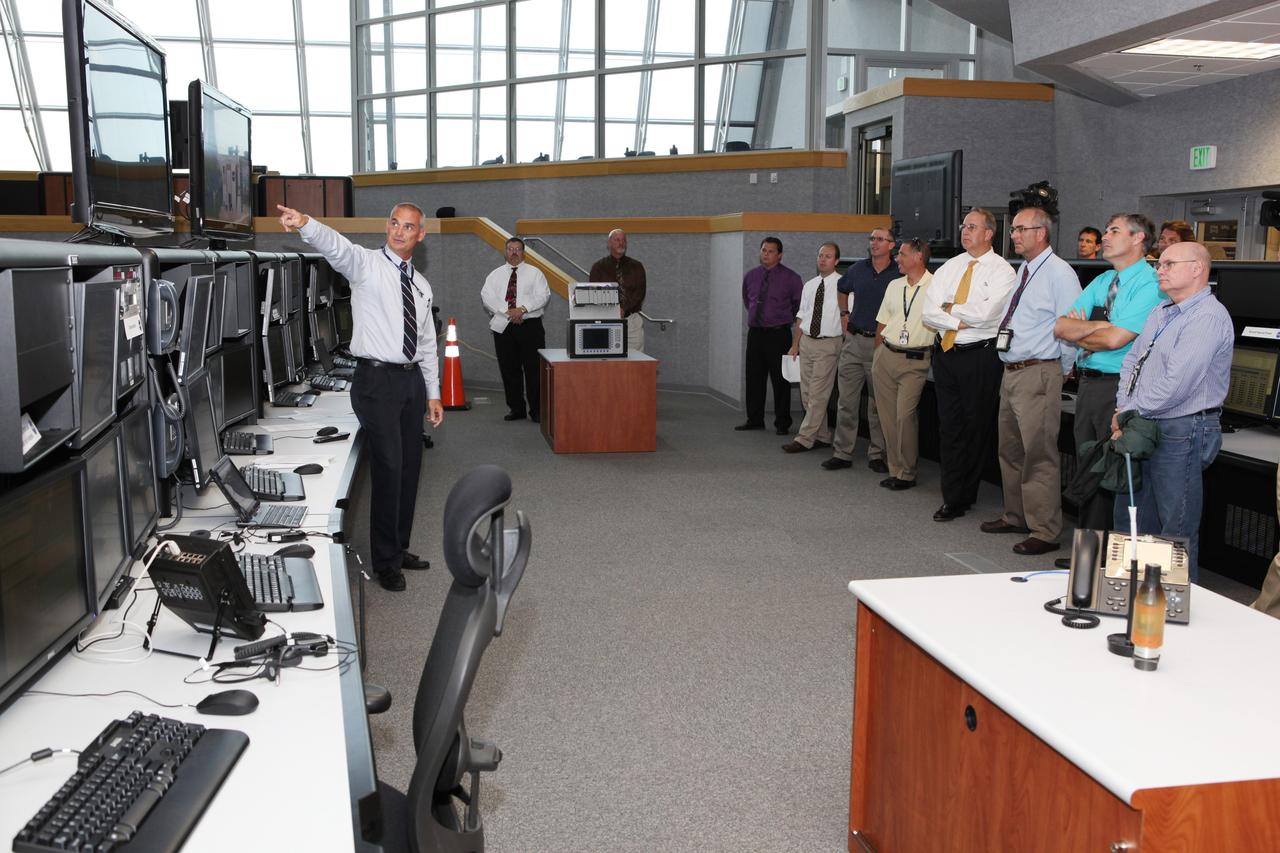
CAPE CANAVERAL, Fla. – Workers at NASA's Kennedy Space Center watch a demonstration of new systems installed in the Young-Crippen Firing Room, also known as Firing Room 1, inside the Launch Control Center. The renovation has been led by the Ground Systems Development and Operations Program based at Kennedy. The new systems are designed to be flexible so controllers can process and launch multiple types of rockets and spacecraft, whether they are government or commercial models. Photo credit: NASA/Dmitri Gerondidakis
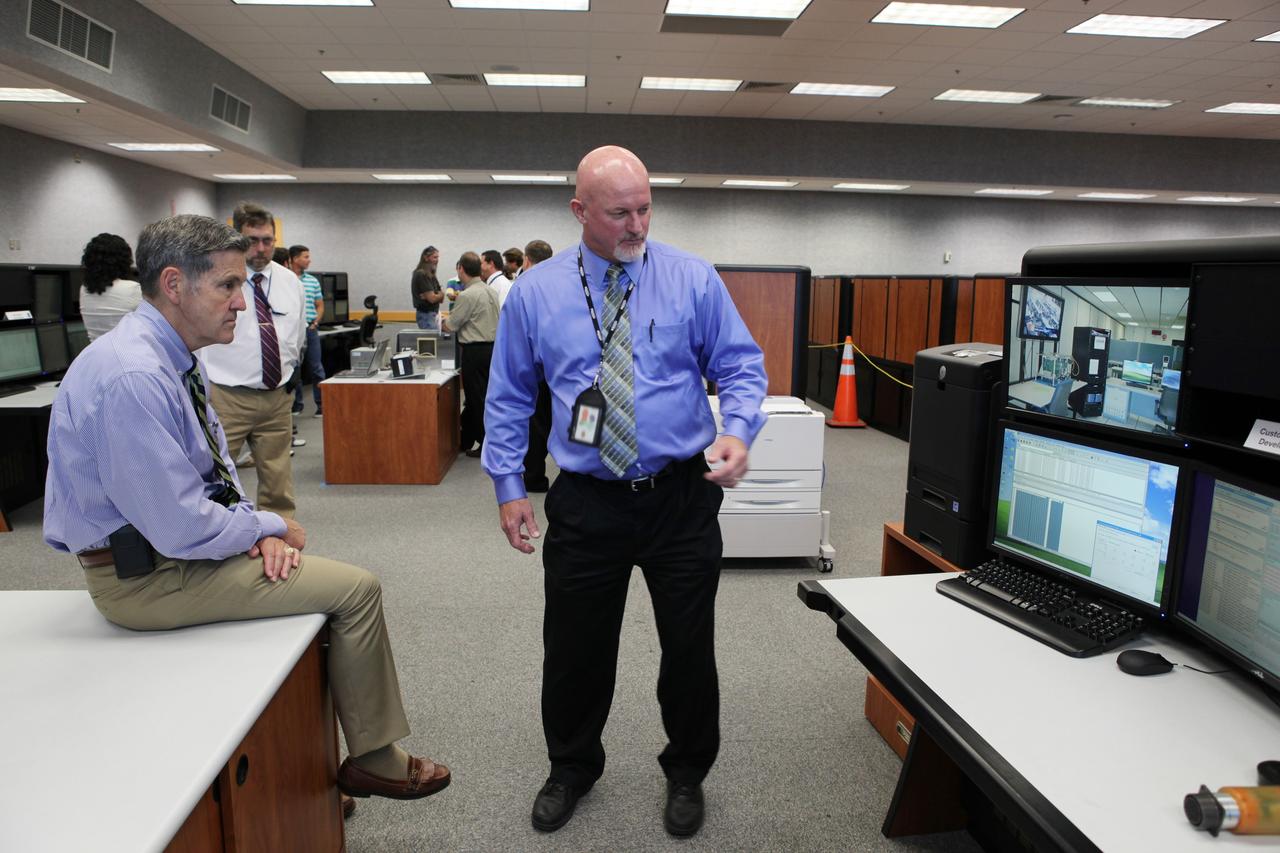
CAPE CANAVERAL, Fla. – Robert Cabana, director of NASA's Kennedy Space Center and a former astronaut, watches a demonstration of new systems installed in the Young-Crippen Firing Room, also known as Firing Room 1, inside the Launch Control Center. The renovation has been led by the Ground Systems Development and Operations Program based at Kennedy. The new systems are designed to be flexible so controllers can process and launch multiple types of rockets and spacecraft, whether they are government or commercial models. Photo credit: NASA/Dmitri Gerondidakis
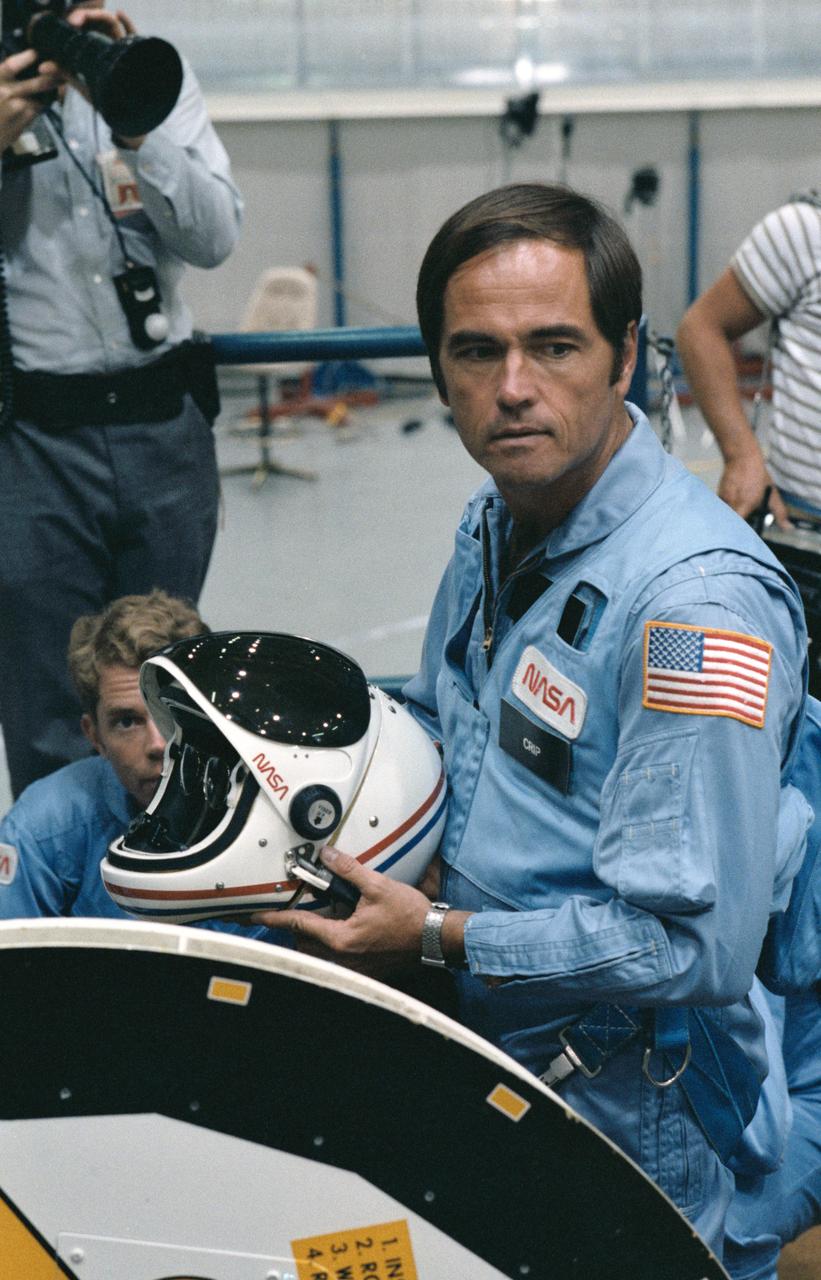
41D-3186 (4 Sept 1984) --- Astronaut Robert L. Crippen, 41-G crew commander, prepares to join his six fellow crewmembers for some training in the mockup and integration laboratory at the Johnson Space Center. Astronaut David C. Leestma, 41-G mission specialist, left, will participate in a scheduled extravehicular activity (EVA) on the Challenger's next mission. Today's training is for launch phase procedures.
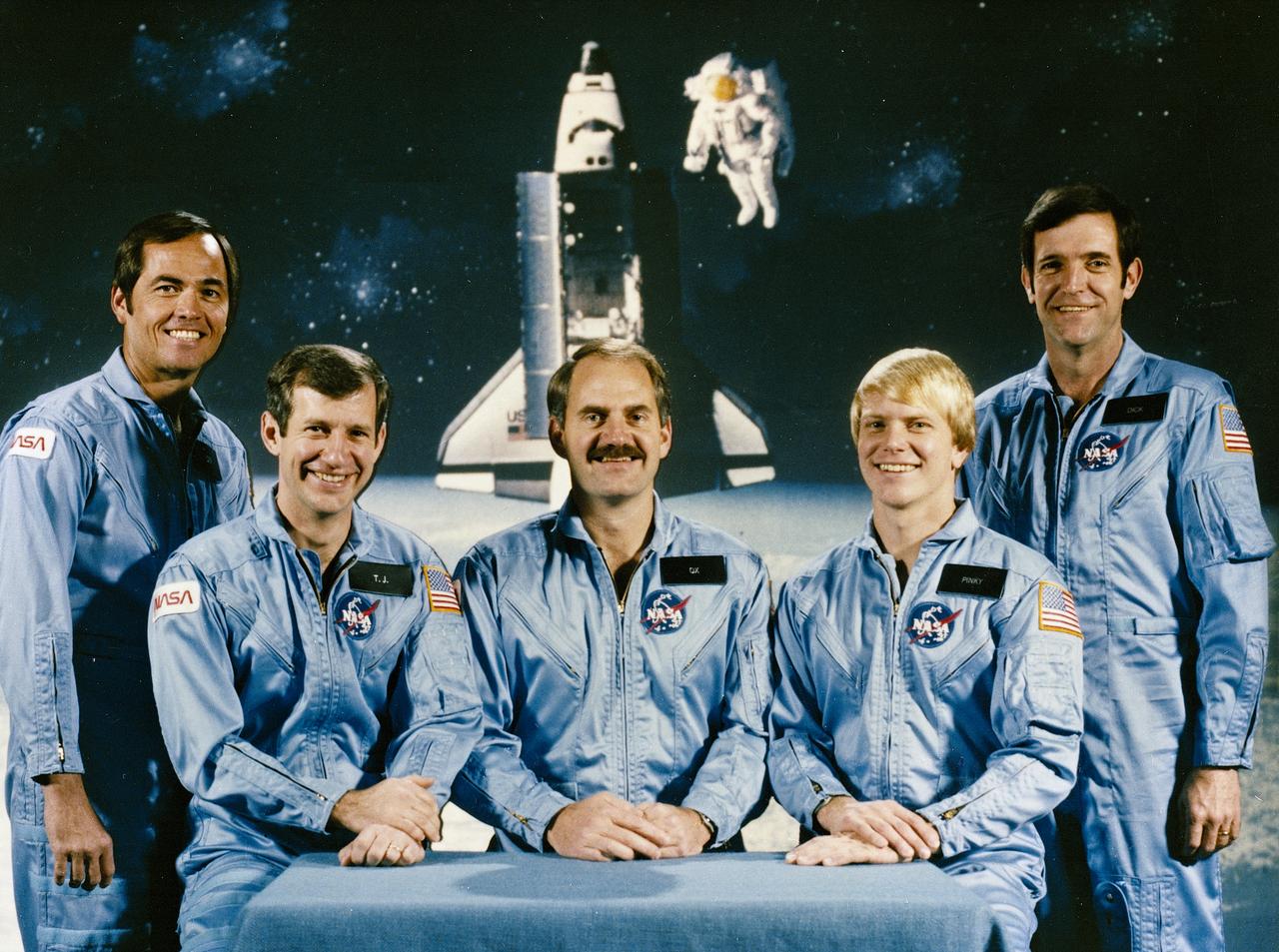
The crew assigned to the STS-41CB (STS-13) mission included (left to right) Robert L. Crippen, commander; Terry J. Hart, mission specialist; James D. Van-Hoften, mission specialist; George D. Nelson, mission specialist; and Francis R. (Dick) Scobee, pilot. Launched aboard the Space Shuttle Challenger on April 6, 1984 at 8:58:00 am (EST), the STS-41C mission marked the first direct ascent trajectory for the Space Shuttle. The crew deployed the Long Duration Exposure Facility (LDEF).
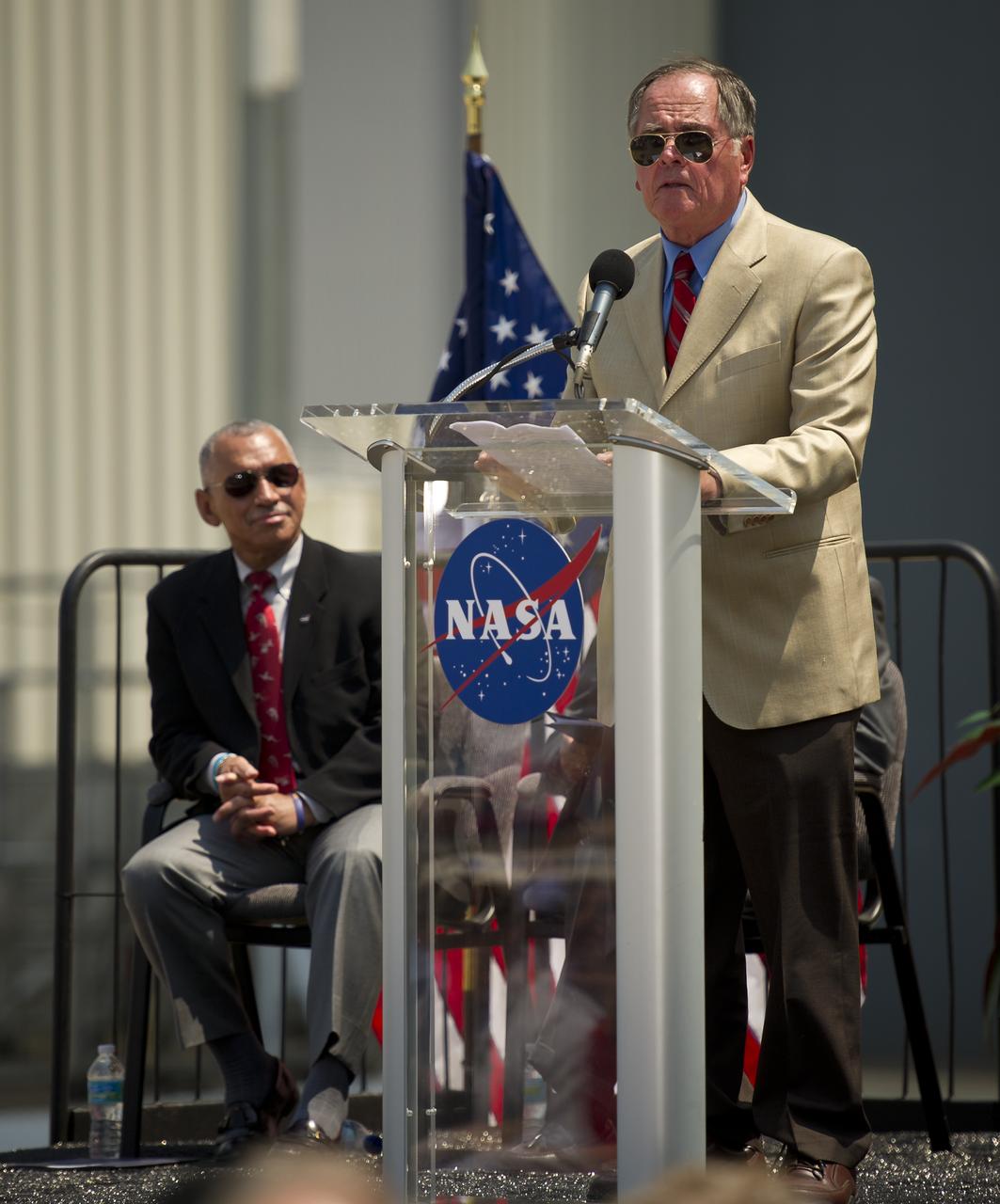
Pilot of the first space shuttle mission, STS-1, Bob Crippen speaks at an event where NASA Administrator Charles Bolden announced where four space shuttle orbiters will be permanently displayed at the conclusion of the Space Shuttle Program, Tuesday, April 12, 2011, at Kennedy Space Center in Cape Canaveral, Fla. The four orbiters, Enterprise, which currently is on display at the Smithsonian's Steven F. Udvar-Hazy Center near Washington Dulles International Airport, will move to the Intrepid Sea, Air & Space Museum in New York, Discovery will move to Udvar-Hazy, Endeavour will be displayed at the California Science Center in Los Angeles and Atlantis, in background, will be displayed at the Kennedy Space Center Visitor’s Complex. Photo Credit: (NASA/Bill Ingalls)
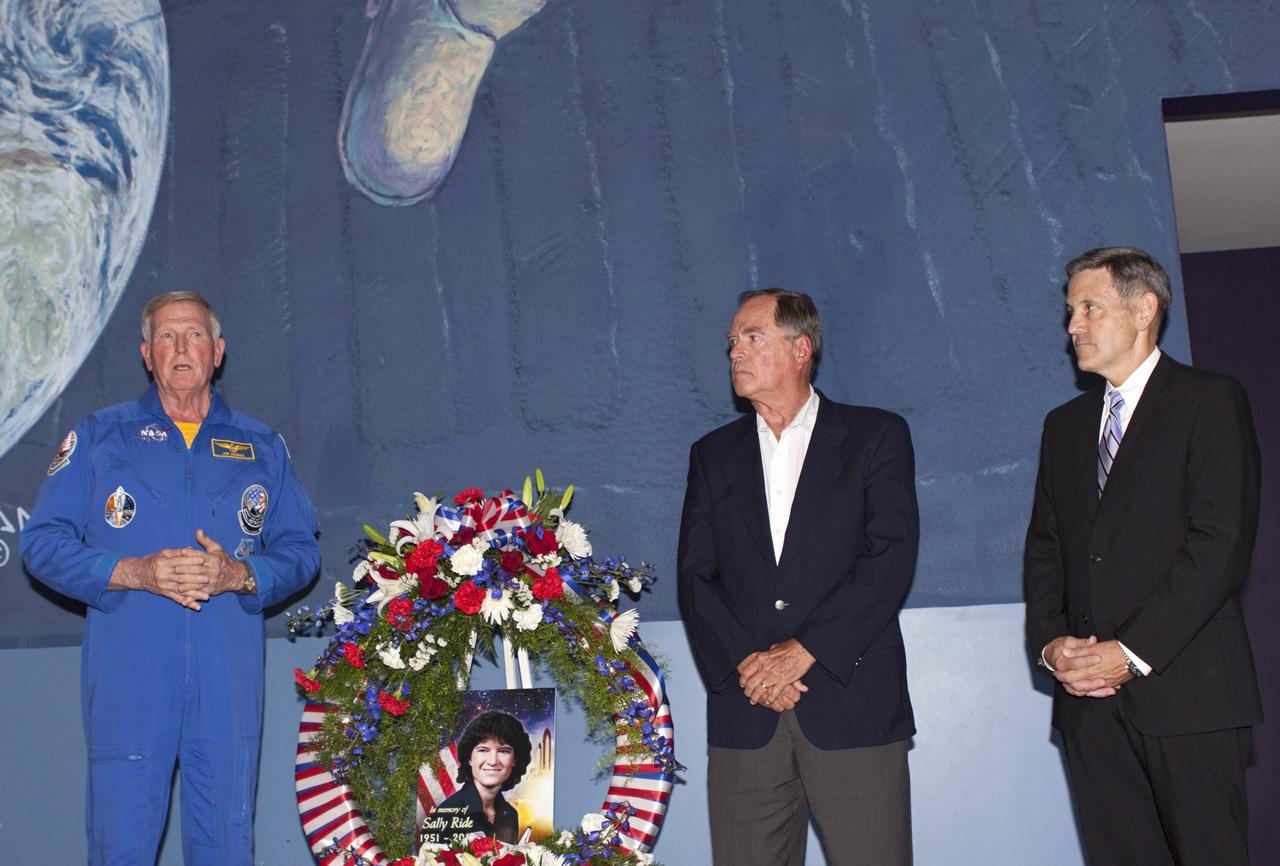
TITUSVILLE, Fla. - Former astronauts Jon McBride, left, and Bob Crippen, center, along with Kennedy Space Center director Bob Cabana, also a former astronaut, laid a wreath at the U. S. Astronaut Hall of Fame honoring Sally K. Ride, who became America's first woman in space in 1983. Following her death on July 23, 2012, Ride is being remembered for her service to NASA and for her efforts to encourage children to study math, science and technology. Crippen was commander on both of Ride's space shuttle missions. McBride was pilot on her second flight. Ride was inducted into the Astronaut Hall of Fame in 2003. A California-born physicist, she broke the gender barrier 29 years ago when she rode to orbit aboard space shuttle Challenger on STS-7. Ride subsequently served, again as a mission specialist, on STS-41G in 1984. Following her career with NASA, in 2001 Ride founded her own company, Sally Ride Science, to pursue her long-time passion of motivating youth -- especially girls and young women -- to pursue careers in technical fields. Photo credit: NASA/Jim Grossmann
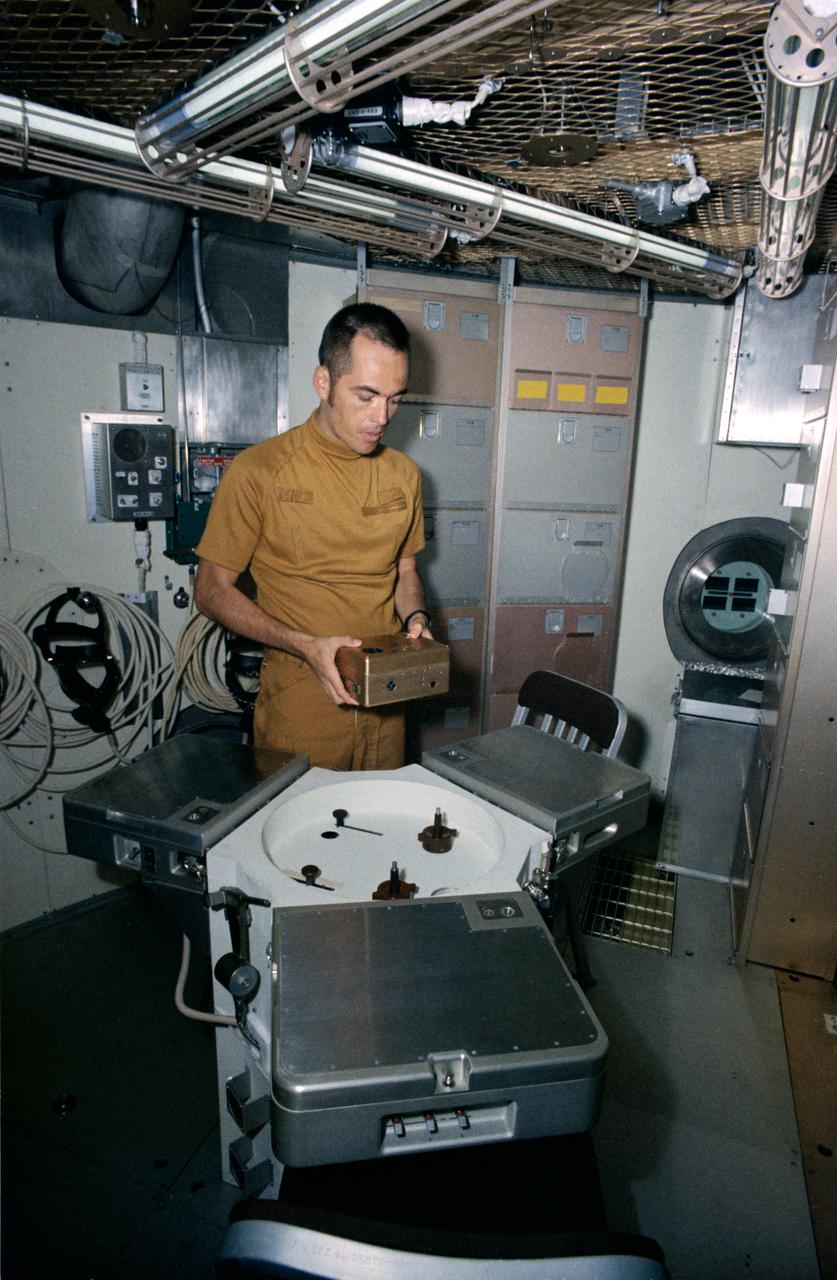
S72-43280 (15 June 1972) --- Astronaut Robert L. Crippen, Skylab Medical Experiment Altitude Test (SMEAT) commander, holds the training model of Skylab experiment T003, the aerosol analysis test, in this preview of SMEAT activity. He is part of a three-man SMEAT crew who will spend up to 56 days in the Crew Systems Division's 20-foot altitude chamber at the NASA Manned Spacecraft Center (MSC) beginning in mid-July to obtain medical data and evaluate medical experiment equipment for Skylab. The two crew members not shown in this view are astronauts Karol J. Bobko, SMEAT pilot, and Dr. William E. Thornton, SMEAT science pilot. Photo credit: NASA
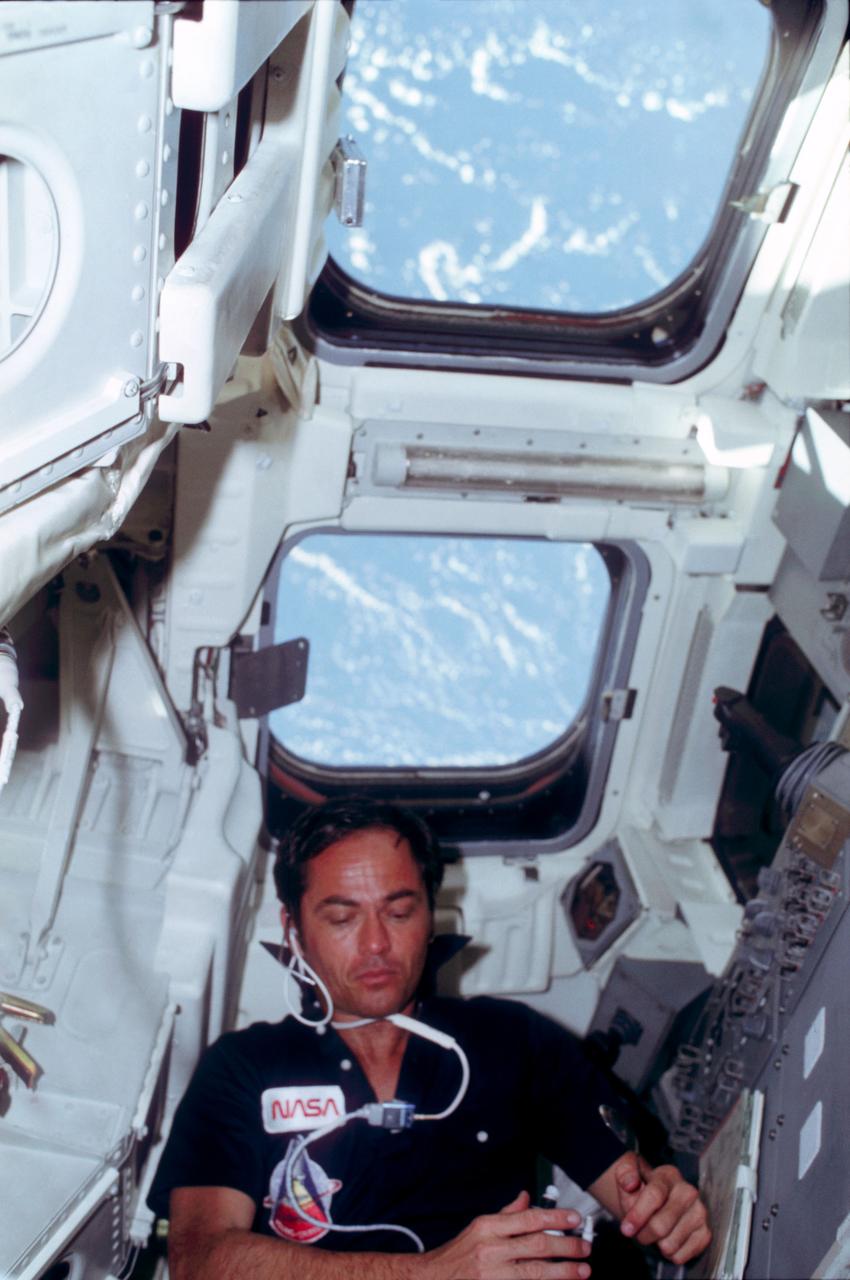
STS001-06-481 (April 1981) --- Astronaut Robert L. Crippen, STS-1 pilot, is behind his station in the flight deck of Columbia. He has a spoon in his hand. The windows prominent in the scene are the ones through which a number of Earth scenes were photographed with a 70mm camera by the two astronauts. Clouds over water can be seen through them. Just inches away from the top windows, not quite so obvious at top of the frame (if held horizontally) are the two aft cabin windows through which the crew viewed the cargo bay and the aft end of the craft, including the orbital maneuvering system (OMS) pods. Astronaut John W. Young, commander, took this photo with a 35mm camera. Photo credit: NASA
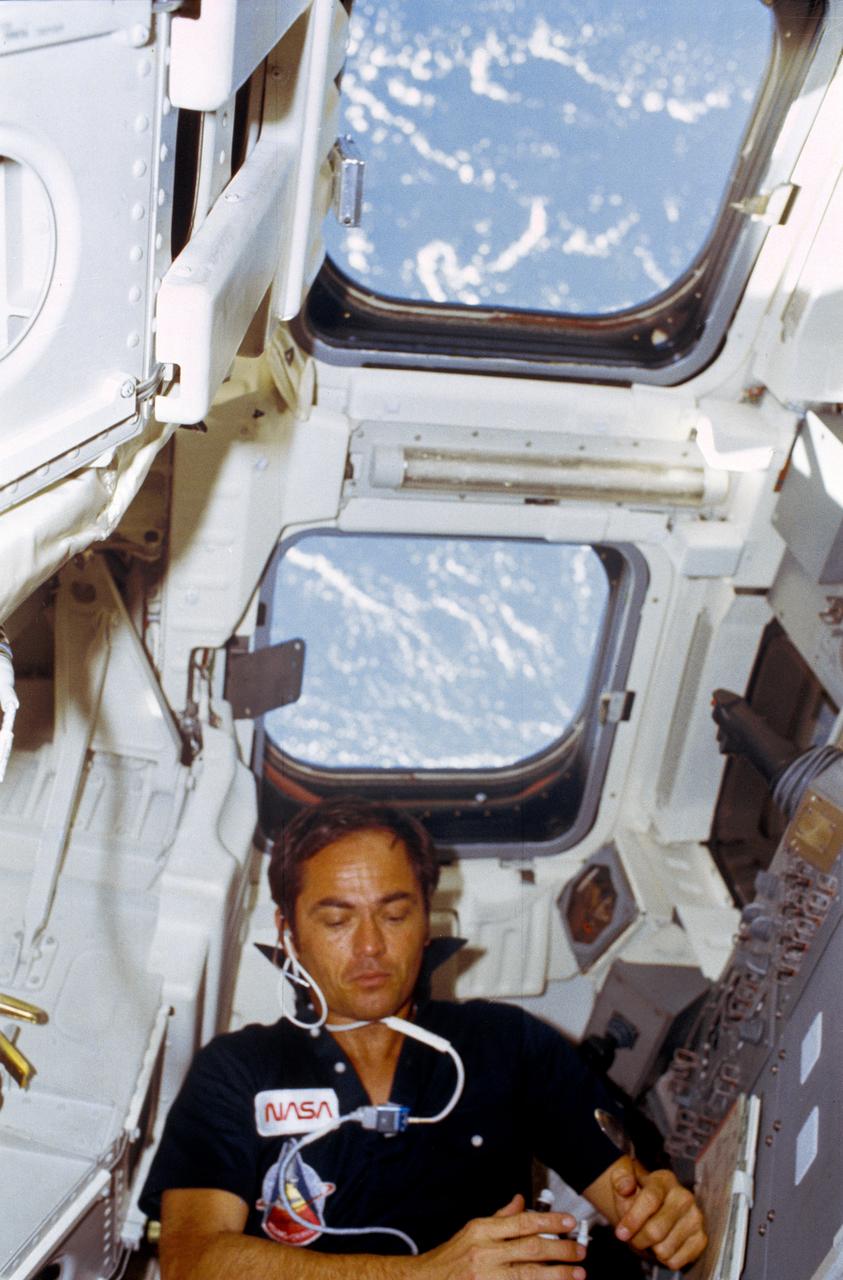
STS001-06-481 (April 1981) --- Astronaut Robert L. Crippen, STS-1 pilot, is behind his station in the flight deck of Columbia. He has a spoon in his hand. The windows prominent in the scene are the ones through which a number of Earth scenes were photographed with a 70mm camera by the two astronauts. Clouds over water can be seen through them. Just inches away from the top windows, not quite so obvious at top of the frame (if held horizontally) are the two aft cabin windows through which the crew viewed the cargo bay and the aft end of the craft, including the orbital maneuvering system (OMS) pods. Astronaut John W. Young, commander, took this photo with a 35mm camera. Photo credit: NASA
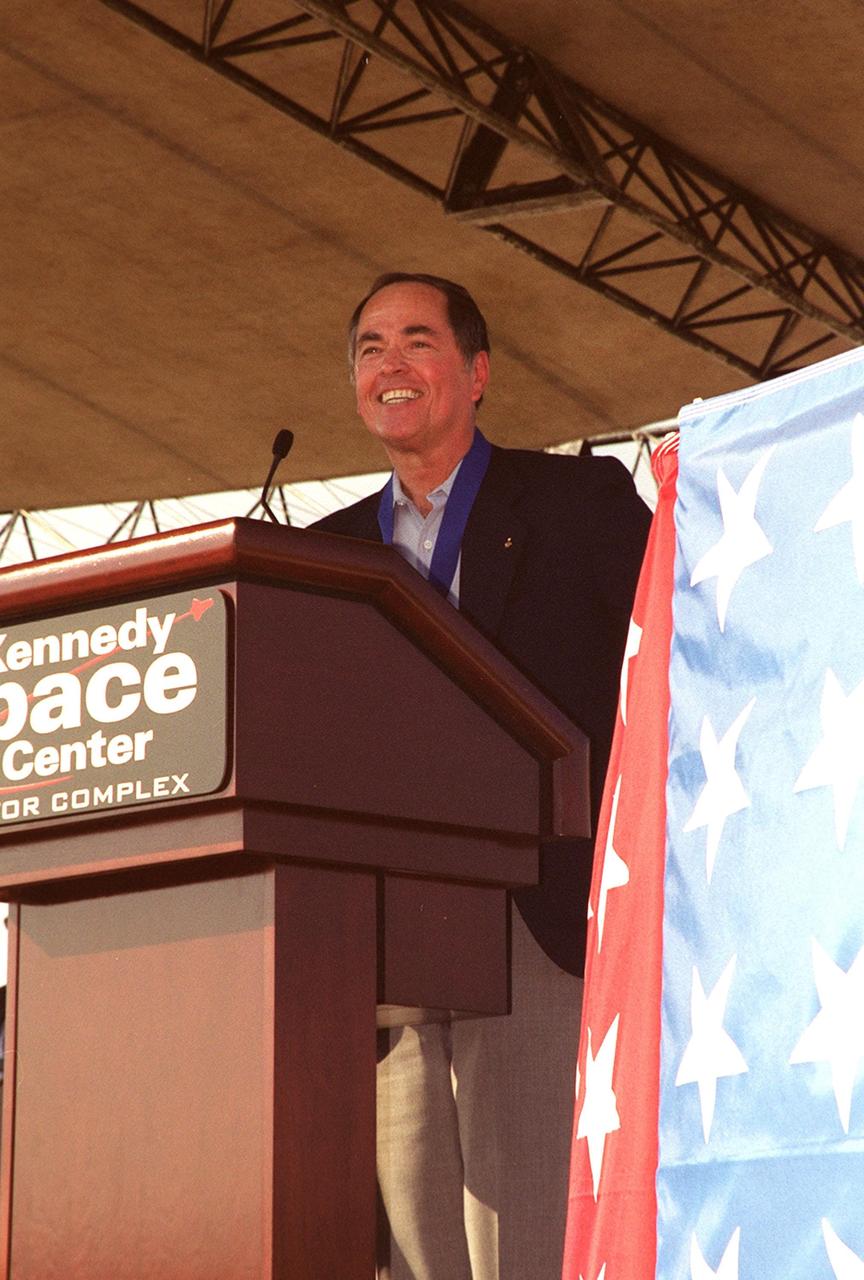
KENNEDY SPACE CENTER, Fla. -- Astronaut Robert Crippen, who served as pilot on STS-1, speaks to the guests gathered at the KSC Visitor Complex Nov. 10 for induction ceremonies into the Astronaut Hall of Fame. Crippen and other astronauts Frederick "Rick" Hauck, Richard Truly and Joe Engle were honored as the first Shuttle astronauts.
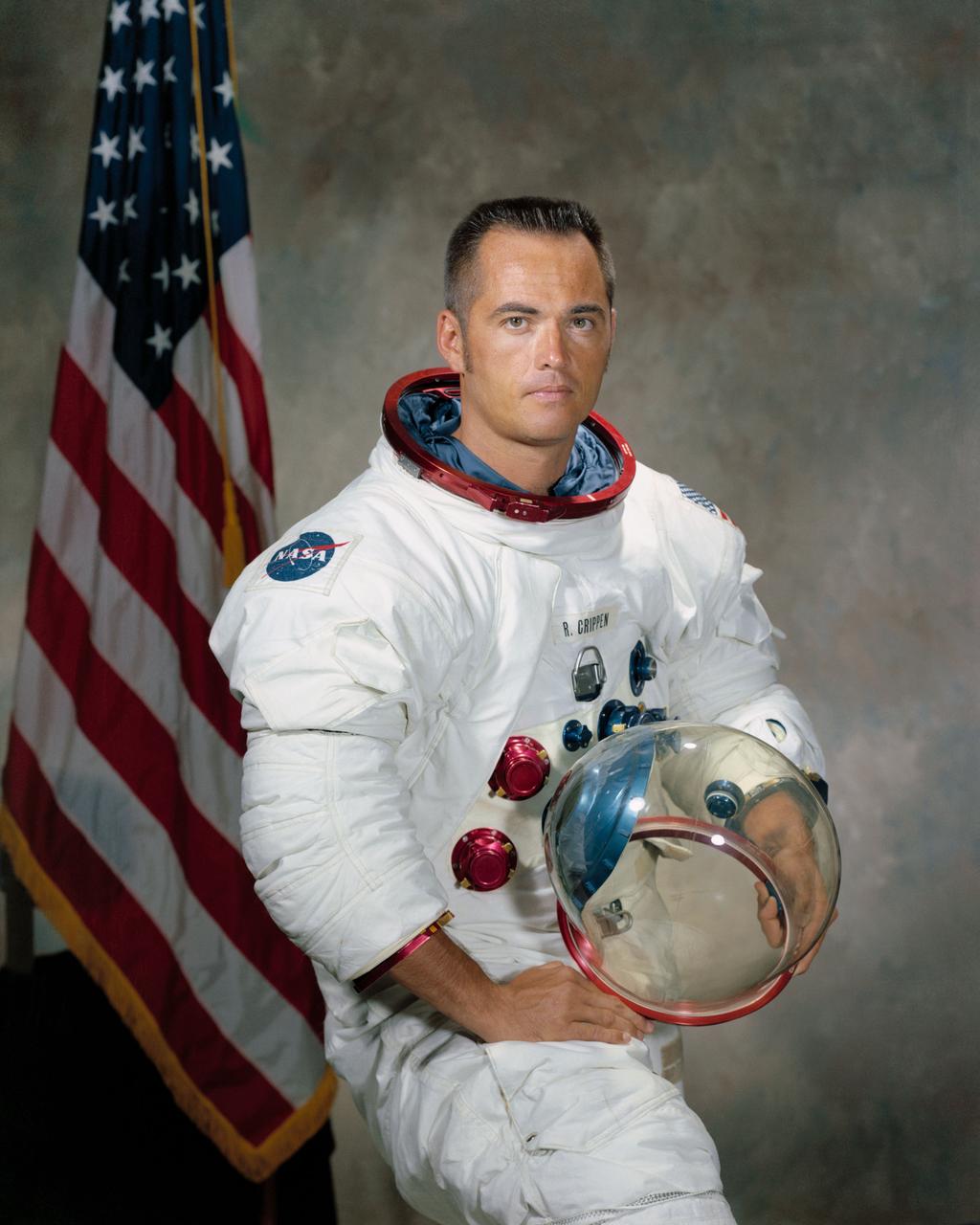
S71-51303 (21 Sept. 1971) --- Astronaut Robert L. Crippen
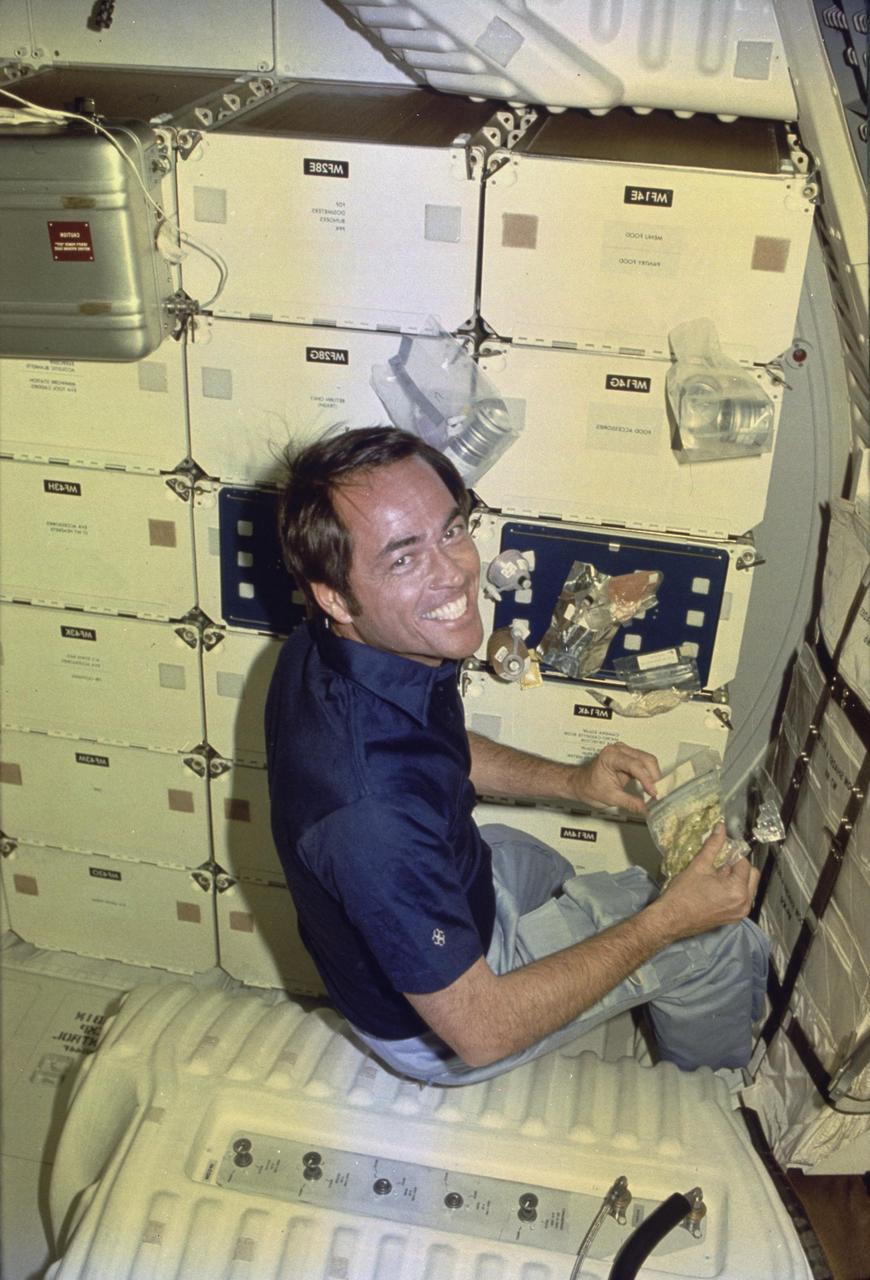
STS-1 ONBOARD PHOTOGRAPHY - STS-1-7-0502: STS-1 Pilot Robert Crippen at lunch.
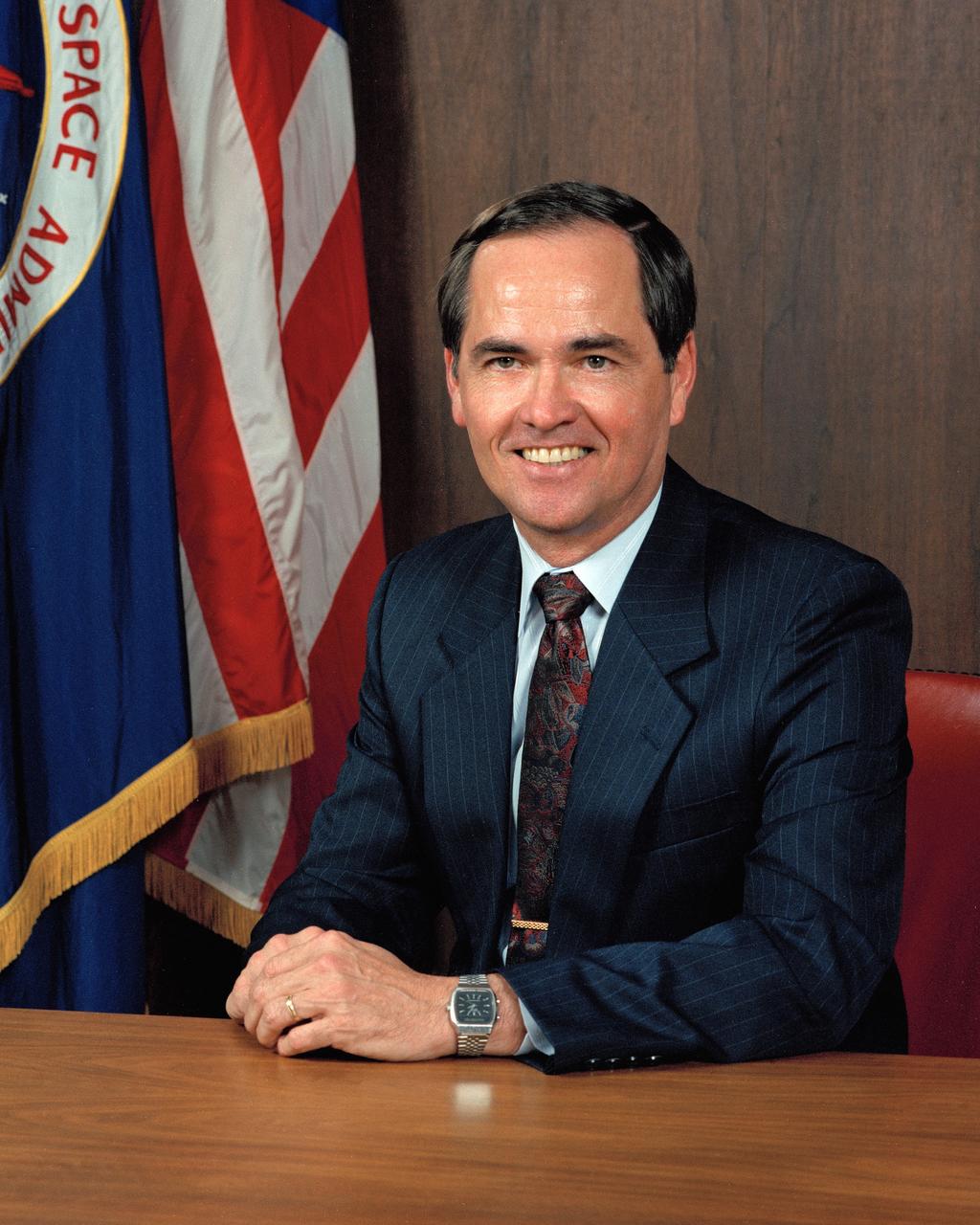
CAPE CANAVERAL, Fla. – Official portrait of Robert L. Crippen, KSC Center Director Photo credit: NASA
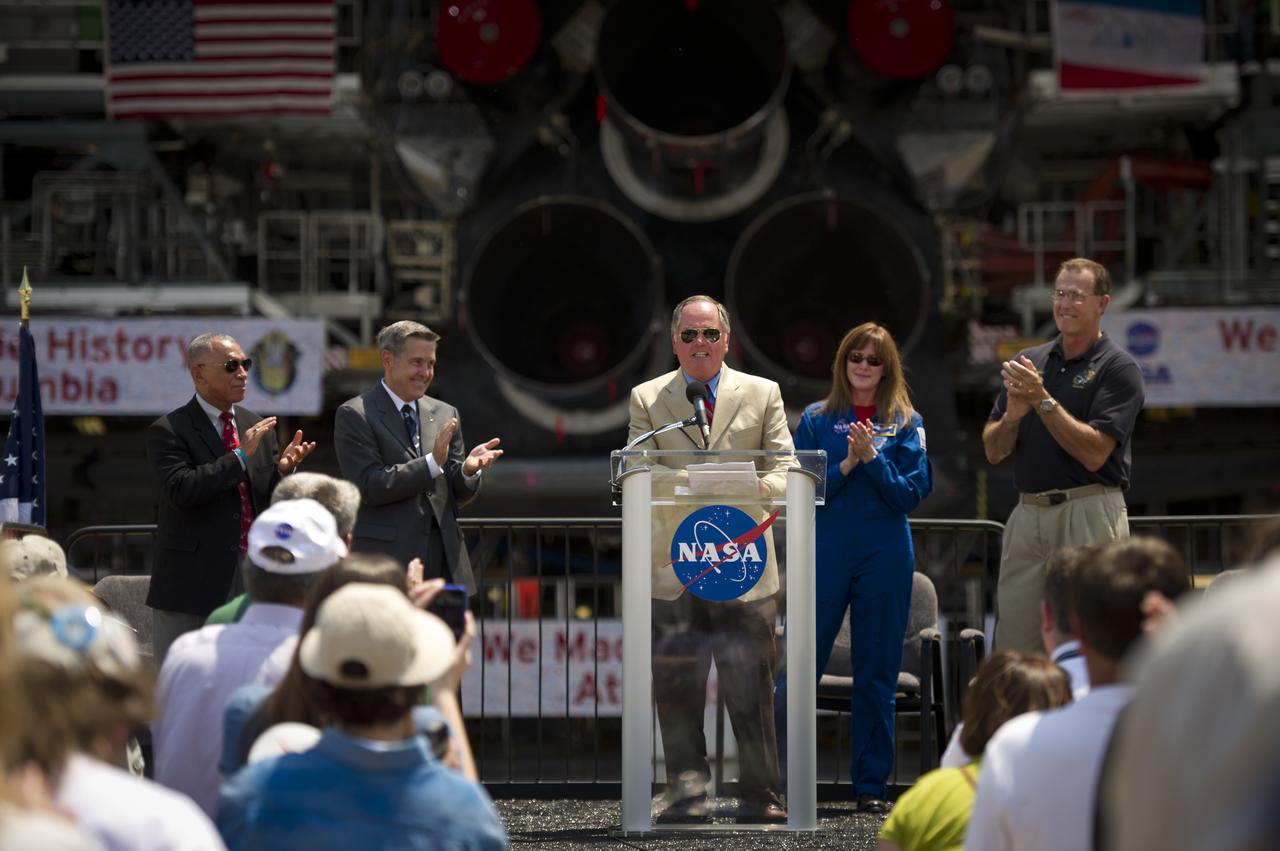
Pilot of the first space shuttle mission, STS-1, Bob Crippen speaks at an event where NASA Administrator Charles Bolden announced where four space shuttle orbiters will be permanently displayed at the conclusion of the Space Shuttle Program, Tuesday, April 12, 2011, at Kennedy Space Center in Cape Canaveral, Fla. The four orbiters, Enterprise, which currently is on display at the Smithsonian's Steven F. Udvar-Hazy Center near Washington Dulles International Airport, will move to the Intrepid Sea, Air & Space Museum in New York, Discovery will move to Udvar-Hazy, Endeavour will be displayed at the California Science Center in Los Angeles and Atlantis, in background, will be displayed at the Kennedy Space Center Visitor’s Complex. Photo Credit: (NASA/Bill Ingalls)
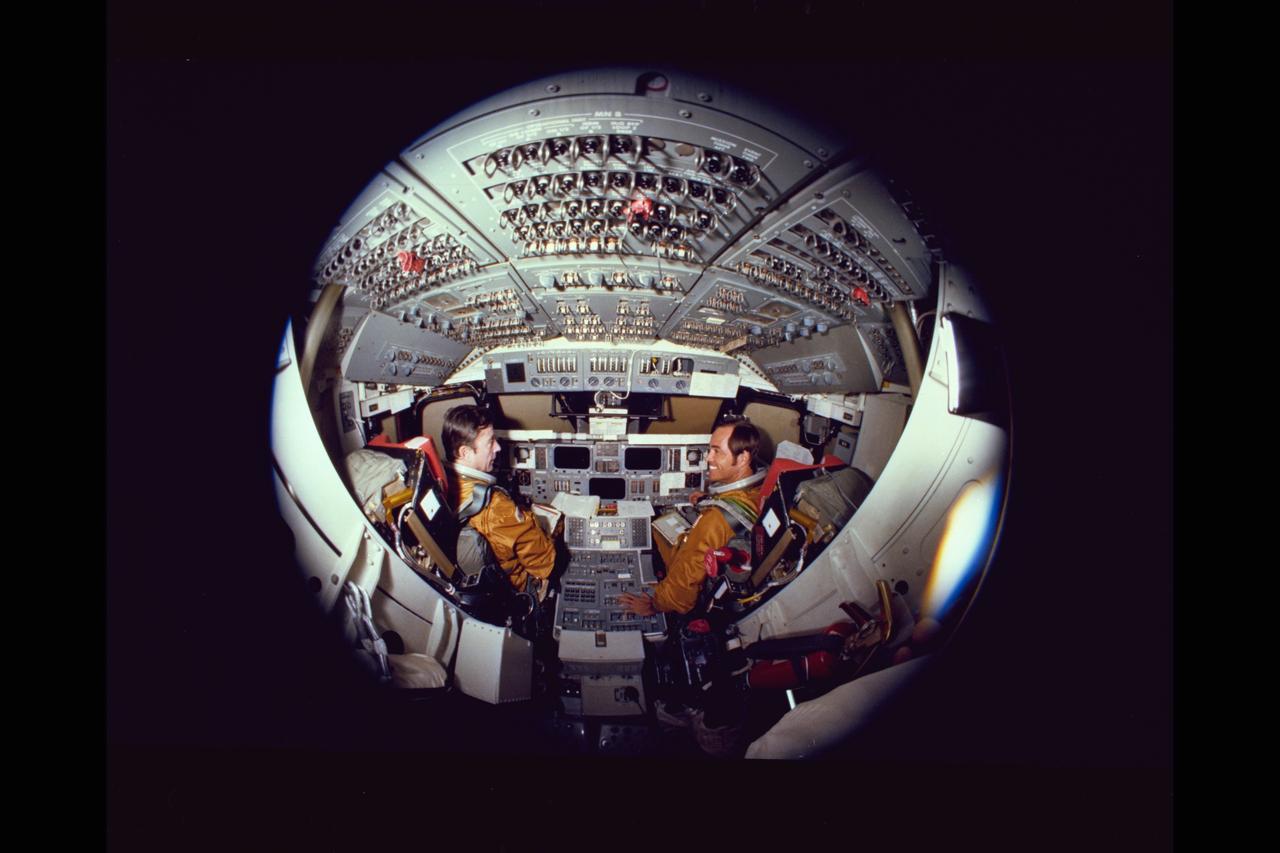
Space Shuttle Columbia at Launch Site (Cockpit crew John Young, Commander and Robert Crippen, Pilot) (ref: 80-HC-602)
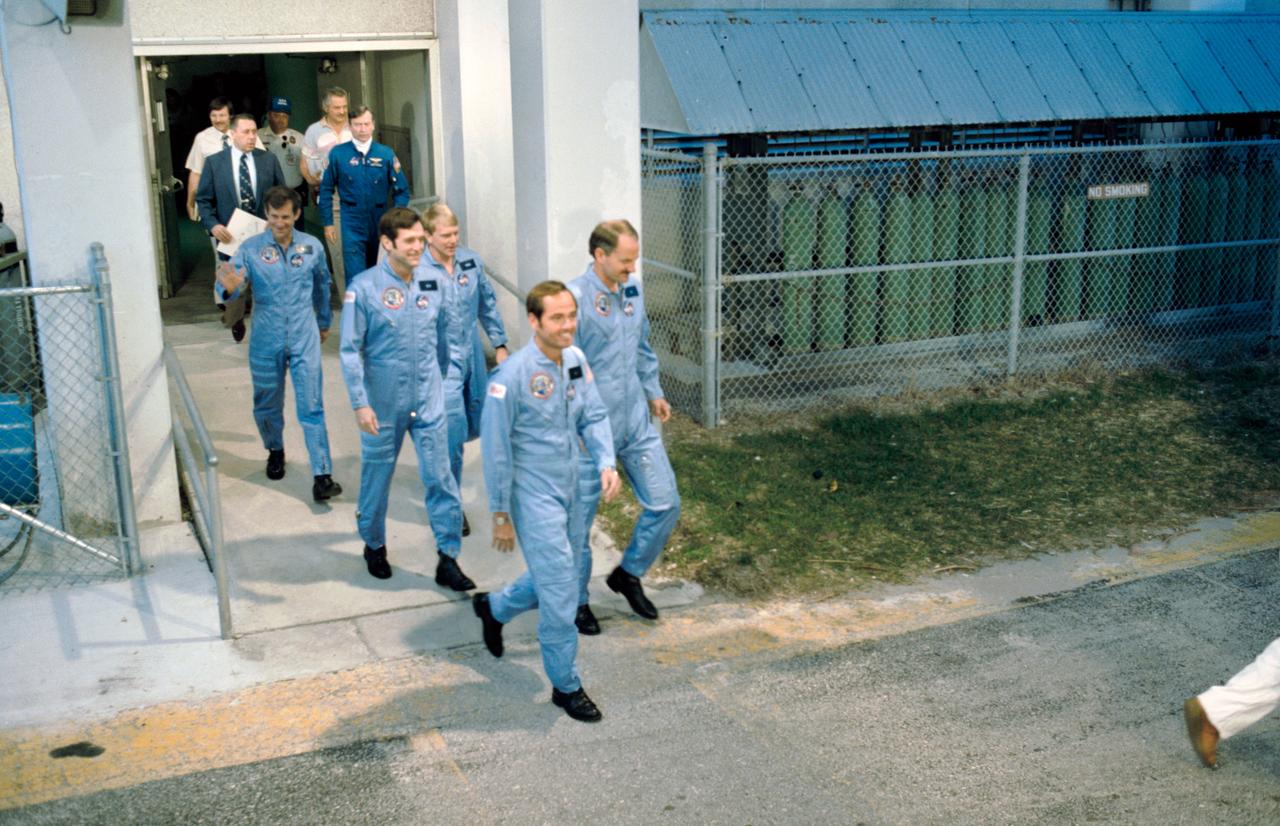
41C-3061 (6 April 1984) --- The five-member astronauts crew for NASA's STS-41C Space Shuttle mission head for the transfer van that will transport them to Launch Pad 39B at the Kennedy Space Center. Astronaut Robert L. Crippen, commander, leads the way. Immediately behind Crippen is Astronaut Francis R. (Dick) Scobee, pilot. The three mission specialists are (left to right) Astronauts Terry J. Hart, George D. Nelson and James D. van Hoften. The photograph was taken by Otis Imobden.
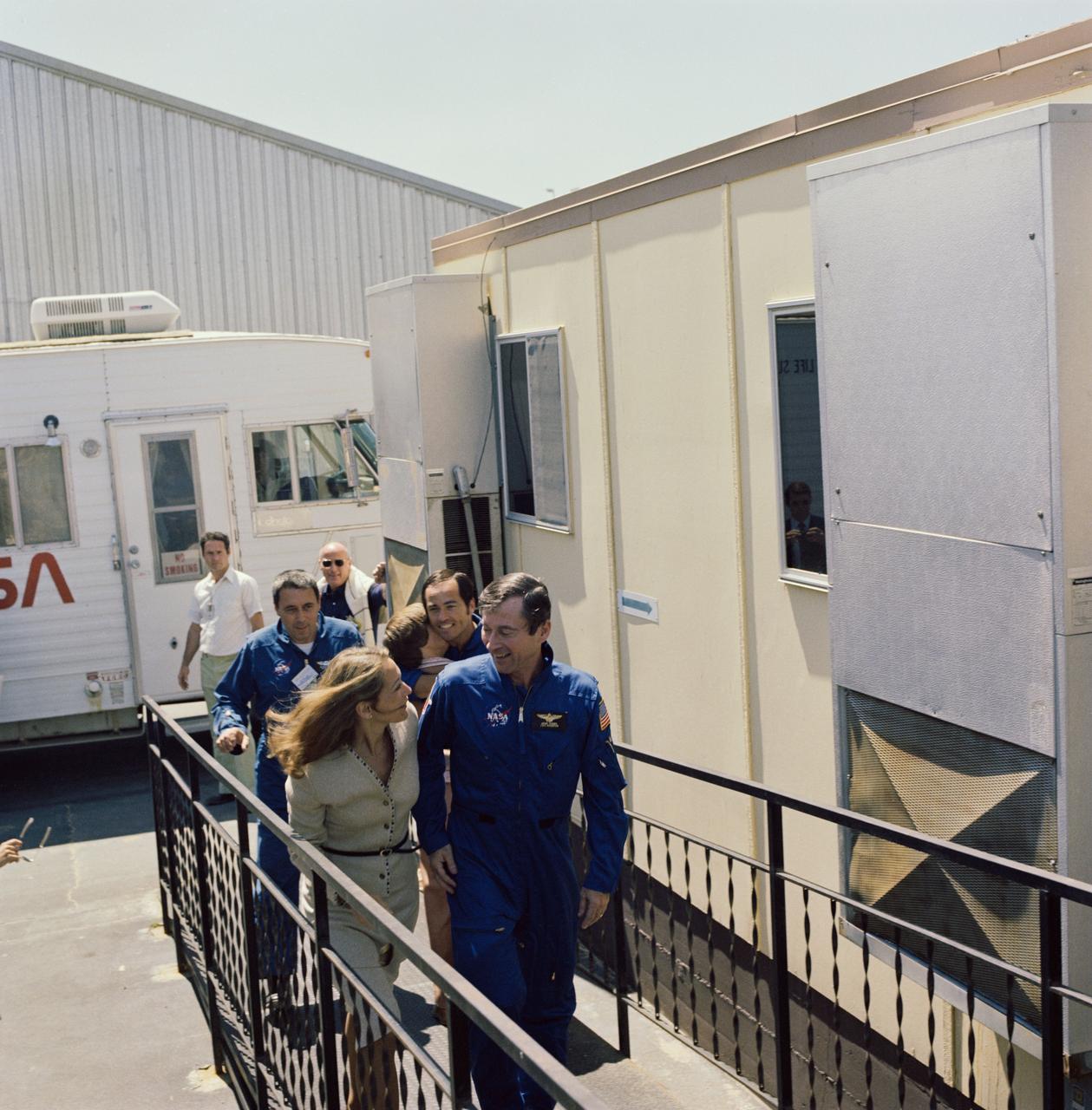
Astronaut Robert L. Crippen, right, is greeted by wife Virginia following landing of mission STS-1. Behind Mrs. Crippon is George W.S. Abbey, Director of Flight Operations at JSC (30850); Astronaut John W. Young, right, and Robert L. Crippen, center, are greeted by wives Susy and Virginia after completing STS-1 mission. Near left is George W. S. Abbey (30851).
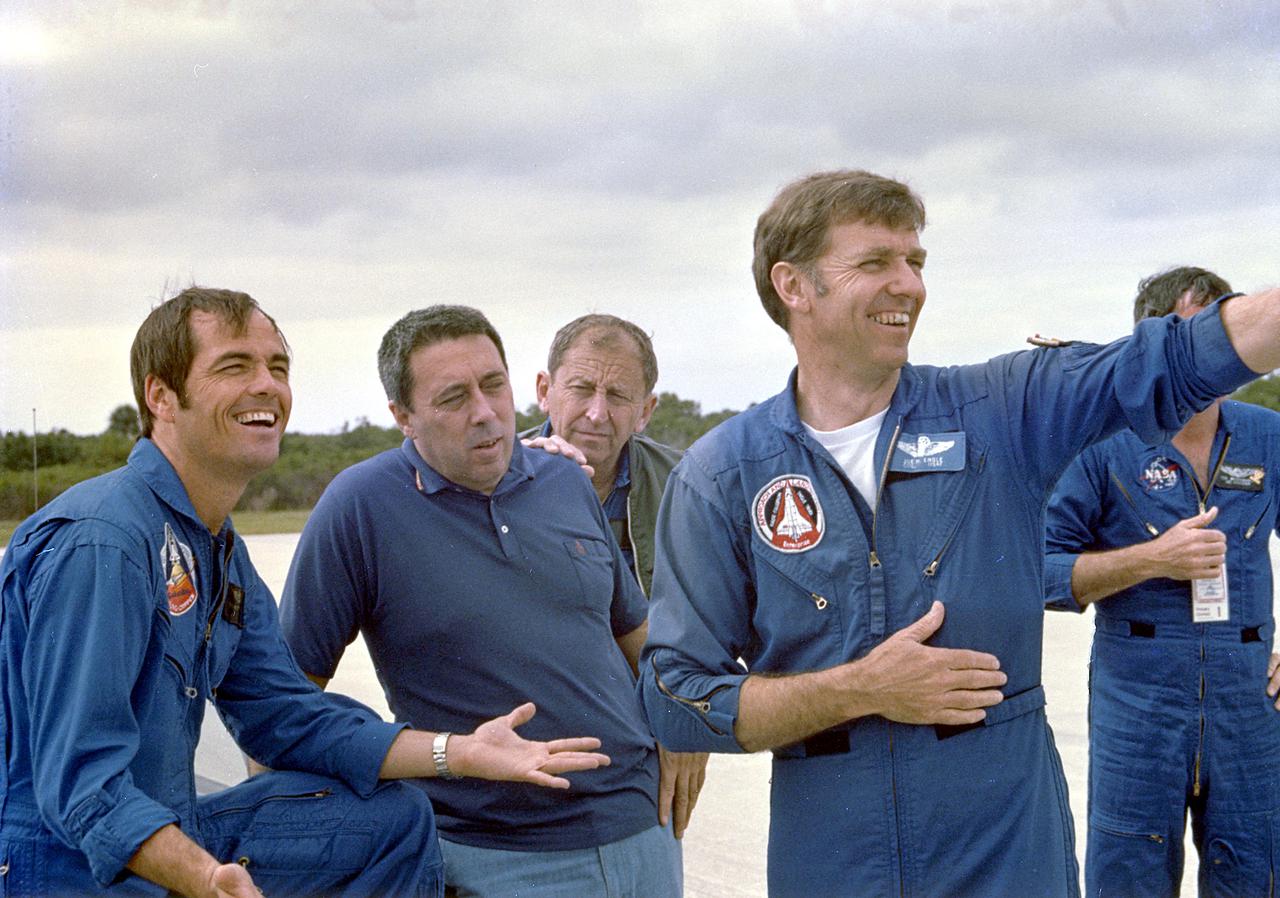
KENNEDY SPACE CENTER, FLA. - Astronaut Robert Crippen, left, relaxed despite the 'scrub' of the Space Shuttle launch on April 10, is joined at the Shuttle Landing Facility on April 11 by (from left) George Abbey, flight operations director; Joseph Algrantic, chief of Aircraft OPERATIONS Division, both with Johnson Space Center; and astronaut Joe Engle. Crippen and Young spent part of the day between the 'scrub' and the successful launch on April 12 in Shuttle landing practice, using a specially modified Grumman Airstream jet aircraft.
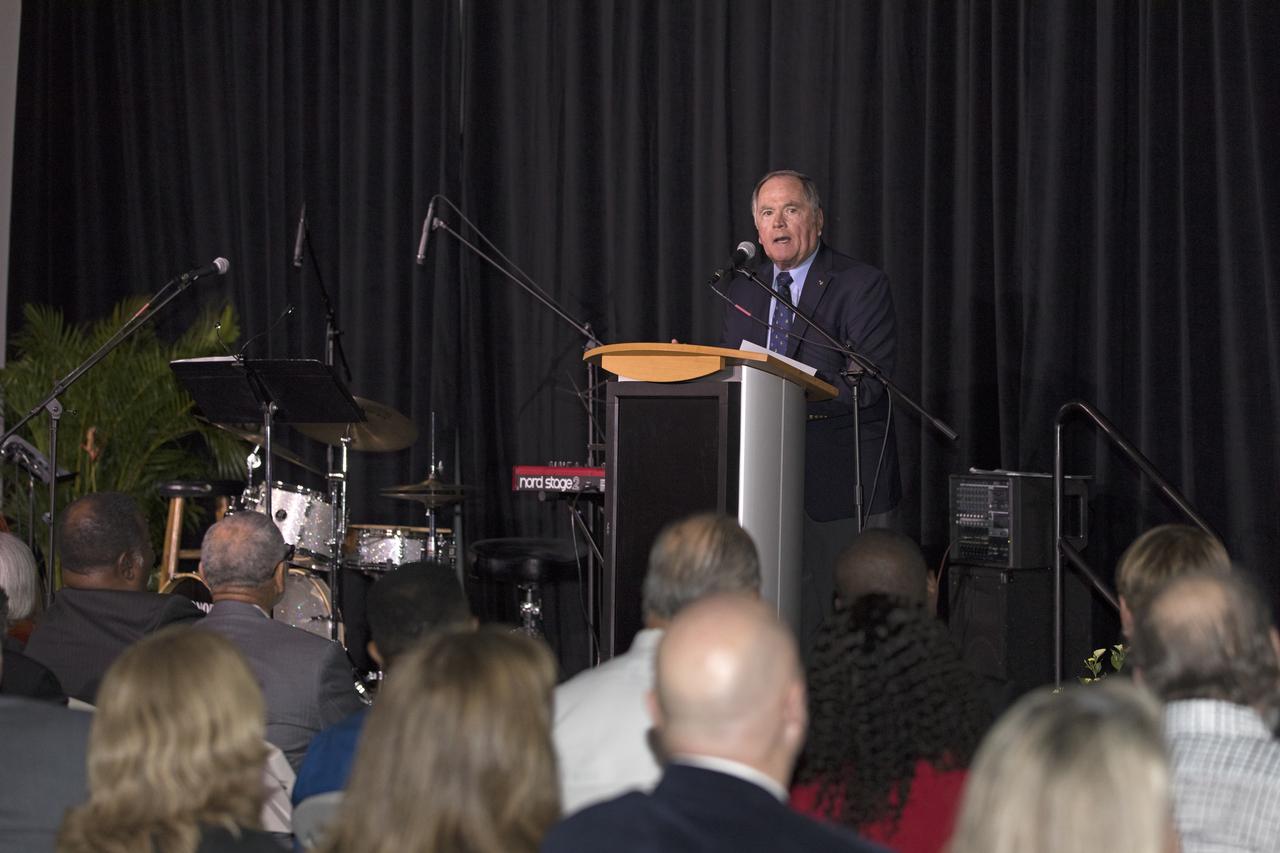
Bob Crippen, former Kennedy center director and NASA astronaut, speaks to guests during an Astronauts Memorial Foundation tribute honoring U.S. Air Foce Maj. Robert Lawrence. Like Crippen, Lawrence was selected in the 1960s for the Manned Orbiting Laboratory Program. As such, Lawrence was the first African-American astronaut. He lost his life in a training accident 50 years ago. The ceremony took place in the Center for Space Education at the Kennedy Space Center Visitor Complex.
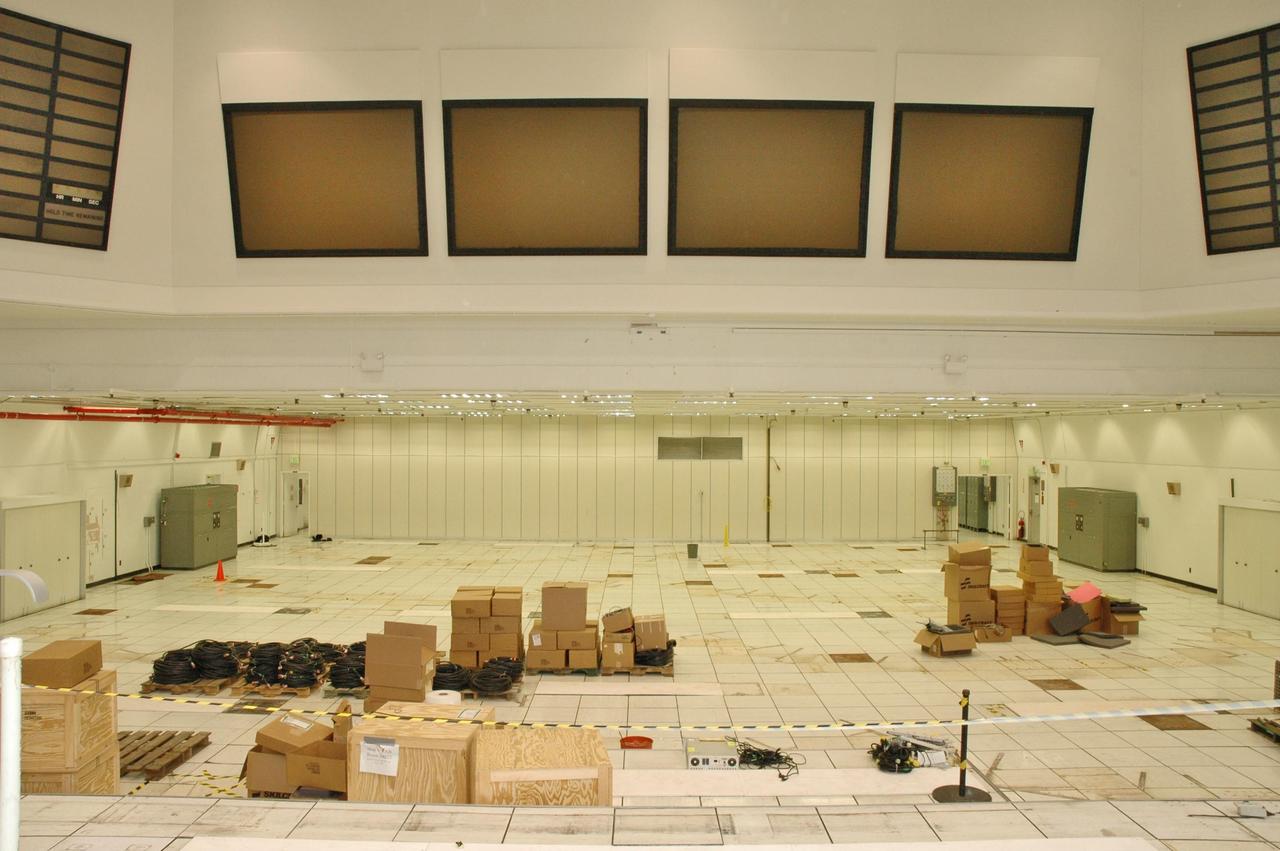
KENNEDY SPACE CENTER, FLA. -- Firing Room 1 of the Launch Control Center has been stripped of its equipment in preparation for transforming it to support the launch operations for the Ares launch vehicles. The Shuttle Processing Transition Team has worked to decommission Firing Room 1, also known as FR1, for transfer to the Constellation Program. The transition includes removing all the computer systems currently in the room and installing new equipment and software. The room was recently renamed the Young/Crippen Firing Room to honor Commander John Young and Pilot Robert Crippen in tribute to the 25th anniversary of the first space shuttle flight on April 12, 1981. It was this firing room that launched the historic flight and the crew of STS-1, Young and Crippen. Photo credit: NASA/Jim Grossmann

KENNEDY SPACE CENTER, FLA. -- Firing Room 1 of the Launch Control Center has been stripped of its equipment in preparation for transforming it to support the launch operations for the Ares launch vehicles. The Shuttle Processing Transition Team has worked to decommission Firing Room 1, also known as FR1, for transfer to the Constellation Program. The transition includes removing all the computer systems currently in the room and installing new equipment and software. The room was recently renamed the Young/Crippen Firing Room to honor Commander John Young and Pilot Robert Crippen in tribute to the 25th anniversary of the first space shuttle flight on April 12, 1981. It was this firing room that launched the historic flight and the crew of STS-1, Young and Crippen. Photo credit: NASA/Jim Grossmann

KENNEDY SPACE CENTER, FLA. -- Firing Room 1 of the Launch Control Center has been stripped of its equipment in preparation for transforming it to support the launch operations for the Ares launch vehicles. The Shuttle Processing Transition Team has worked to decommission Firing Room 1, also known as FR1, for transfer to the Constellation Program. The transition includes removing all the computer systems currently in the room and installing new equipment and software. The room was recently renamed the Young/Crippen Firing Room to honor Commander John Young and Pilot Robert Crippen in tribute to the 25th anniversary of the first space shuttle flight on April 12, 1981. It was this firing room that launched the historic flight and the crew of STS-1, Young and Crippen. Photo credit: NASA/Jim Grossmann
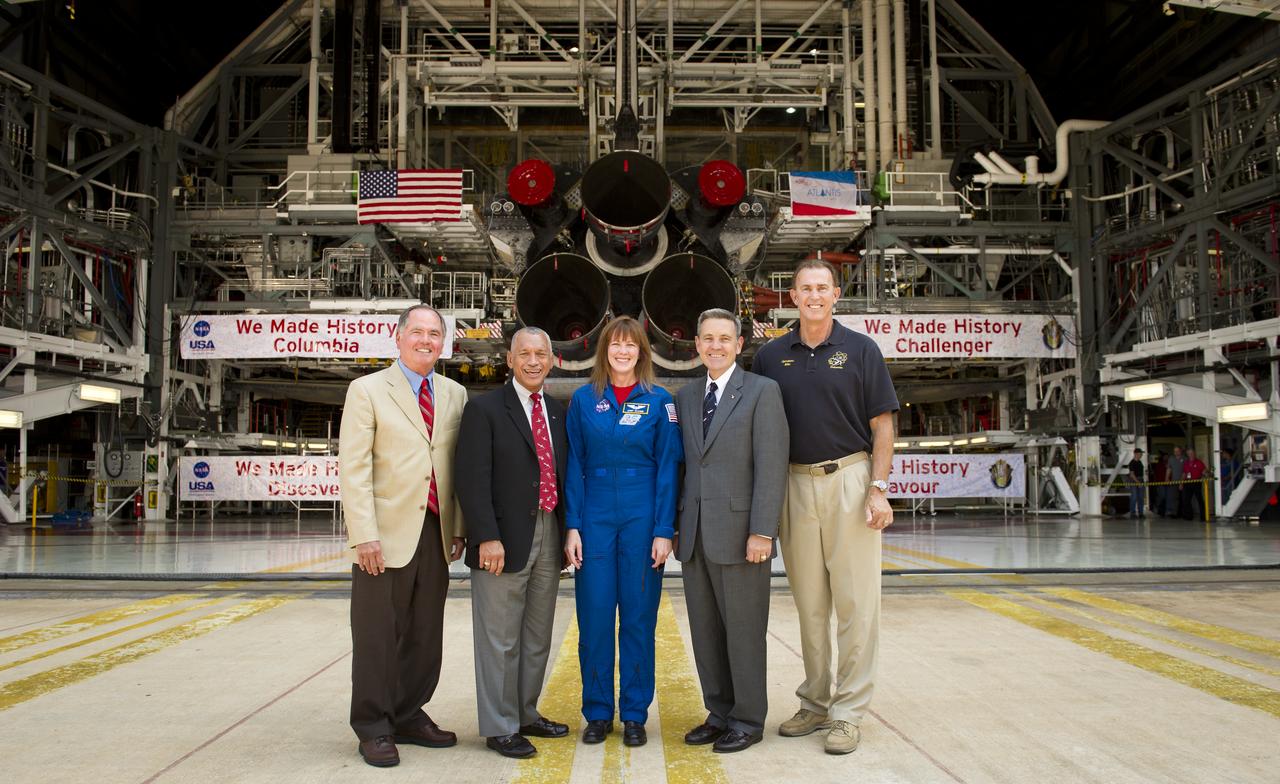
From left, Pilot of the first space shuttle mission, STS-1, Bob Crippen, NASA Administrator Charles Bolden, NASA Johnson Space Center Director of Flight Crew Operations, and Astronaut, Janet Kavandi, NASA Kennedy Space Center Director and former astronaut Bob Cabana, and Endeavour Vehicle Manager for United Space Alliance Mike Parrish pose for a photograph outside of the an Orbiter Processing Facility with the space shuttle Atlantis shortly after Bolden announced where four space shuttle orbiters will be permanently displayed at the conclusion of the Space Shuttle Program, Tuesday, April 12, 2011, at Kennedy Space Center in Cape Canaveral, Fla. The four orbiters, Enterprise, which currently is on display at the Smithsonian's Steven F. Udvar-Hazy Center near Washington Dulles International Airport, will move to the Intrepid Sea, Air & Space Museum in New York, Discovery will move to Udvar-Hazy, Endeavour will be displayed at the California Science Center in Los Angeles and Atlantis, in background, will be displayed at the Kennedy Space Center Visitor’s Complex. Photo Credit: (NASA/Bill Ingalls)
CAPE CANAVERAL, Fla. -- At NASA's Kennedy Space Center in Florida, remodeling for launches of future human spaceflight vehicles takes place in the Launch Control Center's Young-Crippen Firing Room. Known as Firing Room 1 in the Apollo era, it was re-named as a tribute to the Space Shuttle Program's first crewed mission, STS-1, which was flown by Commander John Young and Pilot Robert Crippen in April 1981. The firing room most recently was set up to support the Ares I-X flight test in Oct. 2009. Photo credit: NASA/Kim Shiflett
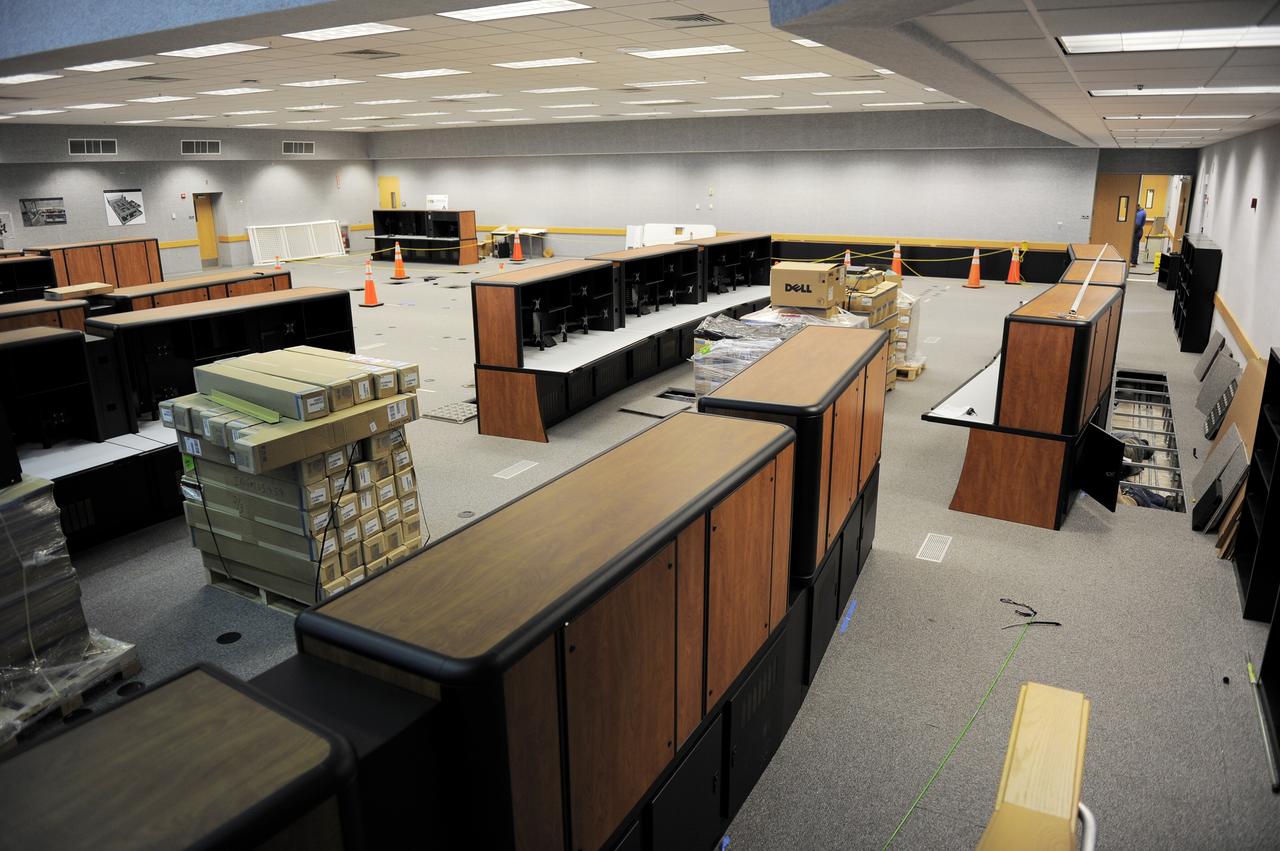
CAPE CANAVERAL, Fla. -- At NASA's Kennedy Space Center in Florida, remodeling for launches of future human spaceflight vehicles takes place in the Launch Control Center's Young-Crippen Firing Room. Known as Firing Room 1 in the Apollo era, it was re-named as a tribute to the Space Shuttle Program's first crewed mission, STS-1, which was flown by Commander John Young and Pilot Robert Crippen in April 1981. The firing room most recently was set up to support the Ares I-X flight test in Oct. 2009. Photo credit: NASA/Kim Shiflett
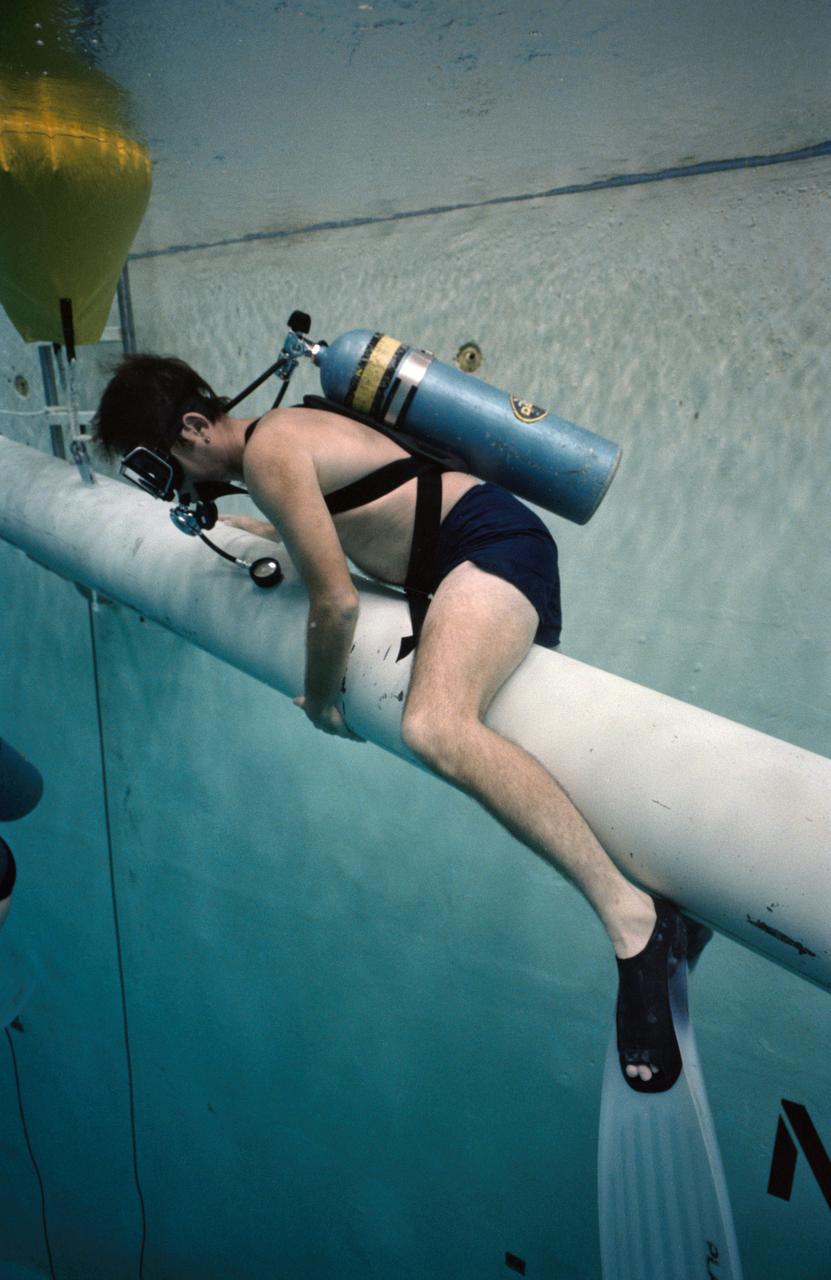
S84-36958 (29 June 1984) --- Astronaut Robert L. Crippen, 41-G crew commander, perches nearby an underwater simulation scene in the Johnson Space Center's weightless environment training facility (WET-F). Purpose of the rehearsal was to train two of the 41-G crew's mission specialists for a scheduled extravehicular activity (EVA). Out of frame are Astronauts Kathryn D. Sullivan, Jon A. McBride and David Leestma. Dr. Sullivan and Leestma donned extravehicular mobility units (EMU) for the simulation while Crippen and McBride monitored the activity. This photograph was taken by Otis Imboden.
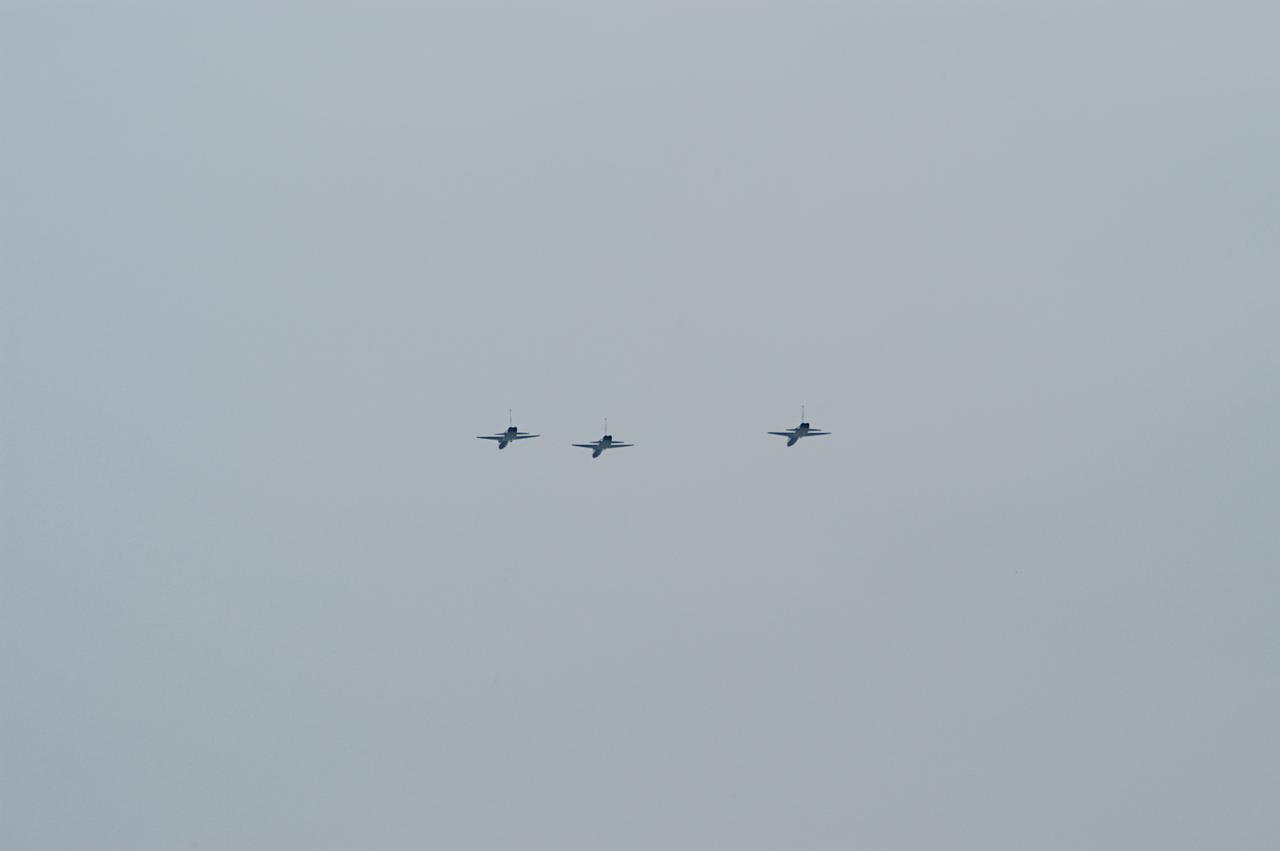
NASA T-38 jet aircraft are flying in a "Missing Man Formation" to conclude the memorial service for the crew of Columbia who were lost on Feb. 1, 2003, over East Texas as they returned to Earth after a 16-day research mission STS-107. The service was held at the Shuttle Landing Facility. Taking part in the service were NASA Administrator Sean O'Keefe, former KSC Director Robert Crippen, astronaut Jim Halsell, several employees, area clergymen, and members of Patrick Air Force Base. Crippen was the first to fly Columbia in 1981; Halsell first flew Columbia in 1994 and again in 1997.

S83-32571 (23 May 1983) --- Four-fifths of the STS-7 crew take a break from simulations in the Johnson Space Center?s Mission Simulation and Training Facility and pose for NASA photographer. Standing on the steps leading into the motion-based Shuttle Mission Simulator (SMS) are (left to right) astronauts Robert L. Crippen, John M. Fabian, Frederick H. Hauck and Sally K. Ride. Crippen is crew commander; Hauck, pilot; and Fabian and Ride are mission specialists, along with Norman E. Thagard (not involved in this phase of training and not pictured). Photo credit: NASA
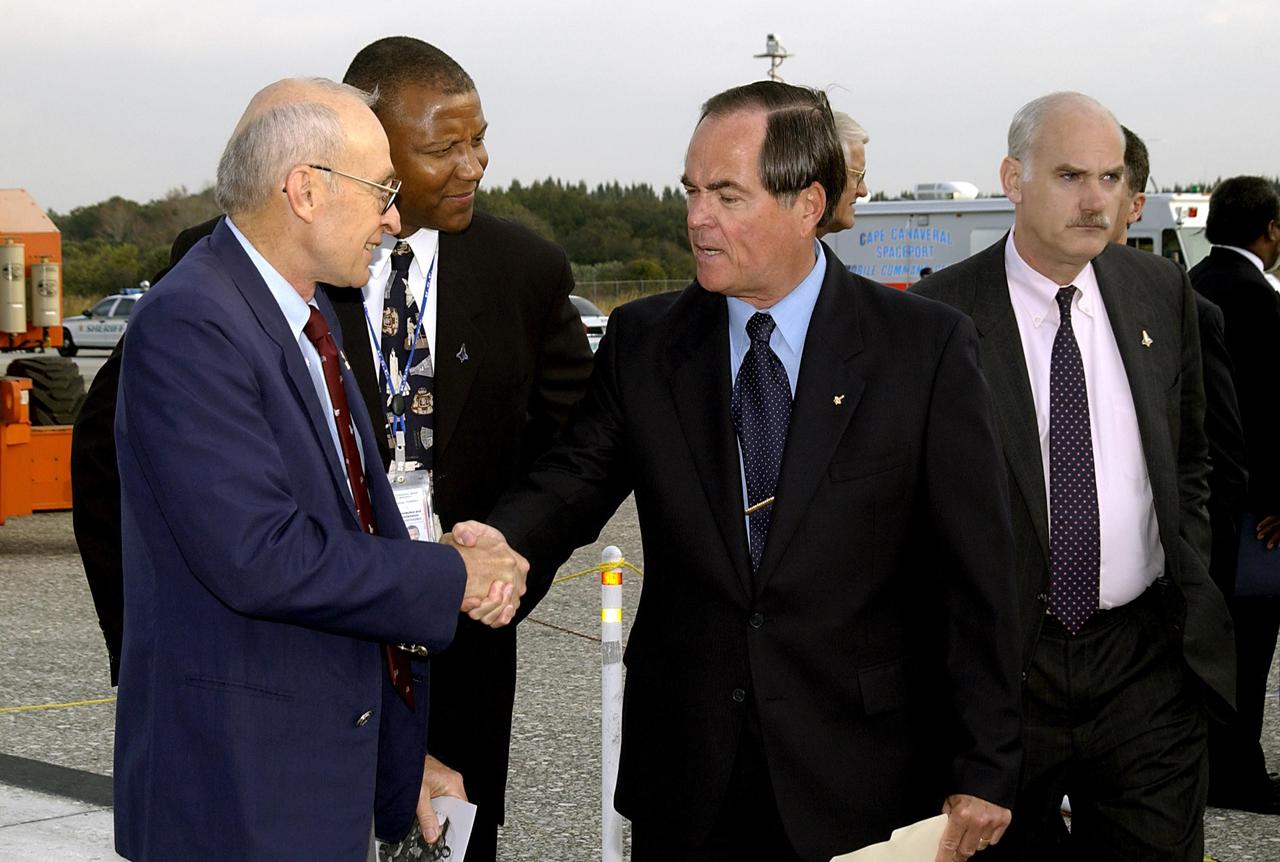
KENNEDY SPACE CENTER, FLA. - A Columbia Crew Memorial Service is held at the Shuttle Landing Facility for KSC employees and invited guests, including former astronaut and KSC Director Robert Crippen (center). The Columbia and her crew of seven were lost on Feb. 1, 2003, over East Texas as they returned to Earth after a 16-day research mission. Taking part in the service were NASA Administrator Sean O’Keefe, former KSC Director Robert Crippen, astronaut Jim Halsell, several employees, area clergymen, and members of Patrick Air Force Base. The service concluded with a “Missing Man Formation Fly Over” by NASA T-38 jet aircraft.

STS007-15-671 / S83-35767 (21 June 1983) --- Among the "firsts" on the mission is this unprecedented scene of a crew of five astronauts aboard the Space Shuttle Challenger in space. A pre-set 35mm camera exposed the frame. Left to right on the flight deck are Norman E. Thagard, mission specialist; Robert L. Crippen, commander; Frederick H. Hauck, pilot; Sally K. Ride, mission specialist; and John M. Fabian, mission specialist. Crippen the crew commander, is making his second Space Shuttle trip; pilot Hauck and mission specialist Dr. Ride, Dr. Thagard and Fabian are members of the 1978 class of astronaut candidates (ASCAN).
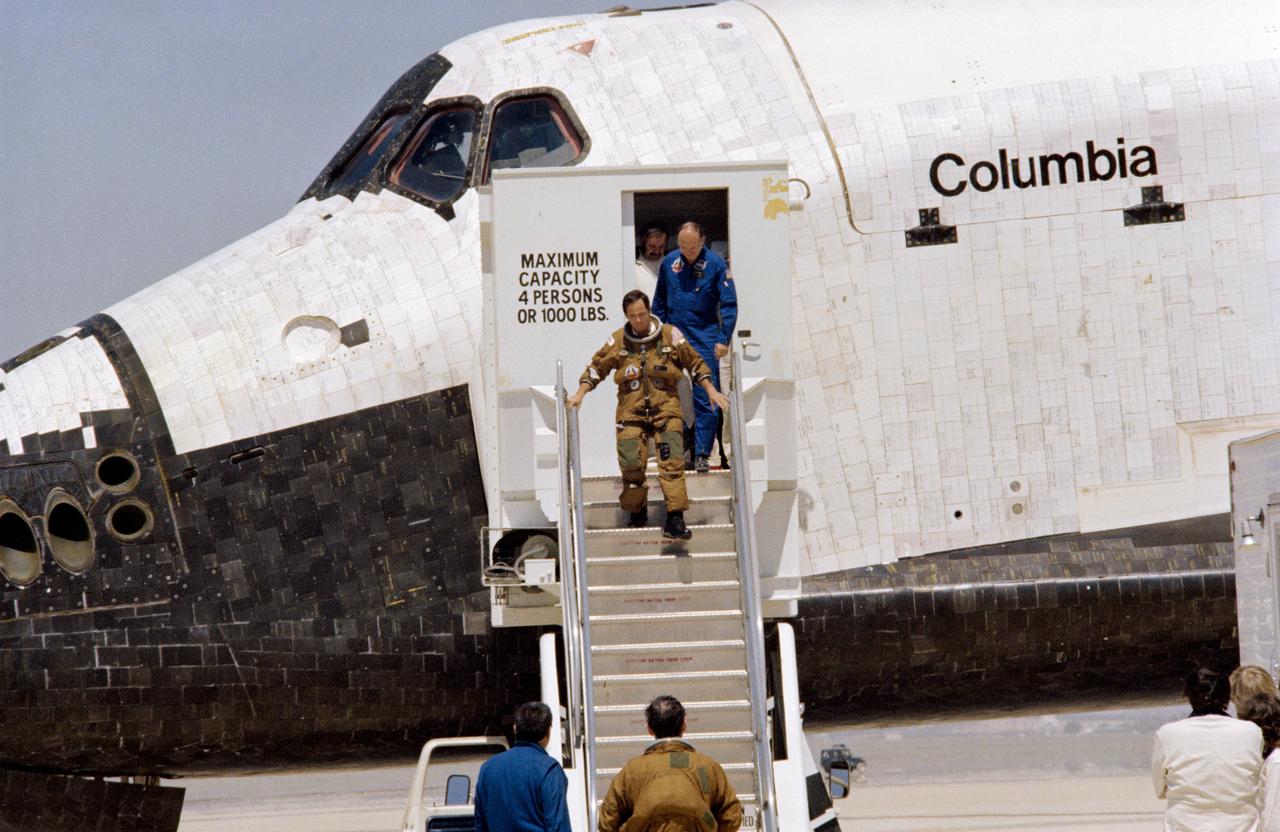
S81-30852 (14 April 1981) --- Astronaut Robert L. Crippen, pilot for the STS-1 flight, egresses the NASA space shuttle following touchdown of the Columbia on Rogers Dry Lake at Edwards Air Force Base, California. Astronaut John W. Young, crew commander, had earlier exited the craft and can be seen standing at the foot of the steps with George W.S. Abbey, director of flight operations at the Johnson Space Center (JSC). Dr. Craig L. Fischer, chief of the medical operations branch in JSC?s medical sciences division, follows Crippen down the steps. Photo credit: NASA
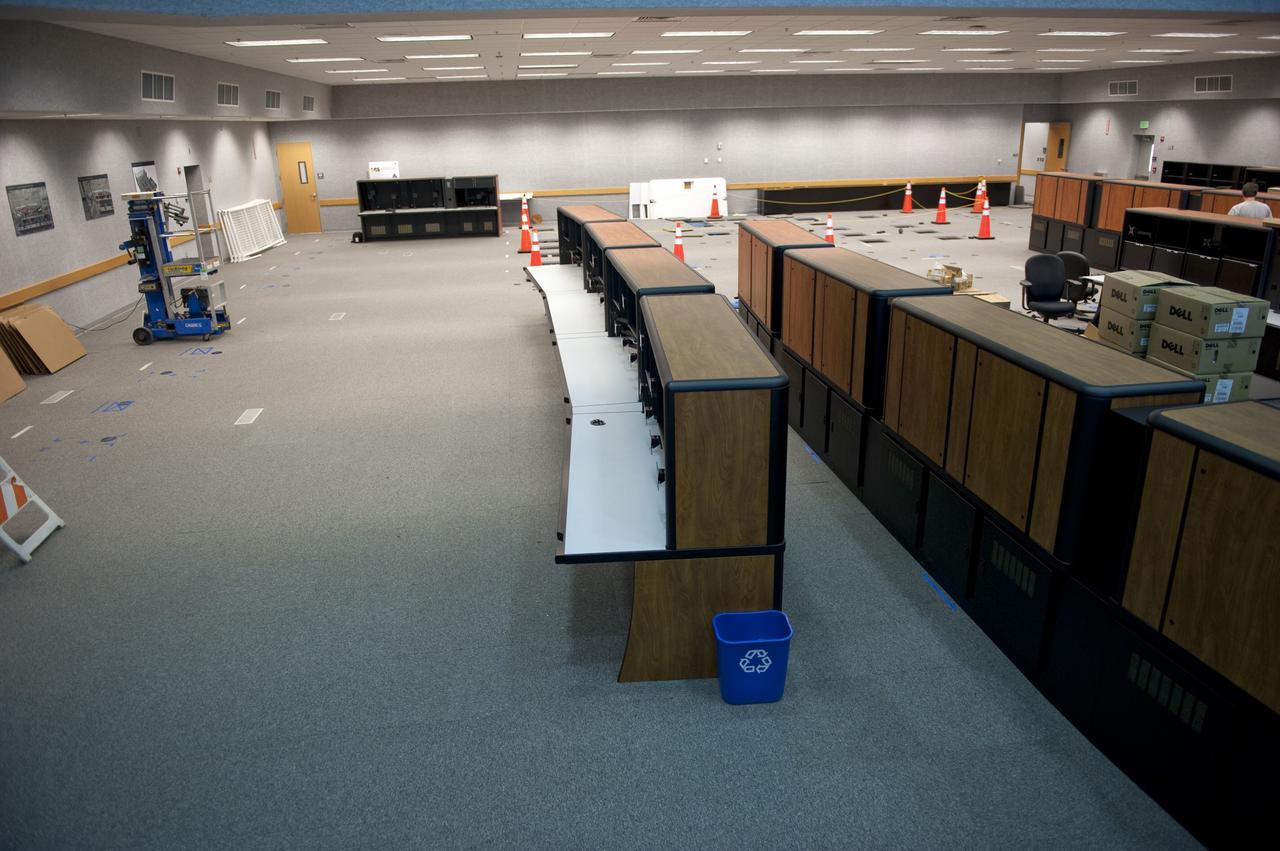
CAPE CANAVERAL, Fla. -- At NASA's Kennedy Space Center in Florida, remodeling for launches of future human spaceflight vehicles takes place in the Launch Control Center's Young-Crippen Firing Room. Known as Firing Room 1 in the Apollo era, it was re-named as a tribute to the Space Shuttle Program's first crewed mission, STS-1, which was flown by Commander John Young and Pilot Robert Crippen in April 1981. The firing room most recently was set up to support the Ares I-X flight test in Oct. 2009. Photo credit: NASA/Kim Shiflett
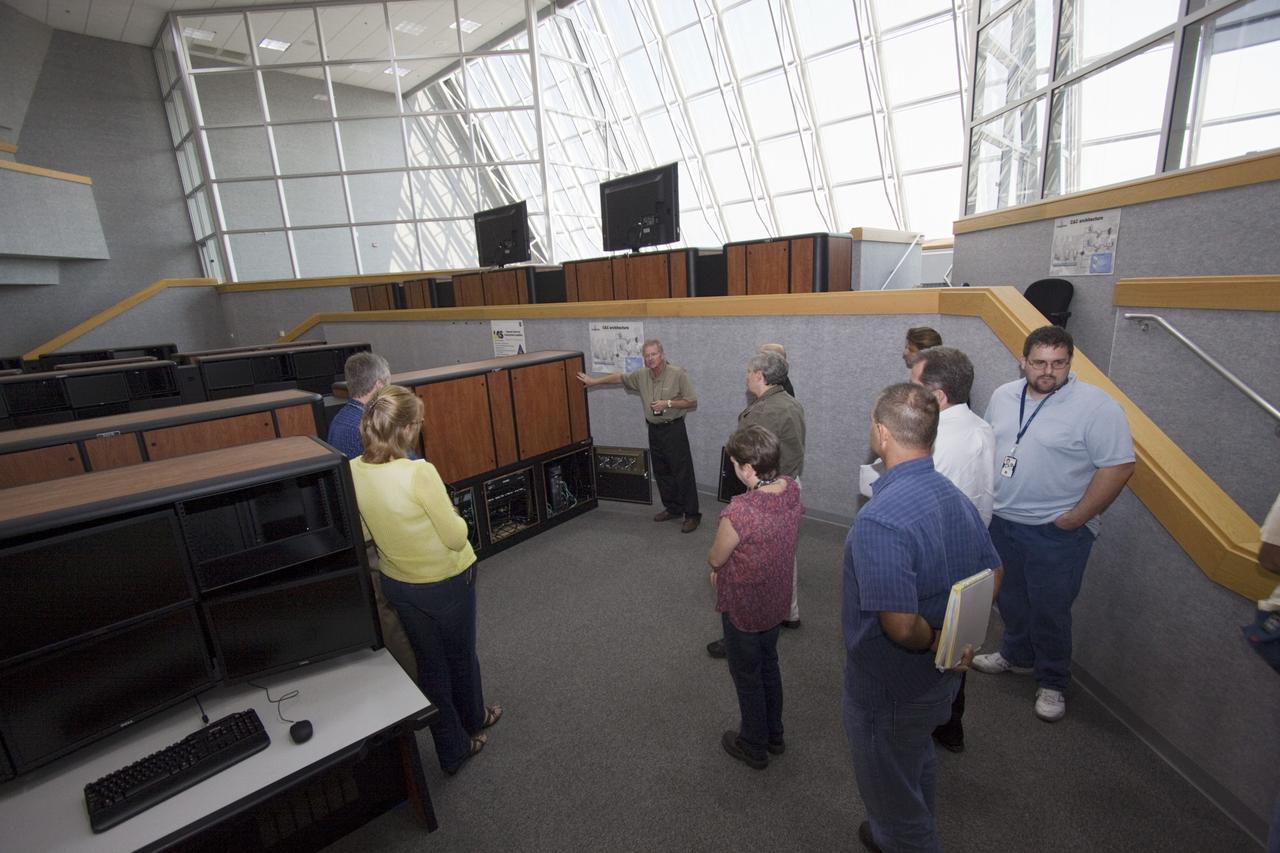
CAPE CANAVERAL, Fla. – At the newly remodeled Launch Control Center's Young-Crippen Firing Room at NASA's Kennedy Space Center in Florida, engineering directorate personnel demonstrate the recently added Space Command & Control System which will be used for launches of future human spaceflight vehicles. Known as Firing Room 1 in the Apollo era, it was re-named as a tribute to the Space Shuttle Program's first crewed mission, STS-1, which was flown by Commander John W. Young and Pilot Robert L. Crippen in April 1981. Photo credit: NASA/Jim Grossmann
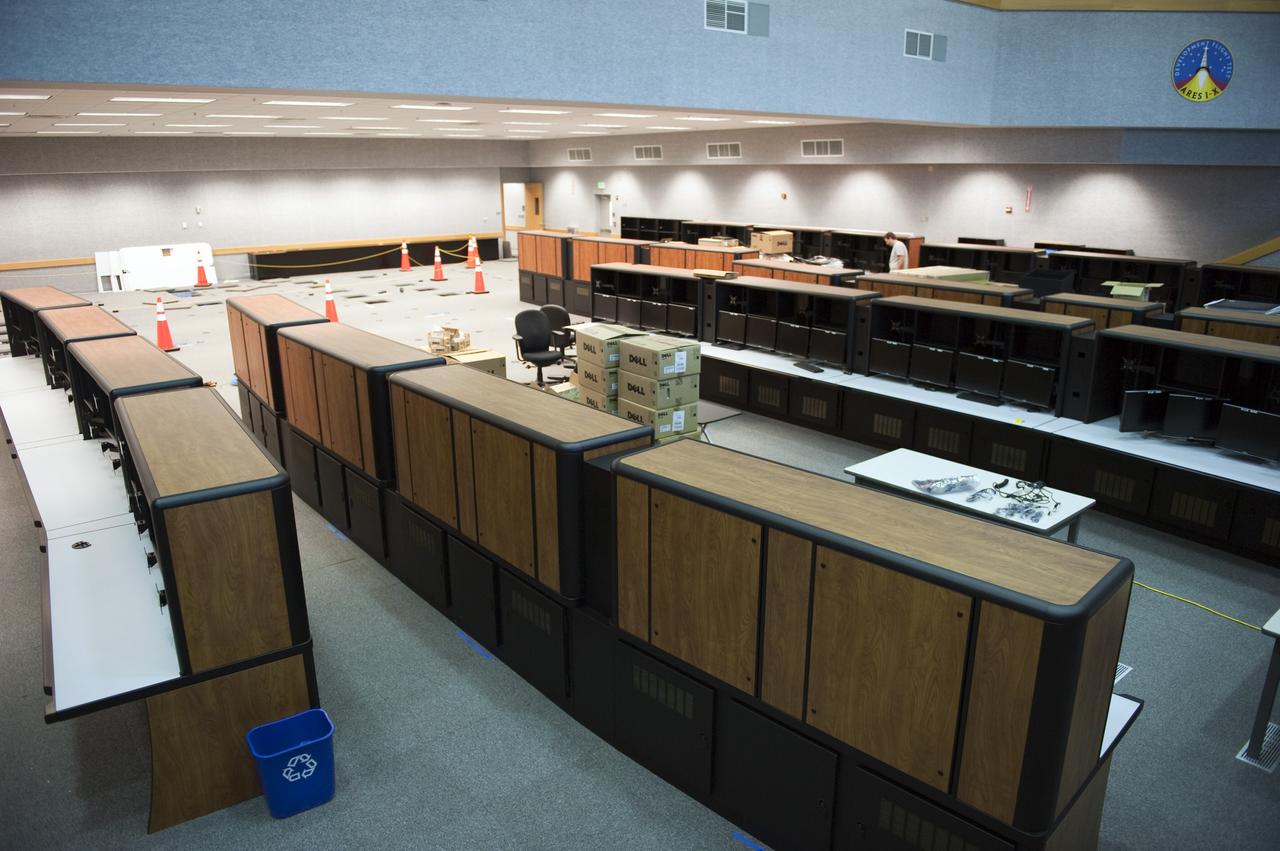
CAPE CANAVERAL, Fla. -- At NASA's Kennedy Space Center in Florida, remodeling for launches of future human spaceflight vehicles takes place in the Launch Control Center's Young-Crippen Firing Room. Known as Firing Room 1 in the Apollo era, it was re-named as a tribute to the Space Shuttle Program's first crewed mission, STS-1, which was flown by Commander John Young and Pilot Robert Crippen in April 1981. The firing room most recently was set up to support the Ares I-X flight test in Oct. 2009. Photo credit: NASA/Kim Shiflett
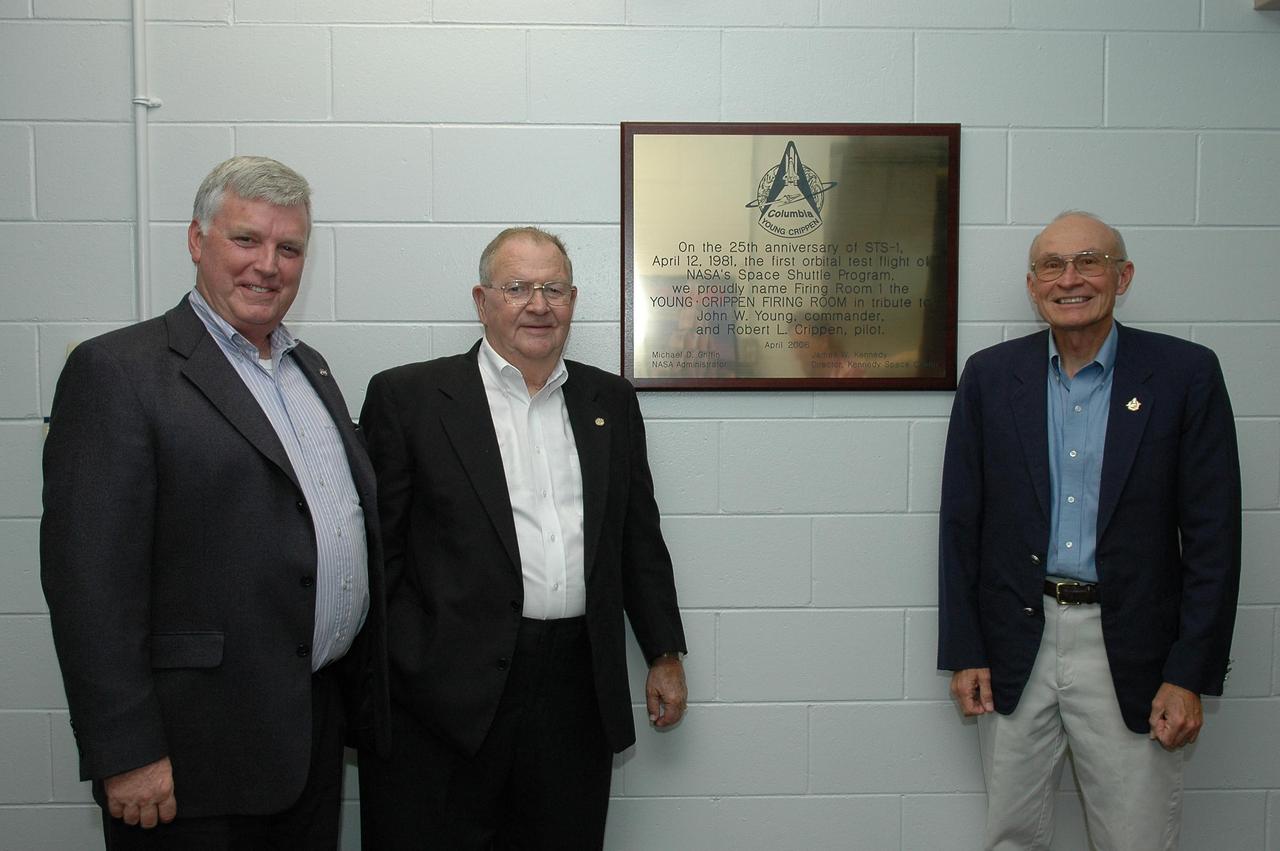
KENNEDY SPACE CENTER, FLA. - In tribute to the 25th anniversary of the first space shuttle flight, NASA's Kennedy Space Center has honored the crew of STS-1, Commander John Young and Pilot Robert Crippen, by dedicating the firing room that launched the historic flight as the "Young · Crippen Firing Room." Making the dedication were (from left) Center Director Jim Kennedy; the NASA test director for STS-1, Norm Carlson; and the project flight engineer for Space Shuttle Columbia, Bob Sieck. On the wall behind them is the plaque marking the dedication. Photo credit: NASA/Kim Shiflett
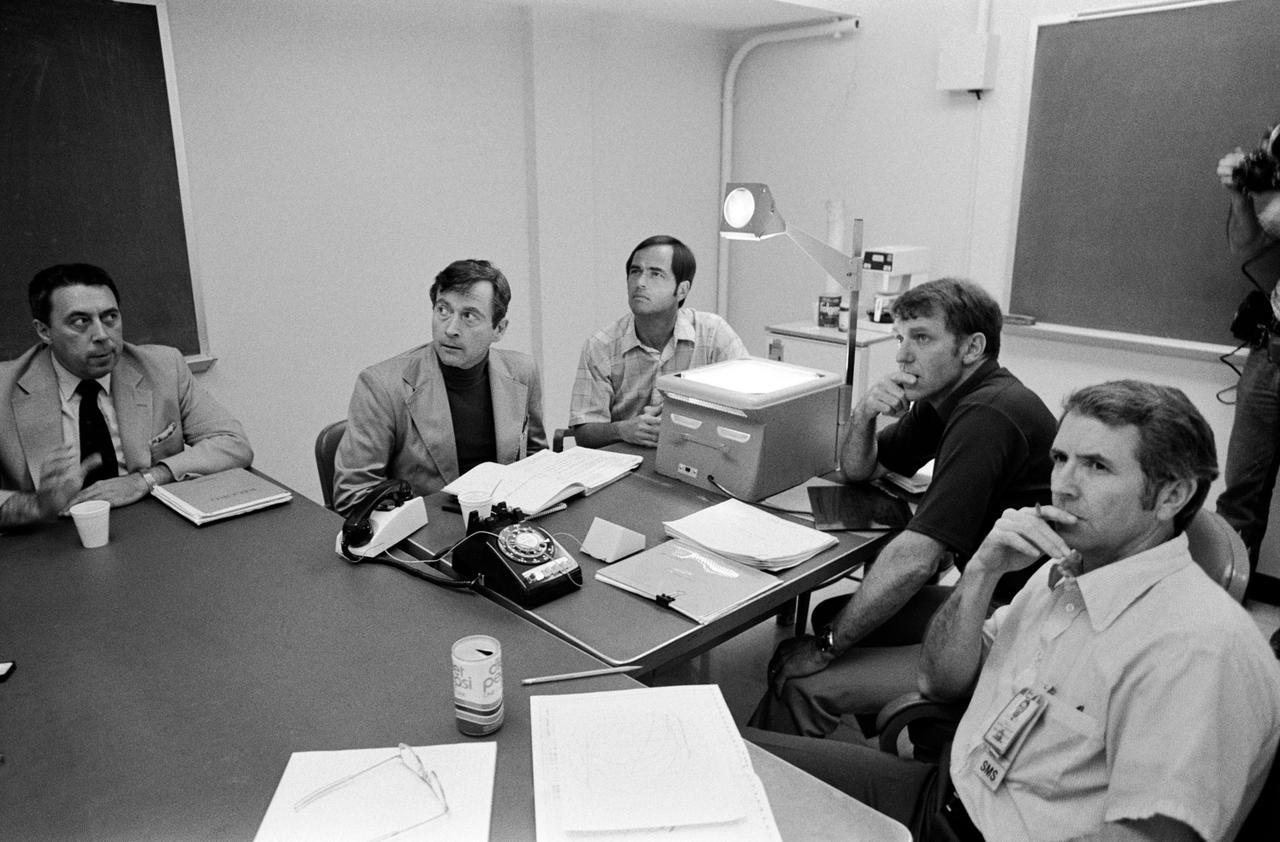
S81-29618 (6 April 1981) --- STS-1 prime and backup astronaut crew members look at visuals during a coordinated teleconference with engineers. Seated at the table in a briefing room at NASA's Johnson Space Center are, clockwise from the left, George W.S. Abbey, Director of Flight Operations, John W. Young, Robert L. Crippen, Joe H. Engle and Richard H. Truly. Young and Crippen are prime crewmen preparing to man the Columbia later this week for the flight of STS-1. Rockwell International engineers in California as well as JSC engineers participated in this telecon. Photo credit: NASA
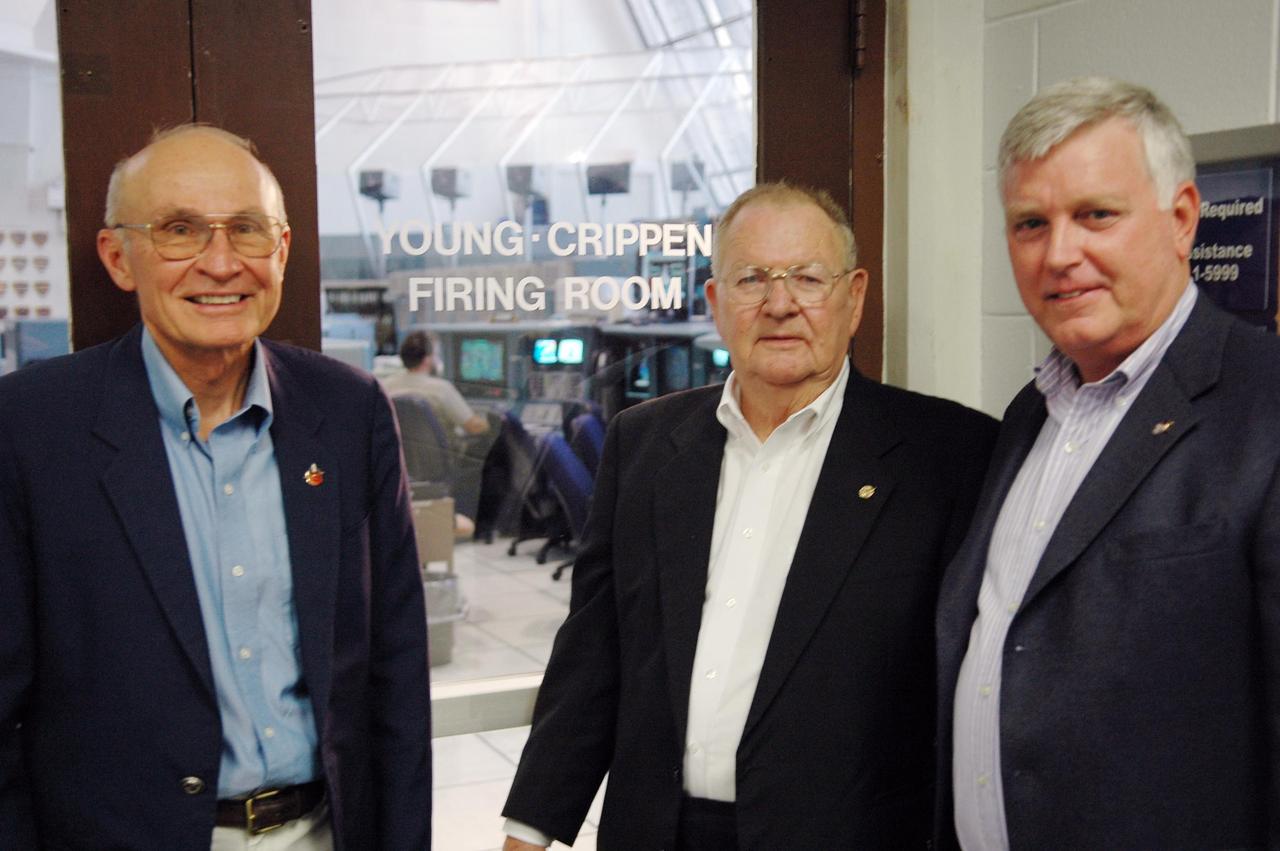
KENNEDY SPACE CENTER, FLA. - In tribute to the 25th anniversary of the first space shuttle flight, NASA's Kennedy Space Center has honored the crew of STS-1, Commander John Young and Pilot Robert Crippen, by dedicating the firing room that launched the historic flight as the "Young · Crippen Firing Room" (seen here). Making the dedication were (from left) the project flight engineer for Space Shuttle Columbia, Bob Sieck; the NASA test director for STS-1, Norm Carlson; and Center Director Jim Kennedy. Photo credit: NASA/Kim Shiflett
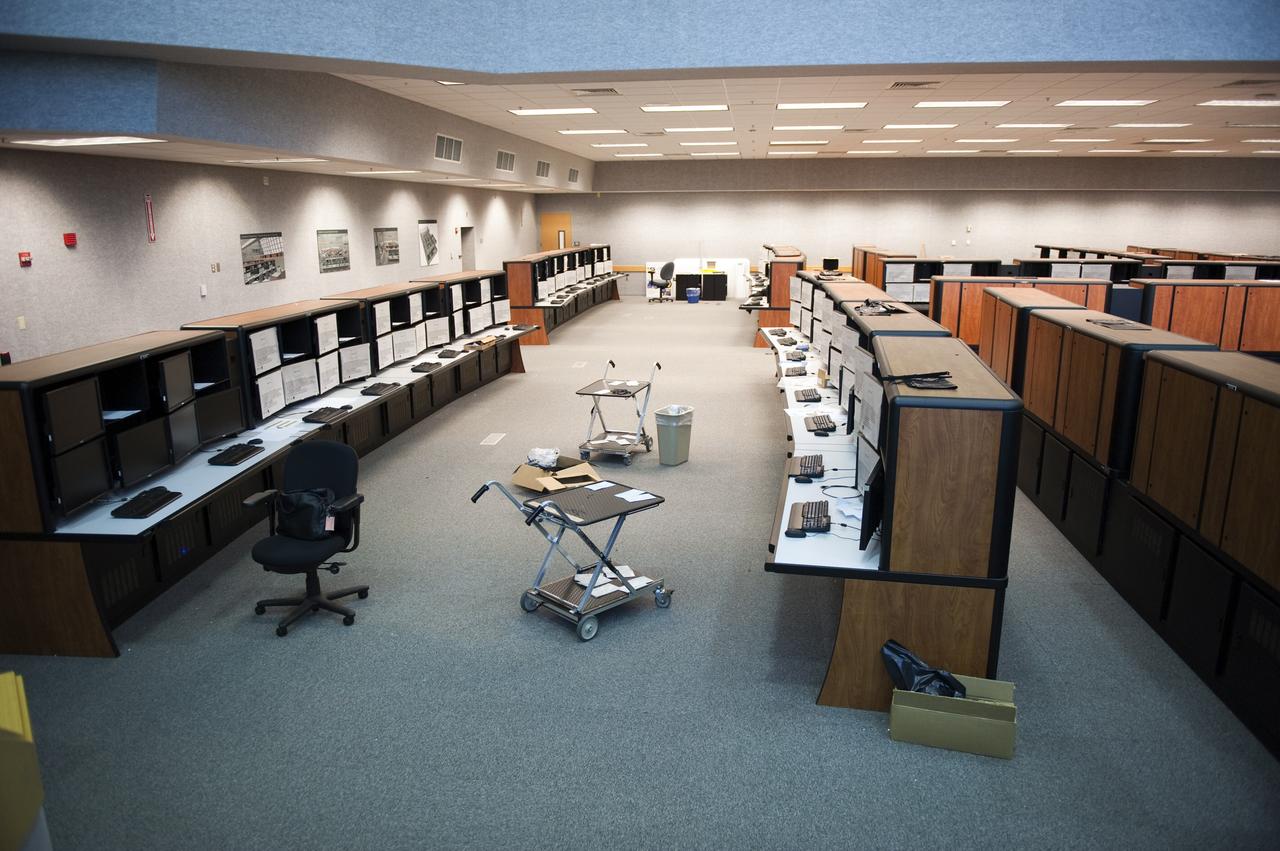
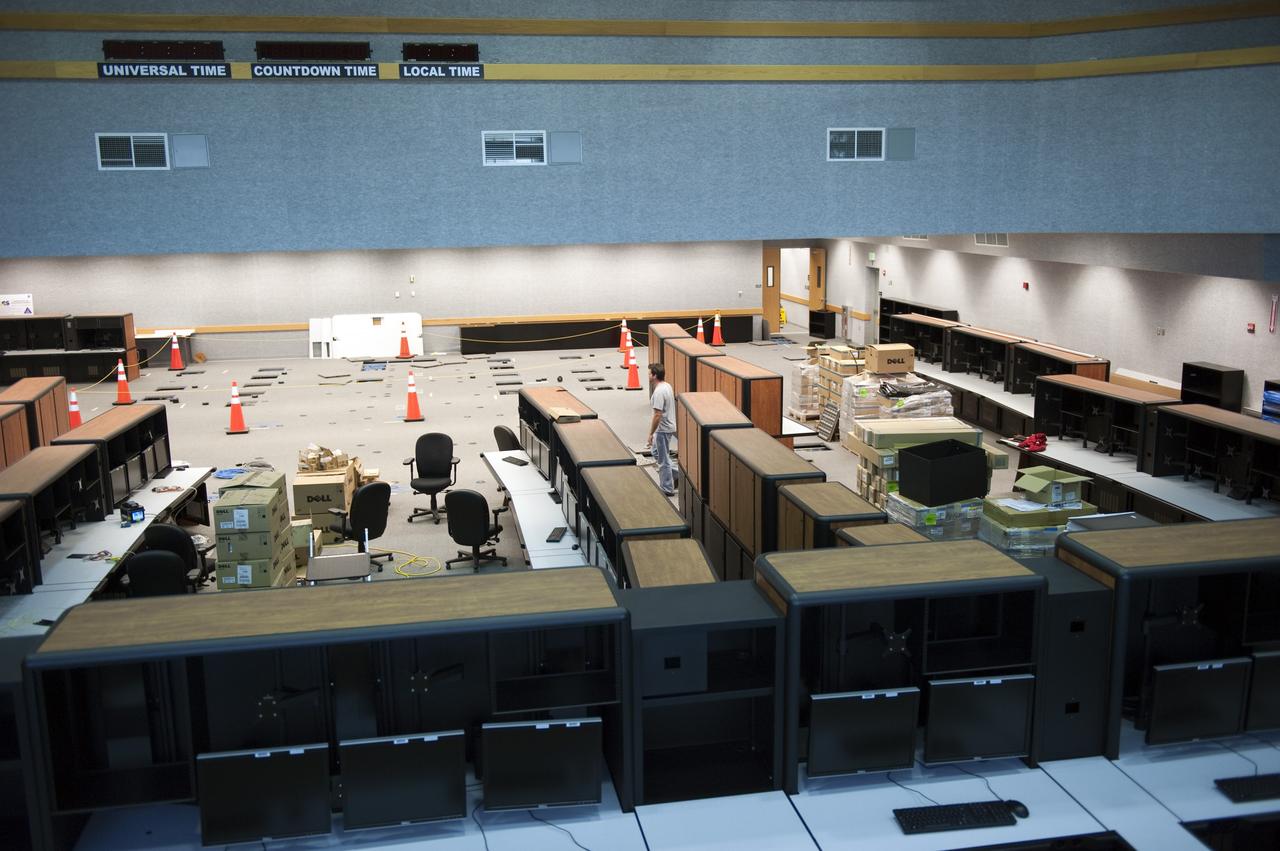
CAPE CANAVERAL, Fla. -- At NASA's Kennedy Space Center in Florida, remodeling for launches of future human spaceflight vehicles continues in the Launch Control Center's Young-Crippen Firing Room. Consoles already have been rewired for the comprehensive upgrade and are now being outfitted with new computers and monitors. Known as Firing Room 1 in the Apollo era, it was re-named as a tribute to the Space Shuttle Program's first crewed mission, STS-1, which was flown by Commander John Young and Pilot Robert Crippen in April 1981. The firing room most recently was set up to support the Ares I-X flight test in Oct. 2009. Photo credit: NASA/Kim Shiflett
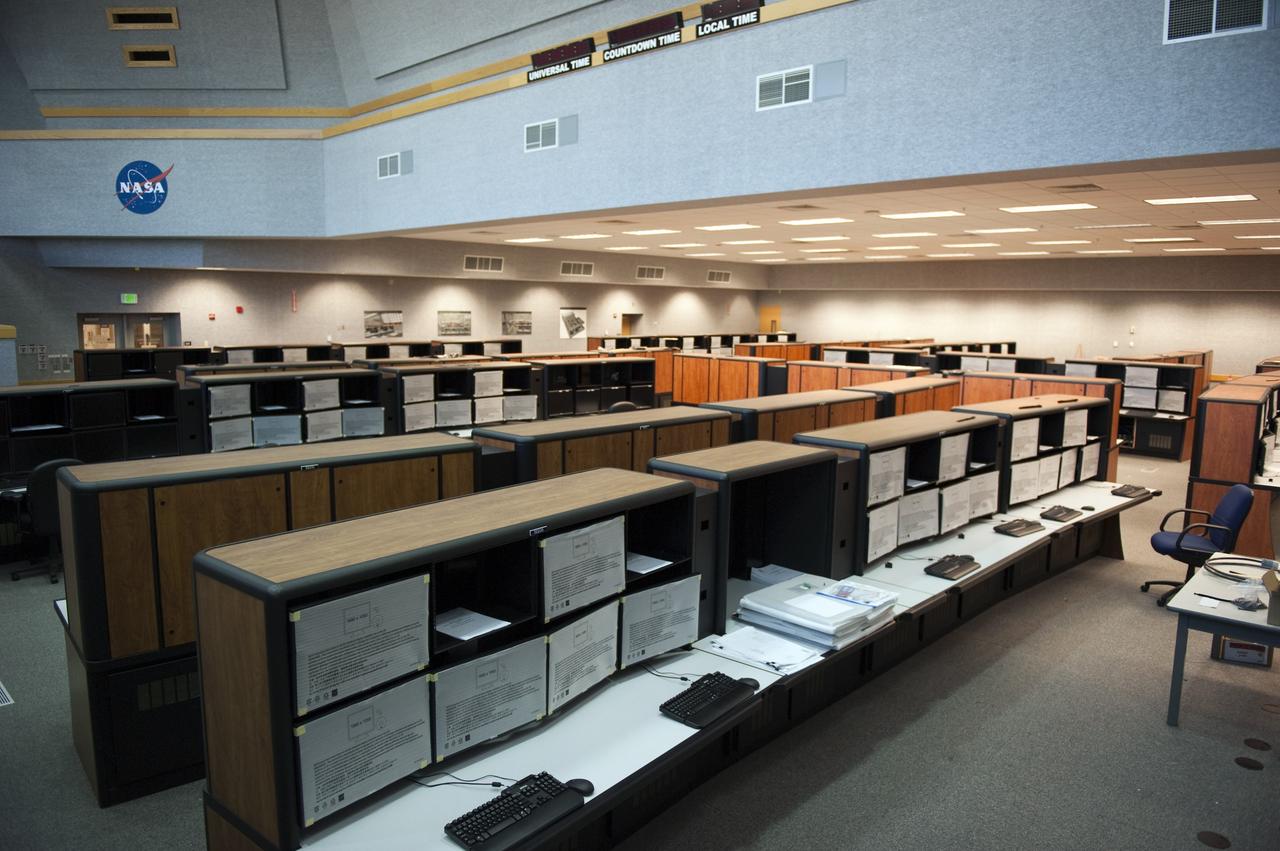
CAPE CANAVERAL, Fla. -- At NASA's Kennedy Space Center in Florida, remodeling for launches of future human spaceflight vehicles continues in the Launch Control Center's Young-Crippen Firing Room. Consoles already have been rewired for the comprehensive upgrade and are now being outfitted with new computers and monitors. Known as Firing Room 1 in the Apollo era, it was re-named as a tribute to the Space Shuttle Program's first crewed mission, STS-1, which was flown by Commander John Young and Pilot Robert Crippen in April 1981. The firing room most recently was set up to support the Ares I-X flight test in Oct. 2009. Photo credit: NASA/Kim Shiflett
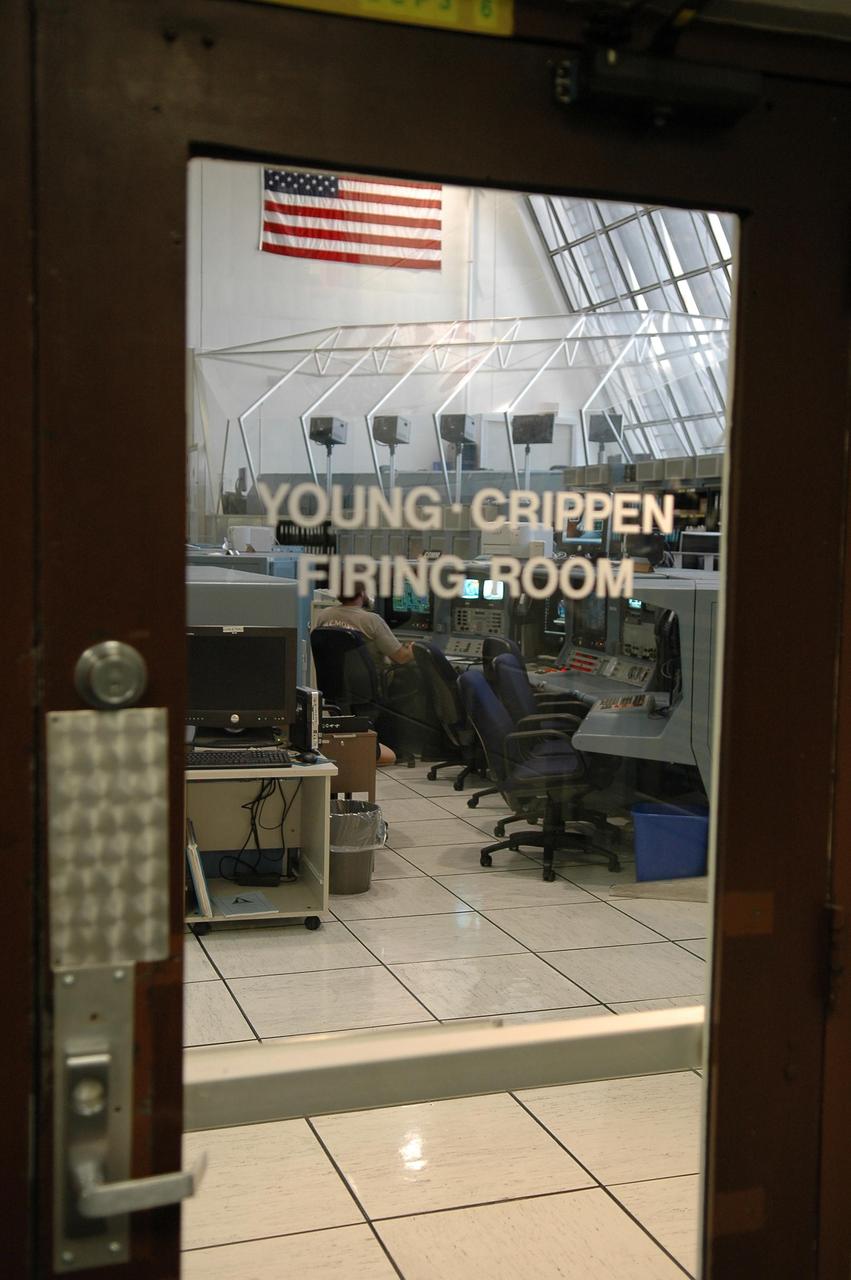
KENNEDY SPACE CENTER, FLA. - The door of firing room 1 in the Launch Control Center at NASA's Kennedy Space Center shows its new designation as the Young · Crippen Firing Room. The renaming was made in tribute to the 25th anniversary of the first space shuttle flight on April 12, 1981, dedicating the firing room that launched the historic flight and the crew of STS-1, Commander John Young and Pilot Robert Crippen. Making the dedication were Center Director Jim Kennedy; the NASA test director for STS-1, Norm Carlson; and the project flight engineer for Space Shuttle Columbia, Bob Sieck. Photo credit: NASA/Kim Shiflett
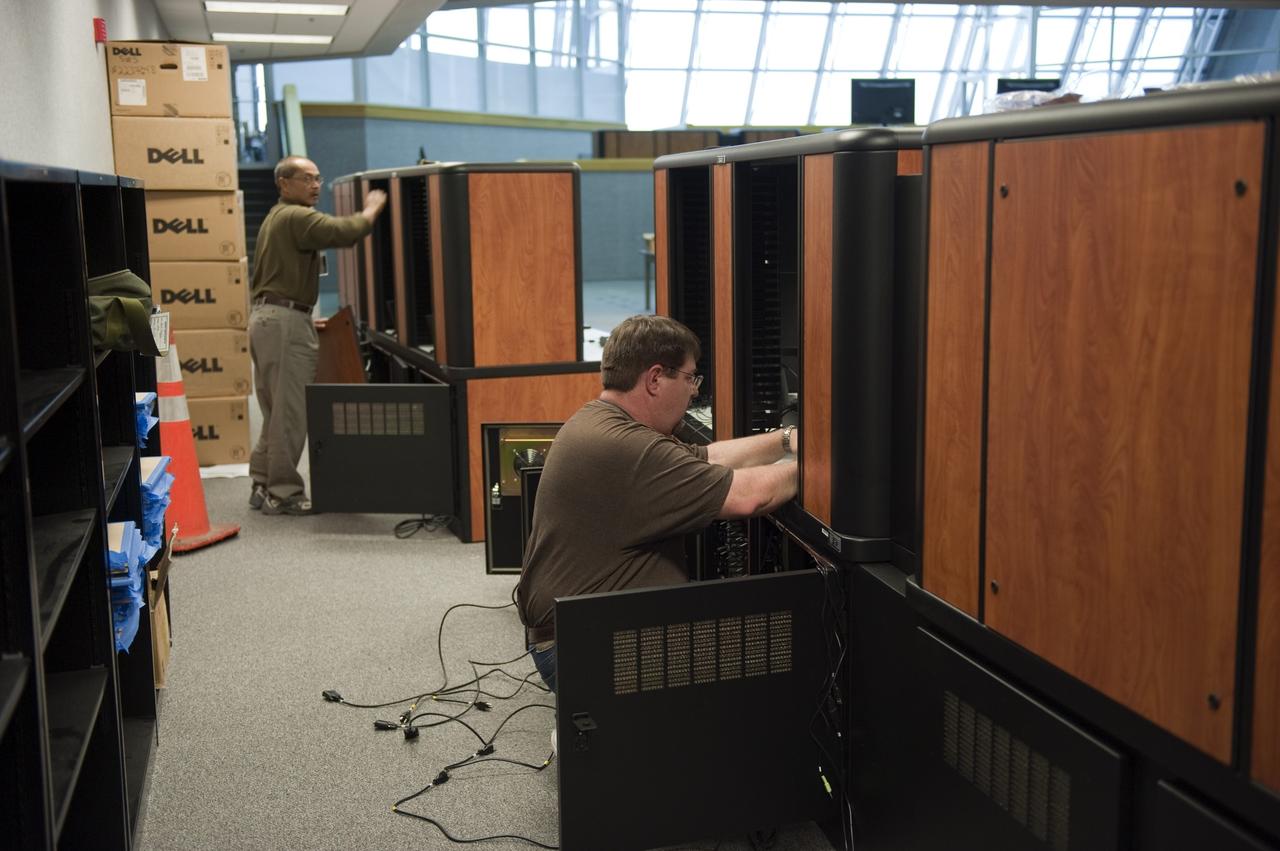
CAPE CANAVERAL, Fla. -- At NASA's Kennedy Space Center in Florida, remodeling for launches of future human spaceflight vehicles continues in the Launch Control Center's Young-Crippen Firing Room. Consoles already have been rewired for the comprehensive upgrade and are now being outfitted with new computers and monitors. Known as Firing Room 1 in the Apollo era, it was re-named as a tribute to the Space Shuttle Program's first crewed mission, STS-1, which was flown by Commander John Young and Pilot Robert Crippen in April 1981. The firing room most recently was set up to support the Ares I-X flight test in Oct. 2009. Photo credit: NASA/Kim Shiflett
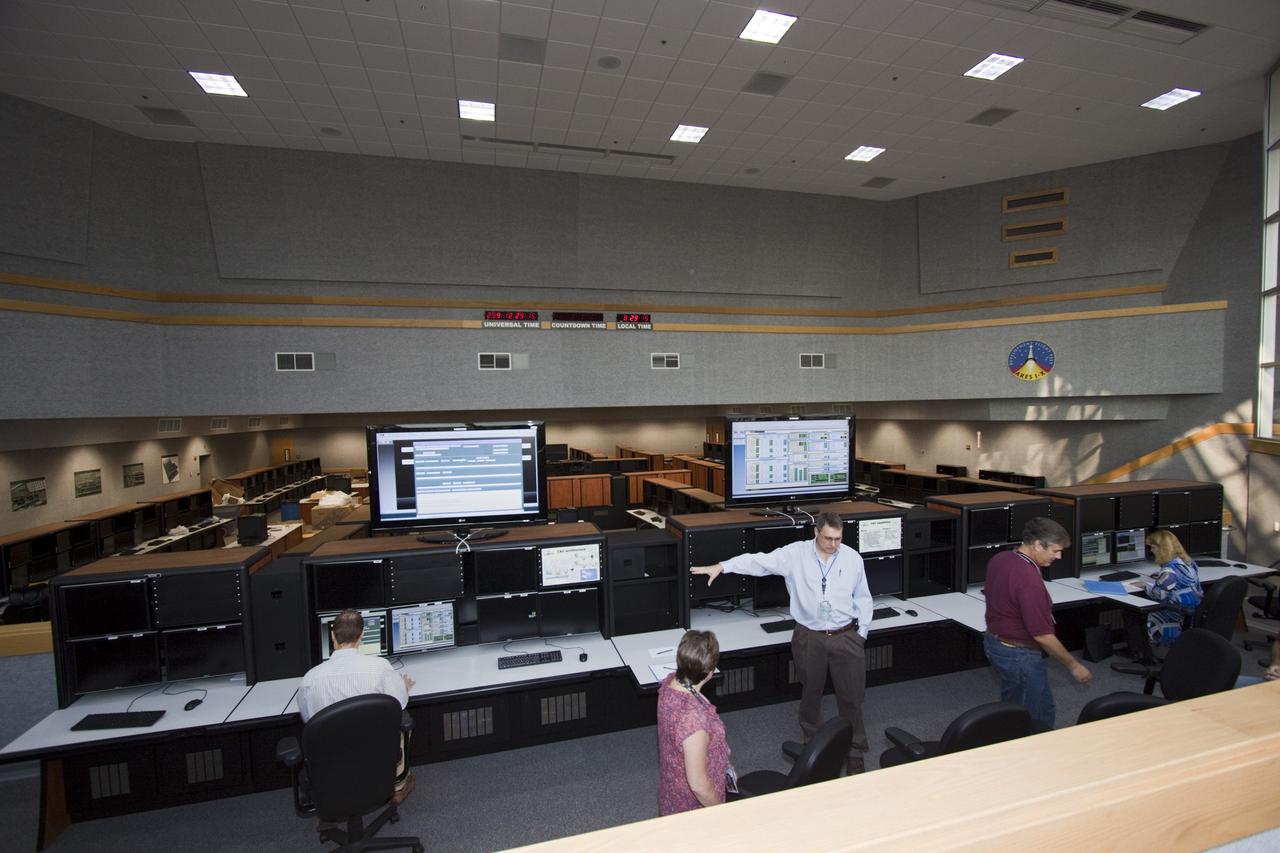
CAPE CANAVERAL, Fla. – At the newly remodeled Launch Control Center's Young-Crippen Firing Room at NASA's Kennedy Space Center in Florida, engineering directorate personnel demonstrate the recently added Space Command & Control System which will be used for launches of future human spaceflight vehicles. Known as Firing Room 1 in the Apollo era, it was re-named as a tribute to the Space Shuttle Program's first crewed mission, STS-1, which was flown by Commander John W. Young and Pilot Robert L. Crippen in April 1981. Photo credit: NASA/Jim Grossmann
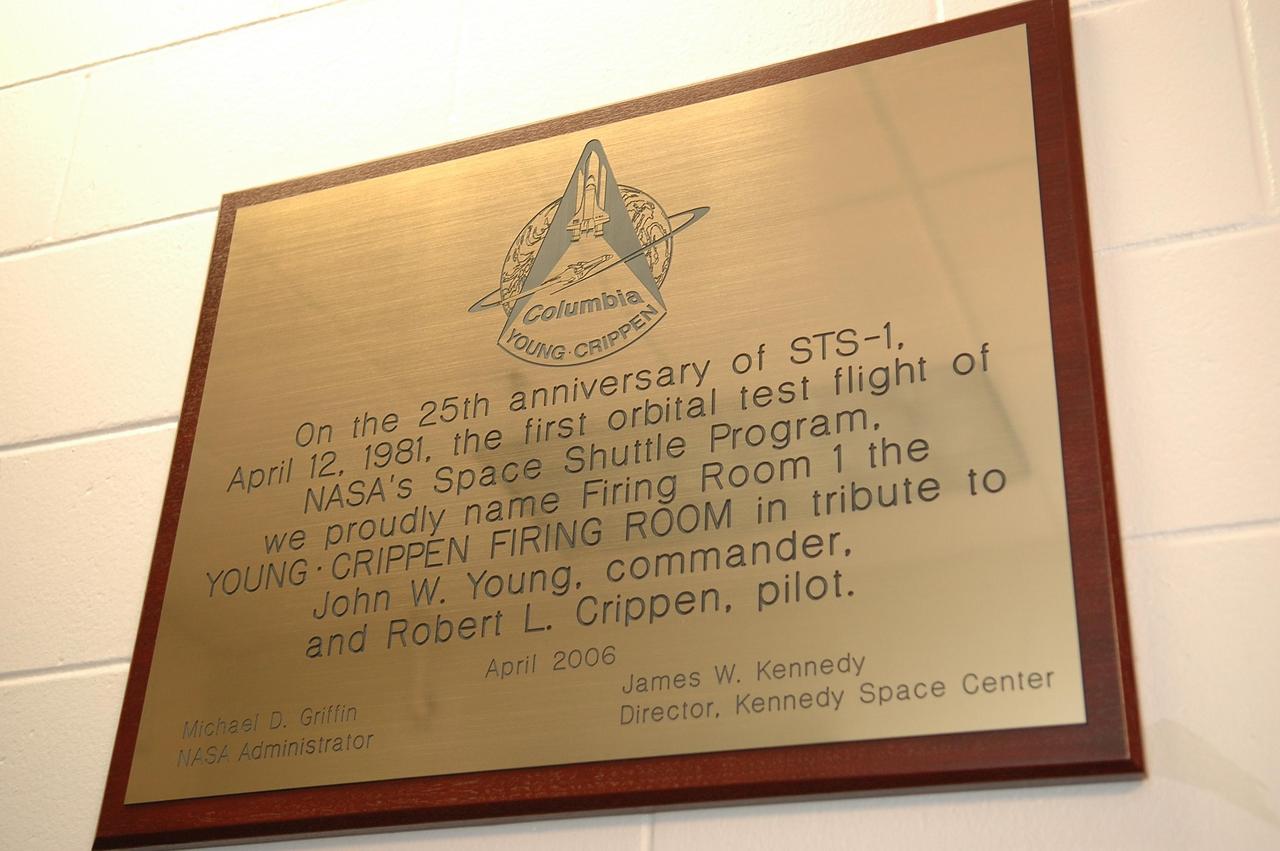
KENNEDY SPACE CENTER, FLA. - Near the door of firing room 1 in the Launch Control Center at NASA's Kennedy Space Center is this plaque revealing the dedication of the room as the Young · Crippen Firing Room. The renaming was made in tribute to the 25th anniversary of the first space shuttle flight on April 12, 1981, dedicating the firing room that launched the historic flight and the crew of STS-1, Commander John Young and Pilot Robert Crippen. Making the dedication were Center Director Jim Kennedy; the NASA test director for STS-1, Norm Carlson; and the project flight engineer for Space Shuttle Columbia, Bob Sieck. Photo credit: NASA/Kim Shiflett
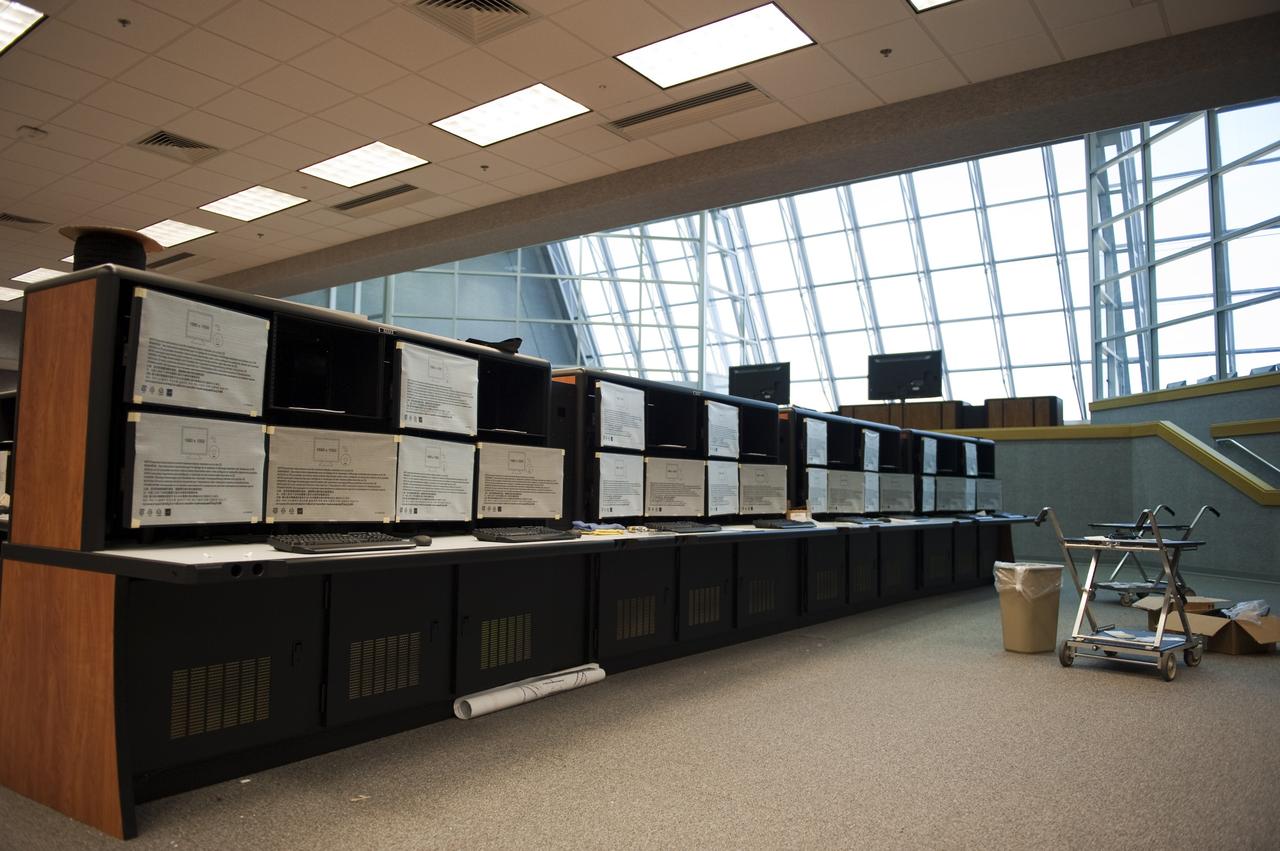
CAPE CANAVERAL, Fla. -- At NASA's Kennedy Space Center in Florida, remodeling for launches of future human spaceflight vehicles continues in the Launch Control Center's Young-Crippen Firing Room. Consoles already have been rewired for the comprehensive upgrade and are now being outfitted with new computers and monitors. Known as Firing Room 1 in the Apollo era, it was re-named as a tribute to the Space Shuttle Program's first crewed mission, STS-1, which was flown by Commander John Young and Pilot Robert Crippen in April 1981. The firing room most recently was set up to support the Ares I-X flight test in Oct. 2009. Photo credit: NASA/Kim Shiflett
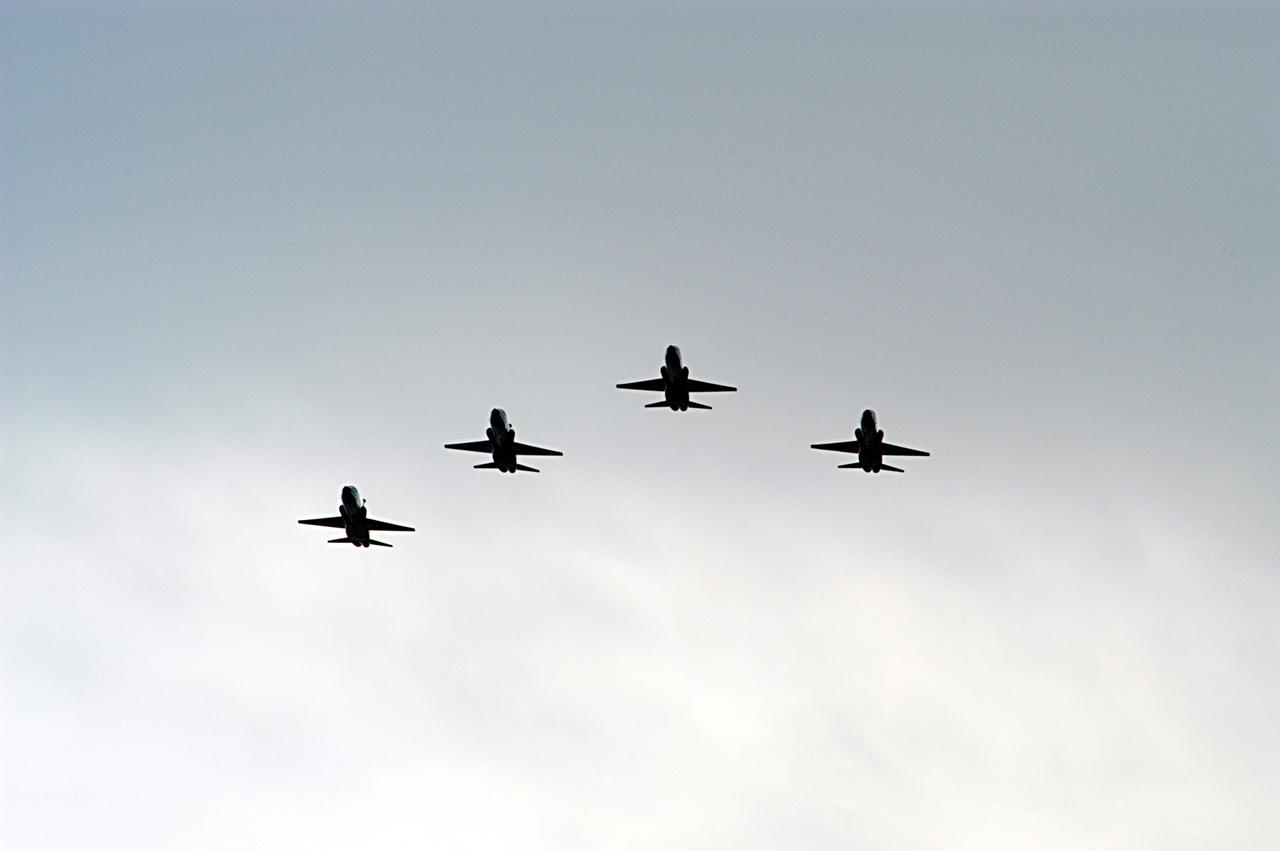
NASA T-38 jet aircraft are flying in a "Missing Man Formation" to conclude the memorial service for the crew of Columbia who were lost on Feb. 1, 2003, over East Texas as they returned to Earth after a 16-day research mission STS-107. The service was held at the Shuttle Landing Facility. Taking part in the service were NASA Administrator Sean O'Keefe, former KSC Director Robert Crippen, astronaut Jim Halsell, several employees, area clergymen, and members of Patrick Air Force Base. Crippen was the first to fly Columbia in 1981; Halsell first flew Columbia in 1994 and again in 1997.
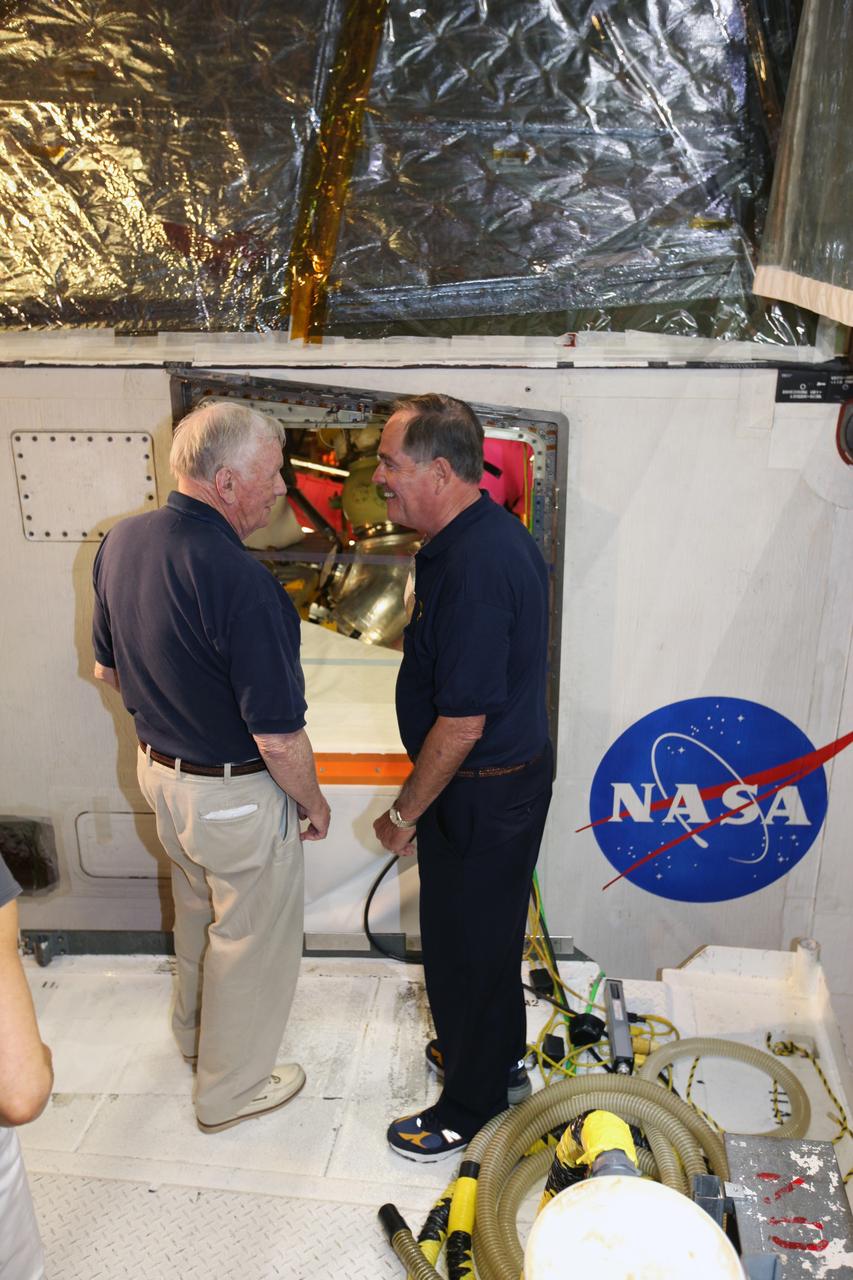
CAPE CANAVERAL, Fla. – In Orbiter Processing Facility-1 at NASA's Kennedy Space Center in Florida, former NASA astronaut Neil Armstrong left, who in July 1969 became the first man to set foot on the moon as commander of the Apollo 11 mission, views space shuttle Atlantis with Bob Crippen, the first space shuttle pilot. Crippen piloted space shuttle Columbia on STS-1 in April 1981. Atlantis is being prepared for display at the Kennedy Space Center Visitor Complex and is scheduled to rollover to the complex in November. The visitor complex is targeting a July 2012 grand opening for Atlantis’ new home. Photo credit: NASA/Dimitri Gerondidakis
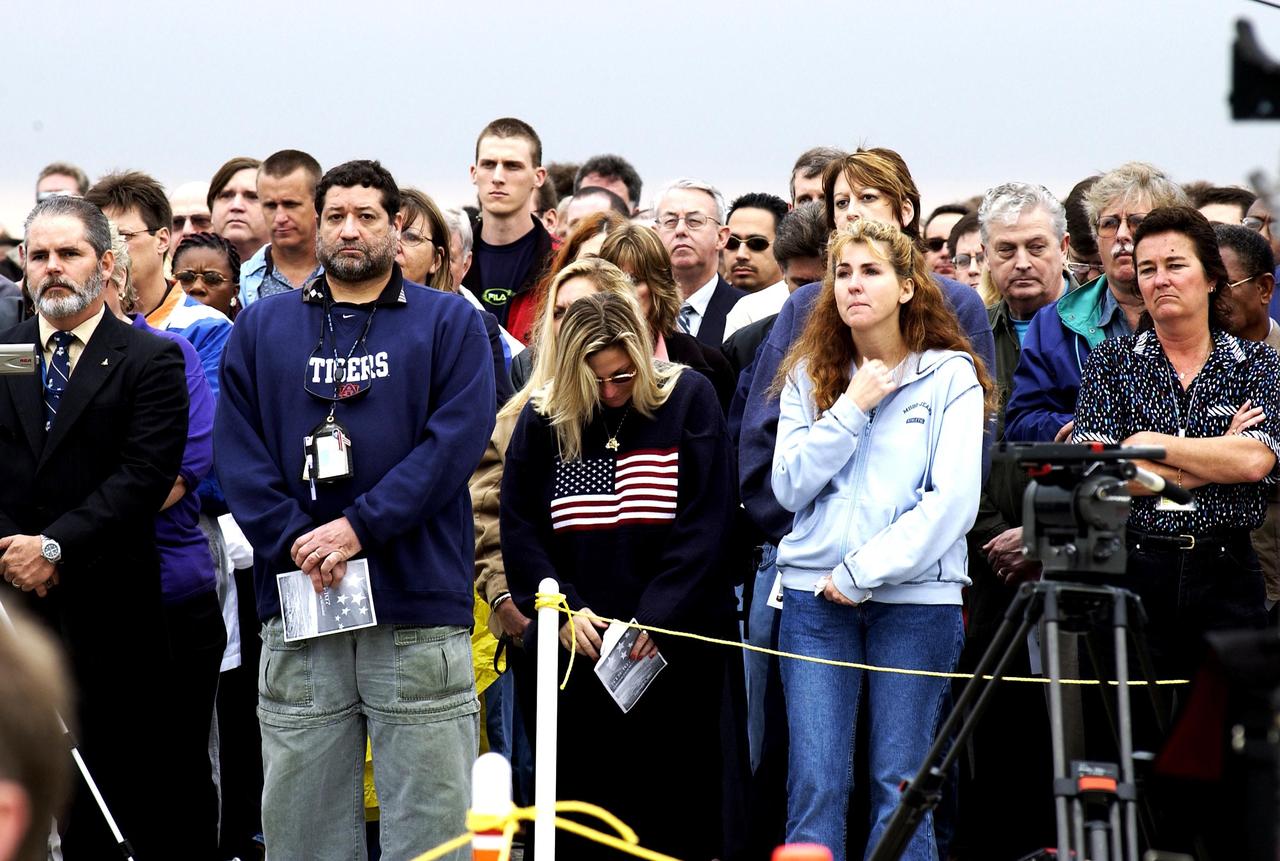
KENNEDY SPACE CENTER, FLA. -- Employees at KSC give solemn attention to the memorial service for the Columbia crew held at the Shuttle Landing Facility. The crew were lost on Feb. 1, 2003, over East Texas as they returned to Earth after the 16-day research mission STS-107. Taking part in the service were NASA Administrator Sean O'Keefe, former KSC Director Robert Crippen, astronaut Jim Halsell, several employees, area clergymen, and members of Patrick Air Force Base. Crippen was the first to fly Columbia in 1981; Halsell first flew Columbia in 1994 and again in 1997.
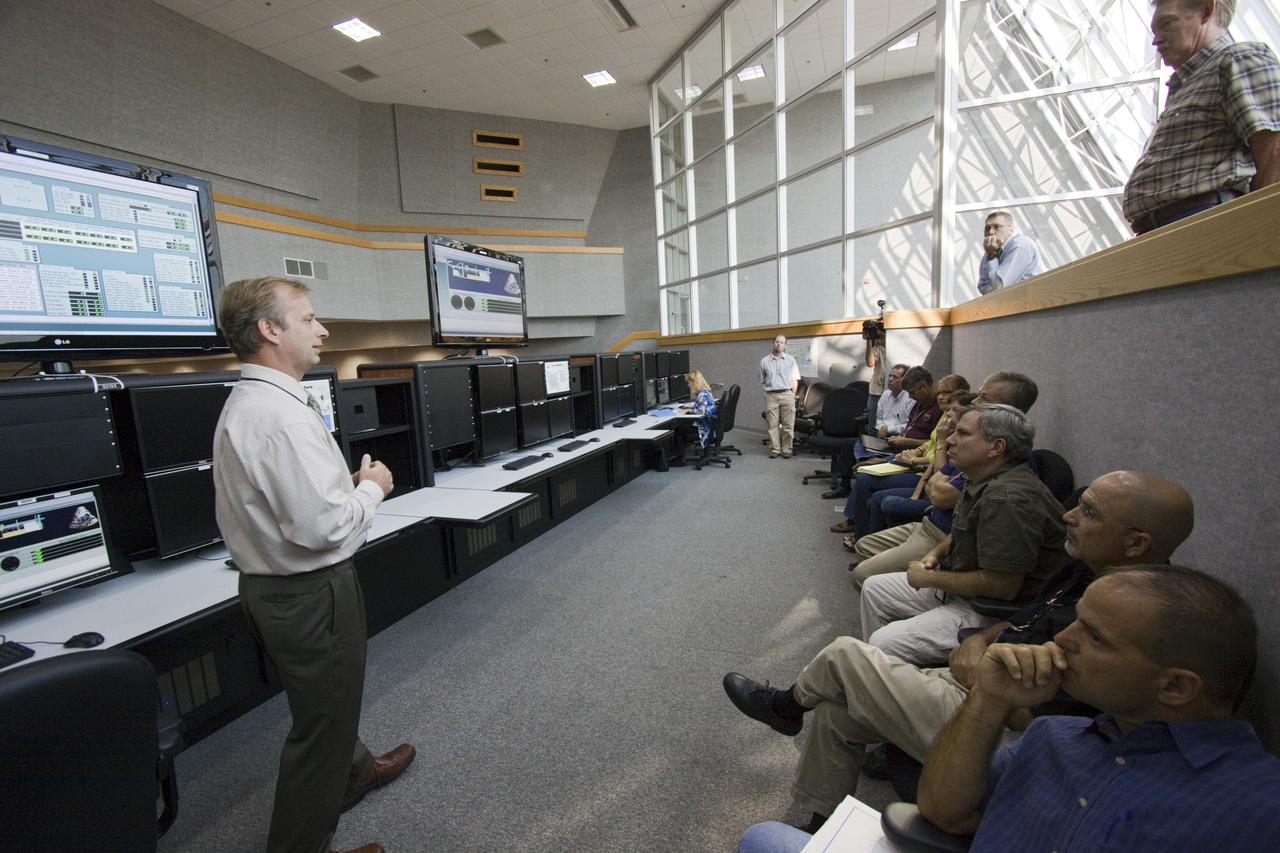
CAPE CANAVERAL, Fla. – At the newly remodeled Launch Control Center's Young-Crippen Firing Room at NASA's Kennedy Space Center in Florida, engineering directorate personnel demonstrate the recently added Space Command & Control System which will be used for launches of future human spaceflight vehicles. Known as Firing Room 1 in the Apollo era, it was re-named as a tribute to the Space Shuttle Program's first crewed mission, STS-1, which was flown by Commander John W. Young and Pilot Robert L. Crippen in April 1981. Photo credit: NASA/Jim Grossmann
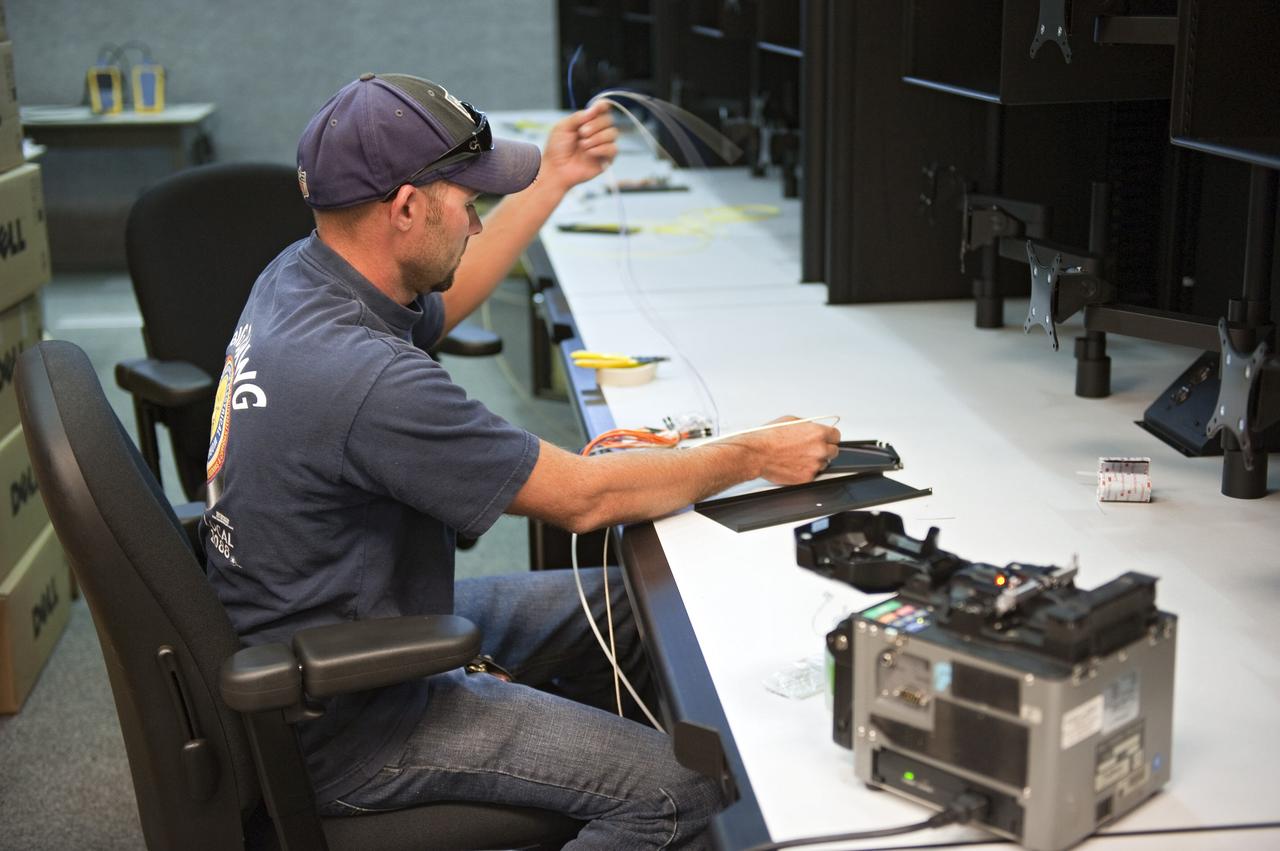
CAPE CANAVERAL, Fla. -- At NASA's Kennedy Space Center in Florida, rewiring of consoles and remodeling for launches of future human spaceflight vehicles take place in the Launch Control Center's Young-Crippen Firing Room. Known as Firing Room 1 in the Apollo era, it was re-named as a tribute to the Space Shuttle Program's first crewed mission, STS-1, which was flown by Commander John Young and Pilot Robert Crippen in April 1981. The firing room most recently was set up to support the Ares I-X flight test in Oct. 2009. Photo credit: NASA/Kim Shiflett
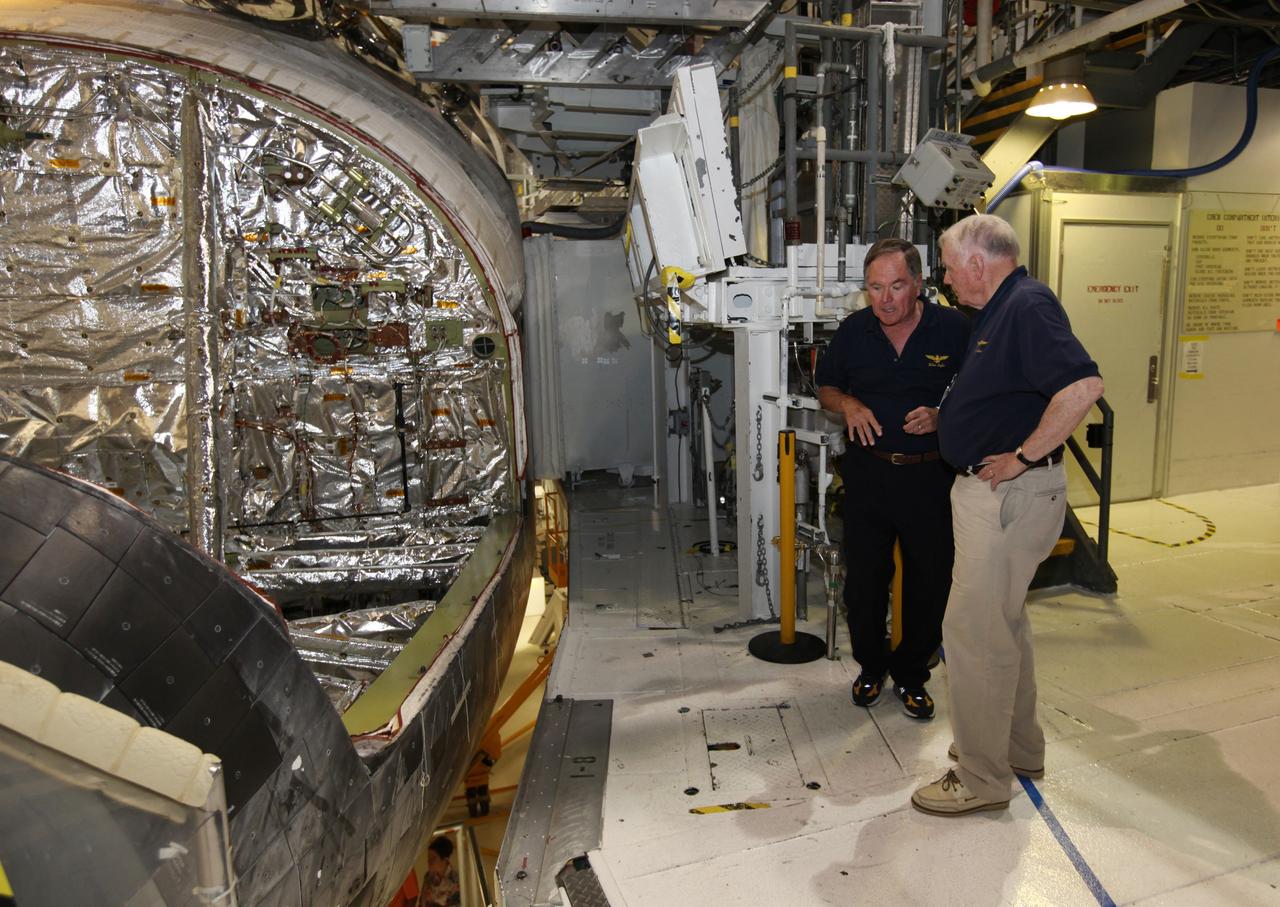
CAPE CANAVERAL, Fla. – In Orbiter Processing Facility-1 at NASA's Kennedy Space Center in Florida, former NASA astronaut Neil Armstrong right, who in July 1969 became the first man to set foot on the moon as commander of the Apollo 11 mission, views space shuttle Atlantis with Bob Crippen, the first space shuttle pilot. Crippen piloted space shuttle Columbia on STS-1 in April 1981. Atlantis is being prepared for display at the Kennedy Space Center Visitor Complex and is scheduled to rollover to the complex in November. The visitor complex is targeting a July 2012 grand opening for Atlantis’ new home. Photo credit: NASA/Dimitri Gerondidakis
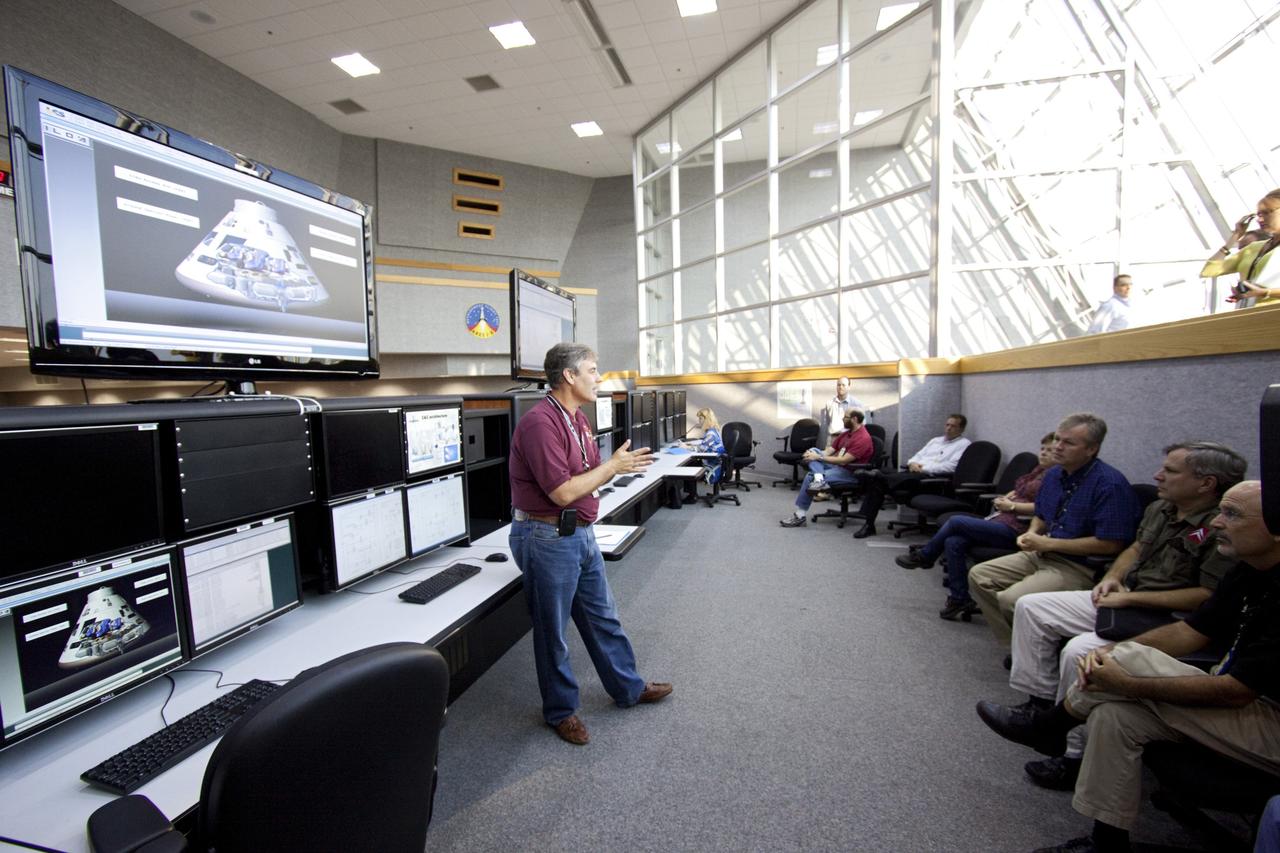
CAPE CANAVERAL, Fla. – At the newly remodeled Launch Control Center's Young-Crippen Firing Room at NASA's Kennedy Space Center in Florida, engineering directorate personnel demonstrate the recently added Space Command & Control System which will be used for launches of future human spaceflight vehicles. Known as Firing Room 1 in the Apollo era, it was re-named as a tribute to the Space Shuttle Program's first crewed mission, STS-1, which was flown by Commander John W. Young and Pilot Robert L. Crippen in April 1981. Photo credit: NASA/Jim Grossmann
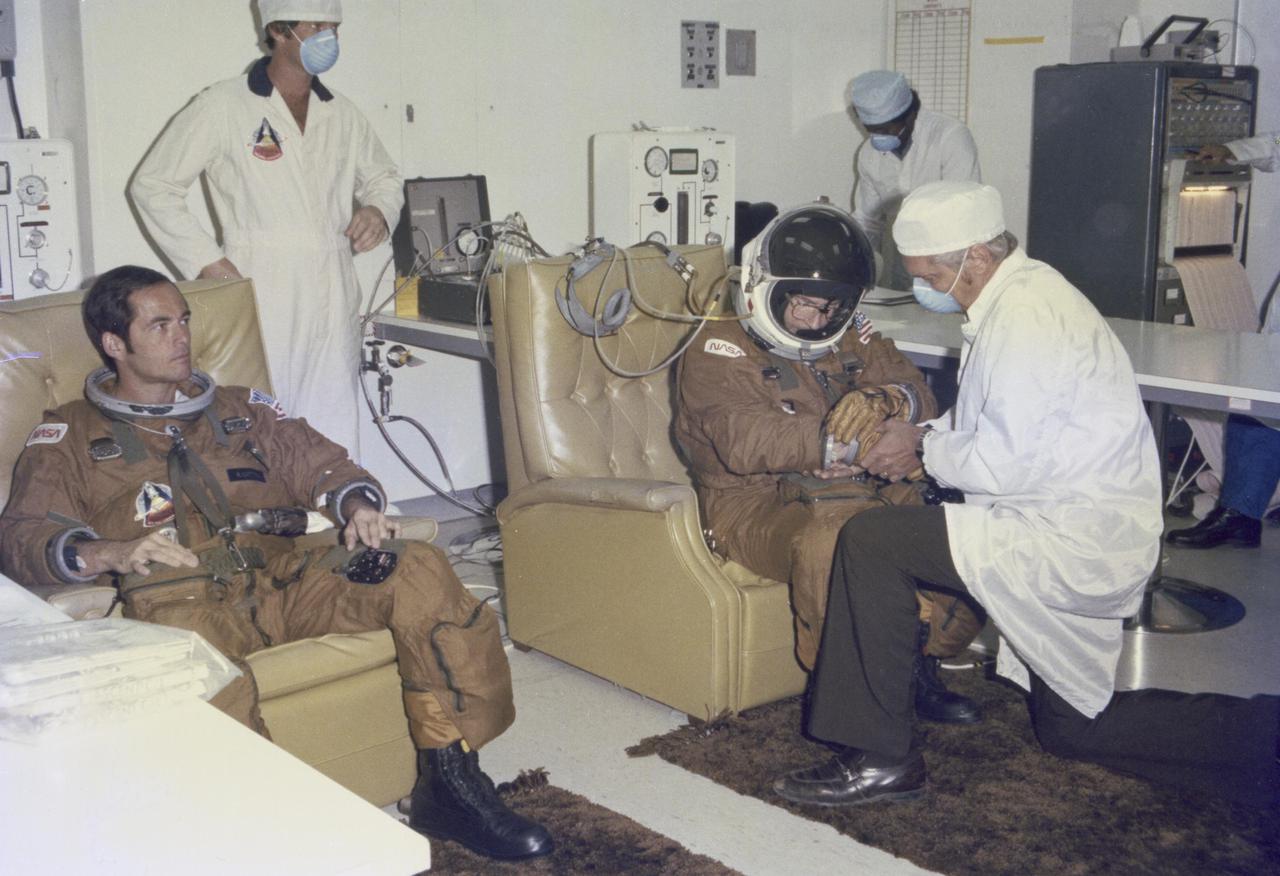
KENNEDY SPACE CENTER, FLA. -- Technicians assist prime crew Astronauts Bob Crippen (left) and John Young (right) in suit-up operations in KSC’s Operations and Checkout Building on the morning of Columbia’s successful liftoff on the Space Shuttle’s first orbital flight. Crippen is the pilot and Young is the commander for mission STS-1 aboard Space Shuttle Columbia. The STS-1 mission, known as a shuttle systems test flight, seeks to demonstrate safe launch into orbit and safe return of the orbiter and crew and verify the combined performance of the entire shuttle vehicle -- orbiter, solid rocket boosters and external tank.
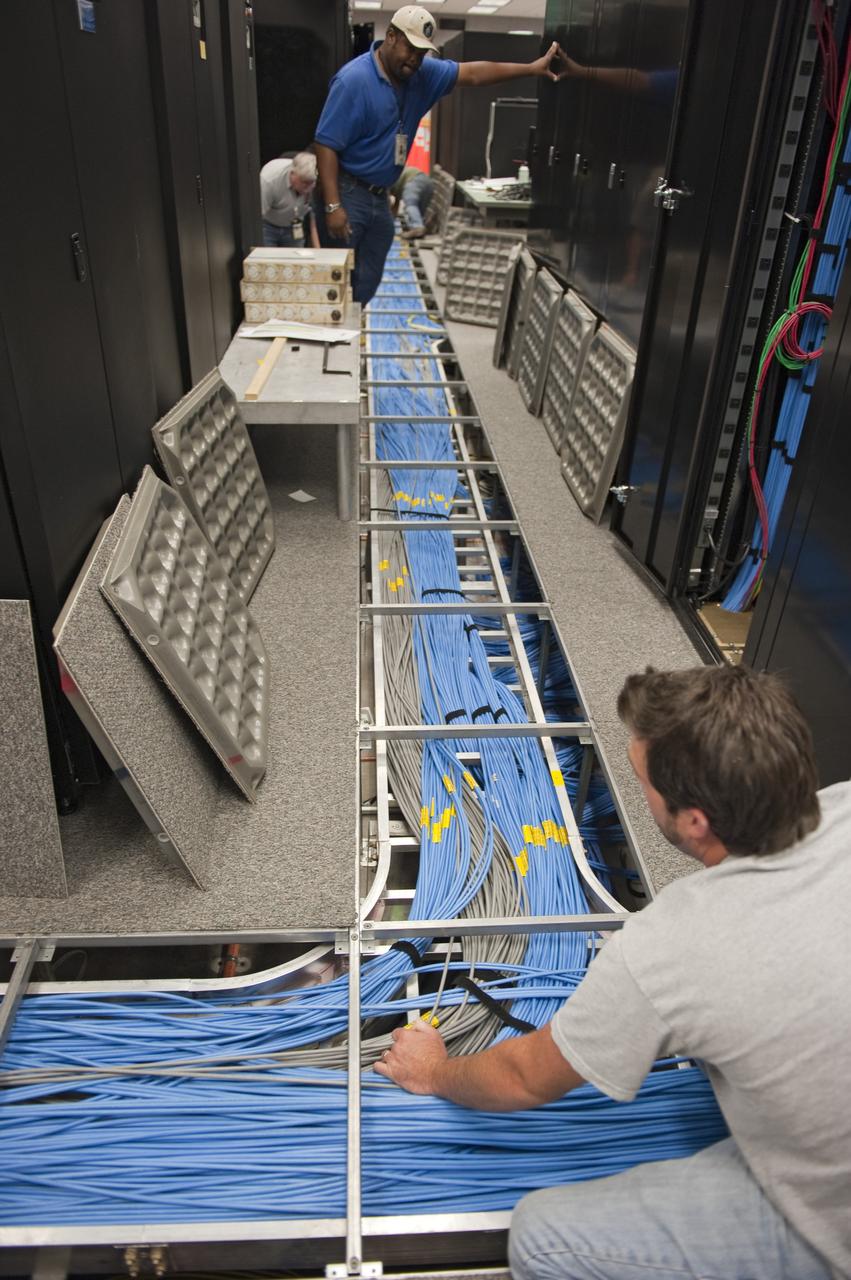
CAPE CANAVERAL, Fla. -- At NASA's Kennedy Space Center in Florida, rewiring and remodeling for launches of future human spaceflight vehicles take place in the Launch Control Center's Young-Crippen Firing Room. Known as Firing Room 1 in the Apollo era, it was re-named as a tribute to the Space Shuttle Program's first crewed mission, STS-1, which was flown by Commander John Young and Pilot Robert Crippen in April 1981. The firing room most recently was set up to support the Ares I-X flight test in Oct. 2009. Photo credit: NASA/Kim Shiflett
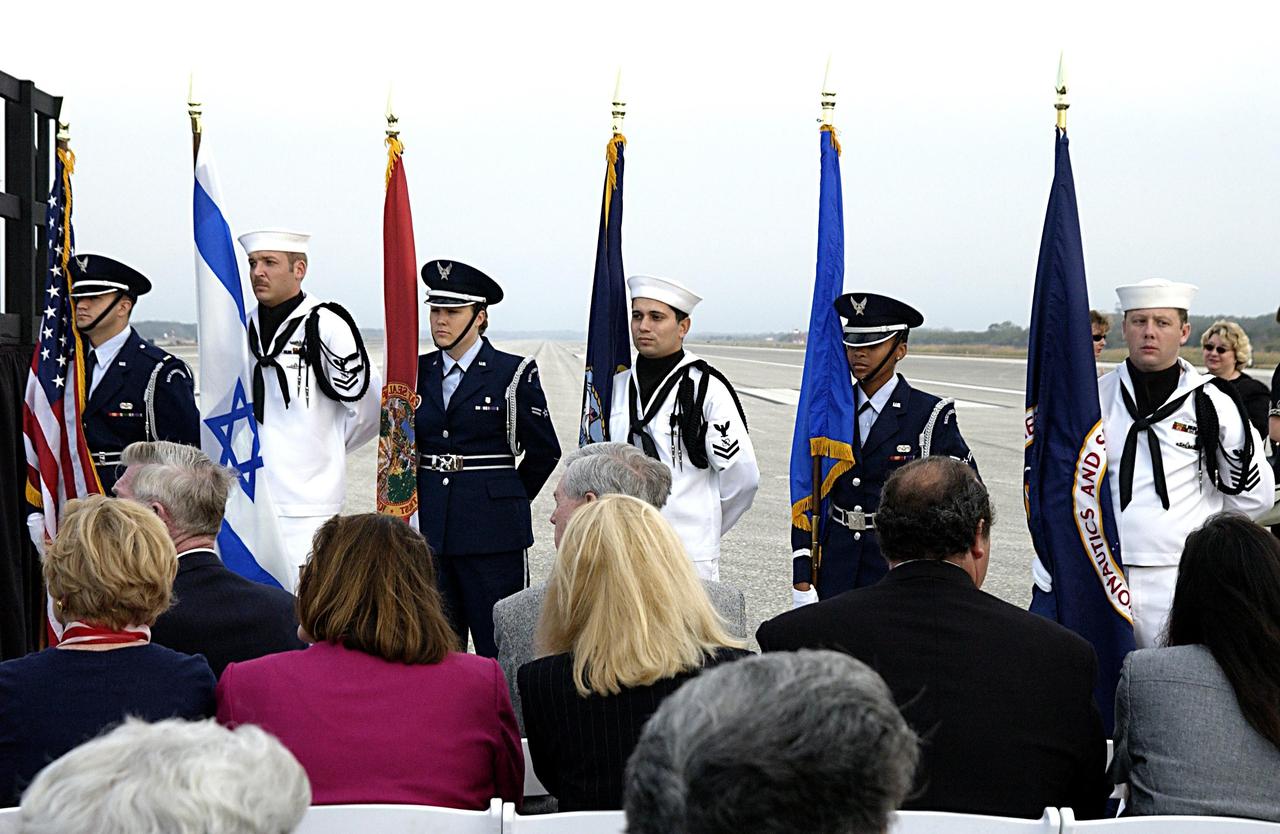
KENNEDY SPACE CENTER, FLA. -- The Patrick Air Force Base Honor Guard stands at attention during "Taps" at the conclusion of the STS-107 Columbia Crew Memorial Service held at KSC. The crew were lost on Feb. 1, 2003, over East Texas as they returned to Earth after the 16-day research mission STS-107. Also taking part in the service were NASA Administrator Sean O'Keefe, former KSC Director Robert Crippen, astronaut Jim Halsell, several employees and area clergymen. Crippen was the first to fly Columbia in 1981; Halsell first flew Columbia in 1994 and again in 1997.
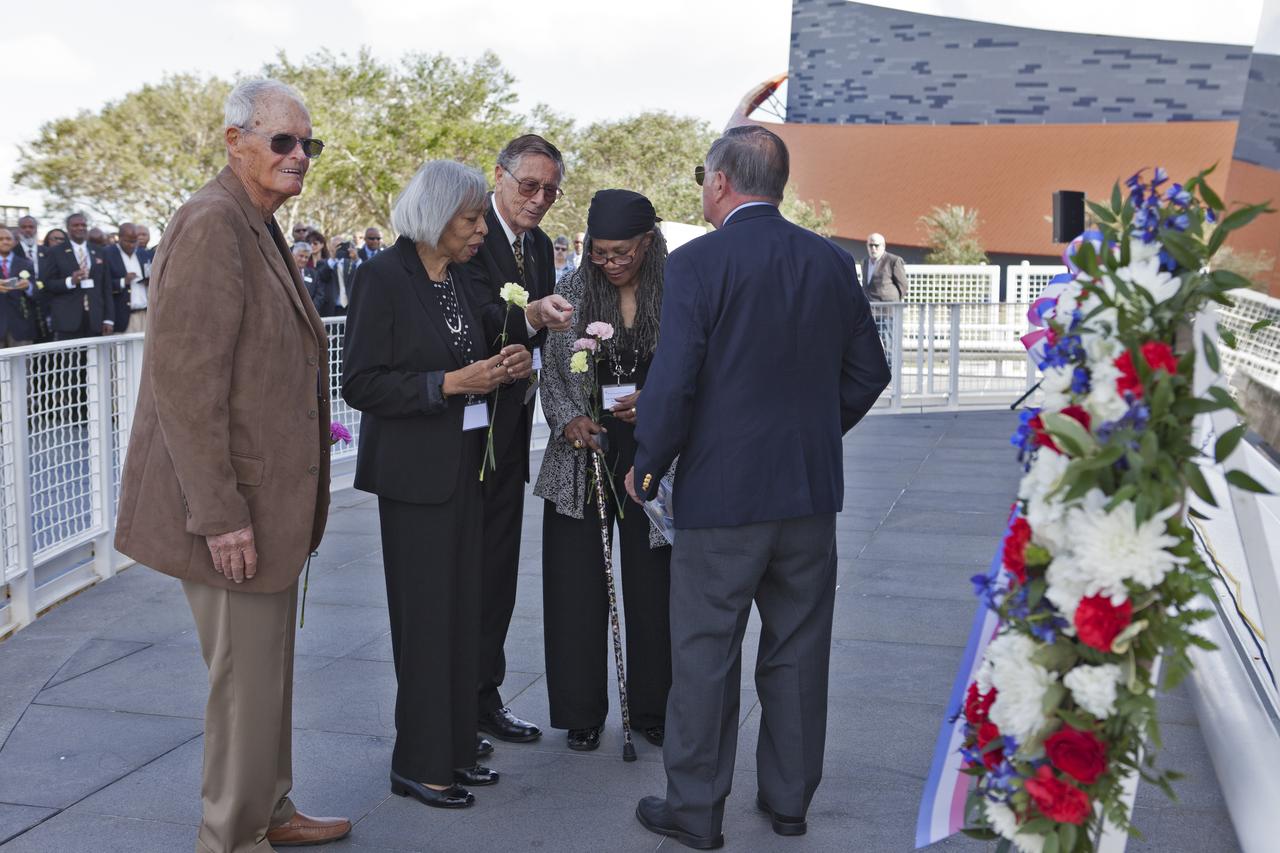
During an Astronauts Memorial Foundation tribute honoring U.S. Air Foce Maj. Robert Lawrence, a wreath is placed at the Space Mirror Memorial at the Kenendy Space Center Visitor Compelx. Participating are, from thje left, Al Crews, Lawrence's sister, Barbara Lawrence, Ph.D., James Abrahamson, Lawrence's sister-in-law Lorne Cress Love, and Bob Crippen. Crews, Abrahamson and Crippen all were selected as astronauts for the Manned Orbiting Laboratory (MOL) Program. Selected in 1967 for MOL, Lawrence was the first African-American astronaut. He lost his life in a training accident 50 years ago. The ceremony took place in the Center for Space Education at the Kennedy Space Center Visitor Complex.
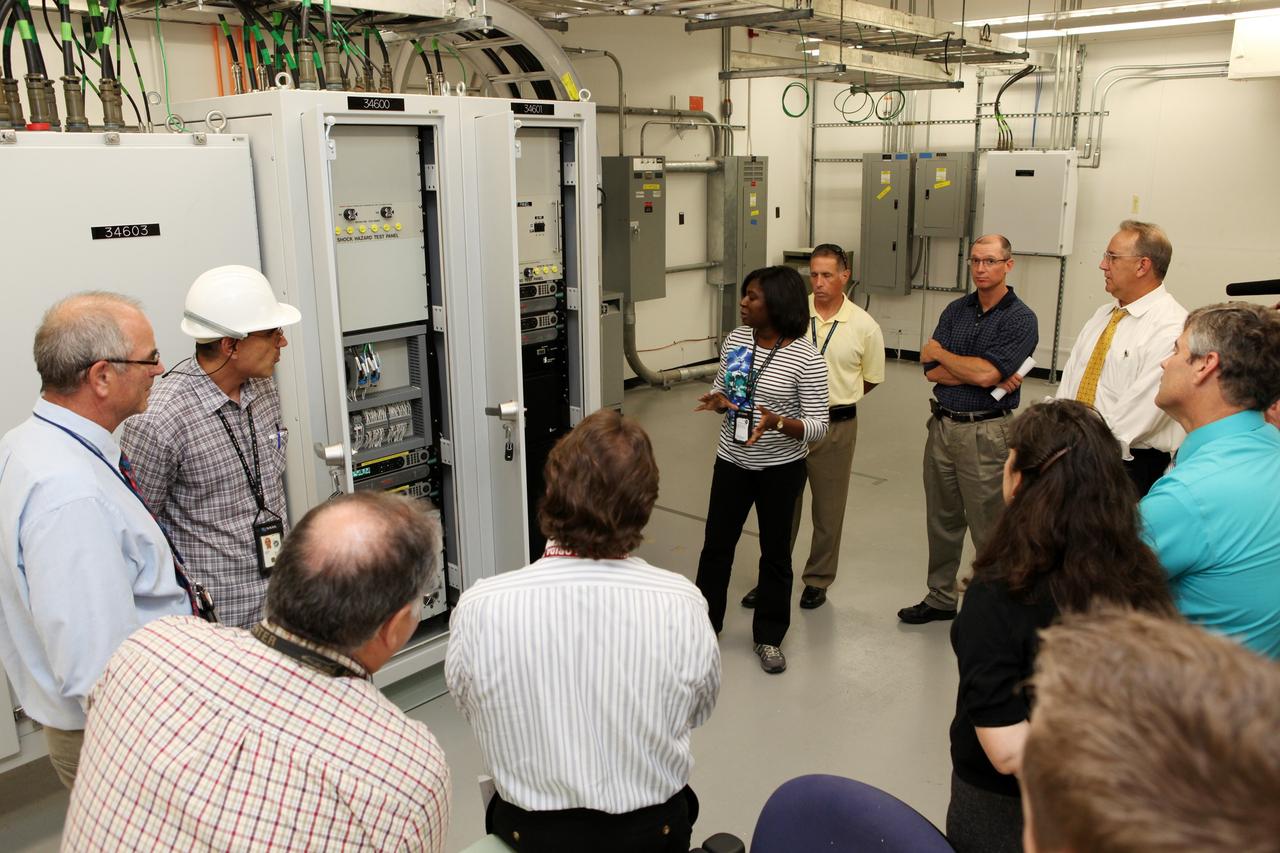
CAPE CANAVERAL, Fla. – Workers at NASA's Kennedy Space Center watch a demonstration of new systems installed in Launch Pad 39B. The renovation has been led by the Ground Systems Development and Operations Program based at Kennedy. The new systems are designed to be flexible so controllers can process and launch multiple types of rockets and spacecraft, whether they are government or commercial models. Photo credit: NASA/Dmitri Gerondidakis
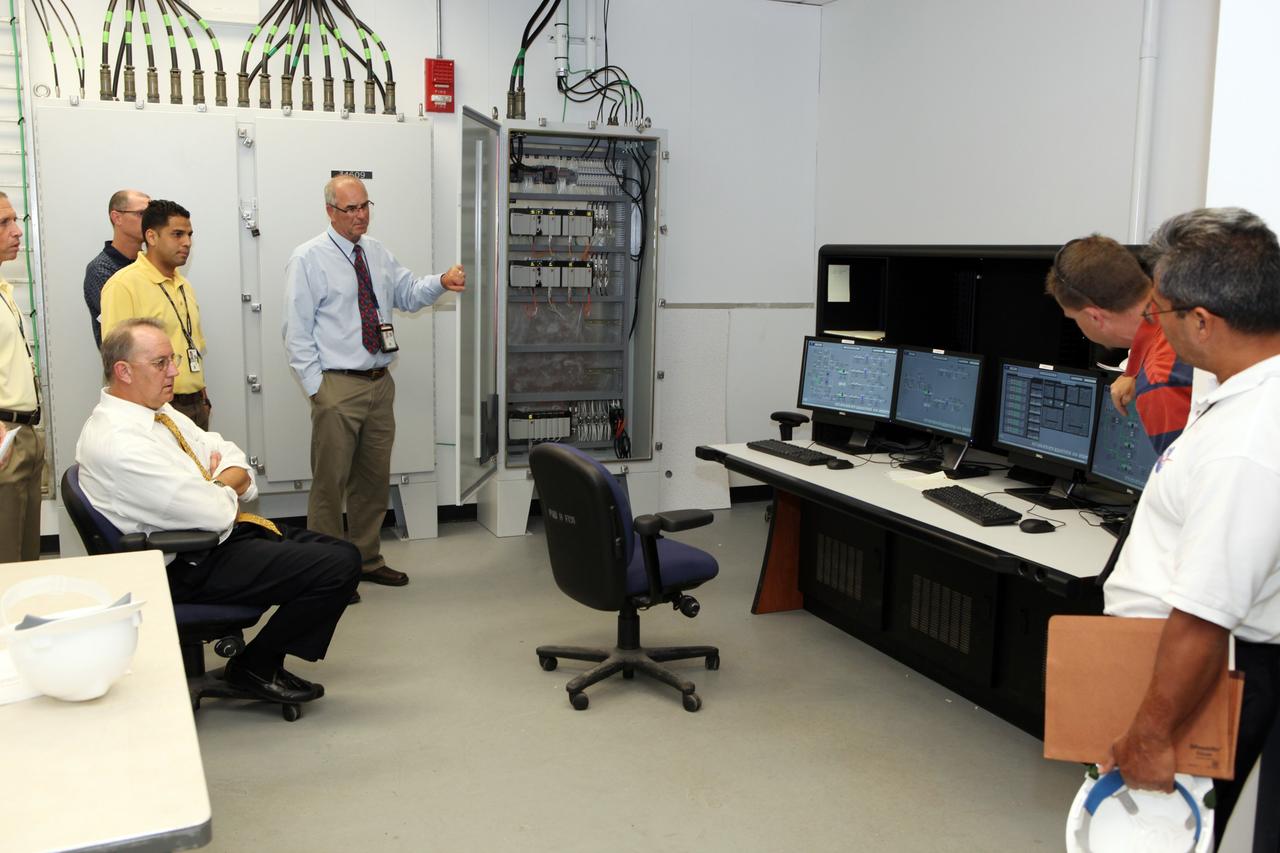
CAPE CANAVERAL, Fla. – Workers at NASA's Kennedy Space Center watch a demonstration of new systems installed in Launch Pad 39B. The renovation has been led by the Ground Systems Development and Operations Program based at Kennedy. The new systems are designed to be flexible so controllers can process and launch multiple types of rockets and spacecraft, whether they are government or commercial models. Photo credit: NASA/Dmitri Gerondidakis
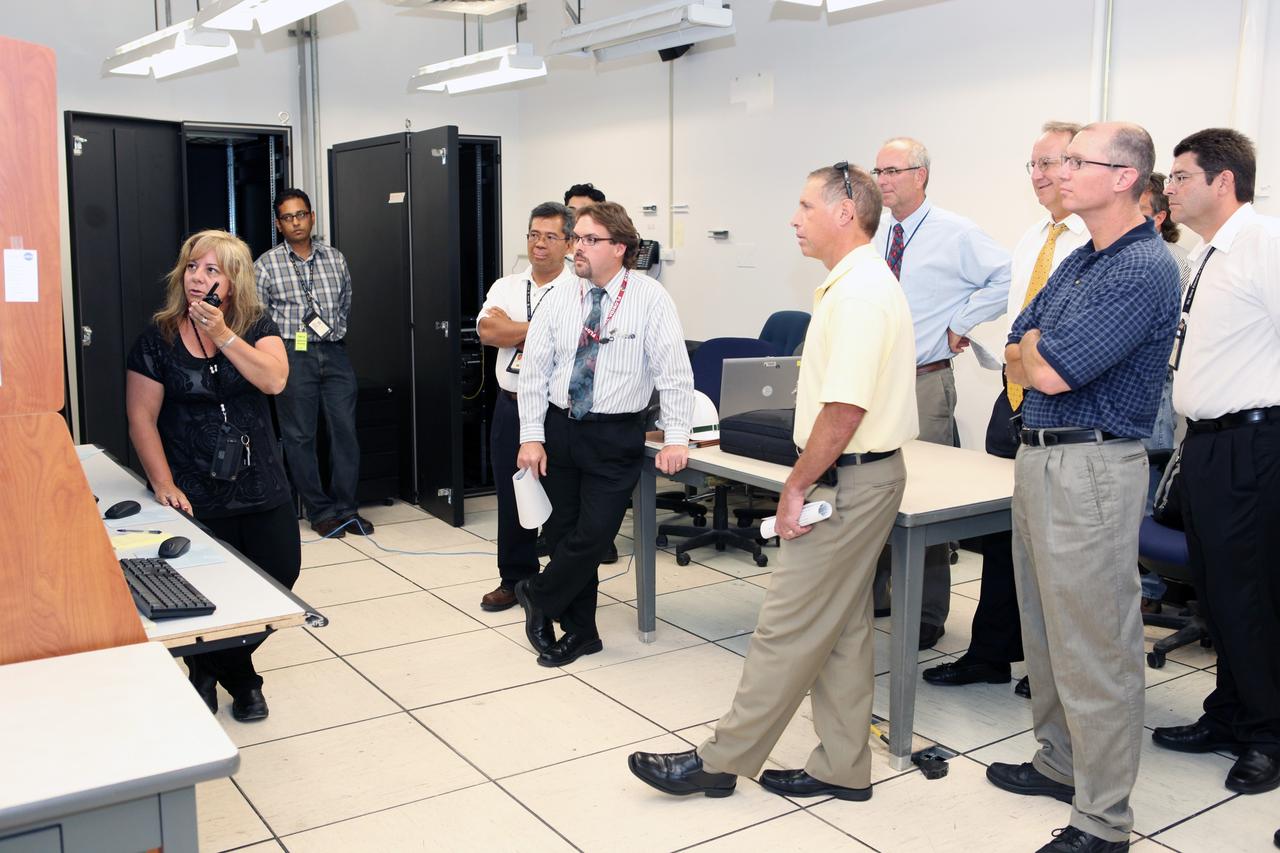
CAPE CANAVERAL, Fla. – Workers at NASA's Kennedy Space Center watch a demonstration of new systems installed in Launch Pad 39B. The renovation has been led by the Ground Systems Development and Operations Program based at Kennedy. The new systems are designed to be flexible so controllers can process and launch multiple types of rockets and spacecraft, whether they are government or commercial models. Photo credit: NASA/Dmitri Gerondidakis
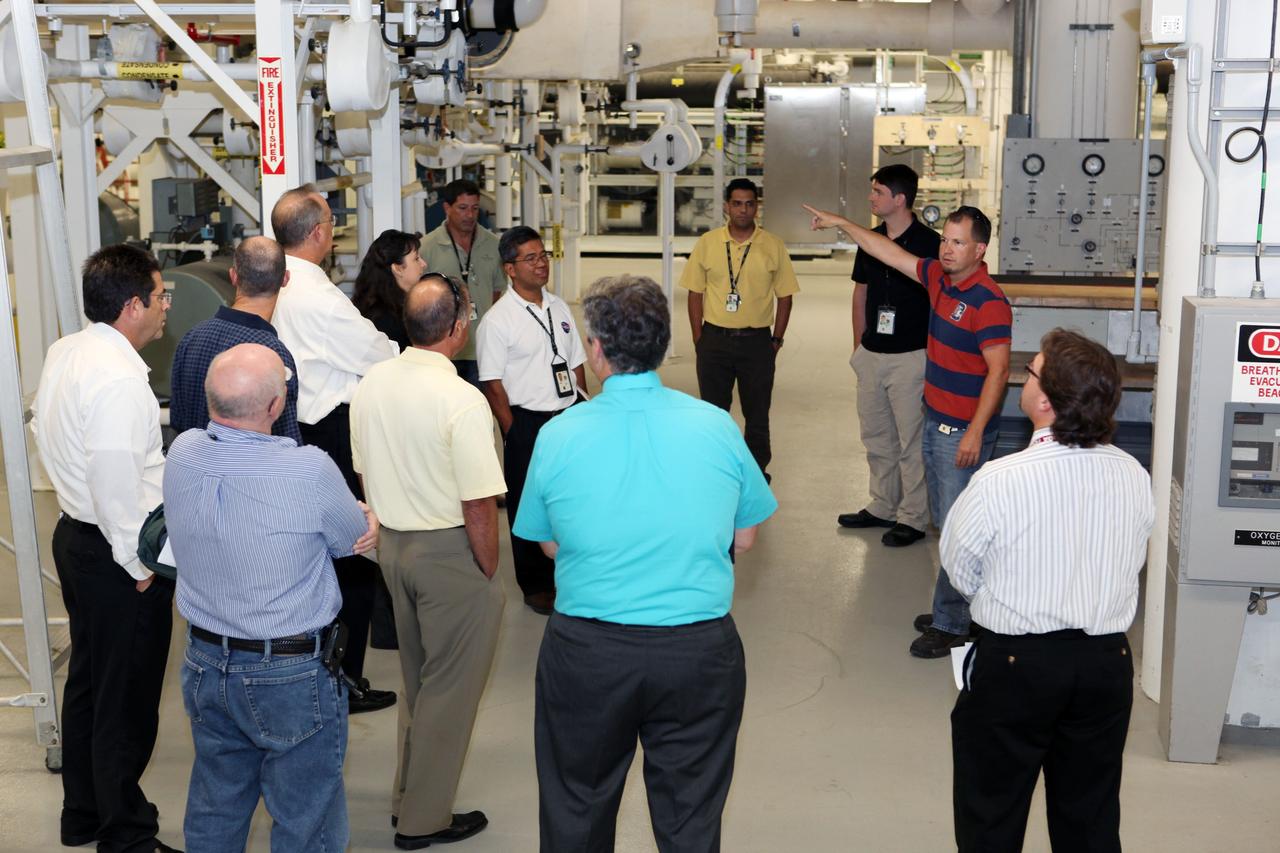
CAPE CANAVERAL, Fla. – Workers at NASA's Kennedy Space Center watch a demonstration of new systems installed in Launch Pad 39B. The renovation has been led by the Ground Systems Development and Operations Program based at Kennedy. The new systems are designed to be flexible so controllers can process and launch multiple types of rockets and spacecraft, whether they are government or commercial models. Photo credit: NASA/Dmitri Gerondidakis
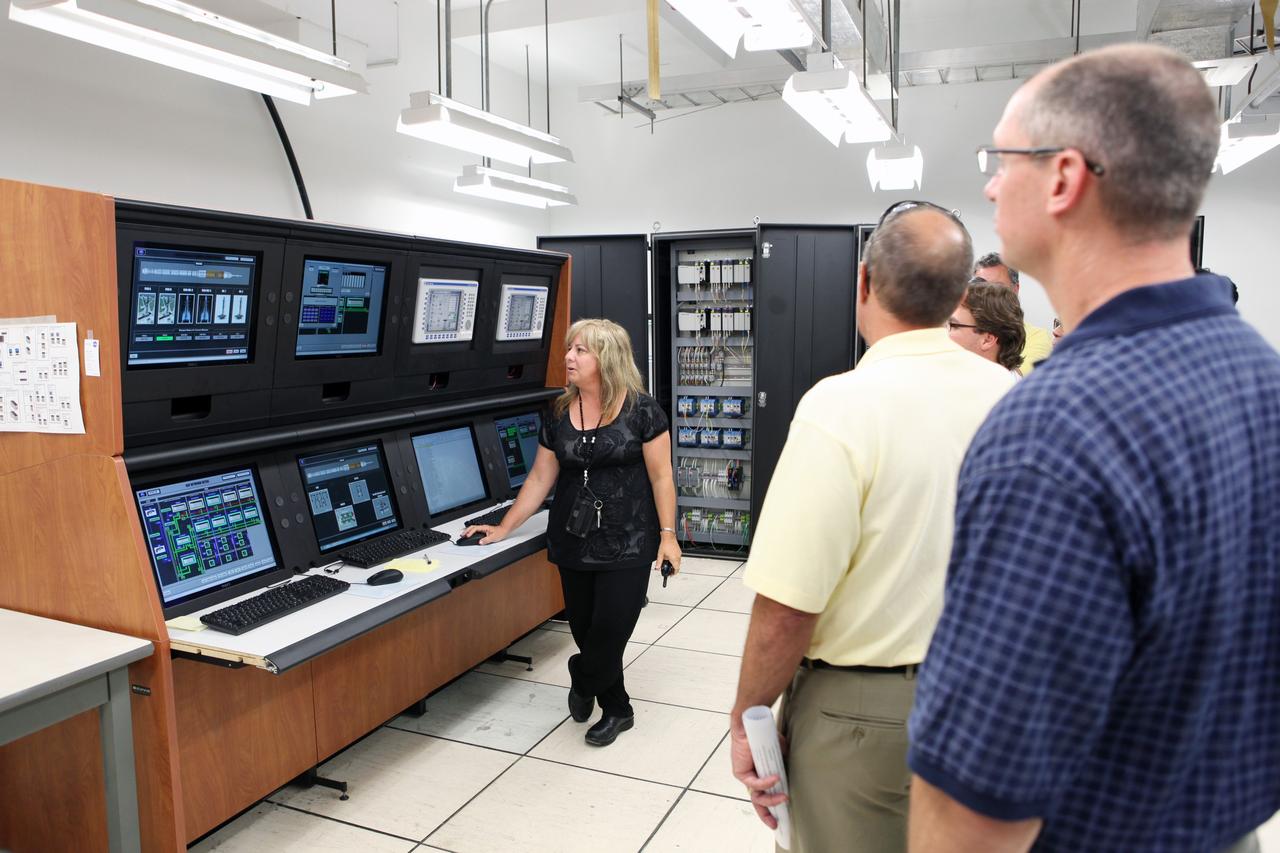
CAPE CANAVERAL, Fla. – Workers at NASA's Kennedy Space Center watch a demonstration of new systems installed in Launch Pad 39B. The renovation has been led by the Ground Systems Development and Operations Program based at Kennedy. The new systems are designed to be flexible so controllers can process and launch multiple types of rockets and spacecraft, whether they are government or commercial models. Photo credit: NASA/Dmitri Gerondidakis
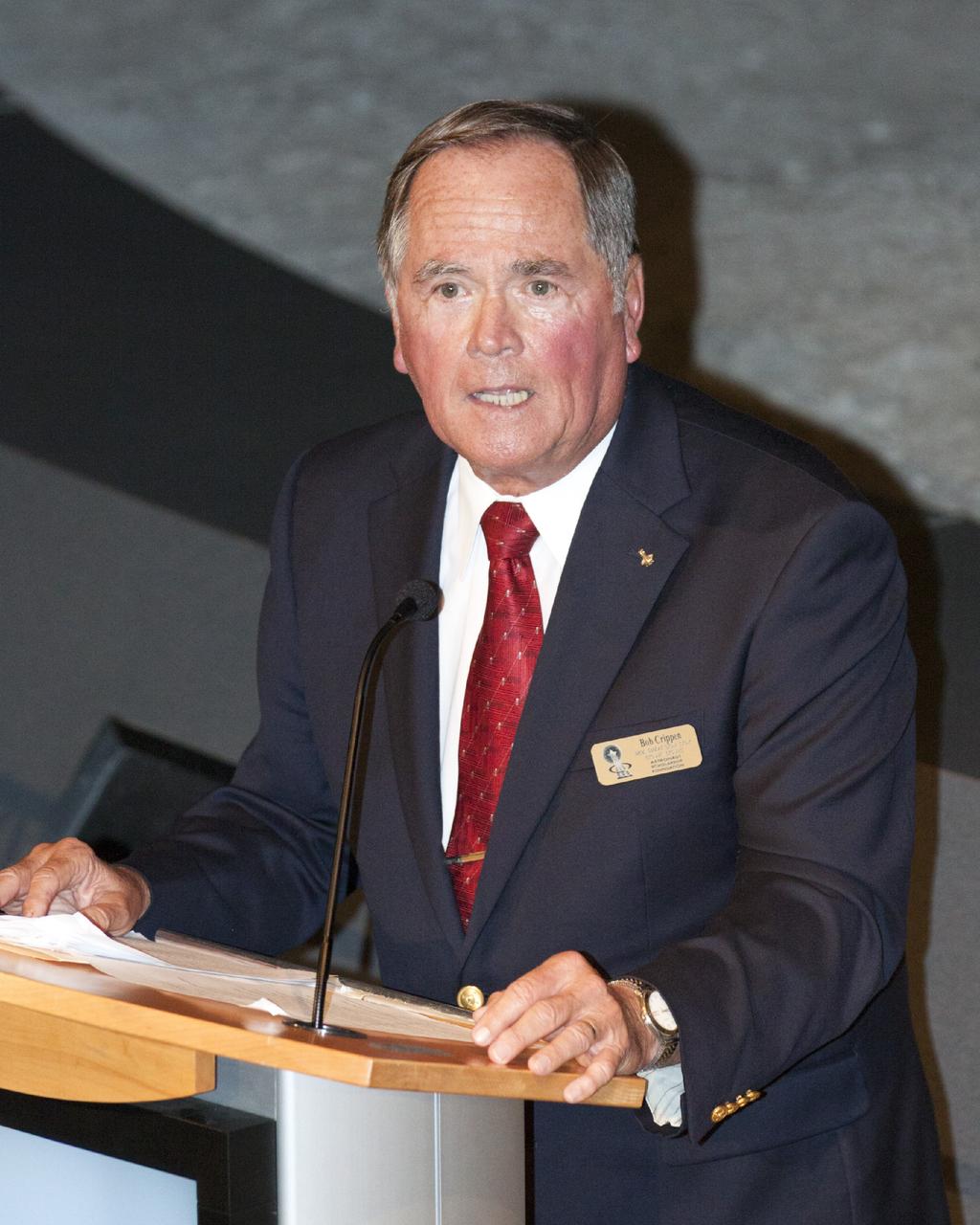
CAPE CANAVERAL, Fla. – At the Kennedy Space Center's Apollo/Saturn V Center, former NASA astronaut Robert Crippen speaks to guests at the Astronaut Scholarship Foundation's event celebrating the 40th anniversary of Skylab. Crippen, along with astronauts William Thornton and Karol Bobko, took part in a 56-day activity during 1972 called SMEAT -- Skylab Medical Experiment Altitude Test -- that preceded the launch of Skylab and helped NASA evaluate equipment and procedures proposed for the long-duration Skylab missions. Crippen went on to fly missions during the Space Shuttle Program and served as center director at Kennedy from January 1992 until January 1995. The gala commemorating the 40th anniversary of Skylab included six of the nine astronauts who flew missions to America's first space station. The orbiting laboratory was launched unpiloted from Kennedy on May 14, 1973. Between May 25, 1973 and Feb. 8, 1974, crews of three spent 28, 59 and 84 days living and working in low-Earth orbit aboard the station. For more information, visit http://www.nasa.gov/mission_pages/skylab/ Photo credit: NASA/Kim Shiflett
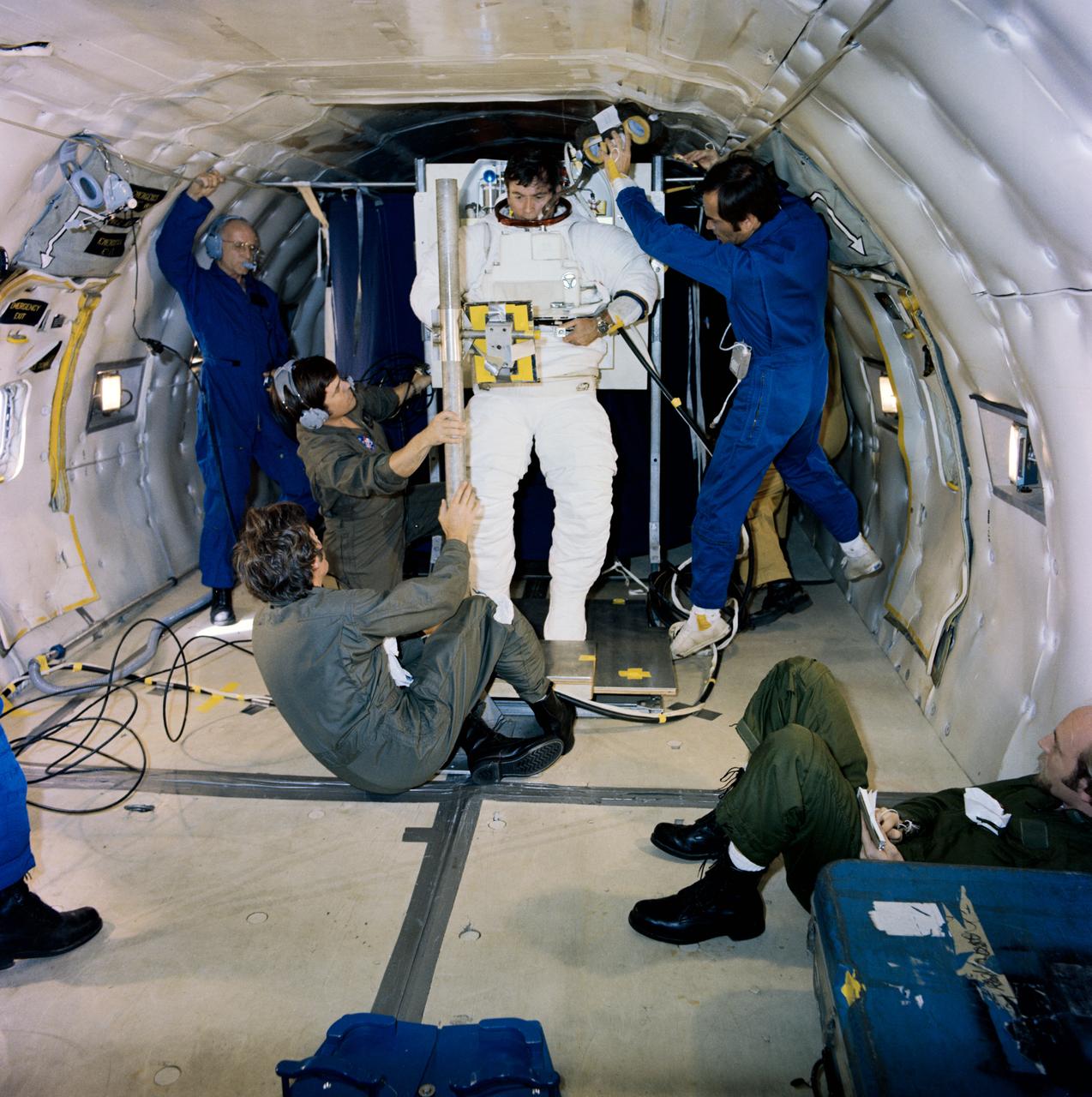
S79-30347 (31 March 1979) --- Taking advantage of a brief period of zero-gravity afforded aboard a KC-135 flying a parabolic curve, the flight crew of the first space shuttle orbital flight test (STS-1) goes through a spacesuit donning exercise. Astronaut John W. Young has just entered the hard-material torso of the shuttle spacesuit by approaching it from below. He is assisted by astronaut Robert L. Crippen. The torso is held in place by a special stand here, simulating the function provided by the airlock wall aboard the actual shuttle craft. The life support system is mated to the torso on Earth and remains so during the flight, requiring this type of donning and doffing exercise. Note Crippen?s suit is the type to be used for intravehicular activity in the shirt sleeve environment to be afforded aboard shuttle. The suit worn by Young is for extravehicular activity (EVA). Young will be STS-1 commander and Crippen, pilot. They will man the space shuttle orbiter 102 Columbia. Photo credit: NASA
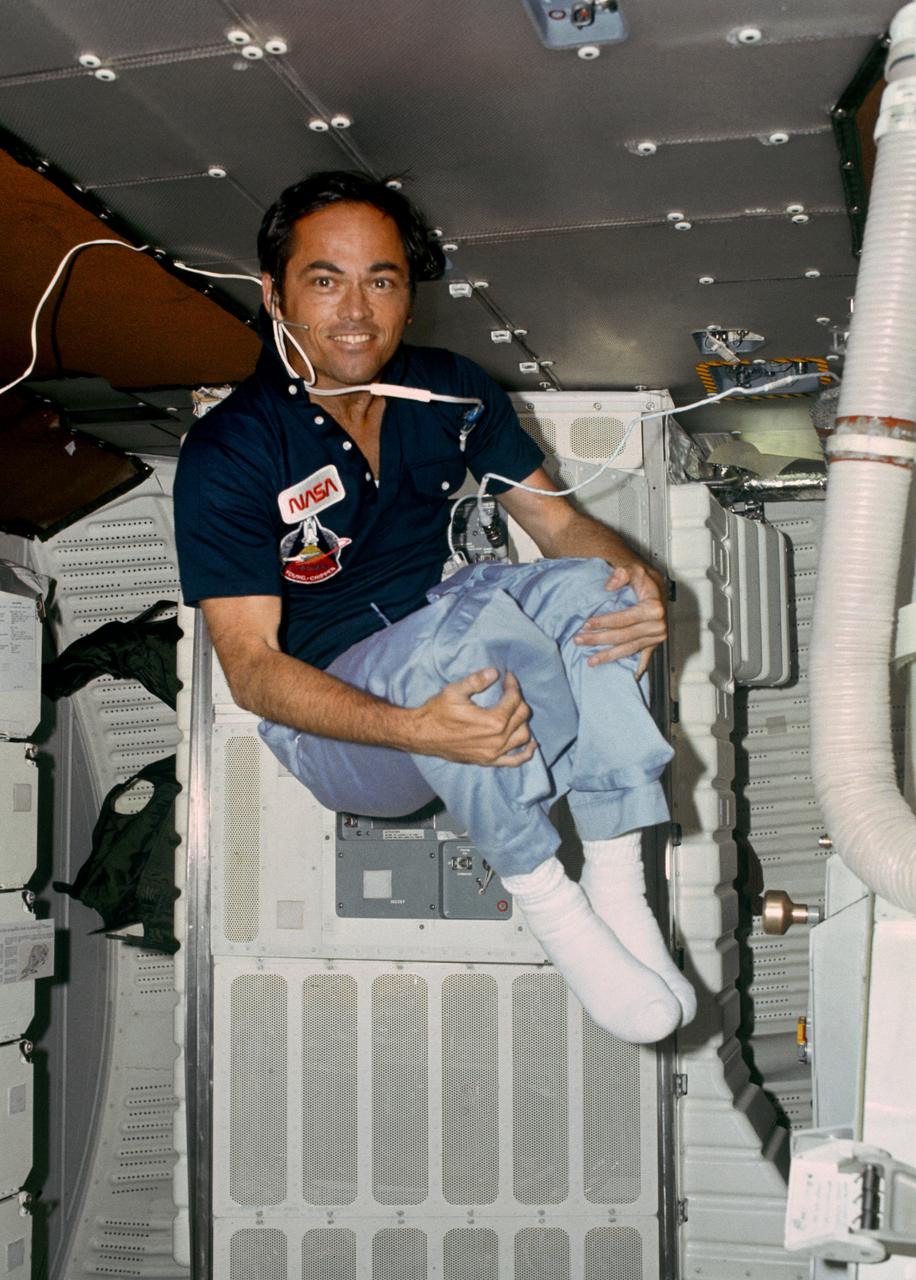
S81-30420 (12-14 April 1981) --- Astronaut Robert L. Crippen, pilot for STS-1 takes advantage of zero-gravity to do some rare acrobatics on the middeck of the space shuttle Columbia in Earth orbit. This 35mm frame was exposed by astronaut John W. Young, flight crew commander. Photo credit: NASA
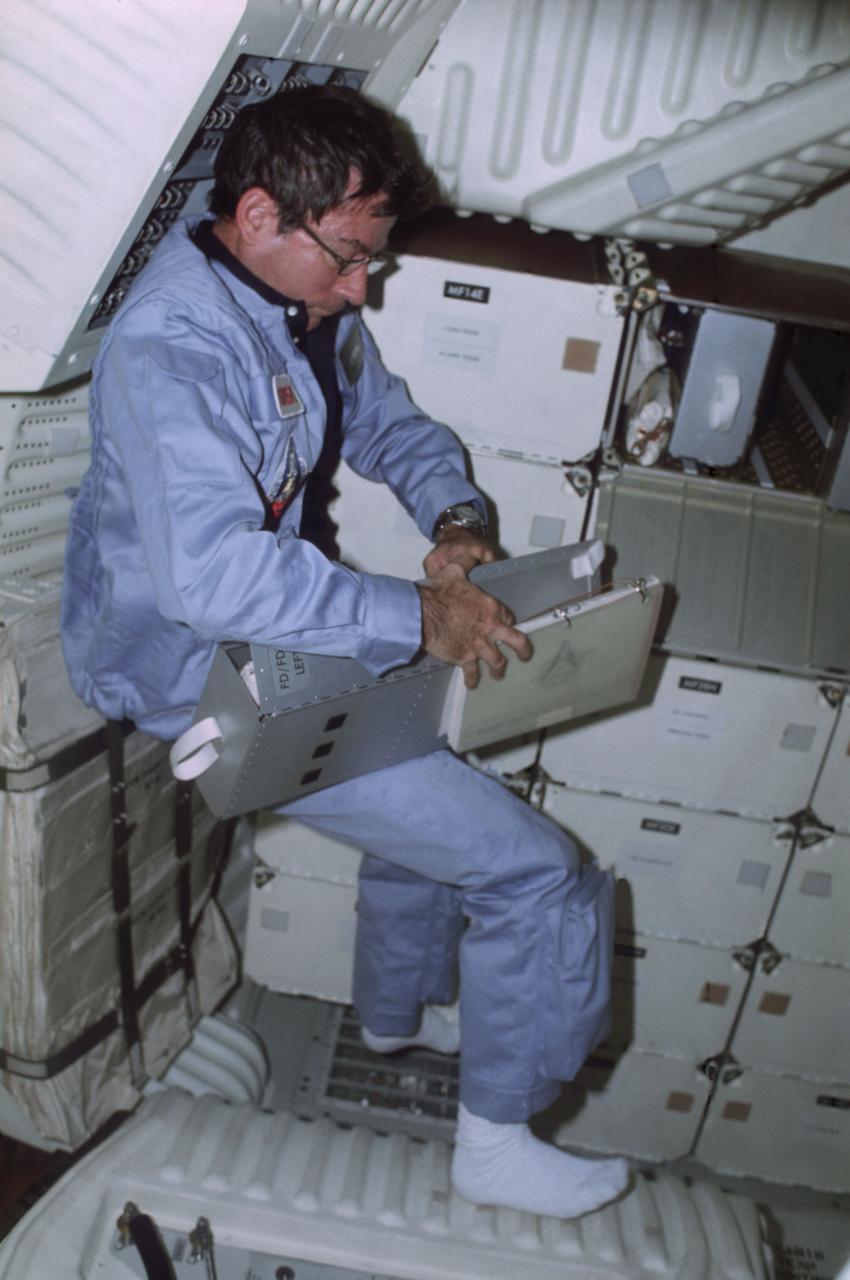
STS001-06-497 (12-14 April 1981) --- Astronaut John W. Young, STS-1 commander, opens one of the lockers in the space shuttle Columbia's middeck area. This photo was taken by astronaut Robert L. Crippen, pilot, using a 35mm camera. Photo credit: NASA
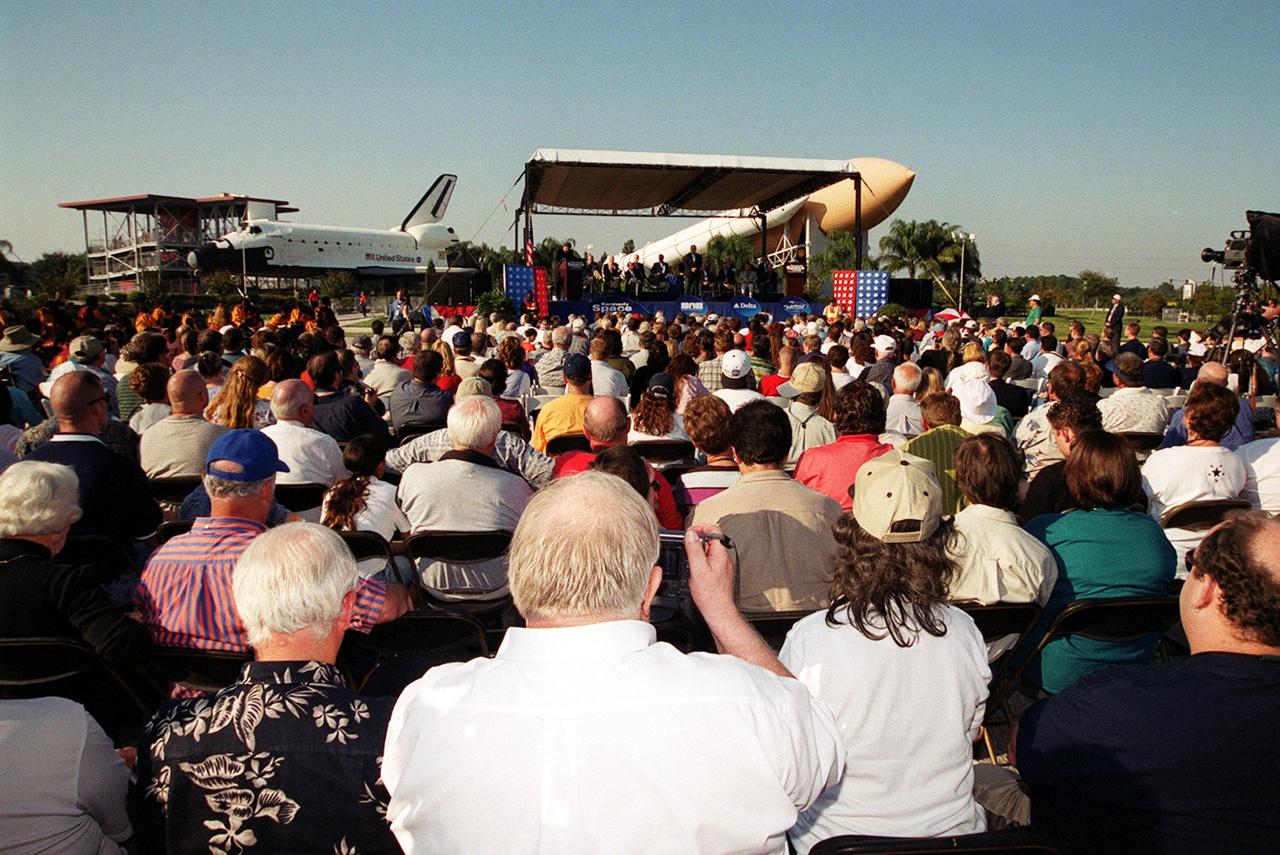
KENNEDY SPACE CENTER, Fla. -- A large crowd is gathered at the KSC Visitor Complex to honor the induction of the first four Shuttle astronauts into the Astronaut Hall of Fame. The four honored were Robert Crippen, Frederick "Rick" Hauck, Richard Truly and Joe Engle.
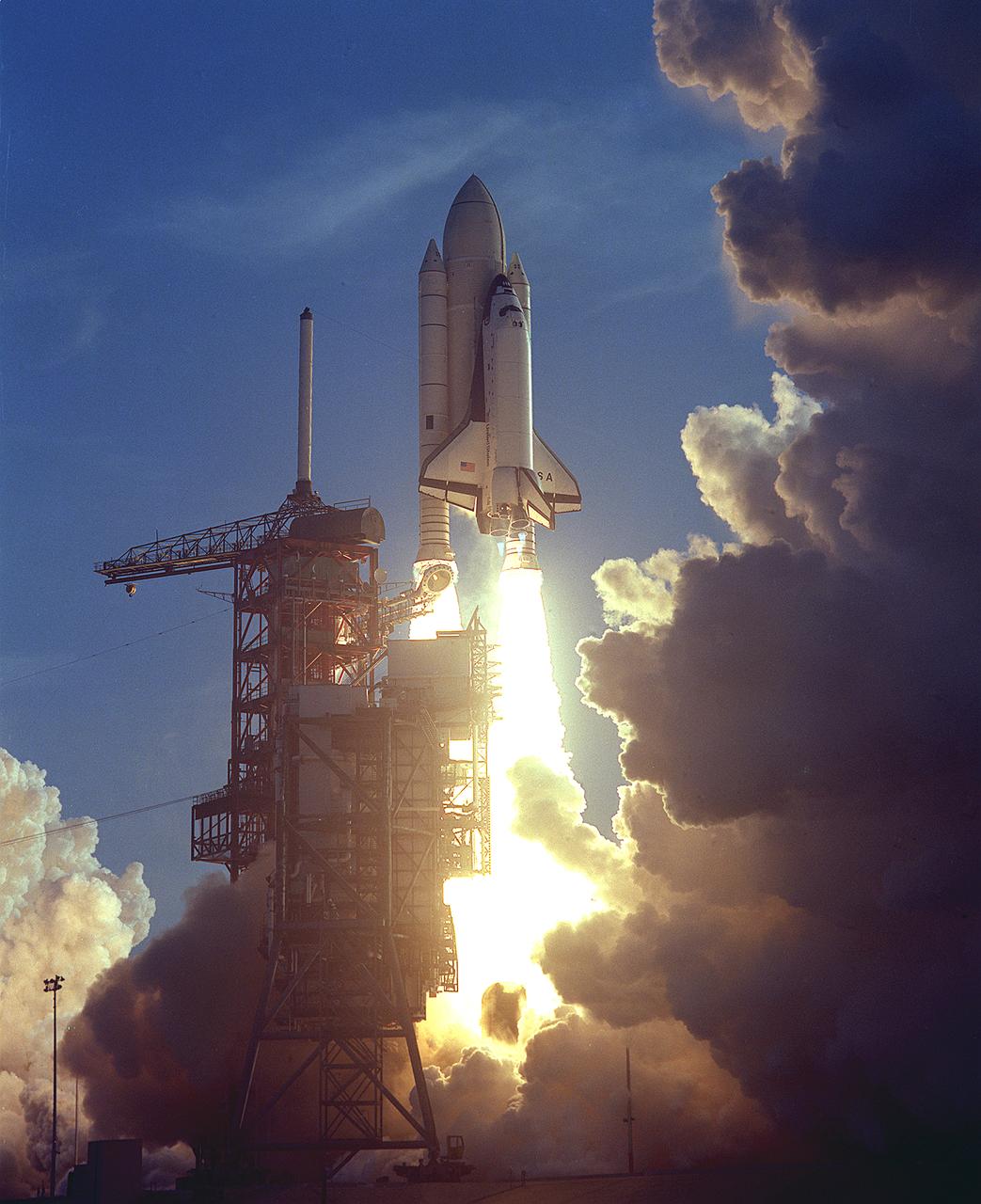
The new era in space flight began on April 12, 1981. That is when the first Space Shuttle mission (STS-1) was launched. The Marshall Space Flight Center developed the propulsion system for the Space Shuttle. This photograph depicts the launch of the Space Shuttle Orbiter Columbia marned with two astronauts, John Young and Robert Crippen.
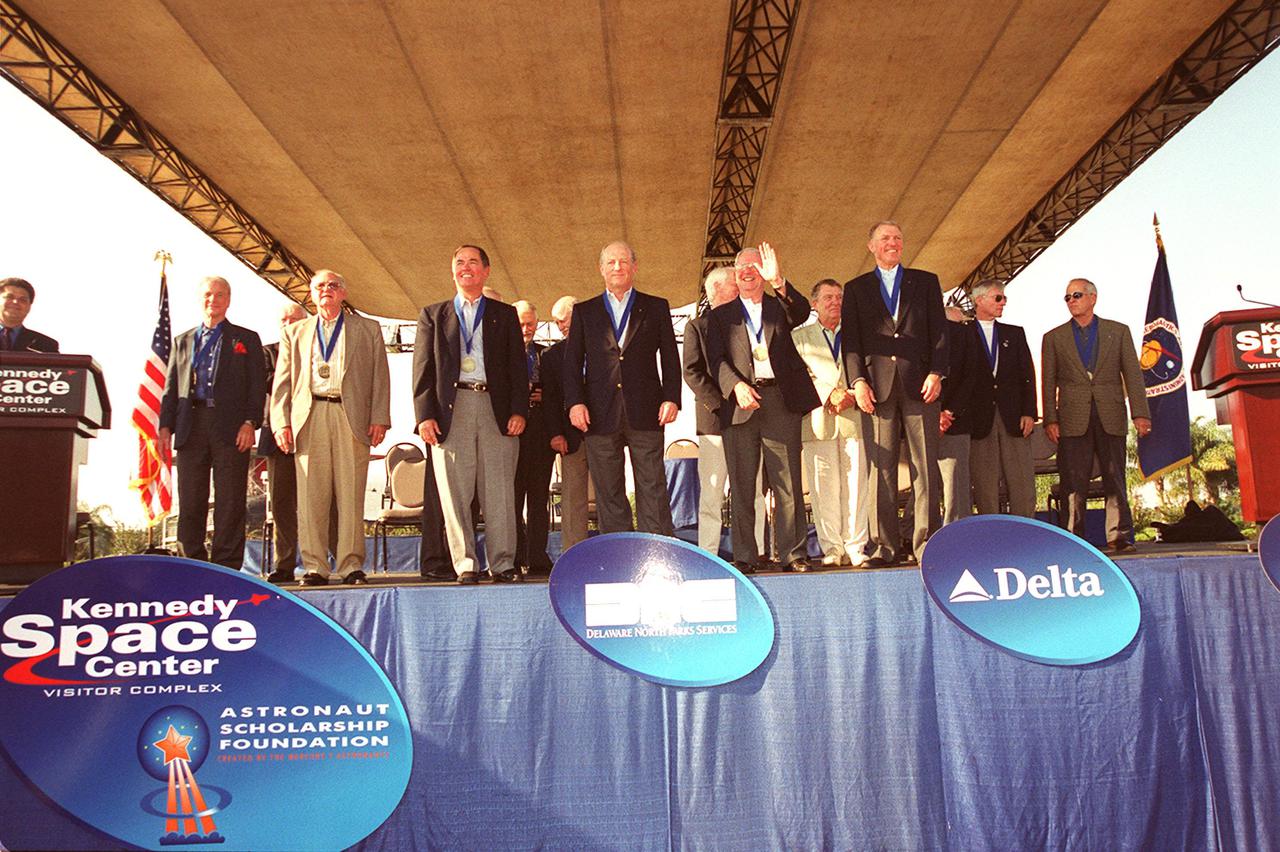
KENNEDY SPACE CENTER, Fla. -- The outdoor stage at the KSC Visitor Complex is filled with members of the Astronaut Hall of Fame who gathered to honor the four standing in the front center: Robert Crippen (second from left), Frederick 'Rick' Hauck, Richard Truly and Joe Engle. These first Shuttle astronauts were the 2001 inductees.
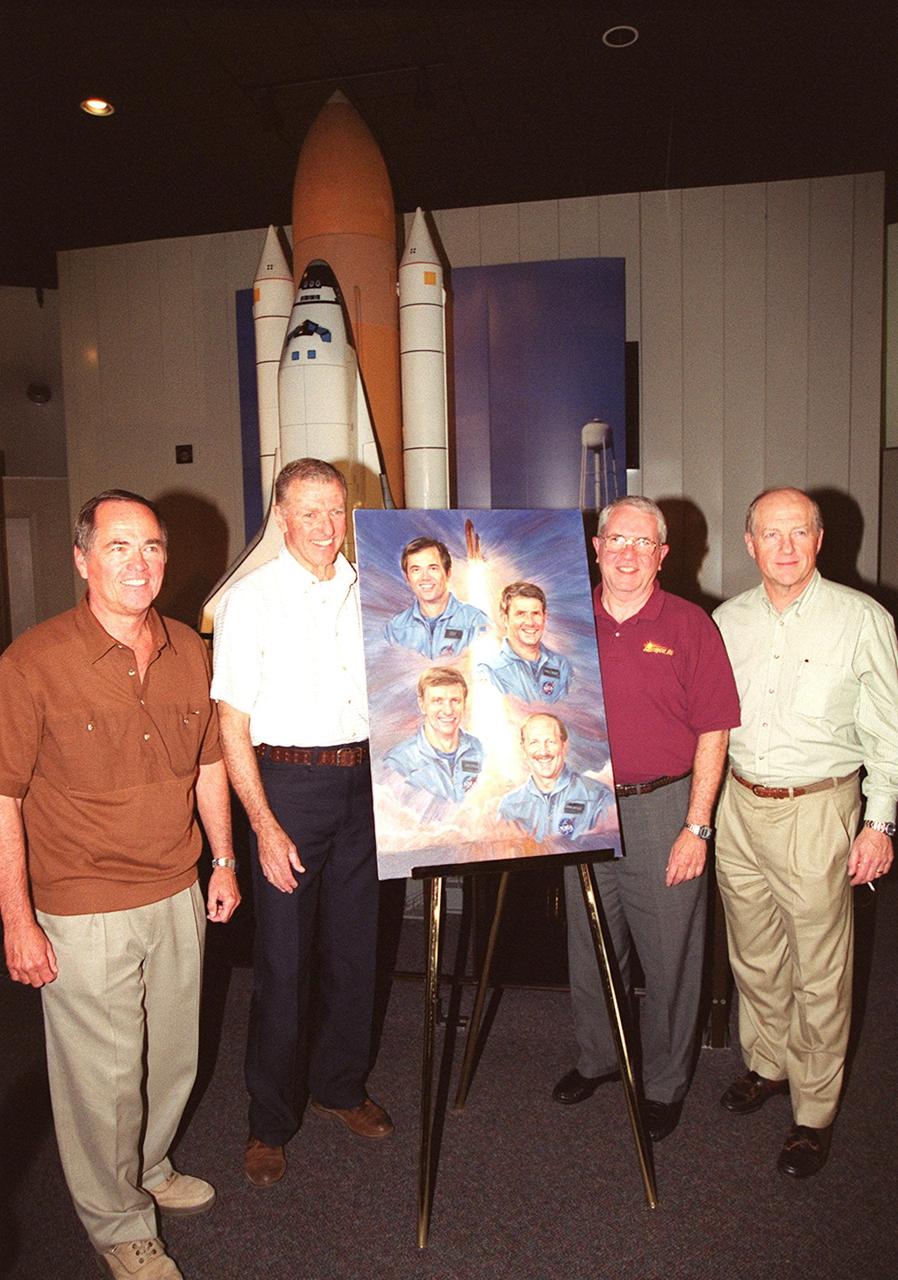
KENNEDY SPACE CENTER, Fla. -- The 2001 inductees into the Astronaut Hall of Fame gather around a drawing of all four. From left, Robert Crippen, Joe Engle, Richard Truly and Frederick "Rick" Hauck were honored as the first four Shuttle astronauts in a ceremony at the KSC Visitor Complex Nov. 10
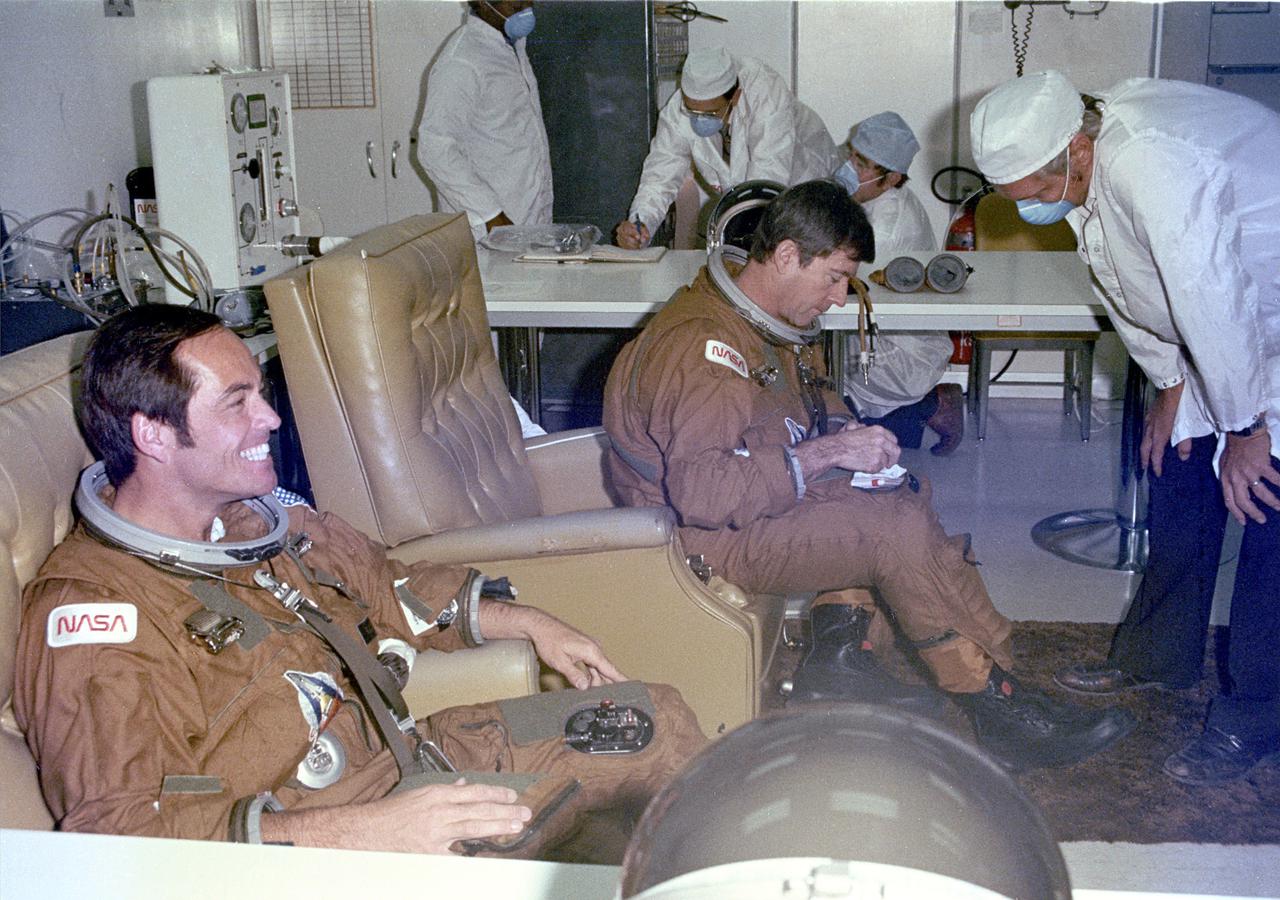
KENNEDY SPACE CENTER, FLA. - Technicians assist prime crew astronauts John Young (right) and Bob Crippen (left) in suit-up operations in KSC's Operations and Checkout Building on the morning of Columbia's successful liftoff on the Space Shuttle's first orbital flight.
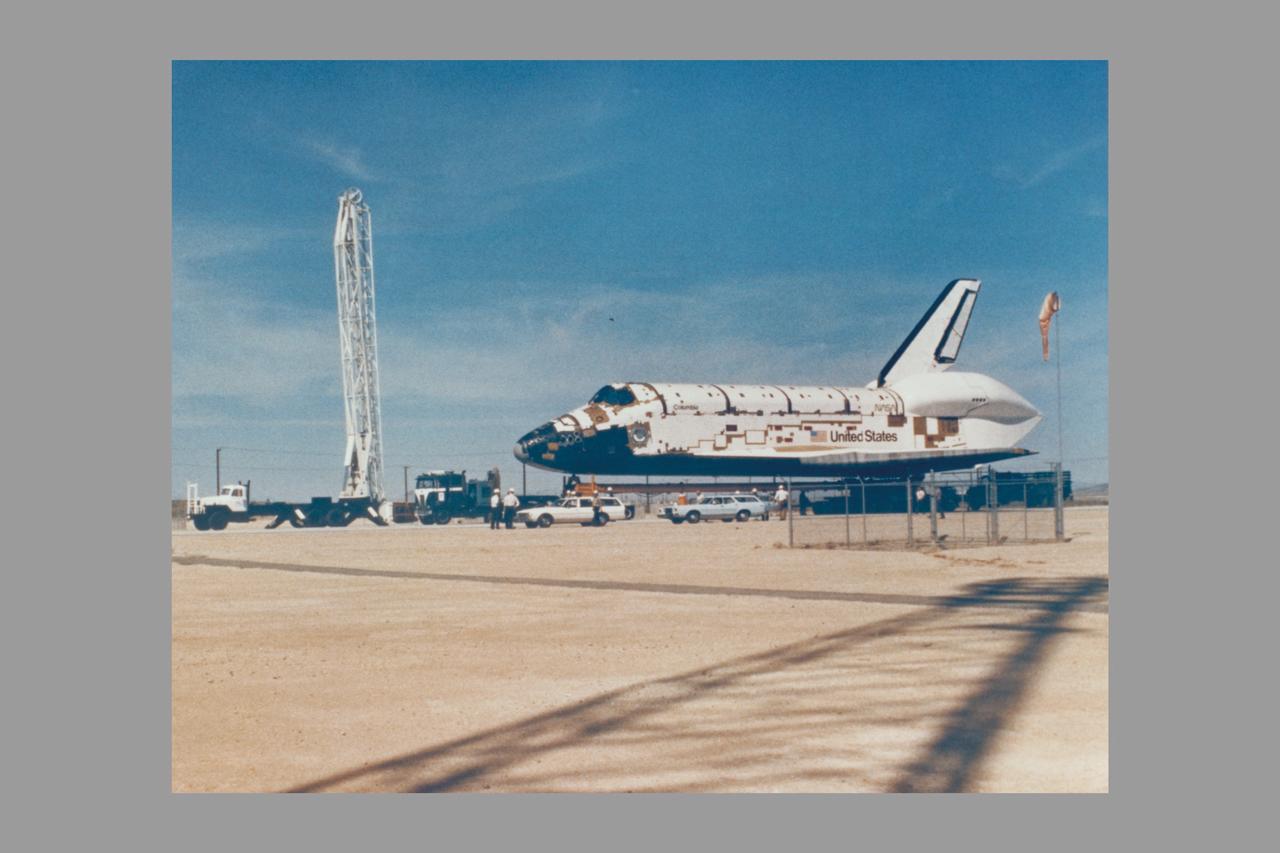
SPACE SHUTTLE ORBITER COLUMBIA 102 IS SHOWN BACKING OUT OF ITS MANUFACTURING FACILITY AT PALMDALE, CA THE ROCKWELL INTERNATIONAL SPACE DIVISION PLANT, ENROUTE TO DRYDEN FLIGHT RESEARCH CENTER. THIS ORBITER WILL BE THE FIRST SHUTTLE SPACECRAFT THAT WILL CARRY TWO ASTRONAUTS, JOHN YOUNG AND RICHARD CRIPPEN, INTO EARTH ORBITAL TEST FLIGHT IN LATE 1979.
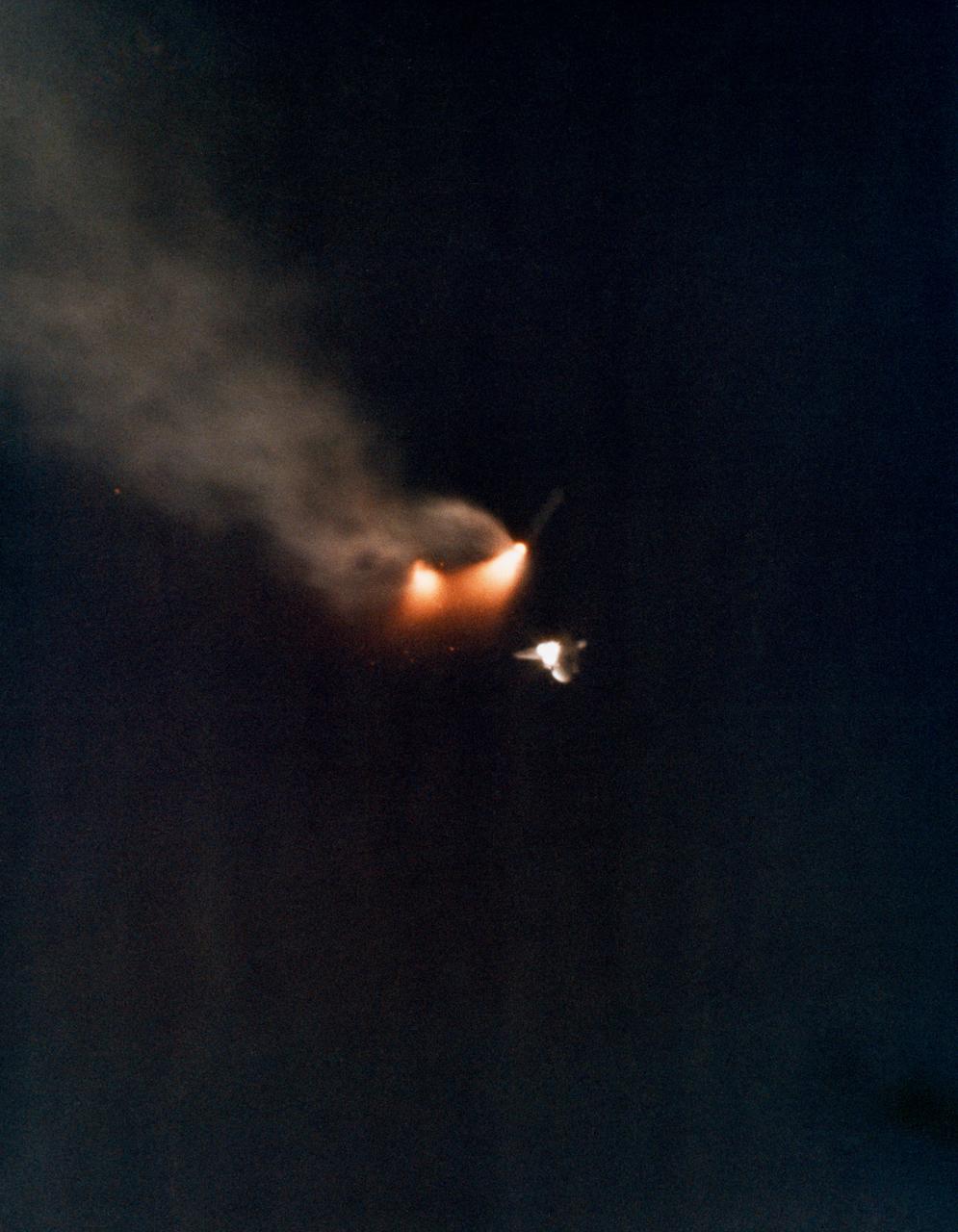
S81-33180 (12 April 1981) --- The two solid rocket boosters are jettisoned from the climbing space shuttle Columbia as a successful launch phase continues for NASA's first manned space mission since 1975. Astronauts John W. Young and Robert L. Crippen are aboard the Columbia. Photo credit: NASA
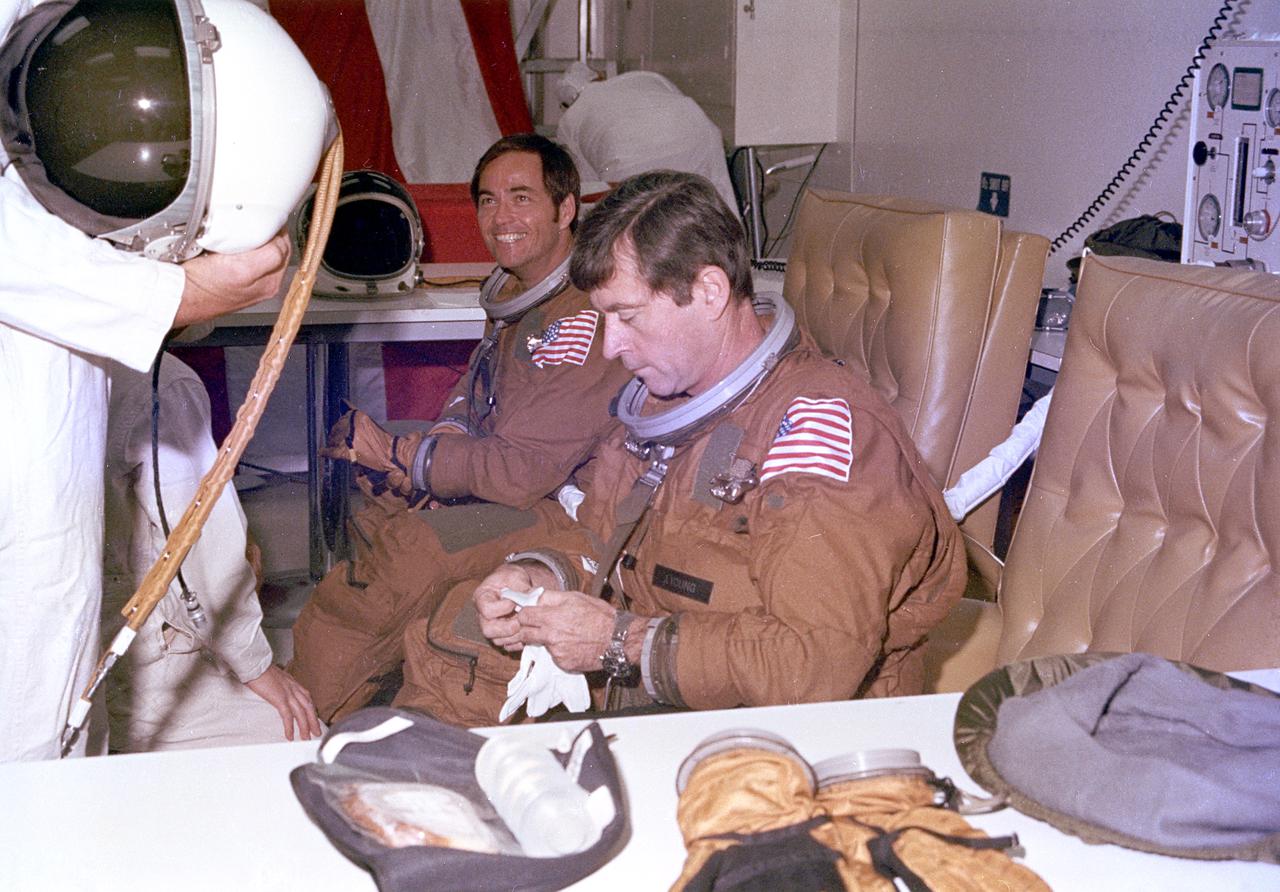
KENNEDY SPACE CENTER, FLA. - Technicians assist Columbia's prime crew astronauts John Young (right) and Bob Crippen (left) during suit-up operations in the crew quarters of the Operations and Checkout Building a few hours before the scheduled liftoff of the Space Shuttle on its maiden flight.
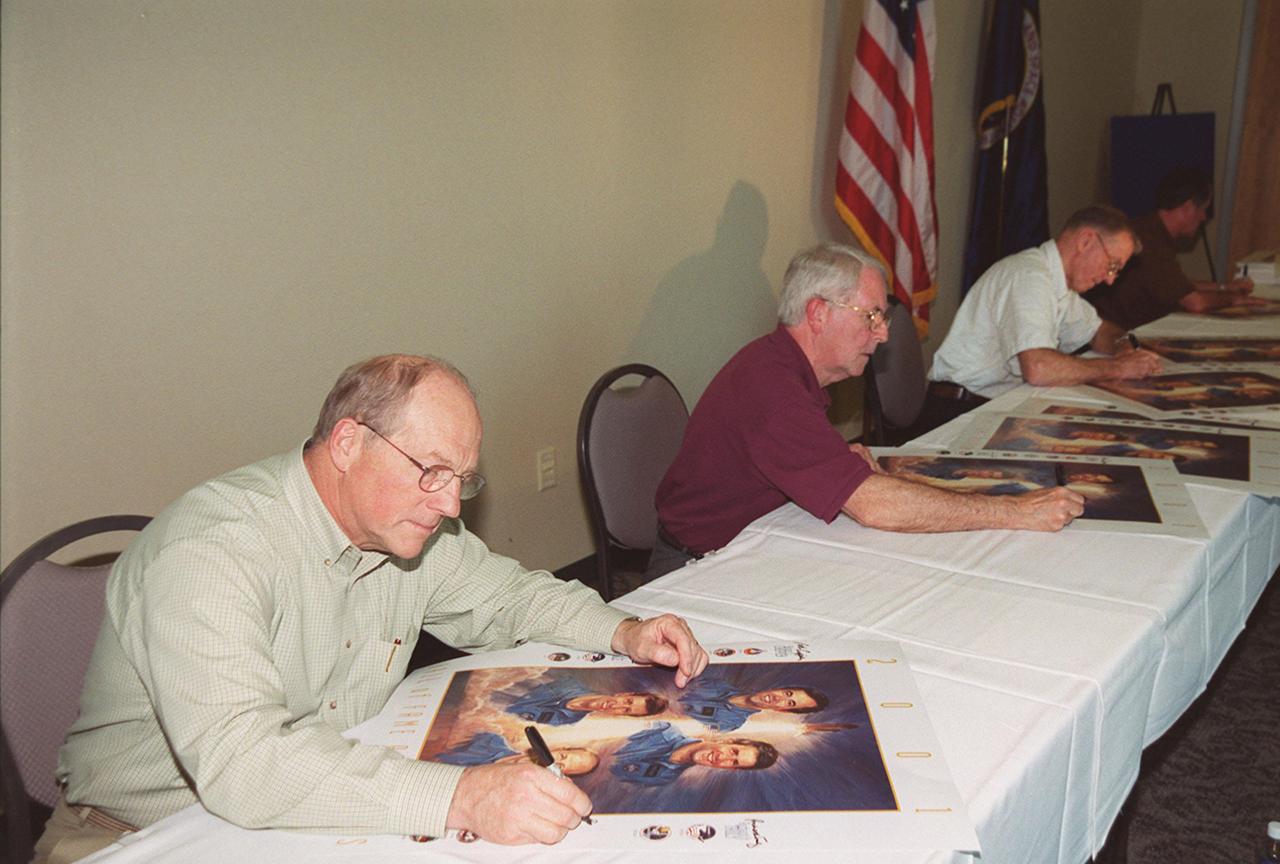
KENNEDY SPACE CENTER, Fla. -- The first four Shuttle astronauts take time to sign posters commemorating their induction into the U.S. Astronaut Hall of Fame Nov. 10. Seated from left are Frederick 'Rick' Hauck, Richard Truly, Joe Engle and Robert Crippen. The event took place at the KSC Visitor Complex
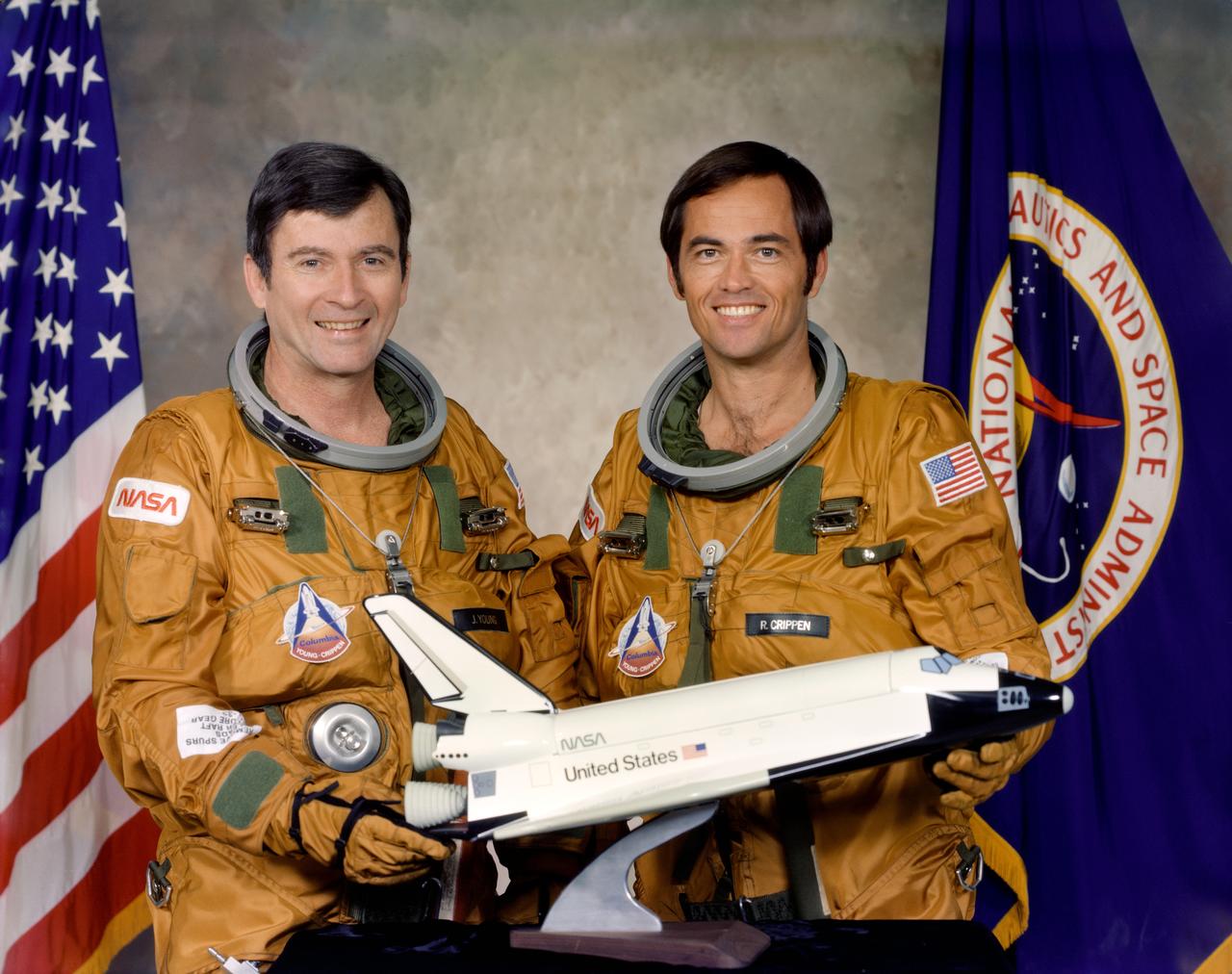
S79-31775 (29 April 1979) --- These two astronauts are the prime crewmen for the first flight in the Space Transportation System (STS-1) program. Astronauts John W. Young, left, commander, and Robert L. Crippen, pilot, will man the space shuttle orbiter 102 Columbia for the first orbital flight test. Photo credit: NASA
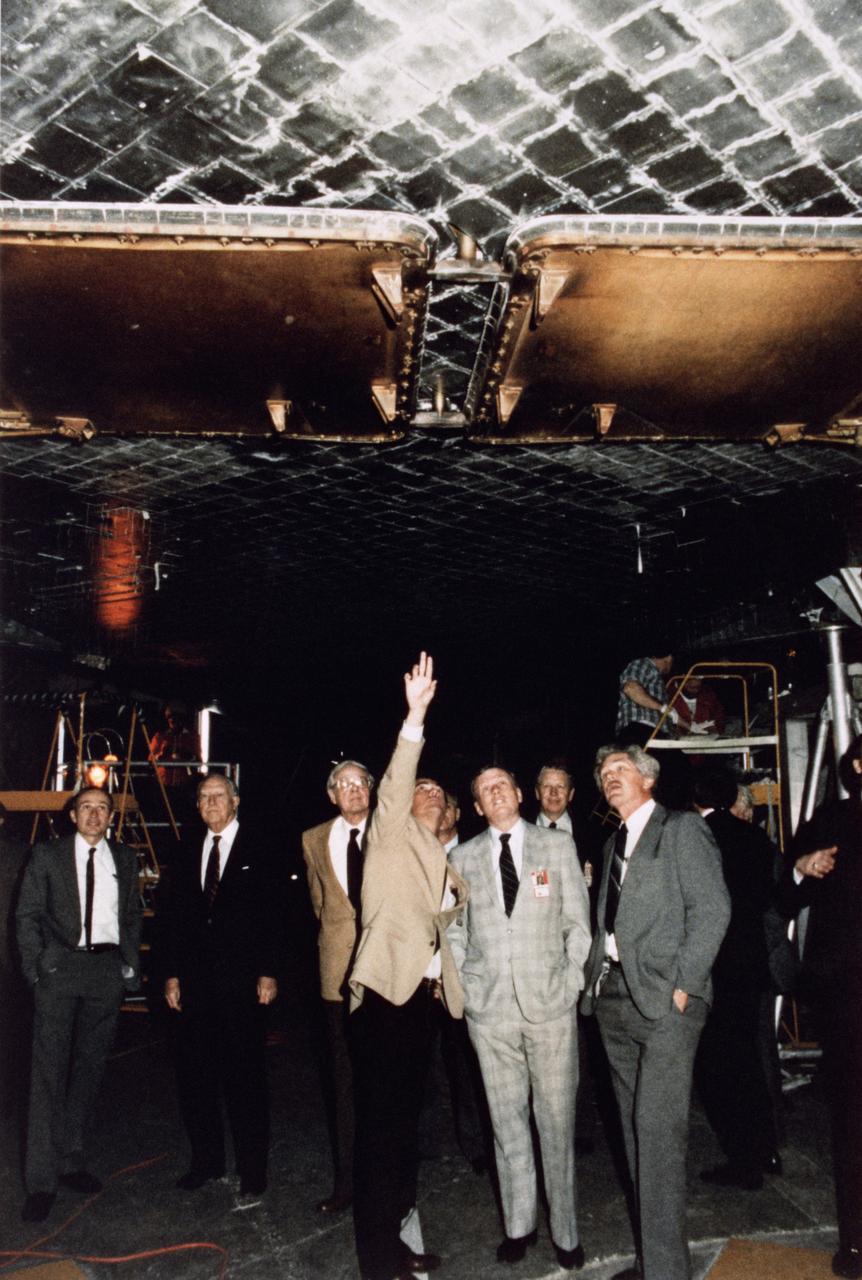
S86-28888 (14 Feb. 1986) --- NASA astronaut Robert Crippen points out Discovery tile work in the Vehicle Assembly Building to the Presidential Commission on the Space Shuttle Challenger Accident. The commission was taken to the facility on Feb. 14, 1986 as part of their investigation. Photo credit: NASA
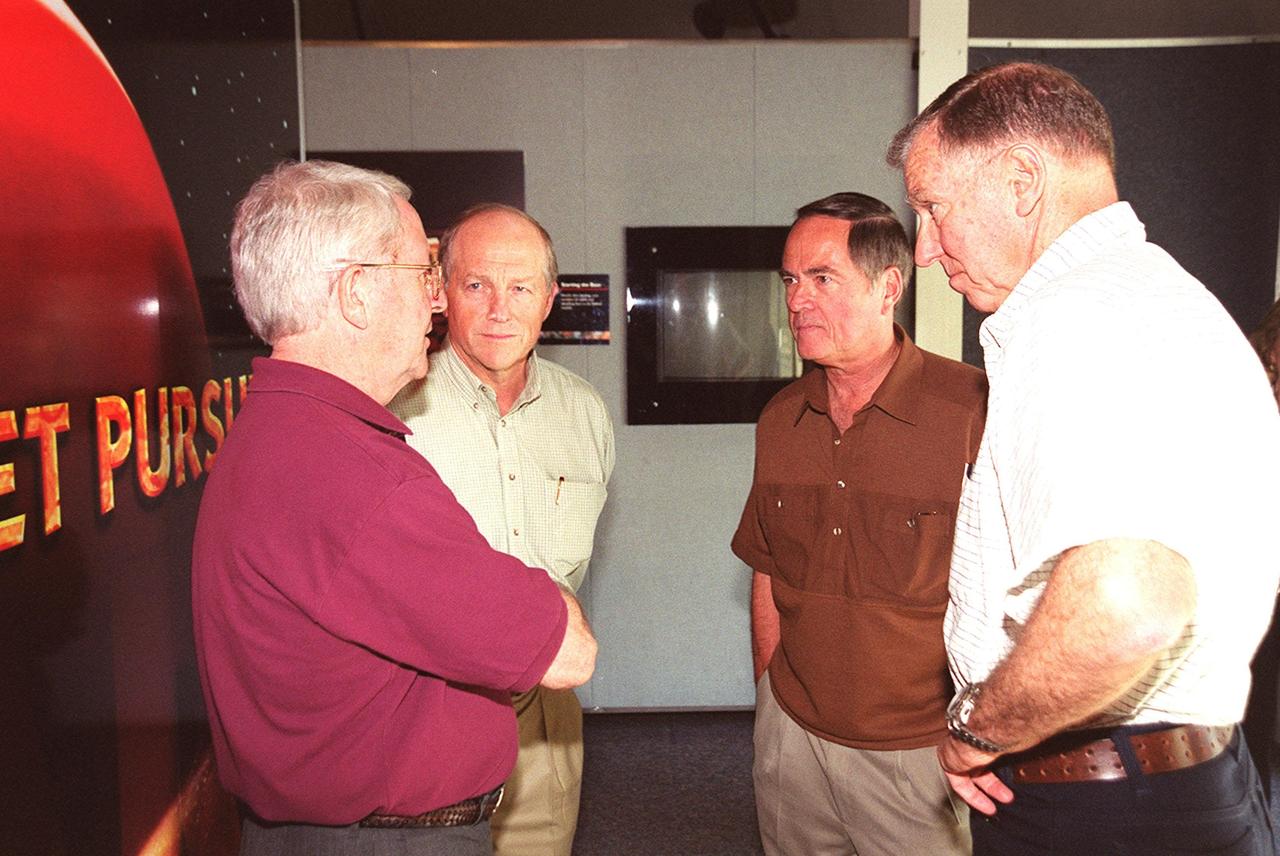
KENNEDY SPACE CENTER, Fla. -- The first four Shuttle astronauts share a moment of nostalgia at the Kennedy Space Center Visitor Complex. Pictured from left are Richard Truly, Frederick "Rick" Hauck, Robert Crippen and Joe Engle. All were inducted into the U.S. Astronaut Hall of Fame Nov. 10.
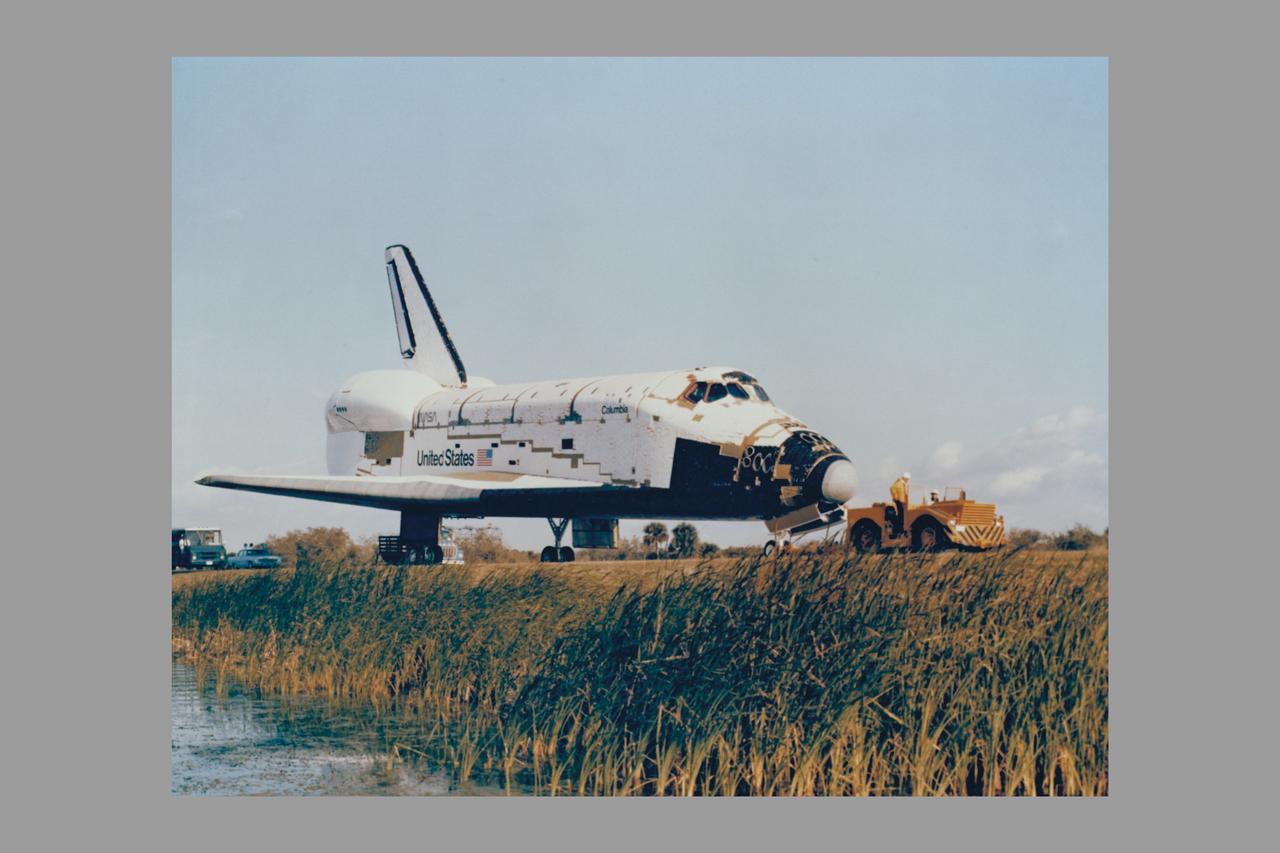
Space Shuttle Orbiter 102 Columbia is shown backing out of its manufacturing facililty at Palmdale, CA, the Rockwell international Space Division Plant, enroute to Dryden Flgiht Research Center. This Orbiter will be the first shuttle spacecraft that will carry two astronauts, John Young and Richard Crippen, into earth orbital test flight in late 1979.
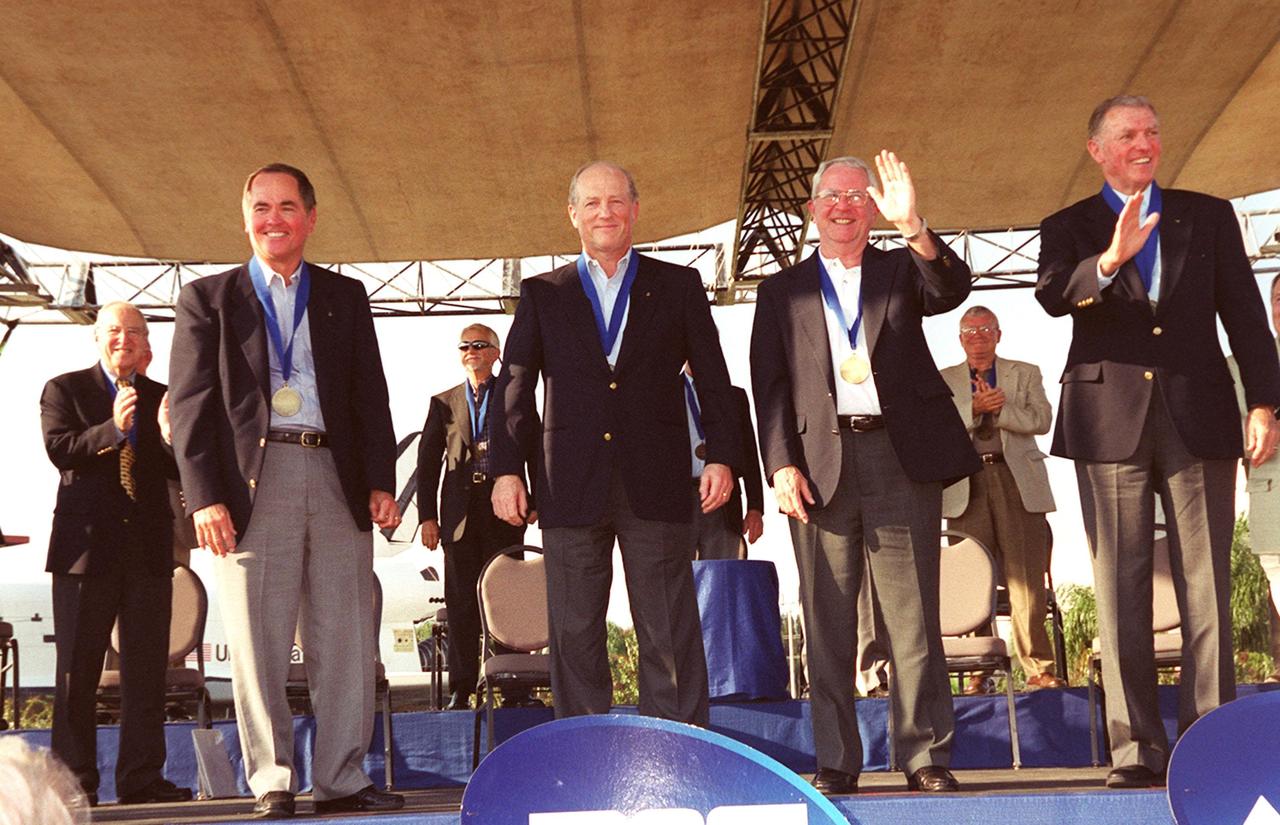
KENNEDY SPACE CENTER, Fla. -- Astronaut Hall of Fame inductees Robert Crippen, Frederick "Rick" Hauck, Richard Truly and Joe Engle acknowledge the applause from the audience. The four were honored as the first Shuttle astronauts in a ceremony at the KSC Visitor Complex Nov. 10.
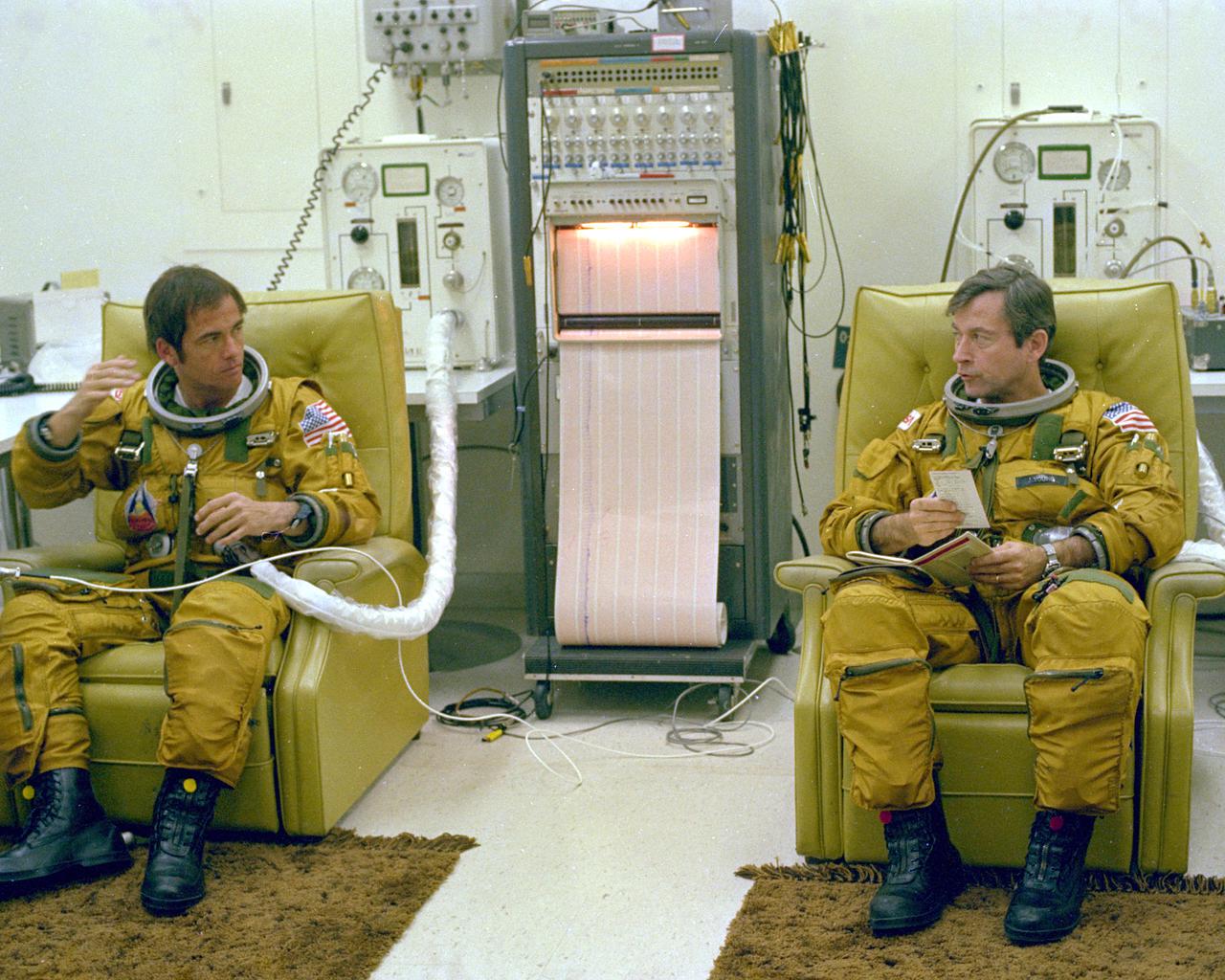
KENNEDY SPACE CENTER, FLA. - Prime crew astronauts Bob Crippen (left) and John Young (right) discuss checklist items during suit-up in the Operations and Checkout Building iiror to departure for the launch pad during the final countdown rehearsal before launch of STS-1.
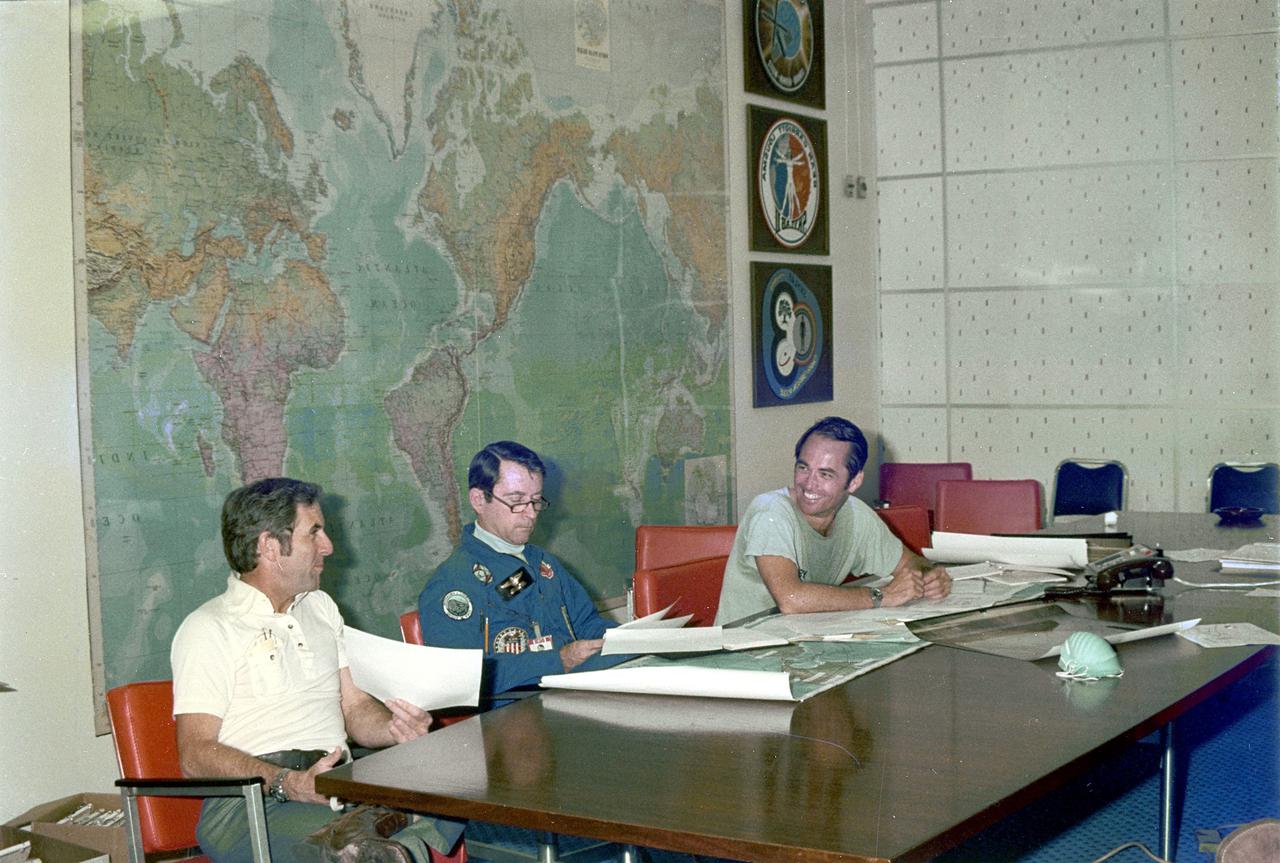
KENNEDY SPACE CENTER, FLA. - Space Shuttle prime crew members Robert Crippen, left, pilot, and John Young, center, commander, along with backup crewman Richard Truly, study forecasts of weather conditions for launch of the maiden flight of STS-1, America’s first reusable space transportation system.
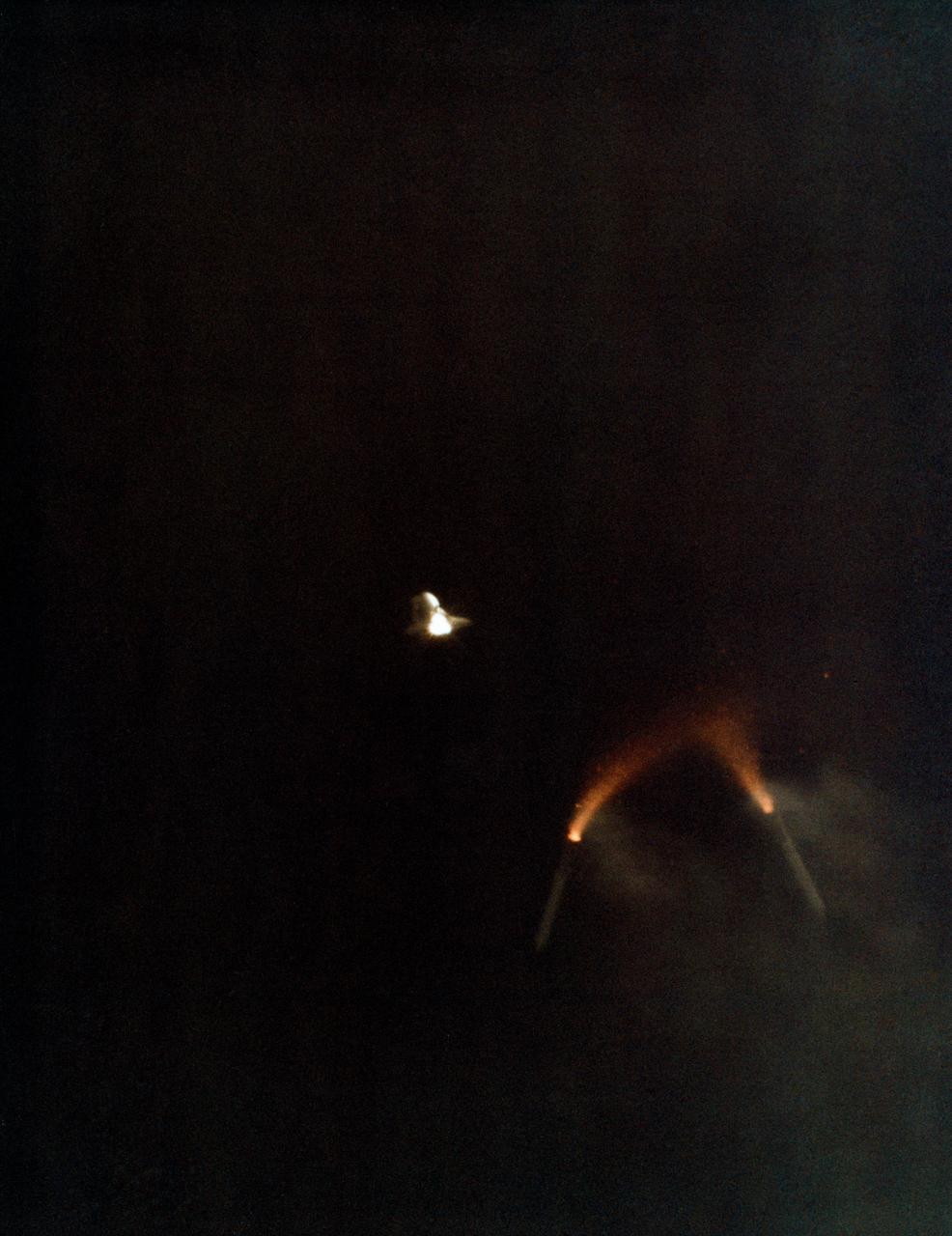
S81-33178 (12 April 1981) --- The two solid rocket boosters are jettisoned from the climbing space shuttle Columbia as a successful launch phase continues for NASA's first manned space mission since 1975. Astronauts John W. Young and Robert L. Crippen are aboard Columbia. Photo credit: NASA